SB 402: Health care coverage: autism.
- Session Year: 2025-2026
- House: Senate
- Latest Version Date: 2025-10-06
Current Status:
Passed
(2025-10-06: Chaptered by Secretary of State. Chapter 413, Statutes of 2025.)
Introduced
In Committee
Awaiting First Chamber Vote
Passed First Chamber
In Committee
Awaiting Second Chamber Vote
Passed Second Chamber
Enacted
Existing law, the Knox-Keene Health Care Service Plan Act of 1975, provides for the licensure and regulation of health care service plans by the Department of Managed Health Care and makes a willful violation of the act a crime. Existing law also provides for the regulation of health insurers by the Department of Insurance. Existing law requires a health care service plan contract or a health insurance policy to provide coverage for behavioral health treatment for pervasive developmental disorder or autism and defines behavioral health treatment to mean specified services and treatment programs, including treatment provided pursuant to a treatment plan that is prescribed by a qualified autism service provider and administered either by a qualified autism service provider or by a qualified autism service professional or qualified autism service paraprofessional. Existing law defines qualified autism service provider, qualified autism service professional, and qualified autism service paraprofessional for those purposes. Those definitions are contained in the Health and Safety Code and the Insurance Code.
This bill would move those definitions to the Business and Professions Code. The bill would also make technical and conforming changes.
This bill would incorporate additional changes to Section 1367.27 of the Health and Safety Code and Section 10133.15 of the Insurance Code proposed by AB 280 to be operative only if this bill and AB 280 are enacted and this bill is enacted last.
This bill would incorporate additional changes to Section 1374.73 of the Health and Safety Code and Section 10144.51 of the Insurance Code proposed by AB 951 to be operative only if this bill and AB 951 are enacted and this bill is enacted last.
This bill would incorporate additional changes to Section 11165.7 of the Penal Code proposed by AB 653 and SB 848, to be operative only if this bill and either or both of those bills are enacted and this bill is enacted last.
Existing law, the Knox-Keene Health Care Service Plan Act of 1975, provides for the licensure and regulation of health care service plans by the Department of Managed Health Care and makes a willful violation of the act a crime. Existing law also provides for the regulation of health insurers by the Department of Insurance. Existing law requires a health care service plan contract or a health insurance policy to provide coverage for behavioral health treatment for pervasive developmental disorder or autism and defines behavioral health treatment to mean specified services and treatment programs, including treatment provided pursuant to a treatment plan that is prescribed by a qualified autism service provider and administered either by a qualified autism service provider or by a qualified autism service professional or qualified autism service paraprofessional. Existing law defines qualified autism service provider, qualified autism service professional, and qualified autism service paraprofessional for those purposes. Those definitions are contained in the Health and Safety Code and the Insurance Code.
This bill would move those definitions to the Business and Professions Code. The bill would also make technical and conforming changes.
This bill would incorporate additional changes to Section 1374.73 of the Health and Safety Code and Section 10144.51 of the Insurance Code proposed by AB 951 to be operative only if this bill and AB 951 are enacted and this bill is enacted last.
Existing law, the Knox-Keene Health Care Service Plan Act of 1975, provides for the licensure and regulation of health care service plans by the Department of Managed Health Care and makes a willful violation of the act a crime. Existing law also provides for the regulation of health insurers by the Department of Insurance. Existing law requires a health care service plan contract or a health insurance policy to provide coverage for behavioral health treatment for pervasive developmental disorder or autism and defines behavioral health treatment to mean specified services and treatment programs, including treatment provided pursuant to a treatment plan that is prescribed by a qualified autism service provider and administered either by a qualified autism service provider or by a qualified autism service professional or qualified autism service paraprofessional. Existing law defines qualified autism service provider, qualified autism service professional, and qualified autism service paraprofessional for those purposes. Those definitions are contained in the Health and Safety Code and the Insurance Code.
This bill would move those definitions to the Business and Professions Code. The bill would also make technical and conforming changes.
(a)For purposes of this division, the following definitions apply:
(1)Asynchronous store and forward means the transmission of a patients medical information from an originating site to the health care provider at a distant site.
(2)Distant site means a site where a health care provider who provides health care services is located while providing these services via a telecommunications system.
(3)Health care provider means any of the following:
(A)A person who is licensed under this division.
(B)An associate marriage and family therapist or marriage and family therapist trainee functioning pursuant to Section 4980.43.3.
(C)A qualified autism service provider certified by a national entity as defined in Section 4999.200 or a qualified autism service professional as defined in Section 4999.201.
(D)An associate clinical social worker functioning pursuant to Section 4996.23.2.
(E)An associate professional clinical counselor or clinical counselor trainee functioning pursuant to Section 4999.46.3.
(4)Originating site means a site where a patient is located at the time health care services are provided via a telecommunications system or where the asynchronous store and forward service originates.
(5)Synchronous interaction means a real-time interaction between a patient and a health care provider located at a distant site.
(6)Telehealth means the mode of delivering health care services and public health via information and communication technologies to facilitate the diagnosis, consultation, treatment, education, care management, and self-management of a patients health care. Telehealth facilitates patient self-management and caregiver support for patients and includes synchronous interactions and asynchronous store and forward transfers.
(b)Before the delivery of health care via telehealth, the health care provider initiating the use of telehealth shall inform the patient about the use of telehealth and obtain verbal or written consent from the patient for the use of telehealth as an acceptable mode of delivering health care services and public health. The consent shall be documented.
(c)This section does not preclude a patient from receiving in-person health care delivery services during a specified course of health care and treatment after agreeing to receive services via telehealth.
(d)The failure of a health care provider to comply with this section shall constitute unprofessional conduct. Section 2314 shall not apply to this section.
(e)This section does not alter the scope of practice of a health care provider or authorize the delivery of health care services in a setting, or in a manner, not otherwise authorized by law.
(f)All laws regarding the confidentiality of health care information and a patients rights to the patients medical information shall apply to telehealth interactions.
(g)All laws and regulations governing professional responsibility, unprofessional conduct, and standards of practice that apply to a health care provider under the health care providers license shall apply to that health care provider while providing telehealth services.
(h)This section shall not apply to a patient under the jurisdiction of the Department of Corrections and Rehabilitation or any other correctional facility.
(i)(1)Notwithstanding any other law and for purposes of this section, the governing body of the hospital whose patients are receiving the telehealth services may grant privileges to, and verify and approve credentials for, providers of telehealth services based on its medical staff recommendations that rely on information provided by the distant-site hospital or telehealth entity, as described in Sections 482.12, 482.22, and 485.616 of Title 42 of the Code of Federal Regulations.
(2)By enacting this subdivision, it is the intent of the Legislature to authorize a hospital to grant privileges to, and verify and approve credentials for, providers of telehealth services as described in paragraph (1).
(3)For the purposes of this subdivision, telehealth shall include telemedicine as the term is referenced in Sections 482.12, 482.22, and 485.616 of Title 42 of the Code of Federal Regulations.
SEC. 2.Chapter 17 (commencing with Section 4999.200) is added to Division 2 of the Business and Professions Code, to read:17.Qualified Autism Service Providers4999.200.Qualified autism service provider means an individual who meets either of the following criteria:
(a)Is certified by a national entity, such as the Behavior Analyst Certification Board, with a certification that is accredited by the National Commission for Certifying Agencies who designs, supervises, or provides treatment for pervasive developmental disorder or autism, provided the services are within the experience and competence of the individual who is nationally certified.
(b)Is licensed as a physician and surgeon, physical therapist, occupational therapist, psychologist, marriage and family therapist, educational psychologist, clinical social worker, professional clinical counselor, speech-language pathologist, or audiologist, pursuant to Division 2 (commencing with Section 500), and who designs, supervises, or provides treatment for pervasive developmental disorder or autism, provided the services are within the experience and competence of the licensee.
4999.201.Qualified autism service professional means an individual who meets all of the following criteria:
(a)Provides behavioral health treatment, which may include clinical case management and case supervision under the direction and supervision of a qualified autism service provider.
(b)Is supervised by a qualified autism service provider.
(c)Provides treatment pursuant to a treatment plan developed and approved by the qualified autism service provider.
(d)Is either of the following:
(1)A behavioral service provider who meets the education and experience qualifications described in Section 54342 of Title 17 of the California Code of Regulations for an Associate Behavior Analyst, Behavior Analyst, Behavior Management Assistant, Behavior Management Consultant, or Behavior Management Program.
(2)(A)A psychological associate, an associate marriage and family therapist, an associate clinical social worker, or an associate professional clinical counselor, as defined and regulated by the Board of Behavioral Sciences or the Board of Psychology.
(B)If an individual meets the requirement described in subparagraph (A), they shall also meet the criteria set forth in the regulations adopted pursuant to Section 4686.4 of the Welfare and Institutions Code for a Behavioral Health Professional.
(e)(1)Has training and experience in providing services for pervasive developmental disorder or autism pursuant to Division 4.5 (commencing with Section 4500) of the Welfare and Institutions Code or Title 14 (commencing with Section 95000) of the Government Code.
(f)Is employed by the qualified autism service provider or an entity or group that employs qualified autism service providers responsible for the autism treatment plan.
4999.202.Qualified autism service paraprofessional means an unlicensed and uncertified individual who meets all of the following criteria:
(a)Is supervised by a qualified autism service provider or qualified autism service professional at a level of clinical supervision that meets professionally recognized standards of practice.
(b)Provides treatment and implements services pursuant to a treatment plan that was developed and approved by the qualified autism service provider.
(c)Meets the education and training qualifications described in Section 54342 of Title 17 of the California Code of Regulations.
(d)Has adequate education, training, and experience, as certified by a qualified autism service provider or an entity or group that employs qualified autism service providers.
(e)Is employed by the qualified autism service provider or an entity or group that employs qualified autism service providers responsible for the autism treatment plan.
SEC. 3.Section 1367.27 of the Health and Safety Code is amended to read:1367.27.(a)Commencing July 1, 2016, a health care service plan shall publish and maintain a provider directory or directories with information on contracting providers that deliver health care services to the plans enrollees, including those that accept new patients. A provider directory shall not list or include information on a provider that is not currently under contract with the plan.
(b)A health care service plan shall provide the directory or directories for the specific network offered for each product using a consistent method of network and product naming, numbering, or other classification method that ensures the public, enrollees, potential enrollees, the department, and other state or federal agencies can easily identify the networks and plan products in which a provider participates. By July 31, 2017, or 12 months after the date provider directory standards are developed under subdivision (k), whichever occurs later, a health care service plan shall use the naming, numbering, or classification method developed by the department pursuant to subdivision (k).
(c)(1)An online provider directory or directories shall be available on the plans internet website to the public, potential enrollees, enrollees, and providers without any restrictions or limitations. The directory or directories shall be accessible without any requirement that an individual seeking the directory information demonstrate coverage with the plan, indicate interest in obtaining coverage with the plan, provide a member identification or policy number, provide any other identifying information, or create or access an account.
(2)The online provider directory or directories shall be accessible on the plans public internet website through an identifiable link or tab and in a manner that is accessible and searchable by enrollees, potential enrollees, the public, and providers. By July 31, 2017, or 12 months after the date provider directory standards are developed under subdivision (k), whichever occurs later, the plans public internet website shall allow provider searches by, at a minimum, name, practice address, city, ZIP Code, California license number, National Provider Identifier number, admitting privileges to an identified hospital, product, tier, provider language or languages, provider group, hospital name, facility name, or clinic name, as appropriate.
(d)(1)A health care service plan shall allow enrollees, potential enrollees, providers, and members of the public to request a printed copy of the provider directory or directories by contacting the plan through the plans toll-free telephone number, electronically, or in writing. A printed copy of the provider directory or directories shall include the information required in subdivisions (h) and (i). The printed copy of the provider directory or directories shall be provided to the requester by mail postmarked no later than five business days following the date of the request and may be limited to the geographic region in which the requester resides or works or intends to reside or work.
(2)A health care service plan shall update its printed provider directory or directories at least quarterly, or more frequently, if required by federal law.
(e)(1)The plan shall update the online provider directory or directories, at least weekly, or more frequently, if required by federal law, when informed of and upon confirmation by the plan of any of the following:
(A)A contracting provider is no longer accepting new patients for that product, or an individual provider within a provider group is no longer accepting new patients.
(B)A provider is no longer under contract for a particular plan product.
(C)A providers practice location or other information required under subdivision (h) or (i) has changed.
(D)Upon completion of the investigation described in subdivision (o), a change is necessary based on an enrollee complaint that a provider was not accepting new patients, was otherwise not available, or whose contact information was listed incorrectly.
(E)Any other information that affects the content or accuracy of the provider directory or directories.
(2)Upon confirmation of any of the following, the plan shall delete a provider from the directory or directories when:
(A)A provider has retired or otherwise has ceased to practice.
(B)A provider or provider group is no longer under contract with the plan for any reason.
(C)The contracting provider group has informed the plan that the provider is no longer associated with the provider group and is no longer under contract with the plan.
(f)The provider directory or directories shall include both an email address and a telephone number for members of the public and providers to notify the plan if the provider directory information appears to be inaccurate. This information shall be disclosed prominently in the directory or directories and on the plans internet website.
(g)The provider directory or directories shall include the following disclosures informing enrollees that they are entitled to both of the following:
(1)Language interpreter services, at no cost to the enrollee, including how to obtain interpretation services in accordance with Section 1367.04.
(2)Full and equal access to covered services, including enrollees with disabilities as required under the federal Americans with Disabilities Act of 1990 and Section 504 of the Rehabilitation Act of 1973.
(h)A full service health care service plan and a specialized mental health plan shall include all of the following information in the provider directory or directories:
(1)The providers name, practice location or locations, and contact information.
(2)Type of practitioner.
(3)National Provider Identifier number.
(4)California license number and type of license.
(5)The area of specialty, including board certification, if any.
(6)The providers office email address, if available.
(7)The name of each affiliated provider group currently under contract with the plan through which the provider sees enrollees.
(8)A listing for each of the following providers that are under contract with the plan:
(A)For physicians and surgeons, the provider group, and admitting privileges, if any, at hospitals contracted with the plan.
(B)Nurse practitioners, physician assistants, psychologists, acupuncturists, optometrists, podiatrists, chiropractors, licensed clinical social workers, marriage and family therapists, professional clinical counselors, qualified autism service providers, as defined in Section 4999.200 of the Business and Professions Code, nurse midwives, and dentists.
(C)For federally qualified health centers or primary care clinics, the name of the federally qualified health center or clinic.
(D)For a provider described in subparagraph (A) or (B) who is employed by a federally qualified health center or primary care clinic, and to the extent their services may be accessed and are covered through the contract with the plan, the name of the provider, and the name of the federally qualified health center or clinic.
(E)Facilities, including, but not limited to, general acute care hospitals, skilled nursing facilities, urgent care clinics, ambulatory surgery centers, inpatient hospice, residential care facilities, and inpatient rehabilitation facilities.
(F)Pharmacies, clinical laboratories, imaging centers, and other facilities providing contracted health care services.
(9)The provider directory or directories may note that authorization or referral may be required to access some providers.
(10)Non-English language, if any, spoken by a health care provider or other medical professional as well as non-English language spoken by a qualified medical interpreter, in accordance with Section 1367.04, if any, on the providers staff.
(11)Identification of providers who no longer accept new patients for some or all of the plans products.
(12)The network tier to which the provider is assigned, if the provider is not in the lowest tier, as applicable. Nothing in this section shall be construed to require the use of network tiers other than contract and noncontracting tiers.
(13)All other information necessary to conduct a search pursuant to paragraph (2) of subdivision (c).
(i)A vision, dental, or other specialized health care service plan, except for a specialized mental health plan, shall include all of the following information for each provider directory or directories used by the plan for its networks:
(1)The providers name, practice location or locations, and contact information.
(2)Type of practitioner.
(3)National Provider Identifier number.
(4)California license number and type of license, if applicable.
(5)The area of specialty, including board certification, or other accreditation, if any.
(6)The providers office email address, if available.
(7)The name of each affiliated provider group or specialty plan practice group currently under contract with the plan through which the provider sees enrollees.
(8)The names of each allied health care professional to the extent there is a direct contract for those services covered through a contract with the plan.
(9)The non-English language, if any, spoken by a health care provider or other medical professional as well as non-English language spoken by a qualified medical interpreter, in accordance with Section 1367.04, if any, on the providers staff.
(10)Identification of providers who no longer accept new patients for some or all of the plans products.
(11)All other applicable information necessary to conduct a provider search pursuant to paragraph (2) of subdivision (c).
(j)(1)The contract between the plan and a provider shall include a requirement that the provider inform the plan within five business days when either of the following occurs:
(A)The provider is not accepting new patients.
(B)If the provider had previously not accepted new patients, the provider is currently accepting new patients.
(2)If a provider who is not accepting new patients is contacted by an enrollee or potential enrollee seeking to become a new patient, the provider shall direct the enrollee or potential enrollee to both the plan for additional assistance in finding a provider and to the department to report any inaccuracy with the plans directory or directories.
(3)If an enrollee or potential enrollee informs a plan of a possible inaccuracy in the provider directory or directories, the plan shall promptly investigate, and, if necessary, undertake corrective action within 30 business days to ensure the accuracy of the directory or directories.
(k)(1)On or before December 31, 2016, the department shall develop uniform provider directory standards to permit consistency in accordance with subdivision (b) and paragraph (2) of subdivision (c) and development of a multiplan directory by another entity. Those standards shall not be subject to the Administrative Procedure Act (Chapter 3.5 (commencing with Section 11340) of Part 1 of Division 3 of Title 2 of the Government Code), until January 1, 2021. No more than two revisions of those standards shall be exempt from the Administrative Procedure Act (Chapter 3.5 (commencing with Section 11340) of Part 1 of Division 3 of Title 2 of the Government Code) pursuant to this subdivision.
(2)In developing the standards under this subdivision, the department shall seek input from interested parties throughout the process of developing the standards and shall hold at least one public meeting. The department shall take into consideration any requirements for provider directories established by the federal Centers for Medicare and Medicaid Services and the State Department of Health Care Services.
(3)By July 31, 2017, or 12 months after the date provider directory standards are developed under this subdivision, whichever occurs later, a plan shall use the standards developed by the department for each product offered by the plan.
(l)(1)A plan shall take appropriate steps to ensure the accuracy of the information concerning each provider listed in the plans provider directory or directories in accordance with this section, and shall, at least annually, review and update the entire provider directory or directories for each product offered. Each calendar year the plan shall notify all contracted providers described in subdivisions (h) and (i) as follows:
(A)For individual providers who are not affiliated with a provider group described in subparagraph (A) or (B) of paragraph (8) of subdivision (h) and providers described in subdivision (i), the plan shall notify each provider at least once every six months.
(B)For all other providers described in subdivision (h) who are not subject to the requirements of subparagraph (A), the plan shall notify its contracted providers to ensure that all of the providers are contacted by the plan at least once annually.
(2)The notification shall include all of the following:
(A)The information the plan has in its directory or directories regarding the provider or provider group, including a list of networks and plan products that include the contracted provider or provider group.
(B)A statement that the failure to respond to the notification may result in a delay of payment or reimbursement of a claim pursuant to subdivision (p).
(C)Instructions on how the provider or provider group can update the information in the provider directory or directories using the online interface developed pursuant to subdivision (m).
(3)The plan shall require an affirmative response from the provider or provider group acknowledging that the notification was received. The provider or provider group shall confirm that the information in the provider directory or directories is current and accurate or update the information required to be in the directory or directories pursuant to this section, including whether or not the provider or provider group is accepting new patients for each plan product.
(4)If the plan does not receive an affirmative response and confirmation from the provider that the information is current and accurate or, as an alternative, updates any information required to be in the directory or directories pursuant to this section, within 30 business days, the plan shall take no more than 15 business days to verify whether the providers information is correct or requires updates. The plan shall document the receipt and outcome of each attempt to verify the information. If the plan is unable to verify whether the providers information is correct or requires updates, the plan shall notify the provider 10 business days in advance of removal that the provider will be removed from the provider directory or directories. The provider shall be removed from the provider directory or directories at the next required update of the provider directory or directories after the 10-business-day notice period. A provider shall not be removed from the provider directory or directories if they respond before the end of the 10-business-day notice period.
(5)General acute care hospitals shall be exempt from the requirements in paragraphs (3) and (4).
(m)A plan shall establish policies and procedures with regard to the regular updating of its provider directory or directories, including the weekly, quarterly, and annual updates required pursuant to this section, or more frequently, if required by federal law or guidance.
(1)The policies and procedures described under this subdivision shall be submitted by a plan annually to the department for approval and in a format described by the department pursuant to Section 1367.035.
(2)Every health care service plan shall ensure processes are in place to allow providers to promptly verify or submit changes to the information required to be in the directory or directories pursuant to this section. Those processes shall, at a minimum, include an online interface for providers to submit verification or changes electronically and shall generate an acknowledgment of receipt from the health care service plan. Providers shall verify or submit changes to information required to be in the directory or directories pursuant to this section using the process required by the health care service plan.
(3)The plan shall establish and maintain a process for enrollees, potential enrollees, other providers, and the public to identify and report possible inaccurate, incomplete, or misleading information currently listed in the plans provider directory or directories. This process shall, at a minimum, include a telephone number and a dedicated email address at which the plan will accept these reports, as well as a hyperlink on the plans provider directory internet website linking to a form where the information can be reported directly to the plan through its internet website.
(n)(1)This section does not prohibit a plan from requiring its provider groups or contracting specialized health care service plans to provide information to the plan that is required by the plan to satisfy the requirements of this section for each of the providers that contract with the provider group or contracting specialized health care service plan. This responsibility shall be specifically documented in a written contract between the plan and the provider group or contracting specialized health care service plan.
(2)If a plan requires its contracting provider groups or contracting specialized health care service plans to provide the plan with information described in paragraph (1), the plan shall continue to retain responsibility for ensuring that the requirements of this section are satisfied.
(3)A provider group may terminate a contract with a provider for a pattern or repeated failure of the provider to update the information required to be in the directory or directories pursuant to this section.
(4)A provider group is not subject to the payment delay described in subdivision (p) if all of the following occurs:
(A)A provider does not respond to the provider groups attempt to verify the providers information. As used in this paragraph, verify means to contact the provider in writing, electronically, and by telephone to confirm whether the providers information is correct or requires updates.
(B)The provider group documents its efforts to verify the providers information.
(C)The provider group reports to the plan that the provider should be deleted from the provider group in the plan directory or directories.
(5)Section 1375.7, known as the Health Care Providers Bill of Rights, applies to any material change to a provider contract pursuant to this section.
(o)(1)Whenever a health care service plan receives a report indicating that information listed in its provider directory or directories is inaccurate, the plan shall promptly investigate the reported inaccuracy and, no later than 30 business days following receipt of the report, either verify the accuracy of the information or update the information in its provider directory or directories, as applicable.
(2)When investigating a report regarding its provider directory or directories, the plan shall, at a minimum, do the following:
(A)Contact the affected provider no later than five business days following receipt of the report.
(B)Document the receipt and outcome of each report. The documentation shall include the providers name, location, and a description of the plans investigation, the outcome of the investigation, and any changes or updates made to its provider directory or directories.
(C)If changes to a plans provider directory or directories are required as a result of the plans investigation, the changes to the online provider directory or directories shall be made no later than the next scheduled weekly update, or the update immediately following that update, or sooner if required by federal law or regulations. For printed provider directories, the change shall be made no later than the next required update, or sooner if required by federal law or regulations.
(p)(1)Notwithstanding Sections 1371 and 1371.35, a plan may delay payment or reimbursement owed to a provider or provider group as specified in subparagraph (A) or (B), if the provider or provider group fails to respond to the plans attempts to verify the providers or provider groups information as required under subdivision (l). The plan shall not delay payment unless it has attempted to verify the providers or provider groups information. As used in this subdivision, verify means to contact the provider or provider group in writing, electronically, and by telephone to confirm whether the providers or provider groups information is correct or requires updates. A plan may seek to delay payment or reimbursement owed to a provider or provider group only after the 10-business day notice period described in paragraph (4) of subdivision (l) has lapsed.
(A)For a provider or provider group that receives compensation on a capitated or prepaid basis, the plan may delay no more than 50 percent of the next scheduled capitation payment for up to one calendar month.
(B)For any claims payment made to a provider or provider group, the plan may delay the claims payment for up to one calendar month beginning on the first day of the following month.
(2)A plan shall notify the provider or provider group 10 business days before it seeks to delay payment or reimbursement to a provider or provider group pursuant to this subdivision. If the plan delays a payment or reimbursement pursuant to this subdivision, the plan shall reimburse the full amount of any payment or reimbursement subject to delay to the provider or provider group according to either of the following timelines, as applicable:
(A)No later than three business days following the date on which the plan receives the information required to be submitted by the provider or provider group pursuant to subdivision (l).
(B)At the end of the one-calendar month delay described in subparagraph (A) or (B) of paragraph (1), as applicable, if the provider or provider group fails to provide the information required to be submitted to the plan pursuant to subdivision (l).
(3)A plan may terminate a contract for a pattern or repeated failure of the provider or provider group to alert the plan to a change in the information required to be in the directory or directories pursuant to this section.
(4)A plan that delays payment or reimbursement under this subdivision shall document each instance a payment or reimbursement was delayed and report this information to the department in a format described by the department pursuant to Section 1367.035. This information shall be submitted along with the policies and procedures required to be submitted annually to the department pursuant to paragraph (1) of subdivision (m).
(5)With respect to plans with Medi-Cal managed care contracts with the State Department of Health Care Services pursuant to Chapter 7 (commencing with Section 14000), Chapter 8 (commencing with Section 14200), or Chapter 8.75 (commencing with Section 14591) of Part 3 of Division 9 of the Welfare and Institutions Code, this subdivision shall be implemented only to the extent consistent with federal law and guidance.
(q)In circumstances where the department finds that an enrollee reasonably relied upon materially inaccurate, incomplete, or misleading information contained in a health plans provider directory or directories, the department may require the health plan to provide coverage for all covered health care services provided to the enrollee and to reimburse the enrollee for any amount beyond what the enrollee would have paid, had the services been delivered by an in-network provider under the enrollees plan contract. Prior to requiring reimbursement in these circumstances, the department shall conclude that the services received by the enrollee were covered services under the enrollees plan contract. In those circumstances, the fact that the services were rendered or delivered by a noncontracting or out-of-plan provider shall not be used as a basis to deny reimbursement to the enrollee.
(r)Whenever a plan determines as a result of this section that there has been a 10 percent change in the network for a product in a region, the plan shall file an amendment to the plan application with the department consistent with subdivision (f) of Section 1300.52 of Title 28 of the California Code of Regulations.
(s)This section applies to plans with Medi-Cal managed care contracts with the State Department of Health Care Services pursuant to Chapter 7 (commencing with Section 14000), Chapter 8 (commencing with Section 14200), or Chapter 8.75 (commencing with Section 14591) of Part 3 of Division 9 of the Welfare and Institutions Code to the extent consistent with federal law and guidance and state law guidance issued after January 1, 2016. Notwithstanding any other provision to the contrary in a plan contract with the State Department of Health Care Services, and to the extent consistent with federal law and guidance and state guidance issued after January 1, 2016, a Medi-Cal managed care plan that complies with the requirements of this section shall not be required to distribute a printed provider directory or directories, except as required by paragraph (1) of subdivision (d).
(t)A health plan that contracts with multiple employer welfare agreements regulated pursuant to Article 4.7 (commencing with Section 742.20) of Chapter 1 of Part 2 of Division 1 of the Insurance Code shall meet the requirements of this section.
(u)This section shall not be construed to alter a providers obligation to provide health care services to an enrollee pursuant to the providers contract with the plan.
(v)As part of the departments routine examination of the fiscal and administrative affairs of a health care service plan pursuant to Section 1382, the department shall include a review of the health care service plans compliance with subdivision (p).
(w)For purposes of this section, provider group means a medical group, independent practice association, or other similar group of providers.
SEC. 3.5.Section 1367.27 of the Health and Safety Code is amended to read:1367.27.(a)A health care service plan shall publish and maintain a provider directory or directories with information on contracting providers that deliver health care services to the plans enrollees, including those that accept new patients. A provider directory shall not list or include information on a provider that is not currently under contract with the plan. Commencing July 1, 2026, a health care service plan shall comply with this section as it read on January 1, 2026.
(b)A health care service plan shall provide the directory or directories for the specific network offered for each product using a consistent method of network and product naming, numbering, or other classification method that ensures the public, enrollees, potential enrollees, contracting providers, the department, and other state or federal agencies can easily identify the networks and plan products in which a provider participates. By July 31, 2017, or 12 months after the date provider directory standards are developed under subdivision (k), whichever occurs later, a health care service plan shall use the naming, numbering, or classification method developed by the department pursuant to subdivision (k).
(c)(1)An online provider directory or directories shall be available on the plans internet website to the public, potential enrollees, enrollees, and providers without any restrictions or limitations. The directory or directories shall be accessible without any requirement that an individual seeking the directory information demonstrate coverage with the plan, indicate interest in obtaining coverage with the plan, provide a member identification or policy number, provide any other identifying information, or create or access an account.
(2)The online provider directory or directories shall be accessible on the plans public internet website through an identifiable link or tab and in a manner that is accessible and searchable by enrollees, potential enrollees, the public, and providers. By July 31, 2017, or 12 months after the date provider directory standards are developed under subdivision (k), whichever occurs later, the plans public internet website shall allow provider searches by, at a minimum, name, practice address, city, ZIP Code, California license number, National Provider Identifier number, admitting privileges to an identified hospital, product, tier, provider language or languages, provider group, hospital name, facility name, or clinic name, as appropriate, and the information provided shall be verified and accurate, consistent with this section.
(d)(1)A health care service plan shall allow enrollees, potential enrollees, providers, and members of the public to request a printed copy of the provider directory or directories by contacting the plan through the plans toll-free telephone number, electronically, or in writing. A printed copy of the provider directory or directories shall include the information required in subdivisions (h) and (i). The printed copy of the provider directory or directories shall be provided to the requester by mail postmarked no later than five business days following the date of the request and may be limited to the geographic region in which the requester resides or works or intends to reside or work.
(2)A health care service plan shall update its printed provider directory or directories at least quarterly, or more frequently, if required by federal law.
(3)A printed provider directory shall be dated with the date of its last update.
(e)(1)The plan shall update the online provider directory or directories, at least weekly, or more frequently, if required by federal law, when informed of and upon confirmation by the plan of any of the following:
(A)A contracting provider is no longer accepting new patients for that product, or an individual provider within a provider group is no longer accepting new patients.
(B)A provider is no longer under contract for a particular plan product.
(C)A providers practice location or other information required under subdivision (h) or (i) has changed.
(D)Upon the completion of the investigation described in subdivision (o), a change is necessary based on an enrollee complaint that a provider was not accepting new patients, was otherwise not available, or whose contact information was listed incorrectly.
(E)Any other information that affects the content or accuracy of the provider directory or directories.
(2)Upon confirmation of any of the following, the plan shall delete and remove a provider from the directory or directories when:
(A)A provider has retired or otherwise has ceased to practice.
(B)A provider or provider group is no longer under contract with the plan for any reason.
(C)The contracting provider group has informed the plan that the provider is no longer associated with the provider group and is no longer under contract with the plan.
(f)(1)The provider directory or directories shall display the date of the most recent update. The provider directory or directories shall also display a dedicated email address, telephone number, and reporting hyperlink for members of the public and providers to report possible inaccurate, incomplete, or misleading directory information. The provider directory or directories shall also state that the enrollee may submit a complaint if the enrollee believes they reasonably relied upon inaccurate, incomplete, or misleading directory information. This information shall be disclosed prominently in the directory or directories and on the plans internet website.
(2)A health care service plan shall include prominent disclosure on its print and online provider directories of its duty to arrange coverage when behavioral health benefits are not available in-network within applicable geographic and timely access standards. The disclosure shall be included within the Timely Access to Care section of the directory that is required by Section 1367.031 and shall also include the geographic accessibility standards.
(g)The provider directory or directories shall include the following disclosures informing enrollees that they are entitled to both of the following:
(1)Language interpreter services, at no cost to the enrollee, including how to obtain interpretation services in accordance with Section 1367.04.
(2)Full and equal access to covered services, including enrollees with disabilities as required under the federal Americans with Disabilities Act of 1990 and Section 504 of the Rehabilitation Act of 1973.
(h)A full service health care service plan and a specialized mental health plan shall include all of the following information in the provider directory or directories:
(1)The providers name, practice location or locations, and contact information, including telephone number.
(2)Type of practitioner.
(3)National Provider Identifier number.
(4)California license number and type of license.
(5)The area of specialty, including board certification, if any.
(6)The providers office email address, if available to an enrollee or the public.
(7)The population served, meaning adult, pediatric, or both.
(8)The name of each affiliated provider group currently under contract with the plan through which the provider sees enrollees.
(9)A listing for each of the following providers that are under contract with the plan:
(A)For physicians and surgeons, the provider group, and admitting privileges, if any, at hospitals contracted with the plan.
(B)Nurse practitioners, physician assistants, psychologists, acupuncturists, optometrists, dispensing optometrists and opticians, podiatrists, chiropractors, licensed clinical social workers, marriage and family therapists, professional clinical counselors, qualified autism service providers, as defined in Section 4999.200 of the Business and Professions Code, nurse-midwives, and dentists.
(C)For federally qualified health centers or primary care clinics, the name of the federally qualified health center or clinic.
(D)For a provider described in subparagraph (A) or (B) who is employed by a federally qualified health center or primary care clinic, and to the extent their services may be accessed and are covered through the contract with the plan, the name of the provider, and the name of the federally qualified health center or clinic.
(E)Facilities, including, but not limited to, general acute care hospitals, skilled nursing facilities, urgent care clinics, ambulatory surgery centers, inpatient hospice, residential care facilities, and inpatient rehabilitation facilities.
(F)Pharmacies, clinical laboratories, imaging centers, optical dispensaries, and other facilities providing contracted health care services.
(10)The provider directory or directories may note that authorization or referral may be required to access some providers.
(11)Non-English language, if any, spoken by a health care provider or other medical professional as well as non-English language spoken by a qualified medical interpreter, in accordance with Section 1367.04, if any, on the providers staff.
(12)Identification of providers who no longer accept new patients for some or all of the plans products.
(13)Whether or not the provider is in the lowest cost-sharing tier, if the product has more than one cost-sharing tier, and the network tier to which the provider is assigned, if the provider is not in the lowest tier, as applicable. This section does not require the use of network tiers other than contract and noncontracting tiers.
(14)All other information necessary to conduct a search pursuant to paragraph (2) of subdivision (c).
(i)A vision, dental, or other specialized health care service plan, except for a specialized mental health plan, shall include all of the following information for each provider directory or directories used by the plan for its networks:
(1)The providers name, practice location or locations, and contact information, including telephone number.
(2)Type of practitioner.
(3)National Provider Identifier number.
(4)California license number and type of license, if applicable.
(5)The area of specialty, including board certification, or other accreditation, if any.
(6)The providers office email address, if available to an enrollee or the public.
(7)The population served, meaning adult, pediatric, or both.
(8)The name of each affiliated provider group or specialty plan practice group currently under contract with the plan through which the provider sees enrollees.
(9)The names of each allied health care professional to the extent there is a direct contract for those services covered through a contract with the plan.
(10)The non-English language, if any, spoken by a health care provider or other medical professional as well as non-English language spoken by a qualified medical interpreter, in accordance with Section 1367.04, if any, on the providers staff.
(11)Identification of providers who no longer accept new patients for some or all of the plans products.
(12)All other applicable information necessary to conduct a provider search pursuant to paragraph (2) of subdivision (c).
(j)(1)The contract between the plan and a provider shall include a requirement that the provider inform the plan within five business days when either of the following occurs:
(A)The provider is not accepting new patients.
(B)If the provider had previously not accepted new patients, the provider is currently accepting new patients.
(2)If a provider who is not accepting new patients is contacted by an enrollee or potential enrollee seeking to become a new patient, the provider shall direct the enrollee or potential enrollee to both the plan for additional assistance in finding a provider and to the department to report any inaccuracy with the plans directory or directories.
(3)If an enrollee or potential enrollee informs a plan of a possible inaccuracy in the provider directory or directories, the plan shall promptly investigate and, if necessary, undertake corrective action within 30 business days to ensure the accuracy of the directory or directories.
(k)(1)On or before December 31, 2016, the department shall develop uniform provider directory standards to permit consistency in accordance with subdivision (b) and paragraph (2) of subdivision (c) and development of a central utility by another entity. Those standards shall not be subject to the Administrative Procedure Act (Chapter 3.5 (commencing with Section 11340) of Part 1 of Division 3 of Title 2 of the Government Code), until January 1, 2021. No more than two revisions of those standards shall be exempt from the Administrative Procedure Act (Chapter 3.5 (commencing with Section 11340) of Part 1 of Division 3 of Title 2 of the Government Code) pursuant to this subdivision.
(2)In developing the standards under this subdivision, the department shall seek input from interested parties throughout the process of developing the standards and shall hold at least one public meeting. The department shall take into consideration any requirements for provider directories established by the federal Centers for Medicare and Medicaid Services and the State Department of Health Care Services.
(3)By July 31, 2017, or 12 months after the date provider directory standards are developed under this subdivision, whichever occurs later, a plan shall use the standards developed by the department for each product offered by the plan.
(4)On or before January 1, 2026, the department may update a uniform format with standardized naming conventions and other aspects for each plan to use to request directory information from its providers, consistent with current law.
(5)(A)On or before January 1, 2026, the department may establish a methodology and processes to ensure accuracy of provider directories and consistency with other state or federal laws, regulations, or standards. The department shall take into account existing methods, including surveys, plan-reported information, and benchmarks or submission information from a central utility by another entity.
(B)The department may require a health care service plan to use or designate a central utility or central utilities for those providers included in the directory and may take into consideration impact on provider financial interests, enrollee access to providers, and health care service plans. If the department requires or designates a central utility or central utilities, in developing the methodology under this section, the department shall seek input from interested parties, including providers, health care service plans, consumers, and consumer advocates, and may hold one or more public meetings. Standards developed pursuant to paragraph (4) and this paragraph shall not be subject to the Administrative Procedure Act (Chapter 3.5 (commencing with Section 11340) of Part 1 of Division 3 of Title 2 of the Government Code) until January 1, 2029.
(i)If the department designates or requires a health care service plan to use a central utility or central utilities, the health care service plans contract with the utility shall require that incomplete or incorrect information submitted to the central utility shall not be conveyed to the health care service plan. The contract shall also require that the central utility notify the submitter of incomplete or inaccurate information.
(ii)If the department determines that a central utility designated or required pursuant to this subparagraph is frequently failing to provide accurate information to health care service plans, the department may consider no longer requiring or designating that central utility for use.
(iii)A health care service plan may require providers to update their information through the central utility to update the health care service plans provider directory. However, if the department requires a health care service plan to use or designate a central utility or central utilities, the health care service plan shall require providers to update their information through the central utility to update the health care service plans provider directory.
(C)If the plan can demonstrate it will meet the benchmarks required in paragraph (2) of subdivision (n) without using the central utility designated in subparagraph (B), the department may allow the plan to not use the central utility. If the plan fails to meet the benchmark in the future, the department may require the plan to use the central utility as a method to achieve higher accuracy of provider directory listings to comply with paragraph (2) of subdivision (n).
(l)(1)A plan shall take appropriate steps to ensure the accuracy of the information concerning each provider listed in the plans provider directory or directories in accordance with this section, and shall, at least annually, review and update the entire provider directory or directories for each product offered. Each calendar year the plan shall notify all contracted providers described in subdivisions (h) and (i) as follows:
(A)For individual providers who are not affiliated with a provider group described in subparagraph (A) or (B) of paragraph (8) of subdivision (h) and providers described in subdivision (i), the plan shall notify each provider at least once every six months.
(B)For all other providers described in subdivision (h) who are not subject to the requirements of subparagraph (A), the plan shall notify its contracted providers to ensure that all of the providers are contacted by the plan at least once annually.
(2)The notification shall include all of the following:
(A)The information the plan has in its directory or directories regarding the provider or provider group, including a list of networks and plan products that include the contracted provider or provider group.
(B)A statement that the failure to respond to the notification may result in a delay of payment or reimbursement of a claim pursuant to subdivision (q).
(C)Instructions on how the provider or provider group can update the information in the provider directory or directories using the online interface developed pursuant to subdivision (m).
(D)A statement that failure to respond to the notification within five calendar days may result in a notice in their provider listing that states: As of the last directory update, this provider is actively contracting with the plan. However, the provider has not responded to verify their listing information in the last update, so information may not be up to date.
(3)The plan shall require an affirmative response from the provider or provider group acknowledging that the notification was received. Within 30 calendar days of receiving the notification, the provider or provider group shall confirm that the information in the provider directory or directories is current and accurate or update the information required to be in the directory or directories pursuant to this section, including whether or not the provider or provider group is accepting new patients for each plan product.
(4)If the plan does not receive an affirmative response and confirmation from the provider that the information is current and accurate or, as an alternative, updates any information required to be in the directory or directories pursuant to this section, within 30 business days, the plan shall take no more than 15 business days to verify whether the providers information is correct or requires updates. The plan shall document the receipt and outcome of each attempt to verify the information. If the plan is unable to verify whether the providers information is correct or requires updates, the plan shall notify the provider 10 business days in advance of removal that the provider will be removed from the provider directory or directories. The provider shall be removed from the provider directory or directories at the next required update of the provider directory or directories after the 10-business-day notice period. A provider shall not be removed from the provider directory or directories if the provider responds before the end of the 10-business-day notice period.
(5)If a provider that was previously removed from the provider directory or directories requests to be added back to the provider directory or directories, or if a plan requests that a provider that was previously removed from the provider directory or directories be added back to the provider directory or directories, the health care service plan shall ensure the accuracy of the information required under this section and approve the request within 10 business days of receipt if accurate.
(6)If a provider does not respond within five calendar days, a health care service plan may include the following statement in the provider listing before removing the provider from the directory: As of the last directory update, this provider is actively contracting with the plan. However, the provider has not responded to verify their listing information in the last update, so information may not be up to date.
(7)General acute care hospitals shall be exempt from the requirements in paragraphs (3) to (5), inclusive.
(m)A plan shall establish policies and procedures with regard to the regular updating of its provider directory or directories, including the weekly, quarterly, and annual updates required pursuant to this section, or more frequently, if required by federal law or guidance. Providers shall submit any changes to the information required to be in the directory within 30 calendar days of any change.
(1)The policies and procedures described under this subdivision shall be submitted by a plan annually to the department for approval and in a format described by the department pursuant to Section 1367.035.
(2)Every health care service plan shall ensure processes are in place to allow providers to promptly verify or submit changes to the information required to be in the directory or directories pursuant to this section. Those processes shall, at a minimum, include an online interface for providers to submit verification or changes electronically and shall generate an acknowledgment of receipt from the health care service plan. Providers shall verify or submit changes to information required to be in the directory or directories pursuant to this section using the process required by the health care service plan.
(3)The plan shall establish and maintain a process for enrollees, potential enrollees, other providers, and the public to identify and report possible inaccurate, incomplete, or misleading information currently listed in the plans provider directory or directories. This process shall, at a minimum, include a telephone number and a dedicated email address at which the plan will accept these reports, as well as a hyperlink on the plans provider directory internet website linking to a form where the information can be reported directly to the plan through its internet website.
(n)A plan shall be responsible for maintaining an accurate provider directory.
(1)An accurate provider directory maintains accurate information for all information to be included in the directories pursuant to subdivisions (h) and (i).
(2)The accuracy percentage of a directory shall be determined by the percentage of providers for which all information required in subdivision (h) or (i) is accurate. If there is one error that would impact a patients access to care on a listing for a provider, that listing is considered inaccurate.
(A)On July 1, 2026, a plans directories shall be at least 60 percent accurate.
(B)On or before July 1, 2027, a plans directories shall be at least 80 percent accurate.
(C)On or before July 1, 2028, a plans directories shall be at least 90 percent accurate.
(D)On or before July 1, 2029, a plans directories shall be at least 95 percent accurate.
(3)A plan shall annually verify its provider directories for accuracy of all of the information required pursuant to subdivisions (h) and (i). If the department develops a methodology and standards that permit the use of a central utility or central utilities, and if a health care service plan uses a central utility for some or all of the plans provider directory, the plan shall ensure that information derived from the central utility is incorporated in the plans provider directory unless the plan can demonstrate that the information from the central utility is inaccurate. The plan using a central utility shall continue to retain responsibility for ensuring that the requirements of this section are satisfied, including in any contract or other agreement with the central utility. The department shall develop procedures and policies on how a plan shall conduct the verifications. In addition to verifying the information required under subdivisions (h) and (i), the plan shall do all of the following:
(A)In verifying the accuracy of information in the provider directory or directories, determine if a provider is actively contracting, as defined by the department pursuant to subdivision (s).
(B)Annually submit its accuracy verification reports and a declaration that the accuracy verification report is true and correct to the department to ensure compliance with this section.
(C)Publicly post its accuracy verification reports annually on its internet website.
(D)Verification of the accuracy of the printed directory shall be based on the date of printing, which shall be provided on each page of the printed directory.
(4)Failure by a health care service plan to comply with this section, including failure to meet the required benchmarks for accuracy, shall result in an administrative penalty consistent with this section and this chapter. In determining the appropriate amount of an administrative penalty, a listing inaccuracy that would impact a patients access to care shall be treated as a denial of access to care for covered benefits.
(5)When assessing administrative penalties against a health care service plan, the director shall determine the appropriate penalty amount for each violation based on one or more factors as applicable, including the factors outlined in subdivision (d) of Section 1386. The director shall take into consideration evidence provided by the plan of the plans policies and procedures to obtain accurate provider information pursuant to this section and the plans use of a central utility in assessing penalties pursuant to this section.
(6)Beginning January 1, 2029, and every five years thereafter, the penalty amounts specified in this section shall be adjusted based on the average rate of change in premium rates for the individual and small group markets, and weighted by enrollment, since the previous adjustment.
(o)(1)This section does not prohibit a plan from requiring its provider groups or contracting specialized health care service plans to provide information to the plan that is required by the plan to satisfy the requirements of this section for each of the providers that contract with the provider group or contracting specialized health care service plan. This responsibility shall be specifically documented in a written contract between the plan and the provider group or contracting specialized health care service plan.
(2)If a plan requires its contracting provider groups or contracting specialized health care service plans to provide the plan with information described in paragraph (1), the plan shall continue to retain responsibility for ensuring that the requirements of this section are satisfied.
(3)A provider group may terminate a contract with a provider for a pattern or repeated failure of the provider to update the information required to be in the directory or directories pursuant to this section.
(4)A provider group is not subject to the payment delay described in subdivision (q) if all of the following occurs:
(A)A provider does not respond to the provider groups attempt to verify the providers information. As used in this paragraph, verify means to contact the provider in writing, electronically, and by telephone to confirm whether the providers information is correct or requires updates.
(B)The provider group documents its efforts to verify the providers information.
(C)The provider group reports to the plan that the provider should be deleted from the provider group in the plan directory or directories.
(5)Section 1375.7, known as the Health Care Providers Bill of Rights, applies to any material change to a provider contract pursuant to this section.
(p)(1)Whenever a health care service plan receives a report indicating that information listed in its provider directory or directories is inaccurate, the plan shall promptly investigate the reported inaccuracy and, no later than 30 business days following receipt of the report, either verify the accuracy of the information or update the information in its provider directory or directories, as applicable.
(2)When investigating a report regarding its provider directory or directories, the plan shall, at a minimum, do the following:
(A)Contact the affected provider no later than five business days following receipt of the report.
(B)Document the receipt and outcome of each report. The documentation shall include the providers name, location, and a description of the plans investigation, the outcome of the investigation, and any changes or updates made to its provider directory or directories.
(C)If changes to a plans provider directory or directories are required as a result of the plans investigation, the changes to the online provider directory or directories shall be made no later than the next scheduled weekly update, or the update immediately following that update, or sooner if required by federal law or regulations. For printed provider directories, the change shall be made no later than the next required update, or sooner if required by federal law or regulations.
(q)(1)Notwithstanding Sections 1371 and 1371.35, a plan may delay payment or reimbursement owed to a provider or provider group as specified in subparagraph (A) or (B), if the provider or provider group fails to respond to the plans attempts to verify the providers or provider groups information as required under subdivision (l). The plan shall not delay payment unless it has attempted to verify the providers or provider groups information. As used in this subdivision, verify means to contact the provider or provider group in writing, electronically, and by telephone to confirm whether the providers or provider groups information is correct or requires updates. A plan may seek to delay payment or reimbursement owed to a provider or provider group only after the 10-business-day notice period described in paragraph (4) of subdivision (l) has lapsed.
(A)For a provider or provider group that receives compensation on a capitated or prepaid basis, the plan may delay no more than 50 percent of the next scheduled capitation payment for up to one calendar month.
(B)For any claims payment made to a provider or provider group, the plan may delay the claims payment for up to one calendar month beginning on the first day of the following month.
(2)A plan shall notify the provider or provider group 10 business days before it seeks to delay payment or reimbursement to a provider or provider group pursuant to this subdivision. If the plan delays a payment or reimbursement pursuant to this subdivision, the plan shall reimburse the full amount of any payment or reimbursement subject to delay to the provider or provider group according to either of the following timelines, as applicable:
(A)No later than three business days following the date on which the plan receives the information required to be submitted by the provider or provider group pursuant to subdivision (l).
(B)At the end of the one-calendar-month delay described in subparagraph (A) or (B) of paragraph (1), as applicable, if the provider or provider group fails to provide the information required to be submitted to the plan pursuant to subdivision (l).
(3)A plan may terminate a contract for a pattern or repeated failure of the provider or provider group to alert the plan to a change in the information required to be in the directory or directories pursuant to this section.
(4)A plan that delays payment or reimbursement under this subdivision shall document each instance a payment or reimbursement was delayed and report this information to the department in a format described by the department pursuant to Section 1367.035. This information shall be submitted along with the policies and procedures required to be submitted annually to the department pursuant to paragraph (1) of subdivision (m).
(5)With respect to plans with Medi-Cal managed care contracts with the State Department of Health Care Services pursuant to Chapter 7 (commencing with Section 14000), Chapter 8 (commencing with Section 14200), or Chapter 8.75 (commencing with Section 14591) of Part 3 of Division 9 of the Welfare and Institutions Code, this subdivision shall be implemented only to the extent consistent with federal law and guidance.
(r)(1)In circumstances where the department finds that an enrollee reasonably relied upon inaccurate, incomplete, or misleading information contained in a health care service plans provider directory or directories, the health care service plan shall arrange care and provide coverage for all covered health care services provided to the enrollee, hold the enrollee harmless for any amount beyond what the enrollee would have paid, had the services been delivered by an in-network provider under the enrollees plan contract, and reimburse the provider the out-of-network amount. The provider shall not collect any additional amount from the enrollee other than the applicable in-network cost sharing, which shall count toward any in-network deductible and the out-of-pocket maximum. Before requiring reimbursement in these circumstances, the department shall conclude that the services received by the enrollee were covered services under the enrollees plan contract. In those circumstances, the fact that the services were rendered or delivered by a noncontracting or out-of-plan provider shall not be used as a basis to deny reimbursement to the enrollee.
(2)If an enrollee, by telephone call or electronic means, requests information on whether or not a provider is contracted as an in-network provider to provide covered benefits, the health care service plan shall, if the request is by telephone, tell the enrollee verbally and follow up in writing or electronic format no later than two business days after receiving the request. If the request is by electronic means, the plan shall respond in writing or electronic format no later than one business day after receiving the request. The plan shall also check if the provider is accepting new patients at the time and inform the enrollee. The plan shall retain a record of the request and the plans response in the enrollees file for at least two years after the date of the request.
(3)If an enrollee obtained information through the plans online directory or a request consistent with paragraph (2) that a provider was an in-network provider, subsequently receives covered benefits from that provider, and the enrollee receives a bill for an amount exceeding in-network cost sharing, the enrollee shall pay no more than in-network cost sharing if any of the following apply:
(A)The provider is not contracting with the health care service plan as an in-network provider for that product at the time the enrollee receives otherwise covered benefits from that provider.
(B)The information provided regarding the providers network status is otherwise inaccurate, misleading, or incomplete.
(C)The online provider directory of the health care service plan is not accessible to enrollees at the time the enrollee seeks information and the enrollee requests information consistent with paragraph (2).
(4)If the health care service plan contract uses a tiered network with two or more in-network tiers with differential cost sharing, the plan shall document the cost-sharing tier that the provider is contracted to accept and shall provide that information to the enrollee when the enrollee seeks information about the provider. If the plan provides information indicating that a provider is on a lower cost-sharing tier and that information is not accurate, then the enrollee shall owe no more than the cost sharing for the lower cost-sharing tier.
(5)For purposes of this subdivision, the in-network cost sharing amount for a contracted provider includes copayments, deductibles, coinsurance, and any other form of cost sharing.
(6)For purposes of this subdivision, information is inaccurate, incomplete, or misleading if any information in subdivision (h) or (i) regarding the providers network status is inaccurate, incomplete, or misleading.
(s)(1)Whenever a plan determines as a result of this section that there has been a 10-percent change in the network for a product in a region, the plan shall file an amendment to the plan application with the department consistent with subdivision (f) of Section 1300.52 of Title 28 of the California Code of Regulations.
(2)For a health care service plan issued, amended, or renewed on or after July 1, 2026, if the number of providers who are not actively contracting pursuant to this section and have not responded to a plans notifications pursuant to subdivision (l) for at least 18 months amounts to 10 percent or greater of the providers in the network for a product in a region, then the plan shall file an amendment to the plan application consistent with subdivision (f) of Section 1300.52 of Title 28 of the California Code of Regulations.
(3)A plan shall not use information about a provider for purposes of compliance with timely access requirements, network adequacy determination, or compliance with any other provision of this chapter if the plan cannot demonstrate to the department that the provider is actively contracting as determined by the department.
(4)(A)The department shall determine the definition of actively contracting, and consider the degree of utilization for that provider by considering if the provider has one or more claims or encounters for covered benefits to enrollees in the relevant network, unless a special circumstance applies. In determining the utilization threshold for these purposes, the department shall not set a threshold greater than at least one claim or encounter for covered benefits for an enrollee every three calendar years.
(B)A special circumstance may include a provider in a rural area, a highly specialized specialist who did not provide covered benefits for an enrollee in the prior three calendar years, or other circumstances as determined by the department through the regulatory or other rulemaking process. The department may issue guidance to implement, interpret, or make specific the requirements under this subparagraph. The guidance shall be subject to the Administrative Procedure Act (Chapter 3.5 (commencing with Section 11340) of Part 1 of Division 3 of Title 2 of the Government Code).
(5)Consistent with Section 1360, a plan shall not advertise or otherwise represent the extent of its network, including the number or type of contracting providers, unless it is able to demonstrate that each provider is contracting.
(t)(1)This section applies to plans with Medi-Cal managed care contracts with the State Department of Health Care Services pursuant to Chapter 7 (commencing with Section 14000), Chapter 8 (commencing with Section 14200), or Chapter 8.75 (commencing with Section 14591) of the Welfare and Institutions Code to the extent consistent with federal law, rules, guidance, and regulations and state law and guidance issued after January 1, 2016, and not prohibited or otherwise contrary to federal law, rules, guidance, and regulations.
(2)Notwithstanding any other provision to the contrary in a plan contract with the State Department of Health Care Services, and to the extent consistent with federal law and guidance and state guidance issued after January 1, 2016, a Medi-Cal managed care plan that complies with the requirements of this section shall not be required to distribute a printed provider directory or directories, except as required by paragraph (1) of subdivision (d). All other provisions of this section apply to plans with Medi-Cal managed care contracts.
(u)A health care service plan that contracts with multiple employer welfare agreements regulated pursuant to Article 4.7 (commencing with Section 742.20) of Chapter 1 of Part 2 of Division 1 of the Insurance Code shall meet the requirements of this section.
(v)This section shall not be construed to alter a providers obligation to provide health care services to an enrollee pursuant to the providers contract with the plan.
(w)As part of the departments routine examination of the fiscal and administrative affairs of a health care service plan pursuant to Section 1382, the department shall include a review of the health care service plans compliance with subdivision (q).
(x)For purposes of this section, provider group means a medical group, independent practice association, or other similar group of providers.
(y)Paragraphs (2), (4), (5), (6), (7), and (8) of subdivision (n) of this section do not apply to a Medi-Cal managed care plan that contracts with the State Department of Health Care Services pursuant to Chapter 7 (commencing with Section 14000) or Chapter 8 (commencing with Section 14200) of Part 3 of Division 9 of the Welfare and Institutions Code.
SEC. 4.Section 1374.72 of the Health and Safety Code is amended to read:1374.72.(a)(1)Every health care service plan contract issued, amended, or renewed on or after January 1, 2021, that provides hospital, medical, or surgical coverage shall provide coverage for medically necessary treatment of mental health and substance use disorders, under the same terms and conditions applied to other medical conditions as specified in subdivision (c).
(2)For purposes of this section, mental health and substance use disorders means a mental health condition or substance use disorder that falls under any of the diagnostic categories listed in the mental and behavioral disorders chapter of the most recent edition of the International Classification of Diseases or that is listed in the most recent version of the Diagnostic and Statistical Manual of Mental Disorders. Changes in terminology, organization, or classification of mental health and substance use disorders in future versions of the American Psychiatric Associations Diagnostic and Statistical Manual of Mental Disorders or the World Health Organizations International Statistical Classification of Diseases and Related Health Problems shall not affect the conditions covered by this section as long as a condition is commonly understood to be a mental health or substance use disorder by health care providers practicing in relevant clinical specialties.
(3)(A)For purposes of this section, medically necessary treatment of a mental health or substance use disorder means a service or product addressing the specific needs of that patient, for the purpose of preventing, diagnosing, or treating an illness, injury, condition, or its symptoms, including minimizing the progression of that illness, injury, condition, or its symptoms, in a manner that is all of the following:
(i)In accordance with the generally accepted standards of mental health and substance use disorder care.
(ii)Clinically appropriate in terms of type, frequency, extent, site, and duration.
(iii)Not primarily for the economic benefit of the health care service plan and subscribers or for the convenience of the patient, treating physician, or other health care provider.
(B)This paragraph does not limit in any way the independent medical review rights of an enrollee or subscriber under this chapter.
(4)For purposes of this section, health care provider means any of the following:
(A)A person who is licensed under Division 2 (commencing with Section 500) of the Business and Professions Code.
(B)An associate marriage and family therapist or marriage and family therapist trainee functioning pursuant to Section 4980.43.3 of the Business and Professions Code.
(C)A qualified autism service provider certified by a national entity as defined in Section 4999.200 of the Business and Professions Code or a qualified autism service professional as defined in Section 4999.201 of the Business and Professions Code.
(D)An associate clinical social worker functioning pursuant to Section 4996.23.2 of the Business and Professions Code.
(E)An associate professional clinical counselor or professional clinical counselor trainee functioning pursuant to Section 4999.46.3 of the Business and Professions Code.
(F)A registered psychologist, as described in Section 2909.5 of the Business and Professions Code.
(G)A registered psychological associate, as described in Section 2913 of the Business and Professions Code.
(H)A psychology trainee or person supervised as set forth in Section 2910 or 2911 of, or subdivision (d) of Section 2914 of, the Business and Professions Code.
(5)For purposes of this section, generally accepted standards of mental health and substance use disorder care has the same meaning as defined in paragraph (1) of subdivision (f) of Section 1374.721.
(6)A health care service plan shall not limit benefits or coverage for mental health and substance use disorders to short-term or acute treatment.
(7)All medical necessity determinations by the health care service plan concerning service intensity, level of care placement, continued stay, and transfer or discharge of enrollees diagnosed with mental health and substance use disorders shall be conducted in accordance with the requirements of Section 1374.721. This paragraph does not deprive an enrollee of the other protections of this chapter, including, but not limited to, grievances, appeals, independent medical review, discharge, transfer, and continuity of care.
(8)A health care service plan that authorizes a specific type of treatment by a provider pursuant to this section shall not rescind or modify the authorization after the provider renders the health care service in good faith and pursuant to this authorization for any reason, including, but not limited to, the plans subsequent rescission, cancellation, or modification of the enrollees or subscribers contract, or the plans subsequent determination that it did not make an accurate determination of the enrollees or subscribers eligibility. This section shall not be construed to expand or alter the benefits available to the enrollee or subscriber under a plan.
(b)The benefits that shall be covered pursuant to this section shall include, but not be limited to, the following:
(1)Basic health care services, as defined in subdivision (b) of Section 1345.
(2)Intermediate services, including the full range of levels of care, including, but not limited to, residential treatment, partial hospitalization, and intensive outpatient treatment.
(3)Prescription drugs, if the plan contract includes coverage for prescription drugs.
(c)The terms and conditions applied to the benefits required by this section, that shall be applied equally to all benefits under the plan contract, shall include, but not be limited to, all of the following patient financial responsibilities:
(1)Maximum annual and lifetime benefits, if not prohibited by applicable law.
(2)Copayments and coinsurance.
(3)Individual and family deductibles.
(4)Out-of-pocket maximums.
(d)If services for the medically necessary treatment of a mental health or substance use disorder are not available in network within the geographic and timely access standards set by law or regulation, the health care service plan shall arrange coverage to ensure the delivery of medically necessary out-of-network services and any medically necessary followup services that, to the maximum extent possible, meet those geographic and timely access standards. As used in this subdivision, to arrange coverage to ensure the delivery of medically necessary out-of-network services includes, but is not limited to, providing services to secure medically necessary out-of-network options that are available to the enrollee within geographic and timely access standards. The enrollee shall pay no more than the same cost sharing that the enrollee would pay for the same covered services received from an in-network provider.
(e)This section shall not apply to contracts entered into pursuant to Chapter 7 (commencing with Section 14000) or Chapter 8 (commencing with Section 14200) of Part 3 of Division 9 of the Welfare and Institutions Code, between the State Department of Health Care Services and a health care service plan for enrolled Medi-Cal beneficiaries.
(f)(1)For the purpose of compliance with this section, a health care service plan may provide coverage for all or part of the mental health and substance use disorder services required by this section through a separate specialized health care service plan or mental health plan, and shall not be required to obtain an additional or specialized license for this purpose.
(2)A health care service plan shall provide the mental health and substance use disorder coverage required by this section in its entire service area and in emergency situations as may be required by applicable laws and regulations. For purposes of this section, health care service plan contracts that provide benefits to enrollees through preferred provider contracting arrangements are not precluded from requiring enrollees who reside or work in geographic areas served by specialized health care service plans or mental health plans to secure all or part of their mental health services within those geographic areas served by specialized health care service plans or mental health plans, provided that all appropriate mental health or substance use disorder services are actually available within those geographic service areas within timeliness standards.
(3)Notwithstanding any other law, in the provision of benefits required by this section, a health care service plan may utilize case management, network providers, utilization review techniques, prior authorization, copayments, or other cost sharing, provided that these practices are consistent with Section 1374.76 of this code, and Section 2052 of the Business and Professions Code.
(g)This section shall not be construed to deny or restrict in any way the departments authority to ensure plan compliance with this chapter.
(h)A health care service plan shall not limit benefits or coverage for medically necessary services on the basis that those services should be or could be covered by a public entitlement program, including, but not limited to, special education or an individualized education program, Medicaid, Medicare, Supplemental Security Income, or Social Security Disability Insurance, and shall not include or enforce a contract term that excludes otherwise covered benefits on the basis that those services should be or could be covered by a public entitlement program.
(i)A health care service plan shall not adopt, impose, or enforce terms in its plan contracts or provider agreements, in writing or in operation, that undermine, alter, or conflict with the requirements of this section.
SEC. 5.Section 1374.73 of the Health and Safety Code is amended to read:1374.73.(a)(1)Every health care service plan contract that provides hospital, medical, or surgical coverage shall also provide coverage for behavioral health treatment for pervasive developmental disorder or autism no later than July 1, 2012. The coverage shall be provided in the same manner and is subject to the same requirements as provided in Section 1374.72.
(2)Notwithstanding paragraph (1), as of the date that proposed final rulemaking for essential health benefits is issued, this section does not require any benefits to be provided that exceed the essential health benefits that all health plans will be required by federal regulations to provide under Section 1302(b) of the federal Patient Protection and Affordable Care Act (Public Law 111-148), as amended by the federal Health Care and Education Reconciliation Act of 2010 (Public Law 111-152).
(3)This section does not affect services for which an individual is eligible pursuant to Division 4.5 (commencing with Section 4500) of the Welfare and Institutions Code or Title 14 (commencing with Section 95000) of the Government Code.
(4)This section does not affect or reduce any obligation to provide services under an individualized education program, as defined in Section 56032 of the Education Code, or an individual service plan, as described in Section 5600.4 of the Welfare and Institutions Code, or under the federal Individuals with Disabilities Education Act (20 U.S.C. Sec. 1400 et seq.) and its implementing regulations.
(b)Every health care service plan subject to this section shall maintain an adequate network that includes qualified autism service providers who supervise or employ qualified autism service professionals or paraprofessionals who provide and administer behavioral health treatment. A health care service plan is not prevented from selectively contracting with providers within these requirements.
(c)For the purposes of this section, the following definitions shall apply:
(1)Behavioral health treatment means professional services and treatment programs, including applied behavior analysis and evidence-based behavior intervention programs, that develop or restore, to the maximum extent practicable, the functioning of an individual with pervasive developmental disorder or autism and that meet all of the following criteria:
(A)The treatment is prescribed by a physician and surgeon licensed pursuant to Chapter 5 (commencing with Section 2000) of, or is developed by a psychologist licensed pursuant to Chapter 6.6 (commencing with Section 2900) of, Division 2 of the Business and Professions Code.
(B)The treatment is provided under a treatment plan prescribed by a qualified autism service provider and is administered by one of the following:
(i)A qualified autism service provider.
(ii)A qualified autism service professional supervised by the qualified autism service provider.
(iii)A qualified autism service paraprofessional supervised by a qualified autism service provider or qualified autism service professional.
(C)The treatment plan has measurable goals over a specific timeline that is developed and approved by the qualified autism service provider for the specific patient being treated. The treatment plan shall be reviewed no less than once every six months by the qualified autism service provider and modified whenever appropriate, and shall be consistent with Section 4686.2 of the Welfare and Institutions Code pursuant to which the qualified autism service provider does all of the following:
(i)Describes the patients behavioral health impairments or developmental challenges that are to be treated.
(ii)Designs an intervention plan that includes the service type, number of hours, and parent participation needed to achieve the plans goal and objectives, and the frequency at which the patients progress is evaluated and reported.
(iii)Provides intervention plans that utilize evidence-based practices, with demonstrated clinical efficacy in treating pervasive developmental disorder or autism.
(iv)Discontinues intensive behavioral intervention services when the treatment goals and objectives are achieved or no longer appropriate.
(D)The treatment plan is not used for purposes of providing or for the reimbursement of respite, day care, or educational services and is not used to reimburse a parent for participating in the treatment program. The treatment plan shall be made available to the health care service plan upon request.
(2)Qualified autism service provider means an individual described in Section 4999.200 of the Business and Professions Code.
(3)Qualified autism service professional means an individual who meets all of the criteria set forth in Section 4999.201 of the Business and Professions Code.
(4)Qualified autism service paraprofessional means an unlicensed and uncertified individual who meets all of the criteria set forth in Section 4999.202 of the Business and Professions Code.
(d)This section does not apply to any of the following:
(1)A specialized health care service plan that does not deliver mental health or behavioral health services to enrollees.
(2)A health care service plan contract in the Medi-Cal program (Chapter 7 (commencing with Section 14000) of Part 3 of Division 9 of the Welfare and Institutions Code).
(e)This section does not limit the obligation to provide services under Section 1374.72.
(f)As provided in Section 1374.72 and in paragraph (1) of subdivision (a), in the provision of benefits required by this section, a health care service plan may utilize case management, network providers, utilization review techniques, prior authorization, copayments, or other cost sharing.
SEC. 5.5.Section 1374.73 of the Health and Safety Code is amended to read:1374.73.(a)(1)Every health care service plan contract that provides hospital, medical, or surgical coverage shall also provide coverage for behavioral health treatment for pervasive developmental disorder or autism no later than July 1, 2012. The coverage shall be provided in the same manner and is subject to the same requirements as provided in Section 1374.72.
(2)Notwithstanding paragraph (1), as of the date that the proposed final rulemaking for essential health benefits is issued, this section does not require any benefits to be provided that exceed the essential health benefits that all health plans will be required by federal regulations to provide under Section 1302(b) of the federal Patient Protection and Affordable Care Act (Public Law 111-148), as amended by the federal Health Care and Education Reconciliation Act of 2010 (Public Law 111-152).
(3)This section does not affect services for which an individual is eligible pursuant to Division 4.5 (commencing with Section 4500) of the Welfare and Institutions Code or Title 14 (commencing with Section 95000) of the Government Code.
(4)This section does not affect or reduce any obligation to provide services under an individualized education program, as defined in Section 56032 of the Education Code, or an individual service plan, as described in Section 5600.4 of the Welfare and Institutions Code, or under the federal Individuals with Disabilities Education Act (20 U.S.C. Sec. 1400 et seq.) and its implementing regulations.
(b)Every health care service plan subject to this section shall maintain an adequate network that includes qualified autism service providers who supervise or employ qualified autism service professionals or paraprofessionals who provide and administer behavioral health treatment. A health care service plan is not prevented from selectively contracting with providers within these requirements.
(c)(1)A health care service plan contract issued, amended, or renewed on or after January 1, 2026, shall not require an enrollee previously diagnosed with pervasive developmental disorder or autism to receive a rediagnosis to maintain coverage for behavioral health treatment for pervasive developmental disorder or autism.
(2)This subdivision does not prohibit or restrict a treating provider from reevaluating an enrollee for purposes of determining the appropriate treatment. The treatment plan shall be made available to the health care service plan upon request.
(3)This subdivision does not prohibit a treating provider from prescribing a rediagnosis at the discretion of the physician licensed pursuant to Chapter 5 (commencing with Section 2000) of Division 2 of the Business and Professions Code or a psychologist licensed pursuant to Chapter 6.6 (commencing with Section 2900) of Division 2 of the Business and Professions Code.
(4)A health care service plan shall not discontinue or delay existing treatment while waiting for a rediagnosis to be completed.
(5)This subdivision does not prohibit a health care service plan from requiring utilization review. For the purpose of this section, utilization review is distinct from a rediagnosis.
(d)For the purposes of this section, the following definitions shall apply:
(1)Behavioral health treatment means professional services and treatment programs, including applied behavior analysis and evidence-based behavior intervention programs, that develop or restore, to the maximum extent practicable, the functioning of an individual with pervasive developmental disorder or autism and that meet all of the following criteria:
(A)The treatment is prescribed by a physician and surgeon licensed pursuant to Chapter 5 (commencing with Section 2000) of, or is developed by a psychologist licensed pursuant to Chapter 6.6 (commencing with Section 2900) of, Division 2 of the Business and Professions Code.
(B)The treatment is provided under a treatment plan prescribed by a qualified autism service provider and is administered by one of the following:
(i)A qualified autism service provider.
(ii)A qualified autism service professional supervised by the qualified autism service provider.
(iii)A qualified autism service paraprofessional supervised by a qualified autism service provider or qualified autism service professional.
(C)The treatment plan has measurable goals over a specific timeline that is developed and approved by the qualified autism service provider for the specific patient being treated. The treatment plan shall be reviewed no less than once every six months by the qualified autism service provider and modified whenever appropriate, and shall be consistent with Section 4686.2 of the Welfare and Institutions Code pursuant to which the qualified autism service provider does all of the following:
(i)Describes the patients behavioral health impairments or developmental challenges that are to be treated.
(ii)Designs an intervention plan that includes the service type, number of hours, and parent participation needed to achieve the plans goal and objectives, and the frequency at which the patients progress is evaluated and reported.
(iii)Provides intervention plans that utilize evidence-based practices, with demonstrated clinical efficacy in treating pervasive developmental disorder or autism.
(iv)Discontinues intensive behavioral intervention services when the treatment goals and objectives are achieved or no longer appropriate.
(D)The treatment plan is not used for purposes of providing or for the reimbursement of respite, daycare, or educational services and is not used to reimburse a parent for participating in the treatment program. The treatment plan shall be made available to the health care service plan upon request.
(2)Qualified autism service provider means an individual described in Section 4999.200 of the Business and Professions Code.
(3)Qualified autism service professional means an individual who meets all of the criteria set forth in Section 4999.201 of the Business and Professions Code.
(4)Qualified autism service paraprofessional means an unlicensed and uncertified individual who meets all of the criteria set forth in Section 4999.202 of the Business and Professions Code.
(5)Rediagnosis means a subsequent undertaking by any method, device, or procedure, whether gratuitous or not, to ascertain or establish if a person is suffering from a physical or mental health disorder, pursuant to Section 2038 of the Business and Professions Code. Rediagnosis also means prescription of a subsequent diagnosis of pervasive developmental disorders or autism to ascertain or establish if a person is suffering from a pervasive developmental disorder or autism.
(6)Utilization review means utilization review or utilization management functions that prospectively, retrospectively, or concurrently review and approve, modify, or deny, based in whole or in part on medical necessity to cure and relieve, treatment recommendations by physicians licensed pursuant to Chapter 5 (commencing with Section 2000) of Division 2 of the Business and Professions Code before, after, or concurrent with the provision of medical treatment services. Utilization review refers to an evaluation of existing treatment to ensure an enrollee receives the proper care at the proper time.
(e)This section does not apply to either of the following:
(1)A specialized health care service plan that does not deliver mental health or behavioral health services to enrollees.
(2)A health care service plan contract in the Medi-Cal program (Chapter 7 (commencing with Section 14000) of Part 3 of Division 9 of the Welfare and Institutions Code).
(f)This section does not limit the obligation to provide services under Section 1374.72.
(g)As provided in Section 1374.72 and in paragraph (1) of subdivision (a), in the provision of benefits required by this section, a health care service plan may utilize case management, network providers, utilization review techniques, prior authorization, copayments, or other cost sharing.
SEC. 6.Section 10133.15 of the Insurance Code is amended to read:10133.15.(a)Commencing July 1, 2016, a health insurer that contracts with providers for alternative rates of payment pursuant to Section 10133 shall publish and maintain provider directory or directories with information on contracting providers that deliver health care services to the insurers insureds, including those that accept new patients. A provider directory shall not list or include information on a provider that is not currently under contract with the insurer.
(b)An insurer shall provide the online directory or directories for the specific network offered for each product using a consistent method of network and product naming, numbering, or other classification method that ensures the public, insureds, potential insureds, the department, and other state or federal agencies can easily identify the networks and insurer products in which a provider participates. By July 31, 2017, or 12 months after the date provider directory standards are developed under subdivision (k), whichever occurs later, an insurer shall use the naming, numbering, or classification method developed by the department pursuant to subdivision (k).
(c)(1)An online provider directory or directories shall be available on the insurers internet website to the public, potential insureds, insureds, and providers without any restrictions or limitations. The directory or directories shall be accessible without any requirement that an individual seeking the directory information demonstrate coverage with the insurer, indicate interest in obtaining coverage with the insurer, provide a member identification or policy number, provide any other identifying information, or create or access an account.
(2)The online provider directory or directories shall be accessible on the insurers public internet website through an identifiable link or tab and in a manner that is accessible and searchable by insureds, potential insureds, the public, and providers. By July 1, 2017, or 12 months after the date provider directory standards are developed under subdivision (k), whichever occurs later, the insurers public internet website shall allow provider searches by, at a minimum, name, practice address, city, ZIP Code, California license number, National Provider Identifier number, admitting privileges to an identified hospital, product, tier, provider language or languages, provider group, hospital name, facility name, or clinic name, as appropriate.
(d)(1)An insurer shall allow insureds, potential insureds, providers, and members of the public to request a printed copy of the provider directory or directories by contacting the insurer through the insurers toll-free telephone number, electronically, or in writing. A printed copy of the provider directory or directories shall include the information required in subdivisions (h) and (i). The printed copy of the provider directory or directories shall be provided to the requester by mail postmarked no later than five business days following the date of the request and may be limited to the geographic region in which the requester resides or works or intends to reside or work.
(2)An insurer shall update its printed provider directory or directories at least quarterly, or more frequently, if required by federal law.
(e)(1)The insurer shall update the online provider directory or directories, at least weekly, or more frequently, if required by federal law, when informed of and upon confirmation by the insurer of any of the following:
(A)A contracting provider is no longer accepting new patients for that product, or an individual provider within a provider group is no longer accepting new patients.
(B)A contracted provider is no longer under contract for a particular product.
(C)A providers practice location or other information required under subdivision (h) or (i) has changed.
(D)Upon the completion of the investigation described in subdivision (o), a change is necessary based on an insured complaint that a provider was not accepting new patients, was otherwise not available, or whose contact information was listed incorrectly.
(E)Any other information that affects the content or accuracy of the provider directory or directories.
(2)Upon confirmation of any of the following, the insurer shall delete a provider from the directory or directories when:
(A)A provider has retired or otherwise has ceased to practice.
(B)A provider or provider group is no longer under contract with the insurer for any reason.
(C)The contracting provider group has informed the insurer that the provider is no longer associated with the provider group and is no longer under contract with the insurer.
(f)The provider directory or directories shall include both an email address and a telephone number for members of the public and providers to notify the insurer if the provider directory information appears to be inaccurate. This information shall be disclosed prominently in the directory or directories and on the insurers internet website.
(g)The provider directory or directories shall include the following disclosures informing insureds that they are entitled to both of the following:
(1)Language interpreter services, at no cost to the insured, including how to obtain interpretation services in accordance with Section 10133.8.
(2)Full and equal access to covered services, including insureds with disabilities as required under the federal Americans with Disabilities Act of 1990 and Section 504 of the Rehabilitation Act of 1973.
(h)The insurer and a specialized mental health insurer shall include all of the following information in the provider directory or directories:
(1)The providers name, practice location or locations, and contact information.
(2)Type of practitioner.
(3)National Provider Identifier number.
(4)California license number and type of license.
(5)The area of specialty, including board certification, if any.
(6)The providers office email address, if available.
(7)The name of each affiliated provider group currently under contract with the insurer through which the provider sees insureds.
(8)A listing for each of the following providers that are under contract with the insurer:
(A)For physicians and surgeons, the provider group, and admitting privileges, if any, at hospitals contracted with the insurer.
(B)Nurse practitioners, physician assistants, psychologists, acupuncturists, optometrists, podiatrists, chiropractors, licensed clinical social workers, marriage and family therapists, professional clinical counselors, qualified autism service providers, as defined in Section 4999.200 of the Business and Professions Code, nurse midwives, and dentists.
(C)For federally qualified health centers or primary care clinics, the name of the federally qualified health center or clinic.
(D)For a provider described in subparagraph (A) or (B) who is employed by a federally qualified health center or primary care clinic, and to the extent their services may be accessed and are covered through the contract with the insurer, the name of the provider, and the name of the federally qualified health center or clinic.
(E)Facilities, including, but not limited to, general acute care hospitals, skilled nursing facilities, urgent care clinics, ambulatory surgery centers, inpatient hospice, residential care facilities, and inpatient rehabilitation facilities.
(F)Pharmacies, clinical laboratories, imaging centers, and other facilities providing contracted health care services.
(9)The provider directory or directories may note that authorization or referral may be required to access some providers.
(10)Non-English language, if any, spoken by a health care provider or other medical professional as well as non-English language spoken by a qualified medical interpreter, in accordance with Section 10133.8, if any, on the providers staff.
(11)Identification of providers who no longer accept new patients for some or all of the insurers products.
(12)The network tier to which the provider is assigned, if the provider is not in the lowest tier, as applicable. Nothing in this section shall be construed to require the use of network tiers other than contract and noncontracting tiers.
(13)All other information necessary to conduct a search pursuant to paragraph (2) of subdivision (c).
(i)A vision, dental, or other specialized insurer, except for a specialized mental health insurer, shall include all of the following information for each provider directory or directories used by the insurer for its networks:
(1)The providers name, practice location or locations, and contact information.
(2)Type of practitioner.
(3)National Provider Identifier number.
(4)California license number and type of license, if applicable.
(5)The area of specialty, including board certification, or other accreditation, if any.
(6)The providers office email address, if available.
(7)The name of each affiliated provider group or specialty insurer practice group currently under contract with the insurer through which the provider sees insureds.
(8)The names of each allied health care professional to the extent there is a direct contract for those services covered through a contract with the insurer.
(9)The non-English language, if any, spoken by a health care provider or other medical professional as well as non-English language spoken by a qualified medical interpreter, in accordance with Section 10133.8, if any, on the providers staff.
(10)Identification of providers who no longer accept new patients for some or all of the insurers products.
(11)All other applicable information necessary to conduct a provider search pursuant to paragraph (2) of subdivision (c).
(j)(1)The contract between the insurer and a provider shall include a requirement that the provider inform the insurer within five business days when either of the following occurs:
(A)The provider is not accepting new patients.
(B)If the provider had previously not accepted new patients, the provider is currently accepting new patients.
(2)If a provider who is not accepting new patients is contacted by an insured or potential insured seeking to become a new patient, the provider shall direct the insurer or potential insured to both the insurer for additional assistance in finding a provider and to the department to report any inaccuracy with the insurers directory or directories.
(3)If an insured or potential insured informs an insurer of a possible inaccuracy in the provider directory or directories, the insurer shall promptly investigate and, if necessary, undertake corrective action within 30 business days to ensure the accuracy of the directory or directories.
(k)(1)On or before December 31, 2016, the department shall develop uniform provider directory standards to permit consistency in accordance with subdivision (b) and paragraph (2) of subdivision (c) and development of a multiplan directory by another entity. Those standards shall not be subject to the Administrative Procedure Act (Chapter 3.5 (commencing with Section 11340) of Part 1 of Division 3 of Title 2 of the Government Code), until January 1, 2021. No more than two revisions of those standards shall be exempt from the Administrative Procedure Act (Chapter 3.5 (commencing with Section 11340) of Part 1 of Division 3 of Title 2 of the Government Code) pursuant to this subdivision.
(2)In developing the standards under this subdivision, the department shall seek input from interested parties throughout the process of developing the standards and shall hold at least one public meeting. The department shall take into consideration any requirements for provider directories established by the federal Centers for Medicare and Medicaid Services and the State Department of Health Care Services.
(3)By July 31, 2017, or 12 months after the date provider directory standards are developed under this subdivision, whichever occurs later, an insurer shall use the standards developed by the department for each product offered by the insurer.
(l)(1)An insurer shall take appropriate steps to ensure the accuracy of the information concerning each provider listed in the insurers provider directory or directories in accordance with this section, and shall, at least annually, review and update the entire provider directory or directories for each product offered. Each calendar year the insurer shall notify all contracted providers described in subdivisions (h) and (i) as follows:
(A)For individual providers who are not affiliated with a provider group described in subparagraph (A) or (B) of paragraph (8) of subdivision (h) and providers described in subdivision (i), the insurer shall notify each provider at least once every six months.
(B)For all other providers described in subdivision (h) who are not subject to the requirements of subparagraph (A), the insurer shall notify its contracted providers to ensure that all of the providers are contacted by the insurer at least once annually.
(2)The notification shall include all of the following:
(A)The information the insurer has in its directory or directories regarding the provider or provider group, including a list of networks and products that include the contracted provider or provider group.
(B)A statement that the failure to respond to the notification may result in a delay of payment or reimbursement of a claim pursuant to subdivision (p).
(C)Instructions on how the provider or provider group can update the information in the provider directory or directories using the online interface developed pursuant to subdivision (m).
(3)The insurer shall require an affirmative response from the provider or provider group acknowledging that the notification was received. The provider or provider group shall confirm that the information in the provider directory or directories is current and accurate or update the information required to be in the directory or directories pursuant to this section, including whether or not the provider group is accepting new patients for each product.
(4)If the insurer does not receive an affirmative response and confirmation from the provider that the information is current and accurate or, as an alternative, updates any information required to be in the directory or directories pursuant to this section, within 30 business days, the insurer shall take no more than 15 business days to verify whether the providers information is correct or requires updates. The insurer shall document the receipt and outcome of each attempt to verify the information. If the insurer is unable to verify whether the providers information is correct or requires updates, the insurer shall notify the provider 10 business days in advance of removal that the provider will be removed from the directory or directories. The provider shall be removed from the directory or directories at the next required update of the provider directory or directories after the 10-business day notice period. A provider shall not be removed from the provider directory or directories if they respond before the end of the 10-business day notice period.
(5)General acute care hospitals shall be exempt from the requirements in paragraphs (3) and (4).
(m)An insurer shall establish policies and procedures with regard to the regular updating of its provider directory or directories, including the weekly, quarterly, and annual updates required pursuant to this section, or more frequently, if required by federal law or guidance.
(1)The policies and procedures described under this subdivision shall be submitted by an insurer annually to the department for approval and in a format described by the department.
(2)Every insurer shall ensure processes are in place to allow providers to promptly verify or submit changes to the information required to be in the directory or directories pursuant to this section. Those processes shall, at a minimum, include an online interface for providers to submit verification or changes electronically and shall generate an acknowledgment of receipt from the insurer. Providers shall verify or submit changes to information required to be in the directory or directories pursuant to this section using the process required by the insurer.
(3)The insurer shall establish and maintain a process for insureds, potential insureds, other providers, and the public to identify and report possible inaccurate, incomplete, or misleading information currently listed in the insurers provider directory or directories. This process shall, at a minimum, include a telephone number and a dedicated email address at which the insurer will accept these reports, as well as a hyperlink on the insurers provider directory internet website linking to a form where the information can be reported directly to the insurer through its internet website.
(n)(1)This section does not prohibit an insurer from requiring its provider groups or contracting specialized health insurers to provide information to the insurer that is required by the insurer to satisfy the requirements of this section for each of the providers that contract with the provider group or contracting specialized health insurer. This responsibility shall be specifically documented in a written contract between the insurer and the provider group or contracting specialized health insurer.
(2)If an insurer requires its contracting provider groups or contracting specialized health insurers to provide the insurer with information described in paragraph (1), the insurer shall continue to retain responsibility for ensuring that the requirements of this section are satisfied.
(3)A provider group may terminate a contract with a provider for a pattern or repeated failure of the provider to update the information required to be in the directory or directories pursuant to this section.
(4)A provider group is not subject to the payment delay described in subdivision (p) if all of the following occurs:
(A)A provider does not respond to the provider groups attempt to verify the providers information. As used in this paragraph, verify means to contact the provider in writing, electronically, and by telephone to confirm whether the providers information is correct or requires updates.
(B)The provider group documents its efforts to verify the providers information.
(C)The provider group reports to the insurer that the provider should be deleted from the provider group in the insurers provider directory or directories.
(5)Section 10133.65, known as the Health Care Providers Bill of Rights, applies to any material change to a provider contract pursuant to this section.
(o)(1)Whenever an insurer receives a report indicating that information listed in its provider directory or directories is inaccurate, the insurer shall promptly investigate the reported inaccuracy and, no later than 30 business days following receipt of the report, either verify the accuracy of the information or update the information in its provider directory or directories, as applicable.
(2)When investigating a report regarding its provider directory or directories, the insurer shall, at a minimum, do the following:
(A)Contact the affected provider no later than five business days following receipt of the report.
(B)Document the receipt and outcome of each report. The documentation shall include the providers name, location, and a description of the insurers investigation, the outcome of the investigation, and any changes or updates made to its provider directory or directories.
(C)If changes to an insurers provider directory or directories are required as a result of the insurers investigation, the changes to the online provider directory or directories shall be made no later than the next scheduled weekly update, or the update immediately following that update, or sooner if required by federal law or regulations. For printed provider directories, the change shall be made no later than the next required update, or sooner if required by federal law or regulations.
(p)(1)Notwithstanding Sections 10123.13 and 10123.147, an insurer may delay payment or reimbursement owed to a provider or provider group for any claims payment made to a provider or provider group for up to one calendar month beginning on the first day of the following month, if the provider or provider group fails to respond to the insurers attempts to verify the providers information as required under subdivision (l). The insurer shall not delay payment unless it has attempted to verify the providers or provider groups information. As used in this subdivision, verify means to contact the provider or provider group in writing, electronically, and by telephone to confirm whether the providers or provider groups information is correct or requires updates. An insurer may seek to delay payment or reimbursement owed to a provider or provider group only after the 10-business day notice period described in paragraph (4) of subdivision (l) has lapsed.
(2)An insurer shall notify the provider or provider group 10 days before it seeks to delay payment or reimbursement to a provider or provider group pursuant to this subdivision. If the insurer delays a payment or reimbursement pursuant to this subdivision, the insurer shall reimburse the full amount of any payment or reimbursement subject to delay to the provider or provider group according to either of the following timelines, as applicable:
(A)No later than three business days following the date on which the insurer receives the information required to be submitted by the provider or provider group pursuant to subdivision (l).
(B)At the end of the one-calendar-month delay described in paragraph (1), if the provider or provider group fails to provide the information required to be submitted to the insurer pursuant to subdivision (l).
(3)An insurer may terminate a contract for a pattern or repeated failure of the provider or provider group to alert the insurer to a change in the information required to be in the directory or directories pursuant to this section.
(4)An insurer that delays payment or reimbursement under this subdivision shall document each instance a payment or reimbursement was delayed and report this information to the department in a format described by the department. This information shall be submitted along with the policies and procedures required to be submitted annually to the department pursuant to paragraph (1) of subdivision (m).
(q)In circumstances where the department finds that an insured reasonably relied upon materially inaccurate, incomplete, or misleading information contained in an insurers provider directory or directories, the department may require the insurer to provide coverage for all covered health care services provided to the insured and to reimburse the insured for any amount beyond what the insured would have paid, had the services been delivered by an in-network provider under the insureds health insurance policy. Prior to requiring reimbursement in these circumstances, the department shall conclude that the services received by the insured were covered services under the insureds health insurance policy. In those circumstances, the fact that the services were rendered or delivered by a noncontracting or out-of-network provider shall not be used as a basis to deny reimbursement to the insured.
(r)Whenever an insurer determines as a result of this section that there has been a 10-percent change in the network for a product in a region, the insurer shall file a statement with the commissioner.
(s)An insurer that contracts with multiple employer welfare agreements regulated pursuant to Article 4.7 (commencing with Section 742.20) of Chapter 1 of Part 2 of Division 1 shall meet the requirements of this section.
(t)This section shall not be construed to alter a providers obligation to provide health care services to an insured pursuant to the providers contract with the insurer.
(u)As part of the departments routine examination of a health insurer pursuant to Section 730, the department shall include a review of the health insurers compliance with subdivision (p).
(v)For purposes of this section, provider group means a medical group, independent practice association, or other similar group of providers.
SEC. 6.5.Section 10133.15 of the Insurance Code is amended to read:10133.15.(a)A health insurer that contracts with providers for alternative rates of payment pursuant to Section 10133 shall publish and maintain a provider directory or directories with information on contracting providers that deliver health care services to the insurers insureds, including those that accept new patients. A provider directory shall not list or include information on a provider that is not currently under contract with the insurer. Commencing July 1, 2026, a health insurer shall comply with this section as it read on January 1, 2026.
(b)An insurer shall provide the online directory or directories for the specific network offered for each product using a consistent method of network and product naming, numbering, or other classification method that ensures the public, insureds, potential insureds, contracting providers, the department, and other state or federal agencies can easily identify the networks and insurer products in which a provider participates. By July 31, 2017, or 12 months after the date provider directory standards are developed under subdivision (k), whichever occurs later, an insurer shall use the naming, numbering, or classification method developed by the department pursuant to subdivision (k).
(c)(1)An online provider directory or directories shall be available on the insurers internet website to the public, potential insureds, insureds, and providers without any restrictions or limitations. The directory or directories shall be accessible without any requirement that an individual seeking the directory information demonstrate coverage with the insurer, indicate interest in obtaining coverage with the insurer, provide a member identification or policy number, provide any other identifying information, or create or access an account.
(2)The online provider directory or directories shall be accessible on the insurers public internet website through an identifiable link or tab and in a manner that is accessible and searchable by insureds, potential insureds, the public, and providers. By July 1, 2017, or 12 months after the date provider directory standards are developed under subdivision (k), whichever occurs later, the insurers public internet website shall allow provider searches by, at a minimum, name, practice address, city, ZIP Code, California license number, National Provider Identifier number, admitting privileges to an identified hospital, product, tier, provider language or languages, provider group, hospital name, facility name, or clinic name, as appropriate, and the information provided shall be verified and accurate, consistent with this section.
(d)(1)An insurer shall allow insureds, potential insureds, providers, and members of the public to request a printed copy of the provider directory or directories by contacting the insurer through the insurers toll-free telephone number, electronically, or in writing. A printed copy of the provider directory or directories shall include the information required in subdivisions (h) and (i). The printed copy of the provider directory or directories shall be provided to the requester by mail postmarked no later than five business days following the date of the request and may be limited to the geographic region in which the requester resides or works or intends to reside or work.
(2)An insurer shall update its printed provider directory or directories at least quarterly, or more frequently, if required by federal law.
(3)A printed directory shall be dated with the date of its last update.
(e)(1)The insurer shall update the online provider directory or directories, at least weekly, or more frequently, if required by federal law, when informed of and upon confirmation by the insurer of any of the following:
(A)A contracting provider is no longer accepting new patients for that product, or an individual provider within a provider group is no longer accepting new patients.
(B)A contracted provider is no longer under contract for a particular product.
(C)A providers practice location or other information required under subdivision (h) or (i) has changed.
(D)Upon the completion of the investigation described in subdivision (o), a change is necessary based on an insured complaint that a provider was not accepting new patients, was otherwise not available, or whose contact information was listed incorrectly.
(E)Any other information that affects the content or accuracy of the provider directory or directories.
(2)Upon confirmation of any of the following, the insurer shall delete and remove a provider from the directory or directories when:
(A)A provider has retired or otherwise has ceased to practice.
(B)A provider or provider group is no longer under contract with the insurer for any reason.
(C)The contracting provider group has informed the insurer that the provider is no longer associated with the provider group and is no longer under contract with the insurer.
(f)(1)The provider directory or directories shall display the date of the most recent update. The provider directory or directories shall also display a dedicated email address, telephone number, and reporting hyperlink for members of the public and providers to report possible inaccurate, incomplete, or misleading directory information. The provider directory or directories shall also state that the insured may submit a complaint if the insured believes they reasonably relied upon inaccurate, incomplete, or misleading directory information. This information shall be disclosed prominently in the directory or directories and on the insurers internet website.
(2)An insurer shall include a prominent disclosure on its print and online provider directories of its duty to arrange coverage when behavioral health benefits are not available in-network within applicable geographic and timely access standards. The disclosure shall be included within the directory and shall also include the geographic accessibility standards.
(g)The provider directory or directories shall include the following disclosures informing insureds that they are entitled to both of the following:
(1)Language interpreter services, at no cost to the insured, including how to obtain interpretation services in accordance with Section 10133.8.
(2)Full and equal access to covered services, including insureds with disabilities as required under the federal Americans with Disabilities Act of 1990 and Section 504 of the Rehabilitation Act of 1973.
(h)The insurer and a specialized mental health insurer shall include all of the following information in the provider directory or directories:
(1)The providers name, practice location or locations, and contact information, including telephone number.
(2)Type of practitioner.
(3)National Provider Identifier number.
(4)California license number and type of license.
(5)The area of specialty, including board certification, if any.
(6)The providers office email address, if available to an insured or the public.
(7)The population served, meaning adult, pediatric, or both.
(8)The name of each affiliated provider group currently under contract with the insurer through which the provider sees insureds.
(9)A listing for each of the following providers that are under contract with the insurer:
(A)For physicians and surgeons, the provider group, and admitting privileges, if any, at hospitals contracted with the insurer.
(B)Nurse practitioners, physician assistants, psychologists, acupuncturists, optometrists, dispensing optometrists and opticians, podiatrists, chiropractors, licensed clinical social workers, marriage and family therapists, professional clinical counselors, qualified autism service providers, as defined in Section 4999.200 of the Business and Professions Code, nurse-midwives, and dentists.
(C)For federally qualified health centers or primary care clinics, the name of the federally qualified health center or clinic.
(D)For a provider described in subparagraph (A) or (B) who is employed by a federally qualified health center or primary care clinic, and to the extent their services may be accessed and are covered through the contract with the insurer, the name of the provider, and the name of the federally qualified health center or clinic.
(E)Facilities, including, but not limited to, general acute care hospitals, skilled nursing facilities, urgent care clinics, ambulatory surgery centers, inpatient hospice, residential care facilities, and inpatient rehabilitation facilities.
(F)Pharmacies, clinical laboratories, imaging centers, optical dispensaries, and other facilities providing contracted health care services.
(10)The provider directory or directories may note that authorization or referral may be required to access some providers.
(11)Non-English language, if any, spoken by a health care provider or other medical professional as well as non-English language spoken by a qualified medical interpreter, in accordance with Section 10133.8, if any, on the providers staff.
(12)Identification of providers who no longer accept new patients for some or all of the insurers products.
(13)Whether or not the provider is in the lowest cost-sharing tier, if the product has more than one cost-sharing tier, and the network tier to which the provider is assigned, if the provider is not in the lowest tier, as applicable. Nothing in this section shall be construed to require the use of network tiers other than contract and noncontracting tiers.
(14)All other information necessary to conduct a search pursuant to paragraph (2) of subdivision (c).
(i)A vision, dental, or other specialized insurer, except for a specialized mental health insurer, shall include all of the following information for each provider directory or directories used by the insurer for its networks:
(1)The providers name, practice location or locations, and contact information, including telephone number.
(2)Type of practitioner.
(3)National Provider Identifier number.
(4)California license number and type of license, if applicable.
(5)The area of specialty, including board certification, or other accreditation, if any.
(6)The providers office email address, if available to an insured or the public.
(7)The population served, meaning adult, pediatric, or both.
(8)The name of each affiliated provider group or specialty insurer practice group currently under contract with the insurer through which the provider sees insureds.
(9)The names of each allied health care professional to the extent there is a direct contract for those services covered through a contract with the insurer.
(10)The non-English language, if any, spoken by a health care provider or other medical professional as well as non-English language spoken by a qualified medical interpreter, in accordance with Section 10133.8, if any, on the providers staff.
(11)Identification of providers who no longer accept new patients for some or all of the insurers products.
(12)All other applicable information necessary to conduct a provider search pursuant to paragraph (2) of subdivision (c).
(j)(1)The contract between the insurer and a provider shall include a requirement that the provider inform the insurer within five business days when either of the following occurs:
(A)The provider is not accepting new patients.
(B)If the provider had previously not accepted new patients, the provider is currently accepting new patients.
(2)If a provider who is not accepting new patients is contacted by an insured or potential insured seeking to become a new patient, the provider shall direct the insurer or potential insured to both the insurer for additional assistance in finding a provider and to the department to report any inaccuracy with the insurers directory or directories.
(3)If an insured or potential insured informs an insurer of a possible inaccuracy in the provider directory or directories, the insurer shall promptly investigate and, if necessary, undertake corrective action within 30 business days to ensure the accuracy of the directory or directories.
(k)(1)On or before December 31, 2016, the department shall develop uniform provider directory standards to permit consistency in accordance with subdivision (b) and paragraph (2) of subdivision (c) and development of a central utility by another entity. Those standards shall not be subject to the Administrative Procedure Act (Chapter 3.5 (commencing with Section 11340) of Part 1 of Division 3 of Title 2 of the Government Code), until January 1, 2021. No more than two revisions of those standards shall be exempt from the Administrative Procedure Act (Chapter 3.5 (commencing with Section 11340) of Part 1 of Division 3 of Title 2 of the Government Code) pursuant to this subdivision.
(2)In developing the standards under this subdivision, the department shall seek input from interested parties throughout the process of developing the standards and shall hold at least one public meeting. The department shall take into consideration any requirements for provider directories established by the federal Centers for Medicare and Medicaid Services and the State Department of Health Care Services.
(3)By July 31, 2017, or 12 months after the date provider directory standards are developed under this subdivision, whichever occurs later, an insurer shall use the standards developed by the department for each product offered by the insurer.
(4)On or before January 1, 2026, the department may update a uniform format with standardized naming conventions and other aspects for each insurer to use to request directory information from its providers, consistent with current law.
(5)(A)On or before January 1, 2026, the department may establish a methodology and processes to ensure accuracy of provider directories and consistency with other state or federal laws, regulations, or standards. The department shall take into account existing methods, including surveys, insurer-reported information, and benchmarks or submission information from a central utility by another entity.
(B)The department may require an insurer to use or designate a central utility or central utilities for those providers included in the directory and may take into consideration impact on provider financial interests, insured access to providers, and health insurers. If the department requires or designates a central utility or central utilities, in developing the methodology under this section, the department shall seek input from interested parties, including providers, health insurers, consumers, and consumer advocates, and may hold one or more public meetings. Standards developed pursuant to paragraph (4) and this paragraph shall not be subject to the Administrative Procedure Act (Chapter 3.5 (commencing with Section 11340) of Part 1 of Division 3 of Title 2 of the Government Code) until January 1, 2029.
(i)If the department designates or requires an insurer to use a central utility or central utilities, the insurers contract with the utility shall require that incomplete or incorrect information submitted to the central utility shall not be conveyed to the insurer. The contract shall also require that the central utility notify the submitter of incomplete or inaccurate information.
(ii)If the department determines that a central utility designated or required pursuant to this subparagraph is frequently failing to provide accurate information to insurers, the department may consider no longer requiring or designating that central utility for use.
(iii)A health insurer may require providers to update their information through the central utility to update the health insurers provider directory. However, if the department requires a health insurer to use or designated a central utility or central utilities, the health insurer shall require providers to update their information through the central utility to update the health insurers provider directory.
(C)If the insurer can demonstrate it will meet the benchmarks required in paragraph (2) of subdivision (n) without using the central utility designated in subparagraph (B), the department may allow the insurer to not use the central utility. If the insurer fails to meet the benchmark in the future, the department may require the insurer to use the central utility as a method to achieve higher accuracy of provider directory listings to comply with paragraph (2) of subdivision (n).
(l)(1)An insurer shall take appropriate steps to ensure the accuracy of the information concerning each provider listed in the insurers provider directory or directories in accordance with this section, and shall, at least annually, review and update the entire provider directory or directories for each product offered. Each calendar year the insurer shall notify all contracted providers described in subdivisions (h) and (i) as follows:
(A)For individual providers who are not affiliated with a provider group described in subparagraph (A) or (B) of paragraph (8) of subdivision (h) and providers described in subdivision (i), the insurer shall notify each provider at least once every six months.
(B)For all other providers described in subdivision (h) who are not subject to the requirements of subparagraph (A), the insurer shall notify its contracted providers to ensure that all of the providers are contacted by the insurer at least once annually.
(2)The notification shall include all of the following:
(A)The information the insurer has in its directory or directories regarding the provider or provider group, including a list of networks and products that include the contracted provider or provider group.
(B)A statement that the failure to respond to the notification may result in a delay of payment or reimbursement of a claim pursuant to subdivision (q).
(C)Instructions on how the provider or provider group can update the information in the provider directory or directories using the online interface developed pursuant to subdivision (m).
(D)A statement that failure to respond to the notification within five calendar days may result in a notice in their provider listing that states: As of the last directory update, this provider is actively participating with the insurer. However, the provider has not responded to verify their listing information in the last update, so information may not be up to date.
(3)The insurer shall require an affirmative response from the provider or provider group acknowledging that the notification was received. Within 30 calendar days of receiving the notification, the provider or provider group shall confirm that the information in the provider directory or directories is current and accurate or update the information required to be in the directory or directories pursuant to this section, including whether or not the provider group is accepting new patients for each product.
(4)If the insurer does not receive an affirmative response and confirmation from the provider that the information is current and accurate or, as an alternative, updates any information required to be in the directory or directories pursuant to this section, within 30 business days, the insurer shall take no more than 15 business days to verify whether the providers information is correct or requires updates. The insurer shall document the receipt and outcome of each attempt to verify the information. If the insurer is unable to verify whether the providers information is correct or requires updates, the insurer shall notify the provider 10 business days in advance of removal that the provider will be removed from the directory or directories. The provider shall be removed from the directory or directories at the next required update of the provider directory or directories after the 10-business-day notice period. A provider shall not be removed from the provider directory or directories if the provider responds before the end of the 10-business-day notice period.
(5)If a provider that was previously removed from the provider directory or directories requests to be added back to the provider directory or directories, or if an insurer requests that a provider that was previously removed from the provider directory or directories be added back to the provider directory or directories, the insurer shall ensure the accuracy of the request and approve the request within 10 business days of receipt if accurate.
(6)If a provider does not respond within five calendar days, a health insurer may include the following statement in the provider listing before removing the provider from the directory: As of the last directory update, this provider is actively participating with the insurer. However, the provider has not responded to verify their listing information in the last update, so information may not be up to date.
(7)General acute care hospitals shall be exempt from the requirements in paragraphs (3) to (5), inclusive.
(m)An insurer shall establish policies and procedures with regard to the regular updating of its provider directory or directories, including the weekly, quarterly, and annual updates required pursuant to this section, or more frequently, if required by federal law or guidance. Providers shall submit any changes to the information required to be in the directory within 30 calendar days of any change.
(1)The policies and procedures described under this subdivision shall be submitted by an insurer annually to the department for approval and in a format described by the department.
(2)Every insurer shall ensure processes are in place to allow providers to promptly verify or submit changes to the information required to be in the directory or directories pursuant to this section. Those processes shall, at a minimum, include an online interface for providers to submit verification or changes electronically and shall generate an acknowledgment of receipt from the insurer. Providers shall verify or submit changes to information required to be in the directory or directories pursuant to this section using the process required by the insurer.
(3)The insurer shall establish and maintain a process for insureds, potential insureds, other providers, and the public to identify and report possible inaccurate, incomplete, or misleading information currently listed in the insurers provider directory or directories. This process shall, at a minimum, include a telephone number and a dedicated email address at which the insurer will accept these reports, as well as a hyperlink on the insurers provider directory internet website linking to a form where the information can be reported directly to the insurer through its internet website.
(n)An insurer shall be responsible for maintaining an accurate provider directory.
(1)An accurate provider directory maintains accurate information for all information to be included in the directories pursuant to subdivisions (h) and (i).
(2)The accuracy percentage of a directory shall be determined by the percentage of providers for which all information required in subdivision (h) or (i) is accurate. If there is one error that would impact a patients access to care on a listing for a provider, that listing is considered inaccurate.
(A)On July 1, 2026, an insurers directories shall be at least 60 percent accurate.
(B)On or before July 1, 2027, an insurers directories shall be at least 80 percent accurate.
(C)On or before July 1, 2028, an insurers directories shall be at least 90 percent accurate.
(D)On or before July 1, 2029, an insurers directories shall be at least 95 percent accurate.
(3)An insurer shall annually verify its provider directories for accuracy of all of the information required pursuant to subdivisions (h) and (i). If the department develops a methodology and standards that permit the use of a central utility or central utilities, and if an insurer uses a central utility for some or all of the insurers provider directory, the insurer shall ensure that information derived from the central utility is incorporated in the insurers provider directory unless the insurer can demonstrate that the information from the central utility is inaccurate. The insurer using a central utility shall continue to retain responsibility for ensuring that the requirements of this section are satisfied, including in any contract or other agreement with the central utility. The department shall develop procedures and policies on how an insurer shall conduct the verifications. In addition to verifying the information required under subdivisions (h) and (i), the insurer shall do all of the following:
(A)In verifying the accuracy of information in the provider directory or directories, determine if a provider is actively participating, as defined by the department pursuant to subdivision (s).
(B)Annually submit its accuracy verification reports and a declaration that the accuracy verification report is true and correct to the department to ensure compliance with this section.
(C)Publicly post its accuracy verification reports annually on its internet website.
(D)Verification of the accuracy of the printed directory shall be based on the date of printing, which shall be provided on each page of the printed directory.
(4)Failure by an insurer to comply with this section, including failure to meet the required benchmarks for accuracy, shall result in an administrative penalty consistent with this section and this chapter. In determining the appropriate amount of an administrative penalty, a listing inaccuracy that would impact a patients access to care shall be treated as a denial of access to care for covered benefits.
(5)When assessing administrative penalties against a health insurer, the department shall determine the appropriate penalty amount for each violation based on one or more factors as applicable. The department shall take into consideration evidence provided by the insurer of the insurers policies and procedures to obtain accurate provider information pursuant to this section, and the insurers use of a central utility, in assessing penalties pursuant to this section.
(6)Beginning January 1, 2030, and every five years thereafter, the penalty amounts specified in this section shall be adjusted based on the average rate of change in premium rates for the individual and small group markets, and weighted by enrollment, since the previous adjustment.
(o)(1)This section does not prohibit an insurer from requiring its provider groups or contracting specialized health insurers to provide information to the insurer that is required by the insurer to satisfy the requirements of this section for each of the providers that contract with the provider group or contracting specialized health insurer. This responsibility shall be specifically documented in a written contract between the insurer and the provider group or contracting specialized health insurer.
(2)If an insurer requires its contracting provider groups or contracting specialized health insurers to provide the insurer with information described in paragraph (1), the insurer shall continue to retain responsibility for ensuring that the requirements of this section are satisfied.
(3)A provider group may terminate a contract with a provider for a pattern or repeated failure of the provider to update the information required to be in the directory or directories pursuant to this section.
(4)A provider group is not subject to the payment delay described in subdivision (q) if all of the following occurs:
(A)A provider does not respond to the provider groups attempt to verify the providers information. As used in this paragraph, verify means to contact the provider in writing, electronically, and by telephone to confirm whether the providers information is correct or requires updates.
(B)The provider group documents its efforts to verify the providers information.
(C)The provider group reports to the insurer that the provider should be deleted from the provider group in the insurers provider directory or directories.
(5)Section 10133.65, known as the Health Care Providers Bill of Rights, applies to any material change to a provider contract pursuant to this section.
(p)(1)Whenever an insurer receives a report indicating that information listed in its provider directory or directories is inaccurate, the insurer shall promptly investigate the reported inaccuracy and, no later than 30 business days following receipt of the report, either verify the accuracy of the information or update the information in its provider directory or directories, as applicable.
(2)When investigating a report regarding its provider directory or directories, the insurer shall, at a minimum, do the following:
(A)Contact the affected provider no later than five business days following receipt of the report.
(B)Document the receipt and outcome of each report. The documentation shall include the providers name, location, and a description of the insurers investigation, the outcome of the investigation, and any changes or updates made to its provider directory or directories.
(C)If changes to an insurers provider directory or directories are required as a result of the insurers investigation, the changes to the online provider directory or directories shall be made no later than the next scheduled weekly update, or the update immediately following that update, or sooner if required by federal law or regulations. For printed provider directories, the change shall be made no later than the next required update, or sooner if required by federal law or regulations.
(q)(1)Notwithstanding Sections 10123.13 and 10123.147, an insurer may delay payment or reimbursement owed to a provider or provider group for any claims payment made to a provider or provider group for up to one calendar month beginning on the first day of the following month, if the provider or provider group fails to respond to the insurers attempts to verify the providers information as required under subdivision (l). The insurer shall not delay payment unless it has attempted to verify the providers or provider groups information. As used in this subdivision, verify means to contact the provider or provider group in writing, electronically, and by telephone to confirm whether the providers or provider groups information is correct or requires updates. An insurer may seek to delay payment or reimbursement owed to a provider or provider group only after the 10-business-day notice period described in paragraph (4) of subdivision (l) has lapsed.
(2)An insurer shall notify the provider or provider group 10 days before it seeks to delay payment or reimbursement to a provider or provider group pursuant to this subdivision. If the insurer delays a payment or reimbursement pursuant to this subdivision, the insurer shall reimburse the full amount of any payment or reimbursement subject to delay to the provider or provider group according to either of the following timelines, as applicable:
(A)No later than three business days following the date on which the insurer receives the information required to be submitted by the provider or provider group pursuant to subdivision (l).
(B)At the end of the one-calendar-month delay described in paragraph (1), if the provider or provider group fails to provide the information required to be submitted to the insurer pursuant to subdivision (l).
(3)An insurer may terminate a contract for a pattern or repeated failure of the provider or provider group to alert the insurer to a change in the information required to be in the directory or directories pursuant to this section.
(4)An insurer that delays payment or reimbursement under this subdivision shall document each instance a payment or reimbursement was delayed and report this information to the department in a format described by the department. This information shall be submitted along with the policies and procedures required to be submitted annually to the department pursuant to paragraph (1) of subdivision (m).
(r)(1)In circumstances where the department finds that an insured reasonably relied upon inaccurate, incomplete, or misleading information contained in an insurers provider directory or directories, the insurer shall arrange care and provide coverage for all covered health care services provided to the insured, hold the insured harmless for any amount beyond what the insured would have paid, had the services been delivered by an in-network provider under the insureds health insurance policy, and reimburse the provider the out-of-network amount. The provider shall not collect any additional amount from the insured other than the applicable in-network cost sharing, which shall count toward any in-network deductible and the out-of-pocket maximum. Before requiring reimbursement in these circumstances, the department shall conclude that the services received by the insured were covered services under the insureds health insurance policy. In those circumstances, the fact that the services were rendered or delivered by a noncontracting or out-of-network provider shall not be used as a basis to deny reimbursement to the insured.
(2)If an insured, by telephone call or electronic means, requests information on whether or not a provider is contracted as an in-network provider to provide covered benefits, the insurer shall, if the request is by telephone, tell the insured verbally and follow up in writing or electronic format no later than one business day after receiving the request. If the request is by electronic means, the insurer shall respond in writing or electronic format no later than two business days after receiving the request. The insurer shall also check if the provider is accepting new patients at the time and inform the insured. The insurer shall retain a record of the request and the insurers response in the insureds file for at least two years after the date of the request.
(3)If an insured obtained information through the insurers online directory or a request consistent with paragraph (2) that a provider was an in-network provider, subsequently receives covered benefits from that provider, and the insured receives a bill for an amount exceeding in-network cost sharing, the group insured shall pay no more than in-network cost sharing if any of the following apply:
(A)The provider is not contracting with the insurer as an in-network provider for that product at the time the insured receives otherwise covered benefits from that provider.
(B)The information provided regarding the providers network status is otherwise inaccurate, misleading, or incomplete.
(C)The online provider directory of the insurer is not accessible to insureds at the time the insured seeks information and the insured requests information consistent with paragraph (2).
(4)If the health insurance policy uses a tiered network with two or more in-network tiers with differential cost sharing, the insurer shall document the cost-sharing tier that the provider is contracted to accept and shall provide that information to the insured when the insured seeks information about the provider. If the insurer provides information indicating that a provider is on a lower cost-sharing tier and that information is not accurate, then the insured shall owe no more than the cost sharing for the lower cost-sharing tier.
(5)For purposes of this subdivision, the in-network cost-sharing amount for a contracted provider includes copayments, deductibles, coinsurance, and any other form of cost sharing.
(6)For purposes of this subdivision, information is inaccurate, incomplete, or misleading if any information in subdivision (h) or (i) regarding the providers network status is inaccurate, incomplete, or misleading.
(s)(1)Whenever an insurer determines as a result of this section that there has been a 10-percent change in the network for a product in a region, the insurer shall file a statement with the commissioner.
(2)For an insurance policy issued, amended, or renewed on or after July 1, 2026, if the number of providers who are not actively participating pursuant to this section and have not responded to an insurers notifications pursuant to subdivision (l) for at least 18 months amount to 10 percent or greater of the providers in the network for a product in a region, which is considered material consistent with subdivision (f) of Section 2240.5 of Title 10 of the California Code of Regulations, then the insurer shall file a corrective action plan consistent with that regulation.
(3)An insurer shall not use information about a provider for purposes of compliance with timely access requirements, network adequacy determination, or compliance with any other provision of this chapter if the insurer cannot demonstrate to the department that the provider is actively participating as determined by the department.
(4)(A)The department shall determine the definition of actively participating, and consider the degree of utilization for that provider by considering if the provider has one or more claims or encounters for covered benefits to insureds in the relevant network, unless a special circumstance applies. In determining the utilization threshold for these purposes, the department shall not set a threshold greater than at least one claim or encounter for covered benefits for an insured every three calendar years.
(B)A special circumstance may include a provider in a rural area, a highly specialized specialist who did not provide covered benefits for an insured in the prior three calendar years, or other circumstances as determined by the department through the regulatory or other rulemaking process. The department may issue guidance to implement, interpret, or make specific the requirements under this subparagraph. The guidance shall be subject to the Administrative Procedure Act (Chapter 3.5 (commencing with Section 11340) of Part 1 of Division 3 of Title 2 of the Government Code).
(5)An insurer shall not advertise or otherwise represent the extent of its network, including the number or type of contracting providers, unless it is able to demonstrate that each provider is contracting.
(t)An insurer that contracts with multiple employer welfare agreements regulated pursuant to Article 4.7 (commencing with Section 742.20) of Chapter 1 of Part 2 of Division 1 shall meet the requirements of this section.
(u)This section shall not be construed to alter a providers obligation to provide health care services to an insured pursuant to the providers contract with the insurer.
(v)As part of the departments routine examination of a health insurer pursuant to Section 730, the department shall include a review of the health insurers compliance with subdivision (q).
(w)For purposes of this section, provider group means a medical group, independent practice association, or other similar group of providers.
SEC. 7.Section 10144.5 of the Insurance Code is amended to read:10144.5.(a)(1)Every disability insurance policy issued, amended, or renewed on or after January 1, 2021, that provides hospital, medical, or surgical coverage shall provide coverage for medically necessary treatment of mental health and substance use disorders, under the same terms and conditions applied to other medical conditions as specified in subdivision (c).
(2)For purposes of this section, mental health and substance use disorders means a mental health condition or substance use disorder that falls under any of the diagnostic categories listed in the mental and behavioral disorders chapter of the most recent edition of the World Health Organizations International Statistical Classification of Diseases and Related Health Problems, or that is listed in the most recent version of the American Psychiatric Associations Diagnostic and Statistical Manual of Mental Disorders. Changes in terminology, organization, or classification of mental health and substance use disorders in future versions of the American Psychiatric Associations Diagnostic and Statistical Manual of Mental Disorders or the World Health Organizations International Statistical Classification of Diseases and Related Health Problems shall not affect the conditions covered by this section as long as a condition is commonly understood to be a mental health or substance use disorder by health care providers practicing in relevant clinical specialties.
(3)(A)For purposes of this section, medically necessary treatment of a mental health or substance use disorder means a service or product addressing the specific needs of that patient, for the purpose of preventing, diagnosing, or treating an illness, injury, condition, or its symptoms, including minimizing the progression of an illness, injury, condition, or its symptoms, in a manner that is all of the following:
(i)In accordance with the generally accepted standards of mental health and substance use disorder care.
(ii)Clinically appropriate in terms of type, frequency, extent, site, and duration.
(iii)Not primarily for the economic benefit of the disability insurer and insureds or for the convenience of the patient, treating physician, or other health care provider.
(B)This paragraph does not limit in any way the independent medical review rights of an insured or policyholder under this chapter.
(4)Health care provider means any of the following:
(A)A person who is licensed under Division 2 (commencing with Section 500) of the Business and Professions Code.
(B)An associate marriage and family therapist or marriage and family therapist trainee functioning pursuant to Section 4980.43.3 of the Business and Professions Code.
(C)A qualified autism service provider certified by a national entity as defined in Section 4999.200 of the Business and Professions Code or a qualified autism service professional as defined in Section 4999.201 of the Business and Professions Code.
(D)An associate clinical social worker functioning pursuant to Section 4996.23.2 of the Business and Professions Code.
(E)An associate professional clinical counselor or professional clinical counselor trainee functioning pursuant to Section 4999.46.3 of the Business and Professions Code.
(F)A registered psychologist, as described in Section 2909.5 of the Business and Professions Code.
(G)A registered psychological assistant, as described in Section 2913 of the Business and Professions Code.
(H)A psychology trainee or person supervised as set forth in Section 2910 or 2911 of, or subdivision (d) of Section 2914 of, the Business and Professions Code.
(5)For purposes of this section, generally accepted standards of mental health and substance use disorder care has the same meaning as defined in paragraph (1) of subdivision (f) of Section 10144.52.
(6)A disability insurer shall not limit benefits or coverage for mental health and substance use disorders to short-term or acute treatment.
(7)All medical necessity determinations made by the disability insurer concerning service intensity, level of care placement, continued stay, and transfer or discharge of insureds diagnosed with mental health and substance use disorders shall be conducted in accordance with the requirements of Section 10144.52.
(8)A disability insurer that authorizes a specific type of treatment by a provider pursuant to this section shall not rescind or modify the authorization after the provider renders the health care service in good faith and pursuant to this authorization for any reason, including, but not limited to, the insurers subsequent rescission, cancellation, or modification of the insureds or policyholders contract, or the insurers subsequent determination that it did not make an accurate determination of the insureds or policyholders eligibility. This section shall not be construed to expand or alter the benefits available to the insured or policyholder under an insurance policy.
(b)The benefits that shall be covered pursuant to this section shall include, but not be limited to, the following:
(1)Basic health care services, as defined in subdivision (b) of Section 1345 of the Health and Safety Code.
(2)Intermediate services, including the full range of levels of care, including, but not limited to, residential treatment, partial hospitalization, and intensive outpatient treatment.
(3)Prescription drugs, if the policy includes coverage for prescription drugs.
(c)The terms and conditions applied to the benefits required by this section, that shall be applied equally to all benefits under the disability insurance policy shall include, but not be limited to, all of the following patient financial responsibilities:
(1)Maximum and annual lifetime benefits, if not prohibited by applicable law.
(2)Copayments and coinsurance.
(3)Individual and family deductibles.
(4)Out-of-pocket maximums.
(d)If services for the medically necessary treatment of a mental health or substance use disorder are not available in network within the geographic and timely access standards set by law or regulation, the disability insurer shall arrange coverage to ensure the delivery of medically necessary out-of-network services and any medically necessary followup services that, to the maximum extent possible, meet those geographic and timely access standards. As used in this subdivision, to arrange coverage to ensure the delivery of medically necessary out-of-network services includes, but is not limited to, providing services to secure medically necessary out-of-network options that are available to the insured within geographic and timely access standards. The insured shall pay no more than the same cost sharing that the insured would pay for the same covered services received from an in-network provider.
(e)This section shall not apply to accident-only, specified disease, hospital indemnity, Medicare supplement, dental-only, or vision-only insurance policies.
(f)(1)For the purpose of compliance with this section, a disability insurer may provide coverage for all or part of the mental health and substance use disorder services required by this section through a separate specialized health insurance policy or mental health policy. This paragraph shall not apply to policies that are subject to Section 10112.27.
(2)A disability insurer shall provide the mental health and substance use disorder coverage required by this section in its entire service area and in emergency situations as may be required by applicable laws and regulations. For purposes of this section, disability insurance policies that provide benefits to insureds through preferred provider contracting arrangements are not precluded from requiring insureds who reside or work in geographic areas served by specialized health insurance policies or mental health insurance policies to secure all or part of their mental health services within those geographic areas served by specialized health insurance policies or mental health insurance policies, provided that all appropriate mental health or substance use disorder services are actually available within those geographic service areas within timeliness standards.
(3)Notwithstanding any other law, in the provision of benefits required by this section, a disability insurer may utilize case management, network providers, utilization review techniques, prior authorization, copayments, or other cost sharing, provided that these practices are consistent with Section 10144.4 of this code, and Section 2052 of the Business and Professions Code.
(g)This section shall not be construed to deny or restrict in any way the departments authority to ensure a disability insurers compliance with this code.
(h)A disability insurer shall not limit benefits or coverage for medically necessary services on the basis that those services should be or could be covered by a public entitlement program, including, but not limited to, special education or an individualized education program, Medicaid, Medicare, Supplemental Security Income, or Social Security Disability Insurance, and shall not include or enforce a contract term that excludes otherwise covered benefits on the basis that those services should be or could be covered by a public entitlement program.
(i)A disability insurer shall not adopt, impose, or enforce terms in its policies or provider agreements, in writing or in operation, that undermine, alter, or conflict with the requirements of this section.
(j)If the commissioner determines that a disability insurer has violated this section, the commissioner may, after appropriate notice and opportunity for hearing in accordance with the Administrative Procedure Act (Chapter 5 (commencing with Section 11500) of Part 1 of Division 3 of Title 2 of the Government Code), by order, assess a civil penalty not to exceed five thousand dollars ($5,000) for each violation, or, if a violation was willful, a civil penalty not to exceed ten thousand dollars ($10,000) for each violation.
SEC. 8.Section 10144.51 of the Insurance Code is amended to read:10144.51.(a)(1)Every health insurance policy shall also provide coverage for behavioral health treatment for pervasive developmental disorder or autism no later than July 1, 2012. The coverage shall be provided in the same manner and is subject to the same requirements as provided in Section 10144.5.
(2)Notwithstanding paragraph (1), as of the date that proposed final rulemaking for essential health benefits is issued, this section does not require any benefits to be provided that exceed the essential health benefits that all health insurers will be required by federal regulations to provide under Section 1302(b) of the federal Patient Protection and Affordable Care Act (Public Law 111-148), as amended by the federal Health Care and Education Reconciliation Act of 2010 (Public Law 111-152).
(3)This section does not affect services for which an individual is eligible pursuant to Division 4.5 (commencing with Section 4500) of the Welfare and Institutions Code or Title 14 (commencing with Section 95000) of the Government Code.
(4)This section does not affect or reduce any obligation to provide services under an individualized education program, as defined in Section 56032 of the Education Code, or an individual service plan, as described in Section 5600.4 of the Welfare and Institutions Code, or under the federal Individuals with Disabilities Education Act (20 U.S.C. Sec. 1400 et seq.) and its implementing regulations.
(b)Pursuant to Article 6 (commencing with Section 2240) of Subchapter 2 of Chapter 5 of Title 10 of the California Code of Regulations, every health insurer subject to this section shall maintain an adequate network that includes qualified autism service providers who supervise or employ qualified autism service professionals or paraprofessionals who provide and administer behavioral health treatment. A health insurer is not prevented from selectively contracting with providers within these requirements.
(c)For the purposes of this section, the following definitions shall apply:
(1)Behavioral health treatment means professional services and treatment programs, including applied behavior analysis and evidence-based behavior intervention programs, that develop or restore, to the maximum extent practicable, the functioning of an individual with pervasive developmental disorder or autism, and that meet all of the following criteria:
(A)The treatment is prescribed by a physician and surgeon licensed pursuant to Chapter 5 (commencing with Section 2000) of, or is developed by a psychologist licensed pursuant to Chapter 6.6 (commencing with Section 2900) of, Division 2 of the Business and Professions Code.
(B)The treatment is provided under a treatment plan prescribed by a qualified autism service provider and is administered by one of the following:
(i)A qualified autism service provider.
(ii)A qualified autism service professional supervised by the qualified autism service provider.
(iii)A qualified autism service paraprofessional supervised by a qualified autism service provider or qualified autism service professional.
(C)The treatment plan has measurable goals over a specific timeline that is developed and approved by the qualified autism service provider for the specific patient being treated. The treatment plan shall be reviewed no less than once every six months by the qualified autism service provider and modified whenever appropriate, and shall be consistent with Section 4686.2 of the Welfare and Institutions Code pursuant to which the qualified autism service provider does all of the following:
(i)Describes the patients behavioral health impairments or developmental challenges that are to be treated.
(ii)Designs an intervention plan that includes the service type, number of hours, and parent participation needed to achieve the plans goal and objectives, and the frequency at which the patients progress is evaluated and reported.
(iii)Provides intervention plans that utilize evidence-based practices, with demonstrated clinical efficacy in treating pervasive developmental disorder or autism.
(iv)Discontinues intensive behavioral intervention services when the treatment goals and objectives are achieved or no longer appropriate.
(D)The treatment plan is not used for purposes of providing or for the reimbursement of respite, day care, or educational services and is not used to reimburse a parent for participating in the treatment program. The treatment plan shall be made available to the insurer upon request.
(2)Qualified autism service provider means an individual described in Section 4999.200 of the Business and Professions Code.
(3)Qualified autism service professional means an individual who meets all of the criteria set forth in Section 4999.201 of the Business and Professions Code.
(4)Qualified autism service paraprofessional means an unlicensed and uncertified individual who meets all of the criteria set forth in Section 4999.202 of the Business and Professions Code.
(d)This section does not apply to any the following:
(1)A specialized health insurance policy that does not cover mental health or behavioral health services or an accident only, specified disease, hospital indemnity, or Medicare supplement policy.
(2)A health insurance policy in the Medi-Cal program (Chapter 7 (commencing with Section 14000) of Part 3 of Division 9 of the Welfare and Institutions Code).
(e)This section does not limit the obligation to provide services under Section 10144.5.
(f)As provided in Section 10144.5 and in paragraph (1) of subdivision (a), in the provision of benefits required by this section, a health insurer may utilize case management, network providers, utilization review techniques, prior authorization, copayments, or other cost sharing.
SEC. 8.5.Section 10144.51 of the Insurance Code is amended to read:10144.51.(a)(1)Every health insurance policy shall also provide coverage for behavioral health treatment for pervasive developmental disorder or autism no later than July 1, 2012. The coverage shall be provided in the same manner and is subject to the same requirements as provided in Section 10144.5.
(2)Notwithstanding paragraph (1), as of the date that the proposed final rulemaking for essential health benefits is issued, this section does not require any benefits to be provided that exceed the essential health benefits that all health insurers will be required by federal regulations to provide under Section 1302(b) of the federal Patient Protection and Affordable Care Act (Public Law 111-148), as amended by the federal Health Care and Education Reconciliation Act of 2010 (Public Law 111-152).
(3)This section does not affect services for which an individual is eligible pursuant to Division 4.5 (commencing with Section 4500) of the Welfare and Institutions Code or Title 14 (commencing with Section 95000) of the Government Code.
(4)This section does not affect or reduce any obligation to provide services under an individualized education program, as defined in Section 56032 of the Education Code, or an individual service plan, as described in Section 5600.4 of the Welfare and Institutions Code, or under the federal Individuals with Disabilities Education Act (20 U.S.C. Sec. 1400 et seq.) and its implementing regulations.
(b)Pursuant to Article 6 (commencing with Section 2240) of Subchapter 2 of Chapter 5 of Title 10 of the California Code of Regulations, every health insurer subject to this section shall maintain an adequate network that includes qualified autism service providers who supervise or employ qualified autism service professionals or paraprofessionals who provide and administer behavioral health treatment. A health insurer is not prevented from selectively contracting with providers within these requirements.
(c)(1)A health insurance policy issued, amended, or renewed on or after January 1, 2026, shall not require an insured previously diagnosed with pervasive developmental disorder or autism to receive a rediagnosis to maintain coverage for behavioral health treatment for pervasive developmental disorder or autism.
(2)This subdivision does not prohibit or restrict a treating provider from reevaluating an insured for purposes of determining the appropriate treatment. The treatment plan shall be made available to the insurer upon request.
(3)This subdivision does not prohibit a treating provider from prescribing a rediagnosis at the discretion of the physician licensed pursuant to Chapter 5 (commencing with Section 2000) of Division 2 of the Business and Professions Code or a psychologist licensed pursuant to Chapter 6.6 (commencing with Section 2900) of Division 2 of the Business and Professions Code.
(4)A health insurer shall not discontinue or delay existing treatment while waiting for a rediagnosis to be completed.
(5)This subdivision does not prohibit a health insurer from requiring utilization review. For the purpose of this section, utilization review is distinct from a rediagnosis.
(d)For the purposes of this section, the following definitions shall apply:
(1)Behavioral health treatment means professional services and treatment programs, including applied behavior analysis and evidence-based behavior intervention programs, that develop or restore, to the maximum extent practicable, the functioning of an individual with pervasive developmental disorder or autism, and that meet all of the following criteria:
(A)The treatment is prescribed by a physician and surgeon licensed pursuant to Chapter 5 (commencing with Section 2000) of, or is developed by a psychologist licensed pursuant to Chapter 6.6 (commencing with Section 2900) of, Division 2 of the Business and Professions Code.
(B)The treatment is provided under a treatment plan prescribed by a qualified autism service provider and is administered by one of the following:
(i)A qualified autism service provider.
(ii)A qualified autism service professional supervised by the qualified autism service provider.
(iii)A qualified autism service paraprofessional supervised by a qualified autism service provider or qualified autism service professional.
(C)The treatment plan has measurable goals over a specific timeline that is developed and approved by the qualified autism service provider for the specific patient being treated. The treatment plan shall be reviewed no less than once every six months by the qualified autism service provider and modified whenever appropriate, and shall be consistent with Section 4686.2 of the Welfare and Institutions Code pursuant to which the qualified autism service provider does all of the following:
(i)Describes the patients behavioral health impairments or developmental challenges that are to be treated.
(ii)Designs an intervention plan that includes the service type, number of hours, and parent participation needed to achieve the plans goal and objectives, and the frequency at which the patients progress is evaluated and reported.
(iii)Provides intervention plans that utilize evidence-based practices, with demonstrated clinical efficacy in treating pervasive developmental disorder or autism.
(iv)Discontinues intensive behavioral intervention services when the treatment goals and objectives are achieved or no longer appropriate.
(D)The treatment plan is not used for purposes of providing or for the reimbursement of respite, daycare, or educational services and is not used to reimburse a parent for participating in the treatment program. The treatment plan shall be made available to the insurer upon request.
(2)Qualified autism service provider means an individual described in Section 4999.200 of the Business and Professions Code.
(3)Qualified autism service professional means an individual who meets all of the criteria set forth in Section 4999.201 of the Business and Professions Code.
(4)Qualified autism service paraprofessional means an unlicensed and uncertified individual who meets all of the criteria set forth in Section 4999.202 of the Business and Professions Code.
(5)Rediagnosis means a subsequent undertaking by any method, device, or procedure, whether gratuitous or not, to ascertain or establish if a person is suffering from a physical or mental health disorder, pursuant to Section 2038 of the Business and Professions Code. Rediagnosis also means prescription of a subsequent diagnosis of pervasive developmental disorders or autism to ascertain or establish if a person is suffering from a pervasive developmental disorder or autism.
(6)Utilization review means utilization review or utilization management functions that prospectively, retrospectively, or concurrently review and approve, modify, or deny, based in whole or in part on medical necessity to cure and relieve, treatment recommendations by physicians licensed pursuant to Chapter 5 (commencing with Section 2000) of Division 2 of the Business and Professions Code before, after, or concurrent with the provision of medical treatment services. Utilization review refers to an evaluation of existing treatment to ensure the insured receives the proper care at the proper time.
(e)This section does not apply to either of the following:
(1)A specialized health insurance policy that does not cover mental health or behavioral health services or an accident-only, specified disease, hospital indemnity, or Medicare supplement policy.
(2)A health insurance policy in the Medi-Cal program (Chapter 7 (commencing with Section 14000) of Part 3 of Division 9 of the Welfare and Institutions Code).
(f)This section does not limit the obligation to provide services under Section 10144.5.
(g)As provided in Section 10144.5 and in paragraph (1) of subdivision (a), in the provision of benefits required by this section, a health insurer may utilize case management, network providers, utilization review techniques, prior authorization, copayments, or other cost sharing.
SEC. 9.Section 11165.7 of the Penal Code is amended to read:11165.7.(a)As used in this article, mandated reporter is defined as any of the following:
(1)A teacher.
(2)An instructional aide.
(3)A teachers aide or teachers assistant employed by a public or private school.
(4)A classified employee of a public school.
(5)An administrative officer or supervisor of child welfare and attendance, or a certificated pupil personnel employee of a public or private school.
(6)An administrator of a public or private day camp.
(7)An administrator or employee of a public or private youth center, youth recreation program, or youth organization.
(8)An administrator, board member, or employee of a public or private organization whose duties require direct contact and supervision of children, including a foster family agency.
(9)An employee of a county office of education or the State Department of Education whose duties bring the employee into contact with children on a regular basis.
(10)A licensee, an administrator, or an employee of a licensed child daycare facility or community care facility, except those licensed community care facilities exclusively serving adults and seniors.
(11)A Head Start program teacher.
(12)A licensing worker or licensing evaluator employed by a licensing agency, as defined in Section 11165.11.
(13)A public assistance worker.
(14)An employee of a childcare institution, including, but not limited to, foster parents, group home personnel, and personnel of residential care facilities.
(15)A social worker, probation officer, or parole officer.
(16)An employee of a school district police or security department.
(17)A person who is an administrator or presenter of, or a counselor in, a child abuse prevention program in a public or private school.
(18)A district attorney investigator, inspector, or local child support agency caseworker, unless the investigator, inspector, or caseworker is working with an attorney appointed pursuant to Section 317 of the Welfare and Institutions Code to represent a minor.
(19)A peace officer, as defined in Chapter 4.5 (commencing with Section 830) of Title 3 of Part 2, who is not otherwise described in this section.
(20)A firefighter, except for volunteer firefighters.
(21)A physician and surgeon, psychiatrist, psychologist, dentist, resident, intern, podiatrist, chiropractor, licensed nurse, dental hygienist, optometrist, marriage and family therapist, clinical social worker, professional clinical counselor, or any other person who is currently licensed under Division 2 (commencing with Section 500) of the Business and Professions Code.
(22)An emergency medical technician I or II, paramedic, or other person certified pursuant to Division 2.5 (commencing with Section 1797) of the Health and Safety Code.
(23)A psychological assistant registered pursuant to Section 2913 of the Business and Professions Code.
(24)A marriage and family therapist trainee, as defined in subdivision (c) of Section 4980.03 of the Business and Professions Code.
(25)An unlicensed associate marriage and family therapist registered under Section 4980.44 of the Business and Professions Code.
(26)A state or county public health employee who treats a minor for venereal disease or any other condition.
(27)A coroner.
(28)A medical examiner or other person who performs autopsies.
(29)A commercial film and photographic print or image processor as specified in subdivision (e) of Section 11166. As used in this article, commercial film and photographic print or image processor means a person who develops exposed photographic film into negatives, slides, or prints, or who makes prints from negatives or slides, or who prepares, publishes, produces, develops, duplicates, or prints any representation of information, data, or an image, including, but not limited to, any film, filmstrip, photograph, negative, slide, photocopy, videotape, video laser disc, computer hardware, computer software, computer floppy disk, data storage medium, CD-ROM, computer-generated equipment, or computer-generated image, for compensation. The term includes any employee of that person; it does not include a person who develops film or makes prints or images for a public agency.
(30)A child visitation monitor. As used in this article, child visitation monitor means a person who, for financial compensation, acts as a monitor of a visit between a child and another person when the monitoring of that visit has been ordered by a court of law.
(31)An animal control officer or humane society officer. For the purposes of this article, the following terms have the following meanings:
(A)Animal control officer means a person employed by a city, county, or city and county for the purpose of enforcing animal control laws or regulations.
(B)Humane society officer means a person appointed or employed by a public or private entity as a humane officer who is qualified pursuant to Section 14502 or 14503 of the Corporations Code.
(32)A clergy member, as specified in subdivision (d) of Section 11166. As used in this article, clergy member means a priest, minister, rabbi, religious practitioner, or similar functionary of a church, temple, or recognized denomination or organization.
(33)Any custodian of records of a clergy member, as specified in this section and subdivision (d) of Section 11166.
(34)An employee of any police department, county sheriffs department, county probation department, or county welfare department.
(35)An employee or volunteer of a Court Appointed Special Advocate program, as defined in Rule 5.655 of the California Rules of Court.
(36)A custodial officer, as defined in Section 831.5.
(37)A person providing services to a minor child under Section 12300 or 12300.1 of the Welfare and Institutions Code.
(38)An alcohol and drug counselor. As used in this article, an alcohol and drug counselor is a person providing counseling, therapy, or other clinical services for a state licensed or certified drug, alcohol, or drug and alcohol treatment program. However, alcohol or drug abuse, or both alcohol and drug abuse, is not, in and of itself, a sufficient basis for reporting child abuse or neglect.
(39)A clinical counselor trainee, as defined in subdivision (g) of Section 4999.12 of the Business and Professions Code.
(40)An associate professional clinical counselor registered under Section 4999.42 of the Business and Professions Code.
(41)An employee or administrator of a public or private postsecondary educational institution, whose duties bring the administrator or employee into contact with children on a regular basis, or who supervises those whose duties bring the administrator or employee into contact with children on a regular basis, as to child abuse or neglect occurring on that institutions premises or at an official activity of, or program conducted by, the institution. Nothing in this paragraph shall be construed as altering the lawyer-client privilege as set forth in Article 3 (commencing with Section 950) of Chapter 4 of Division 8 of the Evidence Code.
(42)An athletic coach, athletic administrator, or athletic director employed by any public or private school that provides any combination of instruction for kindergarten, or grades 1 to 12, inclusive.
(43)(A)A commercial computer technician as specified in subdivision (e) of Section 11166. As used in this article, commercial computer technician means a person who works for a company that is in the business of repairing, installing, or otherwise servicing a computer or computer component, including, but not limited to, a computer part, device, memory storage or recording mechanism, auxiliary storage recording or memory capacity, or any other material relating to the operation and maintenance of a computer or computer network system, for a fee. An employer who provides an electronic communications service or a remote computing service to the public shall be deemed to comply with this article if that employer complies with Section 2258A of Title 18 of the United States Code.
(B)An employer of a commercial computer technician may implement internal procedures for facilitating reporting consistent with this article. These procedures may direct employees who are mandated reporters under this paragraph to report materials described in subdivision (e) of Section 11166 to an employee who is designated by the employer to receive the reports. An employee who is designated to receive reports under this subparagraph shall be a commercial computer technician for purposes of this article. A commercial computer technician who makes a report to the designated employee pursuant to this subparagraph shall be deemed to have complied with the requirements of this article and shall be subject to the protections afforded to mandated reporters, including, but not limited to, those protections afforded by Section 11172.
(44)Any athletic coach, including, but not limited to, an assistant coach or a graduate assistant involved in coaching, at public or private postsecondary educational institutions.
(45)An individual certified by a licensed foster family agency as a certified family home, as defined in Section 1506 of the Health and Safety Code.
(46)An individual approved as a resource family, as defined in Section 1517 of the Health and Safety Code and Section 16519.5 of the Welfare and Institutions Code.
(47)A qualified autism service provider, a qualified autism service professional, or a qualified autism service paraprofessional as defined in Chapter 17 (commencing with Section 4999.200) of Division 2 of the Business and Professions Code.
(48)A human resource employee of a business subject to Part 2.8 (commencing with Section 12900) of Division 3 of Title 2 of the Government Code that employs minors. For purposes of this section, a human resource employee is the employee or employees designated by the employer to accept any complaints of misconduct as required by Chapter 6 (commencing with Section 12940) of Part 2.8 of Division 3 of Title 2 of the Government Code.
(49)An adult person whose duties require direct contact with and supervision of minors in the performance of the minors duties in the workplace of a business subject to Part 2.8 (commencing with Section 12900) of Division 3 of Title 2 of the Government Code is a mandated reporter of sexual abuse, as defined in Section 11165.1. Nothing in this paragraph shall be construed to modify or limit the persons duty to report known or suspected child abuse or neglect when the person is acting in some other capacity that would otherwise make the person a mandated reporter.
(b)Except as provided in paragraph (35) of subdivision (a), volunteers of public or private organizations whose duties require direct contact with and supervision of children are not mandated reporters but are encouraged to obtain training in the identification and reporting of child abuse and neglect and are further encouraged to report known or suspected instances of child abuse or neglect to an agency specified in Section 11165.9.
(c)(1)Except as provided in subdivision (d) and paragraph (2), employers are strongly encouraged to provide their employees who are mandated reporters with training in the duties imposed by this article. This training shall include training in child abuse and neglect identification and training in child abuse and neglect reporting. Whether or not employers provide their employees with training in child abuse and neglect identification and reporting, the employers shall provide their employees who are mandated reporters with the statement required pursuant to subdivision (a) of Section 11166.5.
(2)Employers subject to paragraphs (48) and (49) of subdivision (a) shall provide their employees who are mandated reporters with training in the duties imposed by this article. This training shall include training in child abuse and neglect identification and training in child abuse and neglect reporting. The training requirement may be met by completing the general online training for mandated reporters offered by the Office of Child Abuse Prevention in the State Department of Social Services.
(d)Pursuant to Section 44691 of the Education Code, school districts, county offices of education, state special schools and diagnostic centers operated by the State Department of Education, and charter schools shall annually train their employees and persons working on their behalf specified in subdivision (a) in the duties of mandated reporters under the child abuse reporting laws. The training shall include, but not necessarily be limited to, training in child abuse and neglect identification and child abuse and neglect reporting.
(e)(1)On and after January 1, 2018, pursuant to Section 1596.8662 of the Health and Safety Code, a childcare licensee applicant shall take training in the duties of mandated reporters under the child abuse reporting laws as a condition of licensure, and a childcare administrator or an employee of a licensed child daycare facility shall take training in the duties of mandated reporters during the first 90 days when that administrator or employee is employed by the facility.
(2)A person specified in paragraph (1) who becomes a licensee, administrator, or employee of a licensed child daycare facility shall take renewal mandated reporter training every two years following the date on which that person completed the initial mandated reporter training. The training shall include, but not necessarily be limited to, training in child abuse and neglect identification and child abuse and neglect reporting.
(f)Unless otherwise specifically provided, the absence of training shall not excuse a mandated reporter from the duties imposed by this article.
(g)Public and private organizations are encouraged to provide their volunteers whose duties require direct contact with and supervision of children with training in the identification and reporting of child abuse and neglect.
SEC. 9.1.Section 11165.7 of the Penal Code is amended to read:11165.7.(a)As used in this article, mandated reporter is defined as any of the following:
(1)A teacher.
(2)An instructional aide.
(3)A teachers aide or teachers assistant employed by a public or private school.
(4)A classified employee of a public school.
(5)An administrative officer or supervisor of child welfare and attendance, or a certificated pupil personnel employee of a public or private school.
(6)An administrator of a public or private day camp.
(7)An administrator or employee of a public or private youth center, youth recreation program, or youth organization.
(8)An administrator, board member, or employee of a public or private organization whose duties require direct contact and supervision of children, including a foster family agency.
(9)An employee of a county office of education or the State Department of Education whose duties bring the employee into contact with children on a regular basis.
(10)A licensee, an administrator, or an employee of a licensed child daycare facility or community care facility, except those licensed community care facilities exclusively serving adults and seniors.
(11)A Head Start program teacher.
(12)A licensing worker or licensing evaluator employed by a licensing agency, as defined in Section 11165.11.
(13)A public assistance worker.
(14)An employee of a childcare institution, including, but not limited to, foster parents, group home personnel, and personnel of residential care facilities.
(15)A social worker, probation officer, or parole officer.
(16)An employee of a school district police or security department.
(17)A person who is an administrator or presenter of, or a counselor in, a child abuse prevention program in a public or private school.
(18)A district attorney investigator, inspector, or local child support agency caseworker, unless the investigator, inspector, or caseworker is working with an attorney appointed pursuant to Section 317 of the Welfare and Institutions Code to represent a minor.
(19)A peace officer, as defined in Chapter 4.5 (commencing with Section 830) of Title 3 of Part 2, who is not otherwise described in this section.
(20)A firefighter, except for volunteer firefighters.
(21)A physician and surgeon, psychiatrist, psychologist, dentist, resident, intern, podiatrist, chiropractor, licensed nurse, dental hygienist, optometrist, marriage and family therapist, clinical social worker, professional clinical counselor, or any other person who is currently licensed under Division 2 (commencing with Section 500) of the Business and Professions Code.
(22)An emergency medical technician I or II, paramedic, or other person certified pursuant to Division 2.5 (commencing with Section 1797) of the Health and Safety Code.
(23)A psychological assistant registered pursuant to Section 2913 of the Business and Professions Code.
(24)A marriage and family therapist trainee, as defined in subdivision (c) of Section 4980.03 of the Business and Professions Code.
(25)An unlicensed associate marriage and family therapist registered under Section 4980.44 of the Business and Professions Code.
(26)A state or county public health employee who treats a minor for venereal disease or any other condition.
(27)A coroner.
(28)A medical examiner or other person who performs autopsies.
(29)A commercial film and photographic print or image processor as specified in subdivision (e) of Section 11166. As used in this article, commercial film and photographic print or image processor means a person who develops exposed photographic film into negatives, slides, or prints, or who makes prints from negatives or slides, or who prepares, publishes, produces, develops, duplicates, or prints any representation of information, data, or an image, including, but not limited to, any film, filmstrip, photograph, negative, slide, photocopy, videotape, video laser disc, computer hardware, computer software, computer floppy disk, data storage medium, CD-ROM, computer-generated equipment, or computer-generated image, for compensation. The term includes any employee of that person; it does not include a person who develops film or makes prints or images for a public agency.
(30)A child visitation monitor. As used in this article, child visitation monitor means a person who, for financial compensation, acts as a monitor of a visit between a child and another person when the monitoring of that visit has been ordered by a court of law.
(31)An animal control officer or humane society officer. For the purposes of this article, the following terms have the following meanings:
(A)Animal control officer means a person employed by a city, county, or city and county for the purpose of enforcing animal control laws or regulations.
(B)Humane society officer means a person appointed or employed by a public or private entity as a humane officer who is qualified pursuant to Section 14502 or 14503 of the Corporations Code.
(32)A clergy member, as specified in subdivision (d) of Section 11166. As used in this article, clergy member means a priest, minister, rabbi, religious practitioner, or similar functionary of a church, temple, or recognized denomination or organization.
(33)Any custodian of records of a clergy member, as specified in this section and subdivision (d) of Section 11166.
(34)An employee of any police department, county sheriffs department, county probation department, or county welfare department.
(35)An employee or volunteer of a Court Appointed Special Advocate program, as defined in Rule 5.655 of the California Rules of Court.
(36)A custodial officer, as defined in Section 831.5.
(37)A person providing services to a minor child under Section 12300 or 12300.1 of the Welfare and Institutions Code.
(38)An alcohol and drug counselor. As used in this article, an alcohol and drug counselor is a person providing counseling, therapy, or other clinical services for a state licensed or certified drug, alcohol, or drug and alcohol treatment program. However, alcohol or drug abuse, or both alcohol and drug abuse, is not, in and of itself, a sufficient basis for reporting child abuse or neglect.
(39)A clinical counselor trainee, as defined in subdivision (g) of Section 4999.12 of the Business and Professions Code.
(40)An associate professional clinical counselor registered under Section 4999.42 of the Business and Professions Code.
(41)An employee or administrator of a public or private postsecondary educational institution, whose duties bring the administrator or employee into contact with children on a regular basis, or who supervises those whose duties bring the administrator or employee into contact with children on a regular basis, as to child abuse or neglect occurring on that institutions premises or at an official activity of, or program conducted by, the institution. Nothing in this paragraph shall be construed as altering the lawyer-client privilege as set forth in Article 3 (commencing with Section 950) of Chapter 4 of Division 8 of the Evidence Code.
(42)An athletic coach, athletic administrator, or athletic director employed by any public or private school that provides any combination of instruction for kindergarten, or grades 1 to 12, inclusive.
(43)(A)A commercial computer technician as specified in subdivision (e) of Section 11166. As used in this article, commercial computer technician means a person who works for a company that is in the business of repairing, installing, or otherwise servicing a computer or computer component, including, but not limited to, a computer part, device, memory storage or recording mechanism, auxiliary storage recording or memory capacity, or any other material relating to the operation and maintenance of a computer or computer network system, for a fee. An employer who provides an electronic communications service or a remote computing service to the public shall be deemed to comply with this article if that employer complies with Section 2258A of Title 18 of the United States Code.
(B)An employer of a commercial computer technician may implement internal procedures for facilitating reporting consistent with this article. These procedures may direct employees who are mandated reporters under this paragraph to report materials described in subdivision (e) of Section 11166 to an employee who is designated by the employer to receive the reports. An employee who is designated to receive reports under this subparagraph shall be a commercial computer technician for purposes of this article. A commercial computer technician who makes a report to the designated employee pursuant to this subparagraph shall be deemed to have complied with the requirements of this article and shall be subject to the protections afforded to mandated reporters, including, but not limited to, those protections afforded by Section 11172.
(44)Any athletic coach, including, but not limited to, an assistant coach or a graduate assistant involved in coaching, at public or private postsecondary educational institutions.
(45)An individual certified by a licensed foster family agency as a certified family home, as defined in Section 1506 of the Health and Safety Code.
(46)An individual approved as a resource family, as defined in Section 1517 of the Health and Safety Code and Section 16519.5 of the Welfare and Institutions Code.
(47)A qualified autism service provider, a qualified autism service professional, or a qualified autism service paraprofessional as defined in Chapter 17 (commencing with Section 4999.200) of Division 2 of the Business and Professions Code.
(48)A human resource employee of a business subject to Part 2.8 (commencing with Section 12900) of Division 3 of Title 2 of the Government Code that employs minors. For purposes of this section, a human resource employee is the employee or employees designated by the employer to accept any complaints of misconduct as required by Chapter 6 (commencing with Section 12940) of Part 2.8 of Division 3 of Title 2 of the Government Code.
(49)An adult person whose duties require direct contact with and supervision of minors in the performance of the minors duties in the workplace of a business subject to Part 2.8 (commencing with Section 12900) of Division 3 of Title 2 of the Government Code is a mandated reporter of sexual abuse, as defined in Section 11165.1. Nothing in this paragraph shall be construed to modify or limit the persons duty to report known or suspected child abuse or neglect when the person is acting in some other capacity that would otherwise make the person a mandated reporter.
(50)An individual employed as a talent agent, talent manager, or talent coach, who provides services to a minor.
(b)Except as provided in paragraph (35) of subdivision (a), volunteers of public or private organizations whose duties require direct contact with and supervision of children are not mandated reporters but are encouraged to obtain training in the identification and reporting of child abuse and neglect and are further encouraged to report known or suspected instances of child abuse or neglect to an agency specified in Section 11165.9.
(c)(1)Except as provided in subdivision (d) and paragraph (2), employers are strongly encouraged to provide their employees who are mandated reporters with training in the duties imposed by this article. This training shall include training in child abuse and neglect identification and training in child abuse and neglect reporting. Whether or not employers provide their employees with training in child abuse and neglect identification and reporting, the employers shall provide their employees who are mandated reporters with the statement required pursuant to subdivision (a) of Section 11166.5.
(2)Employers subject to paragraphs (48) and (49) of subdivision (a) shall provide their employees who are mandated reporters with training in the duties imposed by this article. This training shall include training in child abuse and neglect identification and training in child abuse and neglect reporting. The training requirement may be met by completing the general online training for mandated reporters offered by the Office of Child Abuse Prevention in the State Department of Social Services.
(d)Pursuant to Section 44691 of the Education Code, school districts, county offices of education, state special schools and diagnostic centers operated by the State Department of Education, and charter schools shall annually train their employees and persons working on their behalf specified in subdivision (a) in the duties of mandated reporters under the child abuse reporting laws. The training shall include, but not necessarily be limited to, training in child abuse and neglect identification and child abuse and neglect reporting.
(e)(1)On and after January 1, 2018, pursuant to Section 1596.8662 of the Health and Safety Code, a childcare licensee applicant shall take training in the duties of mandated reporters under the child abuse reporting laws as a condition of licensure, and a childcare administrator or an employee of a licensed child daycare facility shall take training in the duties of mandated reporters during the first 90 days when that administrator or employee is employed by the facility.
(2)A person specified in paragraph (1) who becomes a licensee, administrator, or employee of a licensed child daycare facility shall take renewal mandated reporter training every two years following the date on which that person completed the initial mandated reporter training. The training shall include, but not necessarily be limited to, training in child abuse and neglect identification and child abuse and neglect reporting.
(f)Unless otherwise specifically provided, the absence of training shall not excuse a mandated reporter from the duties imposed by this article.
(g)Public and private organizations are encouraged to provide their volunteers whose duties require direct contact with and supervision of children with training in the identification and reporting of child abuse and neglect.
SEC. 9.2.Section 11165.7 of the Penal Code is amended to read:11165.7.(a)As used in this article, mandated reporter is defined as any of the following:
(1)An employee, volunteer, or governing board or body member of a school district, county office of education, charter school, or private school. For purposes of this paragraph, a volunteer is a person who is over 18 years of age and who interacts with pupils outside of the immediate supervision and control of the pupils parent or guardian or a school employee.
(2)An employee, volunteer, or board member of a public or private school, contractor to a school district, county office of education, charter school, state special school or diagnostic center operated by the State Department of Education, or private school whose duties require contact with or supervision of pupils at that school district, county office of education, charter school, state special school or diagnostic center operated by the State Department of Education, or private school. For purposes of this paragraph, a volunteer is a person who is over 18 years of age and who interacts with pupils outside of the immediate supervision and control of the pupils parent or guardian or a school employee.
(3)An employee or volunteer assigned to a state special school or diagnostic center operated by the State Department of Education. For purposes of this paragraph, a volunteer is a person who is over 18 years of age and who interacts with pupils outside of the immediate supervision and control of the pupils parent or guardian or a school employee.
(4)[Reserved]
(5)[Reserved]
(6)An administrator of a public or private day camp.
(7)An administrator or employee of a public or private youth center, youth recreation program, or youth organization.
(8)An administrator, board member, or employee of a public or private organization whose duties require direct contact and supervision of children, including a foster family agency.
(9)[Reserved]
(10)A licensee, an administrator, or an employee of a licensed child daycare facility or community care facility, except those licensed community care facilities exclusively serving adults and seniors.
(11)A Head Start program teacher.
(12)A licensing worker or licensing evaluator employed by a licensing agency, as defined in Section 11165.11.
(13)A public assistance worker.
(14)An employee of a childcare institution, including, but not limited to, foster parents, group home personnel, and personnel of residential care facilities.
(15)A social worker, probation officer, or parole officer.
(16)[Reserved]
(17)A person who is an administrator or presenter of, or a counselor in, a child abuse prevention program in a public or private school.
(18)A district attorney investigator, inspector, or local child support agency caseworker, unless the investigator, inspector, or caseworker is working with an attorney appointed pursuant to Section 317 of the Welfare and Institutions Code to represent a minor.
(19)A peace officer, as defined in Chapter 4.5 (commencing with Section 830) of Title 3 of Part 2, who is not otherwise described in this section.
(20)A firefighter, except for volunteer firefighters.
(21)A physician and surgeon, psychiatrist, psychologist, dentist, resident, intern, podiatrist, chiropractor, licensed nurse, dental hygienist, optometrist, marriage and family therapist, clinical social worker, professional clinical counselor, or any other person who is currently licensed under Division 2 (commencing with Section 500) of the Business and Professions Code.
(22)An emergency medical technician I or II, paramedic, or other person certified pursuant to Division 2.5 (commencing with Section 1797) of the Health and Safety Code.
(23)A psychological assistant registered pursuant to Section 2913 of the Business and Professions Code.
(24)A marriage and family therapist trainee, as defined in subdivision (c) of Section 4980.03 of the Business and Professions Code.
(25)An unlicensed associate marriage and family therapist registered under Section 4980.44 of the Business and Professions Code.
(26)A state or county public health employee who treats a minor for venereal disease or any other condition.
(27)A coroner.
(28)A medical examiner or other person who performs autopsies.
(29)A commercial film and photographic print or image processor as specified in subdivision (e) of Section 11166. As used in this article, commercial film and photographic print or image processor means a person who develops exposed photographic film into negatives, slides, or prints, or who makes prints from negatives or slides, or who prepares, publishes, produces, develops, duplicates, or prints any representation of information, data, or an image, including, but not limited to, any film, filmstrip, photograph, negative, slide, photocopy, videotape, video laser disc, computer hardware, computer software, computer floppy disk, data storage medium, CD-ROM, computer-generated equipment, or computer-generated image, for compensation. The term includes any employee of that person; it does not include a person who develops film or makes prints or images for a public agency.
(30)A child visitation monitor. As used in this article, child visitation monitor means a person who, for financial compensation, acts as a monitor of a visit between a child and another person when the monitoring of that visit has been ordered by a court of law.
(31)An animal control officer or humane society officer. For the purposes of this article, the following terms have the following meanings:
(A)Animal control officer means a person employed by a city, county, or city and county for the purpose of enforcing animal control laws or regulations.
(B)Humane society officer means a person appointed or employed by a public or private entity as a humane officer who is qualified pursuant to Section 14502 or 14503 of the Corporations Code.
(32)A clergy member, as specified in subdivision (d) of Section 11166. As used in this article, clergy member means a priest, minister, rabbi, religious practitioner, or similar functionary of a church, temple, or recognized denomination or organization.
(33)Any custodian of records of a clergy member, as specified in this section and subdivision (d) of Section 11166.
(34)An employee of any police department, county sheriffs department, county probation department, or county welfare department.
(35)An employee or volunteer of a Court Appointed Special Advocate program, as defined in Rule 5.655 of the California Rules of Court.
(36)A custodial officer, as defined in Section 831.5.
(37)A person providing services to a minor child under Section 12300 or 12300.1 of the Welfare and Institutions Code.
(38)An alcohol and drug counselor. As used in this article, an alcohol and drug counselor is a person providing counseling, therapy, or other clinical services for a state licensed or certified drug, alcohol, or drug and alcohol treatment program. However, alcohol or drug abuse, or both alcohol and drug abuse, is not, in and of itself, a sufficient basis for reporting child abuse or neglect.
(39)A clinical counselor trainee, as defined in subdivision (g) of Section 4999.12 of the Business and Professions Code.
(40)An associate professional clinical counselor registered under Section 4999.42 of the Business and Professions Code.
(41)An employee or administrator of a public or private postsecondary educational institution, whose duties bring the administrator or employee into contact with children on a regular basis, or who supervises those whose duties bring the administrator or employee into contact with children on a regular basis, as to child abuse or neglect occurring on that institutions premises or at an official activity of, or program conducted by, the institution. Nothing in this paragraph shall be construed as altering the lawyer-client privilege as set forth in Article 3 (commencing with Section 950) of Chapter 4 of Division 8 of the Evidence Code.
(42)An athletic coach, athletic administrator, or athletic director employed by any public or private school that provides any combination of instruction for kindergarten, or grades 1 to 12, inclusive.
(43)(A)A commercial computer technician as specified in subdivision (e) of Section 11166. As used in this article, commercial computer technician means a person who works for a company that is in the business of repairing, installing, or otherwise servicing a computer or computer component, including, but not limited to, a computer part, device, memory storage or recording mechanism, auxiliary storage recording or memory capacity, or any other material relating to the operation and maintenance of a computer or computer network system, for a fee. An employer who provides an electronic communications service or a remote computing service to the public shall be deemed to comply with this article if that employer complies with Section 2258A of Title 18 of the United States Code.
(B)An employer of a commercial computer technician may implement internal procedures for facilitating reporting consistent with this article. These procedures may direct employees who are mandated reporters under this paragraph to report materials described in subdivision (e) of Section 11166 to an employee who is designated by the employer to receive the reports. An employee who is designated to receive reports under this subparagraph shall be a commercial computer technician for purposes of this article. A commercial computer technician who makes a report to the designated employee pursuant to this subparagraph shall be deemed to have complied with the requirements of this article and shall be subject to the protections afforded to mandated reporters, including, but not limited to, those protections afforded by Section 11172.
(44)Any athletic coach, including, but not limited to, an assistant coach or a graduate assistant involved in coaching, at public or private postsecondary educational institutions.
(45)An individual certified by a licensed foster family agency as a certified family home, as defined in Section 1506 of the Health and Safety Code.
(46)An individual approved as a resource family, as defined in Section 1517 of the Health and Safety Code and Section 16519.5 of the Welfare and Institutions Code.
(47)A qualified autism service provider, a qualified autism service professional, or a qualified autism service paraprofessional as defined in Chapter 17 (commencing with Section 4999.200) of Division 2 of the Business and Professions Code.
(48)A human resource employee of a business subject to Part 2.8 (commencing with Section 12900) of Division 3 of Title 2 of the Government Code that employs minors. For purposes of this section, a human resource employee is the employee or employees designated by the employer to accept any complaints of misconduct as required by Chapter 6 (commencing with Section 12940) of Part 2.8 of Division 3 of Title 2 of the Government Code.
(49)An adult person whose duties require direct contact with and supervision of minors in the performance of the minors duties in the workplace of a business subject to Part 2.8 (commencing with Section 12900) of Division 3 of Title 2 of the Government Code is a mandated reporter of sexual abuse, as defined in Section 11165.1. Nothing in this paragraph shall be construed to modify or limit the persons duty to report known or suspected child abuse or neglect when the person is acting in some other capacity that would otherwise make the person a mandated reporter.
(b)Except as provided in paragraphs (1), (2), (3), and (35) of subdivision (a), volunteers of public or private organizations whose duties require direct contact with and supervision of children are not mandated reporters but are encouraged to obtain training in the identification and reporting of child abuse and neglect and are further encouraged to report known or suspected instances of child abuse or neglect to an agency specified in Section 11165.9.
(c)(1)Except as provided in subdivision (d) and paragraph (2), employers are strongly encouraged to provide their employees who are mandated reporters with training in the duties imposed by this article. This training shall include training in child abuse and neglect identification and training in child abuse and neglect reporting. Whether or not employers provide their employees with training in child abuse and neglect identification and reporting, the employers shall provide their employees who are mandated reporters with the statement required pursuant to subdivision (a) of Section 11166.5.
(2)Employers subject to paragraphs (48) and (49) of subdivision (a) shall provide their employees who are mandated reporters with training in the duties imposed by this article. This training shall include training in child abuse and neglect identification and training in child abuse and neglect reporting. The training requirement may be met by completing the general online training for mandated reporters offered by the Office of Child Abuse Prevention in the State Department of Social Services.
(d)Pursuant to Section 44691 of the Education Code, school districts, county offices of education, state special schools and diagnostic centers operated by the State Department of Education, charter schools, and, commencing July 1, 2026, private schools, shall annually train their employees and persons working on their behalf specified in subdivision (a) in the duties of mandated reporters under the child abuse reporting laws. The training shall include, but not necessarily be limited to, training in child abuse and neglect identification and child abuse and neglect reporting.
(e)(1)On and after January 1, 2018, pursuant to Section 1596.8662 of the Health and Safety Code, a childcare licensee applicant shall take training in the duties of mandated reporters under the child abuse reporting laws as a condition of licensure, and a childcare administrator or an employee of a licensed child daycare facility shall take training in the duties of mandated reporters during the first 90 days when that administrator or employee is employed by the facility.
(2)A person specified in paragraph (1) who becomes a licensee, administrator, or employee of a licensed child daycare facility shall take renewal mandated reporter training every two years following the date on which that person completed the initial mandated reporter training. The training shall include, but not necessarily be limited to, training in child abuse and neglect identification and child abuse and neglect reporting.
(f)Unless otherwise specifically provided, the absence of training shall not excuse a mandated reporter from the duties imposed by this article.
(g)Public and private organizations are encouraged to provide their volunteers whose duties require direct contact with and supervision of children with training in the identification and reporting of child abuse and neglect.
SEC. 9.3.Section 11165.7 of the Penal Code is amended to read:11165.7.(a)As used in this article, mandated reporter is defined as any of the following:
(1)An employee, volunteer, or governing board or body member of a school district, county office of education, charter school, or private school. For purposes of this paragraph, a volunteer is a person who is over 18 years of age and who interacts with pupils outside of the immediate supervision and control of the pupils parent or guardian or a school employee.
(2)An employee, volunteer, or board member of a public or private school, contractor to a school district, county office of education, charter school, state special school or diagnostic center operated by the State Department of Education, or private school whose duties require contact with or supervision of pupils at that school district, county office of education, charter school, state special school or diagnostic center operated by the State Department of Education, or private school. For purposes of this paragraph, a volunteer is a person who is over 18 years of age and who interacts with pupils outside of the immediate supervision and control of the pupils parent or guardian or a school employee.
(3)An employee or volunteer assigned to a state special school or diagnostic center operated by the State Department of Education. For purposes of this paragraph, a volunteer is a person who is over 18 years of age and who interacts with pupils outside of the immediate supervision and control of the pupils parent or guardian or a school employee.
(4)[Reserved]
(5)[Reserved]
(6)An administrator of a public or private day camp.
(7)An administrator or employee of a public or private youth center, youth recreation program, or youth organization.
(8)An administrator, board member, or employee of a public or private organization whose duties require direct contact and supervision of children, including a foster family agency.
(9)[Reserved]
(10)A licensee, an administrator, or an employee of a licensed child daycare facility or community care facility, except those licensed community care facilities exclusively serving adults and seniors.
(11)A Head Start program teacher.
(12)A licensing worker or licensing evaluator employed by a licensing agency, as defined in Section 11165.11.
(13)A public assistance worker.
(14)An employee of a childcare institution, including, but not limited to, foster parents, group home personnel, and personnel of residential care facilities.
(15)A social worker, probation officer, or parole officer.
(16)[Reserved]
(17)A person who is an administrator or presenter of, or a counselor in, a child abuse prevention program in a public or private school.
(18)A district attorney investigator, inspector, or local child support agency caseworker, unless the investigator, inspector, or caseworker is working with an attorney appointed pursuant to Section 317 of the Welfare and Institutions Code to represent a minor.
(19)A peace officer, as defined in Chapter 4.5 (commencing with Section 830) of Title 3 of Part 2, who is not otherwise described in this section.
(20)A firefighter, except for volunteer firefighters.
(21)A physician and surgeon, psychiatrist, psychologist, dentist, resident, intern, podiatrist, chiropractor, licensed nurse, dental hygienist, optometrist, marriage and family therapist, clinical social worker, professional clinical counselor, or any other person who is currently licensed under Division 2 (commencing with Section 500) of the Business and Professions Code.
(22)An emergency medical technician I or II, paramedic, or other person certified pursuant to Division 2.5 (commencing with Section 1797) of the Health and Safety Code.
(23)A psychological assistant registered pursuant to Section 2913 of the Business and Professions Code.
(24)A marriage and family therapist trainee, as defined in subdivision (c) of Section 4980.03 of the Business and Professions Code.
(25)An unlicensed associate marriage and family therapist registered under Section 4980.44 of the Business and Professions Code.
(26)A state or county public health employee who treats a minor for venereal disease or any other condition.
(27)A coroner.
(28)A medical examiner or other person who performs autopsies.
(29)A commercial film and photographic print or image processor as specified in subdivision (e) of Section 11166. As used in this article, commercial film and photographic print or image processor means a person who develops exposed photographic film into negatives, slides, or prints, or who makes prints from negatives or slides, or who prepares, publishes, produces, develops, duplicates, or prints any representation of information, data, or an image, including, but not limited to, any film, filmstrip, photograph, negative, slide, photocopy, videotape, video laser disc, computer hardware, computer software, computer floppy disk, data storage medium, CD-ROM, computer-generated equipment, or computer-generated image, for compensation. The term includes any employee of that person; it does not include a person who develops film or makes prints or images for a public agency.
(30)A child visitation monitor. As used in this article, child visitation monitor means a person who, for financial compensation, acts as a monitor of a visit between a child and another person when the monitoring of that visit has been ordered by a court of law.
(31)An animal control officer or humane society officer. For the purposes of this article, the following terms have the following meanings:
(A)Animal control officer means a person employed by a city, county, or city and county for the purpose of enforcing animal control laws or regulations.
(B)Humane society officer means a person appointed or employed by a public or private entity as a humane officer who is qualified pursuant to Section 14502 or 14503 of the Corporations Code.
(32)A clergy member, as specified in subdivision (d) of Section 11166. As used in this article, clergy member means a priest, minister, rabbi, religious practitioner, or similar functionary of a church, temple, or recognized denomination or organization.
(33)Any custodian of records of a clergy member, as specified in this section and subdivision (d) of Section 11166.
(34)An employee of any police department, county sheriffs department, county probation department, or county welfare department.
(35)An employee or volunteer of a Court Appointed Special Advocate program, as defined in Rule 5.655 of the California Rules of Court.
(36)A custodial officer, as defined in Section 831.5.
(37)A person providing services to a minor child under Section 12300 or 12300.1 of the Welfare and Institutions Code.
(38)An alcohol and drug counselor. As used in this article, an alcohol and drug counselor is a person providing counseling, therapy, or other clinical services for a state licensed or certified drug, alcohol, or drug and alcohol treatment program. However, alcohol or drug abuse, or both alcohol and drug abuse, is not, in and of itself, a sufficient basis for reporting child abuse or neglect.
(39)A clinical counselor trainee, as defined in subdivision (g) of Section 4999.12 of the Business and Professions Code.
(40)An associate professional clinical counselor registered under Section 4999.42 of the Business and Professions Code.
(41)An employee or administrator of a public or private postsecondary educational institution, whose duties bring the administrator or employee into contact with children on a regular basis, or who supervises those whose duties bring the administrator or employee into contact with children on a regular basis, as to child abuse or neglect occurring on that institutions premises or at an official activity of, or program conducted by, the institution. Nothing in this paragraph shall be construed as altering the lawyer-client privilege as set forth in Article 3 (commencing with Section 950) of Chapter 4 of Division 8 of the Evidence Code.
(42)An athletic coach, athletic administrator, or athletic director employed by any public or private school that provides any combination of instruction for kindergarten, or grades 1 to 12, inclusive.
(43)(A)A commercial computer technician as specified in subdivision (e) of Section 11166. As used in this article, commercial computer technician means a person who works for a company that is in the business of repairing, installing, or otherwise servicing a computer or computer component, including, but not limited to, a computer part, device, memory storage or recording mechanism, auxiliary storage recording or memory capacity, or any other material relating to the operation and maintenance of a computer or computer network system, for a fee. An employer who provides an electronic communications service or a remote computing service to the public shall be deemed to comply with this article if that employer complies with Section 2258A of Title 18 of the United States Code.
(B)An employer of a commercial computer technician may implement internal procedures for facilitating reporting consistent with this article. These procedures may direct employees who are mandated reporters under this paragraph to report materials described in subdivision (e) of Section 11166 to an employee who is designated by the employer to receive the reports. An employee who is designated to receive reports under this subparagraph shall be a commercial computer technician for purposes of this article. A commercial computer technician who makes a report to the designated employee pursuant to this subparagraph shall be deemed to have complied with the requirements of this article and shall be subject to the protections afforded to mandated reporters, including, but not limited to, those protections afforded by Section 11172.
(44)Any athletic coach, including, but not limited to, an assistant coach or a graduate assistant involved in coaching, at public or private postsecondary educational institutions.
(45)An individual certified by a licensed foster family agency as a certified family home, as defined in Section 1506 of the Health and Safety Code.
(46)An individual approved as a resource family, as defined in Section 1517 of the Health and Safety Code and Section 16519.5 of the Welfare and Institutions Code.
(47)A qualified autism service provider, a qualified autism service professional, or a qualified autism service paraprofessional as defined in Chapter 17 (commencing with Section 4999.200) of Division 2 of the Business and Professions Code.
(48)A human resource employee of a business subject to Part 2.8 (commencing with Section 12900) of Division 3 of Title 2 of the Government Code that employs minors. For purposes of this section, a human resource employee is the employee or employees designated by the employer to accept any complaints of misconduct as required by Chapter 6 (commencing with Section 12940) of Part 2.8 of Division 3 of Title 2 of the Government Code.
(49)An adult person whose duties require direct contact with and supervision of minors in the performance of the minors duties in the workplace of a business subject to Part 2.8 (commencing with Section 12900) of Division 3 of Title 2 of the Government Code is a mandated reporter of sexual abuse, as defined in Section 11165.1. Nothing in this paragraph shall be construed to modify or limit the persons duty to report known or suspected child abuse or neglect when the person is acting in some other capacity that would otherwise make the person a mandated reporter.
(50)An individual employed as a talent agent, talent manager, or talent coach, who provides services to a minor.
(b)Except as provided in paragraphs (1), (2), (3), and (35) of subdivision (a), volunteers of public or private organizations whose duties require direct contact with and supervision of children are not mandated reporters but are encouraged to obtain training in the identification and reporting of child abuse and neglect and are further encouraged to report known or suspected instances of child abuse or neglect to an agency specified in Section 11165.9.
(c)(1)Except as provided in subdivision (d) and paragraph (2), employers are strongly encouraged to provide their employees who are mandated reporters with training in the duties imposed by this article. This training shall include training in child abuse and neglect identification and training in child abuse and neglect reporting. Whether or not employers provide their employees with training in child abuse and neglect identification and reporting, the employers shall provide their employees who are mandated reporters with the statement required pursuant to subdivision (a) of Section 11166.5.
(2)Employers subject to paragraphs (48) and (49) of subdivision (a) shall provide their employees who are mandated reporters with training in the duties imposed by this article. This training shall include training in child abuse and neglect identification and training in child abuse and neglect reporting. The training requirement may be met by completing the general online training for mandated reporters offered by the Office of Child Abuse Prevention in the State Department of Social Services.
(d)Pursuant to Section 44691 of the Education Code, school districts, county offices of education, state special schools and diagnostic centers operated by the State Department of Education, charter schools, and, commencing July 1, 2026, private schools, shall annually train their employees and persons working on their behalf specified in subdivision (a) in the duties of mandated reporters under the child abuse reporting laws. The training shall include, but not necessarily be limited to, training in child abuse and neglect identification and child abuse and neglect reporting.
(e)(1)On and after January 1, 2018, pursuant to Section 1596.8662 of the Health and Safety Code, a childcare licensee applicant shall take training in the duties of mandated reporters under the child abuse reporting laws as a condition of licensure, and a childcare administrator or an employee of a licensed child daycare facility shall take training in the duties of mandated reporters during the first 90 days when that administrator or employee is employed by the facility.
(2)A person specified in paragraph (1) who becomes a licensee, administrator, or employee of a licensed child daycare facility shall take renewal mandated reporter training every two years following the date on which that person completed the initial mandated reporter training. The training shall include, but not necessarily be limited to, training in child abuse and neglect identification and child abuse and neglect reporting.
(f)Unless otherwise specifically provided, the absence of training shall not excuse a mandated reporter from the duties imposed by this article.
(g)Public and private organizations are encouraged to provide their volunteers whose duties require direct contact with and supervision of children with training in the identification and reporting of child abuse and neglect.
SEC. 10.Section 3.5 of this bill incorporates amendments to Section 1367.27 of the Health and Safety Code proposed by both this bill and Assembly Bill 280. That section of this bill shall only become operative if (1) both bills are enacted and become effective on or before January 1, 2026, (2) each bill amends Section 1367.27 of the Health and Safety Code, and (3) this bill is enacted after Assembly Bill 280, in which case Section 3 of this bill shall not become operative.
SEC. 11.Section 5.5 of this bill incorporates amendments to Section 1374.73 of the Health and Safety Code proposed by both this bill and AB 951. That section of this bill shall only become operative if (1) both bills are enacted and become effective on or before January 1, 2026, (2) each bill amends Section 1374.73 of the Health and Safety Code, and (3) this bill is enacted after AB 951, in which case Section 5 of this bill shall not become operative.
SEC. 12.Section 6.5 of this bill incorporates amendments to Section 10133.15 of the Insurance Code proposed by both this bill and Assembly Bill 280. That section of this bill shall only become operative if (1) both bills are enacted and become effective on or before January 1, 2026, (2) each bill amends Section 10133.15 of the Insurance Code, and (3) this bill is enacted after Assembly Bill 280, in which case Section 6 of this bill shall not become operative.
SEC. 13.Section 8.5 of this bill incorporates amendments to Section 10144.51 of the Insurance Code proposed by both this bill and AB 951. That section of this bill shall only become operative if (1) both bills are enacted and become effective on or before January 1, 2026, (2) each bill amends Section 10144.51 of the Insurance Code, and (3) this bill is enacted after AB 951, in which case Section 8 of this bill shall not become operative.
SEC. 14.(a)Section 9.1 of this bill incorporates amendments to Section 11165.7 of the Penal Code proposed by both this bill and Assembly Bill 653. That section of this bill shall only become operative if (1) both bills are enacted and become effective on or before January 1, 2026, (2) each bill amends Section 11165.7 of the Penal Code, (3) Senate Bill 848 is not enacted or as enacted does not amend that section, and (4) this bill is enacted after Assembly Bill 653, in which case Sections 9, 9.2, and 9.3 of this bill shall not become operative.
(b)Section 9.2 of this bill incorporates amendments to Section 11165.7 of the Penal Code proposed by both this bill and Senate Bill 848. That section of this bill shall only become operative if (1) both bills are enacted and become effective on or before January 1, 2026, (2) each bill amends Section 11165.7 of the Penal Code, (3) Assembly Bill 653 is not enacted or as enacted does not amend that section, and (4) this bill is enacted after Senate Bill 848, in which case Sections 9, 9.1, and 9.3 of this bill shall not become operative.
(c)Section 9.3 of this bill incorporates amendments to Section 11165.7 of the Penal Code proposed by this bill, Assembly Bill 653, and Senate Bill 848. That section of this bill shall only become operative if (1) all three bills are enacted and become effective on or before January 1, 2026, (2) all three bills amend Section 11165.7 of the Penal Code, and (3) this bill is enacted after Assembly Bill 653 and Senate Bill 848, in which case Sections 9, 9.1, and 9.2 of this bill shall not become operative.
(a)For purposes of this division, the following definitions apply:
(1)Asynchronous store and forward means the transmission of a patients medical information from an originating site to the health care provider at a distant site.
(2)Distant site means a site where a health care provider who provides health care services is located while providing these services via a telecommunications system.
(3)Health care provider means any of the following:
(A)A person who is licensed under this division.
(B)An associate marriage and family therapist or marriage and family therapist trainee functioning pursuant to Section 4980.43.3.
(C)A qualified autism service provider certified by a national entity as defined in Section 4999.200 or a qualified autism service professional as defined in Section 4999.201.
(D)An associate clinical social worker functioning pursuant to Section 4996.23.2.
(E)An associate professional clinical counselor or clinical counselor trainee functioning pursuant to Section 4999.46.3.
(4)Originating site means a site where a patient is located at the time health care services are provided via a telecommunications system or where the asynchronous store and forward service originates.
(5)Synchronous interaction means a real-time interaction between a patient and a health care provider located at a distant site.
(6)Telehealth means the mode of delivering health care services and public health via information and communication technologies to facilitate the diagnosis, consultation, treatment, education, care management, and self-management of a patients health care. Telehealth facilitates patient self-management and caregiver support for patients and includes synchronous interactions and asynchronous store and forward transfers.
(b)Before the delivery of health care via telehealth, the health care provider initiating the use of telehealth shall inform the patient about the use of telehealth and obtain verbal or written consent from the patient for the use of telehealth as an acceptable mode of delivering health care services and public health. The consent shall be documented.
(c)This section does not preclude a patient from receiving in-person health care delivery services during a specified course of health care and treatment after agreeing to receive services via telehealth.
(d)The failure of a health care provider to comply with this section shall constitute unprofessional conduct. Section 2314 shall not apply to this section.
(e)This section does not alter the scope of practice of a health care provider or authorize the delivery of health care services in a setting, or in a manner, not otherwise authorized by law.
(f)All laws regarding the confidentiality of health care information and a patients rights to the patients medical information shall apply to telehealth interactions.
(g)All laws and regulations governing professional responsibility, unprofessional conduct, and standards of practice that apply to a health care provider under the health care providers license shall apply to that health care provider while providing telehealth services.
(h)This section shall not apply to a patient under the jurisdiction of the Department of Corrections and Rehabilitation or any other correctional facility.
(i)(1)Notwithstanding any other law and for purposes of this section, the governing body of the hospital whose patients are receiving the telehealth services may grant privileges to, and verify and approve credentials for, providers of telehealth services based on its medical staff recommendations that rely on information provided by the distant-site hospital or telehealth entity, as described in Sections 482.12, 482.22, and 485.616 of Title 42 of the Code of Federal Regulations.
(2)By enacting this subdivision, it is the intent of the Legislature to authorize a hospital to grant privileges to, and verify and approve credentials for, providers of telehealth services as described in paragraph (1).
(3)For the purposes of this subdivision, telehealth shall include telemedicine as the term is referenced in Sections 482.12, 482.22, and 485.616 of Title 42 of the Code of Federal Regulations.
SEC. 2.Chapter 17 (commencing with Section 4999.200) is added to Division 2 of the Business and Professions Code, to read:17.Qualified Autism Service Providers4999.200.Qualified autism service provider means an individual who meets either of the following criteria:
(a)Is certified by a national entity, such as the Behavior Analyst Certification Board, with a certification that is accredited by the National Commission for Certifying Agencies who designs, supervises, or provides treatment for pervasive developmental disorder or autism, provided the services are within the experience and competence of the individual who is nationally certified.
(b)Is licensed as a physician and surgeon, physical therapist, occupational therapist, psychologist, marriage and family therapist, educational psychologist, clinical social worker, professional clinical counselor, speech-language pathologist, or audiologist, pursuant to Division 2 (commencing with Section 500), and who designs, supervises, or provides treatment for pervasive developmental disorder or autism, provided the services are within the experience and competence of the licensee.
4999.201.Qualified autism service professional means an individual who meets all of the following criteria:
(a)Provides behavioral health treatment, which may include clinical case management and case supervision under the direction and supervision of a qualified autism service provider.
(b)Is supervised by a qualified autism service provider.
(c)Provides treatment pursuant to a treatment plan developed and approved by the qualified autism service provider.
(d)Is either of the following:
(1)A behavioral service provider who meets the education and experience qualifications described in Section 54342 of Title 17 of the California Code of Regulations for an Associate Behavior Analyst, Behavior Analyst, Behavior Management Assistant, Behavior Management Consultant, or Behavior Management Program.
(2)(A)A psychological associate, an associate marriage and family therapist, an associate clinical social worker, or an associate professional clinical counselor, as defined and regulated by the Board of Behavioral Sciences or the Board of Psychology.
(B)If an individual meets the requirement described in subparagraph (A), they shall also meet the criteria set forth in the regulations adopted pursuant to Section 4686.4 of the Welfare and Institutions Code for a Behavioral Health Professional.
(e)(1)Has training and experience in providing services for pervasive developmental disorder or autism pursuant to Division 4.5 (commencing with Section 4500) of the Welfare and Institutions Code or Title 14 (commencing with Section 95000) of the Government Code.
(f)Is employed by the qualified autism service provider or an entity or group that employs qualified autism service providers responsible for the autism treatment plan.
4999.202.Qualified autism service paraprofessional means an unlicensed and uncertified individual who meets all of the following criteria:
(a)Is supervised by a qualified autism service provider or qualified autism service professional at a level of clinical supervision that meets professionally recognized standards of practice.
(b)Provides treatment and implements services pursuant to a treatment plan that was developed and approved by the qualified autism service provider.
(c)Meets the education and training qualifications described in Section 54342 of Title 17 of the California Code of Regulations.
(d)Has adequate education, training, and experience, as certified by a qualified autism service provider or an entity or group that employs qualified autism service providers.
(e)Is employed by the qualified autism service provider or an entity or group that employs qualified autism service providers responsible for the autism treatment plan.
SEC. 3.Section 1367.27 of the Health and Safety Code is amended to read:1367.27.(a)Commencing July 1, 2016, a health care service plan shall publish and maintain a provider directory or directories with information on contracting providers that deliver health care services to the plans enrollees, including those that accept new patients. A provider directory shall not list or include information on a provider that is not currently under contract with the plan.
(b)A health care service plan shall provide the directory or directories for the specific network offered for each product using a consistent method of network and product naming, numbering, or other classification method that ensures the public, enrollees, potential enrollees, the department, and other state or federal agencies can easily identify the networks and plan products in which a provider participates. By July 31, 2017, or 12 months after the date provider directory standards are developed under subdivision (k), whichever occurs later, a health care service plan shall use the naming, numbering, or classification method developed by the department pursuant to subdivision (k).
(c)(1)An online provider directory or directories shall be available on the plans internet website to the public, potential enrollees, enrollees, and providers without any restrictions or limitations. The directory or directories shall be accessible without any requirement that an individual seeking the directory information demonstrate coverage with the plan, indicate interest in obtaining coverage with the plan, provide a member identification or policy number, provide any other identifying information, or create or access an account.
(2)The online provider directory or directories shall be accessible on the plans public internet website through an identifiable link or tab and in a manner that is accessible and searchable by enrollees, potential enrollees, the public, and providers. By July 31, 2017, or 12 months after the date provider directory standards are developed under subdivision (k), whichever occurs later, the plans public internet website shall allow provider searches by, at a minimum, name, practice address, city, ZIP Code, California license number, National Provider Identifier number, admitting privileges to an identified hospital, product, tier, provider language or languages, provider group, hospital name, facility name, or clinic name, as appropriate.
(d)(1)A health care service plan shall allow enrollees, potential enrollees, providers, and members of the public to request a printed copy of the provider directory or directories by contacting the plan through the plans toll-free telephone number, electronically, or in writing. A printed copy of the provider directory or directories shall include the information required in subdivisions (h) and (i). The printed copy of the provider directory or directories shall be provided to the requester by mail postmarked no later than five business days following the date of the request and may be limited to the geographic region in which the requester resides or works or intends to reside or work.
(2)A health care service plan shall update its printed provider directory or directories at least quarterly, or more frequently, if required by federal law.
(e)(1)The plan shall update the online provider directory or directories, at least weekly, or more frequently, if required by federal law, when informed of and upon confirmation by the plan of any of the following:
(A)A contracting provider is no longer accepting new patients for that product, or an individual provider within a provider group is no longer accepting new patients.
(B)A provider is no longer under contract for a particular plan product.
(C)A providers practice location or other information required under subdivision (h) or (i) has changed.
(D)Upon completion of the investigation described in subdivision (o), a change is necessary based on an enrollee complaint that a provider was not accepting new patients, was otherwise not available, or whose contact information was listed incorrectly.
(E)Any other information that affects the content or accuracy of the provider directory or directories.
(2)Upon confirmation of any of the following, the plan shall delete a provider from the directory or directories when:
(A)A provider has retired or otherwise has ceased to practice.
(B)A provider or provider group is no longer under contract with the plan for any reason.
(C)The contracting provider group has informed the plan that the provider is no longer associated with the provider group and is no longer under contract with the plan.
(f)The provider directory or directories shall include both an email address and a telephone number for members of the public and providers to notify the plan if the provider directory information appears to be inaccurate. This information shall be disclosed prominently in the directory or directories and on the plans internet website.
(g)The provider directory or directories shall include the following disclosures informing enrollees that they are entitled to both of the following:
(1)Language interpreter services, at no cost to the enrollee, including how to obtain interpretation services in accordance with Section 1367.04.
(2)Full and equal access to covered services, including enrollees with disabilities as required under the federal Americans with Disabilities Act of 1990 and Section 504 of the Rehabilitation Act of 1973.
(h)A full service health care service plan and a specialized mental health plan shall include all of the following information in the provider directory or directories:
(1)The providers name, practice location or locations, and contact information.
(2)Type of practitioner.
(3)National Provider Identifier number.
(4)California license number and type of license.
(5)The area of specialty, including board certification, if any.
(6)The providers office email address, if available.
(7)The name of each affiliated provider group currently under contract with the plan through which the provider sees enrollees.
(8)A listing for each of the following providers that are under contract with the plan:
(A)For physicians and surgeons, the provider group, and admitting privileges, if any, at hospitals contracted with the plan.
(B)Nurse practitioners, physician assistants, psychologists, acupuncturists, optometrists, podiatrists, chiropractors, licensed clinical social workers, marriage and family therapists, professional clinical counselors, qualified autism service providers, as defined in Section 4999.200 of the Business and Professions Code, nurse midwives, and dentists.
(C)For federally qualified health centers or primary care clinics, the name of the federally qualified health center or clinic.
(D)For a provider described in subparagraph (A) or (B) who is employed by a federally qualified health center or primary care clinic, and to the extent their services may be accessed and are covered through the contract with the plan, the name of the provider, and the name of the federally qualified health center or clinic.
(E)Facilities, including, but not limited to, general acute care hospitals, skilled nursing facilities, urgent care clinics, ambulatory surgery centers, inpatient hospice, residential care facilities, and inpatient rehabilitation facilities.
(F)Pharmacies, clinical laboratories, imaging centers, and other facilities providing contracted health care services.
(9)The provider directory or directories may note that authorization or referral may be required to access some providers.
(10)Non-English language, if any, spoken by a health care provider or other medical professional as well as non-English language spoken by a qualified medical interpreter, in accordance with Section 1367.04, if any, on the providers staff.
(11)Identification of providers who no longer accept new patients for some or all of the plans products.
(12)The network tier to which the provider is assigned, if the provider is not in the lowest tier, as applicable. Nothing in this section shall be construed to require the use of network tiers other than contract and noncontracting tiers.
(13)All other information necessary to conduct a search pursuant to paragraph (2) of subdivision (c).
(i)A vision, dental, or other specialized health care service plan, except for a specialized mental health plan, shall include all of the following information for each provider directory or directories used by the plan for its networks:
(1)The providers name, practice location or locations, and contact information.
(2)Type of practitioner.
(3)National Provider Identifier number.
(4)California license number and type of license, if applicable.
(5)The area of specialty, including board certification, or other accreditation, if any.
(6)The providers office email address, if available.
(7)The name of each affiliated provider group or specialty plan practice group currently under contract with the plan through which the provider sees enrollees.
(8)The names of each allied health care professional to the extent there is a direct contract for those services covered through a contract with the plan.
(9)The non-English language, if any, spoken by a health care provider or other medical professional as well as non-English language spoken by a qualified medical interpreter, in accordance with Section 1367.04, if any, on the providers staff.
(10)Identification of providers who no longer accept new patients for some or all of the plans products.
(11)All other applicable information necessary to conduct a provider search pursuant to paragraph (2) of subdivision (c).
(j)(1)The contract between the plan and a provider shall include a requirement that the provider inform the plan within five business days when either of the following occurs:
(A)The provider is not accepting new patients.
(B)If the provider had previously not accepted new patients, the provider is currently accepting new patients.
(2)If a provider who is not accepting new patients is contacted by an enrollee or potential enrollee seeking to become a new patient, the provider shall direct the enrollee or potential enrollee to both the plan for additional assistance in finding a provider and to the department to report any inaccuracy with the plans directory or directories.
(3)If an enrollee or potential enrollee informs a plan of a possible inaccuracy in the provider directory or directories, the plan shall promptly investigate, and, if necessary, undertake corrective action within 30 business days to ensure the accuracy of the directory or directories.
(k)(1)On or before December 31, 2016, the department shall develop uniform provider directory standards to permit consistency in accordance with subdivision (b) and paragraph (2) of subdivision (c) and development of a multiplan directory by another entity. Those standards shall not be subject to the Administrative Procedure Act (Chapter 3.5 (commencing with Section 11340) of Part 1 of Division 3 of Title 2 of the Government Code), until January 1, 2021. No more than two revisions of those standards shall be exempt from the Administrative Procedure Act (Chapter 3.5 (commencing with Section 11340) of Part 1 of Division 3 of Title 2 of the Government Code) pursuant to this subdivision.
(2)In developing the standards under this subdivision, the department shall seek input from interested parties throughout the process of developing the standards and shall hold at least one public meeting. The department shall take into consideration any requirements for provider directories established by the federal Centers for Medicare and Medicaid Services and the State Department of Health Care Services.
(3)By July 31, 2017, or 12 months after the date provider directory standards are developed under this subdivision, whichever occurs later, a plan shall use the standards developed by the department for each product offered by the plan.
(l)(1)A plan shall take appropriate steps to ensure the accuracy of the information concerning each provider listed in the plans provider directory or directories in accordance with this section, and shall, at least annually, review and update the entire provider directory or directories for each product offered. Each calendar year the plan shall notify all contracted providers described in subdivisions (h) and (i) as follows:
(A)For individual providers who are not affiliated with a provider group described in subparagraph (A) or (B) of paragraph (8) of subdivision (h) and providers described in subdivision (i), the plan shall notify each provider at least once every six months.
(B)For all other providers described in subdivision (h) who are not subject to the requirements of subparagraph (A), the plan shall notify its contracted providers to ensure that all of the providers are contacted by the plan at least once annually.
(2)The notification shall include all of the following:
(A)The information the plan has in its directory or directories regarding the provider or provider group, including a list of networks and plan products that include the contracted provider or provider group.
(B)A statement that the failure to respond to the notification may result in a delay of payment or reimbursement of a claim pursuant to subdivision (p).
(C)Instructions on how the provider or provider group can update the information in the provider directory or directories using the online interface developed pursuant to subdivision (m).
(3)The plan shall require an affirmative response from the provider or provider group acknowledging that the notification was received. The provider or provider group shall confirm that the information in the provider directory or directories is current and accurate or update the information required to be in the directory or directories pursuant to this section, including whether or not the provider or provider group is accepting new patients for each plan product.
(4)If the plan does not receive an affirmative response and confirmation from the provider that the information is current and accurate or, as an alternative, updates any information required to be in the directory or directories pursuant to this section, within 30 business days, the plan shall take no more than 15 business days to verify whether the providers information is correct or requires updates. The plan shall document the receipt and outcome of each attempt to verify the information. If the plan is unable to verify whether the providers information is correct or requires updates, the plan shall notify the provider 10 business days in advance of removal that the provider will be removed from the provider directory or directories. The provider shall be removed from the provider directory or directories at the next required update of the provider directory or directories after the 10-business-day notice period. A provider shall not be removed from the provider directory or directories if they respond before the end of the 10-business-day notice period.
(5)General acute care hospitals shall be exempt from the requirements in paragraphs (3) and (4).
(m)A plan shall establish policies and procedures with regard to the regular updating of its provider directory or directories, including the weekly, quarterly, and annual updates required pursuant to this section, or more frequently, if required by federal law or guidance.
(1)The policies and procedures described under this subdivision shall be submitted by a plan annually to the department for approval and in a format described by the department pursuant to Section 1367.035.
(2)Every health care service plan shall ensure processes are in place to allow providers to promptly verify or submit changes to the information required to be in the directory or directories pursuant to this section. Those processes shall, at a minimum, include an online interface for providers to submit verification or changes electronically and shall generate an acknowledgment of receipt from the health care service plan. Providers shall verify or submit changes to information required to be in the directory or directories pursuant to this section using the process required by the health care service plan.
(3)The plan shall establish and maintain a process for enrollees, potential enrollees, other providers, and the public to identify and report possible inaccurate, incomplete, or misleading information currently listed in the plans provider directory or directories. This process shall, at a minimum, include a telephone number and a dedicated email address at which the plan will accept these reports, as well as a hyperlink on the plans provider directory internet website linking to a form where the information can be reported directly to the plan through its internet website.
(n)(1)This section does not prohibit a plan from requiring its provider groups or contracting specialized health care service plans to provide information to the plan that is required by the plan to satisfy the requirements of this section for each of the providers that contract with the provider group or contracting specialized health care service plan. This responsibility shall be specifically documented in a written contract between the plan and the provider group or contracting specialized health care service plan.
(2)If a plan requires its contracting provider groups or contracting specialized health care service plans to provide the plan with information described in paragraph (1), the plan shall continue to retain responsibility for ensuring that the requirements of this section are satisfied.
(3)A provider group may terminate a contract with a provider for a pattern or repeated failure of the provider to update the information required to be in the directory or directories pursuant to this section.
(4)A provider group is not subject to the payment delay described in subdivision (p) if all of the following occurs:
(A)A provider does not respond to the provider groups attempt to verify the providers information. As used in this paragraph, verify means to contact the provider in writing, electronically, and by telephone to confirm whether the providers information is correct or requires updates.
(B)The provider group documents its efforts to verify the providers information.
(C)The provider group reports to the plan that the provider should be deleted from the provider group in the plan directory or directories.
(5)Section 1375.7, known as the Health Care Providers Bill of Rights, applies to any material change to a provider contract pursuant to this section.
(o)(1)Whenever a health care service plan receives a report indicating that information listed in its provider directory or directories is inaccurate, the plan shall promptly investigate the reported inaccuracy and, no later than 30 business days following receipt of the report, either verify the accuracy of the information or update the information in its provider directory or directories, as applicable.
(2)When investigating a report regarding its provider directory or directories, the plan shall, at a minimum, do the following:
(A)Contact the affected provider no later than five business days following receipt of the report.
(B)Document the receipt and outcome of each report. The documentation shall include the providers name, location, and a description of the plans investigation, the outcome of the investigation, and any changes or updates made to its provider directory or directories.
(C)If changes to a plans provider directory or directories are required as a result of the plans investigation, the changes to the online provider directory or directories shall be made no later than the next scheduled weekly update, or the update immediately following that update, or sooner if required by federal law or regulations. For printed provider directories, the change shall be made no later than the next required update, or sooner if required by federal law or regulations.
(p)(1)Notwithstanding Sections 1371 and 1371.35, a plan may delay payment or reimbursement owed to a provider or provider group as specified in subparagraph (A) or (B), if the provider or provider group fails to respond to the plans attempts to verify the providers or provider groups information as required under subdivision (l). The plan shall not delay payment unless it has attempted to verify the providers or provider groups information. As used in this subdivision, verify means to contact the provider or provider group in writing, electronically, and by telephone to confirm whether the providers or provider groups information is correct or requires updates. A plan may seek to delay payment or reimbursement owed to a provider or provider group only after the 10-business day notice period described in paragraph (4) of subdivision (l) has lapsed.
(A)For a provider or provider group that receives compensation on a capitated or prepaid basis, the plan may delay no more than 50 percent of the next scheduled capitation payment for up to one calendar month.
(B)For any claims payment made to a provider or provider group, the plan may delay the claims payment for up to one calendar month beginning on the first day of the following month.
(2)A plan shall notify the provider or provider group 10 business days before it seeks to delay payment or reimbursement to a provider or provider group pursuant to this subdivision. If the plan delays a payment or reimbursement pursuant to this subdivision, the plan shall reimburse the full amount of any payment or reimbursement subject to delay to the provider or provider group according to either of the following timelines, as applicable:
(A)No later than three business days following the date on which the plan receives the information required to be submitted by the provider or provider group pursuant to subdivision (l).
(B)At the end of the one-calendar month delay described in subparagraph (A) or (B) of paragraph (1), as applicable, if the provider or provider group fails to provide the information required to be submitted to the plan pursuant to subdivision (l).
(3)A plan may terminate a contract for a pattern or repeated failure of the provider or provider group to alert the plan to a change in the information required to be in the directory or directories pursuant to this section.
(4)A plan that delays payment or reimbursement under this subdivision shall document each instance a payment or reimbursement was delayed and report this information to the department in a format described by the department pursuant to Section 1367.035. This information shall be submitted along with the policies and procedures required to be submitted annually to the department pursuant to paragraph (1) of subdivision (m).
(5)With respect to plans with Medi-Cal managed care contracts with the State Department of Health Care Services pursuant to Chapter 7 (commencing with Section 14000), Chapter 8 (commencing with Section 14200), or Chapter 8.75 (commencing with Section 14591) of Part 3 of Division 9 of the Welfare and Institutions Code, this subdivision shall be implemented only to the extent consistent with federal law and guidance.
(q)In circumstances where the department finds that an enrollee reasonably relied upon materially inaccurate, incomplete, or misleading information contained in a health plans provider directory or directories, the department may require the health plan to provide coverage for all covered health care services provided to the enrollee and to reimburse the enrollee for any amount beyond what the enrollee would have paid, had the services been delivered by an in-network provider under the enrollees plan contract. Prior to requiring reimbursement in these circumstances, the department shall conclude that the services received by the enrollee were covered services under the enrollees plan contract. In those circumstances, the fact that the services were rendered or delivered by a noncontracting or out-of-plan provider shall not be used as a basis to deny reimbursement to the enrollee.
(r)Whenever a plan determines as a result of this section that there has been a 10 percent change in the network for a product in a region, the plan shall file an amendment to the plan application with the department consistent with subdivision (f) of Section 1300.52 of Title 28 of the California Code of Regulations.
(s)This section applies to plans with Medi-Cal managed care contracts with the State Department of Health Care Services pursuant to Chapter 7 (commencing with Section 14000), Chapter 8 (commencing with Section 14200), or Chapter 8.75 (commencing with Section 14591) of Part 3 of Division 9 of the Welfare and Institutions Code to the extent consistent with federal law and guidance and state law guidance issued after January 1, 2016. Notwithstanding any other provision to the contrary in a plan contract with the State Department of Health Care Services, and to the extent consistent with federal law and guidance and state guidance issued after January 1, 2016, a Medi-Cal managed care plan that complies with the requirements of this section shall not be required to distribute a printed provider directory or directories, except as required by paragraph (1) of subdivision (d).
(t)A health plan that contracts with multiple employer welfare agreements regulated pursuant to Article 4.7 (commencing with Section 742.20) of Chapter 1 of Part 2 of Division 1 of the Insurance Code shall meet the requirements of this section.
(u)This section shall not be construed to alter a providers obligation to provide health care services to an enrollee pursuant to the providers contract with the plan.
(v)As part of the departments routine examination of the fiscal and administrative affairs of a health care service plan pursuant to Section 1382, the department shall include a review of the health care service plans compliance with subdivision (p).
(w)For purposes of this section, provider group means a medical group, independent practice association, or other similar group of providers.
SEC. 3.5.Section 1367.27 of the Health and Safety Code is amended to read:1367.27.(a)Commencing July 1, 2016, a A health care service plan shall publish and maintain a provider directory or directories with information on contracting providers that deliver health care services to the plans enrollees, including those that accept new patients. A provider directory shall not list or include information on a provider that is not currently under contract with the plan. Commencing July 1, 2026, a health care service plan shall comply with this section as it read on January 1, 2026.
(b)A health care service plan shall provide the directory or directories for the specific network offered for each product using a consistent method of network and product naming, numbering, or other classification method that ensures the public, enrollees, potential enrollees, contracting providers, the department, and other state or federal agencies can easily identify the networks and plan products in which a provider participates. By July 31, 2017, or 12 months after the date provider directory standards are developed under subdivision (k), whichever occurs later, a health care service plan shall use the naming, numbering, or classification method developed by the department pursuant to subdivision (k).
(c)(1)An online provider directory or directories shall be available on the plans Internet Web site internet website to the public, potential enrollees, enrollees, and providers without any restrictions or limitations. The directory or directories shall be accessible without any requirement that an individual seeking the directory information demonstrate coverage with the plan, indicate interest in obtaining coverage with the plan, provide a member identification or policy number, provide any other identifying information, or create or access an account.
(2)The online provider directory or directories shall be accessible on the plans public Internet Web site internet website through an identifiable link or tab and in a manner that is accessible and searchable by enrollees, potential enrollees, the public, and providers. By July 31, 2017, or 12 months after the date provider directory standards are developed under subdivision (k), whichever occurs later, the plans public Internet Web site internet website shall allow provider searches by, at a minimum, name, practice address, city, ZIP Code, California license number, National Provider Identifier number, admitting privileges to an identified hospital, product, tier, provider language or languages, provider group, hospital name, facility name, or clinic name, as appropriate. appropriate, and the information provided shall be verified and accurate, consistent with this section.
(d)(1)A health care service plan shall allow enrollees, potential enrollees, providers, and members of the public to request a printed copy of the provider directory or directories by contacting the plan through the plans toll-free telephone number, electronically, or in writing. A printed copy of the provider directory or directories shall include the information required in subdivisions (h) and (i). The printed copy of the provider directory or directories shall be provided to the requester by mail postmarked no later than five business days following the date of the request and may be limited to the geographic region in which the requester resides or works or intends to reside or work.
(2)A health care service plan shall update its printed provider directory or directories at least quarterly, or more frequently, if required by federal law.
(3)A printed provider directory shall be dated with the date of its last update.
(e)(1)The plan shall update the online provider directory or directories, at least weekly, or more frequently, if required by federal law, when informed of and upon confirmation by the plan of any of the following:
(A)A contracting provider is no longer accepting new patients for that product, or an individual provider within a provider group is no longer accepting new patients.
(B)A provider is no longer under contract for a particular plan product.
(C)A providers practice location or other information required under subdivision (h) or (i) has changed.
(D)Upon the completion of the investigation described in subdivision (o), a change is necessary based on an enrollee complaint that a provider was not accepting new patients, was otherwise not available, or whose contact information was listed incorrectly.
(E)Any other information that affects the content or accuracy of the provider directory or directories.
(2)Upon confirmation of any of the following, the plan shall delete and remove a provider from the directory or directories when:
(A)A provider has retired or otherwise has ceased to practice.
(B)A provider or provider group is no longer under contract with the plan for any reason.
(C)The contracting provider group has informed the plan that the provider is no longer associated with the provider group and is no longer under contract with the plan.
(f)(1)The provider directory or directories shall include both an email address and a telephone number display the date of the most recent update. The provider directory or directories shall also display a dedicated email address, telephone number, and reporting hyperlink for members of the public and providers to notify the plan if the provider directory information appears to be inaccurate. report possible inaccurate, incomplete, or misleading directory information. The provider directory or directories shall also state that the enrollee may submit a complaint if the enrollee believes they reasonably relied upon inaccurate, incomplete, or misleading directory information. This information shall be disclosed prominently in the directory or directories and on the plans Internet Web site. internet website.
(2)A health care service plan shall include prominent disclosure on its print and online provider directories of its duty to arrange coverage when behavioral health benefits are not available in-network within applicable geographic and timely access standards. The disclosure shall be included within the Timely Access to Care section of the directory that is required by Section 1367.031 and shall also include the geographic accessibility standards.
(g)The provider directory or directories shall include the following disclosures informing enrollees that they are entitled to both of the following:
(1)Language interpreter services, at no cost to the enrollee, including how to obtain interpretation services in accordance with Section 1367.04.
(2)Full and equal access to covered services, including enrollees with disabilities as required under the federal Americans with Disabilities Act of 1990 and Section 504 of the Rehabilitation Act of 1973.
(h)A full service health care service plan and a specialized mental health plan shall include all of the following information in the provider directory or directories:
(1)The providers name, practice location or locations, and contact information. information, including telephone number.
(2)Type of practitioner.
(3)National Provider Identifier number.
(4)California license number and type of license.
(5)The area of specialty, including board certification, if any.
(6)The providers office email address, if available. available to an enrollee or the public.
(7)The population served, meaning adult, pediatric, or both.
(7)(8)The name of each affiliated provider group currently under contract with the plan through which the provider sees enrollees.
(8)(9)A listing for each of the following providers that are under contract with the plan:
(A)For physicians and surgeons, the provider group, and admitting privileges, if any, at hospitals contracted with the plan.
(B)Nurse practitioners, physician assistants, psychologists, acupuncturists, optometrists, dispensing optometrists and opticians, podiatrists, chiropractors, licensed clinical social workers, marriage and family therapists, professional clinical counselors, qualified autism service providers, as defined in Section 1374.73, nurse midwives, 4999.200 of the Business and Professions Code, nurse-midwives, and dentists.
(C)For federally qualified health centers or primary care clinics, the name of the federally qualified health center or clinic.
(D)For any a provider described in subparagraph (A) or (B) who is employed by a federally qualified health center or primary care clinic, and to the extent their services may be accessed and are covered through the contract with the plan, the name of the provider, and the name of the federally qualified health center or clinic.
(E)Facilities, including, but not limited to, general acute care hospitals, skilled nursing facilities, urgent care clinics, ambulatory surgery centers, inpatient hospice, residential care facilities, and inpatient rehabilitation facilities.
(F)Pharmacies, clinical laboratories, imaging centers, optical dispensaries, and other facilities providing contracted health care services.
(9)(10)The provider directory or directories may note that authorization or referral may be required to access some providers.
(10)(11)Non-English language, if any, spoken by a health care provider or other medical professional as well as non-English language spoken by a qualified medical interpreter, in accordance with Section 1367.04, if any, on the providers staff.
(11)(12)Identification of providers who no longer accept new patients for some or all of the plans products.
(12)The(13)Whether or not the provider is in the lowest cost-sharing tier, if the product has more than one cost-sharing tier, and the network tier to which the provider is assigned, if the provider is not in the lowest tier, as applicable. Nothing in this section shall be construed to This section does not require the use of network tiers other than contract and noncontracting tiers.
(13)(14)All other information necessary to conduct a search pursuant to paragraph (2) of subdivision (c).
(i)A vision, dental, or other specialized health care service plan, except for a specialized mental health plan, shall include all of the following information for each provider directory or directories used by the plan for its networks:
(1)The providers name, practice location or locations, and contact information. information, including telephone number.
(2)Type of practitioner.
(3)National Provider Identifier number.
(4)California license number and type of license, if applicable.
(5)The area of specialty, including board certification, or other accreditation, if any.
(6)The providers office email address, if available. available to an enrollee or the public.
(7)The population served, meaning adult, pediatric, or both.
(7)(8)The name of each affiliated provider group or specialty plan practice group currently under contract with the plan through which the provider sees enrollees.
(8)(9)The names of each allied health care professional to the extent there is a direct contract for those services covered through a contract with the plan.
(9)(10)The non-English language, if any, spoken by a health care provider or other medical professional as well as non-English language spoken by a qualified medical interpreter, in accordance with Section 1367.04, if any, on the providers staff.
(10)(11)Identification of providers who no longer accept new patients for some or all of the plans products.
(11)(12)All other applicable information necessary to conduct a provider search pursuant to paragraph (2) of subdivision (c).
(j)(1)The contract between the plan and a provider shall include a requirement that the provider inform the plan within five business days when either of the following occurs:
(A)The provider is not accepting new patients.
(B)If the provider had previously not accepted new patients, the provider is currently accepting new patients.
(2)If a provider who is not accepting new patients is contacted by an enrollee or potential enrollee seeking to become a new patient, the provider shall direct the enrollee or potential enrollee to both the plan for additional assistance in finding a provider and to the department to report any inaccuracy with the plans directory or directories.
(3)If an enrollee or potential enrollee informs a plan of a possible inaccuracy in the provider directory or directories, the plan shall promptly investigate, investigate and, if necessary, undertake corrective action within 30 business days to ensure the accuracy of the directory or directories.
(k)(1)On or before December 31, 2016, the department shall develop uniform provider directory standards to permit consistency in accordance with subdivision (b) and paragraph (2) of subdivision (c) and development of a multiplan directory central utility by another entity. Those standards shall not be subject to the Administrative Procedure Act (Chapter 3.5 (commencing with Section 11340) of Part 1 of Division 3 of Title 2 of the Government Code), until January 1, 2021. No more than two revisions of those standards shall be exempt from the Administrative Procedure Act (Chapter 3.5 (commencing with Section 11340) of Part 1 of Division 3 of Title 2 of the Government Code) pursuant to this subdivision.
(2)In developing the standards under this subdivision, the department shall seek input from interested parties throughout the process of developing the standards and shall hold at least one public meeting. The department shall take into consideration any requirements for provider directories established by the federal Centers for Medicare and Medicaid Services and the State Department of Health Care Services.
(3)By July 31, 2017, or 12 months after the date provider directory standards are developed under this subdivision, whichever occurs later, a plan shall use the standards developed by the department for each product offered by the plan.
(4)On or before January 1, 2026, the department may update a uniform format with standardized naming conventions and other aspects for each plan to use to request directory information from its providers, consistent with current law.
(5)(A)On or before January 1, 2026, the department may establish a methodology and processes to ensure accuracy of provider directories and consistency with other state or federal laws, regulations, or standards. The department shall take into account existing methods, including surveys, plan-reported information, and benchmarks or submission information from a central utility by another entity.
(B)The department may require a health care service plan to use or designate a central utility or central utilities for those providers included in the directory and may take into consideration impact on provider financial interests, enrollee access to providers, and health care service plans. If the department requires or designates a central utility or central utilities, in developing the methodology under this section, the department shall seek input from interested parties, including providers, health care service plans, consumers, and consumer advocates, and may hold one or more public meetings. Standards developed pursuant to paragraph (4) and this paragraph shall not be subject to the Administrative Procedure Act (Chapter 3.5 (commencing with Section 11340) of Part 1 of Division 3 of Title 2 of the Government Code) until January 1, 2029.
(i)If the department designates or requires a health care service plan to use a central utility or central utilities, the health care service plans contract with the utility shall require that incomplete or incorrect information submitted to the central utility shall not be conveyed to the health care service plan. The contract shall also require that the central utility notify the submitter of incomplete or inaccurate information.
(ii)If the department determines that a central utility designated or required pursuant to this subparagraph is frequently failing to provide accurate information to health care service plans, the department may consider no longer requiring or designating that central utility for use.
(iii)A health care service plan may require providers to update their information through the central utility to update the health care service plans provider directory. However, if the department requires a health care service plan to use or designate a central utility or central utilities, the health care service plan shall require providers to update their information through the central utility to update the health care service plans provider directory.
(C)If the plan can demonstrate it will meet the benchmarks required in paragraph (2) of subdivision (n) without using the central utility designated in subparagraph (B), the department may allow the plan to not use the central utility. If the plan fails to meet the benchmark in the future, the department may require the plan to use the central utility as a method to achieve higher accuracy of provider directory listings to comply with paragraph (2) of subdivision (n).
(l)(1)A plan shall take appropriate steps to ensure the accuracy of the information concerning each provider listed in the plans provider directory or directories in accordance with this section, and shall, at least annually, review and update the entire provider directory or directories for each product offered. Each calendar year the plan shall notify all contracted providers described in subdivisions (h) and (i) as follows:
(A)For individual providers who are not affiliated with a provider group described in subparagraph (A) or (B) of paragraph (8) of subdivision (h) and providers described in subdivision (i), the plan shall notify each provider at least once every six months.
(B)For all other providers described in subdivision (h) who are not subject to the requirements of subparagraph (A), the plan shall notify its contracted providers to ensure that all of the providers are contacted by the plan at least once annually.
(2)The notification shall include all of the following:
(A)The information the plan has in its directory or directories regarding the provider or provider group, including a list of networks and plan products that include the contracted provider or provider group.
(B)A statement that the failure to respond to the notification may result in a delay of payment or reimbursement of a claim pursuant to subdivision (p). (q).
(C)Instructions on how the provider or provider group can update the information in the provider directory or directories using the online interface developed pursuant to subdivision (m).
(D)A statement that failure to respond to the notification within five calendar days may result in a notice in their provider listing that states: As of the last directory update, this provider is actively contracting with the plan. However, the provider has not responded to verify their listing information in the last update, so information may not be up to date.
(3)The plan shall require an affirmative response from the provider or provider group acknowledging that the notification was received. The Within 30 calendar days of receiving the notification, the provider or provider group shall confirm that the information in the provider directory or directories is current and accurate or update the information required to be in the directory or directories pursuant to this section, including whether or not the provider or provider group is accepting new patients for each plan product.
(4)If the plan does not receive an affirmative response and confirmation from the provider that the information is current and accurate or, as an alternative, updates any information required to be in the directory or directories pursuant to this section, within 30 business days, the plan shall take no more than 15 business days to verify whether the providers information is correct or requires updates. The plan shall document the receipt and outcome of each attempt to verify the information. If the plan is unable to verify whether the providers information is correct or requires updates, the plan shall notify the provider 10 business days in advance of removal that the provider will be removed from the provider directory or directories. The provider shall be removed from the provider directory or directories at the next required update of the provider directory or directories after the 10-business-day notice period. A provider shall not be removed from the provider directory or directories if he or she the provider responds before the end of the 10-business-day notice period.
(5)If a provider that was previously removed from the provider directory or directories requests to be added back to the provider directory or directories, or if a plan requests that a provider that was previously removed from the provider directory or directories be added back to the provider directory or directories, the health care service plan shall ensure the accuracy of the information required under this section and approve the request within 10 business days of receipt if accurate.
(6)If a provider does not respond within five calendar days, a health care service plan may include the following statement in the provider listing before removing the provider from the directory: As of the last directory update, this provider is actively contracting with the plan. However, the provider has not responded to verify their listing information in the last update, so information may not be up to date.
(5)(7)General acute care hospitals shall be exempt from the requirements in paragraphs (3) and (4). to (5), inclusive.
(m)A plan shall establish policies and procedures with regard to the regular updating of its provider directory or directories, including the weekly, quarterly, and annual updates required pursuant to this section, or more frequently, if required by federal law or guidance. Providers shall submit any changes to the information required to be in the directory within 30 calendar days of any change.
(1)The policies and procedures described under this subdivision shall be submitted by a plan annually to the department for approval and in a format described by the department pursuant to Section 1367.035.
(2)Every health care service plan shall ensure processes are in place to allow providers to promptly verify or submit changes to the information required to be in the directory or directories pursuant to this section. Those processes shall, at a minimum, include an online interface for providers to submit verification or changes electronically and shall generate an acknowledgment of receipt from the health care service plan. Providers shall verify or submit changes to information required to be in the directory or directories pursuant to this section using the process required by the health care service plan.
(3)The plan shall establish and maintain a process for enrollees, potential enrollees, other providers, and the public to identify and report possible inaccurate, incomplete, or misleading information currently listed in the plans provider directory or directories. This process shall, at a minimum, include a telephone number and a dedicated email address at which the plan will accept these reports, as well as a hyperlink on the plans provider directory Internet Web site internet website linking to a form where the information can be reported directly to the plan through its Internet Web site. internet website.
(n)A plan shall be responsible for maintaining an accurate provider directory.
(1)An accurate provider directory maintains accurate information for all information to be included in the directories pursuant to subdivisions (h) and (i).
(2)The accuracy percentage of a directory shall be determined by the percentage of providers for which all information required in subdivision (h) or (i) is accurate. If there is one error that would impact a patients access to care on a listing for a provider, that listing is considered inaccurate.
(A)On July 1, 2026, a plans directories shall be at least 60 percent accurate.
(B)On or before July 1, 2027, a plans directories shall be at least 80 percent accurate.
(C)On or before July 1, 2028, a plans directories shall be at least 90 percent accurate.
(D)On or before July 1, 2029, a plans directories shall be at least 95 percent accurate.
(3)A plan shall annually verify its provider directories for accuracy of all of the information required pursuant to subdivisions (h) and (i). If the department develops a methodology and standards that permit the use of a central utility or central utilities, and if a health care service plan uses a central utility for some or all of the plans provider directory, the plan shall ensure that information derived from the central utility is incorporated in the plans provider directory unless the plan can demonstrate that the information from the central utility is inaccurate. The plan using a central utility shall continue to retain responsibility for ensuring that the requirements of this section are satisfied, including in any contract or other agreement with the central utility. The department shall develop procedures and policies on how a plan shall conduct the verifications. In addition to verifying the information required under subdivisions (h) and (i), the plan shall do all of the following:
(A)In verifying the accuracy of information in the provider directory or directories, determine if a provider is actively contracting, as defined by the department pursuant to subdivision (s).
(B)Annually submit its accuracy verification reports and a declaration that the accuracy verification report is true and correct to the department to ensure compliance with this section.
(C)Publicly post its accuracy verification reports annually on its internet website.
(D)Verification of the accuracy of the printed directory shall be based on the date of printing, which shall be provided on each page of the printed directory.
(4)Failure by a health care service plan to comply with this section, including failure to meet the required benchmarks for accuracy, shall result in an administrative penalty consistent with this section and this chapter. In determining the appropriate amount of an administrative penalty, a listing inaccuracy that would impact a patients access to care shall be treated as a denial of access to care for covered benefits.
(5)When assessing administrative penalties against a health care service plan, the director shall determine the appropriate penalty amount for each violation based on one or more factors as applicable, including the factors outlined in subdivision (d) of Section 1386. The director shall take into consideration evidence provided by the plan of the plans policies and procedures to obtain accurate provider information pursuant to this section and the plans use of a central utility in assessing penalties pursuant to this section.
(6)Beginning January 1, 2029, and every five years thereafter, the penalty amounts specified in this section shall be adjusted based on the average rate of change in premium rates for the individual and small group markets, and weighted by enrollment, since the previous adjustment.
(n)(o)(1)This section does not prohibit a plan from requiring its provider groups or contracting specialized health care service plans to provide information to the plan that is required by the plan to satisfy the requirements of this section for each of the providers that contract with the provider group or contracting specialized health care service plan. This responsibility shall be specifically documented in a written contract between the plan and the provider group or contracting specialized health care service plan.
(2)If a plan requires its contracting provider groups or contracting specialized health care service plans to provide the plan with information described in paragraph (1), the plan shall continue to retain responsibility for ensuring that the requirements of this section are satisfied.
(3)A provider group may terminate a contract with a provider for a pattern or repeated failure of the provider to update the information required to be in the directory or directories pursuant to this section.
(4)A provider group is not subject to the payment delay described in subdivision (p) (q) if all of the following occurs:
(A)A provider does not respond to the provider groups attempt to verify the providers information. As used in this paragraph, verify means to contact the provider in writing, electronically, and by telephone to confirm whether the providers information is correct or requires updates.
(B)The provider group documents its efforts to verify the providers information.
(C)The provider group reports to the plan that the provider should be deleted from the provider group in the plan directory or directories.
(5)Section 1375.7, known as the Health Care Providers Bill of Rights, applies to any material change to a provider contract pursuant to this section.
(o)(p)(1)Whenever a health care service plan receives a report indicating that information listed in its provider directory or directories is inaccurate, the plan shall promptly investigate the reported inaccuracy and, no later than 30 business days following receipt of the report, either verify the accuracy of the information or update the information in its provider directory or directories, as applicable.
(2)When investigating a report regarding its provider directory or directories, the plan shall, at a minimum, do the following:
(A)Contact the affected provider no later than five business days following receipt of the report.
(B)Document the receipt and outcome of each report. The documentation shall include the providers name, location, and a description of the plans investigation, the outcome of the investigation, and any changes or updates made to its provider directory or directories.
(C)If changes to a plans provider directory or directories are required as a result of the plans investigation, the changes to the online provider directory or directories shall be made no later than the next scheduled weekly update, or the update immediately following that update, or sooner if required by federal law or regulations. For printed provider directories, the change shall be made no later than the next required update, or sooner if required by federal law or regulations.
(p)(q)(1)Notwithstanding Sections 1371 and 1371.35, a plan may delay payment or reimbursement owed to a provider or provider group as specified in subparagraph (A) or (B), if the provider or provider group fails to respond to the plans attempts to verify the providers or provider groups information as required under subdivision (l). The plan shall not delay payment unless it has attempted to verify the providers or provider groups information. As used in this subdivision, verify means to contact the provider or provider group in writing, electronically, and by telephone to confirm whether the providers or provider groups information is correct or requires updates. A plan may seek to delay payment or reimbursement owed to a provider or provider group only after the 10-business day 10-business-day notice period described in paragraph (4) of subdivision (l) has lapsed.
(A)For a provider or provider group that receives compensation on a capitated or prepaid basis, the plan may delay no more than 50 percent of the next scheduled capitation payment for up to one calendar month.
(B)For any claims payment made to a provider or provider group, the plan may delay the claims payment for up to one calendar month beginning on the first day of the following month.
(2)A plan shall notify the provider or provider group 10 business days before it seeks to delay payment or reimbursement to a provider or provider group pursuant to this subdivision. If the plan delays a payment or reimbursement pursuant to this subdivision, the plan shall reimburse the full amount of any payment or reimbursement subject to delay to the provider or provider group according to either of the following timelines, as applicable:
(A)No later than three business days following the date on which the plan receives the information required to be submitted by the provider or provider group pursuant to subdivision (l).
(B)At the end of the one-calendar month one-calendar-month delay described in subparagraph (A) or (B) of paragraph (1), as applicable, if the provider or provider group fails to provide the information required to be submitted to the plan pursuant to subdivision (l).
(3)A plan may terminate a contract for a pattern or repeated failure of the provider or provider group to alert the plan to a change in the information required to be in the directory or directories pursuant to this section.
(4)A plan that delays payment or reimbursement under this subdivision shall document each instance a payment or reimbursement was delayed and report this information to the department in a format described by the department pursuant to Section 1367.035. This information shall be submitted along with the policies and procedures required to be submitted annually to the department pursuant to paragraph (1) of subdivision (m).
(5)With respect to plans with Medi-Cal managed care contracts with the State Department of Health Care Services pursuant to Chapter 7 (commencing with Section 14000), Chapter 8 (commencing with Section 14200), or Chapter 8.75 (commencing with Section 14591) of Part 3 of Division 9 of the Welfare and Institutions Code, this subdivision shall be implemented only to the extent consistent with federal law and guidance.
(q)(r)(1)In circumstances where the department finds that an enrollee reasonably relied upon materially inaccurate, incomplete, or misleading information contained in a health care service plans provider directory or directories, the department may require the health plan to health care service plan shall arrange care and provide coverage for all covered health care services provided to the enrollee and to reimburse enrollee, hold the enrollee harmless for any amount beyond what the enrollee would have paid, had the services been delivered by an in-network provider under the enrollees plan contract. Prior to contract, and reimburse the provider the out-of-network amount. The provider shall not collect any additional amount from the enrollee other than the applicable in-network cost sharing, which shall count toward any in-network deductible and the out-of-pocket maximum. Before requiring reimbursement in these circumstances, the department shall conclude that the services received by the enrollee were covered services under the enrollees plan contract. In those circumstances, the fact that the services were rendered or delivered by a noncontracting or out-of-plan provider shall not be used as a basis to deny reimbursement to the enrollee.
(2)If an enrollee, by telephone call or electronic means, requests information on whether or not a provider is contracted as an in-network provider to provide covered benefits, the health care service plan shall, if the request is by telephone, tell the enrollee verbally and follow up in writing or electronic format no later than two business days after receiving the request. If the request is by electronic means, the plan shall respond in writing or electronic format no later than one business day after receiving the request. The plan shall also check if the provider is accepting new patients at the time and inform the enrollee. The plan shall retain a record of the request and the plans response in the enrollees file for at least two years after the date of the request.
(3)If an enrollee obtained information through the plans online directory or a request consistent with paragraph (2) that a provider was an in-network provider, subsequently receives covered benefits from that provider, and the enrollee receives a bill for an amount exceeding in-network cost sharing, the enrollee shall pay no more than in-network cost sharing if any of the following apply:
(A)The provider is not contracting with the health care service plan as an in-network provider for that product at the time the enrollee receives otherwise covered benefits from that provider.
(B)The information provided regarding the providers network status is otherwise inaccurate, misleading, or incomplete.
(C)The online provider directory of the health care service plan is not accessible to enrollees at the time the enrollee seeks information and the enrollee requests information consistent with paragraph (2).
(4)If the health care service plan contract uses a tiered network with two or more in-network tiers with differential cost sharing, the plan shall document the cost-sharing tier that the provider is contracted to accept and shall provide that information to the enrollee when the enrollee seeks information about the provider. If the plan provides information indicating that a provider is on a lower cost-sharing tier and that information is not accurate, then the enrollee shall owe no more than the cost sharing for the lower cost-sharing tier.
(5)For purposes of this subdivision, the in-network cost sharing amount for a contracted provider includes copayments, deductibles, coinsurance, and any other form of cost sharing.
(6)For purposes of this subdivision, information is inaccurate, incomplete, or misleading if any information in subdivision (h) or (i) regarding the providers network status is inaccurate, incomplete, or misleading.
(r)(s)(1)Whenever a plan determines as a result of this section that there has been a 10 percent 10-percent change in the network for a product in a region, the plan shall file an amendment to the plan application with the department consistent with subdivision (f) of Section 1300.52 of Title 28 of the California Code of Regulations.
(2)For a health care service plan issued, amended, or renewed on or after July 1, 2026, if the number of providers who are not actively contracting pursuant to this section and have not responded to a plans notifications pursuant to subdivision (l) for at least 18 months amounts to 10 percent or greater of the providers in the network for a product in a region, then the plan shall file an amendment to the plan application consistent with subdivision (f) of Section 1300.52 of Title 28 of the California Code of Regulations.
(3)A plan shall not use information about a provider for purposes of compliance with timely access requirements, network adequacy determination, or compliance with any other provision of this chapter if the plan cannot demonstrate to the department that the provider is actively contracting as determined by the department.
(4)(A)The department shall determine the definition of actively contracting, and consider the degree of utilization for that provider by considering if the provider has one or more claims or encounters for covered benefits to enrollees in the relevant network, unless a special circumstance applies. In determining the utilization threshold for these purposes, the department shall not set a threshold greater than at least one claim or encounter for covered benefits for an enrollee every three calendar years.
(B)A special circumstance may include a provider in a rural area, a highly specialized specialist who did not provide covered benefits for an enrollee in the prior three calendar years, or other circumstances as determined by the department through the regulatory or other rulemaking process. The department may issue guidance to implement, interpret, or make specific the requirements under this subparagraph. The guidance shall be subject to the Administrative Procedure Act (Chapter 3.5 (commencing with Section 11340) of Part 1 of Division 3 of Title 2 of the Government Code).
(5)Consistent with Section 1360, a plan shall not advertise or otherwise represent the extent of its network, including the number or type of contracting providers, unless it is able to demonstrate that each provider is contracting.
(t)(1)This section applies to plans with Medi-Cal managed care contracts with the State Department of Health Care Services pursuant to Chapter 7 (commencing with Section 14000), Chapter 8 (commencing with Section 14200), or Chapter 8.75 (commencing with Section 14591) of the Welfare and Institutions Code to the extent consistent with federal law, rules, guidance, and regulations and state law and guidance issued after January 1, 2016, and not prohibited or otherwise contrary to federal law, rules, guidance, and regulations.
(s)This section applies to plans with Medi-Cal managed care contracts with the State Department of Health Care Services pursuant to Chapter 7 (commencing with Section 14000), Chapter 8 (commencing with Section 14200), or Chapter 8.75 (commencing with Section 14591) of the Welfare and Institutions Code to the extent consistent with federal law and guidance and state law guidance issued after January 1, 2016.(2)Notwithstanding any other provision to the contrary in a plan contract with the State Department of Health Care Services, and to the extent consistent with federal law and guidance and state guidance issued after January 1, 2016, a Medi-Cal managed care plan that complies with the requirements of this section shall not be required to distribute a printed provider directory or directories, except as required by paragraph (1) of subdivision (d). All other provisions of this section apply to plans with Medi-Cal managed care contracts.
(t)(u)A health care service plan that contracts with multiple employer welfare agreements regulated pursuant to Article 4.7 (commencing with Section 742.20) of Chapter 1 of Part 2 of Division 1 of the Insurance Code shall meet the requirements of this section.
(u)(v)This section shall not be construed to alter a providers obligation to provide health care services to an enrollee pursuant to the providers contract with the plan.
(v)(w)As part of the departments routine examination of the fiscal and administrative affairs of a health care service plan pursuant to Section 1382, the department shall include a review of the health care service plans compliance with subdivision (p). (q).
(w)(x)For purposes of this section, provider group means a medical group, independent practice association, or other similar group of providers.
(y)Paragraphs (2), (4), (5), (6), (7), and (8) of subdivision (n) of this section do not apply to a Medi-Cal managed care plan that contracts with the State Department of Health Care Services pursuant to Chapter 7 (commencing with Section 14000) or Chapter 8 (commencing with Section 14200) of Part 3 of Division 9 of the Welfare and Institutions Code.
SEC. 4.Section 1374.72 of the Health and Safety Code is amended to read:1374.72.(a)(1)Every health care service plan contract issued, amended, or renewed on or after January 1, 2021, that provides hospital, medical, or surgical coverage shall provide coverage for medically necessary treatment of mental health and substance use disorders, under the same terms and conditions applied to other medical conditions as specified in subdivision (c).
(2)For purposes of this section, mental health and substance use disorders means a mental health condition or substance use disorder that falls under any of the diagnostic categories listed in the mental and behavioral disorders chapter of the most recent edition of the International Classification of Diseases or that is listed in the most recent version of the Diagnostic and Statistical Manual of Mental Disorders. Changes in terminology, organization, or classification of mental health and substance use disorders in future versions of the American Psychiatric Associations Diagnostic and Statistical Manual of Mental Disorders or the World Health Organizations International Statistical Classification of Diseases and Related Health Problems shall not affect the conditions covered by this section as long as a condition is commonly understood to be a mental health or substance use disorder by health care providers practicing in relevant clinical specialties.
(3)(A)For purposes of this section, medically necessary treatment of a mental health or substance use disorder means a service or product addressing the specific needs of that patient, for the purpose of preventing, diagnosing, or treating an illness, injury, condition, or its symptoms, including minimizing the progression of that illness, injury, condition, or its symptoms, in a manner that is all of the following:
(i)In accordance with the generally accepted standards of mental health and substance use disorder care.
(ii)Clinically appropriate in terms of type, frequency, extent, site, and duration.
(iii)Not primarily for the economic benefit of the health care service plan and subscribers or for the convenience of the patient, treating physician, or other health care provider.
(B)This paragraph does not limit in any way the independent medical review rights of an enrollee or subscriber under this chapter.
(4)For purposes of this section, health care provider means any of the following:
(A)A person who is licensed under Division 2 (commencing with Section 500) of the Business and Professions Code.
(B)An associate marriage and family therapist or marriage and family therapist trainee functioning pursuant to Section 4980.43.3 of the Business and Professions Code.
(C)A qualified autism service provider certified by a national entity as defined in Section 4999.200 of the Business and Professions Code or a qualified autism service professional as defined in Section 4999.201 of the Business and Professions Code.
(D)An associate clinical social worker functioning pursuant to Section 4996.23.2 of the Business and Professions Code.
(E)An associate professional clinical counselor or professional clinical counselor trainee functioning pursuant to Section 4999.46.3 of the Business and Professions Code.
(F)A registered psychologist, as described in Section 2909.5 of the Business and Professions Code.
(G)A registered psychological associate, as described in Section 2913 of the Business and Professions Code.
(H)A psychology trainee or person supervised as set forth in Section 2910 or 2911 of, or subdivision (d) of Section 2914 of, the Business and Professions Code.
(5)For purposes of this section, generally accepted standards of mental health and substance use disorder care has the same meaning as defined in paragraph (1) of subdivision (f) of Section 1374.721.
(6)A health care service plan shall not limit benefits or coverage for mental health and substance use disorders to short-term or acute treatment.
(7)All medical necessity determinations by the health care service plan concerning service intensity, level of care placement, continued stay, and transfer or discharge of enrollees diagnosed with mental health and substance use disorders shall be conducted in accordance with the requirements of Section 1374.721. This paragraph does not deprive an enrollee of the other protections of this chapter, including, but not limited to, grievances, appeals, independent medical review, discharge, transfer, and continuity of care.
(8)A health care service plan that authorizes a specific type of treatment by a provider pursuant to this section shall not rescind or modify the authorization after the provider renders the health care service in good faith and pursuant to this authorization for any reason, including, but not limited to, the plans subsequent rescission, cancellation, or modification of the enrollees or subscribers contract, or the plans subsequent determination that it did not make an accurate determination of the enrollees or subscribers eligibility. This section shall not be construed to expand or alter the benefits available to the enrollee or subscriber under a plan.
(b)The benefits that shall be covered pursuant to this section shall include, but not be limited to, the following:
(1)Basic health care services, as defined in subdivision (b) of Section 1345.
(2)Intermediate services, including the full range of levels of care, including, but not limited to, residential treatment, partial hospitalization, and intensive outpatient treatment.
(3)Prescription drugs, if the plan contract includes coverage for prescription drugs.
(c)The terms and conditions applied to the benefits required by this section, that shall be applied equally to all benefits under the plan contract, shall include, but not be limited to, all of the following patient financial responsibilities:
(1)Maximum annual and lifetime benefits, if not prohibited by applicable law.
(2)Copayments and coinsurance.
(3)Individual and family deductibles.
(4)Out-of-pocket maximums.
(d)If services for the medically necessary treatment of a mental health or substance use disorder are not available in network within the geographic and timely access standards set by law or regulation, the health care service plan shall arrange coverage to ensure the delivery of medically necessary out-of-network services and any medically necessary followup services that, to the maximum extent possible, meet those geographic and timely access standards. As used in this subdivision, to arrange coverage to ensure the delivery of medically necessary out-of-network services includes, but is not limited to, providing services to secure medically necessary out-of-network options that are available to the enrollee within geographic and timely access standards. The enrollee shall pay no more than the same cost sharing that the enrollee would pay for the same covered services received from an in-network provider.
(e)This section shall not apply to contracts entered into pursuant to Chapter 7 (commencing with Section 14000) or Chapter 8 (commencing with Section 14200) of Part 3 of Division 9 of the Welfare and Institutions Code, between the State Department of Health Care Services and a health care service plan for enrolled Medi-Cal beneficiaries.
(f)(1)For the purpose of compliance with this section, a health care service plan may provide coverage for all or part of the mental health and substance use disorder services required by this section through a separate specialized health care service plan or mental health plan, and shall not be required to obtain an additional or specialized license for this purpose.
(2)A health care service plan shall provide the mental health and substance use disorder coverage required by this section in its entire service area and in emergency situations as may be required by applicable laws and regulations. For purposes of this section, health care service plan contracts that provide benefits to enrollees through preferred provider contracting arrangements are not precluded from requiring enrollees who reside or work in geographic areas served by specialized health care service plans or mental health plans to secure all or part of their mental health services within those geographic areas served by specialized health care service plans or mental health plans, provided that all appropriate mental health or substance use disorder services are actually available within those geographic service areas within timeliness standards.
(3)Notwithstanding any other law, in the provision of benefits required by this section, a health care service plan may utilize case management, network providers, utilization review techniques, prior authorization, copayments, or other cost sharing, provided that these practices are consistent with Section 1374.76 of this code, and Section 2052 of the Business and Professions Code.
(g)This section shall not be construed to deny or restrict in any way the departments authority to ensure plan compliance with this chapter.
(h)A health care service plan shall not limit benefits or coverage for medically necessary services on the basis that those services should be or could be covered by a public entitlement program, including, but not limited to, special education or an individualized education program, Medicaid, Medicare, Supplemental Security Income, or Social Security Disability Insurance, and shall not include or enforce a contract term that excludes otherwise covered benefits on the basis that those services should be or could be covered by a public entitlement program.
(i)A health care service plan shall not adopt, impose, or enforce terms in its plan contracts or provider agreements, in writing or in operation, that undermine, alter, or conflict with the requirements of this section.
SEC. 5.Section 1374.73 of the Health and Safety Code is amended to read:1374.73.(a)(1)Every health care service plan contract that provides hospital, medical, or surgical coverage shall also provide coverage for behavioral health treatment for pervasive developmental disorder or autism no later than July 1, 2012. The coverage shall be provided in the same manner and is subject to the same requirements as provided in Section 1374.72.
(2)Notwithstanding paragraph (1), as of the date that proposed final rulemaking for essential health benefits is issued, this section does not require any benefits to be provided that exceed the essential health benefits that all health plans will be required by federal regulations to provide under Section 1302(b) of the federal Patient Protection and Affordable Care Act (Public Law 111-148), as amended by the federal Health Care and Education Reconciliation Act of 2010 (Public Law 111-152).
(3)This section does not affect services for which an individual is eligible pursuant to Division 4.5 (commencing with Section 4500) of the Welfare and Institutions Code or Title 14 (commencing with Section 95000) of the Government Code.
(4)This section does not affect or reduce any obligation to provide services under an individualized education program, as defined in Section 56032 of the Education Code, or an individual service plan, as described in Section 5600.4 of the Welfare and Institutions Code, or under the federal Individuals with Disabilities Education Act (20 U.S.C. Sec. 1400 et seq.) and its implementing regulations.
(b)Every health care service plan subject to this section shall maintain an adequate network that includes qualified autism service providers who supervise or employ qualified autism service professionals or paraprofessionals who provide and administer behavioral health treatment. A health care service plan is not prevented from selectively contracting with providers within these requirements.
(c)For the purposes of this section, the following definitions shall apply:
(1)Behavioral health treatment means professional services and treatment programs, including applied behavior analysis and evidence-based behavior intervention programs, that develop or restore, to the maximum extent practicable, the functioning of an individual with pervasive developmental disorder or autism and that meet all of the following criteria:
(A)The treatment is prescribed by a physician and surgeon licensed pursuant to Chapter 5 (commencing with Section 2000) of, or is developed by a psychologist licensed pursuant to Chapter 6.6 (commencing with Section 2900) of, Division 2 of the Business and Professions Code.
(B)The treatment is provided under a treatment plan prescribed by a qualified autism service provider and is administered by one of the following:
(i)A qualified autism service provider.
(ii)A qualified autism service professional supervised by the qualified autism service provider.
(iii)A qualified autism service paraprofessional supervised by a qualified autism service provider or qualified autism service professional.
(C)The treatment plan has measurable goals over a specific timeline that is developed and approved by the qualified autism service provider for the specific patient being treated. The treatment plan shall be reviewed no less than once every six months by the qualified autism service provider and modified whenever appropriate, and shall be consistent with Section 4686.2 of the Welfare and Institutions Code pursuant to which the qualified autism service provider does all of the following:
(i)Describes the patients behavioral health impairments or developmental challenges that are to be treated.
(ii)Designs an intervention plan that includes the service type, number of hours, and parent participation needed to achieve the plans goal and objectives, and the frequency at which the patients progress is evaluated and reported.
(iii)Provides intervention plans that utilize evidence-based practices, with demonstrated clinical efficacy in treating pervasive developmental disorder or autism.
(iv)Discontinues intensive behavioral intervention services when the treatment goals and objectives are achieved or no longer appropriate.
(D)The treatment plan is not used for purposes of providing or for the reimbursement of respite, day care, or educational services and is not used to reimburse a parent for participating in the treatment program. The treatment plan shall be made available to the health care service plan upon request.
(2)Qualified autism service provider means an individual described in Section 4999.200 of the Business and Professions Code.
(3)Qualified autism service professional means an individual who meets all of the criteria set forth in Section 4999.201 of the Business and Professions Code.
(4)Qualified autism service paraprofessional means an unlicensed and uncertified individual who meets all of the criteria set forth in Section 4999.202 of the Business and Professions Code.
(d)This section does not apply to any of the following:
(1)A specialized health care service plan that does not deliver mental health or behavioral health services to enrollees.
(2)A health care service plan contract in the Medi-Cal program (Chapter 7 (commencing with Section 14000) of Part 3 of Division 9 of the Welfare and Institutions Code).
(e)This section does not limit the obligation to provide services under Section 1374.72.
(f)As provided in Section 1374.72 and in paragraph (1) of subdivision (a), in the provision of benefits required by this section, a health care service plan may utilize case management, network providers, utilization review techniques, prior authorization, copayments, or other cost sharing.
SEC. 5.5.Section 1374.73 of the Health and Safety Code is amended to read:1374.73.(a)(1)Every health care service plan contract that provides hospital, medical, or surgical coverage shall also provide coverage for behavioral health treatment for pervasive developmental disorder or autism no later than July 1, 2012. The coverage shall be provided in the same manner and is subject to the same requirements as provided in Section 1374.72.
(2)Notwithstanding paragraph (1), as of the date that the proposed final rulemaking for essential health benefits is issued, this section does not require any benefits to be provided that exceed the essential health benefits that all health plans will be required by federal regulations to provide under Section 1302(b) of the federal Patient Protection and Affordable Care Act (Public Law 111-148), as amended by the federal Health Care and Education Reconciliation Act of 2010 (Public Law 111-152).
(3)This section does not affect services for which an individual is eligible pursuant to Division 4.5 (commencing with Section 4500) of the Welfare and Institutions Code or Title 14 (commencing with Section 95000) of the Government Code.
(4)This section does not affect or reduce any obligation to provide services under an individualized education program, as defined in Section 56032 of the Education Code, or an individual service plan, as described in Section 5600.4 of the Welfare and Institutions Code, or under the federal Individuals with Disabilities Education Act (20 U.S.C. Sec. 1400 et seq.) and its implementing regulations.
(b)Every health care service plan subject to this section shall maintain an adequate network that includes qualified autism service providers who supervise or employ qualified autism service professionals or paraprofessionals who provide and administer behavioral health treatment. A health care service plan is not prevented from selectively contracting with providers within these requirements.
(c)(1)A health care service plan contract issued, amended, or renewed on or after January 1, 2026, shall not require an enrollee previously diagnosed with pervasive developmental disorder or autism to receive a rediagnosis to maintain coverage for behavioral health treatment for pervasive developmental disorder or autism.
(2)This subdivision does not prohibit or restrict a treating provider from reevaluating an enrollee for purposes of determining the appropriate treatment. The treatment plan shall be made available to the health care service plan upon request.
(3)This subdivision does not prohibit a treating provider from prescribing a rediagnosis at the discretion of the physician licensed pursuant to Chapter 5 (commencing with Section 2000) of Division 2 of the Business and Professions Code or a psychologist licensed pursuant to Chapter 6.6 (commencing with Section 2900) of Division 2 of the Business and Professions Code.
(4)A health care service plan shall not discontinue or delay existing treatment while waiting for a rediagnosis to be completed.
(5)This subdivision does not prohibit a health care service plan from requiring utilization review. For the purpose of this section, utilization review is distinct from a rediagnosis.
(d)For the purposes of this section, the following definitions shall apply:
(1)Behavioral health treatment means professional services and treatment programs, including applied behavior analysis and evidence-based behavior intervention programs, that develop or restore, to the maximum extent practicable, the functioning of an individual with pervasive developmental disorder or autism and that meet all of the following criteria:
(A)The treatment is prescribed by a physician and surgeon licensed pursuant to Chapter 5 (commencing with Section 2000) of, or is developed by a psychologist licensed pursuant to Chapter 6.6 (commencing with Section 2900) of, Division 2 of the Business and Professions Code.
(B)The treatment is provided under a treatment plan prescribed by a qualified autism service provider and is administered by one of the following:
(i)A qualified autism service provider.
(ii)A qualified autism service professional supervised by the qualified autism service provider.
(iii)A qualified autism service paraprofessional supervised by a qualified autism service provider or qualified autism service professional.
(C)The treatment plan has measurable goals over a specific timeline that is developed and approved by the qualified autism service provider for the specific patient being treated. The treatment plan shall be reviewed no less than once every six months by the qualified autism service provider and modified whenever appropriate, and shall be consistent with Section 4686.2 of the Welfare and Institutions Code pursuant to which the qualified autism service provider does all of the following:
(i)Describes the patients behavioral health impairments or developmental challenges that are to be treated.
(ii)Designs an intervention plan that includes the service type, number of hours, and parent participation needed to achieve the plans goal and objectives, and the frequency at which the patients progress is evaluated and reported.
(iii)Provides intervention plans that utilize evidence-based practices, with demonstrated clinical efficacy in treating pervasive developmental disorder or autism.
(iv)Discontinues intensive behavioral intervention services when the treatment goals and objectives are achieved or no longer appropriate.
(D)The treatment plan is not used for purposes of providing or for the reimbursement of respite, daycare, or educational services and is not used to reimburse a parent for participating in the treatment program. The treatment plan shall be made available to the health care service plan upon request.
(2)Qualified autism service provider means an individual described in Section 4999.200 of the Business and Professions Code.
(3)Qualified autism service professional means an individual who meets all of the criteria set forth in Section 4999.201 of the Business and Professions Code.
(4)Qualified autism service paraprofessional means an unlicensed and uncertified individual who meets all of the criteria set forth in Section 4999.202 of the Business and Professions Code.
(5)Rediagnosis means a subsequent undertaking by any method, device, or procedure, whether gratuitous or not, to ascertain or establish if a person is suffering from a physical or mental health disorder, pursuant to Section 2038 of the Business and Professions Code. Rediagnosis also means prescription of a subsequent diagnosis of pervasive developmental disorders or autism to ascertain or establish if a person is suffering from a pervasive developmental disorder or autism.
(6)Utilization review means utilization review or utilization management functions that prospectively, retrospectively, or concurrently review and approve, modify, or deny, based in whole or in part on medical necessity to cure and relieve, treatment recommendations by physicians licensed pursuant to Chapter 5 (commencing with Section 2000) of Division 2 of the Business and Professions Code before, after, or concurrent with the provision of medical treatment services. Utilization review refers to an evaluation of existing treatment to ensure an enrollee receives the proper care at the proper time.
(e)This section does not apply to either of the following:
(1)A specialized health care service plan that does not deliver mental health or behavioral health services to enrollees.
(2)A health care service plan contract in the Medi-Cal program (Chapter 7 (commencing with Section 14000) of Part 3 of Division 9 of the Welfare and Institutions Code).
(f)This section does not limit the obligation to provide services under Section 1374.72.
(g)As provided in Section 1374.72 and in paragraph (1) of subdivision (a), in the provision of benefits required by this section, a health care service plan may utilize case management, network providers, utilization review techniques, prior authorization, copayments, or other cost sharing.
SEC. 6.Section 10133.15 of the Insurance Code is amended to read:10133.15.(a)Commencing July 1, 2016, a health insurer that contracts with providers for alternative rates of payment pursuant to Section 10133 shall publish and maintain provider directory or directories with information on contracting providers that deliver health care services to the insurers insureds, including those that accept new patients. A provider directory shall not list or include information on a provider that is not currently under contract with the insurer.
(b)An insurer shall provide the online directory or directories for the specific network offered for each product using a consistent method of network and product naming, numbering, or other classification method that ensures the public, insureds, potential insureds, the department, and other state or federal agencies can easily identify the networks and insurer products in which a provider participates. By July 31, 2017, or 12 months after the date provider directory standards are developed under subdivision (k), whichever occurs later, an insurer shall use the naming, numbering, or classification method developed by the department pursuant to subdivision (k).
(c)(1)An online provider directory or directories shall be available on the insurers internet website to the public, potential insureds, insureds, and providers without any restrictions or limitations. The directory or directories shall be accessible without any requirement that an individual seeking the directory information demonstrate coverage with the insurer, indicate interest in obtaining coverage with the insurer, provide a member identification or policy number, provide any other identifying information, or create or access an account.
(2)The online provider directory or directories shall be accessible on the insurers public internet website through an identifiable link or tab and in a manner that is accessible and searchable by insureds, potential insureds, the public, and providers. By July 1, 2017, or 12 months after the date provider directory standards are developed under subdivision (k), whichever occurs later, the insurers public internet website shall allow provider searches by, at a minimum, name, practice address, city, ZIP Code, California license number, National Provider Identifier number, admitting privileges to an identified hospital, product, tier, provider language or languages, provider group, hospital name, facility name, or clinic name, as appropriate.
(d)(1)An insurer shall allow insureds, potential insureds, providers, and members of the public to request a printed copy of the provider directory or directories by contacting the insurer through the insurers toll-free telephone number, electronically, or in writing. A printed copy of the provider directory or directories shall include the information required in subdivisions (h) and (i). The printed copy of the provider directory or directories shall be provided to the requester by mail postmarked no later than five business days following the date of the request and may be limited to the geographic region in which the requester resides or works or intends to reside or work.
(2)An insurer shall update its printed provider directory or directories at least quarterly, or more frequently, if required by federal law.
(e)(1)The insurer shall update the online provider directory or directories, at least weekly, or more frequently, if required by federal law, when informed of and upon confirmation by the insurer of any of the following:
(A)A contracting provider is no longer accepting new patients for that product, or an individual provider within a provider group is no longer accepting new patients.
(B)A contracted provider is no longer under contract for a particular product.
(C)A providers practice location or other information required under subdivision (h) or (i) has changed.
(D)Upon the completion of the investigation described in subdivision (o), a change is necessary based on an insured complaint that a provider was not accepting new patients, was otherwise not available, or whose contact information was listed incorrectly.
(E)Any other information that affects the content or accuracy of the provider directory or directories.
(2)Upon confirmation of any of the following, the insurer shall delete a provider from the directory or directories when:
(A)A provider has retired or otherwise has ceased to practice.
(B)A provider or provider group is no longer under contract with the insurer for any reason.
(C)The contracting provider group has informed the insurer that the provider is no longer associated with the provider group and is no longer under contract with the insurer.
(f)The provider directory or directories shall include both an email address and a telephone number for members of the public and providers to notify the insurer if the provider directory information appears to be inaccurate. This information shall be disclosed prominently in the directory or directories and on the insurers internet website.
(g)The provider directory or directories shall include the following disclosures informing insureds that they are entitled to both of the following:
(1)Language interpreter services, at no cost to the insured, including how to obtain interpretation services in accordance with Section 10133.8.
(2)Full and equal access to covered services, including insureds with disabilities as required under the federal Americans with Disabilities Act of 1990 and Section 504 of the Rehabilitation Act of 1973.
(h)The insurer and a specialized mental health insurer shall include all of the following information in the provider directory or directories:
(1)The providers name, practice location or locations, and contact information.
(2)Type of practitioner.
(3)National Provider Identifier number.
(4)California license number and type of license.
(5)The area of specialty, including board certification, if any.
(6)The providers office email address, if available.
(7)The name of each affiliated provider group currently under contract with the insurer through which the provider sees enrollees. insureds.
(8)A listing for each of the following providers that are under contract with the insurer:
(A)For physicians and surgeons, the provider group, and admitting privileges, if any, at hospitals contracted with the insurer.
(B)Nurse practitioners, physician assistants, psychologists, acupuncturists, optometrists, podiatrists, chiropractors, licensed clinical social workers, marriage and family therapists, professional clinical counselors, qualified autism service providers, as defined in Section 4999.200 of the Business and Professions Code, nurse midwives, and dentists.
(C)For federally qualified health centers or primary care clinics, the name of the federally qualified health center or clinic.
(D)For a provider described in subparagraph (A) or (B) who is employed by a federally qualified health center or primary care clinic, and to the extent their services may be accessed and are covered through the contract with the insurer, the name of the provider, and the name of the federally qualified health center or clinic.
(E)Facilities, including, but not limited to, general acute care hospitals, skilled nursing facilities, urgent care clinics, ambulatory surgery centers, inpatient hospice, residential care facilities, and inpatient rehabilitation facilities.
(F)Pharmacies, clinical laboratories, imaging centers, and other facilities providing contracted health care services.
(9)The provider directory or directories may note that authorization or referral may be required to access some providers.
(10)Non-English language, if any, spoken by a health care provider or other medical professional as well as non-English language spoken by a qualified medical interpreter, in accordance with Section 10133.8, if any, on the providers staff.
(11)Identification of providers who no longer accept new patients for some or all of the insurers products.
(12)The network tier to which the provider is assigned, if the provider is not in the lowest tier, as applicable. Nothing in this section shall be construed to require the use of network tiers other than contract and noncontracting tiers.
(13)All other information necessary to conduct a search pursuant to paragraph (2) of subdivision (c).
(i)A vision, dental, or other specialized insurer, except for a specialized mental health insurer, shall include all of the following information for each provider directory or directories used by the insurer for its networks:
(1)The providers name, practice location or locations, and contact information.
(2)Type of practitioner.
(3)National Provider Identifier number.
(4)California license number and type of license, if applicable.
(5)The area of specialty, including board certification, or other accreditation, if any.
(6)The providers office email address, if available.
(7)The name of each affiliated provider group or specialty insurer practice group currently under contract with the insurer through which the provider sees insureds.
(8)The names of each allied health care professional to the extent there is a direct contract for those services covered through a contract with the insurer.
(9)The non-English language, if any, spoken by a health care provider or other medical professional as well as non-English language spoken by a qualified medical interpreter, in accordance with Section 10133.8, if any, on the providers staff.
(10)Identification of providers who no longer accept new patients for some or all of the insurers products.
(11)All other applicable information necessary to conduct a provider search pursuant to paragraph (2) of subdivision (c).
(j)(1)The contract between the insurer and a provider shall include a requirement that the provider inform the insurer within five business days when either of the following occurs:
(A)The provider is not accepting new patients.
(B)If the provider had previously not accepted new patients, the provider is currently accepting new patients.
(2)If a provider who is not accepting new patients is contacted by an insured or potential insured seeking to become a new patient, the provider shall direct the insurer or potential insured to both the insurer for additional assistance in finding a provider and to the department to report any inaccuracy with the insurers directory or directories.
(3)If an insured or potential insured informs an insurer of a possible inaccuracy in the provider directory or directories, the insurer shall promptly investigate and, if necessary, undertake corrective action within 30 business days to ensure the accuracy of the directory or directories.
(k)(1)On or before December 31, 2016, the department shall develop uniform provider directory standards to permit consistency in accordance with subdivision (b) and paragraph (2) of subdivision (c) and development of a multiplan directory by another entity. Those standards shall not be subject to the Administrative Procedure Act (Chapter 3.5 (commencing with Section 11340) of Part 1 of Division 3 of Title 2 of the Government Code), until January 1, 2021. No more than two revisions of those standards shall be exempt from the Administrative Procedure Act (Chapter 3.5 (commencing with Section 11340) of Part 1 of Division 3 of Title 2 of the Government Code) pursuant to this subdivision.
(2)In developing the standards under this subdivision, the department shall seek input from interested parties throughout the process of developing the standards and shall hold at least one public meeting. The department shall take into consideration any requirements for provider directories established by the federal Centers for Medicare and Medicaid Services and the State Department of Health Care Services.
(3)By July 31, 2017, or 12 months after the date provider directory standards are developed under this subdivision, whichever occurs later, an insurer shall use the standards developed by the department for each product offered by the insurer.
(l)(1)An insurer shall take appropriate steps to ensure the accuracy of the information concerning each provider listed in the insurers provider directory or directories in accordance with this section, and shall, at least annually, review and update the entire provider directory or directories for each product offered. Each calendar year the insurer shall notify all contracted providers described in subdivisions (h) and (i) as follows:
(A)For individual providers who are not affiliated with a provider group described in subparagraph (A) or (B) of paragraph (8) of subdivision (h) and providers described in subdivision (i), the insurer shall notify each provider at least once every six months.
(B)For all other providers described in subdivision (h) who are not subject to the requirements of subparagraph (A), the insurer shall notify its contracted providers to ensure that all of the providers are contacted by the insurer at least once annually.
(2)The notification shall include all of the following:
(A)The information the insurer has in its directory or directories regarding the provider or provider group, including a list of networks and products that include the contracted provider or provider group.
(B)A statement that the failure to respond to the notification may result in a delay of payment or reimbursement of a claim pursuant to subdivision (p).
(C)Instructions on how the provider or provider group can update the information in the provider directory or directories using the online interface developed pursuant to subdivision (m).
(3)The insurer shall require an affirmative response from the provider or provider group acknowledging that the notification was received. The provider or provider group shall confirm that the information in the provider directory or directories is current and accurate or update the information required to be in the directory or directories pursuant to this section, including whether or not the provider group is accepting new patients for each product.
(4)If the insurer does not receive an affirmative response and confirmation from the provider that the information is current and accurate or, as an alternative, updates any information required to be in the directory or directories pursuant to this section, within 30 business days, the insurer shall take no more than 15 business days to verify whether the providers information is correct or requires updates. The insurer shall document the receipt and outcome of each attempt to verify the information. If the insurer is unable to verify whether the providers information is correct or requires updates, the insurer shall notify the provider 10 business days in advance of removal that the provider will be removed from the directory or directories. The provider shall be removed from the directory or directories at the next required update of the provider directory or directories after the 10-business day notice period. A provider shall not be removed from the provider directory or directories if they respond before the end of the 10-business day notice period.
(5)General acute care hospitals shall be exempt from the requirements in paragraphs (3) and (4).
(m)An insurer shall establish policies and procedures with regard to the regular updating of its provider directory or directories, including the weekly, quarterly, and annual updates required pursuant to this section, or more frequently, if required by federal law or guidance.
(1)The policies and procedures described under this subdivision shall be submitted by an insurer annually to the department for approval and in a format described by the department.
(2)Every insurer shall ensure processes are in place to allow providers to promptly verify or submit changes to the information required to be in the directory or directories pursuant to this section. Those processes shall, at a minimum, include an online interface for providers to submit verification or changes electronically and shall generate an acknowledgment of receipt from the insurer. Providers shall verify or submit changes to information required to be in the directory or directories pursuant to this section using the process required by the insurer.
(3)The insurer shall establish and maintain a process for insureds, potential insureds, other providers, and the public to identify and report possible inaccurate, incomplete, or misleading information currently listed in the insurers provider directory or directories. This process shall, at a minimum, include a telephone number and a dedicated email address at which the insurer will accept these reports, as well as a hyperlink on the insurers provider directory internet website linking to a form where the information can be reported directly to the insurer through its internet website.
(n)(1)This section does not prohibit an insurer from requiring its provider groups or contracting specialized health insurers to provide information to the insurer that is required by the insurer to satisfy the requirements of this section for each of the providers that contract with the provider group or contracting specialized health insurer. This responsibility shall be specifically documented in a written contract between the insurer and the provider group or contracting specialized health insurer.
(2)If an insurer requires its contracting provider groups or contracting specialized health insurers to provide the insurer with information described in paragraph (1), the insurer shall continue to retain responsibility for ensuring that the requirements of this section are satisfied.
(3)A provider group may terminate a contract with a provider for a pattern or repeated failure of the provider to update the information required to be in the directory or directories pursuant to this section.
(4)A provider group is not subject to the payment delay described in subdivision (p) if all of the following occurs:
(A)A provider does not respond to the provider groups attempt to verify the providers information. As used in this paragraph, verify means to contact the provider in writing, electronically, and by telephone to confirm whether the providers information is correct or requires updates.
(B)The provider group documents its efforts to verify the providers information.
(C)The provider group reports to the insurer that the provider should be deleted from the provider group in the insurers provider directory or directories.
(5)Section 10133.65, known as the Health Care Providers Bill of Rights, applies to any material change to a provider contract pursuant to this section.
(o)(1)Whenever an insurer receives a report indicating that information listed in its provider directory or directories is inaccurate, the insurer shall promptly investigate the reported inaccuracy and, no later than 30 business days following receipt of the report, either verify the accuracy of the information or update the information in its provider directory or directories, as applicable.
(2)When investigating a report regarding its provider directory or directories, the insurer shall, at a minimum, do the following:
(A)Contact the affected provider no later than five business days following receipt of the report.
(B)Document the receipt and outcome of each report. The documentation shall include the providers name, location, and a description of the insurers investigation, the outcome of the investigation, and any changes or updates made to its provider directory or directories.
(C)If changes to an insurers provider directory or directories are required as a result of the insurers investigation, the changes to the online provider directory or directories shall be made no later than the next scheduled weekly update, or the update immediately following that update, or sooner if required by federal law or regulations. For printed provider directories, the change shall be made no later than the next required update, or sooner if required by federal law or regulations.
(p)(1)Notwithstanding Sections 10123.13 and 10123.147, an insurer may delay payment or reimbursement owed to a provider or provider group for any claims payment made to a provider or provider group for up to one calendar month beginning on the first day of the following month, if the provider or provider group fails to respond to the insurers attempts to verify the providers information as required under subdivision (l). The insurer shall not delay payment unless it has attempted to verify the providers or provider groups information. As used in this subdivision, verify means to contact the provider or provider group in writing, electronically, and by telephone to confirm whether the providers or provider groups information is correct or requires updates. An insurer may seek to delay payment or reimbursement owed to a provider or provider group only after the 10-business day notice period described in paragraph (4) of subdivision (l) has lapsed.
(2)An insurer shall notify the provider or provider group 10 days before it seeks to delay payment or reimbursement to a provider or provider group pursuant to this subdivision. If the insurer delays a payment or reimbursement pursuant to this subdivision, the insurer shall reimburse the full amount of any payment or reimbursement subject to delay to the provider or provider group according to either of the following timelines, as applicable:
(A)No later than three business days following the date on which the insurer receives the information required to be submitted by the provider or provider group pursuant to subdivision (l).
(B)At the end of the one-calendar-month delay described in paragraph (1), if the provider or provider group fails to provide the information required to be submitted to the insurer pursuant to subdivision (l).
(3)An insurer may terminate a contract for a pattern or repeated failure of the provider or provider group to alert the insurer to a change in the information required to be in the directory or directories pursuant to this section.
(4)An insurer that delays payment or reimbursement under this subdivision shall document each instance a payment or reimbursement was delayed and report this information to the department in a format described by the department. This information shall be submitted along with the policies and procedures required to be submitted annually to the department pursuant to paragraph (1) of subdivision (m).
(q)In circumstances where the department finds that an insured reasonably relied upon materially inaccurate, incomplete, or misleading information contained in an insurers provider directory or directories, the department may require the insurer to provide coverage for all covered health care services provided to the insured and to reimburse the insured for any amount beyond what the insured would have paid, had the services been delivered by an in-network provider under the insureds health insurance policy. Prior to requiring reimbursement in these circumstances, the department shall conclude that the services received by the insured were covered services under the insureds health insurance policy. In those circumstances, the fact that the services were rendered or delivered by a noncontracting or out-of-network provider shall not be used as a basis to deny reimbursement to the insured.
(r)Whenever an insurer determines as a result of this section that there has been a 10-percent change in the network for a product in a region, the insurer shall file a statement with the commissioner.
(s)An insurer that contracts with multiple employer welfare agreements regulated pursuant to Article 4.7 (commencing with Section 742.20) of Chapter 1 of Part 2 of Division 1 shall meet the requirements of this section.
(t)This section shall not be construed to alter a providers obligation to provide health care services to an insured pursuant to the providers contract with the insurer.
(u)As part of the departments routine examination of a health insurer pursuant to Section 730, the department shall include a review of the health insurers compliance with subdivision (p).
(v)For purposes of this section, provider group means a medical group, independent practice association, or other similar group of providers.
SEC. 6.5.Section 10133.15 of the Insurance Code is amended to read:10133.15.(a)Commencing July 1, 2016, a A health insurer that contracts with providers for alternative rates of payment pursuant to Section 10133 shall publish and maintain a provider directory or directories with information on contracting providers that deliver health care services to the insurers insureds, including those that accept new patients. A provider directory shall not list or include information on a provider that is not currently under contract with the insurer. Commencing July 1, 2026, a health insurer shall comply with this section as it read on January 1, 2026.
(b)An insurer shall provide the online directory or directories for the specific network offered for each product using a consistent method of network and product naming, numbering, or other classification method that ensures the public, insureds, potential insureds, contracting providers, the department, and other state or federal agencies can easily identify the networks and insurer products in which a provider participates. By July 31, 2017, or 12 months after the date provider directory standards are developed under subdivision (k), whichever occurs later, an insurer shall use the naming, numbering, or classification method developed by the department pursuant to subdivision (k).
(c)(1)An online provider directory or directories shall be available on the insurers Internet Web site internet website to the public, potential insureds, insureds, and providers without any restrictions or limitations. The directory or directories shall be accessible without any requirement that an individual seeking the directory information demonstrate coverage with the insurer, indicate interest in obtaining coverage with the insurer, provide a member identification or policy number, provide any other identifying information, or create or access an account.
(2)The online provider directory or directories shall be accessible on the insurers public Internet Web site internet website through an identifiable link or tab and in a manner that is accessible and searchable by insureds, potential insureds, the public, and providers. By July 1, 2017, or 12 months after the date provider directory standards are developed under subdivision (k), whichever occurs later, the insurers public Internet Web site internet website shall allow provider searches by, at a minimum, name, practice address, city, ZIP Code, California license number, National Provider Identifier number, admitting privileges to an identified hospital, product, tier, provider language or languages, provider group, hospital name, facility name, or clinic name, as appropriate. appropriate, and the information provided shall be verified and accurate, consistent with this section.
(d)(1)An insurer shall allow insureds, potential insureds, providers, and members of the public to request a printed copy of the provider directory or directories by contacting the insurer through the insurers toll-free telephone number, electronically, or in writing. A printed copy of the provider directory or directories shall include the information required in subdivisions (h) and (i). The printed copy of the provider directory or directories shall be provided to the requester by mail postmarked no later than five business days following the date of the request and may be limited to the geographic region in which the requester resides or works or intends to reside or work.
(2)An insurer shall update its printed provider directory or directories at least quarterly, or more frequently, if required by federal law.
(3)A printed directory shall be dated with the date of its last update.
(e)(1)The insurer shall update the online provider directory or directories, at least weekly, or more frequently, if required by federal law, when informed of and upon confirmation by the insurer of any of the following:
(A)A contracting provider is no longer accepting new patients for that product, or an individual provider within a provider group is no longer accepting new patients.
(B)A contracted provider is no longer under contract for a particular product.
(C)A providers practice location or other information required under subdivision (h) or (i) has changed.
(D)Upon the completion of the investigation described in subdivision (o), a change is necessary based on an insured complaint that a provider was not accepting new patients, was otherwise not available, or whose contact information was listed incorrectly.
(E)Any other information that affects the content or accuracy of the provider directory or directories.
(2)Upon confirmation of any of the following, the insurer shall delete and remove a provider from the directory or directories when:
(A)A provider has retired or otherwise has ceased to practice.
(B)A provider or provider group is no longer under contract with the insurer for any reason.
(C)The contracting provider group has informed the insurer that the provider is no longer associated with the provider group and is no longer under contract with the insurer.
(f)(1)The provider directory or directories shall include both an email address and a telephone number display the date of the most recent update. The provider directory or directories shall also display a dedicated email address, telephone number, and reporting hyperlink for members of the public and providers to notify the insurer if the provider directory information appears to be inaccurate. report possible inaccurate, incomplete, or misleading directory information. The provider directory or directories shall also state that the insured may submit a complaint if the insured believes they reasonably relied upon inaccurate, incomplete, or misleading directory information. This information shall be disclosed prominently in the directory or directories and on the insurers Internet Web site. internet website.
(2)An insurer shall include a prominent disclosure on its print and online provider directories of its duty to arrange coverage when behavioral health benefits are not available in-network within applicable geographic and timely access standards. The disclosure shall be included within the directory and shall also include the geographic accessibility standards.
(g)The provider directory or directories shall include the following disclosures informing insureds that they are entitled to both of the following:
(1)Language interpreter services, at no cost to the insured, including how to obtain interpretation services in accordance with Section 10133.8.
(2)Full and equal access to covered services, including insureds with disabilities as required under the federal Americans with Disabilities Act of 1990 and Section 504 of the Rehabilitation Act of 1973.
(h)The insurer and a specialized mental health insurer shall include all of the following information in the provider directory or directories:
(1)The providers name, practice location or locations, and contact information. information, including telephone number.
(2)Type of practitioner.
(3)National Provider Identifier number.
(4)California license number and type of license.
(5)The area of specialty, including board certification, if any.
(6)The providers office email address, if available. available to an insured or the public.
(7)The population served, meaning adult, pediatric, or both.
(7)(8)The name of each affiliated provider group currently under contract with the insurer through which the provider sees enrollees. insureds.
(8)(9)A listing for each of the following providers that are under contract with the insurer:
(A)For physicians and surgeons, the provider group, and admitting privileges, if any, at hospitals contracted with the insurer.
(B)Nurse practitioners, physician assistants, psychologists, acupuncturists, optometrists, dispensing optometrists and opticians, podiatrists, chiropractors, licensed clinical social workers, marriage and family therapists, professional clinical counselors, qualified autism service providers, as defined in Section 10144.51, nurse midwives, 4999.200 of the Business and Professions Code, nurse-midwives, and dentists.
(C)For federally qualified health centers or primary care clinics, the name of the federally qualified health center or clinic.
(D)For any a provider described in subparagraph (A) or (B) who is employed by a federally qualified health center or primary care clinic, and to the extent their services may be accessed and are covered through the contract with the insurer, the name of the provider, and the name of the federally qualified health center or clinic.
(E)Facilities, including, but not limited to, general acute care hospitals, skilled nursing facilities, urgent care clinics, ambulatory surgery centers, inpatient hospice, residential care facilities, and inpatient rehabilitation facilities.
(F)Pharmacies, clinical laboratories, imaging centers, optical dispensaries, and other facilities providing contracted health care services.
(9)(10)The provider directory or directories may note that authorization or referral may be required to access some providers.
(10)(11)Non-English language, if any, spoken by a health care provider or other medical professional as well as non-English language spoken by a qualified medical interpreter, in accordance with Section 10133.8, if any, on the providers staff.
(11)(12)Identification of providers who no longer accept new patients for some or all of the insurers products.
(12)The(13)Whether or not the provider is in the lowest cost-sharing tier, if the product has more than one cost-sharing tier, and the network tier to which the provider is assigned, if the provider is not in the lowest tier, as applicable. Nothing in this section shall be construed to require the use of network tiers other than contract and noncontracting tiers.
(13)(14)All other information necessary to conduct a search pursuant to paragraph (2) of subdivision (c).
(i)A vision, dental, or other specialized insurer, except for a specialized mental health insurer, shall include all of the following information for each provider directory or directories used by the insurer for its networks:
(1)The providers name, practice location or locations, and contact information. information, including telephone number.
(2)Type of practitioner.
(3)National Provider Identifier number.
(4)California license number and type of license, if applicable.
(5)The area of specialty, including board certification, or other accreditation, if any.
(6)The providers office email address, if available. available to an insured or the public.
(7)The population served, meaning adult, pediatric, or both.
(7)(8)The name of each affiliated provider group or specialty insurer practice group currently under contract with the insurer through which the provider sees insureds.
(8)(9)The names of each allied health care professional to the extent there is a direct contract for those services covered through a contract with the insurer.
(9)(10)The non-English language, if any, spoken by a health care provider or other medical professional as well as non-English language spoken by a qualified medical interpreter, in accordance with Section 10133.8, if any, on the providers staff.
(10)(11)Identification of providers who no longer accept new patients for some or all of the insurers products.
(11)(12)All other applicable information necessary to conduct a provider search pursuant to paragraph (2) of subdivision (c).
(j)(1)The contract between the insurer and a provider shall include a requirement that the provider inform the insurer within five business days when either of the following occurs:
(A)The provider is not accepting new patients.
(B)If the provider had previously not accepted new patients, the provider is currently accepting new patients.
(2)If a provider who is not accepting new patients is contacted by an insured or potential insured seeking to become a new patient, the provider shall direct the insurer or potential insured to both the insurer for additional assistance in finding a provider and to the department to report any inaccuracy with the insurers directory or directories.
(3)If an insured or potential insured informs an insurer of a possible inaccuracy in the provider directory or directories, the insurer shall promptly investigate and, if necessary, undertake corrective action within 30 business days to ensure the accuracy of the directory or directories.
(k)(1)On or before December 31, 2016, the department shall develop uniform provider directory standards to permit consistency in accordance with subdivision (b) and paragraph (2) of subdivision (c) and development of a multiplan directory central utility by another entity. Those standards shall not be subject to the Administrative Procedure Act (Chapter 3.5 (commencing with Section 11340) of Part 1 of Division 3 of Title 2 of the Government Code), until January 1, 2021. No more than two revisions of those standards shall be exempt from the Administrative Procedure Act (Chapter 3.5 (commencing with Section 11340) of Part 1 of Division 3 of Title 2 of the Government Code) pursuant to this subdivision.
(2)In developing the standards under this subdivision, the department shall seek input from interested parties throughout the process of developing the standards and shall hold at least one public meeting. The department shall take into consideration any requirements for provider directories established by the federal Centers for Medicare and Medicaid Services and the State Department of Health Care Services.
(3)By July 31, 2017, or 12 months after the date provider directory standards are developed under this subdivision, whichever occurs later, an insurer shall use the standards developed by the department for each product offered by the insurer.
(4)On or before January 1, 2026, the department may update a uniform format with standardized naming conventions and other aspects for each insurer to use to request directory information from its providers, consistent with current law.
(5)(A)On or before January 1, 2026, the department may establish a methodology and processes to ensure accuracy of provider directories and consistency with other state or federal laws, regulations, or standards. The department shall take into account existing methods, including surveys, insurer-reported information, and benchmarks or submission information from a central utility by another entity.
(B)The department may require an insurer to use or designate a central utility or central utilities for those providers included in the directory and may take into consideration impact on provider financial interests, insured access to providers, and health insurers. If the department requires or designates a central utility or central utilities, in developing the methodology under this section, the department shall seek input from interested parties, including providers, health insurers, consumers, and consumer advocates, and may hold one or more public meetings. Standards developed pursuant to paragraph (4) and this paragraph shall not be subject to the Administrative Procedure Act (Chapter 3.5 (commencing with Section 11340) of Part 1 of Division 3 of Title 2 of the Government Code) until January 1, 2029.
(i)If the department designates or requires an insurer to use a central utility or central utilities, the insurers contract with the utility shall require that incomplete or incorrect information submitted to the central utility shall not be conveyed to the insurer. The contract shall also require that the central utility notify the submitter of incomplete or inaccurate information.
(ii)If the department determines that a central utility designated or required pursuant to this subparagraph is frequently failing to provide accurate information to insurers, the department may consider no longer requiring or designating that central utility for use.
(iii)A health insurer may require providers to update their information through the central utility to update the health insurers provider directory. However, if the department requires a health insurer to use or designated a central utility or central utilities, the health insurer shall require providers to update their information through the central utility to update the health insurers provider directory.
(C)If the insurer can demonstrate it will meet the benchmarks required in paragraph (2) of subdivision (n) without using the central utility designated in subparagraph (B), the department may allow the insurer to not use the central utility. If the insurer fails to meet the benchmark in the future, the department may require the insurer to use the central utility as a method to achieve higher accuracy of provider directory listings to comply with paragraph (2) of subdivision (n).
(l)(1)An insurer shall take appropriate steps to ensure the accuracy of the information concerning each provider listed in the insurers provider directory or directories in accordance with this section, and shall, at least annually, review and update the entire provider directory or directories for each product offered. Each calendar year the insurer shall notify all contracted providers described in subdivisions (h) and (i) as follows:
(A)For individual providers who are not affiliated with a provider group described in subparagraph (A) or (B) of paragraph (8) of subdivision (h) and providers described in subdivision (i), the insurer shall notify each provider at least once every six months.
(B)For all other providers described in subdivision (h) who are not subject to the requirements of subparagraph (A), the insurer shall notify its contracted providers to ensure that all of the providers are contacted by the insurer at least once annually.
(2)The notification shall include all of the following:
(A)The information the insurer has in its directory or directories regarding the provider or provider group, including a list of networks and products that include the contracted provider or provider group.
(B)A statement that the failure to respond to the notification may result in a delay of payment or reimbursement of a claim pursuant to subdivision (p). (q).
(C)Instructions on how the provider or provider group can update the information in the provider directory or directories using the online interface developed pursuant to subdivision (m).
(D)A statement that failure to respond to the notification within five calendar days may result in a notice in their provider listing that states: As of the last directory update, this provider is actively participating with the insurer. However, the provider has not responded to verify their listing information in the last update, so information may not be up to date.
(3)The insurer shall require an affirmative response from the provider or provider group acknowledging that the notification was received. The Within 30 calendar days of receiving the notification, the provider or provider group shall confirm that the information in the provider directory or directories is current and accurate or update the information required to be in the directory or directories pursuant to this section, including whether or not the provider group is accepting new patients for each product.
(4)If the insurer does not receive an affirmative response and confirmation from the provider that the information is current and accurate or, as an alternative, updates any information required to be in the directory or directories pursuant to this section, within 30 business days, the insurer shall take no more than 15 business days to verify whether the providers information is correct or requires updates. The insurer shall document the receipt and outcome of each attempt to verify the information. If the insurer is unable to verify whether the providers information is correct or requires updates, the insurer shall notify the provider 10 business days in advance of removal that the provider will be removed from the directory or directories. The provider shall be removed from the directory or directories at the next required update of the provider directory or directories after the 10-business day 10-business-day notice period. A provider shall not be removed from the provider directory or directories if he or she the provider responds before the end of the 10-business day 10-business-day notice period.
(5)If a provider that was previously removed from the provider directory or directories requests to be added back to the provider directory or directories, or if an insurer requests that a provider that was previously removed from the provider directory or directories be added back to the provider directory or directories, the insurer shall ensure the accuracy of the request and approve the request within 10 business days of receipt if accurate.
(6)If a provider does not respond within five calendar days, a health insurer may include the following statement in the provider listing before removing the provider from the directory: As of the last directory update, this provider is actively participating with the insurer. However, the provider has not responded to verify their listing information in the last update, so information may not be up to date.
(5)(7)General acute care hospitals shall be exempt from the requirements in paragraphs (3) and (4). to (5), inclusive.
(m)An insurer shall establish policies and procedures with regard to the regular updating of its provider directory or directories, including the weekly, quarterly, and annual updates required pursuant to this section, or more frequently, if required by federal law or guidance. Providers shall submit any changes to the information required to be in the directory within 30 calendar days of any change.
(1)The policies and procedures described under this subdivision shall be submitted by an insurer annually to the department for approval and in a format described by the department.
(2)Every insurer shall ensure processes are in place to allow providers to promptly verify or submit changes to the information required to be in the directory or directories pursuant to this section. Those processes shall, at a minimum, include an online interface for providers to submit verification or changes electronically and shall generate an acknowledgment of receipt from the insurer. Providers shall verify or submit changes to information required to be in the directory or directories pursuant to this section using the process required by the insurer.
(3)The insurer shall establish and maintain a process for insureds, potential insureds, other providers, and the public to identify and report possible inaccurate, incomplete, or misleading information currently listed in the insurers provider directory or directories. This process shall, at a minimum, include a telephone number and a dedicated email address at which the insurer will accept these reports, as well as a hyperlink on the insurers provider directory Internet Web site internet website linking to a form where the information can be reported directly to the insurer through its Internet Web site. internet website.
(n)An insurer shall be responsible for maintaining an accurate provider directory.
(1)An accurate provider directory maintains accurate information for all information to be included in the directories pursuant to subdivisions (h) and (i).
(2)The accuracy percentage of a directory shall be determined by the percentage of providers for which all information required in subdivision (h) or (i) is accurate. If there is one error that would impact a patients access to care on a listing for a provider, that listing is considered inaccurate.
(A)On July 1, 2026, an insurers directories shall be at least 60 percent accurate.
(B)On or before July 1, 2027, an insurers directories shall be at least 80 percent accurate.
(C)On or before July 1, 2028, an insurers directories shall be at least 90 percent accurate.
(D)On or before July 1, 2029, an insurers directories shall be at least 95 percent accurate.
(3)An insurer shall annually verify its provider directories for accuracy of all of the information required pursuant to subdivisions (h) and (i). If the department develops a methodology and standards that permit the use of a central utility or central utilities, and if an insurer uses a central utility for some or all of the insurers provider directory, the insurer shall ensure that information derived from the central utility is incorporated in the insurers provider directory unless the insurer can demonstrate that the information from the central utility is inaccurate. The insurer using a central utility shall continue to retain responsibility for ensuring that the requirements of this section are satisfied, including in any contract or other agreement with the central utility. The department shall develop procedures and policies on how an insurer shall conduct the verifications. In addition to verifying the information required under subdivisions (h) and (i), the insurer shall do all of the following:
(A)In verifying the accuracy of information in the provider directory or directories, determine if a provider is actively participating, as defined by the department pursuant to subdivision (s).
(B)Annually submit its accuracy verification reports and a declaration that the accuracy verification report is true and correct to the department to ensure compliance with this section.
(C)Publicly post its accuracy verification reports annually on its internet website.
(D)Verification of the accuracy of the printed directory shall be based on the date of printing, which shall be provided on each page of the printed directory.
(4)Failure by an insurer to comply with this section, including failure to meet the required benchmarks for accuracy, shall result in an administrative penalty consistent with this section and this chapter. In determining the appropriate amount of an administrative penalty, a listing inaccuracy that would impact a patients access to care shall be treated as a denial of access to care for covered benefits.
(5)When assessing administrative penalties against a health insurer, the department shall determine the appropriate penalty amount for each violation based on one or more factors as applicable. The department shall take into consideration evidence provided by the insurer of the insurers policies and procedures to obtain accurate provider information pursuant to this section, and the insurers use of a central utility, in assessing penalties pursuant to this section.
(6)Beginning January 1, 2030, and every five years thereafter, the penalty amounts specified in this section shall be adjusted based on the average rate of change in premium rates for the individual and small group markets, and weighted by enrollment, since the previous adjustment.
(n)(o)(1)This section does not prohibit an insurer from requiring its provider groups or contracting specialized health insurers to provide information to the insurer that is required by the insurer to satisfy the requirements of this section for each of the providers that contract with the provider group or contracting specialized health insurer. This responsibility shall be specifically documented in a written contract between the insurer and the provider group or contracting specialized health insurer.
(2)If an insurer requires its contracting provider groups or contracting specialized health insurers to provide the insurer with information described in paragraph (1), the insurer shall continue to retain responsibility for ensuring that the requirements of this section are satisfied.
(3)A provider group may terminate a contract with a provider for a pattern or repeated failure of the provider to update the information required to be in the directory or directories pursuant to this section.
(4)A provider group is not subject to the payment delay described in subdivision (p) (q) if all of the following occurs:
(A)A provider does not respond to the provider groups attempt to verify the providers information. As used in this paragraph, verify means to contact the provider in writing, electronically, and by telephone to confirm whether the providers information is correct or requires updates.
(B)The provider group documents its efforts to verify the providers information.
(C)The provider group reports to the insurer that the provider should be deleted from the provider group in the insurers provider directory or directories.
(5)Section 10133.65, known as the Health Care Providers Bill of Rights, applies to any material change to a provider contract pursuant to this section.
(o)(p)(1)Whenever an insurer receives a report indicating that information listed in its provider directory or directories is inaccurate, the insurer shall promptly investigate the reported inaccuracy and, no later than 30 business days following receipt of the report, either verify the accuracy of the information or update the information in its provider directory or directories, as applicable.
(2)When investigating a report regarding its provider directory or directories, the insurer shall, at a minimum, do the following:
(A)Contact the affected provider no later than five business days following receipt of the report.
(B)Document the receipt and outcome of each report. The documentation shall include the providers name, location, and a description of the insurers investigation, the outcome of the investigation, and any changes or updates made to its provider directory or directories.
(C)If changes to an insurers provider directory or directories are required as a result of the insurers investigation, the changes to the online provider directory or directories shall be made no later than the next scheduled weekly update, or the update immediately following that update, or sooner if required by federal law or regulations. For printed provider directories, the change shall be made no later than the next required update, or sooner if required by federal law or regulations.
(p)(q)(1)Notwithstanding Sections 10123.13 and 10123.147, an insurer may delay payment or reimbursement owed to a provider or provider group for any claims payment made to a provider or provider group for up to one calendar month beginning on the first day of the following month, if the provider or provider group fails to respond to the insurers attempts to verify the providers information as required under subdivision (l). The insurer shall not delay payment unless it has attempted to verify the providers or provider groups information. As used in this subdivision, verify means to contact the provider or provider group in writing, electronically, and by telephone to confirm whether the providers or provider groups information is correct or requires updates. An insurer may seek to delay payment or reimbursement owed to a provider or provider group only after the 10-business day 10-business-day notice period described in paragraph (4) of subdivision (l) has lapsed.
(2)An insurer shall notify the provider or provider group 10 days before it seeks to delay payment or reimbursement to a provider or provider group pursuant to this subdivision. If the insurer delays a payment or reimbursement pursuant to this subdivision, the insurer shall reimburse the full amount of any payment or reimbursement subject to delay to the provider or provider group according to either of the following timelines, as applicable:
(A)No later than three business days following the date on which the insurer receives the information required to be submitted by the provider or provider group pursuant to subdivision (l).
(B)At the end of the one-calendar-month delay described in paragraph (1), if the provider or provider group fails to provide the information required to be submitted to the insurer pursuant to subdivision (l).
(3)An insurer may terminate a contract for a pattern or repeated failure of the provider or provider group to alert the insurer to a change in the information required to be in the directory or directories pursuant to this section.
(4)An insurer that delays payment or reimbursement under this subdivision shall document each instance a payment or reimbursement was delayed and report this information to the department in a format described by the department. This information shall be submitted along with the policies and procedures required to be submitted annually to the department pursuant to paragraph (1) of subdivision (m).
(q)(r)(1)In circumstances where the department finds that an insured reasonably relied upon materially inaccurate, incomplete, or misleading information contained in an insurers provider directory or directories, the department may require the insurer to insurer shall arrange care and provide coverage for all covered health care services provided to the insured and to reimburse insured, hold the insured harmless for any amount beyond what the insured would have paid, had the services been delivered by an in-network provider under the insureds health insurance policy. Prior to policy, and reimburse the provider the out-of-network amount. The provider shall not collect any additional amount from the insured other than the applicable in-network cost sharing, which shall count toward any in-network deductible and the out-of-pocket maximum. Before requiring reimbursement in these circumstances, the department shall conclude that the services received by the insured were covered services under the insureds health insurance policy. In those circumstances, the fact that the services were rendered or delivered by a noncontracting or out-of-network provider shall not be used as a basis to deny reimbursement to the insured.
(2)If an insured, by telephone call or electronic means, requests information on whether or not a provider is contracted as an in-network provider to provide covered benefits, the insurer shall, if the request is by telephone, tell the insured verbally and follow up in writing or electronic format no later than one business day after receiving the request. If the request is by electronic means, the insurer shall respond in writing or electronic format no later than two business days after receiving the request. The insurer shall also check if the provider is accepting new patients at the time and inform the insured. The insurer shall retain a record of the request and the insurers response in the insureds file for at least two years after the date of the request.
(3)If an insured obtained information through the insurers online directory or a request consistent with paragraph (2) that a provider was an in-network provider, subsequently receives covered benefits from that provider, and the insured receives a bill for an amount exceeding in-network cost sharing, the group insured shall pay no more than in-network cost sharing if any of the following apply:
(A)The provider is not contracting with the insurer as an in-network provider for that product at the time the insured receives otherwise covered benefits from that provider.
(B)The information provided regarding the providers network status is otherwise inaccurate, misleading, or incomplete.
(C)The online provider directory of the insurer is not accessible to insureds at the time the insured seeks information and the insured requests information consistent with paragraph (2).
(4)If the health insurance policy uses a tiered network with two or more in-network tiers with differential cost sharing, the insurer shall document the cost-sharing tier that the provider is contracted to accept and shall provide that information to the insured when the insured seeks information about the provider. If the insurer provides information indicating that a provider is on a lower cost-sharing tier and that information is not accurate, then the insured shall owe no more than the cost sharing for the lower cost-sharing tier.
(5)For purposes of this subdivision, the in-network cost-sharing amount for a contracted provider includes copayments, deductibles, coinsurance, and any other form of cost sharing.
(6)For purposes of this subdivision, information is inaccurate, incomplete, or misleading if any information in subdivision (h) or (i) regarding the providers network status is inaccurate, incomplete, or misleading.
(r)(s)(1)Whenever an insurer determines as a result of this section that there has been a 10-percent change in the network for a product in a region, the insurer shall file a statement with the commissioner.
(2)For an insurance policy issued, amended, or renewed on or after July 1, 2026, if the number of providers who are not actively participating pursuant to this section and have not responded to an insurers notifications pursuant to subdivision (l) for at least 18 months amount to 10 percent or greater of the providers in the network for a product in a region, which is considered material consistent with subdivision (f) of Section 2240.5 of Title 10 of the California Code of Regulations, then the insurer shall file a corrective action plan consistent with that regulation.
(3)An insurer shall not use information about a provider for purposes of compliance with timely access requirements, network adequacy determination, or compliance with any other provision of this chapter if the insurer cannot demonstrate to the department that the provider is actively participating as determined by the department.
(4)(A)The department shall determine the definition of actively participating, and consider the degree of utilization for that provider by considering if the provider has one or more claims or encounters for covered benefits to insureds in the relevant network, unless a special circumstance applies. In determining the utilization threshold for these purposes, the department shall not set a threshold greater than at least one claim or encounter for covered benefits for an insured every three calendar years.
(B)A special circumstance may include a provider in a rural area, a highly specialized specialist who did not provide covered benefits for an insured in the prior three calendar years, or other circumstances as determined by the department through the regulatory or other rulemaking process. The department may issue guidance to implement, interpret, or make specific the requirements under this subparagraph. The guidance shall be subject to the Administrative Procedure Act (Chapter 3.5 (commencing with Section 11340) of Part 1 of Division 3 of Title 2 of the Government Code).
(5)An insurer shall not advertise or otherwise represent the extent of its network, including the number or type of contracting providers, unless it is able to demonstrate that each provider is contracting.
(s)(t)An insurer that contracts with multiple employer welfare agreements regulated pursuant to Article 4.7 (commencing with Section 742.20) of Chapter 1 of Part 2 of Division 1 shall meet the requirements of this section.
(t)(u)This section shall not be construed to alter a providers obligation to provide health care services to an insured pursuant to the providers contract with the insurer.
(u)(v)As part of the departments routine examination of a health insurer pursuant to Section 730, the department shall include a review of the health insurers compliance with subdivision (p). (q).
(v)(w)For purposes of this section, provider group means a medical group, independent practice association, or other similar group of providers.
SEC. 7.Section 10144.5 of the Insurance Code is amended to read:10144.5.(a)(1)Every disability insurance policy issued, amended, or renewed on or after January 1, 2021, that provides hospital, medical, or surgical coverage shall provide coverage for medically necessary treatment of mental health and substance use disorders, under the same terms and conditions applied to other medical conditions as specified in subdivision (c).
(2)For purposes of this section, mental health and substance use disorders means a mental health condition or substance use disorder that falls under any of the diagnostic categories listed in the mental and behavioral disorders chapter of the most recent edition of the World Health Organizations International Statistical Classification of Diseases and Related Health Problems, or that is listed in the most recent version of the American Psychiatric Associations Diagnostic and Statistical Manual of Mental Disorders. Changes in terminology, organization, or classification of mental health and substance use disorders in future versions of the American Psychiatric Associations Diagnostic and Statistical Manual of Mental Disorders or the World Health Organizations International Statistical Classification of Diseases and Related Health Problems shall not affect the conditions covered by this section as long as a condition is commonly understood to be a mental health or substance use disorder by health care providers practicing in relevant clinical specialties.
(3)(A)For purposes of this section, medically necessary treatment of a mental health or substance use disorder means a service or product addressing the specific needs of that patient, for the purpose of preventing, diagnosing, or treating an illness, injury, condition, or its symptoms, including minimizing the progression of an illness, injury, condition, or its symptoms, in a manner that is all of the following:
(i)In accordance with the generally accepted standards of mental health and substance use disorder care.
(ii)Clinically appropriate in terms of type, frequency, extent, site, and duration.
(iii)Not primarily for the economic benefit of the disability insurer and insureds or for the convenience of the patient, treating physician, or other health care provider.
(B)This paragraph does not limit in any way the independent medical review rights of an insured or policyholder under this chapter.
(4)Health care provider means any of the following:
(A)A person who is licensed under Division 2 (commencing with Section 500) of the Business and Professions Code.
(B)An associate marriage and family therapist or marriage and family therapist trainee functioning pursuant to Section 4980.43.3 of the Business and Professions Code.
(C)A qualified autism service provider certified by a national entity as defined in Section 4999.200 of the Business and Professions Code or a qualified autism service professional as defined in Section 4999.201 of the Business and Professions Code.
(D)An associate clinical social worker functioning pursuant to Section 4996.23.2 of the Business and Professions Code.
(E)An associate professional clinical counselor or professional clinical counselor trainee functioning pursuant to Section 4999.46.3 of the Business and Professions Code.
(F)A registered psychologist, as described in Section 2909.5 of the Business and Professions Code.
(G)A registered psychological assistant, as described in Section 2913 of the Business and Professions Code.
(H)A psychology trainee or person supervised as set forth in Section 2910 or 2911 of, or subdivision (d) of Section 2914 of, the Business and Professions Code.
(5)For purposes of this section, generally accepted standards of mental health and substance use disorder care has the same meaning as defined in paragraph (1) of subdivision (f) of Section 10144.52.
(6)A disability insurer shall not limit benefits or coverage for mental health and substance use disorders to short-term or acute treatment.
(7)All medical necessity determinations made by the disability insurer concerning service intensity, level of care placement, continued stay, and transfer or discharge of insureds diagnosed with mental health and substance use disorders shall be conducted in accordance with the requirements of Section 10144.52.
(8)A disability insurer that authorizes a specific type of treatment by a provider pursuant to this section shall not rescind or modify the authorization after the provider renders the health care service in good faith and pursuant to this authorization for any reason, including, but not limited to, the insurers subsequent rescission, cancellation, or modification of the insureds or policyholders contract, or the insurers subsequent determination that it did not make an accurate determination of the insureds or policyholders eligibility. This section shall not be construed to expand or alter the benefits available to the insured or policyholder under an insurance policy.
(b)The benefits that shall be covered pursuant to this section shall include, but not be limited to, the following:
(1)Basic health care services, as defined in subdivision (b) of Section 1345 of the Health and Safety Code.
(2)Intermediate services, including the full range of levels of care, including, but not limited to, residential treatment, partial hospitalization, and intensive outpatient treatment.
(3)Prescription drugs, if the policy includes coverage for prescription drugs.
(c)The terms and conditions applied to the benefits required by this section, that shall be applied equally to all benefits under the disability insurance policy shall include, but not be limited to, all of the following patient financial responsibilities:
(1)Maximum and annual lifetime benefits, if not prohibited by applicable law.
(2)Copayments and coinsurance.
(3)Individual and family deductibles.
(4)Out-of-pocket maximums.
(d)If services for the medically necessary treatment of a mental health or substance use disorder are not available in network within the geographic and timely access standards set by law or regulation, the disability insurer shall arrange coverage to ensure the delivery of medically necessary out-of-network services and any medically necessary followup services that, to the maximum extent possible, meet those geographic and timely access standards. As used in this subdivision, to arrange coverage to ensure the delivery of medically necessary out-of-network services includes, but is not limited to, providing services to secure medically necessary out-of-network options that are available to the insured within geographic and timely access standards. The insured shall pay no more than the same cost sharing that the insured would pay for the same covered services received from an in-network provider.
(e)This section shall not apply to accident-only, specified disease, hospital indemnity, Medicare supplement, dental-only, or vision-only insurance policies.
(f)(1)For the purpose of compliance with this section, a disability insurer may provide coverage for all or part of the mental health and substance use disorder services required by this section through a separate specialized health insurance policy or mental health policy. This paragraph shall not apply to policies that are subject to Section 10112.27.
(2)A disability insurer shall provide the mental health and substance use disorder coverage required by this section in its entire service area and in emergency situations as may be required by applicable laws and regulations. For purposes of this section, disability insurance policies that provide benefits to insureds through preferred provider contracting arrangements are not precluded from requiring insureds who reside or work in geographic areas served by specialized health insurance policies or mental health insurance policies to secure all or part of their mental health services within those geographic areas served by specialized health insurance policies or mental health insurance policies, provided that all appropriate mental health or substance use disorder services are actually available within those geographic service areas within timeliness standards.
(3)Notwithstanding any other law, in the provision of benefits required by this section, a disability insurer may utilize case management, network providers, utilization review techniques, prior authorization, copayments, or other cost sharing, provided that these practices are consistent with Section 10144.4 of this code, and Section 2052 of the Business and Professions Code.
(g)This section shall not be construed to deny or restrict in any way the departments authority to ensure a disability insurers compliance with this code.
(h)A disability insurer shall not limit benefits or coverage for medically necessary services on the basis that those services should be or could be covered by a public entitlement program, including, but not limited to, special education or an individualized education program, Medicaid, Medicare, Supplemental Security Income, or Social Security Disability Insurance, and shall not include or enforce a contract term that excludes otherwise covered benefits on the basis that those services should be or could be covered by a public entitlement program.
(i)A disability insurer shall not adopt, impose, or enforce terms in its policies or provider agreements, in writing or in operation, that undermine, alter, or conflict with the requirements of this section.
(j)If the commissioner determines that a disability insurer has violated this section, the commissioner may, after appropriate notice and opportunity for hearing in accordance with the Administrative Procedure Act (Chapter 5 (commencing with Section 11500) of Part 1 of Division 3 of Title 2 of the Government Code), by order, assess a civil penalty not to exceed five thousand dollars ($5,000) for each violation, or, if a violation was willful, a civil penalty not to exceed ten thousand dollars ($10,000) for each violation.
SEC. 8.Section 10144.51 of the Insurance Code is amended to read:10144.51.(a)(1)Every health insurance policy shall also provide coverage for behavioral health treatment for pervasive developmental disorder or autism no later than July 1, 2012. The coverage shall be provided in the same manner and is subject to the same requirements as provided in Section 10144.5.
(2)Notwithstanding paragraph (1), as of the date that proposed final rulemaking for essential health benefits is issued, this section does not require any benefits to be provided that exceed the essential health benefits that all health insurers will be required by federal regulations to provide under Section 1302(b) of the federal Patient Protection and Affordable Care Act (Public Law 111-148), as amended by the federal Health Care and Education Reconciliation Act of 2010 (Public Law 111-152).
(3)This section does not affect services for which an individual is eligible pursuant to Division 4.5 (commencing with Section 4500) of the Welfare and Institutions Code or Title 14 (commencing with Section 95000) of the Government Code.
(4)This section does not affect or reduce any obligation to provide services under an individualized education program, as defined in Section 56032 of the Education Code, or an individual service plan, as described in Section 5600.4 of the Welfare and Institutions Code, or under the federal Individuals with Disabilities Education Act (20 U.S.C. Sec. 1400 et seq.) and its implementing regulations.
(b)Pursuant to Article 6 (commencing with Section 2240) of Subchapter 2 of Chapter 5 of Title 10 of the California Code of Regulations, every health insurer subject to this section shall maintain an adequate network that includes qualified autism service providers who supervise or employ qualified autism service professionals or paraprofessionals who provide and administer behavioral health treatment. A health insurer is not prevented from selectively contracting with providers within these requirements.
(c)For the purposes of this section, the following definitions shall apply:
(1)Behavioral health treatment means professional services and treatment programs, including applied behavior analysis and evidence-based behavior intervention programs, that develop or restore, to the maximum extent practicable, the functioning of an individual with pervasive developmental disorder or autism, and that meet all of the following criteria:
(A)The treatment is prescribed by a physician and surgeon licensed pursuant to Chapter 5 (commencing with Section 2000) of, or is developed by a psychologist licensed pursuant to Chapter 6.6 (commencing with Section 2900) of, Division 2 of the Business and Professions Code.
(B)The treatment is provided under a treatment plan prescribed by a qualified autism service provider and is administered by one of the following:
(i)A qualified autism service provider.
(ii)A qualified autism service professional supervised by the qualified autism service provider.
(iii)A qualified autism service paraprofessional supervised by a qualified autism service provider or qualified autism service professional.
(C)The treatment plan has measurable goals over a specific timeline that is developed and approved by the qualified autism service provider for the specific patient being treated. The treatment plan shall be reviewed no less than once every six months by the qualified autism service provider and modified whenever appropriate, and shall be consistent with Section 4686.2 of the Welfare and Institutions Code pursuant to which the qualified autism service provider does all of the following:
(i)Describes the patients behavioral health impairments or developmental challenges that are to be treated.
(ii)Designs an intervention plan that includes the service type, number of hours, and parent participation needed to achieve the plans goal and objectives, and the frequency at which the patients progress is evaluated and reported.
(iii)Provides intervention plans that utilize evidence-based practices, with demonstrated clinical efficacy in treating pervasive developmental disorder or autism.
(iv)Discontinues intensive behavioral intervention services when the treatment goals and objectives are achieved or no longer appropriate.
(D)The treatment plan is not used for purposes of providing or for the reimbursement of respite, day care, or educational services and is not used to reimburse a parent for participating in the treatment program. The treatment plan shall be made available to the insurer upon request.
(2)Qualified autism service provider means an individual described in Section 4999.200 of the Business and Professions Code.
(3)Qualified autism service professional means an individual who meets all of the criteria set forth in Section 4999.201 of the Business and Professions Code.
(4)Qualified autism service paraprofessional means an unlicensed and uncertified individual who meets all of the criteria set forth in Section 4999.202 of the Business and Professions Code.
(d)This section does not apply to any the following:
(1)A specialized health insurance policy that does not cover mental health or behavioral health services or an accident only, specified disease, hospital indemnity, or Medicare supplement policy.
(2)A health insurance policy in the Medi-Cal program (Chapter 7 (commencing with Section 14000) of Part 3 of Division 9 of the Welfare and Institutions Code).
(e)This section does not limit the obligation to provide services under Section 10144.5.
(f)As provided in Section 10144.5 and in paragraph (1) of subdivision (a), in the provision of benefits required by this section, a health insurer may utilize case management, network providers, utilization review techniques, prior authorization, copayments, or other cost sharing.
SEC. 8.5.Section 10144.51 of the Insurance Code is amended to read:10144.51.(a)(1)Every health insurance policy shall also provide coverage for behavioral health treatment for pervasive developmental disorder or autism no later than July 1, 2012. The coverage shall be provided in the same manner and is subject to the same requirements as provided in Section 10144.5.
(2)Notwithstanding paragraph (1), as of the date that the proposed final rulemaking for essential health benefits is issued, this section does not require any benefits to be provided that exceed the essential health benefits that all health insurers will be required by federal regulations to provide under Section 1302(b) of the federal Patient Protection and Affordable Care Act (Public Law 111-148), as amended by the federal Health Care and Education Reconciliation Act of 2010 (Public Law 111-152).
(3)This section does not affect services for which an individual is eligible pursuant to Division 4.5 (commencing with Section 4500) of the Welfare and Institutions Code or Title 14 (commencing with Section 95000) of the Government Code.
(4)This section does not affect or reduce any obligation to provide services under an individualized education program, as defined in Section 56032 of the Education Code, or an individual service plan, as described in Section 5600.4 of the Welfare and Institutions Code, or under the federal Individuals with Disabilities Education Act (20 U.S.C. Sec. 1400 et seq.) and its implementing regulations.
(b)Pursuant to Article 6 (commencing with Section 2240) of Subchapter 2 of Chapter 5 of Title 10 of the California Code of Regulations, every health insurer subject to this section shall maintain an adequate network that includes qualified autism service providers who supervise or employ qualified autism service professionals or paraprofessionals who provide and administer behavioral health treatment. A health insurer is not prevented from selectively contracting with providers within these requirements.
(c)(1)A health insurance policy issued, amended, or renewed on or after January 1, 2026, shall not require an insured previously diagnosed with pervasive developmental disorder or autism to receive a rediagnosis to maintain coverage for behavioral health treatment for pervasive developmental disorder or autism.
(2)This subdivision does not prohibit or restrict a treating provider from reevaluating an insured for purposes of determining the appropriate treatment. The treatment plan shall be made available to the insurer upon request.
(3)This subdivision does not prohibit a treating provider from prescribing a rediagnosis at the discretion of the physician licensed pursuant to Chapter 5 (commencing with Section 2000) of Division 2 of the Business and Professions Code or a psychologist licensed pursuant to Chapter 6.6 (commencing with Section 2900) of Division 2 of the Business and Professions Code.
(4)A health insurer shall not discontinue or delay existing treatment while waiting for a rediagnosis to be completed.
(5)This subdivision does not prohibit a health insurer from requiring utilization review. For the purpose of this section, utilization review is distinct from a rediagnosis.
(d)For the purposes of this section, the following definitions shall apply:
(1)Behavioral health treatment means professional services and treatment programs, including applied behavior analysis and evidence-based behavior intervention programs, that develop or restore, to the maximum extent practicable, the functioning of an individual with pervasive developmental disorder or autism, and that meet all of the following criteria:
(A)The treatment is prescribed by a physician and surgeon licensed pursuant to Chapter 5 (commencing with Section 2000) of, or is developed by a psychologist licensed pursuant to Chapter 6.6 (commencing with Section 2900) of, Division 2 of the Business and Professions Code.
(B)The treatment is provided under a treatment plan prescribed by a qualified autism service provider and is administered by one of the following:
(i)A qualified autism service provider.
(ii)A qualified autism service professional supervised by the qualified autism service provider.
(iii)A qualified autism service paraprofessional supervised by a qualified autism service provider or qualified autism service professional.
(C)The treatment plan has measurable goals over a specific timeline that is developed and approved by the qualified autism service provider for the specific patient being treated. The treatment plan shall be reviewed no less than once every six months by the qualified autism service provider and modified whenever appropriate, and shall be consistent with Section 4686.2 of the Welfare and Institutions Code pursuant to which the qualified autism service provider does all of the following:
(i)Describes the patients behavioral health impairments or developmental challenges that are to be treated.
(ii)Designs an intervention plan that includes the service type, number of hours, and parent participation needed to achieve the plans goal and objectives, and the frequency at which the patients progress is evaluated and reported.
(iii)Provides intervention plans that utilize evidence-based practices, with demonstrated clinical efficacy in treating pervasive developmental disorder or autism.
(iv)Discontinues intensive behavioral intervention services when the treatment goals and objectives are achieved or no longer appropriate.
(D)The treatment plan is not used for purposes of providing or for the reimbursement of respite, daycare, or educational services and is not used to reimburse a parent for participating in the treatment program. The treatment plan shall be made available to the insurer upon request.
(2)Qualified autism service provider means an individual described in Section 4999.200 of the Business and Professions Code.
(3)Qualified autism service professional means an individual who meets all of the criteria set forth in Section 4999.201 of the Business and Professions Code.
(4)Qualified autism service paraprofessional means an unlicensed and uncertified individual who meets all of the criteria set forth in Section 4999.202 of the Business and Professions Code.
(5)Rediagnosis means a subsequent undertaking by any method, device, or procedure, whether gratuitous or not, to ascertain or establish if a person is suffering from a physical or mental health disorder, pursuant to Section 2038 of the Business and Professions Code. Rediagnosis also means prescription of a subsequent diagnosis of pervasive developmental disorders or autism to ascertain or establish if a person is suffering from a pervasive developmental disorder or autism.
(6)Utilization review means utilization review or utilization management functions that prospectively, retrospectively, or concurrently review and approve, modify, or deny, based in whole or in part on medical necessity to cure and relieve, treatment recommendations by physicians licensed pursuant to Chapter 5 (commencing with Section 2000) of Division 2 of the Business and Professions Code before, after, or concurrent with the provision of medical treatment services. Utilization review refers to an evaluation of existing treatment to ensure the insured receives the proper care at the proper time.
(e)This section does not apply to either of the following:
(1)A specialized health insurance policy that does not cover mental health or behavioral health services or an accident-only, specified disease, hospital indemnity, or Medicare supplement policy.
(2)A health insurance policy in the Medi-Cal program (Chapter 7 (commencing with Section 14000) of Part 3 of Division 9 of the Welfare and Institutions Code).
(f)This section does not limit the obligation to provide services under Section 10144.5.
(g)As provided in Section 10144.5 and in paragraph (1) of subdivision (a), in the provision of benefits required by this section, a health insurer may utilize case management, network providers, utilization review techniques, prior authorization, copayments, or other cost sharing.
SEC. 9.Section 11165.7 of the Penal Code is amended to read:11165.7.(a)As used in this article, mandated reporter is defined as any of the following:
(1)A teacher.
(2)An instructional aide.
(3)A teachers aide or teachers assistant employed by a public or private school.
(4)A classified employee of a public school.
(5)An administrative officer or supervisor of child welfare and attendance, or a certificated pupil personnel employee of a public or private school.
(6)An administrator of a public or private day camp.
(7)An administrator or employee of a public or private youth center, youth recreation program, or youth organization.
(8)An administrator, board member, or employee of a public or private organization whose duties require direct contact and supervision of children, including a foster family agency.
(9)An employee of a county office of education or the State Department of Education whose duties bring the employee into contact with children on a regular basis.
(10)A licensee, an administrator, or an employee of a licensed child daycare facility or community care facility, except those licensed community care facilities exclusively serving adults and seniors.
(11)A Head Start program teacher.
(12)A licensing worker or licensing evaluator employed by a licensing agency, as defined in Section 11165.11.
(13)A public assistance worker.
(14)An employee of a childcare institution, including, but not limited to, foster parents, group home personnel, and personnel of residential care facilities.
(15)A social worker, probation officer, or parole officer.
(16)An employee of a school district police or security department.
(17)A person who is an administrator or presenter of, or a counselor in, a child abuse prevention program in a public or private school.
(18)A district attorney investigator, inspector, or local child support agency caseworker, unless the investigator, inspector, or caseworker is working with an attorney appointed pursuant to Section 317 of the Welfare and Institutions Code to represent a minor.
(19)A peace officer, as defined in Chapter 4.5 (commencing with Section 830) of Title 3 of Part 2, who is not otherwise described in this section.
(20)A firefighter, except for volunteer firefighters.
(21)A physician and surgeon, psychiatrist, psychologist, dentist, resident, intern, podiatrist, chiropractor, licensed nurse, dental hygienist, optometrist, marriage and family therapist, clinical social worker, professional clinical counselor, or any other person who is currently licensed under Division 2 (commencing with Section 500) of the Business and Professions Code.
(22)An emergency medical technician I or II, paramedic, or other person certified pursuant to Division 2.5 (commencing with Section 1797) of the Health and Safety Code.
(23)A psychological assistant registered pursuant to Section 2913 of the Business and Professions Code.
(24)A marriage and family therapist trainee, as defined in subdivision (c) of Section 4980.03 of the Business and Professions Code.
(25)An unlicensed associate marriage and family therapist registered under Section 4980.44 of the Business and Professions Code.
(26)A state or county public health employee who treats a minor for venereal disease or any other condition.
(27)A coroner.
(28)A medical examiner or other person who performs autopsies.
(29)A commercial film and photographic print or image processor as specified in subdivision (e) of Section 11166. As used in this article, commercial film and photographic print or image processor means a person who develops exposed photographic film into negatives, slides, or prints, or who makes prints from negatives or slides, or who prepares, publishes, produces, develops, duplicates, or prints any representation of information, data, or an image, including, but not limited to, any film, filmstrip, photograph, negative, slide, photocopy, videotape, video laser disc, computer hardware, computer software, computer floppy disk, data storage medium, CD-ROM, computer-generated equipment, or computer-generated image, for compensation. The term includes any employee of that person; it does not include a person who develops film or makes prints or images for a public agency.
(30)A child visitation monitor. As used in this article, child visitation monitor means a person who, for financial compensation, acts as a monitor of a visit between a child and another person when the monitoring of that visit has been ordered by a court of law.
(31)An animal control officer or humane society officer. For the purposes of this article, the following terms have the following meanings:
(A)Animal control officer means a person employed by a city, county, or city and county for the purpose of enforcing animal control laws or regulations.
(B)Humane society officer means a person appointed or employed by a public or private entity as a humane officer who is qualified pursuant to Section 14502 or 14503 of the Corporations Code.
(32)A clergy member, as specified in subdivision (d) of Section 11166. As used in this article, clergy member means a priest, minister, rabbi, religious practitioner, or similar functionary of a church, temple, or recognized denomination or organization.
(33)Any custodian of records of a clergy member, as specified in this section and subdivision (d) of Section 11166.
(34)An employee of any police department, county sheriffs department, county probation department, or county welfare department.
(35)An employee or volunteer of a Court Appointed Special Advocate program, as defined in Rule 5.655 of the California Rules of Court.
(36)A custodial officer, as defined in Section 831.5.
(37)A person providing services to a minor child under Section 12300 or 12300.1 of the Welfare and Institutions Code.
(38)An alcohol and drug counselor. As used in this article, an alcohol and drug counselor is a person providing counseling, therapy, or other clinical services for a state licensed or certified drug, alcohol, or drug and alcohol treatment program. However, alcohol or drug abuse, or both alcohol and drug abuse, is not, in and of itself, a sufficient basis for reporting child abuse or neglect.
(39)A clinical counselor trainee, as defined in subdivision (g) of Section 4999.12 of the Business and Professions Code.
(40)An associate professional clinical counselor registered under Section 4999.42 of the Business and Professions Code.
(41)An employee or administrator of a public or private postsecondary educational institution, whose duties bring the administrator or employee into contact with children on a regular basis, or who supervises those whose duties bring the administrator or employee into contact with children on a regular basis, as to child abuse or neglect occurring on that institutions premises or at an official activity of, or program conducted by, the institution. Nothing in this paragraph shall be construed as altering the lawyer-client privilege as set forth in Article 3 (commencing with Section 950) of Chapter 4 of Division 8 of the Evidence Code.
(42)An athletic coach, athletic administrator, or athletic director employed by any public or private school that provides any combination of instruction for kindergarten, or grades 1 to 12, inclusive.
(43)(A)A commercial computer technician as specified in subdivision (e) of Section 11166. As used in this article, commercial computer technician means a person who works for a company that is in the business of repairing, installing, or otherwise servicing a computer or computer component, including, but not limited to, a computer part, device, memory storage or recording mechanism, auxiliary storage recording or memory capacity, or any other material relating to the operation and maintenance of a computer or computer network system, for a fee. An employer who provides an electronic communications service or a remote computing service to the public shall be deemed to comply with this article if that employer complies with Section 2258A of Title 18 of the United States Code.
(B)An employer of a commercial computer technician may implement internal procedures for facilitating reporting consistent with this article. These procedures may direct employees who are mandated reporters under this paragraph to report materials described in subdivision (e) of Section 11166 to an employee who is designated by the employer to receive the reports. An employee who is designated to receive reports under this subparagraph shall be a commercial computer technician for purposes of this article. A commercial computer technician who makes a report to the designated employee pursuant to this subparagraph shall be deemed to have complied with the requirements of this article and shall be subject to the protections afforded to mandated reporters, including, but not limited to, those protections afforded by Section 11172.
(44)Any athletic coach, including, but not limited to, an assistant coach or a graduate assistant involved in coaching, at public or private postsecondary educational institutions.
(45)An individual certified by a licensed foster family agency as a certified family home, as defined in Section 1506 of the Health and Safety Code.
(46)An individual approved as a resource family, as defined in Section 1517 of the Health and Safety Code and Section 16519.5 of the Welfare and Institutions Code.
(47)A qualified autism service provider, a qualified autism service professional, or a qualified autism service paraprofessional as defined in Chapter 17 (commencing with Section 4999.200) of Division 2 of the Business and Professions Code.
(48)A human resource employee of a business subject to Part 2.8 (commencing with Section 12900) of Division 3 of Title 2 of the Government Code that employs minors. For purposes of this section, a human resource employee is the employee or employees designated by the employer to accept any complaints of misconduct as required by Chapter 6 (commencing with Section 12940) of Part 2.8 of Division 3 of Title 2 of the Government Code.
(49)An adult person whose duties require direct contact with and supervision of minors in the performance of the minors duties in the workplace of a business subject to Part 2.8 (commencing with Section 12900) of Division 3 of Title 2 of the Government Code is a mandated reporter of sexual abuse, as defined in Section 11165.1. Nothing in this paragraph shall be construed to modify or limit the persons duty to report known or suspected child abuse or neglect when the person is acting in some other capacity that would otherwise make the person a mandated reporter.
(b)Except as provided in paragraph (35) of subdivision (a), volunteers of public or private organizations whose duties require direct contact with and supervision of children are not mandated reporters but are encouraged to obtain training in the identification and reporting of child abuse and neglect and are further encouraged to report known or suspected instances of child abuse or neglect to an agency specified in Section 11165.9.
(c)(1)Except as provided in subdivision (d) and paragraph (2), employers are strongly encouraged to provide their employees who are mandated reporters with training in the duties imposed by this article. This training shall include training in child abuse and neglect identification and training in child abuse and neglect reporting. Whether or not employers provide their employees with training in child abuse and neglect identification and reporting, the employers shall provide their employees who are mandated reporters with the statement required pursuant to subdivision (a) of Section 11166.5.
(2)Employers subject to paragraphs (48) and (49) of subdivision (a) shall provide their employees who are mandated reporters with training in the duties imposed by this article. This training shall include training in child abuse and neglect identification and training in child abuse and neglect reporting. The training requirement may be met by completing the general online training for mandated reporters offered by the Office of Child Abuse Prevention in the State Department of Social Services.
(d)Pursuant to Section 44691 of the Education Code, school districts, county offices of education, state special schools and diagnostic centers operated by the State Department of Education, and charter schools shall annually train their employees and persons working on their behalf specified in subdivision (a) in the duties of mandated reporters under the child abuse reporting laws. The training shall include, but not necessarily be limited to, training in child abuse and neglect identification and child abuse and neglect reporting.
(e)(1)On and after January 1, 2018, pursuant to Section 1596.8662 of the Health and Safety Code, a childcare licensee applicant shall take training in the duties of mandated reporters under the child abuse reporting laws as a condition of licensure, and a childcare administrator or an employee of a licensed child daycare facility shall take training in the duties of mandated reporters during the first 90 days when that administrator or employee is employed by the facility.
(2)A person specified in paragraph (1) who becomes a licensee, administrator, or employee of a licensed child daycare facility shall take renewal mandated reporter training every two years following the date on which that person completed the initial mandated reporter training. The training shall include, but not necessarily be limited to, training in child abuse and neglect identification and child abuse and neglect reporting.
(f)Unless otherwise specifically provided, the absence of training shall not excuse a mandated reporter from the duties imposed by this article.
(g)Public and private organizations are encouraged to provide their volunteers whose duties require direct contact with and supervision of children with training in the identification and reporting of child abuse and neglect.
SEC. 9.1.Section 11165.7 of the Penal Code is amended to read:11165.7.(a)As used in this article, mandated reporter is defined as any of the following:
(1)A teacher.
(2)An instructional aide.
(3)A teachers aide or teachers assistant employed by a public or private school.
(4)A classified employee of a public school.
(5)An administrative officer or supervisor of child welfare and attendance, or a certificated pupil personnel employee of a public or private school.
(6)An administrator of a public or private day camp.
(7)An administrator or employee of a public or private youth center, youth recreation program, or youth organization.
(8)An administrator, board member, or employee of a public or private organization whose duties require direct contact and supervision of children, including a foster family agency.
(9)An employee of a county office of education or the State Department of Education whose duties bring the employee into contact with children on a regular basis.
(10)A licensee, an administrator, or an employee of a licensed child daycare facility or community care facility, except those licensed community care facilities exclusively serving adults and seniors.
(11)A Head Start program teacher.
(12)A licensing worker or licensing evaluator employed by a licensing agency, as defined in Section 11165.11.
(13)A public assistance worker.
(14)An employee of a childcare institution, including, but not limited to, foster parents, group home personnel, and personnel of residential care facilities.
(15)A social worker, probation officer, or parole officer.
(16)An employee of a school district police or security department.
(17)A person who is an administrator or presenter of, or a counselor in, a child abuse prevention program in a public or private school.
(18)A district attorney investigator, inspector, or local child support agency caseworker, unless the investigator, inspector, or caseworker is working with an attorney appointed pursuant to Section 317 of the Welfare and Institutions Code to represent a minor.
(19)A peace officer, as defined in Chapter 4.5 (commencing with Section 830) of Title 3 of Part 2, who is not otherwise described in this section.
(20)A firefighter, except for volunteer firefighters.
(21)A physician and surgeon, psychiatrist, psychologist, dentist, resident, intern, podiatrist, chiropractor, licensed nurse, dental hygienist, optometrist, marriage and family therapist, clinical social worker, professional clinical counselor, or any other person who is currently licensed under Division 2 (commencing with Section 500) of the Business and Professions Code.
(22)An emergency medical technician I or II, paramedic, or other person certified pursuant to Division 2.5 (commencing with Section 1797) of the Health and Safety Code.
(23)A psychological assistant registered pursuant to Section 2913 of the Business and Professions Code.
(24)A marriage and family therapist trainee, as defined in subdivision (c) of Section 4980.03 of the Business and Professions Code.
(25)An unlicensed associate marriage and family therapist registered under Section 4980.44 of the Business and Professions Code.
(26)A state or county public health employee who treats a minor for venereal disease or any other condition.
(27)A coroner.
(28)A medical examiner or other person who performs autopsies.
(29)A commercial film and photographic print or image processor as specified in subdivision (e) of Section 11166. As used in this article, commercial film and photographic print or image processor means a person who develops exposed photographic film into negatives, slides, or prints, or who makes prints from negatives or slides, or who prepares, publishes, produces, develops, duplicates, or prints any representation of information, data, or an image, including, but not limited to, any film, filmstrip, photograph, negative, slide, photocopy, videotape, video laser disc, computer hardware, computer software, computer floppy disk, data storage medium, CD-ROM, computer-generated equipment, or computer-generated image, for compensation. The term includes any employee of that person; it does not include a person who develops film or makes prints or images for a public agency.
(30)A child visitation monitor. As used in this article, child visitation monitor means a person who, for financial compensation, acts as a monitor of a visit between a child and another person when the monitoring of that visit has been ordered by a court of law.
(31)An animal control officer or humane society officer. For the purposes of this article, the following terms have the following meanings:
(A)Animal control officer means a person employed by a city, county, or city and county for the purpose of enforcing animal control laws or regulations.
(B)Humane society officer means a person appointed or employed by a public or private entity as a humane officer who is qualified pursuant to Section 14502 or 14503 of the Corporations Code.
(32)A clergy member, as specified in subdivision (d) of Section 11166. As used in this article, clergy member means a priest, minister, rabbi, religious practitioner, or similar functionary of a church, temple, or recognized denomination or organization.
(33)Any custodian of records of a clergy member, as specified in this section and subdivision (d) of Section 11166.
(34)An employee of any police department, county sheriffs department, county probation department, or county welfare department.
(35)An employee or volunteer of a Court Appointed Special Advocate program, as defined in Rule 5.655 of the California Rules of Court.
(36)A custodial officer, as defined in Section 831.5.
(37)A person providing services to a minor child under Section 12300 or 12300.1 of the Welfare and Institutions Code.
(38)An alcohol and drug counselor. As used in this article, an alcohol and drug counselor is a person providing counseling, therapy, or other clinical services for a state licensed or certified drug, alcohol, or drug and alcohol treatment program. However, alcohol or drug abuse, or both alcohol and drug abuse, is not, in and of itself, a sufficient basis for reporting child abuse or neglect.
(39)A clinical counselor trainee, as defined in subdivision (g) of Section 4999.12 of the Business and Professions Code.
(40)An associate professional clinical counselor registered under Section 4999.42 of the Business and Professions Code.
(41)An employee or administrator of a public or private postsecondary educational institution, whose duties bring the administrator or employee into contact with children on a regular basis, or who supervises those whose duties bring the administrator or employee into contact with children on a regular basis, as to child abuse or neglect occurring on that institutions premises or at an official activity of, or program conducted by, the institution. Nothing in this paragraph shall be construed as altering the lawyer-client privilege as set forth in Article 3 (commencing with Section 950) of Chapter 4 of Division 8 of the Evidence Code.
(42)An athletic coach, athletic administrator, or athletic director employed by any public or private school that provides any combination of instruction for kindergarten, or grades 1 to 12, inclusive.
(43)(A)A commercial computer technician as specified in subdivision (e) of Section 11166. As used in this article, commercial computer technician means a person who works for a company that is in the business of repairing, installing, or otherwise servicing a computer or computer component, including, but not limited to, a computer part, device, memory storage or recording mechanism, auxiliary storage recording or memory capacity, or any other material relating to the operation and maintenance of a computer or computer network system, for a fee. An employer who provides an electronic communications service or a remote computing service to the public shall be deemed to comply with this article if that employer complies with Section 2258A of Title 18 of the United States Code.
(B)An employer of a commercial computer technician may implement internal procedures for facilitating reporting consistent with this article. These procedures may direct employees who are mandated reporters under this paragraph to report materials described in subdivision (e) of Section 11166 to an employee who is designated by the employer to receive the reports. An employee who is designated to receive reports under this subparagraph shall be a commercial computer technician for purposes of this article. A commercial computer technician who makes a report to the designated employee pursuant to this subparagraph shall be deemed to have complied with the requirements of this article and shall be subject to the protections afforded to mandated reporters, including, but not limited to, those protections afforded by Section 11172.
(44)Any athletic coach, including, but not limited to, an assistant coach or a graduate assistant involved in coaching, at public or private postsecondary educational institutions.
(45)An individual certified by a licensed foster family agency as a certified family home, as defined in Section 1506 of the Health and Safety Code.
(46)An individual approved as a resource family, as defined in Section 1517 of the Health and Safety Code and Section 16519.5 of the Welfare and Institutions Code.
(47)A qualified autism service provider, a qualified autism service professional, or a qualified autism service paraprofessional, paraprofessional as defined in Section 1374.73 of the Health and Safety Code and Section 10144.51 of the Insurance Chapter 17 (commencing with Section 4999.200) of Division 2 of the Business and Professions Code.
(48)A human resource employee of a business subject to Part 2.8 (commencing with Section 12900) of Division 3 of Title 2 of the Government Code that employs minors. For purposes of this section, a human resource employee is the employee or employees designated by the employer to accept any complaints of misconduct as required by Chapter 6 (commencing with Section 12940) of Part 2.8 of Division 3 of Title 2 of the Government Code.
(49)An adult person whose duties require direct contact with and supervision of minors in the performance of the minors duties in the workplace of a business subject to Part 2.8 (commencing with Section 12900) of Division 3 of Title 2 of the Government Code is a mandated reporter of sexual abuse, as defined in Section 11165.1. Nothing in this paragraph shall be construed to modify or limit the persons duty to report known or suspected child abuse or neglect when the person is acting in some other capacity that would otherwise make the person a mandated reporter.
(50)An individual employed as a talent agent, talent manager, or talent coach, who provides services to a minor.
(b)Except as provided in paragraph (35) of subdivision (a), volunteers of public or private organizations whose duties require direct contact with and supervision of children are not mandated reporters but are encouraged to obtain training in the identification and reporting of child abuse and neglect and are further encouraged to report known or suspected instances of child abuse or neglect to an agency specified in Section 11165.9.
(c)(1)Except as provided in subdivision (d) and paragraph (2), employers are strongly encouraged to provide their employees who are mandated reporters with training in the duties imposed by this article. This training shall include training in child abuse and neglect identification and training in child abuse and neglect reporting. Whether or not employers provide their employees with training in child abuse and neglect identification and reporting, the employers shall provide their employees who are mandated reporters with the statement required pursuant to subdivision (a) of Section 11166.5.
(2)Employers subject to paragraphs (48) and (49) of subdivision (a) shall provide their employees who are mandated reporters with training in the duties imposed by this article. This training shall include training in child abuse and neglect identification and training in child abuse and neglect reporting. The training requirement may be met by completing the general online training for mandated reporters offered by the Office of Child Abuse Prevention in the State Department of Social Services.
(d)Pursuant to Section 44691 of the Education Code, school districts, county offices of education, state special schools and diagnostic centers operated by the State Department of Education, and charter schools shall annually train their employees and persons working on their behalf specified in subdivision (a) in the duties of mandated reporters under the child abuse reporting laws. The training shall include, but not necessarily be limited to, training in child abuse and neglect identification and child abuse and neglect reporting.
(e)(1)On and after January 1, 2018, pursuant to Section 1596.8662 of the Health and Safety Code, a childcare licensee applicant shall take training in the duties of mandated reporters under the child abuse reporting laws as a condition of licensure, and a childcare administrator or an employee of a licensed child daycare facility shall take training in the duties of mandated reporters during the first 90 days when that administrator or employee is employed by the facility.
(2)A person specified in paragraph (1) who becomes a licensee, administrator, or employee of a licensed child daycare facility shall take renewal mandated reporter training every two years following the date on which that person completed the initial mandated reporter training. The training shall include, but not necessarily be limited to, training in child abuse and neglect identification and child abuse and neglect reporting.
(f)Unless otherwise specifically provided, the absence of training shall not excuse a mandated reporter from the duties imposed by this article.
(g)Public and private organizations are encouraged to provide their volunteers whose duties require direct contact with and supervision of children with training in the identification and reporting of child abuse and neglect.
SEC. 9.2.Section 11165.7 of the Penal Code is amended to read:11165.7.(a)As used in this article, mandated reporter is defined as any of the following:
(1)A teacher.(2)An instructional aide.(3)A teachers aide or teachers assistant employed by a public or private school.(4)A classified employee of a public school.(5)An administrative officer or supervisor of child welfare and attendance, or a certificated pupil personnel employee of a public or private school.(1)An employee, volunteer, or governing board or body member of a school district, county office of education, charter school, or private school. For purposes of this paragraph, a volunteer is a person who is over 18 years of age and who interacts with pupils outside of the immediate supervision and control of the pupils parent or guardian or a school employee.
(2)An employee, volunteer, or board member of a public or private school, contractor to a school district, county office of education, charter school, state special school or diagnostic center operated by the State Department of Education, or private school whose duties require contact with or supervision of pupils at that school district, county office of education, charter school, state special school or diagnostic center operated by the State Department of Education, or private school. For purposes of this paragraph, a volunteer is a person who is over 18 years of age and who interacts with pupils outside of the immediate supervision and control of the pupils parent or guardian or a school employee.
(3)An employee or volunteer assigned to a state special school or diagnostic center operated by the State Department of Education. For purposes of this paragraph, a volunteer is a person who is over 18 years of age and who interacts with pupils outside of the immediate supervision and control of the pupils parent or guardian or a school employee.
(4)[Reserved]
(5)[Reserved]
(6)An administrator of a public or private day camp.
(7)An administrator or employee of a public or private youth center, youth recreation program, or youth organization.
(8)An administrator, board member, or employee of a public or private organization whose duties require direct contact and supervision of children, including a foster family agency.
(9)An employee of a county office of education or the State Department of Education whose duties bring the employee into contact with children on a regular basis.(9)[Reserved]
(10)A licensee, an administrator, or an employee of a licensed child daycare facility or community care facility, except those licensed community care facilities exclusively serving adults and seniors.
(11)A Head Start program teacher.
(12)A licensing worker or licensing evaluator employed by a licensing agency, as defined in Section 11165.11.
(13)A public assistance worker.
(14)An employee of a childcare institution, including, but not limited to, foster parents, group home personnel, and personnel of residential care facilities.
(15)A social worker, probation officer, or parole officer.
(16)An employee of a school district police or security department.(16)[Reserved]
(17)A person who is an administrator or presenter of, or a counselor in, a child abuse prevention program in a public or private school.
(18)A district attorney investigator, inspector, or local child support agency caseworker, unless the investigator, inspector, or caseworker is working with an attorney appointed pursuant to Section 317 of the Welfare and Institutions Code to represent a minor.
(19)A peace officer, as defined in Chapter 4.5 (commencing with Section 830) of Title 3 of Part 2, who is not otherwise described in this section.
(20)A firefighter, except for volunteer firefighters.
(21)A physician and surgeon, psychiatrist, psychologist, dentist, resident, intern, podiatrist, chiropractor, licensed nurse, dental hygienist, optometrist, marriage and family therapist, clinical social worker, professional clinical counselor, or any other person who is currently licensed under Division 2 (commencing with Section 500) of the Business and Professions Code.
(22)An emergency medical technician I or II, paramedic, or other person certified pursuant to Division 2.5 (commencing with Section 1797) of the Health and Safety Code.
(23)A psychological assistant registered pursuant to Section 2913 of the Business and Professions Code.
(24)A marriage and family therapist trainee, as defined in subdivision (c) of Section 4980.03 of the Business and Professions Code.
(25)An unlicensed associate marriage and family therapist registered under Section 4980.44 of the Business and Professions Code.
(26)A state or county public health employee who treats a minor for venereal disease or any other condition.
(27)A coroner.
(28)A medical examiner or other person who performs autopsies.
(29)A commercial film and photographic print or image processor as specified in subdivision (e) of Section 11166. As used in this article, commercial film and photographic print or image processor means a person who develops exposed photographic film into negatives, slides, or prints, or who makes prints from negatives or slides, or who prepares, publishes, produces, develops, duplicates, or prints any representation of information, data, or an image, including, but not limited to, any film, filmstrip, photograph, negative, slide, photocopy, videotape, video laser disc, computer hardware, computer software, computer floppy disk, data storage medium, CD-ROM, computer-generated equipment, or computer-generated image, for compensation. The term includes any employee of that person; it does not include a person who develops film or makes prints or images for a public agency.
(30)A child visitation monitor. As used in this article, child visitation monitor means a person who, for financial compensation, acts as a monitor of a visit between a child and another person when the monitoring of that visit has been ordered by a court of law.
(31)An animal control officer or humane society officer. For the purposes of this article, the following terms have the following meanings:
(A)Animal control officer means a person employed by a city, county, or city and county for the purpose of enforcing animal control laws or regulations.
(B)Humane society officer means a person appointed or employed by a public or private entity as a humane officer who is qualified pursuant to Section 14502 or 14503 of the Corporations Code.
(32)A clergy member, as specified in subdivision (d) of Section 11166. As used in this article, clergy member means a priest, minister, rabbi, religious practitioner, or similar functionary of a church, temple, or recognized denomination or organization.
(33)Any custodian of records of a clergy member, as specified in this section and subdivision (d) of Section 11166.
(34)An employee of any police department, county sheriffs department, county probation department, or county welfare department.
(35)An employee or volunteer of a Court Appointed Special Advocate program, as defined in Rule 5.655 of the California Rules of Court.
(36)A custodial officer, as defined in Section 831.5.
(37)A person providing services to a minor child under Section 12300 or 12300.1 of the Welfare and Institutions Code.
(38)An alcohol and drug counselor. As used in this article, an alcohol and drug counselor is a person providing counseling, therapy, or other clinical services for a state licensed or certified drug, alcohol, or drug and alcohol treatment program. However, alcohol or drug abuse, or both alcohol and drug abuse, is not, in and of itself, a sufficient basis for reporting child abuse or neglect.
(39)A clinical counselor trainee, as defined in subdivision (g) of Section 4999.12 of the Business and Professions Code.
(40)An associate professional clinical counselor registered under Section 4999.42 of the Business and Professions Code.
(41)An employee or administrator of a public or private postsecondary educational institution, whose duties bring the administrator or employee into contact with children on a regular basis, or who supervises those whose duties bring the administrator or employee into contact with children on a regular basis, as to child abuse or neglect occurring on that institutions premises or at an official activity of, or program conducted by, the institution. Nothing in this paragraph shall be construed as altering the lawyer-client privilege as set forth in Article 3 (commencing with Section 950) of Chapter 4 of Division 8 of the Evidence Code.
(42)An athletic coach, athletic administrator, or athletic director employed by any public or private school that provides any combination of instruction for kindergarten, or grades 1 to 12, inclusive.
(43)(A)A commercial computer technician as specified in subdivision (e) of Section 11166. As used in this article, commercial computer technician means a person who works for a company that is in the business of repairing, installing, or otherwise servicing a computer or computer component, including, but not limited to, a computer part, device, memory storage or recording mechanism, auxiliary storage recording or memory capacity, or any other material relating to the operation and maintenance of a computer or computer network system, for a fee. An employer who provides an electronic communications service or a remote computing service to the public shall be deemed to comply with this article if that employer complies with Section 2258A of Title 18 of the United States Code.
(B)An employer of a commercial computer technician may implement internal procedures for facilitating reporting consistent with this article. These procedures may direct employees who are mandated reporters under this paragraph to report materials described in subdivision (e) of Section 11166 to an employee who is designated by the employer to receive the reports. An employee who is designated to receive reports under this subparagraph shall be a commercial computer technician for purposes of this article. A commercial computer technician who makes a report to the designated employee pursuant to this subparagraph shall be deemed to have complied with the requirements of this article and shall be subject to the protections afforded to mandated reporters, including, but not limited to, those protections afforded by Section 11172.
(44)Any athletic coach, including, but not limited to, an assistant coach or a graduate assistant involved in coaching, at public or private postsecondary educational institutions.
(45)An individual certified by a licensed foster family agency as a certified family home, as defined in Section 1506 of the Health and Safety Code.
(46)An individual approved as a resource family, as defined in Section 1517 of the Health and Safety Code and Section 16519.5 of the Welfare and Institutions Code.
(47)A qualified autism service provider, a qualified autism service professional, or a qualified autism service paraprofessional, paraprofessional as defined in Section 1374.73 of the Health and Safety Code and Section 10144.51 of the Insurance Chapter 17 (commencing with Section 4999.200) of Division 2 of the Business and Professions Code.
(48)A human resource employee of a business subject to Part 2.8 (commencing with Section 12900) of Division 3 of Title 2 of the Government Code that employs minors. For purposes of this section, a human resource employee is the employee or employees designated by the employer to accept any complaints of misconduct as required by Chapter 6 (commencing with Section 12940) of Part 2.8 of Division 3 of Title 2 of the Government Code.
(49)An adult person whose duties require direct contact with and supervision of minors in the performance of the minors duties in the workplace of a business subject to Part 2.8 (commencing with Section 12900) of Division 3 of Title 2 of the Government Code is a mandated reporter of sexual abuse, as defined in Section 11165.1. Nothing in this paragraph shall be construed to modify or limit the persons duty to report known or suspected child abuse or neglect when the person is acting in some other capacity that would otherwise make the person a mandated reporter.
(b)Except as provided in paragraph paragraphs (1), (2), (3), and (35) of subdivision (a), volunteers of public or private organizations whose duties require direct contact with and supervision of children are not mandated reporters but are encouraged to obtain training in the identification and reporting of child abuse and neglect and are further encouraged to report known or suspected instances of child abuse or neglect to an agency specified in Section 11165.9.
(c)(1)Except as provided in subdivision (d) and paragraph (2), employers are strongly encouraged to provide their employees who are mandated reporters with training in the duties imposed by this article. This training shall include training in child abuse and neglect identification and training in child abuse and neglect reporting. Whether or not employers provide their employees with training in child abuse and neglect identification and reporting, the employers shall provide their employees who are mandated reporters with the statement required pursuant to subdivision (a) of Section 11166.5.
(2)Employers subject to paragraphs (48) and (49) of subdivision (a) shall provide their employees who are mandated reporters with training in the duties imposed by this article. This training shall include training in child abuse and neglect identification and training in child abuse and neglect reporting. The training requirement may be met by completing the general online training for mandated reporters offered by the Office of Child Abuse Prevention in the State Department of Social Services.
(d)Pursuant to Section 44691 of the Education Code, school districts, county offices of education, state special schools and diagnostic centers operated by the State Department of Education, and charter schools charter schools, and, commencing July 1, 2026, private schools, shall annually train their employees and persons working on their behalf specified in subdivision (a) in the duties of mandated reporters under the child abuse reporting laws. The training shall include, but not necessarily be limited to, training in child abuse and neglect identification and child abuse and neglect reporting.
(e)(1)On and after January 1, 2018, pursuant to Section 1596.8662 of the Health and Safety Code, a childcare licensee applicant shall take training in the duties of mandated reporters under the child abuse reporting laws as a condition of licensure, and a childcare administrator or an employee of a licensed child daycare facility shall take training in the duties of mandated reporters during the first 90 days when that administrator or employee is employed by the facility.
(2)A person specified in paragraph (1) who becomes a licensee, administrator, or employee of a licensed child daycare facility shall take renewal mandated reporter training every two years following the date on which that person completed the initial mandated reporter training. The training shall include, but not necessarily be limited to, training in child abuse and neglect identification and child abuse and neglect reporting.
(f)Unless otherwise specifically provided, the absence of training shall not excuse a mandated reporter from the duties imposed by this article.
(g)Public and private organizations are encouraged to provide their volunteers whose duties require direct contact with and supervision of children with training in the identification and reporting of child abuse and neglect.
SEC. 9.3.Section 11165.7 of the Penal Code is amended to read:11165.7.(a)As used in this article, mandated reporter is defined as any of the following:
(1)A teacher.(2)An instructional aide.(3)A teachers aide or teachers assistant employed by a public or private school.(4)A classified employee of a public school.(5)An administrative officer or supervisor of child welfare and attendance, or a certificated pupil personnel employee of a public or private school.(1)An employee, volunteer, or governing board or body member of a school district, county office of education, charter school, or private school. For purposes of this paragraph, a volunteer is a person who is over 18 years of age and who interacts with pupils outside of the immediate supervision and control of the pupils parent or guardian or a school employee.
(2)An employee, volunteer, or board member of a public or private school, contractor to a school district, county office of education, charter school, state special school or diagnostic center operated by the State Department of Education, or private school whose duties require contact with or supervision of pupils at that school district, county office of education, charter school, state special school or diagnostic center operated by the State Department of Education, or private school. For purposes of this paragraph, a volunteer is a person who is over 18 years of age and who interacts with pupils outside of the immediate supervision and control of the pupils parent or guardian or a school employee.
(3)An employee or volunteer assigned to a state special school or diagnostic center operated by the State Department of Education. For purposes of this paragraph, a volunteer is a person who is over 18 years of age and who interacts with pupils outside of the immediate supervision and control of the pupils parent or guardian or a school employee.
(4)[Reserved]
(5)[Reserved]
(6)An administrator of a public or private day camp.
(7)An administrator or employee of a public or private youth center, youth recreation program, or youth organization.
(8)An administrator, board member, or employee of a public or private organization whose duties require direct contact and supervision of children, including a foster family agency.
(9)An employee of a county office of education or the State Department of Education whose duties bring the employee into contact with children on a regular basis.(9)[Reserved]
(10)A licensee, an administrator, or an employee of a licensed child daycare facility or community care facility, except those licensed community care facilities exclusively serving adults and seniors.
(11)A Head Start program teacher.
(12)A licensing worker or licensing evaluator employed by a licensing agency, as defined in Section 11165.11.
(13)A public assistance worker.
(14)An employee of a childcare institution, including, but not limited to, foster parents, group home personnel, and personnel of residential care facilities.
(15)A social worker, probation officer, or parole officer.
(16)An employee of a school district police or security department.(16)[Reserved]
(17)A person who is an administrator or presenter of, or a counselor in, a child abuse prevention program in a public or private school.
(18)A district attorney investigator, inspector, or local child support agency caseworker, unless the investigator, inspector, or caseworker is working with an attorney appointed pursuant to Section 317 of the Welfare and Institutions Code to represent a minor.
(19)A peace officer, as defined in Chapter 4.5 (commencing with Section 830) of Title 3 of Part 2, who is not otherwise described in this section.
(20)A firefighter, except for volunteer firefighters.
(21)A physician and surgeon, psychiatrist, psychologist, dentist, resident, intern, podiatrist, chiropractor, licensed nurse, dental hygienist, optometrist, marriage and family therapist, clinical social worker, professional clinical counselor, or any other person who is currently licensed under Division 2 (commencing with Section 500) of the Business and Professions Code.
(22)An emergency medical technician I or II, paramedic, or other person certified pursuant to Division 2.5 (commencing with Section 1797) of the Health and Safety Code.
(23)A psychological assistant registered pursuant to Section 2913 of the Business and Professions Code.
(24)A marriage and family therapist trainee, as defined in subdivision (c) of Section 4980.03 of the Business and Professions Code.
(25)An unlicensed associate marriage and family therapist registered under Section 4980.44 of the Business and Professions Code.
(26)A state or county public health employee who treats a minor for venereal disease or any other condition.
(27)A coroner.
(28)A medical examiner or other person who performs autopsies.
(29)A commercial film and photographic print or image processor as specified in subdivision (e) of Section 11166. As used in this article, commercial film and photographic print or image processor means a person who develops exposed photographic film into negatives, slides, or prints, or who makes prints from negatives or slides, or who prepares, publishes, produces, develops, duplicates, or prints any representation of information, data, or an image, including, but not limited to, any film, filmstrip, photograph, negative, slide, photocopy, videotape, video laser disc, computer hardware, computer software, computer floppy disk, data storage medium, CD-ROM, computer-generated equipment, or computer-generated image, for compensation. The term includes any employee of that person; it does not include a person who develops film or makes prints or images for a public agency.
(30)A child visitation monitor. As used in this article, child visitation monitor means a person who, for financial compensation, acts as a monitor of a visit between a child and another person when the monitoring of that visit has been ordered by a court of law.
(31)An animal control officer or humane society officer. For the purposes of this article, the following terms have the following meanings:
(A)Animal control officer means a person employed by a city, county, or city and county for the purpose of enforcing animal control laws or regulations.
(B)Humane society officer means a person appointed or employed by a public or private entity as a humane officer who is qualified pursuant to Section 14502 or 14503 of the Corporations Code.
(32)A clergy member, as specified in subdivision (d) of Section 11166. As used in this article, clergy member means a priest, minister, rabbi, religious practitioner, or similar functionary of a church, temple, or recognized denomination or organization.
(33)Any custodian of records of a clergy member, as specified in this section and subdivision (d) of Section 11166.
(34)An employee of any police department, county sheriffs department, county probation department, or county welfare department.
(35)An employee or volunteer of a Court Appointed Special Advocate program, as defined in Rule 5.655 of the California Rules of Court.
(36)A custodial officer, as defined in Section 831.5.
(37)A person providing services to a minor child under Section 12300 or 12300.1 of the Welfare and Institutions Code.
(38)An alcohol and drug counselor. As used in this article, an alcohol and drug counselor is a person providing counseling, therapy, or other clinical services for a state licensed or certified drug, alcohol, or drug and alcohol treatment program. However, alcohol or drug abuse, or both alcohol and drug abuse, is not, in and of itself, a sufficient basis for reporting child abuse or neglect.
(39)A clinical counselor trainee, as defined in subdivision (g) of Section 4999.12 of the Business and Professions Code.
(40)An associate professional clinical counselor registered under Section 4999.42 of the Business and Professions Code.
(41)An employee or administrator of a public or private postsecondary educational institution, whose duties bring the administrator or employee into contact with children on a regular basis, or who supervises those whose duties bring the administrator or employee into contact with children on a regular basis, as to child abuse or neglect occurring on that institutions premises or at an official activity of, or program conducted by, the institution. Nothing in this paragraph shall be construed as altering the lawyer-client privilege as set forth in Article 3 (commencing with Section 950) of Chapter 4 of Division 8 of the Evidence Code.
(42)An athletic coach, athletic administrator, or athletic director employed by any public or private school that provides any combination of instruction for kindergarten, or grades 1 to 12, inclusive.
(43)(A)A commercial computer technician as specified in subdivision (e) of Section 11166. As used in this article, commercial computer technician means a person who works for a company that is in the business of repairing, installing, or otherwise servicing a computer or computer component, including, but not limited to, a computer part, device, memory storage or recording mechanism, auxiliary storage recording or memory capacity, or any other material relating to the operation and maintenance of a computer or computer network system, for a fee. An employer who provides an electronic communications service or a remote computing service to the public shall be deemed to comply with this article if that employer complies with Section 2258A of Title 18 of the United States Code.
(B)An employer of a commercial computer technician may implement internal procedures for facilitating reporting consistent with this article. These procedures may direct employees who are mandated reporters under this paragraph to report materials described in subdivision (e) of Section 11166 to an employee who is designated by the employer to receive the reports. An employee who is designated to receive reports under this subparagraph shall be a commercial computer technician for purposes of this article. A commercial computer technician who makes a report to the designated employee pursuant to this subparagraph shall be deemed to have complied with the requirements of this article and shall be subject to the protections afforded to mandated reporters, including, but not limited to, those protections afforded by Section 11172.
(44)Any athletic coach, including, but not limited to, an assistant coach or a graduate assistant involved in coaching, at public or private postsecondary educational institutions.
(45)An individual certified by a licensed foster family agency as a certified family home, as defined in Section 1506 of the Health and Safety Code.
(46)An individual approved as a resource family, as defined in Section 1517 of the Health and Safety Code and Section 16519.5 of the Welfare and Institutions Code.
(47)A qualified autism service provider, a qualified autism service professional, or a qualified autism service paraprofessional, paraprofessional as defined in Section 1374.73 of the Health and Safety Code and Section 10144.51 of the Insurance Chapter 17 (commencing with Section 4999.200) of Division 2 of the Business and Professions Code.
(48)A human resource employee of a business subject to Part 2.8 (commencing with Section 12900) of Division 3 of Title 2 of the Government Code that employs minors. For purposes of this section, a human resource employee is the employee or employees designated by the employer to accept any complaints of misconduct as required by Chapter 6 (commencing with Section 12940) of Part 2.8 of Division 3 of Title 2 of the Government Code.
(49)An adult person whose duties require direct contact with and supervision of minors in the performance of the minors duties in the workplace of a business subject to Part 2.8 (commencing with Section 12900) of Division 3 of Title 2 of the Government Code is a mandated reporter of sexual abuse, as defined in Section 11165.1. Nothing in this paragraph shall be construed to modify or limit the persons duty to report known or suspected child abuse or neglect when the person is acting in some other capacity that would otherwise make the person a mandated reporter.
(50)An individual employed as a talent agent, talent manager, or talent coach, who provides services to a minor.
(b)Except as provided in paragraph paragraphs (1), (2), (3), and (35) of subdivision (a), volunteers of public or private organizations whose duties require direct contact with and supervision of children are not mandated reporters but are encouraged to obtain training in the identification and reporting of child abuse and neglect and are further encouraged to report known or suspected instances of child abuse or neglect to an agency specified in Section 11165.9.
(c)(1)Except as provided in subdivision (d) and paragraph (2), employers are strongly encouraged to provide their employees who are mandated reporters with training in the duties imposed by this article. This training shall include training in child abuse and neglect identification and training in child abuse and neglect reporting. Whether or not employers provide their employees with training in child abuse and neglect identification and reporting, the employers shall provide their employees who are mandated reporters with the statement required pursuant to subdivision (a) of Section 11166.5.
(2)Employers subject to paragraphs (48) and (49) of subdivision (a) shall provide their employees who are mandated reporters with training in the duties imposed by this article. This training shall include training in child abuse and neglect identification and training in child abuse and neglect reporting. The training requirement may be met by completing the general online training for mandated reporters offered by the Office of Child Abuse Prevention in the State Department of Social Services.
(d)Pursuant to Section 44691 of the Education Code, school districts, county offices of education, state special schools and diagnostic centers operated by the State Department of Education, and charter schools charter schools, and, commencing July 1, 2026, private schools, shall annually train their employees and persons working on their behalf specified in subdivision (a) in the duties of mandated reporters under the child abuse reporting laws. The training shall include, but not necessarily be limited to, training in child abuse and neglect identification and child abuse and neglect reporting.
(e)(1)On and after January 1, 2018, pursuant to Section 1596.8662 of the Health and Safety Code, a childcare licensee applicant shall take training in the duties of mandated reporters under the child abuse reporting laws as a condition of licensure, and a childcare administrator or an employee of a licensed child daycare facility shall take training in the duties of mandated reporters during the first 90 days when that administrator or employee is employed by the facility.
(2)A person specified in paragraph (1) who becomes a licensee, administrator, or employee of a licensed child daycare facility shall take renewal mandated reporter training every two years following the date on which that person completed the initial mandated reporter training. The training shall include, but not necessarily be limited to, training in child abuse and neglect identification and child abuse and neglect reporting.
(f)Unless otherwise specifically provided, the absence of training shall not excuse a mandated reporter from the duties imposed by this article.
(g)Public and private organizations are encouraged to provide their volunteers whose duties require direct contact with and supervision of children with training in the identification and reporting of child abuse and neglect.
SEC. 10.Section 3.5 of this bill incorporates amendments to Section 1367.27 of the Health and Safety Code proposed by both this bill and Assembly Bill 280. That section of this bill shall only become operative if (1) both bills are enacted and become effective on or before January 1, 2026, (2) each bill amends Section 1367.27 of the Health and Safety Code, and (3) this bill is enacted after Assembly Bill 280, in which case Section 3 of this bill shall not become operative.
SEC. 10.SEC. 11.Section 5.5 of this bill incorporates amendments to Section 1374.73 of the Health and Safety Code proposed by both this bill and AB 951. That section of this bill shall only become operative if (1) both bills are enacted and become effective on or before January 1, 2026, (2) each bill amends Section 1374.73 of the Health and Safety Code, and (3) this bill is enacted after AB 951, in which case Section 5 of this bill shall not become operative.
SEC. 12.Section 6.5 of this bill incorporates amendments to Section 10133.15 of the Insurance Code proposed by both this bill and Assembly Bill 280. That section of this bill shall only become operative if (1) both bills are enacted and become effective on or before January 1, 2026, (2) each bill amends Section 10133.15 of the Insurance Code, and (3) this bill is enacted after Assembly Bill 280, in which case Section 6 of this bill shall not become operative.
SEC. 11.SEC. 13.Section 8.5 of this bill incorporates amendments to Section 10144.51 of the Insurance Code proposed by both this bill and AB 951. That section of this bill shall only become operative if (1) both bills are enacted and become effective on or before January 1, 2026, (2) each bill amends Section 10144.51 of the Insurance Code, and (3) this bill is enacted after AB 951, in which case Section 8 of this bill shall not become operative.
SEC. 14.(a)Section 9.1 of this bill incorporates amendments to Section 11165.7 of the Penal Code proposed by both this bill and Assembly Bill 653. That section of this bill shall only become operative if (1) both bills are enacted and become effective on or before January 1, 2026, (2) each bill amends Section 11165.7 of the Penal Code, (3) Senate Bill 848 is not enacted or as enacted does not amend that section, and (4) this bill is enacted after Assembly Bill 653, in which case Sections 9, 9.2, and 9.3 of this bill shall not become operative.
(b)Section 9.2 of this bill incorporates amendments to Section 11165.7 of the Penal Code proposed by both this bill and Senate Bill 848. That section of this bill shall only become operative if (1) both bills are enacted and become effective on or before January 1, 2026, (2) each bill amends Section 11165.7 of the Penal Code, (3) Assembly Bill 653 is not enacted or as enacted does not amend that section, and (4) this bill is enacted after Senate Bill 848, in which case Sections 9, 9.1, and 9.3 of this bill shall not become operative.
(c)Section 9.3 of this bill incorporates amendments to Section 11165.7 of the Penal Code proposed by this bill, Assembly Bill 653, and Senate Bill 848. That section of this bill shall only become operative if (1) all three bills are enacted and become effective on or before January 1, 2026, (2) all three bills amend Section 11165.7 of the Penal Code, and (3) this bill is enacted after Assembly Bill 653 and Senate Bill 848, in which case Sections 9, 9.1, and 9.2 of this bill shall not become operative.
(a)For purposes of this division, the following definitions apply:
(1)Asynchronous store and forward means the transmission of a patients medical information from an originating site to the health care provider at a distant site.
(2)Distant site means a site where a health care provider who provides health care services is located while providing these services via a telecommunications system.
(3)Health care provider means any of the following:
(A)A person who is licensed under this division.
(B)An associate marriage and family therapist or marriage and family therapist trainee functioning pursuant to Section 4980.43.3.
(C)A qualified autism service provider certified by a national entity as defined in Section 4999.200 or a qualified autism service professional as defined in Section 4999.201.
(D)An associate clinical social worker functioning pursuant to Section 4996.23.2.
(E)An associate professional clinical counselor or clinical counselor trainee functioning pursuant to Section 4999.46.3.
(4)Originating site means a site where a patient is located at the time health care services are provided via a telecommunications system or where the asynchronous store and forward service originates.
(5)Synchronous interaction means a real-time interaction between a patient and a health care provider located at a distant site.
(6)Telehealth means the mode of delivering health care services and public health via information and communication technologies to facilitate the diagnosis, consultation, treatment, education, care management, and self-management of a patients health care. Telehealth facilitates patient self-management and caregiver support for patients and includes synchronous interactions and asynchronous store and forward transfers.
(b)Before the delivery of health care via telehealth, the health care provider initiating the use of telehealth shall inform the patient about the use of telehealth and obtain verbal or written consent from the patient for the use of telehealth as an acceptable mode of delivering health care services and public health. The consent shall be documented.
(c)This section does not preclude a patient from receiving in-person health care delivery services during a specified course of health care and treatment after agreeing to receive services via telehealth.
(d)The failure of a health care provider to comply with this section shall constitute unprofessional conduct. Section 2314 shall not apply to this section.
(e)This section does not alter the scope of practice of a health care provider or authorize the delivery of health care services in a setting, or in a manner, not otherwise authorized by law.
(f)All laws regarding the confidentiality of health care information and a patients rights to the patients medical information shall apply to telehealth interactions.
(g)All laws and regulations governing professional responsibility, unprofessional conduct, and standards of practice that apply to a health care provider under the health care providers license shall apply to that health care provider while providing telehealth services.
(h)This section shall not apply to a patient under the jurisdiction of the Department of Corrections and Rehabilitation or any other correctional facility.
(i)(1)Notwithstanding any other law and for purposes of this section, the governing body of the hospital whose patients are receiving the telehealth services may grant privileges to, and verify and approve credentials for, providers of telehealth services based on its medical staff recommendations that rely on information provided by the distant-site hospital or telehealth entity, as described in Sections 482.12, 482.22, and 485.616 of Title 42 of the Code of Federal Regulations.
(2)By enacting this subdivision, it is the intent of the Legislature to authorize a hospital to grant privileges to, and verify and approve credentials for, providers of telehealth services as described in paragraph (1).
(3)For the purposes of this subdivision, telehealth shall include telemedicine as the term is referenced in Sections 482.12, 482.22, and 485.616 of Title 42 of the Code of Federal Regulations.
SEC. 2.Chapter 17 (commencing with Section 4999.200) is added to Division 2 of the Business and Professions Code, to read:17.Qualified Autism Service Providers4999.200.Qualified autism service provider means an individual who meets either of the following criteria:
(a)Is certified by a national entity, such as the Behavior Analyst Certification Board, with a certification that is accredited by the National Commission for Certifying Agencies who designs, supervises, or provides treatment for pervasive developmental disorder or autism, provided the services are within the experience and competence of the individual who is nationally certified.
(b)Is licensed as a physician and surgeon, physical therapist, occupational therapist, psychologist, marriage and family therapist, educational psychologist, clinical social worker, professional clinical counselor, speech-language pathologist, or audiologist, pursuant to Division 2 (commencing with Section 500), and who designs, supervises, or provides treatment for pervasive developmental disorder or autism, provided the services are within the experience and competence of the licensee.
4999.201.Qualified autism service professional means an individual who meets all of the following criteria:
(a)Provides behavioral health treatment, which may include clinical case management and case supervision under the direction and supervision of a qualified autism service provider.
(b)Is supervised by a qualified autism service provider.
(c)Provides treatment pursuant to a treatment plan developed and approved by the qualified autism service provider.
(d)Is either of the following:
(1)A behavioral service provider who meets the education and experience qualifications described in Section 54342 of Title 17 of the California Code of Regulations for an Associate Behavior Analyst, Behavior Analyst, Behavior Management Assistant, Behavior Management Consultant, or Behavior Management Program.
(2)(A)A psychological associate, an associate marriage and family therapist, an associate clinical social worker, or an associate professional clinical counselor, as defined and regulated by the Board of Behavioral Sciences or the Board of Psychology.
(B)If an individual meets the requirement described in subparagraph (A), they shall also meet the criteria set forth in the regulations adopted pursuant to Section 4686.4 of the Welfare and Institutions Code for a Behavioral Health Professional.
(e)(1)Has training and experience in providing services for pervasive developmental disorder or autism pursuant to Division 4.5 (commencing with Section 4500) of the Welfare and Institutions Code or Title 14 (commencing with Section 95000) of the Government Code.
(f)Is employed by the qualified autism service provider or an entity or group that employs qualified autism service providers responsible for the autism treatment plan.
4999.202.Qualified autism service paraprofessional means an unlicensed and uncertified individual who meets all of the following criteria:
(a)Is supervised by a qualified autism service provider or qualified autism service professional at a level of clinical supervision that meets professionally recognized standards of practice.
(b)Provides treatment and implements services pursuant to a treatment plan that was developed and approved by the qualified autism service provider.
(c)Meets the education and training qualifications described in Section 54342 of Title 17 of the California Code of Regulations.
(d)Has adequate education, training, and experience, as certified by a qualified autism service provider or an entity or group that employs qualified autism service providers.
(e)Is employed by the qualified autism service provider or an entity or group that employs qualified autism service providers responsible for the autism treatment plan.
SEC. 3.Section 1367.27 of the Health and Safety Code is amended to read:1367.27.(a)Commencing July 1, 2016, a health care service plan shall publish and maintain a provider directory or directories with information on contracting providers that deliver health care services to the plans enrollees, including those that accept new patients. A provider directory shall not list or include information on a provider that is not currently under contract with the plan.
(b)A health care service plan shall provide the directory or directories for the specific network offered for each product using a consistent method of network and product naming, numbering, or other classification method that ensures the public, enrollees, potential enrollees, the department, and other state or federal agencies can easily identify the networks and plan products in which a provider participates. By July 31, 2017, or 12 months after the date provider directory standards are developed under subdivision (k), whichever occurs later, a health care service plan shall use the naming, numbering, or classification method developed by the department pursuant to subdivision (k).
(c)(1)An online provider directory or directories shall be available on the plans internet website to the public, potential enrollees, enrollees, and providers without any restrictions or limitations. The directory or directories shall be accessible without any requirement that an individual seeking the directory information demonstrate coverage with the plan, indicate interest in obtaining coverage with the plan, provide a member identification or policy number, provide any other identifying information, or create or access an account.
(2)The online provider directory or directories shall be accessible on the plans public internet website through an identifiable link or tab and in a manner that is accessible and searchable by enrollees, potential enrollees, the public, and providers. By July 31, 2017, or 12 months after the date provider directory standards are developed under subdivision (k), whichever occurs later, the plans public internet website shall allow provider searches by, at a minimum, name, practice address, city, ZIP Code, California license number, National Provider Identifier number, admitting privileges to an identified hospital, product, tier, provider language or languages, provider group, hospital name, facility name, or clinic name, as appropriate.
(d)(1)A health care service plan shall allow enrollees, potential enrollees, providers, and members of the public to request a printed copy of the provider directory or directories by contacting the plan through the plans toll-free telephone number, electronically, or in writing. A printed copy of the provider directory or directories shall include the information required in subdivisions (h) and (i). The printed copy of the provider directory or directories shall be provided to the requester by mail postmarked no later than five business days following the date of the request and may be limited to the geographic region in which the requester resides or works or intends to reside or work.
(2)A health care service plan shall update its printed provider directory or directories at least quarterly, or more frequently, if required by federal law.
(e)(1)The plan shall update the online provider directory or directories, at least weekly, or more frequently, if required by federal law, when informed of and upon confirmation by the plan of any of the following:
(A)A contracting provider is no longer accepting new patients for that product, or an individual provider within a provider group is no longer accepting new patients.
(B)A provider is no longer under contract for a particular plan product.
(C)A providers practice location or other information required under subdivision (h) or (i) has changed.
(D)Upon completion of the investigation described in subdivision (o), a change is necessary based on an enrollee complaint that a provider was not accepting new patients, was otherwise not available, or whose contact information was listed incorrectly.
(E)Any other information that affects the content or accuracy of the provider directory or directories.
(2)Upon confirmation of any of the following, the plan shall delete a provider from the directory or directories when:
(A)A provider has retired or otherwise has ceased to practice.
(B)A provider or provider group is no longer under contract with the plan for any reason.
(C)The contracting provider group has informed the plan that the provider is no longer associated with the provider group and is no longer under contract with the plan.
(f)The provider directory or directories shall include both an email address and a telephone number for members of the public and providers to notify the plan if the provider directory information appears to be inaccurate. This information shall be disclosed prominently in the directory or directories and on the plans internet website.
(g)The provider directory or directories shall include the following disclosures informing enrollees that they are entitled to both of the following:
(1)Language interpreter services, at no cost to the enrollee, including how to obtain interpretation services in accordance with Section 1367.04.
(2)Full and equal access to covered services, including enrollees with disabilities as required under the federal Americans with Disabilities Act of 1990 and Section 504 of the Rehabilitation Act of 1973.
(h)A full service health care service plan and a specialized mental health plan shall include all of the following information in the provider directory or directories:
(1)The providers name, practice location or locations, and contact information.
(2)Type of practitioner.
(3)National Provider Identifier number.
(4)California license number and type of license.
(5)The area of specialty, including board certification, if any.
(6)The providers office email address, if available.
(7)The name of each affiliated provider group currently under contract with the plan through which the provider sees enrollees.
(8)A listing for each of the following providers that are under contract with the plan:
(A)For physicians and surgeons, the provider group, and admitting privileges, if any, at hospitals contracted with the plan.
(B)Nurse practitioners, physician assistants, psychologists, acupuncturists, optometrists, podiatrists, chiropractors, licensed clinical social workers, marriage and family therapists, professional clinical counselors, qualified autism service providers, as defined in Section 4999.200 of the Business and Professions Code, nurse midwives, and dentists.
(C)For federally qualified health centers or primary care clinics, the name of the federally qualified health center or clinic.
(D)For a provider described in subparagraph (A) or (B) who is employed by a federally qualified health center or primary care clinic, and to the extent their services may be accessed and are covered through the contract with the plan, the name of the provider, and the name of the federally qualified health center or clinic.
(E)Facilities, including, but not limited to, general acute care hospitals, skilled nursing facilities, urgent care clinics, ambulatory surgery centers, inpatient hospice, residential care facilities, and inpatient rehabilitation facilities.
(F)Pharmacies, clinical laboratories, imaging centers, and other facilities providing contracted health care services.
(9)The provider directory or directories may note that authorization or referral may be required to access some providers.
(10)Non-English language, if any, spoken by a health care provider or other medical professional as well as non-English language spoken by a qualified medical interpreter, in accordance with Section 1367.04, if any, on the providers staff.
(11)Identification of providers who no longer accept new patients for some or all of the plans products.
(12)The network tier to which the provider is assigned, if the provider is not in the lowest tier, as applicable. Nothing in this section shall be construed to require the use of network tiers other than contract and noncontracting tiers.
(13)All other information necessary to conduct a search pursuant to paragraph (2) of subdivision (c).
(i)A vision, dental, or other specialized health care service plan, except for a specialized mental health plan, shall include all of the following information for each provider directory or directories used by the plan for its networks:
(1)The providers name, practice location or locations, and contact information.
(2)Type of practitioner.
(3)National Provider Identifier number.
(4)California license number and type of license, if applicable.
(5)The area of specialty, including board certification, or other accreditation, if any.
(6)The providers office email address, if available.
(7)The name of each affiliated provider group or specialty plan practice group currently under contract with the plan through which the provider sees enrollees.
(8)The names of each allied health care professional to the extent there is a direct contract for those services covered through a contract with the plan.
(9)The non-English language, if any, spoken by a health care provider or other medical professional as well as non-English language spoken by a qualified medical interpreter, in accordance with Section 1367.04, if any, on the providers staff.
(10)Identification of providers who no longer accept new patients for some or all of the plans products.
(11)All other applicable information necessary to conduct a provider search pursuant to paragraph (2) of subdivision (c).
(j)(1)The contract between the plan and a provider shall include a requirement that the provider inform the plan within five business days when either of the following occurs:
(A)The provider is not accepting new patients.
(B)If the provider had previously not accepted new patients, the provider is currently accepting new patients.
(2)If a provider who is not accepting new patients is contacted by an enrollee or potential enrollee seeking to become a new patient, the provider shall direct the enrollee or potential enrollee to both the plan for additional assistance in finding a provider and to the department to report any inaccuracy with the plans directory or directories.
(3)If an enrollee or potential enrollee informs a plan of a possible inaccuracy in the provider directory or directories, the plan shall promptly investigate, and, if necessary, undertake corrective action within 30 business days to ensure the accuracy of the directory or directories.
(k)(1)On or before December 31, 2016, the department shall develop uniform provider directory standards to permit consistency in accordance with subdivision (b) and paragraph (2) of subdivision (c) and development of a multiplan directory by another entity. Those standards shall not be subject to the Administrative Procedure Act (Chapter 3.5 (commencing with Section 11340) of Part 1 of Division 3 of Title 2 of the Government Code), until January 1, 2021. No more than two revisions of those standards shall be exempt from the Administrative Procedure Act (Chapter 3.5 (commencing with Section 11340) of Part 1 of Division 3 of Title 2 of the Government Code) pursuant to this subdivision.
(2)In developing the standards under this subdivision, the department shall seek input from interested parties throughout the process of developing the standards and shall hold at least one public meeting. The department shall take into consideration any requirements for provider directories established by the federal Centers for Medicare and Medicaid Services and the State Department of Health Care Services.
(3)By July 31, 2017, or 12 months after the date provider directory standards are developed under this subdivision, whichever occurs later, a plan shall use the standards developed by the department for each product offered by the plan.
(l)(1)A plan shall take appropriate steps to ensure the accuracy of the information concerning each provider listed in the plans provider directory or directories in accordance with this section, and shall, at least annually, review and update the entire provider directory or directories for each product offered. Each calendar year the plan shall notify all contracted providers described in subdivisions (h) and (i) as follows:
(A)For individual providers who are not affiliated with a provider group described in subparagraph (A) or (B) of paragraph (8) of subdivision (h) and providers described in subdivision (i), the plan shall notify each provider at least once every six months.
(B)For all other providers described in subdivision (h) who are not subject to the requirements of subparagraph (A), the plan shall notify its contracted providers to ensure that all of the providers are contacted by the plan at least once annually.
(2)The notification shall include all of the following:
(A)The information the plan has in its directory or directories regarding the provider or provider group, including a list of networks and plan products that include the contracted provider or provider group.
(B)A statement that the failure to respond to the notification may result in a delay of payment or reimbursement of a claim pursuant to subdivision (p).
(C)Instructions on how the provider or provider group can update the information in the provider directory or directories using the online interface developed pursuant to subdivision (m).
(3)The plan shall require an affirmative response from the provider or provider group acknowledging that the notification was received. The provider or provider group shall confirm that the information in the provider directory or directories is current and accurate or update the information required to be in the directory or directories pursuant to this section, including whether or not the provider or provider group is accepting new patients for each plan product.
(4)If the plan does not receive an affirmative response and confirmation from the provider that the information is current and accurate or, as an alternative, updates any information required to be in the directory or directories pursuant to this section, within 30 business days, the plan shall take no more than 15 business days to verify whether the providers information is correct or requires updates. The plan shall document the receipt and outcome of each attempt to verify the information. If the plan is unable to verify whether the providers information is correct or requires updates, the plan shall notify the provider 10 business days in advance of removal that the provider will be removed from the provider directory or directories. The provider shall be removed from the provider directory or directories at the next required update of the provider directory or directories after the 10-business-day notice period. A provider shall not be removed from the provider directory or directories if they respond before the end of the 10-business-day notice period.
(5)General acute care hospitals shall be exempt from the requirements in paragraphs (3) and (4).
(m)A plan shall establish policies and procedures with regard to the regular updating of its provider directory or directories, including the weekly, quarterly, and annual updates required pursuant to this section, or more frequently, if required by federal law or guidance.
(1)The policies and procedures described under this subdivision shall be submitted by a plan annually to the department for approval and in a format described by the department pursuant to Section 1367.035.
(2)Every health care service plan shall ensure processes are in place to allow providers to promptly verify or submit changes to the information required to be in the directory or directories pursuant to this section. Those processes shall, at a minimum, include an online interface for providers to submit verification or changes electronically and shall generate an acknowledgment of receipt from the health care service plan. Providers shall verify or submit changes to information required to be in the directory or directories pursuant to this section using the process required by the health care service plan.
(3)The plan shall establish and maintain a process for enrollees, potential enrollees, other providers, and the public to identify and report possible inaccurate, incomplete, or misleading information currently listed in the plans provider directory or directories. This process shall, at a minimum, include a telephone number and a dedicated email address at which the plan will accept these reports, as well as a hyperlink on the plans provider directory internet website linking to a form where the information can be reported directly to the plan through its internet website.
(n)(1)This section does not prohibit a plan from requiring its provider groups or contracting specialized health care service plans to provide information to the plan that is required by the plan to satisfy the requirements of this section for each of the providers that contract with the provider group or contracting specialized health care service plan. This responsibility shall be specifically documented in a written contract between the plan and the provider group or contracting specialized health care service plan.
(2)If a plan requires its contracting provider groups or contracting specialized health care service plans to provide the plan with information described in paragraph (1), the plan shall continue to retain responsibility for ensuring that the requirements of this section are satisfied.
(3)A provider group may terminate a contract with a provider for a pattern or repeated failure of the provider to update the information required to be in the directory or directories pursuant to this section.
(4)A provider group is not subject to the payment delay described in subdivision (p) if all of the following occurs:
(A)A provider does not respond to the provider groups attempt to verify the providers information. As used in this paragraph, verify means to contact the provider in writing, electronically, and by telephone to confirm whether the providers information is correct or requires updates.
(B)The provider group documents its efforts to verify the providers information.
(C)The provider group reports to the plan that the provider should be deleted from the provider group in the plan directory or directories.
(5)Section 1375.7, known as the Health Care Providers Bill of Rights, applies to any material change to a provider contract pursuant to this section.
(o)(1)Whenever a health care service plan receives a report indicating that information listed in its provider directory or directories is inaccurate, the plan shall promptly investigate the reported inaccuracy and, no later than 30 business days following receipt of the report, either verify the accuracy of the information or update the information in its provider directory or directories, as applicable.
(2)When investigating a report regarding its provider directory or directories, the plan shall, at a minimum, do the following:
(A)Contact the affected provider no later than five business days following receipt of the report.
(B)Document the receipt and outcome of each report. The documentation shall include the providers name, location, and a description of the plans investigation, the outcome of the investigation, and any changes or updates made to its provider directory or directories.
(C)If changes to a plans provider directory or directories are required as a result of the plans investigation, the changes to the online provider directory or directories shall be made no later than the next scheduled weekly update, or the update immediately following that update, or sooner if required by federal law or regulations. For printed provider directories, the change shall be made no later than the next required update, or sooner if required by federal law or regulations.
(p)(1)Notwithstanding Sections 1371 and 1371.35, a plan may delay payment or reimbursement owed to a provider or provider group as specified in subparagraph (A) or (B), if the provider or provider group fails to respond to the plans attempts to verify the providers or provider groups information as required under subdivision (l). The plan shall not delay payment unless it has attempted to verify the providers or provider groups information. As used in this subdivision, verify means to contact the provider or provider group in writing, electronically, and by telephone to confirm whether the providers or provider groups information is correct or requires updates. A plan may seek to delay payment or reimbursement owed to a provider or provider group only after the 10-business day notice period described in paragraph (4) of subdivision (l) has lapsed.
(A)For a provider or provider group that receives compensation on a capitated or prepaid basis, the plan may delay no more than 50 percent of the next scheduled capitation payment for up to one calendar month.
(B)For any claims payment made to a provider or provider group, the plan may delay the claims payment for up to one calendar month beginning on the first day of the following month.
(2)A plan shall notify the provider or provider group 10 business days before it seeks to delay payment or reimbursement to a provider or provider group pursuant to this subdivision. If the plan delays a payment or reimbursement pursuant to this subdivision, the plan shall reimburse the full amount of any payment or reimbursement subject to delay to the provider or provider group according to either of the following timelines, as applicable:
(A)No later than three business days following the date on which the plan receives the information required to be submitted by the provider or provider group pursuant to subdivision (l).
(B)At the end of the one-calendar month delay described in subparagraph (A) or (B) of paragraph (1), as applicable, if the provider or provider group fails to provide the information required to be submitted to the plan pursuant to subdivision (l).
(3)A plan may terminate a contract for a pattern or repeated failure of the provider or provider group to alert the plan to a change in the information required to be in the directory or directories pursuant to this section.
(4)A plan that delays payment or reimbursement under this subdivision shall document each instance a payment or reimbursement was delayed and report this information to the department in a format described by the department pursuant to Section 1367.035. This information shall be submitted along with the policies and procedures required to be submitted annually to the department pursuant to paragraph (1) of subdivision (m).
(5)With respect to plans with Medi-Cal managed care contracts with the State Department of Health Care Services pursuant to Chapter 7 (commencing with Section 14000), Chapter 8 (commencing with Section 14200), or Chapter 8.75 (commencing with Section 14591) of Part 3 of Division 9 of the Welfare and Institutions Code, this subdivision shall be implemented only to the extent consistent with federal law and guidance.
(q)In circumstances where the department finds that an enrollee reasonably relied upon materially inaccurate, incomplete, or misleading information contained in a health plans provider directory or directories, the department may require the health plan to provide coverage for all covered health care services provided to the enrollee and to reimburse the enrollee for any amount beyond what the enrollee would have paid, had the services been delivered by an in-network provider under the enrollees plan contract. Prior to requiring reimbursement in these circumstances, the department shall conclude that the services received by the enrollee were covered services under the enrollees plan contract. In those circumstances, the fact that the services were rendered or delivered by a noncontracting or out-of-plan provider shall not be used as a basis to deny reimbursement to the enrollee.
(r)Whenever a plan determines as a result of this section that there has been a 10 percent change in the network for a product in a region, the plan shall file an amendment to the plan application with the department consistent with subdivision (f) of Section 1300.52 of Title 28 of the California Code of Regulations.
(s)This section applies to plans with Medi-Cal managed care contracts with the State Department of Health Care Services pursuant to Chapter 7 (commencing with Section 14000), Chapter 8 (commencing with Section 14200), or Chapter 8.75 (commencing with Section 14591) of Part 3 of Division 9 of the Welfare and Institutions Code to the extent consistent with federal law and guidance and state law guidance issued after January 1, 2016. Notwithstanding any other provision to the contrary in a plan contract with the State Department of Health Care Services, and to the extent consistent with federal law and guidance and state guidance issued after January 1, 2016, a Medi-Cal managed care plan that complies with the requirements of this section shall not be required to distribute a printed provider directory or directories, except as required by paragraph (1) of subdivision (d).
(t)A health plan that contracts with multiple employer welfare agreements regulated pursuant to Article 4.7 (commencing with Section 742.20) of Chapter 1 of Part 2 of Division 1 of the Insurance Code shall meet the requirements of this section.
(u)This section shall not be construed to alter a providers obligation to provide health care services to an enrollee pursuant to the providers contract with the plan.
(v)As part of the departments routine examination of the fiscal and administrative affairs of a health care service plan pursuant to Section 1382, the department shall include a review of the health care service plans compliance with subdivision (p).
(w)For purposes of this section, provider group means a medical group, independent practice association, or other similar group of providers.
SEC. 4.Section 1374.72 of the Health and Safety Code is amended to read:1374.72.(a)(1)Every health care service plan contract issued, amended, or renewed on or after January 1, 2021, that provides hospital, medical, or surgical coverage shall provide coverage for medically necessary treatment of mental health and substance use disorders, under the same terms and conditions applied to other medical conditions as specified in subdivision (c).
(2)For purposes of this section, mental health and substance use disorders means a mental health condition or substance use disorder that falls under any of the diagnostic categories listed in the mental and behavioral disorders chapter of the most recent edition of the International Classification of Diseases or that is listed in the most recent version of the Diagnostic and Statistical Manual of Mental Disorders. Changes in terminology, organization, or classification of mental health and substance use disorders in future versions of the American Psychiatric Associations Diagnostic and Statistical Manual of Mental Disorders or the World Health Organizations International Statistical Classification of Diseases and Related Health Problems shall not affect the conditions covered by this section as long as a condition is commonly understood to be a mental health or substance use disorder by health care providers practicing in relevant clinical specialties.
(3)(A)For purposes of this section, medically necessary treatment of a mental health or substance use disorder means a service or product addressing the specific needs of that patient, for the purpose of preventing, diagnosing, or treating an illness, injury, condition, or its symptoms, including minimizing the progression of that illness, injury, condition, or its symptoms, in a manner that is all of the following:
(i)In accordance with the generally accepted standards of mental health and substance use disorder care.
(ii)Clinically appropriate in terms of type, frequency, extent, site, and duration.
(iii)Not primarily for the economic benefit of the health care service plan and subscribers or for the convenience of the patient, treating physician, or other health care provider.
(B)This paragraph does not limit in any way the independent medical review rights of an enrollee or subscriber under this chapter.
(4)For purposes of this section, health care provider means any of the following:
(A)A person who is licensed under Division 2 (commencing with Section 500) of the Business and Professions Code.
(B)An associate marriage and family therapist or marriage and family therapist trainee functioning pursuant to Section 4980.43.3 of the Business and Professions Code.
(C)A qualified autism service provider certified by a national entity as defined in Section 4999.200 of the Business and Professions Code or a qualified autism service professional as defined in Section 4999.201 of the Business and Professions Code.
(D)An associate clinical social worker functioning pursuant to Section 4996.23.2 of the Business and Professions Code.
(E)An associate professional clinical counselor or professional clinical counselor trainee functioning pursuant to Section 4999.46.3 of the Business and Professions Code.
(F)A registered psychologist, as described in Section 2909.5 of the Business and Professions Code.
(G)A registered psychological associate, as described in Section 2913 of the Business and Professions Code.
(H)A psychology trainee or person supervised as set forth in Section 2910 or 2911 of, or subdivision (d) of Section 2914 of, the Business and Professions Code.
(5)For purposes of this section, generally accepted standards of mental health and substance use disorder care has the same meaning as defined in paragraph (1) of subdivision (f) of Section 1374.721.
(6)A health care service plan shall not limit benefits or coverage for mental health and substance use disorders to short-term or acute treatment.
(7)All medical necessity determinations by the health care service plan concerning service intensity, level of care placement, continued stay, and transfer or discharge of enrollees diagnosed with mental health and substance use disorders shall be conducted in accordance with the requirements of Section 1374.721. This paragraph does not deprive an enrollee of the other protections of this chapter, including, but not limited to, grievances, appeals, independent medical review, discharge, transfer, and continuity of care.
(8)A health care service plan that authorizes a specific type of treatment by a provider pursuant to this section shall not rescind or modify the authorization after the provider renders the health care service in good faith and pursuant to this authorization for any reason, including, but not limited to, the plans subsequent rescission, cancellation, or modification of the enrollees or subscribers contract, or the plans subsequent determination that it did not make an accurate determination of the enrollees or subscribers eligibility. This section shall not be construed to expand or alter the benefits available to the enrollee or subscriber under a plan.
(b)The benefits that shall be covered pursuant to this section shall include, but not be limited to, the following:
(1)Basic health care services, as defined in subdivision (b) of Section 1345.
(2)Intermediate services, including the full range of levels of care, including, but not limited to, residential treatment, partial hospitalization, and intensive outpatient treatment.
(3)Prescription drugs, if the plan contract includes coverage for prescription drugs.
(c)The terms and conditions applied to the benefits required by this section, that shall be applied equally to all benefits under the plan contract, shall include, but not be limited to, all of the following patient financial responsibilities:
(1)Maximum annual and lifetime benefits, if not prohibited by applicable law.
(2)Copayments and coinsurance.
(3)Individual and family deductibles.
(4)Out-of-pocket maximums.
(d)If services for the medically necessary treatment of a mental health or substance use disorder are not available in network within the geographic and timely access standards set by law or regulation, the health care service plan shall arrange coverage to ensure the delivery of medically necessary out-of-network services and any medically necessary followup services that, to the maximum extent possible, meet those geographic and timely access standards. As used in this subdivision, to arrange coverage to ensure the delivery of medically necessary out-of-network services includes, but is not limited to, providing services to secure medically necessary out-of-network options that are available to the enrollee within geographic and timely access standards. The enrollee shall pay no more than the same cost sharing that the enrollee would pay for the same covered services received from an in-network provider.
(e)This section shall not apply to contracts entered into pursuant to Chapter 7 (commencing with Section 14000) or Chapter 8 (commencing with Section 14200) of Part 3 of Division 9 of the Welfare and Institutions Code, between the State Department of Health Care Services and a health care service plan for enrolled Medi-Cal beneficiaries.
(f)(1)For the purpose of compliance with this section, a health care service plan may provide coverage for all or part of the mental health and substance use disorder services required by this section through a separate specialized health care service plan or mental health plan, and shall not be required to obtain an additional or specialized license for this purpose.
(2)A health care service plan shall provide the mental health and substance use disorder coverage required by this section in its entire service area and in emergency situations as may be required by applicable laws and regulations. For purposes of this section, health care service plan contracts that provide benefits to enrollees through preferred provider contracting arrangements are not precluded from requiring enrollees who reside or work in geographic areas served by specialized health care service plans or mental health plans to secure all or part of their mental health services within those geographic areas served by specialized health care service plans or mental health plans, provided that all appropriate mental health or substance use disorder services are actually available within those geographic service areas within timeliness standards.
(3)Notwithstanding any other law, in the provision of benefits required by this section, a health care service plan may utilize case management, network providers, utilization review techniques, prior authorization, copayments, or other cost sharing, provided that these practices are consistent with Section 1374.76 of this code, and Section 2052 of the Business and Professions Code.
(g)This section shall not be construed to deny or restrict in any way the departments authority to ensure plan compliance with this chapter.
(h)A health care service plan shall not limit benefits or coverage for medically necessary services on the basis that those services should be or could be covered by a public entitlement program, including, but not limited to, special education or an individualized education program, Medicaid, Medicare, Supplemental Security Income, or Social Security Disability Insurance, and shall not include or enforce a contract term that excludes otherwise covered benefits on the basis that those services should be or could be covered by a public entitlement program.
(i)A health care service plan shall not adopt, impose, or enforce terms in its plan contracts or provider agreements, in writing or in operation, that undermine, alter, or conflict with the requirements of this section.
SEC. 5.Section 1374.73 of the Health and Safety Code is amended to read:1374.73.(a)(1)Every health care service plan contract that provides hospital, medical, or surgical coverage shall also provide coverage for behavioral health treatment for pervasive developmental disorder or autism no later than July 1, 2012. The coverage shall be provided in the same manner and is subject to the same requirements as provided in Section 1374.72.
(2)Notwithstanding paragraph (1), as of the date that proposed final rulemaking for essential health benefits is issued, this section does not require any benefits to be provided that exceed the essential health benefits that all health plans will be required by federal regulations to provide under Section 1302(b) of the federal Patient Protection and Affordable Care Act (Public Law 111-148), as amended by the federal Health Care and Education Reconciliation Act of 2010 (Public Law 111-152).
(3)This section does not affect services for which an individual is eligible pursuant to Division 4.5 (commencing with Section 4500) of the Welfare and Institutions Code or Title 14 (commencing with Section 95000) of the Government Code.
(4)This section does not affect or reduce any obligation to provide services under an individualized education program, as defined in Section 56032 of the Education Code, or an individual service plan, as described in Section 5600.4 of the Welfare and Institutions Code, or under the federal Individuals with Disabilities Education Act (20 U.S.C. Sec. 1400 et seq.) and its implementing regulations.
(b)Every health care service plan subject to this section shall maintain an adequate network that includes qualified autism service providers who supervise or employ qualified autism service professionals or paraprofessionals who provide and administer behavioral health treatment. A health care service plan is not prevented from selectively contracting with providers within these requirements.
(c)For the purposes of this section, the following definitions shall apply:
(1)Behavioral health treatment means professional services and treatment programs, including applied behavior analysis and evidence-based behavior intervention programs, that develop or restore, to the maximum extent practicable, the functioning of an individual with pervasive developmental disorder or autism and that meet all of the following criteria:
(A)The treatment is prescribed by a physician and surgeon licensed pursuant to Chapter 5 (commencing with Section 2000) of, or is developed by a psychologist licensed pursuant to Chapter 6.6 (commencing with Section 2900) of, Division 2 of the Business and Professions Code.
(B)The treatment is provided under a treatment plan prescribed by a qualified autism service provider and is administered by one of the following:
(i)A qualified autism service provider.
(ii)A qualified autism service professional supervised by the qualified autism service provider.
(iii)A qualified autism service paraprofessional supervised by a qualified autism service provider or qualified autism service professional.
(C)The treatment plan has measurable goals over a specific timeline that is developed and approved by the qualified autism service provider for the specific patient being treated. The treatment plan shall be reviewed no less than once every six months by the qualified autism service provider and modified whenever appropriate, and shall be consistent with Section 4686.2 of the Welfare and Institutions Code pursuant to which the qualified autism service provider does all of the following:
(i)Describes the patients behavioral health impairments or developmental challenges that are to be treated.
(ii)Designs an intervention plan that includes the service type, number of hours, and parent participation needed to achieve the plans goal and objectives, and the frequency at which the patients progress is evaluated and reported.
(iii)Provides intervention plans that utilize evidence-based practices, with demonstrated clinical efficacy in treating pervasive developmental disorder or autism.
(iv)Discontinues intensive behavioral intervention services when the treatment goals and objectives are achieved or no longer appropriate.
(D)The treatment plan is not used for purposes of providing or for the reimbursement of respite, day care, or educational services and is not used to reimburse a parent for participating in the treatment program. The treatment plan shall be made available to the health care service plan upon request.
(2)Qualified autism service provider means an individual described in Section 4999.200 of the Business and Professions Code.
(3)Qualified autism service professional means an individual who meets all of the criteria set forth in Section 4999.201 of the Business and Professions Code.
(4)Qualified autism service paraprofessional means an unlicensed and uncertified individual who meets all of the criteria set forth in Section 4999.202 of the Business and Professions Code.
(d)This section does not apply to any of the following:
(1)A specialized health care service plan that does not deliver mental health or behavioral health services to enrollees.
(2)A health care service plan contract in the Medi-Cal program (Chapter 7 (commencing with Section 14000) of Part 3 of Division 9 of the Welfare and Institutions Code).
(e)This section does not limit the obligation to provide services under Section 1374.72.
(f)As provided in Section 1374.72 and in paragraph (1) of subdivision (a), in the provision of benefits required by this section, a health care service plan may utilize case management, network providers, utilization review techniques, prior authorization, copayments, or other cost sharing.
SEC. 5.5.Section 1374.73 of the Health and Safety Code is amended to read:1374.73.(a)(1)Every health care service plan contract that provides hospital, medical, or surgical coverage shall also provide coverage for behavioral health treatment for pervasive developmental disorder or autism no later than July 1, 2012. The coverage shall be provided in the same manner and shall be is subject to the same requirements as provided in Section 1374.72.
(2)Notwithstanding paragraph (1), as of the date that the proposed final rulemaking for essential health benefits is issued, this section does not require any benefits to be provided that exceed the essential health benefits that all health plans will be required by federal regulations to provide under Section 1302(b) of the federal Patient Protection and Affordable Care Act (Public Law 111-148), as amended by the federal Health Care and Education Reconciliation Act of 2010 (Public Law 111-152).
(3)This section shall does not affect services for which an individual is eligible pursuant to Division 4.5 (commencing with Section 4500) of the Welfare and Institutions Code or Title 14 (commencing with Section 95000) of the Government Code.
(4)This section shall does not affect or reduce any obligation to provide services under an individualized education program, as defined in Section 56032 of the Education Code, or an individual service plan, as described in Section 5600.4 of the Welfare and Institutions Code, or under the federal Individuals with Disabilities Education Act (20 U.S.C. Sec. 1400 et seq.) and its implementing regulations.
(b)Every health care service plan subject to this section shall maintain an adequate network that includes qualified autism service providers who supervise or employ qualified autism service professionals or paraprofessionals who provide and administer behavioral health treatment. A health care service plan is not prevented from selectively contracting with providers within these requirements.
(c)(1)A health care service plan contract issued, amended, or renewed on or after January 1, 2026, shall not require an enrollee previously diagnosed with pervasive developmental disorder or autism to receive a rediagnosis to maintain coverage for behavioral health treatment for pervasive developmental disorder or autism.
(2)This subdivision does not prohibit or restrict a treating provider from reevaluating an enrollee for purposes of determining the appropriate treatment. The treatment plan shall be made available to the health care service plan upon request.
(3)This subdivision does not prohibit a treating provider from prescribing a rediagnosis at the discretion of the physician licensed pursuant to Chapter 5 (commencing with Section 2000) of Division 2 of the Business and Professions Code or a psychologist licensed pursuant to Chapter 6.6 (commencing with Section 2900) of Division 2 of the Business and Professions Code.
(4)A health care service plan shall not discontinue or delay existing treatment while waiting for a rediagnosis to be completed.
(5)This subdivision does not prohibit a health care service plan from requiring utilization review. For the purpose of this section, utilization review is distinct from a rediagnosis.
(c)(d)For the purposes of this section, the following definitions shall apply:
(1)Behavioral health treatment means professional services and treatment programs, including applied behavior analysis and evidence-based behavior intervention programs, that develop or restore, to the maximum extent practicable, the functioning of an individual with pervasive developmental disorder or autism and that meet all of the following criteria:
(A)The treatment is prescribed by a physician and surgeon licensed pursuant to Chapter 5 (commencing with Section 2000) of, or is developed by a psychologist licensed pursuant to Chapter 6.6 (commencing with Section 2900) of, Division 2 of the Business and Professions Code.
(B)The treatment is provided under a treatment plan prescribed by a qualified autism service provider and is administered by one of the following:
(i)A qualified autism service provider.
(ii)A qualified autism service professional supervised by the qualified autism service provider.
(iii)A qualified autism service paraprofessional supervised by a qualified autism service provider or qualified autism service professional.
(C)The treatment plan has measurable goals over a specific timeline that is developed and approved by the qualified autism service provider for the specific patient being treated. The treatment plan shall be reviewed no less than once every six months by the qualified autism service provider and modified whenever appropriate, and shall be consistent with Section 4686.2 of the Welfare and Institutions Code pursuant to which the qualified autism service provider does all of the following:
(i)Describes the patients behavioral health impairments or developmental challenges that are to be treated.
(ii)Designs an intervention plan that includes the service type, number of hours, and parent participation needed to achieve the plans goal and objectives, and the frequency at which the patients progress is evaluated and reported.
(iii)Provides intervention plans that utilize evidence-based practices, with demonstrated clinical efficacy in treating pervasive developmental disorder or autism.
(iv)Discontinues intensive behavioral intervention services when the treatment goals and objectives are achieved or no longer appropriate.
(D)The treatment plan is not used for purposes of providing or for the reimbursement of respite, day care, daycare, or educational services and is not used to reimburse a parent for participating in the treatment program. The treatment plan shall be made available to the health care service plan upon request.
(2)Pervasive developmental disorder or autism shall have the same meaning and interpretation as used in Section 1374.72.(3)Qualified autism service provider means either of the following:(A)A person who is certified by a national entity, such as the Behavior Analyst Certification Board, with a certification that is accredited by the National Commission for Certifying Agencies, and who designs, supervises, or provides treatment for pervasive developmental disorder or autism, provided the services are within the experience and competence of the person who is nationally certified.(B)A person licensed as a physician and surgeon, physical therapist, occupational therapist, psychologist, marriage and family therapist, educational psychologist, clinical social worker, professional clinical counselor, speech-language pathologist, or audiologist pursuant to Division 2 (commencing with Section 500) of the Business and Professions Code, who designs, supervises, or provides treatment for pervasive developmental disorder or autism, provided the services are within the experience and competence of the licensee.(4)Qualified autism service professional means an individual who meets all of the following criteria:(A)Provides behavioral health treatment, which may include clinical case management and case supervision under the direction and supervision of a qualified autism service provider.(B)Is supervised by a qualified autism service provider.(C)Provides treatment pursuant to a treatment plan developed and approved by the qualified autism service provider.(D)Is either of the following:(i)A behavioral service provider who meets the education and experience qualifications described in Section 54342 of Title 17 of the California Code of Regulations for an Associate Behavior Analyst, Behavior Analyst, Behavior Management Assistant, Behavior Management Consultant, or Behavior Management Program.(ii)A psychological associate, an associate marriage and family therapist, an associate clinical social worker, or an associate professional clinical counselor, as defined and regulated by the Board of Behavioral Sciences or the Board of Psychology.(E)(i)Has training and experience in providing services for pervasive developmental disorder or autism pursuant to Division 4.5 (commencing with Section 4500) of the Welfare and Institutions Code or Title 14 (commencing with Section 95000) of the Government Code.(ii)If an individual meets the requirement described in clause (ii) of subparagraph (D), the individual shall also meet the criteria set forth in the regulations adopted pursuant to Section 4686.4 of the Welfare and Institutions Code for a Behavioral Health Professional.(F)Is employed by the qualified autism service provider or an entity or group that employs qualified autism service providers responsible for the autism treatment plan.(5)Qualified autism service paraprofessional means an unlicensed and uncertified individual who meets all of the following criteria:(A)Is supervised by a qualified autism service provider or qualified autism service professional at a level of clinical supervision that meets professionally recognized standards of practice.(B)Provides treatment and implements services pursuant to a treatment plan developed and approved by the qualified autism service provider.(C)Meets the education and training qualifications described in Section 54342 of Title 17 of the California Code of Regulations.(D)Has adequate education, training, and experience, as certified by a qualified autism service provider or an entity or group that employs qualified autism service providers.(E)Is employed by the qualified autism service provider or an entity or group that employs qualified autism service providers responsible for the autism treatment plan.(2)Qualified autism service provider means an individual described in Section 4999.200 of the Business and Professions Code.
(3)Qualified autism service professional means an individual who meets all of the criteria set forth in Section 4999.201 of the Business and Professions Code.
(4)Qualified autism service paraprofessional means an unlicensed and uncertified individual who meets all of the criteria set forth in Section 4999.202 of the Business and Professions Code.
(5)Rediagnosis means a subsequent undertaking by any method, device, or procedure, whether gratuitous or not, to ascertain or establish if a person is suffering from a physical or mental health disorder, pursuant to Section 2038 of the Business and Professions Code. Rediagnosis also means prescription of a subsequent diagnosis of pervasive developmental disorders or autism to ascertain or establish if a person is suffering from a pervasive developmental disorder or autism.
(6)Utilization review means utilization review or utilization management functions that prospectively, retrospectively, or concurrently review and approve, modify, or deny, based in whole or in part on medical necessity to cure and relieve, treatment recommendations by physicians licensed pursuant to Chapter 5 (commencing with Section 2000) of Division 2 of the Business and Professions Code before, after, or concurrent with the provision of medical treatment services. Utilization review refers to an evaluation of existing treatment to ensure an enrollee receives the proper care at the proper time.
(d)(e)This section shall does not apply to either of the following:
(1)A specialized health care service plan that does not deliver mental health or behavioral health services to enrollees.
(2)A health care service plan contract in the Medi-Cal program (Chapter 7 (commencing with Section 14000) of Part 3 of Division 9 of the Welfare and Institutions Code).
(e)(f)This section does not limit the obligation to provide services under Section 1374.72.
(f)(g)As provided in Section 1374.72 and in paragraph (1) of subdivision (a), in the provision of benefits required by this section, a health care service plan may utilize case management, network providers, utilization review techniques, prior authorization, copayments, or other cost sharing.
SEC. 6.Section 10133.15 of the Insurance Code is amended to read:10133.15.(a)Commencing July 1, 2016, a health insurer that contracts with providers for alternative rates of payment pursuant to Section 10133 shall publish and maintain provider directory or directories with information on contracting providers that deliver health care services to the insurers insureds, including those that accept new patients. A provider directory shall not list or include information on a provider that is not currently under contract with the insurer.
(b)An insurer shall provide the online directory or directories for the specific network offered for each product using a consistent method of network and product naming, numbering, or other classification method that ensures the public, insureds, potential insureds, the department, and other state or federal agencies can easily identify the networks and insurer products in which a provider participates. By July 31, 2017, or 12 months after the date provider directory standards are developed under subdivision (k), whichever occurs later, an insurer shall use the naming, numbering, or classification method developed by the department pursuant to subdivision (k).
(c)(1)An online provider directory or directories shall be available on the insurers internet website to the public, potential insureds, insureds, and providers without any restrictions or limitations. The directory or directories shall be accessible without any requirement that an individual seeking the directory information demonstrate coverage with the insurer, indicate interest in obtaining coverage with the insurer, provide a member identification or policy number, provide any other identifying information, or create or access an account.
(2)The online provider directory or directories shall be accessible on the insurers public internet website through an identifiable link or tab and in a manner that is accessible and searchable by insureds, potential insureds, the public, and providers. By July 1, 2017, or 12 months after the date provider directory standards are developed under subdivision (k), whichever occurs later, the insurers public internet website shall allow provider searches by, at a minimum, name, practice address, city, ZIP Code, California license number, National Provider Identifier number, admitting privileges to an identified hospital, product, tier, provider language or languages, provider group, hospital name, facility name, or clinic name, as appropriate.
(d)(1)An insurer shall allow insureds, potential insureds, providers, and members of the public to request a printed copy of the provider directory or directories by contacting the insurer through the insurers toll-free telephone number, electronically, or in writing. A printed copy of the provider directory or directories shall include the information required in subdivisions (h) and (i). The printed copy of the provider directory or directories shall be provided to the requester by mail postmarked no later than five business days following the date of the request and may be limited to the geographic region in which the requester resides or works or intends to reside or work.
(2)An insurer shall update its printed provider directory or directories at least quarterly, or more frequently, if required by federal law.
(e)(1)The insurer shall update the online provider directory or directories, at least weekly, or more frequently, if required by federal law, when informed of and upon confirmation by the insurer of any of the following:
(A)A contracting provider is no longer accepting new patients for that product, or an individual provider within a provider group is no longer accepting new patients.
(B)A contracted provider is no longer under contract for a particular product.
(C)A providers practice location or other information required under subdivision (h) or (i) has changed.
(D)Upon the completion of the investigation described in subdivision (o), a change is necessary based on an insured complaint that a provider was not accepting new patients, was otherwise not available, or whose contact information was listed incorrectly.
(E)Any other information that affects the content or accuracy of the provider directory or directories.
(2)Upon confirmation of any of the following, the insurer shall delete a provider from the directory or directories when:
(A)A provider has retired or otherwise has ceased to practice.
(B)A provider or provider group is no longer under contract with the insurer for any reason.
(C)The contracting provider group has informed the insurer that the provider is no longer associated with the provider group and is no longer under contract with the insurer.
(f)The provider directory or directories shall include both an email address and a telephone number for members of the public and providers to notify the insurer if the provider directory information appears to be inaccurate. This information shall be disclosed prominently in the directory or directories and on the insurers internet website.
(g)The provider directory or directories shall include the following disclosures informing insureds that they are entitled to both of the following:
(1)Language interpreter services, at no cost to the insured, including how to obtain interpretation services in accordance with Section 10133.8.
(2)Full and equal access to covered services, including insureds with disabilities as required under the federal Americans with Disabilities Act of 1990 and Section 504 of the Rehabilitation Act of 1973.
(h)The insurer and a specialized mental health insurer shall include all of the following information in the provider directory or directories:
(1)The providers name, practice location or locations, and contact information.
(2)Type of practitioner.
(3)National Provider Identifier number.
(4)California license number and type of license.
(5)The area of specialty, including board certification, if any.
(6)The providers office email address, if available.
(7)The name of each affiliated provider group currently under contract with the insurer through which the provider sees enrollees.
(8)A listing for each of the following providers that are under contract with the insurer:
(A)For physicians and surgeons, the provider group, and admitting privileges, if any, at hospitals contracted with the insurer.
(B)Nurse practitioners, physician assistants, psychologists, acupuncturists, optometrists, podiatrists, chiropractors, licensed clinical social workers, marriage and family therapists, professional clinical counselors, qualified autism service providers, as defined in Section 4999.200 of the Business and Professions Code, nurse midwives, and dentists.
(C)For federally qualified health centers or primary care clinics, the name of the federally qualified health center or clinic.
(D)For a provider described in subparagraph (A) or (B) who is employed by a federally qualified health center or primary care clinic, and to the extent their services may be accessed and are covered through the contract with the insurer, the name of the provider, and the name of the federally qualified health center or clinic.
(E)Facilities, including, but not limited to, general acute care hospitals, skilled nursing facilities, urgent care clinics, ambulatory surgery centers, inpatient hospice, residential care facilities, and inpatient rehabilitation facilities.
(F)Pharmacies, clinical laboratories, imaging centers, and other facilities providing contracted health care services.
(9)The provider directory or directories may note that authorization or referral may be required to access some providers.
(10)Non-English language, if any, spoken by a health care provider or other medical professional as well as non-English language spoken by a qualified medical interpreter, in accordance with Section 10133.8, if any, on the providers staff.
(11)Identification of providers who no longer accept new patients for some or all of the insurers products.
(12)The network tier to which the provider is assigned, if the provider is not in the lowest tier, as applicable. Nothing in this section shall be construed to require the use of network tiers other than contract and noncontracting tiers.
(13)All other information necessary to conduct a search pursuant to paragraph (2) of subdivision (c).
(i)A vision, dental, or other specialized insurer, except for a specialized mental health insurer, shall include all of the following information for each provider directory or directories used by the insurer for its networks:
(1)The providers name, practice location or locations, and contact information.
(2)Type of practitioner.
(3)National Provider Identifier number.
(4)California license number and type of license, if applicable.
(5)The area of specialty, including board certification, or other accreditation, if any.
(6)The providers office email address, if available.
(7)The name of each affiliated provider group or specialty insurer practice group currently under contract with the insurer through which the provider sees insureds.
(8)The names of each allied health care professional to the extent there is a direct contract for those services covered through a contract with the insurer.
(9)The non-English language, if any, spoken by a health care provider or other medical professional as well as non-English language spoken by a qualified medical interpreter, in accordance with Section 10133.8, if any, on the providers staff.
(10)Identification of providers who no longer accept new patients for some or all of the insurers products.
(11)All other applicable information necessary to conduct a provider search pursuant to paragraph (2) of subdivision (c).
(j)(1)The contract between the insurer and a provider shall include a requirement that the provider inform the insurer within five business days when either of the following occurs:
(A)The provider is not accepting new patients.
(B)If the provider had previously not accepted new patients, the provider is currently accepting new patients.
(2)If a provider who is not accepting new patients is contacted by an insured or potential insured seeking to become a new patient, the provider shall direct the insurer or potential insured to both the insurer for additional assistance in finding a provider and to the department to report any inaccuracy with the insurers directory or directories.
(3)If an insured or potential insured informs an insurer of a possible inaccuracy in the provider directory or directories, the insurer shall promptly investigate and, if necessary, undertake corrective action within 30 business days to ensure the accuracy of the directory or directories.
(k)(1)On or before December 31, 2016, the department shall develop uniform provider directory standards to permit consistency in accordance with subdivision (b) and paragraph (2) of subdivision (c) and development of a multiplan directory by another entity. Those standards shall not be subject to the Administrative Procedure Act (Chapter 3.5 (commencing with Section 11340) of Part 1 of Division 3 of Title 2 of the Government Code), until January 1, 2021. No more than two revisions of those standards shall be exempt from the Administrative Procedure Act (Chapter 3.5 (commencing with Section 11340) of Part 1 of Division 3 of Title 2 of the Government Code) pursuant to this subdivision.
(2)In developing the standards under this subdivision, the department shall seek input from interested parties throughout the process of developing the standards and shall hold at least one public meeting. The department shall take into consideration any requirements for provider directories established by the federal Centers for Medicare and Medicaid Services and the State Department of Health Care Services.
(3)By July 31, 2017, or 12 months after the date provider directory standards are developed under this subdivision, whichever occurs later, an insurer shall use the standards developed by the department for each product offered by the insurer.
(l)(1)An insurer shall take appropriate steps to ensure the accuracy of the information concerning each provider listed in the insurers provider directory or directories in accordance with this section, and shall, at least annually, review and update the entire provider directory or directories for each product offered. Each calendar year the insurer shall notify all contracted providers described in subdivisions (h) and (i) as follows:
(A)For individual providers who are not affiliated with a provider group described in subparagraph (A) or (B) of paragraph (8) of subdivision (h) and providers described in subdivision (i), the insurer shall notify each provider at least once every six months.
(B)For all other providers described in subdivision (h) who are not subject to the requirements of subparagraph (A), the insurer shall notify its contracted providers to ensure that all of the providers are contacted by the insurer at least once annually.
(2)The notification shall include all of the following:
(A)The information the insurer has in its directory or directories regarding the provider or provider group, including a list of networks and products that include the contracted provider or provider group.
(B)A statement that the failure to respond to the notification may result in a delay of payment or reimbursement of a claim pursuant to subdivision (p).
(C)Instructions on how the provider or provider group can update the information in the provider directory or directories using the online interface developed pursuant to subdivision (m).
(3)The insurer shall require an affirmative response from the provider or provider group acknowledging that the notification was received. The provider or provider group shall confirm that the information in the provider directory or directories is current and accurate or update the information required to be in the directory or directories pursuant to this section, including whether or not the provider group is accepting new patients for each product.
(4)If the insurer does not receive an affirmative response and confirmation from the provider that the information is current and accurate or, as an alternative, updates any information required to be in the directory or directories pursuant to this section, within 30 business days, the insurer shall take no more than 15 business days to verify whether the providers information is correct or requires updates. The insurer shall document the receipt and outcome of each attempt to verify the information. If the insurer is unable to verify whether the providers information is correct or requires updates, the insurer shall notify the provider 10 business days in advance of removal that the provider will be removed from the directory or directories. The provider shall be removed from the directory or directories at the next required update of the provider directory or directories after the 10-business day notice period. A provider shall not be removed from the provider directory or directories if they respond before the end of the 10-business day notice period.
(5)General acute care hospitals shall be exempt from the requirements in paragraphs (3) and (4).
(m)An insurer shall establish policies and procedures with regard to the regular updating of its provider directory or directories, including the weekly, quarterly, and annual updates required pursuant to this section, or more frequently, if required by federal law or guidance.
(1)The policies and procedures described under this subdivision shall be submitted by an insurer annually to the department for approval and in a format described by the department.
(2)Every insurer shall ensure processes are in place to allow providers to promptly verify or submit changes to the information required to be in the directory or directories pursuant to this section. Those processes shall, at a minimum, include an online interface for providers to submit verification or changes electronically and shall generate an acknowledgment of receipt from the insurer. Providers shall verify or submit changes to information required to be in the directory or directories pursuant to this section using the process required by the insurer.
(3)The insurer shall establish and maintain a process for insureds, potential insureds, other providers, and the public to identify and report possible inaccurate, incomplete, or misleading information currently listed in the insurers provider directory or directories. This process shall, at a minimum, include a telephone number and a dedicated email address at which the insurer will accept these reports, as well as a hyperlink on the insurers provider directory internet website linking to a form where the information can be reported directly to the insurer through its internet website.
(n)(1)This section does not prohibit an insurer from requiring its provider groups or contracting specialized health insurers to provide information to the insurer that is required by the insurer to satisfy the requirements of this section for each of the providers that contract with the provider group or contracting specialized health insurer. This responsibility shall be specifically documented in a written contract between the insurer and the provider group or contracting specialized health insurer.
(2)If an insurer requires its contracting provider groups or contracting specialized health insurers to provide the insurer with information described in paragraph (1), the insurer shall continue to retain responsibility for ensuring that the requirements of this section are satisfied.
(3)A provider group may terminate a contract with a provider for a pattern or repeated failure of the provider to update the information required to be in the directory or directories pursuant to this section.
(4)A provider group is not subject to the payment delay described in subdivision (p) if all of the following occurs:
(A)A provider does not respond to the provider groups attempt to verify the providers information. As used in this paragraph, verify means to contact the provider in writing, electronically, and by telephone to confirm whether the providers information is correct or requires updates.
(B)The provider group documents its efforts to verify the providers information.
(C)The provider group reports to the insurer that the provider should be deleted from the provider group in the insurers provider directory or directories.
(5)Section 10133.65, known as the Health Care Providers Bill of Rights, applies to any material change to a provider contract pursuant to this section.
(o)(1)Whenever an insurer receives a report indicating that information listed in its provider directory or directories is inaccurate, the insurer shall promptly investigate the reported inaccuracy and, no later than 30 business days following receipt of the report, either verify the accuracy of the information or update the information in its provider directory or directories, as applicable.
(2)When investigating a report regarding its provider directory or directories, the insurer shall, at a minimum, do the following:
(A)Contact the affected provider no later than five business days following receipt of the report.
(B)Document the receipt and outcome of each report. The documentation shall include the providers name, location, and a description of the insurers investigation, the outcome of the investigation, and any changes or updates made to its provider directory or directories.
(C)If changes to an insurers provider directory or directories are required as a result of the insurers investigation, the changes to the online provider directory or directories shall be made no later than the next scheduled weekly update, or the update immediately following that update, or sooner if required by federal law or regulations. For printed provider directories, the change shall be made no later than the next required update, or sooner if required by federal law or regulations.
(p)(1)Notwithstanding Sections 10123.13 and 10123.147, an insurer may delay payment or reimbursement owed to a provider or provider group for any claims payment made to a provider or provider group for up to one calendar month beginning on the first day of the following month, if the provider or provider group fails to respond to the insurers attempts to verify the providers information as required under subdivision (l). The insurer shall not delay payment unless it has attempted to verify the providers or provider groups information. As used in this subdivision, verify means to contact the provider or provider group in writing, electronically, and by telephone to confirm whether the providers or provider groups information is correct or requires updates. An insurer may seek to delay payment or reimbursement owed to a provider or provider group only after the 10-business day notice period described in paragraph (4) of subdivision (l) has lapsed.
(2)An insurer shall notify the provider or provider group 10 days before it seeks to delay payment or reimbursement to a provider or provider group pursuant to this subdivision. If the insurer delays a payment or reimbursement pursuant to this subdivision, the insurer shall reimburse the full amount of any payment or reimbursement subject to delay to the provider or provider group according to either of the following timelines, as applicable:
(A)No later than three business days following the date on which the insurer receives the information required to be submitted by the provider or provider group pursuant to subdivision (l).
(B)At the end of the one-calendar-month delay described in paragraph (1), if the provider or provider group fails to provide the information required to be submitted to the insurer pursuant to subdivision (l).
(3)An insurer may terminate a contract for a pattern or repeated failure of the provider or provider group to alert the insurer to a change in the information required to be in the directory or directories pursuant to this section.
(4)An insurer that delays payment or reimbursement under this subdivision shall document each instance a payment or reimbursement was delayed and report this information to the department in a format described by the department. This information shall be submitted along with the policies and procedures required to be submitted annually to the department pursuant to paragraph (1) of subdivision (m).
(q)In circumstances where the department finds that an insured reasonably relied upon materially inaccurate, incomplete, or misleading information contained in an insurers provider directory or directories, the department may require the insurer to provide coverage for all covered health care services provided to the insured and to reimburse the insured for any amount beyond what the insured would have paid, had the services been delivered by an in-network provider under the insureds health insurance policy. Prior to requiring reimbursement in these circumstances, the department shall conclude that the services received by the insured were covered services under the insureds health insurance policy. In those circumstances, the fact that the services were rendered or delivered by a noncontracting or out-of-network provider shall not be used as a basis to deny reimbursement to the insured.
(r)Whenever an insurer determines as a result of this section that there has been a 10-percent change in the network for a product in a region, the insurer shall file a statement with the commissioner.
(s)An insurer that contracts with multiple employer welfare agreements regulated pursuant to Article 4.7 (commencing with Section 742.20) of Chapter 1 of Part 2 of Division 1 shall meet the requirements of this section.
(t)This section shall not be construed to alter a providers obligation to provide health care services to an insured pursuant to the providers contract with the insurer.
(u)As part of the departments routine examination of a health insurer pursuant to Section 730, the department shall include a review of the health insurers compliance with subdivision (p).
(v)For purposes of this section, provider group means a medical group, independent practice association, or other similar group of providers.
SEC. 7.Section 10144.5 of the Insurance Code is amended to read:10144.5.(a)(1)Every disability insurance policy issued, amended, or renewed on or after January 1, 2021, that provides hospital, medical, or surgical coverage shall provide coverage for medically necessary treatment of mental health and substance use disorders, under the same terms and conditions applied to other medical conditions as specified in subdivision (c).
(2)For purposes of this section, mental health and substance use disorders means a mental health condition or substance use disorder that falls under any of the diagnostic categories listed in the mental and behavioral disorders chapter of the most recent edition of the World Health Organizations International Statistical Classification of Diseases and Related Health Problems, or that is listed in the most recent version of the American Psychiatric Associations Diagnostic and Statistical Manual of Mental Disorders. Changes in terminology, organization, or classification of mental health and substance use disorders in future versions of the American Psychiatric Associations Diagnostic and Statistical Manual of Mental Disorders or the World Health Organizations International Statistical Classification of Diseases and Related Health Problems shall not affect the conditions covered by this section as long as a condition is commonly understood to be a mental health or substance use disorder by health care providers practicing in relevant clinical specialties.
(3)(A)For purposes of this section, medically necessary treatment of a mental health or substance use disorder means a service or product addressing the specific needs of that patient, for the purpose of preventing, diagnosing, or treating an illness, injury, condition, or its symptoms, including minimizing the progression of an illness, injury, condition, or its symptoms, in a manner that is all of the following:
(i)In accordance with the generally accepted standards of mental health and substance use disorder care.
(ii)Clinically appropriate in terms of type, frequency, extent, site, and duration.
(iii)Not primarily for the economic benefit of the disability insurer and insureds or for the convenience of the patient, treating physician, or other health care provider.
(B)This paragraph does not limit in any way the independent medical review rights of an insured or policyholder under this chapter.
(4)Health care provider means any of the following:
(A)A person who is licensed under Division 2 (commencing with Section 500) of the Business and Professions Code.
(B)An associate marriage and family therapist or marriage and family therapist trainee functioning pursuant to Section 4980.43.3 of the Business and Professions Code.
(C)A qualified autism service provider certified by a national entity as defined in Section 4999.200 of the Business and Professions Code or a qualified autism service professional as defined in Section 4999.201 of the Business and Professions Code.
(D)An associate clinical social worker functioning pursuant to Section 4996.23.2 of the Business and Professions Code.
(E)An associate professional clinical counselor or professional clinical counselor trainee functioning pursuant to Section 4999.46.3 of the Business and Professions Code.
(F)A registered psychologist, as described in Section 2909.5 of the Business and Professions Code.
(G)A registered psychological assistant, as described in Section 2913 of the Business and Professions Code.
(H)A psychology trainee or person supervised as set forth in Section 2910 or 2911 of, or subdivision (d) of Section 2914 of, the Business and Professions Code.
(5)For purposes of this section, generally accepted standards of mental health and substance use disorder care has the same meaning as defined in paragraph (1) of subdivision (f) of Section 10144.52.
(6)A disability insurer shall not limit benefits or coverage for mental health and substance use disorders to short-term or acute treatment.
(7)All medical necessity determinations made by the disability insurer concerning service intensity, level of care placement, continued stay, and transfer or discharge of insureds diagnosed with mental health and substance use disorders shall be conducted in accordance with the requirements of Section 10144.52.
(8)A disability insurer that authorizes a specific type of treatment by a provider pursuant to this section shall not rescind or modify the authorization after the provider renders the health care service in good faith and pursuant to this authorization for any reason, including, but not limited to, the insurers subsequent rescission, cancellation, or modification of the insureds or policyholders contract, or the insurers subsequent determination that it did not make an accurate determination of the insureds or policyholders eligibility. This section shall not be construed to expand or alter the benefits available to the insured or policyholder under an insurance policy.
(b)The benefits that shall be covered pursuant to this section shall include, but not be limited to, the following:
(1)Basic health care services, as defined in subdivision (b) of Section 1345 of the Health and Safety Code.
(2)Intermediate services, including the full range of levels of care, including, but not limited to, residential treatment, partial hospitalization, and intensive outpatient treatment.
(3)Prescription drugs, if the policy includes coverage for prescription drugs.
(c)The terms and conditions applied to the benefits required by this section, that shall be applied equally to all benefits under the disability insurance policy shall include, but not be limited to, all of the following patient financial responsibilities:
(1)Maximum and annual lifetime benefits, if not prohibited by applicable law.
(2)Copayments and coinsurance.
(3)Individual and family deductibles.
(4)Out-of-pocket maximums.
(d)If services for the medically necessary treatment of a mental health or substance use disorder are not available in network within the geographic and timely access standards set by law or regulation, the disability insurer shall arrange coverage to ensure the delivery of medically necessary out-of-network services and any medically necessary followup services that, to the maximum extent possible, meet those geographic and timely access standards. As used in this subdivision, to arrange coverage to ensure the delivery of medically necessary out-of-network services includes, but is not limited to, providing services to secure medically necessary out-of-network options that are available to the insured within geographic and timely access standards. The insured shall pay no more than the same cost sharing that the insured would pay for the same covered services received from an in-network provider.
(e)This section shall not apply to accident-only, specified disease, hospital indemnity, Medicare supplement, dental-only, or vision-only insurance policies.
(f)(1)For the purpose of compliance with this section, a disability insurer may provide coverage for all or part of the mental health and substance use disorder services required by this section through a separate specialized health insurance policy or mental health policy. This paragraph shall not apply to policies that are subject to Section 10112.27.
(2)A disability insurer shall provide the mental health and substance use disorder coverage required by this section in its entire service area and in emergency situations as may be required by applicable laws and regulations. For purposes of this section, disability insurance policies that provide benefits to insureds through preferred provider contracting arrangements are not precluded from requiring insureds who reside or work in geographic areas served by specialized health insurance policies or mental health insurance policies to secure all or part of their mental health services within those geographic areas served by specialized health insurance policies or mental health insurance policies, provided that all appropriate mental health or substance use disorder services are actually available within those geographic service areas within timeliness standards.
(3)Notwithstanding any other law, in the provision of benefits required by this section, a disability insurer may utilize case management, network providers, utilization review techniques, prior authorization, copayments, or other cost sharing, provided that these practices are consistent with Section 10144.4 of this code, and Section 2052 of the Business and Professions Code.
(g)This section shall not be construed to deny or restrict in any way the departments authority to ensure a disability insurers compliance with this code.
(h)A disability insurer shall not limit benefits or coverage for medically necessary services on the basis that those services should be or could be covered by a public entitlement program, including, but not limited to, special education or an individualized education program, Medicaid, Medicare, Supplemental Security Income, or Social Security Disability Insurance, and shall not include or enforce a contract term that excludes otherwise covered benefits on the basis that those services should be or could be covered by a public entitlement program.
(i)A disability insurer shall not adopt, impose, or enforce terms in its policies or provider agreements, in writing or in operation, that undermine, alter, or conflict with the requirements of this section.
(j)If the commissioner determines that a disability insurer has violated this section, the commissioner may, after appropriate notice and opportunity for hearing in accordance with the Administrative Procedure Act (Chapter 5 (commencing with Section 11500) of Part 1 of Division 3 of Title 2 of the Government Code), by order, assess a civil penalty not to exceed five thousand dollars ($5,000) for each violation, or, if a violation was willful, a civil penalty not to exceed ten thousand dollars ($10,000) for each violation.
SEC. 8.Section 10144.51 of the Insurance Code is amended to read:10144.51.(a)(1)Every health insurance policy shall also provide coverage for behavioral health treatment for pervasive developmental disorder or autism no later than July 1, 2012. The coverage shall be provided in the same manner and is subject to the same requirements as provided in Section 10144.5.
(2)Notwithstanding paragraph (1), as of the date that proposed final rulemaking for essential health benefits is issued, this section does not require any benefits to be provided that exceed the essential health benefits that all health insurers will be required by federal regulations to provide under Section 1302(b) of the federal Patient Protection and Affordable Care Act (Public Law 111-148), as amended by the federal Health Care and Education Reconciliation Act of 2010 (Public Law 111-152).
(3)This section does not affect services for which an individual is eligible pursuant to Division 4.5 (commencing with Section 4500) of the Welfare and Institutions Code or Title 14 (commencing with Section 95000) of the Government Code.
(4)This section does not affect or reduce any obligation to provide services under an individualized education program, as defined in Section 56032 of the Education Code, or an individual service plan, as described in Section 5600.4 of the Welfare and Institutions Code, or under the federal Individuals with Disabilities Education Act (20 U.S.C. Sec. 1400 et seq.) and its implementing regulations.
(b)Pursuant to Article 6 (commencing with Section 2240) of Subchapter 2 of Chapter 5 of Title 10 of the California Code of Regulations, every health insurer subject to this section shall maintain an adequate network that includes qualified autism service providers who supervise or employ qualified autism service professionals or paraprofessionals who provide and administer behavioral health treatment. A health insurer is not prevented from selectively contracting with providers within these requirements.
(c)For the purposes of this section, the following definitions shall apply:
(1)Behavioral health treatment means professional services and treatment programs, including applied behavior analysis and evidence-based behavior intervention programs, that develop or restore, to the maximum extent practicable, the functioning of an individual with pervasive developmental disorder or autism, and that meet all of the following criteria:
(A)The treatment is prescribed by a physician and surgeon licensed pursuant to Chapter 5 (commencing with Section 2000) of, or is developed by a psychologist licensed pursuant to Chapter 6.6 (commencing with Section 2900) of, Division 2 of the Business and Professions Code.
(B)The treatment is provided under a treatment plan prescribed by a qualified autism service provider and is administered by one of the following:
(i)A qualified autism service provider.
(ii)A qualified autism service professional supervised by the qualified autism service provider.
(iii)A qualified autism service paraprofessional supervised by a qualified autism service provider or qualified autism service professional.
(C)The treatment plan has measurable goals over a specific timeline that is developed and approved by the qualified autism service provider for the specific patient being treated. The treatment plan shall be reviewed no less than once every six months by the qualified autism service provider and modified whenever appropriate, and shall be consistent with Section 4686.2 of the Welfare and Institutions Code pursuant to which the qualified autism service provider does all of the following:
(i)Describes the patients behavioral health impairments or developmental challenges that are to be treated.
(ii)Designs an intervention plan that includes the service type, number of hours, and parent participation needed to achieve the plans goal and objectives, and the frequency at which the patients progress is evaluated and reported.
(iii)Provides intervention plans that utilize evidence-based practices, with demonstrated clinical efficacy in treating pervasive developmental disorder or autism.
(iv)Discontinues intensive behavioral intervention services when the treatment goals and objectives are achieved or no longer appropriate.
(D)The treatment plan is not used for purposes of providing or for the reimbursement of respite, day care, or educational services and is not used to reimburse a parent for participating in the treatment program. The treatment plan shall be made available to the insurer upon request.
(2)Qualified autism service provider means an individual described in Section 4999.200 of the Business and Professions Code.
(3)Qualified autism service professional means an individual who meets all of the criteria set forth in Section 4999.201 of the Business and Professions Code.
(4)Qualified autism service paraprofessional means an unlicensed and uncertified individual who meets all of the criteria set forth in Section 4999.202 of the Business and Professions Code.
(d)This section does not apply to any the following:
(1)A specialized health insurance policy that does not cover mental health or behavioral health services or an accident only, specified disease, hospital indemnity, or Medicare supplement policy.
(2)A health insurance policy in the Medi-Cal program (Chapter 7 (commencing with Section 14000) of Part 3 of Division 9 of the Welfare and Institutions Code).
(e)This section does not limit the obligation to provide services under Section 10144.5.
(f)As provided in Section 10144.5 and in paragraph (1) of subdivision (a), in the provision of benefits required by this section, a health insurer may utilize case management, network providers, utilization review techniques, prior authorization, copayments, or other cost sharing.
SEC. 8.5.Section 10144.51 of the Insurance Code is amended to read:10144.51.(a)(1)Every health insurance policy shall also provide coverage for behavioral health treatment for pervasive developmental disorder or autism no later than July 1, 2012. The coverage shall be provided in the same manner and shall be is subject to the same requirements as provided in Section 10144.5.
(2)Notwithstanding paragraph (1), as of the date that the proposed final rulemaking for essential health benefits is issued, this section does not require any benefits to be provided that exceed the essential health benefits that all health insurers will be required by federal regulations to provide under Section 1302(b) of the federal Patient Protection and Affordable Care Act (Public Law 111-148), as amended by the federal Health Care and Education Reconciliation Act of 2010 (Public Law 111-152).
(3)This section shall does not affect services for which an individual is eligible pursuant to Division 4.5 (commencing with Section 4500) of the Welfare and Institutions Code or Title 14 (commencing with Section 95000) of the Government Code.
(4)This section shall does not affect or reduce any obligation to provide services under an individualized education program, as defined in Section 56032 of the Education Code, or an individual service plan, as described in Section 5600.4 of the Welfare and Institutions Code, or under the federal Individuals with Disabilities Education Act (20 U.S.C. Sec. 1400 et seq.) and its implementing regulations.
(b)Pursuant to Article 6 (commencing with Section 2240) of Subchapter 2 of Chapter 5 of Title 10 of the California Code of Regulations, every health insurer subject to this section shall maintain an adequate network that includes qualified autism service providers who supervise or employ qualified autism service professionals or paraprofessionals who provide and administer behavioral health treatment. A health insurer is not prevented from selectively contracting with providers within these requirements.
(c)(1)A health insurance policy issued, amended, or renewed on or after January 1, 2026, shall not require an insured previously diagnosed with pervasive developmental disorder or autism to receive a rediagnosis to maintain coverage for behavioral health treatment for pervasive developmental disorder or autism.
(2)This subdivision does not prohibit or restrict a treating provider from reevaluating an insured for purposes of determining the appropriate treatment. The treatment plan shall be made available to the insurer upon request.
(3)This subdivision does not prohibit a treating provider from prescribing a rediagnosis at the discretion of the physician licensed pursuant to Chapter 5 (commencing with Section 2000) of Division 2 of the Business and Professions Code or a psychologist licensed pursuant to Chapter 6.6 (commencing with Section 2900) of Division 2 of the Business and Professions Code.
(4)A health insurer shall not discontinue or delay existing treatment while waiting for a rediagnosis to be completed.
(5)This subdivision does not prohibit a health insurer from requiring utilization review. For the purpose of this section, utilization review is distinct from a rediagnosis.
(c)(d)For the purposes of this section, the following definitions shall apply:
(1)Behavioral health treatment means professional services and treatment programs, including applied behavior analysis and evidence-based behavior intervention programs, that develop or restore, to the maximum extent practicable, the functioning of an individual with pervasive developmental disorder or autism, and that meet all of the following criteria:
(A)The treatment is prescribed by a physician and surgeon licensed pursuant to Chapter 5 (commencing with Section 2000) of, or is developed by a psychologist licensed pursuant to Chapter 6.6 (commencing with Section 2900) of, Division 2 of the Business and Professions Code.
(B)The treatment is provided under a treatment plan prescribed by a qualified autism service provider and is administered by one of the following:
(i)A qualified autism service provider.
(ii)A qualified autism service professional supervised by the qualified autism service provider.
(iii)A qualified autism service paraprofessional supervised by a qualified autism service provider or qualified autism service professional.
(C)The treatment plan has measurable goals over a specific timeline that is developed and approved by the qualified autism service provider for the specific patient being treated. The treatment plan shall be reviewed no less than once every six months by the qualified autism service provider and modified whenever appropriate, and shall be consistent with Section 4686.2 of the Welfare and Institutions Code pursuant to which the qualified autism service provider does all of the following:
(i)Describes the patients behavioral health impairments or developmental challenges that are to be treated.
(ii)Designs an intervention plan that includes the service type, number of hours, and parent participation needed to achieve the plans goal and objectives, and the frequency at which the patients progress is evaluated and reported.
(iii)Provides intervention plans that utilize evidence-based practices, with demonstrated clinical efficacy in treating pervasive developmental disorder or autism.
(iv)Discontinues intensive behavioral intervention services when the treatment goals and objectives are achieved or no longer appropriate.
(D)The treatment plan is not used for purposes of providing or for the reimbursement of respite, day care, daycare, or educational services and is not used to reimburse a parent for participating in the treatment program. The treatment plan shall be made available to the insurer upon request.
(2)Pervasive developmental disorder or autism shall have the same meaning and interpretation as used in Section 10144.5.(3)Qualified autism service provider means either of the following:(A)A person who is certified by a national entity, such as the Behavior Analyst Certification Board, with a certification that is accredited by the National Commission for Certifying Agencies, and who designs, supervises, or provides treatment for pervasive developmental disorder or autism, provided the services are within the experience and competence of the person who is nationally certified.(B)A person licensed as a physician and surgeon, physical therapist, occupational therapist, psychologist, marriage and family therapist, educational psychologist, clinical social worker, professional clinical counselor, speech-language pathologist, or audiologist pursuant to Division 2 (commencing with Section 500) of the Business and Professions Code, who designs, supervises, or provides treatment for pervasive developmental disorder or autism, provided the services are within the experience and competence of the licensee.(4)Qualified autism service professional means an individual who meets all of the following criteria:(A)Provides behavioral health treatment, which may include clinical case management and case supervision under the direction and supervision of a qualified autism service provider.(B)Is supervised by a qualified autism service provider.(C)Provides treatment pursuant to a treatment plan developed and approved by the qualified autism service provider.(D)Is either of the following:(i)A behavioral service provider who meets the education and experience qualifications described in Section 54342 of Title 17 of the California Code of Regulations for an Associate Behavior Analyst, Behavior Analyst, Behavior Management Assistant, Behavior Management Consultant, or Behavior Management Program.(ii)A psychological associate, an associate marriage and family therapist, an associate clinical social worker, or an associate professional clinical counselor, as defined and regulated by the Board of Behavioral Sciences or the Board of Psychology.(E)(i)Has training and experience in providing services for pervasive developmental disorder or autism pursuant to Division 4.5 (commencing with Section 4500) of the Welfare and Institutions Code or Title 14 (commencing with Section 95000) of the Government Code.(ii)If an individual meets the requirement described in clause (ii) of subparagraph (D), the individual shall also meet the criteria set forth in the regulations adopted pursuant to Section 4686.4 of the Welfare and Institutions Code for a Behavioral Health Professional.(F)Is employed by the qualified autism service provider or an entity or group that employs qualified autism service providers responsible for the autism treatment plan.(5)Qualified autism service paraprofessional means an unlicensed and uncertified individual who meets all of the following criteria:(A)Is supervised by a qualified autism service provider or qualified autism service professional at a level of clinical supervision that meets professionally recognized standards of practice.(B)Provides treatment and implements services pursuant to a treatment plan developed and approved by the qualified autism service provider.(C)Meets the education and training qualifications described in Section 54342 of Title 17 of the California Code of Regulations.(D)Has adequate education, training, and experience, as certified by a qualified autism service provider or an entity or group that employs qualified autism service providers.(E)Is employed by the qualified autism service provider or an entity or group that employs qualified autism service providers responsible for the autism treatment plan.(2)Qualified autism service provider means an individual described in Section 4999.200 of the Business and Professions Code.
(3)Qualified autism service professional means an individual who meets all of the criteria set forth in Section 4999.201 of the Business and Professions Code.
(4)Qualified autism service paraprofessional means an unlicensed and uncertified individual who meets all of the criteria set forth in Section 4999.202 of the Business and Professions Code.
(5)Rediagnosis means a subsequent undertaking by any method, device, or procedure, whether gratuitous or not, to ascertain or establish if a person is suffering from a physical or mental health disorder, pursuant to Section 2038 of the Business and Professions Code. Rediagnosis also means prescription of a subsequent diagnosis of pervasive developmental disorders or autism to ascertain or establish if a person is suffering from a pervasive developmental disorder or autism.
(6)Utilization review means utilization review or utilization management functions that prospectively, retrospectively, or concurrently review and approve, modify, or deny, based in whole or in part on medical necessity to cure and relieve, treatment recommendations by physicians licensed pursuant to Chapter 5 (commencing with Section 2000) of Division 2 of the Business and Professions Code before, after, or concurrent with the provision of medical treatment services. Utilization review refers to an evaluation of existing treatment to ensure the insured receives the proper care at the proper time.
(d)(e)This section shall does not apply to either of the following:
(1)A specialized health insurance policy that does not cover mental health or behavioral health services or an accident only, accident-only, specified disease, hospital indemnity, or Medicare supplement policy.
(2)A health insurance policy in the Medi-Cal program (Chapter 7 (commencing with Section 14000) of Part 3 of Division 9 of the Welfare and Institutions Code).
(e)(f)This section does not limit the obligation to provide services under Section 10144.5.
(f)(g)As provided in Section 10144.5 and in paragraph (1) of subdivision (a), in the provision of benefits required by this section, a health insurer may utilize case management, network providers, utilization review techniques, prior authorization, copayments, or other cost sharing.
SEC. 9.Section 11165.7 of the Penal Code is amended to read:11165.7.(a)As used in this article, mandated reporter is defined as any of the following:(1)A teacher.(2)An instructional aide.(3)A teachers aide or teachers assistant employed by a public or private school.(4)A classified employee of a public school.(5)An administrative officer or supervisor of child welfare and attendance, or a certificated pupil personnel employee of a public or private school.(6)An administrator of a public or private day camp.(7)An administrator or employee of a public or private youth center, youth recreation program, or youth organization.(8)An administrator, board member, or employee of a public or private organization whose duties require direct contact and supervision of children, including a foster family agency.(9)An employee of a county office of education or the State Department of Education whose duties bring the employee into contact with children on a regular basis.(10)A licensee, an administrator, or an employee of a licensed community care or child daycare facility.(11)A Head Start program teacher.(12)A licensing worker or licensing evaluator employed by a licensing agency, as defined in Section 11165.11.(13)A public assistance worker.(14)An employee of a childcare institution, including, but not limited to, foster parents, group home personnel, and personnel of residential care facilities.(15)A social worker, probation officer, or parole officer.(16)An employee of a school district police or security department.(17)A person who is an administrator or presenter of, or a counselor in, a child abuse prevention program in a public or private school.(18)A district attorney investigator, inspector, or local child support agency caseworker, unless the investigator, inspector, or caseworker is working with an attorney appointed pursuant to Section 317 of the Welfare and Institutions Code to represent a minor.(19)A peace officer, as defined in Chapter 4.5 (commencing with Section 830) of Title 3 of Part 2, who is not otherwise described in this section.(20)A firefighter, except for volunteer firefighters.(21)A physician and surgeon, psychiatrist, psychologist, dentist, resident, intern, podiatrist, chiropractor, licensed nurse, dental hygienist, optometrist, marriage and family therapist, clinical social worker, professional clinical counselor, or any other person who is currently licensed under Division 2 (commencing with Section 500) of the Business and Professions Code.(22)An emergency medical technician I or II, paramedic, or other person certified pursuant to Division 2.5 (commencing with Section 1797) of the Health and Safety Code.(23)A psychological assistant registered pursuant to Section 2913 of the Business and Professions Code.(24)A marriage and family therapist trainee, as defined in subdivision (c) of Section 4980.03 of the Business and Professions Code.(25)An unlicensed associate marriage and family therapist registered under Section 4980.44 of the Business and Professions Code.(26)A state or county public health employee who treats a minor for venereal disease or any other condition.(27)A coroner.(28)A medical examiner or other person who performs autopsies.(29)A commercial film and photographic print or image processor as specified in subdivision (e) of Section 11166. As used in this article, commercial film and photographic print or image processor means a person who develops exposed photographic film into negatives, slides, or prints, or who makes prints from negatives or slides, or who prepares, publishes, produces, develops, duplicates, or prints any representation of information, data, or an image, including, but not limited to, any film, filmstrip, photograph, negative, slide, photocopy, videotape, video laser disc, computer hardware, computer software, computer floppy disk, data storage medium, CD-ROM, computer-generated equipment, or computer-generated image, for compensation. The term includes any employee of that person; it does not include a person who develops film or makes prints or images for a public agency.(30)A child visitation monitor. As used in this article, child visitation monitor means a person who, for financial compensation, acts as a monitor of a visit between a child and another person when the monitoring of that visit has been ordered by a court of law.(31)An animal control officer or humane society officer. For the purposes of this article, the following terms have the following meanings:(A)Animal control officer means a person employed by a city, county, or city and county for the purpose of enforcing animal control laws or regulations.(B)Humane society officer means a person appointed or employed by a public or private entity as a humane officer who is qualified pursuant to Section 14502 or 14503 of the Corporations Code.(32)A clergy member, as specified in subdivision (d) of Section 11166. As used in this article, clergy member means a priest, minister, rabbi, religious practitioner, or similar functionary of a church, temple, or recognized denomination or organization.(33)Any custodian of records of a clergy member, as specified in this section and subdivision (d) of Section 11166.(34)An employee of any police department, county sheriffs department, county probation department, or county welfare department.(35)An employee or volunteer of a Court Appointed Special Advocate program, as defined in Rule 5.655 of the California Rules of Court.(36)A custodial officer, as defined in Section 831.5.(37)A person providing services to a minor child under Section 12300 or 12300.1 of the Welfare and Institutions Code.(38)An alcohol and drug counselor. As used in this article, an alcohol and drug counselor is a person providing counseling, therapy, or other clinical services for a state licensed or certified drug, alcohol, or drug and alcohol treatment program. However, alcohol or drug abuse, or both alcohol and drug abuse, is not, in and of itself, a sufficient basis for reporting child abuse or neglect.(39)A clinical counselor trainee, as defined in subdivision (g) of Section 4999.12 of the Business and Professions Code.(40)An associate professional clinical counselor registered under Section 4999.42 of the Business and Professions Code.(41)An employee or administrator of a public or private postsecondary educational institution, whose duties bring the administrator or employee into contact with children on a regular basis, or who supervises those whose duties bring the administrator or employee into contact with children on a regular basis, as to child abuse or neglect occurring on that institutions premises or at an official activity of, or program conducted by, the institution. Nothing in this paragraph shall be construed as altering the lawyer-client privilege as set forth in Article 3 (commencing with Section 950) of Chapter 4 of Division 8 of the Evidence Code.(42)An athletic coach, athletic administrator, or athletic director employed by any public or private school that provides any combination of instruction for kindergarten, or grades 1 to 12, inclusive.(43)(A)A commercial computer technician as specified in subdivision (e) of Section 11166. As used in this article, commercial computer technician means a person who works for a company that is in the business of repairing, installing, or otherwise servicing a computer or computer component, including, but not limited to, a computer part, device, memory storage or recording mechanism, auxiliary storage recording or memory capacity, or any other material relating to the operation and maintenance of a computer or computer network system, for a fee. An employer who provides an electronic communications service or a remote computing service to the public shall be deemed to comply with this article if that employer complies with Section 2258A of Title 18 of the United States Code.(B)An employer of a commercial computer technician may implement internal procedures for facilitating reporting consistent with this article. These procedures may direct employees who are mandated reporters under this paragraph to report materials described in subdivision (e) of Section 11166 to an employee who is designated by the employer to receive the reports. An employee who is designated to receive reports under this subparagraph shall be a commercial computer technician for purposes of this article. A commercial computer technician who makes a report to the designated employee pursuant to this subparagraph shall be deemed to have complied with the requirements of this article and shall be subject to the protections afforded to mandated reporters, including, but not limited to, those protections afforded by Section 11172.(44)Any athletic coach, including, but not limited to, an assistant coach or a graduate assistant involved in coaching, at public or private postsecondary educational institutions.(45)An individual certified by a licensed foster family agency as a certified family home, as defined in Section 1506 of the Health and Safety Code.(46)An individual approved as a resource family, as defined in Section 1517 of the Health and Safety Code and Section 16519.5 of the Welfare and Institutions Code.(47)A qualified autism service provider, a qualified autism service professional, or a qualified autism service paraprofessional as defined in Chapter 17 (commencing with Section 4999.200) of Division 2 of the Business and Professions Code.(48)A human resource employee of a business subject to Part 2.8 (commencing with Section 12900) of Division 3 of Title 2 of the Government Code that employs minors. For purposes of this section, a human resource employee is the employee or employees designated by the employer to accept any complaints of misconduct as required by Chapter 6 (commencing with Section 12940) of Part 2.8 of Division 3 of Title 2 of the Government Code.(49)An adult person whose duties require direct contact with and supervision of minors in the performance of the minors duties in the workplace of a business subject to Part 2.8 (commencing with Section 12900) of Division 3 of Title 2 of the Government Code is a mandated reporter of sexual abuse, as defined in Section 11165.1. Nothing in this paragraph shall be construed to modify or limit the persons duty to report known or suspected child abuse or neglect when the person is acting in some other capacity that would otherwise make the person a mandated reporter.(b)Except as provided in paragraph (35) of subdivision (a), volunteers of public or private organizations whose duties require direct contact with and supervision of children are not mandated reporters but are encouraged to obtain training in the identification and reporting of child abuse and neglect and are further encouraged to report known or suspected instances of child abuse or neglect to an agency specified in Section 11165.9.(c)(1)Except as provided in subdivision (d) and paragraph (2), employers are strongly encouraged to provide their employees who are mandated reporters with training in the duties imposed by this article. This training shall include training in child abuse and neglect identification and training in child abuse and neglect reporting. Whether or not employers provide their employees with training in child abuse and neglect identification and reporting, the employers shall provide their employees who are mandated reporters with the statement required pursuant to subdivision (a) of Section 11166.5.(2)Employers subject to paragraphs (48) and (49) of subdivision (a) shall provide their employees who are mandated reporters with training in the duties imposed by this article. This training shall include training in child abuse and neglect identification and training in child abuse and neglect reporting. The training requirement may be met by completing the general online training for mandated reporters offered by the Office of Child Abuse Prevention in the State Department of Social Services.(d)Pursuant to Section 44691 of the Education Code, school districts, county offices of education, state special schools and diagnostic centers operated by the State Department of Education, and charter schools shall annually train their employees and persons working on their behalf specified in subdivision (a) in the duties of mandated reporters under the child abuse reporting laws. The training shall include, but not necessarily be limited to, training in child abuse and neglect identification and child abuse and neglect reporting.(e)(1)On and after January 1, 2018, pursuant to Section 1596.8662 of the Health and Safety Code, a childcare licensee applicant shall take training in the duties of mandated reporters under the child abuse reporting laws as a condition of licensure, and a childcare administrator or an employee of a licensed child daycare facility shall take training in the duties of mandated reporters during the first 90 days when that administrator or employee is employed by the facility.(2)A person specified in paragraph (1) who becomes a licensee, administrator, or employee of a licensed child daycare facility shall take renewal mandated reporter training every two years following the date on which that person completed the initial mandated reporter training. The training shall include, but not necessarily be limited to, training in child abuse and neglect identification and child abuse and neglect reporting.(f)Unless otherwise specifically provided, the absence of training shall not excuse a mandated reporter from the duties imposed by this article.(g)Public and private organizations are encouraged to provide their volunteers whose duties require direct contact with and supervision of children with training in the identification and reporting of child abuse and neglect.SEC. 9.Section 11165.7 of the Penal Code is amended to read:11165.7.(a)As used in this article, mandated reporter is defined as any of the following:
(1)A teacher.
(2)An instructional aide.
(3)A teachers aide or teachers assistant employed by a public or private school.
(4)A classified employee of a public school.
(5)An administrative officer or supervisor of child welfare and attendance, or a certificated pupil personnel employee of a public or private school.
(6)An administrator of a public or private day camp.
(7)An administrator or employee of a public or private youth center, youth recreation program, or youth organization.
(8)An administrator, board member, or employee of a public or private organization whose duties require direct contact and supervision of children, including a foster family agency.
(9)An employee of a county office of education or the State Department of Education whose duties bring the employee into contact with children on a regular basis.
(10)A licensee, an administrator, or an employee of a licensed child daycare facility or community care facility, except those licensed community care facilities exclusively serving adults and seniors.
(11)A Head Start program teacher.
(12)A licensing worker or licensing evaluator employed by a licensing agency, as defined in Section 11165.11.
(13)A public assistance worker.
(14)An employee of a childcare institution, including, but not limited to, foster parents, group home personnel, and personnel of residential care facilities.
(15)A social worker, probation officer, or parole officer.
(16)An employee of a school district police or security department.
(17)A person who is an administrator or presenter of, or a counselor in, a child abuse prevention program in a public or private school.
(18)A district attorney investigator, inspector, or local child support agency caseworker, unless the investigator, inspector, or caseworker is working with an attorney appointed pursuant to Section 317 of the Welfare and Institutions Code to represent a minor.
(19)A peace officer, as defined in Chapter 4.5 (commencing with Section 830) of Title 3 of Part 2, who is not otherwise described in this section.
(20)A firefighter, except for volunteer firefighters.
(21)A physician and surgeon, psychiatrist, psychologist, dentist, resident, intern, podiatrist, chiropractor, licensed nurse, dental hygienist, optometrist, marriage and family therapist, clinical social worker, professional clinical counselor, or any other person who is currently licensed under Division 2 (commencing with Section 500) of the Business and Professions Code.
(22)An emergency medical technician I or II, paramedic, or other person certified pursuant to Division 2.5 (commencing with Section 1797) of the Health and Safety Code.
(23)A psychological assistant registered pursuant to Section 2913 of the Business and Professions Code.
(24)A marriage and family therapist trainee, as defined in subdivision (c) of Section 4980.03 of the Business and Professions Code.
(25)An unlicensed associate marriage and family therapist registered under Section 4980.44 of the Business and Professions Code.
(26)A state or county public health employee who treats a minor for venereal disease or any other condition.
(27)A coroner.
(28)A medical examiner or other person who performs autopsies.
(29)A commercial film and photographic print or image processor as specified in subdivision (e) of Section 11166. As used in this article, commercial film and photographic print or image processor means a person who develops exposed photographic film into negatives, slides, or prints, or who makes prints from negatives or slides, or who prepares, publishes, produces, develops, duplicates, or prints any representation of information, data, or an image, including, but not limited to, any film, filmstrip, photograph, negative, slide, photocopy, videotape, video laser disc, computer hardware, computer software, computer floppy disk, data storage medium, CD-ROM, computer-generated equipment, or computer-generated image, for compensation. The term includes any employee of that person; it does not include a person who develops film or makes prints or images for a public agency.
(30)A child visitation monitor. As used in this article, child visitation monitor means a person who, for financial compensation, acts as a monitor of a visit between a child and another person when the monitoring of that visit has been ordered by a court of law.
(31)An animal control officer or humane society officer. For the purposes of this article, the following terms have the following meanings:
(A)Animal control officer means a person employed by a city, county, or city and county for the purpose of enforcing animal control laws or regulations.
(B)Humane society officer means a person appointed or employed by a public or private entity as a humane officer who is qualified pursuant to Section 14502 or 14503 of the Corporations Code.
(32)A clergy member, as specified in subdivision (d) of Section 11166. As used in this article, clergy member means a priest, minister, rabbi, religious practitioner, or similar functionary of a church, temple, or recognized denomination or organization.
(33)Any custodian of records of a clergy member, as specified in this section and subdivision (d) of Section 11166.
(34)An employee of any police department, county sheriffs department, county probation department, or county welfare department.
(35)An employee or volunteer of a Court Appointed Special Advocate program, as defined in Rule 5.655 of the California Rules of Court.
(36)A custodial officer, as defined in Section 831.5.
(37)A person providing services to a minor child under Section 12300 or 12300.1 of the Welfare and Institutions Code.
(38)An alcohol and drug counselor. As used in this article, an alcohol and drug counselor is a person providing counseling, therapy, or other clinical services for a state licensed or certified drug, alcohol, or drug and alcohol treatment program. However, alcohol or drug abuse, or both alcohol and drug abuse, is not, in and of itself, a sufficient basis for reporting child abuse or neglect.
(39)A clinical counselor trainee, as defined in subdivision (g) of Section 4999.12 of the Business and Professions Code.
(40)An associate professional clinical counselor registered under Section 4999.42 of the Business and Professions Code.
(41)An employee or administrator of a public or private postsecondary educational institution, whose duties bring the administrator or employee into contact with children on a regular basis, or who supervises those whose duties bring the administrator or employee into contact with children on a regular basis, as to child abuse or neglect occurring on that institutions premises or at an official activity of, or program conducted by, the institution. Nothing in this paragraph shall be construed as altering the lawyer-client privilege as set forth in Article 3 (commencing with Section 950) of Chapter 4 of Division 8 of the Evidence Code.
(42)An athletic coach, athletic administrator, or athletic director employed by any public or private school that provides any combination of instruction for kindergarten, or grades 1 to 12, inclusive.
(43)(A)A commercial computer technician as specified in subdivision (e) of Section 11166. As used in this article, commercial computer technician means a person who works for a company that is in the business of repairing, installing, or otherwise servicing a computer or computer component, including, but not limited to, a computer part, device, memory storage or recording mechanism, auxiliary storage recording or memory capacity, or any other material relating to the operation and maintenance of a computer or computer network system, for a fee. An employer who provides an electronic communications service or a remote computing service to the public shall be deemed to comply with this article if that employer complies with Section 2258A of Title 18 of the United States Code.
(B)An employer of a commercial computer technician may implement internal procedures for facilitating reporting consistent with this article. These procedures may direct employees who are mandated reporters under this paragraph to report materials described in subdivision (e) of Section 11166 to an employee who is designated by the employer to receive the reports. An employee who is designated to receive reports under this subparagraph shall be a commercial computer technician for purposes of this article. A commercial computer technician who makes a report to the designated employee pursuant to this subparagraph shall be deemed to have complied with the requirements of this article and shall be subject to the protections afforded to mandated reporters, including, but not limited to, those protections afforded by Section 11172.
(44)Any athletic coach, including, but not limited to, an assistant coach or a graduate assistant involved in coaching, at public or private postsecondary educational institutions.
(45)An individual certified by a licensed foster family agency as a certified family home, as defined in Section 1506 of the Health and Safety Code.
(46)An individual approved as a resource family, as defined in Section 1517 of the Health and Safety Code and Section 16519.5 of the Welfare and Institutions Code.
(47)A qualified autism service provider, a qualified autism service professional, or a qualified autism service paraprofessional, as defined in Section 1374.73 of the Health and Safety Code and Section 10144.51 of the Insurance Code. paraprofessional as defined in Chapter 17 (commencing with Section 4999.200) of Division 2 of the Business and Professions Code.
(48)A human resource employee of a business subject to Part 2.8 (commencing with Section 12900) of Division 3 of Title 2 of the Government Code that employs minors. For purposes of this section, a human resource employee is the employee or employees designated by the employer to accept any complaints of misconduct as required by Chapter 6 (commencing with Section 12940) of Part 2.8 of Division 3 of Title 2 of the Government Code.
(49)An adult person whose duties require direct contact with and supervision of minors in the performance of the minors duties in the workplace of a business subject to Part 2.8 (commencing with Section 12900) of Division 3 of Title 2 of the Government Code is a mandated reporter of sexual abuse, as defined in Section 11165.1. Nothing in this paragraph shall be construed to modify or limit the persons duty to report known or suspected child abuse or neglect when the person is acting in some other capacity that would otherwise make the person a mandated reporter.
(b)Except as provided in paragraph (35) of subdivision (a), volunteers of public or private organizations whose duties require direct contact with and supervision of children are not mandated reporters but are encouraged to obtain training in the identification and reporting of child abuse and neglect and are further encouraged to report known or suspected instances of child abuse or neglect to an agency specified in Section 11165.9.
(c)(1)Except as provided in subdivision (d) and paragraph (2), employers are strongly encouraged to provide their employees who are mandated reporters with training in the duties imposed by this article. This training shall include training in child abuse and neglect identification and training in child abuse and neglect reporting. Whether or not employers provide their employees with training in child abuse and neglect identification and reporting, the employers shall provide their employees who are mandated reporters with the statement required pursuant to subdivision (a) of Section 11166.5.
(2)Employers subject to paragraphs (48) and (49) of subdivision (a) shall provide their employees who are mandated reporters with training in the duties imposed by this article. This training shall include training in child abuse and neglect identification and training in child abuse and neglect reporting. The training requirement may be met by completing the general online training for mandated reporters offered by the Office of Child Abuse Prevention in the State Department of Social Services.
(d)Pursuant to Section 44691 of the Education Code, school districts, county offices of education, state special schools and diagnostic centers operated by the State Department of Education, and charter schools shall annually train their employees and persons working on their behalf specified in subdivision (a) in the duties of mandated reporters under the child abuse reporting laws. The training shall include, but not necessarily be limited to, training in child abuse and neglect identification and child abuse and neglect reporting.
(e)(1)On and after January 1, 2018, pursuant to Section 1596.8662 of the Health and Safety Code, a childcare licensee applicant shall take training in the duties of mandated reporters under the child abuse reporting laws as a condition of licensure, and a childcare administrator or an employee of a licensed child daycare facility shall take training in the duties of mandated reporters during the first 90 days when that administrator or employee is employed by the facility.
(2)A person specified in paragraph (1) who becomes a licensee, administrator, or employee of a licensed child daycare facility shall take renewal mandated reporter training every two years following the date on which that person completed the initial mandated reporter training. The training shall include, but not necessarily be limited to, training in child abuse and neglect identification and child abuse and neglect reporting.
(f)Unless otherwise specifically provided, the absence of training shall not excuse a mandated reporter from the duties imposed by this article.
(g)Public and private organizations are encouraged to provide their volunteers whose duties require direct contact with and supervision of children with training in the identification and reporting of child abuse and neglect.
SEC. 10.Section 5.5 of this bill incorporates amendments to Section 1374.73 of the Health and Safety Code proposed by both this bill and AB 951. That section of this bill shall only become operative if (1) both bills are enacted and become effective on or before January 1, 2026, (2) each bill amends Section 1374.73 of the Health and Safety Code, and (3) this bill is enacted after AB 951, in which case Section 5 of this bill shall not become operative.
SEC. 11.Section 8.5 of this bill incorporates amendments to Section 10144.51 of the Insurance Code proposed by both this bill and AB 951. That section of this bill shall only become operative if (1) both bills are enacted and become effective on or before January 1, 2026, (2) each bill amends Section 10144.51 of the Insurance Code, and (3) this bill is enacted after AB 951, in which case Section 8 of this bill shall not become operative.
(a)For purposes of this division, the following definitions apply:
(1)Asynchronous store and forward means the transmission of a patients medical information from an originating site to the health care provider at a distant site.
(2)Distant site means a site where a health care provider who provides health care services is located while providing these services via a telecommunications system.
(3)Health care provider means any of the following:
(A)A person who is licensed under this division.
(B)An associate marriage and family therapist or marriage and family therapist trainee functioning pursuant to Section 4980.43.3.
(C)A qualified autism service provider or qualified autism service professional certified by a national entity pursuant to Section 1374.73 of the Health and Safety Code and Section 10144.51 of the Insurance Code. as defined in Section 4999.200 or a qualified autism service professional as defined in Section 4999.201.
(D)An associate clinical social worker functioning pursuant to Section 4996.23.2.
(E)An associate professional clinical counselor or clinical counselor trainee functioning pursuant to Section 4999.46.3.
(4)Originating site means a site where a patient is located at the time health care services are provided via a telecommunications system or where the asynchronous store and forward service originates.
(5)Synchronous interaction means a real-time interaction between a patient and a health care provider located at a distant site.
(6)Telehealth means the mode of delivering health care services and public health via information and communication technologies to facilitate the diagnosis, consultation, treatment, education, care management, and self-management of a patients health care. Telehealth facilitates patient self-management and caregiver support for patients and includes synchronous interactions and asynchronous store and forward transfers.
(b)Before the delivery of health care via telehealth, the health care provider initiating the use of telehealth shall inform the patient about the use of telehealth and obtain verbal or written consent from the patient for the use of telehealth as an acceptable mode of delivering health care services and public health. The consent shall be documented.
(c)This section does not preclude a patient from receiving in-person health care delivery services during a specified course of health care and treatment after agreeing to receive services via telehealth.
(d)The failure of a health care provider to comply with this section shall constitute unprofessional conduct. Section 2314 shall not apply to this section.
(e)This section does not alter the scope of practice of a health care provider or authorize the delivery of health care services in a setting, or in a manner, not otherwise authorized by law.
(f)All laws regarding the confidentiality of health care information and a patients rights to the patients medical information shall apply to telehealth interactions.
(g)All laws and regulations governing professional responsibility, unprofessional conduct, and standards of practice that apply to a health care provider under the health care providers license shall apply to that health care provider while providing telehealth services.
(h)This section shall not apply to a patient under the jurisdiction of the Department of Corrections and Rehabilitation or any other correctional facility.
(i)(1)Notwithstanding any other law and for purposes of this section, the governing body of the hospital whose patients are receiving the telehealth services may grant privileges to, and verify and approve credentials for, providers of telehealth services based on its medical staff recommendations that rely on information provided by the distant-site hospital or telehealth entity, as described in Sections 482.12, 482.22, and 485.616 of Title 42 of the Code of Federal Regulations.
(2)By enacting this subdivision, it is the intent of the Legislature to authorize a hospital to grant privileges to, and verify and approve credentials for, providers of telehealth services as described in paragraph (1).
(3)For the purposes of this subdivision, telehealth shall include telemedicine as the term is referenced in Sections 482.12, 482.22, and 485.616 of Title 42 of the Code of Federal Regulations.
SEC. 2.Chapter 17 (commencing with Section 4999.200) is added to Division 2 of the Business and Professions Code, to read:17.Qualified Autism Service Providers4999.200.Qualified autism service provider means an individual who meets either of the following criteria:
(a)Is certified by a national entity, such as the Behavior Analyst Certification Board, with a certification that is accredited by the National Commission for Certifying Agencies who designs, supervises, or provides treatment for pervasive developmental disorder or autism, provided the services are within the experience and competence of the individual who is nationally certified.
(b)Is licensed as a physician and surgeon, physical therapist, occupational therapist, psychologist, marriage and family therapist, educational psychologist, clinical social worker, professional clinical counselor, speech-language pathologist, or audiologist, pursuant to Division 2 (commencing with Section 500), and who designs, supervises, or provides treatment for pervasive developmental disorder or autism, provided the services are within the experience and competence of the licensee.
4999.201.Qualified autism service professional means an individual who meets all of the following criteria:
(a)Provides behavioral health treatment, which may include clinical case management and case supervision under the direction and supervision of a qualified autism service provider.
(b)Is supervised by a qualified autism service provider.
(c)Provides treatment pursuant to a treatment plan developed and approved by the qualified autism service provider.
(d)Is either of the following:
(1)A behavioral service provider who meets the education and experience qualifications described in Section 54342 of Title 17 of the California Code of Regulations for an Associate Behavior Analyst, Behavior Analyst, Behavior Management Assistant, Behavior Management Consultant, or Behavior Management Program.
(2)(A)A psychological associate, an associate marriage and family therapist, an associate clinical social worker, or an associate professional clinical counselor, as defined and regulated by the Board of Behavioral Sciences or the Board of Psychology.
(B)If an individual meets the requirement described in subparagraph (A), they shall also meet the criteria set forth in the regulations adopted pursuant to Section 4686.4 of the Welfare and Institutions Code for a Behavioral Health Professional.
(e)(1)Has training and experience in providing services for pervasive developmental disorder or autism pursuant to Division 4.5 (commencing with Section 4500) of the Welfare and Institutions Code or Title 14 (commencing with Section 95000) of the Government Code.
(f)Is employed by the qualified autism service provider or an entity or group that employs qualified autism service providers responsible for the autism treatment plan.
4999.202.Qualified autism service paraprofessional means an unlicensed and uncertified individual who meets all of the following criteria:
(a)Is supervised by a qualified autism service provider or qualified autism service professional at a level of clinical supervision that meets professionally recognized standards of practice.
(b)Provides treatment and implements services pursuant to a treatment plan that was developed and approved by the qualified autism service provider.
(c)Meets the education and training qualifications described in Section 54342 of Title 17 of the California Code of Regulations.
(d)Has adequate education, training, and experience, as certified by a qualified autism service provider or an entity or group that employs qualified autism service providers.
(e)Is employed by the qualified autism service provider or an entity or group that employs qualified autism service providers responsible for the autism treatment plan.
SEC. 3.Section 1367.27 of the Health and Safety Code is amended to read:1367.27.(a)Commencing July 1, 2016, a health care service plan shall publish and maintain a provider directory or directories with information on contracting providers that deliver health care services to the plans enrollees, including those that accept new patients. A provider directory shall not list or include information on a provider that is not currently under contract with the plan.
(b)A health care service plan shall provide the directory or directories for the specific network offered for each product using a consistent method of network and product naming, numbering, or other classification method that ensures the public, enrollees, potential enrollees, the department, and other state or federal agencies can easily identify the networks and plan products in which a provider participates. By July 31, 2017, or 12 months after the date provider directory standards are developed under subdivision (k), whichever occurs later, a health care service plan shall use the naming, numbering, or classification method developed by the department pursuant to subdivision (k).
(c)(1)An online provider directory or directories shall be available on the plans Internet Web site internet website to the public, potential enrollees, enrollees, and providers without any restrictions or limitations. The directory or directories shall be accessible without any requirement that an individual seeking the directory information demonstrate coverage with the plan, indicate interest in obtaining coverage with the plan, provide a member identification or policy number, provide any other identifying information, or create or access an account.
(2)The online provider directory or directories shall be accessible on the plans public Internet Web site internet website through an identifiable link or tab and in a manner that is accessible and searchable by enrollees, potential enrollees, the public, and providers. By July 31, 2017, or 12 months after the date provider directory standards are developed under subdivision (k), whichever occurs later, the plans public Internet Web site internet website shall allow provider searches by, at a minimum, name, practice address, city, ZIP Code, California license number, National Provider Identifier number, admitting privileges to an identified hospital, product, tier, provider language or languages, provider group, hospital name, facility name, or clinic name, as appropriate.
(d)(1)A health care service plan shall allow enrollees, potential enrollees, providers, and members of the public to request a printed copy of the provider directory or directories by contacting the plan through the plans toll-free telephone number, electronically, or in writing. A printed copy of the provider directory or directories shall include the information required in subdivisions (h) and (i). The printed copy of the provider directory or directories shall be provided to the requester by mail postmarked no later than five business days following the date of the request and may be limited to the geographic region in which the requester resides or works or intends to reside or work.
(2)A health care service plan shall update its printed provider directory or directories at least quarterly, or more frequently, if required by federal law.
(e)(1)The plan shall update the online provider directory or directories, at least weekly, or more frequently, if required by federal law, when informed of and upon confirmation by the plan of any of the following:
(A)A contracting provider is no longer accepting new patients for that product, or an individual provider within a provider group is no longer accepting new patients.
(B)A provider is no longer under contract for a particular plan product.
(C)A providers practice location or other information required under subdivision (h) or (i) has changed.
(D)Upon completion of the investigation described in subdivision (o), a change is necessary based on an enrollee complaint that a provider was not accepting new patients, was otherwise not available, or whose contact information was listed incorrectly.
(E)Any other information that affects the content or accuracy of the provider directory or directories.
(2)Upon confirmation of any of the following, the plan shall delete a provider from the directory or directories when:
(A)A provider has retired or otherwise has ceased to practice.
(B)A provider or provider group is no longer under contract with the plan for any reason.
(C)The contracting provider group has informed the plan that the provider is no longer associated with the provider group and is no longer under contract with the plan.
(f)The provider directory or directories shall include both an email address and a telephone number for members of the public and providers to notify the plan if the provider directory information appears to be inaccurate. This information shall be disclosed prominently in the directory or directories and on the plans Internet Web site. internet website.
(g)The provider directory or directories shall include the following disclosures informing enrollees that they are entitled to both of the following:
(1)Language interpreter services, at no cost to the enrollee, including how to obtain interpretation services in accordance with Section 1367.04.
(2)Full and equal access to covered services, including enrollees with disabilities as required under the federal Americans with Disabilities Act of 1990 and Section 504 of the Rehabilitation Act of 1973.
(h)A full service health care service plan and a specialized mental health plan shall include all of the following information in the provider directory or directories:
(1)The providers name, practice location or locations, and contact information.
(2)Type of practitioner.
(3)National Provider Identifier number.
(4)California license number and type of license.
(5)The area of specialty, including board certification, if any.
(6)The providers office email address, if available.
(7)The name of each affiliated provider group currently under contract with the plan through which the provider sees enrollees.
(8)A listing for each of the following providers that are under contract with the plan:
(A)For physicians and surgeons, the provider group, and admitting privileges, if any, at hospitals contracted with the plan.
(B)Nurse practitioners, physician assistants, psychologists, acupuncturists, optometrists, podiatrists, chiropractors, licensed clinical social workers, marriage and family therapists, professional clinical counselors, qualified autism service providers, as defined in Section 1374.73, 4999.200 of the Business and Professions Code, nurse midwives, and dentists.
(C)For federally qualified health centers or primary care clinics, the name of the federally qualified health center or clinic.
(D)For any a provider described in subparagraph (A) or (B) who is employed by a federally qualified health center or primary care clinic, and to the extent their services may be accessed and are covered through the contract with the plan, the name of the provider, and the name of the federally qualified health center or clinic.
(E)Facilities, including, but not limited to, general acute care hospitals, skilled nursing facilities, urgent care clinics, ambulatory surgery centers, inpatient hospice, residential care facilities, and inpatient rehabilitation facilities.
(F)Pharmacies, clinical laboratories, imaging centers, and other facilities providing contracted health care services.
(9)The provider directory or directories may note that authorization or referral may be required to access some providers.
(10)Non-English language, if any, spoken by a health care provider or other medical professional as well as non-English language spoken by a qualified medical interpreter, in accordance with Section 1367.04, if any, on the providers staff.
(11)Identification of providers who no longer accept new patients for some or all of the plans products.
(12)The network tier to which the provider is assigned, if the provider is not in the lowest tier, as applicable. Nothing in this section shall be construed to require the use of network tiers other than contract and noncontracting tiers.
(13)All other information necessary to conduct a search pursuant to paragraph (2) of subdivision (c).
(i)A vision, dental, or other specialized health care service plan, except for a specialized mental health plan, shall include all of the following information for each provider directory or directories used by the plan for its networks:
(1)The providers name, practice location or locations, and contact information.
(2)Type of practitioner.
(3)National Provider Identifier number.
(4)California license number and type of license, if applicable.
(5)The area of specialty, including board certification, or other accreditation, if any.
(6)The providers office email address, if available.
(7)The name of each affiliated provider group or specialty plan practice group currently under contract with the plan through which the provider sees enrollees.
(8)The names of each allied health care professional to the extent there is a direct contract for those services covered through a contract with the plan.
(9)The non-English language, if any, spoken by a health care provider or other medical professional as well as non-English language spoken by a qualified medical interpreter, in accordance with Section 1367.04, if any, on the providers staff.
(10)Identification of providers who no longer accept new patients for some or all of the plans products.
(11)All other applicable information necessary to conduct a provider search pursuant to paragraph (2) of subdivision (c).
(j)(1)The contract between the plan and a provider shall include a requirement that the provider inform the plan within five business days when either of the following occurs:
(A)The provider is not accepting new patients.
(B)If the provider had previously not accepted new patients, the provider is currently accepting new patients.
(2)If a provider who is not accepting new patients is contacted by an enrollee or potential enrollee seeking to become a new patient, the provider shall direct the enrollee or potential enrollee to both the plan for additional assistance in finding a provider and to the department to report any inaccuracy with the plans directory or directories.
(3)If an enrollee or potential enrollee informs a plan of a possible inaccuracy in the provider directory or directories, the plan shall promptly investigate, and, if necessary, undertake corrective action within 30 business days to ensure the accuracy of the directory or directories.
(k)(1)On or before December 31, 2016, the department shall develop uniform provider directory standards to permit consistency in accordance with subdivision (b) and paragraph (2) of subdivision (c) and development of a multiplan directory by another entity. Those standards shall not be subject to the Administrative Procedure Act (Chapter 3.5 (commencing with Section 11340) of Part 1 of Division 3 of Title 2 of the Government Code), until January 1, 2021. No more than two revisions of those standards shall be exempt from the Administrative Procedure Act (Chapter 3.5 (commencing with Section 11340) of Part 1 of Division 3 of Title 2 of the Government Code) pursuant to this subdivision.
(2)In developing the standards under this subdivision, the department shall seek input from interested parties throughout the process of developing the standards and shall hold at least one public meeting. The department shall take into consideration any requirements for provider directories established by the federal Centers for Medicare and Medicaid Services and the State Department of Health Care Services.
(3)By July 31, 2017, or 12 months after the date provider directory standards are developed under this subdivision, whichever occurs later, a plan shall use the standards developed by the department for each product offered by the plan.
(l)(1)A plan shall take appropriate steps to ensure the accuracy of the information concerning each provider listed in the plans provider directory or directories in accordance with this section, and shall, at least annually, review and update the entire provider directory or directories for each product offered. Each calendar year the plan shall notify all contracted providers described in subdivisions (h) and (i) as follows:
(A)For individual providers who are not affiliated with a provider group described in subparagraph (A) or (B) of paragraph (8) of subdivision (h) and providers described in subdivision (i), the plan shall notify each provider at least once every six months.
(B)For all other providers described in subdivision (h) who are not subject to the requirements of subparagraph (A), the plan shall notify its contracted providers to ensure that all of the providers are contacted by the plan at least once annually.
(2)The notification shall include all of the following:
(A)The information the plan has in its directory or directories regarding the provider or provider group, including a list of networks and plan products that include the contracted provider or provider group.
(B)A statement that the failure to respond to the notification may result in a delay of payment or reimbursement of a claim pursuant to subdivision (p).
(C)Instructions on how the provider or provider group can update the information in the provider directory or directories using the online interface developed pursuant to subdivision (m).
(3)The plan shall require an affirmative response from the provider or provider group acknowledging that the notification was received. The provider or provider group shall confirm that the information in the provider directory or directories is current and accurate or update the information required to be in the directory or directories pursuant to this section, including whether or not the provider or provider group is accepting new patients for each plan product.
(4)If the plan does not receive an affirmative response and confirmation from the provider that the information is current and accurate or, as an alternative, updates any information required to be in the directory or directories pursuant to this section, within 30 business days, the plan shall take no more than 15 business days to verify whether the providers information is correct or requires updates. The plan shall document the receipt and outcome of each attempt to verify the information. If the plan is unable to verify whether the providers information is correct or requires updates, the plan shall notify the provider 10 business days in advance of removal that the provider will be removed from the provider directory or directories. The provider shall be removed from the provider directory or directories at the next required update of the provider directory or directories after the 10-business-day notice period. A provider shall not be removed from the provider directory or directories if he or she responds they respond before the end of the 10-business-day notice period.
(5)General acute care hospitals shall be exempt from the requirements in paragraphs (3) and (4).
(m)A plan shall establish policies and procedures with regard to the regular updating of its provider directory or directories, including the weekly, quarterly, and annual updates required pursuant to this section, or more frequently, if required by federal law or guidance.
(1)The policies and procedures described under this subdivision shall be submitted by a plan annually to the department for approval and in a format described by the department pursuant to Section 1367.035.
(2)Every health care service plan shall ensure processes are in place to allow providers to promptly verify or submit changes to the information required to be in the directory or directories pursuant to this section. Those processes shall, at a minimum, include an online interface for providers to submit verification or changes electronically and shall generate an acknowledgment of receipt from the health care service plan. Providers shall verify or submit changes to information required to be in the directory or directories pursuant to this section using the process required by the health care service plan.
(3)The plan shall establish and maintain a process for enrollees, potential enrollees, other providers, and the public to identify and report possible inaccurate, incomplete, or misleading information currently listed in the plans provider directory or directories. This process shall, at a minimum, include a telephone number and a dedicated email address at which the plan will accept these reports, as well as a hyperlink on the plans provider directory Internet Web site internet website linking to a form where the information can be reported directly to the plan through its Internet Web site. internet website.
(n)(1)This section does not prohibit a plan from requiring its provider groups or contracting specialized health care service plans to provide information to the plan that is required by the plan to satisfy the requirements of this section for each of the providers that contract with the provider group or contracting specialized health care service plan. This responsibility shall be specifically documented in a written contract between the plan and the provider group or contracting specialized health care service plan.
(2)If a plan requires its contracting provider groups or contracting specialized health care service plans to provide the plan with information described in paragraph (1), the plan shall continue to retain responsibility for ensuring that the requirements of this section are satisfied.
(3)A provider group may terminate a contract with a provider for a pattern or repeated failure of the provider to update the information required to be in the directory or directories pursuant to this section.
(4)A provider group is not subject to the payment delay described in subdivision (p) if all of the following occurs:
(A)A provider does not respond to the provider groups attempt to verify the providers information. As used in this paragraph, verify means to contact the provider in writing, electronically, and by telephone to confirm whether the providers information is correct or requires updates.
(B)The provider group documents its efforts to verify the providers information.
(C)The provider group reports to the plan that the provider should be deleted from the provider group in the plan directory or directories.
(5)Section 1375.7, known as the Health Care Providers Bill of Rights, applies to any material change to a provider contract pursuant to this section.
(o)(1)Whenever a health care service plan receives a report indicating that information listed in its provider directory or directories is inaccurate, the plan shall promptly investigate the reported inaccuracy and, no later than 30 business days following receipt of the report, either verify the accuracy of the information or update the information in its provider directory or directories, as applicable.
(2)When investigating a report regarding its provider directory or directories, the plan shall, at a minimum, do the following:
(A)Contact the affected provider no later than five business days following receipt of the report.
(B)Document the receipt and outcome of each report. The documentation shall include the providers name, location, and a description of the plans investigation, the outcome of the investigation, and any changes or updates made to its provider directory or directories.
(C)If changes to a plans provider directory or directories are required as a result of the plans investigation, the changes to the online provider directory or directories shall be made no later than the next scheduled weekly update, or the update immediately following that update, or sooner if required by federal law or regulations. For printed provider directories, the change shall be made no later than the next required update, or sooner if required by federal law or regulations.
(p)(1)Notwithstanding Sections 1371 and 1371.35, a plan may delay payment or reimbursement owed to a provider or provider group as specified in subparagraph (A) or (B), if the provider or provider group fails to respond to the plans attempts to verify the providers or provider groups information as required under subdivision (l). The plan shall not delay payment unless it has attempted to verify the providers or provider groups information. As used in this subdivision, verify means to contact the provider or provider group in writing, electronically, and by telephone to confirm whether the providers or provider groups information is correct or requires updates. A plan may seek to delay payment or reimbursement owed to a provider or provider group only after the 10-business day notice period described in paragraph (4) of subdivision (l) has lapsed.
(A)For a provider or provider group that receives compensation on a capitated or prepaid basis, the plan may delay no more than 50 percent of the next scheduled capitation payment for up to one calendar month.
(B)For any claims payment made to a provider or provider group, the plan may delay the claims payment for up to one calendar month beginning on the first day of the following month.
(2)A plan shall notify the provider or provider group 10 business days before it seeks to delay payment or reimbursement to a provider or provider group pursuant to this subdivision. If the plan delays a payment or reimbursement pursuant to this subdivision, the plan shall reimburse the full amount of any payment or reimbursement subject to delay to the provider or provider group according to either of the following timelines, as applicable:
(A)No later than three business days following the date on which the plan receives the information required to be submitted by the provider or provider group pursuant to subdivision (l).
(B)At the end of the one-calendar month delay described in subparagraph (A) or (B) of paragraph (1), as applicable, if the provider or provider group fails to provide the information required to be submitted to the plan pursuant to subdivision (l).
(3)A plan may terminate a contract for a pattern or repeated failure of the provider or provider group to alert the plan to a change in the information required to be in the directory or directories pursuant to this section.
(4)A plan that delays payment or reimbursement under this subdivision shall document each instance a payment or reimbursement was delayed and report this information to the department in a format described by the department pursuant to Section 1367.035. This information shall be submitted along with the policies and procedures required to be submitted annually to the department pursuant to paragraph (1) of subdivision (m).
(5)With respect to plans with Medi-Cal managed care contracts with the State Department of Health Care Services pursuant to Chapter 7 (commencing with Section 14000), Chapter 8 (commencing with Section 14200), or Chapter 8.75 (commencing with Section 14591) of Part 3 of Division 9 of the Welfare and Institutions Code, this subdivision shall be implemented only to the extent consistent with federal law and guidance.
(q)In circumstances where the department finds that an enrollee reasonably relied upon materially inaccurate, incomplete, or misleading information contained in a health plans provider directory or directories, the department may require the health plan to provide coverage for all covered health care services provided to the enrollee and to reimburse the enrollee for any amount beyond what the enrollee would have paid, had the services been delivered by an in-network provider under the enrollees plan contract. Prior to requiring reimbursement in these circumstances, the department shall conclude that the services received by the enrollee were covered services under the enrollees plan contract. In those circumstances, the fact that the services were rendered or delivered by a noncontracting or out-of-plan provider shall not be used as a basis to deny reimbursement to the enrollee.
(r)Whenever a plan determines as a result of this section that there has been a 10 percent change in the network for a product in a region, the plan shall file an amendment to the plan application with the department consistent with subdivision (f) of Section 1300.52 of Title 28 of the California Code of Regulations.
(s)This section applies to plans with Medi-Cal managed care contracts with the State Department of Health Care Services pursuant to Chapter 7 (commencing with Section 14000), Chapter 8 (commencing with Section 14200), or Chapter 8.75 (commencing with Section 14591) of Part 3 of Division 9 of the Welfare and Institutions Code to the extent consistent with federal law and guidance and state law guidance issued after January 1, 2016. Notwithstanding any other provision to the contrary in a plan contract with the State Department of Health Care Services, and to the extent consistent with federal law and guidance and state guidance issued after January 1, 2016, a Medi-Cal managed care plan that complies with the requirements of this section shall not be required to distribute a printed provider directory or directories, except as required by paragraph (1) of subdivision (d).
(t)A health plan that contracts with multiple employer welfare agreements regulated pursuant to Article 4.7 (commencing with Section 742.20) of Chapter 1 of Part 2 of Division 1 of the Insurance Code shall meet the requirements of this section.
(u)This section shall not be construed to alter a providers obligation to provide health care services to an enrollee pursuant to the providers contract with the plan.
(v)As part of the departments routine examination of the fiscal and administrative affairs of a health care service plan pursuant to Section 1382, the department shall include a review of the health care service plans compliance with subdivision (p).
(w)For purposes of this section, provider group means a medical group, independent practice association, or other similar group of providers.
SEC. 4.Section 1374.72 of the Health and Safety Code is amended to read:1374.72.(a)(1)Every health care service plan contract issued, amended, or renewed on or after January 1, 2021, that provides hospital, medical, or surgical coverage shall provide coverage for medically necessary treatment of mental health and substance use disorders, under the same terms and conditions applied to other medical conditions as specified in subdivision (c).
(2)For purposes of this section, mental health and substance use disorders means a mental health condition or substance use disorder that falls under any of the diagnostic categories listed in the mental and behavioral disorders chapter of the most recent edition of the International Classification of Diseases or that is listed in the most recent version of the Diagnostic and Statistical Manual of Mental Disorders. Changes in terminology, organization, or classification of mental health and substance use disorders in future versions of the American Psychiatric Associations Diagnostic and Statistical Manual of Mental Disorders or the World Health Organizations International Statistical Classification of Diseases and Related Health Problems shall not affect the conditions covered by this section as long as a condition is commonly understood to be a mental health or substance use disorder by health care providers practicing in relevant clinical specialties.
(3)(A)For purposes of this section, medically necessary treatment of a mental health or substance use disorder means a service or product addressing the specific needs of that patient, for the purpose of preventing, diagnosing, or treating an illness, injury, condition, or its symptoms, including minimizing the progression of that illness, injury, condition, or its symptoms, in a manner that is all of the following:
(i)In accordance with the generally accepted standards of mental health and substance use disorder care.
(ii)Clinically appropriate in terms of type, frequency, extent, site, and duration.
(iii)Not primarily for the economic benefit of the health care service plan and subscribers or for the convenience of the patient, treating physician, or other health care provider.
(B)This paragraph does not limit in any way the independent medical review rights of an enrollee or subscriber under this chapter.
(4)For purposes of this section, health care provider means any of the following:
(A)A person who is licensed under Division 2 (commencing with Section 500) of the Business and Professions Code.
(B)An associate marriage and family therapist or marriage and family therapist trainee functioning pursuant to Section 4980.43.3 of the Business and Professions Code.
(C)A qualified autism service provider or qualified autism service professional certified by a national entity pursuant to Section 10144.51 of the Insurance Code and Section 1374.73. as defined in Section 4999.200 of the Business and Professions Code or a qualified autism service professional as defined in Section 4999.201 of the Business and Professions Code.
(D)An associate clinical social worker functioning pursuant to Section 4996.23.2 of the Business and Professions Code.
(E)An associate professional clinical counselor or professional clinical counselor trainee functioning pursuant to Section 4999.46.3 of the Business and Professions Code.
(F)A registered psychologist, as described in Section 2909.5 of the Business and Professions Code.
(G)A registered psychological associate, as described in Section 2913 of the Business and Professions Code.
(H)A psychology trainee or person supervised as set forth in Section 2910 or 2911 of, or subdivision (d) of Section 2914 of, the Business and Professions Code.
(5)For purposes of this section, generally accepted standards of mental health and substance use disorder care has the same meaning as defined in paragraph (1) of subdivision (f) of Section 1374.721.
(6)A health care service plan shall not limit benefits or coverage for mental health and substance use disorders to short-term or acute treatment.
(7)All medical necessity determinations by the health care service plan concerning service intensity, level of care placement, continued stay, and transfer or discharge of enrollees diagnosed with mental health and substance use disorders shall be conducted in accordance with the requirements of Section 1374.721. This paragraph does not deprive an enrollee of the other protections of this chapter, including, but not limited to, grievances, appeals, independent medical review, discharge, transfer, and continuity of care.
(8)A health care service plan that authorizes a specific type of treatment by a provider pursuant to this section shall not rescind or modify the authorization after the provider renders the health care service in good faith and pursuant to this authorization for any reason, including, but not limited to, the plans subsequent rescission, cancellation, or modification of the enrollees or subscribers contract, or the plans subsequent determination that it did not make an accurate determination of the enrollees or subscribers eligibility. This section shall not be construed to expand or alter the benefits available to the enrollee or subscriber under a plan.
(b)The benefits that shall be covered pursuant to this section shall include, but not be limited to, the following:
(1)Basic health care services, as defined in subdivision (b) of Section 1345.
(2)Intermediate services, including the full range of levels of care, including, but not limited to, residential treatment, partial hospitalization, and intensive outpatient treatment.
(3)Prescription drugs, if the plan contract includes coverage for prescription drugs.
(c)The terms and conditions applied to the benefits required by this section, that shall be applied equally to all benefits under the plan contract, shall include, but not be limited to, all of the following patient financial responsibilities:
(1)Maximum annual and lifetime benefits, if not prohibited by applicable law.
(2)Copayments and coinsurance.
(3)Individual and family deductibles.
(4)Out-of-pocket maximums.
(d)If services for the medically necessary treatment of a mental health or substance use disorder are not available in network within the geographic and timely access standards set by law or regulation, the health care service plan shall arrange coverage to ensure the delivery of medically necessary out-of-network services and any medically necessary followup services that, to the maximum extent possible, meet those geographic and timely access standards. As used in this subdivision, to arrange coverage to ensure the delivery of medically necessary out-of-network services includes, but is not limited to, providing services to secure medically necessary out-of-network options that are available to the enrollee within geographic and timely access standards. The enrollee shall pay no more than the same cost sharing that the enrollee would pay for the same covered services received from an in-network provider.
(e)This section shall not apply to contracts entered into pursuant to Chapter 7 (commencing with Section 14000) or Chapter 8 (commencing with Section 14200) of Part 3 of Division 9 of the Welfare and Institutions Code, between the State Department of Health Care Services and a health care service plan for enrolled Medi-Cal beneficiaries.
(f)(1)For the purpose of compliance with this section, a health care service plan may provide coverage for all or part of the mental health and substance use disorder services required by this section through a separate specialized health care service plan or mental health plan, and shall not be required to obtain an additional or specialized license for this purpose.
(2)A health care service plan shall provide the mental health and substance use disorder coverage required by this section in its entire service area and in emergency situations as may be required by applicable laws and regulations. For purposes of this section, health care service plan contracts that provide benefits to enrollees through preferred provider contracting arrangements are not precluded from requiring enrollees who reside or work in geographic areas served by specialized health care service plans or mental health plans to secure all or part of their mental health services within those geographic areas served by specialized health care service plans or mental health plans, provided that all appropriate mental health or substance use disorder services are actually available within those geographic service areas within timeliness standards.
(3)Notwithstanding any other law, in the provision of benefits required by this section, a health care service plan may utilize case management, network providers, utilization review techniques, prior authorization, copayments, or other cost sharing, provided that these practices are consistent with Section 1374.76 of this code, and Section 2052 of the Business and Professions Code.
(g)This section shall not be construed to deny or restrict in any way the departments authority to ensure plan compliance with this chapter.
(h)A health care service plan shall not limit benefits or coverage for medically necessary services on the basis that those services should be or could be covered by a public entitlement program, including, but not limited to, special education or an individualized education program, Medicaid, Medicare, Supplemental Security Income, or Social Security Disability Insurance, and shall not include or enforce a contract term that excludes otherwise covered benefits on the basis that those services should be or could be covered by a public entitlement program.
(i)A health care service plan shall not adopt, impose, or enforce terms in its plan contracts or provider agreements, in writing or in operation, that undermine, alter, or conflict with the requirements of this section.
SEC. 5.Section 1374.73 of the Health and Safety Code is amended to read:1374.73.(a)(1)Every health care service plan contract that provides hospital, medical, or surgical coverage shall also provide coverage for behavioral health treatment for pervasive developmental disorder or autism no later than July 1, 2012. The coverage shall be provided in the same manner and shall be is subject to the same requirements as provided in Section 1374.72.
(2)Notwithstanding paragraph (1), as of the date that proposed final rulemaking for essential health benefits is issued, this section does not require any benefits to be provided that exceed the essential health benefits that all health plans will be required by federal regulations to provide under Section 1302(b) of the federal Patient Protection and Affordable Care Act (Public Law 111-148), as amended by the federal Health Care and Education Reconciliation Act of 2010 (Public Law 111-152).
(3)This section shall does not affect services for which an individual is eligible pursuant to Division 4.5 (commencing with Section 4500) of the Welfare and Institutions Code or Title 14 (commencing with Section 95000) of the Government Code.
(4)This section shall does not affect or reduce any obligation to provide services under an individualized education program, as defined in Section 56032 of the Education Code, or an individual service plan, as described in Section 5600.4 of the Welfare and Institutions Code, or under the federal Individuals with Disabilities Education Act (20 U.S.C. Sec. 1400 et seq.) and its implementing regulations.
(b)Every health care service plan subject to this section shall maintain an adequate network that includes qualified autism service providers who supervise or employ qualified autism service professionals or paraprofessionals who provide and administer behavioral health treatment. A health care service plan is not prevented from selectively contracting with providers within these requirements.
(c)For the purposes of this section, the following definitions shall apply:
(1)Behavioral health treatment means professional services and treatment programs, including applied behavior analysis and evidence-based behavior intervention programs, that develop or restore, to the maximum extent practicable, the functioning of an individual with pervasive developmental disorder or autism and that meet all of the following criteria:
(A)The treatment is prescribed by a physician and surgeon licensed pursuant to Chapter 5 (commencing with Section 2000) of, or is developed by a psychologist licensed pursuant to Chapter 6.6 (commencing with Section 2900) of, Division 2 of the Business and Professions Code.
(B)The treatment is provided under a treatment plan prescribed by a qualified autism service provider and is administered by one of the following:
(i)A qualified autism service provider.
(ii)A qualified autism service professional supervised by the qualified autism service provider.
(iii)A qualified autism service paraprofessional supervised by a qualified autism service provider or qualified autism service professional.
(C)The treatment plan has measurable goals over a specific timeline that is developed and approved by the qualified autism service provider for the specific patient being treated. The treatment plan shall be reviewed no less than once every six months by the qualified autism service provider and modified whenever appropriate, and shall be consistent with Section 4686.2 of the Welfare and Institutions Code pursuant to which the qualified autism service provider does all of the following:
(i)Describes the patients behavioral health impairments or developmental challenges that are to be treated.
(ii)Designs an intervention plan that includes the service type, number of hours, and parent participation needed to achieve the plans goal and objectives, and the frequency at which the patients progress is evaluated and reported.
(iii)Provides intervention plans that utilize evidence-based practices, with demonstrated clinical efficacy in treating pervasive developmental disorder or autism.
(iv)Discontinues intensive behavioral intervention services when the treatment goals and objectives are achieved or no longer appropriate.
(D)The treatment plan is not used for purposes of providing or for the reimbursement of respite, day care, or educational services and is not used to reimburse a parent for participating in the treatment program. The treatment plan shall be made available to the health care service plan upon request.
(2)Pervasive developmental disorder or autism shall have the same meaning and interpretation as used in Section 1374.72.(3)Qualified autism service provider means either of the following:(A)A person who is certified by a national entity, such as the Behavior Analyst Certification Board, with a certification that is accredited by the National Commission for Certifying Agencies, and who designs, supervises, or provides treatment for pervasive developmental disorder or autism, provided the services are within the experience and competence of the person who is nationally certified.(B)A person licensed as a physician and surgeon, physical therapist, occupational therapist, psychologist, marriage and family therapist, educational psychologist, clinical social worker, professional clinical counselor, speech-language pathologist, or audiologist pursuant to Division 2 (commencing with Section 500) of the Business and Professions Code, who designs, supervises, or provides treatment for pervasive developmental disorder or autism, provided the services are within the experience and competence of the licensee.(4)Qualified autism service professional means an individual who meets all of the following criteria:(A)Provides behavioral health treatment, which may include clinical case management and case supervision under the direction and supervision of a qualified autism service provider.(B)Is supervised by a qualified autism service provider.(C)Provides treatment pursuant to a treatment plan developed and approved by the qualified autism service provider.(D)Is either of the following:(i)A behavioral service provider who meets the education and experience qualifications described in Section 54342 of Title 17 of the California Code of Regulations for an Associate Behavior Analyst, Behavior Analyst, Behavior Management Assistant, Behavior Management Consultant, or Behavior Management Program.(ii)A psychological associate, an associate marriage and family therapist, an associate clinical social worker, or an associate professional clinical counselor, as defined and regulated by the Board of Behavioral Sciences or the Board of Psychology.(E)(i)Has training and experience in providing services for pervasive developmental disorder or autism pursuant to Division 4.5 (commencing with Section 4500) of the Welfare and Institutions Code or Title 14 (commencing with Section 95000) of the Government Code.(ii)If an individual meets the requirement described in clause (ii) of subparagraph (D), the individual shall also meet the criteria set forth in the regulations adopted pursuant to Section 4686.4 of the Welfare and Institutions Code for a Behavioral Health Professional.(F)Is employed by the qualified autism service provider or an entity or group that employs qualified autism service providers responsible for the autism treatment plan.(5)Qualified autism service paraprofessional means an unlicensed and uncertified individual who meets all of the following criteria:(A)Is supervised by a qualified autism service provider or qualified autism service professional at a level of clinical supervision that meets professionally recognized standards of practice.(B)Provides treatment and implements services pursuant to a treatment plan developed and approved by the qualified autism service provider.(C)Meets the education and training qualifications described in Section 54342 of Title 17 of the California Code of Regulations.(D)Has adequate education, training, and experience, as certified by a qualified autism service provider or an entity or group that employs qualified autism service providers.(E)Is employed by the qualified autism service provider or an entity or group that employs qualified autism service providers responsible for the autism treatment plan.(2)Qualified autism service provider means an individual described in Section 4999.200 of the Business and Professions Code.
(3)Qualified autism service professional means an individual who meets all of the criteria set forth in Section 4999.201 of the Business and Professions Code.
(4)Qualified autism service paraprofessional means an unlicensed and uncertified individual who meets all of the criteria set forth in Section 4999.202 of the Business and Professions Code.
(d)This section shall does not apply to any of the following:
(1)A specialized health care service plan that does not deliver mental health or behavioral health services to enrollees.
(2)A health care service plan contract in the Medi-Cal program (Chapter 7 (commencing with Section 14000) of Part 3 of Division 9 of the Welfare and Institutions Code).
(e)This section does not limit the obligation to provide services under Section 1374.72.
(f)As provided in Section 1374.72 and in paragraph (1) of subdivision (a), in the provision of benefits required by this section, a health care service plan may utilize case management, network providers, utilization review techniques, prior authorization, copayments, or other cost sharing.
SEC. 6.Section 10133.15 of the Insurance Code is amended to read:10133.15.(a)Commencing July 1, 2016, a health insurer that contracts with providers for alternative rates of payment pursuant to Section 10133 shall publish and maintain provider directory or directories with information on contracting providers that deliver health care services to the insurers insureds, including those that accept new patients. A provider directory shall not list or include information on a provider that is not currently under contract with the insurer.
(b)An insurer shall provide the online directory or directories for the specific network offered for each product using a consistent method of network and product naming, numbering, or other classification method that ensures the public, insureds, potential insureds, the department, and other state or federal agencies can easily identify the networks and insurer products in which a provider participates. By July 31, 2017, or 12 months after the date provider directory standards are developed under subdivision (k), whichever occurs later, an insurer shall use the naming, numbering, or classification method developed by the department pursuant to subdivision (k).
(c)(1)An online provider directory or directories shall be available on the insurers Internet Web site internet website to the public, potential insureds, insureds, and providers without any restrictions or limitations. The directory or directories shall be accessible without any requirement that an individual seeking the directory information demonstrate coverage with the insurer, indicate interest in obtaining coverage with the insurer, provide a member identification or policy number, provide any other identifying information, or create or access an account.
(2)The online provider directory or directories shall be accessible on the insurers public Internet Web site internet website through an identifiable link or tab and in a manner that is accessible and searchable by insureds, potential insureds, the public, and providers. By July 1, 2017, or 12 months after the date provider directory standards are developed under subdivision (k), whichever occurs later, the insurers public Internet Web site internet website shall allow provider searches by, at a minimum, name, practice address, city, ZIP Code, California license number, National Provider Identifier number, admitting privileges to an identified hospital, product, tier, provider language or languages, provider group, hospital name, facility name, or clinic name, as appropriate.
(d)(1)An insurer shall allow insureds, potential insureds, providers, and members of the public to request a printed copy of the provider directory or directories by contacting the insurer through the insurers toll-free telephone number, electronically, or in writing. A printed copy of the provider directory or directories shall include the information required in subdivisions (h) and (i). The printed copy of the provider directory or directories shall be provided to the requester by mail postmarked no later than five business days following the date of the request and may be limited to the geographic region in which the requester resides or works or intends to reside or work.
(2)An insurer shall update its printed provider directory or directories at least quarterly, or more frequently, if required by federal law.
(e)(1)The insurer shall update the online provider directory or directories, at least weekly, or more frequently, if required by federal law, when informed of and upon confirmation by the insurer of any of the following:
(A)A contracting provider is no longer accepting new patients for that product, or an individual provider within a provider group is no longer accepting new patients.
(B)A contracted provider is no longer under contract for a particular product.
(C)A providers practice location or other information required under subdivision (h) or (i) has changed.
(D)Upon the completion of the investigation described in subdivision (o), a change is necessary based on an insured complaint that a provider was not accepting new patients, was otherwise not available, or whose contact information was listed incorrectly.
(E)Any other information that affects the content or accuracy of the provider directory or directories.
(2)Upon confirmation of any of the following, the insurer shall delete a provider from the directory or directories when:
(A)A provider has retired or otherwise has ceased to practice.
(B)A provider or provider group is no longer under contract with the insurer for any reason.
(C)The contracting provider group has informed the insurer that the provider is no longer associated with the provider group and is no longer under contract with the insurer.
(f)The provider directory or directories shall include both an email address and a telephone number for members of the public and providers to notify the insurer if the provider directory information appears to be inaccurate. This information shall be disclosed prominently in the directory or directories and on the insurers Internet Web site. internet website.
(g)The provider directory or directories shall include the following disclosures informing insureds that they are entitled to both of the following:
(1)Language interpreter services, at no cost to the insured, including how to obtain interpretation services in accordance with Section 10133.8.
(2)Full and equal access to covered services, including insureds with disabilities as required under the federal Americans with Disabilities Act of 1990 and Section 504 of the Rehabilitation Act of 1973.
(h)The insurer and a specialized mental health insurer shall include all of the following information in the provider directory or directories:
(1)The providers name, practice location or locations, and contact information.
(2)Type of practitioner.
(3)National Provider Identifier number.
(4)California license number and type of license.
(5)The area of specialty, including board certification, if any.
(6)The providers office email address, if available.
(7)The name of each affiliated provider group currently under contract with the insurer through which the provider sees enrollees.
(8)A listing for each of the following providers that are under contract with the insurer:
(A)For physicians and surgeons, the provider group, and admitting privileges, if any, at hospitals contracted with the insurer.
(B)Nurse practitioners, physician assistants, psychologists, acupuncturists, optometrists, podiatrists, chiropractors, licensed clinical social workers, marriage and family therapists, professional clinical counselors, qualified autism service providers, as defined in Section 10144.51, 4999.200 of the Business and Professions Code, nurse midwives, and dentists.
(C)For federally qualified health centers or primary care clinics, the name of the federally qualified health center or clinic.
(D)For any a provider described in subparagraph (A) or (B) who is employed by a federally qualified health center or primary care clinic, and to the extent their services may be accessed and are covered through the contract with the insurer, the name of the provider, and the name of the federally qualified health center or clinic.
(E)Facilities, including, but not limited to, general acute care hospitals, skilled nursing facilities, urgent care clinics, ambulatory surgery centers, inpatient hospice, residential care facilities, and inpatient rehabilitation facilities.
(F)Pharmacies, clinical laboratories, imaging centers, and other facilities providing contracted health care services.
(9)The provider directory or directories may note that authorization or referral may be required to access some providers.
(10)Non-English language, if any, spoken by a health care provider or other medical professional as well as non-English language spoken by a qualified medical interpreter, in accordance with Section 10133.8, if any, on the providers staff.
(11)Identification of providers who no longer accept new patients for some or all of the insurers products.
(12)The network tier to which the provider is assigned, if the provider is not in the lowest tier, as applicable. Nothing in this section shall be construed to require the use of network tiers other than contract and noncontracting tiers.
(13)All other information necessary to conduct a search pursuant to paragraph (2) of subdivision (c).
(i)A vision, dental, or other specialized insurer, except for a specialized mental health insurer, shall include all of the following information for each provider directory or directories used by the insurer for its networks:
(1)The providers name, practice location or locations, and contact information.
(2)Type of practitioner.
(3)National Provider Identifier number.
(4)California license number and type of license, if applicable.
(5)The area of specialty, including board certification, or other accreditation, if any.
(6)The providers office email address, if available.
(7)The name of each affiliated provider group or specialty insurer practice group currently under contract with the insurer through which the provider sees insureds.
(8)The names of each allied health care professional to the extent there is a direct contract for those services covered through a contract with the insurer.
(9)The non-English language, if any, spoken by a health care provider or other medical professional as well as non-English language spoken by a qualified medical interpreter, in accordance with Section 10133.8, if any, on the providers staff.
(10)Identification of providers who no longer accept new patients for some or all of the insurers products.
(11)All other applicable information necessary to conduct a provider search pursuant to paragraph (2) of subdivision (c).
(j)(1)The contract between the insurer and a provider shall include a requirement that the provider inform the insurer within five business days when either of the following occurs:
(A)The provider is not accepting new patients.
(B)If the provider had previously not accepted new patients, the provider is currently accepting new patients.
(2)If a provider who is not accepting new patients is contacted by an insured or potential insured seeking to become a new patient, the provider shall direct the insurer or potential insured to both the insurer for additional assistance in finding a provider and to the department to report any inaccuracy with the insurers directory or directories.
(3)If an insured or potential insured informs an insurer of a possible inaccuracy in the provider directory or directories, the insurer shall promptly investigate and, if necessary, undertake corrective action within 30 business days to ensure the accuracy of the directory or directories.
(k)(1)On or before December 31, 2016, the department shall develop uniform provider directory standards to permit consistency in accordance with subdivision (b) and paragraph (2) of subdivision (c) and development of a multiplan directory by another entity. Those standards shall not be subject to the Administrative Procedure Act (Chapter 3.5 (commencing with Section 11340) of Part 1 of Division 3 of Title 2 of the Government Code), until January 1, 2021. No more than two revisions of those standards shall be exempt from the Administrative Procedure Act (Chapter 3.5 (commencing with Section 11340) of Part 1 of Division 3 of Title 2 of the Government Code) pursuant to this subdivision.
(2)In developing the standards under this subdivision, the department shall seek input from interested parties throughout the process of developing the standards and shall hold at least one public meeting. The department shall take into consideration any requirements for provider directories established by the federal Centers for Medicare and Medicaid Services and the State Department of Health Care Services.
(3)By July 31, 2017, or 12 months after the date provider directory standards are developed under this subdivision, whichever occurs later, an insurer shall use the standards developed by the department for each product offered by the insurer.
(l)(1)An insurer shall take appropriate steps to ensure the accuracy of the information concerning each provider listed in the insurers provider directory or directories in accordance with this section, and shall, at least annually, review and update the entire provider directory or directories for each product offered. Each calendar year the insurer shall notify all contracted providers described in subdivisions (h) and (i) as follows:
(A)For individual providers who are not affiliated with a provider group described in subparagraph (A) or (B) of paragraph (8) of subdivision (h) and providers described in subdivision (i), the insurer shall notify each provider at least once every six months.
(B)For all other providers described in subdivision (h) who are not subject to the requirements of subparagraph (A), the insurer shall notify its contracted providers to ensure that all of the providers are contacted by the insurer at least once annually.
(2)The notification shall include all of the following:
(A)The information the insurer has in its directory or directories regarding the provider or provider group, including a list of networks and products that include the contracted provider or provider group.
(B)A statement that the failure to respond to the notification may result in a delay of payment or reimbursement of a claim pursuant to subdivision (p).
(C)Instructions on how the provider or provider group can update the information in the provider directory or directories using the online interface developed pursuant to subdivision (m).
(3)The insurer shall require an affirmative response from the provider or provider group acknowledging that the notification was received. The provider or provider group shall confirm that the information in the provider directory or directories is current and accurate or update the information required to be in the directory or directories pursuant to this section, including whether or not the provider group is accepting new patients for each product.
(4)If the insurer does not receive an affirmative response and confirmation from the provider that the information is current and accurate or, as an alternative, updates any information required to be in the directory or directories pursuant to this section, within 30 business days, the insurer shall take no more than 15 business days to verify whether the providers information is correct or requires updates. The insurer shall document the receipt and outcome of each attempt to verify the information. If the insurer is unable to verify whether the providers information is correct or requires updates, the insurer shall notify the provider 10 business days in advance of removal that the provider will be removed from the directory or directories. The provider shall be removed from the directory or directories at the next required update of the provider directory or directories after the 10-business day notice period. A provider shall not be removed from the provider directory or directories if he or she responds they respond before the end of the 10-business day notice period.
(5)General acute care hospitals shall be exempt from the requirements in paragraphs (3) and (4).
(m)An insurer shall establish policies and procedures with regard to the regular updating of its provider directory or directories, including the weekly, quarterly, and annual updates required pursuant to this section, or more frequently, if required by federal law or guidance.
(1)The policies and procedures described under this subdivision shall be submitted by an insurer annually to the department for approval and in a format described by the department.
(2)Every insurer shall ensure processes are in place to allow providers to promptly verify or submit changes to the information required to be in the directory or directories pursuant to this section. Those processes shall, at a minimum, include an online interface for providers to submit verification or changes electronically and shall generate an acknowledgment of receipt from the insurer. Providers shall verify or submit changes to information required to be in the directory or directories pursuant to this section using the process required by the insurer.
(3)The insurer shall establish and maintain a process for insureds, potential insureds, other providers, and the public to identify and report possible inaccurate, incomplete, or misleading information currently listed in the insurers provider directory or directories. This process shall, at a minimum, include a telephone number and a dedicated email address at which the insurer will accept these reports, as well as a hyperlink on the insurers provider directory Internet Web site internet website linking to a form where the information can be reported directly to the insurer through its Internet Web site. internet website.
(n)(1)This section does not prohibit an insurer from requiring its provider groups or contracting specialized health insurers to provide information to the insurer that is required by the insurer to satisfy the requirements of this section for each of the providers that contract with the provider group or contracting specialized health insurer. This responsibility shall be specifically documented in a written contract between the insurer and the provider group or contracting specialized health insurer.
(2)If an insurer requires its contracting provider groups or contracting specialized health insurers to provide the insurer with information described in paragraph (1), the insurer shall continue to retain responsibility for ensuring that the requirements of this section are satisfied.
(3)A provider group may terminate a contract with a provider for a pattern or repeated failure of the provider to update the information required to be in the directory or directories pursuant to this section.
(4)A provider group is not subject to the payment delay described in subdivision (p) if all of the following occurs:
(A)A provider does not respond to the provider groups attempt to verify the providers information. As used in this paragraph, verify means to contact the provider in writing, electronically, and by telephone to confirm whether the providers information is correct or requires updates.
(B)The provider group documents its efforts to verify the providers information.
(C)The provider group reports to the insurer that the provider should be deleted from the provider group in the insurers provider directory or directories.
(5)Section 10133.65, known as the Health Care Providers Bill of Rights, applies to any material change to a provider contract pursuant to this section.
(o)(1)Whenever an insurer receives a report indicating that information listed in its provider directory or directories is inaccurate, the insurer shall promptly investigate the reported inaccuracy and, no later than 30 business days following receipt of the report, either verify the accuracy of the information or update the information in its provider directory or directories, as applicable.
(2)When investigating a report regarding its provider directory or directories, the insurer shall, at a minimum, do the following:
(A)Contact the affected provider no later than five business days following receipt of the report.
(B)Document the receipt and outcome of each report. The documentation shall include the providers name, location, and a description of the insurers investigation, the outcome of the investigation, and any changes or updates made to its provider directory or directories.
(C)If changes to an insurers provider directory or directories are required as a result of the insurers investigation, the changes to the online provider directory or directories shall be made no later than the next scheduled weekly update, or the update immediately following that update, or sooner if required by federal law or regulations. For printed provider directories, the change shall be made no later than the next required update, or sooner if required by federal law or regulations.
(p)(1)Notwithstanding Sections 10123.13 and 10123.147, an insurer may delay payment or reimbursement owed to a provider or provider group for any claims payment made to a provider or provider group for up to one calendar month beginning on the first day of the following month, if the provider or provider group fails to respond to the insurers attempts to verify the providers information as required under subdivision (l). The insurer shall not delay payment unless it has attempted to verify the providers or provider groups information. As used in this subdivision, verify means to contact the provider or provider group in writing, electronically, and by telephone to confirm whether the providers or provider groups information is correct or requires updates. An insurer may seek to delay payment or reimbursement owed to a provider or provider group only after the 10-business day notice period described in paragraph (4) of subdivision (l) has lapsed.
(2)An insurer shall notify the provider or provider group 10 days before it seeks to delay payment or reimbursement to a provider or provider group pursuant to this subdivision. If the insurer delays a payment or reimbursement pursuant to this subdivision, the insurer shall reimburse the full amount of any payment or reimbursement subject to delay to the provider or provider group according to either of the following timelines, as applicable:
(A)No later than three business days following the date on which the insurer receives the information required to be submitted by the provider or provider group pursuant to subdivision (l).
(B)At the end of the one-calendar-month delay described in paragraph (1), if the provider or provider group fails to provide the information required to be submitted to the insurer pursuant to subdivision (l).
(3)An insurer may terminate a contract for a pattern or repeated failure of the provider or provider group to alert the insurer to a change in the information required to be in the directory or directories pursuant to this section.
(4)An insurer that delays payment or reimbursement under this subdivision shall document each instance a payment or reimbursement was delayed and report this information to the department in a format described by the department. This information shall be submitted along with the policies and procedures required to be submitted annually to the department pursuant to paragraph (1) of subdivision (m).
(q)In circumstances where the department finds that an insured reasonably relied upon materially inaccurate, incomplete, or misleading information contained in an insurers provider directory or directories, the department may require the insurer to provide coverage for all covered health care services provided to the insured and to reimburse the insured for any amount beyond what the insured would have paid, had the services been delivered by an in-network provider under the insureds health insurance policy. Prior to requiring reimbursement in these circumstances, the department shall conclude that the services received by the insured were covered services under the insureds health insurance policy. In those circumstances, the fact that the services were rendered or delivered by a noncontracting or out-of-network provider shall not be used as a basis to deny reimbursement to the insured.
(r)Whenever an insurer determines as a result of this section that there has been a 10-percent change in the network for a product in a region, the insurer shall file a statement with the commissioner.
(s)An insurer that contracts with multiple employer welfare agreements regulated pursuant to Article 4.7 (commencing with Section 742.20) of Chapter 1 of Part 2 of Division 1 shall meet the requirements of this section.
(t)This section shall not be construed to alter a providers obligation to provide health care services to an insured pursuant to the providers contract with the insurer.
(u)As part of the departments routine examination of a health insurer pursuant to Section 730, the department shall include a review of the health insurers compliance with subdivision (p).
(v)For purposes of this section, provider group means a medical group, independent practice association, or other similar group of providers.
SEC. 7.Section 10144.5 of the Insurance Code is amended to read:10144.5.(a)(1)Every disability insurance policy issued, amended, or renewed on or after January 1, 2021, that provides hospital, medical, or surgical coverage shall provide coverage for medically necessary treatment of mental health and substance use disorders, under the same terms and conditions applied to other medical conditions as specified in subdivision (c).
(2)For purposes of this section, mental health and substance use disorders means a mental health condition or substance use disorder that falls under any of the diagnostic categories listed in the mental and behavioral disorders chapter of the most recent edition of the World Health Organizations International Statistical Classification of Diseases and Related Health Problems, or that is listed in the most recent version of the American Psychiatric Associations Diagnostic and Statistical Manual of Mental Disorders. Changes in terminology, organization, or classification of mental health and substance use disorders in future versions of the American Psychiatric Associations Diagnostic and Statistical Manual of Mental Disorders or the World Health Organizations International Statistical Classification of Diseases and Related Health Problems shall not affect the conditions covered by this section as long as a condition is commonly understood to be a mental health or substance use disorder by health care providers practicing in relevant clinical specialties.
(3)(A)For purposes of this section, medically necessary treatment of a mental health or substance use disorder means a service or product addressing the specific needs of that patient, for the purpose of preventing, diagnosing, or treating an illness, injury, condition, or its symptoms, including minimizing the progression of an illness, injury, condition, or its symptoms, in a manner that is all of the following:
(i)In accordance with the generally accepted standards of mental health and substance use disorder care.
(ii)Clinically appropriate in terms of type, frequency, extent, site, and duration.
(iii)Not primarily for the economic benefit of the disability insurer and insureds or for the convenience of the patient, treating physician, or other health care provider.
(B)This paragraph does not limit in any way the independent medical review rights of an insured or policyholder under this chapter.
(4)Health care provider means any of the following:
(A)A person who is licensed under Division 2 (commencing with Section 500) of the Business and Professions Code.
(B)An associate marriage and family therapist or marriage and family therapist trainee functioning pursuant to Section 4980.43.3 of the Business and Professions Code.
(C)A qualified autism service provider or qualified autism service professional certified by a national entity pursuant to Section 1374.73 of the Health and Safety Code and Section 10144.51. as defined in Section 4999.200 of the Business and Professions Code or a qualified autism service professional as defined in Section 4999.201 of the Business and Professions Code.
(D)An associate clinical social worker functioning pursuant to Section 4996.23.2 of the Business and Professions Code.
(E)An associate professional clinical counselor or professional clinical counselor trainee functioning pursuant to Section 4999.46.3 of the Business and Professions Code.
(F)A registered psychologist, as described in Section 2909.5 of the Business and Professions Code.
(G)A registered psychological assistant, as described in Section 2913 of the Business and Professions Code.
(H)A psychology trainee or person supervised as set forth in Section 2910 or 2911 of, or subdivision (d) of Section 2914 of, the Business and Professions Code.
(5)For purposes of this section, generally accepted standards of mental health and substance use disorder care has the same meaning as defined in paragraph (1) of subdivision (f) of Section 10144.52.
(6)A disability insurer shall not limit benefits or coverage for mental health and substance use disorders to short-term or acute treatment.
(7)All medical necessity determinations made by the disability insurer concerning service intensity, level of care placement, continued stay, and transfer or discharge of insureds diagnosed with mental health and substance use disorders shall be conducted in accordance with the requirements of Section 10144.52.
(8)A disability insurer that authorizes a specific type of treatment by a provider pursuant to this section shall not rescind or modify the authorization after the provider renders the health care service in good faith and pursuant to this authorization for any reason, including, but not limited to, the insurers subsequent rescission, cancellation, or modification of the insureds or policyholders contract, or the insurers subsequent determination that it did not make an accurate determination of the insureds or policyholders eligibility. This section shall not be construed to expand or alter the benefits available to the insured or policyholder under an insurance policy.
(b)The benefits that shall be covered pursuant to this section shall include, but not be limited to, the following:
(1)Basic health care services, as defined in subdivision (b) of Section 1345 of the Health and Safety Code.
(2)Intermediate services, including the full range of levels of care, including, but not limited to, residential treatment, partial hospitalization, and intensive outpatient treatment.
(3)Prescription drugs, if the policy includes coverage for prescription drugs.
(c)The terms and conditions applied to the benefits required by this section, that shall be applied equally to all benefits under the disability insurance policy shall include, but not be limited to, all of the following patient financial responsibilities:
(1)Maximum and annual lifetime benefits, if not prohibited by applicable law.
(2)Copayments and coinsurance.
(3)Individual and family deductibles.
(4)Out-of-pocket maximums.
(d)If services for the medically necessary treatment of a mental health or substance use disorder are not available in network within the geographic and timely access standards set by law or regulation, the disability insurer shall arrange coverage to ensure the delivery of medically necessary out-of-network services and any medically necessary followup services that, to the maximum extent possible, meet those geographic and timely access standards. As used in this subdivision, to arrange coverage to ensure the delivery of medically necessary out-of-network services includes, but is not limited to, providing services to secure medically necessary out-of-network options that are available to the insured within geographic and timely access standards. The insured shall pay no more than the same cost sharing that the insured would pay for the same covered services received from an in-network provider.
(e)This section shall not apply to accident-only, specified disease, hospital indemnity, Medicare supplement, dental-only, or vision-only insurance policies.
(f)(1)For the purpose of compliance with this section, a disability insurer may provide coverage for all or part of the mental health and substance use disorder services required by this section through a separate specialized health insurance policy or mental health policy. This paragraph shall not apply to policies that are subject to Section 10112.27.
(2)A disability insurer shall provide the mental health and substance use disorder coverage required by this section in its entire service area and in emergency situations as may be required by applicable laws and regulations. For purposes of this section, disability insurance policies that provide benefits to insureds through preferred provider contracting arrangements are not precluded from requiring insureds who reside or work in geographic areas served by specialized health insurance policies or mental health insurance policies to secure all or part of their mental health services within those geographic areas served by specialized health insurance policies or mental health insurance policies, provided that all appropriate mental health or substance use disorder services are actually available within those geographic service areas within timeliness standards.
(3)Notwithstanding any other law, in the provision of benefits required by this section, a disability insurer may utilize case management, network providers, utilization review techniques, prior authorization, copayments, or other cost sharing, provided that these practices are consistent with Section 10144.4 of this code, and Section 2052 of the Business and Professions Code.
(g)This section shall not be construed to deny or restrict in any way the departments authority to ensure a disability insurers compliance with this code.
(h)A disability insurer shall not limit benefits or coverage for medically necessary services on the basis that those services should be or could be covered by a public entitlement program, including, but not limited to, special education or an individualized education program, Medicaid, Medicare, Supplemental Security Income, or Social Security Disability Insurance, and shall not include or enforce a contract term that excludes otherwise covered benefits on the basis that those services should be or could be covered by a public entitlement program.
(i)A disability insurer shall not adopt, impose, or enforce terms in its policies or provider agreements, in writing or in operation, that undermine, alter, or conflict with the requirements of this section.
(j)If the commissioner determines that a disability insurer has violated this section, the commissioner may, after appropriate notice and opportunity for hearing in accordance with the Administrative Procedure Act (Chapter 5 (commencing with Section 11500) of Part 1 of Division 3 of Title 2 of the Government Code), by order, assess a civil penalty not to exceed five thousand dollars ($5,000) for each violation, or, if a violation was willful, a civil penalty not to exceed ten thousand dollars ($10,000) for each violation.
SEC. 8.Section 10144.51 of the Insurance Code is amended to read:10144.51.(a)(1)Every health insurance policy shall also provide coverage for behavioral health treatment for pervasive developmental disorder or autism no later than July 1, 2012. The coverage shall be provided in the same manner and shall be is subject to the same requirements as provided in Section 10144.5.
(2)Notwithstanding paragraph (1), as of the date that proposed final rulemaking for essential health benefits is issued, this section does not require any benefits to be provided that exceed the essential health benefits that all health insurers will be required by federal regulations to provide under Section 1302(b) of the federal Patient Protection and Affordable Care Act (Public Law 111-148), as amended by the federal Health Care and Education Reconciliation Act of 2010 (Public Law 111-152).
(3)This section shall does not affect services for which an individual is eligible pursuant to Division 4.5 (commencing with Section 4500) of the Welfare and Institutions Code or Title 14 (commencing with Section 95000) of the Government Code.
(4)This section shall does not affect or reduce any obligation to provide services under an individualized education program, as defined in Section 56032 of the Education Code, or an individual service plan, as described in Section 5600.4 of the Welfare and Institutions Code, or under the federal Individuals with Disabilities Education Act (20 U.S.C. Sec. 1400 et seq.) and its implementing regulations.
(b)Pursuant to Article 6 (commencing with Section 2240) of Subchapter 2 of Chapter 5 of Title 10 of the California Code of Regulations, every health insurer subject to this section shall maintain an adequate network that includes qualified autism service providers who supervise or employ qualified autism service professionals or paraprofessionals who provide and administer behavioral health treatment. A health insurer is not prevented from selectively contracting with providers within these requirements.
(c)For the purposes of this section, the following definitions shall apply:
(1)Behavioral health treatment means professional services and treatment programs, including applied behavior analysis and evidence-based behavior intervention programs, that develop or restore, to the maximum extent practicable, the functioning of an individual with pervasive developmental disorder or autism, and that meet all of the following criteria:
(A)The treatment is prescribed by a physician and surgeon licensed pursuant to Chapter 5 (commencing with Section 2000) of, or is developed by a psychologist licensed pursuant to Chapter 6.6 (commencing with Section 2900) of, Division 2 of the Business and Professions Code.
(B)The treatment is provided under a treatment plan prescribed by a qualified autism service provider and is administered by one of the following:
(i)A qualified autism service provider.
(ii)A qualified autism service professional supervised by the qualified autism service provider.
(iii)A qualified autism service paraprofessional supervised by a qualified autism service provider or qualified autism service professional.
(C)The treatment plan has measurable goals over a specific timeline that is developed and approved by the qualified autism service provider for the specific patient being treated. The treatment plan shall be reviewed no less than once every six months by the qualified autism service provider and modified whenever appropriate, and shall be consistent with Section 4686.2 of the Welfare and Institutions Code pursuant to which the qualified autism service provider does all of the following:
(i)Describes the patients behavioral health impairments or developmental challenges that are to be treated.
(ii)Designs an intervention plan that includes the service type, number of hours, and parent participation needed to achieve the plans goal and objectives, and the frequency at which the patients progress is evaluated and reported.
(iii)Provides intervention plans that utilize evidence-based practices, with demonstrated clinical efficacy in treating pervasive developmental disorder or autism.
(iv)Discontinues intensive behavioral intervention services when the treatment goals and objectives are achieved or no longer appropriate.
(D)The treatment plan is not used for purposes of providing or for the reimbursement of respite, day care, or educational services and is not used to reimburse a parent for participating in the treatment program. The treatment plan shall be made available to the insurer upon request.
(2)Pervasive developmental disorder or autism shall have the same meaning and interpretation as used in Section 10144.5.(3)Qualified autism service provider means either of the following:(A)A person who is certified by a national entity, such as the Behavior Analyst Certification Board, with a certification that is accredited by the National Commission for Certifying Agencies, and who designs, supervises, or provides treatment for pervasive developmental disorder or autism, provided the services are within the experience and competence of the person who is nationally certified.(B)A person licensed as a physician and surgeon, physical therapist, occupational therapist, psychologist, marriage and family therapist, educational psychologist, clinical social worker, professional clinical counselor, speech-language pathologist, or audiologist pursuant to Division 2 (commencing with Section 500) of the Business and Professions Code, who designs, supervises, or provides treatment for pervasive developmental disorder or autism, provided the services are within the experience and competence of the licensee.(4)Qualified autism service professional means an individual who meets all of the following criteria:(A)Provides behavioral health treatment, which may include clinical case management and case supervision under the direction and supervision of a qualified autism service provider.(B)Is supervised by a qualified autism service provider.(C)Provides treatment pursuant to a treatment plan developed and approved by the qualified autism service provider.(D)Is either of the following:(i)A behavioral service provider who meets the education and experience qualifications described in Section 54342 of Title 17 of the California Code of Regulations for an Associate Behavior Analyst, Behavior Analyst, Behavior Management Assistant, Behavior Management Consultant, or Behavior Management Program.(ii)A psychological associate, an associate marriage and family therapist, an associate clinical social worker, or an associate professional clinical counselor, as defined and regulated by the Board of Behavioral Sciences or the Board of Psychology.(E)(i)Has training and experience in providing services for pervasive developmental disorder or autism pursuant to Division 4.5 (commencing with Section 4500) of the Welfare and Institutions Code or Title 14 (commencing with Section 95000) of the Government Code.(ii)If an individual meets the requirement described in clause (ii) of subparagraph (D), the individual shall also meet the criteria set forth in the regulations adopted pursuant to Section 4686.4 of the Welfare and Institutions Code for a Behavioral Health Professional.(F)Is employed by the qualified autism service provider or an entity or group that employs qualified autism service providers responsible for the autism treatment plan.(5)Qualified autism service paraprofessional means an unlicensed and uncertified individual who meets all of the following criteria:(A)Is supervised by a qualified autism service provider or qualified autism service professional at a level of clinical supervision that meets professionally recognized standards of practice.(B)Provides treatment and implements services pursuant to a treatment plan developed and approved by the qualified autism service provider.(C)Meets the education and training qualifications described in Section 54342 of Title 17 of the California Code of Regulations.(D)Has adequate education, training, and experience, as certified by a qualified autism service provider or an entity or group that employs qualified autism service providers.(E)Is employed by the qualified autism service provider or an entity or group that employs qualified autism service providers responsible for the autism treatment plan.(2)Qualified autism service provider means an individual described in Section 4999.200 of the Business and Professions Code.
(3)Qualified autism service professional means an individual who meets all of the criteria set forth in Section 4999.201 of the Business and Professions Code.
(4)Qualified autism service paraprofessional means an unlicensed and uncertified individual who meets all of the criteria set forth in Section 4999.202 of the Business and Professions Code.
(d)This section shall does not apply to any the following:
(1)A specialized health insurance policy that does not cover mental health or behavioral health services or an accident only, specified disease, hospital indemnity, or Medicare supplement policy.
(2)A health insurance policy in the Medi-Cal program (Chapter 7 (commencing with Section 14000) of Part 3 of Division 9 of the Welfare and Institutions Code).
(e)This section does not limit the obligation to provide services under Section 10144.5.
(f)As provided in Section 10144.5 and in paragraph (1) of subdivision (a), in the provision of benefits required by this section, a health insurer may utilize case management, network providers, utilization review techniques, prior authorization, copayments, or other cost sharing.
SEC. 9.Section 11165.7 of the Penal Code is amended to read:11165.7.(a)As used in this article, mandated reporter is defined as any of the following:
(1)A teacher.
(2)An instructional aide.
(3)A teachers aide or teachers assistant employed by a public or private school.
(4)A classified employee of a public school.
(5)An administrative officer or supervisor of child welfare and attendance, or a certificated pupil personnel employee of a public or private school.
(6)An administrator of a public or private day camp.
(7)An administrator or employee of a public or private youth center, youth recreation program, or youth organization.
(8)An administrator, board member, or employee of a public or private organization whose duties require direct contact and supervision of children, including a foster family agency.
(9)An employee of a county office of education or the State Department of Education whose duties bring the employee into contact with children on a regular basis.
(10)A licensee, an administrator, or an employee of a licensed community care or child daycare facility.
(11)A Head Start program teacher.
(12)A licensing worker or licensing evaluator employed by a licensing agency, as defined in Section 11165.11.
(13)A public assistance worker.
(14)An employee of a childcare institution, including, but not limited to, foster parents, group home personnel, and personnel of residential care facilities.
(15)A social worker, probation officer, or parole officer.
(16)An employee of a school district police or security department.
(17)A person who is an administrator or presenter of, or a counselor in, a child abuse prevention program in a public or private school.
(18)A district attorney investigator, inspector, or local child support agency caseworker, unless the investigator, inspector, or caseworker is working with an attorney appointed pursuant to Section 317 of the Welfare and Institutions Code to represent a minor.
(19)A peace officer, as defined in Chapter 4.5 (commencing with Section 830) of Title 3 of Part 2, who is not otherwise described in this section.
(20)A firefighter, except for volunteer firefighters.
(21)A physician and surgeon, psychiatrist, psychologist, dentist, resident, intern, podiatrist, chiropractor, licensed nurse, dental hygienist, optometrist, marriage and family therapist, clinical social worker, professional clinical counselor, or any other person who is currently licensed under Division 2 (commencing with Section 500) of the Business and Professions Code.
(22)An emergency medical technician I or II, paramedic, or other person certified pursuant to Division 2.5 (commencing with Section 1797) of the Health and Safety Code.
(23)A psychological assistant registered pursuant to Section 2913 of the Business and Professions Code.
(24)A marriage and family therapist trainee, as defined in subdivision (c) of Section 4980.03 of the Business and Professions Code.
(25)An unlicensed associate marriage and family therapist registered under Section 4980.44 of the Business and Professions Code.
(26)A state or county public health employee who treats a minor for venereal disease or any other condition.
(27)A coroner.
(28)A medical examiner or other person who performs autopsies.
(29)A commercial film and photographic print or image processor as specified in subdivision (e) of Section 11166. As used in this article, commercial film and photographic print or image processor means a person who develops exposed photographic film into negatives, slides, or prints, or who makes prints from negatives or slides, or who prepares, publishes, produces, develops, duplicates, or prints any representation of information, data, or an image, including, but not limited to, any film, filmstrip, photograph, negative, slide, photocopy, videotape, video laser disc, computer hardware, computer software, computer floppy disk, data storage medium, CD-ROM, computer-generated equipment, or computer-generated image, for compensation. The term includes any employee of that person; it does not include a person who develops film or makes prints or images for a public agency.
(30)A child visitation monitor. As used in this article, child visitation monitor means a person who, for financial compensation, acts as a monitor of a visit between a child and another person when the monitoring of that visit has been ordered by a court of law.
(31)An animal control officer or humane society officer. For the purposes of this article, the following terms have the following meanings:
(A)Animal control officer means a person employed by a city, county, or city and county for the purpose of enforcing animal control laws or regulations.
(B)Humane society officer means a person appointed or employed by a public or private entity as a humane officer who is qualified pursuant to Section 14502 or 14503 of the Corporations Code.
(32)A clergy member, as specified in subdivision (d) of Section 11166. As used in this article, clergy member means a priest, minister, rabbi, religious practitioner, or similar functionary of a church, temple, or recognized denomination or organization.
(33)Any custodian of records of a clergy member, as specified in this section and subdivision (d) of Section 11166.
(34)An employee of any police department, county sheriffs department, county probation department, or county welfare department.
(35)An employee or volunteer of a Court Appointed Special Advocate program, as defined in Rule 5.655 of the California Rules of Court.
(36)A custodial officer, as defined in Section 831.5.
(37)A person providing services to a minor child under Section 12300 or 12300.1 of the Welfare and Institutions Code.
(38)An alcohol and drug counselor. As used in this article, an alcohol and drug counselor is a person providing counseling, therapy, or other clinical services for a state licensed or certified drug, alcohol, or drug and alcohol treatment program. However, alcohol or drug abuse, or both alcohol and drug abuse, is not, in and of itself, a sufficient basis for reporting child abuse or neglect.
(39)A clinical counselor trainee, as defined in subdivision (g) of Section 4999.12 of the Business and Professions Code.
(40)An associate professional clinical counselor registered under Section 4999.42 of the Business and Professions Code.
(41)An employee or administrator of a public or private postsecondary educational institution, whose duties bring the administrator or employee into contact with children on a regular basis, or who supervises those whose duties bring the administrator or employee into contact with children on a regular basis, as to child abuse or neglect occurring on that institutions premises or at an official activity of, or program conducted by, the institution. Nothing in this paragraph shall be construed as altering the lawyer-client privilege as set forth in Article 3 (commencing with Section 950) of Chapter 4 of Division 8 of the Evidence Code.
(42)An athletic coach, athletic administrator, or athletic director employed by any public or private school that provides any combination of instruction for kindergarten, or grades 1 to 12, inclusive.
(43)(A)A commercial computer technician as specified in subdivision (e) of Section 11166. As used in this article, commercial computer technician means a person who works for a company that is in the business of repairing, installing, or otherwise servicing a computer or computer component, including, but not limited to, a computer part, device, memory storage or recording mechanism, auxiliary storage recording or memory capacity, or any other material relating to the operation and maintenance of a computer or computer network system, for a fee. An employer who provides an electronic communications service or a remote computing service to the public shall be deemed to comply with this article if that employer complies with Section 2258A of Title 18 of the United States Code.
(B)An employer of a commercial computer technician may implement internal procedures for facilitating reporting consistent with this article. These procedures may direct employees who are mandated reporters under this paragraph to report materials described in subdivision (e) of Section 11166 to an employee who is designated by the employer to receive the reports. An employee who is designated to receive reports under this subparagraph shall be a commercial computer technician for purposes of this article. A commercial computer technician who makes a report to the designated employee pursuant to this subparagraph shall be deemed to have complied with the requirements of this article and shall be subject to the protections afforded to mandated reporters, including, but not limited to, those protections afforded by Section 11172.
(44)Any athletic coach, including, but not limited to, an assistant coach or a graduate assistant involved in coaching, at public or private postsecondary educational institutions.
(45)An individual certified by a licensed foster family agency as a certified family home, as defined in Section 1506 of the Health and Safety Code.
(46)An individual approved as a resource family, as defined in Section 1517 of the Health and Safety Code and Section 16519.5 of the Welfare and Institutions Code.
(47)A qualified autism service provider, a qualified autism service professional, or a qualified autism service paraprofessional, as defined in Section 1374.73 of the Health and Safety Code and Section 10144.51 of the Insurance Code. paraprofessional as defined in Chapter 17 (commencing with Section 4999.200) of Division 2 of the Business and Professions Code.
(48)A human resource employee of a business subject to Part 2.8 (commencing with Section 12900) of Division 3 of Title 2 of the Government Code that employs minors. For purposes of this section, a human resource employee is the employee or employees designated by the employer to accept any complaints of misconduct as required by Chapter 6 (commencing with Section 12940) of Part 2.8 of Division 3 of Title 2 of the Government Code.
(49)An adult person whose duties require direct contact with and supervision of minors in the performance of the minors duties in the workplace of a business subject to Part 2.8 (commencing with Section 12900) of Division 3 of Title 2 of the Government Code is a mandated reporter of sexual abuse, as defined in Section 11165.1. Nothing in this paragraph shall be construed to modify or limit the persons duty to report known or suspected child abuse or neglect when the person is acting in some other capacity that would otherwise make the person a mandated reporter.
(b)Except as provided in paragraph (35) of subdivision (a), volunteers of public or private organizations whose duties require direct contact with and supervision of children are not mandated reporters but are encouraged to obtain training in the identification and reporting of child abuse and neglect and are further encouraged to report known or suspected instances of child abuse or neglect to an agency specified in Section 11165.9.
(c)(1)Except as provided in subdivision (d) and paragraph (2), employers are strongly encouraged to provide their employees who are mandated reporters with training in the duties imposed by this article. This training shall include training in child abuse and neglect identification and training in child abuse and neglect reporting. Whether or not employers provide their employees with training in child abuse and neglect identification and reporting, the employers shall provide their employees who are mandated reporters with the statement required pursuant to subdivision (a) of Section 11166.5.
(2)Employers subject to paragraphs (48) and (49) of subdivision (a) shall provide their employees who are mandated reporters with training in the duties imposed by this article. This training shall include training in child abuse and neglect identification and training in child abuse and neglect reporting. The training requirement may be met by completing the general online training for mandated reporters offered by the Office of Child Abuse Prevention in the State Department of Social Services.
(d)Pursuant to Section 44691 of the Education Code, school districts, county offices of education, state special schools and diagnostic centers operated by the State Department of Education, and charter schools shall annually train their employees and persons working on their behalf specified in subdivision (a) in the duties of mandated reporters under the child abuse reporting laws. The training shall include, but not necessarily be limited to, training in child abuse and neglect identification and child abuse and neglect reporting.
(e)(1)On and after January 1, 2018, pursuant to Section 1596.8662 of the Health and Safety Code, a childcare licensee applicant shall take training in the duties of mandated reporters under the child abuse reporting laws as a condition of licensure, and a childcare administrator or an employee of a licensed child daycare facility shall take training in the duties of mandated reporters during the first 90 days when that administrator or employee is employed by the facility.
(2)A person specified in paragraph (1) who becomes a licensee, administrator, or employee of a licensed child daycare facility shall take renewal mandated reporter training every two years following the date on which that person completed the initial mandated reporter training. The training shall include, but not necessarily be limited to, training in child abuse and neglect identification and child abuse and neglect reporting.
(f)Unless otherwise specifically provided, the absence of training shall not excuse a mandated reporter from the duties imposed by this article.
(g)Public and private organizations are encouraged to provide their volunteers whose duties require direct contact with and supervision of children with training in the identification and reporting of child abuse and neglect.
|
Date
|
Status
|
|---|---|
| Oct 6, 2025 | Chaptered by Secretary of State. Chapter 413, Statutes of 2025. |
| Oct 6, 2025 | Approved by the Governor. |
| Sep 22, 2025 | Enrolled and presented to the Governor at 2 p.m. |
| Sep 11, 2025 | Assembly amendments concurred in. (Ayes 40. Noes 0. Page 2873.) Ordered to engrossing and enrolling. |
| Sep 9, 2025 | In Senate. Concurrence in Assembly amendments pending. |
| Sep 9, 2025 | Read third time. Passed. (Ayes 77. Noes 0. Page 3065.) Ordered to the Senate. |
| Sep 5, 2025 | Ordered to third reading. |
| Sep 5, 2025 | Read third time and amended. |
| Sep 5, 2025 | Assembly Rule 69(b)(1) suspended. |
| Aug 27, 2025 | Ordered to third reading. |
| Aug 27, 2025 | Read third time and amended. |
| Jul 17, 2025 | Read second time. Ordered to third reading. |
| Jul 16, 2025 | From committee: Do pass. (Ayes 15. Noes 0.) (July 15). |
| Jul 1, 2025 | From committee: Do pass and re-refer to Com. on HEALTH. (Ayes 17. Noes 0.) (July 1). Re-referred to Com. on HEALTH. |
| Jun 9, 2025 | Referred to Coms. on B. & P. and HEALTH. |
| Jun 4, 2025 | In Assembly. Read first time. Held at Desk. |
| Jun 3, 2025 | Read third time. Passed. (Ayes 39. Noes 0. Page 1469.) Ordered to the Assembly. |
| Apr 22, 2025 | Read second time. Ordered to third reading. |
| Apr 21, 2025 | From committee: Do pass. (Ayes 11. Noes 0. Page 808.) (April 21). |
| Mar 18, 2025 | Set for hearing April 21. |
| Feb 26, 2025 | Referred to Com. on B. P. & E.D. |
| Feb 18, 2025 | From printer. May be acted upon on or after March 17. |
| Feb 14, 2025 | Introduced. Read first time. To Com. on RLS. for assignment. To print. |
|
Date
|
Description
|
Location
|
Votes
|
|
|---|---|---|---|---|
| Sep 11, 2025 | Unfinished Business SB402 Valladares Concurrence | Senate Floor |
Passed |
|
| Sep 9, 2025 | SB 402 Valladares Senate Third Reading By Nguyen | Assembly Floor |
Passed |
|
| Jul 15, 2025 | Do pass. | Assembly Standing Committee on Health |
Passed |
|
| Jul 1, 2025 | Do pass and be re-referred to the Committee on [Health] | Assembly Standing Committee on Business and Professions |
Passed |
|
| Jun 3, 2025 | Senate 3rd Reading SB402 Valladares | Senate Floor |
Passed |
|
| Apr 21, 2025 | Do pass | Senate Standing Committee on Business, Professions and Economic Development |
Passed |
This list shows positions taken on this bill by organizations on the date displayed, which is linked to the original source.
Positions by individuals are not included.
|
Organization
|
Position
|
Date
|
|---|---|---|
| 16 individuals and service providers | ** Support | |
| 24 individuals and service providers | ** Against | |
| Acceleration Behavioral Therapies | ** Against | |
| A Change in Trajectory | ** Against | |
| Advanced Behavioral Pathways | ** Support | |
| Applied Behavior Consultants, Inc. | ** Against | |
| Association of Professional Behavior Analysts | ** Support | |
| Autism Behavior Services, INC. | ** Against | |
| Autism Society Inland Empire, Inc. | ** Against | |
| Autism Society Inland Empire INC | ** Against | |
| Beachmont Behavioral Health, Inc. | ** Support | |
| Behavioral Intervention Association | ** Against | |
| Behavioral Support Partnership | ** Against | |
| Behavior Frontiers | ** Against | |
| Bloom Behavioral Health, Inc. | ** Against | |
| Bloom Behavioral Support Partnership | ** Against | |
| Bluesprig Pediatrics | ** Support | |
| Brite Horizons School | ** Support | |
| Butterfly Effects, LLC | ** Against | |
| California Academy of Child and Adolescent Psychiatry | ** Against | |
| California Association For Behavior Analysis | ** Support | |
| California Association of Behavior Analysis | ** Support | |
| Center for Autism and Related Disorders | ** Against | |
| Cherry Crisp Entertainment And Productions | ** Against | |
| Coachella Valley Lighthouse | ** Support | |
| Community Autism Services, a Division of the Stepping Stones Group | ** Support | |
| Council of Autism Service Providers | ** Support | |
| DIR Floortime Coalition of California | ** Against | |
| DIR/Floortime Coalition of California | ** Against | |
| Educational & Behavioral Services, LLC | ** Support | |
| Greenhouse Therapy Center | ** Against | |
| Hearts of ABA | ** Against | |
| Kids Connection Developmental Therapy Center | ** Against | |
| Kids Connections Developmental Therapy Center | ** Against | |
| Morning Star ABA Therapy | ** Against | |
| Positive Approaches, Inc | ** Support | |
| Positive Development | ** Against | |
| Qualified Applied Behavioral Analysis Credentialing Board | ** Against | |
| Qualified Applied Behavior Analysis Credentialing Board | ** Against | |
| The Autism Business Association | ** Against | |
| The Qualified Applied Behavior Analysis Credentialing Board | ** Against | |
| Therapeutic Pathways | ** Support |
SENATE RULES COMMITTEE Office of Senate Floor Analyses (916) 651-1520 Fax: (916) 327-4478 | SB 402 |
UNFINISHED BUSINESS
Bill No: SB 402
Author: Valladares (R)
Amended: 9/5/25
Vote: 21
SENATE BUS., PROF. & ECON. DEV. COMMITTEE: 11-0, 4/21/25
AYES: Ashby, Choi, Archuleta, Arreguín, Grayson, Niello, Richardson, Smallwood-Cuevas, Strickland, Umberg, Weber Pierson
SENATE FLOOR: 39-0, 6/3/25
AYES: Allen, Alvarado-Gil, Archuleta, Arreguín, Ashby, Becker, Blakespear, Cabaldon, Caballero, Cervantes, Choi, Cortese, Dahle, Durazo, Gonzalez, Grayson, Grove, Hurtado, Jones, Laird, Limón, McGuire, McNerney, Menjivar, Niello, Ochoa Bogh, Padilla, Pérez, Richardson, Rubio, Seyarto, Smallwood-Cuevas, Stern, Strickland, Umberg, Valladares, Wahab, Weber Pierson, Wiener
NO VOTE RECORDED: Reyes
ASSEMBLY FLOOR: 77-0, 9/9/25 - See last page for vote
SUBJECT: Health care coverage: autism
SOURCE: California Association for Behavioral Analysis
DIGEST:
This bill moves the existing statutory framework outlining the qualifications for qualified autism service providers (QAS), qualified autism service professionals (QASP), and qualified autism service paraprofessionals (QASPP) from the Health and Safety Code (HSC) and Insurance Code (IC) to the Business & Professions Code (BPC).
Assembly Amendments
add language to avoid a chaptering conflict with AB 951, AB 280, AB 653 and SB 848.
ANALYSIS:
Existing law:
- Requires every health plan contract and health insurance policy that provides hospital, medical or surgical coverage to cover Behavioral Health Treatment (BHT) for pervasive developmental disorder or autism. Requires the coverage to be provided in the same manner and to be subject to the same requirements as provided in California’s mental health parity law. (HSC §1374.73 and IC § 10144.51)
- Defines BHT as professional services and treatment programs, including applied behavior analysis and evidence-based behavior intervention programs, that develop or restore, to the maximum extent practicable, the functioning of an individual with pervasive developmental disorder or autism that meets the following criteria: treatment is prescribed by a licensed physician and surgeon, or is developed by a licensed psychologists (HSC §1374.73 and IC §10144.51)
- Defines a QAS provider to mean either of the following: a person who is certified by a national entity, such as the Behavior Analyst Certification Board (BACB), with a certification that is accredited by the National Commission for Certifying Agencies (NCCA) who designs, supervises, or provides treatment for pervasive developmental disorder or autism, provided the services are within the experience and competence of the person who is nationally certified; or a person who is licensed as a physician and surgeon, physical therapist, occupational therapist, psychologist, marriage and family therapist, educational psychologist, clinical social worker, professional clinical counselor, speech-language pathologist, or audiologist, who designs, supervises or provides treatment for pervasive developmental disorder or autism, provided the services are within the experience and competence of the licensee. (HSC §1374.73 and IC §10144.51)
- Defines a QASP as a person who provides behavioral health treatment, which may include clinical case management and case supervision under the direction and supervision of a QAS provider, is supervised by a QAS provider, and provides a treatment plan developed and approved by a QAS provider and meets either of the following requirements: a behavioral health provider who meets the education and experience qualifications recognized by the National Behavior Analyst Certification Board as a Board Certified Associate Behavior Analyst for an Associate Behavior Analyst, Behavior Management Assistant, Behavior Management Consultant, or Behavior Management Program, as specified; a psychological associate, an associate marriage and family therapist, an associate clinical social worker, or an associate professional clinical counselor, as defined and regulated by the Board of Behavioral Sciences or the Board of Psychology; has training and experience in providing services for pervasive developmental disorder or autism, as specified; is employed by the QAS providers or an entity or group that employs QAS providers responsible for the autism treatment plan. (HSC §1374.73 and IC §10144.51))
- Defines a QASPP as an unlicensed and uncertified person who is supervised by a QAS provider or QASP at a level of clinical supervision that meets professionally recognized standards of practice. Provides treatment and implements services pursuant to a treatment plan developed and approved by the QAS provider. Meets the education and training qualifications, as specified. Has adequate education, training, and experience, as certified by a QAS provider or an entity that employs QAS providers and is employed by the QAS provider or an entity that employs QAS providers responsible for the autism service providers. (HSC §1374.73 and IC§10144.51)
This bill updates the code placement of the statutory framework regarding the regarding the qualifications for QAS, QASP, and QASSP providers from the HSC and IC to the BPC.
Background
In 2011, the Legislature passed SB 946 (Steinberg, Chapter 560, Statutes of 2011) requiring health plans and health insurers to cover BHT for individuals with pervasive developmental disorder or autism. The bill defined BHT, including Applied Behavioral Analysis (ABA) and other behavior intervention programs, outlined the requirements for individuals providing the BHT, including unlicensed and uncertified individuals as specified, established an Autism Advisory Task Force (Task Force) in the DMHC to develop recommendations regarding the education, training and experience requirements that unlicensed individuals providing autism services must meet to secure license from the State amongst other technical changes.
In 2013, the Task Force was established to develop recommendations that inform policy regarding behavioral health treatments for individuals with autism or PDD. The Task Force recommendations include the following; interventions that have been scientifically validated, have demonstrated clinical efficacy and have measurable outcomes; patient selection, monitoring and duration of therapy; qualifications, training, supervision of providers; adequate network of providers; and the education, training, and experience requirements that unlicensed individuals providing autism services must meet to obtain a license from the state. The Task Force was comprised of research experts, treating providers, consumer advocates, parents of individuals with autism and other experts.
The Task Force recommendations regarding licensure noted that in order to ensure oversight of consumer safety, all top level clinicians of autism services should be licensed with the title, “Licensed Behavioral Health Practitioner.” There was no mention in the report of what constituted a top level clinician. To allow time for a licensing board to establish a new professional license, the Task Force further recommended that the license requirement not take effect until 3 years after the new professional license is established and that an interim commission be formed to implement the new license until the relevant licensing board is able to do so. This license is intended to provide an expedient pathway to licensure for both existing nationally certified Behavioral Analysts and other behavioral health treatment providers.
The report concluded that all providers of autism services be registered with the state’s Trust Line Registry, a fingerprint-based criminal background screening or a comparable system as conditions of employment by service organizations and contracting with health plans and health insurers. To qualify for the Licensed Behavioral Health Practitioner License an individual should meet all the following: certification by a national entity, such as the BACB with accreditation by the NCCA in the design, supervision, and delivery of behavior analysis; hold a Master’s or doctoral degree in behavior analysis, developmental psychology, special education or a related field determined by the appropriate licensing board; possess significant supervised experience in the development of treatment plans, and supervision of behavioral health treatment for individuals with autism; passage of an examination determined by the appropriate licensing board and letters of recommendation. Lastly, the report recommended that the license should be regulated by the California Board of Behavioral Sciences or another appropriate licensing board.
National Certifying Boards that provide certification for QAS providers. In 1998, the Behavior Analysts Certification Board (BACB) an independent, nonprofit organization that is accredited by the National Commission for Certifying Agencies (NCCA) was established to develop practice standards and procedures to certify ABA practitioners. The BACB developed competences to practice ABA and standards for certifying practitioners based on extensive job analysis studies involving thousands of professional behavior analysts. The standards developed include degrees, coursework, supervised experiential training, and passage of an examination in behavior analysis.
While the BACB is a primary certifying body, the Qualified Applied Behavior Analysis Credentialing Board (QABA), was established in 2012 to address the growing need to provide credentialing for behavior analysts. According to the QABA website, they are internationally accredited by ANSI and offer live-proctored online testing 24/7 making certification more accessible for clinicians. QABA oversees the certification of the entry-level Applied Behavior Analysis Technician (ABAT), the supervisory-qualified Qualified Autism Services Practitioner (QASP-S) and the masters-level Qualified Behavior Analyst (QBA) credential programs.
National Accrediting Agencies for QAS providers. In existing law, the defined accrediting agency for certified QAS providers, the National Commission for Certifying Agencies (NCCA) Standards for the Accreditation of Certification Programs, is recognized as the authority on accreditation standards for professional certification programs and has accredited more than 315 programs from more than 130 organizations. The NCCA Standards were developed to help ensure the health, welfare, and safety of the public and highlight the essential elements of a high-quality program. The NCCA’s peer review process establishes and evaluates accreditation standards and compliance, recognizes, monitors and enforces compliance within programs and serves as a resource on quality certification.
FISCAL EFFECT: Appropriation: No Fiscal Com.: No Local: No
SUPPORT: (Verified 8/29/25)
California Association for Behavior Analysis (source)
Advanced Behavioral Pathways
Association of Professional Behavior Analysts
Beachmont Behavioral Health, Inc.
Bluesprig Pediatrics
Community Autism Services, a Division of the Stepping Stones Group
Council of Autism Service Providers
Educational & Behavioral Services, LLC
Positive Approaches, Inc
Therapeutic Pathways
16 individuals and service providers
OPPOSITION: (Verified 8/29/25)
A Change in Trajectory
Acceleration Behavioral Therapies
Applied Behavior Consultants, Inc.
Autism Behavior Services, Inc.
Autism Society Inland Empire, Inc.
Behavioral Intervention Association
Behavioral Support Partnership
Bloom Behavioral Health, Inc.
Butterfly Effects, LLC
California Academy of Child and Adolescent Psychiatry
Cherry Crisp Entertainment and Productions
DIR/Floortime Coalition of California
Greenhouse Therapy Center
Hearts of ABA
Kids Connection Developmental Therapy Center
Morning Star ABA Therapy
Positive Development
Qualified Applied Behavioral Analysis Credentialing Board
24 individuals and service providers
ARGUMENTS IN SUPPORT: Supporters contend that the requirements for healing arts providers and licensure fall under the jurisdiction of the BPC and moving behavior health treatment provider qualifications to BPC aligns with how other behavioral health care providers are categorized and regulated in California law.
ARGUMENTS IN OPPOSITION: Opponents argue that moving autism service providers to the BPC offers no benefit to practitioners and service recipients and will create administrative burdens, unnecessary disruptions and impede the ability of practitioners to deliver care effectively.
ASSEMBLY FLOOR: 77-0, 9/9/25
AYES: Addis, Aguiar-Curry, Ahrens, Alanis, Alvarez, Arambula, Ávila Farías, Bains, Bauer-Kahan, Bennett, Berman, Boerner, Bonta, Calderon, Caloza, Carrillo, Castillo, Chen, Connolly, Davies, DeMaio, Dixon, Elhawary, Ellis, Flora, Fong, Gabriel, Gallagher, Garcia, Gipson, Jeff Gonzalez, Mark González, Hadwick, Haney, Harabedian, Hart, Hoover, Irwin, Jackson, Johnson, Kalra, Krell, Lackey, Lowenthal, Macedo, McKinnor, Muratsuchi, Nguyen, Ortega, Pacheco, Papan, Patel, Patterson, Pellerin, Petrie-Norris, Quirk-Silva, Ransom, Celeste Rodriguez, Michelle Rodriguez, Rogers, Blanca Rubio, Sanchez, Schiavo, Schultz, Sharp-Collins, Solache, Soria, Stefani, Ta, Tangipa, Valencia, Wallis, Ward, Wicks, Wilson, Zbur, Rivas
NO VOTE RECORDED: Bryan, Lee, Ramos
Prepared by: Anna Billy / B.P & E.D. / (916) 651-4104
10/7/26 15:16:48
**** END ****
SENATE RULES COMMITTEE Office of Senate Floor Analyses (916) 651-1520 Fax: (916) 327-4478 | SB 402 |
UNFINISHED BUSINESS
Bill No: SB 402
Author: Valladares (R)
Amended: 9/5/25
Vote: 21
SENATE BUS., PROF. & ECON. DEV. COMMITTEE: 11-0, 4/21/25
AYES: Ashby, Choi, Archuleta, Arreguín, Grayson, Niello, Richardson, Smallwood-Cuevas, Strickland, Umberg, Weber Pierson
SENATE FLOOR: 39-0, 6/3/25
AYES: Allen, Alvarado-Gil, Archuleta, Arreguín, Ashby, Becker, Blakespear, Cabaldon, Caballero, Cervantes, Choi, Cortese, Dahle, Durazo, Gonzalez, Grayson, Grove, Hurtado, Jones, Laird, Limón, McGuire, McNerney, Menjivar, Niello, Ochoa Bogh, Padilla, Pérez, Richardson, Rubio, Seyarto, Smallwood-Cuevas, Stern, Strickland, Umberg, Valladares, Wahab, Weber Pierson, Wiener
NO VOTE RECORDED: Reyes
ASSEMBLY FLOOR: 58-0, 9/9/25 – Roll call vote not available.
SUBJECT: Health care coverage: autism
SOURCE: California Association for Behavioral Analysis
DIGEST:
This bill moves the existing statutory framework outlining the qualifications for qualified autism service providers (QAS), qualified autism service professionals (QASP), and qualified autism service paraprofessionals (QASPP) from the Health and Safety Code (HSC) and Insurance Code (IC) to the Business & Professions Code (BPC).
Assembly Amendments
add language to avoid a chaptering conflict with AB 951, AB 280, AB 653 and SB 848.
ANALYSIS:
Existing law:
- Requires every health plan contract and health insurance policy that provides hospital, medical or surgical coverage to cover Behavioral Health Treatment (BHT) for pervasive developmental disorder or autism. Requires the coverage to be provided in the same manner and to be subject to the same requirements as provided in California’s mental health parity law. (HSC §1374.73 and IC § 10144.51)
- Defines BHT as professional services and treatment programs, including applied behavior analysis and evidence-based behavior intervention programs, that develop or restore, to the maximum extent practicable, the functioning of an individual with pervasive developmental disorder or autism that meets the following criteria: treatment is prescribed by a licensed physician and surgeon, or is developed by a licensed psychologists (HSC §1374.73 and IC §10144.51)
- Defines a QAS provider to mean either of the following: a person who is certified by a national entity, such as the Behavior Analyst Certification Board (BACB), with a certification that is accredited by the National Commission for Certifying Agencies (NCCA) who designs, supervises, or provides treatment for pervasive developmental disorder or autism, provided the services are within the experience and competence of the person who is nationally certified; or a person who is licensed as a physician and surgeon, physical therapist, occupational therapist, psychologist, marriage and family therapist, educational psychologist, clinical social worker, professional clinical counselor, speech-language pathologist, or audiologist, who designs, supervises or provides treatment for pervasive developmental disorder or autism, provided the services are within the experience and competence of the licensee. (HSC §1374.73 and IC §10144.51)
- Defines a QASP as a person who provides behavioral health treatment, which may include clinical case management and case supervision under the direction and supervision of a QAS provider, is supervised by a QAS provider, and provides a treatment plan developed and approved by a QAS provider and meets either of the following requirements: a behavioral health provider who meets the education and experience qualifications recognized by the National Behavior Analyst Certification Board as a Board Certified Associate Behavior Analyst for an Associate Behavior Analyst, Behavior Management Assistant, Behavior Management Consultant, or Behavior Management Program, as specified; a psychological associate, an associate marriage and family therapist, an associate clinical social worker, or an associate professional clinical counselor, as defined and regulated by the Board of Behavioral Sciences or the Board of Psychology; has training and experience in providing services for pervasive developmental disorder or autism, as specified; is employed by the QAS providers or an entity or group that employs QAS providers responsible for the autism treatment plan. (HSC §1374.73 and IC §10144.51))
- Defines a QASPP as an unlicensed and uncertified person who is supervised by a QAS provider or QASP at a level of clinical supervision that meets professionally recognized standards of practice. Provides treatment and implements services pursuant to a treatment plan developed and approved by the QAS provider. Meets the education and training qualifications, as specified. Has adequate education, training, and experience, as certified by a QAS provider or an entity that employs QAS providers and is employed by the QAS provider or an entity that employs QAS providers responsible for the autism service providers. (HSC §1374.73 and IC§10144.51)
This bill updates the code placement of the statutory framework regarding the regarding the qualifications for QAS, QASP, and QASSP providers from the HSC and IC to the BPC.
Background
In 2011, the Legislature passed SB 946 (Steinberg, Chapter 560, Statutes of 2011) requiring health plans and health insurers to cover BHT for individuals with pervasive developmental disorder or autism. The bill defined BHT, including Applied Behavioral Analysis (ABA) and other behavior intervention programs, outlined the requirements for individuals providing the BHT, including unlicensed and uncertified individuals as specified, established an Autism Advisory Task Force (Task Force) in the DMHC to develop recommendations regarding the education, training and experience requirements that unlicensed individuals providing autism services must meet to secure license from the State amongst other technical changes.
In 2013, the Task Force was established to develop recommendations that inform policy regarding behavioral health treatments for individuals with autism or PDD. The Task Force recommendations include the following; interventions that have been scientifically validated, have demonstrated clinical efficacy and have measurable outcomes; patient selection, monitoring and duration of therapy; qualifications, training, supervision of providers; adequate network of providers; and the education, training, and experience requirements that unlicensed individuals providing autism services must meet to obtain a license from the state. The Task Force was comprised of research experts, treating providers, consumer advocates, parents of individuals with autism and other experts.
The Task Force recommendations regarding licensure noted that in order to ensure oversight of consumer safety, all top level clinicians of autism services should be licensed with the title, “Licensed Behavioral Health Practitioner.” There was no mention in the report of what constituted a top level clinician. To allow time for a licensing board to establish a new professional license, the Task Force further recommended that the license requirement not take effect until 3 years after the new professional license is established and that an interim commission be formed to implement the new license until the relevant licensing board is able to do so. This license is intended to provide an expedient pathway to licensure for both existing nationally certified Behavioral Analysts and other behavioral health treatment providers.
The report concluded that all providers of autism services be registered with the state’s Trust Line Registry, a fingerprint-based criminal background screening or a comparable system as conditions of employment by service organizations and contracting with health plans and health insurers. To qualify for the Licensed Behavioral Health Practitioner License an individual should meet all the following: certification by a national entity, such as the BACB with accreditation by the NCCA in the design, supervision, and delivery of behavior analysis; hold a Master’s or doctoral degree in behavior analysis, developmental psychology, special education or a related field determined by the appropriate licensing board; possess significant supervised experience in the development of treatment plans, and supervision of behavioral health treatment for individuals with autism; passage of an examination determined by the appropriate licensing board and letters of recommendation. Lastly, the report recommended that the license should be regulated by the California Board of Behavioral Sciences or another appropriate licensing board.
National Certifying Boards that provide certification for QAS providers. In 1998, the Behavior Analysts Certification Board (BACB) an independent, nonprofit organization that is accredited by the National Commission for Certifying Agencies (NCCA) was established to develop practice standards and procedures to certify ABA practitioners. The BACB developed competences to practice ABA and standards for certifying practitioners based on extensive job analysis studies involving thousands of professional behavior analysts. The standards developed include degrees, coursework, supervised experiential training, and passage of an examination in behavior analysis.
While the BACB is a primary certifying body, the Qualified Applied Behavior Analysis Credentialing Board (QABA), was established in 2012 to address the growing need to provide credentialing for behavior analysts. According to the QABA website, they are internationally accredited by ANSI and offer live-proctored online testing 24/7 making certification more accessible for clinicians. QABA oversees the certification of the entry-level Applied Behavior Analysis Technician (ABAT), the supervisory-qualified Qualified Autism Services Practitioner (QASP-S) and the masters-level Qualified Behavior Analyst (QBA) credential programs.
National Accrediting Agencies for QAS providers. In existing law, the defined accrediting agency for certified QAS providers, the National Commission for Certifying Agencies (NCCA) Standards for the Accreditation of Certification Programs, is recognized as the authority on accreditation standards for professional certification programs and has accredited more than 315 programs from more than 130 organizations. The NCCA Standards were developed to help ensure the health, welfare, and safety of the public and highlight the essential elements of a high-quality program. The NCCA’s peer review process establishes and evaluates accreditation standards and compliance, recognizes, monitors and enforces compliance within programs and serves as a resource on quality certification.
FISCAL EFFECT: Appropriation: No Fiscal Com.: No Local: No
SUPPORT: (Verified 8/29/25)
California Association for Behavior Analysis (source)
Advanced Behavioral Pathways
Association of Professional Behavior Analysts
Beachmont Behavioral Health, Inc.
Bluesprig Pediatrics
Community Autism Services, a Division of the Stepping Stones Group
Council of Autism Service Providers
Educational & Behavioral Services, LLC
Positive Approaches, Inc
Therapeutic Pathways
16 individuals and service providers
OPPOSITION: (Verified 8/29/25)
A Change in Trajectory
Acceleration Behavioral Therapies
Applied Behavior Consultants, Inc.
Autism Behavior Services, Inc.
Autism Society Inland Empire, Inc.
Behavioral Intervention Association
Behavioral Support Partnership
Bloom Behavioral Health, Inc.
Butterfly Effects, LLC
California Academy of Child and Adolescent Psychiatry
Cherry Crisp Entertainment and Productions
DIR/Floortime Coalition of California
Greenhouse Therapy Center
Hearts of ABA
Kids Connection Developmental Therapy Center
Morning Star ABA Therapy
Positive Development
Qualified Applied Behavioral Analysis Credentialing Board
24 individuals and service providers
ARGUMENTS IN SUPPORT: Supporters contend that the requirements for healing arts providers and licensure fall under the jurisdiction of the BPC and moving behavior health treatment provider qualifications to BPC aligns with how other behavioral health care providers are categorized and regulated in California law.
ARGUMENTS IN OPPOSITION: Opponents argue that moving autism service providers to the BPC offers no benefit to practitioners and service recipients and will create administrative burdens, unnecessary disruptions and impede the ability of practitioners to deliver care effectively.
Prepared by: Anna Billy / B., P. & E.D. /
9/9/25 12:35:11
**** END ****
SENATE THIRD READING
STR Bill Id:SB 402
Author:(Valladares)
As Amended Ver:September 5, 2025
Majority vote
SUMMARY
Repeals the definition of qualified autism service provider (QAS), qualified autism service professional (QASP), and qualified autism service paraprofessional (QASPP) in the Health and Safety Code (HSC) and Insurance Code (IC) and recasts them in the Business and Professions Code (BPC).
Major Provisions
- Repeal the definitions of "QAS," "QASP," and "QASPP" in the HSC and INC and recasts them in a new chapter within the BPC.
- Make non-substantive and conforming changes.
- Repeal an erroneous definition of "pervasive developmental disorder or autism" in the HSC and IC.
- Include chaptering amendments.
COMMENTS
According to the Centers for Disease Control and Prevention, nearly 1 in 36 children are diagnosed with autism spectrum disorder (ASD), which affects the way they behave, communicate, interact, and learn. While there is no cure for ASD, there are several types of treatment to support daily functioning and quality of life. These include behavioral, developmental, educational, social-relational, pharmacological, and psychological approaches as well as complementary and alternative treatments. Multiple professionals provide treatment, which may be delivered at school, in healthcare settings, within the community, at home, or in a combination of these settings.
In 2011, SB 946 (Steinberg), Chapter 650, Statutes of 2011, required health plans and health insurance policies to cover BHT provided by a QAS, a QASP supervised by a QAS, or a QASPP supervised by a QAS or QASP. At that time, the definitions of QAS, QASP, and QASPP were codified in the HSC and IC with the corresponding health coverage mandates. This bill would repeal those definitions and recast identical definitions in the BPC. Although this bill transfers provisions relating to QASs, QASPs, and QASPPs from the HSC and IC to the BPC, it does not make any substantive changes.
According to the Author
"[This bill] would place requirements for qualified autism service providers – including behavior analysts, qualified autism service professionals, and qualified autism service paraprofessionals -- in the Business & Professions Code (BPC), which is where the requirements for all the other qualified autism service providers are located. The BPCs contain the legal authority for the Department of Consumer Affairs to regulate and oversee the conduct of professionals to ensure consumer protection."
Arguments in Support
As the sponsor of this bill, the California Association for Behavior Analysis writes:
[This bill] will place the existing requirements for qualified autism service providers, qualified autism service professionals, and qualified autism service paraprofessionals in the Business and Professions Code (BPC). These provider requirements were originally placed in Health and Safety and Insurance Codes when California law (SB 946, Steinberg of 2011) mandated health plan and insurance coverage of behavioral health treatment (BHT) for pervasive developmental disorder and autism. [This bill] will move these provider requirements, placing them alongside all other providers in the BPC...While some professionals defined as qualified autism service providers are licensed under the Business and Professions Code, behavior analysts are not currently licensed by the state of California but are certified by the Behavior Analyst Certification Board, which is accredited by the National Commission for Certifying Agencies. When passed in 2011, SB 946 also established the Autism Advisory Task Force in the Department of Managed Health Care to develop recommendations regarding BHT which released their report in February 2013. The report made several recommendations, one of which is the establishment of a new license category for unlicensed BHT providers to ensure "sufficient state oversight of consumers' safety" (pages 19-21). Because the requirements for healing arts providers and licensure fall under the jurisdiction of the BPC, this bill moves BHT provider qualifications to the appropriate committee and state departments for review, consideration, and potential future action.
Arguments in Opposition
The Autism Business Association and numerous individuals and service providers write in opposition:
While the intention to improve the regulation of Qualified Autism Service Providers (QASPs) is appreciated, this bill, as proposed, is unnecessary, counterproductive, and does not add meaningful improvements to the existing regulatory system.
California is already facing a significant shortage of practitioners qualified to provide Applied Behavior Analysis (ABA) therapy services. The reclassification of QASPs and QAS Professionals under the Business and Professions Code will create additional regulatory hurdles, potentially destabilizing an already fragile workforce. This will lead to further delays in care for individuals diagnosed with autism at a time when early intervention is crucial for long-term success.
The bill does not clearly demonstrate how this transition will enhance the safety, quality of care, or professional accountability of providers. The existing code already offers a functional regulatory framework for QAS Providers and QAS Professionals without the detrimental impacts tied to reclassification. These include unnecessary workforce disruptions and the additional burden placed on families to access vital treatment options.
FISCAL COMMENTS
This bill has been keyed non-fiscal by the Legislative Counsel.
VOTES
SENATE FLOOR: 39-0-1
YES: Allen, Alvarado-Gil, Archuleta, Arreguín, Ashby, Becker, Blakespear, Cabaldon, Caballero, Cervantes, Choi, Cortese, Dahle, Durazo, Gonzalez, Grayson, Grove, Hurtado, Jones, Laird, Limón, McGuire, McNerney, Menjivar, Niello, Ochoa Bogh, Padilla, Pérez, Richardson, Rubio, Seyarto, Smallwood-Cuevas, Stern, Strickland, Umberg, Valladares, Wahab, Weber Pierson, Wiener
ABS, ABST OR NV: Reyes
ASM BUSINESS AND PROFESSIONS: 17-0-1
YES: Berman, Flora, Alanis, Bains, Bauer-Kahan, Caloza, Chen, Elhawary, Hadwick, Haney, Irwin, Jackson, Krell, Lowenthal, Macedo, Nguyen, Pellerin
ABS, ABST OR NV: Ahrens
ASM HEALTH: 15-0-1
YES: Bonta, Chen, Addis, Aguiar-Curry, Caloza, Carrillo, Flora, Mark González, Krell, Patel, Patterson, Celeste Rodriguez, Sanchez, Sharp-Collins, Stefani
ABS, ABST OR NV: Schiavo
UPDATED
VERSION: September 5, 2025
CONSULTANT: Kaitlin Curry / B. & P. / (916) 319-3301 FN: 0001753
SENATE THIRD READING
STR Bill Id:SB 402
Author:(Valladares)
As Introduced Ver:August 27, 2025
Majority vote
SUMMARY
Repeals the definition of qualified autism service provider (QAS), qualified autism service professional (QASP), and qualified autism service paraprofessional (QASPP) in the Health and Safety Code (HSC) and Insurance Code (IC) and recasts them in the Business and Professions Code (BPC).
Major Provisions
- Repeal the definitions of "QAS," "QASP," and "QASPP" in the HSC and INC and recasts them in a new chapter within the BPC.
- Make non-substantive and conforming changes.
- Repeal an erroneous definition of "pervasive developmental disorder or autism" in the HSC and IC.
- Include chaptering amendments.
COMMENTS
According to the Centers for Disease Control and Prevention, nearly 1 in 36 children are diagnosed with autism spectrum disorder (ASD), which affects the way they behave, communicate, interact, and learn. While there is no cure for ASD, there are several types of treatment to support daily functioning and quality of life. These include behavioral, developmental, educational, social-relational, pharmacological, and psychological approaches as well as complementary and alternative treatments. Multiple professionals provide treatment, which may be delivered at school, in healthcare settings, within the community, at home, or in a combination of these settings.
In 2011, SB 946 (Steinberg), Chapter 650, Statutes of 2011, required health plans and health insurance policies to cover BHT provided by a QAS, a QASP supervised by a QAS, or a QASPP supervised by a QAS or QASP. At that time, the definitions of QAS, QASP, and QASPP were codified in the HSC and IC with the corresponding health coverage mandates. This bill would repeal those definitions and recast identical definitions in the BPC. Although this bill transfers provisions relating to QASs, QASPs, and QASPPs from the HSC and IC to the BPC, it does not make any substantive changes.
According to the Author
"[This bill] would place requirements for qualified autism service providers – including behavior analysts, qualified autism service professionals, and qualified autism service paraprofessionals -- in the Business & Professions Code (BPC), which is where the requirements for all the other qualified autism service providers are located. The BPCs contain the legal authority for the Department of Consumer Affairs to regulate and oversee the conduct of professionals to ensure consumer protection."
Arguments in Support
As the sponsor of this bill, the California Association for Behavior Analysis writes:
[This bill] will place the existing requirements for qualified autism service providers, qualified autism service professionals, and qualified autism service paraprofessionals in the Business and Professions Code (BPC). These provider requirements were originally placed in Health and Safety and Insurance Codes when California law (SB 946, Steinberg of 2011) mandated health plan and insurance coverage of behavioral health treatment (BHT) for pervasive developmental disorder and autism. [This bill] will move these provider requirements, placing them alongside all other providers in the BPC...While some professionals defined as qualified autism service providers are licensed under the Business and Professions Code, behavior analysts are not currently licensed by the state of California but are certified by the Behavior Analyst Certification Board, which is accredited by the National Commission for Certifying Agencies. When passed in 2011, SB 946 also established the Autism Advisory Task Force in the Department of Managed Health Care to develop recommendations regarding BHT which released their report in February 2013. The report made several recommendations, one of which is the establishment of a new license category for unlicensed BHT providers to ensure "sufficient state oversight of consumers' safety" (pages 19-21). Because the requirements for healing arts providers and licensure fall under the jurisdiction of the BPC, this bill moves BHT provider qualifications to the appropriate committee and state departments for review, consideration, and potential future action.
Arguments in Opposition
The Autism Business Association and numerous individuals and service providers write in opposition:
While the intention to improve the regulation of Qualified Autism Service Providers (QASPs) is appreciated, this bill, as proposed, is unnecessary, counterproductive, and does not add meaningful improvements to the existing regulatory system.
California is already facing a significant shortage of practitioners qualified to provide Applied Behavior Analysis (ABA) therapy services. The reclassification of QASPs and QAS Professionals under the Business and Professions Code will create additional regulatory hurdles, potentially destabilizing an already fragile workforce. This will lead to further delays in care for individuals diagnosed with autism at a time when early intervention is crucial for long-term success.
The bill does not clearly demonstrate how this transition will enhance the safety, quality of care, or professional accountability of providers. The existing code already offers a functional regulatory framework for QAS Providers and QAS Professionals without the detrimental impacts tied to reclassification. These include unnecessary workforce disruptions and the additional burden placed on families to access vital treatment options.
FISCAL COMMENTS
This bill has been keyed non-fiscal by the Legislative Counsel.
VOTES
SENATE FLOOR: 39-0-1
YES: Allen, Alvarado-Gil, Archuleta, Arreguín, Ashby, Becker, Blakespear, Cabaldon, Caballero, Cervantes, Choi, Cortese, Dahle, Durazo, Gonzalez, Grayson, Grove, Hurtado, Jones, Laird, Limón, McGuire, McNerney, Menjivar, Niello, Ochoa Bogh, Padilla, Pérez, Richardson, Rubio, Seyarto, Smallwood-Cuevas, Stern, Strickland, Umberg, Valladares, Wahab, Weber Pierson, Wiener
ABS, ABST OR NV: Reyes
ASM BUSINESS AND PROFESSIONS: 17-0-1
YES: Berman, Flora, Alanis, Bains, Bauer-Kahan, Caloza, Chen, Elhawary, Hadwick, Haney, Irwin, Jackson, Krell, Lowenthal, Macedo, Nguyen, Pellerin
ABS, ABST OR NV: Ahrens
ASM HEALTH: 15-0-1
YES: Bonta, Chen, Addis, Aguiar-Curry, Caloza, Carrillo, Flora, Mark González, Krell, Patel, Patterson, Celeste Rodriguez, Sanchez, Sharp-Collins, Stefani
ABS, ABST OR NV: Schiavo
UPDATED
VERSION: August 27, 2025
CONSULTANT: Kaitlin Curry / B. & P. / (916) 319-3301 FN: 0001274
SENATE THIRD READING
STR Bill Id:SB 402
Author:(Valladares)
As Introduced Ver:February 14, 2025
Majority vote
SUMMARY
Repeals the definition of qualified autism service provider (QAS), qualified autism service professional (QASP), and qualified autism service paraprofessional (QASPP) in the Health and Safety Code (HSC) and Insurance Code (IC) and recasts them in the Business and Professions Code (BPC).
Major Provisions
- Repeals the definitions of "QAS," "QASP," and "QASPP" in the HSC and INC and recasts them in a new chapter within the BPC.
- Makes non-substantive and conforming changes.
- Repeals an erroneous definition of "pervasive developmental disorder or autism" in the HSC and IC.
COMMENTS
According to the Centers for Disease Control and Prevention, nearly one in 36 children are diagnosed with autism spectrum disorder (ASD), which affects the way they behave, communicate, interact, and learn. While there is no cure for ASD, there are several types of treatment to support daily functioning and quality of life. These include behavioral, developmental, educational, social-relational, pharmacological, and psychological approaches as well as complementary and alternative treatments. Multiple professionals provide treatment, which may be delivered at school, in healthcare settings, within the community, at home, or in a combination of these settings.
In 2011, SB 946 (Steinberg), Chapter 650, Statutes of 2011, required health plans and health insurance policies to cover BHT provided by a QAS, a QASP supervised by a QAS, or a QASPP supervised by a QAS or QASP. At that time, the definitions of QAS, QASP, and QASPP were codified in the HSC and IC with the corresponding health coverage mandates. This bill would repeal those definitions and recast identical definitions in the BPC. Although this bill transfers provisions relating to QASs, QASPs, and QASPPs from the HSC and IC to the BPC, it does not make any substantive changes.
According to the Author
"[This bill] would place requirements for qualified autism service providers – including behavior analysts, qualified autism service professionals, and qualified autism service paraprofessionals -- in the Business & Professions Code (BPC), which is where the requirements for all the other qualified autism service providers are located. The BPCs contain the legal authority for the Department of Consumer Affairs to regulate and oversee the conduct of professionals to ensure consumer protection."
Arguments in Support
As the sponsor of this bill, the California Association for Behavior Analysis writes:
[This bill] will place the existing requirements for qualified autism service providers, qualified autism service professionals, and qualified autism service paraprofessionals in the Business and Professions Code (BPC). These provider requirements were originally placed in Health and Safety and Insurance Codes when California law (SB 946, Steinberg of 2011) mandated health plan and insurance coverage of behavioral health treatment (BHT) for pervasive developmental disorder and autism. [This bill] will move these provider requirements, placing them alongside all other providers in the BPC...While some professionals defined as qualified autism service providers are licensed under the Business and Professions Code, behavior analysts are not currently licensed by the state of California but are certified by the Behavior Analyst Certification Board, which is accredited by the National Commission for Certifying Agencies. When passed in 2011, SB 946 also established the Autism Advisory Task Force in the Department of Managed Health Care to develop recommendations regarding BHT which released their report in February 2013. The report made several recommendations, one of which is the establishment of a new license category for unlicensed BHT providers to ensure "sufficient state oversight of consumers' safety" (pages 19-21). Because the requirements for healing arts providers and licensure fall under the jurisdiction of the BPC, this bill moves BHT provider qualifications to the appropriate committee and state departments for review, consideration, and potential future action.
Arguments in Opposition
The Autism Business Association and numerous individuals and service providers write in opposition:
While the intention to improve the regulation of Qualified Autism Service Providers (QASPs) is appreciated, this bill, as proposed, is unnecessary, counterproductive, and does not add meaningful improvements to the existing regulatory system.
California is already facing a significant shortage of practitioners qualified to provide Applied Behavior Analysis (ABA) therapy services. The reclassification of QASPs and QAS Professionals under the Business and Professions Code will create additional regulatory hurdles, potentially destabilizing an already fragile workforce. This will lead to further delays in care for individuals diagnosed with autism at a time when early intervention is crucial for long-term success.
The bill does not clearly demonstrate how this transition will enhance the safety, quality of care, or professional accountability of providers. The existing code already offers a functional regulatory framework for QAS Providers and QAS Professionals without the detrimental impacts tied to reclassification. These include unnecessary workforce disruptions and the additional burden placed on families to access vital treatment options.
FISCAL COMMENTS
This bill has been keyed non-fiscal by the Legislative Counsel.
VOTES
SENATE FLOOR: 39-0-1
YES: Allen, Alvarado-Gil, Archuleta, Arreguín, Ashby, Becker, Blakespear, Cabaldon, Caballero, Cervantes, Choi, Cortese, Dahle, Durazo, Gonzalez, Grayson, Grove, Hurtado, Jones, Laird, Limón, McGuire, McNerney, Menjivar, Niello, Ochoa Bogh, Padilla, Pérez, Richardson, Rubio, Seyarto, Smallwood-Cuevas, Stern, Strickland, Umberg, Valladares, Wahab, Weber Pierson, Wiener
ABS, ABST OR NV: Reyes
ASM BUSINESS AND PROFESSIONS: 17-0-1
YES: Berman, Flora, Alanis, Bains, Bauer-Kahan, Caloza, Chen, Elhawary, Hadwick, Haney, Irwin, Jackson, Krell, Lowenthal, Macedo, Nguyen, Pellerin
ABS, ABST OR NV: Ahrens
ASM HEALTH: 15-0-1
YES: Bonta, Chen, Addis, Aguiar-Curry, Caloza, Carrillo, Flora, Mark González, Krell, Patel, Patterson, Celeste Rodriguez, Sanchez, Sharp-Collins, Stefani
ABS, ABST OR NV: Schiavo
UPDATED
VERSION: February 14, 2025
CONSULTANT: Kaitlin Curry / B. & P. / (916) 319-3301 FN: 0001118
Date of Hearing: July 15, 2025
ASSEMBLY COMMITTEE ON HEALTH
Mia Bonta, Chair
SBPCA Bill Id:SB 402
Author:(Valladares) – As Introduced Ver:February 14, 2025
SENATE VOTE: 39-0
SUBJECT: Health care coverage: autism.
SUMMARY: Repeals the definition of qualified autism service provider (QAS provider), qualified autism service professional (QAS professional), and qualified autism service paraprofessional (QASPP) in the Health and Safety Code (HSC) and Insurance Code (INS) and recasts those same provisions in the Business and Professions Code (BPC). Deletes an obsolete provision and makes conforming changes.
EXISTING LAW:
- Establishes the Department of Managed Health Care (DMHC) to regulate health plans under the Knox-Keene Health Care Services Plan Act of 1975 and the California Department of Insurance (CDI) to regulate health and other insurers. [HSC § 1340, et seq., INS § 106, et seq.]
- Establishes DMHC in state government, in the California Health and Human Services Agency, and designates DMHC as having charge of the execution of the laws of this state relating to health care service plans and the health care service plan business including, but not limited to, those laws directing DMCH to ensure that health care service plans provide enrollees with access to quality health care services and protect and promote the interests of enrollees. [HSC § 1341]
- Requires the DMHC director to be responsible for the performance of all duties, the exercise of all powers and jurisdiction, and the assumption and discharge of all responsibilities vested by law in the DMHC, and states the director has and may exercise all powers necessary or convenient for the administration and enforcement of, among other laws, the laws related to health care service plans. [Ibid.]
- Requires the CDI Commissioner to perform all duties imposed upon the Commissioner by the provisions of the Insurance Code and other laws regulating the business of insurance in this state, and to enforce the execution of those provisions and laws. [INS § 12921]
- Requires every health plan contract and health insurance policy that provides hospital, medical, or surgical coverage to also provide coverage for behavioral health treatment for pervasive developmental disorder or autism. Requires the coverage to be provided in the same manner and to be subject to the same requirements as provided in California’s mental health parity law. [HSC § 1374.73 and INS § 10144.51]
- Requires every health plan and health insurer to maintain an adequate network that includes qualified autism service providers who supervise or employ qualified autism service professionals or paraprofessionals who provide and administer behavioral health treatment. [Ibid.]
- Defines “behavioral health treatment” to mean professional services and treatment programs, including applied behavior analysis and evidence-based behavior intervention programs, that develop or restore, to the maximum extent practicable, the functioning of an individual with pervasive developmental disorder or autism and that meet specified criteria, including that the treatment is prescribed by a physician or is developed by a psychologist, the treatment is provided under a treatment plan prescribed by a qualified autism service provider and is administered by one of the following:
- A QAS provider;
- A QAS professional supervised by the QAS provider; or,
- A QASPP supervised by a QAS provider or QAS professional. [Ibid.]
- Defines a “QAS provider” to mean either of the following:
- A person who is certified by a national entity, such as the Behavior Analyst Certification Board (BACB), with a certification that is accredited by the National Commission for Certifying Agencies (NCCA), and who designs, supervises, or provides treatment for pervasive developmental disorder or autism, provided the services are within the experience and competence of the person who is nationally certified.
- A person licensed as a physician, physical therapist, occupational therapist, psychologist, marriage and family therapist, educational psychologist, clinical social worker, professional clinical counselor, speech-language pathologist, or audiologist who designs, supervises, or provides treatment for pervasive developmental disorder or autism, provided the services are within the experience and competence of the licensee. [Ibid.]
- Defines a “QAS professional” to mean an individual who meets all of the following criteria:
- Provides behavioral health treatment, which may include clinical case management and case supervision under the direction and supervision of a qualified autism service provider;
- Is supervised by a qualified autism service provider; and,
- Provides treatment pursuant to a treatment plan developed and approved by the qualified autism service provider. [Ibid.]
- Requires a “QAS professional” to be either of the following:
- A behavioral service provider who meets the education and experience qualifications described in a specified provision of state regulation for an Associate Behavior Analyst, Behavior Analyst, Behavior Management Assistant, Behavior Management Consultant, or Behavior Management Program; or,
- A psychological associate, an associate marriage and family therapist, an associate clinical social worker, or an associate professional clinical counselor, as defined and regulated by the Board of Behavioral Sciences or the Board of Psychology. [Ibid.]
- Defines a “QASPP” to mean an unlicensed and uncertified individual who meets all of the following criteria:
- Is supervised by a QAS provider or QAS professional at a level of clinical supervision that meets professionally recognized standards of practice;
- Provides treatment and implements services pursuant to a treatment plan developed and approved by the QAS provider;
- Meets the education and training qualifications described in a specified section of the California Code of Regulations;
- Has adequate education, training, and experience, as certified by a QAS provider or an entity or group that employs QAS providers; and,
- Is employed by the QAS provider or an entity or group that employs QAS providers responsible for the autism treatment plan. [Ibid.]
- Makes any person who engages, has engaged, or proposes to engage in unfair competition liable for a civil penalty not to exceed $2,500 for each violation, which is required to be assessed and recovered in a civil action brought in the name of the people of the State of California. Defines “unfair competition” to mean and include any unlawful, unfair or fraudulent business act or practice and unfair, deceptive, untrue or misleading advertising. [BPC §§ 17200, 17206]
FISCAL EFFECT: None.
COMMENTS:
- PURPOSE OF THIS BILL. According to the author, this bill would place requirements for QAS providers, including behavior analysts, QAS professionals, and QASPP, in the BPC, which is where the requirements for all the other QAS providers are located. The BPC contains the legal authority for the Department of Consumer Affairs to regulate and oversee the conduct of professionals to ensure consumer protection.
- BACKGROUND. SB 946 (Steinberg), Chapter 650, Statutes of 2011, enacted the current requirement that health plan contract and health insurance policies that provide hospital, medical, or surgical coverage also provide coverage for behavioral health treatment for pervasive developmental disorder or autism. In addition, SB 946 also required plans and insurers to maintain an adequate network that includes QAS providers who supervise and employ QAS professionals or QAPPs who provide and administer behavioral health treatment.
SB 946 defined the phrases “QAS provider,” “QAS professional,” and “QASPP” (which did not previously exist in health insurance law), and required treatment to be provided under a treatment plan prescribed by a QAS provider that is administered by one of the following: a QAS provider, a QAS professional supervised and employed by the qualified autism service provider, or a QASPP. These QAS-related provisions were placed in the same body of law as the coverage requirement (the HSC and INS Code). Those bodies of law are enforced by the state’s health plan and health insurance regulators, the DMHC and CDI respectively. Health care providers are traditionally regulated by the Department of Consumer Affairs (DCA) under the BPC, typically through a licensing board.
This bill shifts the definitions of the phrases “QAS provider,” “QAS professional,” and “QASPP” from the HSC and INS Codes to the BPC. As drafted in the BPC, this bill does not re-define or alter the existing law definitions of each QAS provider category. Additionally, this bill also does not bring currently unlicensed individuals under a DCA board licensing structure or DCA enforcement. Under this bill, DMHC and CDI would continue to retain regulatory jurisdiction over health plan and insurer coverage of behavioral health treatment for pervasive developmental disorder or autism.
- SUPPORT. This bill is sponsored by the California Association for Behavior Analysts (CalABA) to place the existing requirements for QAS providers, QAS professionals, and QASPPs in the BPC. CalABA describes itself as the professional membership association representing over 31,000 practitioners of behavior analysis in California, and states that many of its members serve individuals with autism as QAS providers, QAS professionals, and QASPPs. CalABA argues that, because the requirements for healing arts providers and licensure fall under the jurisdiction of the BPC, this bill moves behavioral health treatment provider qualifications to the appropriate committee and state departments for review, consideration, and potential future action.
Advanced Behavioral Pathways (ABP) and several individual providers write in support that this bill is needed to ensure consistency in the categorizations and definitions of healing arts practitioners in state law and that any future discussions about the qualifications of QAS providers, QAS professionals, and QASPP are heard by the legislative committee best prepared to develop laws and rules on health care provider qualifications. Supporters state that, over time, it has seen attempts by some to reduce provider qualifications, and the Business and Professions Committee is the appropriate committee to ensure services are provided by adequately trained and certified practitioners. The supporters argue that this bill simply moves the current qualifications for these providers, but does not change the qualifications, and it does not create new or different regulations governing the practice of those providing services.
- OPPOSITION. The Autism Business Association and numerous individuals and service providers argue this bill is unnecessary, counterproductive, and does not add meaningful improvements to the existing regulatory system. Opponents state a bill to move parts of the law to another section is unprecedented and solves nothing, and that the movement of the QAS definitions to a different section of code is intended to pave the way for one more attempt at a licensing scheme for practitioners so that future bills to create a licensing scheme will be heard in a more favorable legislative committee. Opponents state that California is already facing a significant shortage of practitioners qualified to provide Applied Behavior Analysis therapy services. Opponents contend the reclassification of QAS providers and QAS professionals under the BPC will create additional regulatory hurdles, potentially destabilizing an already fragile workforce, which opponents argue will lead to further delays in care for individuals diagnosed with autism at a time when early intervention is crucial for long-term success.
- OPPOSE UNLESS AMENDED. The Qualified Applied Behavior Analysis (QABA) Credentialing Board writes to express its opposition to the shift of existing law to the BPC because this continues to codify the BACB as a certifying entity for Applied Behavior Analysts. QABA argues this continues to institutionalize an unnecessary monopoly within the BPC by exclusively referencing the BACB as a certifying entity for Applied Behavior Analysts. By limiting recognition to a single certifying body, QABA argues this bill restricts the pool of potentially qualified providers.
- DOUBLE REFERRAL. This bill is double referred. It passed the Assembly Committee on Business and Professions with a vote on a 17-0 vote on July 1, 2025.
- RELATED LEGISLATION.
- AB 375 (Nguyen) would add QASPP to the list of health care providers that may provide services via telehealth. AB 375 is pending in the Assembly Appropriations Committee.
- AB 951 (Ta) would prohibit a health plan or insurer from requiring an enrollee or insured with a diagnosis of pervasive developmental disorder or autism, to receive a rediagnosis in order to maintain coverage for BHT. AB 951 is pending in the Senate Appropriations Committee.
- PREVIOUS LEGISLATION.
- AB 1205 (Berryhill) of 2011 would have established licensure for behavioral analysts and assistant behavior analysts under the Board of Behavioral Sciences on and after January 1, 2015. AB 1205 was held on the Assembly Appropriations Committee Suspense File.
- SB 166 (Steinberg) of 2011 would have required health plans licensed by the DMHC and health insurers licensed by the CDI to provide coverage for behavioral intervention therapy for autism. SB 166 died pending a hearing in the Senate Health Committee.
- SB 479 (Gomez) of 2015 would have established the Behavior Analyst Act, which would have provided for the licensure, registration, and regulation of behavior analysts and assistant behavior analysts under the Board of Psychology. SB 479 died in the Senate Appropriations Committee.
- SB 1715 (Holden) of 2016 was substantially similar to SB 479. SB 1715 died pending a hearing in the Senate Business, Professions and Economic Development Committee.
- AB 1074 (Maienschein), Chapter 385, Statutes of 2017, made changes to existing employment, supervision, education, and experience criteria to qualify as a QAS provider and QASPP for purposes of behavioral health treatment coverage by health care service plans and health insurers.
- SB 399 (Portantino) of 2018 would have, in part, expanded the definition of who could qualify as a QAS provider or QASPP by allowing an alternative pathway if specified education, work experience, and training qualifications are met. SB 399 was vetoed.
- SB 163 (Portantino) of 2019 was substantially similar to SB 399. SB 163 was vetoed.
- SB 562 (Portantino) of 2021 was substantially similar to SB 399 and SB 163. SB 562 was vetoed.
- SB 805 (Portantino), Chapter 635, Statutes of 2023, in part, expanded the criteria for a QASP to include a psychological associate, an associate marriage and family therapist, an associate clinical social worker, or an associate professional clinical counselor. Requires the Department of Developmental Services (DDS) to adopt regulations to address the use of Behavioral Health Professionals in behavioral health treatment group practice, and a rate and educational or experiential qualifications and professional supervision requirements necessary for the Behavioral Health Professional to provide evidence-based behavioral intervention services. Requires DDS to adopt regulations to address the use of Behavioral Health Paraprofessionals in behavioral health treatment group practice, and to establish a rate and the educational or experiential qualifications and professional supervision requirements necessary for the Behavioral Health Paraprofessional to provide evidence-based behavioral intervention services.
- AB 2449 (Ta) of 2024 would have expanded the definition of a QASP to include a person who is certified by the Qualified Applied Behavior Analysis Credentialing Board and provided that the certification can be accredited by a national accrediting entity approved by the Secretary of California Health and Human Services. AB 2449 was held on the Senate Appropriations Committee Suspense File.
REGISTERED SUPPORT / OPPOSITION:
Support
California Association of Behavior Analysts (sponsor)
Advanced Behavioral Pathways
Association of Professional Behavior Analysts
Bluesprig Pediatrics
Community Autism Services, a Division of the Stepping Stones Group
Council of Autism Service Providers (CASP)
Educational & Behavioral Services, LLC
16 individuals and service providers
Oppose
Acceleration Behavioral Therapies
Autism Society Inland Empire INC
Behavior Frontiers
Behavioral Intervention Association
Behavioral Support Partnership
California Academy of Child and Adolescent Psychiatry
Center for Autism and Related Disorders (CARD)
Cherry Crisp Entertainment and Productions
Dirfloortime Coalition of California
Greenhouse Therapy Center
Kids Connections Developmental Therapy Center
Positive Development
46 individuals and service providers
Analysis Prepared by: Scott Bain / HEALTH / (916) 319-2097
Date of Hearing: July 1, 2025
ASSEMBLY COMMITTEE ON BUSINESS AND PROFESSIONS
Marc Berman, Chair
SBPCA Bill Id:SB 402
Author:(Valladares) – As Introduced Ver:February 14, 2025
NOTE: This bill is double referred and if passed by this committee will be re-referred to the Assembly Health Committee.
SENATE VOTE: 39-0
SUBJECT: Health care coverage: autism
SUMMARY: Repeals the definition of qualified autism service provider (QAS), qualified autism service professional (QASP), and qualified autism service paraprofessional (QASPP) in the Health and Safety Code (HSC) and Insurance Code (IC) and recasts them in the Business and Professions Code (BPC).
EXISTING LAW:
- Subjects health plans and health insurers to regulation by the Department of Managed Health Care and the California Department of Insurance, respectively. (HSC § 1340 et seq. and IC § 740 et seq.)
- Requires every health care service plan contract that provides hospital, medical, or surgical coverage, and every health insurance policy, to also provide coverage for behavioral health treatment (BHT) for pervasive developmental disorder or autism, and requires every health care service plan and health insurer to maintain an adequate network that includes QASs who supervise or employ QASP or QASPP who provide and administer BHT. (HSC § 1374.73(a)-(b) and IC § 10144.51(a)-(b))
- Defines BHT as professional services and treatment programs, including applied behavior analysis and evidence-based behavior intervention programs, that develop or restore, to the maximum extent practicable, the functioning of an individual with pervasive developmental disorder or autism and, among other requirements, is prescribed by a licensed physician and surgeon or is developed by a licensed psychologist. (HSC § 1374.73(c)(1)(A) and IC § 10144.51(c)(1)(A))
- Defines “QAS” to mean either of the following:
- A person who is certified by a national entity, such as the Behavior Analyst Certification Board, with a certification that is accredited by the National Commission for Certifying Agencies, and who designs, supervises, or provides treatment for pervasive developmental disorder or autism, provided the services are within the experience and competence of the person who is nationally certified.
- A person licensed as a physician and surgeon, physical therapist, occupational therapist, psychologist, marriage and family therapist, educational psychologist, clinical social worker, professional clinical counselor, speech-language pathologist, or audiologist, who designs, supervises, or provides treatment for pervasive developmental disorder or autism, provided the services are within the experience and competence of the licensee.
- (HSC § 1374.73(c)(3) and IC § 10144.51(c)(3))
- Defines “QASP” to mean an individual who meets all of the following criteria:
- Provides BHT, which may include clinical case management and case supervision under the direction and supervision of a QAS.
- Is supervised by a QAS.
- Provides treatment pursuant to a treatment plan developed and approved by the QAS.
- Is either of the following:
- A behavioral service provider who meets the education and experience qualifications for an Associate Behavior Analyst, Behavior Analyst, Behavior Management Assistant, Behavior Management Consultant, or Behavior Management Program.
- A psychological associate, an associate marriage and family therapist, an associate clinical social worker, or an associate professional clinical counselor.
- Has training and experience in providing services for pervasive developmental disorder or autism, as specified.
- Is employed by the QAS or an entity or group that employs QASs responsible for the autism treatment plan.
- (HSC § 1374.73(c)(4) and IC § 10144.51(c)(4))
- Defines “QASPP” to mean an unlicensed and uncertified individual who meets all of the following criteria:
- Is supervised by a QAS or QASP at a level of clinical supervision that meets professionally recognized standards of practice.
- Provides treatment and implements services pursuant to a treatment plan developed and approved by the QAS.
- Meets education and training qualifications specified in regulations.
- Has adequate education, training, and experience, as certified by a QAS or an entity or group that employs QASs.
- Is employed by the QAS or an entity or group that employs QASs responsible for the autism treatment plan.
- (HSC § 1374.73(c)(5) and IC § 10144.51(c)(5))
THIS BILL:
- Repeals the definitions of “QAS,” “QASP,” and “QASPP” in the HSC and INC and recasts them in a new chapter within the BPC.
- Makes non-substantive and conforming changes.
- Repeals an erroneous definition of “pervasive developmental disorder or autism” in the HSC and IC.
FISCAL EFFECT: This bill has been keyed non-fiscal by the Legislative Counsel.
COMMENTS:
Purpose. This bill is sponsored by the California Association for Behavior Analysis. According to the author:
[This bill] would place requirements for qualified autism service providers – including behavior analysts, qualified autism service professionals, and qualified autism service paraprofessionals -- in the Business & Professions Code (BPC), which is where the requirements for all the other qualified autism service providers are located. The BPCs contain the legal authority for the Department of Consumer Affairs to regulate and oversee the conduct of professionals to ensure consumer protection.
Background. According to the Centers for Disease Control and Prevention, nearly 1 in 36 children are diagnosed with autism spectrum disorder (ASD), which affects the way they behave, communicate, interact, and learn.[1] While there is no cure for ASD, there are several types of treatment to support daily functioning and quality of life. These include behavioral, developmental, educational, social-relational, pharmacological, and psychological approaches as well as complementary and alternative treatments.[2] Multiple professionals provide treatment, which may be provided at school, in healthcare settings, within the community, at home, or some combination of those settings.
In 2011, SB 946 (Steinberg), Chapter 650, Statutes of 2011, required health plans and health insurance policies to cover BHT provided by a QAS, a QASP supervised by a QAS, or a QASPP supervised by a QAS or QASP. At that time, the definitions of QAS, QASP, and QASPP were codified in the HSC and IC with the corresponding health coverage mandates. This bill would repeal those definitions and recast identical definitions in the BPC. Although this bill moves provisions relating to QASs, QASPs, and QASPPs from the HSC and IC to the BPC, this bill does not make any substantive changes.
Current Related Legislation. AB 375 (Nguyen) would add QASPP to the list of health care providers that may provide BHT services via telehealth. AB 375 is pending in the Assembly Appropriations Committee.
AB 951 (Ta) would prohibit a health plan or insurer from requiring an enrollee or insured with a diagnosis of pervasive developmental disorder or autism, to receive a rediagnosis in order to maintain coverage for BHT. AB 951 is pending in the Senate Appropriations Committee.
Prior Related Legislation. SB 946 (Steinberg), Chapter 650, Statutes of 2011, as it relates to this bill, required health plans and health insurers to cover BHT for pervasive developmental disorder or autism and codified definitions of QAS, QASP, and QASPP in the HSC and IC.
AB 1205 (Berryhill) of 2011 would have established licensure for behavioral analysts and assistant behavior analysts under the Board of Behavioral Sciences on and after January 1, 2015. AB 1205 was held on the Assembly Appropriations Committee Suspense File.
SB 166 (Steinberg) of 2011 would have required health care service plans licensed by the Department of Managed Health Care and health insurers licensed by the Department of Insurance to provide coverage for behavioral intervention therapy for autism. SB 166 died pending a hearing in the Senate Health Committee.
SB 479 (Gomez) of 2015 would have established the Behavior Analyst Act, which would have provided for the licensure, registration, and regulation of behavior analysts and assistant behavior analysts under the Board of Psychology. SB 479 died in the Senate Appropriations Committee.
SB 1715 (Holden) of 2016 was substantially similar to SB 479. SB 1715 died pending a hearing in the Senate Business, Professions and Economic Development Committee.
AB 1074 (Maienschein), Chapter 385, Statutes of 2017, made changes to existing employment, supervision, education, and experience criteria to qualify as a QASP and QASPP for purposes of BHT coverage by health care service plans and health insurers.
SB 399 (Portantino) of 2018 would have, in part, expanded the definition of who could qualify as a QASP or QASPP by allowing an alternative pathway if specified education, work experience, and training qualifications are met. SB 399 was vetoed.
SB 163 (Portantino) of 2019 was substantially similar to SB 399. SB 163 was vetoed.
SB 562 (Portantino) of 2021 was substantially similar to SB 399 and SB 163. SB 562 was vetoed.
SB 805 (Portantino), Chapter 635, Statutes of 2023, in part, expanded the criteria for a QASP to include a psychological associate, an associate marriage and family therapist, an associate clinical social worker, or an associate professional clinical counselor.
AB 2449 (Ta) of 2024 would have expanded the definition of a QASP to include a person who is certified by the Qualified Applied Behavior Analysis Credentialing Board and provided that the certification can be accredited by a national accrediting entity approved by the Secretary of California Health and Human Services. AB 2449 was held on the Senate Appropriations Committee Suspense File.
ARGUMENTS IN SUPPORT:
As the sponsor of this bill, the California Association for Behavior Analysis writes:
[This bill] will place the existing requirements for qualified autism service providers, qualified autism service professionals, and qualified autism service paraprofessionals in the Business and Professions Code (BPC). These provider requirements were originally placed in Health and Safety and Insurance Codes when California law (SB 946, Steinberg of 2011) mandated health plan and insurance coverage of behavioral health treatment (BHT) for pervasive developmental disorder and autism. [This bill] will move these provider requirements, placing them alongside all other providers in the BPC...While some professionals defined as qualified autism service providers are licensed under the Business and Professions Code, behavior analysts are not currently licensed by the state of California but are certified by the Behavior Analyst Certification Board, which is accredited by the National Commission for Certifying Agencies. When passed in 2011, SB 946 also established the Autism Advisory Task Force in the Department of Managed Health Care to develop recommendations regarding BHT which released their report in February 2013. The report made several recommendations, one of which is the establishment of a new license category for unlicensed BHT providers to ensure “sufficient state oversight of consumers’ safety” (pages 19-21). Because the requirements for healing arts providers and licensure fall under the jurisdiction of the BPC, this bill moves BHT provider qualifications to the appropriate committee and state departments for review, consideration, and potential future action.
ARGUMENTS IN OPPOSITION:
The Autism Business Association and numerous individuals and service providers write in opposition:
While the intention to improve the regulation of Qualified Autism Service Providers (QASPs) is appreciated, this bill, as proposed, is unnecessary, counterproductive, and does not add meaningful improvements to the existing regulatory system.
California is already facing a significant shortage of practitioners qualified to provide Applied Behavior Analysis (ABA) therapy services. The reclassification of QASPs and QAS Professionals under the Business and Professions Code will create additional regulatory hurdles, potentially destabilizing an already fragile workforce. This will lead to further delays in care for individuals diagnosed with autism at a time when early intervention is crucial for long-term success.
The bill does not clearly demonstrate how this transition will enhance the safety, quality of care, or professional accountability of providers. The existing code already offers a functional regulatory framework for QAS Providers and QAS Professionals without the detrimental impacts tied to reclassification. These include unnecessary workforce disruptions and the additional burden placed on families to access vital treatment options.
POLICY ISSUES:
Effect of Recodification. As currently drafted, this bill has no substantive policy effect. As far as this committee is aware, moving the definitions of QAS, QASP, and QASPP from the HSC and IC to the BPC will result in no change for providers or patients. Much of the concern around this bill appears to stem from prior legislative efforts to amend the qualifications of these providers or require licensure. Should future legislation attempt to do either of those things, considerable engagement with stakeholders would be necessary to ensure access to qualified providers for individuals with autism.
REGISTERED SUPPORT:
California Association for Behavior Analysis (Sponsor)
Association of Professional Behavior Analysts
Council for Autism Service Providers
Brite Horizons School
16 individuals and service providers
REGISTERED OPPOSITION:
Autism Business Association
Autism Society Inland Empire
DIR/Floortime Coalition of California
Qualified Applied Behavior Analysis Credentialing Board (Unless amended)
46 individuals and service providers
Analysis Prepared by: Kaitlin Curry / B. & P. / (916) 319-3301
Centers for Disease Control, Data and Statistics on Autism Spectrum Disorder, https://www.cdc.gov/autism/data-research/index.html. ↑
Centers for Disease Control, Treatment and Intervention for Autism Spectrum Disorder, https://www.cdc.gov/autism/treatment/?CDC_AAref_Val=https://www.cdc.gov/ncbddd/autism/treatment.html. ↑
SENATE RULES COMMITTEE Office of Senate Floor Analyses (916) 651-1520 Fax: (916) 327-4478 | SB 402 |
THIRD READING
Bill No: SB 402
Author: Valladares (R)
Introduced: 2/14/25
Vote: 21
SENATE BUS., PROF. & ECON. DEV. COMMITTEE: 11-0, 4/21/25
AYES: Ashby, Choi, Archuleta, Arreguín, Grayson, Niello, Richardson, Smallwood-Cuevas, Strickland, Umberg, Weber Pierson
SUBJECT: Health care coverage: autism
SOURCE: Author
DIGEST:
This bill moves the existing statutory framework outlining the qualifications for qualified autism service providers (QAS), qualified autism service professionals (QASP), and qualified autism service paraprofessionals (QASPP) from the Health and Safety Code (HSC) and Insurance Code (IC) to the Business & Professions Code (BPC).
ANALYSIS:
Existing law:
- Requires every health plan contract and health insurance policy that provides hospital, medical or surgical coverage to cover Behavioral Health Treatment (BHT) for pervasive developmental disorder or autism. Requires the coverage to be provided in the same manner and to be subject to the same requirements as provided in California’s mental health parity law. (HSC §1374.73 and IC § 10144.51)
- Defines BHT as professional services and treatment programs, including applied behavior analysis and evidence-based behavior intervention programs that develop or restore, to the maximum extent practicable, the functioning of an individual with pervasive developmental disorder or autism that meets the following criteria: treatment is prescribed by a licensed doctor or is developed by a licensed psychologist. (HSC §1374.73 and IC §10144.51)
- Defines a QAS provider as a person who is certified by a national entity, such as the Behavior Analyst Certification Board (BACB), with a certification that is accredited by the National Commission for Certifying Agencies (NCCA) who designs, supervises, or provides treatment for pervasive developmental disorder or autism, provided the services are within the experience and competence of the person who is nationally certified; or, one of a number of licensed health care professionals who designs, supervises or provides treatment for pervasive developmental disorder or autism, provided the services are within the experience and competence of the licensee. (HSC §1374.73 and IC §10144.51)
- Defines a QASP as a person who provides behavioral health treatment, which may include clinical case management and case supervision under the direction and supervision of a QAS provider, is supervised by a QAS provider, and provides a treatment plan developed and approved by a QAS provider and meets specified requirements. (HSC §1374.73 and IC §10144.51))
- Defines a QASPP as an unlicensed and uncertified person who is supervised by a QAS provider or QASP at a level of clinical supervision that meets professionally recognized standards of practice and provides treatment and implements services pursuant to a treatment plan developed and approved by the QAS provider. (HSC §1374.73 and IC§10144.51)
This bill updates the code placement of the statutory framework regarding the qualifications for QAS providers, QASP, and QASPP from the HSC and IC to the BPC.
Background
Autism Spectrum Disorder (ASD). According to the Center for Disease Control, ASD is a developmental disability that presents with varying degrees of severity. Some individuals experience mild cognitive impairment while others may be nonverbal. While diagnosing ASD can be difficult, as it is based solely on a child’s developmental history and behavior, early detection and intervention services can greatly improve the development of an individual with ASD.
Legislation mandating coverage of behavioral health treatment for pervasive development disorder or autism. In 2011, the Legislature passed SB 946 (Steinberg, Chapter 560, Statutes of 2011) requiring health plans and health insurers to cover BHT for individuals with pervasive developmental disorder or autism. The bill defined BHT, including Applied Behavioral Analysis (ABA) and other behavior intervention programs, outlined the requirements for individuals providing the BHT, including unlicensed and uncertified individuals as specified, established an Autism Advisory Task Force in the Department of Managed Health Care to develop recommendations regarding the education, training and experience requirements that unlicensed individuals providing autism services must meet to secure license from the State amongst other technical changes.
Legislative attempts to create a licensure pathway for behavior analysts. To date, there have been several failed legislative attempts to license behavior analysts. In 2011, AB 1205 (Berryhill) would have required the Board of Behavioral Sciences to license behavioral analysts and assistant behavioral analysts and included standards for licensure such as specified higher education and training, fieldwork, passage of relevant examinations, and national board accreditation. In 2015, SB 479 (Bates) would have established the Behavior Analyst Act which required a person to obtain a license from the Board of Psychology either as a behavior analyst or a behavior analyst assistant and meet certain educational and training requirements. In 2016, AB 1715 (Holden) would have established the Behavior Analysts Act, providing for the licensure, registration, and regulation of behavior analysts and assistant behavior analysts, and would have California Board of Psychology to administer and enforce the Act.
National Certifying Boards that provide certification for QAS providers. In 1998, the BACB an independent, nonprofit organization that is accredited by the NCCA was established to develop practice standards and procedures to certify ABA practitioners. The BACB developed competences to practice ABA and standards for certifying practitioners based on extensive job analysis studies involving thousands of professional behavior analysts. The standards developed include degrees, coursework, supervised experiential training, and passage of an examination in behavior analysis. While the BACB is a primary certifying body, the Qualified Applied Behavior Analysis Credentialing Board (QABA), was established in 2012 to address the growing need to provide credentialing for behavior analysts.
Legislative attempts to expand the definition of QAS providers. Existing law requires QAS providers, QASP and QASPP’s to meet certain education and training requirements. Since the passage of SB 946, there have been numerous legislative attempts to broaden the definition of these professionals. In 2024, SB 805 (Portantino, Chapter 635, Statutes of 2024) expanded the criteria for a QAS provider to include a psychological associate, an associate marriage and family therapist, an associate clinical social worker, or an associate professional clinical counselor, all whom are regulated by the Board of Behavioral Science and the Board of Psychology. AB 2449 (Ta of 2024) would have added to the definition of a QAS provider a person who was certified by QABA and allowed a certified individual to have certification that is accredited by the American National Standards Institute (ANSI). That bill was not successful. Further legislative attempts to expand the definition of QAS providers and recognize the QABA and ANSI as entities that can provide certification and accreditation for QAS providers occurred in 2019 and 2021. Both bills were vetoed by the governor.
Practical effect of this bill. In 2011, when SB 946 passed, mandating coverage for ABA services to individuals with ASD, ABA’s were unlicensed, thus the coverage mandate and provider requirements were placed together in the HSC and IC which define the services a health plan must cover. However, the law does not define or regulate standards for the health care providers providing certain services. The BPC defines parameters for multiple categories of healthcare provider licensure, for licensure qualification, and for practice authority. Numerous allied health care professionals are similarly regulated by entities established in the BPC, administering practice acts defined in the BPC.
Comments
While this bill recasts provisions related to various professionals’ qualifications, the requirement that these services be covered and paid for by health plans and health insurers will remain in HSC and IC. This bill simply would place the requirements for QAS providers in BPC. However, it is unclear whether this is necessary and whether this updated code placement will benefit QAS providers. These individuals will remain unlicensed and it does not appear that the bill does anything to add to the oversight and accountability of providers, nor does it impact consumer protection in any meaningful way.
Certification is used as a qualification standard for numerous professions in the state, however the reference in existing law to a named certifying entity may no longer be relevant. When SB 946 went into effect, the Board of Behavior Analysts Certification Board was the only board certifying ABA’s, however, with the passage of SB 946 other certifying boards have been established and may provide similar standards and assure similar qualifications through their certification process as the BACB.
FISCAL EFFECT: Appropriation: No Fiscal Com.: No Local: No
SUPPORT: (4/21/25)
The Council of Autism Service Providers
Coachella Valley Lighthouse
OPPOSITION: (4/21/25)
Autism Behavior Services, INC
Autism Business Association
Autism Society Inland Empire
Behavioral Intervention Association
Behavioral Support Partnership
Bloom Behavioral Support Partnership
Butterfly Effects, LLC
Greenhouse Therapy
Hearts of ABA
Morning Star ABA Therapy
The Qualified Applied Behavior Analysis Credentialing Board
ARGUMENTS IN SUPPORT: The Council of Autism Service Providers writes in support, “Qualified autism providers provide behavioral health treatment to individuals with pervasive developmental disorder or autism. While some providers, such as marriage and family therapists or clinical social workers, are licensed pursuant to Division 2 of the Business and Professions Code, behavior analysts, who design and implement the overwhelming majority of treatment plans, are not licensed by the state of California and are instead certified by a national entity accredited by the National Commission for Certifying Agencies. Supporters say, because they were not licensed, when the original coverage mandate (SB 946, 2011) passed, provider requirements were placed in the same code sections. However, these healthcare providers should be recognized alongside other professional practices. This change will allow for more focused consideration between what services should be covered and who should provide them.”
ARGUMENTS IN OPPOSITION: The Qualified Applied Behavior Analysis Credentialing Board (QABA) states, “While we appreciate the intent of SB 402 to streamline the regulatory framework for qualified autism service providers, we believe the bill must be amended to ensure fair and equal recognition of QABA alongside the Behavior Analyst Certification Board (BACB). QABA is the second-largest credentialing entity in the nation for behavior analysts and autism service providers. We hold American National Standards Institute (ANSI) accreditation, ensuring our credentialing standards meet rigorous national and international benchmarks. Thousands of professionals certified by QABA provide behavioral health treatment services across California, playing a critical role in supporting individuals with autism spectrum disorder and related conditions. We urge an amendment to SB 402 that explicitly includes QABA credentials on equal standing with BACB within the Business and Professions and Code. By making these amendments, SB 402 will accurately reflect the diverse landscape of qualified credentialing entities while maintaining strong professional oversight and public protection.”
Other organizations all write in opposition, “SB 402 does not clearly articulate how this transition will improve the quality of care or benefit practitioners in their day-to-day work. The existing code already provides a functional framework for regulating QAPs and QAS Professionals without burdensome reclassification, making this shift unnecessary and counterproductive. The consequences of implementing SB 402 are clear, we will see fewer practitioners certified to deliver essential autism therapies, widening gaps in care access the state.”
Prepared by: Anna Billy / B., P. & E.D. /
4/23/25 16:26:31
**** END ****
SENATE COMMITTEE ON
BUSINESS, PROFESSIONS AND ECONOMIC DEVELOPMENT
Senator Angelique Ashby, Chair
2025 - 2026 Regular
Bill No: SB 402 Hearing Date: April 21, 2025
Author: | Valladares | ||
Version: |
| ||
Urgency: | Fiscal: | ||
Consultant: | |||
Subject: Health care coverage: autism
SUMMARY:
Moves the existing statutory framework outlining the qualifications for qualified autism service providers (QAS), qualified autism service professionals (QASP), and qualified autism service paraprofessionals (QASPP) from the Health and Safety Code (HSC) and Insurance Code (IC) to the Business & Professions Code (BPC).
Existing law:
- Establishes the Department of Managed Health Care to regulate health plans under the Knox-Keene Health Care Service Plan Act of 1975 and the California Department of Insurance to regulate health and other insurers (HSC §1340, et seq.and Insurance Code (IC) §106, et seq.)
- Requires every health plan contract and health insurance policy that provides hospital, medical or surgical coverage to cover Behavioral Health Treatment (BHT) for pervasive developmental disorder or autism. Requires the coverage to be provided in the same manner and to be subject to the same requirements as provided in California’s mental health parity law. (HSC §1374.73 and IC § 10144.51)
- Defines BHT as professional services and treatment programs, including applied behavior analysis and evidence-based behavior intervention programs, that develop or restore, to the maximum extent practicable, the functioning of an individual with pervasive developmental disorder or autism that meets the following criteria: treatment is prescribed by a physician and surgeon licensed pursuant to Chapter 5 (commencing with Section 2000), or is developed by a psychologists licensed pursuant to Chapter 6.6 (commencing with Section 2900) of, Division 2 of the Business and Professions Code. (HSC §1374.73 and IC §10144.51)
- Defines a QAS provider to mean either of the following:
- A person who is certified by a national entity, such as the Behavior Analyst Certification Board (BACB), with a certification that is accredited by the National Commission for Certifying Agencies (NCCA) who designs, supervises, or provides treatment for pervasive developmental disorder or autism, provided the services are within the experience and competence of the person who is nationally certified; or,
- A person who is licensed as a physician and surgeon, physical therapist, occupational therapist, psychologist, marriage and family therapist, educational psychologist, clinical social worker, professional clinical counselor, speech-language pathologist, or audiologist, pursuant to Division 2 (commencing with Section 500) of the BPC, who designs, supervises or provides treatment for pervasive developmental disorder or autism, provided the services are within the experience and competence of the licensee. (HSC §1374.73 and IC §10144.51)
- Defines a QASP as:
- A person who provides behavioral health treatment, which may include clinical case management and case supervision under the direction and supervision of a QAS provider, is supervised by a QAS provider, and provides a treatment plan developed and approved by a QAS provider and meets either of the following requirements:
- A behavioral health provider who meets the education and experience qualifications recognized by the National Behavior Analyst Certification Board as a Board Certified Associate Behavior Analyst for an Associate Behavior Analyst, Behavior Management Assistant, Behavior Management Consultant, or Behavior Management Program, as specified.
- A psychological associate, an associate marriage and family therapist, an associate clinical social worker, or an associate professional clinical counselor, as defined and regulated by the Board of Behavioral Sciences or the Board of Psychology.
- Has training and experience in providing services for pervasive developmental disorder or autism, as specified.
- If the person meets the requirements described in 5(ii), the person shall also meet the criteria, as specified for a Behavioral Health Professional.
- Is employed by the QAS providers or an entity or group that employs QAS providers responsible for the autism treatment plan. (HSC §1374.73 and IC §10144.51))
- Defines a QASPP as an unlicensed and uncertified person who is supervised by a QAS provider or QASP at a level of clinical supervision that meets professionally recognized standards of practice. Provides treatment and implements services pursuant to a treatment plan developed and approved by the QAS provider. Meets the education and training qualifications, as specified. Has adequate education, training, and experience, as certified by a QAS provider or an entity that employs QAS providers and is employed by the QAS provider or an entity that employs QAS providers responsible for the autism service providers. (HSC §1374.73 and IC§10144.51)
This bill updates the code placement of the statutory framework regarding the qualifications for QAS providers, QASP, and QASPP from the HSC and IC to the BPC.
FISCAL EFFECT:
Unknown. This bill is not keyed fiscal by Legislative Counsel.
COMMENTS:
- Purpose. This bill is sponsored by the California Association for Behavioral Analysis (CalABA). According to the Author “SB 402 would place requirements for qualified autism service providers – including behavioral analysts, qualified autism service professionals, and qualified autism service paraprofessionals, in the Business & Professions Code (BPC) which is where the requirement for all the other providers are located. The BPCs contain the legal authority for the Department of Consumer Affairs to regulate and oversee the conduct of professionals to ensure consumer protections.”
- Background.
Autism Spectrum Disorder (ASD). According to the Center for Disease Control, ASD is a developmental disability that presents with varying degrees of severity. Some individuals experience mild cognitive impairment while others may be nonverbal. ASD usually begins before the age of 3 although it is not unusual for ASD symptoms to appear in the first year of life. Symptoms of ASD can range from problems with social communication and interaction, restricted or repetitive behaviors or interests, difficulty developing and maintaining friendships, or understanding what behaviors are expected in school or on the job. Anxiety, depression or attention-deficit/hyperactivity (ADHD) are common conditions for individuals that experience ASD. While diagnosing ASD can be difficult, as it is based solely on a child’s developmental history and behavior, early detection and intervention services can greatly improve the development of an individual with ASD. There is no cure for ASD, however, according to the Autism Speaks website, ABA is considered an “evidence-based best practice treatment for symptoms of ASD by the US Surgeon General and by the American Psychological Association with more than 20 studies establishing that intensive and long term therapy using ABA principles improves outcomes for many children and adults with autism.”
Applied Behavioral Analysis (ABA). According to Autism Speaks, ABA is a behavioral health treatment that includes many types of behavioral therapies and is frequently used with individuals with autism and other developmental disorders. The focus of ABA is to increase language and communication skills, social skills, motor skills, self-care, memory, and academics. Positive reinforcement is one, often utilized, therapy used in ABA. Positive rewards encourage the individual to continue using the skill and repeated positive reinforcement can lead to meaningful behavioral changes. A qualified and trained behavior analyst designs and directly oversees the program, customizing treatment for the individual’s age and ability. Parents, family members and caregivers also receive training in order to support learning and practice skills. Numerous studies show gains in intellectual functioning, language development, daily living skills, and social functioning using ABA principles in programs that provide therapy 25-40 hours a week for 1-3 years.
Legislation mandating coverage of behavioral health treatment for pervasive development disorder or autism. In 2011, the Legislature passed SB 946 (Steinberg, Chapter 560, Statutes of 2011) requiring health plans and health insurers to cover BHT for individuals with pervasive developmental disorder or autism. The bill defined BHT, including Applied Behavioral Analysis (ABA) and other behavior intervention programs, outlined the requirements for individuals providing the BHT, including unlicensed and uncertified individuals as specified, established an Autism Advisory Task Force (Task Force) in the DMHC to develop recommendations regarding the education, training and experience requirements that unlicensed individuals providing autism services must meet to secure license from the State amongst other technical changes.
In 2013, the Task Force was established to develop recommendations that inform policy regarding behavioral health treatments for individuals with autism or PDD. The Task Force recommendations include the following; interventions that have been scientifically validated, have demonstrated clinical efficacy and have measurable outcomes; patient selection, monitoring and duration of therapy; qualifications, training, supervision of providers; adequate network of providers; and the education, training, and experience requirements that unlicensed individuals providing autism services must meet to obtain a license from the state. The Task Force was comprised of research experts, treating providers, consumer advocates, parents of individuals with autism and other experts.
The Task Force recommendations regarding licensure noted that in order to ensure oversight of consumer safety, all top level clinicians of autism services should be licensed with the title, “Licensed Behavioral Health Practitioner.” There was no mention in the report of what constituted a top level clinician. To allow time for a licensing board to establish a new professional license, the Task Force further recommended that the license requirement not take effect until 3 years after the new professional license is established and that an interim commission be formed to implement the new license until the relevant licensing board is able to do so. This license is intended to provide an expedient pathway to licensure for both existing nationally certified Behavioral Analysts and other behavioral health treatment providers.
The report concluded that all providers of autism services be registered with the state’s Trust Line Registry, a fingerprint-based criminal background screening or a comparable system as conditions of employment by service organizations and contracting with health plans and health insurers. To qualify for the Licensed Behavioral Health Practitioner License an individual should meet all the following: certification by a national entity, such as the BACB with accreditation by the NCCA in the design, supervision, and delivery of behavior analysis; hold a Master’s or doctoral degree in behavior analysis, developmental psychology, special education or a related field determined by the appropriate licensing board; possess significant supervised experience in the development of treatment plans, and supervision of behavioral health treatment for individuals with autism; passage of an examination determined by the appropriate licensing board and letters of recommendation. Lastly, the report recommended that the license should be regulated by the California Board of Behavioral Sciences or another appropriate licensing board.
Behavior analysts. Behavior analysts focus on behaviors that can be readily observed and measured. As researchers, they conduct studies that measure specific influences, such as the environment on behavior, or look for new ways to solve behavior problems in specific audiences. Clients can include individuals with autism and other developmental and intellectual disabilities, learning and communication difficulties, behavior disorders, brain injuries, and physical disabilities
Behavior analysts often work for government agencies, regional centers, schools and hospitals where they help in the treatment of various mental health issues, particularly autism, brain injuries and developmental disabilities. They may assist individuals in identifying their needs and formulating treatment plans to manage problematic behaviors. Behavior analysts also monitor the progress of the individuals under their care and collaborate with parents, family members or care givers to determine how to best address long-term individual goals.
Legislative attempts to create a licensure pathway for behavior analysts. To date, there have been several failed legislative attempts to license behavior analysts. In 2011, AB 1205 (Berryhill) would have required the Board of Behavioral Sciences to license behavioral analysts and assistant behavioral analysts and included standards for licensure such as specified higher education and training, fieldwork, passage of relevant examinations, and national board accreditation. In 2015, SB 479 (Bates) would have established the Behavior Analyst Act which required a person to obtain a license from the Board of Psychology either as a behavior analyst or a behavior analyst assistant and meet certain educational and training requirements. In 2016, AB 1715 (Holden) would have established the Behavior Analysts Act, providing for the licensure, registration, and regulation of behavior analysts and assistant behavior analysts, and would have California Board of Psychology to administer and enforce the Act.
National Certifying Boards that provide certification for QAS providers. In 1998, the Behavior Analysts Certification Board (BACB) an independent, nonprofit organization that is accredited by the National Commission for Certifying Agencies (NCCA) was established to develop practice standards and procedures to certify ABA practitioners. The BACB developed competences to practice ABA and standards for certifying practitioners based on extensive job analysis studies involving thousands of professional behavior analysts. The standards developed include degrees, coursework, supervised experiential training, and passage of an examination in behavior analysis.
According to the BACA website, they have certified more than 80,000 behavior analysts and over 200,000 behavior technicians and the standards that are used by the BACB comprise most all of the behavior analyst licensure laws in the nation. The BACB certify the following programs: Registered Behavior Technician (RBT) a paraprofessional in behavioral analysis who practices under close, ongoing supervision; Board Certified Assistant Behavior Analyst (BCaBA) undergraduate professionals who practices behavior analysis under supervision; and Board Certified Behavior Analyst (BCBA) graduate level professionals who practice independently and provide supervision for BCaBAs and RBTs. All BACB certificants must comply with BACB standards as well as continuing education requirements in order to maintain their certifications.
While the BACB is a primary certifying body, the Qualified Applied Behavior Analysis Credentialing Board (QABA), was established in 2012 to address the growing need to provide credentialing for behavior analysts. According to the QABA website, they are internationally accredited by ANSI and offer live-proctored online testing 24/7 making certification more accessible for clinicians. QABA oversees the certification of the entry-level Applied Behavior Analysis Technician (ABAT), the supervisory-qualified Qualified Autism Services Practitioner (QASP-S) and the masters-level Qualified Behavior Analyst (QBA) credential programs. The QABA Board of Directors is an independent and self-governing body created to oversee the competency areas of the professional and paraprofessional providing ABA services. QABA has authority and autonomy in decision making over all aspects of the QBA Credential Program, the QASP-S Credential program and the Applied ABAT Credential program. Each director services a three-year term and may renew.
National Accrediting Agencies for QAS providers. In existing law, the defined accrediting agency for certified QAS providers, the National Commission for Certifying Agencies (NCCA) Standards for the Accreditation of Certification Programs, is recognized as the authority on accreditation standards for professional certification programs and has accredited more than 315 programs from more than 130 organizations. The NCCA standards are consistent with The Standards for Educational and Psychological Testing and are applicable to all professions and industries including: nurses, automotive professionals, respiratory therapists, counselors, emergency technicians, and more. The NCCA Standards were developed to help ensure the health, welfare, and safety of the public and highlight the essential elements of a high-quality program. The NCCA’s peer review process establishes and evaluates accreditation standards and compliance, recognizes, monitors and enforces compliance within programs and serves as a resource on quality certification.
Legislative attempts to expand the definition of QAS providers. Existing law requires QAS providers, QASP and QASPP’s to meet certain education and training requirements. Since the passage of SB 946, there have been numerous legislative attempts to broaden the definition of these professionals. In 2024, SB 805 (Portantino, Chapter 635, Statutes of 2024) provided an alternative to expanding QAS providers by incorporating registered associates which according to the author, “corrects a long standing problem regarding services for autistic individuals in California.” The author further added that the definition given of BHT for autism under insurance coverage included “professional services and treatment programs, including ABA and evidence-based behavior intervention programs that develop or restore, to the maximum extent practicable, the functioning of an individual with pervasive development disorder or autism. Unfortunately, the description of QAS professionals and QAS paraprofessionals became only those clinicians providing ABA, precluding professionals using other evidence based behavior intervention programs from being included in insurance coverage.” SB 805 expanded the criteria for a QAS provider to include a psychological associate, an associate marriage and family therapist, an associate clinical social worker, or an associate professional clinical counselor, all whom are regulated by the Board of Behavioral Science and the Board of Psychology.
AB 2449 (Ta of 2024) would have added to the definition of a QAS provider a person who was certified by the Qualified Applied Behavior Analysis Credentialing Board (QABA) and allowed a certified individual to have certification that is accredited by the American National Standards Institute (ANSI). That bill was not successful.
Further legislative attempts to expand the definition of QAS providers and recognize the QABA and ANSI as entities that can provide certification and accreditation for QAS providers occurred in 2019 and 2021. Both bills were vetoed with a message from the governor stating. “This bill proposes changes to professional standards by expanding the types of individuals who can serve as qualified autism service providers, which could result in long-term ramifications for individuals with autism spectrum disorder who receive services. I encourage the author to continue discussions relating to expansion of provider types and changes to professional standards through a formal licensing scheme that includes clinical expertise and administrative oversight to address qualification standards for practitioners and ensure consumer protections”.
- Related Legislation. SB 805 (Portantino, Chapter 635, Statutes of 2024) expands the criteria for a QAS provider to include a psychological associate, an associate marriage and family therapist, an associate clinical social worker, or an associate professional clinical counselor, regulated by the Board of Psychology, the Board of Behavioral Sciences, or the California Board of Occupational Therapy, as defined. Requires those positions to meet the criteria for a Behavioral Health Professional, as provided. Requires DDS to adopt regulations, on or before July 1, 2026, to address the use of Behavioral Health Professionals and Behavioral Health Paraprofessionals in BHT group practice. Requires Department of Developmental Services to establish rates and the educational or experiential qualifications and professional supervision requirements necessary for these positions to provide behavioral intervention services, as specified.
SB 562 (Portantino of 2021) would have revised and expanded the definition of BHT for pervasive developmental disorder or autism to require the services and treatment are based on behavioral, developmental, relationship-based, or other evidence-based models, as specified, for the purposes of health plan and insurance mandated coverage. Expanded the definition of QAS providers, professionals and paraprofessionals and recognized the Qualified Applied Behavior Analysis Credentialing Board and the American National Standards Institute as entities that can provide certification to a QAS provider. SB 562 would have prohibited the setting, location or time of treatment recommended by the QAS provider from being used as the only reason to deny or reduce coverage for medically necessary services and required the setting to be to be consistent with the standard of care for BHT. (Status: The bill was vetoed by the Governor)
SB 163 (Portantino of 2019) was substantially similar to SB 562, but deleted the Medi-Cal exemption from the state mandate. (Status: The bill was was vetoed by the Governor)
SB 399 (Portantino of 2018) would have revised existing requirements on health plans and health insurers to cover BHT for pervasive developmental disorder or autism, such as allowing the substitution of specified current education, work experience, and training qualifications to meet the criteria of a QAS professional or paraprofessional. Prohibited a health plan and insurer from denying or reducing medically necessary BHT based on a lack of parent or caregiver participation, or on the setting, location, or time of treatment, as specified. (Status: The bill was vetoed by the Governor)
AB 1074 (Maienschein, Chapter 385, Statutes of 2017) permits a QAS paraprofessional to be supervised by a QAS professional; allows that BHT may include clinical case management and case supervision under the supervision of a QAS provider; deletes a requirement that a behavior service provider is approved by a Regional Center based on provider definitions in specified regulations and instead requires a behavior service provider to meet the education and experience qualifications described in the specified regulations; requires employment by the QAS provider or entity that employs QAS providers responsible for the autism treatment plan; and other technical changes.
AB 1715 (Holden of 2016) would have established the Behavior Analyst Act (Act), which provides for the licensure, registration, and regulation of behavior analysts and assistant behavior analysts, and requires the California Board of Psychology, until January 1, 2022, to administer and enforce the Act. (Status: The bill was not heard in a policy committee in the Senate)
SB 479 (Bates of 2015) would have established the Behavior Analyst Act (Act), which provided for the licensure, registration, and regulation of behavior analysts and assistant behavior analysts, and required the California Board of Psychology, until January 1, 2021, to administer and enforce the Act. (Status: The bill held under submission in the Assembly Committee on Appropriations)
AB 2041 (Jones of 2014) would have required that a regional center classify a vendor as a behavior management consultant or behavior management assistant if the vendor designs or implements evidence-based BHT, has a specified amount of experience in designing or implementing that treatment, and meets other licensure and education requirements. (Status: The bill held under submission in the Senate Committee on Appropriations)
SB 126 (Steinberg, Chapter 680, Statutes of 2013) extends, until January, 1, 2017 the sunset date of an existing state health benefit mandate that requires health plans and insurance policies to cover BHT for pervasive developmental disorder or autism and requires plans and insurers to maintain adequate networks of these service providers.
SB 946 (Steinberg, Chapter 650, Statutes of 2011) requires, until July 1, 2014, health plans and health insurance policies to cover BHT for pervasive developmental disorder or autism, requires health plans and insurers to maintain adequate networks of QAS providers, established a task force in the Department of Managed Health Care (DMHC), and makes other technical changes to existing law regarding HIV reporting and mental health services payments.
SB 770 (Steinberg 2010) would have required health plans and insurance policies to provide coverage for behavioral health treatment. (Status: The bill held under submission in the Assembly Committee on Appropriations)
SB 166 (Steinberg of 2011) would have required health care service plans licensed by DMHC and health insurers licensed by the California Department of Insurance (CDI) to provide coverage for behavioral health treatment for autism. (Status: The bill held in the Senate Health Committee.
AB 1205 (Berryhill of 2011) would have required the Board of Behavioral Sciences to license behavioral analysts and assistant behavioral analysts, on and after January 1, 2015, and included standards for licensure such as specified higher education and training, fieldwork, passage of relevant examinations, and national board accreditation. (Status: The bill held under submission in the Assembly Committee on Appropriations)
- Arguments in Support. The Council of Autism Service Providers writes in support, “The Health and Safety and Insurance Codes define what services a health care service plan must cover; it generally does not define or regulate healthcare provider standards and qualifications. The California Business and Professions Code defines healthcare providers and regulates allied healthcare professionals. Qualified autism providers provide behavioral health treatment to individuals with pervasive developmental disorder or autism. While some providers, such as marriage and family therapists or clinical social workers, are licensed pursuant to Division 2 of the Business and Professions Code, behavior analysts, who design and implement the overwhelming majority of treatment plans, are not licensed by the state of California and are instead certified by a national entity accredited by the National Commission for Certifying Agencies. Because they are not licensed, when the original coverage mandate (SB 946, 2011) passed, provider requirements were placed in the same code sections. However, these healthcare providers should be recognized alongside other professional practices. This change will allow for more focused consideration between what services should be covered and who should provide them.”
Coachella Valley Lighthouse notes, “While some professionals defined as qualified autism service providers are licensed under the Business and Professions Code, behavior analysts are not currently licensed by the state of California but are certified by the Behavior Analyst Certification Board, which is accredited by the National Commission for Certifying Agencies. Because the requirements for healing arts providers and licensure fall under the jurisdiction of the BPC, this bill moves BHT provider qualifications to the appropriate committee and state departments for review, consideration, and potential future action.”
- Arguments in Opposition. The Qualified Applied Behavior Analysis Credentialing Board (QABA) states, “While we appreciate the intent of SB 402 to streamline the regulatory framework for qualified autism service providers, we believe the bill must be amended to ensure fair and equal recognition of QABA alongside the Behavior Analyst Certification Board (BACB). QABA is the second-largest credentialing entity in the nation for behavior analysts and autism service providers. We hold American National Standards Institute (ANSI) accreditation, ensuring our credentialing standards meet rigorous national and international benchmarks. Thousands of professionals certified by QABA provide behavioral health treatment services across California, playing a critical role in supporting individuals with autism spectrum disorder and related conditions. We urge an amendment to SB 402 that explicitly includes QABA credentials on equal standing with BACB within the Business and Professions and Code. By making these amendments, SB 402 will accurately reflect the diverse landscape of qualified credentialing entities while maintaining strong professional oversight and public protection.”
Autism Business Association writes, “Under the current framework, practitioners are able to effectively deliver services within an established and functional system. Moving autism service providers to the Business and Professions Code will create administrative burdens and unnecessary disruptions, impeding the ability of practitioners to deliver care effectively. SB 402 offers no added value to practitioners, service recipients, or the health care system at large. Instead, its implementation will result in consequences that harm the community it intends to support.”
Autism Society Inland Empire writes in opposition, “This legislation, if passed, will have severe and damaging consequences on access to critical care for individuals diagnosed with Autism. At a time when the Autism diagnosis rate has reached epidemic levels, this bill presents unnecessary and harmful roadblocks to the services our community desperately needs. This shift does not offer any discernible benefit to our community.”
Hearts of ABA, Morning Star ABA Therapy, Behavioral Intervention Associates, Bloom Behavioral Health and Butterfly Effects all write in opposition, “SB 402 does not clearly articulate how this transition will improve the quality of care or benefit practitioners in their day-to-day work. The existing code already provides a functional framework for regulating QAPs and QAS Professionals without burdensome reclassification, making this shift unnecessary and counterproductive. The consequences of implementing SB 402 are clear, we will see fewer practitioners certified to deliver essential autism therapies, widening gaps in care access the state.”
Autism Behavior Services, states, “Currently, practitioners operate within a system that, while not perfect, functions effectively. Transitioning to a new regulatory framework would impose additional administrative burdens, disrupting service delivery and delaying care for those that need it the most.”
Greenhouse Therapy Center, writes, “This bill would make it easier for CalABA to once again attempt to implement their “licensing scheme” for practitioners of the applied behavior analysis method (ABA), which is just one of many approaches to behavioral health treatment. To license providers in one single behavioral health treatment method has no justification and no precedent in California. It confuses the public regarding the meaning of a professional license. It makes an ABA license sound to the public akin to the meaning of a medical license or a psychology license, which of course takes many more years of study and supervised experience to attain. A professional license authorizes a healthcare provider to practice evidence-based methods to recommend a method for a particular patient and thereby offer true informed consent about the risks and benefits of various methods. Furthermore, licensing ABA practitioners would confuse the public by making it seem that those providers who use other evidence-based methods of autism behavioral health treatment which do not have licensing schemes are less competent or less qualified, thus violating the intention of SB 805 to ensure coverage for all evidence-based methods of autism behavioral health treatment. CalABA has intentionally attempted to exclude all ABA practitioners certified through the QABA in prior licensing scheme efforts, and would undoubtedly work to do so in a new licensing scheme if SB 402 were passed.”
- Policy Comments and Questions.
Practical effect of this bill. In 2011, when SB 946 passed, mandating coverage for ABA services to individuals with ADA, ABA’s were unlicensed, thus the coverage mandate and provider requirements were placed together in the HSC and IC which define the services a health plan must cover. However, the law does not define or regulate standards for the health care providers providing certain services. The BPC defines parameters for multiple categories of healthcare provider licensure, for licensure qualification, and for practice authority. Numerous allied health care professionals are similarly regulated by entities established in the BPC, administering practice acts defined in the BPC.
While this bill recasts provisions related to various professionals’ qualifications, the requirement that these services be covered and paid for by health plans and health insurers will remain in HSC and IC. This bill simply would place the requirements for QAS providers in BPC, where the Author states the Department of Consumer Affairs has the legal authority to regulate and oversee the conduct of professionals to ensure consumer protection. However, it is unclear whether this is necessary and whether this updated code placement will benefit QAS providers. These individuals will remain unlicensed and it does not appear that the bill does anything to add to the oversight and accountability of providers, nor does it impact consumer protection in any meaningful way. Given these factors, coupled with concerns raised by opponents to this bill that simply recasting code provisions from HSC and IC to BPC may actually result in harmful roadblocks to services for consumers, the Author should continue working to determine whether this is necessary and whether there will be any practical impact to updating various code references.
Limitations on the pool of potentially qualified providers by only referring to one certifying entity. Certification is used as a qualification standard for numerous professions in the state, however the reference in existing law to a named certifying entity may no longer be relevant. When SB 946 went into effect, the Board of Behavior Analysts Certification Board was the only board certifying ABA’s, however, with the passage of SB 946 other certifying boards have been established and may provide similar standards and assure similar qualifications through their certification process as the BACB. This bill does not make any updates to existing law and, as noted above, simply takes one entire section of law and recasts it in a different code, however, moving forward, the Author may wish to continue discussions to determine if the current allowance for only a limited type of named certification makes sense. The Author may wish to determine metrics for appropriate certification, rather than just rely on a limited pool of candidates certified by only one entity.
SUPPORT AND OPPOSITION:
Support:
The Council of Autism Service Providers
Coachella Valley Lighthouse
Opposition:
The Qualified Applied Behavior Analysis Credentialing Board
Autism Behavior Services, INC
Autism Business Association
Autism Society Inland Empire
Behavioral Intervention Association
Behavioral Support Partnership
Bloom Behavioral Support Partnership
Butterfly Effects, LLC
Greenhouse Therapy
Hearts of ABA
Morning Star ABA Therapy
-- END --
Discussed in Hearing
 49SEC
Senate Floor
 1MIN
Assembly Floor
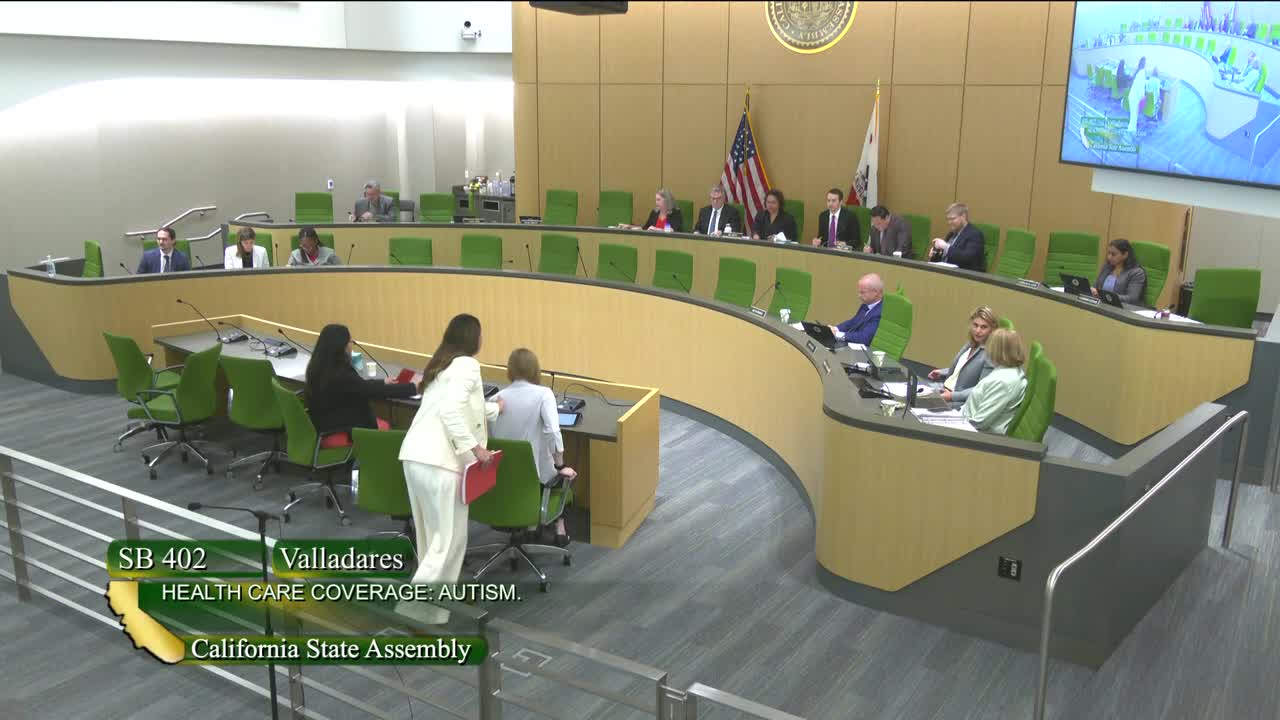 15MIN
Assembly Standing Committee on Health
 13MIN
Assembly Standing Committee on Business and Professions
 2MIN
Senate Floor
 11MIN
Senate Standing Committee on Business, Professions and Economic Development
Bill Author

Bill Co-Author(s):