SB 403: End of Life Option Act: sunset.
- Session Year: 2025-2026
- House: Senate
- Latest Version Date: 2025-10-03
Current Status:
Passed
(2025-10-03: Chaptered by Secretary of State. Chapter 315, Statutes of 2025.)
Introduced
In Committee
Awaiting First Chamber Vote
Passed First Chamber
In Committee
Awaiting Second Chamber Vote
Passed Second Chamber
Enacted
Existing law, the End of Life Option Act, until January 1, 2031, authorizes an adult who meets certain qualifications, including, among other things, being a resident of the State of California, and who has been determined by their attending physician to be suffering from a terminal disease, as defined, to make a request for an aid-in-dying drug for the purpose of ending their life. Existing law makes specified violations of the act a crime, including knowingly coercing or exerting undue influence on an individual to request or ingest an aid-in-dying drug for the purpose of ending their life.
This bill would repeal the January 1, 2031, expiration date of the act, thereby extending the operation of the act indefinitely. By extending the operation of crimes within the act, the bill would impose a state-mandated local program.
The California Constitution requires the state to reimburse local agencies and school districts for certain costs mandated by the state. Statutory provisions establish procedures for making that reimbursement.
This bill would provide that no reimbursement is required by this act for a specified reason.
Existing law, the End of Life Option Act, until January 1, 2031, authorizes an adult who meets certain qualifications, including, among other things, being a resident of the State of California, and who has been determined by their attending physician to be suffering from a terminal disease, as defined, to make a request for an aid-in-dying drug for the purpose of ending their life. Existing law makes specified violations of the act a crime, including knowingly coercing or exerting undue influence on an individual to request or ingest an aid-in-dying drug for the purpose of ending their life.
This bill would repeal the January 1, 2031, expiration date of the act, thereby extending the operation of the act indefinitely. By extending the operation of crimes within the act, the bill would impose a state-mandated local program.
The California Constitution requires the state to reimburse local agencies and school districts for certain costs mandated by the state. Statutory provisions establish procedures for making that reimbursement.
This bill would provide that no reimbursement is required by this act for a specified reason.
Existing law, the End of Life Option Act, until January 1, 2031, authorizes an adult who meets certain qualifications, including, among other things, being a resident of the State of California, and who has been determined by their attending physician to be suffering from a terminal disease, as defined, to make a request for an aid-in-dying drug for the purpose of ending their life. Existing law makes specified violations of the act a crime, including knowingly coercing or exerting undue influence on an individual to request or ingest an aid-in-dying drug for the purpose of ending their life.
This bill would repeal the January 1, 2031, expiration date of the act, thereby extending the operation of the act indefinitely. By extending the operation of crimes within the act, the bill would impose a state-mandated local program.
Existing law requires an attending physician, within 30 calendar days of writing a prescription for an aid-in-dying drug, to submit to the State Department of Public Health a copy of the qualifying patients written request, the attending physicians checklist and compliance form, and the consulting physicians compliance form. Existing law requires the department to collect and review this information and to annually create a report based on this information, as specified. Existing law requires the report to include, but not be limited to, specified information, including, among other things, the number of people for whom an aid-in-dying prescription was written and demographic percentages of people who died using an aid-in-dying drug.This bill would require the department, by no later than April 1, 2026, to meet with relevant stakeholders for purposes of seeking input on the inclusion of additional information already available to the department under the above-described provisions in the annual report. Commencing with the report due July 1, 2026, and for each report thereafter, the bill would require the department to include in the report additional data, as determined by the department, based on the input received.The California Constitution requires the state to reimburse local agencies and school districts for certain costs mandated by the state. Statutory provisions establish procedures for making that reimbursement.
This bill would provide that no reimbursement is required by this act for a specified reason.
Existing law, the End of Life Option Act, until January 1, 2031, authorizes an adult who meets certain qualifications, including, among other things, being a resident of the State of California, and who has been determined by their attending physician to be suffering from a terminal disease, as defined, to make a request for an aid-in-dying drug for the purpose of ending their life. Existing law makes specified violations of the act a crime, including knowingly coercing or exerting undue influence on an individual to request or ingest an aid-in-dying drug for the purpose of ending their life.
This bill would repeal the January 1, 2031, expiration date of the act, thereby extending the operation of the act indefinitely. By extending the operation of crimes within the act, the bill would impose a state-mandated local program.
Existing law requires an attending physician, within 30 calendar days of writing a prescription for an aid-in-dying drug, to submit to the State Department of Public Health a copy of the qualifying patients written request, the attending physicians checklist and compliance form, and the consulting physicians compliance form. Existing law requires the department to collect and review this information and to annually create a report based on this information, as specified. Existing law requires the report to include, but not be limited to, specified information, including, among other things, the number of people for whom an aid-in-dying prescription was written and demographic percentages of people who died using an aid-in-dying drug.
This bill would require the department, by no later than April 1, 2026, to meet with relevant stakeholders for purposes of seeking input on the inclusion of additional information already available to the department under the above-described provisions in the annual report. Commencing with the report due July 1, 2026, and for each report thereafter, the bill would require the department to include in the report additional data, as determined by the department, based on the input received.
The California Constitution requires the state to reimburse local agencies and school districts for certain costs mandated by the state. Statutory provisions establish procedures for making that reimbursement.
This bill would provide that no reimbursement is required by this act for a specified reason.
Existing law, the End of Life Option Act, until January 1, 2031, authorizes an adult who meets certain qualifications, including, among other things, being a resident of the State of California, and who has been determined by their attending physician to be suffering from a terminal disease, as defined, to make a request for an aid-in-dying drug for the purpose of ending their life. Existing law makes specified violations of the act a crime, including knowingly coercing or exerting undue influence on an individual to request or ingest an aid-in-dying drug for the purpose of ending their life.
This bill would repeal the January 1, 2031, expiration date of the act, thereby extending the operation of the act indefinitely. By extending the operation of crimes within the act, the bill would impose a state-mandated local program.
The California Constitution requires the state to reimburse local agencies and school districts for certain costs mandated by the state. Statutory provisions establish procedures for making that reimbursement.
This bill would provide that no reimbursement is required by this act for a specified reason.
Existing law, the End of Life Option Act, until January 1, 2031, authorizes an adult who meets certain qualifications, including, among other things, being a resident of the State of California, and who has been determined by their attending physician to be suffering from a terminal disease, as defined, to make a request for an aid-in-dying drug for the purpose of ending their life.This bill would state that it is the intent of the Legislature to enact legislation amending the End of Life Option Act.Existing law, the End of Life Option Act, until January 1, 2031, authorizes an adult who meets certain qualifications, including, among other things, being a resident of the State of California, and who has been determined by their attending physician to be suffering from a terminal disease, as defined, to make a request for an aid-in-dying drug for the purpose of ending their life.
This bill would state that it is the intent of the Legislature to enact legislation amending the End of Life Option Act.
No reimbursement is required by this act pursuant to Section 6 of Article XIIIB of the California Constitution because the only costs that may be incurred by a local agency or school district will be incurred because this act creates a new crime or infraction, eliminates a crime or infraction, or changes the penalty for a crime or infraction, within the meaning of Section 17556 of the Government Code, or changes the definition of a crime within the meaning of Section 6 of Article XIIIB of the California Constitution.
No reimbursement is required by this act pursuant to Section 6 of Article XIIIB of the California Constitution because the only costs that may be incurred by a local agency or school district will be incurred because this act creates a new crime or infraction, eliminates a crime or infraction, or changes the penalty for a crime or infraction, within the meaning of Section 17556 of the Government Code, or changes the definition of a crime within the meaning of Section 6 of Article XIIIB of the California Constitution.
No reimbursement is required by this act pursuant to Section 6 of Article XIIIB of the California Constitution because the only costs that may be incurred by a local agency or school district will be incurred because this act creates a new crime or infraction, eliminates a crime or infraction, or changes the penalty for a crime or infraction, within the meaning of Section 17556 of the Government Code, or changes the definition of a crime within the meaning of Section 6 of Article XIIIB of the California Constitution.
(a)The State Department of Public Health shall collect and review the information submitted pursuant to Section 443.9. The information collected shall be confidential and shall be collected in a manner that protects the privacy of the patient, the patients family, and any medical provider or pharmacist involved with the patient under the provisions of this part. The information shall not be disclosed, discoverable, or compelled to be produced in any civil, criminal, administrative, or other proceeding.
(b)On or before July 1, 2017, and each year thereafter, based on the information collected in the previous year, the department shall create a report with the information collected from the attending physician followup form and post that report to its Internet Web site. The report shall include, but not be limited to, all of the following based on the information that is provided to the department and on the departments access to vital statistics:
(1)The number of people for whom an aid-in-dying prescription was written.
(2)The number of known individuals who died each year for whom aid-in-dying prescriptions were written, and the cause of death of those individuals.
(3)For the period commencing January 1, 2016, to and including the previous year, cumulatively, the total number of aid-in-dying prescriptions written, the number of people who died due to use of aid-in-dying drugs, and the number of those people who died who were enrolled in hospice or other palliative care programs at the time of death.
(4)The number of known deaths in California from using aid-in-dying drugs per 10,000 deaths in California.
(5)The number of physicians who wrote prescriptions for aid-in-dying drugs.
(6)Of people who died due to using an aid-in-dying drug, demographic percentages organized by the following characteristics:
(A)Age at death.
(B)Education level.
(C)Race.
(D)Sex.
(E)Type of insurance, including whether or not they had insurance.
(F)Underlying illness.
(c)The State Department of Public Health shall make available the attending physician checklist and compliance form, the consulting physician compliance form, and the attending physician followup form, as described in Section 443.22, by posting them on its Internet Web site.
(d)(1)By no later than April 1, 2026, the department shall meet with relevant stakeholders for the purpose of seeking input on the inclusion of additional information already available to the department pursuant to subdivision (a) in the report required by subdivision (b).
(2)Commencing with the report due on or before July 1, 2026, and for each report thereafter, the department shall include in the report additional data, as determined by the department, based on the input received pursuant to paragraph (1).
SECTION 1.SEC. 2.Section 443.215 of the Health and Safety Code is repealed.SEC. 2.SEC. 3.No reimbursement is required by this act pursuant to Section 6 of Article XIIIB of the California Constitution because the only costs that may be incurred by a local agency or school district will be incurred because this act creates a new crime or infraction, eliminates a crime or infraction, or changes the penalty for a crime or infraction, within the meaning of Section 17556 of the Government Code, or changes the definition of a crime within the meaning of Section 6 of Article XIIIB of the California Constitution.
No reimbursement is required by this act pursuant to Section 6 of Article XIIIB of the California Constitution because the only costs that may be incurred by a local agency or school district will be incurred because this act creates a new crime or infraction, eliminates a crime or infraction, or changes the penalty for a crime or infraction, within the meaning of Section 17556 of the Government Code, or changes the definition of a crime within the meaning of Section 6 of Article XIIIB of the California Constitution.
SECTION 1.It is the intent of the Legislature to enact legislation amending the End of Life Option Act.It is the intent of the Legislature to enact legislation amending the End of Life Option Act.
|
Date
|
Status
|
|---|---|
| Oct 3, 2025 | Chaptered by Secretary of State. Chapter 315, Statutes of 2025. |
| Oct 3, 2025 | Approved by the Governor. |
| Sep 23, 2025 | Enrolled and presented to the Governor at 2 p.m. |
| Sep 12, 2025 | Assembly amendments concurred in. (Ayes 25. Noes 9. Page 2986.) Ordered to engrossing and enrolling. |
| Sep 12, 2025 | In Senate. Concurrence in Assembly amendments pending. |
| Sep 11, 2025 | Read third time. Passed. (Ayes 59. Noes 12. Page 3280.) Ordered to the Senate. |
| Sep 3, 2025 | Read second time. Ordered to third reading. |
| Sep 2, 2025 | Read second time and amended. Ordered to second reading. |
| Aug 29, 2025 | From committee: Do pass as amended. (Ayes 12. Noes 3.) (August 29). |
| Aug 20, 2025 | August 20 set for first hearing. Placed on APPR. suspense file. |
| Jul 16, 2025 | From committee: Do pass and re-refer to Com. on APPR. (Ayes 10. Noes 2.) (July 15). Re-referred to Com. on APPR. |
| Jul 9, 2025 | From committee: Do pass and re-refer to Com. on JUD. (Ayes 13. Noes 2.) (July 8). Re-referred to Com. on JUD. |
| Jun 16, 2025 | Referred to Coms. on HEALTH and JUD. |
| Jun 5, 2025 | In Assembly. Read first time. Held at Desk. |
| Jun 4, 2025 | Read third time. Passed. (Ayes 26. Noes 6. Page 1492.) Ordered to the Assembly. |
| May 23, 2025 | Read second time. Ordered to third reading. |
| May 23, 2025 | From committee: Do pass. (Ayes 5. Noes 1. Page 1199.) (May 23). |
| May 16, 2025 | Set for hearing May 23. |
| May 12, 2025 | May 12 hearing: Placed on APPR. suspense file. |
| May 6, 2025 | Set for hearing May 12. |
| May 1, 2025 | Read second time and amended. Re-referred to Com. on APPR. |
| Apr 30, 2025 | From committee: Do pass as amended and re-refer to Com. on APPR. (Ayes 10. Noes 1. Page 940.) (April 29). |
| Apr 24, 2025 | From committee: Do pass and re-refer to Com. on JUD. (Ayes 9. Noes 2. Page 868.) (April 23). Re-referred to Com. on JUD. |
| Apr 9, 2025 | Set for hearing April 29 in JUD. pending receipt. |
| Apr 4, 2025 | Set for hearing April 23. |
| Apr 2, 2025 | Re-referred to Coms. on HEALTH and JUD. |
| Mar 24, 2025 | From committee with author's amendments. Read second time and amended. Re-referred to Com. on RLS. |
| Feb 26, 2025 | Referred to Com. on RLS. |
| Feb 18, 2025 | From printer. May be acted upon on or after March 17. |
| Feb 14, 2025 | Introduced. Read first time. To Com. on RLS. for assignment. To print. |
|
Date
|
Description
|
Location
|
Votes
|
|
|---|---|---|---|---|
| Sep 12, 2025 | Unfinished Business SB403 Blakespear Concurrence | Senate Floor |
Passed |
|
| Sep 11, 2025 | SB 403 Blakespear Senate Third Reading By Zbur | Assembly Floor |
Passed |
|
| Aug 29, 2025 | Do pass as amended. | Assembly Standing Committee on Appropriations |
Passed |
|
| Jul 15, 2025 | Do pass and be re-referred to the Committee on [Appropriations] | Assembly Standing Committee on Judiciary |
Passed |
|
| Jul 8, 2025 | Do pass and be re-referred to the Committee on [Judiciary] | Assembly Standing Committee on Health |
Passed |
|
| Jun 4, 2025 | Senate 3rd Reading SB403 Blakespear | Senate Floor |
Passed |
|
| May 23, 2025 | Do pass | Senate Standing Committee on Appropriations |
Passed |
|
| May 12, 2025 | Placed on suspense file | Senate Standing Committee on Appropriations |
Passed |
|
| Apr 29, 2025 | Do pass as amended, but first amend, and re-refer to the Committee on [Appropriations] | Senate Standing Committee on Judiciary |
Passed |
|
| Apr 23, 2025 | Do pass, but first be re-referred to the Committee on [Judiciary] | Senate Standing Committee on Health |
Passed |
This list shows positions taken on this bill by organizations on the date displayed, which is linked to the original source.
Positions by individuals are not included.
|
Organization
|
Position
|
Date
|
|---|---|---|
| 50 individuals | ** Support | |
| A Better Exit | ** Support | |
| AgeSong Marin | ** Support | |
| Alliance Of Catholic Health Care | ** Against | |
| American Academy Of Medical Ethics | ** Against | |
| American Nurse Association/California | ** Support | |
| American Nurses Association/California | ** Support | |
| Black Women For Wellness Action Project | ** Support | |
| Book Magic | ** Support | |
| California Alliance For Retired Americans | ** Support | |
| California Baptist for Biblical Values | ** Against | |
| California Catholic Conference | ** Against | |
| California Family Council | ** Against | |
| California Foundation For Independent Living Centers | ** Against | |
| California League of United Latin American Citizens | ** Against | |
| Choice and Change | ** Support | |
| Compassion and Choices | ** Support | |
| Compassion and Choices Action Network | ** Support | |
| Death with Dignity | ** Support | |
| Death with Dignity National Center | ** Support | |
| Delores Huerta Foundation | ** Support | |
| Dolores Huerta Foundation | ** Support | |
| End of Life Choices | ** Support | |
| End of Life Choices, California | ** Support | |
| Full Circle Living and Dying | ** Support | |
| Full Circle of Living and Dying | ** Support | |
| Good Grief Doula | ** Support | |
| Hemlock Society of San Diego | ** Support | |
| La Luz Project | ** Against | |
| LA Patient Advocates | ** Support | |
| LightBridge Hospice and Palliative Care | ** Support | |
| Long Beach Gray Panthers | ** Support | |
| Respect Life Ministry | ** Against | |
| Social Work Hospice and Palliative Care Network | ** Support | |
| Social Work Hospice and Palliative Network | ** Support | |
| The Church of Jesus Christ of Latter-Day Saints | ** Against | |
| The Church Of Jesus Christ Of LatterDay Saints | ** Against | |
| The Salvador E Alvarez Institute for Non-violence | ** Against | |
| The Salvador E. Alvarez Institute for Non-violence | ** Against |
SENATE RULES COMMITTEE Office of Senate Floor Analyses (916) 651-1520 Fax: (916) 327-4478 | SB 403 |
UNFINISHED BUSINESS
Bill No: SB 403
Author: Blakespear (D)
Amended: 9/2/25
Vote: 21
SENATE HEALTH COMMITTEE: 9-2, 4/23/25
AYES: Menjivar, Durazo, Gonzalez, Limón, Padilla, Richardson, Rubio, Weber Pierson, Wiener
NOES: Valladares, Grove
SENATE JUDICIARY COMMITTEE: 10-1, 4/29/25
AYES: Umberg, Allen, Arreguín, Caballero, Durazo, Laird, Stern, Wahab, Weber Pierson, Wiener
NOES: Valladares
NO VOTE RECORDED: Niello, Ashby
SENATE APPROPRIATIONS COMMITTEE: 5-1, 5/23/25
AYES: Caballero, Cabaldon, Grayson, Richardson, Wahab
NOES: Seyarto
NO VOTE RECORDED: Dahle
SENATE FLOOR: 26-6, 6/4/25
AYES: Allen, Archuleta, Arreguín, Becker, Blakespear, Cabaldon, Caballero, Cervantes, Durazo, Gonzalez, Grayson, Hurtado, Laird, Limón, McGuire, McNerney, Menjivar, Padilla, Pérez, Richardson, Rubio, Smallwood-Cuevas, Stern, Umberg, Wahab, Wiener
NOES: Cortese, Grove, Jones, Seyarto, Strickland, Valladares
NO VOTE RECORDED: Alvarado-Gil, Ashby, Choi, Dahle, Niello, Ochoa Bogh, Reyes, Weber Pierson
ASSEMBLY FLOOR: 59-12, 9/11/25 - See last page for vote
SUBJECT: End of Life Option Act: sunset
SOURCE: Compassion and Choices Action Network
DIGEST:
This bill removes the End of Life Option Act sunset date of January 1, 2031.
Assembly Amendments
delete the requirement on the California Department of Public Health (CDPH) to meet with relevant stakeholders for the purpose of seeking input on the inclusion of additional information already available to CDPH to be included in the July 1, 2026 End of Life Option Act (EOLOA) report, and for each annual report thereafter.
ANALYSIS:
Existing law:
- Establishes the EOLOA, which authorizes a process for terminally ill adults living in California to obtain and self-administer drugs for medical aid-in-dying. Defines “terminal disease” as an incurable and irreversible disease that has been medically confirmed and will, within reasonable medical judgement, result in death within six months. Defines “self-administer” as a qualified individual’s affirmative, conscious, and physical act of administering and ingesting the aid-in-dying drug. Sunsets EOLOA on January 1, 2031. [Health and Safety Code (HSC) §443-443.22]
- Requires CDPH to collect and review information submitted pursuant to EOLOA, keep it confidential and protect the privacy of patients, family, and health care providers, and not disclose this information as part of and civil, criminal, administrative, or other proceeding. [HSC §443.17]
- Requires within 30 calendar days of writing a prescription for an aid-in-dying drug, the attending physician to submit to CDPH a copy of the patient’s written request, the attending physician checklist and compliance form, and the consulting physician compliance form. Requires within 30 calendar days following the qualified individual’s death from ingesting the aid-in-dying drug, or any other cause, the attending physician to submit the attending physician follow-up form to CDPH. [HSC §443.9]
- Requires CDPH to post a report from data collected from the attending physician follow-up form, including but not limited to:
- The number of people for whom an aid-in-dying prescription was written;
- The number of known individuals who died each year for whom aid-in-dying prescriptions were written, and the cause of death of those individuals;
- For the period commencing January 1, 2016, to and including the previous year, cumulatively, the total number of aid-in-dying prescriptions written, the number of people who died due to use of aid-in-dying drugs, and the number of those people who died who were enrolled in hospice or other palliative care programs at the time of death;
- The number of known deaths in California from using aid-in-dying drugs per 10,000 deaths in California;
- The number of physicians who wrote prescriptions for aid-in-dying drugs; and,
- Of people who died due to using an aid-in-dying drug, demographic percentages organized by age at death, education level, race, sex, type of insurance, including whether or not they had insurance, and underlying illness. [HSC §443.17]
This bill removes the EOLOA sunset date of January 1, 2031.
Comments
Author’s statement. According to the author, in 2015, the Legislature passed EOLOA to give mentally capable, terminally ill Californians the right to request aid-in-dying drugs from their doctor. This allows the person to have an end-of-life experience aligned with their beliefs and values. Since the law went into effect on June 9, 2016, a total of 4,287 people have died following ingestion of aid-in-dying medication. The law is set to sunset on January 1, 2031 and is the only medical-aid-in-dying (MAiD) law in the country that contains a sunset date. The looming sunset can cause undue stress and fear in people diagnosed with a disease that will—in several years—be the cause of their death. Nine years of data show the law is working as intended and MAiD is being safely practiced in California. There have been no reported problems or abuses. This bill removes the sunset, making the law permanent. Patients, advocates, medical providers, and faith leaders who rely on it will no longer need to worry about access to MAiD being removed.
Background
Annual report. EOLOA requires CDPH to provide annual reports under strict privacy requirements. The 2023 report presents some of the data as reported to CDPH from EOLOA-mandated physician reporting forms received through January 30, 2024. The 2023 report reflects information on individuals who were prescribed aid-in-dying drugs and died in the calendar year of 2023, as well as between January 1, 2016 and December 31, 2023. For the year ending December 31, 2023, 1,281 individuals received prescriptions pursuant to EOLOA. That year, 884 individuals died following their ingestion of the prescribed aid-in-dying drug(s), which included 49 individuals who received prescriptions prior to 2023. Of the 884 individuals, 92.8% were 60 years of age or older, 97.1% had health insurance, and 93.8% were receiving hospice and/or palliative care (down from 95.4% in the 2022 report). Since the law came into effect June 9, 2016 (through December 31, 2023), prescriptions have been written for 6,516 people under the EOLOA, 65.8% have died from ingesting the medications, and 73.9% ingested cardiotonic (increases heart contraction), opioid, or sedatives. Of the 4,287 individuals who have died under EOLOA, 3,911 (91.2%) were receiving hospice and/or palliative care. Less than half (43.2%) had a health care provider present; 89.9% were in a private home, 6.1% were in assisted living, 2% were in a nursing home, 1.4% were in in-patient hospices, and .2% were in an acute care hospital.
Characteristics of individuals. In 2023, the median age of individuals who died under EOLOA was 78 years. White decedents were 85.4%, 50.1% were male, and 76.7% had at least some level of college education. Those who informed their family were 80.4%. The highest illness grouping was cancer (63.8%) and the second largest illness grouping was cardiovascular disease (12.1%). Neurological disease (8.8%), respiratory disease (8%), kidney disease (1.5%), other (2%), cerebrovascular disease (1.6%), immune mediated disease (.9%), and endocrine, nutritional and metabolic disease (1.2%) were the other conditions listed.
FISCAL EFFECT: Appropriation: No Fiscal Com.: Yes Local: Yes
According to the Assembly Appropriations Committee, ongoing General Fund (GF) cost pressures potentially in the low- to mid-hundreds of thousands of dollars annually to continue data collection, follow-up with providers to complete data submission, perform data analysis, prepare reports, maintain and provide program information, and maintain the public website. DPH may incur significant additional GF costs to defend this bill from legal challenges, as noted below.
The Department of Justice (DOJ) estimates costs of $486,000 in 2025-26 and $858,000 in 2026-27 and ongoing for three personnel to defend challenges to the EOLOA (50% General Fund and 50% Legal Services Revolving Fund (LSRF). LSRF costs will be reimbursable through direct billing to DPH). DOJ is litigating its fourth lawsuit in defense of the EOLOA and projects amendments will invite additional litigation.
SUPPORT: (Verified 9/10/25)
Compassion and Choices Action Network (source)
A Better Exit
AgeSong Marin
American Nurse Association/California
Black Women for Wellness Action Project
Book Magic
California Alliance for Retired Americans
Compassion and Choices
Death with Dignity National Center
Dolores Huerta Foundation
End of Life Choices, California
Full Circle of Living and Dying
Hemlock Society of San Diego
LA Patient Advocates
LightBridge Hospice and Palliative Care
Long Beach Gray Panthers
Social Work Hospice and Palliative Network
250 individuals
OPPOSITION: (Verified 9/10/25)
Alliance of Catholic Health Care
American Academy of Medical Ethics
California Catholic Conference
California Family Council
California Foundation for Independent Living Centers
California League of United Latin American Citizens
La Luz Project
Respect Life Ministry
The Church of Jesus Christ of Latter-Day Saints
The Salvador E. Alvarez Institute for Non-Violence
5 individuals
ARGUMENTS IN SUPPORT: Compassion and Choices sponsors this bill and writes, “The CDPH report shows that the law works as intended for those who can access it. This aligns with nearly 30 years of national data on the effectiveness and safety of medical aid-in-dying laws. Since EOLOA went into effect in 2016, more than 4,000 people have used the law to end their lives peacefully and on their own terms. In 2023, according to the CDPH annual report, over 1,200 Californians received a prescription, and 835 ultimately chose to use it. The majority were enrolled in hospice or palliative care and were 60 years or older. The law includes numerous safeguards, including a multi-step request process, confirmation of eligibility, and the opportunity for the patient to rescind their request if they change their mind. California is the only state in the nation with a medical aid-in-dying law that includes a sunset clause. If not removed, this provision will repeal the EOLOA on January 1, 2031, leaving patients, providers, and families in fear and uncertainty about the future of end-of-life care in our state. For all of these reasons, it is essential that the sunset provision is removed and the California EOLOA becomes permanent.” The American Nurses Association\California writes that EOLOA has been working as intended and utilization reports show that medical aid-in-dying is being safely practiced in California. Other supporters write that there have been no documented cases of coercion or abuse in California or in any of the ten other U.S. jurisdictions that have the law, and, people in early stages of cancer worry that the law might not be there for them if it sunsets. Long Beach Gray Panthers writes medical aid in dying should become permanent to give peace of mind to Californians. A Better Exist writes the EOLOA has already provided immeasurable relief to individuals and families across the state by granting autonomy and compassion in some of life’s most difficult moments.
ARGUMENTS IN OPPOSITION: The Alliance of Catholic Health Care (Alliance) writes, “In the nine years since the implementation of EOLOA, not only has there been no substantive review on the compliance of current law, there has not been full transparency on the data that is collected, but is not reported. The Alliance urges that before the sunset is removed, the Legislature and CDPH provide a comprehensive review of current law, including an evaluation on the compliance with the current law.” The Alliance writes that CDPH has testified at informational hearings of the Select Committee on End of Life Health that the forms physicians are required to complete by law are not all compliant, but CDPH has not presented an analysis that outlines how many forms are out of compliance and what element(s) on the form are not complete. The Alliance states that CDPH says that it has no enforcement authority to ensure compliance, so the Alliance believes that the Legislature should require CDPH to collect and report that information to enable the Legislature to fulfill its oversight obligation of this law. The Alliance believes there is a gap in the State’s oversight of the program, and that there is no reliable or authoritative data on the drugs and drug combinations being prescribed as part of the program. The Alliance has concerns that physicians are developing their own medication formulas, and their relative effectiveness (e.g., duration from ingestion to death) is unknown. California LULAC, writes together with healthcare partners, CA LULAC has engaged in good faith efforts to confer with and improve public reporting collaboratively with CDPH staff. CA LULAC says legislative oversight has been lacking and is needed. CA LULAC writes that it is vested in this work because California was the first highly diverse state to legalize physician assisted suicide, with Latinos being its largest BIPOC population. Other opponents are opposed to EOLOA, or, would like to see more oversight prior to eliminating the sunset.
ASSEMBLY FLOOR: 59-12, 9/11/25
AYES: Addis, Aguiar-Curry, Ahrens, Alanis, Alvarez, Arambula, Ávila Farías, Bains, Bauer-Kahan, Bennett, Berman, Boerner, Bonta, Bryan, Caloza, Carrillo, Connolly, Dixon, Elhawary, Fong, Gabriel, Garcia, Mark González, Haney, Harabedian, Hart, Irwin, Jackson, Kalra, Krell, Lee, Lowenthal, McKinnor, Muratsuchi, Nguyen, Ortega, Pacheco, Papan, Patel, Pellerin, Petrie-Norris, Quirk-Silva, Ransom, Celeste Rodriguez, Rogers, Blanca Rubio, Schiavo, Schultz, Sharp-Collins, Solache, Soria, Stefani, Valencia, Wallis, Ward, Wicks, Wilson, Zbur, Rivas
NOES: Castillo, Davies, Ellis, Gallagher, Jeff Gonzalez, Hadwick, Johnson, Lackey, Macedo, Sanchez, Ta, Tangipa
NO VOTE RECORDED: Calderon, Chen, DeMaio, Flora, Gipson, Hoover, Patterson, Ramos, Michelle Rodriguez
Prepared by: Teri Boughton / HEALTH / (916) 651-4111
10/12/26 9:40:53
**** END ****
SENATE RULES COMMITTEE Office of Senate Floor Analyses (916) 651-1520 Fax: (916) 327-4478 | SB 403 |
UNFINISHED BUSINESS
Bill No: SB 403
Author: Blakespear (D)
Amended: 9/2/25
Vote: 21
SENATE HEALTH COMMITTEE: 9-2, 4/23/25
AYES: Menjivar, Durazo, Gonzalez, Limón, Padilla, Richardson, Rubio, Weber Pierson, Wiener
NOES: Valladares, Grove
SENATE JUDICIARY COMMITTEE: 10-1, 4/29/25
AYES: Umberg, Allen, Arreguín, Caballero, Durazo, Laird, Stern, Wahab, Weber Pierson, Wiener
NOES: Valladares
NO VOTE RECORDED: Niello, Ashby
SENATE APPROPRIATIONS COMMITTEE: 5-1, 5/23/25
AYES: Caballero, Cabaldon, Grayson, Richardson, Wahab
NOES: Seyarto
NO VOTE RECORDED: Dahle
SENATE FLOOR: 26-6, 6/4/25
AYES: Allen, Archuleta, Arreguín, Becker, Blakespear, Cabaldon, Caballero, Cervantes, Durazo, Gonzalez, Grayson, Hurtado, Laird, Limón, McGuire, McNerney, Menjivar, Padilla, Pérez, Richardson, Rubio, Smallwood-Cuevas, Stern, Umberg, Wahab, Wiener
NOES: Cortese, Grove, Jones, Seyarto, Strickland, Valladares
NO VOTE RECORDED: Alvarado-Gil, Ashby, Choi, Dahle, Niello, Ochoa Bogh, Reyes, Weber Pierson
ASSEMBLY FLOOR: 47-11, 9/11/25 – Roll call vote not available
SUBJECT: End of Life Option Act: sunset
SOURCE: Compassion and Choices Action Network
DIGEST:
This bill removes the End of Life Option Act sunset date of January 1, 2031.
Assembly Amendments
delete the requirement on the California Department of Public Health (CDPH) to meet with relevant stakeholders for the purpose of seeking input on the inclusion of additional information already available to CDPH to be included in the July 1, 2026 End of Life Option Act (EOLOA) report, and for each annual report thereafter.
ANALYSIS:
Existing law:
- Establishes the EOLOA, which authorizes a process for terminally ill adults living in California to obtain and self-administer drugs for medical aid-in-dying. Defines “terminal disease” as an incurable and irreversible disease that has been medically confirmed and will, within reasonable medical judgement, result in death within six months. Defines “self-administer” as a qualified individual’s affirmative, conscious, and physical act of administering and ingesting the aid-in-dying drug. Sunsets EOLOA on January 1, 2031. [Health and Safety Code (HSC) §443-443.22]
- Requires CDPH to collect and review information submitted pursuant to EOLOA, keep it confidential and protect the privacy of patients, family, and health care providers, and not disclose this information as part of and civil, criminal, administrative, or other proceeding. [HSC §443.17]
- Requires within 30 calendar days of writing a prescription for an aid-in-dying drug, the attending physician to submit to CDPH a copy of the patient’s written request, the attending physician checklist and compliance form, and the consulting physician compliance form. Requires within 30 calendar days following the qualified individual’s death from ingesting the aid-in-dying drug, or any other cause, the attending physician to submit the attending physician follow-up form to CDPH. [HSC §443.9]
- Requires CDPH to post a report from data collected from the attending physician follow-up form, including but not limited to:
- The number of people for whom an aid-in-dying prescription was written;
- The number of known individuals who died each year for whom aid-in-dying prescriptions were written, and the cause of death of those individuals;
- For the period commencing January 1, 2016, to and including the previous year, cumulatively, the total number of aid-in-dying prescriptions written, the number of people who died due to use of aid-in-dying drugs, and the number of those people who died who were enrolled in hospice or other palliative care programs at the time of death;
- The number of known deaths in California from using aid-in-dying drugs per 10,000 deaths in California;
- The number of physicians who wrote prescriptions for aid-in-dying drugs; and,
- Of people who died due to using an aid-in-dying drug, demographic percentages organized by age at death, education level, race, sex, type of insurance, including whether or not they had insurance, and underlying illness. [HSC §443.17]
This bill removes the EOLOA sunset date of January 1, 2031.
Comments
Author’s statement. According to the author, in 2015, the Legislature passed EOLOA to give mentally capable, terminally ill Californians the right to request aid-in-dying drugs from their doctor. This allows the person to have an end-of-life experience aligned with their beliefs and values. Since the law went into effect on June 9, 2016, a total of 4,287 people have died following ingestion of aid-in-dying medication. The law is set to sunset on January 1, 2031 and is the only medical-aid-in-dying (MAiD) law in the country that contains a sunset date. The looming sunset can cause undue stress and fear in people diagnosed with a disease that will—in several years—be the cause of their death. Nine years of data show the law is working as intended and MAiD is being safely practiced in California. There have been no reported problems or abuses. This bill removes the sunset, making the law permanent. Patients, advocates, medical providers, and faith leaders who rely on it will no longer need to worry about access to MAiD being removed.
Background
Annual report. EOLOA requires CDPH to provide annual reports under strict privacy requirements. The 2023 report presents some of the data as reported to CDPH from EOLOA-mandated physician reporting forms received through January 30, 2024. The 2023 report reflects information on individuals who were prescribed aid-in-dying drugs and died in the calendar year of 2023, as well as between January 1, 2016 and December 31, 2023. For the year ending December 31, 2023, 1,281 individuals received prescriptions pursuant to EOLOA. That year, 884 individuals died following their ingestion of the prescribed aid-in-dying drug(s), which included 49 individuals who received prescriptions prior to 2023. Of the 884 individuals, 92.8% were 60 years of age or older, 97.1% had health insurance, and 93.8% were receiving hospice and/or palliative care (down from 95.4% in the 2022 report). Since the law came into effect June 9, 2016 (through December 31, 2023), prescriptions have been written for 6,516 people under the EOLOA, 65.8% have died from ingesting the medications, and 73.9% ingested cardiotonic (increases heart contraction), opioid, or sedatives. Of the 4,287 individuals who have died under EOLOA, 3,911 (91.2%) were receiving hospice and/or palliative care. Less than half (43.2%) had a health care provider present; 89.9% were in a private home, 6.1% were in assisted living, 2% were in a nursing home, 1.4% were in in-patient hospices, and .2% were in an acute care hospital.
Characteristics of individuals. In 2023, the median age of individuals who died under EOLOA was 78 years. White decedents were 85.4%, 50.1% were male, and 76.7% had at least some level of college education. Those who informed their family were 80.4%. The highest illness grouping was cancer (63.8%) and the second largest illness grouping was cardiovascular disease (12.1%). Neurological disease (8.8%), respiratory disease (8%), kidney disease (1.5%), other (2%), cerebrovascular disease (1.6%), immune mediated disease (.9%), and endocrine, nutritional and metabolic disease (1.2%) were the other conditions listed.
FISCAL EFFECT: Appropriation: No Fiscal Com.: Yes Local: Yes
According to the Assembly Appropriations Committee, ongoing General Fund (GF) cost pressures potentially in the low- to mid-hundreds of thousands of dollars annually to continue data collection, follow-up with providers to complete data submission, perform data analysis, prepare reports, maintain and provide program information, and maintain the public website. DPH may incur significant additional GF costs to defend this bill from legal challenges, as noted below.
The Department of Justice (DOJ) estimates costs of $486,000 in 2025-26 and $858,000 in 2026-27 and ongoing for three personnel to defend challenges to the EOLOA (50% General Fund and 50% Legal Services Revolving Fund (LSRF). LSRF costs will be reimbursable through direct billing to DPH). DOJ is litigating its fourth lawsuit in defense of the EOLOA and projects amendments will invite additional litigation.
SUPPORT: (Verified 9/10/25)
Compassion and Choices Action Network (source)
A Better Exit
AgeSong Marin
American Nurse Association/California
Black Women for Wellness Action Project
Book Magic
California Alliance for Retired Americans
Compassion and Choices
Death with Dignity National Center
Dolores Huerta Foundation
End of Life Choices, California
Full Circle of Living and Dying
Hemlock Society of San Diego
LA Patient Advocates
LightBridge Hospice and Palliative Care
Long Beach Gray Panthers
Social Work Hospice and Palliative Network
250 individuals
OPPOSITION: (Verified 9/10/25)
Alliance of Catholic Health Care
American Academy of Medical Ethics
California Catholic Conference
California Family Council
California Foundation for Independent Living Centers
California League of United Latin American Citizens
La Luz Project
Respect Life Ministry
The Church of Jesus Christ of Latter-Day Saints
The Salvador E. Alvarez Institute for Non-Violence
5 individuals
ARGUMENTS IN SUPPORT: Compassion and Choices sponsors this bill and writes, “The CDPH report shows that the law works as intended for those who can access it. This aligns with nearly 30 years of national data on the effectiveness and safety of medical aid-in-dying laws. Since EOLOA went into effect in 2016, more than 4,000 people have used the law to end their lives peacefully and on their own terms. In 2023, according to the CDPH annual report, over 1,200 Californians received a prescription, and 835 ultimately chose to use it. The majority were enrolled in hospice or palliative care and were 60 years or older. The law includes numerous safeguards, including a multi-step request process, confirmation of eligibility, and the opportunity for the patient to rescind their request if they change their mind. California is the only state in the nation with a medical aid-in-dying law that includes a sunset clause. If not removed, this provision will repeal the EOLOA on January 1, 2031, leaving patients, providers, and families in fear and uncertainty about the future of end-of-life care in our state. For all of these reasons, it is essential that the sunset provision is removed and the California EOLOA becomes permanent.” The American Nurses Association\California writes that EOLOA has been working as intended and utilization reports show that medical aid-in-dying is being safely practiced in California. Other supporters write that there have been no documented cases of coercion or abuse in California or in any of the ten other U.S. jurisdictions that have the law, and, people in early stages of cancer worry that the law might not be there for them if it sunsets. Long Beach Gray Panthers writes medical aid in dying should become permanent to give peace of mind to Californians. A Better Exist writes the EOLOA has already provided immeasurable relief to individuals and families across the state by granting autonomy and compassion in some of life’s most difficult moments.
ARGUMENTS IN OPPOSITION: The Alliance of Catholic Health Care (Alliance) writes, “In the nine years since the implementation of EOLOA, not only has there been no substantive review on the compliance of current law, there has not been full transparency on the data that is collected, but is not reported. The Alliance urges that before the sunset is removed, the Legislature and CDPH provide a comprehensive review of current law, including an evaluation on the compliance with the current law.” The Alliance writes that CDPH has testified at informational hearings of the Select Committee on End of Life Health that the forms physicians are required to complete by law are not all compliant, but CDPH has not presented an analysis that outlines how many forms are out of compliance and what element(s) on the form are not complete. The Alliance states that CDPH says that it has no enforcement authority to ensure compliance, so the Alliance believes that the Legislature should require CDPH to collect and report that information to enable the Legislature to fulfill its oversight obligation of this law. The Alliance believes there is a gap in the State’s oversight of the program, and that there is no reliable or authoritative data on the drugs and drug combinations being prescribed as part of the program. The Alliance has concerns that physicians are developing their own medication formulas, and their relative effectiveness (e.g., duration from ingestion to death) is unknown. California LULAC, writes together with healthcare partners, CA LULAC has engaged in good faith efforts to confer with and improve public reporting collaboratively with CDPH staff. CA LULAC says legislative oversight has been lacking and is needed. CA LULAC writes that it is vested in this work because California was the first highly diverse state to legalize physician assisted suicide, with Latinos being its largest BIPOC population. Other opponents are opposed to EOLOA, or, would like to see more oversight prior to eliminating the sunset.
Prepared by: Teri Boughton / HEALTH / (916) 651-4111
9/11/25 17:07:29
**** END ****
SENATE THIRD READING
STR Bill Id:SB 403
Author:(Blakespear)
As Amended Ver: September 2, 2025
Majority vote
SUMMARY
Repeals the January 1, 2031 expiration date of the End of Life Option Act (EOLOA), extending the operation of EOLOA indefinitely.
Major Provisions
COMMENTS
AB 15 2X (Eggman) Chapter 1, Statutes of 2015-16 Second Extraordinary Session, enacted the EOLOA, which became effective on June 9, 2016. The EOLOA allows terminally ill adults living in California to obtain and self-administer aid-in-dying drugs.
2023 annual EOLOA report. The EOLOA requires physicians to use forms specified in statute for submitting information to the Department of Public Health (DPH). DPH is responsible for collecting data from these forms to prepare an annual report. Data presented in this report are based on the information from physicians' forms and California death certificates for calendar year 2023. In 2023 DPH received forms from 1,272 individuals who started the end-of-life option process, by making two verbal requests to their physicians at least 48 hours apart. Of the 1,272 individuals who started the end-of life process, 214 individuals received a prescription in 2023 while the remaining 58 individuals had not yet received a prescription prior to the end of 2023. Out of the 1,214 individuals who started the end-of-life option process in 2023 and received a prescription during 2023, 943 individuals, (77.7%), waited less than 15 days between the two verbal requests. An additional 67 individuals received a prescription during 2023 and began the request process prior to 2023. A total of 337 physicians prescribed 1,281 individuals aid-in-dying drugs. The most common drug category prescribed was a combination of a cardiotonic, opioid, and sedative at 98.4%.
Of the 1,281 individuals who were prescribed such drugs in 2023: 835 individuals (65.2%) were reported by their physician to have died following ingestion of aid-in-dying drugs prescribed under the EOLOA; 170 individuals (13.3%) died from the underlying illness or other causes; and, 276 remaining individuals (21.5%) have an unknown ingestion status.
Who uses EOLOA in California? In 2023, of the 884 individuals who died pursuant to the EOLOA 7.2% were under 60 years of age; 76.6% were 60-89 years of age; 16.2% were 90 years of age and older; and 78 years was the median age. Just over 85% were white; 50.1% were male; 93.8% were receiving hospice and/or palliative care; 76.7% had at least some level of college education; and, 80.4% informed their family of their decision to participate in the EOLOA.
Other states. In addition to California, Colorado, Delaware, District of Columbia, Hawai'i, Maine, Montana, New Jersey, New Mexico, Oregon, Vermont, and Washington have some form of Medical Aid in Dying (MAiD). According to polling done in 2023 on behalf of Compassion & Choices, the sponsor of this bill, both national and state polling shows that the vast majority of healthcare professionals and voters across the demographic spectrum support MAiD as an end-of-life care option for terminally ill adults to peacefully end unbearable suffering. The polls also show support for MAiD is rising over time.
According to the Author
In 2015, the Legislature passed the Act to give mentally capable, terminally ill Californians the right to request aid-in-dying drugs from their doctor. This allows the person to have an end-of-life experience aligned with their beliefs and values. Since the law went into effect on June 9, 2016, a total of 4,287 people have died following ingestion of aid-in-dying medication. The law is set to sunset on January 1, 2031 and is the only MAiD law in the country that contains a sunset date. The looming sunset can cause undue stress and fear in people diagnosed with a disease that will—in several years—be the cause of their death. Nine years of data show the law is working as intended and MAiD is being safely practiced in California. There have been no reported problems or abuses. SB 403 removes the sunset, making the law permanent. Patients, advocates, medical providers, and faith leaders who rely on it will no longer need to worry about access to MAiD being removed.
Arguments in Support
Compassion and Choices (CC) is the sponsor of this bill and notes that since the EOLOA went into effect in 2016, data collected by DPH shows that the law works as intended for those who can access it. This aligns with nearly 30 years of national data on the effectiveness and safety of MAiD laws. In California, more than 4,000 people have used the law to end their lives peacefully and on their own terms. In 2023, according to the DPH annual report, over 1,200 Californians received a prescription, and 835 ultimately chose to use it. The majority were enrolled in hospice or palliative care and were 60 years or older. CC states that the law includes numerous safeguards, including a multi-step request process, confirmation of eligibility, and the opportunity for the patient to rescind their request if they change their mind. CC contends that the law has not only benefited those who have utilized MAiD—it has improved end-of-life care for all terminally ill Californians. Evidence clearly suggests that the passage of MAiD has resulted in improved conversations between physicians and patients, better palliative care training, and improved enrollment in hospice care. Yet, California is the only state in the nation with a MAiD law that includes a sunset clause. If not removed, this provision will repeal the EOLOA on January 1, 2031 — leaving patients, providers, and families in fear and uncertainty about the future of end-of-life care in our state. CC concludes that for all of these reasons, it is essential that the sunset provision is removed and the EOLOA becomes permanent.
The Dolores Huerta Foundation (DHF) states in support of this bill that for over 10 years, Dolores Huerta has shared with her community the importance of having compassionate options at the end of life. DHF notes that it is a fundamental right to have freedom and autonomy over how we live—and how we die. It is vital to the majority of nuestra gente that the EOLOA removes the sunset provision and becomes a permanent option for eligible terminally-ill Californians.
Black Women for Wellness Action Project (BWW-AP) supports this bill and states that this issue is important because compassionate, patient-centered policy provides individuals facing unbearable suffering with autonomy, dignity and peace at the end of life. BWW-AP notes that for Black communities, who often experience disparities in pain management, access to quality care and systemic racism in healthcare settings, maintaining this option is critical to ensuring equitable, compassionate end-of-life care. Allowing the EOLOA to sunset would have devastating consequences – stripping terminally ill patients of an important and deeply personal choice at one of life's most vulnerable moments. BWW-AP concludes that permanently preserving this law is essential to honoring the humanity and dignity of all Californians, especially those from historically marginalized communities who have long been denied full agency over their bodies and healthcare decisions.
Arguments in Opposition
The California Catholic Conference (CCC) is opposed to this bill and states that before taking this step to make the law permanent, the state must conduct rigorous review with stakeholders from across the community to find out how EOLOA is working in diverse settings. Currently, CA does not publish all the EOLOA data it collects, such as geography, complications, or whether patients were referred for psychological treatment. Similarly, the state does not collect all the data similar states do, such as information about the drugs used and their efficacy, number of physician forms completed, or concerns that may have contributed to the patient's decision to request a prescription for aid-in-dying drugs (e.g., loss of autonomy, loss of dignity, persistent pain and suffering, etc.). CCC concludes that such a review is necessary for oversight, transparency, and accountability.
FISCAL COMMENTS
According to the Assembly Appropriations Committee, ongoing General Fund (GF) cost pressures potentially in the low- to mid-hundreds of thousands of dollars annually to continue data collection, follow-up with providers to complete data submission, perform data analysis, prepare reports, maintain and provide program information, and maintain the public website. DPH may incur significant additional GF costs to defend this bill from legal challenges, as noted below.
The Department of Justice (DOJ) estimates costs of $1.2 million in 2025-26 and $2.2 million in 2026-27 and ongoing for one supervising deputy attorney general (DAG), four DAGs, and three legal secretaries to defend challenges to the EOLOA (50% General Fund and 50% Legal Services Revolving Fund (LSRF). LSRF costs will be reimbursable through direct billing to DPH). DOJ is litigating its fourth lawsuit in defense of the EOLOA and projects amendments will invite additional litigation.
VOTES
SENATE FLOOR: 26-6-8
YES: Allen, Archuleta, Arreguín, Becker, Blakespear, Cabaldon, Caballero, Cervantes, Durazo, Gonzalez, Grayson, Hurtado, Laird, Limón, McGuire, McNerney, Menjivar, Padilla, Pérez, Richardson, Rubio, Smallwood-Cuevas, Stern, Umberg, Wahab, Wiener
NO: Cortese, Grove, Jones, Seyarto, Strickland, Valladares
ABS, ABST OR NV: Alvarado-Gil, Ashby, Choi, Dahle, Niello, Ochoa Bogh, Reyes, Weber Pierson
ASM HEALTH: 13-2-1
YES: Bonta, Chen, Addis, Aguiar-Curry, Caloza, Rogers, Mark González, Elhawary, Patel, Celeste Rodriguez, Schiavo, Sharp-Collins, Stefani
NO: Ellis, Sanchez
ABS, ABST OR NV: Flora
ASM JUDICIARY: 10-2-0
YES: Kalra, Dixon, Bauer-Kahan, Bryan, Connolly, Harabedian, Pacheco, Papan, Stefani, Zbur
NO: Macedo, Sanchez
ASM APPROPRIATIONS: 12-3-0
YES: Wicks, Arambula, Calderon, Caloza, Dixon, Elhawary, Fong, Mark González, Ahrens, Pacheco, Pellerin, Solache
NO: Sanchez, Ta, Tangipa
UPDATED
VERSION: September 2, 2025
CONSULTANT: Lara Flynn / HEALTH / (916) 319-2097 FN: 0001396
Date of Hearing: August 20, 2025
ASSEMBLY COMMITTEE ON APPROPRIATIONS
Buffy Wicks, Chair
SBPCA Bill Id:SB 403
Author:(Blakespear) – As Amended Ver:May 1, 2025
Policy Committee: | Health | Vote: | 13 - 2 |
Judiciary | 10 - 2 | ||
|
|
Urgency: No State Mandated Local Program: Yes Reimbursable: No
SUMMARY:
This bill extends the End of Life Option Act (EOLOA) indefinitely and requires the California Department of Public Health (CDPH) seek stakeholder input on the inclusion of additional information in the annual EOLOA report.
Specifically, this bill:
- Repeals the January 1, 2031 sunset date of the EOLOA.
- Requires CDPH, no later than April 1, 2026, meet with relevant stakeholders for the purpose of seeking input on the inclusion of additional information already available to CDPH in its annual EOLOA report.
- Commencing with the report due on or before July 1, 2026, and for each report thereafter, requires CDPH include additional data, as determined by CDPH based on the input received pursuant to item 2, above, in its EOLOA report.
FISCAL EFFECT:
General Fund (GF) costs to CDPH of an unknown amount, likely less than $100,000, to convene stakeholders for input and revise the EOLOA report accordingly, and ongoing GF cost pressures potentially in the low- to mid-hundreds of thousands of dollars annually to continue data collection, follow-up with providers to complete data submission, perform data analysis, prepare reports, maintain and provide program information, and maintain the public website. CDPH may incur significant additional GF costs to defend this bill from legal challenges, as noted below.
The Department of Justice (DOJ) estimates costs of $1.2 million in 2025-26 and $2.2 million in 2026-27 and ongoing for one supervising deputy attorney general (DAG), four DAGs, and three legal secretaries to defend challenges to the EOLOA (50% General Fund and 50% Legal Services Revolving Fund (LSRF). LSRF costs will be reimbursable through direct billing to CDPH). DOJ is litigating its fourth lawsuit in defense of the EOLOA and projects amendments will invite additional litigation.
COMMENTS:
- Purpose. This bill is sponsored by Compassion and Choices. According to the author:
In 2015, the Legislature passed the End of Life Option Act to give mentally capable, terminally ill Californians the right to request aid-in-dying drugs from their doctor. This allows the person to have an end-of-life experience aligned with their beliefs and values. Since the law went into effect on June 9, 2016, a total of 4,287 people have died following ingestion of aid-in-dying medication.
The law is…the only medical-aid-in-dying (MAiD) law in the country that contains a sunset date. The looming sunset can cause undue stress and fear in people diagnosed with a disease that will—in several years—be the cause of their death.
Nine years of data show the law is working as intended and MAiD is being safely practiced in California. There have been no reported problems or abuses.
- Background. AB 15 2X (Eggman) Chapter 1, Statutes of 2015-16 Second Extraordinary Session, enacted the EOLOA, which became effective on June 9, 2016.
Annual EOLOA Report. The EOLOA requires physicians to use specified forms to submit information to CDPH, and CDPH uses the data from these forms to prepare an annual report. The most recent report includes information from physicians’ forms and death certificates for calendar year 2024.
Use of EOLOA. In 2024, CDPH received forms for 1,566 individuals who started the end-of-life option process by making two verbal requests to their physicians at least 48 hours apart, as set forth in the EOLOA. Of those who started the process in 2024, 1,497 received a prescription in 2024 while the remaining 69 individuals had not received a prescription before the end of 2024. Of those who started the end-of-life option process and received a prescription in 2024, 982 ingested and died from the drugs during 2024, 221 died from their underlying disease or other causes, and status was unknown for 388 individuals who had prescriptions written. An additional 50 individuals died from ingesting prescriptions from prior years. The 1,032 EOLOA deaths in 2024 represent 0.36% of all deaths of California residents.
Who Uses EOLOA? Of the 1,032 individuals who died pursuant to the EOLOA in 2024, 7.9% were under 60 years of age, 73.8% were 60-89 years of age, and 18.2% were 90 years of age and older. The median age was 78 years. Most EOLOA users where white (86.7%), 5.8% were Asian, 5.1% were Hispanic, 0.8% were Black, 0.6% were American Indian/Alaskan Native, 48.8% were female, 3.2% had not finished high school, 20.8% had finished high school or equivalent, 25.4% had some college or an associate’s degree, 24.3% had a bachelor’s degree, and 25.5% had a post-graduate degree. Most EOLOA users (94.8%) were receiving hospice or palliative care, or both. Nearly all had some insurance coverage; 0.9% reported having no insurance and insurance status was unknown for 2.1%.
Analysis Prepared by: Allegra Kim / APPR. / (916) 319-2081spe
Date of Hearing: July 15, 2025
ASSEMBLY COMMITTEE ON JUDICIARY
Ash Kalra, Chair
SBPCA Bill Id:SB 403
Author:(Blakespear) – As Amended Ver:May 1, 2025
SENATE VOTE: 26-6
SUBJECT: END OF LIFE OPTION ACT: SUNSET
KEY ISSUE: SHOULD THE SUNSET ON THE END OF LIFE OPTION ACT BE REPEALED?
SYNOPSIS
Generally, there is a constitutional right of individuals to refuse medical treatment. The U.S. Supreme Court has recognized that a competent adult has a constitutional right to withdraw or withhold life-sustaining treatment that may cause or hasten death. (Cruzan v. Director, Missouri Dept. of Health (1990) 497 U.S. 261.)
The End of Life Option Act (Act) enacted by ABX2 15 (Eggman, Chap. 1, Stats. 2016, 2nd Ex. Sess.), took effect on June 9, 2016. California modeled the Act after Oregon’s medical aid-in-dying law, which has been in effect for more than 20 years. In addition to California, Colorado, Delaware, District of Columbia, Hawai’i, Maine, Montana, New Jersey, New Mexico, Oregon, Vermont, and Washington have some form of legislation authorizing medical aid in dying (MAiD). According to polling done in 2023 on behalf of Compassion & Choices, the sponsor of this bill, both national and state polling shows that the vast majority of healthcare professionals and voters across the demographic spectrum support MAiD as an end-of-life care option for terminally ill adults to peacefully end unbearable suffering. The polls also show support for MAiD is rising over time. As a result of SB 380 (Eggman), Chap. 542, Stats. 2021, many of the barriers related to a terminally ill patient’s right to obtain an aid-in-dying prescription from their physician under the Act, including by removing the requirement that a patient wait 15 days between requests for assistance, were removed. SB 380 at one point proposed to remove the sunset date from the Act, but ultimately it was amended to extend the sunset until January 1, 2031.
This bill recently was approved by the Committee on Health by a vote of 13-2-1. Sponsored by Compassion and Choices Network, it simply (but not without controversy) repeals the January 1, 2031 sunset date for the Act. The bill requires the CA Department of Public Health (DPH), no later than April 1, 2026, to meet with relevant stakeholders to seek input on the inclusion of additional information already available to DPH, in the annual report on the Act. Commencing with the report due July 1, 2026, it would require DPH to include the additional data in the report, based on the stakeholder input received. The bill is supported by numerous organizations supporting end of life choice, seniors, and hospice care. It is opposed by religious organizations and the California Foundation for Independent Living Centers, among others.
SUMMARY: Repeals the January 1, 2031 sunset date for the End of Life Option Act and makes related changes. Specifically, this bill:
- Repeals the January 1, 2031 sunset date for the End of Life Option Act (Act).
- Requires, by no later than April 1, 2026, the California Department of Public Health (DPH) to meet with relevant stakeholders for the purpose of seeking input on the inclusion of additional information already available to the department pursuant to the reporting requirements in existing law.
- Requires, commencing with the report due on or before July 1, 2026, and for each report thereafter, the department to include in the report additional data, as determined by the department, based on the input received pursuant to 2).
EXISTING LAW:
- Establishes the End of Life Options Act (Act), which authorizes a process for terminally ill adults living in California to obtain and self-administer drugs for medical aid-in-dying (MAiD). Defines “terminal disease” as an incurable and irreversible disease that has been medically confirmed and will, within reasonable medical judgement, result in death within six months. Defines “self-administer” as a qualified individual’s affirmative, conscious, and physical act of administering and ingesting the aid-in-dying drug. Sunsets the Act on January 1, 2031. (Health and Safety Code (HSC) Sections 443–443.22.)
- Authorizes an individual who is an adult with capacity to make medical decisions and has a terminal disease to make a request to receive a prescription for an aid-in-dying drug if all of the conditions are satisfied:
- The individual’s attending physician has diagnosed a terminal disease;
- The individual has voluntarily requested a prescription for an aid-in-dying drug;
- The individual is a resident of California and is able to establish residency, as specified;
- The individual documents the request, as specified in 5) below; and,
- The individual has the physical and mental ability to self-administer the aid-in-dying drug. (HSC Section 443.2.)
- Prohibits a person from being considered a “qualified individual” solely because of age or disability. (Ibid.)
- Requires a request to be made solely and directly by the individual diagnosed with the terminal disease, and prohibits the request from being made on behalf of an individual through a power of attorney, an advanced health care directive, a conservator, health care agent, surrogate, any other legally recognized health care decision maker, or other means. (Ibid.)
- Requires an individual seeking to obtain a prescription for an aid-in-dying drug to submit two oral requests, a minimum of 48 hours apart, and a written request to his or her attending physician. Requires the attending physician to directly, and not through a designee, receive a request and ensure the date of a request is documented in an individual’s medical record. Prohibits a documented oral request from being disregarded by an attending physician solely because it was received by a prior attending physician or an attending physician who chose not to participate. (HSC Section 443.3.)
- Requires the written request to be on a prescribed form, signed and dated, by the individual seeking the aid-in-dying drug in the presence of two witnesses who attest that the individual is personally known to them, or has provided proof of identity, voluntarily signed the request in the witnesses presence, is believed to be of sound mind and not under duress, fraud, or undue influence. Prohibits the attending physician, consulting physician, or mental health specialist from being a witness. (Ibid.)
- Requires the attending physician to do the following before prescribing an aid-in-dying drug:
- Make the initial determination that the requesting adult has the capacity to make medical decisions; and if there are indications of mental disorder, requires referral for a mental health specialist assessment, and prohibits an aid-in-dying drug to be prescribed until the mental health specialist determines that the individual has the capacity to make medical decisions and is not suffering from impaired judgement due to a mental disorder;
- Make the initial determination that the requesting adult has a terminal disease, has voluntarily made the request for an aid-in-dying drug, is a qualified individual, and to confirm that the individual is making an informed decision by discussing:
- Their medical diagnosis;
- The potential risks associated with ingesting the requested aid-in-dying drug;
- The probable result of ingesting the aid-in-dying drug;
- The possibility they may choose to obtain but not take the aid-in-dying drug; and,
- The feasible alternatives or additional treatment options, including, but not limited to, comfort care, hospice care, palliative care, and pain control;
- Refer the individual to a consulting physician for medical confirmation of the diagnosis and prognosis, and for a determination that the individual has the capacity to make medical decisions and has complied with the Act;
- Confirm that the individual’s request does not arise from coercion or undue influence by another person by discussing with the individual, outside the presence of any other person, except for an interpreter, whether or not the individual is feeling coerced or unduly influenced by another person;
- Counsel the individual about the importance of having another person present when ingesting the aid-in-dying drug, not ingesting it in a public place, notifying next of kin of his or her request, but prohibits the denial of the request, if the individual declines or is unable to notify next of kin, participating in a hospice program, and maintaining the aid-in-dying drug in a safe and secure location;
- Inform the individual that he or she may withdraw or rescind the request at any time and in any manner;
- Offer the individual an opportunity to withdraw or rescind the request before prescribing the aid-in-dying drug;
- Verify, immediately before writing the prescription that the qualified individual is making an informed decision;
- Confirm that all requirements are met and all appropriate steps are carried out in accordance with the Act before writing a prescription;
- Fulfill the required record documentation; and,
- Complete the attending physician checklist and compliance form, include it and the consulting physician compliance form in the individual’s medical record, and submit both forms to DPH. (HSC Section 443.5.)
- Limits civil or criminal liability solely because a person was present when an individual self-administers the prescribed aid-in-dying drug. Permits a person who is present, without civil or criminal liability, to assist with the individual by preparing the aid-in-dying drug so long as the person does not assist the individual in ingesting the aid-in-dying drug. (HSC Section 443.14.)
- Limits a health care provider’s and health care entity’s liability in terms of civil, criminal, administrative, disciplinary, employment, credentialing, professional discipline, contractual liability, or medical staff action sanction, or penalty or other liability for participating, including, but not limited to, determining the diagnosis or prognosis of an individual, determining the capacity of an individual for purposes of qualifying for the Act, providing information to an individual regarding the Act, and providing a referral to a physician who participates in the Act. (Ibid.)
- Requires participation in activities authorized pursuant to the Act to be voluntary.
- Permits a person or entity that elects, for reasons of conscience, morality, or ethics, not to engage in activities authorized pursuant to the Act.
- Prohibits a health care provider from being subject to civil, criminal, administrative, disciplinary, employment, credentialing, professional discipline, contractual liability, or medical staff action, sanction, or penalty or other liability for refusing to participate in activities authorized under the Act. (Ibid.)
- Makes knowingly altering or forging a request for an aid-in-dying drug to end an individual’s life without their authorization or concealing or destroying a withdrawal or rescission of a request for an aid-in-dying drug punishable as a felony if the act is done with the intent or effect of causing the individual’s death. (HSC Section 443.17.)
- Makes knowingly coercing or exerting undue influence on an individual to request, ingest or utilize an aid-in-dying drug for the purpose of ending their life or to destroy a withdrawal or rescission of a request, or to administer an aid-in-dying drug to an individual without their knowledge or consent, punishable as a felony. (Ibid.)
- Imposes civil liability or damages arising from negligent conduct or intentional misconduct in carrying out actions otherwise authorized by the Act by any person, health care provider, or health care entity are not limited. Penalties do not preclude criminal penalties applicable under any law for conduct inconsistent with the provisions of the Act. (Ibid.)
- Requires DPH to collect and review information submitted pursuant to the Act, keep it confidential and protect the privacy of patients, family, and health care providers, and not disclose this information as part of any civil, criminal, administrative, or other proceeding. (Ibid.)
- Requires DPH to post a report from data collected from the attending physician follow-up form, including but not limited to:
- The number of people for whom an aid-in-dying prescription was written;
- The number of known individuals who died each year for whom aid-in-dying prescriptions were written, and the cause of death of those individuals;
- For the period commencing January 1, 2016, to and including the previous year, cumulatively, the total number of aid-in-dying prescriptions written, the number of people who died due to use of aid-in-dying drugs, and the number of those people who died who were enrolled in hospice or other palliative care programs at the time of death;
- The number of known deaths in California from using aid-in-dying drugs per 10,000 deaths in California;
- The number of physicians who wrote prescriptions for aid-in-dying drugs; and,
- Of people who died due to using an aid-in-dying drug, demographic percentages organized by age at death, education level, race, sex, type of insurance, including whether or not they had insurance, and underlying illness. (HSC Section 443.17.)
- Specifies that these provisions will remain in effect only until January 1, 2031, and as of that date is repealed. (HSC Section 443.215.)
FISCAL EFFECT: As currently in print this bill is keyed fiscal.
COMMENTS: This bill, sponsored by Compassion and Choices Network, simply (but not without controversy) repeals the January 1, 2031 sunset date for the End of Life Option Act (Act). According to the author:
In 2015, the Legislature Passed the End of Life Option Act to give mentally capable, terminally ill Californians the right to request aid-in-dying drugs from their doctor. This allows the person to have an end-of-life experience aligned with their beliefs and values. Since the law went into effect on June 9, 2016, a total of 4,287 people have died following ingestion of aid-in-dying medication.
The law is set to sunset on January 1, 2031 and is the only medical-aid-in-dying (MAiD) law in the country that contains a sunset date. The looming sunset can cause undue stress and fear in people diagnosed with a disease that will—in several years—be the cause of their death.
Nine years of data show the law is working as intended and MAiD is being safely practiced in California. There have been no reported problems or abuses. SB 403 removes the sunset, making the law permanent. Patients, advocates, medical providers, and faith leaders who rely on it will no longer need to worry about access to MAiD being removed.
The Right to Die – Constitutional Jurisprudence. Generally, there is a constitutional right of individuals to refuse medical treatment. The U.S. Supreme Court has recognized that a competent adult has a constitutional right to withdraw or withhold life-sustaining treatment that may cause or hasten death. (Cruzan v. Director, Missouri Dept. of Health (1990) 497 U.S. 261.) The Cruzan Court also recognized that states have an important interest in protecting life and ensuring that a person desired the end of life treatment before it is suspended, and thus can require clear and convincing evidence that a person wanted treatment terminated before it is stopped. Further, the Court held that states can prevent family members from terminating treatment for another as the right belongs to the individual. (Id., at pp. 281, 286.)
In two cases, Washington v. Glucksberg (1997) 521 U.S. 702 and Vacco v. Quill (1997) 521 U.S. 793, the U.S. Supreme Court upheld facial challenges to state laws that prohibited the aiding of a suicide, drawing a distinction between refusing treatment, even where it might hasten death, and physician-assisted suicide. In those cases, the Court held that the state laws did not violate either a fundamental right under the due process clause (Glucksberg) or the equal protection clause (Vacco). In other words, the Court found no constitutional right to physician-assisted suicide. At the same time, the decisions left open the possibility that legal protection could be afforded to such laws as a matter of state law. To this end, Justice O’Connor, joined by Justices Ginsberg and Breyer, wrote that while there “is no generalized right to ‘commit suicide,’” the Court need not address the “narrower question whether a mentally competent person who is experiencing great suffering has a constitutionally cognizable interest in controlling the circumstances of his or her death.” (Glucksberg, 521 U.S., at p. 737 (J. O’Connor, concurring).)
Similarly, Justice Stevens, joined by Justices Souter, Ginsberg and Breyer, wrote in his separate concurrence to specify that there “is also room for further debate about the limits that the Constitution places on the power of the states to punish the practice.” (Id. at p. 739 (J. Stevens, concurring).) The Justices recognized that “(t)he Cruzan case demonstrated that some state intrusions on the right to decide how death will be encountered are also intolerable” and “(a)lthough there is no absolute right to physician-assisted suicide, Cruzan makes it clear that some individuals who no longer have the option of deciding whether to live or to die because they are already on the threshold of death have a constitutionally protected interest that may outweigh the State’s interest in preserving life at all costs. The liberty interest at stake in a case like this differs from, and is stronger than, both the common-law right to refuse medical treatment and the unbridled interest in deciding whether to live or die. It is an interest in deciding how, rather than whether, a critical threshold shall be crossed.” (Id. at p. 745.)
It is clear that states have the ability to legislate in this area as long as they do not abridge the constitutionally protected interests recognized by the U.S. Supreme Court.
Background about the Act. The Act, enacted by ABX2 15 (Eggman, Chap. 1, Stats. 2016, 2nd Ex. Sess.), took effect on June 9, 2016. According to data collected by the DPH, as of December 31, 2019, nearly 2,000 terminally ill individuals with six months or less to live received a prescription pursuant to the Act. However, at that time, it also appeared that many eligible patients appeared to have been unable to access the law. A study by Kaiser Permanente Southern California showed that one-third of terminally ill adults who requested to use the Act died before completing the time-consuming process set forth in then-existing law, including a 15-day waiting period, which often takes weeks or even months to complete.
As a result of SB 380 (Eggman), Chap. 542, Stats. 2021, many of the barriers related to a terminally ill patient’s right to obtain an aid-in-dying prescription from their physician under the Act, including by removing the requirement that a patient wait 15 days between requests for assistance, were removed. SB 380 at one point proposed to remove the sunset date from the Act, but ultimately it was amended to extend the sunset until January 1, 2031.
California modeled the Act after Oregon’s medical aid-in-dying law, which has been in effect for more than 20 years. In 2019, Oregon updated their law to take into account that many people were dying during the waiting period. Oregon authorized a waiver of the waiting period when the attending physician has determined that the qualified individual will, based upon reasonable medical judgement, die within 15 days of making an initial verbal request for aid-in-dying medication. Recent data from Oregon shows that a significant number of patients (20%), who otherwise would have died during the waiting period, were able to access the state’s medical aid-in-dying law as a result of the 2019 revision. (Oregon Health Authority, “Oregon Death with Dignity Act, 2020 Data Summary” (Feb. 2021), available at https://www.oregon.gov/oha/PH/PROVIDERPARTNERRESOURCES/EVALUATIONRESEARCH/DEATHWITHDIGNITYACT/Documents/year23.pdf.) Recently, New Mexico passed End of Life legislation that includes a 48-hour waiting period.
In addition to California, Colorado, Delaware, District of Columbia, Hawai’i, Maine, Montana, New Jersey, New Mexico, Oregon, Vermont, and Washington have some form of legislation authorizing MAiD. According to polling done in 2023 on behalf of Compassion & Choices, the sponsor of this bill, both national and state polling shows that the vast majority of healthcare professionals and voters across the demographic spectrum support MAiD as an end-of-life care option for terminally ill adults to peacefully end unbearable suffering. The polls also show support for MAiD is rising over time.
Reporting regarding the Act. The Act requires physicians to use forms specified in statute for submitting information to the California Department of Public Health. DPH is responsible for collecting data from these forms to prepare an annual report. Data presented in this report are based on the information from physicians’ forms and California death certificates for calendar year 2023.
In 2023, DPH received forms from 1,272 individuals who started the end-of-life option process, by making two verbal requests to their physicians at least 48 hours apart. Of the 1,272 individuals who started the end-of life process, 214 individuals received a prescription in 2023 while the remaining 58 individuals had not yet received a prescription prior to the end of 2023. Out of the 1,214 individuals who started the end-of-life option process in 2023 and received a prescription during 2023, 943 individuals, (77.7%), waited less than 15 days between the two verbal requests. An additional 67 individuals received a prescription during 2023 and began the request process prior to 2023. A total of 337 physicians prescribed 1,281 individuals aid-in-dying drugs. The most common drug category prescribed was a combination of a cardiotonic, opioid, and sedative (98.4%).
Cause of death. Of the 1,281 individuals who were prescribed such drugs in 2023: 835 individuals (65.2%) were reported by their physician to have died following ingestion of aid-in-dying drugs prescribed under the Act; 170 individuals (13.3%) died from the underlying illness or other causes; and, 276 remaining individuals (21.5%) have an unknown ingestion status.
Demographics. In 2023, of the 884 individuals who died pursuant to the Act 7.2% were under 60 years of age; 76.6% were 60-89 years of age; 16.2% were 90 years of age and older; and 78 years was the median age. Just over 85% were white; 50.1% were male; 93.8% were receiving hospice and/or palliative care; 76.7% had at least some level of college education; and, 80.4% informed their family of their decision to participate in the Act.
This bill would repeal the January 1, 2031 expiration date of the Act, extending the operation of the Act indefinitely. It requires DPH, no later than April 1, 2026, to meet with relevant stakeholders to seek input on the inclusion of additional information already available to DPH, in the annual report on the Act. Commencing with the report due July 1, 2026, it would require DPH to include the additional data in the report, based on the stakeholder input received.
ARGUMENTS IN SUPPORT: The bill’s sponsor, Compassion & Choices, writes:
Since the California End of Life Option Act went into effect in 2016, data collected by the California Department of Public Health (CDPH) shows that the law works as intended for those who can access it. This aligns with nearly 30 years of national data on the effectiveness and safety of medical aid-in-dying laws. Since the EOLOA went into effect in 2016, more than 4,000 people have used the law to end their lives peacefully and on their own terms. In 2023, according to the CDPH annual report, over 1,200 Californians received a prescription, and 835 ultimately chose to use it. The majority were enrolled in hospice or palliative care and were 60 years or older. As you know, the law includes numerous safeguards, including a multi-step request process, confirmation of eligibility, and the opportunity for the patient to rescind their request if they change their mind.
The law has not only benefited those who have utilized medical aid in dying—it has improved end-of-life care for all terminally ill Californians. Evidence clearly suggests that the passage of medical aid in dying has resulted in:
● improved conversations between physicians and patients,
● better palliative care training, and
● improved enrollment in hospice care.
. . . SB 403 offers a clear and compassionate solution: making the EOLOA permanent. This legislation would provide lasting peace of mind to those with terminal diagnoses and give providers and caregivers the clarity they need to continue offering this trusted option to patients.
ARGUMENTS IN OPPOSITION: The Alliance of Catholic Health Care writes:
In the nine years since the implementation of the EOLOA, not only has there been no substantive review on the compliance of current law, but there has not been full transparency on the data that is collected but is not reported by the California Department of Public Health (CDPH).
Given the sensitive nature of this program, proper oversight is of the utmost importance to the health and wellbeing of Californians. Ensuring the program is operating as intended and there are no troubling aspects of this process for those accessing the program should be a legislative priority.
. . .
The lack of comprehensive reporting has led to significant information concealed from the public and policy makers. Should this data be reported and not just collected, it would provide essential information to patients, physicians, medical professionals, researchers, and Legislators. This information would promote transparency and accountability in complying with this law.
REGISTERED SUPPORT / OPPOSITION:
Support
Compassion & Choices (sponsor)
Choice and Change
Death With Dignity National Center
Delores Huerta Foundation
End of Life Choices California
Full Circle of Living and Dying
Good Grief Doula
LA Patient Advocates
Long Beach Gray Panthers
Social Work Hospice and Palliative Care Network (SWHPN)
Opposition
Alliance of Catholic Health Care, INC.
California Baptist for Biblical Values
California Catholic Conference
California Family Council
California Foundation for Independent Living Centers
LA Luz Project
Analysis Prepared by: Alison Merrilees / JUD. / (916) 319-2334
SENATE RULES COMMITTEE Office of Senate Floor Analyses (916) 651-1520 Fax: (916) 327-4478 | SB 403 |
THIRD READING
Bill No: SB 403
Author: Blakespear (D)
Amended: 5/1/25
Vote: 21
SENATE HEALTH COMMITTEE: 9-2, 4/23/25
AYES: Menjivar, Durazo, Gonzalez, Limón, Padilla, Richardson, Rubio, Weber Pierson, Wiener
NOES: Valladares, Grove
SENATE JUDICIARY COMMITTEE: 10-1, 4/29/25
AYES: Umberg, Allen, Arreguín, Caballero, Durazo, Laird, Stern, Wahab, Weber Pierson, Wiener
NOES: Valladares
NO VOTE RECORDED: Niello, Ashby
SENATE APPROPRIATIONS COMMITTEE: 5-1, 5/23/25
AYES: Caballero, Cabaldon, Grayson, Richardson, Wahab
NOES: Seyarto
NO VOTE RECORDED: Dahle
SUBJECT: End of Life Option Act: sunset
SOURCE: Compassion and Choices Action Network
DIGEST: This bill removes the End of Life Option Act sunset date of January 1, 2031, and, requires by April 1, 2026, the California Department of Public Health (CDPH) to meet with relevant stakeholders for the purpose of seeking input on the inclusion of additional information already available to CDPH to be included in the July 1, 2026 End of Life Option Act (EOLOA) report, and for each annual report thereafter.
ANALYSIS:
Existing law:
- Establishes the EOLOA, which authorizes a process for terminally ill adults living in California to obtain and self-administer drugs for medical aid-in-dying. Defines “terminal disease” as an incurable and irreversible disease that has been medically confirmed and will, within reasonable medical judgement, result in death within six months. Defines “self-administer” as a qualified individual’s affirmative, conscious, and physical act of administering and ingesting the aid-in-dying drug. Sunsets EOLOA on January 1, 2031. [Health and Safety Code (HSC) §443-443.22]
- Authorizes an individual who is an adult with capacity to make medical decisions and has a terminal disease to make a request to receive a prescription for an aid-in-dying drug if all of the conditions are satisfied:
- The individual’s attending physician has diagnosed a terminal disease;
- The individual has voluntarily requested a prescription for an aid-in-dying drug;
- The individual is a resident of California and is able to establish residency, as specified;
- The individual documents the request, as specified in 5) below; and,
- The individual has the physical and mental ability to self-administer the aid-in-dying drug. [HSC §443.2]
- Prohibits a person from being considered a “qualified individual” solely because of age or disability. [HSC §443.2]
- Requires a request to be made solely and directly by the individual diagnosed with the terminal disease, and prohibits the request from being made on behalf of an individual through a power of attorney, an advanced health care directive, a conservator, health care agent, surrogate, any other legally recognized health care decision maker, or other means. [HSC §443.2]
- Requires an individual seeking to obtain a prescription for an aid-in-dying drug to submit two oral requests, a minimum of 48 hours apart, and a written request to his or her attending physician. Requires the attending physician to directly, and not through a designee, receive a request and ensure the date of a request is documented in an individual’s medical record. Prohibits a documented oral request from being disregarded by an attending physician solely because it was received by a prior attending physician or an attending physician who chose not to participate. [HSC §443.3]
- Requires the written request to be on a prescribed form, signed and dated, by the individual seeking the aid-in-dying drug in the presence of two witnesses who attest that the individual is personally known to them, or has provided proof of identity, voluntarily signed the request in the witnesses presence, is believed to be of sound mind and not under duress, fraud, or undue influence. Prohibits the attending physician, consulting physician, or mental health specialist from being a witness. [HSC §443.3]
- Requires the attending physician to do the following before prescribing an aid-in-dying drug:
- Make the initial determination that the requesting adult has the capacity to make medical decisions; and if there are indications of mental disorder, requires referral for a mental health specialist assessment, and prohibits an aid-in-dying drug to be prescribed until the mental health specialist determines that the individual has the capacity to make medical decisions and is not suffering from impaired judgement due to a mental disorder;
- Make the initial determination that the requesting adult has a terminal disease, has voluntarily made the request for an aid-in-dying drug, is a qualified individual, and to confirm that the individual is making an informed decision by discussing:
- Their medical diagnosis;
- The potential risks associated with ingesting the requested aid-in-dying drug;
- The probable result of ingesting the aid-in-dying drug;
- The possibility the they may choose to obtain but not take the aid-in-dying drug; and,
- The feasible alternatives or additional treatment options, including, but not limited to, comfort care, hospice care, palliative care, and pain control;
- Refer the individual to a consulting physician for medical confirmation of the diagnosis and prognosis, and for a determination that the individual has the capacity to make medical decisions and has complied with EOLOA;
- Confirm that the individual’s request does not arise from coercion or undue influence by another person by discussing with the individual, outside the presence of any other person, except for an interpreter, whether or not the individual is feeling coerced or unduly influenced by another person;
- Counsel the individual about the importance of having another person present when ingesting the aid-in-dying drug, not ingesting it in a public place, notifying next of kin of his or her request (but prohibits the denial of the request, if the individual declines or is unable to notify next of kin), participating in a hospice program, and maintaining the aid-in-dying drug in a safe and secure location;
- Inform the individual that he or she may withdraw or rescind the request at any time and in any manner;
- Offer the individual an opportunity to withdraw or rescind the request before prescribing the aid-in-dying drug;
- Verify, immediately before writing the prescription that the qualified individual is making an informed decision;
- Confirm that all requirements are met and all appropriate steps are carried out in accordance with EOLOA before writing a prescription;
- Fulfill the required record documentation; and,
- Complete the attending physician checklist and compliance form, include it and the consulting physician compliance form in the individual’s medical record, and submit both forms to the CDPH. [HSC §443.5]
- Requires participation in activities authorized pursuant to EOLOA to be voluntary. Permits a person or entity that elects, for reasons of conscience, morality, or ethics, not to engage in activities authorized pursuant to EOLOA. Prohibits a health care provider from being subject to civil, criminal, administrative, disciplinary, employment, credentialing, professional discipline, contractual liability, or medical staff action, sanction, or penalty or other liability for refusing to participate in activities authorized under EOLOA. [HSC §443.14]
- Requires CDPH to collect and review information submitted pursuant to EOLOA, keep it confidential and protect the privacy of patients, family, and health care providers, and not disclose this information as part of and civil, criminal, administrative, or other proceeding. [HSC §443.17]
- Requires within 30 calendar days of writing a prescription for an aid-in-dying drug, the attending physician to submit to CDPH a copy of the patient’s written request, the attending physician checklist and compliance form, and the consulting physician compliance form. Requires within 30 calendar days following the qualified individual’s death from ingesting the aid-in-dying drug, or any other cause, the attending physician to submit the attending physician follow-up form to CDPH. [HSC §443.9]
- Requires CDPH to post a report from data collected from the attending physician follow-up form, including but not limited to:
- The number of people for whom an aid-in-dying prescription was written;
- The number of known individuals who died each year for whom aid-in-dying prescriptions were written, and the cause of death of those individuals;
- For the period commencing January 1, 2016, to and including the previous year, cumulatively, the total number of aid-in-dying prescriptions written, the number of people who died due to use of aid-in-dying drugs, and the number of those people who died who were enrolled in hospice or other palliative care programs at the time of death;
- The number of known deaths in California from using aid-in-dying drugs per 10,000 deaths in California;
- The number of physicians who wrote prescriptions for aid-in-dying drugs; and,
- Of people who died due to using an aid-in-dying drug, demographic percentages organized by age at death, education level, race, sex, type of insurance, including whether or not they had insurance, and underlying illness. [HSC §443.17]
- Requires a person who has custody or control of any unused aid-in-dying drugs after the death of the patient to personally deliver the unused aid-in-dying drugs for disposal by delivering it to the nearest qualified facility that properly disposes of controlled substances, or if none is available, to dispose of it by lawful means in accordance with guidelines promulgated by California State Board of Pharmacy or a federal Drug Enforcement Administration approved take-back program. [HSC §443.20]
This bill removes the EOLOA sunset date of January 1, 2031, and, requires by April 1, 2026, CDPH to meet with relevant stakeholders for the purpose of seeking input on the inclusion of additional data already available to CDPH, to be included in the report commencing with the July 1, 2026 report and each report thereafter.
Comments
Author’s statement. According to the author, in 2015, the Legislature passed EOLOA to give mentally capable, terminally ill Californians the right to request aid-in-dying drugs from their doctor. This allows the person to have an end-of-life experience aligned with their beliefs and values. Since the law went into effect on June 9, 2016, a total of 4,287 people have died following ingestion of aid-in-dying medication. The law is set to sunset on January 1, 2031 and is the only medical-aid-in-dying (MAiD) law in the country that contains a sunset date. The looming sunset can cause undue stress and fear in people diagnosed with a disease that will—in several years—be the cause of their death. Nine years of data show the law is working as intended and MAiD is being safely practiced in California. There have been no reported problems or abuses. This bill removes the sunset, making the law permanent. Patients, advocates, medical providers, and faith leaders who rely on it will no longer need to worry about access to MAiD being removed.
Background
Annual report. EOLOA requires CDPH to provide annual reports under strict privacy requirements. The 2023 report presents some of the data as reported to CDPH from EOLOA-mandated physician reporting forms received through January 30, 2024. The 2023 report reflects information on individuals who were prescribed aid-in-dying drugs and died in the calendar year of 2023, as well as between January 1, 2016 and December 31, 2023. For the year ending December 31, 2023, 1,281 individuals received prescriptions pursuant to EOLOA. That year, 884 individuals died following their ingestion of the prescribed aid-in-dying drug(s), which included 49 individuals who received prescriptions prior to 2023. Of the 884 individuals, 92.8% were 60 years of age or older, 97.1% had health insurance, and 93.8% were receiving hospice and/or palliative care (down from 95.4% in the 2022 report). Since the law came into effect June 9, 2016 (through December 31, 2023), prescriptions have been written for 6,516 people under the EOLOA, 65.8% have died from ingesting the medications, and 73.9% ingested cardiotonic (increases heart contraction), opioid, or sedatives. Of the 4,287 individuals who have died under EOLOA, 3,911 (91.2%) were receiving hospice and/or palliative care. Less than half (43.2%) had a health care provider present; 89.9% were in a private home, 6.1% were in assisted living, 2% were in a nursing home, 1.4% were in in-patient hospices, and .2% were in an acute care hospital.
Characteristics of individuals. In 2023, the median age of individuals who died under EOLOA was 78 years. White decedents were 85.4%, 50.1% were male, and 76.7% had at least some level of college education. Those who informed their family were 80.4%. The highest illness grouping was cancer (63.8%) and the second largest illness grouping was cardiovascular disease (12.1%). Neurological disease (8.8%), respiratory disease (8%), kidney disease (1.5%), other (2%), cerebrovascular disease (1.6%), immune mediated disease (.9%), and endocrine, nutritional and metabolic disease (1.2%) were the other conditions listed.
FISCAL EFFECT: Appropriation: No Fiscal Com.: Yes Local: Yes
According to the Senate Appropriations Committee:
- Unknown ongoing General Fund costs for CDPH to continue to post reports, including any additional data as determined by the department, after January 1, 2031.
- The Department of Health Care Services (DHCS) indicates no fiscal impact.
- The Department of Consumer Affairs does not anticipate any fiscal impact to the Medical Board of California.
SUPPORT: (Verified 5/23/25)
Compassion and Choices Action Network (source)
A Better Exit
AgeSong Marin
American Nurse Association/California
Black Women for Wellness Action Project
Compassion and Choices
Death with Dignity National Center
End of Life Choices, California
Full Circle of Living and Dying
Hemlock Society of San Diego
Long Beach Gray Panthers
215 individuals
OPPOSITION: (Verified 5/23/25)
Alliance of Catholic Health Care
American Academy of Medical Ethics
California Catholic Conference
California Foundation for Independent Living Centers
California League of United Latin American Citizens
La Luz Project
Respect Life Ministry
The Church of Jesus Christ of Latter-Day Saints
The Salvador E. Alvarez Institute for Non-Violence
Five individuals
ARGUMENTS IN SUPPORT: Compassion and Choices sponsors this bill and writes, “The CDPH report shows that the law works as intended for those who can access it. This aligns with nearly 30 years of national data on the effectiveness and safety of medical aid-in-dying laws. Since EOLOA went into effect in 2016, more than 4,000 people have used the law to end their lives peacefully and on their own terms. In 2023, according to the CDPH annual report, over 1,200 Californians received a prescription, and 835 ultimately chose to use it. The majority were enrolled in hospice or palliative care and were 60 years or older. The law includes numerous safeguards, including a multi-step request process, confirmation of eligibility, and the opportunity for the patient to rescind their request if they change their mind. California is the only state in the nation with a medical aid-in-dying law that includes a sunset clause. If not removed, this provision will repeal the EOLOA on January 1, 2031, leaving patients, providers, and families in fear and uncertainty about the future of end-of-life care in our state. For all of these reasons, it is essential that the sunset provision is removed and the California EOLOA becomes permanent.” The American Nurses Association\California writes that EOLOA has been working as intended and utilization reports show that medical aid-in-dying is being safely practiced in California. Other supporters write that there have been no documented cases of coercion or abuse in California or in any of the ten other U.S. jurisdictions that have the law, and, people in early stages of cancer worry that the law might not be there for them if it sunsets. Long Beach Gray Panthers writes medical aid in dying should become permanent to give peace of mind to Californians. A Better Exist writes the EOLOA has already provided immeasurable relief to individuals and families across the state by granting autonomy and compassion in some of life’s most difficult moments.
ARGUMENTS IN OPPOSITION: The Alliance of Catholic Health Care (Alliance) writes, “In the nine years since the implementation of EOLOA, not only has there been no substantive review on the compliance of current law, there has not been full transparency on the data that is collected, but is not reported. The Alliance urges that before the sunset is removed, the Legislature and CDPH provide a comprehensive review of current law, including an evaluation on the compliance with the current law.” The Alliance writes that CDPH has testified at informational hearings of the Select Committee on End of Life Health that the forms physicians are required to complete by law are not all compliant, but CDPH has not presented an analysis that outlines how many forms are out of compliance and what element(s) on the form are not complete. The Alliance states that CDPH says that it has no enforcement authority to ensure compliance, so the Alliance believes that the Legislature should require CDPH to collect and report that information to enable the Legislature to fulfill its oversight obligation of this law. The Alliance believes there is a gap in the State’s oversight of the program, and that there is no reliable or authoritative data on the drugs and drug combinations being prescribed as part of the program. The Alliance has concerns that physicians are developing their own medication formulas, and their relative effectiveness (e.g., duration from ingestion to death) is unknown. California LULAC, writes together with healthcare partners, CA LULAC has engaged in good faith efforts to confer with and improve public reporting collaboratively with CDPH staff. CA LULAC says legislative oversight has been lacking and is needed. CA LULAC writes that it is vested in this work because California was the first highly diverse state to legalize physician assisted suicide, with Latinos being its largest BIPOC population. Other opponents are opposed to EOLOA, or, would like to see more oversight prior to eliminating the sunset.
Prepared by: Teri Boughton / HEALTH / (916) 651-4111
5/27/25 9:34:00
**** END ****
SENATE RULES COMMITTEE Office of Senate Floor Analyses (916) 651-1520 Fax: (916) 327-4478 | SB 403 |
THIRD READING
Bill No: SB 403
Author: Blakespear (D)
Amended: 5/1/25
Vote: 21
SENATE HEALTH COMMITTEE: 9-2, 4/23/25
AYES: Menjivar, Durazo, Gonzalez, Limón, Padilla, Richardson, Rubio, Weber Pierson, Wiener
NOES: Valladares, Grove
SENATE JUDICIARY COMMITTEE: 10-1, 4/29/25
AYES: Umberg, Allen, Arreguín, Caballero, Durazo, Laird, Stern, Wahab, Weber Pierson, Wiener
NOES: Valladares
NO VOTE RECORDED: Niello, Ashby
SENATE APPROPRIATIONS COMMITTEE: 5-1, 5/23/25
AYES: Caballero, Cabaldon, Grayson, Richardson, Wahab
NOES: Seyarto
NO VOTE RECORDED: Dahle
SUBJECT: End of Life Option Act: sunset
SOURCE: Compassion and Choices Action Network
DIGEST: This bill removes the End of Life Option Act sunset date of January 1, 2031, and, requires by April 1, 2026, the California Department of Public Health (CDPH) to meet with relevant stakeholders for the purpose of seeking input on the inclusion of additional information already available to CDPH to be included in the July 1, 2026 End of Life Option Act (EOLOA) report, and for each annual report thereafter.
ANALYSIS:
Existing law:
- Establishes the EOLOA, which authorizes a process for terminally ill adults living in California to obtain and self-administer drugs for medical aid-in-dying. Defines “terminal disease” as an incurable and irreversible disease that has been medically confirmed and will, within reasonable medical judgement, result in death within six months. Defines “self-administer” as a qualified individual’s affirmative, conscious, and physical act of administering and ingesting the aid-in-dying drug. Sunsets EOLOA on January 1, 2031. [Health and Safety Code (HSC) §443-443.22]
- Authorizes an individual who is an adult with capacity to make medical decisions and has a terminal disease to make a request to receive a prescription for an aid-in-dying drug if all of the conditions are satisfied:
- The individual’s attending physician has diagnosed a terminal disease;
- The individual has voluntarily requested a prescription for an aid-in-dying drug;
- The individual is a resident of California and is able to establish residency, as specified;
- The individual documents the request, as specified in 5) below; and,
- The individual has the physical and mental ability to self-administer the aid-in-dying drug. [HSC §443.2]
- Prohibits a person from being considered a “qualified individual” solely because of age or disability. [HSC §443.2]
- Requires a request to be made solely and directly by the individual diagnosed with the terminal disease, and prohibits the request from being made on behalf of an individual through a power of attorney, an advanced health care directive, a conservator, health care agent, surrogate, any other legally recognized health care decision maker, or other means. [HSC §443.2]
- Requires an individual seeking to obtain a prescription for an aid-in-dying drug to submit two oral requests, a minimum of 48 hours apart, and a written request to his or her attending physician. Requires the attending physician to directly, and not through a designee, receive a request and ensure the date of a request is documented in an individual’s medical record. Prohibits a documented oral request from being disregarded by an attending physician solely because it was received by a prior attending physician or an attending physician who chose not to participate. [HSC §443.3]
- Requires the written request to be on a prescribed form, signed and dated, by the individual seeking the aid-in-dying drug in the presence of two witnesses who attest that the individual is personally known to them, or has provided proof of identity, voluntarily signed the request in the witnesses presence, is believed to be of sound mind and not under duress, fraud, or undue influence. Prohibits the attending physician, consulting physician, or mental health specialist from being a witness. [HSC §443.3]
- Requires the attending physician to do the following before prescribing an aid-in-dying drug:
- Make the initial determination that the requesting adult has the capacity to make medical decisions; and if there are indications of mental disorder, requires referral for a mental health specialist assessment, and prohibits an aid-in-dying drug to be prescribed until the mental health specialist determines that the individual has the capacity to make medical decisions and is not suffering from impaired judgement due to a mental disorder;
- Make the initial determination that the requesting adult has a terminal disease, has voluntarily made the request for an aid-in-dying drug, is a qualified individual, and to confirm that the individual is making an informed decision by discussing:
- Their medical diagnosis;
- The potential risks associated with ingesting the requested aid-in-dying drug;
- The probable result of ingesting the aid-in-dying drug;
- The possibility the they may choose to obtain but not take the aid-in-dying drug; and,
- The feasible alternatives or additional treatment options, including, but not limited to, comfort care, hospice care, palliative care, and pain control;
- Refer the individual to a consulting physician for medical confirmation of the diagnosis and prognosis, and for a determination that the individual has the capacity to make medical decisions and has complied with EOLOA;
- Confirm that the individual’s request does not arise from coercion or undue influence by another person by discussing with the individual, outside the presence of any other person, except for an interpreter, whether or not the individual is feeling coerced or unduly influenced by another person;
- Counsel the individual about the importance of having another person present when ingesting the aid-in-dying drug, not ingesting it in a public place, notifying next of kin of his or her request (but prohibits the denial of the request, if the individual declines or is unable to notify next of kin), participating in a hospice program, and maintaining the aid-in-dying drug in a safe and secure location;
- Inform the individual that he or she may withdraw or rescind the request at any time and in any manner;
- Offer the individual an opportunity to withdraw or rescind the request before prescribing the aid-in-dying drug;
- Verify, immediately before writing the prescription that the qualified individual is making an informed decision;
- Confirm that all requirements are met and all appropriate steps are carried out in accordance with EOLOA before writing a prescription;
- Fulfill the required record documentation; and,
- Complete the attending physician checklist and compliance form, include it and the consulting physician compliance form in the individual’s medical record, and submit both forms to the CDPH. [HSC §443.5]
- Requires participation in activities authorized pursuant to EOLOA to be voluntary. Permits a person or entity that elects, for reasons of conscience, morality, or ethics, not to engage in activities authorized pursuant to EOLOA. Prohibits a health care provider from being subject to civil, criminal, administrative, disciplinary, employment, credentialing, professional discipline, contractual liability, or medical staff action, sanction, or penalty or other liability for refusing to participate in activities authorized under EOLOA. [HSC §443.14]
- Requires CDPH to collect and review information submitted pursuant to EOLOA, keep it confidential and protect the privacy of patients, family, and health care providers, and not disclose this information as part of and civil, criminal, administrative, or other proceeding. [HSC §443.17]
- Requires within 30 calendar days of writing a prescription for an aid-in-dying drug, the attending physician to submit to CDPH a copy of the patient’s written request, the attending physician checklist and compliance form, and the consulting physician compliance form. Requires within 30 calendar days following the qualified individual’s death from ingesting the aid-in-dying drug, or any other cause, the attending physician to submit the attending physician follow-up form to CDPH. [HSC §443.9]
- Requires CDPH to post a report from data collected from the attending physician follow-up form, including but not limited to:
- The number of people for whom an aid-in-dying prescription was written;
- The number of known individuals who died each year for whom aid-in-dying prescriptions were written, and the cause of death of those individuals;
- For the period commencing January 1, 2016, to and including the previous year, cumulatively, the total number of aid-in-dying prescriptions written, the number of people who died due to use of aid-in-dying drugs, and the number of those people who died who were enrolled in hospice or other palliative care programs at the time of death;
- The number of known deaths in California from using aid-in-dying drugs per 10,000 deaths in California;
- The number of physicians who wrote prescriptions for aid-in-dying drugs; and,
- Of people who died due to using an aid-in-dying drug, demographic percentages organized by age at death, education level, race, sex, type of insurance, including whether or not they had insurance, and underlying illness. [HSC §443.17]
- Requires a person who has custody or control of any unused aid-in-dying drugs after the death of the patient to personally deliver the unused aid-in-dying drugs for disposal by delivering it to the nearest qualified facility that properly disposes of controlled substances, or if none is available, to dispose of it by lawful means in accordance with guidelines promulgated by California State Board of Pharmacy or a federal Drug Enforcement Administration approved take-back program. [HSC §443.20]
This bill removes the EOLOA sunset date of January 1, 2031, and, requires by April 1, 2026, CDPH to meet with relevant stakeholders for the purpose of seeking input on the inclusion of additional data already available to CDPH, to be included in the report commencing with the July 1, 2026 report and each report thereafter.
Comments
Author’s statement. According to the author, in 2015, the Legislature passed EOLOA to give mentally capable, terminally ill Californians the right to request aid-in-dying drugs from their doctor. This allows the person to have an end-of-life experience aligned with their beliefs and values. Since the law went into effect on June 9, 2016, a total of 4,287 people have died following ingestion of aid-in-dying medication. The law is set to sunset on January 1, 2031 and is the only medical-aid-in-dying (MAiD) law in the country that contains a sunset date. The looming sunset can cause undue stress and fear in people diagnosed with a disease that will—in several years—be the cause of their death. Nine years of data show the law is working as intended and MAiD is being safely practiced in California. There have been no reported problems or abuses. This bill removes the sunset, making the law permanent. Patients, advocates, medical providers, and faith leaders who rely on it will no longer need to worry about access to MAiD being removed.
Background
Annual report. EOLOA requires CDPH to provide annual reports under strict privacy requirements. The 2023 report presents some of the data as reported to CDPH from EOLOA-mandated physician reporting forms received through January 30, 2024. The 2023 report reflects information on individuals who were prescribed aid-in-dying drugs and died in the calendar year of 2023, as well as between January 1, 2016 and December 31, 2023. For the year ending December 31, 2023, 1,281 individuals received prescriptions pursuant to EOLOA. That year, 884 individuals died following their ingestion of the prescribed aid-in-dying drug(s), which included 49 individuals who received prescriptions prior to 2023. Of the 884 individuals, 92.8% were 60 years of age or older, 97.1% had health insurance, and 93.8% were receiving hospice and/or palliative care (down from 95.4% in the 2022 report). Since the law came into effect June 9, 2016 (through December 31, 2023), prescriptions have been written for 6,516 people under the EOLOA, 65.8% have died from ingesting the medications, and 73.9% ingested cardiotonic (increases heart contraction), opioid, or sedatives. Of the 4,287 individuals who have died under EOLOA, 3,911 (91.2%) were receiving hospice and/or palliative care. Less than half (43.2%) had a health care provider present; 89.9% were in a private home, 6.1% were in assisted living, 2% were in a nursing home, 1.4% were in in-patient hospices, and .2% were in an acute care hospital.
Characteristics of individuals. In 2023, the median age of individuals who died under EOLOA was 78 years. White decedents were 85.4%, 50.1% were male, and 76.7% had at least some level of college education. Those who informed their family were 80.4%. The highest illness grouping was cancer (63.8%) and the second largest illness grouping was cardiovascular disease (12.1%). Neurological disease (8.8%), respiratory disease (8%), kidney disease (1.5%), other (2%), cerebrovascular disease (1.6%), immune mediated disease (.9%), and endocrine, nutritional and metabolic disease (1.2%) were the other conditions listed.
FISCAL EFFECT: Appropriation: No Fiscal Com.: Yes Local: Yes
According to the Senate Appropriations Committee:
- Unknown ongoing General Fund costs for CDPH to continue to post reports, including any additional data as determined by the department, after January 1, 2031.
- The Department of Health Care Services (DHCS) indicates no fiscal impact.
- The Department of Consumer Affairs does not anticipate any fiscal impact to the Medical Board of California.
SUPPORT: (Verified 5/23/25)
Compassion and Choices Action Network (source)
A Better Exit
AgeSong Marin
American Nurse Association/California
Black Women for Wellness Action Project
Compassion and Choices
End of Life Choices, California
Full Circle of Living and Dying
Hemlock Society of San Diego
Long Beach Gray Panthers
215 individuals
OPPOSITION: (Verified 5/23/25)
Alliance of Catholic Health Care
American Academy of Medical Ethics
California Catholic Conference
California Foundation for Independent Living Centers
California League of United Latin American Citizens
La Luz Project
Respect Life Ministry
The Church of Jesus Christ of Latter-Day Saints
The Salvador E. Alvarez Institute for Non-Violence
Five individuals
ARGUMENTS IN SUPPORT: Compassion and Choices sponsors this bill and writes, “The CDPH report shows that the law works as intended for those who can access it. This aligns with nearly 30 years of national data on the effectiveness and safety of medical aid-in-dying laws. Since EOLOA went into effect in 2016, more than 4,000 people have used the law to end their lives peacefully and on their own terms. In 2023, according to the CDPH annual report, over 1,200 Californians received a prescription, and 835 ultimately chose to use it. The majority were enrolled in hospice or palliative care and were 60 years or older. The law includes numerous safeguards, including a multi-step request process, confirmation of eligibility, and the opportunity for the patient to rescind their request if they change their mind. California is the only state in the nation with a medical aid-in-dying law that includes a sunset clause. If not removed, this provision will repeal the EOLOA on January 1, 2031, leaving patients, providers, and families in fear and uncertainty about the future of end-of-life care in our state. For all of these reasons, it is essential that the sunset provision is removed and the California EOLOA becomes permanent.” The American Nurses Association\California writes that EOLOA has been working as intended and utilization reports show that medical aid-in-dying is being safely practiced in California. Other supporters write that there have been no documented cases of coercion or abuse in California or in any of the ten other U.S. jurisdictions that have the law, and, people in early stages of cancer worry that the law might not be there for them if it sunsets. Long Beach Gray Panthers writes medical aid in dying should become permanent to give peace of mind to Californians. A Better Exist writes the EOLOA has already provided immeasurable relief to individuals and families across the state by granting autonomy and compassion in some of life’s most difficult moments.
ARGUMENTS IN OPPOSITION: The Alliance of Catholic Health Care (Alliance) writes, “In the nine years since the implementation of EOLOA, not only has there been no substantive review on the compliance of current law, there has not been full transparency on the data that is collected, but is not reported. The Alliance urges that before the sunset is removed, the Legislature and CDPH provide a comprehensive review of current law, including an evaluation on the compliance with the current law.” The Alliance writes that CDPH has testified at informational hearings of the Select Committee on End of Life Health that the forms physicians are required to complete by law are not all compliant, but CDPH has not presented an analysis that outlines how many forms are out of compliance and what element(s) on the form are not complete. The Alliance states that CDPH says that it has no enforcement authority to ensure compliance, so the Alliance believes that the Legislature should require CDPH to collect and report that information to enable the Legislature to fulfill its oversight obligation of this law. The Alliance believes there is a gap in the State’s oversight of the program, and that there is no reliable or authoritative data on the drugs and drug combinations being prescribed as part of the program. The Alliance has concerns that physicians are developing their own medication formulas, and their relative effectiveness (e.g., duration from ingestion to death) is unknown. California LULAC, writes together with healthcare partners, CA LULAC has engaged in good faith efforts to confer with and improve public reporting collaboratively with CDPH staff. CA LULAC says legislative oversight has been lacking and is needed. CA LULAC writes that it is vested in this work because California was the first highly diverse state to legalize physician assisted suicide, with Latinos being its largest BIPOC population. Other opponents are opposed to EOLOA, or, would like to see more oversight prior to eliminating the sunset.
Prepared by: Teri Boughton / HEALTH / (916) 651-4111
5/25/25 16:47:48
**** END ****
SENATE COMMITTEE ON APPROPRIATIONS
Senator Anna Caballero, Chair
2025 - 2026 Regular Session
SB 403 (Blakespear) - End of Life Option Act: sunset
Version: May 1, 2025 | Policy Vote: HEALTH 9 - 2, JUD. 10 - 1 |
Urgency: No | Mandate: Yes |
Hearing Date: May 12, 2025 | Consultant: Agnes Lee |
Bill Summary:
SB 403 would eliminate the End of Life Option Act sunset date of January 1, 2031.
Fiscal Impact:
- Unknown ongoing General Fund costs for the California Department of Public Health (CDPH) to continue to post reports, including any additional data as determined by the department, after January 1, 2031.
- The Department of Health Care Services (DHCS) indicates no fiscal impact.
- The Department of Consumer Affairs does not anticipate any fiscal impact to the Medical Board of California.
Background:
Current state law establishes the End of Life Option Act, which authorizes a process for terminally ill adults living in California to obtain and self-administer drugs for medical aid-in-dying. The law defines “terminal disease” as an incurable and irreversible disease that has been medically confirmed and will, within reasonable medical judgement, result in death within six months; and defines “self-administer” as a qualified individual’s affirmative, conscious, and physical act of administering and ingesting the aid-in-dying drug. Current law sunsets the End of Life Option Act on January 1, 2031.
The law authorizes an individual who is an adult with capacity to make medical decisions and has a terminal disease to make a request to receive a prescription for an aid-in-dying drug if all of the conditions are satisfied:
- The individual’s attending physician has diagnosed a terminal disease;
- The individual has voluntarily requested a prescription for an aid-in-dying drug;
- The individual is a resident of California and is able to establish residency, as specified;
- The individual documents the request, as specified; and,
- The individual has the physical and mental ability to self-administer the aid-in-dying drug.
The law requires a request to be made solely and directly by the individual diagnosed with the terminal disease, and prohibits the request from being made on behalf of an individual through a power of attorney, an advanced health care directive, a conservator, health care agent, surrogate, any other legally recognized health care decision maker, or other means. The law also imposes requirements on the attending physician before prescribing an aid-in-dying drug.
The law requires CDPH to post a report from data collected from the attending physician follow-up form, including but not limited to:
- The number of people for whom an aid-in-dying prescription was written;
- The number of known individuals who died each year for whom aid-in-dying prescriptions were written, and the cause of death of those individuals;
- For the period commencing January 1, 2016, to and including the previous year, cumulatively, the total number of aid-in-dying prescriptions written, the number of people who died due to use of aid-in-dying drugs, and the number of those people who died who were enrolled in hospice or other palliative care programs at the time of death;
- The number of known deaths in California from using aid-in-dying drugs per 10,000 deaths in California;
- The number of physicians who wrote prescriptions for aid-in-dying drugs; and,
- Of people who died due to using an aid-in-dying drug, demographic percentages organized by age at death, education level, race, sex, type of insurance, including whether or not they had insurance, and underlying illness.
The law also authorizes the Medical Board of California to update the attending physician checklist and compliance form, the consulting physician compliance form, and the attending physician follow up form.
Proposed Law:
Specific provisions of the bill would:
- Eliminate the End of Life Option Act sunset date of January 1, 2031.
- Require, by no later than April 1, 2026, the CDPH to meet with relevant stakeholders for the purpose of seeking input on the inclusion of additional information already available to the department, as specified, in the report required by existing law; and require, commencing with the report due on or before July 1, 2026, and for each report thereafter, the CDPH to include in the report additional data, as determined by the department, based on the input received.
-- END --
Senator Thomas Umberg, Chair
2025-2026 Regular Session
Bill No: SB 403 (Author:Blakespear)
Version: March 24, 2025
Hearing Date: April 29, 2025
Fiscal: Yes
Urgency: No
Consultant: AWM
SUBJECT
End of Life Option Act: sunset
DIGEST
This bill repeals the January 1, 2031, sunset date for the End of Life Option Act (EOLOA), thereby making it permanent; the author also agreed to amend the bill to require the California Department of Public Health (CDPH) to meet with stakeholders about including additional information in its annual EOLOA report in time to include such information in its 2026 report.
EXECUTIVE SUMMARY
EOLOA has two primary goals: providing terminally ill adults the option to end their lives, while also providing sufficient safeguards to protect patients from coercion and ensure that everyone’s participation—patients and physicians—is voluntary. To that end, EOLOA allows an individual who has complied with all of its requirements to obtain and to use an “aid-in-dying drug,” which must be prescribed by a physician and self-administered by the terminally ill person. Several additional steps must be taken to ensure that the person is making an informed decision that is not the result of coercion or undue influence or a mere whim: a terminally-ill patient of sound mind must submit to their attending physician two oral requests, made at least 48 hours apart, in addition to a request written on statutory form that is signed and dated by the patient in the presence of two witnesses, who must attest that the patient is of sound mind and not under duress, fraud, or undue influence.
EOLOA was enacted in 2015 with a ten-year sunset. (See ABx2-15 (Eggman, Ch. 1, Stats. 2015, 2nd Ex. Sess.).) The Legislature extended the sunset until January 1, 2031, and made other changes to the EOLOA process in 2021. (See SB 380 (Eggman, Ch. 542, Stats. 2021).) This bill eliminates the EOLOA sunset entirely. Additionally, the author committed to amend the bill in the Senate Health Committee to require the CDPH to meet with stakeholders no later than April 1, 2026, for the purpose of determining what additional data should be included in the CDPH’s annual EOLOA public report. These amendments will be crossed by this Committee.
This bill is sponsored by the Compassion & Choices and is supported by A Better Exit, AgeSong Marin, American Nurses Association California, Death With Dignity, End of Life Choices, Full Circle Living and Dying, Long Beach Gray Panthers, and 34 individuals. This bill is opposed by the Alliance of Catholic Health Care, the California Foundation for Independent Living Centers, the California League of United Latin American Citizens, La Luz Project, The Church of Jesus Christ of Latter-Day Saints, The Salvador E. Alvarez Institute for Non-Violence, and two individuals. The Senate Health Committee passed this bill with a vote of 9-2.
PROPOSED CHANGES TO THE LAW
Existing law:
- Establishes EOLOA, which provides a procedure by which a person with a terminal illness may obtain and self-administer aid-in-dying drugs. (Health & Saf. Code, div. 1, pt. 1.85, §§ 443 et seq.)
- Defines the following relevant terms:
- “Adult” is an individual 18 years of age or older.
- “Aid-in-dying drug” is a drug determined and prescribed by a physician for a qualified individual, which the qualified individual may choose to self-administer to bring about their death due to a terminal disease.
- “Attending physician” is the physician who has primary responsibility for the health care of an individual and treatment of the individual’s terminal disease.
- “Capacity to make medical decisions” means that, in the opinion of an individual’s attending physician, consulting physician, psychiatrist, or psychologist, the individual has the ability to understand the nature and consequences of a health care decision, the ability to understand its significant benefits, risks, and alternatives, and the ability to make and communicate an informed decision to health care providers, consistent with the definition of “capacity” in section 4609 of the Probate Code.
- “Consulting physician” is a physician who is independent from the attending physician and who is qualified by specialty or experience to make a professional diagnosis and prognosis regarding an individual’s terminal disease.
- “Department” is the CDPH.
- “Health care provider” or “provider of health care” is any person licensed or certified pursuant to specified provisions of the Business and Professions Code and the Health and Safety Code.
- “Informed decision” is a decision by an individual with a terminal disease to request and obtain a prescription for a drug that the individual may self-administer to end the individual’s life, that is based on an understanding and acknowledgement of the relevant facts, and that is made after being fully informed by the attending physician of all of the following:
- The individual’s medical diagnosis and prognosis.
- The potential risks associated with taking the drug to be prescribed.
- The probable result of taking the drug to be prescribed.
- The possibility that the individual may choose not to obtain the drug or may obtain the drug but may decide not to ingest it.
- The feasible alternatives or additional treatment opportunities, including, but not limited to, comfort care, hospice care, palliative care, and pain control.
- “Medically confirmed” means the medical diagnosis and prognosis of the attending physician has been confirmed by a consulting physician who has examined the individual and the individual’s relevant medical records.
- “Mental health specialist assessment” is one or more consultations between an individual and a mental health specialist for the purpose of determining that the individual has the capacity to make medical decisions and is not suffering from impaired judgment due to a mental disorder.
- “Qualified individual” is an adult who has the capacity to make medical decisions, is a resident of California, and has satisfied the requirements set forth below in order to obtain a prescription for a drug to end their life.
- “Self-administer” is a qualified individual’s affirmative, conscious, and physical act of administering and ingesting the aid-in-dying drug to bring about their own death.
- “Terminal disease” is an incurable and irreversible disease that has been medically confirmed and will, within reasonable medical judgment, result in death within six months. (Health & Saf. Code, § 443.1.)
- Permits an individual who is an adult with the capacity to make medical decisions and with a terminal disease to make a request to receive a prescription for an aid-in-dying drug if all of the following conditions are satisfied:
- The individual’s attending physician has diagnosed the individual with a terminal disease.
- The individual has voluntarily expressed the wish to receive a prescription for an aid-in-dying drug.
- The individual is a resident of California and can establish residency through specified means.
- The individual documents their request pursuant to 5).
- The individual has the physical and mental ability to administer the aid-in-dying drug. (Health & Saf. Code, § 443.2(a).)
- Provides that an individual shall not be a “qualified individual” solely because of age or disability, and that a request for a prescription for an aid-in-dying drug must be made by the individual diagnosed with the terminal disease themselves, not by anyone acting on their behalf (including through a power of attorney, an advance health care directive, a conservator, or any other legally recognized health care decisionmaker). (Health & Saf. Code, § 443.2(b), (c).)
- Provides a procedure by which an individual seeking to obtain a prescription for an aid-in-dying drug may make the request, including making two oral requests, a minimum of 48 hours apart, and a written request, in a form prescribed by statute, witnessed by at least two other persons to their attending physician; the requests must be documented in the individual’s medical record. The request may be withdrawn at any time, or the person may decline to ingest the aid-in-dying drug, without regard to their mental state. (Health & Saf. Code, §§ 443.3, 443.4, 443.11.)
- Requires an attending physician, before prescribing an aid-in-dying drug, to take specified steps, including making an initial determination about the requester’s capacity to make medical decisions (and referring them to a mental health specialist for an evaluation if necessary), confirming that the individual is making an informed decision and not the result of coercion or undue influence of another, and referring the individual to a consulting physician for medical confirmation of the diagnosis and prognosis.
- If the attending physician determines that all of the necessary conditions are satisfied, they may deliver the aid-in-dying drug in specified ways, including dispensing the drug directly.
- An attending physician, consulting physician, or mental health specialist may not be related to the individual by blood, marriage, registered domestic partnership, or adoption, or be entitled to a portion of the individual’s estate upon death. (Health & Saf. Code, §§ 443.5, 443.17(d).)
- Requires specified information to be documented in an individual’s medical record, including all oral and written requests for aid-in-dying drugs, the diagnoses and prognoses set forth by the attending and consulting physician, the determination as to the individual’s capacity, and a note indicating that all of the requirements to carry out a request for aid-in-dying drug have been satisfied, including a notation of the aid-in-dying drug prescribed. (Health & Saf. Code, § 443.8.)
- Requires the attending physician, immediately before writing a prescription for an aid-in-dying drug, to verify that the individual is making an informed decision. (Health & Saf. Code, § 443.10.)
- Limits the civil or criminal liability of, and professional consequences for, persons involved in an individual’s prescription for, and administration of, an aid-in-dying drug, as follows:
- A person shall not be subject to civil or criminal liability solely because the person was present when the qualified individual self-administers the prescribed aid-in-dying drug.
- A person who is present may, without civil or criminal liability, assist the qualified individual by preparing the aid-in-dying drug so long as the person does not assist the qualified person in ingesting the aid-in-dying drug.
- A health care provider, health care entity, or professional organization or association shall not subject an individual to censure, discipline, suspension, loss of license, loss of privileges, loss of membership, or other penalty for participating in good faith compliance with EOLOA or for refusing to participate, as provided in 10).
- A health care provider or a health care entity shall not be subject to civil, criminal, administrative, disciplinary, employment, professional discipline, contract liability, or medical staff action, sanction, or penalty or other liability for participating in EOLOA.
- A request by a qualified individual to an attending physician to provide an aid-in-dying drug in good faith compliance with the provisions of EOLOA shall not provide the sole basis for the appointment of a guardian or conservator.
- Actions taken in compliance with EOLOA shall not constitute or provide the basis for any claim of neglect or elder abuse for any purpose of law, unless a health care entity has prohibited its employees, independent contractors, or other persons or entities from participating in EOLOA and the person acts in contravention of that prohibition.
- A health care provider may not be sanctioned for making an initial determination pursuant to the standard of care that an individual has a terminal disease and informing them of the prognosis, providing information about EOLOA to a patient at their request, or providing an individual, upon request, with a referral to another physician.
- Actions taken in accordance with EOLOA shall not, for any purposes, constitute suicide, assisted suicide, homicide, or elder abuse under the law. (Health. & Saf. Code, §§ 443.14(a)-(d), 443.15, 443.16(a), 433.18.)
- Provides that a professional’s participation in EOLOA is voluntary and provides that a person who elects not to participate for reasons of conscience, morality, or ethics shall not be required to participate or be subject to any civil, criminal, administrative, disciplinary, employment, credentialing, professional discipline, contractual liability, or medical staff action, sanction, or penalty or other liability for refusing to participate. (Health & Saf. Code, § 443.14(e).)
- Provides that the immunities and prohibitions on sanctions of a health care provider are solely reserved for actions of a health care provider taken pursuant to EOLOA, and that, notwithstanding any contrary provision in EOLOA, health care providers may be sanctioned by their licensing board or agency for conduct and actions constituting unprofessional conduct, including failure to comply in good faith with EOLOA. (Health & Saf. Code, § 443.16(c).)
- Establishes civil and criminal liability for specified acts in violation of EOLOA:
- Knowingly altering or forging a request for an aid-in-dying drug to end an individual’s life without their authorization or knowingly concealing or destroying a withdrawal or rescission of a request for an aid-in-dying drug is punishable as a felony if the act is done with the intent or effect of causing the individual’s death.
- Knowingly coercing or exerting undue influence on an individual to request or ingest an aid-in-dying drug for the purpose of ending their life or to destroy a withdrawal or rescission of a request, or to administer an aid-in-dying drug to an individual without their knowledge or consent, is punishable as a felony.
- The above provisions do not limit civil liability or damages arising from negligent conduct or intentional misconduct in carrying out actions otherwise authorized by EOLOA by any person, health care provider, or health care entity.
- The penalties above do not preclude criminal penalties applicable under any law for conduct inconsistent with EOLOA, and nothing in EOLOA may be construed to authorize a physician or any other person to end an individual’s life by lethal injection, mercy killing, or active euthanasia. (Health & Saf. Code, §§ 443.17(a)-c), (e),
- Requires the CDPH to collect and publish specified information regarding the number of persons for whom aid-in-dying prescriptions were written and the number of persons known to have used their prescriptions, in a manner that protects patient confidentiality. (Health & Saf. Code, § 443.19.)
- Provides that EOLOA shall remain in effect only until January 1, 2031, and as of that date is repealed. (Health & Saf. Code, § 443.215.)
This bill, as the author agreed to amend it in the Senate Health Committee:
- Repeals the January 1, 2031, EOLOA sunset date, thereby making the EOLOA permanent.
- Requires the CDPH, by April 1, 2026, to meet with relevant stakeholders for the purpose of seeking input on the inclusion of additional information already available to the CDPH in its annual report on the EOLOA.
- Requires the CDPH to include in its annual report, commencing with the report due on or before July 1, 2026, any additional data the CDPH elects to include based on the input in 2).
COMMENTS
- Author’s comment
According to the author:
In 2015, the Legislature Passed the End of Life Option Act to give mentally capable, terminally ill Californians the right to request aid-in-dying drugs from their doctor. This allows the person to have an end-of-life experience aligned with their beliefs and values. Since the law went into effect on June 9, 2016, a total of 4,287 people have died following ingestion of aid-in-dying medication.
The law is set to sunset on January 1, 2031 and is the only medical-aid-in-dying (MAiD) law in the country that contains a sunset date. The looming sunset can cause undue stress and fear in people diagnosed with a disease that will—in several years—be the cause of their death.
Nine years of data show the law is working as intended and MAiD is being safely practiced in California. There have been no reported problems or abuses. SB 403 removes the sunset, making the law permanent. Patients, advocates, medical providers, and faith leaders who rely on it will no longer need to worry about access to MAiD being removed.
2. This bill removes the sunset on the End of Life Act and, as the author has agreed to amend it, requires the CDPH to modify its annual report, as specified
EOLOA is currently set to sunset on January 1, 2031.[1] This bill removes the sunset provision, making EOLOA permanent. Information about the legality of “right to die” laws, the EOLOA process, prior legal challenges to EOLOA, and the statistics of EOLOA users is set forth in the Comments below.
Additionally, the author agreed to take amendments in the Senate Health Committee that require the CDPH to meet with stakeholders for the purpose of seeking input on the inclusion of additional information already available to the CDPH in its annual public report on the EOLOA. The CDPH must meet with stakeholders by April 1, 2026, for purposes of including the additional information in the report due on or before July 1, 2026. These amendments will be crossed by this Committee.
3. The right to die
The United States Supreme Court has long recognized that a competent adult has the right to refuse medical treatment, even if doing so will cause them to die.[2] This right stems from the principle of informed consent, the logical corollary of which is that the patient generally possesses the right not to consent, i.e., to refuse treatment.[3] That right is exclusive to the patient—a third party may not refuse treatment on the patient’s behalf—and a state’s interest in protecting its residents may set a high bar for proving that a patient who is incapacitated or incompetent would have chosen to cease treatment.[4]
The Supreme Court has also held that there is no constitutional right to physician-assisted dying.[5] The Court did, however, leave open the possibility that states could pass laws permitting physician-assisted dying.[6] Such laws would not be constitutionally mandated, but simply a matter of state policy. And since 1997, eleven jurisdictions—ten states[7] and the District of Columbia—have done just that.[8] California adopted its aid-in-dying law in 2015.[9]
4. The EOLOA process
EOLOA was drafted, and amended in 2021,[10] with two goals in mind: providing terminally ill adults the option to end their lives, while also providing sufficient safeguards to protect patients from coercion and ensure that everyone’s participation—patients and physicians—is voluntary. To that end, EOLOA allows an individual who has complied with all of its requirements to obtain and to use an “aid-in-dying drug,” which is defined as “a drug determined and prescribed by a physician for a qualified individual, which the qualified individual may choose to self-administer to bring about his or her death due to a terminal disease.”[11] A “[t]erminal disease” is “an incurable and irreversible disease that has been medically confirmed and will, within reasonable medical judgment, result in death within six months.”[12] At that point, the individual may make a request to the attending physician for an aid-in-dying drug.[13] The request must be made by the individual themselves, not through a power of attorney, advance health care directive, or other legal representative.[14]
The attending physician must discuss the patient’s options and the consequences of ingesting the requested end-of-life drug and refer the individual to a consulting physician,[15] who must also diagnose the individual as having a terminal disease.[16] If either the attending or the consulting physician finds indications that the individual has a mental disorder, they must refer the individual for a mental health specialist assessment.[17] Several additional steps must be taken to ensure that the person is making an informed decision that is not the result of coercion or undue influence or a mere whim: a terminally-ill patient of sound mind must submit to their attending physician two oral requests, made at least 48 hours apart, in addition to a request written on statutory form that is signed and dated by the patient in the presence of two witnesses, who must attest that the patient is of sound mind and not under duress, fraud, or undue influence.[18]
If all of the conditions are met, the attending physician must verify again that the individual is making an informed decision, and then may prescribe an aid-in-dying drug to the qualified individual.[19] The attending physician may directly provide the aid-in-dying drug to the qualified patient or the physician may inform a pharmacist about the prescription to be provided to the person.[20] The qualified individual may then self-administer the aid-in-dying drug.[21] A qualified individual may also opt out of the EOLOA process “at any point—after requesting or receiving the prescription, after the drugs are in their hand, after the feeding tube has been installed, after saying goodbye.”[22]
EOLOA confers broad civil and criminal immunity, and immunity from licensure or other professional consequences, on a physician or other authorized health care provider who participates in the EOLOA process.[23] The bill also grants absolute immunity on any person who was present when a qualified individual self-administers a prescribed aid-in-dying drug, provided that the person does not assist the qualified person in ingesting the aid-in-dying drug.[24] EOLOA also makes participation voluntary: any person or entity that elects, for reasons of conscience, morality, or ethics, not to participate in the EOLOA process cannot be required to participate and is immune from civil, criminal liability, and from professional or licensure consequences, for their refusal.[25]
5. Legal challenges to EOLOA
EOLOA has been challenged as overly broad. In Christian Medical and Dental Association v. Bonta, a coalition of medical professionals sought to enjoin the enforcement of EOLOA on the ground that it required them to participate in assisted suicide in a way that violated their religious beliefs and, by extension, the Free Exercise Clause of the First Amendment.[26] The federal district court ruled that EOLOA’s provisions protecting individuals and entities that do not wish to participate in the EOLOA process meant that the plaintiffs were unlikely to succeed on their Free Exercise claim and denied the request for injunction.[27]
EOLOA has also been challenged as overly narrow. In Shavelson v. Bonta, a plaintiff with amyotrophic lateral sclerosis argued that EOLOA violates the Americans with Disabilities Act (ADA)[28] because the nature of her illness meant that, by the time she qualified for aid-in-dying medication, she would likely lack the strength and coordination to self-administer the medication as required by EOLOA.[29] She and several physicians who wished to help terminally ill patients who could not self-administer aid-in-dying drugs sought a declaration that prohibiting physicians from doing so violates the ADA and an injunction prohibiting criminal prosecution of physicians who help otherwise-eligible patients ingest aid-in-dying medication.[30] The federal district court denied the requests, ruling that the requested accommodations would “fundamentally alter” EOLOA’s legislatively crafted “sharp boundary” that “allow[s] a person to take their own life with aid-in-dying medication, but forbidding the taking of anyone else’s.”[31]
6. EOLOA in practice
According to the CDPH, in 2023, physicians wrote 1,281 prescriptions for aid-in-dying drugs, and 884 individuals died following the ingestion of aid-in-dying drugs.[32] This is a slight decrease from 2022, but still far higher than the numbers in 2021 and prior.[33] The post-2021 spike coincides with the implementation of legislation reducing the time between prescription requests from 15 days to 48 hours.[34]
Of the 884 individuals who died through the EOLOA process in 2023, 63.8 percent had cancer, 12.1 percent had cardiovascular disease, 8.8 had neurological disease, and 8 percent had non-cancer respiratory diseases; a handful of other conditions made up the remaining terminal illnesses.[35] Demographically, 85.4 percent of the decedents were white and 50.1 were male; 7.2 percent were under 60 years of age, 76.6 percent were between 60 and 89 years of age, and 16.2 percent were 90 years of age or older.[36]
7. Arguments in support
According to the bill’s sponsor, Compassion & Choices:
Since the California End of Life Option Act went into effect in 2016, data collected by the California Department of Public Health (CDPH) shows that the law works as intended for those who can access it. This aligns with nearly 30 years of national data on the effectiveness and safety of medical aid-in-dying laws. Since the EOLOA went into effect in 2016, more than 4,000 people have used the law to end their lives peacefully and on their own terms. In 2023, according to the CDPH annual report, over 1,200 Californians received a prescription, and 835 ultimately chose to use it. The majority were enrolled in hospice or palliative care and were 60 years or older. As you know, the law includes numerous safeguards, including a multi-step request process, confirmation of eligibility, and the opportunity for the patient to rescind their request if they change their mind.
The law has not only benefited those who have utilized medical aid in dying—it has improved end-of-life care for all terminally ill Californians. Evidence clearly suggests that the passage of medical aid in dying has resulted in:
- improved conversations between physicians and patients,
- better palliative care training, and
- improved enrollment in hospice care.
Yet, California is the only state in the nation with a medical aid-in-dying law that includes a sunset clause. If not removed, this provision will repeal the EOLOA on January 1, 2031 — leaving patients, providers, and families in fear and uncertainty about the future of end-of-life care in our state. For all of these reasons, it is essential that the sunset provision is removed and the California End of Life Option Act becomes permanent.
8. Arguments in opposition
According to the Alliance of Catholic Health Care:
In the nine years since the implementation of the EOLOA, not only has there been no substantive review on the compliance of current law, there has not been full transparency on the data that is collected, but is not reported.
We urge that before the sunset is removed, the Legislature and the California Department of Public Health (CDPH) provide a comprehensive review of current law, including an evaluation on the compliance with the current law. CDPH has testified at informational hearings of the Select Committee on End of Life Health that the forms physicians are required to complete by law are not all compliant, but they have not presented an analysis that outlines how many forms are out of compliance and what element(s) on the form are not complete. While the Department states that it has no enforcement authority to ensure compliance, we believe that the Legislature should require CDPH to collect and report that information to enable the Legislature to fulfill its oversight obligation of this law. It would be irresponsible to remove the sunset when we have no way to know if there is compliance with the current law. And given the lack of full data reporting and transparency, the Legislature has been denied the ability to provide needed oversight…
It would seem good public policy to have a comprehensive review regarding the collection, dissemination and retention of data related to such critical health care data before the sunset is removed. The latter was implied as part of the many assurances by the authors and sponsors of the original EOLOA legislation.
SUPPORT
Compassion & Choices (sponsor)
A Better Exit
AgeSong Marin
American Nurses Association California
Death With Dignity
End of Life Choices
Full Circle Living and Dying
Long Beach Gray Panthers
34 individuals
OPPOSITION
Alliance of Catholic Health Care
California Foundation for Independent Living Centers
California League of United Latin American Citizens
La Luz Project
The Church of Jesus Christ of Latter-Day Saints
The Salvador E. Alvarez Institute for Non-Violence
Two individuals
RELATED LEGISLATION
Pending legislation: None known.
Prior legislation:
SB 1196 (Blakespear, 2024) would have modified the EOLOA by extending the option to take aid-in-dying drugs to persons with a “grievous and irremediable medical condition,” as defined, and by permitting aid-in-dying drugs to be administered intravenously through a pathway placed by a health care provider, provided that the person taking the drugs introduces the drug into their vein; and repealed the EOLOA sunset date. SB 1196 died in the Senate Health Committee.
SB 380 (Eggman, Ch. 542, Stats. 2021) extended the January 1, 2026, sunset date of EOLOA to January 1, 2031; permitted an individual to make a second oral request a minimum of 48 hours from the first request for medical aid in dying; eliminated the final attestation form required to be filled out by the qualified individual within 48 hours prior to self-administering the aid-in-dying medication; and required health care providers who elect not to participate in EOLOA to inform a patient and transfer records to another health care provider.
SB 1338 (Morrell, 2018) would have expanded the CHPH’s EOLOA reporting obligations to require the CDPH to disclose additional information regarding the physicians who wrote aid-in-dying-drug prescriptions and the patients who received aid-in-dying drug prescriptions. SB 1338 died in the Senate Health Committee.
ABx2-15 (Eggman, Ch. 1, Stats. 2015, 2nd Ex. Sess.) established the EOLOA, with a sunset date of January 1, 2026.
PRIOR VOTES:
Senate Health Committee (Ayes 9, Noes 2)
**************
Health & Saf. Code, § 443.215. ↑
See Cruzan v. Director, Missouri Dept. of Health (1990) 497 U.S. 261. ↑
Id. at p. 270. ↑
Id. at p. 280. ↑
Washington v. Glucksberg (1997) 521 U.S. 702, 735; Vacco v. Quill (1997) 521 U.S. 793, 799. ↑
Glucksberg, supra, 521 U.S. at pp. 718-719. ↑
Oregon, Washington, Montana, Vermont, California, Colorado, Hawai’i, New Jersey, Maine, and New Mexico. ↑
See Compassion & Choices, States Where Medical Aid in Dying is Authorized (2024), https://www.compassionandchoices.org/resource/states-or-territories-where-medical-aid-in-dying-is-authorized. All links in this analysis are current as of April 24, 2025. All of the aid in dying measures were passed through legislation except in Montana, where the state’s Supreme Court held that the state’s Rights of the Terminally Ill Act extended to physicians providing assistance to patients who otherwise qualified under the law. (See Baxter v. Montana (Mont. 2009) 224 P.3d 1211, 1217-1218. ↑
ABx2-15 (Eggman, Ch. 1, Stats. 2015, 2nd Ex. Sess.). ↑
SB 380 (Eggman, Ch. 542, Stats. 2021). ↑
Health & Saf. Code, § 443.1(b). ↑
Id., § 443.1(r). ↑
Id., §§ 443.2(a), 443.3(a). ↑
Id., § 443.2(c). ↑
Id., § 443.5(a). ↑
Id., § 443.6. ↑
Id., §§ 443.5(a)(1)(A)(ii), 443.6(d). ↑
Id., § 443.3. ↑
Id., §§ 443.5(b), 443.10. ↑
Ibid. ↑
Id., §§ 443.1(b), (q), 443.14(a). ↑
Shavelson v. Bonta (N.D.Cal. 2022) 608 F.Supp.3d 919, 928; Health & Saf. Code, § 443.4(a). ↑
Id., § 443.14. ↑
Id., § 443.14(a). ↑
Id., § 443.14(e). SB 380 (Eggman, Ch. 542, Stats. 2021) modified EOLA to provide additional protections for persons and entities who refused to participate in the EOLA process. ↑
Christian Medical and Dental Association v. Bonta (C.D.Cal. 2022) 625 F.Supp.3d 1018, 1025-1026; see U.S. Const., 1st amend. ↑
Id. at pp. 1032-1035. ↑
42 U.S.C. §§ 12111 et seq. ↑
Shavelson, supra, 608 F.Supp.3d at p. 925. ↑
Ibid. ↑
Id. at p. 927. More recently, a federal district court dismissed with prejudice a complaint alleging, among other things, that EOLA provides inadequate safeguards to ensure that a requesting patient’s decision is voluntary. (United Spinal Assoc. v. State of California (C.D.Cal. Mar. 27, 2024) Order Granting Defendants’ Motions to Dismiss and Denying Motion to Intervene, Case No. 2:23-cv-03107-FLA-GJS, Dkt. No. 73, pp. 12-13.) The court held that the complaint failed to establish that EOLA’s safeguards to avoid a patient involuntarily ingesting aid-in-dying medication. (Id. at p. 13.) ↑
CDPH, California End of Life Option Act, 2022 Data Report (Jul. 2024) p. 3, available at https://www.cdph.ca.gov/Programs/CHSI/pages/end-of-life-option-act-.aspx. ↑
Id. at p. 4. In 2021, doctors wrote 861 prescriptions, and 523 deaths were reported; in 2020, doctors wrote 779 prescriptions, and 497 deaths were reported. (Ibid.) ↑
See SB 380 (Eggman, Ch. 542, Stats. 2021). ↑
CDPH, California End of Life Option Act, 2022 Data Report, supra, at pp. 7-8. ↑
Id. at p. 7. ↑
SENATE COMMITTEE ON HEALTH
Senator Caroline Menjivar, Chair
BILL NO: SB 403
AUTHOR: | Blakespear | ||
VERSION: | March 24, 2025 | ||
HEARING DATE: | April 23, 2025 | ||
CONSULTANT: | Teri Boughton | ||
SUBJECT: End of Life Option Act: sunset
SUMMARY:
Removes the End of Life Option Act sunset date of January 1, 2031.
Existing law:
- Establishes End of Life Option Act (EOLOA), which authorizes a process for terminally ill adults living in California to obtain and self-administer drugs for medical aid-in-dying. Defines “terminal disease” as an incurable and irreversible disease that has been medically confirmed and will, within reasonable medical judgement, result in death within six months. Defines “self-administer” as a qualified individual’s affirmative, conscious, and physical act of administering and ingesting the aid-in-dying drug. Sunsets EOLOA on January 1, 2031. [HSC §443-443.22]
- Authorizes an individual who is an adult with capacity to make medical decisions and has a terminal disease to make a request to receive a prescription for an aid-in-dying drug if all of the conditions are satisfied:
- The individual’s attending physician has diagnosed a terminal disease;
- The individual has voluntarily requested a prescription for an aid-in-dying drug;
- The individual is a resident of California and is able to establish residency, as specified;
- The individual documents the request, as specified in 5) below; and,
- The individual has the physical and mental ability to self-administer the aid-in-dying drug. [HSC §443.2]
- Prohibits a person from being considered a “qualified individual” solely because of age or disability. [HSC §443.2]
- Requires a request to be made solely and directly by the individual diagnosed with the terminal disease, and prohibits the request from being made on behalf of an individual through a power of attorney, an advanced health care directive, a conservator, health care agent, surrogate, any other legally recognized health care decision maker, or other means. [HSC §443.2]
- Requires an individual seeking to obtain a prescription for an aid-in-dying drug to submit two oral requests, a minimum of 48 hours apart, and a written request to his or her attending physician. Requires the attending physician to directly, and not through a designee, receive a request and ensure the date of a request is documented in an individual’s medical record. Prohibits a documented oral request from being disregarded by an attending physician solely because it was received by a prior attending physician or an attending physician who chose not to participate. [HSC §443.3]
- Requires the written request to be on a prescribed form, signed and dated, by the individual seeking the aid-in-dying drug in the presence of two witnesses who attest that the individual is personally known to them, or has provided proof of identity, voluntarily signed the request in the witnesses presence, is believed to be of sound mind and not under duress, fraud, or undue influence. Prohibits the attending physician, consulting physician, or mental health specialist from being a witness. [HSC §443.3]
- Requires the attending physician to do the following before prescribing an aid-in-dying drug:
- Make the initial determination that the requesting adult has the capacity to make medical decisions; and if there are indications of mental disorder, requires referral for a mental health specialist assessment, and prohibits an aid-in-dying drug to be prescribed until the mental health specialist determines that the individual has the capacity to make medical decisions and is not suffering from impaired judgement due to a mental disorder;
- Make the initial determination that the requesting adult has a terminal disease, has voluntarily made the request for an aid-in-dying drug, is a qualified individual, and to confirm that the individual is making an informed decision by discussing:
- Their medical diagnosis;
- The potential risks associated with ingesting the requested aid-in-dying drug;
- The probable result of ingesting the aid-in-dying drug;
- The possibility the they may choose to obtain but not take the aid-in-dying drug; and,
- The feasible alternatives or additional treatment options, including, but not limited to, comfort care, hospice care, palliative care, and pain control;
- Refer the individual to a consulting physician for medical confirmation of the diagnosis and prognosis, and for a determination that the individual has the capacity to make medical decisions and has complied with EOLOA;
- Confirm that the individual’s request does not arise from coercion or undue influence by another person by discussing with the individual, outside the presence of any other person, except for an interpreter, whether or not the individual is feeling coerced or unduly influenced by another person;
- Counsel the individual about the importance of having another person present when ingesting the aid-in-dying drug, not ingesting it in a public place, notifying next of kin of his or her request, but prohibits the denial of the request, if the individual declines or is unable to notify next of kin, participating in a hospice program, and maintaining the aid-in-dying drug in a safe and secure location;
- Inform the individual that he or she may withdraw or rescind the request at any time and in any manner;
- Offer the individual an opportunity to withdraw or rescind the request before prescribing the aid-in-dying drug;
- Verify, immediately before writing the prescription that the qualified individual is making an informed decision;
- Confirm that all requirements are met and all appropriate steps are carrier out in accordance with EOLOA before writing a prescription;
- Fulfill the required record documentation; and,
- Complete the attending physician checklist and compliance form, include it and the consulting physician compliance form in the individual’s medical record, and submit both forms to the California Department of Public Health (CDPH). [HSC §443.5]
- Limits civil or criminal liability solely because a person was present when an individual self-administers the prescribed aid-in-dying drug. Permits a person who is present, without civil or criminal liability, to assist with the individual by preparing the aid-in-dying drug so long as the person does not assist the individual in ingesting the aid-in-dying drug. [HSC §443.14]
- Limits a health care provider and health care entity from civil, criminal, administrative, disciplinary, employment, credentialing, professional discipline, contractual liability, or medical staff action sanction, or penalty or other liability for participating in EOLOA, including, but not limited to, determining the diagnosis or prognosis of an individual, determining the capacity of an individual for purposes of qualifying for the EOLOA, providing information to an individual regarding EOLOA, and providing a referral to a physician who participates in the EOLOA. [HSC §443.14]
- Requires participation in activities authorized pursuant to EOLOA to be voluntary. Permits a person or entity that elects, for reasons of conscience, morality, or ethics, not to engage in activities authorized pursuant to EOLOA. Prohibits a health care provider from being subject to civil, criminal, administrative, disciplinary, employment, credentialing, professional discipline, contractual liability, or medical staff action, sanction, or penalty or other liability for refusing to participate in activities authorized under EOLOA. [HSC §443.14]
- Makes knowingly altering or forging a request for an aid-in-dying drug to end an individual’s life without their authorization or concealing or destroying a withdrawal or rescission of a request for an aid-in-dying drug punishable as a felony if the act is done with the intent or effect of causing the individual’s death. [HSC §443.17]
- Makes knowingly coercing or exerting undue influence on an individual to request, ingest or utilize an aid-in-dying drug for the purpose of ending their life or to destroy a withdrawal or rescission of a request, or to administer an aid-in-dying drug to an individual without their knowledge or consent, punishable as a felony. [HSC §443.17]
- Indicates civil liability or damages arising from negligent conduct or intentional misconduct in carrying out actions otherwise authorized by EOLOA by any person, health care provider, or health care entity are not limited. Penalties do not preclude criminal penalties applicable under any law for conduct inconsistent with the provisions of EOLOA. [HSC §443.17]
- Requires CDPH to collect and review information submitted pursuant to EOLOA, keep it confidential and protect the privacy of patients, family, and health care providers, and not disclose this information as part of and civil, criminal, administrative, or other proceeding. [HSC §443.17]
- Requires within 30 calendar days of writing a prescription for an aid-in-dying drug, the attending physician to submit to CDPH a copy of the patient’s written request, the attending physician checklist and compliance form, and the consulting physician compliance form. Requires within 30 calendar days following the qualified individual’s death from ingesting the aid-in-dying drug, or any other cause, the attending physician to submit the attending physician follow-up form to CDPH. [HSC §443.9]
- Requires CDPH to post a report from data collected from the attending physician follow-up form, including but not limited to:
- The number of people for whom an aid-in-dying prescription was written;
- The number of known individuals who died each year for whom aid-in-dying prescriptions were written, and the cause of death of those individuals;
- For the period commencing January 1, 2016, to and including the previous year, cumulatively, the total number of aid-in-dying prescriptions written, the number of people who died due to use of aid-in-dying drugs, and the number of those people who died who were enrolled in hospice or other palliative care programs at the time of death;
- The number of known deaths in California from using aid-in-dying drugs per 10,000 deaths in California;
- The number of physicians who wrote prescriptions for aid-in-dying drugs; and,
- Of people who died due to using an aid-in-dying drug, demographic percentages organized by age at death, education level, race, sex, type of insurance, including whether or not they had insurance, and underlying illness. [HSC §443.17]
- Requires a person who has custody or control of any unused aid-in-dying drugs after the death of the patient to personally deliver the unused aid-in-dying drugs for disposal by delivering it to the nearest qualified facility that properly disposes of controlled substances, or if none is available, to dispose of it by lawful means in accordance with guidelines promulgated by California State Board of Pharmacy or a federal Drug Enforcement Administration approved take-back program. [HSC §443.20]
- Authorizes the Medical Board of California to update the attending physician checklist and compliance form, the consulting physician compliance form, and the attending physician follow up form. Requires CDPH to publish the updated forms on its Internet Website. Includes the specific forms in the law unless and until they are updated by the Medical Board of California. [HSC §443.22]
This bill: Removes the EOLOA sunset date of January 1, 2031.
FISCAL EFFECT:
This bill has not been analyzed by a fiscal committee.
COMMENTS:
- Author’s statement. According to the author, in 2015, the Legislature passed EOLOA to give mentally capable, terminally ill Californians the right to request aid-in-dying drugs from their doctor. This allows the person to have an end-of-life experience aligned with their beliefs and values. Since the law went into effect on June 9, 2016, a total of 4,287 people have died following ingestion of aid-in-dying medication. The law is set to sunset on January 1, 2031 and is the only medical-aid-in-dying (MAiD) law in the country that contains a sunset date. The looming sunset can cause undue stress and fear in people diagnosed with a disease that will—in several years—be the cause of their death. Nine years of data show the law is working as intended and MAiD is being safely practiced in California. There have been no reported problems or abuses. This bill removes the sunset, making the law permanent. Patients, advocates, medical providers, and faith leaders who rely on it will no longer need to worry about access to MAiD being removed.
- Annual report. EOLOA requires CDPH to provide annual reports under strict privacy requirements. The 2023 report presents some of the data as reported to CDPH from EOLOA-mandated physician reporting forms received through January 30, 2024. The 2023 report reflects information on individuals who were prescribed aid-in-dying drugs and died in the calendar year of 2023, as well as between January 1, 2016 and December 31, 2023. For the year ending December 31, 2023, 1,281 individuals received prescriptions pursuant to EOLOA. That year, 884 individuals died following their ingestion of the prescribed aid-in-dying drug(s), which included 49 individuals who received prescriptions prior to 2023. Of the 884 individuals, 92.8% were 60 years of age or older, 97.1% had health insurance, and 93.8% were receiving hospice and/or palliative care (down from 95.4% in the 2022 report). Since the law came into effect June 9, 2016 (through December 31, 2023), prescriptions have been written for 6,516 people under the EOLOA, 65.8% have died from ingesting the medications, and 73.9% ingested cardiotonic (increases heart contraction), opioid, or sedatives. Of the 4,287 individuals who have died under EOLOA, 3,911 (91.2%) were receiving hospice and/or palliative care. Less than half (43.2%) had a health care provider present; 89.9% were in a private home, 6.1% were in assisted living, 2% were in a nursing home, 1.4% were in in-patient hospices, and .2% were in an acute care hospital.
- Characteristics of individuals. In 2023, the median age of individuals who died under EOLOA was 78 years. White decedents were 85.4%, 50.1% were male, and 76.7% had at least some level of college education. Those who informed their family were 80.4%. The highest illness grouping was cancer (63.8%) and the second largest illness grouping was cardiovascular disease (12.1%). Neurological disease (8.8%), respiratory disease (8%), kidney disease (1.5%), other (2%), cerebrovascular disease (1.6%), immune mediated disease (.9%), and endocrine, nutritional and metabolic disease (1.2%) were the other conditions listed.
- Medical Board of California (Board). According to the Board website, physicians may legally refuse to participate in EOLOA for moral, ethical, or religious reasons. A physician’s refusal to participate will not subject their physician and surgeon license to discipline by the Board. Moreover, pursuant to a Court Order from the U.S. District Court, Central District of California, in Christian Medical and Dental Association, et al. v. Rob Bonta, et al., the Board and other California state agencies and individuals are permanently enjoined from enforcing any criminal or civil punishment, or disciplining the license based on a California-licensed physician's refusal or failure to:
- Document a patient's request for medical aid-in-dying, as permitted by EOLOA, in the patient's medical record, as required by the law;
- Provide information to a patient about aid-in-dying, other than the fact that the physician does not provide aid-in-dying services under EOLOA, when a patient requests aid-in-dying; or,
- Refer a patient to another physician when the patient seeks such referral for the purpose of obtaining aid-in-dying services.
However, the court order does not prohibit the Board nor other applicable state agencies from enforcing other affirmative requirements in EOLOA, including, but not limited to, the requirements that a physician who is unable or unwilling to participate in EOLOA inform a patient requesting aid-in-dying services that they do not participate in EOLOA and transfer a patient's relevant medical record upon request.
- Double referral. This bill is double referred. Should it pass out of this Committee, it will be referred to the Senate Judiciary Committee.
- Prior legislation. SB 1196 (Blakespear of 2024) would have allowed persons with grievous and irremediable medical conditions and persons with a dementia diagnosis to qualify for EOLOA, and would have permitted aid-in-dying medication to be self-administered through the use of intravenous catheter. SB 1196 was scheduled but not heard in this Committee.
SB 380 (Eggman, Chapter 542, Statutes of 2021) extends the January 1, 2026 sunset date of EOLOA to January 1, 2031; permits an individual to make a second oral request a minimum of 48 hours from the first request for medical aid-in-dying; eliminates the final attestation form required to be filled out by the individual within 48 hours prior to self-administering the aid-in-dying medication; and, requires health care providers who elect not to participate in EOLOA to inform a patient and transfer records to another health care provider.
ABx2-15 (Eggman, Chapter 1, Statutes of 2015-16 Second Extraordinary Session) established EOLOA and permits a competent, qualified individual who is an adult with a terminal disease to receive a prescription for an aid-in-dying drug if certain conditions are met, such as: two oral requests, a minimum of 15 days apart; a written request signed by two witnesses provided to his or her attending physician; an attending physician referral to a consulting physician to confirm diagnosis and capacity to make medical decisions; and, an attending physician referral to a mental health specialist, if indicated.
SB 128 (Wolk and Monning of 2015) was substantially similar toABx2-15. SB 128 was not heard in the Assembly Health Committee.
AB 2139 (Eggman, Chapter 568, Statutes of 2014) requires a health care provider, when making a diagnosis that a patient has a terminal illness, to notify the patient of his or her right to comprehensive information and counseling regarding legal end-of-life options. Extends the right to request information to a person authorized to make health care decisions for the patient and specifies that the information may be provided at the time of diagnosis or at a subsequent visit with the health care provider.
AB 2747 (Berg, Chapter 683, Statutes of 2008) facilitates end-of-life care communication between doctors and their patients by enacting the California Right to Know End-of-Life Act of 2008 to ensure that health care providers provide critically-needed information in carefully-circumscribed instances.
- Support. Compassion and Choices sponsors this bill and writes that the CDPH report shows that the law works as intended for those who can access it. This aligns with nearly 30 years of national data on the effectiveness and safety of medical aid-in-dying laws. Since EOLOA went into effect in 2016, more than 4,000 people have used the law to end their lives peacefully and on their own terms. In 2023, according to the CDPH annual report, over 1,200 Californians received a prescription, and 835 ultimately chose to use it. The majority were enrolled in hospice or palliative care and were 60 years or older. The law includes numerous safeguards, including a multi-step request process, confirmation of eligibility, and the opportunity for the patient to rescind their request if they change their mind. California is the only state in the nation with a medical aid-in-dying law that includes a sunset clause. If not removed, this provision will repeal the EOLOA on January 1, 2031, leaving patients, providers, and families in fear and uncertainty about the future of end-of-life care in our state. For all of these reasons, it is essential that the sunset provision is removed and the California EOLOA becomes permanent. The American Nurses Association\California writes that EOLOA has been working as intended and utilization reports show that medical aid-in-dying is being safely practiced in California. Other supporters write that there have been no documented cases of coercion or abuse in California or in any of the ten other U.S. jurisdictions that have the law. People in early stages of cancer worry that the law might not be there for them if it sunsets. Long Beach Gray Panthers writes medical aid in dying should become permanent to give peace of mind to Californians. A Better Exist writes the EOLOA has already provided immeasurable relief to individuals and families across the state by granting autonomy and compassion in some of life’s most difficult moments. By removing the sunset clause, this bill ensures that this deeply personal and humane option remains available to all eligible individuals, without the threat of it being taken away. The passage of this bill will ensure that Californians continue to have access to this option and will strengthen California’s commitment to compassionate, person-centered end-of-life care. Other proponents write that this bill focuses only on removing the sunset provision and keeps all other elements of the law intact, including a multi-step request process, confirmation of eligibility, and opportunities for the patient to change their mind.
- Opposition. The Alliance of Catholic Health Care (Alliance) writes in the nine years since the implementation of EOLOA, not only has there been no substantive review on the compliance of current law, there has not been full transparency on the data that is collected, but is not reported. The Alliance urges that before the sunset is removed, the Legislature and CDPH provide a comprehensive review of current law, including an evaluation on the compliance with the current law. CDPH has testified at informational hearings of the Select Committee on End of Life Health that the forms physicians are required to complete by law are not all compliant, but they have not presented an analysis that outlines how many forms are out of compliance and what element(s) on the form are not complete. While CDPH states that it has no enforcement authority to ensure compliance, the Alliance believes that the Legislature should require CDPH to collect and report that information to enable the Legislature to fulfill its oversight obligation of this law. The Alliance also writes that they continue to have concerns that the state does not report on all of the data elements it currently collects on the EOLOA, as allowed by law. This has been an area of concern for both proponents and opponents, and other stakeholders, and should be a concern of the Legislature. The Alliance believes that the state has a duty to be as transparent as possible in sharing the EOLOA data. And lastly, the Alliance believes there is a gap in the State’s oversight of the program. There is no reliable or authoritative data on the drugs and drug combinations being prescribed as part of the program. The Alliance has concerns that physicians are developing their own medication formulas, and their relative effectiveness (e.g., duration from ingestion to death) is unknown. CDPH may capture some of the information related to the drug cocktail used by a physician for a particular case, but it appears there is no systematic analysis of that information and no reporting on that information. California LULAC, writes together with healthcare partners, CA LULAC has engaged in good faith efforts to confer with and improve public reporting collaboratively with CDPH staff. Progress may be ahead, but we aren’t there. Legislative oversight has been lacking and is needed. CA LULAC is vested in this work because California was the first highly diverse state to legalize physician assisted suicide, with Latinos being its largest BIPOC population. Other opponents are opposed to EOLOA, or, would like to see more oversight prior to eliminating the sunset.
- Other. The Hemlock Society of San Diego expresses disappointment that this bill only eliminates the sunset date of EOLOA.
- Policy comments. As the Legislature considers eliminating the sunset on EOLOA, the Legislature may wish to consider issues responding to requests for reporting more data that is currently collected. Researchers and others have requested that CDPH report all of the data collected from the forms or release the de-identified data to independent researchers to analyze. There are almost 100 data elements collected and reported by Oregon. California collects that same data but publishes only 32 of those data elements. California collects an additional 14 data elements that Oregon does not collect and California reports on only four of those items. Additional data can help identify if there is a lack of access to providers in certain areas of the state, or, information to help patients, family, and providers better understand the process, best practices, and what to expect.
- Amendments. The committee may wish to require CDPH to organize a stakeholder meeting to determine what additional data should be reported, and, require CDPH to begin reporting those data in the July 2026 release of the 2025 Annual Report.
SUPPORT AND OPPOSITION:
Support: Compassion and Choices (sponsor)
A Better Exit
American Nurse Association/California
Compassion and Choices Action Network
Full Circle of Living and Dying
Long Beach Gray Panthers
48 individuals
Oppose: Alliance of Catholic Health Care
American Academy of Medical Ethics
California League of United Latin American Citizens
La Luz Project
The Church of Jesus Christ of Latter-Day Saints
The Salvador E. Alvarez Institute for Non-Violence
Three individuals
-- END --
Discussed in Hearing
 2MIN
Senate Floor
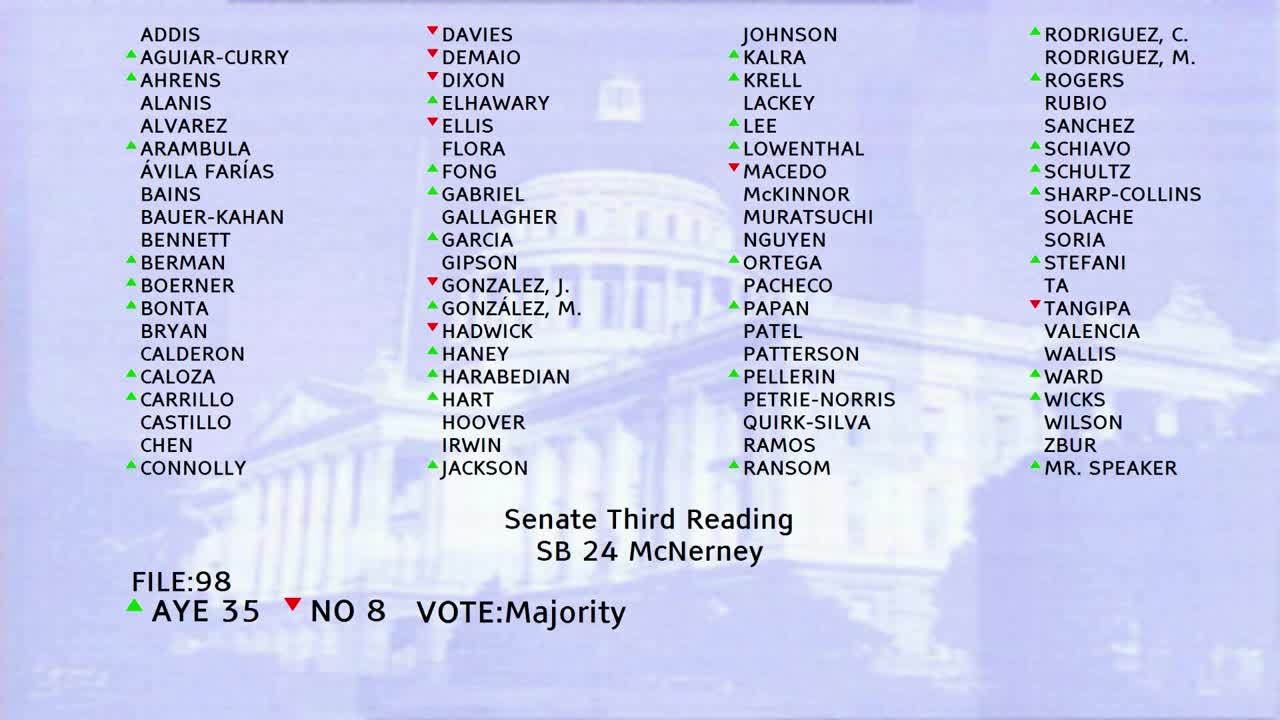 3MIN
Assembly Floor
 23MIN
Assembly Standing Committee on Judiciary
 16MIN
Assembly Standing Committee on Health
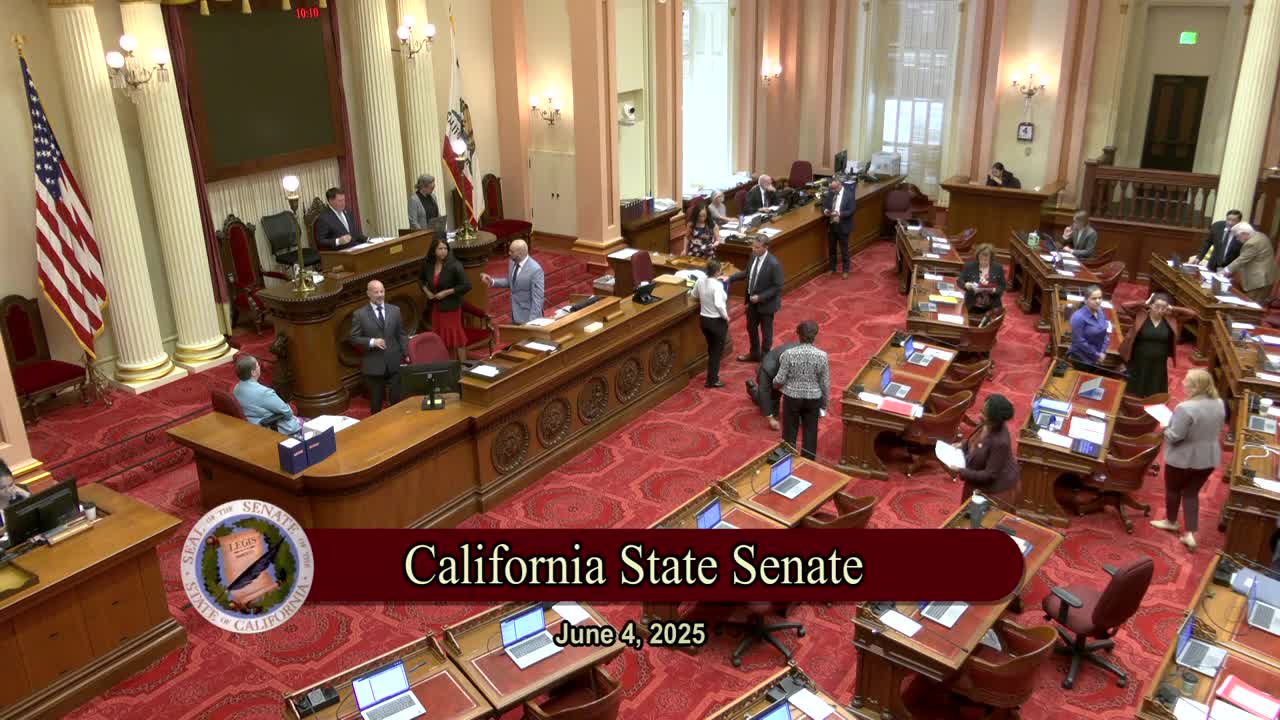 18MIN
Senate Floor
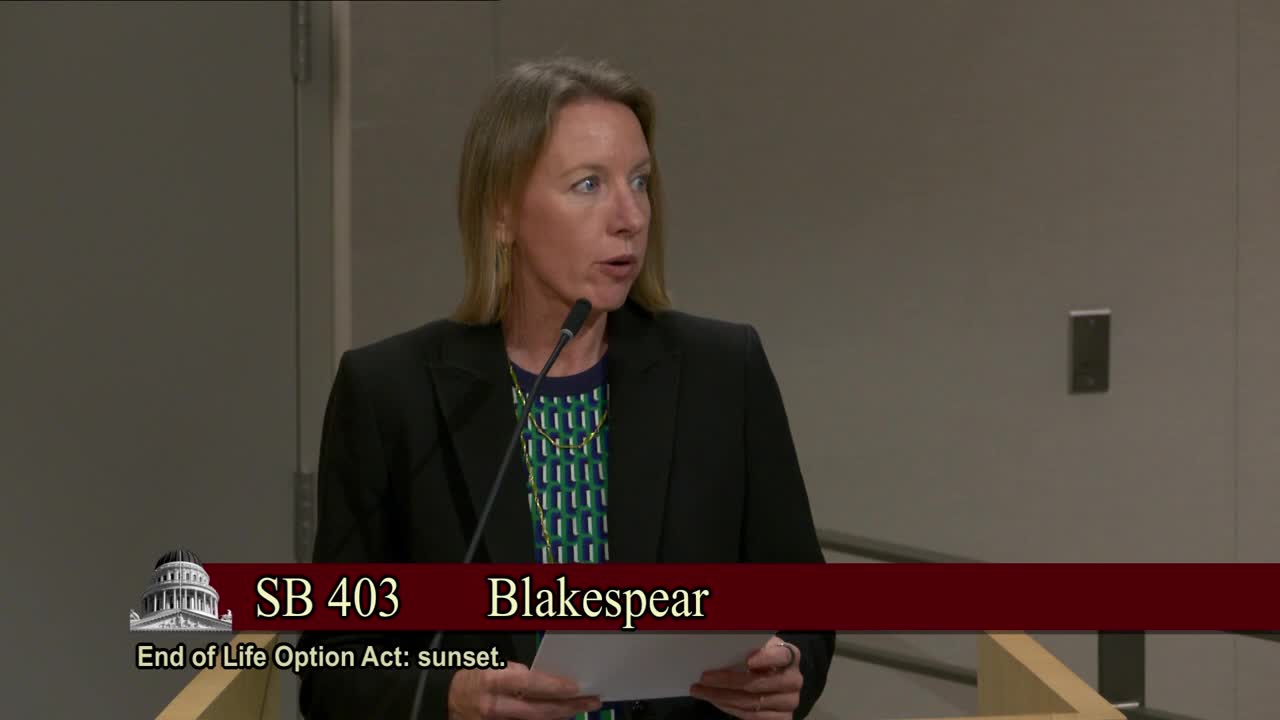 33MIN
Senate Standing Committee on Judiciary
 29MIN
Senate Standing Committee on Health
Bill Author
Bill Co-Author(s):