SB 1015: Domestic work employees: labor standards.
- Session Year: 2015-2016
- House: Senate
- Latest Version Date: 2016-09-12
Existing law regulates the wages, hours, and working conditions of any man, woman, or minor employed in any occupation, trade, or industry, whether the amount of compensation is measured by time, piece, or otherwise, except as specified. An existing order of the Industrial Welfare Commission regulates wages, hours, and working conditions for household occupations. Existing law makes violations of certain of these provisions and this order a misdemeanor.
Existing law, the Domestic Worker Bill of Rights, regulates the hours of work of domestic work employees who are personal attendants and provides an overtime compensation rate for those employees. The Domestic Worker Bill of Rights defines terms for its purposes and requires the Governor to convene a committee to study and report to the Governor on the effects of its provisions on personal attendants and their employers. Existing law repeals the Domestic Worker Bill of Rights as of January 1, 2017.
This bill would delete the repeal date. By extending the effect of the Domestic Worker Bill of Rights, the violation of which is a misdemeanor, this bill would expand the definition of a crime, which would impose a state-mandated local program.
The California Constitution requires the state to reimburse local agencies and school districts for certain costs mandated by the state. Statutory provisions establish procedures for making that reimbursement.
This bill would provide that no reimbursement is required by this act for a specified reason.
Existing law regulates the wages, hours, and working conditions of any man, woman, or minor employed in any occupation, trade, or industry, whether the amount of compensation is measured by time, piece, or otherwise, except as specified. An existing order of the Industrial Welfare Commission regulates wages, hours, and working conditions for household occupations. Existing law makes violations of certain of these provisions and this order a misdemeanor.
Existing law, the Domestic Worker Bill of Rights, regulates the hours of work of domestic work employees who are personal attendants and provides an overtime compensation rate for those employees. The Domestic Worker Bill of Rights defines terms for its purposes and requires the Governor to convene a committee to study and report to the Governor on the effects of its provisions on personal attendants and their employers. Existing law repeals The Domestic Worker Bill of Rights as of January 1, 2017.
This bill would delete the repeal date. By extending the effect of the Domestic Worker Bill of Rights, the violation of which is a misdemeanor, this bill would expand the definition of a crime, which would impose a state-mandated local program.
The California Constitution requires the state to reimburse local agencies and school districts for certain costs mandated by the state. Statutory provisions establish procedures for making that reimbursement.
This bill would provide that no reimbursement is required by this act for a specified reason.
No reimbursement is required by this act pursuant to Section 6 of Article XIIIB of the California Constitution because the only costs that may be incurred by a local agency or school district will be incurred because this act creates a new crime or infraction, eliminates a crime or infraction, or changes the penalty for a crime or infraction, within the meaning of Section 17556 of the Government Code, or changes the definition of a crime within the meaning of Section 6 of Article XIIIB of the California Constitution.
No reimbursement is required by this act pursuant to Section 6 of Article XIIIB of the California Constitution because the only costs that may be incurred by a local agency or school district will be incurred because this act creates a new crime or infraction, eliminates a crime or infraction, or changes the penalty for a crime or infraction, within the meaning of Section 17556 of the Government Code, or changes the definition of a crime within the meaning of Section 6 of Article XIIIB of the California Constitution.
This part shall remain in effect only until January 1, 2017, and as of that date is repealed, unless a later enacted statute, that is enacted before January 1, 2017, deletes or extends that date.
SEC. 2.No reimbursement is required by this act pursuant to Section 6 of Article XIIIB of the California Constitution because the only costs that may be incurred by a local agency or school district will be incurred because this act creates a new crime or infraction, eliminates a crime or infraction, or changes the penalty for a crime or infraction, within the meaning of Section 17556 of the Government Code, or changes the definition of a crime within the meaning of Section 6 of Article XIIIB of the California Constitution.
|
Date
|
Status
|
|---|---|
| Sep 12, 2016 | Chaptered by Secretary of State. Chapter 315, Statutes of 2016. |
| Sep 12, 2016 | Approved by the Governor. |
| Sep 8, 2016 | Enrolled and presented to the Governor at 5 p.m. |
| Aug 30, 2016 | In Senate. Ordered to engrossing and enrolling. |
| Aug 18, 2016 | Read third time. Passed. (Ayes 52. Noes 25. Page 5901.) Ordered to the Senate. |
| Aug 18, 2016 | Read third time. Passed. Ordered to the Senate. |
| Aug 11, 2016 | Read second time. Ordered to third reading. |
| Aug 10, 2016 | From committee: Do pass. (Ayes 14. Noes 5.) (August 10). |
| Aug 3, 2016 | August 3 hearing postponed by committee. |
| Jun 29, 2016 | June 29 hearing postponed by committee. |
| Jun 23, 2016 | From committee: Do pass and re-refer to Com. on APPR. (Ayes 5. Noes 2.) (June 22). Re-referred to Com. on APPR. |
| May 9, 2016 | Referred to Com. on L. & E. |
| Apr 28, 2016 | Read third time. Passed. (Ayes 25. Noes 10. Page 3708.) Ordered to the Assembly. |
| Apr 28, 2016 | In Assembly. Read first time. Held at Desk. |
| Apr 28, 2016 | Read third time. Passed. (Ayes 25. Noes 10.) Ordered to the Assembly. |
| Apr 19, 2016 | Read second time. Ordered to third reading. |
| Apr 18, 2016 | From committee: Be ordered to second reading pursuant to Senate Rule 28.8. |
| Apr 8, 2016 | Set for hearing April 18. |
| Apr 6, 2016 | From committee: Do pass and re-refer to Com. on APPR. (Ayes 4. Noes 1. Page 3421.) (April 6). Re-referred to Com. on APPR. |
| Apr 6, 2016 | From committee: Do pass and re-refer to Com. on APPR. (Ayes 4. Noes 1.) (April 6). Re-referred to Com. on APPR. |
| Mar 18, 2016 | Set for hearing April 6. |
| Feb 25, 2016 | Referred to Com. on L. & I.R. |
| Feb 12, 2016 | From printer. May be acted upon on or after March 13. |
| Feb 11, 2016 | Introduced. Read first time. To Com. on RLS. for assignment. To print. |
|
Date
|
Description
|
Location
|
Votes
|
|
|---|---|---|---|---|
| Aug 18, 2016 | SB 1015 Leyva Senate Third Reading By GARCIA, C. | Assembly Floor |
Passed |
|
| Aug 10, 2016 | Do pass. | Assembly Standing Committee on Appropriations |
Passed |
|
| Jun 22, 2016 | Do pass and be re-referred to the Committee on [Appropriations] | Assembly Standing Committee on Labor and Employment |
Passed |
|
| Apr 28, 2016 | Senate 3rd Reading SB1015 Leyva | Senate Floor |
Passed |
|
| Apr 6, 2016 | Do pass, but first be re-referred to the Committee on [Appropriations] | Senate Standing Committee on Labor and Industrial Relations |
Passed |
This list shows positions taken on this bill by organizations on the date displayed, which is linked to the original source.
Positions by individuals are not included.
SENATE THIRD READING
STR Bill Id:SB 1015
Author:(Leyva)
As Introduced Ver:February 11, 2016
Majority vote
SENATE VOTE: 25-10
Committee | Votes | Ayes | Noes |
Labor | 5-2 | Roger Hernández, Chu, McCarty, O'Donnell, Thurmond | Patterson, Linder |
Appropriations | 14-5 | Gonzalez, Bloom, Bonilla, Bonta, Calderon, Daly, Eggman, Eduardo Garcia, Holden, Quirk, Santiago, Weber, Wood, Chu | Bigelow, Gallagher, Jones, Obernolte, Wagner |
SUMMARY: Deletes the sunset date on the Domestic Worker Bill of Rights, which granted overtime compensation to specified domestic workers.
EXISTING LAW:
- Establishes the Domestic Worker Bill of Rights to regulate the hours of work of specified domestic work employees who are personal attendants and provides an overtime compensation rate for those employees after nine hours in one day and 45 hours in one workweek.
- Requires the Governor to convene a committee to study and report on the effects of this law on personal attendants and their employers.
- Sunsets the Domestic Worker Bill of Rights on January 1, 2017.
FISCAL EFFECT: According to the Assembly Appropriations Committee, no significant state costs.
COMMENTS: AB 241 (Ammiano), Chapter 374, Statutes of 2013, enacted the Domestic Worker Bills of Rights to grant overtime compensation to specified domestic workers after nine hours in one day and 45 hours in one workweek. AB 241 contained a January 1, 2017 sunset date. This bill proposes to eliminate that sunset date, thereby making those overtime provisions permanent. AB 241 enacted the Domestic Worker Bill of Rights granting overtime compensation, until January 1, 2017, to specified domestic workers after 9 hours in one day and 45 hours a week.
AB 241 also required the Governor to convene a committee to study and report on the effects of this law on personal attendants and their employers. The Labor and Workforce Development Agency (LWDA) has convened meetings and solicited input from stakeholders, but a report has not yet been released. LWDA indicates that the report will be released this summer.
See Assembly Labor and Employment Committee Analysis for background on Domestic Workers.
According to the sponsor, the California Domestic Workers Coalition, domestic workers are primarily immigrant women that, as a result of the uneven application of labor laws, have been denied basic protections afforded to other workers. Domestic workers often work around the clock to fulfill the requests of their employers and meet the needs of their own families. The unique nature of their work and constant isolation permits unscrupulous employers to exploit this hard-working labor force. The Coalition states that by making the law permanent, the legislature will dignify this profession, and the work of supporting our families, seniors, and people with disabilities.
The California Alliance for Retired Americans writes in support, "As a retiree organization which champions the rights of seniors, the California Alliance for Retired Americans (CARA) cares about how domestic workers are treated. We want to ensure that they are treated fairly and compensated equitably, including pay for overtime hours worked. It is due to their dedicated and compassionate work that seniors are able to stay in the home during their most vulnerable period in their lives. Thanks to the work of domestic workers, seniors are able to live in their own homes with dignity and respect. Keeping seniors out of nursing homes, and in their own homes, saves the state millions of dollar every year."
The American Civil Liberties Union (ACLU) writes in support that, "since the passage of AB 241, domestic workers have reported improved confidence and the ability to advocate for dignified standards in their jobs. If SB 1015 is not passed, these workers will no longer have access to these much needed state job protections. The ACLU is proud to support SB 1015, which recognizes the importance of domestic work and reaffirms the dignity of the California families whose household economy relies on this critical work."
The California Association for Health Services at Home (CAHSAH) opposes this bill. CAHSAH is concerned with the permanent extension of overtime compensation for domestic workers without knowing how the law has impacted the employment of personal attendants that provide private home care services to seniors and other frail Californians.
Disability Rights California (DRC) is also opposed to this bill. They state the AB 241 debate was long and painful and did not resolve the issues which should unite rather than divide two groups: low-income personal care workers and low-income people with disabilities who employ them. DRC states they support the rights of workers to be treated fairly, and also support the rights of people with disabilities to live in their own homes, work and function in their communities. Unfortunately, they state, AB 241 lumped low-income people with disabilities, who rely on their attendants for their survival and functioning, with wealthy people who could do their own chores but have money enough to hire somebody else to do them. The DRC states the claim that AB 241 has been a great success does not seem to be supported by any data on its effect on people with disabilities.
Analysis Prepared by: Taylor Jackson / L. & E. / (916) 319-2091 FN: 0003921
Date of Hearing: August 10, 2016
ASSEMBLY COMMITTEE ON APPROPRIATIONS
Lorena Gonzalez, Chair
SBPCA Bill Id:SB 1015
Author:(Leyva) – As Introduced Ver:February 11, 2016
Policy Committee: | Labor | Vote: |
|
Urgency: No State Mandated Local Program: Yes Reimbursable: No
SUMMARY:
This bill deletes the January 1, 2017, repeal date on provisions under the Domestic Worker Bill of Rights, thereby making the overtime compensation for domestic workers requirement permanent.
FISCAL EFFECT:
No significant state costs.
COMMENTS:
- Purpose. AB 241(Ammiano), Chapter 374, Statutes of 2013, enacted the Domestic Worker Bill of Rights. This law entitles a domestic work employee who is employed as a personal attendant to overtime compensation, if the employee works in excess of 9 hours in any workday or more than 45 hours in any workweek, to be compensated at the rate of 1 ½ times the regular rate of pay. These provisions of law are set to sunset on January 1, 2017. This bill removes the repeal date, thereby making overtime compensation for domestic workers permanent.
AB 241 also required the Governor to convene a committee to study and report on the effects of this law on personal attendants and their employers. The Labor and Workforce Development Agency (LWDA) has convened meetings and solicited input from stakeholders, but a report has not yet been released. LWDA indicates that the report will be released this summer.
- Support. According to the sponsor, the California Domestic Workers Coalition, domestic workers are primarily immigrant women that, as a result of the uneven application of labor laws, have been denied basic protections afforded to other workers. Domestic workers often work around the clock to fulfill the requests of their employers and meet the needs of their own families. The unique nature of their work and constant isolation permits unscrupulous employers to exploit this hard-working labor force. The Coalition states that by making the law permanent, the legislature will dignify this profession, and the work of supporting our families, seniors, and people with disabilities.
- Opposition. The California Association for Health Services at Home (CAHSAH) opposes this bill. CAHSAH is concerned with the permanent extension of overtime compensation for domestic workers without knowing how the law has impacted the employment of personal attendants that provide private home care services to seniors and other frail Californians.
Disability Rights California (DRC) is also opposed to this bill. They state the AB 241 debate was long and painful and did not resolve the issues which should unite rather than divide two groups: low-income personal care workers and low-income people with disabilities who employ them. DRC states they support the rights of workers to be treated fairly, and also support the rights of people with disabilities to live in their own homes, work and function in their communities. Unfortunately, they state, AB 241 lumped low-income people with disabilities, who rely on their attendants for their survival and functioning, with wealthy people who could do their own chores but have money enough to hire somebody else to do them. The DRC states the claim that AB 241 has been a great success does not seem to be supported by any data on its effect on people with disabilities.
Analysis Prepared by: Misty Feusahrens / APPR. / (916) 319-2081
Date of Hearing: June 22, 2016
ASSEMBLY COMMITTEE ON LABOR AND EMPLOYMENT
Roger Hernández, Chair
SBPCA Bill Id:SB 1015
Author:(Leyva) – As Introduced Ver:February 11, 2016
SENATE VOTE: 25-10
SUBJECT: Domestic work employees: labor standards
SUMMARY: Deletes the sunset date on the Domestic Worker Bill of Rights, which granted overtime compensation to specified domestic workers.
EXISTING LAW:
- Establishes the Domestic Worker Bill of Rights to regulate the hours of work of specified domestic work employees who are personal attendants and provides an overtime compensation rate for those employees after nine hours in one day and 45 hours in one workweek.
- Requires the Governor to convene a committee to study and report on the effects of this law on personal attendants and their employers.
- Sunsets the Domestic Worker Bill of Rights on January 1, 2017.
FISCAL EFFECT: According to the Senate Appropriations Committee, pursuant to Senate Rule 28.8, negligible state costs.
COMMENTS: AB 241 (Ammiano) of 2013 enacted the Domestic Worker Bills of Rights to grant overtime compensation to specified domestic workers after 9 hours in one day and 45 hours in one workweek. AB 241 contained a January 1, 2017 sunset date. This bill proposes to eliminate that sunset date, thereby making those overtime provisions permanent.
AB 241 also required the Governor to convene a committee to study and report on the effects of this law on personal attendants and their employers. The Labor and Workforce Development Agency (LWDA) has convened meetings and solicited input from stakeholders, but a report has not yet been released. LWDA indicates that the report will be released this summer.
Background on Domestic Workers at the Federal Level
In 1938, the U.S. Congress enacted the Fair Labor Standards Act (FLSA) introducing the forty-hour work week and establishing minimum wage and overtime protections for workers, with some exceptions including domestic workers and farmworkers. In 1974, Congress extended FLSA coverage to workers who perform domestic service. "Domestic workers" or "household workers" are generally comprised of housekeepers, nannies and caregivers of children and others, including the disabled and elderly, who work in private households to care for the health, safety and well-being of those under their care. Casual babysitters and domestic service workers employed to provide “companionship services” for an elderly person or a person with an illness, injury, or disability are not required to be paid the minimum wage or overtime pay if they meet certain regulatory requirements.
Effective January 1, 2015, the U.S. Department of Labor amended its regulations to revise the definition of “companionship services” to clarify and narrow the duties that fall within the term and prohibit third party employers, such as home care agencies, from claiming the companionship or live-in exemptions. The major effect of this Final Rule is that more domestic service workers will be protected by the FLSA’s minimum wage and overtime provisions. The FLSA requires employers to compensate employees at one-and-one-half times the regular rate of pay for all hours worked over 40. Unlike California law, the FLSA does not contain a daily overtime requirement.
The Growing Need for Domestic Workers
According to a report[1] from the UCLA Labor Center, 16% of households or 2 million households in California employ domestic workers to provide care for children, housecleaning, and support for seniors and people with disabilities. The report found that due to health and medical advancements and the aging of the baby boomer generation, the U.S. is experiencing an unprecedented “elder boom,” and domestic workers help empower the independence of seniors. There has been a shift in recent years around societal expectations that people with illnesses and disabilities will be able to live at home with appropriate assistance, rather than in nursing facilities. Long-term support for seniors and people with disabilities is, about half the time, informally provided by friends and family members, usually a spouse or an adult daughter.
Professional domestic work, however, provides an alternative to assisted living and nursing facilities, and can allow informal, familial caregivers to take up needed employment. By 2022, the number of personal care aides in California will have increased by 52% to over half a million workers. It is estimated that about half of those turning 65 today will need some form of long term support.
Prevalence of Inadequate or Illegal Pay and Substandard Conditions among Domestic Workers
The National Domestic Worker Alliance performed a survey to analyze data on domestic work and workers in 14 United States cities. The sample analyzed in the report[2] includes 631 domestic workers in four metropolitan areas in California: Los Angeles, San Diego, San Francisco, and San Jose. The report examines conditions in the industry and presents the results of nannies, housecleaners, and caregivers who are employed directly by private households. This provides context on the large, informal labor market of domestic work. The report reveals that domestic workers, who labor without many of the protections afforded most other workers in the U.S., face a range of hardships associated with their work in an industry that is largely invisible and unregulated.
Specifically the report finds that low pay is a systemic problem across the industry, and workers rarely receive employment benefits. Their findings declare that 25 percent of domestic workers are paid below the California minimum wage, the result of a combination of poorly delineated tasks, long workdays, and low pay. Using a conservative measure of income adequacy, 61% of workers are paid an hourly wage at their primary job that is below the level needed to adequately support a family (analysis using the Lower Living Standard Income Level guideline). Less than 1 percent receives retirement or pension benefits. Only 6 percent work for employers who pay into Social Security. Just 1 percent work for employers who pay into workers’ compensation, and only 2 percent receive employer-provided health insurance coverage.
Survey data was analyzed to determine the hourly wages paid by workers’ “primary” employer, the employer for whom the most hours were worked in the previous week. The median hourly wage for the domestic workers surveyed is $10.00 an hour. Fully one-quarter (25%) of survey respondents are paid less than the California minimum wage ($8 per hour at the time of the survey), the result of a combination of poorly delineated tasks, long workdays, and low pay. Sixteen percent put in more than 40 hours of work per week for their primary employer, but rarely are domestic workers paid time-and-a-half for overtime hours. Many are paid a flat rate that does not change according to the actual number of hours worked. The tendency within private households is for work tasks to expand and for the workday to lengthen, often driving pay below the state minimum wage.
The report also highlights the low pay and substandard conditions faced by domestic workers, and how most workers and their families face financial hardships. 58 percent of domestic workers spend more than half their income on rent. 35 percent paid rent late in the prior 12 months. 39 percent of workers had to pay essential bills late in the last month. 23 percent had no food to eat in the last month because they lacked resources to obtain it—an extreme form of food insecurity. The report argues that while not all domestic work employers treat their nannies, caregivers, and housecleaners poorly, the lack of enforceable standards increases the likelihood of mistreatment. They call for sensible policies that protect domestic workers on the job are needed to redress the substandard conditions that exist in the industry.
Argument in Support
The California Domestic Workers Coalition, the sponsor of this measure, writes in support:
"This bill would make permanent California's current overtime law for domestic workers. The law was first enacted in January of 2014 to finally provide overtime pay to domestic workers who have been excluded from many labor protections for decades. Domestic workers are primarily immigrant women that, as a result of the uneven application of labor laws, have been denied basic protections afforded to other workers. Domestic workers often work around the clock to fulfill the requests of their employers and meet the needs of their own families. The unique nature of their work and constant isolation permits unscrupulous employers to exploit this hard-working labor force. The path towards dignifying domestic work started many years ago. The legislative effort began in 2012, through AB 899. That initial version, which sought more comprehensive protections for workers, was ultimately vetoed by Governor Brown. Undeterred and with a renewed focus, the coalition, in 2013, fought to pass Assembly Bill 241 (known as the Domestic Workers Bill of Rights). Under AB 241, overtime protections were established for personal attendants who care for and provide support for thousands of individuals and families in California. However, the legislation carried a sunset provision, thus making these protections provisional, ending at the end of 2016 unless made permanent. The California Domestic Workers Coalition, its members and allies, have reached out to many workers to educate them about their rights. We have witnessed a growing recognition of the law, and compliance. We have witnessed growth in the confidence of workers, with their work affirmed as legitimate work, and an improvement in their ability to advocate for dignified working conditions. Only through making this law permanent can these efforts be fully effective. By making the law permanent, the legislature will dignify this profession, the work of supporting our families, seniors, and people with disabilities. The population that will need personal attendants continues to grow in our state; SB 1015 will help ensure fair and just standards that will result in better care for both the workers and the people they attend to.”
The California Alliance for Retired Americans writes in support, “As a retiree organization which champions the rights of seniors, the California Alliance for Retired Americans (CARA) cares about how domestic workers are treated. We want to ensure that they are treated fairly and compensated equitably, including pay for overtime hours worked. It is due to their dedicated and compassionate work that seniors are able to stay in the home during their most vulnerable period in their lives. Thanks to the work of domestic workers, seniors are able to live in their own homes with dignity and respect. Keeping seniors out of nursing homes, and in their own homes, saves the state millions of dollar every year.”
The American Civil Liberties Union (ACLU) writes in support that, "since the passage of AB 241, domestic workers have reported improved confidence and the ability to advocate for dignified standards in their jobs. If SB 1015 is not passed, these workers will no longer have access to these much needed state job protections. The ACLU is proud to support SB 1015, which recognizes the importance of domestic work and reaffirms the dignity of the California families whose household economy relies on this critical work.”
The United Domestic Workers (UDW) - AFSCME Local 390 supports this measure and states, “On average, domestic workers earn poverty wages and are excluded from our most fundamental labor protections. In 2013, the California Domestic Workers Coalition sponsored AB 241 (Ammiano) to grant domestic workers the right to daily and weekly overtime pay… Domestic workers make so little that they have come to depend on overtime pay. It is crucial that we end this injustice and make this law permanent so that employers cannot pocket the money that our State’s most vulnerable workers deserve.”
Arguments in Opposition
The California Association for Health Services at Home (CAHSAH) opposes this measure and states:
“As early as 1986, the Industrial Welfare Commission recognized a complete exemption from the overtime provisions and other requirements of the Wage Orders for individuals employed as personal attendants who provide in-home care. In 2012, Governor Jerry Brown vetoed AB 889 which would have extended overtime pay to personal attendants because he was concerned about the impact the bill would have on seniors and other frail Californians who depend on private home care services to avoid institutionalization and to keep them safe and healthy in their home. In 2013, AB 241 was signed into law requiring that caregivers receive overtime compensation after nine hours in a day and/or 45 hours in a workweek but this time the bill included a sunset clause of 2017 and specifically required that a complete impact study be conducted.
The Governor included a specific message in his AB 241 signing statement that asked:
What will be the economic and human impact on the disabled or elderly person and their family of requiring overtime, rest and meal periods for an attendant who provides 24-hour care?
What would be the additional costs and what is the financial capacity of those taking care of loved ones in the last years of life?
Will it increase costs to the point of forcing people out of their homes and into licensed institutions?
Will there be fewer jobs for domestic workers? Will the available jobs be for fewer hours and will they be less flexible?"
According to CAHSAH, they have heard from home care providers, their caregivers, clients and family members about the serious negative consequences that have resulted from AB 241, including the following:
- Families are faced with difficult decisions about how to afford care and keep the continuity of care consistent.
- Many seniors with dementia are experiencing the confusion of having multiple caregivers in their home.
- Caregivers have lost schedule flexibility.
- Caregivers who were accustomed to living in the client’s homes lost their ability to live rent-free and have had their income significantly reduced.
- Home care providers are having difficulty finding enough caregivers to provide care.
- Many seniors and frail individuals are being forced out of their homes into residential care facilities.
CAHSAH goes on to state that, "Now, [this bill] is being introduced to remove the sunset clause that was established under AB 241. However, the impact study that was mandated by AB 241 has not been released and the work continues to collect and analyze all the data. The Department of Industrial Relations just notified CAHSAH that they will be conducting a final home care providers study beginning in April. The full results of the impact study need to be understood before making any changes to AB 241. “
In addition, Disability Rights California (DRC) opposes this measure. They state that, “DRC opposed AB 241, whose sunset [this bill] would lift, because of the negative consequences to people with disabilities, most of whom are low-income who pay privately for attendant care. The AB 241 debate was long and painful and did not resolve the issues which should unite rather than divide two groups: low-income personal care workers and low-income people with disabilities who employ them. We support the rights of workers to be treated fairly, and we also support the rights of people with disabilities to live in their own homes, work and function in their communities. Unfortunately, AB 241 lumped low-income people with disabilities, who rely on their attendants for their survival and functioning, with wealthy people who could do their own chores but have money enough to hire somebody else to do them. The burdens are not equal; the effects of the bill are not equal. There are people with disabilities who spend half their incomes paying privately for their attendants, because their gross income does not qualify them for government programs. The claim that AB 241 has been a great success does not seem to be supported by any data on its effect on people with disabilities.”
Prior Related Legislation
SB 1344 (Stone) from 2016 proposed to add a sleep time exemption from hours worked for purposes of overtime compensation for live-in employees or 24-hour shift workers. Specifically, SB 1344 would have allowed live-in domestic work employees or those on duty for 24 or more consecutive hours to enter into a written agreement with their employers to exclude a regularly-scheduled sleeping period from hours worked, and thus from employee pay. SB 1344 failed passage in the Senate Labor and Industrial Relations Committee.
AB 241(Ammiano) Chapter 374, Statutes of 2013, enacted the Domestic Worker Bill of Rights granting overtime compensation, until January 1, 2017, to specified domestic workers after 9 hours in one day and 45 hours a week.
AB 889 (Ammiano) from 2012 would have required the permanent adoption of regulations governing specified working conditions of domestic workers, including but not limited to, overtime compensation and meal and rest periods. AB 889 was vetoed by Governor Brown. The Governor’s veto message stated:
“Domestic workers work in the homes of ill, elderly or disabled people. They often share duties and responsibilities with the family and friends of the patient-employer. Those employed in this noble endeavor, like anyone who works for a living; deserve fair pay and safe working conditions. Seeking to improve the circumstances of these workers however, raises a number of unanswered questions.
What will be the economic and human impact on the disabled or elderly person and their family of requiring overtime, rest and meal periods for attendants who provide 24 hour care? What would be the additional costs and what is the financial capacity of those taking care of loved ones in the last years of life? Will it increase costs to the point of forcing people out of their homes and into licensed institutions?
Will there be fewer jobs for domestic workers? Will the available jobs be for fewer hours? Will they be less flexible?
What will be the impact of the looming federal policies in this area? How would the state actually enforce the new work rules in the privacy of people's homes?
The bill calls for these questions to be studied by the state Department of Industrial Relations and for the department to simultaneously issue new regulations to provide overtime, meal, rest break and sleep periods for domestic workers. In the face of consequences both unknown and unintended, I find it more prudent to do the studies before considering an untested legal regime for those that work in our homes.
Finally, a drafting error leaves most In Home Supportive Service (IHSS) workers subject to this measure - - resulting in costs to the state of over $200 million per year. This could require cuts in wages, reduced hours of care and other reductions to those served by IHSS workers.”
REGISTERED SUPPORT / OPPOSITION:
Support
9 to 5 Los Angeles
Ability NOWBay Area
Alameda Labor Council
Alliance of Californians for Community Empowerment
American Association of University Women
American Civil Liberties Union of California
American Federation of Teachers, Local 2121
American Friends Service Committee’s US/Mexico Border Program
Anakbayan East Bay
Asian Americans Advancing Justice-California
Asian Health Services
Asian Immigrant Women Advocates
Asian Pacific American Labor Alliance
Asian Pacific Islander Legal Outreach
Association of Filipino Workers
Bend the Arc
Binational Center for the Development of Oaxacan Indigenous Communities
Black Alliance for Just Immigration
California Alliance for Retired Americans
California Applicants' Attorneys Association
California Asset Building Coalition
California Child Care Resource & Referral Network
California Commission on Asian Pacific Islander American Affairs
California Domestic Workers Coalition (sponsor)
California Employment Lawyers Association
California Environmental Justice Alliance
California Faculty Association, San Francisco State Chapter
California Healthy Nail Salon Collaborative
California Hunger Action Coalition
California Immigrant Policy Center
California Immigrant Youth Justice Alliance
California In-Home Supportive Services Consumer Alliance
California Labor Federation, AFL-CIO
California Latinas for Reproductive Justice
California Nurses Association
California Partnership
California Rural Legal Assistance Foundation
California School Employees Association
California Women’s Law Center
California Work and Family Coalition
Californians for a Healthy and Green Economy
Care.com
Career Ladders Project
Caring Across Generation
Center for Popular Democracy
Central American Resource Center/Centro de Recursos Centroamericanos
Central Coast Alliance United for a Sustainable Economy
Central Florida Jobs with Justice
Centro Cultural de Mexico
Centro Laboral de Graton
Centro Legal de la Raza
Child Care Law Center
Chinese for Affirmative Action
City and County of San Francisco
Coalition for Humane Immigrant Rights of Los Angeles
Community Coalition
Community Health for Asian Americans
Community Housing Partnerships
Council of Mexican Federations
Council on American-Islamic Relations California
Courage Campaign
Day Labor Center Hayward, Oakland, Tri-City, Tri-Valley
Day Worker Center in Santa Cruz County
Day Worker Center of Mountain View
Diawang Kabataan of Tri-city
Dolores Street Community Services
East Bay Alliance for a Sustainable Economy
East Bay Organizing Committee
El/La Para TransLatinas
Ella Baker Center for Human Rights
Episcopal Church of St. John the Evangelist
Equal Rights Advocates
Filipino Advocates for Justice
Filipino Community Center
Filipino Migrant Center
Forward Together
Friends Committee on Legislation of California
GABRIELA San Francisco
Gray Panthers of San Francisco
Hand in Hand: The Domestic Employers Network
Home Green Home
Immigrant Youth Coalition
Institute of Popular Education of Southern California
Interfaith Movement for Human Integrity
International Longshore & Warehouse Union Local 6
Jobs with Justice San Francisco
KmB, Pro-People Youth
Koreatown Immigrant Workers Alliance
La Raza Centro Legal
Language Access Network
Lawyers’ Committee for Civil Rights of the San Francisco Bay Area
Mexican American Legal Defense and Education Fund
MomsRising.org
Movement Generation Justice & Ecology Project
Movement Strategy Center
Mujeres Unidas Y Activas
National Council of Jewish Women
National Domestic Workers Alliance
National Employment Law Project
National Network for Immigrant and Refugee Rights
North Bay Immigrant Youth Union
North Bay Jobs with Justice
North County Immigration Task Force
Numerous Individuals
Oakland Rising
Oceanic Coalition of Northern California
Office & Professional Employees International Union, Local 3
Orange County Immigrant Youth United
Parent Voices
Pegasus
Pilipino Association of Workers and IM/Immigrants – Silicon Valley
Pilipino Workers Center of Southern California
PolicyLink
Pomona Economic Opportunity Center
Progressive Workers Alliance of San Francisco
PROSPERA Co-Ops: The Business of Empowerment
Public Counsel
Raising California Together
Restaurant Opportunities Centers of Los Angeles
Restaurant Opportunities Centers United
Sacramento Immigration Alliance
Sailors Union of the Pacific
San Francisco Community College Federation of Teachers
San Francisco Labor Council
San Francisco Women Against Rape
Santa Clara County Wage Theft Coalition
Save Midtown Tenants Association
SEIU – United Service Workers West
SEIU California
Senior and Disability Action
Services Immigrant Rights & Education Network
Somos Familia
Strategic Action for Just Economy
Supervisor Efren Carrillo, Sonoma County
Swiss Cheese Childcare Cooperative
Temple Beth Hillel, North Hollywood
Temple Judea
The Full Rights, Equality, and Empowerment San Francisco Coalition
The Greenlining Institute
The Kitchen San Francisco
The Opportunity Institute
The Women’s Collective/La Colectiva de Mujeres
Tradeswomen, Inc.
UFCW Western State Council
UNITE HERE!
United Domestic Workers of America – AFSCME LOCAL 3930
United Educators of San Francisco
United Farm Workers
Vital Immigrant Defense Advocacy and Services
Voices for Progress
Wage Justice Center
Western Center on Law and Poverty
Women’s Employment Rights Clinic of Golden Gate University School of Law
Women's Policy Institute, Women's Foundation of California
WorkSafe
Young Workers United
ꜟPODER!
Opposition
Numerous Individuals
1-Heart Caregiver Services
AAA T.L.C. Health Care, Inc.
California Association for Health Services at Home
Care to Stay Home
Comfort Keepers
Disability Rights California
Home Instead Senior Care
Innovative Healthcare Consultants
Matched Caregivers
Visiting Angels
Analysis Prepared by: Taylor Jackson / L. & E. / (916) 319-2091
Profile, Practices, and Needs of California’s Domestic Work Employers, University of California Los Angeles Labor Center: http://www.labor.ucla.edu/publication/domestic-employers-report/ ↑
Home Truths: Domestic Workers in California. National Domestic Workers Alliance Data Center at the Center for Urban Economic Development, University of Illinois at Chicago: http://www.domesticworkers.org/sites/default/files/HomeTruths.pdf ↑
Office of Senate Floor Analyses (916) 651-1520 Fax: (916) 327-4478 | SB |
THIRD READING
Bill No: SB 1015
:
SENATE LABOR & IND. REL. COMMITTEE: 4-1, 4/6/16
AYES: Mendoza, Jackson, Leno, Mitchell
NOES: Stone
SENATE APPROPRIATIONS COMMITTEE: Senate Rule 28.8
SOURCE: California Domestic Workers Coalition
DIGEST: This bill deletes the January 1, 2017 repeal date on the provisions under the Domestic Worker Bill of Rights which requires the payment overtime compensation for domestic workers after 9 hours in one day or after 45 hours a week, thereby making the requirement permanent.
Existing law:
- Requires, with some exceptions, including specified domestic worker employees, employers to pay overtime compensation as follows:
- Work in excess of 8 hours in one workday or 40 hours in any one workweek, and the first 8 hours worked on the 7th day of work in any one workweek shall be compensated at the rate of no less than 1 ½ times the regular rate of pay;
- Work in excess of 12 hours in one day shall be compensated at the rate of no less than twice the regular rate of pay;
- Work in excess of 8 hours on any 7th day of a workweek shall be compensated at the rate of no less than twice the regular rate of pay.
- Provides, under the Domestic Worker Bill of Rights, and until a sunset date of January 1, 2017, a domestic work employee who is employed as a personal attendant is entitled to overtime compensation, as follows:
- Work in excess of 9 hours in any workday or more than 45 hours in any workweek shall be compensated at the rate of 1 ½ times the regular rate of pay.
- Defines “domestic work employee” as an individual performing domestic work and includes live-in employees and personal attendants except, among others, the following:
- A person performing services through the In-Home Supportive Services program;
- Specified family members and casual babysitters;
- A person providing support services to the developmentally disabled employed by a regional center or the State Department of Developmental Services;
- A person providing child care for someone receiving services pursuant to programs authorized under the Child Care and Development Services Act or the CA Work Opportunity and Responsibility to Kids Act.
- Defines “personal attendant” as a person employed by a private householder or by any third-party employer, to supervise, feed, or dress a child, or a person who by reason of advanced age, physical disability, or mental deficiency needs supervision.
- Requires the Governor to convene a committee composed of personal attendants, employers of personal attendants or their representatives to study and report to the Governor on the effects of the domestic worker overtime requirements.
This bill deletes the January 1, 2017 repeal date on the provisions under the Domestic Worker Bill of Rights, thereby making the overtime compensation for domestic workers requirement permanent.
Background
In 1938, the U.S. Congress enacted the Fair Labor Standards Act introducing the forty-hour work week and establishing minimum wage and overtime protections for workers, with some exceptions including domestic workers and farmworkers. In 1974, Congress extended FLSA coverage to workers who perform domestic service. "Domestic workers" or "household workers" are generally comprised of housekeepers, nannies and caregivers of children and others, including the disabled and elderly, who work in private households to care for the health, safety and well-being of those under their care. Until very recently, domestic workers in California were excluded from the employer requirement of overtime for hours worked beyond the state minimum of 8 hours a day or 40 hours a week.
In 2012, through AB 889 (Ammiano), a grassroots effort began to extend some of the most fundamental labor protections to domestic workers. The measure directed the Department of Industrial Relations to adopt regulations governing the working conditions of domestic work employees. Among other things, the bill required the regulations to include provisions for overtime compensation, meal and rest periods and uninterrupted sleep periods and compensation for interruptions. AB 889 was vetoed by Governor Brown who stated, among other things, the following:
“Seeking to improve the circumstances of these workers however, raises a number of unanswered questions.
What will be the economic and human impact on the disabled or elderly person and their family of requiring overtime, rest and meal periods for attendants who provide 24 hour care? What would be the additional costs and what is the financial capacity of those taking care of loved ones in the last years of life? Will it increase costs to the point of forcing people out of their homes and into licensed institutions? Will there be fewer jobs for domestic workers? Will the available jobs be for fewer hours? Will they be less flexible?
What will be the impact of the looming federal policies in this area? How would the state actually enforce the new work rules in the privacy of people's homes?
The bill calls for these questions to be studied by the state Department of Industrial Relations and for the department to simultaneously issue new regulations to provide overtime, meal, rest break and sleep periods for domestic workers. In the face of consequences both unknown and unintended, I find it more prudent to do the studies before considering an untested legal regime for those that work in our homes.”
In 2013, AB 241(Ammiano, Chapter 374, Statutes of 2013) was introduced to again attempt to extend these labor protections to domestic workers. The measure, which passed and was signed by Governor Brown, enacted the Domestic Worker Bill of Rights which extends overtime compensation rights to domestic workers who are personal attendants after 9 hours of work in one day and 45 hours a week. The provisions of AB 241 are set to sunset on January 1, 2017. A bill is necessary to either extend the sunset date or repeal it, making the provisions permanent in law.
This bill would repeal the January 1, 2017 sunset date on these provisions. The author and proponents believe that the law has been successful and making the provisions permanent will improve the domestic workers’ ability to advocate for dignified standards in their jobs.
Report on Overtime for Domestic Workers
A key component of AB 241(Ammiano) was a requirement that the Governor convene a committee composed of personal attendants, their employers and/or their representatives to study and report to the Governor on the effects of the domestic worker overtime requirements; however, the bill was not specific on a due by date for such reporting. The Department of Industrial Relations has been conducting surveys to study the impacts on both the domestic workers and their employers. At this point, there is no set date for the release of these findings. Reviewing the findings of the DIR committee would be helpful in determining whether a full repeal is adequate at this time.
The sponsors of this measure have conducted internal reviews and report the following:
- More clarity on required compensation for live-in workers working 24/7;
- Move from shifts longer than 12 hours, instead hiring multiple workers;
- Some employers are delaying compliance to wait out the sunset date.
Related/Prior Legislation
SB 1344 (Stone, 2016) proposes to add a sleep time exemption from hours worked for purposes of overtime compensation for live-in employees or 24-hour shift workers. SB 1344 is currently pending in the Senate Labor and Industrial Realtions Committee.
AB 241 (Ammiano, 2013) enacted the Domestic Worker Bill of Rights granting overtime compensation, until January 1, 2017, to specified domestic workers after 9 hours in one day and 45 hours a week. AB 241 by signed by Governor Brown.
AB 889 (Ammiano, 2012) would have required the adoption of regulations governing specified working conditions of domestic workers. AB 889 was vetoed by Governor Brown.
FISCAL EFFECT: Appropriation: Fiscal Com.: Local:
California Domestic Workers Coalition (source)
Ability NOWBay Area
American Civil Liberties Union of California
American Federation of Teachers, Local 2121
American Friends Service Committee’s US/Mexico Border Program
Anakbayan East Bay
Asian Americans Advancing Justice-California
Asian Health Services
Asian Immigrant Women Advocates
Asian Pacific American Labor Alliance
Asian Pacific Islander Legal Outreach
Association of Filipino Workers
Bend the Arc
Binational Center for the Development of Oaxacan Indigenous Communities
Black Alliance for Just Immigration
California Alliance for Retired Americans
California Commission on Asian Pacific Islander American Affairs
California Employment Lawyers Association
California Faculty Association, San Francisco State Chapter
California Healthy Nail Salon Collaborative
California Immigrant Policy Center
California Immigrant Youth Justice Alliance
California In-Home Supportive Services Consumer Alliance
California Latinas for Reproductive Justice
California Nurses Association
California Partnership
California Rural Legal Assistance Foundation
Californians for a Healthy and Green Economy
Central American Resource Center/Centro de Recursos Centroamericanos
Central Coast Alliance United for a Sustainable Economy
Central Florida Jobs with Justice
Centro Cultural de Mexico
Centro Legal de la Raza
Centro Laboral de Graton
Chinese for Affirmative Action
Coalition for Humane Immigrant Rights of Los Angeles
Community Coalition
Community Health for Asian Americans
Community Housing Partnerships
Council on American-Islamic Relations California
Day Labor Center Hayward, Oakland, Tri-City, Tri-Valley
Day Worker Center in Santa Cruz County
Day Worker Center of Mountain View
Dolores Street Community Services
East Bay Alliance for a Sustainable Economy
East Bay Organizing Committee
El/La Para TransLatinas
Episcopal Church of St. John the Evangelist
Equal Rights Advocates
Filipino Advocates for Justice
Filipino Community Center
Filipino Migrant Center
Forward Together
Friends Committee on Legislation of California
GABRIELA San Francisco
Gray Panthers of San Francisco
Hand in Hand: The Domestic Employers Network
Home Green Home
Immigrant Youth Coalition
Institute of Popular Education of Southern California
Interfaith Movement for Human Integrity
International Longshore & Warehouse Union Local 6
Jobs with Justice San Francisco
KmB, Pro-People Youth
Koreatown Immigrant Workers Alliance
La Raza Centro Legal
Lawyers’ Committee for Civil Rights of the San Francisco Bay Area
Movement Generation Justice & Ecology Project
Movement Strategy Center
Mujeres Unidas Y Activas
National Domestic Workers Alliance
National Employment Law Project
National Network for Immigrant and Refugee Rights
North Bay Immigrant Youth Union
North Bay Jobs with Justice
Oceanic Coalition of Northern California
Office & Professional Employees International Union, Local 3
Orange County Immigrant Youth United
Pilipino Association of Workers and IM/Immigrants – Silicon Valley
Pilipino Workers Center of Southern California
PolicyLink
Pomona Economic Opportunity Center
Progressive Workers Alliance of San Francisco
PROSPERA Co-Ops: The Business of Empowerment
Public Counsel
Restaurant Opportunities Centers United
Restaurant Opportunities Centers United-Los Angeles
Sailors Union of the Pacific
San Francisco Labor Council
San Francisco Women against Rape
Santa Clara County Wage Theft Coalition
Save Midtown Tenants Association
SEIU – United Service Workers West
SEIU California
Senior and Disability Action
Services Immigrant Rights & Education Network
Swiss Cheese Childcare Cooperative
Temple Beth Hillel, North Hollywood
Temple Judea
The Full Rights, Equality, and Empowerment San Francisco Coalition
The Greenlining Institute
The Kitchen San Francisco
The Women’s Collective/La Colectiva de Mujeres
UNITE HERE!
United Domestic Workers of America – AFSCME LOCAL 3930/ AFL-CIO
United Educators of San Francisco
Voices for Progress
Wage Justice Center
Western Center on Law and Poverty
Women’s Employment Rights Clinic of Golden Gate University School of Law
WorkSafe
Young Workers United
ꜟPODER!
9 to 5 Los Angeles
5-individuals
OPPOSITION: (Verified 4/19/16)
AAA T.L.C. Health Care, Inc.
California Association for Health Services at Home
Care to Stay Home
Comfort Keepers
Disability Rights California
Innovative Healthcare Consultants
3-individuals
ARGUMENTS IN SUPPORT: According to proponents, in California there are 300,000 domestic workers who serve as housekeepers, nannies, and caregivers in private homes. Domestic workers are primarily immigrant women who work in private households enabling others to participate in the workforce. However, despite the importance of their work, domestic workers have historically received wages well below the poverty line and were excluded from some of the most fundamental labor protections other California workers enjoy. According to proponents of this measure, since the passage of the Domestic Worker Bill of Rights, domestic workers have reported growth in their confidence, with their work affirmed as legitimate work, and an improved ability to advocate for dignified working conditions. They argue that by making the law permanent, the legislature will dignify this profession and ensure fair and just standards for workers that will result in better care for both the workers and the people they attend to.
ARGUMENTS IN OPPOSITION: Opponents of the measure argue that eliminating the sunset date on the overtime provisions are premature as the impact study that was mandated by AB 241 has not been released and the work continues to collect and analyze all the data. Proponents further argue that AB 241 lumped low-income people with disabilities, who rely on their attendants for their survival and functioning, with wealthy people who could do their own chores but have money enough to hire somebody else to do them. They argue that the burdens are not equal and the effects of the bill are not equal, as there are people with disabilities who spend half their incomes paying privately for their attendants, because their gross income does not qualify them for government programs. They argue that the claim that AB 241 has been a great success does not seem to be supported by any data on its effect on people with disabilities.
According to the California Association for Health Services at Home (CAHSAH), this study is especially important for seniors who struggle to pay for home care, particularly if they require 24-hour live-in assistance. According to CAHSAH, they have heard from home care providers, their caregivers, clients and family members about the serious negative consequences that have resulted from AB 241, including the following:
- Families are faced with difficult decisions about how to afford care and keep the continuity of care consistent.
- Many seniors with dementia are experiencing the confusion of having multiple caregivers in their home.
- Caregivers have lost schedule flexibility.
- Caregivers who were accustomed to living in the client’s homes lost their ability to live rent-free and have had their income significantly reduced.
- Home care providers are having difficulty finding enough caregivers.
- Many seniors and frail individuals are being forced out of their homes into residential care facilities.
- Many agencies have cut back on the overtime by giving personal attendants 8-hour shifts instead of 12-hour shifts.
4/20/16 15:43:42
SENATE COMMITTEE ON LABOR AND INDUSTRIAL RELATIONS
Senator Tony Mendoza, Chair
2015 - 2016 Regular
Bill No: SB 1015 Hearing Date: April 6, 2016
Author: | Leyva | ||
Version: | February 11, 2016 | ||
Urgency: | No | Fiscal: | Yes |
Consultant: | Alma Perez-Schwab | ||
Subject: Domestic work employees: labor standards
KEY ISSUES
Should the Legislature repeal the sunset date of January 1, 2017 on the Domestic Worker Bill of Rights, including overtime compensation requirements for domestic workers, thereby making these requirements permanent?
Should domestic workers receive overtime compensation after 9 hours of work in one day/ 45 hours in one week when a majority of employees are entitled to overtime after 8 hours a day and 40 a week?
ANALYSIS
Existing law:
- With some exceptions, including specified domestic worker employees, requires employers to pay overtime compensation as follows:
- Work in excess of 8 hours in one workday or 40 hours in any one workweek, and the first 8 hours worked on the 7th day of work in any one workweek shall be compensated at the rate of no less than 1 ½ times the regular rate of pay;
- Work in excess of 12 hours in one day shall be compensated at the rate of no less than twice the regular rate of pay;
- Work in excess of 8 hours on any 7th day of a workweek shall be compensated at the rate of no less than twice the regular rate of pay.
- Under the Domestic Worker Bill of Rights, and until a sunset date of January 1, 2017, a domestic work employee who is employed as a personal attendant is entitled to overtime compensation, as follows:
- Work in excess of 9 hours in any workday or more than 45 hours in any workweek shall be compensated at the rate of 1 ½ times the regular rate of pay.
- Defines “domestic work employee” as an individual performing domestic work and includes live-in employees and personal attendants except, among others, the following:
- A person performing services through the In-Home Supportive Services program;
- Specified family members and casual babysitters;
- A person providing support services to the developmentally disabled employed by a regional center or the State Department of Developmental Services;
- A person providing child care for someone receiving services pursuant to programs authorized under the Child Care and Development Services Act or the CA Work Opportunity and Responsibility to Kids Act.
- Defines “personal attendant” as a person employed by a private householder or by any third-party employer, to supervise, feed, or dress a child, or a person who by reason of advanced age, physical disability, or mental deficiency needs supervision.
- Requires the Governor to convene a committee composed of personal attendants, employers of personal attendants or their representatives to study and report to the Governor on the effects of the domestic worker overtime requirements.
This Bill would delete the January 1, 2017 repeal date on the provisions under the Domestic Worker Bill of Rights, thereby making the overtime compensation for domestic workers requirement permanent.
COMMENTS
1. Background on Domestic Workers:
In 1938, the U.S. Congress enacted the Fair Labor Standards Act introducing the forty-hour work week and establishing minimum wage and overtime protections for workers, with some exceptions including domestic workers and farmworkers. In 1974, Congress extended FLSA coverage to workers who perform domestic service. "Domestic workers" or "household workers" are generally comprised of housekeepers, nannies and caregivers of children and others, including the disabled and elderly, who work in private households to care for the health, safety and well-being of those under their care. Until very recently, domestic workers in California were excluded from the employer requirement of overtime for hours worked beyond the state minimum of 8 hours a day or 40 hours a week.
In 2012, through AB 889(Ammiano), a grassroots effort began to extend some of the most fundamental labor protections to domestic workers. The measure directed the Department of Industrial Relations to adopt regulations governing the working conditions of domestic work employees. Among other things, the bill required the regulations to include provisions for overtime compensation, meal and rest periods and uninterrupted sleep periods and compensation for interruptions. AB 889 was vetoed by Governor Brown who stated the following:
“Domestic workers work in the homes of ill, elderly or disabled people. They often share duties and responsibilities with the family and friends of the patient-employer. Those employed in this noble endeavor, like anyone who works for a living, deserve fair pay and safe working conditions.
Seeking to improve the circumstances of these workers however, raises a number of unanswered questions.
What will be the economic and human impact on the disabled or elderly person and their family of requiring overtime, rest and meal periods for attendants who provide 24 hour care? What would be the additional costs and what is the financial capacity of those taking care of loved ones in the last years of life? Will it increase costs to the point of forcing people out of their homes and into licensed institutions? Will there be fewer jobs for domestic workers? Will the available jobs be for fewer hours? Will they be less flexible?
What will be the impact of the looming federal policies in this area? How would the state actually enforce the new work rules in the privacy of people's homes?
The bill calls for these questions to be studied by the state Department of Industrial Relations and for the department to simultaneously issue new regulations to provide overtime, meal, rest break and sleep periods for domestic workers. In the face of consequences both unknown and unintended, I find it more prudent to do the studies before considering an untested legal regime for those that work in our homes.”
In 2013, AB 241(Ammiano) was introduced to again attempt to extend these labor protections to domestic workers. The measure, which passed and was signed by Governor Brown, enacted the Domestic Worker Bill of Rights which extends overtime compensation rights to domestic workers who are personal attendants after 9 hours of work in one day and 45 hours a week. The measure also required the Governor to convene a committee composed of personal attendants, employers and their representatives to study and report on the effects of the domestic worker overtime requirements. The provisions of AB 241 are set to sunset on January 1, 2017.
2. Recent Changes at the Federal Level:
California’s overtime compensation requirement for domestic workers applies to individuals who are “personal attendants” defined as a person employed by a private householder or by any third-party employer [either living in the household or out], to supervise, feed, or dress a child, or a person who by reason of advanced age, physical disability, or mental deficiency needs supervision. The personal attendant status applies if not more than 20 percent of the total weekly hours worked is spent on non-caregiving duties, such as general housekeeping.
At the federal level, the Fair Labor Standards Act exempts certain domestic service workers from the minimum wage and overtime provisions. Casual babysitters and domestic service workers employed to provide “companionship services” for an elderly person or a person with an illness, injury, or disability are not required to be paid the minimum wage or overtime pay if they meet certain regulatory requirements. Effective January 1, 2015, the U.S. Department of Labor amended its regulations to revise the definition of “companionship services” to clarify and narrow the duties that fall within the term and prohibit third party employers, such as home care agencies, from claiming the companionship or live-in exemptions. The major effect of this Final Rule is that more domestic service workers will be protected by the FLSA’s minimum wage and overtime provisions.
The FLSA requires employers to compensate employees at one-and-one-half times the regular rate of pay for all hours worked over 40. Unlike California law requiring overtime compensation after 9 hours a day and 45 a week, the FLSA does not contain a daily overtime requirement.
3. Need for this bill and Staff Comment:
The Domestic Worker Bill of Rights provisions extending the payment of overtime compensation to domestic workers after 9 hours of work in one day and 45 hours a week is set to sunset on January 1, 2017. A bill is necessary to either extend the sunset date or repeal it, making the provisions permanent in law. This bill would repeal the January 1, 2017 sunset date on these provisions. The author and proponents believe that the law has been successful and making the provisions permanent will improve the domestic workers’ ability to advocate for dignified standards in their jobs.
A key component of AB 241(Ammiano) was a requirement that the Governor convene a committee composed of personal attendants, their employers and/or their representatives to study and report to the Governor on the effects of the domestic worker overtime requirements; however, the bill was not specific on a due by date for such reporting. The Department of Industrial Relations has been conducting surveys to study the impacts on both the domestic workers and their employers. At this point, there is no set date for the release of these findings.
The sponsors of this measure have conducted internal reviews and report the following:
- More clarity on required compensation for live-in workers who worked 24/7;
- A move away from shifts longer than 12 hours by instead hiring multiple workers;
- More education for both employers and workers needs to be prioritized;
- Some employers are delaying compliance in hopes of waiting out the sunset date;
Reviewing the findings of the DIR committee would be helpful in determining whether a full repeal is adequate at this time. In addition, the author may wish to consider addressing the differences between federal and state law with regards to the overtime hours applicable for domestic workers (40 at the federal level, 45 at the state level) and any differences in workers covered for consistency.
4. Proponent Arguments:
According to proponents, in California there are 300,000 domestic workers who serve as housekeepers, nannies, and caregivers in private homes. Domestic workers are primarily immigrant women who work in private households enabling others to participate in the workforce. However, despite the importance of their work, domestic workers have historically received wages well below the poverty line and were excluded from some of the most fundamental labor protections other California workers enjoy.
According to proponents of this measure, since the passage of the Domestic Worker Bill of Rights, domestic workers have reported growth in their confidence, with their work affirmed as legitimate work, and an improved ability to advocate for dignified working conditions. They argue that by making the law permanent, the legislature will dignify this profession and ensure fair and just standards for workers that will result in better care for both the workers and the people they attend to.
5. Opponent Arguments:
Opponents of the measure argue that eliminating the sunset date on the overtime provisions are premature as the impact study that was mandated by AB 241 has not been released and the work continues to collect and analyze all the data. According to the California Association for Health Services at Home (CAHSAH), the Department of Industrial Relations notified them that they will be conducting a final home care providers study beginning in April. CAHSAH argues that the full results of the impact study need to be understood before making any permanent changes. They argue that this is especially important for seniors who struggle to pay for home care, particularly if they require 24-hour live-in assistance.
According to CAHSAH, they have heard from home care providers, their caregivers, clients and family members about the serious negative consequences that have resulted from AB 241, including the following:
- Families are faced with difficult decisions about how to afford care and keep the continuity of care consistent.
- Many seniors with dementia are experiencing the confusion of having multiple caregivers in their home.
- Caregivers have lost schedule flexibility.
- Caregivers who were accustomed to living in the client’s homes lost their ability to live rent-free and have had their income significantly reduced.
- Home care providers are having difficulty finding enough caregivers.
- Many seniors and frail individuals are being forced out of their homes into residential care facilities.
- Many agencies have cut back on the overtime by giving personal attendants 8-hour shifts instead of 12-hour shifts.
6. Prior and Related Legislation:
SB 1344(Stone, 2016) proposes to add a sleep time exemption from hours worked for purposes of overtime compensation for live-in employees or 24-hour shift workers. SB 1344 is currently pending a hearing before this Committee.
AB 241(Ammiano, 2013) enacted the Domestic Worker Bill of Rights granting overtime compensation, until January 1, 2017, to specified domestic workers after 9 hours in one day and 45 hours a week. AB 241 by signed by Governor Brown.
AB 889(Ammiano, 2012) would have required the adoption of regulations governing specified working conditions of domestic workers. AB 889 was vetoed by Governor Brown.
SUPPORT
California Domestic Workers Coalition (Sponsor)
Ability NOWBay Area
American Civil Liberties Union of California
American Federation of Teachers, Local 2121
American Friends Service Committee’s US/Mexico Border Program
Anakbayan East Bay
Asian Americans Advancing Justice-California
Asian Health Services
Asian Immigrant Women Advocates
Asian Pacific American Labor Alliance
Asian Pacific Islander Legal Outreach
Association of Filipino Workers
Bend the Arc
Binational Center for the Development of Oaxacan Indigenous Communities
California Alliance for Retired Americans
California Commission on Asian Pacific Islander American Affairs
California Employment Lawyers Association
California Faculty Association, San Francisco State Chapter
California Immigrant Policy Center
California Immigrant Youth Justice Alliance
California In-Home Supportive Services Consumer Alliance
California Latinas for Reproductive Justice
California Nurses Association
California Partnership
California Rural Legal Assistance Foundation
Central American Resource Center/Centro de Recursos Centroamericanos
Central Coast Alliance United for a Sustainable Economy
Centro Cultural de Mexico
Centro Legal de la Raza
Centro Laboral de Graton
Chinese for Affirmative Action
Coalition for Humane Immigrant Rights of Los Angeles
Community Coalition
Community Health for Asian Americans
Community Housing Partnerships
Council on American-Islamic Relations California
Day Labor Center Hayward, Oakland, Tri-City, Tri-Valley
Day Worker Center in Santa Cruz County
Day Worker Center of Mountain View
Dolores Street Community Services
East Bay Alliance for a Sustainable Economy
East Bay Organizing Committee
El/La Para TransLatinas
Episcopal Church of St. John the Evangelist
Equal Rights Advocates
Filipino Advocates for Justice
Filipino Community Center
Filipino Migrant Center
Forward Together
Friends Committee on Legislation of California
GABRIELA San Francisco
Gray Panthers of San Francisco
Hand in Hand: The Domestic Employers Network
Immigrant Youth Coalition
Institute of Popular Education of Southern California
Interfaith Movement for Human Integrity
International Longshore & Warehouse Union Local 6
Jobs with Justice San Francisco
KmB, Pro-People Youth
Koreatown Immigrant Workers Alliance
La Raza Centro Legal
Movement Generation Justice & Ecology Project
Movement Strategy Center
Mujeres Unidas Y Activas
National Domestic Workers Alliance
National Employment Law Project
National Network for Immigrant and Refugee Rights
North Bay Immigrant Youth Union
North Bay Jobs with Justice
Office & Professional Employees International Union, Local 3
Orange County Immigrant Youth United
Pilipino Association of Workers and IM/Immigrants – Silicon Valley
Pilipino Workers Center of Southern California
PolicyLink
Pomona Economic Opportunity Center
Progressive Workers Alliance of San Francisco
Public Counsel
Restaurant Opportunities Centers United
Restaurant Opportunities Centers United-Los Angeles
Sailors Union of the Pacific
San Francisco Labor Council
San Francisco Women against Rape
Santa Clara County Wage Theft Coalition
SEIU – United Service Workers West
SEIU California
Senior and Disability Action
Services Immigrant Rights & Education Network
Swiss Cheese Childcare Cooperative
Temple Beth Hillel, North Hollywood
Temple Judea
The Full Rights, Equality, and Empowerment San Francisco Coalition
The Greenlining Institute
The Kitchen San Francisco
The Women’s Collective/La Colectiva de Mujeres
UNITE HERE!
United Domestic Workers of America – AFSCME LOCAL 3930/ AFL-CIO
United Educators of San Francisco
Voices for Progress
Wage Justice Center
Women’s Employment Rights Clinic of Golden Gate University School of Law
WorkSafe
Young Workers United
ꜟPODER!
9 to 5 Los Angeles
3-individuals
OPPOSITION
California Association for Health Services at Home (CAHSAH)
Care to Stay Home
Comfort Keepers
AAA T.L.C. Health Care, Inc.
Innovative Healthcare Consultants
3-individuals
-- END --
Discussed in Hearing
 18MIN
Assembly Standing Committee on Water, Parks, and Wildlife
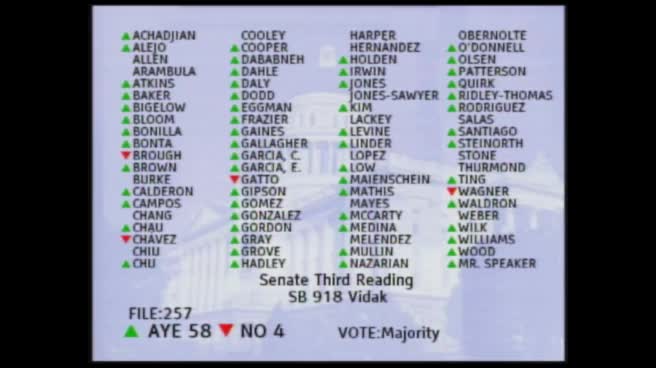 4MIN
Assembly Floor
 4MIN
Assembly Standing Committee on Appropriations
 4MIN
Senate Floor
Bill Author

Bill Co-Author(s):