SB 420: Property tax: welfare exemption: detention facilities.
- Session Year: 2025-2026
- House: Senate
- Latest Version Date: 2026-09-29
Current Status:
Passed
(2026-09-29: Chaptered by Secretary of State. Chapter 750, Statutes of 2026.)
Introduced
In Committee
Awaiting First Chamber Vote
Passed First Chamber
In Committee
Awaiting Second Chamber Vote
Passed Second Chamber
Enacted
The California Constitution authorizes the Legislature to exempt from taxation, in whole or in part, property that is used exclusively for religious, hospital, or charitable purposes, and is owned or held in trust by a nonprofit entity. Pursuant to that authority, existing law provides for a welfare exemption under which property used exclusively for an exempt purpose and owned and operated by specified entities, including foundations, limited liability companies, or corporations meeting certain statutory requirements is exempt from taxation.
This bill would specify that for the purposes of the welfare exemption provisions above, property used exclusively for religious, hospital, scientific, or charitable purposes shall not include property, or any portion thereof, operated as a detention facility, as defined. The bill would declare that the above provision is declarative of, and not a change in, existing law.
The California Constitution authorizes the Legislature to exempt from taxation, in whole or in part, property that is used exclusively for religious, hospital, or charitable purposes, and is owned or held in trust by a nonprofit entity. Pursuant to that authority, existing law provides for a welfare exemption under which property used exclusively for an exempt purpose and owned and operated by specified entities, including foundations, limited liability companies, or corporations meeting certain statutory requirements is exempt from taxation.
This bill would specify that for the purposes of the welfare exemption provisions above, property used exclusively for religious, hospital, scientific, or charitable purposes shall not include property, or any portion thereof, operated as a detention facility, as defined, by a for-profit entity. defined. The bill would declare that the above provision is declarative of, and not a change in, existing law.
The California Constitution authorizes the Legislature to exempt from taxation, in whole or in part, property that is used exclusively for religious, hospital, or charitable purposes, and is owned or held in trust by a nonprofit entity. Pursuant to that authority, existing law provides for a welfare exemption under which property used exclusively for an exempt purpose and owned and operated by specified entities, including foundations, limited liability companies, or corporations meeting certain statutory requirements is exempt from taxation.
This bill would specify that for the purposes of the welfare exemption provisions above, property used exclusively for religious, hospital, scientific, or charitable purposes shall not include property, or any portion thereof, operated as a detention facility, as defined, by a for-profit entity. The bill would declare that the above provision is declarative of, and not a change in, existing law.
The California AI Transparency Act requires a covered provider, as defined, of a generative artificial intelligence system to make available an AI detection tool at no cost to the user that meets certain criteria, including that the tool outputs any system provenance data, as defined, that is detected in the content. The California Consumer Privacy Act of 2018 grants a consumer various rights with respect to personal information that is collected or sold by a business, as defined, including the right to direct a business that sells or shares personal information about the consumer to third parties not to sell or share the consumers personal information, as specified.This bill would generally regulate a developer or a deployer of a high-risk automated decision system, as defined, including by requiring a developer or a deployer to perform an impact assessment on the high-risk automated decision system before making it publicly available or deploying it, as prescribed. The bill would require a state agency to require a developer of a high-risk automated decision system deployed by the state agency to provide to the state agency a copy of the impact assessment and would require the state agency to keep that impact assessment confidential. The bill would also require a developer to provide to the Attorney General or Civil Rights Department, within 30 days of a request from the Attorney General or the Civil Rights Department, a copy of an impact assessment and would require the impact assessment to be kept confidential.This bill would authorize the Attorney General or the Civil Rights Department to bring a specified civil action to enforce compliance with the bill, as prescribed, and would authorize the Attorney General or the Civil Rights Department to allow a developer or deployer to cure, within 45 days of receiving a certain notice of a violation, the noticed violation, as prescribed.This bill would prohibit a state agency from awarding a contract for a high-risk automated decision system unless the person to whom the contract is awarded has certified that the high-risk automated decision system does not violate, among other civil rights laws, the bill. By expanding the scope of the crime of perjury, this bill would impose a state-mandated local program.Existing constitutional provisions require that a statute that limits the right of access to the meetings of public bodies or the writings of public officials and agencies be adopted with findings demonstrating the interest protected by the limitation and the need for protecting that interest.This bill would make legislative findings to that effect.The California Constitution requires the state to reimburse local agencies and school districts for certain costs mandated by the state. Statutory provisions establish procedures for making that reimbursement.This bill would provide that no reimbursement is required by this act for a specified reason.The California AI Transparency Act requires a covered provider, as defined, of a generative artificial intelligence system to make available an AI detection tool at no cost to the user that meets certain criteria, including that the tool outputs any system provenance data, as defined, that is detected in the content. The California Consumer Privacy Act of 2018 grants a consumer various rights with respect to personal information that is collected or sold by a business, as defined, including the right to direct a business that sells or shares personal information about the consumer to third parties not to sell or share the consumers personal information, as specified.
This bill would generally regulate a developer or a deployer of a high-risk automated decision system, as defined, including by requiring a developer or a deployer to perform an impact assessment on the high-risk automated decision system before making it publicly available or deploying it, as prescribed. The bill would require a state agency to require a developer of a high-risk automated decision system deployed by the state agency to provide to the state agency a copy of the impact assessment and would require the state agency to keep that impact assessment confidential. The bill would also require a developer to provide to the Attorney General or Civil Rights Department, within 30 days of a request from the Attorney General or the Civil Rights Department, a copy of an impact assessment and would require the impact assessment to be kept confidential.
This bill would authorize the Attorney General or the Civil Rights Department to bring a specified civil action to enforce compliance with the bill, as prescribed, and would authorize the Attorney General or the Civil Rights Department to allow a developer or deployer to cure, within 45 days of receiving a certain notice of a violation, the noticed violation and provide an express written statement, made under penalty of perjury, that the violation has been cured. By expanding the scope of the crime of perjury, this bill would impose a state-mandated local program. violation, as prescribed.
This bill would prohibit a state agency from awarding a contract for a high-risk automated decision system to a person who has violated, unless the person to whom the contract is awarded has certified that the high-risk automated decision system does not violate, among other civil rights laws, the bill. By expanding the scope of the crime of perjury, this bill would impose a state-mandated local program.
Existing constitutional provisions require that a statute that limits the right of access to the meetings of public bodies or the writings of public officials and agencies be adopted with findings demonstrating the interest protected by the limitation and the need for protecting that interest.
This bill would make legislative findings to that effect.
The California Constitution requires the state to reimburse local agencies and school districts for certain costs mandated by the state. Statutory provisions establish procedures for making that reimbursement.
This bill would provide that no reimbursement is required by this act for a specified reason.
The California AI Transparency Act requires a covered provider, as defined, of a generative artificial intelligence system to make available an AI detection tool at no cost to the user that meets certain criteria, including that the tool outputs any system provenance data, as defined, that is detected in the content. The California Consumer Privacy Act of 2018 grants a consumer various rights with respect to personal information that is collected or sold by a business, as defined, including the right to direct a business that sells or shares personal information about the consumer to third parties not to sell or share the consumers personal information, as specified.
This bill would express the intent of the Legislature to enact legislation that would relate to strengthening, establishing, and promoting certain rights and values related to artificial intelligence.This bill would generally regulate a developer or a deployer of a high-risk automated decision system, as defined, including by requiring a developer or a deployer to perform an impact assessment on the high-risk automated decision system before making it publicly available or deploying it, as prescribed. The bill would require a state agency to require a developer of a high-risk automated decision system deployed by the state agency to provide to the state agency a copy of the impact assessment and would require the state agency to keep that impact assessment confidential. The bill would also require a developer to provide to the Attorney General or Civil Rights Department, within 30 days of a request from the Attorney General or the Civil Rights Department, a copy of an impact assessment and would require the impact assessment to be kept confidential.
This bill would authorize the Attorney General or the Civil Rights Department to bring a specified civil action to enforce compliance with the bill, as prescribed, and would authorize a developer or deployer to cure, within 45 days of receiving a certain notice of a violation, the noticed violation and provide an express written statement, made under penalty of perjury, that the violation has been cured. By expanding the scope of the crime of perjury, this bill would impose a state-mandated local program.
This bill would prohibit a state agency from awarding a contract for a high-risk automated decision system to a person who has violated, among other civil rights laws, the bill.
Existing constitutional provisions require that a statute that limits the right of access to the meetings of public bodies or the writings of public officials and agencies be adopted with findings demonstrating the interest protected by the limitation and the need for protecting that interest.
This bill would make legislative findings to that effect.
The California Constitution requires the state to reimburse local agencies and school districts for certain costs mandated by the state. Statutory provisions establish procedures for making that reimbursement.
This bill would provide that no reimbursement is required by this act for a specified reason.
The California AI Transparency Act requires a covered provider, as defined, of a generative artificial intelligence system to make available an AI detection tool at no cost to the user that meets certain criteria, including that the tool outputs any system provenance data, as defined, that is detected in the content. The California Consumer Privacy Act of 2018 grants a consumer various rights with respect to personal information that is collected or sold by a business, as defined, including the right to direct a business that sells or shares personal information about the consumer to third parties not to sell or share the consumers personal information, as specified.
This bill would express the intent of the Legislature to enact legislation that would relate to strengthening, establishing, and promoting certain rights and values related to artificial intelligence.
(a)For purposes of Section 214, property used exclusively for religious, hospital, scientific, or charitable purposes shall not include property, or any portion thereof, operated as a detention facility.
(b)For purposes of this section, detention facility shall have the same meaning as is provided in Section 9500 of the Penal Code.
(c)The Legislature finds and declares that this section does not constitute a change in, but is declaratory of, existing law.
(a)For purposes of Section 214, property used exclusively for religious, hospital, scientific, or charitable purposes shall not include property, or any portion thereof, operated as a detention facility by a for-profit entity. facility.
(b)For purposes of this section, detention facility shall have the same meaning as is provided in Section 9500 of the Penal Code.
(c)The Legislature finds and declares that this section does not constitute a change in, but is declaratory of, existing law.
REVISIONS: HeadingLines 2 and 4.(a)For purposes of Section 214, property used exclusively for religious, hospital, scientific, or charitable purposes shall not include property, or any portion thereof, operated as a detention facility by a for-profit entity.
(b)For purposes of this section, detention facility shall have the same meaning as is provided in Section 9500 of the Penal Code.
(c)The Legislature finds and declares that this section does not constitute a change in, but is declaratory of, existing law.
SECTION 1.The Legislature finds and declares all of the following:(a)(1)Artificial intelligence technologies are becoming an integral part of daily life in California and have profound implications for privacy, equity, fairness, and public safety.(2)It is critical to protect individuals rights to safeguard against potential harms, including discrimination, privacy violations, and unchecked automation in critical decisionmaking processes.(3)A comprehensive set of rights must be established to ensure artificial intelligence technologies align with the public interest and reflect the values of California residents.(b)(1)Individuals should have the right to receive a clear and accessible explanation about how artificial intelligence systems operate, including the data they use and the decisions they make.(2)An entity that uses artificial intelligence systems to make decisions impacting California residents should provide a mechanism to inform individuals of the systems logic, processing methods, and intended outcomes in a manner that is understandable.(c)(1)All individuals have the right to control their personal data in relation to artificial intelligence systems. Artificial intelligence systems should operate with the highest standards of data privacy and security, in line with the California Consumer Privacy Act of 2018 and other relevant privacy laws.(2)Before personal data is used in artificial intelligence systems, entities should obtain informed, explicit consent from individuals, and individuals should have the right to withdraw consent at any time without penalty.(3)Entities should ensure that personal data used by artificial intelligence systems is anonymized or pseudonymized if feasible, and data retention should be limited to the purposes for which the data was initially collected.(d)(1)Artificial intelligence systems should not discriminate against individuals based on race, gender, sexual orientation, disability, religion, socioeconomic status, or other protected characteristics under California law.(2)Entities deploying artificial intelligence technologies should perform regular audits to identify and address any biases or inequities in their artificial intelligence systems and should ensure that artificial intelligence systems are designed and trained to promote fairness and equal treatment.(e)(1)Individuals should have the right to hold entities accountable for any harm caused by artificial intelligence systems, and entities should be liable for the actions and decisions made by artificial intelligence technologies they deploy.(2)An individual or group adversely affected by artificial intelligence-driven decisions should have access to a straightforward and transparent process for seeking redress, including the ability to challenge those decisions through human review and appeal mechanisms.(f)(1)Individuals should have the right to request human oversight for significant decisions made by artificial intelligence systems that impact them, particularly in areas such as employment, health care, housing, education, and criminal justice.(2)Artificial intelligence systems in high-stakes decisionmaking contexts should involve human review or intervention before final decisions, ensuring that automated decisions align with human values and public policy goals.SEC. 2.Chapter 24.6 (commencing with Section 22756) is added to Division 8 of the Business and Professions Code, to read:24.6.Automated Decision Systems22756.As used in this chapter:(a)Algorithmic discrimination means the condition in which an automated decision system contributes to unlawful discrimination on the basis of a protected classification.(b)Artificial intelligence means an engineered or machine-based system that varies in its level of autonomy and that can, for explicit or implicit objectives, infer from the input it receives how to generate outputs that can influence physical or virtual environments.(c)(1)Automated decision system means a computational process derived from machine learning, statistical modeling, data analytics, or artificial intelligence that issues simplified output, including a score, classification, or recommendation, that is used to assist or replace human discretionary decisionmaking and materially impacts natural persons.(2)Automated decision system does not mean a spam email filter, firewall, antivirus software, identity and access management tool, calculator, database, dataset, or other compilation of data.(d)Deployer means a natural person or entity that uses a high-risk automated decision system in the state.(e)Detecting decisionmaking patterns without influencing outcomes means the act of artificial intelligence analyzing patterns for informational purposes without direct influence on decisions.(f)Developer means a natural person or entity that designs, codes, produces, or makes a substantial modification to a high-risk automated decision system for use in the state.(g)Education enrollment or opportunity means the chance to obtain admission, accreditation, evaluation, certification, vocational training, financial aid, or scholarships with respect to an educational opportunity.(h)Employment or employment opportunity means hiring, salary, wage, or other material term, condition, or privilege of an employees employment.(i)Health care means health care services or insurance for health, mental health, dental, or vision.(j)(1)High-risk automated decision system means an automated decision system that is used to assist or replace human discretionary decisions that have a legal or similarly significant effect, including decisions that materially impact access to, or approval for, any of the following:(A)Education enrollment or opportunity.(B)Employment or employment opportunity.(C)Essential utilities.(D)Temporary, short-term, or long-term housing.(E)Health care services.(F)Lending services.(G)A legal right or service.(H)An essential government service.(2)High-risk automated decision system does not include an automated decision system that only performs narrow procedural tasks, enhances human activities, detects patterns without influencing decisions, or assists in preparatory tasks for assessment.(k)Improving results of previously completed human activities means the act of artificial intelligence enhancing existing human-performed tasks without altering decisions.(l)Narrow procedural task means a limited, procedural task that has a minimal impact on outcomes.(m)Preparatory task for assessment means a task in which an artificial intelligence aids in a preparatory task for assessment or evaluation without direct decisionmaking authority.(n)Protected classification means a classification protected under existing law prohibiting discrimination, including, but not limited to, the California Fair Employment and Housing Act (Chapter 7 (commencing with Section 12960) of Part 2.8 of Division 3 of Title 2 of the Government Code) or the Unruh Civil Rights Act (Section 51 of the Civil Code).(o)(1)State agency means any of the following:(A)A state office, department, division, or bureau.(B)The California State University.(C)The Board of Parole Hearings.(D)A board or other professional licensing and regulatory body under the administration or oversight of the Department of Consumer Affairs.(2)State agency does not include the University of California, the Legislature, the judicial branch, or a board that is not described in paragraph (1).(p)Substantial modification means a new version, release, or other significant update that materially changes the functionality or performance of a high-risk automated decision system, including the results of retraining.22756.1.(a)(1)For a high-risk automated decision system made publicly available for use on or after January 1, 2026, a developer shall perform an impact assessment on the high-risk automated decision system before making the high-risk automated decision system publicly available for use.(2)For a high-risk automated decision system first made publicly available for use before January 1, 2026, a developer shall perform an impact assessment on or before January 1, 2028.(b)(1)Except as provided in paragraph (2), for a high-risk automated decision system first deployed after January 1, 2026, a deployer shall perform an impact assessment within two years of deploying the high-risk automated decision system.(2)A state agency that is a deployer may opt out of performing an impact assessment if the state agency uses the automated decision system only for its intended use as determined by the developer and all of the following requirements are met:(A)The state agency does not make a substantial modification to the high-risk automated decision system.(B)The developer of the high-risk automated decision system is in compliance with Section 10285.8 of the Public Contract Code and subdivision (d).(C)The state agency does not have a reasonable basis to believe that deployment of the high-risk automated decision system as intended by the developer is likely to result in algorithmic discrimination.(D)The state agency is in compliance with Section 22756.4.(c)A developer shall make available to deployers and potential deployers the statements included in the developers impact assessment pursuant to Section 22756.2.(d)(1)A state agency shall require a developer of a high-risk automated decision system deployed by the state agency to provide to the state agency a copy of the impact assessment conducted pursuant to this section.(2)Notwithstanding any other law, an impact assessment provided to a state agency pursuant to this subdivision shall be kept confidential.22756.2.An impact assessment prepared pursuant to this chapter shall include all of the following:(a)A statement of the purpose of the high-risk automated decision system and its intended benefits, intended uses, and intended deployment contexts.(b)A description of the high-risk automated decision systems intended outputs.(c)A summary of the types of data intended to be used as inputs to the high-risk automated decision system and any processing of those data inputs recommended to ensure the intended functioning of the high-risk automated decision system.(d)A summary of reasonably foreseeable potential disproportionate or unjustified impacts on a protected classification from the intended use by deployers of the high-risk automated decision system.(e)A developers impact assessment shall also include both of the following:(1)A description of safeguards implemented or other measures taken to mitigate and guard against risks known to the developer of algorithmic discrimination arising from the use of the high-risk automated decision system.(2)A description of how the high-risk automated decision system can be monitored by a deployer for risks of algorithmic discrimination known to the developer.(f)A statement of the extent to which the deployers use of the high-risk automated decision system is consistent with, or varies from, the developers statement of the high-risk automated decision systems purpose and intended benefits, intended uses, and intended deployment contexts.(g)A description of safeguards implemented or other measures taken to mitigate and guard against any known risks of discrimination arising from the high-risk automated decision system.(h)A description of how the high-risk automated decision system has been, and will be, monitored and evaluated.22756.3.(a)If a deployer uses a high-risk automated decision system to make a decision regarding a natural person, the deployer shall notify the natural person of that fact and disclose to that natural person all of the following:(1)The purpose of the high-risk automated decision system and the specific decision it was used to make.(2)How the high-risk automated decision system was used to make the decision.(3)The type of data used by the high-risk automated decision system.(4)Contact information for the deployer.(5)A link to the statement required by subdivision (b).(b)A deployer shall make available on its internet website a statement summarizing all of the following:(1)The types of high-risk automated decision systems it currently deploys.(2)How the deployer manages known or reasonably foreseeable risks of algorithmic discrimination arising from the deployment of those high-risk automated decision systems.(3)The nature and source of the information collected and used by the high-risk automated decision systems deployed by the deployer.(c)A deployer shall provide, as technically feasible, a natural person that is the subject of a decision made by a high-risk automated decision system an opportunity to appeal that decision for review by a natural person.22756.4.(a)A developer or a deployer shall establish, document, implement, and maintain a governance program that does all of the following:(1)Contains reasonable administrative and technical safeguards to govern the reasonably foreseeable risks of algorithmic discrimination associated with the use, or intended use, of a high-risk automated decision system.(2)Aligns with existing standards and frameworks, including the National Institute of Standards and Technology AI Risk Management Framework.(3)Specifies and incorporates the principles, processes, and personnel used to identify, document, and mitigate foreseeable risks of algorithmic discrimination.(4)Is regularly reviewed and updated.(5)Includes a structural framework for documenting, investigating, and resolving incidents.(b)The governance program required by this section shall be appropriately designed with respect to all of the following:(1)The use, or intended use, of the high-risk automated decision system.(2)The size, complexity, and resources of the deployer or developer.(3)The nature, context, and scope of the activities of the deployer or developer in connection with the high-risk automated decision system.(4)The technical feasibility and cost of available tools, assessments, and other means used by a deployer or developer to map, measure, manage, and govern the risks associated with a high-risk automated decision system.22756.5.(a)A developer or deployer is not required to disclose information under this chapter if the disclosure of that information would result in the waiver of a legal privilege or the disclosure of a trade secret, as defined in Section 3426.1 of the Civil Code.(b)If a disclosure is not made because the disclosure would reveal a trade secret, the developer or deployer shall notify the party to whom the disclosure would have otherwise been made of the basis for which the disclosure was not made.22756.6.(a)Except as provided in subdivision (b), a deployer or developer shall not deploy or make available for deployment a high-risk automated decision system if the impact assessment performed pursuant to this chapter determines that the high-risk automated decision system is likely to result in algorithmic discrimination.(b)(1)A deployer or developer may deploy or make available for deployment a high-risk automated decision system if the impact assessment performed pursuant to this chapter determines that the high-risk automated decision system will result in algorithmic discrimination if the deployer or developer implements safeguards to mitigate the known risks of algorithmic discrimination.(2)A deployer or developer acting under the exception provided by paragraph (1) shall perform an updated impact assessment to verify that the algorithmic discrimination has been mitigated and is not reasonably likely to occur.22756.7.(a)(1)A developer shall provide to the Attorney General or Civil Rights Department, within 30 days of a request from the Attorney General or the Civil Rights Department, a copy of an impact assessment performed pursuant to this chapter.(2)Notwithstanding any other law, an impact assessment provided to the Attorney General or Civil Rights Department pursuant to this subdivision shall be kept confidential.(b)The Attorney General or the Civil Rights Department may bring a civil action against a deployer or developer for a violation of this chapter and obtain any of the following relief:(1)(A)If a developer or deployer fails to conduct an impact assessment as required under this chapter, a civil penalty of two thousand five hundred dollars ($2,500) for a defendant with fewer than 100 employees, five thousand dollars ($5,000) if the defendant has fewer than 500 employees, and ten thousand dollars ($10,000) if the defendant has at least 500 employees.(B)If a violation is intentional, the civil penalty pursuant to this paragraph shall increase by five hundred dollars ($500) for each day that the defendant is noncompliant.(2)Injunctive relief.(3)Reasonable attorneys fees and costs.(4)If the violation concerns algorithmic discrimination, a civil penalty of twenty-five thousand dollars ($25,000) per violation.(c)(1)Before commencing an action pursuant to this section, the Attorney General or the Civil Rights Department shall provide 45 days written notice to a deployer or developer of any alleged violation of this chapter.(2)The Attorney General or the Civil Rights Department may, at its discretion, provide to a developer or a deployer with a time period to cure the alleged violation after considering all of the following:(A)A lack of intent to commit the violation.(B)Voluntary efforts undertaken to cure the alleged violation before being notified of the violation.(C)The size and economic resources of the noncompliant developer or deployer.(D)The size and scope of the impact of the decisions made by an automated decision system related to the violation.22756.8.This chapter does not apply to either of the following:(a)An entity with 50 or fewer employees.(b)A high-risk automated decision system that has been approved, certified, or cleared by a federal agency that complies with another law that is substantially the same or more stringent than this chapter.SEC. 3.Article 11 (commencing with Section 10285.8) is added to Chapter 1 of Part 2 of Division 2 of the Public Contract Code, to read:11.High-Risk Automated Decision Systems10285.8.(a)A state agency shall not award a contract for a high-risk automated decision system unless the person to whom the contract is awarded has certified that the high-risk automated decision system does not violate any of the following:(1)The Unruh Civil Rights Act (Section 51 of the Civil Code).(2)The California Fair Employment and Housing Act (Chapter 7 (commencing with Section 12960) of Part 2.8 of Division 3 of Title 2 of the Government Code).(3)Chapter 24.6 (commencing with Section 22756) of Division 8 of the Business and Professions Code.(b)As used in this section, high-risk automated decision system has the same meaning as defined in Section 22756 of the Business and Professions Code.SEC. 4.The Legislature finds and declares that Section 2 of this act, which adds Chapter 24.6 (commencing with Section 22756) to Division 8 of the Business and Professions Code, imposes a limitation on the publics right of access to the meetings of public bodies or the writings of public officials and agencies within the meaning of Section 3 of Article I of the California Constitution. Pursuant to that constitutional provision, the Legislature makes the following findings to demonstrate the interest protected by this limitation and the need for protecting that interest:To avoid unduly disrupting commerce, it is necessary that trade secrets be protected.SEC. 5.No reimbursement is required by this act pursuant to Section 6 of Article XIIIB of the California Constitution because the only costs that may be incurred by a local agency or school district will be incurred because this act creates a new crime or infraction, eliminates a crime or infraction, or changes the penalty for a crime or infraction, within the meaning of Section 17556 of the Government Code, or changes the definition of a crime within the meaning of Section 6 of Article XIIIB of the California Constitution.The Legislature finds and declares all of the following:
(a)(1)Artificial intelligence technologies are becoming an integral part of daily life in California and have profound implications for privacy, equity, fairness, and public safety.
(2)It is critical to protect individuals rights to safeguard against potential harms, including discrimination, privacy violations, and unchecked automation in critical decisionmaking processes.
(3)A comprehensive set of rights must be established to ensure artificial intelligence technologies align with the public interest and reflect the values of California residents.
(b)(1)Individuals should have the right to receive a clear and accessible explanation about how artificial intelligence systems operate, including the data they use and the decisions they make.
(2)An entity that uses artificial intelligence systems to make decisions impacting California residents should provide a mechanism to inform individuals of the systems logic, processing methods, and intended outcomes in a manner that is understandable.
(c)(1)All individuals have the right to control their personal data in relation to artificial intelligence systems. Artificial intelligence systems should operate with the highest standards of data privacy and security, in line with the California Consumer Privacy Act of 2018 and other relevant privacy laws.
(2)Before personal data is used in artificial intelligence systems, entities should obtain informed, explicit consent from individuals, and individuals should have the right to withdraw consent at any time without penalty.
(3)Entities should ensure that personal data used by artificial intelligence systems is anonymized or pseudonymized if feasible, and data retention should be limited to the purposes for which the data was initially collected.
(d)(1)Artificial intelligence systems should not discriminate against individuals based on race, gender, sexual orientation, disability, religion, socioeconomic status, or other protected characteristics under California law.
(2)Entities deploying artificial intelligence technologies should perform regular audits to identify and address any biases or inequities in their artificial intelligence systems and should ensure that artificial intelligence systems are designed and trained to promote fairness and equal treatment.
(e)(1)Individuals should have the right to hold entities accountable for any harm caused by artificial intelligence systems, and entities should be liable for the actions and decisions made by artificial intelligence technologies they deploy.
(2)An individual or group adversely affected by artificial intelligence-driven decisions should have access to a straightforward and transparent process for seeking redress, including the ability to challenge those decisions through human review and appeal mechanisms.
(f)(1)Individuals should have the right to request human oversight for significant decisions made by artificial intelligence systems that impact them, particularly in areas such as employment, health care, housing, education, and criminal justice.
(2)Artificial intelligence systems in high-stakes decisionmaking contexts should involve human review or intervention before final decisions, ensuring that automated decisions align with human values and public policy goals.
SEC. 2.Chapter 24.6 (commencing with Section 22756) is added to Division 8 of the Business and Professions Code, to read:24.6.Automated Decision Systems22756.As used in this chapter:
(a)Algorithmic discrimination means the condition in which an automated decision system contributes to unlawful discrimination on the basis of a protected classification.
(b)Artificial intelligence means an engineered or machine-based system that varies in its level of autonomy and that can, for explicit or implicit objectives, infer from the input it receives how to generate outputs that can influence physical or virtual environments.
(c)(1)Automated decision system means a computational process derived from machine learning, statistical modeling, data analytics, or artificial intelligence that issues simplified output, including a score, classification, or recommendation, that is used to assist or replace human discretionary decisionmaking and materially impacts natural persons.
(2)Automated decision system does not mean a spam email filter, firewall, antivirus software, identity and access management tool, calculator, database, dataset, or other compilation of data.
(d)Deployer means a natural person or entity that uses a high-risk automated decision system in the state.
(e)Detecting decisionmaking patterns without influencing outcomes means the act of artificial intelligence analyzing patterns for informational purposes without direct influence on decisions.
(f)Developer means a natural person or entity that designs, codes, produces, or substantially modifies makes a substantial modification to a high-risk automated decision system for use in the state.
(g)Education enrollment or opportunity means the chance to obtain admission, accreditation, evaluation, certification, vocational training, financial aid, or scholarships with respect to an educational opportunity.
(h)Employment or employment opportunity means hiring, salary, wage, or other material term, condition, or privilege of an employees employment.
(i)Health care means health care services or insurance for health, mental health, dental, or vision.
(j)(1)High-risk automated decision system means an automated decision system that is used to assist or replace human discretionary decisions that have a legal or similarly significant effect, including decisions that materially impact access to, or approval for, any of the following:
(A)Education enrollment or opportunity.
(B)Employment or employment opportunity.
(C)Essential utilities.
(D)Temporary, short-term, or long-term housing.
(E)Health care services.
(F)Lending services.
(G)A legal right or service.
(H)An essential government service.
(2)High-risk automated decision system does not include an automated decision system that only performs narrow procedural tasks, enhances human activities, detects patterns without influencing decisions, or assists in preparatory tasks for assessment.
(k)Improving results of previously completed human activities means the act of artificial intelligence enhancing existing human-performed tasks without altering decisions.
(l)Narrow procedural task means a limited, procedural task that has a minimal impact on outcomes.
(m)Preparatory task for assessment means a task in which an artificial intelligence aids in a preparatory task for assessment or evaluation without direct decisionmaking authority.
(n)Protected classification means a classification protected under existing law prohibiting discrimination, including, but not limited to, the California Fair Employment and Housing Act (Chapter 7 (commencing with Section 12960) of Part 2.8 of Division 3 of Title 2 of the Government Code) or the Unruh Civil Rights Act (Section 51 of the Civil Code).
(o)(1)State agency means any of the following:
(A)A state office, department, division, or bureau.
(B)The California State University.
(C)The Board of Parole Hearings.
(D)A board or other professional licensing and regulatory body under the administration or oversight of the Department of Consumer Affairs.
(2)State agency does not include the University of California, the Legislature, the judicial branch, or a board that is not described in paragraph (1).
(p)Substantial modification means a new version, release, or other significant update that materially changes the functionality or performance of a high-risk automated decision system, including the results of retraining.
22756.1.(a)(1)For a high-risk automated decision system made publicly available for use on or after January 1, 2026, a developer shall perform an impact assessment on the high-risk automated decision system before making the high-risk automated decision system publicly available for use.
(2)For a high-risk automated decision system first made publicly available for use before January 1, 2026, a developer shall perform an impact assessment if the developer makes a substantial modification to the high-risk automated decision system. on or before January 1, 2028.
(b)(1)Except as provided in paragraph (2), for a high-risk automated decision system first deployed after January 1, 2026, a deployer shall perform an impact assessment within two years of deploying the high-risk automated decision system.
(2)A state agency that is a deployer may opt out of performing an impact assessment if the state agency uses the automated decision system only for its intended use as determined by the developer and all of the following requirements are met:
(A)The state agency does not make a substantial modification to the high-risk automated decision system.
(B)The developer of the high-risk automated decision system is in compliance with Section 10285.8 of the Public Contract Code and subdivision (d).
(C)The state agency does not have a reasonable basis to believe that deployment of the high-risk automated decision system as intended by the developer is likely to result in algorithmic discrimination.
(D)The state agency is in compliance with Section 22756.3. 22756.4.
(c)(1)A developer shall make available to deployers and potential deployers the statements included in the developers impact assessment pursuant to paragraph (2). Section 22756.2.
(2)An impact assessment prepared pursuant to this section shall include all of the following:(A)A statement of the purpose of the high-risk automated decision system and its intended benefits, intended uses, and intended deployment contexts.(B)A description of the high-risk automated decision systems intended outputs.(C)A summary of the types of data intended to be used as inputs to the high-risk automated decision system and any processing of those data inputs recommended to ensure the intended functioning of the high-risk automated decision system.(D)A summary of reasonably foreseeable potential disproportionate or unjustified impacts on a protected classification from the intended use by deployers of the high-risk automated decision system.(E)A developers impact assessment shall also include both of the following:(i)A description of safeguards implemented or other measures taken by the developer to mitigate and guard against risks known to the developer of algorithmic discrimination arising from the use of the high-risk automated decision system.(ii)A description of how the high-risk automated decision system can be monitored by a deployer for risks of algorithmic discrimination known to the developer.(F)A statement of the extent to which the deployers use of the high-risk automated decision system is consistent with, or varies from, the developers statement of the high-risk automated decision systems purpose and intended benefits, intended uses, and intended deployment contexts.(G)A description of safeguards implemented or other measures taken to mitigate and guard against any known risks to the deployer of discrimination arising from the high-risk automated decision system.(H)A description of how the high-risk automated decision system has been, and will be, monitored and evaluated.(d)(1)A state agency shall require a developer of a high-risk automated decision system deployed by the state agency to provide to the state agency a copy of the impact assessment conducted pursuant to this section.
(2)Notwithstanding any other law, an impact assessment provided to a state agency pursuant to this subdivision shall be kept confidential.
22756.2.An impact assessment prepared pursuant to this chapter shall include all of the following:
(a)A statement of the purpose of the high-risk automated decision system and its intended benefits, intended uses, and intended deployment contexts.
(b)A description of the high-risk automated decision systems intended outputs.
(c)A summary of the types of data intended to be used as inputs to the high-risk automated decision system and any processing of those data inputs recommended to ensure the intended functioning of the high-risk automated decision system.
(d)A summary of reasonably foreseeable potential disproportionate or unjustified impacts on a protected classification from the intended use by deployers of the high-risk automated decision system.
(e)A developers impact assessment shall also include both of the following:
(1)A description of safeguards implemented or other measures taken to mitigate and guard against risks known to the developer of algorithmic discrimination arising from the use of the high-risk automated decision system.
(2)A description of how the high-risk automated decision system can be monitored by a deployer for risks of algorithmic discrimination known to the developer.
(f)A statement of the extent to which the deployers use of the high-risk automated decision system is consistent with, or varies from, the developers statement of the high-risk automated decision systems purpose and intended benefits, intended uses, and intended deployment contexts.
(g)A description of safeguards implemented or other measures taken to mitigate and guard against any known risks of discrimination arising from the high-risk automated decision system.
(h)A description of how the high-risk automated decision system has been, and will be, monitored and evaluated.
22756.2.22756.3.(a)If a deployer uses a high-risk automated decision system to make a decision regarding a natural person, the deployer shall notify the natural person of that fact and disclose to that natural person all of the following:
(1)The purpose of the high-risk automated decision system and the specific decision it was used to make.
(2)How the high-risk automated decision system was used to make the decision.
(3)The type of data used by the high-risk automated decision system.
(4)Contact information for the deployer.
(5)A link to the statement required by subdivision (b).
(b)A deployer shall make available on its internet website a statement summarizing all of the following:
(1)The types of high-risk automated decision systems it currently deploys.
(2)How the deployer manages known or reasonably foreseeable risks of algorithmic discrimination arising from the deployment of those high-risk automated decision systems.
(3)The nature and source of the information collected and used by the high-risk automated decision systems deployed by the deployer.
(c)A deployer shall provide, as technically feasible, a natural person that is the subject of a decision made by a high-risk automated decision system an opportunity to appeal that decision for review by a natural person.
22756.3.22756.4.(a)A developer or a deployer shall establish, document, implement, and maintain a governance program that contains reasonable administrative and technical safeguards to govern the reasonably foreseeable risks of algorithmic discrimination associated with the use, or intended use, of a high-risk automated decision system. does all of the following:
(1)Contains reasonable administrative and technical safeguards to govern the reasonably foreseeable risks of algorithmic discrimination associated with the use, or intended use, of a high-risk automated decision system.
(2)Aligns with existing standards and frameworks, including the National Institute of Standards and Technology AI Risk Management Framework.
(3)Specifies and incorporates the principles, processes, and personnel used to identify, document, and mitigate foreseeable risks of algorithmic discrimination.
(4)Is regularly reviewed and updated.
(5)Includes a structural framework for documenting, investigating, and resolving incidents.
(b)The governance program required by this subdivision section shall be appropriately designed with respect to all of the following:
(1)The use, or intended use, of the high-risk automated decision system.
(2)The size, complexity, and resources of the deployer or developer.
(3)The nature, context, and scope of the activities of the deployer or developer in connection with the high-risk automated decision system.
(4)The technical feasibility and cost of available tools, assessments, and other means used by a deployer or developer to map, measure, manage, and govern the risks associated with a high-risk automated decision system.
22756.4.22756.5.(a)A developer or deployer is not required to disclose information under this chapter if the disclosure of that information would result in the waiver of a legal privilege or the disclosure of a trade secret, as defined in Section 3426.1 of the Civil Code.
(b)If a disclosure is not made because the disclosure would reveal a trade secret, the developer or deployer shall notify the party to whom the disclosure would have otherwise been made of the basis for which the disclosure was not made.
22756.5.22756.6.(a)Except as provided in subdivision (b), a deployer or developer shall not deploy or make available for deployment a high-risk automated decision system if the impact assessment performed pursuant to this chapter determines that the high-risk automated decision system is likely to result in algorithmic discrimination.
(b)(1)A deployer or developer may deploy or make available for deployment a high-risk automated decision system if the impact assessment performed pursuant to this chapter determines that the high-risk automated decision system will result in algorithmic discrimination if the deployer or developer implements safeguards to mitigate the known risks of algorithmic discrimination.
(2)A deployer or developer acting under the exception provided by paragraph (1) shall perform an updated impact assessment to verify that the algorithmic discrimination has been mitigated and is not reasonably likely to occur.
22756.6.22756.7.(a)(1)A developer shall provide to the Attorney General or Civil Rights Department, within 30 days of a request from the Attorney General or the Civil Rights Department, a copy of an impact assessment performed pursuant to this chapter.
(2)Notwithstanding any other law, an impact assessment provided to the Attorney General or Civil Rights Department pursuant to this subdivision shall be kept confidential.
(b)The Attorney General or the Civil Rights Department may bring a civil action against a deployer or developer for a violation of this chapter and obtain any of the following relief:
(1)(A)If a developer or deployer fails to conduct an impact assessment as required under this chapter, a civil penalty of two thousand five hundred dollars ($2,500) for a defendant with fewer than 100 employees, five thousand dollars ($5,000) if the defendant has fewer than 500 employees, and ten thousand dollars ($10,000) if the defendant has at least 500 employees.
(B)If a violation is intentional, the civil penalty pursuant to this paragraph shall increase by five hundred dollars ($500) for each day that the defendant is noncompliant.
(2)Injunctive relief.
(3)Reasonable attorneys fees and costs.
(4)If the violation concerns algorithmic discrimination, a civil penalty of twenty-five thousand dollars ($25,000) per violation.
(c)(1)Before commencing an action pursuant to this section, the Attorney General or the Civil Rights Department shall provide 45 days written notice to a deployer or developer of any alleged violation of this chapter.
(2)(A)The developer or deployer may cure, within 45 days of receiving the written notice described in paragraph (1), the noticed violation and provide an express written statement, made under penalty of perjury, that the violation has been cured.(B)If the developer or deployer cures the noticed violation and provides the express written statement pursuant to subparagraph (A), an action shall not be maintained for the noticed violation.(2)The Attorney General or the Civil Rights Department may, at its discretion, provide to a developer or a deployer with a time period to cure the alleged violation after considering all of the following:
(A)A lack of intent to commit the violation.
(B)Voluntary efforts undertaken to cure the alleged violation before being notified of the violation.
(C)The size and economic resources of the noncompliant developer or deployer.
(D)The size and scope of the impact of the decisions made by an automated decision system related to the violation.
22756.7.22756.8.This chapter does not apply to either of the following:
(a)An entity with 50 or fewer employees.
(b)A high-risk automated decision system that has been approved, certified, or cleared by a federal agency that complies with another law that is substantially the same or more stringent than this chapter.
SEC. 3.Article 11 (commencing with Section 10285.8) is added to Chapter 1 of Part 2 of Division 2 of the Public Contract Code, to read:11.High-Risk Automated Decision Systems10285.8.(a)A state agency shall not award a contract for a high-risk automated decision system to a person who has violated unless the person to whom the contract is awarded has certified that the high-risk automated decision system does not violate any of the following:
(1)The Unruh Civil Rights Act (Section 51 of the Civil Code).
(2)The California Fair Employment and Housing Act (Chapter 7 (commencing with Section 12960) of Part 2.8 of Division 3 of Title 2 of the Government Code).
(3)Chapter 24.6 (commencing with Section 22756) of Division 8 of the Business and Professions Code.
(b)As used in this section, high-risk automated decision system has the same meaning as defined in Section 22756 of the Business and Professions Code.
SEC. 4.The Legislature finds and declares that Section 2 of this act, which adds Chapter 24.6 (commencing with Section 22756) to Division 8 of the Business and Professions Code, imposes a limitation on the publics right of access to the meetings of public bodies or the writings of public officials and agencies within the meaning of Section 3 of Article I of the California Constitution. Pursuant to that constitutional provision, the Legislature makes the following findings to demonstrate the interest protected by this limitation and the need for protecting that interest:
To avoid unduly disrupting commerce, it is necessary that trade secrets be protected.
SEC. 5.No reimbursement is required by this act pursuant to Section 6 of Article XIIIB of the California Constitution because the only costs that may be incurred by a local agency or school district will be incurred because this act creates a new crime or infraction, eliminates a crime or infraction, or changes the penalty for a crime or infraction, within the meaning of Section 17556 of the Government Code, or changes the definition of a crime within the meaning of Section 6 of Article XIIIB of the California Constitution.
The Legislature finds and declares all of the following:
(a)(1)Artificial intelligence technologies are becoming an integral part of daily life in California and have profound implications for privacy, equity, fairness, and public safety.
(2)It is critical to protect individuals rights to safeguard against potential harms, including discrimination, privacy violations, and unchecked automation in critical decisionmaking processes.
(3)A comprehensive set of rights must be established to ensure artificial intelligence technologies align with the public interest and reflect the values of California residents.
(b)(1)Individuals should have the right to receive a clear and accessible explanation about how artificial intelligence systems operate, including the data they use and the decisions they make.
(2)An entity that uses artificial intelligence systems to make decisions impacting California residents should provide a mechanism to inform individuals of the systems logic, processing methods, and intended outcomes in a manner that is understandable.
(c)(1)All individuals have the right to control their personal data in relation to artificial intelligence systems. Artificial intelligence systems should operate with the highest standards of data privacy and security, in line with the California Consumer Privacy Act of 2018 and other relevant privacy laws.
(2)Before personal data is used in artificial intelligence systems, entities should obtain informed, explicit consent from individuals, and individuals should have the right to withdraw consent at any time without penalty.
(3)Entities should ensure that personal data used by artificial intelligence systems is anonymized or pseudonymized if feasible, and data retention should be limited to the purposes for which the data was initially collected.
(d)(1)Artificial intelligence systems should not discriminate against individuals based on race, gender, sexual orientation, disability, religion, socioeconomic status, or other protected characteristics under California law.
(2)Entities deploying artificial intelligence technologies should perform regular audits to identify and address any biases or inequities in their artificial intelligence systems and should ensure that artificial intelligence systems are designed and trained to promote fairness and equal treatment.
(e)(1)Individuals should have the right to hold entities accountable for any harm caused by artificial intelligence systems, and entities should be liable for the actions and decisions made by artificial intelligence technologies they deploy.
(2)An individual or group adversely affected by artificial intelligence-driven decisions should have access to a straightforward and transparent process for seeking redress, including the ability to challenge those decisions through human review and appeal mechanisms.
(f)(1)Individuals should have the right to request human oversight for significant decisions made by artificial intelligence systems that impact them, particularly in areas such as employment, health care, housing, education, and criminal justice.
(2)Artificial intelligence systems in high-stakes decisionmaking contexts should involve human review or intervention before final decisions, ensuring that automated decisions align with human values and public policy goals.
SEC. 2.It is the intent of the Legislature to enact legislation that would relate to strengthening, establishing, and promoting the rights and values described in Section 1 of this act.SEC. 2.Chapter 24.6 (commencing with Section 22756) is added to Division 8 of the Business and Professions Code, to read:24.6.Automated Decision Systems22756.As used in this chapter:
(a)Algorithmic discrimination means the condition in which an automated decision system contributes to unlawful discrimination on the basis of a protected classification.
(b)Artificial intelligence means an engineered or machine-based system that varies in its level of autonomy and that can, for explicit or implicit objectives, infer from the input it receives how to generate outputs that can influence physical or virtual environments.
(c)(1)Automated decision system means a computational process derived from machine learning, statistical modeling, data analytics, or artificial intelligence that issues simplified output, including a score, classification, or recommendation, that is used to assist or replace human discretionary decisionmaking and materially impacts natural persons.
(2)Automated decision system does not mean a spam email filter, firewall, antivirus software, identity and access management tool, calculator, database, dataset, or other compilation of data.
(d)Deployer means a natural person or entity that uses a high-risk automated decision system in the state.
(e)Detecting decisionmaking patterns without influencing outcomes means the act of artificial intelligence analyzing patterns for informational purposes without direct influence on decisions.
(f)Developer means a natural person or entity that designs, codes, produces, or substantially modifies a high-risk automated decision system for use in the state.
(g)Education enrollment or opportunity means the chance to obtain admission, accreditation, evaluation, certification, vocational training, financial aid, or scholarships with respect to an educational opportunity.
(h)Employment or employment opportunity means hiring, salary, wage, or other material term, condition, or privilege of an employees employment.
(i)Health care means health care services or insurance for health, mental health, dental, or vision.
(j)(1)High-risk automated decision system means an automated decision system that is used to assist or replace human discretionary decisions that have a legal or similarly significant effect, including decisions that materially impact access to, or approval for, any of the following:
(A)Education enrollment or opportunity.
(B)Employment or employment opportunity.
(C)Essential utilities.
(D)Temporary, short-term, or long-term housing.
(E)Health care services.
(F)Lending services.
(G)A legal right or service.
(H)An essential government service.
(2)High-risk automated decision system does not include an automated decision system that only performs narrow procedural tasks, enhances human activities, detects patterns without influencing decisions, or assists in preparatory tasks for assessment.
(k)Improving results of previously completed human activities means the act of artificial intelligence enhancing existing human-performed tasks without altering decisions.
(l)Narrow procedural task means a limited, procedural task that has a minimal impact on outcomes.
(m)Preparatory task for assessment means a task in which an artificial intelligence aids in a preparatory task for assessment or evaluation without direct decisionmaking authority.
(n)Protected classification means a classification protected under existing law prohibiting discrimination, including, but not limited to, the Fair Employment and Housing Act (Chapter 7 (commencing with Section 12960) of Part 2.8 of Division 3 of Title 2 of the Government Code) or the Unruh Civil Rights Act (Section 51 of the Civil Code).
(o)(1)State agency means any of the following:
(A)A state office, department, division, or bureau.
(B)The California State University.
(C)The Board of Parole Hearings.
(D)A board or other professional licensing and regulatory body under the administration or oversight of the Department of Consumer Affairs.
(2)State agency does not include the University of California, the Legislature, the judicial branch, or a board that is not described in paragraph (1).
(p)Substantial modification means a new version, release, or other significant update that materially changes the functionality or performance of a high-risk automated decision system, including the results of retraining.
22756.1.(a)(1)For a high-risk automated decision system made publicly available for use on or after January 1, 2026, a developer shall perform an impact assessment on the high-risk automated decision system before making the high-risk automated decision system publicly available for use.
(2)For a high-risk automated decision system first made publicly available for use before January 1, 2026, a developer shall perform an impact assessment if the developer makes a substantial modification to the high-risk automated decision system.
(b)(1)Except as provided in paragraph (2), for a high-risk automated decision system first deployed after January 1, 2026, a deployer shall perform an impact assessment within two years of deploying the high-risk automated decision system.
(2)A state agency that is a deployer may opt out of performing an impact assessment if the state agency uses the automated decision system only for its intended use as determined by the developer and all of the following requirements are met:
(A)The state agency does not make a substantial modification to the high-risk automated decision system.
(B)The developer of the high-risk automated decision system is in compliance with Section 10285.8 of the Public Contract Code and subdivision (d).
(C)The state agency does not have a reasonable basis to believe that deployment of the high-risk automated decision system as intended by the developer is likely to result in algorithmic discrimination.
(D)The state agency is in compliance with Section 22756.3.
(c)(1)A developer shall make available to deployers and potential deployers the statements included in the developers impact assessment pursuant to paragraph (2).
(2)An impact assessment prepared pursuant to this section shall include all of the following:
(A)A statement of the purpose of the high-risk automated decision system and its intended benefits, intended uses, and intended deployment contexts.
(B)A description of the high-risk automated decision systems intended outputs.
(C)A summary of the types of data intended to be used as inputs to the high-risk automated decision system and any processing of those data inputs recommended to ensure the intended functioning of the high-risk automated decision system.
(D)A summary of reasonably foreseeable potential disproportionate or unjustified impacts on a protected classification from the intended use by deployers of the high-risk automated decision system.
(E)A developers impact assessment shall also include both of the following:
(i)A description of safeguards implemented or other measures taken by the developer to mitigate and guard against risks known to the developer of algorithmic discrimination arising from the use of the high-risk automated decision system.
(ii)A description of how the high-risk automated decision system can be monitored by a deployer for risks of algorithmic discrimination known to the developer.
(F)A statement of the extent to which the deployers use of the high-risk automated decision system is consistent with, or varies from, the developers statement of the high-risk automated decision systems purpose and intended benefits, intended uses, and intended deployment contexts.
(G)A description of safeguards implemented or other measures taken to mitigate and guard against any known risks to the deployer of discrimination arising from the high-risk automated decision system.
(H)A description of how the high-risk automated decision system has been, and will be, monitored and evaluated.
(d)(1)A state agency shall require a developer of a high-risk automated decision system deployed by the state agency to provide to the state agency a copy of the impact assessment conducted pursuant to this section.
(2)Notwithstanding any other law, an impact assessment provided to a state agency pursuant to this subdivision shall be kept confidential.
22756.2.(a)If a deployer uses a high-risk automated decision system to make a decision regarding a natural person, the deployer shall notify the natural person of that fact and disclose to that natural person all of the following:
(1)The purpose of the high-risk automated decision system and the specific decision it was used to make.
(2)How the high-risk automated decision system was used to make the decision.
(3)The type of data used by the high-risk automated decision system.
(4)Contact information for the deployer.
(5)A link to the statement required by subdivision (b).
(b)A deployer shall make available on its internet website a statement summarizing all of the following:
(1)The types of high-risk automated decision systems it currently deploys.
(2)How the deployer manages known or reasonably foreseeable risks of algorithmic discrimination arising from the deployment of those high-risk automated decision systems.
(3)The nature and source of the information collected and used by the high-risk automated decision systems deployed by the deployer.
(c)A deployer shall provide, as technically feasible, a natural person that is the subject of a decision made by a high-risk automated decision system an opportunity to appeal that decision for review by a natural person.
22756.3.(a)A developer or a deployer shall establish, document, implement, and maintain a governance program that contains reasonable administrative and technical safeguards to govern the reasonably foreseeable risks of algorithmic discrimination associated with the use, or intended use, of a high-risk automated decision system.
(b)The governance program required by this subdivision shall be appropriately designed with respect to all of the following:
(1)The use, or intended use, of the high-risk automated decision system.
(2)The size, complexity, and resources of the deployer or developer.
(3)The nature, context, and scope of the activities of the deployer or developer in connection with the high-risk automated decision system.
(4)The technical feasibility and cost of available tools, assessments, and other means used by a deployer or developer to map, measure, manage, and govern the risks associated with a high-risk automated decision system.
22756.4.A developer or deployer is not required to disclose information under this chapter if the disclosure of that information would result in the waiver of a legal privilege or the disclosure of a trade secret, as defined in Section 3426.1 of the Civil Code.
22756.5.(a)Except as provided in subdivision (b), a deployer or developer shall not deploy or make available for deployment a high-risk automated decision system if the impact assessment performed pursuant to this chapter determines that the high-risk automated decision system is likely to result in algorithmic discrimination.
(b)(1)A deployer or developer may deploy or make available for deployment a high-risk automated decision system if the impact assessment performed pursuant to this chapter determines that the high-risk automated decision system will result in algorithmic discrimination if the deployer or developer implements safeguards to mitigate the known risks of algorithmic discrimination.
(2)A deployer or developer acting under the exception provided by paragraph (1) shall perform an updated impact assessment to verify that the algorithmic discrimination has been mitigated and is not reasonably likely to occur.
22756.6.(a)(1)A developer shall provide to the Attorney General or Civil Rights Department, within 30 days of a request from the Attorney General or the Civil Rights Department, a copy of an impact assessment performed pursuant to this chapter.
(2)Notwithstanding any other law, an impact assessment provided to the Attorney General or Civil Rights Department pursuant to this subdivision shall be kept confidential.
(b)The Attorney General or the Civil Rights Department may bring a civil action against a deployer or developer for a violation of this chapter and obtain any of the following relief:
(1)(A)If a developer or deployer fails to conduct an impact assessment as required under this chapter, a civil penalty of two thousand five hundred dollars ($2,500) for a defendant with fewer than 100 employees, five thousand dollars ($5,000) if the defendant has fewer than 500 employees, and ten thousand dollars ($10,000) if the defendant has at least 500 employees.
(B)If a violation is intentional, the civil penalty pursuant to this paragraph shall increase by five hundred dollars ($500) for each day that the defendant is noncompliant.
(2)Injunctive relief.
(3)Reasonable attorneys fees and costs.
(4)If the violation concerns algorithmic discrimination, a civil penalty of twenty-five thousand dollars ($25,000) per violation.
(c)(1)Before commencing an action pursuant to this section, the Attorney General or the Civil Rights Department shall provide 45 days written notice to a deployer or developer of any alleged violation of this chapter.
(2)(A)The developer or deployer may cure, within 45 days of receiving the written notice described in paragraph (1), the noticed violation and provide an express written statement, made under penalty of perjury, that the violation has been cured.
(B)If the developer or deployer cures the noticed violation and provides the express written statement pursuant to subparagraph (A), an action shall not be maintained for the noticed violation.
22756.7.This chapter does not apply to either of the following:
(a)An entity with 50 or fewer employees.
(b)A high-risk automated decision system that has been approved, certified, or cleared by a federal agency that complies with another law that is substantially the same or more stringent than this chapter.
SEC. 3.Article 11 (commencing with Section 10285.8) is added to Chapter 1 of Part 2 of Division 2 of the Public Contract Code, to read:11.High-Risk Automated Decision Systems10285.8.(a)A state agency shall not award a contract for a high-risk automated decision system to a person who has violated any of the following:
(1)The Unruh Civil Rights Act (Section 51 of the Civil Code).
(2)The California Fair Employment and Housing Act (Chapter 7 (commencing with Section 12960) of Part 2.8 of Division 3 of Title 2 of the Government Code).
(3)Chapter 24.6 (commencing with Section 22756) of Division 8 of the Business and Professions Code.
(b)As used in this section, high-risk automated decision system has the same meaning as defined in Section 22756 of the Business and Professions Code.
SEC. 4.The Legislature finds and declares that Section 2 of this act, which adds Chapter 24.6 (commencing with Section 22756) of the Business and Professions Code, imposes a limitation on the publics right of access to the meetings of public bodies or the writings of public officials and agencies within the meaning of Section 3 of Article I of the California Constitution. Pursuant to that constitutional provision, the Legislature makes the following findings to demonstrate the interest protected by this limitation and the need for protecting that interest:
To avoid unduly disrupting commerce, it is necessary that trade secrets be protected.
SEC. 5.No reimbursement is required by this act pursuant to Section 6 of Article XIIIB of the California Constitution because the only costs that may be incurred by a local agency or school district will be incurred because this act creates a new crime or infraction, eliminates a crime or infraction, or changes the penalty for a crime or infraction, within the meaning of Section 17556 of the Government Code, or changes the definition of a crime within the meaning of Section 6 of Article XIIIB of the California Constitution.
The Legislature finds and declares all of the following:
(a)(1)Artificial intelligence technologies are becoming an integral part of daily life in California and have profound implications for privacy, equity, fairness, and public safety.
(2)It is critical to protect individuals rights to safeguard against potential harms, including discrimination, privacy violations, and unchecked automation in critical decisionmaking processes.
(3)A comprehensive set of rights must be established to ensure artificial intelligence technologies align with the public interest and reflect the values of California residents.
(b)(1)Individuals should have the right to receive a clear and accessible explanation about how artificial intelligence systems operate, including the data they use and the decisions they make.
(2)An entity that uses artificial intelligence systems to make decisions impacting California residents should provide a mechanism to inform individuals of the systems logic, processing methods, and intended outcomes in a manner that is understandable.
(c)(1)All individuals have the right to control their personal data in relation to artificial intelligence systems. Artificial intelligence systems should operate with the highest standards of data privacy and security, in line with the California Consumer Privacy Act of 2018 and other relevant privacy laws.
(2)Before personal data is used in artificial intelligence systems, entities should obtain informed, explicit consent from individuals, and individuals should have the right to withdraw consent at any time without penalty.
(3)Entities should ensure that personal data used by artificial intelligence systems is anonymized or pseudonymized if feasible, and data retention should be limited to the purposes for which the data was initially collected.
(d)(1)Artificial intelligence systems should not discriminate against individuals based on race, gender, sexual orientation, disability, religion, socioeconomic status, or other protected characteristics under California law.
(2)Entities deploying artificial intelligence technologies should perform regular audits to identify and address any biases or inequities in their artificial intelligence systems and should ensure that artificial intelligence systems are designed and trained to promote fairness and equal treatment.
(e)(1)Individuals should have the right to hold entities accountable for any harm caused by artificial intelligence systems, and entities should be liable for the actions and decisions made by artificial intelligence technologies they deploy.
(2)An individual or group adversely affected by artificial intelligence-driven decisions should have access to a straightforward and transparent process for seeking redress, including the ability to challenge those decisions through human review and appeal mechanisms.
(f)(1)Individuals should have the right to request human oversight for significant decisions made by artificial intelligence systems that impact them, particularly in areas such as employment, health care, housing, education, and criminal justice.
(2)Artificial intelligence systems in high-stakes decisionmaking contexts should involve human review or intervention before final decisions, ensuring that automated decisions align with human values and public policy goals.
SEC. 2.It is the intent of the Legislature to enact legislation that would relate to strengthening, establishing, and promoting the rights and values described in Section 1 of this act.
|
Date
|
Status
|
|---|---|
| Sep 29, 2026 | Chaptered by Secretary of State. Chapter 750, Statutes of 2026. |
| Sep 29, 2026 | Approved by the Governor. |
| Sep 4, 2026 | Enrolled and presented to the Governor at 2 p.m. |
| Aug 28, 2026 | Assembly amendments concurred in. (Ayes 32. Noes 0. Page 6069.) Ordered to engrossing and enrolling. |
| Aug 28, 2026 | Assembly amendments concurred in. (Ayes 32. Noes 0.) Ordered to engrossing and enrolling. |
| Aug 27, 2026 | From committee: That the Assembly amendments be concurred in. (Ayes 4. Noes 0. Page 6046.) |
| Aug 27, 2026 | From committee: That the Assembly amendments be concurred in. (Ayes 4. Noes 0.) |
| Aug 26, 2026 | From committee: Be re-referred to Com. on REV. & TAX. pursuant to Senate Rule 29.10(d). (Ayes 5. Noes 0. Page 5823.) Re-referred to Com. on REV. & TAX. |
| Aug 26, 2026 | From committee: Be re-referred to Com. on REV. & TAX. pursuant to Senate Rule 29.10(d). (Ayes 5. Noes 0.) Re-referred to Com. on REV. & TAX. |
| Aug 26, 2026 | Re-referred to Com. on RLS. pursuant to Senate Rule 29.10(d). |
| Aug 25, 2026 | In Senate. Concurrence in Assembly amendments pending. |
| Aug 25, 2026 | Read third time. Passed. (Ayes 62. Noes 10. Page 6524.) Ordered to the Senate. |
| Aug 25, 2026 | Read third time. Passed. Ordered to the Senate. |
| Aug 13, 2026 | Read second time. Ordered to third reading. |
| Aug 13, 2026 | From committee: Do pass. (Ayes 11. Noes 3.) (August 13). |
| Aug 13, 2026 | Coauthors revised. |
| Aug 13, 2026 | Assembly Rule 63 suspended. |
| Aug 5, 2026 | August 5 set for first hearing. Placed on suspense file. |
| Jul 2, 2026 | Re-referred to Com. on APPR. pursuant to Assembly Rule 97. |
| Jul 2, 2026 | Read second time. Ordered to third reading. |
| Jul 1, 2026 | Read second time and amended. Ordered to second reading. |
| Jun 30, 2026 | From committee: Do pass as amended. (Ayes 5. Noes 2.) (June 29). |
| Jun 23, 2026 | June 22 set for first hearing. Placed on suspense file. |
| Jun 8, 2026 | Re-referred to Com. on REV. & TAX. pursuant to Assembly Rule 96. |
| Jun 3, 2026 | From committee with author's amendments. Read second time and amended. Re-referred to Com. on P. & C.P. |
| Jun 9, 2025 | Referred to Coms. on P. & C.P. and JUD. |
| Jun 3, 2025 | In Assembly. Read first time. Held at Desk. |
| Jun 2, 2025 | Read third time. Passed. (Ayes 26. Noes 9. Page 1401.) Ordered to the Assembly. |
| May 27, 2025 | Read second time. Ordered to third reading. |
| May 23, 2025 | Read second time and amended. Ordered to second reading. |
| May 23, 2025 | From committee: Do pass as amended. (Ayes 4. Noes 1. Page 1199.) (May 23). |
| May 16, 2025 | Set for hearing May 23. |
| May 5, 2025 | May 5 hearing: Placed on APPR. suspense file. |
| Apr 25, 2025 | Set for hearing May 5. |
| Apr 22, 2025 | From committee: Do pass and re-refer to Com. on APPR. (Ayes 10. Noes 4. Page 830.) (April 22). Re-referred to Com. on APPR. |
| Apr 10, 2025 | Set for hearing April 22. |
| Apr 9, 2025 | From committee: Do pass and re-refer to Com. on G.O. (Ayes 11. Noes 1. Page 706.) (April 8). Re-referred to Com. on G.O. |
| Apr 2, 2025 | Re-referred to Coms. on JUD. and G.O. |
| Apr 1, 2025 | Set for hearing April 8 in JUD. pending receipt. |
| Mar 26, 2025 | From committee with author's amendments. Read second time and amended. Re-referred to Com. on RLS. |
| Feb 26, 2025 | Referred to Com. on RLS. |
| Feb 19, 2025 | From printer. May be acted upon on or after March 21. |
| Feb 18, 2025 | Introduced. Read first time. To Com. on RLS. for assignment. To print. |
|
Date
|
Description
|
Location
|
Votes
|
|
|---|---|---|---|---|
| Aug 28, 2026 | Unfinished Business SB420 Padilla et al. Concurrence | Senate Floor |
Passed |
|
| Aug 27, 2026 | That the Assembly amendments be concurred in | Senate Standing Committee on Revenue and Taxation |
Passed |
|
| Aug 25, 2026 | SB 420 Padilla Senate Third Reading By Gipson | Assembly Floor |
Passed |
|
| Aug 13, 2026 | Do pass. | Assembly Standing Committee on Appropriations |
Passed |
|
| Jun 29, 2026 | Do pass as amended. | Assembly Standing Committee on Revenue and Taxation |
Passed |
|
| Jun 2, 2025 | Senate 3rd Reading SB420 Padilla | Senate Floor |
Passed |
|
| May 23, 2025 | Do pass as amended | Senate Standing Committee on Appropriations |
Passed |
|
| May 5, 2025 | Placed on suspense file | Senate Standing Committee on Appropriations |
Passed |
|
| Apr 22, 2025 | Do pass, but first be re-referred to the Committee on [Appropriations] | Senate Standing Committee on Governmental Organization |
Passed |
|
| Apr 8, 2025 | Do pass, but first be re-referred to the Committee on [Governmental Organization] | Senate Standing Committee on Judiciary |
Passed |
This list shows positions taken on this bill by organizations on the date displayed, which is linked to the original source.
Positions by individuals are not included.
|
Organization
|
Position
|
Date
|
|---|---|---|
| Abundance Institute | ** Against | |
| Brawley Community Foundation | ** Support | |
| CalBroadband | ** Against | |
| California Apartment Association | ** Against | |
| California Assessors’ Association | ** Support | |
| California Association Of Nonprofits | ** Support | |
| California Chamber Of Commerce | ** Against | |
| California Community Foundation | ** Support | |
| California Immigrant Policy Center | ** Support | |
| California State Board of Equalization | ** Support | |
| Chamber Of Progress | ** Against | |
| Church State Council | ** Support | |
| City of San Jose | ** Support | |
| Computer And Communications Industry Association | ** Against | |
| Ella Baker Center For Human Rights | ** Support | |
| Immigrant Defenders Law Center | ** Support | |
| Immigrant Defense Advocates | ** Support | |
| Justice2jobs Coalition | ** Support | |
| la Cooperativa Campesina de California | ** Support | |
| LA Defensa | ** Support | |
| Los Amigos De LA Comunidad, INC. | ** Support | |
| Organización de Líderes Campesinas en California Inc. | ** Support | |
| Organización de Líderes Campesinas en California, Inc. | ** Support | |
| Riverside Sheriffs’ Association | ** Support | |
| Rubicon Programs | ** Support | |
| Services, Immigrant Rights and Education Network | ** Support | |
| Technet | ** Against |
SENATE RULES COMMITTEE Office of Senate Floor Analyses (916) 651-4171 | SB 420 |
UNFINISHED BUSINESS
Bill No: SB 420
Author: Padilla (D), McNerney (D) and Umberg (D), et al.
Amended: 7/1/26
Vote: 21
PRIOR SENATE VOTES NOT RELEVANT
SENATE REVENUE AND TAXATION COMMITTEE: 4-0, 8/27/26
AYES: McNerney, Alvarado-Gil, Becker, Grayson
NO VOTE RECORDED: Ashby
ASSEMBLY FLOOR: 62-10, 8/25/26 - See last page for vote
SUBJECT: Property tax: welfare exemption: detention facilities
SOURCE: Author
DIGEST:
Disqualifies property, or any portion thereof, operated as a detention facility from eligibility for the welfare exemption from property tax.
Assembly Amendments remove the contents of the measure approved by the Senate relative to automated decision systems, and insert the current ones relative to property taxation.
ANALYSIS:
- Provides that all property is taxable unless explicitly exempted by the Constitution or federal law (California Constitution, Article XIII, Section One).
- Allows the Legislature to exempt property used exclusively for charitable purposes so long as it is owned by non-profit entities organized and operated for charitable purposes, such as universities, hospitals, and libraries (California Constitution, Article XIII, Section Four).
- Requires that all property taxed by a local government be assessed in the county, city, and district in which it’s situated (California Constitution, Article XIII, Section 14).
- Requires a five-member State Board of Equalization (BOE) comprised of four members elected by district and the State Controller to “measure county assessment levels annually and bring those levels into conformity by adjusting entire secured local assessment rolls” (California Constitution, Article XIII, Sections 17 and 18).
- Provides that to receive a welfare exemption, both the organization and the use of the property must be approved.
- Directs BOE to determine whether the organization is organized and operated exclusively for a qualified purpose, and issue it an Organized Clearance Certificate (OCC) if BOE determines that it is. BOE must notify an applicant if it denies an OCC, which the applicant can appeal to the elected BOE.
- Permits BOE to revoke an OCC if it determines that the organization no longer qualifies for the exemption. BOE can also audit an organization to determine whether it continues to qualify, and reviews assessors’ administration of the exemption as part of its Assessment Practices Survey process.
- Allows property owners to file a claim for the welfare exemption with the assessor if BOE has issued an OCC.
- Directs assessors to review the claim form and attached documents to ensure that the organization meets the requirements in the Revenue and Taxation Code.
- States that assessors can deny an exemption claim based on non-qualifying use of the property, even if BOE has issued an OCC. However, the assessor cannot grant a claim without a valid BOE-issued OCC.
This bill:
- Disqualifies from eligibility for the welfare exemption property, or any portion thereof, operated as a detention facility.
- Defines “detention facility” by reference to Section 9500 of the Penal Code.
- Makes a legislative finding and declaration that it does not constitute a change in, but is declaratory of, existing law.
Background
Imperial Regional Detention Facility. On May 13, 2026, KPBS published an extensive article documenting that the Imperial County Assessor had approved welfare exemption claims for the Imperial Regional Detention Facility, currently used as one of the eight immigrant jails in California operated by the United States Immigration and Customs Enforcement (ICE). The Brawley Community Foundation (Foundation), a nonprofit organization, owns the building, while the land beneath it is owned through its subsidiary, Imperial Valley Gateway LLC. The Assessor has granted the exemption to Imperial Valley Gateway LLC since 2016, resulting in an estimated tax savings of around $6 million to date.
Comments
Pointing fingers. BOE issued Gateway LLC an OCC in 2015, which made it eligible to claim the welfare exemption with the Assessor, who granted it for every year since 2016. BOE has statutory authority to revoke Imperial Valley Gateway LLC’s OCC if it finds it is no longer qualified, which would result in a revocation of its property tax exemption, an action which the property owners could appeal to the elected BOE. However, state law is clear that BOE only qualifies the organization’s nonprofit status when issuing an OCC; should BOE deny or revoke an OCC, the applicant cannot claim an exemption for any property it owns in the state, regardless of its use. State law and BOE guidance direct the assessor to independently determine whether a property’s use qualifies for the welfare exemption under state law; the Assessor could also revoke the exemption at any time, which the property owner could appeal to the Assessment Appeals Board or Superior Court. However, the Assessor reported at the BOE’s June 22, 2026, hearing that staff was recently granted access to the Detention Center, who found that the facility was “clean and safe and well-maintained,” and continued to qualify for the exemption as it was “being used as intended” in its OCC. The Assessor added that Imperial Valley Gateway LLC does pay some property tax because the entire parcel is not used as a detention facility. To the extent that neither BOE nor the Assessor change course, SB 420 would ensure that the welfare exemption would no longer apply to private prisons.
FISCAL EFFECT: Appropriation: No Fiscal Com.: No Local: No\
According to the Assembly Appropriations Committee:
- Annual property tax revenue gain of approximately $721,000. Although property tax is a local government revenue source, increases in property tax revenues, in turn, offset General Fund Proposition 98 spending (the exact amount depends on the operative test of the annual Proposition 98 guarantee).
- One-time administrative costs of approximately $31,000 to the State Board of Equalization (BOE) (General Fund).
SUPPORT: (Verified 8/27/26)
California Assessors’ Association
California Association of Nonprofits
California Community Foundation
California Immigrant Policy Center
California State Board of Equalization
Ella Baker Center for Human Rights
Immigrant Defenders Law Center
Immigrant Defense Advocates
Justice2Jobs Coalition
La Cooperativa Campesina de California
La Defensa
Los Amigos de la Comunidad, Inc.
Organización de Líderes Campesinas en California, Inc.
Riverside Sheriffs’ Association
Rubicon Programs
Services, Immigrant Rights and Education Network
OPPOSITION: (Verified 8/27/26)
None received
ARGUMENTS IN SUPPORT: According to the author, “Protecting the integrity of California’s tax system requires ensuring that charitable tax exemptions truly serve the public good. A recent investigation found that the Brawley Community Foundation, a nonprofit in my district, avoided at least $6 million in property taxes by claiming the welfare exemption for a property tied to a for-profit ICE detention facility in Imperial County. Although structured as a nonprofit, the foundation’s primary activity and revenue are connected to a privately operated detention center that has faced reports of poor conditions, inadequate medical care, and deaths in custody, when these funds could have been directed towards, schools, essential services, and community benefit. SB 420 closes this loophole by clarifying that properties connected to for-profit immigration detention operations are not eligible for the Welfare Exemption, ensuring taxpayers are not indirectly subsidizing private detention centers.”
ASSEMBLY FLOOR: 62-10, 8/25/26
AYES: Addis, Aguiar-Curry, Ahrens, Alanis, Alvarez, Arambula, Ávila Farías, Bains, Bauer-Kahan, Bennett, Berman, Boerner, Bonta, Bryan, Calderon, Caloza, Carrillo, Connolly, Elhawary, Fong, Gabriel, Garcia, Gipson, Jeff Gonzalez, Mark González, Haney, Harabedian, Hart, Irwin, Jackson, Kalra, Krell, Lee, Lowenthal, Muratsuchi, Nguyen, Ortega, Pacheco, Papan, Patel, Pellerin, Petrie-Norris, Quirk-Silva, Ramos, Ransom, Celeste Rodriguez, Michelle Rodriguez, Rogers, Blanca Rubio, Schiavo, Schultz, Sharp-Collins, Solache, Soria, Stefani, Valencia, Wallis, Ward, Wicks, Wilson, Zbur, Rivas
NOES: Davies, DeMaio, Dixon, Ellis, Hadwick, Johnson, Macedo, Patterson, Sanchez, Tangipa
NO VOTE RECORDED: Castillo, Chen, Flora, Hoover, Lackey, McKinnor, Ta
Prepared by: Colin Grinnell / REV. & TAX. / (916) 651-4117
8/27/26 13:33:13
**** END ****
SENATE COMMITTEE ON REVENUE AND TAXATION
Senator Jerry McNerney, Chair
2025 - 2026 Regular
Bill No: | SB 420 | Hearing Date: | 8/27/26 |
Author: | Padilla | Tax Levy: | No |
Version: | 7/1/26 Amended | Fiscal: | No |
Consultant: | Grinnell | ||
Property tax: welfare exemption: detention facilities
Disqualifies property, or any portion thereof, operated as a detention facility from eligibility for the welfare exemption from property tax.
Background
Welfare exemption. The California Constitution provides that all property is taxable and shall be assessed as a percentage of fair market value. Section 14 of Article XIII additionally requires that all property taxed by a local government be assessed in the county, city, and district in which it’s situated. The Constitution also requires a five-member State Board of Equalization (BOE) comprised of four members elected by district and the State Controller to “measure county assessment levels annually and bring those levels into conformity by adjusting entire secured local assessment rolls” (Article XIII, Sections 17 and 18).
The Constitution allows the Legislature to exempt property used exclusively for charitable purposes, so long as it is owned by non-profit entities organized and operated for charitable purposes, such as universities, hospitals, and libraries. The Legislature enacted this exemption, which is commonly known as the “welfare exemption,” with a similar policy rationale as tax-exempt status for charitable groups: revenues paid in tax to the government divert needed resources away from the organization’s good works.
To qualify for the welfare exemption, the organization’s primary purpose and operations must be either religious, hospital, scientific, or charitable activities. Whether its operations are for one of these purposes is determined by its activities. A qualifying organization’s property may be exempted fully or partially from property taxes, depending on how much of the property is used for qualifying purposes and activities.
Joint Administration. To receive a welfare exemption, both the organization and the use of the property must be approved. Before 2004, BOE and county assessors both reviewed initial and ongoing welfare exemption claims, which the property owner initially submitted to the assessor, who then forwarded a copy to BOE. In that year, the Legislature simplified the process by bifurcating responsibilities, directing nonprofit organizations to first apply to BOE for an Organizational Clearance Certificate (OCC) using form BOE-277 and provide specified documentation. Once BOE certifies the OCC, the nonprofit files a claim for a welfare exemption with the county assessor using form BOE-267.
BOE’s sole duty is to determine whether the organization is organized and operated exclusively for a qualified purpose. BOE staff must complete several tasks as part of this process:
- Verify that the Internal Revenue Service (IRS) or Franchise Tax Board has issued a valid charitable exemption from income taxes.
- Ensure that the articles of incorporation, or other documents, include acceptable irrevocable dedication and dissolution clauses.
- Determine that the organization is organized and operated exclusively for religious, hospital, scientific, or charitable purposes.
- Consider whether the organization’s services and expenses are excessive, and whether the operations of the organization, whether directly or indirectly, materially enhance the private gain of any individual.
BOE must notify an applicant if it denies an OCC, which the applicant can appeal to the elected BOE. BOE can also revoke an OCC if it determines that the organization no longer qualifies for the exemption. BOE can audit an organization to determine whether it continues to qualify and also reviews assessors’ administration of the exemption as part of its Assessment Practices Survey process.
Assessor review commences when a property owner files an initial claim, which property owners must file on or before February 15th to obtain a full exemption for that year. The assessor reviews the claim form and attached documents to ensure that the organization meets the requirements in the Revenue and Taxation Code (RTC). BOE advice states that the assessor must conduct a field inspection of the property to verify that the information on the claim form is accurate, and the property is used exclusively for religious, hospital, scientific, or charitable purposes and activities.
State law explicitly states that assessors can deny an exemption claim based on non-qualifying use of the property, even if BOE has issued an OCC. However, the assessor cannot grant a claim without a valid BOE-issued OCC. Other than property owner appeals, no process currently exists to challenge whether BOE validly issued an OCC or an assessor correctly approved a welfare exemption.
Imperial Regional Detention Facility. On May 13, 2026, KPBS published an extensive article documenting that the Imperial County Assessor had approved welfare exemption claims for the Imperial Regional Detention Facility, currently used as one of eight immigrant jails in California operated by the United States Immigration and Customs Enforcement (ICE).[1] The Brawley Community Foundation (Foundation), a nonprofit organization, owns the building, while the land beneath it is owned through its subsidiary, Imperial Valley Gateway LLC. The Assessor granted the exemption to Imperial Valley Gateway LLC since 2016, resulting in an estimated tax savings of around $6 million to date.
BOE initially deemed Imperial Valley Gateway’s application for an OCC “incomplete” on May 20, 2014. Among other reasons, its response stated:
The LLC is formed for the specific and exclusive purpose as a correctional facility. This is the only activity proposed on the BOE-277-LLC claim form. Please be advised that according to Revenue & Taxation Code 214, the primary activity of the LLC does not qualify for the welfare exemption.
Attorney with the Foundation’s law firm, SheppardMullin, argued that a correctional facility should be considered “charitable” as it “lessens the burden of government,” pointing to IRS rulings and memorandums that qualified organizations providing detention facilities for tax exemptions. These attorneys also identified the project’s economic benefits to Imperial County, one of the state’s most impoverished. On September 18, 2015, BOE issued the Foundation an OCC, determining that it met the qualifications in state law, stating:
[S]ince running a prison is “peculiarly within the province” of government, and Imperial’s purpose is to run a prison for detainees under the jurisdiction of local, state, and federal entities, Imperial’s activities aid in an undertaking that the government otherwise would be obligated to provide, and thereby lessens a burden of government. For that reason, we believe Imperial’s purpose to acquire, construct and operate the Facility constitutes a charitable purpose within the meaning of [RTC] section 214, subdivision (a).
With a valid OCC, the Imperial County Assessor approved the exemption claim. Both the Foundation and Imperial Valley Gateway LLC are currently on the active listing for OCC’s on BOE’s website.[2]
Immigration Enforcement. Beginning in January 2025, ICE launched an interior enforcement campaign with no parallel in recent history in both its scale and its tactics. According to the Brookings Institution, federal immigration policy previously worked through the criminal justice system and remained largely out of public view, and a person generally had to be arrested for something unrelated to their immigration status before ICE decided whether to begin removal proceedings.[3] Recently, however, agents conducted worksite raids, entered private homes, and made arrests outside schools, churches, and hospitals. Of the 115,000 arrests ICE made in the first half of 2025, 55,000 were at large, meaning they took place in the community, rather than in jails or detention facilities. Videos of these encounters spread widely on social media, and news coverage was extensive and sustained.
The Brookings report adds:
The consequences of arrest are serious and well-publicized. Detainees report overcrowded, freezing conditions. At least 46 people died in detention. ICE transferred individuals to a maximum-security prison in El Salvador and sent others to South Sudan. Family members have been unable to locate detained relatives. Though unauthorized immigrants were most at risk, legal status offered unreliable protection. ICE deported Kilmar Ábrego García despite a standing court order barring his removal, a case that drew national attention but was not isolated. Additionally, current policy creates a “chilling effect”, whereby immigrant households, including those with legal status, withdrew from public life out of fear of interacting with government officials.
Private prisons. The federal government contracts with private detention facilities throughout the country to house immigration detainees and federal criminal pretrial detainees. On May 15, 2026, Attorney General Rob Bonta released the Department of Justice (DOJ)’s fifth report on immigration detention facilities operating in California, where noncitizens are detained by ICE, pursuant to a requirement enacted by the Legislature (AB 103, Committee on Budget, 2017).
The DOJ report found that conditions in these facilities had largely worsened as the Trump Administration’s mass deportation campaign led to overcrowding and strained resources, especially impacting access to medical care and conditions of confinement. Tragically, there were six deaths of detainees between September 2025 and March 2026 — the highest number since the DOJ started conducting reviews in 2017. These deaths, coupled with DOJ’s findings of substandard conditions that fail to meet ICE’s own detention standards, raise serious concerns about these facilities’ ability to safely detain a growing detainee population and underscore the need for greater accountability and oversight.
The Imperial County Assessor considers the Imperial Valley Detention Facility qualified for use for charitable purposes, pointing to BOE’s currently valid OCC, despite the current Presidential administration’s immigration enforcement policy, which is far from the “obligatory undertaking” BOE approved.
Seeking to ensure that taxpayers do not subsidize private detention centers, the author wants to clarify that property used as a detention facility does not qualify for the welfare exemption.
Proposed Law
Senate Bill 420 disqualifies from eligibility for the welfare exemption property, or any portion thereof, operated as a detention facility. The bill defines “detention facility” by reference to Section 9500 of the Penal Code. The measure makes a legislative finding and declaration that it does not constitute a change in, but is declaratory of, existing law.
State Revenue Impact
According to BOE, SB 420 would result in an estimated annual revenue gain of approximately $721,000.
Comments
1. Purpose of the bill. According to the author, “Protecting the integrity of California’s tax system requires ensuring that charitable tax exemptions truly serve the public good. A recent investigation found that the Brawley Community Foundation, a nonprofit in my district, avoided at least $6 million in property taxes by claiming the welfare exemption for a property tied to a for-profit ICE detention facility in Imperial County. Although structured as a nonprofit, the foundation’s primary activity and revenue are connected to a privately operated detention center that has faced reports of poor conditions, inadequate medical care, and deaths in custody, when these funds could have been directed towards, schools, essential services, and community benefit. 420 closes this loophole by clarifying that properties connected to for-profit immigration detention operations are not eligible for the Welfare Exemption, ensuring taxpayers are not indirectly subsidizing private detention centers.”
2. Pointing fingers. BOE issued Gateway LLC an OCC in 2015, which made it eligible to claim the welfare exemption with the Assessor, who granted it for every year since 2016. BOE has statutory authority to revoke Imperial Valley Gateway LLC’s OCC if it finds it is no longer qualified, which would result in a revocation of its property tax exemption, an action which the property owners could appeal to the elected BOE. However, state law is clear that BOE only qualifies the organization’s nonprofit status when issuing an OCC; should BOE deny or revoke an OCC, the applicant cannot claim an exemption for any property it owns in the state, regardless of its use. State law and BOE guidance direct the assessor to independently determine whether a property’s use qualifies for the welfare exemption under state law; the Assessor could also revoke the exemption at any time, which the property owner could appeal to the Assessment Appeals Board or Superior Court. However, the Assessor reported at the BOE’s June 22, 2026, hearing that staff was recently granted access to the Detention Center, who found that the facility was “clean and safe and well-maintained,” and continued to qualify for the exemption as it was “being used as intended” in its OCC. The Assessor added that Imperial Valley Gateway LLC does pay some property tax because the entire parcel is not used as a detention facility. To the extent that neither BOE nor the Assessor change course, SB 420 would ensure that the welfare exemption would no longer apply to private prisons.
3. Privatization. The property tax does not apply to property owned by federal, state, or local authorities regardless of its use, with some exceptions. There seems no policy or public interest reason to exempt otherwise taxable property owned by private firms operating prisons that facilitate the current administration’s immigration policy at the cost of property tax revenue which funds local public services. The private prison business model has grown significantly in recent years: private prison populations in the United States have grown by 1600 percent between 1990 and 2005 according to the Brennan Center for Justice.[4] NPR reported earlier this month that America’s two largest private prison companies, CoreCivic and GEO Group, while not affected by this bill, are reporting a combined $1.4 billion in quarterly revenue over the spring as immigration detention closes in on record levels.[5] However, the NPR also stated that CoreCivic sold four of its facilities to the Department of Homeland Security. Should its owner sell the Imperial Valley Detention Facility to the federal government, it will again be exempt from taxation.
4. Related legislation. Earlier this year, the Committee approved:
- AB 1633 (Haney), currently pending on the Senate Floor, imposes an annual tax on “private detention facility operators” based on operator’s gross income derived from the operation of each “private detention facility” in California.
- AB 2465 (Ortega), approved by both house of the Legislature this week, makes business entities with specified relationships to private prisons or immigration enforcement agencies ineligible for state-provided loans, grants, or tax credits.
5. 29.10(d). As introduced in February 2025, SB 420 regulated the use of “high-risk automated decision systems” including requirements on developers and deployers to perform impact assessments on their systems. On June 3, 2026, the author amended the bill to remove those contents and insert its current ones relating to the welfare exemption from property tax. Because this topic was never heard in the Senate, the Senate Rules Committee referred the amended bill under Senate Rule 29.10(d) to the Committee for a hearing on the Assembly’s amendments. At its hearing, the Committee has four choices:
- Send the bill back to the Senate Floor, recommending concurrence;
- Send the bill back to the Senate Floor, recommending nonconcurrence;
- Send the bill back to the Senate Floor, without recommendation; or
- Hold the bill.
Assembly Actions
Assembly Revenue & Taxation Committee: 5-2
Assembly Appropriations Committee: 11-3
Assembly Floor: 62-10
Support and Opposition
(8/26/26)
Support: California Assessors’ Association
California Association of Nonprofits
California Community Foundation
California Immigrant Policy Center
California State Board of Equalization
Ella Baker Center for Human Rights
Immigrant Defenders Law Center
Immigrant Defense Advocates
Justice2Jobs Coalition
La Cooperativa Campesina de California
La Defensa
Los Amigos de la Comunidad, Inc.
Organización de Líderes Campesinas en California, Inc.
Riverside Sheriffs’ Association
Rubicon Programs
Services, Immigrant Rights and Education Network
Opposition: None received.
-- END --
Kori Suzuki “California calls this company a charity. It's the landlord for an ICE detention center.” KPBS. May 13, 2026. https://www.kpbs.org/news/border-immigration/2026/05/13/california-calls-this-company-a-charity-its-the-landlord-for-an-ice-detention-center ↑
https://boe.ca.gov/dataportal/dataset.htm?url=SupplementalClearanceCerts ↑
Marcela Escobari, Ian Seyel, and Paul Beach. “Shock, awe, and economic fallout: The employment effects of ICE enforcement in US cities.” Brookings. May 29, 2026. https://www.brookings.edu/articles/ice-enforcement-employment-effects-us-cities/ ↑
Brennan Center for Justice. “Accountable Private Prisons.” https://www.brennancenter.org/topics/criminal-justice/changing-incentives/accountable-private-prisons ↑
Vanessa Romo, “Private Prisons announce $1.4 billion in revenue as immigrant detentions climb.” NPR. August 8, 2026. https://www.npr.org/2026/08/08/nx-s1-5923881/geo-group-corecivic-immigration-detention ↑
SENATE THIRD READING
STR Bill Id:SB 420
Author:(Padilla, et al.)
As Amended Ver:July 1, 2026
Majority vote
SUMMARY
Provides that, for purposes of the state's property tax welfare exemption, "property used exclusively for religious, hospital, scientific, or charitable purposes" shall not include property, or any portion thereof, operated as a "detention facility".
Major Provisions
- Defines "detention facility" by cross-reference to Penal Code Section 9500.
- Finds and declares that this bill does not constitute a change in, but is declaratory of, existing law.
COMMENTS
- California's welfare exemption: As a general rule, all property is taxable unless exempted by the California Constitution or the laws of the United States. The Legislature is constitutionally authorized to exempt from property taxation, in whole or in part, property used exclusively for religious, hospital, or charitable purposes when owned or held in trust by nonprofit corporations or other entities if certain criteria are met. This exemption, commonly referred to as the "welfare exemption", is implemented by Revenue and Taxation Code (R&TC) Section 214. R&TC Section 214, in turn, generally exempts from taxation property that is: (1) owned by nonprofit organizations organized and operated for qualifying purposes, and (2) used exclusively for those purposes.
- The Organizational Clearance Certificate Process: The State Board of Equalization (BOE) and California's 58 county assessors are jointly responsible for administering the welfare exemption. The BOE is responsible for determining whether an organization qualifies for an Organizational Clearance Certificate (OCC), while county assessors are charged with determining whether the use of a qualifying organization's property is eligible for the welfare exemption. Specifically, once the BOE issues an OCC to a qualified organization, the organization must file a Claim for the Welfare Exemption (BOE 267) with the county assessor where the property is located. While assessors are prohibited from granting a welfare exemption in the absence of a valid OCC, an assessor may still deny a welfare exemption claim based on non-qualifying use of the property, notwithstanding the BOE's issuance of an OCC.
- The impetus for this bill: This bill stems from an investigative report published by KPBS on May 13, 2026.[1] The report focused on the Imperial Regional Detention Facility (Facility), which is one of eight immigrant jails that the United States Immigration and Customs Enforcement (ICE) operates in California. Located near Calexico in Imperial County, the Facility is owned by the nonprofit Brawley Community Foundation (Foundation) via its subsidiary, Imperial Valley Gateway Center LLC. According to KPBS, the Foundation has used its nonprofit status to secure at least $6 million in welfare exemption property tax breaks since 2016. The KPBS report further notes that most of the Foundation's approximately $40 million in annual revenues comes from "detention center fees" paid by ICE and Management and Training Corporation (MTC), a Utah-based contractor that manages the Facility.
The Foundation has argued that its arrangement with the Facility represents a sign of the nonprofit's resourcefulness in bringing job growth to a rural area of the state with high unemployment. The question posed by the report, however, is whether this represents a genuine community benefit worthy of tax subsidies, especially in light of the Facility's use and operational track record. The KPBS report notes:
In the years since the Imperial Regional Detention Facility began holding immigrants, MTC has been accused of not providing adequate medical care, violating detainees' civil rights and using solitary confinement in retaliation.
Now, amid President Donald Trump's increasingly deadly mass deportation effort, two immigrants have died after experiencing health crises at the facility.
- What would this bill do? This bill provides that, for purposes of the state's property tax welfare exemption, "property used exclusively for religious, hospital, scientific, or charitable purposes" shall not include property, or any portion thereof, operated as a detention facility. Additionally, this bill finds that this provision is declaratory of existing law.
According to the Author
The author has provided the following statement in support of this bill:
Protecting the integrity of California's tax system requires ensuring that charitable tax exemptions truly serve the public good. A recent investigation found that the Brawley Community Foundation, a nonprofit in my district, avoided at least $6 million in property taxes by claiming the welfare exemption for a property tied to a for-profit ICE detention facility in Imperial County. Although structured as a nonprofit, the foundation's primary activity and revenue are connected to a privately operated detention center that has faced reports of poor conditions, inadequate medical care, and deaths in custody, when these funds could have been directed towards schools, essential services, and community benefit. [SB] 420 closes this loophole by clarifying that properties connected to for-profit immigration detention operations are not eligible for the Welfare Exemption, ensuring taxpayers are not indirectly subsidizing private detention centers.
Arguments in Support
Supporters of this bill note:
SB 420 closes the loophole in California's Revenue and Taxation Code by preventing organizations connected to immigration detention or deportation efforts from qualifying for charitable property tax exemptions in the future. Specifically, the bill clarifies that a property is not considered exempt when it is used exclusively for charitable, religious, hospital, or scientific purposes and any part of it operates as a detention facility.
By doing so, SB 420 ensures that organizations tied to private immigration detention centers cannot claim charitable tax status solely because they are organized as nonprofits. Without reform, taxpayers may continue indirectly subsidizing ICE detention facilities through reduced property taxes. The bill protects taxpayers from indirectly subsidizing ICE detention operations and aligns California's tax policies with the state's broader opposition to private detention centers and harmful deportation practices.
Arguments in Opposition
None submitted for the most recent version of this bill.
FISCAL COMMENTS
According to the Assembly Committee on Appropriations:
- Annual property tax revenue gain of approximately $721,000. Although property tax is a local government revenue source, increases in property tax revenues, in turn, offset General Fund Proposition 98 spending (the exact amount depends on the operative test of the annual Proposition 98 guarantee).
- One-time administrative costs of approximately $31,000 to the BOE (General Fund).
VOTES
SENATE FLOOR: 26-9-5
YES: Allen, Archuleta, Arreguín, Ashby, Becker, Blakespear, Caballero, Cervantes, Cortese, Durazo, Gonzalez, Laird, Limón, McGuire, McNerney, Menjivar, Padilla, Pérez, Richardson, Rubio, Smallwood-Cuevas, Stern, Umberg, Wahab, Weber Pierson, Wiener
NO: Alvarado-Gil, Choi, Dahle, Grove, Jones, Ochoa Bogh, Seyarto, Strickland, Valladares
ABS, ABST OR NV: Cabaldon, Grayson, Hurtado, Niello, Reyes
ASM REVENUE AND TAXATION: 5-2-0
YES: Gipson, Carrillo, McKinnor, Quirk-Silva, Michelle Rodriguez
NO: Sanchez, DeMaio
ASM APPROPRIATIONS: 11-3-1
YES: Wicks, Arambula, Calderon, Caloza, Fong, Mark González, Krell, Pacheco, Pellerin, Sharp-Collins, Solache
NO: Dixon, Ta, Tangipa
ABS, ABST OR NV: Hoover
UPDATED
VERSION: June 3, 2026
CONSULTANT: M. David Ruff / REV. & TAX. / (916) 319-2098 FN: 0003519
Suzuki, K. (2026, May 13). California calls this company a charity. It's the landlord for an ICE detention center. KPBS. ↑
Date of Hearing: August 5, 2026
ASSEMBLY COMMITTEE ON APPROPRIATIONS
Buffy Wicks, Chair
SBPCA Bill Id:SB 420
Author:(Padilla) – As Amended Ver:July 1, 2026
Policy Committee: | Revenue and Taxation | Vote: | 5 - 2 |
|
| ||
|
|
Urgency: No State Mandated Local Program: No Reimbursable: No
SUMMARY:
This bill provides that a property operated as a detention facility does not qualify for the property tax welfare exemption.
Specifically, this bill prohibits a property operated as a detention facility from being included as a “property used exclusively for religious, hospital, scientific, or charitable purposes” for purposes of the welfare exemption.
FISCAL EFFECT:
- Annual property tax revenue gain of approximately $721,000. Although property tax is a local government revenue source, increases in property tax revenues, in turn, offset General Fund Proposition 98 spending (the exact amount depends on the operative test of the annual Proposition 98 guarantee).
- One-time administrative costs of approximately $31,000 to the State Board of Equalization (BOE) (General Fund).
COMMENTS:
- Purpose. According to the author:
A recent investigation found that the Brawley Community Foundation, a nonprofit in my district, avoided at least $6 million in property taxes by claiming the welfare exemption for a property tied to a for-profit ICE detention facility in Imperial County. Although structured as a nonprofit, the foundation’s primary activity and revenue are connected to a privately operated detention center that has faced reports of poor conditions, inadequate medical care, and deaths in custody, when these funds could have been directed towards schools, essential services, and community benefit. [SB] 420 closes this loophole by clarifying that properties connected to for-profit immigration detention operations are not eligible for the Welfare Exemption, ensuring taxpayers are not indirectly subsidizing private detention centers.
This bill is supported by the BOE, California Assessors’ Association, California Association of Nonprofits, Riverside Sheriffs’ Association, and various civil rights groups.
- Background. Welfare Exemption. Existing law allows a property tax welfare exemption for property used exclusively for charitable, hospital or religious purposes and owned by a non-profit organization operating for those purposes. The BOE and 58 county assessors are jointly responsible for administering the welfare exemption. The BOE determines whether an organization qualifies for an Organizational Clearance Certificate (OCC), while the county assessor determines whether the use of a qualifying organization’s property is eligible for the exemption. While an assessor is prohibited from granting an exemption in the absence of a valid OCC, an assessor may still deny an exemption claim based on the non-qualifying use of the property, notwithstanding the BOE’s issuance of an OCC.
Imperial Regional Detention Facility. The Imperial Regional Detention Facility is owned by the nonprofit Brawley Community Foundation via a subsidiary, Imperial Valley Gateway Center LLC (Imperial). When Imperial originally applied for an OCC, the BOE issued an Incomplete Find Sheet, noting that Imperial’s purpose to acquire, construct, operate, and finance a medium security detention facility did not qualify for the welfare exemption. However, upon review, the BOE determined:
[S]ince running a prison is “peculiarly within the province” of government, and Imperial’s purpose is to run a prison for detainees under the jurisdiction of local, state, and federal entities, Imperial’s activities aid in an undertaking that the government otherwise would be obligated to provide, and thereby lessens a burden of government. For that reason, we believe Imperial’s purpose to acquire construct and operate the Facility constitutes a charitable purpose within the meaning of Revenue and Taxation Code section 214, subdivision (a).
This bill prohibits a property operated as a detention facility from constituting a charitable purpose and finds the prohibition to be declaratory of existing law.
Analysis Prepared by: Irene Ho / APPR. / (916) 319-2081
SENATE THIRD READING
STR Bill Id:SB 420
Author:(Padilla, et al.)
As Amended Ver:July 1, 2026
Majority vote
SUMMARY
Provides that, for purposes of the state's property tax welfare exemption, "property used exclusively for religious, hospital, scientific, or charitable purposes" shall not include property, or any portion thereof, operated as a "detention facility".
Major Provisions
- Defines "detention facility" by cross-reference to Penal Code Section 9500.
- Finds and declares that this bill does not constitute a change in, but is declaratory of, existing law.
COMMENTS
- California's welfare exemption: As a general rule, all property is taxable unless exempted by the California Constitution or the laws of the United States. The Legislature is constitutionally authorized to exempt from property taxation, in whole or in part, property used exclusively for religious, hospital, or charitable purposes when owned or held in trust by nonprofit corporations or other entities if certain criteria are met. This exemption, commonly referred to as the "welfare exemption", is implemented by Revenue and Taxation Code (R&TC) Section 214. R&TC Section 214, in turn, generally exempts from taxation property that is: (1) owned by nonprofit organizations organized and operated for qualifying purposes, and (2) used exclusively for those purposes.
- The Organizational Clearance Certificate Process: The State Board of Equalization (BOE) and California's 58 county assessors are jointly responsible for administering the welfare exemption. The BOE is responsible for determining whether an organization qualifies for an Organizational Clearance Certificate (OCC), while county assessors are charged with determining whether the use of a qualifying organization's property is eligible for the welfare exemption. Specifically, once the BOE issues an OCC to a qualified organization, the organization must file a Claim for the Welfare Exemption (BOE 267) with the county assessor where the property is located. While assessors are prohibited from granting a welfare exemption in the absence of a valid OCC, an assessor may still deny a welfare exemption claim based on non-qualifying use of the property, notwithstanding the BOE's issuance of an OCC.
- The impetus for this bill: This bill stems from an investigative report published by KPBS on May 13, 2026.[1] The report focused on the Imperial Regional Detention Facility (Facility), which is one of eight immigrant jails that the United States Immigration and Customs Enforcement (ICE) operates in California. Located near Calexico in Imperial County, the Facility is owned by the nonprofit Brawley Community Foundation (Foundation) via its subsidiary, Imperial Valley Gateway Center LLC. According to KPBS, the Foundation has used its nonprofit status to secure at least $6 million in welfare exemption property tax breaks since 2016. The KPBS report further notes that most of the Foundation's approximately $40 million in annual revenues comes from "detention center fees" paid by ICE and Management and Training Corporation (MTC), a Utah-based contractor that manages the Facility.
The Foundation has argued that its arrangement with the Facility represents a sign of the nonprofit's resourcefulness in bringing job growth to a rural area of the state with high unemployment. The question posed by the report, however, is whether this represents a genuine community benefit worthy of tax subsidies, especially in light of the Facility's use and operational track record. The KPBS report notes:
In the years since the Imperial Regional Detention Facility began holding immigrants, MTC has been accused of not providing adequate medical care, violating detainees' civil rights and using solitary confinement in retaliation.
Now, amid President Donald Trump's increasingly deadly mass deportation effort, two immigrants have died after experiencing health crises at the facility.
- What would this bill do? This bill provides that, for purposes of the state's property tax welfare exemption, "property used exclusively for religious, hospital, scientific, or charitable purposes" shall not include property, or any portion thereof, operated as a detention facility. Additionally, this bill finds that this provision is declaratory of existing law.
According to the Author
The author has provided the following statement in support of this bill:
Protecting the integrity of California's tax system requires ensuring that charitable tax exemptions truly serve the public good. A recent investigation found that the Brawley Community Foundation, a nonprofit in my district, avoided at least $6 million in property taxes by claiming the welfare exemption for a property tied to a for-profit ICE detention facility in Imperial County. Although structured as a nonprofit, the foundation's primary activity and revenue are connected to a privately operated detention center that has faced reports of poor conditions, inadequate medical care, and deaths in custody, when these funds could have been directed towards schools, essential services, and community benefit. [SB] 420 closes this loophole by clarifying that properties connected to for-profit immigration detention operations are not eligible for the Welfare Exemption, ensuring taxpayers are not indirectly subsidizing private detention centers.
Arguments in Support
None submitted for most recent version of this bill.
Arguments in Opposition
None submitted for most recent version of this bill.
FISCAL COMMENTS
The BOE has preliminarily determined that this bill would result in an estimated annual revenue gain of approximately $721,000.
VOTES
SENATE FLOOR: 26-9-5
YES: Allen, Archuleta, Arreguín, Ashby, Becker, Blakespear, Caballero, Cervantes, Cortese, Durazo, Gonzalez, Laird, Limón, McGuire, McNerney, Menjivar, Padilla, Pérez, Richardson, Rubio, Smallwood-Cuevas, Stern, Umberg, Wahab, Weber Pierson, Wiener
NO: Alvarado-Gil, Choi, Dahle, Grove, Jones, Ochoa Bogh, Seyarto, Strickland, Valladares
ABS, ABST OR NV: Cabaldon, Grayson, Hurtado, Niello, Reyes
ASM REVENUE AND TAXATION: 5-2-0
YES: Gipson, Carrillo, McKinnor, Quirk-Silva, Michelle Rodriguez
NO: Sanchez, DeMaio
UPDATED
VERSION: July 1, 2026
CONSULTANT: M. David Ruff / REV. & TAX. / (916) 319-2098 FN: 0003263
Suzuki, K. (2026, May 13). California calls this company a charity. It's the landlord for an ICE detention center. KPBS. ↑
Date of Hearing: June 29, 2026
ASSEMBLY COMMITTEE ON REVENUE AND TAXATION
Mike Gipson, Chair
SBPCA Bill Id:SB 420
Author:(Padilla) – As Amended Ver:June 3, 2026
SUSPENSE
Majority vote.
SENATE VOTE: 26-9
SUBJECT: Property tax: welfare exemption: detention facilities
SUMMARY: Provides that, for purposes of the state's property tax welfare exemption, "property used exclusively for religious, hospital, scientific, or charitable purposes" shall not include property, or any portion thereof, operated as a "detention facility" by a for-profit entity. Specifically, this bill:
- Defines "detention facility" by cross-reference to Penal Code Section 9500.
- Finds and declares that this bill does not constitute a change in, but is declaratory of, existing law.
EXISTING LAW:
- Authorizes the Legislature to exempt from taxation, in whole or in part, property that is used exclusively for religious, hospital, or charitable purposes, and that is owned or held in trust by a nonprofit entity. (California Constitution, Article XIII, Section 4(b).)
- Provides for a welfare exemption under which property used exclusively for an exempt purpose and owned and operated by specified entities, including foundations, limited liability companies, or corporations meeting certain statutory requirements is exempt from taxation. (Revenue and Taxation Code (R&TC) Section 214.)
- Defines a "detention facility" as any facility in which persons are incarcerated or otherwise involuntarily confined for purposes of execution of a punitive sentence imposed by a court or detention pending a trial, hearing, or other judicial or administrative proceeding. (Penal Code Section 9500.)
FISCAL EFFECT: The State Board of Equalization (BOE) has preliminarily determined that this bill would result in an estimated annual revenue gain of approximately $721,000.
COMMENTS:
- The author has provided the following statement in support of this bill:
Protecting the integrity of California's tax system requires ensuring that charitable tax exemptions truly serve the public good. A recent investigation found that the Brawley Community Foundation, a nonprofit in my district, avoided at least $6 million in property taxes by claiming the welfare exemption for a property tied to a for-profit ICE detention facility in Imperial County. Although structured as a nonprofit, the foundation's primary activity and revenue are connected to a privately operated detention center that has faced reports of poor conditions, inadequate medical care, and deaths in custody, when these funds could have been directed towards schools, essential services, and community benefit. [SB] 420 closes this loophole by clarifying that properties connected to for-profit immigration detention operations are not eligible for the Welfare Exemption, ensuring taxpayers are not indirectly subsidizing private detention centers.
- This bill is supported by the Riverside Sheriffs' Association, which notes the following:
The government should not be in the business of subsidizing the taxes owed by private, for-profit prison corporations by permitting them to use their non-profit entities created to avoid paying taxes the rest of [us] must pay. A recent KPBS investigation revealed that a local nonprofit organization that owns an ICE detention facility in Imperial County, avoided paying at least $6 million in property taxes through California's "Welfare Exemption." This exemption is meant for charitable nonprofits, but in this case provided a taxpayer subsidy to a for-profit corporation engaged in mass deportation.
Although the foundation claims to support community development, create jobs in a high-unemployment region, and reduce strain on government agencies, much of its activity and revenue are connected to the Imperial Regional Detention Facility, which is operated for profit by a private prison contractor. It has been reported that this facility operates with poor conditions, solitary confinement, inadequate medical care, and deaths in custody, including two individuals who died after not receiving proper medical attention. Subsidizing these facilities with charitable tax exemptions at the expense of local schools and local services is a gross abuse of the tax code.
SB 420 closes the loophole in California's Revenue and Taxation Code by preventing organizations connected to immigration detention or deportation efforts from qualifying for charitable property tax exemptions in the future. Specifically, the bill clarifies that a property is not considered exempt when it is used exclusively for charitable, religious, hospital, or scientific purposes and any part of it operates as a detention center run by a for-profit company.
By doing so, SB 420 ensures that organizations tied to private immigration detention centers cannot claim charitable tax status solely because they are organized as nonprofits. Without reform, taxpayers may continue indirectly subsidizing ICE detention facilities through reduced property taxes. The bill protects taxpayers from indirectly subsidizing ICE detention operations and aligns California's tax policies with the state's broader opposition to private detention centers and harmful deportation practices.
- Committee Staff Comments:
- California's welfare exemption: As a general rule, all property is taxable unless exempted by the California Constitution or the laws of the United States. The Legislature is constitutionally authorized to exempt from property taxation, in whole or in part, property used exclusively for religious, hospital, or charitable purposes when owned or held in trust by nonprofit corporations or other entities if certain criteria are met. This exemption, commonly referred to as the "welfare exemption", is implemented by R&TC Section 214. R&TC Section 214, in turn, generally exempts from taxation property that is: (1) owned by nonprofit organizations organized and operated for qualifying purposes, and (2) used exclusively for those purposes.
- The Organizational Clearance Certificate Process: The BOE and California's 58 county assessors are jointly responsible for administering the welfare exemption. The BOE is responsible for determining whether an organization qualifies for an Organizational Clearance Certificate (OCC), while county assessors are charged with determining whether the use of a qualifying organization's property is eligible for the welfare exemption. Specifically, once the BOE issues an OCC to a qualified organization, the organization must file a Claim for the Welfare Exemption (BOE 267) with the county assessor where the property is located. While assessors are prohibited from granting a welfare exemption in the absence of a valid OCC, an assessor may still deny a welfare exemption claim based on non-qualifying use of the property, notwithstanding the BOE's issuance of an OCC.
- The impetus for this bill: This bill stems from an investigative report published by KPBS on May 13, 2026.[1] The report focused on the Imperial Regional Detention Facility (Facility), which is one of eight immigrant jails that the United States Immigration and Customs Enforcement (ICE) operates in California. Located near Calexico in Imperial County, the Facility is owned by the nonprofit Brawley Community Foundation (Foundation) via its subsidiary, Imperial Valley Gateway Center LLC. According to KPBS, the Foundation has used its nonprofit status to secure at least $6 million in welfare exemption property tax breaks since 2016. The KPBS report further notes that most of the Foundation's approximately $40 million in annual revenues comes from "detention center fees" paid by ICE and Management and Training Corporation (MTC), a Utah-based contractor that manages the Facility.
The Foundation has argued that its arrangement with the Facility represents a sign of the nonprofit's resourcefulness in bringing job growth to a rural area of the state with high unemployment. The question posed by the report, however, is whether this represents a genuine community benefit worthy of tax subsidies, especially in light of the Facility's use and operational track record. The KPBS report notes:
In the years since the Imperial Regional Detention Facility began holding immigrants, MTC has been accused of not providing adequate medical care, violating detainees' civil rights and using solitary confinement in retaliation.
Now, amid President Donald Trump's increasingly deadly mass deportation effort, two immigrants have died after experiencing health crises at the facility.
- What would this bill do? This bill provides that, for purposes of the state's property tax welfare exemption, "property used exclusively for religious, hospital, scientific, or charitable purposes" shall not include property, or any portion thereof, operated as a detention facility by a for-profit entity. Additionally, this bill finds that this provision is declaratory of existing law.
- How did we get here? When the Facility's legal owner, Imperial Valley Gateway Center, LLC, originally filed its claim seeking an OCC, the BOE issued an Incomplete Finding Sheet noting that Imperial's purpose to acquire, construct, and operate a medium security detention facility, and to finance the costs for the same, did not qualify for the welfare exemption. In response to a request to review this determination, however, BOE staff reversed course. Specifically, by memorandum dated August 12, 2015, BOE staff determined:
[S]ince running a prison is "peculiarly within the province" of government, and Imperial's purpose is to run a prison for detainees under the jurisdiction of local, state, and federal entities, Imperial's activities aid in an undertaking that the government otherwise would be obligated to provide, and thereby lessens a burden of government. For that reason, we believe Imperial's purpose to acquire, construct and operate the Facility constitutes a charitable purpose within the meaning of [R&TC] section 214, subdivision (a).
- Potential clarifying amendments: BOE staff notes that, in the case of the Foundation, the Facility is technically being "operated" by a nonprofit organization, while a for-profit entity is engaged in the day-to-day management of the Facility. As such, this bill's present language may inadvertently not apply to the Facility. As such, the author and Committee may wish to consider a technical amendment to preclude the welfare exemption in cases where a detention facility is managed by a for-profit entity. This could be accomplished as follows:
On page 3, in line 6, insert "and managed" before "by a for-profit entity."
Alternatively, if the author and Committee wish to take a broader approach to prevent utilization of the welfare exemption for any detention facility, language could be drafted along the following lines:
For purposes of Section 214, "property used exclusively for religious, hospital, scientific, or charitable purposes" shall not include property, or any portion thereof, operated as a detention facility.
- Potential path forward: The author has indicated that, should this bill pass off the Committee's Suspense File, he would accept amendments as follows:
On page 3, in line 6, strike out "facility by a for-profit entity." and insert "facility."
- Related legislation:
- AB 1633 (Haney) would, beginning January 1, 2027, establish the Private Detention Facility Tax Law, which would impose an annual tax on each private detention facility operator, as defined, equal to 50% of the operator's gross receipts, as defined. AB 1633 (Haney) is currently pending hearing by the Senate Committee on Revenue and Taxation.
- AB 1675 (Lee) would, for taxable years beginning on or after January 1, 2027, and before January 1, 2032, enact the No Tax Breaks for ICE Contractors Act of 2026, which would deny all tax credits otherwise available under the Corporation Tax Law to any taxpayer that contracts with United States Department of Homeland Security, as provided. AB 1675 (Lee) is currently pending hearing by the Senate Committee on Revenue and Taxation.
- AB 2465 (Ortega) would prohibit a business entity that contracts with the federal government for immigration enforcement purposes, as specified, from receiving any state-provided grant, loan, or tax credit, as specified. AB 2465 (Ortega) is currently pending hearing by the Senate Committee on Revenue and Taxation.
- Related legislation:
REGISTERED SUPPORT / OPPOSITION:
Support
California Assessors' Association
California Community Foundation
California Immigrant Policy Center
CalNonprofits
Ella Baker Center for Human Rights
Immigrant Defenders Law Center
Immigrant Defense Advocates
Justice2Jobs Coalition
La Defensa
Organización de Líderes Campesinas en California Inc.
Riverside Sheriffs' Association
Rubicon Programs
Opposition
None on file
Analysis Prepared by: M. David Ruff / REV. & TAX. / (916) 319-2098
Suzuki, K. (2026, May 13). California calls this company a charity. It's the landlord for an ICE detention center. KPBS. ↑
Date of Hearing: June 22, 2026
ASSEMBLY COMMITTEE ON REVENUE AND TAXATION
Mike Gipson, Chair
SBPCA Bill Id:SB 420
Author:(Padilla) – As Amended Ver:June 3, 2026
Majority vote.
SENATE VOTE: 26-9
SUBJECT: Property tax: welfare exemption: detention facilities
SUMMARY: Provides that, for purposes of the state's property tax welfare exemption, "property used exclusively for religious, hospital, scientific, or charitable purposes" shall not include property, or any portion thereof, operated as a "detention facility" by a for-profit entity. Specifically, this bill:
- Defines "detention facility" by cross-reference to Penal Code Section 9500.
- Finds and declares that this bill does not constitute a change in, but is declaratory of, existing law.
EXISTING LAW:
- Authorizes the Legislature to exempt from taxation, in whole or in part, property that is used exclusively for religious, hospital, or charitable purposes, and that is owned or held in trust by a nonprofit entity. (California Constitution, Article XIII, Section 4(b).)
- Provides for a welfare exemption under which property used exclusively for an exempt purpose and owned and operated by specified entities, including foundations, limited liability companies, or corporations meeting certain statutory requirements is exempt from taxation. (Revenue and Taxation Code (R&TC) Section 214.)
- Defines a "detention facility" as any facility in which persons are incarcerated or otherwise involuntarily confined for purposes of execution of a punitive sentence imposed by a court or detention pending a trial, hearing, or other judicial or administrative proceeding. (Penal Code Section 9500.)
FISCAL EFFECT: The State Board of Equalization (BOE) has preliminarily determined that this bill would result in an estimated annual revenue gain of approximately $721,000.
COMMENTS:
- The author has provided the following statement in support of this bill:
Protecting the integrity of California's tax system requires ensuring that charitable tax exemptions truly serve the public good. A recent investigation found that the Brawley Community Foundation, a nonprofit in my district, avoided at least $6 million in property taxes by claiming the welfare exemption for a property tied to a for-profit ICE detention facility in Imperial County. Although structured as a nonprofit, the foundation's primary activity and revenue are connected to a privately operated detention center that has faced reports of poor conditions, inadequate medical care, and deaths in custody, when these funds could have been directed towards schools, essential services, and community benefit. [SB] 420 closes this loophole by clarifying that properties connected to for-profit immigration detention operations are not eligible for the Welfare Exemption, ensuring taxpayers are not indirectly subsidizing private detention centers.
- This bill is supported by the Riverside Sheriffs' Association, which notes the following:
The government should not be in the business of subsidizing the taxes owed by private, for-profit prison corporations by permitting them to use their non-profit entities created to avoid paying taxes the rest of [us] must pay. A recent KPBS investigation revealed that a local nonprofit organization that owns an ICE detention facility in Imperial County, avoided paying at least $6 million in property taxes through California's "Welfare Exemption." This exemption is meant for charitable nonprofits, but in this case provided a taxpayer subsidy to a for-profit corporation engaged in mass deportation.
Although the foundation claims to support community development, create jobs in a high-unemployment region, and reduce strain on government agencies, much of its activity and revenue are connected to the Imperial Regional Detention Facility, which is operated for profit by a private prison contractor. It has been reported that this facility operates with poor conditions, solitary confinement, inadequate medical care, and deaths in custody, including two individuals who died after not receiving proper medical attention. Subsidizing these facilities with charitable tax exemptions at the expense of local schools and local services is a gross abuse of the tax code.
SB 420 closes the loophole in California's Revenue and Taxation Code by preventing organizations connected to immigration detention or deportation efforts from qualifying for charitable property tax exemptions in the future. Specifically, the bill clarifies that a property is not considered exempt when it is used exclusively for charitable, religious, hospital, or scientific purposes and any part of it operates as a detention center run by a for-profit company.
By doing so, SB 420 ensures that organizations tied to private immigration detention centers cannot claim charitable tax status solely because they are organized as nonprofits. Without reform, taxpayers may continue indirectly subsidizing ICE detention facilities through reduced property taxes. The bill protects taxpayers from indirectly subsidizing ICE detention operations and aligns California's tax policies with the state's broader opposition to private detention centers and harmful deportation practices.
- Committee Staff Comments:
- California's welfare exemption: As a general rule, all property is taxable unless exempted by the California Constitution or the laws of the United States. The Legislature is constitutionally authorized to exempt from property taxation, in whole or in part, property used exclusively for religious, hospital, or charitable purposes when owned or held in trust by nonprofit corporations or other entities if certain criteria are met. This exemption, commonly referred to as the "welfare exemption", is implemented by R&TC Section 214. R&TC Section 214, in turn, generally exempts from taxation property that is: (1) owned by nonprofit organizations organized and operated for qualifying purposes, and (2) used exclusively for those purposes.
- The Organizational Clearance Certificate Process: The BOE and California's 58 county assessors are jointly responsible for administering the welfare exemption. The BOE is responsible for determining whether an organization qualifies for an Organizational Clearance Certificate (OCC), while county assessors are charged with determining whether the use of a qualifying organization's property is eligible for the welfare exemption. Specifically, once the BOE issues an OCC to a qualified organization, the organization must file a Claim for the Welfare Exemption (BOE 267) with the county assessor where the property is located. While assessors are prohibited from granting a welfare exemption in the absence of a valid OCC, an assessor may still deny a welfare exemption claim based on non-qualifying use of the property, notwithstanding the BOE's issuance of an OCC.
- The impetus for this bill: This bill stems from an investigative report published by KPBS on May 13, 2026.[1] The report focused on the Imperial Regional Detention Facility (Facility), which is one of eight immigrant jails that the United States Immigration and Customs Enforcement (ICE) operates in California. Located near Calexico in Imperial County, the Facility is owned by the nonprofit Brawley Community Foundation (Foundation) via its subsidiary, Imperial Valley Gateway Center LLC. According to KPBS, the Foundation has used its nonprofit status to secure at least $6 million in welfare exemption property tax breaks since 2016. The KPBS report further notes that most of the Foundation's approximately $40 million in annual revenues comes from "detention center fees" paid by ICE and Management and Training Corporation (MTC), a Utah-based contractor that manages the Facility.
The Foundation has argued that its arrangement with the Facility represents a sign of the nonprofit's resourcefulness in bringing job growth to a rural area of the state with high unemployment. The question posed by the report, however, is whether this represents a genuine community benefit worthy of tax subsidies, especially in light of the Facility's use and operational track record. The KPBS report notes:
In the years since the Imperial Regional Detention Facility began holding immigrants, MTC has been accused of not providing adequate medical care, violating detainees' civil rights and using solitary confinement in retaliation.
Now, amid President Donald Trump's increasingly deadly mass deportation effort, two immigrants have died after experiencing health crises at the facility.
- What would this bill do? This bill provides that, for purposes of the state's property tax welfare exemption, "property used exclusively for religious, hospital, scientific, or charitable purposes" shall not include property, or any portion thereof, operated as a detention facility by a for-profit entity. Additionally, this bill finds that this provision is declaratory of existing law.
- How did we get here? When the Facility's legal owner, Imperial Valley Gateway Center, LLC, originally filed its claim seeking an OCC, the BOE issued an Incomplete Finding Sheet noting that Imperial's purpose to acquire, construct, and operate a medium security detention facility, and to finance the costs for the same, did not qualify for the welfare exemption. In response to a request to review this determination, however, BOE staff reversed course. Specifically, by memorandum dated August 12, 2015, BOE staff determined:
[S]ince running a prison is "peculiarly within the province" of government, and Imperial's purpose is to run a prison for detainees under the jurisdiction of local, state, and federal entities, Imperial's activities aid in an undertaking that the government otherwise would be obligated to provide, and thereby lessens a burden of government. For that reason, we believe Imperial's purpose to acquire, construct and operate the Facility constitutes a charitable purpose within the meaning of [R&TC] section 214, subdivision (a).
- Potential clarifying amendments: BOE staff notes that, in the case of the Foundation, the Facility is technically being "operated" by a nonprofit organization, while a for-profit entity is engaged in the day-to-day management of the Facility. As such, this bill's present language may inadvertently not apply to the Facility. As such, the author and Committee may wish to consider a technical amendment to preclude the welfare exemption in cases where a detention facility is managed by a for-profit entity. This could be accomplished as follows:
On page 3, in line 6, insert "and managed" before "by a for-profit entity."
Alternatively, if the author and Committee wish to take a broader approach to prevent utilization of the welfare exemption for any detention facility, language could be drafted along the following lines:
For purposes of Section 214, "property used exclusively for religious, hospital, scientific, or charitable purposes" shall not include property, or any portion thereof, operated as a detention facility.
- Related legislation:
- AB 1633 (Haney) would, beginning January 1, 2027, establish the Private Detention Facility Tax Law, which would impose an annual tax on each private detention facility operator, as defined, equal to 50% of the operator's gross receipts, as defined. AB 1633 (Haney) is currently pending hearing by the Senate Committee on Revenue and Taxation.
- AB 1675 (Lee) would, for taxable years beginning on or after January 1, 2027, and before January 1, 2032, enact the No Tax Breaks for ICE Contractors Act of 2026, which would deny all tax credits otherwise available under the Corporation Tax Law to any taxpayer that contracts with United States Department of Homeland Security, as provided. AB 1675 (Lee) is currently pending hearing by the Senate Committee on Revenue and Taxation.
- AB 2465 (Ortega) would prohibit a business entity that contracts with the federal government for immigration enforcement purposes, as specified, from receiving any state-provided grant, loan, or tax credit, as specified. AB 2465 (Ortega) is currently pending hearing by the Senate Committee on Revenue and Taxation.
- Related legislation:
REGISTERED SUPPORT / OPPOSITION:
Support
California Assessors' Association
California Community Foundation
California Immigrant Policy Center
CalNonprofits
Ella Baker Center for Human Rights
Immigrant Defenders Law Center
Immigrant Defense Advocates
Justice2Jobs Coalition
La Defensa
Riverside Sheriffs' Association
Rubicon Programs
Opposition
None on file
Analysis Prepared by: M. David Ruff / REV. & TAX. / (916) 319-2098
Suzuki, K. (2026, May 13). California calls this company a charity. It's the landlord for an ICE detention center. KPBS. ↑
SENATE RULES COMMITTEE Office of Senate Floor Analyses (916) 651-1520 Fax: (916) 327-4478 | SB 420 |
THIRD READING
Bill No: SB 420
Author: Padilla (D)
Amended: 5/23/25
Vote: 21
SENATE JUDICIARY COMMITTEE: 11-1, 4/8/25
AYES: Umberg, Allen, Arreguín, Ashby, Caballero, Durazo, Laird, Stern, Wahab, Weber Pierson, Wiener
NOES: Valladares
NO VOTE RECORDED: Niello
SENATE GOVERNMENTAL ORG. COMMITTEE: 10-4, 4/22/25
AYES: Padilla, Archuleta, Ashby, Blakespear, Cervantes, Richardson, Rubio, Smallwood-Cuevas, Wahab, Weber Pierson
NOES: Valladares, Dahle, Jones, Ochoa Bogh
NO VOTE RECORDED: Hurtado
SENATE APPROPRIATIONS COMMITTEE: 4-1, 5/23/25
AYES: Caballero, Grayson, Richardson, Wahab
NOES: Seyarto
NO VOTE RECORDED: Cabaldon, Dahle
SUBJECT: Automated decision systems
SOURCE: Author
DIGEST:
This bill regulates the use of “high-risk automated decision systems (ADS).” This includes requirements on developers and deployers to perform impact assessments on their systems. This bill establishes the right of individuals to know when an ADS has been used, details about the systems, and an opportunity to appeal ADS decisions, where technically feasible.
ANALYSIS:
Existing law:
- Establishes the California Consumer Privacy Act (CCPA), which grants consumers certain rights with regard to their personal information, including enhanced notice, access, and disclosure; the right to deletion; the right to restrict the sale of information; and protection from discrimination for exercising these rights. It places attendant obligations on businesses to respect those rights. (Civil (Civ.) Code § 1798.100 et seq.)
- Establishes the Consumer Privacy Rights Act, which amends the CCPA and creates the California Privacy Protection Agency (PPA), which is charged with implementing these privacy laws, promulgating regulations, and carrying out enforcement actions. (Civ. Code § 1798.100 et seq.; Proposition 24 (2020).)
- Requires the PPA to adopt regulations governing access and opt-out rights with respect to businesses’ use of automated decision making technology, including profiling and requiring businesses’ response to access requests to include meaningful information about the logic involved in those decision making processes, as well as a description of the likely outcome of the process with respect to the consumer. (Civ. Code § 1798.185(a)(15), (d).)
- Establishes Civil Rights Division (CRD), and sets forth its statutory functions, duties, and powers. (Government (Gov.) Code § 12930.)
- Establishes the Fair Employment and Housing Act (“FEHA”). (Gov. Code § 12900 et seq.)
- Establishes the Unruh Civil Rights Act (Unruh). (Civ. Code § 51.)
- Defines “trade secret” under the Uniform Trade Secrets Act as information, including a formula, pattern, compilation, program, device, method, technique, or process, that both:
- Derives independent economic value, actual or potential, from not being generally known to the public or to other persons who can obtain economic value from its disclosure or use; and
- Is the subject of efforts that are reasonable under the circumstances to maintain its secrecy. (Civ. Code § 3426.1(d).)
This bill:
- Defines the relevant terms, including:
- “ADS” means a computational process derived from machine learning, statistical modeling, data analytics, or artificial intelligence that issues simplified output, including a score, classification, or recommendation that is used to assist or replace human discretionary decision making and materially impacts natural persons.
- “High-risk ADS” means an ADS that is used to assist or replace human discretionary decisions that have a legal or similarly significant effect, except as provided, including decisions that materially impact access to, or approval for, any of the following:
- Education enrollment or opportunity.
- Employment or employment opportunity.
- Essential utilities.
- Temporary, short-term, or long-term housing.
- Health care services.
- Lending services.
- A legal right or service.
- An essential government service.
- Requires a “developer” of a high-risk ADS made publicly available for use on or after January 1, 2026 to perform an impact assessment on it before making it publicly available for use. If made publicly available for use before then, the developer must perform the impact assessment on or before January 1, 2028.
- Requires a “deployer” of a high-risk ADS first deployed after January 1, 2026 to perform an impact assessment on it within two years of deployment.
- Provides, notwithstanding the above, that a state agency deployer may opt out of performing the impact assessment if the state agency uses the ADS only for its intended use as determined by the developer and all of the following requirements are met:
- The state agency does not make a substantial modification to the ADS.
- The state agency carries out the governance program required hereby.
- The developer of the system is in compliance with specified parts of this bill relating to performance of impact assessments and public contracting.
- The state agency does not have a reasonable basis to believe that deployment of the high-risk ADS as intended by the developer is likely to result in algorithmic discrimination.
- Provides that a state agency must require a developer of a high-risk ADS deployed by the state agency to provide a copy of the required impact assessment, which shall be kept confidential.
- Requires a developer to make available to deployers and potential deployers the statements included in the developer’s impact assessment.
- Identifies a series of elements that must be included within the required impact assessments.
- Requires a deployer to make available on its website a statement summarizing all of the following:
- The types of high-risk ADS it currently deploys.
- How the deployer manages known or reasonably foreseeable risks of algorithmic discrimination arising from the deployment of those ADS.
- The nature and source of the information collected and used by the ADS deployed by the deployer.
- Requires a deployer that uses a high-risk ADS to make a decision regarding a natural person to notify them of that fact and disclose all of the following:
- The purpose of the high-risk ADS and the specific decision it was used to make.
- How the ADS was used to make the decision.
- The type of data used by the ADS.
- Contact information for the deployer.
- A link to the statement required above.
- Requires a deployer to provide, as technically feasible, a natural person that is the subject of a decision made by a high-risk ADS an opportunity to appeal that decision for review by a natural person.
- Requires a developer or a deployer to establish, document, implement, and maintain a governance program, as specified.
- Provides that a developer or deployer is not required to disclose information pursuant hereto if the disclosure would result in the waiver of a legal privilege or the disclosure of a trade secret, as defined in Section 3426.1 of the Civil Code. However, if a disclosure is not made because the disclosure would reveal a trade secret, the developer or deployer shall notify the party to whom the disclosure would have otherwise been made of the basis for which the disclosure was not made.
- Prohibits a deployer or developer from deploying or making available for deployment a high-risk ADS if the impact assessment performed pursuant hereto determines that the high-risk ADS is likely to result in algorithmic discrimination. However, such deployment is permitted if the deployer or developer implements safeguards to mitigate the known risks of algorithmic discrimination. In such a case, a deployer or developer acting under this exception must perform an updated impact assessment to verify that the algorithmic discrimination has been mitigated and is not reasonably likely to occur.
- Requires a developer to provide to the AG or CRD, within 30 days of a request, a copy of an impact assessment performed pursuant hereto, which shall be kept confidential.
- Authorizes the AG or CRD to bring a civil action against a deployer or developer for violations to obtain any of the following relief:
- If a developer or deployer fails to conduct an impact assessment as required, a civil penalty of $2,500 for a defendant with fewer than 100 employees, $5,000 if the defendant has fewer than 500 employees, and $10,000 if the defendant has at least 500 employees.
- If a violation is intentional, the civil penalty increases $500 for each day that the defendant is noncompliant.
- Injunctive relief.
- Reasonable attorney’s fees and costs.
- If the violation concerns algorithmic discrimination, a civil penalty of $25,000 per violation.
- Requires the Attorney General (AG) or CRD, before commencing an action, to provide 45 days’ written notice to a deployer or developer of any alleged violation. The AG or CRD are provided the authority to allow a developer or deployer to cure the noticed violation, as provided.
- Exempts entities with 50 or fewer employees and ADS that have been approved, certified, or cleared by a federal agency that complies with another law that is substantially the same or more stringent than this bill.
- Prohibits a state agency from awarding a contract for a high-risk ADS to a person unless they have certified that the high-risk ADS does not violate Unruh, FEHA, or the above provisions.
Background
ADS powered by AI are being increasingly deployed in a multitude of contexts, including employment, housing, education, and health care. Major transparency and fairness concerns have been raised about the use of ADS to make consequential decisions, essentially determinations with significant legal or other material effect on people’s lives. This bill seeks to regulate the development and deployment, by both public and private actors, of “high-risk ADS” by requiring an impact assessment to evaluate their purpose, use of data, potential for bias, and the steps taken to address those risks. This bill requires that individuals that are subject to ADS know when the tool is being used to make decisions about them, details about the ADS, and, where technically feasible, the opportunity to appeal such decisions for review by a natural person. Developers and deployers of high-risk ADS are required to establish governance programs. Oversight authority is provided to the AG and CRD, who are authorized to bring civil actions against those in violation and to seek modest civil penalties.
This bill is author-sponsored. It is supported by the Church State Council. It is opposed by industry groups, including the California Chamber of Commerce.
Comment
According to the author:
California has a proud heritage as a home for technological vision and innovation while maintaining ethical, safe standards and the development of AI must be no exception. However, federal mismanagement has left the public vulnerable to the dangers AI poses. California must step in to provide common sense consumer protections while still fostering innovation. We do not have to choose between innovation or consumer protections, we can have both. By focusing on technology that has the potential to impact Californians – high risk automated decision systems – California can put forth a common sense regulation while protecting California values. At the same time, by developing a regulatory framework in the private sector and tying this to California’s procurement process – we can ensure companies comply with the regulations set forth and protect Californians who are seeking access to the benefits provided by their government.
FISCAL EFFECT: Appropriation: No Fiscal Com.: Yes Local: Yes
According to the Senate Appropriations Committee:
- The Civil Rights Division (CRD) anticipates an annual cost of $1.7 million dollars (General Fund) to provide the sufficient resources necessary to support the complex legal and technological analysis required to enforce the components of this bill.
- Unknown, potentially significant workload cost pressures (Unfair Competition Law Fund, General Fund) to the Department of Justice (DOJ) to bring civil actions to enforce compliance with this bill.
- Unknown, potentially significant cost to the state funded trial court system (Trial Court Trust Fund, General Fund) to additional adjudicate civil actions.
- Unknown, significant possibly reimbursable ongoing costs (local funds, General Fund) to state and local agencies, to comply with the requirements of this bill, likely in the tens of millions, per agency, annually. Notably, this bill applies to state and local agencies, as specified, and the businesses that they contract with. In the aggregate, ongoing costs may be in the billions of dollars. For instance, The Employment Development Department (EDD) indicates that any costs incurred by software developers could be passed on to EDD, if it becomes a deployer of GenAI technology or technology that uses Artificial Intelligence. General Fund costs will depend on whether the duties imposed by this bill constitute a reimbursable state mandate, as determined by the Commission on State Mandates.
SUPPORT: (Verified 5/23/25)
Church State Council
City of San Jose
OPPOSITION: (Verified 5/23/25)
California Chamber of Commerce
Computer and Communications Industry Association
Technet
ARGUMENTS IN SUPPORT: The Church State Council writes:
The Church State Council supports legislation that helps to bring about equality and freedom. All Americans are entitled to the fundamental rights of conscience, religious freedom and the pursuit of happiness.
We support SB 420 in its aims to safeguard individuals’ rights and privacy against the misuse and abuse of artificial intelligence used in automated decision-making systems.
ARGUMENTS IN OPPOSITION: A coalition of industry groups, including Technet, writes:
As introduced, SB 420 goes beyond ensuring developers and deployers of these technologies act responsibly to adhere to existing anti-discrimination protections and veers into an indirect restriction upon the usage of the technology itself, discouraging technological innovation and usage by making it so onerous and risky that businesses are realistically pushed back toward the alternative, human driven process – which we know based on historical evidence will not help eliminate bias and discrimination in any way.
Lastly, we ask that you reconsider the prohibition on awarding contracts to a person who has ever violated specified state laws. It’s possible that a business had made a mistake that led to a violation in their past and has an impeccable record for decades. They should not be continually punished for a prior mistake if they have paid for it and made the plaintiff whole under the legal system already.
Prepared by: Christian Kurpiewski / JUD. / (916) 651-4113
5/27/25 11:17:12
**** END ****
SENATE COMMITTEE ON
Senator Anna Caballero, Chair
2025 - 2026 Regular Session
SB 420 (Padilla) - Automated decision systems
Version: | Policy Vote: |
Urgency: | Mandate: |
Hearing Date: | Consultant: |
Bill Summary:
SB 420 requires impact statements for high-risk automated decision systems.
*********** ANALYSIS ADDENDUM – SUSPENSE FILE ***********
The following information is revised to reflect amendments
adopted by the committee on May 23, 2025
Fiscal Impact:
- The Civil Rights Division (CRD) anticipates an annual cost of $1.7 million dollars (General Fund) to provide the sufficient resources necessary to support the complex legal and technological analysis required to enforce the components of this bill.
- Unknown, potentially significant workload cost pressures (Unfair Competition Law Fund, General Fund) to the Department of Justice (DOJ) to bring civil actions to enforce compliance with this bill.
- Unknown, potentially significant cost to the state funded trial court system (Trial Court Trust Fund, General Fund) to additional adjudicate civil actions.
- Unknown, significant possibly reimbursable ongoing costs (local funds, General Fund) to state and local agencies, to comply with the requirements of this bill, likely in the tens of millions, per agency, annually. Notably, this bill applies to state and local agencies, as specified, and the businesses that they contract with. In the aggregate, ongoing costs may be in the billions of dollars. For instance, The Employment Development Department (EDD) indicates that any costs incurred by software developers could be passed on to EDD, if it becomes a deployer of GenAI technology or technology that uses Artificial Intelligence. General Fund costs will depend on whether the duties imposed by this bill constitute a reimbursable state mandate, as determined by the Commission on State Mandates.
Committee Amendments:
- Authorize the Attorney General or the Civil Rights Department to allow a developer or deployer to cure, within 45 days of receiving a certain notice of a violation, and strike provisions requiring an express written statement, made under penalty of perjury, that the violation has been cured.
- Prohibit a state agency from awarding a contract for a high-risk automated decision system unless the person to whom the contract is awarded has certified that the high-risk automated decision system does not violate, among other civil rights laws, the bill. By expanding the scope of the crime of perjury, this bill would impose a state-mandated local program.
- Require, for a high-risk automated decision system first made publicly available for use before January 1, 2026, a developer shall perform an impact assessment on or before January 1, 2028.
- Provide that if a specified disclosure is not made because the disclosure would reveal a trade secret, the developer or deployer shall notify the party to whom the disclosure would have otherwise been made of the basis for which the disclosure was not made.
- Makes technical changes to the required governance program, as specified.
-- END --
SENATE COMMITTEE ON APPROPRIATIONS
Senator Anna Caballero, Chair
2025 - 2026 Regular Session
SB 420 (Padilla) - Automated decision systems
Version: March 26, 2025 | Policy Vote: JUD. 11 - 1, G.O. 10 - 4 |
Urgency: No | Mandate: Yes |
Hearing Date: May 5, 2025 | Consultant: Liah Burnley |
Bill Summary:
SB 420 requires impact statements for high-risk automated decision systems.
Fiscal Impact:
- The Civil Rights Division (CRD) anticipates an annual cost of $1.7 million dollars (General Fund) to provide the sufficient resources necessary to support the complex legal and technological analysis required to enforce the components of this bill. This bill provides the Civil Rights Department with the authority to bring a civil action to enforce compliance with this bill.
- Unknown, potentially significant workload cost pressures (Unfair Competition Law Fund, General Fund) to the Department of Justice (DOJ) to bring civil actions to enforce compliance with this bill.
- Unknown, potentially significant cost to the state funded trial court system (Trial Court Trust Fund, General Fund) to additional adjudicate civil actions. By authorizing a new civil penalty with statutory damages, this bill may lead to additional civil cases. Expanding civil penalties and creating new causes of action could lead to lengthier and more complex court proceedings with attendant workload and resource costs to the court. The fiscal impact of this bill to the courts will depend on many unknown factors, including the number of cases filed and the factors unique to each case. An eight-hour court day costs approximately $10,500 in staff in workload. If court days exceed 10, costs to the trial courts could reach hundreds of thousands of dollars. In 2023–24, over 4.8 million cases were filed statewide in the superior courts. Filings increased over the past year, driven mostly by misdemeanors and infractions, and civil limited cases. The increase in filings from the previous year is greater than 5% for civil limited and unlimited, appellate division appeals, juvenile delinquency, misdemeanors and infractions, and probate. While the courts are not funded on a workload basis, an increase in workload could result in delayed court services and would put pressure on the General Fund to fund additional staff and resources and to increase the amount appropriated to backfill for trial court operations. The Governor’s 2025-26 budget proposes a $40 million ongoing increase in discretionary funding from the General Fund to help pay for increased trial court operation costs beginning in 2025-26.
- Unknown, significant possibly reimbursable ongoing costs (local funds, General Fund) to state and local agencies, to comply with the requirements of this bill, likely in the tens of millions, per agency, annually. Notably, this bill applies to state and local agencies, as specified, and the businesses that they contract with. In the aggregate, ongoing costs may be in the billions of dollars. For instance, The Employment Development Department (EDD) indicates that any costs incurred by software developers could be passed on to EDD, if it becomes a deployer of GenAI technology or technology that uses Artificial Intelligence. General Fund costs will depend on whether the duties imposed by this bill constitute a reimbursable state mandate, as determined by the Commission on State Mandates.
Background:
As artificial intelligence and automated decision systems (ADS) increasingly influence decisions—ranging from employment and housing to healthcare and education—concerns about transparency, fairness and accountability have intensified. In response to these concerns, the proposed legislation seeks to regulate the use of high-risk automated decision systems.
Proposed Law:
- Requires impact assessments, as follows:
- For a high-risk automated decision system made publicly available for use on or after January 1, 2026, a developer shall perform an impact assessment on the high-risk automated decision system before making the high-risk automated decision system publicly available for use.
- For a high-risk automated decision system first made publicly available for use before January 1, 2026, a developer shall perform an impact assessment if the developer makes a substantial modification to the high-risk automated decision system.
- For a high-risk automated decision system first deployed after January 1, 2026, a deployer shall perform an impact assessment within two years of deploying the high-risk automated decision system.
- A state agency that is a deployer may opt out of performing an impact assessment if the state agency uses the automated decision system only for its intended use as determined by the developer and all of the following requirements are met:
- The state agency does not make a substantial modification to the high-risk automated decision system.
- The developer of the high-risk automated decision system is in compliance with the Public Contract Code, as specified.
- The state agency does not have a reasonable basis to believe that deployment of the high-risk automated decision system as intended by the developer is likely to result in algorithmic discrimination.
- A developer shall make available to deployers and potential deployers the statements included in the developer’s impact assessment.
- An impact assessment shall include all of the following:
- A statement of the purpose of the high-risk automated decision system and its intended benefits, intended uses, and intended deployment contexts.
- A description of the high-risk automated decision system’s intended outputs.
- A summary of the types of data intended to be used as inputs to the high-risk automated decision system and any processing of those data inputs recommended to ensure the intended functioning of the high-risk automated decision system.
- A summary of reasonably foreseeable potential disproportionate or unjustified impacts on a protected classification from the intended use by deployers of the high-risk automated decision system.
- A description of safeguards implemented or other measures taken by the developer to mitigate and guard against risks known to the developer of algorithmic discrimination arising from the use of the high-risk automated decision system.
- A description of how the high-risk automated decision system can be monitored by a deployer for risks of algorithmic discrimination known to the developer.
- A statement of the extent to which the deployer’s use of the high-risk automated decision system is consistent with, or varies from, the developer’s statement of the high-risk automated decision system’s purpose and intended benefits, intended uses, and intended deployment contexts.
- A description of safeguards implemented or other measures taken to mitigate and guard against any known risks to the deployer of discrimination arising from the high-risk automated decision system.
- A description of how the high-risk automated decision system has been, and will be, monitored and evaluated.
- A state agency shall require a developer of a high-risk automated decision system deployed by the state agency to provide to the state agency a copy of the impact assessment.
- If a deployer uses a high-risk automated decision system to make a decision regarding a natural person, the deployer shall notify the natural person of that fact and disclose to that natural person all of the following:
- The purpose of the high-risk automated decision system and the specific decision it was used to make.
- How the high-risk automated decision system was used to make the decision.
- The type of data used by the high-risk automated decision system.
- Contact information for the deployer.
- A link to a statement om its internet website summarizing all of the following:
- The types of high-risk automated decision systems it currently deploys.
- How the deployer manages known or reasonably foreseeable risks of algorithmic discrimination arising from the deployment of those high-risk automated decision systems.
- The nature and source of the information collected and used by the high-risk automated decision systems deployed by the deployer.
- A deployer shall provide, as technically feasible, a natural person that is the subject of a decision made by a high-risk automated decision system an opportunity to appeal that decision for review by a natural person.
- A developer or a deployer shall establish, document, implement, and maintain a governance program that contains reasonable administrative and technical safeguards to govern the reasonably foreseeable risks of algorithmic discrimination associated with the use, or intended use, of a high-risk automated decision system. The governance program shall be appropriately designed with respect to all of the following:
- The use, or intended use, of the high-risk automated decision system.
- The size, complexity, and resources of the deployer or developer.
- The nature, context, and scope of the activities of the deployer or developer in connection with the high-risk automated decision system.
- The technical feasibility and cost of available tools, assessments, and other means used by a deployer or developer to map, measure, manage, and govern the risks associated with a high-risk automated decision system.
- A developer or deployer is not required to disclose information if the disclosure of that information would result in the waiver of a legal privilege or the disclosure of a trade secret.
- A deployer or developer shall not deploy or make available for deployment a high-risk automated decision system if the impact assessment performed pursuant to this chapter determines that the high-risk automated decision system is likely to result in algorithmic discrimination.
- A deployer or developer may deploy or make available for deployment a high-risk automated decision system if the impact assessment determines that the high-risk automated decision system will result in algorithmic discrimination if the deployer or developer implements safeguards to mitigate the known risks of algorithmic discrimination. A deployer or developer acting under this exception shall perform an updated impact assessment to verify that the algorithmic discrimination has been mitigated and is not reasonably likely to occur.
- A developer shall provide to the Attorney General or Civil Rights Department, within 30 days of a request from the Attorney General or the Civil Rights Department, a copy of an impact assessment. An impact assessment provided to the Attorney General or Civil Rights Department shall be kept confidential.[1]
- The Attorney General or the Civil Rights Department may bring a civil action against a deployer or developer for a violation and obtain any of the following relief:
- If a developer or deployer fails to conduct an impact assessment, a civil penalty of $2,500 for a defendant with fewer than 100 employees, $5,000 if the defendant has fewer than 500 employees, and $10,000 if the defendant has at least 500 employees.
- If a violation is intentional, the civil penalty shall increase by $500 for each day that the defendant is noncompliant.
- Injunctive relief.
- Reasonable attorney’s fees and costs.
- If the violation concerns algorithmic discrimination, a civil penalty of $25,000 per violation.
- Before commencing an action, the Attorney General or the Civil Rights Department shall provide 45 days’ written notice to a deployer or developer of any alleged violation. The developer or deployer may cure, within 45 days of receiving the written notice an express written statement, made under penalty of perjury, that the violation has been cured. If the developer or deployer cures the noticed violation and provides the express written statement, an action shall not be maintained for the noticed violation.
- These provisions do not apply to an entity with 50 or fewer employees or a high-risk automated decision system that has been approved, certified, or cleared by a federal agency that complies with another law that is substantially the same or more stringent.
- Prohibits a state agency from awarding a contract for a high-risk automated decision system to a person who has violated the Unruh Civil Rights Act or the California Fair Employment and Housing Act
- Contains the following definitions:
- “Algorithmic discrimination” means the condition in which an automated decision system contributes to unlawful discrimination on the basis of a protected classification.
- “Artificial intelligence” means an engineered or machine-based system that varies in its level of autonomy and that can, for explicit or implicit objectives, infer from the input it receives how to generate outputs that can influence physical or virtual environments.
- “Automated decision system” means a computational process derived from machine learning, statistical modeling, data analytics, or artificial intelligence that issues simplified output, including a score, classification, or recommendation, that is used to assist or replace human discretionary decisionmaking and materially impacts natural persons. “Automated decision system” does not mean a spam email filter, firewall, antivirus software, identity and access management tool, calculator, database, dataset, or other compilation of data.
- “Deployer” means a natural person or entity that uses a high-risk automated decision system in the state.
- “Detecting decisionmaking patterns without influencing outcomes” means the act of artificial intelligence analyzing patterns for informational purposes without direct influence on decisions.
- “Developer” means a natural person or entity that designs, codes, produces, or substantially modifies a high-risk automated decision system for use in the state.
- “Education enrollment or opportunity” means the chance to obtain admission, accreditation, evaluation, certification, vocational training, financial aid, or scholarships with respect to an educational opportunity.
- “Employment or employment opportunity” means hiring, salary, wage, or other material term, condition, or privilege of an employee’s employment.
- “Health care” means health care services or insurance for health, mental health, dental, or vision.
- “High-risk automated decision system” means an automated decision system that is used to assist or replace human discretionary decisions that have a legal or similarly significant effect, including decisions that materially impact access to, or approval for, any of the following:
- Education enrollment or opportunity.
- Employment or employment opportunity.
- Essential utilities.
- Temporary, short-term, or long-term housing.
- Health care services.
- Lending services.
- A legal right or service.
- An essential government service.
- “High-risk automated decision system” does not include an automated decision system that only performs narrow procedural tasks, enhances human activities, detects patterns without influencing decisions, or assists in preparatory tasks for assessment.
- “Improving results of previously completed human activities” means the act of artificial intelligence enhancing existing human-performed tasks without altering decisions.
- “Narrow procedural task” means a limited, procedural task that has a minimal impact on outcomes.
- “Preparatory task for assessment” means a task in which an artificial intelligence aids in a preparatory task for assessment or evaluation without direct decisionmaking authority.
- “Protected classification” means a classification protected under existing law prohibiting discrimination, including, but not limited to, the Fair Employment and Housing Act (Chapter 7 (commencing with Section 12960) of Part 2.8 of Division 3 of Title 2 of the Government Code) or the Unruh Civil Rights Act (Section 51 of the Civil Code).
- “State agency” means any of the following:
- A state office, department, division, or bureau.
- The California State University.
- The Board of Parole Hearings.
- A board or other professional licensing and regulatory body under the administration or oversight of the Department of Consumer Affairs.
- “State agency” does not include the University of California, the Legislature, the judicial branch, or a board that is not described above.
- “Substantial modification” means a new version, release, or other significant update that materially changes the functionality or performance of a high-risk automated decision system, including the results of retraining.
Related Legislation:
AB 2930 (Bauer-Kahan, 2024) would have prohibited the use of automated decision tools to make consequential decisions, if the deployer has identified a “reasonable risk” of “algorithmic discrimination,” unless the risk has been mitigated. AB 2930 died without a vote on the Senate Floor.
This bill is one of a many of bills related to AI this Legislative Session:
- SB 53 (Weiner) establishes a consortium develop a framework for the creation of a public cloud computing cluster to advance the development of AI that is safe, ethical, equitable, and sustainable. SB 53 is pending on this Committee’s suspense file.
- SB 366 (Smallwood Cuevas) creates a study evaluating the impact of AI on worker well-being. SB 366 is pending in the Senate Committee on Labor.
- SB 503 (Weber Pierson) requires developers of patient care decision support tools and health facilities to make reasonable efforts to identify uses of patient care decision support tools in health programs. SB 503 is pending in Senate Judiciary Committee.
- SB 524 (Arreguin) requires law enforcement agencies to note when they use AI on official reports. SB 524 is pending on this Committee’s Suspense File.
- SB 579 (Padilla) establishes a mental health and AI working group. SB 579 is pending on this Committee’s Suspense File.
- SB 813 (McNerney) establishes a process by which the Attorney General designates, a private entity as a multistakeholder regulatory organization if the entity ensures acceptable mitigation of risk from certified AI models. SB 813 is pending in the Senate Judiciary Committee.
- SB 833 (McNerney) requires a state agency in charge of critical infrastructure that deploys AI to establish a human oversight mechanism. SB 833 is pending in this Committee.
- AB 222 (Bauer-Kahan) requires reporting about energy use related to AI. AB 222 is pending in the Assembly Committee on Privacy and Consumer Protection.
- AB 316 (Krell) prohibits a defendant that used AI from asserting a defense that the AI autonomously caused the harm to the plaintiff. AB 316 is pending in the Assembly Committee on Privacy and Consumer Protection.
- AB 410 (Wilson) requires bots using AI to disclose that they are bots. AB 410 is pending on the Assembly Appropriations Committee Suspense File.
- AB 412 (Bauer Kahan) requires a of a generative AI model to document any copyrighted materials used to train the model. AB 412 is pending in the Senate Judiciary Committee.
- SB 468 (Becker) imposes a duty on business that deploy a high-risk AI systems that processes personal information to protect personal information. SB 468 is pending in this Committee.
- AB 489 (Bonta) makes provisions of law that prohibit the use of specified terms, letters, or phrases to falsely indicate or imply possession of a license or certificate to practice a health care profession enforceable against an entity who uses AI. AB 489 is pending in the Assembly Appropriations Committee.
- AB 853 (Wicks) requires a large online platform to retain any available provenance data in content posted on the large online platform. AB 853 is pending in the Senate Judiciary Committee.
- AB 979 (Irwin) develops a California AI Cybersecurity Collaboration Playbook to facilitate information sharing across the AI community. AB 979 is pending in the Assembly Committee on Privacy and Consumer Protection.
- AB 1018 (Bauer-Kahan) regulates automated decision systems. AB 1018 is pending in the Assembly Judiciary Committee.
- AB 1064 (Bauer-Kahan) adopts criteria for determining the level of estimated risk of an AI system on children. AB 1064 is pending in the Assembly Judiciary Committee.
- AB 1159 (Addis) prohibits using student personal information to train AI. AB 1159 is pending in the Assembly Committee on Privacy and Consumer Protection.
- AB 1405 (Bauer-Kahan) establishes a mechanism allowing natural persons to report misconduct by AI auditors. AB 1405 is pending on the Assembly Appropriations Committee Suspense File.
-- END --
It is unclear to what extent this provision would prevent CRD and DOJ from using impact assessments in an enforcement action. ↑
SENATE COMMITTEE ON GOVERNMENTAL ORGANIZATION
Senator Steve Padilla
Chair
2025 - 2026 Regular
Bill No: 420 Hearing Date: 4/22/2025
Author: | |||
Version: | 3/26/2025 Amended | ||
Urgency: | No | Fiscal: | Yes |
Consultant: | Brian Duke | ||
SUBJECT: Automated decision systems
DIGEST: This bill regulates the use of “high-risk” automated decision systems (ADS) and requires developers and deployers to perform impact assessments on their systems, as specified. This bill establishes the right of individuals to know when an ADS has been used, details about the systems, and an opportunity to appeal ADS decisions, where technically feasible.
ANALYSIS:
Existing law:
- Requires, pursuant to the California AI Transparency Act, a covered provider – as defined – of a GenAI system to make available an AI detection tool at no cost to the user that meets certain criteria, including that the tool outputs any system provenance data, as defined, that is detected in the content.
- Grants, pursuant to the California Consumer Privacy Act of 2018, a consumer various rights with respect to personal information that is collected or sold by a business, as defined, including the right to direct a business that sells or shares personal information about the consumer to third parties not to sell or share the consumer’s personal information, as specified.
- Requires the California Department of Technology (CDT) to conduct, in coordination with other interagency bodies as it deems appropriate, a comprehensive inventory of all high-risk ADS that have been proposed for use, development, or procurement by, or are being used, developed, or procured by, any state agency.
- Defines “automated decision system” to mean a computational process derived from machine learning, statistical modeling, data analytics, or AI that issues simplified output, including a score, classification, or recommendation, that is used to assist or replace human discretionary decision making and materially impacts natural persons. “Automated decision system” does not include a spam email filter, firewall, antivirus software, identity and access management tools, calculator, database, dataset, or other compilation of data.
- Defines “high-risk automated decision system” to mean an ADS that is used to assist or replace human discretionary decisions that have a legal or similarly significant effect, including decisions that materially impact access to, or approval for, housing or accommodations, education, employment, credit heath care, and criminal justice.
This bill:
- Requires, for a high-risk ADS made publicly available for use on or after January 1, 2026, a developer to perform an impact assessment on the high-risk ADS before making it publicly available for use.
- Requires, for a high-risk ADS first made publicly available for use before January 1, 2026, a developer to perform an impact assessment if the developer makes a substantial modification to the high-risk ADS.
- Requires the impact assessment, for a high-risk ADS first deployed after January 1, 2026, to be performed by the deployer within two years of deploying the high-risk ADS.
- Authorizes a state agency that is a deployer from opting out of performing an impact assessment if the state agency uses the ADS only for its intended use as determined by the developer and all of the following requirements are met:
- The state agency does not make a substantial modification to the high-risk ADS.
- The developer of the high-risk ADS is in compliance with Public Contract Code, as specified.
- The state agency does not have a reasonable basis to believe that deployment of the high-risk ADS as intended by the developer is likely to result in algorithmic discrimination.
- The state agency is in compliance with other aspects of this bill, as specified.
- Requires a developer to make available to deployers and potential deployers the statements included in the developer’s impact assessment, as specified.
- An impact assessment prepared pursuant to this bill shall include all of the following:
- A statement of the purpose of the high-risk ADS and its intended benefits, intended uses, and intended deployment contexts.
- A description of the high-risk ADS’ intended outputs.
- A summary of the types of data intended to be used as inputs to the high-risk ADS and any processing of those data inputs recommended to ensure the intended functioning of the high-risk ADS.
- A summary of reasonably foreseeable potential disproportionate or unjustified impacts on a protected classification from the intended use by deployers of the high-risk ADS.
- A statement of the extent to which the deployer’s use of the high-risk ADS is consistent with, or varies from, the developer’s statement of the high-risk ADS’ purpose and intended benefits, intended uses, and intended deployment contexts.
- A description of safeguards implemented or other measures taken to mitigate and guard against any known risks to the deployer of discrimination arising from the high-risk ADS.
- A description of how the high-risk ADS has been, and will be, monitored and evaluated.
- Requires a developer’s impact assessment to also include both of the following:
- A description of safeguards implemented or other measures taken by the developer to mitigate and guard against risks known to the developer of algorithmic discrimination arising from the use of the high-risk ADS.
- A description of how the high-risk ADS can be monitored by a deployer for risks of algorithmic discrimination known to the developer.
- Requires a state agency to require a developer of a high-risk ADS deployed by the state agency to provide to the state agency a copy of the impact assessment conducted pursuant to this bill.
- Requires an impact assessment provided to a state agency pursuant to this bill to remain confidential, as specified.
- Requires a deployer using a high-risk ADS to make a decision regarding a natural person to notify the natural person of that fact and disclose to that person all of the following:
- The purpose of the high-risk ADS and the specific decision it was used to make.
- How the high-risk ADS was used to make the decision.
- The type of data used by the high-risk ADS.
- Contact information for the deployer.
- A link to the deployer’s statement, as specified.
- Requires a deployer to make available on its internet website a statement summarizing all of the following:
- The types of high-risk ADS it currently deploys.
- How the deployer manages known or reasonably foreseeable risks of algorithmic discrimination arising from the deployment of those high-risk ADS.
- The nature and source of the information collected and used by the high-risk ADS deployed by the developer.
- Requires a deployer to provide, as technically feasible, a natural person that is the subject of a decision made by a high-risk ADS an opportunity to appeal that decision for review by a natural person.
- Requires a developer or a deployer to establish, document, implement, and maintain a governance program that contains reasonable administrative and technical safeguards to govern the reasonably foreseeable risks of algorithmic discrimination associated with the use, or intended use, of a high-risk ADS.
- Specifies that the governance program required by this bill shall be appropriately designed with respect to all of the following:
- The use, or intended use, of the high-risk ADS.
- The size, complexity, and resources of the deployer or developer.
- The nature, context, and scope of the activities of the deployer or developer in connection with the high-risk ADS.
- The technical feasibility and cost of available tools, assessments, and other means used by a deployer or developer to map, measure, manage, and govern the risks associated with a high-risk ADS.
- Specifies that a developer or deployer is not required to disclose information under this bill if the disclosure of that information would result in the waiver of a legal privilege or the disclosure of a trade secret, as defined.
- Prohibits a deployer or developer, except as specified, from deploying or making available for deployment a high-risk ADS if the impact assessment performed determines that the high-risk ADS is likely to result in algorithmic discrimination.
- Authorizes a deployer or developer to deploy or make available for deployment a high-risk ADS if the impact assessment performed determines that the high-risk ADS will result in algorithmic discrimination if the deployer or developer implements safeguards to mitigate the known risks of algorithmic discrimination.
- Requires a deployer or developer acting under the above exception to perform an updated impact assessment to verify that the algorithmic discrimination has been mitigated and is not reasonably likely to occur.
- Requires a developer to provide to the Attorney General (AG) or Civil Rights Department, within 30 days of a request from the AG or the Civil Rights Department, a copy of an impact assessment performed pursuant to this bill.
- Requires an impact assessment provided to the AG pursuant to this bill be kept confidential, as specified.
- Authorizes the AG or the Civil Rights Department to bring a civil action against a deployer or developer for a violation of this bill and obtain any of the following relief:
- If a developer or deployer fails to conduct an impact assessment as required under this bill, a civil penalty of $2,500 for a defendant with fewer than 100 employees, $5,000 if the defendant has fewer than 500 employees, and $10,000 if the defendant has at least 500 employees.
- If a violation is intentional, the civil penalty pursuant to this bill shall increase by $500 for each day that the defendant is noncompliant.
- Injunctive relief.
- Reasonable attorney’s fees and costs.
- If the violation concerns algorithmic discrimination, a civil penalty of $25,000 per violation.
- Requires the AG or the Civil Rights Department, before commencing an actions pursuant to this bill, to provide 45 days’ written notice to a deployer or developer of any alleged violation of this bill.
- Authorizes the developer or deployer to cure, within 45 days of receiving the written notice described above, the noticed violation and provide an express written statement, made under penalty of perjury, that the violation has been cured.
- Provides that if the developer or deployer cures the noticed violation and provides the express written statement pursuant to above, an action shall not be maintained for the noticed violation.
- Exempts from this bill, any of the following:
- An entity with 50 or fewer employees.
- A high-risk ADS that has been approved, certified, or cleared by a federal agency that complies with another law that is substantially the same or more stringent than this chapter.
- Prohibits a state agency from awarding a contract for a high-risk ADS to a person who has violated any of the following:
- The Unruh Civil Rights Act.
- The California Fair Employment and Housing Act.
- Chapter 24.6 of Division 8 of the Business and Professions Code, as specified.
- Includes legislative findings and declarations related to the need to impose a limitation on the public’s right of access to the meetings of public bodies, as specified.
Background
Author Statement. According to the author’s office, “California has a proud heritage as a home for technological vision and innovation while maintaining ethical, safe standards and the development of AI must be no exception. However, federal mismanagement has left the public vulnerable to the dangers AI poses. California must step in to provide common sense consumer protections while still fostering innovation. We do not have to choose between innovation or consumer protections, we can have both. By focusing on technology that has the potential to impact Californians – high risk automated decision systems – California can put forth a common sense regulation while protecting California values. At the same time, by developing a regulatory framework in the private sector and tying this to California’s procurement process – we can ensure companies comply with the regulations set forth and protect Californians who are seeking access to the benefits provided by their government.”
Considerations for Development and Deployment of ADS. In the rapidly evolving landscape of technology, AI stands at the forefront (including ADS), bringing a new era of innovation and application across various sectors. With recent dramatic advances in the capabilities of AI systems, the need for regulatory frameworks for accountability and responsible development and deployment have become ever more urgent. This is especially true with respect to AI-powered ADS that are used to make, or assist in making, decisions that have a legal or other significant effect.
Given the technology's capacity to revolutionize the way we live and work, governments around the world and across the nation are seeking to nurture its growth while addressing the ethical, privacy, and security concerns it raises. ADS introduce several concerning issues when deployed across various sectors. Bias and discrimination represent perhaps the most significant problem, as AI systems frequently reflect and amplify historical biases present in their training data. This has led to unfair outcomes based on protected characteristics like race, gender, and socioeconomic status, particularly in sensitive domains such as hiring, lending, housing allocation, and criminal justice.
Existing law defines ADS as a computational process derived from machine learning, statistical modeling, data analytics, or AI that issues simplified output, including a score, classification, or recommendation, that is used to assist or replace human discretionary decision making and materially impacts natural persons. ADS does not include a spam email filter, firewall, antivirus software, identity and access management tools, calculator, database, dataset, or other compilation of data, which have commonly been used for decades in various applications.
The lack of transparency in many AI systems compounds these concerns. These technologies often function as “black boxes” where the rationale behind specific decisions remains obscure even to their developers. This opacity makes it exceptionally difficult for affected individuals to understand why they were denied a loan, passed over for a job opportunity, or received an unfavorable outcome. Such obscurity directly challenges meaningful accountability when harmful outcomes inevitably occur.
Accuracy and reliability issues also persist even in sophisticated AI systems. These technologies can make confident but incorrect predictions, with errors often disproportionately affecting already marginalized groups. Performance demonstrated in controlled testing environments frequently fails to translate to complex real-world scenarios, leading to unexpected and harmful outcomes.
Accountability gaps emerge when determining responsibility for AI-caused harms. The complex relationship between developers, deployers, and users makes liability difficult to establish. Legal frameworks consistently lag behind rapidly advancing technological capabilities, creating environments where harms can occur without clear recourse.
By reducing complex human situations to algorithmic outputs, ADS risk eliminating human judgment, empathy, and contextual understanding from important processes. Many people report feeling powerless when facing decisions made by automated systems, especially when those systems lack transparency or meaningful appeal mechanisms
For instance, Amazon’s deployment of ADS for hiring purposes provides an example of how bias can be built into these systems: Amazon.com Inc’s machine-learning specialists uncovered a big problem: their new recruiting engine did not like women; the team had been building computer programs since 2014 to review job applicants’ resumes with the aim of mechanizing the search for top talent, five people familiar with the effort told Reuters.
Automation has been key to Amazon’s e-commerce dominance, be it inside warehouses or driving pricing decisions. The company’s experimental hiring tool used artificial intelligence to give job candidates scores ranging from one to five stars - much like shoppers rate products on Amazon, some of the people said.
“Everyone wanted this holy grail,” one of the people said. “They literally wanted it to be an engine where I’m going to give you 100 resumes, it will spit out the top five, and we’ll hire those.” But by 2015, the company realized its new system was not rating candidates for software developer jobs and other technical posts in a gender-neutral way. That is because Amazon’s computer models were trained to vet applicants by observing patterns in resumes submitted to the company over a 10-year period. Most came from men, a reflection of male dominance across the tech industry.
An additional example involved a discrimination charge by the Department of Housing and Urban Development against Meta, which emphasized the importance of knowing which characteristics are being considered by an ADS. The settled claims involved Meta targeting users with “housing ads based on algorithms that relied partly on characteristics protected under the Fair Housing Act, like race, national origin and sex.” The charges also alleged that “Meta’s lookalike or special ad audience tool allowed advertisers to target users based on protected traits.”
In response to growing concerns about the increased deployment of ever-advanced ADS, the Biden Administration published a Blueprint for an AI Bill of Rights, which is a set of five principles and associated practices to help guide the design, use, and deployment of AI to protect the rights of the American public:
- Safe and Effective Systems: You should be protected from unsafe or ineffective systems. Automated systems should be developed with consultation from diverse communities, stakeholders, and domain experts to identify concerns, risks, and potential impacts to the system. Algorithmic Discrimination Protections: Designers, developers, and deployers of automated systems should take proactive and continuous measures to protect individuals and communities from algorithmic discrimination and to use and design systems in an equitable way. This protection should include proactive equity assessments as part of the system design, use of representative data and protection against proxies for demographic features, ensuring accessibility for people with disabilities in design and development, pre-deployment and ongoing disparity testing and mitigation, and clear organizational oversight.
- Notice and Explanation: You should know that an automated system is being used and understand how and why it contributes to outcomes that impact you. Designers, developers, and deployers of automated systems should provide generally accessible plain language documentation including clear descriptions of the overall system functioning and the role automation plays, notice that such systems are in use, the individual or organization responsible for the system, and explanations of outcomes that are clear, timely, and accessible. Such notice should be kept up-to-date and people impacted by the system should be notified of significant use case or key functionality changes. You should know how and why an outcome impacting you was determined by an automated system, including when the automated system is not the sole input determining the outcome.
- Human Alternatives, Consideration, and Fallback: You should be able to opt out from automated systems in favor of a human alternative, where appropriate. Appropriateness should be determined based on reasonable expectations in a given context and with a focus on ensuring broad accessibility and protecting the public from especially harmful impacts.
This bill seeks to implement some of the principles laid out in the blueprint discussed above in an effort to regulate “high-risk ADS,” defined to mean an ADS that is used to assist or replace human discretionary decisions that have a legal or similarly significant effect, including decisions that materially impact access to, or approval for, specified goods, services, and opportunities. This includes educational and employment opportunities, housing, health care, as well as lending, legal, and government services.
However, the bill has several carve outs. A high-risk ADS does not include an ADS that only performs narrow procedural tasks, enhances human activities,
detects patterns without influencing decisions, or assists in preparatory tasks for assessment. Although some of these are borrowed from laws in other jurisdictions, the author may wish to consider providing more clarity to avoid unnecessary litigation over their scope and to prevent them from being used as loopholes.
The bill also specifically exempts entities with 50 or fewer employees and exempts high-risk ADS that have been approved, certified, or cleared by a federal agency that complies with another law that is substantially the same or more stringent than this one.
Impact Assessments. In order to ensure some measure of transparency with respect to ADS, the bill requires developers and deployers, including state agencies, to conduct impact assessments, laying out the details of the tool and an analysis of the risk of “algorithmic discrimination.” “Algorithmic discrimination” means the condition in which an ADS contributes to unlawful discrimination on the basis of a protected classification. Impact assessments must include the following elements: a statement of the purpose of the high-risk ADS and its intended benefits, uses, and deployment contexts; a description of the ADS’s intended outputs.; a summary of the types of data intended to be used as inputs to the ADS and any processing of those data inputs recommended to ensure the intended functioning of the ADS; a summary of reasonably foreseeable potential disproportionate or unjustified impacts on a protected classification from the intended use by deployers of the ADS; a description of how the ADS has been, and will be, monitored and evaluated.
Although the current language is not clear, the deployer’s impact statement must include a statement of the extent to which the deployer’s use of the ADS is consistent with, or varies from, the developer’s statement of the ADS’s purpose and intended benefits, intended uses, and intended deployment contexts. The author agreed previously in a Senate Judiciary Committee hearing to an amendment that makes this clear as the bill moves through the legislative process. Those conversations are ongoing.
In addition, the bill requires that there must be a description of safeguards implemented or other measures taken to mitigate and guard against any known risks to the deployer of discrimination arising from the ADS. The author has agreed in a previous Senate Judiciary Committee hearing to take amendments that apply this to both a deployer and developer given its importance to avoiding algorithmic discrimination, if this bill continues to move through the legislative process.
Similarly, a developer’s impact assessment must also include a description of safeguards implemented or other measures taken by the developer to mitigate and guard against risks known to the developer of algorithmic discrimination arising from the use of the ADS and a description of how the ADS can be monitored by a deployer for risks of algorithmic discrimination known to the developer.
Developers of high-risk ADS must perform an impact assessment on it before making it publicly available for use. However, if they have already made the system publicly available for use before the effective date of this legislation, they are only required to perform an assessment if the developer makes a substantial modification to the high-risk ADS. A developer is required to make available to deployers and potential deployers the statements included in the developer’s impact assessment.
Deployers are also required to perform an impact assessment of any high-risk ADS first deployed after the effective date, but they have two years from first deployment to undertake the assessment. The author may wish to consider whether this timeline should be expedited to ensure harmful ADS are not being used in these critical contexts in the shorter term. There is no requirement for deployers to assess a high-risk ADS that they have already started deploying.
If the impact assessment determines that the ADS is likely to result in algorithmic discrimination, the deployer or developer shall not deploy or make available for deployment the ADS. However, even where an assessment determines that an ADS will result in algorithmic discrimination, it may still be deployed or made available for deployment if the deployer or developer implements safeguards to mitigate the known risks of algorithmic discrimination. A deployer or developer acting under this exception must perform an updated impact assessment to verify that the algorithmic discrimination has been mitigated and is not reasonably likely to occur.
The bill further allows a state agency deployer to opt out of performing the impact assessment if the state agency uses the ADS only for its intended use as determined by the developer and all of the following requirements are met: the state agency does not make a substantial modification to the ADS; the state agency carries out the governance program required; the developer of the system is in compliance with specified parts of this bill relating to performance of impact assessments and public contracting; the state agency does not have a reasonable basis to believe that deployment of the high-risk ADS as intended by the developer is likely to result in algorithmic discrimination.
The bill provides that the state agency must, however, obtain a copy of the developer’s impact assessment. The impact assessment is required to be kept confidential by the state agency even where the assessment does not include trade secrets.
To ensure state agencies are not contracting with persons or entities who have engaged in misconduct, the bill prohibits state agencies from awarding a high-risk ADS contract to a person who has violated this or other civil rights laws, including Unruh and FEHA. This provides a strong incentive for companies to abide by California’s civil rights laws.
Based on the above, the bill allows all existing ADS to go without an assessment by either their developers or deployers if there is no substantial modification. As this would allow potentially problematic ADS to go without crucial impact assessments, the author has agreed to amendments in the Senate Judiciary Committee that require ADS released before January 1, 2026, to have an impact assessment within two years of the bill becoming law even if no substantial modification is made.
The bill also provides a carve out for trade secrets. A developer or deployer is not required to disclose information under this chapter if the disclosure of that information would result in the waiver of a legal privilege or the disclosure of a trade secret, as defined in Section 3426.1 of the Civil Code. The author has agreed to amendments in the Senate Judiciary Committee that align this with relevant discovery laws, that will require the developer or deployer to notify the person or entity from whom it is withholding information that it is exercising this right and the basis for doing so.
For public transparency, a deployer is required to make available on its website a statement summarizing the types of high-risk ADS it deploys; how the deployer manages known or reasonably foreseeable risks of algorithmic discrimination; and the nature and source of the information collected and used by the ADS it deploys.
A deployer or developer must also establish, document, implement, and maintain a governance program that contains reasonable administrative and technical safeguards to govern the reasonably foreseeable risks of algorithmic discrimination associated with the use, or intended use, of its high-risk ADS. The program is required to “be appropriately designed” with respect to specified factors, such as the size and complexity of the deployer or developer and the use or intended use of the ADS. However, there is little in the way of detail about what needs to be included in the governance program.
The author has agreed to amendments in the Senate Judiciary Committee that further refine what constitutes a sufficient governance program. Governance programs will be required to be aligned with existing standards and frameworks including the National Institute of Standards and Technology (NIST) AI Risk Management Framework. As directed by the National AI Initiative Act of 2020, NIST released the AI RMF in January 2023, to better manage risks to individuals, organizations, and society associated with AI. NIST’s AI Risk Management Framework (RMF) is intended for voluntary use and to improve the ability to incorporate trustworthiness considerations into the design, development, use, and evaluation of AI products, services, and systems.
The framework was developed through a consensus-driven, open, transparent, and collaborative process that included a Request for Information, several draft versions for public comments, multiple workshops, and other opportunities to provide input. It is intended to build on, align with, and support AI risk management efforts by others. The framework highlights the serious risks at play and the uniquely challenging nature of addressing them.
Amendments agreed to by the author in the Senate Judiciary Committee will require the program to specify and incorporate the principles, processes and personnel used to identify, document and mitigate foreseeable risks of algorithmic discrimination, ensure it is regularly reviewed and updated, and include a structured framework for documenting, investigating, and resolving incidents.
The Blueprint for an AI Bill of Rights. SCR 17 (Dodd, Res. Chapter 135, Statutes of 2023) unanimously passed both houses of the California legislature and included the following, leaning heavily into the Biden Administration’s Blueprint for an AI Bill of Rights:
- Notice and Explanation: You should know that an automated system is being used and understand how and why it contributes to outcomes that impact you. Designers, developers, and deployers of automated systems should provide generally accessible plain language documentation including clear descriptions of the overall system functioning and the role automation plays, notice that such systems are in use, the individual or organization responsible for the system, and explanations of outcomes that are clear, timely, and accessible. Such notice should be kept up-to-date and people impacted by the system should be notified of significant use case or key functionality changes. You should know how and why an outcome impacting you was determined by an automated system, including when the automated system is not the sole input determining the outcome.
- Human Alternatives, Consideration, and Fallback: You should be able to opt out from automated systems in favor of a human alternative, where appropriate. Appropriateness should be determined based on reasonable expectations in a given context and with a focus on ensuring broad accessibility and protecting the public from especially harmful impacts.
This bill effectuates some of these principles by requiring a deployer that uses a high-risk ADS to make a decision about a person to notify the person of that fact. The deployer must further disclose the purpose of the high-risk ADS, the specific decision it was used to make, and how it was used to make it. The disclosure must also identify the type of data used by the ADS. The deployer must share their contact information and a link to the required statement discussed above. A deployer is required to provide the opportunity for a person to appeal the decision, “as technically feasible.”
However, the bill does not require deployers to offer the ability to opt out of the ADS usage or to correct information used, and the notification does not need to happen until after the decision has already been made.
The Generative AI Accountability Act, SB 896 (Dodd, Chapter 928, Statutes of 2024), among other things, requires a state agency or department that utilizes GenAI to directly communicate with a person regarding government services and benefits to ensure that those communications include both: a disclaimer that indicates to the person that the communication was generated by GenAI; and information, as specified, describing how thee person may contact a human employee of the state agency or department.
Other Attempts at Regulating ADS. A number of jurisdictions have stepped forward to respond to the dramatic increase in ADS usage. For instance, the European Union AI Act provides guardrails for what it deems “high-risk AI systems” to ensure transparency and fairness. Here in the United States, a number of states have introduced legislation in this space, including New York and Connecticut. However, the first comprehensive state-level regulation has come in Colorado.
The Colorado law, approved by their Governor on May 17, 2024, places requirements on developers and deployers to use reasonable care to protect consumers from the risks of algorithmic discrimination. A variety of provisions of the Colorado law are found in this bill.
SB 892 (Padilla, 2024) would have, among other things, required CDT to develop and adopt regulations to create an ADS procurement standard, as specified, and would have prohibited a state agency from procuring ADS, entering into a contract for ADS, or any service that utilizes ADS, until CDT has adopted regulations creating and ADS procurement standard. That bill was vetoed by Governor Newsom who wrote, in part:
“My administration shares the author’s commitment to ensuring the safe deployment of artificial intelligence (AI) and automated decision systems. Last year, I signed AB 302 (Ward, 2023), requiring CDT to conduct a comprehensive inventory of all high-risk automated decision systems that state agencies use, develop, or procure. And last September, I issued Executive Order 12-23, which, among other provisions, requires state agencies and departments to develop guardrails and deploy AI ethically and responsibly throughout state government to protect against potential risks.
Unfortunately, several aspects of this bill disrupt that ongoing work, including existing information technology modernization efforts, which would lead to implementation delays and higher expenses for critical projects. Additionally, this bill creates new and ongoing General Fund costs not included in the 2024 Budget Act.”
Executive Order N-12-23. As mentioned above, in September of 2023, Governor Newsom signed Executive Order N-12-23, which, among other things, directed the Government Operations Agency (GovOps), Department of General Services (DGS), CDT, and the California Cybersecurity Integration Center to issue general guidelines for public sector procurement, uses, and required trainings for use of GenAI, including for high-risk scenarios such as consequential decisions affecting access to essential goods and services. Additionally, the executive order required GovOps, DGS, and CDT to update the State’s project approval, procurement, and contract terms, incorporating analysis obtained through the process outlined above.
In February of this year, the State released the “EO3c Executive Summary,” which provided CDT and DGS with a unique opportunity to jointly address GenAI project approval and procurement needs, collaborating with other state entities and stakeholders, to design a new Project Delivery Lifecycle and updated contract terms and conditions.
CDT oversees the State’s nearly $8 billion portfolio of technology projects through the planning, approval, procurement, and oversight of these efforts. The State Chief Information Officer has the authority to approve, suspend, terminate, and reinstate technology projects pursuant to existing Government Code, as specified.
High Risk ADS in State Government. On October 13, 2023, Governor Newsom signed into law AB 302 (Ward, Chapter 1354, Statutes of 2023). The bill added Section 11546.45.5 to the Government Code, relating ADS also known as Automated Decision-making Systems.
AB 302 requires CDT, in coordination with other interagency bodies, to conduct, on or before September 1, 2024, a comprehensive inventory of all high-risk ADS, as defined, that have been proposed for use, development, or procurement by, or are being used, developed, or procured by, state agencies, as defined. In addition, the bill requires the comprehensive inventory to include a description of, among other things, the categories of data and personal information the ADS uses to make its decisions.
In accordance with GC 11546.45.5, CDT has taken the following actions to obtain a comprehensive inventory and to compile this report. CDT created a master list of 204 State agencies to collect the inventory of high-risk ADS. Agency Information Officers (AIOs) and Chief Information Officers (CIOs) for State agencies were emailed instructions on how to submit their inventory to CDT. Additionally, further assistance was offered in the form of follow-up outreach. The inventory was completed, and the results returned as directed before September 1, 2024, with a few state agencies requesting more time.
The result concluded that the inventory submitted to CDT revealed no high-risk ADS being used by State agencies. As part of the inventory data collection effort, state agencies were provided with the definition of a high-risk ADS on the data collection entry form. GC 11546.45.5(a)(4) defines high-risk ADS as follows:
“High-risk automated decision system” means an automated decision system that is used to assist or replace human discretionary decisions that have a legal or similarly significant effect, including decisions that materially impact access to, or approval for, housing or accommodations, education, employment, credit, health care, and criminal justice.
Of the 204 State agencies CDT canvased, 198 provided responses. This represents a 97% response rate. CDT sent weekly email reminders to State agencies leading up to the August 30th reporting deadline. After the deadline expired, CDT sent one more email reminder to State agencies that had not yet provided a response. Notably, 140 of 140 executive departments, 19 of 22 constitutional departments, 22 of 24 CSUs, and 17 of 18 independents provided responses.
Although there were no high-risk ADS reported and identified, below are some of the considerations and industry best practices to follow when considering an ADS.
ADS can offer a wide variety of benefits to State agencies including but not limited to:
- Workforce Productivity Gains: ADS can complete routine tasks that previously required human intervention at significantly faster rates. State agencies can accomplish more in less time, reducing operational costs and improving productivity.
- Workload Scalability and Consistency: ADS can scale seamlessly to handle workload and data volume increases while maintaining the quality or consistency of decisions.
- Faster Decision-making: ADS can rapidly process large volumes of data, analyze trends in real-time, and generate outcomes almost instantaneously. ADS decision-making capabilities are much faster than humans.
- Data-driven Insights: Utilizing advanced analytics and machine learning, ADS analyze large volumes of data and produce actionable insights. Among other benefits, actionable insights allow for more informed decisions, improved operational efficiencies, and better business outcomes.
- Predictive Capabilities: ADS use machine learning and advanced analytics to analyze large data sets, which allow future trends and needs to be anticipated based on historical data patterns. An example of the useful predictive capabilities of ADS is in the area fraud detection. ADS algorithms and data analysis can identify unusual patterns and behaviors in user data to detect potentially fraudulent activities before significant losses occur.
Administrative Procedures Act and California’s Regulatory Processes. The Office of Administrative Law (OAL) is responsible for ensuring that California state agencies comply with the rulemaking procedures and standards set forth in California’s Administrative Procedures Act (APA). A “regulation” is any rule, regulation, order or standard of general application or the amendment, supplement, or revision of any rule, regulation, order, or standard adopted by any state agency to implement, interpret, or make specific the law enforced or administered by it.
When adopting regulations, every department, division, office, officer, bureau, board or commission in the executive branch of the California state government must follow the rulemaking procedures in the APA and regulations adopted by the OAL, unless expressly exempted by statute from some or all of these requirements.
The APA requirements are designed to provide the public with a meaningful opportunity to participate in the adoption of regulations or rules that have the force of law by California state agencies and to ensure the creation of an adequate record for the OAL and judicial review.
Existing law requires that a statute that limits the right of access to meetings of public bodies or the writings of public officials and agencies be adopted with findings demonstrating the interest protected by the limitation and the need for protecting that interest. This bill makes legislative findings to that effect.
Prior/Related Legislation
SB 7 (McNerney, 2025) creates a comprehensive framework for the use of ADS in the workplace by requiring employers, or their vendors, to notify affected workers, restrict certain high-risk ADS functions, and give employees access to, correction of, and appeal rights over ADS-driven decisions, as specified. (Pending in the Senate Judiciary Committee)
SB 833 (McNerney, 2025) requires a state agency in charge of critical infrastructure that deploys AI to establish a human oversight mechanism to monitor the system’s operations in real time and review and approve any plan or action proposed by the AI system before execution, as specified. Additionally, this bill requires CDT to administer specialized training and requires annual assessments of critical infrastructure AI systems and ADS, as specified. (Pending in the Senate Governmental Organization Committee)
AB 1018 (Bauer-Kahan, 2025) among other things, generally regulates the development and deployment of ADS used to make consequential decisions, as defined. (Pending in the Assembly Privacy and Consumer Protection Committeee)
SB 892 (Padilla, 2024) would have required the CDT to develop and adopt regulations to create an ADS procurement standard, as specified, and prohibits a state agency from procuring ADS, entering into a contract for ADS, or any service that utilizes ADS, until CDT has adopted regulations creating an ADS procurement standards, as specified. (Vetoed by Governor Newsom)
SB 896 (Dodd, Chapter 928, Statutes of 2024) the GenAI Accountability Act, among other things, requires the CDT, under the guidance of various other state entities, to report to the Governor as required by Executive Order (EO) N-12-23; requires the Office of Emergency Services (OES), as appropriate, to perform a risk analysis of potential threats posed by the use of GenAI to California’s critical infrastructure, as specified; and, requires a state agency or department that utilizes GenAI to directly communicate with a person regarding government services and benefits to ensure that those communications include a disclaimer, as specified, and information describing how the person may contact a human employee, as specified.
SB 942 (Becker, Chapter 291, Statutes of 2024) the California AI Transparency Act, places obligations on businesses that provide GenAI systems to make accessible tools to detect whether specified content was generated by those systems. These “covered providers” are required to offer visible, and include imperceptible, markings on AI-generated content to identify it as such.
AB 302 (Ward, Chapter 800, Statutes of 2023) requires CDT to conduct an inventory of all high-risk ADS being used in state agencies, as specified.
SCR 17 (Dodd, Res. Chapter 135, Statutes of 2023) Commits the Legislature to examining and implementing the principles outlined in the Blueprint for an Artificial Intelligence Bill of Rights, published in October 2022 by the White House Office of Science and Technology Policy.
FISCAL EFFECT: Appropriation: Fiscal Com.: Local:
SUPPORT:
Church State Council
OPPOSITION:
Abundance Institute
Calbroadband
California Apartment Association
California Chamber of Commerce
Chamber of Progress
Computer and Communications Industry Association
TECHNET
ARGUMENTS IN SUPPORT: In support of the bill, the Church State Council writes that the “Church State Council supports legislation that helps to bring about equality and freedom. All Americans are entitled to the fundamental rights of conscience, religious freedom and the pursuit of happiness.”
ARGUMENTS IN OPPOSITION: In opposition to the bill, the CalChamber, TECHNET, and the CCIA write, “this bill still fails to adequately focus on only high-risk automated decision systems (ADS) to the detriment of all industries in the state of California, and will harm the ability of all businesses to use these tools. This includes those that are already in use, not just those that are developed after the passage of this bill. Such overreach not only exposes smaller businesses to significant – if not potentially devastating – liability even for mere errors that caused no harm to consumers, but it runs the risk of hindering many beneficial uses of ADS, including but not limited to: enabling faster approvals and expanded access to credit; enhancing real-time fraud detection; fostering job creation and new industries; improving efficiency to help level the playing field between small and large businesses; addressing major societal challenges such as bias and discrimination, economic inequality, climate change, injustices in the criminal system, disaster relief, and humanitarian aid; and advancing new treatments for previously incurable diseases.”
Further, “[w]e caution that it would be incredibly short-sighted for regulation to stifle innovation when alternative (human-decision driven) systems may be equally, if not more, flawed, and when properly developed and deployed ADS can enhance fairness and accountability. While ADS may pose unique challenges in terms of bias, they also pose unique advantages to combatting it as well: for example, ADS decision-making processes can be more transparent and traceable than the exercise of human discretion. The structured nature of these tools offers opportunities for detection and correction that can be more challenging to come by in human decision-making processes where human bias is often more subtle and harder to detect. Unfortunately, we believe that by going beyond the scope of high-risk tools that replace humans to make decisions that legally impact the provision or denial of certain consequential opportunities or services, and including lower-risk tools that so much as ‘assist’ humans to those decisions, SB 420 will have an undesired chilling effect on the technology and make it that much harder to develop the very tools that can help combat bias in decision making.”
DUAL REFERRAL: Senate Judiciary Committee (11-1) & Senate Governmental Organization Committee
Senator Thomas Umberg, Chair
2025-2026 Regular Session
Bill No: SB 420 (Author:Padilla)
Version: March 26, 2025
Hearing Date: April 8, 2025
Fiscal: Yes
Urgency: No
Consultant: CK
SUBJECT
Automated decision systems
DIGEST
This bill regulates the use of “high-risk automated decision systems (ADS).” This includes requirements on developers and deployers to perform impact assessments on their systems. The bill establishes the right of individuals to know when an ADS has been used, details about the systems, and an opportunity to appeal ADS decisions, where technically feasible.
EXECUTIVE SUMMARY
ADS powered by AI are being increasingly deployed in a multitude of contexts, including employment, housing, education, and health care. Major transparency and fairness concerns have been raised about the use of ADS to make consequential decisions, essentially determinations with significant legal or other material effect on people’s lives. This bill seeks to regulate the development and deployment, by both public and private actors, of “high-risk ADS” by requiring an impact assessment to evaluate their purpose, use of data, potential for bias, and the steps taken to address those risks. The bill requires that individuals that are subject to ADS know when the tool is being used to make decisions about them, details about the ADS, and, where technically feasible, the opportunity to appeal such decisions for review by a natural person. Developers and deployers of high-risk ADS are required to establish governance programs that contain reasonable administrative and technical safeguards to govern reasonably foreseeable risks of “algorithmic discrimination.” Oversight authority is provided to the Attorney General (AG) and Civil Rights Department (CRD), who are authorized to bring civil actions against those in violation after an opportunity to cure the violation and to seek modest civil penalties subject to a broad right to cure.
The bill is author-sponsored. It is supported by the Church State Council. It is opposed by industry groups, including the California Chamber of Commerce. Should this bill make it out of this Committee, it will next be heard in the Senate Governmental Organization Committee.
PROPOSED CHANGES TO THE LAW
Existing law:
- Establishes the California Consumer Privacy Act (CCPA), which grants consumers certain rights with regard to their personal information, including enhanced notice, access, and disclosure; the right to deletion; the right to restrict the sale of information; and protection from discrimination for exercising these rights. It places attendant obligations on businesses to respect those rights. (Civ. Code § 1798.100 et seq.)
- Establishes the Consumer Privacy Rights Act (CPRA), which amends the CCPA and creates the California Privacy Protection Agency (PPA), which is charged with implementing these privacy laws, promulgating regulations, and carrying out enforcement actions. (Civ. Code § 1798.100 et seq.; Proposition 24 (2020).)
- Requires the PPA to adopt regulations governing access and opt-out rights with respect to businesses’ use of automated decisionmaking technology, including profiling and requiring businesses’ response to access requests to include meaningful information about the logic involved in those decisionmaking processes, as well as a description of the likely outcome of the process with respect to the consumer. (Civ. Code § 1798.185(a)(15), (d).)
- Establishes CRD, and sets forth its statutory functions, duties, and powers. (Gov. Code § 12930.)
- Establishes the Fair Employment and Housing Act (“FEHA”). (Gov. Code § 12900 et seq.)
- Establishes the Unruh Civil Rights Act (“Unruh”). (Civ. Code § 51.)
- Defines “trade secret” under the Uniform Trade Secrets Act as information, including a formula, pattern, compilation, program, device, method, technique, or process, that both:
- Derives independent economic value, actual or potential, from not being generally known to the public or to other persons who can obtain economic value from its disclosure or use; and
- Is the subject of efforts that are reasonable under the circumstances to maintain its secrecy. (Civ. Code § 3426.1(d).)
- Requires the California Department of Technology (CDT) to conduct a comprehensive inventory of all high-risk ADS that have been proposed for use, development, or procurement by, or are being used, developed, or procured by, any state agency. It defines the relevant terms:
- “Automated decision system” means a computational process derived from machine learning, statistical modeling, data analytics, or artificial intelligence that issues simplified output, including a score, classification, or recommendation, that is used to assist or replace human discretionary decisionmaking and materially impacts natural persons. “Automated decision system” does not include a spam email filter, firewall, antivirus software, identity and access management tools, calculator, database, dataset, or other compilation of data.
- “High-risk automated decision system” means an ADS that is used to assist or replace human discretionary decisions that have a legal or similarly significant effect, including decisions that materially impact access to, or approval for, housing or accommodations, education, employment, credit, health care, and criminal justice. (Gov. Code § 11546.45.5.)
This bill:
- Defines the relevant terms, including:
- “Automated decision system” means a computational process derived from machine learning, statistical modeling, data analytics, or artificial intelligence that issues simplified output, including a score, classification, or recommendation, that is used to assist or replace human discretionary decisionmaking and materially impacts natural persons.
- “High-risk automated decision system” means an ADS that is used to assist or replace human discretionary decisions that have a legal or similarly significant effect, except as provided, including decisions that materially impact access to, or approval for, any of the following:
- Education enrollment or opportunity.
- Employment or employment opportunity.
- Essential utilities.
- Temporary, short-term, or long-term housing.
- Health care services.
- Lending services.
- A legal right or service.
- An essential government service.
- “Deployer” means a natural person or entity that uses a high-risk automated decision system in the state.
- “Developer” means a natural person or entity that designs, codes, produces, or substantially modifies a high-risk ADS for use in the state.
- “Algorithmic discrimination” means the condition in which an ADS contributes to unlawful discrimination on the basis of a protected classification.
- Requires a “developer” of a high-risk ADS made publicly available for use on or after January 1, 2026 to perform an impact assessment on it before making it publicly available for use. If made publicly available for use before then, the developer must perform the impact assessment if the developer makes a substantial modification to the high-risk ADS.
- Requires a “deployer” of a high-risk ADS first deployed after January 1, 2026 to perform an impact assessment on it within two years of deployment.
- Provides, notwithstanding the above, that a state agency deployer may opt out of performing the impact assessment if the state agency uses the ADS only for its intended use as determined by the developer and all of the following requirements are met:
- The state agency does not make a substantial modification to the ADS.
- The state agency carries out the governance program required hereby.
- The developer of the system is in compliance with specified parts of this bill relating to performance of impact assessments and public contracting.
- The state agency does not have a reasonable basis to believe that deployment of the high-risk ADS as intended by the developer is likely to result in algorithmic discrimination.
- Provides that a state agency must require a developer of a high-risk ADS deployed by the state agency to provide a copy of the required impact assessment, which shall be kept confidential.
- Requires a developer to make available to deployers and potential deployers the statements included in the developer’s impact assessment, which must include all of the following:
- A statement of the purpose of the high-risk ADS and its intended benefits, uses, and deployment contexts.
- A description of the ADS’s intended outputs.
- A summary of the types of data intended to be used as inputs to the ADS and any processing of those data inputs recommended to ensure the intended functioning of the ADS.
- A summary of reasonably foreseeable potential disproportionate or unjustified impacts on a protected classification from the intended use by deployers of the ADS.
- For developers, a description of safeguards implemented or other measures taken by the developer to mitigate and guard against risks known to the developer of algorithmic discrimination arising from the use of the ADS.
- For developers, a description of how the ADS can be monitored by a deployer for risks of algorithmic discrimination known to the developer.
- A statement of the extent to which the deployer’s use of the ADS is consistent with, or varies from, the developer’s statement of the ADS’s purpose and intended benefits, intended uses, and intended deployment contexts.
- A description of safeguards implemented or other measures taken to mitigate and guard against any known risks to the deployer of discrimination arising from the ADS.
- A description of how the ADS has been, and will be, monitored and evaluated.
- Requires a deployer to make available on its website a statement summarizing all of the following:
- The types of high-risk ADS it currently deploys.
- How the deployer manages known or reasonably foreseeable risks of algorithmic discrimination arising from the deployment of those ADS.
- The nature and source of the information collected and used by the ADS deployed by the deployer.
- Requires a deployer that uses a high-risk ADS to make a decision regarding a natural person to notify them of that fact and disclose all of the following:
- The purpose of the high-risk ADS and the specific decision it was used to make.
- How the ADS was used to make the decision.
- The type of data used by the ADS.
- Contact information for the deployer.
- A link to the statement required above.
- Requires a deployer to provide, as technically feasible, a natural person that is the subject of a decision made by a high-risk ADS an opportunity to appeal that decision for review by a natural person.
- Requires a developer or a deployer to establish, document, implement, and maintain a governance program that contains reasonable administrative and technical safeguards to govern the reasonably foreseeable risks of algorithmic discrimination associated with the use, or intended use, of a high-risk automated decision system. The program must be appropriately designed with respect to all of the following:
- The use, or intended use, of the ADS.
- The size, complexity, and resources of the deployer or developer.
- The nature, context, and scope of the activities of the deployer or developer in connection with the ADS.
- The technical feasibility and cost of available tools, assessments, and other means used by a deployer or developer to map, measure, manage, and govern the risks associated with an ADS.
- Provides that a developer or deployer is not required to disclose information pursuant hereto if the disclosure would result in the waiver of a legal privilege or the disclosure of a trade secret, as defined in Section 3426.1 of the Civil Code.
- Prohibits a deployer or developer from deploying or making available for deployment a high-risk ADS if the impact assessment performed pursuant hereto determines that the high-risk ADS is likely to result in algorithmic discrimination. However, such deployment is permitted if the deployer or developer implements safeguards to mitigate the known risks of algorithmic discrimination. In such a case, a deployer or developer acting under this exception must perform an updated impact assessment to verify that the algorithmic discrimination has been mitigated and is not reasonably likely to occur.
- Requires a developer to provide to the AG or CRD, within 30 days of a request, a copy of an impact assessment performed pursuant hereto, which shall be kept confidential.
- Authorizes the AG or CRD to bring a civil action against a deployer or developer for violations to obtain any of the following relief:
- If a developer or deployer fails to conduct an impact assessment as required, a civil penalty of $2,500 for a defendant with fewer than 100 employees, $5,000 if the defendant has fewer than 500 employees, and $10,000 if the defendant has at least 500 employees.
- If a violation is intentional, the civil penalty increases $500 for each day that the defendant is noncompliant.
- Injunctive relief.
- Reasonable attorney’s fees and costs.
- If the violation concerns algorithmic discrimination, a civil penalty of $25,000 per violation.
- Requires the AG or CRD, before commencing an action, to provide 45 days’ written notice to a deployer or developer of any alleged violation. The developer or deployer may cure the noticed violation, within 45 days of the notice, and provide an express written statement, made under penalty of perjury, that the violation has been cured. If the violation is cured and the statement is provided, an action shall not be maintained for the noticed violation.
- Exempts entities with 50 or fewer employees and ADS that have been approved, certified, or cleared by a federal agency that complies with another law that is substantially the same or more stringent than this bill.
- Prohibits a state agency from awarding a contract for a high-risk ADS to a person who has violated Unruh, FEHA, or the above provisions.
COMMENTS
- Considerations for development and deployment of ADS
With recent dramatic advances in the capabilities of AI systems, the need for regulatory frameworks for accountability and responsible development and deployment have become ever more urgent. This is especially true with respect to AI-powered ADS that are used to make, or assist in making, decisions that have a legal or other significant effect.
ADS introduce several concerning issues when deployed across various sectors. Bias and discrimination represent perhaps the most significant problem, as AI systems frequently reflect and amplify historical biases present in their training data. This can lead to unfair outcomes based on protected characteristics like race, gender, and socioeconomic status, particularly in sensitive domains such as hiring, lending, housing allocation, and criminal justice.
The lack of transparency in many AI systems compounds these concerns. These technologies often function as “black boxes” where the rationale behind specific decisions remains obscure even to their developers. This opacity makes it exceptionally difficult for affected individuals to understand why they were denied a loan, passed over for a job opportunity, or received an unfavorable outcome. Such obscurity directly challenges meaningful accountability when harmful outcomes inevitably occur.
Accuracy and reliability issues also persist even in sophisticated AI systems. These technologies can make confident but incorrect predictions, with errors often disproportionately affecting already marginalized groups. Performance demonstrated in controlled testing environments frequently fails to translate to complex real-world scenarios, leading to unexpected and harmful outcomes.
Accountability gaps emerge when determining responsibility for AI-caused harms. The complex relationship between developers, deployers, and users makes liability difficult to establish. Legal frameworks consistently lag behind rapidly advancing technological capabilities, creating environments where harms can occur without clear recourse.
By reducing complex human situations to algorithmic outputs, ADS risk eliminating human judgment, empathy, and contextual understanding from important processes. Many people report feeling powerless when facing decisions made by automated systems, especially when those systems lack transparency or meaningful appeal mechanisms
For instance, Amazon’s deployment of ADS for hiring purposes provides an example of how bias can be built into these systems:
Amazon.com Inc’s machine-learning specialists uncovered a big problem: their new recruiting engine did not like women.
The team had been building computer programs since 2014 to review job applicants’ resumes with the aim of mechanizing the search for top talent, five people familiar with the effort told Reuters.
Automation has been key to Amazon’s e-commerce dominance, be it inside warehouses or driving pricing decisions. The company’s experimental hiring tool used artificial intelligence to give job candidates scores ranging from one to five stars - much like shoppers rate products on Amazon, some of the people said.
“Everyone wanted this holy grail,” one of the people said. “They literally wanted it to be an engine where I’m going to give you 100 resumes, it will spit out the top five, and we’ll hire those.”
But by 2015, the company realized its new system was not rating candidates for software developer jobs and other technical posts in a gender-neutral way.
That is because Amazon’s computer models were trained to vet applicants by observing patterns in resumes submitted to the company over a 10-year period. Most came from men, a reflection of male dominance across the tech industry.[1]
An additional example involved a discrimination charge by the Department of Housing and Urban Development against Meta, which emphasized the importance of knowing which characteristics are being considered by an ADS.[2] The settled claims involved Meta targeting users with “housing ads based on algorithms that relied partly on characteristics protected under the Fair Housing Act, like race, national origin and sex.” The charges also alleged that “Meta’s lookalike or special ad audience tool allowed advertisers to target users based on protected traits.”
In response to growing concerns about the increased deployment of ever-advanced ADS, the Biden Administration published a Blueprint for an AI Bill of Rights, which is a set of five principles and associated practices to help guide the design, use, and deployment of AI to protect the rights of the American public:
- Safe and Effective Systems: You should be protected from unsafe or ineffective systems. Automated systems should be developed with consultation from diverse communities, stakeholders, and domain experts to identify concerns, risks, and potential impacts of the system.
- Algorithmic Discrimination Protections: Designers, developers, and deployers of automated systems should take proactive and continuous measures to protect individuals and communities from algorithmic discrimination and to use and design systems in an equitable way. This protection should include proactive equity assessments as part of the system design, use of representative data and protection against proxies for demographic features, ensuring accessibility for people with disabilities in design and development, pre-deployment and ongoing disparity testing and mitigation, and clear organizational oversight.
. . .
- Notice and Explanation: You should know that an automated system is being used and understand how and why it contributes to outcomes that impact you. Designers, developers, and deployers of automated systems should provide generally accessible plain language documentation including clear descriptions of the overall system functioning and the role automation plays, notice that such systems are in use, the individual or organization responsible for the system, and explanations of outcomes that are clear, timely, and accessible. Such notice should be kept up-to-date and people impacted by the system should be notified of significant use case or key functionality changes. You should know how and why an outcome impacting you was determined by an automated system, including when the automated system is not the sole input determining the outcome.
- Human Alternatives, Consideration, and Fallback: You should be able to opt out from automated systems in favor of a human alternative, where appropriate. Appropriateness should be determined based on reasonable expectations in a given context and with a focus on ensuring broad accessibility and protecting the public from especially harmful impacts.[3]
- Ensuring accountability and transparency in ADS development and deployment
This bill seeks to implement some of the principles laid out in the blueprint discussed above in an effort to regulate “high-risk ADS,” defined to mean an ADS that is used to assist or replace human discretionary decisions that have a legal or similarly significant effect, including decisions that materially impact access to, or approval for, specified goods, services, and opportunities. This includes educational and employment opportunities, housing, health care, as well as lending, legal, and government services.
However, the bill has several carve outs. A high-risk ADS does not include an ADS that only performs narrow procedural tasks, enhances human activities, detects patterns without influencing decisions, or assists in preparatory tasks for assessment. Although some of these are borrowed from laws in other jurisdictions, the author may wish to consider providing more clarity to avoid unnecessary litigation over their scope and to prevent them from being used as loopholes.
The bill also specifically exempts entities with 50 or fewer employees and exempts high-risk ADS that have been approved, certified, or cleared by a federal agency that complies with another law that is substantially the same or more stringent than this one.
According to the author:
California has a proud heritage as a home for technological vision and innovation while maintaining ethical, safe standards and the development of AI must be no exception. However, federal mismanagement has left the public vulnerable to the dangers AI poses. California must step in to provide common sense consumer protections while still fostering innovation. We do not have to choose between innovation or consumer protections, we can have both. By focusing on technology that has the potential to impact Californians – high risk automated decision systems – California can put forth a common sense regulation while protecting California values. At the same time, by developing a regulatory framework in the private sector and tying this to California’s procurement process – we can ensure companies comply with the regulations set forth and protect Californians who are seeking access to the benefits provided by their government.
- Impact assessments
In order to ensure some measure of transparency with respect to ADS, the bill requires developers and deployers, including state agencies, to conduct impact assessments, laying out the details of the tool and an analysis of the risk of “algorithmic discrimination.” “Algorithmic discrimination” means the condition in which an ADS contributes to unlawful discrimination on the basis of a protected classification. Impact assessments must include the following elements:
- A statement of the purpose of the high-risk ADS and its intended benefits, uses, and deployment contexts.
- A description of the ADS’s intended outputs.
- A summary of the types of data intended to be used as inputs to the ADS and any processing of those data inputs recommended to ensure the intended functioning of the ADS.
- A summary of reasonably foreseeable potential disproportionate or unjustified impacts on a protected classification from the intended use by deployers of the ADS.
- A description of how the ADS has been, and will be, monitored and evaluated.
Although the current language is not clear, the deployer’s impact statement must include a statement of the extent to which the deployer’s use of the ADS is consistent with, or varies from, the developer’s statement of the ADS’s purpose and intended benefits, intended uses, and intended deployment contexts. The author has agreed to an amendment that makes this clear.
In addition, the bill requires that there must be a description of safeguards implemented or other measures taken to mitigate and guard against any known risks to the deployer of discrimination arising from the ADS. The author has agreed to take amendments that apply this to both a deployer and developer given its importance to avoiding algorithmic discrimination.
Similarly, a developer’s impact assessment must also include a description of safeguards implemented or other measures taken by the developer to mitigate and guard against risks known to the developer of algorithmic discrimination arising from the use of the ADS and a description of how the ADS can be monitored by a deployer for risks of algorithmic discrimination known to the developer.
Developers of high-risk ADS must perform an impact assessment on it before making it publicly available for use. However, if they have already made the system publicly available for use before the effective date of this legislation, they are only required to perform an assessment if the developer makes a substantial modification to the high-risk ADS. A developer is required to make available to deployers and potential deployers the statements included in the developer’s impact assessment.
Deployers are also required to perform an impact assessment of any high-risk ADS first deployed after the effective date, but they have two years from first deployment to undertake the assessment. The author may wish to consider whether this timeline should be expedited to ensure harmful ADS are not being used in these critical contexts in the shorter term. There is no requirement for deployers to assess a high-risk ADS that they have already started deploying.
If the impact assessment determines that the ADS is likely to result in algorithmic discrimination, the deployer or developer shall not deploy or make available for deployment the ADS. However, even where an assessment determines that an ADS will result in algorithmic discrimination, it may still be deployed or made available for deployment if the deployer or developer implements safeguards to mitigate the known risks of algorithmic discrimination. A deployer or developer acting under this exception must perform an updated impact assessment to verify that the algorithmic discrimination has been mitigated and is not reasonably likely to occur.
The bill further allows a state agency deployer to opt out of performing the impact assessment if the state agency uses the ADS only for its intended use as determined by the developer and all of the following requirements are met:
- The state agency does not make a substantial modification to the ADS.
- The state agency carries out the governance program required.
- The developer of the system is in compliance with specified parts of this bill relating to performance of impact assessments and public contracting.
- The state agency does not have a reasonable basis to believe that deployment of the high-risk ADS as intended by the developer is likely to result in algorithmic discrimination.
The bill provides that the state agency must, however, obtain a copy of the developer’s impact assessment. The impact assessment is required to be kept confidential by the state agency even where the assessment does not include trade secrets.
To ensure state agencies are not contracting with persons or entities who have engaged in misconduct, the bill prohibits state agencies from awarding a high-risk ADS contract to a person who has violated this or other civil rights laws, including Unruh and FEHA. This provides a strong incentive for companies to abide by California’s civil rights laws.
Based on the above, the bill allows all existing ADS to go without an assessment by either their developers or deployers if there is no substantial modification. As this would allow potentially problematic ADS to go without crucial impact assessments, the author has agreed to amendments that require ADS released before January 1, 2026, to have an impact assessment within two years of the bill becoming law even if no substantial modification is made.
The bill also provides a carve out for trade secrets. A developer or deployer is not required to disclose information under this chapter if the disclosure of that information would result in the waiver of a legal privilege or the disclosure of a trade secret, as defined in Section 3426.1 of the Civil Code. The author has agreed to amendments that align this with relevant discovery laws, that will require the developer or deployer to notify the person or entity from whom it is withholding information that it is exercising this right and the basis for doing so.
For public transparency, a deployer is required to make available on its website a statement summarizing the types of high-risk ADS it deploys; how the deployer manages known or reasonably foreseeable risks of algorithmic discrimination; and the nature and source of the information collected and used by the ADS it deploys.
A deployer or developer must also establish, document, implement, and maintain a governance program that contains reasonable administrative and technical safeguards to govern the reasonably foreseeable risks of algorithmic discrimination associated with the use, or intended use, of its high-risk ADS. The program is required to “be appropriately designed” with respect to specified factors, such as the size and complexity of the deployer or developer and the use or intended use of the ADS. However, there is little in the way of detail about what needs to be included in the governance program. The author has agreed to amendments that further refine what constitutes a sufficient governance program. Governance programs will be required to be aligned with existing standards and frameworks including the NIST AI Risk Management Framework. Amendments will require the program to specify and incorporate the principles, processes and personnel used to identify, document and mitigate foreseeable risks of algorithmic discrimination, ensure it is regularly reviewed and updated, and include a structured framework for documenting, investigating, and resolving incidents.
- Notice, disclosures, and the right to opt out for individuals subjected to ADTs
The Blueprint for an AI Bill of Rights provides:
- Notice and Explanation: You should know that an automated system is being used and understand how and why it contributes to outcomes that impact you. Designers, developers, and deployers of automated systems should provide generally accessible plain language documentation including clear descriptions of the overall system functioning and the role automation plays, notice that such systems are in use, the individual or organization responsible for the system, and explanations of outcomes that are clear, timely, and accessible. Such notice should be kept up-to-date and people impacted by the system should be notified of significant use case or key functionality changes. You should know how and why an outcome impacting you was determined by an automated system, including when the automated system is not the sole input determining the outcome.
- Human Alternatives, Consideration, and Fallback: You should be able to opt out from automated systems in favor of a human alternative, where appropriate. Appropriateness should be determined based on reasonable expectations in a given context and with a focus on ensuring broad accessibility and protecting the public from especially harmful impacts.
This bill effectuates some of these principles by requiring a deployer that uses a high-risk ADS to make a decision about a person to notify the person of that fact. The deployer must further disclose the purpose of the high-risk ADS, the specific decision it was used to make, and how it was used to make it. The disclosure must also identify the type of data used by the ADS. The deployer must share their contact information and a link to the required statement discussed above.
A deployer is required to provide the opportunity for a person to appeal the decision, “as technically feasible.” However, the bill does not require deployers to offer the ability to opt out of the ADS usage or to correct information used, and the notification does not need to happen until after the decision has already been made.
- Enforcement
The PPA is the primary regulatory and enforcement entity for implementing the CCPA and CPRA. The PPA is currently in the process of drafting regulations to govern the use of automated decisionmaking technology by CCPA-covered businesses.
This bill requires deployers and developers to provide the AG or CRD with any impact assessment performed within 30 days of a request, which again are to be kept confidential. The AG and CRD are authorized to bring a civil action against a developer or deployer in violation seeking civil penalties as well as injunctive relief and fees and costs.
The modest civil penalties are tiered based on the size of the deployer or developer and the nature of the violation. For instance, if the largest of the developers fails to conduct an impact assessment at all, they are liable for a $10,000 civil penalty. If that violation is intentional, an extra $500 is tacked on every day the developer is noncompliant. If the violation concerns algorithmic discrimination, a civil penalty of $25,000 is awarded.
However, before initiating such actions, the AG or CRD must provide the developer or deployer in alleged violation with 45-days written notice and an opportunity to cure. If the violation is cured and a written notice attesting to such cure is provided, no claim may be maintained, even if the violation was intentional or the developer or deployer has been found in violation previously. Given enforcement is limited to two public prosecutors, the author may wish to consider whether a right to cure is appropriate. Providing this window to essentially cure even flagrant violations of the law provides a perverse incentive to not follow the law until notified by the AG or CRD.
- Other attempts at regulating ADS
A number of jurisdictions have stepped forward to respond to the dramatic increase in ADS usage. For instance, the European Union AI Act provides guardrails for what it deems “high-risk AI systems” to ensure transparency and fairness. Here in the United States, a number of states have introduced legislation in this space, including New York and Connecticut. However, the first comprehensive state-level regulation has come in Colorado.
The Colorado law, approved by their Governor on May 17, 2024, places requirements on developers and deployers to use reasonable care to protect consumers from the risks of algorithmic discrimination. A variety of provisions of the Colorado law are found in this bill.
On February 20, 2025, the Virginia Legislature passed the High-Risk Artificial Intelligence Developer and Deployer Act (Virginia AI Act), a comprehensive artificial intelligence bill focused on preventing algorithmic discrimination. However, on March 24, 2025, Virginia Governor Glenn Youngkin vetoed it.
In addition, AB 1018 (Bauer-Kahan, 2025) seeks to also regulate the development and deployment of ADS used to make consequential decisions, as defined. It is a follow up measure to AB 2930 (Bauer-Kahan, 2024), which died on the Senate Floor.
AB 1018 uses the same definition of ADS as in this bill. It requires a developer of a covered ADS to take certain actions, including conduct performance evaluations of the ADS, submit to third-party audits, and provide deployers to whom the developer transfers the covered ADS with certain information, including the results of those performance evaluations. It requires a deployer of a covered ADS to take certain actions, including provide certain disclosures to a subject of a consequential decision made or facilitated by the covered ADS, provide the subject an opportunity to opt out of the use of the covered ADS, provide the subject with an opportunity to correct erroneous personal information used by the ADS, and to appeal the outcome of the consequential decision, and submit the covered ADS to third-party audits, as prescribed.
AB 1018 requires a developer, deployer, or auditor to, within 30 days of receiving a request from the AG, provide an unredacted copy of the performance evaluation or disparate impact assessment prepared pursuant to the bill to the AG. It authorizes the AG, CRD, district attorneys, county counsel, city attorneys, and the Labor Commissioner, as provided, to bring enforcement actions seeking, among other relief, civil penalties of up to $25,000 for each violation.
SB 7 (McNerney, 2025) also regulates the use of ADS in the employment context, providing a minimum of 30 days notice to workers before deployment as well as post-deployment rights to notice, to correct information, and to appeal. It also restricts certain uses of ADS in the employment context.
All of these bills, including this one, have harmonized definitions for what an ADS is, based off of the definition in existing law that makes clear that an ADS is one that is used to “assist or replace human discretionary decisionmaking and materially impacts natural persons.”
- Stakeholder positions
A coalition of industry groups, including Technet, write in opposition:
As introduced, SB 420 goes beyond ensuring developers and deployers of these technologies act responsibly to adhere to existing anti-discrimination protections and veers into an indirect restriction upon the usage of the technology itself, discouraging technological innovation and usage by making it so onerous and risky that businesses are realistically pushed back toward the alternative, human driven process – which we know based on historical evidence will not help eliminate bias and discrimination in any way.
Lastly, we ask that you reconsider the prohibition on awarding contracts to a person who has ever violated specified state laws. It’s possible that a business had made a mistake that led to a violation in their past and has an impeccable record for decades. They should not be continually punished for a prior mistake if they have paid for it and made the plaintiff whole under the legal system already.
The Church State Council writes in support:
The Church State Council supports legislation that helps to bring about equality and freedom. All Americans are entitled to the fundamental rights of conscience, religious freedom and the pursuit of happiness.
We support SB 420 in its aims to safeguard individuals’ rights and privacy against the misuse and abuse of artificial intelligence used in automated decision-making systems.
Concerns have also been raised by stakeholders. SEIU writes:
SEIU represents over 700,000 members in the private and public sector, from our custodial workers to our public servants there is no field of work where this technology has not been utilized. As such, we have flagged concerns with past legislation that proposed similar governance, notice, and oversight. The role of automated decision systems and artificial intelligence in our daily lives has grown exponentially, both in the public and private sector. Our members have utilized a number of forms of this technology to help expedite their workload and better serve Californians, however this growth is not without concern.
The major areas of concern we have with the bill include:
- Exemptions and enforcement mechanisms could undermine many of the goals of the bill.
- Definitions are narrowed in a manner that will inadvertently exempt many uses of these tools in high-risk use cases;
- Notice provisions lack adequate information and meaningful rights;
- Potential for a two-tiered standard for discrimination.
We share the author’s belief that California has a role to play in ensuring these systems are not detrimental to Californians. SB 420 as drafted, does not provide necessary transparency measures, the current definitions would allow companies to side-step the critical accountability mechanisms this bill creates, and that consumers and workers would not receive sufficient notice or explanation of how these tools impacted important decisions in their lives. Furthermore, the right to cure and broad trade secret exemption will likely render many of the protections the author is trying to establish difficult to make use of in practice.
TechEquity also writes in with a series of concerns about the provisions of the bill, including a focus on the scope of the definitions:
Within SB 420 the definition of high-risk automated decision making system has been narrowed to include those tools that determine ‘access to’ or ‘approval of’ specified services and opportunities, which will likely be interpreted to side step critical uses of this technology which can include performance management, insurance rate adjustments, sentencing guidelines, and so on.
Additionally, SB 420 includes exemptions for tools that:
- only perform narrow procedural tasks
- enhance human activities
- detect patterns without influencing decisions, or
- assist in preparatory tasks for assessment.
These terms and definitions are pulled directly from the EU AI Act. We understand the impulse to align California legislation with other jurisdictions; however, the EU AI Act is much more comprehensive than SB 420 and is woven into a broader preexisting ecosystem of technology regulation in the EU. Incorporating exemptions without aligning it fully creates a confusing and problematic application in the California context.
SUPPORT
Church State Council
OPPOSITION
California Chamber of Commerce
Computer and Communications Industry Association
Technet
RELATED LEGISLATION
Pending Legislation:
SB 7 (McNerney, 2025) See Comment 3. SB 7 is currently in the Senate Labor, Public Employment and Retirement Committee.
SB 468 (Becker, 2025) imposes a duty on a business that deploys a high-risk artificial intelligence system, or high-risk ADS, that processes personal information to protect that information and requires such a deployer to maintain a comprehensive information security program that meets specified requirements. SB 468 is currently in this Committee.
AB 1018 (Bauer-Kahan, 2025) See Comment 3. AB 1018 is currently in the Assembly Privacy and Consumer Protection Committee.
Prior Legislation:
SB 892 (Padilla, 2024) would have required CDT to develop and adopt regulations to create an ADS procurement standard, as specified, and prohibited a state agency from procuring ADS, entering into a contract for ADS, or any service that utilizes ADS, until CDT has adopted regulations creating an ADS procurement standard, as specified. SB 892 was vetoed by Governor Newsom, who stated in his veto message that aspects of the bill would disrupt ongoing work, “including existing information technology modernization efforts, which would lead to implementation delays and higher expenses for critical projects.”
AB 2885 (Bauer-Kahan & Umberg, Ch. 843, Stats. 2024) established a uniform definition for “artificial intelligence” in California’s code, which is used in this bill.
AB 2930 (Bauer-Kahan, 2024) See Comment 3. AB 2930 died without a vote on the Senate Floor.
AB 302 (Ward, Ch. 800, Stats. 2023) required CDT, on or before September 1, 2024, to conduct a comprehensive inventory of all high-risk ADS that have been proposed for use, development, or procurement by, or are being used, developed, or procured by, any state agency.
AB 331 (Bauer-Kahan, 2023) was substantially similar to AB 2930. AB 331 died in the Assembly Appropriations Committee.
**************
Jeffrey Dastin, Insight - Amazon scraps secret AI recruiting tool that showed bias against women (October 10, 2018) Reuters, https://www.reuters.com/article/us-amazon-com-jobs-automation-insight/amazon-scraps-secret-ai-recruiting-tool-that-showed-bias-against-women-idUSKCN1MK08G/. All internet citations are current as of March 30, 2025. ↑
Lauren Feiner, DOJ settles lawsuit with Facebook over allegedly discriminatory housing advertising (June 21, 2022) CNBC, https://www.cnbc.com/2022/06/21/doj-settles-with-facebook-over-allegedly-discriminatory-housing-ads.html. ↑
Blueprint For An AI Bill Of Rights (October 2022) Office of Science and Technology Policy, https://www.whitehouse.gov/wp-content/uploads/2022/10/Blueprint-for-an-AI-Bill-of-Rights.pdf. ↑
Discussed in Hearing
 2MIN
Senate Floor
 13MIN
Senate Standing Committee on Revenue and Taxation
 6MIN
Assembly Floor
 20MIN
Assembly Standing Committee on Revenue and Taxation
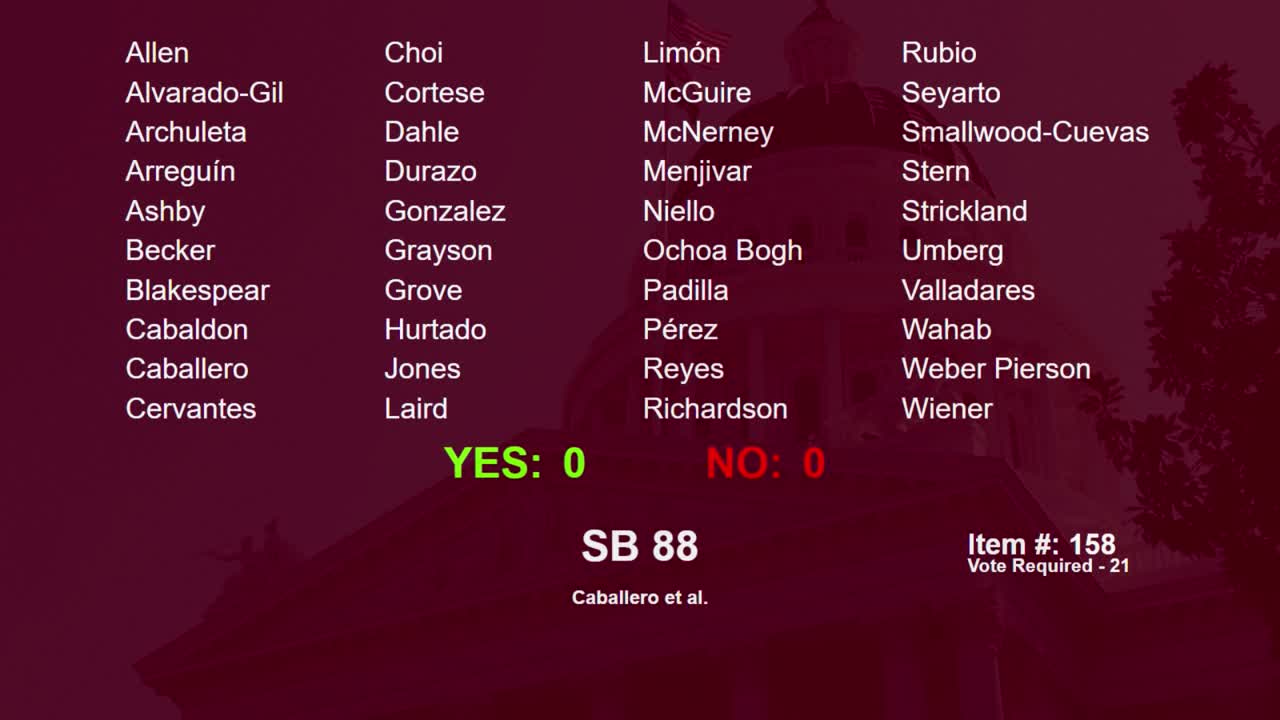 3MIN
Senate Floor
 8MIN
Senate Standing Committee on Governmental Organization
 15MIN