SB 441: State Air Resources Board: membership: removal: regulations: review.
- Session Year: 2025-2026
- House: Senate
- Latest Version Date: 2025-02-18
Current Status:
Failed
(2026-02-02: Returned to Secretary of Senate pursuant to Joint Rule 56.)
Introduced
In Committee
Awaiting First Chamber Vote
Passed First Chamber
In Committee
Awaiting Second Chamber Vote
Passed Second Chamber
Enacted
Existing law provides that the State Air Resources Board consists of 14 voting members, 12 of whom are appointed by the Governor, with the consent of the Senate, one of whom is appointed by the Senate Committee on Rules, and one of whom is appointed by the Speaker of the Assembly. Existing law specifies that voting members serve a term of 6 years.
This bill would authorize any member of the state board to be removed from office by the Legislature, by concurrent resolution adopted by a majority vote of all members elected to each house, for dereliction of duty or corruption or incompetency.
Existing law, the California Global Warming Solutions Act of 2006, establishes the state board as the state agency responsible for monitoring and regulating sources emitting greenhouse gases. The act requires the state board to adopt rules and regulations to achieve the maximum technologically feasible and cost-effective greenhouse gas emissions reductions to ensure that the statewide greenhouse gas emissions are reduced to at least 40% below the statewide greenhouse gas emissions limit, as defined, no later than December 31, 2030.
This bill would, for any regulation proposed by the state board that would impose costs exceeding $10,000,000 on California consumers, require the state board to submit the proposed regulation to the Legislative Analyst for an independent economic analysis, as specified. The bill would require the state board to prepare and publish on its internet website a written response to the Legislative Analysts report no less than 30 days before adopting the proposed regulation, as provided. The bill would require the state board to publish on its internet website all final resolutions, supporting documents, and proposed regulations in their complete and final form no less than 72 hours before any state board vote, and, once published, would prohibit any amendments, revisions, or alterations to be made to the final resolutions, supporting documents, or proposed regulations before the state boards vote.
(a)The State Air Resources Board is continued in existence in the California Environmental Protection Agency. The state board shall consist of 14 voting members.
(b)Twelve members shall be appointed by the Governor, with the consent of the Senate, on the basis of their demonstrated interest and proven ability in the field of air pollution control and their understanding of the needs of the general public in connection with air pollution problems.
(c)Of the members appointed pursuant to subdivision (b), six members shall have the following qualifications:
(1)One member shall have training and experience in automotive engineering or closely related fields.
(2)One member shall have training and experience in chemistry, meteorology, or related scientific fields, including agriculture or law.
(3)One member shall be a physician and surgeon or an authority on health effects of air pollution.
(4)Two members shall be public members.
(5)One member shall have the qualifications specified in paragraph (1), (2), or (3) or shall have experience in the field of air pollution control.
(d)Of the members appointed pursuant to subdivision (b), six members shall be board members from districts who shall reflect the qualitative requirements of subdivision (c) to the extent practicable. Of these members:
(1)One shall be a board member from the south coast district.
(2)One shall be a board member from the bay district.
(3)One shall be a board member from the San Joaquin Valley Unified Air Pollution Control District.
(4)One shall be a board member from the San Diego County Air Pollution Control District.
(5)One shall be a board member from the Sacramento district, the Placer County Air Pollution Control District, the Yolo-Solano Air Quality Management District, the Feather River Air Quality Management District, or the El Dorado County Air Pollution Control District.
(6)One shall be a board member of any other district.
(e)The Senate Committee on Rules and the Speaker of the Assembly shall each appoint one member to the state board who shall be a person who works directly with communities in the state that are most significantly burdened by, and vulnerable to, high levels of pollution, including, but not limited to, communities with diverse racial and ethnic populations and communities with low-income populations.
(f)Any vacancy shall be filled by the appointing authority within 30 days of the date on which it occurs. If the Governor fails to make an appointment for any vacancy within the 30-day period, the Senate Committee on Rules may make the appointment to fill the vacancy in accordance with this section.
(g)While serving on the state board, all members shall exercise their independent judgment as officers of the state on behalf of the interests of the entire state in furthering the purposes of this division. A member of the state board shall not be precluded from voting or otherwise acting upon any matter solely because that member has voted or acted upon the matter in his or her their capacity as a member of a district board, except that a member of the state board who is also a member of a district board shall not participate in any action regarding his or her their district taken by the state board pursuant to Sections 41503 to 41505, inclusive.
(h)(1)Except for initial staggered terms that shall be established by the state board, the term of office for the voting members shall be six years. Upon expiration of the term of office of a voting member, the appointing authority may reappoint that member to a new term of office, subject to the requirement of subdivision (b), if applicable.
(2)Notwithstanding paragraph (1), a person who is a member of the state board pursuant to subdivision (d) shall not continue as a member if he or she ceases they cease to hold the membership that qualifies that person to be appointed as a member of the state board. The membership on the state board held by that person shall terminate immediately upon ceasing to hold that qualifying membership.
(i)In addition to subdivision (a), two Members of the Legislature shall serve as ex officio, nonvoting members of the state board. One member shall be appointed by the Senate Committee on Rules. One member shall be appointed by the Speaker of the Assembly.
(j)Any member of the state board may be removed from office by the Legislature, by concurrent resolution adopted by a majority vote of all members elected to each house, for dereliction of duty or corruption or incompetency.
SEC. 2.Section 39601.6 is added to the Health and Safety Code, to read:39601.6.(a)For any regulation proposed by the state board that would impose costs exceeding ten million dollars ($10,000,000) on California consumers, the state board shall submit the proposed regulation to the Legislative Analyst for an independent economic analysis. The Legislative Analyst shall evaluate the regulations economic impacts, including, but not limited to, cost-effectiveness and distributional effects, and publish on its internet website a report of its findings.
(b)The state board shall prepare and publish on its internet website a written response to the Legislative Analysts report no less than 30 days before adopting the proposed regulation. The response shall address the findings of the Legislative Analysts report and explain any adjustments made to the proposed regulation in response to the analysis.
SEC. 3.Section 39601.7 is added to the Health and Safety Code, to read:39601.7.(a)(1)The state board shall publish on its internet website all final resolutions, supporting documents, and proposed regulations in their complete and final form no less than 72 hours before any state board vote.
(2)Once published, no amendments, revisions, or alterations shall be made to the final resolutions, supporting documents, or proposed regulations before the state boards vote.
(b)This section shall ensure that state board members and the public are provided with transparent and accessible information regarding the state boards actions before any decisionmaking process.
|
Date
|
Status
|
|---|---|
| Feb 2, 2026 | Returned to Secretary of Senate pursuant to Joint Rule 56. |
| Apr 23, 2025 | April 23 set for first hearing. Failed passage in committee. (Ayes 3. Noes 0. Page 866.) Reconsideration granted. |
| Apr 2, 2025 | Set for hearing April 23. |
| Feb 26, 2025 | Referred to Com. on E.Q. |
| Feb 19, 2025 | From printer. May be acted upon on or after March 21. |
| Feb 18, 2025 | Introduced. Read first time. To Com. on RLS. for assignment. To print. |
|
Date
|
Description
|
Location
|
Votes
|
|
|---|---|---|---|---|
| Apr 23, 2025 | [First] hearing set for [04-23-2025]: Failed passage in Committee. Reconsideration granted | Senate Standing Committee on Environmental Quality |
Passed |
|
| Apr 23, 2025 | Do pass as amended, but first amend, and re-refer to the Committee on [Appropriations] | Senate Standing Committee on Environmental Quality |
Failed |
This list shows positions taken on this bill by organizations on the date displayed, which is linked to the original source.
Positions by individuals are not included.
|
Organization
|
Position
|
Date
|
|---|---|---|
| Coalition For Clean Air | ** Against | |
| Young’s Legacy Group | ** Support |
SENATE COMMITTEE ON ENVIRONMENTAL QUALITY
Senator Blakespear, Chair
2025 - 2026 Regular
Bill No: SB 441
Author: | Hurtado | ||
Version: | 2/18/2025 | Hearing Date: | 4/23/2025 |
Urgency: | No | Fiscal: | Yes |
Consultant: | Evan Goldberg | ||
SUBJECT: State Air Resources Board: membership: removal: regulations: review
DIGEST: This bill allows the Legislature to remove members of the California Air Resources Board (CARB), requires CARB to have the Legislative Analyst’s Office provide a financial analysis of certain regulations before it can act, and requires CARB to adhere to certain additional notice requirements.
ANALYSIS:
Existing law:
- Creates the California Air Resources Board (CARB), which consists of 14 voting members, 12 of whom are appointed by the Governor and are subject to Senate confirmation. The other two members are appointed individually by the Senate Rules Committee and the Speaker of the Assembly. The voting members are appointed to serve six-year terms and can be re-appointed. There are also two ex-officio members, one appointed by the Senate Rules Committee and one appointed by the Speaker of the Assembly. (Health & Safety Code (HSC) §39510).
- Requires CARB members to exercise their independent judgment as officers of the state on behalf of the interests of the entire. (HSC §39510).
- Requires CARB – and all state agencies – to conduct a standardized regulatory impact assessment (SRIA) when a proposed regulation will have an impact of $50 million or more on the general public. This information must be provided to the Governor’s Department of Finance (DOF) and be made available to the public. (Government Code (GOV) §11346.2).
5) Under the Administrative Procedures Act (APA), sets forth detailed requirements for the public posting of proposed regulations, requirements to hold public hearings on proposed regulations, and requirements for state agencies to respond to public comments on proposed regulations. (GOV §11346 et seq.).
This bill:
- Allows the Legislature to adopt a concurrent resolution via a majority vote in each house to remove any CARB member for “dereliction of duty or corruption or incompetency.”
- Requires CARB, when proposing any regulation that would impose costs of more than $10 million, to submit the proposal to the Legislative Analyst’s Office (LAO). The LAO must in turn evaluate the regulation’s economic impacts, including, but not limited to, cost-effectiveness and distributional effects, and publish its findings on the Internet.
- Requires CARB to publish a response to the LAO report on its Internet website at least 30 days before adopting the proposed regulations.
- Requires CARB to publish on its Internet website all final resolutions, supporting documents, and proposed regulations in their complete and final form at least 72 hours before any state board vote.
- Precludes any amendments, revisions, or alterations from being made to the proposed regulations after they are posted.
Background
- History of CARB. Created in 1967 – the same year the federal Air Quality Act was enacted – CARB was designed to take a coordinated, statewide approach to air pollution in California.
Under the federal Air Quality Act, California was given the ability to set its own more stringent air quality rules. Three years later, the federal Clean Air Act expanded the 1967 federal law and gave California the ability to set its own separate and stricter-than-federal vehicle emissions regulations to address the extraordinary circumstances of population, climate and topography that helped to generate the worst air quality in the nation.
Over the past 58 years, CARB has developed numerous regulations aimed at reducing the air pollution caused by cars and trucks in the state. Its adoption of the nation’s first NOx emissions standards for motor vehicles in 1971 helped lead to the development of the catalytic converter, which significantly changed the way smog-forming emissions from cars could be reduced.
2) CARB & LCFS. In November 2024, CARB updated its low carbon fuel standard (LCFS) program which began in 2009 after CARB adopted its first regulations – which took effect in 2011 – on the issue. The LCFS is designed to encourage the development and use of cleaner low-carbon transportation fuels in California to reduce greenhouse gas (GHG) emissions and decrease vehicle dependence on gasoline.
The Office of Administrative Law (OAL), which must review all proposed regulations in the state to ensure they comply with the APA, rejected CARB’s proposed regulatory update in February 2025. OAL identified 26 provisions where it felt changes were necessary to ensure the regulations can be “easily understood by those persons directly affected by them.” Under state law, CARB has 120 days follow OAL’s decision to re-craft and re-submit its proposed regulations to OAL, which it did on April 4, 2025, triggering a new public review and comment period.
3) Boards, Commissions, Term & Pleasure Appointments (Oh My!). There are more than 400 boards and commissions in California state government, meaning the Governor has the ability to appoint thousands of people to serve on these entities. Some appointments – such as those to CARB – require the Senate to confirm the Governor’s nominee.
While most appointments are known as “pleasure appointments,” meaning the appointee serves at the pleasure of the Governor and can be removed generally at any time for any reason by the Governor, other appointments are known as “term appointments,” meaning an appointee cannot – with limited exceptions – be removed during their term, even when a new Governor takes office.
CARB’s 14 voting board members each serve six-year terms and can be re-appointed. The terms are staggered to ensure some type of continuity. They only way a CARB member can be removed prior to the expiration of their term is if they no longer meet the qualifications for their appointment. For example, the statute requires certain board members to also be members of certain air districts in the state. Should a person stop serving on that specified local air district, they would not be eligible to serve as a member of CARB and must be removed.
4) Legislative Removal of Gubernatorial Appointees. Generally speaking, a person who is serving a term appointment on a board or commission cannot be removed from their position, but there are exceptions to that rule:
- The Public Utilities Commission (PUC). Article XII, Section 1, of the California Constitution allows the Legislature – by a two-thirds vote in each house – to remove a member of the PUC (all of whom are term appointees) for “incompetence, neglect of duty, or corruption.” This provision was included in the original 1911 initiative creating the PUC, which was then known as the Railroad Commission.
- The California Energy Commission (CEC). PRC §25125 allows the Legislature – by a majority vote in each house – to remove a member of the CEC (all of whom are term appointees) for “dereliction of duty or corruption or incompetency.” This provision was enacted in 1974.
- The State Water Resources Control Board (SWRCB). Water Code (WC) §178 allows the Legislature – by a majority vote in each house – to remove a member of the SWRCB (all of whom are term appointees) for “dereliction of duty or corruption or incompetency.” This provision was enacted in 1943.*
- The California Water Commission (CWC). WC §156 allows the Legislature – by a majority vote in each house – to remove a member of the CWC (all of whom are term appointees) for “dereliction of duty or corruption or incompetency.” This provision has existed since at least 1957.*
- The Director of the Department of Water Resources (DWR). WC §122 allows the Legislature – by a majority vote in each house – to remove the DWR Director (who is a pleasure appointee and can be removed at any time by the Governor) for “dereliction of duty or corruption or incompetency.” This provision was enacted in 1943.*
* The Water Code was reorganized in 1943, so these provisions may have been added to the law years or decades earlier.
5) The LAO. The Joint Legislative Budget Committee (JLBC) and the LAO were created by the Legislature in 1941 via a concurrent resolution and then in 1951, the Legislature put both the JLBC and the LAO into state law (though initially the LAO was known as the Legislative Auditor). Up until the early 1990s, the LAO was able to provide a fiscal analysis of most bills in the Senate & Assembly Appropriations Committees, but due to budget reductions mandated by the passage of Proposition 140 in 1990, its work has been limited to analyzing state budget proposals and other major challenges facing the state. The LAO is still overseen by the JLBC and has approximately 43 analysts and 13 support staff.
5) SRIA, Not Siri. Under SB 617 (R. Calderon, Chapter 496, Statutes of 2011), all state agencies have to conduct a standardized regulatory impact assessment (SRIA) when its proposed regulations will have an economic impact in California exceeding $50 million. The SRIA must also include information on the impact proposed regulations will have on:
- The creation or elimination of jobs in California;
- The creation of new businesses or the elimination of existing businesses in California;
- The competitive advantages or disadvantages for businesses currently doing business in California;
- The increase or decrease of investment in California;
- The incentives for innovation in products, material, or processes; and,
- The benefits of the regulations, including benefits to the health, safety, and welfare of California residents, worker safety, and the state's environment and quality of life, among any other benefits identified by the agency.
CARB released its SRIA for its proposed LCFS amendments on September 8, 2023. However, the law does not require a SRIA to be updated if proposed regulations are amended or updated as CARB’s were in November 2024 and then again in April 2025.
Comments
- Purpose of Bill. According to the author, “For years, unelected bureaucrats at the California Air Resources Board (CARB) have enacted sweeping regulations with minimal oversight, raising fuel costs, burdening small businesses, and disproportionately impacting lower-income communities. As an elected official, I am held accountable for every vote and policy decision I make—CARB board members should be held to the same standard given the significant impact of their regulations.
“While CARB’s mission to reduce emissions is critical, the lack of transparency in its decision-making process undermines public trust and leaves everyday Californians shouldering the financial burden of policies crafted behind closed doors. SB 441 increases oversight by establishing a legislative process for removing CARB board members and requiring independent economic analyses for costly regulations.
“This bill ensures CARB’s policies are not only environmentally sound but also transparent, equitable, and fiscally responsible. Californians deserve a government that is accountable to the people, and SB 441 will help restore trust by making CARB’s decision-making process more accessible and responsive to all communities.”
- Accountability or Chilling Effect? As noted in the “Background” section, appointments to government boards and commissions fall into two basic categories:
- Pleasure appointments. These give the appointing authority maximum flexibility and arguably increase accountability because an appointee can be removed at any time. On the flip side, these appointments can lend themselves to political favoritism because appointments can be used to reward allies or punish political opponents for decisions they do or don’t make. Plus, a pleasure appointment may encourage an appointee to engage in short-term thinking or focus solely on actions that will allow them to retain their appointment.
- Term appointments. Because an appointee knows they will be in their position for a fixed period of time, term appointments can make it easier for people to engage in long-term planning and make harder decisions since they are insulated from often day-to-day shifting of the political winds and the potential for immediate removal by their appointing authority. On the flip side, term appointments can also lead to stagnant thinking or a failure to solicit input from the people affected by the decisions an appointee makes because the appointee knows they cannot be removed from their position.
SB 441 allows the Legislature to adopt a concurrent resolution via a majority vote in each house to remove any CARB board member for “dereliction of duty or corruption or incompetency.”
While giving the Legislature the ability to remove a CARB board member by a simple majority vote in each house at any time may very well make those members accountable to the Legislature, it may also have a chilling effect on CARB’s ability or desire to make difficult, independent, science-based decisions.
Elected officials in California can be held accountable by voters at each election and they are also subject to being removed from office via the California Constitution’s recall process. However, the process to recall an elected official must – by design – meet a high bar. For example, recalling a state legislator requires recall proponents to gather signatures from 20% of the people who voted in the last election just to get the proposal on the ballot – and then a majority of the voters have to approve it.
Here, removing a CARB board member is significantly lower – it can be triggered by just one of the 120 state legislators introducing a concurrent resolution. Even if the measure is never brought up for a vote in a committee or on the floor of either house in the Legislature, the mere introduction of such a resolution to terminate a CARB board member could have a chilling effect on the individual member’s or the entire board’s decision-making ability.
Another issue worthy of note is unlike pleasure appointees who are accountable to their appointing authorities, this bill makes a gubernatorial term appointee “accountable” to the Legislature, not to the Governor.
This could have the effect of encouraging some amount of game-playing between the Governor and the Legislature if legislators can remove – or even just threaten to remove – a CARB board member at any time for virtually any reason. While the bill states the removal must be for “dereliction of duty or corruption or incompetency,” those terms are very subjective. To ensure CARB board members can continue to operate in a fashion that encourages long-term thinking and planning, while minimizing the potential for political gamesmanship, the author and Committee may wish to consider removing this provision from the bill.
- LAO vs. SRIA. This bill requires CARB to submit any proposed regulations that would impose costs of $10 million or more on Californians to the LAO for an evaluation. The LAO would be required to evaluate the regulation’s economic impacts and publish its findings on the Internet – and CARB would have to respond to the LAO at least 30 days before adopting its regulations.
The cost this would impose on the LAO is unknown and would depend on how many regulations CARB would propose to adopt in a given year. Aside from the cost issue is the length of time it will take the LAO to conduct the reviews mandated by this bill. The measure places no time frame on the LAO to act, yet under this bill, CARB would be precluded from moving forward with any regulations imposing a cost of $10 million or more on Californians until the LAO finishes its analysis, CARB responds to that analysis, and 30 days have then passed.
As noted in the “Background” section, all state agencies looking to enact major regulations – those that will have an economic impact of more than $50 million – must already complete a SRIA to provide the public with information on how those regulations will impact California.
Rather than creating a new, potentially costly program for the LAO to administer and one that may tie CARB’s hands indefinitely and preclude it from acting, the author and Committee may wish to consider replacing this provision with one requiring CARB to issue a SRIA for any regulations it proposes that will have an economic impact of over $10 million.
- Goose v. Gander – Precluding Amendments To CARB Regulations. This bill requires CARB to publish all final resolutions, supporting documents, and proposed regulations on its Internet website at least 72 hours before any vote is taken – and precludes any amendments, revisions, or alterations from being made to the proposed regulations after they are posted.
The rationale for precluding CARB from amending, revising, or altering its regulations after they have been posted is unclear. Certainly in any process, altering a proposal after it has been released can – in the eyes of some – make the initial proposal more onerous. However, the amendment process can also be used to make the initial proposal less onerous in the eyes of those very same people.
Proposition 54 was approved by voters on the November 2016 ballot. It amended Article IV, Section 8 of the California Constitution to require all bills to be in their final form and published on the Internet for 72 hours be the Legislature can cast a final vote on them.
Rather than preventing CARB from amending, revising, or altering any proposed regulations after they’ve been published, the author and Committee may wish to consider applying the principle of the 72-hour rule the Legislature must abide by to CARB, so should CARB choose to alter any proposed regulation, it would simply “re-start” the 72-hour clock.
- Committee Amendments. The author and Committee may wish to consider adopting the amendments noted in Comments 2, 3, and 4 above to:
- Remove the ability of the Legislature to remove CARB board members from their positions (Comment 2);
- Remove the requirement for LAO to analyze CARB regulations over a certain level and replace it with a provision requiring CARB to do a SRIA for any regulations over $10 million (Comment 3); and
- Allow CARB to amend, alter or revise any proposed regulations provided those changes are posted on the agency’s Internet website for a minimum of 72 hours before CARB can act on the regulations (Comment 4).
Related/Prior Legislation
SB 348 (Hurtado, 2025) requires CARB to, beginning no later than January 31, 2026, reconsider and revise its LCFS program. This bill is pending in the Senate Environmental Quality Committee.
SB 474 (Niello, 2025) revokes CARB’s ability to adopt, revise, or repeal regulations and instead restricts CARB to providing advice and proposing measures to the Legislature for enactment. This bill is pending in the Senate Environmental Quality Committee.
SB 496 (Hurtado, 2025) requires CARB to establish an Advanced Clean Fleets Regulation Appeals Advisory Committee and expand the exemption for emergency vehicles under CARB’s Clean Fleets program. This bill is was approved by the Senate Environmental Quality Committee on an 8-0 vote on April 2, 2025, and is pending in the Senate Transportation Committee.
SOURCE:
Author
SUPPORT:
Young’s Legacy Group
OPPOSITION:
Coalition for Clean Air
-- END --
Discussed in Hearing
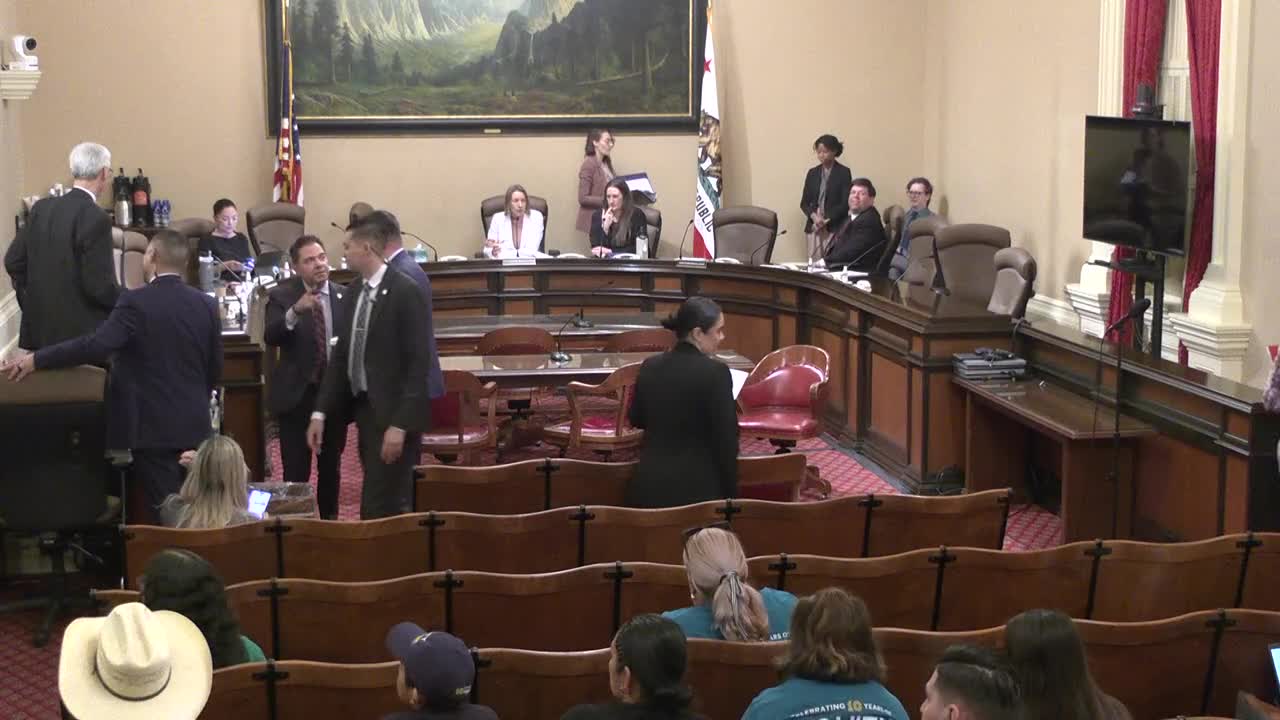 18MIN
Senate Standing Committee on Environmental Quality
Bill Author

Bill Co-Author(s):