SB 451: Gambling.
- Session Year: 2025-2026
- House: Senate
- Latest Version Date: 2025-10-10
Current Status:
Passed
(2025-10-10: Chaptered by Secretary of State. Chapter 584, Statutes of 2025.)
Introduced
In Committee
Awaiting First Chamber Vote
Passed First Chamber
In Committee
Awaiting Second Chamber Vote
Passed Second Chamber
Enacted
Existing law, the Gambling Control Act, establishes the California Gambling Control Commission, which is responsible for licensing and regulating various gambling activities and establishments. Existing law requires the Department of Justice to investigate any violations of, and to enforce, the act. Existing law also vests the department with the responsibility to investigate violations of prohibitions against specified gambling activities, as enumerated in the Penal Code, including, among others, prohibitions against (1) lotteries, (2) certain games played with cards, dice, or any device, for money, and (3) slot machines.
This bill would clarify that the departments authority to investigate suspected criminal violations of the aforementioned prohibited gambling activities enumerated in the Penal Code includes suspected violations that occur outside of a licensed gambling establishment, irrespective of whether the suspected violation involves licensees.
The California Constitution generally prohibits lotteries and raffles. The California Constitution, notwithstanding this general prohibition, authorizes the Legislature to authorize private, nonprofit, eligible organizations to conduct raffles as a funding mechanism to provide support for their own or another private, nonprofit, eligible organizations beneficial and charitable works, provided that at least 90% of the gross receipts from the raffle go directly to beneficial or charitable purposes in California. The California Constitution further authorizes the Legislature, by a 2/3 vote of each house, to amend the percentage of gross receipts required to be dedicated to beneficial or charitable purposes. Pursuant to this authority, existing statutory law authorizes an eligible organization to conduct a major league sports raffle if, among other requirements, 50% of the gross receipts generated from the sale of raffle tickets are used to benefit or provide support for beneficial or charitable purposes, as defined, the other 50% is paid to the winner, and the winners of the prizes are determined by a manual draw, as specified. Existing law authorizes these raffles only at a home game and prohibits an eligible organization from conducting more than one major league sports raffle per home game.
This bill would additionally authorize an eligible organization to conduct a major league sports raffle at a championship game, if held at the designated venue where an affiliated sports team plays their home games. The bill would make other technical and conforming changes. By expanding the scope of provisions that revise the percentage of gross receipts required to go to beneficial or charitable purposes pursuant to the California Constitution, this bill would require a 2/3 vote of each house.
Existing law, the Gambling Control Act, establishes the California Gambling Control Commission, which is responsible for licensing and regulating various gambling activities and establishments. Existing law requires the Department of Justice to investigate any violations of, and to enforce, the act. Existing law also vests the department with the responsibility to investigate violations of prohibitions against specified gambling activities, as enumerated in the Penal Code, including, among others, prohibitions against (1) lotteries, (2) certain games played with cards, dice, or any device, for money, and (3) slot machines.
This bill would clarify that the departments authority to investigate suspected criminal violations of the aforementioned prohibited gambling activities enumerated in the Penal Code includes suspected violations that occur outside of a licensed gambling establishment. establishment, irrespective of whether the suspected violation involves licensees.
Existing law, the Gambling Control Act, establishes the California Gambling Control Commission, which is responsible for licensing and regulating various gambling activities and establishments. Existing law requires the Department of Justice to investigate any violations of, and to enforce, the act. Existing law also vests the department with the responsibility to investigate violations of prohibitions against specified gambling activities, as enumerated in the Penal Code, including, among others, prohibitions against (1) lotteries, (2) certain games played with cards, dice, or any device, for money, and (3) slot machines.
This bill would clarify that the departments authority to investigate suspected criminal violations of the aforementioned prohibited gambling activities enumerated in the Penal Code includes suspected violations that occur outside of a licensed gambling establishment. The bill would require the department, upon completion of an investigation that identifies evidence of illegal gambling conducted outside of a licensed gambling establishment, to refer the findings to the appropriate local district attorney or the Attorney General and assist those prosecutorial agencies by providing investigative reports, expert testimony, and any other necessary support to ensure diligent prosecution. The bill would require the department to coordinate with local law enforcement agencies and other relevant entities to share information regarding suspected illegal gambling operations and provide training and resources to ensure consistent enforcement of gambling laws across the state. To the extent that this bill would increase the duties of local law enforcement agencies, this bill would impose a state-mandated local program.
This bill would require the department to prepare and submit an annual report to the Governor and Legislature containing specified information on investigations and prosecutions of illegal gambling activities occurring outside of licensed gambling establishments. The bill would require the department to develop and implement public awareness campaigns to educate the public on the illegality and risks of participating in unlicensed gambling activities. The California Constitution requires the state to reimburse local agencies and school districts for certain costs mandated by the state. Statutory provisions establish procedures for making that reimbursement.This bill would provide that, if the Commission on State Mandates determines that the bill contains costs mandated by the state, reimbursement for those costs shall be made pursuant to the statutory provisions noted above.Existing law, the Gambling Control Act, establishes the California Gambling Control Commission, which is responsible for licensing and regulating various gambling activities and establishments. Existing law requires the Department of Justice to investigate any violations of, and to enforce, the act. Existing law also vests the department with the responsibility to investigate violations of prohibitions against specified gambling activities, as enumerated in the Penal Code, including, among others, prohibitions against (1) lotteries, (2) certain games played with cards, dice, or any device, for money, and (3) slot machines.
This bill would clarify that the departments authority to investigate suspected criminal violations of the aforementioned prohibited gambling activities enumerated in the Penal Code includes suspected violations that occur outside of a licensed gambling establishment. The bill would require the department, upon completion of an investigation that identifies evidence of illegal gambling conducted outside of a licensed gambling establishment, to refer the findings to the appropriate local district attorney or the Attorney General and assist those prosecutorial agencies by providing investigative reports, expert testimony, and any other necessary support to ensure diligent prosecution. The bill would require the department to coordinate with local law enforcement agencies and other relevant entities to share information regarding suspected illegal gambling operations and provide training and resources to ensure consistent enforcement of gambling laws across the state. To the extent that this bill would increase the duties of local law enforcement agencies, this bill would impose a state-mandated local program.
This bill would require the department to prepare and submit an annual report to the Governor and Legislature containing specified information on investigations and prosecutions of illegal gambling activities occurring outside of licensed gambling establishments. The bill would require the department to develop and implement public awareness campaigns to educate the public on the illegality and risks of participating in unlicensed gambling activities.
The California Constitution requires the state to reimburse local agencies and school districts for certain costs mandated by the state. Statutory provisions establish procedures for making that reimbursement.
This bill would provide that, if the Commission on State Mandates determines that the bill contains costs mandated by the state, reimbursement for those costs shall be made pursuant to the statutory provisions noted above.
The department shall perform all investigatory functions required by this chapter, as well as auditing functions under tribal gaming compacts, and shall have all of the following responsibilities:
(a)To receive and process applications for any license, permit, or other approval, and to collect all related fees. The department shall investigate the qualifications of applicants before any license, permit, or other approval is issued, and investigate any request to the commission for any approval that may be required pursuant to this chapter. The department may recommend the denial or the limitation, conditioning, or restriction of any license, permit, or other approval.
(b)To monitor the conduct of all licensees and other persons having a material involvement, directly or indirectly, with a gambling operation or its holding company, for the purpose of ensuring that licenses are not issued or held by, and that there is no direct or indirect material involvement with, a gambling operation or holding company by ineligible, unqualified, disqualified, or unsuitable persons, or persons whose operations are conducted in a manner that is inimical to the public health, safety, or welfare.
(c)(1)To investigate suspected violations of this chapter or laws of this state relating to gambling, including any activity prohibited by Chapter 9 (commencing with Section 319) or Chapter 10 (commencing with Section 330) of Title 9 of Part 1 of the Penal Code.
(2)This subdivision includes the responsibility to investigate suspected violations of illegal gambling activities conducted outside of licensed gambling establishments, irrespective of whether the suspected violation involves licensees.
(d)To investigate complaints that are lodged against licensees, or other persons associated with a gambling operation, by members of the public.
(e)To initiate, where appropriate, disciplinary actions as provided in this chapter. In connection with any disciplinary action, the department may seek restriction, limitation, suspension, or revocation of any license or approval, or the imposition of any fine upon any person licensed or approved.
(f)To adopt regulations reasonably related to its functions and duties as specified in this chapter.
(g)Approve the play of any controlled game, including placing restrictions and limitations on how a controlled game may be played. The department shall make available to the public the rules of play and the collection rates of each gaming activity approved for play at each gambling establishment on the Attorney Generals internet website. Actual costs incurred by the department to review and approve game rules shall be reimbursed to the department by the licensee making the request.
SEC. 2.Section 19827 of the Business and Professions Code is amended to read:19827.(a)The department has all powers necessary and proper to enable it to carry out fully and effectually the duties and responsibilities of the department specified in this chapter. The investigatory powers of the department include, but are not limited to, all of the following:
(1)Upon approval of the chief, and without notice or warrant, the department may take any of the following actions:
(A)Visit, investigate, and place expert accountants, technicians, and any other person, as it may deem necessary, in all areas of the premises wherein controlled gambling is conducted for the purpose of determining compliance with the rules and regulations adopted pursuant to this chapter.
(B)Visit, inspect, and examine all premises where gambling equipment is manufactured, sold, or distributed.
(C)Inspect all equipment and supplies in any gambling establishment or in any premises where gambling equipment is manufactured, sold, or distributed.
(D)Summarily seize, remove, and impound any equipment, supplies, documents, or records from any licensed premises for the purpose of examination and inspection. However, upon reasonable demand by the licensee or the licensees authorized representative, a copy of all documents and records seized shall be made and left on the premises.
(E)Demand access to, and inspect, examine, photocopy, and audit all papers, books, and records of an owner licensee on the gambling premises in the presence of the licensee or the licensees agent.
(2)Except as provided in paragraph (1), upon obtaining an inspection warrant pursuant to Section 1822.60 of the Code of Civil Procedure, the department may inspect and seize for inspection, examination, or photocopying any property possessed, controlled, bailed, or otherwise held by any applicant, licensee, or any intermediary company, or holding company.
(3)(A)The department may investigate, for purposes of prosecution, any suspected criminal violation of this chapter.
(B)The department may investigate, for purposes of prosecution, any suspected criminal violation of Chapter 9 (commencing with Section 319) or Chapter 10 (commencing with Section 330) of Title 9 of Part 1 of the Penal Code, including a suspected criminal violation that occurs outside of a licensed gambling establishment, irrespective of whether the suspected violation involves licensees.
(C)This paragraph does not limit the powers conferred by any other law on agents of the department who are peace officers.
(4)The department may do both of the following:
(A)Issue subpoenas to require the attendance and testimony of witnesses and the production of books, records, documents, and physical materials.
(B)Administer oaths, examine witnesses under oath, take evidence, and take depositions and affidavits or declarations. Notwithstanding Section 11189 of the Government Code, the department, without leave of court, may take the deposition of any applicant or any licensee. Sections 11185 and 11191 of the Government Code do not apply to a witness who is an applicant or a licensee.
(b)(1)Subdivision (a) shall not be construed to limit warrantless inspections except as required by the California Constitution or the United States Constitution.
(2)Subdivision (a) shall not be construed to prevent entries and administrative inspections, including seizures of property, without a warrant in the following circumstances:
(A)With the consent of the owner, operator, or agent in charge of the premises.
(B)In situations presenting imminent danger to health and safety.
(C)In situations involving inspection of conveyances where there is reasonable cause to believe that the mobility of the conveyance makes it impractical to obtain a warrant, or in any other exceptional or emergency circumstance where time or opportunity to apply for a warrant is lacking.
(D)In accordance with this chapter.
(E)In all other situations where a warrant is not constitutionally required.
SEC. 3.Section 320.6 of the Penal Code is amended to read:320.6.(a)For the purposes of this section, the following terms have the following meanings:
(1)Charitable purposes excludes purposes that are intended to benefit officers, directors, or members, as defined by Section 5056 of the Corporations Code, of the eligible organization.
(2)Eligible organization means a private, nonprofit organization established by, or affiliated with, a team from the Major League Baseball, National Hockey League, National Basketball Association, National Football League, Womens National Basketball Association, or Major League Soccer, or a private, nonprofit organization established by the Professional Golfers Association of America, Ladies Professional Golf Association, or National Association for Stock Car Auto Racing that has been qualified to conduct business in California for at least one year before conducting a raffle, is qualified for an exemption under Section 501(c)(3) of the Internal Revenue Code, and is exempt from taxation pursuant to Section 23701a, 23701b, 23701d, 23701e, 23701f, 23701g, 23701k, 23701l, 23701t, or 23701w of the Revenue and Taxation Code.
(3)Raffle means a scheme for the distribution of prizes by chance among persons who have paid money for paper tickets that provide the opportunity to win these prizes, in which all of the following are true:
(A)Each ticket sold contains a unique and matching identifier.
(B)(i)Winners of the prizes are determined by a manual draw from tickets described in subparagraph (A) that have been sold for entry in the manual draw.
(ii)An electronic device may be used to sell tickets. The ticket receipt issued by the electronic device to the purchaser may include more than one unique and matching identifier, representative of and matched to the number of tickets purchased in a single transaction.
(iii)A random number generator is not used for the manual draw or to sell tickets.
(iv)The prize paid to the winner is comprised of one-half or 50 percent of the gross receipts generated from the sale of raffle tickets for a raffle.
(C)The manual draw is conducted in California under the supervision of a natural person who meets all of the following requirements:
(i)The person is 18 years of age or older.
(ii)The person is affiliated with the eligible organization conducting the raffle.
(iii)The person is registered with the Department of Justice pursuant to paragraph (4) of subdivision (n).
(D)(i)Fifty percent of the gross receipts generated from the sale of raffle tickets for any given manual draw are used by the eligible organization conducting the raffle solely for charitable purposes, or used to benefit another private, nonprofit organization, provided that an organization receiving these funds is itself an eligible organization as defined in subdivision (c) of Section 320.5. Funds raised by raffles conducted pursuant to this section shall not be used to fund any beneficial, charitable, or other purpose outside of California. This section does not preclude an eligible organization from using funds from sources other than the sale of raffle tickets to pay for the administration or other costs of conducting a raffle if these expenses comply with legal standard of care requirements described in Sections 5231, 7231, and 9241 of the Corporations Code.
(ii)An employee of an eligible organization who is a direct seller of raffle tickets shall not be treated as an employee for purposes of workers compensation under Section 3351 of the Labor Code if both of the following conditions are satisfied:
(I)Substantially all of the remuneration, whether or not paid in cash, for the performance of the service of selling raffle tickets is directly related to sales rather than to the number of hours worked.
(II)The services performed by the person are performed pursuant to a written contract between the seller and the eligible organization and the contract provides that the person will not be treated as an employee with respect to the selling of raffle tickets for workers compensation purposes.
(iii)For purposes of this section, an employee selling raffle tickets shall be deemed to be a direct seller, as described in Section 650 of the Unemployment Insurance Code, as long as the employee meets the requirements of that section.
(b)Notwithstanding Section 320.5, this section applies to an eligible organization.
(c)A raffle that is conducted by an eligible organization for the purpose of directly supporting beneficial or charitable purposes or financially supporting another private, nonprofit eligible organization, as defined in subdivision (c) of Section 320.5, that performs beneficial or charitable purposes may be conducted in accordance with this section.
(d)A person who receives compensation in connection with the operation of the raffle shall be an employee of the eligible organization that is conducting the raffle, and in no event may compensation be paid from revenues required to be dedicated to beneficial or charitable purposes.
(e)A raffle ticket shall not be sold in exchange for Bitcoin or any other cryptocurrency.
(f)A raffle that is otherwise permitted under this section shall not be conducted by means of, or otherwise utilize, any gaming machine that meets the definition of slot machine contained in Section 330a, 330b, or 330.1.
(g)(1)A raffle otherwise permitted under this section shall not be conducted, nor may tickets for a raffle be sold, within an operating satellite wagering facility or racetrack inclosure licensed pursuant to the Horse Racing Law (Chapter 4 (commencing with Section 19400) of Division 8 of the Business and Professions Code) or within a gambling establishment licensed pursuant to the Gambling Control Act (Chapter 5 (commencing with Section 19800) of Division 8 of the Business and Professions Code).
(2)A raffle shall not be operated or conducted in any manner over the internet, nor may raffle tickets be sold, traded, or redeemed over the internet. For purposes of this paragraph, an eligible organization shall not be deemed to operate or conduct a raffle over the internet, or sell raffle tickets over the internet, if the eligible organization advertises its raffle on the internet or permits others to do so. Information that may be conveyed on an internet website pursuant to this paragraph includes, but is not limited to, all of the following:
(A)Lists, descriptions, photographs, or videos of the raffle prizes.
(B)Lists of the prize winners.
(C)The rules of the raffle.
(D)Frequently asked questions and their answers.
(E)Raffle entry forms, which may be downloaded from the internet website for manual completion by raffle ticket purchasers, but shall not be submitted to the eligible organization through the internet.
(F)Raffle contact information, including the eligible organizations name, address, telephone number, facsimile number, or email address.
(h)An individual, corporation, partnership, or other legal entity shall not hold a financial interest in the conduct of a raffle, except the eligible organization that is itself authorized to conduct that raffle, and any private, nonprofit, eligible organizations receiving financial support from that charitable organization pursuant to paragraph (3) of subdivision (a) and subdivision (c).
(i)(1)An eligible organization may conduct a major league sports raffle only at a home game, or a championship game if held at the designated venue where an affiliated sports team plays their home games.
(2)An eligible organization shall not conduct more than one major league sports raffle per game.
(j)An employee shall not sell raffle tickets in any seating area designated as a family section.
(k)An eligible organization shall disclose to all ticket purchasers the designated private, nonprofit, eligible organization for which the raffle is being conducted.
(l)An eligible organization that conducts a raffle to financially support another private, nonprofit eligible organization, as defined in subdivision (c) of Section 320.5, shall distribute all proceeds not paid out to the winners of the prizes to the private, nonprofit organization within 15 days of conducting the raffle, in accordance with this section.
(m)Any raffle prize remaining unclaimed by a winner at the end of the season for a team with an affiliated eligible organization that conducted a raffle to financially support another private, nonprofit eligible organization, as defined in subdivision (c) of Section 320.5, shall be donated within 30 days from the end of the season by the eligible organization to the designated private, nonprofit organization for which the raffle was conducted.
(n)(1)(A)An eligible organization shall not conduct a raffle authorized under this section, unless it has a valid registration issued by the Department of Justice. The department shall furnish a registration form via the internet or upon request to eligible nonprofit organizations. The department shall, by regulation, collect only the information necessary to carry out the provisions of this section on this form. This information shall include, but is not limited to, all of the following:
(i)The name and address of the eligible organization.
(ii)The federal tax identification number, the corporate number issued by the Secretary of State, the organization number issued by the Franchise Tax Board, or the California charitable trust identification number of the eligible organization.
(iii)The name and title of a responsible fiduciary of the organization.
(B)(i)The department may require an eligible organization to pay a minimum annual registration fee of ten thousand dollars ($10,000) to cover the reasonable costs of the department to administer and enforce this section.
(ii)An eligible organization shall pay, in addition to the annual registration application fee, two hundred dollars ($200) for every individual raffle conducted at an eligible location to cover the reasonable costs of the department to administer and enforce this section. This fee shall be submitted in conjunction with the annual registration form.
(2)(A)A manufacturer or distributor of raffle-related products or services shall not conduct business with an eligible organization for purposes of conducting a raffle pursuant to this section unless the manufacturer or distributor has a valid annual registration issued by the department.
(B)The department may require a manufacturer or distributor of raffle-related products or services to pay a minimum annual registration fee of ten thousand dollars ($10,000) to cover the reasonable costs of the department to administer and enforce this section.
(3)An eligible organization shall register the equipment used in the sale and distribution of raffle tickets, and shall have the equipment tested by an independent gaming testing lab.
(4)(A)A person affiliated with an eligible organization who conducts the manual draw shall annually register with the department.
(B)The department may require a person affiliated with an eligible organization who conducts the manual draw to pay a minimum annual registration fee of twenty dollars ($20) to cover the reasonable costs of the department to administer and enforce this section.
(5)(A)The department may, by regulation, adjust the annual registration fees described in this section as needed to ensure that revenues will fully offset, but not exceed, the reasonable costs incurred by the department pursuant to this section. The fees shall be deposited by the department into the Major League Sporting Event Raffle Fund, which is hereby created in the State Treasury.
(B)A loan is hereby authorized from the General Fund to the Major League Sporting Event Raffle Fund on or after July 1, 2016, in an amount of up to one million five thousand dollars ($1,005,000) to address department workload related to the initial implementation activities relating to this section by the departments Indian and Gaming Law Section. The terms and conditions of the loan shall first be approved by the Department of Finance pursuant to appropriate fiscal standards. The loan shall be subject to all of the following conditions:
(i)Of the total amount loaned, no more than three hundred thirty-five thousand dollars ($335,000) shall be provided annually to the department.
(ii)The loan shall be repaid to the General Fund as soon as there is sufficient money in the Major League Sporting Event Raffle Fund to repay the loan, but no later than December 31, 2023.
(iii)Interest on the loan shall be paid from the Major League Sporting Event Raffle Fund at the rate accruing to moneys in the Pooled Money Investment Account.
(6)The department shall receive moneys for the costs incurred pursuant to this section subject to an appropriation by the Legislature.
(7)The department shall adopt regulations necessary to effectuate this section, including emergency regulations, pursuant to the Administrative Procedure Act (Chapter 3.5 (commencing with Section 11340) of Part 1 of Division 3 of Title 2 of the Government Code).
(8)The department shall maintain an automated database of all registrants.
(9)A local law enforcement agency shall notify the department of any arrests or investigation that may result in an administrative or criminal action against a registrant.
(10)The department may, to the extent the Legislature appropriates funds for this purpose, investigate all suspected violations of this section or any regulation adopted pursuant to this section, or any activity that the registrant has engaged in that is not in the best interests of the publics health, safety, or general welfare as it pertains to charitable raffles.
(11) The department may, to the extent the Legislature appropriates funds for this purpose, audit the records and other documents of a registrant to ensure compliance with this section.
(12)Once registered, an eligible organization shall post all of the following information on either its internet website or the affiliated sport teams internet website for each raffle:
(A)The gross receipts generated from the sale of raffle tickets.
(B)Each eligible recipient organization and the amount each eligible recipient organization received.
(C)The prize total.
(D)The winning ticket number and whether the prize was claimed.
(13)(A)Once registered, an eligible organization shall file with the department, each season or year thereafter, a report that includes all of the following information:
(i)For each raffle, all of the following information:
(I)The gross receipts generated from the sale of raffle tickets.
(II)Each eligible recipient organization and the amount each eligible recipient organization received.
(III)The prize total.
(IV)The winning ticket number and whether the prize was claimed.
(ii)The total number of raffles conducted for the season or year.
(iii)The gross receipts generated from the sale of raffle tickets for the season or year.
(iv)The average per raffle gross receipts generated from the sale of raffle tickets for the season or year.
(v)The prize total for the season or year, including any prize that was not claimed.
(vi)The average per raffle prize total for the season or year, including any prize that was not claimed.
(vii)The prize total that was not claimed, if any, during the season or year. For each raffle in which the prize was not claimed, the name of the eligible recipient organization who received the prize.
(viii)A schedule of all vendors used to operate the raffles and total payments made to each vendor.
(ix)An itemization of the direct costs of conducting the raffles, including labor, raffle equipment, software, marketing, and consulting costs.
(B)Failure to timely submit the seasonal or annual report to the department, as required in this paragraph, shall be grounds for denial of an annual registration and for the imposition of penalties under Section 12591.1 of the Government Code.
(C)Failure to submit a complete financial report shall be grounds for the denial of an annual registration and for the imposition of penalties under Section 12591.1 of the Government Code if the filer does not resubmit a complete form within 30 days of receiving a notice of incomplete filing.
(D)(i)An eligible organization shall file with the department and post on either its internet website or the affiliated sport teams internet website the report required by this paragraph no later than 60 days after the end of the league season or year.
(ii)The department shall post the reports required by this paragraph on its internet website, but shall not post the report on the online search portal of the Attorney Generals Registry of Charitable Trusts maintained pursuant to Section 12584 of the Government Code.
(14)The department shall annually furnish to registrants a form to collect this information.
(o)The department may take legal action against a registrant if it determines that the registrant has violated this section or a regulation adopted pursuant to this section, or that the registrant has engaged in any conduct that is not in the best interests of the publics health, safety, or general welfare. An action taken pursuant to this subdivision does not prohibit the commencement of an administrative or criminal action by the Attorney General, a district attorney, city attorney, or county counsel.
(p)An action and hearing conducted to deny, revoke, or suspend a registry, or other administrative action taken against a registrant, shall be conducted pursuant to the Administrative Procedure Act (Chapters 4.5 (commencing with Section 11400) and 5 (commencing with Section 11500) of Part 1 of Division 3 of Title 2 of the Government Code). The department may seek civil remedies, including imposing fines, for violations of this section, and may seek recovery of the costs incurred in investigating or prosecuting an action against a registrant or applicant in accordance with those procedures specified in Section 125.3 of the Business and Professions Code. A proceeding conducted under this subdivision is subject to judicial review pursuant to Section 1094.5 of the Code of Civil Procedure. A violation of this section shall not constitute a crime.
The department shall perform all investigatory functions required by this chapter, as well as auditing functions under tribal gaming compacts, and shall have all of the following responsibilities:
(a)To receive and process applications for any license, permit, or other approval, and to collect all related fees. The department shall investigate the qualifications of applicants before any license, permit, or other approval is issued, and investigate any request to the commission for any approval that may be required pursuant to this chapter. The department may recommend the denial or the limitation, conditioning, or restriction of any license, permit, or other approval.
(b)To monitor the conduct of all licensees and other persons having a material involvement, directly or indirectly, with a gambling operation or its holding company, for the purpose of ensuring that licenses are not issued or held by, and that there is no direct or indirect material involvement with, a gambling operation or holding company by ineligible, unqualified, disqualified, or unsuitable persons, or persons whose operations are conducted in a manner that is inimical to the public health, safety, or welfare.
(c)(1)To investigate suspected violations of this chapter or laws of this state relating to gambling, including any activity prohibited by Chapter 9 (commencing with Section 319) or Chapter 10 (commencing with Section 330) of Title 9 of Part 1 of the Penal Code.
(2)This subdivision includes the responsibility to investigate suspected violations of illegal gambling activities conducted outside of licensed gambling establishments, irrespective of whether the suspected violation involves licensees.
(d)To investigate complaints that are lodged against licensees, or other persons associated with a gambling operation, by members of the public.
(e)To initiate, where appropriate, disciplinary actions as provided in this chapter. In connection with any disciplinary action, the department may seek restriction, limitation, suspension, or revocation of any license or approval, or the imposition of any fine upon any person licensed or approved.
(f)To adopt regulations reasonably related to its functions and duties as specified in this chapter.
(g)Approve the play of any controlled game, including placing restrictions and limitations on how a controlled game may be played. The department shall make available to the public the rules of play and the collection rates of each gaming activity approved for play at each gambling establishment on the Attorney Generals internet website. Actual costs incurred by the department to review and approve game rules shall be reimbursed to the department by the licensee making the request.
SEC. 2.Section 19827 of the Business and Professions Code is amended to read:19827.(a)The department has all powers necessary and proper to enable it to carry out fully and effectually the duties and responsibilities of the department specified in this chapter. The investigatory powers of the department include, but are not limited to, all of the following:
(1)Upon approval of the chief, and without notice or warrant, the department may take any of the following actions:
(A)Visit, investigate, and place expert accountants, technicians, and any other person, as it may deem necessary, in all areas of the premises wherein controlled gambling is conducted for the purpose of determining compliance with the rules and regulations adopted pursuant to this chapter.
(B)Visit, inspect, and examine all premises where gambling equipment is manufactured, sold, or distributed.
(C)Inspect all equipment and supplies in any gambling establishment or in any premises where gambling equipment is manufactured, sold, or distributed.
(D)Summarily seize, remove, and impound any equipment, supplies, documents, or records from any licensed premises for the purpose of examination and inspection. However, upon reasonable demand by the licensee or the licensees authorized representative, a copy of all documents and records seized shall be made and left on the premises.
(E)Demand access to, and inspect, examine, photocopy, and audit all papers, books, and records of an owner licensee on the gambling premises in the presence of the licensee or the licensees agent.
(2)Except as provided in paragraph (1), upon obtaining an inspection warrant pursuant to Section 1822.60 of the Code of Civil Procedure, the department may inspect and seize for inspection, examination, or photocopying any property possessed, controlled, bailed, or otherwise held by any applicant, licensee, or any intermediary company, or holding company.
(3)(A)The department may investigate, for purposes of prosecution, any suspected criminal violation of this chapter.
(B)The department may investigate, for purposes of prosecution, any suspected criminal violation of Chapter 9 (commencing with Section 319) or Chapter 10 (commencing with Section 330) of Title 9 of Part 1 of the Penal Code, including a suspected criminal violation that occurs outside of a licensed gambling establishment, irrespective of whether the suspected violation involves licensees.
(C)This paragraph does not limit the powers conferred by any other law on agents of the department who are peace officers.
(4)The department may do both of the following:
(A)Issue subpoenas to require the attendance and testimony of witnesses and the production of books, records, documents, and physical materials.
(B)Administer oaths, examine witnesses under oath, take evidence, and take depositions and affidavits or declarations. Notwithstanding Section 11189 of the Government Code, the department, without leave of court, may take the deposition of any applicant or any licensee. Sections 11185 and 11191 of the Government Code do not apply to a witness who is an applicant or a licensee.
(b)(1)Subdivision (a) shall not be construed to limit warrantless inspections except as required by the California Constitution or the United States Constitution.
(2)Subdivision (a) shall not be construed to prevent entries and administrative inspections, including seizures of property, without a warrant in the following circumstances:
(A)With the consent of the owner, operator, or agent in charge of the premises.
(B)In situations presenting imminent danger to health and safety.
(C)In situations involving inspection of conveyances where there is reasonable cause to believe that the mobility of the conveyance makes it impractical to obtain a warrant, or in any other exceptional or emergency circumstance where time or opportunity to apply for a warrant is lacking.
(D)In accordance with this chapter.
(E)In all other situations where a warrant is not constitutionally required.
SEC. 3.Section 320.6 of the Penal Code is amended to read:320.6.(a)Notwithstanding For the purposes of this section, the following terms have the following meanings:
(1)Charitable purposes excludes purposes that are intended to benefit officers, directors, or members, as defined by Section 5056 of the Corporations Code, of the eligible organization.
(2)Eligible organization means a private, nonprofit organization established by, or affiliated with, a team from the Major League Baseball, National Hockey League, National Basketball Association, National Football League, Womens National Basketball Association, or Major League Soccer, or a private, nonprofit organization established by the Professional Golfers Association of America, Ladies Professional Golf Association, or National Association for Stock Car Auto Racing that has been qualified to conduct business in California for at least one year before conducting a raffle, is qualified for an exemption under Section 501(c)(3) of the Internal Revenue Code, and is exempt from taxation pursuant to Section 23701a, 23701b, 23701d, 23701e, 23701f, 23701g, 23701k, 23701l, 23701t, or 23701w of the Revenue and Taxation Code.
(3)Raffle means a scheme for the distribution of prizes by chance among persons who have paid money for paper tickets that provide the opportunity to win these prizes, in which all of the following are true:
(A)Each ticket sold contains a unique and matching identifier.
(B)(i)Winners of the prizes are determined by a manual draw from tickets described in subparagraph (A) that have been sold for entry in the manual draw.
(ii)An electronic device may be used to sell tickets. The ticket receipt issued by the electronic device to the purchaser may include more than one unique and matching identifier, representative of and matched to the number of tickets purchased in a single transaction.
(iii)A random number generator is not used for the manual draw or to sell tickets.
(iv)The prize paid to the winner is comprised of one-half or 50 percent of the gross receipts generated from the sale of raffle tickets for a raffle.
(C)The manual draw is conducted in California under the supervision of a natural person who meets all of the following requirements:
(i)The person is 18 years of age or older.
(ii)The person is affiliated with the eligible organization conducting the raffle.
(iii)The person is registered with the Department of Justice pursuant to paragraph (4) of subdivision (n).
(D)(i)Fifty percent of the gross receipts generated from the sale of raffle tickets for any given manual draw are used by the eligible organization conducting the raffle solely for charitable purposes, or used to benefit another private, nonprofit organization, provided that an organization receiving these funds is itself an eligible organization as defined in subdivision (c) of Section 320.5. Funds raised by raffles conducted pursuant to this section shall not be used to fund any beneficial, charitable, or other purpose outside of California. This section does not preclude an eligible organization from using funds from sources other than the sale of raffle tickets to pay for the administration or other costs of conducting a raffle if these expenses comply with legal standard of care requirements described in Sections 5231, 7231, and 9241 of the Corporations Code.
(ii)An employee of an eligible organization who is a direct seller of raffle tickets shall not be treated as an employee for purposes of workers compensation under Section 3351 of the Labor Code if both of the following conditions are satisfied:
(I)Substantially all of the remuneration, whether or not paid in cash, for the performance of the service of selling raffle tickets is directly related to sales rather than to the number of hours worked.
(II)The services performed by the person are performed pursuant to a written contract between the seller and the eligible organization and the contract provides that the person will not be treated as an employee with respect to the selling of raffle tickets for workers compensation purposes.
(iii)For purposes of this section, an employee selling raffle tickets shall be deemed to be a direct seller, as described in Section 650 of the Unemployment Insurance Code, as long as the employee meets the requirements of that section.
(b)Notwithstanding Section 320.5, this section applies to an eligible organization.
(b)(c)A raffle that is conducted by an eligible organization for the purpose of directly supporting beneficial or charitable purposes or financially supporting another private, nonprofit eligible organization, as defined in subdivision (c) of Section 320.5, that performs beneficial or charitable purposes may be conducted in accordance with this section.
(c)For purposes of this section, eligible organization means a private, nonprofit organization established by, or affiliated with, a team from the Major League Baseball, National Hockey League, National Basketball Association, National Football League, Womens National Basketball Association, or Major League Soccer, or a private, nonprofit organization established by the Professional Golfers Association of America, Ladies Professional Golf Association, or National Association for Stock Car Auto Racing that has been qualified to conduct business in California for at least one year before conducting a raffle, is qualified for an exemption under Section 501(c)(3) of the Internal Revenue Code, and is exempt from taxation pursuant to Section 23701a, 23701b, 23701d, 23701e, 23701f, 23701g, 23701k, 23701l, 23701t, or 23701w of the Revenue and Taxation Code.(d)For purposes of this section, raffle means a scheme for the distribution of prizes by chance among persons who have paid money for paper tickets that provide the opportunity to win these prizes, in which all of the following are true:(1)Each ticket sold contains a unique and matching identifier.(2)(A)Winners of the prizes are determined by a manual draw from tickets described in paragraph (1) that have been sold for entry in the manual draw.(B)An electronic device may be used to sell tickets. The ticket receipt issued by the electronic device to the purchaser may include more than one unique and matching identifier, representative of and matched to the number of tickets purchased in a single transaction.(C)A random number generator is not used for the manual draw or to sell tickets.(D)The prize paid to the winner is comprised of one-half or 50 percent of the gross receipts generated from the sale of raffle tickets for a raffle.(3)The manual draw is conducted in California under the supervision of a natural person who meets all of the following requirements:(A)The person is 18 years of age or older.(B)The person is affiliated with the eligible organization conducting the raffle.(C)The person is registered with the Department of Justice pursuant to paragraph (4) of subdivision (o).(4)(A)Fifty percent of the gross receipts generated from the sale of raffle tickets for any given manual draw are used by the eligible organization conducting the raffle solely for charitable purposes, or used to benefit another private, nonprofit organization, provided that an organization receiving these funds is itself an eligible organization as defined in subdivision (c) of Section 320.5. As used in this section, charitable purposes excludes purposes that are intended to benefit officers, directors, or members, as defined by Section 5056 of the Corporations Code, of the eligible organization. Funds raised by raffles conducted pursuant to this section shall not be used to fund any beneficial, charitable, or other purpose outside of California. This section does not preclude an eligible organization from using funds from sources other than the sale of raffle tickets to pay for the administration or other costs of conducting a raffle if these expenses comply with legal standard of care requirements described in Sections 5231, 7231, and 9241 of the Corporations Code.(B)An employee of an eligible organization who is a direct seller of raffle tickets shall not be treated as an employee for purposes of workers compensation under Section 3351 of the Labor Code if both of the following conditions are satisfied:(i)Substantially all of the remuneration, whether or not paid in cash, for the performance of the service of selling raffle tickets is directly related to sales rather than to the number of hours worked.(ii)The services performed by the person are performed pursuant to a written contract between the seller and the eligible organization and the contract provides that the person will not be treated as an employee with respect to the selling of raffle tickets for workers compensation purposes.(C)For purposes of this section, an employee selling raffle tickets shall be deemed to be a direct seller, as described in Section 650 of the Unemployment Insurance Code, as long as the employee meets the requirements of that section. (e)(d)A person who receives compensation in connection with the operation of the raffle shall be an employee of the eligible organization that is conducting the raffle, and in no event may compensation be paid from revenues required to be dedicated to beneficial or charitable purposes.
(f)(e)A raffle ticket shall not be sold in exchange for Bitcoin or any other cryptocurrency.
(g)(f)A raffle that is otherwise permitted under this section shall not be conducted by means of, or otherwise utilize, any gaming machine that meets the definition of slot machine contained in Section 330a, 330b, or 330.1.
(h)(g)(1)A raffle otherwise permitted under this section shall not be conducted, nor may tickets for a raffle be sold, within an operating satellite wagering facility or racetrack inclosure licensed pursuant to the Horse Racing Law (Chapter 4 (commencing with Section 19400) of Division 8 of the Business and Professions Code) or within a gambling establishment licensed pursuant to the Gambling Control Act (Chapter 5 (commencing with Section 19800) of Division 8 of the Business and Professions Code).
(2)A raffle shall not be operated or conducted in any manner over the internet, nor may raffle tickets be sold, traded, or redeemed over the internet. For purposes of this paragraph, an eligible organization shall not be deemed to operate or conduct a raffle over the internet, or sell raffle tickets over the internet, if the eligible organization advertises its raffle on the internet or permits others to do so. Information that may be conveyed on an internet website pursuant to this paragraph includes, but is not limited to, all of the following:
(A)Lists, descriptions, photographs, or videos of the raffle prizes.
(B)Lists of the prize winners.
(C)The rules of the raffle.
(D)Frequently asked questions and their answers.
(E)Raffle entry forms, which may be downloaded from the internet website for manual completion by raffle ticket purchasers, but shall not be submitted to the eligible organization through the internet.
(F)Raffle contact information, including the eligible organizations name, address, telephone number, facsimile number, or email address.
(i)(h)An individual, corporation, partnership, or other legal entity shall not hold a financial interest in the conduct of a raffle, except the eligible organization that is itself authorized to conduct that raffle, and any private, nonprofit, eligible organizations receiving financial support from that charitable organization pursuant to subdivisions (b) and (d). paragraph (3) of subdivision (a) and subdivision (c).
(j)(i)(1)An eligible organization may conduct a major league sports raffle only at a home game. game, or a championship game if held at the designated venue where an affiliated sports team plays their home games.
(2)An eligible organization shall not conduct more than one major league sports raffle per home game.
(k)(j)An employee shall not sell raffle tickets in any seating area designated as a family section.
(l)(k)An eligible organization shall disclose to all ticket purchasers the designated private, nonprofit, eligible organization for which the raffle is being conducted.
(m)(l)An eligible organization that conducts a raffle to financially support another private, nonprofit eligible organization, as defined in subdivision (c) of Section 320.5, shall distribute all proceeds not paid out to the winners of the prizes to the private, nonprofit organization within 15 days of conducting the raffle, in accordance with this section.
(n)(m)Any raffle prize remaining unclaimed by a winner at the end of the season for a team with an affiliated eligible organization that conducted a raffle to financially support another private, nonprofit eligible organization, as defined in subdivision (c) of Section 320.5, shall be donated within 30 days from the end of the season by the eligible organization to the designated private, nonprofit organization for which the raffle was conducted.
(o)(n)(1)(A)An eligible organization shall not conduct a raffle authorized under this section, unless it has a valid registration issued by the Department of Justice. The department shall furnish a registration form via the internet or upon request to eligible nonprofit organizations. The department shall, by regulation, collect only the information necessary to carry out the provisions of this section on this form. This information shall include, but is not limited to, all of the following:
(i)The name and address of the eligible organization.
(ii)The federal tax identification number, the corporate number issued by the Secretary of State, the organization number issued by the Franchise Tax Board, or the California charitable trust identification number of the eligible organization.
(iii)The name and title of a responsible fiduciary of the organization.
(B)(i)The department may require an eligible organization to pay a minimum annual registration fee of ten thousand dollars ($10,000) to cover the reasonable costs of the department to administer and enforce this section.
(ii)An eligible organization shall pay, in addition to the annual registration application fee, two hundred dollars ($200) for every individual raffle conducted at an eligible location to cover the reasonable costs of the department to administer and enforce this section. This fee shall be submitted in conjunction with the annual registration form.
(2)(A)A manufacturer or distributor of raffle-related products or services shall not conduct business with an eligible organization for purposes of conducting a raffle pursuant to this section unless the manufacturer or distributor has a valid annual registration issued by the department.
(B)The department may require a manufacturer or distributor of raffle-related products or services to pay a minimum annual registration fee of ten thousand dollars ($10,000) to cover the reasonable costs of the department to administer and enforce this section.
(3)An eligible organization shall register the equipment used in the sale and distribution of raffle tickets, and shall have the equipment tested by an independent gaming testing lab.
(4)(A)A person affiliated with an eligible organization who conducts the manual draw shall annually register with the department.
(B)The department may require a person affiliated with an eligible organization who conducts the manual draw to pay a minimum annual registration fee of twenty dollars ($20) to cover the reasonable costs of the department to administer and enforce this section.
(5)(A)The department may, by regulation, adjust the annual registration fees described in this section as needed to ensure that revenues will fully offset, but not exceed, the reasonable costs incurred by the department pursuant to this section. The fees shall be deposited by the department into the Major League Sporting Event Raffle Fund, which is hereby created in the State Treasury.
(B)A loan is hereby authorized from the General Fund to the Major League Sporting Event Raffle Fund on or after July 1, 2016, in an amount of up to one million five thousand dollars ($1,005,000) to address department workload related to the initial implementation activities relating to this section by the departments Indian and Gaming Law Section. The terms and conditions of the loan shall first be approved by the Department of Finance pursuant to appropriate fiscal standards. The loan shall be subject to all of the following conditions:
(i)Of the total amount loaned, no more than three hundred thirty-five thousand dollars ($335,000) shall be provided annually to the department.
(ii)The loan shall be repaid to the General Fund as soon as there is sufficient money in the Major League Sporting Event Raffle Fund to repay the loan, but no later than December 31, 2023.
(iii)Interest on the loan shall be paid from the Major League Sporting Event Raffle Fund at the rate accruing to moneys in the Pooled Money Investment Account.
(6)The department shall receive moneys for the costs incurred pursuant to this section subject to an appropriation by the Legislature.
(7)The department shall adopt regulations necessary to effectuate this section, including emergency regulations, pursuant to the Administrative Procedure Act (Chapter 3.5 (commencing with Section 11340) of Part 1 of Division 3 of Title 2 of the Government Code).
(8)The department shall maintain an automated database of all registrants.
(9)A local law enforcement agency shall notify the department of any arrests or investigation that may result in an administrative or criminal action against a registrant.
(10)The department may, to the extent the Legislature appropriates funds for this purpose, investigate all suspected violations of this section or any regulation adopted pursuant to this section, or any activity that the registrant has engaged in that is not in the best interests of the publics health, safety, or general welfare as it pertains to charitable raffles.
(11) The department may, to the extent the Legislature appropriates funds for this purpose, audit the records and other documents of a registrant to ensure compliance with this section.
(12)Once registered, an eligible organization shall post all of the following information on either its internet website or the affiliated sport teams internet website for each raffle:
(A)The gross receipts generated from the sale of raffle tickets.
(B)Each eligible recipient organization and the amount each eligible recipient organization received.
(C)The prize total.
(D)The winning ticket number and whether the prize was claimed.
(13)(A)Once registered, an eligible organization shall file with the department, each season or year thereafter, a report that includes all of the following information:
(i)For each raffle, all of the following information:
(I)The gross receipts generated from the sale of raffle tickets.
(II)Each eligible recipient organization and the amount each eligible recipient organization received.
(III)The prize total.
(IV)The winning ticket number and whether the prize was claimed.
(ii)The total number of raffles conducted for the season or year.
(iii)The gross receipts generated from the sale of raffle tickets for the season or year.
(iv)The average per raffle gross receipts generated from the sale of raffle tickets for the season or year.
(v)The prize total for the season or year, including any prize that was not claimed.
(vi)The average per raffle prize total for the season or year, including any prize that was not claimed.
(vii)The prize total that was not claimed, if any, during the season or year. For each raffle in which the prize was not claimed, the name of the eligible recipient organization who received the prize.
(viii)A schedule of all vendors used to operate the raffles and total payments made to each vendor.
(ix)An itemization of the direct costs of conducting the raffles, including labor, raffle equipment, software, marketing, and consulting costs.
(B)Failure to timely submit the seasonal or annual report to the department, as required in this paragraph, shall be grounds for denial of an annual registration and for the imposition of penalties under Section 12591.1 of the Government Code.
(C)Failure to submit a complete financial report shall be grounds for the denial of an annual registration and for the imposition of penalties under Section 12591.1 of the Government Code if the filer does not resubmit a complete form within 30 days of receiving a notice of incomplete filing.
(D)(i)An eligible organization shall file with the department and post on either its internet website or the affiliated sport teams internet website the report required by this paragraph no later than 60 days after the end of the league season or year.
(ii)The department shall post the reports required by this paragraph on its internet website, but shall not post the report on the online search portal of the Attorney Generals Registry of Charitable Trusts maintained pursuant to Section 12584 of the Government Code.
(14)The department shall annually furnish to registrants a form to collect this information.
(p)(o)The department may take legal action against a registrant if it determines that the registrant has violated this section or a regulation adopted pursuant to this section, or that the registrant has engaged in any conduct that is not in the best interests of the publics health, safety, or general welfare. An action taken pursuant to this subdivision does not prohibit the commencement of an administrative or criminal action by the Attorney General, a district attorney, city attorney, or county counsel.
(q)(p)An action and hearing conducted to deny, revoke, or suspend a registry, or other administrative action taken against a registrant, shall be conducted pursuant to the Administrative Procedure Act (Chapters 4.5 (commencing with Section 11400) and 5 (commencing with Section 11500) of Part 1 of Division 3 of Title 2 of the Government Code). The department may seek civil remedies, including imposing fines, for violations of this section, and may seek recovery of the costs incurred in investigating or prosecuting an action against a registrant or applicant in accordance with those procedures specified in Section 125.3 of the Business and Professions Code. A proceeding conducted under this subdivision is subject to judicial review pursuant to Section 1094.5 of the Code of Civil Procedure. A violation of this section shall not constitute a crime.
The department shall perform all investigatory functions required by this chapter, as well as auditing functions under tribal gaming compacts, and shall have all of the following responsibilities:
(a)To receive and process applications for any license, permit, or other approval, and to collect all related fees. The department shall investigate the qualifications of applicants before any license, permit, or other approval is issued, and investigate any request to the commission for any approval that may be required pursuant to this chapter. The department may recommend the denial or the limitation, conditioning, or restriction of any license, permit, or other approval.
(b)To monitor the conduct of all licensees and other persons having a material involvement, directly or indirectly, with a gambling operation or its holding company, for the purpose of ensuring that licenses are not issued or held by, and that there is no direct or indirect material involvement with, a gambling operation or holding company by ineligible, unqualified, disqualified, or unsuitable persons, or persons whose operations are conducted in a manner that is inimical to the public health, safety, or welfare.
(c)(1)To investigate suspected violations of this chapter or laws of this state relating to gambling, including any activity prohibited by Chapter 9 (commencing with Section 319) or Chapter 10 (commencing with Section 330) of Title 9 of Part 1 of the Penal Code.
(2)This subdivision includes the responsibility to investigate suspected violations of illegal gambling activities conducted outside of licensed gambling establishments. establishments, irrespective of whether the suspected violation involves licensees.
(d)To investigate complaints that are lodged against licensees, or other persons associated with a gambling operation, by members of the public.
(e)To initiate, where appropriate, disciplinary actions as provided in this chapter. In connection with any disciplinary action, the department may seek restriction, limitation, suspension, or revocation of any license or approval, or the imposition of any fine upon any person licensed or approved.
(f)To adopt regulations reasonably related to its functions and duties as specified in this chapter.
(g)Approve the play of any controlled game, including placing restrictions and limitations on how a controlled game may be played. The department shall make available to the public the rules of play and the collection rates of each gaming activity approved for play at each gambling establishment on the Attorney Generals internet website website. Actual costs incurred by the department to review and approve game rules shall be reimbursed to the department by the licensee making the request.
SEC. 2.Section 19827 of the Business and Professions Code is amended to read:19827.(a)The department has all powers necessary and proper to enable it to carry out fully and effectually the duties and responsibilities of the department specified in this chapter. The investigatory powers of the department include, but are not limited to, all of the following:
(1)Upon approval of the chief, and without notice or warrant, the department may take any of the following actions:
(A)Visit, investigate, and place expert accountants, technicians, and any other person, as it may deem necessary, in all areas of the premises wherein controlled gambling is conducted for the purpose of determining compliance with the rules and regulations adopted pursuant to this chapter.
(B)Visit, inspect, and examine all premises where gambling equipment is manufactured, sold, or distributed.
(C)Inspect all equipment and supplies in any gambling establishment or in any premises where gambling equipment is manufactured, sold, or distributed.
(D)Summarily seize, remove, and impound any equipment, supplies, documents, or records from any licensed premises for the purpose of examination and inspection. However, upon reasonable demand by the licensee or the licensees authorized representative, a copy of all documents and records seized shall be made and left on the premises.
(E)Demand access to, and inspect, examine, photocopy, and audit all papers, books, and records of an owner licensee on the gambling premises in the presence of the licensee or the licensees agent.
(2)Except as provided in paragraph (1), upon obtaining an inspection warrant pursuant to Section 1822.60 of the Code of Civil Procedure, the department may inspect and seize for inspection, examination, or photocopying any property possessed, controlled, bailed, or otherwise held by any applicant, licensee, or any intermediary company, or holding company.
(3)(A)The department may investigate, for purposes of prosecution, any suspected criminal violation of this chapter.
(B)The department may investigate, for purposes of prosecution, any suspected criminal violation of Chapter 9 (commencing with Section 319) or Chapter 10 (commencing with Section 330) of Title 9 of Part 1 of the Penal Code, including a suspected criminal violation that occurs outside of a licensed gambling establishment. establishment, irrespective of whether the suspected violation involves licensees.
(C)This paragraph does not limit the powers conferred by any other law on agents of the department who are peace officers.
(4)The department may do both of the following:
(A)Issue subpoenas to require the attendance and testimony of witnesses and the production of books, records, documents, and physical materials.
(B)Administer oaths, examine witnesses under oath, take evidence, and take depositions and affidavits or declarations. Notwithstanding Section 11189 of the Government Code, the department, without leave of court, may take the deposition of any applicant or any licensee. Sections 11185 and 11191 of the Government Code do not apply to a witness who is an applicant or a licensee.
(b)(1)Subdivision (a) shall not be construed to limit warrantless inspections except as required by the California Constitution or the United States Constitution.
(2)Subdivision (a) shall not be construed to prevent entries and administrative inspections, including seizures of property, without a warrant in the following circumstances:
(A)With the consent of the owner, operator, or agent in charge of the premises.
(B)In situations presenting imminent danger to health and safety.
(C)In situations involving inspection of conveyances where there is reasonable cause to believe that the mobility of the conveyance makes it impractical to obtain a warrant, or in any other exceptional or emergency circumstance where time or opportunity to apply for a warrant is lacking.
(D)In accordance with this chapter.
(E)In all other situations where a warrant is not constitutionally required.
The department shall perform all investigatory functions required by this chapter, as well as auditing functions under tribal gaming compacts, and shall have all of the following responsibilities:
(a)To receive and process applications for any license, permit, or other approval, and to collect all related fees. The department shall investigate the qualifications of applicants before any license, permit, or other approval is issued, and investigate any request to the commission for any approval that may be required pursuant to this chapter. The department may recommend the denial or the limitation, conditioning, or restriction of any license, permit, or other approval.
(b)To monitor the conduct of all licensees and other persons having a material involvement, directly or indirectly, with a gambling operation or its holding company, for the purpose of ensuring that licenses are not issued or held by, and that there is no direct or indirect material involvement with, a gambling operation or holding company by ineligible, unqualified, disqualified, or unsuitable persons, or persons whose operations are conducted in a manner that is inimical to the public health, safety, or welfare.
(c)(1)To investigate suspected violations of this chapter or laws of this state relating to gambling, including any activity prohibited by Chapter 9 (commencing with Section 319) or Chapter 10 (commencing with Section 330) of Title 9 of Part 1 of the Penal Code.
(2)This subdivision includes the responsibility to investigate suspected violations of illegal gambling activities conducted outside of licensed gambling establishments.
(d)To investigate complaints that are lodged against licensees, or other persons associated with a gambling operation, by members of the public.
(e)To initiate, where appropriate, disciplinary actions as provided in this chapter. In connection with any disciplinary action, the department may seek restriction, limitation, suspension, or revocation of any license or approval, or the imposition of any fine upon any person licensed or approved.
(f)To adopt regulations reasonably related to its functions and duties as specified in this chapter.
(g)Approve the play of any controlled game, including placing restrictions and limitations on how a controlled game may be played. The department shall make available to the public the rules of play and the collection rates of each gaming activity approved for play at each gambling establishment on the Attorney Generals internet website Actual costs incurred by the department to review and approve game rules shall be reimbursed to the department by the licensee making the request.
SEC. 2.Section 19827 of the Business and Professions Code is amended to read:19827.(a)The department has all powers necessary and proper to enable it to carry out fully and effectually the duties and responsibilities of the department specified in this chapter. The investigatory powers of the department include, but are not limited to, all of the following:
(1)Upon approval of the chief, and without notice or warrant, the department may take any of the following actions:
(A)Visit, investigate, and place expert accountants, technicians, and any other person, as it may deem necessary, in all areas of the premises wherein controlled gambling is conducted for the purpose of determining compliance with the rules and regulations adopted pursuant to this chapter.
(B)Visit, inspect, and examine all premises where gambling equipment is manufactured, sold, or distributed.
(C)Inspect all equipment and supplies in any gambling establishment or in any premises where gambling equipment is manufactured, sold, or distributed.
(D)Summarily seize, remove, and impound any equipment, supplies, documents, or records from any licensed premises for the purpose of examination and inspection. However, upon reasonable demand by the licensee or the licensees authorized representative, a copy of all documents and records seized shall be made and left on the premises.
(E)Demand access to, and inspect, examine, photocopy, and audit all papers, books, and records of an owner licensee on the gambling premises in the presence of the licensee or the licensees agent.
(2)Except as provided in paragraph (1), upon obtaining an inspection warrant pursuant to Section 1822.60 of the Code of Civil Procedure, the department may inspect and seize for inspection, examination, or photocopying any property possessed, controlled, bailed, or otherwise held by any applicant, licensee, or any intermediary company, or holding company.
(3)(A)The department may investigate, for purposes of prosecution, any suspected criminal violation of this chapter.
(B)The department may investigate, for purposes of prosecution, any suspected criminal violation of Chapter 9 (commencing with Section 319) or Chapter 10 (commencing with Section 330) of Title 9 of Part 1 of the Penal Code, including a suspected criminal violation that occurs outside of a licensed gambling establishment.
(C)This paragraph does not limit the powers conferred by any other law on agents of the department who are peace officers.
(4)The department may do both of the following:
(A)Issue subpoenas to require the attendance and testimony of witnesses and the production of books, records, documents, and physical materials.
(B)Administer oaths, examine witnesses under oath, take evidence, and take depositions and affidavits or declarations. Notwithstanding Section 11189 of the Government Code, the department, without leave of court, may take the deposition of any applicant or any licensee. Sections 11185 and 11191 of the Government Code do not apply to a witness who is an applicant or a licensee.
(b)(1)Subdivision (a) shall not be construed to limit warrantless inspections except as required by the California Constitution or the United States Constitution.
(2)Subdivision (a) shall not be construed to prevent entries and administrative inspections, including seizures of property, without a warrant in the following circumstances:
(A)With the consent of the owner, operator, or agent in charge of the premises.
(B)In situations presenting imminent danger to health and safety.
(C)In situations involving inspection of conveyances where there is reasonable cause to believe that the mobility of the conveyance makes it impractical to obtain a warrant, or in any other exceptional or emergency circumstance where time or opportunity to apply for a warrant is lacking.
(D)In accordance with this chapter.
(E)In all other situations where a warrant is not constitutionally required.
SEC. 3.Section 19827.5 is added to the Business and Professions Code, to read:19827.5.(a)Upon completion of an investigation that identifies evidence of illegal gambling conducted outside of a licensed gambling establishment, the department shall do both of the following: (1)Refer the findings to the appropriate local district attorney or the Attorney General for prosecution. (2)Assist prosecutorial agencies by providing investigative reports, expert testimony, and any other necessary support to ensure diligent prosecution of violations. (b)If a local district attorney declines to prosecute a case referred by the department, the Attorney General shall have the authority to review and, if appropriate, prosecute the case.(c)The department shall coordinate with local law enforcement agencies and other relevant entities to do both of the following: (1)Share information regarding suspected illegal gambling operations conducted outside of a licensed gambling establishment.(2)Provide training and resources to ensure consistent enforcement of gambling laws across the state. (d)(1)The department shall prepare and submit an annual report to the Governor and Legislature that includes all of the following information:(A)The number of investigations conducted related to illegal gambling activities occurring outside of licensed gambling establishments. (B)The outcomes of referred cases, including prosecutions, convictions, and penalties imposed. (C)Any challenges encountered in enforcing state gambling laws and recommendations for addressing those challenges. (2)A report to be submitted pursuant to paragraph (1) shall be submitted in compliance with Section 9795 of the Government Code.(e)The department shall develop and implement public awareness campaigns to educate the public on the illegality and risks of participating in unlicensed gambling activities. SEC. 4.If the Commission on State Mandates determines that this act contains costs mandated by the state, reimbursement to local agencies and school districts for those costs shall be made pursuant to Part 7 (commencing with Section 17500) of Division 4 of Title 2 of the Government Code.The department shall perform all investigatory functions required by this chapter, as well as auditing functions under tribal gaming compacts, and shall have all of the following responsibilities:
(a)To receive and process applications for any license, permit, or other approval, and to collect all related fees. The department shall investigate the qualifications of applicants before any license, permit, or other approval is issued, and investigate any request to the commission for any approval that may be required pursuant to this chapter. The department may recommend the denial or the limitation, conditioning, or restriction of any license, permit, or other approval.
(b)To monitor the conduct of all licensees and other persons having a material involvement, directly or indirectly, with a gambling operation or its holding company, for the purpose of ensuring that licenses are not issued or held by, and that there is no direct or indirect material involvement with, a gambling operation or holding company by ineligible, unqualified, disqualified, or unsuitable persons, or persons whose operations are conducted in a manner that is inimical to the public health, safety, or welfare.
(c)(1)To investigate suspected violations of this chapter or laws of this state relating to gambling, including any activity prohibited by Chapter 9 (commencing with Section 319) or Chapter 10 (commencing with Section 330) of Title 9 of Part 1 of the Penal Code.
(2)This subdivision includes the responsibility to investigate suspected violations of illegal gambling activities conducted outside of licensed gambling establishments.
(d)To investigate complaints that are lodged against licensees, or other persons associated with a gambling operation, by members of the public.
(e)To initiate, where appropriate, disciplinary actions as provided in this chapter. In connection with any disciplinary action, the department may seek restriction, limitation, suspension, or revocation of any license or approval, or the imposition of any fine upon any person licensed or approved.
(f)To adopt regulations reasonably related to its functions and duties as specified in this chapter.
(g)Approve the play of any controlled game, including placing restrictions and limitations on how a controlled game may be played. The department shall make available to the public the rules of play and the collection rates of each gaming activity approved for play at each gambling establishment on the Attorney Generals Web site. internet website Actual costs incurred by the department to review and approve game rules shall be reimbursed to the department by the licensee making the request.
SEC. 2.Section 19827 of the Business and Professions Code is amended to read:19827.(a)The department has all powers necessary and proper to enable it to carry out fully and effectually the duties and responsibilities of the department specified in this chapter. The investigatory powers of the department include, but are not limited to, all of the following:
(1)Upon approval of the chief, and without notice or warrant, the department may take any of the following actions:
(A)Visit, investigate, and place expert accountants, technicians, and any other person, as it may deem necessary, in all areas of the premises wherein controlled gambling is conducted for the purpose of determining compliance with the rules and regulations adopted pursuant to this chapter.
(B)Visit, inspect, and examine all premises where gambling equipment is manufactured, sold, or distributed.
(C)Inspect all equipment and supplies in any gambling establishment or in any premises where gambling equipment is manufactured, sold, or distributed.
(D)Summarily seize, remove, and impound any equipment, supplies, documents, or records from any licensed premises for the purpose of examination and inspection. However, upon reasonable demand by the licensee or the licensees authorized representative, a copy of all documents and records seized shall be made and left on the premises.
(E)Demand access to, and inspect, examine, photocopy, and audit all papers, books, and records of an owner licensee on the gambling premises in the presence of the licensee or his or her the licensees agent.
(2)Except as provided in paragraph (1), upon obtaining an inspection warrant pursuant to Section 1822.60 of the Code of Civil Procedure, the department may inspect and seize for inspection, examination, or photocopying any property possessed, controlled, bailed, or otherwise held by any applicant, licensee, or any intermediary company, or holding company.
(3)(A)The department may investigate, for purposes of prosecution, any suspected criminal violation of this chapter. However, nothing in this paragraph limits the powers conferred by any other law on agents of the department who are peace officers.
(B)The department may investigate, for purposes of prosecution, any suspected criminal violation of Chapter 9 (commencing with Section 319) or Chapter 10 (commencing with Section 330) of Title 9 of Part 1 of the Penal Code, including a suspected criminal violation that occurs outside of a licensed gambling establishment.
(C)This paragraph does not limit the powers conferred by any other law on agents of the department who are peace officers.
(4)The department may do both of the following:
(A)Issue subpoenas to require the attendance and testimony of witnesses and the production of books, records, documents, and physical materials.
(B)Administer oaths, examine witnesses under oath, take evidence, and take depositions and affidavits or declarations. Notwithstanding Section 11189 of the Government Code, the department, without leave of court, may take the deposition of any applicant or any licensee. Sections 11185 and 11191 of the Government Code do not apply to a witness who is an applicant or a licensee.
(b)(1)Subdivision (a) shall not be construed to limit warrantless inspections except as required by the California Constitution or the United States Constitution.
(2)Subdivision (a) shall not be construed to prevent entries and administrative inspections, including seizures of property, without a warrant in the following circumstances:
(A)With the consent of the owner, operator, or agent in charge of the premises.
(B)In situations presenting imminent danger to health and safety.
(C)In situations involving inspection of conveyances where there is reasonable cause to believe that the mobility of the conveyance makes it impractical to obtain a warrant, or in any other exceptional or emergency circumstance where time or opportunity to apply for a warrant is lacking.
(D)In accordance with this chapter.
(E)In all other situations where a warrant is not constitutionally required.
SEC. 3.Section 19827.5 is added to the Business and Professions Code, to read:19827.5.(a)Upon completion of an investigation that identifies evidence of illegal gambling conducted outside of a licensed gambling establishment, the department shall do both of the following:
(1)Refer the findings to the appropriate local district attorney or the Attorney General for prosecution.
(2)Assist prosecutorial agencies by providing investigative reports, expert testimony, and any other necessary support to ensure diligent prosecution of violations.
(b)If a local district attorney declines to prosecute a case referred by the department, the Attorney General shall have the authority to review and, if appropriate, prosecute the case.
(c)The department shall coordinate with local law enforcement agencies and other relevant entities to do both of the following:
(1)Share information regarding suspected illegal gambling operations conducted outside of a licensed gambling establishment.
(2)Provide training and resources to ensure consistent enforcement of gambling laws across the state.
(d)(1)The department shall prepare and submit an annual report to the Governor and Legislature that includes all of the following information:
(A)The number of investigations conducted related to illegal gambling activities occurring outside of licensed gambling establishments.
(B)The outcomes of referred cases, including prosecutions, convictions, and penalties imposed.
(C)Any challenges encountered in enforcing state gambling laws and recommendations for addressing those challenges.
(2)A report to be submitted pursuant to paragraph (1) shall be submitted in compliance with Section 9795 of the Government Code.
(e)The department shall develop and implement public awareness campaigns to educate the public on the illegality and risks of participating in unlicensed gambling activities.
SEC. 4.If the Commission on State Mandates determines that this act contains costs mandated by the state, reimbursement to local agencies and school districts for those costs shall be made pursuant to Part 7 (commencing with Section 17500) of Division 4 of Title 2 of the Government Code.
|
Date
|
Status
|
|---|---|
| Oct 10, 2025 | Chaptered by Secretary of State. Chapter 584, Statutes of 2025. |
| Oct 10, 2025 | Approved by the Governor. |
| Sep 23, 2025 | Enrolled and presented to the Governor at 2 p.m. |
| Sep 13, 2025 | Assembly amendments concurred in. (Ayes 37. Noes 0. Page 3034.) Ordered to engrossing and enrolling. |
| Sep 13, 2025 | In Senate. Concurrence in Assembly amendments pending. |
| Sep 12, 2025 | Read third time. Passed. (Ayes 79. Noes 0. Page 3431.) Ordered to the Senate. |
| Sep 12, 2025 | Assembly Rule 63 suspended. |
| Sep 12, 2025 | Read second time. Ordered to third reading. |
| Sep 11, 2025 | From committee: Do pass. (Ayes 20. Noes 0.) (September 11). |
| Sep 10, 2025 | Joint Rule 62(a) suspended. |
| Sep 9, 2025 | Re-referred to Com. on G.O. pursuant to Assembly Rule 77.2. |
| Sep 4, 2025 | Read third time and amended. |
| Sep 4, 2025 | Ordered to third reading. |
| Sep 2, 2025 | Read second time. Ordered to third reading. |
| Aug 29, 2025 | From committee: Do pass. (Ayes 15. Noes 0.) (August 29). |
| Jul 9, 2025 | July 9 set for first hearing. Placed on APPR. suspense file. |
| Jun 26, 2025 | From committee: Do pass and re-refer to Com. on APPR. with recommendation: To consent calendar. (Ayes 22. Noes 0.) (June 25). Re-referred to Com. on APPR. |
| Jun 16, 2025 | Referred to Com. on G.O. |
| Jun 5, 2025 | In Assembly. Read first time. Held at Desk. |
| Jun 4, 2025 | Read third time. Passed. (Ayes 39. Noes 0. Page 1522.) Ordered to the Assembly. |
| Jun 2, 2025 | Ordered to special consent calendar. |
| May 27, 2025 | Read second time. Ordered to third reading. |
| May 23, 2025 | Read second time and amended. Ordered to second reading. |
| May 23, 2025 | From committee: Do pass as amended. (Ayes 6. Noes 0. Page 1200.) (May 23). |
| May 16, 2025 | Set for hearing May 23. |
| Apr 21, 2025 | April 21 hearing: Placed on APPR. suspense file. |
| Apr 11, 2025 | Set for hearing April 21. |
| Apr 9, 2025 | Re-referred to Com. on APPR. |
| Apr 9, 2025 | Withdrawn from committee. |
| Apr 8, 2025 | From committee: Do pass and re-refer to Com. on PUB. S. with recommendation: To consent calendar. (Ayes 15. Noes 0. Page 703.) (April 8). Re-referred to Com. on PUB. S. |
| Mar 27, 2025 | Set for hearing April 8. |
| Mar 25, 2025 | From committee with author's amendments. Read second time and amended. Re-referred to Com. on G.O. |
| Feb 26, 2025 | Referred to Coms. on G.O. and PUB. S. |
| Feb 19, 2025 | From printer. May be acted upon on or after March 21. |
| Feb 18, 2025 | Introduced. Read first time. To Com. on RLS. for assignment. To print. |
|
Date
|
Description
|
Location
|
Votes
|
|
|---|---|---|---|---|
| Sep 13, 2025 | Unfinished Business SB451 Archuleta et al. Concurrence | Senate Floor |
Passed |
|
| Sep 12, 2025 | Unfinished Business SB451 Archuleta et al. Concurrence | Senate Floor |
Passed |
|
| Sep 12, 2025 | SB 451 Archuleta Senate Third Reading By AHRENS | Assembly Floor |
Passed |
|
| Sep 11, 2025 | Do pass. | Assembly Standing Committee on Governmental Organization |
Passed |
|
| Aug 29, 2025 | Do pass. | Assembly Standing Committee on Appropriations |
Passed |
|
| Jun 25, 2025 | Do pass and be re-referred to the Committee on [Appropriations] with recommendation: To Consent Calendar | Assembly Standing Committee on Governmental Organization |
Passed |
|
| Jun 4, 2025 | Special Consent SB451 Archuleta | Senate Floor |
Passed |
|
| May 23, 2025 | Do pass as amended | Senate Standing Committee on Appropriations |
Passed |
|
| Apr 21, 2025 | Placed on suspense file | Senate Standing Committee on Appropriations |
Passed |
|
| Apr 8, 2025 | Do pass, but first be re-referred to the Committee on [Public Safety] with the recommendation: To Consent Calendar | Senate Standing Committee on Governmental Organization |
Passed |
This list shows positions taken on this bill by organizations on the date displayed, which is linked to the original source.
Positions by individuals are not included.
|
Organization
|
Position
|
Date
|
|---|---|---|
| California District Attorneys Association | ** Support | |
| California Police Chiefs Association | ** Support | |
| California Statewide Law Enforcement Association | ** Support | |
| Communities For California Cardrooms | ** Support | |
| Disability Voices United | ** Support | |
| Integrated Community Collaborative | ** Support | |
| law enforcement organizations | ** Support | |
| Los Angeles County Sheriff'S Department | ** Support | |
| Los Angeles Rams | ** Support | |
| National Football League | ** Support | |
| Peace Officers Research Association Of California | ** Support | |
| San Francisco 49ers | ** Support | |
| The Arc and United Cerebral Palsy California Collaboration | ** Support | |
| University Of California Student Association | ** Support |
SENATE RULES COMMITTEE Office of Senate Floor Analyses (916) 651-1520 Fax: (916) 327-4478 | SB 451 |
UNFINISHED BUSINESS
Bill No: SB 451
Author: Archuleta (D), et al.
Amended: 9/4/25
Vote: 27
SENATE HUMAN SERVICES COMMITTEE: 5-0, 4/7/25
AYES: Arreguín, Ochoa Bogh, Becker, Limón, Pérez
SENATE JUDICIARY COMMITTEE: 13-0, 4/22/25
AYES: Umberg, Niello, Allen, Arreguín, Ashby, Caballero, Durazo, Laird, Stern, Valladares, Wahab, Weber Pierson, Wiener
SENATE APPROPRIATIONS COMMITTEE: 6-0, 5/23/25
AYES: Caballero, Seyarto, Cabaldon, Grayson, Richardson, Wahab
NO VOTE RECORDED: Dahle
SENATE FLOOR: 39-0, 6/4/25
AYES: Allen, Alvarado-Gil, Archuleta, Arreguín, Ashby, Becker, Blakespear, Cabaldon, Caballero, Cervantes, Choi, Cortese, Dahle, Durazo, Gonzalez, Grayson, Grove, Hurtado, Jones, Laird, Limón, McGuire, McNerney, Menjivar, Niello, Ochoa Bogh, Padilla, Pérez, Richardson, Rubio, Seyarto, Smallwood-Cuevas, Stern, Strickland, Umberg, Valladares, Wahab, Weber Pierson, Wiener
NO VOTE RECORDED: Reyes
ASSEMBLY FLOOR: 79-0, 9/12/25 - See last page for vote
SUBJECT: Gambling
SOURCE: Disability Voices United
Integrated Community Collaborative
DIGEST:
This bill 1) establishes the Office of the Developmental Services Ombudsperson as an independent and autonomous entity within the Department of Developmental Services (DDS); and 2) establishes the duties of the Office, including disseminating information, providing training and technical assistance, and receiving and investigating complaints made by or on behalf of individuals served by a regional center.
Assembly Amendments
of 9/4/25 require the Office of the Developmental Services Ombudsperson to enter into a memorandum of understanding with the Office of the State Long-Term Care Ombudsperson; authorize the director of DDS to appoint a Developmental Services Ombudsperson if the appointment committee has not provided input within 90 days; require DDS to update documents, within its ability, workload capacity, and existing resources, after receiving recommendations from the Developmental Services Ombudsperson; amend the definition of “record” for purposes of access authority; and repeal statutory language establishing the current Office of the Self-Determination Program Ombudsperson. Amendments also add an urgency clause.
ANALYSIS:
Existing law:
- Establishes the Lanterman Developmental Disabilities Services Act (Lanterman Act), which states that California is responsible for providing a range of services and supports to meet the needs and choices of each person with developmental disabilities, regardless of age or degree of disability, and at each stage of life. (Welfare & Institutional Code (WIC) § 4500, et seq.)
- Establishes a system of nonprofit regional centers. (WIC §4620)
- Establishes a statewide Self-Determination Program (SDP) to provide participants and their families, within an individual budget, increased flexibility and choice, and greater control over decisions, resources, and needed and desired services and supports to implement their individual program plan. (WIC §4685.8)
- Requires DDS to establish the Office of the SDP Ombudsperson. Requires the Director of DDS (director) to appoint an SDP Ombudsperson who is qualified to perform the duties of the office for a four-year term. Allows the director to reappoint the SDP Ombudsperson for consecutive terms. (WIC §4685.9(a-b))
- Requires the Office of the SDP Ombudsperson to be an independent and autonomous entity within DDS for the purpose of monitoring the implementation of the SDP and to assist regional center clients and SDP consumers and their families to participate fully in the SDP. (WIC §4685.9(c))
- Confers the Office of the SDP Ombudsperson all of the following rights and duties:
- Providing information and assisting regional center consumers and their families in understanding their rights under the SDP.
- Deciding whether to investigate complaints regarding the implementation of the SDP, and recommending to DDS strategies for change and improvement of the SDP. Disclosure of information shall occur only as necessary to carry out the mission of the office and as permitted by law.
- Annually compiling and reporting to the Legislature relevant data.
- Recommending to DDS and the Legislature changes to, including, but not limited to, relevant laws, regulations, policies, and actions that it determines to be appropriate and provide and facilitate public comment on, including, but not limited to, relevant laws, regulations, policies, and actions.
- Establishing a dedicated telephone number at which regional center consumers and other stakeholders may contact the office. (WIC §4685.9(d))
- Establishes the Persons With Developmental Disabilities Bill of Rights. (WIC §4502)
- Requires all advocacy programs and any programs similar in nature to the Long-Term Care Ombudsman Program that receive funding or official designation from the state to cooperate with the Office of the Long-Term Care Ombudsman, where appropriate, as specified. (WIC §9717)
This bill:
- Requires the Office of the Developmental Services Ombudsperson to be established as an independent and autonomous entity within DDS for the purpose of monitoring the implementation of services for individuals with intellectual and developmental disabilities, including, but not limited to, the SDP, the California Early Intervention Services Act, and the Lanterman Act, as specified.
- Makes the Office of the Developmental Services Ombudsperson responsible for receiving and resolving complaints, conducting investigations, suggesting systematic changes, and resolving various issues that may include, but are not limited to, inquiries, questions, or requests for information, assistance, or facilitation in navigating service access.
- Provides that the Office of the Developmental Services Ombudsperson shall be headed by an individual, to be known as the Developmental Services Ombudsperson.
- Defines “individuals served by a regional center” to include all of the following:
- Individuals who receive services through a regional center, as specified.
- Individuals who are participating in the Early Start program, as specified.
- Individuals who are determined to be eligible for regional center services but are not receiving services from a regional center.
- Provides that the Office of the Developmental Services Ombudsperson shall enter into a memorandum of understanding (MOU) with the Office of the State Long-Term Care Ombudsman within the California Department of Aging to coordinate the provision of ombudsperson services for regional center clients residing in long-term care facilities.
- Requires the director, in consultation with, and after receiving a list of possible nominees from, a committee of at least five interested individuals, and after obtaining the committee’s input, to appoint a Developmental Services Ombudsperson for a term of four years.
- Requires the director to select the committee members, the majority of whom must be representatives of advocacy organizations and consumers or family members.
- Allows the director to make the appointment if the committee does not provide input after 90 days. Specifies the 90 days begins after the director seeks input from the committee.
- Allows the director to reappoint the Developmental Services Ombudsperson for consecutive terms.
- Specifies processes for appointment of a successor.
- Requires the Developmental Services Ombudsperson to be independent, and requires the exercise of the Developmental Services Ombudsperson’s discretion related to their duties and powers to not be controlled, supervised, or directed, directly or indirectly, by the director or any other official.
- Requires the Developmental Services Ombudsperson, in consultation with DDS, to hire the necessary personnel to perform the functions of the Office of the Developmental Services Ombudsperson. Specifies all employees within the office must maintain expertise in the SDP, California Early Intervention Services Act, and Lanterman Act, and requires the office to maintain, at minimum, one person with significant expertise in the SDP.
- Requires the Office of the Developmental Services Ombudsperson to do all of the following:
- Disseminate information and provide training and technical assistance. Commencing on January, 1, 2028, at the end of every two-year legislative session, review amendments to laws applicable to individuals served by a regional center and recommend any updates to materials published by DDS. Requires DDS, if workload capacity allows using existing resources, to update those document to the best of its ability.
- Receive complaints made by or on behalf of individuals served by a regional center, related to their care, placement, or services.
- Decide, in its discretion, whether to investigate a complaint, or refer complaints to another agency for investigation. Attempt to resolve complaints under investigation without using a judicial or administrative proceeding. Follow processes related to notification of complaint investigation.
- Compile and make available specified data to the Legislature. The office shall include recommendations consistent with this data for improving the developmental services system. Authorizes the Office of the Developmental Services Ombudsperson to present these data on an annual basis at appropriate events, as specified.
- Have access to copies of any record of a state agency, local agency, or regional center, and contractors or vendors with the state agency, local agencies, and regional centers that is necessary to carry out their responsibilities, and may meet or communicate with any consumer in their placement or elsewhere.
- Specifies that information obtained by the Office of the Developmental Services Ombudsperson from a complaint, regardless of whether it is investigated by the office, referred to another entity for investigation, or determined not to be the proper subject of an investigation, shall remain confidential under relevant state and federal confidentiality laws.
- Authorizes the ombudsperson to take certain actions as part of the Office of the Developmental Services Ombudsperson’s efforts to resolve complaints, including, but not limited to, the following:
- Establish policies and procedures for receiving and processing complaints, conducting investigations, and reporting findings.
- Develop and maintain a page on the department’s internet website with information about the office, how to access the office, and links to relevant materials.
- Conduct whatever investigation reasonably related to the complaint and to developmental services that the ombudsperson deems necessary, as specified.
- Attempt to resolve complaints.
- Submit a written plan, as specified, to the relevant state agency, local agency, or regional center, or a contractor or vendor with the state agency, local agency, or regional center, recommending a course of action to resolve the complaint.
- Periodically convene a focus group to advise the Office in the performance of its duties.
- Recommend to DDS any changes to laws, regulations, policies, or communications.
- States the Developmental Services Ombudsperson and staff of the ombudsperson shall not be compelled to testify, and records of the Office of the Developmental Services Ombudsperson shall not be subject to disclosure in a judicial or administrative proceeding, except as may be necessary, as specified.
- Requires the Office of the Developmental Services Ombudsperson to establish a toll-free number. Requires regional center case managers to provide consumers, and, if appropriate, their parents, legal guardians, conservator or authorized representative, with the toll-free telephone number for the office and verbal or written information regarding the existence and purpose of the office during the annual individualized program plan or individual family service plan meetings.
- Repeals statutory language establishing the Office of the SDP Ombudsperson.
- Finds and declares that this bill imposes a limitation on the public’s right of access to the meetings of public bodies or writing of public officials and agencies, and that this is necessary to maintain the confidentiality of individuals served by a regional center.
- Provides that this act is an urgency statute necessary for the immediate preservation of the public peace, health, or safety within the meaning of Article IV of the California Constitution and shall go into immediate effect.
Background
Purpose of this bill. According to the author, “To effectively serve DDS consumers, the Developmental Services Ombudsperson requires statutory authority to access records, negotiate settlements, and connect with key individuals and information. SB 471 will provide the ombudsperson with this authority to help clarify and empower the Ombudspersons’ duties in serving DDS consumers. It is time for us to do better by the IDD community, bring parity to the Developmental Services Ombudsperson, and provide the same statutory authority that exists for other Department Ombudspersons.”
Lanterman Act. In 1969, the Lanterman Act established that individuals with developmental disabilities and their families have a right to receive the necessary supports and services required to live independently in the community. The Lanterman Act enumerates the rights of individuals with developmental disabilities, as well as the rights of their families, what services and supports are available to these individuals, and how regional centers and service providers work together to provide these supports and services. The term “developmental disability” is defined as a disability that originates before a person reaches 18 years of age, is expected to continue indefinitely, and is a significant disability for the individual; such disabilities include, among others: epilepsy, autism spectrum disorder, intellectual disability, and cerebral palsy. The Department of Finance estimates that approximately 465,165 individuals will receive developmental services in 2024–25, increasing to 504,905 in 2025–26.
Office of the SDP Ombudsperson. The Office of the SDP Ombudsperson was established in the 2021 Budget Act and the office opened in October 2021. The SDP Ombudsperson has the following rights and duties: assisting regional center consumers and their families in understanding their rights under the SDP; deciding whether to investigate complaints and recommending to DDS strategies for change and improvement of the SDP; annually reporting relevant data to the Legislature; and recommending changes to relevant laws, regulations, and policies to DDS and the Legislature.
DDS Office of the Ombudsperson. DDS already has an established Office of the Ombudsperson. According to a DDS Directive sent to regional center directors, the department received funding through the 2022 Budget Act to establish the office, which opened in December 2022. The DDS website states that the Ombudsperson assists regional center clients and their families to access their regional center services available under the Lanterman Act. According to the website, the Office of the Ombudsperson can: provide information to regional center clients and their families, facilitate resolution to disagreements and complaints, make recommendations, and compile and report data.
This bill would formally establish in statute the Office of the Ombudsperson as the Office of the Developmental Services Ombudsperson, which would serve all individuals served by a regional center. In addition to codifying the office, this bill would add protections for the office and consumers. Namely, this bill would:
- Grant the Developmental Services Ombudsperson access authority to obtain records from a state agency, local agency, or regional center, and a contractor or vendor of a state agency, local agency, or regional center.
- If the ombudsperson makes a written recommendation, require a state agency, local agency, or regional center, or a contractor or vendor of a state agency, local agency, or regional center to submit a written response to the Developmental Services Ombudsperson within 30 days.
- Grant the Office of the Developmental Services Ombudsperson confidentiality protection, including prohibiting the Developmental Services Ombudsperson and staff of the ombudsperson from being compelled to testify or be deposed in a judicial or administrative proceeding regarding matters related to their official duties, and exempting records of the Developmental Services Ombudsperson and staff of the ombudsperson from disclosure.
Comments
This bill seeks to strengthen protections for individuals served by a regional center by formally establishing an Office of the Developmental Services Ombudsperson. Formally establishing an Office of the Developmental Services Ombudsperson will expand the rights and responsibilities of the current Office of the Ombudsperson at DDS, including authority to obtain records, a confidentiality clause, and the requirement of a written response to be provided to the Developmental Services Ombudsperson within 30 days. This bill would take immediate effect if passed.
Related/Prior Legislation
AB 136 (Committee on Budget, Chapter 76, Statutes of 2021), a budget trailer bill, established the Office of the SDP Ombudsperson.
SB 933 (Thompson, Chapter 311, Statutes of 1998), a budget trailer bill, established the Office of the Foster Care Ombudsperson.
FISCAL EFFECT: Appropriation: No Fiscal Com.: Yes Local: No
According to the Assembly Appropriations Committee, “Estimated ongoing costs to DDS in the range of $700,000 to $1 million (General Funds, federal funds) annually to support the new Office created by this bill. This includes $550,000 to $850,000 (GF, federal funds) annually based on the current budget for the existing uncodified ombudsperson office (Lanterman Ombudsperson), now made permanent by this bill, as well as $159,000 ($127,000 General Fund, $32,000 federal funds) annually, for one permanent position to meet the additional workload created by this bill. New responsibilities include, among others things, developing and disseminating rights-related and other information, receiving, investigating, and resolving complaints, and making recommendations to DDS and the Legislature for improving the developmental services system. Codifying the Office creates an ongoing GF obligation.”
“DDS reports ongoing costs of $1.7 million (GF, federal funds) to support 11 positions in the operation of its two existing ombudsperson offices, including the office this bill proposes to codify. DDS could not provide an exact breakdown of funding between the two offices. This estimate attributes one-third to one-half of the $1.7 million to the existing Office.”
SUPPORT: (Verified 9/5/25)
Disability Voices United (Source)
Integrated Community Collaborative (Source)
The Arc and United Cerebral Palsy California Collaboration
University of California Student Association
OPPOSITION: (Verified 9/5/25)
ASSEMBLY FLOOR: 9/10/25, 61-10
Ayes: Addis, Aguiar-Curry, Ahrens, Alvarez, Arambula, Ávila Farías, Bains, Bauer-Kahan, Bennett, Berman, Boerner, Bonta, Bryan, Calderon, Caloza, Carrillo, Connolly, Elhawary, Fong, Gabriel, Garcia, Gipson, Mark González, Haney, Harabedian, Hart, Irwin, Jackson, Kalra, Krell, Lee, Lowenthal, McKinnor, Muratsuchi, Nguyen, Ortega, Pacheco, Papan, Patel, Pellerin, Petrie-Norris, Quirk-Silva, Ramos, Ransom, Celeste Rodriguez, Michelle Rodriguez, Rogers, Blanca Rubio, Schiavo, Schultz, Sharp-Collins, Solache, Soria, Stefani, Valencia, Wallis, Ward, Wicks, Wilson, Zbur, Rivas
Noes: Alanis, Castillo, Davies, Dixon, Ellis, Hadwick, Johnson, Macedo, Patterson, Sanchez
No Vote Recorded: Chen, DeMaio, Flora, Gallagher, Jeff Gonzalez, Hoover, Lackey, Ta, Tangipa
Prepared by: Felipe Lopez / G.O. / (916) 651-1530
10/13/26 16:08:52
**** END ****
SENATE RULES COMMITTEE Office of Senate Floor Analyses (916) 651-1520 Fax: (916) 327-4478 | SB 451 |
UNFINISHED BUSINESS
Bill No: SB 451
Author: Archuleta (D), et al.
Amended: 9/4/25 in Assembly
Vote: 27
SENATE GOVERNMENTAL ORG. COMMITTEE: 15-0, 4/8/25
AYES: Padilla, Valladares, Archuleta, Ashby, Blakespear, Cervantes, Dahle, Hurtado, Jones, Ochoa Bogh, Richardson, Rubio, Smallwood-Cuevas, Wahab, Weber Pierson
SENATE APPROPRIATIONS COMMITTEE: 6-0, 5/23/25
AYES: Caballero, Seyarto, Cabaldon, Grayson, Richardson, Wahab
NO VOTE RECORDED: Dahle
SENATE FLOOR: 39-0, 6/4/25
AYES: Allen, Alvarado-Gil, Archuleta, Arreguín, Ashby, Becker, Blakespear, Cabaldon, Caballero, Cervantes, Choi, Cortese, Dahle, Durazo, Gonzalez, Grayson, Grove, Hurtado, Jones, Laird, Limón, McGuire, McNerney, Menjivar, Niello, Ochoa Bogh, Padilla, Pérez, Richardson, Rubio, Seyarto, Smallwood-Cuevas, Stern, Strickland, Umberg, Valladares, Wahab, Weber Pierson, Wiener
NO VOTE RECORDED: Reyes
ASSEMBLY FLOOR: 58/0, 9/12/25 – Roll call is not available
SUBJECT: Gambling
SOURCE: Author
DIGEST:
This bill clarifies the Department of Justice’s (DOJ) authority to investigate suspected violations of illegal gambling activities conducted outside of licensed cardrooms, irrespective of whether the suspected violation involves licensees. Additionally, this bill amends existing law to authorize an eligible organization to conduct a major league sports 50/50 raffle at a championship game, provided the game is held at the designated venue where the affiliated sports team plays its home game.
Assembly Amendments
authorize an eligible organization to conduct a major league sports 50/50 raffle at a championship game, provided the game is held at the designated venue where the affiliated sports team plays its home game.
ANALYSIS:
Existing law:
- Establishes, under the Gambling Control Act (Act), the California Gambling Control Commission (Commission) which is responsible for licensing and regulating various gambling activities and establishments. Under the Act, the Bureau of Gambling Control (Bureau), under DOJ, is responsible for investigating any violations of, and enforcing controlled gaming activities under the Act. (Business and Professions Code section 19800 et seq.)
- Vests DOJ with the responsibility to investigate violations of prohibitions against specified gambling activities, as enumerated in the Penal Code, including, among others, prohibitions against lotteries, certain games played with cards, dice or any device, or money, and slot machines.
- Establishes the Gambling Control Fund (Fund) within the State Treasury and provides that funds shall be available, upon appropriation by the Legislature, for expenditure by DOJ and the Commission exclusively for the support of DOJ and the Commission in carrying out their duties and responsibilities under the Act.
- Prohibits, with certain exceptions, individuals from operating lotteries. Lotteries are defines as “any scheme for the disposal or distribution of property by chance, among persons who have paid or promised to pay any valuable consideration for the chance of obtaining such property or a portion of it, or for any share or any interest in such property, upon any agreement, understanding, or expectation that it is to be distributed or disposed of by lot or chance, whether called a lottery, raffle, or gift enterprise, or by whatever name the same may be known. (Penal Code Section 319 et seq.)
- Provides, with certain exceptions, that every person who deals, plays, or conducts any banking or percentage game played with cards, dice, or any device, for money, check, credit, or other representative of value, and every person who plays or bets at or against any of those prohibited games, is guilty of a misdemeanor, and shall be punishable by a fine no less than $100 nor more than $1,000, or by imprisonment in the county jail not exceeding six months, or by both the fine and imprisonment. (Penal Code Sections 330 et seq.)
- Authorizes an eligible organization, as defined, to conduct a 50/50 raffle for the purpose of directly supporting specified beneficial or charitable purposes in California, or financially supporting another private, nonprofit, eligible organization.
- Defines an “eligible organization” as a private, nonprofit organization established by, or affiliated with, a team from Major League Baseball, National Hockey League, National Basketball Association, National Football League, Women’s National Basketball Association, or Major League Soccer; or a private, nonprofit organization established by the Professional Golfers’ Association of America, Ladies Professional Golf Association; or National Association for Stock Car Auto Racing that has been qualified to conduct business in California for at least one year prior to conducting a raffle, is qualified for an exemption under section 501 (c)(3) of the Internal Revenue Code, and is exempt from taxation as specified.
- Prohibits an eligible organization from conducting more than one raffle per home game.
This bill:
- Clarifies that DOJ has the responsibility to investigate suspected violations of illegal gambling activities conducted outside of licensed cardrooms, irrespective of whether the suspected violation involves licensees.
- Clarifies that DOJ may investigate, for purposes of prosecution, any suspected criminal violation of the Act.
- Clarifies that DOJ may investigate, for purpose of prosecution any suspected criminal violation of specified laws pertaining to the illegal operation of lotteries and other gambling operations, irrespective of whether the suspected violation involves licensees.
- Authorizes an eligible organization to conduct a major league sports 50/50 raffle at a championship game, provided the game is held at the designated venue where the affiliated sports team plays its home game.
Background
Author Statement. According to the author’s office, “California has seen increased levels of unlicensed, illegal gaming. Often called casitas, these illegal operations operate in both residential and commercial areas, fueling violent crime, drug activity, and financial fraud. Local law enforcement currently lacks the necessary resources and jurisdictional authority to shut these illegal operations down permanently, necessitating state-level investigative authority for DOJ. SB 451 allows this by simply clarifying that DOJ’s authority to investigate suspected criminal violations of prohibited gambling activities includes suspected violations that occur outside of a licensed gambling establishment.”
Rise of Illegal “Casitas” in California. In California, “casitas” refer to illegal, underground gambling dens, often operated in converted homes, garages, or small commercial spaces, especially in low-income areas. These underground casinos offer unregulated gambling such as slot machines, poker, and table games, frequently attracting other forms of criminal activity. They have been a growing issue in cities, especially in Los Angeles, San Bernardino, and the Bay Area.
They are typically located in residential areas, warehouses, or storefronts with hidden entrances. Many operate secretly with lookouts, security cameras, and bouncers to try to prevent law enforcement raids. According to reports by the Los Angeles Times, NBC News, and others, these illegal casinos often have connections to gangs, including the Mexican mafia, drug trafficking, prostitution, and violent crime. While California has strict gambling laws, illegal “casitas” continue to thrive in some communities due to high demand for unregulated gambling and the difficulty of shutting them down permanently. Law enforcement agencies, including the FBI, have conducted many operations to dismantle these underground casinos.
For example, in April 2021, a significant law enforcement operation targeted an illegal casino in San Diego that culminated in the indictment of 47 individuals. This extensive crackdown involved over 450 officers from agencies such as the FBI and the San Diego Police Department. The coordinated raids led to 35 arrests and the execution of 24 search warrants across various locations, primarily in East San Diego. The investigation, spanning two years, resulted in the seizure of 44 firearms, over 12 pounds of methamphetamine, approximately $263,000 in cash, and 640 gambling machines.
State Auditor Report and Impact on the Bureau. On August 25, 2022, the California State Auditor (Auditor) released a report titled, Indian Gaming Distribution Fund: The State Could Better Manage Its Distribution Fund and Is Problem Gaming Programs. The audit found that the DOJ inappropriately charged staff time to the Indian Gaming Special Distribution Fund (SDF) for activities that were not related to its tribal gaming regulatory activities. While the report did not include any findings related to the Bureau inappropriately using funds in the Gambling Control Fund to investigate illegal gambling activities outside of licensed cardrooms, auditing staff, during the audit, raised this as a possible issue to the Bureau.
Prior to the audit, the Bureau would routinely assist local law enforcement, especially smaller police departments, in their investigations on suspected illegal underground casinos. Many times this was simply to provide expertise given the Bureau’s significant knowledge of California gambling laws. When investigating and/or assisting local law enforcement on suspected illegal gambling activities conducted outside of license cardrooms, the Bureau would charge the Gambling Control Fund for hours spent by Bureau agents during those investigations. After the audit, the Bureau, fearful of possible litigation based on interpretation by Auditor staff no longer charges the Fund when assisting local law enforcement.
This bill will clarify DOJ’s authority to investigate illegal gambling activities even when those activities occur outside a licensed cardroom. Specifically, this bill will clarify that DOJ may investigate violations of Chapter 9 (commencing with section 319) and Chapter 10 (commencing with section 330) of the California Penal Code. In doing so, this bill will clarify that DOJ may use funds in the Gambling Control Fund to investigate illegal gambling activities even when those activities occur outside of a licensed cardrooms.
History of Major League Sports Raffle Program. Charitable raffles have been legal in the State of California since July 1, 2001, with the successful passage of SB 639 (McPherson, Chapter 778, Statutes of 2000) and voter approval of Proposition 17. Despite their previous illegality, raffles had long been a popular fundraising tool used by various nonprofit organizations. Thus in 2000, local law enforcement authorities and members of the nonprofit community decided to sponsor legislation to legalize some raffles and provide for regulation.
Because a constitutional amendment was needed, Proposition 17 in 2000 was approved by California voters with 59% of the vote to exempt charitable raffles from the prohibition against lotteries provided that the Legislature established reasonable statutory regulations and that 90% of the gross receipts from raffles go directly to beneficial or charitable purposes. Proposition 17 also authorized the Legislature to change the percentages of gross receipts that must go directly to charitable purposes with a two-thirds vote of the Legislature and approval by the Governor.
In 2015, SB 549 (Hall, Chapter 509, Statutes of 2015) authorized, until January 1, 2018, nonprofit organizations, established by professional sports leagues to conduct 50/50 raffles. In these types of raffles 50% of the money goes to the charity and 50% of the money goes to the winner of the raffle. Even though a smaller percentage is going to the charity, supporters of 50/50 raffles argue that the overall amount is greater, since individuals are more inclined to participate; which in turn increases the overall total of funds going to charity.
Under the bill, eligible organizations are authorized to conduct one raffle per home game/event and required to pay a minimum annual registration fee of $5,000 and $100 per individual raffle to cover the reasonable costs of DOJ to administer and enforce the provisions of the bill. Subsequent legislation has increased the annual registration fee to $10,000 and increased the per individual raffle to $200. DOJ was also authorized to adjust the annual registration fees needed to ensure that revenues fully offset the reasonable costs incurred by DOJ.
The bill also included a prohibition on the use of a random number generator after tribal concerns were raised that the device resembled a gaming device. As such, the bill requires a manual draw which must be recorded for possible inspection by DOJ. SB 549 also included a sunset date of December 31, 2018 to allow the legislature the opportunity to review the program.
In 2018, the legislature passed, and the Governor signed, AB 888 (Low, Chapter 575, Statutes of 2018) which extended the sunset date from December 31, 2018, to January 1, 2024. Among other things, the bill also required eligible organizations to complete much more detailed reports detailing the total amount of money raised by each raffle and the overall 50/50 raffle program. The bill requires those reports to be submitted to DOJ as well as requires eligible organizations to post those reports on their own Internet Web site. Finally, the bill allowed DOJ to be reimbursed by registrants for all reasonable cost DOJ might incur for any auditing, reviewing or evaluating of the program. In 2023, SB 650 (Dodd, Chapter 406, Statutes of 2023) deleted the sunset date, thus making the 50/50 Major League Sports Raffle Program permanent.
This bill would additionally authorize 50/50 charitable raffles at championship games held in venues where affiliated sports teams play their home games in California. This bill broadens existing practices to include the Super Bowl, allowing team foundations to further invest in philanthropic efforts. With Super Bowl LX slated for Levi’s Stadium in Santa Clara—home of the San Francisco 49ers—in 2026, and Super Bowl LXI scheduled for SoFi Stadium in Inglewood—home to both the Los Angeles Rams and Los Angeles Chargers—in 2027, this amendment ensures these high-profile events can serve as enhanced platforms for charitable initiatives.
Related/Prior Legislation
SB 650 (Dodd, Chapter 406, Statutes of 2023) deleted the sunset date, thus making the 50/50 Major League Sports Raffle Program permanent.
AB 553 (Ramos, Chapter 533, Statutes of 2023) requires DOJ to develop and implement a policy and procedure for employees assigned to the Bureau to formally track those house and other expenses that can be charged to the Indian Gaming Special Distribution Fund, as specified.
AB 888 (Low, Chapter 575, Statutes of 2018) extended, from January 1, 2018, to January 1, 2024, the sunset that allows eligible nonprofit organizations that are established or affiliated with various professional sports teams to conduct 50/50 raffles, as specified.
SB 549 (Hall, Chapter 509, Statutes of 2015) authorized, until December 31, 2018, eligible organizations, as defined, to conduct a 50/50 raffle for the purpose of directly supporting a specified beneficial or charitable purpose in California, or financially supporting another private, nonprofit, eligible organization.
FISCAL EFFECT: Appropriation: No Fiscal Com.: Yes Local: No
According to the Assembly Appropriations Committee, DOJ and the California Gambling Control Commission (CGCC) report absorbable costs. However, this bill may result in cost pressures of an unknown amount, but potentially in excess of $150,000, to the Gambling Control Fund, to the extent any additional DOJ enforcement workload is not absorbable within existing resources. The Gambling Control Fund is supported by regulatory fees the CGCC levies on license applicants, cardroom owners, and third-party providers of proposition player services. Increased DOJ investigations of illegal gambling activities will increase charges to the Gambling Control Fund, which may require the CGCC to increase annual fees to balance those costs.
SUPPORT: (Verified 9/8/25)
Communities for California Cardrooms (Source)
California District Attorneys Association
California Police Chiefs Association
California Statewide Law Enforcement Association
Los Angeles Rams
National Football League
Peace Officers Research Association of California
San Francisco 49ers
OPPOSITION: (Verified 9/8/25)
None received
ARGUMENTS IN SUPPORT: According to the Communities for California Cardrooms, “illegal gambling operations, commonly known as casitas or ‘slap houses,’ have rapidly spread across California, particularly in Los Angeles County. According to a 2023 Los Angeles Time investigation, these establishments generates tens of thousands of dollars weekly, with profits often funneled into organized crime networks such as the Mexican Mafia. These illicit venues are frequently associated with severe criminal activities, including violence, drug trafficking, and financial fraud, posing significant threats to community safety and well-being. Local law enforcement agencies currently lack sufficient resources and jurisdictional authority to effectively combat this widespread and deeply entrenched issue. Given these limitations, there is a pressing need for state-level intervention to bolster enforcement efforts. The absence of robust state-level enforcement exacerbates this problem, leaving communities vulnerable to criminal activities that thrive in the shadows.”
According to the San Francisco 49ers, “in 2026, Levi’s Stadium will host Super bowl LX, and in 2027, Sofi Stadium will host Super Bowl LXI. Allowing a 50/50
raffle at these events will allow our team foundations to channel additional dollars to worthy philanthropic organizations.”
Prepared by: Felipe Lopez / G.O. / (916) 651-1530
9/12/25 22:20:33
**** END ****
SENATE THIRD READING
STR Bill Id:SB 451
Author:(Archuleta)
As Amended Ver:September 04, 2025
Majority vote
SUMMARY
This bill clarifies the Department of Justice's (DOJ) existing authority to investigate suspected criminal violations of prohibited gambling activities. Additionally, the bill would amend existing law to authorize an eligible organization to conduct a major league sports 50/50 raffle at a championship game, provided the game is held at the designated venue where the affiliated sports team plays its home games.
Major Provisions
- Clarifies that DOJ has the responsibility to investigate suspected violations of illegal gambling activities conducted outside of licensed cardrooms, irrespective of whether the suspected violation involves licensees.
- Clarifies that DOJ may investigate, for purposes of prosecution, any suspected criminal violation of the Act.
- States that DOJ may investigate, for purpose of prosecution any suspected criminal violation of specified laws pertaining to the illegal operation of lotteries and other gambling operations, irrespective of whether the suspected violation involves licensees.
- Makes other technical and non-substantive changes relating to DOJ responsibilities to investigate suspected violations of illegal gambling activities.
- Authorize an eligible organization, as defined, to conduct a major league sports 50/50 raffle at a championship game, if held at the designated venue where an affiliated sports team plays their home games.
- Make other technical and conforming changes relating to 50/50 raffles, as defined.
COMMENTS
Background.
Gambling Control Act. Under the Gambling Control Act (Act), the California Gambling Control Commission (CGCC) is responsible for licensing and regulating various gambling activities and establishments. The Department of Justice's Bureau of Gambling Control (the Bureau) is tasked with investigating violations and enforcing laws related to controlled gambling. The efforts of both the CGCC and the Bureau are funded through appropriations from the Gambling Control Fund (Fund).
Rise of Illegal "Casitas" in California. In California, the term "casitas" refers to illegal, underground gambling operations, often set up in converted homes, garages, or small commercial spaces, particularly in low-income neighborhoods. These unregulated gambling venues typically offer games like poker, slot machines, and table games, and are often linked to other criminal activities. Casitas have become an increasingly prevalent issue in several cities, notably in Los Angeles, San Bernardino, and the Bay Area.
These establishments are often found in residential neighborhoods, warehouses, or storefronts with concealed entrances. Many operate covertly, employing lookouts, security cameras, and bouncers to deter law enforcement raids. According to reports from the Los Angeles Times, NBC News, and other outlets, these illegal casinos are frequently linked to gangs, including the Mexican Mafia, as well as activities such as drug trafficking, prostitution, and violent crime.
While California has strict gambling laws, illegal "casitas" continue to thrive in some communities due to high demand for unregulated gambling and the difficulty of shutting them down permanently. Law enforcement agencies, including the FBI, have conducted many operations to dismantle these underground casinos. For example, in April 2021, a significant law enforcement operation targeted an illegal casino in San Diego that culminated in the indictment of 47 individuals. This extensive crackdown involved over 450 officers from agencies such as the FBI and the San Diego Police Department. The coordinated raids led to 35 arrests and the execution of 24 search warrants across various locations, primarily in East San Diego. The investigation, spanning two years, resulted in the seizure of 44 firearms, over 12 pounds of methamphetamine, approximately $263,000 in cash, and 640 gambling machines.
State Auditor Report. On August 25, 2022, the California State Auditor released an audit of the management and use of the Indian Gaming Special Distribution Fund (SDF), concluding that the state has not effectively managed the Gambling Control Fund (Fund). Among other findings, the audit reported that the DOJ improperly charged the SDF for staff time unrelated to tribal gaming regulatory activities.
Although the report did not include findings related to the Bureau inappropriately using the Fund to investigate illegal gambling activities outside of licensed cardrooms, audit staff raised the possibility as an issue to the Bureau during the course of the audit. Prior to the audit, given the Bureau's expertise on state gambling law, the Bureau would routinely assist local law enforcement, especially smaller police departments, in their investigations of suspected illegal underground casinos and charge the Fund for the hours that agents spent on those investigations. However, after the audit, to avoid possible litigation stemming from the legal issue raised by audit staff, the Bureau no longer charges the Fund when assisting local law enforcement.
This bill clarifies DOJ's authority to investigate illegal gambling activities occurring outside a licensed cardroom, thus clarifying DOJ's authority to charge the Fund for such investigations.
Major League Sports Raffle Program. SB 451 also makes a statutory change to existing law which allows authorizes an eligible organization to conduct a major league sports raffle if, among other requirements, 50% of the gross receipts generated from the sale of raffle tickets are used to benefit or provide support for beneficial or charitable purposes, as defined, the other 50% is paid to the winner, and the winners of the prizes are determined by a manual draw, as specified. Current law authorizes these raffles only at a home game and prohibits an eligible organization from conducting more than one major league sports raffle per home game.
The Major League Sports Raffle Program, which is administered by the Indian & Gaming Law Section (IGLS) within DOJ’s Public Rights Division and the Bureau of Gambling Control (BGC), currently consists of seven dedicated positions to implement, administer, and enforce the program.
According to the Los Angeles Dodgers Foundation, these raffles have raised millions of dollars annually for local charities and nonprofits. Our team found that the 50/50 raffle enables us to broaden our reach in the community and expand our partnerships with local charities and causes. Currently, more than 100 professional sports franchises in 26 states successfully operate 50/50 raffles at sporting events in order to maximize donations to community philanthropic causes.
SB 451 would additionally authorize 50/50 charitable raffles at championship games held in venues where affiliated sports teams play their home games in California. Building on a decade of demonstrated success, the 50/50 raffle program has proven to be a powerful tool for generating critical funding for charitable and nonprofit organizations across California. Each year, these raffles raise millions of dollars to support local causes.
This bill broadens existing practices to include the Super Bowl, allowing team foundations to further invest in philanthropic efforts. With Super Bowl LX slated for Levi’s Stadium in Santa Clara—home of the San Francisco 49ers—in 2026, and Super Bowl LXI scheduled for SoFi Stadium in Inglewood—home to both the Los Angeles Rams and Los Angeles Chargers—in 2027, this amendment ensures these high-profile events can serve as enhanced platforms for charitable initiatives.
According to the Author
According to the author, "California has seen increased levels of unlicensed, illegal gaming. Often called casitas, these illegal operations operate in both residential and commercial areas, fueling violent crime, drug activity, and financial fraud. Local law enforcement currently lacks the necessary resources and jurisdictional authority to shut these illegal operations down permanently, necessitating state-level investigative authority for DOJ. This bill allows this by simply clarifying that DOJ's authority to investigate suspected criminal violations of prohibited gambling activities includes suspected violations that occur outside of a licensed gambling establishment."
The author further states, "In 2026, Levi's Stadium will host Super Bowl LX, and in 2027, Sofi Stadium will host Super Bowl LXI. Allowing a 50/50 raffle at these events will allow team foundations to channel additional dollars to worthy philanthropic organizations."
Arguments in Support
This bill is sponsored by the Communities for California Cardrooms (CCC) and supported by law enforcement organizations.
According to the CCC, "Illegal gambling operations, commonly known as casitas or 'slap houses,' have rapidly spread across California, particularly in Los Angeles County. According to a 2023 Los Angeles Times investigation, these establishments generate tens of thousands of dollars each week, with profits often funneled into organized crime networks. These illicit venues are frequently associated with severe criminal activities, including violence, drug trafficking, and financial fraud, posing significant threats to community safety and well-being. Local law enforcement agencies currently lack sufficient resources and jurisdictional authority to effectively combat this widespread and deeply entrenched issue. Given these limitations, there is a pressing need for state-level intervention to bolster enforcement efforts. The absence of robust state-level enforcement exacerbates this problem, leaving communities vulnerable to criminal activities that thrive in the shadows."
Arguments in Opposition
None on file
FISCAL COMMENTS
According to the Assembly Committee on Appropriations analysis, "DOJ and the California Gambling Control Commission (CGCC) report absorbable costs. However, this bill may result in cost pressures of an unknown amount, but potentially in excess of $150,000, to the Gambling Control Fund, to the extent any additional DOJ enforcement workload is not absorbable within existing resources. The Gambling Control Fund is supported by regulatory fees the CGCC levies on license applicants, cardroom owners, and third-party providers of proposition player services. Increased DOJ investigations of illegal gambling activities will increase charges to the Gambling Control Fund, which may require the CGCC to increase annual fees to balance those costs."
VOTES
SENATE FLOOR: 39-0-1
YES: Allen, Alvarado-Gil, Archuleta, Arreguín, Ashby, Becker, Blakespear, Cabaldon, Caballero, Cervantes, Choi, Cortese, Dahle, Durazo, Gonzalez, Grayson, Grove, Hurtado, Jones, Laird, Limón, McGuire, McNerney, Menjivar, Niello, Ochoa Bogh, Padilla, Pérez, Richardson, Rubio, Seyarto, Smallwood-Cuevas, Stern, Strickland, Umberg, Valladares, Wahab, Weber Pierson, Wiener
ABS, ABST OR NV: Reyes
ASM GOVERNMENTAL ORGANIZATION: 22-0-0
YES: Blanca Rubio, Davies, Alvarez, Berman, Bryan, Carrillo, Alanis, Fong, Gabriel, Gipson, Hoover, McKinnor, Nguyen, Pacheco, Ramos, Michelle Rodriguez, Sanchez, Solache, Soria, Ta, Valencia, Wallis
ASM APPROPRIATIONS: 15-0-0
YES: Wicks, Sanchez, Arambula, Calderon, Caloza, Dixon, Elhawary, Fong, Mark González, Ahrens, Pacheco, Pellerin, Solache, Ta, Tangipa
UPDATED
VERSION: September 04, 2025
CONSULTANT: Eric Johnson / G.O. / (916) 319-2531 FN: 0001744
SENATE THIRD READING
STR Bill Id:SB 451
Author:(Archuleta)
As Amended Ver:May 23, 2025
Majority vote
SUMMARY
This bill clarifies the Department of Justice's (DOJ) existing authority to investigate suspected criminal violations of prohibited gambling activities.
Major Provisions
- Clarifies that DOJ has the responsibility to investigate suspected violations of illegal gambling activities conducted outside of licensed cardrooms, irrespective of whether the suspected violation involves licensees.
- Clarifies that DOJ may investigate, for purposes of prosecution, any suspected criminal violation of the Act.
- States that DOJ may investigate, for purpose of prosecution any suspected criminal violation of specified laws pertaining to the illegal operation of lotteries and other gambling operations, irrespective of whether the suspected violation involves licensees.
- Makes other technical and non-substantive changes.
COMMENTS
Background.
Gambling Control Act. Under the Gambling Control Act (Act), the California Gambling Control Commission (CGCC) is responsible for licensing and regulating various gambling activities and establishments. The Department of Justice's Bureau of Gambling Control (the Bureau) is tasked with investigating violations and enforcing laws related to controlled gambling. The efforts of both the CGCC and the Bureau are funded through appropriations from the Gambling Control Fund (Fund).
Rise of Illegal "Casitas" in California. In California, the term "casitas" refers to illegal, underground gambling operations, often set up in converted homes, garages, or small commercial spaces, particularly in low-income neighborhoods. These unregulated gambling venues typically offer games like poker, slot machines, and table games, and are often linked to other criminal activities. Casitas have become an increasingly prevalent issue in several cities, notably in Los Angeles, San Bernardino, and the Bay Area.
These establishments are often found in residential neighborhoods, warehouses, or storefronts with concealed entrances. Many operate covertly, employing lookouts, security cameras, and bouncers to deter law enforcement raids. According to reports from the Los Angeles Times, NBC News, and other outlets, these illegal casinos are frequently linked to gangs, including the Mexican Mafia, as well as activities such as drug trafficking, prostitution, and violent crime.
While California has strict gambling laws, illegal "casitas" continue to thrive in some communities due to high demand for unregulated gambling and the difficulty of shutting them down permanently. Law enforcement agencies, including the FBI, have conducted many operations to dismantle these underground casinos. For example, in April 2021, a significant law enforcement operation targeted an illegal casino in San Diego that culminated in the indictment of 47 individuals. This extensive crackdown involved over 450 officers from agencies such as the FBI and the San Diego Police Department. The coordinated raids led to 35 arrests and the execution of 24 search warrants across various locations, primarily in East San Diego. The investigation, spanning two years, resulted in the seizure of 44 firearms, over 12 pounds of methamphetamine, approximately $263,000 in cash, and 640 gambling machines.
State Auditor Report. On August 25, 2022, the California State Auditor released an audit of the management and use of the Indian Gaming Special Distribution Fund (SDF), concluding that the state has not effectively managed the Gambling Control Fund (Fund). Among other findings, the audit reported that the DOJ improperly charged the SDF for staff time unrelated to tribal gaming regulatory activities.
Although the report did not include findings related to the Bureau inappropriately using the Fund to investigate illegal gambling activities outside of licensed cardrooms, audit staff raised the possibility as an issue to the Bureau during the course of the audit. Prior to the audit, given the Bureau's expertise on state gambling law, the Bureau would routinely assist local law enforcement, especially smaller police departments, in their investigations of suspected illegal underground casinos and charge the Fund for the hours that agents spent on those investigations. However, after the audit, to avoid possible litigation stemming from the legal issue raised by audit staff, the Bureau no longer charges the Fund when assisting local law enforcement.
This bill clarifies DOJ's authority to investigate illegal gambling activities occurring outside a licensed cardroom, thus clarifying DOJ's authority to charge the Fund for such investigations.
According to the Author
According to the author, "California has seen increased levels of unlicensed, illegal gaming. Often called casitas, these illegal operations operate in both residential and commercial areas, fueling violent crime, drug activity, and financial fraud. Local law enforcement currently lacks the necessary resources and jurisdictional authority to shut these illegal operations down permanently, necessitating state-level investigative authority for DOJ. This bill allows this by simply clarifying that DOJ's authority to investigate suspected criminal violations of prohibited gambling activities includes suspected violations that occur outside of a licensed gambling establishment."
Arguments in Support
This bill is sponsored by the Communities for California Cardrooms (CCC) and supported by law enforcement organizations.
According to the CCC, "Illegal gambling operations, commonly known as casitas or 'slap houses,' have rapidly spread across California, particularly in Los Angeles County. According to a 2023 Los Angeles Times investigation, these establishments generate tens of thousands of dollars each week, with profits often funneled into organized crime networks. These illicit venues are frequently associated with severe criminal activities, including violence, drug trafficking, and financial fraud, posing significant threats to community safety and well-being. Local law enforcement agencies currently lack sufficient resources and jurisdictional authority to effectively combat this widespread and deeply entrenched issue. Given these limitations, there is a pressing need for state-level intervention to bolster enforcement efforts. The absence of robust state-level enforcement exacerbates this problem, leaving communities vulnerable to criminal activities that thrive in the shadows."
Arguments in Opposition
None received
FISCAL COMMENTS
According to the Assembly Committee on Appropriations analysis, "DOJ and the California Gambling Control Commission (CGCC) report absorbable costs. However, this bill may result in cost pressures of an unknown amount, but potentially in excess of $150,000, to the Gambling Control Fund, to the extent any additional DOJ enforcement workload is not absorbable within existing resources. The Gambling Control Fund is supported by regulatory fees the CGCC levies on license applicants, cardroom owners, and third-party providers of proposition player services. Increased DOJ investigations of illegal gambling activities will increase charges to the Gambling Control Fund, which may require the CGCC to increase annual fees to balance those costs."
VOTES
SENATE FLOOR: 39-0-1
YES: Allen, Alvarado-Gil, Archuleta, Arreguín, Ashby, Becker, Blakespear, Cabaldon, Caballero, Cervantes, Choi, Cortese, Dahle, Durazo, Gonzalez, Grayson, Grove, Hurtado, Jones, Laird, Limón, McGuire, McNerney, Menjivar, Niello, Ochoa Bogh, Padilla, Pérez, Richardson, Rubio, Seyarto, Smallwood-Cuevas, Stern, Strickland, Umberg, Valladares, Wahab, Weber Pierson, Wiener
ABS, ABST OR NV: Reyes
ASM GOVERNMENTAL ORGANIZATION: 22-0-0
YES: Blanca Rubio, Davies, Alvarez, Berman, Bryan, Carrillo, Alanis, Fong, Gabriel, Gipson, Hoover, McKinnor, Nguyen, Pacheco, Ramos, Michelle Rodriguez, Sanchez, Solache, Soria, Ta, Valencia, Wallis
ASM APPROPRIATIONS: 15-0-0
YES: Wicks, Sanchez, Arambula, Calderon, Caloza, Dixon, Elhawary, Fong, Mark González, Ahrens, Pacheco, Pellerin, Solache, Ta, Tangipa
UPDATED
VERSION: May 23, 2025
CONSULTANT: Eric Johnson / G.O. / (916) 319-2531 FN: 0001372
Date of Hearing: July 9, 2025
ASSEMBLY COMMITTEE ON APPROPRIATIONS
Buffy Wicks, Chair
SBPCA Bill Id:SB 451
Author:(Archuleta) – As Amended Ver:May 23, 2025
Policy Committee: | Governmental Organization | Vote: | 22 - 0 |
|
| ||
|
|
Urgency: No State Mandated Local Program: No Reimbursable: No
SUMMARY:
This bill clarifies the Department of Justice’s (DOJ) existing authority to investigate suspected criminal violations of prohibited gambling activities.
Specifically, this bill provides that DOJ’s existing authority includes the responsibility to investigate suspected violations of illegal gambling activities conducted outside of a licensed gambling establishment, irrespective of whether the suspected violation involves a licensee.
FISCAL EFFECT:
DOJ and the California Gambling Control Commission (CGCC) report absorbable costs. However, this bill may result in cost pressures of an unknown amount, but potentially in excess of $150,000, to the Gambling Control Fund, to the extent any additional DOJ enforcement workload is not absorbable within existing resources. The Gambling Control Fund is supported by regulatory fees the CGCC levies on license applicants, cardroom owners, and third-party providers of proposition player services. Increased DOJ investigations of illegal gambling activities will increase charges to the Gambling Control Fund, which may require the CGCC to increase annual fees to balance those costs.
COMMENTS:
- Purpose. According to the author:
California has seen increased levels of unlicensed, illegal gaming. Often called casitas, these illegal operations operate in both residential and commercial areas, fueling violent crime, drug activity, and financial fraud. Local law enforcement currently lacks the necessary resources and jurisdictional authority to shut these illegal operations down permanently, necessitating state-level investigative authority for DOJ. This bill allows this by simply clarifying that DOJ’s authority to investigate suspected criminal violations of prohibited gambling activities includes suspected violations that occur outside of a licensed gambling establishment.
This bill is sponsored by the Communities for California Cardrooms and supported by law enforcement organizations.
- Background. Gambling Control Act. Under the Gambling Control Act, the CGCC is responsible for licensing and regulating various gambling activities and establishments and DOJ’s Bureau of Gambling Control (Bureau) is responsible for investigating violations and enforcing controlled gambling activities. These efforts of the CGCC and DOJ are supported by appropriations from the Gambling Control Fund.
State Auditor Report. On August 25, 2022, the California State Auditor released an audit on the management and use of the Indian Gaming Special Distribution Fund (SDF), which determined the state has not effectively managed the SDF. Among other findings, the audit reported DOJ inappropriately charged the SDF for staff time not related to tribal gaming regulatory activities.
Although the report did not include findings related to the Bureau inappropriately using the Gambling Control Fund to investigate illegal gambling activities outside of licensed cardrooms, audit staff raised the possibility as an issue to the Bureau during the course of the audit. Prior to the audit, given the Bureau’s expertise on state gambling law, the Bureau would routinely assist local law enforcement, especially smaller police departments, in their investigations of suspected illegal underground casinos and charge the Gambling Control Fund for the hours that agents spent on those investigations. However, after the audit, to avoid possible litigation stemming from the legal issue raised by audit staff, the Bureau no longer charges the Gambling Control Fund when assisting local law enforcement. This bill clarifies DOJ’s authority to investigate illegal gambling activities occurring outside a licensed cardroom, thus clarifying DOJ’s authority to charge the Gambling Control Fund for such investigations.
Analysis Prepared by: Irene Ho / APPR. / (916) 319-2081
Date of Hearing: June 25, 2025
ASSEMBLY COMMITTEE ON GOVERNMENTAL ORGANIZATION
Blanca Rubio, Chair
SBPCA Bill Id:SB 451
Author:(Archuleta) – As Amended Ver:May 23, 2025
SENATE VOTE: 39-0
SUBJECT: Gambling Control Act: investigations
SUMMARY: This bill would clarify the Department of Justice’s (DOJ) authority to investigate suspected violations of illegal gambling activities conducted outside of licensed cardrooms, irrespective of whether the suspected violation involves licensees. Specifically, this bill:
1) Clarifies that DOJ has the responsibility to investigate suspected violations of illegal gambling activities conducted outside of licensed cardrooms, irrespective of whether the suspected violation involves licensees.
2) Clarifies that DOJ may investigate, for purposes of prosecution, any suspected criminal violation of the Act.
3) States that DOJ may investigate, for purpose of prosecution any suspected criminal violation of specified laws pertaining to the illegal operation of lotteries and other gambling operations, irrespective of whether the suspected violation involves licensees.
4) Makes other technical and non-substantive changes.
EXISTING LAW:
1) Establishes, under the Gambling Control Act (Act), the California Gambling Control Commission (CGCC or Commission) which is responsible for licensing and regulating various gambling activities and establishments. Under the Act, the Bureau of Gambling Control (Bureau), under DOJ, is responsible for investigating any violations of, and enforcing controlled gaming activities under the Act (Business and Professions Code section 19800 et seq.), including, among others, prohibitions against (1) lotteries, (2) certain games played with cards, dice, or any device, for money, and (3) slot machines.
2) Provides DOJ with the responsibility to investigate violations of prohibitions against specified gambling activities, as enumerated in the Penal Code, including, among others, prohibitions against lotteries, certain games played with cards, dice or any device, or money, and slot machines.
3) Establishes the Gambling Control Fund (Fund) within the State Treasury and provides that funds shall be available, upon appropriation by the Legislature, for expenditure by DOJ and the CGCC exclusively for the support of DOJ and the Commission in carrying out their duties and responsibilities under the Act.
4) Prohibits, with certain exceptions, individuals from operating lotteries. Lotteries are defines as any scheme for the disposal or distribution of property by chance, among persons who have paid or promised to pay any valuable consideration for the chance of obtaining such property or a portion of it, or for any share or any interest in such property, upon any agreement, understanding, or expectation that it is to be distributed or disposed of by lot or chance, whether called a lottery, raffle, or gift enterprise, or by whatever name the same may be known. (Penal Code Section 319 et seq.)
5) Provides, with certain exceptions, that every person who deals, plays, or conducts any banking or percentage game played with cards, dice, or any device, for money, check, credit, or other representative of value, and every person who plays or bets at or against any of those prohibited games, is guilty of a misdemeanor, and shall be punishable by a fine no less than $100 nor more than $1,000, or by imprisonment in the county jail not exceeding six months, or by both the fine and imprisonment. (Penal Code Sections 330 et seq.)
FISCAL EFFECT: This bill is keyed fiscal by Legislative Counsel.
COMMENTS:
Purpose of the bill. According to the author’s office, “California has seen increased levels of unlicensed, illegal gaming. Often called casitas, these illegal operations operate in both residential and commercial areas, fueling violent crime, drug activity, and financial fraud. Local law enforcement currently lacks the necessary resources and jurisdictional authority to shut these illegal operations down permanently, necessitating state-level investigative authority for DOJ. This bill allows this by simply clarifying that DOJ’s authority to investigate suspected criminal violations of prohibited gambling activities includes suspected violations that occur outside of a licensed gambling establishment.”
Background.
Rise of Illegal “Casitas” in California. In California, the term “casitas” refers to illegal, underground gambling operations, often set up in converted homes, garages, or small commercial spaces, particularly in low-income neighborhoods. These unregulated gambling venues typically offer games like poker, slot machines, and table games, and are often linked to other criminal activities. Casitas have become an increasingly prevalent issue in several cities, notably in Los Angeles, San Bernardino, and the Bay Area.
These establishments are often found in residential neighborhoods, warehouses, or storefronts with concealed entrances. Many operate covertly, employing lookouts, security cameras, and bouncers to deter law enforcement raids. According to reports from the Los Angeles Times, NBC News, and other outlets, these illegal casinos are frequently linked to gangs, including the Mexican Mafia, as well as activities such as drug trafficking, prostitution, and violent crime.
While California has strict gambling laws, illegal “casitas” continue to thrive in some communities due to high demand for unregulated gambling and the difficulty of shutting them down permanently. Law enforcement agencies, including the FBI, have conducted many operations to dismantle these underground casinos. For example, in April 2021, a significant law enforcement operation targeted an illegal casino in San Diego that culminated in the indictment of 47 individuals. This extensive crackdown involved over 450 officers from agencies such as the FBI and the San Diego Police Department. The coordinated raids led to 35 arrests and the execution of 24 search warrants across various locations, primarily in East San Diego. The investigation, spanning two years, resulted in the seizure of 44 firearms, over 12 pounds of methamphetamine, approximately $263,000 in cash, and 640 gambling machines.
State Auditor Report and Impact on the Bureau. On August 25, 2022, the California State Auditor (Auditor) released a report titled, Indian Gaming Distribution Fund: The State Could Better Manage Its Distribution Fund and Is Problem Gaming Programs. The audit found that the DOJ inappropriately charged staff time to the Indian Gaming Special Distribution Fund (SDF) for activities that were not related to its tribal gaming regulatory activities. While the report did not include any findings related to the Bureau inappropriately using funds in the Gambling Control Fund to investigate illegal gambling activities outside of licensed cardrooms, auditing staff, during the audit, raised this as a possible issue to the Bureau.
Prior to the audit, the Bureau would routinely assist local law enforcement, especially smaller police departments, in their investigations on suspected illegal underground casinos. Many times this was simply to provide expertise given the Bureau’s significant knowledge of California gambling laws. When investigating and/or assisting local law enforcement on suspected illegal gambling activities conducted outside of license cardrooms, the Bureau would charge the Gambling Control Fund for hours spent by Bureau agents during those investigations. After the audit, the Bureau, fearful of possible litigation based on interpretation by Auditor staff no longer charges the Fund when assisting local law enforcement.
This measure would clarify DOJ’s authority to investigate illegal gambling activities even when those activities occur outside a licensed cardroom. Specifically, this bill will clarify that DOJ may investigate violations of Chapter 9 (commencing with section 319) and Chapter 10 (commencing with section 330) of the California Penal Code. In doing so, this bill will clarify that DOJ may use funds in the Gambling Control Fund to investigate illegal gambling activities even when those activities occur outside of a licensed cardrooms.
Chapter 9 – Lotteries (Sections 319-329 of the California Penal Code). This chapter defines and regulates lotteries, which are considered illegal in the State of California unless authorized by law. In short, a lottery is any scheme where individuals pay for a chance to win a prize and is determined by chance. In includes laws against selling lottery tickets, promoting illegal lotteries, and running lottery operations. Exceptions exist for the California State Lottery and certain nonprofit raffles that must follow strict regulations.
Chapter 10 – Gaming (Sections 330-337z of the California Penal Code). This chapter governs gambling and gaming activities in California. Section 330 specifically prohibits casino-style games like twenty-one, roulette, and faro unless allowed under tribal gambling compacts or specified laws. Other sections cover bookmaking, slot machines, and fraudulent gaming practices. California allows certain types of gambling, like tribal cardrooms, and horse racing, under regulated conditions.
In support. According to the Communities for California Cardrooms, “Illegal gambling operations, commonly known as casitas or ‘slap houses,’ have rapidly spread across California, particularly in Los Angeles County. According to a 2023 Los Angeles Times investigation, these establishments generate tens of thousands of dollars each week, with profits often funneled into organized crime networks. These illicit venues are frequently associated with severe criminal activities, including violence, drug trafficking, and financial fraud, posing significant threats to community safety and well-being. Local law enforcement agencies currently lack sufficient resources and jurisdictional authority to effectively combat this widespread and deeply entrenched issue. Given these limitations, there is a pressing need for state-level intervention to bolster enforcement efforts. The absence of robust state-level enforcement exacerbates this problem, leaving communities vulnerable to criminal activities that thrive in the shadows.”
REGISTERED SUPPORT / OPPOSITION:
Support
California District Attorneys Association
California Police Chiefs Association
California Statewide Law Enforcement Association
Communities for California Cardrooms
Los Angeles County Sheriff's Department
Peace Officers Research Association of California (PORAC)
Opposition
None on file
Analysis Prepared by: Eric Johnson / G.O. / (916) 319-2531
SENATE RULES COMMITTEE Office of Senate Floor Analyses (916) 651-1520 Fax: (916) 327-4478 | SB 451 |
THIRD READING
Bill No: SB 451
Author: Archuleta (D)
Amended: 5/23/25
Vote: 21
SENATE GOVERNMENTAL ORG. COMMITTEE: 15-0, 4/8/25
AYES: Padilla, Valladares, Archuleta, Ashby, Blakespear, Cervantes, Dahle, Hurtado, Jones, Ochoa Bogh, Richardson, Rubio, Smallwood-Cuevas, Wahab, Weber Pierson
SENATE APPROPRIATIONS COMMITTEE: 6-0, 5/23/25
AYES: Caballero, Seyarto, Cabaldon, Grayson, Richardson, Wahab
NO VOTE RECORDED: Dahle
SUBJECT: Gambling Control Act: investigations
SOURCE: Communities for California Cardrooms
DIGEST: This bill clarifies the Department of Justice’s (DOJ) authority to investigate suspected violations of illegal gambling activities conducted outside of licensed cardrooms, irrespective of whether the suspected violation involves licensees.
ANALYSIS:
Existing law:
- Establishes, under the Gambling Control Act (Act), the California Gambling Control Commission (Commission) which is responsible for licensing and regulating various gambling activities and establishments. Under the Act, the Bureau of Gambling Control (Bureau), under DOJ, is responsible for investigating any violations of, and enforcing controlled gaming activities under the Act. (Business and Professions Code section 19800 et seq.)
- Vests DOJ with the responsibility to investigate violations of prohibitions against specified gambling activities, as enumerated in the Penal Code, including, among others, prohibitions against lotteries, certain games played with cards, dice or any device, or money, and slot machines.
- Establishes the Gambling Control Fund (Fund) within the State Treasury and provides that funds shall be available, upon appropriation by the Legislature, for expenditure by DOJ and the Commission exclusively for the support of DOJ and the Commission in carrying out their duties and responsibilities under the Act.
- Prohibits, with certain exceptions, individuals from operating lotteries. Lotteries are defines as “any scheme for the disposal or distribution of property by chance, among persons who have paid or promised to pay any valuable consideration for the chance of obtaining such property or a portion of it, or for any share or any interest in such property, upon any agreement, understanding, or expectation that it is to be distributed or disposed of by lot or chance, whether called a lottery, raffle, or gift enterprise, or by whatever name the same may be known. (Penal Code Section 319 et seq.)
- Provides, with certain exceptions, that every person who deals, plays, or conducts any banking or percentage game played with cards, dice, or any device, for money, check, credit, or other representative of value, and every person who plays or bets at or against any of those prohibited games, is guilty of a misdemeanor, and shall be punishable by a fine no less than $100 nor more than $1,000, or by imprisonment in the county jail not exceeding six months, or by both the fine and imprisonment. (Penal Code Sections 330 et seq.)
This bill:
- Clarifies that DOJ has the responsibility to investigate suspected violations of illegal gambling activities conducted outside of licensed cardrooms, irrespective of whether the suspected violation involves licensees.
- Clarifies that DOJ may investigate, for purposes of prosecution, any suspected criminal violation of the Act.
- Clarifies that DOJ may investigate, for purpose of prosecution any suspected criminal violation of specified laws pertaining to the illegal operation of lotteries and other gambling operations, irrespective of whether the suspected violation involves licensees.
Background
Author Statement. According to the author’s office, “California has seen increased levels of unlicensed, illegal gaming. Often called casitas, these illegal operations operate in both residential and commercial areas, fueling violent crime, drug activity, and financial fraud. Local law enforcement currently lacks the necessary resources and jurisdictional authority to shut these illegal operations down permanently, necessitating state-level investigative authority for DOJ. SB 451 allows this by simply clarifying that DOJ’s authority to investigate suspected criminal violations of prohibited gambling activities includes suspected violations that occur outside of a licensed gambling establishment.”
Rise of Illegal “Casitas” in California. In California, “casitas” refer to illegal, underground gambling dens, often operated in converted homes, garages, or small commercial spaces, especially in low-income areas. These underground casinos offer unregulated gambling such as slot machines, poker, and table games, frequently attracting other forms of criminal activity. They have been a growing issue in cities, especially in Los Angeles, San Bernardino, and the Bay Area.
They are typically located in residential areas, warehouses, or storefronts with hidden entrances. Many operate secretly with lookouts, security cameras, and bouncers to try to prevent law enforcement raids. According to reports by the Los Angeles Times, NBC News, and others, these illegal casinos often have connections to gangs, including the Mexican mafia, drug trafficking, prostitution, and violent crime. While California has strict gambling laws, illegal “casitas” continue to thrive in some communities due to high demand for unregulated gambling and the difficulty of shutting them down permanently. Law enforcement agencies, including the FBI, have conducted many operations to dismantle these underground casinos.
For example, in April 2021, a significant law enforcement operation targeted an illegal casino in San Diego that culminated in the indictment of 47 individuals. This extensive crackdown involved over 450 officers from agencies such as the FBI and the San Diego Police Department. The coordinated raids led to 35 arrests and the execution of 24 search warrants across various locations, primarily in East San Diego. The investigation, spanning two years, resulted in the seizure of 44 firearms, over 12 pounds of methamphetamine, approximately $263,000 in cash, and 640 gambling machines.
State Auditor Report and Impact on the Bureau. On August 25, 2022, the California State Auditor (Auditor) released a report titled, Indian Gaming Distribution Fund: The State Could Better Manage Its Distribution Fund and Is Problem Gaming Programs. The audit found that the DOJ inappropriately charged staff time to the Indian Gaming Special Distribution Fund (SDF) for activities that were not related to its tribal gaming regulatory activities. While the report did not include any findings related to the Bureau inappropriately using funds in the Gambling Control Fund to investigate illegal gambling activities outside of licensed cardrooms, auditing staff, during the audit, raised this as a possible issue to the Bureau.
Prior to the audit, the Bureau would routinely assist local law enforcement, especially smaller police departments, in their investigations on suspected illegal underground casinos. Many times this was simply to provide expertise given the Bureau’s significant knowledge of California gambling laws. When investigating and/or assisting local law enforcement on suspected illegal gambling activities conducted outside of license cardrooms, the Bureau would charge the Gambling Control Fund for hours spent by Bureau agents during those investigations. After the audit, the Bureau, fearful of possible litigation based on interpretation by Auditor staff no longer charges the Fund when assisting local law enforcement.
This bill will clarify DOJ’s authority to investigate illegal gambling activities even when those activities occur outside a licensed cardroom. Specifically, this bill will clarify that DOJ may investigate violations of Chapter 9 (commencing with section 319) and Chapter 10 (commencing with section 330) of the California Penal Code. In doing so, this bill will clarify that DOJ may use funds in the Gambling Control Fund to investigate illegal gambling activities even when those activities occur outside of a licensed cardrooms.
Chapter 9 – Lotteries (Sections 319-329 of the California Penal Code). This chapter defines and regulates lotteries, which are considered illegal in the State of California unless authorized by law. In short, a lottery is any scheme where individuals pay for a chance to win a prize and is determined by chance. In includes laws against selling lottery tickets, promoting illegal lotteries, and running lottery operations. Exceptions exist for the California State Lottery and certain nonprofit raffles that must follow strict regulations.
Chapter 10 – Gaming (Sections 330-337z of the California Penal Code). This chapter governs gambling and gaming activities in California. Section 330 specifically prohibits casino-style games like twenty-one, roulette, and faro unless allowed under tribal gambling compacts or specified laws. Other sections cover bookmaking, slot machines, and fraudulent gaming practices. California allows certain types of gambling, like tribal cardrooms, and horse racing, under regulated conditions.
Related/Prior Legislation
AB 553 (Ramos, Chapter 533, Statutes of 2023) requires DOJ to develop and implement a policy and procedure for employees assigned to the Bureau to formally track those house and other expenses that can be charged to the Indian Gaming Special Distribution Fund, as specified.
FISCAL EFFECT: Appropriation: No Fiscal Com.: Yes Local: No
According to the Senate Appropriations Committee, unknown potentially significant cost pressures to the Gambling Control Fund, to the extent any additional enforcement workload is not absorbable within existing resources. The Gambling Control Fund is supported by regulatory fees levied on license applicants, cardroom owners, and third-party company owners. Increased investigations of illegal gambling activities may impact the Fund’s condition and necessitate an increase in annual fees.
DOJ and the Commission anticipate absorbable costs.
SUPPORT: (Verified 5/23/25)
Communities for California Cardrooms (Source)
California District Attorneys Association
California Police Chiefs Association
California Statewide Law Enforcement Association
Peace Officers Research Association of California
OPPOSITION: (Verified 5/23/25)
None received
ARGUMENTS IN SUPPORT: According to the Communities for California Cardrooms, “illegal gambling operations, commonly known as casitas or ‘slap houses,’ have rapidly spread across California, particularly in Los Angeles County. According to a 2023 Los Angeles Time investigation, these establishments generates tens of thousands of dollars weekly, with profits often funneled into organized crime networks such as the Mexican Mafia. These illicit venues are frequently associated with severe criminal activities, including violence, drug trafficking, and financial fraud, posing significant threats to community safety and well-being. Local law enforcement agencies currently lack sufficient resources and jurisdictional authority to effectively combat this widespread and deeply entrenched issue. Given these limitations, there is a pressing need for state-level intervention to bolster enforcement efforts. The absence of robust state-level enforcement exacerbates this problem, leaving communities vulnerable to criminal activities that thrive in the shadows.”
Prepared by: Felipe Lopez / G.O. / (916) 651-1530
5/27/25 12:20:12
**** END ****
SENATE COMMITTEE ON
Senator Anna Caballero, Chair
2025 - 2026 Regular Session
SB 451 (Archuleta) - Gambling Control Act: investigations
Version: | Policy Vote: |
Urgency: | Mandate: |
Hearing Date: | Consultant: |
Bill Summary:
SB 451 specifies the Department of Justice’s (DOJ’s) investigatory functions related to violations of the state’s gambling laws include the responsibility to investigate suspected violations of illegal gambling activities conducted outside of licensed gambling establishments.
*********** ANALYSIS ADDENDUM – SUSPENSE FILE ***********
The following information is revised to reflect amendments
adopted by the committee on May 23, 2025
Fiscal Impact:
- Unknown potentially significant cost pressures to the Gambling Control Fund, to the extent any additional enforcement workload is not absorbable within existing resources. The Gambling Control Fund is supported by regulatory fees levied on license applicants, cardroom owners, and third-party company owners. Increased investigations of illegal gambling activities may impact the Fund’s condition and necessitate an increase in annual fees.
- DOJ and the Gambling Control Commission (GCC) anticipate absorbable costs.
Author Amendments:
Clarify that DOJ’s investigatory responsibilities are irrespective of whether the suspected violations of illegal gambling activities involve licensees.
-- END --
SENATE COMMITTEE ON APPROPRIATIONS
Senator Anna Caballero, Chair
2025 - 2026 Regular Session
SB 451 (Archuleta) - Gambling Control Act: investigations
Version: March 25, 2025 | Policy Vote: G.O. 15 - 0 |
Urgency: No | Mandate: No |
Hearing Date: April 21, 2025 | Consultant: Janelle Miyashiro |
Bill Summary:
SB 451 specifies the Department of Justice’s (DOJ’s) investigatory functions related to violations of the state’s gambling laws include the responsibility to investigate suspected violations of illegal gambling activities conducted outside of licensed gambling establishments.
Fiscal Impact:
- Unknown potentially significant cost pressures to the Gambling Control Fund, to the extent any additional enforcement workload is not absorbable within existing resources. The Gambling Control Fund is supported by regulatory fees levied on license applicants, cardroom owners, and third-party company owners. Increased investigations of illegal gambling activities may impact the Fund’s condition and necessitate an increase in annual fees.
- DOJ and the Gambling Control Commission (GCC) anticipate absorbable costs.
Background:
The Bureau of Gambling Control (Bureau) is a division in the DOJ that is responsible for the investigation and enforcement of gaming laws and regulations in the state. The DOJ administers the Gambling Control Fund; however, the GCC has the responsibility for determining annual fees for gambling establishments and third-party providers of proposition player services (TPPPS).
On August 25, 2022, the California State Auditor (Auditor) released a report titled, Indian Gaming Distribution Fund: The State Could Better Manage Its Distribution Fund and Its Problem Gaming Programs. The audit found that the DOJ inappropriately charged staff time to the Indian Gaming Special Distribution Fund (SDF) for activities that were not related to its tribal gaming regulatory activities. While the report did not include any findings related to the Bureau inappropriately using funds in the Gambling Control Fund to investigate illegal gambling activities outside of licensed cardrooms, auditing staff, during the audit, raised this as a possible issue to the Bureau.
Prior to the audit, the Bureau would routinely assist local law enforcement, especially smaller police departments, in their investigations on suspected illegal underground casinos. Many times this was simply to provide expertise given the Bureau’s significant knowledge of California gambling laws. When investigating and/or assisting local law enforcement on suspected illegal gambling activities conducted outside of license cardrooms, the Bureau would charge the Gambling Control Fund for hours spent by Bureau agents during those investigations. After the audit, the Bureau, fearful of possible litigation based on interpretation by Auditor staff no longer charges the Fund when assisting local law enforcement.
Additionally, the Auditor’s report included a recommendation to conduct a cost analysis to, among other things, reset the Bureau’s and GCC’s regulatory fees to reflect their actual administrative costs. In response to the Auditor’s recommendation, the GCC and Bureau contracted with a third-party consulting company to conduct a cost and fee study. The study, which was finalized on June 9, 2021, lead to GCC changing its methodology for calculating annual fees. GCC provided the following snapshot of annual fee amounts under the current methodology.
|
| Active Licensee – 3-Year Average Gross Revenue of $1.5M or | Active Licensee – 3-Year Average Gross Revenue Under | Non-Op* | Inactive |
2023 ANNUAL FEE BASED ON REGULATIONS | Cardroom | 1.29% | $10,473 | $5,237 | $0 |
TPPPS | 1.54% | $4,069 | $2,035 | $0 | |
2024 ANNUAL FEE BASED ON REGULATIONS | Cardroom | 1.29% | $10,473 | $5,237 | $0 |
TPPPS | 1.54% | $4,069 | $2,035 | $0 | |
2025 ANNUAL FEE BASED ON REGULATIONS | Cardroom | 1.33% | $12,468 | $6,234 | $0 |
TPPPS | 1.48% | $4,823 | $2,411 | $0 |
(*Non-Op entities are licensed or registered entities that are not currently operating and have not generated revenue in the past year)
Proposed Law:
- States the DOJ’s investigatory functions related to violations of the state’s gambling laws include the responsibility to investigate suspected violations of illegal gambling activities conducted outside of licensed gambling establishments.
- Specifies that the DOJ may investigate any suspected criminal violations of the gambling laws that occurs outside of a licensed gambling establishment.
- Make other technical and nonsubstantive changes.
-- END --
SENATE COMMITTEE ON GOVERNMENTAL ORGANIZATION
Senator Steve Padilla
Chair
2025 - 2026 Regular
Bill No: 451 Hearing Date: 4/8/2025
Author: | |||
Version: | 3/25/2025 Amended | ||
Urgency: | No | Fiscal: | Yes |
Consultant: | Felipe Lopez | ||
SUBJECT: Gambling Control Act: investigations
DIGEST: This bill clarifies the Department of Justice’s (DOJ) authority to investigate suspected violations of illegal gambling activities conducted outside of licensed cardrooms.
ANALYSIS:
Existing law:
- Establishes, under the Gambling Control Act (Act), the California Gambling Control Commission (Commission) which is responsible for licensing and regulating various gambling activities and establishments. Under the Act, the Bureau of Gambling Control (Bureau), under DOJ, is responsible for investigating any violations of, and enforcing controlled gaming activities under the Act. (Business and Professions Code section 19800 et seq.)
- Vests DOJ with the responsibility to investigate violations of prohibitions against specified gambling activities, as enumerated in the Penal Code, including, among others, prohibitions against lotteries, certain games played with cards, dice or any device, or money, and slot machines.
- Establishes the Gambling Control Fund (Fund) within the State Treasury and provides that funds shall be available, upon appropriation by the Legislature, for expenditure by DOJ and the Commission exclusively for the support of DOJ and the Commission in carrying out their duties and responsibilities under the Act.
- Prohibits, with certain exceptions, individuals from operating lotteries. Lotteries are defines as “any scheme for the disposal or distribution of property by chance, among persons who have paid or promised to pay any valuable consideration for the chance of obtaining such property or a portion of it, or for any share or any interest in such property, upon any agreement, understanding, or expectation that it is to be distributed or disposed of by lot or chance, whether called a lottery, raffle, or gift enterprise, or by whatever name the same may be known. (Penal Code Section 319 et seq.)
- Provides, with certain exceptions, that every person who deals, plays, or conducts any banking or percentage game played with cards, dice, or any device, for money, check, credit, or other representative of value, and every person who plays or bets at or against any of those prohibited games, is guilty of a misdemeanor, and shall be punishable by a fine no less than $100 nor more than $1,000, or by imprisonment in the county jail not exceeding six months, or by both the fine and imprisonment. (Penal Code Sections 330 et seq.)
This bill:
- Clarifies that DOJ has the responsibility to investigate suspected violations of illegal gambling activities conducted outside of licensed cardrooms.
- Clarifies that DOJ may investigate, for purposes of prosecution, any suspected criminal violation of the Act.
- Clarifies that DOJ may investigate, for purpose of prosecution any suspected criminal violation of specified laws pertaining to the illegal operation of lotteries and other gambling operations.
Background
Author Statement. According to the author’s office, “California has seen increased levels of unlicensed, illegal gaming. Often called casitas, these illegal operations operate in both residential and commercial areas, fueling violent crime, drug activity, and financial fraud. Local law enforcement currently lacks the necessary resources and jurisdictional authority to shut these illegal operations down permanently, necessitating state-level investigative authority for DOJ. SB 451 allows this by simply clarifying that DOJ’s authority to investigate suspected criminal violations of prohibited gambling activities includes suspected violations that occur outside of a licensed gambling establishment.”
Rise of Illegal “Casitas” in California. In California, “casitas” refer to illegal, underground gambling dens, often operated in converted homes, garages, or small commercial spaces, especially in low-income areas. These underground casinos offer unregulated gambling such as slot machines, poker, and table games, frequently attracting other forms of criminal activity. They have been a growing issue in cities, especially in Los Angeles, San Bernardino, and the Bay Area.
They are typically located in residential areas, warehouses, or storefronts with hidden entrances. Many operate secretly with lookouts, security cameras, and bouncers to try to prevent law enforcement raids. According to reports by the Los Angeles Times, NBC News, and others, these illegal casinos often have connections to gangs, including the Mexican mafia, drug trafficking, prostitution, and violent crime. While California has strict gambling laws, illegal “casitas” continue to thrive in some communities due to high demand for unregulated gambling and the difficulty of shutting them down permanently. Law enforcement agencies, including the FBI, have conducted many operations to dismantle these underground casinos.
For example, in April 2021, a significant law enforcement operation targeted an illegal casino in San Diego that culminated in the indictment of 47 individuals. This extensive crackdown involved over 450 officers from agencies such as the FBI and the San Diego Police Department. The coordinated raids led to 35 arrests and the execution of 24 search warrants across various locations, primarily in East San Diego. The investigation, spanning two years, resulted in the seizure of 44 firearms, over 12 pounds of methamphetamine, approximately $263,000 in cash, and 640 gambling machines.
State Auditor Report and Impact on the Bureau. On August 25, 2022, the California State Auditor (Auditor) released a report titled, Indian Gaming Distribution Fund: The State Could Better Manage Its Distribution Fund and Is Problem Gaming Programs. The audit found that the DOJ inappropriately charged staff time to the Indian Gaming Special Distribution Fund (SDF) for activities that were not related to its tribal gaming regulatory activities. While the report did not include any findings related to the Bureau inappropriately using funds in the Gambling Control Fund to investigate illegal gambling activities outside of licensed cardrooms, auditing staff, during the audit, raised this as a possible issue to the Bureau.
Prior to the audit, the Bureau would routinely assist local law enforcement, especially smaller police departments, in their investigations on suspected illegal underground casinos. Many times this was simply to provide expertise given the Bureau’s significant knowledge of California gambling laws. When investigating and/or assisting local law enforcement on suspected illegal gambling activities conducted outside of license cardrooms, the Bureau would charge the Gambling Control Fund for hours spent by Bureau agents during those investigations. After the audit, the Bureau, fearful of possible litigation based on interpretation by Auditor staff no longer charges the Fund when assisting local law enforcement.
This bill will clarify DOJ’s authority to investigate illegal gambling activities even when those activities occur outside a licensed cardroom. Specifically, this bill will clarify that DOJ may investigate violations of Chapter 9 (commencing with section 319) and Chapter 10 (commencing with section 330) of the California Penal Code. In doing so, the bill will clarify that DOJ may use funds in the Gambling Control Fund to investigate illegal gambling activities even when those activities occur outside of a licensed cardrooms.
Chapter 9 – Lotteries (Sections 319-329 of the California Penal Code). This chapter defines and regulates lotteries, which are considered illegal in the State of California unless authorized by law. In short, a lottery is any scheme where individuals pay for a chance to win a prize and is determined by chance. In includes laws against selling lottery tickets, promoting illegal lotteries, and running lottery operations. Exceptions exist for the California State Lottery and certain nonprofit raffles that must follow strict regulations.
Chapter 10 – Gaming (Sections 330-337z of the California Penal Code). This chapter governs gambling and gaming activities in California. Section 330 specifically prohibits casino-style games like twenty-one, roulette, and faro unless allowed under tribal gambling compacts or specified laws. Other sections cover bookmaking, slot machines, and fraudulent gaming practices. California allows certain types of gambling, like tribal cardrooms, and horse racing, under regulated conditions.
California’s Cardrooms. California’s cardrooms have operated in some capacity since the Gold rush era. Currently, there are approximately 83 cardrooms that operate in 32 counties in California. There are approximately 2,203 tables licensed for play statewide, many of which are located in Los Angeles, the Central Coast, the Bay Area, and the Central Valley. A small percentage are large in scale, the rest are smaller operations, sometimes as small as one table, scattered throughout the State. The industry generates roughly $850 million in revenue after winnings. Cardrooms and their owners are subject to state business and income taxes. Additionally, about $24 million in fees are projected to be collected annually from the industry to support state regulatory and problem gaming costs.
The Act provides the Commission with jurisdiction over the operation of gambling establishments in California. The Act requires every owner, lessee, or employee of a gambling establishment to obtain and maintain a valid state gambling license and assigns the Commission with responsibility of assuring that gambling licenses are not issued to, or held by, unqualified or disqualified persons, or by persons whose operations are conducted in a manner that is harmful to the public health, safety, or welfare. The Act directs the Commission to issue licenses only to those persons of good character, honesty and integrity; whose prior activities, criminal record, if any, reputation, habits, and associations do not pose a threat to the public interest of this state.
The DOJ, through the Bureau, monitors the conduct of gaming operations to ensure compliance with state gambling laws and conducts extensive background investigations of applicants seeking a state gambling license. The Bureau also conducts background checks for all key employees and state gambling licensees and vendor applications. The Bureau also inspects premises where gambling is conducted, examines gambling equipment, audits papers, books, and records of the gambling establishment, investigates suspected violations of gambling laws, and is ultimately responsible for enforcing compliance with all state laws pertaining to gambling.
Existing law establishes the Fund in the State Treasury and provides that funds in the fund should be used, upon appropriation by the Legislature, for expenditure by DOJ and the Commission exclusively for the support of DOJ and the Commission in carrying out their duties and responsibilities under the Act.
Prior/Related Legislation
SB 549 (Newman, Chapter 860, Statutes of 2024) authorizes a California Indian tribe to bring an action in superior court against a cardroom and third party providers seeking a declaration as to whether a controlled game operated by a cardroom and banked by a third-party provider constitutes a banking card game that violates state law, as specified.
AB 553 (Ramos, Chapter 533, Statutes of 2023) requires DOJ to develop and implement a policy and procedure for employees assigned to the Bureau to formally track those house and other expenses that can be charged to the Indian Gaming Special Distribution Fund, as specified.
FISCAL EFFECT: Appropriation: Fiscal Com.: Local:
SUPPORT:
Communities for California Cardrooms (Source)
California District Attorneys Association
California Police Chiefs Association
California Statewide Law Enforcement Association
Peace Officers Research Association of California
OPPOSITION:
None received
ARGUMENTS IN SUPPORT: According to the Communities for California Cardrooms, “illegal gambling operations, commonly known as casitas or ‘slap houses,’ have rapidly spread across California, particularly in Los Angeles County. According to a 2023 Los Angeles Time investigation, these establishments generates tens of thousands of dollars weekly, with profits often funneled into organized crime networks such as the Mexican Mafia. These illicit venues are frequently associated with severe criminal activities, including violence, drug trafficking, and financial fraud, posing significant threats to community safety and well-being. Local law enforcement agencies currently lack sufficient resources and jurisdictional authority to effectively combat this widespread and deeply entrenched issue. Given these limitations, there is a pressing need for state-level intervention to bolster enforcement efforts. The absence of robust state-level enforcement exacerbates this problem, leaving communities vulnerable to criminal activities that thrive in the shadows.”
DUAL-REFERRAL: Senate Governmental Organization Committee & Senate Public Safety Committee
Discussed in Hearing
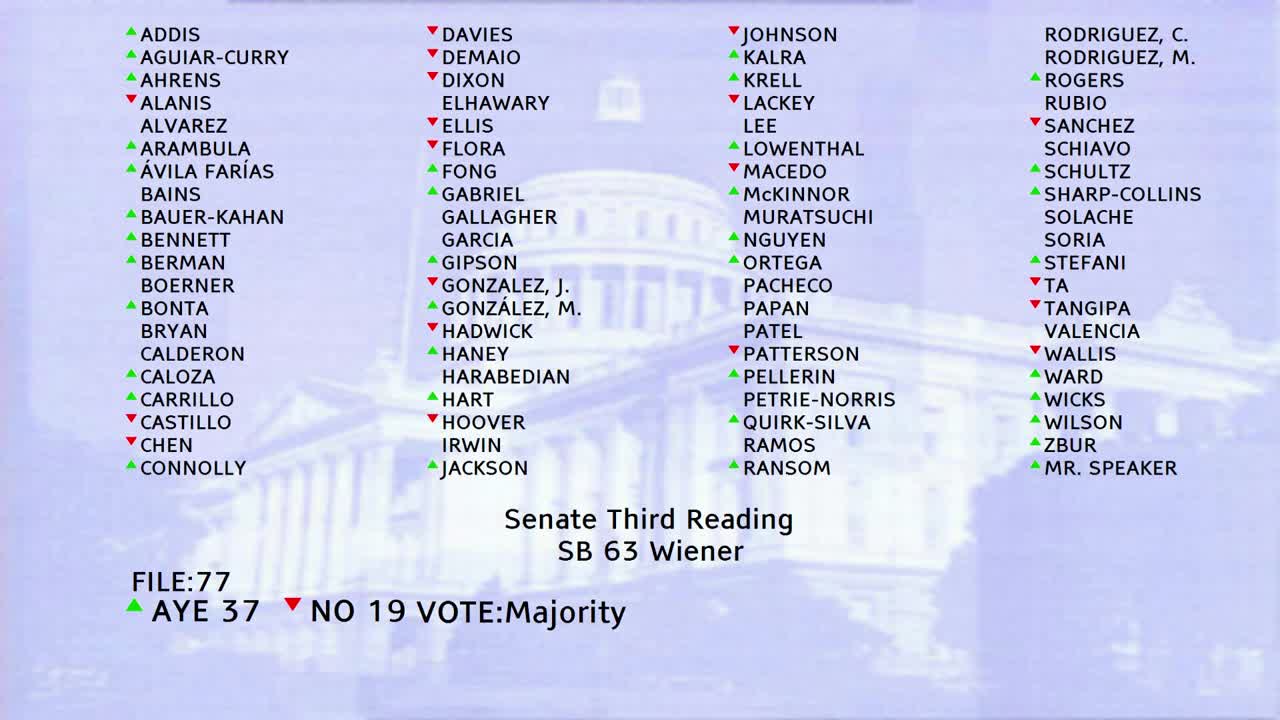 3MIN
Assembly Floor
 1MIN
Senate Floor
 8MIN
Assembly Standing Committee on Governmental Organization
Bill Author
Bill Co-Author(s):