SB 46: Presidential elections: qualifications for office.
- Session Year: 2025-2026
- House: Senate
- Latest Version Date: 2026-06-24
Current Status:
In Progress
(2026-08-13: August 13 hearing: Held in committee and under submission.)
Introduced
In Committee
Awaiting First Chamber Vote
Passed First Chamber
In Committee
Awaiting Second Chamber Vote
Passed Second Chamber
Enacted
Existing law requires the Secretary of State to place the name of a candidate upon a political partys presidential primary ballot when the Secretary of State has determined that the candidate is generally advocated for or recognized throughout the United States or California as actively seeking the nomination of that party for President. Each qualified political party is required to notify the Secretary of State of the names of the partys nominees for President and Vice President on or before the 75th day before a presidential general election, and the Secretary of State is required to place the names of those nominees upon the ballot for the election.
This bill would prohibit the Secretary of State from placing the name of any candidate for the office of President or Vice President upon the ballot, ballot if the candidate does not affirm, under oath, that the candidate will fully meet the qualifications of the office. office, or if the Secretary of State determines that the candidate is not eligible for the office. Because a person who willfully makes a false statement under oath is guilty of the crime of perjury, this bill expands the scope of that crime and thereby creates a state-mandated local program. If the Secretary of State has reasonable suspicion based on articulable fact that a candidate for President or Vice President does not meet the qualifications for office, the bill would authorize the Secretary of State to investigate the candidates qualifications and request proof of the candidates constitutional eligibility to hold the office. concludes that further investigation is needed to determine a candidates eligibility, the bill would authorize the Secretary of State to refer the matter to the Attorney General for an investigation. The Attorney General could appoint an independent special counsel to assist in an investigation. The bill would prohibit finding a candidate ineligible for President or Vice President after the 88th day preceding a presidential primary election or 73rd day preceding a presidential general election.
The bill would authorize an elector to challenge the qualifications of a candidate for President or Vice President by filing a petition in the Superior Court of the County of Sacramento, and it Sacramento no later than the 85th day preceding a primary election or the 72nd day preceding a general election. The bill would authorize a candidate who is not certified by the Secretary of State for failure to meet the qualifications of office to challenge the Secretary of States determination by filing a petition in the same court. The bill would require the petition to be filed no later than 5 days after the date on which the Secretary of State issues the certified list of candidates for the election. The bill would require the court to hold a hearing no more than 10 days after the Secretary of State issues the certified list of candidates and to issue a decision no more than 48 hours after the hearing. court no later than 72 hours after the eligibility determination is made for a primary election and no later than 24 hours after the eligibility determination is made for a general election. Those actions would be subject to expedited judicial review, as specified.
The California Constitution requires the state to reimburse local agencies and school districts for certain costs mandated by the state. Statutory provisions establish procedures for making that reimbursement.
This bill would provide that no reimbursement is required by this act for a specified reason.
Existing law requires the Secretary of State to place the name of a candidate upon a political partys presidential primary ballot when the Secretary of State has determined that the candidate is generally advocated for or recognized throughout the United States or California as actively seeking the nomination of that party for President. Each qualified political party is required to notify the Secretary of State of the names of the partys nominees for President and Vice President on or before the 75th day before a presidential general election, and the Secretary of State is required to place the names of those nominees upon the ballot for the election.
This bill would prohibit the Secretary of State from placing the name of any candidate for the office of President or Vice President upon the ballot, if the candidate does not affirm, under oath, that the candidate will fully meet the qualifications of the office. Because a person who willfully makes a false statement under oath is guilty of the crime of perjury, this bill expands the scope of that crime and thereby creates a state-mandated local program. If the Secretary of State has reasonable suspicion based on articulable fact that a candidate for President or Vice President does not meet the qualifications for office, the bill would authorize the Secretary of State to investigate the candidates qualifications and request proof of the candidates constitutional eligibility to hold the office.
The bill would authorize an elector to challenge the qualifications of a candidate for President or Vice President by filing a petition in the Superior Court of the County of Sacramento, and it would authorize a candidate who is not certified by the Secretary of State for failure to meet the qualifications of office to challenge the Secretary of States determination by filing a petition in the same court. The bill would require the petition to be filed no later than 5 days after the date on which the Secretary of State issues the certified list of candidates for the election. The bill would require the court to hold a hearing no more than 10 days after the Secretary of State issues the certified list of candidates and to issue a decision no more than 48 hours after the hearing.
The California Constitution requires the state to reimburse local agencies and school districts for certain costs mandated by the state. Statutory provisions establish procedures for making that reimbursement.
This bill would provide that no reimbursement is required by this act for a specified reason.
Existing law requires a writing to be authenticated before it can be received in evidence. Under existing law a seal is presumed to be genuine and its use authorized if it purports to be the seal of certain entities including, among others, the United States or a department, agency, or public employee of the United States, or a notary public in any state of the United States.This bill would make a technical, nonsubstantive change to this provision.Existing law requires a writing to be authenticated before it can be received in evidence. Under existing law a seal is presumed to be genuine and its use authorized if it purports to be the seal of certain entities including, among others, the United States or a department, agency, or public employee of the United States, or a notary public in any state of the United States.
This bill would make a technical, nonsubstantive change to this provision.
(a)Except as provided in Section 6901.7, the Secretary of State shall place the name of a candidate upon the presidential primary ballot when the Secretary of State has determined that the candidate is generally advocated for or recognized throughout the United States or California as actively seeking the nomination of the Democratic Party for President of the United States. The Secretary of State shall include as criteria for selecting candidates the fact of qualifying for funding under the Federal Elections Campaign Act of 1974, as amended.
(b)On or before the 88th day preceding a presidential primary election, the Secretary of State shall publicly announce and distribute to the news media for publication a list of the selected candidates that the Secretary of State intends to place on the ballot at the following presidential primary election.
SEC. 2.Section 6340 of the Elections Code is amended to read:6340.(a)Except as provided in Section 6901.7, the Secretary of State shall place the name of a candidate upon the Republican presidential primary ballot when the Secretary of State has determined that the candidate is generally advocated for or recognized throughout the United States or California as a candidate for the nomination of the Republican Party for President of the United States.
(b)On or before the 88th day preceding a presidential primary election the Secretary of State shall publicly announce and distribute to the news media for publication a list of the candidates the Secretary of State intends to place on the ballot at the following presidential primary election. Following this announcement, the Secretary of State may add candidates to the Secretary of States selection, but the Secretary of State shall not delete any candidate whose name appears on the announced list, except as provided in Section 6901.7.
SEC. 3.Section 6520 of the Elections Code is amended to read:6520.(a)Except as provided in Section 6901.7, the Secretary of State shall place the name of a candidate upon the American Independent Party presidential preference ballot when the Secretary of State has determined that the candidate is generally advocated for or recognized in the news media throughout the United States or California as actively seeking the nomination of the American Independent Party for President of the United States.
(b)On or before the 88th day preceding a presidential primary election, the Secretary of State shall publicly announce and distribute to the news media for publication a list of the candidates the Secretary of State intends to place on the ballot at the following presidential primary election. Following this announcement, the Secretary of State may add candidates to the Secretary of States selection, but the Secretary of State may not delete any candidate whose name appears on the announced list, except as provided in Section 6901.7.
SEC. 4.Section 6720 of the Elections Code is amended to read:6720.Except as provided in Section 6901.7, the Secretary of State shall place the name of a candidate upon the Peace and Freedom Party presidential preference ballot when the Secretary of State has determined that the candidate is generally advocated for or recognized throughout the United States or California as actively seeking the presidential nomination of the Peace and Freedom Party or the national party with which the Peace and Freedom Party is affiliated.
SEC. 5.Section 6722 of the Elections Code is amended to read:6722.On or before the 88th day preceding a presidential primary election, the Secretary of State shall publicly announce and distribute to the news media for publication a list of the candidates the Secretary of State intends to place on the ballot at the following presidential primary election. Following this announcement, the Secretary of State may add to the Secretary of States selection, but the Secretary of State may not delete any candidate whose name appears on the announced list, except as provided in Section 6901.7. The Secretary of State shall mail a copy of the list and any subsequent additions thereto to the Chairpersons of the Peace and Freedom Party State and County Central Committees.
SEC. 6.Section 6851 of the Elections Code is amended to read:6851.Except as provided in Section 6901.7, the Secretary of State shall place the name of a candidate upon the Green Party presidential preference primary ballot when the Secretary of State has determined that the candidate is generally advocated for or recognized throughout the United States or California as actively seeking the presidential nomination of the Green Party or the national political party with which the Green Party is affiliated.
SEC. 7.Section 6852 of the Elections Code is amended to read:6852.On or before the 88th day preceding a presidential primary election, the Secretary of State shall publicly announce and distribute to the news media for publication a list of the candidates the Secretary of State intends to place on the ballot at the following presidential primary election. Following this announcement, the Secretary of State may add candidates to the Secretary of States selection, but the Secretary of State may not delete any candidate whose name appears on the announced list, except as provided in Section 6901.7. The Secretary of State shall mail a copy of the list and any subsequent additions to the list to the Green Party Liaison to the Secretary of State.
SEC. 8.Section 6901 of the Elections Code is amended to read:6901.Whenever a political party, in accordance with Section 6864, 7100, 7300, 7578, or 7843, submits to the Secretary of State its certified list of nominees for electors and alternate electors of President and Vice President of the United States, the Secretary of State shall notify each candidate for elector and alternate elector of the electors nomination by the party. Except as provided in Section 6901.7, the Secretary of State shall cause the names of the candidates for President and Vice President of the United States of the several political parties to be placed upon the ballot for the ensuing general election.
SEC. 9.Section 6901.7 is added to the Elections Code, to read:6901.7.(a)(1)A person is eligible to be a candidate for President or Vice President of the United States in a presidential primary or general election only if that person has the qualifications to be elected to or hold that office as set forth in the United States Constitution on the date the term of that office begins.
(2)(b)(1)The Secretary of State shall not certify the name of any candidate for the office of President or Vice President of the United States, and shall not place the candidates name on the ballot, if the candidate does not affirm, under oath, that the candidate will fully meet the qualifications to be elected to and hold the office of President or Vice President of the United States.
(b)If the Secretary of State has reasonable suspicion based on articulable fact that a candidate for President or Vice President of the United States does not meet the qualifications to be elected to or hold office as set forth in the United States Constitution, the Secretary of State shall investigate the candidates qualifications and may request that the candidate provide proof of their constitutional eligibility to be elected to and hold office before placing their name on the ballot.(2)If the Secretary of State determines that election of a candidate for the office of President or Vice President of the United States would violate the United States Constitution, the Secretary of State shall not certify the name of the candidate or place it on the ballot. Whenever any such determination is made, the Secretary of State shall issue a public notice memorializing the determination and shall publicly announce and distribute that determination to the news media for publication.
(3)(A)If the Secretary of State concludes that further investigation is needed to determine whether election of a candidate for the office of President or Vice President of the United States would violate the United States Constitution, the Secretary of State may refer the matter to the Attorney General for investigation.
(B)To assist in any investigation under subparagraph (A), the Attorney General may appoint an independent special counsel for the purpose of investigating the constitutional qualifications of any candidate for the office of President or Vice President of the United States if there is a reasonable suspicion that a candidate does not meet the qualifications.
(C)If the Attorney General or a special counsel appointed under subparagraph (B) determines that a candidate for President or Vice President of the United States does not meet the qualifications for office, the Secretary of State shall not certify the name of the candidate or place it on the ballot. Whenever any such determination is made, the Attorney General shall issue a public notice memorializing the determination and shall publicly announce and distribute that determination to the news media for publication.
(4)For a presidential primary election, the Secretary of State, Attorney General, or special counsel shall not determine a candidate is ineligible for President or Vice President of the United States pursuant to this subdivision later than the 88th day preceding the election. For a presidential general election, the Secretary of State, Attorney General, or special counsel shall not determine a candidate is ineligible for President or Vice President of the United States pursuant to this subdivision later than the 73rd day preceding the election.
(c)(1)(A)An elector may challenge the qualifications of a candidate for President or Vice President of the United States by filing a verified petition setting forth the facts alleged concerning the qualifications of the candidate in the Superior Court of the County of Sacramento.
(B)If the Secretary of State does not certify a candidate for President or Vice President of the United States for failure to State, the Attorney General, or a special counsel determines a candidate for President or Vice President of the United States does not meet the qualifications of office, that candidate may challenge the Secretary of States determination by filing a verified petition setting forth the facts alleged concerning the qualifications of the candidate in the Superior Court of the County of Sacramento.(2)(A)For a presidential primary election, a petition brought pursuant to subparagraph (A) of paragraph (1) shall be filed no later than the 85th day preceding the election. For a presidential general election, a petition brought pursuant to subparagraph (A) of paragraph (1) shall be filed no later than the 72nd day preceding the election.
(2)(B)For either a presidential primary election or a presidential general election, a petition brought pursuant to paragraph (1) subparagraph (B) of paragraph (1) shall be filed no later than five days 72 hours after the date on which the Secretary of State issues the certified list of candidates for the election pursuant to Section 8120 or Section 8148. a determination is made that a candidate for President or Vice President of the United States does not meet the qualifications of office. For a presidential general election, a petition brought pursuant to subparagraph (B) of paragraph (1) shall be filed no later than 24 hours after the date on which a determination is made that a candidate for President or Vice President of the United States does not meet the qualifications of office.
(3)The (A)(i)For the presidential primary election, the hearing on the qualifications of the candidate in a challenge brought pursuant to subparagraph (A) of paragraph (1) shall be held not less than five two nor more than ten four days after the date on which the Secretary of State issues the certified list of candidates for the election. the petition is filed. The court shall hear testimony and other evidence and, within 48 hours after the close of the hearing, determine whether the candidate has the qualifications to be elected to or hold the office for which the candidate has declared.
(ii)For the presidential general election, the hearing on the qualifications of the candidate in a challenge brought pursuant to subparagraph (A) of paragraph (1) shall be held not more than 24 hours after the petition is filed. The court shall hear testimony and other evidence but the hearing shall conclude not more than 48 hours after it begins. Within 24 hours after the close of the hearing, the court shall determine whether the candidate has the qualifications to be elected to or hold the office for which the candidate has declared.
(B)A hearing on the qualifications of a candidate who brings a petition pursuant to subparagraph (B) of paragraph (1) shall be held not less than two nor more than four days after the petition is filed. The court shall hear testimony and other evidence and, within 48 hours after the close of the hearing, determine whether the candidate has the qualifications to be elected to or hold the office.
(4)In an action brought by an elector to challenge a candidates qualifications for office, the elector has the burden to sustain the challenge by a preponderance of the evidence. In an action brought by a candidate to challenge the candidates exclusion from the ballot by the Secretary of State, the Secretary of State has the burden of sustaining the candidates exclusion from the ballot by a preponderance of the evidence.
SEC. 10.Section 13314 of the Elections Code is amended to read:13314.(a)(1)An elector may seek a writ of mandate alleging that an error or omission has occurred, or is about to occur, in the placing of a name on, or in the printing of, a ballot, county voter information guide, state voter information guide, or other official matter, or that any neglect of duty has occurred, or is about to occur.
(2)A peremptory writ of mandate shall issue only upon proof of both of the following:
(A)That the error, omission, or neglect is in violation of this code or the Constitution.
(B)(i)That issuance of the writ will not substantially interfere with the conduct of the election.
(ii)For purposes of this subparagraph, the Secretary of State not placing the name of a candidate on the ballot for failure to meet the constitutional eligibility requirements to be elected to or hold office pursuant to Section 6901.7 will not substantially interfere with the conduct of the election.
(3)The action or appeal shall have priority over all other civil matters.
(4)The Secretary of State shall be named as a respondent or a real party in interest in any proceeding under this section concerning a measure or a candidate described in Section 15375, except for a candidate for judge of the superior court.
(5)If the error or omission involves the Secretary of State placing or refusing to place a constitutionally ineligible candidate for President or Vice President of the United States on the ballot, subdivision (c) of Section 6901.7 applies to an action for a writ of mandate brought pursuant to this section.
(b)Venue for a proceeding under this section shall be exclusively in Sacramento County in any of the following cases:
(1)The Secretary of State is named as a real party in interest or as a respondent.
(2)A candidate for statewide elective office is named as a party.
(3)A statewide measure that is to be placed on the ballot is the subject of the proceeding.
SEC. 11.No reimbursement is required by this act pursuant to Section 6 of Article XIIIB of the California Constitution because the only costs that may be incurred by a local agency or school district will be incurred because this act creates a new crime or infraction, eliminates a crime or infraction, or changes the penalty for a crime or infraction, within the meaning of Section 17556 of the Government Code, or changes the definition of a crime within the meaning of Section 6 of Article XIIIB of the California Constitution.
The (a)Except as provided in Section 6901.7, the Secretary of State shall place the name of a candidate upon the presidential primary ballot when the Secretary of State has determined that the candidate is generally advocated for or recognized throughout the United States or California as actively seeking the nomination of the Democratic Party for President of the United States. The Secretary of State shall include as criteria for selecting candidates the fact of qualifying for funding under the Federal Elections Campaign Act of 1974, as amended.
On(b)On or before the 88th day preceding a presidential primary election, the Secretary of State shall publicly announce and distribute to the news media for publication a list of the selected candidates that the Secretary of State intends to place on the ballot at the following presidential primary election.
SEC. 2.Section 6340 of the Elections Code is amended to read:6340.(a)The Except as provided in Section 6901.7, the Secretary of State shall place the name of a candidate upon the Republican presidential primary ballot when the Secretary of State has determined that the candidate is generally advocated for or recognized throughout the United States or California as a candidate for the nomination of the Republican Party for President of the United States.
(b)On or before the 88th day preceding a presidential primary election the Secretary of State shall publicly announce and distribute to the news media for publication a list of the candidates the Secretary of State intends to place on the ballot at the following presidential primary election. Following this announcement announcement, the Secretary of State may add candidates to the Secretary of States selection, but the Secretary of State shall not delete any candidate whose name appears on the announced list. list, except as provided in Section 6901.7.
SEC. 3.Section 6520 of the Elections Code is amended to read:6520.(a)The Except as provided in Section 6901.7, the Secretary of State shall place the name of a candidate upon the American Independent Party presidential preference ballot when the Secretary of State has determined that the candidate is generally advocated for or recognized in the news media throughout the United States or California as actively seeking the nomination of the American Independent Party for President of the United States.
(b)On or before the 88th day preceding a presidential primary election, the Secretary of State shall publicly announce and distribute to the news media for publication a list of the candidates the Secretary of State intends to place on the ballot at the following presidential primary election. Following this announcement announcement, the Secretary of State may add candidates to the Secretary of States selection, but the Secretary of State may not delete any candidate whose name appears on the announced list. list, except as provided in Section 6901.7.
SEC. 4.Section 6720 of the Elections Code is amended to read:6720.The Except as provided in Section 6901.7, the Secretary of State shall place the name of a candidate upon the Peace and Freedom Party presidential preference ballot when the Secretary of State has determined that the candidate is generally advocated for or recognized throughout the United States or California as actively seeking the presidential nomination of the Peace and Freedom Party or the national party with which the Peace and Freedom Party is affiliated.
SEC. 5.Section 6722 of the Elections Code is amended to read:6722.On or before the 88th day preceding a presidential primary election, the Secretary of State shall publicly announce and distribute to the news media for publication a list of the candidates the Secretary of State intends to place on the ballot at the following presidential primary election. Following this announcement, the Secretary of State may add to the Secretary of States selection, but the Secretary of State may not delete any candidate whose name appears on the announced list. list, except as provided in Section 6901.7. The Secretary of State shall mail a copy of the list and any subsequent additions thereto to the Chairpersons of the Peace and Freedom Party State and County Central Committees.
SEC. 6.Section 6851 of the Elections Code is amended to read:6851.The Except as provided in Section 6901.7, the Secretary of State shall place the name of a candidate upon the Green Party presidential preference primary ballot when the Secretary of State has determined that the candidate is generally advocated for or recognized throughout the United States or California as actively seeking the presidential nomination of the Green Party or the national political party with which the Green Party is affiliated.
SEC. 7.Section 6852 of the Elections Code is amended to read:6852.On or before the 88th day preceding a presidential primary election, the Secretary of State shall publicly announce and distribute to the news media for publication a list of the candidates the Secretary of State intends to place on the ballot at the following presidential primary election. Following this announcement, the Secretary of State may add candidates to the Secretary of States selection, but the Secretary of State may not delete any candidate whose name appears on the announced list. list, except as provided in Section 6901.7. The Secretary of State shall mail a copy of the list and any subsequent additions to the list to the Green Party Liaison to the Secretary of State.
SEC. 8.Section 6901 of the Elections Code is amended to read:6901.Whenever a political party, in accordance with Section 6864, 7100, 7300, 7578, or 7843, submits to the Secretary of State its certified list of nominees for electors and alternate electors of President and Vice President of the United States, the Secretary of State shall notify each candidate for elector and alternate elector of the electors nomination by the party. The Except as provided in Section 6901.7, the Secretary of State shall cause the names of the candidates for President and Vice President of the United States of the several political parties to be placed upon the ballot for the ensuing general election.
SEC. 9.Section 6901.7 is added to the Elections Code, to read:6901.7.(a)(1)A person is eligible to be a candidate for President or Vice President of the United States in a presidential primary or general election only if that person has the qualifications to be elected to or hold that office as set forth in the United States Constitution on the date the term of that office begins.
(2)The Secretary of State shall not certify the name of any candidate for the office of President or Vice President of the United States, and shall not place the candidates name on the ballot, if the candidate does not affirm, under oath, that the candidate will fully meet the qualifications to be elected to and hold the office of President or Vice President of the United States.
(b)If the Secretary of State has reasonable suspicion based on articulable fact that a candidate for President or Vice President of the United States does not meet the qualifications to be elected to or hold office as set forth in the United States Constitution, the Secretary of State shall investigate the candidates qualifications and may request that the candidate provide proof of their constitutional eligibility to be elected to and hold office before placing their name on the ballot.
(c)(1)(A)An elector may challenge the qualifications of a candidate for President or Vice President of the United States by filing a verified petition setting forth the facts alleged concerning the qualifications of the candidate in the Superior Court of the County of Sacramento.
(B)If the Secretary of State does not certify a candidate for President or Vice President of the United States for failure to meet the qualifications of office, that candidate may challenge the Secretary of States determination by filing a verified petition setting forth the facts alleged concerning the qualifications of the candidate in the Superior Court of the County of Sacramento.
(2)For either a presidential primary election or a presidential general election, a petition brought pursuant to paragraph (1) shall be filed no later than five days after the date on which the Secretary of State issues the certified list of candidates for the election pursuant to Section 8120 or Section 8148.
(3)The hearing on the qualifications of the candidate shall be held not less than five nor more than ten days after the date on which the Secretary of State issues the certified list of candidates for the election. The court shall hear testimony and other evidence and, within 48 hours after the close of the hearing, determine whether the candidate has the qualifications to be elected to or hold the office for which the candidate has declared.
(4)In an action brought by an elector to challenge a candidates qualifications for office, the elector has the burden to sustain the challenge by a preponderance of the evidence. In an action brought by a candidate to challenge the candidates exclusion from the ballot by the Secretary of State, the Secretary of State has the burden of sustaining the candidates exclusion from the ballot by a preponderance of the evidence.
SEC. 10.Section 13314 of the Elections Code is amended to read:13314.(a)(1)An elector may seek a writ of mandate alleging that an error or omission has occurred, or is about to occur, in the placing of a name on, or in the printing of, a ballot, county voter information guide, state voter information guide, or other official matter, or that any neglect of duty has occurred, or is about to occur.
(2)A peremptory writ of mandate shall issue only upon proof of both of the following:
(A)That the error, omission, or neglect is in violation of this code or the Constitution.
(B)(i)That issuance of the writ will not substantially interfere with the conduct of the election.
(ii)For purposes of this subparagraph, the Secretary of State not placing the name of a candidate on the ballot for failure to meet the constitutional eligibility requirements to be elected to or hold office pursuant to Section 6901.7 will not substantially interfere with the conduct of the election.
(3)The action or appeal shall have priority over all other civil matters.
(4)The Secretary of State shall be named as a respondent or a real party in interest in any proceeding under this section concerning a measure or a candidate described in Section 15375, except for a candidate for judge of the superior court.
(5)If the error or omission involves the Secretary of State placing or refusing to place a constitutionally ineligible candidate for President or Vice President of the United States on the ballot, subdivision (c) of Section 6901.7 applies to an action for a writ of mandate brought pursuant to this section.
(b)Venue for a proceeding under this section shall be exclusively in Sacramento County in any of the following cases:
(1)The Secretary of State is named as a real party in interest or as a respondent.
(2)A candidate for statewide elective office is named as a party.
(3)A statewide measure that is to be placed on the ballot is the subject of the proceeding.
SEC. 11.No reimbursement is required by this act pursuant to Section 6 of Article XIIIB of the California Constitution because the only costs that may be incurred by a local agency or school district will be incurred because this act creates a new crime or infraction, eliminates a crime or infraction, or changes the penalty for a crime or infraction, within the meaning of Section 17556 of the Government Code, or changes the definition of a crime within the meaning of Section 6 of Article XIIIB of the California Constitution.
SECTION 1.Section 1452 of the Evidence Code is amended to read:1452.A seal is presumed to be genuine and its use authorized if it purports to be the seal of:(a)The United States or a department, agency, or public employee of the United States.(b)A public entity in the United States or a department, agency, or public employee of such public entity.(c)A nation recognized by the executive power of the United States or a department, agency, or officer of such nation.(d)A public entity in a nation recognized by the executive power of the United States or a department, agency, or officer of such public entity.(e)A court of admiralty or maritime jurisdiction.(f)A notary public in any state of the United States.A seal is presumed to be genuine and its use authorized if it purports to be the seal of:
(a)The United States or a department, agency, or public employee of the United States.
(b)A public entity in the United States or a department, agency, or public employee of such public entity.
(c)A nation recognized by the executive power of the United States or a department, agency, or officer of such nation.
(d)A public entity in a nation recognized by the executive power of the United States or a department, agency, or officer of such public entity.
(e)A court of admiralty or maritime jurisdiction.
(f)A notary public within in any state of the United States.
|
Date
|
Status
|
|---|---|
| Aug 13, 2026 | August 13 hearing: Held in committee and under submission. |
| Aug 5, 2026 | August 5 set for first hearing. Placed on suspense file. |
| Jul 1, 2026 | From committee: Do pass and re-refer to Com. on APPR. (Ayes 6. Noes 2.) (July 1). Re-referred to Com. on APPR. |
| Jun 24, 2026 | From committee with author's amendments. Read second time and amended. Re-referred to Com. on ELECTIONS. |
| Jun 23, 2026 | From committee: Do pass and re-refer to Com. on ELECTIONS. (Ayes 9. Noes 3.) (June 23). Re-referred to Com. on ELECTIONS. |
| Jun 18, 2026 | Pursuant to Assembly Rule 51. |
| Jun 18, 2026 | Referred to Coms. on JUD. and ELECTIONS. |
| Jun 18, 2026 | Re-referred to Coms. on JUD. and ELECTIONS pursuant to Assembly Rule 51. |
| Jan 27, 2026 | In Assembly. Read first time. Held at Desk. |
| Jan 27, 2026 | Read third time. Passed. (Ayes 30. Noes 10. Page 3296.) Ordered to the Assembly. |
| Jan 22, 2026 | Read second time. Ordered to third reading. |
| Jan 22, 2026 | From committee: Do pass. (Ayes 5. Noes 2. Page 3268.) (January 22). |
| Jan 21, 2026 | Set for hearing January 22. |
| Jan 20, 2026 | January 20 hearing: Placed on APPR. suspense file. |
| Jan 15, 2026 | Set for hearing January 20. |
| Jan 14, 2026 | From committee: Do pass and re-refer to Com. on APPR. (Ayes 11. Noes 2. Page 3213.) (January 13). Re-referred to Com. on APPR. |
| Jan 13, 2026 | From committee: Do pass and re-refer to Com. on JUD. (Ayes 4. Noes 1. Page 3212.) (January 13). Re-referred to Com. on JUD. |
| Jan 8, 2026 | Set for hearing January 13 in JUD. pending receipt. |
| Jan 7, 2026 | Set for hearing January 13. |
| Jan 5, 2026 | Re-referred to Coms. on E. & C.A. and JUD. |
| Jan 5, 2026 | From committee with author's amendments. Read second time and amended. Re-referred to Com. on RLS. |
| Jan 29, 2025 | Referred to Com. on RLS. |
| Jan 6, 2025 | Read first time. |
| Dec 13, 2024 | From printer. May be acted upon on or after January 12. |
| Dec 12, 2024 | Introduced. To Com. on RLS. for assignment. To print. |
|
Date
|
Description
|
Location
|
Votes
|
|
|---|---|---|---|---|
| Jul 1, 2026 | Do pass and be re-referred to the Committee on [Appropriations] | Assembly Standing Committee on Elections |
Passed |
|
| Jun 23, 2026 | Do pass and be re-referred to the Committee on [Elections] | Assembly Standing Committee on Judiciary |
Passed |
|
| Jan 27, 2026 | Senate 3rd Reading SB46 Umberg | Senate Floor |
Passed |
|
| Jan 22, 2026 | Do pass | Senate Standing Committee on Appropriations |
Passed |
|
| Jan 20, 2026 | Placed on suspense file | Senate Standing Committee on Appropriations |
Passed |
|
| Jan 13, 2026 | Do pass, but first be re-referred to the Committee on [Appropriations] | Senate Standing Committee on Judiciary |
Passed |
|
| Jan 13, 2026 | Do pass, but first be re-referred to the Committee on [Judiciary] | Senate Standing Committee on Elections and Constitutional Amendments |
Passed |
This list shows positions taken on this bill by organizations on the date displayed, which is linked to the original source.
Positions by individuals are not included.
|
Organization
|
Position
|
Date
|
|---|---|---|
| CFT – A Union of Educators & Classified Professionals, AFT, AFL-CIO (prior version) | ** Support | |
| Citizens For Responsibility And Ethics In Washington | ** Support | |
| Citizens for Responsibility and Ethics in Washington (CREW) | ** Support | |
| Democrats of Rossmoor | ** Support | |
| Democrats of Rossmoor (prior version) | ** Support | |
| Peace and Freedom Party of California | ** Against | |
| Peace and Freedom Party of California (prior version) | ** Against |
Date of Hearing: August 5, 2026
ASSEMBLY COMMITTEE ON APPROPRIATIONS
Buffy Wicks, Chair
SBPCA Bill Id:SB 46
Author:(Umberg) – As Amended Ver:June 24, 2026
Policy Committee: | Judiciary | Vote: | 9 - 3 |
Elections | 6 - 2 | ||
|
|
Urgency: No State Mandated Local Program: Yes Reimbursable: No
SUMMARY:
This bill prohibits the Secretary of State (SOS) from placing the name of a candidate for President or Vice President on the ballot under certain conditions and authorizes an elector to directly challenge the qualifications of such a candidate in court.
Specifically, this bill:
- Prohibits the SOS from certifying and placing the name of a candidate for President or Vice President on the ballot if the candidate does not affirm under oath that the candidate fully meets the qualifications for the office, or if the SOS determines that the election of the candidate would violate the U.S. Constitution (“determination”).
- Authorizes the SOS, if the SOS concludes further investigation is needed to make a determination, to refer the matter to the Attorney General (AG) for investigation, and allows the AG to appoint an independent special counsel to assist the investigation.
- Requires the SOS or AG, if such a determination is made by the official, to issue a public notice memorializing the determination and distribute the determination to the news media for publication.
- Authorizes an elector to challenge the qualifications of a candidate for President or Vice President by filing a petition in the Superior Court of the County of Sacramento no later than 85 days before a primary election or 72 days before a general election; authorizes a candidate to challenge the SOS’s, AG’s, or special prosecutor’s determination in the same court no later than 72 hours after the determination is made for a primary election or 24 hours after for a general election; and provides expedited judicial review timelines for both actions.
FISCAL EFFECT:
- Costs of approximately $820,000 in the first year and $590,000 annually thereafter to the SOS for additional administrative and legal staff workload to determine whether a candidate satisfies constitutional qualifications for office, administer candidate affirmations under oath, publicly announce and distribute determinations, and defend determinations in expedited court proceedings (General Fund). The SOS notes that given the state’s prior experience with litigation involving presidential ballot access requirements, this bill may result in additional costs beyond this estimate depending on the number of candidate challenges, the complexity of making determinations, and the extent of judicial proceedings.
- Costs of approximately $343,000 in fiscal year (FY) 2026-27 and $432,000 in FY 2027-28 and annually thereafter to the AG or the appointed independent special counsel to investigate a candidate’s eligibility upon request of the SOS and defend determinations in expedited court proceedings (Legal Services Revolving Fund, reimbursable through direct billings to the applicable client agency (likely the SOS)).
- Ongoing cost pressures of an unknown amount to the courts in additional workload by allowing an elector (generally, a person qualified to be a California voter) to challenge the qualifications of a candidate for President or Vice President and allowing a candidate to challenge the SOS’s, AG’s, or special prosecutor’s determination, subject to expedited review (GF or Trial Court Trust Fund (TCTF)). It is unclear how many petitions may be filed and how much court time may be needed to resolve each case, but it generally costs approximately $1,000 to operate a courtroom for one hour. Although courts are not funded on the basis of workload, increased pressure on staff and the TCTF may create a demand for increased court funding from the GF. The state budget provides annual GF backfills to the TCTF to offset revenue reductions, totaling approximately $117.3 million in fiscal year 2025-26.
COMMENTS:
- Purpose. According to the author:
For more than five years, President Trump has maintained that a third term or third presidential run is possible. This is a clear violation of the 22nd Amendment, which has existed for 75 years, and illustrates one of the most clear and unambiguous Article Two requirements. If President Trump cannot condone such obviously unconstitutional actions, states must be able to disqualify candidates who seek to be placed on the ballot who don’t meet basic constitutional requirements, such as age, place of birth, and number of previous terms served.
- Background. Constitutional Requirements for President. The U.S. Constitution (a) provides that a person eligible to serve as President must be at least 35 years old, a U.S. resident for at least 14 years, and a natural born citizen, (b) prohibits a person from holding an U.S. office if the person engaged in insurrection or rebellion against the U.S. after having previously taken an oath to support the U.S. Constitution, and (c) provides that a person must be eligible to be President to be Vice President.
Additionally, the 22nd Amendment of the U.S. Constitution was ratified in 1951 to set a two-term limit for the presidency after the death of President Roosevelt, the only US President who served more than two terms in that office. Although the plain language of the 22nd Amendment bars President Trump from being elected to the presidency again, after being elected to the office in 2016 and 2024, President Trump and his allies have suggested that he could run for a third term.
Scope of This Bill. This bill prohibits the SOS from placing the name of a candidate for President or Vice President on the ballot if: (a) the candidate does not affirm under oath to meeting the qualifications for office, or (b) the SOS, AG, or special prosecutor makes a determination that the election of the candidate would violate the U.S. Constitution. Thus, this bill’s prohibition is not limited to the 22nd Amendment. This bill also authorizes a California voter to directly challenge the candidate’s qualifications in court.
As noted in the Assembly Elections Committee’s analysis of this bill:
While the determination of whether a candidate for President or Vice President has already served two terms of office is relatively straightforward one, determining whether a candidate meets other qualifications found in the US Constitution may be less easily resolved, and could require greater investigation and fact finding. Questions about whether the SOS may exclude presidential candidates from the ballot based on eligibility concerns have been litigated frequently in California and across the country in recent years…
Each of these cases involved distinct factual circumstances regarding candidate eligibility and raised questions about whether the SOS has the authority – or obligation – to exclude candidates from the ballot on that basis. This bill would expressly grant that authority to the SOS.
- Support and Opposition. This bill is supported by a local political group, a labor organization, and a government accountability group, Citizens for Responsibility and Ethics in Washington, which argues this bill will “ensure that Californians are not effectively disenfranchised by having an ineligible candidate appear on their ballot.”
This bill is opposed by the Peace and Freedom Party of California, which argues “it creates an unnecessary bureaucratic burden that presidential candidates must overcome in order to be listed on our party’s presidential preference primary ballot” and “if they are in fact ineligible, those who support them deserve to be able to vote for them.”
- Related Legislation. AB 1539 (Addis) requires a representative of each political party to certify to the SOS that the party’s nominees for President and Vice President are qualified for that office under the 22nd Amendment of the U.S. Constitution. AB 1539 is pending hearing by the Senate Appropriations Committee.
Analysis Prepared by: Irene Ho / APPR. / (916) 319-2081
Date of Hearing: July 1, 2026
ASSEMBLY COMMITTEE ON ELECTIONS
Gail Pellerin, Chair
SBPCA Bill Id:SB 46
Author:(Umberg) – As Amended Ver:June 24, 2026
SENATE VOTE: 30-10
SUBJECT: Presidential elections: qualifications for office.
SUMMARY: Prohibits a candidate for President or Vice President from having their name printed on the ballot unless they affirm, under oath, that they meet eligibility requirements for the office. Permits the Secretary of State (SOS) to exclude a candidate for President or Vice President from the ballot if the SOS determines that the candidate is not eligible for the office. Specifically, this bill:
- Provides that a person is eligible to be a candidate for President or Vice President in an election in California only if that person has the qualifications to be elected to or hold that office as set forth in the United States (US) Constitution on the date the term of that office begins.
- Prohibits the SOS from placing the name of a candidate for President or Vice President on the ballot unless the candidate has affirmed under oath that the candidate will fully meet the qualifications to be elected to and hold the office of President or Vice President.
- Permits the SOS to exclude a candidate for President or Vice President from the ballot if the SOS determines that the election of that candidate would violate the US Constitution. Requires the SOS to issue a public notice memorializing such a determination.
- Permits the SOS to refer the question of the eligibility of a candidate for President or Vice President to the Attorney General (AG) if the SOS concludes that further investigation is needed. Permits the AG to appoint a special counsel if needed to investigate the candidate’s qualifications. Requires the SOS to exclude the candidate from the ballot if the AG or special counsel determines that the candidate does not meet the qualifications for office.
- Prohibits a determination by the SOS, AG, or special counsel that a candidate does not meet the qualifications from being made after the 88th day before the election in the case of a primary election, or after the 73rd day before the election in the case of a general election.
- Permits an elector to challenge the qualifications of a candidate for President or Vice President. Permits a candidate for President or Vice President to challenge a determination by the SOS, AG, or special counsel that the candidate does not meet the qualifications of office. Requires any challenge brought under either of these provisions to be made through a lawsuit brought in the Sacramento County Superior Court, and specifies the timelines for that lawsuit to be brought and for proceedings to be held.
- Provides that in an action brought by an elector to challenge a candidate’s qualifications for office, the elector has the burden to sustain the challenge by a preponderance of the evidence. Provides that in an action brought by a candidate to challenge the candidate’s exclusion from the ballot by the SOS, the SOS has the burden of sustaining the candidate’s exclusion from the ballot by a preponderance of the evidence.
- Makes technical and conforming changes.
EXISTING LAW:
- Provides that a person is not eligible to serve as President unless the person is at least 35 years old, has been a US resident for at least 14 years, and is a natural born citizen or was a US citizen at the time of the adoption of the US Constitution. (US Constitution, Article II, Section 1)
- Prohibits a person from holding any US office if the person engaged in insurrection or rebellion against the US after having previously taken an oath to support the US Constitution, as specified. Permits Congress to remove such a disability by a vote of two-thirds of each House. (US Constitution, 14th Amendment, Section 3)
- Provides that no person shall be elected to the office of the President more than twice, and that no person who has held the office of President, or acted as President, for more than two years of a term to which some other person was elected President shall be elected to the office of the President more than once, as specified. (US Constitution, 22nd Amendment)
- Provides that no person who is constitutionally ineligible to the office of President shall be eligible to that of Vice President. (US Constitution, 12th Amendment)
- Requires the SOS to place the name of a candidate seeking the nomination of the Democratic Party, Republican Party, American Independent Party, Peace and Freedom Party, or Green Party for the office of President on the presidential primary ballot when the SOS determines that the candidate is generally advocated for or recognized throughout the US as actively seeking the nomination of the party. (Elections Code §§6041, 6340, 6520, 6720, 6851)
- Requires each political party qualified to participate in the presidential general election to notify the SOS of the names of that party’s nominees for the offices of President and Vice President by the 75th day before the election. Permits a party to notify the SOS of the party’s apparent nominees for President and Vice President instead if the party has not held its national convention by the 75th day before the election. (Elections Code §6901.5)
- Requires each political party to submit to the SOS a certified list of its nominated candidates to serve as presidential electors, as specified. Requires the names of the candidates for President and Vice President nominated by each party to be printed on the ballot instead of the names of the political party’s elector nominees. (Elections Code §§6864, 6901, 7100, 7300, 7578, 7843)
- Authorizes an elector to seek a writ of mandate alleging that an error or omission has occurred, or is about to occur, in the placing of a name on, or in the printing of, a ballot, county voter information guide, state voter information guide, or other official matter, or that any neglect of duty has occurred, or is about to occur, as specified. Prohibits a writ of mandate from being issued in such a case if doing so would substantially interfere with the conduct of the election. (Elections Code §13314)
FISCAL EFFECT: According to the Senate Appropriations Committee, SOS administrative costs have yet to be identified, but could exceed $50,000 annually (General Fund).
COMMENTS:
- Purpose of the Bill: According to the author:
Having our political candidates meet basic constitutional requirements should be an obvious prerequisite for placing them on the ballot. Sadly, rhetoric advocating the dismissal of these requirements continues to permeate national news discussions as the 2028 presidential election approaches. For more than five years, President Trump has maintained that a third term or third presidential run is possible. This is a clear violation of the 22nd Amendment, which has existed for 75 years, and illustrates one of the most clear and unambiguous Article Two requirements. If President Trump cannot condone such obviously unconstitutional actions, states must be able to disqualify candidates who seek to be placed on the ballot who don’t meet basic constitutional requirements, such as age, place of birth, and number of previous terms served.
- Presidential Elections in California: Elections in California for President and Vice President differ from the process for electing individuals to other federal offices and to state office. Aside from the fact that the results of these elections depend on votes cast in other states, the process for choosing the candidates who appear on the ballot at the general election also differs from California elections for other offices.
Presidential primary election results do not directly determine the candidates who will appear on the ballot at the general election. Instead, primary election results are used by some political parties to determine the delegates that represent the state at the parties’ national conventions. The delegates to those conventions generally choose each party’s nominee for President, and the nominee for President typically chooses the party’s Vice Presidential nominee.
While the names of a party’s candidates for President and Vice President are printed on the ballot at Presidential general elections, Californians actually are casting their votes for a slate of presidential elector candidates selected by the political party that nominated that presidential ticket (or, in the case of an independent presidential ticket not affiliated with a political party, for a slate of elector candidates that has pledged to vote for that ticket). This is because the voters do not directly elect the President and Vice President; instead, the US Constitution requires each state to appoint electors who have the responsibility of choosing the President and Vice President. Each state is allocated a number of electors equal to the number of Senators and Representatives that the state is entitled to in Congress. As a body, the electors chosen by each state are referred to as the “Electoral College.” - Presidential Term Limits and President Trump: Until Franklin Delano Roosevelt was elected to a third term as US President in 1940, no President had served more than two terms in office. President Roosevelt subsequently was elected to a fourth term in 1944, though he died in office less than three months into that term. After President Roosevelt died, Congress proposed an amendment to the US Constitution enacting a two-term limit for the Presidency. That amendment subsequently was ratified and became the 22nd Amendment to the US Constitution in 1951.
The 22nd Amendment provides that no one “shall be elected to the office of the President more than twice, and no person who has held the office of President, or acted as President, for more than two years of a term to which some other person was elected President shall be elected to the office of the President more than once.”
Donald Trump was elected to his first term as President in 2016 and again was elected President in 2024. Notwithstanding the fact that the plain language of the 22nd Amendment bars him from being elected to the office of President again, President Trump and his allies nonetheless have floated the idea that he could run again for a third term in 2028. In March 2025, for example, the Associated Press quoted President Trump as saying that he wasn’t joking about trying to serve a third term, and that “there are methods which you could do it.” In October, President Trump told reporters that he hadn’t really thought about running for a third term, but also refused to rule out running again in 2028. Furthermore, media outlets have reported that the official Trump store is selling Trump 2028 hats, and President Trump has displayed those hats in the Oval Office. At other times, the press has reported that President Trump has publicly downplayed the prospect of running for a third term.
It is unclear whether President Trump is serious about seeking to serve another term as President. Absent a repeal of or an amendment to the 22nd Amendment, however, there is no obvious legal path for him to run for a third term.
- Other Presidential Eligibility Criteria: The author’s arguments in support of this bill focus specifically on the possibility of a presidential candidate seeking a third term in office. This bill, however, applies more broadly to all the qualifications set forth in the US Constitution for being elected to or serving as President or Vice President. While the determination of whether a candidate for President or Vice President has already served two terms of office is relatively straightforward one, determining whether a candidate meets other qualifications found in the US Constitution may be less easily resolved, and could require greater investigation and fact finding. Questions about whether the SOS may exclude presidential candidates from the ballot based on eligibility concerns have been litigated frequently in California and across the country in recent years.
For example, in 2008, former presidential candidate Alan Keyes and others sued Secretary of State Debra Bowen, alleging that Barack Obama was not a natural-born citizen and therefore was ineligible to serve as President. The plaintiffs argued that the SOS had a duty to investigate whether presidential candidates meet constitutional qualifications before placing them on the ballot. The California Court of Appeal rejected this claim, holding that the plaintiffs failed to establish any such duty. (Keyes v. Bowen (2010), 189 Cal.App.4th 647.)
In 2012, Peta Lindsay, then 27 years old, sued Secretary Bowen after being excluded from California’s presidential primary election ballot for the Peace and Freedom Party. Lindsay did not meet the Constitution’s minimum age requirement of 35. The US Court of Appeals for the Ninth Circuit upheld the Secretary’s decision, finding that California may refuse to list candidates who are “indisputably ineligible” to serve. The court further held that such exclusions do not violate the First Amendment or the Equal Protection Clause because the burden on political rights is minimal and justified by the state’s interest in maintaining ballot integrity and avoiding voter confusion. (Lindsay v. Bowen (2014), 750 F.3d 1061.)
During the 2024 Presidential campaign, multiple legal disputes arose over whether Donald Trump was constitutionally ineligible to run under Section 3 of the Fourteenth Amendment, often referred to as the “insurrection clause.” The most notable dispute arose in Colorado, where the state’s Supreme Court ruled in December 2023 that Trump’s actions related to the January 6, 2021, Capitol attack amounted to engaging in an insurrection, and that he therefore was ineligible to run for President. On appeal, however, the US Supreme Court unanimously reversed that decision, holding that individual states lack authority to enforce Section 3 of the Fourteenth Amendment for federal offices—such as the presidency. (Trump v. Anderson (2024), 601 US 100.)
Each of these cases involved distinct factual circumstances regarding candidate eligibility and raised questions about whether the SOS has the authority—or obligation—to exclude candidates from the ballot on that basis. This bill would expressly grant that authority to the SOS. However, notwithstanding that grant of authority, the Supreme Court’s holding in Trump v. Anderson would appear to prohibit the SOS from excluding a candidate for President or Vice President from the ballot on the grounds that the candidate engaged in insurrection. - Arguments in Support: In support of this bill, Citizens for Responsibility and Ethics in Washington wrote:
[SB 46] would add a new section to the code, Section 6901.7, which sets forth the duties of the Secretary of State, the California Attorney General, and the protections that candidates have to prevent erroneous removal from the ballot. The proposed statute carefully balances the Secretary of State’s oath to the Constitution to give them the ability to refuse to certify the name of a constitutionally ineligible candidate from the ballot and the candidate’s due process rights by setting out expedited procedures to adjudicate any disputes. Moreover, should the Secretary of State conclude that further investigation is needed to determine if a candidate is constitutionally ineligible, the statute allows the Secretary of State to refer the matter to the Attorney General and assigns any investigatory responsibilities to the Attorney General’s office. The assignment of any investigation to the Attorney General’s office is in line with that office’s role as the state’s chief legal officer. This type of statutory scheme—where the Secretary of State with the assistance of the Attorney General’s office has the statutory authority to police its ballot either unilaterally or through a challenge process—exists and has worked effectively in other states including Colorado, Ohio, Rhode Island and Wisconsin, among others.
- Arguments in Opposition: In opposition to a prior version of this bill, the Peace and Freedom Party of California wrote:
The main reason we oppose the bill is that it creates an unnecessary bureaucratic burden that presidential candidates must overcome in order to be listed on our party's presidential preference primary ballot. We are currently a one state party, and our presidential ballot line is often sought by left presidential candidates running as independents or from national parties that are not ballot-qualified in California. We don't want to make it more difficult for such candidates, who may not visit California until after the list of candidates is certified, to run.
Further, there are situations in which it may be legally unclear whether a potential presidential or vice-presidential candidate is in fact eligible to hold office. Requiring such candidates to state under penalty of perjury that they are eligible puts them at legal risk, when the only situation in which it would be necessary to determine their eligibility would be if they were elected. Even if they are in fact ineligible, those who support them deserve to be able to vote for them, with such votes treated as if they were for an unpledged slate of delegates or electors led by the nominal candidate.
- Related Legislation: AB 1539 (Addis), which is pending in the Senate Public Safety Committee, requires a representative from each political party, a representative of each independent presidential ticket, and a representative of each write-in presidential ticket, to certify under penalty of perjury that their nominees for President and Vice President are not barred by federal term limits from being elected to the office of President. AB 1539 was approved by this committee by a 7-0 vote and was approved on the Assembly Floor by a 75-0 vote.
- Double Referral: This bill was heard in the Assembly Judiciary Committee on June 23, 2026, where it was approved by a 9-3 vote.
This analysis focuses on policy issues within the jurisdiction of the Assembly Elections Committee.
REGISTERED SUPPORT / OPPOSITION:
Support
CFT – A Union of Educators & Classified Professionals, AFT, AFL-CIO (prior version)
Citizens for Responsibility and Ethics in Washington (CREW)
Democrats of Rossmoor (prior version)
Opposition
Peace and Freedom Party of California (prior version)
Analysis Prepared by: Ethan Jones / ELECTIONS / (916) 319-2094
Date of Hearing: June 23, 2026
ASSEMBLY COMMITTEE ON JUDICIARY
Ash Kalra, Chair
SBPCA Bill Id:SB 46
Author:(Umberg) – As Amended Ver:January 5, 2026
SENATE VOTE: 30-10
SUBJECT: Presidential elections: qualifications for office
SYNOPSIS
After winning a second term as President in 2024 and assuming office in 2025, President Donald Trump and his allies have been openly musing about the President seeking a third (or more) term in office despite the 22nd Amendment to the United States Constitution prohibiting any person from serving more than two terms as President. Although the President’s dipping poll numbers and speculation about the 80-year old’s health have diminished such talk in recent months, his supporters have claimed they have a “plan” to circumvent the 22nd Amendment.
To that end, this bill would prohibit the Secretary of State from placing any person’s name on a Presidential ballot if the person does not meet the legal requirements to be President, including but not limited to, having already served two terms in the office. The bill also requires the Secretary of State (SOS) to investigate a candidate’s qualifications and authorizes the SOS to request the candidate provide proof of their constitutional eligibility to be elected to and hold office before placing their name on the ballot if the Secretary of State has a has reasonable suspicion based on articulable fact that a candidate for President or Vice President of the United States does not meet the qualifications to be elected to or hold office.
This author-sponsored measure is supported by the Citizens for Responsibility and Ethics in Washington who note that this bill clarifies ambiguity in California law stemming from prior court decisions on candidate eligibility. This bill is opposed by the Peace and Freedom Party of California who believe it creates unnecessary bureaucratic burdens for the Secretary of State and candidate for President. If approved by this Committee will subsequently be heard in the Committee on Elections.
SUMMARY: Provides that a candidate for President or Vice President of the United States in a presidential primary or general election is eligible only if that person has the qualifications to be elected to or hold that office as set forth in the United States Constitution on the date the term of that office begins. Specifically, this bill:
- Specifies that a person is eligible to be a candidate for President or Vice President of the United States in a presidential primary or general election only if that person has the qualifications to be elected to or hold that office as set forth in the United States Constitution on the date the term of that office begins.
- Prohibits the Secretary of State from certifying the name of any candidate for the office of President or Vice President of the United States, and prohibits the Secretary of State from placing the candidate’s name on the ballot, if the candidate does not affirm, under oath, that the candidate will fully meet the qualifications to be elected to and hold the office of President or Vice President of the United States.
- Provides that if the Secretary of State has reasonable suspicion based on articulable fact that a candidate for President or Vice President of the United States does not meet the qualifications to be elected to or hold office as set forth in the United States Constitution, the Secretary of State is to investigate the candidate’s qualifications and may request that the candidate provide proof of their constitutional eligibility to be elected to and hold office before placing their name on the ballot.
EXISTING LAW:
- Provides that the President of the United States is to hold their Office during the Term of Four Years. (U.S. Const. art. I, Sec. 2.)
- Provides that no Person except a natural born Citizen, or a Citizen of the United States, at the time of the Adoption of this Constitution, shall be eligible to the Office of President; neither shall any Person be eligible to that Office who shall not have attained to the Age of thirty five Years, and been fourteen Years a Resident within the United States. (Ibid.)
- Provides that no one shall be elected to the office of the President more than twice, and no person who has held the office of President, or acted as President, for more than two years of a term to which some other person was elected President shall be elected to the office of the President more than once. (U.S. Const. 22nd Amend.)
- Provides that no person constitutionally ineligible to the office of President shall be eligible to that of Vice-President of the United States. (U.S. Const. 12th Amend.)
- Requires the California Secretary of State to place the name of a candidate seeking the nomination of the Democratic Party, Republican Party, American Independent Party, Peace and Freedom Party, or Green Party for the office of President on the presidential primary ballot when the Secretary of State determines that the candidate is generally advocated for or recognized throughout the United States as actively seeking the nomination of the party. (Election Code Sections 6041, 6340, 6520, 6520, 6720 & 6851.)
- Requires the Secretary of State, on or before the 88th day preceding a presidential primary election, to publicly announce and distribute to the news media for publication a list of the candidates the Secretary intends to place on the ballot at the following presidential primary election. (Election Code Sections 6722 & 6852.)
- Authorizes an elector to seek a writ of mandate alleging that an error or omission has occurred, or is about to occur, in the placing of a name on, or in the printing of, a ballot, county voter information guide, state voter information guide, or other official matter, or that any neglect of duty has occurred, or is about to occur, as specified.
FISCAL EFFECT: As currently in print this bill is keyed fiscal.
COMMENTS: Until Franklin D. Roosevelt won reelection to a third term in the White House in 1940, no American President had served more than two terms. Although not in law, George Washington’s voluntary relinquishment of the office after two terms set the tradition followed by most American Presidents. In fact, following Roosevelt’s Administration, this informal tradition was codified into law with the enactment of the 22nd Amendment to the United States Constitution, limiting Presidents to two terms in office.
Despite the legal limits on serving more than two terms, President Donald Trump and some of his most ardent supporters have openly mused about the President seeking a third term. Accordingly, this bill seeks to avert any attempt to side-step the 22nd Amendment by prohibiting the Secretary of State from certifying the name of any candidate for the office of President or Vice President of the United States if that candidate does not meet the legal qualifications for the office. In support of the bill the author states:
Having our political candidates meet basic constitutional requirements should be an obvious prerequisite for placing them on the ballot. Sadly, rhetoric advocating the dismissal of these requirements continues to permeate national news discussions as the 2028 presidential election approaches. For more than five years, President Trump has maintained that a third term or third presidential run is possible. This is a clear violation of the 22nd Amendment, which has existed for 75 years, and illustrates one of the most clear and unambiguous Article Two requirements. If President Trump continues to condone such obviously unconstitutional actions, states must be able to disqualify candidates who seek to be placed on the ballot who don’t meet basic constitutional requirements, such as age, place of birth, and number of previous terms served.
Donald Trump, Steven Bannon and the push for a permanent Trump Presidency. As he is wont to do, Donald Trump’s grandiose musings have included suggesting he would run for a third term as President. While the musings about a third term have lessened amid the President’s sinking poll numbers (Fernando Cervantes, Jr., Trump hits new approval low in latest poll over handling of economy, USA Today (June 18, 2026) available at: https://www.usatoday.com/story/news/politics/2026/06/18/trumps-economy-approval-rating-hits-new-low-latest-poll/90610458007/) and questions about the 80-year of President’s health (Collin Binkley, Trump wraps up 3-hour medical visit to Walter Reed. What the public finds out is up to him, PBS News (May 26, 2026) available at: https://www.pbs.org/newshour/politics/trump-will-see-doctors-for-a-medical-exam-what-the-public-finds-out-is-up-to-him), some of the President’s most loyal backers claim to have a plan for him to remain in office. Furthermore, the President himself refuses to rule out seeking an avenue to remain in power past 2028, telling NBC News, “A lot of people want me to do it” and responding “I’m not joking” when asked if he serious about a third term. (Kristen Welker, Trump won’t rule out seeking a third term in the White House, tells NBC News ‘there are methods’ for doing so, NBC News (Mar. 30, 2025) available at: https://www.nbcnews.com/politics/donald-trump/trump-third-term-white-house-methods-rcna198752.)
Indeed, Steven Bannon, the manager of the President’s first campaign, has stated that he has a plan to keep the President in office and suggested there are "many different alternatives" to keeping the President in power. (Khaleda Rahman, How Donald Trump Could Serve a Third Term in 2028: Four Possible Options, Newsweek (Oct. 29, 2025) available at: https://www.newsweek.com/how-donald-trump-serve-third-term-2028-four-options-10950256.) As legally dubious as many of these plans appear, pushing the boundaries of the United States’ legal system has been a hallmark of the President’s two terms in office.
The Secretary of State’s process for developing the ballot. Unlike state and congressional races, in which California utilizes the “top two” primary system, elections for President and Vice President are driven by the political parties and their system for nominating candidates. In order to qualify for a party’s primary ballot, a person seeking the Presidency need only demonstrate to the Secretary of State that they are a candidate that is generally advocated for or recognized throughout the United States as actively seeking the nomination of the party. Once the national political parties pick a nominee they need only notify the Secretary of State of the nominee by a date specified by the Secretary in order to ensure the General Election ballots can be printed and mailed by the deadlines specified in state law. Accordingly, the Secretary of State expends far less effort to put Presidential candidates on the ballot when compared with state elections or ballot measure that typically require gathering and verifying signatures.
This bill would task the Secretary of State with enforcing the constitutional qualifications for the Presidency by blocking candidates who are not eligible from appearing on the ballot. The bill would require candidates to certify their qualifications to the Secretary of State and prohibit the Secretary of State from listing any unqualified candidates on a Presidential ballot. The bill would also require the Secretary of State to investigate a candidate’s qualifications if they have reasonable suspicion based on articulable fact exists that a candidate for President or Vice President of the United States does not meet the qualifications to be elected to or hold office. Finally, the bill makes several conforming changes across the Elections Code.
This bill would overturn caselaw and impose a duty for the Secretary of State to investigate candidates for office. Although a departure from existing precedent, prohibiting the Secretary of State from placing constitutionally unqualified candidates on the ballot appears legal and reasonable. It should be noted, however, that the role of the Secretary of State in determining the qualifications for Presidential candidates has been challenged in prior elections. In 2010, on behalf of the “Birther Movement,” failed-presidential candidate Allan Keyes challenged the qualifications of President Barack Obama on the false grounds that the President was not born in the United States. After reviewing the existing law related to developing the ballot, discussed above, the Third District Court of Appeal held, “the aforementioned statutes do not impose a clear, present, or ministerial duty on the Secretary of State to determine whether the presidential candidate meets the eligibility criteria of the United States Constitution.” (Keyes v. Bowen (2010) 189 Cal.App.4th 647,659.) The court further noted that the statute was clear that the Secretary of State had an affirmative duty to place the names of the party nominee on the General Election ballot per Election Code Section 6901. (Ibid.)
A review of the holding in Keyes v. Bowen highlights that the court conducted an extensive analysis of the then-existing statutory scheme, which remains largely unchanged today. The court found the statute did not place an affirmative duty on the Secretary of State but did not say that such a duty could not be imposed by the Legislature. To the extent that this bill changes that scheme and places an affirmative duty onto the Secretary of State, the bill is unlikely to run afoul of the prior decision in Keyes v. Bowen.
ARGUMENTS IN SUPPORT: This bill is supported by Citizens for Responsibility and Ethics in Washington. In support of the bill they write:
States have the authority to enact election laws and administer elections, as set forth in the Election Clause and Electors Clause of the U.S. Constitution. Secretaries of State play a crucial role in our electoral system, often administering both state and federal elections. This can include certifying election results, testing elections equipment and overseeing campaign finance reporting requirements. In addition, Secretaries of State play a crucial role regulating ballot access to maintain the integrity of their electoral system by barring individuals who are constitutionally ineligible to run for or hold office from appearing on the ballot. In the context of the office of president or vice president, constitutional ineligibility can occur in many ways, including if a candidate is under 35 years old, not a natural born citizen or, in the case of the office of the presidency, if a candidate has already served two terms in office.
In every state plus the District of Columbia the Secretary of State or relevant elections official has exercised this responsibility by removing ineligible candidates from the ballot, including presidential candidates who do not meet constitutional qualifications. As then-Judge Neil Gorsuch wrote for the Tenth Circuit in Hassan v. Colorado, in a case where the Colorado Secretary of State refused to list a candidate for president because they were not a natural born citizen as required by Article II, Section 1 of the U.S. Constitution, “a state’s legitimate interest in protecting the integrity and practical functioning of the political process permits it to exclude from the ballot candidates who are constitutionally prohibited from assuming office.”
However, in California this authority is in question because of a 2010 decision by the California Court of Appeal in Keyes v. Bowen. In Keyes, plaintiffs sued the California Secretary of State to keep then-President Barack Obama off the ballot based on the erroneous claim that he was not a natural born citizen as required by the Constitution. Rather than engage in the exceedingly limited fact finding that would have been required to dismiss plaintiff’s claims as unfounded, the court held that the Secretary of State “does not have a duty to investigate and determine whether a presidential candidate meets eligibility requirements of the United State[s] Constitution.” This decision is inconsistent with the Secretary of State’s oath of office to “support and defend the Constitution of the United States” and is inconsistent with at least one other known instance where the California Secretary of State did preclude a constitutionally ineligible candidate from appearing on the ballot.
The decision in Keyes, if allowed to stand, could lead to the effective disenfranchisement of California voters. This possibility isn’t merely theoretical. Take for example the possibility that a major party nominated a popular Californian like Zendaya—who is 29 years old—or former California Governor Arnold Schwarzenegger—who is not a natural born citizen—as their candidate for president. Voters who have an affinity to that party would then be left with an impossible choice—effectively throwing their vote away by casting it for a candidate who is ineligible to hold office or abandoning their political leanings. That is effective disenfranchisement. Californians deserve better.
ARGUMENTS IN OPPOSITION: The bill is opposed by the Peace and Freedom Party of California. In opposition they state:
The main reason we oppose the bill is that it creates an unnecessary bureaucratic burden that presidential candidates must overcome in order to be listed on our party's presidential preference primary ballot. We are currently a one state party, and our presidential ballot line is often sought by left presidential candidates running as independents or from national parties that are not ballot-qualified in California. We don't want to make it more difficult for such candidates, who may not visit California until after the list of candidates is certified, to run.
Further, there are situations in which it may be legally unclear whether a potential presidential or vice-presidential candidate is in fact eligible to hold office. Requiring such candidates to state under penalty of perjury that they are eligible puts them at legal risk, when the only situation in which it would be necessary to determine their eligibility would be if they were elected. Even if they are in fact ineligible, those who support them deserve to be able to vote for them, with such votes treated as if they were for an unpledged slate of delegates or electors led by the nominal candidate.
REGISTERED SUPPORT / OPPOSITION:
Support
Citizens for Responsibility and Ethics in Washington
Democrats of Rossmoor
Opposition
Peace and Freedom Party of California
Analysis Prepared by: Nicholas Liedtke / JUD. / (916) 319-2334
SENATE RULES COMMITTEE Office of Senate Floor Analyses (916) 651-4171 | SB 46 |
THIRD READING
Bill No: SB 46
Author: Umberg (D)
Amended: 1/5/26
Vote: 21
SENATE JUDICIARY COMMITTEE: 11-2, 1/13/26
AYES: Umberg, Allen, Ashby, Caballero, Durazo, Laird, Reyes, Stern, Wahab, Weber Pierson, Wiener
NOES: Niello, Valladares
SENATE ELECTIONS & C.A. COMMITTEE: 4-1, 1/13/26
AYES: Cervantes, Allen, Durazo, Umberg
NOES: Choi
SENATE APPROPRIATIONS COMMITTEE: 5-2, 1/22/26
AYES: Caballero, Cabaldon, Grayson, Richardson, Wahab
NOES: Seyarto, Dahle
SUBJECT: Presidential elections: qualifications for office
SOURCE: Author
DIGEST:
This bill prohibits the California Secretary of State (SOS) from placing the name of a candidate for U.S. President or Vice President on a ballot, unless the candidate affirms, under oath, that the candidate meets the requirements for one of the aforementioned offices and the SOS does not have a reasonable suspicion the candidate is lying.
ANALYSIS:
Existing law:
- States, pursuant to the U.S. Constitution, that “[n]o person except a natural born citizen, or a citizen of the United States, at the time of adoption of this Constitution, shall be eligible to the office of President; neither shall any person be eligible to that office who shall not have attained to the age of thirty-five years, and been fourteen years a resident within the United States.”
- States, pursuant to the U.S. Constitution, that “[n]o person shall be a Senator or Representative in Congress, or elector of President and Vice-President, or hold any office, civil or military, under the United States, or under any State, who, having previously taken an oath, as a member of Congress, or as an officer of the United States, or as a member of any State legislature, or as an executive or judicial officer of any State, to support the Constitution of the United States, shall have engaged in insurrection or rebellion against the same, or given aid or comfort to the enemies thereof. But Congress may by a vote of two-thirds of each House, remove such disability.”
- States, pursuant to the U.S. Constitution, that “[n]o person shall be elected to the office of the President more than twice, and no person who has held the office of President, or acted as President, for more than two years of a term to which some other person was elected President shall be elected to the office of the President more than once.”
- States, pursuant to the U.S. Constitution, that when electors of a state meet and vote “for President and Vice President, one of whom, at least, shall not be an inhabitant of the same state with themselves…”
- States, pursuant to the U.S. Constitution, that “[t]he executive power shall be vested in a President of the United States of America. He shall… be elected, as follows… Each State shall appoint, in such manner as the legislature thereof may direct, a number of electors, equal to the whole number of Senators and Representatives to which the state may be entitled in the Congress…”
- Permits, pursuant to the California Constitution, the Legislature to provide for partisan elections for presidential candidates, including a “presidential primary whereby the candidates on the ballot are those found by the SOS to be recognized candidates throughout the nation or throughout California for the office of President of the U.S., and those whose names are placed on the ballot by petition, but excluding any candidate who has withdrawn by filing an affidavit of noncandidacy.”
- Provides specific procedures by which the Democratic Party, the Republican Party, the American Independent Party, the Peace and Freedom Party, and the Green Party to participate in a presidential primary election.
- Requires the SOS to place the name of a candidate seeking the nomination of the Democratic Party, the Republican Party, the American Independent Party, the Peace and Freedom Party, or the Green Party for the office of President on the presidential primary ballot when the SOS determines that the candidate is generally advocated for or recognized, as defined, throughout the U.S. as actively seeking the nomination of the party.
- Requires a candidate to submit a form to the SOS proving a candidate meets the criteria defining a “general advocated for or recognized candidate” or “recognized candidate.”
- Requires the SOS to announce and distribute to the news media a list of candidates the SOS intends to place on the ballot on or before the 88th day preceding a presidential primary. The SOS may add names to this list but not delete any.
- Requires the SOS to place on the general election ballot the names of the candidates for President and Vice President that the political parties have selected.
- Permits an elector to seek a writ of mandate alleging that an error or omission has occurred, or is about to occur, in the placing of a name on, or in the printing of, a ballot, county voter information guide, state voter information guide, or other official matter, or that any neglect of duty has occurred, or is about to occur. A peremptory writ of mandate shall issue only upon proof of both of the following:
- That the error, omission, or neglect is in violation of the Elections Code or the California Constitution.
- That issuance of the writ will not substantially interfere with the conduct of the election.
This bill:
- Reiterates the qualifications contained in the U.S. Constitution for serving as President and further notes that these apply to the Vice President.
- Prohibits the SOS from certifying and placing the name of any candidate for President or Vice President on a primary or general election ballot, if the candidate does not affirm, under oath, that the candidate will fully meet the qualifications to be elected to and hold the office of President or Vice President.
- Directs the SOS to investigate whether a candidate meets the qualifications, if the SOS has reasonable suspicion based on articulable fact that a candidate for President or Vice President does not meet the constitutional qualifications for the office. The SOS may request the candidate provide proof of constitutional eligibility.
- Allows a candidate, who the SOS does not certify and therefore does not announce to include on a ballot for President or Vice President, to petition the Sacramento Superior Court to challenge the SOS’s determination. The SOS has the burden to sustain the candidate’s exclusion from the ballot by a preponderance of the evidence. (A preponderance of the evidence means that the claim is more likely true than not based on the evidence presented to the court.)
- Permits an elector, which is any person qualified to be a California voter, to challenge the qualifications of a candidate for President or Vice President by filing a petition in the Sacramento County Superior Court. The elector has the burden to sustain the challenge by a preponderance of the evidence.
- Requires the petitions in 4) and 5) must be filed no later than five days after the SOS certifies the list of candidates. The court shall hold a hearing on the qualifications of the candidate not less than five days nor more than ten days after the SOS certifies candidates. At the hearing, the court shall hear testimony and other evidence and then within 48 hours of the close of the hearing determine whether the candidate has the required qualifications.
- Provides the SOS not placing the name of a candidate on the ballot for failure to meet the constitutional eligibility requirements to be elected to or hold office will not substantially interfere with the conduct of the election when a peremptory writ of mandate is under consideration following an elector’s allegation that an error or omission has occurred, or will occur, on the ballot or in specified election materials.
Background
Presidential Elections in California. The process of electing the President and Vice President in California is different than electing individuals to other federal and state offices. For the most part, the process is partisan with each political party holding a primary to provide direction for the state party’s delegation at, typically, a national convention.
As previously mentioned, candidates need to be recognized by the SOS to be on a political party’s presidential primary ballot. Voters, at the statewide primary election, receive a ballot based on their political party preference. Following the statewide presidential primary and after every state has their presidential primary or caucus, the delegations from each state convene at their national conventions to select their party’s nominee for President and Vice President. When these conventions conclude and by a specified deadline, each political party in California notifies the SOS of their nominees and submit a slate of electors for that political party’s nominee. The SOS publishes a certified list of candidates.
Interestingly, voters do not directly elect the President and Vice President. Instead, the U.S. Constitution requires each state to appoint electors who have the responsibility of choosing the President and Vice President. Each state is allocated a number of electors equal to the number of Senators and Representatives the state is entitled to in Congress. The electors from all the states are referred to as the “Electoral College.” When Californians mark their ballots for President and Vice President, they actually are casting their votes for a slate of presidential elector candidates selected by the political party that nominated that presidential ticket (or, in the case of an independent presidential ticket not affiliated with a political party, for a slate of elector candidates that has pledged to vote for that ticket).
Following the statewide presidential general election, the winning slate of electors meet at the California State Capitol to officially vote for President and Vice President. The results are then submitted to Congress for certification.
Comments
Author’s Statement. Having our political candidates meet basic constitutional requirements should be an obvious prerequisite for placing them on the ballot. Sadly, rhetoric advocating the dismissal of these requirements continues to permeate national news discussions as the 2028 presidential election approaches. For more than five years, President Trump has maintained that a third term or third presidential run is possible. This is a clear violation of the 22nd Amendment, which has existed for 75 years, and illustrates one of the most clear and unambiguous Article Two requirements. If President Trump cannot condone such obviously unconstitutional actions, states must be able to disqualify candidates who seek to be placed on the ballot who don’t meet basic constitutional requirements, such as age, place of birth, and number of previous terms served.
Faith in Democracy. Democracy depends on voters having faith in the system used to elect their representatives. Political parties nominate candidates and each state holds an election to decide how to assign its Electoral College votes. This decides who is selected as the next President and Vice President and Congress must affirm this selection.
In recent years, many have lost faith in this process, believing the political parties are not to be trusted and the Electoral College system is unrepresentative of the wishes of the American people. This bill reflects that loss of faith, and so provides an administrative and legal path to remove from the ballot candidates nominated by political parties, so those candidates cannot receive California’s Electoral College votes.
Keyes v. Bowen. In 2008, former presidential candidate Alan Keyes sued California SOS Debra Bowen and others. Keyes challenged Barack Obama’s qualifications to be President based on where he was born. The case argued the SOS must investigate whether a presidential candidate meets the qualifications to be President, before listing the candidate on the ballot. Ultimately, the California Court of Appeals decided if a qualified party certifies a presidential nominee, the SOS must list the person on the November ballot. The court wrote in its decision:
Among other things, we conclude that the Secretary of State does not have a duty to investigate and determine whether a presidential candidate meets eligibility requirements of the United State Constitution. As we will explain, the presidential nominating process is not subject to each of the 50 states’ election officials independently deciding whether a presidential nominee is qualified, as this could lead to chaotic results. Were the courts of 50 states at liberty to issue injunctions restricting certification of duly-elected presidential electors, the result could be conflicting rulings and delayed transition of power in derogation of statutory and constitutional deadlines. Any investigation of eligibility is best left to each party, which presumably will conduct the appropriate background check or risk that its nominee’s election will be derailed by an objection in Congress, which is authorized to entertain and resolve the validity of objections following the submission of the electoral votes.
Timing. To successfully administer an election, there are a number of steps and deadlines that need to be met in order to provide the necessary information to election officials and voters. This results in a relatively fast-paced schedule where if a deadline is not met, it could have a ripple effect later in the election administrative process. This bill provides a process for an elector to challenge the lack of a listing of a presidential candidate from the SOS’ list of certified candidates in a 12-day process where the matter is litigated. For example, for the presidential general election, this process could begin as late as the 68th day before the election. If all 12 days are used, then the matter should be resolved in Superior Court by the 56th day prior to Election Day. This bill’s contents do not contemplate an appeal to a Superior Court’s ruling.
This issue has the ability to delay the printing of ballots and election materials. For instance, election officials begin to process applications for military and overseas voter ballots 60 days before Election Day. Federal law stipulates that military and overseas voter ballots must be sent to voters by the 45th day before Election Day. If any delay occurs as a result of who is or is not listed on the ballot due to litigation, it may become difficult for voters to receive accurate election information, candidate information, and ballots in a timely manner.
Under Oath. This bill stipulates the SOS cannot certify the name of any candidate for President and Vice President or place that person on a ballot unless the candidate affirms, under oath, that the candidate meets the qualifications for the office upon which they seek. Moving forward, the author should consider how the oath should be administered and whether the oath needs to be taken in person. It may be difficult to have candidates, for the primary and the general election, travel to California to take this oath.
SOS Investigates. This bill requires the SOS with reasonable suspicion to investigate a candidate’s eligibility for President or Vice President. It is unknown how that process would unfold and there may be different approaches based on who is SOS. For example, if someone questions whether a candidate is a U.S. citizen, the SOS could request a birth certificate. This investigative authority may create an impression the SOS is taking a partisan position on the eligibility of candidates because the SOS’ role in placing candidates on the ballot for President and Vice President is largely administrative and ministerial.
Who Decides. Generally, it is not explicit on who determines the candidate’s eligibility and at what point during the electoral process the determination is made. This bill creates a larger role for the SOS by having them decide whether a candidate for President and Vice President meets the qualifications in the U.S. Constitution. The SOS, the political parties, the voters, the Electoral College, Congress, and the courts may each have an argument that they are the appropriate entity to decide a candidate’s qualifications.
Related/Prior Legislation
AB 1539 (Addis) of the current legislative session requires, before the SOS may place candidates on the ballot, a representative of each political party to certify, under penalty of perjury, that the party’s nominees for President and Vice President are qualified under the 22nd Amendment to the U.S. Constitution to be President.
SB 929 (Min) of 2024 would have required the SOS, before placing the name of a candidate for President or Vice President on the ballot for the general election, to determine whether the candidate satisfies the qualifications for the office described in the U.S. Constitution. The bill also would have prohibited the SOS from placing on the ballot the name of any candidate who the SOS determines is not eligible in accordance with these provisions. The bill was referred to the Senate Committee on Elections and Constitutional Amendments but was not heard.
SB 637 (Min) of 2023 stated it was the intent of the Legislature to enact legislation authorizing the SOS to disqualify a candidate from the ballot if the candidate is prohibited from holding office under Section 3 of the 14th Amendment of the U.S. Constitution. The bill died in the Senate Committee on Rules without referral.
SB 505 (Umberg, Chapter 149, Statutes of 2019) made changes to the filing requirements for presidential candidates seeking to compete in California’s primary election.
SCA 3 (Alquist, Resolution Chapter 274, Statutes of 1971), among other provisions, placed on the 1972 primary ballot the question whether California should have a Presidential primary that requires the SOS to place all publicly recognized candidates for President on the primary ballot. This appeared as Proposition 4 where it was approved by California voters.
FISCAL EFFECT: Appropriation: No Fiscal Com.: Yes Local: Yes
According to the Senate Committee on Appropriations:
SOS administrative costs have yet to be identified, but could exceed $50,000 annually (General Fund).
SUPPORT: (Verified 1/22/26)
Citizens for Responsibility and Ethics in Washington
OPPOSITION: (Verified 1/22/26)
One individual
Prepared by: Carrie Cornwell and Scott Matsumoto / E. & C.A. / (916) 651-4106, Scott Matsumoto / E. & C.A. / (916) 651-4106
1/23/26 15:39:08
SENATE COMMITTEE ON
Senator Anna Caballero, Chair
2025 - 2026 Regular Session
SB 46 (Umberg) - Presidential elections: qualifications for office
Version: | Policy Vote: |
Urgency: | Mandate: |
Hearing Date: | Consultant: |
Bill Summary:
SB 46 would establish a process to allow the Secretary of State (SOS) to bar presidential candidates from the ballot if they fail to meet constitutional eligibility requirements, as specified.
Fiscal Impact:
SOS administrative costs have yet to be identified, but could exceed $50,000 annually (General Fund).
Background:
The process of electing the President and Vice President in California differs from how individuals to other federal and state offices are elected. The process is generally partisan, as each political party conducts a primary to provide direction for the state party’s delegation at, typically, a national convention.
Candidates need to be recognized by SOS to be on a political party’s presidential primary ballot. Voters, at the statewide primary election, receive a ballot based on their political party preference. Some, but not all, political parties in California allow “crossover” voting, which allow voters who are not affiliated with their political party preference to vote in their primary election.
Following the statewide presidential primary and after every state has their presidential primary or caucus, the delegations from each state convene at their national conventions to select their party’s nominee for President and Vice President. When these conventions conclude and by a specified deadline, each political party in California notifies SOS of their nominees and submit a slate of electors for that political party’s nominee; SOS then publishes a certified list of candidates.
However, voters do not directly elect the President and Vice President. Instead, the U.S. Constitution requires each state to appoint electors who have the responsibility of choosing the President and Vice President. Each state is allocated a number of electors equal to the number of Senators and Representatives the state is entitled to in Congress. The electors from all the states are referred to as the “Electoral College.”
When Californians mark their ballots for President and Vice President, in actuality they are casting their votes for a slate of presidential elector candidates selected by the political party that nominated that presidential ticket (or, in the case of an independent presidential ticket not affiliated with a political party, for a slate of elector candidates that has pledged to vote for that ticket). After the election, the winning slate of electors meet at the California State Capitol to officially vote for President and Vice President. The results are then submitted to Congress for certification.
The 22nd Amendment, added to the U.S. Constitution in 1951, enacted a 2-year term limit for the presidency.
Proposed Law:
This bill, among other things, would do the following:
- Provide that a candidate for President or Vice President of the United States in a presidential primary or general election is eligible only if that person has the qualifications to be elected to or hold that office as set forth in the U. S. Constitution on the date the term of that office begins.
- Prohibit SOS from certifying the name of any candidate for the office of President or Vice President of the United States, and placing the candidate’s name on the ballot, if the candidate does not affirm, under oath, that the candidate will fully meet the qualifications to be elected to and hold the office of President or Vice President of the United States.
- Require SOS to investigate the candidate’s qualifications and permit the SOS to request the candidate provide proof of their constitutional eligibility to be elected to and hold office before placing their name on the ballot if the SOS has reasonable suspicion based on articulable fact that a candidate does not meet the qualifications to be elected to or hold office as set forth in the U.S. Constitution.
Related Legislation:
- AB 1539 (Addis) would require, before SOS may place candidates on the ballot, that a representative of each political party to certify, under penalty of perjury, that the party’s nominees for President and Vice President are qualified under the 22nd Amendment to the U.S. Constitution to be President. The bill has yet to be referred to a policy committee.
- SB 929 (Min, 2024) would have required SOS, before placing the name of a candidate for President or Vice President on the ballot for the general election, to determine whether the candidate satisfies the qualifications for the office described in the U.S. Constitution. The bill also would have prohibited the SOS from placing on the ballot the name of any candidate who the SOS determines is not eligible in accordance with these provisions. The bill was referred to the Senate Committee on Elections and Constitutional Amendments but was not heard.
- SB 637 (Min, 2023) stated it was the intent of the Legislature to enact legislation authorizing SOS to disqualify a candidate from the ballot if the candidate is prohibited from holding office under Section 3 of the 14th Amendment of the U.S. Constitution. The bill died in the Senate Committee on Rules without referral.
- SB 505 (Umberg, Chapter 149, Statutes of 2019) made various changes to the filing requirements for presidential candidates seeking to compete in California’s presidential primary election.
-- END --
Senator Thomas Umberg, Chair
2025-2026 Regular Session
Bill No: SB 46 (Author:Umberg)
Version: January 5, 2026
Hearing Date: January 13, 2026
Fiscal: Yes
Urgency: No
Consultant: AM
SUBJECT
Presidential elections: qualifications for office
DIGEST
This bill provides that a candidate for President or Vice President of the United States in a presidential primary or general election is eligible only if that person has the qualifications to be elected to or hold that office as set forth in the U. S. Constitution on the date the term of that office begins. The bill prohibits the Secretary of State (SOS) from certifying the name of such a candidate or placing their name on the ballot unless the candidate affirms under oath that they will fully meet the qualifications to be elected. Under the bill, if the SOS has reasonable suspicion based on articulable fact that a candidate does not meet the qualifications to be elected to or hold such office, the SOS is required to investigate the candidate’s qualifications.
EXECUTIVE SUMMARY
Until the third and fourth term of President Franklin Delano Roosevelt, it had been a longstanding tradition that presidents would serve no more than two terms.[1] After his death, Congress passed the 22nd Amendment in 1947, which became part of the U.S. Constitution in 1951 after three-fourths of the states ratified the amendment.[2] The 22nd Amendment made the long-standing tradition a requirement by enacting a 2-year term limit for the presidency. Over the past year comments from the current administration and President Trump have raised the specter that he may attempt to run for a third term, in violation of the 22nd Amendment.[3] This bill seeks to ensure that a candidate for President or Vice President of the United States in a presidential primary or general election is constitutionally eligible to be elected to or hold office.
The bill is author sponsored. The bill is supported by Citizens for Responsibility and Ethics in Washington. There is no known opposition. At the time this analysis was written the bill was pending in the Senate Elections and Constituional Amendments Committee, therefore, the vote from that Committee is unavailable at the time this analysis is published.
PROPOSED CHANGES TO THE LAW
Existing federal law:
- Provides that no one except a natural born citizen, or a citizen of the United States, at the time of adoption of this Constitution, shall be eligible to the office of President; neither shall any person be eligible to that office who shall not have attained to the age of thirty-five years, and been fourteen years a resident within the United States. (U.S. Const. art. 2, § 1.)
- Provides that no one shall be elected to the office of the President more than twice, and no person who has held the office of President, or acted as President, for more than two years of a term to which some other person was elected President shall be elected to the office of the President more than once. (U.S. Const. 22nd Amend.)
- Provides that no person constitutionally ineligible to the office of President shall be eligible to that of Vice-President of the United States. (U.S. Const. 12th Amend.)
Existing state law:
- Requires the SOS to place the name of a candidate seeking the nomination of the Democratic Party, Republican Party, American Independent Party, Peace and Freedom Party, or Green Party for the office of President on the presidential primary ballot when the SOS determines that the candidate is generally advocated for or recognized throughout the United States as actively seeking the nomination of the party. (Elec. Code §§ 6041, 6340, 6520, 6520, 6720, & 6851.)
- Requires the SOS, on or before the 88th day preceding a presidential primary election, to publicly announce and distribute to the news media for publication a list of the candidates the SOS intends to place on the ballot at the following presidential primary election. (Elec. Code §§ 6722 & 6852.)
- Authorizes the SOS to add to the list but prohibits the SOS from deleting any candidate whose name appears on the announced list. (Ibid.)
- Authorizes an elector to seek a writ of mandate alleging that an error or omission has occurred, or is about to occur, in the placing of a name on, or in the printing of, a ballot, county voter information guide, state voter information guide, or other official matter, or that any neglect of duty has occurred, or is about to occur, as specified.
- Provides that a peremptory writ of mandate can only be issued upon proof of both of the following:
- that the error, omission, or neglect is in violation of the Elections Code or the Constitution; and
- the issuance of the writ will not substantially interfere with the conduct of the election.
- An action or appeal under these provisions have priority over all other civil matters. (Elec. Code § 13314.)
- Provides that a peremptory writ of mandate can only be issued upon proof of both of the following:
This bill:
- Provides that a candidate for President or Vice President of the United States in a presidential primary or general election is eligible only if that person has the qualifications to be elected to or hold that office as set forth in the U. S. Constitution on the date the term of that office begins.
- Prohibits the SOS from certifying the name of any candidate for the office of President or Vice President of the United States, and placing the candidate’s name on the ballot, if the candidate does not affirm, under oath, that the candidate will fully meet the qualifications to be elected to and hold the office of President or Vice President of the United States.
- Requires the SOS to investigate the candidate’s qualifications and permits the SOS to request the candidate provide proof of their constitutional eligibility to be elected to and hold office before placing their name on the ballot if the SOS has reasonable suspicion based on articulable fact that a candidate does not meet the qualifications to be elected to or hold office as set forth in the U.S. Constitution.
- Authorizes an elector to challenge the qualifications of a candidate for President or Vice President of the United States by filing a verified petition setting forth the facts alleged concerning the qualifications of the candidate in the Superior Court of the County of Sacramento and provides that the elector has the burden to sustain the challenge by a preponderance of the evidence.
- Provides that in an action brought by a candidate to challenge the candidate’s exclusion from the ballot by the SOS, the SOS has the burden of sustaining the candidate’s exclusion from the ballot by a preponderance of the evidence.
- Provides that, for purposes of issuing a peremptory writ of mandate, the SOS not placing the name of a candidate on the ballot for failure to meet the constitutional eligibility requirements to be elected to or hold office will not substantially interfere with the conduct of the election.
COMMENTS
- Stated need for the bill
The author writes:
Having our political candidates meet basic constitutional requirements should be an obvious prerequisite for placing them on the ballot. Sadly, rhetoric advocating the dismissal of these requirements continues to permeate national news discussions as the 2028 presidential election approaches. For more than five years, President Trump has maintained that a third term or third presidential run is possible. This is a clear violation of the 22nd Amendment, which has existed for 75 years, and illustrates one of the most clear and unambiguous Article Two requirements. If President Trump continues to condone such obviously unconstitutional actions, states must be able to disqualify candidates who seek to be placed on the ballot who don’t meet basic constitutional requirements, such as age, place of birth, and number of previous terms served.
- Presidential term limits
The 22nd Amendment to the U.S. Constitution provides that no one “shall be elected to the office of the President more than twice, and no person who has held the office of President, or acted as President, for more than two years of a term to which some other person was elected President shall be elected to the office of the President more than once.” (U.S. Const. 22nd Amend.) This bill provides in state law that a candidate for President or Vice President of the United States in a presidential primary or general election is eligible only if that person has the qualifications to be elected to or hold that office as set forth in the U. S. Constitution on the date the term of that office begins. The bill prohibits the SOS from certifying the name of any candidate for the office of President or Vice President of the United States, and placing the candidate’s name on the ballot, if the candidate does not affirm, under oath, that the candidate will fully meet the qualifications to be elected to and hold the office of President or Vice President of the United States. The SOS would be required to investigate such a candidate’s qualifications and may request that the candidate provide proof of their constitutional eligibility to be elected to and hold office before placing their name on the ballot if the SOS has reasonable suspicion based on articulable fact that a candidate does not meet the qualifications to be elected to or hold office as set forth in the U.S. Constitution.
The bill establishes a mechanism for an elector or candidate to challenge a decision by the SOS to certify or not certify a candidate as described above by writ of mandate. An elector has the burden to sustain the challenge by a preponderance of the evidence. The SOS has the burden of sustaining a challenge brough by a candidate excluded from the ballot by the SOS for failure to meet the qualifications to be elected to or hold that office as set forth in the U. S. Constitution. For purposes of issuing a preemptory writ of mandate, the SOS not placing the name of a candidate on the ballot for failure to meet the constitutional eligibility requirements to be elected to or hold office will not be considered to substantially interfere with the conduct of the election.
3. Other constitutional eligibility requirements
Though the impetus of this bill is concerned with a candidate running for a third term, it should be noted the bill has broader implications as there are other constitutional requirements to be eligible to be President or Vice President. Specifically, Section 1 of Article II of the U.S. Constitution provides that:
[…] no one except a natural born citizen, or a citizen of the United States, at the time of adoption of this Constitution, shall be eligible to the office of President; neither shall any person be eligible to that office who shall not have attained to the age of thirty-five years, and been fourteen years a resident within the United States. (U.S. Const. art. 2, § 1.)
The 12th Amendment to the U.S. Constitution specially states that “no person constitutionally ineligible to the office of President shall be eligible to that of Vice-President of the United States.” Many scholars believe that a President who has served two terms is in eligible to be Vice President; however, others have argued that this is not the case.[4] This issue, should it arise, would likely lead to litigation that would ultimately be decide by the U.S. Supreme Court.
- Statements in support
Citizens for Responsibility and Ethics in Washington writes in support stating:
[…] This technical change to California’s Elections Code is a crucial good government reform measure designed to ensure that government processes comply with the Constitution and to make sure that California voters have meaningful choices at the ballot box. […]
SUPPORT
Citizens for Responsibility and Ethics in Washington
OPPOSITION
None known
RELATED LEGISLATION
Pending Legislation: None known.
Prior Legislation: SB 505 (Umberg, Ch. 149, Stats. 2019) made various changes to the filing requirements for presidential candidates seeking to compete in California’s presidential primary election.
PRIOR VOTES
The vote from the previous Committee was not available at the time this analysis was published.
**************
Satta, Why does the U.S. have presidential term limits? The history of the 22nd Amendment, PBS News, Apr. 5, 20205, available at https://www.pbs.org/newshour/politics/why-does-the-u-s-have-presidential-term-limits-the-history-of-the-22nd-amendment. ↑
Ibid. ↑
See Welker & Lebowitz, Trump won’t rule out seeking a third term in the White House, tells NBC News ‘there are methods’ for doing so, NBC News, Mar. 30, 2025, available at https://www.nbcnews.com/politics/donald-trump/trump-third-term-white-house-methods-rcna198752; Tait, White House says US would be ‘lucky’ if Trump stayed for their term, The Guardian, Dec. 18, 2025, available at https://www.theguardian.com/us-news/2025/dec/18/trump-third-term-alan-dershowitz. ↑
See e.g. Dan T. Coenen, Two-Time Presidents and the Vice-Presidency, 56 B.C. L. Rev. 1287 (2015),
available at: https://digitalcommons.law.uga.edu/fac_artchop/1012. ↑
SENATE COMMITTEE ON
ELECTIONS AND CONSTITUTIONAL AMENDMENTS
Senator Sabrina Cervantes, Chair
2025 - 2026 Regular
Bill No: Hearing Date: 1/13/26
Author: | |||
Version: |
| ||
Urgency: | Fiscal: | ||
Consultant: | |||
Subject:
DIGEST
This bill prohibits the California Secretary of State (SOS) from placing the name of a candidate for U.S. President or Vice President on a ballot, unless the candidate affirms, under oath, that the candidate meets the requirements for one of the aforementioned offices and the SOS does not have a reasonable suspicion the candidate is lying.
ANALYSIS
Existing law:
- States, pursuant to the U.S. Constitution, that “[n]o person except a natural born citizen, or a citizen of the United States, at the time of adoption of this Constitution, shall be eligible to the office of President; neither shall any person be eligible to that office who shall not have attained to the age of thirty-five years, and been fourteen years a resident within the United States.”
- States, pursuant to the U.S. Constitution, that “[n]o person shall be a Senator or Representative in Congress, or elector of President and Vice-President, or hold any office, civil or military, under the United States, or under any State, who, having previously taken an oath, as a member of Congress, or as an officer of the United States, or as a member of any State legislature, or as an executive or judicial officer of any State, to support the Constitution of the United States, shall have engaged in insurrection or rebellion against the same, or given aid or comfort to the enemies thereof. But Congress may by a vote of two-thirds of each House, remove such disability.”
- States, pursuant to the U.S. Constitution, that “[n]o person shall be elected to the office of the President more than twice, and no person who has held the office of President, or acted as President, for more than two years of a term to which some other person was elected President shall be elected to the office of the President more than once.”
- States, pursuant to the U.S. Constitution, that when electors of a state meet and vote “for President and Vice President, one of whom, at least, shall not be an inhabitant of the same state with themselves…”
- States, pursuant to the U.S. Constitution, that “[t]he executive power shall be vested in a President of the United States of America. He shall… be elected, as follows… Each State shall appoint, in such manner as the legislature thereof may direct, a number of electors, equal to the whole number of Senators and Representatives to which the state may be entitled in the Congress…”
- Permits, pursuant to the California Constitution, the Legislature to provide for partisan elections for presidential candidates, including a “presidential primary whereby the candidates on the ballot are those found by the SOS to be recognized candidates throughout the nation or throughout California for the office of President of the U.S., and those whose names are placed on the ballot by petition, but excluding any candidate who has withdrawn by filing an affidavit of noncandidacy.”
- Provides specific procedures by which the Democratic Party, the Republican Party, the American Independent Party, the Peace and Freedom Party, and the Green Party to participate in a presidential primary election.
- Requires the SOS to place the name of a candidate seeking the nomination of the Democratic Party, the Republican Party, the American Independent Party, the Peace and Freedom Party, or the Green Party for the office of President on the presidential primary ballot when the SOS determines that the candidate is generally advocated for or recognized, as defined, throughout the U.S. as actively seeking the nomination of the party.
- Requires a candidate to submit a form to the SOS proving a candidate meets the criteria defining a “general advocated for or recognized candidate” or “recognized candidate.”
- Requires the SOS to announce and distribute to the news media a list of candidates the SOS intends to place on the ballot on or before the 88th day preceding a presidential primary. The SOS may add names to this list but not delete any.
- Requires the SOS to place on the general election ballot the names of the candidates for President and Vice President that the political parties have selected.
- Permits an elector to seek a writ of mandate alleging that an error or omission has occurred, or is about to occur, in the placing of a name on, or in the printing of, a ballot, county voter information guide, state voter information guide, or other official matter, or that any neglect of duty has occurred, or is about to occur. A peremptory writ of mandate shall issue only upon proof of both of the following:
- That the error, omission, or neglect is in violation of the Elections Code or the California Constitution.
- That issuance of the writ will not substantially interfere with the conduct of the election.
This bill:
- Reiterates the qualifications contained in the U.S. Constitution for serving as President and further notes that these apply to the Vice President.
- Prohibits the SOS from certifying and placing the name of any candidate for President or Vice President on a primary or general election ballot, if the candidate does not affirm, under oath, that the candidate will fully meet the qualifications to be elected to and hold the office of President or Vice President.
- Directs the SOS to investigate whether a candidate meets the qualifications, if the SOS has reasonable suspicion based on articulable fact that a candidate for President or Vice President does not meet the constitutional qualifications for the office. The SOS may request the candidate provide proof of constitutional eligibility.
- Allows a candidate, who the SOS does not certify and therefore does not announce to include on a ballot for President or Vice President, to petition the Sacramento Superior Court to challenge the SOS’s determination. The SOS has the burden to sustain the candidate’s exclusion from the ballot by a preponderance of the evidence. (A preponderance of the evidence means that the claim is more likely true than not based on the evidence presented to the court.)
- Permits an elector, which is any person qualified to be a California voter, to challenge the qualifications of a candidate for President or Vice President by filing a petition in the Sacramento County Superior Court. The elector has the burden to sustain the challenge by a preponderance of the evidence.
- Requires the petitions in 4) and 5) must be filed no later than five days after the SOS certifies the list of candidates. The court shall hold a hearing on the qualifications of the candidate not less than five days nor more than ten days after the SOS certifies candidates. At the hearing, the court shall hear testimony and other evidence and then within 48 hours of the close of the hearing determine whether the candidates has the required qualifications.
- Provides the SOS not placing the name of a candidate on the ballot for failure to meet the constitutional eligibility requirements to be elected to or hold office will not substantially interfere with the conduct of the election when a peremptory writ of mandate is under consideration following an elector’s allegation that an error or omission has occurred, or will occur, on the ballot or in specified election materials.
BACKGROUND
Presidential Elections in California. The process of electing the President and Vice President in California is different than electing individuals to other federal and state offices. For the most part, the process is partisan with each political party holding a primary to provide direction for the state party’s delegation at, typically, a national convention.
As previously mentioned, candidates need to be recognized by the SOS to be on a political party’s presidential primary ballot. Voters, at the statewide primary election, receive a ballot based on their political party preference. Some, but not all, political parties in California allow “crossover” voting, which allow voters who are not affiliated with their political party preference to vote in their primary election.
Following the statewide presidential primary and after every state has their presidential primary or caucus, the delegations from each state convene at their national conventions to select their party’s nominee for President and Vice President. When these conventions conclude and by a specified deadline, each political party in California notifies the SOS of their nominees and submit a slate of electors for that political party’s nominee. The SOS publishes a certified list of candidates.
Interestingly, voters do not directly elect the President and Vice President. Instead, the U.S. Constitution requires each state to appoint electors who have the responsibility of choosing the President and Vice President. Each state is allocated a number of electors equal to the number of Senators and Representatives the state is entitled to in Congress. The electors from all the states are referred to as the “Electoral College.”
When Californians mark their ballots for President and Vice President, they actually are casting their votes for a slate of presidential elector candidates selected by the political party that nominated that presidential ticket (or, in the case of an independent presidential ticket not affiliated with a political party, for a slate of elector candidates that has pledged to vote for that ticket).
Following the statewide presidential general election, the winning slate of electors meet at the California State Capitol to officially vote for President and Vice President. The results are then submitted to Congress for certification.
COMMENTS
- Author’s Statement. Having our political candidates meet basic constitutional requirements should be an obvious prerequisite for placing them on the ballot. Sadly, rhetoric advocating the dismissal of these requirements continues to permeate national news discussions as the 2028 presidential election approaches. For more than five years, President Trump has maintained that a third term or third presidential run is possible. This is a clear violation of the 22nd Amendment, which has existed for 75 years, and illustrates one of the most clear and unambiguous Article Two requirements. If President Trump cannot condone such obviously unconstitutional actions, states must be able to disqualify candidates who seek to be placed on the ballot who don’t meet basic constitutional requirements, such as age, place of birth, and number of previous terms served.
- Faith in Democracy. Democracy depends on voters having faith in the system used to elect their representatives. Political parties nominate candidates and each state holds an election to decide how to assign its Electoral College votes. This decides who is selected as the next President and Vice President and Congress must affirm this selection.
In recent years, many have lost faith in this process, believing the political parties are not to be trusted and the Electoral College system is unrepresentative of the wishes of the American people. This bill reflects that loss of faith, and so provides an administrative and legal path to remove from the ballot candidates nominated by political parties, so those candidates cannot receive California’s Electoral College votes.
- Keyes v. Bowen. In 2008, former presidential candidate Alan Keyes sued California SOS Debra Bowen and others. Keyes challenged Barack Obama’s qualifications to be President based on where he was born. The case argued the SOS must investigate whether a presidential candidate meets the qualifications to be President, before listing the candidate on the ballot. Ultimately, the California Court of Appeals decided this case, ruling that if a qualified party certifies a presidential nominee, the SOS must list the person on the November ballot. The court wrote in its decision:
Among other things, we conclude that the Secretary of State does not have a duty to investigate and determine whether a presidential candidate meets eligibility requirements of the United State Constitution. As we will explain, the presidential nominating process is not subject to each of the 50 states’ election officials independently deciding whether a presidential nominee is qualified, as this could lead to chaotic results. Were the courts of 50 states at liberty to issue injunctions restricting certification of duly-elected presidential electors, the result could be conflicting rulings and delayed transition of power in derogation of statutory and constitutional deadlines. Any investigation of eligibility is best left to each party, which presumably will conduct the appropriate background check or risk that its nominee’s election will be derailed by an objection in Congress, which is authorized to entertain and resolve the validity of objections following the submission of the electoral votes.
- Critical for Democrats and Meaningless for Republicans. California has not voted through the Electoral College for a Republican for President since George H. W. Bush won the presidency in 1988. Thus, an exercise of the powers in this bill to remove a Republican nominee for President from California’s ballot would be meaningless in terms of the national selection of a President. A Democrat, however, would very likely depend on California’s Electoral College votes in order to become President. Thus, a removal of Democratic nominee for President under this bill could easily result in a change in the outcome of a national election for President.
- Timing. In order to successfully administer an election, there are a number of steps and deadlines that need to be met in order to provide the necessary information to election officials and voters. This results in a relatively fast-paced schedule where if a deadline is not met, it could have a ripple effect later in the election administrative process. This bill provides a process for an elector to challenge the lack of a listing of a presidential candidate from the SOS’ list of certified candidates in a 12-day process where the matter is litigated. For example, for the presidential general election, this process could begin as late as the 68th day before the election. If all 12 days are used, then the matter should be resolved in Superior Court by the 56th day prior to Election Day. The bill’s contents do not contemplate an appeal to a Superior Court’s ruling.
This issue has the ability to delay the printing of ballots and election materials. For instance, election officials begin to process applications for military and overseas voter ballots 60 days before Election Day. Federal law stipulates that military and overseas voter ballots must be sent to voters by the 45th day before Election Day. If any delay occurs as a result of who is or is not listed on the ballot due to litigation, it may become difficult for voters to receive accurate election information, candidate information, and ballots in a timely manner. The committee should consider the effect this bill may have on election administrators as they prepare for a high voter turnout election and any potential effect on voter confusion.
- Under Oath. This bill stipulates the SOS cannot certify the name of any candidate for President and Vice President or place that person on a ballot unless the candidate affirms, under oath, that the candidate meets the qualifications for the office upon which they seek. Moving forward, the author should consider how the oath should be administered and whether the oath needs to be taken in person. It may be difficult to have candidates, for the primary and the general election, travel to California to take this oath.
- SOS Investigates. The bill requires the SOS with reasonable suspicion to investigate a candidate’s eligibility for President or Vice President. It is unknown how that process would unfold and there may be different approaches based on who is SOS. For example, if someone questions whether a candidate is a U.S. citizen, the SOS could request a birth certificate. If it’s provided by the candidate, would that satisfy the concerns of the SOS? This investigative authority may also create an impression the SOS is taking a partisan position on the eligibility of candidates because the SOS’ role in placing candidates on the ballot for President and Vice President is largely administrative and ministerial.
- Who Decides. Generally, it is not explicit on who determines the candidate’s eligibility and at what point during the electoral process the determination is made. This bill creates a larger role for the SOS in the presidential primary and general election by having them decide whether a candidate for President and Vice President meets the qualifications in the U.S. Constitution. The committee should consider whether the SOS should have this role and, if not, who should have this role and the ability to make this judgement. The SOS, the political parties, the voters, the Electoral College, Congress, and the courts may each have an argument that they are the appropriate entity to decide a candidate’s qualifications.
- Arguments in Support. In support of this bill, Citizens for Responsibility and Ethics in Washington state, in part, the following:
The amendment to the California Elections Code proposed by Senator Umberg — which is modeled on the statute in force in Colorado — would add a new section to the code, Section 6901.7, which sets forth both the duties of the Secretary of State and the protections that candidates have to prevent erroneous removal from the ballot. The proposed statute carefully balances the SOS’ oath to the Constitution to give them the ability to remove constitutionally ineligible candidates from the ballot and the candidate’s due process rights by setting out expedited procedures to adjudicate any disputes. This type of statutory scheme—where the SOS or relevant elections official has the statutory authority to police its ballot either unilaterally or through a challenge process—exists and has worked effectively in other states including Colorado, Ohio, Rhode Island, and Wisconsin, among others.
- Double referral. Should this bill pass this committee, it will next be heard in the Committee on Judiciary.
RELATED/PRIOR LEGISLATION
AB 1539 (Addis) requires, before the SOS may place candidates on the ballot, that a representative of each political party to certify, under penalty of perjury, that the party’s nominees for President and Vice President are qualified under the 22nd Amendment to the U.S. Constitution to be President.
SB 929 (Min) of 2024 would have required the SOS, before placing the name of a candidate for President or Vice President on the ballot for the general election, to determine whether the candidate satisfies the qualifications for the office described in the U.S. Constitution. The bill also would have prohibited the SOS from placing on the ballot the name of any candidate who the SOS determines is not eligible in accordance with these provisions. The bill was referred to this committee, but was not heard.
SB 637 (Min) of 2023 stated it was the intent of the Legislature to enact legislation authorizing the SOS to disqualify a candidate from the ballot if the candidate is prohibited from holding office under Section 3 of the 14th Amendment of the U.S. Constitution. The bill died in the Senate Committee on Rules without referral.
SB 505 (Umberg), Chapter 149, Statutes of 2019, made changes to the filing requirements for presidential candidates seeking to compete in California’s primary election.
SCA 3 (Alquist), Resolution Chapter 274, Statutes of 1971, among other provisions, placed on the 1972 primary ballot the question whether California should have a Presidential primary that requires the SOS to place all publicly recognized candidates for President on the primary ballot. This appeared as Proposition 4 where it was approved by California voters.
POSITIONS
Sponsor: Author
Support: Citizens for Responsibility and Ethics in Washington
Oppose: None received
-- END --
Discussed in Hearing
 6MIN
Assembly Standing Committee on Elections
 3MIN
Assembly Standing Committee on Judiciary
 6MIN
Senate Floor
 22MIN
Senate Standing Committee on Elections and Constitutional Amendments
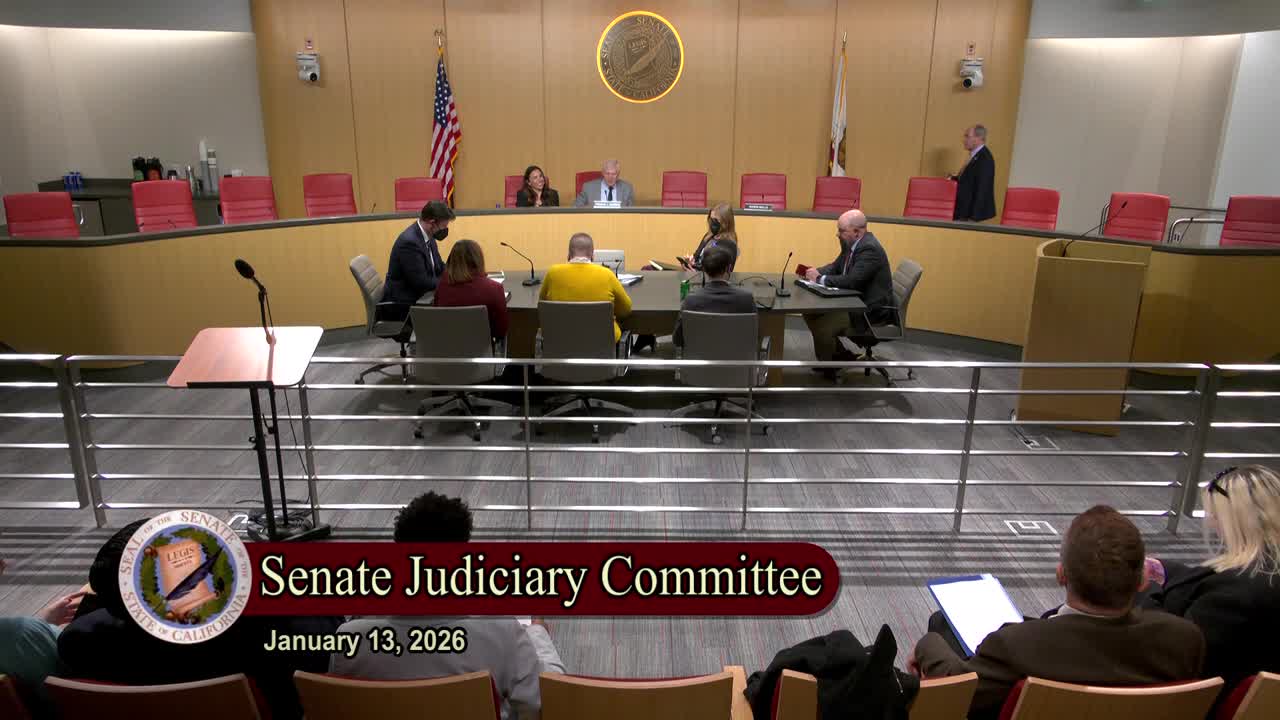 17MIN
Senate Standing Committee on Judiciary
Bill Author
Bill Co-Author(s):