SB 462: California Farmland Conservancy Program: conservation easements: funding.
- Session Year: 2025-2026
- House: Senate
- Latest Version Date: 2025-04-10
Current Status:
Failed
(2026-02-02: Returned to Secretary of Senate pursuant to Joint Rule 56.)
Introduced
In Committee
Awaiting First Chamber Vote
Passed First Chamber
In Committee
Awaiting Second Chamber Vote
Passed Second Chamber
Enacted
Existing law establishes the California Farmland Conservancy Program in the Department of Conservation and authorizes the program to offer financial assistance, including grants or contracts, for projects and activities on agricultural lands that support agricultural conservation and sustainable land management. Existing law creates the California Farmland Conservancy Program Fund and requires moneys in the fund, upon appropriation by the Legislature in the annual Budget Act, to be used for purposes of the program. Notwithstanding that provision, existing law continuously appropriates moneys in the fund from federal grants and gifts and donations to the department for purposes of the program.
This bill would require the Controller to transfer $20,000,000 on July 1 of each fiscal year, commencing with the 202526 fiscal year, from the General Fund to the California Farmland Conservancy Program Funding Account, which the bill would create within the California Farmland Conservancy Program Fund. The bill would continuously appropriate moneys in the account to the department for expenditure as provided. The bill would require that the funding only be awarded for agricultural conservation easements on agricultural land, as defined.
Existing law establishes the California Farmland Conservancy Program in the Department of Conservation and authorizes the program to offer financial assistance, including grants or contracts, for projects and activities on agricultural lands that support agricultural conservation and sustainable land management. Existing law creates the California Farmland Conservancy Program Fund and requires moneys in the fund, upon appropriation by the Legislature in the annual Budget Act, to be used for purposes of the program. Notwithstanding that provision, existing law continuously appropriates moneys in the fund from federal grants and gifts and donations to the department for purposes of the program.
This bill would require the Controller to transfer $20,000,000 on July 1 of each fiscal year, commencing with the 202526 fiscal year, from the General Fund to the California Farmland Conservancy Program Funding Account, which the bill would create within the California Farmland Conservancy Program Fund. The bill would continuously appropriate moneys in the account to the department to allocate to entities that meet specified criteria, thereby making an appropriation, and would require those entities to use the moneys solely to acquire conservation easements that result in the permanent preservation of agricultural lands. for expenditure as provided. The bill would require that the funding only be awarded for agricultural conservation easements on agricultural land, as defined.
Existing law establishes the California Farmland Conservancy Program in the Department of Conservation and authorizes the program to offer financial assistance, including grants or contracts, for projects and activities on agricultural lands that support agricultural conservation and sustainable land management. Existing law creates the California Farmland Conservancy Program Fund and requires moneys in the fund, upon appropriation by the Legislature in the annual Budget Act, to be used for purposes of the program. Notwithstanding that provision, existing law continuously appropriates moneys in the fund from federal grants and gifts and donations to the department for purposes of the program.
This bill would require the Controller to transfer $20,000,000 on July 1 of each fiscal year, commencing with the 202526 fiscal year, from the General Fund to the California Farmland Conservancy Program Funding Account, which the bill would create within the California Farmland Conservancy Program Fund. The bill would continuously appropriate moneys in the account to the department to allocate to entities that meet specified criteria, thereby making an appropriation, and would require those entities to use the moneys solely to acquire conservation easements that result in the permanent preservation of agricultural lands.
The Legislature finds and declares all of the following:
(a)The State of California loses 40,000 acres of agricultural land every year to development.
(b)The benefits of conserving farmland include preserving ecosystems, preserving wildlife habitat, maintaining a significant sector of Californias economy, protecting a major source of food production for the world, sequestering carbon, and reducing the emissions of greenhouse gases. For areas of the same size, farmland emits 70 times fewer greenhouse gases than urban areas.
(c)The State of California state aspires to conserve 30 percent of Californias its lands and coastal waters by 2030. This goal, known as 30x30, is an international movement to combat climate change and protect biodiversity.
(d)Pathways to 30x30 California, a plan developed by the Natural Resources Agency to promote nature-based conservation solutions, named voluntary conservation easements as 1 of 10 pathways.
(e)Conservation easements promote the preservation of critical ecosystems, such as wetlands, agricultural lands, grasslands, and forests, by providing financial incentives to landowners. Easements bring California closer to its 30x30 goals.
(f)Historically available funding for conservation easements has not met the high demand.
(g)Local governments throughout California have been taking action to permanently preserve agricultural lands through local land use planning, partnering with land trusts, acquiring agricultural lands, and holding both temporary and permanent conservation easements. Their connections to landowners in their communities are critical to building trust.
(h)This work is exemplified by counties, like the County of Santa Clara, that incorporate the preservation of agricultural land into their local planning processes.
(i)Efforts by local governments to pursue conservation easements require reliable revenue sources. The voters of the County of Sonoma established the Sonoma County Agricultural Preservation and Open Space District. They passed and renewed a local tax to fund the purchase of agricultural and open-space easements.
(j)It is imperative that the state take action to support local governments in their efforts to preserve agricultural land for the future of Californias environment, economy, food security, and natural landscapes.
SEC. 2.Section 10230 of the Public Resources Code is amended to read:10230.(a)The California Farmland Conservancy Program Fund is hereby created.
(b)(1)Except as provided in paragraphs (2) and (3), the moneys in the fund shall, upon appropriation by the Legislature in the annual Budget Act, be used for the purposes of the program.
(2)Notwithstanding paragraph (1), moneys may be deposited into the fund from federal grants, and gifts and donations, including interest earned, that are designated and required by the donor to be used exclusively for the purposes of the program, and notwithstanding Section 13340 of the Government Code, those moneys are hereby continuously appropriated to the department for expenditure for the purposes of the program.
(3)(A)The Controller shall transfer the sum of twenty million dollars ($20,000,000) on July 1 of each fiscal year, commencing with the 202526 fiscal year, from the General Fund to the California Farmland Conservancy Program Funding Account, which is hereby created within the California Farmland Conservancy Program Fund. Notwithstanding Section 13340 of the Government Code and paragraph (1), moneys in the account are hereby continuously appropriated without regard to fiscal year to the department for expenditure as described in this paragraph and consistent with this division.
(B)This funding shall only be awarded for agricultural conservation easements on agricultural land as defined in Section 10213, except for grazing land.
(C)For purposes of this paragraph, agricultural conservation easement means any easement as defined in Section 10211.
The Legislature finds and declares all of the following:
(a)The State of California loses 40,000 acres of agricultural land every year to development.
(b)The benefits of conserving farmland include preserving ecosystems, preserving wildlife habitat, maintaining a significant sector of Californias economy, protecting a major source of food production for the world, sequestering carbon, and reducing the emissions of greenhouse gases. For areas of the same size, farmland emits 70 times less fewer greenhouse gases than urban areas.
(c)The State of California aspires to conserve 30 percent of Californias lands and coastal waters by 2030. This goal, known as 30x30, is an international movement to combat climate change and protect biodiversity.
(d)Pathways to 30x30 California, a plan developed by the Natural Resources Agency to promote nature-based conservation solutions, named voluntary conservation easements as 1 of 10 pathways.
(e)Conservation easements promote the preservation of critical ecosystems, such as wetlands, agricultural lands, grasslands, and forests, by providing financial incentives to landowners. Easements bring California closer to its 30x30 goals.
(f)Historically available funding for conservation easements has not met the high demand.
(g)Local governments throughout California have been taking action to permanently preserve agricultural lands through local land use planning, partnering with land trusts, acquiring agricultural lands, and holding both temporary and permanent conservation easements. Their connections to landowners in their communities are critical to building trust.
(h)This work is exemplified by counties, like the County of Santa Clara, that incorporate the preservation of agricultural land into their local planning processes.
(i)Efforts by local governments to pursue conservation easements require reliable revenue sources. The voters of the County of Sonoma established the Sonoma County Agricultural Preservation and Open Space District. They passed and renewed a local tax to fund the purchase of agricultural and open-space easements.
(j)It is imperative that the state take action to support local governments in their efforts to preserve agricultural land for the future of Californias environment, economy, food security, and natural landscapes.
SEC. 2.Section 10230 of the Public Resources Code is amended to read:10230.(a)The California Farmland Conservancy Program Fund is hereby created.
(b)(1)Except as provided in paragraphs (2) and (3), the moneys in the fund shall, upon appropriation by the Legislature in the annual Budget Act, be used for the purposes of the program.
(2)Notwithstanding paragraph (1), moneys may be deposited into the fund from federal grants, and gifts and donations, including interest earned, that are designated and required by the donor to be used exclusively for the purposes of the program, and notwithstanding Section 13340 of the Government Code, those moneys are hereby continuously appropriated to the department for expenditure for the purposes of the program.
(3)(A)The Controller shall transfer the sum of twenty million dollars ($20,000,000) on July 1 of each fiscal year, commencing with the 202526 fiscal year, from the General Fund to the California Farmland Conservancy Program Funding Account, which is hereby created within the California Farmland Conservancy Program Fund. Notwithstanding Section 13340 of the Government Code and paragraph (1), moneys in the account are hereby continuously appropriated without regard to fiscal year to the department for expenditure for the purposes as described in this paragraph and consistent with this division.
(B)The department shall allocate the moneys appropriated pursuant to subparagraph (A) to entities that meet at least two of the following criteria:(i)The entity is a city or city and county that has a population of at least 250,000, a county that has a population of at least 1,500,000, or a special district, land trust, nonprofit organization, or tribe that is within, or has a jurisdictional overlap with, such a city or county.(ii)The entity is a city or county that has developed an agricultural land component of the citys or countys open-space element or a separate agricultural land element pursuant to Section 65565 of the Government Code, or is a special district, land trust, nonprofit organization, or tribe that is within, or has a jurisdictional overlap with, such a city or county.(iii)The entity is a county that has at least three hundred fifty million dollars ($350,000,000) in gross value of agricultural production, or is a city, special district, land trust, nonprofit organization, or tribe that is within, or has a jurisdictional overlap with, such a county.(iv)The entity intends to use the moneys to acquire a conservation easement that results in the permanent preservation of agricultural lands that are determined by the Department of Fish and Wildlife to be irreplaceable and essential corridors for wildlife.(v)The entity intends to use the moneys to acquire a conservation easement that results in the permanent preservation of agricultural lands that achieve any of the following cobenefits:(I)Support of the establishment, restoration, or enhancement of wildlife crossings, including overpasses, underpasses, and corridors, to ensure connectivity for wildlife while preserving agricultural operations.(II)Inclusion of practices that enhance carbon sequestration to mitigate climate change impacts.(III)Integration of water conservation systems, including advanced irrigation methods, rainwater harvesting, or constructed wetlands for water reuse and storage.(C)The department may, in its discretion, first allocate the moneys to entities that meet three or more of the criteria described in subparagraph (B).(D)An entity that is allocated moneys pursuant to this paragraph shall use the moneys solely to acquire a conservation easement that results in the permanent preservation of agricultural lands.(c) For purposes of this section, the following definitions apply:(1)Agricultural land means land that is flat and produces crops.(2)Tribe means an entity described in subdivision (c) of Section 815.3 of the Civil Code.(B)This funding shall only be awarded for agricultural conservation easements on agricultural land as defined in Section 10213, except for grazing land.
(C)For purposes of this paragraph, agricultural conservation easement means any easement as defined in Section 10211.
The Legislature finds and declares all of the following:
(a)The State of California loses 40,000 acres of agricultural land every year to development.
(b)The benefits of conserving farmland include preserving ecosystems, preserving wildlife habitat, maintaining a significant sector of Californias economy, protecting a major source of food production for the world, sequestering carbon, and reducing the emissions of greenhouse gases. For areas of the same size, farmland emits 70 times less greenhouse gases than urban areas.
(c)The State of California aspires to conserve 30 percent of Californias lands and coastal waters by 2030. This goal, known as 30x30, is an international movement to combat climate change and protect biodiversity.
(d)Pathways to 30x30 California, a plan developed by the Natural Resources Agency to promote nature-based conservation solutions, named voluntary conservation easements as 1 of 10 pathways.
(e)Conservation easements promote the preservation of critical ecosystems, such as wetlands, agricultural lands, grasslands, and forests, by providing financial incentives to landowners. Easements bring California closer to its 30x30 goals.
(f)Historically available funding for conservation easements has not met the high demand.
(g)Local governments throughout California have been taking action to permanently preserve agricultural lands through local land use planning, partnering with land trusts, acquiring agricultural lands, and holding both temporary and permanent conservation easements. Their connections to landowners in their communities are critical to building trust.
(h)This work is exemplified by counties, like the County of Santa Clara, that incorporate the preservation of agricultural land into their local planning processes.
(i)Efforts by local governments to pursue conservation easements require reliable revenue sources. The voters of the County of Sonoma established the Sonoma County Agricultural Preservation and Open Space District. They passed and renewed a local tax to fund the purchase of agricultural and open-space easements.
(j)It is imperative that the state take action to support local governments in their efforts to preserve agricultural land for the future of Californias environment, economy, food security, and natural landscapes.
SEC. 2.Section 10230 of the Public Resources Code is amended to read:10230.(a)The California Farmland Conservancy Program Fund is hereby created.
(b)(1)Except as provided in paragraph (2), paragraphs (2) and (3), the moneys in the fund shall, upon appropriation by the Legislature in the annual Budget Act, be used for the purposes of the program.
(2)Notwithstanding paragraph (1), moneys may be deposited into the fund from federal grants, and gifts and donations, including interest earned, that are designated and required by the donor to be used exclusively for the purposes of the program, and notwithstanding Section 13340 of the Government Code, those moneys are hereby continuously appropriated to the department for expenditure for the purposes of this the program.
(3)(A)The Controller shall transfer the sum of twenty million dollars ($20,000,000) on July 1 of each fiscal year, commencing with the 202526 fiscal year, from the General Fund to the California Farmland Conservancy Program Funding Account, which is hereby created within the California Farmland Conservancy Program Fund. Notwithstanding Section 13340 of the Government Code and paragraph (1), moneys in the account are hereby continuously appropriated without regard to fiscal year to the department for expenditure for the purposes described in this paragraph and consistent with this division.
(B)The department shall allocate the moneys appropriated pursuant to subparagraph (A) to entities that meet at least two of the following criteria:
(i)The entity is a city or city and county that has a population of at least 250,000, a county that has a population of at least 1,500,000, or a special district, land trust, nonprofit organization, or tribe that is within, or has a jurisdictional overlap with, such a city or county.
(ii)The entity is a city or county that has developed an agricultural land component of the citys or countys open-space element or a separate agricultural land element pursuant to Section 65565 of the Government Code, or is a special district, land trust, nonprofit organization, or tribe that is within, or has a jurisdictional overlap with, such a city or county.
(iii)The entity is a county that has at least three hundred fifty million dollars ($350,000,000) in gross value of agricultural production, or is a city, special district, land trust, nonprofit organization, or tribe that is within, or has a jurisdictional overlap with, such a county.
(iv)The entity intends to use the moneys to acquire a conservation easement that results in the permanent preservation of agricultural lands that are determined by the Department of Fish and Wildlife to be irreplaceable and essential corridors for wildlife.
(v)The entity intends to use the moneys to acquire a conservation easement that results in the permanent preservation of agricultural lands that achieve any of the following cobenefits:
(I)Support of the establishment, restoration, or enhancement of wildlife crossings, including overpasses, underpasses, and corridors, to ensure connectivity for wildlife while preserving agricultural operations.
(II)Inclusion of practices that enhance carbon sequestration to mitigate climate change impacts.
(III)Integration of water conservation systems, including advanced irrigation methods, rainwater harvesting, or constructed wetlands for water reuse and storage.
(C)The department may, in its discretion, first allocate the moneys to entities that meet three or more of the criteria described in subparagraph (B).
(D)An entity that is allocated moneys pursuant to this paragraph shall use the moneys solely to acquire a conservation easement that results in the permanent preservation of agricultural lands.
(c)For purposes of this section, the following definitions apply:
(1)Agricultural land means land that is flat and produces crops.
(2)Tribe means an entity described in subdivision (c) of Section 815.3 of the Civil Code.
|
Date
|
Status
|
|---|---|
| Feb 2, 2026 | Returned to Secretary of Senate pursuant to Joint Rule 56. |
| May 23, 2025 | May 23 hearing: Held in committee and under submission. |
| May 16, 2025 | Set for hearing May 23. |
| Apr 21, 2025 | April 21 hearing: Placed on APPR. suspense file. |
| Apr 10, 2025 | From committee with author's amendments. Read second time and amended. Re-referred to Com. on APPR. |
| Apr 9, 2025 | Set for hearing April 21. |
| Apr 8, 2025 | From committee: Do pass and re-refer to Com. on APPR. (Ayes 6. Noes 0. Page 707.) (April 8). Re-referred to Com. on APPR. |
| Mar 27, 2025 | From committee with author's amendments. Read second time and amended. Re-referred to Com. on N.R. & W. |
| Mar 24, 2025 | Set for hearing April 8. |
| Feb 26, 2025 | Referred to Com. on N.R. & W. |
| Feb 20, 2025 | From printer. May be acted upon on or after March 22. |
| Feb 19, 2025 | Introduced. Read first time. To Com. on RLS. for assignment. To print. |
|
Date
|
Description
|
Location
|
Votes
|
|
|---|---|---|---|---|
| Apr 21, 2025 | Placed on suspense file | Senate Standing Committee on Appropriations |
Passed |
|
| Apr 8, 2025 | Do pass, but first be re-referred to the Committee on [Appropriations] | Senate Standing Committee on Natural Resources and Water |
Passed |
This list shows positions taken on this bill by organizations on the date displayed, which is linked to the original source.
Positions by individuals are not included.
|
Organization
|
Position
|
Date
|
|---|---|---|
| American Farmland Trust | ** Support | |
| California Climate and Agriculture Network | ** Support | |
| Santa Clara Valley Open Space Authority | ** Support | |
| Sonoma County Agricultural and Open Space District | ** Support |
SENATE COMMITTEE ON
Senator Anna Caballero, Chair
2025 - 2026 Regular Session
SB 462 (Cortese) - California Farmland Conservancy Program: conservation easements: funding
Version: | Policy Vote: |
Urgency: | Mandate: |
Hearing Date: | Consultant: |
Bill Summary:
This bill would continuously appropriate $20 million annually from the General Fund to the California Farmland Conservancy Program (CFCP). This bill would provide that that funding go to easements on agricultural land, as defined, except for grazing land.
Fiscal Impact:
- Ongoing costs of $20 million annually (General Fund) for easements on agricultural land.
- The Department of Conservation (DOC) estimates ongoing costs of $1.01 million in year one and $935,000 ongoing (General Fund or special fund) for 6 positions to provide adequate staff resources for a program required to distribute $20 million annually for acquisition of agricultural lands to establish permanent conservation easements in partnership with a variety of grantees and local/regional organizations.
Background:
California Farmland Conservancy Program Origins. According to the Department of Conservation, the California Farmland Conservancy Program (CFCP) is a statewide grant program that supports local efforts to establish agricultural conservation easements and land improvement projects for the purpose of preserving important agricultural land resources and enhancing sustainable agricultural uses.
CFCP was created by the California Farmland Conservancy Program Act (Act) of 1995 to:
- Encourage voluntary, long-term private stewardship of agricultural lands.
- Protect farming and ranching operations in agricultural areas from nonfarm or nonranch land uses that may hinder or curtail such operations.
- Encourage long-term conservation of productive agricultural lands in order to protect the agricultural economy of rural communities, as well as that of the state, for future generations of Californians.
- Encourage local land use planning for orderly and efficient urban growth and conservation of agricultural land.
- Encourage local land use planning decisions that are consistent with the state's agricultural land conservation policies.
- Encourage improvements to enhance long-term sustainable agricultural uses.
CFCP Funding. CFCP has been funded by the California Drought, Water, Parks, Climate, Coastal Protection, and Outdoor Access for All Act of 2018 (Proposition 68). Since 2018, the program has received 7.75 million dollars in appropriations (per the author’s office).
The American Farmland Trust’s (AFT) Farmland Information Center (FIC) conducts an annual survey of state Purchase of Agricultural Easement (PACE) programs to track the activity of state farmland protection programs across the U.S. The FIC is a public/private partnership between the USDA Natural Resources Conservation Service and AFT. According to their 2024 report, 184 easements have been acquired under CFCP, protecting 59,460 acres. The program has spent, in total, over $175 million from appropriations, bonds, mitigation fees, and private contributions.
Other California Easement Programs. Three other California agricultural conservation easement programs are tracked by the AFT FIC. Information about each is in the below table:
Program | Inception | Easements Acquired | Acres Protected | Spent to Date* | Funding Sources |
Agricultural Land Mitigation Program | 2016 | 15 | 3,189 | $26 | Greenhouse Gas Reduction Fund (GGRF), high speed rail, mitigation fees |
Rangeland, Grazing Land, and Grassland Program | 2002 | 27 | 70,385 | $60 | This fund is currently empty. |
Sustainable Agricultural Lands Conservation Program | 2014 | 94 | 101,569 | $190 | GGRF, bonds, appropriations, local government and private contributions, federal easement programs |
CFCP | 1995 | 184 | 59,460 | $175 | Appropriations, bonds, mitigation fees, private contributions |
*Rounded for ease. Program funds and additional funds spent to date, in millions, per AFT FIC.
Agricultural Conservation Easements. The primary means of permanently protecting agricultural lands from development is an agricultural conservation easement. Every day, 2,000 acres of productive farmland and ranchland are lost to or threatened by development. Easements that provide compensation to landowners through payment or tax credits strengthen rural economies and promote agricultural business investments. Permanently conserved lands also offer more affordable purchase opportunities for younger or historically underserved producers.
AFT’s “Greener Fields” report found that an acre of farmland produces fewer greenhouse gas (GHG) emissions than an acre of developed land, especially compared to the low density residential development patterns that commonly threaten farmland. In California, urban areas emit 58 times more GHG per acre than the state’s farmland.
Proposed Law:
This bill would continuously appropriate 20 million dollars annually to the CFCP. This bill would also establish definitions for the purposes of awarding this funding, and establish that this funding can only be awarded for easements on agricultural land as defined in Public Resources Code (PRC) § 10213, except for grazing land.
Staff Comments:
The bill proposes to a continuous appropriation to transfer funds from the General Fund to CFCP.
-- END --
SENATE COMMITTEE ON NATURAL RESOURCES AND WATER
Senator Monique Limón, Chair
2025 - 2026 Regular
Bill No: SB 462 Hearing Date: April 8, 2025
Author: | |||
Version: | Amended | ||
Urgency: | Fiscal: | ||
Consultant: | |||
Subject: California Farmland Conservancy Program: conservation easements: funding
SUMMARY
This bill would continuously appropriate 20 million dollars annually from the General Fund to the California Farmland Conservancy Program (CFCP). This bill would provide that that funding go to easements on agricultural land, as defined, except for grazing land.
BACKGROUND AND EXISTING LAW
California Farmland Conservancy Program Origins. According to the Department of Conservation, the California Farmland Conservancy Program (CFCP) is a statewide grant program that supports local efforts to establish agricultural conservation easements and land improvement projects for the purpose of preserving important agricultural land resources and enhancing sustainable agricultural uses.
CFCP was created by the California Farmland Conservancy Program Act (Act) of 1995 to:
- Encourage voluntary, long-term private stewardship of agricultural lands.
- Protect farming and ranching operations in agricultural areas from nonfarm or nonranch land uses that may hinder or curtail such operations.
- Encourage long-term conservation of productive agricultural lands in order to protect the agricultural economy of rural communities, as well as that of the state, for future generations of Californians.
- Encourage local land use planning for orderly and efficient urban growth and conservation of agricultural land.
- Encourage local land use planning decisions that are consistent with the state's agricultural land conservation policies.
- Encourage improvements to enhance long-term sustainable agricultural uses.
CFCP Funding. CFCP has been funded by the California Drought, Water, Parks, Climate, Coastal Protection, and Outdoor Access for All Act of 2018 (Proposition 68). Since 2018, the program has received 7.75 million dollars in appropriations (per the author’s office).
The American Farmland Trust’s (AFT) Farmland Information Center (FIC) conducts an annual survey of state Purchase of Agricultural Easement (PACE) programs to track the activity of state farmland protection programs across the U.S. The FIC is a public/private partnership between the USDA Natural Resources Conservation Service and AFT. According to their 2024 report, 184 easements have been acquired under CFCP, protecting 59,460 acres. The program has spent, in total, over $175 million from appropriations, bonds, mitigation fees, and private contributions.[1]
Other California Easement Programs. Three other California agricultural conservation easement programs are tracked by the AFT FIC. Information about each is in the below table:
Program | Inception | Easements Acquired | Acres Protected | Spent to Date* | Funding Sources |
Agricultural Land Mitigation Program | 2016 | 15 | 3,189 | $26 | Greenhouse Gas Reduction Fund (GGRF), high speed rail, mitigation fees |
Rangeland, Grazing Land, and Grassland Program | 2002 | 27 | 70,385 | $60 | This fund is currently empty. |
Sustainable Agricultural Lands Conservation Program | 2014 | 94 | 101,569 | $190 | GGRF, bonds, appropriations, local government and private contributions, federal easement programs |
CFCP | 1995 | 184 | 59,460 | $175 | Appropriations, bonds, mitigation fees, private contributions |
*Rounded for ease. Program funds and additional funds spent to date, in millions, per AFT FIC.
Agricultural Conservation Easements. The primary means of permanently protecting agricultural lands from development is an agricultural conservation easement. Every day, 2,000 acres of productive farmland and ranchland are lost to or threatened by development. Easements that provide compensation to landowners through payment or tax credits strengthen rural economies and promote agricultural business investments. Permanently conserved lands also offer more affordable purchase opportunities for younger or historically underserved producers.
AFT’s “Greener Fields” report found that an acre of farmland produces fewer greenhouse gas (GHG) emissions than an acre of developed land, especially compared to the low density residential development patterns that commonly threaten farmland. In California, urban areas emit 58 times more GHG per acre than the state’s farmland.[2]
Ecosystem Services and Fighting Climate Change. According to a 2015 report by the California Department of Food and Agriculture,[3] California’s farmland provides many benefits to humans and the environment, collectively known as “ecosystem services.” Ecosystem services include “crop and livestock production…open space, wildlife habitat…management decisions…enhance environmental quality, provide recreational opportunities, and offer social benefits.”
A study from AFT, USDA, and research partners[4] found that owners of agricultural land protected by the federal Farm and Ranch Lands Protection Program (FRLPP) were more likely to adopt “climate-smart” agricultural practices that reduce GHG emissions or increase carbon sequestration than the general farming population. These practices include conversation tillage, cover crops or green manure crops, nutrient management, and rotational grazing. The study also found that farmers who believe their land is permanently protected from non-farm development feel more secure about making longer term investments to improve the potential of their land and viability of their operations.
Administration Priorities. In October 2020, Governor Gavin Newsom signed Executive Order N-82-20, establishing a state goal of conserving 30% of California lands and coastal waters by 2030, known as 30x30 (“thirty-by-thirty”). The Governor enumerated three objectives: conserve and restore biodiversity, expand access to nature, and mitigate and build resilience to climate change.
In 2022, the Administration of Governor Gavin Newsom released a report titled “Pathways to 30x30: Accelerating Conservation of California’s Nature”[5] in which conservation easements are named as one of ten pathways to promote nature-based conservation solutions and acknowledges that “[f]inancial resources are essential to acquire, restore, and steward land.”
The Pathways report names several priority actions to support conservation easement programs:
3.1. Work with and help build capacity for land trusts, Resource Conservation Districts, and other community coalitions and organizations to invest state conservation easement program funds strategically and efficiently.
3.2. Integrate complementary climate change benefits into publicly funded conservation easement programs where possible to enable expanded carbon sequestration and storage and to strengthen natural resilience to climate change impacts.
8.1. Coordinate across state agencies and departments to align state funding for conservation activities to optimize investments and avoid duplication.
8.2. Strengthen state government coordination with and support of California’s land trusts, Resource Conservation Districts, regional partnerships, and other community-based organizations to build technical and financial capacity, leverage resources, share expertise, conduct landowner outreach, identify multi-benefit land conservation projects, and coordinate project implementation.
A follow up report from the Administration in response to AB 1757 (Garcia, Chapter 341, Statutes of 2022), which amended the California Global Warming Solutions Act, notes that grasslands provide carbon storage, open space, wildlife habitat, and water filtration and recharge benefits. The report sets a goal of conserving and restoring over 88,000 acres of grasslands by 2030.[6]
CFCP Modifications. CFCP was modified by AB 2964 (Chapter 502, Statutes of 2022) to broaden the definition of “applicant” to include California Native American Tribes; amend the local government notification process; loosened the prohibition against restrictions on husbandry practices; broadened the scope of potential land improvement projects; and removed the 25-year administrative termination provision.
PROPOSED LAW
This bill would continuously appropriate 20 million dollars annually to the CFCP. This bill would also establish definitions for the purposes of awarding this funding, and establish that this funding can only be awarded for easements on agricultural land as defined in Public Resources Code (PRC) § 10213, except for grazing land.
ARGUMENTS IN SUPPORT
According to the author, “Agriculture is vital to our food production, economy, wildlife, and climate. According to the Department of Conservation, California loses over 47,000 acres of farmland and grazing land per year. Our global food supply relies on California farms, but rising development pressure jeopardizes this critical land. Agricultural conservation easements provide financial incentives to landowners to keep working farms working, and they are essential to achieving California’s 30x30 goals.”
ARGUMENTS IN OPPOSITION
None received.
COMMENTS
Legislative Priorities. The Legislature, in Civil Code § 815, has declared “the preservation of land in its natural, scenic, agricultural, historical, forested, or open-space condition is among the most important environmental assets of California. The Legislature further finds and declares it to be the public policy and in the public interest of this state to encourage the voluntary conveyance of conservation easements to qualified nonprofit organizations.” Several departments, agencies, and offices, such as the Department of Conservation, Wildlife Conservation Board, and Strategic Growth Council, provide grant funding to qualified entities for the protection of farmland in the state.
Limitations on the uses of these funds inconsistent with Program’s intent? This bill would prevent this funding for being used for easements on grazing lands. It would only be applicable to “prime farmland, farmland of statewide importance, unique farmland, and farmland of local importance.”
However, the Legislature made the following findings in PRC § 10202 regarding the need for the CFCP in the Act (emphasis added):
It is the intent of the Legislature, in enacting this division, to do all of the following:
(a) Encourage voluntary, long-term private stewardship of agricultural lands by offering landowners financial incentives.
(b) Protect farming and ranching operations in agricultural areas from nonfarm or nonranch land uses that may hinder and curtail farming or ranching operations.
(c) Encourage long-term conservation of productive agricultural lands in order to protect the agricultural economy of rural communities, as well as that of the state, for future generations of Californians.
(d) Encourage local land use planning for orderly and efficient urban growth and conservation of agricultural land.
(e) Encourage local land use planning decisions that are consistent with the state’s policies with regard to agricultural land conservation.
(f) Encourage improvements to enhance long-term sustainable agricultural uses.
Further in the Act, “agricultural land” is defined as “prime farmland, farmland of statewide importance, unique farmland, farmland of local importance, and grazing land as defined in the Guidelines for the Farmland Mapping and Monitoring Program [FMMP], pursuant to Section 65570 of the Government Code.” The FMMP defines “Prime farmland” as “Farmland with the best combination of physical and chemical features able to sustain long term agricultural production.”[7] FMPP defines “Grazing land” as “Land on which the existing vegetation is suited to the grazing of livestock.”[8]
The intent of the Legislature is clear: the CFCP was created to fund easements to protect both crop production and livestock, using the umbrella term “agricultural lands.” In fact, the author’s own statements recognize the importance of preserving grasslands (i.e., grazing lands): Section 1 of this bill, subsection (e), specifies that grassland easements will bring California closer to its 30x30 goals.
Relative value of crop versus grazing land. The United States Department of Agriculture (USDA) National Agricultural Statistics Service (NASS) conducts an annual survey of farm and grazing land values across America. In 2024, the average value of “cropland” per acre in California was $17,330. The average value of “pasture land” per acre in California was $3,930.[9]
The NASS defines “cropland” as “land used to grow field crops, vegetables, or land harvested for hay.” NASS defines “pasture, grazing, and grassland” as “land that is normally grazed by livestock.”
Another way of contextualizing crop versus grazing land is to consider “arable” land. Arable land is land with the ability to be plowed, typically with nutrient-rich soils, sunlight, and predictable temperatures. About one third of the globally available agricultural land is arable. On the other hand, “marginal land” is two thirds of globally available agricultural lands, and refers to lands that are not suitable for growing crops.[10] This is land used for pastures, grazing, or grasslands.
The author suggests that cropland, or arable land, is under greater threat from development due to the high value of the land and high quality of the soils, but that grazing lands, or marginal lands, receive more protection via easements because, at a lower land value, a conservation easement may be more cost effective on grazing lands. Committee staff was unable to verify this. The American Farmland Trust and California Climate and Agriculture Network (CalCAN) wrote a “Support if Amended” letter requesting that the exclusion for grazing land be removed. The author may wish to consider this amendment.
Continuous appropriation. The bill also proposes to continuously transfer funds from the General Fund to CFCP; which may be a point of discussion when this bill is before the Senate Appropriations Committee.
SUPPORT
Santa Clara Valley Open Space Authority (co-sponsor)
Sonoma County Agricultural and Open Space District
American Farmland Trust (if amended)
California Climate and Agriculture Network (if amended)
OPPOSITION
None Received
-- END --
American Farmland Trust (2024). Status of State PACE Programs. Washington, DC: Farmland Information Center. https://farmlandinfo.org/wp-content/uploads/sites/2/2023/10/AFT-state-PACE-program-fact-sheet-2024.pdf ↑
American Farmland Trust (2018). Greener Fields: California Communities Combating Climate Change. Sacramento, CA: American Farmland Trust. https://farmlandinfo.org/publications/greener-fields-california-communities-combating-climate-change ↑
California Department of Food and Agriculture (CDFA) (2015). Benefits of Farmland Conservation in California. Sacramento, CA: CDFA https://www.cdfa.ca.gov/EnvironmentalStewardship/pdfs/Farmland-Conservation-in-California.pdf ↑
American Farmland Trust (2024). Agricultural Land Protection: An Essential Tool for Fighting Climate Change. Washington, DC: American Farmland Trust. ↑
The Administration of Governor Gavin Newsom (2022). Pathways to 30x30 California: Accelerating Conservation of California’s Nature. Sacramento, CA: California Natural Resources Agency. Californianature.ca.gov. Accessed March 17, 2025 ↑
The Administration of Governor Gavin Newsom (2022). California’s Nature-Based Solutions Climate Targets. Sacramento, CA: California Natural Resources Agency. Californianature.ca.gov. Accessed April 2, 2025. ↑
California Department of Conservation. Farmland Mapping and Monitoring Program: Sacramento, CA. https://www.conservation.ca.gov/dlrp/fmmp/Pages/Important-Farmland-Categories.aspx. Accessed March 26, 2025. ↑
Ibid. ↑
United States Department of Agriculture (August 2024). National Agricultural Statistics Service. Land Values 2024 Summary: Washington, DC. ↑
University of California, Davis (2023). Cattle and Land Use: The Differences between Arable Land and Marginal Land and How Cattle Use Each: Davis, CA. https://clear.ucdavis.edu/explainers/cattle-and-land-use-differences-between-arable-land-and-marginal-land-and-how-cattle-use. Clarity and Leadership for Environmental Awareness and Research at UC Davis. Accessed March 30, 2025. ↑
Discussed in Hearing
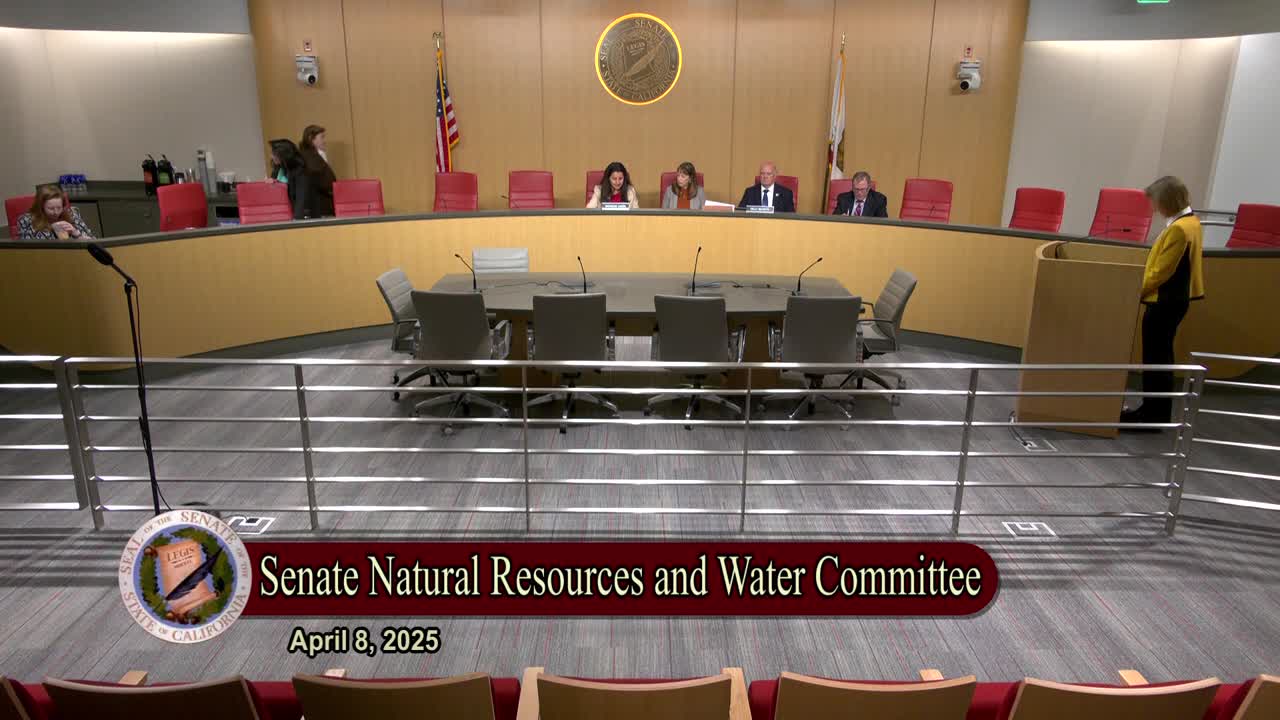 13MIN
Senate Standing Committee on Natural Resources and Water
Bill Author