SB 466: Drinking water: primary standard for hexavalent chromium: exemption.
- Session Year: 2025-2026
- House: Senate
- Latest Version Date: 2025-10-03
Current Status:
Passed
(2025-10-03: Chaptered by Secretary of State. Chapter 320, Statutes of 2025.)
Introduced
In Committee
Awaiting First Chamber Vote
Passed First Chamber
In Committee
Awaiting Second Chamber Vote
Passed Second Chamber
Enacted
The California Safe Drinking Water Act provides for the operation of public water systems and imposes on the State Water Resources Control Board various duties and responsibilities for the regulation and control of drinking water in the State of California. The act requires the state board to adopt primary drinking water standards for contaminants in drinking water based upon specified criteria, and requires a primary drinking water standard to be established for hexavalent chromium. Existing law authorizes the state board to grant a variance from primary drinking water standards to a public water system.
This bill would prohibit a public water system that meets the total chromium maximum contaminant level (MCL) enforceable standard for drinking water in California from being determined, held, considered, or otherwise deemed in violation of the primary drinking water standard for hexavalent chromium while implementing a state board approved compliance plan or while state board action on the proposed and submitted compliance plan is pending, except as provided.
The California Safe Drinking Water Act provides for the operation of public water systems and imposes on the State Water Resources Control Board various duties and responsibilities for the regulation and control of drinking water in the State of California. The act requires the state board to adopt primary drinking water standards for contaminants in drinking water based upon specified criteria, and requires a primary drinking water standard to be established for hexavalent chromium. Existing law authorizes the state board to grant a variance from primary drinking water standards to a public water system.
This bill would prohibit a public water system that meets the total chromium maximum containment contaminant level (MCL) enforceable standard for drinking water in California from being determined, held, considered, or otherwise deemed in violation of the primary drinking water standard for hexavalent chromium while implementing a state board approved compliance plan or while state board action on the proposed and submitted compliance plan is pending, except as provided.
The California Safe Drinking Water Act provides for the operation of public water systems and imposes on the State Water Resources Control Board various duties and responsibilities for the regulation and control of drinking water in the State of California. The act requires the state board to adopt primary drinking water standards for contaminants in drinking water based upon specified criteria, and requires a primary drinking water standard to be established for hexavalent chromium. Existing law authorizes the state board to grant a variance from primary drinking water standards to a public water system.
This bill would prohibit a public water system that meets the total chromium maximum containment level (MCL) enforceable standard for drinking water in California from being held liable in any civil action brought by an individual or entity that is not a governmental agency related to hexavalent chromium in drinking water while implementing and in compliance with a state board-approved hexavalent chromium MCL compliance plan, or during the period between when it has submitted a hexavalent chromium MCL compliance plan for approval to the state board and action on the proposed compliance plan by the state board is pending, except as specified. determined, held, considered, or otherwise deemed in violation of the primary drinking water standard for hexavalent chromium while implementing a state board approved compliance plan or while state board action on the proposed and submitted compliance plan is pending, as provided.
The California Safe Drinking Water Act provides for the operation of public water systems and imposes on the State Water Resources Control Board various duties and responsibilities for the regulation and control of drinking water in the State of California. The act requires the state board to adopt primary drinking water standards for contaminants in drinking water based upon specified criteria, and requires a primary drinking water standard to be established for hexavalent chromium. Existing law authorizes the state board to grant a variance from primary drinking water standards to a public water system.
This bill would prohibit a public water system that meets the total chromium maximum containment level (MCL) enforceable standard for drinking water in California from being held liable in any civil action brought by an individual or entity that is not a governmental agency related to hexavalent chromium in drinking water while implementing and in compliance with a state board-approved hexavalent chromium MCL compliance plan, or during the period between when it has submitted a hexavalent chromium MCL compliance plan for approval to the state board and action on the proposed compliance plan by the state board is pending, except as specified.
The California Safe Drinking Water Act provides for the operation of public water systems and imposes on the State Water Resources Control Board various duties and responsibilities for the regulation and control of drinking water in the State of California. The act requires the state board to adopt primary drinking water standards for contaminants in drinking water based upon specified criteria, and requires a primary drinking water standard to be established for hexavalent chromium. Existing law authorizes the state board to grant a variance from primary drinking water standards to a public water system.
This bill would prohibit a public water system that meets the total chromium maximum containment level (MCL) enforceable standard for drinking water in California from being held liable in any civil action brought by an individual or entity that is not a governmental agency related to hexavalent chromium in drinking water while implementing and in compliance with a state board-approved hexavalent chromium maximum contaminant level (MCL) MCL compliance plan, or during the period between when it has submitted a hexavalent chromium MCL compliance plan for approval to the state board and action on the proposed compliance plan by the state board is pending, except as specified.
The California Safe Drinking Water Act provides for the operation of public water systems and imposes on the State Water Resources Control Board various duties and responsibilities for the regulation and control of drinking water in the State of California. The act requires the state board to adopt primary drinking water standards for contaminants in drinking water based upon specified criteria, and requires a primary drinking water standard to be established for hexavalent chromium. Existing law authorizes the state board to grant a variance from primary drinking water standards to a public water system.
This bill would prohibit a public water system from being held liable in any civil action brought by an individual or entity that is not a governmental agency related to hexavalent chromium in drinking water while implementing and in compliance with a state board-approved hexavalent chromium maximum contaminant level (MCL) compliance plan, or during the period between when it has submitted a hexavalent chromium MCL compliance plan for approval to the state board and action on the proposed compliance plan by the state board is pending, except as specified.
The California Safe Drinking Water Act provides for the operation of public water systems and imposes on the State Water Resources Control Board various duties and responsibilities for the regulation and control of drinking water in the State of California. The act requires the state board to adopt primary drinking water standards for contaminants in drinking water based upon specified criteria, and requires a primary drinking water standard to be established for hexavalent chromium. Existing law authorizes the state board to grant a variance from primary drinking water standards to a public water system.
This bill would prohibit a public water system from being held liable in any civil action related to hexavalent chromium in drinking water while implementing a state board-approved hexavalent chromium maximum contaminant level (MCL) compliance plan, or during the period between when it has submitted a hexavalent chromium MCL compliance plan for approval to the state board and action on the proposed compliance plan by the state board is pending, except as specified.
Existing law requires the State Department of Public Health to develop a coordinated state strategy for addressing the health-related needs of women and makes the approved programmatic costs associated with this strategy be the responsibility of the department.This bill would make a technical, nonsubstantive change to that provision.Existing law requires the State Department of Public Health to develop a coordinated state strategy for addressing the health-related needs of women and makes the approved programmatic costs associated with this strategy be the responsibility of the department.
This bill would make a technical, nonsubstantive change to that provision.
(a)Except as provided in subdivision (e) and subject to subdivision (b), a public water system shall not be determined, held, considered, or otherwise deemed in violation of the primary drinking water standard for hexavalent chromium while implementing a state board approved compliance plan. A public water system that has submitted a compliance plan for approval shall not be determined, held, considered, or otherwise deemed in violation of the primary drinking water standard for hexavalent chromium while state board action on the proposed and submitted compliance plan is pending.
(b)This section only applies to a public water system that meets the total chromium maximum contaminant level (MCL) enforceable standard for drinking water in California.
(c)This section does not affect the states requirements for establishing drinking water standards for contaminants in drinking water. This section does not apply to any contaminants other than hexavalent chromium.
(d)This section shall not apply if a hexavalent chromium MCL compliance plan is rejected by the state board.
(e)This section does not affect the authority of the state board or the Attorney General to enforce any applicable law or regulation regarding hexavalent chromium, including a state board-approved hexavalent chromium MCL compliance plan.
(a)Notwithstanding Except as provided in subdivision (e) and the compliance deadlines for achieving the primary drinking water standard for hexavalent chromium, and subject to subdivision (b), a public water system shall not be determined, held, considered, or otherwise deemed in violation of the primary drinking water standard for hexavalent chromium while implementing a state board approved compliance plan. A public water system that has submitted a compliance plan for approval shall not be determined, held, considered, or otherwise deemed in violation of the primary drinking water standard for hexavalent chromium while state board action on the proposed and submitted compliance plan is pending.
(b)This section only applies to a public water system that meets the total chromium MCL maximum contaminant level (MCL) enforceable standard for drinking water in California.
(c)This section does not affect the states requirements for establishing drinking water standards for contaminants in drinking water. This section does not apply to any contaminants other than hexavalent chromium.
(d)This section shall not apply if a hexavalent chromium MCL compliance plan is rejected by the state board.
(e)This section does not affect the authority of the state board or the Attorney General to enforce any applicable law or regulation regarding hexavalent chromium, including a state board-approved hexavalent chromium MCL compliance plan.
(a)Notwithstanding subdivision (e) and the compliance deadlines for achieving the primary drinking water standard for hexavalent chromium, and subject to subdivision (b), a public water system shall not be held liable in any civil action brought by an individual or entity that is not a governmental agency related to hexavalent chromium in drinking water while implementing and in compliance with a state board-approved hexavalent chromium maximum contaminant level (MCL) compliance plan, or during the period between when it has submitted a hexavalent chromium MCL compliance plan for approval to the state board and action on the proposed compliance plan by the state board is pending. a public water system shall not be determined, held, considered, or otherwise deemed in violation of the primary drinking water standard for hexavalent chromium while implementing a state board approved compliance plan. A public water system that has submitted a compliance plan for approval shall not be determined, held, considered, or otherwise deemed in violation of the primary drinking water standard for hexavalent chromium while state board action on the proposed and submitted compliance plan is pending.
(b)This section only applies to a public water system that meets the total chromium MCL enforceable standard for drinking water in California.
(c)This section does not affect the states requirements for establishing drinking water standards for contaminants in drinking water. This section does not apply to any contaminants other than hexavalent chromium.
(c)This section applies through the duration of a state board-approved hexavalent chromium MCL compliance plan schedule. This(d)This section shall not apply if a hexavalent chromium MCL compliance plan is rejected by the state board.
(d)(e)This section does not affect the authority of the state board or the Attorney General to enforce any applicable law or regulation regarding hexavalent chromium, including a state board-approved hexavalent chromium MCL compliance plan.
(a)Notwithstanding the compliance deadlines for achieving the primary drinking water standard for hexavalent chromium, and subject to subdivision (b), a public water system shall not be held liable in any civil action brought by an individual or entity that is not a governmental agency related to hexavalent chromium in drinking water while implementing and in compliance with a state board-approved hexavalent chromium maximum contaminant level (MCL) compliance plan, or during the period between when it has submitted a hexavalent chromium MCL compliance plan for approval to the state board and action on the proposed compliance plan by the state board is pending.
(b)This section only applies to a public water system that meets the total chromium MCL enforceable standard for drinking water in California.
(c)This section applies through the duration of a state board-approved hexavalent chromium MCL compliance plan schedule. This section shall not apply if a hexavalent chromium MCL compliance plan is rejected by the state board.
(c)(d)This section does not affect the authority of the state board or the Attorney General to enforce any applicable law or regulation regarding hexavalent chromium. chromium, including a state board-approved hexavalent chromium MCL compliance plan.
(a)Notwithstanding the compliance deadlines for achieving the primary drinking water standard for hexavalent chromium, and subject to subdivision (b), a public water system shall not be held liable in any civil action brought by an individual or entity that is not a governmental agency related to hexavalent chromium in drinking water while implementing and in compliance with a state board-approved hexavalent chromium maximum contaminant level (MCL) compliance plan, or during the period between when it has submitted a hexavalent chromium MCL compliance plan for approval to the state board and action on the proposed compliance plan by the state board is pending.
(b)This section only applies to a public water system that meets the total chromium MCL enforceable standard for drinking water in California.
(b)Nothing in this(c)This section shall does not affect the authority of the state board to enforce any applicable law or regulation regarding hexavalent chromium.
(a)Notwithstanding the compliance deadlines for achieving the primary drinking water standard for hexavalent chromium, a public water system shall not be held liable in any civil action brought by an individual or entity that is not a governmental agency related to hexavalent chromium in drinking water while implementing and in compliance with a state board-approved hexavalent chromium maximum contaminant level (MCL) compliance plan, or during the period between when it has submitted a hexavalent chromium MCL compliance plan for approval to the state board and action on the proposed compliance plan by the state board is pending.
(b)Nothing in this section shall affect the authority of the state board to enforce the primary drinking water standard for hexavalent chromium. any applicable law or regulation regarding hexavalent chromium.
(a)Notwithstanding the compliance deadlines for achieving the primary drinking water standard for hexavalent chromium, a public water system shall not be held liable in any civil action related to hexavalent chromium in drinking water while implementing a state board-approved hexavalent chromium maximum contaminant level (MCL) compliance plan, or during the period between when it has submitted a hexavalent chromium MCL compliance plan for approval to the state board and action on the proposed compliance plan by the state board is pending.
(b)Nothing in this section shall affect the authority of the state board to enforce the primary drinking water standard for hexavalent chromium.
SECTION 1.Section 137 of the Health and Safety Code is amended to read:137.(a)The State Department of Public Health shall develop a coordinated state strategy for addressing the health-related needs of women, including implementation of goals and objectives for womens health.(b)The approved programmatic costs associated with this strategy shall be the responsibility of the department unless otherwise provided by law.(a)The State Department of Public Health shall develop a coordinated state strategy for addressing the health-related needs of women, including implementation of goals and objectives for womens health.
(b)The approved programmatic costs associated with this strategy shall be the responsibility of the State Department of Public Health department unless otherwise provided by law.
|
Date
|
Status
|
|---|---|
| Oct 3, 2025 | Chaptered by Secretary of State. Chapter 320, Statutes of 2025. |
| Oct 3, 2025 | Approved by the Governor. |
| Sep 22, 2025 | Enrolled and presented to the Governor at 2 p.m. |
| Sep 11, 2025 | Assembly amendments concurred in. (Ayes 40. Noes 0. Page 2928.) Ordered to engrossing and enrolling. |
| Sep 9, 2025 | Ordered to special consent calendar. |
| Sep 3, 2025 | In Senate. Concurrence in Assembly amendments pending. |
| Sep 2, 2025 | Read third time. Passed. (Ayes 77. Noes 0. Page 2817.) Ordered to the Senate. |
| Aug 25, 2025 | Ordered to third reading. |
| Aug 25, 2025 | Read third time and amended. |
| Aug 21, 2025 | Read second time. Ordered to third reading. |
| Aug 20, 2025 | From committee: Do pass. (Ayes 15. Noes 0.) (August 20). |
| Jul 17, 2025 | Read second time and amended. Re-referred to Com. on APPR. |
| Jul 16, 2025 | From committee: Do pass as amended and re-refer to Com. on APPR. (Ayes 12. Noes 0.) (July 15). |
| Jul 2, 2025 | From committee: Do pass and re-refer to Com. on JUD. (Ayes 7. Noes 0.) (July 1). Re-referred to Com. on JUD. |
| Jun 24, 2025 | From committee with author's amendments. Read second time and amended. Re-referred to Com. on E.S & T.M. |
| Jun 5, 2025 | Referred to Coms. on E.S & T.M. and JUD. |
| May 28, 2025 | In Assembly. Read first time. Held at Desk. |
| May 28, 2025 | Read third time. Passed. (Ayes 37. Noes 0. Page 1275.) Ordered to the Assembly. |
| May 22, 2025 | Read second time. Ordered to third reading. |
| May 21, 2025 | Ordered to second reading. |
| May 21, 2025 | Read third time and amended. |
| May 20, 2025 | Read second time. Ordered to third reading. |
| May 19, 2025 | From committee: Be ordered to second reading pursuant to Senate Rule 28.8. |
| May 9, 2025 | Set for hearing May 19. |
| May 1, 2025 | Read second time and amended. Re-referred to Com. on APPR. |
| Apr 30, 2025 | From committee: Do pass as amended and re-refer to Com. on APPR. (Ayes 13. Noes 0. Page 941.) (April 29). |
| Apr 23, 2025 | From committee: Do pass and re-refer to Com. on JUD. with recommendation: To consent calendar. (Ayes 8. Noes 0. Page 866.) (April 23). Re-referred to Com. on JUD. |
| Apr 11, 2025 | Set for hearing April 29 in JUD. pending receipt. |
| Apr 4, 2025 | Set for hearing April 23. |
| Apr 2, 2025 | Re-referred to Coms. on E.Q. and JUD. |
| Mar 24, 2025 | From committee with author's amendments. Read second time and amended. Re-referred to Com. on RLS. |
| Feb 26, 2025 | Referred to Com. on RLS. |
| Feb 20, 2025 | From printer. May be acted upon on or after March 22. |
| Feb 19, 2025 | Introduced. Read first time. To Com. on RLS. for assignment. To print. |
|
Date
|
Description
|
Location
|
Votes
|
|
|---|---|---|---|---|
| Sep 11, 2025 | Special Consent SB466 Caballero et al. | Senate Floor |
Passed |
|
| Sep 2, 2025 | The committee(s) on GVO recommend(s) that the measure be PASSED, UNAMENDED | Assembly Floor |
Passed |
|
| Aug 20, 2025 | Do pass. | Assembly Standing Committee on Appropriations |
Passed |
|
| Jul 15, 2025 | Do pass as amended and be re-referred to the Committee on [Appropriations] | Assembly Standing Committee on Judiciary |
Passed |
|
| Jul 1, 2025 | Do pass and be re-referred to the Committee on [Judiciary] | Assembly Standing Committee on Environmental Safety and Toxic Materials |
Passed |
|
| May 28, 2025 | Senate 3rd Reading SB466 Caballero | Senate Floor |
Passed |
|
| Apr 29, 2025 | Do pass as amended, but first amend, and re-refer to the Committee on [Appropriations] | Senate Standing Committee on Judiciary |
Passed |
|
| Apr 23, 2025 | Do pass, but first be re-referred to the Committee on [Judiciary] with the recommendation: To Consent Calendar | Senate Standing Committee on Environmental Quality |
Passed |
This list shows positions taken on this bill by organizations on the date displayed, which is linked to the original source.
Positions by individuals are not included.
|
Organization
|
Position
|
Date
|
|---|---|---|
| Association Of California Water Agencies | ** Support | |
| Bighorn-Desert View Water Agency | ** Support | |
| California Groundwater Coalition | ** Support | |
| California Municipal Utilities Association | ** Support | |
| California River Watch | ** Against | |
| California Special Districts Association | ** Support | |
| Chino; City of | ** Support | |
| City of Chino | ** Support | |
| City of Kerman, CA | ** Support | |
| City of Los Banos (co-source) | ** Support | |
| City of Patterson | ** Support | |
| City of Sacramento Department of Utilities | ** Support | |
| City of Vacaville, Department of Public Works | ** Support | |
| City of Vacaville Utilities Department | ** Support | |
| City Of Watsonville | ** Support | |
| Coachella City Of | ** Support | |
| COACHELLA; CITY OF | ** Support | |
| Coachella Valley Water District (co-source) | ** Support | |
| Community Water Systems Alliance | ** Support | |
| Consumer Attorneys Of California | ** Against | |
| Daly City City Of | ** Support | |
| DALY CITY; CITY OF | ** Support | |
| Desert Valleys Builders Association | ** Support | |
| Eastern Municipal Water District | ** Support | |
| Grassland Water District | ** Support | |
| Indio Water Authority | ** Support | |
| Joshua Basin Water District | ** Support | |
| Kerman City Of | ** Support | |
| KERMAN; CITY OF | ** Support | |
| Las Virgenes - Triunfo Joint Powers Authority | ** Support | |
| League Of California Cities | ** Support | |
| Mesa Water District | ** Support | |
| Mission Springs Water District | ** Support | |
| Myoma Dunes Mutual Water Co. | ** Support | |
| Palmdale Water District | ** Support | |
| Quartz Hill Water District | ** Support | |
| San Bernardino County | ** Support | |
| San Joaquin River Club | ** Support | |
| Senator Caballero (Author) | ** Support | |
| Soquel Creek Water District | ** Support | |
| Twentynine Palms Water District | ** Support | |
| Watsonville Department of Public Works | ** Support | |
| Western Municipal Water District | ** Support |
SENATE RULES COMMITTEE Office of Senate Floor Analyses (916) 651-1520 Fax: (916) 327-4478 | SB 466 |
UNFINISHED BUSINESS
Bill No: SB 466
Author: Caballero (D), et al.
Amended: 8/25/25 in Assembly
Vote: 21
SENATE ENVIRONMENTAL QUALITY COMMITTEE: 8-0, 4/23/25
AYES: Blakespear, Valladares, Dahle, Gonzalez, Hurtado, Menjivar, Padilla, Pérez
SENATE JUDICIARY COMMITTEE: 13-0, 4/29/25
AYES: Umberg, Niello, Allen, Arreguín, Ashby, Caballero, Durazo, Laird, Stern, Valladares, Wahab, Weber Pierson, Wiener
SENATE APPROPRIATIONS COMMITTEE: Senate Rule 28.8
SENATE FLOOR: 37-0, 5/28/25
AYES: Allen, Alvarado-Gil, Archuleta, Arreguín, Ashby, Becker, Blakespear, Cabaldon, Caballero, Choi, Cortese, Dahle, Durazo, Gonzalez, Grayson, Grove, Hurtado, Jones, Laird, McGuire, McNerney, Menjivar, Niello, Ochoa Bogh, Padilla, Pérez, Richardson, Rubio, Seyarto, Smallwood-Cuevas, Stern, Strickland, Umberg, Valladares, Wahab, Weber Pierson, Wiener
NO VOTE RECORDED: Cervantes, Limón, Reyes
ASSEMBLY FLOOR: 77-0, 9/2/25 - See last page for vote
SUBJECT: Drinking water: primary standard for hexavalent chromium: exemption
SOURCE: Coachella Valley Water District, City of Los Banos
DIGEST:
This bill would preclude public water systems from violation of a drinking water standard for hexavalent chromium (chromium-6) while implementing an approved compliance plan or while State Water Resources Control Board (State Water Board) action on the plan is pending.
Assembly Amendments
of 8/25/25 conditionally protect public water systems from the consequences of violating a drinking water standard for chromium-6 rather than providing liability protection, if their compliance plan is awaiting approval or is approved by the State Water Board.
ANALYSIS:
Existing federal law establishes the Safe Drinking Water Act (SDWA) of 1974 (42 United States Code (USC) § 300 (f) et seq.), which:
- Regulates the nation’s public drinking water supply.
- Requires the United States Environmental Protection Agency (U.S. EPA) to set national health-based standards for drinking water.
- Authorizes states to apply to the U.S. EPA for primacy to implement SDWA within their jurisdictions if they can show that they will adopt standards at least as stringent as the U.S. EPA’s and ensure compliance. California is a primacy state.
- Authorizes citizens to enforce compliance with any requirement prescribed by or under SDWA.
Existing state law:
- Establishes the California Safe Drinking Water Act of 1996, which:
- Requires the Office of Environmental Health Hazard Assessment to perform risk assessments and adopt public health goals for contaminants in drinking water based exclusively on public health considerations (Health and Safety Code (HSC) § 116365).
- Requires the State Water Resources Control Board (State Water Board), Division of Drinking Water (Division), formerly within the Department of Public Health (DPH) to establish, regulate and enforce primary drinking water standards (State Maximum Contaminant Levels, or MCLs) (HSC § 116275).
- Authorizes the Division to issue citations for the failure to comply with a requirement of the California Safe Drinking Water Act or any regulation, standard, permit or order issued thereunder. That citation often contains a specific directive for required corrective action (HSC § 116271).
- Requires the State Department of Health Services (succeeded by the California Department or DPH and then State Water Board) to adopt a primary drinking water standard for chromium-6 by January 1, 2004 (HSC § 116365.5).
- Provides, effective on October 1, 2024, pursuant to State Water Board regulations, the maximum contaminant level (MCL) for chromium-6 of 0.010 milligram per liter (equivalent to 10 μg/L or 10 ppb). (California Code of Regulations § 64431)
- Authorizes the State Water Board to assess a penalty of $1,000 or less per day for each day that a violation of any Safe Drinking Water law, regulation, permit, standard, citation, or order occurs, and in addition to any liability or penalty imposed under any other law (HSC § 116650).
This bill:
- Prohibits, conditionally, a public water system from being determined, held, considered, or deemed in violation of the primary drinking water standard for chromium-6 while:
- Implementing a State Water Board approved compliance plan; or,
- Awaiting approval of a submitted compliance plan by the State Water Board.
- Provides that these proposed provisions only apply to a public water system that meets the total chromium MCL in California for drinking water.
- Prevents any of the proposed provisions from affecting the State Water Board’s authority to establish drinking water standards for contaminants in drinking water.
- Provides that the proposed provisions do not apply to a public water system if their compliance plan is rejected by the State Water Board.
Background
- The Safe Drinking Water Act. The Safe Drinking Water Act (SDWA) was passed by Congress to protect public health by setting national standards for public drinking water. Through the SDWA, the U.S. EPA sets maximum contaminant levels (MCLs) based on the best available science to prevent adverse public health impacts and with consideration of the ability of public water systems to detect and remove contaminants with available technology. The U.S. EPA then requires public water systems to test and monitor for contamination and treat contaminated drinking water to remain below MCLs.
States may be granted primacy, meaning they are granted the authority to enforce and conduct oversight of the SDWA for water systems within their states. States may adopt more stringent drinking water quality standards than the federal standard. States also have the right, along with the federal government, to take enforcement actions against water systems that fail to meet water safety standards, which may include administrative orders, issuing penalties, or legal action.[1]
- The chemical of concern: Chromium-6. Chromium is an odorless and tasteless metallic element.[2] There are two common and stable forms of chromium: trivalent chromium (chromium-3) and hexavalent chromium (chromium-6). Chromium-6 is a naturally occurring element found in rocks, soil and plants, but is also widely used in electroplating, stainless steel production, textile manufacturing, and wood preservation.[3] Chromium-6 may leach into drinking water supplies through either the erosion of natural chromium deposits or from leakage, poor storage, or inadequate industrial waste disposal practices.4 There are three available water treatment technologies for chromium-6: ion exchange, reduction-coagulation-filtration, and reverse osmosis.[4]
Chromium-6 is classified as a carcinogen and chronic exposure to the chemical can lead to damage of the liver and reproductive systems.[5] The National Toxicology Program found a significant increase in stomach and intestinal tumors in rats and mice that consumed chromium 6 in drinking water.[6] In other studies, scientists reported an increased risk of stomach cancer in workers exposed to chromium-6.[7] Chromium-6 became notorious to the general public through the film Erin Brockovich, which featured the story of lawyer and environmental activist Erin Brockovich who litigated against Pacific Gas & Electric for their pollution of chromium-6 in the 1990’s.
- Regulating chromium-6 in California. The national drinking water standard for chromium is only established for total chromium, which includes both chromium-3 and chromium-6, and is currently 100 parts per billion (ppb). California is the only state to adopt a more stringent standard than the national standard, and only for chromium-6.
Prior to a recent rulemaking, the state MCL for chromium-6 was 50 ppb. In 2014, the Department of Public Health, the administering agency of the drinking water program at the time, established an MCL of 10 ppb for chromium-6. The Sacramento Superior Court overturned this ruling in 2017 on the grounds that DPH failed to properly comply with the SDWA requirement to consider economic feasibility of water systems to meet this MCL.6 In 2020, the State Water Board published an economic feasibility analysis for the chromium-6 MCL to meet the SDWA requirement.[8] Then on July 1, 2024, the MCL originally sought to be established in 2014, was adopted.
Comments
- Author’s statement. According to the author, “SB 466 provides narrow legal protections for water systems that are actively working to comply with an approved or pending Chromium-6 Maximum Contaminant Level (Cr-6 MCL) Compliance Plan, recognizing the complexities and financial challenges water systems face as they implement the necessary steps to address Chromium-6 contamination. This bill is a reasonable temporary measure to protect water providers acting in good faith to comply with the Cr-6 MCL, from unnecessary litigation, allowing them to stay focused on their mission of providing safe and affordable drinking water to the communities they serve.”
- Coming into compliance. Public water systems with 10,000 service connections or more will be required to begin compliance monitoring on July 1, 2026, two years after the adoption of this new MCL. This means that water systems will test their waters quarterly, and annually average their results to determine whether the levels of chromium-6 meet the 10 ppb MCL. Water systems with fewer service connections are provided an additional year or two to comply, depending on the number of connections. The sponsors have indicated that there are currently 129 water systems of various sizes experiencing concentrations of chromium-6 that exceed the state-mandated 10 ppb MCL.
If the monitoring results demonstrate that the levels of chromium-6 exceed the MCL, then water systems must submit a compliance plan to the State Water Board within 90 days. Compliance plans must include statements regarding how the water system will comply with the state-mandated MCL, proposed treatment methods, proposed timelines for any construction required to implement the treatment method, and an anticipated submission date if applicable. Any amendments water systems make to their compliance plans are subject to review and approval of the State Water Board (California Code of Regulations, Title 22 § 64432). It is unclear what enforcement mechanisms would be used by the State Water Board to enforce these compliance plans.
Treating contamination is expensive as it may cost on the order of 10’s to 100’s of millions of dollars, and many water systems may struggle to obtain the financial ability to comply. Their financial ability is often dependent on ratepayers, whose water bills may skyrocket as the water system attempts to treat their drinking water to come under compliance. Before the Assembly amendments, this bill sought to relieve public water systems of certain and broader liability that could compound legal expenses while the water system funds compliance mechanisms. Recent amendments attempt to conditionally narrow liability as it pertains to violating a drinking water standard for chromium-6.
While it could be beneficial for public water systems, providing a protection from the consequences of violating a drinking water standard may run the risk of dragging on as water agencies implement their compliance plans. Some water agencies have indicated that it may take 4-6 years to come under compliance. Water agencies are also permitted to update their plans, and could potentially request extensions. It is unclear if there are bounds to these extensions or how the State Water Board may enforce within this framework.
FISCAL EFFECT: Appropriation: No Fiscal Com.: Yes Local: No
According to the Assembly Appropriations Committee, “The State Water Board anticipates minor and absorbable costs (Safe Drinking Water Account) for staff review of hexavalent chromium compliance plans. The State Water Board notes some systems may update their compliance plans more often and seek compliance deadline extensions to receive the liability protections afforded by this bill.”
SUPPORT: (Verified 9/2/2025)
City of Los Banos (co-source)
Coachella Valley Water District (co-source)
Bighorn Desert View Water Agency
California Groundwater Coalition
California Municipal Utilities Association
Chino; City of
City of Chino
City of Kerman, CA
City of Patterson
City of Sacramento Department of Utilities
City of Vacaville, Department of Public Works
Coachella; City of
Community Water Systems Alliance
Daly City; City of
Eastern Municipal Water District
Grassland Water District
Indio Water Authority
Joshua Basin Water District
Kerman; City of
Las Virgenes - Triunfo Joint Powers Authority
Mesa Water District
Mission Springs Water District
Myoma Dunes Mutual Water Co.
Palmdale Water District
Quartz Hill Water District
San Bernardino County
San Joaquin River Club
Soquel Creek Water District
Twentynine Palms Water District
Watsonville Department of Public Works
OPPOSITION: (Verified 9/2/2025)
California River Watch
ASSEMBLY FLOOR: 77-0, 9/2/25
AYES: Addis, Aguiar-Curry, Ahrens, Alanis, Alvarez, Arambula, Ávila Farías, Bains, Bauer-Kahan, Bennett, Boerner, Bonta, Bryan, Calderon, Caloza, Carrillo, Castillo, Chen, Connolly, Davies, DeMaio, Dixon, Elhawary, Ellis, Flora, Fong, Gallagher, Garcia, Gipson, Jeff Gonzalez, Mark González, Hadwick, Haney, Harabedian, Hart, Hoover, Irwin, Jackson, Kalra, Krell, Lackey, Lee, Lowenthal, Macedo, McKinnor, Muratsuchi, Nguyen, Ortega, Pacheco, Papan, Patel, Patterson, Pellerin, Petrie-Norris, Quirk-Silva, Ramos, Ransom, Celeste Rodriguez, Michelle Rodriguez, Rogers, Blanca Rubio, Sanchez, Schiavo, Schultz, Sharp-Collins, Solache, Soria, Stefani, Ta, Tangipa, Valencia, Wallis, Ward, Wicks, Wilson, Zbur, Rivas
NO VOTE RECORDED: Berman, Gabriel
Prepared by: Taylor McKie / E.Q. / (916) 651-4108
9/3/25 18:38:12
**** END ****
U.S. Environmental Protection Agency. (2015). Understanding the Safe Drinking Water Act. ↑
U.S. Environmental Protection Agency. (2025). Chromium in Drinking Water. ↑
National Institute of Environmental Health Sciences (2024). Hexavalent Chromium. ↑
State Water Board (2024). FAQ: Proposed maximum contaminant level (MCL) for hexavalent chromium. ↑
Environmental Working Group. (2025). Chromium-6. ↑
Hooth, M. J. (Ed.). (2009). Technical Report on Toxicology and Carcinogenesis Studies of Sodium Dichromate Dihydrate. ↑
Welling, R., et. al. (2015). Chromium VI and stomach cancer: a meta-analysis of the current epidemiological evidence. ↑
California Water Boards. (2020). White paper disucssion on: economic feasibility analysis in consideration of a hexavalent chromium MCL. ↑
SENATE THIRD READING
STR Bill Id:SB 466
Author:(Caballero)
As Amended Ver:August 25, 2025
Majority vote
SUMMARY
Provides that a public water system is not to be deemed in violation of the primary drinking water standard for hexavalent chromium (Chrom 6) under specified conditions.
Major Provisions
1) Provides that a public water system is not to be determined, held, considered, or otherwise deemed to be in violation of the primary drinking water standard for Chrom 6 while implementing (or awaiting a decision on) a compliance plan approved by the State Water Resources Control Board (State Water Board).
2) Provides that this bill does not affect the state's requirements for establishing drinking water standards for contaminants in drinking water.
3) Provides that this bill only applies to hexavalent chromium (Chrom 6) and not any other contaminant.
4) Provides that this bill does not affect the authority of the State Water Board or the Attorney General to enforce any applicable law or regulation regarding Chrom 6, including a State Water Board approved Chrom 6 compliance plan.
COMMENTS
Federal and state regulation of contaminants in drinking water: To regulate drinking water contaminants that pose significant health risks, the State Water Board can begin the process by requesting that the Office of Environmental Health Hazard Assessment (OEHHA) establish a public health goal (PHG) for a contaminant. PHGs are concentrations of drinking water contaminants that pose no significant health risk if consumed for a lifetime, based on current risk assessment principles, practices, and methods. OEHHA can establish PHGs for contaminants regulated under existing drinking water standards (also called maximum contaminant levels or MCLs), and for contaminants that do not yet, but may in the future, have MCLs.
PHGs are not regulatory standards. However, state law requires the State Water Board to set MCLs for contaminants as close to the corresponding PHG as is economically and technologically feasible. To establish a PHG, OEHHA scientists first compile all relevant scientific information available, which includes studies of the chemical's effects on laboratory animals and studies of humans who have been exposed to the chemical. The scientists use data from these studies to perform a health risk assessment, in which they determine the levels of the contaminant in drinking water that could be associated with various adverse health effects. When calculating a PHG, OEHHA uses all the information it has compiled to identify the level of the chemical in drinking water that would not cause significant adverse health effects in people who drink that water every day for 70 years. OEHHA must also consider any evidence of immediate and severe health effects when setting the PHG.
Once OEHHA establishes a PHG, the State Water Board determines whether an MCL (or an updated MCL) should be considered. If the State Water Board determines that an MCL should be considered, it then conducts an in-depth risk management analysis and, if appropriate, initiates the regulatory process for adopting an MCL, enforceable under the California Safe Drinking Water Act (SDWA).
Similarly, under the federal SDWA, the United States Environmental Protection Agency (US EPA) can establish national primary drinking water regulations, which are legally enforceable standards and treatment techniques that apply to public water systems. These standards are established to protect public health by limiting the levels of contaminants in drinking water. Like most states, California has been granted "primacy" by the US EPA, which grants the State Water Board the authority to implement and enforce the federal SDWA, including national primary drinking water regulations, at the state level. For the State Water Board to maintain its primacy authority, California must have statutes, regulations, and an implementation program for public water system supervision that are no less stringent than those under the federal SDWA.
Hexavalent Chromium (Chrom 6): Chrom 6 is a heavy metal that has been used in industrial applications and found naturally occurring throughout the environment. While chromium can exist in a nontoxic, trivalent form, the hexavalent form has been shown to be carcinogenic and toxic to the liver. Chrom 6 is among the chemicals known to the state to cause cancer, pursuant to California's Safe Drinking Water and Toxic Enforcement Act of 1986 ("Proposition 65"). Human exposure to Chrom 6 can occur through inhalation by breathing polluted air, ingestion by drinking contaminated water, or dermal contact by touching contaminated soil. Research has shown that Chrom 6 can cross the placenta barrier – passing from mother to baby. In 2023, the California Air Resources Board adopted a rule to phase out Chrom 6 at industrial facilities, noting that there was "no known safe level of exposure" to Chrom 6.
Chrom 6 MCL: The State Water Board's MCL for Chrom 6 is 0.010 milligrams/liter (mg/L) or 10 micrograms (µg)/L, which became effective on October 1, 2024. The State Water Board is required to set MCLs as close as feasible to the corresponding PHG, placing primary emphasis on the protection of public health, to the extent that it is technologically and economically feasible. The PHG for Chrom 6 (0.02 μg/L) was established by OEHHA in 2011.
Public water systems will be required to comply with the MCL based on the schedule below:
1) 10,000 service connections or more: October 1, 2026;
2) 1,000 to 9,999 service connections: October 1, 2027; and,
3) Less than 1,000 service connections: October 1, 2028
Compliance with the Chrom 6 MCL is assessed the same way as the MCLs of other inorganic chemicals: using "a running annual average; if any one sample would cause the annual average to exceed the MCL, the system is immediately in violation. If a system takes more than one sample in a quarter, the average of all the results for that quarter shall be used when calculating the running annual average. If a system fails to complete four consecutive quarters of monitoring, the running annual average shall be based on an average of the available data." If a system exceeds the MCL before their applicable compliance date, they will not be in violation of the MCL, but they will be required to submit a Hexavalent Chromium Compliance Plan. If a system exceeds the MCL after the applicable compliance date, they will be in violation of the MCL, but do not have to submit a Hexavalent Chromium Compliance Plan.
Compliance Plan for Chrom 6 MCL: The Hexavalent Chromium MCL Compliance Plan is a description from any system with a source exceeding the MCL before their applicable compliance date. These plans are required to include the proposed method for compliance with the MCL, the date by which the system plans to submit the final plans and specifications for any construction, the dates by which the system plans to start and complete any construction, and the date by which the system plans to complete a treatment operations plan. Dates do not need to be included if they are not applicable (for example, if no construction is planned). While these plans can be amended as needed, the approved plans and the dates within are enforceable. The compliance plan must be submitted no later than 90 days after a system was notified of the laboratory result that identified a Chrom 6 MCL exceedance. A compliance plan will be approved if it contains all applicable elements and is sufficient to demonstrate how the system will comply with the Chrom 6 MCL.
This bill: SB 466 provides that a public water system is not to be determined to be in violation of the Chrom 6 MCL as long as the public water system is implementing an approved compliance plan from the State Water Board. This bill preserves the State Water Board's and Attorney General's authority to enforce any law or regulation under the State Water Board's authority, including the Chrom 6 MCL. SB 466 could provide additional time, with State Water Board approval, for some public water systems to comply with the Chrom 6 MCL. This additional time could be helpful for smaller systems that may not have the funding to comply in the near term, but can comply with added time and under oversight of the State Water Board.
According to the Author
"SB 466 provides narrow legal protections for water systems that are actively working to comply with an approved or pending Chromium-6 Maximum Contaminant Level (Cr-6 MCL) Compliance Plan, recognizing the complexities and financial challenges water systems face as they implement the necessary steps to address Chromium-6 contamination.
This bill is a reasonable temporary measure to protect water providers acting in good faith to comply with the Cr-6 MCL, from unnecessary litigation, allowing them to stay focused on their mission of providing safe and affordable drinking water to the communities they serve."
Arguments in Support
According to the City of Los Banos, a co-sponsor of the bill,
"Without SB 466, water districts will be in violation of the MCL before there is a sufficient opportunity to comply and must send out public notices to that effect. Water districts will still be required to notify the public of an exceedance of the Cr-6-MCL [Chrom 6], but under SB 466 this exceedance will not be deemed to be a violation of the MCL if they are in full compliance with an SWRCB [State Water Board] approved Compliance Plan.
Water providers do not seek relief from enforcement of the MCL by the State Water Board (SWRCB) for exceeding the Cr-6 MCL. The relief granted in this bill only applies to water systems that are also in compliance with the total Chromium standard for drinking water, which was in place prior to the new Cr-6 standard for drinking water, to ensure that these protections only apply to water systems with a track record of meeting Chromium drinking water standards in California."
Arguments in Opposition
According to California River Watch, on a prior version of the bill,
"The proposed legislation creates a preemptive and absolute blanket shield from civil liability for public water systems responsible for negligence resulting from its supplying potable drinking water contaminated with hexavalent chromium provided the system is implementing or has submitted a "compliance plan" to the state - regardless of the timeframe for actually coming into compliance. Such legislation threatens to cement into law environmentally harmful public policy."
FISCAL COMMENTS
According to the Assembly Appropriations Committee enactment of this bill could result in minor and absorbable costs to the State Water Board.
VOTES
SENATE FLOOR: 37-0-3
YES: Allen, Alvarado-Gil, Archuleta, Arreguín, Ashby, Becker, Blakespear, Cabaldon, Caballero, Choi, Cortese, Dahle, Durazo, Gonzalez, Grayson, Grove, Hurtado, Jones, Laird, McGuire, McNerney, Menjivar, Niello, Ochoa Bogh, Padilla, Pérez, Richardson, Rubio, Seyarto, Smallwood-Cuevas, Stern, Strickland, Umberg, Valladares, Wahab, Weber Pierson, Wiener
ABS, ABST OR NV: Cervantes, Limón, Reyes
ASM ENVIRONMENTAL SAFETY AND TOXIC MATERIALS: 7-0-0
YES: Connolly, Ellis, Bauer-Kahan, Castillo, Lee, McKinnor, Papan
ASM JUDICIARY: 12-0-0
YES: Kalra, Dixon, Bauer-Kahan, Bryan, Connolly, Harabedian, Macedo, Pacheco, Papan, Sanchez, Stefani, Zbur
ASM APPROPRIATIONS: 15-0-0
YES: Wicks, Arambula, Calderon, Caloza, Dixon, Elhawary, Fong, Mark González, Hart, Pacheco, Pellerin, Jeff Gonzalez, Solache, Ta, Tangipa
UPDATED
VERSION: August 25, 2025
CONSULTANT: Josh Tooker / E.S. & T.M. / (916) 319-3965 FN: 0001246
SENATE THIRD READING
STR Bill Id:SB 466
Author:(Caballero)
As Amended Ver:July 17, 2025
Majority vote
SUMMARY
Provides that a public water system is not to be deemed in violation of the primary drinking water standard for hexavalent chromium (Chrom 6) under specified conditions.
Major Provisions
1) Provides that a public water system is not to be determined, held, considered, or otherwise deemed to be in violation of the primary drinking water standard for Chrom 6 while implementing (or awaiting a decision on) a compliance plan approved by the State Water Resources Control Board (State Water Board).
2) Provides that this bill does not affect the state's requirements for establishing drinking water standards for contaminants in drinking water.
3) Provides that this bill only applies to hexavalent chromium (Chrom 6) and not any other contaminant.
4) Provides that this bill does not affect the authority of the State Water Board or the Attorney General to enforce any applicable law or regulation regarding Chrom 6, including a State Water Board approved Chrom 6 compliance plan.
COMMENTS
Federal and state regulation of contaminants in drinking water: To regulate drinking water contaminants that pose significant health risks, the State Water Board can begin the process by requesting that the Office of Environmental Health Hazard Assessment (OEHHA) establish a public health goal (PHG) for a contaminant. PHGs are concentrations of drinking water contaminants that pose no significant health risk if consumed for a lifetime, based on current risk assessment principles, practices, and methods. OEHHA can establish PHGs for contaminants regulated under existing drinking water standards (also called maximum contaminant levels or MCLs), and for contaminants that do not yet, but may in the future, have MCLs.
PHGs are not regulatory standards. However, state law requires the State Water Board to set MCLs for contaminants as close to the corresponding PHG as is economically and technologically feasible. To establish a PHG, OEHHA scientists first compile all relevant scientific information available, which includes studies of the chemical's effects on laboratory animals and studies of humans who have been exposed to the chemical. The scientists use data from these studies to perform a health risk assessment, in which they determine the levels of the contaminant in drinking water that could be associated with various adverse health effects. When calculating a PHG, OEHHA uses all the information it has compiled to identify the level of the chemical in drinking water that would not cause significant adverse health effects in people who drink that water every day for 70 years. OEHHA must also consider any evidence of immediate and severe health effects when setting the PHG.
Once OEHHA establishes a PHG, the State Water Board determines whether an MCL (or an updated MCL) should be considered. If the State Water Board determines that an MCL should be considered, it then conducts an in-depth risk management analysis and, if appropriate, initiates the regulatory process for adopting an MCL, enforceable under the California Safe Drinking Water Act (SDWA).
Similarly, under the federal SDWA, the United States Environmental Protection Agency (US EPA) can establish national primary drinking water regulations, which are legally enforceable standards and treatment techniques that apply to public water systems. These standards are established to protect public health by limiting the levels of contaminants in drinking water. Like most states, California has been granted "primacy" by the US EPA, which grants the State Water Board the authority to implement and enforce the federal SDWA, including national primary drinking water regulations, at the state level. For the State Water Board to maintain its primacy authority, California must have statutes, regulations, and an implementation program for public water system supervision that are no less stringent than those under the federal SDWA.
Hexavalent Chromium (Chrom 6): Chrom 6 is a heavy metal that has been used in industrial applications and found naturally occurring throughout the environment. While chromium can exist in a nontoxic, trivalent form, the hexavalent form has been shown to be carcinogenic and toxic to the liver. Chrom 6 is among the chemicals known to the state to cause cancer, pursuant to California's Safe Drinking Water and Toxic Enforcement Act of 1986 ("Proposition 65"). Human exposure to Chrom 6 can occur through inhalation by breathing polluted air, ingestion by drinking contaminated water, or dermal contact by touching contaminated soil. Research has shown that Chrom 6 can cross the placenta barrier – passing from mother to baby. In 2023, the California Air Resources Board adopted a rule to phase out Chrom 6 at industrial facilities, noting that there was "no known safe level of exposure" to Chrom 6.
Chrom 6 MCL: The State Water Board's MCL for Chrom 6 is 0.010 milligrams/liter (mg/L) or 10 micrograms (µg)/L, which became effective on October 1, 2024. The State Water Board is required to set MCLs as close as feasible to the corresponding PHG, placing primary emphasis on the protection of public health, to the extent that it is technologically and economically feasible. The PHG for Chrom 6 (0.02 μg/L) was established by OEHHA in 2011.
Public water systems will be required to comply with the MCL based on the schedule below:
1) 10,000 service connections or more: October 1, 2026;
2) 1,000 to 9,999 service connections: October 1, 2027; and,
3) Less than 1,000 service connections: October 1, 2028
Compliance with the Chrom 6 MCL is assessed the same way as the MCLs of other inorganic chemicals: using "a running annual average; if any one sample would cause the annual average to exceed the MCL, the system is immediately in violation. If a system takes more than one sample in a quarter, the average of all the results for that quarter shall be used when calculating the running annual average. If a system fails to complete four consecutive quarters of monitoring, the running annual average shall be based on an average of the available data." If a system exceeds the MCL before their applicable compliance date, they will not be in violation of the MCL, but they will be required to submit a Hexavalent Chromium Compliance Plan. If a system exceeds the MCL after the applicable compliance date, they will be in violation of the MCL, but do not have to submit a Hexavalent Chromium Compliance Plan.
Compliance Plan for Chrom 6 MCL: The Hexavalent Chromium MCL Compliance Plan is a description from any system with a source exceeding the MCL before their applicable compliance date. These plans are required to include the proposed method for compliance with the MCL, the date by which the system plans to submit the final plans and specifications for any construction, the dates by which the system plans to start and complete any construction, and the date by which the system plans to complete a treatment operations plan. Dates do not need to be included if they are not applicable (for example, if no construction is planned). While these plans can be amended as needed, the approved plans and the dates within are enforceable. The compliance plan must be submitted no later than 90 days after a system was notified of the laboratory result that identified a Chrom 6 MCL exceedance. A compliance plan will be approved if it contains all applicable elements and is sufficient to demonstrate how the system will comply with the Chrom 6 MCL.
This bill: SB 466 provides that a public water system is not to be determined to be in violation of the Chrom 6 MCL as long as the public water system is implementing an approved compliance plan from the State Water Board. This bill preserves the State Water Board's and Attorney General's authority to enforce any law or regulation under the State Water Board's authority, including the Chrom 6 MCL. SB 466 could provide additional time, with State Water Board approval, for some public water systems to comply with the Chrom 6 MCL. This additional time could be helpful for smaller systems that may not have the funding to comply in the near term, but can comply with added time and under oversight of the State Water Board.
According to the Author
"SB 466 provides narrow legal protections for water systems that are actively working to comply with an approved or pending Chromium-6 Maximum Contaminant Level (Cr-6 MCL) Compliance Plan, recognizing the complexities and financial challenges water systems face as they implement the necessary steps to address Chromium-6 contamination.
This bill is a reasonable temporary measure to protect water providers acting in good faith to comply with the Cr-6 MCL, from unnecessary litigation, allowing them to stay focused on their mission of providing safe and affordable drinking water to the communities they serve."
Arguments in Support
According to the City of Los Banos, a co-sponsor of the bill,
"Without SB 466, water districts will be in violation of the MCL before there is a sufficient opportunity to comply and must send out public notices to that effect. Water districts will still be required to notify the public of an exceedance of the Cr-6-MCL [Chrom 6], but under SB 466 this exceedance will not be deemed to be a violation of the MCL if they are in full compliance with an SWRCB [State Water Board] approved Compliance Plan.
Water providers do not seek relief from enforcement of the MCL by the State Water Board (SWRCB) for exceeding the Cr-6 MCL. The relief granted in this bill only applies to water systems that are also in compliance with the total Chromium standard for drinking water, which was in place prior to the new Cr-6 standard for drinking water, to ensure that these protections only apply to water systems with a track record of meeting Chromium drinking water standards in California."
Arguments in Opposition
According to California River Watch, on a prior version of the bill,
"The proposed legislation creates a preemptive and absolute blanket shield from civil liability for public water systems responsible for negligence resulting from its supplying potable drinking water contaminated with hexavalent chromium provided the system is implementing or has submitted a "compliance plan" to the state - regardless of the timeframe for actually coming into compliance. Such legislation threatens to cement into law environmentally harmful public policy."
FISCAL COMMENTS
According to the Assembly Appropriations Committee enactment of this bill could result in minor and absorbable costs to the State Water Board.
VOTES
SENATE FLOOR: 37-0-3
YES: Allen, Alvarado-Gil, Archuleta, Arreguín, Ashby, Becker, Blakespear, Cabaldon, Caballero, Choi, Cortese, Dahle, Durazo, Gonzalez, Grayson, Grove, Hurtado, Jones, Laird, McGuire, McNerney, Menjivar, Niello, Ochoa Bogh, Padilla, Pérez, Richardson, Rubio, Seyarto, Smallwood-Cuevas, Stern, Strickland, Umberg, Valladares, Wahab, Weber Pierson, Wiener
ABS, ABST OR NV: Cervantes, Limón, Reyes
ASM ENVIRONMENTAL SAFETY AND TOXIC MATERIALS: 7-0-0
YES: Connolly, Ellis, Bauer-Kahan, Castillo, Lee, McKinnor, Papan
ASM JUDICIARY: 12-0-0
YES: Kalra, Dixon, Bauer-Kahan, Bryan, Connolly, Harabedian, Macedo, Pacheco, Papan, Sanchez, Stefani, Zbur
ASM APPROPRIATIONS: 15-0-0
YES: Wicks, Arambula, Calderon, Caloza, Dixon, Elhawary, Fong, Mark González, Hart, Pacheco, Pellerin, Jeff Gonzalez, Solache, Ta, Tangipa
UPDATED
VERSION: July 17, 2025
CONSULTANT: Josh Tooker / E.S. & T.M. / (916) 319-3965 FN: 0001178
Date of Hearing: August 20, 2025
ASSEMBLY COMMITTEE ON APPROPRIATIONS
Buffy Wicks, Chair
SBPCA Bill Id:SB 466
Author:(Caballero) – As Amended Ver:July 17, 2025
Policy Committee: | Environmental Safety and Toxic Materials | Vote: | 7 - 0 |
Judiciary | 12 - 0 | ||
|
|
Urgency: No State Mandated Local Program: No Reimbursable: No
SUMMARY:
This bill prohibits a public water system from being determined, held, considered, or otherwise deemed in violation of a primary drinking water standard for hexavalent chromium while implementing a compliance plan approved by the State Water Resources Control Board (State Water Board) or while State Water Board action on the compliance plan is pending.
Specifically, this bill:
- Provides that, notwithstanding both item 5, below, and the compliance deadlines for achieving the primary drinking water standard for hexavalent chromium, a public water system shall not be determined, held, considered or otherwise deemed in violation of the primary drinking water standard for hexavalent chromium while implementing a State Water Board-approved compliance plan. Provides that a public water system that has submitted a compliance plan for approval shall not be determined, held, considered, or otherwise deemed in violation of the primary drinking water standard for hexavalent chromium while State Water Board action on the proposed and submitted compliance plan is pending.
- Provides that this bill applies only to a public water system that meets the total chromium maximum contaminant level (MCL) enforceable standard for drinking water in California.
- Provides that this bill does not affect the state's requirements for establishing drinking water standards for contaminants in drinking water, and does not apply to any contaminants other than hexavalent chromium.
- Provides that this bill does not apply if a hexavalent chromium MCL compliance plan is rejected by the State Water Board.
- Provides that this bill does not affect the authority of the State Water Board or the Attorney General (AG) to enforce any applicable law or regulation regarding hexavalent chromium, including a State Water Board-approved hexavalent chromium MCL compliance plan.
FISCAL EFFECT:
The State Water Board anticipates minor and absorbable costs (Safe Drinking Water Account) for staff review of hexavalent chromium compliance plans. The State Water Board notes some systems may update their compliance plans more often and seek compliance deadline extensions to receive the liability protections afforded by this bill.
Further, the State Water Board contends two of the bill’s provisions may conflict with one another. Namely, as described in the summary above, the bill prohibits finding a public water agency in violation of a primary drinking water standard for hexavalent chromium, and, at the same time, declares the bill does not affect the authority of the State Water Board or the AG to enforce any applicable law or regulation regarding hexavalent chromium. The State Water Board argues this potential conflict creates ambiguity and may lead to litigation, resulting in potential costs of an unknown amount.
COMMENTS:
1) Purpose. According to the author:
SB 466 provides narrow legal protections for water systems that are actively working to comply with an approved or pending Chromium-6 Maximum Contaminant Level (Cr-6 MCL) Compliance Plan, recognizing the complexities and financial challenges water systems face as they implement the necessary steps to address Chromium-6 contamination. This bill is a reasonable temporary measure to protect water providers acting in good faith to comply with the Cr-6 MCL, from unnecessary litigation, allowing them to stay focused on their mission of providing safe and affordable drinking water to the communities they serve.
2) Background. Hexavalent chromium is a naturally occurring heavy metal with several industrial uses. It is also a carcinogen and toxic to the liver. Because the substance is both naturally occurring and frequently used in industry, hexavalent chromium is found in drinking water in some parts of the state. Accordingly, since the late 1990s, the state has attempted to regulate the level of hexavalent chromium in drinking water supplies.
In 2024, the State Water Board issued a revised MCL regulation specifying the highest concentration of hexavalent chromium permitted in drinking water systems. As with prior regulations, recognizing the equipment and infrastructure upgrades and financing needed to remove the contaminant from drinking water, the State Water Board authorized water agencies to come into compliance over time in accordance with a state-approved compliance plan. The new regulations also require any public water system seeking to come into compliance through a compliance plan to notify their customers that their drinking water is not presently meeting the MCL standard.
Among others in support, the City of Chino notes water providers do not seek relief from enforcement by the State Water Board for exceeding the hexavalent chromium MCL, but that “they do…have great concern about potential litigation following public notice of [hexavalent chromium MCL] exceedance.” The City of Chino argues this bill “does not permanently shield a water agency from any harm caused and does not affect the State Water Board’s enforcement authority,” but rather, “this legal protection would only apply for the limited period when a water provider submits a [hexavalent chromium MCL] compliance plan and remains in full compliance with the plan that is approved or waiting approval” from the State Water Board.
Analysis Prepared by: Nikita Koraddi / APPR. / (916) 319-2081
Date of Hearing: July 15, 2025
ASSEMBLY COMMITTEE ON JUDICIARY
Ash Kalra, Chair
SBPCA Bill Id:SB 466
Author:(Caballero) – As Amended Ver:June 24, 2025
As Proposed to be Amended
SENATE VOTE: 37-0
SUBJECT: Drinking water: hexavalent chromium: civil liability: exemption
KEY ISSUE: should a public water system working to comply with a primary drinking water standard for hexavalent chromium while implementing an approved compliance plan not be deemed in violation of the primary drinking water standard?
SYNOPSIS
Hexavalent chromium is a naturally occurring heavy metal with several industrial uses, including strengthening steel alloys to prevent corrosion. It is also a highly toxic carcinogen. Because the substance is both naturally occurring and frequently used in industry, unfortunately, hexavalent chromium is found in drinking water in some parts of the state. In 2024, the State Water Resources Control Board issued a revised Maximum Contaminant Level regulation specifying the amount of hexavalent chromium that may be in drinking water. As with prior regulations, recognizing that some water agencies would need time to install the equipment necessary to remove the contaminant from drinking water, the State Water Resources Board authorized water agencies to come into compliance over time in accordance with a state-approved compliance plan. Nonetheless, some public water agencies worry about lawsuits stemming from the fact that they are not technically meeting state standards.
This bill aims to provide some legal certainty to public water systems as they move to achieve the hexavalent chromium standards. As proposed to be amended, this bill provides that a public water system cannot be determined, held, considered or otherwise deemed in violation of the primary drinking water standard for hexavalent chromium while implementing a State Water Resources Control Board approved compliance plan so long as the plan’s deadlines are met. The bill clarifies that the State Water Resources Control Board can force implementation of the plan, but cannot take other legal action so long as the agency is in compliance with the Board-approved plan.
This bill is co-sponsored by the City of Los Banos and the Coachella Valley Water District. The bill enjoys support from numerous municipal governments and other water agencies. The proponents note that legal clarity is needed when implementing hexavalent chromium compliance plans. The bill in print, which contains a very broad liability shield for water agencies, is opposed by the Consumer Attorneys of California. The proposed amendments, discussed below, appear to mollify these concerns while still providing legal protections to water agencies. This bill was previously heard and unanimously approved by the Committee on Environmental Safety and Toxic Materials.
SUMMARY: Prohibits a public water system that is implementing an approved compliance plan to obtain a drinking water standard for hexavalent chromium from being held, considered or otherwise deemed in violation of the primary drinking water standard. Specifically, this bill:
- Provides that, notwithstanding 6) and the compliance deadlines for achieving the primary drinking water standard for hexavalent chromium, a public water system cannot be determined, held, considered or otherwise deemed in violation of the primary drinking water standard for hexavalent chromium while implementing a State Water Resources Control Board approved compliance plan.
- Provides that, notwithstanding 6) and the compliance deadlines for achieving the primary drinking water standard for hexavalent chromium, a public water system that has submitted a compliance plan for approval cannot be determined, held, considered, or otherwise deemed in violation of the primary drinking water standard for hexavalent chromium while State Water Resources Control Board’s action on the proposed and submitted compliance plan is pending.
- Provides that the protections of 1) and 2) only apply to a public water system that meets the total chromium Maximum Contaminant Level enforceable standard for drinking water in California.
- Provides that this bill does not affect the state's requirements for establishing drinking water standards for contaminants in drinking water, and does not apply to any contaminants other than hexavalent chromium.
- Provides that this bill does not apply if a hexavalent chromium Maximum Contaminant Level compliance plan is rejected by the State Water Resources Control Board.
- Provides that this bill does not affect the authority of the State Water Resources Control Board or the Attorney General to enforce any applicable law or regulation regarding hexavalent chromium, including a state board-approved hexavalent chromium Maximum Contaminant Level compliance plan.
EXISTING LAW:
- Establishes the federal Safe Drinking Water Act which authorizes the United States Environmental Protection Agency to adopt standards for drinking water quality. (42 U.S.C. Section 300(f) et seq.)
- Establishes the California Safe Drinking Water Act which provides that every Californian has the right to pure and safe drinking water and states that feasible and affordable technologies are available and must be used to remove toxic contaminants from public water supplies. (Health and Safety Code Section 116270 et seq.)
- Requires the State Water Resources Control Board to enforce the California Safe Drinking Water Act and to be responsible for ensuring that all public water systems are operated in compliance with the Act. (Health and Safety Code Section 116325.)
- Defines, under the California Safe Drinking Water Act, "primary drinking water standards" to mean:
- Maximum Contaminant Levels that may have an adverse effect on human health;
- Specific treatment techniques adopted by the State Water Board in lieu of Maximum Contaminant Levels; or,
- The monitoring and reporting requirements specified in regulations, adopted by the State Water Board, that pertain to Maximum Contaminant Levels. (Health and Safety Code Section 116275 (c).)
- Requires the Office of Environmental Health Hazard Assessment to prepare and publish an assessment of the risks to public health posed by each contaminant for which the State Water Resources Control Board proposes a primary drinking water standard, as provided. (Health and Safety Code 116365.)
- Requires the risk assessment, prepared by the Office of Environmental Health Hazard Assessment, to contain an estimate of the level of the contaminant in drinking water that is not anticipated to cause or contribute to adverse health effects, or that does not pose any significant risk to public health, also known as the Public Health Goal for the contaminant. (Ibid.)
- Requires the State Water Resources Control Board to consider specified criteria when it adopts a primary drinking water standard, including the Public Health Goal for the contaminant published by the Office of Environmental Health Hazard Assessment. (Ibid.)
- Permitted, at the request of any public water system that prepared and submitted a compliance plan to the State Water Resources Control Board, the Board to grant a period of time to achieve compliance with the primary drinking water standard for hexavalent chromium by the state board’s written approval of the compliance plan. (former Health and Safety Code Section 116431 (a).)
- Provided that a public water system would not be deemed in violation of the primary drinking water standard for hexavalent chromium while implementing an approved compliance plan, and that a public water system that had submitted a compliance plan for approval would not be deemed in violation of the primary drinking water standard for hexavalent chromium while State Water Resources Control Board’s action on the proposed and submitted compliance plan was pending. (former Health and Safety Code Section 116431 (e).)
FISCAL EFFECT: As currently in print this bill is keyed fiscal.
COMMENTS: Hexavalent chromium, also known as Chrom 6, is a heavy metal that has been used in industrial applications and found naturally occurring throughout the environment. The metal is also highly carcinogenic and toxic to the liver. Accordingly, since the late 1990s California has attempted to regulate the level of hexavalent chromium in drinking water supplies. This regulation is conducted by the State Water Resources Control Board through the establishment of a Maximum Contaminant Level (MCL) standard for the hexavalent chromium. In 2024, the State Water Resources Control Board (State Board) issued a new MCL standard for hexavalent chromium. The State Board authorized public water systems that were not in compliance with the new MCL standard to submit compliance plans to the State Board demonstrating how the system would come into compliance with the new standard. This bill seeks to provide some legal protections to public water systems as they move to meet the new hexavalent chromium MCL standard. In support of this bill the author states:
SB 466 provides narrow legal protections for water systems that are actively working to comply with an approved or pending Chromium-6 Maximum Contaminant Level (Cr-6 MCL) Compliance Plan, recognizing the complexities and financial challenges water systems face as they implement the necessary steps to address Chromium-6 contamination.
This bill is a reasonable temporary measure to protect water providers acting in good faith to comply with the Cr-6 MCL from unnecessary litigation, allowing them to stay focused on their mission of providing safe and affordable drinking water to the communities they serve
Hexavalent chromium and the threat to human health. According to the United States Occupational Safety and Health Administration, hexavalent chromium is a naturally occurring valence state of the element chromium. (https://www.osha.gov/hexavalent-chromium.) The compound is added to steel alloys to increase hardenability and promote corrosion resistance. It is also utilized in pigments, spray paints, and other metal coatings. (Ibid.) The heavy metal is also highly toxic and a known carcinogen. The United States Occupational Safety and Health Administration notes that workplace exposure to the compound can cause, “occupational asthma, eye irritation and damage, perforated eardrums, respiratory irritation, kidney damage, liver damage, pulmonary congestion and edema, upper abdominal pain, nose irritation and damage, respiratory cancer, skin irritation, and erosion and discoloration of the teeth.” (https://www.osha.gov/hexavalent-chromium/health-effects.)
California has sought to regulate hexavalent chromium in both occupational settings, as well as in the state’s drinking water. Because hexavalent chromium is naturally occurring in some parts of the state, water agencies must actively remove the compound when it occurs naturally and prevent it from infiltrating water supplies. A famous example of the harm that hexavalent chromium can cause arose in the City of Hinkley. In Hinkley, wastewater from a cooling tower of a natural gas power plant operated by Pacific Gas and Electric (PG&E) was disposed of in an unlined pond. Because the cooling tower had been treated with hexavalent chromium, the chemical was present in the wastewater, which percolated from the unlined pond into the city’s groundwater supply, causing a cancer cluster. (https://www.waterboards.ca.gov/lahontan/water_issues/projects/pge/.) Law clerk Erin Brockovich uncovered evidence linking a rash of illnesses there to high levels of hexavalent chromium found in the drinking water, eventually leading to a lawsuit against, a 1996 $333 million settlement with, PG&E; and the 2000 film Erin Brockovich, starring Julia Roberts.
California’s approach to keeping toxic chemicals out of drinking water. In accordance with the state and federal Safe Drinking Water Acts, the State Water Resources Control Board is tasked with determining the “safe” level of a contaminant that may be in drinking water. The first step in regulating a contaminant is for the State Board to request that the Office of Environmental Health Hazard Assessment establish a the Public Health Goal for the chemical which will specify concentrations of the chemical that may be in drinking water such that the contaminant poses no significant health risk if consumed for a lifetime. Once the Public Health Goal is established, the State Board must then issue a MCL for public water systems, which is the level of the contaminant that may be in water, while factoring in economically and technologically feasible measures, to come as close to the Public Health Goal as possible. In addition to these state standards, the United States Environmental Protection Agency retains authority to establish stricter national standards than those which the State Board may implement.
As it relates to hexavalent chromium, California’s first standard was adopted in 1999 as a part of a broader attempt to regulate chromium generally. In 2001 (the year after Erin Brokowich), the Legislature directed the Office of Environmental Health Hazard Assessment to develop a hexavalent chromium-specific Public Health Goal (SB 351 (Ortiz) Chap. 602, Stats. 2001). However, as a result of federal studies and potential federal regulation of the contaminant, the final Public Health Goal does not appear to have been issued until 2011. The final MCL was issued by the State Board in 2014. Recognizing that many water agencies needed time to come into compliance with the MCL, in 2015, the Legislature authorized the State Board to approve compliance plans for public water systems to meet specified deadlines for reducing the amount of naturally occurring hexavalent chromium in drinking water. (SB 385 (Hueso) Chap. 272, Stats. 2015.)
In 2017, the original hexavalent chromium MCL was struck down by the courts (California Manufacturers and Technology Association, et al. v. California Department of Public Health et al. (Super. Ct. Sacramento County, 2017, No. 34-2014-80001850)), thus necessitating the State Board’s 2024 reissuance of a new standard. Much like the original MCL regulations, the State Board is permitting public water systems to come into compliance with the MCL over time, so long as the water system submits and receives approval of a compliance plan that spells out various compliance goals and deadlines. Compliance with the new MCL and the adherence to the compliance plans is the genesis for this measure.
This bill provides legal clarity to public water systems implementing a hexavalent chromium compliance plan. Unlike the original MCL regulations issued by the State Board, the new regulations require any public water system seeking to come into compliance through a compliance plan to notify their customers that their drinking water is not presently meeting the MCL standard. This has, understandably, generated some consternation among some water agencies who fear they may be sued for not immediately meeting the MCL despite, essentially, having the blessing of the State Board to come into compliance over time.
Accordingly, as proposed to be amended, this bill clarifies that a public water system cannot be determined, held, considered or otherwise deemed in violation of the primary drinking water standard for hexavalent chromium while implementing a State Water Resources Control Board approved compliance plan, or waiting for approval of such a plan. So long as the milestones spelled out in the plan are met, the protections of this bill would apply. The bill clarifies that nothing in the measure limits the State Board from enforcing compliance with a plan, or from enforcing any other MCLs for any other chemical contaminants. The bill also provides that the public water system must remain in compliance with the broader, and existing, standards for all chromium in order to avail itself of the protections of this bill.
Proposed amendments model this bill after prior hexavalent chromium compliance legislation and protect Californian’s ability to access the civil justice system. As currently in print, this bill would have provided a near-total liability shield for all liability for water agencies as they moved to comply with the hexavalent chromium MCL. Indeed, the bill in print states, “a public water system shall not be held liable in any civil action brought by an individual or entity that is not a governmental agency related to hexavalent chromium.” This language would have prevented a person harmed by hexavalent chromium exposure from recovering for harms, even if those harms were the result of the negligence of the water agency.
Recognizing that this liability shield was overly broad, the author and proponents of this measure have agreed to amend this bill to better model the language on provisions adopted in SB 385 a decade ago. That approach provided significant legal certainty for water agencies that acted in good faith to follow a MCL compliance plan, but did not shield the agency from liability for negligence. This bill is necessary, in large part, because that measure sunset five years ago. Accordingly, the bill will be amended to read as follows:
116341. (a) Notwithstanding subdivision (e) and the compliance deadlines for achieving the primary drinking water standard for hexavalent chromium, and subject to subdivision (b), a public water system shall not be determined, held, considered or otherwise deemed in violation of the primary drinking water standard for hexavalent chromium while implementing a state board approved compliance plan. A public water system that has submitted a compliance plan for approval shall not be determined, held, considered, or otherwise deemed in violation of the primary drinking water standard for hexavalent chromium while state board action on the proposed and submitted compliance plan is pending.
a public water system shall not be held liable in any civil action brought by an individual or entity that is not a governmental agency related to hexavalent chromium in drinking water while implementing and in compliance with a state board-approved hexavalent chromium maximum contaminant level (MCL) compliance plan, or during the period between when it has submitted a hexavalent chromium MCL compliance plan for approval to the state board and action on the proposed compliance plan by the state board is pending.
(b) This section only applies to a public water system that meets the total chromium MCL enforceable standard for drinking water in California.
(c) This section does not affect the state's requirements for establishing drinking water standards for contaminants in drinking water. This section does not apply to any contaminants other than hexavalent chromium.
(d) (c) This section applies through the duration of a state board-approved hexavalent chromium MCL compliance plan schedule. This section shall not apply if a hexavalent chromium MCL compliance plan is rejected by the state board.
(e) (d) This section does not affect the authority of the state board or the Attorney General to enforce any applicable law or regulation regarding hexavalent chromium, including a state board-approved hexavalent chromium MCL compliance plan.
It appears to the Committee that these amendments should address the concerns of the opposition raised regarding the bill in print.
ARGUMENTS IN SUPPORT: This bill is co-sponsored by the Coachella Valley Water District and the City of Los Banos and is supported by numerous water agencies and local governments. In support of the bill, the City of Los Banos writes:
The new regulation, which sets the Cr-6 MCL at 10 parts per billion (ppb), is now in effect and provides public water systems with a limited compliance period to meet the new Cr-6 standard. Public water systems with >10,000 service connections must comply with this new directive by October 1, 2026. Achieving compliance within this timeframe is not feasible for many water systems, including the City, due to the need for significant treatment infrastructure upgrades and financing required to comply. Accordingly, the City must prepare and obtain State Water Board approval of a CR-6 Compliance Plan. Compliance is a particular challenge for the City because it serves a disadvantaged community, a substantial segment of which is severely disadvantaged.
Water providers do not seek relief from enforcement by the State Water Board (SWRCB) for exceeding the Cr-6 MCL. They do however have great concern about funding the defense of potential third party civil litigation following public notice of Cr-6 MCL exceedance. SB 466 (Caballero) is a reasonable temporary measure to protect water providers acting in good faith to comply with the Cr-6 MCL from unnecessary litigation, allowing them to stay focused on their mission of providing safe and affordable drinking water to the communities they serve.
ARGUMENTS IN OPPOSITION: The Consumer Attorneys of California expressed opposition to the bill as it is current in print. Although amendments appear to address these concerns, in opposition to the in print version of the bill the Consumer Attorneys write:
SB 466 grants public water systems a preemptive and absolute blanket shield from civil liability from negligence (such as causing cancer) related to drinking water with hexavalent chromium (Cr6) so long as they are “implementing—or even awaiting approval of—a compliance plan approved by the State Water Resources Control Board.
We recommend that the current immunity language be deleted and replaced with language such as that adopted by the Legislature in 2015 SB 385.
REGISTERED SUPPORT / OPPOSITION:
Support
City of Los Banos (co-sponsor)
Coachella Valley Water District (co-sponsor)
Association of California Water Agencies
California Groundwater Coalition
California Municipal Utilities Association
California Special Districts Association
City of Chino
City of Kerman
City of Los Banos
City of Patterson
City of Sacramento Department of Utilities
City of Vacaville Utilities Department
City of Watsonville
Community Water Systems Alliance
Desert Valleys Builders Association
Eastern Municipal Water District
Grassland Water District
Indio Water Authority
Joshua Basin Water District
League of California Cities
Mesa Water District
Mission Springs Water District
Palmdale Water District
San Bernardino County
San Joaquin River Club
Western Municipal Water District
Opposition
Consumer Attorneys of California (unless amended & to the version in print)
Analysis Prepared by: Nicholas Liedtke / JUD. / (916) 319-2334
Date of Hearing: July 1, 2025
ASSEMBLY COMMITTEE ON ENVIRONMENTAL SAFETY AND TOXIC MATERIALS
Damon Connolly, Chair
SBPCA Bill Id:SB 466
Author:(Caballero) – As Amended Ver: June 24, 2025
SENATE VOTE: 37-0
SUBJECT: Drinking water: hexavalent chromium: civil liability: exemption
SUMMARY: Exempts public water systems from liability in any civil action related to hexavalent chromium (Chrom 6) in drinking water under certain conditions. Specifically, this bill:
1) Exempts public water systems from liability in any civil action brought by an individual or entity that is not a governmental agency related to chrome 6 in drinking water, while implementing and in compliance with a State Water Resources Control Board (State Water Board)-approved chrome 6 maximum contaminant level (MCL) compliance plan, or during the period between when it has submitted a chrome 6 MCL compliance plan for approval to the State Water Board and action on the proposed compliance plan by the State Water Board is pending.
2) Provides that the exemption from civil action in this bill only applies to a public water system that meets the total chromium MCL enforceable standard for drinking water in California.
3) Provides that the exemption from civil action in this bill only applies through the duration of a State Water Board approved chrome 6 MCL compliance plan schedule.
4) Provides that the exemption from civil action in this bill will not apply if a chrome 6 MCL compliance plan is rejected by the State Water Board.
5) Provides that this bill does not affect the authority of the State Water Board or the Attorney General to enforce any applicable law or regulation regarding hexavalent chromium, including a State Water Board approved chrome 6 MCL compliance plan.
EXISTING LAW:
- Authorizes, pursuant to the federal Safe Drinking Water Act (SDWA), the United States Environmental Protection Agency (US EPA) to set standards for drinking water quality and to oversee the states, localities, and water suppliers that implement those standards. (42 United States Code (USC) § 300(f), et seq.)
- Establishes the California SDWA and requires the State Water Board to maintain a drinking water program. (Health and Safety Code (HSC) § 116270, et seq.)
- Defines, under the California SDWA, "primary drinking water standards" to mean:
- Maximum Contaminant Levels (MCLs) that may have an adverse effect on human health;
- Specific treatment techniques adopted by the State Water Board in lieu of MCLs; or,
- The monitoring and reporting requirements specified in regulations, adopted by the State Water Board, that pertain to MCLs. (HSC § 116275(c))
- Requires the Office of Environmental Health Hazard Assessment (OEHHA) to prepare and publish an assessment of the risks to public health posed by each contaminant for which the State Water Board proposes a primary drinking water standard, as provided. (HSC § 116365, et seq.)
- Requires the risk assessment, prepared by OEHHA, to contain an estimate of the level of the contaminant in drinking water that is not anticipated to cause or contribute to adverse health effects, or that does not pose any significant risk to public health, also known as the Public Health Goal (PHG) for the contaminant. (HSC § 116365, et seq.)
- Requires the State Water Board to consider specified criteria when it adopts a primary drinking water standard, including the PHG for the contaminant published by OEHHA. (HSC § 116365, et seq.)
- Declares that it is the established policy of the state that every human being has the right to safe, clean, affordable, and accessible water adequate for human consumption, cooking, and sanitary purposes. (Water Code § 106.3)
FISCAL EFFECT: Unknown.
COMMENTS:
Need for the bill: According to the author, "SB 466 provides narrow legal protections for water systems that are actively working to comply with an approved or pending Chromium-6 Maximum Contaminant Level (Cr-6 MCL) Compliance Plan, recognizing the complexities and financial challenges water systems face as they implement the necessary steps to address Chromium-6 contamination.
This bill is a reasonable temporary measure to protect water providers acting in good faith to comply with the Cr-6 MCL, from unnecessary litigation, allowing them to stay focused on their mission of providing safe and affordable drinking water to the communities they serve."
Human right to water: Through enactment of AB 685 (Eng, Chapter 524, Statutes of 2012), California became the first state with a Human Right to Water law. AB 685 establishes a state policy that every human being has the right to safe, clean, affordable, and accessible water adequate for human consumption, cooking, and sanitation. Water supply issues; contaminants; costs of treatment and distribution systems; climate change; the number and nature of small public water systems, especially in disadvantaged communities; and many other factors continue to challenge progress in implementing the Human Right to Water.
California’s general approach to regulating water quality: With a growing population of more than 39 million people, a limited supply of fresh water, and a range of impacts on both terrestrial and marine habitats and resources, the protection of water for beneficial uses is of paramount concern for all Californians. Water quality is a concern for all bodies of freshwater, both surface water and groundwater, and can be impacted by a variety of chemical and biological factors that are regulated by a number of local, state, and federal agencies.
In California, the state manages contaminants with negative health implications using a regulatory process that typically begins with the development of a PHG and ends with the establishment, implementation, and enforcement of a primary MCL. A PHG is the concentration of a contaminant in drinking water that is estimated to pose no significant health risk to individuals consuming the water on a daily basis over a lifetime. OEHHA scientists perform extensive reviews of the available literature on a drinking water contaminant to set PHGs based on the most sensitive health effects. The final PHG values then serve as guideposts to the State Water Board in setting a primary MCL. A drinking water contaminant’s MCL must be established at a level as close to its PHG as is technologically and economically feasible. While primary MCLs place emphasis on public health, they must also account for factors such as detectability, treatability, and cost of treatment. Once the State Water Board establishes an MCL through the regulatory process, public water systems must meet it within the prescribed compliance period, though the State Water Board is not required to provide such a compliance period upon adoption of an MCL.
Federal and state regulation of contaminants in drinking water: To regulate drinking water contaminants that pose significant health risks, the State Water Board can begin the process by requesting that OEHHA establish a PHG. PHGs are concentrations of drinking water contaminants that pose no significant health risk if consumed for a lifetime, based on current risk assessment principles, practices, and methods. OEHHA can establish PHGs for contaminants regulated under existing drinking water standards (also called MCLs), and for contaminants that do not yet, but may in the future, have MCLs.
PHGs are not regulatory standards. However, state law requires the State Water Board to set MCLs for contaminants as close to the corresponding PHG as is economically and technologically feasible. To establish a PHG, OEHHA scientists first compile all relevant scientific information available, which includes studies of the chemical's effects on laboratory animals and studies of humans who have been exposed to the chemical. The scientists use data from these studies to perform a health risk assessment, in which they determine the levels of the contaminant in drinking water that could be associated with various adverse health effects. When calculating a PHG, OEHHA uses all the information it has compiled to identify the level of the chemical in drinking water that would not cause significant adverse health effects in people who drink that water every day for 70 years. OEHHA must also consider any evidence of immediate and severe health effects when setting the PHG.
Once OEHHA establishes a PHG, the State Water Board determines whether an MCL (or an updated MCL) should be considered. If the State Water Board determines that an MCL should be considered, it then conducts an in-depth risk management analysis and, if appropriate, initiates the regulatory process for adopting an MCL, enforceable under the California SDWA.
Similarly, under the federal SDWA, the US EPA can establish national primary drinking water regulations, which are legally enforceable standards and treatment techniques that apply to public water systems. These standards are established to protect public health by limiting the levels of contaminants in drinking water. Like most states, California has been granted "primacy" by the US EPA, which grants the State Water Board the authority to implement and enforce the federal SDWA, including national primary drinking water regulations, at the state level. For the State Water Board to maintain its primacy authority, California must have statutes, regulations, and an implementation program for public water system supervision that are no less stringent than those under the federal SDWA.
Chrome 6: Chrom 6) is a heavy metal that has been used in industrial applications and found naturally occurring throughout the environment. While chromium can exist in a nontoxic, trivalent form, the hexavalent form has been shown to be carcinogenic and toxic to the liver. Chrom 6 is among the chemicals known to the state to cause cancer, pursuant to California's Safe Drinking Water and Toxic Enforcement Act of 1986 ("Proposition 65"). Human exposure to Chrom 6 is through inhalation by breathing polluted air, ingestion by drinking contaminated water, or dermal contact by touching contaminated soil. Research has shown that Chrom 6 can cross the placenta barrier – passing from mother to baby. In 2023, the California Air Resources Board adopted a rule to phase out Chrom 6 at industrial facilities, noting that there was "no known safe level of exposure" to Chrom 6.
History of Chrom 6 regulation in California: Following is a brief history of regulatory activities related to Chrom 6 in drinking in California:
1) In 1999, as part of its activities associated with the development of PHGs, OEHHA evaluated total chromium and established a 2.5-micrograms/liter (µg/L) PHG for total chromium (PDF), reflecting a view that Chrom 6, a component of total chromium, poses a cancer risk when ingested. Following OEHHA's PHG for total chromium, the California Department of Health Services (CDHS, predecessor to the California Department of Public Health (CDPH) identified chromium as a contaminant for possible MCL review. CDHS also announced it would include Chrom 6 among the unregulated chemicals requiring monitoring.
2) In 2000, the Governor signed SB 2127 (Schiff, Chapter 868, Statutes of 2000) which required CDHS to determine the levels of Chrom 6 in drinking water supplied by public water systems in the San Fernando Basin aquifer, and, in consultation with OEHHA, assess the associated exposures and risks to the public.
3) In 2001, CDHS requested OEHHA to prepare a PHG for Chrom 6 (a PHG was needed for the development of an MCL specific to Chrom 6). The Governor signed SB 351 (Ortiz Chapter 602, Statutes of 2001) requiring CDHS to adopt a Chrom 6 MCL by January 1, 2004.
5) In 2007, the National Toxicology Program's reports on the carcinogenesis of Chrom 6 in drinking water—which found there to be sufficient evidence of carcinogenicity in rodents—were reviewed and approved by the Board of Scientific Counselors Technical Reports Review Subcommittee.
6) In 2011, OEHHA released the final PHG for Chrom 6 along with a PHG fact sheet.
7) In 2013, CDPH proposed an MCL for Chrom 6.
8) In 2014, the MCL for Chrom 6 was approved by the Office of Administrative law and became effective.
9) In 2015, the Governor signed SB 385 (Hueso, Chapter 272, Statutes of 2015), which authorized the State Water Board to grant a public water system additional time to meet the drinking water standard for Chrom 6 by approving a compliance plan. This statute had a provision that repealed it on January 1, 2020.
10) In 2017, Superior Court of Sacramento County invalidated the chrom 6 MCL and ordered the State Water Board to adopt a new MCL, in the court case California Manufacturers and Technology Association, et al. v. California Department of Public Health et al. (Super. Ct. Sacramento County, 2017, No. 34-2014-80001850).
11) In 2023, the State Water Board started the formal rulemaking process for establishing an MCL of 10 µg/L with the publication of the Notice of Proposed Rulemaking.
12) In 2024, the State Water Board adopted the Hexavalent Chromium MCL Regulation with an effective date of October 1, 2024.
Chrom 6 MCL: The State Water Board's MCL for Chrom 6 is 0.010 milligrams/L or 10 µg/L, which became effective on October 1, 2024. The State Water Board is required to set MCLs as close as feasible to the corresponding PHG placing primary emphasis on the protection of public health, to the extent that it is technologically and economically feasible. The PHG for Chrom 6(0.02 μg/L) was established by OEHHA in 2011.
Public water systems will be required to comply with the MCL based on the schedule below:
1) 10,000 service connections or more: October 1, 2026;
2) 1,000 to 9,999 service connections: October 1, 2027; and,
3) Less than 1,000 service connections: October 1, 2028
Compliance with the Chrom 6MCL is assessed the same way as the MCLs of other inorganic chemicals: using "a running annual average; if any one sample would cause the annual average to exceed the MCL, the system is immediately in violation. If a system takes more than one sample in a quarter, the average of all the results for that quarter shall be used when calculating the running annual average. If a system fails to complete four consecutive quarters of monitoring, the running annual average shall be based on an average of the available data." If a system exceeds the MCL before their applicable compliance date, they will not be in violation of the MCL, but they will be required to submit a Hexavalent Chromium Compliance Plan. If a system exceeds the MCL after the applicable compliance date, they would be in violation of the MCL, but do not have to submit a Hexavalent Chromium Compliance Plan.
Compliance Plan for Chrom 6 MCL: The Hexavalent Chromium MCL Compliance Plan is a description from any system with a source exceeding the MCL before their applicable compliance date. These plans are required to include the proposed method for compliance with the MCL, the date by which the system plans to submit the final plans and specifications for any construction, the dates by which the system plans to start and complete any construction, and the date by which the system plans to complete a treatment operations plan. Dates do not need to be included if they are not applicable (for example, if no construction is planned). While these plans can be amended as needed, the approved plans and the dates within are enforceable. The compliance plan must be submitted no later than 90 days after a system was notified of the laboratory result that identified a Chrom 6 MCL exceedance. A compliance plan will be approved if it contains all applicable elements and is sufficient to demonstrate how the system will comply with the Chrom 6 MCL.
Total Chromium regulation: Prior to October 1, 2024 (the effective date of 2023-24 Hexavalent Chromium MCL Regulation), hexavalent chromium had been regulated under the total chromium MCL of 50 µg/L. California's total chromium MCL was established in 1977 with the adoption of a "National Interim Drinking Water Standard" for chromium to address exposures to Chrom 6, the more toxic form of chromium. Trivalent chromium (chromium-3) is a required nutrient.
The US EPA adopted the same 50 µg/L MCL for total chromium, but in 1991 raised that federal MCL to 100 µg/L. California did not follow US EPA's change and still has a total chromium MCL of 50 µg/L. The total chromium MCL will continue to exist as an enforceable standard.
This bill: SB 466 exempts public water systems from liability in any civil action, related to Chrom 6 in drinking water under certain conditions. This bill is aiming to strike a balance for a number of public water systems: achieve the Chrom 6 MCL with a compliance plan approved by the State Water Board and gain protection from civil action by non-government entities for issues relating to chrome 6 in drinking water. There are a number of mainly smaller public drinking water systems that are not only looking at the cost of compliance with the MCL, which includes construction costs, but also having to increase rates on their ratepayers. The goal of the bill is to provide public water systems with a level of protection from litigation while the water systems focus on complying with Chrom 6 MCL.Reducing Chrom 6 levels in drinking water is important given its health implications, and given the potential for climate change to increase exposure risk (specifically wildfires, which can increase the release of Chrom 6 into the environment by heating up naturally occurring trivalent chromium).
Further discussion: In 2015, facing a similar chrome 6 MCL (at that time being proposed by the Department of Public Health), the Legislature enacted SB 385 (Hueso, Chapter 272, Statutes of 2015). SB 385 authorized the State Water Board to grant a public water system additional time to meet the drinking water standard for Chrom 6 by approving a compliance plan. Additionally, SB 385 did not contain a shield from civil action (as contained in this bill); instead it stated that a water system shall not be deemed in violation of the MCL while implementing a State Water Board approved compliance plan. SB 385 had a provision that repealed it on January 1, 2020 and is no longer law. As this bill moves through the process, it might be helpful to look at how and if the provisions of SB 385 could apply to today's chrome 6 MCL.
Arguments in support: According to the Coachella Valley Water District (CVWD),
"This bill provides a period of relief from the threat of litigation while implementing a state-approved compliance plan to reduce Hexavalent Chromium (“Chromium-6”) in drinking water to meet the new maximum contaminate level (MCL) of 10 parts per billion (ppb), which took effect this year.
This bill is necessary because the new Chromium-6 regulations are unlike previous regulatory requirements. Federal environmental regulations and previous state regulations typically allow five years to comply with a new MCL. The new Chromium-6 regulations, however, allow large water districts only two years to comply. CVWD is expected to spend over $350 million to design, seek approvals, drill new domestic water wells, construct pipelines and build multiple water treatment facilities to meet the new Chromium-6 MCL. As required by regulation, CVWD will submit a compliance plan to the State Water Board for approval recognizing that it is physically impossible to construct all the necessary facilities to comply with the new Chromium-6 MCL in two years.
The other unusual requirement of the new Chromium-6 regulations is that public notices must be sent to every customer informing them that their drinking water exceeds the MCL for Chromium-6 as soon as the agencies know it will violate the MCL in the future. Despite having two years to comply with the new regulation, CVWD will be required to send out the notices this year.
It is equally important to point out what SB 466 does not do. It does not protect anyone responsible for Chromium-6 contamination. This bill only gives a limited period of relief to water agencies while implementing complex solutions to comply with the new Chromium-6 MCL. SB 466 also does not take away anyone’s legal claims; it only provides a temporary window of protection to water agencies that bear no responsibility for the presence of Chromium-6 in their drinking water supply."
Arguments in opposition: According to the Consumer Attorneys of California, writing oppose unless amended,
"SB 466 creates a preemptive and absolute blanket shield from civil liability for public water systems that may be responsible for negligence as related to drinking water with hexavalent chromium (Cr6) if they are implementing—or even awaiting approval of—a compliance plan approved by the State Water Resources Control Board.
While we appreciate the intent that there would not be protections if there was a failure to comply, the bill's premises and language is concerning for Consumer Attorneys. If toxins are in our water, there should be accountability for the known cancers and harms they cause.
We recommend that the current immunity language be deleted and replaced with language such as that adopted by the Legislature in 2015 SB 385 that states:
"A public water system shall not be deemed in violation of the primary drinking water standard for hexavalent chromium while implementing an approved compliance plan. A public water system that has submitted a compliance plan for approval shall not be deemed in violation of the primary drinking water standard for hexavalent chromium while state board action on the proposed and submitted compliance plan is pending."
We believe the above clarifying amendments are necessary to align the author’s intent to the language of the bill. The current language eliminates potential lawsuits by a citizen who has cancer or other harm. We respectfully request that the bill be amended to protect individuals that are harmed."
Double-referral: Should this bill pass this committee, it will be re-referred to the Assembly Judiciary Committee.
Related legislation:
- SB 1065 (Padilla, 2024). Would have authorized, until January 1, 2029, the State Water Board to grant an extension of up to three years beyond any compliance period established by the State Water Board to achieve compliance with the chrome 6 MCL. Would have prohibited a public water system from being deemed in violation of the MCL for chrome 6 while implementing a State Water Board approved compliance plan. This bill was held in the Senate Environmental Quality Committee.
- AB 2041 (E. Garcia, 2022). Would have required the State Water Board to work with public water systems it has determined may not be able to comply with a future primary drinking water standard without receiving financial assistance to develop a compliance plan for those water systems. This bill was held on the suspense file in the Assembly Appropriations Committee.
- AB 588 (E. Garcia, 2021). Would have required the State Water Board to identify a compliance period or periods, when it adopts a primary drinking water standard, of not less than 30 days and no more than 3 years, and to consider specified criteria when identifying the compliance period. Would have required the State Water Board to take actions necessary to assist specified water systems to achieve compliance within any compliance period established. This bill was held in the Assembly Environmental Safety and Toxic Materials Committee.
- AB 756 (C. Garcia, Chapter 162, Statutes of 2019). Authorizes the State Water Board to order one or more public water systems to monitor for per- and polyfluoroalkyl susbtances (PFAS) and requires municipalities to notify consumers if PFAS is detected above notification levels.
- SB 385 (Hueso, Chapter 272, Statutes of 2015). Authorized the State Water Board to grant a public water system additional time to meet the drinking water standard for Chrom 6 by approving a compliance plan. This statute had a provision that repealed it on January 1, 2020.
- SB 351 (Ortiz, Chapter 602, Statutes of 2001). Required the State Department of Health Services to adopt a primary drinking water standard for Chrom 6 by January 1, 2004. Required a report on the progress of developing the standard to the Legislature by January 1, 2003.
REGISTERED SUPPORT / OPPOSITION:
Support
Association of California Water Agencies
Bighorn Desert View Water Agency
California Groundwater Coalition
California Municipal Utilities Association
City of Chino
City of Daly City
City of Kerman
City of Los Baños
City of Patterson
City of Vacaville, Department of Public Works
City of Watsonville
Coachella Valley Water District
Community Water Systems Alliance
Desert Valleys Builders Association
Eastern Municipal Water District
Grassland Water District
Indio Water Authority
Joshua Basin Water District
Las Virgenes, Triunfo Joint Powers Authority
League of California Cities
Mesa Water District
Mission Springs Water District
Myoma Dunes Mutual Water Co.
Palmdale Water District
Quartz Hill Water District
San Bernardino County
San Joaquin River Club
Soquel Creek Water District
Twentynine Palms Water District
Watsonville Department of Public Works
Western Municipal Water District
Opposition
California River Watch
Consumer Attorneys of California
Analysis Prepared by: Josh Tooker / E.S. & T.M. / (916) 319-3965
SENATE RULES COMMITTEE Office of Senate Floor Analyses (916) 651-1520 Fax: (916) 327-4478 | SB 466 |
THIRD READING
Bill No: SB 466
Author: Caballero (D)
Amended: 5/21/25
Vote: 21
SENATE ENVIRONMENTAL QUALITY COMMITTEE: 8-0, 4/23/25
AYES: Blakespear, Valladares, Dahle, Gonzalez, Hurtado, Menjivar, Padilla, Pérez
SENATE JUDICIARY COMMITTEE: 13-0, 4/29/25
AYES: Umberg, Niello, Allen, Arreguín, Ashby, Caballero, Durazo, Laird, Stern, Valladares, Wahab, Weber Pierson, Wiener
SENATE APPROPRIATIONS COMMITTEE: Senate Rule 28.8
SUBJECT: Drinking water: hexavalent chromium: civil liability: exemption
SOURCE: Coachella Valley Water District and City of Los Banos
DIGEST:
This bill temporarily precludes public water systems from civil liability brought by non-governmental entities after submission and during the implementation of the compliance plan for hexavalent chromium (chromium-6) in drinking water.
Senate Floor Amendments of 5/20/2025 make the proposed liability protection for exceeding the maximum contaminant level (MCL) for hexavalent chromium conditional. Only public water systems that meet the total chromium MCL can be exempt from liability.
ANALYSIS:
Existing federal law:
- Establishes the Safe Drinking Water Act (SDWA) of 1974 (42 United States Code (USC) § 300 (f) et seq.), which:
- Regulates the nation’s public drinking water supply.
- Requires the United States Environmental Protection Agency (U.S. EPA) to set national health-based standards for drinking water.
- Authorizes states to apply to the U.S. EPA for primacy to implement SDWA within their jurisdictions if they can show that they will adopt standards at least as stringent as the U.S. EPA’s and ensure compliance. California is a primacy state.
- Authorizes citizens to enforce compliance with any requirement prescribed by or under SDWA.
Existing state law:
- Establishes the California Safe Drinking Water Act of 1996, which:
- Requires the Office of Environmental Health Hazard Assessment (OEHHA) to perform risk assessments and adopt public health goals (PHGs) for contaminants in drinking water based exclusively on public health considerations (Health and Safety Code (HSC) § 116365).
- Requires the State Water Resources Control Board (State Water Board), Division of Drinking Water (Division), formerly within the Department of Public Health (DPH) to establish, regulate and enforce primary drinking water standards MCLs (HSC § 116275).
- Authorizes the Division to issue citations for the failure to comply with a requirement of the California Safe Drinking Water Act or any regulation, standard, permit or order issued thereunder. That citation often contains a specific directive for required corrective action (HSC § 116271).
- Requires the State Department of Health Services (succeeded by the California Department or DPH and then State Water Board) to adopt a primary drinking water standard for chromium-6 by January 1, 2004 (HSC § 116365.5).
- Provides, effective on October 1, 2024, pursuant to State Water Board regulations, the MCL for chromium-6 of 0.010 milligram per liter (equivalent to 10 μg/L or 10 parts per billion (ppb)). (California Code of Regulations § 64431)
This bill:
- Prohibits, conditionally, a public water system from being held liable in any civil action brought by a non-governmental entity related to chromium-6 in drinking water while:
- Implementing and in compliance with a compliance plan to meet the MCL for chromium-6; or
- Awaiting approval of a submitted compliance plan by the State Water Board until action on the proposed compliance plan by the State Water Board is pending.
- Provides that only a public water system that meets the total chromium MCL in California for drinking water will receive liability protection.
- Prevents any of the proposed provisions from affecting the State Water Board’s authority to enforce any law or regulation regarding chromium-6.
Background
- The Safe Drinking Water Act. The SDWA was passed by Congress to protect public health by setting national standards for public drinking water. Through the SDWA, the U.S. EPA MCLs based on the best available science to prevent adverse public health impacts and with consideration of the ability of public water systems to detect and remove contaminants with available technology. The U.S. EPA then requires public water systems to test and monitor for contamination and treat contaminated drinking water to remain below MCLs.
States may be granted primacy, meaning they are granted the authority to enforce and conduct oversight of the SDWA for water systems within their states. States may adopt more stringent drinking water quality standards than the federal standard. States also have the right, along with the federal government, to take enforcement actions against water systems that fail to meet water safety standards, which may include administrative orders, issuing penalties, or legal action.[1]
- Power to the people: civil liability. The SDWA allows for citizen private right of action against any person or agency in violation of the SDWA requirements, including exceeding MCLs. Historically, violations of the SDWA have caused harm to public health due to inaction from enforcing agencies.[2] Citizen suits can help promote compliance and compensate for the incapacity of the state or federal governments to enforce the SDWA.
Water systems are required to notify their customers if they are not meeting their MCLs, which may put them at risk of civil liability.[3] While it is important for the public to have the ability to enforce the SDWA provisions to promote compliance, citizen suits may also impede compliance of water systems, as they may be financially strained and litigation could be time and resource demanding.
Treating contamination may cost on the order of 10’s to 100’s of millions of dollars, and many water systems may struggle to obtain the financial ability to comply. Their financial ability is often dependent on ratepayers, whose water bills may skyrocket as the water system attempts to treat their drinking water to come under compliance. Compounding legal expenses while funding water treatment could potentially impact affordability for the general public.
- The chemical of concern: Chromium-6. Chromium is an odorless and tasteless metallic element.[4] There are two common and stable forms of chromium: trivalent chromium (chromium-3) and hexavalent chromium (chromium-6). Chromium-6 is a naturally occurring element found in rocks, soil and plants, but is also widely used in electroplating, stainless steel production, textile manufacturing, and wood preservation.[5] Chromium-6 may leach into drinking water supplies through either the erosion of natural chromium deposits or from leakage, poor storage, or inadequate industrial waste disposal practices.4 There are three available water treatment technologies for chromium-6: ion exchange, reduction-coagulation-filtration, and reverse osmosis.[6]
Chromium-6 is classified as a carcinogen and chronic exposure to the chemical can lead to damage of the liver and reproductive systems.[7] The National Toxicology Program found a significant increase in stomach and intestinal tumors in rats and mice that consumed chromium 6 in drinking water.[8] In other studies, scientists reported an increased risk of stomach cancer in workers exposed to chromium-6.[9] Chromium-6 became notorious to the general public through the film Erin Brockovich, which featured the story of lawyer and environmental activist Erin Brockovich who litigated against Pacific Gas & Electric for their pollution of chromium-6 in the 1990’s.
- Regulating chromium-6 in California. The national drinking water standard for chromium is only established for total chromium, which includes both chromium-3 and chromium-6, and is currently 100 ppb. California is the only state to adopt a more stringent standard than the national standard, and only for chromium-6.
Prior to a recent rulemaking, the state MCL for chromium-6 was 50 ppb. In 2014, the Department of Public Health, the administering agency of the drinking water program at the time, established an MCL of 10 ppb for chromium-6. The Sacramento Superior Court overturned this ruling in 2017 on the grounds that DPH failed to properly comply with the SDWA requirement to consider economic feasibility of water systems to meet this MCL.6 In 2020, the State Water Board published an economic feasibility analysis for the chromium-6 MCL to meet the SDWA requirement.[10] Then on July 1, 2024, the MCL originally sought to be established in 2014, was adopted.
Public water systems with 10,000 service connections or more will be required to begin compliance monitoring on July 1, 2026, two years after the adoption of this new MCL. This means that water systems will test their waters quarterly, and annually average their results to determine whether the levels of chromium-6 meet the 10 ppb MCL. Water systems with fewer service connections are provided an additional year or two to comply, depending on the number of connections. The sponsors have indicated that there are currently 129 water systems of various sizes experiencing concentrations of chromium-6 that exceed the state-mandated 10 ppb MCL.
If the monitoring results demonstrate that the levels of chromium-6 exceed the MCL, then water systems must submit a compliance plan to the State Water Board within 90 days. Compliance plans must include statements regarding how the water system will comply with the state-mandated MCL, proposed treatment methods, proposed timelines for any construction required to implement the treatment method, and an anticipated submission date if applicable. Any amendments water systems make to their compliance plans are subject to review and approval of the State Water Board (California Code of Regulations, Title 22 § 64432). It is unclear what enforcement mechanisms would be used by the State Water Board to enforce these compliance plans.
Comments
- Author’s statement. According to the author, “SB 466 provides narrow legal protections for water systems that are actively working to comply with an approved or pending Chromium-6 Maximum Contaminant Level (Cr-6 MCL) Compliance Plan, recognizing the complexities and financial challenges water systems face as they implement the necessary steps to address Chromium-6 contamination. This bill is a reasonable temporary measure to protect water providers acting in good faith to comply with the Cr-6 MCL, from unnecessary litigation, allowing them to stay focused on their mission of providing safe and affordable drinking water to the communities they serve.”
- For any civil action. This bill proposes to exempt public water systems from any civil action brought by non-governmental entities related to chromium-6. Because the state-adopted MCLs are more stringent than that of the federal MCL, citizen private right of action may not apply under SDWA, however, liability could be uncovered with other laws. This is the case for the City of Vacaville, which found some of its groundwater wells that supplement the city’s water supply to exceed the 10 ppb MCL when it was first established in 2014. California River Watch brought forth a citizen suit under the Resource Conservation and Recovery Act (RCRA), claiming that by transporting solid waste through the water distribution system, the city violated the provisions of RCRA.[11] Though the courts ultimately ruled in favor of the City of Vacaville, it is reported that the city paid over $1.1 million in legal services. It has been argued that those funds could have contributed to funding for water treatment. The author and sponsors have indicated that citizen suits could be brought under SDWA, RCRA, and Proposition 65.
With increasing public knowledge after notification of MCL exceedance, the sponsors and other water agencies are wary of similar lawsuits that could arise and impede progress in their implementation of a compliance plan. For the long term, it is ideal to allow water systems to exhaust every effort to comply with regulations and serve their communities with uncontaminated waters. But for the short term, communities will experience increased exposure to these toxic substances. It is also unclear how short the “short term” will be, as some water agencies have indicated that it may take 4-6 years to come under compliance, though these same water systems will be required to test for compliance within the next 2 years.
This exemption may run the risk of dragging on as water agencies implement their compliance plans. Water agencies are permitted to update their plans, and could potentially request extensions. It is unclear if there are bounds to these extensions or how the State Water Board may enforce within this framework. For good faith actors, and in the interest of protecting public health in the long term, it could be argued that some sort of exemption may be beneficial. And for the short term, committee amendments have sought to narrow the extent of liability protection to ensure government agencies have the authority to enforce and to disincentivize bad actors.
FISCAL EFFECT: Appropriation: No Fiscal Com.: Yes Local: No
SUPPORT: (Verified 5/19/25)
City of Los Banos (co-source)
Coachella Valley Water District (co-source)
Bighorn Desert View Water Agency
California Groundwater Coalition
California Municipal Utilities Association
City of Chino
City of Patterson
City of Sacramento Department of Utilities
City of Vacaville, Department of Public Works
Coachella; City of
Community Water Systems Alliance
City of Daly City
Eastern Municipal Water District
Grassland Water District
Indio Water Authority
Joshua Basin Water District
City of Kerman
Las Virgenes - Triunfo Joint Powers Authority
Mesa Water District
Mission Springs Water District
Myoma Dunes Mutual Water Co.
Palmdale Water District
Quartz Hill Water District
San Joaquin River Club
Soquel Creek Water District
Twentynine Palms Water District
Watsonville Department of Public Works
OPPOSITION: (Verified 5/19/25)
California River Watch
Consumer Attorneys of California
Prepared by: Taylor McKie / E.Q. / (916) 651-4108
5/22/25 10:52:05
**** END ****
U.S. Environmental Protection Agency. (2015). Understanding the Safe Drinking Water Act. ↑
Rideout, C. (2012). Where are All the Citizens Suits?: The Failure of Safe Drinking Water Enforcement in the United States. ↑
Congressional Research Service. (2021). SDWA: A Summary of the Act and Its Major Requirements. ↑
U.S. Environmental Protection Agency. (2025). Chromium in Drinking Water. ↑
National Institute of Environmental Health Sciences (2024). Hexavalent Chromium. ↑
State Water Board (2024). FAQ: Proposed maximum contaminant level (MCL) for hexavalent chromium. ↑
Environmental Working Group. (2025). Chromium-6. ↑
Hooth, M. J. (Ed.). (2009). Technical Report on Toxicology and Carcinogenesis Studies of Sodium Dichromate Dihydrate. ↑
Welling, R., et. al. (2015). Chromium VI and stomach cancer: a meta-analysis of the current epidemiological evidence. ↑
California Water Boards. (2020). White paper disucssion on: economic feasibility analysis in consideration of a hexavalent chromium MCL. ↑
Senator Thomas Umberg, Chair
2025-2026 Regular Session
Bill No: SB 466 (Author:Caballero)
Version: March 24, 2025
Hearing Date: April 29, 2025
Fiscal: Yes
Urgency: No
Consultant: CK
SUBJECT
Drinking water: hexavalent chromium: civil liability: exemption
DIGEST
This bill provides total immunity to a public water system in a civil case related to hexavalent chromium in drinking water during specified time periods.
EXECUTIVE SUMMARY
Hexavalent chromium, also known as chromium-6, is a form of chromium in its highest oxidation state and is a known carcinogen. It can be found in drinking water, industrial processes, and the environment. While chromium also exists in a less toxic, trivalent form, hexavalent chromium is particularly concerning due to its toxicity and carcinogenic properties. It became more widely infamous because of its central role in the 2000 movie Erin Brockovich, based on chromium-6 contamination allegedly caused by PG&E and resulting in a $333 million settlement.
This bill provides total immunity for water districts with respect to civil claims related to chromium-6 while implementing a State Water Resources Control Board (State Water Board)-approved hexavalent chromium maximum contaminant level (MCL) compliance plan, or during the period between when it has submitted a hexavalent chromium MCL compliance plan for approval to the state board and action on the proposed compliance plan by the State Water Board is pending.
This bill is sponsored by the Coachella Valley Water District and the City of Los Banos. This bill is supported by a number of water districts and cities, including the Palmdale Water District and the City of Chino. It is opposed by the Consumer Attorneys of California. This bill passed out of the Environmental Quality Committee on a vote of 8 to 0.
PROPOSED CHANGES TO THE LAW
Existing federal law:
- Establishes the Safe Drinking Water Act (SDWA) of 1974 that does the following:
- Regulates the nation’s public drinking water supply.
- Requires the United States Environmental Protection Agency (EPA) to set national health-based standards for drinking water.
- Authorizes states to apply for primary enforcement authority to implement SDWA within their jurisdictions, if they can show that they will adopt standards at least as stringent as the EPA’s and ensure compliance.
- Authorizes citizens to enforce compliance with any requirement prescribed by or under SDWA. (42 U.S.C. § 300f et seq.)
Existing state law:
- Establishes the California Safe Drinking Water Act of 1996, which:
- Requires the Office of Environmental Health Hazard Assessment (OEHHA) to perform risk assessments and adopt public health goals (PHGs) for contaminants in drinking water based exclusively on public health considerations.
- Requires the State Water Board, Division of Drinking Water (Division), formerly within the Department of Public Health (DPH), to establish, regulate and enforce primary drinking water standards.
- Authorizes the Division to issue citations for the failure to comply with a requirement of the California Safe Drinking Water Act or any regulation, standard, permit, or order issued thereunder. That citation often contains a specific directive for required corrective action.
- Requires the state to adopt a primary drinking water standard for chromium-6 by January 1, 2004. (Health & Saf. Code §§ 116365, 116365.5, 116271, 116275.)
- Provides, pursuant to State Water Board regulations, the MCL for chromium-6. (C.C.R. § 64431.)
- Provides that every person is responsible, not only for the result of their willful acts, but also for an injury occasioned to another by the person’s want of ordinary care or skill in the management of their property or person, except so far as the latter has, willfully or by want of ordinary care, brought the injury upon themselves. (Civ. Code § 1714(a).)
This bill:
- Provides that, notwithstanding the compliance deadlines for achieving the primary drinking water standard for hexavalent chromium, a public water system shall not be held liable in any civil action related to hexavalent chromium in drinking water while implementing a State Water Board-approved hexavalent chromium MCL compliance plan, or during the period between when it has submitted a hexavalent chromium MCL compliance plan for approval to the State Water Board and action on the proposed compliance plan by the Board is pending.
- Provides that nothing therein affects the authority of the State Water Board to enforce the primary drinking water standard for hexavalent chromium.
COMMENTS
- Civil liability and immunity
As a general rule, California law provides that persons are responsible, not only for the result of their willful acts, but also for an injury occasioned to another by their want of ordinary care or skill in the management of their property or person, except so far as the latter has, willfully or by want of ordinary care, brought the injury upon themselves. (Civ. Code § 1714(a).) Liability has the primary effect of ensuring that some measure of recourse exists for those persons injured by the negligent or willful acts of others; the risk of that liability has the primary effect of ensuring parties act reasonably to avoid harm to those to whom they owe a duty.
Conversely, immunity from liability disincentivizes careful planning and acting on the part of individuals and entities. When one enjoys immunity from civil liability, they are relieved of the responsibility to act with due regard and an appropriate level of care in the conduct of their activities. Immunity provisions are also disfavored because they, by their nature, preclude parties from recovering when they are injured, and force injured parties to absorb losses for which they are not responsible. Liability acts not only to allow a victim to be made whole, but to encourage appropriate compliance with legal requirements.
- Providing immunity to local water systems
According to the State Water Board:
Hexavalent chromium is a heavy metal that has been used in industrial applications and found naturally occurring throughout the environment. While chromium can exist in a nontoxic, trivalent form, the hexavalent form has been shown to be carcinogenic and toxic to the liver (OEHHA, 2011). Hexavalent chromium is among the chemicals known to the state to cause cancer [Title 27, California Code of Regulations, Section 27001], pursuant to California's Safe Drinking Water and Toxic Enforcement Act of 1986 ("Proposition 65").
The hexavalent chromium MCL is 0.010 mg/L or 10 µg/L []. The State Water Board is required to set MCLs “as close as feasible to the corresponding public health goal [PHG] placing primary emphasis on the protection of public health,” to the extent that it is technologically and economically feasible [Health & Safety Code § 116365(a)]. The PHG for hexavalent chromium (0.02 μg/L) was established in 2011. The rulemaking to establish the hexavalent chromium MCL is effective on October 1, 2024.[1]
The Senate Environmental Quality Committee analysis of this bill provides a brief history of chromium-6 regulation in California:
The national drinking water standard for chromium is only established for total chromium, which includes both chromium-3 and chromium-6, and is currently 100 parts per billion (ppb). California is the only state to adopt a more stringent standard than the national standard, and only for chromium-6.
Prior to a recent rulemaking, the state MCL for chromium-6 was 50 ppb. In 2014, the Department of Public Health, the administering agency of the drinking water program at the time, established an MCL of 10 ppb for chromium-6. The Sacramento Superior Court overturned this ruling in 2017 on the grounds that DPH failed to properly comply with the SDWA requirement to consider economic feasibility of water systems to meet this MCL. In 2020, the State Water Board published an economic feasibility analysis for the chromium-6 MCL to meet the SDWA requirement. Then on July 1, 2024, the MCL originally sought to be established in 2014, was adopted.
Public water systems with 10,000 service connections or more will be required to begin compliance monitoring on July 1, 2026, two years after the adoption of this new MCL. This means that water systems will test their waters quarterly, and annually average their results to determine whether the levels of chromium-6 meet the 10 ppb MCL. Water systems with fewer service connections are provided an additional year or two to comply, depending on the number of connections. The sponsors have indicated that there are currently 129 water systems of various sizes experiencing concentrations of chromium-6 that exceed the state-mandated 10 ppb MCL.
If the monitoring results demonstrate that the levels of chromium-6 exceed the MCL, then water systems must submit a compliance plan to the State Water Board within 90 days. Compliance plans must include statements regarding how the water system will comply with the state-mandated MCL, proposed treatment methods, proposed timelines for any construction required to implement the treatment method, and an anticipated submission date if applicable. Any amendments water systems make to their compliance plans are subject to review and approval of the State Water Board (California Code of Regulations, Title 22 § 64432). It is unclear what enforcement mechanisms would be used by the State Water Board to enforce these compliance plans.
The SDWA, along with other relevant predicate statutes, allows for private parties to enforce violations of the applicable laws, including for exceeding MCLs. Given these laws protect against toxins in our drinking water, strong enforcement is seen as a necessary tool to ensure violators, and even lax regulators, can be held to account. “Citizen suits may be brought against any person or agency allegedly in violation of SDWA requirements or against the EPA Administrator for alleged failure to perform any action or duty that is not discretionary.”[2]
The author and sponsors assert that this third-party litigation could overwhelm the resources of public water systems, even without fault: “While water systems may well be able to assert valid defenses in court to third party suits for failure to comply with the CR-6 MCL, the lawsuits would still require water systems to expend significant ratepayer funds to establish and litigate their defenses.”
This bill responds to this fear by providing total immunity from civil liability in actions against these water systems related to hexavalent chromium in drinking water while the systems are implementing a state board-approved hexavalent chromium MCL compliance plan, or during the period between when it has submitted a hexavalent chromium MCL compliance plan for approval to the state water board and action on the proposed compliance plan by the state board is pending. According to the author:
SB 466 provides narrow legal protections for water systems that are actively working to comply with an approved or pending Chromium-6 Maximum Contaminant Level (Cr-6 MCL) Compliance Plan, recognizing the complexities and financial challenges water systems face as they implement the necessary steps to address Chromium-6 contamination.
This bill is a reasonable temporary measure to protect water providers acting in good faith to comply with the Cr-6 MCL from unnecessary litigation, allowing them to stay focused on their mission of providing safe and affordable drinking water to the communities they serve.
As stated above, immunity from liability tends to strip incentives to act with reasonable care by taking away the consequence of having to pay for any damages caused by doing otherwise. Although the author indicates the intent is to only provide this liability shield to water systems “acting in good faith,” there is no clear requirement in the bill to so limit the provided immunity. Rather, a water system could potentially engage in intentional misconduct related to chromium-6 in the water supply, and still take advantage of the immunity. As stated, this immunity is limited to the period during which the system is implementing a compliance plan, but it does not explicitly require actual compliance with that plan to be afforded the protection. In addition, the immunity applies before the State Water Board even approves the plan.
The bill does make clear that it shall not affect the State Water Board’s authority to enforce the drinking water standard. In response to concerns raised, the author agreed to amendments in the Senate Environmental Quality Committee, to be taken in this Committee, that make clear the enforcement authority of the Board is in no way impacted by this bill, and does not block suit by it. However, the language could still be read to prevent other public prosecutors and entities from bringing relevant actions where necessary.
Writing in opposition, the Consumer Attorneys of California argues:
While we appreciate the intent that there would not be protections if there was a failure to comply, the bill's premises and language is concerning for Consumer Attorneys. If toxins are in our water, there should be accountability for the known cancers and harms they cause. The plain language of the bill states:
“…a public water system shall not be held liable in any civil action related to hexavalent chromium in drinking water while implementing a state board-approved hexavalent chromium maximum contaminant level (MCL) compliance plan, or during the period between when it has submitted a hexavalent chromium MCL compliance plan for approval to the state board and action on the proposed compliance plan by the state board is pending.”
This language does not require compliance, reasonable acts or even good faith. CAOC has always opposed "government standards" defenses and are unaware of any current statute that provides this type of broad immunity simply because a government regulation is pending.
Hexavalent chromium has been recognized as a carcinogen by ingestion (in drinking water) for over two decades. The U.S. Environmental Protection Agency (EPA) and California’s Office of Environmental Health Hazard Assessment (OEHHA) classify Cr6 as a probable or known human carcinogen when ingested. In 2000, the case of Hinkley, California, gained national attention through the Erin Brockovich lawsuit, highlighting the potential cancer risk of Cr6 in drinking water. This triggered renewed public and scientific scrutiny of ingestion exposure. . . .
California has historically honored this dual-enforcement structure. Even SB 385 (2015), which allowed extensions of compliance deadlines for hexavalent chromium, did not shield water systems from civil liability. Yet, SB 466 would do just that—blocking any legal remedy for victims, regardless of the extent of their injuries, so long as the public water system has submitted a compliance plan or is in the process of implementing one.
To mitigate some of the concerns regarding the breadth of this immunity, the author has agreed to further amendments that make clear the immunity only applies to suits brought by individuals and non-public entities and a clear requirement that the public water system must be in compliance with its Board-approved plan to benefit from the immunity provided:
Amendments
116341. (a) Notwithstanding the compliance deadlines for achieving the primary drinking water standard for hexavalent chromium, a public water system shall not be held liable in any civil action brought by an individual or entity that is not a governmental agency related to hexavalent chromium in drinking water while implementing, and in compliance with, a state board-approved hexavalent chromium maximum contaminant level (MCL) compliance plan, or during the period between when it has submitted a hexavalent chromium MCL compliance plan for approval to the state board and action on the proposed compliance plan by the state board is pending.
(b) Nothing in this section shall affect the authority of the state board to enforce any applicable laws or regulations regarding hexavalent chromium.
The Coachella Valley Water District, a sponsor of the bill, states:
This bill is necessary because the new Chromium-6 regulations are unlike previous regulatory requirements. Federal environmental regulations and previous state regulations typically allow five years to comply with a new MCL. The new Chromium-6 regulations, however, allow large water districts only two years to comply. CVWD is expected to spend over $500 million to design, seek approvals, drill new domestic water wells, construct pipelines and build multiple water treatment facilities to meet the new Chromium-6 MCL. As required by the regulation, CVWD will submit a compliance plan to the State Water Board for approval recognizing that it is physically impossible to construct all the necessary facilities to comply with the new Chromium-6 MCL in two years.
Writing in support, the Indio Water Authority states:
Water providers do not seek relief from enforcement by the State Water Board (SWRCB) for exceeding the Cr-6 MCL. They do however have great concern about potential litigation following public notice of Cr-6 MCL exceedance.
SB 466 does not permanently shield a water agency from any harm caused and does not affect the State Water Board’s enforcement authority. This legal protection would only apply for a limited period when a water provider submits a Cr-6 MCL Compliance Plan and remains in full compliance with the plan that is approved or waiting for approval from the SWRCB.
SUPPORT
City of Los Banos (sponsor)
Coachella Valley Water District (sponsor)
Bighorn Desert View Water Agency
City of Chino
City of Kerman
City of Patterson
City of Sacramento Department of Utilities
City of Vacaville, Department of Public Works
City of Coachella
Community Water Systems Alliance
City of Daly City
Grassland Water District
Indio Water Authority
Joshua Basin Water District
Las Virgenes - Triunfo Joint Powers Authority
Mesa Water District
Myoma Dunes Mutual Water Co.
Palmdale Water District
Quartz Hill Water District
San Joaquin River Club
Soquel Creek Water District
Twentynine Palms Water District
Watsonville Department of Public Works
OPPOSITION
Consumer Attorneys of California
RELATED LEGISLATION
Pending Legislation: None known.
Prior Legislation: SB 1065 (Padilla, 2024) would have authorized the State Water Board to grant an extension for a public water system to achieve compliance with the primary drinking water standard for hexavalent chromium, as provided, including where the water system acted in good faith in attempting to meet the applicable timeline. SB 1065 would have provided that a water system is not in violation of the primary drinking water standard for chromium-6 while implementing a compliance plan approved by the state board. SB 1065 died in the Senate Environmental Quality Committee.
PRIOR VOTES:
Senate Environmental Quality Committee (Ayes 8, Noes 0)
**************
Hexavalent Chromium (Chromium-6), State Water Board, https://www.waterboards.ca.gov/drinking_water/certlic/drinkingwater/Chromium6.html. All internet citations are current as of April 21, 2025. ↑
Elena H. Humphreys, Safe Drinking Water Act (SDWA): A Summary of the Act and Its Major Requirements (July 1, 2021) Congressional Research Service, https://www.congress.gov/crs-product/RL31243. ↑
SENATE COMMITTEE ON ENVIRONMENTAL QUALITY
Senator Blakespear, Chair
2025 - 2026 Regular
Bill No: SB 466
Author: | Caballero | ||
Version: | 3/24/2025 | Hearing Date: | 4/23/2025 |
Urgency: | No | Fiscal: | Yes |
Consultant: | Taylor McKie | ||
SUBJECT: Drinking water: hexavalent chromium: civil liability: exemption
DIGEST: This bill would temporarily preclude public water systems from civil liability after submission and during the implementation of the compliance plan for hexavalent chromium (chromium-6) in drinking water.
ANALYSIS:
Existing federal law:
- Establishes the Safe Drinking Water Act (SDWA) of 1974 (42 United States Code (USC) § 300 (f) et seq.), which:
- Regulates the nation’s public drinking water supply.
- Requires the United States Environmental Protection Agency (U.S. EPA) to set national health-based standards for drinking water.
- Authorizes states to apply to the U.S. EPA for primacy to implement SDWA within their jurisdictions if they can show that they will adopt standards at least as stringent as the U.S. EPA’s and ensure compliance. California is a primacy state.
- Authorizes citizens to enforce compliance with any requirement prescribed by or under SDWA.
Existing state law:
- Establishes the California Safe Drinking Water Act of 1996, which:
- Requires the Office of Environmental Health Hazard Assessment (OEHHA) to perform risk assessments and adopt public health goals (PHGs) for contaminants in drinking water based exclusively on public health considerations (Health and Safety Code (HSC) § 116365).
- Requires the State Water Resources Control Board (State Water Board), Division of Drinking Water (Division), formerly within the Department of Public Health (DPH) to establish, regulate and enforce primary drinking water standards (State Maximum Contaminant Levels, or MCLs) (HSC § 116275).
- Authorizes the Division to issue citations for the failure to comply with a requirement of the California Safe Drinking Water Act or any regulation, standard, permit or order issued thereunder. That citation often contains a specific directive for required corrective action (HSC § 116271).
- Requires the State Department of Health Services (succeeded by the California Department or DPH and then State Water Board) to adopt a primary drinking water standard for chromium-6 by January 1, 2004 (HSC § 116365.5).
- Provides, effective on October 1, 2024, pursuant to State Water Board regulations, the MCL for chromium-6 of 0.010 milligram per liter (equivalent to 10 μg/L or 10 ppb). (California Code of Regulations § 64431)
This bill:
- Prohibits a public water system from being held liable in any civil action related to chromium-6 in drinking water while:
- Implementing a compliance plan to meet the maximum contaminant levels (MCL) for chromium-6, or
- Awaiting approval of a submitted compliance plan by the State Water Board until action on the proposed compliance plan by the State Water Board is pending.
Background
- The Safe Drinking Water Act. The Safe Drinking Water Act (SDWA) was passed by Congress to protect public health by setting national standards for public drinking water. Through the SDWA, the U.S. EPA sets maximum contaminant levels (MCLs) based on the best available science to prevent adverse public health impacts and with consideration of the ability of public water systems to detect and remove contaminants with available technology. The U.S. EPA then requires public water systems to test and monitor for contamination and treat contaminated drinking water to remain below MCLs.
States may be granted primacy, meaning they are granted the authority to enforce and conduct oversight of the SDWA for water systems within their states. States may adopt more stringent drinking water quality standards than the federal standard. States also have the right, along with the federal government, to take enforcement actions against water systems that fail to meet water safety standards, which may include administrative orders, issuing penalties, or legal action.[1]
- Power to the people: civil liability. The SDWA allows for citizen private right of action against any person or agency in violation of the SDWA requirements, including exceeding MCLs. Historically, violations of the SDWA have caused harm to public health due to inaction from enforcing agencies.[2] Citizen suits can help promote compliance and compensate for the incapacity of the state or federal governments to enforce the SDWA.
Water systems are required to notify their customers if they are not meeting their MCLs, which may put them at risk of civil liability.[3] While it is important for the public to have the ability to enforce the SDWA provisions to promote compliance, citizen suits may also impede compliance of water systems, as they may be financially strained and litigation could be time and resource demanding.
Treating contamination may cost on the order of 10’s to 100’s of millions of dollars, and many water systems may struggle to obtain the financial ability to comply. Their financial ability is often dependent on ratepayers, whose water bills may skyrocket as the water system attempts to treat their drinking water to come under compliance. Compounding legal expenses while funding water treatment could potentially impact affordability for the general public.
- The chemical of concern: Chromium-6. Chromium is an odorless and tasteless metallic element.[4] There are two common and stable forms of chromium: trivalent chromium (chromium-3) and hexavalent chromium (chromium-6). Chromium-6 is a naturally occurring element found in rocks, soil and plants, but is also widely used in electroplating, stainless steel production, textile manufacturing, and wood preservation.[5] Chromium-6 may leach into drinking water supplies through either the erosion of natural chromium deposits or from leakage, poor storage, or inadequate industrial waste disposal practices.4 There are three available water treatment technologies for chromium-6: ion exchange, reduction-coagulation-filtration, and reverse osmosis.[6]
Chromium-6 is classified as a carcinogen and chronic exposure to the chemical can lead to damage of the liver and reproductive systems.[7] The National Toxicology Program found a significant increase in stomach and intestinal tumors in rats and mice that consumed chromium 6 in drinking water.[8] In other studies, scientists reported an increased risk of stomach cancer in workers exposed to chromium-6.[9] Chromium-6 became notorious to the general public through the film Erin Brockovich, which featured the story of lawyer and environmental activist Erin Brockovich who litigated against Pacific Gas & Electric for their pollution of chromium-6 in the 1990’s.
- Regulating chromium-6 in California. The national drinking water standard for chromium is only established for total chromium, which includes both chromium-3 and chromium-6, and is currently 100 parts per billion (ppb). California is the only state to adopt a more stringent standard than the national standard, and only for chromium-6.
Prior to a recent rulemaking, the state MCL for chromium-6 was 50 ppb. In 2014, the Department of Public Health, the administering agency of the drinking water program at the time, established an MCL of 10 ppb for chromium-6. The Sacramento Superior Court overturned this ruling in 2017 on the grounds that DPH failed to properly comply with the SDWA requirement to consider economic feasibility of water systems to meet this MCL.6 In 2020, the State Water Board published an economic feasibility analysis for the chromium-6 MCL to meet the SDWA requirement.[10] Then on July 1, 2024, the MCL originally sought to be established in 2014, was adopted.
Public water systems with 10,000 service connections or more will be required to begin compliance monitoring on July 1, 2026, two years after the adoption of this new MCL. This means that water systems will test their waters quarterly, and annually average their results to determine whether the levels of chromium-6 meet the 10 ppb MCL. Water systems with fewer service connections are provided an additional year or two to comply, depending on the number of connections. The sponsors have indicated that there are currently 129 water systems of various sizes experiencing concentrations of chromium-6 that exceed the state-mandated 10 ppb MCL.
If the monitoring results demonstrate that the levels of chromium-6 exceed the MCL, then water systems must submit a compliance plan to the State Water Board within 90 days. Compliance plans must include statements regarding how the water system will comply with the state-mandated MCL, proposed treatment methods, proposed timelines for any construction required to implement the treatment method, and an anticipated submission date if applicable. Any amendments water systems make to their compliance plans are subject to review and approval of the State Water Board (California Code of Regulations, Title 22 § 64432). It is unclear what enforcement mechanisms would be used by the State Water Board to enforce these compliance plans.
Comments
- Purpose of Bill. According to the author, “SB 466 provides narrow legal protections for water systems that are actively working to comply with an approved or pending Chromium-6 Maximum Contaminant Level (Cr-6 MCL) Compliance Plan, recognizing the complexities and financial challenges water systems face as they implement the necessary steps to address Chromium-6 contamination.
This bill is a reasonable temporary measure to protect water providers acting in good faith to comply with the Cr-6 MCL, from unnecessary litigation, allowing them to stay focused on their mission of providing safe and affordable drinking water to the communities they serve.”
- For any civil action. This bill proposes to exempt public water systems from any civil action related to chromium-6. Because the state-adopted MCLs are more stringent than that of the federal MCL, citizen private right of action may not apply under SDWA, however, liability could be uncovered with other laws. This is the case for the City of Vacaville, which found some of its groundwater wells that supplement the city’s water supply to exceed the 10 ppb MCL when it was first established in 2014. California River Watch brought forth a citizen suit under the Resource Conservation and Recovery Act (RCRA), claiming that by transporting solid waste through the water distribution system, the city violated the provisions of RCRA.[11] Though the courts ultimately ruled in favor of the City of Vacaville, it is reported that the city paid over $1.1 million in legal services. It has been argued that those funds could have contributed to funding for water treatment. The author and sponsors have indicated that citizen suits could be brought under SDWA, RCRA, and Proposition 65.
With increasing public knowledge after notification of MCL exceedance, the sponsors and other water agencies are wary of similar lawsuits that could arise and impede progress in their implementation of a compliance plan. For good faith actors, and in the interest of protecting public health in the long term, it could be argued that some sort of exemption may be beneficial. However, the exemption as written seems too broad and could benefit from clarifying language that ensures water systems are only protected from civil liability from private entities, and not the State or Regional Water Boards. It should also be noted that the author and sponsors have stated this as their intent. It is important for the State Water Board to maintain any enforcement authority as water agencies come under compliance, including civil actions and for provisions beyond the primary drinking water standard. The author and committee may wish to consider clarifying language regarding civil actions and ensuring that the State Water Board’s enforcement authority applies broadly.
- What’s best for public health? This bill attempts to protect public water systems that are acting in good faith to comply with the recently re-adopted MCL for chromium-6. For the long term, it is ideal to allow water systems to exhaust every effort to comply with regulations and serve their communities with uncontaminated waters. But for the short term, communities will experience increased exposure to these toxic substances. It is also unclear how short the “short term” will be, as some water agencies have indicated that it may take 4-6 years to come under compliance, though these same water systems will be required to test for compliance within the next 2 years.
This exemption may run the risk of dragging on as water agencies implement their compliance plans. Water agencies are permitted to update their plans, and could potentially request extensions. It is unclear if there are bounds to these extensions or how the State Water Board may enforce within this framework.
Additionally, it should be noted that the recently adopted MCL was first adopted over a decade ago. While water systems may have been focused on meeting the requirements at hand while also maintaining affordability for their ratepayers, there has also been an extensive amount of time to prepare for this anticipated regulation.
It is true that an exemption will allow water systems to focus on meeting their MCLs, but there may be benefits in establishing guardrails to ensure that such an exemption will not be abused. Furthermore, it is unclear if the implementation of compliance plans can be delayed in perpetuity or if the State Water Board will have the capacity to exercise enforcement during implementation. It may also be beneficial to consider protections for the most vulnerable members of communities as it is uncertain how long a water system may take to comply. The author may wish to consider provisions to ensure that liability protection is only reserved for good faith actors, such as establishing additional eligibility criteria that demonstrates good faith actions. The author may also wish to consider ways in which public water agencies could provide alternative sources of water or information to access to such sources for the most vulnerable members of the community while taking actions to come under compliance.
- Committee amendments. Staff recommends the committee adopt the bolded amendment contained in comment 2. Due to timing constraints, these changes must be amended into the bill as part of the actions taken by the next committee. Should the author commit to taking these amendments, the motion in this committee will be “do pass” with that understanding.
DOUBLE REFERRAL:
If this measure is approved by the Senate Environmental Quality Committee, the do pass motion must include the action to re-refer the bill to the Senate Committee on Judiciary.
Related/Prior Legislation
SB 1065 (Padilla, 2024) authorized the State Water Board to grant an extension of up to three years beyond any compliance period for a public water system to achieve compliance with the primary drinking water standard for chromium-6. This bill was held in Senate Environmental Quality Committee.
SB 385 (Hueso, Chapter 272, Statutes of 2015) authorized the State Water Board to grant a compliance period for public water systems to meet the primary drinking water standard for chromium-6 until January 1, 2020. SB 385 prohibited a public water system from being deemed in violation while implementing an approved compliance plan or while the State Water Board reviewed the compliance plan.
SB 351 (Ortiz, Chapter 602, Statutes of 2001) required the Department of Health Services to adopt a primary drinking water standard for chromium-6 by January 1, 2004.
SB 2127 (Schiff, Chapter 868, Statutes of 2000) required the State Department of Health Services to determine the levels of chromium-6 in the drinking water supplied by public water systems in the San Fernando Basin aquifer and assess the exposures and risks to the public.
SOURCE:
Coachella Valley Water District
City of Los Banos
SUPPORT:
Bighorn Desert View Water Agency
California Groundwater Coalition
California Municipal Utilities Association
Chino; City of
City of Chino
City of Los Banos
City of Patterson
City of Vacaville, Department of Public Works
Coachella Valley Water District
Coachella; City of
Community Water Systems Alliance
Daly City; City of
Eastern Municipal Water District
Indio Water Authority
Joshua Basin Water District
Kerman; City of
Las Virgenes - Triunfo Joint Powers Authority
Mesa Water District
Mission Springs Water District
Myoma Dunes Mutual Water Co.
Palmdale Water District
Quartz Hill Water District
San Joaquin River Club
Soquel Creek Water District
Twentynine Palms Water District
Watsonville Department of Public Works
OPPOSITION:
None received
-- END --
U.S. Environmental Protection Agency. (2015). Understanding the Safe Drinking Water Act. ↑
Rideout, C. (2012). Where are All the Citizens Suits?: The Failure of Safe Drinking Water Enforcement in the United States. ↑
Congressional Research Service. (2021). SDWA: A Summary of the Act and Its Major Requirements. ↑
U.S. Environmental Protection Agency. (2025). Chromium in Drinking Water. ↑
National Institute of Environmental Health Sciences (2024). Hexavalent Chromium. ↑
State Water Board (2024). FAQ: Proposed maximum contaminant level (MCL) for hexavalent chromium. ↑
Environmental Working Group. (2025). Chromium-6. ↑
Hooth, M. J. (Ed.). (2009). Technical Report on Toxicology and Carcinogenesis Studies of Sodium Dichromate Dihydrate. ↑
Welling, R., et. al. (2015). Chromium VI and stomach cancer: a meta-analysis of the current epidemiological evidence. ↑
California Water Boards. (2020). White paper disucssion on: economic feasibility analysis in consideration of a hexavalent chromium MCL. ↑
Discussed in Hearing
 3MIN
Assembly Floor
 13MIN
Assembly Standing Committee on Judiciary
 26MIN
Assembly Standing Committee on Environmental Safety and Toxic Materials
 6MIN
Senate Floor
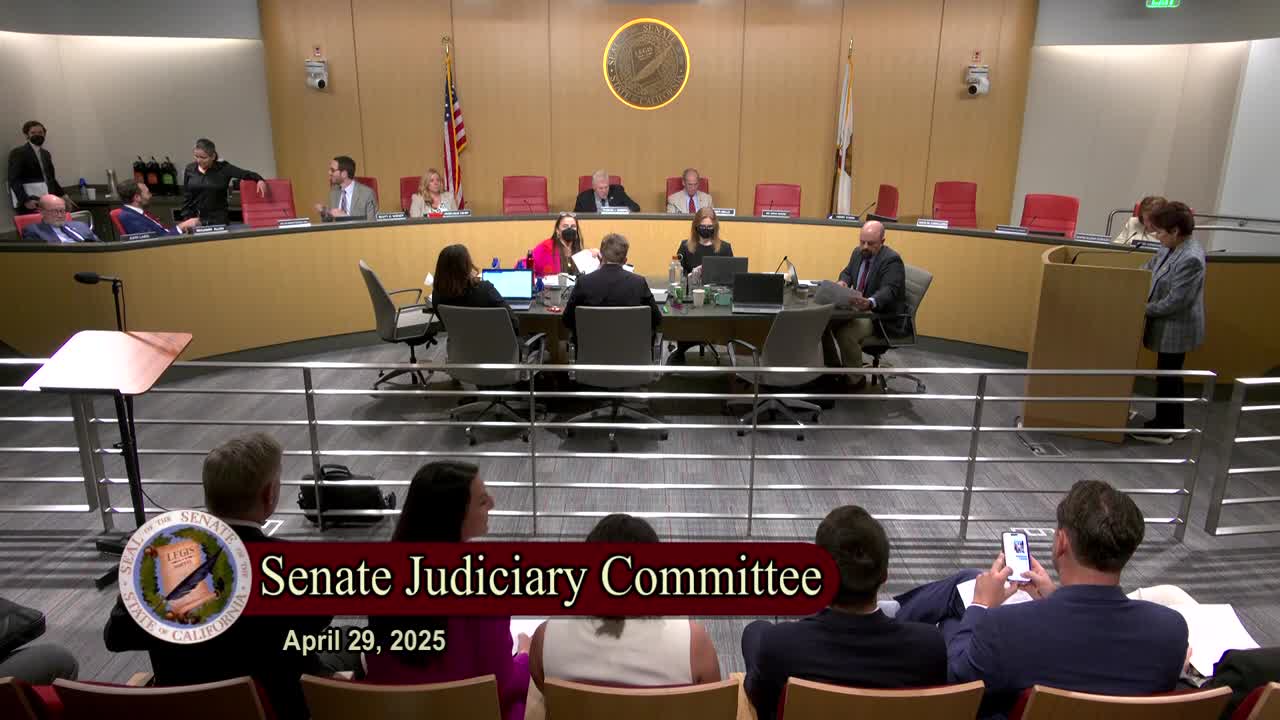 12MIN
Senate Standing Committee on Judiciary
Bill Author