SB 497: Legally protected health care activity.
- Session Year: 2025-2026
- House: Senate
- Latest Version Date: 2025-10-13
Current Status:
Passed
(2025-10-13: Chaptered by Secretary of State. Chapter 764, Statutes of 2025.)
Introduced
In Committee
Awaiting First Chamber Vote
Passed First Chamber
In Committee
Awaiting Second Chamber Vote
Passed Second Chamber
Enacted
(1)The United States Constitution generally requires a state to give full faith and credit to the public acts, records, and judicial proceedings of every other state. Existing law generally authorizes a California court or attorney to issue a subpoena if a foreign subpoena has been sought in this state but prohibits the issuance of a subpoena based on another states law that interferes with a persons right to allow a child to receive gender-affirming health care or gender-affirming mental health care. Existing law generally prohibits a provider of health care, a health care service plan, or a contractor from disclosing medical information regarding a patient, enrollee, or subscriber without first obtaining an authorization unless an exception applies, including that the disclosure is in response to a subpoena. Existing law prohibits a provider of health care, a health care service plan, or a contractor from releasing medical information related to a person or entity allowing a child to receive gender-affirming health care or gender-affirming mental health care in response to a civil action, including a foreign subpoena, based on another states law that authorizes a person to bring a civil action against a person or entity that allows a child to receive gender-affirming health care or gender-affirming mental health care.
This bill would additionally prohibit a provider of health care, a health care service plan, or a contractor from releasing medical information related to a person seeking or obtaining gender-affirming health care or gender-affirming mental health care in response to a criminal or civil action, including a foreign subpoena, based on another states law that interferes with an individuals right to seek or obtain gender-affirming health care or gender-affirming mental health care. The bill would also prohibit a provider of health care, health care service plan, contractor, or employer from cooperating with or providing medical information to an individual, agency, or department from another state or, to the extent permitted by federal law, to a federal law enforcement agency that would identify an individual and that is related to an individual seeking or obtaining gender-affirming health care, as specified. The bill would prohibit these entities from releasing medical information related to sensitive services, as defined, in response to a foreign subpoena that is based on a violation of another states laws authorizing a criminal action against a person or entity for provision or receipt of legally protected health care activity, as defined. The bill would also generally prohibit the issuance of a subpoena based on a violation of another states law that interferes with a persons right to seek or obtain gender-affirming health care or gender-affirming mental health care, as specified.
(2)Existing law requires the Department of Justice to maintain the Controlled Substance Utilization Review and Evaluation System (CURES) for the electronic monitoring of the prescribing and dispensing of certain controlled substances by a health care practitioner authorized to prescribe, order, administer, furnish, or dispense those controlled substances. Existing law authorizes the department to enter into an agreement with an entity operating an interstate data sharing hub, or an agency operating a prescription drug monitoring program in another state, for purposes of interstate data sharing of prescription drug monitoring program information. Existing law limits the entities to which data may be provided from CURES, as well as the type of data that may be released and the uses to which it may be put.
This bill would prohibit a state or local agency or employee, appointee, officer, contractor, or official or any other person acting on behalf of a public agency from knowingly providing any CURES data or knowingly expending any resources in furtherance of any interstate investigation or proceeding seeking to impose civil, criminal, or disciplinary liability based upon another states law for the provision or receipt of legally protected health care activity, as defined. The bill would prohibit the department from sharing data with an out-of-state law enforcement agency without a warrant, subpoena, or court order and would prohibit an out-of-state user from providing any data in furtherance of an investigation or proceeding to impose liability based on another states law for the provision or receipt of legally protected health care activity.
This bill would make it a misdemeanor for a person to access the CURES database when not authorized by law and would make it a misdemeanor for a person who is authorized to access the database to knowingly furnish information from the CURES database to a person who is not authorized by law to receive that information. By creating new crimes, the bill would impose a state-mandated local program.
(3)This bill would provide that its provisions are severable.
(4)This bill would incorporate additional changes to Section 11165 of the Health and Safety Code proposed by AB 82 to be operative only if this bill and AB 82 are enacted and this bill is enacted last.
(5)The California Constitution requires the state to reimburse local agencies and school districts for certain costs mandated by the state. Statutory provisions establish procedures for making that reimbursement.
This bill would provide that no reimbursement is required by this act for a specified reason.
(6)This bill would declare that it is to take effect immediately as an urgency statute.
(1)The United States Constitution generally requires a state to give full faith and credit to the public acts, records, and judicial proceedings of every other state. Existing law generally authorizes a California court or attorney to issue a subpoena if a foreign subpoena has been sought in this state but prohibits the issuance of a subpoena based on another states law that interferes with a persons right to allow a child to receive gender-affirming health care or gender-affirming mental health care. Existing law generally prohibits a provider of health care, a health care service plan, or a contractor from disclosing medical information regarding a patient, enrollee, or subscriber without first obtaining an authorization unless an exception applies, including that the disclosure is in response to a subpoena. Existing law prohibits a provider of health care, a health care service plan, or a contractor from releasing medical information related to a person or entity allowing a child to receive gender-affirming health care or gender-affirming mental health care in response to a civil action, including a foreign subpoena, based on another states law that authorizes a person to bring a civil action against a person or entity that allows a child to receive gender-affirming health care or gender-affirming mental health care.
This bill would additionally prohibit a provider of health care, a health care service plan, or a contractor from releasing medical information related to a person seeking or obtaining gender-affirming health care or gender-affirming mental health care in response to a criminal or civil action, including a foreign subpoena, based on another states law that interferes with an individuals right to seek or obtain gender-affirming health care or gender-affirming mental health care. The bill would also prohibit a provider of health care, health care service plan, contractor, or employer from cooperating with or providing medical information to an individual, agency, or department from another state or, to the extent permitted by federal law, to a federal law enforcement agency that would identify an individual and that is related to an individual seeking or obtaining gender-affirming health care, as specified. The bill would prohibit these entities from releasing medical information related to sensitive services, as defined, in response to a foreign subpoena that is based on a violation of another states laws authorizing a criminal action against a person or entity for provision or receipt of legally protected health care activity, as defined. The bill would also generally prohibit the issuance of a subpoena based on a violation of another states law that interferes with a persons right to seek or obtain gender-affirming health care or gender-affirming mental health care, as specified.
(2)Existing law requires the Department of Justice to maintain the Controlled Substance Utilization Review and Evaluation System (CURES) for the electronic monitoring of the prescribing and dispensing of certain controlled substances by a health care practitioner authorized to prescribe, order, administer, furnish, or dispense those controlled substances. Existing law authorizes the department to enter into an agreement with an entity operating an interstate data sharing hub, or an agency operating a prescription drug monitoring program in another state, for purposes of interstate data sharing of prescription drug monitoring program information. Existing law limits the entities to which data may be provided from CURES, as well as the type of data that may be released and the uses to which it may be put.
This bill would prohibit a state or local agency or employee, appointee, officer, contractor, or official or any other person acting on behalf of a public agency from knowingly providing any CURES data or knowingly expending any resources in furtherance of any interstate investigation or proceeding seeking to impose civil, criminal, or disciplinary liability upon based upon another states law for the provision or receipt of legally protected health care activity, as defined. The bill would prohibit the department from sharing data with an out-of-state law enforcement agency without a warrant, subpoena, or court order and would prohibit an out-of-state user from providing any data in furtherance of an investigation or proceeding to impose liability based on another states law for the provision or receipt of legally protected health care activity.
This bill would make it a misdemeanor for a person to access the CURES database when not authorized by law and would make it a misdemeanor for a person who is authorized to access the database to knowingly furnish information from the CURES database to a person who is not authorized by law to receive that information. By creating new crimes, the bill would impose a state-mandated local program.
(3)This bill would provide that its provisions are severable.
This bill would incorporate additional changes to Section 11165 of the Health and Safety Code proposed by AB 82 to be operative only if this bill and AB 82 are enacted and this bill is enacted last.
The California Constitution requires the state to reimburse local agencies and school districts for certain costs mandated by the state. Statutory provisions establish procedures for making that reimbursement.
This bill would provide that no reimbursement is required by this act for a specified reason.
(3)This bill would provide that its provisions are severable.(4)This bill would declare that it is to take effect immediately as an urgency statute.
(1)The United States Constitution generally requires a state to give full faith and credit to the public acts, records, and judicial proceedings of every other state. Existing law generally authorizes a California court or attorney to issue a subpoena if a foreign subpoena has been sought in this state, state but prohibits the issuance of a subpoena based on another states law that interferes with a persons right to allow a child to receive gender-affirming health care or gender-affirming mental health care. Existing law generally prohibits a provider of health care, a health care service plan, or a contractor from disclosing medical information regarding a patient, enrollee, or subscriber without first obtaining an authorization, authorization unless an exception applies, including that the disclosure is in response to a subpoena. Existing law prohibits a provider of health care, a health care service plan, or a contractor from releasing medical information related to a person or entity allowing a child to receive gender-affirming health care or gender-affirming mental health care in response to a civil action, including a foreign subpoena, based on another states law that authorizes a person to bring a civil action against a person or entity that allows a child to receive gender-affirming health care or gender-affirming mental health care.
This bill would additionally prohibit a provider of health care, a health care service plan, or a contractor from releasing medical information related to a person seeking or obtaining gender-affirming health care or gender-affirming mental health care in response to a criminal or civil action, including a foreign subpoena, based on another states law that interferes with an individuals right to seek or obtain gender-affirming health care or gender-affirming mental health care. The bill would also prohibit a provider of health care, health care service plan, contractor, or employer from cooperating with or providing medical information to an individual, agency, or department from another state or, to the extent permitted by federal law, to a federal law enforcement agency that would identify an individual and that is related to an individual seeking or obtaining gender-affirming health care, as specified. The bill would prohibit these entities from releasing medical information related to sensitive services, as defined, in response to a foreign subpoena that is based on a violation of another states laws authorizing a criminal action against a person or entity for provision or receipt of legally protected health care activity, as defined. The bill would also generally prohibit the issuance of a subpoena based on a violation of another states law that interferes with a persons right to seek or obtain gender-affirming health care or gender-affirming mental health care, as specified.
Existing(2)Existing law requires the Department of Justice to maintain the Controlled Substances Substance Utilization Review and Evaluation System (CURES) for the electronic monitoring of the prescribing and dispensing of certain controlled substances by a health care practitioner authorized to prescribe, order, administer, furnish, or dispense those controlled substances. Existing law authorizes the department to enter into an agreement with an entity operating an interstate data sharing hub, or an agency operating a prescription drug monitoring program in another state, for purposes of interstate data sharing of prescription drug monitoring program information. Existing law limits the entities to which data may be provided from CURES, as well as the type of data that may be released and the uses to which it may be put.
This bill would prohibit a state or local agency or employee, appointee, officer, contractor, or official or any other person acting on behalf of a public agency from knowingly providing any CURES data or knowingly expending any resources in furtherance of any interstate investigation or proceeding seeking to impose civil, criminal, or disciplinary liability upon the provision or receipt of legally protected health care activity, as defined. The bill would prohibit the department from sharing data with an out-of-state law enforcement agency without a warrant, subpoena, or court order, order and would prohibit an out-of-state user from providing any data in furtherance of an investigation or proceeding to impose liability for the provision or receipt of legally protected health care activity.
This bill would make it a misdemeanor for a person to access the CURES database when not authorized by law, law and would make it a misdemeanor for a person who is authorized to access the database to knowingly furnish information from the CURES database to a person who is not authorized by law to receive that information. By creating new crimes, the bill would impose a state-mandated local program.
The California Constitution requires the state to reimburse local agencies and school districts for certain costs mandated by the state. Statutory provisions establish procedures for making that reimbursement.
This bill would provide that no reimbursement is required by this act for a specified reason.
(3)This bill would provide that its provisions are severable.
(4)This bill would declare that it is to take effect immediately as an urgency statute.
The United States Constitution generally requires a state to give full faith and credit to the public acts, records, and judicial proceedings of every other state. Existing law generally authorizes a California court or attorney to issue a subpoena if a foreign subpoena has been sought in this state, but prohibits the issuance of a subpoena based on another states law that interferes with a persons right to allow a child to receive gender-affirming health care or gender-affirming mental health care. Existing law generally prohibits a provider of health care, a health care service plan, or a contractor from disclosing medical information regarding a patient, enrollee, or subscriber without first obtaining an authorization, unless an exception applies, including that the disclosure is in response to a subpoena. Existing law prohibits a provider of health care, a health care service plan, or a contractor from releasing medical information related to a person or entity allowing a child to receive gender-affirming health care or gender-affirming mental health care in response to a civil action, including a foreign subpoena, based on another states law that authorizes a person to bring a civil action against a person or entity that allows a child to receive gender-affirming health care or gender-affirming mental health care.
This bill would additionally prohibit a provider of health care, a health care service plan, or a contractor from releasing medical information related to a person seeking or obtaining gender-affirming health care or gender-affirming mental health care in response to a criminal or civil action, including a foreign subpoena, based on another states law that interferes with an individuals right to seek or obtain gender-affirming health care or gender-affirming mental health care. The bill would also prohibit a provider of health care, health care service plan, contractor, or employer from cooperating with or providing medical information to an individual, agency, or department from another state or, to the extent permitted by federal law, to a federal law enforcement agency that would identify an individual and that is related to an individual seeking or obtaining gender-affirming health care, as specified. The bill would prohibit these entities from releasing medical information related to sensitive services, as defined, in response to a foreign subpoena that is based on a violation of another states laws authorizing a criminal action against a person or entity for provision or receipt of legally protected health care activity, as defined. The bill would also generally prohibit the issuance of a subpoena based on a violation of another states law that interferes with a persons right to seek or obtain gender-affirming health care or gender-affirming mental health care, as specified.
Existing law requires the Department of Justice to maintain the Controlled Substances Utilization Review and Evaluation System (CURES) for the electronic monitoring of the prescribing and dispensing of certain controlled substances by a health care practitioner authorized to prescribe, order, administer, furnish, or dispense those controlled substances. Existing law authorizes the department to enter into an agreement with an entity operating an interstate data sharing hub, or an agency operating a prescription drug monitoring program in another state, for purposes of interstate data sharing of prescription drug monitoring program information. Existing law limits the entities to which data may be provided from CURES, as well as the type of data that may be released and the uses to which it may be put.
This bill would prohibit a state or local agency or employee, appointee, officer, contractor, or official or any other person acting on behalf of a public agency from providing any CURES data or expend knowingly providing any CURES data or knowingly expending any resources in furtherance of any interstate investigation or proceeding seeking to impose civil, criminal, or disciplinary liability upon the provision or receipt of legally protected health care activity, as defined. The bill would prohibit out-of-state law enforcement from having access to CURES data through the interstate data sharing hub and would prohibit the department from sharing data with an out-of-state law enforcement agency without a warrant, subpoena, or court order, and would prohibit an out-of-state user from providing any data in furtherance of an investigation or proceeding to impose liability for the provision or receipt of legally protected health care activity.
This bill would make it a misdemeanor for a person to access the CURES database when not authorized by law, and would make it a misdemeanor for a person who is authorized to access the database to knowingly furnish information from the CURES database to a person who is not authorized by law to receive that information. By creating new crimes, the bill would impose a state-mandated local program.
The California Constitution requires the state to reimburse local agencies and school districts for certain costs mandated by the state. Statutory provisions establish procedures for making that reimbursement.
This bill would provide that no reimbursement is required by this act for a specified reason.
The United States Constitution generally requires a state to give full faith and credit to the public acts, records, and judicial proceedings of every other state. Existing law generally authorizes a California court or attorney to issue a subpoena if a foreign subpoena has been sought in this state, but prohibits the issuance of a subpoena based on another states law that interferes with a persons right to allow a child to receive gender-affirming health care or gender-affirming mental health care. Existing law generally prohibits a provider of health care, a health care service plan, or a contractor from disclosing medical information regarding a patient, enrollee, or subscriber without first obtaining an authorization, unless an exception applies, including that the disclosure is in response to a subpoena. Existing law prohibits a provider of health care, a health care service plan, or a contractor from releasing medical information related to a person or entity allowing a child to receive gender-affirming health care or gender-affirming mental health care in response to a civil action, including a foreign subpoena, based on another states law that authorizes a person to bring a civil action against a person or entity that allows a child to receive gender-affirming health care or gender-affirming mental health care.
This bill would additionally prohibit a provider of health care, a health care service plan, or a contractor from releasing medical information related to a person seeking or obtaining gender-affirming health care or gender-affirming mental health care in response to a criminal or civil action, including a foreign subpoena, based on another states law that interferes with an individuals right to seek or obtain gender-affirming health care or gender-affirming mental health care. The bill would also prohibit a provider of health care, health care service plan, contractor, or employer from cooperating with or providing medical information to an individual, agency, or department from another state or, to the extent permitted by federal law, to a federal law enforcement agency that would identify an individual and that is related to an individual seeking or obtaining gender-affirming health care, as specified. The bill would prohibit these entities from releasing medical information related to sensitive services, as defined, in response to a foreign subpoena that is based on a violation of another states laws authorizing a criminal action against a person or entity for provision or receipt of legally protected health care activity, as defined. The bill would also generally prohibit the issuance of a subpoena based on a violation of another states law that interferes with a persons right to seek or obtain gender-affirming health care or gender-affirming mental health care, as specified.
Existing law requires the Department of Justice to maintain the Controlled Substances Utilization Review and Evaluation System (CURES) for the electronic monitoring of the prescribing and dispensing of certain controlled substances by a health care practitioner authorized to prescribe, order, administer, furnish, or dispense those controlled substances. Existing law authorizes the department to enter into an agreement with an entity operating an interstate data sharing hub, or an agency operating a prescription drug monitoring program in another state, for purposes of interstate data sharing of prescription drug monitoring program information. Existing law limits the entities to which data may be provided from CURES, as well as the type of data that may be released and the uses to which it may be put.
This bill would prohibit a state or local agency or employee, appointee, officer, contractor, or official or any other person acting on behalf of a public agency from providing any CURES data or expend any resources in furtherance of any interstate investigation or proceeding seeking to impose civil, criminal, or disciplinary liability upon the provision or receipt of legally protected health care activity, as defined. The bill would prohibit out-of-state law enforcement from having access to CURES data through the interstate data sharing hub and would require a warrant, subpoena, or court order for a law enforcement agency to obtain information from CURES as part of a criminal investigation. prohibit the department from sharing data with an out-of-state law enforcement agency without a warrant, subpoena, or court order, and would prohibit an out-of-state user from providing any data in furtherance of an investigation or proceeding to impose liability for the provision or receipt of legally protected health care activity.
This bill would make it a misdemeanor for a person to access the CURES database when not authorized by law, and would make it a misdemeanor for a person who is authorized to access the database to knowingly furnish information from the CURES database to a person who is not authorized by law to receive that information. By creating new crimes, the bill would impose a state-mandated local program.
The California Constitution requires the state to reimburse local agencies and school districts for certain costs mandated by the state. Statutory provisions establish procedures for making that reimbursement.
This bill would provide that no reimbursement is required by this act for a specified reason.
The United States Constitution generally requires a state to give full faith and credit to the public acts, records, and judicial proceedings of every other state. Existing law generally authorizes a California court or attorney to issue a subpoena if a foreign subpoena has been sought in this state, but prohibits the issuance of a subpoena based on another states law that interferes with a persons right to allow a child to receive gender-affirming health care or gender-affirming mental health care. Existing law generally prohibits a provider of health care, a health care service plan, or a contractor from disclosing medical information regarding a patient, enrollee, or subscriber without first obtaining an authorization, unless an exception applies, including that the disclosure is in response to a subpoena. Existing law prohibits a provider of health care, a health care service plan, or a contractor from releasing medical information related to a person or entity allowing a child to receive gender-affirming health care or gender-affirming mental health care in response to a civil action, including a foreign subpoena, based on another states law that authorizes a person to bring a civil action against a person or entity that allows a child to receive gender-affirming health care or gender-affirming mental health care.
This bill would additionally prohibit a provider of health care, a health care service plan, or a contractor from releasing medical information related to a person seeking or obtaining gender-affirming health care or gender-affirming mental health care in response to a criminal or civil action, including a foreign subpoena, based on another states law that interferes with an individuals right to seek or obtain gender-affirming health care or gender-affirming mental health care. The bill would also prohibit a provider of health care, health care service plan, contractor, or employer from cooperating with or providing medical information to an individual, agency, or department from another state or, to the extent permitted by federal law, to a federal law enforcement agency that would identify an individual and that is related to an individual seeking or obtaining gender-affirming health care, as specified. The bill would prohibit these entities from releasing medical information related to sensitive services, as defined, in response to a foreign subpoena that is based on a violation of another states laws authorizing a criminal action against a person or entity for provision or receipt of legally protected health care activity, as defined. The bill would also generally prohibit the issuance of a subpoena based on a violation of another states law that interferes with a persons right to seek or obtain gender-affirming health care or gender-affirming mental health care, as specified.
Existing law requires the Department of Justice to maintain the Controlled Substances Utilization Review and Evaluation System (CURES) for the electronic monitoring of the prescribing and dispensing of certain controlled substances by a health care practitioner authorized to prescribe, order, administer, furnish, or dispense those controlled substances. Existing law authorizes the department to enter into an agreement with an entity operating an interstate data sharing hub, or an agency operating a prescription drug monitoring program in another state, for purposes of interstate data sharing of prescription drug monitoring program information. Existing law limits the entities to which data may be provided from CURES, as well as the type of data that may be released and the uses to which it may be put.
This bill would prohibit a state or local agency or employee, appointee, officer, contractor, or official or any other person acting on behalf of a public agency from providing any CURES data or expend any resources in furtherance of any interstate investigation or proceeding seeking to impose civil, criminal, or disciplinary liability upon the provision or receipt of legally protected health care activity, as defined. The bill would prohibit out-of-state law enforcement from having access to CURES data through the interstate data sharing hub and would require a warrant, subpoena, or court order for a law enforcement agency to obtain information from CURES as part of a criminal investigation.
This bill would make it a misdemeanor for a person to access the CURES database when not authorized by law, and would make it a misdemeanor for a person who is authorized to access the database to knowingly furnish information from the CURES database to a person who is not authorized by law to receive that information. By creating new crimes, the bill would impose a state-mandated local program.
The California Constitution requires the state to reimburse local agencies and school districts for certain costs mandated by the state. Statutory provisions establish procedures for making that reimbursement.
This bill would provide that no reimbursement is required by this act for a specified reason.
The Legislature finds and declares that California residents and visitors, especially transgender and gender nonconforming people, are being targeted for harassment, intimidation, and other harm, as are family members, teachers, and others who support them. The Legislature intends to comprehensively protect these Californians and visitors from both instate and out-of-state abuse, including from individuals purporting to act on behalf of the United States Government.
SEC. 2.Section 56.109 of the Civil Code is amended to read:56.109.(a)Notwithstanding subdivision (b) of Section 56.10, a provider of health care, health care service plan, or contractor shall not release medical information related to a person seeking or obtaining gender-affirming health care or gender-affirming mental health care or a person or entity allowing a child to receive gender-affirming health care or gender-affirming mental health care in response to any subpoena or request, including a foreign subpoena, based on another states law that interferes with an individuals right to seek or obtain gender-affirming health care or gender-affirming mental health care or authorizes a person to bring a civil or criminal action against a person or entity that allows a child to receive gender-affirming health care or gender-affirming mental health care.
(b)Notwithstanding subdivision (c) of Section 56.10, a provider of health care, health care service plan, or contractor shall not release medical information to persons or entities who have requested that information and who are authorized by law to receive that information pursuant to subdivision (c) of Section 56.10, if the information is related to an individual seeking or obtaining gender-affirming health care or gender-affirming mental health care or to a person or entity allowing a child to receive gender-affirming health care or gender-affirming mental health care, and the information is being requested pursuant to another states law that authorizes a person to bring a civil or criminal action against a person or entity that provides, seeks, obtains, or receives gender-affirming health care or gender-affirming mental health care or who allows a child to receive gender-affirming health care or gender-affirming mental health care.
(c)Notwithstanding subdivisions (b) and (c) of Section 56.10 or subdivision (c) of Section 56.20, a provider of health care, health care service plan, contractor, or employer shall not cooperate with any inquiry or investigation by, or provide medical information to, any individual, agency, or department from another state or, to the extent permitted by federal law, to a federal law enforcement agency that would identify an individual and that is related to an individual seeking or obtaining gender-affirming health care or gender-affirming mental health care that is lawful under the laws of this state.
(d)This section does not prohibit compliance with the investigation of activity that is punishable as a crime under the laws of this state.
(e)This section does not prohibit compliance with an audit or investigation of activity that is unlawful under the laws of this state or federal law, or with an audit, review, or investigation conducted for purposes of licensure, registration, accreditation, or certification under the laws of this state or federal law or pursuant to an accrediting organization recognized by the State Department of Public Health or the federal Centers for Medicare and Medicaid Services.
(f)This section does not prohibit the Department of Corrections and Rehabilitation from disclosing medical information of an individual to a health care facility that is run by an agency or department from another state, or to a federal law enforcement agency, for treatment purposes and direct medical care for the specified individual and is narrowly limited to the request.
(g)For the purposes of this section, the following terms have the following meanings:
(1)Gender-affirming health care and gender-affirming mental health care shall have the same meanings as provided in Section 16010.2 of the Welfare and Institutions Code.
(2)Person means an individual or governmental subdivision, agency, or instrumentality.
SEC. 3.Section 2029.300 of the Code of Civil Procedure is amended to read:2029.300.(a)To request issuance of a subpoena under this section, a party shall submit the original or a true and correct copy of a foreign subpoena to the clerk of the superior court in the county in which discovery is sought to be conducted in this state. A request for the issuance of a subpoena under this section does not constitute making an appearance in the courts of this state.
(b)In addition to submitting a foreign subpoena under subdivision (a), a party seeking discovery shall do both of the following:
(1)Submit an application requesting that the superior court issue a subpoena with the same terms as the foreign subpoena. The application shall be on a form prescribed by the Judicial Council pursuant to Section 2029.390. No civil case cover sheet is required.
(2)Pay the fee specified in Section 70626 of the Government Code.
(c)When a party submits a foreign subpoena to the clerk of the superior court in accordance with subdivision (a), and satisfies the requirements of subdivision (b), the clerk shall promptly issue a subpoena for service upon the person to which the foreign subpoena is directed.
(d)A subpoena issued under this section shall satisfy all of the following conditions:
(1)It shall incorporate the terms used in the foreign subpoena.
(2)It shall contain or be accompanied by the names, addresses, and telephone numbers of all counsel of record in the proceeding to which the subpoena relates and of any party not represented by counsel.
(3)It shall bear the caption and case number of the out-of-state case to which it relates.
(4)It shall state the name of the court that issues it.
(5)It shall be on a form prescribed by the Judicial Council pursuant to Section 2029.390.
(e)Notwithstanding subdivision (a), a subpoena shall not be issued pursuant to this section in any of the following circumstances:
(1)If the foreign subpoena is based on a violation of another states laws that interfere with a persons right to seek or obtain gender-affirming health care or gender-affirming mental health care or to allow a child to receive gender-affirming health care or gender-affirming mental health care. For the purpose of this paragraph, gender-affirming health care and gender-affirming mental health care shall have the same meanings as provided in Section 16010.2 of the Welfare and Institutions Code.
(2)If the submitted foreign subpoena relates to a foreign penal civil action and would require disclosure of information related to sensitive services. For purposes of this paragraph, sensitive services has the same meaning as defined in Section 791.02 of the Insurance Code.
SEC. 4.Section 2029.350 of the Code of Civil Procedure is amended to read:2029.350.(a)Notwithstanding Sections 1986 and 2029.300, if a party to a proceeding pending in a foreign jurisdiction retains an attorney licensed to practice in this state, who is an active member of the State Bar, and that attorney receives the original or a true and correct copy of a foreign subpoena, the attorney may issue a subpoena under this article.
(b)(1)Notwithstanding subdivision (a), an authorized attorney shall not issue a subpoena pursuant to subdivision (a) if the foreign subpoena is based on a violation of another states laws that interfere with a persons right to seek or obtain gender-affirming health care or gender-affirming mental health care or to allow a child to receive gender-affirming health care or gender-affirming mental health care.
(2)For the purpose of this subdivision, gender-affirming health care and gender-affirming mental health care shall have the same meanings as provided in Section 16010.2 of the Welfare and Institutions Code.
(c)Notwithstanding subdivision (a), an attorney shall not issue a subpoena under this article based on a foreign subpoena that relates to a foreign penal civil action and that would require disclosure of information related to sensitive services. For purposes of this subdivision, sensitive services has the same meaning as defined in Section 791.02 of the Insurance Code.
(d)A subpoena issued under this section shall satisfy all of the following conditions:
(1)It shall incorporate the terms used in the foreign subpoena.
(2)It shall contain or be accompanied by the names, addresses, and telephone numbers of all counsel of record in the proceeding to which the subpoena relates and of any party not represented by counsel.
(3)It shall bear the caption and case number of the out-of-state case to which it relates.
(4)It shall state the name of the superior court of the county in which the discovery is to be conducted.
(5)It shall be on a form prescribed by the Judicial Council pursuant to Section 2029.390.
SEC. 5.Section 11165 of the Health and Safety Code is amended to read:11165.(a)To assist health care practitioners in their efforts to ensure appropriate prescribing, ordering, administering, furnishing, and dispensing of controlled substances, law enforcement and regulatory agencies in their efforts to control the diversion and resultant abuse of Schedule II, Schedule III, Schedule IV, and Schedule V controlled substances, and for statistical analysis, education, and research, the Department of Justice shall, contingent upon the availability of adequate funds in the CURES Fund, maintain the Controlled Substance Utilization Review and Evaluation System (CURES) for the electronic monitoring of, and internet access to information regarding, the prescribing and dispensing of Schedule II, Schedule III, Schedule IV, and Schedule V controlled substances by all practitioners authorized to prescribe, order, administer, furnish, or dispense these controlled substances.
(b)The department may seek and use grant funds to pay the costs incurred by the operation and maintenance of CURES. The department shall annually report to the Legislature and make available to the public the amount and source of funds it receives for support of CURES.
(c)(1)The operation of CURES shall comply with all applicable federal and state privacy and security laws and regulations.
(2)(A)CURES shall operate under existing provisions of law to safeguard the privacy and confidentiality of patients. Data obtained from CURES shall only be provided to appropriate state, local, and federal public agencies for disciplinary, civil, or criminal purposes and to other agencies or entities, as determined by the department, for the purpose of educating practitioners and others in lieu of disciplinary, civil, or criminal actions. Data may be provided to public or private entities, as approved by the department, for educational, peer review, statistical, or research purposes, if patient information, including information that may identify the patient, is not compromised. The University of California shall be provided access to identifiable data for research purposes if the requirements of subdivision (t) of Section 1798.24 of the Civil Code are satisfied. Further, data disclosed to an individual or agency as described in this subdivision shall not be disclosed, sold, or transferred to a third party, unless authorized by, or pursuant to, state and federal privacy and security laws and regulations. The department shall establish policies, procedures, and regulations regarding the use, access, evaluation, management, implementation, operation, storage, disclosure, and security of the information within CURES, consistent with this subdivision.
(B)Notwithstanding subparagraph (A), a regulatory board whose licensees do not prescribe, order, administer, furnish, or dispense controlled substances shall not be provided data obtained from CURES.
(C)(i)Notwithstanding subparagraph (A) or any other law, a state or local agency or employee, appointee, officer, contractor, or official or any other person acting on behalf of a public agency shall not knowingly provide any CURES data or knowingly expend or use time, money, facilities, property, equipment, personnel, or other resources in furtherance of any interstate investigation or proceeding seeking to impose civil, criminal, or disciplinary liability based on another states laws for the provision or receipt of legally protected health care activity, as defined in Section 1798.300 of the Civil Code.
(ii)This section does not prohibit the investigation of any activity that is punishable as a crime under the laws of this state so long as CURES data related to any legally protected health care activity, as defined in Section 1798.300 of the Civil Code, is not knowingly shared with any individual or entity from another state.
(iii)This section does not prohibit compliance with an audit or investigation of activity that is unlawful under the laws of this state or federal law, or with an audit, review, or investigation conducted for purposes of licensure, registration, accreditation, or certification under the laws of this state or federal law or pursuant to an accrediting organization recognized by the State Department of Public Health or the federal Centers for Medicare and Medicaid Services.
(3)The department may adopt regulations regarding the access and use of the information within CURES. The department shall consult with all stakeholders identified by the department during the rulemaking process. The regulations shall, at a minimum, address all of the following in a manner consistent with this chapter:
(A)The process for approving, denying, and disapproving individuals or entities seeking access to information in CURES.
(B)The purposes for which a health care practitioner may access information in CURES.
(C)The conditions under which a warrant, subpoena, or court order is required for a law enforcement agency to obtain information from CURES as part of a criminal investigation.
(D)The process by which information in CURES may be provided for educational, peer review, statistical, or research purposes.
(4)In accordance with federal and state privacy laws and regulations, a health care practitioner may provide a patient with a copy of the patients CURES patient activity report as long as no additional CURES data are provided and the health care practitioner keeps a copy of the report in the patients medical record in compliance with subdivision (d) of Section 11165.1.
(d)For each prescription for a Schedule II, Schedule III, Schedule IV, or Schedule V controlled substance, as defined in the controlled substances schedules in federal law and regulations, specifically Sections 1308.12, 1308.13, 1308.14, and 1308.15, respectively, of Title 21 of the Code of Federal Regulations, the dispensing pharmacy, clinic, or other dispenser shall report the following information to the department or contracted prescription data processing vendor as soon as reasonably possible, but not more than one working day after the date a controlled substance is released to the patient or patients representative, in a format specified by the department:
(1)Full name, address, and, if available, telephone number of the ultimate user or research subject, or contact information as determined by the Secretary of the United States Department of Health and Human Services, and the gender and date of birth of the ultimate user.
(2)The prescribers category of licensure, license number, national provider identifier (NPI) number, if applicable, the federal controlled substance registration number, and the state medical license number of a prescriber using the federal controlled substance registration number of a government-exempt facility.
(3)Pharmacy prescription number, license number, NPI number, and federal controlled substance registration number.
(4)National Drug Code (NDC) number of the controlled substance dispensed.
(5)Quantity of the controlled substance dispensed.
(6)The International Statistical Classification of Diseases (ICD) Code contained in the most current ICD revision, or any revision deemed sufficient by the State Board of Pharmacy, if available.
(7)Number of refills ordered.
(8)Whether the drug was dispensed as a refill of a prescription or as a first-time request.
(9)Prescribing date of the prescription.
(10)Date of dispensing of the prescription.
(11)The serial number for the corresponding prescription form, if applicable.
(e)The department may invite stakeholders to assist, advise, and make recommendations on the establishment of rules and regulations necessary to ensure the proper administration and enforcement of the CURES database. A prescriber or dispenser invitee shall be licensed by one of the boards or committees identified in subdivision (d) of Section 208 of the Business and Professions Code, in active practice in California, and a regular user of CURES.
(f)The department shall, prior to upgrading CURES, consult with prescribers licensed by one of the boards or committees identified in subdivision (d) of Section 208 of the Business and Professions Code, one or more of the boards or committees identified in subdivision (d) of Section 208 of the Business and Professions Code, and any other stakeholder identified by the department, for the purpose of identifying desirable capabilities and upgrades to the CURES Prescription Drug Monitoring Program (PDMP).
(g)The department may establish a process to educate authorized subscribers of the CURES PDMP on how to access and use the CURES PDMP.
(h)(1)The department may enter into an agreement with an entity operating an interstate data sharing hub, or an agency operating a prescription drug monitoring program in another state, for purposes of interstate data sharing of prescription drug monitoring program information. An out-of-state authorized user who obtains CURES data through the interstate data sharing hub shall not provide any CURES data in furtherance of any investigation or proceeding seeking to impose civil, criminal, or disciplinary liability based on another states laws for the provision or receipt of legally protected health care activity, as defined in Section 1798.300 of the Civil Code.
(2)Data obtained from CURES may be provided to authorized users of another states prescription drug monitoring program, as determined by the department pursuant to subdivision (c), if the entity operating the interstate data sharing hub, and the prescription drug monitoring program of that state, as applicable, have entered into an agreement with the department for interstate data sharing of prescription drug monitoring program information.
(3)An agreement entered into by the department for purposes of interstate data sharing of prescription drug monitoring program information shall ensure that all access to data obtained from CURES and the handling of data contained within CURES comply with California law, including regulations, and meet the same patient privacy, audit, and data security standards employed and required for direct access to CURES.
(4)For purposes of interstate data sharing of CURES information pursuant to this subdivision, an authorized user of another states prescription drug monitoring program shall not be required to register with CURES, if the authorized user is registered and in good standing with that states prescription drug monitoring program.
(5)The department shall not enter into an agreement pursuant to this subdivision until the department has issued final regulations regarding the access and use of the information within CURES as required by paragraph (3) of subdivision (c).
(6)Notwithstanding subdivision (c), the department shall not provide CURES data to out-of-state law enforcement absent a warrant, subpoena, or court order, issued pursuant to Section 2029.300 or 2029.350 of the Code of Civil Procedure, or Section 1326 of the Penal Code.
(i)Notwithstanding subdivision (d), a veterinarian shall report the information required by that subdivision to the department as soon as reasonably possible, but not more than seven days after the date a controlled substance is dispensed.
(j)If the dispensing pharmacy, clinic, or other dispenser experiences a temporary technological or electrical failure, it shall, without undue delay, seek to correct any cause of the temporary technological or electrical failure that is reasonably within its control. The deadline for transmitting prescription information to the department or contracted prescription data processing vendor pursuant to subdivision (d) shall be extended until the failure is corrected. If the dispensing pharmacy, clinic, or other dispenser experiences technological limitations that are not reasonably within its control, or is impacted by a natural or manmade disaster, the deadline for transmitting prescription information to the department or contracted prescription data processing vendor shall be extended until normal operations have resumed.
(k)(1)Any person who accesses the CURES database and who is not authorized by law to do so is guilty of a misdemeanor.
(2)Any person authorized by law to access the CURES database and who knowingly furnishes the information from the CURES database to a person who is not authorized by law to receive that information is guilty of a misdemeanor.
(3)This subdivision does not apply to a provider of health care as defined in Section 56.06 of the Civil Code that is subject to applicable state and federal medical privacy laws.
SEC. 5.5.Section 11165 of the Health and Safety Code is amended to read:11165.(a)To assist health care practitioners in their efforts to ensure appropriate prescribing, ordering, administering, furnishing, and dispensing of controlled substances, law enforcement and regulatory agencies in their efforts to control the diversion and resultant abuse of Schedule II, Schedule III, Schedule IV, and Schedule V controlled substances, and for statistical analysis, education, and research, the Department of Justice shall, contingent upon the availability of adequate funds in the CURES Fund, maintain the Controlled Substance Utilization Review and Evaluation System (CURES) for the electronic monitoring of, and internet access to information regarding, the prescribing and dispensing of Schedule II, Schedule III, Schedule IV, and Schedule V controlled substances by all practitioners authorized to prescribe, order, administer, furnish, or dispense these controlled substances.
(b)The department may seek and use grant funds to pay the costs incurred by the operation and maintenance of CURES. The department shall annually report to the Legislature and make available to the public the amount and source of funds it receives for support of CURES.
(c)(1)The operation of CURES shall comply with all applicable federal and state privacy and security laws and regulations.
(2)(A)CURES shall operate under existing provisions of law to safeguard the privacy and confidentiality of patients. Data obtained from CURES shall only be provided to appropriate state, local, and federal public agencies for disciplinary, civil, or criminal purposes and to other agencies or entities, as determined by the department, for the purpose of educating practitioners and others in lieu of disciplinary, civil, or criminal actions. Data may be provided to public or private entities, as approved by the department, for educational, peer review, statistical, or research purposes, if patient information, including information that may identify the patient, is not compromised. The University of California shall be provided access to identifiable data for research purposes if the requirements of subdivision (t) of Section 1798.24 of the Civil Code are satisfied. Further, data disclosed to an individual or agency as described in this subdivision shall not be disclosed, sold, or transferred to a third party, unless authorized by, or pursuant to, state and federal privacy and security laws and regulations. The department shall establish policies, procedures, and regulations regarding the use, access, evaluation, management, implementation, operation, storage, disclosure, and security of the information within CURES, consistent with this subdivision.
(B)Notwithstanding subparagraph (A), a regulatory board whose licensees do not prescribe, order, administer, furnish, or dispense controlled substances shall not be provided data obtained from CURES.
(C)(i)Notwithstanding subparagraph (A) or any other law, a state or local agency or employee, appointee, officer, contractor, or official or any other person acting on behalf of a public agency shall not knowingly provide any CURES data or knowingly expend or use time, money, facilities, property, equipment, personnel, or other resources in furtherance of any interstate investigation or proceeding seeking to impose civil, criminal, or disciplinary liability based on another states laws for the provision or receipt of legally protected health care activity, as defined in Section 1798.300 of the Civil Code.
(ii)This section does not prohibit the investigation of any activity that is punishable as a crime under the laws of this state so long as CURES data related to any legally protected health care activity, as defined in Section 1798.300 of the Civil Code, is not knowingly shared with any individual or entity from another state.
(iii)This section does not prohibit compliance with an audit or investigation of activity that is unlawful under the laws of this state or federal law, or with an audit, review, or investigation conducted for purposes of licensure, registration, accreditation, or certification under the laws of this state or federal law or pursuant to an accrediting organization recognized by the State Department of Public Health or the federal Centers for Medicare and Medicaid Services.
(3)The department may adopt regulations regarding the access and use of the information within CURES. The department shall consult with all stakeholders identified by the department during the rulemaking process. The regulations shall, at a minimum, address all of the following in a manner consistent with this chapter:
(A)The process for approving, denying, and disapproving individuals or entities seeking access to information in CURES.
(B)The purposes for which a health care practitioner may access information in CURES.
(C)The conditions under which a warrant, subpoena, or court order is required for a law enforcement agency to obtain information from CURES as part of a criminal investigation.
(D)The process by which information in CURES may be provided for educational, peer review, statistical, or research purposes.
(4)In accordance with federal and state privacy laws and regulations, a health care practitioner may provide a patient with a copy of the patients CURES patient activity report as long as no additional CURES data are provided and the health care practitioner keeps a copy of the report in the patients medical record in compliance with subdivision (d) of Section 11165.1.
(d)Except as provided in subdivision (k), for each prescription for a Schedule II, Schedule III, Schedule IV, or Schedule V controlled substance, as defined in the controlled substances schedules in federal law and regulations, specifically Sections 1308.12, 1308.13, 1308.14, and 1308.15, respectively, of Title 21 of the Code of Federal Regulations, the dispensing pharmacy, clinic, or other dispenser shall report the following information to the department or contracted prescription data processing vendor as soon as reasonably possible, but not more than one working day after the date a controlled substance is released to the patient or patients representative, in a format specified by the department:
(1)Full name, address, and, if available, telephone number of the ultimate user or research subject, or contact information as determined by the Secretary of the United States Department of Health and Human Services, and the gender and date of birth of the ultimate user.
(2)The prescribers category of licensure, license number, national provider identifier (NPI) number, if applicable, the federal controlled substance registration number, and the state medical license number of a prescriber using the federal controlled substance registration number of a government-exempt facility.
(3)Pharmacy prescription number, license number, NPI number, and federal controlled substance registration number.
(4)National Drug Code (NDC) number of the controlled substance dispensed.
(5)Quantity of the controlled substance dispensed.
(6)The International Statistical Classification of Diseases (ICD) Code contained in the most current ICD revision, or any revision deemed sufficient by the State Board of Pharmacy, if available.
(7)Number of refills ordered.
(8)Whether the drug was dispensed as a refill of a prescription or as a first-time request.
(9)Prescribing date of the prescription.
(10)Date of dispensing of the prescription.
(11)The serial number for the corresponding prescription form, if applicable.
(e)The department may invite stakeholders to assist, advise, and make recommendations on the establishment of rules and regulations necessary to ensure the proper administration and enforcement of the CURES database. A prescriber or dispenser invitee shall be licensed by one of the boards or committees identified in subdivision (d) of Section 208 of the Business and Professions Code, in active practice in California, and a regular user of CURES.
(f)The department shall, prior to upgrading CURES, consult with prescribers licensed by one of the boards or committees identified in subdivision (d) of Section 208 of the Business and Professions Code, one or more of the boards or committees identified in subdivision (d) of Section 208 of the Business and Professions Code, and any other stakeholder identified by the department, for the purpose of identifying desirable capabilities and upgrades to the CURES Prescription Drug Monitoring Program (PDMP).
(g)The department may establish a process to educate authorized subscribers of the CURES PDMP on how to access and use the CURES PDMP.
(h)(1)The department may enter into an agreement with an entity operating an interstate data sharing hub, or an agency operating a prescription drug monitoring program in another state, for purposes of interstate data sharing of prescription drug monitoring program information. An out-of-state authorized user who obtains CURES data through the interstate data sharing hub shall not provide any CURES data in furtherance of any investigation or proceeding seeking to impose civil, criminal, or disciplinary liability based on another states laws for the provision or receipt of legally protected health care activity, as defined in Section 1798.300 of the Civil Code.
(2)Data obtained from CURES may be provided to authorized users of another states prescription drug monitoring program, as determined by the department pursuant to subdivision (c), if the entity operating the interstate data sharing hub, and the prescription drug monitoring program of that state, as applicable, have entered into an agreement with the department for interstate data sharing of prescription drug monitoring program information.
(3)An agreement entered into by the department for purposes of interstate data sharing of prescription drug monitoring program information shall ensure that all access to data obtained from CURES and the handling of data contained within CURES comply with California law, including regulations, and meet the same patient privacy, audit, and data security standards employed and required for direct access to CURES.
(4)For purposes of interstate data sharing of CURES information pursuant to this subdivision, an authorized user of another states prescription drug monitoring program shall not be required to register with CURES, if the authorized user is registered and in good standing with that states prescription drug monitoring program.
(5)The department shall not enter into an agreement pursuant to this subdivision until the department has issued final regulations regarding the access and use of the information within CURES as required by paragraph (3) of subdivision (c).
(6)Notwithstanding subdivision (c), the department shall not provide CURES data to out-of-state law enforcement absent a warrant, subpoena, or court order, issued pursuant to Section 2029.300 or 2029.350 of the Code of Civil Procedure, or Section 1326 of the Penal Code.
(i)Notwithstanding subdivision (d), a veterinarian shall report the information required by that subdivision to the department as soon as reasonably possible, but not more than seven days after the date a controlled substance is dispensed.
(j)If the dispensing pharmacy, clinic, or other dispenser experiences a temporary technological or electrical failure, it shall, without undue delay, seek to correct any cause of the temporary technological or electrical failure that is reasonably within its control. The deadline for transmitting prescription information to the department or contracted prescription data processing vendor pursuant to subdivision (d) shall be extended until the failure is corrected. If the dispensing pharmacy, clinic, or other dispenser experiences technological limitations that are not reasonably within its control, or is impacted by a natural or manmade disaster, the deadline for transmitting prescription information to the department or contracted prescription data processing vendor shall be extended until normal operations have resumed.
(k)(1)Notwithstanding subdivision (d), a prescription for or the dispensing of testosterone or mifepristone shall not be reported to the department, CURES, or a contracted prescription data processing vendor.
(2)On or before January 1, 2027, the department shall remove existing records of a prescription described in this subdivision created or maintained prior to January 1, 2026.
(l)(1)Any person who accesses the CURES database and who is not authorized by law to do so is guilty of a misdemeanor.
(2)Any person authorized by law to access the CURES database and who knowingly furnishes the information from the CURES database to a person who is not authorized by law to receive that information is guilty of a misdemeanor.
(3)This subdivision does not apply to a provider of health care as defined in Section 56.06 of the Civil Code that is subject to applicable state and federal medical privacy laws.
SEC. 6.Section 1326 of the Penal Code is amended to read:1326.(a)The process by which the attendance of a witness before a court or magistrate is required is a subpoena. It may be signed and issued by any of the following:
(1)A magistrate before whom a complaint is laid or their clerk, the district attorney or their investigator, or the public defender or their investigator, for witnesses in the state.
(2)The district attorney, their investigator, or, upon request of the grand jury, any judge of the superior court, for witnesses in the state, in support of an indictment or information, to appear before the court in which it is to be tried.
(3)The district attorney or their investigator, the public defender or their investigator, or the clerk of the court in which a criminal action is to be tried. The clerk shall, at any time, upon application of the defendant, and without charge, issue as many blank subpoenas, subscribed by them, for witnesses in the state, as the defendant may require.
(4)The attorney of record for the defendant.
(b)A subpoena issued in a criminal action that commands the custodian of records or other qualified witness of a business to produce books, papers, documents, or records shall direct that those items be delivered by the custodian or qualified witness in the manner specified in subdivision (b) of Section 1560 of the Evidence Code. Subdivision (e) of Section 1560 of the Evidence Code shall not apply to criminal cases.
(c)(1)Notwithstanding subdivision (b), a provider of health care, health care service plan, or contractor shall not release medical information related to an individual seeking or obtaining gender-affirming health care or gender-affirming mental health care or a person or entity allowing a child to receive gender-affirming health care or gender-affirming mental health care in response to any foreign subpoena that is based on a violation of another states laws authorizing a criminal action that interferes with an individuals rights to seek or obtain gender-affirming health care or gender-affirming mental health care or against a person or entity that allows a child to receive gender-affirming health care or gender-affirming mental health care.
(2)For the purpose of this subdivision, gender-affirming health care and gender-affirming mental health care shall have the same meanings as provided in Section 16010.2 of the Welfare and Institutions Code.
(d)Notwithstanding subdivision (b), a provider of health care, health care service plan, or contractor shall not release medical information related to sensitive services in response to any foreign subpoena that is based on a violation of another states laws authorizing a criminal action against a person or entity for the provision or receipt of legally protected health care activity, as defined in Section 1798.300 of the Civil Code. For purposes of this subdivision, sensitive services has the same meaning as defined in Section 791.02 of the Insurance Code.
(e)In a criminal action, no party, or attorney or representative of a party, may issue a subpoena commanding the custodian of records or other qualified witness of a business to provide books, papers, documents, or records, or copies thereof, relating to a person or entity other than the subpoenaed person or entity in any manner other than that specified in subdivision (b) of Section 1560 of the Evidence Code. When a defendant has issued a subpoena to a person or entity that is not a party for the production of books, papers, documents, or records, or copies thereof, the court may order an in camera hearing to determine whether or not the defense is entitled to receive the documents. The court may not order the documents disclosed to the prosecution except as required by Section 1054.3.
(f)This section shall not be construed to prohibit obtaining books, papers, documents, or records with the consent of the person to whom the books, papers, documents, or records relate.
SEC. 7.The provisions of this act are severable. If any provision of this act or its application is held invalid, that invalidity shall not affect other provisions or applications that can be given effect without the invalid provision or application.
SEC. 8.Section 5.5 of this bill incorporates amendments to Section 11165 of the Health and Safety Code proposed by both this bill and Assembly Bill 82. That section of this bill shall only become operative if (1) both bills are enacted and become effective on or before January 1, 2026, but this bill becomes operative first, (2) each bill amends Section 11165 of the Health and Safety Code, and (3) this bill is enacted after Assembly Bill 82, in which case Section 11165 of the Health and Safety Code, as amended by Section 5 of this bill, shall remain operative only until the operative date of Assembly Bill 82, at which time Section 5.5 of this bill shall become operative.
SEC. 9.No reimbursement is required by this act pursuant to Section 6 of Article XIIIB of the California Constitution because the only costs that may be incurred by a local agency or school district will be incurred because this act creates a new crime or infraction, eliminates a crime or infraction, or changes the penalty for a crime or infraction, within the meaning of Section 17556 of the Government Code, or changes the definition of a crime within the meaning of Section 6 of Article XIIIB of the California Constitution.
SEC. 10.This act is an urgency statute necessary for the immediate preservation of the public peace, health, or safety within the meaning of Article IV of the California Constitution and shall go into immediate effect. The facts constituting the necessity are:
To address the ongoing efforts to decrease legal protections for the transgender community, it is necessary that this act take effect immediately.
(a)The Legislature finds and declares that California residents and visitors, especially transgender and gender nonconforming people, are being targeted for harassment, intimidation, and other harm, as are family members, teachers, and others who support them. The Legislature intends to comprehensively protect these Californians and visitors from both instate and out-of-state abuse, including from individuals purporting to act on behalf of the United States Government.
(b)It is the intent of the Legislature to ensure that educators that may face retaliation or prosecution under President Trumps Executive Order on Ending Radical Indoctrination in K12 Schooling for prioritizing the safety and well-being of transgender youth are protected.SEC. 2.Section 56.109 of the Civil Code is amended to read:56.109.(a)Notwithstanding subdivision (b) of Section 56.10, a provider of health care, health care service plan, or contractor shall not release medical information related to a person seeking or obtaining gender-affirming health care or gender-affirming mental health care or a person or entity allowing a child to receive gender-affirming health care or gender-affirming mental health care in response to any subpoena or request, including a foreign subpoena, based on another states law that interferes with an individuals right to seek or obtain gender-affirming health care or gender-affirming mental health care or authorizes a person to bring a civil or criminal action against a person or entity that allows a child to receive gender-affirming health care or gender-affirming mental health care.
(b)Notwithstanding subdivision (c) of Section 56.10, a provider of health care, health care service plan, or contractor shall not release medical information to persons or entities who have requested that information and who are authorized by law to receive that information pursuant to subdivision (c) of Section 56.10, if the information is related to an individual seeking or obtaining gender-affirming health care or gender-affirming mental health care or to a person or entity allowing a child to receive gender-affirming health care or gender-affirming mental health care, and the information is being requested pursuant to another states law that authorizes a person to bring a civil or criminal action against a person or entity that provides, seeks, obtains, or receives gender-affirming health care or gender-affirming mental health care or who allows a child to receive gender-affirming health care or gender-affirming mental health care.
(c)Notwithstanding subdivisions (b) and (c) of Section 56.10 or subdivision (c) of Section 56.20, a provider of health care, health care service plan, contractor, or employer shall not cooperate with any inquiry or investigation by, or provide medical information to, any individual, agency, or department from another state or, to the extent permitted by federal law, to a federal law enforcement agency that would identify an individual and that is related to an individual seeking or obtaining gender-affirming health care or gender-affirming mental health care that is lawful under the laws of this state.
(d)This section does not prohibit compliance with the investigation of activity that is punishable as a crime under the laws of this state.
(e)This section does not prohibit compliance with an audit or investigation of activity that is unlawful under the laws of this state or federal law, or with an audit, review, or investigation conducted for purposes of licensure, registration, accreditation, or certification under the laws of this state or federal law or pursuant to an accrediting organization recognized by the State Department of Public Health or the federal Centers for Medicare and Medicaid Services.
(f)This section does not prohibit the Department of Corrections and Rehabilitation from disclosing medical information of an individual to a health care facility that is run by an agency or department from another state, or to a federal law enforcement agency, for treatment purposes and direct medical care for the specified individual and is narrowly limited to the request.
(e)(g)For the purposes of this section, the following terms have the following meanings:
(1)Gender-affirming health care and gender-affirming mental health care shall have the same meanings as provided in Section 16010.2 of the Welfare and Institutions Code.
(2)Person means an individual or governmental subdivision, agency, or instrumentality.
SEC. 3.Section 2029.300 of the Code of Civil Procedure is amended to read:2029.300.(a)To request issuance of a subpoena under this section, a party shall submit the original or a true and correct copy of a foreign subpoena to the clerk of the superior court in the county in which discovery is sought to be conducted in this state. A request for the issuance of a subpoena under this section does not constitute making an appearance in the courts of this state.
(b)In addition to submitting a foreign subpoena under subdivision (a), a party seeking discovery shall do both of the following:
(1)Submit an application requesting that the superior court issue a subpoena with the same terms as the foreign subpoena. The application shall be on a form prescribed by the Judicial Council pursuant to Section 2029.390. No civil case cover sheet is required.
(2)Pay the fee specified in Section 70626 of the Government Code.
(c)When a party submits a foreign subpoena to the clerk of the superior court in accordance with subdivision (a), and satisfies the requirements of subdivision (b), the clerk shall promptly issue a subpoena for service upon the person to which the foreign subpoena is directed.
(d)A subpoena issued under this section shall satisfy all of the following conditions:
(1)It shall incorporate the terms used in the foreign subpoena.
(2)It shall contain or be accompanied by the names, addresses, and telephone numbers of all counsel of record in the proceeding to which the subpoena relates and of any party not represented by counsel.
(3)It shall bear the caption and case number of the out-of-state case to which it relates.
(4)It shall state the name of the court that issues it.
(5)It shall be on a form prescribed by the Judicial Council pursuant to Section 2029.390.
(e)Notwithstanding subdivision (a), a subpoena shall not be issued pursuant to this section in any of the following circumstances:
(1)If the foreign subpoena is based on a violation of another states laws that interfere with a persons right to seek or obtain gender-affirming health care or gender-affirming mental health care or to allow a child to receive gender-affirming health care or gender-affirming mental health care. For the purpose of this paragraph, gender-affirming health care and gender-affirming mental health care shall have the same meanings as provided in Section 16010.2 of the Welfare and Institutions Code.
(2)If the submitted foreign subpoena relates to a foreign penal civil action and would require disclosure of information related to sensitive services. For purposes of this paragraph, sensitive services has the same meaning as defined in Section 791.02 of the Insurance Code.
SEC. 4.Section 2029.350 of the Code of Civil Procedure is amended to read:2029.350.(a)Notwithstanding Sections 1986 and 2029.300, if a party to a proceeding pending in a foreign jurisdiction retains an attorney licensed to practice in this state, who is an active member of the State Bar, and that attorney receives the original or a true and correct copy of a foreign subpoena, the attorney may issue a subpoena under this article.
(b)(1)Notwithstanding subdivision (a), an authorized attorney shall not issue a subpoena pursuant to subdivision (a) if the foreign subpoena is based on a violation of another states laws that interfere with a persons right to seek or obtain gender-affirming health care or gender-affirming mental health care or to allow a child to receive gender-affirming health care or gender-affirming mental health care.
(2)For the purpose of this subdivision, gender-affirming health care and gender-affirming mental health care shall have the same meanings as provided in Section 16010.2 of the Welfare and Institutions Code.
(c)Notwithstanding subdivision (a), an attorney shall not issue a subpoena under this article based on a foreign subpoena that relates to a foreign penal civil action and that would require disclosure of information related to sensitive services. For purposes of this subdivision, sensitive services has the same meaning as defined in Section 791.02 of the Insurance Code.
(d)A subpoena issued under this section shall satisfy all of the following conditions:
(1)It shall incorporate the terms used in the foreign subpoena.
(2)It shall contain or be accompanied by the names, addresses, and telephone numbers of all counsel of record in the proceeding to which the subpoena relates and of any party not represented by counsel.
(3)It shall bear the caption and case number of the out-of-state case to which it relates.
(4)It shall state the name of the superior court of the county in which the discovery is to be conducted.
(5)It shall be on a form prescribed by the Judicial Council pursuant to Section 2029.390.
SEC. 5.Section 11165 of the Health and Safety Code is amended to read:11165.(a)To assist health care practitioners in their efforts to ensure appropriate prescribing, ordering, administering, furnishing, and dispensing of controlled substances, law enforcement and regulatory agencies in their efforts to control the diversion and resultant abuse of Schedule II, Schedule III, Schedule IV, and Schedule V controlled substances, and for statistical analysis, education, and research, the Department of Justice shall, contingent upon the availability of adequate funds in the CURES Fund, maintain the Controlled Substance Utilization Review and Evaluation System (CURES) for the electronic monitoring of, and internet access to information regarding, the prescribing and dispensing of Schedule II, Schedule III, Schedule IV, and Schedule V controlled substances by all practitioners authorized to prescribe, order, administer, furnish, or dispense these controlled substances.
(b)The department may seek and use grant funds to pay the costs incurred by the operation and maintenance of CURES. The department shall annually report to the Legislature and make available to the public the amount and source of funds it receives for support of CURES.
(c)(1)The operation of CURES shall comply with all applicable federal and state privacy and security laws and regulations.
(2)(A)CURES shall operate under existing provisions of law to safeguard the privacy and confidentiality of patients. Data obtained from CURES shall only be provided to appropriate state, local, and federal public agencies for disciplinary, civil, or criminal purposes and to other agencies or entities, as determined by the department, for the purpose of educating practitioners and others in lieu of disciplinary, civil, or criminal actions. Data may be provided to public or private entities, as approved by the department, for educational, peer review, statistical, or research purposes, if patient information, including information that may identify the patient, is not compromised. The University of California shall be provided access to identifiable data for research purposes if the requirements of subdivision (t) of Section 1798.24 of the Civil Code are satisfied. Further, data disclosed to an individual or agency as described in this subdivision shall not be disclosed, sold, or transferred to a third party, unless authorized by, or pursuant to, state and federal privacy and security laws and regulations. The department shall establish policies, procedures, and regulations regarding the use, access, evaluation, management, implementation, operation, storage, disclosure, and security of the information within CURES, consistent with this subdivision.
(B)Notwithstanding subparagraph (A), a regulatory board whose licensees do not prescribe, order, administer, furnish, or dispense controlled substances shall not be provided data obtained from CURES.
(C)(i)Notwithstanding subparagraph (A) or any other law, a state or local agency or employee, appointee, officer, contractor, or official or any other person acting on behalf of a public agency shall not knowingly provide any CURES data or knowingly expend or use time, money, facilities, property, equipment, personnel, or other resources in furtherance of any interstate investigation or proceeding seeking to impose civil, criminal, or disciplinary liability upon based on another states laws for the provision or receipt of legally protected health care activity, as defined in Section 1798.300 of the Civil Code.
(ii)This section does not prohibit the investigation of any activity that is punishable as a crime under the laws of this state so long as CURES data related to any legally protected health care activity, as defined in Section 1798.300 of the Civil Code, is not knowingly shared with any individual or entity from another state.
(iii)This section does not prohibit compliance with an audit or investigation of activity that is unlawful under the laws of this state or federal law, or with an audit, review, or investigation conducted for purposes of licensure, registration, accreditation, or certification under the laws of this state or federal law or pursuant to an accrediting organization recognized by the State Department of Public Health or the federal Centers for Medicare and Medicaid Services.
(3)The department may adopt regulations regarding the access and use of the information within CURES. The department shall consult with all stakeholders identified by the department during the rulemaking process. The regulations shall, at a minimum, address all of the following in a manner consistent with this chapter:
(A)The process for approving, denying, and disapproving individuals or entities seeking access to information in CURES.
(B)The purposes for which a health care practitioner may access information in CURES.
(C)The conditions under which a warrant, subpoena, or court order is required for a law enforcement agency to obtain information from CURES as part of a criminal investigation.
(D)The process by which information in CURES may be provided for educational, peer review, statistical, or research purposes.
(4)In accordance with federal and state privacy laws and regulations, a health care practitioner may provide a patient with a copy of the patients CURES patient activity report as long as no additional CURES data are provided and the health care practitioner keeps a copy of the report in the patients medical record in compliance with subdivision (d) of Section 11165.1.
(d)For each prescription for a Schedule II, Schedule III, Schedule IV, or Schedule V controlled substance, as defined in the controlled substances schedules in federal law and regulations, specifically Sections 1308.12, 1308.13, 1308.14, and 1308.15, respectively, of Title 21 of the Code of Federal Regulations, the dispensing pharmacy, clinic, or other dispenser shall report the following information to the department or contracted prescription data processing vendor as soon as reasonably possible, but not more than one working day after the date a controlled substance is released to the patient or patients representative, in a format specified by the department:
(1)Full name, address, and, if available, telephone number of the ultimate user or research subject, or contact information as determined by the Secretary of the United States Department of Health and Human Services, and the gender and date of birth of the ultimate user.
(2)The prescribers category of licensure, license number, national provider identifier (NPI) number, if applicable, the federal controlled substance registration number, and the state medical license number of a prescriber using the federal controlled substance registration number of a government-exempt facility.
(3)Pharmacy prescription number, license number, NPI number, and federal controlled substance registration number.
(4)National Drug Code (NDC) number of the controlled substance dispensed.
(5)Quantity of the controlled substance dispensed.
(6)The International Statistical Classification of Diseases (ICD) Code contained in the most current ICD revision, or any revision deemed sufficient by the State Board of Pharmacy, if available.
(7)Number of refills ordered.
(8)Whether the drug was dispensed as a refill of a prescription or as a first-time request.
(9)Prescribing date of the prescription.
(10)Date of dispensing of the prescription.
(11)The serial number for the corresponding prescription form, if applicable.
(e)The department may invite stakeholders to assist, advise, and make recommendations on the establishment of rules and regulations necessary to ensure the proper administration and enforcement of the CURES database. A prescriber or dispenser invitee shall be licensed by one of the boards or committees identified in subdivision (d) of Section 208 of the Business and Professions Code, in active practice in California, and a regular user of CURES.
(f)The department shall, prior to upgrading CURES, consult with prescribers licensed by one of the boards or committees identified in subdivision (d) of Section 208 of the Business and Professions Code, one or more of the boards or committees identified in subdivision (d) of Section 208 of the Business and Professions Code, and any other stakeholder identified by the department, for the purpose of identifying desirable capabilities and upgrades to the CURES Prescription Drug Monitoring Program (PDMP).
(g)The department may establish a process to educate authorized subscribers of the CURES PDMP on how to access and use the CURES PDMP.
(h)(1)The department may enter into an agreement with an entity operating an interstate data sharing hub, or an agency operating a prescription drug monitoring program in another state, for purposes of interstate data sharing of prescription drug monitoring program information. An out-of-state authorized user who obtains CURES data through the interstate data sharing hub shall not provide any CURES data in furtherance of any investigation or proceeding seeking to impose civil, criminal, or disciplinary liability upon based on another states laws for the provision or receipt of legally protected health care activity, as defined in Section 1798.300 of the Civil Code.
(2)Data obtained from CURES may be provided to authorized users of another states prescription drug monitoring program, as determined by the department pursuant to subdivision (c), if the entity operating the interstate data sharing hub, and the prescription drug monitoring program of that state, as applicable, have entered into an agreement with the department for interstate data sharing of prescription drug monitoring program information.
(3)An agreement entered into by the department for purposes of interstate data sharing of prescription drug monitoring program information shall ensure that all access to data obtained from CURES and the handling of data contained within CURES comply with California law, including regulations, and meet the same patient privacy, audit, and data security standards employed and required for direct access to CURES.
(4)For purposes of interstate data sharing of CURES information pursuant to this subdivision, an authorized user of another states prescription drug monitoring program shall not be required to register with CURES, if the authorized user is registered and in good standing with that states prescription drug monitoring program.
(5)The department shall not enter into an agreement pursuant to this subdivision until the department has issued final regulations regarding the access and use of the information within CURES as required by paragraph (3) of subdivision (c).
(6)Notwithstanding subdivision (c), the department shall not provide CURES data to out-of-state law enforcement absent a warrant, subpoena, or court order, issued pursuant to Section 2029.300 or 2029.350 of the Code of Civil Procedure, or Section 1326 of the Penal Code.
(i)Notwithstanding subdivision (d), a veterinarian shall report the information required by that subdivision to the department as soon as reasonably possible, but not more than seven days after the date a controlled substance is dispensed.
(j)If the dispensing pharmacy, clinic, or other dispenser experiences a temporary technological or electrical failure, it shall, without undue delay, seek to correct any cause of the temporary technological or electrical failure that is reasonably within its control. The deadline for transmitting prescription information to the department or contracted prescription data processing vendor pursuant to subdivision (d) shall be extended until the failure is corrected. If the dispensing pharmacy, clinic, or other dispenser experiences technological limitations that are not reasonably within its control, or is impacted by a natural or manmade disaster, the deadline for transmitting prescription information to the department or contracted prescription data processing vendor shall be extended until normal operations have resumed.
(k)(1)Any person who accesses the CURES database and who is not authorized by law to do so is guilty of a misdemeanor.
(2)Any person authorized by law to access the CURES database and who knowingly furnishes the information from the CURES database to a person who is not authorized by law to receive that information is guilty of a misdemeanor.
(3)This subdivision does not apply to a provider of health care as defined in Section 56.06 of the Civil Code that is subject to applicable state and federal medical privacy laws.
SEC. 5.5.Section 11165 of the Health and Safety Code is amended to read:11165.(a)To assist health care practitioners in their efforts to ensure appropriate prescribing, ordering, administering, furnishing, and dispensing of controlled substances, law enforcement and regulatory agencies in their efforts to control the diversion and resultant abuse of Schedule II, Schedule III, Schedule IV, and Schedule V controlled substances, and for statistical analysis, education, and research, the Department of Justice shall, contingent upon the availability of adequate funds in the CURES Fund, maintain the Controlled Substance Utilization Review and Evaluation System (CURES) for the electronic monitoring of, and internet access to information regarding, the prescribing and dispensing of Schedule II, Schedule III, Schedule IV, and Schedule V controlled substances by all practitioners authorized to prescribe, order, administer, furnish, or dispense these controlled substances.
(b)The department may seek and use grant funds to pay the costs incurred by the operation and maintenance of CURES. The department shall annually report to the Legislature and make available to the public the amount and source of funds it receives for support of CURES.
(c)(1)The operation of CURES shall comply with all applicable federal and state privacy and security laws and regulations.
(2)(A)CURES shall operate under existing provisions of law to safeguard the privacy and confidentiality of patients. Data obtained from CURES shall only be provided to appropriate state, local, and federal public agencies for disciplinary, civil, or criminal purposes and to other agencies or entities, as determined by the department, for the purpose of educating practitioners and others in lieu of disciplinary, civil, or criminal actions. Data may be provided to public or private entities, as approved by the department, for educational, peer review, statistical, or research purposes, if patient information, including information that may identify the patient, is not compromised. The University of California shall be provided access to identifiable data for research purposes if the requirements of subdivision (t) of Section 1798.24 of the Civil Code are satisfied. Further, data disclosed to an individual or agency as described in this subdivision shall not be disclosed, sold, or transferred to a third party, unless authorized by, or pursuant to, state and federal privacy and security laws and regulations. The department shall establish policies, procedures, and regulations regarding the use, access, evaluation, management, implementation, operation, storage, disclosure, and security of the information within CURES, consistent with this subdivision.
(B)Notwithstanding subparagraph (A), a regulatory board whose licensees do not prescribe, order, administer, furnish, or dispense controlled substances shall not be provided data obtained from CURES.
(C)(i)Notwithstanding subparagraph (A) or any other law, a state or local agency or employee, appointee, officer, contractor, or official or any other person acting on behalf of a public agency shall not knowingly provide any CURES data or knowingly expend or use time, money, facilities, property, equipment, personnel, or other resources in furtherance of any interstate investigation or proceeding seeking to impose civil, criminal, or disciplinary liability based on another states laws for the provision or receipt of legally protected health care activity, as defined in Section 1798.300 of the Civil Code.
(ii)This section does not prohibit the investigation of any activity that is punishable as a crime under the laws of this state so long as CURES data related to any legally protected health care activity, as defined in Section 1798.300 of the Civil Code, is not knowingly shared with any individual or entity from another state.
(iii)This section does not prohibit compliance with an audit or investigation of activity that is unlawful under the laws of this state or federal law, or with an audit, review, or investigation conducted for purposes of licensure, registration, accreditation, or certification under the laws of this state or federal law or pursuant to an accrediting organization recognized by the State Department of Public Health or the federal Centers for Medicare and Medicaid Services.
(3)The department shall, no later than January 1, 2021, may adopt regulations regarding the access and use of the information within CURES. The department shall consult with all stakeholders identified by the department during the rulemaking process. The regulations shall, at a minimum, address all of the following in a manner consistent with this chapter:
(A)The process for approving, denying, and disapproving individuals or entities seeking access to information in CURES.
(B)The purposes for which a health care practitioner may access information in CURES.
(C)The conditions under which a warrant, subpoena, or court order is required for a law enforcement agency to obtain information from CURES as part of a criminal investigation.
(D)The process by which information in CURES may be provided for educational, peer review, statistical, or research purposes.
(4)In accordance with federal and state privacy laws and regulations, a health care practitioner may provide a patient with a copy of the patients CURES patient activity report as long as no additional CURES data are provided and the health care practitioner keeps a copy of the report in the patients medical record in compliance with subdivision (d) of Section 11165.1.
(d)For Except as provided in subdivision (k), for each prescription for a Schedule II, Schedule III, Schedule IV, or Schedule V controlled substance, as defined in the controlled substances schedules in federal law and regulations, specifically Sections 1308.12, 1308.13, 1308.14, and 1308.15, respectively, of Title 21 of the Code of Federal Regulations, the dispensing pharmacy, clinic, or other dispenser shall report the following information to the department or contracted prescription data processing vendor as soon as reasonably possible, but not more than one working day after the date a controlled substance is released to the patient or patients representative, in a format specified by the department:
(1)Full name, address, and, if available, telephone number of the ultimate user or research subject, or contact information as determined by the Secretary of the United States Department of Health and Human Services, and the gender and date of birth of the ultimate user.
(2)The prescribers category of licensure, license number, national provider identifier (NPI) number, if applicable, the federal controlled substance registration number, and the state medical license number of a prescriber using the federal controlled substance registration number of a government-exempt facility.
(3)Pharmacy prescription number, license number, NPI number, and federal controlled substance registration number.
(4)National Drug Code (NDC) number of the controlled substance dispensed.
(5)Quantity of the controlled substance dispensed.
(6)The International Statistical Classification of Diseases (ICD) Code contained in the most current ICD revision, or any revision deemed sufficient by the State Board of Pharmacy, if available.
(7)Number of refills ordered.
(8)Whether the drug was dispensed as a refill of a prescription or as a first-time request.
(9)Prescribing date of the prescription.
(10)Date of dispensing of the prescription.
(11)The serial number for the corresponding prescription form, if applicable.
(e)The department may invite stakeholders to assist, advise, and make recommendations on the establishment of rules and regulations necessary to ensure the proper administration and enforcement of the CURES database. A prescriber or dispenser invitee shall be licensed by one of the boards or committees identified in subdivision (d) of Section 208 of the Business and Professions Code, in active practice in California, and a regular user of CURES.
(f)The department shall, prior to upgrading CURES, consult with prescribers licensed by one of the boards or committees identified in subdivision (d) of Section 208 of the Business and Professions Code, one or more of the boards or committees identified in subdivision (d) of Section 208 of the Business and Professions Code, and any other stakeholder identified by the department, for the purpose of identifying desirable capabilities and upgrades to the CURES Prescription Drug Monitoring Program (PDMP).
(g)The department may establish a process to educate authorized subscribers of the CURES PDMP on how to access and use the CURES PDMP.
(h)(1)The department may enter into an agreement with an entity operating an interstate data sharing hub, or an agency operating a prescription drug monitoring program in another state, for purposes of interstate data sharing of prescription drug monitoring program information. An out-of-state authorized user who obtains CURES data through the interstate data sharing hub shall not provide any CURES data in furtherance of any investigation or proceeding seeking to impose civil, criminal, or disciplinary liability based on another states laws for the provision or receipt of legally protected health care activity, as defined in Section 1798.300 of the Civil Code.
(2)Data obtained from CURES may be provided to authorized users of another states prescription drug monitoring program, as determined by the department pursuant to subdivision (c), if the entity operating the interstate data sharing hub, and the prescription drug monitoring program of that state, as applicable, have entered into an agreement with the department for interstate data sharing of prescription drug monitoring program information.
(3)An agreement entered into by the department for purposes of interstate data sharing of prescription drug monitoring program information shall ensure that all access to data obtained from CURES and the handling of data contained within CURES comply with California law, including regulations, and meet the same patient privacy, audit, and data security standards employed and required for direct access to CURES.
(4)For purposes of interstate data sharing of CURES information pursuant to this subdivision, an authorized user of another states prescription drug monitoring program shall not be required to register with CURES, if the authorized user is registered and in good standing with that states prescription drug monitoring program.
(5)The department shall not enter into an agreement pursuant to this subdivision until the department has issued final regulations regarding the access and use of the information within CURES as required by paragraph (3) of subdivision (c).
(6)Notwithstanding subdivision (c), the department shall not provide CURES data to out-of-state law enforcement absent a warrant, subpoena, or court order, issued pursuant to Section 2029.300 or 2029.350 of the Code of Civil Procedure, or Section 1326 of the Penal Code.
(i)Notwithstanding subdivision (d), a veterinarian shall report the information required by that subdivision to the department as soon as reasonably possible, but not more than seven days after the date a controlled substance is dispensed.
(j)If the dispensing pharmacy, clinic, or other dispenser experiences a temporary technological or electrical failure, it shall, without undue delay, seek to correct any cause of the temporary technological or electrical failure that is reasonably within its control. The deadline for transmitting prescription information to the department or contracted prescription data processing vendor pursuant to subdivision (d) shall be extended until the failure is corrected. If the dispensing pharmacy, clinic, or other dispenser experiences technological limitations that are not reasonably within its control, or is impacted by a natural or manmade disaster, the deadline for transmitting prescription information to the department or contracted prescription data processing vendor shall be extended until normal operations have resumed.
(k)(1)Notwithstanding subdivision (d), a prescription for or the dispensing of testosterone or mifepristone shall not be reported to the department, CURES, or a contracted prescription data processing vendor.
(2)On or before January 1, 2027, the department shall remove existing records of a prescription described in this subdivision created or maintained prior to January 1, 2026.
(l)(1)Any person who accesses the CURES database and who is not authorized by law to do so is guilty of a misdemeanor.
(2)Any person authorized by law to access the CURES database and who knowingly furnishes the information from the CURES database to a person who is not authorized by law to receive that information is guilty of a misdemeanor.
(3)This subdivision does not apply to a provider of health care as defined in Section 56.06 of the Civil Code that is subject to applicable state and federal medical privacy laws.
SEC. 6.Section 1326 of the Penal Code is amended to read:1326.(a)The process by which the attendance of a witness before a court or magistrate is required is a subpoena. It may be signed and issued by any of the following:
(1)A magistrate before whom a complaint is laid or their clerk, the district attorney or their investigator, or the public defender or their investigator, for witnesses in the state.
(2)The district attorney, their investigator, or, upon request of the grand jury, any judge of the superior court, for witnesses in the state, in support of an indictment or information, to appear before the court in which it is to be tried.
(3)The district attorney or their investigator, the public defender or their investigator, or the clerk of the court in which a criminal action is to be tried. The clerk shall, at any time, upon application of the defendant, and without charge, issue as many blank subpoenas, subscribed by them, for witnesses in the state, as the defendant may require.
(4)The attorney of record for the defendant.
(b)A subpoena issued in a criminal action that commands the custodian of records or other qualified witness of a business to produce books, papers, documents, or records shall direct that those items be delivered by the custodian or qualified witness in the manner specified in subdivision (b) of Section 1560 of the Evidence Code. Subdivision (e) of Section 1560 of the Evidence Code shall not apply to criminal cases.
(c)(1)Notwithstanding subdivision (b), a provider of health care, health care service plan, or contractor shall not release medical information related to an individual seeking or obtaining gender-affirming health care or gender-affirming mental health care or a person or entity allowing a child to receive gender-affirming health care or gender-affirming mental health care in response to any foreign subpoena that is based on a violation of another states laws authorizing a criminal action that interferes with an individuals rights to seek or obtain gender-affirming health care or gender-affirming mental health care or against a person or entity that allows a child to receive gender-affirming health care or gender-affirming mental health care.
(2)For the purpose of this subdivision, gender-affirming health care and gender-affirming mental health care shall have the same meanings as provided in Section 16010.2 of the Welfare and Institutions Code.
(d)Notwithstanding subdivision (b), a provider of health care, health care service plan, or contractor shall not release medical information related to sensitive services in response to any foreign subpoena that is based on a violation of another states laws authorizing a criminal action against a person or entity for the provision or receipt of legally protected health care activity, as defined in Section 1798.300 of the Civil Code. For purposes of this subdivision, sensitive services has the same meaning as defined in Section 791.02 of the Insurance Code.
(e)In a criminal action, no party, or attorney or representative of a party, may issue a subpoena commanding the custodian of records or other qualified witness of a business to provide books, papers, documents, or records, or copies thereof, relating to a person or entity other than the subpoenaed person or entity in any manner other than that specified in subdivision (b) of Section 1560 of the Evidence Code. When a defendant has issued a subpoena to a person or entity that is not a party for the production of books, papers, documents, or records, or copies thereof, the court may order an in camera hearing to determine whether or not the defense is entitled to receive the documents. The court may not order the documents disclosed to the prosecution except as required by Section 1054.3.
(f)This section shall not be construed to prohibit obtaining books, papers, documents, or records with the consent of the person to whom the books, papers, documents, or records relate.
SEC. 7.The provisions of this act are severable. If any provision of this act or its application is held invalid, that invalidity shall not affect other provisions or applications that can be given effect without the invalid provision or application.
SEC. 8.Section 5.5 of this bill incorporates amendments to Section 11165 of the Health and Safety Code proposed by both this bill and Assembly Bill 82. That section of this bill shall only become operative if (1) both bills are enacted and become effective on or before January 1, 2026, but this bill becomes operative first, (2) each bill amends Section 11165 of the Health and Safety Code, and (3) this bill is enacted after Assembly Bill 82, in which case Section 11165 of the Health and Safety Code, as amended by Section 5 of this bill, shall remain operative only until the operative date of Assembly Bill 82, at which time Section 5.5 of this bill shall become operative.
SEC. 8.SEC. 9.No reimbursement is required by this act pursuant to Section 6 of Article XIIIB of the California Constitution because the only costs that may be incurred by a local agency or school district will be incurred because this act creates a new crime or infraction, eliminates a crime or infraction, or changes the penalty for a crime or infraction, within the meaning of Section 17556 of the Government Code, or changes the definition of a crime within the meaning of Section 6 of Article XIIIB of the California Constitution.
SEC. 9.SEC. 10This act is an urgency statute necessary for the immediate preservation of the public peace, health, or safety within the meaning of Article IV of the California Constitution and shall go into immediate effect. The facts constituting the necessity are:
To address the ongoing efforts to decrease legal protections for the transgender community, it is necessary that this act take effect immediately.
(a)The Legislature find finds and declares that California residents and visitors, especially transgender and gender nonconforming people, are being targeted for harassment, intimidation, and other harm, as are family members, teachers, and others who support them. The Legislature intends to comprehensively protect these Californians and visitors from both instate and out-of-state abuse, including from individuals purporting to act on behalf of the United States Government.
(b)It is the intent of the Legislature to ensure that educators that may face retaliation or prosecution under President Trumps Executive Order on Ending Radical Indoctrination in K12 Schooling for prioritizing the safety and well-being of transgender youth are protected.
SEC. 2.Section 56.109 of the Civil Code is amended to read:56.109.(a)Notwithstanding subdivision (b) of Section 56.10, a provider of health care, health care service plan, or contractor shall not release medical information related to a person seeking or obtaining gender-affirming health care or gender-affirming mental health care or a person or entity allowing a child to receive gender-affirming health care or gender-affirming mental health care in response to any subpoena or request, including a foreign subpoena, based on another states law that interferes with an individuals right to seek or obtain gender-affirming health care or gender-affirming mental health care or authorizes a person to bring a civil or criminal action against a person or entity that allows a child to receive gender-affirming health care or gender-affirming mental health care.
(b)Notwithstanding subdivision (c) of Section 56.10, a provider of health care, health care service plan, or contractor shall not release medical information to persons or entities who have requested that information and who are authorized by law to receive that information pursuant to subdivision (c) of Section 56.10, if the information is related to an individual seeking or obtaining gender-affirming health care or gender-affirming mental health care or to a person or entity allowing a child to receive gender-affirming health care or gender-affirming mental health care, and the information is being requested pursuant to another states law that authorizes a person to bring a civil or criminal action against a person or entity that provides, seeks, obtains, or receives gender-affirming health care or gender-affirming mental health care or who allows a child to receive gender-affirming health care or gender-affirming mental health care.
(c)Notwithstanding subdivisions (b) and (c) of Section 56.10 or subdivision (c) of Section 56.20, a provider of health care, health care service plan, contractor, or employer shall not cooperate with any inquiry or investigation by, or provide medical information to, any individual, agency, or department from another state or, to the extent permitted by federal law, to a federal law enforcement agency that would identify an individual and that is related to an individual seeking or obtaining gender-affirming health care or gender-affirming mental health care that is lawful under the laws of this state.
(d)This section does not prohibit compliance with the investigation of activity that is punishable as a crime under the laws of this state.
(e)For the purposes of this section, the following terms have the following meanings:
(1)Gender-affirming health care and gender-affirming mental health care shall have the same meaning meanings as provided in Section 16010.2 of the Welfare and Institutions Code.
(2)Person means an individual or governmental subdivision, agency, or instrumentality.
SEC. 3.Section 2029.300 of the Code of Civil Procedure is amended to read:2029.300.(a)To request issuance of a subpoena under this section, a party shall submit the original or a true and correct copy of a foreign subpoena to the clerk of the superior court in the county in which discovery is sought to be conducted in this state. A request for the issuance of a subpoena under this section does not constitute making an appearance in the courts of this state.
(b)In addition to submitting a foreign subpoena under subdivision (a), a party seeking discovery shall do both of the following:
(1)Submit an application requesting that the superior court issue a subpoena with the same terms as the foreign subpoena. The application shall be on a form prescribed by the Judicial Council pursuant to Section 2029.390. No civil case cover sheet is required.
(2)Pay the fee specified in Section 70626 of the Government Code.
(c)When a party submits a foreign subpoena to the clerk of the superior court in accordance with subdivision (a), and satisfies the requirements of subdivision (b), the clerk shall promptly issue a subpoena for service upon the person to which the foreign subpoena is directed.
(d)A subpoena issued under this section shall satisfy all of the following conditions:
(1)It shall incorporate the terms used in the foreign subpoena.
(2)It shall contain or be accompanied by the names, addresses, and telephone numbers of all counsel of record in the proceeding to which the subpoena relates and of any party not represented by counsel.
(3)It shall bear the caption and case number of the out-of-state case to which it relates.
(4)It shall state the name of the court that issues it.
(5)It shall be on a form prescribed by the Judicial Council pursuant to Section 2029.390.
(e)Notwithstanding subdivision (a), a subpoena shall not be issued pursuant to this section in any of the following circumstances:
(1)If the foreign subpoena is based on a violation of another states laws that interfere with a persons right to seek or obtain gender-affirming health care or gender-affirming mental health care or to allow a child to receive gender-affirming health care or gender-affirming mental health care. For the purpose of this paragraph, gender-affirming health care and gender-affirming mental health care shall have the same meaning meanings as provided in Section 16010.2 of the Welfare and Institutions Code.
(2)If the submitted foreign subpoena relates to a foreign penal civil action and would require disclosure of information related to sensitive services. For purposes of this paragraph, sensitive services has the same meaning as defined in Section 791.02 of the Insurance Code.
SEC. 4.Section 2029.350 of the Code of Civil Procedure is amended to read:2029.350.(a)Notwithstanding Sections 1986 and 2029.300, if a party to a proceeding pending in a foreign jurisdiction retains an attorney licensed to practice in this state, who is an active member of the State Bar, and that attorney receives the original or a true and correct copy of a foreign subpoena, the attorney may issue a subpoena under this article.
(b)(1)Notwithstanding subdivision (a), an authorized attorney shall not issue a subpoena pursuant to subdivision (a) if the foreign subpoena is based on a violation of another states laws that interfere with a persons right to seek or obtain gender-affirming health care or gender-affirming mental health care or to allow a child to receive gender-affirming health care or gender-affirming mental health care.
(2)For the purpose of this subdivision, gender-affirming health care and gender-affirming mental health care shall have the same meaning meanings as provided in Section 16010.2 of the Welfare and Institutions Code.
(c)Notwithstanding subdivision (a), an attorney shall not issue a subpoena under this article based on a foreign subpoena that relates to a foreign penal civil action and that would require disclosure of information related to sensitive services. For purposes of this subdivision, sensitive services has the same meaning as defined in Section 791.02 of the Insurance Code.
(d)A subpoena issued under this section shall satisfy all of the following conditions:
(1)It shall incorporate the terms used in the foreign subpoena.
(2)It shall contain or be accompanied by the names, addresses, and telephone numbers of all counsel of record in the proceeding to which the subpoena relates and of any party not represented by counsel.
(3)It shall bear the caption and case number of the out-of-state case to which it relates.
(4)It shall state the name of the superior court of the county in which the discovery is to be conducted.
(5)It shall be on a form prescribed by the Judicial Council pursuant to Section 2029.390.
SEC. 5.Section 11165 of the Health and Safety Code is amended to read:11165.(a)To assist health care practitioners in their efforts to ensure appropriate prescribing, ordering, administering, furnishing, and dispensing of controlled substances, law enforcement and regulatory agencies in their efforts to control the diversion and resultant abuse of Schedule II, Schedule III, Schedule IV, and Schedule V controlled substances, and for statistical analysis, education, and research, the Department of Justice shall, contingent upon the availability of adequate funds in the CURES Fund, maintain the Controlled Substance Utilization Review and Evaluation System (CURES) for the electronic monitoring of, and internet access to information regarding, the prescribing and dispensing of Schedule II, Schedule III, Schedule IV, and Schedule V controlled substances by all practitioners authorized to prescribe, order, administer, furnish, or dispense these controlled substances.
(b)The department may seek and use grant funds to pay the costs incurred by the operation and maintenance of CURES. The department shall annually report to the Legislature and make available to the public the amount and source of funds it receives for support of CURES.
(c)(1)The operation of CURES shall comply with all applicable federal and state privacy and security laws and regulations.
(2)(A)CURES shall operate under existing provisions of law to safeguard the privacy and confidentiality of patients. Data obtained from CURES shall only be provided to appropriate state, local, and federal public agencies for disciplinary, civil, or criminal purposes and to other agencies or entities, as determined by the department, for the purpose of educating practitioners and others in lieu of disciplinary, civil, or criminal actions. Data may be provided to public or private entities, as approved by the department, for educational, peer review, statistical, or research purposes, if patient information, including information that may identify the patient, is not compromised. The University of California shall be provided access to identifiable data for research purposes if the requirements of subdivision (t) of Section 1798.24 of the Civil Code are satisfied. Further, data disclosed to an individual or agency as described in this subdivision shall not be disclosed, sold, or transferred to a third party, unless authorized by, or pursuant to, state and federal privacy and security laws and regulations. The department shall establish policies, procedures, and regulations regarding the use, access, evaluation, management, implementation, operation, storage, disclosure, and security of the information within CURES, consistent with this subdivision.
(B)Notwithstanding subparagraph (A), a regulatory board whose licensees do not prescribe, order, administer, furnish, or dispense controlled substances shall not be provided data obtained from CURES.
(C)(i)Notwithstanding subparagraph (A) or any other law, a state or local agency or employee, appointee, officer, contractor, or official or any other person acting on behalf of a public agency shall not knowingly provide any CURES data or knowingly expend or use time, money, facilities, property, equipment, personnel, or other resources in furtherance of any interstate investigation or proceeding seeking to impose civil, criminal, or disciplinary liability upon the provision or receipt of legally protected health care activity, as defined in Section 1798.300 of the Civil Code.
(ii)This section does not prohibit the investigation of any activity that is punishable as a crime under the laws of this state so long as CURES data related to any legally protected health care activity, as defined in Section 1798.300 of the Civil Code, is not knowingly shared with any individual or entity from another state.
(3)The department may adopt regulations regarding the access and use of the information within CURES. The department shall consult with all stakeholders identified by the department during the rulemaking process. The regulations shall, at a minimum, address all of the following in a manner consistent with this chapter:
(A)The process for approving, denying, and disapproving individuals or entities seeking access to information in CURES.
(B)The purposes for which a health care practitioner may access information in CURES.
(C)The conditions under which a warrant, subpoena, or court order is required for a law enforcement agency to obtain information from CURES as part of a criminal investigation.
(D)The process by which information in CURES may be provided for educational, peer review, statistical, or research purposes.
(4)In accordance with federal and state privacy laws and regulations, a health care practitioner may provide a patient with a copy of the patients CURES patient activity report as long as no additional CURES data are provided and the health care practitioner keeps a copy of the report in the patients medical record in compliance with subdivision (d) of Section 11165.1.
(d)For each prescription for a Schedule II, Schedule III, Schedule IV, or Schedule V controlled substance, as defined in the controlled substances schedules in federal law and regulations, specifically Sections 1308.12, 1308.13, 1308.14, and 1308.15, respectively, of Title 21 of the Code of Federal Regulations, the dispensing pharmacy, clinic, or other dispenser shall report the following information to the department or contracted prescription data processing vendor as soon as reasonably possible, but not more than one working day after the date a controlled substance is released to the patient or patients representative, in a format specified by the department:
(1)Full name, address, and, if available, telephone number of the ultimate user or research subject, or contact information as determined by the Secretary of the United States Department of Health and Human Services, and the gender and date of birth of the ultimate user.
(2)The prescribers category of licensure, license number, national provider identifier (NPI) number, if applicable, the federal controlled substance registration number, and the state medical license number of a prescriber using the federal controlled substance registration number of a government-exempt facility.
(3)Pharmacy prescription number, license number, NPI number, and federal controlled substance registration number.
(4)National Drug Code (NDC) number of the controlled substance dispensed.
(5)Quantity of the controlled substance dispensed.
(6)The International Statistical Classification of Diseases (ICD) Code contained in the most current ICD revision, or any revision deemed sufficient by the State Board of Pharmacy, if available.
(7)Number of refills ordered.
(8)Whether the drug was dispensed as a refill of a prescription or as a first-time request.
(9)Prescribing date of the prescription.
(10)Date of dispensing of the prescription.
(11)The serial number for the corresponding prescription form, if applicable.
(e)The department may invite stakeholders to assist, advise, and make recommendations on the establishment of rules and regulations necessary to ensure the proper administration and enforcement of the CURES database. A prescriber or dispenser invitee shall be licensed by one of the boards or committees identified in subdivision (d) of Section 208 of the Business and Professions Code, in active practice in California, and a regular user of CURES.
(f)The department shall, prior to upgrading CURES, consult with prescribers licensed by one of the boards or committees identified in subdivision (d) of Section 208 of the Business and Professions Code, one or more of the boards or committees identified in subdivision (d) of Section 208 of the Business and Professions Code, and any other stakeholder identified by the department, for the purpose of identifying desirable capabilities and upgrades to the CURES Prescription Drug Monitoring Program (PDMP).
(g)The department may establish a process to educate authorized subscribers of the CURES PDMP on how to access and use the CURES PDMP.
(h)(1)The department may enter into an agreement with an entity operating an interstate data sharing hub, or an agency operating a prescription drug monitoring program in another state, for purposes of interstate data sharing of prescription drug monitoring program information. An out-of-state authorized user who obtains CURES data through the interstate data sharing hub shall not provide any CURES data in furtherance of any investigation or proceeding seeking to impose civil, criminal, or disciplinary liability upon the provision or receipt of legally protected health care activity, as defined in Section 1798.300 of the Civil Code.
(2)Data obtained from CURES may be provided to authorized users of another states prescription drug monitoring program, as determined by the department pursuant to subdivision (c), if the entity operating the interstate data sharing hub, and the prescription drug monitoring program of that state, as applicable, have entered into an agreement with the department for interstate data sharing of prescription drug monitoring program information.
(3)An agreement entered into by the department for purposes of interstate data sharing of prescription drug monitoring program information shall ensure that all access to data obtained from CURES and the handling of data contained within CURES comply with California law, including regulations, and meet the same patient privacy, audit, and data security standards employed and required for direct access to CURES.
(4)For purposes of interstate data sharing of CURES information pursuant to this subdivision, an authorized user of another states prescription drug monitoring program shall not be required to register with CURES, if the authorized user is registered and in good standing with that states prescription drug monitoring program.
(5)The department shall not enter into an agreement pursuant to this subdivision until the department has issued final regulations regarding the access and use of the information within CURES as required by paragraph (3) of subdivision (c).
(6)Notwithstanding subdivision (c), the department shall not provide CURES data to out-of-state law enforcement absent a warrant, subpoena, or court order, issued pursuant to Section 2029.300 or 2029.350 of the Code of Civil Procedure, or Section 1326 of the Penal Code.
(i)Notwithstanding subdivision (d), a veterinarian shall report the information required by that subdivision to the department as soon as reasonably possible, but not more than seven days after the date a controlled substance is dispensed.
(j)If the dispensing pharmacy, clinic, or other dispenser experiences a temporary technological or electrical failure, it shall, without undue delay, seek to correct any cause of the temporary technological or electrical failure that is reasonably within its control. The deadline for transmitting prescription information to the department or contracted prescription data processing vendor pursuant to subdivision (d) shall be extended until the failure is corrected. If the dispensing pharmacy, clinic, or other dispenser experiences technological limitations that are not reasonably within its control, or is impacted by a natural or manmade disaster, the deadline for transmitting prescription information to the department or contracted prescription data processing vendor shall be extended until normal operations have resumed.
(k)(1)Any person who accesses the CURES database and who is not authorized by law to do so is guilty of a misdemeanor.
(2)Any person authorized by law to access the CURES database and who knowingly furnishes the information from the CURES database to a person who is not authorized by law to receive that information is guilty of a misdemeanor.
(3)This subdivision does not apply to a provider of health care as defined in Section 56.06 of the Civil Code that is subject to applicable state and federal medical privacy laws.
SEC. 6.Section 1326 of the Penal Code is amended to read:1326.(a)The process by which the attendance of a witness before a court or magistrate is required is a subpoena. It may be signed and issued by any of the following:
(1)A magistrate before whom a complaint is laid or their clerk, the district attorney or their investigator, or the public defender or their investigator, for witnesses in the state.
(2)The district attorney, their investigator, or, upon request of the grand jury, any judge of the superior court, for witnesses in the state, in support of an indictment or information, to appear before the court in which it is to be tried.
(3)The district attorney or their investigator, the public defender or their investigator, or the clerk of the court in which a criminal action is to be tried. The clerk shall, at any time, upon application of the defendant, and without charge, issue as many blank subpoenas, subscribed by them, for witnesses in the state, as the defendant may require.
(4)The attorney of record for the defendant.
(b)A subpoena issued in a criminal action that commands the custodian of records or other qualified witness of a business to produce books, papers, documents, or records shall direct that those items be delivered by the custodian or qualified witness in the manner specified in subdivision (b) of Section 1560 of the Evidence Code. Subdivision (e) of Section 1560 of the Evidence Code shall not apply to criminal cases.
(c)(1)Notwithstanding subdivision (b), a provider of health care, health care service plan, or contractor shall not release medical information related to an individual seeking or obtaining gender-affirming health care or gender-affirming mental health care or a person or entity allowing a child to receive gender-affirming health care or gender-affirming mental health care in response to any foreign subpoena that is based on a violation of another states laws authorizing a criminal action that interferes with an individuals rights to seek or obtain gender-affirming health care or gender-affirming mental health care or against a person or entity that allows a child to receive gender-affirming health care or gender-affirming mental health care.
(2)For the purpose of this subdivision, gender-affirming health care and gender-affirming mental health care shall have the same meaning meanings as provided in Section 16010.2 of the Welfare and Institutions Code.
(d)Notwithstanding subdivision (b), a provider of health care, health care service plan, or contractor shall not release medical information related to sensitive services in response to any foreign subpoena that is based on a violation of another states laws authorizing a criminal action against a person or entity for the provision or receipt of legally protected health care activity, as defined in Section 1798.300 of the Civil Code. For purposes of this subdivision, sensitive services has the same meaning as defined in Section 791.02 of the Insurance Code.
(e)In a criminal action, no party, or attorney or representative of a party, may issue a subpoena commanding the custodian of records or other qualified witness of a business to provide books, papers, documents, or records, or copies thereof, relating to a person or entity other than the subpoenaed person or entity in any manner other than that specified in subdivision (b) of Section 1560 of the Evidence Code. When a defendant has issued a subpoena to a person or entity that is not a party for the production of books, papers, documents, or records, or copies thereof, the court may order an in camera hearing to determine whether or not the defense is entitled to receive the documents. The court may not order the documents disclosed to the prosecution except as required by Section 1054.3.
(f)This section shall not be construed to prohibit obtaining books, papers, documents, or records with the consent of the person to whom the books, papers, documents, or records relate.
SEC. 7.The provisions of this act are severable. If any provision of this act or its application is held invalid, that invalidity shall not affect other provisions or applications that can be given effect without the invalid provision or application.
SEC. 7.SEC. 8.No reimbursement is required by this act pursuant to Section 6 of Article XIIIB of the California Constitution because the only costs that may be incurred by a local agency or school district will be incurred because this act creates a new crime or infraction, eliminates a crime or infraction, or changes the penalty for a crime or infraction, within the meaning of Section 17556 of the Government Code, or changes the definition of a crime within the meaning of Section 6 of Article XIIIB of the California Constitution.
SEC. 9.This act is an urgency statute necessary for the immediate preservation of the public peace, health, or safety within the meaning of Article IV of the California Constitution and shall go into immediate effect. The facts constituting the necessity are:
To address the ongoing efforts to decrease legal protections for the transgender community, it is necessary that this act take effect immediately.
(a)The Legislature find and declares that California residents and visitors, especially transgender and gender nonconforming people, are being targeted for harassment, intimidation, and other harm, as are family members, teachers, and others who support them. The Legislature intends to comprehensively protect these Californians and visitors from both instate and out-of-state abuse, including from individuals purporting to act on behalf of the United States Government.
(b)It is the intent of the Legislature to ensure that educators that may face retaliation or prosecution under President Trumps Executive Order on Ending Radical Indoctrination in K12 Schooling for prioritizing the safety and well-being of transgender youth are protected.
SEC. 2.Section 56.109 of the Civil Code is amended to read:56.109.(a)Notwithstanding subdivision (b) of Section 56.10, a provider of health care, health care service plan, or contractor shall not release medical information related to a person seeking or obtaining gender-affirming health care or gender-affirming mental health care or a person or entity allowing a child to receive gender-affirming health care or gender-affirming mental health care in response to any subpoena or request, including a foreign subpoena, based on another states law that interferes with an individuals right to seek or obtain gender-affirming health care or gender-affirming mental health care or authorizes a person to bring a civil or criminal action against a person or entity that allows a child to receive gender-affirming health care or gender-affirming mental health care.
(b)Notwithstanding subdivision (c) of Section 56.10, a provider of health care, health care service plan, or contractor shall not release medical information to persons or entities who have requested that information and who are authorized by law to receive that information pursuant to subdivision (c) of Section 56.10, if the information is related to an individual seeking or obtaining gender-affirming health care or gender-affirming mental health care or to a person or entity allowing a child to receive gender-affirming health care or gender-affirming mental health care, and the information is being requested pursuant to another states law that authorizes a person to bring a civil or criminal action against a person or entity that provides, seeks, obtains, or receives gender-affirming health care or gender-affirming mental health care or who allows a child to receive gender-affirming health care or gender-affirming mental health care.
(c)Notwithstanding subdivisions (b) and (c) of Section 56.10 or subdivision (c) of Section 56.20, a provider of health care, health care service plan, contractor, or employer shall not cooperate with any inquiry or investigation by, or provide medical information to, any individual, agency, or department from another state or, to the extent permitted by federal law, to a federal law enforcement agency that would identify an individual and that is related to an individual seeking or obtaining gender-affirming health care or gender-affirming mental health care that is lawful under the laws of this state.
(d)This section does not prohibit compliance with the investigation of activity that is punishable as a crime under the laws of this state.
(e)For the purposes of this section, the following terms have the following meanings:
(1)Gender-affirming health care and gender-affirming mental health care shall have the same meaning as provided in Section 16010.2 of the Welfare and Institutions Code.
(2)Person means an individual or governmental subdivision, agency, or instrumentality.
SEC. 3.Section 2029.300 of the Code of Civil Procedure is amended to read:2029.300.(a)To request issuance of a subpoena under this section, a party shall submit the original or a true and correct copy of a foreign subpoena to the clerk of the superior court in the county in which discovery is sought to be conducted in this state. A request for the issuance of a subpoena under this section does not constitute making an appearance in the courts of this state.
(b)In addition to submitting a foreign subpoena under subdivision (a), a party seeking discovery shall do both of the following:
(1)Submit an application requesting that the superior court issue a subpoena with the same terms as the foreign subpoena. The application shall be on a form prescribed by the Judicial Council pursuant to Section 2029.390. No civil case cover sheet is required.
(2)Pay the fee specified in Section 70626 of the Government Code.
(c)When a party submits a foreign subpoena to the clerk of the superior court in accordance with subdivision (a), and satisfies the requirements of subdivision (b), the clerk shall promptly issue a subpoena for service upon the person to which the foreign subpoena is directed.
(d)A subpoena issued under this section shall satisfy all of the following conditions:
(1)It shall incorporate the terms used in the foreign subpoena.
(2)It shall contain or be accompanied by the names, addresses, and telephone numbers of all counsel of record in the proceeding to which the subpoena relates and of any party not represented by counsel.
(3)It shall bear the caption and case number of the out-of-state case to which it relates.
(4)It shall state the name of the court that issues it.
(5)It shall be on a form prescribed by the Judicial Council pursuant to Section 2029.390.
(e)Notwithstanding subdivision (a), a subpoena shall not be issued pursuant to this section in any of the following circumstances:
(1)If the foreign subpoena is based on a violation of another states laws that interfere with a persons right to seek or obtain gender-affirming health care or gender-affirming mental health care or to allow a child to receive gender-affirming health care or gender-affirming mental health care. For the purpose of this paragraph, gender-affirming health care and gender-affirming mental health care shall have the same meaning as provided in Section 16010.2 of the Welfare and Institutions Code.
(2)If the submitted foreign subpoena relates to a foreign penal civil action and would require disclosure of information related to sensitive services. For purposes of this paragraph, sensitive services has the same meaning as defined in Section 791.02 of the Insurance Code.
SEC. 4.Section 2029.350 of the Code of Civil Procedure is amended to read:2029.350.(a)Notwithstanding Sections 1986 and 2029.300, if a party to a proceeding pending in a foreign jurisdiction retains an attorney licensed to practice in this state, who is an active member of the State Bar, and that attorney receives the original or a true and correct copy of a foreign subpoena, the attorney may issue a subpoena under this article.
(b)(1)Notwithstanding subdivision (a), an authorized attorney shall not issue a subpoena pursuant to subdivision (a) if the foreign subpoena is based on a violation of another states laws that interfere with a persons right to seek or obtain gender-affirming health care or gender-affirming mental health care or to allow a child to receive gender-affirming health care or gender-affirming mental health care.
(2)For the purpose of this subdivision, gender-affirming health care and gender-affirming mental health care shall have the same meaning as provided in Section 16010.2 of the Welfare and Institutions Code.
(c)Notwithstanding subdivision (a), an attorney shall not issue a subpoena under this article based on a foreign subpoena that relates to a foreign penal civil action and that would require disclosure of information related to sensitive services. For purposes of this subdivision, sensitive services has the same meaning as defined in Section 791.02 of the Insurance Code.
(d)A subpoena issued under this section shall satisfy all of the following conditions:
(1)It shall incorporate the terms used in the foreign subpoena.
(2)It shall contain or be accompanied by the names, addresses, and telephone numbers of all counsel of record in the proceeding to which the subpoena relates and of any party not represented by counsel.
(3)It shall bear the caption and case number of the out-of-state case to which it relates.
(4)It shall state the name of the superior court of the county in which the discovery is to be conducted.
(5)It shall be on a form prescribed by the Judicial Council pursuant to Section 2029.390.
SEC. 5.Section 11165 of the Health and Safety Code is amended to read:11165.(a)To assist health care practitioners in their efforts to ensure appropriate prescribing, ordering, administering, furnishing, and dispensing of controlled substances, law enforcement and regulatory agencies in their efforts to control the diversion and resultant abuse of Schedule II, Schedule III, Schedule IV, and Schedule V controlled substances, and for statistical analysis, education, and research, the Department of Justice shall, contingent upon the availability of adequate funds in the CURES Fund, maintain the Controlled Substance Utilization Review and Evaluation System (CURES) for the electronic monitoring of, and internet access to information regarding, the prescribing and dispensing of Schedule II, Schedule III, Schedule IV, and Schedule V controlled substances by all practitioners authorized to prescribe, order, administer, furnish, or dispense these controlled substances.
(b)The department may seek and use grant funds to pay the costs incurred by the operation and maintenance of CURES. The department shall annually report to the Legislature and make available to the public the amount and source of funds it receives for support of CURES.
(c)(1)The operation of CURES shall comply with all applicable federal and state privacy and security laws and regulations.
(2)(A)CURES shall operate under existing provisions of law to safeguard the privacy and confidentiality of patients. Data obtained from CURES shall only be provided to appropriate state, local, and federal public agencies for disciplinary, civil, or criminal purposes and to other agencies or entities, as determined by the department, for the purpose of educating practitioners and others in lieu of disciplinary, civil, or criminal actions. Data may be provided to public or private entities, as approved by the department, for educational, peer review, statistical, or research purposes, if patient information, including information that may identify the patient, is not compromised. The University of California shall be provided access to identifiable data for research purposes if the requirements of subdivision (t) of Section 1798.24 of the Civil Code are satisfied. Further, data disclosed to an individual or agency as described in this subdivision shall not be disclosed, sold, or transferred to a third party, unless authorized by, or pursuant to, state and federal privacy and security laws and regulations. The department shall establish policies, procedures, and regulations regarding the use, access, evaluation, management, implementation, operation, storage, disclosure, and security of the information within CURES, consistent with this subdivision.
(B)Notwithstanding subparagraph (A), a regulatory board whose licensees do not prescribe, order, administer, furnish, or dispense controlled substances shall not be provided data obtained from CURES.
(C)(i)Notwithstanding subparagraph (A) or any other law, a state or local agency or employee, appointee, officer, contractor, or official or any other person acting on behalf of a public agency shall not provide any CURES data or expend knowingly provide any CURES data or knowingly expend or use time, money, facilities, property, equipment, personnel, or other resources in furtherance of any interstate investigation or proceeding seeking to impose civil, criminal, or disciplinary liability upon the provision or receipt of legally protected health care activity, as defined in Section 1798.300 of the Civil Code.
(ii)This section does not prohibit the investigation of any activity that is punishable as a crime under the laws of this state so long as no CURES data related to any legally protected health care activity, as defined in Section 1798.300 of the Civil Code, is not knowingly shared with any individual or entity from another state.
(3)The department may adopt regulations regarding the access and use of the information within CURES. The department shall consult with all stakeholders identified by the department during the rulemaking process. The regulations shall, at a minimum, address all of the following in a manner consistent with this chapter:
(A)The process for approving, denying, and disapproving individuals or entities seeking access to information in CURES.
(B)The purposes for which a health care practitioner may access information in CURES.
(C)The conditions under which a warrant, subpoena, or court order is required for a law enforcement agency to obtain information from CURES as part of a criminal investigation.
(D)The process by which information in CURES may be provided for educational, peer review, statistical, or research purposes.
(4)In accordance with federal and state privacy laws and regulations, a health care practitioner may provide a patient with a copy of the patients CURES patient activity report as long as no additional CURES data are provided and the health care practitioner keeps a copy of the report in the patients medical record in compliance with subdivision (d) of Section 11165.1.
(d)For each prescription for a Schedule II, Schedule III, Schedule IV, or Schedule V controlled substance, as defined in the controlled substances schedules in federal law and regulations, specifically Sections 1308.12, 1308.13, 1308.14, and 1308.15, respectively, of Title 21 of the Code of Federal Regulations, the dispensing pharmacy, clinic, or other dispenser shall report the following information to the department or contracted prescription data processing vendor as soon as reasonably possible, but not more than one working day after the date a controlled substance is released to the patient or patients representative, in a format specified by the department:
(1)Full name, address, and, if available, telephone number of the ultimate user or research subject, or contact information as determined by the Secretary of the United States Department of Health and Human Services, and the gender and date of birth of the ultimate user.
(2)The prescribers category of licensure, license number, national provider identifier (NPI) number, if applicable, the federal controlled substance registration number, and the state medical license number of a prescriber using the federal controlled substance registration number of a government-exempt facility.
(3)Pharmacy prescription number, license number, NPI number, and federal controlled substance registration number.
(4)National Drug Code (NDC) number of the controlled substance dispensed.
(5)Quantity of the controlled substance dispensed.
(6)The International Statistical Classification of Diseases (ICD) Code contained in the most current ICD revision, or any revision deemed sufficient by the State Board of Pharmacy, if available.
(7)Number of refills ordered.
(8)Whether the drug was dispensed as a refill of a prescription or as a first-time request.
(9)Prescribing date of the prescription.
(10)Date of dispensing of the prescription.
(11)The serial number for the corresponding prescription form, if applicable.
(e)The department may invite stakeholders to assist, advise, and make recommendations on the establishment of rules and regulations necessary to ensure the proper administration and enforcement of the CURES database. A prescriber or dispenser invitee shall be licensed by one of the boards or committees identified in subdivision (d) of Section 208 of the Business and Professions Code, in active practice in California, and a regular user of CURES.
(f)The department shall, prior to upgrading CURES, consult with prescribers licensed by one of the boards or committees identified in subdivision (d) of Section 208 of the Business and Professions Code, one or more of the boards or committees identified in subdivision (d) of Section 208 of the Business and Professions Code, and any other stakeholder identified by the department, for the purpose of identifying desirable capabilities and upgrades to the CURES Prescription Drug Monitoring Program (PDMP).
(g)The department may establish a process to educate authorized subscribers of the CURES PDMP on how to access and use the CURES PDMP.
(h)(1)The department may enter into an agreement with an entity operating an interstate data sharing hub, or an agency operating a prescription drug monitoring program in another state, for purposes of interstate data sharing of prescription drug monitoring program information. An out-of-state authorized user who obtains CURES data through the interstate data sharing hub shall not provide any CURES data in furtherance of any investigation or proceeding seeking to impose civil, criminal, or disciplinary liability upon the provision or receipt of legally protected health care activity, as defined in Section 1798.300 of the Civil Code.
(2)Data obtained from CURES may be provided to authorized users of another states prescription drug monitoring program, as determined by the department pursuant to subdivision (c), if the entity operating the interstate data sharing hub, and the prescription drug monitoring program of that state, as applicable, have entered into an agreement with the department for interstate data sharing of prescription drug monitoring program information.
(3)An agreement entered into by the department for purposes of interstate data sharing of prescription drug monitoring program information shall ensure that all access to data obtained from CURES and the handling of data contained within CURES comply with California law, including regulations, and meet the same patient privacy, audit, and data security standards employed and required for direct access to CURES.
(4)For purposes of interstate data sharing of CURES information pursuant to this subdivision, an authorized user of another states prescription drug monitoring program shall not be required to register with CURES, if the authorized user is registered and in good standing with that states prescription drug monitoring program.
(5)The department shall not enter into an agreement pursuant to this subdivision until the department has issued final regulations regarding the access and use of the information within CURES as required by paragraph (3) of subdivision (c).
(6)Notwithstanding subdivision (c), the department shall not provide CURES data to out-of-state law enforcement absent a warrant, subpoena, or court order, issued pursuant to Section 2029.300 or 2029.350 of the Code of Civil Procedure, or Section 1326 of the Penal Code.
(i)Notwithstanding subdivision (d), a veterinarian shall report the information required by that subdivision to the department as soon as reasonably possible, but not more than seven days after the date a controlled substance is dispensed.
(j)If the dispensing pharmacy, clinic, or other dispenser experiences a temporary technological or electrical failure, it shall, without undue delay, seek to correct any cause of the temporary technological or electrical failure that is reasonably within its control. The deadline for transmitting prescription information to the department or contracted prescription data processing vendor pursuant to subdivision (d) shall be extended until the failure is corrected. If the dispensing pharmacy, clinic, or other dispenser experiences technological limitations that are not reasonably within its control, or is impacted by a natural or manmade disaster, the deadline for transmitting prescription information to the department or contracted prescription data processing vendor shall be extended until normal operations have resumed.
(k)(1)Any person who accesses the CURES database and who is not authorized by law to do so is guilty of a misdemeanor.
(2)Any person authorized by law to access the CURES database and who knowingly furnishes the information from the CURES database to a person who is not authorized by law to receive that information is guilty of a misdemeanor.
(3)This subdivision does not apply to a provider of health care as defined in Section 56.06 of the Civil Code that is subject to applicable state and federal medical privacy laws.
SEC. 6.Section 1326 of the Penal Code is amended to read:1326.(a)The process by which the attendance of a witness before a court or magistrate is required is a subpoena. It may be signed and issued by any of the following:
(1)A magistrate before whom a complaint is laid or their clerk, the district attorney or their investigator, or the public defender or their investigator, for witnesses in the state.
(2)The district attorney, their investigator, or, upon request of the grand jury, any judge of the superior court, for witnesses in the state, in support of an indictment or information, to appear before the court in which it is to be tried.
(3)The district attorney or their investigator, the public defender or their investigator, or the clerk of the court in which a criminal action is to be tried. The clerk shall, at any time, upon application of the defendant, and without charge, issue as many blank subpoenas, subscribed by them, for witnesses in the state, as the defendant may require.
(4)The attorney of record for the defendant.
(b)A subpoena issued in a criminal action that commands the custodian of records or other qualified witness of a business to produce books, papers, documents, or records shall direct that those items be delivered by the custodian or qualified witness in the manner specified in subdivision (b) of Section 1560 of the Evidence Code. Subdivision (e) of Section 1560 of the Evidence Code shall not apply to criminal cases.
(c)(1)Notwithstanding subdivision (b), a provider of health care, health care service plan, or contractor shall not release medical information related to an individual seeking or obtaining gender-affirming health care or gender-affirming mental health care or a person or entity allowing a child to receive gender-affirming health care or gender-affirming mental health care in response to any foreign subpoena that is based on a violation of another states laws authorizing a criminal action that interferes with an individuals rights to seek or obtain gender-affirming health care or gender-affirming mental health care or against a person or entity that allows a child to receive gender-affirming health care or gender-affirming mental health care.
(2)For the purpose of this subdivision, gender-affirming health care and gender-affirming mental health care shall have the same meaning as provided in Section 16010.2 of the Welfare and Institutions Code.
(d)Notwithstanding subdivision (b), a provider of health care, health care service plan, or contractor shall not release medical information related to sensitive services in response to any foreign subpoena that is based on a violation of another states laws authorizing a criminal action against a person or entity for the provision or receipt of legally protected health care activity, as defined in Section 1798.300 of the Civil Code. For purposes of this subdivision, sensitive services has the same meaning as defined in Section 791.02 of the Insurance Code.
(e)In a criminal action, no party, or attorney or representative of a party, may issue a subpoena commanding the custodian of records or other qualified witness of a business to provide books, papers, documents, or records, or copies thereof, relating to a person or entity other than the subpoenaed person or entity in any manner other than that specified in subdivision (b) of Section 1560 of the Evidence Code. When a defendant has issued a subpoena to a person or entity that is not a party for the production of books, papers, documents, or records, or copies thereof, the court may order an in camera hearing to determine whether or not the defense is entitled to receive the documents. The court may not order the documents disclosed to the prosecution except as required by Section 1054.3.
(f)This section shall not be construed to prohibit obtaining books, papers, documents, or records with the consent of the person to whom the books, papers, documents, or records relate.
SEC. 7.No reimbursement is required by this act pursuant to Section 6 of Article XIIIB of the California Constitution because the only costs that may be incurred by a local agency or school district will be incurred because this act creates a new crime or infraction, eliminates a crime or infraction, or changes the penalty for a crime or infraction, within the meaning of Section 17556 of the Government Code, or changes the definition of a crime within the meaning of Section 6 of Article XIIIB of the California Constitution.
(a)The Legislature find and declares that California residents and visitors, especially transgender and gender nonconforming people, are being targeted for harassment, intimidation, and other harm, as are family members, teachers, and others who support them. The Legislature intends to comprehensively protect these Californians and visitors from both instate and out-of-state abuse, including from individuals purporting to act on behalf of the United States Government.
(b)It is the intent of the Legislature to ensure that educators that may face retaliation or prosecution under President Trumps Executive Order on Ending Radical Indoctrination in K12 Schooling for prioritizing the safety and well-being of transgender youth are protected.
SEC. 2.Section 56.109 of the Civil Code is amended to read:56.109.(a)Notwithstanding subdivision (b) of Section 56.10, a provider of health care, health care service plan, or contractor shall not release medical information related to a person seeking or obtaining gender-affirming health care or gender-affirming mental health care or a person or entity allowing a child to receive gender-affirming health care or gender-affirming mental health care in response to any subpoena or request, including a foreign subpoena, based on another states law that interferes with an individuals right to seek or obtain gender-affirming health care or gender-affirming mental health care or authorizes a person to bring a civil or criminal action against a person or entity that allows a child to receive gender-affirming health care or gender-affirming mental health care.
(b)Notwithstanding subdivision (c) of Section 56.10, a provider of health care, health care service plan, or contractor shall not release medical information to persons or entities who have requested that information and who are authorized by law to receive that information pursuant to subdivision (c) of Section 56.10, if the information is related to an individual seeking or obtaining gender-affirming health care or gender-affirming mental health care or to a person or entity allowing a child to receive gender-affirming health care or gender-affirming mental health care, and the information is being requested pursuant to another states law that authorizes a person to bring a civil or criminal action against a person or entity that provides, seeks, obtains, or receives gender-affirming health care or gender-affirming mental health care or who allows a child to receive gender-affirming health care or gender-affirming mental health care.
(c)Notwithstanding subdivisions (b) and (c) of Section 56.10 or subdivision (c) of Section 56.20, a provider of health care, health care service plan, contractor, or employer shall not cooperate with any inquiry or investigation by, or provide medical information to, any individual, agency, or department from another state or, to the extent permitted by federal law, to a federal law enforcement agency that would identify an individual and that is related to an individual seeking or obtaining gender-affirming health care or gender-affirming mental health care that is lawful under the laws of this state.
(d)This section does not prohibit compliance with the investigation of an activity that is punishable as a crime under the laws of this state as long as no medical information related to gender-affirming health care and gender-affirming mental health care is shared with an out-of-state agency or any other individual.(d)This section does not prohibit compliance with the investigation of activity that is punishable as a crime under the laws of this state.
(e)For the purposes of this section, the following terms have the following meanings:
(1)Gender-affirming health care and gender-affirming mental health care shall have the same meaning as provided in Section 16010.2 of the Welfare and Institutions Code.
(2)Person means an individual or governmental subdivision, agency, or instrumentality.
SEC. 3.Section 2029.300 of the Code of Civil Procedure is amended to read:2029.300.(a)To request issuance of a subpoena under this section, a party shall submit the original or a true and correct copy of a foreign subpoena to the clerk of the superior court in the county in which discovery is sought to be conducted in this state. A request for the issuance of a subpoena under this section does not constitute making an appearance in the courts of this state.
(b)In addition to submitting a foreign subpoena under subdivision (a), a party seeking discovery shall do both of the following:
(1)Submit an application requesting that the superior court issue a subpoena with the same terms as the foreign subpoena. The application shall be on a form prescribed by the Judicial Council pursuant to Section 2029.390. No civil case cover sheet is required.
(2)Pay the fee specified in Section 70626 of the Government Code.
(c)When a party submits a foreign subpoena to the clerk of the superior court in accordance with subdivision (a), and satisfies the requirements of subdivision (b), the clerk shall promptly issue a subpoena for service upon the person to which the foreign subpoena is directed.
(d)A subpoena issued under this section shall satisfy all of the following conditions:
(1)It shall incorporate the terms used in the foreign subpoena.
(2)It shall contain or be accompanied by the names, addresses, and telephone numbers of all counsel of record in the proceeding to which the subpoena relates and of any party not represented by counsel.
(3)It shall bear the caption and case number of the out-of-state case to which it relates.
(4)It shall state the name of the court that issues it.
(5)It shall be on a form prescribed by the Judicial Council pursuant to Section 2029.390.
(e)Notwithstanding subdivision (a), a subpoena shall not be issued pursuant to this section in any of the following circumstances:
(1)If the foreign subpoena is based on a violation of another states laws that interfere with a persons right to seek or obtain gender-affirming health care or gender-affirming mental health care or to allow a child to receive gender-affirming health care or gender-affirming mental health care. For the purpose of this paragraph, gender-affirming health care and gender-affirming mental health care shall have the same meaning as provided in Section 16010.2 of the Welfare and Institutions Code.
(2)If the submitted foreign subpoena relates to a foreign penal civil action and would require disclosure of information related to sensitive services. For purposes of this paragraph, sensitive services has the same meaning as defined in Section 791.02 of the Insurance Code.
SEC. 4.Section 2029.350 of the Code of Civil Procedure is amended to read:2029.350.(a)Notwithstanding Sections 1986 and 2029.300, if a party to a proceeding pending in a foreign jurisdiction retains an attorney licensed to practice in this state, who is an active member of the State Bar, and that attorney receives the original or a true and correct copy of a foreign subpoena, the attorney may issue a subpoena under this article.
(b)(1)Notwithstanding subdivision (a), an authorized attorney shall not issue a subpoena pursuant to subdivision (a) if the foreign subpoena is based on a violation of another states laws that interfere with a persons right to seek or obtain gender-affirming health care or gender-affirming mental health care or to allow a child to receive gender-affirming health care or gender-affirming mental health care.
(2)For the purpose of this subdivision, gender-affirming health care and gender-affirming mental health care shall have the same meaning as provided in Section 16010.2 of the Welfare and Institutions Code.
(c)Notwithstanding subdivision (a), an attorney shall not issue a subpoena under this article based on a foreign subpoena that relates to a foreign penal civil action and that would require disclosure of information related to sensitive services. For purposes of this subdivision, sensitive services has the same meaning as defined in Section 791.02 of the Insurance Code.
(d)A subpoena issued under this section shall satisfy all of the following conditions:
(1)It shall incorporate the terms used in the foreign subpoena.
(2)It shall contain or be accompanied by the names, addresses, and telephone numbers of all counsel of record in the proceeding to which the subpoena relates and of any party not represented by counsel.
(3)It shall bear the caption and case number of the out-of-state case to which it relates.
(4)It shall state the name of the superior court of the county in which the discovery is to be conducted.
(5)It shall be on a form prescribed by the Judicial Council pursuant to Section 2029.390.
SEC. 5.Section 11165 of the Health and Safety Code is amended to read:11165.(a)To assist health care practitioners in their efforts to ensure appropriate prescribing, ordering, administering, furnishing, and dispensing of controlled substances, law enforcement and regulatory agencies in their efforts to control the diversion and resultant abuse of Schedule II, Schedule III, Schedule IV, and Schedule V controlled substances, and for statistical analysis, education, and research, the Department of Justice shall, contingent upon the availability of adequate funds in the CURES Fund, maintain the Controlled Substance Utilization Review and Evaluation System (CURES) for the electronic monitoring of, and internet access to information regarding, the prescribing and dispensing of Schedule II, Schedule III, Schedule IV, and Schedule V controlled substances by all practitioners authorized to prescribe, order, administer, furnish, or dispense these controlled substances.
(b)The department may seek and use grant funds to pay the costs incurred by the operation and maintenance of CURES. The department shall annually report to the Legislature and make available to the public the amount and source of funds it receives for support of CURES.
(c)(1)The operation of CURES shall comply with all applicable federal and state privacy and security laws and regulations.
(2)(A)CURES shall operate under existing provisions of law to safeguard the privacy and confidentiality of patients. Data obtained from CURES shall only be provided to appropriate state, local, and federal public agencies for disciplinary, civil, or criminal purposes and to other agencies or entities, as determined by the department, for the purpose of educating practitioners and others in lieu of disciplinary, civil, or criminal actions. Data may be provided to public or private entities, as approved by the department, for educational, peer review, statistical, or research purposes, if patient information, including information that may identify the patient, is not compromised. The University of California shall be provided access to identifiable data for research purposes if the requirements of subdivision (t) of Section 1798.24 of the Civil Code are satisfied. Further, data disclosed to an individual or agency as described in this subdivision shall not be disclosed, sold, or transferred to a third party, unless authorized by, or pursuant to, state and federal privacy and security laws and regulations. The department shall establish policies, procedures, and regulations regarding the use, access, evaluation, management, implementation, operation, storage, disclosure, and security of the information within CURES, consistent with this subdivision.
(B)Notwithstanding subparagraph (A), a regulatory board whose licensees do not prescribe, order, administer, furnish, or dispense controlled substances shall not be provided data obtained from CURES.
(C)(i)Notwithstanding subparagraph (A) or any other law, a state or local agency or employee, appointee, officer, contractor, or official or any other person acting on behalf of a public agency shall not provide any CURES data or expend or use time, money, facilities, property, equipment, personnel, or other resources in furtherance of any interstate investigation or proceeding seeking to impose civil, criminal, or disciplinary liability upon the provision or receipt of legally protected health care activity, as defined in Section 1798.300 of the Civil Code.
(ii)This section does not prohibit the investigation of any activity that is punishable as a crime under the laws of this state so long as no CURES data related to any legally protected health care activity, as defined in Section 1798.300 of the Civil Code, is shared with any individual or entity from another state.
(3)The department shall may adopt regulations regarding the access and use of the information within CURES. The department shall consult with all stakeholders identified by the department during the rulemaking process. The regulations shall, at a minimum, address all of the following in a manner consistent with this chapter:
(A)The process for approving, denying, and disapproving individuals or entities seeking access to information in CURES.
(B)The purposes for which a health care practitioner may access information in CURES.
(C)Require a warrant, subpoena, or court order The conditions under which a warrant, subpoena, or court order is required for a law enforcement agency to obtain information from CURES as part of a criminal investigation.
(D)The process by which information in CURES may be provided for educational, peer review, statistical, or research purposes.
(4)In accordance with federal and state privacy laws and regulations, a health care practitioner may provide a patient with a copy of the patients CURES patient activity report as long as no additional CURES data are provided and the health care practitioner keeps a copy of the report in the patients medical record in compliance with subdivision (d) of Section 11165.1.
(d)For each prescription for a Schedule II, Schedule III, Schedule IV, or Schedule V controlled substance, as defined in the controlled substances schedules in federal law and regulations, specifically Sections 1308.12, 1308.13, 1308.14, and 1308.15, respectively, of Title 21 of the Code of Federal Regulations, the dispensing pharmacy, clinic, or other dispenser shall report the following information to the department or contracted prescription data processing vendor as soon as reasonably possible, but not more than one working day after the date a controlled substance is released to the patient or patients representative, in a format specified by the department:
(1)Full name, address, and, if available, telephone number of the ultimate user or research subject, or contact information as determined by the Secretary of the United States Department of Health and Human Services, and the gender and date of birth of the ultimate user.
(2)The prescribers category of licensure, license number, national provider identifier (NPI) number, if applicable, the federal controlled substance registration number, and the state medical license number of a prescriber using the federal controlled substance registration number of a government-exempt facility.
(3)Pharmacy prescription number, license number, NPI number, and federal controlled substance registration number.
(4)National Drug Code (NDC) number of the controlled substance dispensed.
(5)Quantity of the controlled substance dispensed.
(6)The International Statistical Classification of Diseases (ICD) Code contained in the most current ICD revision, or any revision deemed sufficient by the State Board of Pharmacy, if available.
(7)Number of refills ordered.
(8)Whether the drug was dispensed as a refill of a prescription or as a first-time request.
(9)Prescribing date of the prescription.
(10)Date of dispensing of the prescription.
(11)The serial number for the corresponding prescription form, if applicable.
(e)The department may invite stakeholders to assist, advise, and make recommendations on the establishment of rules and regulations necessary to ensure the proper administration and enforcement of the CURES database. A prescriber or dispenser invitee shall be licensed by one of the boards or committees identified in subdivision (d) of Section 208 of the Business and Professions Code, in active practice in California, and a regular user of CURES.
(f)The department shall, prior to upgrading CURES, consult with prescribers licensed by one of the boards or committees identified in subdivision (d) of Section 208 of the Business and Professions Code, one or more of the boards or committees identified in subdivision (d) of Section 208 of the Business and Professions Code, and any other stakeholder identified by the department, for the purpose of identifying desirable capabilities and upgrades to the CURES Prescription Drug Monitoring Program (PDMP).
(g)The department may establish a process to educate authorized subscribers of the CURES PDMP on how to access and use the CURES PDMP.
(h)(1)The department may enter into an agreement with an entity operating an interstate data sharing hub, or an agency operating a prescription drug monitoring program in another state, for purposes of interstate data sharing of prescription drug monitoring program information with out-of-state authorized users so long as the entity operating an interstate data sharing hub, the interstate data sharing hub itself, and any information. An out-of-state authorized user who obtains CURES data through the interstate data sharing hub shall not provide any CURES data in furtherance of any investigation or proceeding seeking to impose civil, criminal, or disciplinary liability upon the provision or receipt of legally protected health care activity, as defined in Section 1798.300 of the Civil Code.
(2)Data obtained from CURES may be provided to authorized users of another states prescription drug monitoring program, as determined by the department pursuant to subdivision (c), if the entity operating the interstate data sharing hub, and the prescription drug monitoring program of that state, as applicable, have entered into an agreement with the department for interstate data sharing of prescription drug monitoring program information.
(3)An agreement entered into by the department for purposes of interstate data sharing of prescription drug monitoring program information shall ensure that all access to data obtained from CURES and the handling of data contained within CURES comply with California law, including regulations, and meet the same patient privacy, audit, and data security standards employed and required for direct access to CURES.
(4)For purposes of interstate data sharing of CURES information pursuant to this subdivision, an authorized user of another states prescription drug monitoring program shall not be required to register with CURES, if the authorized user is registered and in good standing with that states prescription drug monitoring program.
(5)The department shall not enter into an agreement pursuant to this subdivision until the department has issued final regulations regarding the access and use of the information within CURES as required by paragraph (3) of subdivision (c).
(6)Out-of-state law enforcement shall not have access to CURES data through the interstate data sharing hub but may request CURES data from the department.(6)Notwithstanding subdivision (c), the department shall not provide CURES data to out-of-state law enforcement absent a warrant, subpoena, or court order, issued pursuant to Section 2029.300 or 2029.350 of the Code of Civil Procedure, or Section 1326 of the Penal Code.
(i)Notwithstanding subdivision (d), a veterinarian shall report the information required by that subdivision to the department as soon as reasonably possible, but not more than seven days after the date a controlled substance is dispensed.
(j)If the dispensing pharmacy, clinic, or other dispenser experiences a temporary technological or electrical failure, it shall, without undue delay, seek to correct any cause of the temporary technological or electrical failure that is reasonably within its control. The deadline for transmitting prescription information to the department or contracted prescription data processing vendor pursuant to subdivision (d) shall be extended until the failure is corrected. If the dispensing pharmacy, clinic, or other dispenser experiences technological limitations that are not reasonably within its control, or is impacted by a natural or manmade disaster, the deadline for transmitting prescription information to the department or contracted prescription data processing vendor shall be extended until normal operations have resumed.
(k)(1)Any person who accesses the CURES database and who is not authorized by law to do so is guilty of a misdemeanor.
(2)Any person authorized by law to access the CURES database and who knowingly furnishes the information from the CURES database to a person who is not authorized by law to receive that information is guilty of a misdemeanor.
(3)This subdivision does not apply to a provider of health care as defined in Section 56.06 of the Civil Code that is subject to applicable state and federal medical privacy laws.
SEC. 6.Section 1326 of the Penal Code is amended to read:1326.(a)The process by which the attendance of a witness before a court or magistrate is required is a subpoena. It may be signed and issued by any of the following:
(1)A magistrate before whom a complaint is laid or their clerk, the district attorney or their investigator, or the public defender or their investigator, for witnesses in the state.
(2)The district attorney, their investigator, or, upon request of the grand jury, any judge of the superior court, for witnesses in the state, in support of an indictment or information, to appear before the court in which it is to be tried.
(3)The district attorney or their investigator, the public defender or their investigator, or the clerk of the court in which a criminal action is to be tried. The clerk shall, at any time, upon application of the defendant, and without charge, issue as many blank subpoenas, subscribed by them, for witnesses in the state, as the defendant may require.
(4)The attorney of record for the defendant.
(b)A subpoena issued in a criminal action that commands the custodian of records or other qualified witness of a business to produce books, papers, documents, or records shall direct that those items be delivered by the custodian or qualified witness in the manner specified in subdivision (b) of Section 1560 of the Evidence Code. Subdivision (e) of Section 1560 of the Evidence Code shall not apply to criminal cases.
(c)(1)Notwithstanding subdivision (b), a provider of health care, health care service plan, or contractor shall not release medical information related to an individual seeking or obtaining gender-affirming health care or gender-affirming mental health care or a person or entity allowing a child to receive gender-affirming health care or gender-affirming mental health care in response to any foreign subpoena that is based on a violation of another states laws authorizing a criminal action that interferes with an individuals rights to seek or obtain gender-affirming health care or gender-affirming mental health care or against a person or entity that allows a child to receive gender-affirming health care or gender-affirming mental health care.
(2)For the purpose of this subdivision, gender-affirming health care and gender-affirming mental health care shall have the same meaning as provided in Section 16010.2 of the Welfare and Institutions Code.
(d)Notwithstanding subdivision (b), a provider of health care, health care service plan, or contractor shall not release medical information related to sensitive services in response to any foreign subpoena that is based on a violation of another states laws authorizing a criminal action against a person or entity for the provision or receipt of legally protected health care activity, as defined in Section 1798.300 of the Civil Code. For purposes of this subdivision, sensitive services has the same meaning as defined in Section 791.02 of the Insurance Code.
(e)In a criminal action, no party, or attorney or representative of a party, may issue a subpoena commanding the custodian of records or other qualified witness of a business to provide books, papers, documents, or records, or copies thereof, relating to a person or entity other than the subpoenaed person or entity in any manner other than that specified in subdivision (b) of Section 1560 of the Evidence Code. When a defendant has issued a subpoena to a person or entity that is not a party for the production of books, papers, documents, or records, or copies thereof, the court may order an in camera hearing to determine whether or not the defense is entitled to receive the documents. The court may not order the documents disclosed to the prosecution except as required by Section 1054.3.
(f)This section shall not be construed to prohibit obtaining books, papers, documents, or records with the consent of the person to whom the books, papers, documents, or records relate.
SEC. 7.No reimbursement is required by this act pursuant to Section 6 of Article XIIIB of the California Constitution because the only costs that may be incurred by a local agency or school district will be incurred because this act creates a new crime or infraction, eliminates a crime or infraction, or changes the penalty for a crime or infraction, within the meaning of Section 17556 of the Government Code, or changes the definition of a crime within the meaning of Section 6 of Article XIIIB of the California Constitution.
(a)The Legislature find and declares that California residents and visitors, especially transgender and gender nonconforming people, are being targeted for harassment, intimidation, and other harm, as are family members, teachers, and others who support them. The Legislature intends to comprehensively protect these Californians and visitors from both instate and out-of-state abuse, including from individuals purporting to act on behalf of the United States Government.
(b)It is the intent of the Legislature to ensure that educators that may face retaliation or prosecution under President Trumps Executive Order on Ending Radical Indoctrination in K12 Schooling for prioritizing the safety and well-being of transgender youth are protected.
SEC. 2.Section 56.109 of the Civil Code is amended to read:56.109.(a)Notwithstanding subdivision (b) of Section 56.10, a provider of health care, health care service plan, or contractor shall not release medical information related to a person seeking or obtaining gender-affirming health care or gender-affirming mental health care or a person or entity allowing a child to receive gender-affirming health care or gender-affirming mental health care in response to any civil action, request, including a foreign subpoena, based on another states law that interferes with an individuals right to seek or obtain gender-affirming health care or gender-affirming mental health care or authorizes a person to bring a civil or criminal action against a person or entity that allows a child to receive gender-affirming health care or gender-affirming mental health care.
(b)Notwithstanding subdivision (c) of Section 56.10, a provider of health care, health care service plan, or contractor shall not release medical information to persons or entities who have requested that information and who are authorized by law to receive that information pursuant to subdivision (c) of Section 56.10, if the information is related to an individual seeking or obtaining gender-affirming health care or gender-affirming mental health care or to a person or entity allowing a child to receive gender-affirming health care or gender-affirming mental health care, and the information is being requested pursuant to another states law that authorizes a person to bring a civil or criminal action against a person or entity that provides, seeks, obtains, or receives gender-affirming health care or gender-affirming mental health care or who allows a child to receive gender-affirming health care or gender-affirming mental health care.
(c)Notwithstanding subdivisions (b) and (c) of Section 56.10 or subdivision (c) of Section 56.20, a provider of health care, health care service plan, contractor, or employer shall not cooperate with any inquiry or investigation by, or provide medical information to, any individual, agency, or department from another state or, to the extent permitted by federal law, to a federal law enforcement agency that would identify an individual and that is related to an individual seeking or obtaining gender-affirming health care or gender-affirming mental health care that is lawful under the laws of this state.
(d)This section does not prohibit compliance with the investigation of an activity that is punishable as a crime under the laws of this state as long as no medical information related to gender-affirming health care and gender-affirming mental health care is shared with an out-of-state agency or any other individual.
(c)(e)For the purposes of this section, person means an individual or governmental subdivision, agency, or instrumentality. the following terms have the following meanings:
(d)For the purpose of this section, gender-affirming
(1)Gender-affirming health care and gender-affirming mental health care shall have the same meaning as provided in Section 16010.2 of the Welfare and Institutions Code.
(2)Person means an individual or governmental subdivision, agency, or instrumentality.
SEC. 3.Section 2029.300 of the Code of Civil Procedure is amended to read:2029.300.(a)To request issuance of a subpoena under this section, a party shall submit the original or a true and correct copy of a foreign subpoena to the clerk of the superior court in the county in which discovery is sought to be conducted in this state. A request for the issuance of a subpoena under this section does not constitute making an appearance in the courts of this state.
(b)In addition to submitting a foreign subpoena under subdivision (a), a party seeking discovery shall do both of the following:
(1)Submit an application requesting that the superior court issue a subpoena with the same terms as the foreign subpoena. The application shall be on a form prescribed by the Judicial Council pursuant to Section 2029.390. No civil case cover sheet is required.
(2)Pay the fee specified in Section 70626 of the Government Code.
(c)When a party submits a foreign subpoena to the clerk of the superior court in accordance with subdivision (a), and satisfies the requirements of subdivision (b), the clerk shall promptly issue a subpoena for service upon the person to which the foreign subpoena is directed.
(d)A subpoena issued under this section shall satisfy all of the following conditions:
(1)It shall incorporate the terms used in the foreign subpoena.
(2)It shall contain or be accompanied by the names, addresses, and telephone numbers of all counsel of record in the proceeding to which the subpoena relates and of any party not represented by counsel.
(3)It shall bear the caption and case number of the out-of-state case to which it relates.
(4)It shall state the name of the court that issues it.
(5)It shall be on a form prescribed by the Judicial Council pursuant to Section 2029.390.
(e)Notwithstanding subdivision (a), a subpoena shall not be issued pursuant to this section in any of the following circumstances:
(1)If the foreign subpoena is based on a violation of another states laws that interfere with a persons right to seek or obtain gender-affirming health care or gender-affirming mental health care or to allow a child to receive gender-affirming health care or gender-affirming mental health care. For the purpose of this paragraph, gender-affirming health care and gender-affirming mental health care shall have the same meaning as provided in Section 16010.2 of the Welfare and Institutions Code.
(2)If the submitted foreign subpoena relates to a foreign penal civil action and would require disclosure of information related to sensitive services. For purposes of this paragraph, sensitive services has the same meaning as defined in Section 791.02 of the Insurance Code.
SEC. 4.Section 2029.350 of the Code of Civil Procedure is amended to read:2029.350.(a)Notwithstanding Sections 1986 and 2029.300, if a party to a proceeding pending in a foreign jurisdiction retains an attorney licensed to practice in this state, who is an active member of the State Bar, and that attorney receives the original or a true and correct copy of a foreign subpoena, the attorney may issue a subpoena under this article.
(b)(1)Notwithstanding subdivision (a), an authorized attorney shall not issue a subpoena pursuant to subdivision (a) if the foreign subpoena is based on a violation of another states laws that interfere with a persons right to seek or obtain gender-affirming health care or gender-affirming mental health care or to allow a child to receive gender-affirming health care or gender-affirming mental health care.
(2)For the purpose of this subdivision, gender-affirming health care and gender-affirming mental health care shall have the same meaning as provided in Section 16010.2 of the Welfare and Institutions Code.
(c)Notwithstanding subdivision (a), an attorney shall not issue a subpoena under this article based on a foreign subpoena that relates to a foreign penal civil action and that would require disclosure of information related to sensitive services. For purposes of this subdivision, sensitive services has the same meaning as defined in Section 791.02 of the Insurance Code.
(d)A subpoena issued under this section shall satisfy all of the following conditions:
(1)It shall incorporate the terms used in the foreign subpoena.
(2)It shall contain or be accompanied by the names, addresses, and telephone numbers of all counsel of record in the proceeding to which the subpoena relates and of any party not represented by counsel.
(3)It shall bear the caption and case number of the out-of-state case to which it relates.
(4)It shall state the name of the superior court of the county in which the discovery is to be conducted.
(5)It shall be on a form prescribed by the Judicial Council pursuant to Section 2029.390.
SEC. 5.Section 11165 of the Health and Safety Code is amended to read:11165.(a)To assist health care practitioners in their efforts to ensure appropriate prescribing, ordering, administering, furnishing, and dispensing of controlled substances, law enforcement and regulatory agencies in their efforts to control the diversion and resultant abuse of Schedule II, Schedule III, Schedule IV, and Schedule V controlled substances, and for statistical analysis, education, and research, the Department of Justice shall, contingent upon the availability of adequate funds in the CURES Fund, maintain the Controlled Substance Utilization Review and Evaluation System (CURES) for the electronic monitoring of, and internet access to information regarding, the prescribing and dispensing of Schedule II, Schedule III, Schedule IV, and Schedule V controlled substances by all practitioners authorized to prescribe, order, administer, furnish, or dispense these controlled substances.
(b)The department may seek and use grant funds to pay the costs incurred by the operation and maintenance of CURES. The department shall annually report to the Legislature and make available to the public the amount and source of funds it receives for support of CURES.
(c)(1)The operation of CURES shall comply with all applicable federal and state privacy and security laws and regulations.
(2)(A)CURES shall operate under existing provisions of law to safeguard the privacy and confidentiality of patients. Data obtained from CURES shall only be provided to appropriate state, local, and federal public agencies for disciplinary, civil, or criminal purposes and to other agencies or entities, as determined by the department, for the purpose of educating practitioners and others in lieu of disciplinary, civil, or criminal actions. Data may be provided to public or private entities, as approved by the department, for educational, peer review, statistical, or research purposes, if patient information, including information that may identify the patient, is not compromised. The University of California shall be provided access to identifiable data for research purposes if the requirements of subdivision (t) of Section 1798.24 of the Civil Code are satisfied. Further, data disclosed to an individual or agency as described in this subdivision shall not be disclosed, sold, or transferred to a third party, unless authorized by, or pursuant to, state and federal privacy and security laws and regulations. The department shall establish policies, procedures, and regulations regarding the use, access, evaluation, management, implementation, operation, storage, disclosure, and security of the information within CURES, consistent with this subdivision.
(B)Notwithstanding subparagraph (A), a regulatory board whose licensees do not prescribe, order, administer, furnish, or dispense controlled substances shall not be provided data obtained from CURES.
(C)(i)Notwithstanding subparagraph (A) or any other law, a state or local agency or employee, appointee, officer, contractor, or official or any other person acting on behalf of a public agency shall not provide any CURES data or expend or use time, money, facilities, property, equipment, personnel, or other resources in furtherance of any interstate investigation or proceeding seeking to impose civil, criminal, or disciplinary liability upon the provision or receipt of legally protected health care activity, as defined in Section 1798.300 of the Civil Code.
(ii)This section does not prohibit the investigation of any activity that is punishable as a crime under the laws of this state so long as no CURES data related to any legally protected health care activity, as defined in Section 1798.300 of the Civil Code, is shared with any individual or entity from another state.
(3)The department shall, no later than January 1, 2021, shall adopt regulations regarding the access and use of the information within CURES. The department shall consult with all stakeholders identified by the department during the rulemaking process. The regulations shall, at a minimum, address all of the following in a manner consistent with this chapter:
(A)The process for approving, denying, and disapproving individuals or entities seeking access to information in CURES.
(B)The purposes for which a health care practitioner may access information in CURES.
(C)The conditions under which Require a warrant, subpoena, or court order is required for a law enforcement agency to obtain information from CURES as part of a criminal investigation.
(D)The process by which information in CURES may be provided for educational, peer review, statistical, or research purposes.
(4)In accordance with federal and state privacy laws and regulations, a health care practitioner may provide a patient with a copy of the patients CURES patient activity report as long as no additional CURES data are provided and the health care practitioner keeps a copy of the report in the patients medical record in compliance with subdivision (d) of Section 11165.1.
(d)For each prescription for a Schedule II, Schedule III, Schedule IV, or Schedule V controlled substance, as defined in the controlled substances schedules in federal law and regulations, specifically Sections 1308.12, 1308.13, 1308.14, and 1308.15, respectively, of Title 21 of the Code of Federal Regulations, the dispensing pharmacy, clinic, or other dispenser shall report the following information to the department or contracted prescription data processing vendor as soon as reasonably possible, but not more than one working day after the date a controlled substance is released to the patient or patients representative, in a format specified by the department:
(1)Full name, address, and, if available, telephone number of the ultimate user or research subject, or contact information as determined by the Secretary of the United States Department of Health and Human Services, and the gender and date of birth of the ultimate user.
(2)The prescribers category of licensure, license number, national provider identifier (NPI) number, if applicable, the federal controlled substance registration number, and the state medical license number of a prescriber using the federal controlled substance registration number of a government-exempt facility.
(3)Pharmacy prescription number, license number, NPI number, and federal controlled substance registration number.
(4)National Drug Code (NDC) number of the controlled substance dispensed.
(5)Quantity of the controlled substance dispensed.
(6)The International Statistical Classification of Diseases (ICD) Code contained in the most current ICD revision, or any revision deemed sufficient by the State Board of Pharmacy, if available.
(7)Number of refills ordered.
(8)Whether the drug was dispensed as a refill of a prescription or as a first-time request.
(9)Prescribing date of the prescription.
(10)Date of dispensing of the prescription.
(11)The serial number for the corresponding prescription form, if applicable.
(e)The department may invite stakeholders to assist, advise, and make recommendations on the establishment of rules and regulations necessary to ensure the proper administration and enforcement of the CURES database. A prescriber or dispenser invitee shall be licensed by one of the boards or committees identified in subdivision (d) of Section 208 of the Business and Professions Code, in active practice in California, and a regular user of CURES.
(f)The department shall, prior to upgrading CURES, consult with prescribers licensed by one of the boards or committees identified in subdivision (d) of Section 208 of the Business and Professions Code, one or more of the boards or committees identified in subdivision (d) of Section 208 of the Business and Professions Code, and any other stakeholder identified by the department, for the purpose of identifying desirable capabilities and upgrades to the CURES Prescription Drug Monitoring Program (PDMP).
(g)The department may establish a process to educate authorized subscribers of the CURES PDMP on how to access and use the CURES PDMP.
(h)(1)The department may enter into an agreement with an entity operating an interstate data sharing hub, or an agency operating a prescription drug monitoring program in another state, for purposes of interstate data sharing of prescription drug monitoring program information. information with out-of-state authorized users so long as the entity operating an interstate data sharing hub, the interstate data sharing hub itself, and any out-of-state authorized user who obtains CURES data through the interstate data sharing hub shall not provide any CURES data in furtherance of any investigation or proceeding seeking to impose civil, criminal, or disciplinary liability upon the provision or receipt of legally protected health care activity, as defined in Section 1798.300 of the Civil Code.
(2)Data obtained from CURES may be provided to authorized users of another states prescription drug monitoring program, as determined by the department pursuant to subdivision (c), if the entity operating the interstate data sharing hub, and the prescription drug monitoring program of that state, as applicable, have entered into an agreement with the department for interstate data sharing of prescription drug monitoring program information.
(3)An agreement entered into by the department for purposes of interstate data sharing of prescription drug monitoring program information shall ensure that all access to data obtained from CURES and the handling of data contained within CURES comply with California law, including regulations, and meet the same patient privacy, audit, and data security standards employed and required for direct access to CURES.
(4)For purposes of interstate data sharing of CURES information pursuant to this subdivision, an authorized user of another states prescription drug monitoring program shall not be required to register with CURES, if the authorized user is registered and in good standing with that states prescription drug monitoring program.
(5)The department shall not enter into an agreement pursuant to this subdivision until the department has issued final regulations regarding the access and use of the information within CURES as required by paragraph (3) of subdivision (c).
(6)Out-of-state law enforcement shall not have access to CURES data through the interstate data sharing hub but may request CURES data from the department.
(i)Notwithstanding subdivision (d), a veterinarian shall report the information required by that subdivision to the department as soon as reasonably possible, but not more than seven days after the date a controlled substance is dispensed.
(j)If the dispensing pharmacy, clinic, or other dispenser experiences a temporary technological or electrical failure, it shall, without undue delay, seek to correct any cause of the temporary technological or electrical failure that is reasonably within its control. The deadline for transmitting prescription information to the department or contracted prescription data processing vendor pursuant to subdivision (d) shall be extended until the failure is corrected. If the dispensing pharmacy, clinic, or other dispenser experiences technological limitations that are not reasonably within its control, or is impacted by a natural or manmade disaster, the deadline for transmitting prescription information to the department or contracted prescription data processing vendor shall be extended until normal operations have resumed.
(k)(1)Any person who accesses the CURES database and who is not authorized by law to do so is guilty of a misdemeanor.
(2)Any person authorized by law to access the CURES database and who knowingly furnishes the information from the CURES database to a person who is not authorized by law to receive that information is guilty of a misdemeanor.
(3)This subdivision does not apply to a provider of health care as defined in Section 56.06 of the Civil Code that is subject to applicable state and federal medical privacy laws.
SEC. 6.Section 1326 of the Penal Code is amended to read:1326.(a)The process by which the attendance of a witness before a court or magistrate is required is a subpoena. It may be signed and issued by any of the following:
(1)A magistrate before whom a complaint is laid or their clerk, the district attorney or their investigator, or the public defender or their investigator, for witnesses in the state.
(2)The district attorney, their investigator, or, upon request of the grand jury, any judge of the superior court, for witnesses in the state, in support of an indictment or information, to appear before the court in which it is to be tried.
(3)The district attorney or their investigator, the public defender or their investigator, or the clerk of the court in which a criminal action is to be tried. The clerk shall, at any time, upon application of the defendant, and without charge, issue as many blank subpoenas, subscribed by them, for witnesses in the state, as the defendant may require.
(4)The attorney of record for the defendant.
(b)A subpoena issued in a criminal action that commands the custodian of records or other qualified witness of a business to produce books, papers, documents, or records shall direct that those items be delivered by the custodian or qualified witness in the manner specified in subdivision (b) of Section 1560 of the Evidence Code. Subdivision (e) of Section 1560 of the Evidence Code shall not apply to criminal cases.
(c)(1)Notwithstanding subdivision (b), a provider of health care, health care service plan, or contractor shall not release medical information related to an individual seeking or obtaining gender-affirming health care or gender-affirming mental health care or a person or entity allowing a child to receive gender-affirming health care or gender-affirming mental health care in response to any foreign subpoena that is based on a violation of another states laws authorizing a criminal action that interferes with an individuals rights to seek or obtain gender-affirming health care or gender-affirming mental health care or against a person or entity that allows a child to receive gender-affirming health care or gender-affirming mental health care.
(2)For the purpose of this subdivision, gender-affirming health care and gender-affirming mental health care shall have the same meaning as provided in Section 16010.2 of the Welfare and Institutions Code.
(d)Notwithstanding subdivision (b), a provider of health care, health care service plan, or contractor shall not release medical information related to sensitive services in response to any foreign subpoena that is based on a violation of another states laws authorizing a criminal action against a person or entity for the provision or receipt of legally protected health care activity, as defined in Section 1798.300 of the Civil Code. For purposes of this subdivision, sensitive services has the same meaning as defined in Section 791.02 of the Insurance Code.
(d)
(e)In a criminal action, no party, or attorney or representative of a party, may issue a subpoena commanding the custodian of records or other qualified witness of a business to provide books, papers, documents, or records, or copies thereof, relating to a person or entity other than the subpoenaed person or entity in any manner other than that specified in subdivision (b) of Section 1560 of the Evidence Code. When a defendant has issued a subpoena to a person or entity that is not a party for the production of books, papers, documents, or records, or copies thereof, the court may order an in camera hearing to determine whether or not the defense is entitled to receive the documents. The court may not order the documents disclosed to the prosecution except as required by Section 1054.3.
(e)
(f)This section shall not be construed to prohibit obtaining books, papers, documents, or records with the consent of the person to whom the books, papers, documents, or records relate.
SEC. 7.No reimbursement is required by this act pursuant to Section 6 of Article XIIIB of the California Constitution because the only costs that may be incurred by a local agency or school district will be incurred because this act creates a new crime or infraction, eliminates a crime or infraction, or changes the penalty for a crime or infraction, within the meaning of Section 17556 of the Government Code, or changes the definition of a crime within the meaning of Section 6 of Article XIIIB of the California Constitution.
|
Date
|
Status
|
|---|---|
| Oct 13, 2025 | Chaptered by Secretary of State. Chapter 764, Statutes of 2025. |
| Oct 13, 2025 | Approved by the Governor. |
| Sep 22, 2025 | Enrolled and presented to the Governor at 11 a.m. |
| Sep 10, 2025 | Assembly amendments concurred in. (Ayes 30. Noes 10. Page 2804.) Ordered to engrossing and enrolling. |
| Sep 9, 2025 | In Senate. Concurrence in Assembly amendments pending. |
| Sep 9, 2025 | Read third time. Urgency clause adopted. Passed. (Ayes 61. Noes 17. Page 3075.) Ordered to the Senate. |
| Sep 5, 2025 | Ordered to third reading. |
| Sep 5, 2025 | Read third time and amended. |
| Sep 5, 2025 | Assembly Rule 69(b)(1) suspended. |
| Sep 2, 2025 | Read second time. Ordered to third reading. |
| Aug 29, 2025 | From committee: Do pass. (Ayes 11. Noes 4.) (August 29). |
| Aug 20, 2025 | August 20 set for first hearing. Placed on APPR. suspense file. |
| Jul 16, 2025 | From committee: Do pass and re-refer to Com. on APPR. (Ayes 7. Noes 1.) (July 15). Re-referred to Com. on APPR. |
| Jun 17, 2025 | From committee: Do pass and re-refer to Com. on PUB. S. (Ayes 9. Noes 2.) (June 17). Re-referred to Com. on PUB. S. |
| Jun 9, 2025 | Referred to Coms. on JUD. and PUB. S. |
| Jun 3, 2025 | In Assembly. Read first time. Held at Desk. |
| Jun 2, 2025 | Read third time. Urgency clause adopted. Passed. (Ayes 28. Noes 10. Page 1399.) Ordered to the Assembly. |
| May 27, 2025 | Read second time. Ordered to third reading. |
| May 23, 2025 | Read second time and amended. Ordered to second reading. |
| May 23, 2025 | From committee: Do pass as amended. (Ayes 5. Noes 1. Page 1202.) (May 23). |
| May 16, 2025 | Set for hearing May 23. |
| May 12, 2025 | May 12 hearing: Placed on APPR. suspense file. |
| May 2, 2025 | Set for hearing May 12. |
| Apr 30, 2025 | From committee: Do pass and re-refer to Com. on APPR. (Ayes 5. Noes 1. Page 945.) (April 29). Re-referred to Com. on APPR. |
| Apr 21, 2025 | From committee with author's amendments. Read second time and amended. Re-referred to Com. on PUB. S. |
| Apr 11, 2025 | Set for hearing April 29. |
| Apr 9, 2025 | From committee: Do pass and re-refer to Com. on PUB. S. (Ayes 11. Noes 2. Page 706.) (April 8). Re-referred to Com. on PUB. S. |
| Mar 28, 2025 | From committee with author's amendments. Read second time and amended. Re-referred to Com. on JUD. |
| Mar 20, 2025 | Set for hearing April 8. |
| Feb 26, 2025 | Referred to Coms. on JUD. and PUB. S. |
| Feb 20, 2025 | From printer. May be acted upon on or after March 22. |
| Feb 19, 2025 | Introduced. Read first time. To Com. on RLS. for assignment. To print. |
|
Date
|
Description
|
Location
|
Votes
|
|
|---|---|---|---|---|
| Sep 10, 2025 | Unfinished Business SB497 Wiener et al. Urgency Clause Concurrence | Senate Floor |
Passed |
|
| Sep 9, 2025 | SB 497 Wiener Third Reading Urgency By Ward | Assembly Floor |
Passed |
|
| Aug 29, 2025 | Do pass. | Assembly Standing Committee on Appropriations |
Passed |
|
| Jul 15, 2025 | Do pass and be re-referred to the Committee on [Appropriations] | Assembly Standing Committee on Public Safety |
Passed |
|
| Jun 17, 2025 | Do pass and be re-referred to the Committee on [Public Safety] | Assembly Standing Committee on Judiciary |
Passed |
|
| Jun 2, 2025 | Senate 3rd Reading SB497 Wiener et al. Urgency Clause | Senate Floor |
Passed |
|
| May 23, 2025 | Do pass as amended | Senate Standing Committee on Appropriations |
Passed |
|
| May 12, 2025 | Placed on suspense file | Senate Standing Committee on Appropriations |
Passed |
|
| Apr 29, 2025 | Do pass, but first be re-referred to the Committee on [Appropriations] | Senate Standing Committee on Public Safety |
Passed |
|
| Apr 8, 2025 | Do pass, but first be re-referred to the Committee on [Public Safety] | Senate Standing Committee on Judiciary |
Passed |
This list shows positions taken on this bill by organizations on the date displayed, which is linked to the original source.
Positions by individuals are not included.
|
Organization
|
Position
|
Date
|
|---|---|---|
| 1 individual | ** Support | |
| Alice B. Toklas LGBTQ Democratic Club | ** Support | |
| Alliance for Transyouth Liberation | ** Support | |
| Alliance for Trans Youth Rights | ** Support | |
| American Academy Of Pediatrics, California | ** Support | |
| AMERICAN COLLEGE OF OBSTETRICIANS & GYNECOLOGISTS - DISTRICT IX | ** Support | |
| API Equality-LA | ** Support | |
| Asian Americans Advancing Justice- Southern California | ** Support | |
| Board of Behavioral Sciences | ** Support | |
| California Academy Of Family Physicians | ** Support | |
| California Association for Nurse Practitioners | ** Support | |
| California Baptist for Biblical Values | ** Against | |
| California Chapter of the American College of Emergency Physicians | ** Support | |
| California Civil Liberties Advocacy | ** Support | |
| California Family Council | ** Against | |
| California Legislative LGBTQ Caucus | ** Support | |
| California LGBTQ Health and Human Services Network | ** Support | |
| California Medical Association | ** Support | |
| California Psychological Association | ** Support | |
| California Teachers Association | ** Support | |
| Calpride | ** Support | |
| CalPride Sierras | ** Support | |
| Calpride Valle Central | ** Support | |
| CAUSE: Californians United for Sex Based Evidence in Policy and Law | ** Against | |
| CFT | ** Support | |
| Children Now | ** Support | |
| City of San Jose | ** Support | |
| Community Clinic Association of Los Angeles County | ** Support | |
| Concerned Women for America | ** Against | |
| County Behavioral Health Directors Association | ** Support | |
| Courage California | ** Support | |
| Culver City Democratic Club | ** Support | |
| Disability Rights California | ** Support | |
| Easterseals Northern California | ** Support | |
| Electronic Frontier Foundation | ** Support | |
| Ella Baker Center For Human Rights | ** Support | |
| El/La Para TransLatinas | ** Support | |
| Equality California | ** Support | |
| Family Violence Appellate Project | ** Support | |
| Goleta West Sanitary District | ** Support | |
| GUSD Parents | ** Support | |
| Health Access California | ** Support | |
| Hmong Innovating Politics | ** Support | |
| Indivisible San Francisco | ** Support | |
| LA Defensa | ** Support | |
| LGBTQ+ Inclusivity, Visibility, and Empowerment | ** Support | |
| Lighthouse Baptist Church | ** Against | |
| Los Angeles LGBT Center | ** Support | |
| National Health Law Program | ** Support | |
| Oakland Privacy | ** Support | |
| Oasis Legal Services | ** Support | |
| One individual | ** Against | |
| Our Duty | ** Against | |
| Our Family Coalition | ** Support | |
| PFLAG Los Angeles | ** Support | |
| PFLAG Oakland-East Bay | ** Support | |
| PFLAG Sacramento | ** Support | |
| PFLAG San Jose/Penninsula | ** Support | |
| Planned Parenthood Affiliates Of California | ** Support | |
| Pride At the Pier | ** Support | |
| Rainbow Families Action Bay Area | ** Support | |
| Ricardo Lara, Insurance Commissioner | ** Support | |
| Sacramento LGBT Community Center | ** Support | |
| San Francisco Aids Foundation | ** Support | |
| san francisco marin medical society | ** Support | |
| Santa Monica Democratic Club | ** Support | |
| Secure Justice | ** Support | |
| Seneca Family of Agencies | ** Support | |
| The Translatin@ Coalition | ** Support | |
| Transfamily Support Services | ** Support | |
| Viet Rainbow of Orange County | ** Support | |
| western center on law & poverty | ** Support |
SENATE RULES COMMITTEE Office of Senate Floor Analyses (916) 651-1520 Fax: (916) 327-4478 | SB 497 |
UNFINISHED BUSINESS
Bill No: SB 497
Author: Wiener (D), et al.
Amended: 9/5/25
Vote: 27- Urgency
SENATE JUDICIARY COMMITTEE: 11-2, 4/8/25
AYES: Umberg, Allen, Arreguín, Ashby, Caballero, Durazo, Laird, Stern, Wahab, Weber Pierson, Wiener
NOES: Niello, Valladares
SENATE PUBLIC SAFETY COMMITTEE: 5-1, 4/29/25
AYES: Arreguín, Caballero, Gonzalez, Pérez, Wiener
NOES: Seyarto
SENATE APPROPRIATIONS COMMITTEE: 5-1, 5/23/25
AYES: Caballero, Cabaldon, Grayson, Richardson, Wahab
NOES: Seyarto
NO VOTE RECORDED: Dahle
SENATE FLOOR: 28-10, 6/2/25
AYES: Allen, Archuleta, Arreguín, Ashby, Becker, Blakespear, Cabaldon, Caballero, Cervantes, Cortese, Durazo, Gonzalez, Grayson, Laird, Limón, McGuire, McNerney, Menjivar, Padilla, Pérez, Richardson, Rubio, Smallwood-Cuevas, Stern, Umberg, Wahab, Weber Pierson, Wiener
NOES: Alvarado-Gil, Choi, Dahle, Grove, Jones, Niello, Ochoa Bogh, Seyarto, Strickland, Valladares
NO VOTE RECORDED: Hurtado, Reyes
ASSEMBLY FLOOR: 61-17, 9/9/25 - See last page for vote
SUBJECT: Legally protected health care activity
SOURCE: Equality California
Planned Parenthood Affiliates of California
DIGEST:
This bill enacts various safeguards against the enforcement of other states’ laws that purport to penalize individuals from obtaining gender-affirming care that is legal in California.
Assembly Amendments
make clarifying changes regarding sharing information to comply with audits, investigations, accreditation standards or to provide treatment and direct medical care, and make chaptering out amendments.
ANALYSIS:
Existing law:
- Provides that all people have inalienable rights, including the right to pursue and obtain safety, happiness, and privacy. (California Constitution, art. I, §1.)
- Prohibits, under the California Medical Information Act (CMIA), providers of health care, health care service plans, or contractors, as defined, from sharing medical information without the patient’s written authorization, subject to certain exceptions. (Civil (Civ.) Code, div. 1, pt. 2.6, §§ 56 et seq.)
- Requires, under CMIA, a provider of health care, health care service plan, or contractor to disclose medical information if the disclosure is compelled by any specified orders of subpoenas. (Civ. Code, § 56.10(b).)
- Prohibits, under CMIA, a provider of health care, a health care service plan, or a contractor from releasing medical information relating to a person or entity allowing a child to receive gender-affirming health care or gender-affirming mental health care in response to any civil action based on another state’s law that authorizes a person to bring a civil action against a person or entity that allows a child to receive gender-affirming health care or gender-affirming mental health care.
- Provides that a court of this state may exercise jurisdiction on any basis not inconsistent with the Constitution of this state or of the United States. (Code of Civil Procedure (Proc.), § 410.10.)
- Enumerates, under the Interstate and International Depositions and Discovery Act, the procedure for obtaining discovery in California for a civil case pending in a jurisdiction outside of California. (Code Civ. Proc., pt. 4, tit. 4, ch. 12, art. 1, §§ 2029.100 et seq.)
- Sets forth a subpoena process by which a witness may be required to appear before a court or magistrate in a criminal action, which may include a subpoena compelling the production of records or other documents. (Penal Code, § 1326.)
- Establishes the Controlled Substance Utilization Review and Evaluation System (CURES), for the purposes of collecting records of dispensed Schedule II, III, IV, and V controlled substances. (Health & Safety Code § 11165.)
This bill:
- Prohibits, under CMIA, a provider of health care, a health care service plan, or a contractor from releasing medical information relating to person seeking or obtaining gender-affirming health care or gender-affirming mental health care in response to any subpoena or request, including a foreign subpoena, based on another state’s law that interferes with an individual’s right to seek or obtain gender-affirming health care or gender-affirming mental health care. Prohibits, under CMIA, a provider of health care, health care service plan, contractor, or an employer from cooperating with any inquiry or investigation by, or providing medical information to, any individual, agency, or department from another state or, to the extent permitted by federal law, to a federal law enforcement agency that would identify an individual and that is related to an individual seeking or obtaining gender-affirming health care or gender-affirming mental health care that is lawful under the laws of this state. Specifies that these provisions do not prohibit compliance with the investigation of an activity that is punishable as a crime under the laws of this state.
- Prohibits a subpoena from being issued if the foreign subpoena is based on a violation of another state’s laws that interfere with a person’s right to seek or obtain gender-affirming health care or gender-affirming mental health care. Prohibits an authorized attorney from issuing a subpoena pursuant to a foreign subpoena if the foreign subpoena is based on a violation of another state’s laws that interfere with a person’s right to seek or obtain gender-affirming health care or gender-affirming mental health care.
- Prohibits a state or local agency or employee, appointee, officer, contractor, or official or any other person acting on behalf of a public agency from knowingly providing any CURES data or knowingly expending resources in furtherance of any interstate investigation or proceeding seeking to impose civil, criminal, or disciplinary liability upon the provision or receipt of legally protected health care activity. Specifies that this provision does not prohibit the investigation of any activity that is punishable as a crime under the laws of this state so long as no CURES data related to any legally protected health care activity is not knowingly shared with any individual or entity from another state.
- Prohibits an out-of-state authorized user who obtains CURES data through the interstate data sharing hub from providing any CURES data in furtherance of any investigation or proceeding seeking to impose civil, criminal, or disciplinary liability upon the provision or receipt of legally protected health care activity.
- Prohibits the department from sharing data with out-of-state law enforcement without a warrant, subpoena, or court order, as specified.
- Provides that any person who accesses the CURES database and who is not authorized by law to do so is guilty of a misdemeanor. Any person authorized by law to access the CURES database and who knowingly furnishes the information from the CURES database to a person who is not authorized by law to receive that information is guilty of a misdemeanor, except as specified.
- Prohibits a provider of health care, health care service plan, or contractor from releasing medical information related to sensitive services in response to any foreign subpoena that is based on a violation of another state’s laws authorizing a criminal action against a person or entity for the provision or receipt of legally protected health care activity.
- Prohibits a provider of health care, a health care service plan, or a contractor from releasing medical information related to an individual seeking or obtaining gender-affirming health care or gender-affirming mental health care in response to any foreign subpoena that is based on a violation of another state’s laws authorizing a criminal action that interferes with an individual’s rights to seek or obtain gender-affirming health care or gender-affirming mental health care.
- Provides that this bill is an urgency statute and that its provisions are severable.
Comments
In the past few years, numerous states have introduced legislation targeting transgender individuals in an attempt to prohibit or limit their ability to obtain gender affirming care. Most recently, a slew of executive orders were issued by the Trump administration attacking the rights of transgender individuals. On January 20, 2025, a federal executive order was issued stating that the federal government would only recognize two biological sexes,[1] even though this is biologically incorrect.[2] Additionally, an order was issued banning transgender girls and women from participating in women’s sports.[3] Another executive order banned all federal funding for youth gender affirming care, including the removal of any funding from medical and educational institutions for research on gender affirming care,[4] while another banned transgender individuals from serving in the U.S. Military.[5] Some of these orders are currently being challenged in court; however, it is unclear what their ultimate fate will be. In response to these executive orders the Trump Administration has taken several actions, including: rescinding all existing federal policies protecting transgender people from sex and disability discrimination; revoking the ability to obtain passports and federal documents reflecting their gender identity; denying transition-related healthcare to federal employees; and ordering law enforcement to prosecute school officials who recognize transgender students.[6] These actions elucidate a general hostility towards the transgender community from the current federal administration. In response to recent federal action, this bill seeks to build upon existing state protections enacted in SB 107 (Wiener, Chapter 810, Statutes of 2022) by enacting various safeguards against the sharing of medical information in order to protect against the enforcement of other states’ laws that interfere with an individual’s rights to seek or obtain gender-affirming health care and reproductive health care services that are legal in California.
This bill implicates the Constitution’s Full Faith and Credit Clause.[7] The primary function of the Clause, it is generally agreed, is to require states to recognize judgments from other state courts, so that “a cause of action merged in a judgment in one state is likewise merged in every other.”[8] Less clear, however, is how the Clause’s mandate that states recognize each other’s “public acts” operates in cases like this one—when one state’s public acts purport to penalize conduct taking place in another state which is legal in that other state. As evidenced by SB 107 and the Governor’s signing statement, this state has a public policy of protecting people receiving health care they need, including gender affirming care. This bill may very well not run afoul of the Full Faith and Credit Clause as it would fall within the public policy exception for public acts. The Supreme Court upheld the application of California law to settle a dispute of conflicting workers compensation statutes holding “[a] rigid and literal enforcement of the Full Faith and Credit Clause, without regard to the statute of the forum, would lead to the absurd result that wherever a conflict arises, the statute of each state must be enforced in the courts of the other, but cannot be in its own.”[9] The Court further stated: “Prima facie every state is entitled to enforce in its own courts its own statutes, lawfully enacted. One who challenges that right, because of the force given to a conflicting statute of another state by the full faith and credit clause, assumes the burden of showing, upon some rational basis, that of the conflicting interests involved those of the foreign state are superior to those of the forum.”[10] A few years later, the Court noted that “the Full Faith and Credit Clause is not an inexorable and unqualified command. It leaves some scope for state control within its borders…”[11] These cases seem to indicate that states can uphold their public policies and apply their laws when a conflict of laws arises in a forum in that state and not run afoul of the Full Faith and Credit Clause. If California was compelled to enforce an out-of-state law denying a person the right to receive gender affirming care, it would require California to deny individuals their rights under state law. This would lead to an “absurd result” as described by the Court in Alaska Packers Association.
The Supreme Court has noted that a “rigid and literal enforcement of the Full Faith and Credit Clause, without regard to the statute of the forum, would lead to the absurd result that wherever a conflict arises, the statute of each state must be enforced in the courts of the other, but cannot be in its own.”[12] Thus, the law now acknowledges a preference to uphold the public policy of the forum state when a conflict of laws arises, recognizing that, “the Full Faith and Credit Clause is not an inexorable and unqualified command. It leaves some scope for state control within its borders…”[13] As was also concluded in this Committee’s analysis of SB 107, this bill’s provisions appear to fall within California’s right to set its own policies and procedures.
FISCAL EFFECT: Appropriation: No Fiscal Com.: Yes Local: Yes
The Senate Appropriations Committee writes:
- Unknown, potentially significant costs (local funds, General Fund) to the counties to incarcerate people for the crimes created by this bill.
- Unknown, potentially significant cost to the state funded trial court system (Trial Court Trust Fund, General Fund) to adjudicate the increased criminal penalties in this bill.
- The Department of Justice (DOJ) reports no significant impact.
SUPPORT: (Verified 9/9/25)
Equality California (co-source)
Planned Parenthood Affiliates of California (co-source)
Alice B. Toklas LGBTQ Democratic Club
Alliance for Transyouth Liberation
American Academy of Pediatrics, California
American College of Obstetricians & Gynecologists - District IX
Asian Americans Advancing Justice- Southern California
API Equality-LA
Board of Behavioral Sciences
California Academy of Family Physicians
California Association For Nurse Practitioners
California Chapter of the American College of Emergency Physicians
California Civil Liberties Advocacy
California Legislative LGBTQ Caucus
California LGBTQ Health and Human Services Network
California Medical Association
California Psychological Association
California Teachers Association
CalPride
CalPride Sierras
CalPride Valle Central
CFT
Children Now
City of San Jose
Community Clinic Association of Los Angeles County
County Behavioral Health Directors Association
Courage California
Culver City Democratic Club
Disability Rights California
Easterseals Northern California
El/La Para TransLatinas
Electronic Frontier Foundation
Ella Baker Center for Human Rights
Family Violence Appellate Project
GUSD Parents
Health Access California
Hmong Innovating Politics
National Health Law Program
Oakland Privacy
Oasis Legal Services
Our Family Coalition
PFLAG Los Angeles
PFLAG Oakland-East Bay
PFLAG Sacramento
PFLAG San Jose/Penninsula
Pride at the Pier
Rainbow Families Action Bay Area
Ricardo Lara, Insurance Commissioner
Sacramento LGBT Community Center
San Francisco AIDS Foundation
San Francisco Marin Medical Society
Santa Monica Democratic Club
Secure Justice
Seneca Family of Agencies
The TransLatin@ Coalition
Transfamily Support Services
Viet Rainbow of Orange County
Western Center on Law & Poverty
1 individual
OPPOSITION: (Verified 9/9/25)
2 Individuals
California Baptist For Biblical Values
California Family Council
CAUSE: Californians United for Sex Based Evidence in Policy and Law
Concerned Women For America
Lighthouse Baptist Church
Our Duty
ARGUMENTS IN SUPPORT: The author writes:
California must strongly reject Trump’s disgusting efforts to distract from his own incompetent failures by demonizing our transgender neighbors. The President is attempting to eliminate trans people’s very existence in the eyes of the law, and he has made clear he is willing to violate laws and norms to target them. We must do all we can to prevent him, his lawless administration, and his cruel extremist allies from abusing Californians’ sensitive medical information.
Senate Bill 497 recognizes California’s role in prioritizing the safety of those seeking gender affirming health care by: (1) requiring warrants for law enforcement requests through the state’s healthcare database; (2) establishing that accessing and knowingly sharing health data from state database without a warrant to unauthorized parties is punishable as a misdemeanor; and (3) expanding California’s transgender shield laws to prohibit health care providers from complying with subpoenas requiring the disclosure of medical information related to gender-affirming health care; and (4) stating intent to protect teachers affirming of trans youth.
Planned Parenthood Affiliates of California writes in support stating:
Planned Parenthood affiliates across the state are proud to provide gender affirming care and provide gender-affirming hormone therapy to over ten thousand patients annually. Gender-affirming care encompasses social, psychological, behavioral, or medical interventions aimed to support and affirm an individual’s gender identity. Access to these services is shown to reduce rates of depression and anxiety for transgender, gender non-conforming, and intersex (TGI) people.
In 2022, SB 107 (Wiener), prohibited the issuance of a state subpoena or the disclosure of information relating to gender-affirming care for a child in response to a civil action based on out-of-state laws that interfere with the right to gender-affirming care for minors. Similarly, AB 497 seeks to expand these protections to all TGI people who seek care in California without the repercussion of civil and criminal actions from anti-trans laws in other states. […]
Planned Parenthood Affiliates of California (PPAC) believes that reproductive justice includes the complete well-being of trans people. Access to gender-affirming care contributes to improved quality of life, increased self-esteem, and better health outcomes.
ASSEMBLY FLOOR: 61-17, 9/9/25
AYES: Addis, Aguiar-Curry, Ahrens, Alvarez, Arambula, Ávila Farías, Bains, Bauer-Kahan, Bennett, Berman, Boerner, Bonta, Bryan, Calderon, Caloza, Carrillo, Connolly, Elhawary, Fong, Gabriel, Garcia, Gipson, Mark González, Haney, Harabedian, Hart, Irwin, Jackson, Kalra, Krell, Lee, Lowenthal, McKinnor, Muratsuchi, Nguyen, Ortega, Pacheco, Papan, Patel, Pellerin, Petrie-Norris, Quirk-Silva, Ramos, Ransom, Celeste Rodriguez, Michelle Rodriguez, Rogers, Blanca Rubio, Schiavo, Schultz, Sharp-Collins, Solache, Soria, Stefani, Valencia, Wallis, Ward, Wicks, Wilson, Zbur, Rivas
NOES: Castillo, Chen, Davies, DeMaio, Dixon, Ellis, Gallagher, Jeff Gonzalez, Hadwick, Hoover, Johnson, Lackey, Macedo, Patterson, Sanchez, Ta, Tangipa
NO VOTE RECORDED: Alanis, Flora
Prepared by: Amanda Mattson / JUD. / (916) 651-4113
10/19/26 10:31:35
**** END ****
Exec. Order No. 14168, 90 Fed. Reg. 8615 (Jan. 20, 2025). ↑
Claire Ainsworth & Nature Magazine, Scientific American, Sex Redefined: The Idea of 2 Sexes Is Overly Simplistic (Oct. 22,2018) available at https://www.scientificamerican.com/article/sex-redefined-the-idea-of-2-sexes-is-overly-simplistic1/#:~:text=According%20to%20the%20simple%20scenario,or%20sexual%20anatomy%20say%20another. ↑
Exec. Order No. 14168, 90 Fed. Reg. 9279 (January 20, 2025). ↑
Exec. Order No. 14187, 90 Fed. Reg. 8771 (Jan. 28, 2025). ↑
Exec. Order No. 14004, 90 Fed. Reg. 8757 (Jan. 27, 2025). ↑
Jennifer Levi, GLADD, From the Front Lines: The Fight for Transgender Rights Is a Fight for Democracy, (Feb. 10, 2025), available at https://www.glad.org/the-fight-for-transgender-rights-is-a-fight-for-democracy/. ↑
U.S. Const., art. IV, § 1. ↑
Magnolia Petroleum Co. v. Hunt (1943) 340 U.S. 430, 439; see Underwriters National Assurance Co. v. North Carolina Life and Accident and Health Insurance Guaranty Assn. (1982) 455 U.S. 691, 703-704 (“Ours is a union of States, each having its own judicial system capable of adjudicating the rights and responsibilities of the parties brought before it. Given this structure, there is always a risk that two or more States will exercise their power over the same case or controversy, with the uncertainty, confusion, and delay that necessarily accompany relitigation of the same issue. [Citations.] Recognizing that this risk of relitigation inheres in our federal system, the Framers provided that ‘Full Faith and Credit shall be given in each State to the public Acts, Records, and judicial Proceedings of every other State.’ ”). ↑
Alaska Packers Association v. Industrial Accident Commission (1935) 294 U.S. 532, 547. ↑
Id. at 547-48. ↑
Pink v. AAA Highway Express, Inc. (1941) 314 U.S. 201,210. ↑
Alaska Packers, supra, at 547. ↑
Pink, supra, at 210. ↑
SENATE RULES COMMITTEE Office of Senate Floor Analyses (916) 651-1520 Fax: (916) 327-4478 | SB 497 |
UNFINISHED BUSINESS
Bill No: SB 497
Author: Wiener (D), et al.
Amended: 9/5/25
Vote: 27 - Urgency
SENATE JUDICIARY COMMITTEE: 11-2, 4/8/25
AYES: Umberg, Allen, Arreguín, Ashby, Caballero, Durazo, Laird, Stern, Wahab, Weber Pierson, Wiener
NOES: Niello, Valladares
SENATE PUBLIC SAFETY COMMITTEE: 5-1, 4/29/25
AYES: Arreguín, Caballero, Gonzalez, Pérez, Wiener
NOES: Seyarto
SENATE APPROPRIATIONS COMMITTEE: 5-1, 5/23/25
AYES: Caballero, Cabaldon, Grayson, Richardson, Wahab
NOES: Seyarto
NO VOTE RECORDED: Dahle
SENATE FLOOR: 28-10, 6/2/25
AYES: Allen, Archuleta, Arreguín, Ashby, Becker, Blakespear, Cabaldon, Caballero, Cervantes, Cortese, Durazo, Gonzalez, Grayson, Laird, Limón, McGuire, McNerney, Menjivar, Padilla, Pérez, Richardson, Rubio, Smallwood-Cuevas, Stern, Umberg, Wahab, Weber Pierson, Wiener
NOES: Alvarado-Gil, Choi, Dahle, Grove, Jones, Niello, Ochoa Bogh, Seyarto, Strickland, Valladares
NO VOTE RECORDED: Hurtado, Reyes
ASSEMBLY FLOOR: 57-14, 9/9/25 – Roll call vote not available.
SUBJECT: Legally protected health care activity
SOURCE: Equality California and Planned Parenthood Affiliates of California
DIGEST:
This bill enacts various safeguards against the enforcement of other states’ laws that purport to penalize individuals from obtaining gender-affirming care that is legal in California.
Assembly Amendments
make clarifying changes regarding sharing information to comply with audits, investigations, accreditation standards or to provide treatment and direct medical care, and make chaptering out amendments.
ANALYSIS:
Existing law:
- Provides that all people have inalienable rights, including the right to pursue and obtain safety, happiness, and privacy. (California Constitution, art. I, §1.)
- Prohibits, under the California Medical Information Act (CMIA), providers of health care, health care service plans, or contractors, as defined, from sharing medical information without the patient’s written authorization, subject to certain exceptions. (Civil (Civ.) Code, div. 1, pt. 2.6, §§ 56 et seq.)
- Requires, under CMIA, a provider of health care, health care service plan, or contractor to disclose medical information if the disclosure is compelled by any specified orders of subpoenas. (Civ. Code, § 56.10(b).)
- Prohibits, under CMIA, a provider of health care, a health care service plan, or a contractor from releasing medical information relating to a person or entity allowing a child to receive gender-affirming health care or gender-affirming mental health care in response to any civil action based on another state’s law that authorizes a person to bring a civil action against a person or entity that allows a child to receive gender-affirming health care or gender-affirming mental health care.
- Provides that a court of this state may exercise jurisdiction on any basis not inconsistent with the Constitution of this state or of the United States. (Code of Civil Procedure (Proc.), § 410.10.)
- Enumerates, under the Interstate and International Depositions and Discovery Act, the procedure for obtaining discovery in California for a civil case pending in a jurisdiction outside of California. (Code Civ. Proc., pt. 4, tit. 4, ch. 12, art. 1, §§ 2029.100 et seq.)
- Sets forth a subpoena process by which a witness may be required to appear before a court or magistrate in a criminal action, which may include a subpoena compelling the production of records or other documents. (Penal Code, § 1326.)
- Establishes the Controlled Substance Utilization Review and Evaluation System (CURES), for the purposes of collecting records of dispensed Schedule II, III, IV, and V controlled substances. (Health & Safety Code § 11165.)
This bill:
- Prohibits, under CMIA, a provider of health care, a health care service plan, or a contractor from releasing medical information relating to person seeking or obtaining gender-affirming health care or gender-affirming mental health care in response to any subpoena or request, including a foreign subpoena, based on another state’s law that interferes with an individual’s right to seek or obtain gender-affirming health care or gender-affirming mental health care. Prohibits, under CMIA, a provider of health care, health care service plan, contractor, or an employer from cooperating with any inquiry or investigation by, or providing medical information to, any individual, agency, or department from another state or, to the extent permitted by federal law, to a federal law enforcement agency that would identify an individual and that is related to an individual seeking or obtaining gender-affirming health care or gender-affirming mental health care that is lawful under the laws of this state. Specifies that these provisions do not prohibit compliance with the investigation of an activity that is punishable as a crime under the laws of this state.
- Prohibits a subpoena from being issued if the foreign subpoena is based on a violation of another state’s laws that interfere with a person’s right to seek or obtain gender-affirming health care or gender-affirming mental health care. Prohibits an authorized attorney from issuing a subpoena pursuant to a foreign subpoena if the foreign subpoena is based on a violation of another state’s laws that interfere with a person’s right to seek or obtain gender-affirming health care or gender-affirming mental health care.
- Prohibits a state or local agency or employee, appointee, officer, contractor, or official or any other person acting on behalf of a public agency from knowingly providing any CURES data or knowingly expending resources in furtherance of any interstate investigation or proceeding seeking to impose civil, criminal, or disciplinary liability upon the provision or receipt of legally protected health care activity. Specifies that this provision does not prohibit the investigation of any activity that is punishable as a crime under the laws of this state so long as no CURES data related to any legally protected health care activity is not knowingly shared with any individual or entity from another state.
- Prohibits an out-of-state authorized user who obtains CURES data through the interstate data sharing hub from providing any CURES data in furtherance of any investigation or proceeding seeking to impose civil, criminal, or disciplinary liability upon the provision or receipt of legally protected health care activity.
- Prohibits the department from sharing data with out-of-state law enforcement without a warrant, subpoena, or court order, as specified.
- Provides that any person who accesses the CURES database and who is not authorized by law to do so is guilty of a misdemeanor. Any person authorized by law to access the CURES database and who knowingly furnishes the information from the CURES database to a person who is not authorized by law to receive that information is guilty of a misdemeanor, except as specified.
- Prohibits a provider of health care, health care service plan, or contractor from releasing medical information related to sensitive services in response to any foreign subpoena that is based on a violation of another state’s laws authorizing a criminal action against a person or entity for the provision or receipt of legally protected health care activity.
- Prohibits a provider of health care, a health care service plan, or a contractor from releasing medical information related to an individual seeking or obtaining gender-affirming health care or gender-affirming mental health care in response to any foreign subpoena that is based on a violation of another state’s laws authorizing a criminal action that interferes with an individual’s rights to seek or obtain gender-affirming health care or gender-affirming mental health care.
- Provides that this bill is an urgency statute and that its provisions are severable.
Comments
In the past few years, numerous states have introduced legislation targeting transgender individuals in an attempt to prohibit or limit their ability to obtain gender affirming care. Most recently, a slew of executive orders were issued by the Trump administration attacking the rights of transgender individuals. On January 20, 2025, a federal executive order was issued stating that the federal government would only recognize two biological sexes,[1] even though this is biologically incorrect.[2] Additionally, an order was issued banning transgender girls and women from participating in women’s sports.[3] Another executive order banned all federal funding for youth gender affirming care, including the removal of any funding from medical and educational institutions for research on gender affirming care,[4] while another banned transgender individuals from serving in the U.S. Military.[5] Some of these orders are currently being challenged in court; however, it is unclear what their ultimate fate will be. In response to these executive orders the Trump Administration has taken several actions, including: rescinding all existing federal policies protecting transgender people from sex and disability discrimination; revoking the ability to obtain passports and federal documents reflecting their gender identity; denying transition-related healthcare to federal employees; and ordering law enforcement to prosecute school officials who recognize transgender students.[6] These actions elucidate a general hostility towards the transgender community from the current federal administration. In response to recent federal action, this bill seeks to build upon existing state protections enacted in SB 107 (Wiener, Chapter 810, Statutes of 2022) by enacting various safeguards against the sharing of medical information in order to protect against the enforcement of other states’ laws that interfere with an individual’s rights to seek or obtain gender-affirming health care and reproductive health care services that are legal in California.
This bill implicates the Constitution’s Full Faith and Credit Clause.[7] The primary function of the Clause, it is generally agreed, is to require states to recognize judgments from other state courts, so that “a cause of action merged in a judgment in one state is likewise merged in every other.”[8] Less clear, however, is how the Clause’s mandate that states recognize each other’s “public acts” operates in cases like this one—when one state’s public acts purport to penalize conduct taking place in another state which is legal in that other state. As evidenced by SB 107 and the Governor’s signing statement, this state has a public policy of protecting people receiving health care they need, including gender affirming care. This bill may very well not run afoul of the Full Faith and Credit Clause as it would fall within the public policy exception for public acts. The Supreme Court upheld the application of California law to settle a dispute of conflicting workers compensation statutes holding “[a] rigid and literal enforcement of the Full Faith and Credit Clause, without regard to the statute of the forum, would lead to the absurd result that wherever a conflict arises, the statute of each state must be enforced in the courts of the other, but cannot be in its own.”[9] The Court further stated: “Prima facie every state is entitled to enforce in its own courts its own statutes, lawfully enacted. One who challenges that right, because of the force given to a conflicting statute of another state by the full faith and credit clause, assumes the burden of showing, upon some rational basis, that of the conflicting interests involved those of the foreign state are superior to those of the forum.”[10] A few years later, the Court noted that “the Full Faith and Credit Clause is not an inexorable and unqualified command. It leaves some scope for state control within its borders…”[11] These cases seem to indicate that states can uphold their public policies and apply their laws when a conflict of laws arises in a forum in that state and not run afoul of the Full Faith and Credit Clause. If California was compelled to enforce an out-of-state law denying a person the right to receive gender affirming care, it would require California to deny individuals their rights under state law. This would lead to an “absurd result” as described by the Court in Alaska Packers Association.
The Supreme Court has noted that a “rigid and literal enforcement of the Full Faith and Credit Clause, without regard to the statute of the forum, would lead to the absurd result that wherever a conflict arises, the statute of each state must be enforced in the courts of the other, but cannot be in its own.”[12] Thus, the law now acknowledges a preference to uphold the public policy of the forum state when a conflict of laws arises, recognizing that, “the Full Faith and Credit Clause is not an inexorable and unqualified command. It leaves some scope for state control within its borders…”[13] As was also concluded in this Committee’s analysis of SB 107, this bill’s provisions appear to fall within California’s right to set its own policies and procedures.
FISCAL EFFECT: Appropriation: No Fiscal Com.: Yes Local: Yes
The Senate Appropriations Committee writes:
- Unknown, potentially significant costs (local funds, General Fund) to the counties to incarcerate people for the crimes created by this bill.
- Unknown, potentially significant cost to the state funded trial court system (Trial Court Trust Fund, General Fund) to adjudicate the increased criminal penalties in this bill.
- The Department of Justice (DOJ) reports no significant impact.
SUPPORT: (Verified 9/9/25)
Equality California (co-source)
Planned Parenthood Affiliates of California (co-source)
Alice B. Toklas LGBTQ Democratic Club
Alliance for Transyouth Liberation
American Academy of Pediatrics, California
American College of Obstetricians & Gynecologists - District IX
Asian Americans Advancing Justice- Southern California
API Equality-LA
Board of Behavioral Sciences
California Academy of Family Physicians
California Association For Nurse Practitioners
California Chapter of the American College of Emergency Physicians
California Civil Liberties Advocacy
California Legislative LGBTQ Caucus
California LGBTQ Health and Human Services Network
California Medical Association
California Psychological Association
California Teachers Association
CalPride
CalPride Sierras
CalPride Valle Central
CFT
Children Now
City of San Jose
Community Clinic Association of Los Angeles County
County Behavioral Health Directors Association
Courage California
Culver City Democratic Club
Disability Rights California
Easterseals Northern California
El/La Para TransLatinas
Electronic Frontier Foundation
Ella Baker Center for Human Rights
Family Violence Appellate Project
GUSD Parents
Health Access California
Hmong Innovating Politics
National Health Law Program
Oakland Privacy
Oasis Legal Services
Our Family Coalition
PFLAG Los Angeles
PFLAG Oakland-East Bay
PFLAG Sacramento
PFLAG San Jose/Penninsula
Pride at the Pier
Rainbow Families Action Bay Area
Ricardo Lara, Insurance Commissioner
Sacramento LGBT Community Center
San Francisco AIDS Foundation
San Francisco Marin Medical Society
Santa Monica Democratic Club
Secure Justice
Seneca Family of Agencies
The TransLatin@ Coalition
Transfamily Support Services
Viet Rainbow of Orange County
Western Center on Law & Poverty
1 individual
OPPOSITION: (Verified 9/9/25)
2 Individuals
California Baptist For Biblical Values
California Family Council
CAUSE: Californians United for Sex Based Evidence in Policy and Law
Concerned Women For America
Lighthouse Baptist Church
Our Duty
ARGUMENTS IN SUPPORT: The author writes:
California must strongly reject Trump’s disgusting efforts to distract from his own incompetent failures by demonizing our transgender neighbors. The President is attempting to eliminate trans people’s very existence in the eyes of the law, and he has made clear he is willing to violate laws and norms to target them. We must do all we can to prevent him, his lawless administration, and his cruel extremist allies from abusing Californians’ sensitive medical information.
Senate Bill 497 recognizes California’s role in prioritizing the safety of those seeking gender affirming health care by: (1) requiring warrants for law enforcement requests through the state’s healthcare database; (2) establishing that accessing and knowingly sharing health data from state database without a warrant to unauthorized parties is punishable as a misdemeanor; and (3) expanding California’s transgender shield laws to prohibit health care providers from complying with subpoenas requiring the disclosure of medical information related to gender-affirming health care; and (4) stating intent to protect teachers affirming of trans youth.
Planned Parenthood Affiliates of California writes in support stating:
Planned Parenthood affiliates across the state are proud to provide gender affirming care and provide gender-affirming hormone therapy to over ten thousand patients annually. Gender-affirming care encompasses social, psychological, behavioral, or medical interventions aimed to support and affirm an individual’s gender identity. Access to these services is shown to reduce rates of depression and anxiety for transgender, gender non-conforming, and intersex (TGI) people.
In 2022, SB 107 (Wiener), prohibited the issuance of a state subpoena or the disclosure of information relating to gender-affirming care for a child in response to a civil action based on out-of-state laws that interfere with the right to gender-affirming care for minors. Similarly, AB 497 seeks to expand these protections to all TGI people who seek care in California without the repercussion of civil and criminal actions from anti-trans laws in other states. […]
Planned Parenthood Affiliates of California (PPAC) believes that reproductive justice includes the complete well-being of trans people. Access to gender-affirming care contributes to improved quality of life, increased self-esteem, and better health outcomes.
Prepared by: Amanda Mattson / JUD. / (916) 651-4113
9/9/25 12:37:07
**** END ****
Exec. Order No. 14168, 90 Fed. Reg. 8615 (Jan. 20, 2025). ↑
Claire Ainsworth & Nature Magazine, Scientific American, Sex Redefined: The Idea of 2 Sexes Is Overly Simplistic (Oct. 22,2018) available at https://www.scientificamerican.com/article/sex-redefined-the-idea-of-2-sexes-is-overly-simplistic1/#:~:text=According%20to%20the%20simple%20scenario,or%20sexual%20anatomy%20say%20another. ↑
Exec. Order No. 14168, 90 Fed. Reg. 9279 (January 20, 2025). ↑
Exec. Order No. 14187, 90 Fed. Reg. 8771 (Jan. 28, 2025). ↑
Exec. Order No. 14004, 90 Fed. Reg. 8757 (Jan. 27, 2025). ↑
Jennifer Levi, GLADD, From the Front Lines: The Fight for Transgender Rights Is a Fight for Democracy, (Feb. 10, 2025), available at https://www.glad.org/the-fight-for-transgender-rights-is-a-fight-for-democracy/. ↑
U.S. Const., art. IV, § 1. ↑
Magnolia Petroleum Co. v. Hunt (1943) 340 U.S. 430, 439; see Underwriters National Assurance Co. v. North Carolina Life and Accident and Health Insurance Guaranty Assn. (1982) 455 U.S. 691, 703-704 (“Ours is a union of States, each having its own judicial system capable of adjudicating the rights and responsibilities of the parties brought before it. Given this structure, there is always a risk that two or more States will exercise their power over the same case or controversy, with the uncertainty, confusion, and delay that necessarily accompany relitigation of the same issue. [Citations.] Recognizing that this risk of relitigation inheres in our federal system, the Framers provided that ‘Full Faith and Credit shall be given in each State to the public Acts, Records, and judicial Proceedings of every other State.’ ”). ↑
Alaska Packers Association v. Industrial Accident Commission (1935) 294 U.S. 532, 547. ↑
Id. at 547-48. ↑
Pink v. AAA Highway Express, Inc. (1941) 314 U.S. 201,210. ↑
Alaska Packers, supra, at 547. ↑
Pink, supra, at 210. ↑
SENATE THIRD READING
STR Bill Id:SB 497
Author:(Wiener)
As Amended Ver:September 5, 2025
2/3 vote. Urgency
SUMMARY
Clarifies and strengthens existing law to further protect from harmful disclosure information about gender-affirming health care or gender-affirming mental health care, including in response to a subpoena or request based upon another state's law that seeks to punish persons who provide or facilitate the provision of gender-affirming health care or gender-affirming mental health care.
Major Provisions
- Finds and declares on behalf of the Legislature that California residents and visitors, especially transgender and gender nonconforming people, are being targeted for harassment, intimidation, and other harm, as are family members, teachers, and others who support them. The Legislature intends to comprehensively protect these Californians and visitors from both instate and out-of-state abuse, including from individuals purporting to act on behalf of the United States Government.
- States that it is the intent of the Legislature to ensure that educators that may face retaliation or prosecution under President Trump's Executive Order on Ending Radical Indoctrination in K–12 Schooling for prioritizing the safety and well-being of transgender youth are protected.
- Extends existing prohibitions against the disclosure of information related to gender-affirming health care or gender-affirming mental health care by a provider of health care, health care service plan, or contractor in response to a civil action based upon another state's law authorizing a person to bring a civil action against a person or entity for allowing a child to receive gender-affirming health care or gender-affirming mental health care so that those prohibitions would also apply to: (1) a subpoena or request for the information; and (2) information about a person seeking or obtaining gender-affirming health care or gender-affirming mental health care.
- Extends the prohibitions against the disclosure of information that are described in 3), which now apply to laws in other states authorizing civil actions against a person or entity for allowing a child to receive gender-affirming health care or gender-affirming mental health care, to apply to: (1) laws in other states that interfere with an individual's right to seek or obtain gender-affirming health care or gender-affirming mental health care; and (2) laws in other states that authorize a person to bring a criminal action against a person or entity that allows a child to receive gender-affirming health care or gender-affirming mental health care.
- Prohibits a provider of health care, health care service plan, contractor, or employer from doing either of the following:
- Cooperating with any inquiry or investigation by, or providing medical information to, any individual, agency, or department from another state that would identify an individual and that is related to an individual seeking or obtaining gender-affirming health care or gender-affirming mental health care that is lawful under the laws of this state.
- To the extent permitted by federal law, cooperating with any inquiry or investigation by, or providing medical information to a federal law enforcement agency that would identify an individual and that is related to an individual seeking or obtaining gender-affirming health care or gender-affirming mental health care that is lawful under the laws of this state.
- Clarifies that 5) does not prohibit compliance with the investigation of activity that is punishable as a crime under the laws of this state.
- Defines, for purposes of the above, "person" to mean an individual or governmental subdivision, agency, or instrumentality.
- Extends the prohibition on an attorney licensed in California from issuing a California subpoena to validate an out-of-state subpoena that is based upon another state's laws that interfere with a person right to allow a child to receive gender-affirming health care or mental health care to apply to another state's laws that interfere with a person's right to obtain gender-affirming health care or gender-affirming mental health care.
- Prohibits a state or local agency or employee, appointee, officer, contractor, or official or any other person acting on behalf of a public agency from knowingly providing any CURES data or knowingly expending or using time, money, facilities, property, equipment, personnel, or other resources in furtherance of any interstate investigation or proceeding seeking to impose civil, criminal, or disciplinary liability upon the provision or receipt of legally protected health care activity.
- Clarifies that 9), and provisions of existing law that limit access and dissemination of CURES data, does not prohibit the investigation of any activity that is punishable as a crime under the laws of this state so long as CURES data related to any legally protected health care activity is not knowingly shared with any individual or entity from another state.
- Prohibits an out-of-state authorized user who obtains CURES data through the interstate data sharing hub from providing any CURES data in furtherance of any investigation or proceeding seeking to impose civil, criminal, or disciplinary liability upon the provision or receipt of legally protected health care activity.
- Specifies that the California Department of Justice (DOJ) shall not provide CURES data to out-of-state law enforcement absent a warrant, subpoena, or court order, issued pursuant to specified sections of the Code of Civil Procedure and the Penal Code.
- Provides that any person who accesses the CURES database and who is not authorized by law to do so is guilty of a misdemeanor; and that any person authorized by law to access the CURES database and who knowingly furnishes the information from the CURES database to a person who is not authorized by law to receive that information is guilty of a misdemeanor. Clarifies that this provision does not apply to a provider of health care that is subject to applicable state and federal medical privacy laws.
- Allows the DOJ to adopt regulations to implement the changes affecting the CURES database, above.
- Adopts chaptering amendments.
- Includes a severability clause and an urgency clause.
COMMENTS
This bill, co-sponsored by Planned Parenthood, Equality California, and The California Legislative LGBTQ Caucus, bolsters existing prohibitions against disclosure of the information related to gender-affirming health care and mental health care in several ways.
First, it clarifies that existing prohibitions against the disclosure of information by a provider of health care, health care service plan, or contractor in response to any civil action in another state also apply to a subpoena or request for information needed in that civil action. This change is unlikely to greatly expand the law. For example, Code of Civil Procedure (CCP) Section 2029.200(f) defines "subpoena" as a document, however denominated, issued under authority of a court of record requiring a person to do any of the following: (1) Attend and give testimony at a deposition; (2) Produce and permit inspection, copying, testing, or sampling of designated books, documents, records, electronically stored information, or tangible things in the possession, custody, or control of the person; or (3) Permit inspection of premises under the control of the person. Civil Code Section 56.10 specifies that a provider of health care, a health care service plan, or a contractor shall only disclose medical information if the disclosure is compelled by specific means, including "a court order" (which basically meets the definition of a subpoena in CCP Section 2029.200(f)). Furthermore, any court order for disclosure of documents that was issued in another state would be subject to the requirements of the Interstate and International Depositions and Discovery Act process set forth in CCP Section 2029.100 et seq., as described above. Likewise, any "request" for the information - whether written or oral - could not compel disclosure of medical information under existing law, unless it was from the patient or in the form of a "court order" in which case it would be subject to the foreign subpoena process and limits in existing law. While adding the terms "subpoena" and "request" to the code may not significantly change the law, the additions arguably clarify and strengthen the law so that disclosure is specifically prohibited in response to these forms of requests.
Second, the bill expands the types of repressive laws – and the persons whose information may be sought as a result of such laws – that trigger the prohibitions against disclosure of sensitive health care information. Whereas under current law applies to laws in other states authorizing civil actions against persons or entities for allowing a child to receive gender-affirming health care or gender-affirming mental health care, the bill would extend to laws in other states that interfere with an individual's right to seek or obtain their own care. The bill also would apply to all those types of laws that authorize a criminal action against a person or entity. Given the scope and expansiveness of some transphobic laws in many states, it makes sense to ensure that both civil and criminal laws focusing on children, parents, providers, and patients are subject to California law.
Third, the bill prohibits a provider of health care, health care service plan, contractor, or employer from cooperating with any inquiry or investigation by, or providing medical information to, any individual, agency, or department from another state that would identify an individual and that is related to an individual seeking or obtaining gender-affirming health care or gender-affirming mental health care that is lawful under the laws of this state. This provision is similar to Section 56.108 of the Civil Code, which has similar protections for individuals seeking or obtaining an abortion or abortion-related services that are lawful under the laws of this state. The bill specifies that it does not prohibit compliance with the investigation of an activity that is punishable as a crime in this state, so long as no medical information related to gender-affirming health care and gender-affirming mental health care is shared with an out-of-state agency or any other individual.
Fourth, the bill amends the Interstate and International Depositions and Discovery Act to prohibit issuance of a subpoena in this state based upon another state's laws which interfere with a person's right to seek or obtain gender-affirming health care or gender-affirming mental health care. It applies this same prohibition on issuing a subpoena to attorneys in California. Given that reissuance of a foreign subpoena by an attorney who is licensed in California is one method of issuing a subpoena in the state, this provision seems appropriate.
Finally, the bill makes several changes to the law that fall also within the jurisdiction of the Assembly Public Safety Committee. These include changes to the statute governing access to the CURES database, making it a misdemeanor to unlawfully access the database or knowingly furnishing information from the database to someone not authorized to receive that information; and prohibiting a provider of health care, health care service plan, or contractor from cooperating with any inquiry or investigation by, or providing medical information to a federal law enforcement agency regarding an individual seeking or obtaining gender-affirming health care or gender-affirming mental health care that is lawful under the laws of this state.
According to the Author
Attacks on gender affirming health care have skyrocketed across the country. In his first month in office, President Trump has issued two executive orders targeting transgender youth, their families, and their teachers.
. . .
Because California is the national leader in providing protections for sensitive health care, like gender affirming care, many Americans seek refuge here. Our state has a responsibility to do everything in its power to protect those seeking safe and reliable treatment.
California must strongly reject Trump's disgusting efforts to distract from his own incompetent failures by demonizing our transgender neighbors. The President is attempting to eliminate trans people's very existence in the eyes of the law, and he has made clear he is willing to violate laws and norms to target them. We must do all we can to prevent him, his lawless administration, and his cruel extremist allies from abusing Californians' sensitive medical information. Senate Bill 497 recognizes California's role in prioritizing the safety of those seeking gender affirming health care[.]
Arguments in Support
The California LGBTQ Caucus, co-sponsor of the bill, which is a 2025 Caucus Priority Bill, write that "SB 497 recognizes California's role in prioritizing the safety of those seeking gender-affirming health care and protects individuals seeking medically necessary health care and safety against hostile actors in or out of the state."
Co-sponsor Equality California writes as follows:
SB 497 . . . will further protect the privacy and safety of transgender individuals accessing health care in California. SB 497 will safeguard sensitive patient data by requiring warrants for out-of-state law enforcement to access the state's prescription drug database, and establish criminal penalties for accessing or sharing information from the database without a warrant. The bill will also prohibit health care providers from complying with subpoenas requiring the disclosure of sensitive medical information about transgender patients. As the Trump administration seeks to prevent transgender people from accessing essential health care, SB 497 will ensure that California continues to lead in safeguarding patient privacy and protecting the transgender community.
Arguments in Opposition
Californians United for Sex-Based Evidence in Policy and Law write:
SB 497 seeks to block access to medical records and ignore lawful custody orders from other states. It further undermines the Full Faith and Credit Clause of the U.S. Constitution under a narrowly and improperly applied "public policy" exception.
. . .
SB 497 is a declaration of open hostility toward states that have chosen to protect children from these unproven, irreversible interventions. California's defiance of those states' judicial authority invites costly legal conflict. What gives this Legislature the right to override other states' laws or presume superior judgment in protecting children? Where is the evidence that California better serves vulnerable youth than the states whose laws AB 497 seeks to undermine?
By enabling secrecy, SB 497 puts children at risk. Shielding gender clinics and personnel from scrutiny suppresses accountability and erodes trust in the medical system. This bill does not protect patients—it protects institutions that may be causing harm by prioritizing ideology over ethics.
FISCAL COMMENTS
According to the Assembly Appropriations Committee:
- DOJ reports no significant fiscal impact. However, DOJ indicates there are numerous bills this session with similar impact; if an aggregate of these bills are enacted, DOJ would submit a workload budget change proposal for additional resources for the cumulative increase in DOJ's workload.
- Cost pressures (Trial Court Trust Fund, General Fund) of an unknown but potentially significant amount to the courts to adjudicate violations of the alternate felony-misdemeanor created by this bill. A defendant charged with a misdemeanor or felony is entitled to a jury trial and, if the defendant is indigent, legal representation provided by the government. Actual court costs will depend on the number of violations, prosecutorial discretion, and the amount of court time needed to adjudicate each case. Although courts are not funded on the basis of workload, increased pressure on the Trial Court Trust Fund may create a demand for increased funding for courts from the General Fund. The fiscal year 2025-26 state budget provides $82 million ongoing General Fund to the Trial Court Trust Fund for court operations.
- Costs (local funds, General Fund) to the counties to incarcerate people convicted of the misdemeanors created by this bill. Actual incarceration costs will depend on the number of convictions and the length of each sentence. The average annual cost to incarcerate one person in county jail is approximately $29,000, though costs are higher in larger counties. County incarceration costs are not subject to reimbursement by the state. However, overcrowding in county jails creates cost pressure on the General Fund because the state has historically granted new funding to counties to offset overcrowding resulting from public safety realignment.
VOTES
SENATE FLOOR: 28-10-2
YES: Allen, Archuleta, Arreguín, Ashby, Becker, Blakespear, Cabaldon, Caballero, Cervantes, Cortese, Durazo, Gonzalez, Grayson, Laird, Limón, McGuire, McNerney, Menjivar, Padilla, Pérez, Richardson, Rubio, Smallwood-Cuevas, Stern, Umberg, Wahab, Weber Pierson, Wiener
NO: Alvarado-Gil, Choi, Dahle, Grove, Jones, Niello, Ochoa Bogh, Seyarto, Strickland, Valladares
ABS, ABST OR NV: Hurtado, Reyes
ASM JUDICIARY: 9-2-1
YES: Kalra, Bauer-Kahan, Bryan, Connolly, Harabedian, Pacheco, Papan, Stefani, Zbur
NO: Dixon, Sanchez
ABS, ABST OR NV: Macedo
ASM PUBLIC SAFETY: 7-1-1
YES: Schultz, Mark González, Haney, Harabedian, Nguyen, Ramos, Sharp-Collins
NO: Lackey
ABS, ABST OR NV: Alanis
ASM APPROPRIATIONS: 11-4-0
YES: Wicks, Arambula, Calderon, Caloza, Elhawary, Fong, Mark González, Ahrens, Pacheco, Pellerin, Solache
NO: Sanchez, Dixon, Ta, Tangipa
UPDATED
VERSION: September 5, 2025
CONSULTANT: Alison Merrilees / JUD. / (916) 319-3744 FN: 0001776
SENATE THIRD READING
STR Bill Id:SB 497
Author:(Wiener)
As Amended Ver:May 23, 2025
2/3 vote. Urgency
SUMMARY
Clarifies and strengthens existing law to further protect from harmful disclosure information about gender-affirming health care or gender-affirming mental health care, including in response to a subpoena or request based upon another state's law that seeks to punish persons who provide or facilitate the provision of gender-affirming health care or gender-affirming mental health care.
Major Provisions
- Finds and declares on behalf of the Legislature that California residents and visitors, especially transgender and gender nonconforming people, are being targeted for harassment, intimidation, and other harm, as are family members, teachers, and others who support them. The Legislature intends to comprehensively protect these Californians and visitors from both instate and out-of-state abuse, including from individuals purporting to act on behalf of the United States Government.
- States that it is the intent of the Legislature to ensure that educators that may face retaliation or prosecution under President Trump's Executive Order on Ending Radical Indoctrination in K–12 Schooling for prioritizing the safety and well-being of transgender youth are protected.
- Extends existing prohibitions against the disclosure of information related to gender-affirming health care or gender-affirming mental health care by a provider of health care, health care service plan, or contractor in response to a civil action based upon another state's law authorizing a person to bring a civil action against a person or entity for allowing a child to receive gender-affirming health care or gender-affirming mental health care so that those prohibitions would also apply to: (1) a subpoena or request for the information; and (2) information about a person seeking or obtaining gender-affirming health care or gender-affirming mental health care.
- Extends the prohibitions against the disclosure of information that are described in 3), which now apply to laws in other states authorizing civil actions against a person or entity for allowing a child to receive gender-affirming health care or gender-affirming mental health care, to apply to: (1) laws in other states that interfere with an individual's right to seek or obtain gender-affirming health care or gender-affirming mental health care; and (2) laws in other states that authorize a person to bring a criminal action against a person or entity that allows a child to receive gender-affirming health care or gender-affirming mental health care.
- Prohibits a provider of health care, health care service plan, contractor, or employer from doing either of the following:
- Cooperating with any inquiry or investigation by, or providing medical information to, any individual, agency, or department from another state that would identify an individual and that is related to an individual seeking or obtaining gender-affirming health care or gender-affirming mental health care that is lawful under the laws of this state.
- To the extent permitted by federal law, cooperating with any inquiry or investigation by, or providing medical information to a federal law enforcement agency that would identify an individual and that is related to an individual seeking or obtaining gender-affirming health care or gender-affirming mental health care that is lawful under the laws of this state.
- Clarifies that 5) does not prohibit compliance with the investigation of activity that is punishable as a crime under the laws of this state.
- Defines, for purposes of the above, "person" to mean an individual or governmental subdivision, agency, or instrumentality.
- Extends the prohibition on an attorney licensed in California from issuing a California subpoena to validate an out-of-state subpoena that is based upon another state’s laws that interfere with a person right to allow a child to receive gender-affirming health care or mental health care to apply to another state's laws that interfere with a person's right to obtain gender-affirming health care or gender-affirming mental health care.
- Prohibits a state or local agency or employee, appointee, officer, contractor, or official or any other person acting on behalf of a public agency from knowingly providing any CURES data or knowingly expending or using time, money, facilities, property, equipment, personnel, or other resources in furtherance of any interstate investigation or proceeding seeking to impose civil, criminal, or disciplinary liability upon the provision or receipt of legally protected health care activity.
- Clarifies that 9), and provisions of existing law that limit access and dissemination of CURES data, does not prohibit the investigation of any activity that is punishable as a crime under the laws of this state so long as CURES data related to any legally protected health care activity is not knowingly shared with any individual or entity from another state.
- Prohibits an out-of-state authorized user who obtains CURES data through the interstate data sharing hub from providing any CURES data in furtherance of any investigation or proceeding seeking to impose civil, criminal, or disciplinary liability upon the provision or receipt of legally protected health care activity.
- Specifies that the California Department of Justice (DOJ) shall not provide CURES data to out-of-state law enforcement absent a warrant, subpoena, or court order, issued pursuant to specified sections of the Code of Civil Procedure and the Penal Code.
- Provides that any person who accesses the CURES database and who is not authorized by law to do so is guilty of a misdemeanor; and that any person authorized by law to access the CURES database and who knowingly furnishes the information from the CURES database to a person who is not authorized by law to receive that information is guilty of a misdemeanor. Clarifies that this provision does not apply to a provider of health care that is subject to applicable state and federal medical privacy laws.
- Allows the DOJ to adopt regulations to implement the changes affecting the CURES database, above.
- Includes a severability clause and an urgency clause.
COMMENTS
This bill, co-sponsored by Planned Parenthood, Equality California, and The California Legislative LGBTQ Caucus, bolsters existing prohibitions against disclosure of the information related to gender-affirming health care and mental health care in several ways.
First, it clarifies that existing prohibitions against the disclosure of information by a provider of health care, health care service plan, or contractor in response to any civil action in another state also apply to a subpoena or request for information needed in that civil action. This change is unlikely to greatly expand the law. For example, Code of Civil Procedure (CCP) Section 2029.200(f) defines "subpoena" as a document, however denominated, issued under authority of a court of record requiring a person to do any of the following: (1) Attend and give testimony at a deposition; (2) Produce and permit inspection, copying, testing, or sampling of designated books, documents, records, electronically stored information, or tangible things in the possession, custody, or control of the person; or (3) Permit inspection of premises under the control of the person. Civil Code Section 56.10 specifies that a provider of health care, a health care service plan, or a contractor shall only disclose medical information if the disclosure is compelled by specific means, including "a court order" (which basically meets the definition of a subpoena in CCP Section 2029.200(f)). Furthermore, any court order for disclosure of documents that was issued in another state would be subject to the requirements of the Interstate and International Depositions and Discovery Act process set forth in CCP Section 2029.100 et seq., as described above. Likewise, any "request" for the information - whether written or oral - could not compel disclosure of medical information under existing law, unless it was from the patient or in the form of a "court order" in which case it would be subject to the foreign subpoena process and limits in existing law. While adding the terms "subpoena" and "request" to the code may not significantly change the law, the additions arguably clarify and strengthen the law so that disclosure is specifically prohibited in response to these forms of requests.
Second, the bill expands the types of repressive laws – and the persons whose information may be sought as a result of such laws – that trigger the prohibitions against disclosure of sensitive health care information. Whereas under current law applies to laws in other states authorizing civil actions against persons or entities for allowing a child to receive gender-affirming health care or gender-affirming mental health care, the bill would extend to laws in other states that interfere with an individual's right to seek or obtain their own care. The bill also would apply to all those types of laws that authorize a criminal action against a person or entity. Given the scope and expansiveness of some transphobic laws in many states, it makes sense to ensure that both civil and criminal laws focusing on children, parents, providers, and patients are subject to California law.
Third, the bill prohibits a provider of health care, health care service plan, contractor, or employer from cooperating with any inquiry or investigation by, or providing medical information to, any individual, agency, or department from another state that would identify an individual and that is related to an individual seeking or obtaining gender-affirming health care or gender-affirming mental health care that is lawful under the laws of this state. This provision is similar to Section 56.108 of the Civil Code, which has similar protections for individuals seeking or obtaining an abortion or abortion-related services that are lawful under the laws of this state. The bill specifies that it does not prohibit compliance with the investigation of an activity that is punishable as a crime in this state, so long as no medical information related to gender-affirming health care and gender-affirming mental health care is shared with an out-of-state agency or any other individual.
Fourth, the bill amends the Interstate and International Depositions and Discovery Act to prohibit issuance of a subpoena in this state based upon another state’s laws which interfere with a person’s right to seek or obtain gender-affirming health care or gender-affirming mental health care. It applies this same prohibition on issuing a subpoena to attorneys in California. Given that reissuance of a foreign subpoena by an attorney who is licensed in California is one method of issuing a subpoena in the state, this provision seems appropriate.
Finally, the bill makes several changes to the law that fall also within the jurisdiction of the Assembly Public Safety Committee. These include changes to the statute governing access to the CURES database, making it a misdemeanor to unlawfully access the database or knowingly furnishing information from the database to someone not authorized to receive that information; and prohibiting a provider of health care, health care service plan, or contractor from cooperating with any inquiry or investigation by, or providing medical information to a federal law enforcement agency regarding an individual seeking or obtaining gender-affirming health care or gender-affirming mental health care that is lawful under the laws of this state.
According to the Author
Attacks on gender affirming health care have skyrocketed across the country. In his first month in office, President Trump has issued two executive orders targeting transgender youth, their families, and their teachers.
. . .
Because California is the national leader in providing protections for sensitive health care, like gender affirming care, many Americans seek refuge here. Our state has a responsibility to do everything in its power to protect those seeking safe and reliable treatment.
California must strongly reject Trump's disgusting efforts to distract from his own incompetent failures by demonizing our transgender neighbors. The President is attempting to eliminate trans people's very existence in the eyes of the law, and he has made clear he is willing to violate laws and norms to target them. We must do all we can to prevent him, his lawless administration, and his cruel extremist allies from abusing Californians' sensitive medical information. Senate Bill 497 recognizes California's role in prioritizing the safety of those seeking gender affirming health care[.]
Arguments in Support
The California LGBTQ Caucus, co-sponsor of the bill, which is a 2025 Caucus Priority Bill, write that "SB 497 recognizes California's role in prioritizing the safety of those seeking gender-affirming health care and protects individuals seeking medically necessary health care and safety against hostile actors in or out of the state."
Co-sponsor Equality California writes as follows:
SB 497 . . . will further protect the privacy and safety of transgender individuals accessing health care in California. SB 497 will safeguard sensitive patient data by requiring warrants for out-of-state law enforcement to access the state's prescription drug database, and establish criminal penalties for accessing or sharing information from the database without a warrant. The bill will also prohibit health care providers from complying with subpoenas requiring the disclosure of sensitive medical information about transgender patients. As the Trump administration seeks to prevent transgender people from accessing essential health care, SB 497 will ensure that California continues to lead in safeguarding patient privacy and protecting the transgender community.
Arguments in Opposition
Californians United for Sex-Based Evidence in Policy and Law write:
SB 497 seeks to block access to medical records and ignore lawful custody orders from other states. It further undermines the Full Faith and Credit Clause of the U.S. Constitution under a narrowly and improperly applied "public policy" exception.
. . .
SB 497 is a declaration of open hostility toward states that have chosen to protect children from these unproven, irreversible interventions. California's defiance of those states' judicial authority invites costly legal conflict. What gives this Legislature the right to override other states' laws or presume superior judgment in protecting children? Where is the evidence that California better serves vulnerable youth than the states whose laws AB 497 seeks to undermine?
By enabling secrecy, SB 497 puts children at risk. Shielding gender clinics and personnel from scrutiny suppresses accountability and erodes trust in the medical system. This bill does not protect patients—it protects institutions that may be causing harm by prioritizing ideology over ethics.
FISCAL COMMENTS
According to the Assembly Appropriations Committee:
- DOJ reports no significant fiscal impact. However, DOJ indicates there are numerous bills this session with similar impact; if an aggregate of these bills are enacted, DOJ would submit a workload budget change proposal for additional resources for the cumulative increase in DOJ's workload.
- Cost pressures (Trial Court Trust Fund, General Fund) of an unknown but potentially significant amount to the courts to adjudicate violations of the alternate felony-misdemeanor created by this bill. A defendant charged with a misdemeanor or felony is entitled to a jury trial and, if the defendant is indigent, legal representation provided by the government. Actual court costs will depend on the number of violations, prosecutorial discretion, and the amount of court time needed to adjudicate each case. Although courts are not funded on the basis of workload, increased pressure on the Trial Court Trust Fund may create a demand for increased funding for courts from the General Fund. The fiscal year 2025-26 state budget provides $82 million ongoing General Fund to the Trial Court Trust Fund for court operations.
- Costs (local funds, General Fund) to the counties to incarcerate people convicted of the misdemeanors created by this bill. Actual incarceration costs will depend on the number of convictions and the length of each sentence. The average annual cost to incarcerate one person in county jail is approximately $29,000, though costs are higher in larger counties. County incarceration costs are not subject to reimbursement by the state. However, overcrowding in county jails creates cost pressure on the General Fund because the state has historically granted new funding to counties to offset overcrowding resulting from public safety realignment.
VOTES
SENATE FLOOR: 28-10-2
YES: Allen, Archuleta, Arreguín, Ashby, Becker, Blakespear, Cabaldon, Caballero, Cervantes, Cortese, Durazo, Gonzalez, Grayson, Laird, Limón, McGuire, McNerney, Menjivar, Padilla, Pérez, Richardson, Rubio, Smallwood-Cuevas, Stern, Umberg, Wahab, Weber Pierson, Wiener
NO: Alvarado-Gil, Choi, Dahle, Grove, Jones, Niello, Ochoa Bogh, Seyarto, Strickland, Valladares
ABS, ABST OR NV: Hurtado, Reyes
ASM JUDICIARY: 9-2-1
YES: Kalra, Bauer-Kahan, Bryan, Connolly, Harabedian, Pacheco, Papan, Stefani, Zbur
NO: Dixon, Sanchez
ABS, ABST OR NV: Macedo
ASM PUBLIC SAFETY: 7-1-1
YES: Schultz, Mark González, Haney, Harabedian, Nguyen, Ramos, Sharp-Collins
NO: Lackey
ABS, ABST OR NV: Alanis
ASM APPROPRIATIONS: 11-4-0
YES: Wicks, Arambula, Calderon, Caloza, Elhawary, Fong, Mark González, Ahrens, Pacheco, Pellerin, Solache
NO: Sanchez, Dixon, Ta, Tangipa
UPDATED
VERSION: May 23, 2025
CONSULTANT: Alison Merrilees / JUD. / (916) 319-2334 FN: 0001308
Date of Hearing: August 20, 2025
ASSEMBLY COMMITTEE ON APPROPRIATIONS
Buffy Wicks, Chair
SBPCA Bill Id:SB 497
Author:(Wiener) – As Amended Ver:May 23, 2025
Policy Committee: | Judiciary | Vote: | 9 - 2 |
Public Safety | 7 - 1 | ||
|
|
Urgency: Yes State Mandated Local Program: Yes Reimbursable: No
SUMMARY:
This bill strengthens existing prohibitions against disclosure of gender-affirming health care and gender-affirming mental health care (collectively, “protected health care”) information.
Specifically, among other provisions, this bill:
- Extends existing prohibitions against the disclosure of information related to protected health care by a provider of health care, health care service plan, or contractor in response to specified civil actions, inquiries, and investigations.
- Prohibits an attorney licensed in California from issuing a California subpoena to validate an out-of-state subpoena based upon another state’s laws that interfere with a person’s right to obtain protected health care.
- Creates two new criminal offenses for misusing data from the California Substances Utilization Review and Evaluations System (CURES) as follows:
- Makes it a misdemeanor for a person to access CURES without authorization, with specified exceptions for a provider of health care.
- Makes it a misdemeanor for a person who is authorized to access CURES to knowingly furnish information from CURES to a person who is not authorized to receive the information.
- Prohibits a state or local agency or any person acting on behalf of a public agency from knowingly providing any CURES data or knowingly expending or using time or other resources in furtherance of any interstate investigation or proceeding seeking to impose civil, criminal, or disciplinary liability for providing or receiving legally protected health care activity, with specified exceptions.
- Prohibits an out-of-state authorized user who obtains CURES data through the interstate data sharing hub from providing any CURES data in furtherance of any investigation or proceeding seeking to impose civil, criminal, or disciplinary liability upon the provision or receipt of legally protected health care activity.
- Prohibits the California Department of Justice (DOJ) from providing CURES data to out-of-state law enforcement absent a warrant, subpoena, or court order.
FISCAL EFFECT:
- DOJ reports no significant fiscal impact. However, DOJ indicates there are numerous bills this session with similar impact; if an aggregate of these bills are enacted, DOJ would submit a workload budget change proposal for additional resources for the cumulative increase in DOJ’s workload.
- Cost pressures (Trial Court Trust Fund, General Fund) of an unknown but potentially significant amount to the courts to adjudicate violations of the alternate felony-misdemeanor created by this bill. A defendant charged with a misdemeanor or felony is entitled to a jury trial and, if the defendant is indigent, legal representation provided by the government. Actual court costs will depend on the number of violations, prosecutorial discretion, and the amount of court time needed to adjudicate each case. Although courts are not funded on the basis of workload, increased pressure on the Trial Court Trust Fund may create a demand for increased funding for courts from the General Fund. The fiscal year 2025-26 state budget provides $82 million ongoing General Fund to the Trial Court Trust Fund for court operations.
- Costs (local funds, General Fund) to the counties to incarcerate people convicted of the misdemeanors created by this bill. Actual incarceration costs will depend on the number of convictions and the length of each sentence. The average annual cost to incarcerate one person in county jail is approximately $29,000, though costs are higher in larger counties. County incarceration costs are not subject to reimbursement by the state. However, overcrowding in county jails creates cost pressure on the General Fund because the state has historically granted new funding to counties to offset overcrowding resulting from public safety realignment.
COMMENTS:
- Background. CURES. CURES is California’s prescription drug monitoring program. It is a statewide database that tracks information about prescriptions of certain controlled substances. A health care provider must submit information to CURES about each prescription for a covered controlled substance the provider issues. Information in the database may be accessed by authorized users for a variety of purposes. For example, a doctor may check a patient’s prescription history in CURES before issuing a prescription or a regulator may review a licensee’s prescribing practices as part of a disciplinary investigation. Relevant to this bill, testosterone – which is commonly prescribed as part of gender-affirming care and for many other medical uses – is classified as a Schedule III controlled substance, so CURES contains information about prescriptions for testosterone.
Protected Health Care. In recent years, other states and the federal government have adopted laws and executive orders that target transgender youth, their parents, and their medical providers. Some of these laws and orders impose civil or criminal liability on transgender youth, the adults who assist them in obtaining gender-affirming care, and the doctors who provide such care. In 2022, the Legislature enacted SB 107 (Wiener), Chapter 810, Statutes of 2022, which, among other things, prohibits sharing certain medical information about a child’s gender-affirming care and prohibits enforcement of out-of-state subpoenas seeking such information.
- Purpose. With the goal of better protecting the sensitive information of transgender Californians, this bill expands SB 107’s prohibitions on disclosure of information about people who provide and obtain protected health care, and adds criminal liability for sharing information from CURES in an unauthorized manner. According to the author:
California must strongly reject Trump’s disgusting efforts to distract from his own incompetent failures by demonizing our transgender neighbors. The President is attempting to eliminate trans people’s very existence in the eyes of the law, and he has made clear he is willing to violate laws and norms to target them. We must do all we can to prevent him, his lawless administration, and his cruel extremist allies from abusing Californians’ sensitive medical information.
This bill is sponsored by Planned Parenthood, Equality California, and Legislative LGBTQ Caucus. It is supported by numerous organizations, including medical and LGBTQ+ advocates. The bill is opposed by several organizations that oppose the provision of gender-affirming health care, particularly for youth.
Analysis Prepared by: Annika Carlson / APPR. / (916) 319-2081
Date of Hearing: July 15, 2025
Chief Counsel: Andrew Ironside
ASSEMBLY COMMITTEE ON PUBLIC SAFETY
Nick Schultz, Chair
SBPCA Bill Id:SB 497
Author:(Wiener) – As Amended Ver:May 23, 2025
SUMMARY: Creates two misdemeanors related to misuse of the state’s prescription drug monitoring program (PDMP), prohibits other improper sharing of PDMP data, and prohibits the Department of Justice (DOJ) from providing PDMP data to out-of-state law enforcement absent a warrant, subpoena, or court order. Specifically, this bill:
- Prohibits a state or local agency or employee, appointee, officer, contractor, or official or any other person acting on behalf of a public agency from knowingly providing any Controlled Substance Utilization Review and Evaluation System (CURES) data or knowingly expending or using time, money, facilities, property, equipment, personnel, or other resources in furtherance of any interstate investigation or proceeding seeking to impose civil, criminal, or disciplinary liability upon the provision or receipt of legally protected health care activity. Specifies that this prohibition does not prohibit the investigation of any activity that is punishable as a crime under the laws of this state so long as CURES data related to any legally protected health care activity is not knowingly shared with any individual or entity from another state.
- Prohibits an out-of-state authorized user who obtains CURES data through the interstate data sharing hub from providing any CURES data in furtherance of any investigation or proceeding seeking to impose civil, criminal, or disciplinary liability upon the provision or receipt of legally protected health care activity.
- Prohibits DOJ from providing CURES data to out-of-state law enforcement absent a warrant, subpoena, or court order, as specified.
- Provides that any person who accesses the CURES database and who is not authorized by law to do so is guilty of a misdemeanor. Specifies that this offense is not applicable to a provider of health care that is subject to applicable state and federal medical privacy laws.
- Provides that any person authorized by law to access the CURES database and who knowingly furnishes the information from the CURES database to a person who is not authorized by law to receive that information is guilty of a misdemeanor. Specifies that this offense is not applicable to a provider of health care that is subject to applicable state and federal medical privacy laws.
- Prohibits, under the CMIA, a provider of health care, a health care service plan, or a contractor from releasing medical information relating to person seeking or obtaining gender-affirming health care or gender-affirming mental health care in response to any subpoena or request, including a foreign subpoena, based on another state’s law that interferes with an individual’s right to seek or obtain gender-affirming health care or gender-affirming mental health care.
- Prohibits, under the Confidentiality of Medical Information Act (CMIA), a provider of health care, health care service plan, contractor, or an employer from cooperating with any inquiry or investigation by, or providing medical information to, any individual, agency, or department from another state or, to the extent permitted by federal law, to a federal law enforcement agency that would identify an individual and that is related to an individual seeking or obtaining gender-affirming health care or gender-affirming mental health care that is lawful under the laws of this state.
- Specifies that the provisions of the bill pertaining to the CMIA do not prohibit compliance with the investigation of an activity that is punishable as a crime under the laws of this state.
- Prohibits a subpoena from being issued if the foreign subpoena is based on a violation of another state’s laws that interfere with a person’s right to seek or obtain gender-affirming health care or gender-affirming mental health care.
- Prohibits an authorized attorney from issuing a subpoena pursuant to a foreign subpoena if the foreign subpoena is based on a violation of another state’s laws that interfere with a person’s right to seek or obtain gender-affirming health care or gender-affirming mental health care.
EXISTING LAW:
- Provides that each state shall give full faith and credit to the public acts, records, and judicial proceedings of every other state, and that Congress may prescribe the manner in which such acts, records, and proceedings shall be proved and the effect thereof. (U.S. Const., art. IV, § 1.)
- Establishes privacy protections for patients’ protected health information and generally provides that a covered entity, as defined (including a health plan, health care provider, and health care clearing house), may not use or disclose protected health information except as specified or as authorized by the patient in writing. (45 C.F.R. §§ 164.500 et seq.)
- Provides that all people have inalienable rights, including the right to pursue and obtain safety, happiness, and privacy. (Cal. Const., art. I, §1.)
- Classifies controlled substances into five schedules according to their danger and potential for abuse. (Health & Saf. Code, §§ 11054-11058.)
- Classifies testosterone as a Schedule III controlled substance. (Health & Saf. Code, §11056, subd. (f)(30).)
- Authorizes a physician and surgeon to prescribe for, or dispense or administer to, a person under their treatment for a medical condition dangerous drugs or prescription controlled substances for the treatment of pain or a condition causing pain, including, but not limited to, intractable pain. (Bus. & Prof. Code, § 2241.5, subd. (a).)
- Establishes the CURES, a PDMP maintained by DOJ. Provides that the purpose of CURES is to assist health care practitioners in their efforts to ensure appropriate prescribing, ordering, administering, furnishing, and dispensing of controlled substances, and law enforcement and regulatory agencies in controlling diversion and abuse of Schedule II, III, IV, and V controlled substances and for statistical analysis, education, and research. (Health & Saf. Code, § 11165, subd. (a).)
- Requires pharmacists and other dispensers to report information relating to prescriptions of Schedule II, III, IV, and V controlled substances to CURES as soon as reasonably possible but not more than one working day after the date a controlled substance is dispensed. (Health & Saf. Code, § 11165, subd. (d).)
- Requires CURES to operate under existing provisions of law to safeguard the privacy and confidentiality of patients. Provides that data obtained from CURES can only be provided to appropriate state, local, and federal public agencies for disciplinary, civil, or criminal purposes and to other agencies or entities, as determined by DOJ, for the purpose of educating practitioners and others in lieu of disciplinary, civil, or criminal actions. (Health & Saf. Code, § 11165, subd. (b)(2)(A).)
- Requires DOJ to establish policies, procedures, and regulations regarding the use, access, evaluation, management, implementation, operation, storage, disclosure, and security of the information within CURES. (Health & Saf. Code, § 11165, subd. (b)(2)(A).)
- Requires DOJ to adopt regulations regarding the access and use of the information within CURES no later than January 1, 2021. (Health & Saf. Code, § 11165, subd. (c)(3).)
- Authorizes DOJ to enter into an agreement with an entity operating an interstate data sharing hub, or an agency operating a PDMP in another state, for purposes of interstate data sharing of PDMP information. (Health & Saf. Code, § 11165, subd. (h)(1).)
- Provides that data obtained from CURES may be provided to authorized users of another state’s PDMP, as determined by the department, if the entity operating the interstate data sharing hub, and the PDMP of that state, as applicable, have entered into an agreement with the department for interstate data sharing of PDMP information. (Health & Saf. Code, § 11165, subd. (h)(2).)
- Requires that an agreement entered into by the department for purposes of interstate data sharing of PDMP information ensures that all access to data obtained from CURES and the handling of data contained within CURES comply with California law, including regulations, and meet the same patient privacy, audit, and data security standards employed and required for direct access to CURES. (Health & Saf. Code, § 11165, subd. (h)(3).)
- Requires the CURES database to comply with all applicable federal and state privacy and security laws and regulations. Requires the DOJ to establish policies, procedures, and regulations regarding the use, access, evaluation, management, implementation, operation, storage, disclosure, and security of the information within CURES. (Health & Saf. Code, § 11165, subd. (c).)
- Prohibits, under the CMIA, providers of health care, health care service plans, or contractors, as defined, from sharing medical information without the patient’s written authorization, subject to certain exceptions. (Civ. Code, § 56 et seq.)
- Prohibits a clerk of a superior court in the county in which discovery in a foreign action is sought from issuing a subpoena for discovery in this state based on a foreign subpoena if the foreign subpoena is based on a violation of another state’s laws that interfere with a person’s right to allow a child to receive gender-affirming health care or gender-affirming mental health care. (Civ. Code Proc., § 2029.300, subd. (e)(1).)
- Sets forth a subpoena process by which a witness may be required to appear before a court or magistrate in a criminal action, which may include a subpoena compelling the production of records or other documents. (Pen. Code, § 1326.)
- Prohibits a provider of health care, health care service plan, or contractor from releasing medical information related to a person or entity allowing a child to receive gender-affirming health care or gender-affirming mental health care in response to any foreign subpoena that is based on a violation of another state’s laws authorizing a criminal action against a person or entity that allows a child to receive gender-affirming health care or gender-affirming mental health care. (Pen. Code, § 1326, subd. (c).)
- Enumerates, under the Interstate and International Depositions and Discovery Act, the procedure for obtaining discovery in California for a civil case pending in a jurisdiction outside of California. (Code Civ. Proc., § 2029.100 et seq.)
- Prohibits a subpoena from being issued pursuant to the Interstate and International Depositions and Discovery Act if the foreign subpoena is based on a violation of another state’s laws that interfere with a person’s right to allow a child to receive gender-affirming health care or gender-affirming mental health care. (Code Civ. Proc., § 2029.300, subd. (e)(1).)
- Prohibits an authorized attorney from issuing a subpoena if the foreign subpoena is based on a violation of another state’s laws that interfere with a person’s right to allow a child to receive gender-affirming health care or gender-affirming mental health care. (Code Civ. Proc., § 2029.350, subd. (b)(1).)
FISCAL EFFECT: Unknown.
COMMENTS:
- Author's Statement: According to the author, “California must strongly reject Trump’s disgusting efforts to distract from his own incompetent failures by demonizing our transgender neighbors. The President is attempting to eliminate trans people’s very existence in the eyes of the law, and he has made clear he is willing to violate laws and norms to target them. We must do all we can to prevent him, his lawless administration, and his cruel extremist allies from abusing Californians’ sensitive medical information.
“Senate Bill 497 recognizes California’s role in prioritizing the safety of those seeking gender affirming health care by: - Requiring warrants for law enforcement requests through the state’s healthcare database;
- Establishing that accessing and knowingly sharing health data from state database without a warrant to unauthorized parties is punishable as a misdemeanor; and
- Expanding California’s transgender shield laws to prohibit health care providers from complying with subpoenas requiring the disclosure of medical information related to gender-affirming health care; and
- Stating intent to protect teachers affirming of trans youth.”
- CURES: A PDMP is “an electronic database that tracks controlled substance prescriptions in a state. PDMPs can provide health authorities timely information about prescribing and patient behaviors.”[1] Forty-nine states currently have monitoring programs (Missouri is the only state currently without a PDMP). Of the 50 programs throughout the nation, only four are housed at the state’s DOJ, 17 are housed at a state Department of Health or substance abuse agency, 19 are housed at a state Board of Pharmacy, and 7 are housed state professional licensing agency.[2] California is one of only four states that houses its PDMP within a law enforcement agency.
CURES. The CURES database was first established in 1996 as a “technologically sophisticated” database containing prescription records collected through California’s Triplicate Prescription Program, which provided the DOJ with copies of all Schedule II drug prescriptions. Subsequent legislation made CURES the state’s sole prescription record repository and added Schedule III, IV, and V drugs to the database. In 2008, CURES was upgraded to function as a PDMP, allowing health professionals, regulators, and law enforcement to conduct web-based searches of the system to inform prescribing practices and support investigations.
Budget problems later plagued the database as the elimination of the DOJ’s Bureau of Narcotics Enforcement effectively defunded the CURES program. Users of the system complained that the PDMP offered insufficient client support and was plagued with technical issues. In response, Attorney General Kamala Harris sponsored legislation to overhaul the database with revenue newly derived from a license fee charged to healing arts professionals. The resulting system, commonly referred to as “CURES 2.0,” was considered to be a significantly improved, state-of-the-art tool for addressing the abuse and diversion of opioids and other prescription drugs.
Every dispenser of controlled substances and every health practitioner authorized by the DEA to prescribe controlled substances is required to obtain a login for access to CURES. For each dispensed Schedule II, III, IV, or V drug, pharmacists are required to report basic information about the patient and their prescription within one working day. This information is then made available to other system users in a variety of possible contexts. For example, physicians may query a patient’s prescription history prior to writing a new prescription; pharmacists can check the system before agreeing to fill a prescription for a controlled substance; regulators may review a licensee’s prescribing practices as part of a disciplinary investigation; and law enforcement can incorporate a search of the system into a potential criminal case of drug diversion.
The vast majority of these searches (over 99%) are made by prescribers and dispensers seeking to review a patient’s prescription history as a component of exercising informed clinical judgment before providing access to opioids or other controlled substances. As of October 2018, health practitioners are required to consult the CURES database prior to writing a prescription for a Schedule II, III, or IV drug for the first time, and then at least once every six months as long as the prescription continues to be renewed. There are a number of existing exceptions to this requirement, including exemptions for pharmacists, veterinarians, and prescribers working in specified settings.
Placement of CURES Database. California is one of only four states that houses its PDMP within a law enforcement agency. This is because the database traces its origins back to the TPP, created in 1939 within the Bureau of Narcotics Enforcement, which was principally considered a tool for law enforcement to investigate cases of criminal drug diversion. The earliest iterations of prescription monitoring in California were not available to health professionals, but served to aid law enforcement in cracking down on illicit drug activity.
As national attention to combatting the opioid crisis has grown, experts have established that abuse and addiction are best addressed through a public health lens, rather than through criminal prosecution. While regulatory investigators and local law enforcement may still utilize PDMP data, prescription drug misuse and diversion by patients should be treated by medical professionals rather than stigmatized as a chiefly criminal concern. This paradigm shift has led most states away from housing their PDMPs within a justice department, with some states having transitioned their own databases away from their Department of Justice in recent years.
Most states house their PDMP within either their state’s health department or a licensing agency. Over half of all states currently have their PDMP within either their Board of Pharmacy or their licensing department (equivalent to the Department of Consumer Affairs (DCA) in California). The majority of other states house their PDMP within either their Department of Health or their Department of Human Services. While proposals have been introduced to relocate California’s CURES database from the DOJ to another department, none have been successful and DOJ continues to operate the system.
Privacy and Security of CURES Data. A number of state and federal privacy laws apply to information contained in CURES. This includes the federal Health Insurance Portability and Accountability Act (HIPAA), the California Medical Information Act, and the Information Practices Act. Whether law enforcement use of the system implicates the Fourth Amendment’s protections against unreasonable searches has historically been a topic of discussion. In 2017, the Supreme Court of California ruled in Lewis v. Superior Court that privacy interests are justified by the state’s interest in preventing drug diversion.
CURES access is also subject to specific privacy and security regulations that have evolved as the state has modernized and expanded its PDMP. In 2013, SB 809 required the DOJ to develop regulations to implement access and use protocols for CURES, which DOJ formally promulgated in 2016. These regulations established clear standards for system access, data use, user eligibility, and interagency and interstate data sharing. In 2018, Assembly Bill 1751 (Low) mandated the DOJ to adopt additional regulations governing access to and use of CURES information. These regulations, effective July 1, 2020, delineate additional processes for approving or denying access requests, specify permissible purposes for health care practitioners to access CURES, establish protocols for using CURES data in education, research, or peer review, and outline conditions under which law enforcement must obtain warrants or subpoenas to access CURES data as part of an investigation into a patient or prescriber.
Interstate PDMP Datasharing. Currently, all 50 states and the District of Columbia have some form of PDMP. Many of these states participate in one of several interstate data share hubs that allow for the exchange of prescription information. For example, the National Association of Boards of Pharmacy administers PMP InterConnect, a technology solution developed in partnership with Bamboo Health that currently connects 48 state PDMPs. Another interstate data share hub, RxCheck, has historically been operated by the federal Bureau of Justice Assistant using Prescription Monitoring Information Exchange National Architecture specifications developed by a PDMP Training and Technical Assistance Center housed within Brandeis University.
As of April, 2025, California does not participate in any major interstate data share hubs. AB 1751 was enacted in 2018 to authorize, but not require, the DOJ to share prescription records between the CURES PDMP and other databases across state lines, with a requirement that other states meet California’s patient privacy and data security standards. To date, DOJ has not reached an agreement to share prescription data with PMP InterConnect or RxCheck in a manner consistent with California’s privacy and security requirements. However, DOJ does currently have a direct interstate data-sharing agreement with the State of Oregon, which allows for prescription data to be shared between CURES and Oregon’s PDMP.
Federal vs. State Controlled Substances Scheduling. The federal Controlled Substances Act classifies a number of drugs and chemicals into one of five schedules. Drugs falling within Schedules II through V may be prescribed only by health practitioners in possession of a DEA registration and are ranked according to the drug’s potential for abuse, with lower numbered schedules representing drugs with a higher risk of abuse or dependence. Schedule I drugs have been determined to have no currently accepted medical use and a high potential for abuse. Schedule I drugs may not be prescribed by any health practitioner in the United States. Examples of Schedule I drugs include cannabis, LSD, peyote, heroin, and ecstasy.
California also has its own schedule of controlled substances under the Uniform Controlled Substances Act. While the federal and state schedules are typically aligned in regards to how medications are classified, there have been conflicts between the federal and state acts, typically when the federal government reschedules a substance or exempts a specific drug from the Controlled Substances Act. When this occurs, statute in California typically must be legislatively amended to reconcile the differences.
For purposes of reporting to the CURES database, subdivision (d) of Section 11165 of the Health and Safety Code specifically references the controlled substances schedules in federal law and regulations, specifically Sections 1308.12, 1308.13, 1308.14, and 1308.15, respectively, of Title 21 of the Code of Federal Regulations. This would mean that if the federal government were to add a drug like mifepristone to a schedule within the federal Controlled Substances Act that is not currently considered a controlled substance in California, prescriptions for that drug would be required for reporting to CURES. Meanwhile, testosterone is listed as a Schedule III substance in both the state and federal acts. - Full Faith and Credit Clause: This bill implicates the U.S. Constitution’s Full Faith and Credit Clause which provides that full faith and credit must be given in each state to the public acts, records, and judicial proceedings of every other state. (U.S. Const. art. IV, § 1.)
Generally, the laws of the state regulate conduct that occurs within that state. However, situations may arise where more than one state’s laws may apply such as the collection of previously-owed income taxes or child support obligations from another state. The purpose of the Full Faith and Credit Clause “is to alter the status of the several states as independent foreign sovereignties, each free to ignore obligations created under the laws or by the judicial proceedings of the others, and to make them integral parts of a single nation throughout which a remedy upon a just obligation might be demanded as of right, irrespective of the state of its origin.” (Baker v. General Motors Co. (1998) 522 U.S. 222, 232 (citing Milwaukee County v. M. E. White Co. (1935) 296 U.S. 268, 277).)
The U.S. Supreme Court has held that even when criminal conduct takes place outside of the state, extraterritorial jurisdiction may be proper when the conduct was intended to produce or did produce harmful effects within the state. (Strassheim v. Daily (1911) 221 U.S. 280.)
The U.S. Supreme Court has also made a distinction between the strength of the Full Faith and Credit Clause’s applications to judgments versus state law:
The Full Faith and Credit Clause does not compel “a state to substitute the statutes of other states for its own statutes dealing with a subject matter concerning which it is competent to legislate.” Regarding judgments, however, the full faith and credit obligation is exacting. A final judgment in one State, if rendered by a court with adjudicatory authority over the subject matter and persons governed by the judgment, qualifies for recognition throughout the land. (Baker v. General Motors Co., supra, 522 U.S. at 232-233.) (Internal citations omitted.)
This concept is often referred to as the “public policy exception” meaning that a statute in one state is given effect only if it does not contravene the public policy of the other state. If this bill were enacted and challenged based on a violation of the Full Faith and Credit Clause, California could argue that enforcing the criminal statutes of another state regarding gender-affirming care is contrary to the public policy of this state.
- Argument in Support: According to Equality California, “Since his first day in office, President Trump has waged an unprecedented attack on the rights, safety, and dignity of transgender Americans. The Trump administration is systematically dismantling legal recognition of transgender and nonbinary people across the federal government and rolling back critical protections in healthcare, education, housing, and public life. Now, more than ever, it is crucial for California to remain a safe haven for the transgender community, ensuring their privacy and access to essential health care are protected against growing threats from hostile out-of-state actors.
“SB 497 builds upon the foundation set by SB 107 (Wiener, 2022) by addressing a major vulnerability – the potential access and misuse of sensitive patient medical data through California’s Prescription Drug Monitoring Program (PDMP), also known as the Controlled Substance Utilization Review and Evaluation System (CURES). The CURES database contains information on Schedule II, Schedule III, Schedule IV, and Schedule V controlled substances by all practitioners authorized to prescribe, order, administer, furnish, or dispense these controlled substances.
Existing law provides the authority for CURES data sharing between authorized law enforcement entities and law enforcement in other states if California’s Department of Justice (DOJ) enters into an agreement with other states. Specifically, a law enforcement officer may obtain CURES reports, including a “Patient Activity Report” and a “Prescription History Report.” A CURES Patient Activity Report contains highly sensitive information, including patient first name, patient gender, patient address, prescriber name, pharmacy name and prescriber address. This presents privacy and safety issues for both health care providers and patients when out-of-state law enforcement pull an activity report in attempts to prosecute people receiving care that is legal in California.
A recent study found that in nearly half of U.S. states, law enforcement can access testosterone prescription records through PDMPs without basic safeguards – such a warrant or subpoena.
“Shockingly, California is among those states lacking these strong privacy protections. Because testosterone is commonly prescribed for gender-affirming care, this loophole creates significant risks for transgender individuals and their health care providers.
“SB 497 takes crucial steps to address these concerns by:
- Prohibiting out-of-state law enforcement from accessing prescription data in CURES absent a warrant, subpoena, or court order;
- Establishing that accessing and knowingly sharing prescription data from CURES without a warrant to unauthorized parties is punishable as a misdemeanor; and
- Expanding California’s existing transgender shield laws to prohibit health care providers from complying with subpoenas requiring the disclosure of medical information related to gender-affirming health care.
“SB 497 ensures that transgender individuals and their families seeking refuge in our state receive the privacy, dignity, and protections they deserve.”
- Argument in Opposition: According to Concerned Women for America, “Science has shown that puberty blockers and cross-sex hormones for young children are experimental and cause irreversible damage. HHS 2025 Report on Treatment for Pediatric Dysphoria confirms there is no evidence that hormones reduce youth suicide, that depression and anxiety persist after medical transition, and that cross-sex hormones cause infertility and cognitive damage.
“Preventing disclosure of information about these experimental procedures prevents holding providers accountable and directly undermines legitimate concerns for child welfare. This bill also undermines the rule of law that shields harmful medical interventions from scrutiny.
“SB 497 advances the gender ideology but does nothing to protect children. This bill is in direction [sic] opposition and contradiction of multiple European countries and over 20 states that have banned medical transition for minors. There is no science to trust and children should not be in the hands of medical experimenters to further a specific ideology and agenda.”
- Related Legislation: AB 82 (Ward)
would expand existing protections for reproductive health care services to include gender-affirming health care services. AB 82 is pending hearing in the Senate Appropriations Committee.
- Prior Legislation:
- SB 107 (Wiener), Chapter 810, Statutes of 2022, enacted various safeguards against the enforcement of other states’ laws that purport to penalize individuals from obtaining gender-affirming care that is legal in California.
- AB 2091 (Bonta), Chapter 628, statutes of 2022, prohibited providers, health care service plans, contractors, employers from releasing medical information related to abortion services or information related to a person allowing a minor to receive gender-affirming health care and gender-affirming mental health care in response to a subpoena/investigation-related request seeking to impose liability under another state's law for an abortion lawful in CA or for allowing minor to receive gender-affirming health care and gender-affirming mental health care, among other provisions.
- AB 1666 (Bauer-Kahan), Chapter 42, Statutes of 2022, prohibited California courts from applying another state's laws authorizing civil action for receiving, seeking, providing, and/or aiding abortion in deciding the cases before them or from enforcing civil judgments under those laws, and thus designates those laws contrary to California public policy, among other provisions.
- AB 528 (Low), Chapter 677, Statutes of 2019 reduced the required timeframe in which pharmacists are required to report dispensed prescriptions to CURES from seven days to the following business day, added Schedule V drugs to CURES, and changed the requirement for health practitioners to continue consulting the CURES database from every four months to every six months beginning July 1, 2021.
- AB 1751 (Low), Chapter 478, Statutes of 2018, authorized DOJ to share prescription records between the state's PDMP, CURES, and other databases across state lines, with a requirement that other states meet California's patient privacy and data security standards.
- SB 54 (De León), Chapter 495, Statutes of 2017, enacted the California Values Act, which further limits the involvement of state and local law enforcement agencies in federal immigration enforcement.
- AB 40 (Santiago), Chapter 607, Statutes of 2017, required DOJ to make electronic prescription drug records contained in its CURES accessible through integration with a health information technology system, if that system meets certain information security and patient privacy requirements.
- SB 107 (Wiener), Chapter 810, Statutes of 2022, enacted various safeguards against the enforcement of other states’ laws that purport to penalize individuals from obtaining gender-affirming care that is legal in California.
REGISTERED SUPPORT / OPPOSITION:
Support
Alice B. Toklas Lgbtq Democratic Club
Alliance for Trans Youth Rights
Alliance for Transyouth Liberation
American Academy of Pediatrics, California
American College of Obstetricians & Gynecologists - District Ix
Api Equality-la
Asian Americans Advancing Justice-southern California
Board of Behavioral Sciences
California Academy of Family Physicians
California Association for Nurse Practitioners
California Chapter of the American College of Emergency Physicians
California Civil Liberties Advocacy
California Legislative Lgbtq Caucus
California Lgbtq Health and Human Services Network
California Medical Association (CMA)
California Psychological Association
California Teachers Association
Calpride
Calpride Valle Central
Cft- a Union of Educators & Classified Professionals, Aft, Afl-cio
Children Now
City of San Jose
Community Clinic Association of Los Angeles County (CCALAC)
County Behavioral Health Directors Association, (CBHDA)
Courage California
Culver City Democratic Club
Disability Rights California
Easterseals Northern California
El/la Para Translatinas
Electronic Frontier Foundation
Ella Baker Center for Human Rights
Equality California
Family Violence Appellate Project
Goleta West Sanitary District
Gusd Parents for Pubic Schools
Health Access California
Hmong Innovating Politics
Indivisible San Francisco
LA Defensa
Lgbtq+ Inclusivity, Visibility, and Empowerment (LIVE)
Los Angeles Lgbt Center
National Health Law Program
Oakland Privacy
Oasis Legal Services
Our Family Coalition
Pflag Los Angeles
Pflag Oakland-east Bay
Pflag Sacramento
Pflag San Jose/peninsula
Planned Parenthood Affiliates of California
Pride At the Pier
Rainbow Families Action Bay Area
Sacramento Lgbt Community Center
San Francisco Aids Foundation
San Francisco Marin Medical Society
Santa Monica Democratic Club
Secure Justice
Seneca Family of Agencies
The Translatin@ Coalition
Transfamily Support Services
Viet Rainbow of Orange County
Western Center on Law & Poverty, INC.
2 private individuals
Oppose
California Baptist for Biblical Values
California Family Council
Cause: Californians United for Sex-based Evidence in Policy and Law
Concerned Women for America
Lighthouse Baptist Church
1 private individual
Analysis Prepared by: Andrew Ironside / PUB. S. / (916) 319-3744
Date of Hearing: June 17, 2025
ASSEMBLY COMMITTEE ON JUDICIARY
Ash Kalra, Chair
SBPCA Bill Id:SB 497
Author:(Wiener) – As Amended Ver:May 23, 2025
SENATE VOTE: 28-10
SUBJECT: LEGALLY PROTECTED HEALTH CARE ACTIVITY
KEY ISSUE: SHOULD EXISTING LAW BE CLARIFIED AND STRENGTHENED TO FURTHER PROTECT FROM HARMFUL DISCLOSURE INFORMATION RELATED TO GENDER-AFFIRMING HEALTH CARE OR GENDER-AFFIRMING MENTAL HEALTH CARE, INCLUDING IN RESPONSE TO SOME OUT-OF-STATE SUBPOENAS OR REQUESTS?
SYNOPSIS
As the author of this measure points out, “Attacks on gender affirming health care have skyrocketed across the country. In his first month in office, President Trump has issued two executive orders targeting transgender youth, their families, and their teachers.” The hate and vitriol for the trans community, fueled by Trump, has spread across the country like wildfire and taken the form of both civil and criminal laws targeting trans youth and adults, as well as the advocates, parents, and health care providers who support, facilitate, and provide their care.
This bill, co-sponsored by Planned Parenthood, Equality California, and The California Legislative LGBTQ Caucus, bolsters existing prohibitions against disclosure of gender-affirming health care and mental health care information, including those enacted in 2022 by SB 107 (Wiener), in several ways. First, it clarifies that existing prohibitions against the disclosure of information by a provider of health care, health care service plan, or contractor in response to any civil action in another state also apply to a subpoena or a request for information relating to such an action. Second, the bill expands the types of repressive laws – and the persons whose information may be sought as a result of such laws – that trigger the prohibitions on disclosure of sensitive health care information. Third, the bill prohibits a provider of health care, health care service plan, contractor, or employer from cooperating with any inquiry or investigation by, or providing medical information to, any individual, agency, or department from another state that would identify an individual and that is related to an individual seeking or obtaining gender-affirming health care or gender-affirming mental health care that is lawful under the laws of this state. Fourth, the bill amends the Interstate and International Depositions and Discovery Act to prohibit issuance of a subpoena in this state based upon another state’s laws which interfere with a person’s right to seek or obtain gender-affirming health care or gender-affirming mental health care. It applies this same prohibition on issuing a subpoena to attorneys in California. The analysis explains why it likely is not a violation of the Full Faith and Credit Clause to do so. Finally, the bill makes several changes to the law that fall within the jurisdiction of the Assembly Public Safety Committee. Should the bill be approved by this Committee, it will be referred to the Committee on Public Safety for analysis of those issues.
The bill is supported by a large number of civil rights, health care rights, youth, and LGBTQ+ advocacy organizations (and 19 individuals). It is opposed by Cause: Californians United for Sex-based Evidence in Policy and Law.
SUMMARY: Clarifies and strengthens existing law to further protect from harmful disclosure information about gender-affirming health care or gender-affirming mental health care, including in response to a subpoena or request based upon another state’s law that seeks to punish persons who provide or facilitate the provision of gender-affirming health care or gender-affirming mental health care. Specifically, this bill:
- Finds and declares on behalf of the Legislature that California residents and visitors, especially transgender and gender nonconforming people, are being targeted for harassment, intimidation, and other harm, as are family members, teachers, and others who support them. The Legislature intends to comprehensively protect these Californians and visitors from both instate and out-of-state abuse, including from individuals purporting to act on behalf of the United States Government.
- States that it is the intent of the Legislature to ensure that educators that may face retaliation or prosecution under President Trump’s Executive Order on Ending Radical Indoctrination in K–12 Schooling for prioritizing the safety and well-being of transgender youth are protected.
- Extends existing prohibitions against the disclosure of information related to gender-affirming health care or gender-affirming mental health care by a provider of health care, health care service plan, or contractor in response to a civil action based upon another state’s law authorizing a person to bring a civil action against a person or entity for allowing a child to receive gender-affirming health care or gender-affirming mental health care so that those prohibitions would also apply to (1) a subpoena or request for the information; and (2) information about a person seeking or obtaining gender-affirming health care or gender-affirming mental health care.
- Extends the prohibitions against the disclosure of information that are described in 3), which now apply to laws in other states authorizing civil actions against a person or entity for allowing a child to receive gender-affirming health care or gender-affirming mental health care, to apply to (1) laws in other states that interfere with an individual’s right to seek or obtain gender-affirming health care or gender-affirming mental health care; and (2) laws in other states that authorize a person to bring a criminal action against a person or entity that allows a child to receive gender-affirming health care or gender-affirming mental health care.
- Prohibits a provider of health care, health care service plan, contractor, or employer from doing either of the following:
- Cooperating with any inquiry or investigation by, or providing medical information to, any individual, agency, or department from another state that would identify an individual and that is related to an individual seeking or obtaining gender-affirming health care or gender-affirming mental health care that is lawful under the laws of this state.
- To the extent permitted by federal law, cooperating with any inquiry or investigation by, or providing medical information to a federal law enforcement agency that would identify an individual and that is related to an individual seeking or obtaining gender-affirming health care or gender-affirming mental health care that is lawful under the laws of this state.
- Clarifies that 5) does not prohibit compliance with the investigation of activity that is punishable as a crime under the laws of this state.
- Defines, for purposes of the above, “person” to mean an individual or governmental subdivision, agency, or instrumentality.
- Extends the prohibition on an attorney licensed in California from issuing a California subpoena to validate an out-of-state subpoena that is based upon another state’s laws that interfere with a person right to allow a child to receive gender-affirming health care or mental health care to apply to another state’s laws that interfere with a person’s right to obtain gender-affirming health care or gender-affirming mental health care.
- Prohibits a state or local agency or employee, appointee, officer, contractor, or official or any other person acting on behalf of a public agency from knowingly providing any CURES data or knowingly expending or using time, money, facilities, property, equipment, personnel, or other resources in furtherance of any interstate investigation or proceeding seeking to impose civil, criminal, or disciplinary liability upon the provision or receipt of legally protected health care activity.
- Clarifies that 9), and provisions of existing law that limit access and dissemination of CURES data, does not prohibit the investigation of any activity that is punishable as a crime under the laws of this state so long as CURES data related to any legally protected health care activity is not knowingly shared with any individual or entity from another state.
- Prohibits an out-of-state authorized user who obtains CURES data through the interstate data sharing hub from providing any CURES data in furtherance of any investigation or proceeding seeking to impose civil, criminal, or disciplinary liability upon the provision or receipt of legally protected health care activity.
- Specifies that the California Department of Justice (DOJ) shall not provide CURES data to out-of-state law enforcement absent a warrant, subpoena, or court order, issued pursuant to specified sections of the Code of Civil Procedure and the Penal Code.
- Provides that any person who accesses the CURES database and who is not authorized by law to do so is guilty of a misdemeanor; and that any person authorized by law to access the CURES database and who knowingly furnishes the information from the CURES database to a person who is not authorized by law to receive that information is guilty of a misdemeanor. Clarifies that this provision does not apply to a provider of health care that is subject to applicable state and federal medical privacy laws.
- Allows the DOJ to adopt regulations to implement the changes affecting the CURES database, above.
- Includes a severability clause and an urgency clause.
EXISTING LAW:
- Provides that all people have inalienable rights, including the right to pursue and obtain safety, happiness, and privacy. (Cal. Const., art. I, Section 1.)
- Prohibits, under the California Medical Information Act (CMIA), providers of health care, health care service plans, or contractors, as defined, from sharing medical information without the patient’s written authorization, subject to certain exceptions. (Civil Code, div. 1, pt. 2.6, Sections 56 et seq.)
- Prohibits, under the CMIA, health care providers, health care service plans, or contractors, as defined, from sharing medical information without the patient’s written authorization, subject to certain exceptions. (Civil Code Section 56.10 (a).)
- Requires, under CMIA, a provider of health care, health care service plan, or contractor to disclose medical information if the disclosure is compelled by any of the following:
- A court pursuant to an order of that court;
- A board, commission, or administrative agency for purposes of adjudication to its lawful authority;
- A party to a proceeding before a court or administrative entity pursuant to a subpoena, subpoena duces tecum, notice to appear served pursuant to Code of Civil Procedure Section 1987, or any provision authorizing discovery in a proceeding before a court or administrative agency;
- A board, commission, or administrative agency pursuant to an investigative subpoena, as specified;
- An arbitrator or arbitration panel, as specified, pursuant to a subpoena duces tecum;
- A search warrant lawfully issued to a governmental law enforcement agency;
- The patient or the patent’s representative, as specified;
- A medical examiner, forensic pathologist, or coroner, under specified circumstances; and
- Where otherwise specifically required by law. (Civil Code Section 56.10 (b).)
- Permits, under CMIA, a provider of health care, a health care service plan, or a contractor to disclose medical information in specified circumstances to specified recipients, including to medical practitioners for diagnostic and health care purposes, insurers or other payors, and public agencies. (Civil Code Section 56.10 (c).)
- Prohibits a provider of health care, health care service plan, contractor, or employer from releasing medical information that would identify an individual or that is related to an individual seeking or obtaining an abortion to law enforcement for either of the following purposes, unless that release is pursuant to a subpoena not otherwise prohibited by 5):
- Enforcement of another state’s law that would interfere with a person’s rights under the Reproductive Privacy Act.
- Enforcement of a foreign penal civil action. (Civil Code Section 56.108 (b).)
- Prohibits a provider of health care, health care service plan, contractor, or employer from cooperating with any inquiry or investigation by, or provide medical information to, any individual, agency, or department from another state or, to the extent permitted by federal law, to a federal law enforcement agency that would identify an individual and that is related to an individual seeking or obtaining an abortion or abortion-related services that are lawful under the laws of this state, unless the request for medical information is authorized under Section 56.110. (Civil Code Section 56.108 (c).)
- Clarifies that 6) – 7) do not prohibit compliance with the investigation of activity that is punishable as a crime under the laws of this state. (Civil Code Section 56.108 (d).)
- Defines the following for purposes of the Interstate and International Depositions and Discovery Act set forth in Sections 2029.100 - 2029.900 of the Code of Civil Procedure:
- “Foreign penal civil action” means a civil action authorized by the law of a state other than this state in which the sole purpose is to punish an offense against the public justice of that state. (Code of Civil Procedure (CCP) Section 2029.200 (b).)
- “Foreign subpoena” means a subpoena issued under authority of a court of record of a foreign jurisdiction. (Id., at (c).)
- “Subpoena” means a document, however denominated, issued under authority of a court of record requiring a person to do any of the following:
- Attend and give testimony at a deposition.
- Produce and permit inspection, copying, testing, or sampling of designated books, documents, records, electronically stored information, or tangible things in the possession, custody, or control of the person.
- Permit inspection of premises under the control of the person. (Id., at (f).)
- Prohibits a provider of health care, a health care service plan, or a contractor from releasing medical information relating to a person or entity allowing a child to receive gender-affirming health care or gender-affirming mental health care in response to any civil action based on another state’s law that authorizes a person to bring a civil action against a person or entity that allows a child to receive gender-affirming health care or gender-affirming mental health care. (Civil Code Section 56.109 (a).)
- Provides that a court of this state may exercise jurisdiction on any basis not inconsistent with the Constitution of this state or of the United States. (CCP Section 410.10.)
- Provides that when a court, upon motion of a party or its own motion, finds that in the interest of substantial justice a civil action should be heard in a forum outside this state, the court must stay or dismiss the action in whole or in part on any conditions that may be just. (CCP Section 410.30.)
- Permits a defendant in a civil action, on or before the last day of their time to plead or within any further time that the court may for good cause allow, may serve and file a notice of motion to do one or more of the following purposes:
- Quash service of summons on the ground that the court lacks jurisdiction over them;
- Stay or dismiss the action on the ground of inconvenient forum; and
- Dismiss the action for failure to prosecute the action in a timely manner. (CCP Section 418.10.)
- Sets forth a subpoena process by which a witness may be required to appear before a court or magistrate in a criminal action, which may include a subpoena compelling the production of records or other documents. (Penal Code Section 1326.)
- Establishes the Controlled Substance Utilization Review and Evaluation System (CURES), for the purposes of collecting records of dispensed Schedule II, III, IV, and V controlled substances. (Health & Safety Code Section 11165.)
- Requires health care practitioners in receipt of a federal Drug Enforcement Administration (DEA) registration providing authorization to prescribe controlled substances, as well as pharmacists, to register for access to the CURES database. (Health & Safety Code Section 11165.1.)
- Provides that CURES data may be disclosed to public or private entities, as approved by the Department of Justice, for educational, peer review, statistical, or research purposes, if patient information, including information that may identify the patient, is not compromised. (Health & Safety Code Section 11165 (c)(2).)
FISCAL EFFECT: As currently in print this bill is keyed fiscal.
COMMENTS: This bill clarifies and strengthens existing law to further protect from harmful disclosure information about gender-affirming health care or gender-affirming mental health care, including in response to a subpoena or request based upon another state’s law that seeks to punish persons who obtain, provide, or facilitate the provision of gender-affirming health care or gender-affirming mental health care. According to the author:
Attacks on gender affirming health care have skyrocketed across the country. In his first month in office, President Trump has issued two executive orders targeting transgender youth, their families, and their teachers.
. . .
Because California is the national leader in providing protections for sensitive health care, like gender affirming care, many Americans seek refuge here. Our state has a responsibility to do everything in its power to protect those seeking safe and reliable treatment.
California must strongly reject Trump’s disgusting efforts to distract from his own incompetent failures by demonizing our transgender neighbors. The President is attempting to eliminate trans people’s very existence in the eyes of the law, and he has made clear he is willing to violate laws and norms to target them. We must do all we can to prevent him, his lawless administration, and his cruel extremist allies from abusing Californians’ sensitive medical information. Senate Bill 497 recognizes California’s role in prioritizing the safety of those seeking gender affirming health care[.]
Constitutional Requirement that States Give Full Faith and Credit to Judicial Proceedings of Every Other State. The Full Faith and Credit Clause of the U.S. Constitution provides that, “Full faith and credit shall be given in each state to the public acts, records, and judicial proceedings of every other state.” (U.S. Const. art. IV, § 1.) Several legal scholars have suggested that the Full Faith and Credit Clause was originally intended to ensure that statutes, records, and judgments from one state were merely be accepted as evidence in the proceedings of another state as to the proof of their existence, especially in light of how the phrase was used in English common law. (Whitten, Full Faith and Credit for Dummies (2005) 38 Creighton L. Rev. 465.) However, at least as it pertains to judicial proceedings, dating back to 1813, the United States Supreme Court has generally held that the Full Faith and Credit Clause requires that one state must recognize and enforce the judicial determinations of another state. (Mills v. Duryee (1813) 7 Cranch 481.) In Mills, for example, addressed the question of whether a judgment debt from the State of New York was enforceable in the District of Columbia. The Supreme Court ruled Full Faith and Credit Clause “declares that the record duly authenticated shall have such faith and credit as it taken. If in such court it has the faith and credit of evidence of the highest nature…it must have the same faith and credit in every other court[.]” (Id., at pp. 484-485.) This strict application of res judicata generally applies to determinative judicial proceedings. As the Supreme Court has reiterated, “for claim and issue preclusion purposes … the judgement of the rendering state gains nationwide force.” (Baker v. General Motors Corp. (1998) 522 U.S. 222, 233.)
While one aspect of this rule, requiring states to consider another state’s judicial determinations of factual issues (such as liability for tax debts and child support obligations) has remained largely unchanged for more than 200 years, Full Faith and Credit jurisprudence has developed to give states additional flexibility about honoring another state’s laws and orders within their boundaries in some instances. For example, there is a long history of case law supporting the authority of states to determine which records are valid in their state and what forms of evidence are admissible in their courts, holding that states are not compelled to honor the validity of records issued in other states. For example, in determining the applicability of an equity decree in Michigan that prevented a former General Motors employee from testifying against the company, in response to a subpoena for his testimony that was issued in Missouri, the Supreme Court held that, “we simply recognize that just as the mechanisms for enforcing a judgment do not travel with the judgment itself for the purposes of Full Faith and Credit … similarly the Michigan decree cannot determine the evidentiary issues in a lawsuit brought by parties who were not subject to the jurisdiction of the Michigan court.” (Baker v. General Motors, supra, 522 U.S. 222 at p. 239.)
Likewise, case law has established as an exception to the Full Faith and Credit mandate that where “public acts” of a state are concerned, each state has broad authority to determine its own public policy priorities. The Supreme Court has held that the Full Faith and Credit Clause does not compel “a state to substitute the statutes of another state for its own statutes dealing with a subject matter concerning which it is competent to legislate.” (Baker v. General Motors Corp., supra, 522 U.S. 222, at pp. 232-233.) “A rigid and literal enforcement of the Full Faith and Credit Clause, without regard to the statute of the forum, would lead to the absurd result that wherever a conflict arises, the statue of each state must be enforced in the courts of the other, but cannot be in its own.” (Alaska Packers Association v. Industrial Accident Commission (1935) 294 U.S. 532, 547.) In Alaska Packers Association, for example, the U.S. Supreme Court upheld the Industrial Accident Commission of California’s application of California law to settle a dispute of conflicting workers compensation statutes, recognizing that, “the Full Faith and Credit Clause is not an inexorable and unqualified command. It leaves some scope for state control within its borders[.]” (Pink v. AAA Highway Express, Inc. (1941) 314 U.S. 201, 210.) In 2011, the Fifth Circuit upheld a decision by the Louisiana Department of Vital Records and Statistics to refuse to amend the Louisiana birth certificate of a child who was legally adopted by a non-married gay couple in New York State in Adar v. Smith; forcing Louisiana to do so would have violated Louisiana’s public policy priorities. (Adar v. Smith (5th Cir. 2011) 639 F.3d 146, 160.) Building upon the notion that the manner of a judgment’s enforcement does not travel with the judgment, the appellate court held, “obtaining a birth certificate falls in the heartland of enforcement, and therefore outside the Full Faith and Credit obligation of recognition.” (Ibid.)
Under a very well-established exception to the Full Faith and Credit Clause, states generally are not required to enforce another state’s criminal laws within its boundaries, especially when those “foreign” laws conflict with the public policy of the state. According to the U.S. Supreme Court, “the courts of no country execute the penal laws of another.” (The Antelope (1825) 23 U.S. (10 Wheat) 66, 123.) Whether or not a law is considered penal, and thus cannot be enforced in the court of another jurisdiction, “depends on the question whether its purpose is to punish an offense against the public justice of the state, or to afford a private remedy to a person injured by the wrongful act.” (Huntington v Attrill (1892) 146 U.S. 657, 673-674.) Although the Huntington court held that the New York statute in question was not penal, as it related to compensating a victim of a fraud, the Supreme Court has continued to examine Full Faith and Credit Clause claims using the penal exception standard. (See Milwaukee County v. M. E. White Company (1935) 296 U.S. 268.) The Supreme Court also continues to apply the Huntington analysis of whether a statute is penal in nature to this day. (See Kokesh v. Securities & Exchange Commission (2017) 137 S. Ct. 1635, 1642.) The only exception to this Full Faith and Credit exception, according to the Supreme Court, is when the criminal conduct that takes place outside of the state is intended to produce or does produce harmful effects within the state. (Strassheim v. Daily (1911) 221 U.S. 280.)
Finally, under somewhat less well-established jurisprudence, but consistent with Huntington’s test for distinguishing penal and civil statutes, the penal exception also applies to civil laws that do not afford a private remedy to a person injured by the wrongful act and are therefore punitive. (See Huntington v Attrill, supra, 146 U.S. at pp. 673-674.) When the true intent of a civil law is to punish an individual’s conduct on behalf of the government, such laws are considered to be “civil penal” statutes; and a state is therefore not required to honor court orders to enforce such laws within its boundaries. This “civil penal” exception was codified in California law in 2022 by AB 2091 (Bonta) Chap. 628, States. 2022, which prohibited the validation of foreign (i.e. out-of-state) subpoenas pertaining to some out-of-state laws, including laws that qualify as “foreign penal civil actions,” and prohibited the sharing of specified information in response to subpoenas related to out-of-state anti-abortion statutes or foreign penal civil actions. AB 2091 was proposed in response to (among other things), the “fetal heartbeat” law enacted in 2021 by the State of Texas, which prohibited state enforcement of its extremely restrictive anti-abortion laws, and instead authorized individuals to file lawsuits to enforce the law, regardless of the plaintiff’s relation to the defendant. The Texas law does not require the plaintiff to live in the state, or to suffer any actual harm. Due to the broad definition of “aiding and abetting” in the Texas statute it could be used, in theory, against a wide range of persons, including Californians who donate to pro-choice, pro-women organizations.
The process for enforcing out-of-state court orders in California and limits on disclosure of information in response to some out-of-state subpoenas. Existing law provides a process for states outside of California to obtain information and depose individuals in California by obtaining a subpoena issued under the Interstate and International Depositions and Discovery Act. (CCP Section 2029.100 et seq.) This act, a version of which has been adopted by 43 states, enumerates two processes whereby out-of-state litigants may take depositions and obtain discovery from individuals and entities located in California. One process entails obtaining a subpoena from the clerk of a superior court. The out-of-state party must submit a subpoena issued under the authority of a court or record in their state (a “foreign subpoena”) to the clerk of the superior court in the county in which discovery is sought to be conducted, complete an application, and pay a fee. The clerk must then promptly issue a subpoena containing the terms used in the foreign subpoena and other specified information. Alternatively, if an out-of-state party retains an attorney who is licensed to practice in California and is an active member of the State Bar, the attorney may issue a subpoena upon receipt of a foreign subpoena. As in the first process, this subpoena must incorporate the terms of the foreign subpoena and contain other specified information.
Several states have enacted laws in recent years that have criminalized targeting transgender individuals, including laws prohibiting or preventing transgender individuals from accessing gender-affirming medical care. Many of these laws impose civil and/or criminal liability on transgender youth and the adults who assist them in obtaining gender-affirming care, and are not limited in geographic scope, meaning that those states could attempt to penalize a transgender youth or other person for obtaining gender-affirming care in a state where that care is legal, such as California. Seeking to limit the effect of these extreme state laws within our state, California has enacted numerous laws in recent years (see below) that limit disclosure of both medical information about patients who receive sensitive medical services, including gender-affirming health care and mental health care, in response to out-of-state subpoenas and court orders.
As the result of SB 107 (Wiener), Chapter 810, Statutes of 2022, state law prohibits the sharing of medical records regarding the receipt of gender-affirming care related to a child receiving such care; and prohibits the enforcement of out-of-state subpoenas seeking information regarding the receipt of gender-affirming medical care of a child in California. SB 107 also made several reforms to California’s criminal laws regarding the enforcement of out-of-state criminal statutes related to gender-affirming health care. In his signing message, Governor Newsom stated, “In California we believe in equality and acceptance. We believe that no one should be prosecuted or persecuted for getting the care they need—including gender-affirming care.” (Office of the Governor, Governor’s signing message on Sen. Bill No. 107 (Sep. 29, 2022), available at <https://www.gov.ca.gov/wp-content/uploads/2022/09/SB-107-SIGNING.pdf?emrc=1a80c5>.)
As the result of AB 2091, California prohibits the validation of foreign subpoenas pertaining to a “foreign penal civil action” and prohibits the sharing of specified information in response to subpoenas related to out-of-state anti-abortion statutes or foreign penal civil actions. A foreign penal action is defined as “a civil action authorized by the law of a state other than this state in which the sole purpose is to punish an offense against the public justice of that state.” (CCP Section 2029.200 (b).) While the process outlined in Section 2029.200 of the Code of Civil Procedure for issuance of a California court order that effectuates enforcement of a court order or subpoena issued outside of California would apply to most out-of-state court orders, that process is inapplicable to enforce a foreign penal action in California.
Existing California laws, that place a variety of limits in a variety of ways on the enforceability of court orders and subpoenas issued in other states including by prohibiting the issuance of state subpoenas to validate certain foreign subpoenas and the enforceability of certain court orders within the state, are likely to survive a challenge on the basis of the Full Faith and Credit Clause for a variety of reasons and under a number of well-established exceptions that are described above. California has the right to determine which types of records to consider valid in the state; to refuse to enforce both criminal acts and penal civil laws within its boundaries; and most importantly, California has broad authority to determine its own public policy priorities. (See Baker v. General Motors Corp., supra, 522 U.S. 222, at pp. 232-233.)
This bill, co-sponsored by Planned Parenthood, Equality California, and The California Legislative LGBTQ Caucus, bolsters existing prohibitions against disclosure of the information related to gender-affirming health care and mental health care, including those enacted by SB 107, in several ways.
First, it clarifies that existing prohibitions against the disclosure of information by a provider of health care, health care service plan, or contractor in response to any civil action in another state also apply to a subpoena or request for information needed in that civil action. This change is unlikely to greatly expand the law. For example, CCP Section 2029.200 (f) defines “subpoena” as a document, however denominated, issued under authority of a court of record requiring a person to do any of the following: (1) Attend and give testimony at a deposition; (2) Produce and permit inspection, copying, testing, or sampling of designated books, documents, records, electronically stored information, or tangible things in the possession, custody, or control of the person; or (3) Permit inspection of premises under the control of the person. Civil Code Section 56.10 specifies that a provider of health care, a health care service plan, or a contractor shall only disclose medical information if the disclosure is compelled by specific means, including “a court order” (which basically meets the definition of a subpoena in CCP Section 2029.200 (f)). Furthermore, any court order for disclosure of documents that was issued in another state would be subject to the requirements of the Interstate and International Depositions and Discovery Act process set forth in CCP Section 2029.100 et seq., as described above. Likewise, any “request” for the information - whether written or oral - could not compel disclosure of medical information under existing law, unless it was from the patient or in the form of a “court order” in which case it would be subject to the foreign subpoena process and limits in existing law. While adding the terms “subpoena” and “request” to the code may not significantly change the law, the additions arguably clarify and strengthen the law so that disclosure is specifically prohibited in response to these forms of requests.
Second, the bill expands the types of repressive laws – and the persons whose information may be sought as a result of such laws – that trigger the prohibitions against disclosure of sensitive health care information. Whereas under current law applies to laws in other states authorizing civil actions against persons or entities for allowing a child to receive gender-affirming health care or gender-affirming mental health care, the bill would extend to laws in other states that interfere with an individual’s right to seek or obtain their own care. The bill also would apply to all those types of laws that authorize a criminal action against a person or entity. Given the scope and expansiveness of some transphobic laws in many states, it makes sense to ensure that both civil and criminal laws focusing on children, parents, providers, and patients are subject to California law.
Third, the bill prohibits a provider of health care, health care service plan, contractor, or employer from cooperating with any inquiry or investigation by, or providing medical information to, any individual, agency, or department from another state that would identify an individual and that is related to an individual seeking or obtaining gender-affirming health care or gender-affirming mental health care that is lawful under the laws of this state. This provision is similar to Section 56.108 of the Civil Code, which has similar protections for individuals seeking or obtaining an abortion or abortion-related services that are lawful under the laws of this state. The bill specifies that it does not prohibit compliance with the investigation of an activity that is punishable as a crime in this state, so long as no medical information related to gender-affirming health care and gender-affirming mental health care is shared with an out-of-state agency or any other individual.
Fourth, the bill amends the Interstate and International Depositions and Discovery Act to prohibit issuance of a subpoena in this state based upon another state’s laws which interfere with a person’s right to seek or obtain gender-affirming health care or gender-affirming mental health care. It applies this same prohibition on issuing a subpoena to attorneys in California. Given that reissuance of a foreign subpoena by an attorney who is licensed in California is one method of issuing a subpoena in the state, this provision seems appropriate.
Finally, the bill makes several changes to the law that fall within the jurisdiction of the Assembly Public Safety Committee. These include changes to the statute governing access to the CURES database, making it a misdemeanor to unlawfully access the database or knowingly furnishing information from the database to someone not authorized to receive that information; and prohibiting a provider of health care, health care service plan, or contractor from cooperating with any inquiry or investigation by, or providing medical information to a federal law enforcement agency regarding an individual seeking or obtaining gender-affirming health care or gender-affirming mental health care that is lawful under the laws of this state. Should the bill be approved by this Committee, it will be referred to the Committee on Public Safety for analysis of those issues.
Similar Prior Legislation: SB 487 (Atkins), Chap. 261, Stats. 2023, prohibited health plans and health insurers from terminating, discriminating against, or otherwise penalizing a provider based on a civil judgment, criminal conviction, or another disciplinary action in another state if the judgment, conviction, or disciplinary action is solely based on the application of another state’s law that interferes with a person’s right to receive care that would be lawful if provided in California, among other provisions.
SB 345 (Skinner), Chap. 260, Stats. 2023, enacted various safeguards against the enforcement of other states’ laws that prohibit, criminalize, sanction, authorize civil liability against, or otherwise interfere with a person, provider, or other entity in California that offers reproductive health care services or gender-affirming health care services.
AB 1707 (Pacheco), Chap. 258, Stats. 2023, protected licensed health care professionals, clinics, and health facilities from being denied a license or subjected to discipline on the basis of a civil judgment, criminal conviction, or disciplinary action imposed by another state based solely on the application of a law that interferes with a person's right to receive sensitive services that would be lawful in California.
AB 352 (Bauer-Kahan), Chap. 255, Stats. 2023, required specified businesses that electronically store or maintain medical information on the provision of sensitive services, as specified, on or before July 1, 2024, to enable certain security features, including limiting user access privileges and segregating medical information related to gender affirming care, abortion and abortion-related services, and contraception, among other provisions.
AB 254 (Bauer-Kahan), Chap. 254, Stats. 2023, prohibited businesses that provide digital health services from intentionally sharing, selling, and/or otherwise using users' medical information for any purpose not necessary to provide health care services to the user, among other provisions.
SB 107 (Wiener), Chap. 810, Stats. 2022, enacted various safeguards against the enforcement of other states’ laws that purport to penalize individuals for obtaining gender-affirming care that is legal in California.
AB 2091 (Bonta), Chap. 628, Stats. 2022, prohibited providers, health care service plans, contractors, employers from releasing medical information related to abortion services or information related to a person allowing a minor to receive gender-affirming health care and gender-affirming mental health care in response to a subpoena/investigation-related request seeking to impose liability under another state's law for an abortion lawful in CA or for allowing a minor to receive gender-affirming health care and gender-affirming mental health care, among other provisions.
AB 1242 (Bauer-Kahan), Chap. 627, Stats. 2022, prohibited law enforcement from cooperating with, or providing information to, out-of-state entities regarding a lawful abortion under California law, and from knowingly arresting a person for performing or aiding in the performance of a lawful abortion or for obtaining an abortion, and prohibited specified corporations from providing information to out-of-state entities regarding an abortion that is lawful under California law, except as specified.
AB 1666 (Bauer-Kahan), Chap. 42, Stats. of 2022, prohibited California courts from applying another state's laws authorizing civil action for receiving, seeking, providing, and/or aiding abortion in deciding the cases before them or from enforcing civil judgments under those laws, and thus designates those laws contrary to California public policy, among other provisions.
Similar Pending Legislation: AB 82 (Ward) Legally Protected Health Care Activity. This sweeping bill does the following: (1) expands the Safe at Home program to include health professionals who provide gender-affirming health care; (2) expands existing civil and criminal liability for online violations of privacy; (3) prohibits the reporting of testosterone and mifepristone to California’s Prescription Drug Monitoring Program, CURES; (4) requires that bail must be set at zero dollars for an individual who has been arrested in connection with a proceeding in another state regarding the individual performing, supporting, or aiding in the performance of “a legally protected health care activity,” (including abortion-related services and gender-affirming health care); and (5) prohibits a state or local law enforcement agency from assisting another state’s prosecution of a provider of a legally protected health care activity, including gender-affirming health care and enacts other protections from criminal prosecution for those activities. Status: Senate Public Safety Committee.
AB 302 (Bauer-Kahan) Confidentiality of Medical Information Act. Makes several important changes and clarifications to existing law in order to avoid potentially harmful and unintentional disclosures of health information. First, it specifies which type of court order mandates a provider of health care to release medical information in response to a court order. Second, it prohibits a provider of health care from selling a patient’s medical information for marketing purposes. Third, it prohibits a provider of medical care from disclosing medical information to a person or entity that is not engaged in providing direct health care services to the patient or the patient’s provider of health care or health care service plan or insurer or self-insured employer, unless expressly authorized by the patient to do so. Status: Senate Health Committee.
ARGUMENTS IN SUPPORT: The California LGBTQ Caucus, co-sponsor of the bill, which is a 2025 Caucus Priority Bill, write that “SB 497 recognizes California’s role in prioritizing the safety of those seeking gender-affirming health care and protects individuals seeking medically necessary health care and safety against hostile actors in or out of the state.”
Co-sponsor Equality California writes as follows:
SB 497 . . . will further protect the privacy and safety of transgender individuals accessing health care in California. SB 497 will safeguard sensitive patient data by requiring warrants for out-of-state law enforcement to access the state’s prescription drug database, and establish criminal penalties for accessing or sharing information from the database without a warrant. The bill will also prohibit health care providers from complying with subpoenas requiring the disclosure of sensitive medical information about transgender patients. As the Trump administration seeks to prevent transgender people from accessing essential health care, SB 497 will ensure that California continues to lead in safeguarding patient privacy and protecting the transgender community.
ARGUMENTS IN OPPOSITION: Californians United for Sex-Based Evidence in Policy and Law write:
SB 497 seeks to block access to medical records and ignore lawful custody orders from other states. It further undermines the Full Faith and Credit Clause of the U.S. Constitution under a narrowly and improperly applied “public policy” exception.
. . .
SB 497 is a declaration of open hostility toward states that have chosen to protect children from these unproven, irreversible interventions. California’s defiance of those states’ judicial authority invites costly legal conflict. What gives this Legislature the right to override other states' laws or presume superior judgment in protecting children? Where is the evidence that California better serves vulnerable youth than the states whose laws AB 497 seeks to undermine?
By enabling secrecy, SB 497 puts children at risk. Shielding gender clinics and personnel from scrutiny suppresses accountability and erodes trust in the medical system. This bill does not protect patients—it protects institutions that may be causing harm by prioritizing ideology over ethics.
REGISTERED SUPPORT / OPPOSITION:
Support
Alice B. Toklas LGBTQ Democratic Club
Alliance for Transyouth Liberation
American College of Obstetricians & Gynecologists - District IX
Asian Americans Advancing Justice-southern California
Board of Behavioral Sciences
California Chapter of the American College of Emergency Physicians
California Legislative LGBTQ Caucus
California LGBTQ Health and Human Services Network
California Psychological Association
California Teachers Association
CalPride
CFT- a Union of Educators & Classified Professionals, AFT, AFL-CIO
Children Now
Community Clinic Association of Los Angeles County (CCALAC)
County Behavioral Health Directors Association (CBHDA)
Courage California
Disability Rights California
Easterseals Northern California
Equality California
LGBTQ + Inclusivity, Visibility, and Empowerment (LIVE)
Los Angeles LGBTQ Center
National Health Law Program
Oakland Privacy
PFLAG Los Angeles
PFLAG San Jose/peninsula
Planned Parenthood Affiliates of California
Rainbow Families Action Bay Area
San Francisco Aids Foundation
San Francisco Marin Medical Society
Secure Justice
Seneca Family of Agencies
The Translatin@ Coalition
Transfamily Support Services
Viet Rainbow of Orange County
19 Individuals
Opposition
Cause: Californians United for Sex-based Evidence in Policy and Law
Analysis Prepared by: Alison Merrilees / JUD. / (916) 319-2334
SENATE RULES COMMITTEE Office of Senate Floor Analyses (916) 651-1520 Fax: (916) 327-4478 | SB 497 |
THIRD READING
Bill No: SB 497
Author: Wiener (D), et al.
Amended: 5/23/25
Vote: 27- Urgency
SENATE JUDICIARY COMMITTEE: 11-2, 4/8/25
AYES: Umberg, Allen, Arreguín, Ashby, Caballero, Durazo, Laird, Stern, Wahab, Weber Pierson, Wiener
NOES: Niello, Valladares
SENATE PUBLIC SAFETY COMMITTEE: 5-1, 4/29/25
AYES: Arreguín, Caballero, Gonzalez, Pérez, Wiener
NOES: Seyarto
SENATE APPROPRIATIONS COMMITTEE: 5-1, 5/23/25
AYES: Caballero, Cabaldon, Grayson, Richardson, Wahab
NOES: Seyarto
NO VOTE RECORDED: Dahle
SUBJECT: Legally protected health care activity
SOURCE: Equality California and Planned Parenthood Affiliates of California
DIGEST:
This bill enacts various safeguards against the enforcement of other states’ laws that purport to penalize individuals from obtaining gender-affirming care that is legal in California.
ANALYSIS:
Existing law:
- Provides that all people have inalienable rights, including the right to pursue and obtain safety, happiness, and privacy. (California Constitution, art. I, §1.)
- Prohibits, under the California Medical Information Act (CMIA), providers of health care, health care service plans, or contractors, as defined, from sharing medical information without the patient’s written authorization, subject to certain exceptions. (Civil (Civ.) Code, div. 1, pt. 2.6, §§ 56 et seq.)
- Requires, under CMIA, a provider of health care, health care service plan, or contractor to disclose medical information if the disclosure is compelled by any specified orders of subpoenas. (Civ. Code, § 56.10(b).)
- Prohibits, under CMIA, a provider of health care, a health care service plan, or a contractor from releasing medical information relating to a person or entity allowing a child to receive gender-affirming health care or gender-affirming mental health care in response to any civil action based on another state’s law that authorizes a person to bring a civil action against a person or entity that allows a child to receive gender-affirming health care or gender-affirming mental health care.
- Provides that a court of this state may exercise jurisdiction on any basis not inconsistent with the Constitution of this state or of the United States. (Code of Civil Procedure (Proc.), § 410.10.)
- Enumerates, under the Interstate and International Depositions and Discovery Act, the procedure for obtaining discovery in California for a civil case pending in a jurisdiction outside of California. (Code Civ. Proc., pt. 4, tit. 4, ch. 12, art. 1, §§ 2029.100 et seq.)
- Sets forth a subpoena process by which a witness may be required to appear before a court or magistrate in a criminal action, which may include a subpoena compelling the production of records or other documents. (Penal Code, § 1326.)
- Establishes the Controlled Substance Utilization Review and Evaluation System (CURES), for the purposes of collecting records of dispensed Schedule II, III, IV, and V controlled substances. (Health & Safety Code § 11165.)
This bill:
- Prohibits, under CMIA, a provider of health care, a health care service plan, or a contractor from releasing medical information relating to person seeking or obtaining gender-affirming health care or gender-affirming mental health care in response to any subpoena or request, including a foreign subpoena, based on another state’s law that interferes with an individual’s right to seek or obtain gender-affirming health care or gender-affirming mental health care. Prohibits, under CMIA, a provider of health care, health care service plan, contractor, or an employer from cooperating with any inquiry or investigation by, or providing medical information to, any individual, agency, or department from another state or, to the extent permitted by federal law, to a federal law enforcement agency that would identify an individual and that is related to an individual seeking or obtaining gender-affirming health care or gender-affirming mental health care that is lawful under the laws of this state. Specifies that these provisions do not prohibit compliance with the investigation of an activity that is punishable as a crime under the laws of this state.
- Prohibits a subpoena from being issued if the foreign subpoena is based on a violation of another state’s laws that interfere with a person’s right to seek or obtain gender-affirming health care or gender-affirming mental health care. Prohibits an authorized attorney from issuing a subpoena pursuant to a foreign subpoena if the foreign subpoena is based on a violation of another state’s laws that interfere with a person’s right to seek or obtain gender-affirming health care or gender-affirming mental health care.
- Prohibits a state or local agency or employee, appointee, officer, contractor, or official or any other person acting on behalf of a public agency from knowingly providing any CURES data or knowingly expending resources in furtherance of any interstate investigation or proceeding seeking to impose civil, criminal, or disciplinary liability upon the provision or receipt of legally protected health care activity. Specifies that this provision does not prohibit the investigation of any activity that is punishable as a crime under the laws of this state so long as no CURES data related to any legally protected health care activity is not knowingly shared with any individual or entity from another state.
- Prohibits an out-of-state authorized user who obtains CURES data through the interstate data sharing hub from providing any CURES data in furtherance of any investigation or proceeding seeking to impose civil, criminal, or disciplinary liability upon the provision or receipt of legally protected health care activity.
- Prohibits the department from sharing data with out-of-state law enforcement without a warrant, subpoena, or court order, as specified.
- Provides that any person who accesses the CURES database and who is not authorized by law to do so is guilty of a misdemeanor. Any person authorized by law to access the CURES database and who knowingly furnishes the information from the CURES database to a person who is not authorized by law to receive that information is guilty of a misdemeanor, except as specified.
- Prohibits a provider of health care, health care service plan, or contractor from releasing medical information related to sensitive services in response to any foreign subpoena that is based on a violation of another state’s laws authorizing a criminal action against a person or entity for the provision or receipt of legally protected health care activity.
- Prohibits a provider of health care, a health care service plan, or a contractor from releasing medical information related to an individual seeking or obtaining gender-affirming health care or gender-affirming mental health care in response to any foreign subpoena that is based on a violation of another state’s laws authorizing a criminal action that interferes with an individual’s rights to seek or obtain gender-affirming health care or gender-affirming mental health care.
- Provides that this bill is an urgency statute and that its provisions are severable.
Comments
In the past few years, numerous states have introduced legislation targeting transgender individuals in an attempt to prohibit or limit their ability to obtain gender affirming care. Most recently, a slew of executive orders were issued by the Trump administration attacking the rights of transgender individuals. On January 20, 2025, a federal executive order was issued stating that the federal government would only recognize two biological sexes,[1] even though this is biologically incorrect.[2] Additionally, an order was issued banning transgender girls and women from participating in women’s sports.[3] Another executive order banned all federal funding for youth gender affirming care, including the removal of any funding from medical and educational institutions for research on gender affirming care,[4] while another banned transgender individuals from serving in the U.S. Military.[5] Some of these orders are currently being challenged in court; however, it is unclear what their ultimate fate will be. In response to these executive orders the Trump Administration has taken several actions, including: rescinding all existing federal policies protecting transgender people from sex and disability discrimination; revoking the ability to obtain passports and federal documents reflecting their gender identity; denying transition-related healthcare to federal employees; and ordering law enforcement to prosecute school officials who recognize transgender students.[6] These actions elucidate a general hostility towards the transgender community from the current federal administration. In response to recent federal action, this bill seeks to build upon existing state protections enacted in SB 107 (Wiener, Chapter 810, Statutes of 2022) by enacting various safeguards against the sharing of medical information in order to protect against the enforcement of other states’ laws that interfere with an individual’s rights to seek or obtain gender-affirming health care and reproductive health care services that are legal in California.
This bill implicates the Constitution’s Full Faith and Credit Clause.[7] The primary function of the Clause, it is generally agreed, is to require states to recognize judgments from other state courts, so that “a cause of action merged in a judgment in one state is likewise merged in every other.”[8] Less clear, however, is how the Clause’s mandate that states recognize each other’s “public acts” operates in cases like this one—when one state’s public acts purport to penalize conduct taking place in another state which is legal in that other state. As evidenced by SB 107 and the Governor’s signing statement, this state has a public policy of protecting people receiving health care they need, including gender affirming care. This bill may very well not run afoul of the Full Faith and Credit Clause as it would fall within the public policy exception for public acts. The Supreme Court upheld the application of California law to settle a dispute of conflicting workers compensation statutes holding “[a] rigid and literal enforcement of the Full Faith and Credit Clause, without regard to the statute of the forum, would lead to the absurd result that wherever a conflict arises, the statute of each state must be enforced in the courts of the other, but cannot be in its own.”[9] The Court further stated: “Prima facie every state is entitled to enforce in its own courts its own statutes, lawfully enacted. One who challenges that right, because of the force given to a conflicting statute of another state by the full faith and credit clause, assumes the burden of showing, upon some rational basis, that of the conflicting interests involved those of the foreign state are superior to those of the forum.”[10] A few years later, the Court noted that “the Full Faith and Credit Clause is not an inexorable and unqualified command. It leaves some scope for state control within its borders…”[11] These cases seem to indicate that states can uphold their public policies and apply their laws when a conflict of laws arises in a forum in that state and not run afoul of the Full Faith and Credit Clause. If California was compelled to enforce an out-of-state law denying a person the right to receive gender affirming care, it would require California to deny individuals their rights under state law. This would lead to an “absurd result” as described by the Court in Alaska Packers Association.
The Supreme Court has noted that a “rigid and literal enforcement of the Full Faith and Credit Clause, without regard to the statute of the forum, would lead to the absurd result that wherever a conflict arises, the statute of each state must be enforced in the courts of the other, but cannot be in its own.”[12] Thus, the law now acknowledges a preference to uphold the public policy of the forum state when a conflict of laws arises, recognizing that, “the Full Faith and Credit Clause is not an inexorable and unqualified command. It leaves some scope for state control within its borders…”[13] As was also concluded in this Committee’s analysis of SB 107, this bill’s provisions appear to fall within California’s right to set its own policies and procedures.
FISCAL EFFECT: Appropriation: No Fiscal Com.: Yes Local: Yes
The Senate Appropriations Committee writes:
- Unknown, potentially significant costs (local funds, General Fund) to the counties to incarcerate people for the crimes created by this bill.
- Unknown, potentially significant cost to the state funded trial court system (Trial Court Trust Fund, General Fund) to adjudicate the increased criminal penalties in this bill.
- The Department of Justice (DOJ) reports no significant impact.
SUPPORT: (Verified 5/23/25)
Equality California (co-source)
Planned Parenthood Affiliates of California (co-source)
American College of Obstetricians & Gynecologists - District IX
API Equality-LA
Board of Behavioral Sciences
California Chapter of the American College of Emergency Physicians
California Legislative LGBTQ Caucus
California LGBTQ Health and Human Services Network
California Medical Association
California Psychological Association
CalPride
CalPride Sierras
CalPride Valle Central
Children Now
Courage California
El/La Para TransLatinas
Electronic Frontier Foundation
Family Violence Appellate Project
Hmong Innovating Politics
National Health Law Program
Oakland Privacy
Oasis Legal Services
Our Family Coalition
PFLAG Los Angeles
PFLAG Oakland-East Bay
PFLAG Sacramento
Pride at the Pier
Rainbow Families Action Bay Area
Sacramento LGBT Community Center
San Francisco Marin Medical Society
Santa Monica Democratic Club
Secure Justice
Seneca Family of Agencies
OPPOSITION: (Verified 5/23/25)
1 Individual
ARGUMENTS IN SUPPORT: The author writes:
California must strongly reject Trump’s disgusting efforts to distract from his own incompetent failures by demonizing our transgender neighbors. The President is attempting to eliminate trans people’s very existence in the eyes of the law, and he has made clear he is willing to violate laws and norms to target them. We must do all we can to prevent him, his lawless administration, and his cruel extremist allies from abusing Californians’ sensitive medical information.
Senate Bill 497 recognizes California’s role in prioritizing the safety of those seeking gender affirming health care by: (1) requiring warrants for law enforcement requests through the state’s healthcare database; (2) establishing that accessing and knowingly sharing health data from state database without a warrant to unauthorized parties is punishable as a misdemeanor; and (3) expanding California’s transgender shield laws to prohibit health care providers from complying with subpoenas requiring the disclosure of medical information related to gender-affirming health care; and (4) stating intent to protect teachers affirming of trans youth.
Planned Parenthood Affiliates of California writes in support stating:
Planned Parenthood affiliates across the state are proud to provide gender affirming care and provide gender-affirming hormone therapy to over ten thousand patients annually. Gender-affirming care encompasses social, psychological, behavioral, or medical interventions aimed to support and affirm an individual’s gender identity. Access to these services is shown to reduce rates of depression and anxiety for transgender, gender non-conforming, and intersex (TGI) people.
In 2022, SB 107 (Wiener), prohibited the issuance of a state subpoena or the disclosure of information relating to gender-affirming care for a child in response to a civil action based on out-of-state laws that interfere with the right to gender-affirming care for minors. Similarly, AB 497 seeks to expand these protections to all TGI people who seek care in California without the repercussion of civil and criminal actions from anti-trans laws in other states. […]
Planned Parenthood Affiliates of California (PPAC) believes that reproductive justice includes the complete well-being of trans people. Access to gender-affirming care contributes to improved quality of life, increased self-esteem, and better health outcomes.
Prepared by: Amanda Mattson / JUD. / (916) 651-4113
5/27/25 11:17:15
**** END ****
Exec. Order No. 14168, 90 Fed. Reg. 8615 (Jan. 20, 2025). ↑
Claire Ainsworth & Nature Magazine, Scientific American, Sex Redefined: The Idea of 2 Sexes Is Overly Simplistic (Oct. 22,2018) available at https://www.scientificamerican.com/article/sex-redefined-the-idea-of-2-sexes-is-overly-simplistic1/#:~:text=According%20to%20the%20simple%20scenario,or%20sexual%20anatomy%20say%20another. ↑
Exec. Order No. 14168, 90 Fed. Reg. 9279 (January 20, 2025). ↑
Exec. Order No. 14187, 90 Fed. Reg. 8771 (Jan. 28, 2025). ↑
Exec. Order No. 14004, 90 Fed. Reg. 8757 (Jan. 27, 2025). ↑
Jennifer Levi, GLADD, From the Front Lines: The Fight for Transgender Rights Is a Fight for Democracy, (Feb. 10, 2025), available at https://www.glad.org/the-fight-for-transgender-rights-is-a-fight-for-democracy/. ↑
U.S. Const., art. IV, § 1. ↑
Magnolia Petroleum Co. v. Hunt (1943) 340 U.S. 430, 439; see Underwriters National Assurance Co. v. North Carolina Life and Accident and Health Insurance Guaranty Assn. (1982) 455 U.S. 691, 703-704 (“Ours is a union of States, each having its own judicial system capable of adjudicating the rights and responsibilities of the parties brought before it. Given this structure, there is always a risk that two or more States will exercise their power over the same case or controversy, with the uncertainty, confusion, and delay that necessarily accompany relitigation of the same issue. [Citations.] Recognizing that this risk of relitigation inheres in our federal system, the Framers provided that ‘Full Faith and Credit shall be given in each State to the public Acts, Records, and judicial Proceedings of every other State.’ ”). ↑
Alaska Packers Association v. Industrial Accident Commission (1935) 294 U.S. 532, 547. ↑
Id. at 547-48. ↑
Pink v. AAA Highway Express, Inc. (1941) 314 U.S. 201,210. ↑
Alaska Packers, supra, at 547. ↑
Pink, supra, at 210. ↑
SENATE COMMITTEE ON
Senator Anna Caballero, Chair
2025 - 2026 Regular Session
SB 497 (Wiener) - Legally protected health care activity
Version: | Policy Vote: |
Urgency: | Mandate: |
Hearing Date: | Consultant: |
Bill Summary:
SB 497 prohibits the Department of Justice (DOJ) from providing prescription drug monitoring program (PDMP) data to out-of-state law enforcement absent a warrant, subpoena, or court order.
*********** ANALYSIS ADDENDUM – SUSPENSE FILE ***********
The following information is revised to reflect amendments
adopted by the committee on May 23, 2025
Fiscal Impact:
- Unknown, potentially significant costs (local funds, General Fund) to the counties to incarcerate people for the crimes created by this bill.
- Unknown, potentially significant cost to the state funded trial court system (Trial Court Trust Fund, General Fund) to adjudicate the increased criminal penalties in this bill.
- The Department of Justice (DOJ) reports no significant impact.
Author Amendments:
Add urgency and severability clauses.
-- END --
SENATE COMMITTEE ON
Senator Anna Caballero, Chair
2025 - 2026 Regular Session
SB 497 (Wiener) - Legally protected health care activity
Version: | Policy Vote: |
Urgency: | Mandate: |
Hearing Date: | Consultant: |
Bill Summary:
SB 497 prohibits the Department of Justice (DOJ) from providing prescription drug monitoring program (PDMP) data to out-of-state law enforcement absent a warrant, subpoena, or court order.
Fiscal Impact:
- Unknown, potentially significant costs (local funds, General Fund) to the counties to incarcerate people for the crimes created by this bill. The average annual cost to incarcerate one person in county jail is approximately $77,252 per year. Actual incarceration costs to counties will depend on the number of convictions and the length of each sentence. Although county incarceration costs are generally not considered reimbursable state mandates pursuant to Proposition 30 (2012), overcrowding in county jails creates cost pressure on the General Fund because the state has historically granted new funding to counties to offset overcrowding resulting from 2011 public safety realignment.
- Unknown, potentially significant cost to the state funded trial court system (Trial Court Trust Fund, General Fund) to adjudicate the increased criminal penalties in this bill. Defendants are constitutionally guaranteed certain rights during criminal proceedings, including the right to a jury trial and the right to counsel (at public expense if the defendants are unable to afford the costs of representation). Increasing penalties leads to lengthier and more complex court proceedings with attendant workload and resource costs to the court. The fiscal impact of this bill to the courts will depend on many unknown factors, including the numbers of people charged with an offense and the factors unique to each case. An eight-hour court day costs approximately $10,500 in staff in workload. If court days exceed 10, costs to the trial courts could reach hundreds of thousands of dollars. In 2023–24, over 4.8 million cases were filed statewide in the superior courts, including 77,850 nontraffic infractions, 451,647 misdemeanor cases, and 179,821 felony cases. Filings increased over the past year, driven mostly by misdemeanors and infractions, and civil limited cases. The increase in filings from the previous year is greater than 5% for civil limited and unlimited, appellate division appeals, juvenile delinquency, misdemeanors and infractions, and probate. While the courts are not funded on a workload basis, an increase in workload could result in delayed court services and would put pressure on the General Fund to fund additional staff and resources and to increase the amount appropriated to backfill for trial court operations. The Governor’s 2025-26 budget proposes a $40 million ongoing increase in discretionary funding from the General Fund to help pay for increased trial court operation costs beginning in 2025-26.
- The Department of Justice (DOJ) reports no significant impact. However, the DOJ notes that while the impact of this bill would not pose a significant impact to the DOJ, as numerous bills this session may result in no significant impact to the DOJ, should an aggregate of these bills chapter, the DOJ would submit a workload BCP for additional resources to process the increase to the DOJ workload.
Background:
According to the author:
California must strongly reject Trump’s disgusting efforts to distract from his own incompetent failures by demonizing our transgender neighbors. The President is attempting to eliminate trans people’s very existence in the eyes of the law, and he has made clear he is willing to violate laws and norms to target them. We must do all we can to prevent him, his lawless administration, and his cruel extremist allies from abusing Californians’ sensitive medical information.
Indeed, on his first day in office President Trump issued an executive order “Defending Women from Gender Ideology Extremism and Restoring Biological Truth to the Federal Government” which states that “the United States recognizes two sexes, male and female.” The administration has also banned the use of federal funding for youth gender affirming care, including funding for research on gender affirming care. The Trump Administration has rescinded all existing federal policies protecting transgender people from sex and disability discrimination; revoked the ability to obtain passports and federal documents reflecting their gender identity; denied transition-related healthcare to federal employees; and directed federal prisons to deny medical treatment and house transgender people according to sex assigned at birth.
In response to the Trump Administration’s attacks on transgender individuals, this bill expands existing state law protections, namely concern mg PDMP data.
A PDMP is an electronic database that tracks controlled substance prescriptions. California’s PDMP is known as CURES, maintained by DOJ to assist health care practitioners in their efforts to ensure appropriate prescribing, furnishing, and dispensing of controlled substances, and law enforcement and regulatory agencies in controlling diversion and abuse of controlled substances.
CURES is required to operate under existing laws to safeguard the privacy and confidentiality of patients. As such, it must comply with all applicable federal and state privacy and security laws and regulations, such as the CMIA and HIPAA. Licensed health care practitioners and pharmacists may access information in CURES only for patients under their care. Regulatory agency officials and law enforcement officials may access CURES information only to assist the efforts of their agencies to control the diversion and resultant abuse of controlled substances.
Of relevance to this bill, testosterone is a Schedule III controlled substance and subject to the requirements of the CURES statutes.
Proposed Law:
- Prohibits a state or local agency or employee, appointee, officer, contractor, or official or any other person acting on behalf of a public agency from knowingly providing any CURES data or knowingly expending or using time, money, facilities, property, equipment, personnel, or other resources in furtherance of any interstate investigation or proceeding seeking to impose civil, criminal, or disciplinary liability upon the provision or receipt of legally protected health care activity. Specifies that this prohibition does not prohibit the investigation of any activity that is punishable as a crime under the laws of this state so long as CURES data related to any legally protected health care activity is not knowingly shared with any individual or entity from another state.
- Prohibits an out-of-state authorized user who obtains CURES data through the interstate data sharing hub from providing any CURES data in furtherance of any investigation or proceeding seeking to impose civil, criminal, or disciplinary liability upon the provision or receipt of legally protected health care activity.
- Prohibits DOJ from providing CURES data to out-of-state law enforcement absent a warrant, subpoena, or court order, as specified.
- Provides that any person who accesses the CURES database and who is not authorized by law to do so is guilty of a misdemeanor. Specifies that this offense is not applicable to a provider of health care that is subject to applicable state and federal medical privacy laws.
- Provides that any person authorized by law to access the CURES database and who knowingly furnishes the information from the CURES database to a person who is not authorized by law to receive that information is guilty of a misdemeanor. Specifies that this offense is not applicable to a provider of health care that is subject to applicable state and federal medical privacy laws.
- Prohibits, under the CMIA, a provider of health care, a health care service plan, or a contractor from releasing medical information relating to person seeking or obtaining gender-affirming health care or gender-affirming mental health care in response to any subpoena or request, including a foreign subpoena, based on another state’s law that interferes with an individual’s right to seek or obtain gender-affirming health care or gender-affirming mental health care.
- Prohibits, under the CMIA, a provider of health care, health care service plan, contractor, or an employer from cooperating with any inquiry or investigation by, or providing medical information to, any individual, agency, or department from another state or, to the extent permitted by federal law, to a federal law enforcement agency that would identify an individual and that is related to an individual seeking or obtaining gender-affirming health care or gender-affirming mental health care that is lawful under the laws of this state.
- Specifies that the provisions of the bill pertaining to the CMIA do not prohibit compliance with the investigation of an activity that is punishable as a crime under the laws of this state.
- Prohibits a subpoena from being issued if the foreign subpoena is based on a violation of another state’s laws that interfere with a person’s right to seek or obtain gender-affirming health care or gender-affirming mental health care.
- Prohibits an authorized attorney from issuing a subpoena pursuant to a foreign subpoena if the foreign subpoena is based on a violation of another state’s laws that interfere with a person’s right to seek or obtain gender-affirming health care or gender-affirming mental health care.
-- END --
SENATE COMMITTEE ON PUBLIC SAFETY
Senator Jesse Arreguín, Chair
2025 - 2026 Regular
Bill No: SB 497 Hearing Date: April 29, 2025
Author: | Wiener | ||
Version: | April 21, 2025 | ||
Urgency: | No | Fiscal: | Yes |
Consultant: | SJ | ||
Subject: Legally protected health care activity
HISTORY
Source: Equality California
Planned Parenthood
TransFamily Support Services
Prior Legislation: SB 107 (Wiener), Ch. 810, Stats. of 2022
AB 2091 (Bonta), Ch. 628, Stats. of 2022
AB 1666 (Bauer-Kahan), Ch. 42, Stats. of 2022
AB 528 (Low), Ch. 677, Stats. of 2019
AB 1751 (Low), Ch. 478, Stats. of 2018
SB 54 (De León), Chapter 495, Statutes of 2017
AB 40 (Santiago), Ch. 607, Stats. of 2017
SB 641 (Lara), amended into a different bill in the Assembly, 2017
SB 482 (Lara), Ch. 708. Stats. of 2016
AB 4 (Ammiano), Chapter 570, Statutes of 2013
SB 360 (DeSaulnier), Ch.418, Stats. of 2011
SB 151 (Burton), Ch. 406, Stats. of 2003
AB 3042 (Takasugi), Ch.738, Stats. of 1996
Support: Alliance for Trans Youth Rights; American College of Obstetricians & Gynecologists - District IX; API Equality- LA; California Chapter of the American College of Emergency Physicians; California Federation of Teachers; California Legislative LGBTQ Caucus; California LGBTQ Health and Human Services Network; California Medical Association; California Psychological Association; CalPride; CalPride Valle Central; Community Clinic Association of Los Angeles County; Courage California; El/La Para TransLatinas; Electronic Frontier Foundation; Ella Baker Center for Human Rights; Family Violence Appellate Project; Goleta West Sanitary District; Hmong Innovating Politics; Indivisible San Francisco; La Defensa; LGBTQ+ Inclusivity, Visibility, and Empowerment; National Health Law Program; Oakland Privacy; Oasis Legal Services; Our Family Coalition; PFLAG Los Angeles; PFLAG Oakland-East Bay; PFLAG Sacramento; Pride at the Pier; Rainbow Families Action Bay Area; Sacramento LGBT Community Center; Santa Monica Democratic Club; Secure Justice; Seneca Family of Agencies; Western Center on Law & Poverty; 1 individual
Opposition: One individual
PURPOSE
The purpose of this bill is to create two misdemeanors related to misuse of the state’s prescription drug monitoring program (PDMP), prohibit other improper sharing of PDMP data, and prohibit the Department of Justice (DOJ) from providing PDMP data to out-of-state law enforcement absent a warrant, subpoena, or court order.
Existing federal law provides that each state shall give full faith and credit to the public acts, records, and judicial proceedings of every other state, and that Congress may prescribe the manner in which such acts, records, and proceedings shall be proved and the effect thereof. (U.S. Const., art. IV, § 1.)
Existing federal law, the Health Insurance Portability and Accountability Act (HIPAA), establishes privacy protections for patients’ protected health information and generally provides that a covered entity, as defined (including a health plan, health care provider, and health care clearing house), may not use or disclose protected health information except as specified or as authorized by the patient in writing. (45 C.F.R. §§ 164.500 et seq.)
Existing law provides that all people have inalienable rights, including the right to pursue and obtain safety, happiness, and privacy. (Cal. Const., art. I, §1.)
Existing law classifies controlled substances into five schedules according to their danger and potential for abuse. (Health & Saf. Code, §§ 11054-11058.)
Existing law classifies testosterone as a Schedule III controlled substance. (Health & Saf. Code, §11056, subd. (f)(30).)
Existing law authorizes a physician and surgeon to prescribe for, or dispense or administer to, a person under their treatment for a medical condition dangerous drugs or prescription controlled substances for the treatment of pain or a condition causing pain, including, but not limited to, intractable pain. (Bus. & Prof. Code, § 2241.5, subd. (a).)
Existing law establishes the Controlled Substances Utilization Review and Evaluation System (CURES), a PDMP maintained by DOJ. Provides that the purpose of CURES is to assist health care practitioners in their efforts to ensure appropriate prescribing, ordering, administering, furnishing, and dispensing of controlled substances, and law enforcement and regulatory agencies in controlling diversion and abuse of Schedule II, III, IV, and V controlled substances and for statistical analysis, education, and research. (Health & Saf. Code, § 11165, subd. (a).)
Existing law requires pharmacists and other dispensers to report information relating to prescriptions of Schedule II, III, IV, and V controlled substances to CURES as soon as reasonably possible but not more than one working day after the date a controlled substance is dispensed. (Health & Saf. Code, § 11165, subd. (d).)
Existing law requires CURES to operate under existing provisions of law to safeguard the privacy and confidentiality of patients. Provides that data obtained from CURES can only be provided to appropriate state, local, and federal public agencies for disciplinary, civil, or criminal purposes and to other agencies or entities, as determined by DOJ, for the purpose of educating practitioners and others in lieu of disciplinary, civil, or criminal actions. (Health & Saf. Code, § 11165, subd. (b)(2)(A).)
Existing law requires DOJ to establish policies, procedures, and regulations regarding the use, access, evaluation, management, implementation, operation, storage, disclosure, and security of the information within CURES. (Health & Saf. Code, § 11165, subd. (b)(2)(A).)
Existing law requires DOJ to adopt regulations regarding the access and use of the information within CURES no later than January 1, 2021. (Health & Saf. Code, § 11165, subd. (c)(3).)
Existing law authorizes DOJ to enter into an agreement with an entity operating an interstate data sharing hub, or an agency operating a PDMP in another state, for purposes of interstate data sharing of PDMP information. (Health & Saf. Code, § 11165, subd. (h)(1).)
Existing law provides that data obtained from CURES may be provided to authorized users of another state’s PDMP, as determined by the department, if the entity operating the interstate data sharing hub, and the PDMP of that state, as applicable, have entered into an agreement with the department for interstate data sharing of PDMP information. (Health & Saf. Code, § 11165, subd. (h)(2).)
Existing law requires that an agreement entered into by the department for purposes of interstate data sharing of PDMP information ensures that all access to data obtained from CURES and the handling of data contained within CURES comply with California law, including regulations, and meet the same patient privacy, audit, and data security standards employed and required for direct access to CURES. (Health & Saf. Code, § 11165, subd. (h)(3).)
Existing law requires the CURES database to comply with all applicable federal and state privacy and security laws and regulations. Requires the DOJ to establish policies, procedures, and regulations regarding the use, access, evaluation, management, implementation, operation, storage, disclosure, and security of the information within CURES. (Health & Saf. Code, § 11165, subd. (c).)
Existing law prohibits, under the California Medical Information Act (CMIA), providers of health care, health care service plans, or contractors, as defined, from sharing medical information without the patient’s written authorization, subject to certain exceptions. (Civ. Code, § 56 et seq.)
Existing law prohibits a clerk of a superior court in the county in which discovery in a foreign action is sought from issuing a subpoena for discovery in this state based on a foreign subpoena if the foreign subpoena is based on a violation of another state’s laws that interfere with a person’s right to allow a child to receive gender-affirming health care or gender-affirming mental health care. (Civ. Code Proc., § 2029.300, subd. (e)(1).)
Existing law sets forth a subpoena process by which a witness may be required to appear before a court or magistrate in a criminal action, which may include a subpoena compelling the production of records or other documents. (Pen. Code, § 1326.)
Existing law prohibits a provider of health care, health care service plan, or contractor from releasing medical information related to a person or entity allowing a child to receive gender-affirming health care or gender-affirming mental health care in response to any foreign subpoena that is based on a violation of another state’s laws authorizing a criminal action against a person or entity that allows a child to receive gender-affirming health care or gender-affirming mental health care. (Pen. Code, § 1326, subd. (c).)
Existing law enumerates, under the Interstate and International Depositions and Discovery Act, the procedure for obtaining discovery in California for a civil case pending in a jurisdiction outside of California. (Code Civ. Proc., § 2029.100 et seq.)
Existing law prohibits a subpoena from being issued pursuant to the Interstate and International Depositions and Discovery Act if the foreign subpoena is based on a violation of another state’s laws that interfere with a person’s right to allow a child to receive gender-affirming health care or gender-affirming mental health care. (Code Civ. Proc., § 2029.300, subd. (e)(1).)
Existing law prohibits an authorized attorney from issuing a subpoena if the foreign subpoena is based on a violation of another state’s laws that interfere with a person’s right to allow a child to receive gender-affirming health care or gender-affirming mental health care. (Code Civ. Proc., § 2029.350, subd. (b)(1).)
This bill prohibits a state or local agency or employee, appointee, officer, contractor, or official or any other person acting on behalf of a public agency from knowingly providing any CURES data or knowingly expending or using time, money, facilities, property, equipment, personnel, or other resources in furtherance of any interstate investigation or proceeding seeking to impose civil, criminal, or disciplinary liability upon the provision or receipt of legally protected health care activity. Specifies that this prohibition does not prohibit the investigation of any activity that is punishable as a crime under the laws of this state so long as CURES data related to any legally protected health care activity is not knowingly shared with any individual or entity from another state.
This bill prohibits an out-of-state authorized user who obtains CURES data through the interstate data sharing hub from providing any CURES data in furtherance of any investigation or proceeding seeking to impose civil, criminal, or disciplinary liability upon the provision or receipt of legally protected health care activity.
This bill prohibits DOJ from providing CURES data to out-of-state law enforcement absent a warrant, subpoena, or court order, as specified.
This bill provides that any person who accesses the CURES database and who is not authorized by law to do so is guilty of a misdemeanor. Specifies that this offense is not applicable to a provider of health care that is subject to applicable state and federal medical privacy laws.
This bill provides that any person authorized by law to access the CURES database and who knowingly furnishes the information from the CURES database to a person who is not authorized by law to receive that information is guilty of a misdemeanor. Specifies that this offense is not applicable to a provider of health care that is subject to applicable state and federal medical privacy laws.
This bill prohibits, under the CMIA, a provider of health care, a health care service plan, or a contractor from releasing medical information relating to person seeking or obtaining gender-affirming health care or gender-affirming mental health care in response to any subpoena or request, including a foreign subpoena, based on another state’s law that interferes with an individual’s right to seek or obtain gender-affirming health care or gender-affirming mental health care.
This bill prohibits, under the CMIA, a provider of health care, health care service plan, contractor, or an employer from cooperating with any inquiry or investigation by, or providing medical information to, any individual, agency, or department from another state or, to the extent permitted by federal law, to a federal law enforcement agency that would identify an individual and that is related to an individual seeking or obtaining gender-affirming health care or gender-affirming mental health care that is lawful under the laws of this state.
This bill specifies that the provisions of the bill pertaining to the CMIA do not prohibit compliance with the investigation of an activity that is punishable as a crime under the laws of this state.
This bill prohibits a subpoena from being issued if the foreign subpoena is based on a violation of another state’s laws that interfere with a person’s right to seek or obtain gender-affirming health care or gender-affirming mental health care.
This bill prohibits an authorized attorney from issuing a subpoena pursuant to a foreign subpoena if the foreign subpoena is based on a violation of another state’s laws that interfere with a person’s right to seek or obtain gender-affirming health care or gender-affirming mental health care.
COMMENTS
- Need For This Bill
According to the author:
California must strongly reject Trump’s disgusting efforts to distract from his own incompetent failures by demonizing our transgender neighbors. The President is attempting to eliminate trans people’s very existence in the eyes of the law, and he has made clear he is willing to violate laws and norms to target them. We must do all we can to prevent him, his lawless administration, and his cruel extremist allies from abusing Californians’ sensitive medical information.
Senate Bill 497 recognizes California’s role in prioritizing the safety of those seeking gender-affirming health care by:
- Requiring warrants for law enforcement requests through the state’s healthcare database;
- Establishing that accessing and knowingly sharing health data from state database without a warrant to unauthorized parties is punishable as a misdemeanor; and
- Expanding California’s transgender shield laws to prohibit health care providers from complying with subpoenas requiring the disclosure of medical information related to gender-affirming health care; and
- Stating intent to protect teachers affirming of trans youth.
- SB 107
Several states have enacted laws in recent years targeting transgender individuals, including laws prohibiting or preventing transgender individuals from accessing gender-affirming medical care. Many of these laws impose civil and/or criminal liability on transgender youth and the adults who assist them in obtaining gender-affirming care, and are not limited in geographic scope, meaning that those states could attempt to penalize a transgender youth or other person for obtaining gender-affirming care in a state where that care is legal, such as California. In response to states enacting these types of laws, the California Legislature enacted SB 107 (Wiener), Chapter 810, Statutes of 2022. In his signing message, Governor Newsom stated: “In California we believe in equality and acceptance. We believe that no one should be prosecuted or persecuted for getting the care they need—including gender-affirming care.” (Office of the Governor, Governor’s signing message on Sen. Bill No. 107 (Sep. 29, 2022), available at <https://www.gov.ca.gov/wp-content/uploads/2022/09/SB-107-SIGNING.pdf?emrc=1a80c5>.)
Among its many provisions, SB 107 prohibited the sharing of medical records regarding the receipt of gender-affirming care related to a child receiving such care; prohibited the enforcement of out-of-state subpoenas seeking information regarding the receipt of gender-affirming medical care of a child in California; revised the Uniform Child Custody Jurisdiction and Enforcement Act to provide California courts jurisdictional guidance on family law matters arising as a result of a minor receiving gender-affirming care; and made several reforms to California’s criminal laws regarding the enforcement of out-of-state criminal statutes related to gender-affirming health care.
- Concerns Related to the Current Administration
On President Trump’s first day in office of his second term, he issued an executive order titled “Defending Women from Gender Ideology Extremism and Restoring Biological Truth to the Federal Government” which states that “the United States recognizes two sexes, male and female.” (Exec. Order No. 14168, 90 Fed. Reg. 8615 (Jan. 20, 2025), available at <https://www.federalregister.gov/documents/2025/01/30/2025-02090/defending-women-from-gender-ideology-extremism-and-restoring-biological-truth-to-the-federal>.) Since then, the President has issued an executive order banning transgender girls and women from participating in women’s sports, and another one banning the use of federal funding for youth gender affirming care, including funding for research on gender affirming care. (See Exec. Order No. 14201, 90 Fed. Reg. 9279 (Feb. 5, 2025), available at <http://www.federalregister.gov/documents/2025/02/11/2025-02513/keeping-men-out-of-womens-sports>; Exec. Order No. 14187, 90 Fed. Reg. 8771 (Jan. 28, 2025), available at <https://www.federalregister.gov/documents/2025/02/03/2025-02194/protecting-children-from-chemical-and-surgical-mutilation>.) Although some of these orders are currently being challenged in court, the outcome of those cases is uncertain. In response to these executive orders, the Trump Administration has taken several actions, including: rescinding all existing federal policies protecting transgender people from sex and disability discrimination; revoking the ability to obtain passports and federal documents reflecting their gender identity; denying transition-related healthcare to federal employees; and directing federal prisons to deny medical treatment and house transgender people according to sex assigned at birth. (Jennifer Levi, GLAD Law, From the Front Lines: The Fight for Transgender Rights Is a Fight for Democracy, (Feb. 10, 2025), available at <https://www.glad.org/the-fight-for-transgender-rights-is-a-fight-for-democracy/>).
In light of the Trump Administration’s actions against and impacting transgender individuals, this bill seeks to expand existing protections to ensure the safety of people seeking gender-affirming care.
- CURES
A PDMP is an electronic database that tracks controlled substance prescriptions. California’s PDMP is known as CURES, maintained by DOJ to assist health care practitioners in their efforts to ensure appropriate prescribing, furnishing, and dispensing of controlled substances, and law enforcement and regulatory agencies in controlling diversion and abuse of controlled substances.
CURES is required to operate under existing laws to safeguard the privacy and confidentiality of patients. As such, it must comply with all applicable federal and state privacy and security laws and regulations, such as the CMIA and HIPAA. Licensed health care practitioners and pharmacists may access information in CURES only for patients under their care. Regulatory agency officials and law enforcement officials may access CURES information only to assist the efforts of their agencies to control the diversion and resultant abuse of controlled substances.
Of relevance to this bill, testosterone is a Schedule III controlled substance and subject to the requirements of the CURES statutes.
Statutory information sharing provisions
DOJ is authorized to enter into an agreement with an entity operating an interstate data sharing hub, or an agency operating a PDMP in another state, for purposes of interstate data sharing of PDMP information. (Health & Saf. Code, § 11165, subd. (h)(1).) Data obtained from CURES may be provided to authorized users of another state’s PDMP, if the entity operating the interstate data sharing hub, and the PDMP of that state, have entered into an agreement with the department for interstate data sharing of PDMP information. (Health & Saf. Code, § 11165, subd. (h)(2).) An agreement entered into by DOJ for the purposes of interstate data sharing of PDMP information must ensure that all access to data obtained from CURES as well as the handling of data contained within CURES comply with California law, including regulations, and meet the same patient privacy, audit, and data security standards employed and required for direct access to CURES. (Health & Saf. Code, § 11165, subd. (h)(3).)
Regulations
AB 1751 (Low), Chapter 478, Statutes of 2018, directed DOJ to promulgate regulations regarding the access and use of the information within CURES by January 1, 2021. In July 2020, DOJ issued regulations on CURES that addressed the following:
- The process for approving, denying, and disapproving individuals or entities seeking access to information in CURES.
- The purposes for which a health care practitioner may access information in CURES.
- The conditions under which a warrant, subpoena, or court order is required for a law enforcement agency to obtain information from CURES as part of a criminal investigation.
- The process by which information in CURES may be provided for educational, peer review, statistical, or research purposes.
- The requirements surrounding interstate data sharing of prescription drug monitoring information.
Revised regulations were issued following the enactment of AB 528 (Low), Chapter 677, Statutes of 2022. Regarding the interstate use of CURES, DOJ regulations provide that an interstate user is eligible to access CURES if: the interstate user’s PDMP has entered into a memorandum of understanding with DOJ for interstate sharing of data from CURES; the
authorized interstate data sharing hub through which the interstate user’s PDMP will request data from CURES has entered into a memorandum of understanding with DOJ, the interstate user has agreed to the terms and conditions of CURES; and the interstate user complies with all applicable federal and state laws. (Cal. Code of Regs., tit. 11, § 825.1.) An interstate user is prohibited from using, disclosing, or transferring data obtained from CURES unless the use, disclosure, or transfer is for the same authorized purpose for which the data was originally requested, and that use, disclosure, or transfer complies with all applicable federal and state laws. (Cal. Code of Regs., tit. 11, § 825.4.)
With respect to law enforcement access to CURES, regulations provide that a law enforcement official must only access or request data from CURES on behalf of a law enforcement agency, to assist the efforts of that agency to control the diversion of applicable controlled substances, in connection with an investigation or prosecution of a violation or possible violation of law related to the use, possession, sale, prescribing, ordering, administering, furnishing, or dispensing of any applicable controlled substance. (Cal. Code of Regs., tit. 11, § 827.4, subd. (a).) A law enforcement official may obtain a Patient Activity Report, a Prescription History Report, a Serialized Prescription Form Report, a Prescription Form Theft or Loss Report, and any other report generated by CURES available to law enforcement officials on the web-based application. (Cal. Code of Regs., tit. 11, § 827.3.)
In order to obtain a Patient Activity Report, a law enforcement official must indicate whether the request is for a civil or criminal investigation and provide all of the following: a case number, violation code or criminal code, search warrant or court order, and specified search criteria. (Cal. Code of Regs., tit. 11, § 827.4, subd. (k).) Despite the general requirement that law enforcement provide a search warrant or court order to obtain a Patient Activity Report, regulations outline circumstances under which a search warrant or court order is not required, including when the law enforcement official provides a federal grand jury subpoena, other specified subpoena, or administrative subpoena. (Cal. Code of Regs., tit. 11, § 827.4, subd. (m).) A law enforcement official can only use, disclose, or transfer data obtained from CURES when the use, disclosure, or transfer is for the same authorized purpose for which the information was originally requested, and complies with all applicable federal and state laws. (Cal. Code of Regs., tit. 11, § 827.5.)
DOJ indicated to this Committee that it does not respond to out-of-state law enforcement requests to access or obtain records from CURES. California currently has a data sharing agreement with Oregon for prescriber- and pharmacist-users. (DOJ, Memo Re: Interstate Data Sharing with Oregon (May 8. 2023), available at <https://www.oag.ca.gov/system/files/media/interstate-data-oregon.pdf>.)
This bill prohibits specified individuals from knowingly providing any CURES data or expending or using specified resources in furtherance of any interstate investigation or proceeding seeking to impose civil, criminal, or disciplinary liability upon the provision or receipt of legally protected health care activity (e.g., reproductive health care services, gender-
affirming health care services, or gender-affirming mental health care services). This bill also prohibits an out-of-state authorized user who obtains CURES data through the interstate data sharing hub from providing any CURES data in furtherance of any investigation or proceeding seeking to impose civil, criminal, or disciplinary liability upon the provision or receipt of legally protected health care activity. This bill additionally prohibits DOJ from providing CURES data to out-of-state law enforcement absent a warrant, subpoena, or court order.
This bill creates two misdemeanors for accessing CURES when unauthorized to do so, and knowingly furnishing information from CURES by an authorized person to a person who is not authorized by law to receive that information.
This bill additionally makes a number of changes to the CMIA to prohibit the release of medical information related to a person seeking or obtaining gender-affirming health care or gender-affirming mental health care in response to any request based on another state’s law that interferes with an individual’s right to seek or obtain gender-affirming health care or gender-affirming mental health care, and to prohibit cooperating with any inquiry or investigation by, or providing medical information to, a person or government entity from another state or, to a federal law enforcement agency, related to an individual seeking or obtaining gender-affirming health care or mental health care that is lawful in California. This bill also amends provisions of law pertaining to out-of-state subpoenas. These provisions of the law fall within the jurisdiction of the Senate Judiciary Committee which heard the bill on April 8, 2025.
- Full Faith and Credit Clause
This bill implicates the U.S. Constitution’s Full Faith and Credit Clause which provides that full faith and credit must be given in each state to the public acts, records, and judicial proceedings of every other state. (U.S. Const. art. IV, § 1.)
Generally, the laws of the state regulate conduct that occurs within that state. However, situations may arise where more than one state’s laws may apply such as the collection of previously-owed income taxes or child support obligations from another state. The purpose of the Full Faith and Credit Clause “is to alter the status of the several states as independent foreign sovereignties, each free to ignore obligations created under the laws or by the judicial proceedings of the others, and to make them integral parts of a single nation throughout which a remedy upon a just obligation might be demanded as of right, irrespective of the state of its origin.” (Baker v. General Motors Co. (1998) 522 U.S. 222, 232 (citing Milwaukee County v. M. E. White Co. (1935) 296 U.S. 268, 277).)
The U.S. Supreme Court has held that even when criminal conduct takes place outside of the state, extraterritorial jurisdiction may be proper when the conduct was intended to produce or did produce harmful effects within the state. (Strassheim v. Daily (1911) 221 U.S. 280.)
The U.S. Supreme Court has also made a distinction between the strength of the Full Faith and Credit Clause’s applications to judgments versus state law:
The Full Faith and Credit Clause does not compel “a state to substitute the statutes of other states for its own statutes dealing with a subject matter concerning which it is competent to legislate.” Regarding judgments, however, the full faith and credit obligation is exacting. A final judgment in one State, if rendered by a court with adjudicatory authority over the subject matter and persons governed by the judgment, qualifies for recognition throughout the land. (Baker v. General Motors Co., supra, 522 U.S. at 232-233.) (Internal citations omitted.)
This concept is often referred to as the “public policy exception” meaning that a statute in one states is given effect only if it does not contravene the public policy of the other state. If this bill were enacted and challenged based on a violation of the Full Faith and Credit Clause, California could argue that enforcing the criminal statutes of another state regarding gender-affirming care is contrary to the public policy of this state.
- Argument in Support
According to Equality California:
SB 497 builds upon the foundation set by SB 107 (Wiener, 2022) by addressing a major vulnerability—the potential access and misuse of sensitive patient medical data through … CURES. The CURES database contains information on Schedule II, Schedule III, Schedule IV, and Schedule V controlled substances by all practitioners authorized to prescribe, order, administer, furnish, or dispense these controlled substances.
Existing law provides the authority for CURES data sharing between authorized law enforcement entities and law enforcement in other states if California’s Department of Justice (DOJ) enters into an agreement with other states. Specifically, a law enforcement officer may obtain CURES reports, including a “Patient Activity Report” and a “Prescription History Report.” A CURES Patient Activity Report contains highly sensitive information … This presents privacy and safety issues for both healthcare providers and patients…
A recent study found that in nearly half of U.S. states, law enforcement can access testosterone prescription records through PDMPs without basic safeguards—such as a warrant or subpoena. Shockingly, California is among those states lacking strong privacy protections. Because testosterone is commonly prescribed for gender-affirming care, this loophole creates significant risks for transgender individuals and their health care providers.
…
SB 497 ensures that transgender individuals and their families seeking refuge in our state receive the privacy, dignity, and protections they deserve.
-- END --
Senator Thomas Umberg, Chair
2025-2026 Regular Session
Bill No: SB 497 (Author:Wiener)
Version: March 28, 2025
Hearing Date: April 8, 2025
Fiscal: Yes
Urgency: No
Consultant: AM
SUBJECT
Legally protected health care activity
DIGEST
This bill enacts various safeguards against the enforcement of other states’ laws that purport to penalize individuals from obtaining gender-affirming care that is legal in California.
EXECUTIVE SUMMARY
In the past few years, numerous states have introduced legislation targeting transgender individuals in an attempt to prohibit or limit their ability to obtain gender affirming care. Most recently, a slew of executive orders were issued by the Trump administration attacking the rights of transgender individuals. In response to recent federal action, this bill seeks to build upon existing state protections for individuals obtaining gender-affirming care by enacting various safeguards against the sharing of medical information in order to protect against the enforcement of other states’ laws that interfere with an individual’s rights to seek or obtain gender-affirming health care and reproductive health care services that are legal in California. This bill is sponsored by Equality California and Planned Parenthood Affiliates of California and is supported by a numerous organizations dedicated to LGBTQ rights and civil rights, medical organizations, and the California Legislative LGBTQ Caucus. No timely opposition was received by the Committee. Should this bill pass out of this Committee, it will next be heard in Senate Public Safety Committee, which will analyze the bill’s provisions that affect criminal law. This analysis will focus on the effects of the bill as they relate to civil law.
PROPOSED CHANGES TO THE LAW
Existing federal law:
- Provides that each state shall give full faith and credit to the public acts, records, and judicial proceedings of every other state, and that Congress may prescribe the manner in which such acts, records, and proceedings shall be proved and the effect thereof. (U.S. Const., art. IV, § 1.)
- Provides that persons in the United States may travel freely throughout the United States. (E.g., U.S. v. Guest (1966) 383 U.S. 745, 758 (“freedom to travel throughout the United States has long been recognized as a basic right under the Constitution”).)[1]
- Provides that records and judicial proceedings of any court of any state, territory or possession, or copies thereof, must be proved or admitted in other courts within the United States and its territories and possessions by the attestation of the clerk and seal of the court annexed, if a seal exists, together with a certificate of a judge of the court that the said attestation is in proper form; and that such acts, records, and judicial proceedings, or copies thereof, once authenticated, have the same full faith and credit in every court within the United States and its territories and possessions as they have by law or usage in the courts of such State, territory or possession from which they are taken. (28 U.S.C. § 1738.)
- Establishes, under the federal Health Insurance Portability and Accountability Act (HIPAA), privacy protections for patients’ protected health information and generally provides that a covered entity, as defined (including a health plan, health care provider, and health care clearing house), may not use or disclose protected health information except as specified or as authorized by the patient in writing. (45 C.F.R. §§ 164.500 et seq.)
Existing law:
- Provides that all people have inalienable rights, including the right to pursue and obtain safety, happiness, and privacy. (Cal. Const., art. I, §1.)
- Prohibits, under the California Medical Information Act (CMIA), providers of health care, health care service plans, or contractors, as defined, from sharing medical information without the patient’s written authorization, subject to certain exceptions. (Civ. Code, div. 1, pt. 2.6, §§ 56 et seq.)
- Requires, under CMIA, a provider of health care, health care service plan, or contractor to disclose medical information if the disclosure is compelled by any of the following:
- by a court pursuant to an order of that court;
- by a board, commission, or administrative agency for purposes of adjudication to its lawful authority;
- by a party to a proceeding before a court or administrative entity pursuant to a subpoena, subpoena duces tecum, notice to appear served pursuant to Code of Civil Procedure section 1987, or any provision authorizing discovery in a proceeding before a court or administrative agency;
- by a board, commission, or administrative agency pursuant to an investigative subpoena, as specified;
- by an arbitrator or arbitration panel, as specified, pursuant to a subpoena duces tecum;
- by a search warrant lawfully issued to a governmental law enforcement agency;
- by the patient or the patent’s representative, as specified;
- by a medical examiner, forensic pathologist, or coroner, under specified circumstances; and
- where otherwise specifically required by law. (Civ. Code, § 56.10(b).)
- Permits, under CMIA, a provider of health care, a health care service plan, or a contractor to disclose medical information in specified circumstances to specified recipients, including to medical practitioners for diagnostic and health care purposes, insurers or other payors, and public agencies. (Civ. Code, § 56.10(c).)
- Prohibits, under CMIA, a provider of health care, a health care service plan, or a contractor from releasing medical information relating to a person or entity allowing a child to receive gender-affirming health care or gender-affirming mental health care in response to any civil action based on another state’s law that authorizes a person to bring a civil action against a person or entity that allows a child to receive gender-affirming health care or gender-affirming mental health care.
- Provides that a court of this state may exercise jurisdiction on any basis not inconsistent with the Constitution of this state or of the United States. (Code Civ. Proc., § 410.10.)
- Provides that when a court, upon motion of a party or its own motion, finds that in the interest of substantial justice a civil action should be heard in a forum outside this state, the court must stay or dismiss the action in whole or in part on any conditions that may be just. (Code Civ. Proc., § 410.30.)
- Permits a defendant in a civil action, on or before the last day of their time to plead or within any further time that the court may for good cause allow, may serve and file a notice of motion for one or more of the following purposes:
- to quash service of summons on the ground that the court lacks jurisdiction over them;
- to stay or dismiss the action on the ground of inconvenient forum; and
- to dismiss the action for failure to prosecute the action in a timely manner. (Code Civ. Proc., § 418.10.)
- Enumerates, under the Interstate and International Depositions and Discovery Act, the procedure for obtaining discovery in California for a civil case pending in a jurisdiction outside of California. (Code Civ. Proc., pt. 4, tit. 4, ch. 12, art. 1, §§ 2029.100 et seq.)
- If a party to a proceeding pending in a foreign jurisdiction retains an attorney licensed to practice in this state, who is an active member of the State Bar, and that attorney receives the original or a true and correct copy of a foreign subpoena, the attorney may issue a subpoena under the Interstate and International Depositions and Discovery Act. (Code of Civ. Proc. § 2029.350(a).)
- Prohibits an authorized attorney from issuing a subpoena in that action described in a), above, based on a foreign subpoena if the foreign subpoena is based on a violation of another state’s laws that interfere with a person’s right to allow a child to receive gender-affirming health care or gender-affirming mental health care. (Id. at subd. (b).)
- Prohibits an attorney from issuing a subpoena based on a foreign subpoena that relates to a foreign penal civil action and that would require disclosure of information related to sensitive services. (Id. at subd. (c).)
- Prohibits a clerk of a superior court in the county in which discovery in a foreign action is sought from issuing a subpoena for discovery in this state based on a foreign subpoena if the foreign subpoena is based on a violation of another state’s laws that interfere with a person’s right to allow a child to receive gender-affirming health care or gender-affirming mental health care.
- Sets forth a subpoena process by which a witness may be required to appear before a court or magistrate in a criminal action, which may include a subpoena compelling the production of records or other documents. (Pen. Code, § 1326.)
- Establishes the Controlled Substance Utilization Review and Evaluation System (CURES), for the purposes of collecting records of dispensed Schedule II, III, IV, and V controlled substances. (Health & Saf. Code § 11165.)
- Requires health care practitioners in receipt of a federal Drug Enforcement Administration (DEA) registration providing authorization to prescribe controlled substances, as well as pharmacists, to register for access to the CURES database. (Health & Saf. Code § 11165.1.)
- Provides that CURES data may be disclosed to public or private entities, as approved by the Department of Justice, for educational, peer review, statistical, or research purposes, if patient information, including information that may identify the patient, is not compromised. (Health & Saf. Code § 11165(c)(2).)
This bill:
- Prohibits, under CMIA, a provider of health care, a health care service plan, or a contractor from releasing medical information relating to person seeking or obtaining gender-affirming health care or gender-affirming mental health care in response to any subpoena or request, including a foreign subpoena, based on another state’s law that interferes with an individual’s right to seek or obtain gender-affirming health care or gender-affirming mental health care.
- Prohibits, under CMIA, a provider of health care, health care service plan, contractor, or an employer from cooperating with any inquiry or investigation by, or providing medical information to, any individual, agency, or department from another state or, to the extent permitted by federal law, to a federal law enforcement agency that would identify an individual and that is related to an individual seeking or obtaining gender-affirming health care or gender-affirming mental health care that is lawful under the laws of this state.
- Specifies that these provisions do not prohibit compliance with the investigation of an activity that is punishable as a crime under the laws of this state.
- Prohibits a subpoena from being issued if the foreign subpoena is based on a violation of another state’s laws that interfere with a person’s right to seek or obtain gender-affirming health care or gender-affirming mental health care.
- Prohibits an authorized attorney from issuing a subpoena pursuant to a foreign subpoena if the foreign subpoena is based on a violation of another state’s laws that interfere with a person’s right to seek or obtain gender-affirming health care or gender-affirming mental health care.
- Prohibits a state or local agency or employee, appointee, officer, contractor, or official or any other person acting on behalf of a public agency from providing any CURES data or to expend or use time, money, facilities, property, equipment, personnel, or other resources in furtherance of any interstate investigation or proceeding seeking to impose civil, criminal, or disciplinary liability upon the provision or receipt of legally protected health care activity.
- Specifies that this provision does not prohibit the investigation of any activity that is punishable as a crime under the laws of this state so long as no CURES data related to any legally protected health care activity is shared with any individual or entity from another state.
- Prohibits an out-of-state authorized user who obtains CURES data through the interstate data sharing hub from providing any CURES data in furtherance of any investigation or proceeding seeking to impose civil, criminal, or disciplinary liability upon the provision or receipt of legally protected health care activity.
- Prohibits out-of-state law enforcement from having access to CURES data absent a warrant, subpoena, or court order, as specified.
- Provides that any person who accesses the CURES database and who is not authorized by law to do so is guilty of a misdemeanor.
- Any person authorized by law to access the CURES database and who knowingly furnishes the information from the CURES database to a person who is not authorized by law to receive that information is guilty of a misdemeanor, except as specified.
- Prohibits a provider of health care, health care service plan, or contractor from releasing medical information related to sensitive services in response to any foreign subpoena that is based on a violation of another state’s laws authorizing a criminal action against a person or entity for the provision or receipt of legally protected health care activity.
- Prohibits a provider of health care, a health care service plan, or a contractor from releasing medical information related to an individual seeking or obtaining gender-affirming health care or gender-affirming mental health care in response to any foreign subpoena that is based on a violation of another state’s laws authorizing a criminal action that interferes with an individual’s rights to seek or obtain gender-affirming health care or gender-affirming mental health care.
COMMENTS
- Stated need for the bill
The author writes:
California must strongly reject Trump’s disgusting efforts to distract from his own incompetent failures by demonizing our transgender neighbors. The President is attempting to eliminate trans people’s very existence in the eyes of the law, and he has made clear he is willing to violate laws and norms to target them. We must do all we can to prevent him, his lawless administration, and his cruel extremist allies from abusing Californians’ sensitive medical information.
Senate Bill 497 recognizes California’s role in prioritizing the safety of those seeking gender affirming health care by: (1) requiring warrants for law enforcement requests through the state’s healthcare database; (2) establishing that accessing and knowingly sharing health data from state database without a warrant to unauthorized parties is punishable as a misdemeanor; and (3) expanding California’s transgender shield laws to prohibit health care providers from complying with subpoenas requiring the disclosure of medical information related to gender-affirming health care; and (4) stating intent to protect teachers affirming of trans youth.
- This bill seeks to build upon existing protections for transgender youth in light of recent actions at the federal level
- SB 107 (Wiener, Ch. 810, Stats, 2022) – transgender shield law
Conservative hysteria over transgender individuals reached new heights in 2022. According to Human Rights Watch, as of March 2022, legislatures nationwide had introduced over 300 anti-LGBTQ+ bills, over 130 of which specifically targeted transgender people.[2] As Utah Governor Spencer Cox said in his veto message for a bill that would ban transgender youth from high school sports—a bill functionally targeting the four transgender youths playing high school sports in the state— “[r]arely has so much fear and anger been directed at so few.”[3] One particularly pernicious type of anti-transgender legislation that several states have passed is legislation to prevent gender-affirming medical care. Many of these laws and orders impose civil and/or criminal liability on transgender youth and the adults who assist them in obtaining gender-affirming care, putting parents and doctors in the position of risking sentences of up to ten years in prison for simply getting their child the medical care they need. Worse, many of these laws and orders are not limited in geographic scope, meaning the state could attempt to penalize a transgender youth or other person for obtaining gender-affirming care in a state where that care is legal, such as California. In 2022, SB 107 (Wiener, Ch. 810, Stats, 2022) was enacted in response to these anti-transgender statutes. Governor Newsom’s signing message of SB 107 stated “[i] n California we believe in equality and acceptance. We believe that no one should be prosecuted or persecuted for getting the care they need—including gender-affirming care.”[4]
SB 107 did several things, including: prohibiting the sharing of medical records regarding the receipt of gender-affirming care related to a child receiving such care; prohibiting the enforcement of out-of-state subpoenas seeking information regarding the receipt of gender-affirming medical care of a child in California; revised the Uniform Child Custody Jurisdiction and Enforcement Act to provide California courts jurisdictional guidance on family law matters arising as a result of a minor receiving gender-affirming care; and made several reforms to California’s criminal laws regarding the enforcement of out-of-state criminal statutes related to gender-affirming health care.
- Recent federal action targeting transgender persons
Conservative hysteria over the very existence of transgender people continues as evidenced by a slew of federal executive orders issued during the first week of the Trump Administration. On January 20, 2025, a federal executive order was issued stating that the federal government would only recognize two biological sexes,[5] even though this is biologically incorrect.[6] Additionally, an order was issued banning transgender girls and women from participating in women’s sports.[7] Another executive order banned all federal funding for youth gender affirming care, including the removal of any funding from medical and educational institutions for research on gender affirming care,[8] while another banned transgender individuals from serving in the U.S. Military.[9] Some of these orders are currently being challenged in court; however, it is unclear what their ultimate fate will be. In response to these executive orders the Trump Administration has taken several actions, including: rescinding all existing federal policies protecting transgender people from sex and disability discrimination; revoking the ability to obtain passports and federal documents reflecting their gender identity; denying transition-related healthcare to federal employees; and ordering law enforcement to prosecute school officials who recognize transgender students.[10] These actions elucidate a general hostility towards the transgender community from the current federal administration.
- Building upon existing statutory protections
In light of the above, the author and sponsors seek to expand on the protections enacted in SB 107 in several ways. First, the bill prohibits the release of medical information related to any person seeking or obtaining gender-affirming health care or gender-affirming mental health care by a provider of health care, health care service plan, or contractor in response to a request, including a foreign subpoena, based on another state’s law that interferers with an individual’s right to seek that gender-affirming health care or that authorizes a person to bring a civil or criminal action against a person for providing, seeking, obtaining, or receiving such care. Second, the bill prohibits a provider of health care, health care service plan, contractor, or employer from cooperating with any inquiry or investigation by, or providing medical information to, any individual, agency, or department from another state or, to the extent permitted by federal law, to a federal law enforcement agency that would identify an individual and that is related to an individual seeking or obtaining gender-affirming health care or gender-affirming mental health care that is lawful under the laws of this state. This provision is similar to Section 56.108 of the Civil Code, which has similar protections for individuals seeking or obtaining an abortion or abortion-related services that are lawful under the laws of this state. The bill specifies that it does not prohibit compliance with the investigation of an activity that is punishable as a crime in this state, so long as no medical information related to gender-affirming health care and gender-affirming mental health care is shared with an out-of-state agency or any other individual. The bill also amends the Interstate and International Depositions and Discovery Act to prohibit issuing a subpoena in this state based upon a foreign subpoena that alleges a violation of another state’s laws which interfere with a person’s right to seek or obtain gender-affirming health care or gender-affirming mental health care. It applies this same prohibition on issuing a subpoena to an authorized attorney.
In addition to the above, the bill makes several changes that fall within the jurisdiction of the Senate Public Safety Committee. These include changes to the statute governing access to the CURES, making it a misdemeanor to unlawfully access the CURES database or knowingly furnishing information from the CURES database to someone not authorized to receive that information, and prohibiting a health care, health care service plan, or contractor from releasing medical information related to an individual seeking or obtaining gender-affirming health care or a legally protected health care activity in response to a foreign subpoena in a criminal action. Legally protected healthcare activity includes, reproductive health care services, gender-affirming health care services, or gender-affirming mental health care services.
- Constitutional issues: the Full Faith and Credit Clause
This bill, and the other states’ laws this bill responds to, implicate the Constitution’s Full Faith and Credit Clause. The Full Faith and Credit Clause states:
Full faith and credit shall be given in each state to the public acts, records, and judicial proceedings of every other state. And the Congress may by general laws prescribe the manner in which such acts, records, and proceedings shall be proved, and the effect thereof.[11]
The primary function of the Clause, it is generally agreed, is to require states to recognize judgments from other state courts, so that “a cause of action merged in a judgment in one state is likewise merged in every other.”[12] Less clear, however, is how the Clause’s mandate that states recognize each other’s “public acts” operates in cases like this one—when one state’s public acts purport to penalize conduct taking place in another state which is legal in that other state.
As evidenced by SB 107 and the Governor’s signing statement, this state has a public policy of protecting people receiving health care they need, including gender affirming care. This bill may very well not run afoul of the Full Faith and Credit Clause as it would fall within the public policy exception for public acts. The Supreme Court upheld the application of California law to settle a dispute of conflicting workers compensation statutes holding “[a] rigid and literal enforcement of the Full Faith and Credit Clause, without regard to the statute of the forum, would lead to the absurd result that wherever a conflict arises, the statute of each state must be enforced in the courts of the other, but cannot be in its own.”[13] The Court further stated: “Prima facie every state is entitled to enforce in its own courts its own statutes, lawfully enacted. One who challenges that right, because of the force given to a conflicting statute of another state by the full faith and credit clause, assumes the burden of showing, upon some rational basis, that of the conflicting interests involved those of the foreign state are superior to those of the forum.”[14] A few years later, the Court noted that “the Full Faith and Credit Clause is not an inexorable and unqualified command. It leaves some scope for state control within its borders…”[15] These cases seem to indicate that states can uphold their public policies and apply their laws when a conflict of laws arises in a forum in that state and not run afoul of the Full Faith and Credit Clause. If California was compelled to enforce an out-of-state law denying a person the right to receive gender affirming care, it would require California to deny individuals their rights under state law. This would lead to an “absurd result” as described by the Court in Alaska Packers Association.
With respect to whether a state must prioritize another state’s laws at the expense of its own, the Supreme Court has noted that a “rigid and literal enforcement of the Full Faith and Credit Clause, without regard to the statute of the forum, would lead to the absurd result that wherever a conflict arises, the statute of each state must be enforced in the courts of the other, but cannot be in its own.”[16] Thus, the law now acknowledges a preference to uphold the public policy of the forum state when a conflict of laws arises, recognizing that, “the Full Faith and Credit Clause is not an inexorable and unqualified command. It leaves some scope for state control within its borders…”[17] The Supreme Court has recognized similar policy limitations with respect to state records, holding “just as the mechanisms for enforcing a judgment do not travel with the judgment itself for the purposes of Full Faith and Credit … similarly [a state] decree cannot determine the evidentiary issues in a lawsuit brought by parties who were not subject to the jurisdiction of the [that state’s court].”[18] As was also concluded in this Committee’s analysis of SB 107, this bill’s provisions appear to fall within California’s right to set its own policies and procedures.
- Statements in support
The sponsors of the bill write in support stating:
Planned Parenthood affiliates across the state are proud to provide gender affirming care and provide gender-affirming hormone therapy to over ten thousand patients annually. Gender-affirming care encompasses social, psychological, behavioral, or medical interventions aimed to support and affirm an individual’s gender identity. Access to these services is shown to reduce rates of depression and anxiety for transgender, gender non-conforming, and intersex (TGI) people.
In 2022, SB 107 (Wiener), prohibited the issuance of a state subpoena or the disclosure of information relating to gender-affirming care for a child in response to a civil action based on out-of-state laws that interfere with the right to gender-affirming care for minors. Similarly, AB 497 seeks to expand these protections to all TGI people who seek care in California without the repercussion of civil and criminal actions from anti-trans laws in other states. […]
Planned Parenthood Affiliates of California (PPAC) believes that reproductive justice includes the complete well-being of trans people. Access to gender-affirming care contributes to improved quality of life, increased self-esteem, and better health outcomes.
SUPPORT
Equality California (sponsor)
Planned Parenthood Affiliates of California (sponsor)
American College of Obstetricians & Gynecologists - District IX
API Equality-LA
California Chapter of the American College of Emergency Physicians
California Legislative LGBTQ Caucus
California LGTBQ Health and Human Services Network
California Medical Association
California Psychological Association
CalPride
CalPride Sierras
CalPride Valle Central
Children Now
Courage California
El/La Para TransLatinas
Electronic Frontier Foundation
Family Violence Appellate Project
Hmong Innovating Politics
National Health Law Program
Oakland Privacy
Oasis Legal Services
Our Family Coalition
PFLAG Los Angeles
PFLAG Oakland-East Bay
PFLAG Sacramento
Pride at the Pier
Rainbow Families Action Bay Area
Sacramento LGBT Community Center
Santa Monica Democratic Club
Secure Justice
Seneca Family of Agencies
OPPOSITION
None received
RELATED LEGISLATION
Pending Legislation: None known.
Prior Legislation:
AB 2521 (Santiago, Ch. 869, Stats. 2022) renamed the Transgender Wellness and Equity Fund the Transgender, Gender Nonconforming, or Intersex Wellness and Equity Fund and defined the terms transgender, gender non-conforming, and intersex.
AB 2091 (Mia Bonta, Ch. 377, Stats. 2022), among other things, prohibited the validation of foreign subpoenas pertaining to a foreign penal civil action and the sharing of specified information in response to subpoenas related to out-of-state anti-abortion statutes or foreign penal civil actions; authorized the Insurance Commissioner to issue civil penalties against health insurers who violate the confidentiality of an insured’s medical information; and prohibited prison staff from disclosing identifying medical information related to an incarcerated person’s right to seek and obtain an abortion if the information being requested is based on out-of-state anti-abortion statutes or foreign penal civil actions.
AB 1666 (Bauer-Kahan, Ch. 42, Stats. 2022) declared that a law of another state that authorizes a person to bring a civil action against a person or entity that receives or seeks, performs or induces, or aids or abets the performance of an abortion, or who attempts or intends to engage in those actions, is contrary to the public policy of this state and prohibits this state from applying that law to a case or controversy heard in state court and the enforcement or satisfaction of a civil judgment received under that law.
**************
Although the right to travel is not expressly set forth in the Constitution, it has been recognized as emanating from both the Interstate Commerce Clause (e.g., Edwards v. People of State of California (1941) 314 U.S. 160, 174) and the Privileges and Immunities Clause (e.g., Saenz v. Roe (1999) 526 U.S. 501-502). ↑
Human Rights Watch, Press Release, ICYMI: As Lawmakers Escalate Attacks on Transgender Youth Across the Country, Some GOP Leaders Stand Up for Transgender Youth (Mar. 24, 2022), https://www.hrc.org/press-releases/icymi-as-lawmakers-escalate-attacks-on-transgender-youth-across-the-country-some-gop-leaders-stand-up-for-transgender-youth (all links current as of August 29, 2022). ↑
Utah Gov. Spencer Cox, Veto Message to HB 11 (Mar. 22, 2022), reprinted in the St. Louis Tribune, available at https://www.sltrib.com/news/politics/2022/03/22/gov-spencer-coxs/. The Utah Legislature overrode the veto. (Medina, Utah Legislature Overrides Governor’s Veto of Transgender Athlete Bill, NY Times (Mar. 25, 2022), available at https://www.nytimes.com/2022/03/25/us/utah-transgender-athlete-ban-override.html. ↑
Governor’s signing message on Sen. Bill No. 107 (Sep. 29, 2022), available at https://www.gov.ca.gov/wp-content/uploads/2022/09/SB-107-SIGNING.pdf?emrc=1a80c5. ↑
Exec. Order No. 14168, 90 Fed. Reg. 8615 (Jan. 20, 2025). ↑
Claire Ainsworth & Nature Magazine, Scientific American, Sex Redefined: The Idea of 2 Sexes Is Overly Simplistic (Oct. 22,2018) available at https://www.scientificamerican.com/article/sex-redefined-the-idea-of-2-sexes-is-overly-simplistic1/#:~:text=According%20to%20the%20simple%20scenario,or%20sexual%20anatomy%20say%20another. ↑
Exec. Order No. 14168, 90 Fed. Reg. 9279 (January 20, 2025). ↑
Exec. Order No. 14187, 90 Fed. Reg. 8771 (Jan. 28, 2025). ↑
Exec. Order No. 14004, 90 Fed. Reg. 8757 (Jan. 27, 2025). ↑
Jennifer Levi, GLADD, From the Front Lines: The Fight for Transgender Rights Is a Fight for Democracy, (Feb. 10, 2025), available at https://www.glad.org/the-fight-for-transgender-rights-is-a-fight-for-democracy/. ↑
U.S. Const., art. IV, § 1. ↑
Magnolia Petroleum Co. v. Hunt (1943) 340 U.S. 430, 439; see Underwriters National Assurance Co. v. North Carolina Life and Accident and Health Insurance Guaranty Assn. (1982) 455 U.S. 691, 703-704 (“Ours is a union of States, each having its own judicial system capable of adjudicating the rights and responsibilities of the parties brought before it. Given this structure, there is always a risk that two or more States will exercise their power over the same case or controversy, with the uncertainty, confusion, and delay that necessarily accompany relitigation of the same issue. [Citations.] Recognizing that this risk of relitigation inheres in our federal system, the Framers provided that ‘Full Faith and Credit shall be given in each State to the public Acts, Records, and judicial Proceedings of every other State.’ ”). ↑
Alaska Packers Association v. Industrial Accident Commission (1935) 294 U.S. 532, 547. ↑
Id. at 547-48. ↑
Pink v. AAA Highway Express, Inc. (1941) 314 U.S. 201,210. ↑
Alaska Packers, supra, at 547. ↑
Pink, supra, at 210. ↑
Baker v. General Motors Corp. (1998) 522 U.S. 222, 239. ↑
Discussed in Hearing
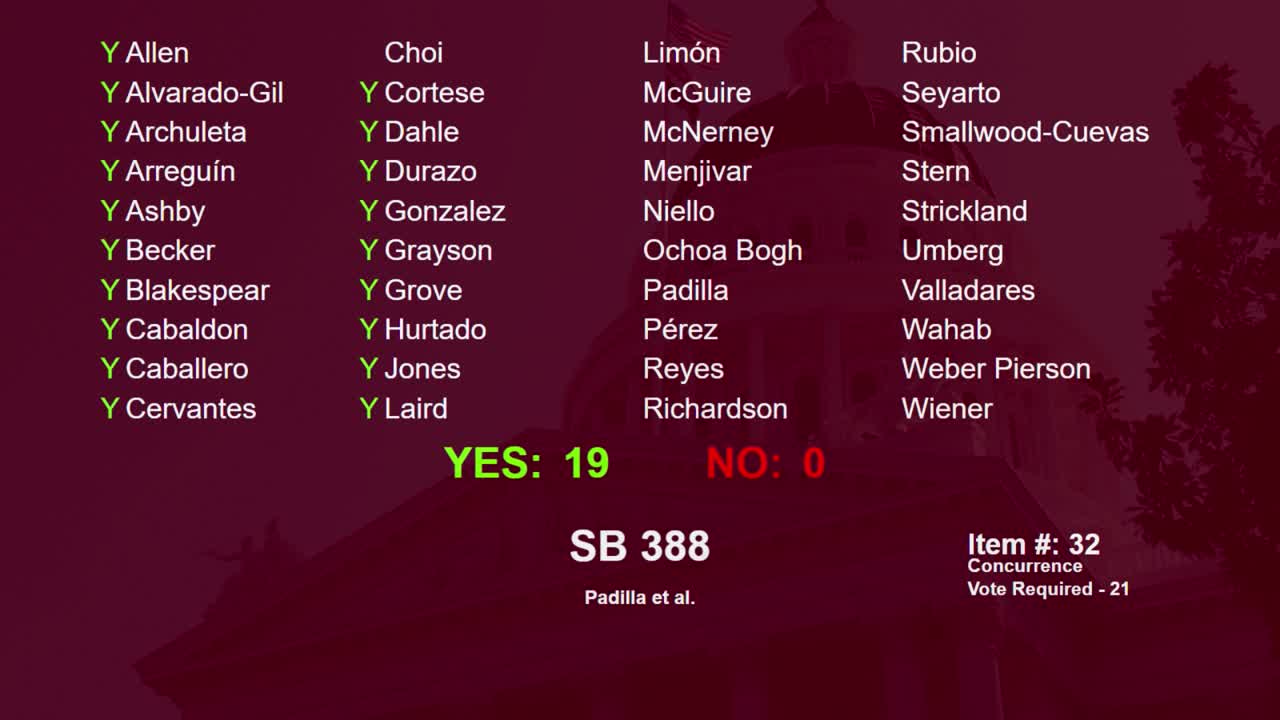 2MIN
Senate Floor
 3MIN
Assembly Floor
 16MIN
Assembly Standing Committee on Public Safety
 21MIN
Assembly Standing Committee on Judiciary
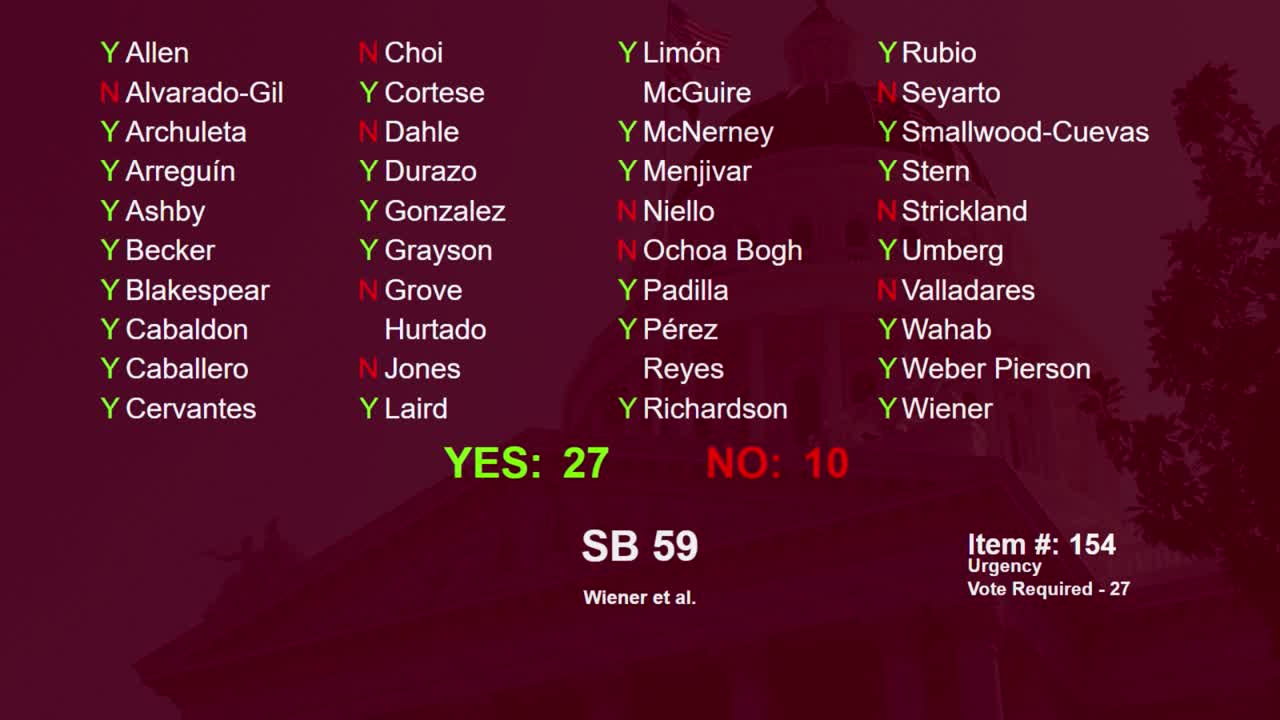 3MIN
Senate Floor
 13MIN
Senate Standing Committee on Public Safety
 14MIN
Senate Standing Committee on Judiciary
Bill Author