SB 517: Home improvement contract requirements: subcontractors.
- Session Year: 2025-2026
- House: Senate
- Latest Version Date: 2025-10-10
Current Status:
Passed
(2025-10-10: Chaptered by Secretary of State. Chapter 585, Statutes of 2025.)
Introduced
In Committee
Awaiting First Chamber Vote
Passed First Chamber
In Committee
Awaiting Second Chamber Vote
Passed Second Chamber
Enacted
Existing law, the Contractors State License Law, defines and regulates the activities of contractors and provides for their licensure, regulation, and discipline by the Contractors State License Board within the Department of Consumer Affairs. Existing law requires specific provisions and requirements for home improvement contracts, as defined.
Existing law governing home improvement contracts specifies that the failure of a licensee, their agent or salesperson, or a person subject to the Contractors State License Law to provide certain information, notices, and disclosures in the contract, or to otherwise fail to comply with those provisions is cause for discipline.
This bill would also specify that, for purposes of administrative discipline under the Contractors State License Law, the prime or direct contractor is responsible for completion of the project in accordance with the home improvement contract, plans, and specifications. The bill would also provide that this prime or direct contractor responsibility does not preclude administrative discipline against any subcontractor or home improvement salesperson on a home improvement contract for a violation of that law.
The bill would further require a home improvement contract to contain a disclosure regarding whether or not a subcontractor will be used on the project, as specified.
This bill would incorporate additional changes to Section 7159 of the Business and Professions Code proposed by AB 1327 to be operative only if this bill and AB 1327 are enacted and this bill is enacted last.
Existing law, the Contractors State License Law, defines and regulates the activities of contractors and provides for their licensure, regulation, and discipline by the Contractors State License Board within the Department of Consumer Affairs. Existing law requires specific provisions and requirements for home improvement contracts, as defined.
Existing law governing home improvement contracts specifies that the failure of a licensee, their agent or salesperson, or a person subject to the Contractors State License Law to provide certain information, notices, and disclosures in the contract, or to otherwise fail to comply with those provisions is cause for discipline.
This bill would also specify that, for purposes of administrative discipline under the Contractors State License Law, the prime or direct contractor is responsible for completion of the project in accordance with the home improvement contract, plans, and specifications. The bill would also provide that this prime or direct contractor responsibility does not preclude administrative discipline against any subcontractor or home improvement salesperson on a home improvement contract for a violation of that law.
The bill would further require a home improvement contract to contain a disclosure regarding whether or not a subcontractor will be used on the project, as specified.
This bill would require a home improvement contract with a subcontractor performing more than 50% of the total estimated project cost to contain the name and contact information of the subcontractor.Existing law, the Contractors State License Law, defines and regulates the activities of contractors and provides for their licensure, regulation, and discipline by the Contractors State License Board within the Department of Consumer Affairs. Existing law requires specific provisions and requirements for home improvement contracts, as defined.
This bill would require a home improvement contract with a subcontractor performing more than 50% of the total estimated project cost to contain the name and contact information of the subcontractor.
(a)(1)This section identifies the projects for which a home improvement contract is required, outlines the contract requirements, and lists the items that shall be included in the contract, or may be provided as an attachment.
(2)This section does not apply to service and repair contracts that are subject to Section 7159.10, if the contract for the applicable services complies with Sections 7159.10 to 7159.14, inclusive.
(3)This section does not apply to the sale, installation, and servicing of a fire alarm sold in conjunction with an alarm system, as defined in Section 7590.1, if all costs attributable to making the fire alarm system operable, including sale and installation costs, do not exceed five hundred dollars ($500), and the licensee complies with the requirements set forth in Section 7159.9.
(4)This section does not apply to any costs associated with monitoring a burglar or fire alarm system.
(5)(A)Failure by the licensee, their agent or salesperson, or by a person subject to be licensed under this chapter, to provide the specified information, notices, and disclosures in the contract, or to otherwise fail to comply with any provision of this section, is cause for discipline.
(B)For purposes of administrative discipline under this chapter, the prime or direct contractor is responsible for completion of the project in accordance with the home improvement contract, plans, and specifications. This prime or direct contractor responsibility shall not preclude administrative discipline against any subcontractor or home improvement salesperson on a home improvement contract for violation of this chapter.
(b)For purposes of this section, home improvement contract means an agreement, whether oral or written, or contained in one or more documents, between a contractor and an owner or between a contractor and a tenant, regardless of the number of residence or dwelling units contained in the building in which the tenant resides, if the work is to be performed in, to, or upon the residence or dwelling unit of the tenant, for the performance of a home improvement, as defined in Section 7151, and includes all labor, services, and materials to be furnished and performed thereunder, if the aggregate contract price specified in one or more improvement contracts, including all labor, services, and materials to be furnished by the contractor, exceeds five hundred dollars ($500). Home improvement contract also means an agreement, whether oral or written, or contained in one or more documents, between a salesperson, whether or not they are a home improvement salesperson, and an owner or a tenant, regardless of the number of residence or dwelling units contained in the building in which the tenant resides, which provides for the sale, installation, or furnishing of home improvement goods or services.
(c)In addition to the specific requirements listed under this section, every home improvement contract and any person subject to licensure under this chapter or their agent or salesperson shall comply with all of the following:
(1)The writing shall be legible.
(2)Any printed form shall be readable. Unless a larger typeface is specified in this article, text in any printed form shall be in at least 10-point typeface and the headings shall be in at least 10-point boldface type.
(3)(A)Before any work is started, the contractor shall give the buyer a copy of the contract that is signed and dated by both the contractor and the buyer. The buyers receipt of the copy of the contract initiates the buyers rights to cancel the contract pursuant to Sections 1689.5 to 1689.14, inclusive, of the Civil Code.
(B)The contract shall contain on the first page, in a typeface no smaller than that generally used in the body of the document, both of the following:
(i)The date the buyer signed the contract.
(ii)The name and address of the contractor to whom the applicable Notice of Cancellation is to be mailed, immediately preceded by a statement advising the buyer that the Notice of Cancellation may be sent to the contractor at the address noted on the contract.
(4)The contract shall include a statement that, upon satisfactory payment being made for any portion of the work performed, the contractor, prior to any further payment being made, shall furnish to the person contracting for the home improvement or swimming pool work a full and unconditional release from any potential lien claimant claim or mechanics lien authorized pursuant to Sections 8400 and 8404 of the Civil Code for that portion of the work for which payment has been made.
(5)A change-order form for changes or extra work shall be incorporated into the contract and shall become part of the contract only if it is in writing and signed by the parties prior to the commencement of any work covered by a change order.
(6)The contract shall contain, in close proximity to the signatures of the owner and contractor, a notice stating that the owner or tenant has the right to require the contractor to have a performance and payment bond.
(7)(A)The contract shall contain a statement regarding whether or not a subcontractor will be used on the project, including a portion to be checked in response, as follows:
[__] Yes
[__] No
(B)If checked Yes, indicating that a subcontractor will be used on the project, the contract shall contain a disclaimer that states the following:
One or more subcontractors will be used on this project, and the contractor is aware that a list of subcontractors is required to be provided, upon request, along with the names, contact information, license number, and classification of those subcontractors.
(C)If there is a change order during the project, the same disclaimer set forth in subparagraph (B) shall be on each change order.
(8)If the contract provides for a contractor to furnish joint control, the contractor shall not have any financial or other interest in the joint control.
(9)The provisions of this section are not exclusive and do not relieve the contractor from compliance with any other applicable provision of law.
(d)A home improvement contract and any changes to the contract shall be in writing and signed by the parties to the contract prior to the commencement of work covered by the contract or an applicable change order and, except as provided in paragraph (8) of subdivision (a) of Section 7159.5, shall include or comply with all of the following:
(1)The name, business address, and license number of the contractor.
(2)If applicable, the name and registration number of the home improvement salesperson that solicited or negotiated the contract.
(3)The following heading on the contract form that identifies the type of contract in at least 10-point boldface type: Home Improvement.
(4)The following statement in at least 12-point boldface type: You are entitled to a completely filled in copy of this agreement, signed by both you and the contractor, before any work may be started.
(5)The heading: Contract Price, followed by the amount of the contract in dollars and cents.
(6)If a finance charge will be charged, the heading: Finance Charge, followed by the amount in dollars and cents. The finance charge is to be set out separately from the contract amount.
(7)The heading: Description of the Project and Description of the Significant Materials to be Used and Equipment to be Installed, followed by a description of the project and a description of the significant materials to be used and equipment to be installed. For swimming pools, the project description required under this paragraph also shall include a plan and scale drawing showing the shape, size, dimensions, and the construction and equipment specifications.
(8)If a downpayment will be charged, the details of the downpayment shall be expressed in substantially the following form, and shall include the text of the notice as specified in subparagraph (C):
(A)The heading: Downpayment.
(B)A space where the actual downpayment appears.
(C)The following statement in at least 12-point boldface type:
THE DOWNPAYMENT MAY NOT EXCEED $1,000 OR 10 PERCENT OF THE CONTRACT PRICE, WHICHEVER IS LESS.
(9)If payments, other than the downpayment, are to be made before the project is completed, the details of these payments, known as progress payments, shall be expressed in substantially the following form, and shall include the text of the statement as specified in subparagraph (C):
(A)A schedule of progress payments shall be preceded by the heading: Schedule of Progress Payments.
(B)Each progress payment shall be stated in dollars and cents and specifically reference the amount of work or services to be performed and materials and equipment to be supplied.
(C)The section of the contract reserved for the progress payments shall include the following statement in at least 12-point boldface type:
The schedule of progress payments must specifically describe each phase of work, including the type and amount of work or services scheduled to be supplied in each phase, along with the amount of each proposed progress payment. IT IS AGAINST THE LAW FOR A CONTRACTOR TO COLLECT PAYMENT FOR WORK NOT YET COMPLETED, OR FOR MATERIALS NOT YET DELIVERED. HOWEVER, A CONTRACTOR MAY REQUIRE A DOWNPAYMENT.
(10)The contract shall address the commencement of work to be performed in substantially the following form:
(A)A statement that describes what constitutes substantial commencement of work under the contract.
(B)The heading: Approximate Start Date.
(C)The approximate date on which work will be commenced.
(11)The estimated completion date of the work shall be referenced in the contract in substantially the following form:
(A)The heading: Approximate Completion Date.
(B)The approximate date of completion.
(12)If applicable, the heading: List of Documents to be Incorporated into the Contract, followed by the list of documents incorporated into the contract.
(13)The heading: Note About Extra Work and Change Orders, followed by the following statement:
Extra Work and Change Orders become part of the contract once the order is prepared in writing and signed by the parties prior to the commencement of work covered by the new change order. The order must describe the scope of the extra work or change, the cost to be added or subtracted from the contract, and the effect the order will have on the schedule of progress payments.
(e)Except as provided in paragraph (8) of subdivision (a) of Section 7159.5, all of the following notices shall be provided to the owner as part of the contract form as specified or, if otherwise authorized under this subdivision, may be provided as an attachment to the contract:
(1)A notice concerning commercial general liability insurance. This notice may be provided as an attachment to the contract if the contract includes the following statement: A notice concerning commercial general liability insurance is attached to this contract. The notice shall include the heading Commercial General Liability Insurance (CGL), followed by whichever of the following statements is both relevant and correct:
(A)(The name on the license or This contractor) does not carry commercial general liability insurance.
(B)(The name on the license or This contractor) carries commercial general liability insurance written by (the insurance company). You may call (the insurance company) at __________ to check the contractors insurance coverage.
(C)(The name on the license or This contractor) is self-insured.
(D)(The name on the license or This contractor) is a limited liability company that carries liability insurance or maintains other security as required by law. You may call (the insurance company or trust company or bank) at ____ to check on the contractors insurance coverage or security.
(2)A notice concerning workers compensation insurance. This notice may be provided as an attachment to the contract if the contract includes the statement: A notice concerning workers compensation insurance is attached to this contract. The notice shall include the heading Workers Compensation Insurance followed by whichever of the following statements is correct:
(A)(The name on the license or This contractor) has no employees and is exempt from workers compensation requirements.
(B)(The name on the license or This contractor) carries workers compensation insurance for all employees.
(3)A notice that provides the buyer with the following information about the performance of extra or change-order work:
(A)A statement that the buyer may not require a contractor to perform extra or change-order work without providing written authorization prior to the commencement of work covered by the new change order.
(B)A statement informing the buyer that extra work or a change order is not enforceable against a buyer unless the change order also identifies all of the following in writing prior to the commencement of work covered by the new change order:
(i)The scope of work encompassed by the order.
(ii)The amount to be added or subtracted from the contract.
(iii)The effect the order will make in the progress payments or the completion date.
(C)A statement informing the buyer that the contractors failure to comply with the requirements of this paragraph does not preclude the recovery of compensation for work performed based upon legal or equitable remedies designed to prevent unjust enrichment.
(4)A notice with the heading Mechanics Lien Warning written as follows:
MECHANICS LIEN WARNING:
Anyone who helps improve your property, but who is not paid, may record what is called a mechanics lien on your property. A mechanics lien is a claim, like a mortgage or home equity loan, made against your property and recorded with the county recorder.
Even if you pay your contractor in full, unpaid subcontractors, suppliers, and laborers who helped to improve your property may record mechanics liens and sue you in court to foreclose the lien. If a court finds the lien is valid, you could be forced to pay twice or have a court officer sell your home to pay the lien. Liens can also affect your credit.
To preserve their right to record a lien, each subcontractor and material supplier must provide you with a document called a Preliminary Notice. This notice is not a lien. The purpose of the notice is to let you know that the person who sends you the notice has the right to record a lien on your property if they are not paid.
BE CAREFUL. The Preliminary Notice can be sent up to 20 days after the subcontractor starts work or the supplier provides material. This can be a big problem if you pay your contractor before you have received the Preliminary Notices.
You will not get Preliminary Notices from your prime contractor or from laborers who work on your project. The law assumes that you already know they are improving your property.
PROTECT YOURSELF FROM LIENS. You can protect yourself from liens by getting a list from your contractor of all the subcontractors and material suppliers that work on your project. Find out from your contractor when these subcontractors started work and when these suppliers delivered goods or materials. Then wait 20 days, paying attention to the Preliminary Notices you receive.
PAY WITH JOINT CHECKS. One way to protect yourself is to pay with a joint check. When your contractor tells you it is time to pay for the work of a subcontractor or supplier who has provided you with a Preliminary Notice, write a joint check payable to both the contractor and the subcontractor or material supplier.
For other ways to prevent liens, visit CSLBs internet website at www.cslb.ca.gov or call CSLB at 800-321-CSLB (2752).
REMEMBER, IF YOU DO NOTHING, YOU RISK HAVING A LIEN PLACED ON YOUR HOME. This can mean that you may have to pay twice, or face the forced sale of your home to pay what you owe.
(5)The following notice shall be provided in at least 12-point typeface:
Information about the Contractors State License Board (CSLB): CSLB is the state consumer protection agency that licenses and regulates construction contractors.
Contact CSLB for information about the licensed contractor you are considering, including information about disclosable complaints, disciplinary actions, and civil judgments that are reported to CSLB.
Use only licensed contractors. If you file a complaint against a licensed contractor within the legal deadline (usually four years), CSLB has authority to investigate the complaint. If you use an unlicensed contractor, CSLB may not be able to help you resolve your complaint. Your only remedy may be in civil court, and you may be liable for damages arising out of any injuries to the unlicensed contractor or the unlicensed contractors employees.
For more information:
Visit CSLBs internet website at www.cslb.ca.gov
Call CSLB at 800-321-CSLB (2752)
Write CSLB at P.O. Box 26000, Sacramento, CA 95826.
(6)(A)The notice set forth in subparagraph (B) and entitled Three-Day Right to Cancel, or entitled Five-Day Right to Cancel for contracts with a senior citizen, shall be provided to the buyer unless the contract is:
(i)Negotiated at the contractors place of business.
(ii)Subject to the Seven-Day Right to Cancel, as set forth in paragraph (7).
(iii)Subject to licensure under the Alarm Company Act (Chapter 11.6 (commencing with Section 7590)), provided the alarm company licensee complies with Sections 1689.5, 1689.6, and 1689.7 of the Civil Code, as applicable.
(B)(i)Three-Day Right to Cancel
You, the buyer, have the right to cancel this contract within three business days. You may cancel by emailing, mailing, faxing, or delivering a written notice to the contractor at the contractors place of business by midnight of the third business day after you received a signed and dated copy of the contract that includes this notice. Include your name, your address, and the date you received the signed copy of the contract and this notice.
If you cancel, the contractor must return to you anything you paid within 10 days of receiving the notice of cancellation. For your part, you must make available to the contractor at your residence, in substantially as good condition as you received them, goods delivered to you under this contract or sale. Or, you may, if you wish, comply with the contractors instructions on how to return the goods at the contractors expense and risk. If you do make the goods available to the contractor and the contractor does not pick them up within 20 days of the date of your notice of cancellation, you may keep them without any further obligation. If you fail to make the goods available to the contractor, or if you agree to return the goods to the contractor and fail to do so, then you remain liable for performance of all obligations under the contract.
(ii)References to three and third in the notice set forth in clause (i) shall be changed to five and fifth, respectively, for a buyer who is a senior citizen.
(C)The notice required by this paragraph shall comply with all of the following:
(i)The text of the notice is at least 12-point boldface type.
(ii)The notice is in immediate proximity to a space reserved for the owners signature.
(iii)The owner acknowledges receipt of the notice by signing and dating the notice form in the signature space.
(iv)The notice is written in the same language, e.g., Spanish, as that principally used in any oral sales presentation.
(v)The notice may be attached to the contract if the contract includes, in at least 12-point boldface type, a checkbox with one of the following statements, as applicable:
(I)For a contract with a senior citizen: The law requires that the contractor give you a notice explaining your right to cancel. Initial the checkbox if the contractor has given you a Notice of the Five-Day Right to Cancel.
(II)For all other contracts: The law requires that the contractor give you a notice explaining your right to cancel. Initial the checkbox if the contractor has given you a Notice of the Three-Day Right to Cancel.
(vi)(I)The notice shall be accompanied by a completed form in duplicate, captioned Notice of Cancellation, which also shall be attached to the agreement or offer to purchase and be easily detachable, and which shall contain the following statement written in the same language, e.g., Spanish, as used in the contract:
Notice of Cancellation | |
/enter date of transaction/ | |
|---|---|
(Date) | |
You may cancel this transaction, without any penalty or obligation, within three business days from the above date.
If you cancel, any property traded in, any payments made by you under the contract or sale, and any negotiable instrument executed by you will be returned within 10 days following receipt by the seller of your cancellation notice, and any security interest arising out of the transaction will be canceled.
If you cancel, you must make available to the seller at your residence, in substantially as good condition as when received, any goods delivered to you under this contract or sale, or you may, if you wish, comply with the instructions of the seller regarding the return shipment of the goods at the sellers expense and risk.
If you do make the goods available to the seller and the seller does not pick them up within 20 days of the date of your notice of cancellation, you may retain or dispose of the goods without any further obligation. If you fail to make the goods available to the seller, or if you agree to return the goods to the seller and fail to do so, then you remain liable for performance of all obligations under the contract.
To cancel this transaction, mail or deliver a signed and dated copy of this cancellation notice, or any other written notice, or send a telegram |
to , |
/name of seller/ |
at |
/address of sellers place of business/ |
not later than midnight of . |
(Date) |
I hereby cancel this transaction. |
(Date) |
(Buyers signature) |
(II)The reference to three in the statement set forth in subclause (I) shall be changed to five for a buyer who is a senior citizen.
(7)(A)The following notice entitled Seven-Day Right to Cancel shall be provided to the buyer for any contract that is written for the repair or restoration of residential premises damaged by any sudden or catastrophic event for which a state of emergency has been declared by the President of the United States or the Governor, or for which a local emergency has been declared by the executive officer or governing body of any city, county, or city and county:
Seven-Day Right to Cancel
You, the buyer, have the right to cancel this contract within seven business days. You may cancel by emailing, mailing, faxing, or delivering a written notice to the contractor at the contractors place of business by midnight of the seventh business day after you received a signed and dated copy of the contract that includes this notice. Include your name, your address, and the date you received the signed copy of the contract and this notice.
If you cancel, the contractor must return to you anything you paid within 10 days of receiving the notice of cancellation. For your part, you must make available to the contractor at your residence, in substantially as good condition as you received them, goods delivered to you under this contract or sale. Or, you may, if you wish, comply with the contractors instructions on how to return the goods at the contractors expense and risk. If you do make the goods available to the contractor and the contractor does not pick them up within 20 days of the date of your notice of cancellation, you may keep them without any further obligation. If you fail to make the goods available to the contractor, or if you agree to return the goods to the contractor and fail to do so, then you remain liable for performance of all obligations under the contract.
(B)The Seven-Day Right to Cancel notice required by this subdivision shall comply with all of the following:
(i)The text of the notice is at least 12-point boldface type.
(ii)The notice is in immediate proximity to a space reserved for the owners signature.
(iii)The owner acknowledges receipt of the notice by signing and dating the notice form in the signature space.
(iv)The notice is written in the same language, e.g., Spanish, as that principally used in any oral sales presentation.
(v)The notice may be attached to the contract if the contract includes, in at least 12-point boldface type, a checkbox with the following statement: The law requires that the contractor give you a notice explaining your right to cancel. Initial the checkbox if the contractor has given you a Notice of the Seven-Day Right to Cancel.
(vi)The notice shall be accompanied by a completed form in duplicate, captioned Notice of Cancellation, which shall also be attached to the agreement or offer to purchase and be easily detachable, and which shall contain the following statement written in the same language, e.g., Spanish, as used in the contract:
Notice of Cancellation | |
/enter date of transaction/ | |
|---|---|
(Date) | |
You may cancel this transaction, without any penalty or obligation, within seven business days from the above date.
If you cancel, any property traded in, any payments made by you under the contract or sale, and any negotiable instrument executed by you will be returned within 10 days following receipt by the seller of your cancellation notice, and any security interest arising out of the transaction will be canceled.
If you cancel, you must make available to the seller at your residence, in substantially as good condition as when received, any goods delivered to you under this contract or sale, or you may, if you wish, comply with the instructions of the seller regarding the return shipment of the goods at the sellers expense and risk.
If you do make the goods available to the seller and the seller does not pick them up within 20 days of the date of your notice of cancellation, you may retain or dispose of the goods without any further obligation. If you fail to make the goods available to the seller, or if you agree to return the goods to the seller and fail to do so, then you remain liable for performance of all obligations under the contract.
To cancel this transaction, mail or deliver a signed and dated copy of this cancellation notice, or any other written notice, or send a telegram |
to , |
/name of seller/ |
at |
/address of sellers place of business/ |
not later than midnight of . |
(Date) |
I hereby cancel this transaction. |
(Date) |
(Buyers signature) |
(f)The five-day right to cancel added by the act that amended paragraph (6) of subdivision (e) shall apply to contracts entered into on or after January 1, 2021.
SEC. 1.5.Section 7159 of the Business and Professions Code is amended to read:7159.(a)(1)This section identifies the projects for which a home improvement contract is required, outlines the contract requirements, and lists the items that shall be included in the contract, or may be provided as an attachment.
(2)This section does not apply to service and repair contracts that are subject to Section 7159.10, if the contract for the applicable services complies with Sections 7159.10 to 7159.14, inclusive.
(3)This section does not apply to the sale, installation, and servicing of a fire alarm sold in conjunction with an alarm system, as defined in Section 7590.1, if all costs attributable to making the fire alarm system operable, including sale and installation costs, do not exceed five hundred dollars ($500), and the licensee complies with the requirements set forth in Section 7159.9.
(4)This section does not apply to any costs associated with monitoring a burglar or fire alarm system.
(5)(A)Failure by the licensee, their agent or salesperson, or by a person subject to be licensed under this chapter, to provide the specified information, notices, and disclosures in the contract, or to otherwise fail to comply with any provision of this section, is cause for discipline.
(B)For purposes of administrative discipline under this chapter, the prime or direct contractor is responsible for completion of the project in accordance with the home improvement contract, plans, and specifications. This prime or direct contractor responsibility shall not preclude administrative discipline against any subcontractor or home improvement salesperson on a home improvement contract for violation of this chapter.
(6)If the applicable Notice of Cancellation is not included in or attached to the contract as required by this section, the buyer may file a complaint with the Contractors State License Board.
(b)For purposes of this section, home improvement contract means an agreement, whether oral or written, or contained in one or more documents, between a contractor and an owner or between a contractor and a tenant, regardless of the number of residence or dwelling units contained in the building in which the tenant resides, if the work is to be performed in, to, or upon the residence or dwelling unit of the tenant, for the performance of a home improvement, as defined in Section 7151, and includes all labor, services, and materials to be furnished and performed thereunder, if the aggregate contract price specified in one or more improvement contracts, including all labor, services, and materials to be furnished by the contractor, exceeds five hundred dollars ($500). Home improvement contract also means an agreement, whether oral or written, or contained in one or more documents, between a salesperson, whether or not they are a home improvement salesperson, and an owner or a tenant, regardless of the number of residence or dwelling units contained in the building in which the tenant resides, which provides for the sale, installation, or furnishing of home improvement goods or services.
(c)In addition to the specific requirements listed under this section, every home improvement contract and any person subject to licensure under this chapter or their agent or salesperson shall comply with all of the following:
(1)The writing shall be legible.
(2)Any printed form shall be readable. Unless a larger typeface is specified in this article, text in any printed form shall be in at least 10-point typeface and the headings shall be in at least 10-point boldface type.
(3)(A)Before any work is started, the contractor shall give the buyer a copy of the contract that is signed and dated by both the contractor and the buyer. The buyers receipt of the copy of the contract initiates the buyers rights to cancel the contract pursuant to Sections 1689.5 to 1689.14, inclusive, of the Civil Code.
(B)The contract shall contain on the first page, in a typeface no smaller than that generally used in the body of the document, both of the following:
(i)The date the buyer signed the contract.
(ii)The name, address, and email address of the contractor to whom the applicable Notice of Cancellation is to be sent, immediately preceded by a statement advising the buyer that the Notice of Cancellation may be sent to the contractor at the address or email address noted on the contract.
(iii)The telephone number of the contractor, or the contractors representative, to assist the buyer with locating and filling out the Notice of Cancellation.
(4)The contract shall include a statement that, upon satisfactory payment being made for any portion of the work performed, the contractor, prior to any further payment being made, shall furnish to the person contracting for the home improvement or swimming pool work a full and unconditional release from any potential lien claimant claim or mechanics lien authorized pursuant to Sections 8400 and 8404 of the Civil Code for that portion of the work for which payment has been made.
(5)A change-order form for changes or extra work shall be incorporated into the contract and shall become part of the contract only if it is in writing and signed by the parties prior to the commencement of any work covered by a change order.
(6)The contract shall contain, in close proximity to the signatures of the owner and contractor, a notice stating that the owner or tenant has the right to require the contractor to have a performance and payment bond.
(7)(A)The contract shall contain a statement regarding whether or not a subcontractor will be used on the project, including a portion to be checked in response, as follows:
[__] Yes
[__] No
(B)If checked Yes, indicating that a subcontractor will be used on the project, the contract shall contain a disclaimer that states the following:
One or more subcontractors will be used on this project, and the contractor is aware that a list of subcontractors is required to be provided, upon request, along with the names, contact information, license number, and classification of those subcontractors.
(C)If there is a change order during the project, the same disclaimer set forth in subparagraph (B) shall be on each change order.
(8)If the contract provides for a contractor to furnish joint control, the contractor shall not have any financial or other interest in the joint control.
(9)The provisions of this section are not exclusive and do not relieve the contractor from compliance with any other applicable provision of law.
(d)A home improvement contract and any changes to the contract shall be in writing and signed by the parties to the contract prior to the commencement of work covered by the contract or an applicable change order and, except as provided in paragraph (8) of subdivision (a) of Section 7159.5, shall include or comply with all of the following:
(1)The name, business address, and license number of the contractor.
(2)If applicable, the name and registration number of the home improvement salesperson that solicited or negotiated the contract.
(3)The following heading on the contract form that identifies the type of contract in at least 10-point boldface type: Home Improvement.
(4)The following statement in at least 12-point boldface type: You are entitled to a completely filled in copy of this agreement, signed by both you and the contractor, before any work may be started.
(5)The heading: Contract Price, followed by the amount of the contract in dollars and cents.
(6)If a finance charge will be charged, the heading: Finance Charge, followed by the amount in dollars and cents. The finance charge is to be set out separately from the contract amount.
(7)The heading: Description of the Project and Description of the Significant Materials to be Used and Equipment to be Installed, followed by a description of the project and a description of the significant materials to be used and equipment to be installed. For swimming pools, the project description required under this paragraph also shall include a plan and scale drawing showing the shape, size, dimensions, and the construction and equipment specifications.
(8)If a downpayment will be charged, the details of the downpayment shall be expressed in substantially the following form, and shall include the text of the notice as specified in subparagraph (C):
(A)The heading: Downpayment.
(B)A space where the actual downpayment appears.
(C)The following statement in at least 12-point boldface type:
THE DOWNPAYMENT MAY NOT EXCEED $1,000 OR 10 PERCENT OF THE CONTRACT PRICE, WHICHEVER IS LESS.
(9)If payments, other than the downpayment, are to be made before the project is completed, the details of these payments, known as progress payments, shall be expressed in substantially the following form, and shall include the text of the statement as specified in subparagraph (C):
(A)A schedule of progress payments shall be preceded by the heading: Schedule of Progress Payments.
(B)Each progress payment shall be stated in dollars and cents and specifically reference the amount of work or services to be performed and materials and equipment to be supplied.
(C)The section of the contract reserved for the progress payments shall include the following statement in at least 12-point boldface type:
The schedule of progress payments must specifically describe each phase of work, including the type and amount of work or services scheduled to be supplied in each phase, along with the amount of each proposed progress payment. IT IS AGAINST THE LAW FOR A CONTRACTOR TO COLLECT PAYMENT FOR WORK NOT YET COMPLETED, OR FOR MATERIALS NOT YET DELIVERED. HOWEVER, A CONTRACTOR MAY REQUIRE A DOWNPAYMENT.
(10)The contract shall address the commencement of work to be performed in substantially the following form:
(A)A statement that describes what constitutes substantial commencement of work under the contract.
(B)The heading: Approximate Start Date.
(C)The approximate date on which work will be commenced.
(11)The estimated completion date of the work shall be referenced in the contract in substantially the following form:
(A)The heading: Approximate Completion Date.
(B)The approximate date of completion.
(12)If applicable, the heading: List of Documents to be Incorporated into the Contract, followed by the list of documents incorporated into the contract.
(13)The heading: Note About Extra Work and Change Orders, followed by the following statement:
Extra Work and Change Orders become part of the contract once the order is prepared in writing and signed by the parties prior to the commencement of work covered by the new change order. The order must describe the scope of the extra work or change, the cost to be added or subtracted from the contract, and the effect the order will have on the schedule of progress payments.
(e)Except as provided in paragraph (8) of subdivision (a) of Section 7159.5, all of the following notices shall be provided to the owner as part of the contract form as specified or, if otherwise authorized under this subdivision, may be provided as an attachment to the contract:
(1)A notice concerning commercial general liability insurance. This notice may be provided as an attachment to the contract if the contract includes the following statement: A notice concerning commercial general liability insurance is attached to this contract. The notice shall include the heading Commercial General Liability Insurance (CGL), followed by whichever of the following statements is both relevant and correct:
(A)(The name on the license or This contractor) does not carry commercial general liability insurance.
(B)(The name on the license or This contractor) carries commercial general liability insurance written by (the insurance company). You may call (the insurance company) at __________ to check the contractors insurance coverage.
(C)(The name on the license or This contractor) is self-insured.
(D)(The name on the license or This contractor) is a limited liability company that carries liability insurance or maintains other security as required by law. You may call (the insurance company or trust company or bank) at ____ to check on the contractors insurance coverage or security.
(2)A notice concerning workers compensation insurance. This notice may be provided as an attachment to the contract if the contract includes the statement: A notice concerning workers compensation insurance is attached to this contract. The notice shall include the heading Workers Compensation Insurance followed by whichever of the following statements is correct:
(A)(The name on the license or This contractor) has no employees and is exempt from workers compensation requirements.
(B)(The name on the license or This contractor) carries workers compensation insurance for all employees.
(3)A notice that provides the buyer with the following information about the performance of extra or change-order work:
(A)A statement that the buyer may not require a contractor to perform extra or change-order work without providing written authorization prior to the commencement of work covered by the new change order.
(B)A statement informing the buyer that extra work or a change order is not enforceable against a buyer unless the change order also identifies all of the following in writing prior to the commencement of work covered by the new change order:
(i)The scope of work encompassed by the order.
(ii)The amount to be added or subtracted from the contract.
(iii)The effect the order will make in the progress payments or the completion date.
(C)A statement informing the buyer that the contractors failure to comply with the requirements of this paragraph does not preclude the recovery of compensation for work performed based upon legal or equitable remedies designed to prevent unjust enrichment.
(4)A notice with the heading Mechanics Lien Warning written as follows:
MECHANICS LIEN WARNING:
Anyone who helps improve your property, but who is not paid, may record what is called a mechanics lien on your property. A mechanics lien is a claim, like a mortgage or home equity loan, made against your property and recorded with the county recorder.
Even if you pay your contractor in full, unpaid subcontractors, suppliers, and laborers who helped to improve your property may record mechanics liens and sue you in court to foreclose the lien. If a court finds the lien is valid, you could be forced to pay twice or have a court officer sell your home to pay the lien. Liens can also affect your credit.
To preserve their right to record a lien, each subcontractor and material supplier must provide you with a document called a Preliminary Notice. This notice is not a lien. The purpose of the notice is to let you know that the person who sends you the notice has the right to record a lien on your property if they are not paid.
BE CAREFUL. The Preliminary Notice can be sent up to 20 days after the subcontractor starts work or the supplier provides material. This can be a big problem if you pay your contractor before you have received the Preliminary Notices.
You will not get Preliminary Notices from your prime contractor or from laborers who work on your project. The law assumes that you already know they are improving your property.
PROTECT YOURSELF FROM LIENS. You can protect yourself from liens by getting a list from your contractor of all the subcontractors and material suppliers that work on your project. Find out from your contractor when these subcontractors started work and when these suppliers delivered goods or materials. Then wait 20 days, paying attention to the Preliminary Notices you receive.
PAY WITH JOINT CHECKS. One way to protect yourself is to pay with a joint check. When your contractor tells you it is time to pay for the work of a subcontractor or supplier who has provided you with a Preliminary Notice, write a joint check payable to both the contractor and the subcontractor or material supplier.
For other ways to prevent liens, visit CSLBs internet website at www.cslb.ca.gov or call CSLB at 800-321-CSLB (2752).
REMEMBER, IF YOU DO NOTHING, YOU RISK HAVING A LIEN PLACED ON YOUR HOME. This can mean that you may have to pay twice, or face the forced sale of your home to pay what you owe.
(5)The following notice shall be provided in at least 12-point typeface:
Information about the Contractors State License Board (CSLB): CSLB is the state consumer protection agency that licenses and regulates construction contractors.
Contact CSLB for information about the licensed contractor you are considering, including information about disclosable complaints, disciplinary actions, and civil judgments that are reported to CSLB.
Use only licensed contractors. If you file a complaint against a licensed contractor within the legal deadline (usually four years), CSLB has authority to investigate the complaint. If you use an unlicensed contractor, CSLB may not be able to help you resolve your complaint. Your only remedy may be in civil court, and you may be liable for damages arising out of any injuries to the unlicensed contractor or the unlicensed contractors employees.
For more information:
Visit CSLBs internet website at www.cslb.ca.gov
Call CSLB at 800-321-CSLB (2752)
Write CSLB at P.O. Box 26000, Sacramento, CA 95826.
(6)(A)The notice set forth in subparagraph (B) and entitled Three-Day Right to Cancel, or entitled Five-Day Right to Cancel for contracts with a senior citizen, shall be provided to the buyer unless the contract is:
(i)Negotiated at the contractors place of business.
(ii)Subject to the Seven-Day Right to Cancel, as set forth in paragraph (7).
(iii)Subject to licensure under the Alarm Company Act (Chapter 11.6 (commencing with Section 7590)), provided the alarm company licensee complies with Sections 1689.5, 1689.6, and 1689.7 of the Civil Code, as applicable.
(B)(i)Three-Day Right to Cancel
You, the buyer, have the right to cancel this contract within three business days. You may cancel by emailing, mailing, faxing, or delivering a written notice to the contractor at the contractors place of business by midnight of the third business day after you received a signed and dated copy of the contract that includes this notice. Include your name, your address, and the date you received the signed copy of the contract and this notice.
If you cancel, the contractor must return to you anything you paid within 10 days of receiving the notice of cancellation. For your part, you must make available to the contractor at your residence, in substantially as good condition as you received them, goods delivered to you under this contract or sale. Or, you may, if you wish, comply with the contractors instructions on how to return the goods at the contractors expense and risk. If you do make the goods available to the contractor and the contractor does not pick them up within 20 days of the date of your notice of cancellation, you may keep them without any further obligation. If you fail to make the goods available to the contractor, or if you agree to return the goods to the contractor and fail to do so, then you remain liable for performance of all obligations under the contract.
(ii)References to three and third in the notice set forth in clause (i) shall be changed to five and fifth, respectively, for a buyer who is a senior citizen.
(C)The notice required by this paragraph shall comply with all of the following:
(i)The text of the notice is at least 12-point boldface type.
(ii)The notice is in immediate proximity to a space reserved for the owners signature.
(iii)The owner acknowledges receipt of the notice by signing and dating the notice form in the signature space.
(iv)The notice is written in the same language, e.g., Spanish, as that principally used in any oral sales presentation.
(v)The notice may be attached to the contract if the contract includes, in at least 12-point boldface type, a checkbox with one of the following statements, as applicable:
(I)For a contract with a senior citizen: The law requires that the contractor give you a notice explaining your right to cancel. Initial the checkbox if the contractor has given you a Notice of the Five-Day Right to Cancel.
(II)For all other contracts: The law requires that the contractor give you a notice explaining your right to cancel. Initial the checkbox if the contractor has given you a Notice of the Three-Day Right to Cancel.
(vi)(I)The notice shall be accompanied by a completed form in duplicate, captioned Notice of Cancellation, which also shall be attached to the agreement or offer to purchase and be easily detachable, and which shall contain the following statement written in the same language, e.g., Spanish, as used in the contract:
Notice of Cancellation | |
/enter date of transaction/ | |
|---|---|
(Date) | |
You may cancel this transaction, without any penalty or obligation, within three business days from the above date.
If you cancel, any property traded in, any payments made by you under the contract or sale, and any negotiable instrument executed by you will be returned within 10 days following receipt by the seller of your cancellation notice, and any security interest arising out of the transaction will be canceled.
If you cancel, you must make available to the seller at your residence, in substantially as good condition as when received, any goods delivered to you under this contract or sale, or you may, if you wish, comply with the instructions of the seller regarding the return shipment of the goods at the sellers expense and risk.
If you do make the goods available to the seller and the seller does not pick them up within 20 days of the date of your notice of cancellation, you may retain or dispose of the goods without any further obligation. If you fail to make the goods available to the seller, or if you agree to return the goods to the seller and fail to do so, then you remain liable for performance of all obligations under the contract.
To cancel this transaction, email, mail, or deliver a signed and dated copy of this cancellation notice, or any other written notice, or send a telegram |
to , |
/name of seller/ |
at |
/address of sellers place of business/ |
not later than midnight of . |
(Date) |
I hereby cancel this transaction. |
(Date) |
(Buyers signature) |
(II)The reference to three in the statement set forth in subclause (I) shall be changed to five for a buyer who is a senior citizen.
(7)(A)The following notice entitled Seven-Day Right to Cancel shall be provided to the buyer for any contract that is written for the repair or restoration of residential premises damaged by any sudden or catastrophic event for which a state of emergency has been declared by the President of the United States or the Governor, or for which a local emergency has been declared by the executive officer or governing body of any city, county, or city and county:
Seven-Day Right to Cancel
You, the buyer, have the right to cancel this contract within seven business days. You may cancel by emailing, mailing, faxing, or delivering a written notice to the contractor at the contractors place of business by midnight of the seventh business day after you received a signed and dated copy of the contract that includes this notice. Include your name, your address, and the date you received the signed copy of the contract and this notice.
If you cancel, the contractor must return to you anything you paid within 10 days of receiving the notice of cancellation. For your part, you must make available to the contractor at your residence, in substantially as good condition as you received them, goods delivered to you under this contract or sale. Or, you may, if you wish, comply with the contractors instructions on how to return the goods at the contractors expense and risk. If you do make the goods available to the contractor and the contractor does not pick them up within 20 days of the date of your notice of cancellation, you may keep them without any further obligation. If you fail to make the goods available to the contractor, or if you agree to return the goods to the contractor and fail to do so, then you remain liable for performance of all obligations under the contract.
(B)The Seven-Day Right to Cancel notice required by this subdivision shall comply with all of the following:
(i)The text of the notice is at least 12-point boldface type.
(ii)The notice is in immediate proximity to a space reserved for the owners signature.
(iii)The owner acknowledges receipt of the notice by signing and dating the notice form in the signature space.
(iv)The notice is written in the same language, e.g., Spanish, as that principally used in any oral sales presentation.
(v)The notice may be attached to the contract if the contract includes, in at least 12-point boldface type, a checkbox with the following statement: The law requires that the contractor give you a notice explaining your right to cancel. Initial the checkbox if the contractor has given you a Notice of the Seven-Day Right to Cancel.
(vi)The notice shall be accompanied by a completed form in duplicate, captioned Notice of Cancellation, which shall also be attached to the agreement or offer to purchase and be easily detachable, and which shall contain the following statement written in the same language, e.g., Spanish, as used in the contract:
Notice of Cancellation | |
/enter date of transaction/ | |
|---|---|
(Date) | |
You may cancel this transaction, without any penalty or obligation, within seven business days from the above date.
If you cancel, any property traded in, any payments made by you under the contract or sale, and any negotiable instrument executed by you will be returned within 10 days following receipt by the seller of your cancellation notice, and any security interest arising out of the transaction will be canceled.
If you cancel, you must make available to the seller at your residence, in substantially as good condition as when received, any goods delivered to you under this contract or sale, or you may, if you wish, comply with the instructions of the seller regarding the return shipment of the goods at the sellers expense and risk.
If you do make the goods available to the seller and the seller does not pick them up within 20 days of the date of your notice of cancellation, you may retain or dispose of the goods without any further obligation. If you fail to make the goods available to the seller, or if you agree to return the goods to the seller and fail to do so, then you remain liable for performance of all obligations under the contract.
To cancel this transaction, email, mail, or deliver a signed and dated copy of this cancellation notice, or any other written notice, or send a telegram |
to , |
/name of seller/ |
at |
/address of sellers place of business/ |
not later than midnight of . |
(Date) |
I hereby cancel this transaction. |
(Date) |
(Buyers signature) |
(f)The five-day right to cancel added by the act that amended paragraph (6) of subdivision (e) shall apply to contracts entered into on or after January 1, 2021.
SEC. 2.Section 1.5 of this bill incorporates amendments to Section 7159 of the Business and Professions Code proposed by both this bill and Assembly Bill 1327. That section of this bill shall only become operative if (1) both bills are enacted and become effective on or before January 1, 2026, (2) each bill amends Section 7159 of the Business and Professions Code, and (3) this bill is enacted after Assembly Bill 1327, in which case Section 1 of this bill shall not become operative.
(a)(1)This section identifies the projects for which a home improvement contract is required, outlines the contract requirements, and lists the items that shall be included in the contract, or may be provided as an attachment.
(2)This section does not apply to service and repair contracts that are subject to Section 7159.10, if the contract for the applicable services complies with Sections 7159.10 to 7159.14, inclusive.
(3)This section does not apply to the sale, installation, and servicing of a fire alarm sold in conjunction with an alarm system, as defined in Section 7590.1, if all costs attributable to making the fire alarm system operable, including sale and installation costs, do not exceed five hundred dollars ($500), and the licensee complies with the requirements set forth in Section 7159.9.
(4)This section does not apply to any costs associated with monitoring a burglar or fire alarm system.
(5)(A)Failure by the licensee, their agent or salesperson, or by a person subject to be licensed under this chapter, to provide the specified information, notices, and disclosures in the contract, or to otherwise fail to comply with any provision of this section, is cause for discipline.
(B)For purposes of administrative discipline under this chapter, the prime or direct contractor is responsible for completion of the project in accordance with the home improvement contract, plans, and specifications. This prime or direct contractor responsibility shall not preclude administrative discipline against any subcontractor or home improvement salesperson on a home improvement contract for violation of this chapter.
(b)For purposes of this section, home improvement contract means an agreement, whether oral or written, or contained in one or more documents, between a contractor and an owner or between a contractor and a tenant, regardless of the number of residence or dwelling units contained in the building in which the tenant resides, if the work is to be performed in, to, or upon the residence or dwelling unit of the tenant, for the performance of a home improvement, as defined in Section 7151, and includes all labor, services, and materials to be furnished and performed thereunder, if the aggregate contract price specified in one or more improvement contracts, including all labor, services, and materials to be furnished by the contractor, exceeds five hundred dollars ($500). Home improvement contract also means an agreement, whether oral or written, or contained in one or more documents, between a salesperson, whether or not they are a home improvement salesperson, and an owner or a tenant, regardless of the number of residence or dwelling units contained in the building in which the tenant resides, which provides for the sale, installation, or furnishing of home improvement goods or services.
(c)In addition to the specific requirements listed under this section, every home improvement contract and any person subject to licensure under this chapter or their agent or salesperson shall comply with all of the following:
(1)The writing shall be legible.
(2)Any printed form shall be readable. Unless a larger typeface is specified in this article, text in any printed form shall be in at least 10-point typeface and the headings shall be in at least 10-point boldface type.
(3)(A)Before any work is started, the contractor shall give the buyer a copy of the contract that is signed and dated by both the contractor and the buyer. The buyers receipt of the copy of the contract initiates the buyers rights to cancel the contract pursuant to Sections 1689.5 to 1689.14, inclusive, of the Civil Code.
(B)The contract shall contain on the first page, in a typeface no smaller than that generally used in the body of the document, both of the following:
(i)The date the buyer signed the contract.
(ii)The name and address of the contractor to whom the applicable Notice of Cancellation is to be mailed, immediately preceded by a statement advising the buyer that the Notice of Cancellation may be sent to the contractor at the address noted on the contract.
(4)The contract shall include a statement that, upon satisfactory payment being made for any portion of the work performed, the contractor, prior to any further payment being made, shall furnish to the person contracting for the home improvement or swimming pool work a full and unconditional release from any potential lien claimant claim or mechanics lien authorized pursuant to Sections 8400 and 8404 of the Civil Code for that portion of the work for which payment has been made.
(5)A change-order form for changes or extra work shall be incorporated into the contract and shall become part of the contract only if it is in writing and signed by the parties prior to the commencement of any work covered by a change order.
(6)The contract shall contain, in close proximity to the signatures of the owner and contractor, a notice stating that the owner or tenant has the right to require the contractor to have a performance and payment bond.
(7)(A)The contract shall contain a statement regarding whether or not a subcontractor will be used on the project, including a portion to be checked in response, as follows:
[__] Yes
[__] No
(B)If checked Yes, indicating that a subcontractor will be used on the project, the contract shall contain a disclaimer that states the following:
One or more subcontractors will be used on this project, and the contractor is aware that a list of subcontractors is required to be provided, upon request, along with the names, contact information, license number, and classification of those subcontractors.
(C)If there is a change order during the project, the same disclaimer set forth in subparagraph (B) shall be on each change order.
(8)If the contract provides for a contractor to furnish joint control, the contractor shall not have any financial or other interest in the joint control.
(9)The provisions of this section are not exclusive and do not relieve the contractor from compliance with any other applicable provision of law.
(d)A home improvement contract and any changes to the contract shall be in writing and signed by the parties to the contract prior to the commencement of work covered by the contract or an applicable change order and, except as provided in paragraph (8) of subdivision (a) of Section 7159.5, shall include or comply with all of the following:
(1)The name, business address, and license number of the contractor.
(2)If applicable, the name and registration number of the home improvement salesperson that solicited or negotiated the contract.
(3)The following heading on the contract form that identifies the type of contract in at least 10-point boldface type: Home Improvement.
(4)The following statement in at least 12-point boldface type: You are entitled to a completely filled in copy of this agreement, signed by both you and the contractor, before any work may be started.
(5)The heading: Contract Price, followed by the amount of the contract in dollars and cents.
(6)If a finance charge will be charged, the heading: Finance Charge, followed by the amount in dollars and cents. The finance charge is to be set out separately from the contract amount.
(7)The heading: Description of the Project and Description of the Significant Materials to be Used and Equipment to be Installed, followed by a description of the project and a description of the significant materials to be used and equipment to be installed. For swimming pools, the project description required under this paragraph also shall include a plan and scale drawing showing the shape, size, dimensions, and the construction and equipment specifications.
(8)If a downpayment will be charged, the details of the downpayment shall be expressed in substantially the following form, and shall include the text of the notice as specified in subparagraph (C):
(A)The heading: Downpayment.
(B)A space where the actual downpayment appears.
(C)The following statement in at least 12-point boldface type:
THE DOWNPAYMENT MAY NOT EXCEED $1,000 OR 10 PERCENT OF THE CONTRACT PRICE, WHICHEVER IS LESS.
(9)If payments, other than the downpayment, are to be made before the project is completed, the details of these payments, known as progress payments, shall be expressed in substantially the following form, and shall include the text of the statement as specified in subparagraph (C):
(A)A schedule of progress payments shall be preceded by the heading: Schedule of Progress Payments.
(B)Each progress payment shall be stated in dollars and cents and specifically reference the amount of work or services to be performed and materials and equipment to be supplied.
(C)The section of the contract reserved for the progress payments shall include the following statement in at least 12-point boldface type:
The schedule of progress payments must specifically describe each phase of work, including the type and amount of work or services scheduled to be supplied in each phase, along with the amount of each proposed progress payment. IT IS AGAINST THE LAW FOR A CONTRACTOR TO COLLECT PAYMENT FOR WORK NOT YET COMPLETED, OR FOR MATERIALS NOT YET DELIVERED. HOWEVER, A CONTRACTOR MAY REQUIRE A DOWNPAYMENT.
(10)The contract shall address the commencement of work to be performed in substantially the following form:
(A)A statement that describes what constitutes substantial commencement of work under the contract.
(B)The heading: Approximate Start Date.
(C)The approximate date on which work will be commenced.
(11)The estimated completion date of the work shall be referenced in the contract in substantially the following form:
(A)The heading: Approximate Completion Date.
(B)The approximate date of completion.
(12)If applicable, the heading: List of Documents to be Incorporated into the Contract, followed by the list of documents incorporated into the contract.
(13)The heading: Note About Extra Work and Change Orders, followed by the following statement:
Extra Work and Change Orders become part of the contract once the order is prepared in writing and signed by the parties prior to the commencement of work covered by the new change order. The order must describe the scope of the extra work or change, the cost to be added or subtracted from the contract, and the effect the order will have on the schedule of progress payments.
(e)Except as provided in paragraph (8) of subdivision (a) of Section 7159.5, all of the following notices shall be provided to the owner as part of the contract form as specified or, if otherwise authorized under this subdivision, may be provided as an attachment to the contract:
(1)A notice concerning commercial general liability insurance. This notice may be provided as an attachment to the contract if the contract includes the following statement: A notice concerning commercial general liability insurance is attached to this contract. The notice shall include the heading Commercial General Liability Insurance (CGL), followed by whichever of the following statements is both relevant and correct:
(A)(The name on the license or This contractor) does not carry commercial general liability insurance.
(B)(The name on the license or This contractor) carries commercial general liability insurance written by (the insurance company). You may call (the insurance company) at __________ to check the contractors insurance coverage.
(C)(The name on the license or This contractor) is self-insured.
(D)(The name on the license or This contractor) is a limited liability company that carries liability insurance or maintains other security as required by law. You may call (the insurance company or trust company or bank) at ____ to check on the contractors insurance coverage or security.
(2)A notice concerning workers compensation insurance. This notice may be provided as an attachment to the contract if the contract includes the statement: A notice concerning workers compensation insurance is attached to this contract. The notice shall include the heading Workers Compensation Insurance followed by whichever of the following statements is correct:
(A)(The name on the license or This contractor) has no employees and is exempt from workers compensation requirements.
(B)(The name on the license or This contractor) carries workers compensation insurance for all employees.
(3)A notice that provides the buyer with the following information about the performance of extra or change-order work:
(A)A statement that the buyer may not require a contractor to perform extra or change-order work without providing written authorization prior to the commencement of work covered by the new change order.
(B)A statement informing the buyer that extra work or a change order is not enforceable against a buyer unless the change order also identifies all of the following in writing prior to the commencement of work covered by the new change order:
(i)The scope of work encompassed by the order.
(ii)The amount to be added or subtracted from the contract.
(iii)The effect the order will make in the progress payments or the completion date.
(C)A statement informing the buyer that the contractors failure to comply with the requirements of this paragraph does not preclude the recovery of compensation for work performed based upon legal or equitable remedies designed to prevent unjust enrichment.
(4)A notice with the heading Mechanics Lien Warning written as follows:
MECHANICS LIEN WARNING:
Anyone who helps improve your property, but who is not paid, may record what is called a mechanics lien on your property. A mechanics lien is a claim, like a mortgage or home equity loan, made against your property and recorded with the county recorder.
Even if you pay your contractor in full, unpaid subcontractors, suppliers, and laborers who helped to improve your property may record mechanics liens and sue you in court to foreclose the lien. If a court finds the lien is valid, you could be forced to pay twice or have a court officer sell your home to pay the lien. Liens can also affect your credit.
To preserve their right to record a lien, each subcontractor and material supplier must provide you with a document called a Preliminary Notice. This notice is not a lien. The purpose of the notice is to let you know that the person who sends you the notice has the right to record a lien on your property if they are not paid.
BE CAREFUL. The Preliminary Notice can be sent up to 20 days after the subcontractor starts work or the supplier provides material. This can be a big problem if you pay your contractor before you have received the Preliminary Notices.
You will not get Preliminary Notices from your prime contractor or from laborers who work on your project. The law assumes that you already know they are improving your property.
PROTECT YOURSELF FROM LIENS. You can protect yourself from liens by getting a list from your contractor of all the subcontractors and material suppliers that work on your project. Find out from your contractor when these subcontractors started work and when these suppliers delivered goods or materials. Then wait 20 days, paying attention to the Preliminary Notices you receive.
PAY WITH JOINT CHECKS. One way to protect yourself is to pay with a joint check. When your contractor tells you it is time to pay for the work of a subcontractor or supplier who has provided you with a Preliminary Notice, write a joint check payable to both the contractor and the subcontractor or material supplier.
For other ways to prevent liens, visit CSLBs internet website at www.cslb.ca.gov or call CSLB at 800-321-CSLB (2752).
REMEMBER, IF YOU DO NOTHING, YOU RISK HAVING A LIEN PLACED ON YOUR HOME. This can mean that you may have to pay twice, or face the forced sale of your home to pay what you owe.
(5)The following notice shall be provided in at least 12-point typeface:
Information about the Contractors State License Board (CSLB): CSLB is the state consumer protection agency that licenses and regulates construction contractors.
Contact CSLB for information about the licensed contractor you are considering, including information about disclosable complaints, disciplinary actions, and civil judgments that are reported to CSLB.
Use only licensed contractors. If you file a complaint against a licensed contractor within the legal deadline (usually four years), CSLB has authority to investigate the complaint. If you use an unlicensed contractor, CSLB may not be able to help you resolve your complaint. Your only remedy may be in civil court, and you may be liable for damages arising out of any injuries to the unlicensed contractor or the unlicensed contractors employees.
For more information:
Visit CSLBs internet website at www.cslb.ca.gov
Call CSLB at 800-321-CSLB (2752)
Write CSLB at P.O. Box 26000, Sacramento, CA 95826.
(6)(A)The notice set forth in subparagraph (B) and entitled Three-Day Right to Cancel, or entitled Five-Day Right to Cancel for contracts with a senior citizen, shall be provided to the buyer unless the contract is:
(i)Negotiated at the contractors place of business.
(ii)Subject to the Seven-Day Right to Cancel, as set forth in paragraph (7).
(iii)Subject to licensure under the Alarm Company Act (Chapter 11.6 (commencing with Section 7590)), provided the alarm company licensee complies with Sections 1689.5, 1689.6, and 1689.7 of the Civil Code, as applicable.
(B)(i)Three-Day Right to Cancel
You, the buyer, have the right to cancel this contract within three business days. You may cancel by emailing, mailing, faxing, or delivering a written notice to the contractor at the contractors place of business by midnight of the third business day after you received a signed and dated copy of the contract that includes this notice. Include your name, your address, and the date you received the signed copy of the contract and this notice.
If you cancel, the contractor must return to you anything you paid within 10 days of receiving the notice of cancellation. For your part, you must make available to the contractor at your residence, in substantially as good condition as you received them, goods delivered to you under this contract or sale. Or, you may, if you wish, comply with the contractors instructions on how to return the goods at the contractors expense and risk. If you do make the goods available to the contractor and the contractor does not pick them up within 20 days of the date of your notice of cancellation, you may keep them without any further obligation. If you fail to make the goods available to the contractor, or if you agree to return the goods to the contractor and fail to do so, then you remain liable for performance of all obligations under the contract.
(ii)References to three and third in the notice set forth in clause (i) shall be changed to five and fifth, respectively, for a buyer who is a senior citizen.
(C)The notice required by this paragraph shall comply with all of the following:
(i)The text of the notice is at least 12-point boldface type.
(ii)The notice is in immediate proximity to a space reserved for the owners signature.
(iii)The owner acknowledges receipt of the notice by signing and dating the notice form in the signature space.
(iv)The notice is written in the same language, e.g., Spanish, as that principally used in any oral sales presentation.
(v)The notice may be attached to the contract if the contract includes, in at least 12-point boldface type, a checkbox with one of the following statements, as applicable:
(I)For a contract with a senior citizen: The law requires that the contractor give you a notice explaining your right to cancel. Initial the checkbox if the contractor has given you a Notice of the Five-Day Right to Cancel.
(II)For all other contracts: The law requires that the contractor give you a notice explaining your right to cancel. Initial the checkbox if the contractor has given you a Notice of the Three-Day Right to Cancel.
(vi)(I)The notice shall be accompanied by a completed form in duplicate, captioned Notice of Cancellation, which also shall be attached to the agreement or offer to purchase and be easily detachable, and which shall contain the following statement written in the same language, e.g., Spanish, as used in the contract:
Notice of Cancellation | |
/enter date of transaction/ | |
|---|---|
(Date) | |
You may cancel this transaction, without any penalty or obligation, within three business days from the above date.
If you cancel, any property traded in, any payments made by you under the contract or sale, and any negotiable instrument executed by you will be returned within 10 days following receipt by the seller of your cancellation notice, and any security interest arising out of the transaction will be canceled.
If you cancel, you must make available to the seller at your residence, in substantially as good condition as when received, any goods delivered to you under this contract or sale, or you may, if you wish, comply with the instructions of the seller regarding the return shipment of the goods at the sellers expense and risk.
If you do make the goods available to the seller and the seller does not pick them up within 20 days of the date of your notice of cancellation, you may retain or dispose of the goods without any further obligation. If you fail to make the goods available to the seller, or if you agree to return the goods to the seller and fail to do so, then you remain liable for performance of all obligations under the contract.
To cancel this transaction, mail or deliver a signed and dated copy of this cancellation notice, or any other written notice, or send a telegram |
to , |
/name of seller/ |
at |
/address of sellers place of business/ |
not later than midnight of . |
(Date) |
I hereby cancel this transaction. |
(Date) |
(Buyers signature) |
(II)The reference to three in the statement set forth in subclause (I) shall be changed to five for a buyer who is a senior citizen.
(7)(A)The following notice entitled Seven-Day Right to Cancel shall be provided to the buyer for any contract that is written for the repair or restoration of residential premises damaged by any sudden or catastrophic event for which a state of emergency has been declared by the President of the United States or the Governor, or for which a local emergency has been declared by the executive officer or governing body of any city, county, or city and county:
Seven-Day Right to Cancel
You, the buyer, have the right to cancel this contract within seven business days. You may cancel by emailing, mailing, faxing, or delivering a written notice to the contractor at the contractors place of business by midnight of the seventh business day after you received a signed and dated copy of the contract that includes this notice. Include your name, your address, and the date you received the signed copy of the contract and this notice.
If you cancel, the contractor must return to you anything you paid within 10 days of receiving the notice of cancellation. For your part, you must make available to the contractor at your residence, in substantially as good condition as you received them, goods delivered to you under this contract or sale. Or, you may, if you wish, comply with the contractors instructions on how to return the goods at the contractors expense and risk. If you do make the goods available to the contractor and the contractor does not pick them up within 20 days of the date of your notice of cancellation, you may keep them without any further obligation. If you fail to make the goods available to the contractor, or if you agree to return the goods to the contractor and fail to do so, then you remain liable for performance of all obligations under the contract.
(B)The Seven-Day Right to Cancel notice required by this subdivision shall comply with all of the following:
(i)The text of the notice is at least 12-point boldface type.
(ii)The notice is in immediate proximity to a space reserved for the owners signature.
(iii)The owner acknowledges receipt of the notice by signing and dating the notice form in the signature space.
(iv)The notice is written in the same language, e.g., Spanish, as that principally used in any oral sales presentation.
(v)The notice may be attached to the contract if the contract includes, in at least 12-point boldface type, a checkbox with the following statement: The law requires that the contractor give you a notice explaining your right to cancel. Initial the checkbox if the contractor has given you a Notice of the Seven-Day Right to Cancel.
(vi)The notice shall be accompanied by a completed form in duplicate, captioned Notice of Cancellation, which shall also be attached to the agreement or offer to purchase and be easily detachable, and which shall contain the following statement written in the same language, e.g., Spanish, as used in the contract:
Notice of Cancellation | |
/enter date of transaction/ | |
|---|---|
(Date) | |
You may cancel this transaction, without any penalty or obligation, within seven business days from the above date.
If you cancel, any property traded in, any payments made by you under the contract or sale, and any negotiable instrument executed by you will be returned within 10 days following receipt by the seller of your cancellation notice, and any security interest arising out of the transaction will be canceled.
If you cancel, you must make available to the seller at your residence, in substantially as good condition as when received, any goods delivered to you under this contract or sale, or you may, if you wish, comply with the instructions of the seller regarding the return shipment of the goods at the sellers expense and risk.
If you do make the goods available to the seller and the seller does not pick them up within 20 days of the date of your notice of cancellation, you may retain or dispose of the goods without any further obligation. If you fail to make the goods available to the seller, or if you agree to return the goods to the seller and fail to do so, then you remain liable for performance of all obligations under the contract.
To cancel this transaction, mail or deliver a signed and dated copy of this cancellation notice, or any other written notice, or send a telegram |
to , |
/name of seller/ |
at |
/address of sellers place of business/ |
not later than midnight of . |
(Date) |
I hereby cancel this transaction. |
(Date) |
(Buyers signature) |
(f)The five-day right to cancel added by the act that amended paragraph (6) of subdivision (e) shall apply to contracts entered into on or after January 1, 2021.
SEC. 1.5.Section 7159 of the Business and Professions Code is amended to read:7159.(a)(1)This section identifies the projects for which a home improvement contract is required, outlines the contract requirements, and lists the items that shall be included in the contract, or may be provided as an attachment.
(2)This section does not apply to service and repair contracts that are subject to Section 7159.10, if the contract for the applicable services complies with Sections 7159.10 to 7159.14, inclusive.
(3)This section does not apply to the sale, installation, and servicing of a fire alarm sold in conjunction with an alarm system, as defined in Section 7590.1, if all costs attributable to making the fire alarm system operable, including sale and installation costs, do not exceed five hundred dollars ($500), and the licensee complies with the requirements set forth in Section 7159.9.
(4)This section does not apply to any costs associated with monitoring a burglar or fire alarm system.
(5)(A)Failure by the licensee, their agent or salesperson, or by a person subject to be licensed under this chapter, to provide the specified information, notices, and disclosures in the contract, or to otherwise fail to comply with any provision of this section, is cause for discipline.
(B)For purposes of administrative discipline under this chapter, the prime or direct contractor is responsible for completion of the project in accordance with the home improvement contract, plans, and specifications. This prime or direct contractor responsibility shall not preclude administrative discipline against any subcontractor or home improvement salesperson on a home improvement contract for violation of this chapter.
(6)If the applicable Notice of Cancellation is not included in or attached to the contract as required by this section, the buyer may file a complaint with the Contractors State License Board.
(b)For purposes of this section, home improvement contract means an agreement, whether oral or written, or contained in one or more documents, between a contractor and an owner or between a contractor and a tenant, regardless of the number of residence or dwelling units contained in the building in which the tenant resides, if the work is to be performed in, to, or upon the residence or dwelling unit of the tenant, for the performance of a home improvement, as defined in Section 7151, and includes all labor, services, and materials to be furnished and performed thereunder, if the aggregate contract price specified in one or more improvement contracts, including all labor, services, and materials to be furnished by the contractor, exceeds five hundred dollars ($500). Home improvement contract also means an agreement, whether oral or written, or contained in one or more documents, between a salesperson, whether or not they are a home improvement salesperson, and an owner or a tenant, regardless of the number of residence or dwelling units contained in the building in which the tenant resides, which provides for the sale, installation, or furnishing of home improvement goods or services.
(c)In addition to the specific requirements listed under this section, every home improvement contract and any person subject to licensure under this chapter or their agent or salesperson shall comply with all of the following:
(1)The writing shall be legible.
(2)Any printed form shall be readable. Unless a larger typeface is specified in this article, text in any printed form shall be in at least 10-point typeface and the headings shall be in at least 10-point boldface type.
(3)(A)Before any work is started, the contractor shall give the buyer a copy of the contract that is signed and dated by both the contractor and the buyer. The buyers receipt of the copy of the contract initiates the buyers rights to cancel the contract pursuant to Sections 1689.5 to 1689.14, inclusive, of the Civil Code.
(B)The contract shall contain on the first page, in a typeface no smaller than that generally used in the body of the document, both of the following:
(i)The date the buyer signed the contract.
(ii)The name and name, address, and email address of the contractor to which whom the applicable Notice of Cancellation is to be mailed, sent, immediately preceded by a statement advising the buyer that the Notice of Cancellation may be sent to the contractor at the address or email address noted on the contract.
(iii)The telephone number of the contractor, or the contractors representative, to assist the buyer with locating and filling out the Notice of Cancellation.
(4)The contract shall include a statement that, upon satisfactory payment being made for any portion of the work performed, the contractor, prior to any further payment being made, shall furnish to the person contracting for the home improvement or swimming pool work a full and unconditional release from any potential lien claimant claim or mechanics lien authorized pursuant to Sections 8400 and 8404 of the Civil Code for that portion of the work for which payment has been made.
(5)A change-order form for changes or extra work shall be incorporated into the contract and shall become part of the contract only if it is in writing and signed by the parties prior to the commencement of any work covered by a change order.
(6)The contract shall contain, in close proximity to the signatures of the owner and contractor, a notice stating that the owner or tenant has the right to require the contractor to have a performance and payment bond.
(7)(A)The contract shall contain a statement regarding whether or not a subcontractor will be used on the project, including a portion to be checked in response, as follows:
[__] Yes
[__] No
(B)If checked Yes, indicating that a subcontractor will be used on the project, the contract shall contain a disclaimer that states the following:
One or more subcontractors will be used on this project, and the contractor is aware that a list of subcontractors is required to be provided, upon request, along with the names, contact information, license number, and classification of those subcontractors.
(C)If there is a change order during the project, the same disclaimer set forth in subparagraph (B) shall be on each change order.
(7)(8)If the contract provides for a contractor to furnish joint control, the contractor shall not have any financial or other interest in the joint control.
(8)(9)The provisions of this section are not exclusive and do not relieve the contractor from compliance with any other applicable provision of law.
(d)A home improvement contract and any changes to the contract shall be in writing and signed by the parties to the contract prior to the commencement of work covered by the contract or an applicable change order and, except as provided in paragraph (8) of subdivision (a) of Section 7159.5, shall include or comply with all of the following:
(1)The name, business address, and license number of the contractor.
(2)If applicable, the name and registration number of the home improvement salesperson that solicited or negotiated the contract.
(3)The following heading on the contract form that identifies the type of contract in at least 10-point boldface type: Home Improvement.
(4)The following statement in at least 12-point boldface type: You are entitled to a completely filled in copy of this agreement, signed by both you and the contractor, before any work may be started.
(5)The heading: Contract Price, followed by the amount of the contract in dollars and cents.
(6)If a finance charge will be charged, the heading: Finance Charge, followed by the amount in dollars and cents. The finance charge is to be set out separately from the contract amount.
(7)The heading: Description of the Project and Description of the Significant Materials to be Used and Equipment to be Installed, followed by a description of the project and a description of the significant materials to be used and equipment to be installed. For swimming pools, the project description required under this paragraph also shall include a plan and scale drawing showing the shape, size, dimensions, and the construction and equipment specifications.
(8)If a downpayment will be charged, the details of the downpayment shall be expressed in substantially the following form, and shall include the text of the notice as specified in subparagraph (C):
(A)The heading: Downpayment.
(B)A space where the actual downpayment appears.
(C)The following statement in at least 12-point boldface type:
THE DOWNPAYMENT MAY NOT EXCEED $1,000 OR 10 PERCENT OF THE CONTRACT PRICE, WHICHEVER IS LESS.
(9)If payments, other than the downpayment, are to be made before the project is completed, the details of these payments, known as progress payments, shall be expressed in substantially the following form, and shall include the text of the statement as specified in subparagraph (C):
(A)A schedule of progress payments shall be preceded by the heading: Schedule of Progress Payments.
(B)Each progress payment shall be stated in dollars and cents and specifically reference the amount of work or services to be performed and materials and equipment to be supplied.
(C)The section of the contract reserved for the progress payments shall include the following statement in at least 12-point boldface type:
The schedule of progress payments must specifically describe each phase of work, including the type and amount of work or services scheduled to be supplied in each phase, along with the amount of each proposed progress payment. IT IS AGAINST THE LAW FOR A CONTRACTOR TO COLLECT PAYMENT FOR WORK NOT YET COMPLETED, OR FOR MATERIALS NOT YET DELIVERED. HOWEVER, A CONTRACTOR MAY REQUIRE A DOWNPAYMENT.
(10)The contract shall address the commencement of work to be performed in substantially the following form:
(A)A statement that describes what constitutes substantial commencement of work under the contract.
(B)The heading: Approximate Start Date.
(C)The approximate date on which work will be commenced.
(11)The estimated completion date of the work shall be referenced in the contract in substantially the following form:
(A)The heading: Approximate Completion Date.
(B)The approximate date of completion.
(12)If applicable, the heading: List of Documents to be Incorporated into the Contract, followed by the list of documents incorporated into the contract.
(13)The heading: Note About Extra Work and Change Orders, followed by the following statement:
Extra Work and Change Orders become part of the contract once the order is prepared in writing and signed by the parties prior to the commencement of work covered by the new change order. The order must describe the scope of the extra work or change, the cost to be added or subtracted from the contract, and the effect the order will have on the schedule of progress payments.
(e)Except as provided in paragraph (8) of subdivision (a) of Section 7159.5, all of the following notices shall be provided to the owner as part of the contract form as specified or, if otherwise authorized under this subdivision, may be provided as an attachment to the contract:
(1)A notice concerning commercial general liability insurance. This notice may be provided as an attachment to the contract if the contract includes the following statement: A notice concerning commercial general liability insurance is attached to this contract. The notice shall include the heading Commercial General Liability Insurance (CGL), followed by whichever of the following statements is both relevant and correct:
(A)(The name on the license or This contractor) does not carry commercial general liability insurance.
(B)(The name on the license or This contractor) carries commercial general liability insurance written by (the insurance company). You may call (the insurance company) at __________ to check the contractors insurance coverage.
(C)(The name on the license or This contractor) is self-insured.
(D)(The name on the license or This contractor) is a limited liability company that carries liability insurance or maintains other security as required by law. You may call (the insurance company or trust company or bank) at ____ to check on the contractors insurance coverage or security.
(2)A notice concerning workers compensation insurance. This notice may be provided as an attachment to the contract if the contract includes the statement: A notice concerning workers compensation insurance is attached to this contract. The notice shall include the heading Workers Compensation Insurance followed by whichever of the following statements is correct:
(A)(The name on the license or This contractor) has no employees and is exempt from workers compensation requirements.
(B)(The name on the license or This contractor) carries workers compensation insurance for all employees.
(3)A notice that provides the buyer with the following information about the performance of extra or change-order work:
(A)A statement that the buyer may not require a contractor to perform extra or change-order work without providing written authorization prior to the commencement of work covered by the new change order.
(B)A statement informing the buyer that extra work or a change order is not enforceable against a buyer unless the change order also identifies all of the following in writing prior to the commencement of work covered by the new change order:
(i)The scope of work encompassed by the order.
(ii)The amount to be added or subtracted from the contract.
(iii)The effect the order will make in the progress payments or the completion date.
(C)A statement informing the buyer that the contractors failure to comply with the requirements of this paragraph does not preclude the recovery of compensation for work performed based upon legal or equitable remedies designed to prevent unjust enrichment.
(4)A notice with the heading Mechanics Lien Warning written as follows:
MECHANICS LIEN WARNING:
Anyone who helps improve your property, but who is not paid, may record what is called a mechanics lien on your property. A mechanics lien is a claim, like a mortgage or home equity loan, made against your property and recorded with the county recorder.
Even if you pay your contractor in full, unpaid subcontractors, suppliers, and laborers who helped to improve your property may record mechanics liens and sue you in court to foreclose the lien. If a court finds the lien is valid, you could be forced to pay twice or have a court officer sell your home to pay the lien. Liens can also affect your credit.
To preserve their right to record a lien, each subcontractor and material supplier must provide you with a document called a Preliminary Notice. This notice is not a lien. The purpose of the notice is to let you know that the person who sends you the notice has the right to record a lien on your property if they are not paid.
BE CAREFUL. The Preliminary Notice can be sent up to 20 days after the subcontractor starts work or the supplier provides material. This can be a big problem if you pay your contractor before you have received the Preliminary Notices.
You will not get Preliminary Notices from your prime contractor or from laborers who work on your project. The law assumes that you already know they are improving your property.
PROTECT YOURSELF FROM LIENS. You can protect yourself from liens by getting a list from your contractor of all the subcontractors and material suppliers that work on your project. Find out from your contractor when these subcontractors started work and when these suppliers delivered goods or materials. Then wait 20 days, paying attention to the Preliminary Notices you receive.
PAY WITH JOINT CHECKS. One way to protect yourself is to pay with a joint check. When your contractor tells you it is time to pay for the work of a subcontractor or supplier who has provided you with a Preliminary Notice, write a joint check payable to both the contractor and the subcontractor or material supplier.
For other ways to prevent liens, visit CSLBs internet website at www.cslb.ca.gov or call CSLB at 800-321-CSLB (2752).
REMEMBER, IF YOU DO NOTHING, YOU RISK HAVING A LIEN PLACED ON YOUR HOME. This can mean that you may have to pay twice, or face the forced sale of your home to pay what you owe.
(5)The following notice shall be provided in at least 12-point typeface:
Information about the Contractors State License Board (CSLB): CSLB is the state consumer protection agency that licenses and regulates construction contractors.
Contact CSLB for information about the licensed contractor you are considering, including information about disclosable complaints, disciplinary actions, and civil judgments that are reported to CSLB.
Use only licensed contractors. If you file a complaint against a licensed contractor within the legal deadline (usually four years), CSLB has authority to investigate the complaint. If you use an unlicensed contractor, CSLB may not be able to help you resolve your complaint. Your only remedy may be in civil court, and you may be liable for damages arising out of any injuries to the unlicensed contractor or the unlicensed contractors employees.
For more information:
Visit CSLBs internet website at www.cslb.ca.gov
Call CSLB at 800-321-CSLB (2752)
Write CSLB at P.O. Box 26000, Sacramento, CA 95826.
(6)(A)The notice set forth in subparagraph (B) and entitled Three-Day Right to Cancel, or entitled Five-Day Right to Cancel for contracts with a senior citizen, shall be provided to the buyer unless the contract is:
(i)Negotiated at the contractors place of business.
(ii)Subject to the Seven-Day Right to Cancel, as set forth in paragraph (7).
(iii)Subject to licensure under the Alarm Company Act (Chapter 11.6 (commencing with Section 7590)), provided the alarm company licensee complies with Sections 1689.5, 1689.6, and 1689.7 of the Civil Code, as applicable.
(B)(i)Three-Day Right to Cancel
You, the buyer, have the right to cancel this contract within three business days. You may cancel by emailing, mailing, faxing, or delivering a written notice to the contractor at the contractors place of business by midnight of the third business day after you received a signed and dated copy of the contract that includes this notice. Include your name, your address, and the date you received the signed copy of the contract and this notice.
If you cancel, the contractor must return to you anything you paid within 10 days of receiving the notice of cancellation. For your part, you must make available to the contractor at your residence, in substantially as good condition as you received them, goods delivered to you under this contract or sale. Or, you may, if you wish, comply with the contractors instructions on how to return the goods at the contractors expense and risk. If you do make the goods available to the contractor and the contractor does not pick them up within 20 days of the date of your notice of cancellation, you may keep them without any further obligation. If you fail to make the goods available to the contractor, or if you agree to return the goods to the contractor and fail to do so, then you remain liable for performance of all obligations under the contract.
(ii)References to three and third in the notice set forth in clause (i) shall be changed to five and fifth, respectively, for a buyer who is a senior citizen.
(C)The notice required by this paragraph shall comply with all of the following:
(i)The text of the notice is at least 12-point boldface type.
(ii)The notice is in immediate proximity to a space reserved for the owners signature.
(iii)The owner acknowledges receipt of the notice by signing and dating the notice form in the signature space.
(iv)The notice is written in the same language, e.g., Spanish, as that principally used in any oral sales presentation.
(v)The notice may be attached to the contract if the contract includes, in at least 12-point boldface type, a checkbox with one of the following statements, as applicable:
(I)For a contract with a senior citizen: The law requires that the contractor give you a notice explaining your right to cancel. Initial the checkbox if the contractor has given you a Notice of the Five-Day Right to Cancel.
(II)For all other contracts: The law requires that the contractor give you a notice explaining your right to cancel. Initial the checkbox if the contractor has given you a Notice of the Three-Day Right to Cancel.
(vi)(I)The notice shall be accompanied by a completed form in duplicate, captioned Notice of Cancellation, which also shall be attached to the agreement or offer to purchase and be easily detachable, and which shall contain the following statement written in the same language, e.g., Spanish, as used in the contract:
Notice of Cancellation | |
/enter date of transaction/ | |
|---|---|
(Date) | |
You may cancel this transaction, without any penalty or obligation, within three business days from the above date.
If you cancel, any property traded in, any payments made by you under the contract or sale, and any negotiable instrument executed by you will be returned within 10 days following receipt by the seller of your cancellation notice, and any security interest arising out of the transaction will be canceled.
If you cancel, you must make available to the seller at your residence, in substantially as good condition as when received, any goods delivered to you under this contract or sale, or you may, if you wish, comply with the instructions of the seller regarding the return shipment of the goods at the sellers expense and risk.
If you do make the goods available to the seller and the seller does not pick them up within 20 days of the date of your notice of cancellation, you may retain or dispose of the goods without any further obligation. If you fail to make the goods available to the seller, or if you agree to return the goods to the seller and fail to do so, then you remain liable for performance of all obligations under the contract.
To cancel this transaction, mail email, mail, or deliver a signed and dated copy of this cancellation notice, or any other written notice, or send a telegram |
to , |
/name of seller/ |
at |
/address of sellers place of business/ |
not later than midnight of . |
(Date) |
I hereby cancel this transaction. |
(Date) |
(Buyers signature) |
(II)The reference to three in the statement set forth in subclause (I) shall be changed to five for a buyer who is a senior citizen.
(7)(A)The following notice entitled Seven-Day Right to Cancel shall be provided to the buyer for any contract that is written for the repair or restoration of residential premises damaged by any sudden or catastrophic event for which a state of emergency has been declared by the President of the United States or the Governor, or for which a local emergency has been declared by the executive officer or governing body of any city, county, or city and county:
Seven-Day Right to Cancel
You, the buyer, have the right to cancel this contract within seven business days. You may cancel by emailing, mailing, faxing, or delivering a written notice to the contractor at the contractors place of business by midnight of the seventh business day after you received a signed and dated copy of the contract that includes this notice. Include your name, your address, and the date you received the signed copy of the contract and this notice.
If you cancel, the contractor must return to you anything you paid within 10 days of receiving the notice of cancellation. For your part, you must make available to the contractor at your residence, in substantially as good condition as you received them, goods delivered to you under this contract or sale. Or, you may, if you wish, comply with the contractors instructions on how to return the goods at the contractors expense and risk. If you do make the goods available to the contractor and the contractor does not pick them up within 20 days of the date of your notice of cancellation, you may keep them without any further obligation. If you fail to make the goods available to the contractor, or if you agree to return the goods to the contractor and fail to do so, then you remain liable for performance of all obligations under the contract.
(B)The Seven-Day Right to Cancel notice required by this subdivision shall comply with all of the following:
(i)The text of the notice is at least 12-point boldface type.
(ii)The notice is in immediate proximity to a space reserved for the owners signature.
(iii)The owner acknowledges receipt of the notice by signing and dating the notice form in the signature space.
(iv)The notice is written in the same language, e.g., Spanish, as that principally used in any oral sales presentation.
(v)The notice may be attached to the contract if the contract includes, in at least 12-point boldface type, a checkbox with the following statement: The law requires that the contractor give you a notice explaining your right to cancel. Initial the checkbox if the contractor has given you a Notice of the Seven-Day Right to Cancel.
(vi)The notice shall be accompanied by a completed form in duplicate, captioned Notice of Cancellation, which shall also be attached to the agreement or offer to purchase and be easily detachable, and which shall contain the following statement written in the same language, e.g., Spanish, as used in the contract:
Notice of Cancellation | |
/enter date of transaction/ | |
|---|---|
(Date) | |
You may cancel this transaction, without any penalty or obligation, within seven business days from the above date.
If you cancel, any property traded in, any payments made by you under the contract or sale, and any negotiable instrument executed by you will be returned within 10 days following receipt by the seller of your cancellation notice, and any security interest arising out of the transaction will be canceled.
If you cancel, you must make available to the seller at your residence, in substantially as good condition as when received, any goods delivered to you under this contract or sale, or you may, if you wish, comply with the instructions of the seller regarding the return shipment of the goods at the sellers expense and risk.
If you do make the goods available to the seller and the seller does not pick them up within 20 days of the date of your notice of cancellation, you may retain or dispose of the goods without any further obligation. If you fail to make the goods available to the seller, or if you agree to return the goods to the seller and fail to do so, then you remain liable for performance of all obligations under the contract.
To cancel this transaction, mail email, mail, or deliver a signed and dated copy of this cancellation notice, or any other written notice, or send a telegram |
to , |
/name of seller/ |
at |
/address of sellers place of business/ |
not later than midnight of . |
(Date) |
I hereby cancel this transaction. |
(Date) |
(Buyers signature) |
(f)The five-day right to cancel added by the act that amended paragraph (6) of subdivision (e) shall apply to contracts entered into on or after January 1, 2021.
SEC. 2.Section 1.5 of this bill incorporates amendments to Section 7159 of the Business and Professions Code proposed by both this bill and Assembly Bill 1327. That section of this bill shall only become operative if (1) both bills are enacted and become effective on or before January 1, 2026, (2) each bill amends Section 7159 of the Business and Professions Code, and (3) this bill is enacted after Assembly Bill 1327, in which case Section 1 of this bill shall not become operative.
(a)(1)This section identifies the projects for which a home improvement contract is required, outlines the contract requirements, and lists the items that shall be included in the contract, or may be provided as an attachment.
(2)This section does not apply to service and repair contracts that are subject to Section 7159.10, if the contract for the applicable services complies with Sections 7159.10 to 7159.14, inclusive.
(3)This section does not apply to the sale, installation, and servicing of a fire alarm sold in conjunction with an alarm system, as defined in Section 7590.1, if all costs attributable to making the fire alarm system operable, including sale and installation costs, do not exceed five hundred dollars ($500), and the licensee complies with the requirements set forth in Section 7159.9.
(4)This section does not apply to any costs associated with monitoring a burglar or fire alarm system.
(5)(A)Failure by the licensee, their agent or salesperson, or by a person subject to be licensed under this chapter, to provide the specified information, notices, and disclosures in the contract, or to otherwise fail to comply with any provision of this section, is cause for discipline.
(B)For purposes of administrative discipline under this chapter, the prime or direct contractor is responsible for completion of the project in accordance with the home improvement contract, plans, and specifications. This prime or direct contractor responsibility shall not preclude administrative discipline against any subcontractor or home improvement salesperson on a home improvement contract for violation of this chapter.
(b)For purposes of this section, home improvement contract means an agreement, whether oral or written, or contained in one or more documents, between a contractor and an owner or between a contractor and a tenant, regardless of the number of residence or dwelling units contained in the building in which the tenant resides, if the work is to be performed in, to, or upon the residence or dwelling unit of the tenant, for the performance of a home improvement, as defined in Section 7151, and includes all labor, services, and materials to be furnished and performed thereunder, if the aggregate contract price specified in one or more improvement contracts, including all labor, services, and materials to be furnished by the contractor, exceeds five hundred dollars ($500). Home improvement contract also means an agreement, whether oral or written, or contained in one or more documents, between a salesperson, whether or not they are a home improvement salesperson, and an owner or a tenant, regardless of the number of residence or dwelling units contained in the building in which the tenant resides, which provides for the sale, installation, or furnishing of home improvement goods or services.
(c)In addition to the specific requirements listed under this section, every home improvement contract and any person subject to licensure under this chapter or their agent or salesperson shall comply with all of the following:
(1)The writing shall be legible.
(2)Any printed form shall be readable. Unless a larger typeface is specified in this article, text in any printed form shall be in at least 10-point typeface and the headings shall be in at least 10-point boldface type.
(3)(A)Before any work is started, the contractor shall give the buyer a copy of the contract that is signed and dated by both the contractor and the buyer. The buyers receipt of the copy of the contract initiates the buyers rights to cancel the contract pursuant to Sections 1689.5 to 1689.14, inclusive, of the Civil Code.
(B)The contract shall contain on the first page, in a typeface no smaller than that generally used in the body of the document, both of the following:
(i)The date the buyer signed the contract.
(ii)The name and address of the contractor to which whom the applicable Notice of Cancellation is to be mailed, immediately preceded by a statement advising the buyer that the Notice of Cancellation may be sent to the contractor at the address noted on the contract.
(4)The contract shall include a statement that, upon satisfactory payment being made for any portion of the work performed, the contractor, prior to any further payment being made, shall furnish to the person contracting for the home improvement or swimming pool work a full and unconditional release from any potential lien claimant claim or mechanics lien authorized pursuant to Sections 8400 and 8404 of the Civil Code for that portion of the work for which payment has been made.
(5)A change-order form for changes or extra work shall be incorporated into the contract and shall become part of the contract only if it is in writing and signed by the parties prior to the commencement of any work covered by a change order.
(6)The contract shall contain, in close proximity to the signatures of the owner and contractor, a notice stating that the owner or tenant has the right to require the contractor to have a performance and payment bond.
(7)If the contractor has a subcontractor performing more than 50 percent of the total estimated project cost, the contract shall contain the name and contact information of the subcontractor.(7)(A)The contract shall contain a statement regarding whether or not a subcontractor will be used on the project, including a portion to be checked in response, as follows:
[__] Yes
[__] No
(B)If checked Yes, indicating that a subcontractor will be used on the project, the contract shall contain a disclaimer that states the following:
One or more subcontractors will be used on this project, and the contractor is aware that a list of subcontractors is required to be provided, upon request, along with the names, contact information, license number, and classification of those subcontractors.
(C)If there is a change order during the project, the same disclaimer set forth in subparagraph (B) shall be on each change order.
(8)If the contract provides for a contractor to furnish joint control, the contractor shall not have any financial or other interest in the joint control.
(9)The provisions of this section are not exclusive and do not relieve the contractor from compliance with any other applicable provision of law.
(d)A home improvement contract and any changes to the contract shall be in writing and signed by the parties to the contract prior to the commencement of work covered by the contract or an applicable change order and, except as provided in paragraph (8) of subdivision (a) of Section 7159.5, shall include or comply with all of the following:
(1)The name, business address, and license number of the contractor.
(2)If applicable, the name and registration number of the home improvement salesperson that solicited or negotiated the contract.
(3)The following heading on the contract form that identifies the type of contract in at least 10-point boldface type: Home Improvement.
(4)The following statement in at least 12-point boldface type: You are entitled to a completely filled in copy of this agreement, signed by both you and the contractor, before any work may be started.
(5)The heading: Contract Price, followed by the amount of the contract in dollars and cents.
(6)If a finance charge will be charged, the heading: Finance Charge, followed by the amount in dollars and cents. The finance charge is to be set out separately from the contract amount.
(7)The heading: Description of the Project and Description of the Significant Materials to be Used and Equipment to be Installed, followed by a description of the project and a description of the significant materials to be used and equipment to be installed. For swimming pools, the project description required under this paragraph also shall include a plan and scale drawing showing the shape, size, dimensions, and the construction and equipment specifications.
(8)If a downpayment will be charged, the details of the downpayment shall be expressed in substantially the following form, and shall include the text of the notice as specified in subparagraph (C):
(A)The heading: Downpayment.
(B)A space where the actual downpayment appears.
(C)The following statement in at least 12-point boldface type:
THE DOWNPAYMENT MAY NOT EXCEED $1,000 OR 10 PERCENT OF THE CONTRACT PRICE, WHICHEVER IS LESS.
(9)If payments, other than the downpayment, are to be made before the project is completed, the details of these payments, known as progress payments, shall be expressed in substantially the following form, and shall include the text of the statement as specified in subparagraph (C):
(A)A schedule of progress payments shall be preceded by the heading: Schedule of Progress Payments.
(B)Each progress payment shall be stated in dollars and cents and specifically reference the amount of work or services to be performed and materials and equipment to be supplied.
(C)The section of the contract reserved for the progress payments shall include the following statement in at least 12-point boldface type:
The schedule of progress payments must specifically describe each phase of work, including the type and amount of work or services scheduled to be supplied in each phase, along with the amount of each proposed progress payment. IT IS AGAINST THE LAW FOR A CONTRACTOR TO COLLECT PAYMENT FOR WORK NOT YET COMPLETED, OR FOR MATERIALS NOT YET DELIVERED. HOWEVER, A CONTRACTOR MAY REQUIRE A DOWNPAYMENT.
(10)The contract shall address the commencement of work to be performed in substantially the following form:
(A)A statement that describes what constitutes substantial commencement of work under the contract.
(B)The heading: Approximate Start Date.
(C)The approximate date on which work will be commenced.
(11)The estimated completion date of the work shall be referenced in the contract in substantially the following form:
(A)The heading: Approximate Completion Date.
(B)The approximate date of completion.
(12)If applicable, the heading: List of Documents to be Incorporated into the Contract, followed by the list of documents incorporated into the contract.
(13)The heading: Note About Extra Work and Change Orders, followed by the following statement:
Extra Work and Change Orders become part of the contract once the order is prepared in writing and signed by the parties prior to the commencement of work covered by the new change order. The order must describe the scope of the extra work or change, the cost to be added or subtracted from the contract, and the effect the order will have on the schedule of progress payments.
(e)Except as provided in paragraph (8) of subdivision (a) of Section 7159.5, all of the following notices shall be provided to the owner as part of the contract form as specified or, if otherwise authorized under this subdivision, may be provided as an attachment to the contract:
(1)A notice concerning commercial general liability insurance. This notice may be provided as an attachment to the contract if the contract includes the following statement: A notice concerning commercial general liability insurance is attached to this contract. The notice shall include the heading Commercial General Liability Insurance (CGL), followed by whichever of the following statements is both relevant and correct:
(A)(The name on the license or This contractor) does not carry commercial general liability insurance.
(B)(The name on the license or This contractor) carries commercial general liability insurance written by (the insurance company). You may call (the insurance company) at __________ to check the contractors insurance coverage.
(C)(The name on the license or This contractor) is self-insured.
(D)(The name on the license or This contractor) is a limited liability company that carries liability insurance or maintains other security as required by law. You may call (the insurance company or trust company or bank) at ____ to check on the contractors insurance coverage or security.
(2)A notice concerning workers compensation insurance. This notice may be provided as an attachment to the contract if the contract includes the statement: A notice concerning workers compensation insurance is attached to this contract. The notice shall include the heading Workers Compensation Insurance followed by whichever of the following statements is correct:
(A)(The name on the license or This contractor) has no employees and is exempt from workers compensation requirements.
(B)(The name on the license or This contractor) carries workers compensation insurance for all employees.
(3)A notice that provides the buyer with the following information about the performance of extra or change-order work:
(A)A statement that the buyer may not require a contractor to perform extra or change-order work without providing written authorization prior to the commencement of work covered by the new change order.
(B)A statement informing the buyer that extra work or a change order is not enforceable against a buyer unless the change order also identifies all of the following in writing prior to the commencement of work covered by the new change order:
(i)The scope of work encompassed by the order.
(ii)The amount to be added or subtracted from the contract.
(iii)The effect the order will make in the progress payments or the completion date.
(C)A statement informing the buyer that the contractors failure to comply with the requirements of this paragraph does not preclude the recovery of compensation for work performed based upon legal or equitable remedies designed to prevent unjust enrichment.
(4)A notice with the heading Mechanics Lien Warning written as follows:
MECHANICS LIEN WARNING:
Anyone who helps improve your property, but who is not paid, may record what is called a mechanics lien on your property. A mechanics lien is a claim, like a mortgage or home equity loan, made against your property and recorded with the county recorder.
Even if you pay your contractor in full, unpaid subcontractors, suppliers, and laborers who helped to improve your property may record mechanics liens and sue you in court to foreclose the lien. If a court finds the lien is valid, you could be forced to pay twice or have a court officer sell your home to pay the lien. Liens can also affect your credit.
To preserve their right to record a lien, each subcontractor and material supplier must provide you with a document called a Preliminary Notice. This notice is not a lien. The purpose of the notice is to let you know that the person who sends you the notice has the right to record a lien on your property if they are not paid.
BE CAREFUL. The Preliminary Notice can be sent up to 20 days after the subcontractor starts work or the supplier provides material. This can be a big problem if you pay your contractor before you have received the Preliminary Notices.
You will not get Preliminary Notices from your prime contractor or from laborers who work on your project. The law assumes that you already know they are improving your property.
PROTECT YOURSELF FROM LIENS. You can protect yourself from liens by getting a list from your contractor of all the subcontractors and material suppliers that work on your project. Find out from your contractor when these subcontractors started work and when these suppliers delivered goods or materials. Then wait 20 days, paying attention to the Preliminary Notices you receive.
PAY WITH JOINT CHECKS. One way to protect yourself is to pay with a joint check. When your contractor tells you it is time to pay for the work of a subcontractor or supplier who has provided you with a Preliminary Notice, write a joint check payable to both the contractor and the subcontractor or material supplier.
For other ways to prevent liens, visit CSLBs internet website at www.cslb.ca.gov or call CSLB at 800-321-CSLB (2752).
REMEMBER, IF YOU DO NOTHING, YOU RISK HAVING A LIEN PLACED ON YOUR HOME. This can mean that you may have to pay twice, or face the forced sale of your home to pay what you owe.
(5)The following notice shall be provided in at least 12-point typeface:
Information about the Contractors State License Board (CSLB): CSLB is the state consumer protection agency that licenses and regulates construction contractors.
Contact CSLB for information about the licensed contractor you are considering, including information about disclosable complaints, disciplinary actions, and civil judgments that are reported to CSLB.
Use only licensed contractors. If you file a complaint against a licensed contractor within the legal deadline (usually four years), CSLB has authority to investigate the complaint. If you use an unlicensed contractor, CSLB may not be able to help you resolve your complaint. Your only remedy may be in civil court, and you may be liable for damages arising out of any injuries to the unlicensed contractor or the unlicensed contractors employees.
For more information:
Visit CSLBs internet website at www.cslb.ca.gov
Call CSLB at 800-321-CSLB (2752)
Write CSLB at P.O. Box 26000, Sacramento, CA 95826.
(6)(A)The notice set forth in subparagraph (B) and entitled Three-Day Right to Cancel, or entitled Five-Day Right to Cancel for contracts with a senior citizen, shall be provided to the buyer unless the contract is:
(i)Negotiated at the contractors place of business.
(ii)Subject to the Seven-Day Right to Cancel, as set forth in paragraph (7).
(iii)Subject to licensure under the Alarm Company Act (Chapter 11.6 (commencing with Section 7590)), provided the alarm company licensee complies with Sections 1689.5, 1689.6, and 1689.7 of the Civil Code, as applicable.
(B)(i)Three-Day Right to Cancel
You, the buyer, have the right to cancel this contract within three business days. You may cancel by emailing, mailing, faxing, or delivering a written notice to the contractor at the contractors place of business by midnight of the third business day after you received a signed and dated copy of the contract that includes this notice. Include your name, your address, and the date you received the signed copy of the contract and this notice.
If you cancel, the contractor must return to you anything you paid within 10 days of receiving the notice of cancellation. For your part, you must make available to the contractor at your residence, in substantially as good condition as you received them, goods delivered to you under this contract or sale. Or, you may, if you wish, comply with the contractors instructions on how to return the goods at the contractors expense and risk. If you do make the goods available to the contractor and the contractor does not pick them up within 20 days of the date of your notice of cancellation, you may keep them without any further obligation. If you fail to make the goods available to the contractor, or if you agree to return the goods to the contractor and fail to do so, then you remain liable for performance of all obligations under the contract.
(ii)References to three and third in the notice set forth in clause (i) shall be changed to five and fifth, respectively, for a buyer who is a senior citizen.
(C)The notice required by this paragraph shall comply with all of the following:
(i)The text of the notice is at least 12-point boldface type.
(ii)The notice is in immediate proximity to a space reserved for the owners signature.
(iii)The owner acknowledges receipt of the notice by signing and dating the notice form in the signature space.
(iv)The notice is written in the same language, e.g., Spanish, as that principally used in any oral sales presentation.
(v)The notice may be attached to the contract if the contract includes, in at least 12-point boldface type, a checkbox with one of the following statements, as applicable:
(I)For a contract with a senior citizen: The law requires that the contractor give you a notice explaining your right to cancel. Initial the checkbox if the contractor has given you a Notice of the Five-Day Right to Cancel.
(II)For all other contracts: The law requires that the contractor give you a notice explaining your right to cancel. Initial the checkbox if the contractor has given you a Notice of the Three-Day Right to Cancel.
(vi)(I)The notice shall be accompanied by a completed form in duplicate, captioned Notice of Cancellation, which also shall be attached to the agreement or offer to purchase and be easily detachable, and which shall contain the following statement written in the same language, e.g., Spanish, as used in the contract:
Notice of Cancellation | |
/enter date of transaction/ | |
|---|---|
(Date) | |
You may cancel this transaction, without any penalty or obligation, within three business days from the above date.
If you cancel, any property traded in, any payments made by you under the contract or sale, and any negotiable instrument executed by you will be returned within 10 days following receipt by the seller of your cancellation notice, and any security interest arising out of the transaction will be canceled.
If you cancel, you must make available to the seller at your residence, in substantially as good condition as when received, any goods delivered to you under this contract or sale, or you may, if you wish, comply with the instructions of the seller regarding the return shipment of the goods at the sellers expense and risk.
If you do make the goods available to the seller and the seller does not pick them up within 20 days of the date of your notice of cancellation, you may retain or dispose of the goods without any further obligation. If you fail to make the goods available to the seller, or if you agree to return the goods to the seller and fail to do so, then you remain liable for performance of all obligations under the contract.
To cancel this transaction, mail or deliver a signed and dated copy of this cancellation notice, or any other written notice, or send a telegram |
to , |
/name of seller/ |
at |
/address of sellers place of business/ |
not later than midnight of . |
(Date) |
I hereby cancel this transaction. |
(Date) |
(Buyers signature) |
(II)The reference to three in the statement set forth in subclause (I) shall be changed to five for a buyer who is a senior citizen.
(7)(A)The following notice entitled Seven-Day Right to Cancel shall be provided to the buyer for any contract that is written for the repair or restoration of residential premises damaged by any sudden or catastrophic event for which a state of emergency has been declared by the President of the United States or the Governor, or for which a local emergency has been declared by the executive officer or governing body of any city, county, or city and county:
Seven-Day Right to Cancel
You, the buyer, have the right to cancel this contract within seven business days. You may cancel by emailing, mailing, faxing, or delivering a written notice to the contractor at the contractors place of business by midnight of the seventh business day after you received a signed and dated copy of the contract that includes this notice. Include your name, your address, and the date you received the signed copy of the contract and this notice.
If you cancel, the contractor must return to you anything you paid within 10 days of receiving the notice of cancellation. For your part, you must make available to the contractor at your residence, in substantially as good condition as you received them, goods delivered to you under this contract or sale. Or, you may, if you wish, comply with the contractors instructions on how to return the goods at the contractors expense and risk. If you do make the goods available to the contractor and the contractor does not pick them up within 20 days of the date of your notice of cancellation, you may keep them without any further obligation. If you fail to make the goods available to the contractor, or if you agree to return the goods to the contractor and fail to do so, then you remain liable for performance of all obligations under the contract.
(B)The Seven-Day Right to Cancel notice required by this subdivision shall comply with all of the following:
(i)The text of the notice is at least 12-point boldface type.
(ii)The notice is in immediate proximity to a space reserved for the owners signature.
(iii)The owner acknowledges receipt of the notice by signing and dating the notice form in the signature space.
(iv)The notice is written in the same language, e.g., Spanish, as that principally used in any oral sales presentation.
(v)The notice may be attached to the contract if the contract includes, in at least 12-point boldface type, a checkbox with the following statement: The law requires that the contractor give you a notice explaining your right to cancel. Initial the checkbox if the contractor has given you a Notice of the Seven-Day Right to Cancel.
(vi)The notice shall be accompanied by a completed form in duplicate, captioned Notice of Cancellation, which shall also be attached to the agreement or offer to purchase and be easily detachable, and which shall contain the following statement written in the same language, e.g., Spanish, as used in the contract:
Notice of Cancellation | |
/enter date of transaction/ | |
|---|---|
(Date) | |
You may cancel this transaction, without any penalty or obligation, within seven business days from the above date.
If you cancel, any property traded in, any payments made by you under the contract or sale, and any negotiable instrument executed by you will be returned within 10 days following receipt by the seller of your cancellation notice, and any security interest arising out of the transaction will be canceled.
If you cancel, you must make available to the seller at your residence, in substantially as good condition as when received, any goods delivered to you under this contract or sale, or you may, if you wish, comply with the instructions of the seller regarding the return shipment of the goods at the sellers expense and risk.
If you do make the goods available to the seller and the seller does not pick them up within 20 days of the date of your notice of cancellation, you may retain or dispose of the goods without any further obligation. If you fail to make the goods available to the seller, or if you agree to return the goods to the seller and fail to do so, then you remain liable for performance of all obligations under the contract.
To cancel this transaction, mail or deliver a signed and dated copy of this cancellation notice, or any other written notice, or send a telegram |
to , |
/name of seller/ |
at |
/address of sellers place of business/ |
not later than midnight of . |
(Date) |
I hereby cancel this transaction. |
(Date) |
(Buyers signature) |
(f)The five-day right to cancel added by the act that amended paragraph (6) of subdivision (e) shall apply to contracts entered into on or after January 1, 2021.
(a)(1)This section identifies the projects for which a home improvement contract is required, outlines the contract requirements, and lists the items that shall be included in the contract, or may be provided as an attachment.
(2)This section does not apply to service and repair contracts that are subject to Section 7159.10, if the contract for the applicable services complies with Sections 7159.10 to 7159.14, inclusive.
(3)This section does not apply to the sale, installation, and servicing of a fire alarm sold in conjunction with an alarm system, as defined in Section 7590.1, if all costs attributable to making the fire alarm system operable, including sale and installation costs, do not exceed five hundred dollars ($500), and the licensee complies with the requirements set forth in Section 7159.9.
(4)This section does not apply to any costs associated with monitoring a burglar or fire alarm system.
(5)Failure by the licensee, their agent or salesperson, or by a person subject to be licensed under this chapter, to provide the specified information, notices, and disclosures in the contract, or to otherwise fail to comply with any provision of this section, is cause for discipline.
(b)For purposes of this section, home improvement contract means an agreement, whether oral or written, or contained in one or more documents, between a contractor and an owner or between a contractor and a tenant, regardless of the number of residence or dwelling units contained in the building in which the tenant resides, if the work is to be performed in, to, or upon the residence or dwelling unit of the tenant, for the performance of a home improvement, as defined in Section 7151, and includes all labor, services, and materials to be furnished and performed thereunder, if the aggregate contract price specified in one or more improvement contracts, including all labor, services, and materials to be furnished by the contractor, exceeds five hundred dollars ($500). Home improvement contract also means an agreement, whether oral or written, or contained in one or more documents, between a salesperson, whether or not they are a home improvement salesperson, and an owner or a tenant, regardless of the number of residence or dwelling units contained in the building in which the tenant resides, which provides for the sale, installation, or furnishing of home improvement goods or services.
(c)In addition to the specific requirements listed under this section, every home improvement contract and any person subject to licensure under this chapter or their agent or salesperson shall comply with all of the following:
(1)The writing shall be legible.
(2)Any printed form shall be readable. Unless a larger typeface is specified in this article, text in any printed form shall be in at least 10-point typeface and the headings shall be in at least 10-point boldface type.
(3)(A)Before any work is started, the contractor shall give the buyer a copy of the contract signed and dated by both the contractor and the buyer. The buyers receipt of the copy of the contract initiates the buyers rights to cancel the contract pursuant to Sections 1689.5 to 1689.14, inclusive, of the Civil Code.
(B)The contract shall contain on the first page, in a typeface no smaller than that generally used in the body of the document, both of the following:
(i)The date the buyer signed the contract.
(ii)The name and address of the contractor to which the applicable Notice of Cancellation is to be mailed, immediately preceded by a statement advising the buyer that the Notice of Cancellation may be sent to the contractor at the address noted on the contract.
(4)The contract shall include a statement that, upon satisfactory payment being made for any portion of the work performed, the contractor, prior to any further payment being made, shall furnish to the person contracting for the home improvement or swimming pool work a full and unconditional release from any potential lien claimant claim or mechanics lien authorized pursuant to Sections 8400 and 8404 of the Civil Code for that portion of the work for which payment has been made.
(5)A change-order form for changes or extra work shall be incorporated into the contract and shall become part of the contract only if it is in writing and signed by the parties prior to the commencement of any work covered by a change order.
(6)The contract shall contain, in close proximity to the signatures of the owner and contractor, a notice stating that the owner or tenant has the right to require the contractor to have a performance and payment bond.
(7)If the contractor has a subcontractor performing more than 50 percent of the total estimated project cost, the contract shall contain the name and contact information of the subcontractor.
(7)(8)If the contract provides for a contractor to furnish joint control, the contractor shall not have any financial or other interest in the joint control.
(8)(9)The provisions of this section are not exclusive and do not relieve the contractor from compliance with any other applicable provision of law.
(d)A home improvement contract and any changes to the contract shall be in writing and signed by the parties to the contract prior to the commencement of work covered by the contract or an applicable change order and, except as provided in paragraph (8) of subdivision (a) of Section 7159.5, shall include or comply with all of the following:
(1)The name, business address, and license number of the contractor.
(2)If applicable, the name and registration number of the home improvement salesperson that solicited or negotiated the contract.
(3)The following heading on the contract form that identifies the type of contract in at least 10-point boldface type: Home Improvement.
(4)The following statement in at least 12-point boldface type: You are entitled to a completely filled in copy of this agreement, signed by both you and the contractor, before any work may be started.
(5)The heading: Contract Price, followed by the amount of the contract in dollars and cents.
(6)If a finance charge will be charged, the heading: Finance Charge, followed by the amount in dollars and cents. The finance charge is to be set out separately from the contract amount.
(7)The heading: Description of the Project and Description of the Significant Materials to be Used and Equipment to be Installed, followed by a description of the project and a description of the significant materials to be used and equipment to be installed. For swimming pools, the project description required under this paragraph also shall include a plan and scale drawing showing the shape, size, dimensions, and the construction and equipment specifications.
(8)If a downpayment will be charged, the details of the downpayment shall be expressed in substantially the following form, and shall include the text of the notice as specified in subparagraph (C):
(A)The heading: Downpayment.
(B)A space where the actual downpayment appears.
(C)The following statement in at least 12-point boldface type:
THE DOWNPAYMENT MAY NOT EXCEED $1,000 OR 10 PERCENT OF THE CONTRACT PRICE, WHICHEVER IS LESS.
(9)If payments, other than the downpayment, are to be made before the project is completed, the details of these payments, known as progress payments, shall be expressed in substantially the following form, and shall include the text of the statement as specified in subparagraph (C):
(A)A schedule of progress payments shall be preceded by the heading: Schedule of Progress Payments.
(B)Each progress payment shall be stated in dollars and cents and specifically reference the amount of work or services to be performed and materials and equipment to be supplied.
(C)The section of the contract reserved for the progress payments shall include the following statement in at least 12-point boldface type:
The schedule of progress payments must specifically describe each phase of work, including the type and amount of work or services scheduled to be supplied in each phase, along with the amount of each proposed progress payment. IT IS AGAINST THE LAW FOR A CONTRACTOR TO COLLECT PAYMENT FOR WORK NOT YET COMPLETED, OR FOR MATERIALS NOT YET DELIVERED. HOWEVER, A CONTRACTOR MAY REQUIRE A DOWNPAYMENT.
(10)The contract shall address the commencement of work to be performed in substantially the following form:
(A)A statement that describes what constitutes substantial commencement of work under the contract.
(B)The heading: Approximate Start Date.
(C)The approximate date on which work will be commenced.
(11)The estimated completion date of the work shall be referenced in the contract in substantially the following form:
(A)The heading: Approximate Completion Date.
(B)The approximate date of completion.
(12)If applicable, the heading: List of Documents to be Incorporated into the Contract, followed by the list of documents incorporated into the contract.
(13)The heading: Note About Extra Work and Change Orders, followed by the following statement:
Extra Work and Change Orders become part of the contract once the order is prepared in writing and signed by the parties prior to the commencement of work covered by the new change order. The order must describe the scope of the extra work or change, the cost to be added or subtracted from the contract, and the effect the order will have on the schedule of progress payments.
(e)Except as provided in paragraph (8) of subdivision (a) of Section 7159.5, all of the following notices shall be provided to the owner as part of the contract form as specified or, if otherwise authorized under this subdivision, may be provided as an attachment to the contract:
(1)A notice concerning commercial general liability insurance. This notice may be provided as an attachment to the contract if the contract includes the following statement: A notice concerning commercial general liability insurance is attached to this contract. The notice shall include the heading Commercial General Liability Insurance (CGL), followed by whichever of the following statements is both relevant and correct:
(A)(The name on the license or This contractor) does not carry commercial general liability insurance.
(B)(The name on the license or This contractor) carries commercial general liability insurance written by (the insurance company). You may call (the insurance company) at __________ to check the contractors insurance coverage.
(C)(The name on the license or This contractor) is self-insured.
(D)(The name on the license or This contractor) is a limited liability company that carries liability insurance or maintains other security as required by law. You may call (the insurance company or trust company or bank) at ____ to check on the contractors insurance coverage or security.
(2)A notice concerning workers compensation insurance. This notice may be provided as an attachment to the contract if the contract includes the statement: A notice concerning workers compensation insurance is attached to this contract. The notice shall include the heading Workers Compensation Insurance followed by whichever of the following statements is correct:
(A)(The name on the license or This contractor) has no employees and is exempt from workers compensation requirements.
(B)(The name on the license or This contractor) carries workers compensation insurance for all employees.
(3)A notice that provides the buyer with the following information about the performance of extra or change-order work:
(A)A statement that the buyer may not require a contractor to perform extra or change-order work without providing written authorization prior to the commencement of work covered by the new change order.
(B)A statement informing the buyer that extra work or a change order is not enforceable against a buyer unless the change order also identifies all of the following in writing prior to the commencement of work covered by the new change order:
(i)The scope of work encompassed by the order.
(ii)The amount to be added or subtracted from the contract.
(iii)The effect the order will make in the progress payments or the completion date.
(C)A statement informing the buyer that the contractors failure to comply with the requirements of this paragraph does not preclude the recovery of compensation for work performed based upon legal or equitable remedies designed to prevent unjust enrichment.
(4)A notice with the heading Mechanics Lien Warning written as follows:
MECHANICS LIEN WARNING:
Anyone who helps improve your property, but who is not paid, may record what is called a mechanics lien on your property. A mechanics lien is a claim, like a mortgage or home equity loan, made against your property and recorded with the county recorder.
Even if you pay your contractor in full, unpaid subcontractors, suppliers, and laborers who helped to improve your property may record mechanics liens and sue you in court to foreclose the lien. If a court finds the lien is valid, you could be forced to pay twice or have a court officer sell your home to pay the lien. Liens can also affect your credit.
To preserve their right to record a lien, each subcontractor and material supplier must provide you with a document called a Preliminary Notice. This notice is not a lien. The purpose of the notice is to let you know that the person who sends you the notice has the right to record a lien on your property if they are not paid.
BE CAREFUL. The Preliminary Notice can be sent up to 20 days after the subcontractor starts work or the supplier provides material. This can be a big problem if you pay your contractor before you have received the Preliminary Notices.
You will not get Preliminary Notices from your prime contractor or from laborers who work on your project. The law assumes that you already know they are improving your property.
PROTECT YOURSELF FROM LIENS. You can protect yourself from liens by getting a list from your contractor of all the subcontractors and material suppliers that work on your project. Find out from your contractor when these subcontractors started work and when these suppliers delivered goods or materials. Then wait 20 days, paying attention to the Preliminary Notices you receive.
PAY WITH JOINT CHECKS. One way to protect yourself is to pay with a joint check. When your contractor tells you it is time to pay for the work of a subcontractor or supplier who has provided you with a Preliminary Notice, write a joint check payable to both the contractor and the subcontractor or material supplier.
For other ways to prevent liens, visit CSLBs internet website at www.cslb.ca.gov or call CSLB at 800-321-CSLB (2752).
REMEMBER, IF YOU DO NOTHING, YOU RISK HAVING A LIEN PLACED ON YOUR HOME. This can mean that you may have to pay twice, or face the forced sale of your home to pay what you owe.
(5)The following notice shall be provided in at least 12-point typeface:
Information about the Contractors State License Board (CSLB): CSLB is the state consumer protection agency that licenses and regulates construction contractors.
Contact CSLB for information about the licensed contractor you are considering, including information about disclosable complaints, disciplinary actions, and civil judgments that are reported to CSLB.
Use only licensed contractors. If you file a complaint against a licensed contractor within the legal deadline (usually four years), CSLB has authority to investigate the complaint. If you use an unlicensed contractor, CSLB may not be able to help you resolve your complaint. Your only remedy may be in civil court, and you may be liable for damages arising out of any injuries to the unlicensed contractor or the unlicensed contractors employees.
For more information:
Visit CSLBs internet website at www.cslb.ca.gov
Call CSLB at 800-321-CSLB (2752)
Write CSLB at P.O. Box 26000, Sacramento, CA 95826.
(6)(A)The notice set forth in subparagraph (B) and entitled Three-Day Right to Cancel, or entitled Five-Day Right to Cancel for contracts with a senior citizen, shall be provided to the buyer unless the contract is:
(i)Negotiated at the contractors place of business.
(ii)Subject to the Seven-Day Right to Cancel, as set forth in paragraph (7).
(iii)Subject to licensure under the Alarm Company Act (Chapter 11.6 (commencing with Section 7590)), provided the alarm company licensee complies with Sections 1689.5, 1689.6, and 1689.7 of the Civil Code, as applicable.
(B)(i)Three-Day Right to Cancel
You, the buyer, have the right to cancel this contract within three business days. You may cancel by emailing, mailing, faxing, or delivering a written notice to the contractor at the contractors place of business by midnight of the third business day after you received a signed and dated copy of the contract that includes this notice. Include your name, your address, and the date you received the signed copy of the contract and this notice.
If you cancel, the contractor must return to you anything you paid within 10 days of receiving the notice of cancellation. For your part, you must make available to the contractor at your residence, in substantially as good condition as you received them, goods delivered to you under this contract or sale. Or, you may, if you wish, comply with the contractors instructions on how to return the goods at the contractors expense and risk. If you do make the goods available to the contractor and the contractor does not pick them up within 20 days of the date of your notice of cancellation, you may keep them without any further obligation. If you fail to make the goods available to the contractor, or if you agree to return the goods to the contractor and fail to do so, then you remain liable for performance of all obligations under the contract.
(ii)References to three and third in the notice set forth in clause (i) shall be changed to five and fifth, respectively, for a buyer who is a senior citizen.
(C)The notice required by this paragraph shall comply with all of the following:
(i)The text of the notice is at least 12-point boldface type.
(ii)The notice is in immediate proximity to a space reserved for the owners signature.
(iii)The owner acknowledges receipt of the notice by signing and dating the notice form in the signature space.
(iv)The notice is written in the same language, e.g., Spanish, as that principally used in any oral sales presentation.
(v)The notice may be attached to the contract if the contract includes, in at least 12-point boldface type, a checkbox with one of the following statements, as applicable:
(I)For a contract with a senior citizen: The law requires that the contractor give you a notice explaining your right to cancel. Initial the checkbox if the contractor has given you a Notice of the Five-Day Right to Cancel.
(II)For all other contracts: The law requires that the contractor give you a notice explaining your right to cancel. Initial the checkbox if the contractor has given you a Notice of the Three-Day Right to Cancel.
(vi)(I)The notice shall be accompanied by a completed form in duplicate, captioned Notice of Cancellation, which also shall be attached to the agreement or offer to purchase and be easily detachable, and which shall contain the following statement written in the same language, e.g., Spanish, as used in the contract:
Notice of Cancellation | |
/enter date of transaction/ | |
|---|---|
(Date) | |
You may cancel this transaction, without any penalty or obligation, within three business days from the above date.
If you cancel, any property traded in, any payments made by you under the contract or sale, and any negotiable instrument executed by you will be returned within 10 days following receipt by the seller of your cancellation notice, and any security interest arising out of the transaction will be canceled.
If you cancel, you must make available to the seller at your residence, in substantially as good condition as when received, any goods delivered to you under this contract or sale, or you may, if you wish, comply with the instructions of the seller regarding the return shipment of the goods at the sellers expense and risk.
If you do make the goods available to the seller and the seller does not pick them up within 20 days of the date of your notice of cancellation, you may retain or dispose of the goods without any further obligation. If you fail to make the goods available to the seller, or if you agree to return the goods to the seller and fail to do so, then you remain liable for performance of all obligations under the contract.
To cancel this transaction, mail or deliver a signed and dated copy of this cancellation notice, or any other written notice, or send a telegram |
to , |
/name of seller/ |
at |
/address of sellers place of business/ |
not later than midnight of . |
(Date) |
I hereby cancel this transaction. |
(Date) |
(Buyers signature) |
(II)The reference to three in the statement set forth in subclause (I) shall be changed to five for a buyer who is a senior citizen.
(7)(A)The following notice entitled Seven-Day Right to Cancel shall be provided to the buyer for any contract that is written for the repair or restoration of residential premises damaged by any sudden or catastrophic event for which a state of emergency has been declared by the President of the United States or the Governor, or for which a local emergency has been declared by the executive officer or governing body of any city, county, or city and county:
Seven-Day Right to Cancel
You, the buyer, have the right to cancel this contract within seven business days. You may cancel by emailing, mailing, faxing, or delivering a written notice to the contractor at the contractors place of business by midnight of the seventh business day after you received a signed and dated copy of the contract that includes this notice. Include your name, your address, and the date you received the signed copy of the contract and this notice.
If you cancel, the contractor must return to you anything you paid within 10 days of receiving the notice of cancellation. For your part, you must make available to the contractor at your residence, in substantially as good condition as you received them, goods delivered to you under this contract or sale. Or, you may, if you wish, comply with the contractors instructions on how to return the goods at the contractors expense and risk. If you do make the goods available to the contractor and the contractor does not pick them up within 20 days of the date of your notice of cancellation, you may keep them without any further obligation. If you fail to make the goods available to the contractor, or if you agree to return the goods to the contractor and fail to do so, then you remain liable for performance of all obligations under the contract.
(B)The Seven-Day Right to Cancel notice required by this subdivision shall comply with all of the following:
(i)The text of the notice is at least 12-point boldface type.
(ii)The notice is in immediate proximity to a space reserved for the owners signature.
(iii)The owner acknowledges receipt of the notice by signing and dating the notice form in the signature space.
(iv)The notice is written in the same language, e.g., Spanish, as that principally used in any oral sales presentation.
(v)The notice may be attached to the contract if the contract includes, in at least 12-point boldface type, a checkbox with the following statement: The law requires that the contractor give you a notice explaining your right to cancel. Initial the checkbox if the contractor has given you a Notice of the Seven-Day Right to Cancel.
(vi)The notice shall be accompanied by a completed form in duplicate, captioned Notice of Cancellation, which shall also be attached to the agreement or offer to purchase and be easily detachable, and which shall contain the following statement written in the same language, e.g., Spanish, as used in the contract:
Notice of Cancellation | |
/enter date of transaction/ | |
|---|---|
(Date) | |
You may cancel this transaction, without any penalty or obligation, within seven business days from the above date.
If you cancel, any property traded in, any payments made by you under the contract or sale, and any negotiable instrument executed by you will be returned within 10 days following receipt by the seller of your cancellation notice, and any security interest arising out of the transaction will be canceled.
If you cancel, you must make available to the seller at your residence, in substantially as good condition as when received, any goods delivered to you under this contract or sale, or you may, if you wish, comply with the instructions of the seller regarding the return shipment of the goods at the sellers expense and risk.
If you do make the goods available to the seller and the seller does not pick them up within 20 days of the date of your notice of cancellation, you may retain or dispose of the goods without any further obligation. If you fail to make the goods available to the seller, or if you agree to return the goods to the seller and fail to do so, then you remain liable for performance of all obligations under the contract.
To cancel this transaction, mail or deliver a signed and dated copy of this cancellation notice, or any other written notice, or send a telegram |
to , |
/name of seller/ |
at |
/address of sellers place of business/ |
not later than midnight of . |
(Date) |
I hereby cancel this transaction. |
(Date) |
(Buyers signature) |
(f)The five-day right to cancel added by the act that amended paragraph (6) of subdivision (e) shall apply to contracts entered into on or after January 1, 2021.
|
Date
|
Status
|
|---|---|
| Oct 10, 2025 | Chaptered by Secretary of State. Chapter 585, Statutes of 2025. |
| Oct 10, 2025 | Approved by the Governor. |
| Sep 22, 2025 | Enrolled and presented to the Governor at 2 p.m. |
| Sep 11, 2025 | Assembly amendments concurred in. (Ayes 40. Noes 0. Page 2871.) Ordered to engrossing and enrolling. |
| Sep 8, 2025 | In Senate. Concurrence in Assembly amendments pending. |
| Sep 8, 2025 | Read third time. Passed. (Ayes 78. Noes 0. Page 2981.) Ordered to the Senate. |
| Sep 3, 2025 | Ordered to third reading. |
| Sep 3, 2025 | Read third time and amended. |
| Aug 18, 2025 | Ordered to third reading. |
| Aug 18, 2025 | From consent calendar on motion of Assembly Member Aguiar-Curry. |
| Jul 17, 2025 | Read second time. Ordered to consent calendar. |
| Jul 16, 2025 | From committee: Do pass. Ordered to consent calendar. (Ayes 13. Noes 0.) (July 16). |
| Jul 9, 2025 | From committee: Do pass and re-refer to Com. on APPR. with recommendation: To consent calendar. (Ayes 12. Noes 0.) (July 8). Re-referred to Com. on APPR. |
| Jun 24, 2025 | From committee: Do pass and re-refer to Com. on JUD. with recommendation: To consent calendar. (Ayes 16. Noes 0.) (June 24). Re-referred to Com. on JUD. |
| May 29, 2025 | Referred to Coms. on B. & P. and JUD. |
| May 15, 2025 | In Assembly. Read first time. Held at Desk. |
| May 15, 2025 | Read third time. Passed. (Ayes 34. Noes 0. Page 1091.) Ordered to the Assembly. |
| May 13, 2025 | Read second time. Ordered to consent calendar. |
| May 12, 2025 | From committee: Be ordered to second reading pursuant to Senate Rule 28.8 and ordered to consent calendar. |
| May 6, 2025 | Set for hearing May 12. |
| May 1, 2025 | Read second time and amended. Re-referred to Com. on APPR. |
| Apr 30, 2025 | From committee: Do pass as amended and re-refer to Com. on APPR. with recommendation: To consent calendar. (Ayes 13. Noes 0. Page 941.) (April 29). |
| Apr 21, 2025 | From committee: Do pass and re-refer to Com. on JUD. (Ayes 11. Noes 0. Page 808.) (April 21). Re-referred to Com. on JUD. |
| Apr 8, 2025 | Set for hearing April 29 in JUD. pending receipt. |
| Mar 18, 2025 | Set for hearing April 21. |
| Feb 26, 2025 | Referred to Coms. on B. P. & E.D. and JUD. |
| Feb 20, 2025 | From printer. May be acted upon on or after March 22. |
| Feb 19, 2025 | Introduced. Read first time. To Com. on RLS. for assignment. To print. |
|
Date
|
Description
|
Location
|
Votes
|
|
|---|---|---|---|---|
| Sep 11, 2025 | Unfinished Business SB517 Niello Concurrence | Senate Floor |
Passed |
|
| Sep 8, 2025 | SB 517 Niello Senate Third Reading By Hoover | Assembly Floor |
Passed |
|
| Jul 16, 2025 | Do pass. To Consent Calendar. | Assembly Standing Committee on Appropriations |
Passed |
|
| Jul 8, 2025 | Do pass and be re-referred to the Committee on [Appropriations] with recommendation: To Consent Calendar | Assembly Standing Committee on Judiciary |
Passed |
|
| Jun 24, 2025 | Do pass and be re-referred to the Committee on [Judiciary] with recommendation: To Consent Calendar | Assembly Standing Committee on Business and Professions |
Passed |
|
| May 15, 2025 | Consent Calendar 2nd SB517 Niello | Senate Floor |
Passed |
|
| Apr 29, 2025 | Do pass as amended, but first amend, and re-refer to the Committee on [Appropriations] with the recommendation: To Consent Calendar | Senate Standing Committee on Judiciary |
Passed |
|
| Apr 21, 2025 | Do pass, but first be re-referred to the Committee on [Judiciary] | Senate Standing Committee on Business, Professions and Economic Development |
Passed |
This list shows positions taken on this bill by organizations on the date displayed, which is linked to the original source.
Positions by individuals are not included.
|
Organization
|
Position
|
Date
|
|---|---|---|
| California Landscape Contractors Association | ** Support | |
| Contractors State License Board | ** Support | |
| National Insurance Crime Bureau | ** Support |
SENATE RULES COMMITTEE Office of Senate Floor Analyses (916) 651-1520 Fax: (916) 327-4478 | SB 517 |
UNFINISHED BUSINESS
Bill No: SB 517
Author: Niello (R)
Amended: 9/3/25 in Assembly
Vote: 21
SENATE BUS., PROF. & ECON. DEV. COMMITTEE: 11-0, 4/21/25
AYES: Ashby, Choi, Archuleta, Arreguín, Grayson, Niello, Richardson, Smallwood-Cuevas, Strickland, Umberg, Weber Pierson
SENATE JUDICIARY COMMITTEE: 13-0, 4/29/25
AYES: Umberg, Niello, Allen, Arreguín, Ashby, Caballero, Durazo, Laird, Stern, Valladares, Wahab, Weber Pierson, Wiener
SENATE APPROPRIATIONS COMMITTEE: Senate Rule 28.8
SENATE FLOOR: 34-0, 5/15/25 (Consent)
AYES: Allen, Archuleta, Arreguín, Ashby, Becker, Blakespear, Cabaldon, Caballero, Choi, Cortese, Dahle, Durazo, Gonzalez, Grayson, Hurtado, Jones, Laird, Limón, McGuire, McNerney, Menjivar, Niello, Ochoa Bogh, Pérez, Richardson, Seyarto, Smallwood-Cuevas, Stern, Strickland, Umberg, Valladares, Wahab, Weber Pierson, Wiener
NO VOTE RECORDED: Alvarado-Gil, Cervantes, Grove, Padilla, Reyes, Rubio
ASSEMBLY FLOOR: 78-0, 9/8/25 - See last page for vote
SUBJECT: Home improvement contract requirements: subcontractors
SOURCE: Author
DIGEST:
This bill requires contractors who enter into a home improvement contract (HIC) with a consumer to indicate whether a subcontractor/subcontractors will be used to complete the contract, including any change orders. Requires the prime contractor to provide specified disclosures regarding the subcontractor. This bill clarifies that the prime or direct contractor is responsible for completion of the project in accordance with the home improvement contract, plans, and specifications and clarifies this responsibility does not preclude administrative discipline against any subcontractor or home improvement salesperson (HIS) for violation of the Contractors State License Law (License Law).
Assembly Amendments incorporate amendments to BPC § 7159 proposed by AB 1327, which would be operative only if this bill and AB 1327 are enacted and this bill is enacted last.
ANALYSIS:
Existing law:
- Establishes the Contractors State License Board (CSLB) to enforce the License Law. (Business and Professions Code (BPC) § 7000 et seq.)
- Authorizes the Registrar upon his or her own motion, and requires upon the verification of a complaint in writing or any person, to investigate the action of any contractor, applicant or HIS, as specified, if guilty of committing any of the acts or omissions constituting cause for disciplinary action. (BPC § 7090)
- Defines “home improvement” to mean repairing, remodeling, altering, converting, modernizing, or adding to residential property, as well as the reconstruction, restoration, or rebuilding of a residential property that is damaged or destroyed by a natural disaster for which a state of emergency is proclaimed, and includes the construction, erection, installation, replacement, or improvement of driveways, swimming pools, spas and hot tubs, terraces, patios, awnings, storm windows, solar energy systems, landscaping, fences, porches, garages, fallout shelters, basements, and other improvements of the structures or land which is adjacent to a dwelling house. (BPC § 7151)
- Defines a “home improvement contract” as an agreement whether oral or written, or contained in one or more documents between a contractor and an owner or tenant, as specified, if the work is to be performed in or to the residence or dwelling unit for the purpose of home improvement and includes all labor, services and materials to be furnished and performed. (BPC § 7151.2)
- Requires a change-order form for changes or extra work to be incorporated into the contract and to become part of the contract. (BPC § 7159 (c)(5))
- Requires an HIC and any changes orders to be in writing and signed by the parties to the contract prior to commencing work covered by the contract or an applicable change order, except as specified, and must include specified information that includes, but is not limited to the name, business address, and license number of the contractor. (BPC § 7159 (d))
- Requires an HIC to include the following consumer notification, “Even if you pay your contractor in full, unpaid subcontractors, suppliers, and laborers who helped to improve your property may record mechanics liens and sue you in court to foreclose the lien. If a court finds the lien is valid, you could be forced to pay twice or have a court officer sell your home to pay the lien. Liens can also affect your credit.” (BPC § 7159 (e)(4))
- Requires an HIC to include the notification, “PROTECT YOURSELF FROM LIENS. You can protect yourself from liens by getting a list from your contractor of all the subcontractors and material suppliers that work on your project. Find out from your contractor when these subcontractors started work and when these suppliers delivered goods or materials. Then wait 20 days, paying attention to the Preliminary Notices you receive.” (BPC § 7159 (e)(4))
- Provides that failure by the licensee, their agent or salesperson, or by a person subject to be licensed under this chapter, to provide specified information, notices, and disclosures in the contract, or to otherwise fail to comply with any provision of the section requiring specified information, notices, and disclosure in the contract, is cause for discipline. (BPC § 7159(a)(5))
- Defines a work of improvement as property subject to a lien, as specified. (Civil Code (CC) §§ 8440-8448)
This bill:
- Requires contractors who enter into an HIC with a consumer to indicate whether a subcontractor will be used on the project and provide specified disclosures on the contract pertaining to subcontractors.
- Clarifies that the prime contractor is responsible for project completion in accordance with the home improvement contract, plans, and specifications.
- Specifies that the prime or director contractor’s responsibility does not preclude subcontractors from being subject to disciplinary action for violations of the License Law.
Background
The CSLB licenses and regulates approximately 315,000 contractor licensees in 44 licensing classifications and 2 certifications and registers approximately 18,000 HISs. All businesses and individuals who operate within the scope of a contractor, as defined by the License Law, must be licensed by the CSLB if the total cost, including both labor and materials exceeds $1,000, Those who contract with a consumer to repair, remodel, alter, convert, modernize, or add to, residential property, as well as to reconstruct, restore, or rebuild a residential property that is damaged or destroyed by a natural disaster must additionally comply with home improvement contract requirements set forth in the License Law (BPC § 7151). These consumer-minded requirements include limiting down payments (10 percent or $1,000, whichever is lower), requiring additional payments to be made on a progress payment schedule, as well as requiring contract content, disclosures, and consumer notices to help consumers protect themselves from fraud.
The consequences of a consumer not knowing who the subcontractors are on their home improvement project can be severe. Any person who worked to improve a property and is unpaid may file a lien against the property, including unpaid subcontractors, suppliers, and laborers, even if the consumer paid the contractor in full. Once a lien is recorded, the consumer must undergo a lengthy process to have the lien removed – a consumer must file a petition for a release order, meet the initial burden of producing evidence to support their petition, and produce proof of compliance with the lien (CC § 8488). The court has 30 days to schedule a hearing after a showing of good cause and the court has up to 60 days from the day of filing to make any orders. If the lien is found to be valid, the consumer could be ordered to sell the very home they were improving to comply with the lien.
Consumers can protect themselves by requesting who the subcontractors on their project are and making payments using joint checks to the contractor and subcontractor or supplier. BPC § 7159 goes so far as to require HICs to include a disclosure, “PROTECT YOURSELF FROM LIENS. You can protect yourself from liens by getting a list from your contractor of all the subcontractors and material suppliers that work on your project. Find out from your contractor when these subcontractors started work and when these suppliers delivered goods or materials. Then wait 20 days, paying attention to the Preliminary Notices you receive.” An additional required disclosure reads, “PAY WITH JOINT CHECKS. One way to protect yourself is to pay with a joint check. When your contractor tells you it is time to pay for the work of a subcontractor or supplier who has provided you with a Preliminary Notice, write a joint check payable to both the contractor and the subcontractor or material supplier.”
Although the License Law prescribes notifications and disclosures that inform consumers of how to protect themselves and provides penalties for failing to provide the disclosures, there is no penalty for a contractor who does not provide the actual subcontractor information to the consumer, as requested. This bill would require the contractor to disclose any subcontractor, as well as each subcontractor’s license number classification and contact information, if requested.
Additionally, this bill clarifies that the prime or director contractor is responsible for fulfilling the contract, but that does not preclude a subcontractor from being subjected to disciplinary action by the CSLB for violations of the License Law.
FISCAL EFFECT: Appropriation: No Fiscal Com.: Yes Local: No
CSLB anticipates minor and absorbable costs to add new questions to the Law and Business exam and to update enforcement procedures and train staff on the new laws.
SUPPORT: (Verified 9/8/25)
California Landscape Contractors Association
Contractors State License Board
National Insurance Crime Bureau
OPPOSITION: (Verified 9/8/25)
None received
ARGUMENTS IN SUPPORT: The California Landscape Contractors Association write, “By requiring upfront disclosure of subcontractors involved in a project, SB 517 will help prevent such practices and ensure consumers have the information they need to make informed decisions.”
The Contractors State License Board writes, “SB 517 improves transparency in home improvement contracts (HIC) by ensuring homeowners will know who is performing the work. Homeowners will also be able to more easily determine whether a subcontractor is actively licensed and potentially lessen the possibility that a mechanics lien will be placed on their property.”
The National Insurance Crime Bureau writes in support, “SB 517 increases transparency in home improvement contracts, requiring that they explicitly identify if a subcontractor will perform more than 50% of the work. This reform would help combat unscrupulous contractors that have left customers with unfinished projects and other deficient work…—tactics that can ultimately lead to increased costs for all.”
AYES: Addis, Aguiar-Curry, Ahrens, Alanis, Alvarez, Arambula, Ávila Farías, Bains, Bauer-Kahan, Bennett, Berman, Boerner, Bonta, Bryan, Calderon, Caloza, Carrillo, Castillo, Chen, Connolly, Davies, DeMaio, Dixon, Elhawary, Ellis, Flora, Fong, Gabriel, Gallagher, Garcia, Gipson, Jeff Gonzalez, Mark González, Hadwick, Haney, Harabedian, Hart, Hoover, Irwin, Jackson, Johnson, Kalra, Krell, Lackey, Lowenthal, Macedo, McKinnor, Muratsuchi, Ortega, Pacheco, Papan, Patel, Patterson, Pellerin, Petrie-Norris, Quirk-Silva, Ramos, Ransom, Celeste Rodriguez, Michelle Rodriguez, Rogers, Blanca Rubio, Sanchez, Schiavo, Schultz, Sharp-Collins, Solache, Soria, Stefani, Ta, Tangipa, Valencia, Wallis, Ward, Wicks, Wilson, Zbur, Rivas
NOES:
NO VOTE RECORDED: Lee, Nguyen
Prepared by: Yeaphana La Marr / B., P. & E.D. /
9/8/25 19:32:06
SENATE THIRD READING
STR Bill Id:SB 517
Author:(Niello)
As Amended Ver:September 3, 2025
Majority vote
SUMMARY
Requires home improvement contracts to disclose whether a subcontractor will be used on the project, and, if a subcontractor will be used on the project, a notice informing consumers that the subcontractor's information may be provided to them upon request.
Major Provisions
- Specifies that for purposes of administrative discipline, the prime or direct contractor is responsible for completion of the project in accordance with the home improvement contract, plans, and specifications, and that this responsibility does not preclude administrative discipline against any subcontractor or home improvement salesperson on a home improvement contraction for violating the Contractors State License Law (License Law).
- Requires a home improvement contract to contain a statement regarding whether or not a subcontractor will be used on the project, including a portion to be checked in response, as follows: [____] Yes [____] No
- Requires the contract, if a contractor checks "Yes," indicating that a subcontractor will be used on the project, to contain a disclaimer that states the following: "One or more subcontractors will be used on this project, and the contractor is aware that a list of subcontractors is required to be provided, upon request, along with the names, contact information, license number, and classification of those subcontractors." Requires the same disclaimer to be on each change order.
- Makes non-substantive and conforming changes.
COMMENTS
The Contractors State License Board (CSLB) is responsible for implementing and enforcing the License Law, which governs the licensure, practice, and discipline of contractors in California. A license is required for construction projects valued at $1,000 or more, including labor and materials. The CSLB issues licenses to business entities and sole proprietors. Each license requires a qualifying individual (a "qualifier") who satisfies the experience and examination requirements for licensure and directly supervises and controls construction work performed under the license.
The CSLB is authorized to take disciplinary action against licensed and unlicensed contractors who have violated the License Law and is empowered to use an escalating scale of penalties, ranging from citations and fines (referred to as civil penalties) to license suspension and revocation. The CSLB recently revoked the license of Anchored Tiny Homes, a Sacramento-based ADU builder, after receiving more than 400 complaints, primarily from consumers who alleged that they had paid for ADUs that were never completed. However, the CSLB also received complaints from subcontractors alleging they were never paid by the company.
BPC Section 7108.5 requires a prime contractor or subcontractor to pay any subcontractor within seven days of receiving each progress payment from the consumer. Failure to do so is cause for disciplinary action by the CSLB. Civil Code Section 8400 authorizes a person who helps improve a property and who is not paid to record a mechanics lien on the property. According to the CSLB,
A mechanics lien is a "hold" against your property, filed by an unpaid contractor, subcontractor, laborer, or material supplier, and is recorded with the county recorder's office. If unpaid, it allows a foreclosure action, forcing the sale of the property in lieu of compensation. A lien can result when the prime contractor (referred to as a "direct contractor" in mechanics lien revision statutes, effective July 1, 2012) has not paid subcontractors, laborers, or suppliers. Legally, the homeowner is ultimately responsible for payment — even if they already have paid the direct contractor.
To remove a mechanics' lien, the property owner must petition the court for an order to release the property from the claim and carries the burden of proof in determining the case.
Any contractor hired to repair, remodel, alter, convert, modernize, or adding to residential property, or to reconstruct, restore, or rebuild a residential property that is damaged or destroyed by a natural disaster are subject to home improvement contract requirements which include payment rules and numerous consumer disclosures. As it relates to this bill, home improvement contracts are required to include a "Mechanics Lien Warning," which explains the law, the process in which subcontractors preserve their right to record a lien, and how consumers may protect themselves.
This bill aims to enhance protections for consumers and subcontractors alike by requiring home improvement contracts to disclose whether subcontractors will be used on the project and to provide a notice informing consumers that their contractor must, upon request, provide the subcontractors' names, contact information, license numbers, and license classifications. In addition to protecting oneself from a mechanics lien, additional benefits include the ability to verify subcontractors' licenses and knowing who will have access to the homeowner's property. Additionally, knowing that a contractor will be subbing out at least some portion of the work provides homeowners with more information when hiring a contractor. This bill would also hold prime contractors responsible for ensuring that home improvements are completed according to the contract, plans, and specifications by designating the prime contractor as the responsible party for the project's completion, for purposes of administrative discipline.
According to the Author
"[This bill] allows consumers to make an informed decision regarding their home improvement project by requiring a home improvement contract to explicitly disclose if subcontractors are going to be utilized and allows the consumer to request the name, license number, and classification of those subcontractors. There have been instances in which companies don't do construction work themselves; instead, after they sign a contract they try to find subcontractors who will do most or all of the project for them. This is done without the consumer's knowledge. When engaging in a home improvement contract consumers should be informed up front with who will be providing the service. All home improvement contracts should have a disclosure of whether or not subcontractors will be involved in the project. Consumers have a right to know this information, it is critical in their decision making process."
Arguments in Support
The National Insurance Crime Bureau writes in support:
Contractor fraud continues to be a widespread problem across the country, including in California. Predatory contractors often use the aftermath of major storms or catastrophes to prey upon already vulnerable consumers. This includes inflated and unnecessary billing tactics within home repair or improvement contracts. [This bill] increases transparency in home improvement contracts, requiring a home improvement contract to contain a disclosure regarding whether a subcontractor will be used on the project, as specified. This reform would help combat unscrupulous contractors who have left customers with unfinished projects and other deficient work tactics that can ultimately lead to increased costs for all.
Arguments in Opposition
There is no opposition on file.
FISCAL COMMENTS
According to the Assembly Committee on Appropriations, the CSLB anticipates minor and absorbable costs to add new questions to the Law and Business exam and to update enforcement procedures and train staff on the new laws.
VOTES
SENATE FLOOR: 34-0-6
YES: Allen, Archuleta, Arreguín, Ashby, Becker, Blakespear, Cabaldon, Caballero, Choi, Cortese, Dahle, Durazo, Gonzalez, Grayson, Hurtado, Jones, Laird, Limón, McGuire, McNerney, Menjivar, Niello, Ochoa Bogh, Pérez, Richardson, Seyarto, Smallwood-Cuevas, Stern, Strickland, Umberg, Valladares, Wahab, Weber Pierson, Wiener
ABS, ABST OR NV: Alvarado-Gil, Cervantes, Grove, Padilla, Reyes, Rubio
ASM BUSINESS AND PROFESSIONS: 16-0-2
YES: Berman, Flora, Ahrens, Alanis, Caloza, Chen, Elhawary, Hadwick, Haney, Irwin, Jackson, Krell, Lowenthal, Ellis, Nguyen, Pellerin
ABS, ABST OR NV: Bains, Bauer-Kahan
ASM JUDICIARY: 12-0-0
YES: Kalra, Dixon, Hart, Bryan, Connolly, Harabedian, Macedo, Pacheco, Papan, Sanchez, Stefani, Zbur
ASM APPROPRIATIONS: 13-0-2
YES: Wicks, Sanchez, Calderon, Caloza, Dixon, Elhawary, Fong, Mark González, Hart, Pacheco, Solache, Ta, Tangipa
ABS, ABST OR NV: Arambula, Pellerin
UPDATED
VERSION: September 3, 2025
CONSULTANT: Kaitlin Curry / B. & P. / (916) 319-3301 FN: 0001607
SENATE THIRD READING
STR Bill Id:SB 517
Author:(Niello)
As Amended Ver:May 1, 2025
Majority vote
SUMMARY
Requires home improvement contracts to disclose whether a subcontractor will be used on the project, and, if a subcontractor will be used on the project, a notice informing consumers that the subcontractor's information may be provided to them upon request.
Major Provisions
- Specifies that for purposes of administrative discipline, the prime or direct contractor is responsible for completion of the project in accordance with the home improvement contract, plans, and specifications, and that this responsibility does not preclude administrative discipline against any subcontractor or home improvement salesperson on a home improvement contraction for violating the Contractors State License Law (License Law).
- Requires a home improvement contract to contain a statement regarding whether or not a subcontractor will be used on the project, including a portion to be checked in response, as follows: [____] Yes [____] No
- Requires the contract, if a contractor checks "Yes," indicating that a subcontractor will be used on the project, to contain a disclaimer that states the following: "One or more subcontractors will be used on this project, and the contractor is aware that a list of subcontractors is required to be provided, upon request, along with the names, contact information, license number, and classification of those subcontractors." Requires the same disclaimer to be on each change order.
- Makes non-substantive and conforming changes.
COMMENTS
The Contractors State License Board (CSLB) is responsible for implementing and enforcing the License Law, which governs the licensure, practice, and discipline of contractors in California. A license is required for construction projects valued at $1,000 or more, including labor and materials. The CSLB issues licenses to business entities and sole proprietors. Each license requires a qualifying individual (a "qualifier") who satisfies the experience and examination requirements for licensure and directly supervises and controls construction work performed under the license.
The CSLB is authorized to take disciplinary action against licensed and unlicensed contractors who have violated the License Law and is empowered to use an escalating scale of penalties, ranging from citations and fines (referred to as civil penalties) to license suspension and revocation. The CSLB recently revoked the license of Anchored Tiny Homes, a Sacramento-based Accessory Dwelling Unit (ADU) builder, after receiving more than 400 complaints, primarily from consumers who alleged that they had paid for ADUs that were never completed. However, the CSLB also received complaints from subcontractors alleging they were never paid by the company.
BPC Section 7108.5 requires a prime contractor or subcontractor to pay any subcontractor within seven days of receiving each progress payment from the consumer. Failure to do so is cause for disciplinary action by the CSLB. Civil Code Section 8400 authorizes a person who helps improve a property and who is not paid to record a mechanics lien on the property. According to the CSLB,
A mechanics lien is a "hold" against your property, filed by an unpaid contractor, subcontractor, laborer, or material supplier, and is recorded with the county recorder's office. If unpaid, it allows a foreclosure action, forcing the sale of the property in lieu of compensation. A lien can result when the prime contractor (referred to as a "direct contractor" in mechanics lien revision statutes, effective July 1, 2012) has not paid subcontractors, laborers, or suppliers. Legally, the homeowner is ultimately responsible for payment — even if they already have paid the direct contractor.
To remove a mechanics' lien, the property owner must petition the court for an order to release the property from the claim and carries the burden of proof in determining the case.
Any contractor hired to repair, remodel, alter, convert, modernize, or adding to residential property, or to reconstruct, restore, or rebuild a residential property that is damaged or destroyed by a natural disaster are subject to home improvement contract requirements which include payment rules and numerous consumer disclosures. As it relates to this bill, home improvement contracts are required to include a "Mechanics Lien Warning," which explains the law, the process in which subcontractors preserve their right to record a lien, and how consumers may protect themselves.
This bill aims to enhance protections for consumers and subcontractors alike by requiring home improvement contracts to disclose whether subcontractors will be used on the project and to provide a notice informing consumers that their contractor must, upon request, provide the subcontractors' names, contact information, license numbers, and license classifications. In addition to protecting oneself from a mechanics lien, additional benefits include the ability to verify subcontractors' licenses and knowing who will have access to the homeowner's property. Additionally, knowing that a contractor will be subbing out at least some portion of the work provides homeowners with more information when hiring a contractor. This bill would also hold prime contractors responsible for ensuring that home improvements are completed according to the contract, plans, and specifications by designating the prime contractor as the responsible party for the project's completion, for purposes of administrative discipline.
According to the Author
"[This bill] allows consumers to make an informed decision regarding their home improvement project by requiring a home improvement contract to explicitly disclose if subcontractors are going to be utilized and allows the consumer to request the name, license number, and classification of those subcontractors. There have been instances in which companies don't do construction work themselves; instead, after they sign a contract they try to find subcontractors who will do most or all of the project for them. This is done without the consumer's knowledge. When engaging in a home improvement contract consumers should be informed up front with who will be providing the service. All home improvement contracts should have a disclosure of whether or not subcontractors will be involved in the project. Consumers have a right to know this information, it is critical in their decision making process."
Arguments in Support
The National Insurance Crime Bureau writes in support:
Contractor fraud continues to be a widespread problem across the country, including in California. Predatory contractors often use the aftermath of major storms or catastrophes to prey upon already vulnerable consumers. This includes inflated and unnecessary billing tactics within home repair or improvement contracts. [This bill] increases transparency in home improvement contracts, requiring a home improvement contract to contain a disclosure regarding whether a subcontractor will be used on the project, as specified. This reform would help combat unscrupulous contractors who have left customers with unfinished projects and other deficient work tactics that can ultimately lead to increased costs for all.
Arguments in Opposition
There is no opposition on file.
FISCAL COMMENTS
According to the Assembly Committee on Appropriations, the CSLB anticipates minor and absorbable costs to add new questions to the Law and Business exam and to update enforcement procedures and train staff on the new laws.
VOTES
SENATE FLOOR: 34-0-6
YES: Allen, Archuleta, Arreguín, Ashby, Becker, Blakespear, Cabaldon, Caballero, Choi, Cortese, Dahle, Durazo, Gonzalez, Grayson, Hurtado, Jones, Laird, Limón, McGuire, McNerney, Menjivar, Niello, Ochoa Bogh, Pérez, Richardson, Seyarto, Smallwood-Cuevas, Stern, Strickland, Umberg, Valladares, Wahab, Weber Pierson, Wiener
ABS, ABST OR NV: Alvarado-Gil, Cervantes, Grove, Padilla, Reyes, Rubio
ASM BUSINESS AND PROFESSIONS: 16-0-2
YES: Berman, Flora, Ahrens, Alanis, Caloza, Chen, Elhawary, Hadwick, Haney, Irwin, Jackson, Krell, Lowenthal, Ellis, Nguyen, Pellerin
ABS, ABST OR NV: Bains, Bauer-Kahan
ASM JUDICIARY: 12-0-0
YES: Kalra, Dixon, Hart, Bryan, Connolly, Harabedian, Macedo, Pacheco, Papan, Sanchez, Stefani, Zbur
ASM APPROPRIATIONS: 13-0-2
YES: Wicks, Sanchez, Calderon, Caloza, Dixon, Elhawary, Fong, Mark González, Hart, Pacheco, Solache, Ta, Tangipa
ABS, ABST OR NV: Arambula, Pellerin
UPDATED
VERSION: May 1, 2025
CONSULTANT: Kaitlin Curry / B. & P. / (916) 319-3301 FN: 0001167
Date of Hearing: July 16, 2025
ASSEMBLY COMMITTEE ON APPROPRIATIONS
Buffy Wicks, Chair
SBPCA Bill Id:SB 517
Author:(Niello) – As Amended Ver:May 1, 2025
Policy Committee: | Business and Professions | Vote: | 16 - 0 |
Judiciary | 12 - 0 | ||
|
|
Urgency: No State Mandated Local Program: No Reimbursable: No
SUMMARY:
This bill requires a general contractor, when entering into a home improvement contract, to disclose whether a subcontractor will be used on the project.
Specifically, this bill:
- Requires a home improvement contract to contain a statement regarding whether or not a subcontractor will be used on the project, including a portion to be checked in response, as follows: [____] Yes [____] No
- Requires the contract and each change order, if a contractor checks “Yes,” indicating a subcontractor will be used on the project, to contain a disclaimer that states the following:
- One or more subcontractors will be used on this project, and the contractor is aware that a list of subcontractors is required to be provided, upon request, along with the names, contact information, license number, and classification of those subcontractors.
- Provides, for the purpose of administrative discipline for a contract by the Contractors State License Board (CSLB), a prime or direct contractor is responsible for completion of the project in accordance with the home improvement contract, plans, and specifications. This responsibility does not preclude administrative discipline against any subcontractor or home improvement salesperson on a home improvement contraction for violating the License Law.
FISCAL EFFECT:
CSLB anticipates minor and absorbable costs to add new questions to the Law and Business exam and to update enforcement procedures and train staff on the new laws.
COMMENTS:
- Purpose. According to the author:
[This bill] allows consumers to make an informed decision regarding their home improvement project by requiring a home improvement contract to explicitly disclose if subcontractors are going to be utilized and allows the consumer to request the name, license number, and classification of those subcontractors. There have been instances in which companies don’t do construction work themselves; instead, after they sign a contract they try to find subcontractors who will do most or all of the project for them. This is done without the consumer’s knowledge. When engaging in a home improvement contract consumers should be informed up front with who will be providing the service. All home improvement contracts should have a disclosure of whether or not subcontractors will be involved in the project. Consumers have a right to know this information, it is critical in their decision making process.
- Background. The CSLB, within the Department of Consumer Affairs, is responsible for implementing and enforcing the License Law, which governs the licensure, practice, and discipline of contractors in California. A license is required for construction projects valued at $1,000 or more, including labor and materials. Each license requires a qualifying individual who satisfies the experience and examination requirements for licensure and directly supervises and controls construction work performed under the license. Existing law authorizes the CSLB to take disciplinary action against licensed and unlicensed contractors who have violated the License Law, ranging from citations and fines to license suspension and revocation.
When a homeowner and general contractor enter into a home improvement contract, the contract legally obligates the general contractor to see the project to completion and the homeowner to make payments for work pursuant to the agreement. Under existing law, the general contractor may contract out part of a home improvement project to a subcontractor with specialized expertise in a given aspect of the project. The relationship between the general contractor and subcontractor is often wholly independent of the homeowner’s agreement with the general contractor. In some cases, the homeowner may not even know a subcontractor is working on the project.
If a subcontractor does not properly complete their work and a general contractor is not properly monitoring the project, a homeowner may be left with unfinished construction and not know who to contact about the work. Conversely, if the general contractor fails to pay the subcontractor for their work, the subcontractor is legally entitled to file a mechanics lien against the homeowner’s property seeking payment for the work performed, even if there is no contractual relationship between the homeowner and the subcontractor.
To enhance protections for homeowners, this bill requires a home improvement contract to disclose if subcontractors will be utilized, and requires a general contractor to provide information about those subcontractors to the homeowner upon request.
This bill also clarifies that when a general contractor enters into a home improvement contract, the general contractor must ensure completion of all work under the contract, even work assigned to a subcontractor. The bill specifies the general contractor’s obligation does not preclude a subcontractor from facing discipline should they fail to complete the work they were required to finish.
Analysis Prepared by: Jennifer Swenson / APPR. / (916) 319-2081
Date of Hearing: June 24, 2025
ASSEMBLY COMMITTEE ON BUSINESS AND PROFESSIONS
Marc Berman, Chair
SBPCA Bill Id:SB 517
Author:(Niello) – As Amended Ver:May 1, 2025
NOTE: This bill is double referred and if passed by this Committee will be re-referred to the Assembly Judiciary Committee.
SENATE VOTE: 34-0
SUBJECT: Home improvement contract requirements: subcontractors
SUMMARY: Requires home improvement contracts to disclose whether a subcontractor will be used on the project, and, if a subcontractor will be used on the project, a notice informing consumers that the subcontractor’s information may be provided to them upon request.
EXISTING LAW:
- Establishes, until January 1, 2029, the Contractors State License Board (CSLB) under the Department of Consumer Affairs (DCA) to implement and enforce the Contractors State License Law (License Law), which includes the licensing and regulation of contractors and home improvement salespersons. (Business and Professions Code (BPC) §§ 7000 et seq.)
- Authorizes the Board to appoint a registrar of contractors to be the executive officer and secretary of the CSLB. (BPC § 2011)
- Exempts from the License Law a work or operation on one undertaking or project by one or more contracts if the aggregate price for labor, materials, and all other items is less than $1,000 that work or operation being considered of casual, minor, or inconsequential nature, and the work or operation does not require a building permit. (BPC § 7048)
- Specifies that abandonment without legal excuse of any construction project or operation engaged in or undertaken by the licensee as a contractor constitutes a cause for disciplinary action. (BPC § 7107)
- Requires a prime contractor or subcontractor to pay to any subcontractor, no later than seven days after receipt of each progress payment, unless otherwise agreed to in writing. (BPC § 7108.5(a)
- Defines “home improvement” to mean the repairing, remodeling, altering, converting, or modernizing of, or adding to, residential property, as well as the reconstruction, restoration, or rebuilding of a residential property that is damaged or destroyed by a natural disaster for which a state of emergency is proclaimed by the Governor, or for which an emergency or major disaster is declared by the President of the United States, and includes, but is not limited to, the construction, erection, installation, replacement, or improvement of driveways, swimming pools, including spas and hot tubs, terraces, patios, awnings, storm windows, solar energy systems, landscaping, fences, porches, garages, fallout shelters, basements, and other improvements of the structures or land which is adjacent to a dwelling house. “Home improvement” also means installing home improvement goods or furnishing home improvement services. (BPC § 7151(a))
- Defines “home improvement contract” to mean an agreement, whether oral or written, or contained in one or more documents, between a contractor and an owner or between a contractor and a tenant for the performance of a home improvement, and includes all labor, services, and materials to be furnished and performed thereunder. “Home improvement contract” also means an agreement, whether oral or written, or contained in one or more documents, between a salesperson, whether or not they are a home improvement salesperson, and an owner or a tenant which provides for the sale, installation, or furnishing of home improvement goods or services. (BPC § 7151.2)
- Identifies the projects for which a home improvement contract is required, outlines the contract requirements, and lists the items that shall be included in the contract or may be provided as an attachment. (BPC § 7159)
- Allows a person who provides work authorized for a work improvement to file a lien, as specified. (Civil Code §§ 8400-8494)
- Requires, upon any payment by the person contracting for home improvement, and prior to any further payment being made, a contractor to, if requested, obtain and furnish to the person a full and unconditional release from any potential lien claimant claim or mechanics lien authorized pursuant to Sections 8400 and 8404 of the Civil Code for any portion of the work for which payment has been made. The person contracting for home improvement may withhold all further payments until these releases are furnished.
THIS BILL:
- Specifies that for purposes of administrative discipline, the prime or direct contractor is responsible for completion of the project in accordance with the home improvement contract, plans, and specifications, and that this responsibility does not preclude administrative discipline against any subcontractor or home improvement salesperson on a home improvement contraction for violating the License Law.
- Requires a home improvement contract to contain a statement regarding whether or not a subcontractor will be used on the project, including a portion to be checked in response, as follows: [____] Yes [____] No
- Requires the contract, if a contractor checks “Yes,” indicating that a subcontractor will be used on the project, to contain a disclaimer that states the following: “One or more subcontractors will be used on this project, and the contractor is aware that a list of subcontractors is required to be provided, upon request, along with the names, contact information, license number, and classification of those subcontractors.” Requires the same disclaimer to be on each change order.
- Makes non-substantive and conforming changes.
FISCAL EFFECT: Pursuant to Senate Rule 28.8, no significant state costs anticipated.
COMMENTS:
Purpose. This bill is sponsored by the author. According to the author:
[This bill] allows consumers to make an informed decision regarding their home improvement project by requiring a home improvement contract to explicitly disclose if subcontractors are going to be utilized and allows the consumer to request the name, license number, and classification of those subcontractors. There have been instances in which companies don’t do construction work themselves; instead, after they sign a contract they try to find subcontractors who will do most or all of the project for them. This is done without the consumer’s knowledge. When engaging in a home improvement contract consumers should be informed up front with who will be providing the service. All home improvement contracts should have a disclosure of whether or not subcontractors will be involved in the project. Consumers have a right to know this information, it is critical in their decision making process.
Background. The CSLB is responsible for implementing and enforcing the License Law, which governs the licensure, practice, and discipline of contractors in California. A license is required for construction projects valued at $1,000 or more, including labor and materials. The CSLB issues licenses to business entities and sole proprietors. Each license requires a qualifying individual (a “qualifier”) who satisfies the experience and examination requirements for licensure and directly supervises and controls construction work performed under the license.
The CSLB is authorized to take disciplinary action against licensed and unlicensed contractors who have violated the License Law and is empowered to use an escalating scale of penalties, ranging from citations and fines (referred to as civil penalties) to license suspension and revocation. The CSLB recently revoked the license of Anchored Tiny Homes, a Sacramento-based ADU builder, after receiving more than 400 complaints, primarily from consumers who alleged that they had paid for ADUs that were never completed. However, the CSLB also received complaints from subcontractors alleging they were never paid by the company.
BPC § 7108.5 requires a prime contractor or subcontractor to pay any subcontractor within seven days of receiving each progress payment from the consumer. Failure to do so is cause for disciplinary action by the CSLB. Civil Code § 8400 authorizes a person who helps improve a property and who is not paid to record a mechanics lien on the property. According to the CSLB,
A mechanics lien is a "hold" against your property, filed by an unpaid contractor, subcontractor, laborer, or material supplier, and is recorded with the county recorder's office. If unpaid, it allows a foreclosure action, forcing the sale of the property in lieu of compensation. A lien can result when the prime contractor (referred to as a "direct contractor" in mechanics lien revision statutes, effective July 1, 2012) has not paid subcontractors, laborers, or suppliers. Legally, the homeowner is ultimately responsible for payment — even if they already have paid the direct contractor.[1]
To remove a mechanics’ lien, the property owner must petition the court for an order to release the property from the claim and carries the burden of proof in determining the case.
Any contractor hired to repair, remodel, alter, convert, modernize, or adding to residential property, or to reconstruct, restore, or rebuild a residential property that is damaged or destroyed by a natural disaster are subject to home improvement contract requirements which include payment rules and numerous consumer disclosures. As it relates to this bill, home improvement contracts are required to include a “Mechanics Lien Warning,” which explains the law, the process in which subcontractors preserve their right to record a lien, and how consumers may protect themselves.
This bill aims to enhance protections for consumers and subcontractors alike by requiring home improvement contracts to disclose whether subcontractors will be used on the project and to provide a notice informing consumers that their contractor must, upon request, provide the subcontractors’ names, contact information, license numbers, and license classifications. In addition to protecting oneself from a mechanics lien, additional benefits include the ability to verify subcontractors' licenses and knowing who will have access to the homeowner’s property. Additionally, knowing that a contractor will be subbing out at least some portion of the work provides homeowners with more information when hiring a contractor. This bill would also hold prime contractors responsible for ensuring that home improvements are completed according to the contract, plans, and specifications by designating the prime contractor as the responsible party for the project's completion, for purposes of administrative discipline.
Current Related Legislation. AB 559 (Berman) would include accessory dwelling units in the definition of “home improvement” and enhance administrative penalties for violations of specified provisions related to home improvement contract payments. AB 559 is currently pending in the Senate Business, Professions, and Economic Development Committee.
ARGUMENTS IN SUPPORT:
The National Insurance Crime Bureau writes in support:
Contractor fraud continues to be a widespread problem across the country, including in California. Predatory contractors often use the aftermath of major storms or catastrophes to prey upon already vulnerable consumers. This includes inflated and unnecessary billing tactics within home repair or improvement contracts. [This bill] increases transparency in home improvement contracts, requiring a home improvement contract to contain a disclosure regarding whether a subcontractor will be used on the project, as specified. This reform would help combat unscrupulous contractors who have left customers with unfinished projects and other deficient work tactics that can ultimately lead to increased costs for all.
ARGUMENTS IN OPPOSITION:
There is no opposition on file.
IMPLEMENTATION ISSUE(S):
Requirement to Disclose Subcontractors’ Information. Currently, this bill requires home improvement contracts to inform consumers that “the contractor is aware that a list of subcontractors is required to be provided, upon request, along with the names, contact information, license number, and classification of those subcontractors,” when subcontractors will be used on the project (emphasis added). However, no such requirement exists in statute. Therefore, it is unclear whether the CSLB could take disciplinary action against a contractor who does not provide subcontractors’ information. The author may which to make the requirement explicit in statute and a violation grounds for disciplinary action by the CSLB.
REGISTERED SUPPORT:
Contractors State License Board
National Insurance Crime Bureau
REGISTERED OPPOSITION:
There is no opposition on file.
Analysis Prepared by: Kaitlin Curry / B. & P. / (916) 319-3301
What is a Mechanics Lien?, Contractors State License Board. ↑
SENATE RULES COMMITTEE Office of Senate Floor Analyses (916) 651-1520 Fax: (916) 327-4478 | SB 517 |
CONSENT
Bill No: SB 517
Author: Niello (R)
Amended: 5/1/25
Vote: 21
SENATE BUS., PROF. & ECON. DEV. COMMITTEE: 11-0, 4/21/25
AYES: Ashby, Choi, Archuleta, Arreguín, Grayson, Niello, Richardson, Smallwood-Cuevas, Strickland, Umberg, Weber Pierson
SENATE JUDICIARY COMMITTEE: 13-0, 4/29/25
AYES: Umberg, Niello, Allen, Arreguín, Ashby, Caballero, Durazo, Laird, Stern, Valladares, Wahab, Weber Pierson, Wiener
SENATE APPROPRIATIONS COMMITTEE: Senate Rule 28.8
SUBJECT: Home improvement contract requirements: subcontractors
SOURCE: Author
DIGEST:
This bill (1) requires contractors who enter into a home improvement contract with a consumer to indicate whether a subcontractor/subcontractors will be used to complete the contract, including any change orders. (2) Requires the prime contractor to provide specified disclosures regarding the subcontractor. (3) Clarifies that the prime or direct contractor is responsible for completion of the project in accordance with the home improvement contract, plans, and specifications and (4) clarifies this responsibility does not preclude administrative discipline against any subcontractor or home improvement salesperson on a home improvement contract for violation of the Contractors State License Law (License Law).
ANALYSIS:
Existing law:
- Establishes the Contractors State License Board (CSLB) to enforce the License Law. (Business and Professions Code (BPC) § 7000 et seq.)
- Authorizes the Registrar upon his or her own motion, and requires upon the verification of a complaint in writing or any person, investigate the action of any contractor, applicant or home improvement salesperson (HIS), as specified, if found guilty of or commits any one or more of the acts or omissions constituting causes for disciplinary action. (BPC § 7090)
- Defines “home improvement” to mean repairing, remodeling, altering, converting, modernizing, or adding to residential property, as well as the reconstruction, restoration, or rebuilding of a residential property that is damaged or destroyed by a natural disaster for which a state of emergency is proclaimed, and includes the construction, erection, installation, replacement, or improvement of driveways, swimming pools, spas and hot tubs, terraces, patios, awnings, storm windows, solar energy systems, landscaping, fences, porches, garages, fallout shelters, basements, and other improvements of the structures or land which is adjacent to a dwelling house. “Home improvement” also means the installation of home improvement goods or the furnishing of home improvement services. (BPC § 7151)
- Defines a “home improvement contract” as an agreement whether oral or written, or contained in one or more documents between a contractor and an owner or tenant, as specified, if the work is to be performed in or to the residence or dwelling unit for the purpose of home improvement and includes all labor, services and materials to be furnished and performed. (BPC § 7151.2)
- Requires a change-order form for changes or extra work to be incorporated into the contract and to become part of the contract. (BPC § 7159 (c)(5))
- Requires a home improvement contract and any changes to the contract to be in writing and signed by the parties to the contract prior to the commencement of work covered by the contract or an applicable change order, except as specified, and must include specified information that includes, but is not limited to the name, business address, and license number of the contractor. (BPC § 7159 (d))
- Requires a home improvement contract to include the following consumer notification, “Even if you pay your contractor in full, unpaid subcontractors, suppliers, and laborers who helped to improve your property may record mechanics liens and sue you in court to foreclose the lien. If a court finds the lien is valid, you could be forced to pay twice or have a court officer sell your home to pay the lien. Liens can also affect your credit.” (BPC § 7159 (e)(4))
- Requires a home improvement contract to also include the following consumer notification, “PROTECT YOURSELF FROM LIENS. You can protect yourself from liens by getting a list from your contractor of all the subcontractors and material suppliers that work on your project. Find out from your contractor when these subcontractors started work and when these suppliers delivered goods or materials. Then wait 20 days, paying attention to the Preliminary Notices you receive.” (BPC § 7159 (e)(4))
- Provides that failure by the licensee, their agent or salesperson, or by a person subject to be licensed under this chapter, to provide specified information, notices, and disclosures in the contract, or to otherwise fail to comply with any provision of the section requiring specified information, notices, and disclosure in the contract, is cause for discipline. (BPC § 7159(a)(5))
- Defines a work of improvement as property subject to a lien, as specified. (Civil Code (CC) §§ 8440-8448)
This bill:
- Requires contractors who enter into a home improvement contract with a consumer to indicate whether a subcontractor will be used on the project and provide specified disclosures on the contract pertaining to subcontractors.
- Clarifies that the prime contractor is responsible for project completion in accordance with the home improvement contract, plans, and specifications.
- Specifies that the prime or director contractor’s responsibility does not preclude subcontractors from being subject to disciplinary action for violations of the License Law.
Background
The CSLB licenses and regulates approximately 315,000 contractor licensees in 44 licensing classifications and 2 certifications and registers approximately 18,000 HISs. All businesses and individuals who operate within the scope of a contractor, as defined by the License Law, must be licensed by the CSLB if the total cost, including both labor and materials exceeds $1,000. Those who contract with a consumer to repair, remodel, alter, convert, modernize, or add to, residential property, as well as to reconstruct, restore, or rebuild a residential property that is damaged or destroyed by a natural disaster must additionally comply with home improvement contract requirements set forth in the License Law (BPC § 7151). These consumer-minded requirements include limiting down payments (10% or $1,000, whichever is lower), requiring additional payments to be made on a progress payment schedule, as well as requiring contract content, disclosures, and consumer notices to help consumers protect themselves from fraud.
The consequences of a consumer not knowing who the subcontractors are on their home improvement project can be severe. Any person who worked to improve a property and is unpaid may file a lien against the property, even if the consumer paid the contractor in full. This includes unpaid subcontractors, suppliers, and laborers. Once a lien is recorded, the consumer must undergo a lengthy process to have the lien removed. A consumer must file a petition for a release order, has the initial burden of producing evidence to support their petition, and must produce proof of compliance with the lien (CC § 8488). The court may schedule a hearing up to 30 days later after a showing of good cause and the court has up to 60 days from the day of filing to make any orders. If the lien is found to be valid, the consumer could be ordered to sell the very home they were improving to comply with the lien.
Consumers can protect themselves by requesting who the subcontractors on their project are and making payments using joint checks to the contractor and subcontractor or supplier. BPC § 7159 goes so far as to require home improvement contracts to include the disclosure, “PROTECT YOURSELF FROM LIENS. You can protect yourself from liens by getting a list from your contractor of all the subcontractors and material suppliers that work on your project. Find out from your contractor when these subcontractors started work and when these suppliers delivered goods or materials. Then wait 20 days, paying attention to the Preliminary Notices you receive.” An additional required disclosure reads, “PAY WITH JOINT CHECKS. One way to protect yourself is to pay with a joint check. When your contractor tells you it is time to pay for the work of a subcontractor or supplier who has provided you with a Preliminary Notice, write a joint check payable to both the contractor and the subcontractor or material supplier.”
Although the License Law prescribes notifications and disclosures that inform consumers of how to protect themselves and provides penalties for failing to provide the disclosures, there is no penalty for a contractor who does not provide the actual subcontractor information to the consumer, as requested. This bill would require the contractor to disclose any subcontractor, as well as each subcontractor’s license number classification and contact information, if requested by the consumer.
Additionally, this bill clarifies that the prime or director contractor is responsible for fulfilling the contract, but that does not preclude a subcontractor from being subjected to disciplinary action by the CSLB for violations of the License Law. These clarifications are intended to reduce any confusion that may be caused by the new disclosures pertaining to prime and subcontractor responsibility under a home improvement contract.
FISCAL EFFECT: Appropriation: No Fiscal Com.: Yes Local: No
SUPPORT: (Verified 5/13/25)
National Insurance Crime Bureau
OPPOSITION: (Verified 5/13/25)
None received
ARGUMENTS IN SUPPORT: The National Insurance Crime Bureau writes in support, “SB 517 increases transparency in home improvement contracts, requiring that they explicitly identify if a subcontractor will perform more than 50% of the work. This reform would help combat unscrupulous contractors that have left customers with unfinished projects and other deficient work—tactics that can ultimately lead to increased costs for all.”
Prepared by: Yeaphana La Marr / B., P. & E.D. /
5/14/25 12:30:01
**** END ****
Senator Thomas Umberg, Chair
2025-2026 Regular Session
Bill No: SB 517 (Author:Niello)
Version: February 19, 2025
Hearing Date: April 29, 2025
Fiscal: Yes
Urgency: No
Consultant: AWM
SUBJECT
Home improvement contract requirements: subcontractors
DIGEST
This bill adds several required disclosures that must be made in connection with a home improvement contract, as defined, the aggregate price of which exceeds $500, relating to subcontractors and mechanics liens.
EXECUTIVE SUMMARY
The Contractors License Law requires contractors—persons who perform building and construction work—to be licensed by the Contractors State License Board (CSLB), through which they are subject to oversight and discipline. California also has a robust consumer protection regime for home improvement contracts over $500, which are agreements between a contractor and a homeowner or tenant for the improvement of a residential premises. Protections include requiring specified terms to be present in a home improvement loan; requiring notices of specified matters, including the possibility of a mechanics lien being recorded on the property; and, for certain home improvement contracts, a mandatory three-day cancelation period, or a mandatory five-day period for persons aged 65 years and older.
This bill is intended to protect consumers from unscrupulous contractors who enter into a home improvement contract with a consumer, then, unbeknownst to the consumer, turn around and have a subcontractor do most or all of the work. As currently in print, this bill adds an additional piece of information that must be included in a home improvement contract: if the contractor has a subcontractor performing more than 50 percent of the total estimated project cost, the contract shall contain the name and contact information of the subcontractor. To strengthen the bill further, the author proposes to amend the bill to: (1) delete the current disclosure requirement and instead require ta home improvement contract to include a checkbox with which the contractor can indicate that subcontractors will be used, and inform the consumer they have the right to receive specified information about the subcontractors; (2) apply these same requirements to any change order during the project; and (3) clarify that, for purposes of the CSLB’s disciplinary authority, the fact that a prime contractor is responsible for completion of the project does not preclude administrative discipline against any subcontractor or home improvement salesperson on a home improvement contract, as specified.
This bill is sponsored by the author and is supported by the National Crime Bureau. The Committee has not received timely opposition to this bill. The Senate Business, Professions and Economic Development Committee passed this bill with a vote of 11-0.
PROPOSED CHANGES TO THE LAW
Existing law:
- Requires contractors to be licensed by the CSLB, established within the Department of Consumer Affairs, and establishes requirements and regulations relating to the business of contracting. (Bus. & Prof. Code, div. 3, ch. 9, §§ 7000 et seq.)
- Defines “contractor,” for purposes of 1), as follows:
- A contractor is synonymous with “builder” and is any person who undertakes to, or offers to undertake to, or purports to have the capacity to undertake to, or submits a bid to, or does themselves or by or through others, construct, alter, repair, add to, subtract from, improve, move, wreck, or demolish any building, highway, road, parking facility, railroad, excavation or other structure, project, development, or improvement, or to do any part thereof, including the erection of scaffolding or other structures or works in connection therewith, or the cleaning of grounds or structures in connection therewith, or the preparation and removal of roadway construction zones, lane closures, flagging, or traffic diversions, or the installation, repair, maintenance, or calibration of monitoring equipment for underground storage tanks, and whether or not the performance of work involves addition to, or fabrication into, any structure, project, development or improvement of any material or article of merchandise. (Bus. & Prof. Code, § 7026.)
- “Contractor” includes a subcontractor and a specialty contractor. (Bus. & Prof. Code, § 7026.)
- “Contractor” also includes, under specified conditions, a person who maintains air conditioning, heating, or refrigeration equipment that is a fixed part of the structure to which it is attached; any person, consultant to an owner-builder, firm, or other business entity that undertakes, offers to undertake, purports to undertake, or submits a bid to construct any building or home improvement project or part thereof; a temporary labor service agency, as specified; any person not otherwise exempt who performs tree removal, tree pruning, stump removal, or engages in tree or limb cabling or guying, as specified; and any person engaged in the business of drilling, digging, boring, or otherwise constructing, deepening, repairing, reperforating, or abandoning any water well, cathodic protection well, or monitoring well. (Bus. & Prof. Code, § 7026.1(a).)
- “Contractor” or “consultant” does not include a common interest development manager, as defined, and a common interest manager is not required to have a contractor’s license when performing management services. (Bus. & Prof. Code, § 7026.1(b).)
- Defines the following additional relevant terms:
- “Home improvement contractor,” including a swimming pool contractor, means a contractor as defined in 2) who is engaged in the business of home improvement either full time or part time. (Bus. & Prof. Code, § 7150.1.)
- “Home improvement” means the repairing, remodeling, altering, converting, or modernizing of, or adding to, residential property, as well as the reconstruction, restoration, or rebuilding of residential property damaged or destroyed by a natural disaster, and includes, but is not limited to, the construction, erection, installation, replacement, or improvement of driveways, swimming pools (including spas and hot tubs), terraces, patios, awnings, storm windows, solar energy systems, landscaping, fences, porches, garages, fallout shelters, basements, and other improvements of the structures or the land adjacent to a dwelling house; “home improvement” also means the installation of home improvement goods or the furnishing of home improvement services. (Bus. & Prof. Code, § 7151(a).)
- “Home improvement contract” means an agreement, whether written or oral, or contained in one or more documents, between a contractor and an owner or between a contact or tenant, if the work is to be performed on one or more residences or dwelling units, and includes all labor, services, and materials thereunder; and also includes an agreement between a salesperson and an owner or tenant for the sale, installation, or furnishing of home improvement goods or services. (Bus. & Prof. Code, § 7151.2.)
- “Home improvement goods or services” means goods and services which are bought in connection with the improvement of real property, and include carpeting, texture coating, fencing, air conditioning or heating equipment, and termite extermination; as well as goods which are to be so affixed to real property as to become a part of real property whether or not severable therefrom. (Bus. & Prof. Code, § 7151(b).)
- “Home improvement salesperson” is a person who is registered with the Contractors State License Board and is engaged in the business of soliciting, selling, negotiating, or executing contracts for home improvements, for the sale, installation, or furnishing of home improvement goods or services, or of swimming pools, spas, or hot tubs on behalf of a licensed home improvement contractor, subject to enumerated exceptions. (Bus. & Prof. Code, § 7152.)
- Regulates home improvement contracts offered and entered into by a home improvement contractor or home improvement salesperson, including:
- Limiting when, and how, a home improvement contractor or salesperson may offer compensation for an owner, or receive compensation from third parties, as an inducement to procure additional contracts. (Bus. & Prof. Code, § 7157.)
- Limiting when an extra work or change order is enforceable against a buyer. (Bus. & Prof. Code, § 7159.6.)
- Requires that a home improvement contract for which the aggregate contract price, including all labor, services, and material, is in excess of $500 be in writing, and imposes requirements on the content such contracts, including:
- Requirements relating to the legibility and font size of the contract.
- Requiring, before the work is started, the contractor to give the buyer a copy of the contract signed and dated by both the contractor and the buyer.
- Requiring specified information to be included in the contract, including certain rights held by the owner or tenant, a clear statement of the contract price and whether a finance charge will be charged, information regarding the downpayment, if any, information relating to the schedule of work, and a list of any other documents incorporated into the contract.
- Requiring specified notices to be provided to the owner or tenant as part of the contract, including notices relating to commercial general liability insurance and worker’s compensation insurance.
- Requiring the contract to include a notice reading “MECHANICS LIEN WARNING,” which explains, in provided text, that anyone who helps improve the property but is not paid may record a mechanics lien on the property, and that even if the owner or tenant fully pays the contractor, any unpaid subcontractor, laborer, or supplier who helped improve the property may record a mechanics lien.
- A notice of the buyer’s right to cancel their contract within three business days, or within five business days if the buyer is aged 65 years or older. (Bus. & Prof. Code, § 7159.)
- Establishes the procedures by which a person who performs authorized work for a work of improvement—including a subcontractor—may record a mechanics lien, and the procedures for collecting pursuant to, or challenging, a mechanics lien, which can result in a forced sale of the property to satisfy the debt owed to the person who performed the work. (Civ. Code, div. 4, tit. 2, ch. 4, §§ 8400 et seq.)
This bill adds, to the list of matters that must be included in a home improvement contract in excess of $500, the name and contact information of the subcontractor that will be performing work for the contractor, if the subcontractor will be performing more than 50 percent of the total estimated project cost.
COMMENTS
- Author’s comment
According to the author:
SB 517 allows consumers to make an informed decision regarding their home improvement project by requiring a home improvement contract to explicitly name a subcontractor if more than 50% of the work is going to be completed by a subcontractor. There have been instances in which companies don’t do construction work themselves; instead, after they sign a contract they try to find subcontractors who will do most or all of the project for them. This is done without the consumer’s knowledge. When engaging in a home improvement contract consumers should be informed up front with who will be providing the service. All home improvement contracts should have a box that states "Is 50% or greater of the contract value being assigned to one subcontractor or company?" If checked yes, this subcontracting company information needs to be provided and cannot be labeled as TBD. Consumers have a right to know this information, it is critical in their decision making process.
2. Background on contractors and consumer protections for home improvement contracts
The Contractors License Law requires contractors—persons who perform building and construction work—to be licensed by the CSLB, through which they are subject to oversight and discipline.[1] According to the Senate Business, Professions and Economic Development Committee’s analysis of this bill, the CSLB licenses and regulates approximately 315,000 licensees across 44 licensing classifications and 2 certifications. The Contractors License Law “reflects a strong public policy in favor of protecting the public against unscrupulous and incompetent contracting work.”[2]
California also has a robust consumer protection regime for home improvement contracts over $500, which are agreements between a contractor and a homeowner or tenant for the improvement of a residential premises.[3] These protections include:
- Limiting the down payment for a loan to $1,000 or 10 percent of the contract price, whichever is greater.
- Requiring the contract to state specified key terms in legible text of at least 10-point typeface.
- Notifying the consumer that a contractor may not collect payment for work not yet completed, other than the down payment.
- A warning about the possibility for a contractor, subcontractor, or laborer to record a mechanics lien on the property, which could result in the consumer being forced to sell their property to pay for the lien amount.[4]
Additionally, for home solicitation contracts—home improvement contracts solicited and executed away from the contractor’s place of business, and usually at the consumer’s home—the law provides a three-day right to cancel the contract with no penalties; persons aged 65 years and older have a five-day cancelation window.[5]
3. This bill is intended to increase protections for consumers entering into home improvement contracts; the author has proposed amendments to strengthen those protections further
This bill is intended to protect consumers from unscrupulous contractors who enter into a home improvement contract with a consumer, then, unbeknownst to the consumer, turn around and have a subcontractor do most or all of the work. This tactic can harm the consumer in a number of ways, including leaving the consumer without a way to contact the party actually doing the work and making it more difficult for consumers to recover for unfinished or shoddy improvements. At the extreme end, a consumer who is unaware that a subcontractor is doing most of the work could ignore a notice of mechanics lien from an unknown subcontractor and end up having to sell their home to satisfy the (surprise) debt to the subcontractor.
As currently in print, this bill adds an additional piece of information that must be included in a home improvement contract: if the contractor has a subcontractor performing more than 50 percent of the total estimated project cost, the contract shall contain the name and contact information of the subcontractor. Members of the Senate Business, Professions and Economic Development Committee expressed concern that this bill does not go far enough to protect consumers, and the author has been working on language to strengthen the bill to ensure that consumers are protected from unethical contractors.
To that end, the author proposes to amend the bill to delete the current disclosure requirement and add three new provisions:
- Clarifying that, while a prime contractor is responsible for the completion of a home improvement in accordance with a home improvement contract, the CSLB can still take administrative disciplinary action against a subcontractor or home improvement salesperson who violates the Contractors License Law.
- Requiring a home improvement contract to include a statement regarding whether the contractor will use a subcontractor on a project, including a portion with check boxes for “yes” and “no”; if the “yes” box is checked, the contract must also include a disclaimer stating that the consumer has the right to ask for the name, contact information, license number, and classification of those subcontractors.
- Specifying that, if there is a change order during the home improvement project, the same disclaimer in #2 must be included on each change order.
4. Constitutional issues
This bill, as in print and as the author proposed to amend it, technically implicates the First Amendment to the United States Constitution because it compels speech on the part of the contractor. The speech in question, however, is commercial speech, which is entitled to fewer protections than other forms of speech.[6] A requirement to “disclose ‘purely factual and uncontroversial information’ ” will survive scrutiny if it is “ ‘reasonably related’ to a substantial government interest and [is not] ‘unjustified or unduly burdensome.’ ”[7] The compelled disclosure subcontractors that will perform work on a home improvement contract seems to fit squarely within these limits, making it very likely that this bill would survive a First Amendment challenge.
5. Arguments in support
According to the National Insurance Crime Bureau:
Contractor fraud continues to be a widespread problem across the country, including in California. Predatory contractors often use the aftermath of major storms or catastrophes to prey upon already vulnerable consumers. This includes inflated and unnecessary billing tactics within home repair or improvement contracts.
SB 517 increases transparency in home improvement contracts, requiring that they explicitly identify if a subcontractor will perform more than 50% of the work. This reform would help combat unscrupulous contractors that have left customers with unfinished projects and other deficient work—tactics that can ultimately lead to increased costs for all.
SUPPORT
National Insurance Crime Bureau
OPPOSITION
None received
RELATED LEGISLATION
Pending legislation:
SB 784 (Durazo, 2025) among other things, extends the right to cancel a home improvement contract to five business days, or seven business days if the buyer is a senior citizen, for contracts entered on or after January 1, 2026. SB 784 is pending before this Committee and is set to be heard on the same date as this bill.
AB 1329 (Aguiar-Curry, 2025) requires a buyer’s notice of cancelation of a home improvement contract to be deliverable by email, and requires the seller to include in the contract an email address to which cancelations can be sent and a telephone number which customers can call for support in completing a notice of cancelation. AB 1329 is pending before the Assembly Appropriations Committee.
AB 559 (Berman, 2025) includes, within the definition of “home improvement contract,” the construction, erection, installation, replacement, or improvement of accessory dwelling units on residentially zoned property; and imposes penalties for a violation of the requirement to include specified downpayment information in a home improvement contract. AB 559 is pending before the Assembly Floor.
Prior legislation:
AB 2993 (Grayson, 2024) was substantially similar to this bill, except that it applies to all lenders, not only those licensed under the California Financing Law, and has a shorter extension of the rescission period. AB 2993 died in this Committee.
SB 601 (McGuire, Ch. 403, Stats. 2023) increased penalties for contractors who violate home improvement contract requirements when the violation occurs in a location damaged by a natural disaster, as specified.
AB 2471 (Maienschein, Ch. 158, Stats. 2020) added the five-day right to cancel home improvement contracts for senior citizens.
PRIOR VOTES:
Senate Business, Professions and Economic Development Committee (Ayes 11, Noes 0)
**************
Bus. & Prof. Code, div. 3, ch. 9, §§ 7000 et seq. ↑
Home Depot, U.S.A., Inc. v. Contractors’ State License Bd. (1996) 41 Cal.App.th 1592, 1598. ↑
Bus. & Prof. Code, div. 3, ch. 9, art. 10, §§ 7150 et seq. ↑
Id. § 7159. ↑
Civ. Code, §§ 1689.5, 1689.6. ↑
See Zauderer v. Office of Disciplinary Counsel of Supreme Court of Ohio (1985) 471 U.S. 626, 637. ↑
National Association of Wheat Growers v. Bonta (9th Cir. 2023) 85 F.4th 1263, 1275. ↑
SENATE COMMITTEE ON
BUSINESS, PROFESSIONS AND ECONOMIC DEVELOPMENT
Senator Angelique Ashby, Chair
2025 - 2026 Regular
Bill No: SB 517 Hearing Date: April 21, 2025
Author: | Niello | ||
Version: |
| ||
Urgency: | Fiscal: | ||
Consultant: | Yeaphana La Marr | ||
Subject: Home improvement contract requirements: subcontractors
SUMMARY:
Requires contractors who enter into a home improvement contract with a consumer to include the name and contact information of a subcontractor in the contract if the subcontractor will perform 50 percent of the estimated project cost. Subjects contractors to disciplinary action for failure to comply with this requirement.
NOTE:
This bill is double-referred to the Senate Committee on Judiciary, second.
Existing law:
- Establishes the CSLB to enforce and administer the Contractors State License Law (License Law). (Business and Professions Code (BPC) § 7000 et seq.)
- Authorizes the Registrar upon his or her own motion, and requires upon the verification of a complaint in writing or any person, investigate the action of any contractor, applicant or home improvement salesperson (HIS), as specified, if found guilty of or commits any one or more of the acts or omissions constituting causes for disciplinary action. (BPC § 7090)
- Defines “home improvement” to mean repairing, remodeling, altering, converting, modernizing, or adding to residential property, as well as the reconstruction, restoration, or rebuilding of a residential property that is damaged or destroyed by a natural disaster for which a state of emergency is proclaimed, and includes the construction, erection, installation, replacement, or improvement of driveways, swimming pools, spas and hot tubs, terraces, patios, awnings, storm windows, solar energy systems, landscaping, fences, porches, garages, fallout shelters, basements, and other improvements of the structures or land which is adjacent to a dwelling house. “Home improvement” also means the installation of home improvement goods or the furnishing of home improvement services. (BPC § 7151)
- Defines a “home improvement contract” as an agreement whether oral or written, or contained in one or more documents between a contractor and an owner or tenant, as specified, if the work is to be performed in or to the residence or dwelling unit for the purpose of home improvement and includes all labor, services and materials to be furnished and performed. (BPC § 7151.2)
- Requires a change-order form for changes or extra work to be incorporated into the contract and to become part of the contract. (BPC § 7159 (c)(5))
- Requires a home improvement contract and any changes to the contract to be in writing and signed by the parties to the contract prior to the commencement of work covered by the contract or an applicable change order, except as specified, and must include specified information that includes, but is not limited to:
- The name, business address, and license number of the contractor.
- If applicable, the name and registration number of the HIS that solicited or negotiated the contract.
- The following heading on the contract form that identifies the type of contract in at least 10-point boldface type: “Home Improvement.”
- The following statement in at least 12-point boldface type: “You are entitled to a completely filled in copy of this agreement, signed by both you and the contractor, before any work may be started.”
- The heading: “Contract Price,” followed by the amount of the contract in dollars and cents.
(BPC § 7159 (d))
- Requires each subcontractor and material supplier, in order to preserve the right to record a lien, to provide the consumer with a document called a “Preliminary Notice” to inform the consumer that the subcontractor or material supplier issuing the notice has the right to record a lien on the property if the subcontractor or material supplier are not paid. (BPC § 7159 (e)(4))
- Requires a home improvement contract to include the following consumer notification, “Even if you pay your contractor in full, unpaid subcontractors, suppliers, and laborers who helped to improve your property may record mechanics liens and sue you in court to foreclose the lien. If a court finds the lien is valid, you could be forced to pay twice or have a court officer sell your home to pay the lien. Liens can also affect your credit.” (BPC § 7159 (e)(4))
- Requires a home improvement contract to also include the following consumer notification, “PROTECT YOURSELF FROM LIENS. You can protect yourself from liens by getting a list from your contractor of all the subcontractors and material suppliers that work on your project. Find out from your contractor when these subcontractors started work and when these suppliers delivered goods or materials. Then wait 20 days, paying attention to the Preliminary Notices you receive.” (BPC
§ 7159 (e)(4)) - Provides that failure by the licensee, their agent or salesperson, or by a person subject to be licensed under this chapter, to provide specified information, notices, and disclosures in the contract, or to otherwise fail to comply with any provision of the section requiring specified information, notices, and disclosure in the contract, is cause for discipline. (BPC § 7159(a)(5))
- Defines a work of improvement as property subject to a lien, as specified. (Civil Code (CC) §§ 8440-8448)
This bill:
- Requires contractors who enter into a home improvement contract with a consumer to include the name and contact information of a subcontractor in the contract if the subcontractor will perform 50 percent of the estimated project cost.
- Subjects contractors to disciplinary action for failure to comply with this requirement.
FISCAL EFFECT:
Unknown. This bill is not keyed fiscal by Legislative Counsel.
COMMENTS:
- Purpose. This bill is Author sponsored. The Author states, “SB 517 allows consumers to make an informed decision regarding their home improvement project by requiring a home improvement contract to explicitly name a subcontractor if more than 50% of the work is going to be completed by a subcontractor. There have been instances in which companies don’t do construction work themselves; instead, after they sign a contract they try to find subcontractors who will do most or all of the project for them. This is done without the consumer’s knowledge. When engaging in a home improvement contract consumers should be informed up front with who will be providing the service. All home improvement contracts should have a box that states "Is 50% or greater of the contract value being assigned to one subcontractor or company?" If checked yes, this subcontracting company information needs to be provided and cannot be labeled as TBD. Consumers have a right to know this information, it is critical in their decision making process. Homeowner are often spending tens or hundreds of thousands of their hard earned dollars to improve their homes, they deserve transparent information with who is doing their work at and in their homes.”
- Background.
CSLB and Home Improvement Contracts. The CSLB is responsible for implementing and enforcing the License Law (the laws and regulations related to the licensure, practice and discipline of the construction industry in California). The CSLB licenses and regulates approximately 315,000 licensees in 44 licensing classifications and 2 certifications and registers approximately 18,000 HISs. All businesses and individuals who construct or alter, or offer to construct or alter, any building, highway, road, parking facility, railroad, excavation, or other structure in California must be licensed by the CSLB if the total cost, including both labor and materials exceeds $1,000, Those who contract with to repair, remodel, alter, convert, modernize, or add to, residential property, as well as to reconstruct, restore, or rebuild a residential property that is damaged or destroyed by a natural disaster must additionally comply with home improvement contract requirements set forth in the License Law. (BPC § 7151)
The License Law defines the projects for which a home improvement contract is required and contains many provisions designed to protect consumers. These consumer-mined requirements include limiting down payments (10 percent or $1,000, whichever is lower), specifies that additional payments are to be made on a progress payment schedule (payment shall only be made after labor and materials are provided), as well as required contract content, disclosures, and consumer notices to help consumers protect themselves from fraud.
Mechanics Liens. The consequences of a consumer not knowing who the subcontractors are on their home improvement project can be severe. Any person who worked to improve a property and is unpaid may file a lien against the property, even if the consumer paid the contractor in full. This includes unpaid subcontractors, suppliers, and laborers. Once a lien is recorded, the consumer must undergo a lengthy process to have the lien removed. A consumer must file a petition for a release order, has the initial burden of producing evidence to support their petition, and must produce proof of compliance with the lien (CC § 8488). The court may schedule a hearing up to 30 days later after a showing of good cause and the court has up to 60 days from the day of filing to make any orders. If the lien is found to be valid, the consumer could be ordered to sell the very home they were improving to comply with the lien.
However, in order for a subcontractor or material supplier to preserve their right to file a lien, the subcontractor or material supplier must provide the consumer with a “Preliminary Notice.” The notice is intended to inform the consumer that the subcontractor or material supplicant has a right to file a lien if they are not paid. While a subcontractor or material supplier cannot file a lien without notifying the consumer of their existence through the preliminary notice, there may be other reasons for a consumer to know who is working on their property, e.g. consumers can double-check the license status and classification of the subcontractor, write joint checks (more on this below), and know who will have access to their home.
Subcontractor Disclosures. Consumers can protect themselves by requesting who the subcontractors on their project are and making payments using joint checks to the contractor and subcontractor or supplier. BPC § 7159 goes so far as to require home improvement contracts to include the disclosure, “PROTECT YOURSELF FROM LIENS. You can protect yourself from liens by getting a list from your contractor of all the subcontractors and material suppliers that work on your project. Find out from your contractor when these subcontractors started work and when these suppliers delivered goods or materials. Then wait 20 days, paying attention to the Preliminary Notices you receive.” An additional required disclosure reads, “PAY WITH JOINT CHECKS. One way to protect yourself is to pay with a joint check. When your contractor tells you it is time to pay for the work of a subcontractor or supplier who has provided you with a Preliminary Notice, write a joint check payable to both the contractor and the subcontractor or material supplier.”
Although the License Law prescribes notifications and disclosures that inform consumers of this information and provides penalties for failing to provide the disclosures, there is no penalty for a contractor who does not provide the actual subcontractor information to the consumer as requested. This bill would require the contractor to disclose any subcontractor who is responsible for 50 percent of the total contract to the consumer.
- Related Legislation. SB 779 (Archuleta of 2025) would establish minimum civil penalty amounts where they do not currently exist in statute and increase current minimum civil penalties for violations of the License Law to $500 for general violations, $1,500 for unlicensed activity, and $1,500 for more serious violations effective July 1, 2026. This bill would also authorize the CSLB to adjust fine minimums every five years to correspond to changes in the Consumer Price Index. (Status: This bill is pending in the Senate Committee on Judiciary)
SB 601 (McGuire, Chapter 403, Statutes of 2023) increases the misdemeanor statute of limitations from one year to three years after discovery of a licensed contractor who allows unlawful use of their license by an unlicensed person. This bill also requires courts to assess the maximum civil penalty for specified home improvement contract violations in declared disaster areas.
SB 757 (Limon, Chapter 249, Statutes of 2021) updates the definition of “home improvement” to include solar energy systems when installed on a residential building or property for the purposes of the home improvement. This bill extends an existing prohibition from contractors accepting payment from consumers for work not performed or materials not delivered to any such payments from lenders or financiers. Finally, this bill requires representations made to a consumer about a solar energy product or performance to be included in the home improvement contract.
SB 1189 (McGuire, Chapter 364, Statutes of 2020) creates a new “B-2 Residential Remodeling Contractor” license classification who may make improvements to, on, or in an existing residential wood frame structure that requires at least three unrelated building trades or crafts for a single contract (aside from framing). The bill also updates the definition of “home improvement” to add reconstruction, restoration, or rebuilding of residential property damaged or destroyed by a disaster for which either the governor or president has declared a state of emergency. SB 1189 also expands the type of construction activities in a declared disaster zone for which a person without a contractor license can be prosecuted.
AB 2471 (Maienschein, Chapter 158, Statutes of 2020) defines “senior citizen” as an individual who is 65 years of age or older and extends a senior citizen’s right to cancel a home improvement contract executed on January 1, 2021, or after from three days to five days
- Arguments in Support. The National Insurance Crime Bureau writes in support, “SB 517 increases transparency in home improvement contracts, requiring that they explicitly identify if a subcontractor will perform more than 50% of the work. This reform would help combat unscrupulous contractors that have left customers with unfinished projects and other deficient work—tactics that can ultimately lead to increased costs for all.”
- Policy Issues and Suggested Amendments.
The author may wish to consider several policy changes, including:
Include subcontractors on all change orders. Existing law states a change-order form for changes or extra work shall be incorporated into the contract and shall become part of the contract if it is in writing and signed by the parties prior to the work covered by a change order commences (BPC § 7159 (c)(5)). Clarifying that any subcontractor added to the project under a change order would provide consistency with existing statute and ensure consumers are notified of all subcontractors who are brought in to perform improvement work on their home.
By ignoring change orders, original contractors could simply execute a contract for services they will provide then add the trade work under change orders and never disclose subcontractor information to the consumer.
Remove the 50 percent threshold. Existing law requires the disclosure, “Anyone who helps improve your property, but who is not paid, may record what is called a mechanics lien on your property.” (BPC § 7159 (e)(4)). Because anybody who performs work on the home improvement contract may file a lien, regardless of the percentage of the contract they hold, their information may be equally valuable to the consumer.
As written, this bill would provide a generous loophole to contractors who are intent on defrauding consumers. For example, if a prime contractor subcontracts with more than one specialty contactor, it is reasonable to believe that there may not be any subcontractor who is responsible for 50 percent of the contract, rendering this bill ineffectual. Including all subcontractors will better equip consumers to protect themselves against a lien and be aware of who is entering their home.
Additionally, by adding only a subcontractor who is responsible for 50 percent of the work, consumers may not exercise their right to request the list of all other subcontractors from the prime contractor because adding one subcontractor would imply that the consumer was given all the information.
Clarify that the prime contractor is responsible for workmanship and general compliance with the License Law. This amendment was suggested by the CSLB. Informing the consumer of the contractor who responsible for the entire project will prevent an implication that the consumer should work with the subcontractor were an issue to arise. Further, holding the prime contractor responsible is consistent with the definition of a contractor, which states, “within the meaning of this chapter, a contractor is any person who undertakes to or offers to undertake to, or purports to have the capacity to undertake to, or submits a bid to, or does himself or herself or by or through others, construct, alter, repair, add to, subtract from, improve, move, wreck or demolish any building, highway, road, parking facility, railroad, excavation or other structure, project, development or improvement,…” [emphasis added.] (BPC § 7026)
Without specifying that the prime contractor is responsible for the project, consumers may believe they need to file a separate complaint about the subcontractor when the consumer believes there is a violation of the License Law or deviation from workmanship standards. Failure to make this clear could result in duplicative and unnecessary complaints filed with the CSLB, creating extra workload and strain on limited enforcement resources.
Incorporate the subcontractor license number, classification, and contact information. CSLB also recommend amendments to include subcontractor license and contact information. CSLB licenses more than 350,000 contractors. There are commonly instances when contractors have similar names so including the license number would enable the consumer to easily identify which contractor is a subcontractor on their project. Additionally, contact information would be especially relevant if the consumer chooses to make joint payments to the contractor and the subcontractor.
SUPPORT AND OPPOSITION:
Support:
National Insurance Crime Bureau
Opposition:
None received
-- END --
Discussed in Hearing
 2MIN
Senate Floor
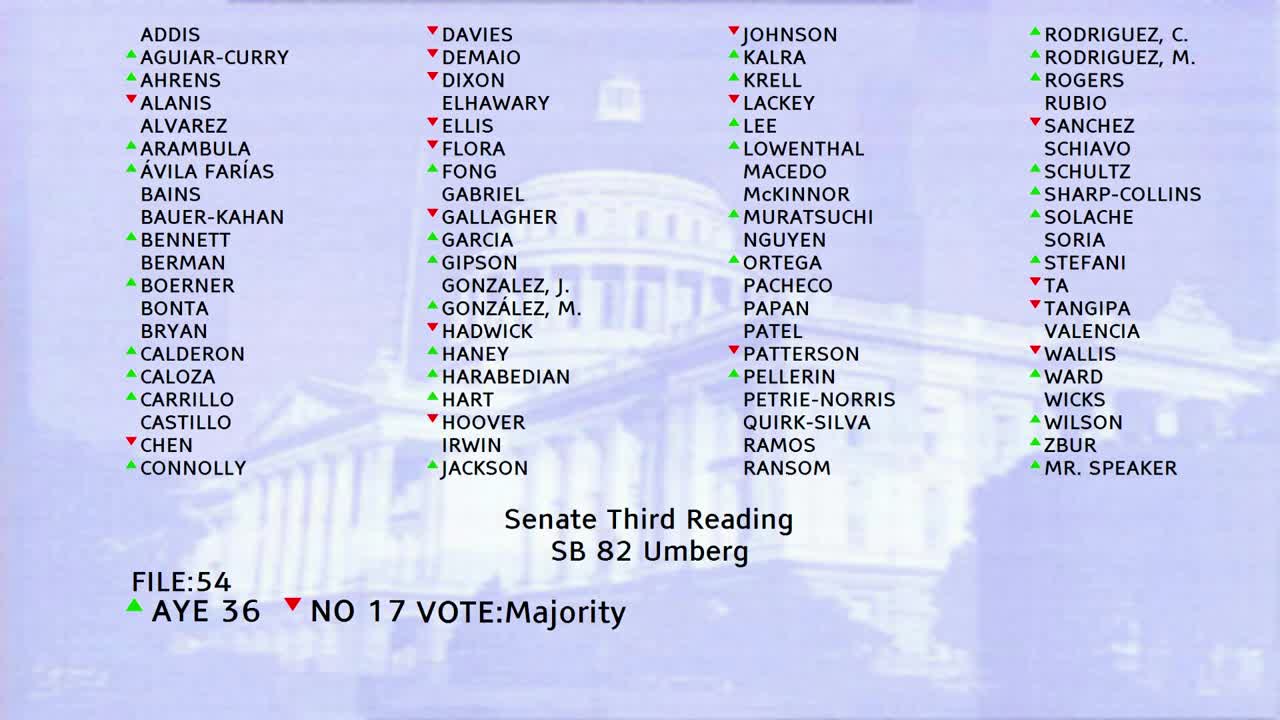 1MIN
Assembly Floor
 20MIN
Senate Standing Committee on Business, Professions and Economic Development
Bill Author

Bill Co-Author(s):