SB 524: Law enforcement agencies: artificial intelligence.
- Session Year: 2025-2026
- House: Senate
- Latest Version Date: 2025-10-10
Current Status:
Passed
(2025-10-10: Chaptered by Secretary of State. Chapter 587, Statutes of 2025.)
Introduced
In Committee
Awaiting First Chamber Vote
Passed First Chamber
In Committee
Awaiting Second Chamber Vote
Passed Second Chamber
Enacted
Existing law generally provides for the regulation of law enforcement agencies, including, among other things, requiring each local law enforcement agency to conspicuously post on their internet websites all current standards, policies, practices, operating procedures, and education and training materials that would otherwise be available to the public under specified circumstances.
This bill would require each law enforcement agency to maintain a policy to require an official report prepared by a law enforcement officer or any member of a law enforcement agency that is generated using artificial intelligence either fully or partially to include specified information, including a disclosure statement and the signature of the law enforcement officer or member of a law enforcement agency who prepared the official report, as specified. If an officer or any member of an agency uses artificial intelligence to create an official report, the bill would require the first draft created to be retained for as long as the official report is retained. The bill would, except for the official report, prohibit a draft of any report created with the use of artificial intelligence from constituting an officers statement. The bill would require an agency utilizing artificial intelligence to generate a first draft or official report to maintain an audit trail that identifies, at a minimum, certain things, including the person who used artificial intelligence to create a report. The bill would prohibit a contracted vendor from sharing, selling, or otherwise using information provided by a law enforcement agency to be processed by artificial intelligence, except as provided. The bill would define terms for purposes of these provisions.
By requiring local law enforcement agencies to adopt a new policy, this bill would impose a state-mandated local program.
The California Constitution requires the state to reimburse local agencies and school districts for certain costs mandated by the state. Statutory provisions establish procedures for making that reimbursement.
This bill would provide that, if the Commission on State Mandates determines that the bill contains costs mandated by the state, reimbursement for those costs shall be made pursuant to the statutory provisions noted above.
Existing law generally provides for the regulation of law enforcement agencies, including, among other things, requiring each local law enforcement agency to conspicuously post on their internet websites all current standards, policies, practices, operating procedures, and education and training materials that would otherwise be available to the public under specified circumstances.
This bill would require each law enforcement agency to maintain a policy to require an official report prepared by a law enforcement officer or any member of a law enforcement agency that is generated using artificial intelligence either fully or partially to include specified information on each page, information, including a disclosure statement, statement and the signature of the law enforcement officer or member of a law enforcement agency who prepared the final official report, as specified. If an officer or any member of an agency uses artificial intelligence to create an official report, the bill would require the first draft created to be retained for as long as the final official report is retained. The bill would, except for the final official report, prohibit a draft of any report created with the use of artificial intelligence from constituting an officers official statement. The bill would require the program used an agency utilizing artificial intelligence to generate a draft, interim, or final first draft or official report to maintain an audit trail that identifies, at a minimum, certain things, including the person who used artificial intelligence to create a report. The bill would prohibit a contracted vendor from sharing, selling, or otherwise using information provided by a law enforcement agency to be processed by artificial intelligence, except as provided. The bill would define terms for purposes of these provisions.
By requiring local law enforcement agencies to adopt a new policy, this bill would impose a state-mandated local program.
The California Constitution requires the state to reimburse local agencies and school districts for certain costs mandated by the state. Statutory provisions establish procedures for making that reimbursement.
This bill would provide that, if the Commission on State Mandates determines that the bill contains costs mandated by the state, reimbursement for those costs shall be made pursuant to the statutory provisions noted above.
Existing law generally provides for the regulation of law enforcement agencies, including, among other things, requiring each local law enforcement agency to conspicuously post on their internet websites all current standards, policies, practices, operating procedures, and education and training materials that would otherwise be available to the public under specified circumstances.
This bill would require each law enforcement agency to maintain a policy to require an official report prepared by a law enforcement officer or any member of a law enforcement agency that is generated using artificial intelligence either fully or partially to include specified information on each page, including a disclosure statement, and the signature of the law enforcement officer or member of a law enforcement agency who prepared the final report, as specified. If an officer or any member of an agency uses artificial intelligence to create an official report, the bill would require the first draft created to be retained for as long as the final report is retained. The bill would, except for the final report, prohibit a draft of any report created with the use of artificial intelligence from constituting an officers official statement. The bill would require the program used to generate a draft, interim, or final report to maintain an audit trail that identifies, at a minimum, certain things, including the person who used artificial intelligence to create a report. The bill would prohibit a contracted vendor from sharing, selling, or otherwise using information provided by a law enforcement agency to be processed by artificial intelligence, except as provided. The bill would define terms for purposes of these provisions.
By requiring local law enforcement agencies to adopt a new policy, this bill would impose a state-mandated local program.
The California Constitution requires the state to reimburse local agencies and school districts for certain costs mandated by the state. Statutory provisions establish procedures for making that reimbursement.
This bill would provide that, if the Commission on State Mandates determines that the bill contains costs mandated by the state, reimbursement for those costs shall be made pursuant to the statutory provisions noted above.
Existing law generally provides for the regulation of law enforcement agencies, including, among other things, requiring each local law enforcement agency to conspicuously post on their internet websites all current standards, policies, practices, operating procedures, and education and training materials that would otherwise be available to the public under specified circumstances.
This bill would require each law enforcement agency to maintain a policy to require an official report prepared by a law enforcement officer or any member of a law enforcement agency that is generated using artificial intelligence either fully or partially to include specified information on each page, including a disclosure statement, and the signature of the law enforcement officer or member of a law enforcement agency who prepared the final report, as specified. If an officer or any member of an agency uses artificial intelligence to create an official report, the bill would require the first draft created to be retained for as long as the final report is retained. The bill would, except for the final report, prohibit a draft of any report created with the use of artificial intelligence from constituting an officers official statement. The bill would require the program used to generate a draft, interim, or final report to maintain an audit trail that identifies, at a minimum, certain things, including the person who used artificial intelligence to create a report. The bill would define terms for purposes of these provisions.
By requiring local law enforcement agencies to adopt a new policy, this bill would impose a state-mandated local program.
The California Constitution requires the state to reimburse local agencies and school districts for certain costs mandated by the state. Statutory provisions establish procedures for making that reimbursement.
This bill would provide that, if the Commission on State Mandates determines that the bill contains costs mandated by the state, reimbursement for those costs shall be made pursuant to the statutory provisions noted above.
Existing law generally provides for the regulation of law enforcement agencies, including, among other things, requiring each local law enforcement agency to conspicuously post on their internet websites all current standards, policies, practices, operating procedures, and education and training materials that would otherwise be available to the public under specified circumstances.
This bill would require each law enforcement agency to maintain a policy to require an official report prepared by a law enforcement officer or any member of a law enforcement agency that is generated using artificial intelligence either fully or partially to include specified information on each page, including a disclosure statement, if the report was generated in a draft, interim, or final form using artificial intelligence either fully or partially. and the signature of the law enforcement officer or member of a law enforcement agency who prepared the report, as specified. If an officer or any member of an agency uses artificial intelligence to create an official report, the bill would require all drafts created before the final report to be retained in a manner that allows ready access and for as long as the final report is retained. the first draft created to be retained for as long as the final report is retained. The bill would require the program used to generate a draft, interim, or final report to maintain an audit trail that identifies, at a minimum, certain things, including the person who used artificial intelligence to create a report. The bill would define terms for purposes of these provisions.
By requiring local law enforcement agencies to adopt a new policy, this bill would impose a state-mandated local program.
The California Constitution requires the state to reimburse local agencies and school districts for certain costs mandated by the state. Statutory provisions establish procedures for making that reimbursement.
This bill would provide that, if the Commission on State Mandates determines that the bill contains costs mandated by the state, reimbursement for those costs shall be made pursuant to the statutory provisions noted above.
Existing law generally provides for the regulation of law enforcement agencies, including, among other things, requiring each local law enforcement agency to conspicuously post on their internet websites all current standards, policies, practices, operating procedures, and education and training materials that would otherwise be available to the public under specified circumstances.
This bill would require each law enforcement agency to maintain a policy to require an official report prepared by a law enforcement officer or any member of a law enforcement agency, as defined, agency to include specified information on each page, including a disclosure statement, if the report was generated in a draft, interim, or final form using artificial intelligence either fully or partially. If an officer or any member of an agency uses artificial intelligence to create an official report, the bill would require all drafts created before the final report to be retained in a manner that allows ready access and for as long as the final report is retained. The bill would require the program used to generate a draft, interim, or final report to maintain an audit trail that identifies, at a minimum, certain things, including the person who used artificial intelligence to create a report. The bill would define terms for purposes of these provisions.
By requiring local law enforcement agencies to adopt a new policy, this bill would impose a state-mandated local program.
The California Constitution requires the state to reimburse local agencies and school districts for certain costs mandated by the state. Statutory provisions establish procedures for making that reimbursement.
This bill would provide that, if the Commission on State Mandates determines that the bill contains costs mandated by the state, reimbursement for those costs shall be made pursuant to the statutory provisions noted above.
Existing law generally provides for the regulation of law enforcement agencies, including, among other things, requiring each local law enforcement agency to conspicuously post on their internet websites all current standards, policies, practices, operating procedures, and education and training materials that would otherwise be available to the public under specified circumstances.
This bill would require an official report prepared by a law enforcement officer or any member of a law enforcement agency, as defined, to include specified information on each page, including a disclosure statement, if the report was generated in a draft, interim, or final form using artificial intelligence either fully or partially. If an officer or any member of an agency uses artificial intelligence to create an official report, the bill would require all drafts created before the final report to be retained in a manner that allows ready access and for as long as the final report is retained. The bill would require the program used to generate a draft, interim, or final report to maintain an audit trail that identifies, at a minimum, certain things, including the person who used artificial intelligence to create a report.
(a)Each law enforcement agency shall maintain a policy to require an official report prepared by a law enforcement officer or any member of a law enforcement agency that is generated using artificial intelligence either fully or partially to contain both of the following:
(1)On each page of the official report, or within the body of the text, identify every specific artificial intelligence program used in a manner that makes such identification readily apparent to the reader and prominently state the following:
This report was written either fully or in part using artificial intelligence.
(2)The signature of the law enforcement officer or member of a law enforcement agency who prepared the official report, either in physical or electronic form, verifying that they reviewed the contents of that report and that the facts contained in the official report are true and correct.
(b)(1)If a law enforcement officer or any member of a law enforcement agency uses artificial intelligence to create an official report, whether fully or partially, the first draft created shall be retained by the agency for as long as the official report is retained.
(2)Except for the official report, a draft of any report created with the use of artificial intelligence shall not constitute an officers statement.
(c)The agency utilizing artificial intelligence to generate a first draft or official report shall maintain an audit trail for as long as the official report is retained that, at a minimum, identifies both of the following:
(1)The person who used artificial intelligence to create a report.
(2)The video and audio footage used to create a report, if any.
(d)(1)A contracted vendor shall not share, sell, or otherwise use information provided by a law enforcement agency to be processed by artificial intelligence except for either of the following purposes:
(A)The contracted law enforcement agencys purposes.
(B)Pursuant to a court order.
(2)A contracted vendor may access data processed by artificial intelligence for the purposes of troubleshooting, bias mitigation, accuracy improvement, or system refinement.
(e)For purposes of this section, the following definitions apply:
(1)Artificial intelligence means an engineered or machine-based system that varies in its level of autonomy and that can, for explicit or implicit objectives, infer from the input it receives how to generate outputs that can influence physical or virtual environments. Artificial intelligence as used in this section applies to artificial intelligence systems that automatically draft police report narratives based upon an analysis of in-car or dash-mounted cameras, or body-worn camera audio or video, and artificial intelligence systems that analyze a law enforcement officers dictated report to generate a police report narrative automatically enhanced by generative artificial intelligence.
(2)Contracted vendor means a third party which has made artificial intelligence available to law enforcement for the purpose of generating a draft police report.
(3)First draft means the initial document or narrative produced solely by artificial intelligence.
(4)Law enforcement agency means any department or agency of the state or any local government, special district, or other political subdivision thereof, that employs any peace officer, as described in Section 830.
(5)Official report means the final version of the report that is signed by the officer under paragraph (2) of subdivision (a).
SEC. 2.If the Commission on State Mandates determines that this act contains costs mandated by the state, reimbursement to local agencies and school districts for those costs shall be made pursuant to Part 7 (commencing with Section 17500) of Division 4 of Title 2 of the Government Code.
(a)Each law enforcement agency shall maintain a policy to require an official report prepared by a law enforcement officer or any member of a law enforcement agency that is generated using artificial intelligence either fully or partially to contain both of the following:
(1)On each page of the official report, or within the body of the text, identify every specific artificial intelligence program used in a manner that makes such identification readily apparent to the reader and prominently state the following:
This report was written either fully or in part using artificial intelligence.
(2)The signature of the law enforcement officer or member of a law enforcement agency who prepared the official report, either in physical or electronic form, verifying that they reviewed the contents of that report and that the facts contained in the official report are true and correct.
(b)(1)If a law enforcement officer or any member of a law enforcement agency uses artificial intelligence to create an official report, whether fully or partially, the first draft created shall be retained by the agency for as long as the official report is retained.
(2)Except for the official report, a draft of any report created with the use of artificial intelligence shall not constitute an officers statement.
(c)The agency utilizing artificial intelligence to generate a first draft or official report shall maintain an audit trail for as long as the official report is retained that, at a minimum, identifies both of the following:
(1)The person who used artificial intelligence to create a report.
(2)The video and audio footage used to create a report, if any.
(d)(1)A contracted vendor shall not share, sell, or otherwise use information provided by a law enforcement agency to be processed by artificial intelligence except for either of the following purposes:
(1)(A)The contracted law enforcement agencys purposes.
(2)(B)Pursuant to a court order.
(2)A contracted vendor may access data processed by artificial intelligence for the purposes of troubleshooting, bias mitigation, accuracy improvement, or system refinement.
(e)For purposes of this section, the following definitions apply:
(1)Artificial intelligence means an engineered or machine-based system that varies in its level of autonomy and that can, for explicit or implicit objectives, infer from the input it receives how to generate outputs that can influence physical or virtual environments. Artificial intelligence as used in this section applies to artificial intelligence systems that automatically draft police report narratives based upon an analysis of in-car or dash-mounted cameras, or body-worn camera audio or video, and artificial intelligence systems that analyze a law enforcement officers dictated report to generate a police report narrative automatically enhanced by generative artificial intelligence.
(2)Contracted vendor means a third party which has made artificial intelligence available to law enforcement for the purpose of generating a draft police report.
(3)First draft means the initial document or narrative produced solely by artificial intelligence.
(4)Law enforcement agency means any department or agency of the state or any local government, special district, or other political subdivision thereof, that employs any peace officer, as described in Section 830.
(5)Official report means the final version of the report that is signed by the officer under paragraph (2) of subdivision (a).
SEC. 2.If the Commission on State Mandates determines that this act contains costs mandated by the state, reimbursement to local agencies and school districts for those costs shall be made pursuant to Part 7 (commencing with Section 17500) of Division 4 of Title 2 of the Government Code.
(a)Each law enforcement agency shall maintain a policy to require an official report prepared by a law enforcement officer or any member of a law enforcement agency that is generated using artificial intelligence either fully or partially to contain both of the following:
(1)On each page of the official report, or within the body of the text, identify every specific artificial intelligence program used in a manner that makes such identification readily apparent to the reader and prominently state the following:
This report was written either fully or in part using artificial intelligence.
(2)The signature of the law enforcement officer or member of a law enforcement agency who prepared the final official report, either in physical or electronic form, verifying that they reviewed the contents of that report and that the facts contained in the official report are true and correct.
(b)(1)If a law enforcement officer or any member of a law enforcement agency uses artificial intelligence to create an official report, whether fully or partially, the first draft created shall be retained by the agency for as long as the final official report is retained.
(2)Except for the final official report, a draft of any report created with the use of artificial intelligence shall not constitute an officers official statement.
(c)The program used agency utilizing artificial intelligence to generate a draft, interim, or final first draft or official report shall maintain an audit trail for as long as the official report is retained that, at a minimum, identifies both of the following:
(1)The person who used artificial intelligence to create a report.
(2)The video and audio footage used to create a report, if any.
(d)A contracted vendor shall not share, sell, or otherwise use information provided by a law enforcement agency to be processed by artificial intelligence except for either of the following purposes:
(1)The contracted law enforcement agencys purposes.
(2)Pursuant to a court order.
(e)For purposes of this section, the following definitions apply:
(1)Artificial intelligence means an engineered or machine-based system that varies in its level of autonomy and that can, for explicit or implicit objectives, infer from the input it receives how to generate outputs that can influence physical or virtual environments. Artificial intelligence as used in this section applies to artificial intelligence systems that automatically draft police report narratives based upon an analysis of in-car or dash-mounted cameras, or body-worn camera audio or video, and artificial intelligence systems that analyze a law enforcement officers dictated report to generate a police report narrative automatically enhanced by generative artificial intelligence.
(2)Contracted vendor means a third party which has made artificial intelligence available to law enforcement for the purpose of generating a draft police report.
(3)First draft means the initial document or narrative produced solely by artificial intelligence.
(3)(4)Law enforcement agency means any department or agency of the state or any local government, special district, or other political subdivision thereof, that employs any peace officer, as described in Section 830.
(5)Official report means the final version of the report that is signed by the officer under paragraph (2) of subdivision (a).
SEC. 2.If the Commission on State Mandates determines that this act contains costs mandated by the state, reimbursement to local agencies and school districts for those costs shall be made pursuant to Part 7 (commencing with Section 17500) of Division 4 of Title 2 of the Government Code.
(a)Each law enforcement agency shall maintain a policy to require an official report prepared by a law enforcement officer or any member of a law enforcement agency that is generated using artificial intelligence either fully or partially to contain both of the following:
(1)On each page of the report, identify every specific artificial intelligence program used and prominently state the following:
This report was written either fully or in part using artificial intelligence.
(2)The signature of the law enforcement officer or member of a law enforcement agency who prepared the final report, either in physical or electronic form, verifying that they reviewed the contents of that report and that the facts contained in the report are true and correct.
(b)(1)If a law enforcement officer or any member of a law enforcement agency uses artificial intelligence to create an official report, whether fully or partially, the first draft created shall be retained for as long as the final report is retained.
(2)Except for the final report, a draft of any report created with the use of artificial intelligence shall not constitute an officers official statement.
(c)The program used to generate a draft, interim, or final report shall maintain an audit trail that, at a minimum, identifies both of the following:
(1)The person who used artificial intelligence to create a report.
(2)The video and audio footage used to create a report, if any.
(d)A contracted vendor shall not share, sell, or otherwise use information provided by a law enforcement agency to be processed by artificial intelligence except for either of the following purposes:
(1)The contracted law enforcement agencys purposes.
(2)Pursuant to a court order.
(d)(e)For purposes of this section, the following definitions apply:
(1)Artificial intelligence means an engineered or machine-based system that varies in its level of autonomy and that can, for explicit or implicit objectives, infer from the input it receives how to generate outputs that can influence physical or virtual environments. Artificial intelligence as used in this section applies to artificial intelligence systems that automatically draft police report narratives based upon an analysis of in-car or dash-mounted cameras, or body-worn camera audio or video, and artificial intelligence systems that analyze a law enforcement officers dictated report to generate a police report narrative automatically enhanced by generative artificial intelligence.
(2)Contracted vendor means a third party which has made artificial intelligence available to law enforcement for the purpose of generating a draft police report.
(2)(3)Law enforcement agency means any department or agency of the state or any local government, special district, or other political subdivision thereof, that employs any peace officer, as described in Section 830.
SEC. 2.If the Commission on State Mandates determines that this act contains costs mandated by the state, reimbursement to local agencies and school districts for those costs shall be made pursuant to Part 7 (commencing with Section 17500) of Division 4 of Title 2 of the Government Code.
(a)Each law enforcement agency shall maintain a policy to require an official report prepared by a law enforcement officer or any member of a law enforcement agency that is generated using artificial intelligence either fully or partially to contain both of the following:
(1)On each page of the report, identify every specific artificial intelligence program used and prominently state the following:
This report was written either fully or in part using artificial intelligence.
(2)The signature of the law enforcement officer or member of a law enforcement agency who prepared the final report, either in physical or electronic form, verifying that they reviewed the contents of the that report and that the facts contained in the report are true and correct.
(b)(1)If a law enforcement officer or any member of a law enforcement agency uses artificial intelligence to create an official report, whether fully or partially, the first draft created shall be retained for as long as the final report is retained.
(2)Except for the final report, a draft of any report created with the use of artificial intelligence shall not constitute an officers official statement.
(c)The program used to generate a draft, interim, or final report shall maintain an audit trail that, at a minimum, identifies all both of the following:
(1)The person who used artificial intelligence to create a report.
(2)The person who made any changes to a report.(3)(2)The video and audio footage used to create a report. report, if any.
(d)For purposes of this section, the following definitions apply:
(1)Artificial intelligence means an engineered or machine-based system that varies in its level of autonomy and that can, for explicit or implicit objectives, infer from the input it receives how to generate outputs that can influence physical or virtual environments. Artificial intelligence as used in this section applies to artificial intelligence systems that automatically draft police report narratives based upon an analysis of in-car or dash-mounted cameras, or body-worn camera audio or video, and artificial intelligence systems that analyze a law enforcement officers dictated report to generate a police report narrative automatically enhanced by generative artificial intelligence.
(2)Law enforcement agency means any department or agency of the state or any local government, special district, or other political subdivision thereof, that employs any peace officer, as described in Section 830.
SEC. 2.If the Commission on State Mandates determines that this act contains costs mandated by the state, reimbursement to local agencies and school districts for those costs shall be made pursuant to Part 7 (commencing with Section 17500) of Division 4 of Title 2 of the Government Code.
REVISIONS: HeadingLine 2.(a)Each law enforcement agency shall maintain a policy to require an official report prepared by a law enforcement officer or any member of a law enforcement agency that is generated in a draft, interim, or final form using artificial intelligence either fully or partially, to, on each page of the report, identify every specific artificial intelligence program used and prominently state the following: partially to contain both of the following:
(1)On each page of the report, identify every specific artificial intelligence program used and prominently state the following:
This report was written either fully or in part using artificial intelligence.
(2)The signature of the law enforcement officer or member of a law enforcement agency who prepared the report, either in physical or electronic form, verifying that they reviewed the contents of the report and that the facts contained in the report are true and correct.
(b)If a law enforcement officer or any member of a law enforcement agency uses artificial intelligence to create an official report, whether fully or partially, all drafts created before the final report shall be retained in a manner that allows ready access. The program used to generate the draft shall retain all changes made to the artificial-intelligence-generated report by the person preparing the draft or report. The documents described in this section shall be retained for as long as the final report is retained. the first draft created shall be retained for as long as the final report is retained.
(c)The program used to generate a draft, interim, or final report shall maintain an audit trail that, at a minimum, identifies all of the following:
(1)The person who used artificial intelligence to create a report.
(2)The person who made any changes to a report.
(3)The video and audio footage used to create a report.
(d)For purposes of this section, the following definitions apply:
(1)Artificial intelligence means an engineered or machine-based system that varies in its level of autonomy and that can, for explicit or implicit objectives, infer from the input it receives how to generate outputs that can influence physical or virtual environments. Artificial intelligence as used in this section applies to artificial intelligence systems that automatically draft police report narratives based upon an analysis of in-car or dash-mounted cameras, or body-worn camera audio or video, and artificial intelligence systems that analyze a law enforcement officers dictated report to generate a police report narrative automatically enhanced by generative artificial intelligence.
(2)Law enforcement agency means any department or agency of the state or any local government, special district, or other political subdivision thereof, that employs any peace officer, as described in Section 830.
SEC. 2.If the Commission on State Mandates determines that this act contains costs mandated by the state, reimbursement to local agencies and school districts for those costs shall be made pursuant to Part 7 (commencing with Section 17500) of Division 4 of Title 2 of the Government Code.
(a)If Each law enforcement agency shall maintain a policy to require an official report prepared by a law enforcement officer or any member of a law enforcement agency has been that is generated in a draft, interim, or final form using artificial intelligence either fully or partially, the report shall, on each page, to, on each page of the report, identify every specific artificial intelligence program used and prominently state the following:
This report was written either fully or in part using artificial intelligence.
(b)If a law enforcement officer or any member of a law enforcement agency uses artificial intelligence to create an official report, whether fully or partially, all drafts created before the final report shall be retained in a manner that allows ready access. The program used to generate the draft shall retain all changes made to the artificial-intelligence-generated report by the person preparing the draft or report. The documents described in this section shall be retained for as long as the final report is retained.
(c)The program used to generate a draft, interim, or final report shall maintain an audit trail that, at a minimum, identifies all of the following:
(1)The person who used artificial intelligence to create a report.
(2)The person who made any changes to a report.
(3)The video and audio footage used to create a report.
(d)For purposes of this section, law enforcement agency means any department or agency of the state or any local government, special district, or other political subdivision thereof, that employs any peace officer, as described in Section 830. the following definitions apply:
(1)Artificial intelligence means an engineered or machine-based system that varies in its level of autonomy and that can, for explicit or implicit objectives, infer from the input it receives how to generate outputs that can influence physical or virtual environments.
(2)Law enforcement agency means any department or agency of the state or any local government, special district, or other political subdivision thereof, that employs any peace officer, as described in Section 830.
SEC. 2.If the Commission on State Mandates determines that this act contains costs mandated by the state, reimbursement to local agencies and school districts for those costs shall be made pursuant to Part 7 (commencing with Section 17500) of Division 4 of Title 2 of the Government Code.
(a)If an official report prepared by a law enforcement officer or any member of a law enforcement agency has been generated in a draft, interim, or final form using artificial intelligence either fully or partially, the report shall, on each page, identify every specific artificial intelligence program used and prominently state the following:
This report was written either fully or in part using artificial intelligence.
(b)If a law enforcement officer or any member of a law enforcement agency uses artificial intelligence to create an official report, whether fully or partially, all drafts created before the final report shall be retained in a manner that allows ready access. The program used to generate the draft shall retain all changes made to the artificial-intelligence-generated report by the person preparing the draft or report. The documents described in this section shall be retained for as long as the final report is retained.
(c)The program used to generate a draft, interim, or final report shall maintain an audit trail that, at a minimum, identifies all of the following:
(1)The person who used artificial intelligence to create a report.
(2)The person who made any changes to a report.
(3)The video footage used to create a report.
(d)For purposes of this section, law enforcement agency means any department or agency of the state or any local government, special district, or other political subdivision thereof, that employs any peace officer, as described in Section 830.
|
Date
|
Status
|
|---|---|
| Oct 10, 2025 | Chaptered by Secretary of State. Chapter 587, Statutes of 2025. |
| Oct 10, 2025 | Approved by the Governor. |
| Sep 22, 2025 | Enrolled and presented to the Governor at 11 a.m. |
| Sep 10, 2025 | Assembly amendments concurred in. (Ayes 28. Noes 10. Page 2803.) Ordered to engrossing and enrolling. |
| Sep 8, 2025 | In Senate. Concurrence in Assembly amendments pending. |
| Sep 8, 2025 | Read third time. Passed. (Ayes 50. Noes 17. Page 3005.) Ordered to the Senate. |
| Sep 3, 2025 | Ordered to third reading. |
| Sep 3, 2025 | Read third time and amended. |
| Sep 3, 2025 | Read second time. Ordered to third reading. |
| Sep 2, 2025 | Read second time and amended. Ordered to second reading. |
| Aug 29, 2025 | From committee: Do pass as amended. (Ayes 11. Noes 3.) (August 29). |
| Aug 20, 2025 | August 20 set for first hearing. Placed on APPR. suspense file. |
| Jul 17, 2025 | Read second time and amended. Re-referred to Com. on APPR. |
| Jul 17, 2025 | From committee: Do pass as amended and re-refer to Com. on APPR. (Ayes 12. Noes 2.) (July 16). |
| Jul 17, 2025 | Assembly Rule 63 suspended. (Ayes 49. Noes 15. Page 2578.) |
| Jul 2, 2025 | From committee: Do pass and re-refer to Com. on P. & C.P. (Ayes 6. Noes 0.) (July 1). Re-referred to Com. on P. & C.P. |
| Jul 2, 2025 | Coauthors revised. |
| Jun 25, 2025 | From committee with author's amendments. Read second time and amended. Re-referred to Com. on PUB. S. |
| Jun 11, 2025 | June 17 set for first hearing canceled at the request of author. |
| Jun 9, 2025 | Referred to Coms. on PUB. S. and P. & C.P. |
| Jun 4, 2025 | In Assembly. Read first time. Held at Desk. |
| Jun 3, 2025 | Read third time. Passed. (Ayes 28. Noes 10. Page 1446.) Ordered to the Assembly. |
| May 27, 2025 | Read second time. Ordered to third reading. |
| May 23, 2025 | Read second time and amended. Ordered to second reading. |
| May 23, 2025 | From committee: Do pass as amended. (Ayes 5. Noes 1. Page 1203.) (May 23). |
| May 16, 2025 | Set for hearing May 23. |
| Apr 21, 2025 | April 21 hearing: Placed on APPR. suspense file. |
| Apr 10, 2025 | Set for hearing April 21. |
| Apr 8, 2025 | From committee: Do pass and re-refer to Com. on APPR. (Ayes 5. Noes 1. Page 709.) (April 8). Re-referred to Com. on APPR. |
| Mar 27, 2025 | Set for hearing April 8. |
| Mar 26, 2025 | From committee with author's amendments. Read second time and amended. Re-referred to Com. on PUB. S. |
| Mar 5, 2025 | Referred to Com. on PUB. S. |
| Feb 21, 2025 | From printer. May be acted upon on or after March 23. |
| Feb 20, 2025 | Introduced. Read first time. To Com. on RLS. for assignment. To print. |
|
Date
|
Description
|
Location
|
Votes
|
|
|---|---|---|---|---|
| Sep 10, 2025 | Unfinished Business SB524 Arreguín et al. Concurrence | Senate Floor |
Passed |
|
| Sep 8, 2025 | SB 524 Arreguín Senate Third Reading By Schultz | Assembly Floor |
Passed |
|
| Aug 29, 2025 | Do pass as amended. | Assembly Standing Committee on Appropriations |
Passed |
|
| Jul 16, 2025 | Do pass as amended and be re-referred to the Committee on [Appropriations] | Assembly Standing Committee on Privacy and Consumer Protection |
Passed |
|
| Jul 1, 2025 | Do pass and be re-referred to the Committee on [Privacy and Consumer Protection] | Assembly Standing Committee on Public Safety |
Passed |
|
| Jun 3, 2025 | Senate 3rd Reading SB524 Arreguín | Senate Floor |
Passed |
|
| May 23, 2025 | Do pass as amended | Senate Standing Committee on Appropriations |
Passed |
|
| Apr 21, 2025 | Placed on suspense file | Senate Standing Committee on Appropriations |
Passed |
|
| Apr 8, 2025 | Do pass, but first be re-referred to the Committee on [Appropriations] | Senate Standing Committee on Public Safety |
Passed |
This list shows positions taken on this bill by organizations on the date displayed, which is linked to the original source.
Positions by individuals are not included.
|
Organization
|
Position
|
Date
|
|---|---|---|
| California Attorneys For Criminal Justice | ** Support | |
| California Police Chiefs Association | ** Against | |
| California Public Defenders Association | ** Support | |
| Center on Juvenile and Criminal Justice | ** Support | |
| Communities United for Restorative Youth Justice | ** Support | |
| County of Los Angeles Board of Supervisors | ** Support | |
| Electronic Frontier Foundation | ** Support | |
| Felony Murder Elimination Project | ** Support | |
| Initiate Justice | ** Support | |
| Initiate Justice Action | ** Support | |
| Justice2jobs Coalition | ** Support | |
| LA Defensa | ** Support | |
| Oakland Privacy | ** Support | |
| Orange County Sheriff's Office | ** Against | |
| Peace Officer Research Association of California | ** Against | |
| Policing Project at NYU School of Law | ** Support | |
| Prosecutors Alliance Action | ** Support | |
| Riverside County Sheriff's Office | ** Against | |
| Rubicon Programs | ** Support | |
| San Bernardino County SheriffS Department | ** Against | |
| San Francisco Public Defender | ** Support | |
| Smart Justice California | ** Support |
SENATE RULES COMMITTEE Office of Senate Floor Analyses (916) 651-1520 Fax: (916) 327-4478 | SB 524 |
UNFINISHED BUSINESS
Bill No: SB 524
Author: Arreguín (D), et al.
Amended: 9/3/25
Vote: 21
SENATE PUBLIC SAFETY COMMITTEE: 5-1, 4/8/25
AYES: Arreguín, Caballero, Gonzalez, Pérez, Wiener
NOES: Seyarto
SENATE APPROPRIATIONS COMMITTEE: 5-1, 5/23/25
AYES: Caballero, Cabaldon, Grayson, Richardson, Wahab
NOES: Seyarto
NO VOTE RECORDED: Dahle
SENATE FLOOR: 28-10, 6/3/25
AYES: Allen, Archuleta, Arreguín, Ashby, Becker, Blakespear, Cabaldon, Caballero, Cervantes, Cortese, Durazo, Gonzalez, Grayson, Laird, Limón, McGuire, McNerney, Menjivar, Padilla, Pérez, Richardson, Rubio, Smallwood-Cuevas, Stern, Umberg, Wahab, Weber Pierson, Wiener
NOES: Alvarado-Gil, Choi, Dahle, Grove, Jones, Niello, Ochoa Bogh, Seyarto, Strickland, Valladares
NO VOTE RECORDED: Hurtado, Reyes
ASSEMBLY FLOOR: 50-17, 9/8/25 - See last page for vote
SUBJECT: Law enforcement agencies: artificial intelligence
SOURCE: California Public Defenders Association
DIGEST:
This bill requires every law enforcement agency to maintain a policy that requires an artificial intelligence (AI) – generated official report to identify the type of AI program used to generate the report and include the signature of the officer who prepared the official report.
Assembly Amendments
provide that drafts of an AI-generated report shall not constitute an officer’s official statement, narrow audit trail requirements, establish data usage restrictions on vendors who contract with agencies to provide AI-related services, specify that certain provisions apply only to “official” reports or “first drafts” and provide definitions for those terms.
ANALYSIS:
Existing law:
- Provides that on or before January 1, 2026, and before each time thereafter that a generative artificial intelligence (GenAI) system or service, or a substantial modification to a GenAI system or service, released on or after January 1, 2022, is made publicly available to Californians for use, regardless of whether the terms of that use include compensation, the developer of the system or service shall post on the developer’s internet website documentation regarding the data used by the developer to train the generative artificial intelligence system or service, including specified information. (Civil (Civ.) Code, § 3111.)
- Provides that the California Governor’s Office of Emergency Services (Cal OES) shall, as appropriate perform a risk analysis of potential threats posed by the use of GenAI to California’s critical infrastructure, including those that could lead to mass casualty events, as specified. (Government (Gov.) Code, § 11549.65, subd. (b).)
- Requires any state agency or department to consider procurement and enterprise use opportunities in which GenAI can improve the efficiency, effectiveness, accessibility, and equity of government operations consistent with existing policies for public sector GenAI procurement. (Gov. Code, § 11549.65, subd. (c).)
- Requires a state agency or department that utilizes GenAI to directly communicate with a person regarding government services and benefits shall ensure that those communications include both of the following:
- A disclaimer that indicates to the person that the communication was generated by GenAI, as specified.
- Information, or a link to an internet website containing information, describing how the person may contact a human employee of the state agency or department. (Gov. Code, § 11549.66.)
- Requires, operative January 1, 2026, persons that create, code or otherwise produce a GenAI system that has over 1,000,000 monthly visitors or users, as specified, to make available an AI detection tool that allows users to assess whether an image, video or audio content was created or altered by AI, and provides other detection functions, as specified. (Business and Professions (Bus. & Prof.) Code, § 22757.2.)
- Requires, operative January 1, 2026, persons that create, code or otherwise produce a GenAI system that has over 1,000,000 monthly visitors or users, as specified, to offer users the option to include a manifest disclosure in image, video, or audio content created or altered by the person’s GenAI system that identifies the content as AI-generated, as specified. (Bus. & Prof. Code, § 22757.3.)
- Requires specified political advertisements to include, in a clear and conspicuous manner, the following disclosure: “Ad generated or substantially altered using artificial intelligence.” (Gov. Code, § 84514.)
- Defines, for the purposes of the provisions above, “artificial intelligence” as an engineered or machine-based system that varies in its level of autonomy and that can, for explicit or implicit objectives, infer from the input it receives how to generate outputs that can influence physical or virtual environments. (Civ. Code, § 3110, subd. (a); Gov. Code, §§ 11549.64, 84514, subd. (d).)
- Requires each local law enforcement agency to conspicuously post on their internet websites all current standards, policies, practices, operating procedures, and education and training materials that would otherwise be available to the public if a request was made pursuant to the California Public Records Act. (Penal (Pen.) Code, § 13650.)
- Requires state and local law enforcement agencies to make public specified information regarding individuals arrested by the agency, except to the extent that disclosure of a particular item would endanger the safety of a person involved in an investigation or would endanger the successful completion of the investigation or a related investigation. (Gov. Code, § 7923.610.)
This bill:
- Requires every LEA, as defined, to maintain a policy to require an official report prepared by a law enforcement officer or any member of a LEA that is generated using AI, either fully or partially, to contain both of the following:
- On each page of the official report, or within the body of the text, identify every specific AI program used in a manner that makes such identification readily apparent to the reader, and prominently state the following: "This report was written either fully or in part using artificial intelligence."
- The signature of the law enforcement officer or member of an LEA who prepared the official report, either in physical or electronic form, verifying that they reviewed the contents of that report and that the facts contained in the official report are true and correct.
- Specifies that if a law enforcement officer or member of an LEA uses AI to create an official report, whether fully or partially, the first draft created shall be retained by the agency for as long as the official report is retained.
- Specifies that, except for the official report, a draft of any report created with the use of AI shall not constitute an officer's statement.
- Requires the agency utilizing AI to generate a first draft or official report to maintain an audit trail for as long as the official report is retained that, at a minimum, identifies both of the following:
- The person who used AI to create a report.
- The video and audio footage used to create a report, if any.
- Prohibits a contracted vendor from sharing, selling, or otherwise using information provided by an LEA to be processed by AI except for either of the following purposes:
- The contracted LEA's purposes; or,
- Pursuant to a court order.
- Authorizes a contracted vendor to access data processed by AI for the purposes of troubleshooting, bias mitigation, accuracy improvement, or system refinement.
- Sets forth the following definitions:
- Artificial intelligence” means an engineered or machine-based system that varies in its level of autonomy and that can, for explicit or implicit objectives, infer from the input it receives how to generate outputs that can influence physical or virtual environments. “Artificial intelligence” as used in this bill applies to artificial intelligence systems that automatically draft police report narratives based upon an analysis of in-car or dash-mounted cameras, or body-worn camera audio or video, and artificial intelligence systems that analyze a law enforcement officer’s dictated report to generate a police report narrative automatically enhanced by generative artificial intelligence.
- “Contracted vendor” means a third party which has made AI available to law enforcement for the purpose of generating a draft police report.
- “First draft” means the initial document or narrative produced solely by AI.
- “Law enforcement agency” means any department or agency of the state or any local government, special district, or other political subdivision thereof that employs any peace officer.
- “Official report” means the final version of the report that is signed by the officer.
Comments
GenAI is a type of artificial intelligence that can create new content, including text, images, video, computer code, music, and other media via the application of user-generated “prompts” to a vast existing database of “training data.” GenAI models, such as Open AI’s ChatGPT, Google’s Gemini, and Anthropic’s Claude, can produce realistic and novel artifacts that resemble the data they were trained on, but do not copy it. For example, GenAI models can write a poem, draw a picture, or compose a song based on a given prompt or theme. The GenAI process involves the use of artificial neural networks, a subset of machine learning that aims to mimic the functionality of a biological brain, to identify the patterns and structures within existing data to generate new and original content.
Since the launch of publicly-available GenAI models, their capacity and scope have expanded rapidly, impacting how we communicate, educate, interact, transact, travel, and consume media. Moreover, a wide range of industries, both public and private, have increasingly integrated GenAI into their operations in order to increase productivity, lower costs, and improve user and consumer experience. In the law enforcement context, although AI is not yet ubiquitous, some research has looked into how existing tools may be enhanced with AI to expand law enforcement capabilities and increase efficiency, including automated license plate readers, security cameras and body-worn cameras, firearm discharge detection, audio, video and text redaction, computer-aided dispatch systems, and predictive policing models. Within the last year, many agencies have adopted new AI-driven technology that assists officers with the drafting of police reports. The following paragraph, drafted by Google’s Gemini AI, describes this new technology:
The integration of artificial intelligence into police report writing is rapidly evolving, with AI tools now capable of generating initial report drafts from body camera audio and video. This technology aims to streamline the reporting process, potentially freeing up officers' time for other duties. Companies like Axon are developing AI-powered software that transcribes footage and uses natural language processing to create structured reports. However, concerns regarding accuracy, potential biases within AI, and the necessity of human oversight remain critical considerations as this technology becomes more widespread.
As mentioned above, existing law imposes no restrictions on the use of AI in conjunction with the production of police reports by law enforcement officers, and indeed, as the Author points out, “there is no way for a reader to know if a police report has been written using AI. There are various versions of AI report writing software – and no way to know what version is being used.”
This bill requires every California law enforcement agency to maintain a policy that in turn requires any official police report prepared by any member of that agency that is generated using AI either fully or partially to identify, on each page or within the body of the text, the specific AI program used, as specified, and to state the following: “This report was written either fully or in part using artificial intelligence.” The bill also requires the officer that prepared the report to verify that the information contained in the report is true and correct, and verify such with a signature. Further, the bill provides that if a police report is generated using AI, the first draft of the report must be retained as long as the agency retains the official report. Another component of the bill requires the program used to produce a report to maintain an “audit trail” that identifies who used the program and the source audio and video used to create the report. Finally, the bill specifies that a contracted vendor shall not share, sell, or otherwise use information provided by a law enforcement agency to be processed by artificial intelligence except for specified purposes.
FISCAL EFFECT: Appropriation: No Fiscal Com.: Yes Local: Yes
According to the Assembly Appropriations Committee:
- Costs (General Fund, special funds, local funds) to each LEA in the state to adopt conforming policies and ensure AI tools comply with the bill’s requirements. There are approximately 600 LEAs in California. Although costs may be minor for each individual agency, in the aggregate statewide, costs may be significant, possibly in excess of $150,000. The state must reimburse local LEA costs from the General Fund if the Commission on State Mandates determines the duties imposed by this bill constitute a reimbursable state mandate. For their part, the Department of Justice reports no fiscal impact, and the California Highway Patrol reports it does not use AI technology for reports and would incur a minor and absorbable cost to implement an AI policy.
SUPPORT: (Verified 9/8/25)
California Public Defenders Association (source)
California Attorneys for Criminal Justice
Center on Juvenile and Criminal Justice
Communities United for Restorative Youth Justice
County of Los Angeles Board of Supervisors
Electronic Frontier Foundation
Felony Murder Elimination Project
Initiate Justice
Initiate Justice Action
Justice2Jobs Coalition
La Defensa
Oakland Privacy
Policing Project at NYU School of Law
Prosecutors Alliance Action
Rubicon Programs
San Francisco Public Defender
Smart Justice California
OPPOSITION: (Verified 9/8/25)
Riverside County Sheriffs’ Office
San Bernardino County Sheriff’s Department
ASSEMBLY FLOOR: 50-17, 9/8/25
AYES: Addis, Aguiar-Curry, Ahrens, Alvarez, Arambula, Bains, Bauer-Kahan, Bennett, Berman, Boerner, Bonta, Bryan, Calderon, Caloza, Carrillo, Connolly, Elhawary, Fong, Gabriel, Garcia, Gipson, Mark González, Haney, Harabedian, Hart, Irwin, Jackson, Kalra, Lee, Lowenthal, McKinnor, Ortega, Papan, Patel, Pellerin, Petrie-Norris, Quirk-Silva, Ransom, Celeste Rodriguez, Rogers, Schiavo, Schultz, Sharp-Collins, Solache, Stefani, Ward, Wicks, Wilson, Zbur, Rivas
NOES: Ávila Farías, Castillo, Chen, Davies, Dixon, Ellis, Flora, Gallagher, Jeff Gonzalez, Hadwick, Hoover, Johnson, Macedo, Patterson, Sanchez, Tangipa, Wallis
NO VOTE RECORDED: Alanis, DeMaio, Krell, Lackey, Muratsuchi, Nguyen, Pacheco, Ramos, Michelle Rodriguez, Blanca Rubio, Soria, Ta, Valencia
Prepared by: Alex Barnett / PUB. S. /
9/8/25 19:49:50
**** END ****
SENATE THIRD READING
STR Bill Id:SB 524
Author:(Arreguín)
As Amended Ver:September 03, 2025
Majority vote
SUMMARY
Requires every law enforcement agency (LEA) to maintain a policy that requires an artificial intelligence (AI) - generated official report to identify the type of AI program used to generate the report and include the signature of the officer who prepared the official report.
Major Provisions
- Requires every LEA, as defined, to maintain a policy to require an official report prepared by a law enforcement officer or any member of a LEA that is generated using AI, either fully or partially, to contain both of the following:
- On each page of the official report, or within the body of the text, identify every specific AI program used in a manner that makes such identification readily apparent to the reader, and prominently state the following: "This report was written either fully or in part using artificial intelligence."
- The signature of the law enforcement officer or member of an LEA who prepared the official report, either in physical or electronic form, verifying that they reviewed the contents of that report and that the facts contained in the official report are true and correct.
- Specifies that if a law enforcement officer or member of an LEA uses AI to create an official report, whether fully or partially, the first draft created shall be retained by the agency for as long as the official report is retained.
- Specifies that, except for the official report, a draft of any report created with the use of AI shall not constitute an officer's statement.
- Requires the agency utilizing AI to generate a first draft or official report to maintain an audit trail for as long as the official report is retained that, at a minimum, identifies both of the following:
- The person who used AI to create a report.
- The video and audio footage used to create a report, if any.
- Prohibits a contracted vendor from sharing, selling, or otherwise using information provided by an LEA to be processed by AI except for either of the following purposes:
- The contracted LEA's purposes; or,
- Pursuant to a court order.
- Authorizes a contracted vendor to access data processed by AI for the purposes of troubleshooting, bias mitigation, accuracy improvement, or system refinement.
- Defines "artificial intelligence" to mean an engineered or machine-based system that varies in its level of autonomy and that can, for explicit or implicit objectives, infer from the input it receives how to generate outputs that can influence physical or virtual environments.
- Specifies that this definition of AI, as used in this bill, applies to AI systems that automatically draft police report narratives based upon an analysis of in-car or dash-mounted cameras, or body-worn camera audio or video, and AI systems that analyze a law enforcement officer's dictated report to generate a police report narrative automatically enhanced by generative artificial intelligence (GenAI).
- Defines "law enforcement agency" as any department or agency of the state or any local government, special district, or other political subdivision thereof that employs any peace officer, as specified.
- Defines "contracted vendor" as a third party which has made AI available to law enforcement for the purpose of generating a draft police report.
- Defines "first draft" as the initial document or narrative produced solely by AI.
- Defines "official report" as the final version of the report that is signed by the officer pursuant to this bill.
COMMENTS
According to the Author
"Artificial Intelligence is spreading wildly and creating many concerns, particularly with regard to transparency. This bill is designed to build transparency into the process of creating police reports using AI without in any way impairing the ability of police agencies to use AI to enhance their work product. Adding a footer to a police report stating it was prepared using AI, naming the program used, and requiring an audit trail and the saving of relevant audio and video are already features built into products. The criminal justice system needs clarity and transparency to maintain trust. This bill does that."
Arguments in Support
According the California Public Defenders Association, "Artificial Intelligence is ubiquitous, and yet regulation of it is in its infancy. It has recently been discovered that law enforcement in this state is using AI to generate police reports from the audio from body worn cameras. This AI software is being used without any notice to end-users of these reports.
"Police officers write reports to memorialize criminal incidents – from reports of crimes to arrests. Those reports are powerful – they form the very basis of virtually every criminal prosecution. Prosecutors who file cases usually rely virtually 100 per cent on those police reports – conducting no original investigation. It is crucial that reports be accurate and complete.
"Not only is there is serious risk that the generative AI programs being used may create reports that miss important information, but of greater concern is that they may include information that is inaccurate or even false.
"It has been reported that a number of law enforcement agencies in the state are piloting a software program called "Draft One" but these agencies have been largely keeping its use a secret.
"SB 524 requires transparency so that end-users-prosecutors, defense attorneys and courts- are informed that the police report they are relying on were generated either in whole or in part by a generative artificial intelligence program. Specifically, this bill requires the law enforcement agency maintain a policy which that requires the following:
- On each page of the report, identify every specific artificial intelligence program used and prominently state the following: "This report was written either fully or in part using artificial intelligence."
- The signature of the law enforcement officer or member of a law enforcement agency who prepared the report, either in physical or electronic form, verifying that they reviewed the contents of the report and that the facts contained in the report are true and correct.
"SB 524 also requires the first draft be retained for as long as the final draft is retained.
"Finally, SB 524 requires the program used to generate a draft, interim, or final report maintain an audit trail that, at a minimum, identifies all of the following: (1) The person who used artificial intelligence to create a report; (2) the person who made any changes to a report and (3) the video footage used to create a report.
"Everything required by this bill mandates is available within the Draft One software and nothing more would be required of a law enforcement agency than an adjustment to the program's settings. The information required could then be generated automatically.
"AI can be a very powerful and dangerous tool. It is essential that individuals who rely on reports generated by AI to make important decisions, such as whether to charge someone with a crime, be fully informed that AI was used to generate the report. SB 584 requires minimal steps be taken when AI is used by law enforcement. This bill will ensure there is transparency, and that everyone who relies on a police report be made aware that it was generated by AI. It also ensures that underlying information necessary to evaluate the reliability of the report generated be made accessible to the parties who rely on the report."
Arguments in Opposition
According to the Peace Officer Research Association of California, "While we recognize the intent of SB 524 to promote transparency in the use of emerging technologies, the bill raises serious concerns about unintended consequences that would undermine officer integrity, impose significant administrative burdens, and introduce unnecessary legal vulnerabilities.
"As currently amended, SB 524 requires law enforcement agencies to adopt policies governing the use of AI in generating official reports…
"PORAC's concerns include the following:
- The mandatory disclosure statement on every page of an AI-involved report could imply to the public, courts, or defense attorneys that such reports are inherently less reliable or credible. This stigmatizes officers' work, even if AI is used minimally for grammar corrections. The disclosure could be exploited in legal proceedings to challenge the veracity of their reports. A defense attorney might argue that AI introduced errors or biases, casting doubt on the officer's account, regardless of the officer's oversight or edits.
- The requirement to retain all drafts, maintain an audit trail, and ensure compliance with AI-specific policies adds significant administrative costs.
- Errors in documenting AI use or retaining drafts could be misconstrued as intentional noncompliance, leading to disciplinary actions or accusations of falsifying reports.
- The bill's broad definition of AI could encompass common tools like spell-checkers, grammar software, or audio transcription programs. Officers may inadvertently violate the policy by using such tools without realizing they qualify as AI.
- The unfunded mandates will impose significant, labor (diverting officers' time from core duties), training and storage costs.
"Given the growing integration of technology in modern policing, it is critical that policies regulating AI use strike a careful balance between accountability and practicality. Unfortunately, SB 524 overcorrects in a way that risks confusing innovation with misconduct."
FISCAL COMMENTS
According to the Assembly Appropriations Committee, "Costs (General Fund, special funds, local funds) to each LEA in the state to adopt conforming policies and ensure AI tools comply with the bill's requirements. There are approximately 600 LEAs in California. Although costs may be minor for each individual agency, in the aggregate statewide, costs may be significant, possibly in excess of $150,000. The state must reimburse local LEA costs from the General Fund if the Commission on State Mandates determines the duties imposed by this bill constitute a reimbursable state mandate. For their part, the Department of Justice reports no fiscal impact, and the California Highway Patrol reports it does not use AI technology for reports and would incur a minor and absorbable cost to implement an AI policy."
VOTES
SENATE FLOOR: 28-10-2
YES: Allen, Archuleta, Arreguín, Ashby, Becker, Blakespear, Cabaldon, Caballero, Cervantes, Cortese, Durazo, Gonzalez, Grayson, Laird, Limón, McGuire, McNerney, Menjivar, Padilla, Pérez, Richardson, Rubio, Smallwood-Cuevas, Stern, Umberg, Wahab, Weber Pierson, Wiener
NO: Alvarado-Gil, Choi, Dahle, Grove, Jones, Niello, Ochoa Bogh, Seyarto, Strickland, Valladares
ABS, ABST OR NV: Hurtado, Reyes
ASM PUBLIC SAFETY: 6-0-3
YES: Schultz, Mark González, Haney, Harabedian, Nguyen, Sharp-Collins
ABS, ABST OR NV: Alanis, Lackey, Ramos
ASM PRIVACY AND CONSUMER PROTECTION: 12-2-1
YES: Bauer-Kahan, Bryan, DeMaio, Irwin, Lowenthal, McKinnor, Ortega, Pellerin, Petrie-Norris, Ward, Wicks, Wilson
NO: Macedo, Patterson
ABS, ABST OR NV: Dixon
ASM APPROPRIATIONS: 11-3-1
YES: Wicks, Arambula, Calderon, Caloza, Elhawary, Fong, Mark González, Ahrens, Pacheco, Pellerin, Solache
NO: Sanchez, Dixon, Tangipa
ABS, ABST OR NV: Ta
UPDATED
VERSION: September 03, 2025
CONSULTANT: Ilan Zur / PUB. S. / (916) 319-3744 FN: 0001587
SENATE THIRD READING
STR Bill Id:SB 524
Author:(Arreguín)
As Amended Ver:September 02, 2025
Majority vote
SUMMARY
Requires every law enforcement agency (LEA) to maintain a policy that requires an artificial intelligence (AI) - generated official report to identify the type of AI program used to generate the report and include the signature of the officer who prepared the official report.
Major Provisions
- Requires every LEA, as defined, to maintain a policy to require an official report prepared by a law enforcement officer or any member of a LEA that is generated using AI, either fully or partially, to contain both of the following:
- On each page of the official report, or within the body of the text, identify every specific AI program used in a manner that makes such identification readily apparent to the reader, and prominently state the following: ″This report was written either fully or in part using artificial intelligence.″
- The signature of the law enforcement officer or member of an LEA who prepared the official report, either in physical or electronic form, verifying that they reviewed the contents of that report and that the facts contained in the official report are true and correct.
- Specifies that if a law enforcement officer or member of an LEA uses AI to create an official report, whether fully or partially, the first draft created shall be retained by the agency for as long as the official report is retained.
- Specifies that, except for the official report, a draft of any report created with the use of AI shall not constitute an officer′s statement.
- Requires the agency utilizing AI to generate a first draft or official report to maintain an audit trail for as long as the official report is retained that, at a minimum, identifies both of the following:
- The person who used AI to create a report.
- The video and audio footage used to create a report, if any.
- Prohibits a contracted vendor from sharing, selling, or otherwise using information provided by an LEA to be processed by AI except for either of the following purposes:
- The contracted LEA′s purposes; or,
- Pursuant to a court order.
- Defines ″artificial intelligence″ to mean an engineered or machine-based system that varies in its level of autonomy and that can, for explicit or implicit objectives, infer from the input it receives how to generate outputs that can influence physical or virtual environments.
- Specifies that this definition of AI, as used in this bill, applies to AI systems that automatically draft police report narratives based upon an analysis of in-car or dash-mounted cameras, or body-worn camera audio or video, and AI systems that analyze a law enforcement officer′s dictated report to generate a police report narrative automatically enhanced by generative artificial intelligence (GenAI).
- Defines ″law enforcement agency″ as any department or agency of the state or any local government, special district, or other political subdivision thereof that employs any peace officer, as specified.
- Defines ″contracted vendor″ as a third party which has made AI available to law enforcement for the purpose of generating a draft police report.
- Defines ″first draft″ as the initial document or narrative produced solely by AI.
- Defines ″official report″ as the final version of the report that is signed by the officer pursuant to this bill.
COMMENTS
According to the Author
″Artificial Intelligence is spreading wildly and creating many concerns, particularly with regard to transparency. This bill is designed to build transparency into the process of creating police reports using AI without in any way impairing the ability of police agencies to use AI to enhance their work product. Adding a footer to a police report stating it was prepared using AI, naming the program used, and requiring an audit trail and the saving of relevant audio and video are already features built into products. The criminal justice system needs clarity and transparency to maintain trust. This bill does that.″
Arguments in Support
According the California Public Defenders Association, ″Artificial Intelligence is ubiquitous, and yet regulation of it is in its infancy. It has recently been discovered that law enforcement in this state is using AI to generate police reports from the audio from body worn cameras. This AI software is being used without any notice to end-users of these reports.
″Police officers write reports to memorialize criminal incidents – from reports of crimes to arrests. Those reports are powerful – they form the very basis of virtually every criminal prosecution. Prosecutors who file cases usually rely virtually 100 per cent on those police reports – conducting no original investigation. It is crucial that reports be accurate and complete.
″Not only is there is serious risk that the generative AI programs being used may create reports that miss important information, but of greater concern is that they may include information that is inaccurate or even false.
″It has been reported that a number of law enforcement agencies in the state are piloting a software program called ″Draft One″ but these agencies have been largely keeping its use a secret.
″SB 524 requires transparency so that end-users-prosecutors, defense attorneys and courts- are informed that the police report they are relying on were generated either in whole or in part by a generative artificial intelligence program. Specifically, this bill requires the law enforcement agency maintain a policy which that requires the following:
- On each page of the report, identify every specific artificial intelligence program used and prominently state the following: ″This report was written either fully or in part using artificial intelligence.″
- The signature of the law enforcement officer or member of a law enforcement agency who prepared the report, either in physical or electronic form, verifying that they reviewed the contents of the report and that the facts contained in the report are true and correct.
″SB 524 also requires the first draft be retained for as long as the final draft is retained.
″Finally, SB 524 requires the program used to generate a draft, interim, or final report maintain an audit trail that, at a minimum, identifies all of the following: (1) The person who used artificial intelligence to create a report; (2) the person who made any changes to a report and (3) the video footage used to create a report.
″Everything required by this bill mandates is available within the Draft One software and nothing more would be required of a law enforcement agency than an adjustment to the program′s settings. The information required could then be generated automatically.
″AI can be a very powerful and dangerous tool. It is essential that individuals who rely on reports generated by AI to make important decisions, such as whether to charge someone with a crime, be fully informed that AI was used to generate the report. SB 584 requires minimal steps be taken when AI is used by law enforcement. This bill will ensure there is transparency, and that everyone who relies on a police report be made aware that it was generated by AI. It also ensures that underlying information necessary to evaluate the reliability of the report generated be made accessible to the parties who rely on the report.″
Arguments in Opposition
According to the Peace Officer Research Association of California, ″While we recognize the intent of SB 524 to promote transparency in the use of emerging technologies, the bill raises serious concerns about unintended consequences that would undermine officer integrity, impose significant administrative burdens, and introduce unnecessary legal vulnerabilities.
″As currently amended, SB 524 requires law enforcement agencies to adopt policies governing the use of AI in generating official reports…
″PORAC′s concerns include the following:
- The mandatory disclosure statement on every page of an AI-involved report could imply to the public, courts, or defense attorneys that such reports are inherently less reliable or credible. This stigmatizes officers′ work, even if AI is used minimally for grammar corrections. The disclosure could be exploited in legal proceedings to challenge the veracity of their reports. A defense attorney might argue that AI introduced errors or biases, casting doubt on the officer′s account, regardless of the officer′s oversight or edits.
- The requirement to retain all drafts, maintain an audit trail, and ensure compliance with AI-specific policies adds significant administrative costs.
- Errors in documenting AI use or retaining drafts could be misconstrued as intentional noncompliance, leading to disciplinary actions or accusations of falsifying reports.
- The bill′s broad definition of AI could encompass common tools like spell-checkers, grammar software, or audio transcription programs. Officers may inadvertently violate the policy by using such tools without realizing they qualify as AI.
- The unfunded mandates will impose significant, labor (diverting officers′ time from core duties), training and storage costs.
″Given the growing integration of technology in modern policing, it is critical that policies regulating AI use strike a careful balance between accountability and practicality. Unfortunately, SB 524 overcorrects in a way that risks confusing innovation with misconduct.″
FISCAL COMMENTS
According to the Assembly Appropriations Committee, ″Costs (General Fund, special funds, local funds) to each LEA in the state to adopt conforming policies and ensure AI tools comply with the bill′s requirements. There are approximately 600 LEAs in California. Although costs may be minor for each individual agency, in the aggregate statewide, costs may be significant, possibly in excess of $150,000. The state must reimburse local LEA costs from the General Fund if the Commission on State Mandates determines the duties imposed by this bill constitute a reimbursable state mandate. For their part, the Department of Justice reports no fiscal impact, and the California Highway Patrol reports it does not use AI technology for reports and would incur a minor and absorbable cost to implement an AI policy.″
VOTES
SENATE FLOOR: 28-10-2
YES: Allen, Archuleta, Arreguín, Ashby, Becker, Blakespear, Cabaldon, Caballero, Cervantes, Cortese, Durazo, Gonzalez, Grayson, Laird, Limón, McGuire, McNerney, Menjivar, Padilla, Pérez, Richardson, Rubio, Smallwood-Cuevas, Stern, Umberg, Wahab, Weber Pierson, Wiener
NO: Alvarado-Gil, Choi, Dahle, Grove, Jones, Niello, Ochoa Bogh, Seyarto, Strickland, Valladares
ABS, ABST OR NV: Hurtado, Reyes
ASM PUBLIC SAFETY: 6-0-3
YES: Schultz, Mark González, Haney, Harabedian, Nguyen, Sharp-Collins
ABS, ABST OR NV: Alanis, Lackey, Ramos
ASM PRIVACY AND CONSUMER PROTECTION: 12-2-1
YES: Bauer-Kahan, Bryan, DeMaio, Irwin, Lowenthal, McKinnor, Ortega, Pellerin, Petrie-Norris, Ward, Wicks, Wilson
NO: Macedo, Patterson
ABS, ABST OR NV: Dixon
ASM APPROPRIATIONS: 11-3-1
YES: Wicks, Arambula, Calderon, Caloza, Elhawary, Fong, Mark González, Ahrens, Pacheco, Pellerin, Solache
NO: Sanchez, Dixon, Tangipa
ABS, ABST OR NV: Ta
UPDATED
VERSION: September 02, 2025
CONSULTANT: Ilan Zur / PUB. S. / (916) 319-3744 FN: 0001459
SENATE THIRD READING
STR Bill Id:SB 524
Author:(Arreguín)
As Amended Ver:September 2, 2025
Majority vote
SUMMARY
Requires every law enforcement agency (LEA) to maintain a policy that requires an artificial intelligence (AI) - generated official report to identify the type of AI program used to generate the report and include the signature of the officer who prepared the official report.
Major Provisions
- Requires every LEA, as defined, to maintain a policy to require an official report prepared by a law enforcement officer or any member of a LEA that is generated using AI, either fully or partially, to contain both of the following:
- On each page of the official report, or within the body of the text, identify every specific AI program used in a manner that makes such identification readily apparent to the reader, and prominently state the following: "This report was written either fully or in part using artificial intelligence."
- The signature of the law enforcement officer or member of an LEA who prepared the official report, either in physical or electronic form, verifying that they reviewed the contents of that report and that the facts contained in the official report are true and correct.
- Specifies that if a law enforcement officer or member of an LEA uses AI to create an official report, whether fully or partially, the first draft created shall be retained by the agency for as long as the official report is retained.
- Specifies that, except for the official report, a draft of any report created with the use of AI shall not constitute an officer's statement.
- Requires the agency utilizing AI to generate a first draft or official report to maintain an audit trail for as long as the official report is retained that, at a minimum, identifies both of the following:
- The person who used AI to create a report.
- The video and audio footage used to create a report, if any.
- Prohibits a contracted vendor from sharing, selling, or otherwise using information provided by an LEA to be processed by AI except for either of the following purposes:
- The contracted LEA's purposes; or,
- Pursuant to a court order.
- Authorizes a contracted vendor to access data processed by AI for the purposes of troubleshooting, bias mitigation, accuracy improvement, or system refinement.
- Defines "artificial intelligence" to mean an engineered or machine-based system that varies in its level of autonomy and that can, for explicit or implicit objectives, infer from the input it receives how to generate outputs that can influence physical or virtual environments.
- Specifies that this definition of AI, as used in this bill, applies to AI systems that automatically draft police report narratives based upon an analysis of in-car or dash-mounted cameras, or body-worn camera audio or video, and AI systems that analyze a law enforcement officer's dictated report to generate a police report narrative automatically enhanced by generative artificial intelligence (GenAI).
- Defines "law enforcement agency" as any department or agency of the state or any local government, special district, or other political subdivision thereof that employs any peace officer, as specified.
- Defines "contracted vendor" as a third party which has made AI available to law enforcement for the purpose of generating a draft police report.
- Defines "first draft" as the initial document or narrative produced solely by AI.
- Defines "official report" as the final version of the report that is signed by the officer pursuant to this bill.
COMMENTS
According to the Author
"Artificial Intelligence is spreading wildly and creating many concerns, particularly with regard to transparency. This bill is designed to build transparency into the process of creating police reports using AI without in any way impairing the ability of police agencies to use AI to enhance their work product. Adding a footer to a police report stating it was prepared using AI, naming the program used, and requiring an audit trail and the saving of relevant audio and video are already features built into products. The criminal justice system needs clarity and transparency to maintain trust. This bill does that."
Arguments in Support
According the California Public Defenders Association, "Artificial Intelligence is ubiquitous, and yet regulation of it is in its infancy. It has recently been discovered that law enforcement in this state is using AI to generate police reports from the audio from body worn cameras. This AI software is being used without any notice to end-users of these reports.
"Police officers write reports to memorialize criminal incidents – from reports of crimes to arrests. Those reports are powerful – they form the very basis of virtually every criminal prosecution. Prosecutors who file cases usually rely virtually 100 per cent on those police reports – conducting no original investigation. It is crucial that reports be accurate and complete.
"Not only is there is serious risk that the generative AI programs being used may create reports that miss important information, but of greater concern is that they may include information that is inaccurate or even false.
"It has been reported that a number of law enforcement agencies in the state are piloting a software program called "Draft One" but these agencies have been largely keeping its use a secret.
"SB 524 requires transparency so that end-users-prosecutors, defense attorneys and courts- are informed that the police report they are relying on were generated either in whole or in part by a generative artificial intelligence program. Specifically, this bill requires the law enforcement agency maintain a policy which that requires the following:
- On each page of the report, identify every specific artificial intelligence program used and prominently state the following: "This report was written either fully or in part using artificial intelligence."
- The signature of the law enforcement officer or member of a law enforcement agency who prepared the report, either in physical or electronic form, verifying that they reviewed the contents of the report and that the facts contained in the report are true and correct.
"SB 524 also requires the first draft be retained for as long as the final draft is retained.
"Finally, SB 524 requires the program used to generate a draft, interim, or final report maintain an audit trail that, at a minimum, identifies all of the following: (1) The person who used artificial intelligence to create a report; (2) the person who made any changes to a report and (3) the video footage used to create a report.
"Everything required by this bill mandates is available within the Draft One software and nothing more would be required of a law enforcement agency than an adjustment to the program's settings. The information required could then be generated automatically.
"AI can be a very powerful and dangerous tool. It is essential that individuals who rely on reports generated by AI to make important decisions, such as whether to charge someone with a crime, be fully informed that AI was used to generate the report. SB 584 requires minimal steps be taken when AI is used by law enforcement. This bill will ensure there is transparency, and that everyone who relies on a police report be made aware that it was generated by AI. It also ensures that underlying information necessary to evaluate the reliability of the report generated be made accessible to the parties who rely on the report."
Arguments in Opposition
According to the Peace Officer Research Association of California, "While we recognize the intent of SB 524 to promote transparency in the use of emerging technologies, the bill raises serious concerns about unintended consequences that would undermine officer integrity, impose significant administrative burdens, and introduce unnecessary legal vulnerabilities.
"As currently amended, SB 524 requires law enforcement agencies to adopt policies governing the use of AI in generating official reports…
"PORAC's concerns include the following:
- The mandatory disclosure statement on every page of an AI-involved report could imply to the public, courts, or defense attorneys that such reports are inherently less reliable or credible. This stigmatizes officers' work, even if AI is used minimally for grammar corrections. The disclosure could be exploited in legal proceedings to challenge the veracity of their reports. A defense attorney might argue that AI introduced errors or biases, casting doubt on the officer's account, regardless of the officer's oversight or edits.
- The requirement to retain all drafts, maintain an audit trail, and ensure compliance with AI-specific policies adds significant administrative costs.
- Errors in documenting AI use or retaining drafts could be misconstrued as intentional noncompliance, leading to disciplinary actions or accusations of falsifying reports.
- The bill's broad definition of AI could encompass common tools like spell-checkers, grammar software, or audio transcription programs. Officers may inadvertently violate the policy by using such tools without realizing they qualify as AI.
- The unfunded mandates will impose significant, labor (diverting officers' time from core duties), training and storage costs.
"Given the growing integration of technology in modern policing, it is critical that policies regulating AI use strike a careful balance between accountability and practicality. Unfortunately, SB 524 overcorrects in a way that risks confusing innovation with misconduct."
FISCAL COMMENTS
According to the Assembly Appropriations Committee, "Costs (General Fund, special funds, local funds) to each LEA in the state to adopt conforming policies and ensure AI tools comply with the bill's requirements. There are approximately 600 LEAs in California. Although costs may be minor for each individual agency, in the aggregate statewide, costs may be significant, possibly in excess of $150,000. The state must reimburse local LEA costs from the General Fund if the Commission on State Mandates determines the duties imposed by this bill constitute a reimbursable state mandate. For their part, the Department of Justice reports no fiscal impact, and the California Highway Patrol reports it does not use AI technology for reports and would incur a minor and absorbable cost to implement an AI policy."
VOTES
SENATE FLOOR: 28-10-2
YES: Allen, Archuleta, Arreguín, Ashby, Becker, Blakespear, Cabaldon, Caballero, Cervantes, Cortese, Durazo, Gonzalez, Grayson, Laird, Limón, McGuire, McNerney, Menjivar, Padilla, Pérez, Richardson, Rubio, Smallwood-Cuevas, Stern, Umberg, Wahab, Weber Pierson, Wiener
NO: Alvarado-Gil, Choi, Dahle, Grove, Jones, Niello, Ochoa Bogh, Seyarto, Strickland, Valladares
ABS, ABST OR NV: Hurtado, Reyes
ASM PUBLIC SAFETY: 6-0-3
YES: Schultz, Mark González, Haney, Harabedian, Nguyen, Sharp-Collins
ABS, ABST OR NV: Alanis, Lackey, Ramos
ASM PRIVACY AND CONSUMER PROTECTION: 12-2-1
YES: Bauer-Kahan, Bryan, DeMaio, Irwin, Lowenthal, McKinnor, Ortega, Pellerin, Petrie-Norris, Ward, Wicks, Wilson
NO: Macedo, Patterson
ABS, ABST OR NV: Dixon
ASM APPROPRIATIONS: 11-3-1
YES: Wicks, Arambula, Calderon, Caloza, Elhawary, Fong, Mark González, Ahrens, Pacheco, Pellerin, Solache
NO: Sanchez, Dixon, Tangipa
ABS, ABST OR NV: Ta
UPDATED
VERSION: September 3, 2025
CONSULTANT: Ilan Zur / PUB. S. / (916) 319-3744 FN: 0001587
Date of Hearing: August 20, 2025
ASSEMBLY COMMITTEE ON APPROPRIATIONS
Buffy Wicks, Chair
SBPCA Bill Id:SB 524
Author:(Arreguín) – As Amended Ver:July 17, 2025
Policy Committee: | Public Safety | Vote: | 6 - 0 |
Privacy and Consumer Protection | 12 - 2 | ||
|
|
Urgency: No State Mandated Local Program: Yes Reimbursable: Yes
SUMMARY:
This bill regulates use of artificial intelligence (AI) by law enforcement agencies to draft reports.
Specifically, among other provisions, this bill:
- Requires each law enforcement agency to maintain a policy to require an official report prepared by a member of a law enforcement agency (LEA) that is generated using AI to contain a disclosure on each page that AI was used to write the report and the signature of the member of the LEA verifying the contents of the report, as specified.
- Requires an LEA to retain the first draft of each report created using AI for as long as the LEA retains the final report.
- Specifies that except for the final report, a draft of any report created using AI shall not constitute an officer’s official statement.
- Provides that except for the final report, a draft of any report created with the use of artificial intelligence does not constitute an officer’s official statement.
- Requires a program used to generate a draft, interim, or final report to maintain an audit trail that contains information about the person who used AI to create the report and any video and audio footage used to create the report.
- Prohibits a contracted vendor from sharing, selling, or otherwise using information provided by an LEA to be processed by AI, except as specified.
FISCAL EFFECT:
Costs (General Fund, special funds, local funds) to each LEA in the state to adopt conforming policies and ensure AI tools comply with the bill’s requirements. There are approximately 600 LEAs in California. Although costs may be minor for each individual agency, in the aggregate statewide, costs may be significant, possibly in excess of $150,000. The state must reimburse local LEA costs from the General Fund if the Commission on State Mandates determines the duties imposed by this bill constitute a reimbursable state mandate. For their part, the Department of Justice reports no fiscal impact, and the California Highway Patrol reports it does not use AI technology for reports and would incur a minor and absorbable cost to implement an AI policy.
COMMENTS:
- Background. Generative AI tools like ChatGPT and Claude have become ubiquitous in many American workplaces. These types of tools can process written, audio, or video data input by a user and generate a summary, create a transcript, or analyze data. Many industries view these AI tools as a way to expedite paperwork and streamline operations, freeing up workers to focus on other tasks. This bill focuses on use of AI tools by LEAs to draft reports. Peace officers spend a significant portion of their working time writing police reports to document arrests, investigations, and other incidents. According to the Assembly Committee on Privacy and Consumer Protection:
companies such as Axon and Truleo have developed GenAI-powered services to assist in drafting initial police reports. These systems allow officers to link body-worn camera footage to GenAI tools that analyze the incident and generate a draft report. Officers are encouraged to narrate events in real time, as the technology relies on audio rather than video to produce the report. This technology has already been adopted in several Bay Area communities, including East Palo Alto, Campbell, and San Mateo.
However, generative AI technology is far from a perfect tool: among other issues, it replicates biases and errors that are present in its training data and requires significant human review to ensure the accuracy and completeness of its work. The accuracy of police reports is especially important because they are a primary source of evidence in the criminal justice system, and are used to inform decisions about charging, pretrial detention, sentencing, and post-release supervision.
- Purpose. This bill is sponsored by the California Public Defenders Association. According to the author, “This bill is designed to build transparency into the process of creating police reports using AI without in any way impairing the ability of police agencies to use AI to enhance their work product.”
- Related Legislation. SB 11 (Ashby), among other provisions, requires Judicial Council to review the impact of AI on the admissibility of proffered evidence in court proceedings and develop any necessary rules of court to assist courts in assessing claims that evidence has been generated by or manipulated by AI and determining whether such evidence is admissible. SB 11 is pending in this committee.
Analysis Prepared by: Annika Carlson / APPR. / (916) 319-2081
Date of Hearing: July 16, 2025
Fiscal: Yes
ASSEMBLY COMMITTEE ON PRIVACY AND CONSUMER PROTECTION
Rebecca Bauer-Kahan, Chair
SBPCA Bill Id:SB 524
Author:(Arreguín) – As Amended Ver:June 25, 2025
SENATE VOTE: 28-10
PROPOSED AMENDMENTS
SUBJECT: Law enforcement agencies: artificial intelligence
SYNOPSIS
Artificial intelligence (AI) has increasingly permeated nearly every sector of society, including law enforcement, where generative AI (GenAI) is now being used to assist in drafting police reports. Specifically, this technology can process audio from body-worn camera footage and generate a first draft of a report. While these drafts must still be reviewed and finalized by the responding officer, proponents highlight the potential for time savings and administrative efficiency.
However, the introduction of any new technology, particularly AI, raises important concerns. AI systems can reflect biases present in their training data and are known to occasionally produce incorrect, incoherent, or misleading outputs. In the context of policing, this can significantly impact the accuracy and reliability of official reports. Overreliance on AI may also lead officers to place undue trust in the technology, reducing the level of critical review applied during the reporting process. This could undermine the integrity of a key evidentiary component of the justice system.
This bill, sponsored by the California Public Defenders Association, seeks to build transparency and accountability into the use of AI in police reporting. It would require law enforcement agencies to adopt a policy ensuring that any report generated with the assistance of AI includes a disclosure on each page stating that AI was used. The final report must be signed by the officer, affirming that they reviewed the content and that the facts are true and correct. Additionally, the bill mandates the retention of the initial AI-generated draft and requires the maintenance of an audit trail identifying the person who used the AI system and linking the report to the specific audio or video footage used. Finally, the bill establishes that only the finalized, officer-reviewed report constitutes the officer’s official statement.
This bill is supported by Oakland Privacy and the County of Los Angeles Board of Supervisors. This bill is opposed by the Police Chief’s Association and the Peace Officers Research Association of California. This bill was passed by the Public Safety Committee on 6-0-3 vote.
Comment #5 outlines the Committee Amendments, which require contracted vendors providing AI technology to law enforcement agencies to use the data for its intended law enforcement purpose.
THIS BILL:
- Requires each law enforcement agency to maintain a policy to require an official report prepared by a law enforcement officer or any member of a law enforcement agency that is generated using artificial intelligence either fully or partially to contain both of the following:
- On each page of the report, identification of every specific artificial intelligence program used and the following statement:
“This report was written either fully or in part using artificial intelligence.”
- The signature of the law enforcement officer or member of a law enforcement agency who prepared the final report, either in physical or electronic form, verifying that they reviewed the contents of that report and that the facts contained in the report are true and correct.
- Requires that, whether fully or partially, the first draft created to be retained for as long as the final report is retained. If a law enforcement officer or any member of a law enforcement agency uses artificial intelligence to create an official report.
- Provides that except for the final report, a draft of any report created with the use of artificial intelligence does not constitute an officer’s official statement.
- Requires the program used to generate a draft, interim, or final report to maintain an audit trail that, at a minimum, identifies both of the following:
- The person who used artificial intelligence to create a report.
- The video and audio footage used to create a report, if any.
- Defines the following terms:
- “Artificial intelligence” to mean an engineered or machine-based system that varies in its level of autonomy and that can, for explicit or implicit objectives, infer from the input it receives how to generate outputs that can influence physical or virtual environments. “Artificial intelligence” as used in the bill applies to artificial intelligence systems that automatically draft police report narratives based upon an analysis of in-car or dash-mounted cameras, or body-worn camera audio or video, and artificial intelligence systems that analyze a law enforcement officer’s dictated report to generate a police report narrative automatically enhanced by generative artificial intelligence.
- “Law enforcement agency” to mean any department or agency of the state or any local government, special district, or other political subdivision thereof, that employs any peace officer.
EXISTING LAW:
- Provides that on or before January 1, 2026, and before each time thereafter that a GenAI system or service, or a substantial modification to a GenAI system or service, released on or after January 1, 2022, is made publicly available to Californians for use, regardless of whether the terms of that use include compensation, the developer of the system or service shall post on the developer’s internet website documentation regarding the data used by the developer to train the generative artificial intelligence system or service, including specified information. (Civ. Code, § 3111.)
- Provides that the California Governor’s Office of Emergency Services (Cal OES) shall, as appropriate perform a risk analysis of potential threats posed by the use of GenAI to California’s critical infrastructure, including those that could lead to mass casualty events, as specified. (Gov. Code, § 11549.65 (b).)
- Requires any state agency or department to consider procurement and enterprise use opportunities in which GenAI can improve the efficiency, effectiveness, accessibility, and equity of government operations consistent with existing policies for public sector GenAI procurement. (Gov. Code, § 11549.65 (c).)
- Requires a state agency or department that utilizes GenAI to directly communicate with a person regarding government services and benefits shall ensure that those communications include both of the following:
- A disclaimer that indicates to the person that the communication was generated by GenAI, as specified.
- Information, or a link to an internet website containing information, describing how the person may contact a human employee of the state agency or department. (Gov. Code, § 11549.66.)
- Requires persons that create, code or otherwise produce a GenAI system that has over 1,000,000 monthly visitors or users, as specified, to make available an AI detection tool that allows users to assess whether an image, video or audio content was created or altered by AI, and provides other detection functions, as specified. (Bus. & Prof. Code, § 22757.2.)
- Requires persons that create, code or otherwise produce a GenAI system that has over 1,000,000 monthly visitors or users, as specified, to offer users the option to include a manifest disclosure in image, video, or audio content created or altered by the person’s GenAI system that identifies the content as AI-generated, as specified. (Bus. & Prof. Code, § 22757.3.)
- Requires specified political advertisements to include, in a clear and conspicuous manner, the following disclosure: “Ad generated or substantially altered using artificial intelligence.” (Gov. Code, § 84514.)
- Defines “artificial intelligence” as an engineered or machine-based system that varies in its level of autonomy and that can, for explicit or implicit objectives, infer from the input it receives how to generate outputs that can influence physical or virtual environments. (Civ. Code, § 3110 (a); Gov. Code, §§ 11549.64, 84514 (d).)
- Requires that all recorded data from body-worn cameras are property of their respective law enforcement agency and shall not be accessed or released for any unauthorized purpose, explicitly prohibit agency personnel from accessing recorded data for personal use and from uploading recorded data onto public and social media internet websites, and include sanctions for violations of this prohibition. (Pen. Code, § 832.18(8).)
- Requires each local law enforcement agency to conspicuously post on their internet websites all current standards, policies, practices, operating procedures, and education and training materials that would otherwise be available to the public if a request was made pursuant to the California Public Records Act. (Pen. Code, § 13650.)
- Requires state and local law enforcement agencies to make public specified information regarding individuals arrested by the agency, except to the extent that disclosure of a particular item would endanger the safety of a person involved in an investigation or would endanger the successful completion of the investigation or a related investigation. (Gov. Code, § 7923.610.)
COMMENTS:
1) Author’s statement. According to the author:
Artificial Intelligence is spreading wildly and creating many concerns, particularly with regard to transparency. This bill is designed to build transparency into the process of creating police reports using AI without in any way impairing the ability of police agencies to use AI to enhance their work product. Adding a footer to a police report stating it was prepared using AI, naming the program used, and requiring an audit trail and the saving of relevant audio and video are already features built into products. The criminal justice system needs clarity and transparency to maintain trust. This bill does that.
2) AI and GenAI. The development of GenAI is creating exciting opportunities to grow California’s economy and improve the lives of its residents. GenAI can generate compelling text, images and audio in an instant – but with novel technologies come novel safety concerns.
What is AI? In brief, AI is the mimicking of human intelligence by artificial systems such as computers. AI uses algorithms – sets of rules – to transform inputs into outputs. Inputs and outputs can be anything a computer can process: numbers, text, audio, video, or movement. AI is not fundamentally different from other computer functions; its novelty lies in its application. Unlike normal computer functions, AI is able to accomplish tasks that are normally performed by humans.
AI that are trained on small, specific datasets in order to make recommendations and predictions are sometimes referred to as “predictive AI.” This differentiates them from GenAI, which are trained on massive datasets in order to produce detailed text and images. When Netflix suggests a TV show to a viewer, the recommendation is produced by predictive AI that has been trained on the viewing habits of Netflix users. When ChatGPT generates text in clear, concise paragraphs, it uses GenAI that has been trained on the written contents of the internet.
GenAI tools can be released in open-source or closed-source formats by their creators. Open-source tools are publically available; researchers and developers can access their code and parameters. This accessibility increases transparency, but it has downsides: when a tool’s code and parameters can be easily accessed, they can be easily altered, and open-source tools have the potential to be used for nefarious purposes such as generating deepfake pornography and targeted propaganda. By comparison, closed-source tools are opaque with respect to their security features. It is harder for bad actors to generate illicit materials using these tools. But unlike open-source tools, closed-source tools are not subject to collective oversight because their inner workings cannot be examined by independent experts.
3) AI and Police Reports. Unsurprisingly, as in many other fields, AI and GenAI have made their way into the world of policing. Relevant to this bill is the growing use of GenAI to assist in creating reports that document police incidents. Typically, after responding to an incident, an officer must file a report detailing key facts related to the investigation. These reports become the official record of the incident and are often referenced in subsequent legal proceedings. However, these reports can be time-consuming to produce: 89% of officers report that the time spent on paperwork limits their ability to be active in the community.[1] GenAI offers the potential to streamline this process by enabling faster and more efficient report creation.
In response to this need, companies such as Axon and Truleo have developed GenAI-powered services to assist in drafting initial police reports. These systems allow officers to link body-worn camera footage to GenAI tools that analyze the incident and generate a draft report. Officers are encouraged to narrate events in real time, as the technology relies on audio rather than video to produce the report. This technology has already been adopted in several Bay Area communities, including East Palo Alto, Campbell, and San Mateo.[2] This technology was summarily described by the U.S. Department of Justice’s Office of Community Oriented Policing Services:
When an officer uploads their video, the footage is sent to the cloud to be analyzed by AI, which produces the first draft of a police report based on the audio. Because the transcription is based entirely on audio, officers are encouraged to narrate the situation in real time. The AI tools are not able to parse or summarize the video’s visual content.
With Draft One and Truleo, the officer begins by selecting the incident’s category (traffic violation, domestic incident, etc.) and creating a template. The officer then reviews the AI–created report, filling in the brackets for additional details that may be relevant. They can also manually edit the report, changing or adding information.
The narrative ends with the disclosure that the report was generated by AI, and the officer’s signature testifies to the accuracy of the document. The report is submitted through the Axon system or by Truleo to their department’s records management system.[3]
Proponents of this technology claim it frees up officers to spend more time in their communities. However, the only randomized controlled trial evaluating this claim found no measurable difference in the time officers spent creating police reports.[4] This finding mirrors results from similar deployments of ambient AI scribes in healthcare settings where the time saving aspects of the technology appear to have been overblown.[5] In both contexts, the lack of significant time savings may stem from the fact that the AI-generated report serves only as an initial draft, which still requires careful review and editing before becoming an official record.
Some advocates also suggest that AI-generated reports may reduce bias compared to those written by humans. Yet, it is well documented that GenAI systems can reflect and even amplify societal biases embedded in their training data.[6] Despite this, Detective Jason Lucas of the Oklahoma City Police Department asserted, “Everything the AI-generated report says was heard; it’s not creating evidence.”[7] While this statement implies a high level of reliability, it misrepresents how GenAI works. These systems do not simply transcribe; they make probabilistic inferences based on input data and prompts. For example, when processing body-worn camera audio, the entire recording may be fed into the model alongside a prompt such as “draft a police report.” The result is not a strict summary but a generated narrative that may combine unrelated elements or introduce inaccuracies.
This risk was highlighted during a recent joint hearing of this Committee and the Assembly Health Committee, where a healthcare worker testified about a case involving an HIV-positive patient. In that instance, the GenAI system incorrectly described the patient as an “intravenous drug user” because they had mentioned “pine needles” in their yard, an inference drawn from statistical associations between knowing the patient was HIV-positive and having recently been in contact with “needles”.[8] Such examples underscore why GenAI does not necessarily expedite police reporting: the output still demands rigorous human review to ensure it has not introduced unsupported claims. Furthermore, statements like Detective Lucas’s risk fostering overconfidence in these tools, potentially leading to diminished scrutiny and more errors in official reports. Inaccuracies in police reports can have massive impacts on the legal proceedings and hallucinations or misinterpreted comments by GenAI may make this process murkier. As noted in the Assembly Public Safety Committee analysis of this bill:
Police reports play a critical role in prosecutorial charging decisions, as well as judicial pretrial release decisions. An AI-generated police report calls into question whether the facts in such a report are sufficiently reliable to support prosecutorial charging, or judicial pretrial detention decisions.[9]
4) What this bill would do. This bill seeks to promote transparency in the use of artificial intelligence to generate police reports. To that end, it requires law enforcement agencies to adopt a policy mandating that any official report partially or entirely generated using AI include specific disclosures. Each page of such a report must identify every AI program used and prominently state: “This report was written either fully or in part using artificial intelligence.” The final report must also be signed by the officer who prepared it, affirming that they reviewed its contents and that the facts contained therein are true and correct.
The bill further clarifies that only the final, officer-reviewed report may constitute the officer’s official statement. Any draft generated using AI, regardless of its completeness, does not qualify as an official statement. In addition, for any report where AI is used to generate a draft or assist in narrative construction, the first created draft must be retained for the same duration as the final report.
To ensure accountability, the bill requires any AI system used to generate a draft, interim, or final report to maintain an audit trail. At a minimum, this audit trail must identify the individual who used the AI system, along with any associated video or audio footage, such as from body-worn, in-car, or dash-mounted cameras, used in generating the report.
For the purposes of this bill, “artificial intelligence” adopts the definition established in last year’s legislation (Bauer-Kahan, Ch. 843, 2024) but is specifically applied to systems that (1) automatically generate police report narratives based on analysis of body-worn or in-car camera audio or video, or (2) enhance dictated officer reports using generative artificial intelligence.
5) Privacy Concerns and Committee Amendments. Although the primary objective of this bill is to increase transparency in the use of AI-generated police reports, it also raises important questions about privacy. Body-worn cameras were initially adopted to improve law enforcement accountability; however, over time, they have increasingly become tools for broader state surveillance. For example, AI has been integrated into body-worn camera systems to enable facial recognition, expanding their use beyond documentation to real-time identification and monitoring.[10] Notably, California’s ban on the use of facial recognition technology by law enforcement expired in 2023 (Ting, Ch. 579, 2019). Since then, the technology has begun to resurface, including in the form of a phone app that U.S. Immigration and Customs Enforcement (ICE) is reportedly using to identify individuals for deportation.[11] This new app incorporates both information from photos taken of individuals when they enter the state as well as information from the search and seizures, which likely contains bodycam footage.
While current AI tools developed by Truleo and Axon rely on large language models (LLMs) that process only the audio from body-worn camera footage to generate police report narratives, there is no guarantee that future versions will not incorporate video analysis as well. This possibility raises important concerns about how data is stored, used, and accessed. In many commercial AI applications, content processed by an LLM may be retained or used for further model training.[12] Although vendors serving law enforcement, such as Truleo and Axon, currently assert that they restrict such uses unless the partnering department opts in to sharing, and that they comply with the FBI’s Criminal Justice Information Services Security Policy, there remains a risk.[13] If these safeguards are ever relaxed or poorly enforced, especially by less scrupulous competitors, there is potential for a race to the bottom, where sensitive body-worn camera data could be repurposed to train other technologies, including facial recognition systems or other surveillance tools.
If access to audio or video data is permitted, it is conceivable that the information could be combined with other datasets or tools to create more expansive surveillance capabilities. While there is no evidence that current AI report-writing tools are being used in this way, the historical integration of surveillance technologies across law enforcement agencies raises reasonable concerns, particularly for vulnerable groups such as undocumented immigrants.[14] These potential future uses underscore the importance of placing proactive, statutory limits on how this data may be shared or reused.
Currently, both Truleo and Axon use cloud-based processing platforms – Truleo through Amazon Web Services’ GovCloud and Axon through Microsoft’s Azure Government Cloud.[15] These are secure, sovereign cloud environments designed for law enforcement use and preclude access from anyone except the contracting law enforcement agency. However, the California Penal Code only restricts unauthorized access or release of body-worn camera footage.[16] It does not explicitly prohibit law enforcement agencies from granting authorized third-party access, which could result in the use of body worn camera footage for something beyond producing the police report.
To that end, the author has agreed to amend the bill to include a prohibition on the contracted vendors who develop this technology. Specifically, vendors will be prohibited from using, selling, or sharing the information for any purpose other than the intended law enforcement use for which they were contracted – in this case, generating a draft police report. The amendments further clarify that vendors may only use or share the information in the context of judicial proceedings, investigations, or in compliance with a court order. The full text of the amendments is provided below:
(a) Each law enforcement agency shall maintain a policy to require an official report prepared by a law enforcement officer or any member of a law enforcement agency that is generated using artificial intelligence either fully or partially to contain both of the following:
(1) On each page of the report, identify every specific artificial intelligence program used and prominently state the following:
“This report was written either fully or in part using artificial intelligence.”
(2) The signature of the law enforcement officer or member of a law enforcement agency who prepared the report, either in physical or electronic form, verifying that they reviewed the contents of the report and that the facts contained in the report are true and correct.
(b) If a law enforcement officer or any member of a law enforcement agency uses artificial intelligence to create an official report, whether fully or partially, the first draft created shall be retained for as long as the final report is retained.
(c) The program used to generate a draft, interim, or final report shall maintain an audit trail that, at a minimum, identifies all of the following:
(1) The person who used artificial intelligence to create a report.
(2) The person who made any changes to a report.
(3) The video and audio footage used to create a report.
(d) A contracted vendor shall not share, sell, or otherwise use information provided by a law enforcement agency to be processed by artificial intelligence except for either of the following:
(1)The contracted law enforcement agency purposes.
(2) Pursuant to a court order.
ARGUMENTS IN SUPPORT: The California Public Defenders Association, sponsors of the bill, write in support:
Artificial Intelligence is ubiquitous, and yet regulation of it is in its infancy. It has recently been discovered that law enforcement in this state is using AI to generate police reports from the audio from body worn cameras. This AI software is being used without any notice to end-users of these reports.
Police officers write reports to memorialize criminal incidents – from reports of crimes to arrests. Those reports are powerful – they form the very basis of virtually every criminal prosecution. Prosecutors who file cases usually rely virtually 100 per cent on those police reports – conducting no original investigation. It is crucial that reports be accurate and complete.
Not only is there is serious risk that the generative AI programs being used may create reports that miss important information, but of greater concern is that they may include information that is inaccurate or even false.
It has been reported that a number of law enforcement agencies in the state are piloting a software program called “Draft One” but these agencies have been largely keeping its use a secret.
SB 524 requires transparency so that end-users-prosecutors, defense attorneys and courts- are informed that the police report they are relying on were generated either in whole or in part by a generative artificial intelligence program. Specifically, this bill requires the law enforcement agency maintain a policy which that requires the following:
- On each page of the report, identify every specific artificial intelligence program used and prominently state the following: “This report was written either fully or in part using artificial intelligence.”
- The signature of the law enforcement officer or member of a law enforcement agency who prepared the report, either in physical or electronic form, verifying that they reviewed the contents of the report and that the facts contained in the report are true and correct.
SB 524 also requires the first draft be retained for as long as the final draft is retained.
Finally, SB 524 requires the program used to generate a draft, interim, or final report maintain an audit trail that, at a minimum, identifies all of the following: (1) The person who used artificial intelligence to create a report; (2) the person who made any changes to a report and (3) the video footage used to create a report.
Everything required by this bill mandates is available within the Draft One software and nothing more would be required of a law enforcement agency than an adjustment to the program’s settings. The information required could then be generated automatically.
AI can be a very powerful and dangerous tool. It is essential that individuals who rely on reports generated by AI to make important decisions, such as whether to charge someone with a crime, be fully informed that AI was used to generate the report. SB 584 requires minimal steps be taken when AI is used by law enforcement. This bill will ensure there is transparency, and that everyone who relies on a police report be made aware that it was generated by AI. It also ensures that underlying information necessary to evaluate the reliability of the report generated be made accessible to the parties who rely on the report.
ARGUMENTS IN OPPOSITION: In opposition to the bill, the Peace Officers Research Association of California (PORAC) argues:
PORAC’s concerns include the following:
- The mandatory disclosure statement on every page of an AI-involved report could imply to the public, courts, or defense attorneys that such reports are inherently less reliable or credible. This stigmatizes officers’ work, even if AI is used minimally for grammar corrections. The disclosure could be exploited in legal proceedings to challenge the veracity of their reports. A defense attorney might argue that AI introduced errors or biases, casting doubt on the officer’s account, regardless of the officer’s oversight or edits.
- The requirement to retain all drafts, maintain an audit trail, and ensure compliance with AI specific policies adds significant administrative costs.
- Errors in documenting AI use or retaining drafts could be misconstrued as intentional noncompliance, leading to disciplinary actions or accusations of falsifying reports.
- The bill’s broad definition of AI could encompass common tools like spell-checkers, grammar software, or audio transcription programs. Officers may inadvertently violate the policy by using such tools without realizing they qualify as AI.
- The unfunded mandates will impose significant, labor (diverting officers’ time from core duties), training and storage costs.
Given the growing integration of technology in modern policing, it is critical that policies regulating AI use strike a careful balance between accountability and practicality. Unfortunately, SB 524 overcorrects in a way that risks confusing innovation with misconduct.
REGISTERED SUPPORT / OPPOSITION:
Support
California Public Defenders Association (Sponsor)
County of Los Angeles Board of Supervisors
Electronic Frontier Foundation
Oakland Privacy
Prosecutors Alliance of California, a Project of Tides Advocacy
Smart Justice California, a Project of Tides Advocacy
Oppose
California Police Chiefs Association
Peace Officers Research Association of California (PORAC)
Analysis Prepared by: John Bennett / P. & C.P. / (916) 319-2200
Nuance Dragon Law Enforcement. “2021 Role of Technology in Law Enforcement Paperwork Annual Report”, October 2021, https://www.nuance.com/content/dam/nuance/en_us/collateral/dragon/report/rpt-2021-role-of-technology-in-law-enforcement-paperwork-annual-report-en-us.pdf?srsltid=AfmBOooEihdDJMXupTOZR9lEI8Mnhi6MZGq4-gcnj-xrIzQkw0SMii9F. ↑
Sukey Lewis, “How Artificial Intelligence Is Changing The Reports Police Writ,” KQED (Oct. 3, 2024), https://www.kqed.org/news/12007520/how-artificial-intelligence-is-changing-the-reports-police. ↑
Office of Community Oriented Policing Services, “Community Policing Dispatch, Using AI to Write Police Reports” (Jan. 2025), https://cops.usdoj.gov/html/dispatch/01-2025/ai_reports.html. ↑
Ian T. Adams et al., “No man’s hand: artificial intelligence does not improve police report writing speed”, Journal of Experimental Criminology (Oct. 2, 2024). ↑
Stephan P. Ma et al., “Ambient artificial intelligence scribes: utilization and impact on documentation time”, (Dec. 17, 2024), https://academic.oup.com/jamia/article-abstract/32/2/381/7926614?redirectedFrom=fulltext&login=true. This article shows that doctors are only saving between 5-20 minutes per day. ↑
Leonardo Nicoletti and Dina Bass, “Humans are Biased. Generative AI is Even Worse”, Bloomberg (June 9, 2023), https://www.bloomberg.com/graphics/2023-generative-ai-bias/?embedded-checkout=true. ↑
Faye C. Elkins “Using AI to Write Police Report”, Dispatch (Jan. 2025), https://cops.usdoj.gov/html/dispatch/01-2025/ai_reports.html. ↑
The May 27, 2025 hearing can be found at https://ahea.assembly.ca.gov/hearings/2025-2026-informational-hearings. The noted comment is found the testimony of Dr. Brent Sugimoto. ↑
Ferguson, Generative Suspicion and the Risks of AI-Assisted Police Reports (July 17, 2024). Northwestern L. Rev., at p. 55, available at: https://papers.ssrn.com/sol3/Delivery.cfm/4897632.pdf?abstractid=4897632&mirid=1.
↑Sophia Fox-Sowell, “AI-powered police body cameras are renewing privacy and bias concerns”, Statescoop (July 1, 2025), https://statescoop.com/ai-powered-police-body-cameras-raise-privacy-bias-concerns/. ↑
Joseph Cox, “ICE Is Using a New Facial Recognition App to Identify People, Leaked Emails Show”, 404 Media (Jun. 26, 2025), https://www.404media.co/ice-is-using-a-new-facial-recognition-app-to-identify-people-leaked-emails-show/. ↑
OpenAI’s data usage policy can be found at: https://help.openai.com/en/articles/5722486-how-your-data-is-used-to-improve-model-performance. ↑
Statements on Axon’s compliance statement can be found at: https://investor.axon.com/2018-05-21-Axon-Announces-First-CJIS-Compliant-Artificial-Intelligence-Training-Center. CJIS Truleo’s CJIS compliance statement can be found https://truleo.co/technology ↑
Logan Seacrest and Jillian Snider. “The Past, Present, and Future of Police Body Cameras”, R Street (July 1, 2025), https://www.rstreet.org/research/the-past-present-and-future-of-police-body-cameras/. ↑
Axon’s partnership with Azure Cloud can be found https://www.axon.com/partners/microsoft. Truleo’s partnership with AWS can be found https://truleo.co/technology. ↑
Pen. Code 832.18 § (b)(8). ↑
SENATE RULES COMMITTEE Office of Senate Floor Analyses (916) 651-1520 Fax: (916) 327-4478 | SB 524 |
THIRD READING
Bill No: SB 524
Author: Arreguín (D)
Amended: 5/23/25
Vote: 21
SENATE PUBLIC SAFETY COMMITTEE: 5-1, 4/8/25
AYES: Arreguín, Caballero, Gonzalez, Pérez, Wiener
NOES: Seyarto
SENATE APPROPRIATIONS COMMITTEE: 5-1, 5/23/25
AYES: Caballero, Cabaldon, Grayson, Richardson, Wahab
NOES: Seyarto
NO VOTE RECORDED: Dahle
SUBJECT: Law enforcement agencies: artificial intelligence
SOURCE: California Public Defenders Association
DIGEST:
This bill requires law enforcement agencies to maintain a policy that requires police reports generated in whole or in part by artificial intelligence (AI) to include an indication that the report was generated using AI and a verification from the officer preparing the reports, and includes specified retention requirements related to such reports.
ANALYSIS:
Existing law:
- Provides that on or before January 1, 2026, and before each time thereafter that a generative artificial intelligence (GenAI) system or service, or a substantial modification to a GenAI system or service, released on or after January 1, 2022, is made publicly available to Californians for use, regardless of whether the terms of that use include compensation, the developer of the system or service shall post on the developer’s internet website documentation regarding the data used by the developer to train the generative artificial intelligence system or service, including specified information. (Civil Code (CIV) § 3111.)
- Provides that the California Governor’s Office of Emergency Services (Cal OES) shall, as appropriate perform a risk analysis of potential threats posed by the use of GenAI to California’s critical infrastructure, including those that could lead to mass casualty events, as specified. (Government Code (GOV) § 11549.65, subd. (b).)
- Requires any state agency or department to consider procurement and enterprise use opportunities in which GenAI can improve the efficiency, effectiveness, accessibility, and equity of government operations consistent with existing policies for public sector GenAI procurement. (GOV § 11549.65, subd. (c).)
- Requires a state agency or department that utilizes GenAI to directly communicate with a person regarding government services and benefits shall ensure that those communications include both of the following:
- A disclaimer that indicates to the person that the communication was generated by GenAI, as specified.
- Information, or a link to an internet website containing information, describing how the person may contact a human employee of the state agency or department. (GOV § 11549.66.)
- Operative January 1, 2026, requires persons that create, code or otherwise produce a GenAI system that has over 1,000,000 monthly visitors or users, as specified, to make available an AI detection tool that allows users to assess whether an image, video or audio content was created or altered by AI, and provides other detection functions, as specified. (Business and Professions Code (BPC) § 22757.2.)
- Operative January 1, 2026, requires persons that create, code or otherwise produce a GenAI system that has over 1,000,000 monthly visitors or users, as specified, to offer users the option to include a manifest disclosure in image, video, or audio content created or altered by the person’s GenAI system that identifies the content as AI-generated, as specified. (BPC § 22757.3.)
- Requires specified political advertisements to include, in a clear and conspicuous manner, the following disclosure: “Ad generated or substantially altered using artificial intelligence.” (GOV § 84514.)
- For the purposes of the provisions above, defines “artificial intelligence” as an engineered or machine-based system that varies in its level of autonomy and that can, for explicit or implicit objectives, infer from the input it receives how to generate outputs that can influence physical or virtual environments. (CIV § 3110, subd. (a); GOV §§ 11549.64, 84514, subd. (d).)
- Requires each local law enforcement agency to conspicuously post on their internet websites all current standards, policies, practices, operating procedures, and education and training materials that would otherwise be available to the public if a request was made pursuant to the California Public Records Act. (Penal Code (PEN) § 13650.)
- Requires state and local law enforcement agencies to make public specified information regarding individuals arrested by the agency, except to the extent that disclosure of a particular item would endanger the safety of a person involved in an investigation or would endanger the successful completion of the investigation or a related investigation. (GOV § 7923.610.)
This bill:
- Provides that each law enforcement agency shall maintain a policy to require an official report prepared by a law enforcement officer or any member of a law enforcement agency that is generated using AI either fully or partially, to, contain both of the following:
- On each page of the report, identify every specific AI program used and prominently state the following: “This report was written either fully or in part using artificial intelligence.”
- The signature of the law enforcement officer or member of a law enforcement agency that prepared the report, either in physical or electronic form, verifying that they reviewed the contents of the report, and that the facts contained therein are true and correct.
- Provides that if a law enforcement officer or any member of a law enforcement agency uses AI to create an official report, whether fully or partially, the first draft created shall be retained for as long as the final report is retained.
- Requires the program used to generate the draft to retain all changes made to the AI-generated report by the person preparing the draft or report, and requires the documents described in this bill to be retained for as long as the final report is retained.
- Provides that the program used to generate the draft, interim, or final report shall maintain an audit trail that, at a minimum, identifies all of the following:
- The person who used AI to create a report.
- The person who made any changes to a report.
- The video and audio footage used to create a report.
- Sets forth the following definitions for terms used therein:
- “Artificial intelligence” means an engineered or machine-based system that varies in its level of autonomy and that can, for explicit or implicit objectives, infer from the input it receives how to generate outputs that can influence physical or virtual environments. As used in the bill, “artificial intelligence” applies to artificial intelligence systems that automatically draft police report narratives based upon an analysis of in-car or dash-mounted cameras, or body-worn camera audio or video, and artificial intelligence systems that analyze a law enforcement officer’s dictated report to generate a police report narrative automatically enhanced by generative artificial intelligence.
- “Law enforcement agency” means any department or agency of the state or any local government, special district, or other political subdivision thereof, that employs any peace officer, as specified.
Comments
GenAI is a type of artificial intelligence that can create new content, including text, images, video, computer code, music, and other media via the application of user-generated “prompts” to a vast existing database of “training data.” GenAI models, such as Open AI’s ChatGPT, Google’s Gemini, and Anthropic’s Claude, can produce realistic and novel artifacts that resemble the data they were trained on, but do not copy it. For example, GenAI models can write a poem, draw a picture, or compose a song based on a given prompt or theme. The GenAI process involves the use of artificial neural networks, a subset of machine learning that aims to mimic the functionality of a biological brain, to identify the patterns and structures within existing data to generate new and original content.
Since the launch of publicly-available GenAI models, their capacity and scope have expanded rapidly, impacting how we communicate, educate, interact, transact, travel, and consume media. Moreover, a wide range of industries, both public and private, have increasingly integrated GenAI into their operations in order to increase productivity, lower costs, and improve user and consumer experience. In the law enforcement context, although AI is not yet ubiquitous, some research has looked into how existing tools may be enhanced with AI to expand law enforcement capabilities and increase efficiency, including automated license plate readers, security cameras and body-worn cameras, firearm discharge detection, audio, video and text redaction, computer-aided dispatch systems, and predictive policing models. Within the last year, many agencies have adopted new AI-driven technology that assists officers with the drafting of police reports. The following paragraph, drafted by Google’s Gemini AI, describes this new technology:
The integration of artificial intelligence into police report writing is rapidly evolving, with AI tools now capable of generating initial report drafts from body camera audio and video. This technology aims to streamline the reporting process, potentially freeing up officers' time for other duties. Companies like Axon are developing AI-powered software that transcribes footage and uses natural language processing to create structured reports. However, concerns regarding accuracy, potential biases within AI, and the necessity of human oversight remain critical considerations as this technology becomes more widespread.
As mentioned above, existing law imposes no restrictions on the use of AI in conjunction with the production of police reports by law enforcement officers, and indeed, as the Author points out, “there is no way for a reader to know if a police report has been written using AI. There are various versions of AI report writing software – and no way to know what version is being used.”
This bill requires every California law enforcement agency to maintain a policy that in turn requires any police report prepared by any member of that agency that is generated using AI either fully or partially to identify, on each page, the specific AI program used and to state the following: “This report was written either fully or in part using artificial intelligence.” This bill also provides that if a police report is generated using AI, all drafts created before the final report must be retained by the agency, and the program generating the report must track and preserve any changes made to the AI-generated report by the person preparing it. Finally, this bill requires the program used to produce a report to maintain an “audit trail” that identifies who used the program, who made changes to a report, and the source audio and video used to create the report.
FISCAL EFFECT: Appropriation: No Fiscal Com.: Yes Local: Yes
According to the Senate Appropriations Committee:
Unknown, potentially significant workload cost pressures (General Fund, local funds) to any state and local agency of that employs law enforcement officers who use AI to create reports, including sheriffs, police, campus police, district attorneys, State Parks, California Department of Corrections and Rehabilitation (CDCR), and the Department of Justice (DOJ), among many others.
SUPPORT: (Verified 5/23/25)
California Public Defenders Association (source)
California Attorney for Criminal Justice
Center on Juvenile and Criminal Justice
Communities United for Restorative Youth Justice
County of Los Angeles Board of Supervisors
Electronic Frontier Foundation
Felony Murder Elimination Project
Initiate Justice
Initiate Justice Action
Justice2Jobs Coalition
La Defensa
Oakland Privacy
Prosecutors Alliance Action
Rubicon Programs
San Francisco Public Defender
Smart Justice California
OPPOSITION: (Verified 5/23/25)
California Police Chiefs Association
Peace Officers Research Association of California
Riverside County Sheriff’s Office
San Bernardino County Sheriff’s Office
Orange County Sheriff’s Office
Prepared by: Alex Barnett / PUB. S. /
5/27/25 13:47:52
**** END ****
SENATE COMMITTEE ON
Senator Anna Caballero, Chair
2025 - 2026 Regular Session
SB 524 (Arreguín) - Law enforcement agencies: artificial intelligence
Version: | Policy Vote: |
Urgency: | Mandate: |
Hearing Date: | Consultant: |
Bill Summary:
SB 524 requires each law enforcement agency to maintain a policy for official reports generated in using artificial intelligence (AI), as specified.
*********** ANALYSIS ADDENDUM – SUSPENSE FILE ***********
The following information is revised to reflect amendments
adopted by the committee on May 23, 2025
Fiscal Impact:
Unknown, potentially significant workload cost pressures (General Fund, local funds) to any state and local agency of that employs law enforcement officers who use AI to create reports, including sheriffs, police, campus police, district attorneys, State Parks, California Department of Corrections and Rehabilitation (CDCR), and the Department of Justice (DOJ), among many others.
Author Amendments:
- Clarify that agencies are only require to retain the first draft of a report create with AI for as long as the final report is retained.
- Provide that, “Artificial intelligence” as used in this bill, applies to artificial intelligence systems that automatically draft police report narratives based upon an analysis of in-car or dash-mounted cameras, or body-worn camera audio or video, and artificial intelligence systems that analyze a law enforcement officer’s dictated report to generate a police report narrative automatically enhanced by generative artificial intelligence.
Committee Amendments:
Require final drafts of reports created with AI to contain the signature of the law enforcement officer that prepared the report, verifying that they reviewed the contents of the report and that the facts contained in it are true and correct.
-- END --
SENATE COMMITTEE ON APPROPRIATIONS
Senator Anna Caballero, Chair
2025 - 2026 Regular Session
SB 524 (Arreguín) - Law enforcement agencies: artificial intelligence
Version: March 26, 2025 | Policy Vote: PUB. S. 5 - 1 |
Urgency: No | Mandate: Yes |
Hearing Date: April 21, 2025 | Consultant: Liah Burnley |
Bill Summary:
SB 524 would require each law enforcement agency to maintain a policy for official reports generated in using artificial intelligence prepared by a law enforcement officer or any member of a law enforcement agency, as defined.
Fiscal Impact:
- California Highway Patrol (CHP): CHP indicates that, if the definition of “artificial intelligence” as written in SB 524 is interpreted narrowly to include only the use of tools such as Chat GPT or Google Gemini, and if “official report” as written in SB 524 is interpreted to apply only to law enforcement reports of crashes or other enforcement activities in the field for the purposes of recording events to be admissible in court, because the Department currently does not authorize the use of this type of AI for these purposes, there would be no fiscal impact to the Department. However, with any broader interpretation of the definition of “artificial intelligence” or “official report”, the fiscal impact could increase to as high as millions of dollars in one-time only and annual costs.
- California Department of Corrections and Rehabilitation (CDCR): CDCR indicates that SB 524 would have a minor fiscal impact on CDCR to update policies as required by the bill. Currently, CDCR does not use artificial intelligence to draft official reports.
- State and Local Law Enforcement Agencies: Unknown, potentially significant workload cost pressures (General Fund, local funds) to any state and local agency of that employs law enforcement officers, including sheriffs, police, campus police, district attorneys, State Parks, and the Department of Justice (DOJ), among many others.
Background:
Police reports play a vital role in documenting incidents, investigations, and supporting legal action. They capture key details, identify those involved, and preserve critical evidence, including the officer’s subjective observations and decision-making. These reports are often the backbone for proving liability, filing insurance claims, and securing fair settlements.
Existing law imposes no restrictions on the use of AI in conjunction with the production of police reports by law enforcement officers. Agencies use AI to optimize officers' time in the field by shortening the time they must take to write police reports with software that connects to body cameras and can transcribes the audio to generate fully detailed reports. AI generative software (GenAI) that supports this technology is generally available from two companies: AXON and Truleo. AXON’s voice transcription software, Draft One, is based on ChatGPT, made by San Francisco-based OpenAI. Truleo’s report writing software, Field Notes, is powered by Amazon Bedrock, a product of Amazon Web Services (AWS). [1]
There are concerns about transparency and bias in machine learning, as well as questions about the admissibility of AI written reports in court proceedings. Further, the use of AI to generate police reports crates uncertainties about the ability of defendants in criminal cases to interrogate the evidence against them, including by understanding how it was generated, so that they can exercise their constitutional right under the Sixth Amendment to “confront their accuser.”
Proposed Law:
This bill does all of the following:
- Requires law enforcement agencies to maintain a policy to require an official report prepared by a law enforcement officer or any member of a law enforcement agency that is generated in a draft, interim, or final form using artificial intelligence either fully or partially, to, on each page of the report, identify every specific artificial intelligence program used and prominently state the following:
“This report was written either fully or in part using artificial intelligence.”
- Requires, if a law enforcement officer or any member of a law enforcement agency uses artificial intelligence to create an official report, all drafts created before the final report to be retained in a manner that allows ready access.
- Requires the program used to generate the draft to retain all changes made to the artificial-intelligence-generated report by the person preparing the draft or report for as long as the final report is retained.
- Provides that the program used to generate a draft, interim, or final report shall maintain an audit trail that, at a minimum, identifies all of the following:
- The person who used artificial intelligence to create a report;
- The person who made any changes to a report; and,
- The video and audio footage used to create a report.
- Defines the following:
- “Artificial intelligence” as “an engineered or machine-based system that varies in its level of autonomy and that can, for explicit or implicit objectives, infer from the input it receives how to generate outputs that can influence physical or virtual environments” and,
- “Law enforcement agency” as “any department or agency of the state or any local government, special district, or other political subdivision thereof, that employs any peace officer”.
Related Legislation:
- SB 896 (Dodd), Ch. 928, Stats. of 2024, the Generative Artificial Intelligence Accountability Act, requires a state agency or department that utilizes GenAI to directly communicate with a person regarding government services and benefits to ensure that those communications include a disclaimer that indicates to the person that the communication was generated by GenAI.
- SB 942 (Becker), Ch. 291, Stats. of 2024, the California AI Transparency Act, the provisions of which are not effective until January 1, 2026, requires Gen AI platforms that have over 1 million monthly users and are accessible to Californians to provide an AI detection tool to users that allows them to assess whether image, video or audio content was created or altered by that platform. SB 942 also requires these platforms to offer users the option to include a manifest disclosure – and requires them to include a latent disclosure – in content created or altered by the platform that identifies content as AI-generated.
-- END --
https://cops.usdoj.gov/html/dispatch/01-2025/ai_reports.html ↑
SENATE COMMITTEE ON PUBLIC SAFETY
Senator Jesse Arreguín, Chair
2025 - 2026 Regular
Bill No: SB 524 Hearing Date: April 8, 2025
Author: | Arreguín | ||
Version: | March 26, 2025 | ||
Urgency: | No | Fiscal: | Yes |
Consultant: | AB | ||
Subject: Law enforcement agencies: artificial intelligence
HISTORY
Source: California Public Defenders Association
Prior Legislation: SB 942 (Becker), Ch. 291, Stats. of 2024
SB 896 (Dodd), Ch. 928, Stats. of 2024
Support: California Public Defenders Association; Center on Juvenile and Criminal Justice; Communities United for Restorative Youth Justice; Electronic Frontier Foundation; Initiate Justice; Initiate Justice Action; Justice2Jobs Coalition; La Defensa; Oakland Privacy; Prosecutors Alliance Action; Rubicon Programs; San Francisco Public Defender; Smart Justice California
Opposition: California Police Chiefs Association; Riverside County Sheriff’s Office
PURPOSE
The purpose of this bill is to require law enforcement agencies to maintain a policy that requires police reports to include an indication that the report was generated using artificial intelligence and includes specified retention requirements related to such reports.
Existing law includes the following relevant legislative findings and declarations regarding artificial intelligence:
- The Legislature recognizes the tremendous potential of artificial intelligence (AI) to improve the lives of its citizens and the functioning of government. However, the Legislature also recognizes that the use of AI must be guided by principles of fairness, transparency, privacy, and accountability to ensure that the rights and opportunities of all Californians are protected in the age of artificial intelligence.
- No individual or group should be discriminated against on the basis of race, gender, age, religion, sexual orientation, or any other protected characteristic in the design, development, deployment, or use of AI systems. The unprecedented speed of innovation and deployment of generative artificial intelligence (GenAI) technologies necessitates proactive guardrails to protect against potential risks or malicious uses, as specified.
- The Legislature affirms the importance of transparency in the use of GenAI systems. The public has the right to know when they are interacting with GenAI being used by the state and to have an accessible identification of that interaction.
- The Legislature recognizes that the use of GenAI systems must be consistent with the protection of privacy and civil liberties and must be guided by a commitment to equity and social justice. It is the intent of the Legislature in enacting this legislation that all GenAI systems be designed and deployed in a manner that is consistent with state and federal laws and regulations regarding privacy and civil liberties and minimizes bias and promotes equitable outcomes for all Californians. (Gov. Code, § 11549.63.)
Existing law provides that on or before January 1, 2026, and before each time thereafter that a GenAI system or service, or a substantial modification to a GenAI system or service, released on or after January 1, 2022, is made publicly available to Californians for use, regardless of whether the terms of that use include compensation, the developer of the system or service shall post on the developer’s internet website documentation regarding the data used by the developer to train the generative artificial intelligence system or service, including specified information. (Civ. Code, § 3111.)
Existing law provides that the California Governor’s Office of Emergency Services (Cal OES) shall, as appropriate perform a risk analysis of potential threats posed by the use of GenAI to California’s critical infrastructure, including those that could lead to mass casualty events, as specified. (Gov. Code, § 11549.65, subd. (b).)
Existing law requires any state agency or department to consider procurement and enterprise use opportunities in which GenAI can improve the efficiency, effectiveness, accessibility, and equity of government operations consistent with existing policies for public sector GenAI procurement. (Gov. Code, § 11549.65, subd. (c).)
Existing law requires a state agency or department that utilizes GenAI to directly communicate with a person regarding government services and benefits shall ensure that those communications include both of the following:
- A disclaimer that indicates to the person that the communication was generated by GenAI, as specified.
- Information, or a link to an internet website containing information, describing how the person may contact a human employee of the state agency or department. (Gov. Code, § 11549.66.)
Existing law, operative January 1, 2026, requires persons that create, code or otherwise produce a GenAI system that has over 1,000,000 monthly visitors or users, as specified, to make available an AI detection tool that allows users to assess whether an image, video or audio content was created or altered by AI, and provides other detection functions, as specified. (Bus. & Prof. Code, § 22757.2.)
Existing law, operative January 1, 2026, requires persons that create, code or otherwise produce a GenAI system that has over 1,000,000 monthly visitors or users, as specified, to offer users the option to include a manifest disclosure in image, video, or audio content created or altered by the person’s GenAI system that identifies the content as AI-generated, as specified. (Bus. & Prof. Code, § 22757.3.)
Existing law requires specified political advertisements to include, in a clear and conspicuous manner, the following disclosure: “Ad generated or substantially altered using artificial intelligence.” (Gov. Code, § 84514.)
Existing law, for the purposes of the provisions above, defines “artificial intelligence” as an engineered or machine-based system that varies in its level of autonomy and that can, for explicit or implicit objectives, infer from the input it receives how to generate outputs that can influence physical or virtual environments. (Civ. Code, § 3110, subd. (a); Gov. Code, §§ 11549.64, 84514, subd. (d).)
Existing law requires each local law enforcement agency to conspicuously post on their internet websites all current standards, policies, practices, operating procedures, and education and training materials that would otherwise be available to the public if a request was made pursuant to the California Public Records Act. (Pen. Code, § 13650.)
Existing law requires state and local law enforcement agencies to make public specified information regarding individuals arrested by the agency, except to the extent that disclosure of a particular item would endanger the safety of a person involved in an investigation or would endanger the successful completion of the investigation or a related investigation. (Gov. Code, § 7923.610.)
This bill provides that each law enforcement agency shall maintain a policy to require an official report prepared by a law enforcement officer or any member of a law enforcement agency that is generated in a draft, interim, or final form using AI either fully or partially, to, on each page of the report, identify every specific AI program used and prominently state the following: “This report was written either fully or in part using artificial intelligence.”
This bill provides that if a law enforcement officer or any member of a law enforcement agency uses AI to create an official report, whether fully or partially, all drafts created before the final report shall be retained in a manner that allows ready access.
This bill requires the program used to generate the draft to retain all changes made to the AI-generated report by the person preparing the draft or report, and requires the documents described in the bill to be retained for as long as the final report is retained.
This bill provides that the program used to generate the draft, interim, or final report shall maintain an audit trail that, at a minimum, identifies all of the following:
- The person who used AI to create a report.
- The person who made any changes to a report.
- The video and audio footage used to create a report.
This bill sets forth the following definitions for terms used therein:
- “Artificial intelligence” means an engineered or machine-based system that varies in its level of autonomy and that can, for explicit or implicit objectives, infer from the input it receives how to generate outputs that can influence physical or virtual environments.
- “Law enforcement agency” means any department or agency of the state or any local government, special district, or other political subdivision thereof, that employs any peace officer, as specified.
COMMENTS
- Need for This Bill
According to the Author:
Artificial Intelligence is spreading wildly and creating many concerns, particularly with regard to transparency. This bill is designed to build transparency into the process of creating police reports using AI without in any way impairing the ability of police agencies to use AI to enhance their work product. Adding a footer to a police report stating it was prepared using AI, naming the program used, and requiring an audit trail and the saving of relevant audio and video are already features built into products. The criminal justice system needs clarity and transparency to maintain trust. This bill does that.
- Generative Artificial Intelligence (GenAI) and AI-generated Police Reports
GenAI is a type of artificial intelligence that can create new content, including text, images, video, computer code, music, and other media via the application of user-generated “prompts” to a vast existing database of “training data.” GenAI models, such as Open AI’s ChatGPT, Google’s Gemini, and Anthropic’s Claude, can produce realistic and novel artifacts that resemble the data they were trained on, but do not copy it. For example, GenAI models can write a poem, draw a picture, or compose a song based on a given prompt or theme. The GenAI process involves the use of artificial neural networks, a subset of machine learning that aims to mimic the functionality of a biological brain, to identify the patterns and structures within existing data to generate new and original content.[1]
Since the launch of publicly-available GenAI models, their capacity and scope have expanded rapidly, impacting how we communicate, educate, interact, transact, travel, and consume media. Moreover, a wide range of industries, both public and private, have increasingly integrated GenAI into their operations in order to increase productivity, lower costs, and improve user and consumer experience. In the law enforcement context, although AI is not yet ubiquitous, some research has looked into how existing tools may be enhanced with AI to expand law enforcement capabilities and increase efficiency, including automated license plate readers, security cameras and body-worn cameras, firearm discharge detection, audio, video and text redaction, computer-aided dispatch systems, and predictive policing models.[2] Within the last year, many agencies have adopted new AI-driven technology that assists officers with the drafting of police reports. The following paragraph, drafted by Google’s Gemini AI, describes this new technology:
The integration of artificial intelligence into police report writing is rapidly evolving, with AI tools now capable of generating initial report drafts from body camera audio and video. This technology aims to streamline the reporting process, potentially freeing up officers' time for other duties. Companies like Axon are developing AI-powered software that transcribes footage and uses natural language processing to create structured reports. However, concerns regarding accuracy, potential biases within AI, and the necessity of human oversight remain critical considerations as this technology becomes more widespread.[3]
As Gemini correctly highlights, proponents of the technology praise its ability to allow officers to focus on serving their community, especially in light of widespread staffing shortage, and underscore the improvement in the quality and accuracy of the reports.[4] Conversely, critics point out the evidentiary, transparency, and disciplinary challenges posed by AI-written police reports. According to a recent ACLU report on the topic:
The point is to have as many independent sources of evidence for what took place as possible. The body camera video and the police officer’s memory are two separate pieces of evidence. But if the police report is just an AI rehash of the body camera video, then you no longer have two separate pieces of evidence — you have one, plus a derivative summary of it that can reshape and contaminate the officer's memory or immunize the officer from accountability for illegal acts.[5]
Existing California law includes no restrictions on the use of AI in conjunction with the production of police reports. This bill seeks to impose various guardrails on this practice.
- Governor’s Executive Order on AI and Recent Legislation
Seeking to establish a governance framework for AI in California, Governor Gavin Newsom issued an executive order on September 6, 2023 “to study the development, use, and risks of artificial intelligence (AI) technology throughout the state and to develop a deliberate and responsible process for evaluation and deployment of AI within state government.”[6] The order included the following provisions:
- Risk-Analysis Report: Directed state agencies and departments to perform a joint risk-analysis of potential threats to and vulnerabilities of California’s critical energy infrastructure by the use of GenAI.
- Procurement Blueprint: Directed agencies will issue general guidelines for public sector procurement, uses, and required training for application of GenAI, and required state agencies and departments to consider procurement and enterprise use opportunities where GenAI can improve the efficiency, effectiveness, accessibility, and equity of government operations.
- Beneficial Uses of GenAI Report: Directed state agencies and departments to develop a report examining the most significant and beneficial uses of GenAI in the state and explaining the potential harms and risks for communities, government, and state government workers.
- Deployment and Analysis Framework: Directed specified agencies to develop guidelines for agencies and departments to analyze the impact that adopting GenAI tools may have on vulnerable communities.
- State Employee Training: Required agencies to provide trainings for state government workers to use state-approved GenAI to achieve equitable outcomes, and establish criteria to evaluate the impact of GenAI to the state government workforce.
- Legislative Engagement: Directed agencies to engage with legislative partners and key stakeholders, including academic institutions, in a formal process to develop policy recommendations for responsible use of AI, including any guidelines, criteria, reports, and/or training.
- Evaluate Impacts of AI on an Ongoing Basis: Directed all agencies’ legal counsel to periodically evaluate for potential impact of GenAI on regulatory issues under the respective agency, department, or board’s authority and recommend necessary updates as a result of this evolving technology.
Last year, the Governor signed SB 896 (Dodd), Ch. 928, Stats. of 2024, the Generative Artificial Intelligence Accountability Act, which codified much of this executive order and required a state agency or department that utilizes GenAI to directly communicate with a person regarding government services and benefits to ensure that those communications include a disclaimer that indicates to the person that the communication was generated by GenAI. Similarly, SB 942 (Becker), Ch. 291, Stats. of 2024, the California AI Transparency Act, the provisions of which are not effective until January 1, 2026, requires Gen AI platforms that have over 1 million monthly users and are accessible to Californians to provide an AI detection tool to users that allows them to assess whether image, video or audio content was created or altered by that platform. SB 942 also requires these platforms to offer users the option to include a manifest disclosure – and requires them to include a latent disclosure – in content created or altered by the platform that identifies content as AI-generated.
- Effect of This Bill
As mentioned above, existing law imposes no restrictions on the use of AI in conjunction with the production of police reports by law enforcement officers, and indeed, as the Author points out, “there is no way for a reader to know if a police report has been written using AI. There are various versions of AI report writing software – and no way to know what version is being used.”
This bill requires every California law enforcement agency to maintain a policy that in turn requires any police report prepared by any member of that agency that is generated using AI either fully or partially to identify, on each page, the specific AI program used and to state the following: “This report was written either fully or in part using artificial intelligence.” The bill also provides that if a police report is generated using AI, all drafts created before the final report must be retained by the agency, and the program generating the report must track and preserve any changes made to the AI-generated report by the person preparing it. Finally, the bill requires the program used to produce a report to maintain an “audit trail” that identifies who used the program, who made changes to a report, and the source audio and video used to create the report.
The Author and Committee may wish to consider clarifying some of the terms used in the bill’s retention provisions. Specifically, the bill requires the agency to retain all drafts created before the final report in a “manner that allows ready access.” Does this mean ready access by any member of the agency? By a supervisor? By a member of the public who otherwise is authorized to view the report? Is this a term of art in the records retention field? Additionally, the bill requires the “documents described” by its provisions to be retained for as long as the final report is retained. The bill describes draft, interim and final reports as well as video and audio footage used to make reports, and requires the retention of “all changes made to the AI-generated report.” While agencies have specific retention requirements for audio and video recordings, it is unclear whether the Author intends for agencies to retain every single change – including every single keystroke – made to a report as long as they retain the final report. To clarify this, the Author and Committee may wish to amend the bill to enumerate exactly which documents are intended to be captured by this retention requirement.
In addition, the bill permits a situation in which an AI-generated police report may be generated and finalized without receiving final approval by the drafting officer, a supervisor or another law enforcement officer. The Author and Committee may wish to require any police report drafted by AI to be verified by a human officer prior to being finalized.
- Argument in Support
According to the California Public Defender’s Association, the bill’s sponsor:
It has been reported that a number of law enforcement agencies in the state are piloting a software program called “Draft One” but these agencies have been keeping its use a secret. Everything required by this bill mandates is available within the Draft One software and nothing more would be required of a law enforcement agency than an adjustment to the program’s settings. The information required is then generated automatically. It costs nothing and is available right “out of the box.”
AI can be a very powerful and dangerous tool. It is essential that individuals who rely on reports generated by AI to make important decisions, such as whether to charge someone with a crime, be fully informed that AI was used to generate the report. SB 584 requires minimal steps be taken when AI is used by law enforcement. This bill will ensure there is transparency, and that everyone who relies on a police report be made aware that it was generated by AI. It also ensures that underlying information necessary to evaluate the reliability of the report generated be made accessible to the parties who rely on the report.
- Argument in Opposition
According to the Riverside County Sheriff’s Office:
Our employees draft the bodies of their reports using Microsoft Word, which has elements of artificial intelligence imbedded within its software. Our internal report writing system also has an element of artificial intelligence to auto populate names, addresses, and other pertinent information related to the report.
As the bill stands, we would be required to maintain all versions of a report generated. This would overburden our digital data storage capacity and would cost an exorbitant amount of money to upgrade or overhaul our systems. Implementation wise, this mandate would be unmanageable, unless we directive all our over 4,500 employees to use a specific digital report system that controlled and tracked all versions of the draft. How would we store all these versions?
Here’s an example to consider. A deputy takes a burglary report at the beginning of their shift. Throughout their shift, they draft and make several edits (some by typing and some by using voice recognition technology) to the repot in between calls before turning it in at the end of their shift (which is required by our policy). Our current system is not set up to keep those drafts, deputies are unable to save those numerous edits with our existing systems, and it would overburden our records staff to maintain all these versions in our files. SB 524 would also require us to stamp each page of the report with a sentence indicating the report was written either fully or in part using artificial intelligence. This causes us to upend our current report writing system to generate that verbiage, which is a significant technological feat, all of which is unfunded.
-- END –
For additional information on the mechanics of GenAI and neural networks, see What is Generative AI? | A Comprehensive Generative AI Guide | Elastic ↑
Redden, J., Aagaard, B., Taniguchi, T., & Criminal Justice Testing and Evaluation Consortium. (2020). Artificial Intelligence in Law Enforcement. U.S. Department of Justice, National Institute of Justice, Office of Justice Programs. https://cjtec.org/files/5f5f94aa4c69b ↑
This paragraph was AI-generated for the purposes of demonstrating the capability of generative AI models, and has been fact-checked for accuracy. For more information on Axon’s “Draft One” software, see Draft One - Axon and Axon reimagines report writing with Draft One, a first-of-its-kind AI-powered force multiplier for public safety - Apr 23, 2024 ↑
Ibid; “Cops are Using AI to Write Police Reports,” VICE. 27 August, 2024. Cops Are Using AI to Write Police Reports ↑
Stanley, Jay. “Police Departments Shouldn’t Allow Officers to Use AI to Draft Police Reports.” ACLU. November 2024. Automated-Police-Reports-1291.pdf ↑
Press Release, Governor Newsom Signs Executive Order to Prepare California for the Progress of Artificial Intelligence (September 6, 2023) Office of Governor Gavin Newsom. Governor Newsom Signs Executive Order to Prepare California for the Progress of Artificial Intelligence | Governor of California ↑
Discussed in Hearing
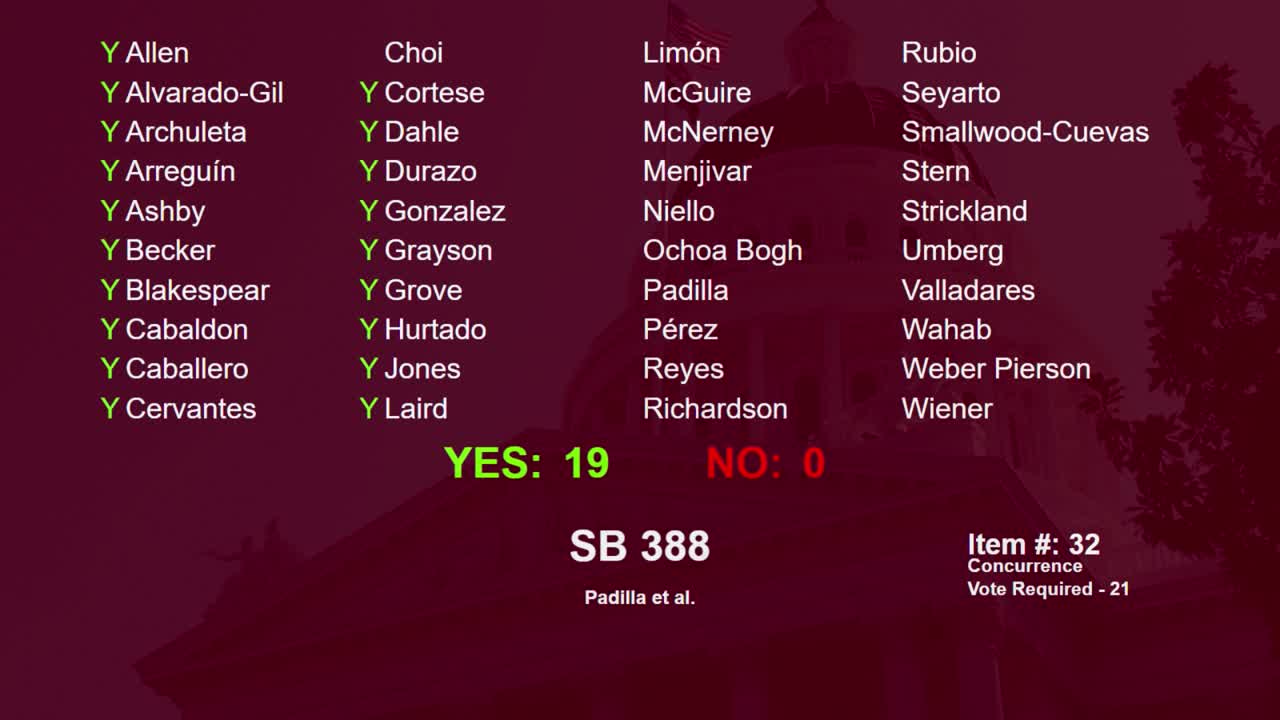 2MIN
Senate Floor
 2MIN
Assembly Floor
 21MIN
Assembly Standing Committee on Privacy and Consumer Protection
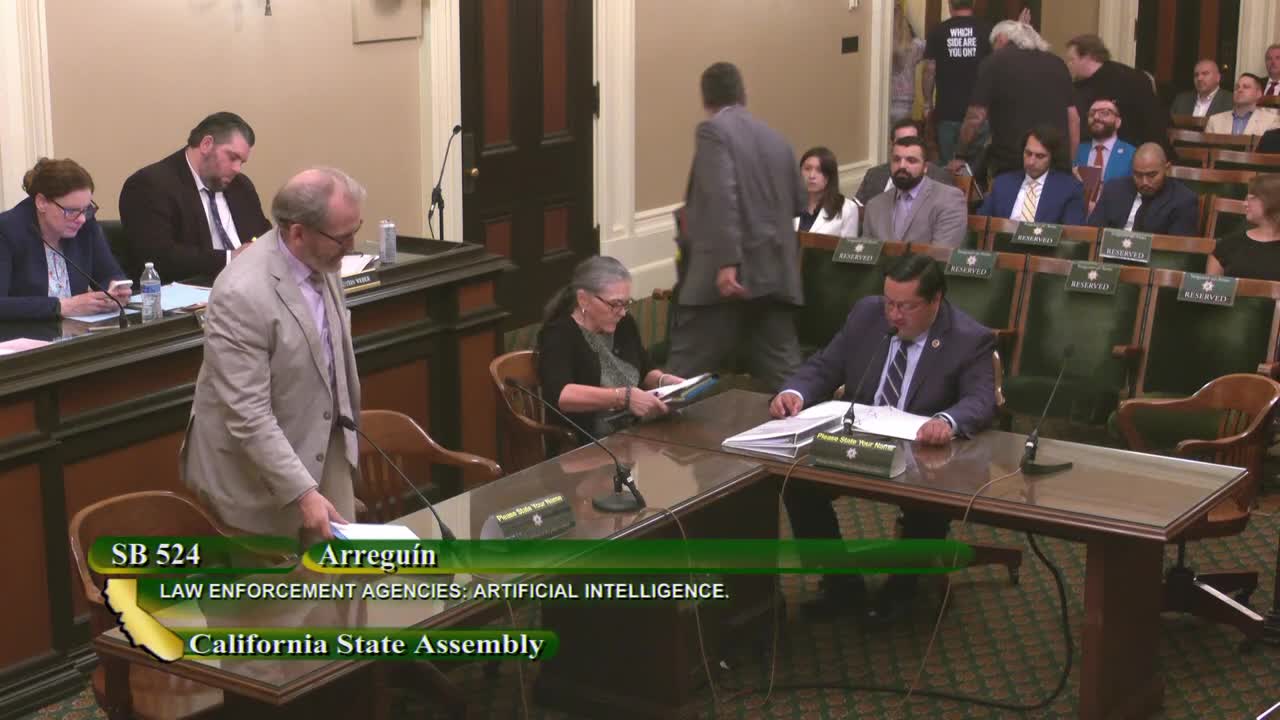 11MIN
Assembly Standing Committee on Public Safety
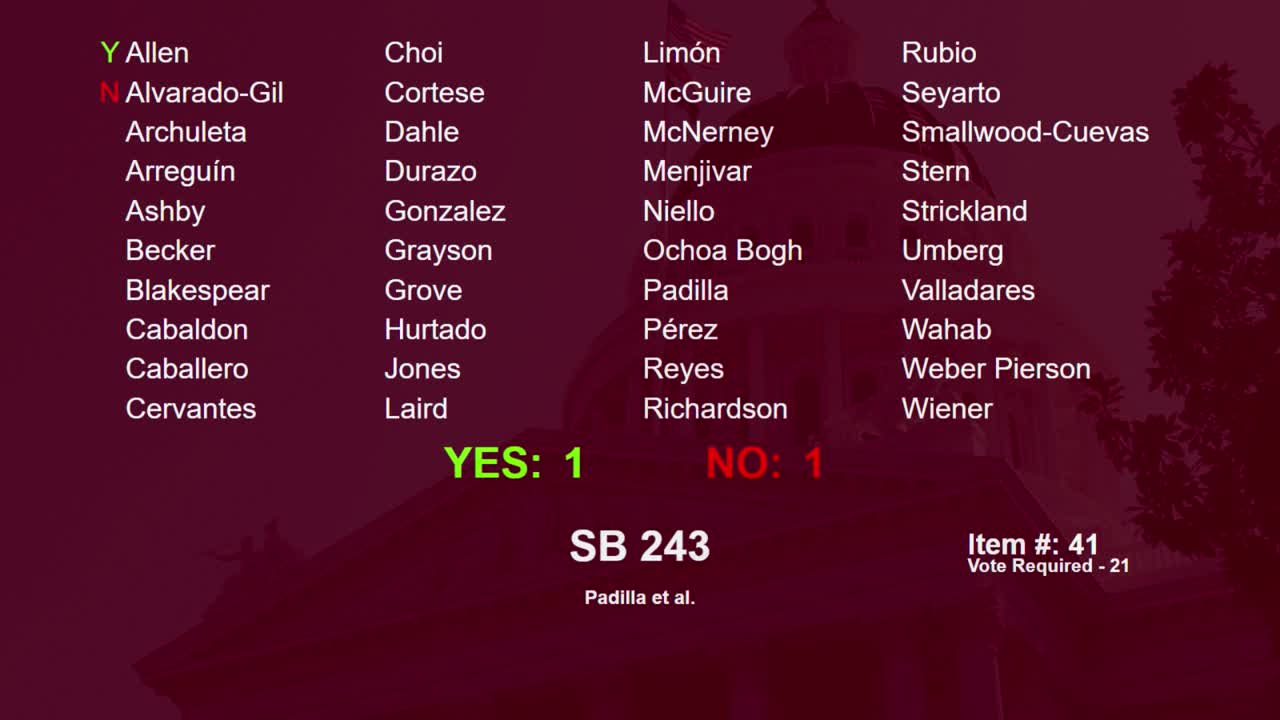 3MIN
Senate Floor
 7MIN
Senate Standing Committee on Public Safety
Bill Author

Bill Co-Author(s):