SB 526: Health facilities: clinics.
- Session Year: 2025-2026
- House: Senate
- Latest Version Date: 2026-09-27
Current Status:
Passed
(2026-09-27: Chaptered by Secretary of State. Chapter 491, Statutes of 2026.)
Introduced
In Committee
Awaiting First Chamber Vote
Passed First Chamber
In Committee
Awaiting Second Chamber Vote
Passed Second Chamber
Enacted
Existing law requires the State Department of Public Health to license and regulate clinics, as defined. A violation of these provisions is a crime. Existing law requires any person, firm, association, partnership, or corporation desiring a license for a clinic to file with the department a verified application containing, among other things, the name and address of the clinic and the class of clinic to be operated. Existing law authorizes a clinic corporation, on behalf of a primary care clinic that has held a valid, unrevoked, and unsuspended license for at least the immediately preceding 5 years, with no demonstrated history of repeated or uncorrected violations of specified provisions that pose immediate jeopardy to a patient, and that has no pending action to suspend or revoke its license, to file an affiliate clinic application to establish a primary care clinic at an additional site or a mobile health care unit, which are referred to as affiliate clinics.
Existing law requires the department, upon receipt of the completed affiliate clinic application, to approve the license for the affiliate clinic, without the necessity of first conducting an initial onsite survey if specified conditions are met, including, among other things, the clinic corporation that operates the existing licensed primary care clinic has submitted a completed affiliate clinic application and the associated application fee. Existing law refers to the existing licensed primary care clinic as the parent clinic. Existing law requires the department to issue a clinic license within 30 days of receipt of a completed affiliate clinic application.
This bill would authorize a clinic corporation on behalf of at least one primary care clinic to file an affiliate clinic application pursuant to the above-described provisions for any of its primary care clinic locations to establish a new affiliate clinic. The bill would additionally require the affiliate clinic application to be signed by an officer of the clinic corporations board of directors or the clinic corporations chief executive officer or executive director. The bill would require the department to approve a license for the affiliate clinic if the conditions described above are met and the parent clinic is not itself an affiliate clinic.
This bill would authorize a primary care clinic that has held a valid, unrevoked, and unsuspended license for at least the immediately preceding five years, with no demonstrated history of repeated or uncorrected violations of specified provisions that pose immediate jeopardy to a patient, and that has no pending action to suspend or revoke its license, to apply to the department for a change of location using the affiliate clinic application mentioned above. The bill would authorize the department to approve the application and issue an updated license, consistent with the timeline mentioned above, without the necessity of first conducting an onsite survey.
Existing law requires the department to maintain a complete corporate file containing information about each clinic corporation operating one or more affiliate clinics, including, among other things, a copy of the clinic corporations articles of incorporation and bylaws. Existing law prohibits a clinic corporation from being required to resubmit specified information as part of an affiliate clinic application, unless the information, materials, or documents are necessary to complete the corporate file.
This bill would require a clinic corporation, before the closure of a parent clinic, to submit a request to the department to establish another primary care clinic as the parent clinic. The bill would prohibit the department from requiring the clinic corporation to resubmit specified information or materials unless there are any changes to the information in the corporate file maintained by the department. The bill would require the department to approve the request consistent with the timeline mentioned above provided the new parent clinic meets all of the requirements for a parent clinic, as mentioned above.
This bill would require any changes to the information provided to the department for a clinic to be filed on forms established and furnished by the department. Because this bill would change the scope of a crime, this bill would impose a state-mandated local program.
The California Constitution requires the state to reimburse local agencies and school districts for certain costs mandated by the state. Statutory provisions establish procedures for making that reimbursement.
This bill would provide that no reimbursement is required by this act for a specified reason.
Existing law requires the State Department of Public Health to license and regulate clinics, as defined. A violation of these provisions is a crime. Existing law requires any person, firm, association, partnership, or corporation desiring a license for a clinic to file with the department a verified application containing, among other things, the name and address of the clinic and the class of clinic to be operated. Existing law authorizes a clinic corporation, on behalf of a primary care clinic that has held a valid, unrevoked, and unsuspended license for at least the immediately preceding 5 years, with no demonstrated history of repeated or uncorrected violations of specified provisions that pose immediate jeopardy to a patient, and that has no pending action to suspend or revoke its license, to file an affiliate clinic application to establish a primary care clinic at an additional site or a mobile health care unit, which are referred to as affiliate clinics.
Existing law requires the department, upon receipt of the completed affiliate clinic application, to approve the license for the affiliate clinic, without the necessity of first conducting an initial onsite survey if specified conditions are met, including, among other things, the clinic corporation that operates the existing licensed primary care clinic has submitted a completed affiliate clinic application and the associated application fee. Existing law refers to the existing licensed primary care clinic as the parent clinic. Existing law requires the department to issue a clinic license within 30 days of receipt of a completed affiliate clinic application.
This bill would authorize a clinic corporation on behalf of at least one primary care clinic to file an affiliate clinic application pursuant to the above-described provisions for any of its primary care clinic locations to establish a new affiliate clinic. The bill would additionally require the affiliate clinic application to be signed by an officer of the clinic corporations board of directors or the clinic corporations chief executive officer or executive director. The bill would require the department to approve a license for the affiliate clinic if the conditions described above are met and the parent clinic is not itself an affiliate clinic.
This bill would authorize a primary care clinic that has held a valid, unrevoked, and unsuspended license for at least the immediately preceding five years, with no demonstrated history of repeated or uncorrected violations of specified provisions that pose immediate jeopardy to a patient, and that has no pending action to suspend or revoke its license, to apply to the department for a change of location using the affiliate clinic application mentioned above. The bill would authorize the department to approve the application and issue an updated license, consistent with the timeline mentioned above, without the necessity of first conducting an onsite survey.
Existing law requires the department to maintain a complete corporate file containing information about each clinic corporation operating one or more affiliate clinics, including, among other things, a copy of the clinic corporations articles of incorporation and bylaws. Existing law prohibits a clinic corporation from being required to resubmit specified information as part of an affiliate clinic application, unless the information, materials, or documents are necessary to complete the corporate file.
This bill would require a clinic corporation, before the closure of a parent clinic, to submit a request to the department to establish another primary care clinic as the parent clinic. The bill would prohibit the department from requiring the clinic corporation to resubmit specified information or materials unless there are any changes to the information in the corporate file maintained by the department. The bill would require the department to approve the request consistent with the timeline mentioned above provided the new parent clinic meets all of the requirements for a parent clinic, as mentioned above.
This bill would require any changes to the information provided to the department for a clinic to be filed on forms established and furnished by the department. Because this bill would change the scope of a crime, this bill would impose a state-mandated local program.
The California Constitution requires the state to reimburse local agencies and school districts for certain costs mandated by the state. Statutory provisions establish procedures for making that reimbursement.
This bill would provide that no reimbursement is required by this act for a specified reason.
Under existing law,
Existing law requires the State Department of Public Health is responsible for the licensing and regulation of to license and regulate clinics, as defined. A violation of these provisions is a crime. Existing law requires any person, firm, association, partnership, or corporation desiring a license for a clinic or a special permit for special services to file with the department a verified application on forms prescribed and furnished by the department. A containing, among other things, the name and address of the clinic and the class of clinic to be operated. Existing law authorizes a clinic corporation, on behalf of a primary care clinic that has held a valid, unrevoked, and unsuspended license for at least the immediately preceding 5 years, with no demonstrated history of repeated or uncorrected violations of specified provisions that pose immediate jeopardy to a patient, and that has no pending action to suspend or revoke its license, is authorized to file an affiliate clinic application to establish a primary care clinic at an additional site or a mobile health care unit. unit, which are referred to as affiliate clinics.
Existing law requires the department, upon receipt of the completed affiliate clinic application, to approve the license for the affiliate clinic, without the necessity of first conducting an initial onsite survey if specified conditions are met, including, among other things, the clinic corporation that operates the existing licensed primary care clinic has submitted a completed affiliate clinic application and the associated application fee. Existing law refers to the existing licensed primary care clinic as the parent clinic. Existing law requires the department to issue a clinic license within 30 days of receipt of a completed affiliate clinic application.
This bill would authorize a clinic corporation on behalf of at least one primary care clinic to file an affiliate clinic application pursuant to the above-described provisions for any of its primary care clinic locations to establish a new primary care clinic at an additional site of a mobile health care unit. The bill would authorize a primary care clinic that meets the conditions for licensure as an affiliate clinic described above to file a change of location or file a change of ownership, as specified. The bill would authorize a primary clinic that meets the conditions for licensure as an affiliate cline to identify a parent clinic or designate a new parent clinic through a simple notice to the department. Because this bill would change the scope of a crime, this bill would impose a state-mandated local program. affiliate clinic. The bill would additionally require the affiliate clinic application to be signed by an officer of the clinic corporations board of directors or the clinic corporations chief executive officer or executive director. The bill would require the department to approve a license for the affiliate clinic if the conditions described above are met and the parent clinic is not itself an affiliate clinic.
This bill would authorize a primary care clinic that has held a valid, unrevoked, and unsuspended license for at least the immediately preceding five years, with no demonstrated history of repeated or uncorrected violations of specified provisions that pose immediate jeopardy to a patient, and that has no pending action to suspend or revoke its license, to apply to the department for a change of location using the affiliate clinic application mentioned above. The bill would authorize the department to approve the application and issue an updated license, consistent with the timeline mentioned above, without the necessity of first conducting an onsite survey.
Existing law requires the department to maintain a complete corporate file containing information about each clinic corporation operating one or more affiliate clinics, including, among other things, a copy of the clinic corporations articles of incorporation and bylaws. Existing law prohibits a clinic corporation from being required to resubmit specified information as part of an affiliate clinic application, unless the information, materials, or documents are necessary to complete the corporate file.
This bill would require a clinic corporation, before the closure of a parent clinic, to submit a request to the department to establish another primary care clinic as the parent clinic. The bill would prohibit the department from requiring the clinic corporation to resubmit specified information or materials unless there are any changes to the information in the corporate file maintained by the department. The bill would require the department to approve the request consistent with the timeline mentioned above provided the new parent clinic meets all of the requirements for a parent clinic, as mentioned above.
This bill would require any changes to the information provided to the department for a clinic to be filed on forms established and furnished by the department. Because this bill would change the scope of a crime, this bill would impose a state-mandated local program.
The California Constitution requires the state to reimburse local agencies and school districts for certain costs mandated by the state. Statutory provisions establish procedures for making that reimbursement.
This bill would provide that no reimbursement is required by this act for a specified reason.
Under existing law, the State Department of Public Health is responsible for the licensing and regulation of clinics, as defined. A violation of these provisions is a crime. Existing law requires any person, firm, association, partnership, or corporation desiring a license for a clinic or a special permit for special services to file with the department a verified application on forms prescribed and furnished by the department. A clinic corporation, on behalf of a primary care clinic that has held a valid, unrevoked, and unsuspended license for at least the immediately preceding 5 years, with no demonstrated history of repeated or uncorrected violations of specified provisions that pose immediate jeopardy to a patient, and that has no pending action to suspend or revoke its license, is authorized to file an affiliate clinic application to establish a primary care clinic at an additional site or a mobile health care unit.
This bill would authorize a clinic corporation on behalf of at least one primary care clinic to file an affiliate clinic application pursuant to the above-described provisions for any of its primary care clinic locations to establish a new primary care clinic at an additional site of a mobile health care unit. The bill would authorize a primary care clinic that meets the conditions for licensure as an affiliate clinic described above to file a change of location or file a change of ownership, as specified. The bill would authorize a primary clinic that meets the conditions for licensure as an affiliate cline to identify a parent clinic or designate a new parent clinic through a simple notice to the department. Because this bill would change the scope of a crime, this bill would impose a state-mandated local program.
The California Constitution requires the state to reimburse local agencies and school districts for certain costs mandated by the state. Statutory provisions establish procedures for making that reimbursement.
This bill would provide that no reimbursement is required by this act for a specified reason.
Existing law provides for the creation of the South Coast Air Quality Management District (south coast district) in those portions of the Counties of Los Angeles, Orange, Riverside, and San Bernardino included within the area of the South Coast Air Basin, as specified. Existing law provides that the south coast district is governed by a board consisting of 13 members and requires the district to adopt rules and regulations to carry out the south coast district air quality management plan that are not in conflict with state and federal laws and rules and regulations. The south coast district has adopted the Final 2021 PM10 Maintenance Plan for the South Coast Air Basin, which includes specified air quality attainment rules, including Rule 1157 (PM10 Emission Reductions from Aggregate and Related Operations) (Rule 1157). Rule 1157 establishes performance standards and specifies operational PM10 controls for aggregate and cement operations in order to minimize particulate emissions.This bill would require the south coast district board to update Rule 1157 to improve air quality and increase data collection. The bill would require the owner or operator of a covered facility, as defined, on or before January 1, 2027, to take specified actions, including maintaining fencing around the entire property fenceline that is a specified height and maintaining open storage piles no taller than 8 feet high, as provided, if the covered facility is within 500 feet of a sensitive receptor. The bill would define a sensitive receptor to mean a residence, school, park, or hospital, among other, similar facilities. The bill would require, on and after July 1, 2027, (1) the owner or operator of a covered facility with a demonstrated history of PM10 emissions at or above the threshold limit set by the south coast district and whose property line is within 500 feet of a sensitive receptor to fully enclose the existing open storage piles and (2) the south coast district to inspect the covered facility monthly until PM10 emissions remain below threshold limits for 3 consecutive months. By imposing additional duties on a local entity, the bill would impose a state-mandated local program.This bill would make legislative findings and declarations as to the necessity of a special statute for the south coast district.The California Constitution requires the state to reimburse local agencies and school districts for certain costs mandated by the state. Statutory provisions establish procedures for making that reimbursement.This bill would provide that with regard to certain mandates no reimbursement is required by this act for a specified reason.With regard to any other mandates, this bill would provide that, if the Commission on State Mandates determines that the bill contains costs so mandated by the state, reimbursement for those costs shall be made pursuant to the statutory provisions noted above.Existing law provides for the creation of the South Coast Air Quality Management District (south coast district) in those portions of the Counties of Los Angeles, Orange, Riverside, and San Bernardino included within the area of the South Coast Air Basin, as specified. Existing law provides that the south coast district is governed by a board consisting of 13 members and requires the district to adopt rules and regulations to carry out the south coast district air quality management plan that are not in conflict with state and federal laws and rules and regulations. The south coast district has adopted the Final 2021 PM10 Maintenance Plan for the South Coast Air Basin, which includes specified air quality attainment rules, including Rule 1157 (PM10 Emission Reductions from Aggregate and Related Operations) (Rule 1157). Rule 1157 establishes performance standards and specifies operational PM10 controls for aggregate and cement operations in order to minimize particulate emissions.
This bill would require the south coast district board to update Rule 1157 to improve air quality and increase data collection. The bill would require the owner or operator of a covered facility, as defined, on or before January 1, 2027, to take specified actions, including maintaining fencing around the entire property fenceline that is a specified height and maintaining open storage piles no taller than 8 feet high, as provided, if the covered facility is within 500 feet of a sensitive receptor. The bill would define a sensitive receptor to mean a residence, school, park, or hospital, among other, similar facilities. The bill would require, on and after July 1, 2027, (1) the owner or operator of a covered facility with a demonstrated history of PM10 emissions at or above the threshold limit set by the south coast district and whose property line is within 500 feet of a sensitive receptor to fully enclose the existing open storage piles and (2) the south coast district to inspect the covered facility monthly until PM10 emissions remain below threshold limits for 3 consecutive months. By imposing additional duties on a local entity, the bill would impose a state-mandated local program.
This bill would make legislative findings and declarations as to the necessity of a special statute for the south coast district.
The California Constitution requires the state to reimburse local agencies and school districts for certain costs mandated by the state. Statutory provisions establish procedures for making that reimbursement.
This bill would provide that with regard to certain mandates no reimbursement is required by this act for a specified reason.
With regard to any other mandates, this bill would provide that, if the Commission on State Mandates determines that the bill contains costs so mandated by the state, reimbursement for those costs shall be made pursuant to the statutory provisions noted above.
Existing law provides for the creation of the South Coast Air Quality Management District (south coast district) in those portions of the Counties of Los Angeles, Orange, Riverside, and San Bernardino included within the area of the South Coast Air Basin, as specified. Existing law provides that the south coast district is governed by a board consisting of 13 members and requires the district to adopt rules and regulations to carry out the south coast district air quality management plan that are not in conflict with state and federal laws and rules and regulations. The south coast district has adopted the Final 2021 PM10 Maintenance Plan for the South Coast Air Basin, which includes specified air quality attainment rules, including Rule 1157 (PM10 Emission Reductions from Aggregate and Related Operations) (Rule 1157). Rule 1157 establishes performance standards and specifies operational PM10 controls for aggregate and cement operations in order to minimize particulate emissions.
This bill would require the south coast district board to update Rule 1157 to improve air quality and increase data collection. The bill would require the owner or operator of a covered facility, as defined, on or before January 1, 2027, to take specified actions, including maintaining fencing around the entire property fenceline that is a specified height and maintaining open storage piles no taller than 8 feet high, as provided, if the covered facility is within 500 feet of a sensitive receptor. The bill would define a sensitive receptor to mean a residence, school, park, or hospital, among other, similar facilities. The bill would require, on and after July 1, 2027, (1) the owner or operator of a covered facility with a demonstrated history of PM10 emissions at or above the threshold limit set by the south coast district and whose property line is within 500 feet of a sensitive receptor to fully enclose the existing open storage piles and (2) the south coast district to inspect the covered facility monthly until PM10 emissions remain below threshold limits for 3 consecutive months. By imposing additional duties on a local entity, the bill would impose a state-mandated local program.
The California Constitution requires the state to reimburse local agencies and school districts for certain costs mandated by the state. Statutory provisions establish procedures for making that reimbursement.
This bill would provide that with regard to certain mandates no reimbursement is required by this act for a specified reason.
With regard to any other mandates, this bill would provide that, if the Commission on State Mandates determines that the bill contains costs so mandated by the state, reimbursement for those costs shall be made pursuant to the statutory provisions noted above.
(a) A clinic corporation on behalf of at least one primary care clinic that has held a valid, unrevoked, and unsuspended license for at least the immediately preceding five years, with no demonstrated history of repeated or uncorrected violations of this chapter or a regulation adopted under this chapter that pose immediate jeopardy to a patient, as defined in subdivision (i), and that has no pending action to suspend or revoke its license, may file an affiliate clinic application under this section to establish a new primary care clinic at an additional site or a mobile health care unit, either of which shall hereafter be referred to as the affiliate clinic. The department, upon receipt of the completed affiliate clinic application submitted by the clinic corporation, that is signed by an officer of the clinic corporations board of directors or the clinic corporations chief executive officer or executive director, shall approve a license for the affiliate clinic, without the necessity of first conducting an initial onsite survey, if all of the following conditions are met:
(1) The clinic corporation that operates an existing licensed primary care clinic, which shall hereafter be referred to as the parent clinic, has submitted a completed affiliate clinic application and the associated application fee on behalf of the affiliate clinic.
(2) The parent and affiliate clinics corporate officers, as specified in Section 5213 of the Corporations Code, are the same.
(3) The parent and affiliate clinics are owned and operated by the same nonprofit organization with the same board of directors.
(4) The parent and affiliate clinics have the same medical director or directors and medical policies, procedures, protocols, and standards.
(5)The parent clinic is not itself an affiliate clinic.
(b)The affiliate clinic application shall consist solely of a simple form and required supporting documents giving the following information:
(1)The name and address of the clinic corporations administrative office.
(2)The name and contact information of the clinic corporations chief executive officer or executive director.
(3)The name and address of the new affiliate primary care clinic site or the location of the new affiliate mobile health care unit.
(4)The name and contact information of the administrator of the new affiliate primary care clinic site or mobile health care unit.
(5)The expected days and hours of operation and the services to be provided at the new affiliate primary care clinic site or mobile health care unit.
(6)Evidence that the new affiliate mobile health care unit meets the requirements of the Mobile Health Care Services Act (Chapter 9 (commencing with Section 1765.101)).
(7)The type and the manufacturer of the new affiliate mobile health care unit and the proposed area or areas where the new affiliate mobile health care unit will be providing services.
(8)To the extent otherwise required by law, evidence of compliance with the minimum construction standards for adequacy and safety of the new affiliate clinics physical plant, pursuant to the OSHPD 3 requirements of the most recent version of the California Building Standards Code applicable to clinics and subdivision (b) of Section 1226. The compliance may be established in the form prescribed by Section 1226.3.
(9)Evidence of fire clearance for the new affiliate clinic site.
(10)A copy of the lease or purchase agreement for the new affiliate clinic site.
(11)A copy of the transfer agreement between the new affiliate clinic and a local hospital.
(12)A current list of clinic corporation board members.
(c)(1)(A)A primary care clinic that has held a valid, unrevoked, and unsuspended license for at least the immediately preceding five years, with no demonstrated history of repeated or uncorrected violations of this chapter or a regulation adopted under this chapter that pose immediate jeopardy to a patient, as defined in subdivision (i), and that has no pending action to suspend or revoke its license, may apply to the department for a change of location using the affiliate clinic application pursuant to subdivision (b).
(B)The department shall accept an application from a primary care clinic to change location via the affiliate clinic application pursuant to subdivision (b).
(2)Upon receipt of a completed application and application fee, the department may approve the application and issue an updated license, consistent with the timelines established in subdivision (g), without the necessity of first conducting an onsite survey.
(d)(1)A clinic corporation shall submit a request to the department to establish another primary care clinic as the parent clinic, pursuant to this section, prior to the closure of a parent clinic.
(2)Consistent with subdivision (c) of Section 1218.3, if a clinic corporation submits a request to the department pursuant to paragraph (1), the department shall not require a clinic corporation to resubmit any information, materials, or documents required by Section 1212, unless there are any changes to the information, materials, or documents in the corporate file maintained by the department pursuant to subdivision (b) of Section 1218.3.
(3)The department shall approve the request consistent with the timelines established in subdivision (g), provided the new parent clinic meets both of the following:
(A)The primary care clinic has held a valid, unrevoked, and unsuspended license for at least the immediately preceding five years, with no demonstrated history of repeated or uncorrected violations of this chapter or a regulation adopted under this chapter that pose immediate jeopardy to a patient, as defined in subdivision (i), and that has no pending action to suspend or revoke its license.
(B)The primary care clinic meets all of the conditions specified in paragraphs (1) through (4) of subdivision (a).
(e)Any changes to the information provided to the department for a clinic, pursuant to this section, shall be filed on forms established and furnished by the department.
(f)All fees required under this section shall be assessed by the department in accordance with Section 1266.
(g)The department shall issue a clinic license under this section within 30 days of receipt of a completed affiliate clinic application. If approved, a clinic license shall be issued within seven days of approval. If the department determines that an applicant does not meet the conditions stated in subdivision (a), it shall identify, in writing and with particularity, the grounds for that determination, and shall instead process the application in accordance with the time specified in Section 1218.
(h)This section shall not prohibit the department from conducting a licensing inspection of a clinic.
(i)For purposes of this section, immediate jeopardy to a patient means a situation in which the clinics noncompliance with one or more requirements of licensure has caused, or is likely to cause, serious injury, harm, impairment, or death to a patient.
SEC. 2.No reimbursement is required by this act pursuant to Section 6 of Article XIIIB of the California Constitution because the only costs that may be incurred by a local agency or school district will be incurred because this act creates a new crime or infraction, eliminates a crime or infraction, or changes the penalty for a crime or infraction, within the meaning of Section 17556 of the Government Code, or changes the definition of a crime within the meaning of Section 6 of Article XIIIB of the California Constitution.
(a) A clinic corporation on behalf of at least one primary care clinic that has held a valid, unrevoked, and unsuspended license for at least the immediately preceding five years, with no demonstrated history of repeated or uncorrected violations of this chapter or a regulation adopted under this chapter that pose immediate jeopardy to a patient, as defined in subdivision (i), and that has no pending action to suspend or revoke its license, may file an affiliate clinic application under this section to establish a new primary care clinic at an additional site or a mobile health care unit, either of which shall hereafter be referred to as the affiliate clinic. The department, upon receipt of the completed affiliate clinic application submitted by the clinic corporation, that is signed by an officer of the clinic corporations board of directors or the clinic corporations chief executive officer or executive director, shall approve a license for the affiliate clinic, without the necessity of first conducting an initial onsite survey, if all of the following conditions are met:
(1) The clinic corporation that operates an existing licensed primary care clinic, which shall hereafter be referred to as the parent clinic, has submitted a completed affiliate clinic application and the associated application fee on behalf of the affiliate clinic.
(2) The parent and affiliate clinics corporate officers, as specified in Section 5213 of the Corporations Code, are the same.
(3) The parent and affiliate clinics are owned and operated by the same nonprofit organization with the same board of directors.
(4) The parent and affiliate clinics have the same medical director or directors and medical policies, procedures, protocols, and standards.
(5)The parent clinic is not itself an affiliate clinic.
(b)The affiliate clinic application shall consist solely of a simple form and required supporting documents giving the following information:
(1)The name and address of the clinic corporations administrative office.
(2)The name and contact information of the clinic corporations chief executive officer or executive director.
(3)The name and address of the new affiliate primary care clinic site or the location of the new affiliate mobile health care unit.
(4)The name and contact information of the administrator of the new affiliate primary care clinic site or mobile health care unit.
(5)The expected days and hours of operation and the services to be provided at the new affiliate primary care clinic site or mobile health care unit.
(6)Evidence that the new affiliate mobile health care unit meets the requirements of the Mobile Health Care Services Act (Chapter 9 (commencing with Section 1765.101)).
(7)The type and the manufacturer of the new affiliate mobile health care unit and the proposed area or areas where the new affiliate mobile health care unit will be providing services.
(8)To the extent otherwise required by law, evidence of compliance with the minimum construction standards for adequacy and safety of the new affiliate clinics physical plant, pursuant to the OSHPD 3 requirements of the most recent version of the California Building Standards Code applicable to clinics and subdivision (b) of Section 1226. The compliance may be established in the form prescribed by Section 1226.3.
(9)Evidence of fire clearance for the new affiliate clinic site.
(10)A copy of the lease or purchase agreement for the new affiliate clinic site.
(11)A copy of the transfer agreement between the new affiliate clinic and a local hospital.
(12)A current list of clinic corporation board members.
(c)(1)(A)A primary care clinic that has held a valid, unrevoked, and unsuspended license for at least the immediately preceding five years, with no demonstrated history of repeated or uncorrected violations of this chapter or a regulation adopted under this chapter that pose immediate jeopardy to a patient, as defined in subdivision (i), and that has no pending action to suspend or revoke its license, may apply to the department for a change of location using the affiliate clinic application pursuant to subdivision (b).
(B)The department shall accept an application from a primary care clinic to change location via the affiliate clinic application pursuant to subdivision (b).
(2)Upon receipt of a completed application and application fee, the department may approve the application and issue an updated license, consistent with the timelines established in subdivision (g), without the necessity of first conducting an onsite survey.
(d)(1)A clinic corporation shall submit a request to the department to establish another primary care clinic as the parent clinic, pursuant to this section, prior to the closure of a parent clinic.
(2)Consistent with subdivision (c) of Section 1218.3, if a clinic corporation submits a request to the department pursuant to paragraph (1), the department shall not require a clinic corporation to resubmit any information, materials, or documents required by Section 1212, unless there are any changes to the information, materials, or documents in the corporate file maintained by the department pursuant to subdivision (b) of Section 1218.3.
(3)The department shall approve the request consistent with the timelines established in subdivision (g), provided the new parent clinic meets both of the following:
(A)The primary care clinic has held a valid, unrevoked, and unsuspended license for at least the immediately preceding five years, with no demonstrated history of repeated or uncorrected violations of this chapter or a regulation adopted under this chapter that pose immediate jeopardy to a patient, as defined in subdivision (i), and that has no pending action to suspend or revoke its license.
(B)The primary care clinic meets all of the conditions specified in paragraphs (1) through (4) of subdivision (a).
(e)Any changes to the information provided to the department for a clinic, pursuant to this section, shall be filed on forms established and furnished by the department.
(f)All fees required under this section shall be assessed by the department in accordance with Section 1266.
(g)The department shall issue a clinic license under this section within 30 days of receipt of a completed affiliate clinic application. If approved, a clinic license shall be issued within seven days of approval. If the department determines that an applicant does not meet the conditions stated in subdivision (a), it shall identify, in writing and with particularity, the grounds for that determination, and shall instead process the application in accordance with the time specified in Section 1218.
(h)This section shall not prohibit the department from conducting a licensing inspection of a clinic.
(i)For purposes of this section, immediate jeopardy to a patient means a situation in which the clinics noncompliance with one or more requirements of licensure has caused, or is likely to cause, serious injury, harm, impairment, or death to a patient.
SEC. 2.No reimbursement is required by this act pursuant to Section 6 of Article XIIIB of the California Constitution because the only costs that may be incurred by a local agency or school district will be incurred because this act creates a new crime or infraction, eliminates a crime or infraction, or changes the penalty for a crime or infraction, within the meaning of Section 17556 of the Government Code, or changes the definition of a crime within the meaning of Section 6 of Article XIIIB of the California Constitution.
(a) A clinic corporation on behalf of at least one primary care clinic that has held a valid, unrevoked, and unsuspended license for at least the immediately preceding five years, with no demonstrated history of repeated or uncorrected violations of this chapter or a regulation adopted under this chapter that pose immediate jeopardy to a patient, as defined in subdivision (f), (i), and that has no pending action to suspend or revoke its license, may file an affiliate clinic application under this section to establish a new primary care clinic at an additional site or a mobile health care unit, either of which shall hereafter be referred to as the affiliate clinic. The department, upon receipt of the completed affiliate clinic application submitted by the clinic corporation, that is signed by an officer of the clinic corporations board of directors or the clinic corporations chief executive officer or executive director, shall approve the application and issue a new license, a license for the affiliate clinic, without the necessity of first conducting an initial onsite survey, if all of the following conditions are met:
(1) The clinic corporation that operates an existing licensed primary care clinic, which shall hereafter be referred to as the parent clinic, has submitted a completed affiliate clinic application and the associated application fee on behalf of the affiliate clinic.
(2) The parent and affiliate clinics corporate officers, as specified in Section 5213 of the Corporations Code, are the same.
(3) The parent and affiliate clinics are owned and operated by the same nonprofit organization with the same board of directors.
(4) The parent and affiliate clinics have the same medical director or directors and medical policies, procedures, protocols, and standards.
(5)The parent clinic is not itself an affiliate clinic.
(b)The affiliate clinic application shall consist solely of a simple form and required supporting documents giving the following information:
(1)The name and address of the clinic corporations administrative office.
(2)The name and contact information of the clinic corporations chief executive officer or executive director.
(3)The name and address of the new affiliate primary care clinic site or the location of the new affiliate mobile health care unit.
(4)The name and contact information of the administrator of the new affiliate primary care clinic site or mobile health care unit.
(5)The expected days and hours of operation and the services to be provided at the new affiliate primary care clinic site or mobile health care unit.
(6)Evidence that the new affiliate mobile health care unit meets the requirements of the Mobile Health Care Services Act (Chapter 9 (commencing with Section 1765.101)).
(7)The type and the manufacturer of the new affiliate mobile health care unit and the proposed area or areas where the new affiliate mobile health care unit will be providing services.
(8)To the extent otherwise required by law, evidence of compliance with the minimum construction standards for adequacy and safety of the new affiliate clinics physical plant, pursuant to the OSHPD 3 requirements of the most recent version of the California Building Standards Code applicable to clinics and subdivision (b) of Section 1226. The compliance may be established in the form prescribed by Section 1226.3.
(9)Evidence of fire clearance for the new affiliate clinic site.
(10)A copy of the lease or purchase agreement for the new affiliate clinic site.
(11)A copy of the transfer agreement between the new affiliate clinic and a local hospital.
(12)A current list of clinic corporation board members.
(c)The affiliate clinic application shall be signed by an officer of the clinic corporations board of directors or the clinic corporations chief executive officer or executive director.(c)(1)(A)A primary care clinic that has held a valid, unrevoked, and unsuspended license for at least the immediately preceding five years, with no demonstrated history of repeated or uncorrected violations of this chapter or a regulation adopted under this chapter that pose immediate jeopardy to a patient, as defined in subdivision (i), and that has no pending action to suspend or revoke its license, may apply to the department for a change of location using the affiliate clinic application pursuant to subdivision (b).
(B)The department shall accept an application from a primary care clinic to change location via the affiliate clinic application pursuant to subdivision (b).
(2)Upon receipt of a completed application and application fee, the department may approve the application and issue an updated license, consistent with the timelines established in subdivision (g), without the necessity of first conducting an onsite survey.
(d)(1)A clinic corporation shall submit a request to the department to establish another primary care clinic as the parent clinic, pursuant to this section, prior to the closure of a parent clinic.
(2)Consistent with subdivision (c) of Section 1218.3, if a clinic corporation submits a request to the department pursuant to paragraph (1), the department shall not require a clinic corporation to resubmit any information, materials, or documents required by Section 1212, unless there are any changes to the information, materials, or documents in the corporate file maintained by the department pursuant to subdivision (b) of Section 1218.3.
(3)The department shall approve the request consistent with the timelines established in subdivision (g), provided the new parent clinic meets both of the following:
(A)The primary care clinic has held a valid, unrevoked, and unsuspended license for at least the immediately preceding five years, with no demonstrated history of repeated or uncorrected violations of this chapter or a regulation adopted under this chapter that pose immediate jeopardy to a patient, as defined in subdivision (i), and that has no pending action to suspend or revoke its license.
(B)The primary care clinic meets all of the conditions specified in paragraphs (1) through (4) of subdivision (a).
(e)Any changes to the information provided to the department for a clinic, pursuant to this section, shall be filed on forms established and furnished by the department.
(f)All fees required under this section shall be assessed by the department in accordance with Section 1266.
(d)(g)The department shall issue a clinic license under this section within 30 days of receipt of a completed affiliate clinic application. If approved, a clinic license shall be issued within seven days of approval. If the department determines that an applicant does not meet the conditions stated in subdivision (a), it shall identify, in writing and with particularity, the grounds for that determination, and shall instead process the application in accordance with the time specified in Section 1218.
(e)Nothing in this(h)This section shall not prohibit the department from conducting a licensing inspection of the affiliate clinic at any time after receipt of the completed affiliate clinic application. a clinic.
(f)(i)For purposes of this section, immediate jeopardy to a patient means a situation in which the clinics noncompliance with one or more requirements of licensure has caused, or is likely to cause, serious injury, harm, impairment, or death to a patient.
SEC. 2.Section 1218.15 is added to the Health and Safety Code, to read:1218.15.(a)A primary care clinic that meets the conditions for licensure as an affiliate clinic in paragraphs (2) to (4), inclusive, of subdivision (a) of Section 1218.1, regardless of when it was licensed or whether it was initially licensed using the affiliate process described in Section 1218.1, may do either of the following using the process described in subdivisions (b) to (d), inclusive, of Section 1218.1:(1)File a change of location.(2)File a change of ownership, provided that the clinic corporation acquiring ownership meets the requirements of a parent clinic in subdivision (a) of Section 1218.1.(b)(1)A primary care clinic that meets the conditions for licensure as an affiliate clinic in paragraphs (2) to (4), inclusive, of subdivision (a) of Section 1218.1, regardless of when it was licensed or whether it was initially licensed using the affiliate process described in Section 1218.1, shall be permitted to identify a parent clinic through a simple notice to the department.(2)If primary care clinic described in paragraph (1) identifies a parent clinic that subsequently closes or surrenders its license, the clinic corporation may designate a new parent clinic that meets the requirements of this section through a simple notice to the department.SEC. 3.SEC. 2.No reimbursement is required by this act pursuant to Section 6 of Article XIIIB of the California Constitution because the only costs that may be incurred by a local agency or school district will be incurred because this act creates a new crime or infraction, eliminates a crime or infraction, or changes the penalty for a crime or infraction, within the meaning of Section 17556 of the Government Code, or changes the definition of a crime within the meaning of Section 6 of Article XIIIB of the California Constitution.
(a) A clinic corporation on behalf of a at least one primary care clinic that has held a valid, unrevoked, and unsuspended license for at least the immediately preceding five years, with no demonstrated history of repeated or uncorrected violations of this chapter or a regulation adopted under this chapter that pose immediate jeopardy to a patient, as defined in subdivision (f), and that has no pending action to suspend or revoke its license, may file an affiliate clinic application under this section to establish a new primary care clinic at an additional site or a mobile health care unit, either of which shall hereafter be referred to as the affiliate clinic. The department, upon receipt of the completed affiliate clinic application submitted by the clinic corporation, shall approve a license for the affiliate clinic, the application and issue a new license, without the necessity of first conducting an initial onsite survey, if all of the following conditions are met:
(1) The clinic corporation that operates the an existing licensed primary care clinic, which shall hereafter be referred to as the parent clinic, has submitted a completed affiliate clinic application and the associated application fee. fee on behalf of the affiliate clinic.
(2) The parent and affiliate clinics corporate officers, as specified in Section 5213 of the Corporations Code, are the same.
(3) The parent and affiliate clinics are owned and operated by the same nonprofit organization with the same board of directors.
(4) The parent and affiliate clinics have the same medical director or directors and medical policies, procedures, protocols, and standards.
(b)The affiliate clinic application shall consist solely of a simple form and required supporting documents giving the following information:
(1)The name and address of the clinic corporations administrative office.
(2)The name and contact information of the clinic corporations chief executive officer or executive director.
(3)The name and address of the new affiliate primary care clinic site or the location of the new affiliate mobile health care unit.
(4)The name and contact information of the administrator of the new affiliate primary care clinic site or mobile health care unit.
(5)The expected days and hours of operation and the services to be provided at the new affiliate primary care clinic site or mobile health care unit.
(6)Evidence that the new affiliate mobile health care unit meets the requirements of the Mobile Health Care Services Act (Chapter 9 (commencing with Section 1765.101)).
(7)The type and the manufacturer of the new affiliate mobile health care unit and the proposed area or areas where the new affiliate mobile health care unit will be providing services.
(8)To the extent otherwise required by law, evidence of compliance with the minimum construction standards for adequacy and safety of the new affiliate clinics physical plant, pursuant to the OSHPD 3 requirements of the most recent version of the California Building Standards Code applicable to clinics and subdivision (b) of Section 1226. The compliance may be established in the form prescribed by Section 1226.3.
(9)Evidence of fire clearance for the new affiliate clinic site.
(10)A copy of the lease or purchase agreement for the new affiliate clinic site.
(11)A copy of the transfer agreement between the new affiliate clinic and a local hospital.
(12)A current list of clinic corporation board members.
(c)The affiliate clinic application shall be signed by an officer of the clinic corporations board of directors or the clinic corporations chief executive officer or executive director.
(d)The department shall issue a clinic license under this section within 30 days of receipt of a completed affiliate clinic application. If approved, a clinic license shall be issued within seven days of approval. If the department determines that an applicant does not meet the conditions stated in subdivision (a), it shall identify, in writing and with particularity, the grounds for that determination, and shall instead process the application in accordance with the time specified in Section 1218.
(e)Nothing in this section shall prohibit the department from conducting a licensing inspection of the affiliate clinic at any time after receipt of the completed affiliate clinic application.
(f)For purposes of this section, immediate jeopardy to a patient means a situation in which the clinics noncompliance with one or more requirements of licensure has caused, or is likely to cause, serious injury, harm, impairment, or death to a patient.
SEC. 2.Section 1218.15 is added to the Health and Safety Code, to read:1218.15.(a)A primary care clinic that meets the conditions for licensure as an affiliate clinic in paragraphs (2) to (4), inclusive, of subdivision (a) of Section 1218.1, regardless of when it was licensed or whether it was initially licensed using the affiliate process described in Section 1218.1, may do either of the following using the process described in subdivisions (b) to (d), inclusive, of Section 1218.1:
(1)File a change of location.
(2)File a change of ownership, provided that the clinic corporation acquiring ownership meets the requirements of a parent clinic in subdivision (a) of Section 1218.1.
(b)(1)A primary care clinic that meets the conditions for licensure as an affiliate clinic in paragraphs (2) to (4), inclusive, of subdivision (a) of Section 1218.1, regardless of when it was licensed or whether it was initially licensed using the affiliate process described in Section 1218.1, shall be permitted to identify a parent clinic through a simple notice to the department.
(2)If primary care clinic described in paragraph (1) identifies a parent clinic that subsequently closes or surrenders its license, the clinic corporation may designate a new parent clinic that meets the requirements of this section through a simple notice to the department.
SEC. 3.No reimbursement is required by this act pursuant to Section 6 of Article XIIIB of the California Constitution because the only costs that may be incurred by a local agency or school district will be incurred because this act creates a new crime or infraction, eliminates a crime or infraction, or changes the penalty for a crime or infraction, within the meaning of Section 17556 of the Government Code, or changes the definition of a crime within the meaning of Section 6 of Article XIIIB of the California Constitution.
SECTION 1.Section 40458.7 is added to the Health and Safety Code, to read:40458.7.(a)For the purposes of this section, the following definitions apply(1)Covered facility means permanent and temporary aggregate operations.(2)Fence-line monitoring system means equipment that measures and records air pollutant concentrations at or adjacent to a covered facility that can provide continuous direct reading near real time ambient monitoring of PM10 concentrations.(3)Sensitive receptors means one or more of the following:(A)A residence, including, but not limited to, a private home, apartment condominium unit, group home, dormitory unit, or retirement home.(B)A school, including, but not limited to, a preschool, prekindergarten, or school maintaining kindergarten or any grades 1 to 12, inclusive.(C)A daycare facility, including, but not limited to, in-home daycare.(D)Publicly owned parks, playgrounds, and recreational areas or facilities primarily used by children.(E)Nursing homes, long-term care facilities, hospices, convalescent facilities, or similar live-in housing.(F)A hospital, as defined in Section 128700.(b)Notwithstanding any other law, the south coast district board shall update Rule 1157 PM10 Emission Reductions from Aggregate and Related Operations to improve air quality and increase data collection. The updated rule shall include, but not limited to, the following:(1)(A)On or before January 1, 2027, the owner or operator of a covered facility shall do the following:(i)Maintain fencing around the entire property fenceline that is at least 6 inches taller than the height of the tallest open storage pile.(ii)Maintain open storage piles no taller than 8 feet high throughout the entire property if the property line of the covered facility is within 500 feet of a sensitive receptor.(iii)Develop, install, operate, and maintain a fence-line monitoring system in accordance with guidance developed by the south coast district.(iv)Cease all activities and implement dust mitigation measures if PM10 emissions reach the threshold limit in accordance with guidance developed by the south coast district.(v)Display prominent signage visible to the general public on the perimeter of the property line in accordance with guidance developed by the south coast district informing the public of the south coast districts Rule 1157, discharges that would be in violation of the rule, and information about the south coast districts complaint submission processes.(B)If the threshold limit has been met or exceeded for PM10 emissions, the owner or operator of a covered facility shall inform the south coast district in accordance with guidance developed by the south coast district.(C)If the threshold limit has been met or exceeded for PM10 emissions, the owner or operator of a covered facility shall provide public notice in accordance with guidance developed by the south coast district.(2)On and after July 1, 2027, the following shall apply to a covered facility with a demonstrated history of PM10 emissions at or above the threshold limit set by the south coast district and whose property line is within 500 feet of a sensitive receptor:(A)The owner or operator of the covered facility shall fully enclose the existing open storage piles.(B)The south coast district shall inspect the covered facility monthly until PM10 emissions remain below threshold limits for three consecutive months.SEC. 2.The Legislature finds and declares that a special statute is necessary and that a general statute cannot be made applicable within the meaning of Section 16 of Article IV of the California Constitution because of the unique air quality concerns in the South Coast Air Basin.SEC. 3.No reimbursement is required by this act pursuant to Section 6 of Article XIIIB of the California Constitution because a local agency or school district has the authority to levy service charges, fees, or assessments sufficient to pay for the program or level of service mandated by this act, within the meaning of Section 17556 of the Government Code.However, if the Commission on State Mandates determines that this act contains other costs mandated by the state, reimbursement to local agencies and school districts for those costs shall be made pursuant to Part 7 (commencing with Section 17500) of Division 4 of Title 2 of the Government Code.(a)For the purposes of this section, the following definitions apply
(1)Covered facility: facility means permanent and temporary aggregate operations.
(2)Fence-line monitoring system means equipment that measures and records air pollutant concentrations at or adjacent to a permanent and temporary aggregate operation covered facility that can provide continuous direct reading near real time ambient monitoring of PM10 concentrations.
(3)Sensitive receptors means one or more of the following:
(A)A residence, including, but not limited to, a private home, apartment condominium unit, group home, dormitory unit, or retirement home.
(B)A school, including, but not limited to, a preschool, prekindergarten, or school maintaining kindergarten or any grades 1 to 12, inclusive.
(C)A daycare facility, including, but not limited to, in-home daycare.
(D)Publicly owned parks, playgrounds, and recreational areas or facilities primarily used by children.
(E)Nursing homes, long-term care facilities, hospices, convalescent facilities, or similar live-in housing.
(F)A hospital, as defined in Section 128700.
(b)Notwithstanding any other law, the south coast district board shall update Rule 1157 PM10 Emission Reductions from Aggregate and Related Operations to improve air quality and increase data collection. The updated rule shall include, but not limited to, the following:
(1)(A)On or before January 1, 2027, the owner or operator of a covered facility shall do the following:
(i)Maintain fencing around the entire property fenceline that is at least 6 inches taller than the height of the tallest open storage pile.
(ii)Maintain open storage piles no taller than 8 feet high throughout the entire property if the property line of the covered facility is within 500 feet of a sensitive receptor.
(iii)Develop, install, operate, and maintain a fence-line monitoring system in accordance with guidance developed by the south coast district.
(iv)Cease all activities and implement dust mitigation measures if PM10 emissions reach the threshold limit in accordance with guidance developed by the south coast district.
(v)Display prominent signage visible to the general public on the perimeter of the property line in accordance with guidance developed by the south coast district informing the public of the south coast districts Rule 1157, discharges that would be in violation of the rule, and information about the south coast districts complaint submission processes.
(B)If the threshold limit has been met or exceeded for PM10 emissions, the owner or operator of a covered facility shall inform the south coast district in accordance with guidance developed by the south coast district.
(C)If the threshold limit has been met or exceeded for PM10 emissions, the owner or operator of a covered facility shall provide public notice in accordance with guidance developed by the south coast district.
(2)On and after July 1, 2027, the following shall apply to a covered facility with a demonstrated history of PM10 emissions at or above the threshold limit set by the south coast district and whose property line is within 500 feet of a sensitive receptor:
(A)The owner or operator of the covered facility shall fully enclose the existing open storage piles.
(B)The south coast district shall inspect the covered facility monthly until PM10 emissions remain below threshold limits for three consecutive months.
SEC. 2.The Legislature finds and declares that a special statute is necessary and that a general statute cannot be made applicable within the meaning of Section 16 of Article IV of the California Constitution because of the unique air quality concerns in the South Coast Air Basin.
SEC. 2.SEC. 3.No reimbursement is required by this act pursuant to Section 6 of Article XIIIB of the California Constitution because a local agency or school district has the authority to levy service charges, fees, or assessments sufficient to pay for the program or level of service mandated by this act, within the meaning of Section 17556 of the Government Code.
However, if the Commission on State Mandates determines that this act contains other costs mandated by the state, reimbursement to local agencies and school districts for those costs shall be made pursuant to Part 7 (commencing with Section 17500) of Division 4 of Title 2 of the Government Code.
(a)For the purposes of this section, the following definitions apply
(1)Covered facility: means permanent and temporary aggregate operations.
(2)Fence-line monitoring system means equipment that measures and records air pollutant concentrations at or adjacent to a permanent and temporary aggregate operation that can provide continuous direct reading near real time ambient monitoring of PM10 concentrations.
(3)Sensitive receptors means one or more of the following:
(A)A residence, including, but not limited to, a private home, apartment condominium unit, group home, dormitory unit, or retirement home.
(B)A school, including, but not limited to, a preschool, prekindergarten, or school maintaining kindergarten or any grades 1 to 12, inclusive.
(C)A daycare facility, including, but not limited to, in-home daycare.
(D)Publicly owned parks, playgrounds, and recreational areas or facilities primarily used by children.
(E)Nursing homes, long-term care facilities, hospices, convalescent facilities, or similar live-in housing.
(F)A hospital, as defined in Section 128700.
(b)Notwithstanding any other law, the south coast district board shall update Rule 1157 PM10 Emission Reductions from Aggregate and Related Operations to improve air quality and increase data collection. The updated rule shall include, but not limited to, the following:
(1)(A)On or before January 1, 2027, the owner or operator of a covered facility shall do the following:
(i)Maintain fencing around the entire property fenceline that is at least 6 inches taller than the height of the tallest open storage pile.
(ii)Maintain open storage piles no taller than 8 feet high throughout the entire property if the property line of the covered facility is within 500 feet of a sensitive receptor.
(iii)Develop, install, operate, and maintain a fence-line monitoring system in accordance with guidance developed by the south coast district.
(iv)Cease all activities and implement dust mitigation measures if PM10 emissions reach the threshold limit in accordance with guidance developed by the south coast district.
(B)If the threshold limit has been met or exceeded for PM10 emissions, the owner or operator of a covered facility shall inform the south coast district in accordance with guidance developed by the south coast district.
(C)If the threshold limit has been met or exceeded for PM10 emissions, the owner or operator of a covered facility shall provide public notice in accordance with guidance developed by the south coast district.
(2)On and after July 1, 2027, the following shall apply to a covered facility with a demonstrated history of PM10 emissions at or above the threshold limit set by the south coast district and whose property line is within 500 feet of a sensitive receptor:
(A)The owner or operator of the covered facility shall fully enclose the existing open storage piles.
(B)The south coast district shall inspect the covered facility monthly until PM10 emissions remain below threshold limits for three consecutive months.
SEC. 2.No reimbursement is required by this act pursuant to Section 6 of Article XIIIB of the California Constitution because a local agency or school district has the authority to levy service charges, fees, or assessments sufficient to pay for the program or level of service mandated by this act, within the meaning of Section 17556 of the Government Code.
However, if the Commission on State Mandates determines that this act contains other costs mandated by the state, reimbursement to local agencies and school districts for those costs shall be made pursuant to Part 7 (commencing with Section 17500) of Division 4 of Title 2 of the Government Code.
|
Date
|
Status
|
|---|---|
| Sep 27, 2026 | Chaptered by Secretary of State. Chapter 491, Statutes of 2026. |
| Sep 27, 2026 | Approved by the Governor. |
| Sep 4, 2026 | Enrolled and presented to the Governor at 2 p.m. |
| Aug 28, 2026 | Assembly amendments concurred in. (Ayes 39. Noes 0. Page 6068.) Ordered to engrossing and enrolling. |
| Aug 28, 2026 | Assembly amendments concurred in. (Ayes 39. Noes 0.) Ordered to engrossing and enrolling. |
| Aug 27, 2026 | From committee: That the Assembly amendments be concurred in. (Ayes 9. Noes 0. Page 6046.) |
| Aug 27, 2026 | From committee: That the Assembly amendments be concurred in. (Ayes 9. Noes 0.) |
| Aug 25, 2026 | From committee: Be re-referred to Com. on HEALTH pursuant to Senate Rule 29.10(d). (Ayes 5. Noes 0. Page 5725.) Re-referred to Com. on HEALTH. |
| Aug 25, 2026 | From committee: Be re-referred to Com. on HEALTH pursuant to Senate Rule 29.10(d). (Ayes 5. Noes 0.) Re-referred to Com. on HEALTH. |
| Aug 25, 2026 | Re-referred to Com. on RLS. pursuant to Senate Rule 29.10(d). |
| Aug 24, 2026 | In Senate. Concurrence in Assembly amendments pending. |
| Aug 24, 2026 | Read third time. Passed. (Ayes 62. Noes 8. Page 6386.) Ordered to the Senate. |
| Aug 24, 2026 | Read third time. Passed. Ordered to the Senate. |
| Aug 19, 2026 | Ordered to third reading. |
| Aug 19, 2026 | Read third time and amended. |
| Aug 13, 2026 | Read second time. Ordered to third reading. |
| Aug 13, 2026 | From committee: Do pass. (Ayes 11. Noes 2.) (August 13). |
| Aug 13, 2026 | Assembly Rule 63 suspended. |
| Aug 5, 2026 | August 5 set for first hearing. Placed on suspense file. |
| Jul 1, 2026 | From committee: Do pass and re-refer to Com. on APPR. (Ayes 12. Noes 2.) (June 30). Re-referred to Com. on APPR. |
| Jun 15, 2026 | Re-referred to Com. on HEALTH pursuant to Assembly Rule 96. |
| Jun 11, 2026 | From committee with author's amendments. Read second time and amended. Re-referred to Com. on NAT. RES. |
| Jun 16, 2025 | Referred to Com. on NAT. RES. |
| Jun 5, 2025 | In Assembly. Read first time. Held at Desk. |
| Jun 4, 2025 | Read third time. Passed. (Ayes 25. Noes 10. Page 1494.) Ordered to the Assembly. |
| Jun 4, 2025 | Amendments by Senator Strickland tabled on motion of Senator Gonzalez. (Ayes 29. Noes 10. Page 1494.) |
| May 23, 2025 | Read second time. Ordered to third reading. |
| May 23, 2025 | From committee: Do pass. (Ayes 5. Noes 1. Page 1203.) (May 23). |
| May 16, 2025 | Set for hearing May 23. |
| May 12, 2025 | May 12 hearing: Placed on APPR. suspense file. |
| May 2, 2025 | Set for hearing May 12. |
| Apr 29, 2025 | Read second time and amended. Re-referred to Com. on APPR. |
| Apr 28, 2025 | From committee: Do pass as amended and re-refer to Com. on APPR. (Ayes 6. Noes 1. Page 867.) (April 23). |
| Apr 2, 2025 | Set for hearing April 23. |
| Mar 28, 2025 | April 2 set for first hearing canceled at the request of author. |
| Mar 11, 2025 | Set for hearing April 2. |
| Mar 5, 2025 | Referred to Com. on E.Q. |
| Feb 21, 2025 | From printer. May be acted upon on or after March 23. |
| Feb 20, 2025 | Introduced. Read first time. To Com. on RLS. for assignment. To print. |
|
Date
|
Description
|
Location
|
Votes
|
|
|---|---|---|---|---|
| Aug 28, 2026 | Unfinished Business SB526 Pérez Concurrence | Senate Floor |
Passed |
|
| Aug 27, 2026 | That the Assembly amendments be concurred in | Senate Standing Committee on Health |
Passed |
|
| Aug 24, 2026 | SB 526 Pérez Senate Third Reading By Aguiar-Curry | Assembly Floor |
Passed |
|
| Aug 13, 2026 | Do pass. | Assembly Standing Committee on Appropriations |
Passed |
|
| Jun 30, 2026 | Do pass and be re-referred to the Committee on [Appropriations] | Assembly Standing Committee on Health |
Passed |
|
| Jun 4, 2025 | Senate 3rd Reading SB526 Menjivar et al. | Senate Floor |
Passed |
|
| May 23, 2025 | Do pass | Senate Standing Committee on Appropriations |
Passed |
|
| May 12, 2025 | Placed on suspense file | Senate Standing Committee on Appropriations |
Passed |
|
| Apr 23, 2025 | Do pass as amended, but first amend, and re-refer to the Committee on [Appropriations] | Senate Standing Committee on Environmental Quality |
Passed |
This list shows positions taken on this bill by organizations on the date displayed, which is linked to the original source.
Positions by individuals are not included.
|
Organization
|
Position
|
Date
|
|---|---|---|
| BOMA California | ** Against | |
| California Asphalt Pavement Association | ** Against | |
| California Business Properties Association | ** Against | |
| California Chamber Of Commerce | ** Against | |
| CALIFORNIA CONSTRUCTION & INDUSTRIAL MATERIALS ASSOCIATION | ** Against | |
| California Manufacturers & Technology Association | ** Against | |
| CALIFORNIA PRIMARY CARE ASSOCIATION ADVOCATES | ** Support | |
| CALIFORNIA PRIMARY CARE ASSOCIATION ADVOCATES | ** Support | |
| California Retailers Association | ** Against | |
| Center For Environmental Health | ** Support | |
| cleanearth4kids.org | ** Support | |
| Climate Reality Project, Bay Area Chapter | ** Support | |
| Climate Reality Project, Los Angeles Chapter | ** Support | |
| Climate Reality Project, Orange County | ** Support | |
| Climate Reality Project San Diego | ** Support | |
| Climate Reality Project, San Fernando Valley | ** Support | |
| Coalition For Clean Air | ** Support | |
| Industrial Environmental Association | ** Against | |
| International Union of Operating Engineers, Cal-Nevada Conference | ** Against | |
| Naiop California | ** Against | |
| Planned Parenthood Affiliates Of California | ** Support | |
| Planned Parenthood Affiliates Of California | ** Support | |
| Sierra Club | ** Support | |
| State Building & Construction Trades Council Of California | ** Against | |
| Union Of Concerned Scientists | ** Support |
SENATE RULES COMMITTEE Office of Senate Floor Analyses (916) 651-4171 | SB 526 |
UNFINISHED BUSINESS
Bill No: SB 526
Author: Pérez (D)
Amended: 8/19/26
Vote: 21
SENATE HEALTH COMMITTEE: 9-0, 8/27/26
AYES: Weber Pierson, Valladares, Caballero, Gonzalez, Menjivar, Padilla, Pérez, Rubio, Smallwood-Cuevas
NO VOTE RECORDED: Durazo, Grove
ASSEMBLY FLOOR: 62-8, 8/24/26 - See last page for vote
SUBJECT: Health facilities: clinics
SOURCE: California Primary Care Association Advocates (co-source)
Planned Parenthood Affiliates of California (co-source)
DIGEST:
This bill (1) permits a primary care clinic with a license in good standing for the preceding five years to apply for a change of location using the streamlined affiliate clinic licensure process; and, (2) requires a clinic corporation to establish another primary care clinic as the parent clinic prior to the closure of a parent clinic.
Assembly Amendments
delete the version of this bill passed by the Senate, and inserted the current provisions related to clinic licensure.
ANALYSIS:
Existing law:
- Licenses and regulates clinics, including primary care clinics and specialty clinics, by the California Department of Public Health (CDPH). [Health & Safety Code (HSC) §1200, et seq.]
- Defines a primary care clinic as either a “community clinic,” which is required to be operated by a non-profit corporation and to use a sliding fee scale to charge patients based on their ability to pay, or a “free clinic,” which is also required to be operated by a non-profit but is not allowed to directly charge patients for services rendered or for any drugs, medicines, or apparatuses furnished. [HSC §1204]
- Exempts various types of clinics from licensure and regulation by CDPH, including: any place or establishment operated as a clinic or office by one or more licensed health care practitioners and used as an office for the practice of their profession, within the scope of their license; clinics operated by the federal government, the state, counties, or a federally recognized Indian tribe on tribal land; a clinic operated by any institution of learning that teaches a healing art; medical foundation clinics; and, the offices of physicians in group practice who provide the preponderance of their services to members of a health plan. [HSC §1206]
- Exempts from licensure by CDPH an intermittent clinic that is operated by a licensed primary care community clinic on separate premises from the licensed clinic and is only open for limited services of no more than 40 hours each week. However, an intermittent clinic operated under this exemption is still required to meet all other requirements of law, including administrative regulations and requirements, pertaining to fire and life safety. [HSC §1206(h)]
- Permits a primary care clinic that has held a valid license for at least the immediately preceding five years, with no history of repeated or uncorrected violations that pose immediate jeopardy to a patient, to file an affiliate clinic application to establish a primary care clinic at an additional site, and requires CDPH upon receipt of the completed affiliate clinic application, to approve a license for the affiliate clinic, without the necessity of first conducting an initial onsite survey, if certain conditions are met, including evidence of compliance with minimum construction standards for adequacy and safety of the new affiliate clinic’s physical plant. [HSC §1218.1]
- Specifies that the licensed primary care clinic operated by the clinic corporation that has applied for an affiliate clinic license be referred to as the “parent clinic.” [HSC §1218.1(a)(1)]
- Requires CDPH to issue a clinic license under the affiliate application process described in 5) above within 30 days of receipt of a completed affiliate clinic application. Specifies that nothing in the affiliate application process prohibits CDPH from conducting a licensing inspection of the affiliate clinic at any time after receipt of the completed affiliate clinic application. [HSC §1218.1(d) and (e)]
This bill:
- Permits a primary care clinic that has held a valid license for at least the immediately preceding five years, with no history of repeated or uncorrected violations that pose immediate jeopardy to a patient, to apply to CDPH for a change of location using the affiliate clinic application as described in Existing Law 5) above.
- Permits CDPH to approve the change of location application and issue an updated license, consistent with the 30-day timeline specified for the affiliate license application process, without the necessity of first conducting an onsite survey.
- Requires a clinic corporation to submit a request to CDPH to establish another primary care clinic as the parent clinic prior to the closure of a parent clinic. Prohibits CDPH, if a clinic corporation submits a request to establish another primary care clinic as the parent clinic, from requiring a clinic corporation to resubmit any information, materials, or documents required under specified provisions of existing law, unless there are any changes to the information, materials, or documents in the corporate file maintained by CDPH, as specified.
- Requires CDPH to approve the request to establish another primary care clinic as the parent clinic consistent with the 30-day timeline specified for the affiliate application process, as long as the new parent clinic meets both of the following:
- The primary care clinic has held a valid, unrevoked, and unsuspended license for at least the immediately preceding five years, with no demonstrated history of repeated or uncorrected violations that pose immediate jeopardy to a patient; and,
- The primary care clinic has the same corporate officers, are operated by the same nonprofit with the same board of directors, and have the same medical director or directors and medical policies, procedures, protocols, and standards.
- Make various technical and clarifying changes to the affiliate clinic licensure process, including specifying that an affiliate clinic cannot be the parent clinic.
Background
According to the author of this bill:
Licensing an affiliate community health center is a complicated and time-consuming process. In response, SB 442 (Ducheny, Chapter 502, Statutes of 2010) required CDPH to develop a clinic “affiliate” expedited licensure process. Unfortunately, this expedited licensure process is not available to long standing clinics in existence before SB 442 took effect, even if they meet the criteria to qualify to pursue this process. An example of this problem is depicted with Planned Parenthood Pasadena and San Gabriel Valley’s (PPPSGV) effort to set up a new flagship location in Pasadena. Although PPPSGV meets requirements, it cannot pursue this licensing process because the original health center was not licensed under the newer affiliate licensing process. While PPPSGV can apply for an affiliate license as a new location, the administrative and fiscal challenges associated with licensing a new health center pose significant lapses in continuation of care and jobs. This dynamic will not only impact PPPSGV, but other good standing health centers. This bill clarifies that a health center that meets the requirements for the existing affiliate licensing process may utilize it, regardless of when health center was initially licensed.
Affiliate clinic licensure. SB 442 streamlined provisions related to primary care clinic affiliate licensure. Under SB 442, a primary care clinic that has held a license for five years with no history of repeated or uncorrected violations can apply for an “affiliate clinic” license to establish a primary care clinic at an additional site. An affiliate license application does not require an initial onsite survey, and is a more simplified and streamlined process than applying for a new stand-alone license. Additionally, primary care clinics operating under a single corporation utilizing the affiliate licensing option are entitled to consolidate certain administrative functions such as billing and related financial functions, purchasing functions, and offsite storage and maintenance of certain patient and personnel records.
While the affiliate clinic licensure process established by SB 442 did not specifically reference change of locations, CDPH has applied the affiliate licensure process to allow these affiliates to change locations using the same streamlined affiliate application process. This bill is intended to allow all clinics, as long as they meet the “license in good standing for five years” and other minimum requirements, to also use the affiliate clinic process. However, because the law is structured so that affiliates operated by a clinic corporation are attached to a “parent clinic,” the law does not specify what happens when a parent clinic closes. CDPH provided technical assistance to address this issue, by requiring a clinic corporation to establish one of their other clinics as the “parent clinic” primary to closing the original parent clinic.
Related/Prior Legislation
AB 1612 (Pacheco of 2023) would have permitted a primary care clinic, with a license in good standing for the preceding five years, to construct a new outpatient clinic, acquire ownership or control of an accredited outpatient setting, or acquire ownership or control of a previously licensed primary care clinic, and deem these constructed or acquired facilities to be compliant with the minimum construction standards of adequacy and safety known as OSHPD 3. AB 1612 was vetoed by the Governor, who stated: “This bill removes important health and safety protections for patients, clinic staff, and the public. Every primary care clinic, regardless of location, should meet the applicable state licensing standards and building codes. This bill exempts certain facilities from those safety measures.”
AB 899 (Wood of 2019) proposed to exempt buildings acquired by a licensed primary care clinic under either the affiliate licensure process or the consolidated licensure process from the requirement to meet minimum construction standards of adequacy and safety, known as OSHPD 3, if the building, prior to being acquired, was an outpatient setting or a previously licensed primary care clinic that was actively seeing patient within the previous 18 months. AB 899 was vetoed by the Governor, who stated: “This bill would eliminate the primary clinic licensure process for certain acquired clinics. I support the stated goal of this bill, which is to encourage an increase in the number of primary clinics in California; however, the bill's proposed method for accomplishing that goal removes important health and safety protections for patients, clinic staff, and the public.”
AB 2053 (Gonzalez and Gray, Chapter 639, Statutes of 2016) requires CDPH, upon written notification by a licensed primary care clinic or an affiliate clinic that it is adding an additional physical plant maintained and operated on separate premises, to issue a single consolidated license to the clinic.
SB 442 (Ducheny, Chapter 502, Statutes of 2010) streamlined the administrative requirements for a clinic corporation to apply for licensure for an affiliate primary care clinic.
SB 937 (Ducheny, Chapter 602, Statutes of 2003) revised provisions relating to the licensure and operation of primary care clinics; permitted a primary care clinic to add a service or remodel a site without first having to apply for a new license from CDPH; and, required CDPH to issue an affiliate license to a primary care clinic to allow it to open a clinic at an additional site, under specified conditions.
FISCAL EFFECT: Appropriation: No Fiscal Com.: Yes Local: Yes
According to the Assembly Appropriations Committee, CDPH estimates costs of approximately $320,000 per year in fiscal years 2027-28 and 2028-29 to cover two full-time staff positions to process an estimated 50 additional CHOL applications, five additional CHOW applications, and 50 new parent clinic notices, and to update facility licenses (Licensing & Certification Fund).
SUPPORT: (Verified 8/27/26)
California Primary Care Association Advocates (co-source)
Planned Parenthood Affiliates of California (co-source)
OPPOSITION: (Verified 8/27/26)
None received
ARGUMENTS IN SUPPORT: Planned Parenthood Affiliates of California (PPAC) is co-sponsoring this bill with California Primary Care Association (CPCA) Advocates. PPAC states that licensing a community health center is a complicated and time-consuming process. In 2010, legislation was enacted to require CDPH to develop an affiliate licensing process that is significantly streamlined in both the required paperwork and the approval timeline. This expedited licensing process for affiliates has been critical in expanding health care capacity and access. PPAC states that Planned Parenthood operates using the affiliate model, where one entity owns and operates multiple health centers within its area. For example, PPPSGV operates five health centers. Though all Planned Parenthood health centers meet the criteria for an “affiliate” license in existing law, almost all 109 Planned Parenthood health centers in California were established and licensed prior to the creation of the fast-tracked process in 2010. This year, PPPSGV plans to replace its oldest health center in Pasadena with a new flagship health center and administrative headquarters. The current 60-year old Pasadena health center has reached its limits, and now receives 18,000 visits annually, which is one-third of PPPSGV’s annual patient visits. Additionally, the 2025 Eaton Fire rendered PPPSGV’s administrative offices uninhabitable and forced their 100+ administrative employees to use temporary workspaces. Although PPPSGV meets every requirement for its new flagship health center to qualify for the fast-tracked affiliate change-of-location pathway, it cannot pursue this licensing process because the original health center was not initially licensed using the faster affiliate licensing process. A traditional change-of-location application takes significantly longer to be approved and requires much more paperwork. Each week that the PPPSGV health center cannot move results in additional costs to PPPSGV. This bill simply clarifies that a community health center that meets the requirements for an affiliate licensing process can use this expedited process to change location, regardless of how or when the health center was initially licensed. This change would allow PPPSGV to be grandfathered into the expedited affiliate licensing process to better serve their patients.
CPCA Advocates make similar arguments in support, and states that by creating a more efficient regulatory framework, this bill allows CDPH to focus its limited licensing resources on high-risk reviews while simplifying the processing of routine licensing actions. Rather than requiring multiple independent reviews of substantially similar information, this bill establishes a streamlined pathway that reduces unnecessary paperwork, repetitive administrative review, and avoidable processing delays. CPCA Advocates note that CDPH retains its oversight authority, inspection authority, and enforcement powers, and does not reduce CDPH’s authority to ensure compliance with all applicable licensing and patient safety standards.
ASSEMBLY FLOOR: 62-8, 8/24/26
AYES: Addis, Aguiar-Curry, Ahrens, Alanis, Alvarez, Arambula, Ávila Farías, Bains, Bauer-Kahan, Bennett, Berman, Boerner, Bonta, Bryan, Calderon, Caloza, Carrillo, Connolly, Davies, Elhawary, Fong, Gabriel, Garcia, Gipson, Mark González, Haney, Harabedian, Hart, Irwin, Jackson, Kalra, Krell, Lee, Lowenthal, Muratsuchi, Nguyen, Ortega, Pacheco, Papan, Patel, Pellerin, Petrie-Norris, Quirk-Silva, Ramos, Ransom, Celeste Rodriguez, Michelle Rodriguez, Rogers, Blanca Rubio, Schiavo, Schultz, Sharp-Collins, Solache, Soria, Stefani, Valencia, Wallis, Ward, Wicks, Wilson, Zbur, Rivas
NOES: DeMaio, Dixon, Ellis, Johnson, Macedo, Patterson, Sanchez, Ta
NO VOTE RECORDED: Castillo, Chen, Flora, Jeff Gonzalez, Hadwick, Hoover, Lackey, McKinnor, Tangipa
Prepared by: Vincent D. Marchand / HEALTH / (916) 651-4111
8/27/26 11:06:29
SENATE RULES COMMITTEE Office of Senate Floor Analyses (916) 651-4171 | SB 526 |
UNFINISHED BUSINESS
Bill No: SB 526
Author: Pérez (D)
Amended: 8/19/26
Vote: 21
PRIOR SENATE VOTES NOT RELEVANT
SENATE HEALTH COMMITTEE: 9-0, 8/27/26
AYES: Weber Pierson, Valladares, Caballero, Gonzalez, Menjivar, Padilla, Pérez, Rubio, Smallwood-Cuevas
NO VOTE RECORDED: Durazo, Grove
ASSEMBLY FLOOR: 62-8, 8/24/26 - See last page for vote
SUBJECT: Health facilities: clinics
SOURCE: California Primary Care Association Advocates
Planned Parenthood Affiliates of California
DIGEST:
This bill (1) permits a primary care clinic with a license in good standing for the preceding five years to apply for a change of location using the streamlined affiliate clinic licensure process; and, (2) requires a clinic corporation to establish another primary care clinic as the parent clinic prior to the closure of a parent clinic.
Assembly Amendments
deleted the version of this bill passed by the Senate, and inserted the current provisions related to clinic licensure.
ANALYSIS:
Existing law:
- Licenses and regulates clinics, including primary care clinics and specialty clinics, by the California Department of Public Health (CDPH). [Health and Safety Code (HSC) §1200, et seq.]
- Defines a primary care clinic as either a “community clinic,” which is required to be operated by a non-profit corporation and to use a sliding fee scale to charge patients based on their ability to pay, or a “free clinic,” which is also required to be operated by a non-profit but is not allowed to directly charge patients for services rendered or for any drugs, medicines, or apparatuses furnished. [HSC §1204]
- Exempts various types of clinics from licensure and regulation by CDPH, including: any place or establishment operated as a clinic or office by one or more licensed health care practitioners and used as an office for the practice of their profession, within the scope of their license; clinics operated by the federal government, the state, counties, or a federally recognized Indian tribe on tribal land; a clinic operated by any institution of learning that teaches a healing art; medical foundation clinics; and, the offices of physicians in group practice who provide the preponderance of their services to members of a health plan. [HSC §1206]
- Exempts from licensure by CDPH an intermittent clinic that is operated by a licensed primary care community clinic on separate premises from the licensed clinic and is only open for limited services of no more than 40 hours each week. However, an intermittent clinic operated under this exemption is still required to meet all other requirements of law, including administrative regulations and requirements, pertaining to fire and life safety. [HSC §1206(h)]
- Permits a primary care clinic that has held a valid license for at least the immediately preceding five years, with no history of repeated or uncorrected violations that pose immediate jeopardy to a patient, to file an affiliate clinic application to establish a primary care clinic at an additional site, and requires CDPH upon receipt of the completed affiliate clinic application, to approve a license for the affiliate clinic, without the necessity of first conducting an initial onsite survey, if certain conditions are met, including evidence of compliance with minimum construction standards for adequacy and safety of the new affiliate clinic’s physical plant. [HSC §1218.1]
- Specifies that the licensed primary care clinic operated by the clinic corporation that has applied for an affiliate clinic license be referred to as the “parent clinic.” [HSC §1218.1(a)(1)]
- Requires CDPH to issue a clinic license under the affiliate application process described in 5) above within 30 days of receipt of a completed affiliate clinic application. Specifies that nothing in the affiliate application process prohibits CDPH from conducting a licensing inspection of the affiliate clinic at any time after receipt of the completed affiliate clinic application. [HSC §1218.1(d) and (e)]
This bill:
- Permits a primary care clinic that has held a valid license for at least the immediately preceding five years, with no history of repeated or uncorrected violations that pose immediate jeopardy to a patient, to apply to CDPH for a change of location using the affiliate clinic application as described in Existing Law 5) above.
- Permits CDPH to approve the change of location application and issue an updated license, consistent with the 30-day timeline specified for the affiliate license application process, without the necessity of first conducting an onsite survey.
- Requires a clinic corporation to submit a request to CDPH to establish another primary care clinic as the parent clinic prior to the closure of a parent clinic. Prohibits CDPH, if a clinic corporation submits a request to establish another primary care clinic as the parent clinic, from requiring a clinic corporation to resubmit any information, materials, or documents required under specified provisions of existing law, unless there are any changes to the information, materials, or documents in the corporate file maintained by CDPH, as specified.
- Requires CDPH to approve the request to establish another primary care clinic as the parent clinic consistent with the 30-day timeline specified for the affiliate application process, as long as the new parent clinic meets both of the following:
- The primary care clinic has held a valid, unrevoked, and unsuspended license for at least the immediately preceding five years, with no demonstrated history of repeated or uncorrected violations that pose immediate jeopardy to a patient; and,
- The primary care clinic has the same corporate officers, are operated by the same nonprofit with the same board of directors, and have the same medical director or directors and medical policies, procedures, protocols, and standards.
- Make various technical and clarifying changes to the affiliate clinic licensure process, including specifying that an affiliate clinic cannot be the parent clinic.
Background
According to the author of this bill:
Licensing an affiliate community health center is a complicated and time-consuming process. In response, SB 442 (Ducheny, Chapter 502, Statutes of 2010) required CDPH to develop a clinic “affiliate” expedited licensure process. Unfortunately, this expedited licensure process is not available to long standing clinics in existence before SB 442 took effect, even if they meet the criteria to qualify to pursue this process. An example of this problem is depicted with Planned Parenthood Pasadena and San Gabriel Valley’s (PPPSGV) effort to set up a new flagship location in Pasadena. Although PPPSGV meets requirements, it cannot pursue this licensing process because the original health center was not licensed under the newer affiliate licensing process. While PPPSGV can apply for an affiliate license as a new location, the administrative and fiscal challenges associated with licensing a new health center pose significant lapses in continuation of care and jobs. This dynamic will not only impact PPPSGV, but other good standing health centers. This bill clarifies that a health center that meets the requirements for the existing affiliate licensing process may utilize it, regardless of when health center was initially licensed.
Affiliate clinic licensure. SB 442 streamlined provisions related to primary care clinic affiliate licensure. Under SB 442, a primary care clinic that has held a license for five years with no history of repeated or uncorrected violations can apply for an “affiliate clinic” license to establish a primary care clinic at an additional site. An affiliate license application does not require an initial onsite survey, and is a more simplified and streamlined process than applying for a new stand-alone license. Additionally, primary care clinics operating under a single corporation utilizing the affiliate licensing option are entitled to consolidate certain administrative functions such as billing and related financial functions, purchasing functions, and offsite storage and maintenance of certain patient and personnel records.
While the affiliate clinic licensure process established by SB 442 did not specifically reference change of locations, CDPH has applied the affiliate licensure process to allow these affiliates to change locations using the same streamlined affiliate application process. This bill is intended to allow all clinics, as long as they meet the “license in good standing for five years” and other minimum requirements, to also use the affiliate clinic process. However, because the law is structured so that affiliates operated by a clinic corporation are attached to a “parent clinic,” the law does not specify what happens when a parent clinic closes. CDPH provided technical assistance to address this issue, by requiring a clinic corporation to establish one of their other clinics as the “parent clinic” primary to closing the original parent clinic.
Related/Prior Legislation
AB 1612 (Pacheco of 2023) would have permitted a primary care clinic, with a license in good standing for the preceding five years, to construct a new outpatient clinic, acquire ownership or control of an accredited outpatient setting, or acquire ownership or control of a previously licensed primary care clinic, and deem these constructed or acquired facilities to be compliant with the minimum construction standards of adequacy and safety known as OSHPD 3. AB 1612 was vetoed by the Governor, who stated: “This bill removes important health and safety protections for patients, clinic staff, and the public. Every primary care clinic, regardless of location, should meet the applicable state licensing standards and building codes. This bill exempts certain facilities from those safety measures.”
AB 899 (Wood of 2019) proposed to exempt buildings acquired by a licensed primary care clinic under either the affiliate licensure process or the consolidated licensure process from the requirement to meet minimum construction standards of adequacy and safety, known as OSHPD 3, if the building, prior to being acquired, was an outpatient setting or a previously licensed primary care clinic that was actively seeing patient within the previous 18 months. AB 899 was vetoed by the Governor, who stated: “This bill would eliminate the primary clinic licensure process for certain acquired clinics. I support the stated goal of this bill, which is to encourage an increase in the number of primary clinics in California; however, the bill's proposed method for accomplishing that goal removes important health and safety protections for patients, clinic staff, and the public.”
AB 2053 (Gonzalez and Gray, Chapter 639, Statutes of 2016) requires CDPH, upon written notification by a licensed primary care clinic or an affiliate clinic that it is adding an additional physical plant maintained and operated on separate premises, to issue a single consolidated license to the clinic.
SB 442 (Ducheny, Chapter 502, Statutes of 2010) streamlined the administrative requirements for a clinic corporation to apply for licensure for an affiliate primary care clinic.
SB 937 (Ducheny, Chapter 602, Statutes of 2003) revised provisions relating to the licensure and operation of primary care clinics; permitted a primary care clinic to add a service or remodel a site without first having to apply for a new license from CDPH; and, required CDPH to issue an affiliate license to a primary care clinic to allow it to open a clinic at an additional site, under specified conditions.
FISCAL EFFECT: Appropriation: No Fiscal Com.: Yes Local: Yes
According to the Assembly Appropriations Committee, CDPH estimates costs of approximately $320,000 per year in fiscal years 2027-28 and 2028-29 to cover two full-time staff positions to process an estimated 50 additional CHOL applications, five additional CHOW applications, and 50 new parent clinic notices, and to update facility licenses (Licensing & Certification Fund).
SUPPORT: (Verified 8/27/26)
California Primary Care Association Advocates (co-source)
Planned Parenthood Affiliates of California (co-source)
OPPOSITION: (Verified 8/27/26)
None received
ARGUMENTS IN SUPPORT: Planned Parenthood Affiliates of California (PPAC) is co-sponsoring this bill with California Primary Care Association (CPCA) Advocates. PPAC states that licensing a community health center is a complicated and time-consuming process. In 2010, legislation was enacted to require CDPH to develop an affiliate licensing process that is significantly streamlined in both the required paperwork and the approval timeline. This expedited licensing process for affiliates has been critical in expanding health care capacity and access. PPAC states that Planned Parenthood operates using the affiliate model, where one entity owns and operates multiple health centers within its area. For example, PPPSGV operates five health centers. Though all Planned Parenthood health centers meet the criteria for an “affiliate” license in existing law, almost all 109 Planned Parenthood health centers in California were established and licensed prior to the creation of the fast-tracked process in 2010. This year, PPPSGV plans to replace its oldest health center in Pasadena with a new flagship health center and administrative headquarters. The current 60-year old Pasadena health center has reached its limits, and now receives 18,000 visits annually, which is one-third of PPPSGV’s annual patient visits. Additionally, the 2025 Eaton Fire rendered PPPSGV’s administrative offices uninhabitable and forced their 100+ administrative employees to use temporary workspaces. Although PPPSGV meets every requirement for its new flagship health center to qualify for the fast-tracked affiliate change-of-location pathway, it cannot pursue this licensing process because the original health center was not initially licensed using the faster affiliate licensing process. A traditional change-of-location application takes significantly longer to be approved and requires much more paperwork. Each week that the PPPSGV health center cannot move results in additional costs to PPPSGV. This bill simply clarifies that a community health center that meets the requirements for an affiliate licensing process can use this expedited process to change location, regardless of how or when the health center was initially licensed. This change would allow PPPSGV to be grandfathered into the expedited affiliate licensing process to better serve their patients.
CPCA Advocates make similar arguments in support, and states that by creating a more efficient regulatory framework, this bill allows CDPH to focus its limited licensing resources on high-risk reviews while simplifying the processing of routine licensing actions. Rather than requiring multiple independent reviews of substantially similar information, this bill establishes a streamlined pathway that reduces unnecessary paperwork, repetitive administrative review, and avoidable processing delays. CPCA Advocates note that CDPH retains its oversight authority, inspection authority, and enforcement powers, and does not reduce CDPH’s authority to ensure compliance with all applicable licensing and patient safety standards.
ASSEMBLY FLOOR: 62-8, 8/24/26
AYES: Addis, Aguiar-Curry, Ahrens, Alanis, Alvarez, Arambula, Ávila Farías, Bains, Bauer-Kahan, Bennett, Berman, Boerner, Bonta, Bryan, Calderon, Caloza, Carrillo, Connolly, Davies, Elhawary, Fong, Gabriel, Garcia, Gipson, Mark González, Haney, Harabedian, Hart, Irwin, Jackson, Kalra, Krell, Lee, Lowenthal, Muratsuchi, Nguyen, Ortega, Pacheco, Papan, Patel, Pellerin, Petrie-Norris, Quirk-Silva, Ramos, Ransom, Celeste Rodriguez, Michelle Rodriguez, Rogers, Blanca Rubio, Schiavo, Schultz, Sharp-Collins, Solache, Soria, Stefani, Valencia, Wallis, Ward, Wicks, Wilson, Zbur, Rivas
NOES: DeMaio, Dixon, Ellis, Johnson, Macedo, Patterson, Sanchez, Ta
NO VOTE RECORDED: Castillo, Chen, Flora, Jeff Gonzalez, Hadwick, Hoover, Lackey, McKinnor, Tangipa
Prepared by: Vincent D. Marchand / HEALTH / (916) 651-4111
8/27/26 22:09:26
SENATE COMMITTEE ON HEALTH
Senator Dr. Akilah Weber Pierson, Chair
BILL NO: SB 526
AUTHOR: | Pérez | ||
VERSION: | August 19, 2026 | ||
HEARING DATE: | 8/27/26 | ||
CONSULTANT: | Vincent D. Marchand | ||
PURSUANT TO SENATE RULE 29.10
SUBJECT: Health facilities: clinics
SUMMARY:
Permits a primary care clinic with a license in good standing for the preceding five years to apply for a change of location using the streamlined affiliate clinic licensure process. Requires a clinic corporation to establish another primary care clinic as the parent clinic prior to the closure of a parent clinic.
Existing law:
- Licenses and regulates clinics, including primary care clinics and specialty clinics, by the California Department of Public Health (CDPH). [HSC §1200, et seq.]
- Defines a primary care clinic as either a “community clinic,” which is required to be operated by a non-profit corporation and to use a sliding fee scale to charge patients based on their ability to pay, or a “free clinic,” which is also required to be operated by a non-profit but is not allowed to directly charge patients for services rendered or for any drugs, medicines, or apparatuses furnished. [HSC §1204]
- Exempts various types of clinics from licensure and regulation by CDPH, including: any place or establishment operated as a clinic or office by one or more licensed health care practitioners and used as an office for the practice of their profession, within the scope of their license; clinics operated by the federal government, the state, counties, or a federally recognized Indian tribe on tribal land; a clinic operated by any institution of learning that teaches a healing art; medical foundation clinics; and, the offices of physicians in group practice who provide the preponderance of their services to members of a health plan. [HSC §1206]
- Exempts from licensure by CDPH an intermittent clinic that is operated by a licensed primary care community clinic on separate premises from the licensed clinic and is only open for limited services of no more than 40 hours each week. However, an intermittent clinic operated under this exemption is still required to meet all other requirements of law, including administrative regulations and requirements, pertaining to fire and life safety. [HSC §1206(h)]
- Permits a primary care clinic that has held a valid license for at least the immediately preceding five years, with no history of repeated or uncorrected violations that pose immediate jeopardy to a patient, to file an affiliate clinic application to establish a primary care clinic at an additional site, and requires CDPH upon receipt of the completed affiliate clinic application, to approve a license for the affiliate clinic, without the necessity of first conducting an initial onsite survey, if certain conditions are met, including evidence of compliance with minimum construction standards for adequacy and safety of the new affiliate clinic’s physical plant. [HSC §1218.1]
- Specifies that the licensed primary care clinic operated by the clinic corporation that has applied for an affiliate clinic license be referred to as the “parent clinic.” [HSC §1218.1(a)(1)]
- Requires CDPH to issue a clinic license under the affiliate application process described in 5) above within 30 days of receipt of a completed affiliate clinic application. Specifies that nothing in the affiliate application process prohibits CDPH from conducting a licensing inspection of the affiliate clinic at any time after receipt of the completed affiliate clinic application. [HSC §1218.1(d) and (e)]
This bill:
- Permits a primary care clinic that has held a valid license for at least the immediately preceding five years, with no history of repeated or uncorrected violations that pose immediate jeopardy to a patient, to apply to CDPH for a change of location using the affiliate clinic application as described in Existing Law 5) above.
- Permits CDPH to approve the change of location application and issue an updated license, consistent with the 30-day timeline specified for the affiliate license application process, without the necessity of first conducting an onsite survey.
- Requires a clinic corporation to submit a request to CDPH to establish another primary care clinic as the parent clinic prior to the closure of a parent clinic. Prohibits CDPH, if a clinic corporation submits a request to establish another primary care clinic as the parent clinic, from requiring a clinic corporation to resubmit any information, materials, or documents required under specified provisions of existing law, unless there are any changes to the information, materials, or documents in the corporate file maintained by CDPH, as specified.
- Requires CDPH to approve the request to establish another primary care clinic as the parent clinic consistent with the 30-day timeline specified for the affiliate application process, as long as the new parent clinic meets both of the following:
- The primary care clinic has held a valid, unrevoked, and unsuspended license for at least the immediately preceding five years, with no demonstrated history of repeated or uncorrected violations that pose immediate jeopardy to a patient; and,
- The primary care clinic has the same corporate officers, are operated by the same nonprofit with the same board of directors, and have the same medical director or directors and medical policies, procedures, protocols, and standards.
- Make various technical and clarifying changes to the affiliate clinic licensure process, including specifying that an affiliate clinic cannot be the parent clinic.
FISCAL EFFECT:
According to the Assembly Appropriations Committee, CDPH estimates costs of approximately $320,000 per year in fiscal years 2027-28 and 2028-29 to cover two full-time staff positions to process an estimated 50 additional change of location applications, and 50 new parent clinic notices, and to update facility licenses (Licensing & Certification Fund).
COMMENTS:
- Author’s statement. According to the author, licensing an affiliate community health center is a complicated and time-consuming process. In response, SB 442 (Ducheny, Chapter 502, Statutes of 2010) required CDPH to develop a clinic “affiliate” expedited licensure process. Unfortunately, this expedited licensure process is not available to long standing clinics in existence before SB 442 took effect, even if they meet the criteria to qualify to pursue this process. An example of this problem is depicted with Planned Parenthood Pasadena and San Gabriel Valley’s (PPPSGV) effort to set up a new flagship location in Pasadena. Although PPPSGV meets requirements, it cannot pursue this licensing process because the original health center was not licensed under the newer affiliate licensing process. While PPPSGV can apply for an affiliate license as a new location, the administrative and fiscal challenges associated with licensing a new health center pose significant lapses in continuation of care and jobs. This dynamic will not only impact PPPSGV, but other good standing health centers. This bill clarifies that a health center that meets the requirements for the existing affiliate licensing process may utilize it, regardless of when health center was initially licensed.
- Affiliate clinic licensure. SB 442 streamlined provisions related to primary care clinic affiliate licensure. Under SB 442, a primary care clinic that has held a license for five years with no history of repeated or uncorrected violations can apply for an “affiliate clinic” license to establish a primary care clinic at an additional site. An affiliate license application does not require an initial onsite survey, and is a more simplified and streamlined process than applying for a new stand-alone license. Additionally, primary care clinics operating under a single corporation utilizing the affiliate licensing option are entitled to consolidate certain administrative functions such as billing and related financial functions, purchasing functions, and offsite storage and maintenance of certain patient and personnel records.
While the affiliate clinic licensure process established by SB 442 did not specifically reference change of locations, CDPH has applied the affiliate licensure process to allow these affiliates to change locations using the same streamlined affiliate application process. This bill is intended to allow all clinics, as long as they meet the “license in good standing for five years” and other minimum requirements, to also use the affiliate clinic process. However, because the law is structured so that affiliates operated by a clinic corporation are attached to a “parent clinic,” the law does not specify what happens when a parent clinic closes. CDPH provided technical assistance to address this issue, by requiring a clinic corporation to establish one of their other clinics as the “parent clinic” primary to closing the original parent clinic. - Prior legislation. AB 1612 (Pacheco of 2023) would have permitted a primary care clinic, with a license in good standing for the preceding five years, to construct a new outpatient clinic, acquire ownership or control of an accredited outpatient setting, or acquire ownership or control of a previously licensed primary care clinic, and deem these constructed or acquired facilities to be compliant with the minimum construction standards of adequacy and safety known as OSHPD 3. AB 1612 was vetoed by the Governor, who stated: “This bill removes important health and safety protections for patients, clinic staff, and the public. Every primary care clinic, regardless of location, should meet the applicable state licensing standards and building codes. This bill exempts certain facilities from those safety measures.”
AB 899 (Wood of 2019) proposed to exempt buildings acquired by a licensed primary care clinic under either the affiliate licensure process or the consolidated licensure process from the requirement to meet minimum construction standards of adequacy and safety, known as OSHPD 3, if the building, prior to being acquired, was an outpatient setting or a previously licensed primary care clinic that was actively seeing patient within the previous 18 months. AB 899 was vetoed by the Governor, who stated: “This bill would eliminate the primary clinic licensure process for certain acquired clinics. I support the stated goal of this bill, which is to encourage an increase in the number of primary clinics in California; however, the bill's proposed method for accomplishing that goal removes important health and safety protections for patients, clinic staff, and the public.”
AB 2053 (Gonzalez and Gray, Chapter 639, Statutes of 2016) requires CDPH, upon written notification by a licensed primary care clinic or an affiliate clinic that it is adding an additional physical plant maintained and operated on separate premises, to issue a single consolidated license to the clinic.
SB 442 (Ducheny, Chapter 502, Statutes of 2010) streamlined the administrative requirements for a clinic corporation to apply for licensure for an affiliate primary care clinic.
SB 937 (Ducheny, Chapter 602, Statutes of 2003) revised provisions relating to the licensure and operation of primary care clinics; permitted a primary care clinic to add a service or remodel a site without first having to apply for a new license from CDPH; and, required CDPH to issue an affiliate license to a primary care clinic to allow it to open a clinic at an additional site, under specified conditions. - Support. Planned Parenthood Affiliates of California (PPAC) is co-sponsoring this bill with California Primary Care Association (CPCA) Advocates. PPAC states that licensing a community health center is a complicated and time-consuming process. In 2010, legislation was enacted to require CDPH to develop an affiliate licensing process that is significantly streamlined in both the required paperwork and the approval timeline. This expedited licensing process for affiliates has been critical in expanding health care capacity and access. PPAC states that Planned Parenthood operates using the affiliate model, where one entity owns and operates multiple health centers within its area. For example, PPPSGV operates five health centers. Though all Planned Parenthood health centers meet the criteria for an “affiliate” license in existing law, almost all 109 Planned Parenthood health centers in California were established and licensed prior to the creation of the fast-tracked process in 2010. This year, PPPSGV plans to replace its oldest health center in Pasadena with a new flagship health center and administrative headquarters. The current 60-year old Pasadena health center has reached its limits, and now receives 18,000 visits annually, which is one-third of PPPSGV’s annual patient visits. Additionally, the 2025 Eaton Fire rendered PPPSGV’s administrative offices uninhabitable and forced their 100+ administrative employees to use temporary workspaces. Although PPPSGV meets every requirement for its new flagship health center to qualify for the fast-tracked affiliate change-of-location pathway, it cannot pursue this licensing process because the original health center was not initially licensed using the faster affiliate licensing process. A traditional change-of-location application takes significantly longer to be approved and requires much more paperwork. Each week that the PPPSGV health center cannot move results in additional costs to PPPSGV. This bill simply clarifies that a community health center that meets the requirements for an affiliate licensing process can use this expedited process to change location, regardless of how or when the health center was initially licensed. This change would allow PPPSGV to be grandfathered into the expedited affiliate licensing process to better serve their patients.
CPCA Advocates make similar arguments in support, and states that by creating a more efficient regulatory framework, this bill allows CDPH to focus its limited licensing resources on high-risk reviews while simplifying the processing of routine licensing actions. Rather than requiring multiple independent reviews of substantially similar information, this bill establishes a streamlined pathway that reduces unnecessary paperwork, repetitive administrative review, and avoidable processing delays. CPCA Advocates note that CDPH retains its oversight authority, inspection authority, and enforcement powers, and does not reduce CDPH’s authority to ensure compliance with all applicable licensing and patient safety standards.
SUPPORT AND OPPOSITION:
Support: California Primary Care Association Advocates (co-sponsor)
Planned Parenthood Affiliates of California (co-sponsor)
Oppose: None received
-- END --
SENATE THIRD READING
STR Bill Id:SB 526
Author:(Pérez)
As Amended Ver:August 19, 2026
Majority vote
SUMMARY
Clarifies existing law relating to affiliate clinic licensure by authorizing a community clinic that meets the conditions for licensure as an affiliate clinic to use streamlined processes to change location. Additionally, creates a pathway for a clinic corporation, upon the closure of a “parent” clinic site, to designate one of its other licensed community health centers as the new parent site on record with the California Department of Public Health (DPH).
Major Provisions
COMMENTS
Affiliate Clinic Licensure. SB 442 (Ducheny), Chapter 502, Statutes of 2010, required DPH to develop a clinic “affiliate” expedited licensure process to consolidate paperwork and ensure a seamless transition of operations. SB 442 streamlined provisions related to clinic affiliate licensure. Under SB 442, a clinic that has held a license for five years with no history of repeated or uncorrected violations (a "parent" clinic) can apply for an "affiliate clinic" license to establish a clinic at an additional site. An affiliate license application does not require an initial onsite survey and is a more simplified and streamlined process than applying for a new stand-alone license. Clinics licensed as affiliate clinics under the SB 442 process are also afforded an expedited process for a change of location (CHOL) or change of ownership (CHOW).
Planned Parenthood Pasadena and San Gabriel Valley (PPPSGV) and the CHOL Process. As noted by the author below, the PPPSGV health center that is moving to a new facility will address growing service demands, while also accounting for continued impacts from the Eaton Fire. The current 60-year-old PPPSGV health center has reached its limit: while initially receiving 3,000 patient visits per year, it now receives 18,000. This site, one of five operated by PPPSGV, provides one-third of PPPSGV’s annual patient visits. The 2025 Eaton Fire, which rendered the administrative office uninhabitable and forced their 100+ administrative employees to use temporary workspaces, has further hampered operations. If this clinic was able to utilize the expedited CHOL process, it would more expeditiously be able to offer improved and expanded health care in a newer facility and save the affiliate the time and costs associated with the delay.
While PPPSGV can apply for an affiliate license as a new location, the administrative and fiscal challenges associated with licensing a new health center are significant compared to simply using the CHOL process that is afforded to clinics licensed as affiliate clinics under the current, streamlined process. This bill would allow PPPSGV and other health centers in good standing, who otherwise meet the conditions for affiliate clinics licensure under the current process, to also use the expedited CHOL process.
According to the Author
Licensing an affiliate community health center is a complicated and time-consuming process, even for health centers with good history and in response, SB 442 expedited licensure process to consolidate paperwork and ensure a seamless transition of operations. The author states that this expedited licensing process has been critical to expanding health care capacity and access. In addition, if a health center was initially licensed using the expedited affiliate process, then that health center may also take advantage of an affiliate CHOL process, which requires significantly less paperwork and is approved more quickly by DPH. However, currently, the ability to take advantage of an affiliate CHOL is tied to how the original health center license was secured.
The author explains this problem is affecting Planned Parenthood Pasadena and San Gabriel Valley (PPPSGV) as it looks to move its current Pasadena health center to a new flagship health center location in Pasadena that will also serve as its headquarters. Establishing a new PPPSGV flagship health center will address growing service demands, while also accounting for continued impacts from the Eaton Fire. The author concludes that this bill will streamline the clinic's planned change in location even though PPPSGV was not licensed under the newer affiliate licensing process.
Arguments in Support
Planned Parenthood Affiliates of California (PPAC) is a cosponsor of this bill and states that although PPPSGV meets every requirement for its new flagship health center to qualify for the fast-tracked affiliate CHOL pathway, it cannot pursue this licensing process because the original health center is so old that it was not initially licensed using the faster affiliate licensing process. A traditional CHOL application takes significantly longer to be approved and requires much more paperwork. Each week that the PPPSGV health center cannot move results in additional costs to PPPSGV. PPAC argues that this bill simply clarifies that a community health center that meets the definition of an affiliate for the purposes of the existing DPH affiliate licensing process may utilize this expedited licensing process to change location or management, regardless of how or when the health center was initially licensed. This change would allow PPPSGV – and any other affiliate health centers in the same situation – to be "grandfathered" into the expedited affiliate licensing process to better serve their patients and community with trusted, quality health care.
CPCA Advocates are a cosponsor of this bill and state that community health centers and clinics provide high-quality, comprehensive care to 7.8 million people in California each year. These health centers and clinics provide care to nearly a third of the Medi-Cal population. CPCA argues that at a time when California faces persistent provider shortages and increasing demand for healthcare services, policymakers should remove unnecessary barriers that slow the delivery of care. CPCA concludes that this bill advances that goal by enabling community health centers and other licensed clinic providers to expand services more quickly and efficiently, ensuring patients receive timely access to the care they need.
Arguments in Opposition
None to the current version of the bill.
FISCAL COMMENTS
According to the Assembly Appropriations Committee, DPH estimates costs of approximately $320,000 per year in fiscal years 2027-28 and 2028-29 to cover two full-time staff positions to process an estimated 50 additional CHOL applications, five additional change of ownership applications, and 50 new parent clinic notices, and to update facility licenses (Licensing & Certification Fund).
VOTES
SENATE FLOOR: 26-10-4
YES: Allen, Archuleta, Arreguín, Ashby, Becker, Blakespear, Cabaldon, Caballero, Cortese, Gonzalez, Hurtado, Laird, Limón, McGuire, McNerney, Menjivar, Padilla, Pérez, Richardson, Rubio, Smallwood-Cuevas, Stern, Umberg, Wahab, Weber Pierson, Wiener
NO: Alvarado-Gil, Cervantes, Choi, Dahle, Jones, Niello, Ochoa Bogh, Seyarto, Strickland, Valladares
ABS, ABST OR NV: Durazo, Grayson, Grove, Reyes
ASM HEALTH: 12-2-2
YES: Bonta, Addis, Aguiar-Curry, Ahrens, Caloza, Carrillo, Mark González, Patel, Celeste Rodriguez, Schiavo, Sharp-Collins, Stefani
NO: Sanchez, Patterson
ABS, ABST OR NV: Jeff Gonzalez, Johnson
ASM APPROPRIATIONS: 11-2-2
YES: Wicks, Arambula, Calderon, Caloza, Fong, Mark González, Krell, Pacheco, Pellerin, Sharp-Collins, Solache
NO: Dixon, Ta
ABS, ABST OR NV: Hoover, Tangipa
UPDATED
VERSION: August 19, 2026
CONSULTANT: Lara Flynn / HEALTH / (916) 319-2097 FN: 0003864
SENATE THIRD READING
STR Bill Id:SB 526
Author:(Pérez)
As Amended Ver:June 11, 2026
Majority vote
SUMMARY
Authorizes a clinic that meets the conditions for licensure as an affiliate clinic, and is in good standing, to use streamlined processes to change location or ownership.
Major Provisions
COMMENTS
Affiliate Clinic Licensure. SB 442 (Ducheny), Chapter 502, Statutes of 2010, required Department of Public Health (DPH) to develop a clinic “affiliate” expedited licensure process to consolidate paperwork and ensure a seamless transition of operations. SB 442 streamlined provisions related to clinic affiliate licensure. Under SB 442, a clinic that has held a license for five years with no history of repeated or uncorrected violations can apply for an “affiliate clinic” license to establish a clinic at an additional site. An affiliate license application does not require an initial onsite survey, and is a more simplified and streamlined process than applying for a new stand-alone license. Additionally, clinics operating under a single corporation utilizing the affiliate licensing option are entitled to consolidate certain administrative functions such as billing and related financial functions, purchasing functions, and offsite storage and maintenance of certain patient and personnel records. Finally, clinics licensed as affiliate clinics under the SB 442 process are also afforded an expedited process for a change of location (CHOL) or change of ownership (CHOW).
This bill clarifies in existing law that a health center that meets the requirements for the existing DPH affiliate licensing process may utilize the expedited licensing process for affiliated clinics, regardless of when and how health center was initially licensed.
Planned Parenthood Pasadena and San Gabriel Valley (PPPSGV) and the CHOL Process. As noted by the author below, the PPPSGV health center that is moving to a new facility will address growing service demands, while also accounting for continued impacts from the Eaton Fire. The current 60-year-old PPPSGV health center has reached its limit: while initially receiving 3,000 patient visits per year, it now receives 18,000. This site, one of five operated by PPPSGV, provides one-third of PPPSGV’s annual patient visits. The 2025 Eaton Fire, which rendered the administrative office uninhabitable and forced their 100+ administrative employees to use temporary workspaces, has further hampered operations. If this clinic was able to utilize the expedited CHOL process, it would more expeditiously be able to offer improved and expanded health care in a newer facility and save the affiliate the time and costs associated with the delay.
While PPPSGV can apply for an affiliate license as a new location, the administrative and fiscal challenges associated with licensing a new health center are significant compared to simply using the CHOL process that is afforded to clinics licensed as affiliate clinics under the current, streamlined process. This bill would allow PPPSGV and other health centers in good standing, who otherwise meet the conditions for affiliate clinics licensure under the current process, to also use the expedited CHOL process.
According to the Author
Licensing an affiliate community health center is a complicated and time-consuming process, even for health centers with good history and in response, SB 442 expedited licensure process to consolidate paperwork and ensure a seamless transition of operations. The author states that this expedited licensing process has been critical to expanding health care capacity and access. In addition, if a health center was initially licensed using the expedited affiliate process, then that health center may also take advantage of an affiliate CHOL process, which requires significantly less paperwork and is approved more quickly by DPH. However, currently, the ability to take advantage of an affiliate CHOL is tied to how the original health center license was secured.
The author explains this problem is affecting Planned Parenthood Pasadena and San Gabriel Valley (PPPSGV) as it looks to move its current Pasadena health center to a new flagship health center location in Pasadena that will also serve as its headquarters. Establishing a new PPPSGV flagship health center will address growing service demands, while also accounting for continued impacts from the Eaton Fire. The author concludes that this bill will streamline the clinic’s planned change in location even though PPPSGV was not licensed under the newer affiliate licensing process.
Arguments in Support
Planned Parenthood Affiliates of California (PPAC) is a cosponsor of this bill and states that although PPPSGV meets every requirement for its new flagship health center to qualify for the fast-tracked affiliate CHOL pathway, it cannot pursue this licensing process because the original health center is so old that it was not initially licensed using the faster affiliate licensing process. A traditional CHOL application takes significantly longer to be approved and requires much more paperwork. Each week that the PPPSGV health center cannot move results in additional costs to PPPSGV. PPAC argues that this bill simply clarifies that a community health center that meets the definition of an affiliate for the purposes of the existing DPH affiliate licensing process may utilize this expedited licensing process to change location or management, regardless of how or when the health center was initially licensed. This change would allow PPPSGV – and any other affiliate health centers in the same situation – to be “grandfathered” into the expedited affiliate licensing process to better serve their patients and community with trusted, quality health care.
CPCA Advocates are a cosponsor of this bill and state that community health centers and clinics provide high-quality, comprehensive care to 7.8 million people in California each year. These health centers and clinics provide care to nearly a third of the Medi-Cal population. CPCA argues that at a time when California faces persistent provider shortages and increasing demand for healthcare services, policymakers should remove unnecessary barriers that slow the delivery of care. CPCA concludes that this bill advances that goal by enabling community health centers and other licensed clinic providers to expand services more quickly and efficiently, ensuring patients receive timely access to the care they need.
Arguments in Opposition
None to current version of the bill.
FISCAL COMMENTS
According to the Assembly Appropriations Committee, DPH estimates costs of approximately $320,000 per year in fiscal years 2027-28 and 2028-29 to cover two full-time staff positions to process an estimated 50 additional CHOL applications, five additional change of ownership applications, and 50 new parent clinic notices, and to update facility licenses (Licensing & Certification Fund).
VOTES
SENATE FLOOR: 26-10-4
YES: Allen, Archuleta, Arreguín, Ashby, Becker, Blakespear, Cabaldon, Caballero, Cortese, Gonzalez, Hurtado, Laird, Limón, McGuire, McNerney, Menjivar, Padilla, Pérez, Richardson, Rubio, Smallwood-Cuevas, Stern, Umberg, Wahab, Weber Pierson, Wiener
NO: Alvarado-Gil, Cervantes, Choi, Dahle, Jones, Niello, Ochoa Bogh, Seyarto, Strickland, Valladares
ABS, ABST OR NV: Durazo, Grayson, Grove, Reyes
ASM HEALTH: 12-2-2
YES: Bonta, Addis, Aguiar-Curry, Ahrens, Caloza, Carrillo, Mark González, Patel, Celeste Rodriguez, Schiavo, Sharp-Collins, Stefani
NO: Sanchez, Patterson
ABS, ABST OR NV: Jeff Gonzalez, Johnson
ASM APPROPRIATIONS: 11-2-2
YES: Wicks, Arambula, Calderon, Caloza, Fong, Mark González, Krell, Pacheco, Pellerin, Sharp-Collins, Solache
NO: Dixon, Ta
ABS, ABST OR NV: Hoover, Tangipa
UPDATED
VERSION: June 11, 2026
CONSULTANT: Lara Flynn / HEALTH / (916) 319-2097 FN: 0003595
Date of Hearing: August 5, 2026
ASSEMBLY COMMITTEE ON APPROPRIATIONS
Buffy Wicks, Chair
SBPCA Bill Id:SB 526
Author:(Pérez) – As Amended Ver:June 11, 2026
Policy Committee: | Health | Vote: | 12 - 2 |
|
| ||
|
|
Urgency: No State Mandated Local Program: Yes Reimbursable: No
SUMMARY:
This bill makes changes to license requirements for clinic corporations and affiliate primary care clinics.
More specifically, this bill:
- Requires the California Department of Public Health (CDPH), under specified conditions, approve an application and issue a new license for an affiliate primary care clinic of a parent clinic, without first conducting an initial onsite survey.
- Authorizes a primary care clinic that meets the conditions for licensure as an affiliate clinic, regardless of when it was licensed or whether it was initially licensed using a specified, streamlined affiliate license process, to do either of the following:
- File a change of location (CHOL).
- File a change of ownership (CHOW), provided the clinic corporation acquiring ownership meets the requirements of a parent clinic.
- Requires CDPH to allow a primary care affiliate clinic, regardless of when it was licensed or whether it was initially licensed using the affiliate process, to identify a parent clinic through a simple notice.
- Authorizes a clinic corporation to designate a new parent clinic through a simple notice to CDPH if an affiliate clinic identifies a parent clinic that subsequently closes or surrenders its license.
- Makes minor and clarifying changes to the existing law that establishes the affiliate clinic licensing process.
FISCAL EFFECT:
CDPH estimates costs of approximately $320,000 per year in fiscal years 2027-28 and 2028-29 to cover two full-time staff positions to process an estimated 50 additional CHOL applications, five additional CHOW applications, and 50 new parent clinic notices, and to update facility licenses (Licensing & Certification Fund).
COMMENTS:
- Purpose. This bill is sponsored by Planned Parenthood Affiliates of California and CPCA Advocates. According to the author:
…Planned Parenthood Pasadena and San Gabriel Valley [PPPSGV] [plans] to move its current Pasadena health center to a new flagship health center location in Pasadena that will also serve as its headquarters. Establishing a new PPPSGV flagship health center will address growing service demands, while also accounting for continued impacts from the Eaton Fire. Although PPPSGV meets every requirement for its new flagship health center to qualify for the fast-tracked affiliate change-of-location pathway, it cannot pursue this licensing process because the original health center was not licensed under the newer affiliate licensing process…This [bill] would allow long standing and good standing clinic affiliates to be “grandfathered” into the expedited affiliate licensing process to better serve their patients and communities and expand access to quality health care across California.
- Background. SB 442 (Ducheny), Chapter 502, Statutes of 2010, streamlined provisions related to clinic affiliate licensure. Under SB 442, a clinic that has held a license for five years with no history of repeated or uncorrected violations may apply for an “affiliate clinic” license to establish a clinic at an additional site. An affiliate license application does not require an initial onsite survey and is a more simplified and streamlined process than applying for a new stand-alone license. Clinics operating under a single corporation utilizing the affiliate licensing option are allowed to consolidate certain administrative functions such as billing and related financial functions, purchasing, and offsite storage and maintenance of certain patient and personnel records. Finally, clinics licensed as affiliate clinics under the SB 442 process are also afforded an expedited process for a CHOL.
Analysis Prepared by: Allegra Kim / APPR. / (916) 319-2081
Date of Hearing: June 30, 2026
ASSEMBLY COMMITTEE ON HEALTH
Mia Bonta, Chair
SBPCA Bill Id:SB 526
Author:(Pérez) – As Amended Ver:June 11, 2026
SENATE VOTE: Not relevant.
SUBJECT: Health facilities: affiliate clinic licensing.
SUMMARY: Authorizes a clinic that meets the conditions for licensure as an affiliate clinic, and is in good standing, to use streamlined processes to change location or ownership. Specifically, this bill:
- Authorizes a primary care clinic that meets the conditions for licensure as an affiliate clinic, regardless of when it was licensed or whether it was initially licensed using a specified, streamlined affiliate license process, to do either of the following:
- File a change of location (CHOL); or,
- File a change of ownership, provided that the clinic corporation acquiring ownership meets the requirements of a parent clinic as described in 2) of Existing Law, below.
- Requires a primary care clinic described in 1) above, regardless of when it was licensed or whether it was initially licensed using the affiliate process, to be permitted to identify a parent clinic through a simple notice to the Department of Public Health (DPH).
- Authorizes, if a primary care clinic described in 1) above identifies a parent clinic that subsequently closes or surrenders its license, the clinic corporation to designate a new parent clinic through a simple notice to DPH.
- Makes minor and clarifying changes to the existing law that establishes the affiliate clinic licensing process.
EXISTING LAW:
- Licenses and regulates clinics by DPH. [Health and Safety Code (HSC) § 1200, et seq.]
- Authorizes a clinic corporation, on behalf of a primary care clinic that has held a valid, unrevoked, and unsuspended license for at least the immediately preceding five years, with no demonstrated history of repeated or uncorrected violations that pose immediate jeopardy to a patient, and that has no pending action to suspend or revoke its license, to file an affiliate clinic application to establish a primary care clinic at an additional site or a mobile health care unit. Requires DPH, upon receipt of the completed affiliate clinic application submitted by the clinic corporation, to approve a license for the affiliate clinic, without the necessity of first conducting an initial onsite survey, if all of the following conditions are met:
- The clinic corporation that operates the existing licensed primary care clinic (the parent clinic), has submitted a completed affiliate clinic application and the associated application fee;
- The parent and affiliate clinics’ corporate officers, are the same;
- The parent and affiliate clinics are owned and operated by the same nonprofit organization with the same board of directors; and,
- The parent and affiliate clinics have the same medical director or directors and medical policies, procedures, protocols, and standards. [HSC § 1218.1]
- Requires the affiliate clinic application to consist solely of a simple form and required supporting documents giving the following information:
- The name and address of the clinic corporation’s administrative office;
- The name and contact information of the clinic corporation’s chief executive officer or executive director;
- The name and address of the new affiliate primary care clinic site or the location of the new affiliate mobile health care unit;
- The name and contact information of the administrator of the new affiliate primary care clinic site or mobile health care unit;
- The expected days and hours of operation and the services to be provided at the new affiliate primary care clinic site or mobile health care unit;
- Evidence that the new affiliate mobile health care unit meets the requirements of the Mobile Health Care Services Act pursuant to 8) below;
- The type and the manufacturer of the new affiliate mobile health care unit and the proposed area or areas where the new affiliate mobile health care unit will be providing services;
- To the extent otherwise required by law, evidence of compliance with minimum construction standards, as specified;
- Evidence of fire clearance for the new affiliate clinic site;
- A copy of the lease or purchase agreement for the new affiliate clinic site;
- A copy of the transfer agreement between the new affiliate clinic and a local hospital; and,
- A current list of clinic corporation board members. [Ibid.]
- Requires the affiliate clinic application to be signed by an officer of the clinic corporation’s board of directors or the clinic corporation’s chief executive officer or executive director. [Ibid.]
- Requires DPH to issue a clinic license within 30 days of receipt of a completed affiliate clinic application. Requires, if approved, a clinic license to be issued within seven days of approval. Requires, if DPH determines that an applicant does not meet the conditions stated in 2) above, DPH to identify, in writing and with particularity, the grounds for that determination, and to instead process the application within 100 days. [Ibid.]
- Clarifies that nothing in the provisions of existing law above prohibit DPH from conducting a licensing inspection of the affiliate clinic at any time after receipt of the completed affiliate clinic application. [Ibid.]
- Defines “immediate jeopardy to a patient” to mean a situation in which the clinic’s noncompliance with one or more requirements of licensure has caused, or is likely to cause, serious injury, harm, impairment, or death to a patient. [Ibid.]
- Establishes the Mobile Health Care Services Act which authorizes the use of mobile units to provide medical, diagnostic, and treatment services, in order to help ensure the availability of quality health care services for patients who receive care in remote or underserved areas and for patients who need specialized types of medical care provided in a cost-effective way. [HSC § 1765.101]
FISCAL EFFECT: Unknown. This bill, as recently amended, has not been analyzed by a fiscal committee.
COMMENTS:
- PURPOSE OF THIS BILL. According to the author, licensing an affiliate community health center is a complicated and time-consuming process, even for health centers with good history. In response, SB 442 (Ducheny), Chapter 502, Statutes of 2010, required DPH to develop a clinic “affiliate” expedited licensure process to consolidate paperwork and ensure a seamless transition of operations. The author states that this expedited licensing process has been critical to expanding health care capacity and access. In addition, if a health center was initially licensed using the expedited affiliate process, then that health center may also take advantage of an affiliate “change of location” (CHOL) process, which requires significantly less paperwork and is approved more quickly by DPH. However, currently, the ability to take advantage of an affiliate CHOL is tied to how the original health center license was secured.
The author explains this problem is affecting Planned Parenthood Pasadena and San Gabriel Valley (PPPSGV) as it looks to move its current Pasadena health center to a new flagship health center location in Pasadena that will also serve as its headquarters. Establishing a new PPPSGV flagship health center will address growing service demands, while also accounting for continued impacts from the Eaton Fire. The author concludes that this bill will streamline the clinic’s planned change in location even though PPPSGV was not licensed under the newer affiliate licensing process.
- BACKGROUND.
- Affiliate Clinic Licensure. As noted above, SB 442 streamlined provisions related to clinic affiliate licensure. Under SB 442, a clinic that has held a license for five years with no history of repeated or uncorrected violations can apply for an “affiliate clinic” license to establish a clinic at an additional site. An affiliate license application does not require an initial onsite survey, and is a more simplified and streamlined process than applying for a new stand-alone license. Additionally, clinics operating under a single corporation utilizing the affiliate licensing option are entitled to consolidate certain administrative functions such as billing and related financial functions, purchasing functions, and offsite storage and maintenance of certain patient and personnel records. Finally, clinics licensed as affiliate clinics under the SB 442 process are also afforded an expedited process for a CHOL.
This bill clarifies in existing law that a health center that meets the requirements for the existing DPH affiliate licensing process may utilize the expedited CHOL licensing process for affiliated clinics, regardless of when and how health center was initially licensed.
- PPPSGV and the CHOL Process. As noted by the author, the PPPSGV health center that is moving to a new facility will address growing service demands, while also accounting for continued impacts from the Eaton Fire. The current 60-year-old PPPSGV health center has reached its limit: while initially receiving 3,000 patient visits per year, it now receives 18,000. This site, one of five operated by PPPSGV, provides one-third of PPPSGV’s annual patient visits. The 2025 Eaton Fire, which rendered the administrative office uninhabitable and forced their 100+ administrative employees to use temporary workspaces, has further hampered operations. If this clinic was able to utilize the expedited CHOL process, it would more expeditiously be able to offer improved and expanded health care in a newer facility and save the affiliate the time and costs associated with the delay.
While PPPSGV can apply for an affiliate license as a new location, the administrative and fiscal challenges associated with licensing a new health center are significant compared to simply using the CHOL process that is afforded to clinics licensed as affiliate clinics under the current, streamlined process. This bill would allow PPPSGV and other health centers in good standing, who otherwise meet the conditions for affiliate clinics licensure under the current process, to also use the expedited CHOL process.
- SUPPORT. Planned Parenthood Affiliates of California (PPAC) is a cosponsor of this bill and states that although PPPSGV meets every requirement for its new flagship health center to qualify for the fast-tracked affiliate CHOL pathway, it cannot pursue this licensing process because the original health center is so old that it was not initially licensed using the faster affiliate licensing process. A traditional CHOL application takes significantly longer to be approved and requires much more paperwork. Each week that the PPPSGV health center cannot move results in additional costs to PPPSGV. PPAC argues that this bill simply clarifies that a community health center that meets the definition of an affiliate for the purposes of the existing DPH affiliate licensing process may utilize this expedited licensing process to change location or management, regardless of how or when the health center was initially licensed. This change would allow PPPSGV – and any other affiliate health centers in the same situation – to be “grandfathered” into the expedited affiliate licensing process to better serve their patients and community with trusted, quality health care.
CPCA Advocates are a cosponsor of this bill and state that community health centers and clinics provide high-quality, comprehensive care to 7.8 million people in California each year. These health centers and clinics provide care to nearly a third of the Medi-Cal population. CPCA argues that at a time when California faces persistent provider shortages and increasing demand for healthcare services, policymakers should remove unnecessary barriers that slow the delivery of care. CPCA concludes that this bill advances that goal by enabling community health centers and other licensed clinic providers to expand services more quickly and efficiently, ensuring patients receive timely access to the care they need.
- PREVIOUS LEGISLATION.
- SB 442 required DPH to develop a clinic “affiliate” expedited licensure process to consolidate paperwork and ensure a seamless transition of operations.
- AB 1612 (Pacheco) of 2023 would have authorized a licensed primary care clinic (PCC) with a license in good standing with DPH for the preceding five years to construct a new outpatient clinic, acquire ownership or control of an outpatient setting, or acquire ownership or control of a previously licensed PCC. Would have authorized a facility constructed or acquired by a licensed PCC under these provisions to be deemed compliant with the minimum construction standards of adequacy and safety required for the PCC constructing or acquiring the facility. Would have required DPH to immediately approve a license for these facilities without the necessity of first conducting an initial onsite survey upon receipt of a written notice. AB 1612 was vetoed by Governor Newsom who stated, in part: “I support the author's goal to encourage expansion of primary care clinics to increase their capacity to provide care. However, this bill removes important health and safety protections for patients, clinic staff, and the public. Every primary care clinic, regardless of location, should meet the applicable state licensing standards and building codes. This bill exempts certain facilities from those safety measures.”
- AB 2053 (Gonzalez), Chapter 639, Statutes of 2016, established a process for DPH to issue a single consolidated license to clinics that include more than one physical plant operated on separate premises, as long as the physical plants are within one-half of a mile of the licensed PCC. The concept for a consolidated license was to avoid the need for multiple licenses (even if affiliated licenses) when several buildings, close by but not physically attached, functioned as a single clinic.
- AB 1130 (Gray), Chapter 412, Statutes of 2015, expanded the licensure exemption for intermittent clinics that are operated by licensed clinics on separate premises by permitting these intermittent clinics to be open for up to 30 hours per week, instead of only 20 hours per week.
- SB 937 (Ducheny), Chapter 602, Statutes of 2003, revised provisions relating to the licensure and operation of primary care clinics. Permitted a primary care clinic to add a service or remodel a site without first having to apply for a new license from DPH. Required DPH to issue an affiliate license to a primary care clinic to allow it to open a clinic at an additional site, under specified conditions.
REGISTERED SUPPORT / OPPOSITION:
Support
Planned Parenthood Affiliates of California (cosponsor)
CPCA Advocates (cosponsor)
Opposition
None on file
Analysis Prepared by: Lara Flynn / HEALTH / (916) 319-2097
SENATE RULES COMMITTEE Office of Senate Floor Analyses (916) 651-1520 Fax: (916) 327-4478 | SB 526 |
THIRD READING
Bill No: SB 526
Author: Menjivar (D), et al.
Amended: 4/29/25
Vote: 21
SENATE ENVIRONMENTAL QUALITY COMMITTEE: 6-1, 4/23/25
AYES: Blakespear, Gonzalez, Hurtado, Menjivar, Padilla, Pérez
NOES: Valladares
NO VOTE RECORDED: Dahle
SENATE APPROPRIATIONS COMMITTEE: 5-1, 5/23/25
AYES: Caballero, Cabaldon, Grayson, Richardson, Wahab
NOES: Seyarto
NO VOTE RECORDED: Dahle
SUBJECT: South Coast Air Quality Management District: air quality
SOURCE: Author
DIGEST:
This bill requires the South Coast Air Quality Management District (SCAQMD) to update its rule regarding aggregate operations to include certain requirements for pile heights and containment, fence-line monitoring, notifications, and handling repeated violations, as provided.
ANALYSIS:
Existing federal law establishes the Federal Clean Air Act (FCAA) to regulate, reduce, and control air pollution nationwide, including national ambient air quality standards for major air pollutants, hazardous air pollutants standards, state attainment plans, stationary source emissions standards and permits, and enforcement provisions. (42 United States Code §7401)
Existing state law:
- Establishes the South Coast Air Quality Management District (SCAQMD) to be the sole and exclusive local agency within the South Coast Air Basin with the responsibility for comprehensive air pollution control, with the duty to represent the citizens of the basin in influencing the decisions of other public and private agencies whose actions might have an adverse impact on air quality in the basin (Health and Safety Code (HSC) § 40400 et seq.)
- Requires SCAQMD to, among other things, discuss the district’s strategy to achieve compliance with federal ambient air standards for particulate matter air pollution and provide triannual reports on its health impacts. (HSC § 40471)
- Requires every local air district board to establish a permit system that generally requires that before any person builds, erects, replaces, operates, or uses any article, machine, or other contrivance that may release air contaminants, the person obtain a permit from the air pollution control officer of the district. (HSC §42300)
- Prohibits any person from discharging from any source quantities of air contaminants or other material that cause injury, detriment, nuisance, or annoyance to any considerable number of persons or to the public, or that endanger the comfort, repose, health, or safety of any of those persons or the public. (HSC 41700)
- Requires the owner or operator of a petroleum refinery to develop, install, operate, and maintain a fence-line monitoring system, defined as equipment that measures and records air pollutant concentrations near a petroleum refinery, in accordance with guidelines adopted by the appropriate local air district. (HSC §42705.6)
This bill:
- Defines “covered facility” to mean permanent and temporary aggregate operations, as well as “fence-line monitoring system” and “sensitive receptors.”
- Directs the SCAQMD to update its Rule 1157 to improve air quality and increase data collection, including to:
- Require the owner or operator of any covered facility to, by January 1, 2027, maintain certain fencing, keep aggregate piles below 8’ if they are near sensitive receptors, establish a fence-line monitoring system, cease operations and mitigate dust if PM10 emissions exceed a threshold limit, post signage regarding air district rules and complaints, and provide notice to the SCAQMD and public if certain thresholds are exceeded.
- Requires, for covered facilities with a demonstrated history of PM10 exceedances and that are near sensitive receptors, these facilities to fully enclose their existing open storage piles and SCAQMD to conduct monthly inspections beginning July 1, 2027.
Background
- Aggregate operations and PM10. The term “aggregate operations” refers to both permanent and temporary facilities involved in producing sand, gravel, crushed stone, and quarried rocks. These materials are important for construction, where they are a major component of concrete and asphalt, among other things. Aggregate materials are generally obtained from natural mines of sand or sand and gravel, quarries, deposits, and underground sediments, although they are increasingly recycled from existing construction materials as well.
Inhalable particulate matter is a mixture of many compounds that is a criteria air pollutant under the FCAA. It is generally categorized as PM10 (or particulate matter of up to 10 microns in diameter) or PM2.5 (particulate matter of up to 2.5 microns in diameter. PM10 includes dust from construction sites, landfills and agriculture, wildfires and brush/waste burning, industrial sources, wind-blown dust from open lands, pollen, and fragments of bacteria.
Aggregate operations, which are highly concentrated sites of rock and rock dust that are subject to regular disruption and transport, are significant sources of PM10. As stationary pollution sources, aggregate operations are regulated by local air districts to control their PM10 emissions. For PM10, common control measures include wetting (or otherwise stabilizing) the surface, minimizing dust carriage on vehicles leaving the site, or other similar physical methods. - SCAQMD’s Rule 1157: PM10 Emissions from Aggregate and Related Operations. Last updated in 2006, SCAQMD’s Rule 1157 aims to reduce PM10 emissions from aggregate and related operations. The rule defines key terms related to these operations, including aggregate operations, aggregate or related material, fugitive dust, and dust suppressants, setting the scope for its requirements.
To achieve its objective, Rule 1157 mandates various control measures for aggregate operations. These include dust suppression for open storage piles and actively disturbed areas, or using alternative methods like silos or bunkers. For internal unpaved and haul roads, measures such as watering, dust suppressants, and speed limits are required, with specific criteria for gravel pads at facility exits. Additionally, the rule stipulates requirements for trucks leaving the facility, such as the use of rumble grates, wheel washers, or truck washers. Operators are obligated to maintain recordkeeping on-site, including watering schedules, truck exits, and maintenance activities. Compliance is determined through specified test methods. Notably, the rule includes additional requirements for facilities with recurrent violations related to fugitive dust emissions, mandating the submission and implementation of an emission reduction plan. - Fence-line monitoring of pollution sources. Fence-line air monitoring is used to measure specific pollutants that cross the facility’s fence line in real-time. The systems have the ability to monitor, record, and report air pollutant levels of multiple compounds. As ambient air passes through the monitor, specific technology included in the device (such as lasers at specific wavelengths or various electrochemical processes) is able to quantify the presence and concentration of specific pollutants.
A number of bills in the past several years have created fence-line monitoring requirements for several different sources of concentrated pollution. Assemblymember Muratsuchi’s AB 1647 in 2017 created a fence-line monitoring program for petroleum refineries. This program was proposed to be updated in line with an Earthjustice report[1] by Senator Gonzalez’s SB 674 in 2023, which was ultimately vetoed by Governor Newsom. Assembly Bill 1216 (2023), also by Assemblymember Muratsuchi, created fence-line monitoring at the Hyperion Water Reclamation Plant. That bill was motivated by an accidental spill of 13 million gallons of sewage into the Santa Monica Bay, and the monitoring system required by the bill was largely in line with what SCAQMD was proposing to do at the site as a result.
Comments
- Purpose of Bill. According to the author, “For years, the residential communities in Southern California have had to live suffocated by visible particulate matter emissions from aggregate recycling facilities that submerge their streets, cars, and parks. These emissions are responsible for a number of public health harms, including high asthma rates and chronic obstructive pulmonary disease, which lead to emergency room visits and hospitalizations. There are scores of aggregate facilities in the South Coast air basin. Their emissions disproportionately burden communities that are already enduring significant environmental harms from industrial operations, in many cases for generations. The community of Sun Valley is a poster child for this pollution overburden: There are 11 aggregate facilities within a 3-mile radius in the neighborhood. SB 526 is a commonsense approach to empower South Coast AQMD to ensure these facilities are good neighbors to the community by mitigating their dust pollution.”
- Living near aggregate facilities. Short-term exposures to PM10 have been associated primarily with the worsening of respiratory diseases, including asthma and chronic obstructive pulmonary disease (COPD), leading to hospitalization and emergency department visits.[2] While SCAQMD attained compliance with the federal National Ambient Air Quality Standard (NAAQS) in 2013 and has maintained it ever since the district had not (as of 2018) achieved the more ambitious California Ambient Air Quality Standard (CAAQS).[3] Regardless of regional air pollutant attainment, living adjacent to facilities likely to release large amounts of dust exposes residents to greater local levels of PM10, which would be expected to exacerbate numerous health issues without adequate control measures.
There are scores of aggregate facilities situated near residential communities in Southern California, including 11 aggregate facilities within a 3-mile radius in Sun Valley, an industrial residential neighborhood in the San Fernando Valley. The author states that the roads, cars, and homes around these facilities are caked in dust, but the reason why there is no data on PM10 emissions from these is because the two air monitoring stations in the San Fernando Valley do not capture PM10 data and are not near residential communities overburdened by industrial uses. There are not readily accessible, quality data on all of the locations of aggregate facilities in the South Coast Air Basin (nor the communities and facilities that abut them), but the anecdotal experiences described by the author paint a clear picture of at least one affected community.
This bill takes a particular focus on facilities within 500’ of so-called “sensitive receptors,” defined here to include residences, schools, daycares, parks and other recreational areas, nursing homes, and hospitals. This is not the only way California law has defined (or attempted to define) “sensitive receptors.” This mirrors the definition used in section 65098 of the Government Code (created by AB 98 (J. Carrillo, 2024)), and is more specific and expansive than the one used in HSC § 42705.5 (“…hospitals, schools and day care centers, and such other locations as the district or state board may determine.”). Given the definition currently included in the bill does not leave any ambiguity as to additional locations determined by the California Air Resources Board (CARB) or SCAQMD, the list of sensitive receptors included in the bill seems appropriate.
Despite the presence of the facilities within residential communities and the reported dust exposure that is visible, SCAQMD contends that the facilities generate relatively few complaints. Heightened enforcement and penalties (under Rule 1157, like other SCAQMD rules) come with repeated complaints, so even under the existing rule, it is likely more actions could be taken if more complaints were submitted. - Getting down to brass tacks on dusty rocks. There are an estimated 300-400 regulated aggregate facilities in SCAQMD’s jurisdiction, and an unknown number of unregulated facilities handling aggregates as well. The materials processed by the facilities range from sand to boulders, and they can be handled through numerous methods, for numerous applications, under numerous conditions. The existing Rule 1157 is 16 pages of highly-detailed, carefully-crafted control techniques and conditions. That is not to say it is perfect, but care should be taken in prescribing amendments to the regulation, lest unforeseen consequences arise.
- Putting a lid on it. As envisioned by SB 526, aggregate facilities that repeatedly violate PM10 emission thresholds and are within 500’ of sensitive receptors will be required to fully enclose their open storage piles. This would likely be the most conclusive (as well as the costliest) control measure available to protect the surrounding communities. It seems appropriate such measures would only be required upon repeated violations, and this may be more likely if the proposed signage and informational requirements described above are enforced.
Rather than immediately imposing monitoring requirements on each of the 300-400 aggregate facilities in the SCAQMD, it may be a more effective and appropriate use of Air District resources to tailor more robust monitoring and control measures to sites with demonstrated patterns of pollution release. It is highly unlikely every aggregate facility in the South Coast Air Basin will need to be fully enclosed, but by doing so only when and where it is justified by the facility’s impacts on its surrounding community, SB 526 can help protect vulnerable communities from harmful air pollution.
FISCAL EFFECT: Appropriation: No Fiscal Com.: Yes Local: Yes
According to the Senate Appropriations Committee:
- By imposing additional duties on the SCAQMD, this bill would create a state-mandated local program. To the extent the Commission on State Mandates determines that the provisions of this bill create a new program or impose a higher level of service on local agencies, local agencies claim reimbursement. The magnitude is unknown but potentially could be significant. (General Fund)
- To the extent that the updated rules resulting from this bill limit aggregate operations or otherwise increase the price of aggregate, unknown but potentially significant costs (various funds) associated with state infrastructure and roadway projects that must procure or use construction aggregate.
SUPPORT: (Verified 5/23/2025)
Center for Environmental Health
Cleanearth4kids.org
Climate Reality Project Bay Area Chapter
Climate Reality Project San Diego
Climate Reality Project, Los Angeles Chapter
Climate Reality Project, Orange County
Climate Reality Project, San Fernando Valley
Coalition for Clean Air
Sierra Club
Union of Concerned Scientists
OPPOSITION: (Verified 5/23/2025)
Boma California
California Asphalt Pavement Association
California Business Properties Association
California Chamber of Commerce
California Construction & Industrial Materials Association
California Manufacturers & Technology Association
California Retailers Associaiton
Industrial Environmental Association
International Union of Operating Engineers, Cal-nevada Conference
Naiop California
State Building & Construction Trades Council of California
Prepared by: Eric Walters / E.Q. / (916) 651-4108
5/26/25 14:09:19
**** END ****
Crossing the Fenceline. Earthjustice, 2022. https://earthjustice.org/documents/report/crossing-the-fenceline-critical-reforms-to-californias-petroleum-refinery-emissions-monitoring-law ↑
Inhalable Particulate Matter and Health (PM2.5 and PM10). CARB. https://ww2.arb.ca.gov/resources/inhalable-particulate-matter-and-health. Accessed 3/20/25 ↑
NAAQS/CAAQS and Attainment Status for South Coast Air Basin. https://www.aqmd.gov/docs/default-source/clean-air-plans/air-quality-management-plans/naaqs-caaqs-feb2016.pdf ↑
SENATE COMMITTEE ON
Senator Anna Caballero, Chair
2025 - 2026 Regular Session
SB 526 (Menjivar) - South Coast Air Quality Management District: air quality
Version: | Policy Vote: |
Urgency: | Mandate: |
Hearing Date: | Consultant: |
Bill Summary:
This bill would require the South Coast Air Quality Management District (SCAQMD) to update its rule regarding aggregate operations to include certain requirements for pile heights and containment, fence-line monitoring, notifications, and handling repeated violations, as provided.
Fiscal Impact:
- By imposing additional duties on the SCAQMD, this bill would create a state-mandated local program. To the extent the Commission on State Mandates determines that the provisions of this bill create a new program or impose a higher level of service on local agencies, local agencies claim reimbursement. The magnitude is unknown but potentially could be significant. (General Fund)
- To the extent that the updated rules resulting from this bill limit aggregate operations or otherwise increase the price of aggregate, unknown but potentially significant costs (various funds) associated with state infrastructure and roadway projects that must procure or use construction aggregate.
Background:
Aggregate operations and PM10. The term “aggregate operations” refers to both permanent and temporary facilities involved in producing sand, gravel, crushed stone, and quarried rocks. These materials are important for construction, where they are a major component of concrete and asphalt, among other things. Aggregate materials are generally obtained from natural mines of sand or sand and gravel, quarries, deposits, and underground sediments, although they are increasingly recycled from existing construction materials as well.
Inhalable particulate matter is a mixture of many compounds that is a criteria air pollutant under the FCAA. It is generally categorized as PM10 (or particulate matter of up to 10 microns in diameter) or PM2.5 (particulate matter of up to 2.5 microns in diameter. PM10 includes dust from construction sites, landfills and agriculture, wildfires and brush/waste burning, industrial sources, wind-blown dust from open lands, pollen, and fragments of bacteria.
Aggregate operations, which are highly concentrated sites of rock and rock dust that are subject to regular disruption and transport, are significant sources of PM10. As stationary pollution sources, aggregate operations are regulated by local air districts to control their PM10 emissions. For PM10, common control measures include wetting (or otherwise stabilizing) the surface, minimizing dust carriage on vehicles leaving the site, or other similar physical methods.
SCAQMD’s Rule 1157: PM10 Emissions from Aggregate and Related Operations. Last updated in 2006, SCAQMD’s Rule 1157 aims to reduce PM10 emissions from aggregate and related operations. The rule defines key terms related to these operations, including aggregate operations, aggregate or related material, fugitive dust, and dust suppressants, setting the scope for its requirements.
To achieve its objective, Rule 1157 mandates various control measures for aggregate operations. These include dust suppression for open storage piles and actively disturbed areas, or using alternative methods like silos or bunkers. For internal unpaved and haul roads, measures such as watering, dust suppressants, and speed limits are required, with specific criteria for gravel pads at facility exits. Additionally, the rule stipulates requirements for trucks leaving the facility, such as the use of rumble grates, wheel washers, or truck washers. Operators are obligated to maintain recordkeeping on-site, including watering schedules, truck exits, and maintenance activities. Compliance is determined through specified test methods. Notably, the rule includes additional requirements for facilities with recurrent violations related to fugitive dust emissions, mandating the submission and implementation of an emission reduction plan.
Uses of aggregate. Aggregate is essential to the needs of modern society, providing material for the construction and maintenance of roadways, dams, canals, buildings, and other parts of California’s infrastructure. Aggregate is also found in homes, schools, hospitals, and shopping centers.
Because aggregate is a low unit-value, high-bulk-weight commodity, it must be obtained from nearby sources to minimize the dollar cost to the aggregate consumer and other environmental and economic costs associated with transportation. If nearby sources do not exist, then transportation costs can quickly exceed the value of the aggregate. Transporting aggregate from distant sources results in increased construction costs, fuel consumption, greenhouse gas emissions, air pollution, traffic congestion, and road maintenance.
Several factors may influence aggregate demand. In periods of high economic growth, demand may increase, depleting permitted reserves more rapidly than expected. Large projects, such as the construction or maintenance of major infrastructure, or rebuilding after a disaster such as an earthquake could also deplete permitted reserves more rapidly.
Proposed Law:
This bill would:
- Define “covered facility” to mean permanent and temporary aggregate operations, as well as “fence-line monitoring system” and “sensitive receptors.”
- Direct the SCAQMD to update its Rule 1157 to improve air quality and increase data collection, including to:
- Require the owner or operator of any covered facility to, by January 1, 2027, maintain certain fencing, keep aggregate piles below 8’ if they are near sensitive receptors, establish a fence-line monitoring system, cease operations, and mitigate dust if PM10 emissions exceed a threshold limit, and provide notice to the SCAQMD and public if certain thresholds are exceeded.
- Require, for covered facilities with a demonstrated history of PM10 exceedances and that are near sensitive receptors, these facilities to fully enclose their existing open storage piles and SCAQMD to conduct monthly inspections beginning July 1, 2027.
- Require the owner or operator of any covered facility to, by January 1, 2027, maintain certain fencing, keep aggregate piles below 8’ if they are near sensitive receptors, establish a fence-line monitoring system, cease operations, and mitigate dust if PM10 emissions exceed a threshold limit, and provide notice to the SCAQMD and public if certain thresholds are exceeded.
Related Legislation:
AB 1647 (Muratsuchi, Chapter 589, Statutes of 2017) required air districts containing petroleum refineries to implement regulations requiring those refineries to implement fence-line- and community-based air monitoring.
SB 674 (Gonzalez, 2023) would have established statewide standards for the AB 1647 refinery air monitoring program, including monitoring system capabilities, pollutants requiring monitoring, air quality control and assurance plans, third-party audits, and data reporting. SB 674 was vetoed.
AB 1216 (Muratsuchi, Chapter 675, Statutes of 2023) required, the owner or operator of a large wastewater treatment plant (specifically, the Hyperion Water Reclamation Plant) to install, operate, and maintain a fence-line monitoring system, among other things.
Staff Comments:
By imposing additional duties on the SCAQMD, this bill would create a state-mandated local program. This bill would provide that with regard to certain mandates no reimbursement is required because affected local agencies have the authority to levy fees. With regard to any other mandates, this bill would provide that, if the Commission on State Mandates determines that the bill contains costs so mandated by the state, reimbursement for those costs shall be made.
-- END --
SENATE COMMITTEE ON ENVIRONMENTAL QUALITY
Senator Blakespear, Chair
2025 - 2026 Regular
Bill No: SB 526
Author: | Menjivar | ||
Version: | 2/20/2025 | Hearing Date: | 4/23/2025 |
Urgency: | No | Fiscal: | Yes |
Consultant: | Eric Walters | ||
SUBJECT: South Coast Air Quality Management District: air quality
DIGEST: This bill requires the South Coast Air Quality Management District to update its rule regarding aggregate operations to include certain requirements for pile heights and containment, fence-line monitoring, notifications, and handling repeated violations.
ANALYSIS:
Existing federal law:
- Establishes the Federal Clean Air Act (FCAA) to regulate, reduce, and control air pollution nationwide, including national ambient air quality standards for major air pollutants, hazardous air pollutants standards, state attainment plans, stationary source emissions standards and permits, and enforcement provisions. (42 United States Code §7401)
Existing state law:
- Establishes the South Coast Air Quality Management District (SCAQMD) to be the sole and exclusive local agency within the South Coast Air Basin with the responsibility for comprehensive air pollution control, with the duty to represent the citizens of the basin in influencing the decisions of other public and private agencies whose actions might have an adverse impact on air quality in the basin (Health and Safety Code (HSC) § 40400 et seq.)
- Requires SCAQMD to, among other things, discuss the district’s strategy to achieve compliance with federal ambient air standards for particulate matter air pollution and provide triannual reports on its health impacts. (HSC § 40471)
- Requires every local air district board to establish a permit system that generally requires that before any person builds, erects, replaces, operates, or uses any article, machine, or other contrivance that may release air contaminants, the person obtain a permit from the air pollution control officer of the district. (HSC §42300)
- Prohibits any person from discharging from any source quantities of air contaminants or other material that cause injury, detriment, nuisance, or annoyance to any considerable number of persons or to the public, or that endanger the comfort, repose, health, or safety of any of those persons or the public. (HSC 41700)
- Requires the owner or operator of a petroleum refinery to develop, install, operate, and maintain a fence-line monitoring system, defined as equipment that measures and records air pollutant concentrations near a petroleum refinery, in accordance with guidelines adopted by the appropriate local air district. (HSC §42705.6)
This bill:
- Defines “covered facility” to mean permanent and temporary aggregate operations, as well as “fence-line monitoring system” and “sensitive receptors.”
- Directs the SCAQMD to update its Rule 1157 to improve air quality and increase data collection, including to:
- Require the owner or operator of any covered facility to, by January 1, 2027, maintain certain fencing, keep aggregate piles below 8’ if they are near sensitive receptors, establish a fence-line monitoring system, cease operations, and mitigate dust if PM10 emissions exceed a threshold limit, and provide notice to the SCAQMD and public if certain thresholds are exceeded.
- Require, for covered facilities with a demonstrated history of PM10 exceedances and that are near sensitive receptors, these facilities to fully enclose their existing open storage piles and SCAQMD to conduct monthly inspections beginning July 1, 2027.
- Require the owner or operator of any covered facility to, by January 1, 2027, maintain certain fencing, keep aggregate piles below 8’ if they are near sensitive receptors, establish a fence-line monitoring system, cease operations, and mitigate dust if PM10 emissions exceed a threshold limit, and provide notice to the SCAQMD and public if certain thresholds are exceeded.
Background
- Aggregate operations and PM10. The term “aggregate operations” refers to both permanent and temporary facilities involved in producing sand, gravel, crushed stone, and quarried rocks. These materials are important for construction, where they are a major component of concrete and asphalt, among other things. Aggregate materials are generally obtained from natural mines of sand or sand and gravel, quarries, deposits, and underground sediments, although they are increasingly recycled from existing construction materials as well.
Inhalable particulate matter is a mixture of many compounds that is a criteria air pollutant under the FCAA. It is generally categorized as PM10 (or particulate matter of up to 10 microns in diameter) or PM2.5 (particulate matter of up to 2.5 microns in diameter. PM10 includes dust from construction sites, landfills and agriculture, wildfires and brush/waste burning, industrial sources, wind-blown dust from open lands, pollen, and fragments of bacteria.
Aggregate operations, which are highly concentrated sites of rock and rock dust that are subject to regular disruption and transport, are significant sources of PM10. As stationary pollution sources, aggregate operations are regulated by local air districts to control their PM10 emissions. For PM10, common control measures include wetting (or otherwise stabilizing) the surface, minimizing dust carriage on vehicles leaving the site, or other similar physical methods. - SCAQMD’s Rule 1157: PM10 Emissions from Aggregate and Related Operations. Last updated in 2006, SCAQMD’s Rule 1157 aims to reduce PM10 emissions from aggregate and related operations. The rule defines key terms related to these operations, including aggregate operations, aggregate or related material, fugitive dust, and dust suppressants, setting the scope for its requirements.
To achieve its objective, Rule 1157 mandates various control measures for aggregate operations. These include dust suppression for open storage piles and actively disturbed areas, or using alternative methods like silos or bunkers. For internal unpaved and haul roads, measures such as watering, dust suppressants, and speed limits are required, with specific criteria for gravel pads at facility exits. Additionally, the rule stipulates requirements for trucks leaving the facility, such as the use of rumble grates, wheel washers, or truck washers. Operators are obligated to maintain recordkeeping on-site, including watering schedules, truck exits, and maintenance activities. Compliance is determined through specified test methods. Notably, the rule includes additional requirements for facilities with recurrent violations related to fugitive dust emissions, mandating the submission and implementation of an emission reduction plan. - Fence-line monitoring of pollution sources. Fence-line air monitoring is used to measure specific pollutants that cross the facility’s fence line in real-time. The systems have the ability to monitor, record, and report air pollutant levels of multiple compounds. As ambient air passes through the monitor, specific technology included in the device (such as lasers at specific wavelengths or various electrochemical processes) is able to quantify the presence and concentration of specific pollutants.
A number of bills in the past several years have created fence-line monitoring requirements for several different sources of concentrated pollution. Assemblymember Muratsuchi’s AB 1647 in 2017 created a fence-line monitoring program for petroleum refineries. This program was proposed to be updated in line with an Earthjustice report[1] by Senator Gonzalez’s SB 674 in 2023, which was ultimately vetoed by Governor Newsom. Assembly Bill 1216 (2023), also by Assemblymember Muratsuchi, created fence-line monitoring at the Hyperion Water Reclamation Plant. That bill was motivated by an accidental spill of 13 million gallons of sewage into the Santa Monica Bay, and the monitoring system required by the bill was largely in line with what SCAQMD was proposing to do at the site as a result.
Comments
- Purpose of Bill. According to the author, “For years, the residential communities in Southern California have had to live suffocated by visible particulate matter emissions from aggregate recycling facilities that submerge their streets, cars, and parks. These emissions are responsible for a number of public health harms, including high asthma rates and chronic obstructive pulmonary disease, which lead to emergency room visits and hospitalizations. There are scores of aggregate facilities in the South Coast air basin. Their emissions disproportionately burden communities that are already enduring significant environmental harms from industrial operations, in many cases for generations. The community of Sun Valley is a poster child for this pollution overburden: There are 11 aggregate facilities within a 3-mile radius in the neighborhood. SB 526 is a commonsense approach to empower South Coast AQMD to ensure these facilities are good neighbors to the community by mitigating their dust pollution.”
- Living near aggregate facilities. Short-term exposures to PM10 have been associated primarily with the worsening of respiratory diseases, including asthma and chronic obstructive pulmonary disease (COPD), leading to hospitalization and emergency department visits.[2] While SCAQMD attained compliance with the federal National Ambient Air Quality Standard (NAAQS) in 2013 and has maintained it ever since the district had not (as of 2018) achieved the more ambitious California Ambient Air Quality Standard (CAAQS).[3] Regardless of regional air pollutant attainment, living adjacent to facilities likely to release large amounts of dust exposes residents to greater local levels of PM10, which would be expected to exacerbate numerous health issues without adequate control measures.
There are scores of aggregate facilities situated near residential communities in Southern California, including 11 aggregate facilities within a 3-mile radius in Sun Valley, an industrial residential neighborhood in the San Fernando Valley. The author states that the roads, cars, and homes around these facilities are caked in dust, but the reason why there is no data on PM10 emissions from these is because the two air monitoring stations in the San Fernando Valley do not capture PM10 data and are not near residential communities overburdened by industrial uses. There are not readily accessible, quality data on all of the locations of aggregate facilities in the South Coast Air Basin (nor the communities and facilities that abut them), but the anecdotal experiences described by the author paint a clear picture of at least one affected community.
This bill takes a particular focus on facilities within 500’ of so-called “sensitive receptors,” defined here to include residences, schools, daycares, parks and other recreational areas, nursing homes, and hospitals. This is not the only way California law has defined (or attempted to define) “sensitive receptors.” This mirrors the definition used in section 65098 of the Government Code (created by AB 98 (J. Carrillo, 2024)), and is more specific and expansive than the one used in HSC § 42705.5 (“…hospitals, schools and day care centers, and such other locations as the district or state board may determine.”). Given the definition currently included in the bill does not leave any ambiguity as to additional locations determined by the California Air Resources Board (CARB) or SCAQMD, the list of sensitive receptors included in the bill seems appropriate.
Despite the presence of the facilities within residential communities and the reported dust exposure that is visible, SCAQMD contends that the facilities generate relatively few complaints. Complaints can be submitted either by phone or through SCAQMD’s website[4], where complainants must provide an email address and phone number (kept confidential by SCAQMD), as well as the city, address or cross streets, date and time, and a description of the air quality problem. Complainants may also provide the business name if known, as well as photographic or video evidence. Heightened enforcement and penalties (under Rule 1157, like other SCAQMD rules) come with repeated complaints, so even under the existing rule, it is likely more actions could be taken if more complaints were submitted. The committee may wish to consider directing SCAQMD to advertise the applicability of the AQMD complaint process to PM10 releases, including but not limited to requiring signage on regulated aggregate facilities describing and facilitating the complaint process. - Getting down to brass tacks on dusty rocks. There are an estimated 300-400 regulated aggregate facilities in SCAQMD’s jurisdiction, and an unknown number of unregulated facilities handling aggregates as well. The materials processed by the facilities range from sand to boulders, and they can be handled through numerous methods, for numerous applications, under numerous conditions. The existing Rule 1157 is 16 pages of highly-detailed, carefully-crafted control techniques and conditions. That is not to say it is perfect, but care should be taken in prescribing amendments to the regulation, lest unforeseen consequences arise.
In line with the specificity in Rule 1157, this bill envisions a number of specific changes, such as pile height limits and fence height requirements. While these changes may be justified in some cases, it is nearly impossible to assess without more information. The author may wish to consider continuing to work with SCAQMD and potentially providing the District more discretion in what additional PM10 emission control measures (whether effectuated through Rule 1157 or another venue) are appropriate in which settings, while still upholding a focus on improving outcomes for the communities affected. - Whose dust is it anyway? Monitoring for PM10. Fence-line monitoring assesses specific airborne pollutants at specific locations, as well as meteorological conditions. In some instances, this can be conclusive evidence of dangerous releases (such as detecting sulfuric acid at the fence-line of a refinery), but in others, it can be less clear cut (such as detecting PM10 where windblown dust, pollen, smoke, and other transient sources also contribute). In implementing a fence-line monitoring program as described in this bill, SCAQMD would be expected to develop a system that could correctly ascertain PM10 releases from the facility (such as through up- and down-wind monitoring), detect notable exceedances (making use of historical and real-time baselines), and provide timely notifications to the Air District and the community. To support some of these efforts (and in line with air monitoring requirements established pursuant to AB 1647 (Muratsuchi, 2017)), it may be useful to have apples-to-apples comparisons between communities and facility fence-lines.
The author may wish to consider if community-based PM10 air monitoring could be a useful additional source of information to support conclusions drawn from fence-line monitoring. - Putting a lid on it. As envisioned by SB 526, aggregate facilities that repeatedly violate PM10 emission thresholds and are within 500’ of sensitive receptors will be required to fully enclose their open storage piles. This would likely be the most conclusive (as well as the costliest) control measure available to protect the surrounding communities. It seems appropriate such measures would only be required upon repeated violations, and this may be more likely if the proposed signage and informational requirements described above are enforced. The author may wish to consider making more elements of the bill (such as pile limits, fence height requirements, and fence-line monitoring) contingent upon repeated complaints and/or violations.
Rather than immediately imposing monitoring requirements on each of the 300-400 aggregate facilities in the SCAQMD, it may be a more effective and appropriate use of Air District resources to tailor more robust monitoring and control measures to sites with demonstrated patterns of pollution release. It is highly unlikely every aggregate facility in the South Coast Air Basin will need to be fully enclosed, but by doing so only when and where it is justified by the facility’s impacts on its surrounding community, SB 526 can help protect vulnerable communities from harmful air pollution. - Committee amendments. Staff recommends committee adopt the bolded amendments described in comment 2 above.
Related/Prior Legislation
AB 1647 (Muratsuchi, Chapter 589, Statutes of 2017) required air districts containing petroleum refineries to implement regulations requiring those refineries to implement fence-line- and community-based air monitoring.
SB 674 (Gonzalez, 2023) would have established statewide standards for the AB 1647 refinery air monitoring program, including monitoring system capabilities, pollutants requiring monitoring, air quality control and assurance plans, third-party audits, and data reporting. SB 674 was vetoed.
AB 1216 (Muratsuchi, Chapter 675, Statutes of 2023) required, the owner or operator of a large wastewater treatment plant (specifically, the Hyperion Water Reclamation Plant) to install, operate, and maintain a fence-line monitoring system, among other things.
SOURCE:
Author
SUPPORT:
Center for Environmental Health
Cleanearth4kids.org
Climate Reality Project Bay Area Chapter
Climate Reality Project San Diego
Climate Reality Project, Los Angeles Chapter
Climate Reality Project, Orange County
Climate Reality Project, San Fernando Valley
Coalition for Clean Air
Sierra Club
Union of Concerned Scientists
2 Individuals
OPPOSITION:
Boma California
California Asphalt Pavement Association
California Business Properties Association
California Chamber of Commerce
California Construction & Industrial Materials Association
California Manufacturers & Technology Association
California Retailers Association
Industrial Environmental Association
International Union of Operating Engineers, Cal-Nevada Conference
Naiop California
State Building & Construction Trades Council of California
-- END --
Crossing the Fenceline. Earthjustice, 2022. https://earthjustice.org/documents/report/crossing-the-fenceline-critical-reforms-to-californias-petroleum-refinery-emissions-monitoring-law ↑
Inhalable Particulate Matter and Health (PM2.5 and PM10). CARB. https://ww2.arb.ca.gov/resources/inhalable-particulate-matter-and-health. Accessed 3/20/25 ↑
NAAQS/CAAQS and Attainment Status for South Coast Air Basin. https://www.aqmd.gov/docs/default-source/clean-air-plans/air-quality-management-plans/naaqs-caaqs-feb2016.pdf ↑
Complaint Reporting System. SCAQMD. https://xappp.aqmd.gov/complaints/NewComplaint.aspx. Accessed 3/20/25 ↑
Discussed in Hearing
 2MIN
Senate Floor
 6MIN
Senate Standing Committee on Health
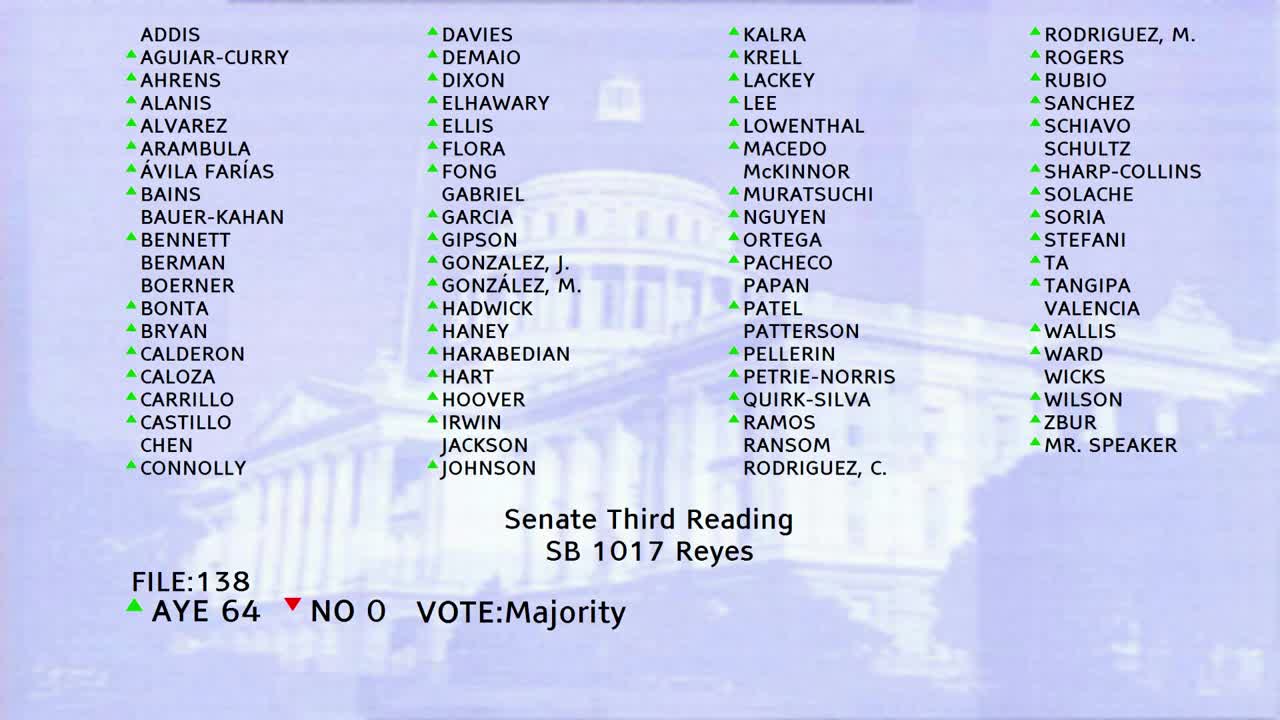 1MIN
Assembly Floor
 7MIN
Assembly Standing Committee on Health
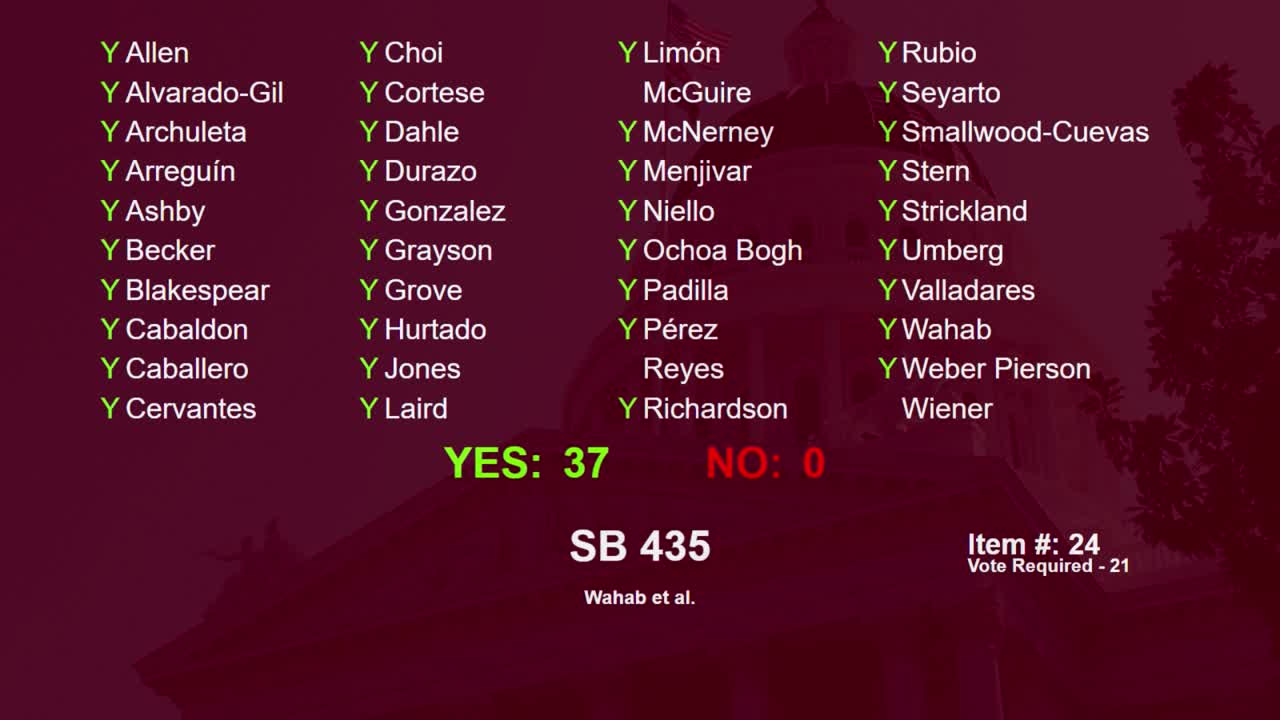 12MIN
Senate Floor
 23MIN
Senate Standing Committee on Environmental Quality

Bill Co-Author(s):