SB 530: Medi-Cal: time and distance standards.
- Session Year: 2025-2026
- House: Senate
- Latest Version Date: 2025-10-06
Current Status:
Passed
(2025-10-06: Chaptered by Secretary of State. Chapter 418, Statutes of 2025.)
Introduced
In Committee
Awaiting First Chamber Vote
Passed First Chamber
In Committee
Awaiting Second Chamber Vote
Passed Second Chamber
Enacted
Existing law establishes the Medi-Cal program, which is administered by the State Department of Health Care Services and under which qualified low-income individuals receive health care services, under fee-for-service or managed care delivery systems. The Medi-Cal program is, in part, governed and funded by federal Medicaid program provisions.
Existing law establishes, until January 1, 2026, certain time and distance and appointment time standards for specified Medi-Cal managed care covered services, consistent with federal regulations relating to network adequacy standards, to ensure that those services are available and accessible to enrollees of Medi-Cal managed care plans in a timely manner, as specified.
This bill would extend the operation of those standards to January 1, 2029. The bill would also require a managed care plan to ensure that each subcontractor network complies with certain appointment time standards unless already required to do so. The bill would require a plan to demonstrate to the department each subcontractor networks compliance with time or distance and appointment time standards, as specified.
Existing law permits the department to authorize a managed care plan to use clinically appropriate video synchronous interaction, as defined, as a means of demonstrating compliance with the time or distance standards.
Under this bill, the use of telehealth providers to meet time or distance standards would not absolve the managed care plan of responsibility to provide a beneficiary with access, including transportation, to in-person services if the beneficiary prefers. The bill would set forth other related provisions with regard to the use of telehealth.
Existing law permits the department, upon request of a managed care plan, to authorize alternative access standards for the time or distance standards under certain conditions.
This bill would, effective for contract periods commencing on or after January 1, 2027, require the department to consider the sufficiency of payment rates offered by the Medi-Cal managed care plan to the provider type or for the service type when evaluating requests for the utilization of alternative access standards.
The bill would require a Medi-Cal managed care plan that does not meet time or distance standards without the use of an alternative access standards request to submit to the department documentation demonstrating efforts to contract with providers, as specified. The bill would require a Medi-Cal managed care plan, effective no sooner than contract periods commencing on or after January 1, 2026, to inform enrollees of their option to use or not use telehealth, covered transportation services, or out-of-network providers to access covered services if the health care provider is located outside of the time or distance standards.
Existing law requires the department to annually evaluate a managed care plans compliance with the time or distance and appointment time standards and to annually publish a report of its findings, as specified.
This bill would require, effective for contract periods commencing on or after January 1, 2029, the evaluation by the department for appointment time standards compliance to be performed using a direct testing method, as specified.
The bill would authorize the department to require enhanced time or distance standards that are more stringent than the time or distance standards described above in its contracts with Medi-Cal managed care plans. The bill would require the department to ensure that these enhanced standards are consistent across contracts for similar geographic classifications. The bill would require the department to publish all enhanced time and distance standards adopted by contract with a rationale for the enhanced standards.
Under the bill, in alignment with federal regulation that requires the department to conduct analyses when developing or adjusting network adequacy standards, the department would be required to publish on its internet website by January 1, 2027, a specified workplan. The bill would also require the department to convene a stakeholder workgroup and to provide a 30-day public comment period, as specified.
Existing law requires the department, to the extent permitted under federal law, to require a Medi-Cal managed care plan that is not licensed by the Department of Managed Health Care to comply with applicable requirements, under specified provisions relating to health equity and quality, for the purpose of serving applicable Medi-Cal beneficiaries.
Under this bill, for purposes of implementing specified federal final rules relating to Medicaid, the department would be authorized to enter into contracts, or amend existing contracts, as specified. The bill would make this provision inoperative on January 1, 2029.
The bill would authorize the department to implement the above-described provisions, relating to the health equity and quality requirements and to the Medicaid final rules, through all-county letters or similar instructions without taking any further regulatory action.
Existing law establishes the Medi-Cal program, which is administered by the State Department of Health Care Services and under which qualified low-income individuals receive health care services, under fee-for-service or managed care delivery systems. The Medi-Cal program is, in part, governed and funded by federal Medicaid program provisions.
Existing law establishes, until January 1, 2026, certain time and distance and appointment time standards for specified Medi-Cal managed care covered services, consistent with federal regulations relating to network adequacy standards, to ensure that those services are available and accessible to enrollees of Medi-Cal managed care plans in a timely manner, as specified.
This bill would extend the operation of those standards to January 1, 2029. The bill would also require a managed care plan to ensure that each subcontractor network complies with certain appointment time standards unless already required to do so. The bill would require a plan to demonstrate to the department each subcontractor networks compliance with time or distance and appointment time standards, as specified.
Existing law permits the department to authorize a managed care plan to use clinically appropriate video synchronous interaction, as defined, as a means of demonstrating compliance with the time or distance standards.
Under this bill, the use of telehealth providers to meet time or distance standards would not absolve the managed care plan of responsibility to provide a beneficiary with access, including transportation, to in-person services if the beneficiary prefers. The bill would set forth other related provisions with regard to the use of telehealth.
Existing law permits the department, upon request of a managed care plan, to authorize alternative access standards for the time or distance standards under certain conditions.
This bill would, effective for contract periods commencing on or after January 1, 2027, require the department to consider the sufficiency of payment rates offered by the Medi-Cal managed care plan to the provider type or for the service type when evaluating requests for the utilization of alternative access standards.
The bill would require a Medi-Cal managed care plan that does not meet time or distance standards without the use of an alternative access standards request to submit to the department documentation demonstrating efforts to contract with providers, as specified. The bill would require a Medi-Cal managed care plan, effective no sooner than contract periods commencing on or after January 1, 2026, to inform enrollees of their option to use or not use telehealth, covered transportation services, or out-of-network providers to access covered services if the health care provider is located outside of the time or distance standards.
Existing law requires the department to annually evaluate a managed care plans compliance with the time or distance and appointment time standards and to annually publish a report of its findings, as specified.
This bill would require, effective for contract periods commencing on or after January 1, 2029, the evaluation by the department for appointment time standards compliance to be performed using a direct testing method, as specified.
The bill would authorize the department to require enhanced time or distance standards that are more stringent than the time or distance standards described above in its contracts with Medi-Cal managed care plans. The bill would require the department to ensure that these enhanced standards are consistent across contracts for similar geographic classifications. The bill would require the department to publish all enhanced time and distance standards adopted by contract with a rationale for the enhanced standards.
Under the bill, in alignment with federal regulation that requires the department to conduct analyses when developing or adjusting network adequacy standards, the department would be required to publish on its internet website by January 1, 2027, a specified workplan. The bill would also require the department to convene a stakeholder workgroup and to provide a 30-day public comment period, as specified.
Existing law requires the department, to the extent permitted under federal law, to require a Medi-Cal managed care plan that is not licensed by the Department of Managed Health Care to comply with applicable requirements, under specified provisions relating to health equity and quality, for the purpose of serving applicable Medi-Cal beneficiaries.
Under this bill, for purposes of implementing specified federal final rules relating to Medicaid, the department would be authorized to enter into contracts, or amend existing contracts, as specified. The bill would make this provision inoperative on January 1, 2029.
The bill would authorize the department to implement the above-described provisions, relating to the health equity and quality requirements and to the Medicaid final rules, through all-county letters or similar instructions without taking any further regulatory action.
Existing law establishes the Medi-Cal program, which is administered by the State Department of Health Care Services and under which qualified low-income individuals receive health care services, under fee-for-service or managed care delivery systems. The Medi-Cal program is, in part, governed and funded by federal Medicaid program provisions.
Existing law establishes, until January 1, 2026, certain time and distance and appointment time standards for specified Medi-Cal managed care covered services, consistent with federal regulations relating to network adequacy standards, to ensure that those services are available and accessible to enrollees of Medi-Cal managed care plans in a timely manner, as specified.
This bill would extend the operation of those standards to January 1, 2029. The bill would also require a managed care plan to ensure that each subcontractor network complies with certain appointment time standards unless already required to do so. The bill would set forth related reporting requirements with regard to subcontractor networks. require a plan to demonstrate to the department each subcontractor networks compliance with time or distance and appointment time standards, as specified.
Existing law permits the department to authorize a managed care plan to use clinically appropriate video synchronous interaction, as defined, as a means of demonstrating compliance with the time or distance standards.
Under this bill, the use of telehealth providers to meet time or distance standards would not absolve the managed care plan of responsibility to provide a beneficiary with access, including transportation, to in-person services if the beneficiary prefers. The bill would set forth other related provisions with regard to the use of telehealth.
Existing law permits the department, upon request of a managed care plan, to authorize alternative access standards for the time or distance standards if either of the following occurs: (1) the requesting plan has exhausted all other reasonable options to obtain providers to meet the applicable standard; or (2) the department determines that the requesting plan has demonstrated that its delivery structure is capable of delivering the appropriate level of care and access. under certain conditions.
This bill would recast those provisions and would specify, under both circumstances, that there be an appropriate level of care and access that is consistent with professionally recognized standards of practice, with a departmental determination that the alternative access standards will not have a detrimental impact on the health of enrollees. The bill would would, effective for contract periods commencing on or after January 1, 2027, require the department to consider the sufficiency of payment rates offered by the Medi-Cal managed care plan to the provider type or for the service type when evaluating requests for the utilization of alternative access standards. The bill would also require the department to publish, and periodically update as necessary, the criteria for evaluating and authorizing alternative access standards under the above-described provisions, as specified. The bill would make other changes to the procedure for a managed care plan to submit a previously approved alternative access standard request.
The bill would require a Medi-Cal managed care plan that does not meet time or distance standards without the use of an alternative access standards request to submit to the department documentation demonstrating efforts to contract with providers, as specified. The bill would require a Medi-Cal managed care plan, effective no sooner than contract periods commencing on or after January 1, 2026, to inform enrollees of their option to use or not use telehealth, covered transportation services, or out-of-network providers to access covered services if the health care provider is located outside of the time or distance standards.
Existing law requires the department to annually evaluate a managed care plans compliance with the time or distance and appointment time standards and to annually publish a report of its findings, as specified.
This bill would require that the evaluation be performed using a direct testing method and an examination of complaints data, as specified. The bill would, effective for contract periods commencing on or after January 1, 2026, additionally require the report to include, for each of the preceding 3 years, the number and percentage of enrollees in each Medi-Cal managed care plan who are subject to an approved alternative access standard, and the number and percentage of alternative access standards requested, approved, and denied, as specified. require, effective for contract periods commencing on or after January 1, 2029, the evaluation by the department for appointment time standards compliance to be performed using a direct testing method, as specified.
The bill would authorize the department to require enhanced time or distance standards that are more stringent than the time or distance standards described above in its contracts with Medi-Cal managed care plans. The bill would require the department to ensure that these enhanced standards are consistent across contracts for similar geographic classifications. The bill would require the department to publish all enhanced time and distance standards adopted by contract with a rationale for the enhanced standards.
Under the bill, in alignment with federal regulation that requires the department to conduct analyses when developing or adjusting network adequacy standards, the department would be required to publish these analyses and any related workplan on the departments internet website by January 1, 2027. on its internet website by January 1, 2027, a specified workplan. The bill would also require the department to convene a stakeholder workgroup, to provide a 30-day public comment period, and to seek federal approval of evidence-based network adequacy standards, as specified. workgroup and to provide a 30-day public comment period, as specified.
Existing law requires the department, to the extent permitted under federal law, to require a Medi-Cal managed care plan that is not licensed by the Department of Managed Health Care to comply with applicable requirements, under specified provisions relating to health equity and quality, for the purpose of serving applicable Medi-Cal beneficiaries.
Under this bill, for purposes of implementing specified federal final rules relating to Medicaid, the department would be authorized to enter into contracts, or amend existing contracts, as specified. The bill would make this provision inoperative on January 1, 2029.
The bill would authorize the department to implement the above-described provisions, relating to the health equity and quality requirements and to the Medicaid final rules, through all-county letters or similar instructions without taking any further regulatory action.
Existing law establishes the Medi-Cal program, which is administered by the State Department of Health Care Services and under which qualified low-income individuals receive health care services, under fee-for-service or managed care delivery systems. The Medi-Cal program is, in part, governed and funded by federal Medicaid program provisions.
Existing law establishes, until January 1, 2026, certain time and distance and appointment time standards for specified Medi-Cal managed care covered services, consistent with federal regulations relating to network adequacy standards, to ensure that those services are available and accessible to enrollees of Medi-Cal managed care plans in a timely manner, as specified.
This bill would extend the operation of those standards indefinitely. to January 1, 2029. The bill would also require a managed care plan to ensure that each subcontractor network complies with certain appointment time standards unless already required to do so. The bill would set forth related reporting requirements with regard to subcontractor networks.
Existing law permits the department to authorize a managed care plan to use clinically appropriate video synchronous interaction, as defined, as a means of demonstrating compliance with the time or distance standards.
Under this bill, the use of telehealth providers to meet time or distance standards would not absolve the managed care plan of responsibility to provide a beneficiary with access, including transportation, to in-person services if the beneficiary prefers. The bill would set forth other related provisions with regard to the use of telehealth.
Existing law permits the department, upon request of a managed care plan, to authorize alternative access standards for the time or distance standards if either of the following occur: occurs: (1) the requesting plan has exhausted all other reasonable options to obtain providers to meet the applicable standard; or (2) the department determines that the requesting plan has demonstrated that its delivery structure is capable of delivering the appropriate level of care and access.
This bill would recast those provisions and would specify, under both circumstances, that there be an appropriate level of care and access that is consistent with professionally recognized standards of practice, with a departmental determination that the alternative access standards will not have a detrimental impact on the health of enrollees. The bill would require the department to consider the sufficiency of payment rates offered by the Medi-Cal managed care plan to the provider type or for the service type when evaluating requests for the utilization of alternative access standards. The bill would also require the department to publish, and periodically update as necessary, the criteria for evaluation evaluating and authorizing alternative access standards under the above-described provisions, as specified. The bill would make other changes to the procedure for a managed care plan to submit a previously approved alternative access standard request.
Existing law requires the department to annually evaluate a managed care plans compliance with the time or distance and appointment time standards and to annually publish a report of its findings, as specified.
This bill would require that the evaluation be performed using a direct testing method and an examination of complaints data, as specified. The bill would, effective for contract periods commencing on or after January 1, 2026, additionally require the report to include, for each of the preceding 3 years, the number and percentage of enrollees that are in each Medi-Cal managed care plan who are subject to an approved alternative access standard, and the number and percentage of alternative access standards requested, approved, and denied, as specified.
The bill would authorize the department to require enhanced time or distance standards that are more stringent than the time or distance standards described above in its contracts with Medi-Cal managed care plans. The bill would require the department to ensure that these enhanced standards are consistent across contracts for similar geographic classifications. The bill would require the department to publish all enhanced time and distance standards adopted by contract with a rationale for the enhanced standards.
Existing law defines specialist for purposes of these provisions, including with regard to a managed care plans requirement to maintain a network of providers located within the time or distance standards.This bill would expand the scope of the definition for specialist to include providers of immunology, urology, and rheumatology, among other additional areas of medicine.Under the bill, in alignment with federal regulation that requires the department to conduct analyses when developing or adjusting network adequacy standards, the department would be required to publish these analyses and any related workplan on the departments internet website by January 1, 2027. The bill would also require the department to convene a stakeholder workgroup, to provide a 30-day public comment period, and to seek federal approval of evidence-based network adequacy standards, as specified.
Existing law establishes the Medi-Cal program, which is administered by the State Department of Health Care Services and under which qualified low-income individuals receive health care services, under fee-for-service or managed care delivery systems. The Medi-Cal program is, in part, governed and funded by federal Medicaid program provisions.
Existing law establishes, until January 1, 2026, certain time and distance and appointment time standards for specified Medi-Cal managed care covered services, consistent with federal regulations relating to network adequacy standards, to ensure that those services are available and accessible to enrollees of Medi-Cal managed care plans in a timely manner, as specified.
This bill would extend the operation of those standards indefinitely. The bill would also require a managed care plan to ensure that each subcontractor network complies with certain appointment time standards unless already required to do so. The bill would set forth related reporting requirements with regard to subcontractor networks.
Existing law permits the department to authorize a managed care plan to use clinically appropriate video synchronous interaction, as defined, as a means of demonstrating compliance with the time or distance standards.
Under this bill, the use of telehealth providers to meet time or distance standards would not absolve the managed care plan of responsibility to provide a beneficiary with access, including transportation, to in-person services if the beneficiary prefers. The bill would set forth other related provisions with regard to the use of telehealth.
Existing law permits the department, upon request of a managed care plan, to authorize alternative access standards for the time or distance standards if either of the following occur: (1) the requesting plan has exhausted all other reasonable options to obtain providers to meet the applicable standard; or (2) the department determines that the requesting plan has demonstrated that its delivery structure is capable of delivering the appropriate level of care and access.
This bill would recast those provisions and would specify, under both circumstances, that there be an appropriate level of care and access that is consistent with professionally recognized standards of practice, with a departmental determination that the alternative access standards will not have a detrimental impact on the health of enrollees. The bill would require the department to consider the sufficiency of payment rates offered by the Medi-Cal managed care plan to the provider type or for the service type when evaluating requests for the utilization of alternative access standards. The bill would also require the department to publish, and periodically update as necessary, the criteria for evaluation and authorizing alternative access standards under the above-described provisions, as specified. The bill would make other changes to the procedure for a managed care plan to submit a previously approved alternative access standard request.
Existing law requires the department to annually evaluate a managed care plans compliance with the time or distance and appointment time standards and to annually publish a report of its findings, as specified.
This bill would require that the evaluation be performed using a direct testing method and an examination of complaints data, as specified. The bill would, effective for contract periods commencing on or after January 1, 2026, additionally require the report to include, for each of the preceding 3 years, the number and percentage of enrollees that are subject to an approved alternative access standard, and the number and percentage of alternative access standards requested, approved, and denied, as specified.
The bill would authorize the department to require enhanced time or distance standards that are more stringent than the time or distance standards described above in its contracts with Medi-Cal managed care plans. The bill would require the department to ensure that these enhanced standards are consistent across contracts for similar geographic classifications. The bill would require the department to publish all enhanced time and distance standards adopted by contract with a rationale for the enhanced standards.
Existing law defines specialist for purposes of these provisions, including with regard to a managed care plans requirement to maintain a network of providers located within the time or distance standards.
This bill would expand the scope of the definition for specialist to include providers of immunology, urology, and sleep medicine, rheumatology, among other additional areas of medicine.
Existing law establishes the Medi-Cal program, which is administered by the State Department of Health Care Services and under which qualified low-income individuals receive health care services, under fee-for-service or managed care delivery systems. The Medi-Cal program is, in part, governed and funded by federal Medicaid program provisions.
Existing law establishes, until January 1, 2026, certain time and distance and appointment time standards for specified Medi-Cal managed care covered services, consistent with federal regulations relating to network adequacy standards, to ensure that those services are available and accessible to enrollees of Medi-Cal managed care plans in a timely manner, as specified.
This bill would extend the operation of those standards indefinitely. The bill would also require a managed care plan to ensure that each subcontractor network complies with certain appointment time standards unless already required to do so. The bill would set forth related reporting requirements with regard to subcontractor networks.
Existing law permits the department to authorize a managed care plan to use clinically appropriate video synchronous interaction, as defined, as a means of demonstrating compliance with the time or distance standards.
Under this bill, the use of telehealth providers to meet time or distance standards would not absolve the managed care plan of responsibility to provide a beneficiary with access, including transportation, to in-person services if the beneficiary prefers. The bill would set forth other related provisions with regard to the use of telehealth.
Existing law permits the department, upon request of a managed care plan, to authorize alternative access standards for the time or distance standards if either of the following occur: (1) the requesting plan has exhausted all other reasonable options to obtain providers to meet the applicable standard; or (2) the department determines that the requesting plan has demonstrated that its delivery structure is capable of delivering the appropriate level of care and access.
This bill would recast those provisions and would specify, under both circumstances, that there be an appropriate level of care and access that is consistent with professionally recognized standards of practice, with a departmental determination that the alternative access standards will not have a detrimental impact on the health of enrollees. The bill would require the department to consider the sufficiency of payment rates offered by the Medi-Cal managed care plan to the provider type or for the service type when evaluating requests for the utilization of alterative alternative access standards. The bill would also require the department to publish, and periodically update as necessary, the criteria for evaluation and authorizing alternative access standards under the above-described provisions, as specified. The bill would make other changes to the procedure for a managed care plan to submit a previously approved alternative access standard request.
Existing law requires the department to annually evaluate a managed care plans compliance with the time or distance and appointment time standards and to annually publish a report of its findings, as specified.
This bill would require that the evaluation be performed using a direct testing method and an examination of complaints data, as specified. The bill would, effective for contract periods commencing on or after January 1, 2026, additionally require the report to include, for each of the preceding 3 years, the number and percentage of enrollees that are subject to an approved alternative access standard, and the number and percentage of alternative access standards requested, approved, and denied, as specified.
The bill would authorize the department to require enhanced time or distance standards that are more stringent than the time or distance standards described above in its contracts with Medi-Cal managed care plans. The bill would require the department to ensure that these enhanced standards are consistent across contracts for similar geographic classifications. The bill would require the department to publish all enhanced time and distance standards adopted by contract with a rationale for the enhanced standards.
Existing law defines specialist for purposes of these provisions, including with regard to a managed care plans requirement to maintain a network of providers located within the time or distance standards.
This bill would expand the scope of the definition for specialist to include providers of immunology, urology, and sleep medicine, among other additional areas of medicine.
Existing law establishes the Medi-Cal program, which is administered by the State Department of Health Care Services and under which qualified low-income individuals receive health care services, under fee-for-service or managed care delivery systems. The Medi-Cal program is, in part, governed and funded by federal Medicaid program provisions.
Existing law establishes, until January 1, 2026, certain time and distance and appointment time standards for specified Medi-Cal managed care covered services, consistent with federal regulations relating to network adequacy standards, to ensure that those services are available and accessible to enrollees of Medi-Cal managed care plans in a timely manner, as specified.
This bill would extend the operation of those standards indefinitely. The bill would also require a managed care plan to ensure that each subcontractor network complies with certain appointment time standards unless already required to do so. The bill would set forth related reporting requirements with regard to subcontractor networks.
Existing law permits the department to authorize a managed care plan to use clinically appropriate video synchronous interaction, as defined, as a means of demonstrating compliance with the time or distance standards.
Under this bill, the use of telehealth providers to meet time or distance standards would not absolve the managed care plan of responsibility to provide a beneficiary with access, including transportation, to in-person services if the beneficiary prefers. The bill would set forth other related provisions with regard to the use of telehealth.
Existing law permits the department, upon request of a managed care plan, to authorize alternative access standards for the time or distance standards if either of the following occur: (1) the requesting plan has exhausted all other reasonable options to obtain providers to meet the applicable standard; or (2) the department determines that the requesting plan has demonstrated that its delivery structure is capable of delivering the appropriate level of care and access.
This bill would recast those provisions and would specify, under both circumstances, that there be an appropriate level of care and access that is consistent with professionally recognized standards of practice, with a departmental determination that the alternative access standards will not have a detrimental impact on the health of enrollees. The bill would require the department to consider the sufficiency of payment rates offered by the Medi-Cal managed care plan to the provider type or for the service type when evaluating requests for the utilization of alterative access standards. The bill would also require the department to publish, and periodically update as necessary, the criteria for evaluation and authorizing alternative access standards under the above-described provisions, as specified. The bill would make other changes to the procedure for a managed care plan to submit a previously approved alternative access standard request.
Existing law requires the department to annually evaluate a managed care plans compliance with the time or distance and appointment time standards. standards and to annually publish a report of its findings, as specified.
This bill would require that the evaluation be performed using a direct testing method and an examination of complaints data, as specified. The bill would, effective for contract periods commencing on or after January 1, 2026, additionally require the report to include, for each of the preceding 3 years, the number and percentage of enrollees that are subject to an approved alternative access standard, and the number and percentage of alternative access standards requested, approved, and denied, as specified.
Existing law defines specialist for purposes of these provisions, including with regard to a managed care plans requirement to maintain a network of providers located within the time or distance standards.
This bill would expand the scope of the definition for specialist to include providers of immunology, urology, and sleep medicine, among other additional areas of medicine.
Existing law establishes the Medi-Cal program, which is administered by the State Department of Health Care Services and under which qualified low-income individuals receive health care services, under fee-for-service or managed care delivery systems. The Medi-Cal program is, in part, governed and funded by federal Medicaid program provisions.
Existing law establishes, until January 1, 2026, certain time and distance and appointment time standards for specified Medi-Cal managed care covered services, consistent with federal regulations relating to network adequacy standards, to ensure that those services are available and accessible to enrollees of Medi-Cal managed care plans in a timely manner, as specified.
This bill would extend the operation of those standards indefinitely. The bill would also require a managed care plan to ensure that each subcontractor network complies with certain appointment time standards unless already required to do so. The bill would set forth related reporting requirements with regard to subcontractor networks.
Existing law permits the department to authorize a managed care plan to use clinically appropriate video synchronous interaction, as defined, as a means of demonstrating compliance with the time or distance standards.
Under this bill, the use of telehealth providers to meet time or distance standards would not absolve the managed care plan of responsibility to provide a beneficiary with access, including transportation, to in-person services if the beneficiary prefers. The bill would set forth other related provisions with regard to the use of telehealth.
Existing law permits the department, upon request of a managed care plan, to authorize alternative access standards for the time or distance standards if either of the following occur: (1) the requesting plan has exhausted all other reasonable options to obtain providers to meet the applicable standard; or (2) the department determines that the requesting plan has demonstrated that its delivery structure is capable of delivering the appropriate level of care and access.
This bill would recast those provisions and would specify, under both circumstances, that there be an appropriate level of care and access that is consistent with professionally recognized standards of practice, with a departmental determination that the alternative access standards will not have a detrimental impact on the health of enrollees. The bill would make other changes to the procedure for a managed care plan to submit a previously approved alternative access standard request.
Existing law requires the department to annually evaluate a managed care plans compliance with the time or distance and appointment time standards.
This bill would require that the evaluation be performed using a direct testing method and an examination of complaints data, as specified.
Existing law defines specialist for purposes of these provisions, including with regard to a managed care plans requirement to maintain a network of providers located within the time or distance standards.
This bill would expand the scope of the definition for specialist to include providers of immunology, urology, and sleep medicine, among other additional areas of medicine.
(a)It is the intent of the Legislature that the department implement and monitor compliance with the time or distance requirements set forth in Sections 438.68, 438.206, and 438.207 of Title 42 of the Code of Federal Regulations and this section, to ensure that all Medi-Cal managed care covered services are available and accessible to enrollees of Medi-Cal managed care plans in a timely manner, as those standards were enacted in May 2016.
(b)Commencing January 1, 2018, for covered benefits under its contract, as applicable, a Medi-Cal managed care plan shall maintain a network of providers that are located within the following time or distance standards for the following services:
(1)For primary care, both adult and pediatric, 10 miles or 30 minutes from the beneficiarys place of residence.
(2)For hospitals, 15 miles or 30 minutes from the beneficiarys place of residence.
(3)For dental services provided by a Medi-Cal managed care plan, 10 miles or 30 minutes from the beneficiarys place of residence.
(4)For obstetrics and gynecology primary care, 10 miles or 30 minutes from the beneficiarys place of residence.
(c)Commencing July 1, 2018, for the covered benefits under its contracts, as applicable, a Medi-Cal managed care plan shall maintain a network of providers that are located within the following time or distance standards for the following services:
(1)For specialists, as defined in subdivision (i), adult and pediatric, including obstetric and gynecology specialty care, as follows:
(A)Up to 15 miles or 30 minutes from the beneficiarys place of residence for the following counties: Alameda, Contra Costa, Los Angeles, Orange, Sacramento, San Diego, San Francisco, San Mateo, and Santa Clara.
(B)Up to 30 miles or 60 minutes from the beneficiarys place of residence for the following counties: Marin, Placer, Riverside, San Joaquin, Santa Cruz, Solano, Sonoma, Stanislaus, and Ventura.
(C)Up to 45 miles or 75 minutes from the beneficiarys place of residence for the following counties: Amador, Butte, El Dorado, Fresno, Kern, Kings, Lake, Madera, Merced, Monterey, Napa, Nevada, San Bernardino, San Luis Obispo, Santa Barbara, Sutter, Tulare, Yolo, and Yuba.
(D)Up to 60 miles or 90 minutes from the beneficiarys place of residence for the following counties: Alpine, Calaveras, Colusa, Del Norte, Glenn, Humboldt, Imperial, Inyo, Lassen, Mariposa, Mendocino, Modoc, Mono, Plumas, San Benito, Shasta, Sierra, Siskiyou, Tehama, Trinity, and Tuolumne.
(2)For pharmacy services, 10 miles or 30 minutes from the beneficiarys place of residence.
(3)For outpatient mental health services, as follows:
(A)Up to 15 miles or 30 minutes from the beneficiarys place of residence for the following counties: Alameda, Contra Costa, Los Angeles, Orange, Sacramento, San Diego, San Francisco, San Mateo, and Santa Clara.
(B)Up to 30 miles or 60 minutes from the beneficiarys place of residence for the following counties: Marin, Placer, Riverside, San Joaquin, Santa Cruz, Solano, Sonoma, Stanislaus, and Ventura.
(C)Up to 45 miles or 75 minutes from the beneficiarys place of residence for the following counties: Amador, Butte, El Dorado, Fresno, Kern, Kings, Lake, Madera, Merced, Monterey, Napa, Nevada, San Bernardino, San Luis Obispo, Santa Barbara, Sutter, Tulare, Yolo, and Yuba.
(D)Up to 60 miles or 90 minutes from the beneficiarys place of residence for the following counties: Alpine, Calaveras, Colusa, Del Norte, Glenn, Humboldt, Imperial, Inyo, Lassen, Mariposa, Mendocino, Modoc, Mono, Plumas, San Benito, Shasta, Sierra, Siskiyou, Tehama, Trinity, and Tuolumne.
(4)(A)For outpatient substance use disorder services other than opioid treatment programs, as follows:
(i)Up to 15 miles or 30 minutes from the beneficiarys place of residence for the following counties: Alameda, Contra Costa, Los Angeles, Orange, Sacramento, San Diego, San Francisco, San Mateo, and Santa Clara.
(ii)Up to 30 miles or 60 minutes from the beneficiarys place of residence for the following counties: Marin, Placer, Riverside, San Joaquin, Santa Cruz, Solano, Sonoma, Stanislaus, and Ventura.
(iii)Up to 60 miles or 90 minutes from the beneficiarys place of residence for the following counties: Alpine, Amador, Butte, Calaveras, Colusa, Del Norte, El Dorado, Fresno, Glenn, Humboldt, Imperial, Inyo, Kern, Kings, Lake, Lassen, Madera, Mariposa, Mendocino, Merced, Modoc, Monterey, Mono, Napa, Nevada, Plumas, San Benito, San Bernardino, San Luis Obispo, Santa Barbara, Shasta, Sierra, Siskiyou, Sutter, Tehama, Trinity, Tulare, Tuolumne, Yolo, and Yuba.
(B)For opioid treatment programs, as follows:
(i)Up to 15 miles or 30 minutes from the beneficiarys place of residence for the following counties: Alameda, Contra Costa, Los Angeles, Orange, Sacramento, San Diego, San Francisco, San Mateo, and Santa Clara.
(ii)Up to 30 miles or 60 minutes from the beneficiarys place of residence for the following counties: Marin, Placer, Riverside, San Joaquin, Santa Cruz, Solano, Sonoma, Stanislaus, and Ventura.
(iii)Up to 45 miles or 75 minutes from the beneficiarys place of residence for the following counties: Amador, Butte, El Dorado, Fresno, Kern, Kings, Lake, Madera, Merced, Monterey, Napa, Nevada, San Bernardino, San Luis Obispo, Santa Barbara, Sutter, Tulare, Yolo, and Yuba.
(iv)Up to 60 miles or 90 minutes from the beneficiarys place of residence for the following counties: Alpine, Calaveras, Colusa, Del Norte, Glenn, Humboldt, Imperial, Inyo, Lassen, Mariposa, Mendocino, Modoc, Mono, Plumas, San Benito, Shasta, Sierra, Siskiyou, Tehama, Trinity, and Tuolumne.
(d)(1)(A)A Medi-Cal managed care plan shall comply with the appointment time standards developed pursuant to Section 1367.03 of the Health and Safety Code, Section 1300.67.2.2 of Title 28 of the California Code of Regulations, subject to any authorized exceptions in Section 1300.67.2.2 of Title 28 of the California Code of Regulations, and the standards set forth in contracts entered into between the department and Medi-Cal managed care plans.
(B)Commencing July 1, 2018, subparagraph (A) applies to Medi-Cal managed care plans that are not, as of January 1, 2018, subject to the appointment time standards described in subparagraph (A).
(C)A Medi-Cal managed care plan shall ensure that each subcontractor network complies with the appointment time standards described in subparagraph (A), unless already required to ensure compliance.
(2)A Medi-Cal managed care plan shall comply with the following availability standards for skilled nursing facility services and intermediate care facility services, as follows:
(A)Within five business days of the request for the following counties: Alameda, Contra Costa, Los Angeles, Orange, Sacramento, San Diego, San Francisco, San Mateo, and Santa Clara.
(B)Within seven business days of the request for the following counties: Marin, Placer, Riverside, San Joaquin, Santa Cruz, Solano, Sonoma, Stanislaus, and Ventura.
(C)Within 14 calendar days of the request for the following counties: Amador, Butte, El Dorado, Fresno, Kern, Kings, Lake, Madera, Merced, Monterey, Napa, Nevada, San Bernardino, San Luis Obispo, Santa Barbara, Sutter, Tulare, Yolo, and Yuba.
(D)Within 14 calendar days of the request for the following counties: Alpine, Calaveras, Colusa, Del Norte, Glenn, Humboldt, Imperial, Inyo, Lassen, Mariposa, Mendocino, Modoc, Mono, Plumas, San Benito, Shasta, Sierra, Siskiyou, Tehama, Trinity, and Tuolumne.
(3)A county Drug Medi-Cal organized delivery system shall provide an appointment within three business days to an opioid treatment program.
(4)A dental managed care plan shall provide an appointment within four weeks of a request for routine pediatric dental services and within 30 calendar days of a request for specialist pediatric dental services.
(e)The department may authorize a Medi-Cal managed care plan to use clinically appropriate video synchronous interaction, as defined in paragraph (5) of subdivision (a) of Section 2290.5 of the Business and Professions Code, as a means of demonstrating compliance with the time or distance standards established pursuant to this section, as defined by the department. The use of telehealth providers to meet time or distance standards does not absolve the Medi-Cal managed care plan of responsibility to provide a beneficiary with access, including transportation, to in-person services if the beneficiary prefers.
(f)(1)The department may develop policies for granting credit in the determination of compliance with time or distance standards established pursuant to this section when Medi-Cal managed care plans contract with specified providers to use clinically appropriate video synchronous interaction, as defined in paragraph (5) of subdivision (a) of Section 2290.5 of the Business and Professions Code, and only for Medi-Cal managed care plans that cover at least 85 percent of the population points in the ZIP Code.
(2)The department, upon request of a Medi-Cal managed care plan, may authorize alternative access standards for the time or distance standards established under this section if either of the following occurs:
(A)The requesting Medi-Cal managed care plan has exhausted all other reasonable options to obtain providers to meet the applicable standard.
(B)The department determines that the requesting Medi-Cal managed care plan has demonstrated that its delivery structure is capable of delivering the appropriate level of care and access.
(3)(A) If a Medi-Cal managed care plan cannot meet the time or distance standards set forth in this section, the Medi-Cal managed care plan shall submit a request for alternative access standards to the department, in the form and manner specified by the department.
(B)An alternative access standard request may be submitted at the same time as the Medi-Cal managed care plan submits its annual demonstration of compliance with time or distance standards, if known at that time and at any time the Medi-Cal managed care plan is unable to meet time or distance standards.
(C)A Medi-Cal managed care plan is not required to submit a previously approved alternative access standard request to the department for review and approval on an annual basis, unless the Medi-Cal managed care plan requires modifications to its previously approved request. However, the Medi-Cal managed care plan shall submit this previously approved alternative access standard request to the department at least every three years for review and approval when the plan is required to demonstrate compliance with time or distance standards.
(i)Medi-Cal managed care plans that do not meet time or distance standards without the use of an alternative access standards request shall submit to the department documentation demonstrating efforts to contract with providers in those areas, based on guidance by the department.
(ii)Effective no sooner than contract periods commencing on or after January 1, 2026, the Medi-Cal managed care plan shall inform enrollees of their option to use or not use telehealth, covered transportation services, or out-of-network providers to access covered services if the health care provider is located outside of the time or distance standards specified in subdivision (c) in a manner specified by the department.
(D)A Medi-Cal managed care plan shall close out any corrective action plan deficiencies in a timely manner to ensure that beneficiary access is adequate and shall continually work to improve access in its provider network.
(4)A request for alternative access standards shall be approved or denied on a ZIP Code and provider type, including specialty type, basis by the department within 90 days of submission of the request. The Medi-Cal managed care plan shall also include a description of the reasons justifying the alternative access standards based on those facts and circumstances. Effective no sooner than contract periods commencing on or after July 1, 2020, the Medi-Cal managed care plan shall include a description on how the Medi-Cal managed care plan intends to arrange for enrollees to access covered services if the health care provider is located outside of the time or distance standards specified in subdivision (c). The department may stop the 90-day timeframe, on one or more occasions as necessary, in the event of an incomplete submission or to obtain additional information from the Medi-Cal managed care plan requesting the alternative access standards. Upon submission of sufficient additional information to the department, the 90-day timeframe shall resume at the same point in time it was previously stopped, except if there is less than 30 days remaining in which case the department shall approve or deny the request within 30 days of submission of sufficient additional information. If the department rejects the Medi-Cal managed care plans proposal, the department shall inform the Medi-Cal managed care plan of the departments reason for rejecting the proposal. The department shall post any approved alternative access standards on its internet website.
(5)(A)As part of the departments evaluation of a request submitted by a Medi-Cal managed care plan to utilize an alternative access standard pursuant to this subdivision, the department shall evaluate and determine whether the resulting time or distance is reasonable to expect a beneficiary to travel to receive care.
(B)Effective for contract periods commencing on or after January 1, 2027, as part of the departments evaluation of a request pursuant to this subdivision, the department shall also consider the sufficiency of payment rates offered by the Medi-Cal managed care plan to the provider type or for the service type for which an alternative access standard is being requested.
(6)The department may authorize a Medi-Cal managed care plan to use clinically appropriate video synchronous interaction, as defined in paragraph (5) of subdivision (a) of Section 2290.5 of the Business and Professions Code, as part of an alternative access standard request.
(g)(1)(A)Effective for contract periods commencing on or after July 1, 2018, a Medi-Cal managed care plan shall, on an annual basis and when requested by the department, demonstrate to the department the Medi-Cal managed care plans compliance with the time or distance and appointment time standards developed pursuant to this section. The report shall measure compliance separately for adult and pediatric services for primary care, behavioral health, and core specialist services.
(B)(i)Effective for contract periods commencing on or after January 1, 2026, a Medi-Cal managed care plan shall, on an annual basis and when requested by the department, demonstrate to the department each subcontractor networks compliance with the time or distance and appointment time standards developed pursuant to this section, including how the Medi-Cal managed care plan arranged for the delivery of Medi-Cal covered services to Medi-Cal enrollees, such as through the use of either Medi-Cal covered transportation or clinically appropriate video synchronous interaction, as specified in paragraph (6) of subdivision (f), if the enrollees of a Medi-Cal managed care plan needed to obtain health care services from a health care provider or a facility located outside of the time or distance standards, as specified in subdivision (c), in accordance with the CalAIM 1915(b) Waiver Special Terms and Conditions A4.
(ii)This subparagraph shall not apply to dental managed care plans, or to Medi-Cal behavioral health delivery systems as defined in subdivision (i) of Section 14184.101.
(2)Effective for contract periods commencing on or after July 1, 2020, the Medi-Cal managed care plan shall demonstrate, on an annual basis, and when requested by the department, to the department how the Medi-Cal managed care plan arranged for the delivery of Medi-Cal covered services to Medi-Cal enrollees, such as through the use of either Medi-Cal covered transportation or clinically appropriate video synchronous interaction, as specified in paragraph (6) of subdivision (f), if the enrollees of a Medi-Cal managed care plan needed to obtain health care services from a health care provider or a facility located outside of the time or distance standards, as specified in subdivision (c).
The report shall measure compliance separately for adult and pediatric services for primary care, behavioral health, and core specialist services.
(3)(A)Effective for contract periods commencing on or after July 1, 2018, the department shall evaluate on an annual basis a Medi-Cal managed care plans compliance with the time or distance and appointment time standards implemented pursuant to this section. This evaluation may include, but need not be limited to, annual and random surveys, investigation of complaints, grievances, or other indicia of noncompliance. Nothing in this subdivision shall be construed to limit the appeal rights of a Medi-Cal managed care plan under its contracts with the department.
(B)Effective for contract periods commencing on or after January 1, 2029, the evaluation by the department for appointment time standards compliance as described in this paragraph shall be performed using a direct testing method, which shall include, but need not be limited to, a secret shopper method. The direct testing shall be used to evaluate compliance with the appointment time standards set forth in subdivision (d) for appointments. To determine compliance with the urgent care standard, the evaluation shall measure the networks ability to provide urgent care within 48 hours pursuant to Section 1367.03 of the Health and Safety Code and Section 1300.67.2.2(c)(5)(A) of Title 28 of the California Code of Regulations. The evaluation shall also utilize a method for accounting for and reporting the number of providers who are unavailable or unreachable for purposes of the evaluation.
(C)Failure to comply with the evaluations required by this paragraph may result in contract termination or the issuance of sanctions pursuant to Section 14197.7.
(4)The department shall publish annually on its internet website a report that details the departments findings in evaluating a Medi-Cal managed care plans compliance under paragraph (2). At a minimum, the department shall specify in this report those Medi-Cal managed care plans, if any, that were subject to a corrective action plan due to noncompliance with the time or distance and appointment time standards implemented pursuant to this section during the applicable year and the basis for the departments finding of noncompliance. The report shall include a Medi-Cal managed care plans response to the corrective plan, if available.
(h)The department shall consult with Medi-Cal managed care plans, including dental managed care plans, mental health plans, and Drug Medi-Cal Organized Delivery System programs, health care providers, consumers, providers and consumers of long-term services and supports, and organizations representing Medi-Cal beneficiaries in the implementation of the requirements of this section.
(i)For purposes of this section, the following definitions apply:
(1)Medi-Cal managed care plan means any individual, organization, or entity that enters into a contract with the department to provide services to enrolled Medi-Cal beneficiaries pursuant to any of the following:
(A)Article 2.7 (commencing with Section 14087.3), including dental managed care programs developed pursuant to Section 14087.46.
(B)Article 2.8 (commencing with Section 14087.5).
(C)Article 2.81 (commencing with Section 14087.96).
(D)Article 2.82 (commencing with Section 14087.98).
(E)Article 2.9 (commencing with Section 14088).
(F)Article 2.91 (commencing with Section 14089).
(G)Chapter 8 (commencing with Section 14200), including dental managed care plans.
(H)Chapter 8.9 (commencing with Section 14700).
(I)A county Drug Medi-Cal organized delivery system authorized under the California Medi-Cal 2020 Demonstration pursuant to Article 5.5 (commencing with Section 14184) or a successor demonstration or waiver, as applicable.
(2)Specialist means any of the following:
(A)Cardiology/interventional cardiology.
(B)Nephrology.
(C)Dermatology.
(D)Neurology.
(E)Endocrinology.
(F)Ophthalmology.
(G)Ear, nose, and throat/otolaryngology.
(H)Orthopedic surgery.
(I)Gastroenterology.
(J)Physical medicine and rehabilitation.
(K)General surgery.
(L)Psychiatry.
(M)Hematology.
(N)Oncology.
(O)Pulmonology.
(P)HIV/AIDS specialists/infectious diseases.
(3)Subcontractor network means a provider network of a subcontractor or downstream subcontractor, wherein the subcontractor or downstream subcontractor is delegated risk and is responsible for arranging for the provision of, and paying for, covered services as stated in their subcontractor or downstream subcontractor agreement.
(j)(1)The department may require enhanced time or distance standards that are more stringent than those set forth in this section in its contracts with Medi-Cal managed care plans. However, the other requirements of this section shall otherwise apply.
(2)The department shall ensure that enhanced time or distance standards contracted for with Medi-Cal managed care plans are consistent across contracts for similar geographic classifications.
(3)The department shall publish all enhanced time and distance standards adopted by contract with a rationale for the enhanced standards.
(k)Notwithstanding Chapter 3.5 (commencing with Section 11340) of Part 1 of Division 3 of Title 2 of the Government Code, the department, without taking any further regulatory action, may implement, interpret, or make specific this section by means of all-county letters, plan letters, plan or provider bulletins, or similar instructions until the time regulations are adopted.
(l)The department shall seek any federal approvals it deems necessary to implement this section. This section shall be implemented only to the extent that any necessary federal approvals are obtained and federal financial participation is available and is not otherwise jeopardized.
(m)(1)In alignment with federal regulation that requires the department to conduct analyses when developing or adjusting network adequacy standards, the department shall publish on the departments internet website by January 1, 2027, a workplan that includes an explanation of the departments approach to updating network adequacy standards, a description of the data, and a summary of the analyses that will inform the departments approach.
(2)By January 1, 2027, the department shall convene a stakeholder workgroup to assist in the development of evidence-based network adequacy standards informed by the analyses described in paragraph (1).
(3)The department shall provide a 30-day public comment period before implementing any changes to network adequacy standards.
(n)This section shall remain in effect only until January 1, 2029, and as of that date is repealed, unless a later enacted statute that is enacted before January 1, 2029, deletes or extends that date.
SEC. 2.Section 14197.9 of the Welfare and Institutions Code is amended to read:14197.9.(a)To the extent permitted under federal law, the department shall require a Medi-Cal managed care plan that is not licensed by the Department of Managed Health Care to comply with the applicable requirements in Article 11.9 (commencing with Section 1399.870) of Chapter 2.2 of Division 2 of the Health and Safety Code for the purpose of serving applicable Medi-Cal beneficiaries.
(b)For purposes of this section, Medi-Cal managed care plan means an individual, organization, or entity that enters into a comprehensive risk contract with the department to provide covered full-scope health care services to enrolled Medi-Cal beneficiaries pursuant to this chapter or Chapter 8 (commencing with Section 14200).
(c)(1)For purposes of implementing the Ensuring Access to Medicaid Services Final Rule, and the Medicaid and Childrens Health Insurance Program Managed Care Access, Finance, and Quality Final Rule, which were published in Volume 89, Number 92 of the Federal Register on May 10, 2024, the department may enter into exclusive or nonexclusive contracts, or amend existing contracts, on a bid or negotiated basis.
(2)Notwithstanding any other law, contracts entered into or amended pursuant to this subdivision shall be exempt from Chapter 6 (commencing with Section 14825) of Part 5.5 of Division 3 of Title 2 of the Government Code, Article 4 (commencing with Section 19130) of Chapter 5 of Part 2 of Division 5 of Title 2 of the Government Code, Part 2 (commencing with Section 10100) of Division 2 of the Public Contract Code, the Statewide Information Management Manual, the State Administrative Manual, and the State Contracting Manuals, and shall be exempt from the review or approval of any division of the Department of General Services.
(3)This subdivision shall become inoperative on January 1, 2029.
(d)Notwithstanding Chapter 3.5 (commencing with Section 11340) of Part 1 of Division 3 of Title 2 of the Government Code, the department may implement, interpret, or make specific this section, in whole or in part, by means of all-county letters, plan letters, provider bulletins, information notices, or other similar instructions, without taking any further regulatory action.
(a)It is the intent of the Legislature that the department implement and monitor compliance with the time or distance requirements set forth in Sections 438.68, 438.206, and 438.207 of Title 42 of the Code of Federal Regulations and this section, to ensure that all Medi-Cal managed care covered services are available and accessible to enrollees of Medi-Cal managed care plans in a timely manner, as those standards were enacted in May 2016.
(b)Commencing January 1, 2018, for covered benefits under its contract, as applicable, a Medi-Cal managed care plan shall maintain a network of providers that are located within the following time or distance standards for the following services:
(1)For primary care, both adult and pediatric, 10 miles or 30 minutes from the beneficiarys place of residence.
(2)For hospitals, 15 miles or 30 minutes from the beneficiarys place of residence.
(3)For dental services provided by a Medi-Cal managed care plan, 10 miles or 30 minutes from the beneficiarys place of residence.
(4)For obstetrics and gynecology primary care, 10 miles or 30 minutes from the beneficiarys place of residence.
(c)Commencing July 1, 2018, for the covered benefits under its contracts, as applicable, a Medi-Cal managed care plan shall maintain a network of providers that are located within the following time or distance standards for the following services:
(1)For specialists, as defined in subdivision (i), adult and pediatric, including obstetric and gynecology specialty care, as follows:
(A)Up to 15 miles or 30 minutes from the beneficiarys place of residence for the following counties: Alameda, Contra Costa, Los Angeles, Orange, Sacramento, San Diego, San Francisco, San Mateo, and Santa Clara.
(B)Up to 30 miles or 60 minutes from the beneficiarys place of residence for the following counties: Marin, Placer, Riverside, San Joaquin, Santa Cruz, Solano, Sonoma, Stanislaus, and Ventura.
(C)Up to 45 miles or 75 minutes from the beneficiarys place of residence for the following counties: Amador, Butte, El Dorado, Fresno, Kern, Kings, Lake, Madera, Merced, Monterey, Napa, Nevada, San Bernardino, San Luis Obispo, Santa Barbara, Sutter, Tulare, Yolo, and Yuba.
(D)Up to 60 miles or 90 minutes from the beneficiarys place of residence for the following counties: Alpine, Calaveras, Colusa, Del Norte, Glenn, Humboldt, Imperial, Inyo, Lassen, Mariposa, Mendocino, Modoc, Mono, Plumas, San Benito, Shasta, Sierra, Siskiyou, Tehama, Trinity, and Tuolumne.
(2)For pharmacy services, 10 miles or 30 minutes from the beneficiarys place of residence.
(3)For outpatient mental health services, as follows:
(A)Up to 15 miles or 30 minutes from the beneficiarys place of residence for the following counties: Alameda, Contra Costa, Los Angeles, Orange, Sacramento, San Diego, San Francisco, San Mateo, and Santa Clara.
(B)Up to 30 miles or 60 minutes from the beneficiarys place of residence for the following counties: Marin, Placer, Riverside, San Joaquin, Santa Cruz, Solano, Sonoma, Stanislaus, and Ventura.
(C)Up to 45 miles or 75 minutes from the beneficiarys place of residence for the following counties: Amador, Butte, El Dorado, Fresno, Kern, Kings, Lake, Madera, Merced, Monterey, Napa, Nevada, San Bernardino, San Luis Obispo, Santa Barbara, Sutter, Tulare, Yolo, and Yuba.
(D)Up to 60 miles or 90 minutes from the beneficiarys place of residence for the following counties: Alpine, Calaveras, Colusa, Del Norte, Glenn, Humboldt, Imperial, Inyo, Lassen, Mariposa, Mendocino, Modoc, Mono, Plumas, San Benito, Shasta, Sierra, Siskiyou, Tehama, Trinity, and Tuolumne.
(4)(A)For outpatient substance use disorder services other than opioid treatment programs, as follows:
(i)Up to 15 miles or 30 minutes from the beneficiarys place of residence for the following counties: Alameda, Contra Costa, Los Angeles, Orange, Sacramento, San Diego, San Francisco, San Mateo, and Santa Clara.
(ii)Up to 30 miles or 60 minutes from the beneficiarys place of residence for the following counties: Marin, Placer, Riverside, San Joaquin, Santa Cruz, Solano, Sonoma, Stanislaus, and Ventura.
(iii)Up to 60 miles or 90 minutes from the beneficiarys place of residence for the following counties: Alpine, Amador, Butte, Calaveras, Colusa, Del Norte, El Dorado, Fresno, Glenn, Humboldt, Imperial, Inyo, Kern, Kings, Lake, Lassen, Madera, Mariposa, Mendocino, Merced, Modoc, Monterey, Mono, Napa, Nevada, Plumas, San Benito, San Bernardino, San Luis Obispo, Santa Barbara, Shasta, Sierra, Siskiyou, Sutter, Tehama, Trinity, Tulare, Tuolumne, Yolo, and Yuba.
(B)For opioid treatment programs, as follows:
(i)Up to 15 miles or 30 minutes from the beneficiarys place of residence for the following counties: Alameda, Contra Costa, Los Angeles, Orange, Sacramento, San Diego, San Francisco, San Mateo, and Santa Clara.
(ii)Up to 30 miles or 60 minutes from the beneficiarys place of residence for the following counties: Marin, Placer, Riverside, San Joaquin, Santa Cruz, Solano, Sonoma, Stanislaus, and Ventura.
(iii)Up to 45 miles or 75 minutes from the beneficiarys place of residence for the following counties: Amador, Butte, El Dorado, Fresno, Kern, Kings, Lake, Madera, Merced, Monterey, Napa, Nevada, San Bernardino, San Luis Obispo, Santa Barbara, Sutter, Tulare, Yolo, and Yuba.
(iv)Up to 60 miles or 90 minutes from the beneficiarys place of residence for the following counties: Alpine, Calaveras, Colusa, Del Norte, Glenn, Humboldt, Imperial, Inyo, Lassen, Mariposa, Mendocino, Modoc, Mono, Plumas, San Benito, Shasta, Sierra, Siskiyou, Tehama, Trinity, and Tuolumne.
(d)(1)(A)A Medi-Cal managed care plan shall comply with the appointment time standards developed pursuant to Section 1367.03 of the Health and Safety Code, Section 1300.67.2.2 of Title 28 of the California Code of Regulations, subject to any authorized exceptions in Section 1300.67.2.2 of Title 28 of the California Code of Regulations, and the standards set forth in contracts entered into between the department and Medi-Cal managed care plans.
(B)Commencing July 1, 2018, subparagraph (A) applies to Medi-Cal managed care plans that are not, as of January 1, 2018, subject to the appointment time standards described in subparagraph (A).
(C)A Medi-Cal managed care plan shall ensure that each subcontractor network complies with the appointment time standards described in subparagraph (A), unless already required to ensure compliance.
(2)A Medi-Cal managed care plan shall comply with the following availability standards for skilled nursing facility services and intermediate care facility services, as follows:
(A)Within five business days of the request for the following counties: Alameda, Contra Costa, Los Angeles, Orange, Sacramento, San Diego, San Francisco, San Mateo, and Santa Clara.
(B)Within seven business days of the request for the following counties: Marin, Placer, Riverside, San Joaquin, Santa Cruz, Solano, Sonoma, Stanislaus, and Ventura.
(C)Within 14 calendar days of the request for the following counties: Amador, Butte, El Dorado, Fresno, Kern, Kings, Lake, Madera, Merced, Monterey, Napa, Nevada, San Bernardino, San Luis Obispo, Santa Barbara, Sutter, Tulare, Yolo, and Yuba.
(D)Within 14 calendar days of the request for the following counties: Alpine, Calaveras, Colusa, Del Norte, Glenn, Humboldt, Imperial, Inyo, Lassen, Mariposa, Mendocino, Modoc, Mono, Plumas, San Benito, Shasta, Sierra, Siskiyou, Tehama, Trinity, and Tuolumne.
(3)A county Drug Medi-Cal organized delivery system shall provide an appointment within three business days to an opioid treatment program.
(4)A dental managed care plan shall provide an appointment within four weeks of a request for routine pediatric dental services and within 30 calendar days of a request for specialist pediatric dental services.
(e)The department may authorize a Medi-Cal managed care plan to use clinically appropriate video synchronous interaction, as defined in paragraph (5) of subdivision (a) of Section 2290.5 of the Business and Professions Code, as a means of demonstrating compliance with the time or distance standards established pursuant to this section, as defined by the department. The use of telehealth providers to meet time or distance standards does not absolve the Medi-Cal managed care plan of responsibility to provide a beneficiary with access, including transportation, to in-person services if the beneficiary prefers.
(f)(1)The department may develop policies for granting credit in the determination of compliance with time or distance standards established pursuant to this section when Medi-Cal managed care plans contract with specified providers to use clinically appropriate video synchronous interaction, as defined in paragraph (5) of subdivision (a) of Section 2290.5 of the Business and Professions Code, and only for Medi-Cal managed care plans that cover at least 85 percent of the population points in the ZIP Code.
(2)The department, upon request of a Medi-Cal managed care plan, may authorize alternative access standards for the time or distance standards established under this section if either of the following occurs:
(A)The requesting Medi-Cal managed care plan has exhausted all other reasonable options to obtain providers to meet the applicable standard.
(B)The department determines that the requesting Medi-Cal managed care plan has demonstrated that its delivery structure is capable of delivering the appropriate level of care and access.
(3)(A) If a Medi-Cal managed care plan cannot meet the time or distance standards set forth in this section, the Medi-Cal managed care plan shall submit a request for alternative access standards to the department, in the form and manner specified by the department.
(B)An alternative access standard request may be submitted at the same time as the Medi-Cal managed care plan submits its annual demonstration of compliance with time or distance standards, if known at that time and at any time the Medi-Cal managed care plan is unable to meet time or distance standards.
(C)A Medi-Cal managed care plan is not required to submit a previously approved alternative access standard request to the department for review and approval on an annual basis, unless the Medi-Cal managed care plan requires modifications to its previously approved request. However, the Medi-Cal managed care plan shall submit this previously approved alternative access standard request to the department at least every three years for review and approval when the plan is required to demonstrate compliance with time or distance standards.
(i)Medi-Cal managed care plans that do not meet time or distance standards without the use of an alternative access standards request shall submit to the department documentation demonstrating efforts to contract with providers in those areas, based on guidance by the department.
(ii)Effective no sooner than contract periods commencing on or after January 1, 2026, the Medi-Cal managed care plan shall inform enrollees of their option to use or not use telehealth, covered transportation services, or out-of-network providers to access covered services if the health care provider is located outside of the time or distance standards specified in subdivision (c) in a manner specified by the department.
(D)A Medi-Cal managed care plan shall close out any corrective action plan deficiencies in a timely manner to ensure that beneficiary access is adequate and shall continually work to improve access in its provider network.
(4)A request for alternative access standards shall be approved or denied on a ZIP Code and provider type, including specialty type, basis by the department within 90 days of submission of the request. The Medi-Cal managed care plan shall also include a description of the reasons justifying the alternative access standards based on those facts and circumstances. Effective no sooner than contract periods commencing on or after July 1, 2020, the Medi-Cal managed care plan shall include a description on how the Medi-Cal managed care plan intends to arrange for enrollees to access covered services if the health care provider is located outside of the time or distance standards specified in subdivision (c). The department may stop the 90-day timeframe, on one or more occasions as necessary, in the event of an incomplete submission or to obtain additional information from the Medi-Cal managed care plan requesting the alternative access standards. Upon submission of sufficient additional information to the department, the 90-day timeframe shall resume at the same point in time it was previously stopped, except if there is less than 30 days remaining in which case the department shall approve or deny the request within 30 days of submission of sufficient additional information. If the department rejects the Medi-Cal managed care plans proposal, the department shall inform the Medi-Cal managed care plan of the departments reason for rejecting the proposal. The department shall post any approved alternative access standards on its internet website.
(5)(A)As part of the departments evaluation of a request submitted by a Medi-Cal managed care plan to utilize an alternative access standard pursuant to this subdivision, the department shall evaluate and determine whether the resulting time or distance is reasonable to expect a beneficiary to travel to receive care.
(B)Effective for contract periods commencing on or after January 1, 2027, as part of the departments evaluation of a request pursuant to this subdivision, the department shall also consider the sufficiency of payment rates offered by the Medi-Cal managed care plan to the provider type or for the service type for which an alternative access standard is being requested.
(6)The department may authorize a Medi-Cal managed care plan to use clinically appropriate video synchronous interaction, as defined in paragraph (5) of subdivision (a) of Section 2290.5 of the Business and Professions Code, as part of an alternative access standard request.
(g)(1)(A)Effective for contract periods commencing on or after July 1, 2018, a Medi-Cal managed care plan shall, on an annual basis and when requested by the department, demonstrate to the department the Medi-Cal managed care plans compliance with the time or distance and appointment time standards developed pursuant to this section. The report shall measure compliance separately for adult and pediatric services for primary care, behavioral health, and core specialist services.
(B)(i)Effective for contract periods commencing on or after January 1, 2026, a Medi-Cal managed care plan shall, on an annual basis and when requested by the department, demonstrate to the department each subcontractor networks compliance with the time or distance and appointment time standards developed pursuant to this section, including how the Medi-Cal managed care plan arranged for the delivery of Medi-Cal covered services to Medi-Cal enrollees, such as through the use of either Medi-Cal covered transportation or clinically appropriate video synchronous interaction, as specified in paragraph (6) of subdivision (f), if the enrollees of a Medi-Cal managed care plan needed to obtain health care services from a health care provider or a facility located outside of the time or distance standards, as specified in subdivision (c), in accordance with the CalAIM 1915(b) Waiver Special Terms and Conditions A4.
(ii)This subparagraph shall not apply to dental managed care plans, or to Medi-Cal behavioral health delivery systems as defined in subdivision (i) of Section 14184.101.
(2)Effective for contract periods commencing on or after July 1, 2020, the Medi-Cal managed care plan shall demonstrate, on an annual basis, and when requested by the department, to the department how the Medi-Cal managed care plan arranged for the delivery of Medi-Cal covered services to Medi-Cal enrollees, such as through the use of either Medi-Cal covered transportation or clinically appropriate video synchronous interaction, as specified in paragraph (6) of subdivision (f), if the enrollees of a Medi-Cal managed care plan needed to obtain health care services from a health care provider or a facility located outside of the time or distance standards, as specified in subdivision (c).
The report shall measure compliance separately for adult and pediatric services for primary care, behavioral health, and core specialist services.
(3)(A)Effective for contract periods commencing on or after July 1, 2018, the department shall evaluate on an annual basis a Medi-Cal managed care plans compliance with the time or distance and appointment time standards implemented pursuant to this section. This evaluation may include, but need not be limited to, annual and random surveys, investigation of complaints, grievances, or other indicia of noncompliance. Nothing in this subdivision shall be construed to limit the appeal rights of a Medi-Cal managed care plan under its contracts with the department.
(B)Effective for contract periods commencing on or after January 1, 2029, the evaluation by the department for appointment time standards compliance as described in this paragraph shall be performed using a direct testing method, which shall include, but need not be limited to, a secret shopper method. The direct testing shall be used to evaluate compliance with the appointment time standards set forth in subdivision (d) for appointments. To determine compliance with the urgent care standard, the evaluation shall measure the networks ability to provide urgent care within 48 hours pursuant to Section 1367.03 of the Health and Safety Code and Section 1300.67.2.2(c)(5)(A) of Title 28 of the California Code of Regulations. The evaluation shall also utilize a method for accounting for and reporting the number of providers who are unavailable or unreachable for purposes of the evaluation.
(C)Failure to comply with the evaluations required by this paragraph may result in contract termination or the issuance of sanctions pursuant to Section 14197.7.
(4)The department shall publish annually on its internet website a report that details the departments findings in evaluating a Medi-Cal managed care plans compliance under paragraph (2). At a minimum, the department shall specify in this report those Medi-Cal managed care plans, if any, that were subject to a corrective action plan due to noncompliance with the time or distance and appointment time standards implemented pursuant to this section during the applicable year and the basis for the departments finding of noncompliance. The report shall include a Medi-Cal managed care plans response to the corrective plan, if available.
(h)The department shall consult with Medi-Cal managed care plans, including dental managed care plans, mental health plans, and Drug Medi-Cal Organized Delivery System programs, health care providers, consumers, providers and consumers of long-term services and supports, and organizations representing Medi-Cal beneficiaries in the implementation of the requirements of this section.
(i)For purposes of this section, the following definitions apply:
(1)Medi-Cal managed care plan means any individual, organization, or entity that enters into a contract with the department to provide services to enrolled Medi-Cal beneficiaries pursuant to any of the following:
(A)Article 2.7 (commencing with Section 14087.3), including dental managed care programs developed pursuant to Section 14087.46.
(B)Article 2.8 (commencing with Section 14087.5).
(C)Article 2.81 (commencing with Section 14087.96).
(D)Article 2.82 (commencing with Section 14087.98).
(E)Article 2.9 (commencing with Section 14088).
(F)Article 2.91 (commencing with Section 14089).
(G)Chapter 8 (commencing with Section 14200), including dental managed care plans.
(H)Chapter 8.9 (commencing with Section 14700).
(I)A county Drug Medi-Cal organized delivery system authorized under the California Medi-Cal 2020 Demonstration pursuant to Article 5.5 (commencing with Section 14184) or a successor demonstration or waiver, as applicable.
(2)Specialist means any of the following:
(A)Cardiology/interventional cardiology.
(B)Nephrology.
(C)Dermatology.
(D)Neurology.
(E)Endocrinology.
(F)Ophthalmology.
(G)Ear, nose, and throat/otolaryngology.
(H)Orthopedic surgery.
(I)Gastroenterology.
(J)Physical medicine and rehabilitation.
(K)General surgery.
(L)Psychiatry.
(M)Hematology.
(N)Oncology.
(O)Pulmonology.
(P)HIV/AIDS specialists/infectious diseases.
(3)Subcontractor network means a provider network of a subcontractor or downstream subcontractor, wherein the subcontractor or downstream subcontractor is delegated risk and is responsible for arranging for the provision of, and paying for, covered services as stated in their subcontractor or downstream subcontractor agreement.
(j)(1)The department may require enhanced time or distance standards that are more stringent than those set forth in this section in its contracts with Medi-Cal managed care plans. However, the other requirements of this section shall otherwise apply.
(2)The department shall ensure that enhanced time or distance standards contracted for with Medi-Cal managed care plans are consistent across contracts for similar geographic classifications.
(3)The department shall publish all enhanced time and distance standards adopted by contract with a rationale for the enhanced standards.
(k)Notwithstanding Chapter 3.5 (commencing with Section 11340) of Part 1 of Division 3 of Title 2 of the Government Code, the department, without taking any further regulatory action, may implement, interpret, or make specific this section by means of all-county letters, plan letters, plan or provider bulletins, or similar instructions until the time regulations are adopted.
(l)The department shall seek any federal approvals it deems necessary to implement this section. This section shall be implemented only to the extent that any necessary federal approvals are obtained and federal financial participation is available and is not otherwise jeopardized.
(m)(1)In alignment with federal regulation that requires the department to conduct analyses when developing or adjusting network adequacy standards, the department shall publish on the departments internet website by January 1, 2027, a workplan that includes an explanation of the departments approach to updating network adequacy standards, a description of the data, and a summary of the analyses that will inform the departments approach.
(2)By January 1, 2027, the department shall convene a stakeholder workgroup to assist in the development of evidence-based network adequacy standards informed by the analyses described in paragraph (1).
(3)The department shall provide a 30-day public comment period before implementing any changes to network adequacy standards.
(n)This section shall remain in effect only until January 1, 2029, and as of that date is repealed, unless a later enacted statute that is enacted before January 1, 2029, deletes or extends that date.
SEC. 2.Section 14197.9 of the Welfare and Institutions Code is amended to read:14197.9.(a)To the extent permitted under federal law, the department shall require a Medi-Cal managed care plan that is not licensed by the Department of Managed Health Care to comply with the applicable requirements in Article 11.9 (commencing with Section 1399.870) of Chapter 2.2 of Division 2 of the Health and Safety Code for the purpose of serving applicable Medi-Cal beneficiaries.
(b)For purposes of this section, Medi-Cal managed care plan means an individual, organization, or entity that enters into a comprehensive risk contract with the department to provide covered full-scope health care services to enrolled Medi-Cal beneficiaries pursuant to this chapter or Chapter 8 (commencing with Section 14200).
(c)(1)For purposes of implementing the Ensuring Access to Medicaid Services Final Rule, and the Medicaid and Childrens Health Insurance Program Managed Care Access, Finance, and Quality Final Rule, which were published in Volume 89, Number 92 of the Federal Register on May 10, 2024, the department may enter into exclusive or nonexclusive contracts, or amend existing contracts, on a bid or negotiated basis.
(2)Notwithstanding any other law, contracts entered into or amended pursuant to this subdivision shall be exempt from Chapter 6 (commencing with Section 14825) of Part 5.5 of Division 3 of Title 2 of the Government Code, Article 4 (commencing with Section 19130) of Chapter 5 of Part 2 of Division 5 of Title 2 of the Government Code, Part 2 (commencing with Section 10100) of Division 2 of the Public Contract Code, the Statewide Information Management Manual, the State Administrative Manual, and the State Contracting Manuals, and shall be exempt from the review or approval of any division of the Department of General Services.
(3)This subdivision shall become inoperative on January 1, 2029.
(d)Notwithstanding Chapter 3.5 (commencing with Section 11340) of Part 1 of Division 3 of Title 2 of the Government Code, the department may implement, interpret, or make specific this section, in whole or in part, by means of all-county letters, plan letters, provider bulletins, information notices, or other similar instructions, without taking any further regulatory action.
(a)It is the intent of the Legislature that the department implement and monitor compliance with the time or distance requirements set forth in Sections 438.68, 438.206, and 438.207 of Title 42 of the Code of Federal Regulations and this section, to ensure that all Medi-Cal managed care covered services are available and accessible to enrollees of Medi-Cal managed care plans in a timely manner, as those standards were enacted in May 2016.
(b)Commencing January 1, 2018, for covered benefits under its contract, as applicable, a Medi-Cal managed care plan shall maintain a network of providers that are located within the following time or distance standards for the following services:
(1)For primary care, both adult and pediatric, 10 miles or 30 minutes from the beneficiarys place of residence.
(2)For hospitals, 15 miles or 30 minutes from the beneficiarys place of residence.
(3)For dental services provided by a Medi-Cal managed care plan, 10 miles or 30 minutes from the beneficiarys place of residence.
(4)For obstetrics and gynecology primary care, 10 miles or 30 minutes from the beneficiarys place of residence.
(c)Commencing July 1, 2018, for the covered benefits under its contracts, as applicable, a Medi-Cal managed care plan shall maintain a network of providers that are located within the following time or distance standards for the following services:
(1)For specialists, as defined in subdivision (i), adult and pediatric, including obstetric and gynecology specialty care, as follows:
(A)Up to 15 miles or 30 minutes from the beneficiarys place of residence for the following counties: Alameda, Contra Costa, Los Angeles, Orange, Sacramento, San Diego, San Francisco, San Mateo, and Santa Clara.
(B)Up to 30 miles or 60 minutes from the beneficiarys place of residence for the following counties: Marin, Placer, Riverside, San Joaquin, Santa Cruz, Solano, Sonoma, Stanislaus, and Ventura.
(C)Up to 45 miles or 75 minutes from the beneficiarys place of residence for the following counties: Amador, Butte, El Dorado, Fresno, Kern, Kings, Lake, Madera, Merced, Monterey, Napa, Nevada, San Bernardino, San Luis Obispo, Santa Barbara, Sutter, Tulare, Yolo, and Yuba.
(D)Up to 60 miles or 90 minutes from the beneficiarys place of residence for the following counties: Alpine, Calaveras, Colusa, Del Norte, Glenn, Humboldt, Imperial, Inyo, Lassen, Mariposa, Mendocino, Modoc, Mono, Plumas, San Benito, Shasta, Sierra, Siskiyou, Tehama, Trinity, and Tuolumne.
(2)For pharmacy services, 10 miles or 30 minutes from the beneficiarys place of residence.
(3)For outpatient mental health services, as follows:
(A)Up to 15 miles or 30 minutes from the beneficiarys place of residence for the following counties: Alameda, Contra Costa, Los Angeles, Orange, Sacramento, San Diego, San Francisco, San Mateo, and Santa Clara.
(B)Up to 30 miles or 60 minutes from the beneficiarys place of residence for the following counties: Marin, Placer, Riverside, San Joaquin, Santa Cruz, Solano, Sonoma, Stanislaus, and Ventura.
(C)Up to 45 miles or 75 minutes from the beneficiarys place of residence for the following counties: Amador, Butte, El Dorado, Fresno, Kern, Kings, Lake, Madera, Merced, Monterey, Napa, Nevada, San Bernardino, San Luis Obispo, Santa Barbara, Sutter, Tulare, Yolo, and Yuba.
(D)Up to 60 miles or 90 minutes from the beneficiarys place of residence for the following counties: Alpine, Calaveras, Colusa, Del Norte, Glenn, Humboldt, Imperial, Inyo, Lassen, Mariposa, Mendocino, Modoc, Mono, Plumas, San Benito, Shasta, Sierra, Siskiyou, Tehama, Trinity, and Tuolumne.
(4)(A)For outpatient substance use disorder services other than opioid treatment programs, as follows:
(i)Up to 15 miles or 30 minutes from the beneficiarys place of residence for the following counties: Alameda, Contra Costa, Los Angeles, Orange, Sacramento, San Diego, San Francisco, San Mateo, and Santa Clara.
(ii)Up to 30 miles or 60 minutes from the beneficiarys place of residence for the following counties: Marin, Placer, Riverside, San Joaquin, Santa Cruz, Solano, Sonoma, Stanislaus, and Ventura.
(iii)Up to 60 miles or 90 minutes from the beneficiarys place of residence for the following counties: Alpine, Amador, Butte, Calaveras, Colusa, Del Norte, El Dorado, Fresno, Glenn, Humboldt, Imperial, Inyo, Kern, Kings, Lake, Lassen, Madera, Mariposa, Mendocino, Merced, Modoc, Monterey, Mono, Napa, Nevada, Plumas, San Benito, San Bernardino, San Luis Obispo, Santa Barbara, Shasta, Sierra, Siskiyou, Sutter, Tehama, Trinity, Tulare, Tuolumne, Yolo, and Yuba.
(B)For opioid treatment programs, as follows:
(i)Up to 15 miles or 30 minutes from the beneficiarys place of residence for the following counties: Alameda, Contra Costa, Los Angeles, Orange, Sacramento, San Diego, San Francisco, San Mateo, and Santa Clara.
(ii)Up to 30 miles or 60 minutes from the beneficiarys place of residence for the following counties: Marin, Placer, Riverside, San Joaquin, Santa Cruz, Solano, Sonoma, Stanislaus, and Ventura.
(iii)Up to 45 miles or 75 minutes from the beneficiarys place of residence for the following counties: Amador, Butte, El Dorado, Fresno, Kern, Kings, Lake, Madera, Merced, Monterey, Napa, Nevada, San Bernardino, San Luis Obispo, Santa Barbara, Sutter, Tulare, Yolo, and Yuba.
(iv)Up to 60 miles or 90 minutes from the beneficiarys place of residence for the following counties: Alpine, Calaveras, Colusa, Del Norte, Glenn, Humboldt, Imperial, Inyo, Lassen, Mariposa, Mendocino, Modoc, Mono, Plumas, San Benito, Shasta, Sierra, Siskiyou, Tehama, Trinity, and Tuolumne.
(d)(1)(A)A Medi-Cal managed care plan shall comply with the appointment time standards developed pursuant to Section 1367.03 of the Health and Safety Code, Section 1300.67.2.2 of Title 28 of the California Code of Regulations, subject to any authorized exceptions in Section 1300.67.2.2 of Title 28 of the California Code of Regulations, and the standards set forth in contracts entered into between the department and Medi-Cal managed care plans.
(B)Commencing July 1, 2018, subparagraph (A) applies to Medi-Cal managed care plans that are not, as of January 1, 2018, subject to the appointment time standards described in subparagraph (A).
(C)A Medi-Cal managed care plan shall ensure that each subcontractor network complies with the appointment time standards described in subparagraph (A), unless already required to ensure compliance.
(2)A Medi-Cal managed care plan shall comply with the following availability standards for skilled nursing facility services and intermediate care facility services, as follows:
(A)Within five business days of the request for the following counties: Alameda, Contra Costa, Los Angeles, Orange, Sacramento, San Diego, San Francisco, San Mateo, and Santa Clara.
(B)Within seven business days of the request for the following counties: Marin, Placer, Riverside, San Joaquin, Santa Cruz, Solano, Sonoma, Stanislaus, and Ventura.
(C)Within 14 calendar days of the request for the following counties: Amador, Butte, El Dorado, Fresno, Kern, Kings, Lake, Madera, Merced, Monterey, Napa, Nevada, San Bernardino, San Luis Obispo, Santa Barbara, Sutter, Tulare, Yolo, and Yuba.
(D)Within 14 calendar days of the request for the following counties: Alpine, Calaveras, Colusa, Del Norte, Glenn, Humboldt, Imperial, Inyo, Lassen, Mariposa, Mendocino, Modoc, Mono, Plumas, San Benito, Shasta, Sierra, Siskiyou, Tehama, Trinity, and Tuolumne.
(3)A county Drug Medi-Cal organized delivery system shall provide an appointment within three business days to an opioid treatment program.
(4)A dental managed care plan shall provide an appointment within four weeks of a request for routine pediatric dental services and within 30 calendar days of a request for specialist pediatric dental services.
(e)The department may authorize a Medi-Cal managed care plan to use clinically appropriate video synchronous interaction, as defined in paragraph (5) of subdivision (a) of Section 2290.5 of the Business and Professions Code, as a means of demonstrating compliance with the time or distance standards established pursuant to this section, as defined by the department. The use of telehealth providers to meet time or distance standards does not absolve the Medi-Cal managed care plan of responsibility to provide a beneficiary with access, including transportation, to in-person services if the beneficiary prefers.
(f)(1)The department may develop policies for granting credit in the determination of compliance with time or distance standards established pursuant to this section when Medi-Cal managed care plans contract with specified providers to use clinically appropriate video synchronous interaction, as defined in paragraph (5) of subdivision (a) of Section 2290.5 of the Business and Professions Code, and only for Medi-Cal managed care plans that cover at least 85 percent of the population points in the ZIP Code.
(2)(A)The department, upon request of a Medi-Cal managed care plan, may authorize alternative access standards for the time or distance standards established under this section if either of the following occurs:
(i)The requesting Medi-Cal managed care plan has exhausted all other reasonable options to obtain providers to meet the applicable standard, and the department determines that the requesting Medi-Cal managed care plan has demonstrated that it is capable of delivering an appropriate level of care and access that is consistent with professionally recognized standards of practice, and has determined and noted in the relevant record that the alternative access standards will not have a detrimental impact on the health of enrollees.(ii)The department determines that the requesting Medi-Cal managed care plan, in the case of an alternate health care service plan as defined in Section 14197.11, has demonstrated that its delivery structure is capable of delivering an appropriate level of care and access that is consistent with professionally recognized standards of practice, and has determined and noted in the relevant record that the alternative access standards will not have a detrimental impact on the health of enrollees.(B)The department shall publish, and periodically update as necessary, the standards and criteria for evaluating and authorizing alternative access standards described in subparagraph (A). The department shall consult with affected stakeholders prior to publishing or updating the standards and criteria required by subparagraph (A).(A)The requesting Medi-Cal managed care plan has exhausted all other reasonable options to obtain providers to meet the applicable standard.
(B)The department determines that the requesting Medi-Cal managed care plan has demonstrated that its delivery structure is capable of delivering the appropriate level of care and access.
(3)(A) If a Medi-Cal managed care plan cannot meet the time or distance standards set forth in this section, the Medi-Cal managed care plan shall submit a request for alternative access standards to the department, in the form and manner specified by the department.
(B)An alternative access standard request may be submitted at the same time as the Medi-Cal managed care plan submits its annual demonstration of compliance with time or distance standards, if known at that time and at any time the Medi-Cal managed care plan is unable to meet time or distance standards.
(C)A Medi-Cal managed care plan is required to submit a previously approved alternative access standard request to the department for review and approval every three years. For Medi-Cal managed care plans that have a previously approved alternative access standard request and are requesting an extension or modification of alternative access standards, the extension or modification request shall include steps taken to obtain providers to meet the applicable standard and shall demonstrate that the alternative access standards will not have a detrimental impact on the health of enrollees. If steps taken do not differ from previous attempts to obtain providers, the Medi-Cal managed care plan shall explain why alternative provider recruitment strategies were not attempted.(C)A Medi-Cal managed care plan is not required to submit a previously approved alternative access standard request to the department for review and approval on an annual basis, unless the Medi-Cal managed care plan requires modifications to its previously approved request. However, the Medi-Cal managed care plan shall submit this previously approved alternative access standard request to the department at least every three years for review and approval when the plan is required to demonstrate compliance with time or distance standards.
(i)Medi-Cal managed care plans that do not meet time or distance standards without the use of an alternative access standards request shall submit to the department documentation demonstrating efforts to contract with providers in those areas, based on guidance by the department.
(ii)Effective no sooner than contract periods commencing on or after January 1, 2026, the Medi-Cal managed care plan shall inform enrollees of their option to use or not use telehealth, covered transportation services, or out-of-network providers to access covered services if the health care provider is located outside of the time or distance standards specified in subdivision (c) in a manner specified by the department.
(D)A Medi-Cal managed care plan shall close out any corrective action plan deficiencies in a timely manner to ensure that beneficiary access is adequate, including notifying affected beneficiaries of their options to receive services for which the network is inadequate, adequate and shall continually work to improve access in its provider network.
(4)A request for alternative access standards shall be approved or denied on a ZIP Code and provider type, including specialty type, basis by the department within 90 days of submission of the request. The Medi-Cal managed care plan shall also include a description of the reasons justifying the alternative access standards based on those facts and circumstances. Effective no sooner than contract periods commencing on or after July 1, 2020, the Medi-Cal managed care plan shall include a description on how the Medi-Cal managed care plan intends to arrange for beneficiaries enrollees to access covered services if the health care provider is located outside of the time or distance standards specified in subdivision (c). Effective no sooner than contract periods commencing on or after January 1, 2026, the Medi-Cal managed care plan shall notify beneficiaries of their option to use or not use telehealth, covered transportation services, or out-of-network providers to access covered services if the health care provider is located outside of the time or distance standards specified in subdivision (c). The department may stop the 90-day timeframe, on one or more occasions as necessary, in the event of an incomplete submission or to obtain additional information from the Medi-Cal managed care plan requesting the alternative access standards. Upon submission of sufficient additional information to the department, the 90-day timeframe shall resume at the same point in time it was previously stopped, except if there is less than 30 days remaining in which case the department shall approve or deny the request within 30 days of submission of sufficient additional information. If the department rejects the Medi-Cal managed care plans proposal, the department shall inform the Medi-Cal managed care plan of the departments reason for rejecting the proposal. The department shall post any approved alternative access standards on its internet website.
(5)(A)As part of the departments evaluation of a request submitted by a Medi-Cal managed care plan to utilize an alternative access standard pursuant to this subdivision, the department shall evaluate and determine whether the resulting time or distance is reasonable to expect a beneficiary to travel to receive care, and whether it is consistent with professionally recognized standards of practice, and shall determine and note in the relevant record whether the alternative access standards will not have a detrimental impact on the health of enrollees. care.
(B)Effective for contract periods commencing on or after January 1, 2027, as part of the departments evaluation of a request pursuant to this subdivision, the department shall also consider the sufficiency of payment rates offered by the Medi-Cal managed care plan to the provider type or for the service type for which an alternative access standard is being requested.
(6)The department may authorize a Medi-Cal managed care plan to use clinically appropriate video synchronous interaction, as defined in paragraph (5) of subdivision (a) of Section 2290.5 of the Business and Professions Code, as part of an alternative access standard request.
(g)(1)(A)Effective for contract periods commencing on or after July 1, 2018, a Medi-Cal managed care plan shall, on an annual basis and when requested by the department, demonstrate to the department the Medi-Cal managed care plans compliance with the time or distance and appointment time standards developed pursuant to this section. The report shall measure compliance separately for adult and pediatric services for primary care, behavioral health, core specialist services, and each subcontractor network. and core specialist services.
(B)(i)Effective for contract periods commencing on or after January 1, 2026, a Medi-Cal managed care plan shall, on an annual basis and when requested by the department, demonstrate to the department each subcontractor networks compliance with the time or distance and appointment time standards developed pursuant to this section, including how the Medi-Cal managed care plan arranged for the delivery of Medi-Cal covered services to Medi-Cal enrollees, such as through the use of either Medi-Cal covered transportation or clinically appropriate video synchronous interaction, as specified in paragraph (6) of subdivision (f), if the enrollees of a Medi-Cal managed care plan needed to obtain health care services from a health care provider or a facility located outside of the time or distance standards, as specified in subdivision (c), in accordance with the CalAIM 1915(b) Waiver Special Terms and Conditions A4.
(ii)This subparagraph shall not apply to dental managed care plans, or to Medi-Cal behavioral health delivery systems as defined in subdivision (i) of Section 14184.101.
(2)Effective for contract periods commencing on or after July 1, 2020, the Medi-Cal managed care plan shall demonstrate, on an annual basis, and when requested by the department, to the department how the Medi-Cal managed care plan arranged for the delivery of Medi-Cal covered services to Medi-Cal enrollees, such as through the use of either Medi-Cal covered transportation or clinically appropriate video synchronous interaction, as specified in paragraph (6) of subdivision (f), if the enrollees of a Medi-Cal managed care plan needed to obtain health care services from a health care provider or a facility located outside of the time or distance standards, as specified in subdivision (c).
The report shall measure compliance separately for adult and pediatric services for primary care, behavioral health, core specialist services, and each subcontractor network. and core specialist services.
(3)(A)Effective for contract periods commencing on or after July 1, 2018, the department shall evaluate on an annual basis a Medi-Cal managed care plans compliance with the time or distance and appointment time standards implemented pursuant to this section. This evaluation may include, but need not be limited to, annual and random surveys, investigation of complaints, grievances, or other indicia of noncompliance. Nothing in this subdivision shall be construed to limit the appeal rights of a Medi-Cal managed care plan under its contracts with the department.
(B)Effective for contract periods commencing on or after January 1, 2029, the evaluation by the department as described in this paragraph shall be performed using the following two methods:(i)A(B)Effective for contract periods commencing on or after January 1, 2029, the evaluation by the department for appointment time standards compliance as described in this paragraph shall be performed using a direct testing method, which shall include, but need not be limited to, a secret shopper method. The direct testing shall be used to evaluate compliance with the appointment time standards set forth in subdivision (d) for appointments. To determine compliance with the urgent care standard, the evaluation shall measure the networks ability to provide urgent care within 48 hours pursuant to Section 1367.03 of the Health and Safety Code and Section 1300.67.2.2(c)(5)(A) of Title 28 of the California Code of Regulations. The evaluation shall also utilize a method for accounting for and reporting the number of providers who are unavailable or unreachable for purposes of the evaluation.
(ii)An examination of appointment time standards complaints data submitted to the plan, the Department of Managed Health Care if the plan is licensed under Chapter 2.2 (commencing with Section 1340) of Division 2 of the Health and Safety Code, and the department.(C)Failure to comply with the evaluations required by this paragraph may result in contract termination or the issuance of sanctions pursuant to Section 14197.7.
(4)(A)The department shall publish annually on its internet website a report that details the departments findings in evaluating a Medi-Cal managed care plans compliance under paragraph (2). At a minimum, the department shall specify in this report those Medi-Cal managed care plans, if any, that were subject to a corrective action plan due to noncompliance with the time or distance and appointment time standards implemented pursuant to this section during the applicable year and the basis for the departments finding of noncompliance. The report shall include a Medi-Cal managed care plans response to the corrective plan, if available.
(B)Effective for contract periods commencing on or after January 1, 2026, the report required pursuant to this paragraph shall also specify, for each year for the three preceding years, both of the following:(i)The number and percentage of enrollees in each ZIP Code in each Medi-Cal managed care plan who are subject to an approved alternative access standard, by service category or specialty, as applicable.(ii)The number and percentage of alternative access standards for Medi-Cal managed care plans that were requested, approved, and denied, by region and by service category or specialty, as applicable.(h)The department shall consult with Medi-Cal managed care plans, including dental managed care plans, mental health plans, and Drug Medi-Cal Organized Delivery System programs, health care providers, consumers, providers and consumers of long-term services and supports, and organizations representing Medi-Cal beneficiaries in the implementation of the requirements of this section.
(i)For purposes of this section, the following definitions apply:
(1)Medi-Cal managed care plan means any individual, organization, or entity that enters into a contract with the department to provide services to enrolled Medi-Cal beneficiaries pursuant to any of the following:
(A)Article 2.7 (commencing with Section 14087.3), including dental managed care programs developed pursuant to Section 14087.46.
(B)Article 2.8 (commencing with Section 14087.5).
(C)Article 2.81 (commencing with Section 14087.96).
(D)Article 2.82 (commencing with Section 14087.98).
(E)Article 2.9 (commencing with Section 14088).
(F)Article 2.91 (commencing with Section 14089).
(G)Chapter 8 (commencing with Section 14200), including dental managed care plans.
(H)Chapter 8.9 (commencing with Section 14700).
(I)A county Drug Medi-Cal organized delivery system authorized under the California Medi-Cal 2020 Demonstration pursuant to Article 5.5 (commencing with Section 14184) or a successor demonstration or waiver, as applicable.
(2)Specialist means any of the following:
(A)Cardiology/interventional cardiology.
(B)Nephrology.
(C)Dermatology.
(D)Neurology.
(E)Endocrinology.
(F)Ophthalmology.
(G)Ear, nose, and throat/otolaryngology.
(H)Orthopedic surgery.
(I)Gastroenterology.
(J)Physical medicine and rehabilitation.
(K)General surgery.
(L)Psychiatry.
(M)Hematology.
(N)Oncology.
(O)Pulmonology.
(P)HIV/AIDS specialists/infectious diseases.
(3)Subcontractor network means a provider network of a subcontractor or downstream subcontractor, wherein the subcontractor or downstream subcontractor is delegated risk and is responsible for arranging for the provision of, and paying for, covered services as stated in their subcontractor or downstream subcontractor agreement.
(j)(1)The department may require enhanced time or distance standards that are more stringent than those set forth in this section in its contracts with Medi-Cal managed care plans. However, the other requirements of this section shall otherwise apply.
(2)The department shall ensure that enhanced time or distance standards contracted for with Medi-Cal managed care plans are consistent across contracts for similar geographic classifications.
(3)The department shall publish all enhanced time and distance standards adopted by contract with a rationale for the enhanced standards.
(k)Notwithstanding Chapter 3.5 (commencing with Section 11340) of Part 1 of Division 3 of Title 2 of the Government Code, the department, without taking any further regulatory action, may implement, interpret, or make specific this section by means of all-county letters, plan letters, plan or provider bulletins, or similar instructions until the time regulations are adopted.
(l)The department shall seek any federal approvals it deems necessary to implement this section. This section shall be implemented only to the extent that any necessary federal approvals are obtained and federal financial participation is available and is not otherwise jeopardized.
(m)(1)In alignment with federal regulation that requires the department to conduct analyses when developing or adjusting network adequacy standards, the department shall publish these analyses and any related workplan on the departments internet website by January 1, 2027. on the departments internet website by January 1, 2027, a workplan that includes an explanation of the departments approach to updating network adequacy standards, a description of the data, and a summary of the analyses that will inform the departments approach.
(2)By January 1, 2027, the department shall convene a stakeholder workgroup to assist in the development of evidence-based network adequacy standards informed by the analyses described in paragraph (1).
(3)The department shall provide a 30-day public comment period before implementing any changes to network adequacy standards or guidance. standards.
(4)By January 1, 2028, the department shall seek federal approval of evidence-based network adequacy standards developed in consultation with stakeholders as described in paragraph (2).(n)This section shall remain in effect only until January 1, 2029, and as of that date is repealed, unless a later enacted statute that is enacted before January 1, 2029, deletes or extends that date.
SEC. 2.Section 14197.9 of the Welfare and Institutions Code is amended to read:14197.9.(a)To the extent permitted under federal law, the department shall require a Medi-Cal managed care plan that is not licensed by the Department of Managed Health Care to comply with the applicable requirements in Article 11.9 (commencing with Section 1399.870) of Chapter 2.2 of Division 2 of the Health and Safety Code for the purpose of serving applicable Medi-Cal beneficiaries.
(b)For purposes of this section, Medi-Cal managed care plan means an individual, organization, or entity that enters into a comprehensive risk contract with the department to provide covered full-scope health care services to enrolled Medi-Cal beneficiaries pursuant to this chapter or Chapter 8 (commencing with Section 14200).
(c)(1)For purposes of implementing the Ensuring Access to Medicaid Services Final Rule, and the Medicaid and Childrens Health Insurance Program Managed Care Access, Finance, and Quality Final Rule, which were published in Volume 89, Number 92 of the Federal Register on May 10, 2024, the department may enter into exclusive or nonexclusive contracts, or amend existing contracts, on a bid or negotiated basis.
(2)Notwithstanding any other law, contracts entered into or amended pursuant to this subdivision shall be exempt from Chapter 6 (commencing with Section 14825) of Part 5.5 of Division 3 of Title 2 of the Government Code, Article 4 (commencing with Section 19130) of Chapter 5 of Part 2 of Division 5 of Title 2 of the Government Code, Part 2 (commencing with Section 10100) of Division 2 of the Public Contract Code, the Statewide Information Management Manual, the State Administrative Manual, and the State Contracting Manuals, and shall be exempt from the review or approval of any division of the Department of General Services.
(3)This subdivision shall become inoperative on January 1, 2029.
(d)Notwithstanding Chapter 3.5 (commencing with Section 11340) of Part 1 of Division 3 of Title 2 of the Government Code, the department may implement, interpret, or make specific this section, in whole or in part, by means of all-county letters, plan letters, provider bulletins, information notices, or other similar instructions, without taking any further regulatory action.
(a)It is the intent of the Legislature that the department implement and monitor compliance with the time or distance requirements set forth in Sections 438.68, 438.206, and 438.207 of Title 42 of the Code of Federal Regulations and this section, to ensure that all Medi-Cal managed care covered services are available and accessible to enrollees of Medi-Cal managed care plans in a timely manner, as those standards were enacted in May 2016.
(b)Commencing January 1, 2018, for covered benefits under its contract, as applicable, a Medi-Cal managed care plan shall maintain a network of providers that are located within the following time or distance standards for the following services:
(1)For primary care, both adult and pediatric, 10 miles or 30 minutes from the beneficiarys place of residence.
(2)For hospitals, 15 miles or 30 minutes from the beneficiarys place of residence.
(3)For dental services provided by a Medi-Cal managed care plan, 10 miles or 30 minutes from the beneficiarys place of residence.
(4)For obstetrics and gynecology primary care, 10 miles or 30 minutes from the beneficiarys place of residence.
(c)Commencing July 1, 2018, for the covered benefits under its contracts, as applicable, a Medi-Cal managed care plan shall maintain a network of providers that are located within the following time or distance standards for the following services:
(1)For specialists, as defined in subdivision (i), adult and pediatric, including obstetric and gynecology specialty care, as follows:
(A)Up to 15 miles or 30 minutes from the beneficiarys place of residence for the following counties: Alameda, Contra Costa, Los Angeles, Orange, Sacramento, San Diego, San Francisco, San Mateo, and Santa Clara.
(B)Up to 30 miles or 60 minutes from the beneficiarys place of residence for the following counties: Marin, Placer, Riverside, San Joaquin, Santa Cruz, Solano, Sonoma, Stanislaus, and Ventura.
(C)Up to 45 miles or 75 minutes from the beneficiarys place of residence for the following counties: Amador, Butte, El Dorado, Fresno, Kern, Kings, Lake, Madera, Merced, Monterey, Napa, Nevada, San Bernardino, San Luis Obispo, Santa Barbara, Sutter, Tulare, Yolo, and Yuba.
(D)Up to 60 miles or 90 minutes from the beneficiarys place of residence for the following counties: Alpine, Calaveras, Colusa, Del Norte, Glenn, Humboldt, Imperial, Inyo, Lassen, Mariposa, Mendocino, Modoc, Mono, Plumas, San Benito, Shasta, Sierra, Siskiyou, Tehama, Trinity, and Tuolumne.
(2)For pharmacy services, 10 miles or 30 minutes from the beneficiarys place of residence.
(3)For outpatient mental health services, as follows:
(A)Up to 15 miles or 30 minutes from the beneficiarys place of residence for the following counties: Alameda, Contra Costa, Los Angeles, Orange, Sacramento, San Diego, San Francisco, San Mateo, and Santa Clara.
(B)Up to 30 miles or 60 minutes from the beneficiarys place of residence for the following counties: Marin, Placer, Riverside, San Joaquin, Santa Cruz, Solano, Sonoma, Stanislaus, and Ventura.
(C)Up to 45 miles or 75 minutes from the beneficiarys place of residence for the following counties: Amador, Butte, El Dorado, Fresno, Kern, Kings, Lake, Madera, Merced, Monterey, Napa, Nevada, San Bernardino, San Luis Obispo, Santa Barbara, Sutter, Tulare, Yolo, and Yuba.
(D)Up to 60 miles or 90 minutes from the beneficiarys place of residence for the following counties: Alpine, Calaveras, Colusa, Del Norte, Glenn, Humboldt, Imperial, Inyo, Lassen, Mariposa, Mendocino, Modoc, Mono, Plumas, San Benito, Shasta, Sierra, Siskiyou, Tehama, Trinity, and Tuolumne.
(4)(A)For outpatient substance use disorder services other than opioid treatment programs, as follows:
(i)Up to 15 miles or 30 minutes from the beneficiarys place of residence for the following counties: Alameda, Contra Costa, Los Angeles, Orange, Sacramento, San Diego, San Francisco, San Mateo, and Santa Clara.
(ii)Up to 30 miles or 60 minutes from the beneficiarys place of residence for the following counties: Marin, Placer, Riverside, San Joaquin, Santa Cruz, Solano, Sonoma, Stanislaus, and Ventura.
(iii)Up to 60 miles or 90 minutes from the beneficiarys place of residence for the following counties: Alpine, Amador, Butte, Calaveras, Colusa, Del Norte, El Dorado, Fresno, Glenn, Humboldt, Imperial, Inyo, Kern, Kings, Lake, Lassen, Madera, Mariposa, Mendocino, Merced, Modoc, Monterey, Mono, Napa, Nevada, Plumas, San Benito, San Bernardino, San Luis Obispo, Santa Barbara, Shasta, Sierra, Siskiyou, Sutter, Tehama, Trinity, Tulare, Tuolumne, Yolo, and Yuba.
(B)For opioid treatment programs, as follows:
(i)Up to 15 miles or 30 minutes from the beneficiarys place of residence for the following counties: Alameda, Contra Costa, Los Angeles, Orange, Sacramento, San Diego, San Francisco, San Mateo, and Santa Clara.
(ii)Up to 30 miles or 60 minutes from the beneficiarys place of residence for the following counties: Marin, Placer, Riverside, San Joaquin, Santa Cruz, Solano, Sonoma, Stanislaus, and Ventura.
(iii)Up to 45 miles or 75 minutes from the beneficiarys place of residence for the following counties: Amador, Butte, El Dorado, Fresno, Kern, Kings, Lake, Madera, Merced, Monterey, Napa, Nevada, San Bernardino, San Luis Obispo, Santa Barbara, Sutter, Tulare, Yolo, and Yuba.
(iv)Up to 60 miles or 90 minutes from the beneficiarys place of residence for the following counties: Alpine, Calaveras, Colusa, Del Norte, Glenn, Humboldt, Imperial, Inyo, Lassen, Mariposa, Mendocino, Modoc, Mono, Plumas, San Benito, Shasta, Sierra, Siskiyou, Tehama, Trinity, and Tuolumne.
(d)(1)(A)A Medi-Cal managed care plan shall comply with the appointment time standards developed pursuant to Section 1367.03 of the Health and Safety Code, Section 1300.67.2.2 of Title 28 of the California Code of Regulations, subject to any authorized exceptions in Section 1300.67.2.2 of Title 28 of the California Code of Regulations, and the standards set forth in contracts entered into between the department and Medi-Cal managed care plans.
(B)Commencing July 1, 2018, subparagraph (A) applies to Medi-Cal managed care plans that are not, as of January 1, 2018, subject to the appointment time standards described in subparagraph (A).
(C)A Medi-Cal managed care plan shall ensure that each subcontractor network complies with the appointment time standards described in subparagraph (A), unless already required to ensure compliance.
(2)A Medi-Cal managed care plan shall comply with the following availability standards for skilled nursing facility services and intermediate care facility services, as follows:
(A)Within five business days of the request for the following counties: Alameda, Contra Costa, Los Angeles, Orange, Sacramento, San Diego, San Francisco, San Mateo, and Santa Clara.
(B)Within seven business days of the request for the following counties: Marin, Placer, Riverside, San Joaquin, Santa Cruz, Solano, Sonoma, Stanislaus, and Ventura.
(C)Within 14 calendar days of the request for the following counties: Amador, Butte, El Dorado, Fresno, Kern, Kings, Lake, Madera, Merced, Monterey, Napa, Nevada, San Bernardino, San Luis Obispo, Santa Barbara, Sutter, Tulare, Yolo, and Yuba.
(D)Within 14 calendar days of the request for the following counties: Alpine, Calaveras, Colusa, Del Norte, Glenn, Humboldt, Imperial, Inyo, Lassen, Mariposa, Mendocino, Modoc, Mono, Plumas, San Benito, Shasta, Sierra, Siskiyou, Tehama, Trinity, and Tuolumne.
(3)A county Drug Medi-Cal organized delivery system shall provide an appointment within three business days to an opioid treatment program.
(4)A dental managed care plan shall provide an appointment within four weeks of a request for routine pediatric dental services and within 30 calendar days of a request for specialist pediatric dental services.
(e)The department may authorize a Medi-Cal managed care plan to use clinically appropriate video synchronous interaction, as defined in paragraph (5) of subdivision (a) of Section 2290.5 of the Business and Professions Code, as a means of demonstrating compliance with the time or distance standards established pursuant to this section, as defined by the department. The use of telehealth providers to meet time or distance standards does not absolve the Medi-Cal managed care plan of responsibility to provide a beneficiary with access, including transportation, to in-person services if the beneficiary prefers.
(f)(1)The department may develop policies for granting credit in the determination of compliance with time or distance standards established pursuant to this section when Medi-Cal managed care plans contract with specified providers to use clinically appropriate video synchronous interaction, as defined in paragraph (5) of subdivision (a) of Section 2290.5 of the Business and Professions Code, and only for Medi-Cal managed care plans that cover at least 85 percent of the population points in the ZIP Code.
(2)(A)The department, upon request of a Medi-Cal managed care plan, may authorize alternative access standards for the time or distance standards established under this section if either of the following occur: occurs:
(i)The requesting Medi-Cal managed care plan has exhausted all other reasonable options to obtain providers to meet the applicable standard, and the department determines that the requesting Medi-Cal managed care plan has demonstrated that it is capable of delivering an appropriate level of care and access that is consistent with professionally recognized standards of practice, and has determined and noted in the relevant record that the alternative access standards will not have a detrimental impact on the health of enrollees.
(ii)The department determines that the requesting Medi-Cal managed care plan, in the case of an alternate health care service plan as defined in Section 14197.11, has demonstrated that its delivery structure is capable of delivering an appropriate level of care and access that is consistent with professionally recognized standards of practice, and has determined and noted in the relevant record that the alternative access standards will not have a detrimental impact on the health of enrollees.
(B)The department shall publish, and periodically update as necessary, the standards and criteria for evaluating and authorizing alternative access standards described in subparagraph (A). The department shall consult with affected stakeholders prior to publishing or updating the standards and criteria required by subparagraph (A).
(3)(A) If a Medi-Cal managed care plan cannot meet the time or distance standards set forth in this section, the Medi-Cal managed care plan shall submit a request for alternative access standards to the department, in the form and manner specified by the department.
(B)An alternative access standard request may be submitted at the same time as the Medi-Cal managed care plan submits its annual demonstration of compliance with time or distance standards, if known at that time and at any time the Medi-Cal managed care plan is unable to meet time or distance standards.
(C)A Medi-Cal managed care plan is required to submit a previously approved alternative access standard request to the department for review and approval every two three years. For Medi-Cal managed care plans that have a previously approved alternative access standard request and are requesting an extension or modification of alternative access standards, the extension or modification request shall include steps taken to obtain providers to meet the applicable standard and shall demonstrate that the alternative access standards will not have a detrimental impact on the health of enrollees. If steps taken do not differ from previous attempts to obtain providers, the Medi-Cal managed care plan shall explain why alternative provider recruitment strategies were not attempted.
(D)A Medi-Cal managed care plan shall close out any corrective action plan deficiencies in a timely manner to ensure that beneficiary access is adequate, including notifying affected beneficiaries of their options to receive services for which the network is inadequate, and shall continually work to improve access in its provider network.
(4)A request for alternative access standards shall be approved or denied on a ZIP Code and provider type, including specialty type, basis by the department within 90 days of submission of the request. The Medi-Cal managed care plan shall also include a description of the reasons justifying the alternative access standards based on those facts and circumstances. Effective no sooner than contract periods commencing on or after July 1, 2020, the Medi-Cal managed care plan shall include a description on how the Medi-Cal managed care plan intends to arrange for beneficiaries to access covered services if the health care provider is located outside of the time or distance standards specified in subdivision (c). Effective no sooner than contract periods commencing on or after January 1, 2026, the Medi-Cal managed care plan shall notify beneficiaries of their option to use or not use telehealth, covered transportation services, or out-of-network providers to access covered services if the health care provider is located outside of the time or distance standards specified in subdivision (c). The department may stop the 90-day timeframe, on one or more occasions as necessary, in the event of an incomplete submission or to obtain additional information from the Medi-Cal managed care plan requesting the alternative access standards. Upon submission of sufficient additional information to the department, the 90-day timeframe shall resume at the same point in time it was previously stopped, except if there is less than 30 days remaining in which case the department shall approve or deny the request within 30 days of submission of sufficient additional information. If the department rejects the Medi-Cal managed care plans proposal, the department shall inform the Medi-Cal managed care plan of the departments reason for rejecting the proposal. The department shall post any approved alternative access standards on its internet website.
(5)(A)As part of the departments evaluation of a request submitted by a Medi-Cal managed care plan to utilize an alternative access standard pursuant to this subdivision, the department shall evaluate and determine whether the resulting time or distance is reasonable to expect a beneficiary to travel to receive care, and whether it is consistent with professionally recognized standards of practice, and shall determine and note in the relevant record whether the alternative access standards will not have a detrimental impact on the health of enrollees.
(B)Effective for contract periods commencing on or after January 1, 2026, 2027, as part of the departments evaluation of a request pursuant to this subdivision, the department shall also consider the sufficiency of payment rates offered by the Medi-Cal managed care plan to the provider type or for the service type for which an alternative access standard is being requested.
(6)The department may authorize a Medi-Cal managed care plan to use clinically appropriate video synchronous interaction, as defined in paragraph (5) of subdivision (a) of Section 2290.5 of the Business and Professions Code, as part of an alternative access standard request.
(g)(1)(A)Effective for contract periods commencing on or after July 1, 2018, a Medi-Cal managed care plan shall, on an annual basis and when requested by the department, demonstrate to the department the Medi-Cal managed care plans compliance with the time or distance and appointment time standards developed pursuant to this section. The report shall measure compliance separately for adult and pediatric services for primary care, behavioral health, core specialist services, and each subcontractor network.
(B)Effective for contract periods commencing on or after January 1, 2026, the report described in this paragraph shall measure compliance separately for new and returning patients.(C)Failure to comply with this paragraph may result in contract termination or the issuance of sanctions pursuant to Section 14197.7.(2)Effective for contract periods commencing on or after July 1, 2020, the Medi-Cal managed care plan shall demonstrate, on an annual basis, and when requested by the department, to the department how the Medi-Cal managed care plan arranged for the delivery of Medi-Cal covered services to Medi-Cal enrollees, such as through the use of either Medi-Cal covered transportation or clinically appropriate video synchronous interaction, as specified in paragraph (6) of subdivision (f), if the enrollees of a Medi-Cal managed care plan needed to obtain health care services from a health care provider or a facility located outside of the time or distance standards, as specified in subdivision (c).
The report shall measure compliance separately for adult and pediatric services for primary care, behavioral health, core specialist services, and each subcontractor network.
(3)(A)Effective for contract periods commencing on or after July 1, 2018, the department shall evaluate on an annual basis a Medi-Cal managed care plans compliance with the time or distance and appointment time standards implemented pursuant to this section. This evaluation may include, but need not be limited to, annual and random surveys, investigation of complaints, grievances, or other indicia of noncompliance. Nothing in this subdivision shall be construed to limit the appeal rights of a Medi-Cal managed care plan under its contracts with the department.
(B)Effective for contract periods commencing on or after January 1, 2026, 2029, the evaluation by the department as described in this paragraph shall be performed using the following two methods:
(i)A direct testing method, which shall include, but need not be limited to, a secret shopper method. The direct testing shall be used to evaluate compliance with the appointment time standards set forth in subdivision (d) for appointments. To determine compliance with the urgent care standard, the evaluation shall measure the networks ability to provide urgent care within 48 hours pursuant to Section 1367.03 of the Health and Safety Code and Section 1300.67.2.2(c)(5)(A) of Title 28 of the California Code of Regulations. The evaluation shall also utilize a method for accounting for and reporting the number of providers who are unavailable or unreachable for purposes of the evaluation.
(ii)An examination of appointment time standards complaints data submitted to the plan, the Department of Managed Health Care if the plan is licensed under Chapter 2.2 (commencing with Section 1340) of Division 2 of the Health and Safety Code, and the department.
(C)Failure to comply with the evaluations required by this paragraph may result in contract termination or the issuance of sanctions pursuant to Section 14197.7.
(4)(A)The department shall publish annually on its internet website a report that details the departments findings in evaluating a Medi-Cal managed care plans compliance under paragraph (2). At a minimum, the department shall specify in this report those Medi-Cal managed care plans, if any, that were subject to a corrective action plan due to noncompliance with the time or distance and appointment time standards implemented pursuant to this section during the applicable year and the basis for the departments finding of noncompliance. The report shall include a Medi-Cal managed care plans response to the corrective plan, if available.
(B)Effective for contract periods commencing on or after January 1, 2026, the report required pursuant to this paragraph shall also specify, for each year for the three preceding years, both of the following:
(i)The number and percentage of enrollees in each ZIP Code in each Medi-Cal managed care plan that who are subject to an approved alternative access standard, by service category or specialty, as applicable.
(ii)The number and percentage of alternative access standards for Medi-Cal managed care plans that were requested, approved, and denied, by region and by service category or specialty, as applicable.
(h)The department shall consult with Medi-Cal managed care plans, including dental managed care plans, mental health plans, and Drug Medi-Cal Organized Delivery System programs, health care providers, consumers, providers and consumers of long-term services and supports, and organizations representing Medi-Cal beneficiaries in the implementation of the requirements of this section.
(i)For purposes of this section, the following definitions apply:
(1)Medi-Cal managed care plan means any individual, organization, or entity that enters into a contract with the department to provide services to enrolled Medi-Cal beneficiaries pursuant to any of the following:
(A)Article 2.7 (commencing with Section 14087.3), including dental managed care programs developed pursuant to Section 14087.46.
(B)Article 2.8 (commencing with Section 14087.5).
(C)Article 2.81 (commencing with Section 14087.96).
(D)Article 2.82 (commencing with Section 14087.98).
(E)Article 2.9 (commencing with Section 14088).
(F)Article 2.91 (commencing with Section 14089).
(G)Chapter 8 (commencing with Section 14200), including dental managed care plans.
(H)Chapter 8.9 (commencing with Section 14700).
(I)A county Drug Medi-Cal organized delivery system authorized under the California Medi-Cal 2020 Demonstration pursuant to Article 5.5 (commencing with Section 14184) or a successor demonstration or waiver, as applicable.
(2)Specialist means a provider specializing in any of the following areas of medicine: any of the following:
(A)Cardiology/interventional cardiology.
(B)Nephrology.
(C)Dermatology.
(D)Neurology/neurosurgery.(D)Neurology.
(E)Endocrinology.
(F)Ophthalmology.
(G)Ear, nose, and throat/otolaryngology.
(H)Orthopedics/orthopedic surgery.(H)Orthopedic surgery.
(I)Gastroenterology.
(J)Physical medicine and rehabilitation.
(K)General surgery, including colorectal surgery.
(L)Psychiatry.
(M)Hematology.
(N)Oncology/surgical oncology.(N)Oncology.
(O)Pulmonology.
(P)HIV/AIDS specialists/infectious diseases.
(Q)Rheumatology.(R)Urology.(S)Immunology/allergy.(T)Podiatry.(3)Subcontractor network means a provider network of a subcontractor or downstream subcontractor, wherein the subcontractor or downstream subcontractor is delegated risk and is responsible for arranging for the provision of, and paying for, covered services as stated in their subcontractor or downstream subcontractor agreement.
(j)(1)The department may require enhanced time or distance standards that are more stringent than those set forth in this section in its contracts with Medi-Cal managed care plans. However, the other requirements of this section shall otherwise apply.
(2)The department shall ensure that enhanced time or distance standards contracted for with Medi-Cal managed care plans are consistent across contracts for similar geographic classifications.
(3)The department shall publish all enhanced time and distance standards adopted by contract with a rationale for the enhanced standards.
(k)Notwithstanding Chapter 3.5 (commencing with Section 11340) of Part 1 of Division 3 of Title 2 of the Government Code, the department, without taking any further regulatory action, may implement, interpret, or make specific this section by means of all-county letters, plan letters, plan or provider bulletins, or similar instructions until the time regulations are adopted.
(l)The department shall seek any federal approvals it deems necessary to implement this section. This section shall be implemented only to the extent that any necessary federal approvals are obtained and federal financial participation is available and is not otherwise jeopardized.
(m)(1)In alignment with federal regulation that requires the department to conduct analyses when developing or adjusting network adequacy standards, the department shall publish these analyses and any related workplan on the departments internet website by January 1, 2027.
(2)By January 1, 2027, the department shall convene a stakeholder workgroup to assist in the development of evidence-based network adequacy standards informed by the analyses described in paragraph (1).
(3)The department shall provide a 30-day public comment period before implementing any changes to network adequacy standards or guidance.
(4)By January 1, 2028, the department shall seek federal approval of evidence-based network adequacy standards developed in consultation with stakeholders as described in paragraph (2).
(n)This section shall remain in effect only until January 1, 2029, and as of that date is repealed, unless a later enacted statute that is enacted before January 1, 2029, deletes or extends that date.
(a)It is the intent of the Legislature that the department implement and monitor compliance with the time or distance requirements set forth in Sections 438.68, 438.206, and 438.207 of Title 42 of the Code of Federal Regulations and this section, to ensure that all Medi-Cal managed care covered services are available and accessible to enrollees of Medi-Cal managed care plans in a timely manner, as those standards were enacted in May 2016.
(b)Commencing January 1, 2018, for covered benefits under its contract, as applicable, a Medi-Cal managed care plan shall maintain a network of providers that are located within the following time or distance standards for the following services:
(1)For primary care, both adult and pediatric, 10 miles or 30 minutes from the beneficiarys place of residence.
(2)For hospitals, 15 miles or 30 minutes from the beneficiarys place of residence.
(3)For dental services provided by a Medi-Cal managed care plan, 10 miles or 30 minutes from the beneficiarys place of residence.
(4)For obstetrics and gynecology primary care, 10 miles or 30 minutes from the beneficiarys place of residence.
(c)Commencing July 1, 2018, for the covered benefits under its contracts, as applicable, a Medi-Cal managed care plan shall maintain a network of providers that are located within the following time or distance standards for the following services:
(1)For specialists, as defined in subdivision (i), adult and pediatric, including obstetric and gynecology specialty care, as follows:
(A)Up to 15 miles or 30 minutes from the beneficiarys place of residence for the following counties: Alameda, Contra Costa, Los Angeles, Orange, Sacramento, San Diego, San Francisco, San Mateo, and Santa Clara.
(B)Up to 30 miles or 60 minutes from the beneficiarys place of residence for the following counties: Marin, Placer, Riverside, San Joaquin, Santa Cruz, Solano, Sonoma, Stanislaus, and Ventura.
(C)Up to 45 miles or 75 minutes from the beneficiarys place of residence for the following counties: Amador, Butte, El Dorado, Fresno, Kern, Kings, Lake, Madera, Merced, Monterey, Napa, Nevada, San Bernardino, San Luis Obispo, Santa Barbara, Sutter, Tulare, Yolo, and Yuba.
(D)Up to 60 miles or 90 minutes from the beneficiarys place of residence for the following counties: Alpine, Calaveras, Colusa, Del Norte, Glenn, Humboldt, Imperial, Inyo, Lassen, Mariposa, Mendocino, Modoc, Mono, Plumas, San Benito, Shasta, Sierra, Siskiyou, Tehama, Trinity, and Tuolumne.
(2)For pharmacy services, 10 miles or 30 minutes from the beneficiarys place of residence.
(3)For outpatient mental health services, as follows:
(A)Up to 15 miles or 30 minutes from the beneficiarys place of residence for the following counties: Alameda, Contra Costa, Los Angeles, Orange, Sacramento, San Diego, San Francisco, San Mateo, and Santa Clara.
(B)Up to 30 miles or 60 minutes from the beneficiarys place of residence for the following counties: Marin, Placer, Riverside, San Joaquin, Santa Cruz, Solano, Sonoma, Stanislaus, and Ventura.
(C)Up to 45 miles or 75 minutes from the beneficiarys place of residence for the following counties: Amador, Butte, El Dorado, Fresno, Kern, Kings, Lake, Madera, Merced, Monterey, Napa, Nevada, San Bernardino, San Luis Obispo, Santa Barbara, Sutter, Tulare, Yolo, and Yuba.
(D)Up to 60 miles or 90 minutes from the beneficiarys place of residence for the following counties: Alpine, Calaveras, Colusa, Del Norte, Glenn, Humboldt, Imperial, Inyo, Lassen, Mariposa, Mendocino, Modoc, Mono, Plumas, San Benito, Shasta, Sierra, Siskiyou, Tehama, Trinity, and Tuolumne.
(4)(A)For outpatient substance use disorder services other than opioid treatment programs, as follows:
(i)Up to 15 miles or 30 minutes from the beneficiarys place of residence for the following counties: Alameda, Contra Costa, Los Angeles, Orange, Sacramento, San Diego, San Francisco, San Mateo, and Santa Clara.
(ii)Up to 30 miles or 60 minutes from the beneficiarys place of residence for the following counties: Marin, Placer, Riverside, San Joaquin, Santa Cruz, Solano, Sonoma, Stanislaus, and Ventura.
(iii)Up to 60 miles or 90 minutes from the beneficiarys place of residence for the following counties: Alpine, Amador, Butte, Calaveras, Colusa, Del Norte, El Dorado, Fresno, Glenn, Humboldt, Imperial, Inyo, Kern, Kings, Lake, Lassen, Madera, Mariposa, Mendocino, Merced, Modoc, Monterey, Mono, Napa, Nevada, Plumas, San Benito, San Bernardino, San Luis Obispo, Santa Barbara, Shasta, Sierra, Siskiyou, Sutter, Tehama, Trinity, Tulare, Tuolumne, Yolo, and Yuba.
(B)For opioid treatment programs, as follows:
(i)Up to 15 miles or 30 minutes from the beneficiarys place of residence for the following counties: Alameda, Contra Costa, Los Angeles, Orange, Sacramento, San Diego, San Francisco, San Mateo, and Santa Clara.
(ii)Up to 30 miles or 60 minutes from the beneficiarys place of residence for the following counties: Marin, Placer, Riverside, San Joaquin, Santa Cruz, Solano, Sonoma, Stanislaus, and Ventura.
(iii)Up to 45 miles or 75 minutes from the beneficiarys place of residence for the following counties: Amador, Butte, El Dorado, Fresno, Kern, Kings, Lake, Madera, Merced, Monterey, Napa, Nevada, San Bernardino, San Luis Obispo, Santa Barbara, Sutter, Tulare, Yolo, and Yuba.
(iv)Up to 60 miles or 90 minutes from the beneficiarys place of residence for the following counties: Alpine, Calaveras, Colusa, Del Norte, Glenn, Humboldt, Imperial, Inyo, Lassen, Mariposa, Mendocino, Modoc, Mono, Plumas, San Benito, Shasta, Sierra, Siskiyou, Tehama, Trinity, and Tuolumne.
(d)(1)(A)A Medi-Cal managed care plan shall comply with the appointment time standards developed pursuant to Section 1367.03 of the Health and Safety Code, Section 1300.67.2.2 of Title 28 of the California Code of Regulations, subject to any authorized exceptions in Section 1300.67.2.2 of Title 28 of the California Code of Regulations, and the standards set forth in contracts entered into between the department and Medi-Cal managed care plans.
(B)Commencing July 1, 2018, subparagraph (A) applies to Medi-Cal managed care plans that are not, as of January 1, 2018, subject to the appointment time standards described in subparagraph (A).
(C)A Medi-Cal managed care plan shall ensure that each subcontractor network complies with the appointment time standards described in subparagraph (A), unless already required to ensure compliance.
(2)A Medi-Cal managed care plan shall comply with the following availability standards for skilled nursing facility services and intermediate care facility services, as follows:
(A)Within five business days of the request for the following counties: Alameda, Contra Costa, Los Angeles, Orange, Sacramento, San Diego, San Francisco, San Mateo, and Santa Clara.
(B)Within seven business days of the request for the following counties: Marin, Placer, Riverside, San Joaquin, Santa Cruz, Solano, Sonoma, Stanislaus, and Ventura.
(C)Within 14 calendar days of the request for the following counties: Amador, Butte, El Dorado, Fresno, Kern, Kings, Lake, Madera, Merced, Monterey, Napa, Nevada, San Bernardino, San Luis Obispo, Santa Barbara, Sutter, Tulare, Yolo, and Yuba.
(D)Within 14 calendar days of the request for the following counties: Alpine, Calaveras, Colusa, Del Norte, Glenn, Humboldt, Imperial, Inyo, Lassen, Mariposa, Mendocino, Modoc, Mono, Plumas, San Benito, Shasta, Sierra, Siskiyou, Tehama, Trinity, and Tuolumne.
(3)A county Drug Medi-Cal organized delivery system shall provide an appointment within three business days to an opioid treatment program.
(4)A dental managed care plan shall provide an appointment within four weeks of a request for routine pediatric dental services and within 30 calendar days of a request for specialist pediatric dental services.
(e)The department may authorize a Medi-Cal managed care plan to use clinically appropriate video synchronous interaction, as defined in paragraph (5) of subdivision (a) of Section 2290.5 of the Business and Professions Code, as a means of demonstrating compliance with the time or distance standards established pursuant to this section, as defined by the department. The use of telehealth providers to meet time or distance standards does not absolve the Medi-Cal managed care plan of responsibility to provide a beneficiary with access, including transportation, to in-person services if the beneficiary prefers.
(f)(1)The department may develop policies for granting credit in the determination of compliance with time or distance standards established pursuant to this section when Medi-Cal managed care plans contract with specified providers to use clinically appropriate video synchronous interaction, as defined in paragraph (5) of subdivision (a) of Section 2290.5 of the Business and Professions Code, and only for Medi-Cal managed care plans that cover at least 85 percent of the population points in the ZIP Code.
(2)(A)The department, upon request of a Medi-Cal managed care plan, may authorize alternative access standards for the time or distance standards established under this section if either of the following occur:
(i)The requesting Medi-Cal managed care plan has exhausted all other reasonable options to obtain providers to meet the applicable standard, and the department determines that the requesting Medi-Cal managed care plan has demonstrated that it is capable of delivering an appropriate level of care and access that is consistent with professionally recognized standards of practice, and has determined and noted in the relevant record that the alternative access standards will not have a detrimental impact on the health of enrollees.
(ii)The department determines that the requesting Medi-Cal managed care plan, in the case of an alternate health care service plan as defined in Section 14197.11, has demonstrated that its delivery structure is capable of delivering an appropriate level of care and access that is consistent with professionally recognized standards of practice, and has determined and noted in the relevant record that the alternative access standards will not have a detrimental impact on the health of enrollees.
(B)The department shall publish, and periodically update as necessary, the standards and criteria for evaluating and authorizing alternative access standards described in subparagraph (A). The department shall consult with affected stakeholders prior to publishing or updating the standards and criteria required by subparagraph (A).
(3)(A) If a Medi-Cal managed care plan cannot meet the time or distance standards set forth in this section, the Medi-Cal managed care plan shall submit a request for alternative access standards to the department, in the form and manner specified by the department.
(B)An alternative access standard request may be submitted at the same time as the Medi-Cal managed care plan submits its annual demonstration of compliance with time or distance standards, if known at that time and at any time the Medi-Cal managed care plan is unable to meet time or distance standards.
(C)A Medi-Cal managed care plan is required to submit a previously approved alternative access standard request to the department for review and approval every two years. For Medi-Cal managed care plans that have a previously approved alternative access standard request and are requesting an extension or modification of alternative access standards, the extension or modification request shall include steps taken to obtain providers to meet the applicable standard and shall demonstrate that the alternative access standards will not have a detrimental impact on the health of enrollees. If steps taken do not differ from previous attempts to obtain providers, the Medi-Cal managed care plan shall explain why alternative provider recruitment strategies were not attempted.
(D)A Medi-Cal managed care plan shall close out any corrective action plan deficiencies in a timely manner to ensure that beneficiary access is adequate, including notifying affected beneficiaries of their options to receive services for which the network is inadequate, and shall continually work to improve access in its provider network.
(4)A request for alternative access standards shall be approved or denied on a ZIP Code and provider type, including specialty type, basis by the department within 90 days of submission of the request. The Medi-Cal managed care plan shall also include a description of the reasons justifying the alternative access standards based on those facts and circumstances. Effective no sooner than contract periods commencing on or after July 1, 2020, the Medi-Cal managed care plan shall include a description on how the Medi-Cal managed care plan intends to arrange for beneficiaries to access covered services if the health care provider is located outside of the time or distance standards specified in subdivision (c). Effective no sooner than contract periods commencing on or after January 1, 2026, the Medi-Cal managed care plan shall notify beneficiaries of their option to use or not use telehealth, covered transportation services, or out-of-network providers to access covered services if the health care provider is located outside of the time or distance standards specified in subdivision (c). The department may stop the 90-day timeframe, on one or more occasions as necessary, in the event of an incomplete submission or to obtain additional information from the Medi-Cal managed care plan requesting the alternative access standards. Upon submission of sufficient additional information to the department, the 90-day timeframe shall resume at the same point in time it was previously stopped, except if there is less than 30 days remaining in which case the department shall approve or deny the request within 30 days of submission of sufficient additional information. If the department rejects the Medi-Cal managed care plans proposal, the department shall inform the Medi-Cal managed care plan of the departments reason for rejecting the proposal. The department shall post any approved alternative access standards on its internet website.
(5)(A)As part of the departments evaluation of a request submitted by a Medi-Cal managed care plan to utilize an alternative access standard pursuant to this subdivision, the department shall evaluate and determine whether the resulting time or distance is reasonable to expect a beneficiary to travel to receive care, and whether it is consistent with professionally recognized standards of practice, and shall determine and note in the relevant record whether the alternative access standards will not have a detrimental impact on the health of enrollees.
(B)Effective for contract periods commencing on or after January 1, 2026, as part of the departments evaluation of a request pursuant to this subdivision, the department shall also consider the sufficiency of payment rates offered by the Medi-Cal managed care plan to the provider type or for the service type for which an alternative access standard is being requested.
(6)The department may authorize a Medi-Cal managed care plan to use clinically appropriate video synchronous interaction, as defined in paragraph (5) of subdivision (a) of Section 2290.5 of the Business and Professions Code, as part of an alternative access standard request.
(g)(1)(A)Effective for contract periods commencing on or after July 1, 2018, a Medi-Cal managed care plan shall, on an annual basis and when requested by the department, demonstrate to the department the Medi-Cal managed care plans compliance with the time or distance and appointment time standards developed pursuant to this section. The report shall measure compliance separately for adult and pediatric services for primary care, behavioral health, core specialist services, and each subcontractor network.
(B)Effective for contract periods commencing on or after January 1, 2026, the report described in this paragraph shall measure compliance separately for new and returning patients.
(C)Failure to comply with this paragraph may result in contract termination or the issuance of sanctions pursuant to Section 14197.7.
(2)Effective for contract periods commencing on or after July 1, 2020, the Medi-Cal managed care plan shall demonstrate, on an annual basis, and when requested by the department, to the department how the Medi-Cal managed care plan arranged for the delivery of Medi-Cal covered services to Medi-Cal enrollees, such as through the use of either Medi-Cal covered transportation or clinically appropriate video synchronous interaction, as specified in paragraph (6) of subdivision (f), if the enrollees of a Medi-Cal managed care plan needed to obtain health care services from a health care provider or a facility located outside of the time or distance standards, as specified in subdivision (c).
The report shall measure compliance separately for adult and pediatric services for primary care, behavioral health, core specialist services, and each subcontractor network.
(3)(A)Effective for contract periods commencing on or after July 1, 2018, the department shall evaluate on an annual basis a Medi-Cal managed care plans compliance with the time or distance and appointment time standards implemented pursuant to this section. This evaluation may include, but need not be limited to, annual and random surveys, investigation of complaints, grievances, or other indicia of noncompliance. Nothing in this subdivision shall be construed to limit the appeal rights of a Medi-Cal managed care plan under its contracts with the department.
(B)Effective for contract periods commencing on or after January 1, 2026, the evaluation by the department as described in this paragraph shall be performed using the following two methods:
(i)A direct testing method, which shall include, but need not be limited to, a secret shopper method. The direct testing shall be used to evaluate compliance with the appointment time standards set forth in subdivision (d) for appointments. To determine compliance with the urgent care standard, the evaluation shall measure the networks ability to provide urgent care within 48 hours pursuant to Section 1367.03 of the Health and Safety Code and Section 1300.67.2.2(c)(5)(A) of Title 28 of the California Code of Regulations. The evaluation shall also utilize a method for accounting for and reporting the number of providers who are unavailable or unreachable for purposes of the evaluation.
(ii)An examination of appointment time standards complaints data submitted to the plan, the Department of Managed Health Care if the plan is licensed under Chapter 2.2 (commencing with Section 1340) of Division 2 of the Health and Safety Code, and the department.
(C)Failure to comply with the evaluations required by this paragraph may result in contract termination or the issuance of sanctions pursuant to Section 14197.7.
(4)(A)The department shall publish annually on its internet website a report that details the departments findings in evaluating a Medi-Cal managed care plans compliance under paragraph (2). At a minimum, the department shall specify in this report those Medi-Cal managed care plans, if any, that were subject to a corrective action plan due to noncompliance with the time or distance and appointment time standards implemented pursuant to this section during the applicable year and the basis for the departments finding of noncompliance. The report shall include a Medi-Cal managed care plans response to the corrective plan, if available.
(B)Effective for contract periods commencing on or after January 1, 2026, the report required pursuant to this paragraph shall also specify, for each year for the three preceding years, both of the following:
(i)The number and percentage of enrollees in each ZIP Code in each Medi-Cal managed care plan that are subject to an approved alternative access standard, by service category or specialty, as applicable.
(ii)The number and percentage of alternative access standards for Medi-Cal managed care plans that were requested, approved, and denied, by region and by service category or specialty, as applicable.
(h)The department shall consult with Medi-Cal managed care plans, including dental managed care plans, mental health plans, and Drug Medi-Cal Organized Delivery System programs, health care providers, consumers, providers and consumers of long-term services and supports, and organizations representing Medi-Cal beneficiaries in the implementation of the requirements of this section.
(i)For purposes of this section, the following definitions apply:
(1)Medi-Cal managed care plan means any individual, organization, or entity that enters into a contract with the department to provide services to enrolled Medi-Cal beneficiaries pursuant to any of the following:
(A)Article 2.7 (commencing with Section 14087.3), including dental managed care programs developed pursuant to Section 14087.46.
(B)Article 2.8 (commencing with Section 14087.5).
(C)Article 2.81 (commencing with Section 14087.96).
(D)Article 2.82 (commencing with Section 14087.98).
(E)Article 2.9 (commencing with Section 14088).
(F)Article 2.91 (commencing with Section 14089).
(G)Chapter 8 (commencing with Section 14200), including dental managed care plans.
(H)Chapter 8.9 (commencing with Section 14700).
(I)A county Drug Medi-Cal organized delivery system authorized under the California Medi-Cal 2020 Demonstration pursuant to Article 5.5 (commencing with Section 14184) or a successor demonstration or waiver, as applicable.
(2)Specialist means a provider specializing in any of the following areas of medicine:
(A)Cardiology/interventional cardiology.
(B)Nephrology.
(C)Dermatology.
(D)Neurology/neurosurgery.
(E)Endocrinology.
(F)Ophthalmology.
(G)Ear, nose, and throat/otolaryngology.
(H)Orthopedics/orthopedic surgery.
(I)Gastroenterology.
(J)Physical medicine and rehabilitation.
(K)General surgery, including the following subspecialties: colorectal surgery.
(i)Gender-affirming surgery.(ii)Colorectal surgery.(iii)Plastic surgery.(L)Psychiatry.
(M)Hematology.
(N)Oncology/surgical oncology.
(O)Pulmonology.
(P)HIV/AIDS specialists/infectious diseases.
(Q)Rheumatology.
(R)Urology.
(S)Immunology/allergy.
(T)Podiatry.
(U)Sleep medicine.(3)Subcontractor network means a provider network of a subcontractor or downstream subcontractor, wherein the subcontractor or downstream subcontractor is delegated risk and is responsible for arranging for the provision of, and paying for, covered services as stated in their subcontractor or downstream subcontractor agreement.
(j)(1)The department may require enhanced time or distance standards that are more stringent than those set forth in this section in its contracts with Medi-Cal managed care plans. However, the other requirements of this section shall otherwise apply.
(2)The department shall ensure that enhanced time or distance standards contracted for with Medi-Cal managed care plans are consistent across contracts for similar geographic classifications.
(3)The department shall publish all enhanced time and distance standards adopted by contract with a rationale for the enhanced standards.
(k)Notwithstanding Chapter 3.5 (commencing with Section 11340) of Part 1 of Division 3 of Title 2 of the Government Code, the department, without taking any further regulatory action, may implement, interpret, or make specific this section by means of all-county letters, plan letters, plan or provider bulletins, or similar instructions until the time regulations are adopted.
(l)The department shall seek any federal approvals it deems necessary to implement this section. This section shall be implemented only to the extent that any necessary federal approvals are obtained and federal financial participation is available and is not otherwise jeopardized.
(a)It is the intent of the Legislature that the department implement and monitor compliance with the time or distance requirements set forth in Sections 438.68, 438.206, and 438.207 of Title 42 of the Code of Federal Regulations and this section, to ensure that all Medi-Cal managed care covered services are available and accessible to enrollees of Medi-Cal managed care plans in a timely manner, as those standards were enacted in May 2016.
(b)Commencing January 1, 2018, for covered benefits under its contract, as applicable, a Medi-Cal managed care plan shall maintain a network of providers that are located within the following time or distance standards for the following services:
(1)For primary care, both adult and pediatric, 10 miles or 30 minutes from the beneficiarys place of residence.
(2)For hospitals, 15 miles or 30 minutes from the beneficiarys place of residence.
(3)For dental services provided by a Medi-Cal managed care plan, 10 miles or 30 minutes from the beneficiarys place of residence.
(4)For obstetrics and gynecology primary care, 10 miles or 30 minutes from the beneficiarys place of residence.
(c)Commencing July 1, 2018, for the covered benefits under its contracts, as applicable, a Medi-Cal managed care plan shall maintain a network of providers that are located within the following time or distance standards for the following services:
(1)For specialists, as defined in subdivision (i), adult and pediatric, including obstetric and gynecology specialty care, as follows:
(A)Up to 15 miles or 30 minutes from the beneficiarys place of residence for the following counties: Alameda, Contra Costa, Los Angeles, Orange, Sacramento, San Diego, San Francisco, San Mateo, and Santa Clara.
(B)Up to 30 miles or 60 minutes from the beneficiarys place of residence for the following counties: Marin, Placer, Riverside, San Joaquin, Santa Cruz, Solano, Sonoma, Stanislaus, and Ventura.
(C)Up to 45 miles or 75 minutes from the beneficiarys place of residence for the following counties: Amador, Butte, El Dorado, Fresno, Kern, Kings, Lake, Madera, Merced, Monterey, Napa, Nevada, San Bernardino, San Luis Obispo, Santa Barbara, Sutter, Tulare, Yolo, and Yuba.
(D)Up to 60 miles or 90 minutes from the beneficiarys place of residence for the following counties: Alpine, Calaveras, Colusa, Del Norte, Glenn, Humboldt, Imperial, Inyo, Lassen, Mariposa, Mendocino, Modoc, Mono, Plumas, San Benito, Shasta, Sierra, Siskiyou, Tehama, Trinity, and Tuolumne.
(2)For pharmacy services, 10 miles or 30 minutes from the beneficiarys place of residence.
(3)For outpatient mental health services, as follows:
(A)Up to 15 miles or 30 minutes from the beneficiarys place of residence for the following counties: Alameda, Contra Costa, Los Angeles, Orange, Sacramento, San Diego, San Francisco, San Mateo, and Santa Clara.
(B)Up to 30 miles or 60 minutes from the beneficiarys place of residence for the following counties: Marin, Placer, Riverside, San Joaquin, Santa Cruz, Solano, Sonoma, Stanislaus, and Ventura.
(C)Up to 45 miles or 75 minutes from the beneficiarys place of residence for the following counties: Amador, Butte, El Dorado, Fresno, Kern, Kings, Lake, Madera, Merced, Monterey, Napa, Nevada, San Bernardino, San Luis Obispo, Santa Barbara, Sutter, Tulare, Yolo, and Yuba.
(D)Up to 60 miles or 90 minutes from the beneficiarys place of residence for the following counties: Alpine, Calaveras, Colusa, Del Norte, Glenn, Humboldt, Imperial, Inyo, Lassen, Mariposa, Mendocino, Modoc, Mono, Plumas, San Benito, Shasta, Sierra, Siskiyou, Tehama, Trinity, and Tuolumne.
(4)(A)For outpatient substance use disorder services other than opioid treatment programs, as follows:
(i)Up to 15 miles or 30 minutes from the beneficiarys place of residence for the following counties: Alameda, Contra Costa, Los Angeles, Orange, Sacramento, San Diego, San Francisco, San Mateo, and Santa Clara.
(ii)Up to 30 miles or 60 minutes from the beneficiarys place of residence for the following counties: Marin, Placer, Riverside, San Joaquin, Santa Cruz, Solano, Sonoma, Stanislaus, and Ventura.
(iii)Up to 60 miles or 90 minutes from the beneficiarys place of residence for the following counties: Alpine, Amador, Butte, Calaveras, Colusa, Del Norte, El Dorado, Fresno, Glenn, Humboldt, Imperial, Inyo, Kern, Kings, Lake, Lassen, Madera, Mariposa, Mendocino, Merced, Modoc, Monterey, Mono, Napa, Nevada, Plumas, San Benito, San Bernardino, San Luis Obispo, Santa Barbara, Shasta, Sierra, Siskiyou, Sutter, Tehama, Trinity, Tulare, Tuolumne, Yolo, and Yuba.
(B)For opioid treatment programs, as follows:
(i)Up to 15 miles or 30 minutes from the beneficiarys place of residence for the following counties: Alameda, Contra Costa, Los Angeles, Orange, Sacramento, San Diego, San Francisco, San Mateo, and Santa Clara.
(ii)Up to 30 miles or 60 minutes from the beneficiarys place of residence for the following counties: Marin, Placer, Riverside, San Joaquin, Santa Cruz, Solano, Sonoma, Stanislaus, and Ventura.
(iii)Up to 45 miles or 75 minutes from the beneficiarys place of residence for the following counties: Amador, Butte, El Dorado, Fresno, Kern, Kings, Lake, Madera, Merced, Monterey, Napa, Nevada, San Bernardino, San Luis Obispo, Santa Barbara, Sutter, Tulare, Yolo, and Yuba.
(iv)Up to 60 miles or 90 minutes from the beneficiarys place of residence for the following counties: Alpine, Calaveras, Colusa, Del Norte, Glenn, Humboldt, Imperial, Inyo, Lassen, Mariposa, Mendocino, Modoc, Mono, Plumas, San Benito, Shasta, Sierra, Siskiyou, Tehama, Trinity, and Tuolumne.
(d)(1)(A)A Medi-Cal managed care plan shall comply with the appointment time standards developed pursuant to Section 1367.03 of the Health and Safety Code, Section 1300.67.2.2 of Title 28 of the California Code of Regulations, subject to any authorized exceptions in Section 1300.67.2.2 of Title 28 of the California Code of Regulations, and the standards set forth in contracts entered into between the department and Medi-Cal managed care plans.
(B)Commencing July 1, 2018, subparagraph (A) applies to Medi-Cal managed care plans that are not, as of January 1, 2018, subject to the appointment time standards described in subparagraph (A).
(C)Commencing on January 1, 2026, a A Medi-Cal managed care plan shall ensure that each subcontractor network complies with the appointment time standards described in subparagraph (A), unless already required to ensure compliance.
(2)A Medi-Cal managed care plan shall comply with the following availability standards for skilled nursing facility services and intermediate care facility services, as follows:
(A)Within five business days of the request for the following counties: Alameda, Contra Costa, Los Angeles, Orange, Sacramento, San Diego, San Francisco, San Mateo, and Santa Clara.
(B)Within seven business days of the request for the following counties: Marin, Placer, Riverside, San Joaquin, Santa Cruz, Solano, Sonoma, Stanislaus, and Ventura.
(C)Within 14 calendar days of the request for the following counties: Amador, Butte, El Dorado, Fresno, Kern, Kings, Lake, Madera, Merced, Monterey, Napa, Nevada, San Bernardino, San Luis Obispo, Santa Barbara, Sutter, Tulare, Yolo, and Yuba.
(D)Within 14 calendar days of the request for the following counties: Alpine, Calaveras, Colusa, Del Norte, Glenn, Humboldt, Imperial, Inyo, Lassen, Mariposa, Mendocino, Modoc, Mono, Plumas, San Benito, Shasta, Sierra, Siskiyou, Tehama, Trinity, and Tuolumne.
(3)A county Drug Medi-Cal organized delivery system shall provide an appointment within three business days to an opioid treatment program.
(4)A dental managed care plan shall provide an appointment within four weeks of a request for routine pediatric dental services and within 30 calendar days of a request for specialist pediatric dental services.
(e)The department may authorize a Medi-Cal managed care plan to use clinically appropriate video synchronous interaction, as defined in paragraph (5) of subdivision (a) of Section 2290.5 of the Business and Professions Code, as a means of demonstrating compliance with the time or distance standards established pursuant to this section, as defined by the department, or imposed under a contract. department. The use of telehealth providers to meet time or distance standards does not absolve the Medi-Cal managed care plan of responsibility to provide a beneficiary with access, including transportation, to in-person services if the beneficiary prefers.
(f)(1)The department may develop policies for granting credit in the determination of compliance with time or distance standards established pursuant to this section or imposed under a contract when Medi-Cal managed care plans contract with specified providers to use clinically appropriate video synchronous interaction, as defined in paragraph (5) of subdivision (a) of Section 2290.5 of the Business and Professions Code, and only for Medi-Cal managed care plans that cover at least 85 percent of the population points in the ZIP Code.
(2)(A)The department, upon request of a Medi-Cal managed care plan, may authorize alternative access standards for the time or distance standards established under this section or imposed under a contract if either of the following occur:
(i)The requesting Medi-Cal managed care plan has exhausted all other reasonable options to obtain providers to meet the applicable standard, and the department determines that the requesting Medi-Cal managed care plan has demonstrated that it is capable of delivering an appropriate level of care and access that is consistent with professionally recognized standards of practice, and has determined and noted in the relevant record that the alternative access standards will not have a detrimental impact on the health of enrollees.
(ii)The department determines that the requesting Medi-Cal managed care plan, in the case of an alternate health care service plan as defined in Section 14197.11, has demonstrated that its delivery structure is capable of delivering an appropriate level of care and access that is consistent with professionally recognized standards of practice, and has determined and noted in the relevant record that the alternative access standards will not have a detrimental impact on the health of enrollees.
(B)The department shall publish, and periodically update as necessary, the standards and criteria for evaluating and authorizing alternative access standards described in subparagraph (A). The department shall consult with affected stakeholders prior to publishing or updating the standards and criteria required by subparagraph (A).
(3)(A) If a Medi-Cal managed care plan cannot meet the time or distance standards set forth in this section or imposed under a contract, section, the Medi-Cal managed care plan shall submit a request for alternative access standards to the department, in the form and manner specified by the department.
(B)An alternative access standard request may be submitted at the same time as the Medi-Cal managed care plan submits its annual demonstration of compliance with time or distance standards, if known at that time and at any time the Medi-Cal managed care plan is unable to meet time or distance standards.
(C)A Medi-Cal managed care plan is required to submit a previously approved alternative access standard request to the department for review and approval on an annual basis. every two years. For Medi-Cal managed care plans that have a previously approved alternative access standard request and are requesting an extension or modification of alternative access standards, the extension or modification request shall include steps taken to obtain providers to meet the applicable standard and shall demonstrate that the alternative access standards will not have a detrimental impact on the health of enrollees. If steps taken do not differ from previous attempts to obtain providers, the Medi-Cal managed care plan shall explain why alternative provider recruitment strategies were not attempted.
(D)A Medi-Cal managed care plan shall close out any corrective action plan deficiencies in a timely manner to ensure that beneficiary access is adequate, including notifying affected beneficiaries of their options to receive services for which the network is inadequate, and shall continually work to improve access in its provider network.
(4)A request for alternative access standards shall be approved or denied on a ZIP Code and provider type, including specialty type, basis by the department within 90 days of submission of the request. The Medi-Cal managed care plan shall also include a description of the reasons justifying the alternative access standards based on those facts and circumstances. Effective no sooner than contract periods commencing on or after July 1, 2020, the Medi-Cal managed care plan shall include a description on how the Medi-Cal managed care plan intends to arrange for beneficiaries to access covered services if the health care provider is located outside of the time or distance standards specified in subdivision (c). Effective no sooner than contract periods commencing on or after January 1, 2026, the Medi-Cal managed care plan shall notify beneficiaries of their option to use or not use telehealth, covered transportation services, or out-of-network providers to access covered services if the health care provider is located outside of the time or distance standards specified in subdivision (c). The department may stop the 90-day timeframe, on one or more occasions as necessary, in the event of an incomplete submission or to obtain additional information from the Medi-Cal managed care plan requesting the alternative access standards. Upon submission of sufficient additional information to the department, the 90-day timeframe shall resume at the same point in time it was previously stopped, except if there is less than 30 days remaining in which case the department shall approve or deny the request within 30 days of submission of sufficient additional information. If the department rejects the Medi-Cal managed care plans proposal, the department shall inform the Medi-Cal managed care plan of the departments reason for rejecting the proposal. The department shall post any approved alternative access standards on its internet website.
(5)(A)As part of the departments evaluation of a request submitted by a Medi-Cal managed care plan to utilize an alternative access standard pursuant to this subdivision, the department shall evaluate and determine whether the resulting time or distance is reasonable to expect a beneficiary to travel to receive care, and whether it is consistent with professionally recognized standards of practice, and shall determine and note in the relevant record whether the alternative access standards will not have a detrimental impact on the health of enrollees.
(B)Effective for contract periods commencing on or after January 1, 2026, as part of the departments evaluation of a request pursuant to this subdivision, the department shall also consider the sufficiency of payment rates offered by the Medi-Cal managed care plan to the provider type or for the service type for which an alternative access standard is being requested.
(6)The department may authorize a Medi-Cal managed care plan to use clinically appropriate video synchronous interaction, as defined in paragraph (5) of subdivision (a) of Section 2290.5 of the Business and Professions Code, as part of an alternative access standard request.
(g)(1)(A)Effective for contract periods commencing on or after July 1, 2018, a Medi-Cal managed care plan shall, on an annual basis and when requested by the department, demonstrate to the department the Medi-Cal managed care plans compliance with the time or distance and appointment time standards developed pursuant to this section or imposed under a contract. section. The report shall measure compliance separately for adult and pediatric services for primary care, behavioral health, core specialist services, and each subcontractor network.
(B)Effective for contract periods commencing on or after January 1, 2026, the report described in this paragraph shall measure compliance separately for new and returning patients.
(C)Failure to comply with this paragraph may result in contract termination or the issuance of sanctions pursuant to Section 14197.7.
(2)Effective for contract periods commencing on or after July 1, 2020, the Medi-Cal managed care plan shall demonstrate, on an annual basis, and when requested by the department, to the department how the Medi-Cal managed care plan arranged for the delivery of Medi-Cal covered services to Medi-Cal enrollees, such as through the use of either Medi-Cal covered transportation or clinically appropriate video synchronous interaction, as specified in paragraph (6) of subdivision (f), if the enrollees of a Medi-Cal managed care plan needed to obtain health care services from a health care provider or a facility located outside of the time or distance standards, as specified in subdivision (c).
The report shall measure compliance separately for adult and pediatric services for primary care, behavioral health, core specialist services, and each subcontractor network.
(3)(A)Effective for contract periods commencing on or after July 1, 2018, the department shall evaluate on an annual basis a Medi-Cal managed care plans compliance with the time or distance and appointment time standards implemented pursuant to this section or imposed under a contract. section. This evaluation may include, but need not be limited to, annual and random surveys, investigation of complaints, grievances, or other indicia of noncompliance. Nothing in this subdivision shall be construed to limit the appeal rights of a Medi-Cal managed care plan under its contracts with the department.
(B)Effective for contract periods commencing on or after January 1, 2026, the evaluation by the department as described in this paragraph shall be performed using the following two methods:
(i)A direct testing method, which shall include, but need not be limited to, a secret shopper method. The direct testing shall be used to evaluate compliance with the appointment time standards set forth in subdivision (d) for appointments. To determine compliance with the urgent care standard, the evaluation shall measure the networks ability to provide urgent care within 48 hours pursuant to Section 1367.03 of the Health and Safety Code and Section 1300.67.2.2(c)(5)(A) of Title 28 of the California Code of Regulations. The evaluation shall also utilize a method for accounting for and reporting the number of providers who are unavailable or unreachable for purposes of the evaluation.
(ii)An examination of appointment time standards complaints data submitted to the plan, the Department of Managed Health Care if the plan is licensed under Chapter 2.2 (commencing with Section 1340) of Division 2 of the Health and Safety Code, and the department.
(C)Failure to comply with the evaluations required by this paragraph may result in contract termination or the issuance of sanctions pursuant to Section 14197.7.
(4)(A)The department shall publish annually on its internet website a report that details the departments findings in evaluating a Medi-Cal managed care plans compliance under paragraph (2). At a minimum, the department shall specify in this report those Medi-Cal managed care plans, if any, that were subject to a corrective action plan due to noncompliance with the time or distance and appointment time standards implemented pursuant to this section or imposed under a contract during the applicable year and the basis for the departments finding of noncompliance. The report shall include a Medi-Cal managed care plans response to the corrective plan, if available.
(B)Effective for contract periods commencing on or after January 1, 2026, the report required pursuant to this paragraph shall also specify, for each year for the three preceding years, both of the following:
(i)The number and percentage of enrollees in each ZIP Code in each Medi-Cal managed care plan that are subject to an approved alternative access standard, by service category or specialty, as applicable.
(ii)The number and percentage of alternative access standards for Medi-Cal managed care plans that were requested, approved, and denied, by region, region and by service category, category or specialty, as applicable.
(h)The department shall consult with Medi-Cal managed care plans, including dental managed care plans, mental health plans, and Drug Medi-Cal Organized Delivery System programs, health care providers, consumers, providers and consumers of long-term services and supports, and organizations representing Medi-Cal beneficiaries in the implementation of the requirements of this section.
(i)For purposes of this section, the following definitions apply:
(1)Medi-Cal managed care plan means any individual, organization, or entity that enters into a contract with the department to provide services to enrolled Medi-Cal beneficiaries pursuant to any of the following:
(A)Article 2.7 (commencing with Section 14087.3), including dental managed care programs developed pursuant to Section 14087.46.
(B)Article 2.8 (commencing with Section 14087.5).
(C)Article 2.81 (commencing with Section 14087.96).
(D)Article 2.82 (commencing with Section 14087.98).
(E)Article 2.9 (commencing with Section 14088).
(F)Article 2.91 (commencing with Section 14089).
(G)Chapter 8 (commencing with Section 14200), including dental managed care plans.
(H)Chapter 8.9 (commencing with Section 14700).
(I)A county Drug Medi-Cal organized delivery system authorized under the California Medi-Cal 2020 Demonstration pursuant to Article 5.5 (commencing with Section 14184) or a successor demonstration or waiver, as applicable.
(2)Specialist means a provider specializing in any of the following areas of medicine:
(A)Cardiology/interventional cardiology.
(B)Nephrology.
(C)Dermatology.
(D)Neurology/neurosurgery.
(E)Endocrinology.
(F)Ophthalmology.
(G)Ear, nose, and throat/otolaryngology.
(H)Orthopedics/orthopedic surgery.
(I)Gastroenterology.
(J)Physical medicine and rehabilitation.
(K)General surgery, including the following subspecialties:
(i)Gender-affirming surgery.
(ii)Colorectal surgery.
(iii)Plastic surgery.
(L)Psychiatry.
(M)Hematology.
(N)Oncology/surgical oncology.
(O)Pulmonology.
(P)HIV/AIDS specialists/infectious diseases.
(Q)Rheumatology.
(R)Urology.
(S)Immunology/allergy.
(T)Podiatry.
(U)Sleep medicine.
(3)Subcontractor network means a provider network of a subcontractor or downstream subcontractor, wherein the subcontractor or downstream subcontractor is delegated risk and is responsible for arranging for the provision of, and paying for, covered services as stated in their subcontractor or downstream subcontractor agreement.
(j)(1)The department may require enhanced time or distance standards that are more stringent than those set forth in this section in its contracts with Medi-Cal managed care plans. However, the other requirements of this section shall otherwise apply.
(2)The department shall ensure that enhanced time or distance standards contracted for with Medi-Cal managed care plans are consistent across contracts for similar geographic classifications.
(3)The department shall publish all enhanced time and distance standards adopted by contract with a rationale for the enhanced standards.
(j)(k)Notwithstanding Chapter 3.5 (commencing with Section 11340) of Part 1 of Division 3 of Title 2 of the Government Code, the department, without taking any further regulatory action, may implement, interpret, or make specific this section by means of all-county letters, plan letters, plan or provider bulletins, or similar instructions until the time regulations are adopted.
(k)(l)The department shall seek any federal approvals it deems necessary to implement this section. This section shall be implemented only to the extent that any necessary federal approvals are obtained and federal financial participation is available and is not otherwise jeopardized.
(a)It is the intent of the Legislature that the department implement and monitor compliance with the time or distance requirements set forth in Sections 438.68, 438.206, and 438.207 of Title 42 of the Code of Federal Regulations and this section, to ensure that all Medi-Cal managed care covered services are available and accessible to enrollees of Medi-Cal managed care plans in a timely manner, as those standards were enacted in May 2016.
(b)Commencing January 1, 2018, for covered benefits under its contract, as applicable, a Medi-Cal managed care plan shall maintain a network of providers that are located within the following time or distance standards for the following services:
(1)For primary care, both adult and pediatric, 10 miles or 30 minutes from the beneficiarys place of residence.
(2)For hospitals, 15 miles or 30 minutes from the beneficiarys place of residence.
(3)For dental services provided by a Medi-Cal managed care plan, 10 miles or 30 minutes from the beneficiarys place of residence.
(4)For obstetrics and gynecology primary care, 10 miles or 30 minutes from the beneficiarys place of residence.
(c)Commencing July 1, 2018, for the covered benefits under its contracts, as applicable, a Medi-Cal managed care plan shall maintain a network of providers that are located within the following time or distance standards for the following services:
(1)For specialists, as defined in subdivision (i), adult and pediatric, including obstetric and gynecology specialty care, as follows:
(A)Up to 15 miles or 30 minutes from the beneficiarys place of residence for the following counties: Alameda, Contra Costa, Los Angeles, Orange, Sacramento, San Diego, San Francisco, San Mateo, and Santa Clara.
(B)Up to 30 miles or 60 minutes from the beneficiarys place of residence for the following counties: Marin, Placer, Riverside, San Joaquin, Santa Cruz, Solano, Sonoma, Stanislaus, and Ventura.
(C)Up to 45 miles or 75 minutes from the beneficiarys place of residence for the following counties: Amador, Butte, El Dorado, Fresno, Kern, Kings, Lake, Madera, Merced, Monterey, Napa, Nevada, San Bernardino, San Luis Obispo, Santa Barbara, Sutter, Tulare, Yolo, and Yuba.
(D)Up to 60 miles or 90 minutes from the beneficiarys place of residence for the following counties: Alpine, Calaveras, Colusa, Del Norte, Glenn, Humboldt, Imperial, Inyo, Lassen, Mariposa, Mendocino, Modoc, Mono, Plumas, San Benito, Shasta, Sierra, Siskiyou, Tehama, Trinity, and Tuolumne.
(2)For pharmacy services, 10 miles or 30 minutes from the beneficiarys place of residence.
(3)For outpatient mental health services, as follows:
(A)Up to 15 miles or 30 minutes from the beneficiarys place of residence for the following counties: Alameda, Contra Costa, Los Angeles, Orange, Sacramento, San Diego, San Francisco, San Mateo, and Santa Clara.
(B)Up to 30 miles or 60 minutes from the beneficiarys place of residence for the following counties: Marin, Placer, Riverside, San Joaquin, Santa Cruz, Solano, Sonoma, Stanislaus, and Ventura.
(C)Up to 45 miles or 75 minutes from the beneficiarys place of residence for the following counties: Amador, Butte, El Dorado, Fresno, Kern, Kings, Lake, Madera, Merced, Monterey, Napa, Nevada, San Bernardino, San Luis Obispo, Santa Barbara, Sutter, Tulare, Yolo, and Yuba.
(D)Up to 60 miles or 90 minutes from the beneficiarys place of residence for the following counties: Alpine, Calaveras, Colusa, Del Norte, Glenn, Humboldt, Imperial, Inyo, Lassen, Mariposa, Mendocino, Modoc, Mono, Plumas, San Benito, Shasta, Sierra, Siskiyou, Tehama, Trinity, and Tuolumne.
(4)(A)For outpatient substance use disorder services other than opioid treatment programs, as follows:
(i)Up to 15 miles or 30 minutes from the beneficiarys place of residence for the following counties: Alameda, Contra Costa, Los Angeles, Orange, Sacramento, San Diego, San Francisco, San Mateo, and Santa Clara.
(ii)Up to 30 miles or 60 minutes from the beneficiarys place of residence for the following counties: Marin, Placer, Riverside, San Joaquin, Santa Cruz, Solano, Sonoma, Stanislaus, and Ventura.
(iii)Up to 60 miles or 90 minutes from the beneficiarys place of residence for the following counties: Alpine, Amador, Butte, Calaveras, Colusa, Del Norte, El Dorado, Fresno, Glenn, Humboldt, Imperial, Inyo, Kern, Kings, Lake, Lassen, Madera, Mariposa, Mendocino, Merced, Modoc, Monterey, Mono, Napa, Nevada, Plumas, San Benito, San Bernardino, San Luis Obispo, Santa Barbara, Shasta, Sierra, Siskiyou, Sutter, Tehama, Trinity, Tulare, Tuolumne, Yolo, and Yuba.
(B)For opioid treatment programs, as follows:
(i)Up to 15 miles or 30 minutes from the beneficiarys place of residence for the following counties: Alameda, Contra Costa, Los Angeles, Orange, Sacramento, San Diego, San Francisco, San Mateo, and Santa Clara.
(ii)Up to 30 miles or 60 minutes from the beneficiarys place of residence for the following counties: Marin, Placer, Riverside, San Joaquin, Santa Cruz, Solano, Sonoma, Stanislaus, and Ventura.
(iii)Up to 45 miles or 75 minutes from the beneficiarys place of residence for the following counties: Amador, Butte, El Dorado, Fresno, Kern, Kings, Lake, Madera, Merced, Monterey, Napa, Nevada, San Bernardino, San Luis Obispo, Santa Barbara, Sutter, Tulare, Yolo, and Yuba.
(iv)Up to 60 miles or 90 minutes from the beneficiarys place of residence for the following counties: Alpine, Calaveras, Colusa, Del Norte, Glenn, Humboldt, Imperial, Inyo, Lassen, Mariposa, Mendocino, Modoc, Mono, Plumas, San Benito, Shasta, Sierra, Siskiyou, Tehama, Trinity, and Tuolumne.
(d)(1)(A)A Medi-Cal managed care plan shall comply with the appointment time standards developed pursuant to Section 1367.03 of the Health and Safety Code, Section 1300.67.2.2 of Title 28 of the California Code of Regulations, subject to any authorized exceptions in Section 1300.67.2.2 of Title 28 of the California Code of Regulations, and the standards set forth in contracts entered into between the department and Medi-Cal managed care plans.
(B)Commencing July 1, 2018, subparagraph (A) applies to Medi-Cal managed care plans that are not, as of January 1, 2018, subject to the appointment time standards described in subparagraph (A).
(C)Commencing on January 1, 2026, a Medi-Cal managed care plan shall ensure that each subcontractor network complies with the appointment time standards described in subparagraph (A), unless already required to ensure compliance.
(2)A Medi-Cal managed care plan shall comply with the following availability standards for skilled nursing facility services and intermediate care facility services, as follows:
(A)Within five business days of the request for the following counties: Alameda, Contra Costa, Los Angeles, Orange, Sacramento, San Diego, San Francisco, San Mateo, and Santa Clara.
(B)Within seven business days of the request for the following counties: Marin, Placer, Riverside, San Joaquin, Santa Cruz, Solano, Sonoma, Stanislaus, and Ventura.
(C)Within 14 calendar days of the request for the following counties: Amador, Butte, El Dorado, Fresno, Kern, Kings, Lake, Madera, Merced, Monterey, Napa, Nevada, San Bernardino, San Luis Obispo, Santa Barbara, Sutter, Tulare, Yolo, and Yuba.
(D)Within 14 calendar days of the request for the following counties: Alpine, Calaveras, Colusa, Del Norte, Glenn, Humboldt, Imperial, Inyo, Lassen, Mariposa, Mendocino, Modoc, Mono, Plumas, San Benito, Shasta, Sierra, Siskiyou, Tehama, Trinity, and Tuolumne.
(3)A county Drug Medi-Cal organized delivery system shall provide an appointment within three business days to an opioid treatment program.
(4)A dental managed care plan shall provide an appointment within four weeks of a request for routine pediatric dental services and within 30 calendar days of a request for specialist pediatric dental services.
(e)The department may authorize a Medi-Cal managed care plan to use clinically appropriate video synchronous interaction, as defined in paragraph (5) of subdivision (a) of Section 2290.5 of the Business and Professions Code, as a means of demonstrating compliance with the time or distance standards established pursuant to this section, as defined by the department. department, or imposed under a contract. The use of telehealth providers to meet time or distance standards does not absolve the Medi-Cal managed care plan of responsibility to provide a beneficiary with access, including transportation, to in-person services if the beneficiary prefers.
(f)(1)The department may develop policies for granting credit in the determination of compliance with time or distance standards established pursuant to this section or imposed under a contract when Medi-Cal managed care plans contract with specified providers to use clinically appropriate video synchronous interaction, as defined in paragraph (5) of subdivision (a) of Section 2290.5 of the Business and Professions Code, and only for Medi-Cal managed care plans that cover at least 85 percent of the population points in the ZIP Code.
(2)(A)The department, upon request of a Medi-Cal managed care plan, may authorize alternative access standards for the time or distance standards established under this section or imposed under a contract if either of the following occur:
(A)(i)The requesting Medi-Cal managed care plan has exhausted all other reasonable options to obtain providers to meet the applicable standard, and the department determines that the requesting Medi-Cal managed care plan has demonstrated that it is capable of delivering an appropriate level of care and access that is consistent with professionally recognized standards of practice, and has determined and noted in the relevant record that the alternative access standards will not have a detrimental impact on the health of enrollees.
(B)(ii)The department determines that the requesting Medi-Cal managed care plan, in the case of an alternate health care service plan as defined in Section 14197.11, has demonstrated that its delivery structure is capable of delivering an appropriate level of care and access that is consistent with professionally recognized standards of practice, and has determined and noted in the relevant record that the alternative access standards will not have a detrimental impact on the health of enrollees.
(B)The department shall publish, and periodically update as necessary, the standards and criteria for evaluating and authorizing alternative access standards described in subparagraph (A). The department shall consult with affected stakeholders prior to publishing or updating the standards and criteria required by subparagraph (A).
(3)(A) If a Medi-Cal managed care plan cannot meet the time or distance standards set forth in this section, section or imposed under a contract, the Medi-Cal managed care plan shall submit a request for alternative access standards to the department, in the form and manner specified by the department.
(B)An alternative access standard request may be submitted at the same time as the Medi-Cal managed care plan submits its annual demonstration of compliance with time or distance standards, if known at that time and at any time the Medi-Cal managed care plan is unable to meet time or distance standards.
(C)A Medi-Cal managed care plan is required to submit a previously approved alternative access standard request to the department for review and approval on an annual basis. For Medi-Cal managed care plans that have a previously approved alternative access standard request and are requesting an extension or modification of alternative access standards, the extension or modification request shall include steps taken to obtain providers to meet the applicable standard and shall demonstrate that the alternative access standards will not have a detrimental impact on the health of enrollees. If steps taken do not differ from previous attempts to obtain providers, the Medi-Cal managed care plan shall explain why alternative provider recruitment strategies were not attempted.
(D)A Medi-Cal managed care plan shall close out any corrective action plan deficiencies in a timely manner to ensure that beneficiary access is adequate, including notifying affected beneficiaries of their options to receive services for which the network is inadequate, and shall continually work to improve access in its provider network.
(4)A request for alternative access standards shall be approved or denied on a ZIP Code and provider type, including specialty type, basis by the department within 90 days of submission of the request. The Medi-Cal managed care plan shall also include a description of the reasons justifying the alternative access standards based on those facts and circumstances. Effective no sooner than contract periods commencing on or after July 1, 2020, the Medi-Cal managed care plan shall include a description on how the Medi-Cal managed care plan intends to arrange for beneficiaries to access covered services if the health care provider is located outside of the time or distance standards specified in subdivision (c). Effective no sooner than contract periods commencing on or after July January 1, 2026, the Medi-Cal managed care plan shall notify beneficiaries of their option to use or not use telehealth, covered transportation services, or out-of-network providers to access covered services if the health care provider is located outside of the time or distance standards specified in subdivision (c). The department may stop the 90-day timeframe, on one or more occasions as necessary, in the event of an incomplete submission or to obtain additional information from the Medi-Cal managed care plan requesting the alternative access standards. Upon submission of sufficient additional information to the department, the 90-day timeframe shall resume at the same point in time it was previously stopped, except if there is less than 30 days remaining in which case the department shall approve or deny the request within 30 days of submission of sufficient additional information. If the department rejects the Medi-Cal managed care plans proposal, the department shall inform the Medi-Cal managed care plan of the departments reason for rejecting the proposal. The department shall post any approved alternative access standards on its internet website.
(5)(A)As part of the departments evaluation of a request submitted by a Medi-Cal managed care plan to utilize an alternative access standard pursuant to this subdivision, the department shall evaluate and determine whether the resulting time or distance is reasonable to expect a beneficiary to travel to receive care, and whether it is consistent with professionally recognized standards of practice, and shall determine and note in the relevant record whether the alternative access standards will not have a detrimental impact on the health of enrollees.
(B)Effective for contract periods commencing on or after January 1, 2026, as part of the departments evaluation of a request pursuant to this subdivision, the department shall also consider the sufficiency of payment rates offered by the Medi-Cal managed care plan to the provider type or for the service type for which an alternative access standard is being requested.
(6)The department may authorize a Medi-Cal managed care plan to use clinically appropriate video synchronous interaction, as defined in paragraph (5) of subdivision (a) of Section 2290.5 of the Business and Professions Code, as part of an alternative access standard request.
(g)(1)(A)Effective for contract periods commencing on or after July 1, 2018, a Medi-Cal managed care plan shall, on an annual basis and when requested by the department, demonstrate to the department the Medi-Cal managed care plans compliance with the time or distance and appointment time standards developed pursuant to this section. section or imposed under a contract. The report shall measure compliance separately for adult and pediatric services for primary care, behavioral health, core specialist services, and each subcontractor network.
(B)Effective for contract periods commencing on or after July January 1, 2026, the report described in this paragraph shall measure compliance separately for new and returning patients.
(C)Failure to comply with this paragraph may result in contract termination or the issuance of sanctions pursuant to Section 14197.7.
(2)Effective for contract periods commencing on or after July 1, 2020, the Medi-Cal managed care plan shall demonstrate, on an annual basis, and when requested by the department, to the department how the Medi-Cal managed care plan arranged for the delivery of Medi-Cal covered services to Medi-Cal enrollees, such as through the use of either Medi-Cal covered transportation or clinically appropriate video synchronous interaction, as specified in paragraph (6) of subdivision (f), if the enrollees of a Medi-Cal managed care plan needed to obtain health care services from a health care provider or a facility located outside of the time or distance standards, as specified in subdivision (c).
The report shall measure compliance separately for adult and pediatric services for primary care, behavioral health, core specialist services, and each subcontractor network.
(3)(A)Effective for contract periods commencing on or after July 1, 2018, the department shall evaluate on an annual basis a Medi-Cal managed care plans compliance with the time or distance and appointment time standards implemented pursuant to this section. section or imposed under a contract. This evaluation may include, but need not be limited to, annual and random surveys, investigation of complaints, grievances, or other indicia of noncompliance. Nothing in this subdivision shall be construed to limit the appeal rights of a Medi-Cal managed care plan under its contracts with the department.
(B)Effective for contract periods commencing on or after July January 1, 2026, the evaluation by the department as described in this paragraph shall be performed using the following two methods:
(i)A direct testing method, which shall include, but need not be limited to, a secret shopper method. The direct testing shall be used to evaluate compliance with the appointment time standards set forth in subdivision (d) for appointments. To determine compliance with the urgent care standard, the evaluation shall measure the networks ability to provide urgent care within 48 hours pursuant to Section 1367.03 of the Health and Safety Code and Section 1300.67.2.2(c)(5)(A) of Title 28 of the California Code of Regulations. The evaluation shall also utilize a method for accounting for and reporting the number of providers who are unavailable or unreachable for purposes of the evaluation.
(ii)An examination of appointment time standards complaints data submitted to the plan, the Department of Managed Health Care if the plan is licensed under Chapter 2.2 (commencing with Section 1340) of Division 2 of the Health and Safety Code, and the department.
(C)Failure to comply with this paragraph may result in contract termination or the issuance of sanctions pursuant to Section 14197.7.
(4)(A)The department shall publish annually on its internet website a report that details the departments findings in evaluating a Medi-Cal managed care plans compliance under paragraph (2). At a minimum, the department shall specify in this report those Medi-Cal managed care plans, if any, that were subject to a corrective action plan due to noncompliance with the time or distance and appointment time standards implemented pursuant to this section or imposed under a contract during the applicable year and the basis for the departments finding of noncompliance. The report shall include a Medi-Cal managed care plans response to the corrective plan, if available.
(B)Effective for contract periods commencing on or after January 1, 2026, the report required pursuant to this paragraph shall also specify, for each year for the three preceding years, both of the following:
(i)The number and percentage of enrollees in each ZIP Code in each Medi-Cal managed care plan that are subject to an approved alternative access standard, by service category or specialty, as applicable.
(ii)The number and percentage of alternative access standards for Medi-Cal managed care plans that were requested, approved, and denied, by region, service category, or specialty, as applicable.
(h)The department shall consult with Medi-Cal managed care plans, including dental managed care plans, mental health plans, and Drug Medi-Cal Organized Delivery System programs, health care providers, consumers, providers and consumers of long-term services and supports, and organizations representing Medi-Cal beneficiaries in the implementation of the requirements of this section.
(i)For purposes of this section, the following definitions apply:
(1)Medi-Cal managed care plan means any individual, organization, or entity that enters into a contract with the department to provide services to enrolled Medi-Cal beneficiaries pursuant to any of the following:
(A)Article 2.7 (commencing with Section 14087.3), including dental managed care programs developed pursuant to Section 14087.46.
(B)Article 2.8 (commencing with Section 14087.5).
(C)Article 2.81 (commencing with Section 14087.96).
(D)Article 2.82 (commencing with Section 14087.98).
(E)Article 2.9 (commencing with Section 14088).
(F)Article 2.91 (commencing with Section 14089).
(G)Chapter 8 (commencing with Section 14200), including dental managed care plans.
(H)Chapter 8.9 (commencing with Section 14700).
(I)A county Drug Medi-Cal organized delivery system authorized under the California Medi-Cal 2020 Demonstration pursuant to Article 5.5 (commencing with Section 14184) or a successor demonstration or waiver, as applicable.
(2)Specialist means a provider specializing in any of the following areas of medicine:
(A)Cardiology/interventional cardiology.
(B)Nephrology.
(C)Dermatology.
(D)Neurology/neurosurgery.
(E)Endocrinology.
(F)Ophthalmology.
(G)Ear, nose, and throat/otolaryngology.
(H)Orthopedics/orthopedic surgery.
(I)Gastroenterology.
(J)Physical medicine and rehabilitation.
(K)General surgery, including the following subspecialties:
(i)Gender-affirming surgery.
(ii)Colorectal surgery.
(iii)Plastic surgery.
(L)Psychiatry.
(M)Hematology.
(N)Oncology/surgical oncology.
(O)Pulmonology.
(P)HIV/AIDS specialists/infectious diseases.
(Q)Rheumatology.
(R)Urology.
(S)Immunology/allergy.
(T)Podiatry.
(U)Sleep medicine.
(3)Subcontractor network means a provider network of a subcontractor or downstream subcontractor, wherein the subcontractor or downstream subcontractor is delegated risk and is responsible for arranging for the provision of, and paying for, covered services as stated in their subcontractor or downstream subcontractor agreement.
(j)Notwithstanding Chapter 3.5 (commencing with Section 11340) of Part 1 of Division 3 of Title 2 of the Government Code, the department, without taking any further regulatory action, may implement, interpret, or make specific this section by means of all-county letters, plan letters, plan or provider bulletins, or similar instructions until the time regulations are adopted.
(k)The department shall seek any federal approvals it deems necessary to implement this section. This section shall be implemented only to the extent that any necessary federal approvals are obtained and federal financial participation is available and is not otherwise jeopardized.
(a)It is the intent of the Legislature that the department implement and monitor compliance with the time or distance requirements set forth in Sections 438.68, 438.206, and 438.207 of Title 42 of the Code of Federal Regulations and this section, to ensure that all Medi-Cal managed care covered services are available and accessible to enrollees of Medi-Cal managed care plans in a timely manner, as those standards were enacted in May 2016.
(b)Commencing January 1, 2018, for covered benefits under its contract, as applicable, a Medi-Cal managed care plan shall maintain a network of providers that are located within the following time or distance standards for the following services:
(1)For primary care, both adult and pediatric, 10 miles or 30 minutes from the beneficiarys place of residence.
(2)For hospitals, 15 miles or 30 minutes from the beneficiarys place of residence.
(3)For dental services provided by a Medi-Cal managed care plan, 10 miles or 30 minutes from the beneficiarys place of residence.
(4)For obstetrics and gynecology primary care, 10 miles or 30 minutes from the beneficiarys place of residence.
(c)Commencing July 1, 2018, for the covered benefits under its contracts, as applicable, a Medi-Cal managed care plan shall maintain a network of providers that are located within the following time or distance standards for the following services:
(1)For specialists, as defined in subdivision (i), adult and pediatric, including obstetric and gynecology specialty care, as follows:
(A)Up to 15 miles or 30 minutes from the beneficiarys place of residence for the following counties: Alameda, Contra Costa, Los Angeles, Orange, Sacramento, San Diego, San Francisco, San Mateo, and Santa Clara.
(B)Up to 30 miles or 60 minutes from the beneficiarys place of residence for the following counties: Marin, Placer, Riverside, San Joaquin, Santa Cruz, Solano, Sonoma, Stanislaus, and Ventura.
(C)Up to 45 miles or 75 minutes from the beneficiarys place of residence for the following counties: Amador, Butte, El Dorado, Fresno, Kern, Kings, Lake, Madera, Merced, Monterey, Napa, Nevada, San Bernardino, San Luis Obispo, Santa Barbara, Sutter, Tulare, Yolo, and Yuba.
(D)Up to 60 miles or 90 minutes from the beneficiarys place of residence for the following counties: Alpine, Calaveras, Colusa, Del Norte, Glenn, Humboldt, Imperial, Inyo, Lassen, Mariposa, Mendocino, Modoc, Mono, Plumas, San Benito, Shasta, Sierra, Siskiyou, Tehama, Trinity, and Tuolumne.
(2)For pharmacy services, 10 miles or 30 minutes from the beneficiarys place of residence.
(3)For outpatient mental health services, as follows:
(A)Up to 15 miles or 30 minutes from the beneficiarys place of residence for the following counties: Alameda, Contra Costa, Los Angeles, Orange, Sacramento, San Diego, San Francisco, San Mateo, and Santa Clara.
(B)Up to 30 miles or 60 minutes from the beneficiarys place of residence for the following counties: Marin, Placer, Riverside, San Joaquin, Santa Cruz, Solano, Sonoma, Stanislaus, and Ventura.
(C)Up to 45 miles or 75 minutes from the beneficiarys place of residence for the following counties: Amador, Butte, El Dorado, Fresno, Kern, Kings, Lake, Madera, Merced, Monterey, Napa, Nevada, San Bernardino, San Luis Obispo, Santa Barbara, Sutter, Tulare, Yolo, and Yuba.
(D)Up to 60 miles or 90 minutes from the beneficiarys place of residence for the following counties: Alpine, Calaveras, Colusa, Del Norte, Glenn, Humboldt, Imperial, Inyo, Lassen, Mariposa, Mendocino, Modoc, Mono, Plumas, San Benito, Shasta, Sierra, Siskiyou, Tehama, Trinity, and Tuolumne.
(4)(A)For outpatient substance use disorder services other than opioid treatment programs, as follows:
(i)Up to 15 miles or 30 minutes from the beneficiarys place of residence for the following counties: Alameda, Contra Costa, Los Angeles, Orange, Sacramento, San Diego, San Francisco, San Mateo, and Santa Clara.
(ii)Up to 30 miles or 60 minutes from the beneficiarys place of residence for the following counties: Marin, Placer, Riverside, San Joaquin, Santa Cruz, Solano, Sonoma, Stanislaus, and Ventura.
(iii)Up to 60 miles or 90 minutes from the beneficiarys place of residence for the following counties: Alpine, Amador, Butte, Calaveras, Colusa, Del Norte, El Dorado, Fresno, Glenn, Humboldt, Imperial, Inyo, Kern, Kings, Lake, Lassen, Madera, Mariposa, Mendocino, Merced, Modoc, Monterey, Mono, Napa, Nevada, Plumas, San Benito, San Bernardino, San Luis Obispo, Santa Barbara, Shasta, Sierra, Siskiyou, Sutter, Tehama, Trinity, Tulare, Tuolumne, Yolo, and Yuba.
(B)For opioid treatment programs, as follows:
(i)Up to 15 miles or 30 minutes from the beneficiarys place of residence for the following counties: Alameda, Contra Costa, Los Angeles, Orange, Sacramento, San Diego, San Francisco, San Mateo, and Santa Clara.
(ii)Up to 30 miles or 60 minutes from the beneficiarys place of residence for the following counties: Marin, Placer, Riverside, San Joaquin, Santa Cruz, Solano, Sonoma, Stanislaus, and Ventura.
(iii)Up to 45 miles or 75 minutes from the beneficiarys place of residence for the following counties: Amador, Butte, El Dorado, Fresno, Kern, Kings, Lake, Madera, Merced, Monterey, Napa, Nevada, San Bernardino, San Luis Obispo, Santa Barbara, Sutter, Tulare, Yolo, and Yuba.
(iv)Up to 60 miles or 90 minutes from the beneficiarys place of residence for the following counties: Alpine, Calaveras, Colusa, Del Norte, Glenn, Humboldt, Imperial, Inyo, Lassen, Mariposa, Mendocino, Modoc, Mono, Plumas, San Benito, Shasta, Sierra, Siskiyou, Tehama, Trinity, and Tuolumne.
(d)(1)(A)A Medi-Cal managed care plan shall comply with the appointment time standards developed pursuant to Section 1367.03 of the Health and Safety Code, Section 1300.67.2.2 of Title 28 of the California Code of Regulations, subject to any authorized exceptions in Section 1300.67.2.2 of Title 28 of the California Code of Regulations, and the standards set forth in contracts entered into between the department and Medi-Cal managed care plans.
(B)Commencing July 1, 2018, subparagraph (A) applies to Medi-Cal managed care plans that are not, as of January 1, 2018, subject to the appointment time standards described in subparagraph (A).
(C)Commencing on January 1, 2026, a Medi-Cal managed care plan shall ensure that each subcontractor network complies with the appointment time standards described in subparagraph (A), unless already required to ensure compliance.
(2)A Medi-Cal managed care plan shall comply with the following availability standards for skilled nursing facility services and intermediate care facility services, as follows:
(A)Within five business days of the request for the following counties: Alameda, Contra Costa, Los Angeles, Orange, Sacramento, San Diego, San Francisco, San Mateo, and Santa Clara.
(B)Within seven business days of the request for the following counties: Marin, Placer, Riverside, San Joaquin, Santa Cruz, Solano, Sonoma, Stanislaus, and Ventura.
(C)Within 14 calendar days of the request for the following counties: Amador, Butte, El Dorado, Fresno, Kern, Kings, Lake, Madera, Merced, Monterey, Napa, Nevada, San Bernardino, San Luis Obispo, Santa Barbara, Sutter, Tulare, Yolo, and Yuba.
(D)Within 14 calendar days of the request for the following counties: Alpine, Calaveras, Colusa, Del Norte, Glenn, Humboldt, Imperial, Inyo, Lassen, Mariposa, Mendocino, Modoc, Mono, Plumas, San Benito, Shasta, Sierra, Siskiyou, Tehama, Trinity, and Tuolumne.
(3)A county Drug Medi-Cal organized delivery system shall provide an appointment within three business days to an opioid treatment program.
(4)A dental managed care plan shall provide an appointment within four weeks of a request for routine pediatric dental services and within 30 calendar days of a request for specialist pediatric dental services.
(e)The department may authorize a Medi-Cal managed care plan to use clinically appropriate video synchronous interaction, as defined in paragraph (5) of subdivision (a) of Section 2290.5 of the Business and Professions Code, as a means of demonstrating compliance with the time or distance standards established pursuant to this section, as defined by the department. The use of telehealth providers to meet time or distance standards does not absolve the Medi-Cal managed care plan of responsibility to provide a beneficiary with access, including transportation, to in-person services if the beneficiary prefers.
(f)(1)The department may develop policies for granting credit in the determination of compliance with time or distance standards established pursuant to this section when Medi-Cal managed care plans contract with specified providers to use clinically appropriate video synchronous interaction, as defined in paragraph (5) of subdivision (a) of Section 2290.5 of the Business and Professions Code. Code, and only for Medi-Cal managed care plans that cover at least 85 percent of the population points in the ZIP Code.
(2) The department, upon request of a Medi-Cal managed care plan, may authorize alternative access standards for the time or distance standards established under this section if either of the following occur:
(A)The requesting Medi-Cal managed care plan has exhausted all other reasonable options to obtain providers to meet the applicable standard. standard, and the department determines that the requesting Medi-Cal managed care plan has demonstrated that it is capable of delivering an appropriate level of care and access that is consistent with professionally recognized standards of practice, and has determined and noted in the relevant record that the alternative access standards will not have a detrimental impact on the health of enrollees.
(B)The department determines that the requesting Medi-Cal managed care plan has demonstrated that its delivery structure is capable of delivering the appropriate level of care and access. plan, in the case of an alternate health care service plan as defined in Section 14197.11, has demonstrated that its delivery structure is capable of delivering an appropriate level of care and access that is consistent with professionally recognized standards of practice, and has determined and noted in the relevant record that the alternative access standards will not have a detrimental impact on the health of enrollees.
(3)(A) If a Medi-Cal managed care plan cannot meet the time or distance standards set forth in this section, the Medi-Cal managed care plan shall submit a request for alternative access standards to the department, in the form and manner specified by the department.
(B)An alternative access standard request may be submitted at the same time as the Medi-Cal managed care plan submits its annual demonstration of compliance with time or distance standards, if known at that time and at any time the Medi-Cal managed care plan is unable to meet time or distance standards.
(C)A Medi-Cal managed care plan is not required to submit a previously approved alternative access standard request to the department for review and approval on an annual basis, unless the Medi-Cal managed care plan requires modifications to its previously approved request. However, the Medi-Cal managed care plan shall submit this previously approved alternative access standard request to the department at least every three years for review and approval when the plan is required to demonstrate compliance with time or distance standards. basis. For Medi-Cal managed care plans that have a previously approved alternative access standard request and are requesting an extension or modification of alternative access standards, the extension or modification request shall include steps taken to obtain providers to meet the applicable standard and shall demonstrate that the alternative access standards will not have a detrimental impact on the health of enrollees. If steps taken do not differ from previous attempts to obtain providers, the Medi-Cal managed care plan shall explain why alternative provider recruitment strategies were not attempted.
(D)A Medi-Cal managed care plan shall close out any corrective action plan deficiencies in a timely manner to ensure that beneficiary access is adequate adequate, including notifying affected beneficiaries of their options to receive services for which the network is inadequate, and shall continually work to improve access in its provider network.
(4)A request for alternative access standards shall be approved or denied on a ZIP Code and provider type, including specialty type, basis by the department within 90 days of submission of the request. The Medi-Cal managed care plan shall also include a description of the reasons justifying the alternative access standards based on those facts and circumstances. Effective no sooner than contract periods commencing on or after July 1, 2020, the Medi-Cal managed care plan shall include a description on how the Medi-Cal managed care plan intends to arrange for beneficiaries to access covered services if the health care provider is located outside of the time or distance standards specified in subdivision (c). Effective no sooner than contract periods commencing on or after July 1, 2026, the Medi-Cal managed care plan shall notify beneficiaries of their option to use or not use telehealth, covered transportation services, or out-of-network providers to access covered services if the health care provider is located outside of the time or distance standards specified in subdivision (c). The department may stop the 90-day timeframe, on one or more occasions as necessary, in the event of an incomplete submission or to obtain additional information from the Medi-Cal managed care plan requesting the alternative access standards. Upon submission of sufficient additional information to the department, the 90-day timeframe shall resume at the same point in time it was previously stopped, except if there is less than 30 days remaining in which case the department shall approve or deny the request within 30 days of submission of sufficient additional information. If the department rejects the Medi-Cal managed care plans proposal, the department shall inform the Medi-Cal managed care plan of the departments reason for rejecting the proposal. The department shall post any approved alternative access standards on its internet website.
(5)As part of the departments evaluation of a request submitted by a Medi-Cal managed care plan to utilize an alternative access standard pursuant to this subdivision, the department shall evaluate and determine whether the resulting time or distance is reasonable to expect a beneficiary to travel to receive care. care, and whether it is consistent with professionally recognized standards of practice, and shall determine and note in the relevant record whether the alternative access standards will not have a detrimental impact on the health of enrollees.
(6)The department may authorize a Medi-Cal managed care plan to use clinically appropriate video synchronous interaction, as defined in paragraph (5) of subdivision (a) of Section 2290.5 of the Business and Professions Code, as part of an alternative access standard request.
(g)(1)(A)Effective for contract periods commencing on or after July 1, 2018, a Medi-Cal managed care plan shall, on an annual basis and when requested by the department, demonstrate to the department the Medi-Cal managed care plans compliance with the time or distance and appointment time standards developed pursuant to this section. The report shall measure compliance separately for adult and pediatric services for primary care, behavioral health, and core specialist services. core specialist services, and each subcontractor network.
(B)Effective for contract periods commencing on or after July 1, 2026, the report described in this paragraph shall measure compliance separately for new and returning patients.
(C)Failure to comply with this paragraph may result in contract termination or the issuance of sanctions pursuant to Section 14197.7.
(2)Effective for contract periods commencing on or after July 1, 2020, the Medi-Cal managed care plan shall demonstrate, on an annual basis, and when requested by the department, to the department how the Medi-Cal managed care plan arranged for the delivery of Medi-Cal covered services to Medi-Cal enrollees, such as through the use of either Medi-Cal covered transportation or clinically appropriate video synchronous interaction, as specified in paragraph(6) paragraph (6) of subdivision (f), if the enrollees of a Medi-Cal managed care plan needed to obtain health care services from a health care provider or a facility located outside of the time or distance standards, as specified in subdivision (c).
The report shall measure compliance separately for adult and pediatric services for primary care, behavioral health, and core specialist services. core specialist services, and each subcontractor network.
(3)(A)Effective for contract periods commencing on or after July 1, 2018, the department shall evaluate on an annual basis a Medi-Cal managed care plans compliance with the time or distance and appointment time standards implemented pursuant to this section. This evaluation may include, but need not be limited to, annual and random surveys, investigation of complaints, grievances, or other indicia of noncompliance. Nothing in this subdivision shall be construed to limit the appeal rights of a Medi-Cal managed care plan under its contracts with the department.
(B)Effective for contract periods commencing on or after July 1, 2026, the evaluation by the department as described in this paragraph shall be performed using the following two methods:
(i)A direct testing method, which shall include, but need not be limited to, a secret shopper method. The direct testing shall be used to evaluate compliance with the appointment time standards set forth in subdivision (d) for appointments. To determine compliance with the urgent care standard, the evaluation shall measure the networks ability to provide urgent care within 48 hours pursuant to Section 1367.03 of the Health and Safety Code and Section 1300.67.2.2(c)(5)(A) of Title 28 of the California Code of Regulations. The evaluation shall also utilize a method for accounting for and reporting the number of providers who are unavailable or unreachable for purposes of the evaluation.
(ii)An examination of appointment time standards complaints data submitted to the plan, the Department of Managed Health Care if the plan is licensed under Chapter 2.2 (commencing with Section 1340) of Division 2 of the Health and Safety Code, and the department.
(C)Failure to comply with this paragraph may result in contract termination or the issuance of sanctions pursuant to Section 14197.7.
(4)The department shall publish annually on its internet website a report that details the departments findings in evaluating a Medi-Cal managed care plans compliance under paragraph (2). At a minimum, the department shall specify in this report those Medi-Cal managed care plans, if any, that were subject to a corrective action plan due to noncompliance with the time or distance and appointment time standards implemented pursuant to this section during the applicable year and the basis for the departments finding of noncompliance. The report shall include a Medi-Cal managed care plans response to the corrective plan, if available.
(h)The department shall consult with Medi-Cal managed care plans, including dental managed care plans, mental health plans, and Drug Medi-Cal Organized Delivery System programs, health care providers, consumers, providers and consumers of long-term services and supports, and organizations representing Medi-Cal beneficiaries in the implementation of the requirements of this section.
(i)For purposes of this section, the following definitions apply:
(1)Medi-Cal managed care plan means any individual, organization, or entity that enters into a contract with the department to provide services to enrolled Medi-Cal beneficiaries pursuant to any of the following:
(A)Article 2.7 (commencing with Section 14087.3), including dental managed care programs developed pursuant to Section 14087.46.
(B)Article 2.8 (commencing with Section 14087.5).
(C)Article 2.81 (commencing with Section 14087.96).
(D)Article 2.82 (commencing with Section 14087.98).
(E)Article 2.9 (commencing with Section 14088).
(F)Article 2.91 (commencing with Section 14089).
(G)Chapter 8 (commencing with Section 14200), including dental managed care plans.
(H)Chapter 8.9 (commencing with Section 14700).
(I)A county Drug Medi-Cal organized delivery system authorized under the California Medi-Cal 2020 Demonstration pursuant to Article 5.5 (commencing with Section 14184) or a successor demonstration or waiver, as applicable.
(2)Specialist means any of the following: a provider specializing in any of the following areas of medicine:
(A)Cardiology/interventional cardiology.
(B)Nephrology.
(C)Dermatology.
(D)Neurology.(D)Neurology/neurosurgery.
(E)Endocrinology.
(F)Ophthalmology.
(G)Ear, nose, and throat/otolaryngology.
(H)Orthopedic Orthopedics/orthopedic surgery.
(I)Gastroenterology.
(J)Physical medicine and rehabilitation.
(K)General surgery. surgery, including the following subspecialties:
(i)Gender-affirming surgery.
(ii)Colorectal surgery.
(iii)Plastic surgery.
(L)Psychiatry.
(M)Hematology.
(N)Oncology.(N)Oncology/surgical oncology.
(O)Pulmonology.
(P)HIV/AIDS specialists/infectious diseases.
(Q)Rheumatology.
(R)Urology.
(S)Immunology/allergy.
(T)Podiatry.
(U)Sleep medicine.
(3)Subcontractor network means a provider network of a subcontractor or downstream subcontractor, wherein the subcontractor or downstream subcontractor is delegated risk and is responsible for arranging for the provision of, and paying for, covered services as stated in their subcontractor or downstream subcontractor agreement.
(j)Notwithstanding Chapter 3.5 (commencing with Section 11340) of Part 1 of Division 3 of Title 2 of the Government Code, the department, without taking any further regulatory action, may implement, interpret, or make specific this section by means of all-county letters, plan letters, plan or provider bulletins, or similar instructions until the time regulations are adopted.
(k)The department shall seek any federal approvals it deems necessary to implement this section. This section shall be implemented only to the extent that any necessary federal approvals are obtained and federal financial participation is available and is not otherwise jeopardized.
(l)This section shall remain in effect only until January 1, 2026, and as of that date is repealed, unless a later enacted statute that is enacted before January 1, 2026, deletes or extends that date.|
Date
|
Status
|
|---|---|
| Oct 6, 2025 | Chaptered by Secretary of State. Chapter 418, Statutes of 2025. |
| Oct 6, 2025 | Approved by the Governor. |
| Sep 22, 2025 | Enrolled and presented to the Governor at 11 a.m. |
| Sep 10, 2025 | Assembly amendments concurred in. (Ayes 32. Noes 6. Page 2838.) Ordered to engrossing and enrolling. |
| Sep 9, 2025 | In Senate. Concurrence in Assembly amendments pending. |
| Sep 9, 2025 | Read third time. Passed. (Ayes 78. Noes 1. Page 3076.) Ordered to the Senate. |
| Sep 4, 2025 | Ordered to third reading. |
| Sep 4, 2025 | Read third time and amended. |
| Sep 2, 2025 | Read second time. Ordered to third reading. |
| Aug 29, 2025 | From committee: Do pass. (Ayes 14. Noes 0.) (August 29). |
| Aug 20, 2025 | August 20 set for first hearing. Placed on APPR. suspense file. |
| Jul 16, 2025 | From committee: Do pass and re-refer to Com. on APPR. (Ayes 15. Noes 0.) (July 15). Re-referred to Com. on APPR. |
| Jul 9, 2025 | From committee with author's amendments. Read second time and amended. Re-referred to Com. on HEALTH. |
| Jun 5, 2025 | Referred to Com. on HEALTH. |
| May 29, 2025 | In Assembly. Read first time. Held at Desk. |
| May 29, 2025 | Read third time. Passed. (Ayes 28. Noes 7. Page 1319.) Ordered to the Assembly. |
| May 27, 2025 | Read second time. Ordered to third reading. |
| May 23, 2025 | From committee: Do pass as amended. (Ayes 5. Noes 1. Page 1203.) (May 23). |
| May 23, 2025 | Read second time and amended. Ordered to second reading. |
| May 16, 2025 | Set for hearing May 23. |
| Apr 28, 2025 | April 28 hearing: Placed on APPR. suspense file. |
| Apr 17, 2025 | Set for hearing April 28. |
| Apr 10, 2025 | Read second time and amended. Re-referred to Com. on APPR. |
| Apr 10, 2025 | From committee: Do pass as amended and re-refer to Com. on APPR. (Ayes 9. Noes 0. Page 737.) (April 9). |
| Mar 26, 2025 | Set for hearing April 9. |
| Mar 25, 2025 | From committee with author's amendments. Read second time and amended. Re-referred to Com. on HEALTH. |
| Mar 5, 2025 | Referred to Com. on HEALTH. |
| Feb 21, 2025 | From printer. May be acted upon on or after March 23. |
| Feb 20, 2025 | Introduced. Read first time. To Com. on RLS. for assignment. To print. |
|
Date
|
Description
|
Location
|
Votes
|
|
|---|---|---|---|---|
| Sep 10, 2025 | Unfinished Business SB530 Richardson et al. Concurrence | Senate Floor |
Passed |
|
| Sep 9, 2025 | SB 530 Richardson Senate Third Reading By Patel | Assembly Floor |
Passed |
|
| Aug 29, 2025 | Do pass. | Assembly Standing Committee on Appropriations |
Passed |
|
| Jul 15, 2025 | Do pass and be re-referred to the Committee on [Appropriations] | Assembly Standing Committee on Health |
Passed |
|
| May 29, 2025 | Senate 3rd Reading SB530 Richardson | Senate Floor |
Passed |
|
| May 23, 2025 | Do pass as amended | Senate Standing Committee on Appropriations |
Passed |
|
| Apr 28, 2025 | Placed on suspense file | Senate Standing Committee on Appropriations |
Passed |
|
| Apr 9, 2025 | Do pass as amended, but first amend, and re-refer to the Committee on [Appropriations] | Senate Standing Committee on Health |
Passed |
This list shows positions taken on this bill by organizations on the date displayed, which is linked to the original source.
Positions by individuals are not included.
|
Organization
|
Position
|
Date
|
|---|---|---|
| ALLIANCE OF CATHOLIC HEALTH CARE, INC. | ** Support | |
| Alzheimer’s Association | ** Support | |
| AlzheimerS Association | ** Support | |
| Asian Americans Advancing Justice Southern California | ** Support | |
| Asian Americans Advancing Justice – Southern California | ** Support | |
| Asian Resources, Inc. | ** Support | |
| California Academy Of Family Physicians | ** Support | |
| California Advocates for Nursing Home Reform | ** Support | |
| California Children’s Hospital Association | ** Support | |
| California Dental Association | ** Support | |
| California Hospital Association | ** Support | |
| California LGBT Health and Human Services Network | ** Support | |
| California LGBTQ Health and Human Services Network | ** Support | |
| California Pan - Ethnic Health Network | ** Support | |
| California Physicians Alliance | ** Support | |
| California Rural Legal Assistance Foundaiton | ** Support | |
| California Rural Legal Assistance Foundation | ** Support | |
| California Senior Legislation | ** Support | |
| California Senior Legislature | ** Support | |
| California State Council of Service Employees International Union | ** Support | |
| California Urgent Care Association | ** Support | |
| Canhr | ** Support | |
| Children Now | ** Support | |
| Courage California | ** Support | |
| Health Access California | ** Support | |
| Justice in Aging | ** Support | |
| Latino Coalition for a Healthy California | ** Support | |
| National Health Law Program (co-source) | ** Support | |
| Private Essential Access Community Hospitals | ** Support | |
| Rady Children's Hospital | ** Support | |
| The Arc and United Cerebral Palsy California Collaboration | ** Support | |
| The Children’s Partnership | ** Support | |
| The Childrens Partnership | ** Support | |
| Western Center on Law and Poverty (co-source) | ** Support |
SENATE RULES COMMITTEE Office of Senate Floor Analyses (916) 651-1520 Fax: (916) 327-4478 | SB 530 |
UNFINISHED BUSINESS
Bill No: SB 530
Author: Richardson (D), et al.
Amended: 9/4/25
Vote: 21
SENATE HEALTH COMMITTEE: 9-0, 4/9/25
AYES: Menjivar, Durazo, Gonzalez, Limón, Padilla, Richardson, Rubio, Weber Pierson, Wiener
NO VOTE RECORDED: Valladares, Grove
SENATE APPROPRIATIONS COMMITTEE: 5-1, 5/23/25
AYES: Caballero, Cabaldon, Grayson, Richardson, Wahab
NOES: Seyarto
NO VOTE RECORDED: Dahle
SENATE FLOOR: 28-7, 5/29/25
AYES: Allen, Archuleta, Arreguín, Ashby, Becker, Blakespear, Cabaldon, Caballero, Cervantes, Cortese, Durazo, Gonzalez, Grayson, Hurtado, Laird, McGuire, McNerney, Menjivar, Padilla, Pérez, Richardson, Rubio, Smallwood-Cuevas, Stern, Umberg, Wahab, Weber Pierson, Wiener
NOES: Choi, Dahle, Jones, Niello, Ochoa Bogh, Seyarto, Strickland
NO VOTE RECORDED: Alvarado-Gil, Grove, Limón, Reyes, Valladares
ASSEMBLY FLOOR: 78-1, 9/9/25 - See last page for vote
SUBJECT: Medi-Cal: time and distance standards
SOURCE: National Health Law Program
Western Center on Law and Poverty
DIGEST:
This bill extends the operation of the existing Medi-Cal managed care plan network adequacy standards for three more years, and adds new requirements regarding subcontractors, telehealth appointments, applications for alternative access standards, and reporting and testing of network adequacy.
Assembly Amendments
do the following:
- Remove the requirement that the Department of Health Care Services (DHCS) determines that a Medi-Cal plan seeking an alternative access standard can deliver a level of care consistent with professionally recognized standards of practice and the alternative standards will not have a detrimental impact on enrollee health;
- Allow Medi-Cal plans to have previously approved alternative access standards reviewed again every three years rather than every two years; removes the requirement for Medi-Cal plans to notify enrollees of their options to receive services when the network is inadequate and instead requires Medi-Cal plans to demonstrate to DHCS how it is complying with the standards, including by arranging for transportation or through the use of telemedicine;
- Delete the requirements for DHCS to examine appointment time complaints, review data on the number of enrollees subject to an alternative access standard and the number of alternative access standards requested and approved or denied by Medi-Cal plans, and separate measures for impacts on new and returning patients, in its evaluation of plan compliance;
- Delete additional specialties added to the list of specialists subject to the time and distance standards;
- Add requirements that DHCS publish a workplan and convene a stakeholder workgroup to assist in evidence-based network adequacy standards and to allow for a 30-day comment period prior to implementing changes to the network adequacy standards;
- Restore the sunset but move it from 2026 to 2029;
- Authorizes DHCS to enter into contract to implement recent federal regulations on access to Medicaid and CHIP services, including managed care rules without review of the Department of General Services until January 1, 2029.
ANALYSIS:
Existing law:
- Establishes the Medi-Cal program, administered by the Department of Health Care Services (DHCS), under which low-income individuals are eligible for medical coverage. [Welfare and Institutions Code (WIC) §14000, et seq.]
- Authorizes the Director of DHCS to contract, on a bid or nonbid basis, with any qualified individual, organization, or entity to provide services to, arrange for, or case manage the care of Medi-Cal beneficiaries. [WIC §14087.3]
- Requires Medi-Cal managed care plans (Medi-Cal plans) to adhere to certain network adequacy standards that require them to maintain a network of specialists that are located within a certain time or distance from their enrollees’ places of residence, and to offer appointment times in accordance with state law regulating commercial managed care plans. That time and distance is dependent on what county the enrollee lives in and the type of care. [WIC §14197]
- Allows DHCS to authorize a Medi-Cal plan to use clinically appropriate telehealth as a means of demonstrating compliance with the time or distance standards, as defined by DHCS. Allows DHCS to develop policies on how clinically appropriate telehealth will be considered to determine compliance with time or distance standards. [WIC §14197]
- Allows DHCS to authorize alternative access standards when requesting Medi-Cal plan has exhausted all other reasonable options to obtain providers to meet the applicable standard and DHCS determines the requesting Medi-Cal plan has demonstrated that its delivery structure is capable of delivering the appropriate level of care and access. Requires Medi-Cal plans to include a description in its request for an alternative access standard of how it intends to arrange for services that are outside of the specified time or distance standard. [WIC §14197]
- Requires Medi-Cal plans to submit requests for alternative access standards at least every three years. Requires Medi-Cal plans to timely address corrective action plan deficiencies and continually work to improve access in their provider network. [WIC §14197]
- Requires Medi-Cal plans to submit a report annually and when requested by DHCS demonstrating compliance with the time or distance and appointment time standards. Requires the report to measure separately adult and pediatric services for primary care, behavioral health, and core specialist services. [WIC §14197]
- Requires DHCS to annually evaluate a Medi-Cal plan’s compliance with the time, distance, and appointment time standards. Allows the evaluation to include, but not be limited to, annual and random surveys and investigations of complaints or other indicia of noncompliance. [WIC §14197]
- Requires DHCS to publish an annual report on its website that details its findings regarding Medi-Cal plan’s compliance with the time or distance and appointment time standards, and including Medi-Cal plan’s responses to corrective action plans if available. [WIC §14197]
This bill:
- Requires each Medi-Cal plan to ensure that each subcontractor network complies with the existing appointment time standards, unless already required to ensure compliance. Defines “subcontractor network” as a provider network of a subcontractor or downstream subcontractor, wherein the subcontractor or downstream subcontractor is delegated risk and is responsible for arranging for the provision of, and paying for, covered services as stated in their subcontractor or downstream subcontractor agreement.
- Clarifies that the use of telehealth providers to meet time or distance standards, including those imposed by contract, does not absolve the Medi-Cal plan of responsibility to provide a beneficiary with access, including transportation, to in-person services if the beneficiary prefers. Specifies that DHCS’s policy on how to consider telehealth services in determining compliance only applies to Medi-Cal plans that cover at least 85% of the population points in the ZIP code.
- Requires Medi-Cal plans to inform enrollees of their option to use or not use telehealth, covered transportation services, or out-of-network providers to access covered services if the health care provider is located outside of the time or distance standards in a manner specified by DHCS starting no sooner than January 1, 2026.
- Requires Medi-Cal plans requesting alternative access standards for the time or distance standards to submit to the department documentation demonstrating efforts to contract with providers in those areas, based on guidance by DHCS.
- Requires DHCS to evaluated the sufficiency of payment rates offered by the Medi-Cal plan to the provider type or for the service type for which an alternative access standard is being requested for contract periods starting on or after January 1, 2027.
- Requires a Medi-Cal plan, excluding dental plans and behavioral health plans, to demonstrate to DHCS each subcontractor network’s compliance with the time or distance and appointment time standards, including how the Medi-Cal plan arranged for the delivery of Medi-Cal covered services to Medi-Cal enrollees, such as through the use of either covered transportation or clinically appropriate video synchronous interaction, if Medi-Cal plan’s enrollees needed to obtain health care services from a health care provider located outside of the time or distance standards on an annual basis and when requested by DHCS.
- For contract periods starting on or after January 1, 2029, requires DHCS’s evaluation for appointment time standards compliance to be performed using a direct testing method, including a “secret shopper” method. Requires the evaluation to also utilize a method for accounting for and reporting the number of providers who are unavailable or unreachable for purposes of the evaluation. Allows DHCS to issue sanctions or terminate plan contracts for failure to participate in DHCS’s evaluation.
- Authorizes DHCS to require time or distance standards more stringent than those set for in this bill via its contracts with Medi-Cal managed care plans provided those standards are consistent across contracts for similar geographic classifications and that DHCS publishes all enhanced standards.
- Requires DHCS to publish a workplan on its website by January 1, 2027, that includes an explanation of its approach to updating network adequacy standards, a description of the data, and a summary of the analyses that will inform its approach.
- Requires DHCS to convene a stakeholder workgroup to assist in the development of evidence-based network adequacy standards informed by the analyses described in 9) above and to provide a 30-day public comment period prior to implementing any changes to the network adequacy standard.
- Moves the sunset of the time or distance and appointment time standards statute to January 1, 2029.
- Authorizes DHCS to enter into contract to implement recent federal regulations on access to Medicaid and CHIP services, including managed care rules without review of the Department of General Services until January 1, 2029.
Comments
According to the author of this bill:
Access to covered services is a persistent problem for Medi-Cal recipients enrolled in managed care. Yet, there has been an increasing volume of Medi-Cal alternative access request and approvals. In 2023, DHCS received approximately 25,000 alternative access standard requests from health plans, and approximately 14,000 were approved. Approval of these requests means that Medi-Cal patients must travel farther or longer than state law requires just to access care. Research indicates that there is an association between increasing time or distance to healthcare and increasingly worse health outcomes. Barriers to such care can mean delayed routine preventative care, such as regular medical and dental checkups, disease screening tests, and delayed diagnosis and treatment for cancer. With over one third of Californians receiving health care coverage through Medi-Cal and roughly 94% of Medi-Cal recipients receiving their care through the managed care system, it is critical that we ensure timely access to care.
Background
Medi-Cal network adequacy standards. In 2016, the Centers for Medicare and Medicaid Services (CMS) promulgated regulations to align the rules governing Medicaid managed care with other sources of coverage, promote quality of care and beneficiary experience, and strengthen delivery system reform efforts. Importantly, the regulation required states to establish and enforce network adequacy standards, and to ensure that all services covered under the Medicaid state plan are available to beneficiaries in a timely manner. The Legislature passed AB 205 (Wood, Chapter 738, Statutes of 2017) to implement these regulations in state statute, mandating that primary care providers, dental services, and obstetrics and gynecology providers be located within 10 miles or 30 minutes from where their enrollees lived. It also required that hospitals be within 15 miles or 30 minutes, and set standards for specialists, pharmacy, and several other services based on how densely populated the county that the enrollee lived in was. AB 205 required Medi-Cal plans to follow the appointment time standards that plans licensed by the Department of Managed Health Care (DMHC) were already subject to (including many Medi-Cal plans). Finally, it allowed DHCS to approve alternative access standards when the Medi-Cal plan could not meet the required time and distance standards even after exhausting all other reasonable options to obtain sufficient providers.
A subsequent California State Auditor’s report noted that when California began implementing timely access standards in 2018, DHCS received nearly 80,000 alternative access requests. This highlighted the fact that there are many areas in California where Medi-Cal beneficiaries do not have adequate access to services. Also of note in the report was that of the 10,000 requests DHCS approved, some seemed extremely unreasonable by timely access standards, such as an approved request that would have required a Medi-Cal enrollee to travel 250 miles or 6 hours to access a specialist. AB 1642 (Wood, Chapter 465, Statutes of 2019) added additional requirements for alternative access standards that exist when a plan cannot meet the time and distance standards due to lack of providers, including a requirement that the plan assist enrollees in finding an out-of-network provider when there is no in-network provider. The health budget trailer bill SB 184 (Committee on Budget and Fiscal Review, Chapter 47, Statutes of 2022), contained the most recent sunset extension to January 1, 2026. A more recent, albeit limited, report from the California State Auditor in 2023 found not only that survey data demonstrated that Medi-Cal plans were unable to provide timely access to behavioral health care for children, but that DHCS and DMHC were excluding many providers from their compliance reporting leading to artificially high compliance rates.
When CMS approved the California Advancing & Innovating Medi-Cal (CalAIM) 1915(b) waiver in 2021, the special terms and conditions of that waiver contained several items regarding the reporting that DHCS must do to demonstrate the network adequacy compliance of Medi-Cal plans, including a comparison of the plans’ network adequacy compliance across its other lines of business. This requirement suggests that CMS had reason to be concerned about the Medi-Cal plan networks. Those required evaluations are currently underway.
Finally, CMS recently updated its network adequacy regulations in 2024. Among the changes included in this bill are the addition of a secret shopper requirement to evaluate whether plans are meeting the network adequacy requirements and clarifying how telehealth appointments may be calculated in determining compliance. This bill contains some of the changes that were made in those regulations, including a “secret shopper” requirement to test appointment time compliance that is not yet in effect federally, in addition to other requirements intended to increase enforcement of the requirements.
FISCAL EFFECT: Appropriation: No Fiscal Com.: Yes Local: No
According to the Assembly Appropriations Committee, this bill has costs of an unknown amount, potentially in the high hundreds of thousands to low millions of dollars, for DHCS to engage in stronger oversight of Medi-Cal plans and for Medi-Cal plans to comply with the bill’s requirements (General Fund, federal funds).
SUPPORT: (Verified 9/9/25)
National Health Law Program (co-source)
Western Center on Law and Poverty (co-source)
Alliance of Catholic Health Care, Inc.
Alzheimer’s Association
Asian Americans Advancing Justice – Southern California
Asian Resources, Inc.
California Academy of Family Physicians
California Advocates for Nursing Home Reform
California Children’s Hospital Association
California Dental Association
California Hospital Association
California LGBT Health and Human Services Network
California Pan - Ethnic Health Network
California Physicians Alliance
California Rural Legal Assistance Foundaiton
California Senior Legislation
California State Council of Service Employees International Union
California Urgent Care Association
Children Now
Courage California
Health Access California
Justice in Aging
Latino Coalition for A Healthy California
Private Essential Access Community Hospitals
Rady Children's Hospital
The Arc and United Cerebral Palsy California Collaboration
The Children’s Partnership
OPPOSITION: (Verified 9/9/25)
None received.
ARGUMENTS IN SUPPORT: Co-sponsors National Health Law Program and Western Center on Law and Poverty write that over recent years, DHCS has approved an increasing volume of approved alternative access requests, which have spanned across the entire state. In some cases, such as Alameda, Los Angeles, and San Bernardino, the approved alternative access standards nearly doubled the average time and distance Medi-Cal enrollees must travel to access health care services beyond the state standards. They also cite to research indicating that there is an association between increasing time or distance to health care and negative health outcomes, including delayed routine preventive care, postponed disease screening, delayed cancer diagnosis and treatment, and missed follow-up appointments. The impact to low-income and Black, Indigenous, and people of color communities (BIPOC) is further compounded by limited access to transportation, paid time off work, and childcare.
Prepared by: Jen Flory / HEALTH / (916) 651- 4111
10/19/26 10:44:31
**** END ****
SENATE RULES COMMITTEE Office of Senate Floor Analyses (916) 651-1520 Fax: (916) 327-4478 | SB 530 |
UNFINISHED BUSINESS
Bill No: SB 530
Author: Richardson (D), et al.
Amended: 9/4/25 in Assembly
Vote: 21
SENATE HEALTH COMMITTEE: 9-0, 4/9/25
AYES: Menjivar, Durazo, Gonzalez, Limón, Padilla, Richardson, Rubio, Weber Pierson, Wiener
NO VOTE RECORDED: Valladares, Grove
SENATE APPROPRIATIONS COMMITTEE: 5-1, 5/23/25
AYES: Caballero, Cabaldon, Grayson, Richardson, Wahab
NOES: Seyarto
NO VOTE RECORDED: Dahle
SENATE FLOOR: 28-7, 5/29/25
AYES: Allen, Archuleta, Arreguín, Ashby, Becker, Blakespear, Cabaldon, Caballero, Cervantes, Cortese, Durazo, Gonzalez, Grayson, Hurtado, Laird, McGuire, McNerney, Menjivar, Padilla, Pérez, Richardson, Rubio, Smallwood-Cuevas, Stern, Umberg, Wahab, Weber Pierson, Wiener
NOES: Choi, Dahle, Jones, Niello, Ochoa Bogh, Seyarto, Strickland
NO VOTE RECORDED: Alvarado-Gil, Grove, Limón, Reyes, Valladares
ASSEMBLY FLOOR: 62-1, 9/9/25 – Roll call is not available
SUBJECT: Medi-Cal: time and distance standards
SOURCE: National Health Law Program
Western Center on Law and Poverty
DIGEST:
This bill extends the operation of the existing Medi-Cal managed care plan network adequacy standards for three more years, and adds new requirements regarding subcontractors, telehealth appointments, applications for alternative access standards, and reporting and testing of network adequacy.
Assembly Amendments
do the following:
- Remove the requirement that the Department of Health Care Services (DHCS) determines that a Medi-Cal plan seeking an alternative access standard can deliver a level of care consistent with professionally recognized standards of practice and the alternative standards will not have a detrimental impact on enrollee health;
- Allow Medi-Cal plans to have previously approved alternative access standards reviewed again every three years rather than every two years; removes the requirement for Medi-Cal plans to notify enrollees of their options to receive services when the network is inadequate and instead requires Medi-Cal plans to demonstrate to DHCS how it is complying with the standards, including by arranging for transportation or through the use of telemedicine;
- Delete the requirements for DHCS to examine appointment time complaints, review data on the number of enrollees subject to an alternative access standard and the number of alternative access standards requested and approved or denied by Medi-Cal plans, and separate measures for impacts on new and returning patients, in its evaluation of plan compliance;
- Delete additional specialties added to the list of specialists subject to the time and distance standards;
- Add requirements that DHCS publish a workplan and convene a stakeholder workgroup to assist in evidence-based network adequacy standards and to allow for a 30-day comment period prior to implementing changes to the network adequacy standards;
- Restore the sunset but move it from 2026 to 2029;
- Authorizes DHCS to enter into contract to implement recent federal regulations on access to Medicaid and CHIP services, including managed care rules without review of the Department of General Services until January 1, 2029.
ANALYSIS:
Existing law:
- Establishes the Medi-Cal program, administered by the Department of Health Care Services (DHCS), under which low-income individuals are eligible for medical coverage. [Welfare and Institutions Code (WIC) §14000, et seq.]
- Authorizes the Director of DHCS to contract, on a bid or nonbid basis, with any qualified individual, organization, or entity to provide services to, arrange for, or case manage the care of Medi-Cal beneficiaries. [WIC §14087.3]
- Requires Medi-Cal managed care plans (Medi-Cal plans) to adhere to certain network adequacy standards that require them to maintain a network of specialists that are located within a certain time or distance from their enrollees’ places of residence, and to offer appointment times in accordance with state law regulating commercial managed care plans. That time and distance is dependent on what county the enrollee lives in and the type of care. [WIC §14197]
- Allows DHCS to authorize a Medi-Cal plan to use clinically appropriate telehealth as a means of demonstrating compliance with the time or distance standards, as defined by DHCS. Allows DHCS to develop policies on how clinically appropriate telehealth will be considered to determine compliance with time or distance standards. [WIC §14197]
- Allows DHCS to authorize alternative access standards when requesting Medi-Cal plan has exhausted all other reasonable options to obtain providers to meet the applicable standard and DHCS determines the requesting Medi-Cal plan has demonstrated that its delivery structure is capable of delivering the appropriate level of care and access. Requires Medi-Cal plans to include a description in its request for an alternative access standard of how it intends to arrange for services that are outside of the specified time or distance standard. [WIC §14197]
- Requires Medi-Cal plans to submit requests for alternative access standards at least every three years. Requires Medi-Cal plans to timely address corrective action plan deficiencies and continually work to improve access in their provider network. [WIC §14197]
- Requires Medi-Cal plans to submit a report annually and when requested by DHCS demonstrating compliance with the time or distance and appointment time standards. Requires the report to measure separately adult and pediatric services for primary care, behavioral health, and core specialist services. [WIC §14197]
- Requires DHCS to annually evaluate a Medi-Cal plan’s compliance with the time, distance, and appointment time standards. Allows the evaluation to include, but not be limited to, annual and random surveys and investigations of complaints or other indicia of noncompliance. [WIC §14197]
- Requires DHCS to publish an annual report on its website that details its findings regarding Medi-Cal plan’s compliance with the time or distance and appointment time standards, and including Medi-Cal plan’s responses to corrective action plans if available. [WIC §14197]
This bill:
- Requires each Medi-Cal plan to ensure that each subcontractor network complies with the existing appointment time standards, unless already required to ensure compliance. Defines “subcontractor network” as a provider network of a subcontractor or downstream subcontractor, wherein the subcontractor or downstream subcontractor is delegated risk and is responsible for arranging for the provision of, and paying for, covered services as stated in their subcontractor or downstream subcontractor agreement.
- Clarifies that the use of telehealth providers to meet time or distance standards, including those imposed by contract, does not absolve the Medi-Cal plan of responsibility to provide a beneficiary with access, including transportation, to in-person services if the beneficiary prefers. Specifies that DHCS’s policy on how to consider telehealth services in determining compliance only applies to Medi-Cal plans that cover at least 85% of the population points in the ZIP code.
- Requires Medi-Cal plans to inform enrollees of their option to use or not use telehealth, covered transportation services, or out-of-network providers to access covered services if the health care provider is located outside of the time or distance standards in a manner specified by DHCS starting no sooner than January 1, 2026.
- Requires Medi-Cal plans requesting alternative access standards for the time or distance standards to submit to the department documentation demonstrating efforts to contract with providers in those areas, based on guidance by DHCS.
- Requires DHCS to evaluated the sufficiency of payment rates offered by the Medi-Cal plan to the provider type or for the service type for which an alternative access standard is being requested for contract periods starting on or after January 1, 2027.
- Requires a Medi-Cal plan, excluding dental plans and behavioral health plans, to demonstrate to DHCS each subcontractor network’s compliance with the time or distance and appointment time standards, including how the Medi-Cal plan arranged for the delivery of Medi-Cal covered services to Medi-Cal enrollees, such as through the use of either covered transportation or clinically appropriate video synchronous interaction, if Medi-Cal plan’s enrollees needed to obtain health care services from a health care provider located outside of the time or distance standards on an annual basis and when requested by DHCS.
- For contract periods starting on or after January 1, 2029, requires DHCS’s evaluation for appointment time standards compliance to be performed using a direct testing method, including a “secret shopper” method. Requires the evaluation to also utilize a method for accounting for and reporting the number of providers who are unavailable or unreachable for purposes of the evaluation. Allows DHCS to issue sanctions or terminate plan contracts for failure to participate in DHCS’s evaluation.
- Authorizes DHCS to require time or distance standards more stringent than those set for in this bill via its contracts with Medi-Cal managed care plans provided those standards are consistent across contracts for similar geographic classifications and that DHCS publishes all enhanced standards.
- Requires DHCS to publish a workplan on its website by January 1, 2027, that includes an explanation of its approach to updating network adequacy standards, a description of the data, and a summary of the analyses that will inform its approach.
- Requires DHCS to convene a stakeholder workgroup to assist in the development of evidence-based network adequacy standards informed by the analyses described in 9) above and to provide a 30-day public comment period prior to implementing any changes to the network adequacy standard.
- Moves the sunset of the time or distance and appointment time standards statute to January 1, 2029.
- Authorizes DHCS to enter into contract to implement recent federal regulations on access to Medicaid and CHIP services, including managed care rules without review of the Department of General Services until January 1, 2029.
Comments
According to the author of this bill:
Access to covered services is a persistent problem for Medi-Cal recipients enrolled in managed care. Yet, there has been an increasing volume of Medi-Cal alternative access request and approvals. In 2023, DHCS received approximately 25,000 alternative access standard requests from health plans, and approximately 14,000 were approved. Approval of these requests means that Medi-Cal patients must travel farther or longer than state law requires just to access care. Research indicates that there is an association between increasing time or distance to healthcare and increasingly worse health outcomes. Barriers to such care can mean delayed routine preventative care, such as regular medical and dental checkups, disease screening tests, and delayed diagnosis and treatment for cancer. With over one third of Californians receiving health care coverage through Medi-Cal and roughly 94% of Medi-Cal recipients receiving their care through the managed care system, it is critical that we ensure timely access to care.
Background
Medi-Cal network adequacy standards. In 2016, the Centers for Medicare and Medicaid Services (CMS) promulgated regulations to align the rules governing Medicaid managed care with other sources of coverage, promote quality of care and beneficiary experience, and strengthen delivery system reform efforts. Importantly, the regulation required states to establish and enforce network adequacy standards, and to ensure that all services covered under the Medicaid state plan are available to beneficiaries in a timely manner. The Legislature passed AB 205 (Wood, Chapter 738, Statutes of 2017) to implement these regulations in state statute, mandating that primary care providers, dental services, and obstetrics and gynecology providers be located within 10 miles or 30 minutes from where their enrollees lived. It also required that hospitals be within 15 miles or 30 minutes, and set standards for specialists, pharmacy, and several other services based on how densely populated the county that the enrollee lived in was. AB 205 required Medi-Cal plans to follow the appointment time standards that plans licensed by the Department of Managed Health Care (DMHC) were already subject to (including many Medi-Cal plans). Finally, it allowed DHCS to approve alternative access standards when the Medi-Cal plan could not meet the required time and distance standards even after exhausting all other reasonable options to obtain sufficient providers.
A subsequent California State Auditor’s report noted that when California began implementing timely access standards in 2018, DHCS received nearly 80,000 alternative access requests. This highlighted the fact that there are many areas in California where Medi-Cal beneficiaries do not have adequate access to services. Also of note in the report was that of the 10,000 requests DHCS approved, some seemed extremely unreasonable by timely access standards, such as an approved request that would have required a Medi-Cal enrollee to travel 250 miles or 6 hours to access a specialist. AB 1642 (Wood, Chapter 465, Statutes of 2019) added additional requirements for alternative access standards that exist when a plan cannot meet the time and distance standards due to lack of providers, including a requirement that the plan assist enrollees in finding an out-of-network provider when there is no in-network provider. The health budget trailer bill SB 184 (Committee on Budget and Fiscal Review, Chapter 47, Statutes of 2022), contained the most recent sunset extension to January 1, 2026. A more recent, albeit limited, report from the California State Auditor in 2023 found not only that survey data demonstrated that Medi-Cal plans were unable to provide timely access to behavioral health care for children, but that DHCS and DMHC were excluding many providers from their compliance reporting leading to artificially high compliance rates.
When CMS approved the California Advancing & Innovating Medi-Cal (CalAIM) 1915(b) waiver in 2021, the special terms and conditions of that waiver contained several items regarding the reporting that DHCS must do to demonstrate the network adequacy compliance of Medi-Cal plans, including a comparison of the plans’ network adequacy compliance across its other lines of business. This requirement suggests that CMS had reason to be concerned about the Medi-Cal plan networks. Those required evaluations are currently underway.
Finally, CMS recently updated its network adequacy regulations in 2024. Among the changes included in this bill are the addition of a secret shopper requirement to evaluate whether plans are meeting the network adequacy requirements and clarifying how telehealth appointments may be calculated in determining compliance. This bill contains some of the changes that were made in those regulations, including a “secret shopper” requirement to test appointment time compliance that is not yet in effect federally, in addition to other requirements intended to increase enforcement of the requirements.
FISCAL EFFECT: Appropriation: No Fiscal Com.: Yes Local: No
According to the Assembly Appropriations Committee, this bill has costs of an unknown amount, potentially in the high hundreds of thousands to low millions of dollars, for DHCS to engage in stronger oversight of Medi-Cal plans and for Medi-Cal plans to comply with the bill’s requirements (General Fund, federal funds).
SUPPORT: (Verified 9/9/25)
National Health Law Program (co-source)
Western Center on Law and Poverty (co-source)
Alliance of Catholic Health Care, Inc.
Alzheimer’s Association
Asian Americans Advancing Justice – Southern California
Asian Resources, Inc.
California Academy of Family Physicians
California Advocates for Nursing Home Reform
California Children’s Hospital Association
California Dental Association
California Hospital Association
California LGBT Health and Human Services Network
California Pan - Ethnic Health Network
California Physicians Alliance
California Rural Legal Assistance Foundaiton
California Senior Legislation
California State Council of Service Employees International Union
California Urgent Care Association
Children Now
Courage California
Health Access California
Justice in Aging
Latino Coalition for A Healthy California
Private Essential Access Community Hospitals
Rady Children's Hospital
The Arc and United Cerebral Palsy California Collaboration
The Children’s Partnership
OPPOSITION: (Verified 9/9/25)
None received.
ARGUMENTS IN SUPPORT: Co-sponsors National Health Law Program and Western Center on Law and Poverty write that over recent years, DHCS has approved an increasing volume of approved alternative access requests, which have spanned across the entire state. In some cases, such as Alameda, Los Angeles, and San Bernardino, the approved alternative access standards nearly doubled the average time and distance Medi-Cal enrollees must travel to access health care services beyond the state standards. They also cite to research indicating that there is an association between increasing time or distance to health care and negative health outcomes, including delayed routine preventive care, postponed disease screening, delayed cancer diagnosis and treatment, and missed follow-up appointments. The impact to low-income and Black, Indigenous, and people of color communities (BIPOC) is further compounded by limited access to transportation, paid time off work, and childcare.
Prepared by: Jen Flory / HEALTH / (916) 651-4111
9/9/25 14:50:55
**** END ****
SENATE THIRD READING
STR Bill Id:SB 530
Author:(Richardson)
As Amended Ver:September 04, 2025
Majority vote
SUMMARY
Strengthens oversight of "time and distance" network adequacy standards for Medi-Cal managed care plans, which are used to judge whether a plan has an adequate and accessible network of health care providers. These standards establish a maximum wait time for appointments and a maximum time or distance from a beneficiary’s place of residence, within which specified types of providers must be available. Allows the Department of Health Care Services (DHCS) to enter in to contracts to implement federal regulations related to Medi-Cal managed care plan network adequacy and access standards, as specified. Extends the sunset on network adequacy standards, which would otherwise expire January 1, 2026, until January 1, 2029, and allows DHCS to implement Medi-Cal managed care plan network adequacy standards through non-regulatory guidance.
Major Provisions
COMMENTS
Medicaid Managed Care. According to the Medicaid and Children's Health Insurance Program Payment and Access Commission (MACPAC), a federal entity that tracks and advises on Medicaid policy, many states have incorporated managed care into their Medicaid programs. Managed care plans are paid on a capitated basis (an agreed-upon amount that is paid to plans per-member, per-month), and plans negotiate payment rates with most providers. Because plans receive a monthly payment regardless of the services they provide in a given month, it is important for the state to closely monitor plans and hold them accountable to ensure plan members are able to access care. As the federal government has allowed states more flexibility to expand the role of managed care in their Medicaid programs, it has concurrently implemented more monitoring and accountability requirements.
Network Adequacy Standards. Accordingly, in 2016, the federal Centers for Medicare and Medicaid Services (CMS) adopted a major new regulation requiring states to develop and enforce network adequacy standards for managed care plans, including time and distance standards for different provider types. California already had standards in place for Knox-Keene Act-licensed plans, which comprise the majority of full-service Medi-Cal managed care plans. To implement the required changes, the Legislature established network adequacy requirements for Medi-Cal managed care plans (including Denti-Cal plans), county mental health plans that provide specialty mental health services, and county Drug Medi-Cal-Organized Delivery System (DMC-ODS) plans, through AB 205 (Wood), Chapter 738, Statutes of 2018.
AB 205 established maximum time and distance standards for specialists, based on the county population density. For example, plans have to maintain a network of specialists who are up to 15 miles or 30 minutes from the beneficiary's place of residence in nine major urban counties (such as Alameda, Los Angeles, and San Francisco), but can have a standard that is up to 60 miles or 90 minutes from the beneficiary's place of residence for 13 rural counties (such as Alpine, Colusa, and, Trinity).
AB 205 also required plans to make available appointments within specified timeframes for physicians, with different timeframes depending upon whether the visit is urgent and whether the visit is with a specialist, using the current Knox-Keene Act standards for physicians and mental health providers.
Medi-Cal managed care plans, as well as private health plans licensed by the Knox-Keene Act, are also required to maintain minimum provider-to-enrollee ratios. For example, plan networks must include one primary care provider for every 2,000 beneficiaries.
Alternative Access Standard Requests. The Department of Health Care Services (DHCS) can allow, upon request by a Medi-Cal managed care plan, "alternative access standard" requests from the time and distance standards if:
- The requesting plan has exhausted all other reasonable options to obtain providers to meet the applicable standard; or,
- DHCS determines that the requesting plan has demonstrated that its delivery structure is capable of delivering the appropriate level of care and access.
Plan requests for alternative access standards are typically based a lack of providers, providers unwilling to contract, and/or lack of providers with expertise in complex specialty care.
Pursuant to DHCS guidance in All-Plan Letter (APL) 23-001, before submitting such a request, plans must make good faith efforts to exhaust reasonable contracting options with additional providers within the time or distance standards.
If a plan is able to cover at least 85% of the members in a ZIP code and the plan can show that they have additional capacity through the use of telehealth providers to serve the remaining members, the plan would be deemed compliant with time or distance standards and an alternative access standard request is not required.
2024 Regulations. CMS updated its regulations on Medicaid managed care in 2024 through two rules called the "Medicaid and Children's Health Insurance Program Managed Care Access, Finance, and Quality Final Rule" (dubbed the Managed Care Final Rule) and "Ensuring Access to Medicaid Services Final Rule" (Access Rule). According to CMS, these rules are intended to enhance access to care and quality of care, and will improve health outcomes for Medicaid beneficiaries. In issuing these rules, CMS notes its efforts to improve access to care and services has been limited by outdated regulations. The Managed Care Final Rule is intended to enhance and standardize rules related to access to care requirements and monitoring. This bill codifies certain requirements included in the federal rules, including the requirement for a "secret shopper" approach for appointment time surveys and requirements related to the approval of alternative access standards.
June Trailer Bill Proposal to Extend Sunset Conflicts with This Bill. On June 17th, 2025, Department of Finance released proposed Budget Trailer Bill Language (TBL) related to implementation of new federal regulations, including the two rules listed above as well as an eligibility-related rule. The proposed TBL would also extend the sunset on the section of law that establishes time and distance standards. The TBL would extent the sunset for three years but would make no other changes to network adequacy provisions. This bill, in contrast, also includes a three-year sunset extension but makes numerous other changes, as described above. In the Fact Sheet related to this TBL proposal, DHCS notes it relies on the section of law amended by this bill as the regulatory authority to hold plans accountable to network adequacy standards, maintain access to care for Medi-Cal members, and comply with federal regulations. No legislative action has been taken on the TBL at this time.
According to the Author
This bill is intended to strengthen access standards for Medi-Cal managed care plans and extend the sunset on the section of code that establishes these standards. Access to covered services is a persistent problem for Medi-Cal recipients enrolled in managed care—and yet, there has been an increasing volume of requests for and approvals of Medi-Cal alternative access standards. The author states that approval of thousands of requests means that Medi-Cal patients must travel farther or longer than state law requires, just to access care. The author argues there is an association between increasing time or distance to health care and worse health outcomes. The author concludes that with over one third of Californians receiving health care coverage through Medi-Cal and roughly 94% of Medi-Cal recipients receiving their care through the managed care system, it is critical that we ensure timely access to care.
Arguments in Support
Co-sponsors National Health Law Program and Western Center on Law and Poverty write that over recent years, DHCS has approved an increasing volume of approved alternative access requests, which have spanned across the entire state. In some cases, such as Alameda, Los Angeles, and San Bernardino, the approved alternative access standards nearly doubled the average time and distance Medi-Cal enrollees must travel to access health care services beyond the state standards. The co-sponsors conclude this bill is needed to ensure network adequacy standards translate into meaningful access.
Arguments in Opposition
None.
FISCAL COMMENTS
According to the Assembly Committee on Appropriations, costs of an unknown amount, potentially in the high hundreds of thousands to low millions of dollars, for DHCS to engage in stronger oversight of Medi-Cal managed care plans (MCPs) and for MCPs to comply with the bill’s requirements (General Fund, federal funds).
VOTES
SENATE FLOOR: 28-7-5
YES: Allen, Archuleta, Arreguín, Ashby, Becker, Blakespear, Cabaldon, Caballero, Cervantes, Cortese, Durazo, Gonzalez, Grayson, Hurtado, Laird, McGuire, McNerney, Menjivar, Padilla, Pérez, Richardson, Rubio, Smallwood-Cuevas, Stern, Umberg, Wahab, Weber Pierson, Wiener
NO: Choi, Dahle, Jones, Niello, Ochoa Bogh, Seyarto, Strickland
ABS, ABST OR NV: Alvarado-Gil, Grove, Limón, Reyes, Valladares
ASM HEALTH: 15-0-1
YES: Bonta, Chen, Addis, Aguiar-Curry, Caloza, Carrillo, Mark González, Krell, Patel, Patterson, Celeste Rodriguez, Sanchez, Schiavo, Sharp-Collins, Stefani
ABS, ABST OR NV: Flora
ASM APPROPRIATIONS: 14-0-1
YES: Wicks, Sanchez, Arambula, Calderon, Caloza, Dixon, Elhawary, Fong, Mark González, Ahrens, Pacheco, Pellerin, Solache, Ta
ABS, ABST OR NV: Tangipa
UPDATED
VERSION: September 04, 2025
CONSULTANT: Lisa Murawski / HEALTH / (916) 319-2097 FN: 0001747
SENATE THIRD READING
STR Bill Id:SB 530
Author:(Richardson)
As Amended Ver:July 9, 2025
Majority vote
SUMMARY
Strengthens oversight of "time and distance" access standards for Medi-Cal managed care plans, which are used to judge whether a plan has an adequate and accessible network of health care providers. These standards establish a maximum wait time for appointments and a maximum time or distance from a beneficiary’s place of residence, within which specified types of providers must be available. This bill also extends the sunset of these requirements, which would otherwise expire January 1, 2026, until January 1, 2029.
Major Provisions
COMMENTS
Medicaid Managed Care. According to the Medicaid and Children's Health Insurance Program Payment and Access Commission (MACPAC), a federal entity that tracks and advises on Medicaid policy, many states have incorporated managed care into their Medicaid programs. Managed care plans are paid on a capitated basis (an agreed-upon amount that is paid to plans per-member, per-month), and plans negotiate payment rates with most providers. Because plans receive a monthly payment regardless of the services they provide in a given month, it is important for the state to closely monitor plans and hold them accountable to ensure plan members are able to access care. As the federal government has allowed states more flexibility to expand the role of managed care in their Medicaid programs, it has concurrently implemented more monitoring and accountability requirements.
Network Adequacy Standards. Accordingly, in 2016, the federal Centers for Medicare and Medicaid Services (CMS) adopted a major new regulation requiring states to develop and enforce network adequacy standards for managed care plans, including time and distance standards for different provider types. California already had standards in place for Knox-Keene Act-licensed plans, which comprise the majority of full-service Medi-Cal managed care plans. To implement the required changes, the Legislature established network adequacy requirements for Medi-Cal managed care plans (including Denti-Cal plans), county mental health plans that provide specialty mental health services, and county Drug Medi-Cal-Organized Delivery System (DMC-ODS) plans, through AB 205 (Wood), Chapter 738, Statutes of 2018.
AB 205 established maximum time and distance standards for specialists, based on the county population density. For example, plans have to maintain a network of specialists who are up to 15 miles or 30 minutes from the beneficiary's place of residence in nine major urban counties (such as Alameda, Los Angeles, and San Francisco), but can have a standard that is up to 60 miles or 90 minutes from the beneficiary's place of residence for 13 rural counties (such as Alpine, Colusa, and, Trinity).
AB 205 also required plans to make available appointments within specified timeframes for physicians, with different timeframes depending upon whether the visit is urgent and whether the visit is with a specialist, using the current Knox-Keene Act standards for physicians and mental health providers.
Medi-Cal managed care plans, as well as private health plans licensed by the Knox-Keene Act, are also required to maintain minimum provider-to-enrollee ratios. For example, plan networks must include one primary care provider for every 2,000 beneficiaries.
Alternative Access Standard Requests. The Department of Health Care Services (DHCS) can allow, upon request by a Medi-Cal managed care plan, "alternative access standard" requests from the time and distance standards if:
- The requesting plan has exhausted all other reasonable options to obtain providers to meet the applicable standard; or,
- DHCS determines that the requesting plan has demonstrated that its delivery structure is capable of delivering the appropriate level of care and access.
Plan requests for alternative access standards are typically based a lack of providers, providers unwilling to contract, and/or lack of providers with expertise in complex specialty care.
Pursuant to DHCS guidance in All-Plan Letter (APL) 23-001, before submitting such a request, plans must make good faith efforts to exhaust reasonable contracting options with additional providers within the time or distance standards.
If a plan is able to cover at least 85% of the members in a ZIP code and the plan can show that they have additional capacity through the use of telehealth providers to serve the remaining members, the plan would be deemed compliant with time or distance standards and an alternative access standard request is not required.
2024 Regulations. CMS updated its regulations on Medicaid managed care in 2024 through two rules called the "Medicaid and Children's Health Insurance Program Managed Care Access, Finance, and Quality Final Rule" (dubbed the Managed Care Final Rule) and "Ensuring Access to Medicaid Services Final Rule" (Access Rule). According to CMS, these rules are intended to enhance access to care and quality of care, and will improve health outcomes for Medicaid beneficiaries. In issuing these rules, CMS notes its efforts to improve access to care and services has been limited by outdated regulations. The Managed Care Final Rule is intended to enhance and standardize rules related to access to care requirements and monitoring. This bill codifies certain requirements included in the federal rules, including the requirement for a "secret shopper" approach for appointment time surveys and requirements related to the approval of alternative access standards.
June Trailer Bill Proposal to Extend Sunset Conflicts with This Bill. On June 17th, 2025, Department of Finance released proposed Budget Trailer Bill Language (TBL) related to implementation of new federal regulations, including the two rules listed above as well as an eligibility-related rule. The proposed TBL would also extend the sunset on the section of law that establishes time and distance standards. The TBL would extent the sunset for three years but would make no other changes to network adequacy provisions. This bill, in contrast, also includes a three-year sunset extension but makes numerous other changes, as described above. In the Fact Sheet related to this TBL proposal, DHCS notes it relies on this existing section of law as the regulatory authority to hold plans accountable to network adequacy standards, maintain access to care for Medi-Cal members, and comply with federal regulations. No legislative action has been taken on the TBL at this time.
According to the Author
This bill is intended to strengthen access standards for Medi-Cal managed care plans and extend the sunset on the section of code that establishes these standards. Access to covered services is a persistent problem for Medi-Cal recipients enrolled in managed care—and yet, there has been an increasing volume of requests for and approvals of Medi-Cal alternative access standards. The author states that approval of thousands of requests means that Medi-Cal patients must travel farther or longer than state law requires, just to access care. The author argues there is an association between increasing time or distance to health care and worse health outcomes. The author concludes that with over one third of Californians receiving health care coverage through Medi-Cal and roughly 94% of Medi-Cal recipients receiving their care through the managed care system, it is critical that we ensure timely access to care.
Arguments in Support
Co-sponsors National Health Law Program and Western Center on Law and Poverty write that over recent years, DHCS has approved an increasing volume of approved alternative access requests, which have spanned across the entire state. In some cases, such as Alameda, Los Angeles, and San Bernardino, the approved alternative access standards nearly doubled the average time and distance Medi-Cal enrollees must travel to access health care services beyond the state standards. The co-sponsors conclude this bill is needed to ensure network adequacy standards translate into meaningful access.
Arguments in Opposition
None.
FISCAL COMMENTS
According to the Assembly Committee on Appropriations, costs of an unknown amount, potentially in the high hundreds of thousands to low millions of dollars, for DHCS to engage in stronger oversight of Medi-Cal managed care plans (MCPs) by imposing stricter standards for provider network adequacy and convene stakeholders to develop evidence-based network adequacy standards, and for MCPs to improve provider networks and meet stricter criteria for network adequacy and demonstrate absence of harmful effects when adequacy standards are not met (General Fund, federal funds).
VOTES
SENATE FLOOR: 28-7-5
YES: Allen, Archuleta, Arreguín, Ashby, Becker, Blakespear, Cabaldon, Caballero, Cervantes, Cortese, Durazo, Gonzalez, Grayson, Hurtado, Laird, McGuire, McNerney, Menjivar, Padilla, Pérez, Richardson, Rubio, Smallwood-Cuevas, Stern, Umberg, Wahab, Weber Pierson, Wiener
NO: Choi, Dahle, Jones, Niello, Ochoa Bogh, Seyarto, Strickland
ABS, ABST OR NV: Alvarado-Gil, Grove, Limón, Reyes, Valladares
ASM HEALTH: 15-0-1
YES: Bonta, Chen, Addis, Aguiar-Curry, Caloza, Carrillo, Mark González, Krell, Patel, Patterson, Celeste Rodriguez, Sanchez, Schiavo, Sharp-Collins, Stefani
ABS, ABST OR NV: Flora
ASM APPROPRIATIONS: 14-0-1
YES: Wicks, Sanchez, Arambula, Calderon, Caloza, Dixon, Elhawary, Fong, Mark González, Ahrens, Pacheco, Pellerin, Solache, Ta
ABS, ABST OR NV: Tangipa
UPDATED
VERSION: July 9, 2025
CONSULTANT: Lisa Murawski / HEALTH / (916) 319-2097 FN: 0001408
Date of Hearing: August 20, 2025
ASSEMBLY COMMITTEE ON APPROPRIATIONS
Buffy Wicks, Chair
SBPCA Bill Id:SB 530
Author:(Richardson) – As Amended Ver:July 9, 2025
Policy Committee: | Health | Vote: | 15 - 0 |
|
| ||
|
|
Urgency: No State Mandated Local Program: No Reimbursable: No
SUMMARY:
This bill strengthens oversight and extends the sunset date of “time and distance” access standards for Medi-Cal managed care plans. Time and distance standards are used to judge whether a plan has an adequate and accessible network of health care providers.
Specifically, this bill:
- Codifies Department of Health Care Services (DHCS) policy guidance that requires each Medi-Cal managed care plan (MCP) ensure that each subcontractor network complies with the existing appointment time standards, unless already required to ensure compliance.
- Requires an MCP’s network adequacy compliance reports to include reporting on each subcontractor network.
- Codifies federal regulations that require, effective January 1, 2029, DHCS evaluate an MCP’s compliance with standards through a direct testing method, such as a “secret shopper” method, for appointment time standards, and an examination of appointment time standards complaints data submitted to the MCP, DHCS, or the Department of Managed Health Care (DMHC). Specifies failure to comply with the evaluations required by this paragraph may result in contract termination or the issuance of sanctions pursuant to existing DHCS authority.
- Codifies DHCS policy guidance clarifying that the use of telehealth providers to meet time or distance standards, including those imposed by contract, does not absolve the MCP of responsibility to provide a beneficiary with access, including transportation, to in-person services if the beneficiary prefers. Specifies that DHCS’s policy on how to consider telehealth services in determining compliance only applies to an MCP that cover at least 85% of the population points in the ZIP code.
- Authorizes DHCS to require enhanced time or distance standards that are more stringent than those set forth in law in its contracts with MCPs. Requires DHCS to ensure that enhanced standards specified in an MCP contract are consistent across contracts for similar geographic classifications and requires DHCS publish all enhanced time and distance standards adopted by contract, with a rationale for the enhanced standards.
- Restricts DHCS’ existing authorization to allow alternative access standards unless the DHCS has determined the requesting plan is capable of delivering an appropriate level of care and access, and has noted in the relevant record that the alternative access standards will not have a detrimental impact on the health of enrollees.
- Requires DHCS publish and periodically update as necessary, after consultation with affected stakeholders, the standards and criteria for evaluating and authorizing alternative access standards described.
- Requires an MCP with a previously approved alternative access standards request submit that request to DHCS for approval every three years and to (a) include steps taken to obtain providers to meet the applicable standard and (b) demonstrate that the alternative access standards will not have a detrimental impact on the health of enrollees. Requires the MCP explain why alternative provider recruitment strategies were not attempted if the steps taken do not differ from previous attempts to obtain providers.
- Requires an MCP notify affected beneficiaries of their options to receive services when an MCP is subject to a corrective action plan for having an insufficient network. Requires MCPs notify beneficiaries of their option to use or not use telehealth, covered transportation services, or out-of-network providers for services located outside of the existing time and distance standards.
- Codifies federal regulations that require, effective for contract periods commencing on or after January 1, 2027, as part of DHCS’s evaluation of a request pursuant to this subdivision, DHCS to also consider the sufficiency of payment rates offered by the MCP to the provider type or for the service type for which an alternative access standard is being requested.
- Requires DHCS to publish and periodically update the standards and criteria used for evaluating and authorizing alternative access standards and to consult with affected stakeholders prior to publishing or updating the standards and criteria.
- Requires, in alignment with federal regulation that requires DHCS conduct analyses when developing or adjusting network adequacy standards, DHCS publish these analyses and any related work plan on DHCS’s website by January 1, 2027.
- Requires, by January 1, 2027, DHCS to convene a stakeholder workgroup to assist in the development of evidence-based network adequacy standards. Requires DHCS to provide a 30-day public comment period before implementing any changes to network adequacy standards or guidance. Requires, by January 1, 2028, DHCS seek federal approval of evidence-based network adequacy standards developed in consultation with stakeholders.
- Extends the sunset date for time and distance access standards an MCPs must meet, from January 1, 2026, to January 1, 2029.
FISCAL EFFECT:
Costs of an unknown amount, potentially in the high hundreds of thousands to low millions of dollars, for DHCS to engage in stronger oversight of MCPs by imposing stricter standards for provider network adequacy and convene stakeholders to develop evidence-based network adequacy standards, and for MCPs to improve provider networks and meet stricter criteria for network adequacy and demonstrate absence of harmful effects when adequacy standards are not met (General Fund, federal funds).
COMMENTS:
- Purpose. This bill is sponsored by National Health Law Program and Western Center on Law and Poverty. According to the author:
Access to covered services is a persistent problem for Medi-Cal recipients enrolled in managed care. Yet, there has been an increasing volume of Medi-Cal alternative access request and approvals. In 2023, DHCS received approximately 25,000 alternative access standard requests from health plans, and approximately 14,000 were approved. Approval of these requests means that Medi-Cal patients must travel farther or longer than state law requires just to access care. Research indicates that there is an association between increasing time or distance to healthcare and increasingly worse health outcomes. Barriers to such care can mean delayed routine preventative care, such as regular medical and dental checkups, disease screening tests, and delayed diagnosis and treatment for cancer. With over one third of Californians receiving health care coverage through Medi-Cal and roughly 94% of Medi-Cal recipients receiving their care through the managed care system, it is critical that we ensure timely access to care.
- Background. MCPs are paid on a capitated basis, meaning an agreed-upon amount per-member, per-month is paid to an MCP. MCPs negotiate payment rates with most health care providers. Because plans receive a monthly payment regardless of the services they provide in a given month, it is important for the state to closely monitor plans and hold them accountable to ensure plan members are able to access care.
Accordingly, in 2016, the federal Centers for Medicare and Medicaid Services adopted a major new regulation requiring states to develop and enforce network adequacy standards for managed care plans, including time and distance standards for different provider types. California already had standards in place for Knox-Keene Act-licensed health plans, which comprise the majority of full-service Medi-Cal MCPs. To implement the required changes, the Legislature, through AB 205 (Wood), Chapter 738, Statutes of 2018, established network adequacy requirements for Medi-Cal MCPs and other types of health plans. AB 205 required plans to make available appointments within specified timeframes for physicians, with different timeframes depending upon whether the visit is urgent and whether the visit is with a specialist.
DHCS may allow, upon request by an MCP, “alternative access standard” requests from the time and distance standards if the MCP has exhausted all other reasonable options to obtain providers to meet the applicable standard, or DHCS determines that the requesting plan has demonstrated that the plan’s delivery structure is capable of delivering the appropriate level of care and access.
Analysis Prepared by: Allegra Kim / APPR. / (916) 319-2081
Date of Hearing: July 15, 2025
ASSEMBLY COMMITTEE ON HEALTH
Mia Bonta, Chair
SBPCA Bill Id:SB 530
Author:(Richardson) – As Amended Ver:July 9, 2025
SENATE VOTE: 28-7
SUBJECT: Medi-Cal: time and distance standards.
SUMMARY: This bill strengthens oversight of “time and distance” access standards for Medi-Cal managed care plans, which are used to judge whether a plan has an adequate and accessible network of health care providers. These standards establish a maximum wait time for appointments and a maximum time or distance from a beneficiary’s place of residence, within which specified types of providers must be available. This bill also extends the sunset of these requirements, which would otherwise expire January 1, 2026, until January 1, 2029. Specifically, this bill:
Time and Distance Standards
- Codifies Department of Health Care Services (DHCS) policy guidance that requires each Medi-Cal plan to ensure that each subcontractor network complies with the existing appointment time standards, unless already required to ensure compliance.
- Requires Medi-Cal plans’ network adequacy compliance reports to include reporting on each subcontractor network.
- Codifies federal regulations that require, effective January 1, 2029, DHCS to evaluate Medi-Cal plans’ compliance with standards through a direct testing method, such as a “secret shopper” method, for appointment time standards, and an examination of appointment time standards complaints data submitted to the plan, DHCS, or the Department of Managed Health Care (DMHC). Specifies failure to comply with the evaluations required by this paragraph may result in contract termination or the issuance of sanctions pursuant to existing DHCS authority.
- Codifies DHCS policy guidance that clarifies that the use of telehealth providers to meet time or distance standards, including those imposed by contract, does not absolve the Medi-Cal plan of responsibility to provide a beneficiary with access, including transportation, to in-person services if the beneficiary prefers. Specifies that DHCS’s policy on how to consider telehealth services in determining compliance only applies to Medi-Cal plans that cover at least 85% of the population points in the ZIP code.
- Authorizes DHCS to require enhanced time or distance standards that are more stringent than those set forth in law, in its contracts with Medi-Cal managed care plans. Requires DHCS to ensure that enhanced standards specified in Medi-Cal managed care plan contracts are consistent across contracts for similar geographic classifications. Requires DHCS to publish all enhanced time and distance standards adopted by contract, with a rationale for the enhanced standards.
Alternative Access Standards
- Restricts DHCS from authorizing alternative access standards unless all of the following occur:
- A plan has exhausted all other reasonable options to obtain providers to meet the applicable standard;
- DHCS determines that the requesting plan has demonstrated it is capable of delivering an appropriate level of care and access that is consistent with professionally recognized standards of practice; and,
- The plan has determined and noted in the relevant record that the alternative access standards will not have a detrimental impact on the health of enrollees.
- Exempts alternate health care service plans (this applies to plans offered by Kaiser Permanente Health Plan) from 6) a) above.
- Requires Medi-Cal managed care plans requesting to extend or modify a previously approved alternative access standards request to include steps taken to obtain providers to meet the applicable standard and to demonstrate that the alternative access standards will not have a detrimental impact on the health of enrollees. Requires Medi-Cal plans to explain why alternative provider recruitment strategies were not attempted if the steps taken do not differ from previous attempts to obtain providers.
- Requires Medi-Cal managed care plans to notify affected beneficiaries of their options to receive services when a Medi-Cal managed care plan is subject to a corrective action plan having an insufficient network. Requires Medi-Cal plans to notify beneficiaries of their option to use or not use telehealth, covered transportation services, or out-of-network providers for services located outside of the existing time and distance standards.
- Codifies federal regulations that require, effective for contract periods commencing on or after January 1, 2027, as part of DHCS’s evaluation of a request pursuant to this subdivision, DHCS to also consider the sufficiency of payment rates offered by the Medi-Cal managed care plan to the provider type or for the service type for which an alternative access standard is being requested.
Transparency and Public Input
- Requires DHCS to publish and periodically update the standards and criteria used for evaluating and authorizing alternative access standards and to consult with affected stakeholders prior to publishing or updating the standards and criteria.
- Requires, in alignment with federal regulation that requires DHCS to conduct analyses when developing or adjusting network adequacy standards, DHCS to publish these analyses and any related work plan on DHCS’s website by January 1, 2027.
- Requires, by January 1, 2027, DHCS to convene a stakeholder workgroup to assist in the development of evidence-based network adequacy standards. Requires DHCS to provide a 30-day public comment period before implementing any changes to network adequacy standards or guidance.
- Requires, by January 1, 2028, DHCS to seek federal approval of evidence-based network adequacy standards developed in consultation with stakeholders as described in 13) above.
EXISTING LAW:
- Requires a Medi-Cal managed care plan to maintain a network of providers that are located within specified time and distance standards for specified services. [Welfare and Institutions Code (WIC) § 14197 (b)]
- Establishes time or distance standards for primary care (adult and pediatric), dental services, and obstetrics and gynecology, as 10 miles or 30 minutes from the beneficiary’s place of residence; a standard for hospitals that is 15 miles or 30 minutes from the beneficiary’s place of residence; and other standards for specialists (adult and pediatric), pharmacy services, outpatient mental health and substance use disorder services, and opioid treatment programs. [WIC § 14197(b)(1)]
- Requires Medi-Cal managed care plans to comply with appointment availability standards developed under the Knox-Keene Health Care Service Plan Act of 1975 (Knox-Keene Act) and its regulations. [WIC § 14197(d)(1)(A)]
- Allows, if a Medi-Cal managed care plan cannot meet the time and distance standards set forth in statute, the plan to submit to DHCS a request for alternative access standards, in the form and manner specified by DHCS. [WIC § 14197(f)(3)]
- Allows DHCS, upon request of a Medi-Cal managed care plan, to authorize alternative access standards for the established time or distance standards if either of the following occur:
- The requesting Medi-Cal managed care plan has exhausted all other reasonable options to obtain providers to meet the applicable standard; or,
- DHCS determines that the requesting Medi-Cal managed care plan has demonstrated that its delivery structure is capable of delivering the appropriate level of care and access. [WIC § 14197(f)(2)]
- Allows DHCS to authorize a Medi-Cal managed care plan to use clinically appropriate synchronous video telehealth as a means of demonstrating compliance with time or distance standards. [WIC § 14197(e)]
- Requires the plan to close out any corrective action plan deficiencies in a timely manner to ensure beneficiary access is adequate and to continually work to improve access in its provider network. [WIC § 14197(f)(3)(D)]
- Requires measurement of compliance with time or distance and appointment time standards separately for adult and pediatric services for primary care, behavioral health, and core specialist services. [WIC § 14197(g)(1)]
- Sunsets the time and distance and appointment availability standards on January 1, 2026. [WIC § 14197(l)]
- Requires an external quality review of Medi-Cal managed care plans annually and a related report that compiles specified data, for the purpose of informing the status of implementation of the time, distance, and appointment time requirements. [WIC § 14197.05, Title 42 Code of Federal Regulations § 438.364]
- Grants the Director of DHCS the power and authority to take one or more of the following actions against a Medi-Cal managed care plan for specified findings of noncompliance, including with time, distance, appointment time, provider network adequacy, and a number of related standards:
- Suspend enrollment and marketing activities;
- Impose a CAP;
- Require the contractor to suspend or terminate contractor personnel or subcontractors;
- Impose civil penalties in various amounts up to $100,000;
- Impose monetary sanctions of up to $25,000 for a first violation, $50,000 for a second violation, and up to $100,000 for each subsequent violation; or,
- Various other actions. [WIC § 14197.7 (d), (e), (f)]
- Requires, by July 1, 2025, DHCS to adopt any regulations necessary to implement penalties and sanctions. [WIC § 14197.7 (r)(2)]
- Requires, under federal regulations, a state that contracts with a managed care plan to deliver Medicaid services to develop and enforce network adequacy standards, as specified. Requires states to establish, and plans to comply with, specified appointment time standards as well as another quantitative network adequacy standard, other than appointment wait times, for specified provider types. Requires states to consider, at a minimum, nine specific factors in the development of a network adequacy standard. [Title 42, Code of Federal Regulations (CFR) § 438.68]
- Requires, under federal regulations, by January 1, 2027, to the extent a state permits an exception to network standards, that the standard by which the exception will be evaluated and approved be specified in the managed care plan contract; be based, at a minimum, on the number of providers in that specialty practicing in the service area; and include consideration of the payment rates offered by the plan to the provider type or for the service type for which an exception is being requested. [Ibid.]
- Requires, under federal regulations, by January 1, 2029, states to contract with an entity to conduct annual secret shopper surveys of each plans’ compliance with provider directory requirements and appointment wait time requirements. [Ibid.]
FISCAL EFFECT: According to the Senate Committee on Appropriations:
- Unknown ongoing costs, likely hundreds of thousands, for the DHCS for state administration (General Fund and federal funds).
- Unknown, potential cost pressures to increase Medi-Cal plan payment rates for providers or services (General Fund and federal funds).
COMMENTS:
- PURPOSE OF THIS BILL. This bill is intended to strengthen access standards for Medi-Cal managed care plans and extend the sunset on the section of code that establishes these standards. According to the author, access to covered services is a persistent problem for Medi-Cal recipients enrolled in managed care—and yet, there has been an increasing volume of requests for and approvals of Medi-Cal alternative access standards. In 2023, the author notes, DHCS received approximately 25,000 alternative access standard requests from health plans, and approximately 14,000 were approved. The author states that approval of these requests means that Medi-Cal patients must travel farther or longer than state law requires, just to access care. The author argues there is an association between increasing time or distance to healthcare and worse health outcomes, and that barriers to care can mean delayed routine preventative care, such as regular medical and dental checkups, disease screening tests, and delayed diagnosis and treatment for cancer. The author concludes that with over one third of Californians receiving health care coverage through Medi-Cal and roughly 94% of Medi-Cal recipients receiving their care through the managed care system, it is critical that we ensure timely access to care.
- BACKGROUND.
- Medicaid Managed Care. According to the Medicaid and Children's Health Insurance Program Payment and Access Commission (MACPAC), a federal entity that tracks and advises on Medicaid policy, many states have incorporated managed care into their Medicaid programs. Managed care plans are paid on a capitated basis (an agreed-upon amount that is paid to plans per-member, per-month), and plans negotiate payment rates with most providers. Because plans receive a monthly payment regardless of the services they provide in a given month, it is important for the state to closely monitor plans and hold them accountable to ensure plan members are able to access care. As the federal government has allowed states more flexibility to expand the role of managed care in their Medicaid programs, it has concurrently implemented more monitoring and accountability requirements.
- Network Adequacy Standards. Accordingly, in 2016, the federal Centers for Medicare and Medicaid Services (CMS) adopted a major new regulation requiring states to develop and enforce network adequacy standards for managed care plans, including time and distance standards for different provider types. California already had standards in place for Knox-Keene Act-licensed plans, which comprise the majority of full-service Medi-Cal managed care plans. To implement the required changes, the Legislature established network adequacy requirements for Medi-Cal managed care plans (including Denti-Cal plans), county mental health plans that provide specialty mental health services, and county Drug Medi-Cal-Organized Delivery System (DMC-ODS) plans, through AB 205 (Wood), Chapter 738, Statutes of 2018.
AB 205 established maximum time and distance standards for specialists, based on the county population density. For example, plans have to maintain a network of specialists who are up to 15 miles or 30 minutes from the beneficiary’s place of residence in nine major urban counties (such as Alameda, Los Angeles, and San Francisco), but can have a standard that is up to 60 miles or 90 minutes from the beneficiary’s place of residence for 13 rural counties (such as Alpine, Colusa, and, Trinity), as shown in the chart below:
Time and Distance Standards in AB 205 for Specialists and Outpatient Mental Health
Category | Population Density | # of Counties | Counties | Standard |
Rural | < 50 people per square mile | 21 | Alpine, Calaveras, Colusa, Del Norte, Glenn, Humboldt, Imperial, Inyo, Lassen, Mariposa, Mendocino, Modoc, Mono, Plumas, San Benito, Shasta, Sierra , Siskiyou, Tehama, Tuolumne, Trinity | 60 miles/ 90 minutes |
Small | 51 to 200 people per square mile | 19 | Amador, Butte, El Dorado, Fresno, Kern, Kings, Lake, Madera, Merced, Monterey, Napa, Nevada, San Bernardino, San Luis Obispo, Santa Barbara, Sutter, Tulare, Yolo, Yuba | 45 miles/ 75 minutes |
Medium | 201 to 600 people per square mile | 9 | Marin, Placer, Riverside, San Joaquin, Santa Cruz, Solano, Sonoma, Stanislaus, Ventura | 30 miles/ 60 minutes |
Dense | ≥ 600 people per square mile | 9 | Alameda, Contra Costa, Los Angeles, Orange, Sacramento, San Diego, San Francisco, San Mateo, Santa Clara | 15 miles/ 30 minutes |
AB 205 also required plans to make available appointments within specified timeframes for physicians, with different timeframes depending upon whether the visit is urgent and whether the visit is with a specialist, using the current Knox-Keene Act standards for physicians and mental health providers. Those standards are as follows:
Urgent Appointments | Time |
For services that do not need prior approval | 48 hours |
For services that do need prior approval | 96 hours |
Non-urgent appointments | Wait Time |
Primary care appointment | 10 business days |
Specialist appointment | 15 business days |
Appointment with a non-MD mental health provider | 10 business days |
Appointment for a services to diagnose/treat a health conditions | 15 business days |
Medi-Cal managed care plans, as well as private health plans licensed by the Knox-Keene Act, are also required to maintain minimum provider-to-enrollee ratios. For example, plan networks must include one primary care provider for every 2,000 beneficiaries.
- Alternative Access Standard Requests. DHCS can allow, upon request by a Medi-Cal managed care plan, “alternative access standard” requests from the time and distance standards if:
- The requesting plan has exhausted all other reasonable options to obtain providers to meet the applicable standard; or,
- DHCS determines that the requesting plan has demonstrated that its delivery structure is capable of delivering the appropriate level of care and access.
- Alternative Access Standard Requests. DHCS can allow, upon request by a Medi-Cal managed care plan, “alternative access standard” requests from the time and distance standards if:
Plan requests for alternative access standards are typically based on one or more of the following:
- The lack of providers in an area (such as in rural parts of the state);
- Specialists providers for complex cases where beneficiaries would need to travel to because of the expertise of the particular provider (for example, children’s hospitals, university teaching hospitals and cancer centers); or,
- Providers who are within a plan’s area but who do not contract with Medi-Cal plans, typically because of plan rates paid to providers, plan contract terms, or an unwillingness to participate in Medi-Cal.
Pursuant to DHCS guidance in All-Plan Letter (APL) 23-001, before submitting such a request, plans must make good faith efforts to exhaust reasonable contracting options with additional providers within the time or distance standards. DHCS requires plans to submit the unsuccessful contracting efforts for closer providers as part of the request. DHCS indicates it will generally not accept contracting efforts with the same provider ongoing as a rationale for the request, in order to ensure that plans are actively outreaching to closer providers. DHCS indicates it may consider allowing some exceptions for plans operating in challenging geographical areas or for provider types that may be difficult to contract with. Alternative access standard requests for the plan’s entire network must be submitted every three years. In the intervals where the request is not required to be submitted, plans must submit an attestation.
If a plan is able to cover at least 85% of the members in a ZIP code and the plan can show that they have additional capacity through the use of telehealth providers to serve the remaining members, the plan would be deemed compliant with time or distance standards and an alternative access standard request is not required.
- State Audits and DHCS Response. In March 2019, the Bureau of State Audits (auditor) released an audit titled “Department of Health Care Services - Millions of Children in Medi-Cal Are Not Receiving Preventive Health Services,” regarding DHCS’ oversight of the delivery of preventive services to children in Medi-Cal. The auditor found, among other things, that many of the state's children do not have adequate access to Medi-Cal providers who can deliver the required pediatric preventive services, and issued a follow-up audit in 2022 noting some progress. In November 2023, the auditor issued a different audit related to children’s access to behavioral health care in Medi-Cal, which found many Medi-Cal managed care plans are unable to provide children with timely access to behavioral health care. The report raised numerous issues and questions about the state’s ability to accurately monitor and oversee compliance with time and distance and appointment time requirements, with negative results for beneficiaries who have difficulty getting timely access to care despite plans showing they meet standards “on paper.” DHCS acknowledged and agreed with many of the recommendations and has ongoing work to improve measurement and compliance monitoring activities, consistent with recommendations from recent audits as well as new federal regulations.
- 2024 Regulations. CMS updated its regulations on Medicaid managed care in 2024 through two rules called the “Medicaid and Children’s Health Insurance Program Managed Care Access, Finance, and Quality Final Rule” (dubbed the Managed Care Final Rule) and “Ensuring Access to Medicaid Services Final Rule” (Access Rule). According to CMS, these rules are intended to enhance access to care and quality of care, and will improve health outcomes for Medicaid beneficiaries. In issuing these rules, CMS notes its efforts to improve access to care and services has been limited by outdated regulations. The Managed Care Final Rule is intended to enhance and standardize rules related to access to care requirements and monitoring. Some of the relevant provisions of the regulations, as modified by the Managed Care Final Rule, are listed in 13) to 15) of Existing Law, above.
This bill codifies certain requirements included in the federal rules, including the requirement for a “secret shopper” approach for appointment time surveys and requirements related to the approval of alternative access standards.
- June Trailer Bill Proposal to Extend Sunset Conflicts with This Bill. On June 17th, 2025, Department of Finance released proposed Budget Trailer Bill Language (TBL) related to implementation of new federal regulations, including the two rules listed above as well as an eligibility-related rule. The proposed TBL would also extend the sunset on the section of law that establishes time and distance standards. The TBL would extent the sunset for three years but would make no other changes to network adequacy provisions. This bill, in contrast, also includes a three-year sunset extension but makes numerous other changes, as described above.
In the Fact Sheet related to this TBL proposal, DHCS notes it relies on this existing section of law as the regulatory authority to hold plans accountable to network adequacy standards, maintain access to care for Medi-Cal members, and comply with federal regulations. DHCS notes it is necessary to extend the sunset date to provide DHCS sufficient time to continue to analyze the Managed Care Final Rule, engage with relevant stakeholders, and propose and implement a revised policy responding to additional network adequacy requirements as specified in the new Managed Care Final Rule. Further, DHCS notes federal regulations require DHCS to conduct analyses considering nine factors while developing or adjusting network adequacy standards.
No legislative action has been taken on the TBL at this time.
- Recent Amendments. A number of provisions included in this bill are intended to codify requirements DHCS has already promulgated through guidance to managed care plans. Recent amendments have also attempted to align the bill with the timeline and process DHCS has laid out for implementing the federal Managed Care Final Rule. Finally, some of the bill’s provisions strengthen access standards in a manner that goes beyond DHCS guidance and federal regulations, although a number of provisions that were in a prior version of the bill, including the addition of new provider categories and the measurement of compliance separately for new and returning patients, are no longer included in the July 9, 2025 version of this bill.
- SUPPORT. Co-sponsors National Health Law Program and Western Center on Law and Poverty write that over recent years, DHCS has approved an increasing volume of approved alternative access requests, which have spanned across the entire state. In some cases, such as Alameda, Los Angeles, and San Bernardino, the approved alternative access standards nearly doubled the average time and distance Medi-Cal enrollees must travel to access health care services beyond the state standards. The co-sponsors conclude this bill is needed to ensure network adequacy standards translate into meaningful access.
- SUPPORT IF AMENDED. The California Chapter of the American College of Emergency Physicians write requesting that emergency physicians be included among the enumerated specialists that plans must ensure timely access to. They cite a non-Medicaid federal rule as a model for imposing such a standard.
- RELATED LEGISLATION. SB 32 (Weber Pierson) would require DHCS, along with DMHC and the California Department of Insurance to consult together and with stakeholders to develop and adopt time and distance standards for perinatal units, to ensure timely access for covered enrollees and insureds. SB 32 passed this Committee on July 1, 2025, on a 15-0 vote and is pending in the Assembly Appropriations Committee.
- PREVIOUS LEGISLATION.
- AB 2466 (Wendy Carrillo) of 2024 would have implemented a number of recommendations from a state audit related to improving monitoring and oversight of the accuracy of provider networks and timely access to care in Medi-Cal managed care. AB 2466 was held on the suspense file of the Assembly Appropriations Committee.
- AB 1202 (Lackey) of 2023 would have required DHCS to prepare a public report including information on each Medi-Cal managed care plan's network adequacy of pediatric primary care, data on beneficiaries, and reporting on DHCS' efforts to improve access. AB 1202 was vetoed by Governor Newsom, who cited concerns the reporting was duplicative with current and pending DHCS efforts.
- SB 184 (Committee on Budget and Fiscal Review), Chapter 47, Statutes of 2022, extends from January 1, 2023, to January 1, 2026, time, distance, and appointment time standards for specified services to ensure that Medi-Cal managed care covered services are available and accessible to enrollees of Medi-Cal managed care plans in a timely manner. Authorizes DHCS to allow a Medi-Cal managed care plan to use clinically appropriate video synchronous interaction as a means of demonstrating compliance with the time or distance standards, and as part of an alternative access standard request, and authorizes DHCS to develop policies for granting credit, as specified. Makes changes to the frequency of alternative access standards request submissions made by Medi-Cal managed care plans when they cannot meet the time and distance standards, and requires the plan to close out any corrective action plan deficiencies in a timely manner to ensure beneficiary access is adequate and to continually work to improve access in its provider network.
- AB 1642 (Wood), Chapter 465, Statues of 2019, increases the maximum civil penalty amounts in existing law for Medi-Cal managed care plans. Broadens the bases for the DHCS to levy sanctions against plans, and broadens DHCS authority to find noncompliance beyond medical audits. Includes county mental health plans and Drug Medi-Cal organized delivery system in the plan penalty provisions. Requires penalty revenue to be deposited into the General Fund for use, and upon appropriation by the Legislature, to address workforce issues in the Medi-Cal program and to improve access to care in the Medi-Cal program. Requires plans seeking exceptions from appointment travel time standards to include a description of how the plan intends to arrange for beneficiaries to access covered services if the health care provider is located outside of the time and distance standards. Requires DHCS to evaluate and determine whether the resulting time and distance is reasonable to expect a beneficiary to travel to receive care.
- AB 205 (Wood), Chapter 738, Statutes of 2018 implements federal rules establishing network adequacy requirements for Medi-Cal managed care plans.
REGISTERED SUPPORT / OPPOSITION:
Support
National Health Law Program (co-sponsor)
Western Center on Law and Poverty (co-sponsor)
Alliance of Catholic Health Care, Inc.
Alzheimer's Association
Asian Americans Advancing Justice-southern California
Asian Resources, Inc.
California Dental Association
California Hospital Association
California LGBTQ Health and Human Services Network
California Pan - Ethnic Health Network
California Physicians Alliance
California Rural Legal Assistance Foundation, Inc.
California Senior Legislature
California Urgent Care Association
CANHR
Children Now
Courage California
Health Access California
Justice in Aging
Latino Coalition for a Healthy California
Private Essential Access Community Hospitals
Rady Children's Hospital
SEIU California
The Arc and United Cerebral Palsy California Collaboration
The Children's Partnership
Opposition
None on file
Analysis Prepared by: Lisa Murawski / HEALTH / (916) 319-2097
SENATE RULES COMMITTEE Office of Senate Floor Analyses (916) 651-1520 Fax: (916) 327-4478 | SB 530 |
THIRD READING
Bill No: SB 530
Author: Richardson (D)
Amended: 5/23/25
Vote: 21
SENATE HEALTH COMMITTEE: 9-0, 4/9/25
AYES: Menjivar, Durazo, Gonzalez, Limón, Padilla, Richardson, Rubio, Weber Pierson, Wiener
NO VOTE RECORDED: Valladares, Grove
SENATE APPROPRIATIONS COMMITTEE: 5-1, 5/23/25
AYES: Caballero, Cabaldon, Grayson, Richardson, Wahab
NOES: Seyarto
NO VOTE RECORDED: Dahle
SUBJECT: Medi-Cal: time and distance standards
SOURCE: National Health Law Program
Western Center on Law and Poverty
DIGEST:
This bill extends the operation of the existing Medi-Cal managed care plan network adequacy standards indefinitely, and adds new requirements regarding subcontractors, telehealth appointments, applications for alternative access standards, reporting and testing of network adequacy, and additional specialists to include in the standards.
ANALYSIS:
Existing law:
- Establishes the Medi-Cal program, administered by the Department of Health Care Services (DHCS), under which low-income individuals are eligible for medical coverage. [Welfare and Institutions Code (WIC) §14000, et seq.]
- Authorizes the Director of DHCS to contract, on a bid or nonbid basis, with any qualified individual, organization, or entity to provide services to, arrange for, or case manage the care of Medi-Cal beneficiaries. [WIC §14087.3]
- Requires Medi-Cal managed care plans (Medi-Cal plans) to adhere to certain network adequacy standards that require them to maintain a network of specialists that are located within a certain time or distance from their enrollees’ places of residence, and to offer appointment times in accordance with state law regulating commercial managed care plans. That time and distance is dependent on what county the enrollee lives in and the type of care. [WIC §14197]
- Includes in the following specialists in the time or distance and appointment time standards: cardiology, nephrology, dermatology, neurology, endocrinology, ophthalmology, ear, nose, and throat; orthopedic surgery, gastroenterology, physical medicine and rehabilitation, general surgery, psychiatry, hematology, oncology, pulmonology, and HIV/AIDS specialists/infectious diseases. [WIC §14197]
- Allows DHCS to authorize a Medi-Cal plan to use clinically appropriate telehealth as a means of demonstrating compliance with the time or distance standards, as defined by DHCS. Allows DHCS to develop policies on how clinically appropriate telehealth will be considered to determine compliance with time or distance standards. [WIC §14197]
- Allows DHCS to authorize alternative access standards when requesting Medi-Cal plan has exhausted all other reasonable options to obtain providers to meet the applicable standard and DHCS determines the requesting Medi-Cal plan has demonstrated that its delivery structure is capable of delivering the appropriate level of care and access. Requires Medi-Cal plans to include a description in its request for an alternative access standard of how it intends to arrange for services that are outside of the specified time or distance standard. [WIC §14197]
- Requires Medi-Cal plans to submit requests for alternative access standards at least every three years. Requires Medi-Cal plans to timely address corrective action plan deficiencies and continually work to improve access in their provider network. [WIC §14197]
- Requires Medi-Cal plans to submit a report annually and when requested by DHCS demonstrating compliance with the time or distance and appointment time standards. Requires the report to measure separately adult and pediatric services for primary care, behavioral health, and core specialist services. [WIC §14197]
- Requires DHCS to annually evaluate a Medi-Cal plan’s compliance with the time, distance, and appointment time standards. Allows the evaluation to include, but not be limited to, annual and random surveys and investigations of complaints or other indicia of noncompliance. [WIC §14197]
- Requires DHCS to publish an annual report on its website that details its findings regarding Medi-Cal plan’s compliance with the time or distance and appointment time standards, and including Medi-Cal plan’s responses to corrective action plans if available. [WIC §14197]
This bill:
- Adds to the list of specialists included in the time or distance and appointment time standards neurosurgery, orthopedics, surgical oncology, rheumatology, urology, immunology/allergy, podiatry, and the subspecialty to general surgery of colorectal surgery.
- Requires each Medi-Cal plan to ensure that each subcontractor network complies with the existing appointment time standards, unless already required to ensure compliance. Defines “subcontractor network” as a provider network of a subcontractor or downstream subcontractor, wherein the subcontractor or downstream subcontractor is delegated risk and is responsible for arranging for the provision of, and paying for, covered services as stated in their subcontractor or downstream subcontractor agreement.
- Clarifies that the use of telehealth providers to meet time or distance standards, including those imposed by contract, does not absolve the Medi-Cal plan of responsibility to provide a beneficiary with access, including transportation, to in-person services if the beneficiary prefers. Specifies that DHCS’s policy on how to consider telehealth services in determining compliance only applies to Medi-Cal plans that cover at least 85% of the population points in the ZIP code.
- Requires Medi-Cal plans requesting alternative access standards for the time or distance standards to exhaust all other reasonable options to obtain providers to meet the applicable standard. Exempts an alternate health care service plan from this requirement.
- Adds to DHCS’s authority to authorize alternative access standards requirements that DHCS review and determine that the requesting Medi-Cal plan has demonstrated that it is capable of delivering an appropriate level of care and access meets professionally recognized standards of practice and determines and notes in the relevant record that the alternative access standards will not have a detrimental impact on the health of the enrollees.
- Requires DHCS to consider the sufficiency of the payment rate offered by the Medi-Cal plan to the provider for the service being requested.
- Requires DHCS to publish and periodically update the standards and criteria used for evaluating and authorizing alternative access standards and to consult with affected stakeholders prior to publishing or updating the standards and criteria.
- Requires Medi-Cal plans to submit a previously approved alternative access standard request to DHCS every two years. Requires Medi-Cal plans requesting to extend or modify a previous alternative access standards request to include steps taken to obtain providers to meet the applicable standard and shall demonstrate that the alternative access standards will not have a detrimental impact on the health of enrollees. Requires Medi-Cal plans to explain why alternative provider recruitment strategies were not attempted if the steps taken do not differ from previous attempts to obtain providers.
- Requires Medi-Cal plans to notify affected beneficiaries of their options to receive services for network adequacy insufficiencies subject to a corrective action plan. Requires Medi-Cal plans to notify beneficiaries of their option to use or not use telehealth, covered transportation services, or out-of-network providers for services located outside of the existing time and distance standards.
- Requires the Medi-Cal plans network adequacy compliance report to include reporting on each subcontractor network, to measure compliance separately for new and returning patients, and specifies that failure to comply with the compliance reporting requirements may result in contract termination or sanctions.
- Requires DHCS to evaluate Medi-Cal plans with the time, distance, and appointment time standards to include a direct testing method, such as a “secret shopper” method, for appointment time standards, and an examination of appointment time standards complaints data submitted to the plan, DHCS, or the Department of Managed Health Care. Specifies that failure to comply may result in contract termination or sanctions.
- Requires DHCS to include in its annual compliance report, information for each of the three preceding years regarding the number and percentage of enrollees in each ZIP code in each Medi-Cal plan that are subject to an alternative access standard by service category or specialty, and the number and percentage of alternative access standards for each Medi-Cal plan that were requested, approved, and denied, by region, service category, or specialty, as applicable.
- Authorizes DHCS to require time or distance standards more stringent than those set for in this bill via its contracts with Medi-Cal managed care plans provided those standards are consistent across contracts for similar geographic classifications and that DHCS publishes all enhanced standards.
- Eliminates the January 1, 2026 sunset of the time or distance and appointment time standards statute.
Comments
According to the author of this bill:
Access to covered services is a persistent problem for Medi-Cal recipients enrolled in managed care. Yet, there has been an increasing volume of Medi-Cal alternative access request and approvals. In 2023, DHCS received approximately 25,000 alternative access standard requests from health plans, and approximately 14,000 were approved. Approval of these requests means that Medi-Cal patients must travel farther or longer than state law requires just to access care. Research indicates that there is an association between increasing time or distance to healthcare and increasingly worse health outcomes. Barriers to such care can mean delayed routine preventative care, such as regular medical and dental checkups, disease screening tests, and delayed diagnosis and treatment for cancer. With over one third of Californians receiving health care coverage through Medi-Cal and roughly 94% of Medi-Cal recipients receiving their care through the managed care system, it is critical that we ensure timely access to care.
Background
Medi-Cal network adequacy standards. In 2016, the Centers for Medicare and Medicaid Services (CMS) promulgated regulations to align the rules governing Medicaid managed care with other sources of coverage, promote quality of care and beneficiary experience, and strengthen delivery system reform efforts. Importantly, the regulation required states to establish and enforce network adequacy standards, and to ensure that all services covered under the Medicaid state plan are available to beneficiaries in a timely manner. The California Legislature passed AB 205 (Wood, Chapter 738, Statutes of 2017) to implement these regulations in state statute. AB 205 mandated that primary care providers, dental services, and obstetrics and gynecology providers be located within 10 miles or 30 minutes from where their enrollees lived. It also required that hospitals be within 15 miles or 30 minutes, and set standards for specialists, pharmacy, and several other services based on how densely populated the county that the enrollee lived in was. AB 205 required Medi-Cal plans to follow the appointment time standards that plans licensed by the Department of Managed Health Care (DMHC) were already subject to (including many Medi-Cal plans). Finally, it allowed DHCS to approve alternative access standards when the Medi-Cal plan could not meet the required time and distance standards even after exhausting all other reasonable options to obtain sufficient providers.
A subsequent California State Auditor’s report noted that when California began implementing timely access standards in 2018, DHCS received nearly 80,000 alternative access requests. This highlighted the fact that there are many areas in California where Medi-Cal beneficiaries do not have adequate access to services. Also of note in the report was that of the 10,000 requests DHCS approved, some seemed extremely unreasonable by timely access standards, such as an approved request that would have required a Medi-Cal enrollee to travel 250 miles or 6 hours to access a specialist. AB 1642 (Wood, Chapter 465, Statutes of 2019) added additional requirements for alternative access standards that exist when a plan cannot meet the time and distance standards due to lack of providers, including a requirement that the plan assist enrollees in finding an out-of-network provider when there is no in-network provider. The health budget trailer bill SB 184 (Committee on Budget and Fiscal Review, Chapter 47, Statutes of 2022), contained the most recent sunset extension to January 1, 2026. A more recent, albeit limited, report from the California State Auditor in 2023 found not only that survey data demonstrated that Medi-Cal plans were unable to provide timely access to behavioral health care for children, but that DHCS and DMHC were excluding many providers from their compliance reporting leading to artificially high compliance rates.
When CMS approved the California Advancing & Innovating Medi-Cal (CalAIM) 1915(b) waiver in 2021, the special terms and conditions of that waiver contained several items regarding the reporting that DHCS must do to demonstrate the network adequacy compliance of Medi-Cal plans, including a comparison of the plans’ network adequacy compliance across its other lines of business. This requirement suggests that CMS had reason to be concerned about the Medi-Cal plan networks. Those required evaluations are currently underway.
Finally, CMS recently updated its network adequacy regulations in 2024. Among the changes included in this bill are the addition of a secret shopper requirement to evaluate whether plans are meeting the network adequacy requirements and clarifying how telehealth appointments may be calculated in determining compliance. This bill contains some of the changes that were made in those regulations, including a “secret shopper” requirement to test appointment time compliance that is not yet in effect federally, in addition to other requirements intended to increase enforcement of the requirements.
FISCAL EFFECT: Appropriation: No Fiscal Com.: Yes Local: No
According to the Senate Appropriations Committee, this bill would have unknown ongoing costs, likely hundreds of thousands, for DHCS for state administration (General Fund and federal funds) and unknown, potential cost pressures to increase Medi-Cal plan payment rates for providers or services (General Fund and federal funds).
SUPPORT: (Verified 5/23/25)
National Health Law Program (co-source)
Western Center on Law and Poverty (co-source)
Alliance of Catholic Health Care, Inc.
Alzheimer’s Association
Asian Americans Advancing Justice – Southern California
California Hospital Association
California LGBT Health and Human Services Network
California Pan - Ethnic Health Network
California Senior Legislation
California State Council of Service Employees International Union
California Urgent Care Association
Courage California
Health Access California
Justice in Aging
Latino Coalition for A Healthy California
Private Essential Access Community Hospitals
Rady Children's Hospital
The Arc and United Cerebral Palsy California Collaboration
The Children’s Partnership
OPPOSITION: (Verified 5/23/25)
Local Health Plans of California (unless amended)
ARGUMENTS IN SUPPORT: Co-sponsors National Health Law Program and Western Center on Law and Poverty write that over recent years, DHCS has approved an increasing volume of approved alternative access requests, which have spanned across the entire state. In some cases, such as Alameda, Los Angeles, and San Bernardino, the approved alternative access standards nearly doubled the average time and distance Medi-Cal enrollees must travel to access health care services beyond the state standards. They also cite to research indicating that there is an association between increasing time or distance to health care and negative health outcomes, including delayed routine preventive care, postponed disease screening, delayed cancer diagnosis and treatment, and missed follow-up appointments. The impact to low-income and Black, Indigenous, and people of color communities (BIPOC) is further compounded by limited access to transportation, paid time off work, and childcare.
Support if amended. The California Chapter of the American College of Emergency Physicians write requesting that emergency physicians be included among the enumerated specialists that plans must ensure they have contracted and ensure timely access.
ARGUMENTS IN OPPOSITION: The Local Health Plans of California write that while they have no concerns codifying existing network adequacy requirements, they are opposed to several provisions of this bill, particularly the requirements to determine the sufficiency of plan rates when evaluating alternative access requests as there is no objective standard. They object to the enhanced requirement to resubmit alternative access requests given the additional burden without clear benefit to the consumer. They also believe many of the added specialists will add additional reporting burden and the additional specialists are not core specialists and adding them to the requirements will not add more of these specialists to the state. Finally, they have technical objections to some of the methodology to assess the adequacy of the network, as some of the information required may be difficult to ascertain as the network calculations are based on potential rather than actual members.
Prepared by: Jen Flory / HEALTH / (916) 651-4111
5/27/25 13:05:30
SENATE COMMITTEE ON
Senator Anna Caballero, Chair
2025 - 2026 Regular Session
SB 530 (Richardson) - Medi-Cal: time and distance standards
Version: | Policy Vote: |
Urgency: | Mandate: |
Hearing Date: | Consultant: |
Bill Summary:
SB 530 would revise the requirements for Medi-Cal plans related to network adequacy standards, as specified.
*********** ANALYSIS ADDENDUM – SUSPENSE FILE ***********
The following information is revised to reflect amendments
adopted by the committee on May 23, 2025
Fiscal Impact:
- Unknown ongoing costs, likely hundreds of thousands, for the Department of Health Care Services (DHCS) for state administration (General Fund and federal funds).
- Unknown, potential cost pressures to increase Medi-Cal plan payment rates for providers or services (General Fund and federal funds).
Author Amendments:
Revise the definition of a general surgery specialist and remove the provision that would add a sleep medicine provider to the definition of a specialist.
-- END --
SENATE COMMITTEE ON APPROPRIATIONS
Senator Anna Caballero, Chair
2025 - 2026 Regular Session
SB 530 (Richardson) - Medi-Cal: time and distance standards
Version: April 10, 2025 | Policy Vote: HEALTH 9 - 0 |
Urgency: No | Mandate: No |
Hearing Date: April 28, 2025 | Consultant: Agnes Lee |
Bill Summary:
SB 530 would revise the requirements for Medi-Cal plans related to network adequacy standards, as specified.
Fiscal Impact:
- Unknown ongoing costs, likely hundreds of thousands, for the Department of Health Care Services (DHCS) for state administration (General Fund and federal funds).
- Unknown, potential cost pressures to increase Medi-Cal plan payment rates for providers or services (General Fund and federal funds).
Background:
DHCS administers the Medi-Cal program, which provides health care services to low-income individuals. Current law requires Medi-Cal plans to adhere to certain network adequacy standards that require them to maintain a network of providers that are located within a certain time or distance from their enrollees’ places of residence, and to offer appointment times in accordance with state law governing managed care plans regulated by the Department of Managed Health Care. For time or distance standards, that time or distance is dependent on what county the enrollee lives in and the type of care. The following specialists must be included in the time or distance standards: cardiology; nephrology; dermatology; neurology; endocrinology; ophthalmology; ear, nose, and throat/otolaryngology; orthopedic surgery; gastroenterology; physical medicine and rehabilitation; general surgery; psychiatry, hematology, oncology; pulmonology; and HIV/AIDS specialists/infectious diseases. These provisions sunset on January 1, 2026.
Current law allows DHCS to authorize a Medi-Cal plan to use clinically appropriate telehealth as a means of demonstrating compliance with the time or distance standards. Current law also allows DHCS to authorize alternative access standards for the time or distance standards when a requesting Medi-Cal plan has exhausted all other reasonable options to obtain providers to meet the applicable standard, or when DHCS determines the requesting Medi-Cal plan has demonstrated that its delivery structure is capable of delivering the appropriate level of care and access. Medi-Cal plans must include a description in its request for an alternative access standard of how it intends to arrange for services that are outside of the specified time or distance standard.
Medi-Cal plans must annually, and when requested by DHCS, demonstrate compliance with the time or distance, and appointment time standards. The report must measure separately adult and pediatric services for primary care, behavioral health, and core specialist services. Current law requires DHCS to annually evaluate a Medi-Cal plan’s compliance with the time or distance, and appointment time standards and allows the evaluation to include, but not be limited to, annual and random surveys, investigations of complaints, grievances, or other indicia of noncompliance.
Proposed Law:
Specific provisions of the bill would:
- Eliminate the January 1, 2026 sunset of the Medi-Cal plan network adequacy standards.
- Add to the list of specialists included in the Medi-Cal plan time or distance standards.
- Require each Medi-Cal plan to ensure that each subcontractor network complies with the existing appointment time standards, unless already required to ensure compliance.
- Clarify the use of telehealth providers to meet time or distance standards.
- Revise and expand the process for Medi-Cal plans requesting alternative access standards for the time or distance standards.
- Require DHCS to consider the sufficiency of payment rates offered by the Medi-Cal plan to the provider type or for the service type for which an alternative access standard is being requested.
- Authorize DHCS to require enhanced time or distance standards that are more stringent than provided in the statute in its contracts with Medi-Cal plans, as specified.
- Impose additional requirements for Medi-Cal plans in demonstrating compliance with the time or distance, and appointment time standards.
- Impose additional requirements for DHCS in its evaluation of Medi-Cal plan compliance with the time or distance, and appointment time standards.
Related Legislation:
SB 32 (Weber Pierson) would require the state to develop and adopt time or distance standards for perinatal units. The bill is scheduled to be heard in the Senate Health Committee on April 30, 2025.
-- END --
SENATE COMMITTEE ON HEALTH
Senator Caroline Menjivar, Chair
BILL NO: SB 530
AUTHOR: | Richardson | ||
VERSION: | March 25, 2025 | ||
HEARING DATE: | April 9, 2025 | ||
CONSULTANT: | Jen Flory | ||
SUBJECT: Medi-Cal: time and distance standards
SUMMARY:
Extends the operation of the existing Medi-Cal managed care plan network adequacy standards indefinitely, and adds new requirements regarding subcontractors, telehealth appointments, applications for alternative access standards, and reporting and testing of network adequacy.
Existing law:
- Establishes the Medi-Cal program, administered by the Department of Health Care Services (DHCS), under which low-income individuals are eligible for medical coverage. [WIC §14000, et seq.]
- Authorizes the Director of DHCS to contract, on a bid or nonbid basis, with any qualified individual, organization, or entity to provide services to, arrange for, or case manage the care of Medi-Cal beneficiaries. [WIC §14087.3]
- Requires Medi-Cal managed care plans (Medi-Cal plans) to adhere to certain network adequacy standards that require them to maintain a network of specialists that are located within a certain time or distance from their enrollees’ places of residence, and to offer appointment times in accordance with state law regulating commercial managed care plans. That time and distance is dependent on what county the enrollee lives in and the type of care. [WIC §14197]
- Includes in the following specialists in the time or distance and appointment time standards: cardiology, nephrology, dermatology, neurology, endocrinology, ophthalmology, ear, nose, and throat; orthopedic surgery, gastroenterology, physical medicine and rehabilitation, general surgery, psychiatry, hematology, oncology, pulmonology, and HIV/AIDS specialists/infectious diseases. [WIC §14197]
- Allows DHCS to authorize a Medi-Cal plan to use clinically appropriate telehealth as a means of demonstrating compliance with the time or distance standards, as defined by DHCS. Allows DHCS to develop policies on how clinically appropriate telehealth will be considered to determine compliance with time or distance standards. [WIC §14197]
- Allows DHCS to authorize alternative access standards when requesting Medi-Cal plan has exhausted all other reasonable options to obtain providers to meet the applicable standard and DHCS determines the requesting Medi-Cal plan has demonstrated that its delivery structure is capable of delivering the appropriate level of care and access. Requires Medi-Cal plans to include a description in its request for an alternative access standard of how it intends to arrange for services that are outside of the specified time or distance standard. [WIC §14197]
- Requires Medi-Cal plans to submit requests for alternative access standards at least every three years. Requires Medi-Cal plans to timely address corrective action plan deficiencies and continually work to improve access in their provider network. [WIC §14197]
- Requires Medi-Cal plans to submit a report annually and when requested by DHCS demonstrating compliance with the time or distance and appointment time standards. Requires the report to measure separately adult and pediatric services for primary care, behavioral health, and core specialist services. [WIC §14197]
- Requires DHCS to annually evaluate a Medi-Cal plan’s compliance with the time, distance, and appointment time standards. Allows the evaluation to include, but not be limited to, annual and random surveys and investigations of complaints or other indicia of noncompliance. [WIC §14197]
- Requires DHCS to publish an annual report on its website that details its findings regarding Medi-Cal plan’s compliance with the time or distance and appointment time standards, and including Medi-Cal plan’s responses to corrective action plans if available. [WIC §14197]
This bill:
- Adds to the list of specialists included in the time or distance and appointment time standards neurosurgery, orthopedics, surgical oncology, rheumatology, urology, immunology/allergy, podiatry, sleep medicine, and the subspecialties to general surgery of gender-affirming surgery, colorectal surgery, and plastic surgery.
- Requires each Medi-Cal plan to ensure that each subcontractor network complies with the existing appointment time standards, unless already required to ensure compliance, starting January 1, 2026. Defines “subcontractor network” as a provider network of a subcontractor or downstream subcontractor, wherein the subcontractor or downstream subcontractor is delegated risk and is responsible for arranging for the provision of, and paying for, covered services as stated in their subcontractor or downstream subcontractor agreement.
- Adds enforcement authority to requirements for time and distance standards imposed by contract, presumably between DHCS and the Medi-Cal plan.
- Clarifies that the use of telehealth providers to meet time or distance standards, including those imposed by contract, does not absolve the Medi-Cal plan of responsibility to provide a beneficiary with access, including transportation, to in-person services if the beneficiary prefers. Specifies that DHCS’s policy on how to consider telehealth services in determining compliance only applies to Medi-Cal plans that cover at least 85% of the population points in the ZIP code.
- Requires Medi-Cal plans requesting alternative access standards for the time or distance standards to exhaust all other reasonable options to obtain providers to meet the applicable standard. Exempts an alternate health care service plan from this requirement.
- Adds to DHCS’s authority to authorize alternative access standards requirements that DHCS review and determine that the requesting Medi-Cal plan has demonstrated that it is capable of delivering an appropriate level of care and access meets professionally recognized standards of practice and determines and notes in the relevant record that the alternative access standards will not have a detrimental impact on the health of the enrollees.
- Requires DHCS to consider the sufficiency of the payment rate offered by the Medi-Cal plan to the provider for the service being requested.
- Requires DHCS to publish and periodically update the standards and criteria used for evaluating and authorizing alternative access standards and to consult with affected stakeholders prior to publishing or updating the standards and criteria.
- Requires Medi-Cal plans to submit a previously approved alternative access standard request to DHCS annually. Requires Medi-Cal plans requesting to extend or modify a previous alternative access standards request to include steps taken to obtain providers to meet the applicable standard and shall demonstrate that the alternative access standards will not have a detrimental impact on the health of enrollees. Requires Medi-Cal plans to explain why alternative provider recruitment strategies were not attempted if the steps taken do not differ from previous attempts to obtain providers.
- Requires Medi-Cal plans to notify affected beneficiaries of their options to receive services for network adequacy insufficiencies subject to a corrective action plan. Requires Medi-Cal plans to notify beneficiaries of their option to use or not use telehealth, covered transportation services, or out-of-network providers for services located outside of the existing time and distance standards.
- Requires the Medi-Cal plans network adequacy compliance report to include reporting on each subcontractor network, to measure compliance separately for new and returning patients, and specifies that failure to comply with the compliance reporting requirements may result in contract termination or sanctions.
- Requires DHCS to evaluate Medi-Cal plans with the time, distance, and appointment time standards to include a direct testing method, such as a “secret shopper” method, for appointment time standards, and an examination of appointment time standards complaints data submitted to the plan, DHCS, or the Department of Managed Health Care. Specifies that failure to comply may result in contract termination or sanctions.
- Requires DHCS to include in its annual compliance report, information for each of the three preceding years regarding the number and percentage of enrollees in each ZIP code in each Medi-Cal plan that are subject to an alternative access standard by service category or specialty, and the number and percentage of alternative access standards for each Medi-Cal plan that were requested, approved, and denied, by region, service category, or specialty, as applicable.
- Eliminates the January 1, 2026 sunset of the time or distance and appointment time standards statute.
- FISCAL EFFECT:
This bill has not been analyzed by a fiscal committee.
COMMENTS:
- Author’s statement. According to the author, access to covered services is a persistent problem for Medi-Cal recipients enrolled in managed care. Yet, there has been an increasing volume of Medi-Cal alternative access request and approvals. In 2023, DHCS received approximately 25,000 alternative access standard requests from health plans, and approximately 14,000 were approved. Approval of these requests means that Medi-Cal patients must travel farther or longer than state law requires just to access care. Research indicates that there is an association between increasing time or distance to healthcare and increasingly worse health outcomes. Barriers to such care can mean delayed routine preventative care, such as regular medical and dental checkups, disease screening tests, and delayed diagnosis and treatment for cancer. With over one third of Californians receiving health care coverage through Medi-Cal and roughly 94% of Medi-Cal recipients receiving their care through the managed care system, it is critical that we ensure timely access to care.
- Medi-Cal network adequacy standards. In 2016, the Centers for Medicare and Medicaid Services (CMS) promulgated regulations to align the rules governing Medicaid managed care with other sources of coverage, promote quality of care and beneficiary experience, and strengthen delivery system reform efforts. Importantly, the regulation required states to establish and enforce network adequacy standards, and to ensure that all services covered under the Medicaid state plan are available to beneficiaries in a timely manner. The California Legislature passed AB 205 (Wood, Chapter 738, Statutes of 2017) to implement these regulations in state statute. AB 205 mandated that primary care providers, dental services, and obstetrics and gynecology providers be located within 10 miles or 30 minutes from where their enrollees lived. It also required that hospitals be within 15 miles or 30 minutes, and set standards for specialists, pharmacy, and several other services based on how densely populated the county that the enrollee lived in was. AB 205 required Medi-Cal plans to follow the appointment time standards that plans licensed by the Department of Managed Health Care (DMHC) were already subject to (including many Medi-Cal plans). Finally, it allowed DHCS to approve alternative access standards when the Medi-Cal plan could not meet the required time and distance standards even after exhausting all other reasonable options to obtain sufficient providers.
A subsequent California State Auditor’s report noted that when California began implementing timely access standards in 2018, DHCS received nearly 80,000 alternative access requests. This highlighted the fact that there are many areas in California where Medi-Cal beneficiaries do not have adequate access to services. Also of note in the report was that of the 10,000 requests DHCS approved, some seemed extremely unreasonable by timely access standards, such as an approved request that would have required a Medi-Cal enrollee to travel 250 miles or 6 hours to access a specialist. AB 1642 (Wood, Chapter 465, Statutes of 2019) added additional requirements for alternative access standards that exist when a plan cannot meet the time and distance standards due to lack of providers, including a requirement that the plan assist enrollees in finding an out-of-network provider when there is no in-network provider. The health budget trailer bill SB 184 (Committee on Budget and Fiscal Review, Chapter 47, Statutes of 2022), contained the most recent sunset extension to January 1, 2026. A more recent, albeit limited, report from the California State Auditor in 2023 found not only that survey data demonstrated that Medi-Cal plans were unable to provide timely access to behavioral health care for children, but that DHCS and DMHC were excluding many providers from their compliance reporting leading to artificially high compliance rates.
When CMS approved the California Advancing & Innovating Medi-Cal (CalAIM) 1915(b) waiver in 2021, the special terms and conditions of that waiver contained several items regarding the reporting that DHCS must do to demonstrate the network adequacy compliance of Medi-Cal plans, including a comparison of the plans’ network adequacy compliance across its other lines of business. This requirement suggests that CMS had reason to be concerned about the Medi-Cal plan networks. Those required evaluations are currently underway.
Finally, CMS recently updated its network adequacy regulations in 2024. Among the changes included in this bill are the addition of a secret shopper requirement to evaluate whether plans are meeting the network adequacy requirements and clarifying how telehealth appointments may be calculated in determining compliance. This bill contains some of the changes that were made in those regulations, including a “secret shopper” requirement to test appointment time compliance that is not yet in effect federally, in addition to other requirements intended to increase enforcement of the requirements.
- Related legislation. SB 32 (Weber Pierson) requires DHCS, along with DMHC and the Department of Insurance to consult together and with stakeholders to develop and adopt time and distance standards for perinatal units to ensure timely access for covered enrollees and insureds. SB 32 is set for hearing on April 30, 2025 in this Committee.
- Prior legislation. SB 184 (Committee on Budget and Fiscal Review, Chapter 47, Statutes of 2022) extended the sunset of the Medi-Cal plan’s time and distance standards to January 1, 2026.
SB 171 (Committee on Budget, Chapter 263, Statutes of 2021) extended the sunset of the Medi-Cal plan’s time and distance standards from January 1, 2022, to January 1, 2023.
AB 1642 (Wood, Chapter 465, Statutes of 2019) made a number of changes to AB 205, including requiring Medi-Cal plans to provide additional information when requesting alternative access standards and to provide transportation to enrollees required to travel farther distances.
AB 205 (Wood, Chapter 738, Statutes of 2017) implemented various provisions of the final Federal Managed Care Regulations, including the time and distance standards for Medi-Cal plans.
- Support. Co-sponsors National Health Law Program and Western Center on Law and Poverty write that over recent years, DHCS has approved an increasing volume of approved alternative access requests, which have spanned across the entire state. In some cases, such as Alameda, Los Angeles, and San Bernardino, the approved alternative access standards nearly doubled the average time and distance Medi-Cal enrollees must travel to access health care services beyond the state standards. They also cite to research indicating that there is an association between increasing time or distance to health care and negative health outcomes, including delayed routine preventive care, postponed disease screening, delayed cancer diagnosis and treatment, and missed follow-up appointments. The impact to low-income and Black, Indigenous, and people of color communities (BIPOC) is further compounded by limited access to transportation, paid time off work, and childcare.
- Support if amended. The California Chapter of the American College of Emergency Physicians write requesting that emergency physicians be included among the enumerated specialists that plans must ensure they have contracted and ensure timely access.
- Opposition. The Local Health Plans of California write that while they have no concerns codifying existing network adequacy requirements, they are opposed to several provisions of this bill, particularly the requirements to determine the sufficiency of plan rates when evaluating alternative access requests as there is no objective standard. They object to the requirement to annually resubmit alternative access requests given the additional burden without clear benefit to the consumer. They also believe many of the added specialists will add additional reporting burden and the additional specialists are not core specialists and adding them to the requirements will not add more of these specialists to the state. Finally, they have technical objections to some of the methodology to assess the adequacy of the network, as some of the information required may be difficult to ascertain as the network calculations are based on potential rather than actual members.
- Policy comment. Proponents of the bill are rightly concerned about whether Medi-Cal managed care networks provide sufficient access to providers for enrollees. Part of the problem is insufficient providers statewide, regardless of coverage type, and part of the problem is specific to Medi-Cal, which now has a larger share of the state’s population and generally pays providers lower rates. Given this reality, and considerable uncertainty regarding the Medi-Cal budget due to recently announced state shortfalls and considerable federal uncertainty, the author may want to narrow the focus of this bill so as to not overly burden DHCS with extensive annual reviews of alternative access standards or expand the list of specialists used to measure the network adequacy requirements.
SUPPORT AND OPPOSITION:
Support: National Health Law Program (co-sponsor)
Western Center on Law and Poverty (co-sponsor)
Alliance of Catholic Health Care, Inc.
Alzheimer’s Association
Asian Americans Advancing Justice – Southern California
California Hospital Association
California LGBT Health and Human Services Network
California Pan - Ethnic Health Network
California State Council of Service Employees International Union
California Urgent Care Association
Justice in Aging
Latino Coalition for A Healthy California
Private Essential Access Community Hospitals
Rady Children's Hospital
The Arc and United Cerebral Palsy California Collaboration
The Children’s Partnership
Oppose: Local Health Plans of California (unless amended)
-- END --
Discussed in Hearing
 2MIN
Senate Floor
 1MIN
Assembly Floor
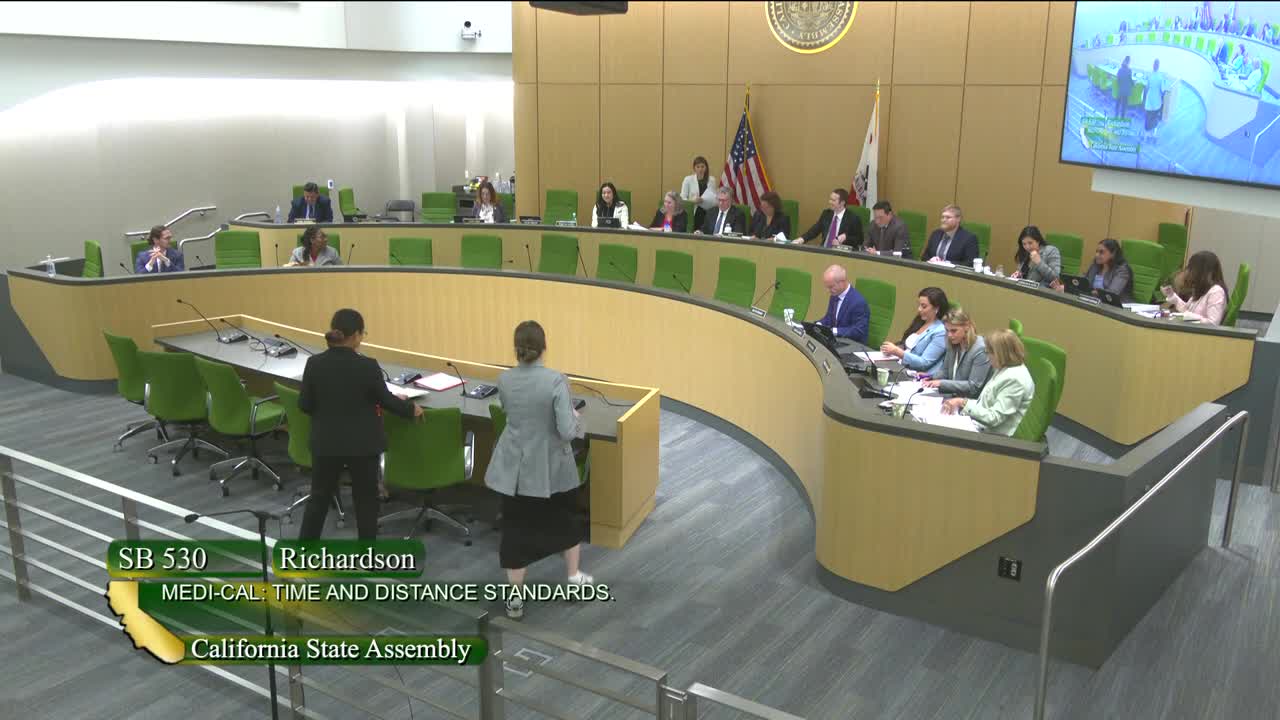 11MIN
Assembly Standing Committee on Health
 2MIN
Senate Floor
 10SEC
Senate Standing Committee on Appropriations
 16MIN
Senate Standing Committee on Health
Bill Author

Bill Co-Author(s):
