SB 534: Dependent children: information related to family.
- Session Year: 2025-2026
- House: Senate
- Latest Version Date: 2026-09-20
Current Status:
Passed
(2026-09-20: Chaptered by Secretary of State. Chapter 415, Statutes of 2026.)
Introduced
In Committee
Awaiting First Chamber Vote
Passed First Chamber
In Committee
Awaiting Second Chamber Vote
Passed Second Chamber
Enacted
Existing law establishes the jurisdiction of the juvenile court, which is permitted to adjudge children who have suffered abuse or neglect to be dependents of the court under certain circumstances, and prescribes various hearings and other procedures for these purposes. Existing law requires the county welfare department to submit reports at the first regularly scheduled review hearing after a dependent minor has attained 16 years of age and at the last regularly scheduled review hearing before a dependent minor attains 18 years of age, and at every regularly scheduled review hearing thereafter, verifying that the county welfare department has provided certain information, documents, and services to the minor or nonminor.
Existing law prohibits the court from terminating dependency jurisdiction over a nonminor dependent until the county welfare department has submitted a report verifying specified information, documents, and services have been provided to the nonminor, including the nonminors family history and placement history.
This bill would additionally require the above-described assistance include providing the minor or nonminor the last known whereabouts of their parents and siblings and the last known contact information for them. The bill would require that the minor or nonminor have the option to decline this information.
By increasing the duties of county welfare departments, this bill would impose a state-mandated local program.
The California Constitution requires the state to reimburse local agencies and school districts for certain costs mandated by the state. Statutory provisions establish procedures for making that reimbursement.
This bill would provide that no reimbursement is required by this act for a specified reason.
This bill would incorporate additional changes to Section 391 of the Welfare and Institutions Code proposed by AB 2764 to be operative only if this bill and AB 2764 are enacted and this bill is enacted last.
Existing law establishes the jurisdiction of the juvenile court, which is permitted to adjudge children who have suffered abuse or neglect to be dependents of the court under certain circumstances, and prescribes various hearings and other procedures for these purposes. Existing law requires the county welfare department to submit reports at the first regularly scheduled review hearing after a dependent minor has attained 16 years of age and at the last regularly scheduled review hearing before a dependent minor attains 18 years of age, and at every regularly scheduled review hearing thereafter, verifying that the county welfare department has provided certain information, documents, and services to the minor or nonminor.
Existing law prohibits the court from terminating dependency jurisdiction over a nonminor dependent until the county welfare department has submitted a report verifying specified information, documents, and services have been provided to the nonminor, including the nonminors family history and placement history.
This bill would additionally require the above-described assistance include providing the minor or nonminor the last known whereabouts of their parents and siblings and the last known contact information for them. The bill would require that the minor or nonminor have the option to decline this information.
By increasing the duties of county welfare departments, this bill would impose a state-mandated local program.
The California Constitution requires the state to reimburse local agencies and school districts for certain costs mandated by the state. Statutory provisions establish procedures for making that reimbursement.
This bill would provide that no reimbursement is required by this act for a specified reason.
Existing law establishes procedures for the formation of infrastructure financing districts, enhanced infrastructure financing districts, infrastructure and revitalization financing districts, community revitalization and investment authorities, and public-private partnerships, as specified, to undertake various economic development projects, including financing public facilities and infrastructure, affordable housing, and economic revitalization. Existing law, until January 1, 2028, authorizes the establishment of a Green Empowerment Zone for the Northern Waterfront area of the County of Contra Costa for the purpose of building upon the comparative advantage provided by the regional concentration of highly skilled energy industry workers by prioritizing access to tax incentives, grants, and loan programs, among other incentives.This bill, until January 1, 2035, would authorize establishment of a Green Empowerment Zone for the Salton Sea and Southeastern Desert Valleys (empowerment zone). The bill would authorize the empowerment zone to be composed of specified land and communities within the Imperial, Eastern Coachella, and Palo Verde Valleys, upon adoption of a resolution by the Imperial County Board of Supervisors, and would provide for the empowerment zone to be governed by a board of directors, as specified. The bill would task the empowerment zone with various duties, including, among other things, identification of projects and programs that will best utilize public dollars, distribute benefits to disinvested communities, and most quickly improve the economic vitality of Californias southeastern desert valleys, as specified, in a coordinated effort to support the development and equitable transition to a clean energy economy. The bill would require the board of directors, beginning on January 1, 2027, to submit an annual progress report to the Legislature and the Governors Office of Business and Economic Development, as specified. The bill would require the empowerment zone, commencing on January 1, 2027, as specified, to post the above-described report on its internet website and to submit a letter to the Legislature informing the Legislature that the report has been posted.This bill would make legislative findings and declarations as to the necessity of a special statute for the Southeastern Desert Valleys.Existing law establishes procedures for the formation of infrastructure financing districts, enhanced infrastructure financing districts, infrastructure and revitalization financing districts, community revitalization and investment authorities, and public-private partnerships, as specified, to undertake various economic development projects, including financing public facilities and infrastructure, affordable housing, and economic revitalization. Existing law, until January 1, 2028, authorizes the establishment of a Green Empowerment Zone for the Northern Waterfront area of the County of Contra Costa for the purpose of building upon the comparative advantage provided by the regional concentration of highly skilled energy industry workers by prioritizing access to tax incentives, grants, and loan programs, among other incentives.
This bill, until January 1, 2035, would authorize establishment of a Green Empowerment Zone for the Salton Sea and Southeastern Desert Valleys (empowerment zone). The bill would authorize the empowerment zone to be composed of specified land and communities within the Imperial, Eastern Coachella, and Palo Verde Valleys, upon adoption of a resolution by the Imperial County Board of Supervisors, and would provide for the empowerment zone to be governed by a board of directors, as specified. The bill would task the empowerment zone with various duties, including, among other things, identification of projects and programs that will best utilize public dollars, distribute benefits to disinvested communities, and most quickly improve the economic vitality of Californias southeastern desert valleys, as specified, in a coordinated effort to support the development and equitable transition to a clean energy economy. The bill would require the board of directors, beginning on January 1, 2027, to submit an annual progress report to the Legislature and the Governors Office of Business and Economic Development, as specified. The bill would require the empowerment zone, commencing on January 1, 2027, as specified, to post the above-described report on its internet website and to submit a letter to the Legislature informing the Legislature that the report has been posted.
This bill would make legislative findings and declarations as to the necessity of a special statute for the Southeastern Desert Valleys.
Existing law establishes procedures for the formation of infrastructure financing districts, enhanced infrastructure financing districts, infrastructure and revitalization financing districts, community revitalization and investment authorities, and public-private partnerships, as specified, to undertake various economic development projects, including financing public facilities and infrastructure, affordable housing, and economic revitalization. Existing law, until January 1, 2028, authorizes the establishment of a Green Empowerment Zone for the Northern Waterfront area of the County of Contra Costa for the purpose of building upon the comparative advantage provided by the regional concentration of highly skilled energy industry workers by prioritizing access to tax incentives, grants, and loan programs, among other incentives.
This bill, until January 1, 2035, would authorize establishment of a Green Empowerment Zone for the Salton Sea and Southeastern Desert Valleys (empowerment zone). The bill would authorize the empowerment zone to be composed of specified land and communities within the Imperial, Eastern Coachella, and Palo Verde Valleys, upon adoption of a resolution by the Imperial County Board of Supervisors, and would provide for the empowerment zone to be governed by a board of directors, as specified. The bill would task the empowerment zone with various duties, including, among other things, identification of projects and programs that will best utilize public dollars, distribute benefits to disinvested communities, and most quickly improve the economic vitality of Californias southeastern desert valleys, as specified, in a coordinated effort to support the development and equitable transition to a clean energy economy. The bill would require the board of directors, beginning on January 1, 2027, to submit an annual progress report to the Legislature and the Governors Office of Business and Economic Development, as specified. The bill would require the empowerment zone, commencing on January 1, 2027, as specified, to post the above-described report on its internet website and to submit a letter to the Legislature informing the Legislature that the report has been posted.
This bill would make legislative findings and declarations as to the necessity of a special statute for the Southeastern Desert Valleys.
(a)(1)At the first regularly scheduled review hearing held pursuant to subdivision (d) of Section 366.3 after a dependent child has attained 16 years of age, the county welfare department shall submit a report verifying that the following information, documents, and services have been provided to the child:
(A)Social security card, if provided to the child pursuant to paragraph (2).
(B)Copy of the birth certificate.
(C)Drivers license, as described in Section 12500 of the Vehicle Code, or identification card, as described in Section 13000 of the Vehicle Code.
(D)Assistance in obtaining employment, if applicable.
(E)Assistance in applying for, or preparing to apply for, admission to college or to a vocational training program or other educational institution and in obtaining financial aid, where applicable.
(F)Written information notifying the child that current or former dependent children who are or have been in foster care are granted a preference for student assistant or internship positions with state agencies pursuant to Section 18220 of the Government Code, or with participating county agencies pursuant to Section 31000.11 of the Government Code, until the child attains 26 years of age.
(G)Written information notifying the child of any financial literacy programs or other available resources provided through the county or other community organizations to help the youth obtain financial literacy skills, including, but not limited to, banking, credit card debt, student loan debt, credit scores, credit history, and personal savings.
(2)Except as required by subdivision (b), the childs social security card may only be provided temporarily to the dependent child for the following purposes:
(A)To enable the child to obtain employment.
(B)To apply for admission to an institution of postsecondary education or a vocational training program.
(C)To apply for financial aid.
(D)To apply for or access public benefits.
(E)As otherwise determined by the childs caseworker, including, but not limited to, in response to a request from the child.
(3)For purposes of this subdivision, a certified copy of the dependent childs birth certificate shall be provided upon request of the child.
(b)At the last regularly scheduled review hearing held pursuant to subdivision (d) of Section 366.3 before a dependent child attains 18 years of age, and at every regularly scheduled review hearing thereafter pursuant to Section 366.31, the county welfare department shall submit a report verifying that the following information, documents, and services have been provided to the minor or nonminor:
(1)Social security card.
(2)Certified copy of the birth certificate.
(3)Drivers license, as described in Section 12500 of the Vehicle Code, or identification card, as described in Section 13000 of the Vehicle Code.
(4)Medi-Cal Benefits Identification Card.
(5)A letter prepared by the county welfare department that includes the following information:
(A)The minors or nonminors name and date of birth.
(B)The dates during which the minor or nonminor was within the jurisdiction of the juvenile court.
(C)A statement that the minor or nonminor was a foster youth in compliance with state and federal financial aid documentation requirements.
(6)If applicable, the death certificate of the parent or parents.
(7)If applicable, proof of the minors or nonminors citizenship or legal residence.
(8)An advance health care directive form.
(9)The Judicial Council form that the minor or nonminor would use to file a petition pursuant to subdivision (e) of Section 388 to resume dependency jurisdiction.
(10)Written information notifying the minor or nonminor that they may be eligible to receive CalFresh benefits, and where the minor or nonminor can apply for CalFresh benefits.
(11)The minors family history and placement history, including, but not limited to, the last known whereabouts of their parents and siblings and the last known contact information for them, including telephone number, cell phone number, physical address, email address, and any known social media accounts. The minor shall have the option to decline the information.
(c)At the last regularly scheduled review hearing held pursuant to subdivision (d) of Section 366.3 before a dependent child attains 18 years of age, and at every regularly scheduled review hearing thereafter pursuant to Section 366.31, the county welfare department shall submit a report describing efforts toward providing the following information, documents, and services to the minor or nonminor:
(1)Assistance in obtaining employment, if applicable.
(2)Assistance in applying for, or preparing to apply for, admission to college or to a vocational training program or other educational institution and in obtaining financial aid, where applicable.
(3)Written information notifying the child that a current or former dependent child who is or has been in foster care is granted a preference for student assistant or internship positions with state agencies pursuant to Section 18220 of the Government Code, or with participating county agencies pursuant to Section 31000.11 of the Government Code, until the child attains 26 years of age.
(4)Written information notifying the child that youth exiting foster care at 18 years of age or older are eligible for Medi-Cal until they reach 26 years of age, regardless of income, and are not required to submit an application.
(5)Written information notifying the child of any financial literacy programs or other available resources provided through the county or other community organizations to help the youth obtain financial literacy skills, including, but not limited to, banking, credit card debt, student loan debt, credit scores, credit history, and personal savings.
(6)(A)If applicable, referrals to transitional housing, if available, or assistance in securing other housing.
(B)Whether the referrals or assistance as described in subparagraph (A) have resulted in housing being secured for the minor or nonminor, and, if not, what, if any, different or additional referrals or assistance the department has provided that are intended to secure housing.
(C)The duration of the housing, if known to the department.
(D)If applicable, information, including summaries, describing additional referrals, assistance, or services provided by county departments or agencies other than the county welfare department that are intended to prevent the minor or nonminor from becoming homeless if jurisdiction is terminated pursuant to this section.
(E)The information described in subparagraphs (B) to (D), inclusive, is required only for reports submitted at the last regularly scheduled review hearing held pursuant to subdivision (d) of Section 366.3 before a dependent child attains 18 years of age.
(7)Assistance in maintaining relationships with individuals who are important to a minor or nonminor who has been in out-of-home placement for six months or longer from the date the minor or nonminor entered foster care, based on the minors or nonminors best interests.
(8)The whereabouts of any siblings under the jurisdiction of the juvenile court, unless the court determines that sibling contact would jeopardize the safety or welfare of either sibling.
(d)The dependency court shall not terminate jurisdiction over a nonminor unless a hearing is conducted pursuant to this section. At any hearing at which the court is considering terminating jurisdiction over a nonminor, the county welfare department shall do all of the following:
(1)Ensure that the dependent nonminor is present in court, unless the nonminor does not wish to appear in court and elects a telephonic appearance, or document reasonable efforts made by the county welfare department to locate the nonminor when the nonminor is not available.
(2)Submit a report describing whether it is in the nonminors best interests to remain under the courts dependency jurisdiction, which includes a recommended transitional independent living case plan for the nonminor when the report describes continuing dependency jurisdiction as being in the nonminors best interest.
(3)If the county welfare department recommends termination of the courts dependency jurisdiction, submit documentation of the reasonable efforts made by the department to provide the nonminor with the assistance needed to meet or maintain eligibility as a nonminor dependent, as defined in paragraphs (1) to (5), inclusive, of subdivision (b) of Section 11403.
(4)If the nonminor has indicated that they do not want dependency jurisdiction to continue, the report shall address the manner in which the nonminor was advised of their options, including the benefits of remaining in foster care, and of their right to reenter foster care and to file a petition pursuant to subdivision (e) of Section 388 to resume dependency jurisdiction prior to attaining 21 years of age.
(e)(1)The court shall continue dependency jurisdiction over a nonminor who meets the definition of a nonminor dependent as described in subdivision (v) of Section 11400 unless the court finds either of the following:
(A)That the nonminor does not wish to remain subject to dependency jurisdiction.
(B)That the nonminor is not participating in a reasonable and appropriate transitional independent living case plan.
(2)In making the findings pursuant to paragraph (1), the court shall also find that the nonminor has been informed of their options including the benefits of remaining in foster care and the right to reenter foster care by filing a petition pursuant to subdivision (e) of Section 388 to resume dependency jurisdiction and by completing a voluntary reentry agreement pursuant to subdivision (z) of Section 11400, and has had an opportunity to confer with their counsel if counsel has been appointed pursuant to Section 317.
(f)The court may terminate its jurisdiction over a nonminor if the court finds after reasonable and documented efforts the nonminor cannot be located.
(g)When terminating dependency jurisdiction, the court shall maintain general jurisdiction over the nonminor to allow for the filing of a petition to resume dependency jurisdiction under subdivision (e) of Section 388 until the nonminor attains 21 years of age, although no review proceedings shall be required. A nonminor may petition the court pursuant to subdivision (e) of Section 388 to resume dependency jurisdiction at any time before attaining 21 years of age.
(h)The court shall not terminate dependency jurisdiction over a nonminor dependent who has attained 18 years of age until a hearing is conducted pursuant to this section. Jurisdiction shall not be terminated until the department has submitted a report verifying that the information, documents, and services required under subdivisions (a) and (b), as well as the following information, documents, and services, have been provided to the nonminor, or in the case of a nonminor who, after reasonable efforts by the county welfare department, cannot be located, verifying the efforts made to make the following available to the nonminor:
(1)Assistance in accessing the Independent Living Aftercare Program in the nonminors county of residence, and, upon the nonminors request, assistance in completing a voluntary reentry agreement for care and placement pursuant to subdivision (z) of Section 11400 and in filing a petition pursuant to subdivision (e) of Section 388 to resume dependency jurisdiction.
(2)Written information concerning the nonminors dependency case, including, but not limited to, all of the following:
(A)Any known information regarding the nonminors Indian heritage or tribal connections.
(B)The nonminors family history and placement history, including, but not limited to, the last known whereabouts of their parents and siblings and the last known contact information for them, including phone number, physical address, email address, and any known social media accounts. The nonminor shall have the option to decline this information.
(C)Any photographs of the nonminor or the family of the nonminor in the possession of the county welfare department, other than forensic photographs.
(D)Directions on how to access the documents the nonminor is entitled to inspect under Section 827.
(E)The written 90-day transition plan prepared pursuant to Section 16501.1.
(F)The date on which the jurisdiction of the juvenile court would be terminated.
(3)The health and education summary described in subdivision (a) of Section 16010.
(4)The Judicial Council form that the nonminor would use to file a petition pursuant to subdivision (e) of Section 388 to resume dependency jurisdiction.
(5)Written verification that the eligible nonminor is enrolled in Medi-Cal and the nonminors Medi-Cal Benefits Identification Card.
(6)Continued and uninterrupted enrollment in Medi-Cal for eligible nonminors pursuant to Section 14005.28 or 14005.285.
(7)Assistance with the following:
(A)Referrals to transitional housing, if available, or assistance in securing other housing.
(B)Obtaining employment or other financial support, if applicable.
(8)The report described in this subdivision, as it relates to the assistance described in subparagraph (A) of paragraph (7), shall include the following:
(A)Whether the referral or assistance has resulted in housing being secured for the minor or nonminor, and, if not, what, if any, different or additional assistance the department has provided that is intended to secure housing.
(B)The duration of the housing, if known to the department.
(C)If applicable, information, including summaries, describing additional referrals, assistance, or services provided by county departments or agencies other than the county welfare department that are intended to prevent the minor or nonminor from becoming homeless if jurisdiction is terminated pursuant to this section.
SEC. 1.5.Section 391 of the Welfare and Institutions Code is amended to read:391.(a)(1)At the first regularly scheduled review hearing held pursuant to subdivision (d) of Section 366.3 after a dependent child has attained 16 years of age, the county welfare department shall submit a report verifying that the following information, documents, and services have been provided to the child:
(A)Social security card, if provided to the child pursuant to paragraph (2).
(B) Copy of the birth certificate.
(C)Drivers license, as described in Section 12500 of the Vehicle Code, or identification card, as described in Section 13000 of the Vehicle Code.
(D)Assistance in obtaining employment, if applicable.
(E)Assistance in applying for, or preparing to apply for, admission to college or to a vocational training program or other educational institution and in obtaining financial aid, where applicable.
(F)Written information notifying the child that current or former dependent children who are or have been in foster care are granted a preference for student assistant or internship positions with state agencies pursuant to Section 18220 of the Government Code, or with participating county agencies pursuant to Section 31000.11 of the Government Code, until the child attains 26 years of age.
(G)Written information notifying the child of any financial literacy programs or other available resources provided through the county or other community organizations to help the youth obtain financial literacy skills, including, but not limited to, banking, credit card debt, student loan debt, credit scores, credit history, and personal savings.
(2)Except as required by subdivision (b), the childs social security card may only be provided temporarily to the dependent child for the following purposes:
(A)To enable the child to obtain employment.
(B)To apply for admission to an institution of postsecondary education or a vocational training program.
(C)To apply for financial aid.
(D)To apply for or access public benefits.
(E)As otherwise determined by the childs caseworker, including, but not limited to, in response to a request from the child.
(3)For purposes of this subdivision, a certified copy of the dependent childs birth certificate shall be provided upon request of the child.
(b)At the last regularly scheduled review hearing held pursuant to subdivision (d) of Section 366.3 before a dependent child attains 18 years of age, and at every regularly scheduled review hearing thereafter pursuant to Section 366.31, the county welfare department shall submit a report verifying that the following information, documents, and services have been provided to the minor or nonminor:
(1)Social security card.
(2)Certified copy of the birth certificate.
(3)Drivers license, as described in Section 12500 of the Vehicle Code, or identification card, as described in Section 13000 of the Vehicle Code.
(4)Medi-Cal Benefits Identification Card.
(5)A letter prepared by the county welfare department that includes the following information:
(A)The minors or nonminors name and date of birth.
(B)The dates during which the minor or nonminor was within the jurisdiction of the juvenile court.
(C)A statement that the minor or nonminor was a foster youth in compliance with state and federal financial aid documentation requirements.
(6)If applicable, the death certificate of the parent or parents.
(7)If applicable, proof of the minors or nonminors citizenship or legal residence.
(8)An advance health care directive form.
(9)The Judicial Council form that the minor or nonminor would use to file a petition pursuant to subdivision (e) of Section 388 to resume dependency jurisdiction.
(10)Written information notifying the minor or nonminor that they may be eligible to receive CalFresh benefits, and where the minor or nonminor can apply for CalFresh benefits.
(11)The minors family history and placement history, including, but not limited to, the last known whereabouts of their parents and siblings and the last known contact information for them, including telephone number, cell phone number, physical address, email address, and any known social media accounts. The minor shall have the option to decline the information.
(c)At the last regularly scheduled review hearing held pursuant to subdivision (d) of Section 366.3 before a dependent child attains 18 years of age, and at every regularly scheduled review hearing thereafter pursuant to Section 366.31, the county welfare department shall submit a report describing efforts toward providing the following information, documents, and services to the minor or nonminor:
(1)Assistance in obtaining employment, if applicable.
(2)Assistance in applying for, or preparing to apply for, admission to college or to a vocational training program or other educational institution and in obtaining financial aid, where applicable.
(3)Written information notifying the child that a current or former dependent child who is or has been in foster care is granted a preference for student assistant or internship positions with state agencies pursuant to Section 18220 of the Government Code, or with participating county agencies pursuant to Section 31000.11 of the Government Code, until the child attains 26 years of age.
(4)Written information notifying the child that youth exiting foster care at 18 years of age or older are eligible for Medi-Cal until they reach 26 years of age, regardless of income, and are not required to submit an application.
(5)Written information notifying the child of any financial literacy programs or other available resources provided through the county or other community organizations to help the youth obtain financial literacy skills, including, but not limited to, banking, credit card debt, student loan debt, credit scores, credit history, and personal savings.
(6)(A)If applicable, referrals to transitional housing, if available, or assistance in securing other housing.
(B)Whether the referrals or assistance as described in subparagraph (A) have resulted in housing being secured for the minor or nonminor, and, if not, what, if any, different or additional referrals or assistance the department has provided that are intended to secure housing.
(C)The duration of the housing, if known to the department.
(D)If applicable, information, including summaries, describing additional referrals, assistance, or services provided by county departments or agencies other than the county welfare department that are intended to prevent the minor or nonminor from becoming homeless if jurisdiction is terminated pursuant to this section.
(E)The information described in subparagraphs (B) to (D), inclusive, is required only for reports submitted at the last regularly scheduled review hearing held pursuant to subdivision (d) of Section 366.3 before a dependent child attains 18 years of age.
(7)Assistance in maintaining relationships with individuals who are important to a minor or nonminor who has been in out-of-home placement for six months or longer from the date the minor or nonminor entered foster care, based on the minors or nonminors best interests.
(8)The whereabouts of any siblings under the jurisdiction of the juvenile court, unless the court determines that sibling contact would jeopardize the safety or welfare of either sibling.
(d)The dependency court shall not terminate jurisdiction over a nonminor unless a hearing is conducted pursuant to this section. At any hearing at which the court is considering terminating jurisdiction over a nonminor, the county welfare department shall do all of the following:
(1)Ensure that the dependent nonminor is present in court, unless the nonminor does not wish to appear in court and elects a telephonic appearance, or document reasonable efforts made by the county welfare department to locate the nonminor when the nonminor is not available.
(2)Submit a report describing whether it is in the nonminors best interests to remain under the courts dependency jurisdiction, which includes a recommended transitional independent living case plan for the nonminor when the report describes continuing dependency jurisdiction as being in the nonminors best interest.
(3)If the county welfare department recommends termination of the courts dependency jurisdiction, submit documentation of the reasonable efforts made by the department to provide the nonminor with the assistance needed to meet or maintain eligibility as a nonminor dependent, as defined in subdivision (b) of Section 11403.
(4)If the nonminor has indicated that they do not want dependency jurisdiction to continue, the report shall address the manner in which the nonminor was advised of their options, including the benefits of remaining in foster care, and of their right to reenter foster care and to file a petition pursuant to subdivision (e) of Section 388 to resume dependency jurisdiction prior to attaining 21 years of age.
(e)(1)The court shall continue dependency jurisdiction over a nonminor who meets the definition of a nonminor dependent as described in subdivision (v) of Section 11400 unless the court finds either of the following:
(A)That the nonminor does not wish to remain subject to dependency jurisdiction.
(B)That the nonminor is not participating in a reasonable and appropriate transitional independent living case plan.
(2)In making the findings pursuant to paragraph (1), the court shall also find that the nonminor has been informed of their options including the benefits of remaining in foster care and the right to reenter foster care by filing a petition pursuant to subdivision (e) of Section 388 to resume dependency jurisdiction and by completing a voluntary reentry agreement pursuant to subdivision (z) of Section 11400, and has had an opportunity to confer with their counsel if counsel has been appointed pursuant to Section 317.
(f)The court may terminate its jurisdiction over a nonminor if the court finds after reasonable and documented efforts the nonminor cannot be located.
(g)When terminating dependency jurisdiction, the court shall maintain general jurisdiction over the nonminor to allow for the filing of a petition to resume dependency jurisdiction under subdivision (e) of Section 388 until the nonminor attains 21 years of age, although no review proceedings shall be required. A nonminor may petition the court pursuant to subdivision (e) of Section 388 to resume dependency jurisdiction at any time before attaining 21 years of age.
(h)The court shall not terminate dependency jurisdiction over a nonminor dependent who has attained 18 years of age until a hearing is conducted pursuant to this section. Jurisdiction shall not be terminated until the department has submitted a report verifying that the information, documents, and services required under subdivisions (a) and (b), as well as the following information, documents, and services, have been provided to the nonminor, or in the case of a nonminor who, after reasonable efforts by the county welfare department, cannot be located, verifying the efforts made to make the following available to the nonminor:
(1)Assistance in accessing the Independent Living Aftercare Program in the nonminors county of residence, and, upon the nonminors request, assistance in completing a voluntary reentry agreement for care and placement pursuant to subdivision (z) of Section 11400 and in filing a petition pursuant to subdivision (e) of Section 388 to resume dependency jurisdiction.
(2)Written information concerning the nonminors dependency case, including, but not limited to, all of the following:
(A)Any known information regarding the nonminors Indian heritage or tribal connections.
(B)The nonminors family history and placement history, including, but not limited to, the last known whereabouts of their parents and siblings and the last known contact information for them, including phone number, physical address, email address, and any known social media accounts. The nonminor shall have the option to decline this information.
(C)Any photographs of the nonminor or the family of the nonminor in the possession of the county welfare department, other than forensic photographs.
(D)Directions on how to access the documents the nonminor is entitled to inspect under Section 827.
(E)The written 90-day transition plan prepared pursuant to Section 16501.1.
(F)The date on which the jurisdiction of the juvenile court would be terminated.
(3)The health and education summary described in subdivision (a) of Section 16010.
(4)The Judicial Council form that the nonminor would use to file a petition pursuant to subdivision (e) of Section 388 to resume dependency jurisdiction.
(5)Written verification that the eligible nonminor is enrolled in Medi-Cal and the nonminors Medi-Cal Benefits Identification Card.
(6)Continued and uninterrupted enrollment in Medi-Cal for eligible nonminors pursuant to Section 14005.28 or 14005.285.
(7)Assistance with the following:
(A)Referrals to transitional housing, if available, or assistance in securing other housing.
(B)Obtaining employment or other financial support, if applicable.
(8)The report described in this subdivision, as it relates to the assistance described in subparagraph (A) of paragraph (7), shall include the following:
(A)Whether the referral or assistance has resulted in housing being secured for the minor or nonminor, and, if not, what, if any, different or additional assistance the department has provided that is intended to secure housing.
(B)The duration of the housing, if known to the department.
(C)If applicable, information, including summaries, describing additional referrals, assistance, or services provided by county departments or agencies other than the county welfare department that are intended to prevent the minor or nonminor from becoming homeless if jurisdiction is terminated pursuant to this section.
SEC. 2.Section 1.5 of this bill incorporates amendments to Section 391 of the Welfare and Institutions Code proposed by both this bill and AB 2764. That section of this bill shall only become operative if (1) both bills are enacted and become effective on or before January 1, 2027, (2) each bill amends Section 391 of the Welfare and Institutions Code, and (3) this bill is enacted after AB 2764, in which case Section 1 of this bill shall not become operative.
SEC. 3.To the extent that this act has an overall effect of increasing the costs already borne by a local agency for programs or levels of service mandated by the 2011 Realignment Legislation within the meaning of Section 36 of Article XIII of the California Constitution, it shall apply to local agencies only to the extent that the state provides annual funding for the cost increase. Any new program or higher level of service provided by a local agency pursuant to this act above the level for which funding has been provided shall not require a subvention of funds by the state or otherwise be subject to Section 6 of Article XIIIB of the California Constitution.
(a)(1)At the first regularly scheduled review hearing held pursuant to subdivision (d) of Section 366.3 after a dependent child has attained 16 years of age, the county welfare department shall submit a report verifying that the following information, documents, and services have been provided to the child:
(A)Social security card, if provided to the child pursuant to paragraph (2).
(B)Copy of the birth certificate.
(C)Drivers license, as described in Section 12500 of the Vehicle Code, or identification card, as described in Section 13000 of the Vehicle Code.
(D)Assistance in obtaining employment, if applicable.
(E)Assistance in applying for, or preparing to apply for, admission to college or to a vocational training program or other educational institution and in obtaining financial aid, where applicable.
(F)Written information notifying the child that current or former dependent children who are or have been in foster care are granted a preference for student assistant or internship positions with state agencies pursuant to Section 18220 of the Government Code, or with participating county agencies pursuant to Section 31000.11 of the Government Code, until the child attains 26 years of age.
(G)Written information notifying the child of any financial literacy programs or other available resources provided through the county or other community organizations to help the youth obtain financial literacy skills, including, but not limited to, banking, credit card debt, student loan debt, credit scores, credit history, and personal savings.
(2)Except as required by subdivision (b), the childs social security card may only be provided temporarily to the dependent child for the following purposes:
(A)To enable the child to obtain employment.
(B)To apply for admission to an institution of postsecondary education or a vocational training program.
(C)To apply for financial aid.
(D)To apply for or access public benefits.
(E)As otherwise determined by the childs caseworker, including, but not limited to, in response to a request from the child.
(3)For purposes of this subdivision, a certified copy of the dependent childs birth certificate shall be provided upon request of the child.
(b)At the last regularly scheduled review hearing held pursuant to subdivision (d) of Section 366.3 before a dependent child attains 18 years of age, and at every regularly scheduled review hearing thereafter pursuant to Section 366.31, the county welfare department shall submit a report verifying that the following information, documents, and services have been provided to the minor or nonminor:
(1)Social security card.
(2)Certified copy of the birth certificate.
(3)Drivers license, as described in Section 12500 of the Vehicle Code, or identification card, as described in Section 13000 of the Vehicle Code.
(4)Medi-Cal Benefits Identification Card.
(5)A letter prepared by the county welfare department that includes the following information:
(A)The minors or nonminors name and date of birth.
(B)The dates during which the minor or nonminor was within the jurisdiction of the juvenile court.
(C)A statement that the minor or nonminor was a foster youth in compliance with state and federal financial aid documentation requirements.
(6)If applicable, the death certificate of the parent or parents.
(7)If applicable, proof of the minors or nonminors citizenship or legal residence.
(8)An advance health care directive form.
(9)The Judicial Council form that the minor or nonminor would use to file a petition pursuant to subdivision (e) of Section 388 to resume dependency jurisdiction.
(10)Written information notifying the minor or nonminor that they may be eligible to receive CalFresh benefits, and where the minor or nonminor can apply for CalFresh benefits.
(11)The minors family history and placement history, including, but not limited to, the last known whereabouts of their parents and siblings and the last known contact information for them, including telephone number, cell phone number, physical address, email address, and any known social media accounts. The minor shall have the option to decline the information.
(c)At the last regularly scheduled review hearing held pursuant to subdivision (d) of Section 366.3 before a dependent child attains 18 years of age, and at every regularly scheduled review hearing thereafter pursuant to Section 366.31, the county welfare department shall submit a report describing efforts toward providing the following information, documents, and services to the minor or nonminor:
(1)Assistance in obtaining employment, if applicable.
(2)Assistance in applying for, or preparing to apply for, admission to college or to a vocational training program or other educational institution and in obtaining financial aid, where applicable.
(3)Written information notifying the child that a current or former dependent child who is or has been in foster care is granted a preference for student assistant or internship positions with state agencies pursuant to Section 18220 of the Government Code, or with participating county agencies pursuant to Section 31000.11 of the Government Code, until the child attains 26 years of age.
(4)Written information notifying the child that youth exiting foster care at 18 years of age or older are eligible for Medi-Cal until they reach 26 years of age, regardless of income, and are not required to submit an application.
(5)Written information notifying the child of any financial literacy programs or other available resources provided through the county or other community organizations to help the youth obtain financial literacy skills, including, but not limited to, banking, credit card debt, student loan debt, credit scores, credit history, and personal savings.
(6)(A)If applicable, referrals to transitional housing, if available, or assistance in securing other housing.
(B)Whether the referrals or assistance as described in subparagraph (A) have resulted in housing being secured for the minor or nonminor, and, if not, what, if any, different or additional referrals or assistance the department has provided that are intended to secure housing.
(C)The duration of the housing, if known to the department.
(D)If applicable, information, including summaries, describing additional referrals, assistance, or services provided by county departments or agencies other than the county welfare department that are intended to prevent the minor or nonminor from becoming homeless if jurisdiction is terminated pursuant to this section.
(E)The information described in subparagraphs (B) to (D), inclusive, is required only for reports submitted at the last regularly scheduled review hearing held pursuant to subdivision (d) of Section 366.3 before a dependent child attains 18 years of age.
(7)Assistance in maintaining relationships with individuals who are important to a minor or nonminor who has been in out-of-home placement for six months or longer from the date the minor or nonminor entered foster care, based on the minors or nonminors best interests.
(8)The whereabouts of any siblings under the jurisdiction of the juvenile court, unless the court determines that sibling contact would jeopardize the safety or welfare of either sibling.
(d)The dependency court shall not terminate jurisdiction over a nonminor unless a hearing is conducted pursuant to this section. At any hearing at which the court is considering terminating jurisdiction over a nonminor, the county welfare department shall do all of the following:
(1)Ensure that the dependent nonminor is present in court, unless the nonminor does not wish to appear in court and elects a telephonic appearance, or document reasonable efforts made by the county welfare department to locate the nonminor when the nonminor is not available.
(2)Submit a report describing whether it is in the nonminors best interests to remain under the courts dependency jurisdiction, which includes a recommended transitional independent living case plan for the nonminor when the report describes continuing dependency jurisdiction as being in the nonminors best interest.
(3)If the county welfare department recommends termination of the courts dependency jurisdiction, submit documentation of the reasonable efforts made by the department to provide the nonminor with the assistance needed to meet or maintain eligibility as a nonminor dependent, as defined in paragraphs (1) to (5), inclusive, of subdivision (b) of Section 11403.
(4)If the nonminor has indicated that they do not want dependency jurisdiction to continue, the report shall address the manner in which the nonminor was advised of their options, including the benefits of remaining in foster care, and of their right to reenter foster care and to file a petition pursuant to subdivision (e) of Section 388 to resume dependency jurisdiction prior to attaining 21 years of age.
(e)(1)The court shall continue dependency jurisdiction over a nonminor who meets the definition of a nonminor dependent as described in subdivision (v) of Section 11400 unless the court finds either of the following:
(A)That the nonminor does not wish to remain subject to dependency jurisdiction.
(B)That the nonminor is not participating in a reasonable and appropriate transitional independent living case plan.
(2)In making the findings pursuant to paragraph (1), the court shall also find that the nonminor has been informed of their options including the benefits of remaining in foster care and the right to reenter foster care by filing a petition pursuant to subdivision (e) of Section 388 to resume dependency jurisdiction and by completing a voluntary reentry agreement pursuant to subdivision (z) of Section 11400, and has had an opportunity to confer with their counsel if counsel has been appointed pursuant to Section 317.
(f)The court may terminate its jurisdiction over a nonminor if the court finds after reasonable and documented efforts the nonminor cannot be located.
(g)When terminating dependency jurisdiction, the court shall maintain general jurisdiction over the nonminor to allow for the filing of a petition to resume dependency jurisdiction under subdivision (e) of Section 388 until the nonminor attains 21 years of age, although no review proceedings shall be required. A nonminor may petition the court pursuant to subdivision (e) of Section 388 to resume dependency jurisdiction at any time before attaining 21 years of age.
(h)The court shall not terminate dependency jurisdiction over a nonminor dependent who has attained 18 years of age until a hearing is conducted pursuant to this section. Jurisdiction shall not be terminated until the department has submitted a report verifying that the information, documents, and services required under subdivisions (a) and (b), as well as the following information, documents, and services, have been provided to the nonminor, or in the case of a nonminor who, after reasonable efforts by the county welfare department, cannot be located, verifying the efforts made to make the following available to the nonminor:
(1)Assistance in accessing the Independent Living Aftercare Program in the nonminors county of residence, and, upon the nonminors request, assistance in completing a voluntary reentry agreement for care and placement pursuant to subdivision (z) of Section 11400 and in filing a petition pursuant to subdivision (e) of Section 388 to resume dependency jurisdiction.
(2)Written information concerning the nonminors dependency case, including, but not limited to, all of the following:
(A)Any known information regarding the nonminors Indian heritage or tribal connections.
(B)The nonminors family history and placement history, including, but not limited to, the last known whereabouts of their parents and siblings and the last known contact information for them, including phone number, physical address, email address, and any known social media accounts. The nonminor shall have the option to decline this information.
(C)Any photographs of the nonminor or the family of the nonminor in the possession of the county welfare department, other than forensic photographs.
(D)Directions on how to access the documents the nonminor is entitled to inspect under Section 827.
(E)The written 90-day transition plan prepared pursuant to Section 16501.1.
(F)The date on which the jurisdiction of the juvenile court would be terminated.
(3)The health and education summary described in subdivision (a) of Section 16010.
(4)The Judicial Council form that the nonminor would use to file a petition pursuant to subdivision (e) of Section 388 to resume dependency jurisdiction.
(5)Written verification that the eligible nonminor is enrolled in Medi-Cal and the nonminors Medi-Cal Benefits Identification Card.
(6)Continued and uninterrupted enrollment in Medi-Cal for eligible nonminors pursuant to Section 14005.28 or 14005.285.
(7)Assistance with the following:
(A)Referrals to transitional housing, if available, or assistance in securing other housing.
(B)Obtaining employment or other financial support, if applicable.
(8)The report described in this subdivision, as it relates to the assistance described in subparagraph (A) of paragraph (7), shall include the following:
(A)Whether the referral or assistance has resulted in housing being secured for the minor or nonminor, and, if not, what, if any, different or additional assistance the department has provided that is intended to secure housing.
(B)The duration of the housing, if known to the department.
(C)If applicable, information, including summaries, describing additional referrals, assistance, or services provided by county departments or agencies other than the county welfare department that are intended to prevent the minor or nonminor from becoming homeless if jurisdiction is terminated pursuant to this section.
SEC. 1.5.Section 391 of the Welfare and Institutions Code is amended to read:391.(a)(1)At the first regularly scheduled review hearing held pursuant to subdivision (d) of Section 366.3 after a dependent child has attained 16 years of age, the county welfare department shall submit a report verifying that the following information, documents, and services have been provided to the child:
(A)Social security card, if provided to the child pursuant to paragraph (2).
(B) Copy of the birth certificate.
(C)Drivers license, as described in Section 12500 of the Vehicle Code, or identification card, as described in Section 13000 of the Vehicle Code.
(D)Assistance in obtaining employment, if applicable.
(E)Assistance in applying for, or preparing to apply for, admission to college or to a vocational training program or other educational institution and in obtaining financial aid, where applicable.
(F)Written information notifying the child that current or former dependent children who are or have been in foster care are granted a preference for student assistant or internship positions with state agencies pursuant to Section 18220 of the Government Code, or with participating county agencies pursuant to Section 31000.11 of the Government Code, until the child attains 26 years of age.
(G)Written information notifying the child of any financial literacy programs or other available resources provided through the county or other community organizations to help the youth obtain financial literacy skills, including, but not limited to, banking, credit card debt, student loan debt, credit scores, credit history, and personal savings.
(2)Except as required by subdivision (b), the childs social security card may only be provided temporarily to the dependent child for the following purposes:
(A)To enable the child to obtain employment.
(B)To apply for admission to an institution of postsecondary education or a vocational training program.
(C)To apply for financial aid.
(D)To apply for or access public benefits.
(E)As otherwise determined by the childs caseworker, including, but not limited to, in response to a request from the child.
(3)For purposes of this subdivision, a certified copy of the dependent childs birth certificate shall be provided upon request of the child.
(b)At the last regularly scheduled review hearing held pursuant to subdivision (d) of Section 366.3 before a dependent child attains 18 years of age, and at every regularly scheduled review hearing thereafter pursuant to Section 366.31, the county welfare department shall submit a report verifying that the following information, documents, and services have been provided to the minor or nonminor:
(1)Social security card.
(2)Certified copy of the birth certificate.
(3)Drivers license, as described in Section 12500 of the Vehicle Code, or identification card, as described in Section 13000 of the Vehicle Code.
(4)Medi-Cal Benefits Identification Card.
(5)A letter prepared by the county welfare department that includes the following information:
(A)The minors or nonminors name and date of birth.
(B)The dates during which the minor or nonminor was within the jurisdiction of the juvenile court.
(C)A statement that the minor or nonminor was a foster youth in compliance with state and federal financial aid documentation requirements.
(6)If applicable, the death certificate of the parent or parents.
(7)If applicable, proof of the minors or nonminors citizenship or legal residence.
(8)An advance health care directive form.
(9)The Judicial Council form that the minor or nonminor would use to file a petition pursuant to subdivision (e) of Section 388 to resume dependency jurisdiction.
(10)Written information notifying the minor or nonminor that they may be eligible to receive CalFresh benefits, and where the minor or nonminor can apply for CalFresh benefits.
(11)The minors family history and placement history, including, but not limited to, the last known whereabouts of their parents and siblings and the last known contact information for them, including telephone number, cell phone number, physical address, email address, and any known social media accounts. The minor shall have the option to decline the information.
(c)At the last regularly scheduled review hearing held pursuant to subdivision (d) of Section 366.3 before a dependent child attains 18 years of age, and at every regularly scheduled review hearing thereafter, thereafter pursuant to Section 366.31, the county welfare department shall submit a report describing efforts toward providing the following information, documents, and services to the minor or nonminor:
(1)Assistance in obtaining employment, if applicable.
(2)Assistance in applying for, or preparing to apply for, admission to college or to a vocational training program or other educational institution and in obtaining financial aid, where applicable.
(3)Written information notifying the child that a current or former dependent child who is or has been in foster care is granted a preference for student assistant or internship positions with state agencies pursuant to Section 18220 of the Government Code, or with participating county agencies pursuant to Section 31000.11 of the Government Code, until the child attains 26 years of age.
(4)Written information notifying the child that youth exiting foster care at 18 years of age or older are eligible for Medi-Cal until they reach 26 years of age, regardless of income, and are not required to submit an application.
(5)Written information notifying the child of any financial literacy programs or other available resources provided through the county or other community organizations to help the youth obtain financial literacy skills, including, but not limited to, banking, credit card debt, student loan debt, credit scores, credit history, and personal savings.
(6)(A)If applicable, referrals to transitional housing, if available, or assistance in securing other housing.
(B)Whether the referrals or assistance as described in subparagraph (A) have resulted in housing being secured for the minor or nonminor, and, if not, what, if any, different or additional referrals or assistance the department has provided that are intended to secure housing.
(C)The duration of the housing, if known to the department.
(D)If applicable, information, including summaries, describing additional referrals, assistance, or services provided by county departments or agencies other than the county welfare department that are intended to prevent the minor or nonminor from becoming homeless if jurisdiction is terminated pursuant to this section.
(E)The information described in subparagraphs (B) to (D), inclusive, is required only for reports submitted at the last regularly scheduled review hearing held pursuant to subdivision (d) of Section 366.3 before a dependent child attains 18 years of age.
(7)Assistance in maintaining relationships with individuals who are important to a minor or nonminor who has been in out-of-home placement for six months or longer from the date the minor or nonminor entered foster care, based on the minors or nonminors best interests.
(8)The whereabouts of any siblings under the jurisdiction of the juvenile court, unless the court determines that sibling contact would jeopardize the safety or welfare of either sibling.
(d)The dependency court shall not terminate jurisdiction over a nonminor unless a hearing is conducted pursuant to this section. At any hearing at which the court is considering terminating jurisdiction over a nonminor, the county welfare department shall do all of the following:
(1)Ensure that the dependent nonminor is present in court, unless the nonminor does not wish to appear in court and elects a telephonic appearance, or document reasonable efforts made by the county welfare department to locate the nonminor when the nonminor is not available.
(2)Submit a report describing whether it is in the nonminors best interests to remain under the courts dependency jurisdiction, which includes a recommended transitional independent living case plan for the nonminor when the report describes continuing dependency jurisdiction as being in the nonminors best interest.
(3)If the county welfare department recommends termination of the courts dependency jurisdiction, submit documentation of the reasonable efforts made by the department to provide the nonminor with the assistance needed to meet or maintain eligibility as a nonminor dependent, as defined in paragraphs (1) to (5), inclusive, of subdivision (b) of Section 11403.
(4)If the nonminor has indicated that they do not want dependency jurisdiction to continue, the report shall address the manner in which the nonminor was advised of their options, including the benefits of remaining in foster care, and of their right to reenter foster care and to file a petition pursuant to subdivision (e) of Section 388 to resume dependency jurisdiction prior to attaining 21 years of age.
(e)(1)The court shall continue dependency jurisdiction over a nonminor who meets the definition of a nonminor dependent as described in subdivision (v) of Section 11400 unless the court finds either of the following:
(A)That the nonminor does not wish to remain subject to dependency jurisdiction.
(B)That the nonminor is not participating in a reasonable and appropriate transitional independent living case plan.
(2)In making the findings pursuant to paragraph (1), the court shall also find that the nonminor has been informed of their options including the benefits of remaining in foster care and the right to reenter foster care by filing a petition pursuant to subdivision (e) of Section 388 to resume dependency jurisdiction and by completing a voluntary reentry agreement pursuant to subdivision (z) of Section 11400, and has had an opportunity to confer with their counsel if counsel has been appointed pursuant to Section 317.
(f)The court may terminate its jurisdiction over a nonminor if the court finds after reasonable and documented efforts the nonminor cannot be located.
(g)When terminating dependency jurisdiction, the court shall maintain general jurisdiction over the nonminor to allow for the filing of a petition to resume dependency jurisdiction under subdivision (e) of Section 388 until the nonminor attains 21 years of age, although no review proceedings shall be required. A nonminor may petition the court pursuant to subdivision (e) of Section 388 to resume dependency jurisdiction at any time before attaining 21 years of age.
(h)The court shall not terminate dependency jurisdiction over a nonminor dependent who has attained 18 years of age until a hearing is conducted pursuant to this section. Jurisdiction shall not be terminated until the department has submitted a report verifying that the information, documents, and services required under subdivisions (a) and (b), as well as the following information, documents, and services, have been provided to the nonminor, or in the case of a nonminor who, after reasonable efforts by the county welfare department, cannot be located, verifying the efforts made to make the following available to the nonminor:
(1)Assistance in accessing the Independent Living Aftercare Program in the nonminors county of residence, and, upon the nonminors request, assistance in completing a voluntary reentry agreement for care and placement pursuant to subdivision (z) of Section 11400 and in filing a petition pursuant to subdivision (e) of Section 388 to resume dependency jurisdiction.
(2)Written information concerning the nonminors dependency case, including, but not limited to, all of the following:
(A)Any known information regarding the nonminors Indian heritage or tribal connections.
(B)The nonminors family history and placement history. history, including, but not limited to, the last known whereabouts of their parents and siblings and the last known contact information for them, including phone number, physical address, email address, and any known social media accounts. The nonminor shall have the option to decline this information.
(C)Any photographs of the nonminor or the family of the nonminor in the possession of the county welfare department, other than forensic photographs.
(D)Directions on how to access the documents the nonminor is entitled to inspect under Section 827.
(E)The written 90-day transition plan prepared pursuant to Section 16501.1.
(F)The date on which the jurisdiction of the juvenile court would be terminated.
(3)The health and education summary described in subdivision (a) of Section 16010.
(4)The Judicial Council form that the nonminor would use to file a petition pursuant to subdivision (e) of Section 388 to resume dependency jurisdiction.
(5)Written verification that the eligible nonminor is enrolled in Medi-Cal and the nonminors Medi-Cal Benefits Identification Card.
(6)Continued and uninterrupted enrollment in Medi-Cal for eligible nonminors pursuant to Section 14005.28 or 14005.285.
(7)Assistance with the following:
(A)Referrals to transitional housing, if available, or assistance in securing other housing.
(B)Obtaining employment or other financial support, if applicable.
(8)The report described in this subdivision, as it relates to the assistance described in subparagraph (A) of paragraph (7), shall include the following:
(A)Whether the referral or assistance has resulted in housing being secured for the minor or nonminor, and, if not, what, if any, different or additional assistance the department has provided that is intended to secure housing.
(B)The duration of the housing, if known to the department.
(C)If applicable, information, including summaries, describing additional referrals, assistance, or services provided by county departments or agencies other than the county welfare department that are intended to prevent the minor or nonminor from becoming homeless if jurisdiction is terminated pursuant to this section.
SEC. 2.Section 1.5 of this bill incorporates amendments to Section 391 of the Welfare and Institutions Code proposed by both this bill and AB 2764. That section of this bill shall only become operative if (1) both bills are enacted and become effective on or before January 1, 2027, (2) each bill amends Section 391 of the Welfare and Institutions Code, and (3) this bill is enacted after AB 2764, in which case Section 1 of this bill shall not become operative.
SEC. 2.SEC. 3.To the extent that this act has an overall effect of increasing the costs already borne by a local agency for programs or levels of service mandated by the 2011 Realignment Legislation within the meaning of Section 36 of Article XIII of the California Constitution, it shall apply to local agencies only to the extent that the state provides annual funding for the cost increase. Any new program or higher level of service provided by a local agency pursuant to this act above the level for which funding has been provided shall not require a subvention of funds by the state or otherwise be subject to Section 6 of Article XIIIB of the California Constitution.
(a)(1)At the first regularly scheduled review hearing held pursuant to subdivision (d) of Section 366.3 after a dependent child has attained 16 years of age, the county welfare department shall submit a report verifying that the following information, documents, and services have been provided to the child:
(A)Social security card, if provided to the child pursuant to paragraph (2).
(B)Copy of the birth certificate.
(C)Drivers license, as described in Section 12500 of the Vehicle Code, or identification card, as described in Section 13000 of the Vehicle Code.
(D)Assistance in obtaining employment, if applicable.
(E)Assistance in applying for, or preparing to apply for, admission to college or to a vocational training program or other educational institution and in obtaining financial aid, where applicable.
(F)Written information notifying the child that current or former dependent children who are or have been in foster care are granted a preference for student assistant or internship positions with state agencies pursuant to Section 18220 of the Government Code, or with participating county agencies pursuant to Section 31000.11 of the Government Code, until the child attains 26 years of age.
(G)Written information notifying the child of any financial literacy programs or other available resources provided through the county or other community organizations to help the youth obtain financial literacy skills, including, but not limited to, banking, credit card debt, student loan debt, credit scores, credit history, and personal savings.
(2)Except as required by subdivision (b), the childs social security card may only be provided temporarily to the dependent child for the following purposes:
(A)To enable the child to obtain employment.
(B)To apply for admission to an institution of postsecondary education or a vocational training program.
(C)To apply for financial aid.
(D)To apply for or access public benefits.
(E)As otherwise determined by the childs caseworker, including, but not limited to, in response to a request from the child.
(3)For purposes of this subdivision, a certified copy of the dependent childs birth certificate shall be provided upon request of the child.
(b)At the last regularly scheduled review hearing held pursuant to subdivision (d) of Section 366.3 before a dependent child attains 18 years of age, and at every regularly scheduled review hearing thereafter pursuant to Section 366.31, the county welfare department shall submit a report verifying that the following information, documents, and services have been provided to the minor or nonminor:
(1)Social security card.
(2)Certified copy of the birth certificate.
(3)Drivers license, as described in Section 12500 of the Vehicle Code, or identification card, as described in Section 13000 of the Vehicle Code.
(4)Medi-Cal Benefits Identification Card.
(5)A letter prepared by the county welfare department that includes the following information:
(A)The minors or nonminors name and date of birth.
(B)The dates during which the minor or nonminor was within the jurisdiction of the juvenile court.
(C)A statement that the minor or nonminor was a foster youth in compliance with state and federal financial aid documentation requirements.
(6)If applicable, the death certificate of the parent or parents.
(7)If applicable, proof of the minors or nonminors citizenship or legal residence.
(8)An advance health care directive form.
(9)The Judicial Council form that the minor or nonminor would use to file a petition pursuant to subdivision (e) of Section 388 to resume dependency jurisdiction.
(10)Written information notifying the minor or nonminor that they may be eligible to receive CalFresh benefits, and where the minor or nonminor can apply for CalFresh benefits.
(11)The minors family history and placement history, including, but not limited to, the last known whereabouts of their parents and siblings and the last known contact information for them, including telephone number, cell phone number, physical address, email address, and any known social media accounts. The minor shall have the option to decline the information.
(c)At the last regularly scheduled review hearing held pursuant to subdivision (d) of Section 366.3 before a dependent child attains 18 years of age, and at every regularly scheduled review hearing thereafter, thereafter pursuant to Section 366.31, the county welfare department shall submit a report describing efforts toward providing the following information, documents, and services to the minor or nonminor:
(1)Assistance in obtaining employment, if applicable.
(2)Assistance in applying for, or preparing to apply for, admission to college or to a vocational training program or other educational institution and in obtaining financial aid, where applicable.
(3)Written information notifying the child that a current or former dependent child who is or has been in foster care is granted a preference for student assistant or internship positions with state agencies pursuant to Section 18220 of the Government Code, or with participating county agencies pursuant to Section 31000.11 of the Government Code, until the child attains 26 years of age.
(4)Written information notifying the child that youth exiting foster care at 18 years of age or older are eligible for Medi-Cal until they reach 26 years of age, regardless of income, and are not required to submit an application.
(5)Written information notifying the child of any financial literacy programs or other available resources provided through the county or other community organizations to help the youth obtain financial literacy skills, including, but not limited to, banking, credit card debt, student loan debt, credit scores, credit history, and personal savings.
(6)(A)If applicable, referrals to transitional housing, if available, or assistance in securing other housing.
(B)Whether the referrals or assistance as described in subparagraph (A) have resulted in housing being secured for the minor or nonminor, and, if not, what, if any, different or additional referrals or assistance the department has provided that are intended to secure housing.
(C)The duration of the housing, if known to the department.
(D)If applicable, information, including summaries, describing additional referrals, assistance, or services provided by county departments or agencies other than the county welfare department that are intended to prevent the minor or nonminor from becoming homeless if jurisdiction is terminated pursuant to this section.
(E)The information described in subparagraphs (B) to (D), inclusive, is required only for reports submitted at the last regularly scheduled review hearing held pursuant to subdivision (d) of Section 366.3 before a dependent child attains 18 years of age.
(7)Assistance in maintaining relationships with individuals who are important to a minor or nonminor who has been in out-of-home placement for six months or longer from the date the minor or nonminor entered foster care, based on the minors or nonminors best interests.
(8)The whereabouts of any siblings under the jurisdiction of the juvenile court, unless the court determines that sibling contact would jeopardize the safety or welfare of either sibling.
(d)The dependency court shall not terminate jurisdiction over a nonminor unless a hearing is conducted pursuant to this section. At any hearing at which the court is considering terminating jurisdiction over a nonminor, the county welfare department shall do all of the following:
(1)Ensure that the dependent nonminor is present in court, unless the nonminor does not wish to appear in court and elects a telephonic appearance, or document reasonable efforts made by the county welfare department to locate the nonminor when the nonminor is not available.
(2)Submit a report describing whether it is in the nonminors best interests to remain under the courts dependency jurisdiction, which includes a recommended transitional independent living case plan for the nonminor when the report describes continuing dependency jurisdiction as being in the nonminors best interest.
(3)If the county welfare department recommends termination of the courts dependency jurisdiction, submit documentation of the reasonable efforts made by the department to provide the nonminor with the assistance needed to meet or maintain eligibility as a nonminor dependent, as defined in paragraphs (1) to (5), inclusive, of subdivision (b) of Section 11403.
(4)If the nonminor has indicated that they do not want dependency jurisdiction to continue, the report shall address the manner in which the nonminor was advised of their options, including the benefits of remaining in foster care, and of their right to reenter foster care and to file a petition pursuant to subdivision (e) of Section 388 to resume dependency jurisdiction prior to attaining 21 years of age.
(e)(1)The court shall continue dependency jurisdiction over a nonminor who meets the definition of a nonminor dependent as described in subdivision (v) of Section 11400 unless the court finds either of the following:
(A)That the nonminor does not wish to remain subject to dependency jurisdiction.
(B)That the nonminor is not participating in a reasonable and appropriate transitional independent living case plan.
(2)In making the findings pursuant to paragraph (1), the court shall also find that the nonminor has been informed of their options including the benefits of remaining in foster care and the right to reenter foster care by filing a petition pursuant to subdivision (e) of Section 388 to resume dependency jurisdiction and by completing a voluntary reentry agreement pursuant to subdivision (z) of Section 11400, and has had an opportunity to confer with their counsel if counsel has been appointed pursuant to Section 317.
(f)The court may terminate its jurisdiction over a nonminor if the court finds after reasonable and documented efforts the nonminor cannot be located.
(g)When terminating dependency jurisdiction, the court shall maintain general jurisdiction over the nonminor to allow for the filing of a petition to resume dependency jurisdiction under subdivision (e) of Section 388 until the nonminor attains 21 years of age, although no review proceedings shall be required. A nonminor may petition the court pursuant to subdivision (e) of Section 388 to resume dependency jurisdiction at any time before attaining 21 years of age.
(h)The court shall not terminate dependency jurisdiction over a nonminor dependent who has attained 18 years of age until a hearing is conducted pursuant to this section. Jurisdiction shall not be terminated until the department has submitted a report verifying that the information, documents, and services required under subdivisions (a) and (b), as well as the following information, documents, and services, have been provided to the nonminor, or in the case of a nonminor who, after reasonable efforts by the county welfare department, cannot be located, verifying the efforts made to make the following available to the nonminor:
(1)Assistance in accessing the Independent Living Aftercare Program in the nonminors county of residence, and, upon the nonminors request, assistance in completing a voluntary reentry agreement for care and placement pursuant to subdivision (z) of Section 11400 and in filing a petition pursuant to subdivision (e) of Section 388 to resume dependency jurisdiction.
(2)Written information concerning the nonminors dependency case, including, but not limited to, all of the following:
(A)Any known information regarding the nonminors Indian heritage or tribal connections.
(B)The nonminors family history and placement history. history, including, but not limited to, the last known whereabouts of their parents and siblings and the last known contact information for them, including phone number, physical address, email address, and any known social media accounts. The nonminor shall have the option to decline this information.
(C)Any photographs of the nonminor or the family of the nonminor in the possession of the county welfare department, other than forensic photographs.
(D)Directions on how to access the documents the nonminor is entitled to inspect under Section 827.
(E)The written 90-day transition plan prepared pursuant to Section 16501.1.
(F)The date on which the jurisdiction of the juvenile court would be terminated.
(3)The health and education summary described in subdivision (a) of Section 16010.
(4)The Judicial Council form that the nonminor would use to file a petition pursuant to subdivision (e) of Section 388 to resume dependency jurisdiction.
(5)Written verification that the eligible nonminor is enrolled in Medi-Cal and the nonminors Medi-Cal Benefits Identification Card.
(6)Continued and uninterrupted enrollment in Medi-Cal for eligible nonminors pursuant to Section 14005.28 or 14005.285.
(7)Assistance with the following:
(A)Referrals to transitional housing, if available, or assistance in securing other housing.
(B)Obtaining employment or other financial support, if applicable.
(8)The report described in this subdivision, as it relates to the assistance described in subparagraph (A) of paragraph (7), shall include the following:
(A)Whether the referral or assistance has resulted in housing being secured for the minor or nonminor, and, if not, what, if any, different or additional assistance the department has provided that is intended to secure housing.
(B)The duration of the housing, if known to the department.
(C)If applicable, information, including summaries, describing additional referrals, assistance, or services provided by county departments or agencies other than the county welfare department that are intended to prevent the minor or nonminor from becoming homeless if jurisdiction is terminated pursuant to this section.
SEC. 2.To the extent that this act has an overall effect of increasing the costs already borne by a local agency for programs or levels of service mandated by the 2011 Realignment Legislation within the meaning of Section 36 of Article XIII of the California Constitution, it shall apply to local agencies only to the extent that the state provides annual funding for the cost increase. Any new program or higher level of service provided by a local agency pursuant to this act above the level for which funding has been provided shall not require a subvention of funds by the state or otherwise be subject to Section 6 of Article XIIIB of the California Constitution.
SECTION 1.(a)The Legislature finds and declares all of the following:(1)A sustained effort is underway to support the states equitable transition to a net-zero-emissions economy. This includes developing reliable and ongoing renewable energy sources and the equipment, facilities, and raw materials necessary to support that production. Full deployment of these renewable power resources could provide a once-in-a-generation opportunity to support catalytic economic growth within the Salton Sea region and its historically disinvested communities.(2)The regions access to economic incentives must be improved to drive an inclusive high-road economic vision. If not proactively addressed, resource extraction can result in the region being less economically, environmentally, and socially well-off when its critical minerals and renewable energy are exported to benefit other areas of the state and nation. A more comprehensive and balanced approach recognizes the environmental and public health costs already borne by the people in the region and commits that the buildout of Lithium Valley and its related economic activities include processing, manufacturing, research facilities, workforce development, public health improvements, infrastructure enhancements, and other community benefits.(3)One impediment to an inclusive transition to a net-zero-emissions economy and realizing the economic and national security benefits is government-imposed administrative challenges to collaboratively applying for and deploying funds within the region. Due to their historically small populations, these desert valley regions have been legally assigned to regional planning and state program delivery areas that lie beyond significant geographic barriers. Most commonly, the County of Imperial has been linked with the County of San Diego and the Coachella Valley with the Inland Empire. However, these southeastern communities have vastly different needs, resources, and demographic profiles from other areas within their foster homes. This shortsighted government administrative practice dilutes the interests, voices, and opportunities of the people and businesses that comprise the Imperial and Coachella Valleys.(4)This misassignment of southeastern desert communities was documented in the December 2022 report by the Blue Ribbon Commission on Lithium Extraction in California, published by the State Energy Resources Conservation and Development Commission, which recommended the designation of a Salton Sea region consisting of the Eastern Coachella and Imperial Valleys. More specifically, the report called for the recognition of a Salton Sea region that includes all of the County of Imperial and the Eastern Coachella and Palo Verde Valleys of the County of Riverside, extending from the City of Coachella to the unincorporated communities near the Salton Sea and then farther east to the California-Arizona border.(5)The Blue Ribbon Commission on Lithium Extraction in California report states that this large area is economically distinct from other state regions, with approximately 150,000 people living and working in its communities. Major employment sectors across the region are described as agriculture and tourism, making these communities more similar to each other than they are to the economies of the Inland Empire and the County of San Diego. The demographic makeup of the population in the Salton Sea region designated in the commission report is also distinct from its neighboring regions due to the substantially higher percentage of households where Spanish, rather than English, is the primary language.(6)To capture the full benefits of the Lithium Valley renewable energy development hub, the southeastern desert valleys need a definitive economic development designation and structure that supports efficient resource attraction and fosters economic relationships between business, labor, and community. The goal for such a designation and structure is to support this historically disinvested area to build local career pathways to high-quality jobs, a dynamic small business ecosystem, improved quality of life, and critical extraction, processing, manufacturing, and supply chain opportunities consistent with the needs and assets of the southeastern desert valley communities.(b)Therefore, it is the intent of the Legislature to authorize the establishment of the Green Empowerment Zone for the Salton Sea and Southeastern Desert Valleys. These actions will increase the areas competitiveness in seeking funds and deploying resources by facilitating collaboration with state, federal, tribal, regional, and local organizations, entities, and governments on issues of mutual interest that advance the economy and quality of life of residents and businesses. A special focus of this work shall be those communities and groups of individuals who have historically been excluded from decisionmaking and the benefits of economic development projects.SEC. 2.Chapter 34.5 (commencing with Section 7599.105) is added to Division 7 of Title 1 of the Government Code, to read:34.5.Green Empowerment Zone for the Salton Sea and Southeastern Desert Valleys 7599.105.This chapter shall be known, and may be cited, as the Green Empowerment Zone for the Salton Sea and Southeastern Desert Valleys Act.7599.106.For purposes of this chapter, the following definitions apply:(a)Board means the board of directors set forth in Section 7599.108.(b)Entrepreneurial ecosystem means policies, structures, and approaches to investment that support economic activity and business enterprise throughout the business life cycle. Place-based entrepreneurial ecosystems refer to the strategic alignment of various public and private efforts, including, but not limited to, education and training, funding and finance, human capital, community culture, and regulatory frameworks.(c)Green Empowerment Zone for the Salton Sea and Southeastern Desert Valleys or empowerment zone means a zone authorized and established pursuant to this chapter.7599.107.(a)(1)The Green Empowerment Zone for the Salton Sea and Southeastern Desert Valleys may be established pursuant to subdivision (d).(2)The geographic boundaries of the zone may extend to the territories of the jurisdictions listed in subdivision (c), subject to the jurisdictions approval, as provided in subdivision (d).(b)(1)(A)The purpose of the empowerment zone is to cultivate and stimulate targeted investments by the public and private sectors in Californias southeastern desert region, which has historically been overlooked and left behind by the states existing economic planning and funding activities. (B)The empowerment zone will accomplish the goal described in this subdivision by facilitating the region to work collaboratively on strategically leveraging state, federal, and local government-provided tax incentives with grant, loan, and workforce training programs and services offered through public and private sector entities.(2)(A)Success of the empowerment zone shall be measured by the increased flow of public and private capital into the region, the participation of local residents and businesses in the benefits of those investments, and the expansion and innovation of a green energy industrial center.(B)The measurement of success of the empowerment zone described in this subdivision includes, but is not limited to, the development of the regions lithium extraction and processing capabilities, the development of related manufacturing, and an increased quality of life for the residents and businesses located within the empowerment zone, especially those communities and groups of individuals who have historically experienced an unequal distribution of environmental benefits and harm.(c)(1)Subject to the limitations and requirements of this chapter, the empowerment zone may include the land and communities within the Imperial, Eastern Coachella, and Palo Verde Valleys.(2)The maximum boundaries of the empowerment zone include each of the following jurisdictions and designated places:(A)All unincorporated areas of the County of Imperial, including the following census-designated places:(i)Bombay Beach.(ii)Desert Shores.(iii)Heber.(iv)Naval Air Facility El Centro.(v)Niland.(vi)Ocotillo.(vii)Palo Verde.(viii)Salton City.(ix)Salton Sea Beach.(x)Seeley.(xi)Winterhaven.(B)Unincorporated areas of the County of Riverside, which lie south of 33.90 degrees north and east of 116.25 degrees west. This includes the following census-designated places within the County of Riverside:(i)Desert Center.(ii)Indio Hills.(iii)Mecca.(iv)Mesa Verde.(v)North Shore.(vi)Oasis.(vii)Ripley.(viii)Thermal.(ix)Vista Santa Rosa.(C)The following incorporated jurisdictions in the County of Imperial:(i)The City of Blythe. (ii)The City of Brawley.(iii)The City of Calexico.(iv)The City of Calipatria.(v)The City of El Centro.(vi)The City of Holtville.(vii)The City of Imperial.(viii)The City of Westmorland. (D)The following incorporated jurisdictions in the County of Riverside:(i)Coachella.(ii)Indio.(d)(1)(A)(i)The Imperial County Board of Supervisors may adopt a resolution to initiate the establishment of the empowerment zone.(ii)The resolution shall state the countys support for the creation of the empowerment zone and commit to appointing two representatives to the board of directors within 10 business days.(iii)Following the adoption of the County of Imperials resolution, the legislative body for jurisdictions listed in subparagraph (C) of paragraph (2) of subdivision (c) may adopt a resolution supporting their jurisdictions inclusion in the empowerment zone and commit to appointing one representative to the board of directors within 10 business days.(B)(i)Following the adoption of the County of Imperials resolution pursuant to subparagraph (A), the Riverside County Board of Supervisors may adopt a resolution supporting their jurisdictions inclusion in the empowerment zone and commitment to appoint two representatives to the board of directors within 10 business days.(ii)If the County of Riverside adopts a resolution, the legislative body for jurisdictions listed in subparagraph (D) of paragraph (2) of subdivision (c) may adopt a resolution supporting their jurisdictions inclusion in the empowerment zone and commitment to appointing one representative to the board of directors.(2)(A)To ensure the timely establishment of the empowerment zone, cities listed in subparagraphs (C) and (D) of paragraph (2) of subdivision (c) shall adopt the resolution within 45 business days of their respective county adopting their resolution.(B)Following the 45 days described in subparagraph (A), a jurisdiction shall not join the empowerment zone until the first anniversary of the full establishment of the empowerment zone, as prescribed in subdivision (e).(3)(A)The legislative body of a city or county listed in subdivision (c) may remove the land within its jurisdiction from the empowerment zone by adopting a resolution stating that it no longer wishes to participate. (B)The resolution ending participation in the empowerment zone shall identify a final date for inclusion in the empowerment zone, which shall be no later than 60 days from the adoption of the resolution.(C)Any benefits or incentives awarded before the adoption of a resolution removing the jurisdiction from the empowerment zone shall continue under the same terms and conditions as would have been applied if the jurisdiction were still in the empowerment zone for not fewer than two years. (e)The empowerment zone shall become a state-designated zone with full powers and authorities provided in this chapter when both of the following conditions are met:(1)The County of Imperial has adopted the initiating resolution pursuant to subparagraph (A) of paragraph (1) of subdivision (d).(2)The board of directors has been formed and a public meeting has been held.7599.108.(a)(1)The Green Empowerment Zone for the Salton Sea and Southeastern Desert Valleys shall be governed by a board of directors composed of representatives of stakeholder groups identified in subdivision (d).(2)The board shall exercise all of the powers of the empowerment zone, except as otherwise provided in this chapter.(b)(1)All stakeholder group representatives on the board of directors shall serve a three-year term and may be reappointed by their appointing body for up to two additional terms.(2)(A)In the initial round of appointing directors, the board shall use a lottery system to decide which directors will serve two-year and four-year terms.(B)The appointment approach described in this subdivision shall aim to stagger the turnover of board members so that no more than one-third of the directors leave at the same time.(3)(A)No representative for a public stakeholder entity shall retain their seat on the empowerment zone board of directors after ceasing to hold the position that qualifies them as an eligible representative for the board. That persons membership on the board shall thereafter be considered vacant.(B)(i)The board members eligibility from a private entity shall be determined by the board in consultation with the appointing entity if there is one. (ii)The board shall have an approved policy for making the determination before taking any action to determine the eligibility of a board member pursuant to this subparagraph.(4)A vacancy on the board shall be filled for the unexpired term by the selection and appointment process used to appoint the director whose position has become vacant.(5)(A)A director who fails to attend at least 50 percent of the board meetings in any 12-month period is subject to removal from the board.(B)The board shall have an approved policy for making the determination before taking any action to determine the eligibility of a board member pursuant to this subparagraph.(c)(1)(A)All directors shall be voting members of the board, except those directors appointed from stakeholder groups listed in paragraph (11) of subdivision (d) that represent a state or federal agency and paragraph (12) of subdivision (d) representing state and federal elected officials.(B)Individuals representing state and federal governmental entities on the board shall be nonvoting members.(2)(A)A majority of the voting directors shall constitute a quorum for the transaction of business and may act for the board.(B)Ex officio nonvoting members shall not be counted in establishing a quorum.(C)Vacancies shall not change the number of voting directors required to be in attendance to constitute a quorum.(D)Notwithstanding subparagraph (C), during the first 12 months following the establishment of the empowerment zone, a quorum shall consist of a majority of voting directors sitting on the board.(d)The membership of the board of directors shall comprise all of the following representatives who shall participate in meetings and serve as a liaison with their appointing entities and related organizations:(1)Two local government directors selected by each of the counties listed in subdivision (c) of Section 7599.107 and that have adopted a resolution expressing their support for participating in the empowerment zone.(2)One local government director selected by each incorporated city listed in subdivision (c) of Section 7599.107 that adopted a resolution expressing their support for participating in the empowerment zone.(3)Three directors selected by the Southern California Tribal Chairmens Association to represent tribal governments with lands in the empowerment zone. (4)(A)Three directors representing large private sector employers with facilities in the empowerment zone.(B)Each of the three largest employers shall select a representative to the board based on the number of employees and whether the business is in the energy, health, or manufacturing sector.(C)Employer size shall be based on data from the local workforce board and the boundaries of the empowerment zone at the time the director is selected.(5)Three directors from universities and laboratories with specialized expertise and knowledge of clean energy who shall, upon agreement by the Regents of the University of California, be nominated by the office of the President of the University of California and confirmed by the board.(6)(A)Four directors representing the five largest private sector organized labor organizations whose membership works in the empowerment zone.(B)The directors shall be selected by their organizations.(7)(A)Eight directors representing workforce development and public and private educational entities that serve residents and businesses in the empowerment zone. (B)The directors shall be selected as follows:(i)The Imperial County Workforce Development Board and the Riverside County Workforce Development Board shall each designate one director responsible for participating in meetings and serving as a liaison between the boards and their respective appointing bodies.(ii)The California State University system and the office of the Chancellor of the California Community Colleges shall each select two directors.(iii)Two additional directors shall be nominated by the Southern California Association of Governments and confirmed by the board.(8)(A)Three directors representing foundations with specialized expertise and knowledge of green energy, public health, or economic development.(B)The foundation representatives shall be nominated by the Southern California Association of Governments and confirmed by the board. (9)(A)Three directors representing community-based nonprofit organizations with a mission to serve disinvested lower income communities within the empowerment zone.(B)The Governor shall appoint the directors.(10)(A)Two directors representing the public interest.(B)The Governor shall appoint the directors from individuals whose residence and employment are within the empowerment zone. (11)(A)Six directors representing state government, from the following state governmental agencies:(i)The Governors Office of Business and Economic Development.(ii)The Governors Office of Land Use and Climate Innovation.(iii)The Natural Resources Agency. (iv)The Transportation Agency. (v)The California Workforce Development Board.(vi)The State Energy Resources Conservation and Development Commission.(B)Each state government director may designate a representative to serve on the board.(12)Every Member of the California Legislature and of the United States Congress representing geographic areas within the empowerment zone shall be ex officio members of the board of directors.(e)(1)The empowerment zone shall have an executive committee composed of the chair and two deputy chairs selected pursuant to paragraph (2) and up to eight additional members of the board of directors, which shall be selected by a majority vote of the board of directors.(2)(A)The executive committee may carry on the administrative and executive functions of the board between full meetings.(B)(i)Each executive committee member serves a two-year term.(ii)Although individuals may serve on the executive committee more than once, they may not serve consecutive terms.(C)The chair and deputy chairs shall be chosen from among the following:(i)One member shall be a Member of the Legislature who represents one or more of the cities or a county listed in subdivision (c) of Section 7599.107.(ii)One member shall be a representative from a local agency in a city or county listed in subdivision (c) of Section 7599.107 that serves an area within the empowerment zone.(iii)One member shall be a representative whose residence and place of employment is within the empowerment zone.(3)The board may elect other officers as it deems necessary from among its members.(4)The provisions for the executive committee set forth in this chapter shall not be construed to limit the board or the executive committee from setting up any other committees or groups that it may see fit.(f)(1)The board shall meet at least six times per year.(2)Additional meetings may be called at the discretion of the chair or of a majority of the executive committee.(g)The board shall be subject to the Ralph M. Brown Act (Chapter 9 (commencing with Section 54950) of Part 1 of Division 2 of Title 5).(h)(1)The board of directors members shall serve without compensation.(2)With the chairs prior approval, each board member shall receive the actual and necessary travel-related expenses incurred in attending board meetings and other events.(i)Each member of the board of directors shall, upon identifying a conflict of interest, or a potential conflict of interest, regarding a matter before the board of directors of the empowerment zone, immediately and before consideration of the matter, do all of the following: (1)(A)Provide written notice to the chair regarding the interest that gives rise to the conflict of interest or potential conflict of interest. (B)In the case of the chair, written notice shall be given to one of the deputy chairs.(2)Recuse themselves from discussing or voting on the matter.(3)Leave the meeting room until after discussion, vote, and any other consideration of disposition of the matter is concluded. (j)A board of directors member shall not use the name of the empowerment zone on any letterhead, business code, or identification badge unless the person has been authorized to do so by the board of directors. 7599.109.(a)The Green Empowerment Zone for the Salton Sea and Southeastern Desert Valleys shall have all of the following powers:(1)To establish and maintain such offices as are judged best to facilitate the accomplishment of the empowerment zones purposes.(2)To contract with any person, firm, association, or corporation, or to contract for any other types of services judged by the board to be necessary or convenient for carrying out the purposes of the empowerment zone.(3)Receive and accept from any source, including, but not limited to, the federal government, the state, or any agency thereof, loans, contributions, or grants, in money, property, labor, or other things of value in aid of the operations and activities of the empowerment zone.(b)(1)The executive director shall manage and conduct the empowerment zones business and affairs, subject to the boards direction.(2)The board may assign to the executive director, by resolution, those duties generally necessary or convenient to carry out its powers and purposes under this chapter.7599.109.1.The empowerment zone may do all of the following:(a)Identify projects and programs that will best utilize public dollars, distribute benefits to disinvested communities, and most quickly improve the economic vitality of Californias southeastern desert valleys, especially those acts that leverage federal, state, local, and private sector resources in a coordinated effort to support the development and equitable transition to a clean energy economy.(b)(1)Prepare, maintain, and regularly review and revise a regional economic plan that stimulates targeted public and private investments that support transformative economic growth that brings family-sustaining jobs and real economic opportunities to Californias most underserved residents. (2)The plan shall be a blueprint that reflects, integrates, leverages, amplifies, and fills program and service gaps in economic and workforce development activities within the empowerment zone.(3)The purpose of the plan is to facilitate and supplement regional activities, not supplant or override the work of other governmental entities.(c)Prepare, publish, or assist in making or publishing studies or investigations of the regions resources, and of existing or emerging problems related to the inclusive economic growth and development or prosperity of the region, or any part thereof.(d)Work with Members of the state Legislature, state departments, and officials to gain state support for projects identified by the zone as critical to the regions development and equitable transition to a clean energy economy.(e)Enhance the entrepreneurial ecosystem to support the regions development and equitable transition to a clean energy economy. This may include facilitating the establishment of one or more business service centers to facilitate access to business development incentive programs to benefit residents of disadvantaged communities, tribal members, small businesses, and other entrepreneurs.(f)Partner with the University of California, the California State University, community colleges, and the states other research and educational institutions, as well as private foundations, to provide guidance, advice, and encouragement in support of studies of particular interest and importance to the energy and manufacturing industries and the quality of life in the southeastern desert valleys.(g)Work with members of the states congressional delegation and federal officials, including the Border Governors Association, to gain federal support for projects identified by the empowerment zone as critical to the region. (h)Review state and federal policies and regulations to ensure they are fair and appropriate for the businesses, workers, and residents of the economic region.(i)Make recommendations to the Governor to improve the regions economic well-being and residents quality of life.(j)Create and maintain an internet website to facilitate the goals and projects of the empowerment zone.(k)Take other actions that support the regions development into a more diverse economy, including a clean power industrial center that benefits the residents and businesses located within the empowerment zone, especially those communities and groups of individuals who have historically experienced an unequal distribution of environmental benefits and harm.7599.109.2.(a)(1)Beginning on January 1, 2027, the board shall submit an annual progress report to the Legislature and the Governors Office of Business and Economic Development. (2)The annual progress report shall cover empowerment zone activities and their progress meeting reporting metrics during the prior fiscal year. (3)The scope of the first report shall include empowerment zone activities from January 1, 2026, through June 30, 2026.(4)The report shall be submitted in compliance with Section 9795.(b)(1)The board shall appoint an advisory committee to develop proposed annual reporting metrics. (2)The advisory committee shall include board members and stakeholders who live and work in the empowerment zone. (3)The board shall review the proposed metrics and adopt final reporting metrics on or before January 1, 2027. (4)The reporting metrics shall include, but not be limited to, all of the following:(A)Progress on developing and implementing the regional roadmap for economic recovery and inclusive transition.(B)(i)The number, size, and industry sector of businesses assisted through empowerment zone activities, including the type of services provided.(ii)The report shall include information voluntarily provided by the businesses that received the assistance.(iii)Providing the information shall not be a requirement for obtaining the assistance.(C)(i)The number, type of services, and demographic profile of individuals served by empowerment zone activities.(ii)The report shall include information voluntarily provided by the individuals who received the services.(iii)Providing the information shall not be a requirement for obtaining the services.(D)The number of jobs gained and lost in key industry sectors of the regional economy in the empowerment zone.(E)The average wage of the jobs gained in each economic sector.(F)The number and types of grants, other funding, and incentives brought to the region through empowerment zone activities.(G)The type and amount of apprenticeship and preapprenticeship positions facilitated by empowerment zone activities.(H)The type and amount of workforce training conducted in the zone, by whom it was provided, and the amount of capital investment associated with providing that training.(c)Commencing on January 1, 2027, and on or before January 1 of each year thereafter, the empowerment zone shall post the report described in subdivision (a) on its internet website and submit a letter to the Legislature informing the Legislature that the report has been posted.7599.109.3.This chapter shall remain in effect only until January 1, 2035, and as of that date is repealed. SEC. 3.The Legislature finds and declares that a special statute is necessary and that a general statute cannot be made applicable within the meaning of Section 16 of Article IV of the California Constitution because of the unique circumstances and challenges relating to economic development in the Southeastern Desert Valleys, and the state and national interests in fast tracking renewable energy generation and extraction of critical minerals within the region.(a)The Legislature finds and declares all of the following:
(1)A sustained effort is underway to support the states equitable transition to a net-zero-emissions economy. This includes developing reliable and ongoing renewable energy sources and the equipment, facilities, and raw materials necessary to support that production. Full deployment of these renewable power resources could provide a once-in-a-generation opportunity to support catalytic economic growth within the Salton Sea region and its historically disinvested communities.
(2)The regions access to economic incentives must be improved to drive an inclusive high-road economic vision. If not proactively addressed, resource extraction can result in the region being less economically, environmentally, and socially well-off when its critical minerals and renewable energy are exported to benefit other areas of the state and nation. A more comprehensive and balanced approach recognizes the environmental and public health costs already borne by the people in the region and commits that the buildout of Lithium Valley and its related economic activities include processing, manufacturing, research facilities, workforce development, public health improvements, infrastructure enhancements, and other community benefits.
(3)One impediment to an inclusive transition to a net-zero-emissions economy and realizing the economic and national security benefits is government-imposed administrative challenges to collaboratively applying for and deploying funds within the region. Due to their historically small populations, these desert valley regions have been legally assigned to regional planning and state program delivery areas that lie beyond significant geographic barriers. Most commonly, the County of Imperial has been linked with the County of San Diego and the Coachella Valley with the Inland Empire. However, these southeastern communities have vastly different needs, resources, and demographic profiles from other areas within their foster homes. This shortsighted government administrative practice dilutes the interests, voices, and opportunities of the people and businesses that comprise the Imperial and Coachella Valleys.
(4)This misassignment of southeastern desert communities was documented in the December 2022 report by the Blue Ribbon Commission on Lithium Extraction in California, published by the State Energy Resources Conservation and Development Commission, which recommended the designation of a Salton Sea region consisting of the Eastern Coachella and Imperial Valleys. More specifically, the report called for the recognition of a Salton Sea region that includes all of the County of Imperial and the Eastern Coachella and Palo Verde Valleys of the County of Riverside, extending from the City of Coachella to the unincorporated communities near the Salton Sea and then farther east to the California-Arizona border.
(5)The Blue Ribbon Commission on Lithium Extraction in California report states that this large area is economically distinct from other state regions, with approximately 150,000 people living and working in its communities. Major employment sectors across the region are described as agriculture and tourism, making these communities more similar to each other than they are to the economies of the Inland Empire and the County of San Diego. The demographic makeup of the population in the Salton Sea region designated in the commission report is also distinct from its neighboring regions due to the substantially higher percentage of households where Spanish, rather than English, is the primary language.
(6)To capture the full benefits of the Lithium Valley renewable energy development hub, the southeastern desert valleys need a definitive economic development designation and structure that supports efficient resource attraction and fosters economic relationships between business, labor, and community. The goal for such a designation and structure is to support this historically disinvested area to build local career pathways to high-quality jobs, a dynamic small business ecosystem, improved quality of life, and critical extraction, processing, manufacturing, and supply chain opportunities consistent with the needs and assets of the southeastern desert valley communities.
(b)Therefore, it is the intent of the Legislature to authorize the establishment of the Green Empowerment Zone for the Salton Sea and Southeastern Desert Valleys. These actions will increase the areas competitiveness in seeking funds and deploying resources by facilitating collaboration with state, federal, tribal, regional, and local organizations, entities, and governments on issues of mutual interest that advance the economy and quality of life of residents and businesses. A special focus of this work shall be those communities and groups of individuals who have historically been excluded from decisionmaking and the benefits of economic development projects.
SEC. 2.Chapter 34.5 (commencing with Section 7599.105) is added to Division 7 of Title 1 of the Government Code, to read:34.5.Green Empowerment Zone for the Salton Sea and Southeastern Desert Valleys 7599.105.This chapter shall be known, and may be cited, as the Green Empowerment Zone for the Salton Sea and Southeastern Desert Valleys Act.
7599.106.For purposes of this chapter, the following definitions apply:
(a)Board means the board of directors set forth in Section 7599.108.
(b)Entrepreneurial ecosystem means policies, structures, and approaches to investment that support economic activity and business enterprise throughout the business life cycle. Place-based entrepreneurial ecosystems refer to the strategic alignment of various public and private efforts, including, but not limited to, education and training, funding and finance, human capital, community culture, and regulatory frameworks.
(c)Green Empowerment Zone for the Salton Sea and Southeastern Desert Valleys or empowerment zone means a zone authorized and established pursuant to this chapter.
7599.107.(a)(1)The Green Empowerment Zone for the Salton Sea and Southeastern Desert Valleys may be established pursuant to subdivision (d).
(2)The geographic boundaries of the zone may extend to the territories of the jurisdictions listed in subdivision (c), subject to the jurisdictions approval, as provided in subdivision (d).
(b)(1)(A)The purpose of the empowerment zone is to cultivate and stimulate targeted investments by the public and private sectors in Californias southeastern desert region, which has historically been overlooked and left behind by the states existing economic planning and funding activities.
(B)The empowerment zone will accomplish the goal described in this subdivision by facilitating the region to work collaboratively on strategically leveraging state, federal, and local government-provided tax incentives with grant, loan, and workforce training programs and services offered through public and private sector entities.
(2)(A)Success of the empowerment zone shall be measured by the increased flow of public and private capital into the region, the participation of local residents and businesses in the benefits of those investments, and the expansion and innovation of a green energy industrial center.
(B)The measurement of success of the empowerment zone described in this subdivision includes, but is not limited to, the development of the regions lithium extraction and processing capabilities, the development of related manufacturing, and an increased quality of life for the residents and businesses located within the empowerment zone, especially those communities and groups of individuals who have historically experienced an unequal distribution of environmental benefits and harm.
(c)(1)Subject to the limitations and requirements of this chapter, the empowerment zone may include the land and communities within the Imperial, Eastern Coachella, and Palo Verde Valleys.
(2)The maximum boundaries of the empowerment zone include each of the following jurisdictions and designated places:
(A)All unincorporated areas of the County of Imperial, including the following census-designated places:
(i)Bombay Beach.
(ii)Desert Shores.
(iii)Heber.
(iv)Naval Air Facility El Centro.
(v)Niland.
(vi)Ocotillo.
(vii)Palo Verde.
(viii)Salton City.
(ix)Salton Sea Beach.
(x)Seeley.
(xi)Winterhaven.
(B)Unincorporated areas of the County of Riverside, which lie south of 33.90 degrees north and east of 116.25 degrees west. This includes the following census-designated places within the County of Riverside:
(i)Desert Center.
(ii)Indio Hills.
(iii)Mecca.
(iv)Mesa Verde.
(v)North Shore.
(vi)Oasis.
(vii)Ripley.
(viii)Thermal.
(ix)Vista Santa Rosa.
(C)The following incorporated jurisdictions in the County of Imperial:
(i)The City of Blythe.
(ii)The City of Brawley.
(iii)The City of Calexico.
(iv)The City of Calipatria.
(v)The City of El Centro.
(vi)The City of Holtville.
(vii)The City of Imperial.
(viii)The City of Westmorland.
(D)The following incorporated jurisdictions in the County of Riverside:
(i)Coachella.
(ii)Indio.
(d)(1)(A)(i)The Imperial County Board of Supervisors may adopt a resolution to initiate the establishment of the empowerment zone.
(ii)The resolution shall state the countys support for the creation of the empowerment zone and commit to appointing two representatives to the board of directors within 10 business days.
(iii)Following the adoption of the County of Imperials resolution, the legislative body for jurisdictions listed in subparagraph (C) of paragraph (2) of subdivision (c) may adopt a resolution supporting their jurisdictions inclusion in the empowerment zone and commit to appointing one representative to the board of directors within 10 business days.
(B)(i)Following the adoption of the County of Imperials resolution pursuant to subparagraph (A), the Riverside County Board of Supervisors may adopt a resolution supporting their jurisdictions inclusion in the empowerment zone and commitment to appoint two representatives to the board of directors within 10 business days.
(ii)If the County of Riverside adopts a resolution, the legislative body for jurisdictions listed in subparagraph (D) of paragraph (2) of subdivision (c) may adopt a resolution supporting their jurisdictions inclusion in the empowerment zone and commitment to appointing one representative to the board of directors.
(2)(A)To ensure the timely establishment of the empowerment zone, cities listed in subparagraphs (C) and (D) of paragraph (2) of subdivision (c) shall adopt the resolution within 45 business days of their respective county adopting their resolution.
(B)Following the 45 days described in subparagraph (A), a jurisdiction shall not join the empowerment zone until the first anniversary of the full establishment of the empowerment zone, as prescribed in subdivision (e).
(3)(A)The legislative body of a city or county listed in subdivision (c) may remove the land within its jurisdiction from the empowerment zone by adopting a resolution stating that it no longer wishes to participate.
(B)The resolution ending participation in the empowerment zone shall identify a final date for inclusion in the empowerment zone, which shall be no later than 60 days from the adoption of the resolution.
(C)Any benefits or incentives awarded before the adoption of a resolution removing the jurisdiction from the empowerment zone shall continue under the same terms and conditions as would have been applied if the jurisdiction were still in the empowerment zone for not fewer than two years.
(e)The empowerment zone shall become a state-designated zone with full powers and authorities provided in this chapter when both of the following conditions are met:
(1)The County of Imperial has adopted the initiating resolution pursuant to subparagraph (A) of paragraph (1) of subdivision (d).
(2)The board of directors has been formed and a public meeting has been held.
7599.108.(a)(1)The Green Empowerment Zone for the Salton Sea and Southeastern Desert Valleys shall be governed by a board of directors composed of representatives of stakeholder groups identified in subdivision (d).
(2)The board shall exercise all of the powers of the empowerment zone, except as otherwise provided in this chapter.
(b)(1)All stakeholder group representatives on the board of directors shall serve a three-year term and may be reappointed by their appointing body for up to two additional terms.
(2)(A)In the initial round of appointing directors, the board shall use a lottery system to decide which directors will serve two-year and four-year terms.
(B)The appointment approach described in this subdivision shall aim to stagger the turnover of board members so that no more than one-third of the directors leave at the same time.
(3)(A)No representative for a public stakeholder entity shall retain their seat on the empowerment zone board of directors after ceasing to hold the position that qualifies them as an eligible representative for the board. That persons membership on the board shall thereafter be considered vacant.
(B)(i)The board members eligibility from a private entity shall be determined by the board in consultation with the appointing entity if there is one.
(ii)The board shall have an approved policy for making the determination before taking any action to determine the eligibility of a board member pursuant to this subparagraph.
(4)A vacancy on the board shall be filled for the unexpired term by the selection and appointment process used to appoint the director whose position has become vacant.
(5)(A)A director who fails to attend at least 50 percent of the board meetings in any 12-month period is subject to removal from the board.
(B)The board shall have an approved policy for making the determination before taking any action to determine the eligibility of a board member pursuant to this subparagraph.
(c)(1)(A)All directors shall be voting members of the board, except those directors appointed from stakeholder groups listed in paragraph (11) of subdivision (d) that represent a state or federal agency and paragraph (12) of subdivision (d) representing state and federal elected officials.
(B)Individuals representing state and federal governmental entities on the board shall be nonvoting members.
(2)(A)A majority of the voting directors shall constitute a quorum for the transaction of business and may act for the board.
(B)Ex officio nonvoting members shall not be counted in establishing a quorum.
(C)Vacancies shall not change the number of voting directors required to be in attendance to constitute a quorum.
(D)Notwithstanding subparagraph (C), during the first 12 months following the establishment of the empowerment zone, a quorum shall consist of a majority of voting directors sitting on the board.
(d)The membership of the board of directors shall comprise all of the following representatives who shall participate in meetings and serve as a liaison with their appointing entities and related organizations:
(1)Two local government directors selected by each of the counties listed in subdivision (c) of Section 7599.107 and that have adopted a resolution expressing their support for participating in the empowerment zone.
(2)One local government director selected by each incorporated city listed in subdivision (c) of Section 7599.107 that adopted a resolution expressing their support for participating in the empowerment zone.
(3)Three directors selected by the Southern California Tribal Chairmens Association to represent tribal governments with lands in the empowerment zone.
(4)(A)Three directors representing large private sector employers with facilities in the empowerment zone.
(B)Each of the three largest employers shall select a representative to the board based on the number of employees and whether the business is in the energy, health, or manufacturing sector.
(C)Employer size shall be based on data from the local workforce board and the boundaries of the empowerment zone at the time the director is selected.
(5)Three directors from universities and laboratories with specialized expertise and knowledge of clean energy who shall, upon agreement by the Regents of the University of California, be nominated by the office of the President of the University of California and confirmed by the board.
(6)(A)Four directors representing the five largest private sector organized labor organizations whose membership works in the empowerment zone.
(B)The directors shall be selected by their organizations.
(7)(A)Eight directors representing workforce development and public and private educational entities that serve residents and businesses in the empowerment zone.
(B)The directors shall be selected as follows:
(i)The Imperial County Workforce Development Board and the Riverside County Workforce Development Board shall each designate one director responsible for participating in meetings and serving as a liaison between the boards and their respective appointing bodies.
(ii)The California State University system and the office of the Chancellor of the California Community Colleges shall each select two directors.
(iii)Two additional directors shall be nominated by the Southern California Association of Governments and confirmed by the board.
(8)(A)Three directors representing foundations with specialized expertise and knowledge of green energy, public health, or economic development.
(B)The foundation representatives shall be nominated by the Southern California Association of Governments and confirmed by the board.
(9)(A)Three directors representing community-based nonprofit organizations with a mission to serve disinvested lower income communities within the empowerment zone.
(B)The Governor shall appoint the directors.
(10)(A)Two directors representing the public interest.
(B)The Governor shall appoint the directors from individuals whose residence and employment are within the empowerment zone.
(11)(A)Six directors representing state government, from the following state governmental agencies:
(i)The Governors Office of Business and Economic Development.
(ii)The Governors Office of Land Use and Climate Innovation.
(iii)The Natural Resources Agency.
(iv)The Transportation Agency.
(v)The California Workforce Development Board.
(vi)The State Energy Resources Conservation and Development Commission.
(B)Each state government director may designate a representative to serve on the board.
(12)Every Member of the California Legislature and of the United States Congress representing geographic areas within the empowerment zone shall be ex officio members of the board of directors.
(e)(1)The empowerment zone shall have an executive committee composed of the chair and two deputy chairs selected pursuant to paragraph (2) and up to eight additional members of the board of directors, which shall be selected by a majority vote of the board of directors.
(2)(A)The executive committee may carry on the administrative and executive functions of the board between full meetings.
(B)(i)Each executive committee member serves a two-year term.
(ii)Although individuals may serve on the executive committee more than once, they may not serve consecutive terms.
(C)The chair and deputy chairs shall be chosen from among the following:
(i)One member shall be a Member of the Legislature who represents one or more of the cities or a county listed in subdivision (c) of Section 7599.107.
(ii)One member shall be a representative from a local agency in a city or county listed in subdivision (c) of Section 7599.107 that serves an area within the empowerment zone.
(iii)One member shall be a representative whose residence and place of employment is within the empowerment zone.
(3)The board may elect other officers as it deems necessary from among its members.
(4)The provisions for the executive committee set forth in this chapter shall not be construed to limit the board or the executive committee from setting up any other committees or groups that it may see fit.
(f)(1)The board shall meet at least six times per year.
(2)Additional meetings may be called at the discretion of the chair or of a majority of the executive committee.
(g)The board shall be subject to the Ralph M. Brown Act (Chapter 9 (commencing with Section 54950) of Part 1 of Division 2 of Title 5).
(g)(h)(1)The board of directors members shall serve without compensation.
(2)With the chairs prior approval, each board member shall receive the actual and necessary travel-related expenses incurred in attending board meetings and other events.
(h)(i)Each member of the board of directors shall, upon identifying a conflict of interest, or a potential conflict of interest, regarding a matter before the board of directors of the empowerment zone, immediately and before consideration of the matter, do all of the following:
(1)(A)Provide written notice to the chair regarding the interest that gives rise to the conflict of interest or potential conflict of interest.
(B)In the case of the chair, written notice shall be given to one of the deputy chairs.
(2)Recuse themselves from discussing or voting on the matter.
(3)Leave the meeting room until after discussion, vote, and any other consideration of disposition of the matter is concluded.
(i)(j)A board of directors member shall not use the name of the empowerment zone on any letterhead, business code, or identification badge unless the person has been authorized to do so by the board of directors.
7599.109.(a)The Green Empowerment Zone for the Salton Sea and Southeastern Desert Valleys shall have all of the following powers:
(1)To establish and maintain such offices as are judged best to facilitate the accomplishment of the empowerment zones purposes.
(2)To contract with any person, firm, association, or corporation, or to contract for any other types of services judged by the board to be necessary or convenient for carrying out the purposes of the empowerment zone.
(3)Receive and accept from any source, including, but not limited to, the federal government, the state, or any agency thereof, loans, contributions, or grants, in money, property, labor, or other things of value in aid of the operations and activities of the empowerment zone.
(b)(1)The executive director shall manage and conduct the empowerment zones business and affairs, subject to the boards direction.
(2)The board may assign to the executive director, by resolution, those duties generally necessary or convenient to carry out its powers and purposes under this chapter.
7599.109.1.The empowerment zone may do all of the following:
(a)Identify projects and programs that will best utilize public dollars, distribute benefits to disinvested communities, and most quickly improve the economic vitality of Californias southeastern desert valleys, especially those acts that leverage federal, state, local, and private sector resources in a coordinated effort to support the development and equitable transition to a clean energy economy.
(b)(1)Prepare, maintain, and regularly review and revise a regional economic plan that stimulates targeted public and private investments that support transformative economic growth that brings family-sustaining jobs and real economic opportunities to Californias most underserved residents.
(2)The plan shall be a blueprint that reflects, integrates, leverages, amplifies, and fills program and service gaps in economic and workforce development activities within the empowerment zone.
(3)The purpose of the plan is to facilitate and supplement regional activities, not supplant or override the work of other governmental entities.
(c)Prepare, publish, or assist in making or publishing studies or investigations of the regions resources, and of existing or emerging problems related to the inclusive economic growth and development or prosperity of the region, or any part thereof.
(d)Work with Members of the state Legislature, state departments, and officials to gain state support for projects identified by the zone as critical to the regions development and equitable transition to a clean energy economy.
(e)Enhance the entrepreneurial ecosystem to support the regions development and equitable transition to a clean energy economy. This may include facilitating the establishment of one or more business service centers to facilitate access to business development incentive programs to benefit residents of disadvantaged communities, tribal members, small businesses, and other entrepreneurs.
(f)Partner with the University of California, the California State University, community colleges, and the states other research and educational institutions, as well as private foundations, to provide guidance, advice, and encouragement in support of studies of particular interest and importance to the energy and manufacturing industries and the quality of life in the southeastern desert valleys.
(g)Work with members of the states congressional delegation and federal officials, including the Border Governors Association, to gain federal support for projects identified by the empowerment zone as critical to the region.
(h)Review state and federal policies and regulations to ensure they are fair and appropriate for the businesses, workers, and residents of the economic region.
(i)Make recommendations to the Governor to improve the regions economic well-being and residents quality of life.
(j)Create and maintain an internet website to facilitate the goals and projects of the empowerment zone.
(k)Take other actions that support the regions development into a more diverse economy, including a clean power industrial center that benefits the residents and businesses located within the empowerment zone, especially those communities and groups of individuals who have historically experienced an unequal distribution of environmental benefits and harm.
7599.109.2.(a)(1)Beginning on January 1, 2027, the board shall submit an annual progress report to the Legislature and the Governors Office of Business and Economic Development.
(2)The annual progress report shall cover empowerment zone activities and their progress meeting reporting metrics during the prior fiscal year.
(3)The scope of the first report shall include empowerment zone activities from January 1, 2026, through June 30, 2026.
(4)The report shall be submitted in compliance with Section 9795.
(b)(1)The board shall appoint an advisory committee to develop proposed annual reporting metrics.
(2)The advisory committee shall include board members and stakeholders who live and work in the empowerment zone.
(3)The board shall review the proposed metrics and adopt final reporting metrics on or before January 1, 2027.
(4)The reporting metrics shall include, but not be limited to, all of the following:
(A)Progress on developing and implementing the regional roadmap for economic recovery and inclusive transition.
(B)(i)The number, size, and industry sector of businesses assisted through empowerment zone activities, including the type of services provided.
(ii)The report shall include information voluntarily provided by the businesses that received the assistance.
(iii)Providing the information shall not be a requirement for obtaining the assistance.
(C)(i)The number, type of services, and demographic profile of individuals served by empowerment zone activities.
(ii)The report shall include information voluntarily provided by the individuals who received the services.
(iii)Providing the information shall not be a requirement for obtaining the services.
(D)The number of jobs gained and lost in key industry sectors of the regional economy in the empowerment zone.
(E)The average wage of the jobs gained in each economic sector.
(F)The number and types of grants, other funding, and incentives brought to the region through empowerment zone activities.
(G)The type and amount of apprenticeship and preapprenticeship positions facilitated by empowerment zone activities.
(H)The type and amount of workforce training conducted in the zone, by whom it was provided, and the amount of capital investment associated with providing that training.
(c)Commencing on January 1, 2027, and on or before January 1 of each year thereafter, the empowerment zone shall post the report described in subdivision (a) on its internet website and submit a letter to the Legislature informing the Legislature that the report has been posted.
7599.109.3.This chapter shall remain in effect only until January 1, 2035, and as of that date is repealed.
SEC. 3.The Legislature finds and declares that a special statute is necessary and that a general statute cannot be made applicable within the meaning of Section 16 of Article IV of the California Constitution because of the unique circumstances and challenges relating to economic development in the Southeastern Desert Valleys, and the state and national interests in fast tracking renewable energy generation and extraction of critical minerals within the region.
(a)The Legislature finds and declares all of the following:
(1)A sustained effort is underway to support the states equitable transition to a net-zero-emissions economy. This includes developing reliable and ongoing renewable energy sources and the equipment, facilities, and raw materials necessary to support that production. Full deployment of these renewable power resources could provide a once-in-a-generation opportunity to support catalytic economic growth within the Salton Sea region and its historically disinvested communities.
(2)The regions access to economic incentives must be improved to drive an inclusive high-road economic vision. If not proactively addressed, resource extraction can result in the region being less economically, environmentally, and socially well-off when its critical minerals and renewable energy are exported to benefit other areas of the state and nation. A more comprehensive and balanced approach recognizes the environmental and public health costs already borne by the people in the region and commits that the buildout of Lithium Valley and its related economic activities include processing, manufacturing, research facilities, workforce development, public health improvements, infrastructure enhancements, and other community benefits.
(3)One impediment to an inclusive transition to a net-zero-emissions economy and realizing the economic and national security benefits is government-imposed administrative challenges to collaboratively applying for and deploying funds within the region. Due to their historically small populations, these desert valley regions have been legally assigned to regional planning and state program delivery areas that lie beyond significant geographic barriers. Most commonly, the County of Imperial has been linked with the County of San Diego and the Coachella Valley with the Inland Empire. However, these southeastern communities have vastly different needs, resources, and demographic profiles from other areas within their foster homes. This shortsighted government administrative practice dilutes the interests, voices, and opportunities of the people and businesses that comprise the Imperial and Coachella Valleys.
(4)This misassignment of southeastern desert communities was documented in the December 2022 report by the Blue Ribbon Commission on Lithium Extraction in California, published by the State Energy Resources Conservation and Development Commission, which recommended the designation of a Salton Sea region consisting of the Eastern Coachella and Imperial Valleys. More specifically, the report called for the recognition of a Salton Sea region that includes all of the County of Imperial and the Eastern Coachella and Palo Verde Valleys of the County of Riverside, extending from the City of Coachella to the unincorporated communities near the Salton Sea and then farther east to the California-Arizona border.
(5)The Blue Ribbon Commission on Lithium Extraction in California report states that this large area is economically distinct from other state regions, with approximately 150,000 people living and working in its communities. Major employment sectors across the region are described as agriculture and tourism, making these communities more similar to each other than they are to the economies of the Inland Empire and the County of San Diego. The demographic makeup of the population in the Salton Sea region designated in the commission report is also distinct from its neighboring regions due to the substantially higher percentage of households where Spanish, rather than English, is the primary language.
(6)To capture the full benefits of the Lithium Valley renewable energy development hub, the southeastern desert valleys need a definitive economic development designation and structure that supports efficient resource attraction and fosters economic relationships between business, labor, and community. The goal for such a designation and structure is to support this historically disinvested area to build local career pathways to high-quality jobs, a dynamic small business ecosystem, improved quality of life, and critical extraction, processing, manufacturing, and supply chain opportunities consistent with the needs and assets of the southeastern desert valley communities.
(b)Therefore, it is the intent of the Legislature to authorize the establishment of the Green Empowerment Zone for the Salton Sea and Southeastern Desert Valleys. These actions will increase the areas competitiveness in seeking funds and deploying resources by facilitating collaboration with state, federal, tribal, regional, and local organizations, entities, and governments on issues of mutual interest that advance the economy and quality of life of residents and businesses. A special focus of this work shall be those communities and groups of individuals who have historically been excluded from decisionmaking and the benefits of economic development projects.
SEC. 2.Chapter 34.5 (commencing with Section 7599.105) is added to Division 7 of Title 1 of the Government Code, to read:34.5.Green Empowerment Zone for the Salton Sea and Southeastern Desert Valleys 7599.105.This chapter shall be known, and may be cited, as the Green Empowerment Zone for the Salton Sea and Southeastern Desert Valleys Act.
7599.106.For purposes of this chapter, the following definitions apply:
(a)Board means the board of directors set forth in Section 7599.108.
(b)Entrepreneurial ecosystem means policies, structures, and approaches to investment that support economic activity and business enterprise throughout the business life cycle. Place-based entrepreneurial ecosystems refer to the strategic alignment of various public and private efforts, including, but not limited to, education and training, funding and finance, human capital, community culture, and regulatory frameworks.
(c)Green Empowerment Zone for the Salton Sea and Southeastern Desert Valleys or empowerment zone means a zone authorized and established pursuant to this chapter.
7599.107.(a)(1)The Green Empowerment Zone for the Salton Sea and Southeastern Desert Valleys may be established pursuant to subdivision (d).
(2)The geographic boundaries of the zone may extend to the territories of the jurisdictions listed in subdivision (c), subject to the jurisdictions approval, as provided in subdivision (d).
(b)(1)(A)The purpose of the empowerment zone is to cultivate and stimulate targeted investments by the public and private sectors in Californias southeastern desert region, which has historically been overlooked and left behind by the states existing economic planning and funding activities.
(B)The empowerment zone will accomplish the goal described in this subdivision by facilitating the region to work collaboratively on strategically leveraging state, federal, and local government-provided tax incentives with grant, loan, and workforce training programs and services offered through public and private sector entities.
(2)(A)Success of the empowerment zone shall be measured by the increased flow of public and private capital into the region, the participation of local residents and businesses in the benefits of those investments, and the expansion and innovation of a green energy industrial center.
(B)The measurement of success of the empowerment zone described in this subdivision includes, but is not limited to, the development of the regions lithium extraction and processing capabilities, the development of related manufacturing, and an increased quality of life for the residents and businesses located within the empowerment zone, especially those communities and groups of individuals who have historically experienced an unequal distribution of environmental benefits and harm.
(c)(1)Subject to the limitations and requirements of this chapter, the empowerment zone may include the land and communities within the Imperial, Eastern Coachella, and Palo Verde Valleys.
(2)The maximum boundaries of the empowerment zone include each of the following jurisdictions and designated places:
(A)All unincorporated areas of the County of Imperial, including the following census-designated places:
(i)Bombay Beach.
(ii)Desert Shores.
(iii)Heber.
(iv)Naval Air Facility El Centro.
(v)Niland.
(vi)Ocotillo.
(vii)Palo Verde.
(viii)Salton City.
(ix)Salton Sea Beach.
(x)Seeley.
(xi)Winterhaven.
(B)Unincorporated areas of the County of Riverside, which lie south of 33.90 degrees north and east of 116.25 degrees west. This includes the following census-designated places within the County of Riverside:
(i)Desert Center.
(ii)Indio Hills.
(iii)Mecca.
(iv)Mesa Verde.
(v)North Shore.
(vi)Oasis.
(vii)Ripley.
(viii)Thermal.
(ix)Vista Santa Rosa.
(C)The following incorporated jurisdictions in the County of Imperial:
(i)The City of Blythe.
(ii)The City of Brawley.
(iii)The City of Calexico.
(iv)The City of Calipatria.
(v)The City of El Centro.
(vi)The City of Holtville.
(vii)The City of Imperial.
(viii)The City of Westmorland.
(D)The following incorporated jurisdictions in the County of Riverside:
(i)Coachella.
(ii)Indio.
(d)(1)(A)(i)The Imperial County Board of Supervisors may adopt a resolution to initiate the establishment of the empowerment zone.
(ii)The resolution shall state the countys support for the creation of the empowerment zone and commit to appointing two representatives to the board of directors within 10 business days.
(iii)Following the adoption of the County of Imperials resolution, the legislative body for jurisdictions listed in subparagraph (C) of paragraph (2) of subdivision (c) may adopt a resolution supporting their jurisdictions inclusion in the empowerment zone and commit to appointing one representative to the board of directors within 10 business days.
(B)(i)Following the adoption of the County of Imperials resolution pursuant to subparagraph (A), the Riverside County Board of Supervisors may adopt a resolution supporting their jurisdictions inclusion in the empowerment zone and commitment to appoint two representatives to the board of directors within 10 business days.
(ii)If the County of Riverside adopts a resolution, the legislative body for jurisdictions listed in subparagraph (D) of paragraph (2) of subdivision (c) may adopt a resolution supporting their jurisdictions inclusion in the empowerment zone and commitment to appointing one representative to the board of directors.
(2)(A)To ensure the timely establishment of the empowerment zone, cities listed in subparagraphs (C) and (D) of paragraph (2) of subdivision (c) shall adopt the resolution within 45 business days of their respective county adopting their resolution.
(B)Following the 45 days described in subparagraph (A), a jurisdiction shall not join the empowerment zone until the first anniversary of the full establishment of the empowerment zone, as prescribed in subdivision (e).
(3)(A)The legislative body of a city or county listed in subdivision (c) may remove the land within its jurisdiction from the empowerment zone by adopting a resolution stating that it no longer wishes to participate.
(B)The resolution ending participation in the empowerment zone shall identify a final date for inclusion in the empowerment zone, which shall be no later than 60 days from the adoption of the resolution.
(C)Any benefits or incentives awarded before the adoption of a resolution removing the jurisdiction from the empowerment zone shall continue under the same terms and conditions as would have been applied if the jurisdiction were still in the empowerment zone for not fewer than two years.
(e)The empowerment zone shall become a state-designated zone with full powers and authorities provided in this chapter when both of the following conditions are met:
(1)The County of Imperial has adopted the initiating resolution pursuant to subparagraph (A) of paragraph (1) of subdivision (d).
(2)The board of directors has been formed and a public meeting has been held.
7599.108.(a)(1)The Green Empowerment Zone for the Salton Sea and Southeastern Desert Valleys shall be governed by a board of directors composed of representatives of stakeholder groups identified in subdivision (d).
(2)The board shall exercise all of the powers of the empowerment zone, except as otherwise provided in this chapter.
(b)(1)All stakeholder group representatives on the board of directors shall serve a three-year term and may be reappointed by their appointing body for up to two additional terms.
(2)(A)In the initial round of appointing directors, the board shall use a lottery system to decide which directors will serve two-year and four-year terms.
(B)The appointment approach described in this subdivision shall aim to stagger the turnover of board members so that no more than one-third of the directors leave at the same time.
(3)(A)No representative for a public stakeholder entity shall retain their seat on the empowerment zone board of directors after ceasing to hold the position that qualifies them as an eligible representative for the board. That persons membership on the board shall thereafter be considered vacant.
(B)(i)The board members eligibility from a private entity shall be determined by the board in consultation with the appointing entity if there is one.
(ii)The board shall have an approved policy for making the determination before taking any action to determine the eligibility of a board member pursuant to this subparagraph.
(4)A vacancy on the board shall be filled for the unexpired term by the selection and appointment process used to appoint the director whose position has become vacant.
(5)(A)A director who fails to attend at least 50 percent of the board meetings in any 12-month period is subject to removal from the board.
(B)The board shall have an approved policy for making the determination before taking any action to determine the eligibility of a board member pursuant to this subparagraph.
(c)(1)(A)All directors shall be voting members of the board, except those directors appointed from stakeholder groups listed in paragraph (11) of subdivision (d) that represent a state or federal agency and paragraph (12) of subdivision (d) representing state and federal elected officials.
(B)Individuals representing state and federal governmental entities on the board shall be nonvoting members.
(2)(A)A majority of the voting directors shall constitute a quorum for the transaction of business and may act for the board.
(B)Ex officio nonvoting members shall not be counted in establishing a quorum.
(C)Vacancies shall not change the number of voting directors required to be in attendance to constitute a quorum.
(D)Notwithstanding subparagraph (C), during the first 12 months following the establishment of the empowerment zone, a quorum shall consist of a majority of voting directors sitting on the board.
(d)The membership of the board of directors shall comprise all of the following representatives who shall participate in meetings and serve as a liaison with their appointing entities and related organizations:
(1)Two local government directors selected by each of the counties listed in subdivision (c) of Section 7599.107 and that have adopted a resolution expressing their support for participating in the empowerment zone.
(2)One local government director selected by each incorporated city listed in subdivision (c) of Section 7599.107 that adopted a resolution expressing their support for participating in the empowerment zone.
(3)Three directors selected by the Southern California Tribal Chairmens Association to represent tribal governments with lands in the empowerment zone.
(4)(A)Three directors representing large private sector employers with facilities in the empowerment zone.
(B)Each of the three largest employers shall select a representative to the board based on the number of employees and whether the business is in the energy, health, or manufacturing sector.
(C)Employer size shall be based on data from the local workforce board and the boundaries of the empowerment zone at the time the director is selected.
(5)Three directors from universities and laboratories with specialized expertise and knowledge of clean energy who shall, upon agreement by the Regents of the University of California, be nominated by the office of the President of the University of California and confirmed by the board.
(6)(A)Four directors representing the five largest private sector organized labor organizations whose membership works in the empowerment zone.
(B)The directors shall be selected by their organizations.
(7)(A)Eight directors representing workforce development and public and private educational entities that serve residents and businesses in the empowerment zone.
(B)The directors shall be selected as follows:
(i)The Imperial County Workforce Development Board and the Riverside County Workforce Development Board shall each designate one director responsible for participating in meetings and serving as a liaison between the boards and their respective appointing bodies.
(ii)The California State University system and the office of the Chancellor of the California Community Colleges shall each select two directors.
(iii)Two additional directors shall be nominated by the Southern California Association of Governments and confirmed by the board.
(8)(A)Three directors representing foundations with specialized expertise and knowledge of green energy, public health, or economic development.
(B)The foundation representatives shall be nominated by the Southern California Association of Governments and confirmed by the board.
(9)(A)Three directors representing community-based nonprofit organizations with a mission to serve disinvested lower income communities within the empowerment zone.
(B)The Governor shall appoint the directors.
(10)(A)Two directors representing the public interest.
(B)The Governor shall appoint the directors from individuals whose residence and employment are within the empowerment zone.
(11)(A)Six directors representing state government, from the following state governmental agencies:
(i)The Governors Office of Business and Economic Development.
(ii)The Governors Office of Land Use and Climate Innovation.
(iii)The Natural Resources Agency.
(iv)The Transportation Agency.
(v)The California Workforce Development Board.
(vi)The State Energy Resources Conservation and Development Commission.
(B)Each state government director may designate a representative to serve on the board.
(12)Every Member of the California Legislature and of the United States Congress representing geographic areas within the empowerment zone shall be ex officio members of the board of directors.
(e)(1)The empowerment zone shall have an executive committee composed of the chair and two deputy chairs selected pursuant to paragraph (2) and up to eight additional members of the board of directors, which shall be selected by a majority vote of the board of directors.
(2)(A)The executive committee may carry on the administrative and executive functions of the board between full meetings.
(B)(i)Each executive committee member serves a two-year term.
(ii)Although individuals may serve on the executive committee more than once, they may not serve consecutive terms.
(C)The chair and deputy chairs shall be chosen from among the following:
(i)One member shall be a Member of the Legislature who represents one or more of the cities or a county listed in subdivision (c) of Section 7599.107.
(ii)One member shall be a representative from a local agency in a city or county listed in subdivision (c) of Section 7599.107 that serves an area within the empowerment zone.
(iii)One member shall be a representative whose residence and place of employment is within the empowerment zone.
(3)The board may elect other officers as it deems necessary from among its members.
(4)The provisions for the executive committee set forth in this chapter shall not be construed to limit the board or the executive committee from setting up any other committees or groups that it may see fit.
(f)(1)The board shall meet at least six times per year.
(2)Additional meetings may be called at the discretion of the chair or of a majority of the executive committee.
(g)(1)The board of directors members shall serve without compensation.
(2)With the chairs prior approval, each board member shall receive the actual and necessary travel-related expenses incurred in attending board meetings and other events.
(h)Each member of the board of directors shall, upon identifying a conflict of interest, or a potential conflict of interest, regarding a matter before the board of directors of the empowerment zone, immediately and before consideration of the matter, do all of the following:
(1)(A)Provide written notice to the chair regarding the interest that gives rise to the conflict of interest or potential conflict of interest.
(B)In the case of the chair, written notice shall be given to one of the deputy chairs.
(2)Recuse themselves from discussing or voting on the matter.
(3)Leave the meeting room until after discussion, vote, and any other consideration of disposition of the matter is concluded.
(i)A board of directors member shall not use the name of the empowerment zone on any letterhead, business code, or identification badge unless the person has been authorized to do so by the board of directors.
7599.109.(a)The Green Empowerment Zone for the Salton Sea and Southeastern Desert Valleys shall have all of the following powers:
(1)To establish and maintain such offices as are judged best to facilitate the accomplishment of the empowerment zones purposes.
(2)To contract with any person, firm, association, or corporation, or to contract for any other types of services judged by the board to be necessary or convenient for carrying out the purposes of the empowerment zone.
(3)Receive and accept from any source, including, but not limited to, the federal government, the state, or any agency thereof, loans, contributions, or grants, in money, property, labor, or other things of value in aid of the operations and activities of the empowerment zone.
(b)(1)The executive director shall manage and conduct the empowerment zones business and affairs, subject to the boards direction.
(2)The board may assign to the executive director, by resolution, those duties generally necessary or convenient to carry out its powers and purposes under this chapter.
7599.109.1.The empowerment zone may do all of the following:
(a)Identify projects and programs that will best utilize public dollars, distribute benefits to disinvested communities, and most quickly improve the economic vitality of Californias southeastern desert valleys, especially those acts that leverage federal, state, local, and private sector resources in a coordinated effort to support the development and equitable transition to a clean energy economy.
(b)(1)Prepare, maintain, and regularly review and revise a regional economic plan that stimulates targeted public and private investments that support transformative economic growth that brings family-sustaining jobs and real economic opportunities to Californias most underserved residents.
(2)The plan shall be a blueprint that reflects, integrates, leverages, amplifies, and fills program and service gaps in economic and workforce development activities within the empowerment zone.
(3)The purpose of the plan is to facilitate and supplement regional activities, not supplant or override the work of other governmental entities.
(c)Prepare, publish, or assist in making or publishing studies or investigations of the regions resources, and of existing or emerging problems related to the inclusive economic growth and development or prosperity of the region, or any part thereof.
(d)Work with Members of the state Legislature, state departments, and officials to gain state support for projects identified by the zone as critical to the regions development and equitable transition to a clean energy economy.
(e)Enhance the entrepreneurial ecosystem to support the regions development and equitable transition to a clean energy economy. This may include facilitating the establishment of one or more business service centers to facilitate access to business development incentive programs to benefit residents of disadvantaged communities, tribal members, small businesses, and other entrepreneurs.
(f)Partner with the University of California, the California State University, community colleges, and the states other research and educational institutions, as well as private foundations, to provide guidance, advice, and encouragement in support of studies of particular interest and importance to the energy and manufacturing industries and the quality of life in the southeastern desert valleys.
(g)Work with members of the states congressional delegation and federal officials, including the Border Governors Association, to gain federal support for projects identified by the empowerment zone as critical to the region.
(h)Review state and federal policies and regulations to ensure they are fair and appropriate for the businesses, workers, and residents of the economic region.
(i)Make recommendations to the Governor to improve the regions economic well-being and residents quality of life.
(j)Create and maintain an internet website to facilitate the goals and projects of the empowerment zone.
(k)Take other actions that support the regions development into a more diverse economy, including a clean power industrial center that benefits the residents and businesses located within the empowerment zone, especially those communities and groups of individuals who have historically experienced an unequal distribution of environmental benefits and harm.
7599.109.2.(a)(1)Beginning on January 1, 2027, the board shall submit an annual progress report to the Legislature and the Governors Office of Business and Economic Development.
(2)The annual progress report shall cover empowerment zone activities and their progress meeting reporting metrics during the prior fiscal year.
(3)The scope of the first report shall include empowerment zone activities from January 1, 2026, through June 30, 2026.
(4)The report shall be submitted in compliance with Section 9795.
(b)(1)The board shall appoint an advisory committee to develop proposed annual reporting metrics.
(2)The advisory committee shall include board members and stakeholders who live and work in the empowerment zone.
(3)The board shall review the proposed metrics and adopt final reporting metrics on or before January 1, 2027.
(4)The reporting metrics shall include, but not be limited to, all of the following:
(A)Progress on developing and implementing the regional roadmap for economic recovery and inclusive transition.
(B)(i)The number, size, and industry sector of businesses assisted through empowerment zone activities, including the type of services provided.
(ii)The report shall include information voluntarily provided by the businesses that received the assistance.
(iii)Providing the information shall not be a requirement for obtaining the assistance.
(C)(i)The number, type of services, and demographic profile of individuals served by empowerment zone activities.
(ii)The report shall include information voluntarily provided by the individuals who received the services.
(iii)Providing the information shall not be a requirement for obtaining the services.
(D)The number of jobs gained and lost in key industry sectors of the regional economy in the empowerment zone.
(E)The average wage of the jobs gained in each economic sector.
(F)The number and types of grants, other funding, and incentives brought to the region through empowerment zone activities.
(G)The type and amount of apprenticeship and preapprenticeship positions facilitated by empowerment zone activities.
(H)The type and amount of workforce training conducted in the zone, by whom it was provided, and the amount of capital investment associated with providing that training.
(c)Commencing on January 1, 2027, and on or before January 1 of each year thereafter, the empowerment zone shall post the report described in subdivision (a) on its internet website and submit a letter to the Legislature informing the Legislature that the report has been posted.
7599.109.3.This chapter shall remain in effect only until January 1, 2035, and as of that date is repealed.
SEC. 3.The Legislature finds and declares that a special statute is necessary and that a general statute cannot be made applicable within the meaning of Section 16 of Article IV of the California Constitution because of the unique circumstances and challenges relating to economic development in the Southeastern Desert Valleys, and the state and national interests in fast tracking renewable energy generation and extraction of critical minerals within the region.
|
Date
|
Status
|
|---|---|
| Sep 20, 2026 | Chaptered by Secretary of State. Chapter 415, Statutes of 2026. |
| Sep 20, 2026 | Approved by the Governor. |
| Sep 8, 2026 | Enrolled and presented to the Governor at 4 p.m. |
| Aug 30, 2026 | Assembly amendments concurred in. (Ayes 40. Noes 0. Page 6129.) Ordered to engrossing and enrolling. |
| Aug 30, 2026 | Assembly amendments concurred in. (Ayes 40. Noes 0.) Ordered to engrossing and enrolling. |
| Aug 27, 2026 | From committee: That the Assembly amendments be concurred in. (Ayes 4. Noes 0. Page 6046.) |
| Aug 27, 2026 | From committee: That the Assembly amendments be concurred in. (Ayes 4. Noes 0.) |
| Aug 25, 2026 | From committee: Be re-referred to Com. on HUMAN S. pursuant to Senate Rule 29.10(d). (Ayes 5. Noes 0. Page 5725.) Re-referred to Com. on HUMAN S. |
| Aug 25, 2026 | From committee: Be re-referred to Com. on HUMAN S. pursuant to Senate Rule 29.10(d). (Ayes 5. Noes 0.) Re-referred to Com. on HUMAN S. |
| Aug 25, 2026 | Re-referred to Com. on RLS. pursuant to Senate Rule 29.10(d). |
| Aug 24, 2026 | In Senate. Concurrence in Assembly amendments pending. |
| Aug 24, 2026 | Read third time. Passed. (Ayes 78. Noes 0. Page 6388.) Ordered to the Senate. |
| Aug 24, 2026 | Read third time. Passed. Ordered to the Senate. |
| Aug 18, 2026 | Ordered to third reading. |
| Aug 18, 2026 | Read third time and amended. |
| Aug 13, 2026 | Read second time. Ordered to third reading. |
| Aug 13, 2026 | From committee: Do pass. (Ayes 15. Noes 0.) (August 13). |
| Aug 13, 2026 | Assembly Rule 63 suspended. |
| Aug 5, 2026 | August 5 set for first hearing. Placed on suspense file. |
| Jul 1, 2026 | From committee: Do pass and re-refer to Com. on APPR. with recommendation: To consent calendar. (Ayes 7. Noes 0.) (June 30). Re-referred to Com. on APPR. |
| Jun 4, 2026 | Re-referred to Com. on HUM. S. pursuant to Assembly Rule 96. |
| Apr 23, 2026 | From committee with author's amendments. Read second time and amended. Re-referred to Com. on E.D., G., & H.I. |
| May 29, 2025 | Referred to Com. on E.D., G., & H.I. |
| May 15, 2025 | In Assembly. Read first time. Held at Desk. |
| May 15, 2025 | Read third time. Passed. (Ayes 34. Noes 0. Page 1090.) Ordered to the Assembly. |
| May 8, 2025 | Read second time and amended. Ordered to consent calendar. |
| May 7, 2025 | From committee: Do pass as amended. Ordered to consent calendar. (Ayes 7. Noes 0. Page 1038.) (May 7). |
| Apr 7, 2025 | From committee: Do pass and re-refer to Com. on L. GOV. (Ayes 10. Noes 0. Page 680.) (April 7). Re-referred to Com. on L. GOV. |
| Apr 4, 2025 | Set for hearing May 7 in L. GOV. pending receipt. |
| Mar 18, 2025 | Set for hearing April 7. |
| Mar 5, 2025 | Referred to Coms. on B. P. & E.D. and L. GOV. |
| Feb 21, 2025 | From printer. May be acted upon on or after March 23. |
| Feb 20, 2025 | Introduced. Read first time. To Com. on RLS. for assignment. To print. |
|
Date
|
Description
|
Location
|
Votes
|
|
|---|---|---|---|---|
| Aug 30, 2026 | Unfinished Business SB534 Padilla Concurrence | Senate Floor |
Passed |
|
| Aug 27, 2026 | That the Assembly amendments be concurred in | Senate Standing Committee on Human Services |
Passed |
|
| Aug 24, 2026 | SB 534 Padilla Senate Third Reading By Ahrens | Assembly Floor |
Passed |
|
| Aug 13, 2026 | Do pass. | Assembly Standing Committee on Appropriations |
Passed |
|
| Jun 30, 2026 | Do pass and be re-referred to the Committee on [Appropriations] with recommendation: To Consent Calendar | Assembly Standing Committee on Human Services |
Passed |
|
| May 15, 2025 | Consent Calendar 2nd SB534 Padilla | Senate Floor |
Passed |
|
| May 7, 2025 | Do pass as amended, and be ordered to the Consent Calendar | Senate Standing Committee on Local Government |
Passed |
|
| Apr 7, 2025 | Do pass, but first be re-referred to the Committee on [Local Government] | Senate Standing Committee on Business, Professions and Economic Development |
Passed |
This list shows positions taken on this bill by organizations on the date displayed, which is linked to the original source.
Positions by individuals are not included.
|
Organization
|
Position
|
Date
|
|---|---|---|
| Alianza Coachella Valley | ** Support | |
| All Of Us Or None Orange County | ** Support | |
| Audubon California | ** Support | |
| California Association Of Recreation & Park Districts | ** Support | |
| CAMEO Network | ** Support | |
| Children’s Advocacy Institute | ** Support | |
| Children'S Law Center Of California | ** Support | |
| Children's Law Center of California (Co-Sponsor) | ** Support | |
| City Of Brawley | ** Support | |
| City of Calexico | ** Support | |
| City Of El Centro | ** Support | |
| City of Imperial | ** Support | |
| City of Indian Wells | ** Support | |
| City of Indio | ** Support | |
| City of Westmorland | ** Support | |
| Coachella Valley Parents | ** Support | |
| Comite Civico del Valle, Inc. | ** Support | |
| Comite Civico Del Valle Inc | ** Support | |
| Communities For A New California Action Fund | ** Support | |
| Desert Healthcare District and Foundation | ** Support | |
| Families Inspiring Reentry & Reunification 4 Everyone (FIR4E) | ** Support | |
| Heber Public Utility District | ** Support | |
| Imperial Valley Equity & Justice Coalition | ** Support | |
| Inland Coalition for Immigrant Justice | ** Support | |
| Inland Empire Latino Lawyers Association | ** Support | |
| International Union, United Automobile, Aerospace And Agricultural Implement | ** Support | |
| jobs to move america | ** Support | |
| Justice2jobs Coalition | ** Support | |
| Lideres Campesinas | ** Support | |
| Loma Linda University Adventist Health Sciences Center and Its Affiliated Entities | ** Support | |
| Los Amigos De LA Comunidad, INC. | ** Support | |
| of America | ** Support | |
| Sycamores | ** Support | |
| The Becoming Project, Inc | ** Support | |
| Universidad Popular | ** Support | |
| Workers of America | ** Support |
SENATE RULES COMMITTEE Office of Senate Floor Analyses (916) 651-4171 | SB 534 |
UNFINISHED BUSINESS
Bill No: SB 534
Author: Padilla (D)
Amended: 8/18/26
Vote: 21
SENATE HUMAN SERVICES COMMITTEE: 4-0, 8/27/26
AYES: Becker, Ochoa Bogh, Laird, Pérez
NO VOTE RECORDED: Weber Pierson
ASSEMBLY FLOOR: 78-0, 8/24/26 - See last page for vote
SUBJECT: Dependent children: information related to family
SOURCE: Children’s Advocacy Institute and Children's Law Center of California
DIGEST:
This bill requires a county welfare department to provide a minor or nonminor dependent (NMD), at the minor or NMD’s final review hearing or prior to the court terminating jurisdiction, the last known whereabouts of the youth’s parents and siblings and their last known contact information, unless the youth declines the information.
Assembly Amendments
: delete the previous version of this bill and replace it with the current language.
ANALYSIS:
Existing law:
- Establishes the juvenile dependency system and authorizes the juvenile court to adjudge a child a dependent of the court and to remove a child from parental custody when necessary for the child’s safety. (Welfare and Institutions Code [WIC] § 300 et seq.)
- Requires periodic status review hearings for dependent children no less frequently than every six months, and provides for review hearings for NMDs. (WIC §§366.31, 366.3)
- Permits an NMD to remain in extended foster care and receive support up to 21 years of age. (WIC §§ 11400, 11403)
- Requires the county, at the first review hearing after a dependent child attains 16 years of age, to verify that specified documents and services have been provided, including a Social Security card, a copy of the birth certificate, a driver’s license or identification card, and assistance with employment and education. (WIC § 391(a))
- Requires the California Department of Social Services (CDSS), at the last review hearing before a dependent child attains 18 years of age and at each review hearing thereafter, to verify that specified documents have been provided to the minor or nonminor, including a Social Security card, a certified copy of the birth certificate, a Medi-Cal Benefits Identification Card, and a letter verifying the youth’s foster care status for financial aid purposes. (WIC § 391(b))
- Requires CDSS to provide the whereabouts of any siblings under the jurisdiction of the juvenile court, unless the court determines that sibling contact would jeopardize the safety or welfare of either sibling. (WIC §391(c)(8))
- Prohibits the court from terminating dependency jurisdiction over a nonminor until a hearing is held and CDSS verifies that required information, documents, and services have been provided, including written information concerning the NMD’s case, family, and placement history. (WIC § 391(h))
- Permits a nonminor to petition the court to resume dependency jurisdiction before attaining 21 years of age. (WIC § 388(e) and § 391(g))
- Governs access to, and the confidentiality of, juvenile case files. (WIC § 827)
This bill:
- Requires a county welfare department, when it provides a foster youth their family and placement history, at the final review hearing before the youth turns 18 years of age, and at the youth’s subsequent review hearings as a nonminor dependent (NMD), to include the last known whereabouts of the youth’s parents and siblings and their last known contact information, including telephone and cell phone numbers, physical address, email address, and any known social media accounts.
- Requires the family information described above to be provided to an NMD as part of the case information furnished before the court ends dependency jurisdiction.
- Allows the youth the option to decline this information.
FISCAL IMPACT
According to the Assembly Appropriations Committee Analysis:
- CDSS estimates ongoing General Fund administrative costs of $350,000 annually to county welfare agencies for case workers to provide the specified information in reports for every hearing involving a foster youth 16 or 17 years of age and NMDs over 18 years of age.
Although these are state-mandated costs, they are not reimbursable, but instead must be funded by the state pursuant to Proposition 30, which requires legislation enacted after September 30, 2012, that has an overall effect of increasing the costs already borne by a local agency for programs or levels of service mandated by realignment (including child welfare services and foster care) to apply to local agencies only to the extent the state provides annual funding for the cost increase.
- CDSS anticipates minor and absorbable costs for state administration.
Background
Author’s Statement. According to the author, “Former youth often leave care without the information needed to reconnect with their parents, siblings, or extended family, despite the important role these relationships can play in providing stability, support, and a sense of identity. This bill ensures youth have access to known family contact information before exiting foster care, empowering them to make informed choices about maintaining or rebuilding family connections. Providing this information helps address a gap in current law and supports better long-term outcomes for youth transitioning to adulthood.”
Child Welfare Services System (CWS). California’s child welfare services system is an essential component of the state’s safety net. Social workers in each county receive reports of abuse or neglect and investigate and resolve those reports. When an allegation is substantiated, a family is either provided with services to ensure a child’s well-being and avoid court involvement, or a child is removed and placed into foster care. In 2025, the state’s child welfare agencies received 398,861 reports of abuse or neglect. Of these, 45,856 reports contained substantiated allegations, and 17,886 children were removed from their homes and placed into foster care via the child welfare services system.
After the county child welfare department becomes involved with families, approximately 12 months of services are provided to children who are able to remain safely in their home while the family receives services. This is considered family preservation services and the child does not come under the jurisdiction of the juvenile dependency court during this time. If it is determined that a child cannot remain in the home, even with family preservation and support services, the child comes under the jurisdiction of the county’s juvenile dependency court while the family is served by a CWS system social worker.
If it is determined that a child cannot remain in the home, even with family preservation and support services, the child comes under the jurisdiction of the county’s juvenile dependency court while the family is served by a CWS system social worker. This system seeks to ensure the safety and protection of these children, and where possible, preserve and strengthen families through visitation and family reunification. It is the state’s goal to reunify a foster child or youth with their biological family whenever possible.
Generally, if a child cannot be safely returned home after the time allotted for reunification services ends, the court terminates the parental rights of the child’s parents. The child’s case plan then focuses on permanency services, in an effort to connect the child to a permanent placement through adoption or guardianship. If an adoption or guardianship is not established, a child may remain in long-term foster care. The child is always supposed to be placed in the most family like setting, with short-term residential treatment programs used only as necessary to provide intensive services. A child remains eligible for services for the length of their time in the child welfare system, time limits relate to the provision of services to the child’s parents.
Exiting the Foster Care System Youth in the foster care system will age out at 18. If they participate in extended foster care, they can stay in the system until they turn 21. Under existing law, youth exiting foster care are provided with a variety of essential information including proof of citizenship, identification, and guidance on housing and employment. No information is given on contact information for their birth parents or extended family. The information in a youth’s case file – the file the court has with documentation and information about the entirety of the dependency case from removal until termination of parental rights is confidential – is unavailable to the youth without a court order. This process requires hiring a lawyer or navigating the judicial system alone – an onorous task for an 18-21 year old navigating adulthood. Studies have shown that a majority of these youth seek out their birth parents or extended family after leaving foster care[1]. This bill seeks to bridge that gap by providing a youth exiting foster care with contact information for their birth parents and extended family.
Related/Prior Legislation:
SB 384 (Cortese, Chapter 811, Statutes of 2022) revised the family-finding duties of county social workers and probation officers, strengthening the requirement to identify, locate, and engage a child’s relatives after the child is removed.
FISCAL EFFECT: Appropriation: No Fiscal Com.: Yes Local: Yes
According to the Assembly Appropriations Committee Analysis:
- CDSS estimates ongoing General Fund administrative costs of $350,000 annually to county welfare agencies for case workers to provide the specified information in reports for every hearing involving a foster youth 16 or 17 years of age and NMDs over 18 years of age.
Although these are state-mandated costs, they are not reimbursable, but instead must be funded by the state pursuant to Proposition 30, which requires legislation enacted after September 30, 2012, that has an overall effect of increasing the costs already borne by a local agency for programs or levels of service mandated by realignment (including child welfare services and foster care) to apply to local agencies only to the extent the state provides annual funding for the cost increase.
- CDSS anticipates minor and absorbable costs for state administration.
SUPPORT: (Verified 8/27/26)
Children’s Advocacy Institute (Sponsor)
Children's Law Center of California (Co-Sponsor)
OPPOSITION: (Verified 8/27/26)
None received
ASSEMBLY FLOOR: 78-0, 8/24/26
AYES: Addis, Aguiar-Curry, Ahrens, Alanis, Alvarez, Arambula, Ávila Farías, Bains, Bauer-Kahan, Bennett, Berman, Boerner, Bonta, Bryan, Calderon, Caloza, Carrillo, Castillo, Chen, Connolly, Davies, DeMaio, Dixon, Elhawary, Ellis, Flora, Fong, Gabriel, Garcia, Gipson, Jeff Gonzalez, Mark González, Hadwick, Haney, Harabedian, Hart, Hoover, Irwin, Jackson, Johnson, Kalra, Krell, Lackey, Lee, Lowenthal, Macedo, Muratsuchi, Nguyen, Ortega, Pacheco, Papan, Patel, Patterson, Pellerin, Petrie-Norris, Quirk-Silva, Ramos, Ransom, Celeste Rodriguez, Michelle Rodriguez, Rogers, Blanca Rubio, Sanchez, Schiavo, Schultz, Sharp-Collins, Solache, Soria, Stefani, Ta, Tangipa, Valencia, Wallis, Ward, Wicks, Wilson, Zbur, Rivas
NO VOTE RECORDED: McKinnor
Prepared by: Heather Hopkins / HUMAN S. / (916) 651-1524
8/27/26 11:15:31
**** END ****
https://pmc.ncbi.nlm.nih.gov/articles/PMC12380043/pdf/nihms-2051451.pdf ↑
SENATE COMMITTEE ON HUMAN SERVICES
Senator Becker, Chair
2025 - 2026 Regular
Bill No: | SB 534 | ||
Author: | Padilla | ||
Version: | August 18, 2026 | Hearing Date: | August 27, 2026 |
Urgency: | No | Fiscal: | Yes |
Consultant: | Heather Hopkins | ||
Subject: Dependent children: information related to family
SUMMARY
This bill requires a county welfare department to provide a minor or nonminor dependent (NMD), at the minor or NMD’s final review hearing or prior to the court terminating jurisdiction, the last known whereabouts of the youth’s parents and siblings and their last known contact information, unless the youth declines the information.
ABSTRACT
Existing Law:
- Establishes the juvenile dependency system and authorizes the juvenile court to adjudge a child a dependent of the court and to remove a child from parental custody when necessary for the child’s safety. (Welfare and Institutions Code [WIC] 300 et seq.)
- Requires the social worker, if the child is removed, to conduct, within 30 days, an investigation in order to identify and locate all grandparents, parents of a sibling of the child, adult siblings, other adult relatives of the child, including any other adult relatives suggested by the parents, and, if it is known or there is reason to know the child is an Indian child, any extended family members. Requires the social worker to provide to all adult relatives who are located, except when that relative’s history of family or domestic violence makes notification inappropriate, within 30 days of removal of the child, written notification and shall also, whenever appropriate, provide oral notification, in person or by telephone, of specified information related to their removal. (WIC 309(e))
- Requires periodic status review hearings for dependent children no less frequently than every six months, and provides for review hearings for NMDs. (WIC 366.31, 366.3)
- Permits an NMD to remain in extended foster care and receive support up to 21 years of age. (WIC 11400, 11403)
- Requires the county, at the first review hearing after a dependent child attains 16 years of age, to verify that specified documents and services have been provided, including a Social Security card, a copy of the birth certificate, a driver’s license or identification card, and assistance with employment and education. (WIC 391(a))
- Requires the California Department of Social Services (CDSS), at the last review hearing before a dependent child attains 18 years of age and at each review hearing thereafter, to verify that specified documents have been provided to the minor or nonminor, including a Social Security card, a certified copy of the birth certificate, a Medi-Cal Benefits Identification Card, and a letter verifying the youth’s foster care status for financial aid purposes. (WIC 391(b))
- Requires CDSS to provide the whereabouts of any siblings under the jurisdiction of the juvenile court, unless the court determines that sibling contact would jeopardize the safety or welfare of either sibling. (WIC 391(c)(8))
- Prohibits the court from terminating dependency jurisdiction over a nonminor until a hearing is held and CDSS verifies that required information, documents, and services have been provided, including written information concerning the NMD’s case, family, and placement history. (WIC 391(h))
- Permits a nonminor to petition the court to resume dependency jurisdiction before attaining 21 years of age. (WIC 388(e) and 391(g))
- Governs access to, and the confidentiality of, juvenile case files. (WIC 827)
This Bill:
- Requires a county welfare department, when it provides a foster youth their family and placement history, at the final review hearing before the youth turns 18 years of age, and at the youth’s subsequent review hearings as a nonminor dependent (NMD), to include the last known whereabouts of the youth’s parents and siblings and their last known contact information, including telephone and cell phone numbers, physical address, email address, and any known social media accounts.
- Requires the family information described above to be provided to an NMD as part of the case information furnished before the court ends dependency jurisdiction.
- Allows the youth the option to decline this information.
FISCAL IMPACT
According to the Assembly Appropriations Committee Analysis:
- CDSS estimates ongoing General Fund administrative costs of $350,000 annually to county welfare agencies for case workers to provide the specified information in reports for every hearing involving a foster youth 16 or 17 years of age and NMDs over 18 years of age.
Although these are state-mandated costs, they are not reimbursable, but instead must be funded by the state pursuant to Proposition 30, which requires legislation enacted after September 30, 2012, that has an overall effect of increasing the costs already borne by a local agency for programs or levels of service mandated by realignment (including child welfare services and foster care) to apply to local agencies only to the extent the state provides annual funding for the cost increase.
- CDSS anticipates minor and absorbable costs for state administration.
BACKGROUND AND DISCUSSION
Purpose of the Bill:
According to the author, “Former youth often leave care without the information needed to reconnect with their parents, siblings, or extended family, despite the important role these relationships can play in providing stability, support, and a sense of identity. This bill ensures youth have access to known family contact information before exiting foster care, empowering them to make informed choices about maintaining or rebuilding family connections. Providing this information helps address a gap in current law and supports better long-term outcomes for youth transitioning to adulthood.”
Child Welfare Services System (CWS)
California’s child welfare services system is an essential component of the state’s safety net. Social workers in each county receive reports of abuse or neglect and investigate and resolve those reports. When an allegation is substantiated, a family is either provided with services to ensure a child’s well-being and avoid court involvement, or a child is removed and placed into foster care. In 2025, the state’s child welfare agencies received 398,861 reports of abuse or neglect. Of these, 45,856 reports contained substantiated allegations, and 17,886 children were removed from their homes and placed into foster care via the child welfare services system.
After the county child welfare department becomes involved with families, approximately 12 months of services are provided to children who are able to remain safely in their home while the family receives services. This is considered family preservation services and the child does not come under the jurisdiction of the juvenile dependency court during this time. If it is determined that a child cannot remain in the home, even with family preservation and support services, the child comes under the jurisdiction of the county’s juvenile dependency court while the family is served by a CWS system social worker.
If it is determined that a child cannot remain in the home, even with family preservation and support services, the child comes under the jurisdiction of the county’s juvenile dependency court while the family is served by a CWS system social worker. This system seeks to ensure the safety and protection of these children, and where possible, preserve and strengthen families through visitation and family reunification. It is the state’s goal to reunify a foster child or youth with their biological family whenever possible.
Generally, if a child cannot be safely returned home after the time allotted for reunification services ends, the court terminates the parental rights of the child’s parents. The child’s case plan then focuses on permanency services, in an effort to connect the child to a permanent placement through adoption or guardianship. If an adoption or guardianship is not established, a child may remain in long-term foster care. The child is always supposed to be placed in the most family like setting, with short-term residential treatment programs used only as necessary to provide intensive services. A child remains eligible for services for the length of their time in the child welfare system, time limits relate to the provision of services to the child’s parents.
Exiting the Foster Care System
Youth in the foster care system will age out at 18. If they participate in extended foster care, they can stay in the system until they turn 21. Under existing law, youth exiting foster care are provided with a variety of essential information including proof of citizenship, identification, and guidance on housing and employment. No information is given on contact information for their birth parents or extended family. The information in a youth’s case file – the file the court has with documentation and information about the entirety of the dependency case from removal until termination of parental rights is confidential – is unavailable to the youth without a court order. This process requires hiring a lawyer or navigating the judicial system alone – an onorous task for an 18-21 year old navigating adulthood. Studies have shown that a majority of these youth seek out their birth parents or extended family after leaving foster care[1]. This bill seeks to bridge that gap by providing a youth exiting foster care with contact information for their birth parents and extended family.
Related/Prior Legislation:
SB 384 (Cortese), Chapter 811, Statutes of 2022, revised the family-finding duties of county social workers and probation officers, strengthening the requirement to identify, locate, and engage a child’s relatives after the child is removed.
COMMENTS
Youth exiting the foster care system face very different challenges than non-system involved youth. Former foster youth experience higher levels of homelessness, lower graduation rates, challenges with employment and money management. Former foster youth can also experience isolation without the support of their social worker or the system itself. By providing these youth with information on how to contact their biological parents and extended family, they have another avenue to create connection and community and build a support system.
PRIOR VOTES
Assembly Floor: | 78 - 0 |
Assembly Appropriations Committee: | 15 - 0 |
Assembly Human Services Committee: | 7 - 0 |
POSITIONS
Support:
Children’s Advocacy Institute (Sponsor)
Children's Law Center of California (Co-Sponsor)
Oppose:
None received
-- END --
https://pmc.ncbi.nlm.nih.gov/articles/PMC12380043/pdf/nihms-2051451.pdf ↑
SENATE THIRD READING
STR Bill Id:SB 534
Author:(Padilla)
As Amended Ver:April 23, 2026
Majority vote
SUMMARY
Requires county welfare departments (counties) to provide the last known whereabouts of a foster youth's parents and siblings and the last known contact information for them, provided the youth did not decline the information.
Major Provisions
- Requires counties, when it submits a report verifying that specified information, documents, and services have been provided to the foster youth at the final review hearing before the youth attains 18 years of age, and at the youth's subsequent review hearings as a nonminor dependent (NMD), to include as part of the family and placement history, the last known whereabouts of the youth's parents and siblings and their last known contact information, including telephone and cell phone numbers, physical address, email address, and any known social media accounts.
- Permits the youth to decline this information.
- Adds provisions from AB 2764 of the current legislative session to avoid chaptering out conflicts.
COMMENTS
Foster Youth and Their Records. Young people in foster care frequently lose track of parents, siblings, and other relatives during the years they spend in care. Placements change, contact lapses, and the records that document a child's family connections sit in a case file the youth cannot always easily access. The loss of family and community connection is widely identified as a driver of poor outcomes after youth leave care, including homelessness, unemployment, isolation, and maintaining sibling relationships in particular is associated with greater stability and emotional well-being.
When a youth leaves foster care, whether at 18 years of age or at 21 years of age as an NMD, the county is already required to hand over a set of transition documents and information meant to give the young person the tools to function as an adult: identification, a birth certificate, a health-coverage card, a financial-aid verification letter, and a summary of the youth's family and placement history. That last requirement recognizes that a young person leaving care is entitled to know their own story. In practice, however, the history provided is often general, and it may not contain the practical detail a young adult would actually need to find a parent or sibling, such as a current address, a phone number, or a way to reach them online.
A co-sponsor, the Children's Law Center of California, argues that the current requirement falls short because it does not specify that the youth receive the last known contact information for the people in their family history, leaving a youth who wants to reconnect after leaving care to rely on memory or to piece the information together alone. This bill would define what that history must include.
Review Hearings: Their Purpose and in Practice. The dependency system builds in regular review hearings so that youth in care are ensured that a court is periodically examining whether the case is moving toward a permanent, stable home and whether the county is meeting its obligations. For older youth approaching adulthood, there are additional requirements. At 16 years of age the county must confirm certain documents and services have been provided, and at the last hearing before the youth turns 18 years of age, the checklist expands. For youth who remain in extended foster care as NMDs, the reviews continue until the court ends its jurisdiction. The hearing is the point at which a judge can see, on the record, whether a young person is actually leaving care with identification, health coverage, a housing plan, and the other building blocks of independence.
The county is required to submit a report verifying that the specified information, documents, and services have been provided. Because the county satisfies the requirement by submitting a report stating that documents and services have been provided, the hearing can turn to checking a box, rather than providing all of the relevant information a youth might need. Items that are easy to document such as a card, a letter, a form, are captured more reliably than ways to maintain relationships or secure housing. A county can satisfy this verification requirement with a general summary, and nothing in current practice guarantees the summary contains usable contact information. This bill clarifies what the history must include.
According to the Author
"Former foster youth often leave care without the information needed to reconnect with their parents, siblings, or extended family, despite the important role these relationships can play in providing stability, support, and a sense of identity. This bill ensures youth have access to known family contact information before exiting foster care, empowering them to make informed choices about maintaining or rebuilding family connections. Providing this information helps address a gap in current law and supports better long-term outcomes for youth transitioning to adulthood."
Arguments in Support
Co-sponsor, Children's Advocacy Institute writes, "California law requires counties to provide youth aging out of foster care with essential information, including identification, proof of citizenship, and guidance on housing and employment. However, even when counties possess contact information for birth parents or extended family, there is no requirement to offer this information to traumatized foster youth who are about to be forced to fend entirely for themselves at either 18 or 21 years of age. Nor are foster youth entitled to such information even if the youth requests it. All of the information in a case file – contact information of relatives included – is available to a former foster youth if they have the money to hire a lawyer to file a legal petition pursuant to Welfare and Institutions Code (WIC) section 827. Overwhelmingly, they do not.
"[This bill] simply requires foster care case workers to offer to foster children being forced to live on their own the option of being provided the last known contact information for parents and siblings and other family members in their case file. Under the bill, this is just an offer – the foster youth is free to decline. The data show this small offer of information already in the possession of case workers could make a life-long difference in the lives of our former foster youth."
Arguments in Opposition
None on file.
FISCAL COMMENTS
According to the Assembly Appropriations Committee on August 13, 2026:
- The California Department of Social Services (CDSS) estimates ongoing General Fund administrative costs of $350,000 annually to county welfare agencies for case workers to provide the specified information in reports for every hearing involving a foster youth 16 or 17 years of age and NMDs over 18 years of age.
Although these are state-mandated costs, they are not reimbursable, but instead must be funded by the state pursuant to Proposition 30, which requires legislation enacted after September 30, 2012, that has an overall effect of increasing the costs already borne by a local agency for programs or levels of service mandated by realignment (including child welfare services and foster care) to apply to local agencies only to the extent the state provides annual funding for the cost increase.
- CDSS anticipates minor and absorbable costs for state administration
VOTES
SENATE FLOOR: 34-0-6
YES: Allen, Archuleta, Arreguín, Ashby, Becker, Blakespear, Cabaldon, Caballero, Choi, Cortese, Dahle, Durazo, Gonzalez, Grayson, Hurtado, Jones, Laird, Limón, McGuire, McNerney, Menjivar, Niello, Ochoa Bogh, Pérez, Richardson, Seyarto, Smallwood-Cuevas, Stern, Strickland, Umberg, Valladares, Wahab, Weber Pierson, Wiener
ABS, ABST OR NV: Alvarado-Gil, Cervantes, Grove, Padilla, Reyes, Rubio
ASM HUMAN SERVICES: 7-0-0
YES: Lee, Tangipa, Calderon, Elhawary, Jackson, Celeste Rodriguez, Sanchez
ASM APPROPRIATIONS: 15-0-0
YES: Wicks, Hoover, Arambula, Calderon, Caloza, Dixon, Fong, Mark González, Krell, Pacheco, Pellerin, Sharp-Collins, Solache, Ta, Tangipa
UPDATED
VERSION: April 23, 2026
CONSULTANT: Jessica Langtry / HUM. S. / (916) 319-2089 FN: 0003775
SENATE THIRD READING
STR Bill Id:SB 534
Author:(Padilla)
As Amended Ver:April 23, 2026
Majority vote
SUMMARY
Requires county welfare departments (counties) to provide the last known whereabouts of a foster youth's parents and siblings and the last known contact information for them, provided the youth did not decline the information.
Major Provisions
- Requires counties, when it submits a report verifying that specified information, documents, and services have been provided to the foster youth at the final review hearing before the youth attains 18 years of age, and at the youth's subsequent review hearings as a nonminor dependent (NMD), to include as part of the family and placement history, the last known whereabouts of the youth's parents and siblings and their last known contact information, including telephone and cell phone numbers, physical address, email address, and any known social media accounts.
- Permits the youth to decline this information.
COMMENTS
Foster Youth and Their Records. Young people in foster care frequently lose track of parents, siblings, and other relatives during the years they spend in care. Placements change, contact lapses, and the records that document a child's family connections sit in a case file the youth cannot always easily access. The loss of family and community connection is widely identified as a driver of poor outcomes after youth leave care, including homelessness, unemployment, isolation, and maintaining sibling relationships in particular is associated with greater stability and emotional well-being.
When a youth leaves foster care, whether at 18 years of age or at 21 years of age as an NMD, the county is already required to hand over a set of transition documents and information meant to give the young person the tools to function as an adult: identification, a birth certificate, a health-coverage card, a financial-aid verification letter, and a summary of the youth's family and placement history. That last requirement recognizes that a young person leaving care is entitled to know their own story. In practice, however, the history provided is often general, and it may not contain the practical detail a young adult would actually need to find a parent or sibling, such as a current address, a phone number, or a way to reach them online.
A co-sponsor, the Children's Law Center of California, argues that the current requirement falls short because it does not specify that the youth receive the last known contact information for the people in their family history, leaving a youth who wants to reconnect after leaving care to rely on memory or to piece the information together alone. This bill would define what that history must include.
Review Hearings: Their Purpose and in Practice. The dependency system builds in regular review hearings so that youth in care are ensured that a court is periodically examining whether the case is moving toward a permanent, stable home and whether the county is meeting its obligations. For older youth approaching adulthood, there are additional requirements. At 16 years of age the county must confirm certain documents and services have been provided, and at the last hearing before the youth turns 18 years of age, the checklist expands. For youth who remain in extended foster care as NMDs, the reviews continue until the court ends its jurisdiction. The hearing is the point at which a judge can see, on the record, whether a young person is actually leaving care with identification, health coverage, a housing plan, and the other building blocks of independence.
The county is required to submit a report verifying that the specified information, documents, and services have been provided. Because the county satisfies the requirement by submitting a report stating that documents and services have been provided, the hearing can turn to checking a box, rather than providing all of the relevant information a youth might need. Items that are easy to document such as a card, a letter, a form, are captured more reliably than ways to maintain relationships or secure housing. A county can satisfy this verification requirement with a general summary, and nothing in current practice guarantees the summary contains usable contact information. This bill clarifies what the history must include.
According to the Author
"Former foster youth often leave care without the information needed to reconnect with their parents, siblings, or extended family, despite the important role these relationships can play in providing stability, support, and a sense of identity. This bill ensures youth have access to known family contact information before exiting foster care, empowering them to make informed choices about maintaining or rebuilding family connections. Providing this information helps address a gap in current law and supports better long-term outcomes for youth transitioning to adulthood."
Arguments in Support
Co-sponsor, Children's Advocacy Institute writes, "California law requires counties to provide youth aging out of foster care with essential information, including identification, proof of citizenship, and guidance on housing and employment. However, even when counties possess contact information for birth parents or extended family, there is no requirement to offer this information to traumatized foster youth who are about to be forced to fend entirely for themselves at either 18 or 21 years of age. Nor are foster youth entitled to such information even if the youth requests it. All of the information in a case file – contact information of relatives included – is available to a former foster youth if they have the money to hire a lawyer to file a legal petition pursuant to Welfare and Institutions Code (WIC) section 827. Overwhelmingly, they do not.
"[This bill] simply requires foster care case workers to offer to foster children being forced to live on their own the option of being provided the last known contact information for parents and siblings and other family members in their case file. Under the bill, this is just an offer – the foster youth is free to decline. The data show this small offer of information already in the possession of case workers could make a life-long difference in the lives of our former foster youth."
Arguments in Opposition
None on file.
FISCAL COMMENTS
According to the Assembly Appropriations Committee on August 13, 2026:
- The California Department of Social Services (CDSS) estimates ongoing General Fund administrative costs of $350,000 annually to county welfare agencies for case workers to provide the specified information in reports for every hearing involving a foster youth 16 or 17 years of age and NMDs over 18 years of age.
Although these are state-mandated costs, they are not reimbursable, but instead must be funded by the state pursuant to Proposition 30, which requires legislation enacted after September 30, 2012, that has an overall effect of increasing the costs already borne by a local agency for programs or levels of service mandated by realignment (including child welfare services and foster care) to apply to local agencies only to the extent the state provides annual funding for the cost increase.
- CDSS anticipates minor and absorbable costs for state administration.
VOTES
SENATE FLOOR: 34-0-6
YES: Allen, Archuleta, Arreguín, Ashby, Becker, Blakespear, Cabaldon, Caballero, Choi, Cortese, Dahle, Durazo, Gonzalez, Grayson, Hurtado, Jones, Laird, Limón, McGuire, McNerney, Menjivar, Niello, Ochoa Bogh, Pérez, Richardson, Seyarto, Smallwood-Cuevas, Stern, Strickland, Umberg, Valladares, Wahab, Weber Pierson, Wiener
ABS, ABST OR NV: Alvarado-Gil, Cervantes, Grove, Padilla, Reyes, Rubio
ASM HUMAN SERVICES: 7-0-0
YES: Lee, Tangipa, Calderon, Elhawary, Jackson, Celeste Rodriguez, Sanchez
ASM APPROPRIATIONS: 15-0-0
YES: Wicks, Hoover, Arambula, Calderon, Caloza, Dixon, Fong, Mark González, Krell, Pacheco, Pellerin, Sharp-Collins, Solache, Ta, Tangipa
UPDATED
VERSION: April 23, 2026
CONSULTANT: Jessica Langtry / HUM. S. / (916) 319-2089 FN: 0003492
Date of Hearing: August 5, 2026
ASSEMBLY COMMITTEE ON APPROPRIATIONS
Buffy Wicks, Chair
SBPCA Bill Id:SB 534
Author:(Padilla) – As Amended Ver:April 23, 2026
Policy Committee: | Human Services | Vote: | 7 - 0 |
|
| ||
|
|
Urgency: No State Mandated Local Program: Yes Reimbursable: No
SUMMARY:
This bill requires a county welfare department to provide a minor or nonminor dependent (NMD), at the minor or NMD’s final review hearing or prior to the court terminating jurisdiction, the last known whereabouts of the youth’s parents and siblings and their last known contact information, unless the youth declines the information.
Specifically, this bill:
- Requires a county welfare department, when it provides a foster youth their family and placement history at the final review hearing before the youth turns 18 years of age, and at the youth’s subsequent review hearings as a nonminor dependent (NMD), to include the last known whereabouts of the youth’s parents and siblings and their last known contact information, including telephone and cell phone numbers, physical address, email address, and any known social media accounts.
- Requires the family information described above to be provided to an NMD as part of the case information furnished before the court ends dependency jurisdiction.
- Allows the youth the option to decline this information.
FISCAL EFFECT:
- CDSS estimates ongoing General Fund administrative costs of $350,000 annually to county welfare agencies for case workers to provide the specified information in reports for every hearing involving a foster youth 16 or 17 years of age and NMDs over 18 years of age.
Although these are state-mandated costs, they are not reimbursable, but instead must be funded by the state pursuant to Proposition 30, which requires legislation enacted after September 30, 2012, that has an overall effect of increasing the costs already borne by a local agency for programs or levels of service mandated by realignment (including child welfare services and foster care) to apply to local agencies only to the extent the state provides annual funding for the cost increase.
- CDSS anticipates minor and absorbable costs for state administration.
COMMENTS:
- Purpose. According to the author:
Former foster youth often leave care without the information needed to reconnect with their parents, siblings, or extended family, despite the important role these relationships can play in providing stability, support, and a sense of identity. This bill ensures youth have access to known family contact information before exiting foster care, empowering them to make informed choices about maintaining or rebuilding family connections. Providing this information helps address a gap in current law and supports better long-term outcomes for youth transitioning to adulthood.
- Background. When a youth leaves foster care, whether at 18 years of age or at 21 years of age as an NMD, existing law requires the county to provide a set of transition documents and information meant to give the young person the tools to function as an adult: identification, a birth certificate, a health-coverage card, a financial-aid verification letter, and a summary of the youth’s family and placement history. Advocates assert, in practice, however, the history provided to the youth may not contain the practical details a young adult needs to find a parent or sibling.
According to Children’s Advocacy Institute, a co-sponsor of this bill:
[This bill] simply requires foster care case workers to offer to foster children being forced to live on their own the option of being provided the last known contact information for parents and siblings and other family members in their case file. Under the bill, this is just an offer – the foster youth is free to decline. The data show this small offer of information already in the possession of case workers could make a life-long difference in the lives of our former foster youth.
Analysis Prepared by: Jennifer Swenson / APPR. / (916) 319-2081
Date of Hearing: June 30, 2026
ASSEMBLY COMMITTEE ON HUMAN SERVICES
Alex Lee, Chair
SBPCA Bill Id:SB 534
Author:(Padilla) – As Amended Ver:April 23, 2026
SENATE VOTE: 34-0
SUBJECT: Dependent children: information related to family
SUMMARY: Requires county welfare departments (counties) to provide the last known whereabouts of a foster youth’s parents and siblings and the last known contact information for them, provided the minor did not decline the information. Specifically, this bill:
- Requires counties, when it provides a foster youth’s family and placement history at the final review hearing before the youth attains 18 years of age, and at the youth’s subsequent review hearings as a nonminor dependent (NMD), to include the last known whereabouts of the youth’s parents and siblings and their last known contact information, including telephone and cell phone numbers, physical address, email address, and any known social media accounts.
- Requires that same family information to be provided to an NMD as part of the case information furnished before the court ends dependency jurisdiction.
- Permits the youth to decline this information.
- Clarifies that the review-hearing reporting requirements continue at the regularly scheduled review hearings held for NMDs.
EXISTING LAW:
- Establishes the juvenile dependency system and authorizes the juvenile court to adjudge a child a dependent of the court and to remove a child from parental custody when necessary for the child’s safety. (Welfare and Institutions Code [WIC] § 300 et seq.)
- Requires the social worker, if the child is removed, to conduct, within 30 days, an investigation in order to identify and locate all grandparents, parents of a sibling of the child, adult siblings, other adult relatives of the child, including any other adult relatives suggested by the parents, and, if it is known or there is reason to know the child is an Indian child, any extended family members. Requires the social worker to provide to all adult relatives who are located, except when that relative’s history of family or domestic violence makes notification inappropriate, within 30 days of removal of the child, written notification and shall also, whenever appropriate, provide oral notification, in person or by telephone, of specified information related to their removal. (WIC § 309(e))
- Requires periodic status review hearings for dependent children no less frequently than every six months, and provides for review hearings for NMDs. (WIC §§ 366.31, 366.3)
- Permits an NMD to remain in extended foster care and receive support up to 21 years of age. (WIC §§ 11400, 11403)
- Requires the county, at the first review hearing after a dependent child attains 16 years of age, to verify that specified documents and services have been provided, including a Social Security card, a copy of the birth certificate, a driver’s license or identification card, and assistance with employment and education. (WIC § 391(a))
- Requires the California Department of Social Services (CDSS), at the last review hearing before a dependent child attains 18 years of age and at each review hearing thereafter, to verify that specified documents have been provided to the minor or nonminor, including a Social Security card, a certified copy of the birth certificate, a Medi-Cal Benefits Identification Card, and a letter verifying the youth’s foster care status for financial aid purposes. (WIC § 391(b))
- Requires CDSS to provide the whereabouts of any siblings under the jurisdiction of the juvenile court, unless the court determines that sibling contact would jeopardize the safety or welfare of either sibling. (WIC § 391(c)(8))
- Prohibits the court from terminating dependency jurisdiction over a nonminor until a hearing is held and CDSS verifies that required information, documents, and services have been provided, including written information concerning the NMD’s case, family, and placement history. (WIC § 391(h))
- Permits a nonminor to petition the court to resume dependency jurisdiction before attaining 21 years of age. (WIC § 388(e); WIC § 391(g))
- Governs access to, and the confidentiality of, juvenile case files. (WIC § 827)
FISCAL EFFECT: Unknown. This bill has not been analyzed by a fiscal committee.
COMMENTS:
Background: Foster Youth and Their Records. Young people in foster care frequently lose track of parents, siblings, and other relatives during the years they spend in care. Placements change, contact lapses, and the records that document a child’s family connections sit in a case file the youth cannot freely access. The loss of family and community connection is widely identified as a driver of poor outcomes after youth leave care, including homelessness, unemployment, isolation, and maintaining sibling relationships in particular is associated with greater stability and emotional well-being.
When a youth leaves foster care, whether at 18 years of age or at 21 years of age as an NMD, the county is already required to hand over a set of transition documents and information meant to give the young person the tools to function as an adult: identification, a birth certificate, a health-coverage card, a financial-aid verification letter, and a summary of the youth’s family and placement history. That last requirement recognizes that a young person leaving care is entitled to know their own story. In practice, however, the history provided is often general, and it may not contain the practical detail a young adult would actually need to find a parent or sibling, such as a current address, a phone number, or a way to reach them online.
A co-sponsor, the Children’s Law Center of California, argues that the current requirement falls short because it does not specify that the youth receive the last known contact information for the people in their family history, leaving a youth who wants to reconnect after leaving care to rely on memory or to piece the information together alone. This bill would define what that history must include.
Review Hearings: Their Purpose and in Practice. The dependency system builds in regular review hearings so that youth in care are ensured that a court is periodically examining whether the case is moving toward a permanent, stable home and whether the county is meeting its obligations. For older youth approaching adulthood, there are additional requirements. At 16 years of age the county must confirm certain documents and services have been provided, and at the last hearing before the youth turns 18 years of age, the checklist expands. For youth who remain in extended foster care as NMDs, the review continues until the court ends its jurisdiction. The hearing is the point at which a judge can see, on the record, whether a young person is actually leaving care with identification, health coverage, a housing plan, and the other building blocks of independence.
The verification requirement is only as strong as the report behind it. Because the county satisfies the requirement by submitting a report stating that documents and services have been provided, the hearing can turn to checking a box, rather than providing all of the relevant information a youth might need. Items that are easy to document such as a card, a letter, a form, are captured more reliably than softer obligations such as maintaining relationships or securing housing. A county can satisfy this verification requirement with a general summary, and nothing in current practice guarantees the summary contains usable contact information. This bill clarifies what the history must include.
Author’s Statement: According to the Author, “Former foster youth often leave care without the information needed to reconnect with their parents, siblings, or extended family, despite the important role these relationships can play in providing stability, support, and a sense of identity. This bill ensures youth have access to known family contact information before exiting foster care, empowering them to make informed choices about maintaining or rebuilding family connections. Providing this information helps address a gap in current law and supports better long-term outcomes for youth transitioning to adulthood.”
Equity Implications: The provisions of this bill clarify that the family and placement history a foster youth receives includes the detail needed to locate family. It requires that the history provided at the last review hearing before the youth attains 18 years of age, and at later nonminor review hearings, include the last known whereabouts of the youth’s parents and siblings and their last known contact information, allowing the youth to decline some or all of the information, preserving the young person’s control over whether to receive it. Most young people reach adulthood already knowing how to find their parents and siblings. A youth who has spent years in foster care, separated from relatives by the very system meant to protect them, often does not have it, even though the information sits in their own case file. By ensuring that a young person leaves care with the contact details their peers never had to think about, this bill gives foster youth the same starting point for sustaining family relationships in adulthood that young people outside the system take for granted.
Arguments in Support: According to co-sponsor, Children’s Advocacy Institute, “[This bill] simply requires foster care case workers to offer to foster children being forced to live on their own the option of being provided the last known contact information for parents and siblings and other family members in their case file. Under the bill, this is just an offer – the foster youth is free to decline. The data show this small offer of information already in the possession of case workers could make a life-long difference in the lives of our former foster youth.”
Arguments in Opposition: None on file.
RELATED AND PRIOR LEGISLATION:
AB 896 (Elhawary), Chapter 564, Statutes of 2025, addressed foster care placement transition planning and revised the Foster Youth Bill of Rights, requiring planning to preserve and stabilize a dependent child’s placement and connections when a placement change occurs.
SB 384 (Cortese), Chapter 811, Statutes of 2022, revised the family-finding duties of county social workers and probation officers, strengthening the requirement to identify, locate, and engage a child’s relatives after the child is removed.
AB 1849 (Gipson), Chapter 609, Statutes of 2016, revised the list of information, documents, and services that must be provided to a nonminor before the court terminates dependency jurisdiction, including a Medi-Cal Benefits Identification Card and continued, uninterrupted Medi-Cal enrollment.
SB 1099 (Steinberg), Chapter 773, Statutes of 2014, expanded sibling-visitation rights for youth in foster care, allowing any party to request a court order for visitation between a foster youth and a sibling who is not in care, requiring the court to revisit any suspension of visitation at each six-month review hearing, and requiring the social worker to document the circumstances of visitation.
AB 12 (Beall), Chapter 559, Statutes of 2010, enacted the California Fostering Connections to Success Act, which created extended foster care for NMDs up to 21 years of age and established the exit-hearing structure under which the county must verify that specified information and documents have been provided before the court terminates.
AB 938 (Committee on Judiciary), Chapter 261, Statutes of 2009, established California’s family-finding requirements, directing the social worker, within 30 days of a child’s removal, to identify, locate, and notify the child’s relatives, while excusing notification of a relative whose history of family or domestic violence makes notification inappropriate.
AB 1412 (Leno), Chapter 640, Statutes of 2005, required social workers to ask all foster youth about the people who are important to them and to take steps to maintain those relationships, and gave youth 12 years of age and older the right to participate in developing their own permanency plans.
REGISTERED SUPPORT / OPPOSITION:
Support
Children's Law Center of California (Co-Sponsor)
Childrens Advocacy Institute (Co-Sponsor)
All of Us or None Orange County
Families Inspiring Reentry & Reunification 4 Everyone (FIR4E)
Justice2Jobs Coalition
Sycamores
Opposition
None on file.
Analysis Prepared by: Jessica Langtry / HUM. S. / (916) 319-2089
SENATE RULES COMMITTEE Office of Senate Floor Analyses (916) 651-1520 Fax: (916) 327-4478 | SB 534 |
CONSENT
Bill No: SB 534
Author: Padilla (D)
Amended: 5/8/25
Vote: 21
SENATE BUS., PROF. & ECON. DEV. COMMITTEE: 10-0, 4/7/25
AYES: Ashby, Choi, Archuleta, Arreguín, Grayson, Menjivar, Niello, Smallwood-Cuevas, Umberg, Weber Pierson
NO VOTE RECORDED: Strickland
SENATE LOCAL GOVERNMENT COMMITTEE: 7-0, 5/7/25
AYES: Durazo, Choi, Arreguín, Cabaldon, Laird, Seyarto, Wiener
SUBJECT: Green Empowerment Zone for the Salton Sea and Southeastern Desert Valleys
SOURCE: Alianza Coachella Valley and Communities for a New California
DIGEST:
This bill authorizes the establishment of a Green Empowerment Zone (GEZ) for the Salton Sea and Southeastern Desert Valleys (Salton Sea GEZ) until January 1, 2035.
ANALYSIS:
Existing law:
- Authorizes the establishment of a GEZ for the Northern Waterfront area of Contra Costa County (Contra Costa GEZ) until January 1, 2028 with a specified geography and stated purpose to build upon the comparative advantage provided by the regional concentration of highly skilled energy industry workers by prioritizing access to tax incentives, grants, loan programs, workforce training programs, and private sector investment in the renewable energy sector.
- Specifies that the Contra Costa GEZ is comprised of representatives from stakeholder groups who serve as directors (Contra Costa GEZ Board). Tasks the Contra Costa GEZ with: identifying projects and programs that best utilize public dollars and most quickly improve the economic vitality of the Northern Waterfront area of the County of Contra Costa; working with members of Congress and federal officials to gain federal support for projects identified as critical; partnering with the UC, the California State University, community colleges, and the state’s other research and educational institutions, as well as private foundations; reviewing state policies and regulations; making recommendations to the Governor that would improve the economic well-being of the region and the quality of life of its residents and; creating an internet website that is managed and updated by an entity designated by the board of directors. (Government Code (GC) § 7599.102)
- Requires a Contra Costa GEZ Board steering committee, on or before January 1, 2023, to develop metrics to be reported to the Legislature and state departments and agencies gauging the progress of the zone that include, but are not limited to jobs, wages, grants, and workforce training. Requires the Contra Costa GEZ, beginning January 1, 2023 and on or before January 1 of each year to post a report on its website and submit a letter to the Legislature informing that it has been posted. (GC § 7599.103)
- Establishes a Blue Ribbon Commission on Lithium Extraction in California (Lithium Valley Commission) composed of 14 members tasked with reviewing, investigating, and analyzing the specified issues relating to lithium extraction and use in California, including but not limited to, the potential economic and environmental impacts to the state resulting from extraction, processing, and production of lithium and lithium-dependent products from geothermal brines and the importance of, and opportunities for, the application of local, state, and federal incentives and investments to facilitate lithium extraction from geothermal brines. Requires the Lithium Valley Commission to submit a report to the Legislature documenting findings. (Public Resources Code § 25232)
This bill:
- Authorizes the establishment of a Salton Sea GEZ until January 1, 2035 with the purpose of cultivating and stimulating targeted investments by the public and private sectors in California’s southeastern desert region. Authorizes the Salton Sea GEZ to include specified areas in Imperial, Eastern Coachella, and Palo Verde Valleys. Establishes parameters for the legislative body of a city or county to remove land within its jurisdiction from the Salton Sea GEZ. Specifies that the Salton Sea GEZ shall become a state-designated zone when Imperial County adopts an initiating resolution and the Salton Sea GEZ board of directors (Salton Sea GEZ Board) is formed and has held a public meeting.
- Specifies the representatives of stakeholder groups who comprise the Salton Sea GEZ Board and establishes a framework to determine member term limits, to fill vacancies, to elect officers, to receive travel-related expenses, to provide notice of conflicts of interest, and to remove someone for lack of meeting attendance. Subjects the GEZ Board to the Ralph M. Brown Act which guarantees the public's right to attend and participate in meetings of local legislative bodies.
- Requires the Salton Sea GEZ Board, beginning on January 1, 2027, to submit an annual progress report to the Legislature and Governor’s Office of Business and Economic Development and post the report on its website that covers Salton Sea GEZ activities and metrics that include progress on developing and implementing the regional roadmap for economic recovery and inclusive transition; the number, size, and industry sector of businesses assisted through Salton Sea GEZ activities, including the type of services provided; the number, type of services, and demographic profile of individuals served by Salton Sea GEZ activities; the number of jobs gained and lost in key industry sectors of the regional economy in the Salton Sea GEZ; the average wage of the jobs gained in each economic sector; the number and types of grants, other funding, and incentives brought to the region through Salton Sea GEZ activities; the type and amount of apprenticeship and preapprenticeship positions facilitated by Salton Sea GEZ activities and; the type and amount of workforce training conducted in Salton Sea GEZ, by whom it was provided, and the amount of capital investment associated with providing that training.
Background
Regional Economic Development. In February 2025, the California Jobs First State Economic Blueprint was released, following the establishment of a state Regional Investment Initiative (RII) in 2021. The report noted that the RII brought together “a diverse set of community members to build the economic vision for their region”. 13 economic regions were identified: North State, Redwood, Capital, Sierra, Bay Area, North San Joaquin, Central San Joaquin, Central Coast, Kern County, Los Angeles County, Inland SoCal, Orange County, and Southern Border.
Contra Costa GEZ. In 2021, AB 844 (Grayson, Chapter 377, Statutes of 2021) established a GEZ for the Northern Waterfront Area of Contra Costa County. At the time, the Author highlighted state mandates and goals to produce a clean-energy economy in the coming decades and the commensurate state responsibility related to jobs, noting “it is a matter of equity and economic justice that we support the growth of high-paying jobs and industry to replace the ones that are being phased out.” The phasing out of industries such as coal in West Virginia without a transition plan have had a devastating effect on the state’s economy in regions where the coal industry was a primary employer. For example, where the coal industry used to provide more than 100,000 jobs to West Virginians in the 1950s, it now provides less than 20,000. The region is also grappling with increased drug addiction rates. The Author advised at the time that AB 844 was the Author’s attempt to avoid a similar outcome in his district.
Salton Sea and Lithium. Global demand for lithium is expected to grow as much as ten-fold over the next decade, particularly with the increasing use of lithium in batteries in multiple energy and transportation applications. An increase in demand for lithium coupled with advances in processes and technologies for lithium recovery, may provide California with a unique opportunity to foster a more environmentally-sound lithium product coupled with geothermal electricity production. Increased recovery of lithium from geothermal brine is also expected to generate revenue and local in-state economic development opportunities in an economically-depressed area, and the potential to produce a world-class source of battery-grade lithium within California.
California has vast lithium deposits – potentially as much as one third of the world’s current lithium demand according to some industry estimates. Most of these deposits are located in, and around, the Salton Sea. The Salton Sea, California's largest lake, is located in a desert sink in the Southern California counties of Imperial and Riverside. The Salton Sea is 35 miles long and 15 miles wide. The Salton Sea has been shrinking for decades and the impacts create both an environmental and public health disaster with significant costs. The Salton Sea has no outlets and because of its location in an area of high evaporation, has been accumulating soluble salts and insoluble constituents in its bottom sediment for more than 100 years. The Salton Sea is seen as presenting a unique opportunity to extract lithium from the brine that is already being produced by geothermal power plants around the Salton Sea.
Assembly Bill 1657 (E. Garcia, Chapter 271, Statutes of 2020) required the California Energy Commission to convene the Lithium Valley Commission. The Lithium Commission’s report was published in December 2022 and presented a series of key findings and recommendations. The report notes that “The recovery of lithium from geothermal brine using [direct lithium extraction (DLE)], and the growth of a regional economic hub or cluster that includes additional lithium processing and production of mineral compounds in developing Lithium Valley could lead to substantial economic growth in the region. There may also be additional economic activity associated with the recovery of other minerals from geothermal brine and the development of manufacturing plants that use Imperial County lithium and other minerals from recovered from geothermal brine.” According to the report, “…it is imperative that new geothermal lithium recovery and related projects prioritize development and hiring of a local workforce, provide resources to support development of necessary training and educational opportunities, and commit to requirements for strong workforce and labor standards that produce high-quality jobs and careers.”
Among other recommendations, the report specifically recommends the establishment of a Southeast California Economic Zone, which includes Imperial County and Eastern Coachella and Palo Verde Valleys. This regional economic zone should be recognized by federal, state, and local governments, and eligible to compete for funding and investments. The goals of the regional economic zone should balance representation from labor, business, community, government, Tribes, and other stakeholders. With respect to lithium recovery, investments should be prioritized in the communities closest to geothermal power plants and Distributed Lithium Extraction (DLE) facilities. Incentives should be provided for direct DLE development, and indirect development, and include incentives for childcare, research and development, and construction and non-construction apprenticeships. The report also recommends that the state and county establish a business service center in Imperial County to facilitate access to business development incentive programs to benefit residents of disadvantaged communities, Tribal members, small businesses, and entrepreneurs.
FISCAL EFFECT: Appropriation: No Fiscal Com.: No Local: No
SUPPORT: (Verified 5/8/25)
Alianza Coachella Valley (co-source)
Communities for A New California Action Fund (co-source)
Audubon California
California Association of Recreation & Park Districts
Cameo Network
City of Imperial
Coachella Valley Parents
Comite Civico Del Valle, Inc
Desert Healthcare District and Foundation
Heber Public Utility District
Imperial Valley Equity & Justice Coalition
Inland Coalition for Immigrant Justice
Inland Empire Latino Lawyers Association
International Union, United Automobile, Aerospace, and Agricultural Implement
Workers of America
Jobs to Move America
Lideres Campesinas
Loma Linda University Adventist Health Sciences Center and Its Affiliated Entities
Los Amigos De LA Comunidad, Inc.
The Becoming Project, Inc
Universidad Popular
OPPOSITION: (Verified 5/8/25)
None received
ARGUMENTS IN SUPPORT: Supporters note that the Salton Sea Region stands at a critical juncture, with a chance to become a major domestic supplier of lithium. This opportunity could drive regional prosperity and create high-paid jobs, supported by well-articulated workforce training programs, expanded local supply chains, and new battery manufacturing and related R&D facilities. Critical to achieving this generational shift in the region is its ability to unite and attract private and public investment. According to supporters, unfortunately, the region has experienced major boom-and-bust cycles - economic promises that have failed to deliver sustainable quality-of-life improvements to the residents and local communities. Imperial consistently performs poorly compared to other counties across the state in several metrics: unemployment, per capita income, welfare recipients, families below the poverty line, and elderly living in poverty.
Supporters write that a GEZ provides a platform for more effective collaboration and leveraging other efforts that benefit the region. Federal, state, and local governments would recognize this zone, which would be eligible to compete for funding and investments. To capture the full benefits of Lithium Valley renewable energy development, the southeastern desert valleys need a definitive economic development designation and structure that supports efficient resource attraction and fosters economic relationships between business, labor, and community…The Zone would also highlight attracting investments to historically overlooked and left behind areas in the region, and we believe would help ensure that the region is focused on uplifting small businesses in the area and ensuring the communities they do business in are clean and safe for small business owners.”
Prepared by: Sarah Mason / B., P. & E.D. /
5/12/25 16:06:20
**** END ****
SENATE COMMITTEE ON LOCAL GOVERNMENT
Senator María Elena Durazo, Chair
2025 - 2026 Regular
Bill No: | SB 534 | Hearing Date: | 5/7/25 |
Author: | Padilla | Fiscal: | No |
Version: | 2/20/25 | Consultant: | Vargas |
Green Empowerment Zone for the Salton Sea and Southeastern Desert Valleys
Permits the establishment of a Green Empowerment Zone for the Salton Sea and Southeastern Desert Valleys.
Background
In the last decade, efforts such as Enterprise Zones, Empowerment Zones, Promise Zones and Opportunity Zones have emerged as a way to support the country’s most disadvantaged and economically-distressed geographical locations and communities. Generally speaking, these zones are high-poverty areas that are eligible for various tax incentives in order to create jobs and spur investment to create economic growth in these communities.
Salton Sea and Lithium. Global demand for lithium is expected to grow as much as ten-fold over the next decade, particularly with the increasing use of lithium in batteries in multiple energy and transportation applications. California has vast lithium deposits. Most of these deposits are located in, and around, the Salton Sea. The Salton Sea, California's largest lake, is located in a desert sink in the Southern California counties of Imperial and Riverside. The Salton Sea has been shrinking for decades and the impacts create both an environmental and public health disaster with significant costs. The Salton Sea has been accumulating soluble salts and other insoluble constituents at its bottom due to its location of high evaporation. The area is presented with a unique opportunity to extract lithium from the brine that is already being produced by geothermal power plants around the Salton Sea.
AB 1657 (E. Garcia, 2020). AB 1657 required the California Energy Commission to convene the Blue Ribbon Commission on Lithium Extraction in California. The Lithium Commission’s report was published in December 2022 and presented a series of key findings and recommendations. The report notes, “the recovery of lithium from geothermal brine using [direct lithium extraction], and the growth of a regional economic hub or cluster that includes additional lithium processing and production of mineral compounds in developing Lithium Valley could lead to substantial economic growth in the region. There may also be additional economic activity associated with the recovery of other minerals from geothermal brine and the development of manufacturing plants that use Imperial County lithium and other minerals from recovered from geothermal brine.” According to the report, “…it is imperative that new geothermal lithium recovery and related projects prioritize development and hiring of a local workforce, provide resources to support development of necessary training and educational opportunities, and commit to requirements for strong workforce and labor standards that produce high-quality jobs and careers.”
Among other recommendations, the report specifically recommends the establishment of a Southeast California Economic Zone, which includes Imperial County and Eastern Coachella and Palo Verde Valleys. The report also states that:
- This regional economic zone should be recognized by federal, state, and local governments, and eligible to compete for funding and investments;
- The goals of the regional economic zone should balance representation from labor, business, community, government, Tribes, and other stakeholders; and
- With respect to lithium recovery, investments should be prioritized in the communities closest to geothermal power plants.
The author wants to create the Green Empowerment Zone for the Salton Sea and Southeastern Desert Valleys to foster regional collaboration for economic growth at the recommendation from the Lithium Commission.
Proposed Law
Senate Bill 534 permits the establishment of a Green Empowerment Zone for the Salton Sea and Southeastern Desert Valleys (Salton Sea GEZ) within Imperial and Riverside Counties. SB 534 defines the zone’s geography, board of directors, duties, and reporting requirements.
Geography. SB 534 sets the geography of the Salton Sea GEZ as the unincorporated areas of Imperial and Riverside County, plus the Cities of Blythe, Brawley Calexico, Calipatria, El Centro, Holtville, Imperial, and Westmorland in Imperial County and Cities of Coachella and Indio in Riverside County. A city or county’s territory can only be included in the Salton Sea GEZ if it adopts a resolution joining the Salton Sea GEZ.
Forming the Salton Sea GEZ requires the following steps:
- Imperial County must adopt the first resolution establishing the Salton Sea GEZ. If Imperial County establishes the Salton Sea GEZ, then the cities within Imperial County may join; and
- After Imperial County adopts the resolution, Riverside County may adopt a resolution to join. If Riverside County joins, then the cities within that county may join.
A city that wants to join the Salton Sea GEZ must adopt a resolution within 45 business days of the county in which they are located adopting its resolution. A city or county can leave the Salton Sea GEZ by adopting a resolution.
Board of directors. The bill creates a board of directors for the Salton Sea GEZ comprising up to 46 voting directors, as follows:
- Two county representatives;
- One city representative from each participating city;
- Three tribal directors in the Southern California Tribal Chairmen’s Association;
- Three directors representing large private sector employers selected by each of their employers in the fields of energy, health or manufacturing in the Salton Sea GEZ, as specified;
- Three directors from universities and laboratories with specialized expertise in clean energy and confirmed by the Salton Sea GEZ board;
- Four directors from the five largest private sector organized labor organizations whose membership works in the jurisdictions listed above, with each of the four organizations selecting one director;
- Eight directors representing workforce development and public and private educational entities including:
- Imperial County Workforce Development Board;
- Riverside County Workforce Development Board;
- Two members from the California State University;
- Two members from the Office of the Chancellor of the California Community Colleges; and
- Two members nominated by the Southern California Association of Governments and confirmed by the board.
- Three directors from foundations with specialized expertise and knowledge in green energy, public health, or economic development with nomination from the Southern California Association of Governments;
- Three directors from community-based nonprofit organizations with a mission to serve disinvested lower income communities, governor appoints them;
- Two directors representing the public interest whose residence and employment is within the Salton Sea GEZ;
- Six directors representing the follow state agencies:
- Governor’s Office of Business and Economic Development;
- Governor’s Office of Land Use and Climate Innovation;
- Natural Resources Agency;
- Transportation Agency;
- California Workforce Development Board; and
- State Energy Resources Conservation and Development Commission.
- Every member of the California Legislature and United States Congress representing the geographic areas within the Salton Sea GEZ.
However, the state agency directors and the members of the California Legislature and United States Congress are non-voting members of the board.
All directors serve three-year terms and can be reappointed for up to two additional terms. In the initial round of appointing directors, the board must use a lottery system to decide how members serve staggered terms.
SB 534 also specifies how to fill vacancies, treat conflicts of interest, receive travel-related expenses, and remove board members.
SB 534 requires the board of directors to choose a chair and two deputy chairs to serve two-year terms. A director may serve as chair or deputy chair more than once, but not consecutively. The board must choose as chair and deputy chairs:
- A member of the Legislature who represents one of the cities listed above;
- A local government director; and
- A director whose residence and place of employment is within one of the jurisdictions listed above.
The measure also directs the board to designate an executive board comprised of the chair, deputy chairs, and eight other directors by majority vote.
The Salton Sea GEZ board must meet at least six times annually.
Powers. SB 534 grants the Salton Sea GEZ the powers to:
- Establish and maintain offices;
- Contract for services; and
- Receive and accept loans, contributions, or grants in money, property, labor, or other things of value in aid of the operations and activities of the Salton Sea GEZ from any source, including but not limited to the federal government, state, or any agency.
The bill also authorizes the Salton Sea GEZ to undertake specified activities in service of its goals to facilitate development of a clean energy economy and cultivate and stimulate targeted investments by the public and private sectors in California’s southeastern desert region, which has historically been overlooked and left behind by the state’s existing economic planning and funding activities.
Reporting. SB 534 requires the board of directors to submit an annual report to the Legislature commencing January 1, 2027 that must include the activities the Salton Sea GEZ undertook pursuant to specified metrics. The Salton Sea GEZ must post the report on its website and submit a letter to the Legislature informing the report is posted.
SB 534 sunsets its provisions on January 1, 2035.
Comments
1. Purpose of the bill. According to the author, “For years, the Salton Sea Region, including the Imperial, Coachella, and Palo Verde Valleys, has suffered from historic underinvestment, resulting in inadequate infrastructure stifling economic development, poor air quality, high unemployment, a workforce without advanced and specialized skills, and limited access to health care. The California Environmental Protection Agency’s CalEnviroScreen mapping tool identifies a majority of census tracts in the region as disadvantaged and disproportionately burdened by multiple sources of pollution.
“Today, the Salton Sea Region stands at a critical juncture, with a chance to become a major domestic supplier of lithium. This opportunity could drive regional prosperity and create high-paid jobs, supported by well-articulated workforce training programs, expanded local supply chains, and new battery manufacturing and related R&D facilities. Critical to achieving this generational shift in the region is its ability to unite and attract private and public investment.
“Unfortunately, the region has experienced major boom-and-bust cycles - economic promises that have failed to deliver sustainable quality-of-life improvements to the residents and local communities. Imperial consistently performs poorly compared to other counties across the state in several metrics: unemployment, per capita income, welfare recipients, families below the poverty line, and elderly living in poverty.
“Part of the solution to overcoming these historic challenges is acknowledging the unique circumstances that impact the region and establishing an entity that can seek funding and collaboratively drive regional competitiveness.”
2. Necessary? SB 534 seeks to foster collaboration to assist the transition of a region that is lithium rich at the recommendation from the Lithium Commission. However, there is nothing in the measure that requires statute to accomplish: representatives from the entities described in the bill can meet at any time to carry out its tasks. The measure neither grants governmental powers to the Salton Sea GEZ, nor enacts state tax incentives applicable in the zone. It does however give the Salton Sea GEZ power to accept money. While a formal structure in statute may encourage participation from state and local agencies, the Committee may wish consider whether SB 534 is necessary.
3. Public transparency. SB 534 sets up the Salton Sea GEZ and requires it to hold meetings, but does not specify the procedures for those meetings. The Committee may wish to consider amending to subject the Salton Sea GEZ to the Ralph. M. Brown Act for local meetings.
4. Related legislation. The Legislature established the GEZ for the Northern Waterfront area of Contra Costa County with AB 844 (Grayson, 2021). SB 227 (Grayson), makes updates to the administration of the Contra Costa County (GEZ). The measure is also scheduled for the Committee’s May 7th meeting.
5. Special legislation. Section 16 of Article IV of the California Constitution prohibits special legislation when a general law can apply. SB 534 contains findings and declarations explaining the need for legislation that applies only to the Southeastern Desert Valleys due to the state and national interests in fast tracking renewable energy generation and extraction of critical minerals.
6. Coming and going. The Senate Committee on Business, Professions, and Economic Development approved SB 534 by a vote of 10 to 0 on April 7th. The Committee on Local Government is hearing the measure as the committee of second reference.
Support and Opposition
(5/2/2025)
Support: Audubon California
California Association of Recreation & Park Districts
Cameo Network
City of Brawley
City of Calexico
City of El Centro
City of Imperial
City of Indian Wells
City of Indio
City of Westmorland
Coachella Valley Parents
Comite Civico Del Valle, INC
Communities for a New California Action Fund
Desert Healthcare District and Foundation
Heber Public Utility District
Imperial Valley Equity & Justice Coalition
Inland Coalition for Immigrant Justice
Inland Empire Latino Lawyers Association
International Union, United Automobile, Aerospace, and Agricultural Implement Workers of America
Jobs to Move America
Lideres Campesinas
Loma Linda University Adventist Health Sciences Center and its Affiliated Entities
Los Amigos De LA Comunidad, INC.
The Becoming Project, INC
Universidad Popular
Opposition: None Submitted
-- END --
SENATE COMMITTEE ON
BUSINESS, PROFESSIONS AND ECONOMIC DEVELOPMENT
Senator Angelique Ashby, Chair
2025 - 2026 Regular
Bill No: SB 534 Hearing Date: April 7, 2025
Author: | Padilla | ||
Version: |
| ||
Urgency: | Fiscal: | ||
Consultant: | |||
Subject: Green Empowerment Zone for the Salton Sea and Southeastern Desert Valleys
SUMMARY:
Authorizes the establishment of a Green Empowerment Zone for the Salton Sea and Southeastern Desert Valleys (Salton Sea GEZ) until January 1, 2035.
NOTE: This measure is double-referred to the Senate Committee on Local Government, second.
Existing law:
- Establishes GO-Biz within the Governor's office for the purpose of serving as the lead state entity for economic strategy and marketing of California on issues relating to business development, private sector investment and economic growth. (Government Code (GC) §§ 12096 et. seq.)
- Authorizes GO-Biz to develop content in order to provide information and resources to inform the general public about place-based and other geographically targeted economic development programs, including, but not limited to, federal Promise Zones within California that are designated by the United States Department of Housing and Urban Development; and Opportunity Zones designated by the United States Treasury. Requires GO-Biz to at least annually convene representatives from various programs and agencies across the state and from various federal programs and agencies for the purpose of discussing how California can leverage Promise Zones and Opportunity Zones to meet state and local community and economic development needs. (GC § 12097.5)
- Authorizes the establishment of a GEZ for the Northern Waterfront area of Contra Costa County (Contra Costa GEZ) until January 1, 2028 with a specified geography and stated purpose to build upon the comparative advantage provided by the regional concentration of highly skilled energy industry workers by prioritizing access to tax incentives, grants, loan programs, workforce training programs, and private sector investment in the renewable energy sector. Specifies that various cities in Contra Costa County, one city in Solano County, and Contra Costa County may be included in the Contra Costa GEZ upon adoption by the city or county legislative body that states intent to participate in the Contra Costa GEZ. Authorizes the Contra Costa GEZ board of directors to vote to include additional jurisdictions in the Contra Costa GEZ membership. (Government Code (GC) § 7599.100)
- Specifies that the Contra Costa GEZ is comprised of representatives from stakeholder groups who serve as directors (Contra Costa GEZ Board), including: representatives from the cities and county that have adopted a resolution expressing intent to participate in the Contra Costa GEZ; residents of Contra Costa GEZ cities or the county who serve on a specified state agency or commission; representatives from economic and business development organizations nominated by the Association of Bay Area Governments that serve the cities and county in the Contra Costa GEZ; university, laboratory, and foundation representatives with knowledge and expertise of green energy appointed the Office of the President of the University of California (UC); representatives of private sector organized labor organizations; representatives of workforce development and public and private educational entities that serve Contra Costa GEZ cities or the county and; members of the Legislature and Congress that represent a Contra Costa GEZ city or the county as ex offico voting members. (GC § 7599.101)
- Tasks the Contra Costa GEZ with: identifying projects and programs that best utilize public dollars and most quickly improve the economic vitality of the Northern Waterfront area of the County of Contra Costa; working with members of Congress and federal officials to gain federal support for projects identified as critical; partnering with the UC, the California State University, community colleges, and the state’s other research and educational institutions, as well as private foundations; reviewing state policies and regulations; making recommendations to the Governor that would improve the economic well-being of the region and the quality of life of its residents and; creating an internet website that is managed and updated by an entity designated by the board of directors. (GC § 7599.102)
- Requires a Contra Costa GEZ Board steering committee, on or before January 1, 2023, to develop metrics to be reported to the Legislature and state departments and agencies gauging the progress of the zone that include, but are not limited to jobs, wages, grants, and workforce training. Requires the Contra Costa GEZ, beginning January 1, 2023 and on or before January 1 of each year to post a report on its website and submit a letter to the Legislature informing that it has been posted. (GC § 7599.103)
- Establishes a Blue Ribbon Commission on Lithium Extraction in California (Lithium Valley Commission) composed of 14 members tasked with reviewing, investigating, and analyzing the specified issues relating to lithium extraction and use in California, including but not limited to, the potential economic and environmental impacts to the state resulting from extraction, processing, and production of lithium and lithium-dependent products from geothermal brines and the importance of, and opportunities for, the application of local, state, and federal incentives and investments to facilitate lithium extraction from geothermal brines. Requires the Lithium Commission to submit a report to the Legislature documenting findings. (Public Resources Code § 25232)
- Establishes the Salton Sea Authority, a joint powers authority formed by the County of Imperial, the County of Riverside, the Coachella Valley Water District, and the Imperial Irrigation District, authorized to form an infrastructure financing district for the purpose of funding the construction of, and purchasing electrical power for, projects for the reclamation and environmental restoration of the Salton Sea. (GC § 53395.9)
- Creates the Salton Sea Lithium Fund within the State Treasury administered by the Natural Resources Agency into which moneys generated by the lithium excise tax are deposited. Directs the Natural Resources Agency to allocate moneys in the fund for restoration projects and grants for community engagement, public amenity, capital improvement, or community-benefit projects, including projects to help build capacity for meaningful public participation and outreach, at or around the Salton Sea and those communities impacted by the Salton Sea’s restoration and development, among other activities. (Fish and Game Code § 2951)
This bill:
- Authorizes the establishment of a Salton Sea GEZ until January 1, 2035 with the purpose of cultivating and stimulating targeted investments by the public and private sectors in California’s southeastern desert region.
- Specifies that the success of the Salton Sea GEZ will be measured by the increased flow of public and private capital into the region, the participation of local residents and businesses in the benefits of those investments, and the expansion and innovation of a green energy industrial center and that the measurements of success includes, but is not limited to, the development of the region’s lithium extraction and processing capabilities, the development of related manufacturing, and an increased quality of life for residents and businesses.
- Authorizes the Salton Sea GEZ to include specified areas in Imperial, Eastern Coachella, and Palo Verde Valleys. Authorizes Imperial County to adopt a resolution supporting their jurisdictions’ inclusion in the Salton Sea GEZ, followed by Riverside County after Imperial County. Establishes parameters for the legislative body of a city or county to remove land within its jurisdiction from the Salton Sea GEZ. Specifies that the Salton Sea GEZ shall become a state-designated zone when Imperial County adopts an initiating resolution and the Salton Sea GEZ board of directors (Salton Sea GEZ Board) is formed and has held a public meeting.
- Specifies the representatives of stakeholder groups who comprise the Salton Sea GEZ Board and establishes a framework to determine member term limits, to fill vacancies, to elect officers, to receive travel-related expenses, to provide notice of conflicts of interest, and to remove someone for lack of meeting attendance.
- Requires the Salton Sea GEZ to establish and maintain offices, contract for services, and receive and accept loans, contributions, or grants, in money, property, labor, or other things of value in aid of the operations and activities of the Salton Sea GEZ from any source, including, but not limited to, the federal government, the state, or any agency thereof.
- Authorizes the Salton Sea GEZ to
- Identify projects and programs that will best utilize public dollars, distribute benefits to disinvested communities, and most quickly improve the economic vitality of California’s southeastern desert valleys.
- Prepare, maintain, and regularly review and revise a regional economic plan that stimulates targeted public and private investments that support transformative economic growth that brings family-sustaining jobs and real economic opportunities to California’s most underserved residents.
- Prepare, publish, or assist in making or publishing studies or investigations of the region’s resources, and of existing or emerging problems related to the inclusive economic growth and development or prosperity of the region, or any part thereof.
- Work with Members of the state Legislature, state departments, and officials to gain state support for projects identified by the zone as critical to the region’s development and equitable transition to a clean energy economy.
- Enhance the entrepreneurial ecosystem to support the region’s development and equitable transition to a clean energy economy. This may include facilitating the establishment of one or more business service centers to facilitate access to business development incentive programs to benefit residents of disadvantaged communities, tribal members, small businesses, and other entrepreneurs.
- Partner with the University of California, the California State University, community colleges, and the state’s other research and educational institutions, as well as private foundations, to provide guidance, advice, and encouragement in support of studies of particular interest and importance to the energy and manufacturing industries and the quality of life in the southeastern desert valleys.
- Work with members of the state’s congressional delegation and federal officials, including the Border Governors Association, to gain federal support for projects identified by the empowerment zone as critical to the region.
- Review state and federal policies and regulations to ensure they are fair and appropriate for the businesses, workers, and residents of the economic region.
- Make recommendations to the Governor to improve the region’s economic well-being and residents’ quality of life.
- Create and maintain an internet website to facilitate the goals and projects of the empowerment zone.
- Take other actions that support the region’s development into a more diverse economy, including a clean power industrial center that benefits the residents and businesses located within the empowerment zone, especially those communities and groups of individuals who have historically experienced an unequal distribution of environmental benefits and harm.
- Requires the Salton Sea GEZ Board, beginning on January 1, 2027, to submit an annual progress report to the Legislature and GO-Biz and post the report on its website that covers Salton Sea GEZ activities and metrics that include progress on developing and implementing the regional roadmap for economic recovery and inclusive transition; the number, size, and industry sector of businesses assisted through Salton Sea GEZ activities, including the type of services provided; the number, type of services, and demographic profile of individuals served by Salton Sea GEZ activities; the number of jobs gained and lost in key industry sectors of the regional economy in the Salton Sea GEZ; the average wage of the jobs gained in each economic sector; the number and types of grants, other funding, and incentives brought to the region through Salton Sea GEZ activities; the type and amount of apprenticeship and preapprenticeship positions facilitated by Salton Sea GEZ activities and; the type and amount of workforce training conducted in Salton Sea GEZ, by whom it was provided, and the amount of capital investment associated with providing that training.
- Makes findings and declarations about:
- The once-in-a-generation opportunity to support economic growth in the Salton Sea region through efforts to support the state’s equitable transition to a net-zero-emissions economy.
- The need to improve the region’s current access to economic incentives and states that a more comprehensive and balanced approach recognizes the environmental and public health costs already borne by the people in the region and commits that the buildout of Lithium Valley and its related economic activities include processing, manufacturing, research facilities, workforce development, public health improvements, infrastructure enhancements, and other community benefits.
- The misassignment of southeastern desert communities as documented in the Lithium Commission report which recommended the designation a “Salton Sea Region,” consisting of the Eastern Coachella and Imperial Valleys.
- This large area is economically distinct from other state regions, with approximately 150,000 people living and working in its communities and the demographic makeup of the population in the Salton Sea Region is also distinct from its neighboring regions due to the substantially higher percentage of households where Spanish, rather than English, is the primary language.
- Desert valleys need a definitive economic development designation that supports efficient resource attraction and fosters economic relationships between business, labor, and community.
FISCAL EFFECT:
Unknown. This bill is keyed fiscal by Legislative Counsel.
COMMENTS:
- Purpose. This bill is co-sponsored by Alianza Coachella Valley and Communities for a New California. According to the Author, “For years, the Salton Sea Region, including the Imperial, Coachella, and Palo Verde Valleys, has suffered from historic underinvestment, resulting in inadequate infrastructure stifling economic development, poor air quality, high unemployment, a workforce without advanced and specialized skills, and limited access to health care. The California Environmental Protection Agency’s CalEnviroScreen mapping tool identifies a majority of census tracts in the region as disadvantaged and disproportionately burdened by multiple sources of pollution.
Today, the Salton Sea Region stands at a critical juncture, with a chance to become a major domestic supplier of lithium. This opportunity could drive regional prosperity and create high-paid jobs, supported by well-articulated workforce training programs, expanded local supply chains, and new battery manufacturing and related R&D facilities. Critical to achieving this generational shift in the region is its ability to unite and attract private and public investment
Unfortunately, the region has experienced major boom-and-bust cycles - economic promises that have failed to deliver sustainable quality-of-life improvements to the residents and local communities. Imperial consistently performs poorly compared to other counties across the state in several metrics: unemployment, per capita income, welfare recipients, families below the poverty line, and elderly living in poverty.
Part of the solution to overcoming these historic challenges is acknowledging the unique circumstances that impact the region and establishing an entity that can seek funding and collaboratively drive regional competitiveness…A Green Empowerment Zone provides a platform for more effective collaboration and leveraging other efforts that benefit the region.”
- Background. In February 2010, the Little Hoover Commission undertook a review of the state's economic and workforce development programs. In its final report, Making up for Lost Ground: Creating a Governor's Office of Economic Development, it analyzed the status and effectiveness of current programs since the 2003 demise of the Technology, Trade and Commerce Agency and recommended the creation of a new governmental entity to fill the void left by the dismantled agency.
The report called for a single entity that would promote greater economic development, foster job creation, serve as a policy advisor and deliver specific services (i.e., permitting, tax, regulatory, and other information) directly to the California business community. In April 2010, Governor Schwarzenegger issued Executive Order S-05-10 as a means to operationalize the report recommendations including the creation of the Governor's Office of Economic Development (GOED).
In October 2011, the Governor signed AB 29 (John A. Pérez, Chapter 475, Statutes of 2011), which effectively codified GOED and changed its name to GO-Biz. Since its inception, the office has served thousands of businesses, 95 percent of which are small businesses. The most frequent types of assistance include help with permit streamlining, starting a business, relocation and expansion of businesses, and regulatory challenges.
In March 2012, Governor Brown initiated a reorganization process to realign the state's administrative structure. Key changes include dismantling of the Business, Transportation and Housing Agency and the shifting of a number of key programs to GO-Biz including the Small Business Loan Guarantee Program, the California Travel and Tourism Commission, the California Film Commission, the Film California First Program, and the Infrastructure and Economic Development Bank (IBank). Currently, GO-Biz administers the following programs and units:
- Made In California program for the purpose of encouraging consumer product awareness and to foster the purchases of products manufactured in California.
- The California Inclusive Innovation Hub Program (iHub2) to incubate and/or accelerate technology and science-based firms, with a focus on underserved regions and communities.
- The California Competes Tax Credit Program under which “businesses who want to come to California or stay and grow in California” can receive an income tax credit.
- The California Business Investment Services Unit, which provides no-fee, tailored site selection services to employers and others who may be considering California for relocation or expansion.
- The California Business Portal, which provides information to California businesses about common questions, permitting, financial options, and more.
- The California Community Reinvestment Grants Program, which was included in Proposition 64, authorized GO-Biz to award grants to local health departments and certain nonprofit organizations to support communities disproportionately affected by the War on Drugs.
- Office of the Small Business Advocate which provides information and assistance to small businesses.
- The Zero Emission Vehicles (ZEV) Infrastructure Unit which works to accelerate the deployment of ZEV infrastructure.
- The International Affairs and Business Development Unit, which serves as California’s primary point of contact for expanding international trade and investment relations. This unit focuses on foreign direct investment (services for foreign investors, foreign investment technical assistance, and the EB-5 Investor Visa Program), international trade promotion (STEP program, trade missions, export assistance, and the California-China Trade Office), and international agreements.
In 2022, GO-Biz established the Community and Place-Based Solutions Team (Team) to support local governments, non-profits, community-based organizations, colleges and universities, and other economic development partners in their community development needs. The Team provides key technical assistance for community and economic development planning. According to the Team’s website, place-based economic development strategies are initiatives to encourage economic and community development activity in defined geographic areas. Many communities have started emphasizing place-based strategies to strengthen hyperlocal activities around physical place, economic conditions and social infrastructure. Place-based economic development strategies include a variety of approaches to incentivize investment in disadvantaged communities, including funding for infrastructure & public facilities, job creation & workforce development, affordable & workforce housing, and more.
In February 2025, the California Jobs First State Economic Blueprint was released, following the establishment of a state Regional Investment Initiative (RII) in 2021. The report noted that the RII brought together “a diverse set of community members to build the economic vision for their region”. 13 economic regions were identified: North State, Redwood, Capital, Sierra, Bay Area, North San Joaquin, Central San Joaquin, Central Coast, Kern County, Los Angeles County, Inland SoCal, Orange County, and Southern Border.
Promise Zones and Opportunity Zones as Efforts to Increase Economic Development. In the last decade, efforts such as Promise Zones and Opportunity Zones have emerged as a way to support the country’s most disadvantaged and economically-distressed geographical locations and communities. Generally speaking, Promise Zones are high-poverty areas that are eligible for various tax credits in order to create jobs and spur investment. These zones also receive governmental aid and partnership in the form of assistance to reduce crime and recidivism, as well as increase educational opportunities. There are currently 22 Promise Zones in the United States.
Originally created via the federal 2017 Tax Cuts and Jobs Acts, Opportunity Zones are economically-distressed areas where private investments may be eligible for capital gain tax incentives, under certain conditions. According to the Brookings Institute, “Opportunity Zones offer favorable capital gains treatment for taxpayers with unrealized gains who invest in designated low-income communities.” Only investors with pre-existing capital gains and those who anticipate facing future capital gains taxes qualify for Opportunity Zone tax benefits. Both of these efforts are examples of programs meant to increase economic development in areas that need assistance.
Contra Costa GEZ. In 2021, AB 844 (Grayson, Chapter 377, Statutes of 2021) established a GEZ for the Northern Waterfront Area of Contra Costa County. At the time, the Author highlighted state mandates and goals to produce a clean-energy economy in the coming decades and the commensurate state responsibility related to jobs, noting “it is a matter of equity and economic justice that we support the growth of high-paying jobs and industry to replace the ones that are being phased out.” The phasing out of industries such as coal in West Virginia without a transition plan have had a devastating effect on the state’s economy in regions where the coal industry was a primary employer. For example, where the coal industry used to provide more than 100,000 jobs to West Virginians in the 1950s, it now provides less than 20,000. The region is also grappling with increased drug addiction rates. The Author advised at the time that AB 844 was the Author’s attempt to avoid a similar outcome in his district.
Salton Sea and Lithium. Global demand for lithium is expected to grow as much as ten-fold over the next decade, particularly with the increasing use of lithium in batteries in multiple energy and transportation applications. An increase in demand for lithium coupled with advances in processes and technologies for lithium recovery, may provide California with a unique opportunity to foster a more environmentally-sound lithium product coupled with geothermal electricity production. Increased recovery of lithium from geothermal brine is also expected to generate revenue and local in-state economic development opportunities in an economically-depressed area, and the potential to produce a world-class source of battery-grade lithium within California.
California has vast lithium deposits – potentially as much as one third of the world’s current lithium demand according to some industry estimates. Most of these deposits are located in, and around, the Salton Sea. The Salton Sea, California's largest lake, is located in a desert sink in the Southern California counties of Imperial and Riverside. The Salton Sea is 35 miles long and 15 miles wide. The Salton Sea has been shrinking for decades and the impacts create both an environmental and public health disaster with significant costs. The Salton Sea has no outlets and because of its location in an area of high evaporation, has been accumulating soluble salts and insoluble constituents in its bottom sediment for more than 100 years. The Salton Sea is seen as presenting a unique opportunity to extract lithium from the brine that is already being produced by geothermal power plants around the Salton Sea.
Assembly Bill 1657 (E. Garcia, Chapter 271, Statutes of 2020) required the California Energy Commission to convene the Lithium Valley Commission. The Lithium Commission’s report was published in December 2022 and presented a series of key findings and recommendations. The report notes that “The recovery of lithium from geothermal brine using [direct lithium extraction (DLE)], and the growth of a regional economic hub or cluster that includes additional lithium processing and production of mineral compounds in developing Lithium Valley could lead to substantial economic growth in the region. There may also be additional economic activity associated with the recovery of other minerals from geothermal brine and the development of manufacturing plants that use Imperial County lithium and other minerals from recovered from geothermal brine.” According to the report, “…it is imperative that new geothermal lithium recovery and related projects prioritize development and hiring of a local workforce, provide resources to support development of necessary training and educational opportunities, and commit to requirements for strong workforce and labor standards that produce high-quality jobs and careers.”
Among other recommendations, the report specifically recommends the establishment of a Southeast California Economic Zone, which includes Imperial County and Eastern Coachella and Palo Verde Valleys. This regional economic zone should be recognized by federal, state, and local governments, and eligible to compete for funding and investments. The goals of the regional economic zone should balance representation from labor, business, community, government, Tribes, and other stakeholders. With respect to lithium recovery, investments should be prioritized in the communities closest to geothermal power plants and DLE facilities. Incentives should be provided for direct DLE development, and indirect development, and include incentives for childcare, research and development, and construction and non-construction apprenticeships. The report also recommends that the state and county establish a business service center in Imperial County to facilitate access to business development incentive programs to benefit residents of disadvantaged communities, Tribal members, small businesses, and entrepreneurs.
Last year, AB 2757 (E. Garcia), which is very similar to this bill, sought to statutorily establish a Southeast California Economic Region (Region), with the same goals as identified for the GEZ Salton Sea as outlined in this bill. In his veto message, the Governor highlighted the establishment of the RII, nothing that
“within that initiative, the Southern Border and Inland Empire regions were each provided resources to develop regional economic strategies, which were recently completed. My Administration is currently reviewing these strategies and beginning to identify how this first-of-its-kind effort can evolve to better meet the needs of each of California's regions and communities, including the complexities and unique opportunities within regions.
Economic development in the Salton Sea Region is critical to positioning California as a global leader in sustainable lithium development and renewable energy production. This development should ensure that the economic benefits and opportunities support the growth and success of local communities, including Imperial County. My Administration has been working to support the region through public-private partnerships and leveraging state efforts to maximize coordination and partnership for inclusive economic development.
However, the creation of the [Region] at this time would have unintended negative consequences for the RII program implementation. This multi-year program is poised to invest resources in projects that align with the priorities developed during the planning phase. The establishment of [the Region] would require the creation of new RII administrative entities, restart the area's planning process, and divert funds away from implementation projects, creating challenges for development for the region and local communities.”
- Arguments in Support. Supporters echo the Author’s statement above and note that “Federal, state, and local governments would recognize this zone, which would be eligible to compete for funding and investments. To capture the full benefits of Lithium Valley renewable energy development, the southeastern desert valleys need a definitive economic development designation and structure that supports efficient resource attraction and fosters economic relationships between business, labor, and community…The Zone would also highlight attracting investments to historically overlooked and left behind areas in the region, and we believe would help ensure that the region is focused on uplifting small businesses in the area and ensuring the communities they do business in are clean and safe for small business owners.”
SUPPORT AND OPPOSITION:
Support:
Alianza Coachella Valley
Audubon California
California Association of Recreation & Park Districts
Cameo Network
City of Imperial
Coachella Valley Parents
Comite Civico Del Valle, Inc
Communities for A New California Action Fund
Desert Healthcare District and Foundation
Heber Public Utility District
Imperial Valley Equity & Justice Coalition
Inland Coalition for Immigrant Justice
Inland Empire Latino Lawyers Association
International Union, United Automobile, Aerospace, and Agricultural Implement Workers
of America
Jobs to Move America
Lideres Campesinas
Loma Linda University Adventist Health Sciences Center and Its Affiliated Entities
Los Amigos De LA Comunidad, Inc.
The Becoming Project, Inc
Universidad Popular
Opposition:
None received
-- END --
Discussed in Hearing
 1MIN
Senate Floor
 2MIN
Senate Standing Committee on Human Services
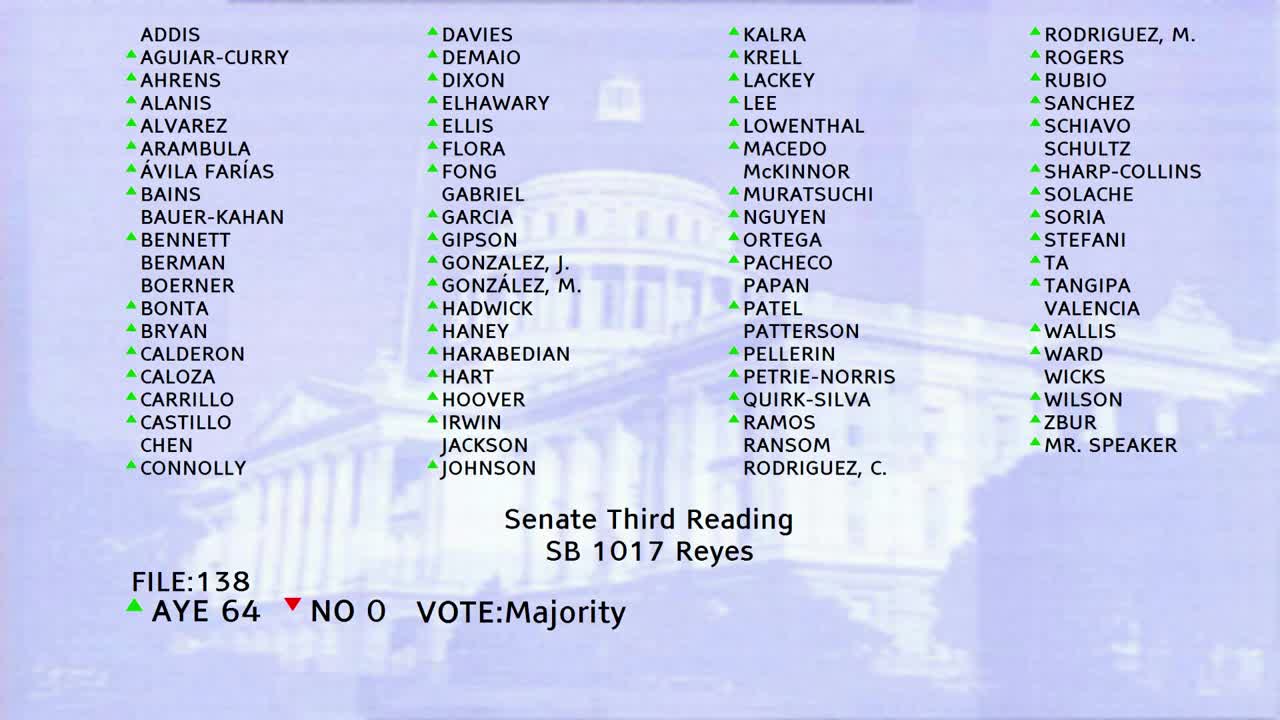 1MIN
Assembly Floor
 26MIN
Senate Standing Committee on Business, Professions and Economic Development
Bill Author

Bill Co-Author(s):