SB 559: Electricity: deenergization events: communications.
- Session Year: 2025-2026
- House: Senate
- Latest Version Date: 2025-04-02
Current Status:
Failed
(2026-02-02: Returned to Secretary of Senate pursuant to Joint Rule 56.)
Introduced
In Committee
Awaiting First Chamber Vote
Passed First Chamber
In Committee
Awaiting Second Chamber Vote
Passed Second Chamber
Enacted
Existing law requires each electrical corporation to annually prepare a wildfire mitigation plan and to submit the plan to the Office of Energy Infrastructure Safety for review and approval, as specified. Existing law requires a wildfire mitigation plan of an electrical corporation to include, among other things, protocols for deenergizing portions of the electrical distribution system that consider the associated impacts on public safety, and protocols related to mitigating the public safety impacts of those protocols, including impacts on critical first responders and on health and communications infrastructure. Existing law requires a wildfire mitigation plan of an electrical corporation to also include appropriate and feasible procedures for notifying a customer who may be impacted by the deenergizing of electrical lines and requires these procedures to consider the need to notify, as a priority, critical first responders, health care facilities, and operators of telecommunications infrastructure with premises within the footprint of a potential deenergization event.
This bill would require, at the start of a deenergization event, consistent with the above-described protocols, an electrical corporation to immediately notify local emergency management organizations and local utility districts notify, when possible and at the time a decision to conduct a deenergization event is made, public safety partners about the potential public safety impacts of the deenergization, deenergization event, as specified. The bill would require detailed status information on restoration efforts to be made available to emergency management organizations, public safety officials, customers, and the public in real-time, public, where feasible, with regular progress updates issued at intervals of no more than 12 hours, for all impacted circuits, as specified. The bill would require, at the start in advance of a deenergization event, an electrical corporation to make a reasonable effort to publish and make available real-time weather conditions observed within the affected circuit being considered for deenergization, as provided. Once hazardous weather conditions subside, the bill would require an electrical corporation to prioritize the restoration of electricity and begin efforts to reenergize lines without unnecessary delays. delays when safe to do so. The bill would make electrical corporations responsible for the continual monitoring and eventual restoration of circuits affected by a deenergization event. The bill would require each electrical corporation to submit an annual report to the Public Utilities Commission that details its compliance with the transparency and restoration requirements of these provisions, as provided.
This bill would require the commission to oversee each electrical corporations compliance with these provisions to ensure that electrical corporations are meeting the transparency, communication, and restoration requirements. If an electrical corporation fails to comply with any of these provisions, including by failing to publish required weather data, notify public safety agencies, or meet communication standards, the bill would authorize the commission to impose financial penalties.
Under existing law, a violation of any order, decision, rule, direction, demand, or requirement of the commission is a crime.
Because this bill requires action by the commission to implement its requirements, and because a violation of that action would be a crime, the bill would impose a state-mandated local program.
The California Constitution requires the state to reimburse local agencies and school districts for certain costs mandated by the state. Statutory provisions establish procedures for making that reimbursement.
This bill would provide that no reimbursement is required by this act for a specified reason.
Existing law requires each electrical corporation to annually prepare a wildfire mitigation plan and to submit the plan to the Office of Energy Infrastructure Safety for review and approval, as specified. Existing law requires a wildfire mitigation plan of an electrical corporation to include, among other things, protocols for deenergizing portions of the electrical distribution system that consider the associated impacts on public safety, and protocols related to mitigating the public safety impacts of those protocols, including impacts on critical first responders and on health and communications infrastructure. Existing law requires a wildfire mitigation plan of an electrical corporation to also include appropriate and feasible procedures for notifying a customer who may be impacted by the deenergizing of electrical lines and requires these procedures to consider the need to notify, as a priority, critical first responders, health care facilities, and operators of telecommunications infrastructure with premises within the footprint of a potential deenergization event.
This bill would require, at the start of a deenergization event, an electrical corporation to immediately notify local emergency management organizations and local utility districts about the impacts of the deenergization, as specified. The bill would require detailed status information on restoration efforts to be made available to emergency management organizations, public safety officials, customers, and the public in real-time, with regular progress updates issued at intervals of no more than 12 hours, for all impacted circuits, as specified. The bill would require, at the start of a deenergization event, an electrical corporation to publish and make available real-time weather conditions observed within the affected circuit being considered for deenergization, as provided. Once hazardous weather conditions subside, the bill would require an electrical corporation to prioritize the restoration of electricity and begin efforts to reenergize lines without unnecessary delays. The bill would make electrical corporations responsible for the continual monitoring and eventual restoration of circuits affected by a deenergization event. The bill would require each electrical corporation to submit an annual report to the Public Utilities Commission that details its compliance with the transparency and restoration requirements of these provisions, as provided.
This bill would require the commission to oversee each electrical corporations compliance with these provisions to ensure that electrical corporations are meeting the transparency, communication, and restoration requirements. If an electrical corporation fails to comply with any of these provisions, including by failing to publish required weather data, notify public safety agencies, or meet communication standards, the bill would authorize the commission to impose financial penalties.
Under existing law, a violation of any order, decision, rule, direction, demand, or requirement of the commission is a crime.
Because this bill requires action by the commission to implement its requirements, and because a violation of that action would be a crime, the bill would impose a state-mandated local program.
The California Constitution requires the state to reimburse local agencies and school districts for certain costs mandated by the state. Statutory provisions establish procedures for making that reimbursement.
This bill would provide that no reimbursement is required by this act for a specified reason.
(a)For purposes of this section, both of the following definitions apply:
(1)Critical facilities and infrastructure means publicly or privately owned facilities and services vital to the safety and well-being of the community, including infrastructure that are essential to the public safety and that require additional assistance and advanced planning to ensure resiliency during deenergization events, including, but not limited to, drinking water and wastewater facilities, healthcare medical facilities, communications systems, carrier infrastructure, emergency services, and other critical systems. systems as defined by the protocols adopted by the commission pursuant to paragraphs (6) and (7) of subdivision (c) of Section 8386.
(2)Deenergization means the action taken by an electrical corporation to turn off electricity to specific areas or circuits in response to conditions that could lead to wildfire risk.(3)Deenergization event means a planned electricity outage initiated by an electrical corporation to reduce the risk of wildfire during extreme weather conditions, such as high winds, dry conditions, or other hazardous factors.(4)(2)Weather data means real-time weather conditions observed by an electrical corporation at the time of deenergization, including wind speed, wind gust speed, relative humidity, and temperature.
(b)(1)At the start of a deenergization event Consistent with the protocols adopted by the commission pursuant to paragraphs (6) and (7) of subdivision (c) of Section 8386, an electrical corporation shall immediately notify local emergency management organizations and local utility districts notify, when possible, and at the time a decision to conduct a deenergization event is made, public safety partners, including emergency response providers and first responders, about the potential public safety impacts of the deenergization. deenergization event. The notification shall include the following information:
(A)The specific critical facilities and infrastructure impacted, including healthcare including, but not limited to, health care facilities, water treatment facilities, communications towers, and other public safety critical facilities and infrastructure.
(B)An assessment of the potential risks posed to public health, safety, and emergency response capabilities resulting from the loss of electricity at those critical facilities.(2)(c)The electrical corporation shall make every effort to maintain direct lines of communication with public safety agencies partners to ensure the timely sharing of updates regarding deenergization events, including restoration efforts and any damage or other issues affecting all areas. issues.
(3)(d)During a deenergization event event, the electrical corporation shall work jointly with local emergency management agencies to establish identify restoration priorities. Priority shall shall, where reasonable, be given to circuits that contain a high number of critical facilities. facilities and infrastructure.
(c)(e)Detailed status information on restoration efforts shall be made available to emergency management organizations, public safety officials, customers, and the public in real-time, public, where feasible, with regular progress updates issued at intervals of no more than 12 hours, for all impacted circuits. This information shall include when the circuit is scheduled for inspection, anticipated restoration date and time, and any adverse findings discovered during the inspection process that may delay the restoration process.
(d)(f)(1)At the start In advance of a deenergization event, an electrical corporation shall make a reasonable effort to publish and make available real-time weather conditions observed within the affected circuit being considered for deenergization. This weather data shall be included within the notices provided pursuant to subdivisions (b) and (c). (e). The data shall may include all of the following information:
(A)The sustained wind speed in miles per hour (mph).
(B)The maximum wind gust speed in miles per hour (mph).
(C)The measured percentage of relative humidity in the affected area.
(D)The recorded temperature in degrees Fahrenheit (F).
(2)Throughout the course of a deenergization event an electrical corporation shall make reasonable efforts to publish and make available data, including the real-time weather conditions observed within the affected circuit pursuant to paragraph (1). This information shall be updated on an hourly basis and used to substantiate the ongoing need for continued deenergization.
(3)The data published pursuant to paragraphs (1) and (2) shall be made publicly available on the electrical corporations internet website, mobile applications, and other communication channels and shall be accessible in real-time. real time.
(e)(g)(1)Once hazardous weather conditions subside, the electrical corporation shall prioritize the restoration of electricity and begin efforts to reenergize lines without unnecessary delays. delays when safe to do so. The electrical corporation shall ensure that restoration is carried out as quickly and safely as possible, taking into consideration the safety of the electrical corporations crews and affected communities.
(2)The electrical corporation shall be responsible for the continual monitoring and eventual restoration of circuits affected by a deenergization event. Using real-time weather monitoring technology, an electrical corporation shall be responsible for initiating the inspection and restoration process as soon as the observed weather conditions and safety considerations permit.
(3)The primary factor used to evaluate eligibility for reenergization for circuits shall be real-time weather and the inspection of the circuit by electrical corporation personnel.(4)(3)Inspection of circuits deenergized due to a deenergization event shall commence within four hours of windspeeds falling below 25 mph and wind gusts not exceeding 40 mph. as soon as it is safe to do so.
(f)(h)(1)Each electrical corporation shall annually submit a report to the commission detailing its compliance with the transparency and restoration requirements of this section. The report shall include all of the following:
(A)The number of deenergization events activated in the previous year.
(B)The timeliness and accuracy of weather data publishing. published and observed during the deenergization event.
(C)The extent of communications with customers and public safety agencies.
(D)The restoration timelines and any issues encountered during the restoration process.
(2)The annual reports provided pursuant to paragraph (1) shall be made publicly available by the commission and the electrical corporation to ensure transparency for stakeholders and the public.
(g)(i)The commission shall oversee each electrical corporations compliance with this section to ensure that electrical corporations are meeting its transparency, communication, and restoration requirements. The commission shall assess whether an electrical corporation is effectively implementing real-time weather reporting, notifying public safety agencies, and providing timely and accurate restoration information.
(h)(j)If an electrical corporation fails to comply with any provision of this section, including failure to publish required weather data, notify public safety agencies, or meet communication standards, the commission may impose financial penalties.
SEC. 2.No reimbursement is required by this act pursuant to Section 6 of Article XIIIB of the California Constitution because the only costs that may be incurred by a local agency or school district will be incurred because this act creates a new crime or infraction, eliminates a crime or infraction, or changes the penalty for a crime or infraction, within the meaning of Section 17556 of the Government Code, or changes the definition of a crime within the meaning of Section 6 of Article XIIIB of the California Constitution.
(a)For purposes of this section, the following definitions apply:
(1)Critical infrastructure means publicly or privately owned facilities and services vital to the safety and well-being of the community, including water facilities, healthcare facilities, communications systems, emergency services, and other critical systems.
(2)Deenergization means the action taken by an electrical corporation to turn off electricity to specific areas or circuits in response to conditions that could lead to wildfire risk.
(3)Deenergization event means a planned electricity outage initiated by an electrical corporation to reduce the risk of wildfire during extreme weather conditions, such as high winds, dry conditions, or other hazardous factors.
(4)Weather data means real-time weather conditions observed by an electrical corporation at the time of deenergization, including wind speed, wind gust speed, relative humidity, and temperature.
(b)(1)At the start of a deenergization event an electrical corporation shall immediately notify local emergency management organizations and local utility districts about the impacts of the deenergization. The notification shall include the following information:
(A)The specific critical facilities impacted, including healthcare facilities, water treatment facilities, communications towers, and other public safety infrastructure.
(B)An assessment of the potential risks posed to public health, safety, and emergency response capabilities resulting from the loss of electricity at those critical facilities.
(2)The electrical corporation shall maintain direct lines of communication with public safety agencies to ensure the timely sharing of updates regarding restoration efforts and any damage or other issues affecting all areas.
(3)During a deenergization event the electrical corporation shall work jointly with local emergency management agencies to establish restoration priorities. Priority shall be given to circuits that contain a high number of critical facilities.
(c)Detailed status information on restoration efforts shall be made available to emergency management organizations, public safety officials, customers, and the public in real-time, with regular progress updates issued at intervals of no more than 12 hours, for all impacted circuits. This information shall include when the circuit is scheduled for inspection, anticipated restoration date and time, and any adverse findings discovered during the inspection process that may delay the restoration process.
(d)(1)At the start of a deenergization event, an electrical corporation shall publish and make available real-time weather conditions observed within the affected circuit being considered for deenergization. This weather data shall be included within the notices provided pursuant to subdivisions (b) and (c). The data shall include all of the following information:
(A)The sustained wind speed in miles per hour (mph).
(B)The maximum wind gust speed in miles per hour (mph).
(C)The measured percentage of relative humidity in the affected area.
(D)The recorded temperature in degrees Fahrenheit (F).
(2)Throughout the course of a deenergization event an electrical corporation shall publish and make available data, including the real-time weather conditions observed within the affected circuit pursuant to paragraph (1). This information shall be updated on an hourly basis and used to substantiate the ongoing need for continued deenergization.
(3)The data published pursuant to paragraphs (1) and (2) shall be made publicly available on the electrical corporations internet website, mobile applications, and other communication channels and shall be accessible in real-time.
(e)(1)Once hazardous weather conditions subside, the electrical corporation shall prioritize the restoration of electricity and begin efforts to reenergize lines without unnecessary delays. The electrical corporation shall ensure that restoration is carried out as quickly and safely as possible, taking into consideration the safety of the electrical corporations crews and affected communities.
(2)The electrical corporation shall be responsible for the continual monitoring and eventual restoration of circuits affected by a deenergization event. Using real-time weather monitoring technology, an electrical corporation shall be responsible for initiating the inspection and restoration process as soon as the observed weather conditions permit.
(3)The primary factor used to evaluate eligibility for reenergization for circuits shall be real-time weather and the inspection of the circuit by electrical corporation personnel.
(4)Inspection of circuits deenergized due to a deenergization event shall commence within four hours of windspeeds falling below 25 mph and wind gusts not exceeding 40 mph.
(f)(1)Each electrical corporation shall annually submit a report to the commission detailing its compliance with the transparency and restoration requirements of this section. The report shall include all of the following:
(A)The number of deenergization events activated in the previous year.
(B)The timeliness and accuracy of weather data publishing.
(C)The extent of communications with customers and public safety agencies.
(D)The restoration timelines and any issues encountered during the restoration process.
(2)The annual reports provided pursuant to paragraph (1) shall be made publicly available by the commission and the electrical corporation to ensure transparency for stakeholders and the public.
(g)The commission shall oversee each electrical corporations compliance with this section to ensure that electrical corporations are meeting its transparency, communication, and restoration requirements. The commission shall assess whether an electrical corporation is effectively implementing real-time weather reporting, notifying public safety agencies, and providing timely and accurate restoration information.
(h)If an electrical corporation fails to comply with any provision of this section, including failure to publish required weather data, notify public safety agencies, or meet communication standards, the commission may impose financial penalties.
SEC. 2.No reimbursement is required by this act pursuant to Section 6 of Article XIIIB of the California Constitution because the only costs that may be incurred by a local agency or school district will be incurred because this act creates a new crime or infraction, eliminates a crime or infraction, or changes the penalty for a crime or infraction, within the meaning of Section 17556 of the Government Code, or changes the definition of a crime within the meaning of Section 6 of Article XIIIB of the California Constitution.
|
Date
|
Status
|
|---|---|
| Feb 2, 2026 | Returned to Secretary of Senate pursuant to Joint Rule 56. |
| May 23, 2025 | May 23 hearing: Held in committee and under submission. |
| May 16, 2025 | Set for hearing May 23. |
| May 5, 2025 | May 5 hearing: Placed on APPR. suspense file. |
| Apr 25, 2025 | Set for hearing May 5. |
| Apr 16, 2025 | April 21 set for first hearing canceled at the request of author. |
| Apr 4, 2025 | Set for hearing April 21. |
| Apr 2, 2025 | Read second time and amended. Re-referred to Com. on APPR. |
| Apr 1, 2025 | From committee: Do pass as amended and re-refer to Com. on APPR. (Ayes 13. Noes 0. Page 512.) (March 24). |
| Mar 17, 2025 | Set for hearing March 24. |
| Mar 5, 2025 | Referred to Com. on E., U & C. |
| Feb 21, 2025 | From printer. May be acted upon on or after March 23. |
| Feb 20, 2025 | Introduced. Read first time. To Com. on RLS. for assignment. To print. |
|
Date
|
Description
|
Location
|
Votes
|
|
|---|---|---|---|---|
| May 5, 2025 | Placed on suspense file | Senate Standing Committee on Appropriations |
Passed |
|
| Mar 24, 2025 | Do pass as amended, but first amend, and re-refer to the Committee on [Appropriations] | Senate Standing Committee on Energy, Utilities and Communications |
Passed |
This list shows positions taken on this bill by organizations on the date displayed, which is linked to the original source.
Positions by individuals are not included.
|
Organization
|
Position
|
Date
|
|---|---|---|
| County of Ventura | ** Support | |
| San Diego Gas and Electric | ** Against | |
| Southern California Edison | ** Against |
SENATE COMMITTEE ON
Senator Anna Caballero, Chair
2025 - 2026 Regular Session
SB 559 (Stern) - Electricity: deenergization events: communications
Version: | Policy Vote: |
Urgency: | Mandate: |
Hearing Date: | Consultant: |
Bill Summary:
This bill would require electrical corporations to provide specified real-time and other-time-interval notifications of deenergization events related to mitigating wildfire ignition and public safety risks, and would require specified reporting to, and oversight by, the California Public Utilities Commission (CPUC).
Fiscal Impact:
- The CPUC estimates ongoing costs of about $193,000 annually (ratepayer funds) for one position due to increased workload related to the additional requirements of this bill related to compliance analysis of six annual reports from IOUs, real-time compliance during all Public Safety Power Shutoff (PSPS) events, incorporating data into multiple CPUC systems, and support for PSPS investigations and enforcement actions.
Background:
Electrical equipment, including downed power lines, arcing, and conductor contact with trees and grass, can act as an ignition source. Risks for wildfires also increased with the extended drought and bark beetle infestation that has increased tree mortalities and, as a result, increased the fuel, and risk for wildfires. In recent years, California has experienced a number of catastrophic wildfires, including several ignited by electrical utility infrastructure.
Deenergizing electric lines. Generally, electric utilities attempt to maintain power and ensure continued reliability of the flow of electricity. However, catastrophic fires in recent years have demonstrated, the risk of ignition by electric utility infrastructure can pose great damage and loss of life, perhaps greater than the risks of turning off the power to certain electrical circuits. As a safety consideration, electric utilities have the ability and authority to deenergize electric lines in order to prevent harm or threats of harm. Utilities have increasingly utilized proactive power shutoffs as a tool to prevent sparking.
Oversight of proactive power shutoffs. The CPUC adopted protocols for deenergizing electric lines with a focus on who should receive notice and when; who should be responsible for notification; how different customer groups should be identified; the information that should be included in notifications in advance of and directly preceding a deenergizing event; the methods of communication; and how the IOUs should communicate and coordinate with public safety partners before, during, and after an event.
Wildfire Mitigation Plan. As a result of SB 1028 (Hill, Chapter 598, Statutes of 2016), and further expanded by SB 901 (Dodd, Chapter 626, Statutes of 2018) and AB 1054 (Holden, Chapter 79, Statutes of 2019), electric IOUs are required to file WMPs with guidance by OEIS (as of 2021). OEIS reviews and determines whether to approve these plans and ensures compliance with guidance and statute. The electric IOUs’ WMPs detail, describe and summarize electric IOU responsibilities, actions, and resources to mitigate wildfires. The WMPs also require electric utilities to incorporate their protocols and procedures for proactive power shutoffs as required by CPUC rules.
Proactive power shutoff protocols. Over several years, the proactive power shutoff protocols have evolved via CPUC oversight and various CPUC decisions. The protocols include specified requirements related to advance planning with public safety partners and local governments, as well as, specified notifications to customers prior to, during, and after deenergization events. The protocols also require specified actions to address the public safety impacts for critical facilities and access and functional needs populations, among others. The CPUC and Legislature have exercised continued oversight of the utilities’ practices with the goal of minimizing the use of power shutoffs and accelerating wildfire mitigation to reduce risks of the electrical infrastructure igniting fires.
January 2025 Santa Ana wind events. This January, with expected severe Santa Ana winds, low-humidity, high vegetation growth from previous wet winters, and dry conditions due to delayed precipitation, Southern California was at high risk for wildfires. Additionally, aerial fire suppression was limited by the extreme winds, which included gusts approaching 100 mph in some areas. Both SCE and SDG&E executed proactive power shutoffs in their service territory as a public safety measure. In the case of SCE, the proactive power shutoffs resulted in extended outages throughout their service territory impacting upwards of 500,000 plus customer accounts (affecting many times more individuals) between January 2 through January 27, including two separate (and, in some cases overlapping) events. These deenergization events coincided with several wildfires in the area, including two large catastrophic fires, the Palisades Fire and the Eaton Fire (fire investigations as to the cause of these fires are still in process, ignition cause has not been determined). Based on SCE’s post-event reports, the proactive power shutoffs were the largest number of affected customers since the tool had been deployed and likely the largest in duration. These events resulted in many frustrations for customers and local governments as the utility’s execution of the proactive power shutoffs seems to have been greatly challenged by the scale and duration of the events (official CPUC oversight and review of these events is process) with reports that their website crashed, inadequate notifications to customers, inability of some local governments to reach a utility point person, and inaccurate maps displayed at times on their websites. SCE also adjusted their operational thresholds in the midst of the events due to the evolving conditions which resulted in many customers unexpectedly experiencing proactive power shutoff without any advance notification. SCE’s post-event reports also indicated nearly 100 incidents of damage on deenergized facilities that, if they had been energized, could have been a significant risk to igniting wildfires.
Proposed Law:
This bill would require electrical corporations to provide specified real time and other-time-interval notifications of deenergization events related to mitigating wildfire ignition and public safety risks, and would require specified reporting to, and oversight by, the CPUC. In particular, this bill would:
- Define “critical facilities and infrastructure” and “weather data.”
- Require, consistent with existing deenergization protocols, an electrical corporation to immediately notify, when possible, and at the time a decision to conduct a deenergization event is made, public safety partners, including emergency response providers and first responders, about the potential public safety impacts of the deenergization event, as specified.
- Require, in advance of a deenergization event, an electrical corporation to make a reasonable effort to publish and make available weather conditions observed within the affected circuit being considered for deenergization, as specified. Require this information to be updated on an hourly basis and published in real-time on the electrical corporation’s website.
- Require, once hazardous conditions subside, an electrical corporation to prioritize the restoration of electricity and begin efforts to reenergize lines without unnecessary delays when safe to do so.
- Make electrical corporations responsible for the continual monitoring and eventual restoration of circuits affected by a deenergization event. Require the inspection of deenergized circuits to begin as soon as it is safe to do so.
- Require each electrical corporation to submit an annual report to the CPUC that details its compliance with the transparency and restoration requirements of these provisions, including: the number of deenergization events, the weather data published and observed during the deenergization event, restoration timelines, and communications with customers and public safety agencies.
- Require the CPUC to oversee each electrical corporation’s compliance with these provisions to ensure that electrical corporations are meeting the transparency, communication, and restoration requirements.
- Authorize the CPUC to impose financial penalties if an electrical corporation fails to comply with any of these provisions, including by failing to publish required weather data, notify public safety agencies, or meet communication standards.
Related Legislation:
SB 332 (Wahab) of the current legislative session would require various actions and assessments regarding electric utility operations, including related to the use of deenergization events.
SB 533 (Stern, Chapter 244, Statutes of 2021) required electrical corporations to identify circuits that have frequently been deenergized to mitigate the risk of wildfire and the measures taken to reduce the need for future deenergization of those circuits, as specified.
SB 167 (Dodd, Chapter 403, Statutes of 2019) required electrical corporations to include impacts on customers enrolled in specified programs as part of the protocols for deenergizing portions of their distribution system within their WMP.
SB 901 (Dodd, Chapter 626, Statutes of 2018) addressed numerous issues concerning wildfire prevention, response and recovery, including funding for mutual aid, fuel reduction and forestry policies, WMP by electric utilities, and cost recovery by electric corporations of wildfire-related damages.
SB 1028 (Hill, Chapter 598, Statutes of 2016) required electric CPUC-regulated utilities to file annual WMPs and requires the CPUC to review and comment on those plans.
-- END --
SENATE COMMITTEE ON ENERGY, UTILITIES AND COMMUNICATIONS
Senator Josh Becker, Chair
2025 - 2026 Regular
Bill No: SB 559 Hearing Date: 3/24/2025
Author: | Stern | ||
Version: | 2/20/2025 Introduced | ||
Urgency: | No | Fiscal: | Yes |
Consultant: | Nidia Bautista | ||
SUBJECT: Electricity: deenergization events: communications
DIGEST: This bill requires electrical corporations to provide specified real-time and other time interval notifications of deenergization events related to mitigating wildfire ignition risks, and requires specified reporting to, and oversight by, the California Public Utilities Commission (CPUC).
ANALYSIS:
Existing law:
- Establishes the CPUC with regulatory authority over public utilities, including electrical corporations. (Article XII of the California Constitution)
- Establishes the Office of Energy Infrastructure Safety (OEIS) is the successor to, and, effective July 1, 2021, is vested with, all of the duties, powers, and responsibilities of the Wildfire Safety Division within the CPUC established pursuant to Section 326 of the Public Utilities Code, including, but not limited to, the power to compel information and conduct investigations. (Government Code §15475)
- Requires every public utility to furnish and maintain adequate, efficient, just, and reasonable service, instrumentalities, equipment, and facilities, as are necessary to promote the safety, health, comfort, and convenience of its patrons, employees, and the public. (Public Utilities Code §451)
- Establishes the policy of the state that each electrical corporation is required to continue operate its electric distribution grid in its service territory and to do so in a safe, reliable, efficient, and cost-effective manner. (Public Utilities Code §399.2(a))
- Authorizes the CPUC to supervise and regulate every public utility in the state and to do all things necessary and convenient in the exercise of such power and jurisdiction. (Public Utilities Code §701)
- Requires an electrical corporation to construct, maintain, and operate its electrical lines and equipment in a manner that will minimize the risk of catastrophic wildfire posed by those electrical lines and equipment. (Public Utilities Code §8386 (a))
- Requires each electrical corporation to annually prepare a wildfire mitigation plan (WMP) and to submit the plan to the Wildfire Safety Division, and, as of July 1, 2021, to the OEIS, for review and approval. (Public Utilities Code §8386 (b))
- Requires a WMP of an electrical corporation to include, among other things, protocols for deenergizing portions of the electrical distribution system that consider the associated impacts on public safety, and protocols related to mitigating the public safety impacts of those protocols, including impacts on critical first responders and on health and communications infrastructure. (Public Utilities Code §§8386 (c)(6))
- Requires a WMP plan of an electrical corporation to also include appropriate and feasible procedures for notifying a customer who may be impacted by the deenergizing of electrical lines and requires these procedures to consider the need to notify, as a priority, critical first responders, health care facilities, and operators of telecommunications infrastructure with premises within the footprint of a potential deenergization event. (Public Utilities Code §8386 (c)(7))
This bill:
- Defines “critical infrastructure,” “deenergization,” “deenergization event,” and “weather data.”
- Requires, at the start of a deenergization event, an electrical corporation to immediately notify local emergency management organizations and local utility districts about the impacts of the deenergization, including the critical facilities impacted and an assessment of the potential risks posed to health and safety, and emergency response capabilities.
- Requires detailed status information on restoration efforts to be made available to emergency management organizations, public safety officials, customers, and the public in real-time, with regular progress updates issued at intervals of no more than 12 hours, for all impacted circuits. Requires the status information to include when the circuit is scheduled for inspection, anticipated restoration, and any adverse findings discovered. Requires this information to be published in real-time on the electrical corporation’s website.
- Requires, at the start of a deenergization event, an electrical corporation to publish and make available real-time weather conditions observed within the affected circuit being considered for deenergization, including sustained wind speeds, maximum wind gust speed, relative humidity, and recorded temperature. Requires this information to be updated on an hourly basis and published in real-time on the electrical corporation’s website.
- Requires, once hazardous weather conditions subside, an electrical corporation to prioritize the restoration of electricity and begin efforts to reenergize lines without unnecessary delays.
- Makes electrical corporations responsible for the continual monitoring and eventual restoration of circuits affected by a deenergization event. Requires the inspection of deenergized circuits to begin when wind speeds fall below 25 miles per hour (mph) and wind gusts not exceeding 40 mph.
- Requires each electrical corporation to submit an annual report to the CPUC that details its compliance with the transparency and restoration requirements of these provisions, including: the number of deenergization events, the timeliness and accuracy of publishing of weather data, restoration timelines, and communications with customers and public safety agencies.
- Requires the CPUC to oversee each electrical corporation’s compliance with these provisions to ensure that electrical corporations are meeting the transparency, communication, and restoration requirements.
- Authorizes the CPUC to impose financial penalties if an electrical corporation fails to comply with any of these provisions, including by failing to publish required weather data, notify public safety agencies, or meet communication standards
Background
California wildfire and electric utility infrastructure. Electrical equipment, including downed power lines, arcing, and conductor contact with trees and grass, can act as an ignition source. Risks for wildfires also increased with the extended drought and bark beetle infestation that has increased tree mortalities and, as a result, increased the fuel, and risk for wildfires. In recent years, California has experienced a number of catastrophic wildfires, including several ignited by electrical utility infrastructure.
Deenergizing electric lines. Generally, electric utilities attempt to maintain power and ensure continued reliability of the flow of electricity. However, catastrophic fires in recent years have demonstrated, the risk of ignition by electric utility infrastructure can pose great damage and loss of life, perhaps greater than the risks of turning off the power to certain electrical circuits. As a safety consideration, electric utilities have the ability and authority to deenergize electric lines in order to prevent harm or threats of harm. However, deenergizing electric lines can result in the loss of electricity to households, businesses, traffic signals, communication systems, water treatment facilities, emergency services and other critical which can also cause harm, as well as, economic impacts to residents and businesses. Therefore, efforts to deenergize electric lines must consider the potential harm of the energized lines causing a wildfire against the safety hazards associated with eliminating electricity to the areas served by the line(s).
History with power shutoffs. Utilities have increasingly utilized proactive power shutoffs as a tool to prevent sparking. The practice of proactively deenergizing electric circuits to prevent catastrophic wildfire began by San Diego Gas & Electric (SDG&E) after several electric utility infrastructure-ignited catastrophic fires in 2007. Proactive power shutoffs were one of the many measures SDG&E implemented to reduce the risk of fire ignited by its infrastructure (other measures included installing steel poles and expanding ground and aerial inspections). Although the use of proactive power shutoffs were met with opposition and concerns about its use by communities, ultimately the CPUC acknowledged SDG&E’s authority to deenergize lines in order to protect public safety, noting this authority in Public Utilities Code §451 and §399.2. Since then, the practice has also been expanded and adopted by the state’s two largest electric utilities – Pacific Gas & Electric (PG&E) and Southern California Edison (SCE), as well as, the smaller investor-owned electric utilities (IOUs) and exploration by publicly-owned utilities (POUs).
Oversight of proactive power shutoffs. The CPUC adopted protocols for deenergizing electric lines with a focus on who should receive notice and when; who should be responsible for notification; how different customer groups should be identified; the information that should be included in notifications in advance of and directly preceding a deenergizing event; the methods of communication; and how the IOUs should communicate and coordinate with public safety partners before, during, and after an event. The CPUC is working with the Office of Emergency Services, Cal FIRE, and first-responders to address potential impacts of utility deenergization practices on emergency response activities, including evacuations. The CPUC is also monitoring the development and continuously assessing implementation of deenergization programs by utilities, including performing a review of deenergization events. In adopting the initial protocols, the CPUC commissioners expressed a desire that the power shutoffs would only be used as a “last resort” by the utilities. However, the use of proactive power shutoffs by electric utilities became widespread and increased concerns that the practice is relied upon more frequently than a last resort. In some instances, deenergization events overlap and result in customers experiencing extended days with loss of power.
Wildfire Mitigation Plan. As a result of SB 1028 (Hill, Chapter 598, Statutes of 2016), and further expanded by SB 901 (Dodd, Chapter 626, Statutes of 2018) and AB 1054 (Holden, Chapter 79, Statutes of 2019), electric IOUs are required to file WMPs with guidance by OEIS (as of 2021). OEIS reviews and determines whether to approve these plans and ensures compliance with guidance and statute. The electric IOUs’ WMPs detail, describe and summarize electric IOU responsibilities, actions, and resources to mitigate wildfires. These actions include plans to harden their system to prevent wildfire ignitions caused by utility infrastructure, such as widespread electric line replacement with covered conductors designed to lower wildfire ignition, pole replacement, and other actions. The plans also include information regarding the electric IOUs’ efforts to conduct extensive vegetation management to reduce the risk of tree branches, grasses, and other vegetation from coming into contact with utility infrastructure. The WMPs also require electric utilities to incorporate their protocols and procedures for proactive power shutoffs as required by CPUC rules.
Proactive power shutoff protocols. Over several years, the proactive power shutoff protocols have evolved via CPUC oversight and various CPUC decisions. The protocols include specified requirements related to advance planning with public safety partners and local governments, as well as, specified notifications to customers prior to, during, and after deenergization events. The protocols also require specified actions to address the public safety impacts for critical facilities and access and functional needs populations, among others. The CPUC and Legislature have exercised continued oversight of the utilities’ practices with the goal of minimizing the use of power shutoffs and accelerating wildfire mitigation to reduce risks of the electrical infrastructure igniting fires. However, proactive power shutoffs continue to be a tool in the electric utility’s toolbox to mitigate wildfire ignition risks. Currently, CPUC notifications require specified timing of notifications to customers and an extended (and continually evolving) list of public safety partners and critical facilities, including emergency services, government facilities, medical facilities, energy facilities, drinking water and wastewater treatment facilities, communications facilities, and others. The protocols require electric IOUs to, whenever possible, adhere to the following minimum notification timeline:
- 48-72 hours in advance of anticipated deenergization: notification of public safety partners/priority notification entities.
- 24-48 hours in advance of anticipated deenergization: notification of all other affected customers/populations.
- 1-4 hours in advance of anticipated deenergization, if possible: notification of all affected customers/populations.
- When deenergization is initiated: notification of all affected customers/populations.
- Immediately before reenergization begins: notification of all affected customers/populations.
- When reenergization is complete: notification of all affected customers/populations.
- When a Public Safety Power Shutoff (PSPS) [deenergization event] event is cancelled: Each electric IOU must make every attempt to provide notification of the cancellation of a PSPS event, or removal from scope, by notifying all affected entities, including public safety partners, within two hours of the decision to cancel.
January 2025 Santa Ana wind events. This January, with expected severe Santa Ana winds, low-humidity, high vegetation growth from previous wet winters, and dry conditions due to delayed precipitation, Southern California was at high risk for wildfires. Additionally, aerial fire suppression was limited by the extreme winds, which included gusts approaching 100 mph in some areas. Both SCE and SDG&E executed proactive power shutoffs in their service territory as a public safety measure. In the case of SCE, the proactive power shutoffs resulted in extended outages throughout their service territory impacting upwards of 500,000 plus customer accounts (affecting many times more individuals) between January 2 through January 27, including two separate (and, in some cases overlapping) events. These deenergization events coincided with several wildfires in the area, including two large catastrophic fires, the Palisades Fire and the Eaton Fire (fire investigations as to the cause of these fires are still in process, ignition cause has not been determined). Based on SCE’s post-event reports, the proactive power shutoffs were the largest number of affected customers since the tool had been deployed and likely the largest in duration. These events resulted in many frustrations for customers and local governments as the utility’s execution of the proactive power shutoffs seems to have been greatly challenged by the scale and duration of the events (official CPUC oversight and review of these events is process) with reports that their website crashed, inadequate notifications to customers, inability of some local governments to reach a utility point person, and inaccurate maps displayed at times on their websites. SCE also adjusted their operational thresholds in the midst of the events due to the evolving conditions which resulted in many customers unexpectedly experiencing proactive power shutoff without any advance notification. SCE’s post-event reports also indicated nearly 100 incidents of damage on deenergized facilities that, if they had been energized, could have been a significant risk to igniting wildfires.
Comments
Need for continued oversight of electric utilities’ use of proactive power shutoffs. The author is accurate to note that proactive power shutoffs can have a serious impact on customers and critical services, as the loss of power can have serious and life-threatening consequences. While the electric utilities continue to implement upgrades and improvements on their systems to mitigate the potential of their equipment igniting fires, the use of proactive power shutoffs should wane. However, in the short-term proactive power shutoffs are likely to remain an important tool in the utility’s toolbox to mitigate the risk of their infrastructure igniting a catastrophic wildfire, particularly in areas with a high wildfire risks. Given the scale of January’s events in southern California, there are also questions about the long-term need for this tool and the need for ongoing oversight to ensure the events are executed as required by the current protocols. To this end, the CPUC has also adopted a compliance citation program that fines utilities for violations of the proactive power shutoff protocols, including for inadequate notifications before, during, and after an event or for incomplete or missed reporting and which the agency has exercised based on the severity of the violations. The CPUC also requires various annual and post-event reporting.
Too prescriptive? The electric IOUs contend that much of the reporting required in this bill is redundant of existing requirements or could undermine the existing requirements and safety. They note that the CPUC’s existing protocols acknowledge the need to afford utilities the discretion to evaluate real-time and on-the-ground information in determining conditions that necessitate electric circuits from being turned off. As the CPUC states: “The utilities have the authority to shut off power under Public Utilities Code §§451 and 399.2(a).” However, the CPUC has broad regulatory authority to review the reasonableness of past decisions to shut off power, including reviewing the specific factors for each event, stating “this is distinct, however, from establishing rigid triggers or criteria by which the utilities must abide to determine whether to shut off power.” In this regard, there are some of the provisions of this bill may be too restrictive and which could jeopardize safety during dynamic conditions, such as those requiring specified wind speed thresholds by when a circuit must be reenergized. Other provisions, could be couched within the context of the existing protocols required under Public Utilities Code §§8386(c) (6) and (7). In this regard, the author and committee may wish to amend this bill to:
- Conform the definitions in this bill to those in existing Public Utilities Code and within the existing CPUC protocols.
- Delete requirements for real-time and hourly notifications of weather-data.
- Frame any requirements in this bill as part of the existing protocols required under Public Utilities Code §§8386(c)(6)(7) so as not recreate a new wheel but enhance the existing requirements.
- Ensure the language in this bill accounts for the needed discretion and safety considerations that a utility would need to execute proactive shutoffs in a dynamic environment.
- Delete the requirement that the only factor to reenergize a circuit is the weather conditions and the inspection, as this may not account for other conditions (such as fuel load and potential safety risks of reenergizing the circuit).
- Delete requirements that wind speed is determinate factor in reenergizing an electric line.
- Reframe sections of this bill to account for advance notifications in preparation for a proactive power shutoff.
- Make additional conforming and related changes.
Prior/Related Legislation
SB 332 (Wahab) of the current legislative session requires various actions and assessments regarding electric utility operations, including related to the use of deenergization events. The bill is pending in this committee.
SB 533 (Stern, Chapter 244, Statutes of 2021) required electrical corporations to identify circuits that have frequently been deenergized to mitigate the risk of wildfire and the measures taken to reduce the need for future deenergization of those circuits, as specified.
SB 167 (Dodd, Chapter 403, Statutes of 2019) required electrical corporations to include impacts on customers enrolled in specified programs as part of the protocols for deenergizing portions of their distribution system within their WMP.
SB 901 (Dodd, Chapter 626, Statutes of 2018) addressed numerous issues concerning wildfire prevention, response and recovery, including funding for mutual aid, fuel reduction and forestry policies, WMP by electric utilities, and cost recovery by electric corporations of wildfire-related damages.
SB 1028 (Hill, Chapter 598, Statutes of 2016) required electric CPUC-regulated utilities to file annual WMPs and requires the CPUC to review and comment on those plans.
FISCAL EFFECT: Appropriation: No Fiscal Com.: Yes Local: Yes
SUPPORT:
County of Ventura, (Sponsor)
OPPOSITION:
San Diego Gas and Electric
Southern California Edison
ARGUMENTS IN SUPPORT: According to the author:
“The worsening effects of climate change continues to challenge our electric grid with more powerful and intense extreme weather events. The recent LA fires propelled by extreme Santa Ana winds prompted PSPS events throughout the service area of SoCal Edison. Sometimes with very little notification and with updates with limited information. While PSPS event play a significant role in reducing fire risks, they are also very disruptive to millions of customers that include local governments, businesses, schools, and access and functional needs customers who rely on electric devices to survive. A PSPS is therefore a significant wildfire mitigation measure that must also recognize there is a mutual partnership with each local government and every affected customer. So it is equally important and necessary that IOUs alert local governments to a pending PSPS event but also maintain direct lines of communication during such events, and inform the entire customer base regarding expectations on when power will be restored. Doing so will go a long way toward restoring the public trust and helping customers understand the conditions that require a PSPS, and the conditions that allow for restoration of power.”
ARGUMENTS IN OPPOSITION: San Diego Gas & Electric (SDG&E) states:
“create conflicting and redundant requirements and would not enhance public safety during de-energization events.” SDG&E contends the bill “creates rigid mandates that undermine [the] existing regulatory framework that has been thoughtfully developed by the Commission [CPUC] over the past decade. …The deliberate, thorough process at the Commission [CPUC] has resulted in the adoption of a comprehensive and evolving regulatory framework for PSPS events. …The iterative process at the Commission [CPUC] has been critical to ensure regulations can be adapted to changing conditions and adjusted to incorporate lessons learned from actual de-energization events. SB 559 would needlessly undermine substantial portions of the requirements and guidelines established by the Commission [CPUC] and make permanent new inflexible requirements that are not based on actual events, direct experience, or stakeholder feedback.”
-- END --
Discussed in Hearing
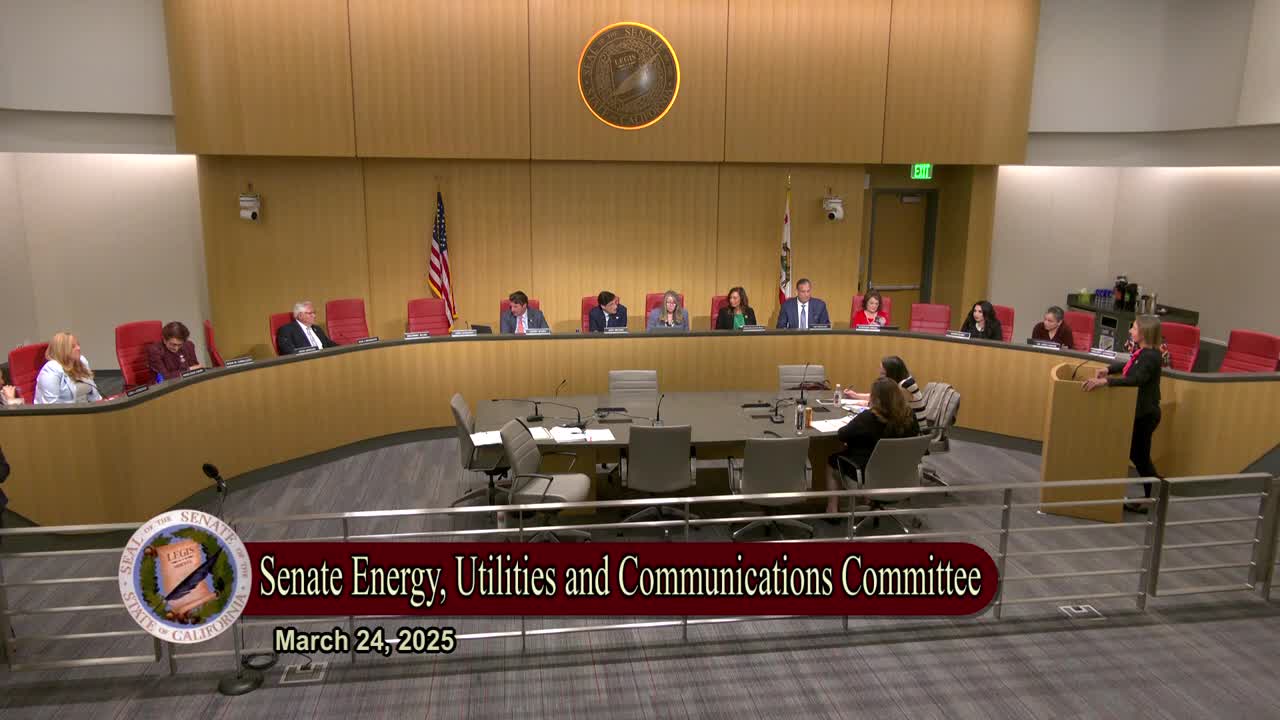 41MIN
Senate Standing Committee on Energy, Utilities and Communications
Bill Author

Bill Co-Author(s):