SB 587: Personal income taxes: credit: manufacturing: sales and use taxes.
- Session Year: 2025-2026
- House: Senate
- Latest Version Date: 2025-05-23
Current Status:
In Progress
(2026-08-13: August 13 hearing: Held in committee and under submission.)
Introduced
In Committee
Awaiting First Chamber Vote
Passed First Chamber
In Committee
Awaiting Second Chamber Vote
Passed Second Chamber
Enacted
The Personal Income Tax Law and the Corporation Tax Law allow various credits against the taxes imposed by those laws.
Existing law, the Sales and Use Tax Law, imposes a tax on retailers measured by the gross receipts from the sale of tangible personal property sold at retail in this state, or on the storage, use, or other consumption in this state of tangible personal property purchased from a retailer for storage, use, or other consumption in this state. The Bradley-Burns Uniform Local Sales and Use Tax Law authorizes counties and cities to impose local sales and use taxes in conformity with the Sales and Use Tax Law, and existing laws authorize districts, as specified, to impose transactions and use taxes in accordance with the Transactions and Use Tax Law, which generally conforms to the Sales and Use Tax Law. Amendments to the Sales and Use Tax Law are automatically incorporated into the local tax laws. Existing law imposes or dedicates certain state sales and use tax rates for local funding, including through the Local Revenue Fund 2011.
Existing law provides various exemptions from the taxes imposed by the Sales and Use Tax Law, including, until July 1, 2030, a partial exemption for the sale of, and the storage, use, or other consumption of, qualified tangible personal property, as defined, purchased by a qualified person, as defined, for purchases not exceeding $200,000,000, primarily used for specified purposes, including manufacturing, recycling, and research and development. Existing sales and use tax law provides that the Bradley-Burns Uniform Local Sales and Use Tax Law, the Transactions and Use Tax Law, and those laws imposing certain sales and use tax rates for local funding do not apply to the above-described exemption, thereby subjecting the sale, or the storage, use, or other consumption in this state, of tangible personal property, otherwise exempt from taxation under these provisions, to local sales and use taxes, transactions and use taxes, and state sales and use taxes imposed for local funding.
This bill would, for taxable years beginning on or after January 1, 2026, and before January 1, 2031, allow a credit against the taxes imposed by the Personal Income Tax Law and the Corporation Tax Law to a taxpayer in an amount equal to the amount of sales tax reimbursement paid by the taxpayer to a retailer for the purchase of tangible personal property sold at retail in this state, or the amount of use tax paid by the taxpayer on the storage, use, or other consumption in this state of tangible personal property purchased from a retailer, that would have been exempt from taxation pursuant to the above-described exemption, but for the application of local sales and use taxes and transactions and use taxes, or the imposition of certain sales and use tax rates for local funding, as specified. The bill would authorize the California Department of Tax and Fee Administration to provide specified information to the Franchise Tax Board to assist in the administration of the credit, and would apply existing restrictions to the sharing of that information, the violation of which is a crime. By expanding the scope of a crime, this bill would impose a state-mandated local program.
This bill would require, on or before May 14, 2026, and annually thereafter, the Department of Finance to provide to the legislative budget committees an estimate of the amount of revenue that would not be realized if the credits described above were allowed for that taxable year and would provide that those credits are allowed only for taxable years for which the Legislature appropriates money in the Budget Act for the administration of those credits.
Existing law requires any bill authorizing a new tax expenditure to contain, among other things, specific goals that the tax expenditure will achieve, detailed performance indicators, and data collection requirements.
This bill also would include additional information required for any bill authorizing a new tax expenditure.
The California Constitution requires the state to reimburse local agencies and school districts for certain costs mandated by the state. Statutory provisions establish procedures for making that reimbursement.
This bill would provide that no reimbursement is required by this act for a specified reason.
This bill would take effect immediately as a tax levy.
The Personal Income Tax Law and the Corporation Tax Law allow various credits against the taxes imposed by those laws.
Existing law, the Sales and Use Tax Law, imposes a tax on retailers measured by the gross receipts from the sale of tangible personal property sold at retail in this state, or on the storage, use, or other consumption in this state of tangible personal property purchased from a retailer for storage, use, or other consumption in this state. The Bradley-Burns Uniform Local Sales and Use Tax Law authorizes counties and cities to impose local sales and use taxes in conformity with the Sales and Use Tax Law, and existing laws authorize districts, as specified, to impose transactions and use taxes in accordance with the Transactions and Use Tax Law, which generally conforms to the Sales and Use Tax Law. Amendments to the Sales and Use Tax Law are automatically incorporated into the local tax laws. Existing law imposes or dedicates certain state sales and use tax rates for local funding, including through the Local Revenue Fund 2011.
Existing law provides various exemptions from the taxes imposed by the Sales and Use Tax Law, including, until July 1, 2030, a partial exemption for the sale of, and the storage, use, or other consumption of, qualified tangible personal property, as defined, purchased by a qualified person, as defined, for purchases not exceeding $200,000,000, primarily used for specified purposes, including manufacturing, recycling, and research and development. Existing sales and use tax law provides that the Bradley-Burns Uniform Local Sales and Use Tax Law, the Transactions and Use Tax Law, and those laws imposing certain sales and use tax rates for local funding do not apply to the above-described exemption, thereby subjecting the sale, or the storage, use, or other consumption in this state, of tangible personal property, otherwise exempt from taxation under these provisions, to local sales and use taxes, transactions and use taxes, and state sales and use taxes imposed for local funding.
This bill would, for taxable years beginning on or after January 1, 2026, and before January 1, 2031, allow a credit against the taxes imposed by the Personal Income Tax Law and the Corporation Tax Law to a taxpayer in an amount equal to the amount of sales tax reimbursement paid by the taxpayer to a retailer for the purchase of tangible personal property sold at retail in this state, or the amount of use tax paid by the taxpayer on the storage, use, or other consumption in this state of tangible personal property purchased from a retailer, that would have been exempt from taxation pursuant to the above-described exemption, but for the application of local sales and use taxes and transactions and use taxes, or the imposition of certain sales and use tax rates for local funding, as specified. The bill would authorize the California Department of Tax and Fee Administration to provide specified information to the Franchise Tax Board to assist in the administration of the credit, and would apply existing restrictions to the sharing of that information, the violation of which is a crime. By expanding the scope of a crime, this bill would impose a state-mandated local program.
Existing law requires any bill authorizing a new tax expenditure to contain, among other things, specific goals that the tax expenditure will achieve, detailed performance indicators, and data collection requirements.
This bill also would include additional information required for any bill authorizing a new tax expenditure.
The California Constitution requires the state to reimburse local agencies and school districts for certain costs mandated by the state. Statutory provisions establish procedures for making that reimbursement.
This bill would provide that no reimbursement is required by this act for a specified reason.
This bill would take effect immediately as a tax levy.
The Personal Income Tax Law and the Corporation Tax Law allow various credits against the taxes imposed by those laws.
Existing law, the Sales and Use Tax Law, imposes a tax on retailers measured by the gross receipts from the sale of tangible personal property sold at retail in this state, or on the storage, use, or other consumption in this state of tangible personal property purchased from a retailer for storage, use, or other consumption in this state. The Bradley-Burns Uniform Local Sales and Use Tax Law authorizes counties and cities to impose local sales and use taxes in conformity with the Sales and Use Tax Law, and existing laws authorize districts, as specified, to impose transactions and use taxes in accordance with the Transactions and Use Tax Law, which generally conforms to the Sales and Use Tax Law. Amendments to the Sales and Use Tax Law are automatically incorporated into the local tax laws. Existing law imposes or dedicates certain state sales and use tax rates for local funding, including through the Local Revenue Fund 2011.
Existing law provides various exemptions from the taxes imposed by the Sales and Use Tax Law, including, until July 1, 2030, a partial exemption for the sale of, and the storage, use, or other consumption of, qualified tangible personal property, as defined, purchased by a qualified person, as defined, for purchases not exceeding $200,000,000, primarily used for specified purposes, including manufacturing, recycling, and research and development. Existing sales and use tax law provides that the Bradley-Burns Uniform Local Sales and Use Tax Law, the Transactions and Use Tax Law, and those laws imposing certain sales and use tax rates for local funding do not apply to the above-described exemption, thereby subjecting the sale, or the storage, use, or other consumption in this state, of tangible personal property, otherwise exempt from taxation under these provisions, to local sales and use taxes, transactions and use taxes, and state sales and use taxes imposed for local funding.
This bill would, for taxable years beginning on or after January 1, 2026, and before January 1, 2031, allow a credit against the taxes imposed by the Personal Income Tax Law and the Corporation Tax Law to a taxpayer in an amount equal to the amount of sales tax reimbursement paid by the taxpayer to a retailer for the purchase of tangible personal property sold at retail in this state, or the amount of use tax paid by the taxpayer on the storage, use, or other consumption in this state of tangible personal property purchased from a retailer, that would have been exempt from taxation pursuant to the above-described exemption, but for the application of local sales and use taxes and transactions and use taxes, or the imposition of certain sales and use tax rates for local funding, as specified. The bill would authorize the California Department of Tax and Fee Administration to provide specified information to the Franchise Tax Board to assist in the administration of the credit, and would apply existing restrictions to the sharing of that information, the violation of which is a crime. By expanding the scope of a crime, this bill would impose a state-mandated local program.
Existing law requires any bill authorizing a new tax expenditure to contain, among other things, specific goals that the tax expenditure will achieve, detailed performance indicators, and data collection requirements.
This bill also would include additional information required for any bill authorizing a new tax expenditure.
The California Constitution requires the state to reimburse local agencies and school districts for certain costs mandated by the state. Statutory provisions establish procedures for making that reimbursement.
This bill would provide that no reimbursement is required by this act for a specified reason.
This bill would take effect immediately as a tax levy.
The Personal Income Tax Law, by reference to a specified federal statute, allows a credit against taxes imposed by that law for increasing research expenses, as defined.This bill would make nonsubstantive changes to that provision.The Personal Income Tax Law, by reference to a specified federal statute, allows a credit against taxes imposed by that law for increasing research expenses, as defined.
This bill would make nonsubstantive changes to that provision.
(a)For taxable years beginning on or after January 1, 2026, and before January 1, 2031, there shall be allowed a credit against the net tax, as defined in Section 17039, to a taxpayer in an amount equal to qualified tax payments made during the taxable year.
(b)For purposes of this section, the following definitions shall apply:
(1)Tax payment means either of the following:
(A)A sales tax reimbursement paid by the taxpayer to a retailer, as reimbursement for a tax imposed by Chapter 2 (commencing with Section 6051) of Part 1, or pursuant to a local ordinance authorized by Part 1.5 (commencing with Section 7200) or Part 1.6 (commencing with Section 7251).
(B)Use taxes paid by the taxpayer pursuant to Chapter 3 (commencing with Section 6201) of Part 1, or pursuant to a local ordinance authorized by Part 1.5 (commencing with Section 7200) or Part 1.6 (commencing with Section 7251).
(2)Qualified tax payment means a tax payment made to the extent that the purchase, or the storage, use, or other consumption in this state, of tangible personal property would have been exempt from tax pursuant to Section 6377.1 if not for the application of subdivision (d) of that section.
(c)Any deduction otherwise allowed under this part for any amount paid or incurred by the taxpayer upon which the credit is based shall be reduced by the amount of the credit allowed under this section.
(d)If a credit allowed by this section exceeds the net tax, the excess may be carried over to reduce the net tax in the following taxable year, and succeeding eight years, if necessary, until the credit is exhausted.
(e)The credit allowed by this section may be claimed only on a timely filed original return of a taxpayer.
(f)(1)A credit, or the carryover of a credit pursuant to subdivision (d), shall not be allowed with respect to tangible personal property described in subparagraph (B) of paragraph (1) of subdivision (e) of Section 6377.1.
(2)In the case where a taxpayer claims a credit under this section, and the tangible personal property that is subject to the tax giving rise to the credit provided under this section is subsequently moved out of state or is otherwise described in subparagraph (B) of paragraph (1) of subdivision (e) of Section 6377.1 within one year from the date of purchase, the taxpayer shall file an amended return for the taxable year in which the credit was claimed.
(g)(1)The Franchise Tax Board may request any information necessary for the administration of this section from the California Department of Tax and Fee Administration.
(2)Notwithstanding Section 7056, the California Department of Tax and Fee Administration may provide information to the Franchise Tax Board, in a form and manner agreed upon between the department and the Franchise Tax Board, necessary for the administration of this section. Any taxpayer information provided by the department to the Franchise Tax Board shall be subject to the provisions of Section 7056.5.
(h)(1)The Franchise Tax Board may prescribe rules, guidelines, procedures, or other guidance to carry out the purposes of this section. Chapter 3.5 (commencing with Section 11340) of Part 1 of Division 3 of Title 2 of the Government Code shall not apply to any rule, guideline, or procedure prescribed by the Franchise Tax Board pursuant to this section.
(2)The Franchise Tax Board may prescribe any regulations necessary or appropriate to carry out the purposes of this section, including any regulations to prevent improper claims from being filed.
(i)(1)On or before May 14, 2026, and annually thereafter, the Department of Finance shall provide to the legislative budget committees an estimate of the amount of revenue that would not be realized if the credits established under this section were allowed for that taxable year.
(2)The credits established by this section shall be allowed only for taxable years for which the Legislature appropriates money in the Budget Act for the administration of the credits established by this section.
(i)(j)(1)For the purpose of complying with Section 41, as it pertains to the credit allowed by this section and Section 23623, the Legislature finds and declares the following:
(A)The specific goal that the credits will achieve is to encourage new and continued investment in California in the areas of manufacturing and research and development.
(B)Detailed performance indicators for the Legislature to use in determining whether the credits meet that goal are as follows:
(i)The total dollar amount of tax credits allowed pursuant to this section and Section 23623.
(ii)The number of taxpayers that were allowed a tax credit pursuant to this section.
(2)(A)On or before April 1, 2033, the Franchise Tax Board shall submit a report to the Legislature, in compliance with Section 9795 of the Revenue and Taxation Code, detailing the total dollar amount of tax credits allowed pursuant to this section and Section 23623, and the number of taxpayers allowed a credit.
(B)The disclosure requirements of this paragraph shall be treated as an exception to Section 19542.
(j)(k)Except for the reporting requirements of subdivision (i), (j), this section shall remain operative only until December 1, 2031, and is repealed as of January 1, 2034.
SEC. 2.Section 23623 is added to the Revenue and Taxation Code, to read:23623.(a)For taxable years beginning on or after January 1, 2026, and before January 1, 2031, there shall be allowed a credit against the tax, as defined in Section 23036, to a taxpayer in an amount equal to qualified tax payments made during the taxable year.
(b)For purposes of this section, the following definitions shall apply:
(1)Tax payment means either of the following:
(A)A sales tax reimbursement paid by the taxpayer to a retailer, as reimbursement for a tax imposed by Chapter 2 (commencing with Section 6051) of Part 1, or pursuant to a local ordinance authorized by Part 1.5 (commencing with Section 7200) or Part 1.6 (commencing with Section 7251).
(B)Use taxes paid by the taxpayer pursuant to Chapter 3 (commencing with Section 6201) of Part 1, or pursuant to a local ordinance authorized by Part 1.5 (commencing with Section 7200) or Part 1.6 (commencing with Section 7251).
(2)Qualified tax payment means a tax payment made to the extent that the purchase, or the storage, use, or other consumption in this state, of tangible personal property would have been exempt from tax pursuant to Section 6377.1 if not for the application of subdivision (d) of that section.
(c)Any deduction otherwise allowed under this part for any amount paid or incurred by the taxpayer upon which the credit is based shall be reduced by the amount of the credit allowed under this section.
(d)If a credit allowed by this section exceeds the tax, the excess may be carried over to reduce the tax in the following taxable year, and succeeding eight years, if necessary, until the credit is exhausted.
(e)The credit allowed by this section may be claimed only on a timely filed original return of a taxpayer.
(f)(1)A credit, or the carryover of a credit pursuant to subdivision (d), shall not be allowed with respect to tangible personal property described in subparagraph (B) of paragraph (1) of subdivision (e) of Section 6377.1.
(2)In the case where a taxpayer claims a credit under this section, and the tangible personal property that is subject to the tax giving rise to the credit provided under this section is subsequently moved out of state or is otherwise described in subparagraph (B) of paragraph (1) of subdivision (e) of Section 6377.1 within one year from the date of purchase, the taxpayer shall file an amended return for the taxable year in which the credit was claimed.
(g)(1)The Franchise Tax Board may request any information necessary for the administration of this section from the California Department of Tax and Fee Administration.
(2)Notwithstanding Section 7056, the California Department of Tax and Fee Administration may provide information to the Franchise Tax Board, in a form and manner agreed upon between the department and the Franchise Tax Board, necessary for the administration of this section. Any taxpayer information provided by the department to the Franchise Tax Board shall be subject to the provisions of Section 7056.5.
(h)(1)The Franchise Tax Board may prescribe rules, guidelines, procedures, or other guidance to carry out the purposes of this section. Chapter 3.5 (commencing with Section 11340) of Part 1 of Division 3 of Title 2 of the Government Code shall not apply to any rule, guideline, or procedure prescribed by the Franchise Tax Board pursuant to this section.
(2)The Franchise Tax Board may prescribe any regulations necessary or appropriate to carry out the purposes of this section, including any regulations to prevent improper claims from being filed.
(i)(1)On or before May 14, 2026, and annually thereafter, the Department of Finance shall provide to the legislative budget committees an estimate of the amount of revenue that would not be realized if the credits established under this section were allowed for that taxable year.
(2)The credits established by this section shall be allowed only for taxable years for which the Legislature appropriates money in the Budget Act for the administration of the credits established by this section.
(i)(j)This section shall remain operative only until December 1, 2031, and as of that date is repealed.
SEC. 3.No reimbursement is required by this act pursuant to Section 6 of Article XIIIB of the California Constitution because the only costs that may be incurred by a local agency or school district will be incurred because this act creates a new crime or infraction, eliminates a crime or infraction, or changes the penalty for a crime or infraction, within the meaning of Section 17556 of the Government Code, or changes the definition of a crime within the meaning of Section 6 of Article XIIIB of the California Constitution.
SEC. 4.This act provides for a tax levy within the meaning of Article IV of the California Constitution and shall go into immediate effect.
(a)For each taxable year taxable years beginning on or after January 1, 2026, and before January 1, 2031, there shall be allowed a credit against the net tax, as defined in Section 17039, to a taxpayer in an amount equal to qualified tax payments made during the taxable year.
(b)For purposes of this section, the following definitions shall apply:
(1)Tax payment means either of the following:
(A)A sales tax reimbursement paid by the taxpayer to a retailer, as reimbursement for a tax imposed by Chapter 2 (commencing with Section 6051) of Part 1, or pursuant to a local ordinance authorized by Part 1.5 (commencing with Section 7200) or Part 1.6 (commencing with Section 7251).
(B)Use taxes paid by the taxpayer pursuant to Chapter 3 (commencing with Section 6201) of Part 1, or pursuant to a local ordinance authorized by Part 1.5 (commencing with Section 7200) or Part 1.6 (commencing with Section 7251).
(2)Qualified tax payment means a tax payment made to the extent that the purchase, or the storage, use, or other consumption in this state, of tangible personal property would have been exempt from tax pursuant to Section 6377.1 if not for the application of subdivision (d) of that section.
(c)Any deduction otherwise allowed under this part for any amount paid or incurred by the taxpayer upon which the credit is based shall be reduced by the amount of the credit allowed under this section.
(d)If a credit allowed by this section exceeds the net tax, the excess may be carried over to reduce the net tax in the following taxable year, and succeeding eight years, if necessary, until the credit is exhausted.
(e)The credit allowed by this section may be claimed only on a timely filed original return of a taxpayer.
(f)(1)A credit, or the carryover of a credit pursuant to subdivision (d), shall not be allowed with respect to tangible personal property described in subparagraph (B) of paragraph (1) of subdivision (e) of Section 6377.1.
(2)In the case where a taxpayer claims a credit under this section, and the tangible personal property that is subject to the tax giving rise to the credit provided under this section is subsequently moved out of state or is otherwise described in subparagraph (B) of paragraph (1) of subdivision (e) of Section 6377.1 within one year from the date of purchase, the taxpayer shall file an amended return for the taxable year in which the credit was claimed.
(g)(1)The Franchise Tax Board may request any information necessary for the administration of this section from the California Department of Tax and Fee Administration.
(2)Notwithstanding Section 7056, the California Department of Tax and Fee Administration may provide information to the Franchise Tax Board, in a form and manner agreed upon between the department and the Franchise Tax Board, necessary for the administration of this section. Any taxpayer information provided by the department to the Franchise Tax Board shall be subject to the provisions of Section 7056.5.
(h)(1)The Franchise Tax Board may prescribe rules, guidelines, procedures, or other guidance to carry out the purposes of this section. Chapter 3.5 (commencing with Section 11340) of Part 1 of Division 3 of Title 2 of the Government Code shall not apply to any rule, guideline, or procedure prescribed by the Franchise Tax Board pursuant to this section.
(2)The Franchise Tax Board may prescribe any regulations necessary or appropriate to carry out the purposes of this section, including any regulations to prevent improper claims from being filed.
(i)(1)For the purpose of complying with Section 41, as it pertains to the credit allowed by this section and Section 23623, the Legislature finds and declares the following:
(A)The specific goal that the credits will achieve is to encourage new and continued investment in California in the areas of manufacturing and research and development.
(B)Detailed performance indicators for the Legislature to use in determining whether the credits meet that goal are as follows:
(i)The total dollar amount of tax credits allowed pursuant to this section and Section 23623.
(ii)The number of taxpayers that were allowed a tax credit pursuant to this section.
(2)(A)On or before December 1, 2031, April 1, 2033, the Franchise Tax Board shall submit a report to the Legislature, in compliance with Section 9795 of the Revenue and Taxation Code, detailing the total dollar amount of tax credits allowed pursuant to this section and Section 23623, and the number of taxpayers allowed a credit.
(B)The disclosure requirements of this paragraph shall be treated as an exception to Section 19542.
(j)This Except for the reporting requirements of subdivision (i), this section shall remain operative only until December 1, 2031, and as of that date is repealed. is repealed as of January 1, 2034.
SEC. 2.Section 23623 is added to the Revenue and Taxation Code, to read:23623.(a)For each taxable year taxable years beginning on or after January 1, 2026, and before January 1, 2031, there shall be allowed a credit against the tax, as defined in Section 23036, to a taxpayer in an amount equal to qualified tax payments made during the taxable year.
(b)For purposes of this section, the following definitions shall apply:
(1)Tax payment means either of the following:
(A)A sales tax reimbursement paid by the taxpayer to a retailer, as reimbursement for a tax imposed by Chapter 2 (commencing with Section 6051) of Part 1, or pursuant to a local ordinance authorized by Part 1.5 (commencing with Section 7200) or Part 1.6 (commencing with Section 7251).
(B)Use taxes paid by the taxpayer pursuant to Chapter 3 (commencing with Section 6201) of Part 1, or pursuant to a local ordinance authorized by Part 1.5 (commencing with Section 7200) or Part 1.6 (commencing with Section 7251).
(2)Qualified tax payment means a tax payment made to the extent that the purchase, or the storage, use, or other consumption in this state, of tangible personal property would have been exempt from tax pursuant to Section 6377.1 if not for the application of subdivision (d) of that section.
(c)Any deduction otherwise allowed under this part for any amount paid or incurred by the taxpayer upon which the credit is based shall be reduced by the amount of the credit allowed under this section.
(d)If a credit allowed by this section exceeds the tax, the excess may be carried over to reduce the tax in the following taxable year, and succeeding eight years, if necessary, until the credit is exhausted.
(e)The credit allowed by this section may be claimed only on a timely filed original return of a taxpayer.
(f)(1)A credit, or the carryover of a credit pursuant to subdivision (d), shall not be allowed with respect to tangible personal property described in subparagraph (B) of paragraph (1) of subdivision (e) of Section 6377.1.
(2)In the case where a taxpayer claims a credit under this section, and the tangible personal property that is subject to the tax giving rise to the credit provided under this section is subsequently moved out of state or is otherwise described in subparagraph (B) of paragraph (1) of subdivision (e) of Section 6377.1 within one year from the date of purchase, the taxpayer shall file an amended return for the taxable year in which the credit was claimed.
(g)(1)The Franchise Tax Board may request any information necessary for the administration of this section from the California Department of Tax and Fee Administration.
(2)Notwithstanding Section 7056, the California Department of Tax and Fee Administration may provide information to the Franchise Tax Board, in a form and manner agreed upon between the department and the Franchise Tax Board, necessary for the administration of this section. Any taxpayer information provided by the department to the Franchise Tax Board shall be subject to the provisions of Section 7056.5.
(h)(1)The Franchise Tax Board may prescribe rules, guidelines, procedures, or other guidance to carry out the purposes of this section. Chapter 3.5 (commencing with Section 11340) of Part 1 of Division 3 of Title 2 of the Government Code shall not apply to any rule, guideline, or procedure prescribed by the Franchise Tax Board pursuant to this section.
(2)The Franchise Tax Board may prescribe any regulations necessary or appropriate to carry out the purposes of this section, including any regulations to prevent improper claims from being filed.
(i)This section shall remain operative only until December 1, 2031, and as of that date is repealed.
SEC. 3.No reimbursement is required by this act pursuant to Section 6 of Article XIIIB of the California Constitution because the only costs that may be incurred by a local agency or school district will be incurred because this act creates a new crime or infraction, eliminates a crime or infraction, or changes the penalty for a crime or infraction, within the meaning of Section 17556 of the Government Code, or changes the definition of a crime within the meaning of Section 6 of Article XIIIB of the California Constitution.
SEC. 4.This act provides for a tax levy within the meaning of Article IV of the California Constitution and shall go into immediate effect.
(a)For each taxable year beginning on or after January 1, 2026, and before January 1, 2031, there shall be allowed a credit against the net tax, as defined in Section 17039, to a taxpayer in an amount equal to qualified tax payments made during the taxable year.
(b)For purposes of this section, the following definitions shall apply:
(1)Tax payment means either of the following:
(A)A sales tax reimbursement paid by the taxpayer to a retailer, as reimbursement for a tax imposed by Chapter 2 (commencing with Section 6051) of Part 1, or pursuant to a local ordinance authorized by Part 1.5 (commencing with Section 7200) or Part 1.6 (commencing with Section 7251).
(B)Use taxes paid by the taxpayer pursuant to Chapter 3 (commencing with Section 6201) of Part 1, or pursuant to a local ordinance authorized by Part 1.5 (commencing with Section 7200) or Part 1.6 (commencing with Section 7251).
(2)Qualified tax payment means a tax payment made to the extent that the purchase, or the storage, use, or other consumption in this state, of tangible personal property would have been exempt from tax pursuant to Section 6377.1 if not for the application of subdivision (d) of that section.
(c)Any deduction otherwise allowed under this part for any amount paid or incurred by the taxpayer upon which the credit is based shall be reduced by the amount of the credit allowed under this section.
(d)If a credit allowed by this section exceeds the net tax, the excess may be carried over to reduce the net tax in the following taxable year, and succeeding eight years, if necessary, until the credit is exhausted.
(e)The credit allowed by this section may be claimed only on a timely filed original return of a taxpayer.
(f)(1)A credit, or the carryover of a credit pursuant to subdivision (d), shall not be allowed with respect to tangible personal property described in subparagraph (B) of paragraph (1) of subdivision (e) of Section 6377.1.
(2)In the case where a taxpayer claims a credit under this section, and the tangible personal property that is subject to the tax giving rise to the credit provided under this section is subsequently moved out of state or is otherwise described in subparagraph (B) of paragraph (1) of subdivision (e) of Section 6377.1 within one year from the date of purchase, the taxpayer shall file an amended return for the taxable year in which the credit was claimed.
(g)(1)The Franchise Tax Board may request any information necessary for the administration of this section from the California Department of Tax and Fee Administration.
(2)Notwithstanding Section 7056, the California Department of Tax and Fee Administration may provide information to the Franchise Tax Board, in a form and manner agreed upon between the department and the Franchise Tax Board, necessary for the administration of this section. Any taxpayer information provided by the department to the Franchise Tax Board shall be subject to the provisions of Section 7056.5.
(h)(1)The Franchise Tax Board may prescribe rules, guidelines, procedures, or other guidance to carry out the purposes of this section. Chapter 3.5 (commencing with Section 11340) of Part 1 of Division 3 of Title 2 of the Government Code shall not apply to any rule, guideline, or procedure prescribed by the Franchise Tax Board pursuant to this section.
(2)The Franchise Tax Board may prescribe any regulations necessary or appropriate to carry out the purposes of this section, including any regulations to prevent improper claims from being filed.
(i)(1)For the purpose of complying with Section 41, as it pertains to the credit allowed by this section and Section 23623, the Legislature finds and declares the following:
(A)The specific goal that the credits will achieve is to encourage new and continued investment in California in the areas of manufacturing and research and development.
(B)Detailed performance indicators for the Legislature to use in determining whether the credits meet that goal are as follows:
(i)The total dollar amount of tax credits allowed pursuant to this section and Section 23623.
(ii)The number of taxpayers that were allowed a tax credit pursuant to this section.
(2)(A)On or before December 1, 2031, the Franchise Tax Board shall submit a report to the Legislature, in compliance with Section 9795 of the Revenue and Taxation Code, detailing the total dollar amount of tax credits allowed pursuant to this section and Section 23623, and the number of taxpayers allowed a credit.
(B)The disclosure requirements of this paragraph shall be treated as an exception to Section 19542.
(j)This section shall remain operative only until December 1, 2031, and as of that date is repealed.
SEC. 2.Section 23623 is added to the Revenue and Taxation Code, to read:23623.(a)For each taxable year beginning on or after January 1, 2026, and before January 1, 2031, there shall be allowed a credit against the tax, as defined in Section 23036, to a taxpayer in an amount equal to qualified tax payments made during the taxable year.
(b)For purposes of this section, the following definitions shall apply:
(1)Tax payment means either of the following:
(A)A sales tax reimbursement paid by the taxpayer to a retailer, as reimbursement for a tax imposed by Chapter 2 (commencing with Section 6051) of Part 1, or pursuant to a local ordinance authorized by Part 1.5 (commencing with Section 7200) or Part 1.6 (commencing with Section 7251).
(B)Use taxes paid by the taxpayer pursuant to Chapter 3 (commencing with Section 6201) of Part 1, or pursuant to a local ordinance authorized by Part 1.5 (commencing with Section 7200) or Part 1.6 (commencing with Section 7251).
(2)Qualified tax payment means a tax payment made to the extent that the purchase, or the storage, use, or other consumption in this state, of tangible personal property would have been exempt from tax pursuant to Section 6377.1 if not for the application of subdivision (d) of that section.
(c)Any deduction otherwise allowed under this part for any amount paid or incurred by the taxpayer upon which the credit is based shall be reduced by the amount of the credit allowed under this section.
(d)If a credit allowed by this section exceeds the tax, the excess may be carried over to reduce the tax in the following taxable year, and succeeding eight years, if necessary, until the credit is exhausted.
(e)The credit allowed by this section may be claimed only on a timely filed original return of a taxpayer.
(f)(1)A credit, or the carryover of a credit pursuant to subdivision (d), shall not be allowed with respect to tangible personal property described in subparagraph (B) of paragraph (1) of subdivision (e) of Section 6377.1.
(2)In the case where a taxpayer claims a credit under this section, and the tangible personal property that is subject to the tax giving rise to the credit provided under this section is subsequently moved out of state or is otherwise described in subparagraph (B) of paragraph (1) of subdivision (e) of Section 6377.1 within one year from the date of purchase, the taxpayer shall file an amended return for the taxable year in which the credit was claimed.
(g)(1)The Franchise Tax Board may request any information necessary for the administration of this section from the California Department of Tax and Fee Administration.
(2)Notwithstanding Section 7056, the California Department of Tax and Fee Administration may provide information to the Franchise Tax Board, in a form and manner agreed upon between the department and the Franchise Tax Board, necessary for the administration of this section. Any taxpayer information provided by the department to the Franchise Tax Board shall be subject to the provisions of Section 7056.5.
(h)(1)The Franchise Tax Board may prescribe rules, guidelines, procedures, or other guidance to carry out the purposes of this section. Chapter 3.5 (commencing with Section 11340) of Part 1 of Division 3 of Title 2 of the Government Code shall not apply to any rule, guideline, or procedure prescribed by the Franchise Tax Board pursuant to this section.
(2)The Franchise Tax Board may prescribe any regulations necessary or appropriate to carry out the purposes of this section, including any regulations to prevent improper claims from being filed.
(i)This section shall remain operative only until December 1, 2031, and as of that date is repealed.
SEC. 3.No reimbursement is required by this act pursuant to Section 6 of Article XIIIB of the California Constitution because the only costs that may be incurred by a local agency or school district will be incurred because this act creates a new crime or infraction, eliminates a crime or infraction, or changes the penalty for a crime or infraction, within the meaning of Section 17556 of the Government Code, or changes the definition of a crime within the meaning of Section 6 of Article XIIIB of the California Constitution.
SEC. 4.This act provides for a tax levy within the meaning of Article IV of the California Constitution and shall go into immediate effect.
SECTION 1.Section 17052.12 of the Revenue and Taxation Code is amended to read:17052.12.For each taxable year beginning on or after January 1, 1987, there shall be allowed as a credit against the net tax, as defined by Section 17039, for the taxable year an amount determined in accordance with Section 41 of the Internal Revenue Code, except as follows:(a)For each taxable year beginning before January 1, 1997, the reference to 20 percent in Section 41(a)(1) of the Internal Revenue Code is modified to read 8 percent.(b)(1)For each taxable year beginning on or after January 1, 1997, and before January 1, 1999, the reference to 20 percent in Section 41(a)(1) of the Internal Revenue Code is modified to read 11 percent.(2)For each taxable year beginning on or after January 1, 1999, and before January 1, 2000, the reference to 20 percent in Section 41(a)(1) of the Internal Revenue Code is modified to read 12 percent.(3)For each taxable year beginning on or after January 1, 2000, the reference to 20 percent in Section 41(a)(1) of the Internal Revenue Code is modified to read 15 percent.(c)Section 41(a)(2) of the Internal Revenue Code shall not apply.(d)Qualified research shall include only research conducted in California.(e)In the case where the credit allowed under this section exceeds the net tax, the excess may be carried over to reduce the net tax in the following year, and succeeding years if necessary, until the credit has been exhausted.(f)(1)With respect to any expense paid or incurred after the operative date of Section 6378, Section 41(b)(1) of the Internal Revenue Code is modified to exclude from the definition of qualified research expense any amount paid or incurred for tangible personal property that is eligible for the exemption from sales or use tax under Section 6378.(2)For each taxable year beginning on or after January 1, 1998, the reference to Section 501(a) in Section 41(b)(3)(C) of the Internal Revenue Code, relating to contract research expenses, is modified to read this part or Part 11 (commencing with Section 23001).(g)(1)For each taxable year beginning on or after January 1, 2000:(A)The reference to 3 percent in Section 41(c)(4)(A)(i) of the Internal Revenue Code is modified to read one and forty-nine hundredths of one percent.(B)The reference to 4 percent in Section 41(c)(4)(A)(ii) of the Internal Revenue Code is modified to read one and ninety-eight hundredths of one percent.(C)The reference to 5 percent in Section 41(c)(4)(A)(iii) of the Internal Revenue Code is modified to read two and forty-eight hundredths of one percent.(2)Section 41(c)(4)(B) shall not apply and in lieu thereof an election under Section 41(c)(4)(A) of the Internal Revenue Code may be made for any taxable year of the taxpayer beginning on or after January 1, 1998. That election shall apply to the taxable year for which made and all succeeding taxable years unless revoked with the consent of the Franchise Tax Board.(3)Section 41(c)(7) of the Internal Revenue Code, relating to gross receipts, is modified to take into account only those gross receipts from the sale of property held primarily for sale to customers in the ordinary course of the taxpayers trade or business that is delivered or shipped to a purchaser within this state, regardless of f.o.b. point or any other condition of the sale.(4)Section 41(c)(5) of the Internal Revenue Code, relating to election of alternative simplified credit, shall not apply.(h)Section 41(h) of the Internal Revenue Code, relating to termination, shall not apply.(i)Section 41(g) of the Internal Revenue Code, relating to special rule for passthrough of credit, is modified by each of the following:(1)The last sentence shall not apply.(2)If the amount determined under Section 41(a) of the Internal Revenue Code for any taxable year exceeds the limitation of Section 41(g) of the Internal Revenue Code, that amount may be carried over to other taxable years under the rules of subdivision (e); except that the limitation of Section 41(g) of the Internal Revenue Code shall be taken into account in each subsequent taxable year.(j)Section 41(a)(3) of the Internal Revenue Code shall not apply.(k)Section 41(b)(3)(D) of the Internal Revenue Code, relating to amounts paid to eligible small businesses, universities, and federal laboratories, shall not apply.(l)Section 41(f)(6), relating to energy research consortium, shall not apply.For each taxable year beginning on or after January 1, 1987, there shall be allowed as a credit against the net tax (as tax, as defined by Section 17039) 17039, for the taxable year an amount determined in accordance with Section 41 of the Internal Revenue Code, except as follows:
(a)For each taxable year beginning before January 1, 1997, the reference to 20 percent in Section 41(a)(1) of the Internal Revenue Code is modified to read 8 percent.
(b)(1)For each taxable year beginning on or after January 1, 1997, and before January 1, 1999, the reference to 20 percent in Section 41(a)(1) of the Internal Revenue Code is modified to read 11 percent.
(2)For each taxable year beginning on or after January 1, 1999, and before January 1, 2000, the reference to 20 percent in Section 41(a)(1) of the Internal Revenue Code is modified to read 12 percent.
(3)For each taxable year beginning on or after January 1, 2000, the reference to 20 percent in Section 41(a)(1) of the Internal Revenue Code is modified to read 15 percent.
(c)Section 41(a)(2) of the Internal Revenue Code shall not apply.
(d)Qualified research shall include only research conducted in California.
(e)In the case where the credit allowed under this section exceeds the net tax, the excess may be carried over to reduce the net tax in the following year, and succeeding years if necessary, until the credit has been exhausted.
(f)(1)With respect to any expense paid or incurred after the operative date of Section 6378, Section 41(b)(1) of the Internal Revenue Code is modified to exclude from the definition of qualified research expense any amount paid or incurred for tangible personal property that is eligible for the exemption from sales or use tax provided by under Section 6378.
(2)For each taxable year beginning on or after January 1, 1998, the reference to Section 501(a) in Section 41(b)(3)(C) of the Internal Revenue Code, relating to contract research expenses, is modified to read this part or Part 11 (commencing with Section 23001).
(g)(1)For each taxable year beginning on or after January 1, 2000:
(A)The reference to 3 percent in Section 41(c)(4)(A)(i) of the Internal Revenue Code is modified to read one and forty-nine hundredths of one percent.
(B)The reference to 4 percent in Section 41(c)(4)(A)(ii) of the Internal Revenue Code is modified to read one and ninety-eight hundredths of one percent.
(C)The reference to 5 percent in Section 41(c)(4)(A)(iii) of the Internal Revenue Code is modified to read two and forty-eight hundredths of one percent.
(2)Section 41(c)(4)(B) shall not apply and in lieu thereof an election under Section 41(c)(4)(A) of the Internal Revenue Code may be made for any taxable year of the taxpayer beginning on or after January 1, 1998. That election shall apply to the taxable year for which made and all succeeding taxable years unless revoked with the consent of the Franchise Tax Board.
(3)Section 41(c)(7) of the Internal Revenue Code, relating to gross receipts, is modified to take into account only those gross receipts from the sale of property held primarily for sale to customers in the ordinary course of the taxpayers trade or business that is delivered or shipped to a purchaser within this state, regardless of f.o.b. point or any other condition of the sale.
(4)Section 41(c)(5) of the Internal Revenue Code, relating to election of alternative simplified credit, shall not apply.
(h)Section 41(h) of the Internal Revenue Code, relating to termination, shall not apply.
(i)Section 41(g) of the Internal Revenue Code, relating to special rule for passthrough of credit, is modified by each of the following:
(1)The last sentence shall not apply.
(2)If the amount determined under Section 41(a) of the Internal Revenue Code for any taxable year exceeds the limitation of Section 41(g) of the Internal Revenue Code, that amount may be carried over to other taxable years under the rules of subdivision (e); except that the limitation of Section 41(g) of the Internal Revenue Code shall be taken into account in each subsequent taxable year.
(j)Section 41(a)(3) of the Internal Revenue Code shall not apply.
(k)Section 41(b)(3)(D) of the Internal Revenue Code, relating to amounts paid to eligible small businesses, universities, and federal laboratories, shall not apply.
(l)Section 41(f)(6), relating to energy research consortium, shall not apply.
|
Date
|
Status
|
|---|---|
| Aug 13, 2026 | August 13 hearing: Held in committee and under submission. |
| Aug 13, 2026 | Joint Rule 62(a) suspended. |
| Aug 29, 2025 | August 29 hearing postponed by committee. |
| Aug 20, 2025 | August 20 set for first hearing. Placed on APPR. suspense file. |
| Jul 15, 2025 | From committee: Do pass and re-refer to Com. on APPR. (Ayes 7. Noes 0.) (July 14). Re-referred to Com. on APPR. |
| Jul 7, 2025 | July 7 set for first hearing. Placed on REV. & TAX. suspense file. |
| Jul 1, 2025 | June 30 hearing postponed by committee. |
| Jun 9, 2025 | Referred to Com. on REV. & TAX. |
| Jun 3, 2025 | In Assembly. Read first time. Held at Desk. |
| Jun 2, 2025 | Read third time. Passed. (Ayes 38. Noes 0. Page 1376.) Ordered to the Assembly. |
| May 27, 2025 | Read second time. Ordered to third reading. |
| May 23, 2025 | Read second time and amended. Ordered to second reading. |
| May 23, 2025 | From committee: Do pass as amended. (Ayes 6. Noes 0. Page 1205.) (May 23). |
| May 20, 2025 | Set for hearing May 23. |
| May 19, 2025 | May 19 hearing: Placed on APPR. suspense file. |
| May 15, 2025 | Set for hearing May 19. |
| May 14, 2025 | From committee: Do pass and re-refer to Com. on APPR. (Ayes 5. Noes 0. Page 1082.) (May 14). Re-referred to Com. on APPR. |
| May 7, 2025 | From committee with author's amendments. Read second time and amended. Re-referred to Com. on REV. & TAX. |
| Apr 4, 2025 | Set for hearing May 14. |
| Apr 2, 2025 | Re-referred to Com. on REV. & TAX. |
| Mar 24, 2025 | From committee with author's amendments. Read second time and amended. Re-referred to Com. on RLS. |
| Mar 5, 2025 | Referred to Com. on RLS. |
| Feb 21, 2025 | From printer. May be acted upon on or after March 23. |
| Feb 20, 2025 | Introduced. Read first time. To Com. on RLS. for assignment. To print. |
|
Date
|
Description
|
Location
|
Votes
|
|
|---|---|---|---|---|
| Jul 14, 2025 | Do pass and be re-referred to the Committee on [Appropriations] | Assembly Standing Committee on Revenue and Taxation |
Passed |
|
| Jun 2, 2025 | Senate 3rd Reading SB587 Grayson | Senate Floor |
Passed |
|
| May 23, 2025 | Do pass as amended | Senate Standing Committee on Appropriations |
Passed |
|
| May 19, 2025 | Placed on suspense file | Senate Standing Committee on Appropriations |
Passed |
|
| May 14, 2025 | Do pass, but first be re-referred to the Committee on [Appropriations] | Senate Standing Committee on Revenue and Taxation |
Passed |
This list shows positions taken on this bill by organizations on the date displayed, which is linked to the original source.
Positions by individuals are not included.
|
Organization
|
Position
|
Date
|
|---|---|---|
| Bay Area Council | ** Support | |
| California Chamber Of Commerce | ** Support | |
| California Forever | ** Support | |
| California Forever, Inc. | ** Support | |
| California Manufacturers And Technology Association | ** Support | |
| California Taxpayers Association | ** Support | |
| Contra Costa Building and Construction Trades Council | ** Support | |
| East Bay Leadership Council | ** Support | |
| Fresno Business Council | ** Support | |
| Industrial Environmental Association | ** Support | |
| Inland Empire Economic Partnership | ** Support | |
| Innovation Tri-Valley Leadership Group | ** Support | |
| Los Angeles Area Chamber Of Commerce | ** Support | |
| North Bay Leadership Council | ** Support | |
| San Joaquin Valley Manufacturing Alliance | ** Support | |
| San Jose Chamber of Commerce | ** Support | |
| Silicon Valley Leadership Group | ** Support | |
| Specialty Equipment Market Association | ** Support | |
| Western Wood Preservers Institute | ** Support |
Date of Hearing: August 20, 2025
ASSEMBLY COMMITTEE ON APPROPRIATIONS
Buffy Wicks, Chair
SBPCA Bill Id:SB 587
Author:(Grayson) – As Amended Ver:May 23, 2025
Policy Committee: | Revenue and Taxation | Vote: | 7 - 0 |
|
| ||
|
|
Urgency: No State Mandated Local Program: Yes Reimbursable: No
SUMMARY:
This bill allows, upon appropriation, under the Personal Income Tax (PIT) Law and Corporation Tax (CT) Law, a tax credit in an amount equal to the amount of sales and use tax (SUT) paid on purchases qualifying for the partial SUT exemption for manufacturing and research and development (MR&D).
Specifically, this bill:
- Allows, for taxable years beginning on or after January 1, 2026, and before January 1, 2031, a PIT and CT credit in an amount equal to the amount of SUT paid on purchases qualifying for the MR&D SUT exemption.
- Authorizes the Franchise Tax Board (FTB) to request information necessary to administer the credit from the Department of Tax and Fee Administration (CDTFA), and authorizes CDTFA to provide specified information to FTB.
- Requires the Department of Finance (DOF), by May 14, 2026, and annually thereafter, to provide the legislative budget committees with an estimate of the amount of revenue loss if the credits were allowed for the next taxable year, and provides that the credits are allowed for taxable years only for which the Legislature appropriates money in the budget act for administration of the credits.
- Declares the goal of the new PIT and CT credit and requires FTB to submit a report to the Legislature with specified performance data by April 1, 2033.
FISCAL EFFECT:
- General Fund (GF) revenue loss of approximately $50 million in fiscal year (FY) 2025-26, $210 million in FY 2026-27, and $330 million in FY 2027-28. By decreasing PIT and CT revenue, this bill also likely decreases Proposition 98 GF spending by approximately 40% of the GF revenue loss (the exact amount depends on the specific amount of the annual Proposition 98 guarantee).
- Costs of an unknown amount to FTB to administer the tax credit and prepare the report (GF). FTB notes that this credit allowance is contingent upon an appropriation for FTB’s administration of the credit, which may create uncertainty for FTB, as well as for taxpayers and tax preparers.
- Likely absorbable costs to CDTFA to share information with FTB, and to DOF to report specified information to the Legislature.
COMMENTS:
- Purpose. According to the author:
According to the 2024 California Jobs Market Briefing published by the Employment Development Department (EDD), the manufacturing sector was one of only three industries that experienced job loss. It is therefore imperative that the state find ways to mitigate financial burdens and promote increased production and ensure the growth of high-wage jobs for a variety of skill levels and backgrounds in one of the state’s essential industries. A stout manufacturing job base is key to the global and domestic competitiveness of our economy. SB 587 will help strengthen that job base.
This bill is supported by a coalition of business groups led by the California Manufacturers and Technology Association.
- Existing SUT Incentives. California’s existing MR&D SUT exemption was enacted in 2013 as part of the state’s overhaul of economic development policies. The tax expenditure provides, until July 1, 2030, a partial SUT exemption for a qualified taxpayer’s purchase of qualified tangible personal property (TPP) that is primarily used in manufacturing, research and development, or electric power generation, distribution, or storage. The partial exemption only applies to the GF components of the statewide SUT rate (3.9375%) and is generally limited to $200 million of TPP purchases by a qualified taxpayer in each calendar year. The California Alternative Energy and Advanced Transportation Financing Authority (CAEATFA) also administers, until January 1, 2026, a separate full SUT exclusion program for eligible projects that promote the utilization of green technology. Aggregate SUT exclusions for approved projects may not exceed $100 million per calendar year.
This bill creates a PIT and CT credit for the amount of non-exempt SUT paid on purchases for which SUT was partially exempt under the existing MR&D SUT exemption. Thus, taxpayers with sufficient PIT and CT liability would effectively receive the benefit of a full SUT exemption for those MR&D purchases. However, the additional revenue loss from this “full exemption” would be borne by the state, instead of cities and counties.
- Related Legislation. SB 86 (McNerney) extends the CAEATFA SUT exclusion program until January 1, 2031, and expands the types of projects eligible for the exclusion. SB 86 is pending hearing by this committee.
- Prior Legislation. AB 52 (Grayson), of the 2023-24 Legislative Session, was substantively similar to this bill. AB 52 was vetoed by Governor Newsom, who stated:
California offers many powerful incentives to encourage new and continued investment in the areas of manufacturing, research, and development. However, by enacting a new tax credit, this bill would have a significant impact on the state general fund, and should be considered in the annual budget process.
AB 1951 (Grayson), of the 2021-22 Legislative Session, would have expanded the partial MR&D SUT exemption to become a full exemption. AB 1951 was vetoed by Governor Newsom, who stated, “I agree with the intent of this bill to invest in California’s economy, incentivize innovation, and spur a manufacturing marketplace that is competitive nation-wide. However, we cannot ask our local governments to bear this loss in revenue.”
Analysis Prepared by: Irene Ho / APPR. / (916) 319-2081
Date of Hearing: July 14, 2025
ASSEMBLY COMMITTEE ON REVENUE AND TAXATION
Mike Gipson, Chair
SBPCA Bill Id:SB 587
Author:(Grayson) – As Amended Ver:May 23, 2025
SUSPENSE
Majority vote. Tax levy. Fiscal committee.
SENATE VOTE: 38-0
SUBJECT: Personal income taxes: credit: manufacturing: sales and use taxes
SUMMARY: Allows a credit under both the Personal Income Tax (PIT) Law and the Corporation Tax (CT) Law equal to the amount of sales tax reimbursement or use tax paid on purchases that were partially exempt under the existing sales and use tax (SUT) exemption for manufacturing and research and development (MR&D). Specifically, this bill:
- Allows, for taxable years beginning on or after January 1, 2026, and before January 1, 2031, a credit equal to "qualified tax payments" made during the taxable year.
- Defines a "qualified tax payment" as a tax payment made to the extent that the purchase, or the storage, use, or other consumption in this state, of tangible personal property (TPP) would have been exempt from tax pursuant to Revenue and Taxation Code (R&TC) Section 6377.1 if not for the applicable of subdivision (d) of that section.
- Defines a "tax payment" to mean either of the following:
- A sales tax reimbursement paid by the taxpayer to a retailer, as reimbursement for a tax imposed by the sales tax, or pursuant to a local ordinance authorized by the Bradley-Burns Uniform Local SUT Law or the Transactions and Use Tax (TUT) Law; or,
- Use taxes paid by the taxpayer pursuant to the use tax, or pursuant to a local ordinance authorized by the Bradley-Burns Uniform Local SUT Law or the TUT Law.
- A sales tax reimbursement paid by the taxpayer to a retailer, as reimbursement for a tax imposed by the sales tax, or pursuant to a local ordinance authorized by the Bradley-Burns Uniform Local SUT Law or the Transactions and Use Tax (TUT) Law; or,
- Provides that any deduction otherwise allowed for any amount paid or incurred by the taxpayer upon which the credit is based shall be reduced by the amount of the credit allowed.
- Provides that, if the credit amount exceeds the taxpayer's tax liability, the excess credit amount may be carried over to reduce the taxpayer's tax liability in the following taxable year, and succeeding eight years, if necessary, until the credit is exhausted.
- Provides that the credit may be claimed only on a timely filed original return of a taxpayer.
- Provides that a credit, or the carryover of a credit, shall not be allowed with respect to TPP described in R&TC Section 6377.1(e)(1)(B), which describes TPP removed from California.
- Provides that, in cases where the TPP that is subject to the tax giving rise to the credit is subsequently moved out of state or is otherwise described in R&TC Section 6377.1(e)(1)(B) within one year from the date of purchase, the taxpayer shall file an amended return for the taxable year in which the credit was claimed.
- Authorizes the Franchise Tax Board (FTB) to request any information necessary for the administration of this credit from the California Department of Tax and Fee Administration (CDTFA).
- Provides that notwithstanding R&TC Section 7056, the CDTFA may provide information to the FTB, in a form and manner agreed upon between the CDTFA and the FTB, necessary for the administration of the credit program. Any taxpayer information provided by the CDTFA to the FTB shall be subject to the provisions of R&TC Section 7056.5.
- Authorizes the FTB to prescribe rules, guidelines, procedures, or other guidance to carry out the purposes of this credit program. The Administrative Procedure Act shall not apply to any rule, guideline, or procedure prescribed by the FTB pursuant to this bill.
- Authorizes the FTB to prescribe any regulations necessary or appropriate to carry out the purposes of this bill, including any regulations to prevent improper claims from being filed.
- Provides that on or before May 14, 2026, and annually thereafter, the Department of Finance shall provide to the legislative budget committees an estimate of the amount of revenue that would not be realized if the credits established by this bill were allowed for that taxable year.
- Provides that the credits established by this bill shall be allowed only for taxable years for which the Legislature appropriates money in the Budget Act for the administration of the credit program.
- Provides that, for purposes of complying with R&TC Section 41, the Legislature finds and declares the following:
- The specific goal that the credits will achieve is to encourage new and continued investment in California in the areas of MR&D; and,
- Detailed performance indicators for the Legislature to use in determining whether the credits meet that goal are as follows:
- The total dollar amount of tax credits allowed; and,
- The number of taxpayers that were allowed a tax credit.
- The total dollar amount of tax credits allowed; and,
- The specific goal that the credits will achieve is to encourage new and continued investment in California in the areas of MR&D; and,
- Provides that, on or before April 1, 2033, the FTB shall submit a report to the Legislature, in compliance with R&TC Section 9795, detailing the total dollar amount of tax credits allowed pursuant to this bill, and the number of taxpayers allowed a credit.
- Provides that no reimbursement is required by this bill pursuant to Section 6 of Article XIII B of the California Constitution for specified reasons.
- Takes immediate effect as a tax levy.
- Sunsets the credit provisions on December 1, 2031.
EXISTING LAW:
- Allows various tax credits under both the PIT Law and CT Law. These credits are generally designed to encourage socially beneficial behavior or to provide relief to taxpayers who incur specified expenses. (R&TC Sections 17001 et seq. and 23001 et seq.)
- Imposes, under the SUT Law, a tax on retailers measured by the gross receipts from the sale of TPP sold at retail in this state or on the storage, use, or other consumption in this state of TPP purchased from a retailer for storage, use, or other consumption in this state. (R&TC Section 6001 et seq.)
- Provides, until July 1, 2030, a partial MR&D SUT exemption for qualified TPP purchased for use by a qualified person to be used primarily:
- In any stage of the manufacturing, processing, refining, fabricating, or recycling of TPP;
- In research and development;
- To maintain, repair, measure, or test any qualified TPP described above; and,
- In the generation or production, or storage and distribution, of electric power.
- In any stage of the manufacturing, processing, refining, fabricating, or recycling of TPP;
The partial exemption also applies to qualified TPP purchased for use by a contractor to perform a construction contract for a qualified person that will use that property as an integral part of the following:
- The manufacturing, processing, refining, fabricating, or recycling process;
- The generation or production, or storage and distribution, of electric power; or,
- As a research or storage facility for use in connection with those processes. (R&TC Section 6377.1.)
- The manufacturing, processing, refining, fabricating, or recycling process;
- Requires any bill that authorizes a tax expenditure to contain all of the following:
- Specific goals, purposes, and objectives that the tax expenditure will achieve;
- Detailed performance indicators for the Legislature to use when measuring whether the tax expenditure meets the goals, purposes, and objectives stated in the bill; and,
- Specified data collection requirements to enable the Legislature to determine whether the tax expenditure is meeting, failing to meet, or exceeding those specific goals, purposes, and objectives. (R&TC Section 41.)
- Specific goals, purposes, and objectives that the tax expenditure will achieve;
FISCAL EFFECT: The FTB estimates that this bill would reduce General Fund revenues by $50 million in fiscal year (FY) 2025-26, by $210 million in FY 2026-27, and by $330 million in FY 2027-28.
COMMENTS:
- The author has provided the following statement in support of this bill:
Within the California economy, manufacturing plays a crucial and essential role, supporting high wage jobs and small businesses. California has comparative manufacturing advantages to other regions of the world due to the strength and depth of its innovation in technology. Not only does manufacturing employ 1.1 million people in California, but it also plays a key role in creating new jobs with its multiplier effect, supporting 2.5 jobs for every one manufacturing job. It is also important to note that the average annual earnings for employees in the manufacturing sector is $171,665. In 2021, manufacturing in California contributed significantly to the state's exports, and represented 11.00 % ($300 billion in goods) of California's GDP.
There is a large misconception that all manufacturing is done on large industrial scales, however over 70% of manufacturers have less than 20 employees. Prior to the pandemic, California manufacturing had already faced a decline in total employment. Many of these losses are a result of California's steep cost of doing business, which is one of the highest in the nation. Other states are aggressively attempting to lure California manufacturers with lower business costs and location incentives.
According to the 2024 California Jobs Market Briefing published by the Employment Development Department (EDD), the manufacturing sector was one of only three industries that experienced job loss. It is therefore imperative that the state find ways to mitigate financial burdens and promote increased production and ensure the growth of high-wage jobs for a variety of skill levels and backgrounds in one of the state's essential industries. A stout manufacturing job base is key to the global and domestic competitiveness of our economy. SB 587 will help strengthen that job base.
- This bill is supported by the California Manufacturers & Technology Association, which notes the following:
California's manufacturing sector generates over $300 billion annually and employs more than 1.3 million people. However, while the base state sales tax rate is 6 percent, the local portions of the sales tax (Bradley-[Burns] local sales tax) can reach up to 10.75 percent, making it increasingly difficult for manufacturers to remain competitive, particularly when investing in new equipment and technology. SB 587 addresses this issue by allowing businesses to offset the local sales tax burden on equipment purchases, leveling the playing field and encouraging businesses to invest in California, instead of seeking more favorable tax environments in the other 38 states that already cover the taxes on qualified manufacturing purchases.
SB 587 supports a wide range of industries, from high-tech manufacturing to renewable energy and medical technologies. The credit incentivizes business investment in critical areas such as advanced manufacturing and cutting-edge R&D, which are vital for California's economic future. By allowing companies to invest more in equipment, technology, and materials, this bill helps drive innovation and ensures that businesses continue to thrive in California.
- The FTB notes the following implementation consideration in its staff analysis of this bill:
This credit would be contingent upon an appropriation for the administration of the credit in the annual Budget Act or another statute, which could create uncertainty for taxpayers, tax preparers, software providers, and the FTB. In addition, uncertainty may reduce the incentive for taxpayers to invest in qualified TPP. If this is not the intent, the author may want to amend the bill.
- The FTB also notes the following technical considerations in its staff analysis of this bill:
- The first sentence of Sections 17053.90(h)(1) and 23623(h)(1) and Sections 17053.90(h)(2) and 23623(h)(2) provide language, relating to guidance and regulations, that are unnecessary. The author may wish to amend this bill to remove this language.
- Sections 17053.90(i)(2) and 23623(i)(2) should be standalone subdivisions of the bill since the paragraphs are not specific to subdivision (i).
- Committee Staff Comments:
- What is a "tax expenditure"? Existing law provides various credits, deductions, exclusions, and exemptions for particular taxpayer groups. In the late 1960s, U.S. Treasury officials began arguing that these features of the tax law should be referred to as "expenditures" since they are generally enacted to accomplish some governmental purpose and there is a determinable cost associated with each (in the form of foregone revenues).
- What is a "tax expenditure"? Existing law provides various credits, deductions, exclusions, and exemptions for particular taxpayer groups. In the late 1960s, U.S. Treasury officials began arguing that these features of the tax law should be referred to as "expenditures" since they are generally enacted to accomplish some governmental purpose and there is a determinable cost associated with each (in the form of foregone revenues).
As the Department of Finance notes in its annual Tax Expenditure Report, there are several key differences between tax expenditures and direct expenditures. First, tax expenditures are reviewed less frequently than direct expenditures once they are put in place. While this affords taxpayers greater financial predictability, it can also result in tax expenditures remaining a part of the tax code without demonstrating any public benefit. Second, there is generally no control over the amount of revenue losses associated with any given tax expenditure. Finally, it should also be noted that, once enacted, it takes a two-thirds vote to rescind an existing tax expenditure absent a sunset date. This effectively results in a "one-way ratchet" whereby tax expenditures can be conferred by majority vote, but cannot be rescinded, irrespective of their efficacy or cost, without a supermajority vote.
- California's existing economic development tools: In 2013, Governor Brown signed legislation that reformed California's economic development policies. [AB 93 (Committee on Budget), Chapter 69, Statutes of 2013.] The new law eliminated enterprise zones and other geographically targeted economic development areas and, instead, created three new economic development tax incentives: (i) a temporary tax credit for wages paid by a taxpayer engaged in a trade or business within a designated census tract, as defined, or a former enterprise zone to certain full-time employees (the "New Employment Credit"); (ii) the California Competes Tax Credit program - a negotiated incentive administered by the Governor's Office of Business and Economic Development; and, (iii) a temporary MR&D SUT exemption.
- The existing MR&D exemption: Until July 1, 2030, existing law provides a partial SUT exemption for a qualified person's purchase of qualified TPP to be primarily used in manufacturing; research and development; or electric power generation, distribution, or storage. The MR&D exemption only applies to the GF components of the statewide SUT rate (3.9375%) and is generally limited to $200 million of TPP purchases by a qualified person in each calendar year.
- What would this bill do? This bill would allow an income tax credit under both the PIT Law and the CT Law equal to the amount of sales tax reimbursement or use tax paid on qualifying purchases that were only partially exempt under the existing SUT exemption for MR&D. Thus, taxpayers with sufficient income tax liability would effectively receive the benefit of a full SUT exemption for their MR&D purchases. This bill would accomplish this goal, however, without reducing local revenues via a complete SUT exemption. Instead, the full cost of the incentive program would be borne by the state through reduced GF revenues.
- Should manufacturing purchases be fully exempt? Most experts who have studied state SUT regimes would argue that, in an ideal world, it makes little sense to subject most business-to-business purchases to sales tax. This contention is predicated on the fact that taxing such business inputs often leads to tax pyramiding. Tax pyramiding, in turn, occurs when the same good is taxed multiple times during the production process. Imagine, for example, a manufacturing firm that purchases taxed materials to fabricate an item that is again subject to SUT upon its final sale to a consumer. California's existing MR&D exemption at least partially addresses this problem for qualifying purchases.
It should be noted, however, that most tax experts would also argue that the current SUT base is far too narrow. By only imposing SUT on sales of TPP, California's current consumption tax fails to capture a wide range of consumer services and digital purchases.
- Committee's tax expenditure policy: SB 1335 (Leno), Chapter 845, Statutes of 2014, added R&TC Section 41, which recognized that the Legislature should apply the same level of review used for government spending programs to tax credits introduced on or after January 1, 2015. AB 263 (Burke), Chapter 743, Statutes of 2019, extended the requirements in R&TC Section 41 to all tax expenditure measures under the PIT Law, the CT Law, and the SUT Law introduced on or after January 1, 2020. This Committee has also adopted a policy, requiring that all tax expenditure proposals must comply with the requirements of R&TC Section 41. A tax expenditure proposal must outline specific goals, purposes, and objectives that the tax expenditure will achieve, along with detailed performance indicators for the Legislature to use when measuring whether the tax expenditure meets those stated goals, purposes, and objectives. A tax expenditure bill will not be eligible for a Committee vote unless it has complied with these requirements. This bill complies with R&TC Section 41.
In addition to the R&TC Section 41 requirements, this Committee's policy also requires that all tax expenditure proposals contain an appropriate sunset provision to be eligible for a vote. According to the policy, an "appropriate sunset provision" means five years, except in the case of a tax expenditure measure providing relief to California veterans, in which case "appropriate sunset provision" means 10 years. This bill complies with this Committee's policy on sunset dates.
- Prior legislation:
- AB 52 (Grayson), of the 2023-24 Legislative Session, contained provisions substantially similar to this bill. Governor Newsom vetoed AB 52 and noted the following in his veto message:
- Prior legislation:
As a strong supporter of California's innovation economy and manufacturing sector, I agree with the intent of this bill. California offers many powerful incentives to encourage new and continued investment in the areas of manufacturing, research, and development. However, by enacting a new tax credit, this bill would have a significant impact on the state general fund, and should be considered in the annual budget process.
In partnership with the Legislature this year, my Administration has enacted a balanced budget that avoids deep program cuts to vital services and protected investments in education, health care, climate, public safety, housing, and social service programs that millions of Californians rely on. It is important to remain disciplined when considering bills with significant fiscal implications that are not included in the budget, such as this measure.
For these reasons, I cannot sign this bill.
- AB 1951 (Grayson), of the 2021-22 Legislative Session, would have expanded, for a five-year period, the existing partial SUT exemption for MR&D by making it a full exemption. Governor Newson vetoed AB 1951 and noted the following in his veto message:
This bill replaces the current partial manufacturing sales tax exemption with a full exemption until January 1, 2028. This change would result in substantial revenue loss to local governments, which impacts essential health, safety, welfare, and transportation services. Assuming there are no changes in taxpayer behavior, local agencies are estimated to lose over half a billion dollars each year.
As a strong supporter of California's business climate and manufacturing industry, I agree with the intent of this bill to invest in California's economy, incentivize innovation, and spur a manufacturing marketplace that is competitive nation-wide. However, we cannot ask our local governments to bear this loss in revenue.
With our state facing lower-than-expected revenues over the first few months of this fiscal year, it is important to remain disciplined. The Legislature sent measures with potential costs of well over $20 billion in one-time spending commitments and more than $10 billion in ongoing commitments not accounted for in the state budget. Bills with significant cost pressures, such as this measure, should be considered as part of the annual budget process. For these reasons, I cannot sign this bill.
I look forward to working with the Legislature and stakeholders to propose something on this topic next year.
REGISTERED SUPPORT / OPPOSITION:
Support
California Chamber of Commerce
California Forever
California Manufacturers and Technology Association
California Taxpayers Association
Industrial Environmental Association
Los Angeles Area Chamber of Commerce
Silicon Valley Leadership Group
Specialty Equipment Market Association
Western Wood Preservers Institute
Opposition
None on file
Analysis Prepared by: M. David Ruff / REV. & TAX. / (916) 319-2098
Date of Hearing: June 30, 2025
ASSEMBLY COMMITTEE ON REVENUE AND TAXATION
Mike Gipson, Chair
SBPCA Bill Id:SB 587
Author:(Grayson) – As Amended Ver:May 23, 2025
Majority vote. Tax levy. Fiscal committee.
SENATE VOTE: 38-0
SUBJECT: Personal income taxes: credit: manufacturing: sales and use taxes
SUMMARY: Allows a credit under both the Personal Income Tax (PIT) Law and the Corporation Tax (CT) Law equal to the amount of sales tax reimbursement or use tax paid on purchases that were partially exempt under the existing sales and use tax (SUT) exemption for manufacturing and research and development (MR&D). Specifically, this bill:
- Allows, for taxable years beginning on or after January 1, 2026, and before January 1, 2031, a credit equal to "qualified tax payments" made during the taxable year.
- Defines a "qualified tax payment" as a tax payment made to the extent that the purchase, or the storage, use, or other consumption in this state, of tangible personal property (TPP) would have been exempt from tax pursuant to Revenue and Taxation Code (R&TC) Section 6377.1 if not for the applicable of subdivision (d) of that section.
- Defines a "tax payment" to mean either of the following:
- A sales tax reimbursement paid by the taxpayer to a retailer, as reimbursement for a tax imposed by the sales tax, or pursuant to a local ordinance authorized by the Bradley-Burns Uniform Local SUT Law or the Transactions and Use Tax (TUT) Law; or,
- Use taxes paid by the taxpayer pursuant to the use tax, or pursuant to a local ordinance authorized by the Bradley-Burns Uniform Local SUT Law or the TUT Law.
- A sales tax reimbursement paid by the taxpayer to a retailer, as reimbursement for a tax imposed by the sales tax, or pursuant to a local ordinance authorized by the Bradley-Burns Uniform Local SUT Law or the Transactions and Use Tax (TUT) Law; or,
- Provides that any deduction otherwise allowed for any amount paid or incurred by the taxpayer upon which the credit is based shall be reduced by the amount of the credit allowed.
- Provides that, if the credit amount exceeds the taxpayer's tax liability, the excess credit amount may be carried over to reduce the taxpayer's tax liability in the following taxable year, and succeeding eight years, if necessary, until the credit is exhausted.
- Provides that the credit may be claimed only on a timely filed original return of a taxpayer.
- Provides that a credit, or the carryover of a credit, shall not be allowed with respect to TPP described in R&TC Section 6377.1(e)(1)(B), which describes TPP removed from California.
- Provides that, in cases where the TPP that is subject to the tax giving rise to the credit is subsequently moved out of state or is otherwise described in R&TC Section 6377.1(e)(1)(B) within one year from the date of purchase, the taxpayer shall file an amended return for the taxable year in which the credit was claimed.
- Authorizes the Franchise Tax Board (FTB) to request any information necessary for the administration of this credit from the California Department of Tax and Fee Administration (CDTFA).
- Provides that notwithstanding R&TC Section 7056, the CDTFA may provide information to the FTB, in a form and manner agreed upon between the CDTFA and the FTB, necessary for the administration of the credit program. Any taxpayer information provided by the CDTFA to the FTB shall be subject to the provisions of R&TC Section 7056.5.
- Authorizes the FTB to prescribe rules, guidelines, procedures, or other guidance to carry out the purposes of this credit program. The Administrative Procedure Act shall not apply to any rule, guideline, or procedure prescribed by the FTB pursuant to this bill.
- Authorizes the FTB to prescribe any regulations necessary or appropriate to carry out the purposes of this bill, including any regulations to prevent improper claims from being filed.
- Provides that on or before May 14, 2026, and annually thereafter, the Department of Finance shall provide to the legislative budget committees an estimate of the amount of revenue that would not be realized if the credits established by this bill were allowed for that taxable year.
- Provides that the credits established by this bill shall be allowed only for taxable years for which the Legislature appropriates money in the Budget Act for the administration of the credit program.
- Provides that, for purposes of complying with R&TC Section 41, the Legislature finds and declares the following:
- The specific goal that the credits will achieve is to encourage new and continued investment in California in the areas of MR&D; and,
- Detailed performance indicators for the Legislature to use in determining whether the credits meet that goal are as follows:
- The total dollar amount of tax credits allowed; and,
- The number of taxpayers that were allowed a tax credit.
- The total dollar amount of tax credits allowed; and,
- The specific goal that the credits will achieve is to encourage new and continued investment in California in the areas of MR&D; and,
- Provides that, on or before April 1, 2033, the FTB shall submit a report to the Legislature, in compliance with R&TC Section 9795, detailing the total dollar amount of tax credits allowed pursuant to this bill, and the number of taxpayers allowed a credit.
- Provides that no reimbursement is required by this bill pursuant to Section 6 of Article XIII B of the California Constitution for specified reasons.
- Takes immediate effect as a tax levy.
- Sunsets the credit provisions on December 1, 2031.
EXISTING LAW:
- Allows various tax credits under both the PIT Law and CT Law. These credits are generally designed to encourage socially beneficial behavior or to provide relief to taxpayers who incur specified expenses. (R&TC Sections 17001 et seq. and 23001 et seq.)
- Imposes, under the SUT Law, a tax on retailers measured by the gross receipts from the sale of TPP sold at retail in this state or on the storage, use, or other consumption in this state of TPP purchased from a retailer for storage, use, or other consumption in this state. (R&TC Section 6001 et seq.)
- Provides, until July 1, 2030, a partial MR&D SUT exemption for qualified TPP purchased for use by a qualified person to be used primarily:
- In any stage of the manufacturing, processing, refining, fabricating, or recycling of TPP;
- In research and development;
- To maintain, repair, measure, or test any qualified TPP described above; and,
- In the generation or production, or storage and distribution, of electric power.
- In any stage of the manufacturing, processing, refining, fabricating, or recycling of TPP;
The partial exemption also applies to qualified TPP purchased for use by a contractor to perform a construction contract for a qualified person that will use that property as an integral part of the following:
- The manufacturing, processing, refining, fabricating, or recycling process;
- The generation or production, or storage and distribution, of electric power; or,
- As a research or storage facility for use in connection with those processes. (R&TC Section 6377.1.)
- The manufacturing, processing, refining, fabricating, or recycling process;
- Requires any bill that authorizes a tax expenditure to contain all of the following:
- Specific goals, purposes, and objectives that the tax expenditure will achieve;
- Detailed performance indicators for the Legislature to use when measuring whether the tax expenditure meets the goals, purposes, and objectives stated in the bill; and,
- Specified data collection requirements to enable the Legislature to determine whether the tax expenditure is meeting, failing to meet, or exceeding those specific goals, purposes, and objectives. (R&TC Section 41.)
- Specific goals, purposes, and objectives that the tax expenditure will achieve;
FISCAL EFFECT: The FTB estimates that this bill would reduce General Fund revenues by $50 million in fiscal year (FY) 2025-26, by $210 million in FY 2026-27, and by $330 million in FY 2027-28.
COMMENTS:
- The author has provided the following statement in support of this bill:
Within the California economy, manufacturing plays a crucial and essential role, supporting high wage jobs and small businesses. California has comparative manufacturing advantages to other regions of the world due to the strength and depth of its innovation in technology. Not only does manufacturing employ 1.1 million people in California, but it also plays a key role in creating new jobs with its multiplier effect, supporting 2.5 jobs for every one manufacturing job. It is also important to note that the average annual earnings for employees in the manufacturing sector is $171,665. In 2021, manufacturing in California contributed significantly to the state's exports, and represented 11.00 % ($300 billion in goods) of California's GDP.
There is a large misconception that all manufacturing is done on large industrial scales, however over 70% of manufacturers have less than 20 employees. Prior to the pandemic, California manufacturing had already faced a decline in total employment. Many of these losses are a result of California's steep cost of doing business, which is one of the highest in the nation. Other states are aggressively attempting to lure California manufacturers with lower business costs and location incentives.
According to the 2024 California Jobs Market Briefing published by the Employment Development Department (EDD), the manufacturing sector was one of only three industries that experienced job loss. It is therefore imperative that the state find ways to mitigate financial burdens and promote increased production and ensure the growth of high-wage jobs for a variety of skill levels and backgrounds in one of the state's essential industries. A stout manufacturing job base is key to the global and domestic competitiveness of our economy. SB 587 will help strengthen that job base.
- This bill is supported by the California Manufacturers & Technology Association, which notes the following:
California's manufacturing sector generates over $300 billion annually and employs more than 1.3 million people. However, while the base state sales tax rate is 6 percent, the local portions of the sales tax (Bradley-[Burns] local sales tax) can reach up to 10.75 percent, making it increasingly difficult for manufacturers to remain competitive, particularly when investing in new equipment and technology. SB 587 addresses this issue by allowing businesses to offset the local sales tax burden on equipment purchases, leveling the playing field and encouraging businesses to invest in California, instead of seeking more favorable tax environments in the other 38 states that already cover the taxes on qualified manufacturing purchases.
SB 587 supports a wide range of industries, from high-tech manufacturing to renewable energy and medical technologies. The credit incentivizes business investment in critical areas such as advanced manufacturing and cutting-edge R&D, which are vital for California's economic future. By allowing companies to invest more in equipment, technology, and materials, this bill helps drive innovation and ensures that businesses continue to thrive in California.
- The FTB notes the following implementation consideration in its staff analysis of this bill:
This credit would be contingent upon an appropriation for the administration of the credit in the annual Budget Act or another statute, which could create uncertainty for taxpayers, tax preparers, software providers, and the FTB. In addition, uncertainty may reduce the incentive for taxpayers to invest in qualified TPP. If this is not the intent, the author may want to amend the bill.
- The FTB also notes the following technical considerations in its staff analysis of this bill:
- The first sentence of Sections 17053.90(h)(1) and 23623(h)(1) and Sections 17053.90(h)(2) and 23623(h)(2) provide language, relating to guidance and regulations, that are unnecessary. The author may wish to amend this bill to remove this language.
- Sections 17053.90(i)(2) and 23623(i)(2) should be standalone subdivisions of the bill since the paragraphs are not specific to subdivision (i).
- Committee Staff Comments:
- What is a "tax expenditure"? Existing law provides various credits, deductions, exclusions, and exemptions for particular taxpayer groups. In the late 1960s, U.S. Treasury officials began arguing that these features of the tax law should be referred to as "expenditures" since they are generally enacted to accomplish some governmental purpose and there is a determinable cost associated with each (in the form of foregone revenues).
- What is a "tax expenditure"? Existing law provides various credits, deductions, exclusions, and exemptions for particular taxpayer groups. In the late 1960s, U.S. Treasury officials began arguing that these features of the tax law should be referred to as "expenditures" since they are generally enacted to accomplish some governmental purpose and there is a determinable cost associated with each (in the form of foregone revenues).
As the Department of Finance notes in its annual Tax Expenditure Report, there are several key differences between tax expenditures and direct expenditures. First, tax expenditures are reviewed less frequently than direct expenditures once they are put in place. While this affords taxpayers greater financial predictability, it can also result in tax expenditures remaining a part of the tax code without demonstrating any public benefit. Second, there is generally no control over the amount of revenue losses associated with any given tax expenditure. Finally, it should also be noted that, once enacted, it takes a two-thirds vote to rescind an existing tax expenditure absent a sunset date. This effectively results in a "one-way ratchet" whereby tax expenditures can be conferred by majority vote, but cannot be rescinded, irrespective of their efficacy or cost, without a supermajority vote.
- California's existing economic development tools: In 2013, Governor Brown signed legislation that reformed California's economic development policies. [AB 93 (Committee on Budget), Chapter 69, Statutes of 2013.] The new law eliminated enterprise zones and other geographically targeted economic development areas and, instead, created three new economic development tax incentives: (i) a temporary tax credit for wages paid by a taxpayer engaged in a trade or business within a designated census tract, as defined, or a former enterprise zone to certain full-time employees (the "New Employment Credit"); (ii) the California Competes Tax Credit program - a negotiated incentive administered by the Governor's Office of Business and Economic Development; and, (iii) a temporary MR&D SUT exemption.
- The existing MR&D exemption: Until July 1, 2030, existing law provides a partial SUT exemption for a qualified person's purchase of qualified TPP to be primarily used in manufacturing; research and development; or electric power generation, distribution, or storage. The MR&D exemption only applies to the GF components of the statewide SUT rate (3.9375%) and is generally limited to $200 million of TPP purchases by a qualified person in each calendar year.
- What would this bill do? This bill would allow an income tax credit under both the PIT Law and the CT Law equal to the amount of sales tax reimbursement or use tax paid on qualifying purchases that were only partially exempt under the existing SUT exemption for MR&D. Thus, taxpayers with sufficient income tax liability would effectively receive the benefit of a full SUT exemption for their MR&D purchases. This bill would accomplish this goal, however, without reducing local revenues via a complete SUT exemption. Instead, the full cost of the incentive program would be borne by the state through reduced GF revenues.
- Should manufacturing purchases be fully exempt? Most experts who have studied state SUT regimes would argue that, in an ideal world, it makes little sense to subject most business-to-business purchases to sales tax. This contention is predicated on the fact that taxing such business inputs often leads to tax pyramiding. Tax pyramiding, in turn, occurs when the same good is taxed multiple times during the production process. Imagine, for example, a manufacturing firm that purchases taxed materials to fabricate an item that is again subject to SUT upon its final sale to a consumer. California's existing MR&D exemption at least partially addresses this problem for qualifying purchases.
It should be noted, however, that most tax experts would also argue that the current SUT base is far too narrow. By only imposing SUT on sales of TPP, California's current consumption tax fails to capture a wide range of consumer services and digital purchases.
- Committee's tax expenditure policy: SB 1335 (Leno), Chapter 845, Statutes of 2014, added R&TC Section 41, which recognized that the Legislature should apply the same level of review used for government spending programs to tax credits introduced on or after January 1, 2015. AB 263 (Burke), Chapter 743, Statutes of 2019, extended the requirements in R&TC Section 41 to all tax expenditure measures under the PIT Law, the CT Law, and the SUT Law introduced on or after January 1, 2020. This Committee has also adopted a policy, requiring that all tax expenditure proposals must comply with the requirements of R&TC Section 41. A tax expenditure proposal must outline specific goals, purposes, and objectives that the tax expenditure will achieve, along with detailed performance indicators for the Legislature to use when measuring whether the tax expenditure meets those stated goals, purposes, and objectives. A tax expenditure bill will not be eligible for a Committee vote unless it has complied with these requirements. This bill complies with R&TC Section 41.
In addition to the R&TC Section 41 requirements, this Committee's policy also requires that all tax expenditure proposals contain an appropriate sunset provision to be eligible for a vote. According to the policy, an "appropriate sunset provision" means five years, except in the case of a tax expenditure measure providing relief to California veterans, in which case "appropriate sunset provision" means 10 years. This bill complies with this Committee's policy on sunset dates.
- Prior legislation:
- AB 52 (Grayson), of the 2023-24 Legislative Session, contained provisions substantially similar to this bill. Governor Newsom vetoed AB 52 and noted the following in his veto message:
- Prior legislation:
As a strong supporter of California's innovation economy and manufacturing sector, I agree with the intent of this bill. California offers many powerful incentives to encourage new and continued investment in the areas of manufacturing, research, and development. However, by enacting a new tax credit, this bill would have a significant impact on the state general fund, and should be considered in the annual budget process.
In partnership with the Legislature this year, my Administration has enacted a balanced budget that avoids deep program cuts to vital services and protected investments in education, health care, climate, public safety, housing, and social service programs that millions of Californians rely on. It is important to remain disciplined when considering bills with significant fiscal implications that are not included in the budget, such as this measure.
For these reasons, I cannot sign this bill.
- AB 1951 (Grayson), of the 2021-22 Legislative Session, would have expanded, for a five-year period, the existing partial SUT exemption for MR&D by making it a full exemption. Governor Newson vetoed AB 1951 and noted the following in his veto message:
This bill replaces the current partial manufacturing sales tax exemption with a full exemption until January 1, 2028. This change would result in substantial revenue loss to local governments, which impacts essential health, safety, welfare, and transportation services. Assuming there are no changes in taxpayer behavior, local agencies are estimated to lose over half a billion dollars each year.
As a strong supporter of California's business climate and manufacturing industry, I agree with the intent of this bill to invest in California's economy, incentivize innovation, and spur a manufacturing marketplace that is competitive nation-wide. However, we cannot ask our local governments to bear this loss in revenue.
With our state facing lower-than-expected revenues over the first few months of this fiscal year, it is important to remain disciplined. The Legislature sent measures with potential costs of well over $20 billion in one-time spending commitments and more than $10 billion in ongoing commitments not accounted for in the state budget. Bills with significant cost pressures, such as this measure, should be considered as part of the annual budget process. For these reasons, I cannot sign this bill.
I look forward to working with the Legislature and stakeholders to propose something on this topic next year.
REGISTERED SUPPORT / OPPOSITION:
Support
California Chamber of Commerce
California Forever
California Manufacturers and Technology Association
California Taxpayers Association
Industrial Environmental Association
Los Angeles Area Chamber of Commerce
Silicon Valley Leadership Group
Western Wood Preserves Institute
Opposition
None on file
Analysis Prepared by: M. David Ruff / REV. & TAX. / (916) 319-2098
SENATE RULES COMMITTEE Office of Senate Floor Analyses (916) 651-1520 Fax: (916) 327-4478 | SB 587 |
THIRD READING
Bill No: SB 587
Author: Grayson (D)
Amended: 5/23/25
Vote: 21
SENATE REVENUE AND TAXATION COMMITTEE: 5-0, 5/14/25
AYES: McNerney, Valladares, Ashby, Grayson, Umberg
SENATE APPROPRIATIONS COMMITTEE: 6-0, 5/23/25
AYES: Caballero, Seyarto, Cabaldon, Grayson, Richardson, Wahab
NO VOTE RECORDED: Dahle
SUBJECT: Personal income taxes: credit: manufacturing: sales and use taxes
SOURCE: Author
DIGEST:
This bill enacts credits against the Personal Income and Corporation Tax equal to the amount of taxes paid by a manufacturer because the current sales and use tax exemption for equipment used in manufacturing or research and development is a partial, not a full, exemption.
ANALYSIS:
Existing law:
- Imposes the sales tax on every retailer “engaged in business in this state” that sells tangible personal property, and requires them to register with the California Department of Tax and Fee Administration (CDTFA), as well as remit taxes collected from purchasers to CDTFA.
- Applies the sales tax whenever a retail sale occurs, which is generally any sale other than one for resale in the regular course of business.
- Provides that unless the purchaser pays the sales tax to the retailer, they are liable for the use tax, which is imposed on any person consuming tangible personal property in the state, and requires the purchaser to remit use tax to CDTFA.
- Sets the state sales and use tax rate at 7.25% of the sales price of the property sold or used, of which 3.9375% flows to the state General Fund.
- Allows cities, counties, and specified special districts to increase the sales and use tax, also known as district or transactions and use taxes, up to a 2% countywide cap, with several exceptions.
- Exempts some items from the state and local sales and use tax, while others are exempt from the state sales tax, but not the local share.
- Authorizes a state General Fund-only sales and use tax exemption for purchases of equipment used in manufacturing and research and development effective July 1, 2014, and ending July 1, 2022 AB 93 (Committee on Budget, Chapter 69, Statutes of 2013) and SB 90, (Galgiani, Chapter 70, Statutes of 2013). This exemption was expanded to include electric power generation and extended until January 1, 2030, among other changes AB 398 (Garcia, Chapter 135, Statutes of 2018). This partial sales and use tax exemption:
- Applies when taxpayers within specific North American Industrial Classification System codes purchase qualified tangible personal property: to use in any stage of the manufacturing, processing, refining, fabricating, or recycling of tangible personal property; to use in research and development; to maintain, repair, measure, or test any qualified property subject to the exemption; and, to generate, produce, or store and distribute electric power.
- Limits the exemption when purchasing equipment for use by a contractor.
- Requires purchasers to provide an exemption certificate at purchase for the exemption to apply.
- States that the exemption does not apply if the purchaser converts the equipment from an exempt use or removes it from the state within one year from the date of purchase.
- Caps the exemption at $200 million per taxpayer for any qualified personal property purchased during any calendar year.
- Applies when taxpayers within specific North American Industrial Classification System codes purchase qualified tangible personal property: to use in any stage of the manufacturing, processing, refining, fabricating, or recycling of tangible personal property; to use in research and development; to maintain, repair, measure, or test any qualified property subject to the exemption; and, to generate, produce, or store and distribute electric power.
- Provides for the imposition of tax on personal and corporate income, and allows various income tax credits, deductions, exemptions, and exclusions from those taxes.
This bill:
- Enacts credits against the Personal Income and Corporation Taxes equal to either the amount of qualified tax payment, defined as sales tax reimbursement, or use tax paid that would have been exempt from the Sales and Use Tax if the current sales and use tax exemption for equipment used in manufacturing or research and development was a full exemption instead of a partial one.
- Applies beginning on or after January 1, 2026, taxable year, and before January 1, 2031, taxable year.
- Precludes taxpayers from claiming any amount used to generate this credit as a business expense deduction.
- Allows taxpayers to carry forward the credit for up to nine subsequent taxable years.
- Specifies that the credit may only be claimed on a timely-filed original return of a taxpayer.
- Disallows the credit if, within one year from the date of purchase, the qualified tangible property purchased with the partial sales and use tax exemption is removed from California, converted from an exempt use to some other use not qualifying for exemption, or used in a manner not qualifying for exemption. Requires the taxpayer to file an amended return for the year in which they claim the credit in such a case.
- Requires the Department of Finance to provide to the legislative budget committees an estimate of the amount of revenue that would not be realized if the credits established under this section were allowed for that taxable year.
- Allows the credit only for taxable years for which the Legislature appropriates money in the Budget Act for administration of the credit.
- Authorizes the CDTFA to provide information to the Franchise Tax Board (FTB) regarding the exemption claimed by a person.
- Allows FTB to issue regulations necessary and appropriate to implement this bill.
- Contains legislative findings and declarations supporting its purposes, including to comply with Section 41 of the Revenue and Taxation Code, specifically to require FTB to detail the total dollar amount of tax credits claimed, and the number of taxpayers allowed a credit, by April 1, 2033.
Background
Economic development. As a matter of economic development, the state has employed various tax incentives to encourage businesses to locate, stay, grow, and hire within California. As a part of these efforts, state policy has focused on bolstering key sectors of the economy, such as the manufacturing industry. The California manufacturing industry generates more than $300 billion every year and employs more than 1.3 million people, according to the California Manufacturers & Technology Association.
The current partial exemption for equipment used in manufacturing and research and development seeks to reduce the effects of “tax pyramiding” that occurs when tax applies to business inputs. This causes costs of production to rise, higher prices for consumers, reduced business expansion, and fewer job opportunities.
In 2022, the Legislature approved AB 1951 (Grayson), which would have expanded the current partial sales and use exemption for equipment used in manufacturing and research and development into a full exemption. However, Governor Newsom vetoed the bill, stating, “this change would result in substantial revenue loss to local governments, which impacts essential health, safety, welfare, and transportation services.” Last year, the Legislature enacted but Governor Newsom vetoed AB 52 (Grayson), which differed from AB 1951 because its Personal Income and Corporation Tax credits would reduce state General Fund revenue, not revenues that flow to local agencies under the various non-General Fund increments of the Sales and Use Tax. SB 587 is largely identical to AB 52.
FISCAL EFFECT: Appropriation: No Fiscal Com.: Yes Local: Yes
According to the Senate Appropriations Committee, “The Franchise Tax Board (FTB) estimates that this bill would result in General Fund revenue losses of $50 million in 2025-26, $210 million in 2026-27, and $330 million in 2027-28. FTB’s administrative costs have yet to be identified.”
SUPPORT: (Verified 5/24/25)
Bay Area Council
California Chamber of Commerce
California Forever, Inc.
California Manufacturers and Technology Association
California Taxpayers Association
Contra Costa Building and Construction Trades Council
East Bay Leadership Council
Fresno Business Council
Industrial Environmental Association
Inland Empire Economic Partnership
Innovation Tri-Valley Leadership Group
Los Angeles Area Chamber of Commerce
North Bay Leadership Council
San Joaquin Valley Manufacturing Alliance
San Jose Chamber of Commerce
Silicon Valley Leadership Group
Western Wood Preservers Institute
OPPOSITION: (Verified 5/24/25)
None received
ARGUMENTS IN SUPPORT: According to the author, “Within the California economy, manufacturing plays a crucial and essential role, supporting high wage jobs and small businesses. California has comparative manufacturing advantages to other regions of the world due to the strength and depth of its innovation in technology. Not only does manufacturing employ 1.1 million people in California, but it also plays a key role in creating new jobs with its multiplier effect, supporting 2.5 jobs for every one manufacturing job. It is also important to note that the average annual earnings for employees in the manufacturing sector is $171,665. In 2021, manufacturing in California contributed significantly to the state’s exports, and represented 11.00 % ($300 billion in goods) of California’s GDP. There is a large misconception that all manufacturing is done on large industrial scales, however over 70% of manufacturers have less than 20 employees. Prior to the pandemic, California manufacturing had already faced a decline in total employment. Many of these losses are a result of California′s steep cost of doing business, which is one of the highest in the nation. Other states are aggressively attempting to lure California manufacturers with lower business costs and location incentives. According to the 2024 California Jobs Market Briefing published by the Employment Development Department (EDD), the manufacturing sector was one of only three industries that experienced job loss. It is therefore imperative that the state find ways to mitigate financial burdens and promote increased production and ensure the growth of high-wage jobs for a variety of skill levels and backgrounds in one of the state’s essential industries. A stout
manufacturing job base is key to the global and domestic competitiveness of our economy. SB 587 will help strengthen that job base.”
Prepared by: Colin Grinnell / REV. & TAX. / (916) 651-4117
5/27/25 11:17:21
**** END ****
SENATE COMMITTEE ON APPROPRIATIONS
Senator Anna Caballero, Chair
2025 - 2026 Regular Session
SB 587 (Grayson) - Personal income taxes: credit: manufacturing: sales and use taxes
Version: May 7, 2025 | Policy Vote: REV. & TAX. 5 - 0 |
Urgency: No | Mandate: Yes |
Hearing Date: May 23, 2025 | Consultant: Robert Ingenito |
Bill Summary:
SB 587 would enact credits against the Personal Income and Corporation Tax equal in the amount of taxes paid by a manufacturer because the current sales and use tax exemption for equipment used in manufacturing or research and development is a partial, not a full, exemption.
*********** ANALYSIS ADDENDUM – SUSPENSE FILE ***********
The following information is revised to reflect amendments
adopted by the committee on May 23, 2025
Fiscal Impact:
The Franchise Tax Board (FTB) estimates that this bill would result in General Fund revenue losses of $50 million in 2025-26, $210 million in
2026-27, and $330 million in 2027-28. FTB’s administrative costs have yet to be identified.
Author Amendments:
Provide that the credits would only be allowed for taxable years for which the Legislature appropriates money in the Budget Act.
-- END --
SENATE COMMITTEE ON
Senator Anna Caballero, Chair
2025 - 2026 Regular Session
SB 587 (Grayson) - Personal income taxes: credit: manufacturing: sales and use taxes
Version: | Policy Vote: |
Urgency: | Mandate: |
Hearing Date: | Consultant: |
Bill Summary:
SB 587 would enact credits against the Personal Income and Corporation Tax equal in the amount of taxes paid by a manufacturer because the current sales and use tax exemption for equipment used in manufacturing or research and development is a partial, not a full, exemption.
Fiscal Impact:
The Franchise Tax Board (FTB) estimates that this bill would result in General Fund revenue losses of $50 million in 2025-26, $210 million in
2026-27, and $330 million in 2027-28. FTB’s administrative costs have yet to be identified.
Background:
Tax expenditure programs (TEPs) are special tax provisions that reduce the amount of revenues the “basic” tax system would otherwise generate in order to provide (1) benefits to certain groups of taxpayers, and/or (2) incentives to encourage certain types of behavior and activities, such as charitable giving. Specifically, current law provides for, among other things, various income and corporation tax credits and deductions, as well as exemptions from the sales and use tax (SUT). The Department of Finance is required to publish a list of TEPs (currently totaling several hundred), which currently exceed $91 billion annually.
Except where a specific exemption or exclusion is provided, current law imposes SUT on all retailers for the privilege of selling tangible personal property (TPP) at retail in California, or on the storage, use, or other consumption in this state of TPP purchased from a retailer. Unless purchasers pay the sales tax to the retailer, they are liable for the use tax, which the law imposes on any person consuming tangible personal property in the state. The use tax is the same rate as the sales tax.
After CDTFA collects SUT revenue ($80 billion in 2022-23), it allocates the money to various state and local funds. Roughly half—collected from an approximately 3.9 percent rate—goes to the General Fund and can be spent on any state program, such as education, health care, and criminal justice. Another 1.25 percent, known as the Bradley-Burns rate, goes to cities and counties for general purposes. Three sales tax funds have uniform state rates and support specified programs—a 1.0625 percent rate for 2011 realignment (county-administered criminal justice, mental health, and social service programs); a 0.5 percent rate for 1991 realignment (county-administered health and social services programs); and a 0.5 percent rate for city and county public safety programs pursuant to Proposition 172 (1993). Additionally, some local governments levy optional local rates—known as Transactions and Use Taxes (TUTs)—and a small portion of these funds are used for general purposes. As of December 31, 2024, the average statewide SUT rate was 8.71 percent.
Many items, such as prescription drugs, food, and poultry litter, are fully exempt from the SUT in California. Other items are exempted only from the state General Fund-only SUT of 3.9375 percent, but not the local share, such as farm equipment and machinery, diesel fuel used for farming and food processing, teleproduction and postproduction equipment, timber harvesting equipment and machinery, and racehorse breeding stock.
In 2013, the Legislature enacted AB 93 (Committee on Budget) and SB 90 (Committee on Budget & Fiscal Review), measures which enacted a state General Fund-only SUT exemption on purchases of manufacturing equipment made by taxpayers within specific North American Industrial Classification System codes, capped at $200 million annually per taxpayer, effective July 1, 2014, and ending July 1, 2022. In 2017, the Legislature expanded and extended this exemption until July 1, 2030 (AB 398, E. Garcia, 2017).
The exemption applies to property a taxpayer uses (1) in any stage of the manufacturing, processing, refining, fabricating, or recycling of tangible personal property, (2) in research and development, (3) to maintain, repair, measure, or test any qualified property subject to the exemption, and (4) to generate, produce, or store and distribute electric power. The exemption also applies in a more limited fashion when purchasing equipment for use by a contractor. Purchasers must provide an exemption certificate at purchase for the exemption to apply. The exemption does not apply if the purchaser converts the equipment from an exempt use or removes it from the state within one year from the date of purchase.
While state law exempts many forms of property from both the state and local shares of the SUT, the current SUT for equipment used in manufacturing and research and development only applies to the State General Fund portion. Partial exemptions also do not reduce SUT revenues that flow to local agencies from the other increments. For calendar year 2024, actual amounts claimed on returns filed with CDFTA resulted in lost sales and use tax revenue of $465 million. Based on reporting by equipment sellers, manufacturers claimed 67 percent of the total; electric utilities claimed 31 percent; and agricultural businesses 1.8 percent.
During the economic recession in the 1990s, the Legislature enacted the Manufacturer’s Investment Credit (MIC) to make the state’s tax environment more favorable for manufacturers to expand in-state or relocate from out of state (SB 671, Alquist, 1993). Originally proposed as a SUT Exemption, the MIC allowed certain businesses a nonrefundable Personal Income or Corporation Tax credit equal to 6 percent of the costs of acquiring and installing manufacturing equipment. Taxpayers could only claim the MIC for certain types of equipment, and as initially enacted applied only to manufacturers. At its peak, the MIC resulted in revenue losses of $460 million in 2000-01.
When enacted, the MIC had a sunset date of January 1, 2001, if the level of manufacturing employment on that date did not exceed by 100,000 jobs the number that existed on January 1, 1994. The Legislature modified the MIC sunset to instead provide that it would expire during any year in which the number of these manufacturing jobs did not exceed the 1994 level by at least 100,000. In March 2003, the State's manufacturing employment as of January 1, 2003, was less than the January 1, 1994, jobs figure, resulting in the MIC’s repeal (effective January 1, 2004).
Proposed Law:
This bill, for taxable years 2026 through 2030, among other things would do the following:
- Enact credits against the Personal Income and Corporation Tax equal to a taxpayer’s tax payment, meaning either the amount of tax reimbursement or use tax paid that would have been exempt from the SUT if the current SUT exemption for equipment used in manufacturing or research and development was a full exemption instead of a partial one.
- Preclude any amount used to generate a credit from being claimed as a business expense deduction, and allow taxpayers to carry forward the credit for up to eight subsequent taxable years. Taxpayers can only claim the credit on original, timely-filed returns. Credits are not allowed when the taxpayer removes the purchased equipment from the state.
- Allow FTB to issue regulations necessary and appropriate to implement the bill, as well as rules, guidelines, procedures, and other guidance, which are not subject to the Administrative Procedures Act.
- Permit FTB to request information from CDTFA, and allow CDTFA to share any information with FTB necessary to administer the bill.
Related Legislation:
- SB 86 (McNerney) would repeal the current January 1, 2026, sunset date for the California Alternative Energy and Advanced Transportation Finance Authority’s (CAEATFA’s) sales and use tax exclusion program, among other changes. While CAEATFA’s program and SB 587 apply to the same kinds of equipment, there are key differences between the programs. For example, SB 587’s credit applies to any manufacturer who pays sales and use taxes, but taxpayers without sufficient tax liability can’t use the full value of the bill’s nonrefundable credit, although they can carry it over to reduce taxes in future years. CAEATFA only awards exclusions to successful applicants; however, by eliminating all sales and use taxes at the time of purchase, it benefits firms equally regardless of whether they have income tax liability. The bill is currently pending in this Committee.
- AB 1951 (Grayson, 2022) would have converted the current partial exemption for equipment used in manufacturing and research and development into a full exemption. Governor Newsom vetoed the bill.
- AB 52 (Grayson, 2024) was mostly identical to this bill, and differed from AB 1951 because its Personal Income and Corporation Tax credits would reduce state General Fund revenue, not revenues that flow to local agencies under the various non-General Fund increments of the Sales and Use Tax. Governor Newsom vetoed the bill.
Staff Comments: Any local government costs resulting from the mandate in this measure are not state-reimbursable because the mandate only involves the definition of a crime or the penalty for conviction of a crime.
-- END --
SENATE COMMITTEE ON REVENUE AND TAXATION
Senator Jerry McNerney, Chair
2025 - 2026 Regular
Bill No: | SB 587 | Hearing Date: | 5/14/25 |
Author: | Grayson | Tax Levy: | Yes |
Version: | 5/7/25 Amended | Fiscal: | Yes |
Consultant: | Grinnell | ||
Personal income taxes: credit: manufacturing: sales and use taxes
Enacts credits against the Personal Income and Corporation Tax equal to the amount of taxes paid by a manufacturer because the current sales and use tax exemption for equipment used in manufacturing or research and development is a partial, not a full, exemption.
Background
Tax expenditures. California law allows various income tax credits, deductions, exemptions, and exclusions. The Legislature enacts such tax incentives either to compensate taxpayers for incurring certain expenses, such as child adoption, or to influence certain behavior, such as charitable giving. The Legislature uses tax incentives to encourage taxpayers to do something they would otherwise not do, but for the tax credit. The Department of Finance is required annually to publish a list of tax expenditures, which currently total around $91.5 billion per year.
Sales and Use Tax. State law imposes the sales tax on every retailer “engaged in business in this state” that sells tangible personal property, requires them to register with the California Department of Tax and Fee Administration (CDTFA), and remit taxes collected from purchasers to CDTFA. Retailers can collect sales tax reimbursement from purchasers when the sales agreement provides for the addition of reimbursement, and the reimbursement is shown on the receipt or proof of sales. Sales tax applies whenever there is a retail sale. Sales tax applies whenever a retail sale occurs, which is generally any sale other than one for resale in the regular course of business. The current rate is 7.25% as shown in the table below. Additionally, cities, counties, and specified special districts may increase the sales and use tax, also known as district taxes.
Rate | Jurisdiction | Purpose/Authority | |
|---|---|---|---|
3.9375% | State (General Fund) | State general purposes | |
1.0625% |
| Local governments to fund local public safety services | |
0.50% | State (1991 Realignment) | Local governments to fund health and welfare programs | |
0.50% | State (Proposition 172 - 1993) | Local governments to fund public safety services | |
1.25% | Local (City/County) 1.00% City and County | City and county general operations. Dedicated to county transportation purposes | |
7.25% | Total Statewide Rate |
Unless the purchaser pays the sales tax to the retailer, they are liable for the use tax, which the law imposes on any person consuming tangible personal property in the state. The use tax is the same rate as the sales tax, and like the sales tax, must be remitted on or before the last day of the month following the quarterly period in which the person made the purchase.
State Sales and Use Tax Exemption for Manufacturing and Research and Development Equipment. In 2013, the Legislature enacted AB 93 (Committee on Budget) and SB 90 (Committee on Budget & Fiscal Review), measures which enacted a state-only (3.9375%) sales and use tax exemption on purchases of manufacturing equipment made by taxpayers within specific North American Industrial Classification System codes, capped at $200 million annually per taxpayer, effective July 1, 2014, and ending July 1, 2022. In 2017, the Legislature expanded and extended this exemption until July 1, 2030, as part of an agreement to extend the Global Warming Solutions Act (AB 398, E. Garcia, 2017).
The exemption applies to property a taxpayer uses:
- In any stage of the manufacturing, processing, refining, fabricating, or recycling of tangible personal property;
- In research and development;
- To maintain, repair, measure, or test any qualified property subject to the exemption; and,
- To generate, produce, or store and distribute electric power.
The exemption also applies in a more limited fashion when purchasing equipment for use by a contractor. Purchasers must provide an exemption certificate at purchase for the exemption to apply. The exemption does not apply if the purchaser converts the equipment from an exempt use or removes it from the state within one year from the date of purchase.
While state law exempts many forms of property from both the state and local shares of the sales and use tax, the current sales and use tax exemption for equipment used in manufacturing and research and development only applies to the State General Fund shares. Partial exemptions also do not reduce sales and use tax revenues that flow to local agencies from the other increments. For calendar year 2024, actual amounts claimed on returns filed with CDFTA resulted in lost sales and use tax revenue of $465.2 million. Based on reporting by equipment sellers, manufacturers claimed 67.2% of the total; electric utilities 31%; and agricultural businesses 1.8%.
Manufacturers Investment Credit. During the economic recession in the 1990s, the Legislature enacted the Manufacturer’s Investment Credit (MIC) to compensate for the state’s relatively higher costs and make the state’s tax environment more favorable for manufacturers to expand in-state or relocate from out of state (SB 671, Alquist, 1993). Originally proposed as a Sales and Use Tax Exemption, the MIC allowed certain businesses a nonrefundable Personal Income or Corporation Tax credit equal to 6% of the costs of acquiring and installing manufacturing equipment. Taxpayers could only claim the MIC for certain types of equipment, and as initially enacted applied only to manufacturers. At its peak, the MIC resulted in revenue losses of $460 million in 2000-2001.
When enacted, the MIC had a sunset date of January 1, 2001, if the level of manufacturing employment on that date did not exceed by 100,000 jobs the number that existed on January 1, 1994. The Legislature modified the MIC sunset to instead provide that it would expire during any year in which the number of these manufacturing jobs did not exceed the 1994 level by at least 100,000. In March 2003, the Employment Development Department released figures indicating that the state's manufacturing employment as of January 1, 2003, was less than the January 1, 1994, jobs figure, resulting in the MIC’s repeal (effective January 1, 2004).
Seeking to strengthen the current incentive for California firms to purchase equipment for use in manufacturing and research and development without adversely affecting revenues for local agencies, the author wants to enact an income tax credit equal to the amount of tax paid on the purchase of such equipment.
Proposed Law
SB 587 enacts credits against the Personal Income and Corporation Tax equal to a taxpayer’s tax payment, meaning either the amount of tax reimbursement or use tax paid that would have been exempt from the Sales and Use Tax if the current sales and use tax exemption for equipment used in manufacturing or research and development was a full exemption instead of a partial one. The credit applies beginning in the 2026 taxable year and ends after the 2030 taxable year.
The bill precludes any amount used to generate a credit from being claimed as a business expense deduction, and allows taxpayers to carry forward the credit for up to eight subsequent taxable years. Taxpayers can only claim the credit on original, timely-filed returns. Credits are not allowed when the taxpayer removes the purchased equipment from the state.
The bill allows the Franchise Tax Board (FTB) to issue regulations necessary and appropriate to implement the bill, as well as rules, guidelines, procedures, and other guidance, which are not subject to the Administrative Procedures Act. The measure permits FTB to request information from CDTFA, and allows CDTFA to share any information with FTB necessary to administer the bill. The bill contains legislative findings and declarations supporting its purposes, including to comply with Section 41 of the Revenue and Taxation Code.
State Revenue Impact
According to FTB, SB 587 results in revenue losses of $50 million in 2025-26, $210 million in 2026-27, and $330 million in 2027-28.
Comments
1. Purpose of the bill. According to the author, “Within the California economy, manufacturing plays a crucial and essential role, supporting high wage jobs and small businesses. California has comparative manufacturing advantages to other regions of the world due to the strength and depth of its innovation in technology. Not only does manufacturing employ 1.1 million people in California, but it also plays a key role in creating new jobs with its multiplier effect, supporting 2.5 jobs for every one manufacturing job. It is also important to note that the average annual earnings for employees in the manufacturing sector is $171,665. In 2021, manufacturing in California contributed significantly to the state’s exports, and represented 11.00 % ($300 billion in goods) of California’s GDP. There is a large misconception that all manufacturing is done on large industrial scales, however over 70% of manufacturers have less than 20 employees. Prior to the pandemic, California manufacturing had already faced a decline in total employment. Many of these losses are a result of California′s steep cost of doing business, which is one of the highest in the nation. Other states are aggressively attempting to lure California manufacturers with lower business costs and location incentives. According to the 2024 California Jobs Market Briefing published by the Employment Development Department (EDD), the manufacturing sector was one of only three industries that experienced job loss. It is therefore imperative that the state find ways to mitigate financial burdens and promote increased production and ensure the growth of high-wage jobs for a variety of skill levels and backgrounds in one of the state’s essential industries. A stout manufacturing job base is key to the global and domestic competitiveness of our economy. SB 587 will help strengthen that job base.
2. Revenue loss? By enacting a new tax credit against the Personal Income and Corporation Taxes, SB 587 will reduce taxes paid to the state by eligible taxpayers who claim the credit after purchasing qualifying equipment. As a result, the state will have to reduce spending or increase taxes, all else equal. However, manufacturers argue the exemption would add between $1.5 and $4.5 billion to gross state product if manufacturers spend amounts saved resulting from the higher exemption on additional production. Manufacturers argue that taxes paid on the additional output, as well as those resulting from the 163,000 new jobs they argue the measure will add, will generate additional revenues that exceed estimated losses. However, this additional revenue relies largely on the assumption that purchasers will use all revenues not paid in taxes due to the bill on increased production in California, when firms receiving the benefit of the richer exemption can also use the money to increase returns to capital, wages, or to better meet market demand or increase efficiency in other states. The Congressional Research Service (CRS) estimated that the 2017 Tax Cuts and Jobs Act reduced the effective federal corporate income tax rate from 17.2% in 2017 to 8.8% in 2018. However, the International Monetary Fund estimates investment in buildings and equipment rose only 3.5% as a result of 2017 tax reform, which, when combined with the CRS data, implies only 42 cents of each dollar in reduced federal tax liabilities resulted in investment purchases of buildings and equipment. The Committee may wish to consider the incentive effect of SB 587, as well as the degree to which the taxes reduced by the measure will result in additional economic activity in the state.
3. Who benefits? Most manufacturers can claim the current partial sales and use tax exemption for their equipment purchases. SB 90/AB 93 allowed the exemption for any purchaser engaged more than 50% of the time in specified North American Industrial Classification System (NAICS) codes for manufacturers, as well as biotechnology and life science research and development. The Legislature expanded the references to the appropriate NAICS codes to include electric power generation and distribution in AB 398. However, SB 90/AB 93 prohibited any business required to apportion revenue to multiple states for Corporation Tax purposes from claiming the exemption, which AB 398 altered to instead allow apportioning agricultural enterprises to apply the exemption. SB 587’s credit would benefit these same firms by allowing a credit for the amount of local sales and use taxes paid as a result of its exemption being a partial one; however, unlike converting the partial exemption to a full one (as called for by AB 1951, which is discussed below), a nonrefundable credit will only benefit those firms with sufficient tax liability to offset AB 52’s credit.
4. Substitution? One risk of subsidizing equipment purchases is that firms will substitute machines for workers, especially as equipment becomes more efficient. While more equipment likely means more economic activity and output, it’s unclear whether the benefits of added productivity and economic activity resulting from the program accrue to workers in the form of higher wages or increased employment.
5. Related legislation, part one. In 2022, the Legislature approved AB 1951 (Grayson), which would have converted the current partial exemption for equipment used in manufacturing and research and development into a full exemption. However, Governor Newsom vetoed the bill, stating “this change would result in substantial revenue loss to local governments, which impacts essential health, safety, welfare, and transportation services.” Last year, the Legislature enacted but Governor Newsom vetoed AB 52, which, while mostly identical to this bill, differed from AB 1951 because its Personal Income and Corporation Tax credits would reduce state General Fund revenue, not revenues that flow to local agencies under the various non-General Fund increments of the Sales and Use Tax. In his veto message, Governor Newsom stated:
California offers many powerful incentives to encourage new and continued investment in the areas of manufacturing, research, and development. However, by enacting a new tax credit, this bill would have a significant impact on the state general fund, and should be considered in the annual budget process. In partnership with the Legislature this year, my Administration has enacted a balanced budget that avoids deep program cuts to vital services and protected investments in education, health care, climate, public safety, housing, and social service programs that millions of Californians rely on. It is important to remain disciplined when considering bills with significant fiscal implications that are not included in the budget, such as this measure.
6. Related legislation, part two. Earlier this year, the Committee approved SB 86 (McNerney), which repeals the current January 1, 2026, sunset date for the California Alternative Energy and Advanced Transportation Finance Authority’s (CAEATFA’s) sales and use tax exclusion program, among other changes. While CAEATFA’s program and SB 587 apply to the same kinds of equipment, there are key differences between the programs. For example, SB 587’s credit applies to any manufacturer who pays sales and use taxes, but taxpayers without sufficient tax liability can’t use the full value of the bill’s nonrefundable credit, although they can carry it over to reduce taxes in future years. CAEATFA only awards exclusions to successful applicants; however, by eliminating all sales and use taxes at the time of purchase, it benefits firms equally regardless of whether they have income tax liability.
7. State and local. As noted above, SB 90/AB 93’s General Fund-only sales and use tax exemption lowered the cost for California manufacturers to purchase and install equipment in the state. However, as a partial exemption, and not a full one, local revenues are kept whole, but manufacturers still pay some sales and use tax. SB 587 attempts to enhance California’s competitive position for California manufacturers relative to other states by reimbursing manufacturers’ remaining tax payments with an income tax credit. Should the measure result in additional equipment purchases, local agencies will benefit because equipment is generally taxable business property. Consequently, local jurisdictions may experience a rise in property tax revenue from high-value equipment installations to the benefit of cities, counties, as well as school and special districts.
8. Section 41. Section 41 of the Revenue and Taxation Code requires any bill enacting a new tax expenditure to contain, among other things, specific goals, purposes, and objectives that the tax expenditure will achieve, detailed performance indicators, along with data collection and reporting requirements (SB 1335, Leno, 2014). SB 587 states as its goal, purpose, and objective to encourage new and continued investment in California in the areas of manufacturing and research and development. The measure identifies the dollar amount of credits claimed, and the number of taxpayers that claimed it, as performance indicators, and directs FTB to issue a report on or before December 1, 2031, detailing the amount of credits claimed and number of taxpayers allowed a credit.
Support and Opposition
(5/9/25)
Support: Bay Area Council (Sponsor)
California Chamber of Commerce
California Forever, Inc.
California Manufacturers and Technology Association
California Taxpayers Association
Contra Costa Building and Construction Trades Council
East Bay Leadership Council
Fresno Business Council
Industrial Environmental Association
Inland Empire Economic Partnership
Innovation Tri-Valley Leadership Group
Los Angeles Area Chamber of Commerce
North Bay Leadership Council
San Joaquin Valley Manufacturing Alliance
San Jose Chamber of Commerce
Silicon Valley Leadership Group
Western Wood Preservers Institute
Opposition: None received.
-- END --
Discussed in Hearing
 13MIN
Assembly Standing Committee on Revenue and Taxation
 5MIN
Senate Floor
 33SEC
Senate Standing Committee on Appropriations
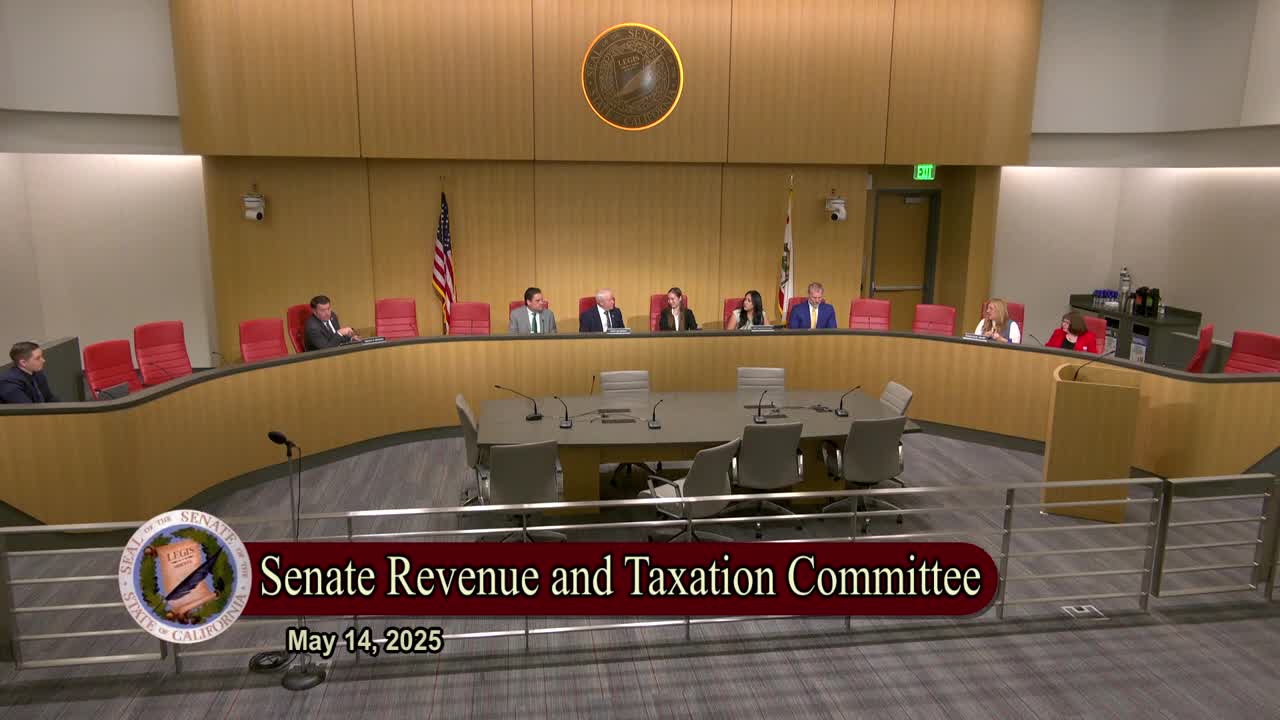 9MIN
Senate Standing Committee on Revenue and Taxation
Bill Author
Bill Co-Author(s):