SB 592: Property tax: change in ownership: residential rental property.
- Session Year: 2025-2026
- House: Senate
- Latest Version Date: 2025-04-21
Current Status:
Failed
(2026-02-02: Returned to Secretary of Senate pursuant to Joint Rule 56.)
Introduced
In Committee
Awaiting First Chamber Vote
Passed First Chamber
In Committee
Awaiting Second Chamber Vote
Passed Second Chamber
Enacted
The California Constitution limits the maximum amount of any ad valorem tax on real property to 1% of the full cash value of the property, and defines full cash value for these purposes to mean the appraised value of real property when purchased, newly constructed, or a change in ownership has occurred, as provided. Existing property tax law requires the reassessment of real property upon a change in ownership and specifies what transfers of property do and do not constitute a change in ownership and excludes from a change in ownership, and hence from reassessment, certain transfers. Among these excluded transfers, existing property tax law provides that certain transfers of mobilehome parks to a nonprofit corporation, stock cooperative corporation, limited equity stock cooperative, or other entity formed by the tenants of a mobilehome park if specified conditions are met, including that the individual tenants who were renting at least 51% of the spaces in the mobilehome park prior to the transfer participate in the transaction through the ownership of an aggregate of at least 51% of the voting stock of, or other ownership or membership interests in, the entity which acquires the park.
This bill would provide that a transfers transfer of a real property containing dwelling units occupied by tenants to a nonprofit public benefit corporation, nonprofit mutual benefit corporation, or limited equity housing cooperative, limited-equity housing cooperative, as defined, formed by the tenants of the real property for the purpose of purchasing the real property at which they reside, provided that the individual tenants who were renting at least 51% of the units in the real property before the transfer participate in the transaction through the ownership of an aggregate of at least 51% of the voting shares or membership interests in the entity that acquires the real property, as specified, is not a change in ownership. The bill would also provide that a transfers transfer of a real property containing dwelling units occupied by tenants to a community land trust, provided that at least 51% of the tenants who resided at the property at the time of transfer have signed a petition or other statement expressing support for the purchase of the real property by the community land trust, as specified, is not a change in ownership. The bill would exempt the petition from public disclosure. The bill would require a community land trust utilizing the above-described exclusion to indicate that use on a preliminary change of ownership report or change in ownership statement filed with the county recorder. The bill would authorize the county counsel to require a limited-equity housing cooperative claiming the above-described exclusion to provide specified documentation, including the Articles of Incorporation of the limited-equity housing cooperative. By adding to the duties of local tax officials with respect to the determination of whether a change in ownership has occurred for purposes of taxing real property, the bill would impose a state-mandated local program.
Existing constitutional provisions require that a statute that limits the right of access to the meetings of public bodies or the writings of public officials and agencies be adopted with findings demonstrating the interest protected by the limitation and the need for protecting that interest.This bill would make legislative findings to that effect.The California Constitution requires the state to reimburse local agencies and school districts for certain costs mandated by the state. Statutory provisions establish procedures for making that reimbursement.
This bill would provide that, if the Commission on State Mandates determines that the bill contains costs mandated by the state, reimbursement for those costs shall be made pursuant to the statutory provisions noted above.
Existing law requires the state to reimburse local agencies annually for certain property tax revenues lost as a result of any exemption or classification of property for purposes of ad valorem property taxation.
This bill would provide that, notwithstanding those provisions, no appropriation is made and the state shall not reimburse local agencies for property tax revenues lost by them pursuant to the bill.
This bill would take effect immediately as a tax levy.
The California Constitution limits the maximum amount of any ad valorem tax on real property to 1% of the full cash value of the property, and defines full cash value for these purposes to mean the appraised value of real property when purchased, newly constructed, or a change in ownership has occurred, as provided. Existing property tax law requires the reassessment of real property upon a change in ownership and specifies what transfers of property do and do not constitute a change in ownership and excludes from a change in ownership, and hence from reassessment, certain transfers. Among these excluded transfers, existing property tax law provides that certain transfers of mobilehome parks to a nonprofit corporation, stock cooperative corporation, limited equity stock cooperative, or other entity formed by the tenants of a mobilehome park if specified conditions are met, including that the individual tenants who were renting at least 51% of the spaces in the mobilehome park prior to the transfer participate in the transaction through the ownership of an aggregate of at least 51% of the voting stock of, or other ownership or membership interests in, the entity which acquires the park.
This bill would provide that a transfers of a real property containing dwelling units occupied by tenants to a nonprofit public benefit corporation, nonprofit mutual benefit corporation, or limited equity housing cooperative, formed by the tenants of the real property for the purpose of purchasing the real property at which they reside, provided that the individual tenants who were renting at least 51% of the units in the real property before the transfer participate in the transaction through the ownership of an aggregate of at least 51% of the voting shares or membership interests in the entity that acquires the real property, as specified, is not a change in ownership. The bill would also provide that a transfers of a real property containing dwelling units occupied by tenants to a community land trust, provided that at least 51% of the tenants who resided at the property at the time of transfer have signed a petition or other statement expressing support for the purchase of the real property by the community land trust, as specified, is not a change in ownership. The bill would exempt the petition from public disclosure. By adding to the duties of local tax officials with respect to the determination of whether a change in ownership has occurred for purposes of taxing real property, the bill would impose a state-mandated local program.
Existing constitutional provisions require that a statute that limits the right of access to the meetings of public bodies or the writings of public officials and agencies be adopted with findings demonstrating the interest protected by the limitation and the need for protecting that interest.
This bill would make legislative findings to that effect.
The California Constitution requires the state to reimburse local agencies and school districts for certain costs mandated by the state. Statutory provisions establish procedures for making that reimbursement.
This bill would provide that, if the Commission on State Mandates determines that the bill contains costs mandated by the state, reimbursement for those costs shall be made pursuant to the statutory provisions noted above.
Existing law requires the state to reimburse local agencies annually for certain property tax revenues lost as a result of any exemption or classification of property for purposes of ad valorem property taxation.
This bill would provide that, notwithstanding those provisions, no appropriation is made and the state shall not reimburse local agencies for property tax revenues lost by them pursuant to the bill.
This bill would take effect immediately as a tax levy.
(a)A change in ownership shall not include a transfer of real property containing dwelling units occupied by tenants to either of the following entities:
(1)(A)A limited-equity housing cooperative formed by the tenants of the real property for the purpose of purchasing the real property at which they reside, provided that the individual tenants who were renting at least 51 percent of the units in the real property before the transfer participate in the transaction through the ownership of an aggregate of at least 51 percent of the voting shares or membership interests of the limited-equity housing cooperative. The limited-equity housing cooperative that acquires the property shall have a grace period of up to two years after the date of the transfer to attain a tenant participation level of at least 51 percent. If a transferee of real property declares an intent to rely on this section on a preliminary change of ownership report or a change in ownership statement filed with the county recorder, the real property may not be reappraised by the assessor during that period. However, if a tenant participation level of at least 51 percent is not attained within the two-year grace period, the county assessor shall thereafter levy escape assessments for the real property transfer.
(B)If the real property is not subject to a contract as described in paragraph (11) of subdivision (a) of Section 402.1, the limited-equity housing cooperative shall demonstrate to the assessors satisfaction that at the time of transfer at least a majority of the tenant households qualified as lower income households, as defined in Section 50079.5 of the Health and Safety Code.
(B)(2)A community land trust, as that term is defined in Section 402.1, provided that at least 51 percent of the tenants who resided at the property at the time of transfer have signed a petition or other statement expressing support for the purchase of the real property by the community land trust, a copy of which shall be given to the county assessor upon request. The petition may be signed in electronic form. The petition shall state the name of the community land trust seeking to make the purchase, the property address, and the full names of the tenants signing the petition. The petition shall not be subject to public disclosure. 402.1. A community land trust shall indicate it is relying on this section in a preliminary change of ownership report or change in ownership statement filed with the county recorder.
(2)Any transfers(b)A change in ownership shall not include a transfer of voting stock or membership interests that are appurtenant to an exclusive right to occupy a dwelling unit in the real property acquired by an entity a limited-equity housing cooperative described in subparagraph (A) of paragraph (1) may be transferred to tenants of the dwelling units without constituting a change in ownership, of subdivision (a) if (A) (1) the tenant participation conditions of subparagraph (A) of paragraph (1) of subdivision (a) are met, and if (B) (2) the transfer occurs within three years following the transfer of the real property to an entity described in subparagraph (A) of paragraph (1). that two-year grace period afforded in subparagraph (A) of paragraph (1) of subdivision (a) following the transfer of the real property to the limited-equity housing cooperative. If an individual tenant or tenants notify the county assessor of the intention to comply with the conditions set forth in this section, any share or membership interest in the entity limited-equity housing cooperative that is purchased by an individual tenant in that real property during that three-year grace period shall not be reappraised by the assessor. However, if all of the conditions set forth in this paragraph are not satisfied, the county assessor shall thereafter levy escape assessments for the real property.
(c)The county assessor may require a limited-equity housing cooperative relying on this section to provide the following documentation to demonstrate compliance with this section:
(1)Articles of Incorporation of the limited-equity housing cooperative.
(2)Bylaws of the limited-equity housing cooperative.
(3)Stock or membership certificates naming tenants of the real property issued by the limited-equity housing cooperative or signed purchase contracts for shares or memberships between the limited-equity housing cooperative and tenants of the real property.
(4)Documentation such as copies of lease agreements, copies of utility bills, or similar documentation to provide evidence reasonably satisfactory to the assessor that the owners of at least 51 percent of the voting shares or membership interests in the limited-equity housing cooperative were tenants at the property immediately prior to the transfer that is excluded from a change in ownership pursuant to this section.
(b)(d)(1)If the transfer of a real property has been excluded from a change in ownership pursuant to subparagraph (A) of paragraph (1) of subdivision (a) and the real property has not been converted to an entity in accordance with subdivision (a), or if the entity has not fulfilled the requisite tenant participation requirements of this section, then the transfer shall be a change in ownership of the real property unless the transfer is for the purpose of converting the ownership of the property to ownership by a nonprofit corporation community land trust or limited equity limited-equity housing cooperative or is otherwise excluded from change in ownership by Section 62, 62.1, 62.2, 63, 63.1, 63.2, or 64.
(2)For the purposes of this subdivision, pro rata portion of the real property means the total real property multiplied by a fraction consisting of the number of shares of voting stock, or other ownership or membership interests, transferred divided by the total number of outstanding issued or unissued shares of voting stock of the respective nonprofit or cooperative entity.
(3)Any pro rata portion or portions of real property that changed ownership pursuant to this subdivision may be separately assessed as provided in Section 2188.7, as applicable.
(4)A limited-equity housing cooperative relying on this section that does not utilize recorded deeds to transfer ownership of membership interests appurtenant to exclusive occupancy rights in the property shall file, by February 1 of each year, a report with the county assessors office containing all of the following information:
(A)The full name and mailing address of each owner, stockholder, or holder of an ownership interest in the real property that is appurtenant to an exclusive right to occupy a dwelling unit.
(B)The property address, including the number associated with each unit.
(C)The date that the ownership interest referred to in subparagraph (A) was acquired, or if applicable, a statement that no changes in ownership occurred since the last annual report.
(5)Within 30 days of a change in ownership, the new resident owner or other purchaser or transferee of a membership interest in a cooperative that does not utilize recorded deeds to transfer ownership interests shall file a change in ownership statement described in either Section 480 or 480.2, if applicable.
(6)Failure to comply with any reporting requirement required by this section shall result in a penalty pursuant to Section 482.
(c)(e)It is the intent of the Legislature that, in order to facilitate affordable conversions of housing to tenant ownership, paragraph (1) of subdivision (a) apply applies to all bona fide transfers of rental properties to tenant ownership or community land trust ownership.
(f)For purposes of this section, limited-equity housing cooperative means a corporation organized on a cooperative basis that, in addition to complying with Section 817.1 of the Civil Code as may be applicable, meets all of the following requirements:
(1)The corporation is organized as a nonprofit public benefit corporation pursuant to Part 2 (commencing with Section 5110) of Division 2 of Title 1 of the Corporations Code.
(2)The corporation is any of the following:
(A)Holds title to real property as the beneficiary of a trust providing for distribution for public or charitable purposes upon termination of the trust.
(B)Holds title to real property subject to conditions that will result in reversion to a public or charitable entity upon dissolution of the corporation.
(C)Holds a leasehold interest, of at least 20 years duration, conditioned on the corporations continued qualification under this section, and provides for reversion to a public entity or charitable corporation.
(3)(A)The articles of incorporation or bylaws require the purchase and sale of the stock or membership interest of resident owners who cease to be permanent residents, at no more than a transfer value determined as provided in the articles or bylaws, and that shall not exceed the aggregate of the following:
(i)The consideration paid for the membership or shares by the first occupant of the unit involved, as shown on the books of the corporation.
(ii)The value, as determined by the board of directors of the corporation, of any improvements installed at the expense of the member or a prior member with the prior approval of the board of directors.
(iii)Accumulated simple interest, an inflation allowance at a rate that may be based on a cost-of-living index, an income index, or market-interest index, or compound interest if specified in the articles of incorporation or bylaws. For newly formed corporations, accumulated simple interest shall apply. Any increment pursuant to this paragraph shall not exceed a 10-percent annual increase on the consideration paid for the membership or share by the first occupant of the unit involved.
(B)(i)Except as provided in clause (ii), for purposes of a return of transfer value, both of the following are prohibited:
(I)A board of directors returning transfer value, either full or partial, to a member while they still remain a member.
(II)An existing member accepting the return of the members transfer value, either full or partial.
(ii)A board of directors may return to an existing member, and the existing member may accept return of, the members transfer value in the event that the member moves within the cooperative from a category of unit initially valued at a higher price to a different category of unit valued at a lower price.
(4)The articles of incorporation or bylaws require the board of directors to sell the stock or membership interest purchased as provided in subdivision (b) to new member-occupants or resident shareholders at a price that does not exceed the transfer value paid for the unit.
(5)The corporate equity, that is defined as the excess of the current fair market value of the corporations real property over the sum of the current transfer values of all shares or membership interests, reduced by the principal balance of outstanding encumbrances upon the corporate real property as a whole, shall be applied as follows:
(A)So long as any such encumbrance remains outstanding, the corporate equity shall not be used for distribution to members, but only for the following purposes, and only to the extent authorized by the board, subject to the provisions and limitations of the articles of incorporation and bylaws:
(i)For the benefit of the corporation or the improvement of the real property.
(ii)For expansion of the corporation by acquisition of additional real property.
(iii)For public benefit or charitable purposes.
(B)Upon sale of the property, dissolution of the corporation, or occurrence of a condition requiring termination of the trust or reversion of title to the real property, the corporate equity is required by the articles, bylaws, or trust or title conditions to be paid out, or title to the property transferred, subject to outstanding encumbrances and liens, for the transfer value of membership interests or shares, for use for a public or charitable purpose.
(6)Amendment of the bylaws and articles of incorporation requires the affirmative vote of at least two-thirds of the resident-owner members or shareholders.
SEC. 2.The Legislature finds and declares that Section 1 of this act, which adds Section 62.1.1 to the Revenue and Taxation Code, imposes a limitation on the publics right of access to the meetings of public bodies or the writings of public officials and agencies within the meaning of Section 3 of Article I of the California Constitution. Pursuant to that constitutional provision, the Legislature makes the following findings to demonstrate the interest protected by this limitation and the need for protecting that interest:In order to protect the privacy of tenants who have a signed a petition or other statement expressing support for the purchase of real property by a community land trust it is necessary that their names remain confidential.SEC. 3.SEC. 2.If the Commission on State Mandates determines that this act contains costs mandated by the state, reimbursement to local agencies and school districts for those costs shall be made pursuant to Part 7 (commencing with Section 17500) of Division 4 of Title 2 of the Government Code.
SEC. 4.SEC. 3.Notwithstanding Section 2229 of the Revenue and Taxation Code, no appropriation is made by this act and the state shall not reimburse any local agency for any property tax revenues lost by it pursuant to this act.
SEC. 5.SEC. 4.This act provides for a tax levy within the meaning of Article IV of the California Constitution and shall go into immediate effect.
(a)A change in ownership shall not include either of the following:
(1)Any transfer of a real property containing dwelling units occupied by tenants to any of the following entities:
(A)(i)A nonprofit public benefit corporation, nonprofit mutual benefit corporation, or limited equity housing cooperative, as that term is defined in Section 817 of the Civil Code, formed by the tenants of the real property for the purpose of purchasing the real property at which they reside, provided that as to any of the aforementioned entity types, the individual tenants who were renting at least 51 percent of the units in the real property before the transfer participate in the transaction through the ownership of an aggregate of at least 51 percent of the voting shares or membership interests in the entity that acquires the real property.
(ii)If a real property is acquired by an entity that did not attain an initial tenant participation level of at least 51 percent on the date of the transfer, the entity shall have up to 18 months after the date of the transfer to attain a tenant participation level of at least 51 percent. If any individual tenant occupying the property notifies the county assessor of the intention to comply with the conditions set forth in this clause, the real property may not be reappraised by the assessor during that period. However, if a tenant participation level of at least 51 percent is not attained within the 18-month period, the county assessor shall thereafter levy escape assessments for the real property transfer.
(B)A community land trust, as that term is defined in Section 402.1, provided that at least 51 percent of the tenants who resided at the property at the time of transfer have signed a petition or other statement expressing support for the purchase of the real property by the community land trust, a copy of which shall be given to the county assessor upon request. The petition may be signed in electronic form. The petition shall state the name of the community land trust seeking to make the purchase, the property address, and the full names of the tenants signing the petition. The petition shall not be subject to public disclosure.
(2)Any transfers of voting stock or membership interests that are appurtenant to an exclusive right to occupy a dwelling unit in the real property acquired by an entity described in subparagraph (A) of paragraph (1) may be transferred to tenants of the dwelling units without constituting a change in ownership, if (A) the tenant participation conditions of subparagraph (A) of paragraph (1) are met, and if (B) the transfer occurs within three years following the transfer of the real property to an entity described in subparagraph (A) of paragraph (1). If an individual tenant or tenants notify the county assessor of the intention to comply with the conditions set forth in this section, any share or membership interest in the entity that is purchased by an individual tenant in that real property during that three-year period shall not be reappraised by the assessor. However, if all of the conditions set forth in this paragraph are not satisfied, the county assessor shall thereafter levy escape assessments for the real property.
(b)(1)If the transfer of a real property has been excluded from a change in ownership pursuant to subparagraph (A) of paragraph (1) of subdivision (a) and the real property has not been converted to an entity in accordance with subdivision (a), or if the entity has not fulfilled the requisite tenant participation requirements of this section, then the transfer shall be a change in ownership of the real property unless the transfer is for the purpose of converting the ownership of the property to ownership by a nonprofit corporation or limited equity housing cooperative or is otherwise excluded from change in ownership by Section 62, 62.1, 62.2, 63, 63.1, 63.2, or 64.
(2)For the purposes of this subdivision, pro rata portion of the real property means the total real property multiplied by a fraction consisting of the number of shares of voting stock, or other ownership or membership interests, transferred divided by the total number of outstanding issued or unissued shares of voting stock of the respective nonprofit or cooperative entity.
(3)Any pro rata portion or portions of real property that changed ownership pursuant to this subdivision may be separately assessed as provided in Section 2188.7, as applicable.
(4)A cooperative relying on this section that does not utilize recorded deeds to transfer ownership of membership interests appurtenant to exclusive occupancy rights in the property shall file, by February 1 of each year, a report with the county assessors office containing all of the following information:
(A)The full name and mailing address of each owner, stockholder, or holder of an ownership interest in the real property that is appurtenant to an exclusive right to occupy a dwelling unit.
(B)The property address, including the number associated with each unit.
(C)The date that the ownership interest referred to in subparagraph (A) was acquired, or if applicable, a statement that no changes in ownership occurred since the last annual report.
(5)Within 30 days of a change in ownership, the new resident owner or other purchaser or transferee of a membership interest in a cooperative that does not utilize recorded deeds to transfer ownership interests shall file a change in ownership statement described in either Section 480 or 480.2, if applicable.
(6)Failure to comply with any reporting requirement required by this section shall result in a penalty pursuant to Section 482.
(c)It is the intent of the Legislature that, in order to facilitate affordable conversions of housing to tenant ownership, paragraph (1) of subdivision (a) apply to all bona fide transfers of rental properties to tenant ownership or community land trust ownership.
SEC. 2.The Legislature finds and declares that Section 1 of this act, which adds Section 62.1.1 to the Revenue and Taxation Code, imposes a limitation on the publics right of access to the meetings of public bodies or the writings of public officials and agencies within the meaning of Section 3 of Article I of the California Constitution. Pursuant to that constitutional provision, the Legislature makes the following findings to demonstrate the interest protected by this limitation and the need for protecting that interest:
In order to protect the privacy of tenants who have a signed a petition or other statement expressing support for the purchase of real property by a community land trust it is necessary that their names remain confidential.
SEC. 3.If the Commission on State Mandates determines that this act contains costs mandated by the state, reimbursement to local agencies and school districts for those costs shall be made pursuant to Part 7 (commencing with Section 17500) of Division 4 of Title 2 of the Government Code.
SEC. 4.Notwithstanding Section 2229 of the Revenue and Taxation Code, no appropriation is made by this act and the state shall not reimburse any local agency for any property tax revenues lost by it pursuant to this act.
SEC. 5.This act provides for a tax levy within the meaning of Article IV of the California Constitution and shall go into immediate effect.
|
Date
|
Status
|
|---|---|
| Feb 2, 2026 | Returned to Secretary of Senate pursuant to Joint Rule 56. |
| May 23, 2025 | May 23 hearing: Held in committee and under submission. |
| May 16, 2025 | Set for hearing May 23. |
| May 5, 2025 | May 5 hearing: Placed on APPR. suspense file. |
| Apr 29, 2025 | Set for hearing May 5. |
| Apr 24, 2025 | Withdrawn from committee. |
| Apr 24, 2025 | Re-referred to Com. on APPR. |
| Apr 23, 2025 | From committee: Do pass and re-refer to Com. on JUD. (Ayes 4. Noes 0. Page 872.) (April 23). Re-referred to Com. on JUD. |
| Apr 21, 2025 | From committee with author's amendments. Read second time and amended. Re-referred to Com. on REV. & TAX. |
| Apr 4, 2025 | Set for hearing April 23. |
| Apr 3, 2025 | April 9 set for first hearing canceled at the request of author. |
| Mar 18, 2025 | Set for hearing April 9. |
| Mar 5, 2025 | Referred to Coms. on REV. & TAX. and JUD. |
| Feb 21, 2025 | From printer. May be acted upon on or after March 23. |
| Feb 20, 2025 | Introduced. Read first time. To Com. on RLS. for assignment. To print. |
|
Date
|
Description
|
Location
|
Votes
|
|
|---|---|---|---|---|
| May 5, 2025 | Placed on suspense file | Senate Standing Committee on Appropriations |
Passed |
|
| Apr 23, 2025 | Do pass, but first be re-referred to the Committee on [Judiciary] | Senate Standing Committee on Revenue and Taxation |
Passed |
This list shows positions taken on this bill by organizations on the date displayed, which is linked to the original source.
Positions by individuals are not included.
|
Organization
|
Position
|
Date
|
|---|---|---|
| Alliance for Boys and Men of Color | ** Support | |
| Bay Area Community Land Trust | ** Support | |
| Beverly-Vermont Community Land Trust | ** Support | |
| Black Women For Wellness Action Project | ** Support | |
| California Assessors Association | ** Against | |
| California Community Land Trust Network | ** Support | |
| California Domestic Workers Coalition | ** Support | |
| Courage California | ** Support | |
| El Sereno Community Land Trust | ** Support | |
| End Poverty in California Action | ** Support | |
| Fairview House, Inc. | ** Support | |
| Fideicomiso Comunitario Tierra Libre | ** Support | |
| Housing for All Long Beach Community Land Trust | ** Support | |
| Inland Equity Community Land Trust | ** Support | |
| Northern California Land Trust | ** Support | |
| Sacramento Community Land Trust | ** Support | |
| South Tower Community Land Trust | ** Support | |
| Supportive Housing Community Land Alliance | ** Support | |
| Sustainable Economies Law Center | ** Support | |
| Tierras Indigenas Community Land Trust | ** Support | |
| T.R.U.S.T. South LA | ** Support | |
| Two Valleys Community Land Trust | ** Support | |
| UNITE HERE Local 11 | ** Support | |
| Vital Arts | ** Support |
SENATE COMMITTEE ON
Senator Anna Caballero, Chair
2025 - 2026 Regular Session
SB 592 (Smallwood-Cuevas) - Property tax: change in ownership: residential rental property
Version: | Policy Vote: |
Urgency: | Mandate: |
Hearing Date: | Consultant: |
Bill Summary:
SB 592 would enact property tax “change in ownership” exclusions for transactions involving real property with dwelling units.
Fiscal Impact:
- This bill would result in lower annual property tax revenues compared to current law. The Board of Equalization (BOE) indicates that the revenue loss is indeterminable, but could be significant, and would be driven by, among other factors, (1) the extent to which the new exclusions are utilized, and (2) the assessed value of the affected real estate. Reductions in local property tax revenues, in turn, can increase General Fund Proposition 98 spending by up to roughly 50 percent (the exact amount depends on the specific amount of the annual Proposition 98 guarantee, which in turns depends upon a variety of economic, demographic and budgetary factors). BOE’s administrative costs to implement the bill have yet to be identified.
- By modifying how an assessor values property, this bill creates a state-mandated local program. To the extent the Commission on State Mandates determines that the provisions of this bill create a new program or impose a higher level of service on local agencies, local agencies could claim reimbursement of those costs. The magnitude is unknown (General Fund).
Background:
Under the California Constitution, all property is taxable unless explicitly exempted by itself or federal law. The Constitution limits the maximum amount of any ad valorem tax on real property at one percent of full cash value, plus any locally-authorized bonded indebtedness (Proposition 13, 1978). Assessors reappraise property whenever it is purchased, newly constructed, or when ownership changes (as defined by both statute and the Constitution). Current law generally sets a property’s value as its sales price when purchased or, when there is no sales price, at its fair market value when ownership changes (base year value). Thereafter, existing law requires an annual inflation adjustment to that value that cannot exceed 2 percent (factored base year value). County assessors determine changes in ownership for real property by looking at property records, and reassess the property whenever any interest transfers. If a property is owned by more than one taxpayer, the assessor generally revalues the property in proportion to the percentage transferred.
Current law contains several “change in ownership” exclusions, where assessors do not revalue property even though a property has been transferred to a new owner. Among these is an exclusion for a transfer of a mobile home park to an entity formed by the tenants of the park. For the exclusion to apply, the individual tenants renting at least 51 percent of the spaces in the mobile home park prior to the transfer must participate in the transaction, as specified.
A stock cooperative is a common interest development where a corporation holds title to a property in fee simple absolute or fee simple determinable, but all or substantially all resident shareholders have a right of exclusive occupancy in a portion of the real property. Limited Equity Housing Cooperatives are generally organized for a public purpose either as a nonprofit corporation or where its real property is either distributed or reverts to public or charitable ownership on termination of the corporation. LEHC articles of incorporation or bylaws limit the return on equity realized on a sale of shares or a membership interest. Property tax law considers transfers of shares in a cooperative housing corporation as changes in ownership subject to reassessment, so long as the exclusive right to occupancy and possession of that property (or a portion thereof) transfers too.
Community Land Trusts (CLTs) are formed by local agencies, employers, nonprofits, or grassroots organizations, and are typically sponsored by non-profit organizations seeking to promote affordable housing by acquiring and retaining ownership of real property in a specific geographic area using capital or land from private donations or public sources. While the first CLTs were formed in rural areas in the 1970s, nearly 225 exist nationwide today, and approximately 36 are in California. CLTs provide both owner-occupied and rental housing, and mostly operate in higher-income urban and suburban areas, and under federal law, must (1) not be sponsored by a for-profit organization, (2) be established to acquire parcels of land, held in perpetuity, primarily for conveyance under long-term ground leases; transfer ownership of any structural improvements located on such leased parcels to the lessees; and retain a preemptive option to purchase any such structural improvement at a price determined by formula designed to ensure the improvement remains affordable to low- and moderate-income families in perpetuity, and (3) have a corporate membership that is open to any adult resident of a particular geographic area specified in the bylaws of the organization, and whose board of directors must be equally comprised of leaseholders, community representatives, and other individuals representing the public interest.
The Legislature has provided several favorable property tax treatment for properties owned by CLTs. In 2016, the Legislature required assessors to consider the value impact of CLT-imposed enforceable restrictions, and added a definition of a CLT into property tax law (AB 2818, Chiu). Among the requirements of the definition is that all units on the land owned by the CLT are sold or rented to persons or families of low to moderate income, and the land is subject to a 99-year ground lease.
In 2019, the Legislature provided that property owned by a CLT, as defined by AB 2818, qualifies for the welfare exemption for a five-year period if the property is being developed, will be developed, or is rehabilitated as low-income housing (SB 196, Beall). To be eligible for the exemption, the property must be, or will be developed or rehabilitated into: (1) an owner-occupied single-family dwelling, (2) an owner-occupied unit in a multifamily dwelling, (3) a member-occupied unit in a limited equity housing cooperative, or (4) a rental housing development.
To be eligible for SB 196’s exemption, improvements on the property must be available for use and ownership or for rent by persons of specified incomes. A deed restriction or other instrument requiring a contract (or contracts) serving as an enforceable restriction on the sale or resale value of owner-occupied units, or on the affordability of rental units, must be recorded on or before the lien date following the CLT’s acquisition of the property. The bill further provided that the assessor cannot deny the exemption because construction of an eligible use of the property has not yet commenced, and deems rental housing eligible for the exemption as of the date construction commences.
In 2022, the Legislature extended SB 196’s sunset date by two years (AB 2651, Petrie Norris), until January 1, 2027, and adopted a provision applied to other affordable housing projects that continue to treat a unit as occupied by a lower income household when the income of those occupants increases (AB 1206, Bennett). Last year, the Legislature modified the current definition of CLT to remove the requirement that property be subject to a 99-year ground lease when a CLT is part of a condominium, cooperative, or other common interest development under which the land is owned by a homeowners’ association or person other than the community land trust (AB 2897, Connolly). Instead of the 99-year ground lease, an affordability covenant of at least 99 years must be recorded against the unit or interest.
Proposed Law:
This bill, among other things, would do the following:
- Provide that a transfer of a real property containing dwelling units occupied by tenants to a limited-equity housing cooperative, as defined, formed by the tenants of the real property for the purpose of purchasing the real property at which they reside, provided that the individual tenants who were renting at least 51 percent of the units in the real property before the transfer participate in the transaction through the ownership of an aggregate of at least 51 percent of the voting shares or membership interests in the entity that acquires the real property, as specified, is not a change in ownership under property tax law.
- Provide that a transfer of a real property containing dwelling units occupied by tenants to a CLT, as specified, is not a change in ownership.
- Require a CLT utilizing the above-described exclusion to indicate that use on a preliminary change of ownership report or change in ownership statement filed with the county recorder.
- Authorize the county counsel to require a limited-equity housing cooperative claiming the above-described exclusion to provide specified documentation, including the Articles of Incorporation of the limited-equity housing cooperative.
-- END --
SENATE COMMITTEE ON REVENUE AND TAXATION
Senator Jerry McNerney, Chair
2025 - 2026 Regular
Bill No: | SB 592 | Hearing Date: | 4/9/25 |
Author: | Smallwood-Cuevas | Tax Levy: | Yes |
Version: | 4/21/25 > | Fiscal: | Yes |
Consultant: | Grinnell | ||
Property tax: change in ownership: residential rental property
Enacts “change in ownership” exclusions for transactions involving real property with dwelling units.
Background
Article XIII of the California Constitution provides that all property is taxable unless explicitly exempted by the Constitution or federal law. Article XIIIA of the Constitution limits the maximum amount of any ad valorem tax on real property at 1% of full cash value, and directs assessors to set assessed values at 1975 market value levels and only reappraise property thereafter if there is a “change in ownership” (Proposition 13, 1978). Assessors determine changes in ownership for real property by looking at property records, and reassess the property whenever any interest transfers. If a property is owned by more than one taxpayer, the assessor generally revalues the property in proportion to the percentage transferred.
Change in Ownership Exclusions. The Constitution and statute contain several “change in ownership” exclusions, where assessors do not revalue property even though a property has been transferred to a new owner. Among these, current law excludes a transfer of a mobile home park to an entity formed by the tenants of the park. For the exclusion to apply, the individual tenants renting at least 51% of the spaces in the mobile home park prior to the transfer must participate in the transaction. Participation can be demonstrated by the ownership of an aggregate of at least 51% of the voting stock of, or other ownership or membership interests in, the entity that acquires the park. Additionally, if the entity does not have an initial tenant participation level of at least 51% on the date of the property transfer, the entity has up to one year after the date of the transfer to attain 51% tenant participation. In this case, so long as an individual tenant notifies the assessor of the intention to comply with the conditions set forth in the preceding sentence, the assessor cannot reassess it. However, if that tenant participation level is not attained within the one-year period, the assessor must then levy escape assessments for the mobile home park transfer.
Once a transfer of a mobile home park to an entity formed by tenants has been excluded from “change in ownership” reassessment requirements, any subsequent transfers of ownership interests in that entity are treated as pro rata changes in ownership and are subject to reassessment unless another change in ownership exclusion in current law applies. Mobile home parks that do not use recorded deeds to transfer ownership interest must file annual reports with the assessor that contain:
- The full name and mailing address of each owner, stockholder, or holder of an ownership interest in the mobile home park.
- The situs address, including space number, of each unit.
- The date that the ownership interest was acquired.
- If the unit is a manufactured home:
- Provide the Department of Housing and Community Development decal number or serial number, or both.
- Indicate whether the manufactured home is subject to the vehicle license fee or the local property tax.
Failure to file a report results in a penalty. Additionally, when ownership changes, the transferee of a manufactured home within a mobile home park that does not utilize recorded deeds to transfer ownership interest in the spaces or lots must file a change in ownership statement.
Limited Equity Housing Cooperatives (LEHCs). A stock cooperative is a common interest development where a corporation holds title to a property in fee simple absolute or fee simple determinable, but all or substantially all resident shareholders have a right of exclusive occupancy in a portion of the real property. Specifically defined in the Civil Code, LEHCs are generally organized for a public purpose either as a nonprofit corporation or where its real property is either distributed or reverts to public or charitable ownership on termination of the corporation. LEHC articles of incorporation or bylaws limit the return on equity realized on a sale of shares or a membership interest. Property tax law considers transfers of shares in a cooperative housing corporation as changes in ownership subject to reassessment, so long as the exclusive right to occupancy and possession of that property (or a portion thereof) transfers too.
Community Land Trusts (CLTs). Formed by local agencies, employers, nonprofits, or grassroots organizations, CLTs are typically sponsored by non-profit organizations seeking to promote affordable housing by acquiring and retaining ownership of real property in a specific geographic area using capital or land from private donations or public sources. While the first CLTs were formed in rural areas in the 1970s, nearly 225 exist nationwide today, and approximately 36 are in California. CLTs provide both owner-occupied and rental housing, and mostly operate in higher-income urban and suburban areas, and under federal law, must:
- Not be sponsored by a for-profit organization.
- Be established to acquire parcels of land, held in perpetuity, primarily for conveyance under long-term ground leases; transfer ownership of any structural improvements located on such leased parcels to the lessees; and retain a preemptive option to purchase any such structural improvement at a price determined by formula designed to ensure the improvement remains affordable to low- and moderate-income families in perpetuity.
- Have a corporate membership that is open to any adult resident of a particular geographic area specified in the bylaws of the organization, and whose board of directors must be equally comprised of leaseholders, community representatives, and other individuals representing the public interest.
The Legislature has acted several times to provide favorable property tax treatment for properties owned by CLTs. In 2016, the Legislature required assessors to consider the value impact of CLT-imposed enforceable restrictions, and added a definition of a CLT into property tax law (AB 2818, Chiu). Among the requirements of the definition is that all units on the land owned by the CLT are sold or rented to persons or families of low to moderate income, and the land is subject to a 99-year ground lease.
SB 196. In 2019, the Legislature provided that property owned by a CLT, as defined by AB 2818, qualifies for the welfare exemption for a five-year period if the property is being developed, will be developed, or is rehabilitated as low-income housing (SB 196, Beall). To be eligible for the exemption, the property must be, or will be developed or rehabilitated into:
- An owner-occupied single-family dwelling;
- An owner-occupied unit in a multifamily dwelling;
- A member-occupied unit in a limited equity housing cooperative; or
- A rental housing development.
To be eligible for SB 196’s exemption, improvements on the property must be available for use and ownership or for rent by persons of specified incomes. A deed restriction or other instrument requiring a contract (or contracts) serving as an enforceable restriction on the sale or resale value of owner-occupied units, or on the affordability of rental units, must be recorded on or before the lien date following the CLT’s acquisition of the property. The bill further provided that the assessor cannot deny the exemption because construction of an eligible use of the property has not yet commenced, and deems rental housing eligible for the exemption as of the date construction commences.
SB 196 was set to sunset the exemption on January 1, 2025. In 2022, the Legislature extended the sunset by two years (AB 2651, Petrie Norris), until January 1, 2027, and adopted a provision applied to other affordable housing projects that continue to treat a unit as occupied by a lower income household when the income of those occupants increases (AB 1206, Bennett). Last year, the Legislature modified the current definition of CLT to remove the requirement that property be subject to a 99-year ground lease when a CLT is part of a condominium, cooperative, or other common interest development under which the land is owned by a homeowners’ association or person other than the community land trust (AB 2897, Connolly). Instead of the 99-year ground lease, an affordability covenant of at least 99 years must be recorded against the unit or interest.
CLTs are contemplating several forms of transactions where current tenants in rental housing may want to acquire ownership; however, doing so requires reassessment unless an exclusion applies. The California Community Land Trust Network wants to enact new exclusions to facilitate these transactions.
Proposed Law
SB 592 enacts “change in ownership” exclusions for transactions involving real property with dwelling units, largely based on the current exclusion for mobile home parks:
- Transfer to LEHC. The bill enacts an exclusion when the entity acquiring the real property is an LEHC formed by the current tenants of the property for the purpose of purchasing the property at which they reside, so long as the LEHC is comprised of at least 51% of the tenants in the units on the property before the transfer, who participate in the transaction through at least 51% of the voting shares or membership interests in the property. If the transferee declares an intent to rely on the bill on a preliminary change in ownership report or a change in ownership statement, the assessor cannot reassess the property for two years; if the two-year period passes without the LEHC meeting the aforementioned resident participation requirement, the assessor must levy escape assessments against the LEHC.
When an LEHC property is not subject to a CLT contract, the LEHC must demonstrate to the satisfaction of the assessor that at least a majority of the tenants qualified as lower-income households using definitions in the Health and Safety Code. When a transfer to an LEHC project is subject to a CLT contract, the requirements default to those set in AB 2818.
Assessors may require LEHCs, but not CLTs, to demonstrate compliance by providing:
- The LEHC’s articles of incorporation;
- The LEHC’s bylaws;
- Stock or membership certificates naming tenants issued by the LEHC, or signed purchase contracts for shares or memberships between tenants and the LEHC;
- Documentation such as copies of lease agreements, copies of utility bills or similar documents to provide evidence that the tenants were residents of the property prior to the transfer.
- Transfer to CLT. The bill enacts an exclusion when a CLT acquires the property, so long as the transferee declares an intent to rely on the bill on a preliminary change in ownership report or a change in ownership statement.
- Transfers of Shares after LEHC Acquisition. SB 592 also enacts an exclusion when a tenant at the time of the initial transfer acquires voting stock or membership interests appurtenant to the exclusive right to occupy a dwelling unit in the real property from an LEHC that initially qualified for an exclusion under the bill. However, this exclusion is only available during the same two-year period during which the assessor cannot revalue the property acquired by the LEHC. Individual tenants must notify the assessor of their intention to comply with the bill. If the requirements are not met, the assessor must levy escape assessments against the LEHC.
When a change in ownership occurs, the assessor may separately assess the pro rata portion. The bill also requires LEHCs that do not use recorded deeds to transfer ownership to file an annual report by February 1st each year with specified contents. New resident owners in such LEHCs must file change in ownership statements. The bill applies current failure to report penalties for failures to satisfy the above requirements.
The measure provides additional requirements for an LEHC beyond those set forth in the Civil Code, including:
- The corporation is organized as a nonprofit public benefit corporation.
- The corporation is any of the following:
- Holds title to real property as the beneficiary of a trust providing for distribution for public or charitable purposes upon termination of the trust.
- Holds title to real property subject to conditions that will result in reversion to a public or charitable entity upon dissolution of the corporation.
- Holds a leasehold interest of at least 20 years’ duration, conditioned on the corporation’s continued qualification under this section, and provides for reversion to a public entity or charitable corporation.
- The articles of incorporation or bylaws require the purchase and sale of the stock or membership interest of resident owners who cease to be permanent residents, at no more than a transfer value determined as provided in the articles or bylaws, and that shall not exceed the aggregate of the following:
- The consideration paid for the membership or shares by the first occupant of the unit involved, as shown on the books of the corporation.
- The value, as determined by the board of directors of the corporation, of any improvements installed at the expense of the member or a prior member, with the prior approval of the board of directors.
- Accumulated simple interest, an inflation allowance at a rate that may be based on a cost-of-living index, an income index, or a market-interest index, or compound interest if specified in the articles of incorporation or bylaws. For newly formed corporations, the accumulated simple interest shall apply. Any increment pursuant to this paragraph shall not exceed a 10-percent annual increase on the consideration paid for the membership or share by the first occupant of the unit involved.
- Boards of Directors cannot return transfer value, either full or partial, to the members while they are a member, and an existing member cannot accept return of transfer value, either full or partial. However, a board of directors can return to an existing member, and the existing member may accept, the return of the member’s transfer value in the event that the member moves within the cooperative from a category of unit valued at a higher price to one valued at a lower price.
- The articles of incorporation or bylaws require the board of directors to sell the stock or membership interest purchased to new member-occupants or residents shareholders at a price that does not exceed the “transfer value” paid for the unit.
- Corporate equity cannot be used for distribution to members, except when authorized by the board, subject to the provisions and limitations of the articles of incorporation and bylaws for benefit of the corporation or improvement of the property, for expansion through acquiring other property, or for public benefit or charitable purposes.
- Upon sale of the property, dissolution of the corporation, or occurrence of a condition requiring termination of the trust or reversion of title to the real property, the corporate equity is required by the articles, bylaws, or trust or title conditions to be paid out, or title to the property transferred, subject to outstanding encumbrances and liens, for the transfer value of membership interests or shares, for use for a public or charitable purpose.
- Amendment of the bylaws and articles of incorporation requires the affirmative vote of at least two-thirds of the resident-owner members or shareholders.
State Revenue Impact
Pending.
Comments
1. Purpose of the bill. According to the author, “Creating affordable pathways for home ownership is a crucial part of addressing our state’s housing crisis. SB 592 enhances opportunities for the development of community land trusts and limited-equity housing cooperatives (LEHCs) by easing tax burdens for these entities throughout the state. Under current law, the value of a property is reassessed upon a change in ownership, often resulting in an increase in the property tax bill once acquired by a new owner. For affordable housing developers and community land trusts operating on thin margins, these increases in property taxes make it difficult for affordable developments to “pencil out.” Existing law excludes property transfers in mobile home parks and floating home marinas from being characterized as a change in ownership and thus, excludes the property from reassessment. SB 592 expands this exclusion to community land trusts and limited equity housing cooperatives, keeping the property tax bills on these projects low on the onset. By expanding existing exclusions from change in ownership reassessment requirements, SB 592 supports the development of affordable housing and creates real pathways for the conversion of apartment buildings to tenant ownership.”
2. Inclusive exclusions. Change in ownership exclusions can provide significant tax savings, which generally increase the longer the property has been owned and the greater the increase in market value. SB 592 applies this valuable tool to help current tenants acquire ownership of the buildings in which they currently live, hopefully providing sufficient tax savings that facilitate homeownership and wealth creation in communities with affordable rental housing. Tenants who can acquire the capital necessary to acquire the building can pay property taxes on the previous owner’s base year value, not based on the purchase price. The measure builds off models in current law for mobile home parks. However, the bill enacts at least three new exclusions, where requirements and timelines are either unclear or in conflict with themselves and other provisions of law. For example, how can an assessor grant a tenant acquisition transfer exclusion contingent on granting the LEHCs’ exclusion when the LEHCs depends on meeting a tenant ownership threshold that has not yet been met? Assessors will receive indications from tenants expecting an exclusion that they are not yet eligible for. It’s also unclear how the measure’s deadlines interact with other property tax benefits the Legislature has afforded CLTs: Can CLTs apply for a welfare exemption for the same property where it applies for an exclusion? County assessors may face difficulty administering the measure as written.
3. One, but not the same. SB 592 enacts new exclusions for both LEHCs and CLTs, but subjects these to different rules. CLTs need only acquire the property and indicate they want an exclusion when recording change in ownership documents, while LEHCs must satisfy tenant ownership requirements. LEHCs must demonstrate to the assessor that a majority of tenants meet the definition of low-income for the exclusion to apply and supply documentation; CLTs are subject to different requirements set forth in their contracts.
4. This just in. In December, 2024, the Legislative Analyst’s Office issued a report required by AB 1206, to both analyze demand for the CLT welfare exemption, its fiscal impact, as well as other information to measure the bill’s impact, based on a Board of Equalization (BOE) survey. While some counties did not respond, and others did not respond every year, the BOE data indicated CLTs only own 226 properties in the state, of which nine claim the exemption.
5. Mandate. The California Constitution requires the state to reimburse local governments for the costs of new or expanded state mandated local programs. Because SB 592 changes the way assessors value real property, Legislative Counsel says that this bill imposes a new state mandate. The measure provides that the state shall not reimburse local agencies for property tax revenue losses, instead stating that, should the Commission on State Mandates determine that the bill imposes a reimbursable mandate, reimbursement must be made pursuant to existing statutory provisions.
6. Coming and going. The Senate Rules Committee ordered a double referral of SB 592: first to the Revenue and Taxation Committee to consider its tax implications, and second to the Committee on Judiciary.
Support and Opposition
(4/20/25)
Support: Alliance for Boys and Men of Color (Co-Sponsor)
California Community Land Trust Network (Co-Sponsor)
Sustainable Economies Law Center (Co-Sponsor)
Bay Area Community Land Trust
Beverly-Vermont Community Land Trust
Black Women for Wellness Action Project
California Domestic Workers Coalition
Courage California
El Sereno Community Land Trust
End Poverty in California Action
Fairview House, Inc.
Fideicomiso Comunitario Tierra Libre
Housing for All Long Beach Community Land Trust
Inland Equity Community Land Trusts
Northern California Land Trust
Sacramento Community Land Trust
South Tower Community Land Trust
Supportive Housing Community Land Alliance
T.R.U.S.T. South LA
Tierras Indigenas Community Land Trust
Two Valleys Community Land Trust
UNITE HERE Local 11
Vital Arts
Opposition: California Assessors’ Association
-- END --
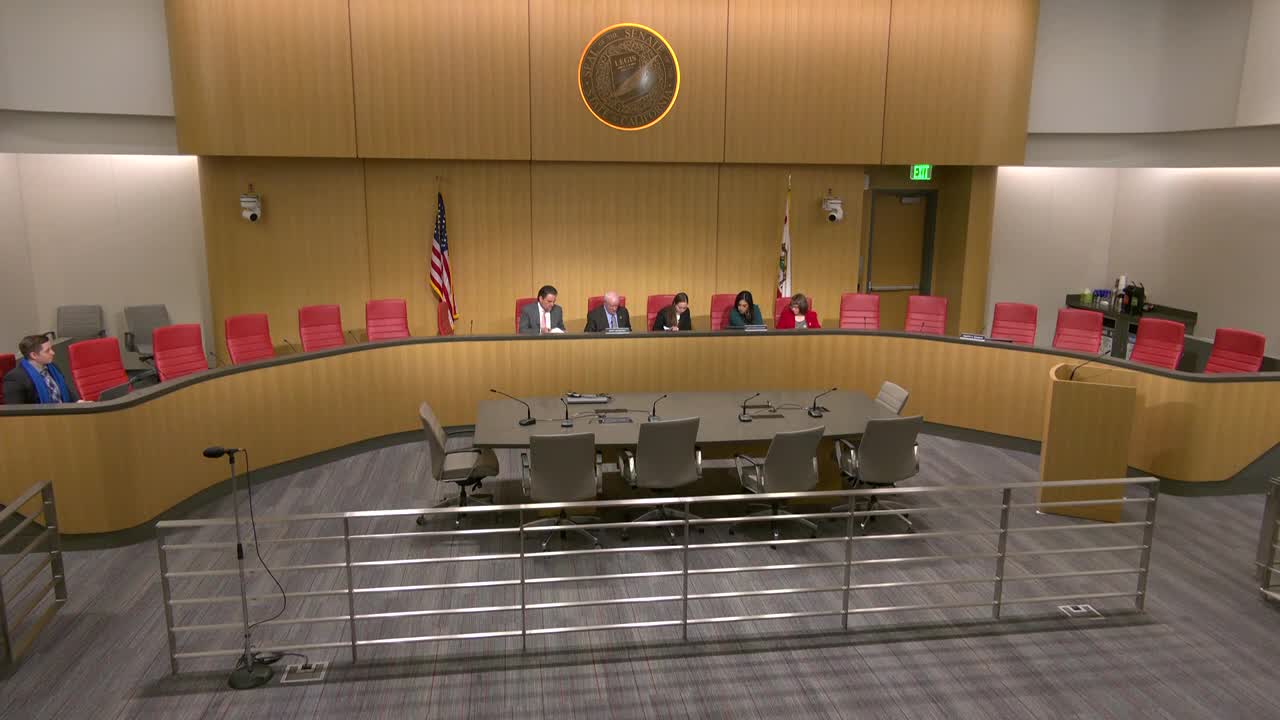
Discussed in Hearing
 17MIN
Senate Standing Committee on Revenue and Taxation
Bill Author

Bill Co-Author(s):