SB 595: Local government: investments and financial reports.
- Session Year: 2025-2026
- House: Senate
- Latest Version Date: 2025-10-03
Current Status:
Passed
(2025-10-03: Chaptered by Secretary of State. Chapter 323, Statutes of 2025.)
Introduced
In Committee
Awaiting First Chamber Vote
Passed First Chamber
In Committee
Awaiting Second Chamber Vote
Passed Second Chamber
Enacted
(1)Existing law regulates the investment of public funds by local agencies, as defined. Existing law authorizes the legislative body of a local agency, as specified, that has money in a sinking fund or in its treasury not required for the immediate needs of the local agency to invest the money as it deems wise or expedient in certain securities and financial instruments, subject to various requirements. These permissible investments include, among others, commercial paper of prime quality of the highest ranking or of the highest letter and number rating as provided for by a nationally recognized statistical rating organization that is issued by entities meeting certain criteria, if the eligible commercial paper has a maximum maturity of 270 days or less.
This bill would revise the maximum maturity periods for the investments in prime quality commercial paper to 397 days.
Existing law, until January 1, 2026, authorizes local agencies, as specified, that have less than $100,000,000 of investment assets under management to invest no more than 25%, and those local agencies that have $100,000,000 or more of investment assets under management to invest no more than 40%, of their moneys in eligible commercial paper, as specified. Existing law, beginning January 1, 2026, instead authorizes those local agencies regardless of the amount of investment assets they have under management to invest no more than 25% of their moneys in eligible commercial paper, as specified.
This bill would instead repeal the former provisions on January 1, 2031, and would postpone the operative date for the latter provisions until January 1, 2031.
Existing law prohibits a local agency from investing specified public funds in any security that could result in zero-interest accrual if held to maturity, as specified. Existing law, until January 1, 2026, authorizes a local agency as an exception to that provision to invest in securities issued by, or backed by, the United States government that could result in zero-interest accrual if held to maturity, as specified.
This bill would instead repeal the above-described exception on January 1, 2031.
(2)Existing law requires the Controller to annually compile, publish, and make publicly available on the Controllers website reports of the information concerning financial transactions and annual compensation of each county, city, and school district within the state, as specified. If an officer of a local agency fails or refuses to make and file their financial report within 20 days after receipt of a written notice of the failure from the Controller, existing law requires that officer or local agency to forfeit to the state a specified amount depending on the amount of total revenue of that local agency.
This bill would instead require that forfeiture if the officer fails or refuses to make and file their financial report within 10 months after the end of the local agencys fiscal year, or within the time prescribed by the Controller, whichever is later.
(1)Existing law regulates the investment of public funds by local agencies, as defined. Existing law authorizes the legislative body of a local agency, as specified, that has money in a sinking fund or in its treasury not required for the immediate needs of the local agency to invest the money as it deems wise or expedient in certain securities and financial instruments, subject to various requirements. These permissible investments include, among others, commercial paper of prime quality of the highest ranking or of the highest letter and number rating as provided for by a nationally recognized statistical rating organization, subject to certain conditions. organization that is issued by entities meeting certain criteria, if the eligible commercial paper has a maximum maturity of 270 days or less.
This bill would revise the maximum maturity periods for the investments in prime quality commercial paper to 397 days.
Existing law, until January 1, 2026, authorizes local agencies, as specified, that have less than $100,000,000 of investment assets under management to invest no more than 25%, and those local agencies that have $100,000,000 or more of investment assets under management to invest no more than 40%, of their moneys in eligible commercial paper, as specified. Existing law, beginning January 1, 2026, instead authorizes those local agencies regardless of the amount of investment assets they have under management to invest no more than 25% of their moneys in eligible commercial paper, as specified.
This bill would instead repeal the former provisions on January 1, 2031, and would postpone the operative date for the latter provisions until January 1, 2031.
Existing law prohibits a local agency from investing specified public funds in any security that could result in zero-interest accrual if held to maturity, as specified. Existing law, until January 1, 2026, authorizes a local agency as an exception to that provision to invest in securities issued by, or backed by, the United States government that could result in zero-interest accrual if held to maturity, as specified.
This bill would instead repeal the above-described exception on January 1, 2031.
(2)Existing law requires the Controller to annually compile, publish, and make publicly available on the Controllers website reports of the information concerning financial transactions and annual compensation of each county, city, and school district within the state, as specified. If an officer of a local agency fails or refuses to make and file their financial report within 20 days after receipt of a written notice of the failure from the Controller, existing law requires that officer or local agency to forfeit to the state a specified amount depending on the amount of total revenue of that local agency.
This bill would instead require that forfeiture if the officer fails or refuses to make and file their financial report within 10 months after the end of the local agencys fiscal year. year, or within the time prescribed by the Controller, whichever is later.
(1)Existing law regulates the investment of public funds by local agencies, as defined. Existing law authorizes the legislative body of a local agency, as specified, that has money in a sinking fund or in its treasury not required for the immediate needs of the local agency to invest the money as it deems wise or expedient in certain securities and financial instruments, subject to various requirements. These permissible investments include, among others, commercial paper of prime quality of the highest ranking or of the highest letter and number rating as provided for by a nationally recognized statistical rating organization, subject to certain conditions.
Existing law, until January 1, 2026, authorizes local agencies, as specified, that have less than $100,000,000 of investment assets under management to invest no more than 25%, and those local agencies that have $100,000,000 or more of investment assets under management to invest no more than 40%, of their moneys in eligible commercial paper, as specified. Existing law, beginning January 1, 2026, instead authorizes those local agencies regardless of the amount of investment assets they have under management to invest no more than 25% of their moneys in eligible commercial paper, as specified.
This bill would instead repeal the former provisions on January 1, 2031, and would postpone the operative date for the latter provisions until January 1, 2031.
Existing law prohibits a local agency from investing specified public funds in any security that could result in zero interest zero-interest accrual if held to maturity, as specified. Existing law, until January 1, 2026, authorizes a local agency as an exception to that provision to invest in securities issued by, or back backed by, the United States government that could result in zero interest zero-interest accrual if held to maturity, as specified.
This bill would instead repeal the above-described exception on January 1, 2031.
(2)Existing law requires the Controller to annually compile, publish, and make publicly available on the Controllers website reports of the information concerning financial transactions and annual compensation of each county, city, and school district within the state, as specified. If an officer of a local agency fails or refuses to make and file their financial report within 20 days after receipt of a written notice of the failure from the Controller, existing law requires that officer or local agency to forfeit to the state a specified amount depending on the amount of total revenue of that local agency.
This bill would instead require that forfeiture if the officer fails or refuses to make and file their financial report within 10 months after the end of the local agencys fiscal year.
The bill would also require the Controller to determine whether certain financial transactions reports can be replaced by machine readable audited financial statements and would require the Controller to provide a report to the Legislature regarding its determination on or before December 31, 2026.(1)Existing law regulates the investment of public funds by local agencies, as defined. Existing law authorizes the legislative body of a local agency, as specified, that has money in a sinking fund or in its treasury not required for the immediate needs of the local agency to invest the money as it deems wise or expedient in certain securities and financial instruments, subject to various requirements. These permissible investments include, among others, commercial paper of prime quality of the highest ranking or of the highest letter and number rating as provided for by a nationally recognized statistical rating organization, subject to certain conditions.
Existing law, until January 1, 2026, authorizes local agencies, as specified, that have less than $100,000,000 of investment assets under management to invest no more than 25%, and those local agencies that have $100,000,000 or more of investment assets under management to invest no more than 40%, of their moneys in eligible commercial paper, as specified. Existing law, beginning January 1, 2026, instead authorizes those local agencies regardless of the amount of investment assets they have under management to invest no more than 25% of their moneys in eligible commercial paper, as specified.
This bill would instead repeal the former provisions on January 1, 2031, and would postpone the operative date for the latter provisions until January 1, 2031.
Existing law prohibits a local agency from investing specified public funds in any security that could result in zero interest accrual if held to maturity, as specified. Existing law, until January 1, 2026, authorizes a local agency as an exception to that provision to invest in securities issued by, or back by, the United States government that could result in zero interest accrual if held to maturity, as specified.
This bill would instead repeal the above-described exception on January 1, 2031.
Existing(2)Existing law requires the Controller to annually compile, publish, and make publicly available on the Controllers website reports of the information concerning financial transactions and annual compensation of each county, city, and school district within the state, as specified. If an officer of a local agency fails or refuses to make and file their financial report within 20 days after receipt of a written notice of the failure from the Controller, existing law requires that officer or local agency to forfeit to the state a specified amount depending on the amount of total revenue of that local agency.
This bill would instead require that forfeiture if the officer fails or refuses to make and file their financial report within 10 months after the end of the local agencys fiscal year.
The bill would also require the Controller to determine whether certain financial transactions reports can be replaced by machine readable audited financial statements and would require the Controller to provide a report to the Legislature regarding its determination on or before December 31, 2026.
Existing law requires the Controller to annually compile, publish, and make publicly available on the Controllers website reports of the information concerning financial transactions and annual compensation of each county, city, and school district within the state, as specified. If an officer of a local agency fails or refuses to make and file their financial report within 20 days after receipt of a written notice of the failure from the Controller, existing law requires that officer or local agency to forfeit to the state a specified amount depending on the amount of total revenue of that local agency.
This bill would instead require that forfeiture if the officer fails or refuses to make and file their financial report within 10 months after the end of the local agencys fiscal year.
The bill would also require the Controller to determine whether certain financial transactions reports can be replaced by machine readable audited financial statements and would require the Controller to provide a report to the Legislature regarding its determination on or before December 31, 2026.
This section shall apply to a local agency that is a city, a district, or other local agency that does not pool money in deposits or investments with other local agencies, other than local agencies that have the same governing body. However, Section 53635 shall apply to all local agencies that pool money in deposits or investments with other local agencies that have separate governing bodies. The legislative body of a local agency having moneys in a sinking fund or moneys in its treasury not required for the immediate needs of the local agency may invest any portion of the moneys that it deems wise or expedient in those investments set forth below. A local agency purchasing or obtaining any securities prescribed in this section, in a negotiable, bearer, registered, or nonregistered format, shall require delivery of the securities to the local agency, including those purchased for the agency by financial advisers, consultants, or managers using the agencys funds, by book entry, physical delivery, or by third-party custodial agreement. The transfer of securities to the counterparty banks customer book entry account may be used for book entry delivery.
For purposes of this section, counterparty means the other party to the transaction. A counterparty banks trust department or separate safekeeping department may be used for the physical delivery of the security if the security is held in the name of the local agency. Where this section specifies a percentage limitation for a particular category of investment, that percentage is applicable only at the date of purchase. For purposes of compliance with this section, an investments term or remaining maturity shall be measured from the settlement date to final maturity. A security purchased in accordance with this section shall not have a forward settlement date exceeding 45 days from the time of investment. Where this section does not specify a limitation on the term or remaining maturity at the time of the investment, no investment shall be made in any security, other than a security underlying a repurchase or reverse repurchase agreement or securities lending agreement authorized by this section, that at the time of the investment has a term remaining to maturity in excess of five years, unless the legislative body has granted express authority to make that investment either specifically or as a part of an investment program approved by the legislative body no less than three months prior to the investment:
(a)Bonds issued by the local agency, including bonds payable solely out of the revenues from a revenue-producing property owned, controlled, or operated by the local agency or by a department, board, agency, or authority of the local agency.
(b)United States Treasury notes, bonds, bills, or certificates of indebtedness, or those for which the faith and credit of the United States are pledged for the payment of principal and interest.
(c)Registered state warrants or treasury notes or bonds of this state, including bonds payable solely out of the revenues from a revenue-producing property owned, controlled, or operated by the state or by a department, board, agency, or authority of the state.
(d)Registered treasury notes or bonds of any of the other 49 states in addition to California, including bonds payable solely out of the revenues from a revenue-producing property owned, controlled, or operated by a state or by a department, board, agency, or authority of any of the other 49 states, in addition to California.
(e)Bonds, notes, warrants, or other evidences of indebtedness of a local agency within this state, including bonds payable solely out of the revenues from a revenue-producing property owned, controlled, or operated by the local agency, or by a department, board, agency, or authority of the local agency.
(f)Federal agency or United States government-sponsored enterprise obligations, participations, or other instruments, including those issued by or fully guaranteed as to principal and interest by federal agencies or United States government-sponsored enterprises.
(g)Bankers acceptances otherwise known as bills of exchange or time drafts that are drawn on and accepted by a commercial bank. Purchases of bankers acceptances shall not exceed 180 days maturity or 40 percent of the agencys moneys that may be invested pursuant to this section. However, no more than 30 percent of the agencys moneys may be invested in the bankers acceptances of any one commercial bank pursuant to this section.
This subdivision does not preclude a municipal utility district from investing moneys in its treasury in a manner authorized by the Municipal Utility District Act (Division 6 (commencing with Section 11501) of the Public Utilities Code).
(h)Commercial paper of prime quality of the highest ranking or of the highest letter and number rating as provided for by a nationally recognized statistical rating organization (NRSRO). The entity that issues the commercial paper shall meet all of the following conditions in either paragraph (1) or (2):
(1)The entity meets the following criteria:
(A)Is organized and operating in the United States as a general corporation.
(B)Has total assets in excess of five hundred million dollars ($500,000,000).
(C)Has debt other than commercial paper, if any, that is rated in a rating category of A or its equivalent or higher by an NRSRO.
(2)The entity meets the following criteria:
(A)Is organized within the United States as a special purpose corporation, trust, or limited liability company.
(B)Has programwide credit enhancements including, but not limited to, overcollateralization, letters of credit, or a surety bond.
(C)Has commercial paper that is rated A-1 or higher, or the equivalent, by an NRSRO.
Eligible commercial paper shall have a maximum maturity of 397 days or less. Local agencies, other than counties or a city and county, that have less than one hundred million dollars ($100,000,000) of investment assets under management, may invest no more than 25 percent of their moneys in eligible commercial paper. Local agencies, other than counties or a city and county, that have one hundred million dollars ($100,000,000) or more of investment assets under management may invest no more than 40 percent of their moneys in eligible commercial paper. A local agency, other than a county or a city and a county, may invest no more than 10 percent of its total investment assets in the commercial paper and the medium-term notes of any single issuer. Counties or a city and county may invest in commercial paper pursuant to the concentration limits in subdivision (a) of Section 53635.
(i)Negotiable certificates of deposit issued by a nationally or state-chartered bank, a savings association or a federal association (as defined by Section 5102 of the Financial Code), a state or federal credit union, or by a federally licensed or state-licensed branch of a foreign bank. Purchases of negotiable certificates of deposit shall not exceed 30 percent of the agencys moneys that may be invested pursuant to this section. For purposes of this section, negotiable certificates of deposit do not come within Article 2 (commencing with Section 53630), except that the amount so invested shall be subject to the limitations of Section 53638. The legislative body of a local agency and the treasurer or other official of the local agency having legal custody of the moneys are prohibited from investing local agency funds, or funds in the custody of the local agency, in negotiable certificates of deposit issued by a state or federal credit union if a member of the legislative body of the local agency, or a person with investment decisionmaking authority in the administrative office managers office, budget office, auditor-controllers office, or treasurers office of the local agency also serves on the board of directors, or any committee appointed by the board of directors, or the credit committee or the supervisory committee of the state or federal credit union issuing the negotiable certificates of deposit.
(j)(1)Investments in repurchase agreements or reverse repurchase agreements or securities lending agreements of securities authorized by this section, as long as the agreements are subject to this subdivision, including the delivery requirements specified in this section.
(2)Investments in repurchase agreements may be made, on an investment authorized in this section, when the term of the agreement does not exceed one year. The market value of securities that underlie a repurchase agreement shall be valued at 102 percent or greater of the funds borrowed against those securities and the value shall be adjusted no less than quarterly. Since the market value of the underlying securities is subject to daily market fluctuations, the investments in repurchase agreements shall be in compliance if the value of the underlying securities is brought back up to 102 percent no later than the next business day.
(3)Reverse repurchase agreements or securities lending agreements may be utilized only when all of the following conditions are met:
(A)The security to be sold using a reverse repurchase agreement or securities lending agreement has been owned and fully paid for by the local agency for a minimum of 30 days prior to sale.
(B)The total of all reverse repurchase agreements and securities lending agreements on investments owned by the local agency does not exceed 20 percent of the base value of the portfolio.
(C)The agreement does not exceed a term of 92 days, unless the agreement includes a written codicil guaranteeing a minimum earning or spread for the entire period between the sale of a security using a reverse repurchase agreement or securities lending agreement and the final maturity date of the same security.
(D)Funds obtained or funds within the pool of an equivalent amount to that obtained from selling a security to a counterparty using a reverse repurchase agreement or securities lending agreement shall not be used to purchase another security with a maturity longer than 92 days from the initial settlement date of the reverse repurchase agreement or securities lending agreement, unless the reverse repurchase agreement or securities lending agreement includes a written codicil guaranteeing a minimum earning or spread for the entire period between the sale of a security using a reverse repurchase agreement or securities lending agreement and the final maturity date of the same security.
(4)(A)Investments in reverse repurchase agreements, securities lending agreements, or similar investments in which the local agency sells securities prior to purchase with a simultaneous agreement to repurchase the security may be made only upon prior approval of the governing body of the local agency and shall be made only with primary dealers of the Federal Reserve Bank of New York or with a nationally or state-chartered bank that has or has had a significant banking relationship with a local agency.
(B)For purposes of this chapter, significant banking relationship means any of the following activities of a bank:
(i)Involvement in the creation, sale, purchase, or retirement of a local agencys bonds, warrants, notes, or other evidence of indebtedness.
(ii)Financing of a local agencys activities.
(iii)Acceptance of a local agencys securities or funds as deposits.
(5)(A)Repurchase agreement means a purchase of securities by the local agency pursuant to an agreement by which the counterparty seller will repurchase the securities on or before a specified date and for a specified amount and the counterparty will deliver the underlying securities to the local agency by book entry, physical delivery, or by third-party custodial agreement. The transfer of underlying securities to the counterparty banks customer book-entry account may be used for book-entry delivery.
(B)Securities, for purposes of repurchase under this subdivision, means securities of the same issuer, description, issue date, and maturity.
(C)Reverse repurchase agreement means a sale of securities by the local agency pursuant to an agreement by which the local agency will repurchase the securities on or before a specified date and includes other comparable agreements.
(D)Securities lending agreement means an agreement under which a local agency agrees to transfer securities to a borrower who, in turn, agrees to provide collateral to the local agency. During the term of the agreement, both the securities and the collateral are held by a third party. At the conclusion of the agreement, the securities are transferred back to the local agency in return for the collateral.
(E)For purposes of this section, the base value of the local agencys pool portfolio shall be that dollar amount obtained by totaling all cash balances placed in the pool by all pool participants, excluding any amounts obtained through selling securities by way of reverse repurchase agreements, securities lending agreements, or other similar borrowing methods.
(F)For purposes of this section, the spread is the difference between the cost of funds obtained using the reverse repurchase agreement and the earnings obtained on the reinvestment of the funds.
(k)Medium-term notes, defined as all corporate and depository institution debt securities with a maximum remaining maturity of five years or less, issued by corporations organized and operating within the United States or by depository institutions licensed by the United States or any state and operating within the United States. Notes eligible for investment under this subdivision shall be rated in a rating category of A or its equivalent or better by an NRSRO. Purchases of medium-term notes shall not include other instruments authorized by this section and shall not exceed 30 percent of the agencys moneys that may be invested pursuant to this section. A local agency, other than a county or a city and a county, may invest no more than 10 percent of its total investment assets in the commercial paper and the medium-term notes of any single issuer.
(l)(1)Shares of beneficial interest issued by diversified management companies that invest in the securities and obligations as authorized by subdivisions (a) to (k), inclusive, and subdivisions (m) to (q), inclusive, and that comply with the investment restrictions of this article and Article 2 (commencing with Section 53630). However, notwithstanding these restrictions, a counterparty to a reverse repurchase agreement or securities lending agreement is not required to be a primary dealer of the Federal Reserve Bank of New York if the companys board of directors finds that the counterparty presents a minimal risk of default, and the value of the securities underlying a repurchase agreement or securities lending agreement may be 100 percent of the sales price if the securities are marked to market daily.
(2)Shares of beneficial interest issued by diversified management companies that are money market funds registered with the United States Securities and Exchange Commission under the Investment Company Act of 1940 (15 U.S.C. Sec. 80a-1 et seq.).
(3)If investment is in shares issued pursuant to paragraph (1), the company shall have met either of the following criteria:
(A)Attained the highest ranking or the highest letter and numerical rating provided by not less than two NRSROs.
(B)Retained an investment adviser registered or exempt from registration with the United States Securities and Exchange Commission with not less than five years experience investing in the securities and obligations authorized by subdivisions (a) to (k), inclusive, and subdivisions (m) to (q), inclusive, and with assets under management in excess of five hundred million dollars ($500,000,000).
(4)If investment is in shares issued pursuant to paragraph (2), the company shall have met either of the following criteria:
(A)Attained the highest ranking or the highest letter and numerical rating provided by not less than two NRSROs.
(B)Retained an investment adviser registered or exempt from registration with the United States Securities and Exchange Commission with not less than five years experience managing money market mutual funds with assets under management in excess of five hundred million dollars ($500,000,000).
(5)The purchase price of shares of beneficial interest purchased pursuant to this subdivision shall not include commission that the companies may charge and shall not exceed 20 percent of the agencys moneys that may be invested pursuant to this section. However, no more than 10 percent of the agencys funds may be invested in shares of beneficial interest of any one mutual fund pursuant to paragraph (1).
(m)Moneys held by a trustee or fiscal agent and pledged to the payment or security of bonds or other indebtedness, or obligations under a lease, installment sale, or other agreement of a local agency, or certificates of participation in those bonds, indebtedness, or lease installment sale, or other agreements, may be invested in accordance with the statutory provisions governing the issuance of those bonds, indebtedness, or lease installment sale, or other agreement, or to the extent not inconsistent therewith or if there are no specific statutory provisions, in accordance with the ordinance, resolution, indenture, or agreement of the local agency providing for the issuance.
(n)Notes, bonds, or other obligations that are at all times secured by a valid first priority security interest in securities of the types listed by Section 53651 as eligible securities for the purpose of securing local agency deposits having a market value at least equal to that required by Section 53652 for the purpose of securing local agency deposits. The securities serving as collateral shall be placed by delivery or book entry into the custody of a trust company or the trust department of a bank that is not affiliated with the issuer of the secured obligation, and the security interest shall be perfected in accordance with the requirements of the Uniform Commercial Code or federal regulations applicable to the types of securities in which the security interest is granted.
(o)(1)A mortgage passthrough security, collateralized mortgage obligation, mortgage-backed or other pay-through bond, equipment lease-backed certificate, consumer receivable passthrough certificate, or consumer receivable-backed bond.
(2)For securities eligible for investment under this subdivision not issued or guaranteed by an agency or issuer identified in subdivision (b) or (f), the following limitations apply:
(A)The security shall be rated in a rating category of AA or its equivalent or better by an NRSRO and have a maximum remaining maturity of five years or less.
(B)Purchase of securities authorized by this paragraph shall not exceed 20 percent of the agencys surplus moneys that may be invested pursuant to this section.
(p)Shares of beneficial interest issued by a joint powers authority organized pursuant to Section 6509.7 that invests in the securities and obligations authorized in subdivisions (a) to (r), inclusive. Each share shall represent an equal proportional interest in the underlying pool of securities owned by the joint powers authority. To be eligible under this section, the joint powers authority issuing the shares shall have retained an investment adviser that meets all of the following criteria:
(1)The adviser is registered or exempt from registration with the United States Securities and Exchange Commission.
(2)The adviser has not less than five years of experience investing in the securities and obligations authorized in subdivisions (a) to (q), inclusive.
(3)The adviser has assets under management in excess of five hundred million dollars ($500,000,000).
(q)United States dollar denominated senior unsecured unsubordinated obligations issued or unconditionally guaranteed by the International Bank for Reconstruction and Development, International Finance Corporation, or Inter-American Development Bank, with a maximum remaining maturity of five years or less, and eligible for purchase and sale within the United States. Investments under this subdivision shall be rated in a rating category of AA or its equivalent or better by an NRSRO and shall not exceed 30 percent of the agencys moneys that may be invested pursuant to this section.
(r)Commercial paper, debt securities, or other obligations of a public bank, as defined in Section 57600.
This section shall remain in effect only until January 1, 2031, and as of that date is repealed.
SEC. 2.Section 53601 of the Government Code, as amended by Section 6 of Chapter 187 of the Statutes of 2023, is amended to read:53601.This section shall apply to a local agency that is a city, a district, or other local agency that does not pool money in deposits or investments with other local agencies, other than local agencies that have the same governing body. However, Section 53635 shall apply to all local agencies that pool money in deposits or investments with other local agencies that have separate governing bodies. The legislative body of a local agency having moneys in a sinking fund or moneys in its treasury not required for the immediate needs of the local agency may invest any portion of the moneys that it deems wise or expedient in those investments set forth below. A local agency purchasing or obtaining any securities prescribed in this section, in a negotiable, bearer, registered, or nonregistered format, shall require delivery of the securities to the local agency, including those purchased for the agency by financial advisers, consultants, or managers using the agencys funds, by book entry, physical delivery, or by third-party custodial agreement. The transfer of securities to the counterparty banks customer book entry account may be used for book entry delivery.
For purposes of this section, counterparty means the other party to the transaction. A counterparty banks trust department or separate safekeeping department may be used for the physical delivery of the security if the security is held in the name of the local agency. Where this section specifies a percentage limitation for a particular category of investment, that percentage is applicable only at the date of purchase. For purposes of compliance with this section, an investments term or remaining maturity shall be measured from the settlement date to final maturity. A security purchased in accordance with this section shall not have a forward settlement date exceeding 45 days from the time of investment. Where this section does not specify a limitation on the term or remaining maturity at the time of the investment, no investment shall be made in any security, other than a security underlying a repurchase or reverse repurchase agreement or securities lending agreement authorized by this section, that at the time of the investment has a term remaining to maturity in excess of five years, unless the legislative body has granted express authority to make that investment either specifically or as a part of an investment program approved by the legislative body no less than three months prior to the investment:
(a)Bonds issued by the local agency, including bonds payable solely out of the revenues from a revenue-producing property owned, controlled, or operated by the local agency or by a department, board, agency, or authority of the local agency.
(b)United States Treasury notes, bonds, bills, or certificates of indebtedness, or those for which the faith and credit of the United States are pledged for the payment of principal and interest.
(c)Registered state warrants or treasury notes or bonds of this state, including bonds payable solely out of the revenues from a revenue-producing property owned, controlled, or operated by the state or by a department, board, agency, or authority of the state.
(d)Registered treasury notes or bonds of any of the other 49 states in addition to California, including bonds payable solely out of the revenues from a revenue-producing property owned, controlled, or operated by a state or by a department, board, agency, or authority of any of the other 49 states, in addition to California.
(e)Bonds, notes, warrants, or other evidences of indebtedness of a local agency within this state, including bonds payable solely out of the revenues from a revenue-producing property owned, controlled, or operated by the local agency, or by a department, board, agency, or authority of the local agency.
(f)Federal agency or United States government-sponsored enterprise obligations, participations, or other instruments, including those issued by or fully guaranteed as to principal and interest by federal agencies or United States government-sponsored enterprises.
(g)Bankers acceptances otherwise known as bills of exchange or time drafts that are drawn on and accepted by a commercial bank. Purchases of bankers acceptances shall not exceed 180 days maturity or 40 percent of the agencys moneys that may be invested pursuant to this section. However, no more than 30 percent of the agencys moneys may be invested in the bankers acceptances of any one commercial bank pursuant to this section.
This subdivision does not preclude a municipal utility district from investing moneys in its treasury in a manner authorized by the Municipal Utility District Act (Division 6 (commencing with Section 11501) of the Public Utilities Code).
(h)Commercial paper of prime quality of the highest ranking or of the highest letter and number rating as provided for by a nationally recognized statistical rating organization (NRSRO). The entity that issues the commercial paper shall meet all of the following conditions in either paragraph (1) or (2):
(1)The entity meets the following criteria:
(A)Is organized and operating in the United States as a general corporation.
(B)Has total assets in excess of five hundred million dollars ($500,000,000).
(C)Has debt other than commercial paper, if any, that is rated in a rating category of A or its equivalent or higher by an NRSRO.
(2)The entity meets the following criteria:
(A)Is organized within the United States as a special purpose corporation, trust, or limited liability company.
(B)Has programwide credit enhancements including, but not limited to, overcollateralization, letters of credit, or a surety bond.
(C)Has commercial paper that is rated A-1 or higher, or the equivalent, by an NRSRO.
Eligible commercial paper shall have a maximum maturity of 397 days or less. Local agencies, other than counties or a city and county, may invest no more than 25 percent of their moneys in eligible commercial paper. A local agency, other than a county or a city and a county, may invest no more than 10 percent of its total investment assets in the commercial paper and the medium-term notes of any single issuer. Counties or a city and county may invest in commercial paper pursuant to the concentration limits in subdivision (a) of Section 53635.
(i)Negotiable certificates of deposit issued by a nationally or state-chartered bank, a savings association or a federal association (as defined by Section 5102 of the Financial Code), a state or federal credit union, or by a federally licensed or state-licensed branch of a foreign bank. Purchases of negotiable certificates of deposit shall not exceed 30 percent of the agencys moneys that may be invested pursuant to this section. For purposes of this section, negotiable certificates of deposit do not come within Article 2 (commencing with Section 53630), except that the amount so invested shall be subject to the limitations of Section 53638. The legislative body of a local agency and the treasurer or other official of the local agency having legal custody of the moneys are prohibited from investing local agency funds, or funds in the custody of the local agency, in negotiable certificates of deposit issued by a state or federal credit union if a member of the legislative body of the local agency, or a person with investment decisionmaking authority in the administrative office managers office, budget office, auditor-controllers office, or treasurers office of the local agency also serves on the board of directors, or any committee appointed by the board of directors, or the credit committee or the supervisory committee of the state or federal credit union issuing the negotiable certificates of deposit.
(j)(1)Investments in repurchase agreements or reverse repurchase agreements or securities lending agreements of securities authorized by this section, as long as the agreements are subject to this subdivision, including the delivery requirements specified in this section.
(2)Investments in repurchase agreements may be made, on an investment authorized in this section, when the term of the agreement does not exceed one year. The market value of securities that underlie a repurchase agreement shall be valued at 102 percent or greater of the funds borrowed against those securities and the value shall be adjusted no less than quarterly. Since the market value of the underlying securities is subject to daily market fluctuations, the investments in repurchase agreements shall be in compliance if the value of the underlying securities is brought back up to 102 percent no later than the next business day.
(3)Reverse repurchase agreements or securities lending agreements may be utilized only when all of the following conditions are met:
(A)The security to be sold using a reverse repurchase agreement or securities lending agreement has been owned and fully paid for by the local agency for a minimum of 30 days prior to sale.
(B)The total of all reverse repurchase agreements and securities lending agreements on investments owned by the local agency does not exceed 20 percent of the base value of the portfolio.
(C)The agreement does not exceed a term of 92 days, unless the agreement includes a written codicil guaranteeing a minimum earning or spread for the entire period between the sale of a security using a reverse repurchase agreement or securities lending agreement and the final maturity date of the same security.
(D)Funds obtained or funds within the pool of an equivalent amount to that obtained from selling a security to a counterparty using a reverse repurchase agreement or securities lending agreement shall not be used to purchase another security with a maturity longer than 92 days from the initial settlement date of the reverse repurchase agreement or securities lending agreement, unless the reverse repurchase agreement or securities lending agreement includes a written codicil guaranteeing a minimum earning or spread for the entire period between the sale of a security using a reverse repurchase agreement or securities lending agreement and the final maturity date of the same security.
(4)(A)Investments in reverse repurchase agreements, securities lending agreements, or similar investments in which the local agency sells securities prior to purchase with a simultaneous agreement to repurchase the security may be made only upon prior approval of the governing body of the local agency and shall be made only with primary dealers of the Federal Reserve Bank of New York or with a nationally or state-chartered bank that has or has had a significant banking relationship with a local agency.
(B)For purposes of this chapter, significant banking relationship means any of the following activities of a bank:
(i)Involvement in the creation, sale, purchase, or retirement of a local agencys bonds, warrants, notes, or other evidence of indebtedness.
(ii)Financing of a local agencys activities.
(iii)Acceptance of a local agencys securities or funds as deposits.
(5)(A)Repurchase agreement means a purchase of securities by the local agency pursuant to an agreement by which the counterparty seller will repurchase the securities on or before a specified date and for a specified amount and the counterparty will deliver the underlying securities to the local agency by book entry, physical delivery, or by third-party custodial agreement. The transfer of underlying securities to the counterparty banks customer book-entry account may be used for book-entry delivery.
(B)Securities, for purposes of repurchase under this subdivision, means securities of the same issuer, description, issue date, and maturity.
(C)Reverse repurchase agreement means a sale of securities by the local agency pursuant to an agreement by which the local agency will repurchase the securities on or before a specified date and includes other comparable agreements.
(D)Securities lending agreement means an agreement under which a local agency agrees to transfer securities to a borrower who, in turn, agrees to provide collateral to the local agency. During the term of the agreement, both the securities and the collateral are held by a third party. At the conclusion of the agreement, the securities are transferred back to the local agency in return for the collateral.
(E)For purposes of this section, the base value of the local agencys pool portfolio shall be that dollar amount obtained by totaling all cash balances placed in the pool by all pool participants, excluding any amounts obtained through selling securities by way of reverse repurchase agreements, securities lending agreements, or other similar borrowing methods.
(F)For purposes of this section, the spread is the difference between the cost of funds obtained using the reverse repurchase agreement and the earnings obtained on the reinvestment of the funds.
(k)Medium-term notes, defined as all corporate and depository institution debt securities with a maximum remaining maturity of five years or less, issued by corporations organized and operating within the United States or by depository institutions licensed by the United States or any state and operating within the United States. Notes eligible for investment under this subdivision shall be rated in a rating category of A or its equivalent or better by an NRSRO. Purchases of medium-term notes shall not include other instruments authorized by this section and shall not exceed 30 percent of the agencys moneys that may be invested pursuant to this section. A local agency, other than a county or a city and a county, may invest no more than 10 percent of its total investment assets in the commercial paper and the medium-term notes of any single issuer.
(l)(1)Shares of beneficial interest issued by diversified management companies that invest in the securities and obligations as authorized by subdivisions (a) to (k), inclusive, and subdivisions (m) to (q), inclusive, and that comply with the investment restrictions of this article and Article 2 (commencing with Section 53630). However, notwithstanding these restrictions, a counterparty to a reverse repurchase agreement or securities lending agreement is not required to be a primary dealer of the Federal Reserve Bank of New York if the companys board of directors finds that the counterparty presents a minimal risk of default, and the value of the securities underlying a repurchase agreement or securities lending agreement may be 100 percent of the sales price if the securities are marked to market daily.
(2)Shares of beneficial interest issued by diversified management companies that are money market funds registered with the United States Securities and Exchange Commission under the Investment Company Act of 1940 (15 U.S.C. Sec. 80a-1 et seq.).
(3)If investment is in shares issued pursuant to paragraph (1), the company shall have met either of the following criteria:
(A)Attained the highest ranking or the highest letter and numerical rating provided by not less than two NRSROs.
(B)Retained an investment adviser registered or exempt from registration with the United States Securities and Exchange Commission with not less than five years experience investing in the securities and obligations authorized by subdivisions (a) to (k), inclusive, and subdivisions (m) to (q), inclusive, and with assets under management in excess of five hundred million dollars ($500,000,000).
(4)If investment is in shares issued pursuant to paragraph (2), the company shall have met either of the following criteria:
(A)Attained the highest ranking or the highest letter and numerical rating provided by not less than two NRSROs.
(B)Retained an investment adviser registered or exempt from registration with the United States Securities and Exchange Commission with not less than five years experience managing money market mutual funds with assets under management in excess of five hundred million dollars ($500,000,000).
(5)The purchase price of shares of beneficial interest purchased pursuant to this subdivision shall not include commission that the companies may charge and shall not exceed 20 percent of the agencys moneys that may be invested pursuant to this section. However, no more than 10 percent of the agencys funds may be invested in shares of beneficial interest of any one mutual fund pursuant to paragraph (1).
(m)Moneys held by a trustee or fiscal agent and pledged to the payment or security of bonds or other indebtedness, or obligations under a lease, installment sale, or other agreement of a local agency, or certificates of participation in those bonds, indebtedness, or lease installment sale, or other agreements, may be invested in accordance with the statutory provisions governing the issuance of those bonds, indebtedness, or lease installment sale, or other agreement, or to the extent not inconsistent therewith or if there are no specific statutory provisions, in accordance with the ordinance, resolution, indenture, or agreement of the local agency providing for the issuance.
(n)Notes, bonds, or other obligations that are at all times secured by a valid first priority security interest in securities of the types listed by Section 53651 as eligible securities for the purpose of securing local agency deposits having a market value at least equal to that required by Section 53652 for the purpose of securing local agency deposits. The securities serving as collateral shall be placed by delivery or book entry into the custody of a trust company or the trust department of a bank that is not affiliated with the issuer of the secured obligation, and the security interest shall be perfected in accordance with the requirements of the Uniform Commercial Code or federal regulations applicable to the types of securities in which the security interest is granted.
(o)(1)A mortgage passthrough security, collateralized mortgage obligation, mortgage-backed or other pay-through bond, equipment lease-backed certificate, consumer receivable passthrough certificate, or consumer receivable-backed bond.
(2)For securities eligible for investment under this subdivision not issued or guaranteed by an agency or issuer identified in subdivision (b) or (f), the following limitations apply:
(A)The security shall be rated in a rating category of AA or its equivalent or better by an NRSRO and have a maximum remaining maturity of five years or less.
(B)Purchase of securities authorized by this paragraph shall not exceed 20 percent of the agencys surplus moneys that may be invested pursuant to this section.
(p)Shares of beneficial interest issued by a joint powers authority organized pursuant to Section 6509.7 that invests in the securities and obligations authorized in subdivisions (a) to (r), inclusive. Each share shall represent an equal proportional interest in the underlying pool of securities owned by the joint powers authority. To be eligible under this section, the joint powers authority issuing the shares shall have retained an investment adviser that meets all of the following criteria:
(1)The adviser is registered or exempt from registration with the United States Securities and Exchange Commission.
(2)The adviser has not less than five years of experience investing in the securities and obligations authorized in subdivisions (a) to (q), inclusive.
(3)The adviser has assets under management in excess of five hundred million dollars ($500,000,000).
(q)United States dollar denominated senior unsecured unsubordinated obligations issued or unconditionally guaranteed by the International Bank for Reconstruction and Development, International Finance Corporation, or Inter-American Development Bank, with a maximum remaining maturity of five years or less, and eligible for purchase and sale within the United States. Investments under this subdivision shall be rated in a rating category of AA or its equivalent or better by an NRSRO and shall not exceed 30 percent of the agencys moneys that may be invested pursuant to this section.
(r)Commercial paper, debt securities, or other obligations of a public bank, as defined in Section 57600.
This section shall become operative on January 1, 2031.
SEC. 3.Section 53601.6 of the Government Code, as amended by Section 4 of Chapter 235 of the Statutes of 2020, is amended to read:53601.6.(a)A local agency shall not invest any funds pursuant to this article or pursuant to Article 2 (commencing with Section 53630) in inverse floaters, range notes, or mortgage-derived, interest-only strips.
(b)(1)Except as provided in paragraph (2), a local agency shall not invest any funds pursuant to this article or pursuant to Article 2 (commencing with Section 53630) in any security that could result in zero-interest accrual if held to maturity. However, a local agency may hold prohibited instruments until their maturity dates. The limitation in this subdivision shall not apply to local agency investments in shares of beneficial interest issued by diversified management companies registered under the Investment Company Act of 1940 (15 U.S.C. Sec. 80a-1 et seq.) that are authorized for investment pursuant to subdivision (l) of Section 53601.
(2)Notwithstanding the prohibition in paragraph (1), a local agency may invest in securities issued by, or backed by, the United States government that could result in zero- or negative-interest accrual if held to maturity, in the event of, and for the duration of, a period of negative market interest rates. A local agency may hold these instruments until their maturity dates.
(c)This section shall remain in effect only until January 1, 2031, and as of that date is repealed.
SEC. 4.Section 53601.6 of the Government Code, as added by Section 5 of Chapter 235 of the Statutes of 2020, is amended to read:53601.6.(a)A local agency shall not invest any funds pursuant to this article or pursuant to Article 2 (commencing with Section 53630) in inverse floaters, range notes, or mortgage-derived, interest-only strips.
(b)A local agency shall not invest any funds pursuant to this article or pursuant to Article 2 (commencing with Section 53630) in any security that could result in zero-interest accrual if held to maturity. However, a local agency may hold prohibited instruments until their maturity dates. The limitation in this subdivision shall not apply to local agency investments in shares of beneficial interest issued by diversified management companies registered under the Investment Company Act of 1940 (15 U.S.C. Sec. 80a-1 et seq.) that are authorized for investment pursuant to subdivision (l) of Section 53601.
(c)This section shall become operative on January 1, 2031.
SEC. 5.Section 53895 of the Government Code is amended to read:53895.(a)An officer of a local agency who fails or refuses to make and file their report within 10 months after the end of the local agencys fiscal year, or within the time prescribed by the Controller, whichever is later, shall forfeit to the state:
(1)One thousand dollars ($1,000), in the case of a local agency with total revenue, in the prior year, of less than one hundred thousand dollars ($100,000), as reported in the Controllers annual financial reports.
(2)Two thousand five hundred dollars ($2,500) in the case of a local agency with total revenue, in the prior year, of at least one hundred thousand dollars ($100,000) but less than two hundred fifty thousand dollars ($250,000), as reported in the Controllers annual financial reports.
(3)Five thousand dollars ($5,000) in the case of a local agency with total revenue, in the prior year, of at least two hundred fifty thousand dollars ($250,000), as reported in the Controllers annual financial reports.
(b)(1)Upon the request of the Controller, the Attorney General shall prosecute an action for the forfeiture in the name of the people of the State of California.
(2)Upon a satisfactory showing of good cause, the Controller may waive the penalties for late filing provided in this section.
This section shall apply to a local agency that is a city, a district, or other local agency that does not pool money in deposits or investments with other local agencies, other than local agencies that have the same governing body. However, Section 53635 shall apply to all local agencies that pool money in deposits or investments with other local agencies that have separate governing bodies. The legislative body of a local agency having moneys in a sinking fund or moneys in its treasury not required for the immediate needs of the local agency may invest any portion of the moneys that it deems wise or expedient in those investments set forth below. A local agency purchasing or obtaining any securities prescribed in this section, in a negotiable, bearer, registered, or nonregistered format, shall require delivery of the securities to the local agency, including those purchased for the agency by financial advisers, consultants, or managers using the agencys funds, by book entry, physical delivery, or by third-party custodial agreement. The transfer of securities to the counterparty banks customer book entry account may be used for book entry delivery.
For purposes of this section, counterparty means the other party to the transaction. A counterparty banks trust department or separate safekeeping department may be used for the physical delivery of the security if the security is held in the name of the local agency. Where this section specifies a percentage limitation for a particular category of investment, that percentage is applicable only at the date of purchase. For purposes of compliance with this section, an investments term or remaining maturity shall be measured from the settlement date to final maturity. A security purchased in accordance with this section shall not have a forward settlement date exceeding 45 days from the time of investment. Where this section does not specify a limitation on the term or remaining maturity at the time of the investment, no investment shall be made in any security, other than a security underlying a repurchase or reverse repurchase agreement or securities lending agreement authorized by this section, that at the time of the investment has a term remaining to maturity in excess of five years, unless the legislative body has granted express authority to make that investment either specifically or as a part of an investment program approved by the legislative body no less than three months prior to the investment:
(a)Bonds issued by the local agency, including bonds payable solely out of the revenues from a revenue-producing property owned, controlled, or operated by the local agency or by a department, board, agency, or authority of the local agency.
(b)United States Treasury notes, bonds, bills, or certificates of indebtedness, or those for which the faith and credit of the United States are pledged for the payment of principal and interest.
(c)Registered state warrants or treasury notes or bonds of this state, including bonds payable solely out of the revenues from a revenue-producing property owned, controlled, or operated by the state or by a department, board, agency, or authority of the state.
(d)Registered treasury notes or bonds of any of the other 49 states in addition to California, including bonds payable solely out of the revenues from a revenue-producing property owned, controlled, or operated by a state or by a department, board, agency, or authority of any of the other 49 states, in addition to California.
(e)Bonds, notes, warrants, or other evidences of indebtedness of a local agency within this state, including bonds payable solely out of the revenues from a revenue-producing property owned, controlled, or operated by the local agency, or by a department, board, agency, or authority of the local agency.
(f)Federal agency or United States government-sponsored enterprise obligations, participations, or other instruments, including those issued by or fully guaranteed as to principal and interest by federal agencies or United States government-sponsored enterprises.
(g)Bankers acceptances otherwise known as bills of exchange or time drafts that are drawn on and accepted by a commercial bank. Purchases of bankers acceptances shall not exceed 180 days maturity or 40 percent of the agencys moneys that may be invested pursuant to this section. However, no more than 30 percent of the agencys moneys may be invested in the bankers acceptances of any one commercial bank pursuant to this section.
This subdivision does not preclude a municipal utility district from investing moneys in its treasury in a manner authorized by the Municipal Utility District Act (Division 6 (commencing with Section 11501) of the Public Utilities Code).
(h)Commercial paper of prime quality of the highest ranking or of the highest letter and number rating as provided for by a nationally recognized statistical rating organization (NRSRO). The entity that issues the commercial paper shall meet all of the following conditions in either paragraph (1) or (2):
(1)The entity meets the following criteria:
(A)Is organized and operating in the United States as a general corporation.
(B)Has total assets in excess of five hundred million dollars ($500,000,000).
(C)Has debt other than commercial paper, if any, that is rated in a rating category of A or its equivalent or higher by an NRSRO.
(2)The entity meets the following criteria:
(A)Is organized within the United States as a special purpose corporation, trust, or limited liability company.
(B)Has programwide credit enhancements including, but not limited to, overcollateralization, letters of credit, or a surety bond.
(C)Has commercial paper that is rated A-1 or higher, or the equivalent, by an NRSRO.
Eligible commercial paper shall have a maximum maturity of 270 397 days or less. Local agencies, other than counties or a city and county, that have less than one hundred million dollars ($100,000,000) of investment assets under management, may invest no more than 25 percent of their moneys in eligible commercial paper. Local agencies, other than counties or a city and county, that have one hundred million dollars ($100,000,000) or more of investment assets under management may invest no more than 40 percent of their moneys in eligible commercial paper. A local agency, other than a county or a city and a county, may invest no more than 10 percent of its total investment assets in the commercial paper and the medium-term notes of any single issuer. Counties or a city and county may invest in commercial paper pursuant to the concentration limits in subdivision (a) of Section 53635.
(i)Negotiable certificates of deposit issued by a nationally or state-chartered bank, a savings association or a federal association (as defined by Section 5102 of the Financial Code), a state or federal credit union, or by a federally licensed or state-licensed branch of a foreign bank. Purchases of negotiable certificates of deposit shall not exceed 30 percent of the agencys moneys that may be invested pursuant to this section. For purposes of this section, negotiable certificates of deposit do not come within Article 2 (commencing with Section 53630), except that the amount so invested shall be subject to the limitations of Section 53638. The legislative body of a local agency and the treasurer or other official of the local agency having legal custody of the moneys are prohibited from investing local agency funds, or funds in the custody of the local agency, in negotiable certificates of deposit issued by a state or federal credit union if a member of the legislative body of the local agency, or a person with investment decisionmaking authority in the administrative office managers office, budget office, auditor-controllers office, or treasurers office of the local agency also serves on the board of directors, or any committee appointed by the board of directors, or the credit committee or the supervisory committee of the state or federal credit union issuing the negotiable certificates of deposit.
(j)(1)Investments in repurchase agreements or reverse repurchase agreements or securities lending agreements of securities authorized by this section, as long as the agreements are subject to this subdivision, including the delivery requirements specified in this section.
(2)Investments in repurchase agreements may be made, on an investment authorized in this section, when the term of the agreement does not exceed one year. The market value of securities that underlie a repurchase agreement shall be valued at 102 percent or greater of the funds borrowed against those securities and the value shall be adjusted no less than quarterly. Since the market value of the underlying securities is subject to daily market fluctuations, the investments in repurchase agreements shall be in compliance if the value of the underlying securities is brought back up to 102 percent no later than the next business day.
(3)Reverse repurchase agreements or securities lending agreements may be utilized only when all of the following conditions are met:
(A)The security to be sold using a reverse repurchase agreement or securities lending agreement has been owned and fully paid for by the local agency for a minimum of 30 days prior to sale.
(B)The total of all reverse repurchase agreements and securities lending agreements on investments owned by the local agency does not exceed 20 percent of the base value of the portfolio.
(C)The agreement does not exceed a term of 92 days, unless the agreement includes a written codicil guaranteeing a minimum earning or spread for the entire period between the sale of a security using a reverse repurchase agreement or securities lending agreement and the final maturity date of the same security.
(D)Funds obtained or funds within the pool of an equivalent amount to that obtained from selling a security to a counterparty using a reverse repurchase agreement or securities lending agreement shall not be used to purchase another security with a maturity longer than 92 days from the initial settlement date of the reverse repurchase agreement or securities lending agreement, unless the reverse repurchase agreement or securities lending agreement includes a written codicil guaranteeing a minimum earning or spread for the entire period between the sale of a security using a reverse repurchase agreement or securities lending agreement and the final maturity date of the same security.
(4)(A)Investments in reverse repurchase agreements, securities lending agreements, or similar investments in which the local agency sells securities prior to purchase with a simultaneous agreement to repurchase the security may be made only upon prior approval of the governing body of the local agency and shall be made only with primary dealers of the Federal Reserve Bank of New York or with a nationally or state-chartered bank that has or has had a significant banking relationship with a local agency.
(B)For purposes of this chapter, significant banking relationship means any of the following activities of a bank:
(i)Involvement in the creation, sale, purchase, or retirement of a local agencys bonds, warrants, notes, or other evidence of indebtedness.
(ii)Financing of a local agencys activities.
(iii)Acceptance of a local agencys securities or funds as deposits.
(5)(A)Repurchase agreement means a purchase of securities by the local agency pursuant to an agreement by which the counterparty seller will repurchase the securities on or before a specified date and for a specified amount and the counterparty will deliver the underlying securities to the local agency by book entry, physical delivery, or by third-party custodial agreement. The transfer of underlying securities to the counterparty banks customer book-entry account may be used for book-entry delivery.
(B)Securities, for purposes of repurchase under this subdivision, means securities of the same issuer, description, issue date, and maturity.
(C)Reverse repurchase agreement means a sale of securities by the local agency pursuant to an agreement by which the local agency will repurchase the securities on or before a specified date and includes other comparable agreements.
(D)Securities lending agreement means an agreement under which a local agency agrees to transfer securities to a borrower who, in turn, agrees to provide collateral to the local agency. During the term of the agreement, both the securities and the collateral are held by a third party. At the conclusion of the agreement, the securities are transferred back to the local agency in return for the collateral.
(E)For purposes of this section, the base value of the local agencys pool portfolio shall be that dollar amount obtained by totaling all cash balances placed in the pool by all pool participants, excluding any amounts obtained through selling securities by way of reverse repurchase agreements, securities lending agreements, or other similar borrowing methods.
(F)For purposes of this section, the spread is the difference between the cost of funds obtained using the reverse repurchase agreement and the earnings obtained on the reinvestment of the funds.
(k)Medium-term notes, defined as all corporate and depository institution debt securities with a maximum remaining maturity of five years or less, issued by corporations organized and operating within the United States or by depository institutions licensed by the United States or any state and operating within the United States. Notes eligible for investment under this subdivision shall be rated in a rating category of A or its equivalent or better by an NRSRO. Purchases of medium-term notes shall not include other instruments authorized by this section and shall not exceed 30 percent of the agencys moneys that may be invested pursuant to this section. A local agency, other than a county or a city and a county, may invest no more than 10 percent of its total investment assets in the commercial paper and the medium-term notes of any single issuer.
(l)(1)Shares of beneficial interest issued by diversified management companies that invest in the securities and obligations as authorized by subdivisions (a) to (k), inclusive, and subdivisions (m) to (q), inclusive, and that comply with the investment restrictions of this article and Article 2 (commencing with Section 53630). However, notwithstanding these restrictions, a counterparty to a reverse repurchase agreement or securities lending agreement is not required to be a primary dealer of the Federal Reserve Bank of New York if the companys board of directors finds that the counterparty presents a minimal risk of default, and the value of the securities underlying a repurchase agreement or securities lending agreement may be 100 percent of the sales price if the securities are marked to market daily.
(2)Shares of beneficial interest issued by diversified management companies that are money market funds registered with the United States Securities and Exchange Commission under the Investment Company Act of 1940 (15 U.S.C. Sec. 80a-1 et seq.).
(3)If investment is in shares issued pursuant to paragraph (1), the company shall have met either of the following criteria:
(A)Attained the highest ranking or the highest letter and numerical rating provided by not less than two NRSROs.
(B)Retained an investment adviser registered or exempt from registration with the United States Securities and Exchange Commission with not less than five years experience investing in the securities and obligations authorized by subdivisions (a) to (k), inclusive, and subdivisions (m) to (q), inclusive, and with assets under management in excess of five hundred million dollars ($500,000,000).
(4)If investment is in shares issued pursuant to paragraph (2), the company shall have met either of the following criteria:
(A)Attained the highest ranking or the highest letter and numerical rating provided by not less than two NRSROs.
(B)Retained an investment adviser registered or exempt from registration with the United States Securities and Exchange Commission with not less than five years experience managing money market mutual funds with assets under management in excess of five hundred million dollars ($500,000,000).
(5)The purchase price of shares of beneficial interest purchased pursuant to this subdivision shall not include commission that the companies may charge and shall not exceed 20 percent of the agencys moneys that may be invested pursuant to this section. However, no more than 10 percent of the agencys funds may be invested in shares of beneficial interest of any one mutual fund pursuant to paragraph (1).
(m)Moneys held by a trustee or fiscal agent and pledged to the payment or security of bonds or other indebtedness, or obligations under a lease, installment sale, or other agreement of a local agency, or certificates of participation in those bonds, indebtedness, or lease installment sale, or other agreements, may be invested in accordance with the statutory provisions governing the issuance of those bonds, indebtedness, or lease installment sale, or other agreement, or to the extent not inconsistent therewith or if there are no specific statutory provisions, in accordance with the ordinance, resolution, indenture, or agreement of the local agency providing for the issuance.
(n)Notes, bonds, or other obligations that are at all times secured by a valid first priority security interest in securities of the types listed by Section 53651 as eligible securities for the purpose of securing local agency deposits having a market value at least equal to that required by Section 53652 for the purpose of securing local agency deposits. The securities serving as collateral shall be placed by delivery or book entry into the custody of a trust company or the trust department of a bank that is not affiliated with the issuer of the secured obligation, and the security interest shall be perfected in accordance with the requirements of the Uniform Commercial Code or federal regulations applicable to the types of securities in which the security interest is granted.
(o)(1)A mortgage passthrough security, collateralized mortgage obligation, mortgage-backed or other pay-through bond, equipment lease-backed certificate, consumer receivable passthrough certificate, or consumer receivable-backed bond.
(2)For securities eligible for investment under this subdivision not issued or guaranteed by an agency or issuer identified in subdivision (b) or (f), the following limitations apply:
(A)The security shall be rated in a rating category of AA or its equivalent or better by an NRSRO and have a maximum remaining maturity of five years or less.
(B)Purchase of securities authorized by this paragraph shall not exceed 20 percent of the agencys surplus moneys that may be invested pursuant to this section.
(p)Shares of beneficial interest issued by a joint powers authority organized pursuant to Section 6509.7 that invests in the securities and obligations authorized in subdivisions (a) to (r), inclusive. Each share shall represent an equal proportional interest in the underlying pool of securities owned by the joint powers authority. To be eligible under this section, the joint powers authority issuing the shares shall have retained an investment adviser that meets all of the following criteria:
(1)The adviser is registered or exempt from registration with the United States Securities and Exchange Commission.
(2)The adviser has not less than five years of experience investing in the securities and obligations authorized in subdivisions (a) to (q), inclusive.
(3)The adviser has assets under management in excess of five hundred million dollars ($500,000,000).
(q)United States dollar denominated senior unsecured unsubordinated obligations issued or unconditionally guaranteed by the International Bank for Reconstruction and Development, International Finance Corporation, or Inter-American Development Bank, with a maximum remaining maturity of five years or less, and eligible for purchase and sale within the United States. Investments under this subdivision shall be rated in a rating category of AA or its equivalent or better by an NRSRO and shall not exceed 30 percent of the agencys moneys that may be invested pursuant to this section.
(r)Commercial paper, debt securities, or other obligations of a public bank, as defined in Section 57600.
This section shall remain in effect only until January 1, 2031, and as of that date is repealed.
SEC. 2.Section 53601 of the Government Code, as amended by Section 6 of Chapter 187 of the Statutes of 2023, is amended to read:53601.This section shall apply to a local agency that is a city, a district, or other local agency that does not pool money in deposits or investments with other local agencies, other than local agencies that have the same governing body. However, Section 53635 shall apply to all local agencies that pool money in deposits or investments with other local agencies that have separate governing bodies. The legislative body of a local agency having moneys in a sinking fund or moneys in its treasury not required for the immediate needs of the local agency may invest any portion of the moneys that it deems wise or expedient in those investments set forth below. A local agency purchasing or obtaining any securities prescribed in this section, in a negotiable, bearer, registered, or nonregistered format, shall require delivery of the securities to the local agency, including those purchased for the agency by financial advisers, consultants, or managers using the agencys funds, by book entry, physical delivery, or by third-party custodial agreement. The transfer of securities to the counterparty banks customer book entry account may be used for book entry delivery.
For purposes of this section, counterparty means the other party to the transaction. A counterparty banks trust department or separate safekeeping department may be used for the physical delivery of the security if the security is held in the name of the local agency. Where this section specifies a percentage limitation for a particular category of investment, that percentage is applicable only at the date of purchase. For purposes of compliance with this section, an investments term or remaining maturity shall be measured from the settlement date to final maturity. A security purchased in accordance with this section shall not have a forward settlement date exceeding 45 days from the time of investment. Where this section does not specify a limitation on the term or remaining maturity at the time of the investment, no investment shall be made in any security, other than a security underlying a repurchase or reverse repurchase agreement or securities lending agreement authorized by this section, that at the time of the investment has a term remaining to maturity in excess of five years, unless the legislative body has granted express authority to make that investment either specifically or as a part of an investment program approved by the legislative body no less than three months prior to the investment:
(a)Bonds issued by the local agency, including bonds payable solely out of the revenues from a revenue-producing property owned, controlled, or operated by the local agency or by a department, board, agency, or authority of the local agency.
(b)United States Treasury notes, bonds, bills, or certificates of indebtedness, or those for which the faith and credit of the United States are pledged for the payment of principal and interest.
(c)Registered state warrants or treasury notes or bonds of this state, including bonds payable solely out of the revenues from a revenue-producing property owned, controlled, or operated by the state or by a department, board, agency, or authority of the state.
(d)Registered treasury notes or bonds of any of the other 49 states in addition to California, including bonds payable solely out of the revenues from a revenue-producing property owned, controlled, or operated by a state or by a department, board, agency, or authority of any of the other 49 states, in addition to California.
(e)Bonds, notes, warrants, or other evidences of indebtedness of a local agency within this state, including bonds payable solely out of the revenues from a revenue-producing property owned, controlled, or operated by the local agency, or by a department, board, agency, or authority of the local agency.
(f)Federal agency or United States government-sponsored enterprise obligations, participations, or other instruments, including those issued by or fully guaranteed as to principal and interest by federal agencies or United States government-sponsored enterprises.
(g)Bankers acceptances otherwise known as bills of exchange or time drafts that are drawn on and accepted by a commercial bank. Purchases of bankers acceptances shall not exceed 180 days maturity or 40 percent of the agencys moneys that may be invested pursuant to this section. However, no more than 30 percent of the agencys moneys may be invested in the bankers acceptances of any one commercial bank pursuant to this section.
This subdivision does not preclude a municipal utility district from investing moneys in its treasury in a manner authorized by the Municipal Utility District Act (Division 6 (commencing with Section 11501) of the Public Utilities Code).
(h)Commercial paper of prime quality of the highest ranking or of the highest letter and number rating as provided for by a nationally recognized statistical rating organization (NRSRO). The entity that issues the commercial paper shall meet all of the following conditions in either paragraph (1) or (2):
(1)The entity meets the following criteria:
(A)Is organized and operating in the United States as a general corporation.
(B)Has total assets in excess of five hundred million dollars ($500,000,000).
(C)Has debt other than commercial paper, if any, that is rated in a rating category of A or its equivalent or higher by an NRSRO.
(2)The entity meets the following criteria:
(A)Is organized within the United States as a special purpose corporation, trust, or limited liability company.
(B)Has programwide credit enhancements including, but not limited to, overcollateralization, letters of credit, or a surety bond.
(C)Has commercial paper that is rated A-1 or higher, or the equivalent, by an NRSRO.
Eligible commercial paper shall have a maximum maturity of 270 397 days or less. Local agencies, other than counties or a city and county, may invest no more than 25 percent of their moneys in eligible commercial paper. A local agency, other than a county or a city and a county, may invest no more than 10 percent of its total investment assets in the commercial paper and the medium-term notes of any single issuer. Counties or a city and county may invest in commercial paper pursuant to the concentration limits in subdivision (a) of Section 53635.
(i)Negotiable certificates of deposit issued by a nationally or state-chartered bank, a savings association or a federal association (as defined by Section 5102 of the Financial Code), a state or federal credit union, or by a federally licensed or state-licensed branch of a foreign bank. Purchases of negotiable certificates of deposit shall not exceed 30 percent of the agencys moneys that may be invested pursuant to this section. For purposes of this section, negotiable certificates of deposit do not come within Article 2 (commencing with Section 53630), except that the amount so invested shall be subject to the limitations of Section 53638. The legislative body of a local agency and the treasurer or other official of the local agency having legal custody of the moneys are prohibited from investing local agency funds, or funds in the custody of the local agency, in negotiable certificates of deposit issued by a state or federal credit union if a member of the legislative body of the local agency, or a person with investment decisionmaking authority in the administrative office managers office, budget office, auditor-controllers office, or treasurers office of the local agency also serves on the board of directors, or any committee appointed by the board of directors, or the credit committee or the supervisory committee of the state or federal credit union issuing the negotiable certificates of deposit.
(j)(1)Investments in repurchase agreements or reverse repurchase agreements or securities lending agreements of securities authorized by this section, as long as the agreements are subject to this subdivision, including the delivery requirements specified in this section.
(2)Investments in repurchase agreements may be made, on an investment authorized in this section, when the term of the agreement does not exceed one year. The market value of securities that underlie a repurchase agreement shall be valued at 102 percent or greater of the funds borrowed against those securities and the value shall be adjusted no less than quarterly. Since the market value of the underlying securities is subject to daily market fluctuations, the investments in repurchase agreements shall be in compliance if the value of the underlying securities is brought back up to 102 percent no later than the next business day.
(3)Reverse repurchase agreements or securities lending agreements may be utilized only when all of the following conditions are met:
(A)The security to be sold using a reverse repurchase agreement or securities lending agreement has been owned and fully paid for by the local agency for a minimum of 30 days prior to sale.
(B)The total of all reverse repurchase agreements and securities lending agreements on investments owned by the local agency does not exceed 20 percent of the base value of the portfolio.
(C)The agreement does not exceed a term of 92 days, unless the agreement includes a written codicil guaranteeing a minimum earning or spread for the entire period between the sale of a security using a reverse repurchase agreement or securities lending agreement and the final maturity date of the same security.
(D)Funds obtained or funds within the pool of an equivalent amount to that obtained from selling a security to a counterparty using a reverse repurchase agreement or securities lending agreement shall not be used to purchase another security with a maturity longer than 92 days from the initial settlement date of the reverse repurchase agreement or securities lending agreement, unless the reverse repurchase agreement or securities lending agreement includes a written codicil guaranteeing a minimum earning or spread for the entire period between the sale of a security using a reverse repurchase agreement or securities lending agreement and the final maturity date of the same security.
(4)(A)Investments in reverse repurchase agreements, securities lending agreements, or similar investments in which the local agency sells securities prior to purchase with a simultaneous agreement to repurchase the security may be made only upon prior approval of the governing body of the local agency and shall be made only with primary dealers of the Federal Reserve Bank of New York or with a nationally or state-chartered bank that has or has had a significant banking relationship with a local agency.
(B)For purposes of this chapter, significant banking relationship means any of the following activities of a bank:
(i)Involvement in the creation, sale, purchase, or retirement of a local agencys bonds, warrants, notes, or other evidence of indebtedness.
(ii)Financing of a local agencys activities.
(iii)Acceptance of a local agencys securities or funds as deposits.
(5)(A)Repurchase agreement means a purchase of securities by the local agency pursuant to an agreement by which the counterparty seller will repurchase the securities on or before a specified date and for a specified amount and the counterparty will deliver the underlying securities to the local agency by book entry, physical delivery, or by third-party custodial agreement. The transfer of underlying securities to the counterparty banks customer book-entry account may be used for book-entry delivery.
(B)Securities, for purposes of repurchase under this subdivision, means securities of the same issuer, description, issue date, and maturity.
(C)Reverse repurchase agreement means a sale of securities by the local agency pursuant to an agreement by which the local agency will repurchase the securities on or before a specified date and includes other comparable agreements.
(D)Securities lending agreement means an agreement under which a local agency agrees to transfer securities to a borrower who, in turn, agrees to provide collateral to the local agency. During the term of the agreement, both the securities and the collateral are held by a third party. At the conclusion of the agreement, the securities are transferred back to the local agency in return for the collateral.
(E)For purposes of this section, the base value of the local agencys pool portfolio shall be that dollar amount obtained by totaling all cash balances placed in the pool by all pool participants, excluding any amounts obtained through selling securities by way of reverse repurchase agreements, securities lending agreements, or other similar borrowing methods.
(F)For purposes of this section, the spread is the difference between the cost of funds obtained using the reverse repurchase agreement and the earnings obtained on the reinvestment of the funds.
(k)Medium-term notes, defined as all corporate and depository institution debt securities with a maximum remaining maturity of five years or less, issued by corporations organized and operating within the United States or by depository institutions licensed by the United States or any state and operating within the United States. Notes eligible for investment under this subdivision shall be rated in a rating category of A or its equivalent or better by an NRSRO. Purchases of medium-term notes shall not include other instruments authorized by this section and shall not exceed 30 percent of the agencys moneys that may be invested pursuant to this section. A local agency, other than a county or a city and a county, may invest no more than 10 percent of its total investment assets in the commercial paper and the medium-term notes of any single issuer.
(l)(1)Shares of beneficial interest issued by diversified management companies that invest in the securities and obligations as authorized by subdivisions (a) to (k), inclusive, and subdivisions (m) to (q), inclusive, and that comply with the investment restrictions of this article and Article 2 (commencing with Section 53630). However, notwithstanding these restrictions, a counterparty to a reverse repurchase agreement or securities lending agreement is not required to be a primary dealer of the Federal Reserve Bank of New York if the companys board of directors finds that the counterparty presents a minimal risk of default, and the value of the securities underlying a repurchase agreement or securities lending agreement may be 100 percent of the sales price if the securities are marked to market daily.
(2)Shares of beneficial interest issued by diversified management companies that are money market funds registered with the United States Securities and Exchange Commission under the Investment Company Act of 1940 (15 U.S.C. Sec. 80a-1 et seq.).
(3)If investment is in shares issued pursuant to paragraph (1), the company shall have met either of the following criteria:
(A)Attained the highest ranking or the highest letter and numerical rating provided by not less than two NRSROs.
(B)Retained an investment adviser registered or exempt from registration with the United States Securities and Exchange Commission with not less than five years experience investing in the securities and obligations authorized by subdivisions (a) to (k), inclusive, and subdivisions (m) to (q), inclusive, and with assets under management in excess of five hundred million dollars ($500,000,000).
(4)If investment is in shares issued pursuant to paragraph (2), the company shall have met either of the following criteria:
(A)Attained the highest ranking or the highest letter and numerical rating provided by not less than two NRSROs.
(B)Retained an investment adviser registered or exempt from registration with the United States Securities and Exchange Commission with not less than five years experience managing money market mutual funds with assets under management in excess of five hundred million dollars ($500,000,000).
(5)The purchase price of shares of beneficial interest purchased pursuant to this subdivision shall not include commission that the companies may charge and shall not exceed 20 percent of the agencys moneys that may be invested pursuant to this section. However, no more than 10 percent of the agencys funds may be invested in shares of beneficial interest of any one mutual fund pursuant to paragraph (1).
(m)Moneys held by a trustee or fiscal agent and pledged to the payment or security of bonds or other indebtedness, or obligations under a lease, installment sale, or other agreement of a local agency, or certificates of participation in those bonds, indebtedness, or lease installment sale, or other agreements, may be invested in accordance with the statutory provisions governing the issuance of those bonds, indebtedness, or lease installment sale, or other agreement, or to the extent not inconsistent therewith or if there are no specific statutory provisions, in accordance with the ordinance, resolution, indenture, or agreement of the local agency providing for the issuance.
(n)Notes, bonds, or other obligations that are at all times secured by a valid first priority security interest in securities of the types listed by Section 53651 as eligible securities for the purpose of securing local agency deposits having a market value at least equal to that required by Section 53652 for the purpose of securing local agency deposits. The securities serving as collateral shall be placed by delivery or book entry into the custody of a trust company or the trust department of a bank that is not affiliated with the issuer of the secured obligation, and the security interest shall be perfected in accordance with the requirements of the Uniform Commercial Code or federal regulations applicable to the types of securities in which the security interest is granted.
(o)(1)A mortgage passthrough security, collateralized mortgage obligation, mortgage-backed or other pay-through bond, equipment lease-backed certificate, consumer receivable passthrough certificate, or consumer receivable-backed bond.
(2)For securities eligible for investment under this subdivision not issued or guaranteed by an agency or issuer identified in subdivision (b) or (f), the following limitations apply:
(A)The security shall be rated in a rating category of AA or its equivalent or better by an NRSRO and have a maximum remaining maturity of five years or less.
(B)Purchase of securities authorized by this paragraph shall not exceed 20 percent of the agencys surplus moneys that may be invested pursuant to this section.
(p)Shares of beneficial interest issued by a joint powers authority organized pursuant to Section 6509.7 that invests in the securities and obligations authorized in subdivisions (a) to (r), inclusive. Each share shall represent an equal proportional interest in the underlying pool of securities owned by the joint powers authority. To be eligible under this section, the joint powers authority issuing the shares shall have retained an investment adviser that meets all of the following criteria:
(1)The adviser is registered or exempt from registration with the United States Securities and Exchange Commission.
(2)The adviser has not less than five years of experience investing in the securities and obligations authorized in subdivisions (a) to (q), inclusive.
(3)The adviser has assets under management in excess of five hundred million dollars ($500,000,000).
(q)United States dollar denominated senior unsecured unsubordinated obligations issued or unconditionally guaranteed by the International Bank for Reconstruction and Development, International Finance Corporation, or Inter-American Development Bank, with a maximum remaining maturity of five years or less, and eligible for purchase and sale within the United States. Investments under this subdivision shall be rated in a rating category of AA or its equivalent or better by an NRSRO and shall not exceed 30 percent of the agencys moneys that may be invested pursuant to this section.
(r)Commercial paper, debt securities, or other obligations of a public bank, as defined in Section 57600.
This section shall become operative on January 1, 2031.
SEC. 3.Section 53601.6 of the Government Code, as amended by Section 4 of Chapter 235 of the Statutes of 2020, is amended to read:53601.6.(a)A local agency shall not invest any funds pursuant to this article or pursuant to Article 2 (commencing with Section 53630) in inverse floaters, range notes, or mortgage-derived, interest-only strips.
(b)(1)Except as provided in paragraph (2), a local agency shall not invest any funds pursuant to this article or pursuant to Article 2 (commencing with Section 53630) in any security that could result in zero-interest accrual if held to maturity. However, a local agency may hold prohibited instruments until their maturity dates. The limitation in this subdivision shall not apply to local agency investments in shares of beneficial interest issued by diversified management companies registered under the Investment Company Act of 1940 (15 U.S.C. Sec. 80a-1 et seq.) that are authorized for investment pursuant to subdivision (l) of Section 53601.
(2)Notwithstanding the prohibition in paragraph (1), a local agency may invest in securities issued by, or backed by, the United States government that could result in zero- or negative-interest accrual if held to maturity, in the event of, and for the duration of, a period of negative market interest rates. A local agency may hold these instruments until their maturity dates.
(c)This section shall remain in effect only until January 1, 2031, and as of that date is repealed.
SEC. 4.Section 53601.6 of the Government Code, as added by Section 5 of Chapter 235 of the Statutes of 2020, is amended to read:53601.6.(a)A local agency shall not invest any funds pursuant to this article or pursuant to Article 2 (commencing with Section 53630) in inverse floaters, range notes, or mortgage-derived, interest-only strips.
(b)A local agency shall not invest any funds pursuant to this article or pursuant to Article 2 (commencing with Section 53630) in any security that could result in zero-interest accrual if held to maturity. However, a local agency may hold prohibited instruments until their maturity dates. The limitation in this subdivision shall not apply to local agency investments in shares of beneficial interest issued by diversified management companies registered under the Investment Company Act of 1940 (15 U.S.C. Sec. 80a-1 et seq.) that are authorized for investment pursuant to subdivision (l) of Section 53601.
(c)This section shall become operative on January 1, 2031.
SEC. 5.Section 53895 of the Government Code is amended to read:53895.(a)An officer of a local agency who fails or refuses to make and file their report within 10 months after the end of the local agencys fiscal year year, or within the time prescribed by the Controller, whichever is later, shall forfeit to the state:
(1)One thousand dollars ($1,000), in the case of a local agency with total revenue, in the prior year, of less than one hundred thousand dollars ($100,000), as reported in the Controllers annual financial reports.
(2)Two thousand five hundred dollars ($2,500) in the case of a local agency with total revenue, in the prior year, of at least one hundred thousand dollars ($100,000) but less than two hundred fifty thousand dollars ($250,000), as reported in the Controllers annual financial reports.
(3)Five thousand dollars ($5,000) in the case of a local agency with total revenue, in the prior year, of at least two hundred fifty thousand dollars ($250,000), as reported in the Controllers annual financial reports.
(b)(1)Upon the request of the Controller, the Attorney General shall prosecute an action for the forfeiture in the name of the people of the State of California.
(2)Upon a satisfactory showing of good cause, the Controller may waive the penalties for late filing provided in this section.
This section shall apply to a local agency that is a city, a district, or other local agency that does not pool money in deposits or investments with other local agencies, other than local agencies that have the same governing body. However, Section 53635 shall apply to all local agencies that pool money in deposits or investments with other local agencies that have separate governing bodies. The legislative body of a local agency having moneys in a sinking fund or moneys in its treasury not required for the immediate needs of the local agency may invest any portion of the moneys that it deems wise or expedient in those investments set forth below. A local agency purchasing or obtaining any securities prescribed in this section, in a negotiable, bearer, registered, or nonregistered format, shall require delivery of the securities to the local agency, including those purchased for the agency by financial advisers, consultants, or managers using the agencys funds, by book entry, physical delivery, or by third-party custodial agreement. The transfer of securities to the counterparty banks customer book entry account may be used for book entry delivery.
For purposes of this section, counterparty means the other party to the transaction. A counterparty banks trust department or separate safekeeping department may be used for the physical delivery of the security if the security is held in the name of the local agency. Where this section specifies a percentage limitation for a particular category of investment, that percentage is applicable only at the date of purchase. For purposes of compliance with this section, an investments term or remaining maturity shall be measured from the settlement date to final maturity. A security purchased in accordance with this section shall not have a forward settlement date exceeding 45 days from the time of investment. Where this section does not specify a limitation on the term or remaining maturity at the time of the investment, no investment shall be made in any security, other than a security underlying a repurchase or reverse repurchase agreement or securities lending agreement authorized by this section, that at the time of the investment has a term remaining to maturity in excess of five years, unless the legislative body has granted express authority to make that investment either specifically or as a part of an investment program approved by the legislative body no less than three months prior to the investment:
(a)Bonds issued by the local agency, including bonds payable solely out of the revenues from a revenue-producing property owned, controlled, or operated by the local agency or by a department, board, agency, or authority of the local agency.
(b)United States Treasury notes, bonds, bills, or certificates of indebtedness, or those for which the faith and credit of the United States are pledged for the payment of principal and interest.
(c)Registered state warrants or treasury notes or bonds of this state, including bonds payable solely out of the revenues from a revenue-producing property owned, controlled, or operated by the state or by a department, board, agency, or authority of the state.
(d)Registered treasury notes or bonds of any of the other 49 states in addition to California, including bonds payable solely out of the revenues from a revenue-producing property owned, controlled, or operated by a state or by a department, board, agency, or authority of any of the other 49 states, in addition to California.
(e)Bonds, notes, warrants, or other evidences of indebtedness of a local agency within this state, including bonds payable solely out of the revenues from a revenue-producing property owned, controlled, or operated by the local agency, or by a department, board, agency, or authority of the local agency.
(f)Federal agency or United States government-sponsored enterprise obligations, participations, or other instruments, including those issued by or fully guaranteed as to principal and interest by federal agencies or United States government-sponsored enterprises.
(g)Bankers acceptances otherwise known as bills of exchange or time drafts that are drawn on and accepted by a commercial bank. Purchases of bankers acceptances shall not exceed 180 days maturity or 40 percent of the agencys moneys that may be invested pursuant to this section. However, no more than 30 percent of the agencys moneys may be invested in the bankers acceptances of any one commercial bank pursuant to this section.
This subdivision does not preclude a municipal utility district from investing moneys in its treasury in a manner authorized by the Municipal Utility District Act (Division 6 (commencing with Section 11501) of the Public Utilities Code).
(h)Commercial paper of prime quality of the highest ranking or of the highest letter and number rating as provided for by a nationally recognized statistical rating organization (NRSRO). The entity that issues the commercial paper shall meet all of the following conditions in either paragraph (1) or (2):
(1)The entity meets the following criteria:
(A)Is organized and operating in the United States as a general corporation.
(B)Has total assets in excess of five hundred million dollars ($500,000,000).
(C)Has debt other than commercial paper, if any, that is rated in a rating category of A or its equivalent or higher by an NRSRO.
(2)The entity meets the following criteria:
(A)Is organized within the United States as a special purpose corporation, trust, or limited liability company.
(B)Has programwide credit enhancements including, but not limited to, overcollateralization, letters of credit, or a surety bond.
(C)Has commercial paper that is rated A-1 or higher, or the equivalent, by an NRSRO.
Eligible commercial paper shall have a maximum maturity of 270 days or less. Local agencies, other than counties or a city and county, that have less than one hundred million dollars ($100,000,000) of investment assets under management, may invest no more than 25 percent of their moneys in eligible commercial paper. Local agencies, other than counties or a city and county, that have one hundred million dollars ($100,000,000) or more of investment assets under management may invest no more than 40 percent of their moneys in eligible commercial paper. A local agency, other than a county or a city and a county, may invest no more than 10 percent of its total investment assets in the commercial paper and the medium-term notes of any single issuer. Counties or a city and county may invest in commercial paper pursuant to the concentration limits in subdivision (a) of Section 53635.
(i)Negotiable certificates of deposit issued by a nationally or state-chartered bank, a savings association or a federal association (as defined by Section 5102 of the Financial Code), a state or federal credit union, or by a federally licensed or state-licensed branch of a foreign bank. Purchases of negotiable certificates of deposit shall not exceed 30 percent of the agencys moneys that may be invested pursuant to this section. For purposes of this section, negotiable certificates of deposit do not come within Article 2 (commencing with Section 53630), except that the amount so invested shall be subject to the limitations of Section 53638. The legislative body of a local agency and the treasurer or other official of the local agency having legal custody of the moneys are prohibited from investing local agency funds, or funds in the custody of the local agency, in negotiable certificates of deposit issued by a state or federal credit union if a member of the legislative body of the local agency, or a person with investment decisionmaking authority in the administrative office managers office, budget office, auditor-controllers office, or treasurers office of the local agency also serves on the board of directors, or any committee appointed by the board of directors, or the credit committee or the supervisory committee of the state or federal credit union issuing the negotiable certificates of deposit.
(j)(1)Investments in repurchase agreements or reverse repurchase agreements or securities lending agreements of securities authorized by this section, as long as the agreements are subject to this subdivision, including the delivery requirements specified in this section.
(2)Investments in repurchase agreements may be made, on an investment authorized in this section, when the term of the agreement does not exceed one year. The market value of securities that underlie a repurchase agreement shall be valued at 102 percent or greater of the funds borrowed against those securities and the value shall be adjusted no less than quarterly. Since the market value of the underlying securities is subject to daily market fluctuations, the investments in repurchase agreements shall be in compliance if the value of the underlying securities is brought back up to 102 percent no later than the next business day.
(3)Reverse repurchase agreements or securities lending agreements may be utilized only when all of the following conditions are met:
(A)The security to be sold using a reverse repurchase agreement or securities lending agreement has been owned and fully paid for by the local agency for a minimum of 30 days prior to sale.
(B)The total of all reverse repurchase agreements and securities lending agreements on investments owned by the local agency does not exceed 20 percent of the base value of the portfolio.
(C)The agreement does not exceed a term of 92 days, unless the agreement includes a written codicil guaranteeing a minimum earning or spread for the entire period between the sale of a security using a reverse repurchase agreement or securities lending agreement and the final maturity date of the same security.
(D)Funds obtained or funds within the pool of an equivalent amount to that obtained from selling a security to a counterparty using a reverse repurchase agreement or securities lending agreement shall not be used to purchase another security with a maturity longer than 92 days from the initial settlement date of the reverse repurchase agreement or securities lending agreement, unless the reverse repurchase agreement or securities lending agreement includes a written codicil guaranteeing a minimum earning or spread for the entire period between the sale of a security using a reverse repurchase agreement or securities lending agreement and the final maturity date of the same security.
(4)(A)Investments in reverse repurchase agreements, securities lending agreements, or similar investments in which the local agency sells securities prior to purchase with a simultaneous agreement to repurchase the security may be made only upon prior approval of the governing body of the local agency and shall be made only with primary dealers of the Federal Reserve Bank of New York or with a nationally or state-chartered bank that has or has had a significant banking relationship with a local agency.
(B)For purposes of this chapter, significant banking relationship means any of the following activities of a bank:
(i)Involvement in the creation, sale, purchase, or retirement of a local agencys bonds, warrants, notes, or other evidence of indebtedness.
(ii)Financing of a local agencys activities.
(iii)Acceptance of a local agencys securities or funds as deposits.
(5)(A)Repurchase agreement means a purchase of securities by the local agency pursuant to an agreement by which the counterparty seller will repurchase the securities on or before a specified date and for a specified amount and the counterparty will deliver the underlying securities to the local agency by book entry, physical delivery, or by third-party custodial agreement. The transfer of underlying securities to the counterparty banks customer book-entry account may be used for book-entry delivery.
(B)Securities, for purposes of repurchase under this subdivision, means securities of the same issuer, description, issue date, and maturity.
(C)Reverse repurchase agreement means a sale of securities by the local agency pursuant to an agreement by which the local agency will repurchase the securities on or before a specified date and includes other comparable agreements.
(D)Securities lending agreement means an agreement under which a local agency agrees to transfer securities to a borrower who, in turn, agrees to provide collateral to the local agency. During the term of the agreement, both the securities and the collateral are held by a third party. At the conclusion of the agreement, the securities are transferred back to the local agency in return for the collateral.
(E)For purposes of this section, the base value of the local agencys pool portfolio shall be that dollar amount obtained by totaling all cash balances placed in the pool by all pool participants, excluding any amounts obtained through selling securities by way of reverse repurchase agreements, securities lending agreements, or other similar borrowing methods.
(F)For purposes of this section, the spread is the difference between the cost of funds obtained using the reverse repurchase agreement and the earnings obtained on the reinvestment of the funds.
(k)Medium-term notes, defined as all corporate and depository institution debt securities with a maximum remaining maturity of five years or less, issued by corporations organized and operating within the United States or by depository institutions licensed by the United States or any state and operating within the United States. Notes eligible for investment under this subdivision shall be rated in a rating category of A or its equivalent or better by an NRSRO. Purchases of medium-term notes shall not include other instruments authorized by this section and shall not exceed 30 percent of the agencys moneys that may be invested pursuant to this section. A local agency, other than a county or a city and a county, may invest no more than 10 percent of its total investment assets in the commercial paper and the medium-term notes of any single issuer.
(l)(1)Shares of beneficial interest issued by diversified management companies that invest in the securities and obligations as authorized by subdivisions (a) to (k), inclusive, and subdivisions (m) to (q), inclusive, and that comply with the investment restrictions of this article and Article 2 (commencing with Section 53630). However, notwithstanding these restrictions, a counterparty to a reverse repurchase agreement or securities lending agreement is not required to be a primary dealer of the Federal Reserve Bank of New York if the companys board of directors finds that the counterparty presents a minimal risk of default, and the value of the securities underlying a repurchase agreement or securities lending agreement may be 100 percent of the sales price if the securities are marked to market daily.
(2)Shares of beneficial interest issued by diversified management companies that are money market funds registered with the United States Securities and Exchange Commission under the Investment Company Act of 1940 (15 U.S.C. Sec. 80a-1 et seq.).
(3)If investment is in shares issued pursuant to paragraph (1), the company shall have met either of the following criteria:
(A)Attained the highest ranking or the highest letter and numerical rating provided by not less than two NRSROs.
(B)Retained an investment adviser registered or exempt from registration with the United States Securities and Exchange Commission with not less than five years experience investing in the securities and obligations authorized by subdivisions (a) to (k), inclusive, and subdivisions (m) to (q), inclusive, and with assets under management in excess of five hundred million dollars ($500,000,000).
(4)If investment is in shares issued pursuant to paragraph (2), the company shall have met either of the following criteria:
(A)Attained the highest ranking or the highest letter and numerical rating provided by not less than two NRSROs.
(B)Retained an investment adviser registered or exempt from registration with the United States Securities and Exchange Commission with not less than five years experience managing money market mutual funds with assets under management in excess of five hundred million dollars ($500,000,000).
(5)The purchase price of shares of beneficial interest purchased pursuant to this subdivision shall not include commission that the companies may charge and shall not exceed 20 percent of the agencys moneys that may be invested pursuant to this section. However, no more than 10 percent of the agencys funds may be invested in shares of beneficial interest of any one mutual fund pursuant to paragraph (1).
(m)Moneys held by a trustee or fiscal agent and pledged to the payment or security of bonds or other indebtedness, or obligations under a lease, installment sale, or other agreement of a local agency, or certificates of participation in those bonds, indebtedness, or lease installment sale, or other agreements, may be invested in accordance with the statutory provisions governing the issuance of those bonds, indebtedness, or lease installment sale, or other agreement, or to the extent not inconsistent therewith or if there are no specific statutory provisions, in accordance with the ordinance, resolution, indenture, or agreement of the local agency providing for the issuance.
(n)Notes, bonds, or other obligations that are at all times secured by a valid first priority security interest in securities of the types listed by Section 53651 as eligible securities for the purpose of securing local agency deposits having a market value at least equal to that required by Section 53652 for the purpose of securing local agency deposits. The securities serving as collateral shall be placed by delivery or book entry into the custody of a trust company or the trust department of a bank that is not affiliated with the issuer of the secured obligation, and the security interest shall be perfected in accordance with the requirements of the Uniform Commercial Code or federal regulations applicable to the types of securities in which the security interest is granted.
(o)(1)A mortgage passthrough security, collateralized mortgage obligation, mortgage-backed or other pay-through bond, equipment lease-backed certificate, consumer receivable passthrough certificate, or consumer receivable-backed bond.
(2)For securities eligible for investment under this subdivision not issued or guaranteed by an agency or issuer identified in subdivision (b) or (f), the following limitations apply:
(A)The security shall be rated in a rating category of AA or its equivalent or better by an NRSRO and have a maximum remaining maturity of five years or less.
(B)Purchase of securities authorized by this paragraph shall not exceed 20 percent of the agencys surplus moneys that may be invested pursuant to this section.
(p)Shares of beneficial interest issued by a joint powers authority organized pursuant to Section 6509.7 that invests in the securities and obligations authorized in subdivisions (a) to (r), inclusive. Each share shall represent an equal proportional interest in the underlying pool of securities owned by the joint powers authority. To be eligible under this section, the joint powers authority issuing the shares shall have retained an investment adviser that meets all of the following criteria:
(1)The adviser is registered or exempt from registration with the United States Securities and Exchange Commission.
(2)The adviser has not less than five years of experience investing in the securities and obligations authorized in subdivisions (a) to (q), inclusive.
(3)The adviser has assets under management in excess of five hundred million dollars ($500,000,000).
(q)United States dollar denominated senior unsecured unsubordinated obligations issued or unconditionally guaranteed by the International Bank for Reconstruction and Development, International Finance Corporation, or Inter-American Development Bank, with a maximum remaining maturity of five years or less, and eligible for purchase and sale within the United States. Investments under this subdivision shall be rated in a rating category of AA or its equivalent or better by an NRSRO and shall not exceed 30 percent of the agencys moneys that may be invested pursuant to this section.
(r)Commercial paper, debt securities, or other obligations of a public bank, as defined in Section 57600.
ThisThis section shall remain in effect only until January 1, 2031, and as of that date is repealed.
SEC. 2.Section 53601 of the Government Code, as amended by Section 6 of Chapter 187 of the Statutes of 2023, is amended to read:53601.This section shall apply to a local agency that is a city, a district, or other local agency that does not pool money in deposits or investments with other local agencies, other than local agencies that have the same governing body. However, Section 53635 shall apply to all local agencies that pool money in deposits or investments with other local agencies that have separate governing bodies. The legislative body of a local agency having moneys in a sinking fund or moneys in its treasury not required for the immediate needs of the local agency may invest any portion of the moneys that it deems wise or expedient in those investments set forth below. A local agency purchasing or obtaining any securities prescribed in this section, in a negotiable, bearer, registered, or nonregistered format, shall require delivery of the securities to the local agency, including those purchased for the agency by financial advisers, consultants, or managers using the agencys funds, by book entry, physical delivery, or by third-party custodial agreement. The transfer of securities to the counterparty banks customer book entry account may be used for book entry delivery.
For purposes of this section, counterparty means the other party to the transaction. A counterparty banks trust department or separate safekeeping department may be used for the physical delivery of the security if the security is held in the name of the local agency. Where this section specifies a percentage limitation for a particular category of investment, that percentage is applicable only at the date of purchase. For purposes of compliance with this section, an investments term or remaining maturity shall be measured from the settlement date to final maturity. A security purchased in accordance with this section shall not have a forward settlement date exceeding 45 days from the time of investment. Where this section does not specify a limitation on the term or remaining maturity at the time of the investment, no investment shall be made in any security, other than a security underlying a repurchase or reverse repurchase agreement or securities lending agreement authorized by this section, that at the time of the investment has a term remaining to maturity in excess of five years, unless the legislative body has granted express authority to make that investment either specifically or as a part of an investment program approved by the legislative body no less than three months prior to the investment:
(a)Bonds issued by the local agency, including bonds payable solely out of the revenues from a revenue-producing property owned, controlled, or operated by the local agency or by a department, board, agency, or authority of the local agency.
(b)United States Treasury notes, bonds, bills, or certificates of indebtedness, or those for which the faith and credit of the United States are pledged for the payment of principal and interest.
(c)Registered state warrants or treasury notes or bonds of this state, including bonds payable solely out of the revenues from a revenue-producing property owned, controlled, or operated by the state or by a department, board, agency, or authority of the state.
(d)Registered treasury notes or bonds of any of the other 49 states in addition to California, including bonds payable solely out of the revenues from a revenue-producing property owned, controlled, or operated by a state or by a department, board, agency, or authority of any of the other 49 states, in addition to California.
(e)Bonds, notes, warrants, or other evidences of indebtedness of a local agency within this state, including bonds payable solely out of the revenues from a revenue-producing property owned, controlled, or operated by the local agency, or by a department, board, agency, or authority of the local agency.
(f)Federal agency or United States government-sponsored enterprise obligations, participations, or other instruments, including those issued by or fully guaranteed as to principal and interest by federal agencies or United States government-sponsored enterprises.
(g)Bankers acceptances otherwise known as bills of exchange or time drafts that are drawn on and accepted by a commercial bank. Purchases of bankers acceptances shall not exceed 180 days maturity or 40 percent of the agencys moneys that may be invested pursuant to this section. However, no more than 30 percent of the agencys moneys may be invested in the bankers acceptances of any one commercial bank pursuant to this section.
This subdivision does not preclude a municipal utility district from investing moneys in its treasury in a manner authorized by the Municipal Utility District Act (Division 6 (commencing with Section 11501) of the Public Utilities Code).
(h)Commercial paper of prime quality of the highest ranking or of the highest letter and number rating as provided for by a nationally recognized statistical rating organization (NRSRO). The entity that issues the commercial paper shall meet all of the following conditions in either paragraph (1) or (2):
(1)The entity meets the following criteria:
(A)Is organized and operating in the United States as a general corporation.
(B)Has total assets in excess of five hundred million dollars ($500,000,000).
(C)Has debt other than commercial paper, if any, that is rated in a rating category of A or its equivalent or higher by an NRSRO.
(2)The entity meets the following criteria:
(A)Is organized within the United States as a special purpose corporation, trust, or limited liability company.
(B)Has programwide credit enhancements including, but not limited to, overcollateralization, letters of credit, or a surety bond.
(C)Has commercial paper that is rated A-1 or higher, or the equivalent, by an NRSRO.
Eligible commercial paper shall have a maximum maturity of 270 days or less. Local agencies, other than counties or a city and county, may invest no more than 25 percent of their moneys in eligible commercial paper. A local agency, other than a county or a city and a county, may invest no more than 10 percent of its total investment assets in the commercial paper and the medium-term notes of any single issuer. Counties or a city and county may invest in commercial paper pursuant to the concentration limits in subdivision (a) of Section 53635.
(i)Negotiable certificates of deposit issued by a nationally or state-chartered bank, a savings association or a federal association (as defined by Section 5102 of the Financial Code), a state or federal credit union, or by a federally licensed or state-licensed branch of a foreign bank. Purchases of negotiable certificates of deposit shall not exceed 30 percent of the agencys moneys that may be invested pursuant to this section. For purposes of this section, negotiable certificates of deposit do not come within Article 2 (commencing with Section 53630), except that the amount so invested shall be subject to the limitations of Section 53638. The legislative body of a local agency and the treasurer or other official of the local agency having legal custody of the moneys are prohibited from investing local agency funds, or funds in the custody of the local agency, in negotiable certificates of deposit issued by a state or federal credit union if a member of the legislative body of the local agency, or a person with investment decisionmaking authority in the administrative office managers office, budget office, auditor-controllers office, or treasurers office of the local agency also serves on the board of directors, or any committee appointed by the board of directors, or the credit committee or the supervisory committee of the state or federal credit union issuing the negotiable certificates of deposit.
(j)(1)Investments in repurchase agreements or reverse repurchase agreements or securities lending agreements of securities authorized by this section, as long as the agreements are subject to this subdivision, including the delivery requirements specified in this section.
(2)Investments in repurchase agreements may be made, on an investment authorized in this section, when the term of the agreement does not exceed one year. The market value of securities that underlie a repurchase agreement shall be valued at 102 percent or greater of the funds borrowed against those securities and the value shall be adjusted no less than quarterly. Since the market value of the underlying securities is subject to daily market fluctuations, the investments in repurchase agreements shall be in compliance if the value of the underlying securities is brought back up to 102 percent no later than the next business day.
(3)Reverse repurchase agreements or securities lending agreements may be utilized only when all of the following conditions are met:
(A)The security to be sold using a reverse repurchase agreement or securities lending agreement has been owned and fully paid for by the local agency for a minimum of 30 days prior to sale.
(B)The total of all reverse repurchase agreements and securities lending agreements on investments owned by the local agency does not exceed 20 percent of the base value of the portfolio.
(C)The agreement does not exceed a term of 92 days, unless the agreement includes a written codicil guaranteeing a minimum earning or spread for the entire period between the sale of a security using a reverse repurchase agreement or securities lending agreement and the final maturity date of the same security.
(D)Funds obtained or funds within the pool of an equivalent amount to that obtained from selling a security to a counterparty using a reverse repurchase agreement or securities lending agreement shall not be used to purchase another security with a maturity longer than 92 days from the initial settlement date of the reverse repurchase agreement or securities lending agreement, unless the reverse repurchase agreement or securities lending agreement includes a written codicil guaranteeing a minimum earning or spread for the entire period between the sale of a security using a reverse repurchase agreement or securities lending agreement and the final maturity date of the same security.
(4)(A)Investments in reverse repurchase agreements, securities lending agreements, or similar investments in which the local agency sells securities prior to purchase with a simultaneous agreement to repurchase the security may be made only upon prior approval of the governing body of the local agency and shall be made only with primary dealers of the Federal Reserve Bank of New York or with a nationally or state-chartered bank that has or has had a significant banking relationship with a local agency.
(B)For purposes of this chapter, significant banking relationship means any of the following activities of a bank:
(i)Involvement in the creation, sale, purchase, or retirement of a local agencys bonds, warrants, notes, or other evidence of indebtedness.
(ii)Financing of a local agencys activities.
(iii)Acceptance of a local agencys securities or funds as deposits.
(5)(A)Repurchase agreement means a purchase of securities by the local agency pursuant to an agreement by which the counterparty seller will repurchase the securities on or before a specified date and for a specified amount and the counterparty will deliver the underlying securities to the local agency by book entry, physical delivery, or by third-party custodial agreement. The transfer of underlying securities to the counterparty banks customer book-entry account may be used for book-entry delivery.
(B)Securities, for purposes of repurchase under this subdivision, means securities of the same issuer, description, issue date, and maturity.
(C)Reverse repurchase agreement means a sale of securities by the local agency pursuant to an agreement by which the local agency will repurchase the securities on or before a specified date and includes other comparable agreements.
(D)Securities lending agreement means an agreement under which a local agency agrees to transfer securities to a borrower who, in turn, agrees to provide collateral to the local agency. During the term of the agreement, both the securities and the collateral are held by a third party. At the conclusion of the agreement, the securities are transferred back to the local agency in return for the collateral.
(E)For purposes of this section, the base value of the local agencys pool portfolio shall be that dollar amount obtained by totaling all cash balances placed in the pool by all pool participants, excluding any amounts obtained through selling securities by way of reverse repurchase agreements, securities lending agreements, or other similar borrowing methods.
(F)For purposes of this section, the spread is the difference between the cost of funds obtained using the reverse repurchase agreement and the earnings obtained on the reinvestment of the funds.
(k)Medium-term notes, defined as all corporate and depository institution debt securities with a maximum remaining maturity of five years or less, issued by corporations organized and operating within the United States or by depository institutions licensed by the United States or any state and operating within the United States. Notes eligible for investment under this subdivision shall be rated in a rating category of A or its equivalent or better by an NRSRO. Purchases of medium-term notes shall not include other instruments authorized by this section and shall not exceed 30 percent of the agencys moneys that may be invested pursuant to this section. A local agency, other than a county or a city and a county, may invest no more than 10 percent of its total investment assets in the commercial paper and the medium-term notes of any single issuer.
(l)(1)Shares of beneficial interest issued by diversified management companies that invest in the securities and obligations as authorized by subdivisions (a) to (k), inclusive, and subdivisions (m) to (q), inclusive, and that comply with the investment restrictions of this article and Article 2 (commencing with Section 53630). However, notwithstanding these restrictions, a counterparty to a reverse repurchase agreement or securities lending agreement is not required to be a primary dealer of the Federal Reserve Bank of New York if the companys board of directors finds that the counterparty presents a minimal risk of default, and the value of the securities underlying a repurchase agreement or securities lending agreement may be 100 percent of the sales price if the securities are marked to market daily.
(2)Shares of beneficial interest issued by diversified management companies that are money market funds registered with the United States Securities and Exchange Commission under the Investment Company Act of 1940 (15 U.S.C. Sec. 80a-1 et seq.).
(3)If investment is in shares issued pursuant to paragraph (1), the company shall have met either of the following criteria:
(A)Attained the highest ranking or the highest letter and numerical rating provided by not less than two NRSROs.
(B)Retained an investment adviser registered or exempt from registration with the United States Securities and Exchange Commission with not less than five years experience investing in the securities and obligations authorized by subdivisions (a) to (k), inclusive, and subdivisions (m) to (q), inclusive, and with assets under management in excess of five hundred million dollars ($500,000,000).
(4)If investment is in shares issued pursuant to paragraph (2), the company shall have met either of the following criteria:
(A)Attained the highest ranking or the highest letter and numerical rating provided by not less than two NRSROs.
(B)Retained an investment adviser registered or exempt from registration with the United States Securities and Exchange Commission with not less than five years experience managing money market mutual funds with assets under management in excess of five hundred million dollars ($500,000,000).
(5)The purchase price of shares of beneficial interest purchased pursuant to this subdivision shall not include commission that the companies may charge and shall not exceed 20 percent of the agencys moneys that may be invested pursuant to this section. However, no more than 10 percent of the agencys funds may be invested in shares of beneficial interest of any one mutual fund pursuant to paragraph (1).
(m)Moneys held by a trustee or fiscal agent and pledged to the payment or security of bonds or other indebtedness, or obligations under a lease, installment sale, or other agreement of a local agency, or certificates of participation in those bonds, indebtedness, or lease installment sale, or other agreements, may be invested in accordance with the statutory provisions governing the issuance of those bonds, indebtedness, or lease installment sale, or other agreement, or to the extent not inconsistent therewith or if there are no specific statutory provisions, in accordance with the ordinance, resolution, indenture, or agreement of the local agency providing for the issuance.
(n)Notes, bonds, or other obligations that are at all times secured by a valid first priority security interest in securities of the types listed by Section 53651 as eligible securities for the purpose of securing local agency deposits having a market value at least equal to that required by Section 53652 for the purpose of securing local agency deposits. The securities serving as collateral shall be placed by delivery or book entry into the custody of a trust company or the trust department of a bank that is not affiliated with the issuer of the secured obligation, and the security interest shall be perfected in accordance with the requirements of the Uniform Commercial Code or federal regulations applicable to the types of securities in which the security interest is granted.
(o)(1)A mortgage passthrough security, collateralized mortgage obligation, mortgage-backed or other pay-through bond, equipment lease-backed certificate, consumer receivable passthrough certificate, or consumer receivable-backed bond.
(2)For securities eligible for investment under this subdivision not issued or guaranteed by an agency or issuer identified in subdivision (b) or (f), the following limitations apply:
(A)The security shall be rated in a rating category of AA or its equivalent or better by an NRSRO and have a maximum remaining maturity of five years or less.
(B)Purchase of securities authorized by this paragraph shall not exceed 20 percent of the agencys surplus moneys that may be invested pursuant to this section.
(p)Shares of beneficial interest issued by a joint powers authority organized pursuant to Section 6509.7 that invests in the securities and obligations authorized in subdivisions (a) to (r), inclusive. Each share shall represent an equal proportional interest in the underlying pool of securities owned by the joint powers authority. To be eligible under this section, the joint powers authority issuing the shares shall have retained an investment adviser that meets all of the following criteria:
(1)The adviser is registered or exempt from registration with the United States Securities and Exchange Commission.
(2)The adviser has not less than five years of experience investing in the securities and obligations authorized in subdivisions (a) to (q), inclusive.
(3)The adviser has assets under management in excess of five hundred million dollars ($500,000,000).
(q)United States dollar denominated senior unsecured unsubordinated obligations issued or unconditionally guaranteed by the International Bank for Reconstruction and Development, International Finance Corporation, or Inter-American Development Bank, with a maximum remaining maturity of five years or less, and eligible for purchase and sale within the United States. Investments under this subdivision shall be rated in a rating category of AA or its equivalent or better by an NRSRO and shall not exceed 30 percent of the agencys moneys that may be invested pursuant to this section.
(r)Commercial paper, debt securities, or other obligations of a public bank, as defined in Section 57600.
This section shall become operative on January 1, 2031.
SEC. 3.Section 53601.6 of the Government Code, as amended by Section 4 of Chapter 235 of the Statutes of 2020, is amended to read:53601.6.(a)A local agency shall not invest any funds pursuant to this article or pursuant to Article 2 (commencing with Section 53630) in inverse floaters, range notes, or mortgage-derived, interest-only strips.
(b)(1)Except as provided in paragraph (2), a local agency shall not invest any funds pursuant to this article or pursuant to Article 2 (commencing with Section 53630) in any security that could result in zero-interest accrual if held to maturity. However, a local agency may hold prohibited instruments until their maturity dates. The limitation in this subdivision shall not apply to local agency investments in shares of beneficial interest issued by diversified management companies registered under the Investment Company Act of 1940 (15 U.S.C. Sec. 80a-1 et seq.) that are authorized for investment pursuant to subdivision (l) of Section 53601.
(2)Notwithstanding the prohibition in paragraph (1), a local agency may invest in securities issued by, or backed by, the United States government that could result in zero- or negative-interest accrual if held to maturity, in the event of, and for the duration of, a period of negative market interest rates. A local agency may hold these instruments until their maturity dates.
(c)This section shall remain in effect only until January 1, 2031, and as of that date is repealed.
SEC. 4.Section 53601.6 of the Government Code, as added by Section 5 of Chapter 235 of the Statutes of 2020, is amended to read:53601.6.(a)A local agency shall not invest any funds pursuant to this article or pursuant to Article 2 (commencing with Section 53630) in inverse floaters, range notes, or mortgage-derived, interest-only strips.
(b)A local agency shall not invest any funds pursuant to this article or pursuant to Article 2 (commencing with Section 53630) in any security that could result in zero interest zero-interest accrual if held to maturity. However, a local agency may hold prohibited instruments until their maturity dates. The limitation in this subdivision shall not apply to local agency investments in shares of beneficial interest issued by diversified management companies registered under the Investment Company Act of 1940 (15 U.S.C. Sec. 80a-1 et seq.) that are authorized for investment pursuant to subdivision (l) of Section 53601.
(c)This section shall become operative on January 1, 2031.
SEC. 5.Section 53891.2 is added to the Government Code, to read:53891.2.(a)The Legislature finds and declares all of the following:(1)The Controller receives both financial transactions reports and federal single audit reports from many local agencies.(2)Federal single audit reports contain local agencies audited financial statements.(3)Financial transactions reports and federal single audit reports contain overlapping information.(b)The Controller shall determine whether the financial transactions reports required pursuant to this article can be replaced by machine readable audited financial statements mandated by the federal Financial Data Transparency Act of 2022 (Public Law 117-263).(c)On or before December 31, 2026, the Controller shall provide a report to the Legislature relaying its determination made pursuant to subdivision (b). The report required to be submitted pursuant to this subdivision shall be submitted in compliance with Section 9795.SEC. 6.SEC. 5.Section 53895 of the Government Code is amended to read:53895.(a)An officer of a local agency who fails or refuses to make and file their report within 10 months after the end of the local agencys fiscal year shall forfeit to the state:
(1)One thousand dollars ($1,000), in the case of a local agency with total revenue, in the prior year, of less than one hundred thousand dollars ($100,000), as reported in the Controllers annual financial reports.
(2)Two thousand five hundred dollars ($2,500) in the case of a local agency with total revenue, in the prior year, of at least one hundred thousand dollars ($100,000) but less than two hundred fifty thousand dollars ($250,000), as reported in the Controllers annual financial reports.
(3)Five thousand dollars ($5,000) in the case of a local agency with total revenue, in the prior year, of at least two hundred fifty thousand dollars ($250,000), as reported in the Controllers annual financial reports.
(b)(1)Upon the request of the Controller, the Attorney General shall prosecute an action for the forfeiture in the name of the people of the State of California.
(2)Upon a satisfactory showing of good cause, the Controller may waive the penalties for late filing provided in this section.
This section shall apply to a local agency that is a city, a district, or other local agency that does not pool money in deposits or investments with other local agencies, other than local agencies that have the same governing body. However, Section 53635 shall apply to all local agencies that pool money in deposits or investments with other local agencies that have separate governing bodies. The legislative body of a local agency having moneys in a sinking fund or moneys in its treasury not required for the immediate needs of the local agency may invest any portion of the moneys that it deems wise or expedient in those investments set forth below. A local agency purchasing or obtaining any securities prescribed in this section, in a negotiable, bearer, registered, or nonregistered format, shall require delivery of the securities to the local agency, including those purchased for the agency by financial advisers, consultants, or managers using the agencys funds, by book entry, physical delivery, or by third-party custodial agreement. The transfer of securities to the counterparty banks customer book entry account may be used for book entry delivery.
For purposes of this section, counterparty means the other party to the transaction. A counterparty banks trust department or separate safekeeping department may be used for the physical delivery of the security if the security is held in the name of the local agency. Where this section specifies a percentage limitation for a particular category of investment, that percentage is applicable only at the date of purchase. For purposes of compliance with this section, an investments term or remaining maturity shall be measured from the settlement date to final maturity. A security purchased in accordance with this section shall not have a forward settlement date exceeding 45 days from the time of investment. Where this section does not specify a limitation on the term or remaining maturity at the time of the investment, no investment shall be made in any security, other than a security underlying a repurchase or reverse repurchase agreement or securities lending agreement authorized by this section, that at the time of the investment has a term remaining to maturity in excess of five years, unless the legislative body has granted express authority to make that investment either specifically or as a part of an investment program approved by the legislative body no less than three months prior to the investment:
(a)Bonds issued by the local agency, including bonds payable solely out of the revenues from a revenue-producing property owned, controlled, or operated by the local agency or by a department, board, agency, or authority of the local agency.
(b)United States Treasury notes, bonds, bills, or certificates of indebtedness, or those for which the faith and credit of the United States are pledged for the payment of principal and interest.
(c)Registered state warrants or treasury notes or bonds of this state, including bonds payable solely out of the revenues from a revenue-producing property owned, controlled, or operated by the state or by a department, board, agency, or authority of the state.
(d)Registered treasury notes or bonds of any of the other 49 states in addition to California, including bonds payable solely out of the revenues from a revenue-producing property owned, controlled, or operated by a state or by a department, board, agency, or authority of any of the other 49 states, in addition to California.
(e)Bonds, notes, warrants, or other evidences of indebtedness of a local agency within this state, including bonds payable solely out of the revenues from a revenue-producing property owned, controlled, or operated by the local agency, or by a department, board, agency, or authority of the local agency.
(f)Federal agency or United States government-sponsored enterprise obligations, participations, or other instruments, including those issued by or fully guaranteed as to principal and interest by federal agencies or United States government-sponsored enterprises.
(g)Bankers acceptances otherwise known as bills of exchange or time drafts that are drawn on and accepted by a commercial bank. Purchases of bankers acceptances shall not exceed 180 days maturity or 40 percent of the agencys moneys that may be invested pursuant to this section. However, no more than 30 percent of the agencys moneys may be invested in the bankers acceptances of any one commercial bank pursuant to this section.
This subdivision does not preclude a municipal utility district from investing moneys in its treasury in a manner authorized by the Municipal Utility District Act (Division 6 (commencing with Section 11501) of the Public Utilities Code).
(h)Commercial paper of prime quality of the highest ranking or of the highest letter and number rating as provided for by a nationally recognized statistical rating organization (NRSRO). The entity that issues the commercial paper shall meet all of the following conditions in either paragraph (1) or (2):
(1)The entity meets the following criteria:
(A)Is organized and operating in the United States as a general corporation.
(B)Has total assets in excess of five hundred million dollars ($500,000,000).
(C)Has debt other than commercial paper, if any, that is rated in a rating category of A or its equivalent or higher by an NRSRO.
(2)The entity meets the following criteria:
(A)Is organized within the United States as a special purpose corporation, trust, or limited liability company.
(B)Has programwide credit enhancements including, but not limited to, overcollateralization, letters of credit, or a surety bond.
(C)Has commercial paper that is rated A-1 or higher, or the equivalent, by an NRSRO.
Eligible commercial paper shall have a maximum maturity of 270 days or less. Local agencies, other than counties or a city and county, that have less than one hundred million dollars ($100,000,000) of investment assets under management, may invest no more than 25 percent of their moneys in eligible commercial paper. Local agencies, other than counties or a city and county, that have one hundred million dollars ($100,000,000) or more of investment assets under management may invest no more than 40 percent of their moneys in eligible commercial paper. A local agency, other than a county or a city and a county, may invest no more than 10 percent of its total investment assets in the commercial paper and the medium-term notes of any single issuer. Counties or a city and county may invest in commercial paper pursuant to the concentration limits in subdivision (a) of Section 53635.
(i)Negotiable certificates of deposit issued by a nationally or state-chartered bank, a savings association or a federal association (as defined by Section 5102 of the Financial Code), a state or federal credit union, or by a federally licensed or state-licensed branch of a foreign bank. Purchases of negotiable certificates of deposit shall not exceed 30 percent of the agencys moneys that may be invested pursuant to this section. For purposes of this section, negotiable certificates of deposit do not come within Article 2 (commencing with Section 53630), except that the amount so invested shall be subject to the limitations of Section 53638. The legislative body of a local agency and the treasurer or other official of the local agency having legal custody of the moneys are prohibited from investing local agency funds, or funds in the custody of the local agency, in negotiable certificates of deposit issued by a state or federal credit union if a member of the legislative body of the local agency, or a person with investment decisionmaking authority in the administrative office managers office, budget office, auditor-controllers office, or treasurers office of the local agency also serves on the board of directors, or any committee appointed by the board of directors, or the credit committee or the supervisory committee of the state or federal credit union issuing the negotiable certificates of deposit.
(j)(1)Investments in repurchase agreements or reverse repurchase agreements or securities lending agreements of securities authorized by this section, as long as the agreements are subject to this subdivision, including the delivery requirements specified in this section.
(2)Investments in repurchase agreements may be made, on an investment authorized in this section, when the term of the agreement does not exceed one year. The market value of securities that underlie a repurchase agreement shall be valued at 102 percent or greater of the funds borrowed against those securities and the value shall be adjusted no less than quarterly. Since the market value of the underlying securities is subject to daily market fluctuations, the investments in repurchase agreements shall be in compliance if the value of the underlying securities is brought back up to 102 percent no later than the next business day.
(3)Reverse repurchase agreements or securities lending agreements may be utilized only when all of the following conditions are met:
(A)The security to be sold using a reverse repurchase agreement or securities lending agreement has been owned and fully paid for by the local agency for a minimum of 30 days prior to sale.
(B)The total of all reverse repurchase agreements and securities lending agreements on investments owned by the local agency does not exceed 20 percent of the base value of the portfolio.
(C)The agreement does not exceed a term of 92 days, unless the agreement includes a written codicil guaranteeing a minimum earning or spread for the entire period between the sale of a security using a reverse repurchase agreement or securities lending agreement and the final maturity date of the same security.
(D)Funds obtained or funds within the pool of an equivalent amount to that obtained from selling a security to a counterparty using a reverse repurchase agreement or securities lending agreement shall not be used to purchase another security with a maturity longer than 92 days from the initial settlement date of the reverse repurchase agreement or securities lending agreement, unless the reverse repurchase agreement or securities lending agreement includes a written codicil guaranteeing a minimum earning or spread for the entire period between the sale of a security using a reverse repurchase agreement or securities lending agreement and the final maturity date of the same security.
(4)(A)Investments in reverse repurchase agreements, securities lending agreements, or similar investments in which the local agency sells securities prior to purchase with a simultaneous agreement to repurchase the security may be made only upon prior approval of the governing body of the local agency and shall be made only with primary dealers of the Federal Reserve Bank of New York or with a nationally or state-chartered bank that has or has had a significant banking relationship with a local agency.
(B)For purposes of this chapter, significant banking relationship means any of the following activities of a bank:
(i)Involvement in the creation, sale, purchase, or retirement of a local agencys bonds, warrants, notes, or other evidence of indebtedness.
(ii)Financing of a local agencys activities.
(iii)Acceptance of a local agencys securities or funds as deposits.
(5)(A)Repurchase agreement means a purchase of securities by the local agency pursuant to an agreement by which the counterparty seller will repurchase the securities on or before a specified date and for a specified amount and the counterparty will deliver the underlying securities to the local agency by book entry, physical delivery, or by third-party custodial agreement. The transfer of underlying securities to the counterparty banks customer book-entry account may be used for book-entry delivery.
(B)Securities, for purposes of repurchase under this subdivision, means securities of the same issuer, description, issue date, and maturity.
(C)Reverse repurchase agreement means a sale of securities by the local agency pursuant to an agreement by which the local agency will repurchase the securities on or before a specified date and includes other comparable agreements.
(D)Securities lending agreement means an agreement under which a local agency agrees to transfer securities to a borrower who, in turn, agrees to provide collateral to the local agency. During the term of the agreement, both the securities and the collateral are held by a third party. At the conclusion of the agreement, the securities are transferred back to the local agency in return for the collateral.
(E)For purposes of this section, the base value of the local agencys pool portfolio shall be that dollar amount obtained by totaling all cash balances placed in the pool by all pool participants, excluding any amounts obtained through selling securities by way of reverse repurchase agreements, securities lending agreements, or other similar borrowing methods.
(F)For purposes of this section, the spread is the difference between the cost of funds obtained using the reverse repurchase agreement and the earnings obtained on the reinvestment of the funds.
(k)Medium-term notes, defined as all corporate and depository institution debt securities with a maximum remaining maturity of five years or less, issued by corporations organized and operating within the United States or by depository institutions licensed by the United States or any state and operating within the United States. Notes eligible for investment under this subdivision shall be rated in a rating category of A or its equivalent or better by an NRSRO. Purchases of medium-term notes shall not include other instruments authorized by this section and shall not exceed 30 percent of the agencys moneys that may be invested pursuant to this section. A local agency, other than a county or a city and a county, may invest no more than 10 percent of its total investment assets in the commercial paper and the medium-term notes of any single issuer.
(l)(1)Shares of beneficial interest issued by diversified management companies that invest in the securities and obligations as authorized by subdivisions (a) to (k), inclusive, and subdivisions (m) to (q), inclusive, and that comply with the investment restrictions of this article and Article 2 (commencing with Section 53630). However, notwithstanding these restrictions, a counterparty to a reverse repurchase agreement or securities lending agreement is not required to be a primary dealer of the Federal Reserve Bank of New York if the companys board of directors finds that the counterparty presents a minimal risk of default, and the value of the securities underlying a repurchase agreement or securities lending agreement may be 100 percent of the sales price if the securities are marked to market daily.
(2)Shares of beneficial interest issued by diversified management companies that are money market funds registered with the United States Securities and Exchange Commission under the Investment Company Act of 1940 (15 U.S.C. Sec. 80a-1 et seq.).
(3)If investment is in shares issued pursuant to paragraph (1), the company shall have met either of the following criteria:
(A)Attained the highest ranking or the highest letter and numerical rating provided by not less than two NRSROs.
(B)Retained an investment adviser registered or exempt from registration with the United States Securities and Exchange Commission with not less than five years experience investing in the securities and obligations authorized by subdivisions (a) to (k), inclusive, and subdivisions (m) to (q), inclusive, and with assets under management in excess of five hundred million dollars ($500,000,000).
(4)If investment is in shares issued pursuant to paragraph (2), the company shall have met either of the following criteria:
(A)Attained the highest ranking or the highest letter and numerical rating provided by not less than two NRSROs.
(B)Retained an investment adviser registered or exempt from registration with the United States Securities and Exchange Commission with not less than five years experience managing money market mutual funds with assets under management in excess of five hundred million dollars ($500,000,000).
(5)The purchase price of shares of beneficial interest purchased pursuant to this subdivision shall not include commission that the companies may charge and shall not exceed 20 percent of the agencys moneys that may be invested pursuant to this section. However, no more than 10 percent of the agencys funds may be invested in shares of beneficial interest of any one mutual fund pursuant to paragraph (1).
(m)Moneys held by a trustee or fiscal agent and pledged to the payment or security of bonds or other indebtedness, or obligations under a lease, installment sale, or other agreement of a local agency, or certificates of participation in those bonds, indebtedness, or lease installment sale, or other agreements, may be invested in accordance with the statutory provisions governing the issuance of those bonds, indebtedness, or lease installment sale, or other agreement, or to the extent not inconsistent therewith or if there are no specific statutory provisions, in accordance with the ordinance, resolution, indenture, or agreement of the local agency providing for the issuance.
(n)Notes, bonds, or other obligations that are at all times secured by a valid first priority security interest in securities of the types listed by Section 53651 as eligible securities for the purpose of securing local agency deposits having a market value at least equal to that required by Section 53652 for the purpose of securing local agency deposits. The securities serving as collateral shall be placed by delivery or book entry into the custody of a trust company or the trust department of a bank that is not affiliated with the issuer of the secured obligation, and the security interest shall be perfected in accordance with the requirements of the Uniform Commercial Code or federal regulations applicable to the types of securities in which the security interest is granted.
(o)(1)A mortgage passthrough security, collateralized mortgage obligation, mortgage-backed or other pay-through bond, equipment lease-backed certificate, consumer receivable passthrough certificate, or consumer receivable-backed bond.
(2)For securities eligible for investment under this subdivision not issued or guaranteed by an agency or issuer identified in subdivision (b) or (f), the following limitations apply:
(A)The security shall be rated in a rating category of AA or its equivalent or better by an NRSRO and have a maximum remaining maturity of five years or less.
(B)Purchase of securities authorized by this paragraph shall not exceed 20 percent of the agencys surplus moneys that may be invested pursuant to this section.
(p)Shares of beneficial interest issued by a joint powers authority organized pursuant to Section 6509.7 that invests in the securities and obligations authorized in subdivisions (a) to (r), inclusive. Each share shall represent an equal proportional interest in the underlying pool of securities owned by the joint powers authority. To be eligible under this section, the joint powers authority issuing the shares shall have retained an investment adviser that meets all of the following criteria:
(1)The adviser is registered or exempt from registration with the United States Securities and Exchange Commission.
(2)The adviser has not less than five years of experience investing in the securities and obligations authorized in subdivisions (a) to (q), inclusive.
(3)The adviser has assets under management in excess of five hundred million dollars ($500,000,000).
(q)United States dollar denominated senior unsecured unsubordinated obligations issued or unconditionally guaranteed by the International Bank for Reconstruction and Development, International Finance Corporation, or Inter-American Development Bank, with a maximum remaining maturity of five years or less, and eligible for purchase and sale within the United States. Investments under this subdivision shall be rated in a rating category of AA or its equivalent or better by an NRSRO and shall not exceed 30 percent of the agencys moneys that may be invested pursuant to this section.
(r)Commercial paper, debt securities, or other obligations of a public bank, as defined in Section 57600.
This section shall remain in effect only until January 1, 2026, 2031, and as of that date is repealed.
SEC. 2.Section 53601 of the Government Code, as amended by Section 6 of Chapter 187 of the Statutes of 2023, is amended to read:53601.This section shall apply to a local agency that is a city, a district, or other local agency that does not pool money in deposits or investments with other local agencies, other than local agencies that have the same governing body. However, Section 53635 shall apply to all local agencies that pool money in deposits or investments with other local agencies that have separate governing bodies. The legislative body of a local agency having moneys in a sinking fund or moneys in its treasury not required for the immediate needs of the local agency may invest any portion of the moneys that it deems wise or expedient in those investments set forth below. A local agency purchasing or obtaining any securities prescribed in this section, in a negotiable, bearer, registered, or nonregistered format, shall require delivery of the securities to the local agency, including those purchased for the agency by financial advisers, consultants, or managers using the agencys funds, by book entry, physical delivery, or by third-party custodial agreement. The transfer of securities to the counterparty banks customer book entry account may be used for book entry delivery.
For purposes of this section, counterparty means the other party to the transaction. A counterparty banks trust department or separate safekeeping department may be used for the physical delivery of the security if the security is held in the name of the local agency. Where this section specifies a percentage limitation for a particular category of investment, that percentage is applicable only at the date of purchase. For purposes of compliance with this section, an investments term or remaining maturity shall be measured from the settlement date to final maturity. A security purchased in accordance with this section shall not have a forward settlement date exceeding 45 days from the time of investment. Where this section does not specify a limitation on the term or remaining maturity at the time of the investment, no investment shall be made in any security, other than a security underlying a repurchase or reverse repurchase agreement or securities lending agreement authorized by this section, that at the time of the investment has a term remaining to maturity in excess of five years, unless the legislative body has granted express authority to make that investment either specifically or as a part of an investment program approved by the legislative body no less than three months prior to the investment:
(a)Bonds issued by the local agency, including bonds payable solely out of the revenues from a revenue-producing property owned, controlled, or operated by the local agency or by a department, board, agency, or authority of the local agency.
(b)United States Treasury notes, bonds, bills, or certificates of indebtedness, or those for which the faith and credit of the United States are pledged for the payment of principal and interest.
(c)Registered state warrants or treasury notes or bonds of this state, including bonds payable solely out of the revenues from a revenue-producing property owned, controlled, or operated by the state or by a department, board, agency, or authority of the state.
(d)Registered treasury notes or bonds of any of the other 49 states in addition to California, including bonds payable solely out of the revenues from a revenue-producing property owned, controlled, or operated by a state or by a department, board, agency, or authority of any of the other 49 states, in addition to California.
(e)Bonds, notes, warrants, or other evidences of indebtedness of a local agency within this state, including bonds payable solely out of the revenues from a revenue-producing property owned, controlled, or operated by the local agency, or by a department, board, agency, or authority of the local agency.
(f)Federal agency or United States government-sponsored enterprise obligations, participations, or other instruments, including those issued by or fully guaranteed as to principal and interest by federal agencies or United States government-sponsored enterprises.
(g)Bankers acceptances otherwise known as bills of exchange or time drafts that are drawn on and accepted by a commercial bank. Purchases of bankers acceptances shall not exceed 180 days maturity or 40 percent of the agencys moneys that may be invested pursuant to this section. However, no more than 30 percent of the agencys moneys may be invested in the bankers acceptances of any one commercial bank pursuant to this section.
This subdivision does not preclude a municipal utility district from investing moneys in its treasury in a manner authorized by the Municipal Utility District Act (Division 6 (commencing with Section 11501) of the Public Utilities Code).
(h)Commercial paper of prime quality of the highest ranking or of the highest letter and number rating as provided for by a nationally recognized statistical rating organization (NRSRO). The entity that issues the commercial paper shall meet all of the following conditions in either paragraph (1) or (2):
(1)The entity meets the following criteria:
(A)Is organized and operating in the United States as a general corporation.
(B)Has total assets in excess of five hundred million dollars ($500,000,000).
(C)Has debt other than commercial paper, if any, that is rated in a rating category of A or its equivalent or higher by an NRSRO.
(2)The entity meets the following criteria:
(A)Is organized within the United States as a special purpose corporation, trust, or limited liability company.
(B)Has programwide credit enhancements including, but not limited to, overcollateralization, letters of credit, or a surety bond.
(C)Has commercial paper that is rated A-1 or higher, or the equivalent, by an NRSRO.
Eligible commercial paper shall have a maximum maturity of 270 days or less. Local agencies, other than counties or a city and county, may invest no more than 25 percent of their moneys in eligible commercial paper. A local agency, other than a county or a city and a county, may invest no more than 10 percent of its total investment assets in the commercial paper and the medium-term notes of any single issuer. Counties or a city and county may invest in commercial paper pursuant to the concentration limits in subdivision (a) of Section 53635.
(i)Negotiable certificates of deposit issued by a nationally or state-chartered bank, a savings association or a federal association (as defined by Section 5102 of the Financial Code), a state or federal credit union, or by a federally licensed or state-licensed branch of a foreign bank. Purchases of negotiable certificates of deposit shall not exceed 30 percent of the agencys moneys that may be invested pursuant to this section. For purposes of this section, negotiable certificates of deposit do not come within Article 2 (commencing with Section 53630), except that the amount so invested shall be subject to the limitations of Section 53638. The legislative body of a local agency and the treasurer or other official of the local agency having legal custody of the moneys are prohibited from investing local agency funds, or funds in the custody of the local agency, in negotiable certificates of deposit issued by a state or federal credit union if a member of the legislative body of the local agency, or a person with investment decisionmaking authority in the administrative office managers office, budget office, auditor-controllers office, or treasurers office of the local agency also serves on the board of directors, or any committee appointed by the board of directors, or the credit committee or the supervisory committee of the state or federal credit union issuing the negotiable certificates of deposit.
(j)(1)Investments in repurchase agreements or reverse repurchase agreements or securities lending agreements of securities authorized by this section, as long as the agreements are subject to this subdivision, including the delivery requirements specified in this section.
(2)Investments in repurchase agreements may be made, on an investment authorized in this section, when the term of the agreement does not exceed one year. The market value of securities that underlie a repurchase agreement shall be valued at 102 percent or greater of the funds borrowed against those securities and the value shall be adjusted no less than quarterly. Since the market value of the underlying securities is subject to daily market fluctuations, the investments in repurchase agreements shall be in compliance if the value of the underlying securities is brought back up to 102 percent no later than the next business day.
(3)Reverse repurchase agreements or securities lending agreements may be utilized only when all of the following conditions are met:
(A)The security to be sold using a reverse repurchase agreement or securities lending agreement has been owned and fully paid for by the local agency for a minimum of 30 days prior to sale.
(B)The total of all reverse repurchase agreements and securities lending agreements on investments owned by the local agency does not exceed 20 percent of the base value of the portfolio.
(C)The agreement does not exceed a term of 92 days, unless the agreement includes a written codicil guaranteeing a minimum earning or spread for the entire period between the sale of a security using a reverse repurchase agreement or securities lending agreement and the final maturity date of the same security.
(D)Funds obtained or funds within the pool of an equivalent amount to that obtained from selling a security to a counterparty using a reverse repurchase agreement or securities lending agreement shall not be used to purchase another security with a maturity longer than 92 days from the initial settlement date of the reverse repurchase agreement or securities lending agreement, unless the reverse repurchase agreement or securities lending agreement includes a written codicil guaranteeing a minimum earning or spread for the entire period between the sale of a security using a reverse repurchase agreement or securities lending agreement and the final maturity date of the same security.
(4)(A)Investments in reverse repurchase agreements, securities lending agreements, or similar investments in which the local agency sells securities prior to purchase with a simultaneous agreement to repurchase the security may be made only upon prior approval of the governing body of the local agency and shall be made only with primary dealers of the Federal Reserve Bank of New York or with a nationally or state-chartered bank that has or has had a significant banking relationship with a local agency.
(B)For purposes of this chapter, significant banking relationship means any of the following activities of a bank:
(i)Involvement in the creation, sale, purchase, or retirement of a local agencys bonds, warrants, notes, or other evidence of indebtedness.
(ii)Financing of a local agencys activities.
(iii)Acceptance of a local agencys securities or funds as deposits.
(5)(A)Repurchase agreement means a purchase of securities by the local agency pursuant to an agreement by which the counterparty seller will repurchase the securities on or before a specified date and for a specified amount and the counterparty will deliver the underlying securities to the local agency by book entry, physical delivery, or by third-party custodial agreement. The transfer of underlying securities to the counterparty banks customer book-entry account may be used for book-entry delivery.
(B)Securities, for purposes of repurchase under this subdivision, means securities of the same issuer, description, issue date, and maturity.
(C)Reverse repurchase agreement means a sale of securities by the local agency pursuant to an agreement by which the local agency will repurchase the securities on or before a specified date and includes other comparable agreements.
(D)Securities lending agreement means an agreement under which a local agency agrees to transfer securities to a borrower who, in turn, agrees to provide collateral to the local agency. During the term of the agreement, both the securities and the collateral are held by a third party. At the conclusion of the agreement, the securities are transferred back to the local agency in return for the collateral.
(E)For purposes of this section, the base value of the local agencys pool portfolio shall be that dollar amount obtained by totaling all cash balances placed in the pool by all pool participants, excluding any amounts obtained through selling securities by way of reverse repurchase agreements, securities lending agreements, or other similar borrowing methods.
(F)For purposes of this section, the spread is the difference between the cost of funds obtained using the reverse repurchase agreement and the earnings obtained on the reinvestment of the funds.
(k)Medium-term notes, defined as all corporate and depository institution debt securities with a maximum remaining maturity of five years or less, issued by corporations organized and operating within the United States or by depository institutions licensed by the United States or any state and operating within the United States. Notes eligible for investment under this subdivision shall be rated in a rating category of A or its equivalent or better by an NRSRO. Purchases of medium-term notes shall not include other instruments authorized by this section and shall not exceed 30 percent of the agencys moneys that may be invested pursuant to this section. A local agency, other than a county or a city and a county, may invest no more than 10 percent of its total investment assets in the commercial paper and the medium-term notes of any single issuer.
(l)(1)Shares of beneficial interest issued by diversified management companies that invest in the securities and obligations as authorized by subdivisions (a) to (k), inclusive, and subdivisions (m) to (q), inclusive, and that comply with the investment restrictions of this article and Article 2 (commencing with Section 53630). However, notwithstanding these restrictions, a counterparty to a reverse repurchase agreement or securities lending agreement is not required to be a primary dealer of the Federal Reserve Bank of New York if the companys board of directors finds that the counterparty presents a minimal risk of default, and the value of the securities underlying a repurchase agreement or securities lending agreement may be 100 percent of the sales price if the securities are marked to market daily.
(2)Shares of beneficial interest issued by diversified management companies that are money market funds registered with the United States Securities and Exchange Commission under the Investment Company Act of 1940 (15 U.S.C. Sec. 80a-1 et seq.).
(3)If investment is in shares issued pursuant to paragraph (1), the company shall have met either of the following criteria:
(A)Attained the highest ranking or the highest letter and numerical rating provided by not less than two NRSROs.
(B)Retained an investment adviser registered or exempt from registration with the United States Securities and Exchange Commission with not less than five years experience investing in the securities and obligations authorized by subdivisions (a) to (k), inclusive, and subdivisions (m) to (q), inclusive, and with assets under management in excess of five hundred million dollars ($500,000,000).
(4)If investment is in shares issued pursuant to paragraph (2), the company shall have met either of the following criteria:
(A)Attained the highest ranking or the highest letter and numerical rating provided by not less than two NRSROs.
(B)Retained an investment adviser registered or exempt from registration with the United States Securities and Exchange Commission with not less than five years experience managing money market mutual funds with assets under management in excess of five hundred million dollars ($500,000,000).
(5)The purchase price of shares of beneficial interest purchased pursuant to this subdivision shall not include commission that the companies may charge and shall not exceed 20 percent of the agencys moneys that may be invested pursuant to this section. However, no more than 10 percent of the agencys funds may be invested in shares of beneficial interest of any one mutual fund pursuant to paragraph (1).
(m)Moneys held by a trustee or fiscal agent and pledged to the payment or security of bonds or other indebtedness, or obligations under a lease, installment sale, or other agreement of a local agency, or certificates of participation in those bonds, indebtedness, or lease installment sale, or other agreements, may be invested in accordance with the statutory provisions governing the issuance of those bonds, indebtedness, or lease installment sale, or other agreement, or to the extent not inconsistent therewith or if there are no specific statutory provisions, in accordance with the ordinance, resolution, indenture, or agreement of the local agency providing for the issuance.
(n)Notes, bonds, or other obligations that are at all times secured by a valid first priority security interest in securities of the types listed by Section 53651 as eligible securities for the purpose of securing local agency deposits having a market value at least equal to that required by Section 53652 for the purpose of securing local agency deposits. The securities serving as collateral shall be placed by delivery or book entry into the custody of a trust company or the trust department of a bank that is not affiliated with the issuer of the secured obligation, and the security interest shall be perfected in accordance with the requirements of the Uniform Commercial Code or federal regulations applicable to the types of securities in which the security interest is granted.
(o)(1)A mortgage passthrough security, collateralized mortgage obligation, mortgage-backed or other pay-through bond, equipment lease-backed certificate, consumer receivable passthrough certificate, or consumer receivable-backed bond.
(2)For securities eligible for investment under this subdivision not issued or guaranteed by an agency or issuer identified in subdivision (b) or (f), the following limitations apply:
(A)The security shall be rated in a rating category of AA or its equivalent or better by an NRSRO and have a maximum remaining maturity of five years or less.
(B)Purchase of securities authorized by this paragraph shall not exceed 20 percent of the agencys surplus moneys that may be invested pursuant to this section.
(p)Shares of beneficial interest issued by a joint powers authority organized pursuant to Section 6509.7 that invests in the securities and obligations authorized in subdivisions (a) to (r), inclusive. Each share shall represent an equal proportional interest in the underlying pool of securities owned by the joint powers authority. To be eligible under this section, the joint powers authority issuing the shares shall have retained an investment adviser that meets all of the following criteria:
(1)The adviser is registered or exempt from registration with the United States Securities and Exchange Commission.
(2)The adviser has not less than five years of experience investing in the securities and obligations authorized in subdivisions (a) to (q), inclusive.
(3)The adviser has assets under management in excess of five hundred million dollars ($500,000,000).
(q)United States dollar denominated senior unsecured unsubordinated obligations issued or unconditionally guaranteed by the International Bank for Reconstruction and Development, International Finance Corporation, or Inter-American Development Bank, with a maximum remaining maturity of five years or less, and eligible for purchase and sale within the United States. Investments under this subdivision shall be rated in a rating category of AA or its equivalent or better by an NRSRO and shall not exceed 30 percent of the agencys moneys that may be invested pursuant to this section.
(r)Commercial paper, debt securities, or other obligations of a public bank, as defined in Section 57600.
This section shall become operative on January 1, 2026. 2031.
SEC. 3.Section 53601.6 of the Government Code, as amended by Section 4 of Chapter 235 of the Statutes of 2020, is amended to read:53601.6.(a)A local agency shall not invest any funds pursuant to this article or pursuant to Article 2 (commencing with Section 53630) in inverse floaters, range notes, or mortgage-derived, interest-only strips.
(b)(1)Except as provided in paragraph (2), a local agency shall not invest any funds pursuant to this article or pursuant to Article 2 (commencing with Section 53630) in any security that could result in zero-interest accrual if held to maturity. However, a local agency may hold prohibited instruments until their maturity dates. The limitation in this subdivision shall not apply to local agency investments in shares of beneficial interest issued by diversified management companies registered under the Investment Company Act of 1940 (15 U.S.C. Sec. 80a-1 et seq.) that are authorized for investment pursuant to subdivision (l) of Section 53601.
(2)Notwithstanding the prohibition in paragraph (1), a local agency may invest in securities issued by, or backed by, the United States government that could result in zero- or negative-interest accrual if held to maturity, in the event of, and for the duration of, a period of negative market interest rates. A local agency may hold these instruments until their maturity dates.
(c)This section shall remain in effect only until January 1, 2026, 2031, and as of that date is repealed.
SEC. 4.Section 53601.6 of the Government Code, as added by Section 5 of Chapter 235 of the Statutes of 2020, is amended to read:53601.6.(a)A local agency shall not invest any funds pursuant to this article or pursuant to Article 2 (commencing with Section 53630) in inverse floaters, range notes, or mortgage-derived, interest-only strips.
(b)A local agency shall not invest any funds pursuant to this article or pursuant to Article 2 (commencing with Section 53630) in any security that could result in zero interest accrual if held to maturity. However, a local agency may hold prohibited instruments until their maturity dates. The limitation in this subdivision shall not apply to local agency investments in shares of beneficial interest issued by diversified management companies registered under the Investment Company Act of 1940 (15 U.S.C. Sec. 80a-1 et seq.) that are authorized for investment pursuant to subdivision (l) of Section 53601.
(c)This section shall become operative on January 1, 2026. 2031.
SECTION 1.SEC. 5.Section 53891.2 is added to the Government Code, to read:53891.2.(a)The Legislature finds and declares all of the following:
(1)The Controller receives both financial transactions reports and federal single audit reports from many local agencies.
(2)Federal single audit reports contain local agencies audited financial statements.
(3)Financial transactions reports and federal single audit reports contain overlapping information.
(b)The Controller shall determine whether the financial transactions reports required pursuant to this article can be replaced by machine readable audited financial statements mandated by the federal Financial Data Transparency Act of 2022 (Public Law 117-263).
(c)On or before December 31, 2026, the Controller shall provide a report to the Legislature relaying its determination made pursuant to subdivision (b). The report required to be submitted pursuant to this subdivision shall be submitted in compliance with Section 9795.
SEC. 2.SEC. 6.Section 53895 of the Government Code is amended to read:53895.(a)An officer of a local agency who fails or refuses to make and file their report within 10 months after the end of the local agencys fiscal year shall forfeit to the state:
(1)One thousand dollars ($1,000), in the case of a local agency with total revenue, in the prior year, of less than one hundred thousand dollars ($100,000), as reported in the Controllers annual financial reports.
(2)Two thousand five hundred dollars ($2,500) in the case of a local agency with total revenue, in the prior year, of at least one hundred thousand dollars ($100,000) but less than two hundred fifty thousand dollars ($250,000), as reported in the Controllers annual financial reports.
(3)Five thousand dollars ($5,000) in the case of a local agency with total revenue, in the prior year, of at least two hundred fifty thousand dollars ($250,000), as reported in the Controllers annual financial reports.
(b)(1)Upon the request of the Controller, the Attorney General shall prosecute an action for the forfeiture in the name of the people of the State of California.
(2)Upon a satisfactory showing of good cause, the Controller may waive the penalties for late filing provided in this section.
(a)The Legislature finds and declares all of the following:
(1)The Controller receives both financial transactions reports and federal single audit reports from many local agencies.
(2)Federal single audit reports contain local agencies audited financial statements.
(3)Financial transactions reports and federal single audit reports contain overlapping information.
(b)The Controller shall determine whether the financial transactions reports required pursuant to this article can be replaced by machine readable audited financial statements mandated by the federal Financial Data Transparency Act of 2022 (Public Law 117-263).
(c)On or before December 31, 2026, the Controller shall provide a report to the Legislature relaying its determination made pursuant to subdivision (b). The report required to be submitted pursuant to this subdivision shall be submitted in compliance with Section 9795.
SEC. 2.Section 53895 of the Government Code is amended to read:53895.(a)An officer of a local agency who fails or refuses to make and file his or her their report within 20 days after receipt of a written notice of the failure from the Controller 10 months after the end of the local agencys fiscal year shall forfeit to the state:
(1)One thousand dollars ($1,000), in the case of a local agency with total revenue, in the prior year, of less than one hundred thousand dollars ($100,000), as reported in the Controllers annual financial reports.
(2)Two thousand five hundred dollars ($2,500) in the case of a local agency with total revenue, in the prior year, of at least one hundred thousand dollars ($100,000) but less than two hundred fifty thousand dollars ($250,000), as reported in the Controllers annual financial reports.
(3)Five thousand dollars ($5,000) in the case of a local agency with total revenue, in the prior year, of at least two hundred fifty thousand dollars ($250,000), as reported in the Controllers annual financial reports.
(b)(1)Upon the request of the Controller, the Attorney General shall prosecute an action for the forfeiture in the name of the people of the State of California.
(2)Upon a satisfactory showing of good cause, the Controller may waive the penalties for late filing provided in this section.
|
Date
|
Status
|
|---|---|
| Oct 3, 2025 | Chaptered by Secretary of State. Chapter 323, Statutes of 2025. |
| Oct 3, 2025 | Approved by the Governor. |
| Sep 22, 2025 | Enrolled and presented to the Governor at 2 p.m. |
| Sep 11, 2025 | Assembly amendments concurred in. (Ayes 40. Noes 0. Page 2871.) Ordered to engrossing and enrolling. |
| Sep 8, 2025 | In Senate. Concurrence in Assembly amendments pending. |
| Sep 8, 2025 | Read third time. Passed. (Ayes 78. Noes 0. Page 2981.) Ordered to the Senate. |
| Sep 3, 2025 | Ordered to third reading. |
| Sep 3, 2025 | Read third time and amended. |
| Aug 18, 2025 | Ordered to third reading. |
| Aug 18, 2025 | From consent calendar on motion of Assembly Member Aguiar-Curry. |
| Jul 17, 2025 | Read second time. Ordered to consent calendar. |
| Jul 16, 2025 | From committee: Do pass. Ordered to consent calendar. (Ayes 13. Noes 0.) (July 16). |
| Jul 3, 2025 | From committee: Do pass and re-refer to Com. on APPR. with recommendation: To consent calendar. (Ayes 10. Noes 0.) (July 2). Re-referred to Com. on APPR. |
| Jun 16, 2025 | Referred to Com. on L. GOV. |
| Jun 5, 2025 | In Assembly. Read first time. Held at Desk. |
| Jun 4, 2025 | Read third time. Passed. (Ayes 39. Noes 0. Page 1522.) Ordered to the Assembly. |
| Jun 2, 2025 | Ordered to special consent calendar. |
| May 27, 2025 | Read second time. Ordered to third reading. |
| May 23, 2025 | Read second time and amended. Ordered to second reading. |
| May 23, 2025 | From committee: Do pass as amended. (Ayes 6. Noes 0. Page 1205.) (May 23). |
| May 16, 2025 | Set for hearing May 23. |
| May 12, 2025 | May 12 hearing: Placed on APPR. suspense file. |
| May 2, 2025 | Set for hearing May 12. |
| Apr 30, 2025 | From committee: Do pass and re-refer to Com. on APPR. with recommendation: To consent calendar. (Ayes 7. Noes 0. Page 968.) (April 30). Re-referred to Com. on APPR. |
| Apr 9, 2025 | From committee with author's amendments. Read second time and amended. Re-referred to Com. on L. GOV. |
| Mar 24, 2025 | Set for hearing April 30. |
| Mar 5, 2025 | Referred to Com. on L. GOV. |
| Feb 21, 2025 | From printer. May be acted upon on or after March 23. |
| Feb 20, 2025 | Introduced. Read first time. To Com. on RLS. for assignment. To print. |
|
Date
|
Description
|
Location
|
Votes
|
|
|---|---|---|---|---|
| Sep 11, 2025 | Unfinished Business SB595 Choi Concurrence | Senate Floor |
Passed |
|
| Sep 8, 2025 | SB 595 Choi Senate Third Reading By Hoover | Assembly Floor |
Passed |
|
| Jul 16, 2025 | Do pass. To Consent Calendar. | Assembly Standing Committee on Appropriations |
Passed |
|
| Jul 2, 2025 | Do pass and be re-referred to the Committee on [Appropriations] with recommendation: To Consent Calendar | Assembly Standing Committee on Local Government |
Passed |
|
| Jun 4, 2025 | Special Consent SB595 Choi | Senate Floor |
Passed |
|
| May 23, 2025 | Do pass as amended | Senate Standing Committee on Appropriations |
Passed |
|
| May 12, 2025 | Placed on suspense file | Senate Standing Committee on Appropriations |
Passed |
|
| Apr 30, 2025 | Do pass, but first be re-referred to the Committee on [Appropriations] with the recommendation: To Consent Calendar | Senate Standing Committee on Local Government |
Passed |
This list shows positions taken on this bill by organizations on the date displayed, which is linked to the original source.
Positions by individuals are not included.
|
Organization
|
Position
|
Date
|
|---|---|---|
| California Association of County Treasurers and Tax Collectors | ** Support |
SENATE RULES COMMITTEE Office of Senate Floor Analyses (916) 651-1520 Fax: (916) 327-4478 | SB 595 |
UNFINISHED BUSINESS
Bill No: SB 595
Author: Choi (R)
Amended: 9/3/25 in Assembly
Vote: 21
SENATE LOCAL GOVERNMENT COMMITTEE: 7-0, 4/30/25
AYES: Durazo, Choi, Arreguín, Cabaldon, Laird, Seyarto, Wiener
SENATE APPROPRIATIONS COMMITTEE: 6-0, 5/23/25
AYES: Caballero, Seyarto, Cabaldon, Grayson, Richardson, Wahab
NO VOTE RECORDED: Dahle
SENATE FLOOR: 39-0, 6/4/25
AYES: Allen, Alvarado-Gil, Archuleta, Arreguín, Ashby, Becker, Blakespear, Cabaldon, Caballero, Cervantes, Choi, Cortese, Dahle, Durazo, Gonzalez, Grayson, Grove, Hurtado, Jones, Laird, Limón, McGuire, McNerney, Menjivar, Niello, Ochoa Bogh, Padilla, Pérez, Richardson, Rubio, Seyarto, Smallwood-Cuevas, Stern, Strickland, Umberg, Valladares, Wahab, Weber Pierson, Wiener
NO VOTE RECORDED: Reyes
ASSEMBLY FLOOR: 78-0, 9/8/25 - See last page for vote
SUBJECT: Local government: investments and financial reports
SOURCE: Author
DIGEST:
This bill changes local government annual financial reporting deadlines, extends the authority for certain types of local government investments, and allows local governments to invest in longer maturity investments.
Assembly Amendments
incorporate changes from SB 858 (Committee on Local Government) and allow the Controller to extend a deadline for submitting their financial reports.
ANALYSIS:
Existing law:
- Requires the State Controller’s Office (SCO) to prepare and publish annual reports on the financial transactions of cities, counties and special districts, along with any other information deemed to be of public interest.
- Requires local agencies to report the annual compensation of public officials to SCO and to post that information on the local agency’s website.
- Requires the local officer in charge of financial records to provide the report for the prior fiscal year within seven months after the close of each fiscal year, unless the SCO specifies otherwise. Local agencies have to submit the information on annual compensation for the previous year no later than April 30th of the current year. If they do not submit on time, SCO notifies them.
- Provides that an officer who willfully and knowingly submits a false report is guilty of a misdemeanor. A local officer who fails or refuses to file their report within 20 days after SCO notifies them of their failure or refusal must forfeit to the State a specified amount based on the agency’s total revenue.
- Authorizes local officials to invest a portion of a local agency’s temporarily idle funds in a variety of financial instruments, but imposes limitations on the types and terms of investments that local governments can make in order to minimize risk.
- Provides the following exceptions to these limitations and restrictions until January 1, 2026:
- Increases the commercial paper limit for cities and special districts that have more than $100 million in investment assets from 25% to 40% of their total surplus funds.
- Prohibits cities and special districts from investing more than 10% of their commercial paper and medium-term investments in any single issuer.
- Allows local agencies to invest in securities the federal government issues or backs that could result in zero- or negative-interest accrual if held to maturity during a period of negative market interest rates, and hold those securities until maturity.
This bill:
- Revises the timeframe for the SCO to impose penalties on local agency officials for failing to file financial transaction reports. Specifically this bill allows for penalties if a local agency fails to file reports within 10 months of the end of the agency’s fiscal year, or within the time prescribed by the Controller, whichever is later, rather than 20 days after receiving a notice from the SCO of its failure to file.
- Allows local agencies to invest in commercial paper that has a maturity of up to 397 days, instead of 270 days.
- Extends local government investment provisions that sunset January 1, 2026.
Background
For the 2022-23 reporting year, 170 cities, 13 counties, and 945 special districts either filed late or failed to file their reports.
Comments
- Purpose of this bill. According to the author, “Almost every city, county and state in the country is required have an audit of their financial statements performed by an independent Certified Public Accounting firm. It has become the normal industry standard to complete the financial audit within six months of the end of a fiscal year, so that the information can be reported and published in their state’s Annual Comprehensive Financial Report. However, there are a handful of municipalities in California that are extremely delinquent in their report submissions, and have not completed audits for the fiscal year ending June 30, 2022. SB 595 requires the officer in charge of filing their agency’s mandatory financial audit report with the State Controller within ten months of the end of the local agency’s fiscal year. If the report is not filed within that timeframe, the individual officer would be required to forfeit up to $5,000 to the state, depending on the total revenue of the local agency. The bill also extends the sunset dates of two provisions that are crucial for cities and counties to manage their finances and investments.”
- Too far or not far enough? SB 595 attempts to encourage greater compliance with local government financial transaction reports by changing when the Controller can start penalizing local agencies 10 months after the end of the fiscal year, instead of 20 days after sending notice. Given that over 1,000 local agencies were late to file or failed to file at all, simply changing when penalties can occur may not be sufficient. Is SB 595 going far enough to get local agencies to comply with their annual financial transaction reporting requirement?
- Why 397 days? County treasurers must abide by the statutory requirements to invest excess funds in this order of priority: (a) safety, (b) liquidity, and (c) yield. To limit risk, the Government Code places limitations on the types and terms of investments that local governments can make, including to limit the term to maturity for certain types of investments. Specifically, current law limits commercial paper (a short-term debt that is paid back at a specific time with interest, issued by companies) to terms of 270 days or fewer. The California Association of County Treasurers and Tax Collectors notes that in late 2020, the Securities and Exchange Commission allowed counties with over $100 million in securities can act as qualified institutional buyers, meaning that they were authorized to purchase additional types of commercial paper that have longer maturities. However, because state law limits commercial paper maturities to 270 days—which is shorter than the 397 day terms that some of these additional types of commercial paper have—counties in California have been unable to purchase these new assets. SB 595 extends maturity terms that local governments can purchase from 270 to 397 days.
FISCAL EFFECT: Appropriation: No Fiscal Com.: Yes Local: No
According to the Assembly Appropriations Committee:
- Negligible costs to the SCO, and potential minor General Fund administrative savings, related to the changes to the timelines for the assessment of penalties when a local agency fails to submit financial reports.
SUPPORT: (Verified 9/8/25)
California Association of County Treasurers and Tax Collectors
OPPOSITION: (Verified 9/8/25)
None received
ASSEMBLY FLOOR: 78-0, 9/8/25
AYES: Addis, Aguiar-Curry, Ahrens, Alanis, Alvarez, Arambula, Ávila Farías, Bains, Bauer-Kahan, Bennett, Berman, Boerner, Bonta, Bryan, Calderon, Caloza, Carrillo, Castillo, Chen, Connolly, Davies, DeMaio, Dixon, Elhawary, Ellis, Flora, Fong, Gabriel, Gallagher, Garcia, Gipson, Jeff Gonzalez, Mark González, Hadwick, Haney, Harabedian, Hart, Hoover, Irwin, Jackson, Johnson, Kalra, Krell, Lackey, Lowenthal, Macedo, McKinnor, Muratsuchi, Ortega, Pacheco, Papan, Patel, Patterson, Pellerin, Petrie-Norris, Quirk-Silva, Ramos, Ransom, Celeste Rodriguez, Michelle Rodriguez, Rogers, Blanca Rubio, Sanchez, Schiavo, Schultz, Sharp-Collins, Solache, Soria, Stefani, Ta, Tangipa, Valencia, Wallis, Ward, Wicks, Wilson, Zbur, Rivas
NO VOTE RECORDED: Lee, Nguyen
Prepared by: Anton Favorini-Csorba / L. GOV. / (916) 651-4119
9/8/25 19:32:06
**** END ****
SENATE THIRD READING
STR Bill Id:SB 595
Author:(Choi)
As Amended Ver:September 3, 2025
Majority vote
SUMMARY
Revises local government annual financial reporting deadlines and extends the authority for certain types of local government investments.
Major Provisions
- Extends the sunset date of the following local government investment provisions from January 1, 2026, to January 1, 2031:
- An increase in the commercial paper limit for local agencies, other than counties, that have more than $100 million in investment assets from 25% to 40% of their total surplus funds.
- Authorization for a local agency to invest in securities issued by, or backed by, the United States government that could result in zero- or negative-interest accrual if held to maturity, in the event of, and for the duration of, a period of negative market interest rates, and authorization for a local agency to hold these instruments until their maturity dates.
- Specify that an officer of a local agency who fails or refuses to make and file their financial transaction report within 10 months after the end of the local agency’s fiscal year, or within the time prescribed by the State Controller’s Office (SCO), whichever is later, (instead of 20 days after receipt of a written notice of the failure from the SCO) must forfeit specified dollar amounts to the state.
- Revise the maximum maturity periods for the investments in eligible commercial paper to 397 days instead of 270 days.
COMMENTS
- Investments. Since 1913, state law has authorized local officials to invest a portion of local agencies' temporarily idle funds in a variety of financial instruments. Originally, state law limited the instruments to government bonds, but over time the laws governing local agency investments have been amended to keep pace with changing investment opportunities and current market offerings.
California law allows local officials to deposit money in state or national banks, savings associations, federal associations, credit unions, or federally insured industrial loan companies in the State of California. When investing, reinvesting, purchasing, acquiring, exchanging, selling, or managing public funds, state law outlines local agencies' investment objectives, also known as the prudent investor standard. The primary objective is to safeguard the principal of the funds under the local agency's control. The secondary objective is to meet the liquidity needs of the depositor. The final objective is to achieve a return on the funds under its control.
State law limits the percentage that local agencies can invest in many types of investments. This encourages local agencies to diversify their investment portfolios, which limits the risk to the local agency if any investment does not have the expected return. Local agencies make investments with different maturity dates, which refer to the date when the borrower must make the final payment due on an investment. To limit risk, the Government Code places limitations on the types and terms of investments that local governments can make, including to limit the term to maturity for certain types of investments.
- Commercial Paper and Medium-Term Notes. Many local agencies seeking to invest funds, but also maximize liquidity, maintain commercial paper programs. Commercial paper programs offer notes of varying short-term maturities not to exceed 270 days. In addition to the maximum maturity of 270 days, state law includes additional safeguards to ensure that commercial paper programs operate effectively. Commercial paper must have the highest ranking or the highest letter and number rate as provided by a nationally recognized statistical rating organization. Entities issuing commercial paper must either be:
- General corporations with total assets in excess of $500 million and have debt, other than commercial paper, that is rated "A" or equivalent.
- Special purpose corporations, trusts, or limited liability companies that have program-wide credit enhancements, such as overcollateralization, letters of credit, or surety bonds, and have commercial paper rated "A-1" or higher.
Some local agencies may be interested in longer-term investments than commercial paper. Medium-term notes are securities with a maximum remaining maturity of five years or less. Local agencies may invest up to 30% of their surplus funds in medium-term notes, which must be issued by corporations or depository institutions licensed in the United States, with at least an "A" rating. Medium-term investments provide greater liquidity compared to long-term investments, which may not mature for decades.
SB 998 (Moorlach), Chapter 235, Statutes of 2020, increased the commercial paper limits for cities and special districts that have more than $100 million in investment assets from 25% to 40% of their total surplus funds until January 1, 2026. SB 998 also prohibited cities and special districts from investing more than 10% of their commercial paper and medium-term investments in any single issuer.
- Zero- or Negative-Interest Rates. Existing law generally prohibits local agencies from investing surplus funds in securities that could realize zero- or negative-interest. This essentially bars local agencies from investing in securities that would, if held until the maturity date, receive a final payment equal to, or less than, what was initially invested. This prohibition was enacted by the Legislature following Orange County's bankruptcy in 1994. SB 998 authorized, until January 1, 2026, local agencies to invest in securities the federal government issues or backs that could result in zero- or negative-interest accrual if held to maturity during a period of negative interest rates, and hold those securities until maturity. The California Association of Treasurers and Tax Collectors proclaims that being able to invest in these securities lock in yields if the general level of market rates are negative, helping to manage credit risk.
- State Controller Reports. Each city, county, and special district is currently required to provide to the SCO a report of all the financial transactions during the preceding year. The report must contain data from financial statements prepared in accordance with Generally Accepted Accounting Principles, if the data is available. The report must be provided seven months after the close of each fiscal year or within the time prescribed by the SCO, whichever is later, and shall be in the form required by the SCO.
Once submitted, the SCO must compile, publish, and make publicly available on its website, in a format that can be printed and downloaded, reports on the financial transactions and information on annual compensation of each county, city, and special district. The SCO must publish the reports of the financial transactions on or before November 1 of each year following the end of the annual reporting period. This data is available upon request of the Legislature on or before April 1 of each year.
In 2014, the Legislature added a requirement for local agencies to report the annual compensation of public officials to the State Controller and to post that information on the local agency's website [AB 2040 (Garcia), Chapter 894, Statutes of 2014]. Local agencies have to submit the information on annual compensation for the previous year no later than April 30th of the current year.
An officer who willfully and knowingly submits a false report is guilty of a misdemeanor. If an officer of a local agency fails or refuses to make and file their report within 20 days after receipt of a written notice of the failure from the SCO, the local agency must forfeit the following amounts to the state:
- $1,000 for a local agency with a total revenue, in the prior year, of less than $100,000.
- $2,500 for a local agency with a total revenue, in the prior year, of at least $100,000 but less than $250,000.
- $5,000 for a local agency with a total revenue, in the prior year, of at least $250,000.
If a satisfactory showing of good cause is provided, the SCO may waive the penalties for late filing. Upon request of the SCO, the Attorney General must prosecute an action for the forfeiture of the above funds. According to the SCO, there were 1,206 later filers in the 2022-23 Fiscal Year, and 383 were eventually eligible for forfeiture.
According to the Author
"Almost every city, county and state in the country is required have an audit of their financial statements performed by an independent Certified Public Accounting firm. It has become the normal industry standard to complete the financial audit within six months of the end of a fiscal year, so that the information can be reported and published in their state's Annual Comprehensive Financial Report. However, there are a handful of municipalities in California that are extremely delinquent in their report submissions, and have not completed audits for the fiscal year ending June 30, 2022.
"SB 595 requires the officer in charge of filing their agency's mandatory financial audit report with the State Controller within ten months of the end of the local agency's fiscal year. If the report is not filed within that timeframe, the individual officer would be required to forfeit up to $5,000 to the state, depending on the total revenue of the local agency. The bill also extends the sunset dates of two provisions that are crucial for cities and counties to manage their finances and investments."
Arguments in Support
According to the California Association of County Treasurers and Tax Collectors, "As stewards of public assets, local agency treasurers are responsible for investing and protecting taxpayer funds. By extending the sunset date for local agency investment authority in commercial paper from January 1, 2026, to January 1, 2031, this will provide those local agencies authorized under Government Code section 53601(h) continued access to high-quality short-term investment vehicles that offer both strong creditworthiness and market-based returns. Commercial paper plays a strategic role in diversifying investment portfolios and improving portfolio liquidity. In times of economic volatility, flexibility in investment options becomes even more critical, and this bill ensures that local agency treasurers retain the tools necessary to manage funds prudently on behalf of their constituents.
"CACTTC also supports SB 595 because it will extend, until 2031, the ability of all local agencies to invest in securities issued by, or backed by, the United States government that could result in zero interest accrual if held to maturity in the event of, and for the duration of, a period of negative market interest rates. These securities are issued by the most creditworthy and liquid issuers and allow local agencies to lock in yields if the general level of market rates are negative, while also managing credit risk.
"In addition, SB 595 proposes a rational reform to the financial reporting compliance structure. Replacing the current 20-day notice-triggered forfeiture process with a standardized 10-month post-fiscal-year deadline enhances clarity and fairness. It also aligns with local agency audit timelines and removes ambiguity for finance officers working diligently to ensure data accuracy."
Arguments in Opposition
None on file.
FISCAL COMMENTS
According to the Assembly Appropriations Committee: Negligible costs to the SCO, and potential minor General Fund administrative savings, related to the changes to the timelines for the assessment of penalties when a local agency fails to submit financial reports.
VOTES
SENATE FLOOR: 39-0-1
YES: Allen, Alvarado-Gil, Archuleta, Arreguín, Ashby, Becker, Blakespear, Cabaldon, Caballero, Cervantes, Choi, Cortese, Dahle, Durazo, Gonzalez, Grayson, Grove, Hurtado, Jones, Laird, Limón, McGuire, McNerney, Menjivar, Niello, Ochoa Bogh, Padilla, Pérez, Richardson, Rubio, Seyarto, Smallwood-Cuevas, Stern, Strickland, Umberg, Valladares, Wahab, Weber Pierson, Wiener
ABS, ABST OR NV: Reyes
ASM LOCAL GOVERNMENT: 10-0-0
YES: Carrillo, Ta, Hoover, Pacheco, Ramos, Ransom, Blanca Rubio, Stefani, Ward, Wilson
ASM APPROPRIATIONS: 13-0-2
YES: Wicks, Sanchez, Calderon, Caloza, Dixon, Elhawary, Fong, Mark González, Hart, Pacheco, Solache, Ta, Tangipa
ABS, ABST OR NV: Arambula, Pellerin
UPDATED
VERSION: September 3, 2025
CONSULTANT: Jimmy MacDonald / L. GOV. / (916) 319-3744 FN: 0001629
SENATE THIRD READING
STR Bill Id:SB 595
Author:(Choi)
As Amended Ver:May 23, 2025
Majority vote
SUMMARY
Revises local government annual financial reporting deadlines and extends the authority for certain types of local government investments.
Major Provisions
- Extends the sunset date of the following local government investment provisions from January 1, 2026, to January 1, 2031:
- An increase in the commercial paper limit for local agencies, other than counties, that have more than $100 million in investment assets from 25% to 40% of their total surplus funds.
- Authorization for a local agency to invest in securities issued by, or backed by, the United States government that could result in zero- or negative-interest accrual if held to maturity, in the event of, and for the duration of, a period of negative market interest rates, and authorization for a local agency to hold these instruments until their maturity dates.
- Specify that an officer of a local agency who fails or refuses to make and file their financial transaction report within 10 months after the end of the local agency's fiscal year, instead of 20 days after receipt of a written notice of the failure from the State Controller's Office (SCO), must forfeit specified dollar amounts to the state.
COMMENTS
- Investments. Since 1913, state law has authorized local officials to invest a portion of local agencies' temporarily idle funds in a variety of financial instruments. Originally, state law limited the instruments to government bonds, but over time the laws governing local agency investments have been amended to keep pace with changing investment opportunities and current market offerings.
California law allows local officials to deposit money in state or national banks, savings associations, federal associations, credit unions, or federally insured industrial loan companies in the State of California. When investing, reinvesting, purchasing, acquiring, exchanging, selling, or managing public funds, state law outlines local agencies' investment objectives, also known as the prudent investor standard. The primary objective is to safeguard the principal of the funds under the local agency's control. The secondary objective is to meet the liquidity needs of the depositor. The final objective is to achieve a return on the funds under its control.
State law limits the percentage that local agencies can invest in many types of investments. This encourages local agencies to diversify their investment portfolios, which limits the risk to the local agency if any investment does not have the expected return. Local agencies make investments with different maturity dates, which refer to the date when the borrower must make the final payment due on an investment. To limit risk, the Government Code places limitations on the types and terms of investments that local governments can make, including to limit the term to maturity for certain types of investments.
- Commercial Paper and Medium-Term Notes. Many local agencies seeking to invest funds, but also maximize liquidity, maintain commercial paper programs. Commercial paper programs offer notes of varying short-term maturities not to exceed 270 days. In addition to the maximum maturity of 270 days, state law includes additional safeguards to ensure that commercial paper programs operate effectively. Commercial paper must have the highest ranking or the highest letter and number rate as provided by a nationally recognized statistical rating organization. Entities issuing commercial paper must either be:
- General corporations with total assets in excess of $500 million and have debt, other than commercial paper, that is rated "A" or equivalent.
- Special purpose corporations, trusts, or limited liability companies that have program-wide credit enhancements, such as overcollateralization, letters of credit, or surety bonds, and have commercial paper rated "A-1" or higher.
Some local agencies may be interested in longer-term investments than commercial paper. Medium-term notes are securities with a maximum remaining maturity of five years or less. Local agencies may invest up to 30% of their surplus funds in medium-term notes, which must be issued by corporations or depository institutions licensed in the United States, with at least an "A" rating. Medium-term investments provide greater liquidity compared to long-term investments, which may not mature for decades.
SB 998 (Moorlach), Chapter 235, Statutes of 2020, increased the commercial paper limits for cities and special districts that have more than $100 million in investment assets from 25% to 40% of their total surplus funds until January 1, 2026. SB 998 also prohibited cities and special districts from investing more than 10% of their commercial paper and medium-term investments in any single issuer.
- Zero- or Negative-Interest Rates. Existing law generally prohibits local agencies from investing surplus funds in securities that could realize zero- or negative-interest. This essentially bars local agencies from investing in securities that would, if held until the maturity date, receive a final payment equal to, or less than, what was initially invested. This prohibition was enacted by the Legislature following Orange County's bankruptcy in 1994. SB 998 authorized, until January 1, 2026, local agencies to invest in securities the federal government issues or backs that could result in zero- or negative-interest accrual if held to maturity during a period of negative interest rates, and hold those securities until maturity. The California Association of Treasurers and Tax Collectors proclaims that being able to invest in these securities lock in yields if the general level of market rates are negative, helping to manage credit risk.
- State Controller Reports. Each city, county, and special district is currently required to provide to the SCO a report of all the financial transactions during the preceding year. The report must contain data from financial statements prepared in accordance with Generally Accepted Accounting Principles, if the data is available. The report must be provided seven months after the close of each fiscal year or within the time prescribed by the SCO, whichever is later, and shall be in the form required by the SCO.
Once submitted, the SCO must compile, publish, and make publicly available on its website, in a format that can be printed and downloaded, reports on the financial transactions and information on annual compensation of each county, city, and special district. The SCO must publish the reports of the financial transactions on or before November 1 of each year following the end of the annual reporting period. This data is available upon request of the Legislature on or before April 1 of each year.
In 2014, the Legislature added a requirement for local agencies to report the annual compensation of public officials to the State Controller and to post that information on the local agency's website [AB 2040 (Garcia), Chapter 894, Statutes of 2014]. Local agencies have to submit the information on annual compensation for the previous year no later than April 30th of the current year.
An officer who willfully and knowingly submits a false report is guilty of a misdemeanor. If an officer of a local agency fails or refuses to make and file their report within 20 days after receipt of a written notice of the failure from the SCO, the local agency must forfeit the following amounts to the state:
- $1,000 for a local agency with a total revenue, in the prior year, of less than $100,000.
- $2,500 for a local agency with a total revenue, in the prior year, of at least $100,000 but less than $250,000.
- $5,000 for a local agency with a total revenue, in the prior year, of at least $250,000.
If a satisfactory showing of good cause is provided, the SCO may waive the penalties for late filing. Upon request of the SCO, the Attorney General must prosecute an action for the forfeiture of the above funds. According to the SCO, there were 1,206 later filers in the 2022-23 Fiscal Year, and 383 were eventually eligible for forfeiture.
According to the Author
"Almost every city, county and state in the country is required have an audit of their financial statements performed by an independent Certified Public Accounting firm. It has become the normal industry standard to complete the financial audit within six months of the end of a fiscal year, so that the information can be reported and published in their state's Annual Comprehensive Financial Report. However, there are a handful of municipalities in California that are extremely delinquent in their report submissions, and have not completed audits for the fiscal year ending June 30, 2022.
"SB 595 requires the officer in charge of filing their agency's mandatory financial audit report with the State Controller within ten months of the end of the local agency's fiscal year. If the report is not filed within that timeframe, the individual officer would be required to forfeit up to $5,000 to the state, depending on the total revenue of the local agency. The bill also extends the sunset dates of two provisions that are crucial for cities and counties to manage their finances and investments."
Arguments in Support
According to the California Association of County Treasurers and Tax Collectors, "As stewards of public assets, local agency treasurers are responsible for investing and protecting taxpayer funds. By extending the sunset date for local agency investment authority in commercial paper from January 1, 2026, to January 1, 2031, this will provide those local agencies authorized under Government Code section 53601(h) continued access to high-quality short-term investment vehicles that offer both strong creditworthiness and market-based returns. Commercial paper plays a strategic role in diversifying investment portfolios and improving portfolio liquidity. In times of economic volatility, flexibility in investment options becomes even more critical, and this bill ensures that local agency treasurers retain the tools necessary to manage funds prudently on behalf of their constituents.
"CACTTC also supports SB 595 because it will extend, until 2031, the ability of all local agencies to invest in securities issued by, or backed by, the United States government that could result in zero interest accrual if held to maturity in the event of, and for the duration of, a period of negative market interest rates. These securities are issued by the most creditworthy and liquid issuers and allow local agencies to lock in yields if the general level of market rates are negative, while also managing credit risk.
"In addition, SB 595 proposes a rational reform to the financial reporting compliance structure. Replacing the current 20-day notice-triggered forfeiture process with a standardized 10-month post-fiscal-year deadline enhances clarity and fairness. It also aligns with local agency audit timelines and removes ambiguity for finance officers working diligently to ensure data accuracy."
Arguments in Opposition
None on file.
FISCAL COMMENTS
According to the Assembly Appropriations Committee: Negligible costs to the SCO, and potential minor General Fund administrative savings, related to the changes to the timelines for the assessment of penalties when a local agency fails to submit financial reports.
VOTES
SENATE FLOOR: 39-0-1
YES: Allen, Alvarado-Gil, Archuleta, Arreguín, Ashby, Becker, Blakespear, Cabaldon, Caballero, Cervantes, Choi, Cortese, Dahle, Durazo, Gonzalez, Grayson, Grove, Hurtado, Jones, Laird, Limón, McGuire, McNerney, Menjivar, Niello, Ochoa Bogh, Padilla, Pérez, Richardson, Rubio, Seyarto, Smallwood-Cuevas, Stern, Strickland, Umberg, Valladares, Wahab, Weber Pierson, Wiener
ABS, ABST OR NV: Reyes
ASM LOCAL GOVERNMENT: 10-0-0
YES: Carrillo, Ta, Hoover, Pacheco, Ramos, Ransom, Blanca Rubio, Stefani, Ward, Wilson
ASM APPROPRIATIONS: 13-0-2
YES: Wicks, Sanchez, Calderon, Caloza, Dixon, Elhawary, Fong, Mark González, Hart, Pacheco, Solache, Ta, Tangipa
ABS, ABST OR NV: Arambula, Pellerin
UPDATED
VERSION: May 23, 2025
CONSULTANT: Jimmy MacDonald / L. GOV. / (916) 319-3958 FN: 0001168
Date of Hearing: July 16, 2025
ASSEMBLY COMMITTEE ON APPROPRIATIONS
Buffy Wicks, Chair
SBPCA Bill Id:SB 595
Author:(Choi) – As Amended Ver:May 23, 2025
Policy Committee: | Local Government | Vote: | 10 - 0 |
|
| ||
|
|
Urgency: No State Mandated Local Program: No Reimbursable: No
SUMMARY:
This bill revises the timeframe for penalizing local agencies that fail to submit to the State Controller’s Office (SCO) specified financial reports and extends, to January 1, 2031, local authority for certain types of local government investments.
Specifically, this bill:
- Specifies that an officer of a local agency who fails or refuses to file their financial transaction report within 10 months of the end of the local agency’s fiscal year, instead of 20 days after receiving a written notice of the failure from the SCO, must forfeit specified dollar amounts to the state.
- Extends the sunset date, from January 1, 2026, to January 1, 2031, on the local government investment provisions enacted by SB 998 (Moorlach), Chapter 235, Statutes of 2020, regarding commercial paper limits and the authorization to hold securities that could result in zero-bor negative-interest accrual during negative market interest rates.
FISCAL EFFECT:
Negligible costs to the SCO, and potential minor General Fund administrative savings, related to the changes to the timelines for the assessment of penalties when a local agency fails to submit financial reports.
COMMENTS:
- Purpose. According to the author:
Almost every city, county and state in the country is required have an audit of their financial statements performed by an independent Certified Public Accounting firm. It has become the normal industry standard to complete the financial audit within six months of the end of a fiscal year, so that the information can be reported and published in their state’s Annual Comprehensive Financial Report. However, there are a handful of municipalities in California that are extremely delinquent in their report submissions, and have not completed audits for the fiscal year ending June 30, 2022.
- Background. Local Agency Financial Reporting Penalties. Existing law requires local agencies to file annual financial transaction reports with the SCO documenting local agency revenues, expenditures, long-term indebtedness, appropriation limits, and total annual appropriations subject to those limits. Local agencies must submit these reports within seven months of the close of their fiscal year. Local agencies must also report the annual compensation of public officials to the SCO from the previous year by April 30th. The SCO uses local agency reports to prepare and publish annual reports on the financial transactions of cities, counties and special districts, along with any other information deemed to be of public interest.
If a local agency fails to submit reports within the specified timeframes, the SCO sends notification to that agency. Existing law requires a local officer in charge of financial records who fails or refuses to file their reports within 20 days after receiving written notice from the SCO to forfeit to the state a specified penalty amount, depending on the total revenue of the local agency. The SCO may waive penalties for late filings if the local agency satisfactorily shows good cause, and may refer cases in which a local agency fails to respond to the Attorney General.
This bill replaces the existing 20-day notice-triggered forfeiture process with a standardized 10-month post-fiscal-year deadline. According to the California Association of County Treasurers and Tax Collectors (CACTTC), this change “enhances clarity and fairness,” and “aligns with local agency audit timelines and removes ambiguity for finance officers working diligently to ensure data accuracy.”
Local Agency Investments. Existing law authorizes local officials to invest a portion of a local agency’s temporarily idle funds in a variety of financial instruments, but imposes limitations on the types and terms of these investments to minimize risk. For instance, existing law limits a local agency to investing no more than 25 % of surplus funds in short term commercial paper, and generally prohibits a local agency from investing surplus funds in securities that could realize zero- or negative-interest, unless otherwise specified. However, existing law, as enacted by SB 998 (Moorlach), Chapter 235, Statutes of 2020, provided the following exceptions until January 1, 2026:
- Increased the commercial paper limit for a city or special district with more than $100 million in investment assets from 25% to 40% of its total surplus funds.
- Authorized a local agency to invest in securities the federal government issues or backs that could result in zero- or negative-interest accrual if held to maturity during a period of negative market interest rates, and hold those securities until maturity.
This bill extends the sunset date on these exceptions by five years, to January 1, 2031.
According to CACTTC, “In times of economic volatility, flexibility in investment options becomes even more critical, and this bill ensures that local agency treasurers retain the tools necessary to manage funds prudently on behalf of their constituents.”
Analysis Prepared by: Jennifer Swenson / APPR. / (916) 319-2081
SENATE RULES COMMITTEE Office of Senate Floor Analyses (916) 651-1520 Fax: (916) 327-4478 | SB 595 |
THIRD READING
Bill No: SB 595
Author: Choi (R)
Amended: 5/23/25
Vote: 21
SENATE LOCAL GOVERNMENT COMMITTEE: 7-0, 4/30/25
AYES: Durazo, Choi, Arreguín, Cabaldon, Laird, Seyarto, Wiener
SENATE APPROPRIATIONS COMMITTEE: 6-0, 5/23/25
AYES: Caballero, Seyarto, Cabaldon, Grayson, Richardson, Wahab
NO VOTE RECORDED: Dahle
SUBJECT: Local government: investments and financial reports
SOURCE: Author
DIGEST:
This bill changes local government annual financial reporting deadlines and extends the authority for certain types of local government investments.
ANALYSIS:
Existing law:
- Requires the State Controller’s Office (SCO) to prepare and publish annual reports on the financial transactions of cities, counties and special districts, along with any other information deemed to be of public interest.
- Requires local agencies to report the annual compensation of public officials to SCO and to post that information on the local agency’s website.
- Requires the local officer in charge of financial records to provide the report for the prior fiscal year within seven months after the close of each fiscal year, unless the SCO specifies otherwise. Local agencies have to submit the information on annual compensation for the previous year no later than April 30th of the current year. If they do not submit on time, SCO notifies them.
- Provides that an officer who willfully and knowingly submits a false report is guilty of a misdemeanor. A local officer who fails or refuses to file their report within 20 days after SCO notifies them of their failure or refusal must forfeit to the State a specified amount based on the agency’s total revenue.
- Authorizes local officials to invest a portion of a local agency’s temporarily idle funds in a variety of financial instruments, but imposes limitations on the types and terms of investments that local governments can make in order to minimize risk.
- Provides the following exceptions to these limitations and restrictions until January 1, 2026:
- Increases the commercial paper limit for cities and special districts that have more than $100 million in investment assets from 25% to 40% of their total surplus funds.
- Prohibits cities and special districts from investing more than 10% of their commercial paper and medium-term investments in any single issuer.
- Allows local agencies to invest in securities the federal government issues or backs that could result in zero- or negative-interest accrual if held to maturity during a period of negative market interest rates, and hold those securities until maturity.
This bill:
- Revises the timeframe for the SCO to impose penalties on local agency officials for failing to file financial transaction reports. Specifically the bill would allow for penalties if a local agency fails to file reports within 10 months of the end of the agency’s fiscal year, rather than 20 days after receiving a notice from the SCO of its failure to file.
- Extends local government investment provisions that sunset January 1, 2026.
Background
For the 2022-23 reporting year, 170 cities, 13 counties, and 945 special districts either filed late or failed to file their reports.
Comments
- Purpose of the bill. According to the author, “Almost every city, county and state in the country is required have an audit of their financial statements performed by an independent Certified Public Accounting firm. It has become the normal industry standard to complete the financial audit within six months of the end of a fiscal year, so that the information can be reported and published in their state’s Annual Comprehensive Financial Report. However, there are a handful of municipalities in California that are extremely delinquent in their report submissions, and have not completed audits for the fiscal year ending June 30, 2022. SB 595 requires the officer in charge of filing their agency’s mandatory financial audit report with the State Controller within ten months of the end of the local agency’s fiscal year. If the report is not filed within that timeframe, the individual officer would be required to forfeit up to $5,000 to the state, depending on the total revenue of the local agency. The bill also extends the sunset dates of two provisions that are crucial for cities and counties to manage their finances and investments.”
- Too far or not far enough? SB 595 attempts to encourage greater compliance with local government financial transaction reports by changing when the Controller can start penalizing local agencies 10 months after the end of the fiscal year, instead of 20 days after sending notice. Given that over 1,000 local agencies were late to file or failed to file at all, simply changing when penalties can occur may not be sufficient. Is SB 595 going far enough to get local agencies to comply with their annual financial transaction reporting requirement?
FISCAL EFFECT: Appropriation: No Fiscal Com.: Yes Local: No
According to the Senate Appropriations Committee:
• Negligible SCO costs, and potential minor administrative savings, related to the changes to the timelines for the assessment of penalties when a local agency fails to submit financial reports. (General Fund)
SUPPORT: (Verified 5/23/25)
California Association of County Treasurers and Tax Collectors
OPPOSITION: (Verified 5/23/25)
Prepared by: Jonathan Peterson / L. GOV. / (916) 651-4119
5/27/25 13:57:17
SENATE COMMITTEE ON APPROPRIATIONS
Senator Anna Caballero, Chair
2025 - 2026 Regular Session
SB 595 (Choi) - Local government: investments and financial reports
Version: April 9, 2025 | Policy Vote: L. GOV. 7 - 0 |
Urgency: No | Mandate: No |
Hearing Date: May 23, 2025 | Consultant: Mark McKenzie |
Bill Summary:
SB 595 would: (1) revise the timeframe for penalizing local agencies that fail to submit specified financial reports to the State Controller (SCO); (2) extend certain provisions that specify local government investment practices to January 1, 2031; and (3) require the SCO to make a determination whether certain local agency financial reports can be replaced by machine-readable audited financial statements and submit a report to the Legislature by December 31, 2026.
*********** ANALYSIS ADDENDUM – SUSPENSE FILE ***********
The following information is revised to reflect amendments
adopted by the committee on May 23, 2025
Fiscal Impact:
- Negligible SCO costs, and potential minor administrative savings, related to the changes to the timelines for the assessment of penalties when a local agency fails to submit financial reports. (General Fund)
Committee Amendments:
Delete a requirement for the SCO to determine whether certain financial transactions reports can be replaced by machine-readable audited statements and to submit a specified report to the Legislature.
-- END --
SENATE COMMITTEE ON
Senator Anna Caballero, Chair
2025 - 2026 Regular Session
SB 595 (Choi) - Local government: investments and financial reports
Version: | Policy Vote: |
Urgency: | Mandate: |
Hearing Date: | Consultant: |
Bill Summary:
SB 595 would: (1) revise the timeframe for penalizing local agencies that fail to submit specified financial reports to the State Controller (SCO); (2) extend certain provisions that specify local government investment practices to January 1, 2031; and (3) require the SCO to make a determination whether certain local agency financial reports can be replaced by machine-readable audited financial statements and submit a report to the Legislature by December 31, 2026.
Fiscal Impact:
- The SCO estimates one-time costs of up to $1.3 million in staff time and consulting services to conduct research to determine whether local agency financial transactions reports submitted to the SCO can be replaced by machine-readable audited financial statements mandated under federal law, and submit a report to the Legislature. (General Fund)
Background:
Existing law requires local agencies to file annual financial transaction reports with the SCO that document local agency revenues, expenditures, long-term indebtedness, appropriation limits, and total annual appropriations subject to those limits. Local agencies must submit these reports within seven months of the close of the fiscal year. Local agencies must also report the annual compensation of public officials to the SCO from the previous year by April 30th. The SCO uses local agency reports to prepare and publish annual reports on the financial transactions of cities, counties and special districts, along with any other information deemed to be of public interest.
If a local agency fails to submit reports within the specified timeframes, the SCO sends notification to that agency. Existing law requires a local officer in charge of financial records who fails or refuses to file their reports within 20 days after receiving written notice of the failure from the SCO to forfeit to the state a specified amount, depending on the total revenue of the local agency ($1,000 if the agency’s revenue is less than $100,000, $2,500 if local revenues are from $100,000 to $250,000, and $5,000 if local revenues are at least $250,000). The SCO can waive penalties for late filings if the local agency satisfactorily shows good cause, and may refer cases in which a local agency fails to respond to written notices to the Attorney General who can decide whether to collect the fines.
Existing law authorizes local officials to invest a portion of a local agency’s temporarily idle funds in a variety of financial instruments, but imposes limitations on the types and terms of investments that local governments can make in order to minimize risk. For instance, existing law limits the amount of local agency assets that can be invested in short term commercial paper investments to 25%, and generally prohibits local agencies from investing surplus funds in securities that could realize zero or negative interest, unless otherwise specified. However, existing law, as enacted by SB 998 (Moorlach), Chap. 235/2020, provided the following exceptions to these limitations and restrictions until January 1, 2026:
- Increased the commercial paper limit for cities and special districts that have more than $100 million in investment assets from 25% to 40% of their total surplus funds.
- Authorized local agencies to invest in securities the federal government issues or backs that could result in zero or negative interest accrual if held to maturity during a period of negative market interest rates, and hold those securities until maturity.
Existing federal law, the Financial Data Transparency Act (FDTA) of 2022, requires the major U.S. financial regulators to adopt an implement uniform and non-proprietary data standards to collect and disseminate information, and requires information that must be published under existing laws to be made available in an open data format that facilitates digital access and bulk downloads. Data standards established under final rules must include common identifiers, be open and non-proprietary, and render data searchable and machine-readable.
Proposed Law:
SB 595 would change local government annual financial reporting deadlines, extend the authority for certain local government investments, and require the SCO to determine whether certain local agency financial reports can be replaced by machine-readable audited financial statements and report to the Legislature. Specifically, this bill would:
- Revise the timeframe for the SCO to impose penalties on local agency officials for failing to file financial transaction reports. Specifically the bill would allow for penalties if a local agency fails to file reports within 10 months of the end of the agency’s fiscal year, rather than 20 days after receiving a notice from the SCO of its failure to file.
- Extend the investment provisions of SB 998 (Moorlach), Chap. 235/2020, from January 1, 2026 to January 1, 2031, as specified.
- Require the SCO to determine whether the financial transactions reports that must be filed annually by local agencies can be replaced by machine readable audited financial statements mandated under the federal FDTA of 2022, and report its determination to the Legislature by December 31, 2026.
Related Legislation:
SB 998 (Moorlach), Chap. 235/2020, made various changes to local government investment practices, including increasing the commercial paper limit to 40% of surplus funds for certain cities and special districts, prohibiting cities and special districts from investing more than 10% of certain investments in any single issuer, and allowing local agencies to invest in certain securities that could result in zero- or negative-interest accrual during a period of negative market interest rates. These changes will sunset on January 1, 2026.
-- END --
SENATE COMMITTEE ON LOCAL GOVERNMENT
Senator María Elena Durazo, Chair
2025 - 2026 Regular
Bill No: | SB 595 | Hearing Date: | 4/30/25 |
Author: | Choi | Fiscal: | Yes |
Version: | 4/9/25 | Consultant: | Peterson |
Local government: investments and financial reports
Changes local government annual financial reporting deadlines and extends the authority for certain types of local government investments.
Background
Financial transaction reports. Since the 1940s, local agencies have been required to file annual financial transaction reports with the State Controller. These reports document local agencies’ revenues, expenditures, long-term indebtedness, appropriation limits, and total annual appropriations subject to those limits. The Controller must prepare and publish annual reports on the financial transactions of cities, counties and special districts, along with any other information deemed to be of public interest (SB 1138, Fletcher, 1945).
In 2014, the Legislature added a requirement for local agencies to report the annual compensation of public officials to the State Controller and to post that information on the local agency’s website (AB 2040, Garcia).
The local officer in charge of financial records has to provide the report for the prior fiscal year within seven months after the close of each fiscal year, unless the State Controller specifies otherwise. Local agencies have to submit the information on annual compensation for the previous year no later than April 30th of the current year. If they do not submit on time, the State Controller notifies them.
There are various repercussions for local officers that do not file their reports truthfully or on time. An officer who willfully and knowingly submits a false report is guilty of a misdemeanor. A local officer who fails or refuses to file their report within 20 days after the State Controller notifies them of their failure or refusal must forfeit to the State:
- $1,000 if the local agency’s total revenue less than $100,000;
- $2,500 if the local agency’s total revenue is at least $100,000 but less than $250,000; and
- $5,000 if the local agency’s total revenue is at least $250,000.
The State Controller can waive penalties for late filings if the local agency satisfactorily shows good cause. When the State Controller notices that the local agency has not responded to their notices, they notify the Attorney General who can decide whether to collect the fines.
For the 2022-23 reporting year, 170 cities, 13 counties, and 945 special districts either filed late or failed to file their reports.
Local government investments. Since 1913, state law has authorized local officials to invest a portion of local agencies’ temporarily idle funds in a variety of financial instruments. Originally, state law limited the instruments to government bonds, but over time the laws governing local agency investments have been amended to keep pace with changing investment opportunities and current market offerings. California law allows local officials to deposit money in state or national banks, savings associations, federal associations, credit unions, or federally insured industrial loan companies in the State of California. When investing, reinvesting, purchasing, acquiring, exchanging, selling, or managing public funds, state law outlines local agencies’ investment objectives, also known as the prudent investor standard. The primary objective is to safeguard the principal of the funds under its control. The secondary objective is to meet the liquidity needs of the depositor. The final objective is to achieve a return on the funds under its control. State law limits the percentage that local agencies can invest in many types of investments. This encourages local agencies to diversify their investment portfolios, which limits the risk to the local agency if any investment does not have the expected return. Local agencies make investments with different maturity dates, which refer to the date when the borrower must make the final payment due on an investment. To limit risk, the Government Code places limitations on the types and terms of investments that local governments can make, including to limit the term to maturity for certain types of investments.
Shorter-term investments. Many local agencies seeking to invest funds, but also maximize liquidity, maintain commercial paper programs. Commercial paper programs offer notes of varying short-term maturities not to exceed 270 days, but typically between one to 90 days. In addition to the maximum maturity of 270 days, state law includes additional safeguards to ensure that commercial paper programs operate effectively. Commercial paper must have the highest ranking or the highest letter and number rate as provided by a nationally recognized statistical rating organization. Entities issuing commercial paper must either be (1) general corporations with total assets in excess of $500 million and have debt, other than commercial paper, that is rated “A” or equivalent; or (2) special purpose corporations, trusts, or limited liability companies that have program-wide credit enhancements, such as overcollateralization, letters of credit, or surety bonds, and have commercial paper rated “A-1” or higher.
Longer-term investments. Some local agencies may be interested in longer-term investments than commercial paper. Medium-term notes are securities with a maximum remaining maturity of five years or less. Local agencies may invest up to 30 percent of their surplus funds in medium term notes, which must be issued by corporations or depository institutions licensed in the United States, with at least an “A” rating. Medium-term investments provide greater liquidity compared to longer-term investments, which may not mature for decades.
Zero-interest accrual investment. Existing law prohibits local agencies from investing surplus funds in securities that could realize zero or negative interest unless otherwise specified. This prevents local agencies from making investments that could make them worse off than if they never invested the funds. If the local agency holds these securities on their maturity date, they could receive a final payment equal to, or less than, what they initially invested.
SB 998 (Moorlach, 2020). SB 998 made several changes to local government investment practices. Most notably, the measure:
- Increased the commercial paper limit for cities and special districts that have more than $100 million in investment assets from 25% to 40% of their total surplus funds;
- Prohibited cities and special districts from investing more than 10% of their commercial paper and medium-term investments in any single issuer; and
- Allows local agencies to invest in securities the federal government issues or backs that could result in zero- or negative-interest accrual if held to maturity during a period of negative market interest rates, and hold those securities until maturity.
These provisions sunset on January 1, 2026.
Proposed Law
Senate Bill 595 changes local government annual financial reporting deadlines and extends the authority for certain types of local government investments.
Financial transaction reports. SB 595 changes when local officials can receive penalties for failing to file their financial transaction reports. SB 595 would not allow for penalties until 10 months after the end of the local agency’s fiscal year, regardless of when the State Controller notifies them, instead of 20 days after receiving notice from the State Controller of their failure to file.
SB 595 also puts additional requirements on the State Controller. First, the Controller must determine whether the financial transaction reports can be replaced by machine-readable audited financial statements. Then, on or before December 31, 2026, the State Controller must provide a report to the Legislature with its determination.
Local government investments. SB 595 extends the investment provisions of SB 998 to January 1, 2031.
The measure makes findings and declarations to further its intent.
Comments
1. Purpose of the bill. According to the author, “Almost every city, county and state in the country is required have an audit of their financial statements performed by an independent Certified Public Accounting firm. It has become the normal industry standard to complete the financial audit within six months of the end of a fiscal year, so that the information can be reported and published in their state’s Annual Comprehensive Financial Report. However, there are a handful of municipalities in California that are extremely delinquent in their report submissions, and have not completed audits for the fiscal year ending June 30, 2022.
“SB 595 requires the officer in charge of filing their agency’s mandatory financial audit report with the State Controller within ten months of the end of the local agency’s fiscal year. If the report is not filed within that timeframe, the individual officer would be required to forfeit up to $5,000 to the state, depending on the total revenue of the local agency. The bill also extends the sunset dates of two provisions that are crucial for cities and counties to manage their finances and investments.”
2. Too far or not far enough? SB 595 attempts to encourage greater compliance with local government financial transaction reports by changing when the Controller can start penalizing local agencies 10 months after the end of the fiscal year, instead of 20 days after sending notice. Given that over 1,000 local agencies were late to file or failed to file at all, simply changing when penalties can occur may not be sufficient. Is SB 595 going far enough to get local agencies to comply with their annual financial transaction reporting requirement?
3. Late breaking news. Without SB 595’s extension of SB 998’s investment provisions, some local agencies’ investment portfolios would be out of compliance on January 1, 2026. This could have potential legal consequences for the officer managing investments and the local agency itself. This could also force them to sell off certain investments before their maturity dates or at a lower value than if they held on to these investments until they mature. SB 595 allows local agencies to continue using these investment vehicles.
4. Related legislation. SB 858 is the Committee’s local government omnibus bill, which proposes minor changes to state laws governing local governments’ powers and duties. Among its provisions is an extension of the commercial paper maturity terms that local governments can purchase from 270 to 397 days. The Committee approved SB 858 at its April 23rd hearing on a vote of 7-0. The measure is currently pending in the Senate Judiciary Committee.
Support and Opposition
(4/25/2025)
Support: None Submitted
Opposition: None Submitted
-- END --
Discussed in Hearing
View Older Hearings
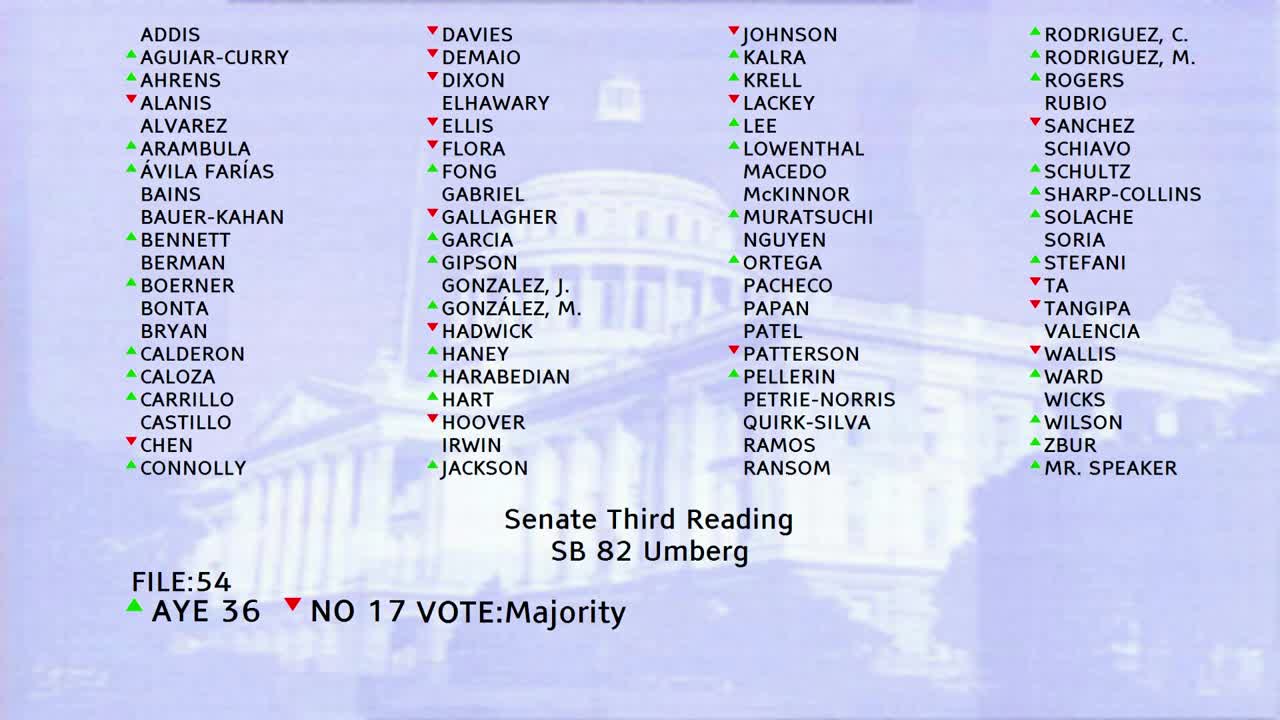
Bill Author

Bill Co-Author(s):