SB 63: San Francisco Bay area: local revenue measure: public transit funding.
- Session Year: 2025-2026
- House: Senate
- Latest Version Date: 2025-10-13
Current Status:
Passed
(2025-10-13: Chaptered by Secretary of State. Chapter 740, Statutes of 2025.)
Introduced
In Committee
Awaiting First Chamber Vote
Passed First Chamber
In Committee
Awaiting Second Chamber Vote
Passed Second Chamber
Enacted
(1)Existing law creates the Metropolitan Transportation Commission as a local area planning agency for the 9-county San Francisco Bay area with comprehensive regional transportation planning and other related responsibilities. Existing law creates various transit districts located in the San Francisco Bay area, with specified powers and duties relating to providing public transit services.
This bill would establish the Public Transit Revenue Measure District with jurisdiction extending throughout the boundaries of the Counties of Alameda, Contra Costa, San Mateo, and Santa Clara and the City and County of San Francisco and would require the district to be governed by the same board that governs the commission, thereby imposing a state-mandated local program. The bill would authorize a retail transactions and use tax applicable to the entire district to be imposed by the board of the district or by a qualified voter initiative for a duration of 14 years, and in an amount of 0.5% in each of the above-described counties located within the district and 1% in the City and County of San Francisco, subject to voter approval at the November 3, 2026, statewide general election. After payments are made for various administrative expenses, the bill would require the district to transfer specified portions of the proceeds of the tax to the commission for allocation to certain programs and other purposes and for allocation to the Alameda-Contra Costa Transit District, the Peninsula Corridor Joint Powers Board, commonly known as Caltrain, the San Francisco Bay Area Rapid Transit District, the San Francisco Municipal Transportation Agency, and other specified transit agencies, for transit operations expenses, and would require the district to transfer specified portions of the proceeds of the tax directly to other specified local transportation agencies, including the San Mateo County Transit District and the Santa Clara Valley Transportation Authority, for public transit expenses, as prescribed.
By adding to the duties of local officials with respect to elections procedures for this bill on behalf of the district, the bill would impose a state-mandated local program.
(2)Existing law requires the commission to develop regional transit service objectives, develop performance measures of efficiency and effectiveness, specify uniform data requirements to assess public transit service benefits and costs, and formulate procedures for establishing regional transportation priorities in the allocation of funds for transportation purposes.
This bill would require the commission to contract with, and manage, a third-party consultant to conduct a financial efficiency review of the Alameda-Contra Costa Transit District, Caltrain, the San Francisco Bay Area Rapid Transit District, and the San Francisco Municipal Transportation Agency, as specified. The bill would require the review to be completed in 2 phases, with the analysis for the 2nd phase only required if the tax measure is approved by the voters of the Public Transit Revenue Measure District. The bill would require the consultant to transmit the analysis for each phase to an oversight committee, which the bill would create with a prescribed membership, for review and adoption. The bill would require a transit operator subject to the financial efficiency review to take specified actions in response to the analysis for the first phase and, subject to review of the oversight committee, to adopt an implementation plan that describes the cost-saving measures identified in the analysis for the 2nd phase that the operator plans to implement, as specified. The bill would require a transit operator subject to the financial efficiency review to verify its compliance with the requirements of the review as a condition of receiving funds from the tax measure approved by the voters of the district.
The bill would require each transit operator to which the commission allocates funds to comply with a maintenance of effort requirement as a condition of receiving those funds, as provided.
This bill would require the commission, if the tax measure is approved by the voters of the district and other conditions are satisfied, to establish an ad hoc adjudication committee for a transit operator subject to the above-described financial efficiency review to assess and adjudicate petitions submitted by a participating county transportation entity, as defined, or a county board of supervisors with regard to the performance of the transit operator within the geographic jurisdiction of the entity submitting the petition, as provided. As part of this process, the bill would require an ad hoc adjudication committee, among other things, to determine whether to direct the commission to withhold funding from the tax measure allocated to the transit operator if the committee agrees with a claim regarding the performance of the transit operator, as specified.
This bill would require the commission to submit a report to the Legislature on or before March 31, 2026, on its forecast of the impacts to ridership on the Alameda-Contra Costa Transit District, Caltrain, the San Francisco Bay Area Rapid Transit District, and the San Francisco Municipal Transportation Agency from planned transportation projects and strategies included in its adopted regional transportation plan.
By adding to the duties of the commission, the bill would impose a state-mandated local program.
(3)The Bay Area County Traffic and Transportation Funding Act authorizes the formation of county transportation authorities in each of the 9 bay area counties, and provides for the imposition of a retail transaction and use tax in each of those counties of either 1/2 of 1% or 1%, subject to voter approval, with revenues to be used for various transportation purposes.
This bill would instead provide that a retail transaction and use tax imposed under those provisions in the County of San Mateo or the City and County of San Francisco may be imposed in 1/8 of 1% increments up to 1%.
(4)This bill would declare that its provisions are severable.
(5)The California Constitution requires the state to reimburse local agencies and school districts for certain costs mandated by the state. Statutory provisions establish procedures for making that reimbursement.
This bill would provide that, if the Commission on State Mandates determines that the bill contains costs mandated by the state, reimbursement for those costs shall be made pursuant to the statutory provisions noted above.
(1)Existing law creates the Metropolitan Transportation Commission as a local area planning agency for the 9-county San Francisco Bay area with comprehensive regional transportation planning and other related responsibilities. Existing law creates various transit districts located in the San Francisco Bay area, with specified powers and duties relating to providing public transit services.
This bill would establish the Public Transit Revenue Measure District with jurisdiction extending throughout the boundaries of the Counties of Alameda, Contra Costa, San Mateo, and Santa Clara and the City and County of San Francisco and would require the district to be governed by the same board that governs the commission, thereby imposing a state-mandated local program. The bill would authorize a retail transactions and use tax applicable to the entire district to be imposed by the board of the district or by a qualified voter initiative for a duration of 14 years, and in an amount of 0.5% in each of the above-described counties located within the district and 1% in the City and County of San Francisco, subject to voter approval at the November 3, 2026, statewide general election. After payments are made for various administrative expenses, the bill would require the district to transfer specified portions of the proceeds of the tax to the commission for allocation to certain programs and other purposes and for allocation to the Alameda-Contra Costa Transit District, the Peninsula Corridor Joint Powers Board, commonly known as Caltrain, the San Francisco Bay Area Rapid Transit District, the San Francisco Municipal Transportation Agency, and other specified transit agencies, for transit operations expenses, and would require the district to transfer specified portions of the proceeds of the tax directly to other specified local transportation agencies, including the San Mateo County Transit District and the Santa Clara Valley Transportation Authority, for public transit expenses, as prescribed.
By adding to the duties of local officials with respect to elections procedures for this bill on behalf of the district, the bill would impose a state-mandated local program.
(2)Existing law requires the commission to develop regional transit service objectives, develop performance measures of efficiency and effectiveness, specify uniform data requirements to assess public transit service benefits and costs, and formulate procedures for establishing regional transportation priorities in the allocation of funds for transportation purposes.
This bill would require the commission to contract with, and manage, a third-party consultant to conduct a financial efficiency review of the Alameda-Contra Costa Transit District, Caltrain, the San Francisco Bay Area Rapid Transit District, and the San Francisco Municipal Transportation Agency, as specified. The bill would require the review to be completed in 2 phases, with the analysis for the 2nd phase only required if the tax measure is approved by the voters of the Public Transit Revenue Measure District. The bill would require the consultant to transmit the analysis for each phase to an oversight committee, which the bill would create with a prescribed membership, for review and adoption. The bill would require a transit operator subject to the financial efficiency review to take specified actions in response to the analysis for the first phase and, subject to review of the oversight committee, to adopt an implementation plan that describes the cost-saving measures identified in the analysis for the 2nd phase that the operator plans to implement, as specified. The bill would require a transit operator subject to the financial efficiency review to verify its compliance with the requirements of the review as a condition of receiving funds from the tax measure approved by the voters of the district.
The bill would require each transit operator to which the commission allocates funds to comply with a maintenance of effort requirement as a condition of receiving those funds, as provided.
This bill would require the commission, if the tax measure is approved by the voters of the district and other conditions are satisfied, to establish an ad hoc adjudication committee for a transit operator subject to the above-described financial efficiency review to assess and adjudicate petitions submitted by a participating county transportation entity, as defined, or a county board of supervisors with regard to the performance of the transit operator within the geographic jurisdiction of the entity submitting the petition, as provided. As part of this process, the bill would require an ad hoc adjudication committee, among other things, to determine whether to direct the commission to withhold funding from the tax measure allocated to the transit operator if the committee agrees with a claim regarding the performance of the transit operator, as specified.
This bill would require the commission to submit a report to the Legislature on or before March 31, 2026, on its forecast of the impacts to ridership on the Alameda-Contra Costa Transit District, Caltrain, the San Francisco Bay Area Rapid Transit District, and the San Francisco Municipal Transportation Agency from planned transportation projects and strategies included in its adopted regional transportation plan.
By adding to the duties of the commission, the bill would impose a state-mandated local program.
(3)The Bay Area County Traffic and Transportation Funding Act authorizes the formation of county transportation authorities in each of the 9 bay area counties, and provides for the imposition of a retail transaction and use tax in each of those counties of either 1/2 of 1% or 1%, subject to voter approval, with revenues to be used for various transportation purposes.
This bill would instead provide that a retail transaction and use tax imposed under those provisions in the County of San Mateo or the City and County of San Francisco may be imposed in 1/8 of 1% increments up to 1%.
(4)This bill would declare that its provisions are severable.
(5)The California Constitution requires the state to reimburse local agencies and school districts for certain costs mandated by the state. Statutory provisions establish procedures for making that reimbursement.
This bill would provide that, if the Commission on State Mandates determines that the bill contains costs mandated by the state, reimbursement for those costs shall be made pursuant to the statutory provisions noted above.
(1)Existing law creates the Metropolitan Transportation Commission as a local area planning agency for the 9-county San Francisco Bay area with comprehensive regional transportation planning and other related responsibilities. Existing law creates various transit districts located in the San Francisco Bay area, with specified powers and duties relating to providing public transit services.
This bill would establish the Transportation Public Transit Revenue Measure District with jurisdiction extending throughout the boundaries of the Counties of Alameda, Contra Costa, San Mateo, and Santa Clara and the City and County of San Francisco and would require the district to be governed by the same board that governs the commission, thereby imposing a state-mandated local program. The bill would authorize a retail transactions and use tax applicable to the entire district to be imposed by the board of the district or by a qualified voter initiative for a duration of 14 years, and in an amount of 0.5% in each of the above-described counties located within the district and 1% in the City and County of San Francisco, subject to voter approval at the November 3, 2026, statewide general election. After allocations payments are made for various administrative expenses, the bill would require the district to transfer specified portions of the proceeds of the tax to the commission for allocation to certain programs and other purposes and for allocation to the Alameda-Contra Costa Transit District, the Peninsula Corridor Joint Powers Board, commonly known as Caltrain, the San Francisco Bay Area Rapid Transit District, the San Francisco Municipal Transportation Agency, and other specified transit agencies, for transit operations expenses, and would require the district to transfer specified portions of the proceeds of the tax directly to other specified transit local transportation agencies, including the San Mateo County Transit District and the Santa Clara Valley Transportation Authority, for public transit expenses, as prescribed.
By adding to the duties of local officials with respect to elections procedures for this bill on behalf of the district, the bill would impose a state-mandated local program.
(2)Existing law requires the commission to develop regional transit service objectives, develop performance measures of efficiency and effectiveness, specify uniform data requirements to assess public transit service benefits and costs, and formulate procedures for establishing regional transportation priorities in the allocation of funds for transportation purposes.
This bill would require the commission, upon the approval of a measure by the voters of the Transportation Revenue Measure District, to engage in a comprehensive independent commission to contract with, and manage, a third-party consultant to conduct a financial efficiency review of the Alameda-Contra Costa Transit District, Caltrain, the San Francisco Bay Area Rapid Transit District, and the San Francisco Municipal Transportation Agency, and would require the independent third party contracted by the commission for this purpose to prepare a final report of the review. After one of these transit operators receives the final report, the bill would require the transit operator, as a condition of receiving those funds, to finalize an implementation plan that describes, among other things, efficiency measures the transit operator plans to take and to submit the implementation plan to the commission, as specified. The bill would also require those transit operators, as a condition of receiving those funds, to comply with a maintenance of effort requirement, as specified. The bill would require the review to be completed in 2 phases, with the analysis for the 2nd phase only required if the tax measure is approved by the voters of the Public Transit Revenue Measure District. The bill would require the consultant to transmit the analysis for each phase to an oversight committee, which the bill would create with a prescribed membership, for review and adoption. The bill would require a transit operator subject to the financial efficiency review to take specified actions in response to the analysis for the first phase and, subject to review of the oversight committee, to adopt an implementation plan that describes the cost-saving measures identified in the analysis for the 2nd phase that the operator plans to implement, as specified. The bill would require a transit operator subject to the financial efficiency review to verify its compliance with the requirements of the review as a condition of receiving funds from the tax measure approved by the voters of the district.
The bill would require each transit operator to which the commission allocates funds to comply with the policies and programs adopted by the commission through its Regional Network Management framework, a maintenance of effort requirement as a condition of receiving those funds, as provided.
This bill would require the commission, if the tax measure is approved by the voters of the district and other conditions are satisfied, to establish an ad hoc adjudication committee for a transit operator subject to the above-described financial efficiency review to assess and adjudicate petitions submitted by a participating county transportation entity, as defined, or a county board of supervisors with regard to the performance of the transit operator within the geographic jurisdiction of the entity submitting the petition, as provided. As part of this process, the bill would require an ad hoc adjudication committee, among other things, to determine whether to direct the commission to withhold funding from the tax measure allocated to the transit operator if the committee agrees with a claim regarding the performance of the transit operator, as specified.
This bill would require the commission to submit a report to the Legislature on or before March 31, 2026, on its forecast of the impacts to ridership on the Alameda-Contra Costa Transit District, Caltrain, the San Francisco Bay Area Rapid Transit District, and the San Francisco Municipal Transportation Agency from planned transportation projects and strategies included in its adopted regional transportation plan.
By adding to the duties of the commission, the bill would impose a state-mandated local program.
(3)The Bay Area County Traffic and Transportation Funding Act authorizes the formation of county transportation authorities in each of the 9 bay area counties, and provides for the imposition of a retail transaction and use tax of either 1/2 of 1% or 1%, subject to voter approval, with revenues to be used for various transportation purposes.
This bill would instead provide that a retail transaction and use tax imposed under those provisions in the County of San Mateo or the City and County of San Francisco may be imposed in 1/8 of 1% increments up to 1%.
(4)This bill would declare that its provisions are severable.
(5)The California Constitution requires the state to reimburse local agencies and school districts for certain costs mandated by the state. Statutory provisions establish procedures for making that reimbursement.
This bill would provide that, if the Commission on State Mandates determines that the bill contains costs mandated by the state, reimbursement for those costs shall be made pursuant to the statutory provisions noted above.
(6)This bill would declare that it is to take effect immediately as an urgency statute.(1)Existing law creates the Metropolitan Transportation Commission as a local area planning agency for the 9-county San Francisco Bay area with comprehensive regional transportation planning and other related responsibilities. Existing law creates various transit districts located in the San Francisco Bay area, with specified powers and duties relating to providing public transit services.
This bill would establish the Transportation Revenue Measure District with jurisdiction extending throughout the boundaries of the Counties of Alameda and Contra Costa Alameda, Contra Costa, San Mateo, and Santa Clara and the City and County of San Francisco and would require the district to be governed by the same board that governs the commission, thereby imposing a state-mandated local program. The bill would authorize a retail transactions and use tax applicable to the entire district to be imposed by the board of the district or by a qualified voter initiative for a duration of 10 to 15 14 years, inclusive, and generally in an amount of 0.5%, 0.5% in each of the above-described counties located within the district and 1% in the City and County of San Francisco, subject to voter approval at the November 3, 2026, statewide general election. After allocations are made for various administrative expenses, the bill would require an unspecified portion the district to transfer specified portions of the proceeds of the tax to be allocated by the commission to initiatives included in a specified commission plan and for allocation to certain programs and other purposes and for allocation to the Alameda-Contra Costa Transit District, the Peninsula Corridor Joint Powers Board, commonly known as Caltrain, the San Francisco Bay Area Rapid Transit District, the San Francisco Municipal Transportation Agency, and other specified transit agencies for operating agencies, for transit operations expenses, and would require the remaining proceeds to be subvened district to transfer specified portions of the proceeds of the tax directly to the counties comprising the district other specified transit agencies, including the San Mateo County Transit District and the Santa Clara Valley Transportation Authority, for public transportation transit expenses, as prescribed.
By adding to the duties of local officials with respect to elections procedures for this bill on behalf of the district, the bill would impose a state-mandated local program.
(2)Existing law requires the commission to develop regional transit service objectives, develop performance measures of efficiency and effectiveness, specify uniform data requirements to assess public transit service benefits and costs, and formulate procedures for establishing regional transportation priorities in the allocation of funds for transportation purposes.
This bill would require the commission, upon the approval of a measure by the voters of the Transportation Revenue Measure District, to engage in a comprehensive independent third-party financial efficiency review of the Alameda-Contra Costa Transit District, Caltrain, the San Francisco Bay Area Rapid Transit District, and the San Francisco Municipal Transportation Agency, and would require the independent third party contracted by the commission for this purpose to prepare a final report of the review. After one of these transit operators receives the final report, the bill would require the transit operator, as a condition of receiving those funds, to finalize an implementation plan that describes, among other things, efficiency measures the transit operator plans to take and to submit the implementation plan to the commission, as specified. The bill would also require those transit operators, as a condition of receiving those funds, to comply with a maintenance of effort requirement, as specified.
The bill would require each transit operator that receives a distribution of funds directly from to which the commission allocates funds to comply with the policies and programs adopted by the commission through its Regional Network Management framework, as provided.
This bill would require the commission to submit a report to the Legislature on or before March 31, 2026, on its forecast of the impacts to ridership on the Alameda-Contra Costa Transit District, Caltrain, the San Francisco Bay Area Rapid Transit District, and the San Francisco Municipal Transportation Agency from planned transportation projects and strategies included in its adopted regional transportation plan.
By adding to the duties of the commission, the bill would impose a state-mandated local program.
(3)The Bay Area County Traffic and Transportation Funding Act authorizes the formation of county transportation authorities in each of the 9 bay area counties, and provides for the imposition of a retail transaction and use tax of either 1/2 of 1% or 1%, subject to voter approval, with revenues to be used for various transportation purposes.
This bill would instead provide that a retail transaction and use tax imposed under those provisions in the County of San Mateo or the City and County of San Francisco may be imposed in 1/8 of 1% increments up to 1%.
(4)This bill would declare that its provisions are severable.
(5)The California Constitution requires the state to reimburse local agencies and school districts for certain costs mandated by the state. Statutory provisions establish procedures for making that reimbursement.
This bill would provide that, if the Commission on State Mandates determines that the bill contains costs mandated by the state, reimbursement for those costs shall be made pursuant to the statutory provisions noted above.
(6)This bill would declare that it is to take effect immediately as an urgency statute.
(1)Existing law creates the Metropolitan Transportation Commission as a local area planning agency for the 9-county San Francisco Bay area with comprehensive regional transportation planning and other related responsibilities. Existing law creates various transit districts located in the San Francisco Bay area, with specified powers and duties relating to providing public transit services.
This bill would establish the Transportation Revenue Measure District with jurisdiction extending throughout the boundaries of the Counties of Alameda and Contra Costa and the City and County of San Francisco and would require the district to be governed by the same board that governs the commission, thereby imposing a state-mandated local program. The bill would authorize a retail transactions and use tax applicable to the entire district to be imposed by the board of the district or by a qualified voter initiative for a duration of 10 to 15 years, inclusive, and generally in an amount of 0.5%, subject to voter approval at the November 3, 2026, statewide general election. After allocations are made for various administrative expenses, the bill would require an unspecified portion of the proceeds of the tax to be allocated by the commission to initiatives included in a specified commission plan and to the Alameda-Contra Costa Transit District, the Peninsula Corridor Joint Powers Board, commonly known as Caltrain, the San Francisco Bay Area Rapid Transit District, the San Francisco Municipal Transportation Agency, and other specified transit agencies for operating expenses, and would require the remaining proceeds to be subvened directly to the counties comprising the district for public transportation expenses, as prescribed.
By adding to the duties of local officials with respect to elections procedures for this bill on behalf of the district, the bill would impose a state-mandated local program.
(2)Existing law requires the commission to develop regional transit service objectives, develop performance measures of efficiency and effectiveness, specify uniform data requirements to assess public transit service benefits and costs, and formulate procedures for establishing regional transportation priorities in the allocation of funds for transportation purposes.
This bill would require the commission, upon the approval of a measure by the voters of the Transportation Revenue Measure District, to engage in a comprehensive independent third-party financial efficiency review of the Alameda-Contra Costa Transit District, Caltrain, the San Francisco Bay Area Rapid Transit District, and the San Francisco Municipal Transportation Agency, and would require the independent third party contracted by the commission for this purpose to prepare a final report of the review. After one of these transit operators receives the final report, the bill would require the transit operator, as a condition of receiving those funds, to finalize an implementation plan that describes, among other things, efficiency measures the transit operator plans to take and to submit the implementation plan to the commission, as specified. The bill would also require those transit operators, as a condition of receiving those funds, to comply with a maintenance of effort requirement, as specified.
The bill would require each transit operator that receives a distribution of funds directly from the commission to comply with the policies and programs adopted by the commission through its Regional Network Management framework, as provided.
This bill would require the commission to submit a report to the Legislature on or before March 31, 2026, on its forecast of the impacts to ridership on the Alameda-Contra Costa Transit District, Caltrain, the San Francisco Bay Area Rapid Transit District, and the San Francisco Municipal Transportation Agency from planned transportation projects and strategies included in its adopted regional transportation plan.
By adding to the duties of the commission, the bill would impose a state-mandated local program.
(3)The Bay Area County Traffic and Transportation Funding Act authorizes the formation of county transportation authorities in each of the 9 bay area counties, and provides for the imposition of a retail transaction and use tax of either 1/2 of 1% or 1%, subject to voter approval, with revenues to be used for various transportation purposes.
This bill would instead provide that a retail transaction and use tax imposed under those provisions in the County of San Mateo or the City and County of San Francisco may be imposed in 1/8 of 1% increments up to 1%.
(4)This bill would declare that its provisions are severable.
(5)The California Constitution requires the state to reimburse local agencies and school districts for certain costs mandated by the state. Statutory provisions establish procedures for making that reimbursement.
This bill would provide that, if the Commission on State Mandates determines that the bill contains costs mandated by the state, reimbursement for those costs shall be made pursuant to the statutory provisions noted above.
(6)This bill would declare that it is to take effect immediately as an urgency statute.
(1)Existing law creates the Metropolitan Transportation Commission as a local area planning agency for the 9-county San Francisco Bay area with comprehensive regional transportation planning and other related responsibilities. Existing law creates various transit districts located in the San Francisco Bay area, with specified powers and duties relating to providing public transit services.
This bill would establish the Transportation Revenue Measure District with jurisdiction extending throughout the boundaries of the Counties of Alameda and Contra Costa and the City and County of San Francisco and would require the district to be governed by the same board that governs the commission, thereby imposing a state-mandated local program. The bill would authorize a retail transactions and use tax applicable to the entire district to be imposed by the board of the district or by a qualified voter initiative for a duration of 10 to 15 years, inclusive, and generally in an amount of 0.5%, subject to voter approval at the November 3, 2026, statewide general election. After allocations are made for various administrative expenses, the bill would require an unspecified portion of the proceeds of the tax to be allocated by the commission to initiatives included in a specified commission plan and to the Alameda-Contra Costa Transit District, the Peninsula Rail Transit District, Corridor Joint Powers Board, commonly known as Caltrain, the San Francisco Bay Area Rapid Transit District, and the San Francisco Municipal Transportation Agency Agency, and other specified transit agencies for operating expenses, and would require the remaining proceeds to be subvened directly to the counties comprising the district for public transportation expenses, as prescribed.
By adding to the duties of local officials with respect to elections procedures for this bill on behalf of the district, the bill would impose a state-mandated local program.
(2)Existing law requires the commission to develop regional transit service objectives, develop performance measures of efficiency and effectiveness, specify uniform data requirements to assess public transit service benefits and costs, and formulate procedures for establishing regional transportation priorities in the allocation of funds for transportation purposes.
This bill would require the commission, upon the approval of a measure by the voters of the Transportation Revenue Measure District, to engage in a comprehensive independent third-party financial efficiency review of the above-described transit operators receiving an allocation of the proceeds of the tax from the commission Alameda-Contra Costa Transit District, Caltrain, the San Francisco Bay Area Rapid Transit District, and the San Francisco Municipal Transportation Agency, and would require the independent third party contracted by the commission for this purpose to prepare a final report of the review. After a one of these transit operator operators receives the final report, the bill would require the transit operator, as a condition of receiving those funds, to finalize an implementation plan that describes, among other things, efficiency measures the transit operator plans to take and to submit the implementation plan to the commission, as specified. The bill would also require those transit operators, as a condition of receiving those funds, to comply with a maintenance of effort requirement, as specified.
The bill would also require those transit operators to comply with other requirements as a condition of receiving those funds, including, among others, a maintenance of effort requirement and a requirement each transit operator that receives a distribution of funds directly from the commission to comply with the policies and programs adopted by the commission through its Regional Network Management framework, as provided.
This bill would require the commission to submit a report to the Legislature on or before March 31, 2026, on its forecast of the impacts to ridership on those transit operators the Alameda-Contra Costa Transit District, Caltrain, the San Francisco Bay Area Rapid Transit District, and the San Francisco Municipal Transportation Agency from planned transportation projects and strategies included in its adopted regional transportation plan.
By adding to the duties of the commission, the bill would impose a state-mandated local program.
(3)The Bay Area County Traffic and Transportation Funding Act authorizes the formation of county transportation authorities in each of the 9 bay area counties, and provides for the imposition of a retail transaction and use tax of either 1/2 of 1% or 1%, subject to voter approval, with revenues to be used for various transportation purposes.
This bill would instead provide that a retail transaction and use tax imposed under those provisions in the County of San Mateo or the County of San Francisco may be imposed in 1/8 of 1% increments up to 1%.
(4)This bill would declare that its provisions are severable.
(5)The California Constitution requires the state to reimburse local agencies and school districts for certain costs mandated by the state. Statutory provisions establish procedures for making that reimbursement.
This bill would provide that, if the Commission on State Mandates determines that the bill contains costs mandated by the state, reimbursement for those costs shall be made pursuant to the statutory provisions noted above.
(1)Existing law creates the Metropolitan Transportation Commission as a local area planning agency for the 9-county San Francisco Bay area with comprehensive regional transportation planning and other related responsibilities. Existing law creates various transit districts located in the San Francisco Bay area, with specified powers and duties relating to providing public transit services.
This bill would establish the Transportation Revenue Measure District with jurisdiction extending throughout the boundaries of the Counties of Alameda and Contra Costa and the City and County of San Francisco and would require the district to be governed by the same board that governs the commission, thereby imposing a state-mandated local program. The bill would authorize a retail transactions and use tax applicable to the entire district to be imposed by the board of the district or by a qualified voter initiative for a duration of 10 to 15 years, inclusive, and generally in an amount of 0.5%, subject to voter approval at the November 3, 2026, statewide general election. After allocations are made for various administrative expenses, the bill would require an unspecified portion of the proceeds of the tax to be allocated by the commission to initiatives included in a specified commission plan and to the Alameda-Contra Costa Transit District, the Peninsula Rail Transit District, commonly known as Caltrain, the San Francisco Bay Area Rapid Transit District, and the San Francisco Municipal Transportation Agency for operating expenses, and would require the remaining proceeds to be subvened directly to the counties comprising the district for public transportation expenses, as prescribed.
By adding to the duties of local officials with respect to elections procedures for this bill on behalf of the district, the bill would impose a state-mandated local program.
(2)Existing law requires the commission to develop regional transit service objectives, develop performance measures of efficiency and effectiveness, specify uniform data requirements to assess public transit service benefits and costs, and formulate procedures for establishing regional transportation priorities in the allocation of funds for transportation purposes.
This bill would require the commission, upon the approval of a measure by the voters of the Transportation Revenue Measure District, to engage in a comprehensive independent third-party financial efficiency review of the above-described transit operators receiving an allocation of the proceeds of the tax from the commission and would require the independent third party contracted by the commission for this purpose to prepare a final report of the review. After a transit operator receives the final report, the bill would require the transit operator, as a condition of receiving those funds, to finalize an implementation plan that describes, among other things, efficiency measures the transit operator plans to take and to submit the implementation plan to the commission, as specified.
The bill would also require those transit operators to comply with other requirements as a condition of receiving those funds, including, among others, a maintenance of effort requirement and a requirement to comply with the policies and programs adopted by the commission through its Regional Network Management framework, as provided.
This bill would require the commission to submit a report to the Legislature on or before March 31, 2026, on its forecast of the impacts to ridership on those transit operators from planned transportation projects and strategies included in its adopted regional transportation plan.
By adding to the duties of the commission, the bill would impose a state-mandated local program.
(3)The Bay Area County Traffic and Transportation Funding Act authorizes the formation of county transportation authorities in each of the 9 bay area counties, and provides for the imposition of a retail transaction and use tax of either 1/2 of 1% or 1%, subject to voter approval, with revenues to be used for various transportation purposes.
This bill would instead provide that a retail transaction and use tax imposed under those provisions in the County of San Mateo or the County of San Francisco may be imposed in 1/8 of 1% increments up to 1%.
(4)This bill would declare that its provisions are severable.
(5)The California Constitution requires the state to reimburse local agencies and school districts for certain costs mandated by the state. Statutory provisions establish procedures for making that reimbursement.
This bill would provide that, if the Commission on State Mandates determines that the bill contains costs mandated by the state, reimbursement for those costs shall be made pursuant to the statutory provisions noted above.
(1)Existing law creates the Metropolitan Transportation Commission as a local area planning agency for the 9-county San Francisco Bay area with comprehensive regional transportation planning and other related responsibilities. Existing law creates various transit districts located in the San Francisco Bay area, with specified powers and duties relating to providing public transit services.
This bill would establish the Transportation Revenue Measure District with jurisdiction extending throughout the boundaries of the Counties of Alameda and Contra Costa and the City and County of San Francisco and would require the district to be governed by the same board that governs the commission, thereby imposing a state-mandated local program. The bill would authorize a retail transactions and use tax applicable to the entire district to be imposed by the board of the district or by a qualified voter initiative for a duration of 10 to 15 years, inclusive, and generally in an amount of 0.5%, subject to voter approval at the November 3, 2026, statewide general election. After allocations are made for various administrative expenses, the bill would require an unspecified portion of the proceeds of the tax to be allocated by the commission to initiatives included in a specified commission plan and to the Alameda-Contra Costa Transit District, the Peninsula Rail Transit District, commonly known as Caltrain, the San Francisco Bay Area Rapid Transit District, and the San Francisco Municipal Transportation Agency for operating expenses, and would require the remaining proceeds to be subvened directly to the counties comprising the district for public transportation expenses, as prescribed.
By adding to the duties of local officials with respect to elections procedures for this bill on behalf of the district, the bill would impose a state-mandated local program.
(2)Existing law requires the commission to develop regional transit service objectives, develop performance measures of efficiency and effectiveness, specify uniform data requirements to assess public transit service benefits and costs, and formulate procedures for establishing regional transportation priorities in the allocation of funds for transportation purposes.
This bill would require the commission, upon the approval of a measure by the voters of the Transportation Revenue Measure District, to engage in a comprehensive independent third party third-party financial efficiency review of the above-described transit operators receiving an allocation of the proceeds of the tax from the commission and would require the independent third party contracted by the commission for this purpose to prepare a final report of the review. After a transit operator receives the final report, the bill would require the transit operator, as a condition of receiving those funds, to finalize an implementation plan that describes, among other things, efficiency measures the transit operator plans to take and to submit the implementation plan to the commission, as specified.
The bill would also require those transit operators to comply with other requirements as a condition of receiving those funds, including, among others, a maintenance of effort requirement and a requirement to comply with the policies and programs adopted by the commission through its Regional Network Management framework, as provided.
This bill would require the commission to submit a report to the Legislature on or before March 31, 2026, on its forecast of the impacts to ridership on those transit operators from planned transportation projects and strategies included in its adopted regional transportation plan.
By adding to the duties of the commission, the bill would impose a state-mandated local program.
(3)The Bay Area County Traffic and Transportation Funding Act authorizes the formation of county transportation authorities in each of the 9 bay area counties, and provides for the imposition of a retail transaction and use tax of either 1/2 of 1% or 1%, subject to voter approval, with revenues to be used for various transportation purposes.
This bill would instead provide that a retail transaction and use tax imposed under those provisions in the County of San Mateo or the County of San Francisco may be imposed in 1/8 of 1% increments up to 1%.
(4)This bill would declare that its provisions are severable.
(5)The California Constitution requires the state to reimburse local agencies and school districts for certain costs mandated by the state. Statutory provisions establish procedures for making that reimbursement.
This bill would provide that, if the Commission on State Mandates determines that the bill contains costs mandated by the state, reimbursement for those costs shall be made pursuant to the statutory provisions noted above.
(1)Existing law creates the Metropolitan Transportation Commission as a local area planning agency for the 9-county San Francisco Bay area with comprehensive regional transportation planning and other related responsibilities. Existing law creates various transit districts located in the San Francisco Bay area, with specified powers and duties relating to providing public transit services.
This bill would state the intent of the Legislature to enact legislation authorizing a revenue measure to invest in transportation in the San Francisco Bay area. establish the Transportation Revenue Measure District with jurisdiction extending throughout the boundaries of the Counties of Alameda and Contra Costa and the City and County of San Francisco and would require the district to be governed by the same board that governs the commission, thereby imposing a state-mandated local program. The bill would authorize a retail transactions and use tax applicable to the entire district to be imposed by the board of the district or by a qualified voter initiative for a duration of 10 to 15 years, inclusive, and generally in an amount of 0.5%, subject to voter approval at the November 3, 2026, statewide general election. After allocations are made for various administrative expenses, the bill would require an unspecified portion of the proceeds of the tax to be allocated by the commission to initiatives included in a specified commission plan and to the Alameda-Contra Costa Transit District, the Peninsula Rail Transit District, commonly known as Caltrain, the San Francisco Bay Area Rapid Transit District, and the San Francisco Municipal Transportation Agency for operating expenses, and would require the remaining proceeds to be subvened directly to the counties comprising the district for public transportation expenses, as prescribed.
By adding to the duties of local officials with respect to elections procedures for this bill on behalf of the district, the bill would impose a state-mandated local program.
(2)Existing law requires the commission to develop regional transit service objectives, develop performance measures of efficiency and effectiveness, specify uniform data requirements to assess public transit service benefits and costs, and formulate procedures for establishing regional transportation priorities in the allocation of funds for transportation purposes.
This bill would require the commission, upon the approval of a measure by the voters of the Transportation Revenue Measure District, to engage in a comprehensive independent third party financial efficiency review of the above-described transit operators receiving an allocation of the proceeds of the tax from the commission and would require the independent third party contracted by the commission for this purpose to prepare a final report of the review. After a transit operator receives the final report, the bill would require the transit operator, as a condition of receiving those funds, to finalize an implementation plan that describes, among other things, efficiency measures the transit operator plans to take and to submit the implementation plan to the commission, as specified.
The bill would also require those transit operators to comply with other requirements as a condition of receiving those funds, including, among others, a maintenance of effort requirement and a requirement to comply with the policies and programs adopted by the commission through its Regional Network Management framework, as provided.
By adding to the duties of the commission, the bill would impose a state-mandated local program.
(3)The Bay Area County Traffic and Transportation Funding Act authorizes the formation of county transportation authorities in each of the 9 bay area counties, and provides for the imposition of a retail transaction and use tax of either 1/2 of 1% or 1%, subject to voter approval, with revenues to be used for various transportation purposes.
This bill would instead provide that a retail transaction and use tax imposed under those provisions in the County of San Mateo or the County of San Francisco may be imposed in 1/8 of 1% increments up to 1%.
(4)This bill would declare that its provisions are severable.
(5)The California Constitution requires the state to reimburse local agencies and school districts for certain costs mandated by the state. Statutory provisions establish procedures for making that reimbursement.
This bill would provide that, if the Commission on State Mandates determines that the bill contains costs mandated by the state, reimbursement for those costs shall be made pursuant to the statutory provisions noted above.
Existing law creates the Metropolitan Transportation Commission as a local area planning agency for the 9-county San Francisco Bay area with comprehensive regional transportation planning and other related responsibilities. Existing law creates various transit districts located in the San Francisco Bay area, with specified powers and duties relating to providing public transit services.
This bill would state the intent of the Legislature to enact legislation authorizing a revenue measure to invest in transportation in the San Francisco Bay area.
This act shall be known, and may be cited, as the Connect Bay Area Act.
SEC. 2.The Legislature finds and declares all of the following:
(a)The San Francisco Bay area needs a world-class, reliable, affordable, efficient, and connected transportation network that meets the needs of bay area residents, businesses, and visitors while also helping combat the climate crisis. The bay areas public transit network is a critical component of the overall transportation network.
(b)Public transit is of regional and local benefit, serving both regional and local trips for residents of all income levels.
(c)Preserving, improving, and expanding public transit to ensure a world-class public transit network will enhance access to opportunity, lower emissions of greenhouse gases, strengthen the regions economy, support increased housing production, and improve quality of life.
(d)To achieve that vision, the San Francisco Bay area needs a public transit network that offers safe, clean, frequent, accessible, easy-to-navigate, and reliable service that gets transit riders where they want and need to go safely, affordably, quickly, and seamlessly. The San Francisco Bay area also needs to prioritize increasing ridership to ensure the regions transit network is sustainable.
(e)Regional funding, increased coordination, financial efficiency, and safety, cleanliness, and reliability reforms are urgently needed to both preserve and improve public transit service.
SEC. 3.Section 66513.5 is added to the Government Code, to read:66513.5.(a)The commission shall submit a report to the Legislature on or before March 31, 2026, on its forecast of the impacts to ridership on the Alameda-Contra Costa Transit District, the Peninsula Corridor Joint Powers Board, the San Francisco Bay Area Rapid Transit District, and the San Francisco Municipal Transportation Agency from planned transportation projects and strategies included in its adopted regional transportation plan, with an emphasis on rail connectivity projects that may increase ridership, reduce operating costs, or help with enhanced mobility.
(b)(1)A report to be submitted pursuant to subdivision (a) shall be submitted in compliance with Section 9795.
(2)Pursuant to Section 10231.5, this section is inoperative on March 31, 2030, and, as of January 1, 2031, is repealed.
SEC. 4.Title 7.85 (commencing with Section 67700) is added to the Government Code, to read:7.85.San Francisco Bay Area Regional Public Transit Finance1.Formation of the Public Transit Revenue Measure District1.General Provisions67700.For purposes of this title, the following definitions apply:
(a)AC Transit means the Alameda-Contra Costa Transit District.
(b)Alameda County small bus operators means the Livermore Amador Valley Transit Authority and Union City Transit.
(c)BART means the San Francisco Bay Area Rapid Transit District.
(d)Board means the governing board of the Public Transit Revenue Measure District.
(e)Caltrain means the Peninsula Corridor Joint Powers Board.
(f)Commission means the Metropolitan Transportation Commission.
(g)Commissioner means a voting member serving on the commission pursuant to Section 66503.
(h)Contra Costa County small bus operators means the Central Contra Costa Transit Authority, the Western Contra Costa Transit Authority, and the Eastern Contra Costa Transit Authority.
(i)County includes city and county.
(j)County elections official means a county clerk, registrar of voters, or elections supervisor having jurisdiction over elections within the county.
(k)District means the Public Transit Revenue Measure District.
(l)(1)District elections official means the official designated by the board to perform the duties required for the purposes of an initiative under Article 1 (commencing with Section 9300) of Chapter 4 of Division 9 of the Elections Code, except as provided in paragraph (2).
(2)For purposes of Section 9306, subdivisions (a) and (b) of Section 9308, subdivisions (a), (b), and (c) of Section 9309, and Section 9312, of the Elections Code, district elections official refers to the county elections officials charged with the duty of conducting the election for the counties participating in the measure.
(3)This subdivision shall become inoperative on December 31, 2026.
(m)Golden Gate Transit means the Golden Gate Bridge, Highway and Transportation District.
(n)Muni means the San Francisco Municipal Transportation Agency.
(o)Participating county transportation entity means any of the following:
(1)Alameda County Transportation Commission, also referred to as ACTC.
(2)Contra Costa Transportation Authority, also referred to as CCTA.
(3)San Francisco County Transportation Authority, also referred to as SFCTA.
(4)San Mateo County Transit District, also referred to as SMCTD.
(5)Santa Clara Valley Transportation Authority, also referred to as SCVTA.
(p)Public transit expenses means public transit operations expenses, or expenses for public transit capital improvement projects that maintain or improve public transit service, including expenses for public transit-specific components of a multimodal transportation project.
(q)San Francisco Bay Ferry means the San Francisco Bay Area Water Emergency Transportation Authority.
(r)Subject operator means a transit operator subject to the financial efficiency review pursuant to Chapter 4 (commencing with Section 67760) of Part 2.
2.The Public Transit Revenue Measure District and Governing Board67710.(a)The Public Transit Revenue Measure District is hereby established with jurisdiction extending throughout the territorial boundaries of the Counties of Alameda, Contra Costa, San Mateo, and Santa Clara, and the City and County of San Francisco.
(b)The district shall be governed by the same board that governs the commission. The district shall be a separate legal entity from the commission.
(c)The formation and jurisdictional boundaries of the district are not subject to the Cortese-Knox-Hertzberg Local Government Reorganization Act of 2000 (Division 3 (commencing with Section 56000) of Title 5).
(d)The district shall be staffed by the existing staff of the commission or any successor agency, with the understanding that additional staff may be needed to administer the requirements of this title.
67712.This title shall apply only to the counties and city and county identified pursuant to Section 67710.
2.Transactions and Use Taxes1.Retail Transactions and Use Tax Authorization67730.(a)The board may impose a retail transactions and use tax ordinance applicable to the entire district in accordance with Part 1.6 (commencing with Section 7251) of Division 2 of the Revenue and Taxation Code if the electors voting on the measure vote to approve its imposition at the election described in Section 67734 in accordance with this title and Part 1.6 (commencing with Section 7251) of Division 2 of the Revenue and Taxation Code.
(b)The board may impose a retail transactions and use tax pursuant to subdivision (a) that, in combination with all taxes imposed in accordance with Part 1.6 (commencing with Section 7251) of Division 2 of the Revenue and Taxation Code, exceeds the limit established in Section 7251.1 of the Revenue and Taxation Code.
(c)The board, in the ordinance, shall do all of the following:
(1)State the nature of the tax to be imposed.
(2)Provide the tax rates as follows:
(A)Except as provided in subparagraph (B), the tax rate shall be one-half of 1 percent in each county comprising the district.
(B)The tax rate in the City and County of San Francisco shall be 1 percent.
(3)Specify the period during which the tax will be imposed, which shall be 14 years beginning on the date the ordinance becomes operative.
(4)Specify the purposes for which the revenue derived from the tax will be used, consistent with Chapter 3 (commencing with Section 67750).
(d)Notwithstanding Section 7251.1 of the Revenue and Taxation Code, the tax rate authorized pursuant to this section shall not be considered for purposes of the combined rate limit established by Section 7251.1 of the Revenue and Taxation Code.
67732.(a)Notwithstanding Section 9300 of the Elections Code or any other law, the taxes authorized by Section 67730 may also be imposed by a qualified voter initiative pursuant to Chapter 4 (commencing with Section 9300) of Division 9 of the Elections Code if the electors voting on the measure vote to approve its imposition at the election described in Section 67734 in accordance with the requirements of this title and Part 1.6 (commencing with Section 7251) of Division 2 of the Revenue and Taxation Code.
(b)In addition to the procedures set forth in Chapter 4 (commencing with Section 9300) of Division 9 of the Elections Code, if an ordinance containing a tax authorized by this title is proposed by an initiative petition, the initiative shall comply with all of the substantive requirements applicable to a tax imposed by the board pursuant to this title, including the requirement that the proceeds of the tax be distributed, transferred, allocated, and expended pursuant to Chapter 3 (commencing with Section 67750).
(c)Consistent with Chapter 4 (commencing with Section 9300) of Division 9 of the Elections Code, a ballot title and summary are not required for an initiative petition proposed pursuant to this chapter.
67734.A tax proposed pursuant to this title may only be placed on the ballot for the November 3, 2026, statewide general election and shall be submitted to the voters of the entire district in accordance with Chapter 2 (commencing with Section 67740).
67736.(a)Chapter 9 (commencing with Section 860) of Title 10 of Part 2 of the Code of Civil Procedure shall apply to any judicial action or proceeding to validate, attack, review, set aside, void, or annul a tax ordinance approved by the voters pursuant to this title.
(b)Notwithstanding Section 860 of the Code of Civil Procedure, the district may, upon the approval of the tax ordinance by the voters pursuant to this title, and for 30 days thereafter, bring an action in the superior court of the county in which the principal office of the district is located to determine the validity of that matter. The action shall be in the nature of a proceeding in rem.
(c)Notwithstanding Section 863 of the Code of Civil Procedure, if proceedings have not been brought by the district pursuant to subdivision (b), any interested person may bring an action within the time and in the court specified by subdivision (b) to determine the validity of that matter. The district shall be a defendant and shall be served with the summons and complaint in the action in the manner provided by law for the service of a summons in a civil action. In that action the summons shall be in the form prescribed in Section 861.1 of the Code of Civil Procedure except that in addition to being directed to all persons interested in the matter of [specifying the matter], it shall also be directed to the district. If the interested person bringing that action fails to complete the publication and other notice as may be prescribed by the court in accordance with Section 861 of the Code of Civil Procedure and to file proof thereof in the action within 30 days from the filing of their complaint, the action shall be forthwith dismissed on the motion of the district unless good cause for such failure is shown by the interested person.
(d)Any appeal from the final judgment in an action or proceeding brought pursuant to this section shall be filed within 30 days after entry of the judgment.
2.Election Procedures67740.(a)If the board of the district or a qualified voter initiative proposes a measure for the approval of a tax ordinance adopted pursuant to Chapter 1 (commencing with Section 67730), the board of supervisors for each of the counties that comprise the district shall call a special election on the tax ordinance. The special election shall be consolidated with the November 3, 2026, statewide general election and the tax ordinance shall be submitted to the voters of each county comprising the district.
(b)For the purpose of the placement of a tax ordinance on the ballot, the Public Transit Revenue Measure District is a district, as defined in Section 317 of the Elections Code. A measure proposed by the board that requires voter approval or a qualified initiative measure proposed for the district by the voters of the counties comprising the district shall be submitted to the voters of the counties that are contained in the district, in accordance with the provisions of the Elections Code applicable to districts, including Chapter 4 (commencing with Section 9300) of Division 9 of the Elections Code.
(c)If the measure is proposed by a qualified voter initiative, after the petition has been filed, the county elections officials shall examine the petition in accordance with subdivisions (a) and (b) of Section 9308, or subdivisions (a), (b), and (c) of Section 9309, of the Elections Code. It is the intent of the Legislature that the county elections officials shall cooperate with the district elections official to resolve any issues arising from the counting or verification of signatures.
(d)Notwithstanding any provision of the Elections Code, the legal counsel for the district shall prepare an impartial analysis of the measure. Each county included in the district shall use the election materials provided by the district, including the exact ballot question, impartial analysis, and full text of the ballot measure for inclusion in the county voter information guide.
(e)If two or more counties included in the measure are required to prepare a translation of ballot materials into the same language other than English, the county that contains the largest population, as determined by the most recent federal decennial census, among those counties that are required to prepare a translation of ballot materials into the same language other than English, shall prepare the translation or authorize the district to prepare the translation, and that translation shall be used by the other county or counties, as applicable.
(f)Notwithstanding Section 13116 of the Elections Code, the elections officials of the counties where the measure will appear on the ballot shall mutually agree to use the same letter designation for the measure.
(g)The county clerk of each county shall report the results of the special election to the district. If the approval threshold required by the California Constitution at the time of the election is achieved, the measure shall take effect in the district in accordance with the requirements of this title. For purposes of determining whether the measure is approved, the approval threshold shall be assessed based on the cumulative vote within the entire district, and not separately within each county comprising the district.
(h)(1)Notwithstanding Section 10520 of the Elections Code, the district shall reimburse each county that comprises the district from funds made available pursuant to Section 67750 only for the incremental costs incurred by the county elections official related to submitting the measure to the voters with proceeds from the measure.
(2)For purposes of this subdivision, incremental costs includes both of the following:
(A)The cost to prepare a translation of ballot materials into a language other than English by any county, as described in subdivision (e).
(B)The additional costs that exceed the costs incurred for other election races or ballot measures, if any, appearing on the same ballot in each county in which the measure appears on the ballot, including both of the following:
(i)The printing and mailing of ballot materials.
(ii)The canvass of the vote regarding the measure pursuant to Division 15 (commencing with Section 15000) of the Elections Code.
3.Regional Public Transit Revenue Measure Expenditures67750.The district shall distribute revenues generated pursuant to Chapter 2 (commencing with Section 67740) on an annual basis as follows:
(a)The district shall pay the administrative costs associated with the collection of the revenues incurred by the California Department of Tax and Fee Administration, and the amounts necessary for the costs incurred by the district or commission to perform the duties required under this title, including, but not limited to, election cost reimbursements specified in Section 67740, costs incurred for the financial efficiency review described in Section 67762, costs incurred for any required legal defense, and other one-time costs associated with administering the tax ordinance authorized by this title.
(b)After the amounts paid in subdivision (a), the district shall transfer the remaining revenues, with no discretion to withhold, reduce, delay, modify, specify the use of, or condition those revenues, as follows:
(1)(A)The revenues described in subparagraph (B) to the commission for the ongoing costs associated with administering this title. If the amount transferred pursuant to this paragraph exceeds that which is necessary for administrative costs in a given year, the commission may use those excess funds for the purposes identified in paragraphs (10) to (12), inclusive.
(B)All of the following revenues shall be transferred to the commission pursuant to this paragraph:
(i)0.25 percent of all revenues generated within the territory of the County of Alameda.
(ii)0.25 percent of all revenues generated within the territory of the County of Contra Costa.
(iii)0.13 percent of all revenues generated within the territory of the City and County of San Francisco.
(iv)0.25 percent of all revenues generated within the territory of the County of San Mateo.
(v)0.25 percent of all revenues generated within the territory of the County of Santa Clara.
(2)The following revenues to the commission for allocation to BART for transit operations expenses:
(A)64.70 percent of all revenues generated within the territory of the County of Alameda.
(B)58.59 percent of all revenues generated within the territory of the County of Contra Costa.
(C)29.14 percent of all revenues generated within the territory of the City and County of San Francisco.
(D)26.64 percent of all revenues generated within the territory of the County of San Mateo.
(3)The following revenues to the commission for allocation to Muni for transit operations expenses:
(A)1.09 percent of all revenues generated within the territory of the County of Contra Costa.
(B)62.87 percent of all revenues generated within the territory of the City and County of San Francisco.
(C)7.40 percent of all revenues generated within the territory of the County of San Mateo.
(4)The following revenues to the commission for allocation to Caltrain for transit operations expenses:
(A)3.97 percent of all revenues generated within the territory of the City and County of San Francisco.
(B)24.07 percent of all revenues generated within the territory of the County of San Mateo.
(C)10.38 percent of all revenues generated within the territory of the County of Santa Clara.
(5)The following revenues to the commission for allocation to AC Transit for transit operations expenses:
(A)21.25 percent of all revenues generated within the territory of the County of Alameda.
(B)3.70 percent of all revenues generated within the territory of the County of Contra Costa.
(6)2.43 percent of all revenues generated within the territory of the County of Alameda to the commission for allocation to the Alameda County small bus operators, apportioned among each operator in amounts determined by the Alameda County Transportation Commission, for transit operations expenses.
(7)11.41 percent of all revenues generated within the territory of the County of Contra Costa to the commission for allocation to the Contra Costa County small bus operators, apportioned among each operator in amounts determined by the Contra Costa Transportation Authority, for transit operations expenses.
(8)The following revenues to the commission for allocation to San Francisco Bay Ferry for transit operations expenses:
(A)1.62 percent of all revenues generated within the territory of the County of Alameda.
(B)0.76 percent of all revenues generated within the territory of the County of Contra Costa.
(C)0.97 percent of all revenues generated within the territory of the City and County of San Francisco.
(9)0.40 percent of all revenues generated within the territory of the City and County of San Francisco to the commission for allocation to Golden Gate Transit for transit operations expenses.
(10)The following revenues to the commission for fare programs, including free and reduced-cost transfers and expanding the Clipper START program:
(A)2.78 percent of all revenues generated within the territory of the County of Alameda.
(B)2.78 percent of all revenues generated within the territory of the County of Contra Costa.
(C)1.40 percent of all revenues generated within the territory of the City and County of San Francisco.
(D)2.78 percent of all revenues generated within the territory of the County of San Mateo.
(E)2.78 percent of all revenues generated within the territory of the County of Santa Clara.
(11)The following revenues to the commission for accessibility programs and projects:
(A)1.11 percent of all revenues generated within the territory of the County of Alameda.
(B)1.11 percent of all revenues generated within the territory of the County of Contra Costa.
(C)0.56 percent of all revenues generated within the territory of the City and County of San Francisco.
(D)1.11 percent of all revenues generated within the territory of the County of San Mateo.
(E)1.11 percent of all revenues generated within the territory of the County of Santa Clara.
(12)The following revenues to the commission for mapping and wayfinding and transit priority projects and programs:
(A)1.11 percent of all revenues generated within the territory of the County of Alameda.
(B)1.11 percent of all revenues generated within the territory of the County of Contra Costa.
(C)0.56 percent of all revenues generated within the territory of the City and County of San Francisco.
(D)1.11 percent of all revenues generated within the territory of the County of San Mateo.
(E)1.11 percent of all revenues generated within the territory of the County of Santa Clara.
(13)4.75 percent of all revenues generated within the territory of the County of Alameda to the Alameda County Transportation Commission for public transit expenses and roadway repavement projects on roads served by fixed-route transit.
(14)19.20 percent of all revenues generated within the territory of the County of Contra Costa to the Contra Costa Transportation Authority for public transit expenses and roadway repavement projects on roads served by fixed-route transit.
(15)36.64 percent of all revenues generated within the territory of the County of San Mateo to the San Mateo County Transit District for public transit expenses and roadway repavement projects on roads served by fixed-route transit.
(16)84.37 percent of all revenues generated within the territory of the County of Santa Clara to the Santa Clara Valley Transportation Authority for public transit expenses and roadway repavement projects on roads served by fixed-route transit.
67752.In allocating funds pursuant to this chapter, it is the intent of the Legislature that the commission not supplant funding from regularly programmed discretionary revenue sources that are allocated to the jurisdiction of the district and not increase the level of those regularly programmed discretionary revenue sources that are allocated to counties that are not contained in the district as a result of the approval of the measure pursuant to this title.
67754.If the voters approve a tax ordinance pursuant to this title, the district shall establish an independent oversight committee within six months of the effective date of the tax increase to ensure that any revenues generated pursuant to this title are distributed and transferred by the district consistent with the applicable requirements set forth in this chapter. The committee may be consolidated with the oversight committee established pursuant to subdivision (h) of Section 30923 of the Streets and Highways Code. The committee shall consist of either one or two representatives from each county included within the jurisdiction of the district appointed by the applicable county board of supervisors. The oversight committee may request any documents from the district to assist the committee in performing its functions.
67756.The Legislature finds and declares that the allocation of revenues prescribed in this chapter is not intended to set any precedent for future funding relationships or agreements.
4.Financial Transparency and Review67760.The Legislature finds and declares that financial efficiency and transparency are imperative to build public confidence and support for public transit.
67762.(a)The commission shall conduct a financial efficiency review of the subject operators, which are AC Transit, BART, Caltrain, and Muni pursuant to the timeline set forth in Section 67766.
(b)Phase one of the financial efficiency review shall exclusively identify the following:
(1)Cost-saving measures implemented since January 1, 2020, by the subject operators.
(2)(A)Early action strategies that would assist the subject operators in delivering increased or improved service and enhanced customer experiences with existing resources.
(B)In furtherance of the identification of early action strategies, phase one of the financial efficiency review shall include an analysis of the each subject operators real property assets. The analysis shall be conducted in consultation with the subject operators, and shall include an inventory of existing holdings and identify potential redevelopment opportunities, with an emphasis on housing, commercial, and mixed-use projects, and other efficient land uses near transit that can support ridership growth and generate long-term value. The analysis shall include a property asset map and a preliminary list of redevelopment opportunities to inform phase two of the financial efficiency review.
(c)(1)Phase two of the financial efficiency review shall identify a menu of cost-saving measures that, if implemented, would reduce one-time and ongoing fixed and variable costs for the subject operators. The review shall evaluate cost-saving measures using metrics such as cost per passenger mile and subsidy per passenger mile, reported in both nominal dollars and real dollars, and any other relevant measures needed to ensure results are quantifiable and actionable.
(2)(A)Phase two of the financial efficiency review shall also include a comprehensive regional assessment of development and financing strategies to maximize the value of each subject operators real property assets. The assessment shall, at a minimum, do all of the following:
(i)Evaluate strategies to leverage assets through housing, commercial, mixed-use, and other transit-supportive development.
(ii)Analyze potential impacts on ridership, revenue generation, fiscal stability, and broader public benefits, including affordable housing, job creation, and systemwide financial sustainability.
(iii)Consider governance structures and financing mechanisms, including opportunities for regional partnerships, and alignment with existing public and private financing tools.
(iv)Produce a regional development and financing strategy.
(d)The scope of both phases of the financial efficiency review shall consider administrative, operating, and capital costs and shall clearly distinguish between any recommended actions that would not impact service and those that would require service realignments or reductions.
67764.The commission shall contract with, and manage, a third-party consultant to conduct one or both phases of the financial efficiency review. The third-party consultant shall conduct the review in consultation with the subject operators and an oversight committee established by the commission that consists of all the following members:
(a)The chair of the commission, if the chair is from the geographic jurisdiction of the district, or another member of the commission designated by the chair that is from the geographic jurisdiction of the district.
(b)The board chair or president, or another member of the board designated by the chair or president, of each subject operator.
(c)Four independent experts appointed by the commission with expertise in public transit operations and finance.
(d)One representative from the Transportation Agency and one representative the Department of Finance as ex officio, nonvoting members.
67766.(a)On or before April 1, 2026, the third-party consultant procured for phase one shall complete the phase one analysis described in subdivision (b) of Section 67762 and transmit it to the oversight committee. The oversight committee shall review the phase one analysis, direct the third-party consultant to make any revisions, and adopt a final phase one analysis. The commission shall transmit the final phase one analysis to all of the following entities:
(1)The subject operators.
(2)The Legislature, in compliance with Section 9795.
(3)The Transportation Agency.
(4)Each participating county transportation entity.
(b)On or before July 1, 2026, each subject operator shall identify the specific strategies in the final adopted phase one analysis that it commits to implementing, and shall adopt those strategies as formal policy or budget actions, as applicable.
(c)If the certified election results identify that the tax ordinance has been approved by the voters pursuant to this title, all of the following shall occur no later than 480 days after the election results are certified:
(1)The third-party consultant procured for phase two shall complete the analysis described in subdivision (c) of Section 67762 and transmit it to the oversight committee. The oversight committee shall review the phase two analysis, direct the third-party consultant to make any revisions, and adopt a final phase two analysis, including a regional development and financing strategy produced pursuant to clause (iv) of subparagraph (A) of paragraph (2) of subdivision (c) of Section 67762. The commission shall transmit the phase two analysis to the entities described in paragraphs (1) to (4), inclusive, of subdivision (a).
(2)The oversight committee shall specify to each subject operator what information, at a minimum, shall be included for each cost-saving measure that each operator chooses to include in its implementation plan pursuant to subdivision (d).
(d)No later than 120 days after the actions required by subdivision (c) are complete, each subject operator shall submit to the oversight committee a draft implementation plan that describes all cost-saving measures the operator plans to implement, including all information related to those measures required by the oversight committee pursuant to subdivision (c). In developing the implementation plan, the operator shall balance financial efficiency, service, and system safety.
(e)The oversight committee shall review each draft implementation plan and either approve the plan or recommend revisions to further facilitate the implementation of recommendations identified in the phase two analysis.
(f)No later than 60 days after the oversight committee takes action pursuant to subdivision (e), the subject operators governing board shall do all of the following:
(1)Incorporate oversight committee recommendations made pursuant to subdivision (e), if applicable, into its implementation plan.
(2)Adopt a final implementation plan and transmit it to the oversight committee and to the entities described in paragraphs (1) to (4), inclusive, of subdivision (a).
(3)(A)Notwithstanding paragraph (1), a subject operator may reject the inclusion of one or more of the recommendations made by the oversight committee pursuant to subdivision (e) if the governing board of the operator makes a written finding when adopting the final implementation plan pursuant to paragraph (2) that the recommendation has an unacceptable impact on transit service or safety or is inconsistent with other documented local policies and procedures.
(B)Within 10 business days after a subject operator adopts a finding pursuant to subparagraph (A), the commission shall transmit written notice of the adoption of that finding to the policy committees of the Legislature with jurisdiction over transportation and to the Transportation Agency. The notice shall include the subject operators adopted finding pursuant to subparagraph (A).
(C)Any finding adopted pursuant to subparagraph (A) shall be time limited and shall expire no later than 12 months after adoption unless renewed by the subject operator following the procedures set forth in this chapter with an updated assessment demonstrating continuing need. The subject operator shall provide annual status updates to the commission that specifically address the basis for the adopted finding, including whether the circumstances or obstacles identified as preventing compliance have been resolved, mitigated, or otherwise changed. The status update shall identify specific steps taken to address the stated obstacle and a timeline for when compliance could reasonably be achieved if the obstacle is removed.
(g)The oversight committee shall terminate after each subject operator takes the actions required pursuant to subdivision (f). Each subject operator shall adhere to the final implementation plan it adopted pursuant to subdivision (f) until the expiration of the tax approved pursuant to this title, unless doing so is infeasible due to circumstances beyond the operators control, in which case the operator shall make a good faith effort to comply.
(h)As a condition of receiving continued funding pursuant to Chapter 3 (commencing with Section 67750), each subject operator shall verify with the commission that it is in compliance with the requirements of this chapter. Before taking an action to withhold funds from a subject operator for noncompliance with the requirements of this chapter, the commission shall provide the operator a period of 90 days to comply before withholding funds. The commission shall withhold the funds until the operator complies with the requirements of this chapter. If the subject operator does not comply with the requirements of this chapter before the commission makes the final allocations of revenue from the tax ordinance approved by the voters pursuant to this title, the commission shall reallocate the withheld funds to support public transit expenses within the county or counties that the operator serves.
5.Maintenance of Effort67770.(a)(1)As a condition of receiving funds pursuant to Chapter 3 (commencing with Section 67750), each transit operator that the commission allocates funds to pursuant to paragraphs (2) to (9), inclusive, of subdivision (b) of Section 67750 shall verify to the commission that it will maintain its expected level of funding for operations and shall not supplant any sources of operating revenue under its control or fund sources allocated by the commission that were used for transit operations in the preceding three fiscal years.
(2)The expected level of funding for purposes of paragraph (1), which shall be referred to as the maintenance of effort, shall be calculated using the transit operators average discretionary operating expenditures for the preceding three fiscal years, two years in arrears as reported to the Controller in its annual report submitted pursuant to Section 99243 of the Public Utilities Code.
(b)(1)Notwithstanding subdivision (a), a transit operator subject to this chapter may reduce the amount of funding contributed towards its operating budget in proportion to any reduction in operating costs or reduction in operating revenue based on factors outside the control of the operator, including, but not limited to, the expiration of a voter-approved revenue source or the determination based on a statistically valid poll that an expiring ballot measure lacks sufficient support to warrant placement on the ballot.
(2)Before formally taking an action to reduce its operating funding pursuant to paragraph (1), a transit operator shall notify the commission in writing that it is reducing the amount of funding contributed towards its operating budget.
(c)A transit operator subject to this chapter may request that the commission grant an exception to the requirements of this chapter if the transit operator demonstrates any of the following conditions:
(1)The operator has a need to transfer operating funds to state of good repair needs for assets owned and operated by the operator.
(2)The operator has a need to cover the cost of compliance with a state or federal law or regulation.
(3)(A)The operator seeks to finance a public transit capital expense and does not require the full balance of its allocation of revenues provided pursuant to this title to maintain or exceed the service hours it provided in the 201819 fiscal year or the service hours it is currently providing, whichever is greater, and the redirection of its operational funding for the public transit capital expense will not require the operator to reduce its service hours.
(B)The Legislature finds and declares that it is beneficial for transit operators to increase the service hours of transit service they are providing beyond the service hours described in subparagraph (A).
(d)The commission shall provide written findings explaining why a request submitted pursuant to subdivision (c) is denied.
6.Enhanced Accountability67780.(a)If a tax ordinance is approved by the voters pursuant to this title, the commission shall establish an ad hoc adjudication committee for a subject operator if the commission receives a petition submitted pursuant to subdivision (d) at any time commencing two years after the tax ordinance is approved.
(b)An ad hoc adjudication committee established pursuant to subdivision (a) shall be composed of two commissioners from each of the counties from which revenues generated pursuant to the tax ordinance are allocated to the subject operator pursuant to subdivision (b) of Section 67750.
(c)An ad hoc adjudication committee shall be responsible for assessing and adjudicating petitions submitted pursuant to this chapter regarding the applicable subject operators inconsistent application or execution of its adopted standards, policies, or commitments described in Section 67782 across counties within the district.
(d)(1)Consistent with paragraph (2), a participating county transportation entity or a county board of supervisors may submit a petition to the commission to establish an ad hoc adjudication committee and, once established, may submit a petition to the ad hoc adjudication committee, under either of the following circumstances:
(A)A subject operator is not consistently applying or achieving the standard, policy, or commitment in the geographic jurisdiction of the county or the participating county transportation entity, as applicable, as reasonably compared to the geographic jurisdiction of other counties or participating county transportation entities.
(B)A standard, policy, or commitment disproportionately disadvantages the operation or maintenance of the subject operators transit system in the geographic jurisdiction of the county or participating county transportation entity, as applicable, and there is no compelling reason for that standard, policy, or commitment to disproportionately disadvantage the operation or maintenance of the subject operators transit system in the geographic jurisdiction of the county or participating county transportation entity, as applicable.
(2)A participating county transportation entity, or a county board of supervisors, shall be the only entities that may submit a petition to an ad hoc adjudication committee established pursuant to this chapter, and may only submit a petition to an ad hoc adjudication committee established for a subject operator that is receiving funding from revenues generated from the jurisdiction of the applicable county pursuant to subdivision (b) of Section 67750.
(3)(A)Except as provided in subparagraph (B), in each county from which a subject operator is receiving funding generated by the tax ordinance, no more than one petition per year may be submitted by both the participating county transportation entity and the county board of supervisors.
(B)An additional petition may be submitted within the same year if a participating county transportation entity or the county board of supervisors, as applicable, withdraws its petition pursuant to subdivision (c) of Section 67784.
(e)Any ad hoc adjudication committee established pursuant to this chapter shall terminate on the date that the commission makes the final allocations of revenue pursuant to subdivision (b) of Section 67750 from a tax ordinance approved by the voters pursuant to this title.
67782.The scope of the adopted standards, policies, or commitments, or application of those standards, policies, or commitments, that may be the subject of a petition, assessment, and adjudication shall be the following issues related to the operation or maintenance of the subject operators transit system in the geographic jurisdiction of the applicable county or participating county transportation entity:
(a)Service frequency or route changes.
(b)Fare policy, such as the assessment of surcharges.
(c)Station, facility, or vehicle cleanliness.
(d)Station or facility maintenance.
(e)Station or facility closures.
(f)Safety and security.
67784.(a)Before taking a board action pursuant to subdivision (b), a participating county transportation entity or county board of supervisors shall seek to address the issue that is the subject of a prospective petition directly with the subject operator, including by providing the operator with an opportunity to directly address the issue.
(b)Before submitting a petition to an ad hoc adjudication committee, the governing board of a participating county transportation entity or the county board of supervisors shall take formal board action to approve the petition.
(c)At any time before the commission is directed to take final action to withhold funding pursuant to Section 67788, a participating county transportation entity or county board of supervisors may withdraw its petition with a formal board action, or decision of the chair of, the applicable participating county transportation entity or county board of supervisors.
67786.(a)If presented with a petition, an ad hoc adjudication committee, in consultation with the entity that submitted the petition and the applicable subject transit operator, shall do both of the following:
(1)Determine whether it agrees with the entitys claim or claims in the petition.
(2)If it agrees with the claim or claims described in paragraph (1), determine whether to recommend the following:
(A)Corrective action for the subject operator to take to address the issue that was the subject of the petition.
(B)That the commission withhold up to 3.5 percent of funding allocated to the subject operator pursuant to Chapter 3 (commencing with Section 67750) in an amount the ad hoc adjudication committee deems proportionate to the issue that was the subject of the petition.
(b)An ad hoc adjudication committee shall provide written findings explaining a recommendation made pursuant to this section and shall submit the recommendation and those findings to the commission.
(c)If there is a tie vote in approving a recommendation, then the tie vote shall favor making a recommendation.
67788.(a)After receiving a recommendation from an ad hoc adjudication committee pursuant to Section 67786, the commission shall approve the recommendation and, if the ad hoc adjudication committee recommended corrective action, provide the subject operator with a period of at least 90 days to comply.
(b)(1)If the subject operator does not take corrective action within the period granted by the commission pursuant to subdivision (a), then the ad hoc adjudication committee may direct to commission to withhold up to an additional 3.5 percent of funding allocated to the subject operator pursuant to Chapter 3 (commencing with Section 67750) in an amount the ad hoc adjudication committee deems proportionate to the issue that was the subject of the petition. The total amount withheld from a subject operator pursuant to this chapter at any given time shall not exceed 7 percent.
(2)The commission shall withhold the funds until either of the following occurs:
(A)The operator complies with the corrective action and the ad hoc adjudication committee, with an affirmative vote from at least one committee member of every county represented in the committee, makes a finding that the operator has complied with the requirements and approves the return of funding.
(B)After 180 days of the submission of the recommendation, the ad hoc adjudication committee, with an affirmative vote from the majority of the committee, makes a finding that the operator has complied with the requirements and approves the return of funding.
(c)If the subject operator does not comply with the requirements of this chapter before the commission makes the final allocations of revenue from the tax ordinance approved by the voters pursuant to this title, the commission shall reallocate the withheld funds to support public transit expenses within the county or counties that the operator serves.
(d)If there is a lawsuit involving a decision made by an ad hoc adjudication committee, the sole remedy against the commission shall be limited to either the release or withholding, as the case necessitates, of the funds at issue in the ad hoc adjudication committee decision, and legal fees shall not be recoverable.
SEC. 5.Section 131102 of the Public Utilities Code is amended to read:131102.(a)(1)A retail transactions and use tax ordinance for a tax of either one-half of 1 percent or 1 percent applicable in the incorporated and unincorporated territory of a county, except as provided in paragraph (2), may be imposed by a county transportation authority or the commission in the manner prescribed in Section 131103 and Part 1.6 (commencing with Section 7251) of Division 2 of the Revenue and Taxation Code, if two-thirds of the electors voting on the measure vote to approve its imposition at an election which shall be called for this purpose by the board of supervisors within one year after the adoption of a county transportation expenditure plan.
(2)The authority to impose a tax under paragraph (1) shall apply to the incorporated and unincorporated territory of the County of San Mateo and the City and County of San Francisco only until December 31, 2025. The elimination of the authority pursuant to this paragraph to impose a tax shall not affect the validity or operation of a tax approved before December 31, 2025, in the incorporated and unincorporated territory of the County of San Mateo or the City and County of San Francisco pursuant to paragraph (1).
(b)Commencing January 1, 2026, a retail transactions and use tax ordinance for a tax of 1/8 of 1 percent or multiple thereof, up to 1 percent, applicable in the territory of the City and County of San Francisco may be imposed by the county transportation authority or the commission in the manner prescribed in Section 131103 and Part 1.6 (commencing with Section 7251) of Division 2 of the Revenue and Taxation Code, if two-thirds of the electors voting on the measure vote to approve its imposition at an election which shall be called for this purpose by the board of supervisors within one year after the adoption of a county transportation expenditure plan. The combined rate of taxes in the territory of the City and County of San Francisco imposed pursuant to this subdivision and paragraph (1) of subdivision (a) shall not exceed 1 percent.
(c)Commencing January 1, 2026, a retail transactions and use tax ordinance for a tax of 1/8 of 1 percent or multiple thereof, up to 1 percent, applicable in the incorporated and unincorporated territory of the County of San Mateo may be imposed by the county transportation authority or the commission in the manner prescribed in Section 131103 and Part 1.6 (commencing with Section 7251) of Division 2 of the Revenue and Taxation Code, if two-thirds of the electors voting on the measure vote to approve its imposition at an election which shall be called for this purpose by the board of supervisors within one year after the adoption of a county transportation expenditure plan. The combined rate of taxes in the incorporated and unincorporated territory of the County of San Mateo imposed pursuant to this subdivision and paragraph (1) of subdivision (a) shall not exceed 1 percent.
(d)The ordinance shall take effect at the close of the polls on the day of the election at which the proposition, as set forth in Section 131108, is adopted. The ordinance shall specify the period, as determined by the adopted county transportation expenditure plan during which the tax will be imposed. The tax may be terminated earlier if the projects in the adopted plan are completed and any bonds outstanding issued pursuant to this division are redeemed.
SEC. 6.The provisions of this act are severable. If any provision of this act or its application is held invalid, that invalidity shall not affect other provisions or applications that can be given effect without the invalid provision or application.
SEC. 7.If the Commission on State Mandates determines that this act contains costs mandated by the state, reimbursement to local agencies and school districts for those costs shall be made pursuant to Part 7 (commencing with Section 17500) of Division 4 of Title 2 of the Government Code.
This act shall be known, and may be cited, as the Connect Bay Area Act.
SEC. 2.The Legislature finds and declares all of the following:
(a)The San Francisco Bay area needs a world-class, reliable, affordable, efficient, and connected transportation network that meets the needs of bay area residents, businesses, and visitors while also helping combat the climate crisis. The bay areas public transit network is a critical component of the overall transportation network.
(b)Public transit is of regional and local benefit, serving both regional and local trips for residents of all income levels.
(c)Preserving, improving, and expanding public transit to ensure a world-class public transit network will enhance access to opportunity, lower emissions of greenhouse gases, strengthen the regions economy, support increased housing production, and improve quality of life.
(d)To achieve that vision, the San Francisco Bay area needs a public transit network that offers safe, clean, frequent, accessible, easy-to-navigate, and reliable service that gets transit riders where they want and need to go safely, affordably, quickly, and seamlessly. The San Francisco Bay area also needs to prioritize increasing ridership to ensure the regions transit network is sustainable.
(e)Regional funding, increased coordination, financial efficiency, and safety, cleanliness, and reliability reforms are urgently needed to both preserve and improve public transit service.
SEC. 3.Section 66513.5 is added to the Government Code, to read:66513.5.(a)The commission shall submit a report to the Legislature on or before March 31, 2026, on its forecast of the impacts to ridership on the Alameda-Contra Costa Transit District, the Peninsula Corridor Joint Powers Board, the San Francisco Bay Area Rapid Transit District, and the San Francisco Municipal Transportation Agency from planned transportation projects and strategies included in its adopted regional transportation plan, with an emphasis on rail connectivity projects that may increase ridership, reduce operating costs, or help with enhanced mobility.
(b)(1)A report to be submitted pursuant to subdivision (a) shall be submitted in compliance with Section 9795.
(2)Pursuant to Section 10231.5, this section is inoperative on March 31, 2030, and, as of January 1, 2031, is repealed.
SEC. 4.Title 7.85 (commencing with Section 67700) is added to the Government Code, to read:7.85.San Francisco Bay Area Regional Public Transit Finance1.Formation of the Public Transit Revenue Measure District1.General Provisions67700.For purposes of this title, the following definitions apply:
(a)AC Transit means the Alameda-Contra Costa Transit District.
(b)Alameda County small bus operators means the Livermore Amador Valley Transit Authority and Union City Transit.
(c)BART means the San Francisco Bay Area Rapid Transit District.
(d)Board means the governing board of the Public Transit Revenue Measure District.
(e)Caltrain means the Peninsula Corridor Joint Powers Board.
(f)Commission means the Metropolitan Transportation Commission.
(g)Commissioner means a voting member serving on the commission pursuant to Section 66503.
(h)Contra Costa County small bus operators means the Central Contra Costa Transit Authority, the Western Contra Costa Transit Authority, and the Eastern Contra Costa Transit Authority.
(i)County includes city and county.
(j)County elections official means a county clerk, registrar of voters, or elections supervisor having jurisdiction over elections within the county.
(k)District means the Public Transit Revenue Measure District.
(l)(1)District elections official means the official designated by the board to perform the duties required for the purposes of an initiative under Article 1 (commencing with Section 9300) of Chapter 4 of Division 9 of the Elections Code, except as provided in paragraph (2).
(2)For purposes of Section 9306, subdivisions (a) and (b) of Section 9308, subdivisions (a), (b), and (c) of Section 9309, and Section 9312, of the Elections Code, district elections official refers to the county elections officials charged with the duty of conducting the election for the counties participating in the measure.
(3)This subdivision shall become inoperative on December 31, 2026.
(m)Golden Gate Transit means the Golden Gate Bridge, Highway and Transportation District.
(n)Muni means the San Francisco Municipal Transportation Agency.
(o)Participating county transportation entity means any of the following:
(1)Alameda County Transportation Commission, also referred to as ACTC.
(2)Contra Costa Transportation Authority, also referred to as CCTA.
(3)San Francisco County Transportation Authority, also referred to as SFCTA.
(4)San Mateo County Transit District, also referred to as SMCTD.
(5)Santa Clara Valley Transportation Authority, also referred to as SCVTA.
(p)Public transit expenses means public transit operations expenses, or expenses for public transit capital improvement projects that maintain or improve public transit service, including expenses for public transit-specific components of a multimodal transportation project.
(q)San Francisco Bay Ferry means the San Francisco Bay Area Water Emergency Transportation Authority.
(r)Subject operator means a transit operator subject to the financial efficiency review pursuant to Chapter 4 (commencing with Section 67760) of Part 2.
2.The Public Transit Revenue Measure District and Governing Board67710.(a)The Public Transit Revenue Measure District is hereby established with jurisdiction extending throughout the territorial boundaries of the Counties of Alameda, Contra Costa, San Mateo, and Santa Clara, and the City and County of San Francisco.
(b)The district shall be governed by the same board that governs the commission. The district shall be a separate legal entity from the commission.
(c)The formation and jurisdictional boundaries of the district are not subject to the Cortese-Knox-Hertzberg Local Government Reorganization Act of 2000 (Division 3 (commencing with Section 56000) of Title 5).
(d)The district shall be staffed by the existing staff of the commission or any successor agency, with the understanding that additional staff may be needed to administer the requirements of this title.
67712.This title shall apply only to the counties and city and county identified pursuant to Section 67710.
2.Transactions and Use Taxes1.Retail Transactions and Use Tax Authorization67730.(a)The board may impose a retail transactions and use tax ordinance applicable to the entire district in accordance with Part 1.6 (commencing with Section 7251) of Division 2 of the Revenue and Taxation Code if the electors voting on the measure vote to approve its imposition at the election described in Section 67734 in accordance with this title and Part 1.6 (commencing with Section 7251) of Division 2 of the Revenue and Taxation Code.
(b)The board may impose a retail transactions and use tax pursuant to subdivision (a) that, in combination with all taxes imposed in accordance with Part 1.6 (commencing with Section 7251) of Division 2 of the Revenue and Taxation Code, exceeds the limit established in Section 7251.1 of the Revenue and Taxation Code.
(c)The board, in the ordinance, shall do all of the following:
(1)State the nature of the tax to be imposed.
(2)Provide the tax rates as follows:
(A)Except as provided in subparagraph (B), the tax rate shall be one-half of 1 percent in each county comprising the district.
(B)The tax rate in the City and County of San Francisco shall be 1 percent.
(3)Specify the period during which the tax will be imposed, which shall be 14 years beginning on the date the ordinance becomes operative.
(4)Specify the purposes for which the revenue derived from the tax will be used, consistent with Chapter 3 (commencing with Section 67750).
(d)Notwithstanding Section 7251.1 of the Revenue and Taxation Code, the tax rate authorized pursuant to this section shall not be considered for purposes of the combined rate limit established by Section 7251.1 of the Revenue and Taxation Code.
67732.(a)Notwithstanding Section 9300 of the Elections Code or any other law, the taxes authorized by Section 67730 may also be imposed by a qualified voter initiative pursuant to Chapter 4 (commencing with Section 9300) of Division 9 of the Elections Code if the electors voting on the measure vote to approve its imposition at the election described in Section 67734 in accordance with the requirements of this title and Part 1.6 (commencing with Section 7251) of Division 2 of the Revenue and Taxation Code.
(b)In addition to the procedures set forth in Chapter 4 (commencing with Section 9300) of Division 9 of the Elections Code, if an ordinance containing a tax authorized by this title is proposed by an initiative petition, the initiative shall comply with all of the substantive requirements applicable to a tax imposed by the board pursuant to this title, including the requirement that the proceeds of the tax be distributed, transferred, allocated, and expended pursuant to Chapter 3 (commencing with Section 67750).
(c)Consistent with Chapter 4 (commencing with Section 9300) of Division 9 of the Elections Code, a ballot title and summary are not required for an initiative petition proposed pursuant to this chapter.
67734.A tax proposed pursuant to this title may only be placed on the ballot for the November 3, 2026, statewide general election and shall be submitted to the voters of the entire district in accordance with Chapter 2 (commencing with Section 67740).
67736.(a)Chapter 9 (commencing with Section 860) of Title 10 of Part 2 of the Code of Civil Procedure shall apply to any judicial action or proceeding to validate, attack, review, set aside, void, or annul a tax ordinance approved by the voters pursuant to this title.
(b)Notwithstanding Section 860 of the Code of Civil Procedure, the district may, upon the approval of the tax ordinance by the voters pursuant to this title, and for 30 days thereafter, bring an action in the superior court of the county in which the principal office of the district is located to determine the validity of that matter. The action shall be in the nature of a proceeding in rem.
(c)Notwithstanding Section 863 of the Code of Civil Procedure, if proceedings have not been brought by the district pursuant to subdivision (b), any interested person may bring an action within the time and in the court specified by subdivision (b) to determine the validity of that matter. The district shall be a defendant and shall be served with the summons and complaint in the action in the manner provided by law for the service of a summons in a civil action. In that action the summons shall be in the form prescribed in Section 861.1 of the Code of Civil Procedure except that in addition to being directed to all persons interested in the matter of [specifying the matter], it shall also be directed to the district. If the interested person bringing that action fails to complete the publication and other notice as may be prescribed by the court in accordance with Section 861 of the Code of Civil Procedure and to file proof thereof in the action within 30 days from the filing of their complaint, the action shall be forthwith dismissed on the motion of the district unless good cause for such failure is shown by the interested person.
(d)Any appeal from the final judgment in an action or proceeding brought pursuant to this section shall be filed within 30 days after entry of the judgment.
2.Election Procedures67740.(a)If the board of the district or a qualified voter initiative proposes a measure for the approval of a tax ordinance adopted pursuant to Chapter 1 (commencing with Section 67730), the board of supervisors for each of the counties that comprise the district shall call a special election on the tax ordinance. The special election shall be consolidated with the November 3, 2026, statewide general election and the tax ordinance shall be submitted to the voters of each county comprising the district.
(b)For the purpose of the placement of a tax ordinance on the ballot, the Public Transit Revenue Measure District is a district, as defined in Section 317 of the Elections Code. A measure proposed by the board that requires voter approval or a qualified initiative measure proposed for the district by the voters of the counties comprising the district shall be submitted to the voters of the counties that are contained in the district, in accordance with the provisions of the Elections Code applicable to districts, including Chapter 4 (commencing with Section 9300) of Division 9 of the Elections Code.
(c)If the measure is proposed by a qualified voter initiative, after the petition has been filed, the county elections officials shall examine the petition in accordance with subdivisions (a) and (b) of Section 9308, or subdivisions (a), (b), and (c) of Section 9309, of the Elections Code. It is the intent of the Legislature that the county elections officials shall cooperate with the district elections official to resolve any issues arising from the counting or verification of signatures.
(d)Notwithstanding any provision of the Elections Code, the legal counsel for the district shall prepare an impartial analysis of the measure. Each county included in the district shall use the election materials provided by the district, including the exact ballot question, impartial analysis, and full text of the ballot measure for inclusion in the county voter information guide.
(e)If two or more counties included in the measure are required to prepare a translation of ballot materials into the same language other than English, the county that contains the largest population, as determined by the most recent federal decennial census, among those counties that are required to prepare a translation of ballot materials into the same language other than English, shall prepare the translation or authorize the district to prepare the translation, and that translation shall be used by the other county or counties, as applicable.
(f)Notwithstanding Section 13116 of the Elections Code, the elections officials of the counties where the measure will appear on the ballot shall mutually agree to use the same letter designation for the measure.
(g)The county clerk of each county shall report the results of the special election to the district. If the approval threshold required by the California Constitution at the time of the election is achieved, the measure shall take effect in the district in accordance with the requirements of this title. For purposes of determining whether the measure is approved, the approval threshold shall be assessed based on the cumulative vote within the entire district, and not separately within each county comprising the district.
(h)(1)Notwithstanding Section 10520 of the Elections Code, the district shall reimburse each county that comprises the district from funds made available pursuant to Section 67750 only for the incremental costs incurred by the county elections official related to submitting the measure to the voters with proceeds from the measure.
(2)For purposes of this subdivision, incremental costs includes both of the following:
(A)The cost to prepare a translation of ballot materials into a language other than English by any county, as described in subdivision (e).
(B)The additional costs that exceed the costs incurred for other election races or ballot measures, if any, appearing on the same ballot in each county in which the measure appears on the ballot, including both of the following:
(i)The printing and mailing of ballot materials.
(ii)The canvass of the vote regarding the measure pursuant to Division 15 (commencing with Section 15000) of the Elections Code.
3.Regional Public Transit Revenue Measure Expenditures67750.The district shall distribute revenues generated pursuant to Chapter 2 (commencing with Section 67740) on an annual basis as follows:
(a)The district shall pay the administrative costs associated with the collection of the revenues incurred by the California Department of Tax and Fee Administration, and the amounts necessary for the costs incurred by the district or commission to perform the duties required under this title, including, but not limited to, election cost reimbursements specified in Section 67740, costs incurred for the financial efficiency review described in Section 67762, costs incurred for any required legal defense, and other one-time costs associated with administering the tax ordinance authorized by this title.
(b)After the amounts paid in subdivision (a), the district shall transfer the remaining revenues, with no discretion to withhold, reduce, delay, modify, specify the use of, or condition those revenues, as follows:
(1)(A)The revenues described in subparagraph (B) to the commission for the ongoing costs associated with administering this title. If the amount transferred pursuant to this paragraph exceeds that which is necessary for administrative costs in a given year, the commission may use those excess funds for the purposes identified in paragraphs (10) to (12), inclusive.
(B)All of the following revenues shall be transferred to the commission pursuant to this paragraph:
(i)0.25 percent of all revenues generated within the territory of the County of Alameda.
(ii)0.25 percent of all revenues generated within the territory of the County of Contra Costa.
(iii)0.13 percent of all revenues generated within the territory of the City and County of San Francisco.
(iv)0.25 percent of all revenues generated within the territory of the County of San Mateo.
(v)0.25 percent of all revenues generated within the territory of the County of Santa Clara.
(2)The following revenues to the commission for allocation to BART for transit operations expenses:
(A)64.70 percent of all revenues generated within the territory of the County of Alameda.
(B)58.59 percent of all revenues generated within the territory of the County of Contra Costa.
(C)29.14 percent of all revenues generated within the territory of the City and County of San Francisco.
(D)26.64 percent of all revenues generated within the territory of the County of San Mateo.
(3)The following revenues to the commission for allocation to Muni for transit operations expenses:
(A)1.09 percent of all revenues generated within the territory of the County of Contra Costa.
(B)62.87 percent of all revenues generated within the territory of the City and County of San Francisco.
(C)7.40 percent of all revenues generated within the territory of the County of San Mateo.
(4)The following revenues to the commission for allocation to Caltrain for transit operations expenses:
(A)3.97 percent of all revenues generated within the territory of the City and County of San Francisco.
(B)24.07 percent of all revenues generated within the territory of the County of San Mateo.
(C)10.38 percent of all revenues generated within the territory of the County of Santa Clara.
(5)The following revenues to the commission for allocation to AC Transit for transit operations expenses:
(A)21.25 percent of all revenues generated within the territory of the County of Alameda.
(B)3.70 percent of all revenues generated within the territory of the County of Contra Costa.
(6)2.43 percent of all revenues generated within the territory of the County of Alameda to the commission for allocation to the Alameda County small bus operators, apportioned among each operator in amounts determined by the Alameda County Transportation Commission, for transit operations expenses.
(7)11.41 percent of all revenues generated within the territory of the County of Contra Costa to the commission for allocation to the Contra Costa County small bus operators, apportioned among each operator in amounts determined by the Contra Costa Transportation Authority, for transit operations expenses.
(8)The following revenues to the commission for allocation to San Francisco Bay Ferry for transit operations expenses:
(A)1.62 percent of all revenues generated within the territory of the County of Alameda.
(B)0.76 percent of all revenues generated within the territory of the County of Contra Costa.
(C)0.97 percent of all revenues generated within the territory of the City and County of San Francisco.
(9)0.40 percent of all revenues generated within the territory of the City and County of San Francisco to the commission for allocation to Golden Gate Transit for transit operations expenses.
(10)The following revenues to the commission for fare programs, including free and reduced-cost transfers and expanding the Clipper START program:
(A)2.78 percent of all revenues generated within the territory of the County of Alameda.
(B)2.78 percent of all revenues generated within the territory of the County of Contra Costa.
(C)1.40 percent of all revenues generated within the territory of the City and County of San Francisco.
(D)2.78 percent of all revenues generated within the territory of the County of San Mateo.
(E)2.78 percent of all revenues generated within the territory of the County of Santa Clara.
(11)The following revenues to the commission for accessibility programs and projects:
(A)1.11 percent of all revenues generated within the territory of the County of Alameda.
(B)1.11 percent of all revenues generated within the territory of the County of Contra Costa.
(C)0.56 percent of all revenues generated within the territory of the City and County of San Francisco.
(D)1.11 percent of all revenues generated within the territory of the County of San Mateo.
(E)1.11 percent of all revenues generated within the territory of the County of Santa Clara.
(12)The following revenues to the commission for mapping and wayfinding and transit priority projects and programs:
(A)1.11 percent of all revenues generated within the territory of the County of Alameda.
(B)1.11 percent of all revenues generated within the territory of the County of Contra Costa.
(C)0.56 percent of all revenues generated within the territory of the City and County of San Francisco.
(D)1.11 percent of all revenues generated within the territory of the County of San Mateo.
(E)1.11 percent of all revenues generated within the territory of the County of Santa Clara.
(13)4.75 percent of all revenues generated within the territory of the County of Alameda to the Alameda County Transportation Commission for public transit expenses and roadway repavement projects on roads served by fixed-route transit.
(14)19.20 percent of all revenues generated within the territory of the County of Contra Costa to the Contra Costa Transportation Authority for public transit expenses and roadway repavement projects on roads served by fixed-route transit.
(15)36.64 percent of all revenues generated within the territory of the County of San Mateo to the San Mateo County Transit District for public transit expenses and roadway repavement projects on roads served by fixed-route transit.
(16)84.37 percent of all revenues generated within the territory of the County of Santa Clara to the Santa Clara Valley Transportation Authority for public transit expenses and roadway repavement projects on roads served by fixed-route transit.
67752.In allocating funds pursuant to this chapter, it is the intent of the Legislature that the commission not supplant funding from regularly programmed discretionary revenue sources that are allocated to the jurisdiction of the district and not increase the level of those regularly programmed discretionary revenue sources that are allocated to counties that are not contained in the district as a result of the approval of the measure pursuant to this title.
67754.If the voters approve a tax ordinance pursuant to this title, the district shall establish an independent oversight committee within six months of the effective date of the tax increase to ensure that any revenues generated pursuant to this title are distributed and transferred by the district consistent with the applicable requirements set forth in this chapter. The committee may be consolidated with the oversight committee established pursuant to subdivision (h) of Section 30923 of the Streets and Highways Code. The committee shall consist of either one or two representatives from each county included within the jurisdiction of the district appointed by the applicable county board of supervisors. The oversight committee may request any documents from the district to assist the committee in performing its functions.
67756.The Legislature finds and declares that the allocation of revenues prescribed in this chapter is not intended to set any precedent for future funding relationships or agreements.
4.Financial Transparency and Review67760.The Legislature finds and declares that financial efficiency and transparency are imperative to build public confidence and support for public transit.
67762.(a)The commission shall conduct a financial efficiency review of the subject operators, which are AC Transit, BART, Caltrain, and Muni pursuant to the timeline set forth in Section 67766.
(b)Phase one of the financial efficiency review shall exclusively identify the following:
(1)Cost-saving measures implemented since January 1, 2020, by the subject operators.
(2)(A)Early action strategies that would assist the subject operators in delivering increased or improved service and enhanced customer experiences with existing resources.
(B)In furtherance of the identification of early action strategies, phase one of the financial efficiency review shall include an analysis of the each subject operators real property assets. The analysis shall be conducted in consultation with the subject operators, and shall include an inventory of existing holdings and identify potential redevelopment opportunities, with an emphasis on housing, commercial, and mixed-use projects, and other efficient land uses near transit that can support ridership growth and generate long-term value. The analysis shall include a property asset map and a preliminary list of redevelopment opportunities to inform phase two of the financial efficiency review.
(c)(1)Phase two of the financial efficiency review shall identify a menu of cost-saving measures that, if implemented, would reduce one-time and ongoing fixed and variable costs for the subject operators. The review shall evaluate cost-saving measures using metrics such as cost per passenger mile and subsidy per passenger mile, reported in both nominal dollars and real dollars, and any other relevant measures needed to ensure results are quantifiable and actionable.
(2)(A)Phase two of the financial efficiency review shall also include a comprehensive regional assessment of development and financing strategies to maximize the value of each subject operators real property assets. The assessment shall, at a minimum, do all of the following:
(i)Evaluate strategies to leverage assets through housing, commercial, mixed-use, and other transit-supportive development.
(ii)Analyze potential impacts on ridership, revenue generation, fiscal stability, and broader public benefits, including affordable housing, job creation, and systemwide financial sustainability.
(iii)Consider governance structures and financing mechanisms, including opportunities for regional partnerships, and alignment with existing public and private financing tools.
(iv)Produce a regional development and financing strategy.
(d)The scope of both phases of the financial efficiency review shall consider administrative, operating, and capital costs and shall clearly distinguish between any recommended actions that would not impact service and those that would require service realignments or reductions.
67764.The commission shall contract with, and manage, a third-party consultant to conduct one or both phases of the financial efficiency review. The third-party consultant shall conduct the review in consultation with the subject operators and an oversight committee established by the commission that consists of all the following members:
(a)The chair of the commission, if the chair is from the geographic jurisdiction of the district, or another member of the commission designated by the chair that is from the geographic jurisdiction of the district.
(b)The board chair or president, or another member of the board designated by the chair or president, of each subject operator.
(c)Four independent experts appointed by the commission with expertise in public transit operations and finance.
(d)One representative from the Transportation Agency and one representative the Department of Finance as ex officio, nonvoting members.
67766.(a)On or before April 1, 2026, the third-party consultant procured for phase one shall complete the phase one analysis described in subdivision (b) of Section 67762 and transmit it to the oversight committee. The oversight committee shall review the phase one analysis, direct the third-party consultant to make any revisions, and adopt a final phase one analysis. The commission shall transmit the final phase one analysis to all of the following entities:
(1)The subject operators.
(2)The Legislature, in compliance with Section 9795.
(3)The Transportation Agency.
(4)Each participating county transportation entity.
(b)On or before July 1, 2026, each subject operator shall identify the specific strategies in the final adopted phase one analysis that it commits to implementing, and shall adopt those strategies as formal policy or budget actions, as applicable.
(c)If the certified election results identify that the tax ordinance has been approved by the voters pursuant to this title, all of the following shall occur no later than 480 days after the election results are certified:
(1)The third-party consultant procured for phase two shall complete the analysis described in subdivision (c) of Section 67762 and transmit it to the oversight committee. The oversight committee shall review the phase two analysis, direct the third-party consultant to make any revisions, and adopt a final phase two analysis, including a regional development and financing strategy produced pursuant to clause (iv) of subparagraph (A) of paragraph (2) of subdivision (c) of Section 67762. The commission shall transmit the phase two analysis to the entities described in paragraphs (1) to (4), inclusive, of subdivision (a).
(2)The oversight committee shall specify to each subject operator what information, at a minimum, shall be included for each cost-saving measure that each operator chooses to include in its implementation plan pursuant to subdivision (d).
(d)No later than 120 days after the actions required by subdivision (c) are complete, each subject operator shall submit to the oversight committee a draft implementation plan that describes all cost-saving measures the operator plans to implement, including all information related to those measures required by the oversight committee pursuant to subdivision (c). In developing the implementation plan, the operator shall balance financial efficiency, service, and system safety.
(e)The oversight committee shall review each draft implementation plan and either approve the plan or recommend revisions to further facilitate the implementation of recommendations identified in the phase two analysis.
(f)No later than 60 days after the oversight committee takes action pursuant to subdivision (e), the subject operators governing board shall do all of the following:
(1)Incorporate oversight committee recommendations made pursuant to subdivision (e), if applicable, into its implementation plan.
(2)Adopt a final implementation plan and transmit it to the oversight committee and to the entities described in paragraphs (1) to (4), inclusive, of subdivision (a).
(3)(A)Notwithstanding paragraph (1), a subject operator may reject the inclusion of one or more of the recommendations made by the oversight committee pursuant to subdivision (e) if the governing board of the operator makes a written finding when adopting the final implementation plan pursuant to paragraph (2) that the recommendation has an unacceptable impact on transit service or safety or is inconsistent with other documented local policies and procedures.
(B)Within 10 business days after a subject operator adopts a finding pursuant to subparagraph (A), the commission shall transmit written notice of the adoption of that finding to the policy committees of the Legislature with jurisdiction over transportation and to the Transportation Agency. The notice shall include the subject operators adopted finding pursuant to subparagraph (A).
(C)Any finding adopted pursuant to subparagraph (A) shall be time limited and shall expire no later than 12 months after adoption unless renewed by the subject operator following the procedures set forth in this chapter with an updated assessment demonstrating continuing need. The subject operator shall provide annual status updates to the commission that specifically address the basis for the adopted finding, including whether the circumstances or obstacles identified as preventing compliance have been resolved, mitigated, or otherwise changed. The status update shall identify specific steps taken to address the stated obstacle and a timeline for when compliance could reasonably be achieved if the obstacle is removed.
(g)The oversight committee shall terminate after each subject operator takes the actions required pursuant to subdivision (f). Each subject operator shall adhere to the final implementation plan it adopted pursuant to subdivision (f) until the expiration of the tax approved pursuant to this title, unless doing so is infeasible due to circumstances beyond the operators control, in which case the operator shall make a good faith effort to comply.
(h)As a condition of receiving continued funding pursuant to Chapter 3 (commencing with Section 67750), each subject operator shall verify with the commission that it is in compliance with the requirements of this chapter. Before taking an action to withhold funds from a subject operator for noncompliance with the requirements of this chapter, the commission shall provide the operator a period of 90 days to comply before withholding funds. The commission shall withhold the funds until the operator complies with the requirements of this chapter. If the subject operator does not comply with the requirements of this chapter before the commission makes the final allocations of revenue from the tax ordinance approved by the voters pursuant to this title, the commission shall reallocate the withheld funds to support public transit expenses within the county or counties that the operator serves.
5.Maintenance of Effort67770.(a)(1)As a condition of receiving funds pursuant to Chapter 3 (commencing with Section 67750), each transit operator that the commission allocates funds to pursuant to paragraphs (2) to (9), inclusive, of subdivision (b) of Section 67750 shall verify to the commission that it will maintain its expected level of funding for operations and shall not supplant any sources of operating revenue under its control or fund sources allocated by the commission that were used for transit operations in the preceding three fiscal years.
(2)The expected level of funding for purposes of paragraph (1), which shall be referred to as the maintenance of effort, shall be calculated using the transit operators average discretionary operating expenditures for the preceding three fiscal years, two years in arrears as reported to the Controller in its annual report submitted pursuant to Section 99243 of the Public Utilities Code.
(b)(1)Notwithstanding subdivision (a), a transit operator subject to this chapter may reduce the amount of funding contributed towards its operating budget in proportion to any reduction in operating costs or reduction in operating revenue based on factors outside the control of the operator, including, but not limited to, the expiration of a voter-approved revenue source or the determination based on a statistically valid poll that an expiring ballot measure lacks sufficient support to warrant placement on the ballot.
(2)Before formally taking an action to reduce its operating funding pursuant to paragraph (1), a transit operator shall notify the commission in writing that it is reducing the amount of funding contributed towards its operating budget.
(c)A transit operator subject to this chapter may request that the commission grant an exception to the requirements of this chapter if the transit operator demonstrates any of the following conditions:
(1)The operator has a need to transfer operating funds to state of good repair needs for assets owned and operated by the operator.
(2)The operator has a need to cover the cost of compliance with a state or federal law or regulation.
(3)(A)The operator seeks to finance a public transit capital expense and does not require the full balance of its allocation of revenues provided pursuant to this title to maintain or exceed the service hours it provided in the 201819 fiscal year or the service hours it is currently providing, whichever is greater, and the redirection of its operational funding for the public transit capital expense will not require the operator to reduce its service hours.
(B)The Legislature finds and declares that it is beneficial for transit operators to increase the service hours of transit service they are providing beyond the service hours described in subparagraph (A).
(d)The commission shall provide written findings explaining why a request submitted pursuant to subdivision (c) is denied.
6.Enhanced Accountability67780.(a)If a tax ordinance is approved by the voters pursuant to this title, the commission shall establish an ad hoc adjudication committee for a subject operator if the commission receives a petition submitted pursuant to subdivision (d) at any time commencing two years after the tax ordinance is approved.
(b)An ad hoc adjudication committee established pursuant to subdivision (a) shall be composed of two commissioners from each of the counties from which revenues generated pursuant to the tax ordinance are allocated to the subject operator pursuant to subdivision (b) of Section 67750.
(c)An ad hoc adjudication committee shall be responsible for assessing and adjudicating petitions submitted pursuant to this chapter regarding the applicable subject operators inconsistent application or execution of its adopted standards, policies, or commitments described in Section 67782 across counties within the district.
(d)(1)Consistent with paragraph (2), a participating county transportation entity or a county board of supervisors may submit a petition to the commission to establish an ad hoc adjudication committee and, once established, may submit a petition to the ad hoc adjudication committee, under either of the following circumstances:
(A)A subject operator is not consistently applying or achieving the standard, policy, or commitment in the geographic jurisdiction of the county or the participating county transportation entity, as applicable, as reasonably compared to the geographic jurisdiction of other counties or participating county transportation entities.
(B)A standard, policy, or commitment disproportionately disadvantages the operation or maintenance of the subject operators transit system in the geographic jurisdiction of the county or participating county transportation entity, as applicable, and there is no compelling reason for that standard, policy, or commitment to disproportionately disadvantage the operation or maintenance of the subject operators transit system in the geographic jurisdiction of the county or participating county transportation entity, as applicable.
(2)A participating county transportation entity, or a county board of supervisors, shall be the only entities that may submit a petition to an ad hoc adjudication committee established pursuant to this chapter, and may only submit a petition to an ad hoc adjudication committee established for a subject operator that is receiving funding from revenues generated from the jurisdiction of the applicable county pursuant to subdivision (b) of Section 67750.
(3)(A)Except as provided in subparagraph (B), in each county from which a subject operator is receiving funding generated by the tax ordinance, no more than one petition per year may be submitted by both the participating county transportation entity and the county board of supervisors.
(B)An additional petition may be submitted within the same year if a participating county transportation entity or the county board of supervisors, as applicable, withdraws its petition pursuant to subdivision (c) of Section 67784.
(e)Any ad hoc adjudication committee established pursuant to this chapter shall terminate on the date that the commission makes the final allocations of revenue pursuant to subdivision (b) of Section 67750 from a tax ordinance approved by the voters pursuant to this title.
67782.The scope of the adopted standards, policies, or commitments, or application of those standards, policies, or commitments, that may be the subject of a petition, assessment, and adjudication shall be the following issues related to the operation or maintenance of the subject operators transit system in the geographic jurisdiction of the applicable county or participating county transportation entity:
(a)Service frequency or route changes.
(b)Fare policy, such as the assessment of surcharges.
(c)Station, facility, or vehicle cleanliness.
(d)Station or facility maintenance.
(e)Station or facility closures.
(f)Safety and security.
67784.(a)Before taking a board action pursuant to subdivision (b), a participating county transportation entity or county board of supervisors shall seek to address the issue that is the subject of a prospective petition directly with the subject operator, including by providing the operator with an opportunity to directly address the issue.
(b)Before submitting a petition to an ad hoc adjudication committee, the governing board of a participating county transportation entity or the county board of supervisors shall take formal board action to approve the petition.
(c)At any time before the commission is directed to take final action to withhold funding pursuant to Section 67788, a participating county transportation entity or county board of supervisors may withdraw its petition with a formal board action, or decision of the chair of, the applicable participating county transportation entity or county board of supervisors.
67786.(a)If presented with a petition, an ad hoc adjudication committee, in consultation with the entity that submitted the petition and the applicable subject transit operator, shall do both of the following:
(1)Determine whether it agrees with the entitys claim or claims in the petition.
(2)If it agrees with the claim or claims described in paragraph (1), determine whether to recommend the following:
(A)Corrective action for the subject operator to take to address the issue that was the subject of the petition.
(B)That the commission withhold up to 3.5 percent of funding allocated to the subject operator pursuant to Chapter 3 (commencing with Section 67750) in an amount the ad hoc adjudication committee deems proportionate to the issue that was the subject of the petition.
(b)An ad hoc adjudication committee shall provide written findings explaining a recommendation made pursuant to this section and shall submit the recommendation and those findings to the commission.
(c)If there is a tie vote in approving a recommendation, then the tie vote shall favor making a recommendation.
67788.(a)After receiving a recommendation from an ad hoc adjudication committee pursuant to Section 67786, the commission shall approve the recommendation and, if the ad hoc adjudication committee recommended corrective action, provide the subject operator with a period of at least 90 days to comply.
(b)(1)If the subject operator does not take corrective action within the period granted by the commission pursuant to subdivision (a), then the ad hoc adjudication committee may direct to commission to withhold up to an additional 3.5 percent of funding allocated to the subject operator pursuant to Chapter 3 (commencing with Section 67750) in an amount the ad hoc adjudication committee deems proportionate to the issue that was the subject of the petition. The total amount withheld from a subject operator pursuant to this chapter at any given time shall not exceed 7 percent.
(2)The commission shall withhold the funds until either of the following occurs:
(A)The operator complies with the corrective action and the ad hoc adjudication committee, with an affirmative vote from at least one committee member of every county represented in the committee, makes a finding that the operator has complied with the requirements and approves the return of funding.
(B)After 180 days of the submission of the recommendation, the ad hoc adjudication committee, with an affirmative vote from the majority of the committee, makes a finding that the operator has complied with the requirements and approves the return of funding.
(c)If the subject operator does not comply with the requirements of this chapter before the commission makes the final allocations of revenue from the tax ordinance approved by the voters pursuant to this title, the commission shall reallocate the withheld funds to support public transit expenses within the county or counties that the operator serves.
(d)If there is a lawsuit involving a decision made by an ad hoc adjudication committee, the sole remedy against the commission shall be limited to either the release or withholding, as the case necessitates, of the funds at issue in the ad hoc adjudication committee decision, and legal fees shall not be recoverable.
SEC. 5.Section 131102 of the Public Utilities Code is amended to read:131102.(a)(1)A retail transactions and use tax ordinance for a tax of either one-half of 1 percent or 1 percent applicable in the incorporated and unincorporated territory of a county, except as provided in paragraph (2), may be imposed by a county transportation authority or the commission in the manner prescribed in Section 131103 and Part 1.6 (commencing with Section 7251) of Division 2 of the Revenue and Taxation Code, if two-thirds of the electors voting on the measure vote to approve its imposition at an election which shall be called for this purpose by the board of supervisors within one year after the adoption of a county transportation expenditure plan.
(2)The authority to impose a tax under paragraph (1) shall apply to the incorporated and unincorporated territory of the County of San Mateo and the City and County of San Francisco only until December 31, 2025. The elimination of the authority pursuant to this paragraph to impose a tax shall not affect the validity or operation of a tax approved before December 31, 2025, in the incorporated and unincorporated territory of the County of San Mateo or the City and County of San Francisco pursuant to paragraph (1).
(b)Commencing January 1, 2026, a retail transactions and use tax ordinance for a tax of 1/8 of 1 percent or multiple thereof, up to 1 percent, applicable in the territory of the City and County of San Francisco may be imposed by the county transportation authority or the commission in the manner prescribed in Section 131103 and Part 1.6 (commencing with Section 7251) of Division 2 of the Revenue and Taxation Code, if two-thirds of the electors voting on the measure vote to approve its imposition at an election which shall be called for this purpose by the board of supervisors within one year after the adoption of a county transportation expenditure plan. The combined rate of taxes in the territory of the City and County of San Francisco imposed pursuant to this subdivision and paragraph (1) of subdivision (a) shall not exceed 1 percent.
(c)Commencing January 1, 2026, a retail transactions and use tax ordinance for a tax of 1/8 of 1 percent or multiple thereof, up to 1 percent, applicable in the incorporated and unincorporated territory of the County of San Mateo may be imposed by the county transportation authority or the commission in the manner prescribed in Section 131103 and Part 1.6 (commencing with Section 7251) of Division 2 of the Revenue and Taxation Code, if two-thirds of the electors voting on the measure vote to approve its imposition at an election which shall be called for this purpose by the board of supervisors within one year after the adoption of a county transportation expenditure plan. The combined rate of taxes in the incorporated and unincorporated territory of the County of San Mateo imposed pursuant to this subdivision and paragraph (1) of subdivision (a) shall not exceed 1 percent.
(d)The ordinance shall take effect at the close of the polls on the day of the election at which the proposition, as set forth in Section 131108, is adopted. The ordinance shall specify the period, as determined by the adopted county transportation expenditure plan during which the tax will be imposed. The tax may be terminated earlier if the projects in the adopted plan are completed and any bonds outstanding issued pursuant to this division are redeemed.
SEC. 6.The provisions of this act are severable. If any provision of this act or its application is held invalid, that invalidity shall not affect other provisions or applications that can be given effect without the invalid provision or application.
SEC. 7.If the Commission on State Mandates determines that this act contains costs mandated by the state, reimbursement to local agencies and school districts for those costs shall be made pursuant to Part 7 (commencing with Section 17500) of Division 4 of Title 2 of the Government Code.
This act shall be known, and may be cited, as the Connect Bay Area Act.
SEC. 2.The Legislature finds and declares all of the following:
(a)The San Francisco Bay area needs a world-class, reliable, affordable, efficient, and connected transportation network that meets the needs of bay area residents, businesses, and visitors while also helping combat the climate crisis. The bay areas public transportation transit network is a critical component of the overall transportation network.
(b)Public transportation transit is of regional and local benefit, serving both regional and local trips for residents of all income levels.
(c)Preserving, improving, and expanding public transportation transit to ensure a world-class public transportation transit network will enhance access to opportunity, lower emissions of greenhouse gases, strengthen the regions economy, support increased housing production, and improve quality of life.
(d)To achieve that vision, the San Francisco Bay area needs a public transit network that offers safe, clean, frequent, accessible, easy-to-navigate, and reliable service that gets transit riders where they want and need to go safely, affordably, quickly, and seamlessly. The San Francisco Bay area also needs to prioritize increasing ridership to ensure the regions transit network is sustainable.
(e)Regional funding, increased coordination, financial efficiency, and safety, cleanliness, and reliability reforms are urgently needed to both preserve and improve public transportation transit service.
SEC. 3.Section 66513.5 is added to the Government Code, to read:66513.5.(a)The commission shall submit a report to the Legislature on or before March 31, 2026, on its forecast of the impacts to ridership on the Alameda-Contra Costa Transit District, the Peninsula Corridor Joint Powers Board, the San Francisco Bay Area Rapid Transit District, and the San Francisco Municipal Transportation Agency from planned transportation projects and strategies included in its adopted regional transportation plan, with an emphasis on rail connectivity projects that may increase ridership, reduce operating costs, or help with enhanced mobility.
(b)(1)A report to be submitted pursuant to subdivision (a) shall be submitted in compliance with Section 9795.
(2)Pursuant to Section 10231.5, this section is inoperative on March 31, 2030, and, as of January 1, 2031, is repealed.
SEC. 4.Title 7.85 (commencing with Section 67700) is added to the Government Code, to read:7.85.San Francisco Bay Area Regional Transportation Public Transit Finance1.Formation of the Transportation Public Transit Revenue Measure District1.General Provisions67700.For purposes of this title, the following definitions apply:
(a)AC Transit means the Alameda-Contra Costa Transit District.
(b)Alameda County small bus operators means the Livermore Amador Valley Transit Authority and Union City Transit.
(c)BART means the San Francisco Bay Area Rapid Transit District.
(d)Board means the governing board of the Transportation Public Transit Revenue Measure District.
(e)Caltrain means the Peninsula Corridor Joint Powers Board.
(f)Commission means the Metropolitan Transportation Commission.
(g)Commissioner means a voting member serving on the commission pursuant to Section 66503.
(g)(h)Contra Costa County small bus operators means the Central Contra Costa Transit Authority, the Western Contra Costa Transit Authority, and the Eastern Contra Costa Transit Authority.
(h)(i)County includes city and county.
(j)County elections official means a county clerk, registrar of voters, or elections supervisor having jurisdiction over elections within the county.
(i)(k)District means the Transportation Public Transit Revenue Measure District.
(l)(1)District elections official means the official designated by the board to perform the duties required for the purposes of an initiative under Article 1 (commencing with Section 9300) of Chapter 4 of Division 9 of the Elections Code, except as provided in paragraph (2).
(2)For purposes of Section 9306, subdivisions (a) and (b) of Section 9308, subdivisions (a), (b), and (c) of Section 9309, and Section 9312, of the Elections Code, district elections official refers to the county elections officials charged with the duty of conducting the election for the counties participating in the measure.
(3)This subdivision shall become inoperative on December 31, 2026.
(j)(m)Golden Gate Transit means the Golden Gate Bridge, Highway and Transportation District.
(k)(n)Muni means the San Francisco Municipal Transportation Agency.
(o)Participating county transportation entity means any of the following:
(1)Alameda County Transportation Commission, also referred to as ACTC.
(2)Contra Costa Transportation Authority, also referred to as CCTA.
(3)San Francisco County Transportation Authority, also referred to as SFCTA.
(4)San Mateo County Transit District, also referred to as SMCTD.
(5)Santa Clara Valley Transportation Authority, also referred to as SCVTA.
(l)(p)Public transit expenses means public transit operations expenses, or expenses for public transit capital improvement projects that maintain or improve public transit service, including expenses for public transit-specific components of a multimodal transportation project.
(m)(q)San Francisco Bay Ferry means the San Francisco Bay Area Water Emergency Transportation Authority.
(r)Subject operator means a transit operator subject to the financial efficiency review pursuant to Chapter 4 (commencing with Section 67760) of Part 2.
2.The Transportation Public Transit Revenue Measure District and Governing Board67710.(a)The Transportation Public Transit Revenue Measure District is hereby established with jurisdiction extending throughout the territorial boundaries of the Counties of Alameda, Contra Costa, San Mateo, and Santa Clara, and the City and County of San Francisco.
(b)The district shall be governed by the same board that governs the commission. The district shall be a separate legal entity from the commission.
(c)The formation and jurisdictional boundaries of the district are not subject to the Cortese-Knox-Hertzberg Local Government Reorganization Act of 2000 (Division 3 (commencing with Section 56000) of Title 5).
(d)The district shall be staffed by the existing staff of the commission or any successor agency, with the understanding that additional staff may be needed to administer the requirements of this title.
67712.This title shall apply only to the counties and city and county identified pursuant to Section 67710.
2.Transactions and Use Taxes1.Retail Transactions and Use Tax Authorization67730.(a)The board may impose a retail transactions and use tax ordinance applicable to the entire district in accordance with Part 1.6 (commencing with Section 7251) of Division 2 of the Revenue and Taxation Code if the electors voting on the measure vote to approve its imposition at the election described in Section 67734 in accordance with this title and Part 1.6 (commencing with Section 7251) of Division 2 of the Revenue and Taxation Code.
(b)The board may impose a retail transactions and use tax pursuant to subdivision (a) that, in combination with all taxes imposed in accordance with Part 1.6 (commencing with Section 7251) of Division 2 of the Revenue and Taxation Code, exceeds the limit established in Section 7251.1 of the Revenue and Taxation Code.
(c)The board, in the ordinance, shall do all of the following:
(1)State the nature of the tax to be imposed.
(2)Provide the tax rates as follows:
(A)Except as provided in subparagraph (B), the tax rate shall be one-half of 1 percent in each county comprising the district.
(B)The tax rate in the City and County of San Francisco shall be 1 percent.
(3)Specify the period during which the tax will be imposed, which shall be 14 years beginning on the date the ordinance becomes operative.
(4)Specify the purposes for which the revenue derived from the tax will be used, consistent with Chapter 3 (commencing with Section 67750).
(d)Notwithstanding Section 7251.1 of the Revenue and Taxation Code, the tax rate authorized pursuant to this section shall not be considered for purposes of the combined rate limit established by Section 7251.1 of the Revenue and Taxation Code.
67732.(a)Notwithstanding Section 9300 of the Elections Code or any other law, the taxes authorized by Section 67730 may also be imposed by a qualified voter initiative pursuant to Chapter 4 (commencing with Section 9300) of Division 9 of the Elections Code if the electors voting on the measure vote to approve its imposition at the election described in Section 67734 in accordance with the requirements of this title and Part 1.6 (commencing with Section 7251) of Division 2 of the Revenue and Taxation Code.
(b)In addition to the procedures set forth in Chapter 4 (commencing with Section 9300) of Division 9 of the Elections Code, if an ordinance containing a tax authorized by this title is proposed by an initiative petition, the initiative shall comply with all of the substantive requirements applicable to a tax imposed by the board pursuant to this title, including the requirement that the proceeds of the tax be transferred and allocated distributed, transferred, allocated, and expended pursuant to Chapter 3 (commencing with Section 67750).
(c)Consistent with Chapter 4 (commencing with Section 9300) of Division 9 of the Elections Code, a ballot title and summary are not required for an initiative petition proposed pursuant to this chapter.
67734.A tax proposed pursuant to this title may only be placed on the ballot for the November 3, 2026, statewide general election and shall be submitted to the voters of the entire district in accordance with Chapter 2 (commencing with Section 67740).
67736.(a)Chapter 9 (commencing with Section 860) of Title 10 of Part 2 of the Code of Civil Procedure shall apply to any judicial action or proceeding to validate, attack, review, set aside, void, or annul a tax ordinance approved by the voters pursuant to this title.
(b)Notwithstanding Section 860 of the Code of Civil Procedure, the district may, upon the approval of the tax ordinance by the voters pursuant to this title, and for 30 days thereafter, bring an action in the superior court of the county in which the principal office of the district is located to determine the validity of that matter. The action shall be in the nature of a proceeding in rem.
(c)Notwithstanding Section 863 of the Code of Civil Procedure, if proceedings have not been brought by the district pursuant to subdivision (b), any interested person may bring an action within the time and in the court specified by subdivision (b) to determine the validity of that matter. The district shall be a defendant and shall be served with the summons and complaint in the action in the manner provided by law for the service of a summons in a civil action. In that action the summons shall be in the form prescribed in Section 861.1 of the Code of Civil Procedure except that in addition to being directed to all persons interested in the matter of [specifying the matter], it shall also be directed to the district. If the interested person bringing that action fails to complete the publication and other notice as may be prescribed by the court in accordance with Section 861 of the Code of Civil Procedure and to file proof thereof in the action within 30 days from the filing of their complaint, the action shall be forthwith dismissed on the motion of the district unless good cause for such failure is shown by the interested person.
(d)Any appeal from the final judgment in an action or proceeding brought pursuant to this section shall be filed within 30 days after entry of the judgment.
2.Election Procedures67740.(a)If the board of the district or a qualified voter initiative proposes a measure for the approval of a tax ordinance adopted pursuant to Chapter 1 (commencing with Section 67730), the board of supervisors for each of the counties that comprise the district shall call a special election on the tax ordinance. The special election shall be consolidated with the November 3, 2026, statewide general election and the tax ordinance shall be submitted to the voters of each county comprising the district.
(b)For the purpose of the placement of a tax ordinance on the ballot, the Transportation Public Transit Revenue Measure District is a district, as defined in Section 317 of the Elections Code. A measure proposed by the board that requires voter approval or a qualified initiative measure proposed for the district by the voters of the counties comprising the district shall be submitted to the voters of the counties that are contained in the district, in accordance with the provisions of the Elections Code applicable to districts, including Chapter 4 (commencing with Section 9300) of Division 9 of the Elections Code.
(c)If the measure is proposed by a qualified voter initiative, after the petition has been filed, the county elections officials shall examine the petition in accordance with subdivisions (a) and (b) of Section 9308, or subdivisions (a), (b), and (c) of Section 9309, of the Elections Code. It is the intent of the Legislature that the county elections officials shall cooperate with the district elections official to resolve any issues arising from the counting or verification of signatures.
(c)(d)Notwithstanding any provision of the Elections Code, the legal counsel for the district shall prepare an impartial analysis of the measure. Each county included in the district shall use the election materials provided by the district, including the exact ballot question, impartial analysis, and full text of the ballot measure for inclusion in the county voter information guide.
(d)(e)If two or more counties included in the measure are required to prepare a translation of ballot materials into the same language other than English, the county that contains the largest population, as determined by the most recent federal decennial census, among those counties that are required to prepare a translation of ballot materials into the same language other than English, shall prepare the translation or authorize the district to prepare the translation, and that translation shall be used by the other county or counties, as applicable.
(e)(f)Notwithstanding Section 13116 of the Elections Code, the elections officials of the counties where the measure will appear on the ballot shall mutually agree to use the same letter designation for the measure.
(f)(g)The county clerk of each county shall report the results of the special election to the district. If the approval threshold required by the California Constitution at the time of the election is achieved, the measure shall take effect in the district in accordance with the requirements of this title. For purposes of determining whether the measure is approved, the approval threshold shall be assessed based on the cumulative vote within the entire district, and not separately within each county comprising the district.
(g)(h)(1)Notwithstanding Section 10520 of the Elections Code, the district shall reimburse each county that comprises the district from funds made available pursuant to Section 67750 only for the incremental costs incurred by the county elections official related to submitting the measure to the voters with proceeds from the measure.
(2)For purposes of this subdivision, incremental costs includes both of the following:
(A)The cost to prepare a translation of ballot materials into a language other than English by any county, as described in subdivision (d). (e).
(B)The additional costs that exceed the costs incurred for other election races or ballot measures, if any, appearing on the same ballot in each county in which the measure appears on the ballot, including both of the following:
(i)The printing and mailing of ballot materials.
(ii)The canvass of the vote regarding the measure pursuant to Division 15 (commencing with Section 15000) of the Elections Code.
3.Regional Transportation Public Transit Revenue Measure Expenditures67750.The district shall allocate distribute revenues generated pursuant to Chapter 2 (commencing with Section 67740) on an annual basis as follows:
(a)The district shall pay the administrative costs associated with the collection of the revenues incurred by the California Department of Tax and Fee Administration, and the amounts necessary for the costs incurred by the district or commission to perform the duties required under this title, including, but not limited to, election cost reimbursements specified in Section 67740, costs incurred for the financial efficiency review described in Section 67762, costs incurred for any required legal defense, and other one-time costs associated with administering the tax ordinance authorized by this title.
(b)After the amounts allocated paid in subdivision (a), the district shall transfer the remaining revenues, with no discretion to withhold, reduce, delay, modify, specify the use of, or condition those revenues, as follows:
(1)(A)The revenues described in subparagraph (B) to the commission for the ongoing costs associated with administering this title. If the amount transferred pursuant to this paragraph exceeds that which is necessary for administrative costs in a given year, the commission may use those excess funds for the purposes identified in paragraphs (10) to (12), inclusive.
(B)All of the following revenues shall be transferred to the commission pursuant to this paragraph:
(i)0.25 percent of all revenues generated within the territory of the County of Alameda.
(ii)0.25 percent of all revenues generated within the territory of the County of Contra Costa.
(iii)0.13 percent of all revenues generated within the territory of the City and County of San Francisco.
(iv)0.25 percent of all revenues generated within the territory of the County of San Mateo.
(v)0.25 percent of all revenues generated within the territory of the County of Santa Clara.
(2)The following revenues to the commission for allocation to BART for transit operations expenses:
(A)64.70 percent of all revenues generated within the territory of the County of Alameda.
(B)58.59 percent of all revenues generated within the territory of the County of Contra Costa.
(C)29.14 percent of all revenues generated within the territory of the City and County of San Francisco.
(D)26.64 percent of all revenues generated within the territory of the County of San Mateo.
(3)The following revenues to the commission for allocation to Muni for transit operations expenses:
(A)1.09 percent of all revenues generated within the territory of the County of Contra Costa.
(B)62.87 percent of all revenues generated within the territory of the City and County of San Francisco.
(C)7.40 percent of all revenues generated within the territory of the County of San Mateo.
(4)The following revenues to the commission for allocation to Caltrain for transit operations expenses:
(A)3.97 percent of all revenues generated within the territory of the City and County of San Francisco.
(B)24.07 percent of all revenues generated within the territory of the County of San Mateo.
(C)10.38 percent of all revenues generated within the territory of the County of Santa Clara.
(5)The following revenues to the commission for allocation to AC Transit for transit operations expenses:
(A)21.25 percent of all revenues generated within the territory of the County of Alameda.
(B)3.70 percent of all revenues generated within the territory of the County of Contra Costa.
(6)2.43 percent of all revenues generated within the territory of the County of Alameda to the commission for allocation to the Alameda County small bus operators, apportioned among each operator in amounts determined by the Alameda County Transportation Commission, for transit operations expenses.
(7)11.41 percent of all revenues generated within the territory of the County of Contra Costa to the commission for allocation to the Contra Costa County small bus operators, apportioned among each operator in amounts determined by the Contra Costa Transportation Authority, for transit operations expenses.
(8)The following revenues to the commission for allocation to San Francisco Bay Ferry for transit operations expenses:
(A)1.62 percent of all revenues generated within the territory of the County of Alameda.
(B)0.76 percent of all revenues generated within the territory of the County of Contra Costa.
(C)0.97 percent of all revenues generated within the territory of the City and County of San Francisco.
(9)0.40 percent of all revenues generated within the territory of the City and County of San Francisco to the commission for allocation to Golden Gate Transit for transit operations expenses.
(10)The following revenues to the commission for fare programs, including free and reduced-cost transfers and expanding the Clipper START program:
(A)2.78 percent of all revenues generated within the territory of the County of Alameda.
(B)2.78 percent of all revenues generated within the territory of the County of Contra Costa.
(C)1.40 percent of all revenues generated within the territory of the City and County of San Francisco.
(D)2.78 percent of all revenues generated within the territory of the County of San Mateo.
(E)2.78 percent of all revenues generated within the territory of the County of Santa Clara.
(11)The following revenues to the commission for accessibility programs and projects:
(A)1.11 percent of all revenues generated within the territory of the County of Alameda.
(B)1.11 percent of all revenues generated within the territory of the County of Contra Costa.
(C)0.56 percent of all revenues generated within the territory of the City and County of San Francisco.
(D)1.11 percent of all revenues generated within the territory of the County of San Mateo.
(E)1.11 percent of all revenues generated within the territory of the County of Santa Clara.
(12)The following revenues to the commission for mapping and wayfinding and transit priority projects and programs:
(A)1.11 percent of all revenues generated within the territory of the County of Alameda.
(B)1.11 percent of all revenues generated within the territory of the County of Contra Costa.
(C)0.56 percent of all revenues generated within the territory of the City and County of San Francisco.
(D)1.11 percent of all revenues generated within the territory of the County of San Mateo.
(E)1.11 percent of all revenues generated within the territory of the County of Santa Clara.
(13)4.75 percent of all revenues generated within the territory of the County of Alameda to the Alameda County Transportation Commission for public transit expenses and roadway repavement projects on roads served by fixed-route transit.
(14)19.20 percent of all revenues generated within the territory of the County of Contra Costa to the Contra Costa Transportation Authority for public transit expenses and roadway repavement projects on roads served by fixed-route transit.
(15)36.64 percent of all revenues generated within the territory of the County of San Mateo to the San Mateo County Transit District for public transit expenses and roadway repavement projects on roads served by fixed-route transit.
(16)84.37 percent of all revenues generated within the territory of the County of Santa Clara to the Santa Clara Valley Transportation Authority for public transit expenses and roadway repavement projects on roads served by fixed-route transit.
67752.In allocating funds pursuant to this chapter, it is the intent of the Legislature that the commission not supplant funding from regularly programmed discretionary revenue sources that are allocated to the jurisdiction of the district and not increase the level of those regularly programmed discretionary revenue sources that are allocated to counties that are not contained in the district as a result of the approval of the measure pursuant to this title.
67754.If the voters approve a tax ordinance pursuant to this title, the district shall establish an independent oversight committee within six months of the effective date of the tax increase to ensure that any revenues generated pursuant to this title are transferred and allocated distributed and transferred by the district consistent with the applicable requirements set forth in this chapter. The committee may be consolidated with the oversight committee established pursuant to subdivision (h) of Section 30923 of the Streets and Highways Code. The committee shall consist of either one or two representatives from each county included within the jurisdiction of the district appointed by the applicable county board of supervisors. The oversight committee may request any documents from the district and commission to assist the committee in performing its functions.
67756.The Legislature finds and declares that the allocation of revenues prescribed in this chapter is not intended to set any precedent for future funding relationships or agreements.
4.Financial Transparency and Review67760.(a)The Legislature finds and declares that financial efficiency and transparency are imperative to build public confidence and support for public transportation.(b)In enacting this title, it is the intent of the Legislature to ensure that the public is aware of actions taken by AC Transit, BART, Caltrain, and Muni to reduce expenses in the face of major deficits, along with additional identified opportunities for service-neutral cost efficiencies.67762.(a)Upon the approval of a measure by the voters of the district pursuant to this title, the commission shall engage in a comprehensive independent third-party financial efficiency review of AC Transit, BART, Caltrain, and Muni.(b)The review shall identify a menu of cost-saving efficiencies that, if implemented, would reduce one-time and ongoing fixed and variable costs for the transit operators subject to the review.(c)The scope of the review shall include administrative, operating, and capital costs and shall clearly distinguish between cost-saving options that would not impact service and cost-saving options that would require service realignments or reductions.(d)The scope of the review shall also apply to initiatives included in the 2021 Bay Area Transit Transformation Action Plan or any successor plan adopted by the commission and associated supporting programs administered by the commission, such as the Clipper program.67764.(a)The commission shall contract and manage an independent third party to conduct the review, in consultation with a select committee established by the commission that consists of all of the following:(1)Members of the commission.(2)A state representative.(3)Transit operator representatives from the operators subject to the review.(4)Representatives from the transit labor, advocacy, and business communities.(b)Upon completion of the review, the independent third party shall transmit a final report to the select committee established by the commission, to the Legislature, in compliance with Section 9795, and to the transit operators subject to the review.67766.(a)Within ____ months after a transit operator subject to the review receives the report, the transit operator shall finalize an implementation plan that describes all efficiency measures the transit operator has already taken since January 1, 2020, associated cost savings, and all subsequent efficiency measures the transit operator plans to take and shall submit this plan to the commission by ____, as a condition of continuing to receive funds from the commission pursuant to Chapter 3 (commencing with Section 67750).(b)The commission shall accept each plan submitted pursuant to subdivision (a) and transmit it to the Legislature, in compliance with Section 9795, the Transportation Agency, and the counties that have a funding relationship with at least one of the transit operators subject to the review.67767.It is the intent of the Legislature to determine the timing of the required actions outlined in this chapter through further discussion with transit stakeholders.67768.(a)(1)In order to be eligible for funding pursuant to Chapter 3 (commencing with Section 67750), a transit operator subject to the review required by this chapter shall verify to the commission that it will maintain its expected level of funding for operations and shall not supplant any sources of operating revenue under its control or fund sources allocated by the commission that were used for transit operations in the preceding three fiscal years.(2)The expected level of funding for purposes of paragraph (1), which shall be referred to as the maintenance of effort, shall be calculated using the operators average discretionary operating expenditures for the preceding three fiscal years, two years in arrears as reported to the Controller in its annual report submitted pursuant to Section 99243 of the Public Utilities Code.(b)Notwithstanding subdivision (a), a transit operator subject to the review required by this chapter may reduce the amount of funding contributed towards its operating budget in proportion to any reduction in operating costs or reduction in operating revenue based on factors outside the control of the operator, including, but not limited to, the expiration of a voter-approved revenue source or the determination based on a statistically valid poll that an expiring ballot measure lacks sufficient support to warrant placement on the ballot.(c)A transit operator may request that the commission grant an exception to the requirements of this section for the purpose of transferring operating funds to state of good repair needs for assets owned and operated by the operator or to cover the cost of compliance with a state or federal law or regulation.5.Regional Network Management Accountability67770.(a)The Legislature finds and declares all of the following:(1)In 2024, the Transportation Revenue Measure Select Committee established by the commission in 2024 agreed on various transit agency accountability policy recommendations for a transportation revenue measure. Specifically, the select committee approved a recommendation for new revenue from a measure to be conditioned on transit operators complying with transit transformation policies adopted through the Regional Network Management framework.(2)As of March 2025, the commission adopted policies and programs through an established regional network management framework.(b)(1)It is the intent of the Legislature, in enacting this title, to encourage the commission to continue acting in its role as Regional Network Manager in partnership with all entities that constitute the commissions regional network management framework.(2)It is the further intent of the Legislature that the conditioning of funds prescribed by this chapter on regional network management policies and programs be based on the central goal of increasing transit ridership by improving the customer experience of riding public transit in the San Francisco Bay area and creating a seamless transit experience.67772.(a)Notwithstanding any other law, each transit operator that the commission allocates funds to pursuant to paragraphs (2) to (9), inclusive, of subdivision (b) of Section 67750 shall comply with the policies and programs adopted by the commission through its Regional Network Management framework in order to fulfill initiatives included in the 2021 Bay Area Transit Transformation Action Plan or successor plan adopted by the commission, as a condition of receiving those funds.(b)Nothing in this chapter authorizes the commission to do any of the following:(1)Restrict a transit operators access to funds not allocated by the commission.(2)Require a transit operator to implement policies or programs that would impede or interfere with its ability to comply with any legal obligations in transit labor contracts.(3)Restrict the use of a transit operators logo outside the scope of the commissions regional mapping and wayfinding standards.(4)Require that a transit operator modify the schedule or route of a specific local route that the transit agency and commission do not identify as primarily serving regional transit service.(c)The commission shall not require a transit operator described in subdivision (a) to be subject to a one-time or ongoing policy, or to make a one-time or ongoing expenditure, pursuant to this chapter if the transit operator adopts a finding that the policy or expenditure would require the transit operator to take an action that the transit operator determines to be unacceptable with respect to its impact on transit service, staffing, maintenance, or other specified operational or state of good repair considerations.(d)Before adopting a finding pursuant to subdivision (c), a transit operator shall conduct an assessment that takes into consideration all funding anticipated to be available to the transit operator in the next fiscal year, including, but not limited to, any discretionary funding that the commission identifies to help offset the cost of the proposed expenditure or policy, any growth in fare revenue anticipated as a result of the expenditure or policy, and potential adjustments to fares or fare policies the agency could make to increase revenue. The transit operator shall develop the assessment in consultation with staff from the commission and shall present it to the commission at a public meeting before adopting a finding pursuant to subdivision (c).(e)In implementing this section, each transit operator subject to this chapter shall fulfill all applicable requirements under Title VI of the federal Civil Rights Act of 1964 (Public Law 88-352) regarding service and fare changes.(f)The commission shall submit a report to the Legislature on or before January 1, 2028, and each year thereafter, on the status of the outcomes described in this section and the status of transit ridership in the region, as defined in Section 66502. The commission shall submit the annual report to the Legislature in compliance with Section 9795. The commission shall also post the annual report on its internet website.6.Applicability67780.This title shall only apply to the counties and city and county identified pursuant to Section 67710.4.Financial Transparency and Review67760.The Legislature finds and declares that financial efficiency and transparency are imperative to build public confidence and support for public transit.
67762.(a)The commission shall conduct a financial efficiency review of the subject operators, which are AC Transit, BART, Caltrain, and Muni pursuant to the timeline set forth in Section 67766.
(b)Phase one of the financial efficiency review shall exclusively identify the following:
(1)Cost-saving measures implemented since January 1, 2020, by the subject operators.
(2)(A)Early action strategies that would assist the subject operators in delivering increased or improved service and enhanced customer experiences with existing resources.
(B)In furtherance of the identification of early action strategies, phase one of the financial efficiency review shall include an analysis of the each subject operators real property assets. The analysis shall be conducted in consultation with the subject operators, and shall include an inventory of existing holdings and identify potential redevelopment opportunities, with an emphasis on housing, commercial, and mixed-use projects, and other efficient land uses near transit that can support ridership growth and generate long-term value. The analysis shall include a property asset map and a preliminary list of redevelopment opportunities to inform phase two of the financial efficiency review.
(c)(1)Phase two of the financial efficiency review shall identify a menu of cost-saving measures that, if implemented, would reduce one-time and ongoing fixed and variable costs for the subject operators. The review shall evaluate cost-saving measures using metrics such as cost per passenger mile and subsidy per passenger mile, reported in both nominal dollars and real dollars, and any other relevant measures needed to ensure results are quantifiable and actionable.
(2)(A)Phase two of the financial efficiency review shall also include a comprehensive regional assessment of development and financing strategies to maximize the value of each subject operators real property assets. The assessment shall, at a minimum, do all of the following:
(i)Evaluate strategies to leverage assets through housing, commercial, mixed-use, and other transit-supportive development.
(ii)Analyze potential impacts on ridership, revenue generation, fiscal stability, and broader public benefits, including affordable housing, job creation, and systemwide financial sustainability.
(iii)Consider governance structures and financing mechanisms, including opportunities for regional partnerships, and alignment with existing public and private financing tools.
(iv)Produce a regional development and financing strategy.
(d)The scope of both phases of the financial efficiency review shall consider administrative, operating, and capital costs and shall clearly distinguish between any recommended actions that would not impact service and those that would require service realignments or reductions.
67764.The commission shall contract with, and manage, a third-party consultant to conduct one or both phases of the financial efficiency review. The third-party consultant shall conduct the review in consultation with the subject operators and an oversight committee established by the commission that consists of all the following members:
(a)The chair of the commission, if the chair is from the geographic jurisdiction of the district, or another member of the commission designated by the chair that is from the geographic jurisdiction of the district.
(b)The board chair or president, or another member of the board designated by the chair or president, of each subject operator.
(c)Four independent experts appointed by the commission with expertise in public transit operations and finance.
(d)One representative from the Transportation Agency and one representative the Department of Finance as ex officio, nonvoting members.
67766.(a)On or before April 1, 2026, the third-party consultant procured for phase one shall complete the phase one analysis described in subdivision (b) of Section 67762 and transmit it to the oversight committee. The oversight committee shall review the phase one analysis, direct the third-party consultant to make any revisions, and adopt a final phase one analysis. The commission shall transmit the final phase one analysis to all of the following entities:
(1)The subject operators.
(2)The Legislature, in compliance with Section 9795.
(3)The Transportation Agency.
(4)Each participating county transportation entity.
(b)On or before July 1, 2026, each subject operator shall identify the specific strategies in the final adopted phase one analysis that it commits to implementing, and shall adopt those strategies as formal policy or budget actions, as applicable.
(c)If the certified election results identify that the tax ordinance has been approved by the voters pursuant to this title, all of the following shall occur no later than 480 days after the election results are certified:
(1)The third-party consultant procured for phase two shall complete the analysis described in subdivision (c) of Section 67762 and transmit it to the oversight committee. The oversight committee shall review the phase two analysis, direct the third-party consultant to make any revisions, and adopt a final phase two analysis, including a regional development and financing strategy produced pursuant to clause (iv) of subparagraph (A) of paragraph (2) of subdivision (c) of Section 67762. The commission shall transmit the phase two analysis to the entities described in paragraphs (1) to (4), inclusive, of subdivision (a).
(2)The oversight committee shall specify to each subject operator what information, at a minimum, shall be included for each cost-saving measure that each operator chooses to include in its implementation plan pursuant to subdivision (d).
(d)No later than 120 days after the actions required by subdivision (c) are complete, each subject operator shall submit to the oversight committee a draft implementation plan that describes all cost-saving measures the operator plans to implement, including all information related to those measures required by the oversight committee pursuant to subdivision (c). In developing the implementation plan, the operator shall balance financial efficiency, service, and system safety.
(e)The oversight committee shall review each draft implementation plan and either approve the plan or recommend revisions to further facilitate the implementation of recommendations identified in the phase two analysis.
(f)No later than 60 days after the oversight committee takes action pursuant to subdivision (e), the subject operators governing board shall do all of the following:
(1)Incorporate oversight committee recommendations made pursuant to subdivision (e), if applicable, into its implementation plan.
(2)Adopt a final implementation plan and transmit it to the oversight committee and to the entities described in paragraphs (1) to (4), inclusive, of subdivision (a).
(3)(A)Notwithstanding paragraph (1), a subject operator may reject the inclusion of one or more of the recommendations made by the oversight committee pursuant to subdivision (e) if the governing board of the operator makes a written finding when adopting the final implementation plan pursuant to paragraph (2) that the recommendation has an unacceptable impact on transit service or safety or is inconsistent with other documented local policies and procedures.
(B)Within 10 business days after a subject operator adopts a finding pursuant to subparagraph (A), the commission shall transmit written notice of the adoption of that finding to the policy committees of the Legislature with jurisdiction over transportation and to the Transportation Agency. The notice shall include the subject operators adopted finding pursuant to subparagraph (A).
(C)Any finding adopted pursuant to subparagraph (A) shall be time limited and shall expire no later than 12 months after adoption unless renewed by the subject operator following the procedures set forth in this chapter with an updated assessment demonstrating continuing need. The subject operator shall provide annual status updates to the commission that specifically address the basis for the adopted finding, including whether the circumstances or obstacles identified as preventing compliance have been resolved, mitigated, or otherwise changed. The status update shall identify specific steps taken to address the stated obstacle and a timeline for when compliance could reasonably be achieved if the obstacle is removed.
(g)The oversight committee shall terminate after each subject operator takes the actions required pursuant to subdivision (f). Each subject operator shall adhere to the final implementation plan it adopted pursuant to subdivision (f) until the expiration of the tax approved pursuant to this title, unless doing so is infeasible due to circumstances beyond the operators control, in which case the operator shall make a good faith effort to comply.
(h)As a condition of receiving continued funding pursuant to Chapter 3 (commencing with Section 67750), each subject operator shall verify with the commission that it is in compliance with the requirements of this chapter. Before taking an action to withhold funds from a subject operator for noncompliance with the requirements of this chapter, the commission shall provide the operator a period of 90 days to comply before withholding funds. The commission shall withhold the funds until the operator complies with the requirements of this chapter. If the subject operator does not comply with the requirements of this chapter before the commission makes the final allocations of revenue from the tax ordinance approved by the voters pursuant to this title, the commission shall reallocate the withheld funds to support public transit expenses within the county or counties that the operator serves.
5.Maintenance of Effort67770.(a)(1)As a condition of receiving funds pursuant to Chapter 3 (commencing with Section 67750), each transit operator that the commission allocates funds to pursuant to paragraphs (2) to (9), inclusive, of subdivision (b) of Section 67750 shall verify to the commission that it will maintain its expected level of funding for operations and shall not supplant any sources of operating revenue under its control or fund sources allocated by the commission that were used for transit operations in the preceding three fiscal years.
(2)The expected level of funding for purposes of paragraph (1), which shall be referred to as the maintenance of effort, shall be calculated using the transit operators average discretionary operating expenditures for the preceding three fiscal years, two years in arrears as reported to the Controller in its annual report submitted pursuant to Section 99243 of the Public Utilities Code.
(b)(1)Notwithstanding subdivision (a), a transit operator subject to this chapter may reduce the amount of funding contributed towards its operating budget in proportion to any reduction in operating costs or reduction in operating revenue based on factors outside the control of the operator, including, but not limited to, the expiration of a voter-approved revenue source or the determination based on a statistically valid poll that an expiring ballot measure lacks sufficient support to warrant placement on the ballot.
(2)Before formally taking an action to reduce its operating funding pursuant to paragraph (1), a transit operator shall notify the commission in writing that it is reducing the amount of funding contributed towards its operating budget.
(c)A transit operator subject to this chapter may request that the commission grant an exception to the requirements of this chapter if the transit operator demonstrates any of the following conditions:
(1)The operator has a need to transfer operating funds to state of good repair needs for assets owned and operated by the operator.
(2)The operator has a need to cover the cost of compliance with a state or federal law or regulation.
(3)(A)The operator seeks to finance a public transit capital expense and does not require the full balance of its allocation of revenues provided pursuant to this title to maintain or exceed the service hours it provided in the 201819 fiscal year or the service hours it is currently providing, whichever is greater, and the redirection of its operational funding for the public transit capital expense will not require the operator to reduce its service hours.
(B)The Legislature finds and declares that it is beneficial for transit operators to increase the service hours of transit service they are providing beyond the service hours described in subparagraph (A).
(d)The commission shall provide written findings explaining why a request submitted pursuant to subdivision (c) is denied.
6.Enhanced Accountability67780.(a)If a tax ordinance is approved by the voters pursuant to this title, the commission shall establish an ad hoc adjudication committee for a subject operator if the commission receives a petition submitted pursuant to subdivision (d) at any time commencing two years after the tax ordinance is approved.
(b)An ad hoc adjudication committee established pursuant to subdivision (a) shall be composed of two commissioners from each of the counties from which revenues generated pursuant to the tax ordinance are allocated to the subject operator pursuant to subdivision (b) of Section 67750.
(c)An ad hoc adjudication committee shall be responsible for assessing and adjudicating petitions submitted pursuant to this chapter regarding the applicable subject operators inconsistent application or execution of its adopted standards, policies, or commitments described in Section 67782 across counties within the district.
(d)(1)Consistent with paragraph (2), a participating county transportation entity or a county board of supervisors may submit a petition to the commission to establish an ad hoc adjudication committee and, once established, may submit a petition to the ad hoc adjudication committee, under either of the following circumstances:
(A)A subject operator is not consistently applying or achieving the standard, policy, or commitment in the geographic jurisdiction of the county or the participating county transportation entity, as applicable, as reasonably compared to the geographic jurisdiction of other counties or participating county transportation entities.
(B)A standard, policy, or commitment disproportionately disadvantages the operation or maintenance of the subject operators transit system in the geographic jurisdiction of the county or participating county transportation entity, as applicable, and there is no compelling reason for that standard, policy, or commitment to disproportionately disadvantage the operation or maintenance of the subject operators transit system in the geographic jurisdiction of the county or participating county transportation entity, as applicable.
(2)A participating county transportation entity, or a county board of supervisors, shall be the only entities that may submit a petition to an ad hoc adjudication committee established pursuant to this chapter, and may only submit a petition to an ad hoc adjudication committee established for a subject operator that is receiving funding from revenues generated from the jurisdiction of the applicable county pursuant to subdivision (b) of Section 67750.
(3)(A)Except as provided in subparagraph (B), in each county from which a subject operator is receiving funding generated by the tax ordinance, no more than one petition per year may be submitted by both the participating county transportation entity and the county board of supervisors.
(B)An additional petition may be submitted within the same year if a participating county transportation entity or the county board of supervisors, as applicable, withdraws its petition pursuant to subdivision (c) of Section 67784.
(e)Any ad hoc adjudication committee established pursuant to this chapter shall terminate on the date that the commission makes the final allocations of revenue pursuant to subdivision (b) of Section 67750 from a tax ordinance approved by the voters pursuant to this title.
67782.The scope of the adopted standards, policies, or commitments, or application of those standards, policies, or commitments, that may be the subject of a petition, assessment, and adjudication shall be the following issues related to the operation or maintenance of the subject operators transit system in the geographic jurisdiction of the applicable county or participating county transportation entity:
(a)Service frequency or route changes.
(b)Fare policy, such as the assessment of surcharges.
(c)Station, facility, or vehicle cleanliness.
(d)Station or facility maintenance.
(e)Station or facility closures.
(f)Safety and security.
67784.(a)Before taking a board action pursuant to subdivision (b), a participating county transportation entity or county board of supervisors shall seek to address the issue that is the subject of a prospective petition directly with the subject operator, including by providing the operator with an opportunity to directly address the issue.
(b)Before submitting a petition to an ad hoc adjudication committee, the governing board of a participating county transportation entity or the county board of supervisors shall take formal board action to approve the petition.
(c)At any time before the commission is directed to take final action to withhold funding pursuant to Section 67788, a participating county transportation entity or county board of supervisors may withdraw its petition with a formal board action, or decision of the chair of, the applicable participating county transportation entity or county board of supervisors.
67786.(a)If presented with a petition, an ad hoc adjudication committee, in consultation with the entity that submitted the petition and the applicable subject transit operator, shall do both of the following:
(1)Determine whether it agrees with the entitys claim or claims in the petition.
(2)If it agrees with the claim or claims described in paragraph (1), determine whether to recommend the following:
(A)Corrective action for the subject operator to take to address the issue that was the subject of the petition.
(B)That the commission withhold up to 3.5 percent of funding allocated to the subject operator pursuant to Chapter 3 (commencing with Section 67750) in an amount the ad hoc adjudication committee deems proportionate to the issue that was the subject of the petition.
(b)An ad hoc adjudication committee shall provide written findings explaining a recommendation made pursuant to this section and shall submit the recommendation and those findings to the commission.
(c)If there is a tie vote in approving a recommendation, then the tie vote shall favor making a recommendation.
67788.(a)After receiving a recommendation from an ad hoc adjudication committee pursuant to Section 67786, the commission shall approve the recommendation and, if the ad hoc adjudication committee recommended corrective action, provide the subject operator with a period of at least 90 days to comply.
(b)(1)If the subject operator does not take corrective action within the period granted by the commission pursuant to subdivision (a), then the ad hoc adjudication committee may direct to commission to withhold up to an additional 3.5 percent of funding allocated to the subject operator pursuant to Chapter 3 (commencing with Section 67750) in an amount the ad hoc adjudication committee deems proportionate to the issue that was the subject of the petition. The total amount withheld from a subject operator pursuant to this chapter at any given time shall not exceed 7 percent.
(2)The commission shall withhold the funds until either of the following occurs:
(A)The operator complies with the corrective action and the ad hoc adjudication committee, with an affirmative vote from at least one committee member of every county represented in the committee, makes a finding that the operator has complied with the requirements and approves the return of funding.
(B)After 180 days of the submission of the recommendation, the ad hoc adjudication committee, with an affirmative vote from the majority of the committee, makes a finding that the operator has complied with the requirements and approves the return of funding.
(c)If the subject operator does not comply with the requirements of this chapter before the commission makes the final allocations of revenue from the tax ordinance approved by the voters pursuant to this title, the commission shall reallocate the withheld funds to support public transit expenses within the county or counties that the operator serves.
(d)If there is a lawsuit involving a decision made by an ad hoc adjudication committee, the sole remedy against the commission shall be limited to either the release or withholding, as the case necessitates, of the funds at issue in the ad hoc adjudication committee decision, and legal fees shall not be recoverable.
SEC. 5.Section 131102 of the Public Utilities Code is amended to read:131102.(a)(1)A retail transactions and use tax ordinance for a tax of either one-half of 1 percent or 1 percent applicable in the incorporated and unincorporated territory of a county, except as provided in paragraph (2), may be imposed by a county transportation authority or the commission in the manner prescribed in Section 131103 and Part 1.6 (commencing with Section 7251) of Division 2 of the Revenue and Taxation Code, if two-thirds of the electors voting on the measure vote to approve its imposition at an election which shall be called for this purpose by the board of supervisors within one year after the adoption of a county transportation expenditure plan.
(2)The authority to impose a tax under paragraph (1) shall apply to the incorporated and unincorporated territory of the County of San Mateo and the City and County of San Francisco only until December 31, 2025. The elimination of the authority pursuant to this paragraph to impose a tax shall not affect the validity or operation of a tax approved before December 31, 2025, in the incorporated and unincorporated territory of the County of San Mateo or the City and County of San Francisco pursuant to paragraph (1).
(b)Commencing January 1, 2026, a retail transactions and use tax ordinance for a tax of 1/8 of 1 percent or multiple thereof, up to 1 percent, applicable in the territory of the City and County of San Francisco may be imposed by the county transportation authority or the commission in the manner prescribed in Section 131103 and Part 1.6 (commencing with Section 7251) of Division 2 of the Revenue and Taxation Code, if two-thirds of the electors voting on the measure vote to approve its imposition at an election which shall be called for this purpose by the board of supervisors within one year after the adoption of a county transportation expenditure plan. The combined rate of taxes in the territory of the City and County of San Francisco imposed pursuant to this subdivision and paragraph (1) of subdivision (a) shall not exceed 1 percent.
(c)Commencing January 1, 2026, a retail transactions and use tax ordinance for a tax of 1/8 of 1 percent or multiple thereof, up to 1 percent, applicable in the incorporated and unincorporated territory of the County of San Mateo may be imposed by the county transportation authority or the commission in the manner prescribed in Section 131103 and Part 1.6 (commencing with Section 7251) of Division 2 of the Revenue and Taxation Code, if two-thirds of the electors voting on the measure vote to approve its imposition at an election which shall be called for this purpose by the board of supervisors within one year after the adoption of a county transportation expenditure plan. The combined rate of taxes in the incorporated and unincorporated territory of the County of San Mateo imposed pursuant to this subdivision and paragraph (1) of subdivision (a) shall not exceed 1 percent.
(d)The ordinance shall take effect at the close of the polls on the day of the election at which the proposition, as set forth in Section 131108, is adopted. The ordinance shall specify the period, as determined by the adopted county transportation expenditure plan during which the tax will be imposed. The tax may be terminated earlier if the projects in the adopted plan are completed and any bonds outstanding issued pursuant to this division are redeemed.
SEC. 6.The provisions of this act are severable. If any provision of this act or its application is held invalid, that invalidity shall not affect other provisions or applications that can be given effect without the invalid provision or application.
SEC. 7.If the Commission on State Mandates determines that this act contains costs mandated by the state, reimbursement to local agencies and school districts for those costs shall be made pursuant to Part 7 (commencing with Section 17500) of Division 4 of Title 2 of the Government Code.
SEC. 8.This act is an urgency statute necessary for the immediate preservation of the public peace, health, or safety within the meaning of Article IV of the California Constitution and shall go into immediate effect. The facts constituting the necessity are:Public transit is an essential service in the state and there is an urgent need to conduct the financial efficiency review of specified transit operators required by this act as soon as possible and to protect and enhance public transit for San Francisco Bay area residents. For these reasons, it is necessary for this act to take effect immediately.This act shall be known, and may be cited, as the Connect Bay Area Act.
SECTION 1.SEC. 2.The Legislature finds and declares all of the following:
(a)The San Francisco Bay area needs a world-class, reliable, affordable, efficient, and connected transportation network that meets the needs of bay area residents, businesses, and visitors while also helping combat the climate crisis. The bay areas regional and local public transportation networks are network is a critical component of the overall transportation network.
(b)Public transportation is of regional and local benefit, serving both regional and local trips for residents of all income levels.
(c)Preserving, improving, and expanding public transportation to ensure a world-class public transportation network will enhance access to opportunity, lower emissions of greenhouse gases, strengthen the regions economy, support increased housing production, and improve quality of life.
(d)To achieve that vision, the San Francisco Bay area needs a public transit network that offers safe, clean, frequent, accessible, easy-to-navigate, and reliable service that gets transit riders where they want and need to go safely, affordably, quickly, and seamlessly. The San Francisco Bay area also needs to prioritize increasing ridership to ensure the regions transit network is sustainable.
(e)Regional funding, increased coordination, financial efficiency, and safety, cleanliness, and reliability reforms are urgently needed to both preserve and improve public transportation service.
SEC. 2.SEC. 3.Section 66513.5 is added to the Government Code, to read:66513.5.(a)The commission shall submit a report to the Legislature on or before March 31, 2026, on its forecast of the impacts to ridership on the Alameda-Contra Costa Transit District, the Peninsula Corridor Joint Powers Board, the San Francisco Bay Area Rapid Transit District, and the San Francisco Municipal Transportation Agency from planned transportation projects and strategies included in its adopted regional transportation plan, with an emphasis on rail connectivity projects that may increase ridership, reduce operating costs, or help with enhanced mobility.
(b)(1)A report to be submitted pursuant to subdivision (a) shall be submitted in compliance with Section 9795.
(2)Pursuant to Section 10231.5, this section is inoperative on March 31, 2030, and, as of January 1, 2031, is repealed.
SEC. 3.SEC. 4.Title 7.85 (commencing with Section 67700) is added to the Government Code, to read:7.85.San Francisco Bay Area Regional Transportation Finance1.Formation of the Transportation Revenue Measure District1.General Provisions67700.For purposes of this title, the following definitions apply:
(a)AC Transit means the Alameda-Contra Costa Transit District.
(b)Alameda County small bus operators means the Livermore Amador Valley Transit Authority and Union City Transit.
(b)(c)BART means the San Francisco Bay Area Rapid Transit District.
(c)(d)Board means the governing board of the Transportation Revenue Measure District.
(d)(e)Caltrain means the Peninsula Corridor Joint Powers Board.
(e)(f)Commission means the Metropolitan Transportation Commission.
(g)Contra Costa County small bus operators means the Central Contra Costa Transit Authority, the Western Contra Costa Transit Authority, and the Eastern Contra Costa Transit Authority.
(h)County includes city and county.
(f)(i)District means the Transportation Revenue Measure District.
(j)Golden Gate Transit means the Golden Gate Bridge, Highway and Transportation District.
(g)(k)Muni means the San Francisco Municipal Transportation Agency.
(l)Public transit expenses means public transit operations expenses, or expenses for public transit capital improvement projects that maintain or improve public transit service, including expenses for public transit-specific components of a multimodal transportation project.
(m)San Francisco Bay Ferry means the San Francisco Bay Area Water Emergency Transportation Authority.
2.The Transportation Revenue Measure District and Governing Board67710.(a)The Transportation Revenue Measure District is hereby established with jurisdiction extending throughout the territorial boundaries of the Counties of Alameda and Contra Costa Alameda, Contra Costa, San Mateo, and Santa Clara, and the City and County of San Francisco.
(b)The district shall be governed by the same board that governs the commission. The district shall be a separate legal entity from the commission.
(c)The formation and jurisdictional boundaries of the district are not subject to the Cortese-Knox-Hertzberg Local Government Reorganization Act of 2000 (Division 3 (commencing with Section 56000) of Title 5).
(d)The district shall be staffed by the existing staff of the commission or any successor agency, with the understanding that additional staff may be needed to administer the requirements of this title.
67711.(a)It is the intent of the Legislature to afford the Counties of San Mateo and Santa Clara the opportunity to opt into the district by August 11, 2025. The opt-in of one or both of these counties into the district would entail the entirety of one or both of these counties, respectively, being included within the geography of the district.(b)It is the preference of the Legislature for the County of San Mateo to opt into the district.2.Transactions and Use Taxes1.Retail Transactions and Use Tax Authorization67730.(a)The board may impose a retail transactions and use tax ordinance applicable to the entire district in accordance with Part 1.6 (commencing with Section 7251) of Division 2 of the Revenue and Taxation Code if the electors voting on the measure vote to approve its imposition at the election described in Section 67734 in accordance with this title and Part 1.6 (commencing with Section 7251) of Division 2 of the Revenue and Taxation Code.
(b)The board may impose a retail transactions and use tax pursuant to subdivision (a) that, in combination with all taxes imposed in accordance with Part 1.6 (commencing with Section 7251) of Division 2 of the Revenue and Taxation Code, exceeds the limit established in Section 7251.1 of the Revenue and Taxation Code.
(b)(c)The board, in the ordinance, shall do all of the following:
(1)State the nature of the tax to be imposed.
(2)Provide the tax rate or the maximum tax rate, which shall be one-half of 1 percent in each county except in the City and County of San Francisco. The tax rate in the City and County of San Francisco shall be set at no less than one-half of 1 percent and no more than 1 percent, in 1/8 percent increments. rates as follows:
(A)Except as provided in subparagraph (B), the tax rate shall be one-half of 1 percent in each county comprising the district.
(B)The tax rate in the City and County of San Francisco shall be 1 percent.
(3)Specify the period during which the tax will be imposed. The duration of the tax imposed, which shall be no less than 10 years and no longer than 15 years. 14 years beginning on the date the ordinance becomes operative.
(4)Specify the purposes for which the revenue derived from the tax will be used, consistent with Chapter 3 (commencing with Section 67750).
(c)(d)Notwithstanding Section 7251.1 of the Revenue and Taxation Code, the tax rate authorized pursuant to this title section shall not be considered for purposes of the combined rate limit established by Section 7251.1 of the Revenue and Taxation Code.
(d)A transactions and use tax ordinance adopted pursuant to this title shall be operative on January 1, 2027.(e)Before the operative date of the ordinance, the board shall contract with the California Department of Tax and Fee Administration to perform all functions incidental to the administration and operation of the ordinance.67731.It is the intent of the Legislature to determine, by August 11, 2025, the exact tax rate, including potential variable rates in different counties within the district, and the exact duration of the tax, through continued discussions with stakeholders.67732.(a)Notwithstanding Section 9300 of the Elections Code or any other law, the taxes authorized by Section 67730 may also be imposed by a qualified voter initiative pursuant to Chapter 4 (commencing with Section 9300) of Division 9 of the Elections Code if the electors voting on the measure vote to approve its imposition at the election described in Section 67734 in accordance with the requirements of this title and Part 1.6 (commencing with Section 7251) of Division 2 of the Revenue and Taxation Code.
(b)In addition to the procedures set forth in Chapter 4 (commencing with Section 9300) of Division 9 of the Elections Code, if an ordinance containing a tax authorized by this title is proposed by an initiative petition, the initiative shall comply with all of the requirements applicable to a tax imposed by the board pursuant to this title, including the requirement that the proceeds of the tax be expended transferred and allocated pursuant to Chapter 3 (commencing with Section 67750).
(c)Consistent with Chapter 4 (commencing with Section 9300) of Division 9 of the Elections Code, a ballot title and summary are not required for an initiative petition proposed pursuant to this chapter.
67734.A tax proposed pursuant to this title may only be placed on the ballot for the November 3, 2026, statewide general election and shall be submitted to the voters of the entire district in accordance with Chapter 2 (commencing with Section 67740).
2.Election Procedures67740.(a)If the board of the district or a qualified voter initiative proposes a measure for the approval of a tax ordinance adopted pursuant to Chapter 1 (commencing with Section 67730), the board of supervisors for each of the counties that comprise the district shall call a special election on the tax ordinance. The special election shall be consolidated with the November 3, 2026, statewide general election and the tax ordinance shall be submitted to the voters of each county comprising the district.
(b)For the purpose of the placement of a tax ordinance on the ballot, the Transportation Revenue Measure District is a district, as defined in Section 317 of the Elections Code. A measure proposed by the board that requires voter approval or a qualified initiative measure proposed for the district by the voters of the counties comprising the district shall be submitted to the voters of the counties that are contained in the district, in accordance with the provisions of the Elections Code applicable to districts, including Chapter 4 (commencing with Section 9300) of Division 9 of the Elections Code.
(c)Notwithstanding any provision of the Elections Code, the legal counsel for the district shall prepare an impartial analysis of the measure. Each county included in the district shall use the election materials provided by the district, including the exact ballot question, impartial analysis, and full text of the ballot measure for inclusion in the county voter information guide.
(d)If two or more counties included in the measure are required to prepare a translation of ballot materials into the same language other than English, the county that contains the largest population, as determined by the most recent federal decennial census, among those counties that are required to prepare a translation of ballot materials into the same language other than English, shall prepare the translation or authorize the commission district to prepare the translation, and that translation shall be used by the other county or counties, as applicable.
(e)Notwithstanding Section 13116 of the Elections Code, the elections officials of the counties where the measure will appear on the ballot shall mutually agree to use the same letter designation for the measure.
(f)The county clerk of each county shall report the results of the special election to the commission. district. If the approval threshold required by the California Constitution at the time of the election is achieved, the measure shall take effect in the district in accordance with the requirements of this title. For purposes of determining whether the measure is approved, the approval threshold shall be assessed based on the cumulative vote within the entire district, and not separately within each county comprising the district.
(g)(1)Notwithstanding Section 10520 of the Elections Code, the commission district shall reimburse each county that comprises the district from funds made available pursuant to Section 67750 only for the incremental costs incurred by the county elections official related to submitting the measure to the voters with proceeds from the measure, or if the measure fails, with any eligible funds provided by the commission or other public or private entity. measure.
(2)For purposes of this subdivision, incremental costs includes both of the following:
(A)The cost to prepare a translation of ballot materials into a language other than English by any county, as described in subdivision (d).
(B)The additional costs that exceed the costs incurred for other election races or ballot measures, if any, appearing on the same ballot in each county in which the measure appears on the ballot, including both of the following:
(i)The printing and mailing of ballot materials.
(ii)The canvass of the vote regarding the measure pursuant to Division 15 (commencing with Section 15000) of the Elections Code.
3.Regional Transportation Revenue Measure Expenditures67750.The board district shall allocate revenues generated pursuant to Chapter 2 (commencing with Section 67740) on an annual basis as follows:
(a)The board district shall pay the administrative costs associated with the collection of the revenues incurred by the California Department of Tax and Fee Administration pursuant to the contract entered into pursuant to Section 67730, Administration, and the amounts necessary for the commission to reimburse the one-time costs incurred by county elections officials, as provided in subdivision (g) of Section 67740. costs incurred by the district or commission to perform the duties required under this title, including, but not limited to, election cost reimbursements specified in Section 67740, costs incurred for the financial efficiency review described in Section 67762, costs incurred for any required legal defense, and other one-time costs associated with administering the tax ordinance authorized by this title.
(b)After the amounts allocated in subdivision (a), the board may retain up to 1 percent of total revenues for the administration of this title. If the board retains more money than is necessary for administration, the board may direct those excess funds to the commission for allocation pursuant to subparagraph (E) of paragraph (1) of subdivision (c).(c)(1)After the amounts allocated in subdivisions (a) and (b), the board shall allocate revenues to the commission in the amount determined pursuant to paragraph (2). The commission shall allocate those revenues to the following entities for the following purposes in accordance with Chapter 4 (commencing with Section 67760) and Chapter 5 (commencing with Section 67770):(A)AC Transit, exclusively for transit operations expenses.(B)BART, exclusively for transit operations expenses.(C)Caltrain, exclusively for transit operations expenses.(D)Contra Costa County Transit Authority (County Connection), exclusively for transit operations expenses.(E)Eastern Contra Costa Transit Authority (Tri Delta Transit), exclusively for transit operations expenses.(F)Livermore Amador Valley Transit Authority (LAVTA), exclusively for transit operations expenses.(G)Muni, exclusively for transit operations expenses.(H)San Francisco Bay Area Water Emergency Transportation Authority, exclusively for transit operations.(I)Union City Transit, exclusively for transit operations expenses.(J)Western Contra Costa Transit Authority (WestCAT), exclusively for transit operations expenses.(K)Up to 5 percent of the revenues to the commission, exclusively for initiatives included in the 2021 Bay Area Transit Transformation Action Plan (T-TAP), or any successor plan adopted by the commission.(2)It is the intent of the Legislature to establish specific levels of funding for the board to allocate to the commission and for the commission to allocate to the entities specified in paragraph (1) by August 11, 2025.(d)After the amounts allocated in subdivisions (a) to (c), inclusive, the board shall subvene all remaining funds directly to the counties contained in the district for public transportation expenses. The board shall have no discretion to withhold those funds.(b)After the amounts allocated in subdivision (a), the district shall transfer the remaining revenues, with no discretion to withhold, reduce, delay, modify, specify the use of, or condition those revenues, as follows:
(1)(A)The revenues described in subparagraph (B) to the commission for the ongoing costs associated with administering this title. If the amount transferred pursuant to this paragraph exceeds that which is necessary for administrative costs in a given year, the commission may use those excess funds for the purposes identified in paragraphs (10) to (12), inclusive.
(B)All of the following revenues shall be transferred to the commission pursuant to this paragraph:
(i)0.25 percent of all revenues generated within the territory of the County of Alameda.
(ii)0.25 percent of all revenues generated within the territory of the County of Contra Costa.
(iii)0.13 percent of all revenues generated within the territory of the City and County of San Francisco.
(iv)0.25 percent of all revenues generated within the territory of the County of San Mateo.
(v)0.25 percent of all revenues generated within the territory of the County of Santa Clara.
(2)The following revenues to the commission for allocation to BART for transit operations expenses:
(A)64.70 percent of all revenues generated within the territory of the County of Alameda.
(B)58.59 percent of all revenues generated within the territory of the County of Contra Costa.
(C)29.14 percent of all revenues generated within the territory of the City and County of San Francisco.
(D)26.64 percent of all revenues generated within the territory of the County of San Mateo.
(3)The following revenues to the commission for allocation to Muni for transit operations expenses:
(A)1.09 percent of all revenues generated within the territory of the County of Contra Costa.
(B)62.87 percent of all revenues generated within the territory of the City and County of San Francisco.
(C)7.40 percent of all revenues generated within the territory of the County of San Mateo.
(4)The following revenues to the commission for allocation to Caltrain for transit operations expenses:
(A)3.97 percent of all revenues generated within the territory of the City and County of San Francisco.
(B)24.07 percent of all revenues generated within the territory of the County of San Mateo.
(C)10.38 percent of all revenues generated within the territory of the County of Santa Clara.
(5)The following revenues to the commission for allocation to AC Transit for transit operations expenses:
(A)21.25 percent of all revenues generated within the territory of the County of Alameda.
(B)3.70 percent of all revenues generated within the territory of the County of Contra Costa.
(6)2.43 percent of all revenues generated within the territory of the County of Alameda to the commission for allocation to the Alameda County small bus operators, apportioned among each operator in amounts determined by the Alameda County Transportation Commission, for transit operations expenses.
(7)11.41 percent of all revenues generated within the territory of the County of Contra Costa to the commission for allocation to the Contra Costa County small bus operators, apportioned among each operator in amounts determined by the Contra Costa Transportation Authority, for transit operations expenses.
(8)The following revenues to the commission for allocation to San Francisco Bay Ferry for transit operations expenses:
(A)1.62 percent of all revenues generated within the territory of the County of Alameda.
(B)0.76 percent of all revenues generated within the territory of the County of Contra Costa.
(C)0.97 percent of all revenues generated within the territory of the City and County of San Francisco.
(9)0.40 percent of all revenues generated within the territory of the City and County of San Francisco to the commission for allocation to Golden Gate Transit for transit operations expenses.
(10)The following revenues to the commission for fare programs, including free and reduced-cost transfers and expanding the Clipper START program:
(A)2.78 percent of all revenues generated within the territory of the County of Alameda.
(B)2.78 percent of all revenues generated within the territory of the County of Contra Costa.
(C)1.40 percent of all revenues generated within the territory of the City and County of San Francisco.
(D)2.78 percent of all revenues generated within the territory of the County of San Mateo.
(E)2.78 percent of all revenues generated within the territory of the County of Santa Clara.
(11)The following revenues to the commission for accessibility programs and projects:
(A)1.11 percent of all revenues generated within the territory of the County of Alameda.
(B)1.11 percent of all revenues generated within the territory of the County of Contra Costa.
(C)0.56 percent of all revenues generated within the territory of the City and County of San Francisco.
(D)1.11 percent of all revenues generated within the territory of the County of San Mateo.
(E)1.11 percent of all revenues generated within the territory of the County of Santa Clara.
(12)The following revenues to the commission for mapping and wayfinding and transit priority projects and programs:
(A)1.11 percent of all revenues generated within the territory of the County of Alameda.
(B)1.11 percent of all revenues generated within the territory of the County of Contra Costa.
(C)0.56 percent of all revenues generated within the territory of the City and County of San Francisco.
(D)1.11 percent of all revenues generated within the territory of the County of San Mateo.
(E)1.11 percent of all revenues generated within the territory of the County of Santa Clara.
(13)4.75 percent of all revenues generated within the territory of the County of Alameda to the Alameda County Transportation Commission for public transit expenses and roadway repavement projects on roads served by fixed-route transit.
(14)19.20 percent of all revenues generated within the territory of the County of Contra Costa to the Contra Costa Transportation Authority for public transit expenses and roadway repavement projects on roads served by fixed-route transit.
(15)36.64 percent of all revenues generated within the territory of the County of San Mateo to the San Mateo County Transit District for public transit expenses and roadway repavement projects on roads served by fixed-route transit.
(16)84.37 percent of revenues generated within the territory of the County of Santa Clara to the Santa Clara Valley Transportation Authority for public transit expenses and roadway repavement projects on roads served by fixed-route transit.
67752.In allocating funds pursuant to this chapter, it is the intent of the Legislature that the commission not supplant funding from regularly programmed discretionary revenue sources available to the commission that would have otherwise been directed to projects, programs, or services that directly benefit the Counties of Alameda or Contra Costa or the City and County of San Francisco, nor that are allocated to the jurisdiction of the district and not increase the level of those regularly programmed discretionary revenue sources that are allocated to counties that are not contained in the district as a result of the approval of the measure pursuant to this title.
67754.If the voters approve a tax ordinance pursuant to this title, the district shall establish an independent oversight committee within six months of the effective date of the tax increase to ensure that any revenues generated pursuant to this title are expended transferred and allocated consistent with the applicable requirements set forth in this chapter. The committee may be consolidated with the oversight committee established pursuant to subdivision (h) of Section 30923 of the Streets and Highways Code. Each representative shall be The committee shall consist of either one or two representatives from each county included within the jurisdiction of the district appointed by the applicable county board of supervisors. The oversight committee may request any documents from the district and commission to assist the committee in performing its functions.
67756.The Legislature finds and declares that the allocation of revenues prescribed in this chapter is not intended to set any precedent for future funding relationships or agreements.
4.Financial Transparency and Review67760.(a)The Legislature finds and declares that financial efficiency and transparency are imperative to build public confidence and support for public transportation.
(b)In enacting this title, it is the intent of the Legislature to ensure that the public is aware of actions taken by AC Transit, BART, Caltrain, and Muni to reduce expenses in the face of major deficits, along with additional identified opportunities for service-neutral cost efficiencies.
67762.(a)Upon the approval of a measure by the voters of the district pursuant to this title, the commission shall engage in a comprehensive independent third-party financial efficiency review of AC Transit, BART, Caltrain, and Muni.
(b)The review shall identify a menu of cost-saving efficiencies that, if implemented, would reduce one-time and ongoing fixed and variable costs for the transit operators subject to the review.
(c)The scope of the review shall include administrative, operating, and capital costs and shall clearly distinguish between cost-saving options that would not impact service and cost-saving options that would require service realignments or reductions.
(d)The scope of the review shall also apply to initiatives included in the 2021 Bay Area Transit Transformation Action Plan or any successor plan adopted by the commission and associated supporting programs administered by the commission, such as the Clipper program.
67764.(a)The commission shall contract and manage an independent third party to conduct the review, in consultation with a select committee established by the commission that consists of all of the following:
(1)Members of the commission.
(2)A state representative.
(3)Transit operator representatives from the operators subject to the review.
(4)Representatives from the transit labor, advocacy, and business communities.
(b)Upon completion of the review, the independent third party shall transmit a final report to the select committee established by the commission, to the Legislature, in compliance with Section 9795, and to the transit operators subject to the review.
67766.(a)Within ____ months after a transit operator subject to the review receives the report, the transit operator shall finalize an implementation plan that describes all efficiency measures the transit operator has already taken since January 1, 2020, associated cost savings, and all subsequent efficiency measures the transit operator plans to take and shall submit this plan to the commission by ____, as a condition of continuing to receive funds from the commission pursuant to Chapter 3 (commencing with Section 67750).
(b)The commission shall accept each plan submitted pursuant to subdivision (a) and transmit it to the Legislature, in compliance with Section 9795, the Transportation Agency, and the counties that have a funding relationship with at least one of the transit operators subject to the review.
67767.It is the intent of the Legislature to determine the timing of the required actions outlined in this chapter through further discussion with transit stakeholders.
67768.(a)(1)In order to be eligible for funding pursuant to Chapter 3 (commencing with Section 67750), a transit operator subject to the review required by this chapter shall verify to the commission that it will maintain its expected level of funding for operations and shall not supplant any sources of operating revenue under its control or fund sources allocated by the commission that were used for transit operations in the preceding three fiscal years.
(2)The expected level of funding for purposes of paragraph (1), which shall be referred to as the maintenance of effort, shall be calculated using the operators average discretionary operating expenditures for the preceding three fiscal years, two years in arrears as reported to the Controller in its annual report submitted pursuant to Section 99243 of the Public Utilities Code.
(b)Notwithstanding subdivision (a), a transit operator subject to the review required by this chapter may reduce the amount of funding contributed towards its operating budget in proportion to any reduction in operating costs or reduction in operating revenue based on factors outside the control of the operator, including, but not limited to, the expiration of a voter-approved revenue source or the determination based on a statistically valid poll that an expiring ballot measure lacks sufficient support to warrant placement on the ballot.
(c)A transit operator may request that the commission grant an exception to the requirements of this section for the purpose of transferring operating funds to state of good repair needs for assets owned and operated by the operator or to cover the cost of compliance with a state or federal law or regulation.
5.Regional Network Management Accountability67770.(a)The Legislature finds and declares all of the following:
(1)In 2024, the Transportation Revenue Measure Select Committee established by the commission in 2024 agreed on various transit agency accountability policy recommendations for a transportation revenue measure. Specifically, the select committee approved a recommendation for new revenue from a measure to be conditioned on transit operators complying with transit transformation policies adopted through the Regional Network Management framework.
(2)As of March 2025, the commission adopted policies and programs through an established regional network management framework.
(b)(1)It is the intent of the Legislature, in enacting this title, to encourage the commission to continue acting in its role as Regional Network Manager. Manager in partnership with all entities that constitute the commissions regional network management framework.
(2)It is the further intent of the Legislature that the conditioning of funds prescribed by this chapter on regional network management policies and programs be based on the central goal of increasing transit ridership by improving the customer experience of riding public transit in the San Francisco Bay area and creating a seamless transit experience.
67772.(a)Notwithstanding any other law, each transit operator that the commission directly distributes allocates funds to pursuant to Chapter 3 (commencing with Section 67750) paragraphs (2) to (9), inclusive, of subdivision (b) of Section 67750 shall comply with the policies and programs adopted by the commission through its Regional Network Management framework in order to fulfill initiatives included in the 2021 Bay Area Transit Transformation Action Plan or successor plan adopted by the commission, as a condition of receiving those funds.
(b)Nothing in this chapter authorizes the commission to do any of the following:
(1)Restrict a transit operators access to funds not allocated by the commission.
(2)Require a transit operator to implement policies or programs that would impede or interfere with its ability to comply with any legal obligations in transit labor contracts.
(3)Restrict the use of a transit operators logo outside the scope of the commissions regional mapping and wayfinding standards.
(4)Require that a transit operator modify the schedule or route of a specific local route that the transit agency and commission do not identify as primarily serving regional transit service.
(c)The commission shall not require a transit operator described in subdivision (a) to be subject to a one-time or ongoing policy, or to make a one-time or ongoing expenditure, pursuant to this chapter if the transit operator adopts a finding that the policy or expenditure would require the transit operator to take an action that the transit operator determines to be unacceptable with respect to its impact on transit service, staffing, maintenance, or other specified operational or state of good repair considerations.
(d)Before adopting a finding pursuant to subdivision (c), a transit operator shall conduct an assessment that takes into consideration all funding anticipated to be available to the transit operator in the next fiscal year, including, but not limited to, any discretionary funding that the commission identifies to help offset the cost of the proposed expenditure or policy, any growth in fare revenue anticipated as a result of the expenditure or policy, and potential adjustments to fares or fare policies the agency could make to increase revenue. The transit operator shall develop the assessment in consultation with staff from the commission and shall present it to the commission at a public meeting before adopting a finding pursuant to subdivision (c).
(e)In implementing this section, each transit operator subject to this chapter shall fulfill all applicable requirements under Title VI of the federal Civil Rights Act of 1964 (Public Law 88-352) regarding service and fare changes.
(f)The commission shall submit a report to the Legislature on or before January 1, 2028, and each year thereafter, on the status of the outcomes described in this section and the status of transit ridership in the region, as defined in Section 66502. The commission shall submit the annual report to the Legislature in compliance with Section 9795. The commission shall also post the annual report on its internet website.
6.Applicability67780.The provisions of this This title shall only apply to the counties and city and county identified pursuant to Section 67710.
SEC. 4.SEC. 5.Section 131102 of the Public Utilities Code is amended to read:131102.(a)(1)A retail transactions and use tax ordinance for a tax of either one-half of 1 percent or 1 percent applicable in the incorporated and unincorporated territory of a county, except for the counties described as provided in paragraph (2), may be imposed by a county transportation authority or the commission in the manner prescribed in Section 131103 and Part 1.6 (commencing with Section 7251) of Division 2 of the Revenue and Taxation Code, if two-thirds of the electors voting on the measure vote to approve its imposition at an election which shall be called for this purpose by the board of supervisors within one year after the adoption of a county transportation expenditure plan.
(2)The authority to impose a tax under paragraph (1) shall apply to the incorporated and unincorporated territory of the County of San Mateo and the City and County of San Francisco only until December 31, 2025. The elimination of the authority pursuant to this paragraph to impose a tax shall not affect the validity or operation of a tax approved before December 31, 2025, in the incorporated and unincorporated territory of the County of San Mateo or the City and County of San Francisco pursuant to paragraph (1).
(2)A(b)Commencing January 1, 2026, a retail transactions and use tax ordinance for a tax of up to 1 percent, in any combination of 1/8 percent increments, of 1 percent or multiple thereof, up to 1 percent, applicable in the incorporated and unincorporated territory of the County of San Mateo or the City and County of San Francisco may be imposed by the applicable county transportation authority or the commission in the manner prescribed in Section 131103 and Part 1.6 (commencing with Section 7251) of Division 2 of the Revenue and Taxation Code, if two-thirds of the electors voting on the measure vote to approve its imposition at an election which shall be called for this purpose by the board of supervisors within one year after the adoption of a county transportation expenditure plan. The combined rate of taxes in the territory of the City and County of San Francisco imposed pursuant to this subdivision and paragraph (1) of subdivision (a) shall not exceed 1 percent.
(c)Commencing January 1, 2026, a retail transactions and use tax ordinance for a tax of 1/8 of 1 percent or multiple thereof, up to 1 percent, applicable in the incorporated and unincorporated territory of the County of San Mateo may be imposed by the county transportation authority or the commission in the manner prescribed in Section 131103 and Part 1.6 (commencing with Section 7251) of Division 2 of the Revenue and Taxation Code, if two-thirds of the electors voting on the measure vote to approve its imposition at an election which shall be called for this purpose by the board of supervisors within one year after the adoption of a county transportation expenditure plan. The combined rate of taxes in the incorporated and unincorporated territory of the County of San Mateo imposed pursuant to this subdivision and paragraph (1) of subdivision (a) shall not exceed 1 percent.
(b)(d)The ordinance shall take effect at the close of the polls on the day of the election at which the proposition, as set forth in Section 131108, is adopted. The ordinance shall specify the period, as determined by the adopted county transportation expenditure plan during which the tax will be imposed. The tax may be terminated earlier if the projects in the adopted plan are completed and any bonds outstanding issued pursuant to this division are redeemed.
SEC. 5.SEC. 6.The provisions of this act are severable. If any provision of this act or its application is held invalid, that invalidity shall not affect other provisions or applications that can be given effect without the invalid provision or application.
SEC. 6.SEC. 7.If the Commission on State Mandates determines that this act contains costs mandated by the state, reimbursement to local agencies and school districts for those costs shall be made pursuant to Part 7 (commencing with Section 17500) of Division 4 of Title 2 of the Government Code.
SEC. 7.SEC. 8.This act is an urgency statute necessary for the immediate preservation of the public peace, health, or safety within the meaning of Article IV of the California Constitution and shall go into immediate effect. The facts constituting the necessity are:
Public transit is an essential service in the state and there is an urgent need to conduct the financial efficiency review of specified transit operators required by this act as soon as possible and to protect and enhance public transit for San Francisco Bay area residents. For these reasons, it is necessary for this act to take effect immediately.
The Legislature finds and declares all of the following:
(a)The San Francisco Bay area needs a world-class, reliable, affordable, efficient, and connected transportation network that meets the needs of bay area residents, businesses, and visitors while also helping combat the climate crisis. The bay areas regional and local public transportation networks are a critical component of the overall transportation network.
(b)Public transportation is of regional and local benefit, serving both regional and local trips for residents of all income levels.
(c)Preserving, improving, and expanding public transportation to ensure a world-class public transportation network will enhance access to opportunity, lower emissions of greenhouse gases, strengthen the regions economy, support increased housing production, and improve quality of life.
(d)To achieve that vision, the San Francisco Bay area needs a public transit network that offers safe, clean, frequent, accessible, easy-to-navigate, and reliable service that gets transit riders where they want and need to go safely, affordably, quickly, and seamlessly. The San Francisco Bay area also needs to prioritize increasing ridership to ensure the regions transit network is sustainable.
(e)Regional funding, increased coordination, financial efficiency, and safety, cleanliness, and reliability reforms are urgently needed to both preserve and improve public transportation service.
SEC. 2.Section 66513.5 is added to the Government Code, to read:66513.5.(a)The commission shall submit a report to the Legislature on or before March 31, 2026, on its forecast of the impacts to ridership on the Alameda-Contra Costa Transit District, the Peninsula Corridor Joint Powers Board, the San Francisco Bay Area Rapid Transit District, and the San Francisco Municipal Transportation Agency from planned transportation projects and strategies included in its adopted regional transportation plan, with an emphasis on rail connectivity projects that may increase ridership, reduce operating costs, or help with enhanced mobility.
(b)(1)A report to be submitted pursuant to subdivision (a) shall be submitted in compliance with Section 9795.
(2)Pursuant to Section 10231.5, this section is inoperative on March 31, 2030, and, as of January 1, 2031, is repealed.
SEC. 3.Title 7.85 (commencing with Section 67700) is added to the Government Code, to read:7.85.San Francisco Bay Area Regional Transportation Finance1.Formation of the Transportation Revenue Measure District1.General Provisions67700.For purposes of this title, the following definitions apply:
(a)AC Transit means the Alameda-Contra Costa Transit District.
(b)BART means the San Francisco Bay Area Rapid Transit District.
(c)Board means the governing board of the Transportation Revenue Measure District.
(d)Caltrain means the Peninsula Corridor Joint Powers Board.
(e)Commission means the Metropolitan Transportation Commission.
(f)District means the Transportation Revenue Measure District.
(g)Muni means the San Francisco Municipal Transportation Agency.
2.The Transportation Revenue Measure District and Governing Board67710.(a)The Transportation Revenue Measure District is hereby established with jurisdiction extending throughout the territorial boundaries of the Counties of Alameda and Contra Costa and the City and County of San Francisco.
(b)The district shall be governed by the same board that governs the commission. The district shall be a separate legal entity from the commission.
(c)The formation and jurisdictional boundaries of the district are not subject to the Cortese-Knox-Hertzberg Local Government Reorganization Act of 2000 (Division 3 (commencing with Section 56000) of Title 5).
(d)The district shall be staffed by the existing staff of the commission or any successor agency, with the understanding that additional staff may be needed to administer the requirements of this title.
67711.(a)It is the intent of the Legislature to afford the Counties of San Mateo and Santa Clara the opportunity to opt into the district by August 11, 2025. The opt-in of one or both of these counties into the district would entail the entirety of one or both of these counties, respectively, being included within the geography of the district.
(b)It is the preference of the Legislature for the County of San Mateo to opt into the district.
2.Transactions and Use Taxes1.Retail Transactions and Use Tax Authorization67730.(a)The board may impose a retail transactions and use tax ordinance applicable to the entire district if the electors voting on the measure vote to approve its imposition at the election described in Section 67734 in accordance with this title and Part 1.6 (commencing with Section 7251) of Division 2 of the Revenue and Taxation Code.
(b)The board, in the ordinance, shall do all of the following:
(1)State the nature of the tax to be imposed.
(2)Provide the tax rate or the maximum tax rate, which shall be one-half of 1 percent in each county except in the City and County of San Francisco. The tax rate in the City and County of San Francisco shall be set at no less than one-half of 1 percent and no more than 1 percent, in 1/8 percent increments.
(3)Specify the period during which the tax will be imposed. The duration of the tax shall be no less than 10 years and no longer than 15 years.
(4)Specify the purposes for which the revenue derived from the tax will be used, consistent with Chapter 3 (commencing with Section 67750).
(c)Notwithstanding Section 7251.1 of the Revenue and Taxation Code, the tax rate authorized pursuant to this title shall not be considered for purposes of the combined rate limit established by Section 7251.1 of the Revenue and Taxation Code.
(d)A transactions and use tax ordinance adopted pursuant to this title shall be operative on January 1, 2027.
(e)Before the operative date of the ordinance, the board shall contract with the California Department of Tax and Fee Administration to perform all functions incidental to the administration and operation of the ordinance.
67731.It is the intent of the Legislature to determine, by August 11, 2025, the exact tax rate, including potential variable rates in different counties within the district, and the exact duration of the tax, through continued discussions with stakeholders.
67732.(a)Notwithstanding Section 9300 of the Elections Code or any other law, the taxes authorized by Section 67730 may also be imposed by a qualified voter initiative pursuant to Chapter 4 (commencing with Section 9300) of Division 9 of the Elections Code if the electors voting on the measure vote to approve its imposition at the election described in Section 67734 in accordance with the requirements of this title and Part 1.6 (commencing with Section 7251) of Division 2 of the Revenue and Taxation Code.
(b)In addition to the procedures set forth in Chapter 4 (commencing with Section 9300) of Division 9 of the Elections Code, if an ordinance containing a tax authorized by this title is proposed by an initiative petition, the initiative shall comply with all of the requirements applicable to a tax imposed by the board pursuant to this title, including the requirement that the proceeds of the tax be expended pursuant to Chapter 3 (commencing with Section 67750).
67734.A tax proposed pursuant to this title may only be placed on the ballot for the November 3, 2026, statewide general election and shall be submitted to the voters of the entire district in accordance with Chapter 2 (commencing with Section 67740).
2.Election Procedures67740.(a)If the board of the district or a qualified voter initiative proposes a measure for the approval of a tax ordinance adopted pursuant to Chapter 1 (commencing with Section 67730), the board of supervisors for each of the counties that comprise the district shall call a special election on the tax ordinance. The special election shall be consolidated with the November 3, 2026, statewide general election and the tax ordinance shall be submitted to the voters of each county comprising the district.
(b)For the purpose of the placement of a tax ordinance on the ballot, the Transportation Revenue Measure District is a district, as defined in Section 317 of the Elections Code. A measure proposed by the board that requires voter approval or a qualified initiative measure proposed for the district by the voters of the counties comprising the district shall be submitted to the voters of the counties that are contained in the district, in accordance with the provisions of the Elections Code applicable to districts, including Chapter 4 (commencing with Section 9300) of Division 9 of the Elections Code.
(c)Notwithstanding any provision of the Elections Code, the legal counsel for the district shall prepare an impartial analysis of the measure. Each county included in the district shall use the election materials provided by the district, including the exact ballot question, impartial analysis, and full text of the ballot measure for inclusion in the county voter information guide.
(d)If two or more counties included in the measure are required to prepare a translation of ballot materials into the same language other than English, the county that contains the largest population, as determined by the most recent federal decennial census, among those counties that are required to prepare a translation of ballot materials into the same language other than English, shall prepare the translation or authorize the commission to prepare the translation, and that translation shall be used by the other county or counties, as applicable.
(e)Notwithstanding Section 13116 of the Elections Code, the elections officials of the counties where the measure will appear on the ballot shall mutually agree to use the same letter designation for the measure.
(f)The county clerk of each county shall report the results of the special election to the commission. If the approval threshold required by the California Constitution at the time of the election is achieved, the measure shall take effect in the district in accordance with the requirements of this title.
(g)(1)Notwithstanding Section 10520 of the Elections Code, the commission shall reimburse each county that comprises the district from funds made available pursuant to Section 67750 only for the incremental costs incurred by the county elections official related to submitting the measure to the voters with proceeds from the measure, or if the measure fails, with any eligible funds provided by the commission or other public or private entity.
(2)For purposes of this subdivision, incremental costs includes both of the following:
(A)The cost to prepare a translation of ballot materials into a language other than English by any county, as described in subdivision (d).
(B)The additional costs that exceed the costs incurred for other election races or ballot measures, if any, appearing on the same ballot in each county in which the measure appears on the ballot, including both of the following:
(i)The printing and mailing of ballot materials.
(ii)The canvass of the vote regarding the measure pursuant to Division 15 (commencing with Section 15000) of the Elections Code.
3.Regional Transportation Revenue Measure Expenditures67750.The board shall allocate revenues generated pursuant to Chapter 2 (commencing with Section 67740) on an annual basis as follows:
(a)The board shall pay the administrative costs associated with the collection of the revenues incurred by the California Department of Tax and Fee Administration pursuant to the contract entered into pursuant to Section 67730, and the amounts necessary for the commission to reimburse the one-time costs incurred by county elections officials, as provided in subdivision (g) of Section 67740.
(b)After the amounts allocated in subdivision (a), the board may retain up to 1 percent of total revenues for the administration of this title. If the board retains more money than is necessary for administration, the board may direct those excess funds to the commission for allocation pursuant to subparagraph (E) of paragraph (1) of subdivision (c).
(c)(1)After the amounts allocated in subdivisions (a) and (b), the board shall allocate revenues to the commission in the amount determined pursuant to paragraph (2). The commission shall allocate those revenues to the following entities for the following purposes in accordance with Chapter 4 (commencing with Section 67760) and Chapter 5 (commencing with Section 67770):
(A)AC Transit, exclusively for transit operations expenses.
(B)BART, exclusively for transit operations expenses.
(C)Caltrain, exclusively for transit operations expenses.
(D)Contra Costa County Transit Authority (County Connection), exclusively for transit operations expenses.
(E)Eastern Contra Costa Transit Authority (Tri Delta Transit), exclusively for transit operations expenses.
(F)Livermore Amador Valley Transit Authority (LAVTA), exclusively for transit operations expenses.
(G)Muni, exclusively for transit operations expenses.
(H)San Francisco Bay Area Water Emergency Transportation Authority, exclusively for transit operations.
(I)Union City Transit, exclusively for transit operations expenses.
(J)Western Contra Costa Transit Authority (WestCAT), exclusively for transit operations expenses.
(K)Up to 5 percent of the revenues to the commission, exclusively for initiatives included in the 2021 Bay Area Transit Transformation Action Plan (T-TAP), or any successor plan adopted by the commission.
(2)It is the intent of the Legislature to establish specific levels of funding for the board to allocate to the commission and for the commission to allocate to the entities specified in paragraph (1) by August 11, 2025.
(d)After the amounts allocated in subdivisions (a) to (c), inclusive, the board shall subvene all remaining funds directly to the counties contained in the district for public transportation expenses. The board shall have no discretion to withhold those funds.
67752.In allocating funds pursuant to this chapter, it is the intent of the Legislature that the commission not supplant funding from regularly programmed discretionary revenue sources available to the commission that would have otherwise been directed to projects, programs, or services that directly benefit the Counties of Alameda or Contra Costa or the City and County of San Francisco, nor increase the level of those regularly programmed discretionary sources that are allocated to counties that are not contained in the district as a result of the approval of the measure pursuant to this title.
67754.If the voters approve a tax ordinance pursuant to this title, the district shall establish an independent oversight committee within six months of the effective date of the tax increase to ensure that any revenues generated pursuant to this title are expended consistent with the applicable requirements set forth in this chapter. The committee may be consolidated with the oversight committee established pursuant to subdivision (h) of Section 30923 of the Streets and Highways Code. Each representative shall be appointed by the applicable county board of supervisors. The oversight committee may request any documents from the commission to assist the committee in performing its functions.
4.Financial Transparency and Review67760.(a)The Legislature finds and declares that financial efficiency and transparency are imperative to build public confidence and support for public transportation.
(b)In enacting this title, it is the intent of the Legislature to ensure that the public is aware of actions taken by AC Transit, BART, Caltrain, and Muni to reduce expenses in the face of major deficits, along with additional identified opportunities for service-neutral cost efficiencies.
67762.(a)Upon the approval of a measure by the voters of the district pursuant to this title, the commission shall engage in a comprehensive independent third-party financial efficiency review of AC Transit, BART, Caltrain, and Muni.
(b)The review shall identify a menu of cost-saving efficiencies that, if implemented, would reduce one-time and ongoing fixed and variable costs for the transit operators subject to the review.
(c)The scope of the review shall include administrative, operating, and capital costs and shall clearly distinguish between cost-saving options that would not impact service and cost-saving options that would require service realignments or reductions.
(d)The scope of the review shall also apply to initiatives included in the 2021 Bay Area Transit Transformation Action Plan or any successor plan adopted by the commission and associated supporting programs administered by the commission, such as the Clipper program.
67764.(a)The commission shall contract and manage an independent third party to conduct the review, in consultation with a select committee established by the commission that consists of all of the following:
(1)Members of the commission.
(2)A state representative.
(3)Transit operator representatives from the operators subject to the review.
(4)Representatives from the transit labor, advocacy, and business communities.
(b)Upon completion of the review, the independent third party shall transmit a final report to the select committee established by the commission, to the Legislature, in compliance with Section 9795, and to the transit operators subject to the review.
67766.(a)Within ____ months after a transit operator subject to the review receives the report, the transit operator shall finalize an implementation plan that describes all efficiency measures the transit operator has already taken since January 1, 2020, associated cost savings, and all subsequent efficiency measures the transit operator plans to take and shall submit this plan to the commission by ____, as a condition of continuing to receive funds from the commission pursuant to Chapter 3 (commencing with Section 67750).
(b)The commission shall accept each plan submitted pursuant to subdivision (a) and transmit it to the Legislature, in compliance with Section 9795, the Transportation Agency, and the counties that have a funding relationship with at least one of the transit operators subject to the review.
67767.It is the intent of the Legislature to determine the timing of the required actions outlined in this chapter through further discussion with transit stakeholders.
67768.(a)(1)In order to be eligible for funding pursuant to Chapter 3 (commencing with Section 67750), a transit operator subject to the review required by this chapter shall verify to the commission that it will maintain its expected level of funding for operations and shall not supplant any sources of operating revenue under its control or fund sources allocated by the commission that were used for transit operations in the preceding three fiscal years.
(2)The expected level of funding for purposes of paragraph (1), which shall be referred to as the maintenance of effort, shall be calculated using the operators average discretionary operating expenditures for the preceding three fiscal years, two years in arrears as reported to the Controller in its annual report submitted pursuant to Section 99243 of the Public Utilities Code.
(b)Notwithstanding subdivision (a), a transit operator subject to the review required by this chapter may reduce the amount of funding contributed towards its operating budget in proportion to any reduction in operating costs or reduction in operating revenue based on factors outside the control of the operator, including, but not limited to, the expiration of a voter-approved revenue source or the determination based on a statistically valid poll that an expiring ballot measure lacks sufficient support to warrant placement on the ballot.
(c)A transit operator may request that the commission grant an exception to the requirements of this section for the purpose of transferring operating funds to state of good repair needs for assets owned and operated by the operator or to cover the cost of compliance with a state or federal law or regulation.
5.Regional Network Management Accountability67770.(a)The Legislature finds and declares all of the following:
(1)In 2024, the Transportation Revenue Measure Select Committee established by the commission in 2024 agreed on various transit agency accountability policy recommendations for a transportation revenue measure. Specifically, the select committee approved a recommendation for new revenue from a measure to be conditioned on transit operators complying with transit transformation policies adopted through the Regional Network Management framework.
(2)As of March 2025, the commission adopted policies and programs through an established regional network management framework.
(b)(1)It is the intent of the Legislature, in enacting this title, to encourage the commission to continue acting in its role as Regional Network Manager.
(2)It is the further intent of the Legislature that the conditioning of funds prescribed by this chapter on regional network management policies and programs be based on the central goal of increasing transit ridership by improving the customer experience of riding public transit in the San Francisco Bay area and creating a seamless transit experience.
67772.(a)Notwithstanding any other law, each transit operator that the commission directly distributes funds to pursuant to Chapter 3 (commencing with Section 67750) shall comply with the policies and programs adopted by the commission through its Regional Network Management framework in order to fulfill initiatives included in the 2021 Bay Area Transit Transformation Action Plan or successor plan adopted by the commission, as a condition of receiving those funds.
(b)Nothing in this chapter authorizes the commission to do any of the following:
(1)Restrict a transit operators access to funds not allocated by the commission.
(2)Require a transit operator to implement policies or programs that would impede or interfere with its ability to comply with any legal obligations in transit labor contracts.
(3)Restrict the use of a transit operators logo outside the scope of the commissions regional mapping and wayfinding standards.
(4)Require that a transit operator modify the schedule or route of a specific local route that the transit agency and commission do not identify as primarily serving regional transit service.
(c)The commission shall not require a transit operator described in subdivision (a) to be subject to a one-time or ongoing policy, or to make a one-time or ongoing expenditure, pursuant to this chapter if the transit operator adopts a finding that the policy or expenditure would require the agency transit operator to take an action that the agency transit operator determines to be unacceptable with respect to its impact on transit service, staffing, maintenance, or other specified operational or state of good repair considerations.
(d)Before adopting a finding pursuant to subdivision (c), a transit operator shall conduct an assessment that takes into consideration all funding anticipated to be available to the transit operator in the next fiscal year, including, but not limited to, any discretionary funding that the commission identifies to help offset the cost of the proposed expenditure or policy, any growth in fare revenue anticipated as a result of the expenditure or policy, and potential adjustments to fares or fare policies the agency could make to increase revenue. The transit operator shall develop the assessment in consultation with staff from the commission and shall present it to the commission at a public meeting before adopting a finding pursuant to subdivision (c).
(e)In implementing this section, each transit operator subject to this chapter shall fulfill all applicable requirements under Title VI of the federal Civil Rights Act of 1964 (Public Law 88-352) regarding service and fare changes.
(f)The commission shall submit a report to the Legislature on or before January 1, 2028, and each year thereafter, on the status of the outcomes described in this section and the status of transit ridership in the region, as defined in Section 66502. The commission shall submit the annual report to the Legislature in compliance with Section 9795. The commission shall also post the annual report on its internet website.
6.Applicability67780.The provisions of this title shall only apply to the counties and city and county identified pursuant to Section 67710.
SEC. 4.Section 131102 of the Public Utilities Code is amended to read:131102.(a)(1)A retail transactions and use tax ordinance for a tax of either one-half of 1 percent or 1 percent applicable in the incorporated and unincorporated territory of a county, except for the counties described in paragraph (2), may be imposed by a county transportation authority or the commission in the manner prescribed in Section 131103 and Part 1.6 (commencing with Section 7251) of Division 2 of the Revenue and Taxation Code, if two-thirds of the electors voting on the measure vote to approve its imposition at an election which shall be called for this purpose by the board of supervisors within one year after the adoption of a county transportation expenditure plan.
(2)A retail transactions and use tax ordinance for a tax of up to 1 percent, in any combination of 1/8 percent increments, applicable in the incorporated and unincorporated territory of the County of San Mateo or the City and County of San Francisco may be imposed by the applicable county transportation authority or the commission in the manner prescribed in Section 131103 and Part 1.6 (commencing with Section 7251) of Division 2 of the Revenue and Taxation Code, if two-thirds of the electors voting on the measure vote to approve its imposition at an election which shall be called for this purpose by the board of supervisors within one year after the adoption of a county transportation expenditure plan.
(b)The ordinance shall take effect at the close of the polls on the day of the election at which the proposition, as set forth in Section 131108, is adopted. The ordinance shall specify the period, as determined by the adopted county transportation expenditure plan during which the tax will be imposed. The tax may be terminated earlier if the projects in the adopted plan are completed and any bonds outstanding issued pursuant to this division are redeemed.
SEC. 5.The provisions of this act are severable. If any provision of this act or its application is held invalid, that invalidity shall not affect other provisions or applications that can be given effect without the invalid provision or application.
SEC. 6.If the Commission on State Mandates determines that this act contains costs mandated by the state, reimbursement to local agencies and school districts for those costs shall be made pursuant to Part 7 (commencing with Section 17500) of Division 4 of Title 2 of the Government Code.
SEC. 7.This act is an urgency statute necessary for the immediate preservation of the public peace, health, or safety within the meaning of Article IV of the California Constitution and shall go into immediate effect. The facts constituting the necessity are:
Public transit is an essential service in the state and there is an urgent need to conduct the financial efficiency review of specified transit operators required by this act as soon as possible and to protect and enhance public transit for San Francisco Bay area residents. For these reasons, it is necessary for this act to take effect immediately.
The Legislature finds and declares all of the following:
(a)The San Francisco Bay area needs a world-class, reliable, affordable, efficient, and connected transportation network that meets the needs of bay area residents, businesses, and visitors while also helping combat the climate crisis. The bay areas regional and local public transportation networks are a critical component of the overall transportation network.
(b)Public transportation is of regional and local benefit, serving both regional and local trips for residents of all income levels.
(c)Preserving, improving, and expanding public transportation to ensure a world-class public transportation network will enhance access to opportunity, lower emissions of greenhouse gases, strengthen the regions economy, support increased housing production, and improve quality of life.
(d)To achieve that vision, the San Francisco Bay area needs a public transit network that offers safe, clean, frequent, accessible, easy-to-navigate, and reliable service that gets transit riders where they want and need to go safely, affordably, quickly, and seamlessly. The San Francisco Bay area also needs to prioritize increasing ridership to ensure the regions transit network is sustainable.
(e)Regional funding, increased coordination, financial efficiency, and safety, cleanliness, and reliability reforms are urgently needed to both preserve and improve public transportation service.
SEC. 2.Section 66513.5 is added to the Government Code, to read:66513.5.(a)The commission shall submit a report to the Legislature on or before March 31, 2026, on its forecast of the impacts to ridership on the Alameda-Contra Costa Transit District, the Peninsula Rail Transit District, Corridor Joint Powers Board, the San Francisco Bay Area Rapid Transit District, and the San Francisco Municipal Transportation Agency from planned transportation projects and strategies included in its adopted regional transportation plan, with an emphasis on rail connectivity projects that may increase ridership, reduce operating costs, or help with enhanced mobility.
(b)(1)A report to be submitted pursuant to subdivision (a) shall be submitted in compliance with Section 9795.
(2)Pursuant to Section 10231.5, this section is inoperative on March 31, 2030, and, as of January 1, 2031, is repealed.
SEC. 3.Title 7.85 (commencing with Section 67700) is added to the Government Code, to read:7.85.San Francisco Bay Area Regional Transportation Finance1.Formation of the Transportation Revenue Measure District1.General Provisions67700.For purposes of this title, the following definitions apply:
(a)AC Transit means the Alameda-Contra Costa Transit District.
(b)BART means the San Francisco Bay Area Rapid Transit District.
(c)Board means the governing board of the Transportation Revenue Measure District.
(d)Caltrain means the Peninsula Rail Transit District. Corridor Joint Powers Board.
(e)Commission means the Metropolitan Transportation Commission.
(f)District means the Transportation Revenue Measure District.
(g)Muni means the San Francisco Municipal Transportation Agency.
2.The Transportation Revenue Measure District and Governing Board67710.(a)The Transportation Revenue Measure District is hereby established with jurisdiction extending throughout the territorial boundaries of the Counties of Alameda and Contra Costa and the City and County of San Francisco.
(b)The district shall be governed by the same board that governs the commission. The district shall be a separate legal entity from the commission.
(c)The formation and jurisdictional boundaries of the district are not subject to the Cortese-Knox-Hertzberg Local Government Reorganization Act of 2000 (Division 3 (commencing with Section 56000) of Title 5).
(d)The district shall be staffed by the existing staff of the commission or any successor agency, with the understanding that additional staff may be needed to administer the requirements of this title.
67711.(a)It is the intent of the Legislature to afford the Counties of San Mateo and Santa Clara the opportunity to opt into the district by August 11, 2025. The opt-in of one or both of these counties into the district would entail the entirety of one or both of these counties, respectively, being included within the geography of the district.
(b)It is the preference of the Legislature for the County of San Mateo to opt into the district.
2.Transactions and Use Taxes1.Retail Transactions and Use Tax Authorization67730.(a)The board may impose a retail transactions and use tax ordinance applicable to the entire district if the electors voting on the measure vote to approve its imposition at the election described in Section 67734 in accordance with this title and Part 1.6 (commencing with Section 7251) of Division 2 of the Revenue and Taxation Code.
(b)The board, in the ordinance, shall do all of the following:
(1)State the nature of the tax to be imposed.
(2)Provide the tax rate or the maximum tax rate, which shall be one-half of 1 percent in each county except in the City and County of San Francisco. The tax rate in the City and County of San Francisco shall be set at no less than one-half of 1 percent and no more than 1 percent, in 1/8 percent increments.
(3)Specify the period during which the tax will be imposed. The duration of the tax shall be no less than 10 years and no longer than 15 years.
(4)Specify the purposes for which the revenue derived from the tax will be used, consistent with Chapter 3 (commencing with Section 67750).
(c)Notwithstanding Section 7251.1 of the Revenue and Taxation Code, the tax rate authorized pursuant to this title shall not be considered for purposes of the combined rate limit established by Section 7251.1 of the Revenue and Taxation Code.
(d)A transactions and use tax ordinance adopted pursuant to this title shall be operative on January 1, 2027.
(e)Before the operative date of the ordinance, the board shall contract with the California Department of Tax and Fee Administration to perform all functions incidental to the administration and operation of the ordinance.
67731.It is the intent of the Legislature to determine, by August 11, 2025, the exact tax rate, including potential variable rates in different counties within the district, and the exact duration of the tax, through continued discussions with stakeholders.
67732.(a)Notwithstanding Section 9300 of the Elections Code or any other law, the taxes authorized by Section 67730 may also be imposed by a qualified voter initiative pursuant to Chapter 4 (commencing with Section 9300) of Division 9 of the Elections Code if the electors voting on the measure vote to approve its imposition at the election described in Section 67734 in accordance with the requirements of this title and Part 1.6 (commencing with Section 7251) of Division 2 of the Revenue and Taxation Code.
(b)In addition to the procedures set forth in Chapter 4 (commencing with Section 9300) of Division 9 of the Elections Code, if an ordinance containing a tax authorized by this title is proposed by an initiative petition, the initiative shall comply with all of the requirements applicable to a tax imposed by the board pursuant to this title, including the requirement that the proceeds of the tax be expended pursuant to Chapter 3 (commencing with Section 67750).
67734.A tax proposed pursuant to this title may only be placed on the ballot for the November 3, 2026, statewide general election and shall be submitted to the voters of the entire district in accordance with Chapter 2 (commencing with Section 67740).
2.Election Procedures67740.(a)If the board of the district or a qualified voter initiative proposes a measure for the approval of a tax ordinance adopted pursuant to Chapter 1 (commencing with Section 67730), the board of supervisors for each of the counties that comprise the district shall call a special election on the tax ordinance. The special election shall be consolidated with the November 3, 2026, statewide general election and the tax ordinance shall be submitted to the voters of each county comprising the district.
(b)For the purpose of the placement of a tax ordinance on the ballot, the Transportation Revenue Measure District is a district, as defined in Section 317 of the Elections Code. A measure proposed by the board that requires voter approval or a qualified initiative measure proposed for the district by the voters of the counties comprising the district shall be submitted to the voters of the counties that are contained in the district, in accordance with the provisions of the Elections Code applicable to districts, including Chapter 4 (commencing with Section 9300) of Division 9 of the Elections Code.
(c)Notwithstanding any provision of the Elections Code, the legal counsel for the district shall prepare an impartial analysis of the measure. Each county included in the district shall use the election materials provided by the district, including the exact ballot question, impartial analysis, and full text of the ballot measure for inclusion in the county voter information guide.
(d)If two or more counties included in the measure are required to prepare a translation of ballot materials into the same language other than English, the county that contains the largest population, as determined by the most recent federal decennial census, among those counties that are required to prepare a translation of ballot materials into the same language other than English, shall prepare the translation or authorize the commission to prepare the translation, and that translation shall be used by the other county or counties, as applicable.
(e)Notwithstanding Section 13116 of the Elections Code, the elections officials of the counties where the measure will appear on the ballot shall mutually agree to use the same letter designation for the measure.
(f)The county clerk of each county shall report the results of the special election to the commission. If the approval threshold required by the California Constitution at the time of the election is achieved, the measure shall take effect in the district in accordance with the requirements of this title.
(g)(1)Notwithstanding Section 10520 of the Elections Code, the commission shall reimburse each county that comprises the district from funds made available pursuant to Section 67750 only for the incremental costs incurred by the county elections official related to submitting the measure to the voters with proceeds from the measure, or if the measure fails, with any eligible funds provided by the commission or other public or private entity.
(2)For purposes of this subdivision, incremental costs includes both of the following:
(A)The cost to prepare a translation of ballot materials into a language other than English by any county, as described in subdivision (d).
(B)The additional costs that exceed the costs incurred for other election races or ballot measures, if any, appearing on the same ballot in each county in which the measure appears on the ballot, including both of the following:
(i)The printing and mailing of ballot materials.
(ii)The canvass of the vote regarding the measure pursuant to Division 15 (commencing with Section 15000) of the Elections Code.
3.Regional Transportation Revenue Measure Expenditures67750.The board shall allocate revenues generated pursuant to Chapter 2 (commencing with Section 67740) on an annual basis as follows:
(a)The board shall pay the administrative costs associated with the collection of the revenues incurred by the California Department of Tax and Fee Administration pursuant to the contract entered into pursuant to Section 67730, and the amounts necessary for the commission to reimburse the one-time costs incurred by county elections officials, as provided in subdivision (g) of Section 67740.
(b)After the amounts allocated in subdivision (a), the board may retain up to 1 percent of total revenues for the administration of this title. If the board retains more money than is necessary for administration, the board may direct those excess funds to the commission for allocation pursuant to subparagraph (E) of paragraph (1) of subdivision (c).
(c)(1)After the amounts allocated in subdivisions (a) and (b), the board shall allocate revenues to the commission in the amount determined pursuant to paragraph (2). The commission shall allocate those revenues to the following entities for the following purposes in accordance with Chapter 4 (commencing with Section 67760) and Chapter 5 (commencing with Section 67770):
(A)AC Transit, exclusively for transit operations expenses.
(B)BART, exclusively for transit operations expenses.
(C)Caltrain, exclusively for transit operations expenses.
(D)Contra Costa County Transit Authority (County Connection), exclusively for transit operations expenses.
(E)Eastern Contra Costa Transit Authority (Tri Delta Transit), exclusively for transit operations expenses.
(F)Livermore Amador Valley Transit Authority (LAVTA), exclusively for transit operations expenses.
(D)(G)Muni, exclusively for transit operations expenses.
(H)San Francisco Bay Area Water Emergency Transportation Authority, exclusively for transit operations.
(I)Union City Transit, exclusively for transit operations expenses.
(J)Western Contra Costa Transit Authority (WestCAT), exclusively for transit operations expenses.
(E)(K)Up to 10 5 percent of the revenues to the commission, exclusively for initiatives included in the 2021 Bay Area Transit Transformation Action Plan (T-TAP), or any successor plan adopted by the commission.
(2)It is the intent of the Legislature to establish specific levels of funding for the board to allocate to the commission and for the commission to allocate to the entities specified in paragraph (1) by August 11, 2025.
(d)(1)After the amounts allocated in subdivisions (a) to (c), inclusive, the board shall subvene all remaining funds directly to the counties contained in the district for public transportation expenses. The board shall have no discretion to withhold those funds.
(2)Eligible recipients of funds provided by counties from funds allocated pursuant to paragraph (1) include, but are not limited to, all of the following:(A)Contra Costa County Transit Authority (County Connection).(B)Eastern Contra Costa Transit Authority (Tri Delta Transit).(C)Livermore Amador Valley Transit Authority (LAVTA).(D)Union City Transit.(E)Western Contra Costa Transit Authority (WestCAT).67752.In allocating funds pursuant to this chapter, it is the intent of the Legislature that the commission not supplant funding from regularly programmed discretionary revenue sources available to the commission that would have otherwise been directed to projects, programs, or services that directly benefit the Counties of Alameda or Contra Costa or the City and County of San Francisco, nor increase the level of those regularly programmed discretionary sources that are allocated to counties that are not contained in the district as a result of the approval of the measure pursuant to this title.
67754.If the voters approve a tax ordinance pursuant to this title, the district shall establish an independent oversight committee within six months of the effective date of the tax increase to ensure that any revenues generated pursuant to this title are expended consistent with the applicable requirements set forth in this chapter. The committee may be consolidated with the oversight committee established pursuant to subdivision (h) of Section 30923 of the Streets and Highways Code. Each representative shall be appointed by the applicable county board of supervisors. The oversight committee may request any documents from the commission to assist the committee in performing its functions.
4.Financial Transparency and Review67760.(a)The Legislature finds and declares that financial efficiency and transparency are imperative to build public confidence and support for public transportation.
(b)In enacting this title, it is the intent of the Legislature to ensure that the public is aware of actions taken by AC Transit, BART, Caltrain, and Muni to reduce expenses in the face of major deficits, along with additional identified opportunities for service-neutral cost efficiencies.
67762.(a)Upon the approval of a measure by the voters of the district pursuant to this title, the commission shall engage in a comprehensive independent third-party financial efficiency review of AC Transit, BART, Caltrain, and Muni.
(b)The review shall identify a menu of cost-saving efficiencies that, if implemented, would reduce one-time and ongoing fixed and variable costs for the transit operators subject to the review.
(c)The scope of the review shall include administrative, operating, and capital costs and shall clearly distinguish between cost-saving options that would not impact service and cost-saving options that would require service realignments or reductions.
(d)The scope of the review shall also apply to initiatives included in the 2021 Bay Area Transit Transformation Action Plan or any successor plan adopted by the commission and associated supporting programs administered by the commission, such as the Clipper program.
67764.(a)The commission shall contract and manage an independent third party to conduct the review, in consultation with a select committee established by the commission that consists of all of the following:
(1)Members of the commission.
(2)A state representative.
(3)Transit operator representatives from the operators subject to the review.
(4)Representatives from the transit labor, advocacy, and business communities.
(b)Upon completion of the review, the independent third party shall transmit a final report to the select committee established by the commission, to the Legislature, in compliance with Section 9795, and to the transit operators subject to the review.
67766.(a)Within ____ months after a transit operator subject to the review receives the report, the transit operator shall finalize an implementation plan that describes all efficiency measures the transit operator has already taken since January 1, 2020, associated cost savings, and all subsequent efficiency measures the transit operator plans to take and shall submit this plan to the commission by ____, as a condition of continuing to receive funds from the commission pursuant to Chapter 3 (commencing with Section 67750).
(b)The commission shall accept each plan submitted pursuant to subdivision (a) and transmit it to the Legislature, in compliance with Section 9795, the Transportation Agency, and the counties that have a funding relationship with at least one of the transit operators subject to the review.
67767.It is the intent of the Legislature to determine the timing of the required actions outlined in this chapter through further discussion with transit stakeholders.
67768.(a)(1)In order to be eligible for funding pursuant to Chapter 3 (commencing with Section 67750), a transit operator subject to the review required by this chapter shall verify to the commission that it will maintain its expected level of funding for operations and shall not supplant any sources of operating revenue under its control or fund sources allocated by the commission that were used for transit operations in the preceding three fiscal years.
(2)The expected level of funding for purposes of paragraph (1), which shall be referred to as the maintenance of effort, shall be calculated using the operators average discretionary operating expenditures for the preceding three fiscal years, two years in arrears as reported to the Controller in its annual report submitted pursuant to Section 99243 of the Public Utilities Code.
(b)Notwithstanding subdivision (a), a transit operator subject to the review required by this chapter may reduce the amount of funding contributed towards its operating budget in proportion to any reduction in operating costs or reduction in operating revenue based on factors outside the control of the operator, including, but not limited to, the expiration of a voter-approved revenue source or the determination based on a statistically valid poll that an expiring ballot measure lacks sufficient support to warrant placement on the ballot.
(c)A transit operator may request that the commission grant an exception to the requirements of this section for the purpose of transferring operating funds to state of good repair needs for assets owned and operated by the operator or to cover the cost of compliance with a state or federal law or regulation.
5.Regional Network Management Accountability67770.(a)The Legislature finds and declares all of the following:
(1)In 2024, the Transportation Revenue Measure Select Committee established by the commission in 2024 agreed on various transit agency accountability policy recommendations for a transportation revenue measure. Specifically, the select committee approved a recommendation for new revenue from a measure to be conditioned on transit operators complying with transit transformation policies adopted through the Regional Network Management framework.
(2)As of March 2025, the commission adopted policies and programs through an established regional network management framework.
(b)(1)It is the intent of the Legislature, in enacting this title, to encourage the commission to continue acting in its role as Regional Network Manager.
(2)It is the further intent of the Legislature that the conditioning of funds prescribed by this chapter on regional network management policies and programs be based on the central goal of increasing transit ridership by improving the customer experience of riding public transit in the San Francisco Bay area and creating a seamless transit experience.
67772.(a)Notwithstanding any other law, each transit operator that the commission directly distributes funds to pursuant to Chapter 3 (commencing with Section 67750) shall comply with the policies and programs adopted by the commission through its Regional Network Management framework in order to fulfill initiatives included in the 2021 Bay Area Transit Transformation Action Plan or successor plan adopted by the commission, as a condition of receiving those funds.
(b)Nothing in this chapter authorizes the commission to do any of the following:
(1)Restrict a transit operators access to funds not allocated by the commission.
(2)Require a transit operator to implement policies or programs that would impede or interfere with its ability to comply with any legal obligations in transit labor contracts.
(3)Restrict the use of a transit operators logo outside the scope of the commissions regional mapping and wayfinding standards.
(4)Require that a transit operator modify the schedule or route of a specific local route that the transit agency and commission do not identify as primarily serving regional transit service.
(c)The commission shall not require a transit operator described in subdivision (a) to be subject to a one-time or ongoing policy, or to make a one-time or ongoing expenditure, pursuant to this chapter if the transit operator adopts a finding that the policy or expenditure would require the agency to take an action that the agency determines to be unacceptable with respect to its impact on transit service, staffing, maintenance, or other specified operational or state of good repair considerations.
(d)Before adopting a finding pursuant to subdivision (c), a transit operator shall conduct an assessment that takes into consideration all funding anticipated to be available to the transit operator in the next fiscal year, including, but not limited to, any discretionary funding that the commission identifies to help offset the cost of the proposed expenditure or policy, any growth in fare revenue anticipated as a result of the expenditure or policy, and potential adjustments to fares or fare policies the agency could make to increase revenue. The transit operator shall develop the assessment in consultation with staff from the commission and shall present it to the commission at a public meeting before adopting a finding pursuant to subdivision (c).
(e)In implementing this section, each transit operator subject to this chapter shall fulfill all applicable requirements under Title VI of the federal Civil Rights Act of 1964 (Public Law 88-352) regarding service and fare changes.
(f)The commission shall submit a report to the Legislature on or before January 1, 2028, and each year thereafter, on the status of the outcomes described in this section and the status of transit ridership in the region, as defined in Section 66502. The commission shall submit the annual report to the Legislature in compliance with Section 9795. The commission shall also post the annual report on its internet website.
6.Applicability67780.The provisions of this title shall only apply to the counties and city and county identified pursuant to Section 67710.
SEC. 4.Section 131102 of the Public Utilities Code is amended to read:131102.(a)(1)A retail transactions and use tax ordinance for a tax of either one-half of 1 percent or 1 percent applicable in the incorporated and unincorporated territory of a county, except for the counties described in paragraph (2), may be imposed by a county transportation authority or the commission in the manner prescribed in Section 131103 and Part 1.6 (commencing with Section 7251) of Division 2 of the Revenue and Taxation Code, if two-thirds of the electors voting on the measure vote to approve its imposition at an election which shall be called for this purpose by the board of supervisors within one year after the adoption of a county transportation expenditure plan.
(2)A retail transactions and use tax ordinance for a tax of up to 1 percent, in any combination of 1/8 percent increments, applicable in the incorporated and unincorporated territory of the County of San Mateo or the City and County of San Francisco may be imposed by the applicable county transportation authority or the commission in the manner prescribed in Section 131103 and Part 1.6 (commencing with Section 7251) of Division 2 of the Revenue and Taxation Code, if two-thirds of the electors voting on the measure vote to approve its imposition at an election which shall be called for this purpose by the board of supervisors within one year after the adoption of a county transportation expenditure plan.
(b)The ordinance shall take effect at the close of the polls on the day of the election at which the proposition, as set forth in Section 131108, is adopted. The ordinance shall specify the period, as determined by the adopted county transportation expenditure plan during which the tax will be imposed. The tax may be terminated earlier if the projects in the adopted plan are completed and any bonds outstanding issued pursuant to this division are redeemed.
SEC. 5.The provisions of this act are severable. If any provision of this act or its application is held invalid, that invalidity shall not affect other provisions or applications that can be given effect without the invalid provision or application.
SEC. 6.If the Commission on State Mandates determines that this act contains costs mandated by the state, reimbursement to local agencies and school districts for those costs shall be made pursuant to Part 7 (commencing with Section 17500) of Division 4 of Title 2 of the Government Code.
The Legislature finds and declares all of the following:
(a)The San Francisco Bay area needs a world-class, reliable, affordable, efficient, and connected transportation network that meets the needs of bay area residents, businesses, and visitors while also helping combat the climate crisis. The bay areas regional and local public transportation networks are a critical component of the overall transportation network.
(b)Public transportation is of regional and local benefit, serving both regional and local trips for residents of all income levels.
(c)Preserving, improving, and expanding public transportation to ensure a world-class public transportation network will enhance access to opportunity, lower emissions of greenhouse gases, strengthen the regions economy, support increased housing production, and improve quality of life.
(d)To achieve that vision, the San Francisco Bay area needs a public transit network that offers safe, clean, frequent, accessible, easy-to-navigate, and reliable service that gets transit riders where they want and need to go safely, affordably, quickly, and seamlessly. The San Francisco Bay area also needs to prioritize increasing ridership to ensure the regions transit network is sustainable.
(e)Regional funding, increased coordination, financial efficiency, and safety, cleanliness, and reliability reforms are urgently needed to both preserve and improve public transportation service.
SEC. 2.Section 66513.5 is added to the Government Code, to read:66513.5.(a)The commission shall submit a report to the Legislature on or before March 31, 2026, on its forecast of the impacts to ridership on the Alameda-Contra Costa Transit District, the Peninsula Rail Transit District, the San Francisco Bay Area Rapid Transit District, and the San Francisco Municipal Transportation Agency from planned transportation projects and strategies included in its adopted regional transportation plan, with an emphasis on rail connectivity projects that may increase ridership, reduce operating costs, or help with enhanced mobility.
(b)(1)A report to be submitted pursuant to subdivision (a) shall be submitted in compliance with Section 9795.
(2)Pursuant to Section 10231.5, this section is inoperative on March 31, 2030, and, as of January 1, 2031, is repealed.
SEC. 3.Title 7.85 (commencing with Section 67700) is added to the Government Code, to read:7.85.San Francisco Bay Area Regional Transportation Finance1.Formation of the Transportation Revenue Measure District1.General Provisions67700.For purposes of this title, the following definitions apply:
(a)AC Transit means the Alameda-Contra Costa Transit District.
(b)BART means the San Francisco Bay Area Rapid Transit District.
(c)Board means the governing board of the Transportation Revenue Measure District.
(d)Caltrain means the Peninsula Rail Transit District.
(e)Commission means the Metropolitan Transportation Commission.
(f)District means the Transportation Revenue Measure District.
(g)Muni means the San Francisco Municipal Transportation Agency.
2.The Transportation Revenue Measure District and Governing Board67710.(a)The Transportation Revenue Measure District is hereby established with jurisdiction extending throughout the territorial boundaries of the Counties of Alameda and Contra Costa and the City and County of San Francisco.
(b)The district shall be governed by the same board that governs the commission. The district shall be a separate legal entity from the commission.
(c)The formation and jurisdictional boundaries of the district are not subject to the Cortese-Knox-Hertzberg Local Government Reorganization Act of 2000 (Division 3 (commencing with Section 56000) of Title 5).
(d)The district shall be staffed by the existing staff of the commission or any successor agency, with the understanding that additional staff may be needed to administer the requirements of this title.
67711.(a)It is the intent of the Legislature to afford the Counties of San Mateo and Santa Clara the opportunity to opt into the district by July 31, August 11, 2025. The opt-in of one or both of these counties into the district would entail the entirety of one or both of these counties, respectively, being included within the geography of the district.
(b)It is the preference of the Legislature for the County of San Mateo to opt into the district.
2.Transactions and Use Taxes1.Retail Transactions and Use Tax Authorization67730.(a)The board may impose a retail transactions and use tax ordinance applicable to the entire district if the electors voting on the measure vote to approve its imposition at the election described in Section 67734 in accordance with this title and Part 1.6 (commencing with Section 7251) of Division 2 of the Revenue and Taxation Code.
(b)The board, in the ordinance, shall do all of the following:
(1)State the nature of the tax to be imposed.
(2)Provide the tax rate or the maximum tax rate, which shall be one-half of 1 percent in each county except in the City and County of San Francisco. The tax rate in the City and County of San Francisco shall be set at no less than one-half of 1 percent and no more than 1 percent, in 1/8 percent increments.
(3)Specify the period during which the tax will be imposed. The duration of the tax shall be no less than 10 years and no longer than 15 years.
(4)Specify the purposes for which the revenue derived from the tax will be used, consistent with Chapter 3 (commencing with Section 67750).
(c)Notwithstanding Section 7251.1 of the Revenue and Taxation Code, the tax rate authorized pursuant to this title shall not be considered for purposes of the combined rate limit established by Section 7251.1 of the Revenue and Taxation Code.
(d)A transactions and use tax ordinance adopted pursuant to this title shall be operative on January 1, 2027.
(e)Before the operative date of the ordinance, the board shall contract with the California Department of Tax and Fee Administration to perform all functions incidental to the administration and operation of the ordinance.
67731.It is the intent of the Legislature to determine, by July 31, August 11, 2025, the exact tax rate, including potential variable rates in different counties within the district, and the exact duration of the tax, through continued discussions with stakeholders.
67732.(a)Notwithstanding Section 9300 of the Elections Code or any other law, the taxes authorized by Section 67730 may also be imposed by a qualified voter initiative pursuant to Chapter 4 (commencing with Section 9300) of Division 9 of the Elections Code if the electors voting on the measure vote to approve its imposition at the election described in Section 67734 in accordance with the requirements of this title and Part 1.6 (commencing with Section 7251) of Division 2 of the Revenue and Taxation Code.
(b)In addition to the procedures set forth in Chapter 4 (commencing with Section 9300) of Division 9 of the Elections Code, if an ordinance containing a tax authorized by this title is proposed by an initiative petition, the initiative shall comply with all of the requirements applicable to a tax imposed by the board pursuant to this title, including the requirement that the proceeds of the tax be expended pursuant to Chapter 3 (commencing with Section 67750).
67734.A tax proposed pursuant to this title may only be placed on the ballot for the November 3, 2026, statewide general election and shall be submitted to the voters of the entire district in accordance with Chapter 2 (commencing with Section 67740).
2.Election Procedures67740.(a)If the board of the district or a qualified voter initiative proposes a measure for the approval of a tax ordinance adopted pursuant to Chapter 1 (commencing with Section 67730), the board of supervisors for each of the counties that comprise the district shall call a special election on the tax ordinance. The special election shall be consolidated with the November 3, 2026, statewide general election and the tax ordinance shall be submitted to the voters of each county comprising the district.
(b)For the purpose of the placement of a tax ordinance on the ballot, the Transportation Revenue Measure District is a district, as defined in Section 317 of the Elections Code. A measure proposed by the board that requires voter approval or a qualified initiative measure proposed for the district by the voters of the counties comprising the district shall be submitted to the voters of the counties that are contained in the district, in accordance with the provisions of the Elections Code applicable to districts, including Chapter 4 (commencing with Section 9300) of Division 9 of the Elections Code.
(c)Notwithstanding any provision of the Elections Code, the legal counsel for the district shall prepare an impartial analysis of the measure. Each county included in the district shall use the election materials provided by the district, including the exact ballot question, impartial analysis, and full text of the ballot measure for inclusion in the county voter information guide.
(d)If two or more counties included in the measure are required to prepare a translation of ballot materials into the same language other than English, the county that contains the largest population, as determined by the most recent federal decennial census, among those counties that are required to prepare a translation of ballot materials into the same language other than English, shall prepare the translation or authorize the commission to prepare the translation, and that translation shall be used by the other county or counties, as applicable.
(e)Notwithstanding Section 13116 of the Elections Code, the elections officials of the counties where the measure will appear on the ballot shall mutually agree to use the same letter designation for the measure.
(f)The county clerk of each county shall report the results of the special election to the commission. If the approval threshold required by the California Constitution at the time of the election is achieved, the measure shall take effect in the district in accordance with the requirements of this title.
(g)(1)Notwithstanding Section 10520 of the Elections Code, the commission shall reimburse each county that comprises the district from funds made available pursuant to Section 67750 only for the incremental costs incurred by the county elections official related to submitting the measure to the voters with proceeds from the measure, or if the measure fails, with any eligible funds provided by the commission or other public or private entity.
(2)For purposes of this subdivision, incremental costs includes both of the following:
(A)The cost to prepare a translation of ballot materials into a language other than English by any county, as described in subdivision (d).
(B)The additional costs that exceed the costs incurred for other election races or ballot measures, if any, appearing on the same ballot in each county in which the measure appears on the ballot, including both of the following:
(i)The printing and mailing of ballot materials.
(ii)The canvass of the vote regarding the measure pursuant to Division 15 (commencing with Section 15000) of the Elections Code.
3.Regional Transportation Revenue Measure Expenditures67750.The board shall allocate revenues generated pursuant to Chapter 2 (commencing with Section 67740) on an annual basis as follows:
(a)The board shall pay the administrative costs associated with the collection of the revenues incurred by the California Department of Tax and Fee Administration pursuant to the contract entered into pursuant to Section 67730, and the amounts necessary for the commission to reimburse the one-time costs incurred by county elections officials, as provided in subdivision (g) of Section 67740.
(b)After the amounts allocated in subdivision (a), the board may retain up to 1 percent of total revenues for the administration of this title. If the board retains more money than is necessary for administration, the board may direct those excess funds to the commission for allocation pursuant to subparagraph (E) of paragraph (1) of subdivision (c).
(c)(1)After the amounts allocated in subdivisions (a) and (b), the board shall allocate revenues to the commission in the amount determined pursuant to paragraph (2). The commission shall allocate those revenues to the following entities for the following purposes in accordance with Chapter 4 (commencing with Section 67760) and Chapter 5 (commencing with Section 67770):
(A)AC Transit, exclusively for transit operations expenses.
(B)BART, exclusively for transit operations expenses.
(C)Caltrain, exclusively for transit operations expenses.
(D)Muni, exclusively for transit operations expenses.
(E)Up to 10 percent of the revenues to the commission, exclusively for initiatives included in the 2021 Bay Area Transit Transformation Action Plan (T-TAP), or any successor plan adopted by the commission.
(2)It is the intent of the Legislature to establish specific levels of funding for the board to allocate to the commission and for the commission to allocate to the entities specified in paragraph (1) by July 31, August 11, 2025.
(d)(1)After the amounts allocated in subdivisions (a) to (c), inclusive, the board shall subvene all remaining funds directly to the counties contained in the district for public transportation expenses. The board shall have no discretion to withhold those funds.
(2)Eligible recipients of funds provided by counties from funds allocated pursuant to paragraph (1) include, but are not limited to, all of the following:
(A)Contra Costa County Transit Authority (County Connection).
(B)Eastern Contra Costa Transit Authority (Tri Delta Transit).
(C)Livermore Amador Valley Transit Authority (LAVTA).
(D)Union City Transit.
(E)Western Contra Costa Transit Authority (WestCAT).
67752.In allocating funds pursuant to this chapter, it is the intent of the Legislature that the commission not supplant funding from regularly programmed discretionary revenue sources available to the commission that would have otherwise been directed to projects, programs, or services that directly benefit the Counties of Alameda or Contra Costa or the City and County of San Francisco, nor increase the level of those regularly programmed discretionary sources that are allocated to counties that are not contained in the district as a result of the approval of the measure pursuant to this title.
67754.If the voters approve a tax ordinance pursuant to this title, the district shall establish an independent oversight committee within six months of the effective date of the tax increase to ensure that any revenues generated pursuant to this title are expended consistent with the applicable requirements set forth in this chapter. The committee may be consolidated with the oversight committee established pursuant to subdivision (h) of Section 30923 of the Streets and Highways Code. Each representative shall be appointed by the applicable county board of supervisors. The oversight committee may request any documents from the commission to assist the committee in performing its functions.
4.Financial Transparency and Review67760.(a)The Legislature finds and declares that financial efficiency and transparency are imperative to build public confidence and support for public transportation.
(b)In enacting this title, it is the intent of the Legislature to ensure that the public is aware of actions taken by AC Transit, BART, Caltrain, and Muni to reduce expenses in the face of major deficits, along with additional identified opportunities for service-neutral cost efficiencies.
67762.(a)Upon the approval of a measure by the voters of the district pursuant to this title, the commission shall engage in a comprehensive independent third-party financial efficiency review of AC Transit, BART, Caltrain, and Muni.
(b)The review shall identify a menu of cost-saving efficiencies that, if implemented, would reduce one-time and ongoing fixed and variable costs for the transit operators subject to the review.
(c)The scope of the review shall include administrative, operating, and capital costs and shall clearly distinguish between cost-saving options that would not impact service and cost-saving options that would require service realignments or reductions.
(d)The scope of the review shall also apply to initiatives included in the 2021 Bay Area Transit Transformation Action Plan or any successor plan adopted by the commission and associated supporting programs administered by the commission, such as the Clipper program.
67764.(a)The commission shall contract and manage an independent third party to conduct the review, in consultation with a select committee established by the commission that consists of all of the following:
(1)Members of the commission.
(2)A state representative.
(3)Transit operator representatives from the operators subject to the review.
(4)Representatives from the transit labor, advocacy, and business communities.
(b)Upon completion of the review, the independent third party shall transmit a final report to the select committee established by the commission, to the Legislature, in compliance with Section 9795, and to the transit operators subject to the review.
67766.(a)Within ____ months after a transit operator subject to the review receives the report, the transit operator shall finalize an implementation plan that describes all efficiency measures the transit operator has already taken since January 1, 2020, associated cost savings, and all subsequent efficiency measures the transit operator plans to take and shall submit this plan to the commission by ____, as a condition of continuing to receive funds from the commission pursuant to Chapter 3 (commencing with Section 67750).
(b)The commission shall accept each plan submitted pursuant to subdivision (a) and transmit it to the Legislature, in compliance with Section 9795, the Transportation Agency, and the counties that have a funding relationship with at least one of the transit operators subject to the review.
67767.It is the intent of the Legislature to determine the timing of the required actions outlined in this chapter through further discussion with transit stakeholders.
67768.(a)(1)In order to be eligible for funding pursuant to Chapter 3 (commencing with Section 67750), a transit operator subject to the review required by this chapter shall verify to the commission that it will maintain its expected level of funding for operations and shall not supplant any sources of operating revenue under its control or fund sources allocated by the commission that were used for transit operations in the preceding three fiscal years.
(2)The expected level of funding for purposes of paragraph (1), which shall be referred to as the maintenance of effort, shall be calculated using the operators average discretionary operating expenditures for the preceding three fiscal years, two years in arrears as reported to the Controller in its annual report submitted pursuant to Section 99243 of the Public Utilities Code.
(b)Notwithstanding subdivision (a), a transit operator subject to the review required by this chapter may reduce the amount of funding contributed towards its operating budget in proportion to any reduction in operating costs or reduction in operating revenue based on factors outside the control of the operator, including, but not limited to, the expiration of a voter-approved revenue source or the determination based on a statistically valid poll that an expiring ballot measure lacks sufficient support to warrant placement on the ballot.
(c)A transit operator may request that the commission grant an exception to the requirements of this section for the purpose of transferring operating funds to state of good repair needs for assets owned and operated by the operator or to cover the cost of compliance with a state or federal law or regulation.
5.Regional Network Management Accountability67770.(a)The Legislature finds and declares all of the following:
(1)In 2024, the Transportation Revenue Measure Select Committee established by the commission in 2024 agreed on various transit agency accountability policy recommendations for a transportation revenue measure. Specifically, the select committee approved a recommendation for new revenue from a measure to be conditioned on transit operators complying with transit transformation policies adopted through the Regional Network Management framework.
(2)As of March 2025, the commission adopted policies and programs through an established regional network management framework.
(b)(1)It is the intent of the Legislature, in enacting this title, to encourage the commission to continue acting in its role as Regional Network Manager.
(2)It is the further intent of the Legislature that the conditioning of funds prescribed by this chapter on regional network management policies and programs be based on the central goal of increasing transit ridership by improving the customer experience of riding public transit in the San Francisco Bay area and creating a seamless transit experience.
67772.(a)Notwithstanding any other law, each transit operator that the commission directly distributes funds to pursuant to Chapter 3 (commencing with Section 67750) shall comply with the policies and programs adopted by the commission through its Regional Network Management framework in order to fulfill initiatives included in the 2021 Bay Area Transit Transformation Action Plan or successor plan adopted by the commission, as a condition of receiving those funds.
(b)Nothing in this chapter authorizes the commission to do any of the following:
(1)Restrict a transit operators access to funds not allocated by the commission.
(2)Require a transit operator to implement policies or programs that would impede or interfere with its ability to comply with any legal obligations in transit labor contracts.
(3)Restrict the use of a transit operators logo outside the scope of the commissions regional mapping and wayfinding standards.
(4)Require that a transit operator modify the schedule or route of a specific local route that the transit agency and commission do not identify as primarily serving regional transit service.
(c)The commission shall not require a transit operator described in subdivision (a) to be subject to a one-time or ongoing policy, or to make a one-time or ongoing expenditure, pursuant to this chapter if the transit operator adopts a finding that the policy or expenditure would require the agency to take an action that the agency determines to be unacceptable with respect to its impact on transit service, staffing, maintenance, or other specified operational or state of good repair considerations.
(d)Before adopting a finding pursuant to subdivision (c), a transit operator shall conduct an assessment that takes into consideration all funding anticipated to be available to the transit operator in the next fiscal year, including, but not limited to, any discretionary funding that the commission identifies to help offset the cost of the proposed expenditure or policy, any growth in fare revenue anticipated as a result of the expenditure or policy, and potential adjustments to fares or fare policies the agency could make to increase revenue. The transit operator shall develop the assessment in consultation with staff from the commission and shall present it to the commission at a public meeting before adopting a finding pursuant to subdivision (c).
(e)In implementing this section, each transit operator subject to this chapter shall fulfill all applicable requirements under Title VI of the federal Civil Rights Act of 1964 (Public Law 88-352) regarding service and fare changes.
(f)The commission shall submit a report to the Legislature on or before January 1, 2028, and each year thereafter, on the status of the outcomes described in this section and the status of transit ridership in the region, as defined in Section 66502. The commission shall submit the annual report to the Legislature in compliance with Section 9795. The commission shall also post the annual report on its internet website.
6.Applicability67780.The provisions of this title shall only apply to the counties and city and county identified pursuant to Section 67710.
SEC. 4.Section 131102 of the Public Utilities Code is amended to read:131102.(a)(1)A retail transactions and use tax ordinance for a tax of either one-half of 1 percent or 1 percent applicable in the incorporated and unincorporated territory of a county, except for the counties described in paragraph (2), may be imposed by a county transportation authority or the commission in the manner prescribed in Section 131103 and Part 1.6 (commencing with Section 7251) of Division 2 of the Revenue and Taxation Code, if two-thirds of the electors voting on the measure vote to approve its imposition at an election which shall be called for this purpose by the board of supervisors within one year after the adoption of a county transportation expenditure plan.
(2)A retail transactions and use tax ordinance for a tax of up to 1 percent, in any combination of 1/8 percent increments, applicable in the incorporated and unincorporated territory of the County of San Mateo or the City and County of San Francisco may be imposed by the applicable county transportation authority or the commission in the manner prescribed in Section 131103 and Part 1.6 (commencing with Section 7251) of Division 2 of the Revenue and Taxation Code, if two-thirds of the electors voting on the measure vote to approve its imposition at an election which shall be called for this purpose by the board of supervisors within one year after the adoption of a county transportation expenditure plan.
(b)The ordinance shall take effect at the close of the polls on the day of the election at which the proposition, as set forth in Section 131108, is adopted. The ordinance shall specify the period, as determined by the adopted county transportation expenditure plan during which the tax will be imposed. The tax may be terminated earlier if the projects in the adopted plan are completed and any bonds outstanding issued pursuant to this division are redeemed.
SEC. 5.The provisions of this act are severable. If any provision of this act or its application is held invalid, that invalidity shall not affect other provisions or applications that can be given effect without the invalid provision or application.
SEC. 6.If the Commission on State Mandates determines that this act contains costs mandated by the state, reimbursement to local agencies and school districts for those costs shall be made pursuant to Part 7 (commencing with Section 17500) of Division 4 of Title 2 of the Government Code.
The Legislature finds and declares all of the following:
(a)The San Francisco Bay area needs a world-class, reliable, affordable, efficient, and connected transportation network that meets the needs of bay area residents, businesses, and visitors while also helping combat the climate crisis. The bay areas regional and local public transportation networks are a critical component of the overall transportation network.
(b)Public transportation is of regional and local benefit, serving both regional and local trips for residents of all income levels.
(c)Preserving and improving Preserving, improving, and expanding public transportation to ensure a world-class public transportation network will enhance access to opportunity, lower emissions of greenhouse gases, strengthen the regions economy, support increased housing production, and improve quality of life.
(d)To achieve that vision, the San Francisco Bay area needs a public transit network that offers safe, clean, frequent, accessible, easy-to-navigate, and reliable service that gets transit riders where they want and need to go safely, affordably, quickly, and seamlessly. The San Francisco Bay area also needs to prioritize increasing ridership to ensure the regions transit network is sustainable.
(e)Regional funding, increased coordination, financial efficiency, and safety, cleanliness, and reliability reforms are urgently needed to both preserve and improve public transportation service.
SEC. 2.Section 66513.5 is added to the Government Code, to read:66513.5.(a)The commission shall submit a report to the Legislature on or before March 31, 2026, on its forecast of the impacts to ridership on the Alameda-Contra Costa Transit District, the Peninsula Rail Transit District, the San Francisco Bay Area Rapid Transit District, and the San Francisco Municipal Transportation Agency from planned transportation projects and strategies included in its adopted regional transportation plan, with an emphasis on rail connectivity projects that may increase ridership, reduce operating costs, or help with enhanced mobility.
(b)(1)A report to be submitted pursuant to subdivision (a) shall be submitted in compliance with Section 9795.
(2)Pursuant to Section 10231.5, this section is inoperative on March 31, 2030, and, as of January 1, 2031, is repealed.
SEC. 2.SEC. 3.Title 7.85 (commencing with Section 67700) is added to the Government Code, to read:7.85.San Francisco Bay Area Regional Transportation Finance1.Formation of the Transportation Revenue Measure District1.General Provisions67700.For purposes of this title, the following definitions apply:
(a)AC Transit means the Alameda-Contra Costa Transit District.
(b)BART means the San Francisco Bay Area Rapid Transit District.
(c)Board means the governing board of the Transportation Revenue Measure District.
(d)Caltrain means the Peninsula Rail Transit District.
(e)Commission means the Metropolitan Transportation Commission.
(f)District means the Transportation Revenue Measure District.
(g)Muni means the San Francisco Municipal Transportation Agency.
2.The Transportation Revenue Measure District and Governing Board67710.(a)The Transportation Revenue Measure District is hereby established with jurisdiction extending throughout the territorial boundaries of the Counties of Alameda and Contra Costa and the City and County of San Francisco.
(b)The district shall be governed by the same board that governs the commission. The district shall be a separate legal entity from the commission.
(c)The formation and jurisdictional boundaries of the district are not subject to the Cortese-Knox-Hertzberg Local Government Reorganization Act of 2000 (Division 3 (commencing with Section 56000) of Title 5).
(d)The district shall be staffed by the existing staff of the commission or any successor agency, with the understanding that additional staff may be needed to administer the requirements of this title.
67711.(a)It is the intent of the Legislature to afford the Counties of San Mateo and Santa Clara the opportunity to opt into the district by July 31, 2025. The opt-in of one or both of these counties into the district would entail the entirety of one or both of these counties, respectively, being included within the geography of the district.
(b)It is the preference of the Legislature for the County of San Mateo to opt into the district.
2.Transactions and Uses Use Taxes1.Retail Transactions and Use Tax Authorization67730.(a)The board may impose a retail transactions and use tax ordinance applicable to the entire district if the electors voting on the measure vote to approve its imposition at the election described in Section 67734 in accordance with this title and Part 1.6 (commencing with Section 7251) of Division 2 of the Revenue and Taxation Code.
(b)The board, in the ordinance, shall do all of the following:
(1)State the nature of the tax to be imposed.
(2)Provide the tax rate or the maximum tax rate, which shall be one-half of 1 percent in each county except in the City and County of San Francisco. The tax rate in the City and County of San Francisco shall be set at no less than one-half of 1 percent and no more than 1 percent, in 1/8 percent increments.
(3)Specify the period during which the tax will be imposed. The duration of the tax shall be no less than 10 years and no longer than 15 years.
(4)Specify the purposes for which the revenue derived from the tax will be used, consistent with Chapter 3 (commencing with Section 67750).
(c)Notwithstanding Section 7251.1 of the Revenue and Taxation Code, the tax rate authorized pursuant to this title shall not be considered for purposes of the combined rate limit established by Section 7251.1 of the Revenue and Taxation Code.
(d)A transactions and use tax ordinance adopted pursuant to this title shall be operative on January 1, 2027.
(e)Before the operative date of the ordinance, the board shall contract with the California Department of Tax and Fee Administration to perform all functions incidental to the administration and operation of the ordinance.
67731.It is the intent of the Legislature to determine, by July 31, 2025, the exact tax rate, including potential variable rates in different counties within the district, and the exact duration of the tax, through continued discussions with stakeholders.
67732.(a)Notwithstanding Section 9300 of the Elections Code or any other law, the taxes authorized by Section 67730 may also be imposed by a qualified voter initiative pursuant to Chapter 4 (commencing with Section 9300) of Division 9 of the Elections Code if the electors voting on the measure vote to approve its imposition at the election described in Section 67734 in accordance with the requirements of this title and Part 1.6 (commencing with Section 7251) of Division 2 of the Revenue and Taxation Code.
(b)In addition to the procedures set forth in Chapter 4 (commencing with Section 9300) of Division 9 of the Elections Code, if an ordinance containing a tax authorized by this title is proposed by an initiative petition, the initiative shall comply with all of the requirements applicable to a tax imposed by the board pursuant to this title, including the requirement that the proceeds of the tax be expended pursuant to Chapter 3 (commencing with Section 67750).
67734.A tax proposed pursuant to this title may only be placed on the ballot for the November 3, 2026, statewide general election and shall be submitted to the voters of the entire district in accordance with Chapter 2 (commencing with Section 67740).
2.Election Procedures67740.(a)If the board of the district or a qualified voter initiative proposes a measure for the approval of a tax ordinance adopted pursuant to Chapter 1 (commencing with Section 67730), the board of supervisors for each of the counties that comprise the district shall call a special election on the tax ordinance. The special election shall be consolidated with the November 3, 2026, statewide general election and the tax ordinance shall be submitted to the voters of each county comprising the district.
(b)For the purpose of the placement of a tax ordinance on the ballot, the Transportation Revenue Measure District is a district, as defined in Section 317 of the Elections Code. A measure proposed by the board that requires voter approval or a qualified initiative measure proposed for the district by the voters of the counties comprising the district shall be submitted to the voters of the counties that are contained in the district, in accordance with the provisions of the Elections Code applicable to districts, including Chapter 4 (commencing with Section 9300) of Division 9 of the Elections Code.
(c)Notwithstanding any provision of the Elections Code, the legal counsel for the district shall prepare an impartial analysis of the measure. Each county included in the district shall use the election materials provided by the district, including the exact ballot question, impartial analysis, and full text of the ballot measure for inclusion in the county voter information guide.
(d)If two or more counties included in the measure are required to prepare a translation of ballot materials into the same language other than English, the county that contains the largest population, as determined by the most recent federal decennial census, among those counties that are required to prepare a translation of ballot materials into the same language other than English, shall prepare the translation or authorize the commission to prepare the translation, and that translation shall be used by the other county or counties, as applicable.
(e)Notwithstanding Section 13116 of the Elections Code, the elections officials of the counties where the measure will appear on the ballot shall mutually agree to use the same letter designation for the measure.
(f)The county clerk of each county shall report the results of the special election to the commission. If the approval threshold required by the California Constitution at the time of the election is achieved, the measure shall take effect in the district in accordance with the requirements of this title.
(g)(1)Notwithstanding Section 10520 of the Elections Code, the commission shall reimburse each county that comprises the district from funds made available pursuant to Section 67750 only for the incremental costs incurred by the county elections official related to submitting the measure to the voters with proceeds from the measure, or if the measure fails, with any eligible funds provided by the commission or other public or private entity.
(2)For purposes of this subdivision, incremental costs includes both of the following:
(A)The cost to prepare a translation of ballot materials into a language other than English by any county, as described in subdivision (d).
(B)The additional costs that exceed the costs incurred for other election races or ballot measures, if any, appearing on the same ballot in each county in which the measure appears on the ballot, including both of the following:
(i)The printing and mailing of ballot materials.
(ii)The canvass of the vote regarding the measure pursuant to Division 15 (commencing with Section 15000) of the Elections Code.
3.Regional Transportation Revenue Measure Expenditures67750.The board shall allocate revenues generated pursuant to Chapter 2 (commencing with Section 67740) on an annual basis as follows:
(a)The board shall pay the administrative costs associated with the collection of the revenues incurred by the California Department of Tax and Fee Administration pursuant to the contract entered into pursuant to Section 67730, and the amounts necessary for the commission to reimburse the one-time costs incurred by county elections officials, as provided in subdivision (g) of Section 67740.
(b)After the amounts allocated in subdivision (a), the board may retain up to 1 percent of total revenues for the administration of this title. If the board retains more money than is necessary for administration, the board may direct those excess funds to the commission for allocation pursuant to subparagraph (E) of paragraph (1) of subdivision (c).
(c)(1)After the amounts allocated in subdivisions (a) and (b), the board shall allocate revenues to the commission in the amount determined pursuant to paragraph (2). The commission shall allocate those revenues to the following entities for the following purposes in accordance with Chapter 4 (commencing with Section 67760) and Chapter 5 (commencing with Section 67770):
(A)AC Transit, exclusively for transit operations expenses.
(B)BART, exclusively for transit operations expenses.
(C)Caltrain, exclusively for transit operations expenses expenses.
(D)Muni, exclusively for transit operations expenses.
(E)Up to 10 percent of the revenues to the commission, exclusively for initiatives included in the 2021 Bay Area Transit Transformation Action Plan (T-TAP), or any successor plan adopted by the commission, that are also included in the Transit Operations Financial Responsibility and Implementation Plan (T-FRIP) described in Section 67751. commission.
(2)It is the intent of the Legislature to establish specific levels of funding for the board to allocate to the commission and for the commission to allocate to the entities specified in paragraph (1), (1) by July 31, 2025, informed by the adopted T-FRIP described in Section 67751. 2025.
(d)(1)After the amounts allocated in subdivisions (a) to (c), inclusive, the board shall subvene all remaining funds directly to the counties contained in the district for public transportation expenses. The board shall have no discretion to withhold those funds.
(2)Eligible recipients of funds provided by counties from funds allocated pursuant to paragraph (1) include, but are not limited to, all of the following:
(A)Contra Costa County Transit Authority (County Connection).
(B)Eastern Contra Costa Transit Authority (Tri Delta Transit).
(C)Livermore Amador Valley Transit Authority (LAVTA).
(D)Union City Transit.
(e)(E)Western Contra Costa Transit Authority (WestCAT).
67751.It is the intent of the Legislature for all of the following to occur:(a)Local and regional stakeholders, including AC Transit, BART, Caltrain, and Muni, and counties that have a funding relationship with at least one of these transit operators collaboratively develop a Transit Operations Financial Responsibility and Implementation Plan (T-FRIP) to inform the expenditure of revenues from a measure approved pursuant to this title.(b)The T-FRIP identifies target contributions from those counties to those transit operators and identifies implementation strategies for those target contributions.(c)Target contributions and implementation strategies for Caltrain be determined through conversations between the Caltrain member agencies.(d)The T-FRIP be completed on or before July 31, 2025.67752.In allocating funds pursuant to this chapter, it is the intent of the Legislature that the commission not supplant funding from regularly programmed discretionary revenue sources available to the commission that would have otherwise been directed to projects, programs, or services that directly benefit the Counties of Alameda or Contra Costa or the City and County of San Francisco, nor increase the level of those regularly programmed discretionary sources that are allocated to counties that are not contained in the district as a result of the approval of the measure pursuant to this title.
67754.If the voters approve a tax ordinance pursuant to this title, the district shall establish an independent oversight committee within six months of the effective date of the tax increase to ensure that any revenues generated pursuant to this title are expended consistent with the applicable requirements set forth in this chapter. The committee may be consolidated with the oversight committee established pursuant to subdivision (h) of Section 30923 of the Streets and Highways Code. Each representative shall be appointed by the applicable county board of supervisors. The oversight committee may request any documents from the commission to assist the committee in performing its functions.
4.Financial Transparency and Review67760.(a)The Legislature finds and declares that financial efficiency and transparency are imperative to build public confidence and support for public transportation.
(b)In enacting this title, it is the intent of the Legislature to ensure that the public is aware of actions taken by AC Transit, BART, Caltrain, and Muni to reduce expenses in the face of major deficits, along with additional identified opportunities for service-neutral cost efficiencies.
67762.(a)Upon the approval of a measure by the voters of the district pursuant to this title, the commission shall engage in a comprehensive independent third party third-party financial efficiency review of AC Transit, BART, Caltrain, and Muni.
(b)The review shall identify a menu of cost-saving efficiencies that, if implemented, would reduce one-time and ongoing fixed and variable costs for the transit operators subject to the review.
(c)The scope of the review shall include administrative, operating, and capital costs and shall clearly distinguish between cost-saving options that would not impact service and cost-saving options that would require service realignments or reductions.
(d)The scope of the review shall also apply to initiatives included in the 2021 Bay Area Transit Transformation Action Plan or any successor plan adopted by the commission and associated supporting programs administered by the commission, such as the Clipper program.
67764.(a)The commission shall contract and manage an independent third party to conduct the review, in consultation with a select committee established by the commission that consists of all of the following:
(1)Members of the commission.
(2)A state representative.
(3)Transit operator representatives from the operators subject to the review.
(4)Representatives from the transit labor, advocacy, and business communities.
(b)Upon completion of the review, the independent third party shall transmit a final report to the select committee established by the commission, to the Legislature, in compliance with Section 9795, and to the transit operators subject to the review.
67766.(a)Within ____ months after a transit operator subject to the review receives the report, the transit operator shall finalize an implementation plan that describes all efficiency measures the transit operator has already taken since January 1, 2020, associated cost savings, and all subsequent efficiency measures the transit operator plans to take and shall submit this plan to the commission by ____, as a condition of continuing to receive funds from the commission pursuant to Chapter 3 (commencing with Section 67750).
(b)The commission shall accept each plan submitted pursuant to subdivision (a) and transmit it to the Legislature, in compliance with Section 9795, the Transportation Agency, and the counties that have a funding relationship with at least one of the transit operators subject to the review.
67767.It is the intent of the Legislature to determine the timing of the required actions outlined in this chapter through further discussion with transit stakeholders.
67768.(a)(1)In order to be eligible for funding pursuant to Chapter 3 (commencing with Section 67750), a transit operator subject to the review required by this chapter shall verify to the commission that it will maintain its expected level of funding for operations and shall not supplant any sources of operating revenue under its control or fund sources allocated by the commission that were used for transit operations in the preceding three fiscal years.
(2)The expected level of funding for purposes of paragraph (1), which shall be referred to as the maintenance of effort, shall be calculated using the operators average discretionary operating expenditures for the preceding three fiscal years, two years in arrears as reported to the Controller in its annual report submitted pursuant to Section 99243 of the Public Utilities Code.
(b)Notwithstanding subdivision (a), a transit operator subject to the review required by this chapter may reduce the amount of funding contributed towards its operating budget in proportion to any reduction in operating costs or reduction in operating revenue based on factors outside the control of the operator, including, but not limited to, the expiration of a voter-approved revenue source or the determination based on a statistically valid poll that an expiring ballot measure lacks sufficient support to warrant placement on the ballot.
(c)A transit operator may request that the commission grant an exception to the requirements of this section for the purpose of transferring operating funds to state of good repair needs for assets owned and operated by the operator or to cover the cost of compliance with a state or federal law or regulation.
5.Regional Network Management Accountability67770.(a)The Legislature finds and declares all of the following:
(1)In 2024, the transportation revenue measure. Transportation Revenue Measure Select Committee established by the commission in 2024 agreed on various transit agency accountability policy recommendations for a transportation revenue measure. Specifically, the select committee approved a recommendation for new revenue from a measure to be conditioned on transit operators complying with transit transformation policies adopted through the Regional Network Management framework.
(2)As of March 2025, the commission adopted policies and programs through an established regional network management framework.
(b)(1)It is the intent of the Legislature, in enacting this title, to encourage the commission to continue acting in its role as Regional Network Manager.
(2)It is the further intent of the Legislature that the conditioning of funds prescribed by this chapter on regional network management policies and programs be based on the central goal of increasing transit ridership by improving the customer experience of riding public transit in the San Francisco Bay area and creating a seamless transit experience.
67772.(a)Notwithstanding any other law, each transit operator that the commission directly distributes funds to pursuant to Chapter 3 (commencing with Section 67750) shall comply with the policies and programs adopted by the commission through its Regional Network Management framework in order to fulfill initiatives included in the 2021 Bay Area Transit Transformation Action Plan or successor plan adopted by the commission, as a condition of receiving those funds.
(b)Nothing in this chapter authorizes the commission to do any of the following:
(1)Restrict a transit operators access to funds not allocated by the commission.
(2)Require a transit operator to implement policies or programs that would impede or interfere with its ability to comply with any legal obligations in transit labor contracts.
(3)Restrict the use of a transit operators logo outside the scope of the commissions regional mapping and wayfinding standards.
(4)Require that a transit operator modify the schedule or route of a specific local route that the transit agency and commission do not identify as primarily serving regional transit service.
(c)The commission shall not require a transit operator described in subdivision (a) to be subject to a one-time or ongoing policy, or to make a one-time or ongoing expenditure, pursuant to this chapter if the transit operator adopts a finding that the policy or expenditure would require the agency to take an action that the agency determines to be unacceptable with respect to its impact on transit service, staffing, maintenance, or other specified operational or state of good repair considerations.
(d)Before adopting a finding pursuant to subdivision (c), a transit operator shall conduct an assessment that takes into consideration all funding anticipated to be available to the transit operator in the next fiscal year, including, but not limited to, any discretionary funding that the commission identifies to help offset the cost of the proposed expenditure or policy, any growth in fare revenue anticipated as a result of the expenditure or policy, and potential adjustments to fares or fare policies the agency could make to increase revenue. The transit operator shall develop the assessment in consultation with staff from the commission and shall present it to the commission at a public meeting before adopting a finding pursuant to subdivision (b). (c).
(e)In implementing this section, each transit operator subject to this chapter shall fulfill all applicable requirements under Title VI of the federal Civil Rights Act of 1964 (Public Law 88-352) regarding service and fare changes.
(f)The commission shall submit a report to the Legislature on or before January 1, 2028, and each year thereafter, on the status of the outcomes described in this section and the status of transit ridership in the region, as defined in Section 66502. The commission shall submit the annual report to the Legislature in compliance with Section 9795. The commission shall also post the annual report on its internet website.
6.Applicability67780.The provisions of this title shall only apply to the counties and city and county identified pursuant to Section 67710.
SEC. 3.SEC. 4.Section 131102 of the Public Utilities Code is amended to read:131102.(a)(1)A retail transactions and use tax ordinance for a tax of either one-half of 1 percent or 1 percent applicable in the incorporated and unincorporated territory of a county, except for the counties described in paragraph (2), may be imposed by a county transportation authority or the commission in the manner prescribed in Section 131103 and Part 1.6 (commencing with Section 7251) of Division 2 of the Revenue and Taxation Code, if two-thirds of the electors voting on the measure vote to approve its imposition at an election which shall be called for this purpose by the board of supervisors within one year after the adoption of a county transportation expenditure plan.
(2)A retail transactions and use tax ordinance for a tax of up to 1 percent, in any combination of 1/8 percent increments, applicable in the incorporated and unincorporated territory of the County of San Mateo or the City and County of San Francisco may be imposed by the applicable county transportation authority or the commission in the manner prescribed in Section 131103 and Part 1.6 (commencing with Section 7251) of Division 2 of the Revenue and Taxation Code, if two-thirds of the electors voting on the measure vote to approve its imposition at an election which shall be called for this purpose by the board of supervisors within one year after the adoption of a county transportation expenditure plan.
(b)The ordinance shall take effect at the close of the polls on the day of the election at which the proposition, as set forth in Section 131108, is adopted. The ordinance shall specify the period, as determined by the adopted county transportation expenditure plan during which the tax will be imposed. The tax may be terminated earlier if the projects in the adopted plan are completed and any bonds outstanding issued pursuant to this division are redeemed.
SEC. 4.SEC. 5.The provisions of this act are severable. If any provision of this act or its application is held invalid, that invalidity shall not affect other provisions or applications that can be given effect without the invalid provision or application.
SEC. 5.SEC. 6.If the Commission on State Mandates determines that this act contains costs mandated by the state, reimbursement to local agencies and school districts for those costs shall be made pursuant to Part 7 (commencing with Section 17500) of Division 4 of Title 2 of the Government Code.
The Legislature finds and declares all of the following:
(a)The San Francisco Bay area needs a world-class, reliable, affordable, efficient, and connected transportation network that meets the needs of bay area residents, businesses, and visitors while also helping combat the climate crisis. The bay areas regional and local public transportation networks are a critical component of the overall transportation network.
(b)Public transportation is of regional and local benefit, serving both regional and local trips for residents of all income levels.
(c)Preserving and improving public transportation to ensure a world-class public transportation network will enhance access to opportunity, lower emissions of greenhouse gases, strengthen the regions economy, support increased housing production, and improve quality of life.
(d)To achieve that vision, the San Francisco Bay area needs a public transit network that offers safe, clean, frequent, accessible, easy-to-navigate, and reliable service that gets transit riders where they want and need to go safely, affordably, quickly, and seamlessly.
(e)Regional funding, increased coordination, financial efficiency, and safety, cleanliness, and reliability reforms are urgently needed to both preserve and improve public transportation service.
SEC. 2.Title 7.85 (commencing with Section 67700) is added to the Government Code, to read:7.85.San Francisco Bay Area Regional Transportation Finance1.Formation of the Transportation Revenue Measure District1.General Provisions67700.For purposes of this title, the following definitions apply:
(a)AC Transit means the Alameda-Contra Costa Transit District.
(b)BART means the San Francisco Bay Area Rapid Transit District.
(c)Board means the governing board of the Transportation Revenue Measure District.
(d)Caltrain means the Peninsula Rail Transit District.
(e)Commission means the Metropolitan Transportation Commission.
(f)District means the Transportation Revenue Measure District.
(g)Muni means the San Francisco Municipal Transportation Agency.
2.The Transportation Revenue Measure District and Governing Board67710.(a)The Transportation Revenue Measure District is hereby established with jurisdiction extending throughout the territorial boundaries of the Counties of Alameda and Contra Costa and the City and County of San Francisco.
(b)The district shall be governed by the same board that governs the commission. The district shall be a separate legal entity from the commission.
(c)The formation and jurisdictional boundaries of the district are not subject to the Cortese-Knox-Hertzberg Local Government Reorganization Act of 2000 (Division 3 (commencing with Section 56000) of Title 5).
(d)The district shall be staffed by the existing staff of the commission or any successor agency, with the understanding that additional staff may be needed to administer the requirements of this title.
67711.(a)It is the intent of the Legislature to afford the Counties of San Mateo and Santa Clara the opportunity to opt into the district by July 31, 2025. The opt-in of one or both of these counties into the district would entail the entirety of one or both of these counties, respectively, being included within the geography of the district.
(b)It is the preference of the Legislature for the County of San Mateo to opt into the district.
2.Transactions and Uses Taxes1.Retail Transactions and Use Tax Authorization67730.(a)The board may impose a retail transactions and use tax ordinance applicable to the entire district if the electors voting on the measure vote to approve its imposition at the election described in Section 67734 in accordance with this title and Part 1.6 (commencing with Section 7251) of Division 2 of the Revenue and Taxation Code.
(b)The board, in the ordinance, shall do all of the following:
(1)State the nature of the tax to be imposed.
(2)Provide the tax rate or the maximum tax rate, which shall be one-half of 1 percent in each county except in the City and County of San Francisco. The tax rate in the City and County of San Francisco shall be set at no less than one-half of 1 percent and no more than 1 percent, in 1/8 percent increments.
(3)Specify the period during which the tax will be imposed. The duration of the tax shall be no less than 10 years and no longer than 15 years.
(4)Specify the purposes for which the revenue derived from the tax will be used, consistent with Chapter 3 (commencing with Section 67750).
(c)Notwithstanding Section 7251.1 of the Revenue and Taxation Code, the tax rate authorized pursuant to this title shall not be considered for purposes of the combined rate limit established by Section 7251.1 of the Revenue and Taxation Code.
(d)A transactions and use tax ordinance adopted pursuant to this title shall be operative on January 1, 2027.
(e)Before the operative date of the ordinance, the board shall contract with the California Department of Tax and Fee Administration to perform all functions incidental to the administration and operation of the ordinance.
67731.It is the intent of the Legislature to determine, by July 31, 2025, the exact tax rate, including potential variable rates in different counties within the district, and the exact duration of the tax, through continued discussions with stakeholders.
67732.(a)Notwithstanding Section 9300 of the Elections Code or any other law, the taxes authorized by Section 67730 may also be imposed by a qualified voter initiative pursuant to Chapter 4 (commencing with Section 9300) of Division 9 of the Elections Code if the electors voting on the measure vote to approve its imposition at the election described in Section 67734 in accordance with the requirements of this title and Part 1.6 (commencing with Section 7251) of Division 2 of the Revenue and Taxation Code.
(b)In addition to the procedures set forth in Chapter 4 (commencing with Section 9300) of Division 9 of the Elections Code, if an ordinance containing a tax authorized by this title is proposed by an initiative petition, the initiative shall comply with all of the requirements applicable to a tax imposed by the board pursuant to this title, including the requirement that the proceeds of the tax be expended pursuant to Chapter 3 (commencing with Section 67750).
67734.A tax proposed pursuant to this title may only be placed on the ballot for the November 3, 2026, statewide general election and shall be submitted to the voters of the entire district in accordance with Chapter 2 (commencing with Section 67740).
2.Election Procedures67740.(a)If the board of the district or a qualified voter initiative proposes a measure for the approval of a tax ordinance adopted pursuant to Chapter 1 (commencing with Section 67730), the board of supervisors for each of the counties that comprise the district shall call a special election on the tax ordinance. The special election shall be consolidated with the November 3, 2026, statewide general election and the tax ordinance shall be submitted to the voters of each county comprising district.
(b)For the purpose of the placement of a tax ordinance on the ballot, the Transportation Revenue Measure District is a district, as defined in Section 317 of the Elections Code. A measure proposed by the board that requires voter approval or a qualified initiative measure proposed for the district by the voters of the counties comprising the district shall be submitted to the voters of the counties that are contained in the district, in accordance with the provisions of the Elections Code applicable to districts, including Chapter 4 (commencing with Section 9300) of Division 9 of the Elections Code.
(c)Notwithstanding any provision of the Elections Code, the legal counsel for the district shall prepare an impartial analysis of the measure. Each county included in the district shall use the election materials provided by the district, including the exact ballot question, impartial analysis, and full text of the ballot measure for inclusion in the county voter information guide.
(d)If two or more counties included in the measure are required to prepare a translation of ballot materials into the same language other than English, the county that contains the largest population, as determined by the most recent federal decennial census, among those counties that are required to prepare a translation of ballot materials into the same language other than English, shall prepare the translation or authorize the commission to prepare the translation, and that translation shall be used by the other county or counties, as applicable.
(e)Notwithstanding Section 13116 of the Elections Code, the elections officials of the counties where the measure will appear on the ballot shall mutually agree to use the same letter designation for the measure.
(f)The county clerk of each county shall report the results of the special election to the commission. If the approval threshold required by the California Constitution at the time of the election is achieved, the measure shall take effect in the district in accordance with the requirements of this title.
(g)(1)Notwithstanding Section 10520 of the Elections Code, the commission shall reimburse each county that comprises the district from funds made available pursuant to Section 67750 only for the incremental costs incurred by the county elections official related to submitting the measure to the voters with proceeds from the measure, or if the measure fails, with any eligible funds provided by the commission or other public or private entity.
(2)For purposes of this subdivision, incremental costs includes both of the following:
(A)The cost to prepare a translation of ballot materials into a language other than English by any county, as described in subdivision (d).
(B)The additional costs that exceed the costs incurred for other election races or ballot measures, if any, appearing on the same ballot in each county in which the measure appears on the ballot, including both of the following:
(i)The printing and mailing of ballot materials.
(ii)The canvass of the vote regarding the measure pursuant to Division 15 (commencing with Section 15000) of the Elections Code.
3.Regional Transportation Revenue Measure Expenditures67750.The board shall allocate revenues generated pursuant to Chapter 2 (commencing with Section 67740) on an annual basis as follows:
(a)The board shall pay the administrative costs associated with the collection of the revenues incurred by the California Department of Tax and Fee Administration pursuant to the contract entered into pursuant to Section 67730, and the amounts necessary for the commission to reimburse the one-time costs incurred by county elections officials, as provided in subdivision (g) of Section 67740.
(b)After the amounts allocated in subdivision (a), the board may retain up to 1 percent of total revenues for the administration of this title. If the board retains more money than is necessary for administration, the board may direct those excess funds to the commission for allocation pursuant to subparagraph (E) of paragraph (1) of subdivision (c).
(c)(1)After the amounts allocated in subdivisions (a) and (b), the board shall allocate revenues to the commission in the amount determined pursuant to paragraph (2). The commission shall allocate those revenues to the following entities for the following purposes in accordance with Chapter 4 (commencing with Section 67760) and Chapter 5 (commencing with Section 67770):
(A)AC Transit, exclusively for transit operations expenses.
(B)BART, exclusively for transit operations expenses.
(C)Caltrain, exclusively for transit operations expenses
(D)Muni, exclusively for transit operations expenses.
(E)Up to 10 percent of the revenues to the commission, exclusively for initiatives included in the 2021 Bay Area Transit Transformation Action Plan (T-TAP), or any successor plan adopted by the commission, that are also included in the Transit Operations Financial Responsibility and Implementation Plan (T-FRIP) described in Section 67751.
(2)It is the intent of the Legislature to establish specific levels of funding for the board to allocate to the commission and for the commission to allocate to the entities specified in paragraph (1), by July 31, 2025, informed by the adopted T-FRIP described in Section 67751.
(d)(1)After the amounts allocated in subdivisions (a) to (c), inclusive, the board shall subvene all remaining funds directly to the counties contained in the district for public transportation expenses. The board shall have no discretion to withhold those funds.
(2)Eligible recipients of funds provided by counties from funds allocated pursuant to paragraph (1) include, but are not limited to, all of the following:
(A)Contra Costa County Transit Authority (County Connection).
(B)Eastern Contra Costa Transit Authority (Tri Delta Transit).
(C)Livermore Amador Valley Transit Authority (LAVTA).
(D)Union City Transit.
(e)Western Contra Costa Transit Authority (WestCAT).
67751.It is the intent of the Legislature for all of the following to occur:
(a)Local and regional stakeholders, including AC Transit, BART, Caltrain, and Muni, and counties that have a funding relationship with at least one of these transit operators collaboratively develop a Transit Operations Financial Responsibility and Implementation Plan (T-FRIP) to inform the expenditure of revenues from a measure approved pursuant to this title.
(b)The T-FRIP identifies target contributions from those counties to those transit operators and identifies implementation strategies for those target contributions.
(c)Target contributions and implementation strategies for Caltrain be determined through conversations between the Caltrain member agencies.
(d)The T-FRIP be completed on or before July 31, 2025.
67752.In allocating funds pursuant to this chapter, it is the intent of the Legislature that the commission not supplant funding from regularly programmed discretionary revenue sources available to the commission that would have otherwise been directed to projects, programs, or services that directly benefit the Counties of Alameda or Contra Costa or the City and County of San Francisco, nor increase the level of those regularly programmed discretionary sources that are allocated to counties that are not contained in the district as a result of the approval of the measure pursuant to this title.
67754.If the voters approve a tax ordinance pursuant to this title, the district shall establish an independent oversight committee within six months of the effective date of the tax increase to ensure that any revenues generated pursuant to this title are expended consistent with the applicable requirements set forth in this chapter. The committee may be consolidated with the oversight committee established pursuant to subdivision (h) of Section 30923 of the Streets and Highways Code. Each representative shall be appointed by the applicable county board of supervisors. The oversight committee may request any documents from the commission to assist the committee in performing its functions.
4.Financial Transparency and Review67760.(a)The Legislature finds and declares that financial efficiency and transparency are imperative to build public confidence and support for public transportation.
(b)In enacting this title, it is the intent of the Legislature to ensure that the public is aware of actions taken by AC Transit, BART, Caltrain, and Muni to reduce expenses in the face of major deficits, along with additional identified opportunities for service-neutral cost efficiencies.
67762.(a)Upon the approval of a measure by the voters of the district pursuant to this title, the commission shall engage in a comprehensive independent third party financial efficiency review of AC Transit, BART, Caltrain, and Muni.
(b)The review shall identify a menu of cost-saving efficiencies that, if implemented, would reduce one-time and ongoing fixed and variable costs for the transit operators subject to the review.
(c)The scope of the review shall include administrative, operating, and capital costs and shall clearly distinguish between cost-saving options that would not impact service and cost-saving options that would require service realignments or reductions.
(d)The scope of the review shall also apply to initiatives included in the 2021 Bay Area Transit Transformation Action Plan or any successor plan adopted by the commission and associated supporting programs administered by the commission, such as the Clipper program.
67764.(a)The commission shall contract and manage an independent third party to conduct the review, in consultation with a select committee established by the commission that consists of all of the following:
(1)Members of the commission.
(2)A state representative.
(3)Transit operator representatives from the operators subject to the review.
(4)Representatives from the transit labor, advocacy, and business communities.
(b)Upon completion of the review, the independent third party shall transmit a final report to the select committee established by the commission, to the Legislature, in compliance with Section 9795, and to the transit operators subject to the review.
67766.(a)Within ____ months after a transit operator subject to the review receives the report, the transit operator shall finalize an implementation plan that describes all efficiency measures the transit operator has already taken since January 1, 2020, associated cost savings, and all subsequent efficiency measures the transit operator plans to take and shall submit this plan to the commission by ____, as a condition of continuing to receive funds from the commission pursuant to Chapter 3 (commencing with Section 67750).
(b)The commission shall accept each plan submitted pursuant to subdivision (a) and transmit it to the Legislature, in compliance with Section 9795, the Transportation Agency, and the counties that have a funding relationship with at least one of the transit operators subject to the review.
67767.It is the intent of the Legislature to determine the timing of the required actions outlined in this chapter through further discussion with transit stakeholders.
67768.(a)(1)In order to be eligible for funding pursuant to Chapter 3 (commencing with Section 67750), a transit operator subject to the review required by this chapter shall verify to the commission that it will maintain its expected level of funding for operations and shall not supplant any sources of operating revenue under its control or fund sources allocated by the commission that were used for transit operations in the preceding three fiscal years.
(2)The expected level of funding for purposes of paragraph (1), which shall be referred to as the maintenance of effort, shall be calculated using the operators average discretionary operating expenditures for the preceding three fiscal years, two years in arrears as reported to the Controller in its annual report submitted pursuant to Section 99243 of the Public Utilities Code.
(b)Notwithstanding subdivision (a), a transit operator subject to the review required by this chapter may reduce the amount of funding contributed towards its operating budget in proportion to any reduction in operating costs or reduction in operating revenue based on factors outside the control of the operator, including, but not limited to, the expiration of a voter-approved revenue source or the determination based on a statistically valid poll that an expiring ballot measure lacks sufficient support to warrant placement on the ballot.
(c)A transit operator may request that the commission grant an exception to the requirements of this section for the purpose of transferring operating funds to state of good repair needs for assets owned and operated by the operator or to cover the cost of compliance with a state or federal law or regulation.
5.Regional Network Management Accountability67770.(a)The Legislature finds and declares all of the following:
(1)In 2024, the transportation revenue measure. Select Committee established by the commission in 2024 agreed on various transit agency accountability policy recommendations for a transportation revenue measure. Specifically, the select committee approved a recommendation for new revenue from a measure to be conditioned on transit operators complying with transit transformation policies adopted through the Regional Network Management framework.
(2)As of March 2025, the commission adopted policies and programs through an established regional network management framework.
(b)(1)It is the intent of the Legislature, in enacting this title, to encourage the commission to continue acting in its role as Regional Network Manager.
(2)It is the further intent of the Legislature that the conditioning of funds prescribed by this chapter on regional network management policies and programs be based on the central goal of increasing transit ridership by improving the customer experience of riding public transit in the San Francisco Bay area and creating a seamless transit experience.
67772.(a)Notwithstanding any other law, each transit operator that the commission directly distributes funds to pursuant to Chapter 3 (commencing with Section 67750) shall comply with the policies and programs adopted by the commission through its Regional Network Management framework in order to fulfill initiatives included in the 2021 Bay Area Transit Transformation Action Plan or successor plan adopted by the commission, as a condition of receiving those funds.
(b)Nothing in this chapter authorizes the commission to do any of the following:
(1)Restrict a transit operators access to funds not allocated by the commission.
(2)Require a transit operator to implement policies or programs that would impede or interfere with its ability to comply with any legal obligations in transit labor contracts.
(3)Restrict the use of a transit operators logo outside the scope of the commissions regional mapping and wayfinding standards.
(4)Require that a transit operator modify the schedule or route of a specific local route that the transit agency and commission do not identify as primarily serving regional transit service.
(c)The commission shall not require a transit operator described in subdivision (a) to be subject to a one-time or ongoing policy, or to make a one-time or ongoing expenditure, pursuant to this chapter if the transit operator adopts a finding that the policy or expenditure would require the agency to take an action that the agency determines to be unacceptable with respect to its impact on transit service, staffing, maintenance, or other specified operational or state of good repair considerations.
(d)Before adopting a finding pursuant to subdivision (c), a transit operator shall conduct an assessment that takes into consideration all funding anticipated to be available to the transit operator in the next fiscal year, including, but not limited to, any discretionary funding that the commission identifies to help offset the cost of the proposed expenditure or policy, any growth in fare revenue anticipated as a result of the expenditure or policy, and potential adjustments to fares or fare policies the agency could make to increase revenue. The transit operator shall develop the assessment in consultation with staff from the commission and shall present it to the commission at a public meeting before adopting a finding pursuant to subdivision (b).
(e)In implementing this section, each transit operator subject to this chapter shall fulfill all applicable requirements under Title VI of the federal Civil Rights Act of 1964 (Public Law 88-352) regarding service and fare changes.
(f)The commission shall submit a report to the Legislature on or before January 1, 2028, and each year thereafter, on the status of the outcomes described in this section and the status of transit ridership in the region, as defined in Section 66502. The commission shall submit the annual report to the Legislature in compliance with Section 9795. The commission shall also post the annual report on its internet website.
SEC. 3.Section 131102 of the Public Utilities Code is amended to read:131102.(a)(1)A retail transactions and use tax ordinance for a tax of either one-half of 1 percent or 1 percent applicable in the incorporated and unincorporated territory of a county county, except for the counties described in paragraph (2), may be imposed by a county transportation authority or the commission in the manner prescribed in Section 131103 and Part 1.6 (commencing with Section 7251) of Division 2 of the Revenue and Taxation Code, if two-thirds of the electors voting on the measure vote to approve its imposition at an election which shall be called for this purpose by the board of supervisors within one year after the adoption of a county transportation expenditure plan.
(2)A retail transactions and use tax ordinance for a tax of up to 1 percent, in any combination of 1/8 percent increments, applicable in the incorporated and unincorporated territory of the County of San Mateo or the City and County of San Francisco may be imposed by the applicable county transportation authority or the commission in the manner prescribed in Section 131103 and Part 1.6 (commencing with Section 7251) of Division 2 of the Revenue and Taxation Code, if two-thirds of the electors voting on the measure vote to approve its imposition at an election which shall be called for this purpose by the board of supervisors within one year after the adoption of a county transportation expenditure plan.
(b)The ordinance shall take effect at the close of the polls on the day of the election at which the proposition, as set forth in Section 131108, is adopted. The ordinance shall specify the period, as determined by the adopted county transportation expenditure plan during which the tax will be imposed. The tax may be terminated earlier if the projects in the adopted plan are completed and any bonds outstanding issued pursuant to this division are redeemed.
SEC. 4.The provisions of this act are severable. If any provision of this act or its application is held invalid, that invalidity shall not affect other provisions or applications that can be given effect without the invalid provision or application.
SEC. 5.If the Commission on State Mandates determines that this act contains costs mandated by the state, reimbursement to local agencies and school districts for those costs shall be made pursuant to Part 7 (commencing with Section 17500) of Division 4 of Title 2 of the Government Code.
SECTION 1.It is the intent of the Legislature to enact legislation authorizing a revenue measure to invest in transportation, including to, at a minimum, sustain and improve public transportation, in the San Francisco Bay area. It is the further intent of the Legislature that the details of this authorizing legislation, including the specific geography of the measure, be based on continued stakeholder engagement and consensus building, building off of a robust regional engagement process led by the Metropolitan Transportation Commission in 2024.It is the intent of the Legislature to enact legislation authorizing a revenue measure to invest in transportation, including to, at a minimum, sustain and improve public transportation, in the San Francisco Bay area. It is the further intent of the Legislature that the details of this authorizing legislation, including the specific geography of the measure, be based on continued stakeholder engagement and consensus building, building off of a robust regional engagement process led by the Metropolitan Transportation Commission in 2024.
|
Date
|
Status
|
|---|---|
| Oct 13, 2025 | Chaptered by Secretary of State. Chapter 740, Statutes of 2025. |
| Oct 13, 2025 | Approved by the Governor. |
| Sep 23, 2025 | Enrolled and presented to the Governor at 2 p.m. |
| Sep 13, 2025 | Assembly amendments concurred in. (Ayes 29. Noes 8. Page 3039.) Ordered to engrossing and enrolling. |
| Sep 13, 2025 | In Senate. Concurrence in Assembly amendments pending. |
| Sep 12, 2025 | Read third time. Passed. (Ayes 46. Noes 20. Page 3429.) Ordered to the Senate. |
| Sep 10, 2025 | Read second time. Ordered to third reading. |
| Sep 9, 2025 | Read second time and amended. Ordered to second reading. |
| Sep 8, 2025 | From committee: Do pass as amended. (Ayes 11. Noes 5.) (September 8). |
| Sep 4, 2025 | Re-referred to Com. on TRANS. pursuant to Assembly Rule 77.2. |
| Sep 4, 2025 | Ordered to third reading. |
| Sep 4, 2025 | Read third time and amended. |
| Sep 4, 2025 | Read second time. Ordered to third reading. |
| Sep 3, 2025 | Read second time and amended. Ordered to second reading. |
| Sep 2, 2025 | From committee: Do pass as amended. (Ayes 11. Noes 4.) (August 29). |
| Aug 20, 2025 | August 20 set for first hearing. Placed on APPR. suspense file. |
| Jul 15, 2025 | From committee: Do pass and re-refer to Com. on APPR. (Ayes 4. Noes 2.) (July 14). Re-referred to Com. on APPR. |
| Jul 9, 2025 | Read second time and amended. Re-referred to Com. on REV. & TAX. |
| Jul 8, 2025 | From committee: Do pass as amended and re-refer to Com. on REV. & TAX. (Ayes 11. Noes 4.) (July 7). |
| Jun 9, 2025 | Referred to Coms. on TRANS. and REV. & TAX. |
| Jun 3, 2025 | In Assembly. Read first time. Held at Desk. |
| Jun 2, 2025 | Read third time. Passed. (Ayes 28. Noes 10. Page 1398.) Ordered to the Assembly. |
| May 27, 2025 | Read second time. Ordered to third reading. |
| May 23, 2025 | Read second time and amended. Ordered to second reading. |
| May 23, 2025 | From committee: Do pass as amended. (Ayes 4. Noes 1. Page 1190.) (May 23). |
| May 16, 2025 | Set for hearing May 23. |
| May 12, 2025 | May 12 hearing: Placed on APPR. suspense file. |
| May 2, 2025 | Set for hearing May 12. |
| Apr 29, 2025 | Read second time and amended. Re-referred to Com. on APPR. |
| Apr 28, 2025 | From committee: Do pass as amended and re-refer to Com. on APPR. (Ayes 4. Noes 1. Page 872.) (April 23). |
| Apr 23, 2025 | From committee: Do pass and re-refer to Com. on REV. & TAX. (Ayes 11. Noes 3. Page 842.) (April 22). Re-referred to Com. on REV. & TAX. |
| Apr 11, 2025 | Set for hearing April 23 in REV. & TAX. pending receipt. |
| Apr 8, 2025 | Set for hearing April 22. |
| Apr 2, 2025 | Re-referred to Coms. on TRANS. and REV. & TAX. |
| Mar 25, 2025 | From committee with author's amendments. Read second time and amended. Re-referred to Com. on RLS. |
| Jan 29, 2025 | Referred to Com. on RLS. |
| Jan 10, 2025 | From printer. May be acted upon on or after February 9. |
| Jan 9, 2025 | Introduced. Read first time. To Com. on RLS. for assignment. To print. |
|
Date
|
Description
|
Location
|
Votes
|
|
|---|---|---|---|---|
| Sep 13, 2025 | Unfinished Business SB63 Wiener et al. Concurrence | Senate Floor |
Passed |
|
| Sep 12, 2025 | Unfinished Business SB63 Wiener et al. Concurrence | Senate Floor |
Passed |
|
| Sep 12, 2025 | SB 63 Wiener Senate Third Reading By Wilson | Assembly Floor |
Passed |
|
| Sep 8, 2025 | Do pass as amended. | Assembly Standing Committee on Transportation |
Passed |
|
| Aug 29, 2025 | Do pass as amended. | Assembly Standing Committee on Appropriations |
Passed |
|
| Jul 14, 2025 | Do pass and be re-referred to the Committee on [Appropriations] | Assembly Standing Committee on Revenue and Taxation |
Passed |
|
| Jul 7, 2025 | Do pass as amended and be re-referred to the Committee on [Revenue and Taxation] | Assembly Standing Committee on Transportation |
Passed |
|
| Jun 2, 2025 | Senate 3rd Reading SB63 Wiener et al. | Senate Floor |
Passed |
|
| May 23, 2025 | Do pass as amended | Senate Standing Committee on Appropriations |
Passed |
|
| May 12, 2025 | Placed on suspense file | Senate Standing Committee on Appropriations |
Passed |
|
| Apr 23, 2025 | Do pass as amended, but first amend, and re-refer to the Committee on [Appropriations] | Senate Standing Committee on Revenue and Taxation |
Passed |
|
| Apr 22, 2025 | Do pass, but first be re-referred to the Committee on [Revenue and Taxation] | Senate Standing Committee on Transportation |
Passed |
This list shows positions taken on this bill by organizations on the date displayed, which is linked to the original source.
Positions by individuals are not included.
|
Organization
|
Position
|
Date
|
|---|---|---|
| AARP | ** Support | |
| AFSCME Council 57 | ** Support | |
| Alameda-Contra Costa Transit District | ** Support | |
| Alameda County Transportation Commission | ** Support | |
| BART | ** Support | |
| Bay Area Council | ** Support | |
| California Association Of Realtors | ** Against | |
| California Building Industry Association | ** Against | |
| California Business Properties Association | ** Against | |
| California Conference Board Of The Amalgamated Transit Union | ** Support | |
| California Taxpayers Association | ** Against | |
| City and County of San Francisco | ** Support | |
| City of Alameda | ** Support | |
| City of El Cerrito | ** Support | |
| City of Emeryville | ** Support | |
| City Of Oakland | ** Support | |
| City Of Pinole | ** Support | |
| City of Union City | ** Support | |
| Climate Action California | ** Support | |
| Contra Costa Transportation Authority | ** Support | |
| East Bay Leadership Council | ** Support | |
| Eastern Contra Costa Transit Authority | ** Support | |
| Golden Gate Bridge Highway and Transportation District | ** Support | |
| Howard Jarvis Taxpayers Association | ** Against | |
| IBEW Local 6 | ** Support | |
| Livermore Amador Valley Transit Authority | ** Support | |
| Mayor Daniel Lurie, City and County of San Francisco | ** Support | |
| Metropolitan Transportation Commission | ** Support | |
| Napa County Transportation And Planning Agency/Napa Valley Transportation Authority | ** Support | |
| New Livable California Dba Livable California | ** Against | |
| Peninsula Corridor Joint Powers Board | ** Support | |
| San Francisco Bay Area Planning & Urban Research Association | ** Support | |
| San Francisco Bay Area Rapid Transit District | ** Support | |
| San Francisco Bay Area Water Emergency Transportation Authority | ** Support | |
| San Francisco Bay Ferry | ** Support | |
| San Francisco County Transportation Authority | ** Support | |
| San Francisco Municipal Transportation Agency | ** Support | |
| SEIU California | ** Support | |
| The California Tax Payers Association | ** Against | |
| Transbay Joint Powers Authority | ** Support | |
| UAW Region 6 | ** Support | |
| UFCW - Western States Council | ** Support | |
| Voices for Public Transportation | ** Support |
SENATE RULES COMMITTEE Office of Senate Floor Analyses (916) 651-1520 Fax: (916) 327-4478 | SB 63 |
UNFINISHED BUSINESS
Bill No: SB 63
Author: Wiener (D) and Arreguín (D), et al.
Amended: 9/9/25
Vote: 21
SENATE TRANSPORTATION COMMITTEE: 11-3, 4/22/25
AYES: Cortese, Archuleta, Arreguín, Blakespear, Cervantes, Gonzalez, Grayson, Limón, Menjivar, Richardson, Umberg
NOES: Strickland, Dahle, Valladares
NO VOTE RECORDED: Seyarto
SENATE REVENUE AND TAXATION COMMITTEE: 4-1, 4/23/25
AYES: McNerney, Ashby, Grayson, Umberg
NOES: Valladares
SENATE APPROPRIATIONS COMMITTEE: 4-1, 5/23/25
AYES: Caballero, Cabaldon, Grayson, Richardson
NOES: Seyarto
NO VOTE RECORDED: Dahle, Wahab
SENATE FLOOR: 28-10, 6/2/25
AYES: Allen, Archuleta, Arreguín, Ashby, Becker, Blakespear, Cabaldon, Caballero, Cervantes, Cortese, Durazo, Gonzalez, Grayson, Laird, Limón, McGuire, McNerney, Menjivar, Padilla, Pérez, Richardson, Rubio, Smallwood-Cuevas, Stern, Umberg, Wahab, Weber Pierson, Wiener
NOES: Alvarado-Gil, Choi, Dahle, Grove, Jones, Niello, Ochoa Bogh, Seyarto, Strickland, Valladares
NO VOTE RECORDED: Hurtado, Reyes
ASSEMBLY FLOOR: 46-20, 9/12/25 - See last page for vote
SUBJECT: San Francisco Bay area: local revenue measure: public transit funding
SOURCE: Author
DIGEST:
This bill creates the Transportation Revenue Measure District (District) to include Alameda, Contra Costa, San Francisco, San Mateo, and Santa Clara counties. Authorizes the District to impose, either directly or through a qualified voter initiative, a retail transaction and use tax, to be administered by the Metropolitan Transportation Commission (MTC), for a duration of 14 years, to be placed on the November 2026 ballot to fund transit operations for Bay Area transit operators. Requires certain transit operators receiving funds from the regional revenue measure to comply with a financial efficiency review and oversight recommendations, as specified.
Assembly Amendments
of 9/9/25 add San Mateo and Santa Clara counties to the newly formed District, set the sales tax rate to be imposed by the District, set the duration of the measure at 14 years, add a detailed expenditure plan for the allocation of the revenue derived from the measure; recast provisions of the financial efficiency review, and create an ad hoc adjudication committee process for participating counties to review concerns about specified transit operator’s service and performance.
ANALYSIS:
Existing law:
- Establishes MTC as the transportation planning, coordinating, and financing agency for the nine-county San Francisco Bay Area, and specifies its governance, structure duties, and powers.
- Establishes various transit districts located in the San Francisco Bay Area, with specified powers and duties relating to providing public transit services.
- Authorizes MTC to adopt rules and regulations to promote the coordination of fares and schedules for all public transit systems within its jurisdiction. Authorizes MTC to withhold transit funding from a transit agency if a transit agency has not complied with the above-mentioned standards.
- Authorizes MTC to identify the functions performed by individual transit systems that could be consolidated to improve the efficiency of regional transit service, and recommend that those functions be consolidated and performed through inter-operator agreements or as services contracted to a single entity.
- Authorizes the formation of county transportation authorities in each of the 9 Bay Area counties, and provides for the imposition of a retail transaction and use tax of either 1/2 of 1% or 1%, subject to voter approval, with revenues to be used for various transportation purposes.
This bill:
- Makes finding and declarations supporting the bill’s purposes, including that San Francisco Bay Area needs a world-class, reliable, affordable, efficient, and connected transportation network that meets the needs of Bay Area residents, businesses, and visitors while also helping combat the climate crisis.
- Declares the bill will be known as the “Connect Bay Area Act.”
- Defines terms, as follows:
- “AC Transit” means the Alameda-Contra Costa Transit District.
- “Alameda County small bus operators” means the Livermore Amador Valley Transit Authority and Union City Transit.
- “BART” means the San Francisco Bay Area Rapid Transit District.
- “Board” means the governing board of the Public Transit Revenue Measure District.
- “Caltrain” means the Peninsula Rail Transit District.
- “Commission” means the MTC.
- “Commissioner” means a voting member serving on MTC.
- “Contra Costa County small bus operators” means the Central Contra Costa Transit Authority, the Western Contra Costa Transit Authority, and the Eastern Contra Costa Transit Authority.
- “County” includes city and county.
- “County elections official” means a county clerk, registrar of voters, or elections supervisor having jurisdiction over elections within the county.
- “District” means the Public Transit Revenue Measure District.
- “District elections official” means the official designated by the Board to perform the duties required for the purposes of an initiative, as specified; and also refers to the county elections officials charged with the duty of conducting the election for the counties participating in the measure.
- “Golden Gate Transit” means the Golden Gate Bridge, Highway and Transportation District.
- “Muni” means the San Francisco Municipal Transportation Agency.
- “Participating county transportation entity” means any of the following: Alameda County Transportation Commission (ACTC), Contra Coats Transportation Authority (CCTA), San Francisco County Transportation Authority (SFCTA), San Mateo County Transit District (SMCTD), or Santa Clara Valley Transportation Authority (VTA).
- “Public transit expenses” means public transit operations expenses, or expenses for public transit capital improvement projects that maintain or improve public transit service, including expenses for public transit-specific components of a multimodal transportation project.
- “San Francisco Bay Ferry” means the San Francisco Bay Area Water Emergency Transportation Authority.
- “Subject operator” means a transit operator subject to the financial efficiency review included in the bill.
Public Transit Revenue Measure District
- Creates the District to include the jurisdictions of the Counties of Alameda, Contra-Costa, San Mateo, and Santa Clara, and the City and County of San Francisco. Declares that the District will be governed by the same Board as MTC. Requires the District to be staffed by MTC and allocates a portion of revenues to MTC for administrative costs.
Revenue Measure
- Authorizes the Board to impose a retail transaction and use tax, either directly or through a qualified voter initiative. Defines parameters for the revenue measure, including:
- Requires the tax rate to be ½ of 1% for Alameda, Contra Costa, San Mateo and Santa Clara Counties and 1% for San Francisco County.
- Requires the revenue measure to be for 14 years in duration.
- Specify the purposes for which the revenues will be used.
- Stipulates that the tax rate authorized will not be subject to the combined rate limit.
- Requires the tax proposed to be placed on the November 3, 2026 ballot.
Elections Procedures
- Sets election procedures for the District, as specified.
- Authorizes the taxes to be imposed by a qualified voter initiative. Requires a qualified voter initiative to comply with all of the substantive requirements applicable to a tax imposed by the District, including how the proceeds of the tax are to be distributed, transferred, allocated, and expended.
- Requires the legal counsel for the District to prepare an impartial analysis of the measure, and requires each county to use the election materials provided by the District, as specified.
- Requires the District to reimburse each county that comprises the District for the incremental costs incurred related to submitting the measure to voters, as specified.
- Authorizes the District to, upon approval of the tax measure or for 30 days thereafter, bring forward an action in superior court to determine the validity of the matter. If the District does not pursue a proceeding, any interested person may bring an action, as specified. Sets procedures and timelines for such actions.
Expenditures
- Requires the District to pay administrative costs of the California Department of Tax and Fee Administration for collection of revenues. Requires the District and counties to transfer revenue, as specified, to MTC for ongoing cost of administering the provisions of the bill, as specified.
- Requires the District to transfer revenues to MTC to allocate to AC Transit, BART, Caltrain, Muni, San Francisco Bay Ferry, Alameda and Contra Costa small bus operators, and Golden Gate Transit exclusively for transit operations expenses based on a percentage of the revenue generated by each county.
- Requires MTC to allocate a specified amount of revenue that each county generates to be spent on public transit expenses and roadway repavement projects on roads served by fixed-route transit, at their discretion.
- Requires the District to allocate funds to MTC, as specified, for:
- Fare programs, including free and reduced-cost transfers and expanding the Clipper START program.
- Accessibility programs and projects.
- Mapping and wayfinding and transit priority projects.
- Expresses the intent of the Legislature that MTC not supplant any discretionary funding that would have otherwise been allocated to projects and programs in the jurisdiction of the District, as specified.
- If the measure is successful, requires the District to establish an independent oversight committee, within six months, as defined, to ensure that any revenues generated pursuant to this section are distributed and transferred consistent with the statute.
Financial Transparency and Review
- Requires MTC to conduct a financial efficiency review, in two phases, of the subject operators, which are AC Transit, BART, Caltrain, and Muni.
- Requires MTC to contract with a third party consultant to conduct one or both phases of the financial efficiency review, in consultation with the subject operators and an oversight committee established by MTC, as specified.
- Requires the oversight committee to consist of the following members:
- Chair of MTC, if the chair is from the geographic jurisdiction of the District, or another member MTC designated by the chair that is from the geographic jurisdiction of the District.
- Board chair or president, or another member of the board designated by the chair or president, of each subject operator.
- Four independent experts appointed by MTC with expertise in public transit operations and finance.
- One representative from the California State Transportation Agency (CalSTA) and one representative the Department of Finance (DOF) as ex officio, nonvoting members.
- Requires Phase One of the review to identify the following:
- Cost-saving measures implemented since January 1, 2020.
- Early action strategies that would assist in delivering increased or improved service and enhanced customer experiences with existing resources.
- An analysis of each subject operator’s real property assets, as specified. Requires the analysis to include an inventory of existing holdings and identify potential redevelopment opportunities, and a property asset map and a preliminary list of redevelopment opportunities to inform phase two of the review.
- Requires Phase Two of the review to:
- Identify a menu of cost-saving measures that, if implemented, would reduce one-time and ongoing fixed and variable costs. Requires the review to evaluate the cost-saving measures using certain metrics, as specified, to ensure results are quantifiable and actionable.
- Include a comprehensive regional assessment of development and financing strategies to maximize the value of each subject operator’s real property assets. Requires the assessment to:
- Evaluate strategies to leverage assets through housing, commercial, mixed-use, and other transit-supportive development;
- Analyze potential impacts on ridership, revenue generation, fiscal stability, and broader public benefits, including affordable housing, job creation, and systemwide financial sustainability.
- Consider governance structures and financing mechanisms, including opportunities for regional partnerships, and alignment with existing public and private financing tools.
- Produce a regional development and financing strategy.
- Requires the scope of both phases of the financial efficiency review to consider administrative, operating, and capital costs and to clearly distinguish between any recommended actions that would not impact service and those that would require service realignments or reductions.
- Requires, on or before April 1, 2026, the third party consultant to complete the Phase One analysis and transmit it to the oversight committee for review. Requires MTC to transmit a final analysis to the subject operators, the Legislature, CalSTA, and participating county transportation entities. Requires, on or before July 1, 2026, each subject operator to identify the specific strategies in the analysis that it commits to implementing, and adopt those strategies, as specified.
- If the revenue measure passes, within 480 days, the third party consultant is required to complete Phase Two of the analysis, transmit it to the oversight committee for review and adoption, and then transmitted to the same organizations as Phase One.
- Requires the subject operators to submit a draft implementation plan to the oversight committee 120 days after the transmission of the Phase Two analysis that describes all cost-saving measures the operator plans to implement, as specified. Requires the oversight committee to review the implementation plan and either approve it or recommend revisions. No later than 60 days after the oversight committee review, the operator is required to incorporate the revisions the plan, adopt a final plan and trasmit it to the oversight committee, as specified. Allows an operator to reject revisions with a written finding, that the recommendation has an unacceptable impact on transit service or safety or is inconsistent with other local policies and procedures. Provides for a process for the finding to be reported to state entities. Requires that any finding be timed limited and expires 12 months after adoption unless renewed by the subject operator, as specified.
- Requires, as a condition of receiving funding, each subject operator to verify with MTC that it is in compliance with the requirements of the bill. Authorizes MTC to withhold funding for non-compliance, and creates a process for the operator to come into compliance. If the operator does not comply, authorizes MTC to reallocate any withheld funds to support public transit expenses within the county or counties that the operator serves.
- Requires the oversight committee to terminate after each subject operator adopts an implementation plan, and requires the subject operators to adhere to the plan until the expiration of the tax measure.
Maintenance of Effort
- Requires transit operators to verify to MTC that it will maintain its expected level of funding for operations and not supplant any sources of revenue that were used for transit operations for the preceding three years, as specified, in order to be eligible for funding from the measure, except in proportion to any reduction in operating costs or reduction in operating revenue based on factors outside of its control, as specified. Authorizes a transit operator to request an exception for the purposes of transferring operating funds to state of good repair needs; compliance with a state or federal law or regulation; or to finance a capital project and does not need the funding to maintain 2018-2019 or current service hours, whichever is greater.
Enhanced Accountability
- Requires MTC to establish an ad hoc adjudication committee for a subject operator if MTC receives a petition submitted regarding the operator’s inconsistent application or execution of its adopted standards, policies, and commitments, as specified, at any time commencing two years after the passage of the revenue measure. Requires the committee to be comprised of two MTC commissioners from each of the counties from which revenues generated are allocated to the named subject operator. Stipulates that only a participating county transportation entity or a county board of supervisors may submit a petition, and that only one petition per year may be submitted.
- Defines the scope of the adopted standards, policies, or commitments that may be the subject of a petition to include: service frequency or route changes; fare policy, such as the assessment of surcharges; station, facility, or vehicle cleanliness; station or facility maintenance; station or facility closures; or safety and security.
- Requires, prior to taking a formal board action to approve a petition, the county transportation entity or the county board of supervisors must try to address the issue directly with the operator.
- Sets a process for review of the petition by the ad hoc adjudication committee, in consultation with the entity that submitted the petition and the applicable subject transit operator, as specified. Authorizes the ad hoc committee to recommend corrective action or MTC can withhold up to 3.5% of funding allocated to the subject operator.
- Requires MTC to approve any recommendation from the ad hoc adjudication committee and provide the subject operator with at least 90 days to comply. If the subject operator does to take corrective action, the committee can recommend MTC withhold an additional 3.5%. The total amount withheld cannot exceed 7%.
- Requires MTC to hold the funds until the subject operator complies with the corrective action verified by a vote of the ad hoc committee, as specified. If a subject operator does not comply with the requirements before MTC makes its final allocations of revenue from the regional measure, MTC is required to reallocate the withheld funds within the county.
Miscellaneous
- Authorizes, commencing January 1, 2026, a county transportation authority or MTC to impose a retail transactions and use tax of 1/8 of 1%, or multiple thereof, up to 1%, in San Mateo and San Francisco counties, as specified.
- Requires MTC to submit a report to the Legislature on or before March 31, 2026, on its forecast of the impacts to ridership on AC Transit, Caltrain, MUNI, and BART from planned transportation projects and strategies included in its adopted regional transportation plan, with an emphasis on rail connectivity projects that may increase ridership, reduce operating costs, or help with enhanced mobility.
- Declares that the provisions of the bill are severable, as specified. Declares the provisions of the bill could constitute a reimbursable mandate.
Comments
- Purpose of the bill. According to the author, “Public transportation is an essential service. Every day, transit systems like BART, Muni, Caltrain, and AC Transit help Bay Area residents and visitors travel throughout the region. These systems were structurally underfunded and overly fare-reliant prior to the coronavirus pandemic. Shifting post-pandemic travel patterns have made this funding model even more untenable, despite cost-saving measures that transit agencies have taken to be more financially efficient and improve service. Without new funding and as emergency federal and state aid runs out, Bay Area transit systems will be forced to make devastating service cuts that would push public transit into a death spiral. The loss of transit service would disproportionately impact lower income people of color, greatly increase traffic congestion and pollution, and destroy the region’s economic recovery.
“SB 63 gives the voters an opportunity on the November 2026 General Election ballot to decide whether to provide public transportation services like BART, Caltrain, Muni, and AC Transit a sustainable funding source for medium-term stability while requiring increased accountability and improvements. To receive funding from the potential measure, BART, Caltrain, Muni, and AC Transit will be required to undergo a comprehensive financial efficiency review that identifies cost-saving efficiencies and other service improvement opportunities, and they will also be subject to increasing oversight and accountability measures that will allow for the withholding of funds should they not fairly treat counties that are providing them funding.
“SB 63 provides a pathway for longer-term, sustainable funding that helps preserve critical public transportation services, subject to meeting accountability measures, while making Bay Area public transportation safer, cleaner, more reliable, and a more seamlessly integrated system.”
- MTC. MTC is the transportation planning, financing and coordinating agency for the nine-county San Francisco Bay Area. As the Bay Area’s federally designated metropolitan planning organization and state-designated regional transportation planning agency, MTC is responsible for developing the Bay Area’s federally mandated long-range transportation plan and state-mandated sustainable communities strategy, a 25-year roadmap to achieving state-mandated goals to reduce greenhouse gas emissions (GHG) from cars and light truck travel, including planning for adequate housing near jobs and transit to accommodate expected population growth. MTC distributes roughly $850 million in federal transportation funds each year for transportation investments across the Bay Area’s 101 cities, 9 counties and 27 transit operators, including $650 million in transit capital funds. Additionally, MTC is responsible for apportioning nearly $1.1 billion in state and locally generated transit operating revenues each year, including roughly $750 million in discretionary operating funds.
- COVID-19 and the transit fiscal cliff. The Bay Area transit network includes 27 transit operators. The agencies range from large agencies such as BART and Caltrain to much smaller ones such as Petaluma Transit and the Rio Vista Delta Breeze. Public transit ridership has been declining for decades, nationally and in California, far before the COVID-19 pandemic. With the onset of the COVID-19 pandemic during the first half of 2020, transit ridership plunged from 50% to as much as 94% in California. Specifically, Caltrain saw a 98% decline in ridership; BART saw an 88% decline in transit ridership. Bus lines in the Bay Area fared slightly better, as MUNI saw a 70% decline in ridership and AC Transit saw a 72% decline.
In an effort to stave off financial losses from declining transit ridership, the federal government provided relief for transit operators across the country. Specifically, the Bay Area received $4.5 billion in transit aid through three successive COVID relief packages. Additionally, the 2023-24 State Budget provided $5.1 billion for transit agencies to use for both capital and operating expenditures. Of these funds, the Bay Area is expected to receive roughly $800 million in funds that were previously committed to two major capital projects – BART’s Core Capacity Project and Santa Clara Valley Transportation Authority’s BART to Silicon Valley Phase 2 project. Additionally, the Bay Area would receive roughly $400 million in funding which can be used flexibly for operations or zero emissions transition investments. Additionally, this year’s budget provides a $750 million General Fund loan for BART, Muni, Caltrain, and AC Transit that is contingent upon the passage of SB 63 and a budget trailer bill to lay out parameters of the loan.
As detailed in MTC’s required short-term financial plan submitted to CalSTA, Bay Area transit operators faced a $169 million standardized operating shortfall in budget year 2024-2025, which grows to $600 million in 2025-2026 and $800 million in 2026-2027. A combination of these state relief funds and $300 million from MTC regional funds closes the standardized operating deficits through 2025-2026. Bay Area transit operators anticipate they will hit “fiscal cliffs” in 2026-27, and without additional funding, operators will have to face possible cuts to transit service, as detailed in MTC’s Transportation Revenue Measure Select Committee Final Report.
- SB 63 provides a lifeline for Bay Area transit. When SB 63 left the Senate, many major provisions were still to be determined. Upon its return significant issues have been decided and included in this bill. Specifically, both San Mateo and Santa Clara counties have joined the District, the sales tax rate has been agreed to (½ of 1% for all participating counties except San Francisco, which is 1%), and the revenue measure will last 14 years. Additionally, a detailed expenditure plan and extensive financial transparency and oversight mechanisms have been added. Specially, SB 63 includes:
- Revenue -- The bill creates a District that includes Alameda, Contra Costa, Santa Clara, San Mateo, and San Francisco counties and would be staffed by MTC. The District is authorized to propose, either directly or through a qualified voter initiative, a new retail transaction and use tax for a duration of 14 years to be placed on the November 2026 ballot to fund transit operations. SB 63 sets up elections procedures for the measure, including setting parameters for a possible qualified voter initiative. Specifically, the bill stipulates that it must comply with all of the substantive requirements that would apply to a tax imposed by the District, including how the proceeds of the tax are to be distributed, transferred, allocated, and expended. Additionally, the bill contains provisions to attempt to expedite any lawsuit that may be brought to challenge the revenue measure and clarify which procedures should be followed to examine any petition.
As mentioned, this bill authorizes a tax rate of ½ of 1% in all the participating counties, except for San Francisco which is set at 1%. According to early estimates by MTC, the regional revenue measure could generate roughly $1.054 billion annually.
- Expenditures – Under the expenditure plan laid out in the bill, each county will provide certain percentages of the revenue derived in their jurisdiction to specified transit operators and MTC for regional priorities. Additionally, counties have the discretion to spend a certain percentage of the revenue it receives, so-called return to source (RTS) revenue, as they see fit for public transit expenses and roadway repavement projects on roads served by fixed-route transit.
Specifically, based on estimated revenue generated by each county, roughly 4.4% of the total revenue would be allocated to MTC for various programs for the T-TAP, including free and reduced-cost transfers and expanding the Clipper START program (2.5%), accessibility programs and projects (1%), mapping and wayfinding and transit priority projects (1%). Roughly 31% of the total revenue will be allocated to BART, 4.84% to AC Transit, 16.13% to Muni, 7.12% to Caltrain, 1.99% to East Bay small bus operators, 0.66% the San Francisco Bay Ferry, and .09% will go the Golden Gate Transit. The remaining 33% of the revenue will be RTS discretionary, with the bulk of that funding going to Santa Clara County. Finally, 0.22% of the revenue would be allocated to MTC for administration.
The chart below shows the estimated amount of funding the revenue measure is anticipated to provide annually to MTC, specified transit operators, and RTS.*
Fund Recipient Purpose | Estimate (millions) |
BART Transit operations | $330 |
MUNI Transit operations | $170 |
Caltrain Transit operations | $75 |
AC Transit Transit operations | $51 |
Small Operators (SF Bay Ferry, County Connection, WestCat, TriDelta Transit, Livermore Amador Valley Transit Authority, Union City Transit) Transit operations | $29 |
Alameda County Transportation Commission (ACTC) RTS for public transit expenses | $10.3 |
Contra Costa Transportation Authority (CCTA) RTS for public transit expenses | $26.5 |
San Mateo County (SamTrans) RTS for public transit expenses | $50 |
Santa Clara Valley Transportation Authority (VTA) RTS for public transit expenses | $264 |
MTC T-TAP programs | $46.4 |
Public Transit Revenue Measure District Administration | $2.3 |
Total | $1,054.5 |
*SB 63 distributes revenues to recipients based on percentages of each county’s revenue generation through the measure (as opposed to percentage of the whole measure). Those percentages result in the projected $$FY31 dollar outcomes in the chart.
- Financial Review and Oversight – SB 63 declares that financial efficiency and transparency are imperative to build public confidence and support for public transit. To that end, amendments taken in the Assembly add multiple layers of review and oversight of the so-called subject operators, BART, MUNI, AC Transit, and Caltrain. Additionally, a maintenance of effort has been added for all of the transit operators receiving direct allocations from the regional measure, but not the RTS funding.
Financial Efficiency Review – Phase One and Two
First, the bill requires MTC to contract with a third-party consultant to review and make recommendations regarding the financial efficiency of the subject operators almost immediately, by April 1, 2026, independent of the measure. This Phase One review requires the consultant to identify cost-saving measures the transit operators have implemented since January 1, 2020, and early action strategies that would assist them in delivering increased or improved service and enhanced customer experiences with existing resources.
Additionally, the review is required to include an analysis of the subject operator’s real property assets. The analysis must be conducted in consultation with the subject operators, and will include an inventory of existing holdings and identify potential redevelopment opportunities, with emphasis on housing, commercial, and mixed-use projects, and other efficient land uses near transit that can support ridership growth and generate long-term value. The report will include a property asset map and a preliminary list of redevelopment opportunities to inform subsequent phases of the financial efficiency review.
This review will be transmitted to an Oversight Committee composed of the chair of MTC (if the chair is from one of the counties in the District) or another member of MTC from the District; the board chair or president (or a board member designee) of subject operator; four independent experts appointed by MTC with expertise in public transit operations and finance; and a representative each from the CalSTA and DOF as ex-officio, nonvoting members. The Oversight Committee is required to review the Phase One analysis and approve it. By July 1, 2026, each subject operator is required to identify the specific strategies in the final adopted Phase One analysis that they commit to implementing, and they must adopt those strategies as formal policy or budget actions.
Second, if the revenue measure is approved by voters, then within 480 days a consultant is required to conduct Phase Two of the review that identifies measurable cost-saving strategies for the subject operators. The review will evaluate the measures using metrics such as cost per passenger mile and subsidy per passenger mile, along with any other relevant measures needed to ensure results are quantifiable and actionable.
The Phase Two review will also include a comprehensive regional assessment of development and financing strategies. Specifically, the assessment will: (1) evaluate strategies to leverage assets through housing, commercial, mixed-use, and other transit-supportive development; (2) analyze potential impacts on ridership, revenue generation, fiscal stability, and broader public benefits, including affordable housing, job creation, and system wide financial sustainability; (3) consider governance structures and financing mechanisms, including opportunities for regional partnerships, and alignment with existing public and private financing tools; and (4) produce a regional development and financing strategy to be formally considered and acted upon by the Oversight Committee.
The Oversight Committee must then review the Phase Two results, and specify to each operator what needs to be included in their implementation plan. Each operator then has 120 days to submit a draft implementation plan, for which the Committee can either approve or modify the plan. A process is created in the bill for the operator to reject the proposed changes, including making a finding that the recommendation would have an unacceptable impact on transit service or safety or is inconsistent with other documented local policies and procedures.
Each subject operator is required to follow the implementation plan until the revenue measure expires. MTC can withhold funding should the operator not comply. The bill sets up a process for the operator to comply and receive their allocation. If the operator never complies, then when MTC makes its final allocation of funding under the measure, MTC can reallocate the withheld funds to support public transit expenses within the county or counties that the operator serves.
Ad Hoc Adjudication Committee – If the revenue measure is approved by voters, after two years, SB 63 requires MTC to create four ad hoc adjudication committees (one for AC Transit, BART, Caltrain and Muni), to receive concerns about the transit operator’s service and performance. The adjudication committee is made up of two commissioners from each county providing funding to that operator under the measure. Specifically, a county transportation entity or the county board of supervisors can file a petition once per year if they believe there are issues with the operators such as, service frequency or route changes; fare policies, station, facility or vehicle cleanliness; station or facility maintenance; station or facility closures; or safety and security issues.
The ad hoc committees can make recommendations to address the issues and also recommend that MTC withhold up to 3.5% of funds until the issues are addressed. Any recommendations must be approved by a majority of the committee. Prior to the recommendation being made the operator must be given an opportunity to fix the issue. The county board of supervisors or participating counties’ transportation entity may withdraw the petition if the issue is addressed prior to a recommendation being made, giving them the opportunity to file an additional petition for the year.
If funds are withheld, the operator has 90 days to address the issues, then the committee can recommend MTC withhold an additional 3.5% (for a total of 7%) of the operator’s funds. The bill also provides for a process for the ad hoc committee to release the funds by a majority vote. If the funding is held until the last allocation by MTC, then they can reallocate the funds to the county or counties in which the operator serves.
Maintenance of Effort (MOE) – To receive funding from the revenue measure, SB 63 requires each transit operator receiving a direct allocation to verify to MTC that it will maintain its level of funding for operations and not supplant any sources of operating revenue from the preceding three fiscal years. However, the MOE does not apply to factors outside of the operator’s control, such as a local voter approved measure expiring. Operators may request to divert funds for state of good repair or compliance with a state or federal law. An operator can also divert funds for capital expenses if they are able to restore service hours to 2018-19 fiscal year levels.
FISCAL EFFECT: Appropriation: No Fiscal Com.: Yes Local: Yes
According to the Assembly Appropriations Committee:
- Passage of this bill, and imposition of the tax measures it calls for, are likely to result in no direct costs to state government. The bill provides that the state will be liable for any local costs resulting from this bill pursuant to a decision of the Commission on State Mandates. And the bill will create significant costs for MTC as it directs MTC, as described above, to reimburse the incremental costs of each county to submit the measure to the voters. Nonetheless, it is not clear MTC is eligible to request reimbursement from the state for its costs. In any case, MTC’s administrative costs should be covered by the 1% set aside of TUT revenue for that purpose. And MTC told the committee it will not seek reimbursement from the state for costs to implement this bill.
- CDTFA will also incur costs to administer the tax, but only if the tax measure passes, and CDTFA’s costs will be reimbursed from the local tax revenues.
- If the tax is enacted, the main fiscal effect of this bill, therefore, will be to raise substantial revenue, perhaps hundreds of millions of dollars annually for the duration of the tax, to fund local and regional transit operations. Funding such operations likely will reduce pressure on the state to fund them.
SUPPORT: (Verified 9/12/25)
AARP
AFSCME Council 57
Alameda-Contra Costa Transit District
Alameda County Transportation Commission
Bay Area Council
California Conference Board of the Amalgamated Transit Union
City and County of San Francisco
City of Alameda
City of El Cerrito
City of Emeryville
City of Oakland
City of Pinole
City of Union City
Climate Action California
Contra Costa Transportation Authority
East Bay Leadership Council
Eastern Contra Costa Transit Authority
Golden Gate Bridge Highway and Transportation District
IBEW Local 6
Livermore Amador Valley Transit Authority
Mayor Daniel Lurie, City and County of San Francisco
Metropolitan Transportation Commission
Napa County Transportation and Planning Agency/Napa Valley Transportation Authority
Peninsula Corridor Joint Powers Board
San Francisco Bay Area Planning & Urban Research Association
San Francisco Bay Area Rapid Transit District
San Francisco Bay Ferry
San Francisco County Transportation Authority
San Francisco Municipal Transportation Agency
SEIU California
Transbay Joint Powers Authority
UAW Region 6
UFCW - Western States Council
Voices for Public Transportation
OPPOSITION: (Verified 9/12/25)
California Association of Realtors
California Building Industry Association
California Business Properties Association
California Taxpayers Association
Howard Jarvis Taxpayers Association
New Livable California Dba Livable California
ARGUMENTS IN SUPPORT: Writing in support, SPUR states, “The bill is not a panacea for all of transit’s challenges- instead it provides a practical and politically realistic approach to a pressing regional problem and will keep our core transit systems running over the coming decade. Critically, in addition to financially supporting transit operations SB 63 also includes key policy provisions that aim to improve the customer experience on transit while holding operators accountable to continued financial efficiency improvements and reforms, ensuring public funds are used responsibly.”
ARGUMENTS IN OPPOSITION: Writing in opposition, the California Taxpayers Association, state they oppose SB 63 for numerous reasons, including (1) duplicates existing taxing authority by creating a special district; (2) continuing to authorize waivers makes California less affordable as “the sales and use tax is a regressive tax that has the greatest impact on low-income residents because it makes purchases of everyday necessities more expensive;” (3) increases costs of manufacturing and R&D; (4) increases government costs; and (5) runs counter to the purpose of the local sales tax rate limit.
ASSEMBLY FLOOR: 46-20, 9/12/25
AYES: Addis, Aguiar-Curry, Ahrens, Alvarez, Arambula, Ávila Farías, Bauer-Kahan, Bennett, Berman, Bonta, Bryan, Caloza, Carrillo, Connolly, Elhawary, Fong, Gabriel, Garcia, Gipson, Mark González, Haney, Harabedian, Hart, Jackson, Kalra, Krell, Lowenthal, McKinnor, Muratsuchi, Nguyen, Ortega, Pellerin, Quirk-Silva, Ransom, Celeste Rodriguez, Rogers, Schultz, Sharp-Collins, Solache, Soria, Stefani, Ward, Wicks, Wilson, Zbur, Rivas
NOES: Alanis, Castillo, Chen, Davies, DeMaio, Dixon, Ellis, Flora, Gallagher, Jeff Gonzalez, Hadwick, Hoover, Johnson, Lackey, Macedo, Patterson, Sanchez, Ta, Tangipa, Wallis
NO VOTE RECORDED: Bains, Boerner, Calderon, Irwin, Lee, Pacheco, Papan, Patel, Petrie-Norris, Ramos, Michelle Rodriguez, Blanca Rubio, Schiavo, Valencia
Prepared by: Melissa White / TRANS. / (916) 651-4121
7/21/26 13:35:59
**** END ****
SENATE RULES COMMITTEE Office of Senate Floor Analyses (916) 651-1520 Fax: (916) 327-4478 | SB 63 |
UNFINISHED BUSINESS
Bill No: SB 63
Author: Wiener (D) and Arreguín (D), et al.
Amended: 9/9/25 in Assembly
Vote: 21
SENATE TRANSPORTATION COMMITTEE: 11-3, 4/22/25
AYES: Cortese, Archuleta, Arreguín, Blakespear, Cervantes, Gonzalez, Grayson, Limón, Menjivar, Richardson, Umberg
NOES: Strickland, Dahle, Valladares
NO VOTE RECORDED: Seyarto
SENATE REVENUE AND TAXATION COMMITTEE: 4-1, 4/23/25
AYES: McNerney, Ashby, Grayson, Umberg
NOES: Valladares
SENATE APPROPRIATIONS COMMITTEE: 4-1, 5/23/25
AYES: Caballero, Cabaldon, Grayson, Richardson
NOES: Seyarto
NO VOTE RECORDED: Dahle, Wahab
SENATE FLOOR: 28-10, 6/2/25
AYES: Allen, Archuleta, Arreguín, Ashby, Becker, Blakespear, Cabaldon, Caballero, Cervantes, Cortese, Durazo, Gonzalez, Grayson, Laird, Limón, McGuire, McNerney, Menjivar, Padilla, Pérez, Richardson, Rubio, Smallwood-Cuevas, Stern, Umberg, Wahab, Weber Pierson, Wiener
NOES: Alvarado-Gil, Choi, Dahle, Grove, Jones, Niello, Ochoa Bogh, Seyarto, Strickland, Valladares
NO VOTE RECORDED: Hurtado, Reyes
ASSEMBLY FLOOR: 41-19, 9/12/25 – Roll call vote not available.
SUBJECT: San Francisco Bay area: local revenue measure: public transit funding
SOURCE: Author
DIGEST:
This bill creates the Transportation Revenue Measure District (District) to include Alameda, Contra Costa, San Francisco, San Mateo, and Santa Clara counties. Authorizes the District to impose, either directly or through a qualified voter initiative, a retail transaction and use tax, to be administered by the Metropolitan Transportation Commission (MTC), for a duration of 14 years, to be placed on the November 2026 ballot to fund transit operations for Bay Area transit operators. Requires certain transit operators receiving funds from the regional revenue measure to comply with a financial efficiency review and oversight recommendations, as specified.
Assembly Amendments
of 9/9/25 add San Mateo and Santa Clara counties to the newly formed District, set the sales tax rate to be imposed by the District, set the duration of the measure at 14 years, add a detailed expenditure plan for the allocation of the revenue derived from the measure; recast provisions of the financial efficiency review, and create an ad hoc adjudication committee process for participating counties to review concerns about specified transit operator’s service and performance.
ANALYSIS:
Existing law:
- Establishes MTC as the transportation planning, coordinating, and financing agency for the nine-county San Francisco Bay Area, and specifies its governance, structure duties, and powers.
- Establishes various transit districts located in the San Francisco Bay Area, with specified powers and duties relating to providing public transit services.
- Authorizes MTC to adopt rules and regulations to promote the coordination of fares and schedules for all public transit systems within its jurisdiction. Authorizes MTC to withhold transit funding from a transit agency if a transit agency has not complied with the above-mentioned standards.
- Authorizes MTC to identify the functions performed by individual transit systems that could be consolidated to improve the efficiency of regional transit service, and recommend that those functions be consolidated and performed through inter-operator agreements or as services contracted to a single entity.
- Authorizes the formation of county transportation authorities in each of the 9 Bay Area counties, and provides for the imposition of a retail transaction and use tax of either 1/2 of 1% or 1%, subject to voter approval, with revenues to be used for various transportation purposes.
This bill:
- Makes finding and declarations supporting the bill’s purposes, including that San Francisco Bay Area needs a world-class, reliable, affordable, efficient, and connected transportation network that meets the needs of Bay Area residents, businesses, and visitors while also helping combat the climate crisis.
- Declares the bill will be known as the “Connect Bay Area Act.”
- Defines terms, as follows:
- “AC Transit” means the Alameda-Contra Costa Transit District.
- “Alameda County small bus operators” means the Livermore Amador Valley Transit Authority and Union City Transit.
- “BART” means the San Francisco Bay Area Rapid Transit District.
- “Board” means the governing board of the Public Transit Revenue Measure District.
- “Caltrain” means the Peninsula Rail Transit District.
- “Commission” means the MTC.
- “Commissioner” means a voting member serving on MTC.
- “Contra Costa County small bus operators” means the Central Contra Costa Transit Authority, the Western Contra Costa Transit Authority, and the Eastern Contra Costa Transit Authority.
- “County” includes city and county.
- “County elections official” means a county clerk, registrar of voters, or elections supervisor having jurisdiction over elections within the county.
- “District” means the Public Transit Revenue Measure District.
- “District elections official” means the official designated by the Board to perform the duties required for the purposes of an initiative, as specified; and also refers to the county elections officials charged with the duty of conducting the election for the counties participating in the measure.
- “Golden Gate Transit” means the Golden Gate Bridge, Highway and Transportation District.
- “Muni” means the San Francisco Municipal Transportation Agency.
- “Participating county transportation entity” means any of the following: Alameda County Transportation Commission (ACTC), Contra Coats Transportation Authority (CCTA), San Francisco County Transportation Authority (SFCTA), San Mateo County Transit District (SMCTD), or Santa Clara Valley Transportation Authority (VTA).
- “Public transit expenses” means public transit operations expenses, or expenses for public transit capital improvement projects that maintain or improve public transit service, including expenses for public transit-specific components of a multimodal transportation project.
- “San Francisco Bay Ferry” means the San Francisco Bay Area Water Emergency Transportation Authority.
- “Subject operator” means a transit operator subject to the financial efficiency review included in the bill.
Public Transit Revenue Measure District
- Creates the District to include the jurisdictions of the Counties of Alameda, Contra-Costa, San Mateo, and Santa Clara, and the City and County of San Francisco. Declares that the District will be governed by the same Board as MTC. Requires the District to be staffed by MTC and allocates a portion of revenues to MTC for administrative costs.
Revenue Measure
- Authorizes the Board to impose a retail transaction and use tax, either directly or through a qualified voter initiative. Defines parameters for the revenue measure, including:
- Requires the tax rate to be ½ of 1% for Alameda, Contra Costa, San Mateo and Santa Clara Counties and 1% for San Francisco County.
- Requires the revenue measure to be for 14 years in duration.
- Specify the purposes for which the revenues will be used.
- Stipulates that the tax rate authorized will not be subject to the combined rate limit.
- Requires the tax proposed to be placed on the November 3, 2026 ballot.
Elections Procedures
- Sets election procedures for the District, as specified.
- Authorizes the taxes to be imposed by a qualified voter initiative. Requires a qualified voter initiative to comply with all of the substantive requirements applicable to a tax imposed by the District, including how the proceeds of the tax are to be distributed, transferred, allocated, and expended.
- Requires the legal counsel for the District to prepare an impartial analysis of the measure, and requires each county to use the election materials provided by the District, as specified.
- Requires the District to reimburse each county that comprises the District for the incremental costs incurred related to submitting the measure to voters, as specified.
- Authorizes the District to, upon approval of the tax measure or for 30 days thereafter, bring forward an action in superior court to determine the validity of the matter. If the District does not pursue a proceeding, any interested person may bring an action, as specified. Sets procedures and timelines for such actions.
Expenditures
- Requires the District to pay administrative costs of the California Department of Tax and Fee Administration for collection of revenues. Requires the District and counties to transfer revenue, as specified, to MTC for ongoing cost of administering the provisions of the bill, as specified.
- Requires the District to transfer revenues to MTC to allocate to AC Transit, BART, Caltrain, Muni, San Francisco Bay Ferry, Alameda and Contra Costa small bus operators, and Golden Gate Transit exclusively for transit operations expenses based on a percentage of the revenue generated by each county.
- Requires MTC to allocate a specified amount of revenue that each county generates to be spent on public transit expenses and roadway repavement projects on roads served by fixed-route transit, at their discretion.
- Requires the District to allocate funds to MTC, as specified, for:
- Fare programs, including free and reduced-cost transfers and expanding the Clipper START program.
- Accessibility programs and projects.
- Mapping and wayfinding and transit priority projects.
- Expresses the intent of the Legislature that MTC not supplant any discretionary funding that would have otherwise been allocated to projects and programs in the jurisdiction of the District, as specified.
- If the measure is successful, requires the District to establish an independent oversight committee, within six months, as defined, to ensure that any revenues generated pursuant to this section are distributed and transferred consistent with the statute.
Financial Transparency and Review
- Requires MTC to conduct a financial efficiency review, in two phases, of the subject operators, which are AC Transit, BART, Caltrain, and Muni.
- Requires MTC to contract with a third party consultant to conduct one or both phases of the financial efficiency review, in consultation with the subject operators and an oversight committee established by MTC, as specified.
- Requires the oversight committee to consist of the following members:
- Chair of MTC, if the chair is from the geographic jurisdiction of the District, or another member MTC designated by the chair that is from the geographic jurisdiction of the District.
- Board chair or president, or another member of the board designated by the chair or president, of each subject operator.
- Four independent experts appointed by MTC with expertise in public transit operations and finance.
- One representative from the California State Transportation Agency (CalSTA) and one representative the Department of Finance (DOF) as ex officio, nonvoting members.
- Requires Phase One of the review to identify the following:
- Cost-saving measures implemented since January 1, 2020.
- Early action strategies that would assist in delivering increased or improved service and enhanced customer experiences with existing resources.
- An analysis of each subject operator’s real property assets, as specified. Requires the analysis to include an inventory of existing holdings and identify potential redevelopment opportunities, and a property asset map and a preliminary list of redevelopment opportunities to inform phase two of the review.
- Requires Phase Two of the review to:
- Identify a menu of cost-saving measures that, if implemented, would reduce one-time and ongoing fixed and variable costs. Requires the review to evaluate the cost-saving measures using certain metrics, as specified, to ensure results are quantifiable and actionable.
- Include a comprehensive regional assessment of development and financing strategies to maximize the value of each subject operator’s real property assets. Requires the assessment to:
- Evaluate strategies to leverage assets through housing, commercial, mixed-use, and other transit-supportive development;
- Analyze potential impacts on ridership, revenue generation, fiscal stability, and broader public benefits, including affordable housing, job creation, and systemwide financial sustainability.
- Consider governance structures and financing mechanisms, including opportunities for regional partnerships, and alignment with existing public and private financing tools.
- Produce a regional development and financing strategy.
- Requires the scope of both phases of the financial efficiency review to consider administrative, operating, and capital costs and to clearly distinguish between any recommended actions that would not impact service and those that would require service realignments or reductions.
- Requires, on or before April 1, 2026, the third party consultant to complete the Phase One analysis and transmit it to the oversight committee for review. Requires MTC to transmit a final analysis to the subject operators, the Legislature, CalSTA, and participating county transportation entities. Requires, on or before July 1, 2026, each subject operator to identify the specific strategies in the analysis that it commits to implementing, and adopt those strategies, as specified.
- If the revenue measure passes, within 480 days, the third party consultant is required to complete Phase Two of the analysis, transmit it to the oversight committee for review and adoption, and then transmitted to the same organizations as Phase One.
- Requires the subject operators to submit a draft implementation plan to the oversight committee 120 days after the transmission of the Phase Two analysis that describes all cost-saving measures the operator plans to implement, as specified. Requires the oversight committee to review the implementation plan and either approve it or recommend revisions. No later than 60 days after the oversight committee review, the operator is required to incorporate the revisions the plan, adopt a final plan and trasmit it to the oversight committee, as specified. Allows an operator to reject revisions with a written finding, that the recommendation has an unacceptable impact on transit service or safety or is inconsistent with other local policies and procedures. Provides for a process for the finding to be reported to state entities. Requires that any finding be timed limited and expires 12 months after adoption unless renewed by the subject operator, as specified.
- Requires, as a condition of receiving funding, each subject operator to verify with MTC that it is in compliance with the requirements of the bill. Authorizes MTC to withhold funding for non-compliance, and creates a process for the operator to come into compliance. If the operator does not comply, authorizes MTC to reallocate any withheld funds to support public transit expenses within the county or counties that the operator serves.
- Requires the oversight committee to terminate after each subject operator adopts an implementation plan, and requires the subject operators to adhere to the plan until the expiration of the tax measure.
Maintenance of Effort
- Requires transit operators to verify to MTC that it will maintain its expected level of funding for operations and not supplant any sources of revenue that were used for transit operations for the preceding three years, as specified, in order to be eligible for funding from the measure, except in proportion to any reduction in operating costs or reduction in operating revenue based on factors outside of its control, as specified. Authorizes a transit operator to request an exception for the purposes of transferring operating funds to state of good repair needs; compliance with a state or federal law or regulation; or to finance a capital project and does not need the funding to maintain 2018-2019 or current service hours, whichever is greater.
Enhanced Accountability
- Requires MTC to establish an ad hoc adjudication committee for a subject operator if MTC receives a petition submitted regarding the operator’s inconsistent application or execution of its adopted standards, policies, and commitments, as specified, at any time commencing two years after the passage of the revenue measure. Requires the committee to be comprised of two MTC commissioners from each of the counties from which revenues generated are allocated to the named subject operator. Stipulates that only a participating county transportation entity or a county board of supervisors may submit a petition, and that only one petition per year may be submitted.
- Defines the scope of the adopted standards, policies, or commitments that may be the subject of a petition to include: service frequency or route changes; fare policy, such as the assessment of surcharges; station, facility, or vehicle cleanliness; station or facility maintenance; station or facility closures; or safety and security.
- Requires, prior to taking a formal board action to approve a petition, the county transportation entity or the county board of supervisors must try to address the issue directly with the operator.
- Sets a process for review of the petition by the ad hoc adjudication committee, in consultation with the entity that submitted the petition and the applicable subject transit operator, as specified. Authorizes the ad hoc committee to recommend corrective action or MTC can withhold up to 3.5% of funding allocated to the subject operator.
- Requires MTC to approve any recommendation from the ad hoc adjudication committee and provide the subject operator with at least 90 days to comply. If the subject operator does to take corrective action, the committee can recommend MTC withhold an additional 3.5%. The total amount withheld cannot exceed 7%.
- Requires MTC to hold the funds until the subject operator complies with the corrective action verified by a vote of the ad hoc committee, as specified. If a subject operator does not comply with the requirements before MTC makes its final allocations of revenue from the regional measure, MTC is required to reallocate the withheld funds within the county.
Miscellaneous
- Authorizes, commencing January 1, 2026, a county transportation authority or MTC to impose a retail transactions and use tax of 1/8 of 1%, or multiple thereof, up to 1%, in San Mateo and San Francisco counties, as specified.
- Requires MTC to submit a report to the Legislature on or before March 31, 2026, on its forecast of the impacts to ridership on AC Transit, Caltrain, MUNI, and BART from planned transportation projects and strategies included in its adopted regional transportation plan, with an emphasis on rail connectivity projects that may increase ridership, reduce operating costs, or help with enhanced mobility.
- Declares that the provisions of the bill are severable, as specified. Declares the provisions of the bill could constitute a reimbursable mandate.
Comments
- Purpose of the bill. According to the author, “Public transportation is an essential service. Every day, transit systems like BART, Muni, Caltrain, and AC Transit help Bay Area residents and visitors travel throughout the region. These systems were structurally underfunded and overly fare-reliant prior to the coronavirus pandemic. Shifting post-pandemic travel patterns have made this funding model even more untenable, despite cost-saving measures that transit agencies have taken to be more financially efficient and improve service. Without new funding and as emergency federal and state aid runs out, Bay Area transit systems will be forced to make devastating service cuts that would push public transit into a death spiral. The loss of transit service would disproportionately impact lower income people of color, greatly increase traffic congestion and pollution, and destroy the region’s economic recovery.
“SB 63 gives the voters an opportunity on the November 2026 General Election ballot to decide whether to provide public transportation services like BART, Caltrain, Muni, and AC Transit a sustainable funding source for medium-term stability while requiring increased accountability and improvements. To receive funding from the potential measure, BART, Caltrain, Muni, and AC Transit will be required to undergo a comprehensive financial efficiency review that identifies cost-saving efficiencies and other service improvement opportunities, and they will also be subject to increasing oversight and accountability measures that will allow for the withholding of funds should they not fairly treat counties that are providing them funding.
“SB 63 provides a pathway for longer-term, sustainable funding that helps preserve critical public transportation services, subject to meeting accountability measures, while making Bay Area public transportation safer, cleaner, more reliable, and a more seamlessly integrated system.”
- MTC. MTC is the transportation planning, financing and coordinating agency for the nine-county San Francisco Bay Area. As the Bay Area’s federally designated metropolitan planning organization and state-designated regional transportation planning agency, MTC is responsible for developing the Bay Area’s federally mandated long-range transportation plan and state-mandated sustainable communities strategy, a 25-year roadmap to achieving state-mandated goals to reduce greenhouse gas emissions (GHG) from cars and light truck travel, including planning for adequate housing near jobs and transit to accommodate expected population growth. MTC distributes roughly $850 million in federal transportation funds each year for transportation investments across the Bay Area’s 101 cities, 9 counties and 27 transit operators, including $650 million in transit capital funds. Additionally, MTC is responsible for apportioning nearly $1.1 billion in state and locally generated transit operating revenues each year, including roughly $750 million in discretionary operating funds.
- COVID-19 and the transit fiscal cliff. The Bay Area transit network includes 27 transit operators. The agencies range from large agencies such as BART and Caltrain to much smaller ones such as Petaluma Transit and the Rio Vista Delta Breeze. Public transit ridership has been declining for decades, nationally and in California, far before the COVID-19 pandemic. With the onset of the COVID-19 pandemic during the first half of 2020, transit ridership plunged from 50% to as much as 94% in California. Specifically, Caltrain saw a 98% decline in ridership; BART saw an 88% decline in transit ridership. Bus lines in the Bay Area fared slightly better, as MUNI saw a 70% decline in ridership and AC Transit saw a 72% decline.
In an effort to stave off financial losses from declining transit ridership, the federal government provided relief for transit operators across the country. Specifically, the Bay Area received $4.5 billion in transit aid through three successive COVID relief packages. Additionally, the 2023-24 State Budget provided $5.1 billion for transit agencies to use for both capital and operating expenditures. Of these funds, the Bay Area is expected to receive roughly $800 million in funds that were previously committed to two major capital projects – BART’s Core Capacity Project and Santa Clara Valley Transportation Authority’s BART to Silicon Valley Phase 2 project. Additionally, the Bay Area would receive roughly $400 million in funding which can be used flexibly for operations or zero emissions transition investments. Additionally, this year’s budget provides a $750 million General Fund loan for BART, Muni, Caltrain, and AC Transit that is contingent upon the passage of SB 63 and a budget trailer bill to lay out parameters of the loan.
As detailed in MTC’s required short-term financial plan submitted to CalSTA, Bay Area transit operators faced a $169 million standardized operating shortfall in budget year 2024-2025, which grows to $600 million in 2025-2026 and $800 million in 2026-2027. A combination of these state relief funds and $300 million from MTC regional funds closes the standardized operating deficits through 2025-2026. Bay Area transit operators anticipate they will hit “fiscal cliffs” in 2026-27, and without additional funding, operators will have to face possible cuts to transit service, as detailed in MTC’s Transportation Revenue Measure Select Committee Final Report.
- SB 63 provides a lifeline for Bay Area transit. When SB 63 left the Senate, many major provisions were still to be determined. Upon its return significant issues have been decided and included in this bill. Specifically, both San Mateo and Santa Clara counties have joined the District, the sales tax rate has been agreed to (½ of 1% for all participating counties except San Francisco, which is 1%), and the revenue measure will last 14 years. Additionally, a detailed expenditure plan and extensive financial transparency and oversight mechanisms have been added. Specially, SB 63 includes:
- Revenue -- The bill creates a District that includes Alameda, Contra Costa, Santa Clara, San Mateo, and San Francisco counties and would be staffed by MTC. The District is authorized to propose, either directly or through a qualified voter initiative, a new retail transaction and use tax for a duration of 14 years to be placed on the November 2026 ballot to fund transit operations. SB 63 sets up elections procedures for the measure, including setting parameters for a possible qualified voter initiative. Specifically, the bill stipulates that it must comply with all of the substantive requirements that would apply to a tax imposed by the District, including how the proceeds of the tax are to be distributed, transferred, allocated, and expended. Additionally, the bill contains provisions to attempt to expedite any lawsuit that may be brought to challenge the revenue measure and clarify which procedures should be followed to examine any petition.
As mentioned, this bill authorizes a tax rate of ½ of 1% in all the participating counties, except for San Francisco which is set at 1%. According to early estimates by MTC, the regional revenue measure could generate roughly $1.054 billion annually.
- Expenditures – Under the expenditure plan laid out in the bill, each county will provide certain percentages of the revenue derived in their jurisdiction to specified transit operators and MTC for regional priorities. Additionally, counties have the discretion to spend a certain percentage of the revenue it receives, so-called return to source (RTS) revenue, as they see fit for public transit expenses and roadway repavement projects on roads served by fixed-route transit.
Specifically, based on estimated revenue generated by each county, roughly 4.4% of the total revenue would be allocated to MTC for various programs for the T-TAP, including free and reduced-cost transfers and expanding the Clipper START program (2.5%), accessibility programs and projects (1%), mapping and wayfinding and transit priority projects (1%). Roughly 31% of the total revenue will be allocated to BART, 4.84% to AC Transit, 16.13% to Muni, 7.12% to Caltrain, 1.99% to East Bay small bus operators, 0.66% the San Francisco Bay Ferry, and .09% will go the Golden Gate Transit. The remaining 33% of the revenue will be RTS discretionary, with the bulk of that funding going to Santa Clara County. Finally, 0.22% of the revenue would be allocated to MTC for administration.
The chart below shows the estimated amount of funding the revenue measure is anticipated to provide annually to MTC, specified transit operators, and RTS.*
Fund Recipient Purpose | Estimate (millions) |
BART Transit operations | $330 |
MUNI Transit operations | $170 |
Caltrain Transit operations | $75 |
AC Transit Transit operations | $51 |
Small Operators (SF Bay Ferry, County Connection, WestCat, TriDelta Transit, Livermore Amador Valley Transit Authority, Union City Transit) Transit operations | $29 |
Alameda County Transportation Commission (ACTC) RTS for public transit expenses | $10.3 |
Contra Costa Transportation Authority (CCTA) RTS for public transit expenses | $26.5 |
San Mateo County (SamTrans) RTS for public transit expenses | $50 |
Santa Clara Valley Transportation Authority (VTA) RTS for public transit expenses | $264 |
MTC T-TAP programs | $46.4 |
Public Transit Revenue Measure District Administration | $2.3 |
Total | $1,054.5 |
*SB 63 distributes revenues to recipients based on percentages of each county’s revenue generation through the measure (as opposed to percentage of the whole measure). Those percentages result in the projected $$FY31 dollar outcomes in the chart.
- Financial Review and Oversight – SB 63 declares that financial efficiency and transparency are imperative to build public confidence and support for public transit. To that end, amendments taken in the Assembly add multiple layers of review and oversight of the so-called subject operators, BART, MUNI, AC Transit, and Caltrain. Additionally, a maintenance of effort has been added for all of the transit operators receiving direct allocations from the regional measure, but not the RTS funding.
Financial Efficiency Review – Phase One and Two
First, the bill requires MTC to contract with a third-party consultant to review and make recommendations regarding the financial efficiency of the subject operators almost immediately, by April 1, 2026, independent of the measure. This Phase One review requires the consultant to identify cost-saving measures the transit operators have implemented since January 1, 2020, and early action strategies that would assist them in delivering increased or improved service and enhanced customer experiences with existing resources.
Additionally, the review is required to include an analysis of the subject operator’s real property assets. The analysis must be conducted in consultation with the subject operators, and will include an inventory of existing holdings and identify potential redevelopment opportunities, with emphasis on housing, commercial, and mixed-use projects, and other efficient land uses near transit that can support ridership growth and generate long-term value. The report will include a property asset map and a preliminary list of redevelopment opportunities to inform subsequent phases of the financial efficiency review.
This review will be transmitted to an Oversight Committee composed of the chair of MTC (if the chair is from one of the counties in the District) or another member of MTC from the District; the board chair or president (or a board member designee) of subject operator; four independent experts appointed by MTC with expertise in public transit operations and finance; and a representative each from the CalSTA and DOF as ex-officio, nonvoting members. The Oversight Committee is required to review the Phase One analysis and approve it. By July 1, 2026, each subject operator is required to identify the specific strategies in the final adopted Phase One analysis that they commit to implementing, and they must adopt those strategies as formal policy or budget actions.
Second, if the revenue measure is approved by voters, then within 480 days a consultant is required to conduct Phase Two of the review that identifies measurable cost-saving strategies for the subject operators. The review will evaluate the measures using metrics such as cost per passenger mile and subsidy per passenger mile, along with any other relevant measures needed to ensure results are quantifiable and actionable.
The Phase Two review will also include a comprehensive regional assessment of development and financing strategies. Specifically, the assessment will: (1) evaluate strategies to leverage assets through housing, commercial, mixed-use, and other transit-supportive development; (2) analyze potential impacts on ridership, revenue generation, fiscal stability, and broader public benefits, including affordable housing, job creation, and system wide financial sustainability; (3) consider governance structures and financing mechanisms, including opportunities for regional partnerships, and alignment with existing public and private financing tools; and (4) produce a regional development and financing strategy to be formally considered and acted upon by the Oversight Committee.
The Oversight Committee must then review the Phase Two results, and specify to each operator what needs to be included in their implementation plan. Each operator then has 120 days to submit a draft implementation plan, for which the Committee can either approve or modify the plan. A process is created in the bill for the operator to reject the proposed changes, including making a finding that the recommendation would have an unacceptable impact on transit service or safety or is inconsistent with other documented local policies and procedures.
Each subject operator is required to follow the implementation plan until the revenue measure expires. MTC can withhold funding should the operator not comply. The bill sets up a process for the operator to comply and receive their allocation. If the operator never complies, then when MTC makes its final allocation of funding under the measure, MTC can reallocate the withheld funds to support public transit expenses within the county or counties that the operator serves.
Ad Hoc Adjudication Committee – If the revenue measure is approved by voters, after two years, SB 63 requires MTC to create four ad hoc adjudication committees (one for AC Transit, BART, Caltrain and Muni), to receive concerns about the transit operator’s service and performance. The adjudication committee is made up of two commissioners from each county providing funding to that operator under the measure. Specifically, a county transportation entity or the county board of supervisors can file a petition once per year if they believe there are issues with the operators such as, service frequency or route changes; fare policies, station, facility or vehicle cleanliness; station or facility maintenance; station or facility closures; or safety and security issues.
The ad hoc committees can make recommendations to address the issues and also recommend that MTC withhold up to 3.5% of funds until the issues are addressed. Any recommendations must be approved by a majority of the committee. Prior to the recommendation being made the operator must be given an opportunity to fix the issue. The county board of supervisors or participating counties’ transportation entity may withdraw the petition if the issue is addressed prior to a recommendation being made, giving them the opportunity to file an additional petition for the year.
If funds are withheld, the operator has 90 days to address the issues, then the committee can recommend MTC withhold an additional 3.5% (for a total of 7%) of the operator’s funds. The bill also provides for a process for the ad hoc committee to release the funds by a majority vote. If the funding is held until the last allocation by MTC, then they can reallocate the funds to the county or counties in which the operator serves.
Maintenance of Effort (MOE) – To receive funding from the revenue measure, SB 63 requires each transit operator receiving a direct allocation to verify to MTC that it will maintain its level of funding for operations and not supplant any sources of operating revenue from the preceding three fiscal years. However, the MOE does not apply to factors outside of the operator’s control, such as a local voter approved measure expiring. Operators may request to divert funds for state of good repair or compliance with a state or federal law. An operator can also divert funds for capital expenses if they are able to restore service hours to 2018-19 fiscal year levels.
FISCAL EFFECT: Appropriation: No Fiscal Com.: Yes Local: Yes
According to the Assembly Appropriations Committee:
- Passage of this bill, and imposition of the tax measures it calls for, are likely to result in no direct costs to state government. The bill provides that the state will be liable for any local costs resulting from this bill pursuant to a decision of the Commission on State Mandates. And the bill will create significant costs for MTC as it directs MTC, as described above, to reimburse the incremental costs of each county to submit the measure to the voters. Nonetheless, it is not clear MTC is eligible to request reimbursement from the state for its costs. In any case, MTC’s administrative costs should be covered by the 1% set aside of TUT revenue for that purpose. And MTC told the committee it will not seek reimbursement from the state for costs to implement this bill.
- CDTFA will also incur costs to administer the tax, but only if the tax measure passes, and CDTFA’s costs will be reimbursed from the local tax revenues.
- If the tax is enacted, the main fiscal effect of this bill, therefore, will be to raise substantial revenue, perhaps hundreds of millions of dollars annually for the duration of the tax, to fund local and regional transit operations. Funding such operations likely will reduce pressure on the state to fund them.
SUPPORT: (Verified 9/12/25)
AARP
AFSCME Council 57
Alameda-Contra Costa Transit District
Alameda County Transportation Commission
Bay Area Council
California Conference Board of the Amalgamated Transit Union
City and County of San Francisco
City of Alameda
City of El Cerrito
City of Emeryville
City of Oakland
City of Pinole
City of Union City
Climate Action California
Contra Costa Transportation Authority
East Bay Leadership Council
Eastern Contra Costa Transit Authority
Golden Gate Bridge Highway and Transportation District
IBEW Local 6
Livermore Amador Valley Transit Authority
Mayor Daniel Lurie, City and County of San Francisco
Metropolitan Transportation Commission
Napa County Transportation and Planning Agency/Napa Valley Transportation Authority
Peninsula Corridor Joint Powers Board
San Francisco Bay Area Planning & Urban Research Association
San Francisco Bay Area Rapid Transit District
San Francisco Bay Ferry
San Francisco County Transportation Authority
San Francisco Municipal Transportation Agency
SEIU California
Transbay Joint Powers Authority
UAW Region 6
UFCW - Western States Council
Voices for Public Transportation
OPPOSITION: (Verified 9/12/25)
California Association of Realtors
California Building Industry Association
California Business Properties Association
California Taxpayers Association
Howard Jarvis Taxpayers Association
New Livable California Dba Livable California
ARGUMENTS IN SUPPORT: Writing in support, SPUR states, “The bill is not a panacea for all of transit’s challenges- instead it provides a practical and politically realistic approach to a pressing regional problem and will keep our core transit systems running over the coming decade. Critically, in addition to financially supporting transit operations SB 63 also includes key policy provisions that aim to improve the customer experience on transit while holding operators accountable to continued financial efficiency improvements and reforms, ensuring public funds are used responsibly.”
ARGUMENTS IN OPPOSITION: Writing in opposition, the California Taxpayers Association, state they oppose SB 63 for numerous reasons, including (1) duplicates existing taxing authority by creating a special district; (2) continuing to authorize waivers makes California less affordable as “the sales and use tax is a regressive tax that has the greatest impact on low-income residents because it makes purchases of everyday necessities more expensive;” (3) increases costs of manufacturing and R&D; (4) increases government costs; and (5) runs counter to the purpose of the local sales tax rate limit.
Prepared by: Melissa White / TRANS. / (916) 651-4121
9/12/25 22:18:59
**** END ****
SENATE THIRD READING
STR Bill Id:SB 63
Author:(Wiener and Arreguín)
As Amended Ver:September 09, 2025
Majority Vote
SUMMARY
Creates the Transportation Revenue Measure District (District) including Alameda, Contra Costa, Santa Clara, and San Mateo and the city and county of San Francisco and authorizes the District to propose a new retail transaction and use tax, that the Metropolitan Transportation Commission (MTC) administers for 14 years, and to be placed on the November 2026 ballot to fund operations for specified Bay Area transit operators.
Major Provisions
Transportation Revenue Measure District
- Creates the District and Governing Board (Board) to include the jurisdictions of the Counties of Alameda, Contra-Costa, Santa Clara, San Mateo, and the City and County of San Francisco. Requires MTC to staff the District and allocates a portion of revenues to MTC for administrative costs.
Revenue Measures
- Authorizes the Board to impose a retail transaction and use tax, either directly or through a qualified voter initiative. Defines parameters for the revenue measure, including:
- Requires the tax rate to be ½ of 1% for Alameda, Contra Costa, Santa Clara and San Mateo Counties and 1% for San Francisco County
- Requires the revenue measure be on the November 2026 ballot and be for 14 years in duration; and,
- Specify the purposes for which the revenues will be used.
- Requires the District to establish an independent oversight committee, as defined, to ensure that any revenues generated pursuant to the measure are expended consistent with the statute.
Expenditures
- Requires the Board to allocate revenues to MTC to suballocate to AC Transit, BART, Caltrain, San Fransisco Bay Ferry, Alameda and Contra Costa small bus operators, Golden Gate Transit and San Francisco Metropolitan Transportation Authority (Muni) exclusively for transit operations expenses based on a percentage of the revenue generated by each county.
- Authorizes a specified amount of revenue that each county generates to be spent on public transit expenses at their discretion.
- Authorizes MTC to use a percentage of the revenues for accessibility programs, Clipper START free and reduced cost transfers, and mapping and wayfinding and transit priority projects and programs.
Financial Transparency and Review
- Requires, upon approval of the regional revenue measure, MTC contract with an independent third party to develop a comprehensive financial efficiency review of AC Transit, BART, Caltrain, and Muni.
Performance Review
- Creates an ad hoc adjudication committee for AC Transit, BART, Caltrain and Muni consisting of two commissioners from each county providing funding in the measure to the transit agency.
- Authorizes the participating county transportation entity, as defined, or the County Board of Supervisors served by the agency to file a petition each year for each agency related to transit performance.
- Authorizes the ad hoc committee to require a corrective plan of action with a directive to MTC to withhold up to 3.5% of funds until the issue is addressed. Authorizes the ad hoc committee to withhold an additional 3.5% of funds (for a total of 7%) if the issue is not addressed in 90 days.
- Requires at least one vote from every county represented on the ad hoc committee to release the funds in the first 180 days. After 180 days a simple majority vote may release the funding.
Miscellaneous
- Declares that the provisions of the bill are severable, as specified.
- Provides that this act shall be known as the Connect Bay Area Act.
COMMENTS
Transit ridership and revenues. With the onset of the COVID-19 pandemic in in 2020, transit ridership plunged from 50% to as much as 94%. To alleviate financial losses from declining transit ridership, in March of 2020, Congress passed and the President signed the Coronavirus Aid, Relief and Economic Security (CARES) Act, which provided $25 billion in relief to transit agencies. The Coronavirus Response and Relief Supplemental Appropriations Act of 2021 provided $14 billion more in transit relief. The American Rescue Plan in March of 2021 provided an additional $30.5 billion.
Transit ridership has improved, but is still far below January 2020 levels. According to data MTC provided, as of June of 2025 Muni has restored 77% of its pre-pandemic ridership, Caltrain has restored 73% of its pre-pandemic ridership, AC Transit has restored 75% of its prepandemic ridership and BART has restored 47% of its prepandemic ridership.
The ridership drops have been particularly harmful to BART and Caltrain. Prior to the COVID-19 pandemic both systems received nearly or over 70% of their operating funds from fares, the highest in the nation. Their success has become a liability as the Bay Area had not had to subsidize transit operations in the same manner as systems like LA Metro which had a 14.9% farebox recovery ratio in 2019.
As detailed in MTC's Transportation Revenue Measure Select Committee Final Report, BART projects an operating deficit in budget year 2026-2027 of $385 million. BART reports that a 20% reduction in operating costs requires an approximate 65% cut in service, with possible service changes such as 60-minute train frequencies, 9 p.m. system closure, station closures, elimination of lines, and no weekend service. The SF Muni has discussed the need to cut up to 20 bus lines and reduce service on up to 28 bus and train routes. AC Transit is facing a $30 million shortfall and has reduced service by 15%. Without additional funding, they may have to cut services by 70% of pre-COVID levels. Finally, Caltrain is facing an average budget shortfall of about $80 million annually from 2026-2030 and may have to make service cuts that would undermine the benefits of the recently completed electrification project.
Expenditures in the bill. The measure is anticipated to raise approximately $1.054 billion annually. Under the expenditure plan laid out in this bill, each county will provide a percentage of their revenue to specified transit agencies and 4.4% to MTC for various programs for the Transit Transformation Action Plan (T-TAP). Each county has the discretion to spend a certain percentage of the revenue it receives as they see fit for transit purposes only. 31% of the total revenue will go to BART, 4.84% will go to AC Transit, 16.13% will go to Muni, 7.12% will go to Caltrain, 1.99% will go to East Bay small bus operators, .66% will go to the San Francisco Bay Ferry, and .09% will go the Golden Gate Bridge District. The remaining 33% of the revenue will be discretionary, with the bulk of that discretionary funding going to Santa Clara County. A chart outlining each entities funding and its source is available on the committee analysis from the September 8th hearing.
Fiscal and Performance Accountability. MTC must contract with a third-party consultant to review and make recommendations regarding the financial efficiency of AC Transit, BART, Caltrain, and Muni prior to April 1, 2026, independent of the measure. The recommendations are ultimately sent to an Oversight Committee. If the measure is approved, then within 480 days a third-party consultant is required to conduct a second phase review that identifies measurable cost-saving measures that would reduce one-time and ongoing fixed and variable costs for the operators. The review will evaluate cost-savings measures using metrics such as cost per passenger mile and subsidy per passenger mile, reported in both nominal dollars and real dollars, along with any other relevant measures needed to ensure results are quantifiable and actionable.
Should a measure be approved by voters, two years after approval MTC is required to create four ad hoc adjudication committees (one for AC Transit, BART, Caltrain and Muni). The ad hoc committees are permitted to make recommendations to address the deficiencies and withhold up to 3.5% of funds until the issue is addressed. The recommendation must be made with majority support, with a tie vote favoring the recommendation to take an action. Prior to the recommendation being made, the operator must be given an opportunity to fix the issue. If funds are withheld, the transit agency has 90 days to address the issue. If the issue is not cured, then the ad hoc committee may withhold an additional 3.5% (for a total of 7%) of the transit agency's funds. At least one commissioner from each county on the ad hoc committee must approve the motion to release the funds. After 180 days a simple majority of the commissioners may opt to release the funding. If the funding is held until the last allocation by MTC, the MTC is directed to return the funds to the county or counties in which the operator serves to be used for public transportation services.
According to the Author
"Public transportation is an essential service. Every day, transit systems like BART, Muni, Caltrain, and AC Transit help Bay Area residents and visitors travel throughout the region. These systems were structurally underfunded and overly fare-reliant prior to the coronavirus pandemic. Shifting post-pandemic travel patterns have made this funding model even more untenable, despite cost-saving measures that transit agencies have taken to be more financially efficient and improve service. Without new funding and as emergency federal and state aid runs out, Bay Area transit systems will be forced to make devastating service cuts that would push public transit into a death spiral. The loss of transit service would disproportionately impact lower income people of color, greatly increase traffic congestion and pollution, and destroy the region's economic recovery. SB 63 gives the voters an opportunity on the November 2026 General Election ballot to decide whether to provide public transportation services like BART, Caltrain, Muni, and AC Transit a sustainable funding source while requiring increased accountability and improvements."
Arguments in Support
According to BART, " By authorizing a regional transportation funding measure, SB 63 will give Bay Area voters an opportunity in the November 2026 General Election to decide whether to provide public transit operators with a sustainable funding source while requiring increased accountability and improvements.
BART is working to reduce costs and closed a $35 million deficit in its Fiscal Year (FY) 2026 budget. However, they cannot cut their way out of this crisis and will face average annual deficits averaging $375 million starting in FY 2027. The limited-duration sales tax authorized by SB 63 is the most viable option that raises enough revenue to significantly address their deficit as well as that of other transit operators in the region.
Additionally, BART supports the financial efficiency review included in SB 63 and has consistently welcomed outside review of its finances. BART understands additional amendments regarding accountability continue to be discussed and has advocated for an accountability structure that is fair and equitable across the five counties that are now participating in the revenue measure."
Arguments in Opposition
The California Taxpayer Association, writing in opposition to this bill, argues " It is unclear why a new special district is needed when all of the counties and their associated transit agencies already have the authority to impose sales taxes with voter approval.
"Furthermore, SB 63 overrides local control by restricting voters in some jurisdictions from deciding how they are taxed. Alameda County (with 961,304 registered voters) would have significantly more voting power than San Francisco County (with 520,203 registered voters). This system allows counties with larger populations to approve taxes that also would be imposed in smaller counties, even if the voters in those smaller counties did not support the taxes."
FISCAL COMMENTS
According to Assembly Appropriations Committee:
Passage of this bill, and imposition of the tax measures it calls for, are likely to result in no direct costs to state government. The bill provides that the state will be liable for any local costs resulting from this bill pursuant to a decision of the Commission on State Mandates. And the bill will create significant costs for MTC as it directs MTC, as described above, to reimburse the incremental costs of each county to submit the measure to the voters. Nonetheless, it is not clear MTC is eligible to request reimbursement from the state for its costs. In any case, MTC's administrative costs should be covered by the 1% set aside of TUT revenue for that purpose. And MTC told the committee it will not seek reimbursement from the state for costs to implement this bill.
CDTFA will also incur costs to administer the tax, but only if the tax measure passes, and CDTFA's costs will be reimbursed from the local tax revenues.
If the tax is enacted, the main fiscal effect of this bill, therefore, will be to raise substantial revenue, perhaps hundreds of millions of dollars annually for the duration of the tax, to fund local and regional transit operations. Funding such operations likely will reduce pressure on the state to fund them.
However, consistent with this committee's rules and longstanding practice, this bill is a candidate for the committee's suspense file because it authorizes imposition of a new tax (though it does so indirectly).
VOTES
SENATE FLOOR: 28-10-2
YES: Allen, Archuleta, Arreguín, Ashby, Becker, Blakespear, Cabaldon, Caballero, Cervantes, Cortese, Durazo, Gonzalez, Grayson, Laird, Limón, McGuire, McNerney, Menjivar, Padilla, Pérez, Richardson, Rubio, Smallwood-Cuevas, Stern, Umberg, Wahab, Weber Pierson, Wiener
NO: Alvarado-Gil, Choi, Dahle, Grove, Jones, Niello, Ochoa Bogh, Seyarto, Strickland, Valladares
ABS, ABST OR NV: Hurtado, Reyes
ASM TRANSPORTATION: 11-4-1
YES: Wilson, Ahrens, Bennett, Caloza, Hart, Jackson, Lowenthal, Papan, Ransom, Rogers, Ward
NO: Davies, Hoover, Lackey, Macedo
ABS, ABST OR NV: Carrillo
ASM REVENUE AND TAXATION: 4-2-1
YES: Gipson, Carrillo, McKinnor, Quirk-Silva
NO: Ta, DeMaio
ABS, ABST OR NV: Bains
ASM APPROPRIATIONS: 11-4-0
YES: Wicks, Arambula, Calderon, Caloza, Elhawary, Fong, Mark González, Ahrens, Pacheco, Pellerin, Solache
NO: Sanchez, Dixon, Ta, Tangipa
ASM TRANSPORTATION: 11-5-0
YES: Wilson, Aguiar-Curry, Ahrens, Carrillo, Harabedian, Hart, Jackson, Lowenthal, Ransom, Rogers, Ward
NO: Davies, Hoover, Lackey, Macedo, Papan
UPDATED
VERSION: September 09, 2025
CONSULTANT: David Sforza / TRANS. / (916) 319-2093 FN: 0001865
Date of Hearing: September 8, 2025
ASSEMBLY COMMITTEE ON TRANSPORTATION
Lori D. Wilson, Chair
SBPCA Bill Id:SB 63
Author:(Wiener) – As Amended Ver:September 4, 2025
SENATE VOTE: 28-10
SUBJECT: San Francisco Bay area: local revenue measure: transportation funding
SUMMARY: Creates the Transportation Revenue Measure District (District) including Alameda, Contra Costa, Santa Clara, and San Mateo and the city and county of San Francisco and authorizes the District to propose a new retail transaction and use tax, that the Metropolitan Transportation Commission (MTC) administers for 14 years, to be placed on the November 2026 ballot to fund operations for specified Bay Area transit operators.
Specifically, this bill:
Transportation Revenue Measure District
- Creates the District and Governing Board (Board) to include the jurisdictions of the counties of Alameda, Contra-Costa, Santa Clara, San Mateo, and the City and County of San Francisco. Requires MTC to staff the District and allocates a portion of revenues to MTC for administrative costs.
Revenue Measures
- Authorizes the Board to impose a retail transaction and use tax, either directly or through a qualified voter initiative. Defines parameters for the revenue measure, including:
- Requires the tax rate to be ½ of 1% for Alameda, Contra Costa, Santa Clara and San Mateo Counties and 1% for San Francisco City and County;
- Requires the revenue measure be on the November 2026 ballot and be for 14 years in duration; and,
- Specify the purposes for which the revenues will be used.
- Requires the District to establish an independent oversight committee, as defined, to ensure that any revenues generated pursuant to the measure are expended consistent with the statute.
Expenditures
- Requires the Board to allocate revenues to MTC to sub allocate to AC Transit, BART, Caltrain, San Francisco Bay Ferry, Alameda and Contra Costa small bus operators, Golden Gate Transit and San Francisco Metropolitan Transportation Authority (Muni) exclusively for transit operations expenses based on a percentage of the revenue generated by each county.
- Authorizes a specified amount of revenue that each county generates to be spent on public transit expenses at their discretion.
- Defines “public transit expenses to mean public transit operations expenses, or expenses for public transit capital improvement projects that maintain or improve public transit service, including expenses for public transit-specific components of a multimodal transportation project.
- Defines “Alameda County small bus operators” to mean the Livermore Amador Valley Transit Authority and Union City Transit.
- Defines “Contra Costa County small bus operators” to mean the Central Contra Costa Transit Authority, the Western Contra Costa Transit Authority, and the Eastern Contra Costa Transit Authority.
- Authorizes MTC to use a percentage of the revenues for accessibility programs, Clipper START free and reduced cost transfers, and mapping and wayfinding and transit priority projects and programs.
Financial Transparency and Review
- Requires, upon approval of the regional revenue measure, MTC contract with an independent third party to develop a comprehensive financial efficiency review of AC Transit, BART, Caltrain, and Muni.
- Requires MTC to consult a select committee on the review, that consists of:
- Members of MTC;
- A state representative;
- Transit operator representatives from the operators subject to the review; and,
- Representatives from transit labor, advocacy, and business communities.
- Requires the review to identify a menu of cost-saving efficiencies that, if implemented, would reduce one-time and ongoing fixed and variable costs for the transit operators.
- Requires the scope of the review to include:
- Administrative, operating, and capital costs and to clearly distinguish between cost-saving options that would not impact service and cost-saving options that would require service realignments or reductions; and,
- Initiatives included in the 2021 Bay Area Transit Transformation Action Plan or any successor plan and associated supporting programs administered by MTC, such as the Clipper program.
- Requires the independent third party to transmit a final report to the select committee, the Legislature, and the transit operators, as specified.
- Requires a transit operator to finalize an implementation plan, after receipt of the review report, that describes efficiency measures that the transit operator has already taken since January 1, 2020, associated cost savings, and all subsequent efficiency measures the transit operator plans to take. Requires transit operators, as a condition of receiving funds from the regional revenue measure, to submit the plan to MTC. Requires MTC to transmit it to the Legislature, the California State Transportation Agency (CalSTA), and the counties that have a funding relationship with at least one of the transit operators subject to the review.
- Requires transit operators subject to the review to verify to MTC that it will maintain its expected level of funding for operations and not supplant any sources of revenue that were used for transit operations for the preceding three years in order to be eligible for funding from the measure, except in proportion to any reduction in operating costs or reduction in operating revenue based on factors outside of its control. Authorizes a transit operator to request an exception for the purposes of transferring operating funds to state of good repair needs or compliance with a state or federal law or regulation.
- Requires MTC to submit a report to the Legislature on or before March 31, 2026, on its forecast of the impacts to ridership on AC Transit, Caltrain, BART and SF Muni from planned transportation projects and strategies included in its adopted regional transportation plan as specified.
Regional Network Management Accountability
- Requires transit operators that receive funding from the regional revenue measure to comply with the policies and programs adopted by MTC through its Regional Network Management framework in order to fulfill initiatives included in the 2021 Bay Area Transit Transformation Action Plan or successor plan.
- Requires MTC to submit a report to the Legislature on or before January 1, 2028, and each year thereafter on the status of outcomes of these initiatives and transit ridership in the region.
Elections Procedures
- Sets election procedures for the District, as specified.
- Requires a qualified voter initiative to comply with all of the requirements applicable to a tax imposed by the Board, including how the proceeds of the tax are to be spent.
- Requires MTC to reimburse each county that comprises the District for the incremental costs incurred related to submitting the measure to voters, as specified.
- If the measure is successful, requires the District to establish an independent oversight committee, as defined, to ensure that any revenues generated pursuant to this section are expended consistent with the statute.
Miscellaneous
- Declares that the provisions of the bill are severable, as specified.
- Provides that this act shall be known as the Connect Bay Area Act.
- Adds an urgency clause to take effect immediately.
EXISTING LAW:
- Establishes MTC as the transportation planning, coordinating, and financing agency for the nine-county San Francisco Bay Area. (Public Utilities Code [PUC] 131001).
- Establishes the regional transit coordinating council (RTCC) within MTC, to better coordinate routes, schedules, fares, and transfers among the San Francisco Bay area transit operators and to explore potential advantages of joint ventures in areas such as marketing, maintenance, and purchasing. (PUC 66516)
- Authorizes MTC, in coordination with RTCC, to adopt rules and regulations to promote the coordination of fares and schedules for all public transit systems within its jurisdiction. (PUC 66516)
- Requires every transit system to enter into a joint fare revenue sharing agreement with connecting systems consistent with MTC’s rules and regulations. (PUC 66516)
- Authorizes MTC, in coordination with RTCC, to identify the functions performed by individual transit systems that could be consolidated to improve the efficiency of regional transit service, and recommend that those functions be consolidated and performed through inter-operator agreements or as services contracted to a single entity. (PUC 66516.5)
- Authorizes MTC, in coordination with RTCC, to improve service coordination and effectiveness in those transit corridors identified as transit corridors of regional significance by recommending improvements in those corridors, including, but not limited to, reduction of duplicative service and institution of coordinated service across public transit system boundaries. (PUC 66516.5)
FISCAL EFFECT: According to the Assembly Appropriations Committee:
Passage of this bill, and imposition of the tax measures it calls for, are likely to result in no direct costs to state government. The bill provides that the state will be liable for any local costs resulting from this bill pursuant to a decision of the Commission on State Mandates. And the bill will create significant costs for MTC as it directs MTC, as described above, to reimburse the incremental costs of each county to submit the measure to the voters. Nonetheless, it is not clear MTC is eligible to request reimbursement from the state for its costs. In any case, MTC’s administrative costs should be covered by the 1% set aside of TUT revenue for that purpose. And MTC told the committee it will not seek reimbursement from the state for costs to implement this bill.
CDTFA will also incur costs to administer the tax, but only if the tax measure passes, and CDTFA’s costs will be reimbursed from the local tax revenues.
If the tax is enacted, the main fiscal effect of this bill, therefore, will be to raise substantial revenue, perhaps hundreds of millions of dollars annually for the duration of the tax, to fund local and regional transit operations. Funding such operations likely will reduce pressure on the state to fund them.
However, consistent with this committee’s rules and longstanding practice, this bill is a candidate for the committee’s suspense file because it authorizes imposition of a new tax (though it does so indirectly).
COMMENTS: Transit ridership and revenues. With the onset of the COVID-19 pandemic in in 2020, transit ridership plunged from 50% to as much as 94%. To alleviate financial losses from declining transit ridership, in March of 2020, Congress passed and the President signed the Coronavirus Aid, Relief and Economic Security (CARES) Act, which provided $25 billion in relief to transit agencies. The Coronavirus Response and Relief Supplemental Appropriations Act of 2021 provided $14 billion more in transit relief. The American Rescue Plan in March of 2021 provided an additional $30.5 billion.
Transit ridership has improved, but is still far below January 2020 levels. According to data MTC provided, as of June of 2025 Muni has restored 77% of its pre-pandemic ridership, Caltrain has restored 73% of its pre-pandemic ridership, AC Transit has restored 75% of its prepandemic ridership and BART has restored 47% of its prepandemic ridership.
The ridership drops have been particularly harmful to BART and Caltrain. Prior to the COVID-19 pandemic both systems received nearly or over 70% of their operating funds from fares, the highest in the nation. Their success has become a liability as the Bay Area had not had to subsidize transit operations in the same manner as systems like LA Metro which had a 14.9% farebox recovery ratio in 2019.
As detailed in MTC’s Transportation Revenue Measure Select Committee Final Report, BART projects an operating deficit in budget year 2026-2027 of $385 million. BART reports that a 20% reduction in operating costs requires an approximate 65% cut in service, with possible service changes such as 60-minute train frequencies, 9 p.m. system closure, station closures, elimination of lines, and no weekend service. The SF Muni has discussed the need to cut up to 20 bus lines and reduce service on up to 28 bus and train routes. AC Transit is facing a $30 million shortfall and has reduced service by 15%. Without additional funding, they may have to cut services by 70% of pre-COVID levels. Finally, Caltrain is facing an average budget shortfall of about $80 million annually from 2026-2030 and may have to make service cuts that would undermine the benefits of the recently completed electrification project.
State assistance. To help support public transit, the 2023-24 State Budget provided $5.1 billion to transit agencies for both capital and operating expenditures. Specifically, the state provided $4 billion to Regional Transportation Planning Agencies through a population-based formula, and $1.1 billion from the Greenhouse Gas Reduction Fund to be allocated using existing formulas. This funding is available for transit agencies to purchase of zero-emission buses or use for operating costs. The Bay Area was expected to receive roughly $800 million for two previously committed to capital projects: BART’s Core Capacity Project, and Santa Clara Valley Transportation Authority’s BART to Silicon Valley Phase 2 project. Additionally, the Bay Area will receive roughly $400 million in funding, which can be used for operations or zero-emission transition investments.
This year’s budget provides a $750 million General Fund loan for BART, SF Muni, Caltrain, and AC Transit that is contingent upon the passage of SB 63. In addition, budget discussions are underway regarding providing additional Greenhouse Gas Reduction funding for transit.
Expenditures in the bill. The measure is anticipated to raise approximately $1.054 billion annually. Under the expenditure plan laid out in this bill, each county will provide a percentage of their revenue to specified transit agencies and 4.4% to MTC for various programs for the Transit Transformation Action Plan (T-TAP). Each county has the discretion to spend a certain percentage of the revenue it receives as they see fit for transit purposes only. 31% of the total revenue will go to BART, 4.84% will go to AC Transit, 16.13% will go to Muni, 7.12% will go to Caltrain, 1.99% will go to East Bay small bus operators, .66 Percent will go to the San Francisco Bay Ferry, and .09% will go the Golden Gate Bridge District. The remaining 33% of the revenue will be discretionary, with the bulk of that discretionary funding going to Santa Clara County.
The chart below shows the amount of funding that the revenue measure is anticipated to provide to specified transit agencies, for administrative costs, and to return by source and the amount of revenue that is county is forecast to generate for these specified purposes.
Committee comments. Since this bill was last heard in this committee, significant changes have been made to the bill. A detailed expenditure plan has been added to this bill, as described above. In addition, a tax rate has been agreed to (half cent sales tax for all participating counties except San Francisco, which will have a full one-cent sales tax). Finally, this bill specifies that the district has 14 years to collect sales tax revenue.
In addition, several provisions of this bill have been subject to continued negotiation that the author has come to an agreement on and that the committee recommends including in this bill. These provisions are described below.
Financial Transparency and Review. Under the proposed amendments MTC must contract with a third-party consultant to review and make recommendations regarding the financial efficiency of AC Transit, BART, Caltrain, and Muni prior to April 1, 2026, independent of the measure. The review requires a third-party consultant to identify cost-saving measures the transit operators have implemented since January 1, 2020 and early action strategies that would assist them in delivering increased or improved service and enhanced customer experiences with existing resources.
In addition, the review is required to include an analysis of the operator’s real property assets. The analysis must be conducted in consultation with the subject operators, and will include an inventory of existing holdings and identify potential redevelopment opportunities, with emphasis on housing, commercial, and mixed-use projects, and other efficient land uses near transit that can support ridership growth and generate long-term value. The report will include a property asset map and a preliminary list of redevelopment opportunities to inform subsequent phases of the financial efficiency review.
This review will be transmitted to an oversight committee. The Oversight Committee is composed of the chair of MTC and the board chair or president or a designee from one of the five counties if the chair is not from the five counties; four independent experts appointed by MTC with expertise in public transit operations and finance; and a representative each from the California State Transportation Agency (CalSTA) and the Department of Finance as ex officio, nonvoting members.
The Oversight Committee is required to review the first phase of the analysis and approve it. By July 1, 2026 each subject operator is required to identify the specific strategies in the final adopted phase one analysis that it commits to implementing, and requires them to adopt those strategies as formal policy or budget actions.
If the measure is approved, then within 480 days a third-party consultant is required to conduct a second phase review that identifies measurable cost-saving measures that would reduce one-time and ongoing fixed and variable costs for the operators. The review will evaluate cost-savings measures using metrics such as cost per passenger mile and subsidy per passenger mile, reported in both nominal dollars and real dollars, along with any other relevant measures needed to ensure results are quantifiable and actionable.
This review will include a comprehensive regional assessment of development and financing strategies to maximize the value of subject operators’ real property assets. The assessment shall, at a minimum:
- Evaluate strategies to leverage assets through housing, commercial, mixed-use, and other transit-supportive development.
- Analyze potential impacts on ridership, revenue generation, fiscal stability, and broader public benefits, including affordable housing, job creation, and system wide financial sustainability.
- Consider governance structures and financing mechanisms, including opportunities for regional partnerships, and alignment with existing public and private financing tools.
- Produce a regional development and financing strategy to be formally considered and acted upon by the Financial Efficiency Review Committee.
The Oversight Committee must review the second phase results, and specify to each operator what needs to be included in their implementation plan. Each operator has 120 days to submit to the oversight committee a draft implementation plan. The Oversight Committee can either approve or modify the implementation plan based on the recommendations made by the consultant. The operator may reject those changes, but only if they make a written finding when adopting the final implementation plan that the recommendation would have an unacceptable impact on transit service or safety or is inconsistent with other documented local policies and procedures. If the transit operator makes the decision to opt out, then the operator must affirm that decision every twelve months and demonstrate continuing need to opt out. They must also provide findings on whether the circumstances or obstacles identified as preventing compliance have been resolved, mitigated or otherwise changed.
Once all of the operators have taken the actions required by the Oversight Committee, then the committee terminates. Each operator is required to follow the implementation plan until the measure expires. MTC is authorized to withhold funding should the operator not comply, though they must provide 90 days for an operator to fix the issue before withholding funding. If the operator never complies, then when MTC makes its final allocation of funding under the measure MTC can reallocate the withheld funds to support public transit expenses within the county or counties that the operator serves.
Language being removed. After discussions with stakeholders the author has agreed to remove the Regional Network Management Accountability provision in the bill and the urgency clause.
Ad Hoc Adjudication Committee. Should a measure be approved by voters, two years after approval MTC is required to create four ad hoc adjudication committees (one for AC Transit, BART, Caltrain and Muni). The adjudication committee is made up of two commissioners from each county providing funding to that operator under the measure. A participating county transportation entity or the county board of supervisors for the county may file a petition once per year if they believe there are deficiencies in service. Specifically, they may file a petition if there are issues with service frequency or route changes; fare policies, station, facility or vehicle cleanliness; station or facility maintenance; station or facility closures; or safety and security issues.
The ad hoc committees are permitted to make recommendations to address the deficiencies and withhold up to 3.5% of funds until the issue is addressed. The recommendation must be made with majority support, with a tie vote favoring the recommendation to take an action. Prior to the recommendation being made the operator must be given an opportunity to fix the issue. The county board of supervisors or participating counties’ transportation entity may withdraw the petition if the issue is addressed prior to a recommendation being made, giving them the opportunity to file an additional petition for the year.
If funds are withheld, the transit agency has 90 days to address the issue. If the issue is not cured, then the ad hoc committee may withhold an additional 3.5% (for a total of 7%) of the transit agency’s funds. At least one commissioner from each county on the ad hoc committee must approve the motion to release the funds. After 180 days a simple majority of the commissioners may opt to release the funding. If the funding is held until the last allocation by MTC, the MTC is directed to return the funds to the county or counties in which the operator serves to be used for public transportation services.
Maintenance of Effort. As a condition for receiving funds under the measure, each transit operator is required to verify to the commission that it will maintain its expected level of funding for operations and not supplant any sources of operating revenue from the preceding three fiscal years. This does not apply to factors outside of the control of the transit agency, such as a voter approved measure expiring. An operator may, with a request to the commission, divert funds for state of good repair or compliance with a state or federal law or regulation or for capital expenses if the transit agency is able to restore service hours it provided in the 2018-19 fiscal year and the redirection of funds will not result in cutting those service hours.
Election Procedures and Judicial Review/ Amendments provided by the author are intended to expedite any lawsuit that may be brought to challenge the measure and clarify which procedures should be followed to examine the petition.
REGISTERED SUPPORT / OPPOSITION:
Support
AARP
Alameda County Transportation Commission
Alameda-Contra Costa Transit District
City and County of San Francisco
City of Alameda
City of El Cerrito
City of Emeryville
City of Oakland
City of Pinole
City of Union City
Climate Action California
Contra Costa Transportation Authority
East Bay Leadership Council
Eastern Contra Costa Transit Authority
Golden Gate Bridge Highway and Transportation District
Livermore Amador Valley Transit Authority
Mayor Daniel Lurie, City and County of San Francisco
Metropolitan Transportation Commission
Napa County Transportation and Planning Agency/Napa Valley Transportation Authority
Peninsula Corridor Joint Powers Board (CALTRAIN)
San Francisco Bay Area Planning & Urban Research Association (SPUR)
San Francisco Bay Area Rapid Transit District (BART)
San Francisco Bay Ferry
San Francisco County Transportation Authority
Transbay Joint Powers Authority
Oppose
California Association of Realtors
California Building Industry Association
California Business Properties Association
California Taxpayers Association
Howard Jarvis Taxpayers Association
New Livable California Dba Livable California
Analysis Prepared by: David Sforza / TRANS. / (916) 319-2093
SENATE THIRD READING
STR Bill Id:SB 63
Author:(Wiener and Arreguín)
As Amended Ver:September 04, 2025
2/3 vote. Urgency
SUMMARY
Creates the Transportation Revenue Measure District (District) including Alameda, Contra Costa, Santa Clara, and San Mateo and the city and county of San Francisco and authorizes the District to propose a new retail transaction and use tax, that the Metropolitan Transportation Commission (MTC) administers for 14 years, and to be placed on the November 2026 ballot to fund operations for specified Bay Area transit operators.
Major Provisions
Transportation Revenue Measure District
- Creates the District and Governing Board (Board) to include the jurisdictions of the Counties of Alameda, Contra-Costa, Santa Clara, San Mateo, and the City and County of San Francisco. Requires MTC to staff the District and allocates a portion of revenues to MTC for administrative costs.
Revenue Measures
- Authorizes the Board to impose a retail transaction and use tax, either directly or through a qualified voter initiative. Defines parameters for the revenue measure, including:
- Requires the tax rate to be ½ of 1% for Alameda, Contra Costa, Santa Clara and San Mateo Counties and 1% for San Francisco County
- Requires the revenue measure be on the November 2026 ballot and be for 14 years in duration; and,
- Specify the purposes for which the revenues will be used.
- Requires the District to establish an independent oversight committee, as defined, to ensure that any revenues generated pursuant to the measureare expended consistent with the statute.
Expenditures
- Requires the Board to allocate revenues to MTC to suballocate to AC Transit, BART, Caltrain, San Fransisco Bay Ferry, Alameda and Contra Costa small bus operators, Golden Gate Transit and San Francisco Metropolitan Transportation Authority (Muni) exclusively for transit operations expenses based on a percentage of the revenue generated by each county.
- Authorizes a specified amount of revenue that each county generates to be spent on public transit expenses at their discretion.
- Authorizes MTC to use a percentage of the revenues for accessibility programs, Clipper START free and reduced cost transfers, and mapping and wayfinding and transit priority projects and programs.
Financial Transparency and Review
- Requires, upon approval of the regional revenue measure, MTC contract with an independent third party to develop a comprehensive financial efficiency review of AC Transit, BART, Caltrain, and Muni.
Regional Network Management Accountability
- Requires transit operators that receive funding from the regional revenue measure to comply with the policies and programs adopted by MTC through its Regional Network Management framework in order to fulfill initiatives included in the 2021 Bay Area Transit Transformation Action Plan or successor plan.
- Requires MTC to submit a report to the Legislature on or before January 1, 2028, and each year thereafter on the status of outcomes of these initiatives and transit ridership in the region.
Miscellaneous
- Declares that the provisions of the bill are severable, as specified.
- Provides that this act shall be known as the Connect Bay Area Act.
- Adds an urgency clause to take effect immediately.
COMMENTS
Transit ridership and revenues. With the onset of the COVID-19 pandemic in in 2020, transit ridership plunged from 50% to as much as 94%. To alleviate financial losses from declining transit ridership, in March of 2020, Congress passed and the President signed the Coronavirus Aid, Relief and Economic Security (CARES) Act, which provided $25 billion in relief to transit agencies. The Coronavirus Response and Relief Supplemental Appropriations Act of 2021 provided $14 billion more in transit relief. The American Rescue Plan in March of 2021 provided an additional $30.5 billion.
Transit ridership has improved, but is still far below January 2020 levels. According to data MTC provided, as of June of 2025 Muni has restored 77% of its pre-pandemic ridership, Caltrain has restored 73% of its pre-pandemic ridership, AC Transit has restored 75% of its prepandemic ridership and BART has restored 47% of its prepandemic ridership.
The ridership drops have been particularly harmful to BART and Caltrain. Prior to the COVID-19 pandemic both systems received nearly or over 70% of their operating funds from fares, the highest in the nation. Their success has become a liability as the Bay Area had not had to subsidize transit operations in the same manner as systems like LA Metro which had a 14.9% farebox recovery ratio in 2019.
As detailed in MTC's Transportation Revenue Measure Select Committee Final Report, BART projects an operating deficit in budget year 2026-2027 of $385 million. BART reports that a 20% reduction in operating costs requires an approximate 65% cut in service, with possible service changes such as 60-minute train frequencies, 9 p.m. system closure, station closures, elimination of lines, and no weekend service. The SF Muni has discussed the need to cut up to 20 bus lines and reduce service on up to 28 bus and train routes. AC Transit is facing a $30 million shortfall and has reduced service by 15%. Without additional funding, they may have to cut services by 70% of pre-COVID levels. Finally, Caltrain is facing an average budget shortfall of about $80 million annually from 2026-2030 and may have to make service cuts that would undermine the benefits of the recently completed electrification project.
State assistance. To help support public transit, the 2023-24 State Budget provided $5.1 billion to transit agencies for both capital and operating expenditures. Specifically, the state provided $4 billion to Regional Transportation Planning Agencies through a population-based formula, and $1.1 billion from the Greenhouse Gas Reduction Fund to be allocated using existing formulas. This funding is available for transit agencies to purchase of zero-emission buses or use for operating costs. The Bay Area was expected to receive roughly $800 million for two previously committed to capital projects: BART's Core Capacity Project, and Santa Clara Valley Transportation Authority's BART to Silicon Valley Phase 2 project. Additionally, the Bay Area will receive roughly $400 million in funding, which can be used for operations or zero-emission transition investments.
This year's budget provides a $750 million General Fund loan for BART, SF Muni, Caltrain, and AC Transit that is contingent upon the passage of SB 63. In addition, budget discussions are underway regarding providing additional Greenhouse Gas Reduction funding for transit.
Efficiency measures in the bill. This bill requires all transit operators that receive funding from the regional revenue measure to comply with policies and programs MTC adopts through its regional network manager framework. This bill limits MTC's regional policies and programs to not interfere with other transit funding sources, existing transit labor contracts, or modification of local routes. Additionally, this bill provides for an exemption to compliance with specific findings the transit agency must approve.
This bill declares that financial efficiency and transparency are imperative to build public confidence and support for public transportation. To that end, this bill requires MTC to conduct a comprehensive independent third party financial efficiency review of the four transit operators to identify cost-saving options, distinguishing between options and their impacts on service levels. Members of MTC, a state representative, representatives from the affected transit operators, transit labor, transit advocates, and the business community will oversee the review.
Expenditures in the bill: The measure is anticipated to raise approximately $1.054 billion annually. Under the expenditure plan laid out in the bill, each county will provide a percentage of their revenue to various transit agencies and 4.4% to MTC for various programs, as specified. Each county has the discretion to spend a certain percentage of the revenue it receives as they see fit for transit purposes only. 31% of the total revenue will go to BART, 4.84% will go to AC Transit, 16.13% will go to Muni, 7.12% will go to Caltrain, 1.99% will go to East Bay small bus operators, .66% will go to the San Francisco Bay Ferry, and .09% will go the Golden Gate Bridge District. The remaining 33% of the revenue will be discretionary, with the bulk of that discretionary funding left to Santa Clara County.
Outstanding issues: There are several outstanding issues remaining in this bill. There is a continued debate on what roll MTC should play in administering the provisions of this bill should the measure be approved and how the accountability measures will be structured.
According to the Author
"Public transportation is an essential service. Every day, transit systems like BART, Muni, Caltrain, and AC Transit help Bay Area residents and visitors travel throughout the region. These systems were structurally underfunded and overly fare-reliant prior to the coronavirus pandemic. Shifting post-pandemic travel patterns have made this funding model even more untenable, despite cost-saving measures that transit agencies have taken to be more financially efficient and improve service. Without new funding and as emergency federal and state aid runs out, Bay Area transit systems will be forced to make devastating service cuts that would push public transit into a death spiral. The loss of transit service would disproportionately impact lower income people of color, greatly increase traffic congestion and pollution, and destroy the region's economic recovery. SB 63 gives the voters an opportunity on the November 2026 General Election ballot to decide whether to provide public transportation services like BART, Caltrain, Muni, and AC Transit a sustainable funding source while requiring increased accountability and improvements."
Arguments in Support
BART, writing in support of this bill, argues "the limited-duration sales tax authorized by SB 63 shares similarities with Scenario 1A, which was developed during the Revenue Measure Select Committee process led last year by the Metropolitan Transportation Commission (MTC). During that process, BART supported Scenario 1A as a simple politically viable option that raises enough revenue to significantly address the collective deficits of the region's largest operators. BART also appreciates the collaborative process prescribed in the bill for the development of the Transit Operations Financial Responsibility and Implementation Plan (T-FRIP) and looks forward to engaging with relevant stakeholders.
Arguments in Opposition
The California Taxpayer Association, writing in opposition to this bill, argues " It is unclear why a new special district is needed when all of the counties and their associated transit agencies already have the authority to impose sales taxes with voter approval.
"Furthermore, SB 63 overrides local control by restricting voters in some jurisdictions from deciding how they are taxed. Alameda County (with 961,304 registered voters) would have significantly more voting power than San Francisco County (with 520,203 registered voters). This system allows counties with larger populations to approve taxes that also would be imposed in smaller counties, even if the voters in those smaller counties did not support the taxes."
FISCAL COMMENTS
According to Assembly Appropriations Committee:
Passage of this bill, and imposition of the tax measures it calls for, are likely to result in no direct costs to state government. The bill provides that the state will be liable for any local costs resulting from this bill pursuant to a decision of the Commission on State Mandates. And the bill will create significant costs for MTC as it directs MTC, as described above, to reimburse the incremental costs of each county to submit the measure to the voters. Nonetheless, it is not clear MTC is eligible to request reimbursement from the state for its costs. In any case, MTC's administrative costs should be covered by the 1% set aside of TUT revenue for that purpose. And MTC told the committee it will not seek reimbursement from the state for costs to implement this bill.
CDTFA will also incur costs to administer the tax, but only if the tax measure passes, and CDTFA's costs will be reimbursed from the local tax revenues.
If the tax is enacted, the main fiscal effect of this bill, therefore, will be to raise substantial revenue, perhaps hundreds of millions of dollars annually for the duration of the tax, to fund local and regional transit operations. Funding such operations likely will reduce pressure on the state to fund them.
However, consistent with this committee's rules and longstanding practice, this bill is a candidate for the committee's suspense file because it authorizes imposition of a new tax (though it does so indirectly).
VOTES
SENATE FLOOR: 28-10-2
YES: Allen, Archuleta, Arreguín, Ashby, Becker, Blakespear, Cabaldon, Caballero, Cervantes, Cortese, Durazo, Gonzalez, Grayson, Laird, Limón, McGuire, McNerney, Menjivar, Padilla, Pérez, Richardson, Rubio, Smallwood-Cuevas, Stern, Umberg, Wahab, Weber Pierson, Wiener
NO: Alvarado-Gil, Choi, Dahle, Grove, Jones, Niello, Ochoa Bogh, Seyarto, Strickland, Valladares
ABS, ABST OR NV: Hurtado, Reyes
ASM TRANSPORTATION: 11-4-1
YES: Wilson, Ahrens, Bennett, Caloza, Hart, Jackson, Lowenthal, Papan, Ransom, Rogers, Ward
NO: Davies, Hoover, Lackey, Macedo
ABS, ABST OR NV: Carrillo
ASM REVENUE AND TAXATION: 4-2-1
YES: Gipson, Carrillo, McKinnor, Quirk-Silva
NO: Ta, DeMaio
ABS, ABST OR NV: Bains
ASM APPROPRIATIONS: 11-4-0
YES: Wicks, Arambula, Calderon, Caloza, Elhawary, Fong, Mark González, Ahrens, Pacheco, Pellerin, Solache
NO: Sanchez, Dixon, Ta, Tangipa
UPDATED
VERSION: September 04, 2025
CONSULTANT: David Sforza / TRANS. / (916) 319-2093 FN: 0001696
SENATE THIRD READING
STR Bill Id:SB 63
Author:(Wiener and Arreguín)
As Amended Ver:September 03, 2025
Majority vote
SUMMARY
Creates the Transportation Revenue Measure District (District) including Alameda, Contra Costa, and San Francisco counties and authorizes the District to propose a new retail transaction and use tax, to be administered by Metropolitan Transportation Commission (MTC), for a duration of 10-15 years, and to be placed on the November 2026 ballot to fund transit operations for specified Bay Area transit operators.
Major Provisions
Transportation Revenue Measure District
- Creates the District and Governing Board (Board) to include the jurisdictions of the Counties of Alameda and Contra-Costa and the City and County of San Francisco. Requires the District to be staffed MTC.
Revenue Measures
- Authorizes the Board to impose a retail transaction and use tax, either directly or through a qualified voter initiative. Defines parameters for the revenue measure, including:
- Requires the tax rate to be ½ of 1% for Alameda and Contra Costa Counties and between ½ of 1% and 1% for San Francisco County in 1/8% increments;
- Requires the revenue measure be on the November 2026 ballot and be for 10-15 years in duration; and,
- Specify the purposes for which the revenues will be used.
- If the measure is successful, requires the District to establish an independent oversight committee, as defined, to ensure that any revenues generated pursuant to this section are expended consistent with the statute.
Expenditures
- Requires the Board to allocate to MTC to then allocate revenues to AC Transit, BART, Caltrain, and Muni exclusively for transit operations expenses.
- Authorizes MTC to utilize up to 10% of revenues for initiatives included in the 2021 Bay Area Transit Transformation Action Plan or any successor plan.
- Requires the Board, after the amounts are allocated to AC Transit, BART, Caltrain, and Muni, to allocate any remaining funds directly to the counties for support of public transit expenses, as specified.
Financial Transparency and Review
- Requires, upon approval of the regional revenue measure, MTC contract with an independent third party to develop a comprehensive financial efficiency review of AC Transit, BART, Caltrain, and Muni.
Regional Network Management Accountability
- Requires transit operators that receive funding from the regional revenue measure to comply with the policies and programs adopted by MTC through its Regional Network Management framework in order to fulfill initiatives included in the 2021 Bay Area Transit Transformation Action Plan or successor plan.
Miscellaneous
- Authorizes a county transportation authority or MTC to impose a retail transactions and use tax for up to 1%, in any combination of 1/8% increments in San Mateo and San Francisco counties, as specified.
- Declares that the provisions of the bill are severable, as specified.
- Adds an urgency clause to take effect immediately.
COMMENTS
Transit ridership and revenues plunged since COVID. With the onset of the COVID-19 pandemic, during the first half of 2020, transit ridership plunged from 50% to as much as 94%. In efforts to stave off financial losses from declining transit ridership, the federal government provided relief for transit operators across the country. In March of 2020, Congress passed and the President signed the Coronavirus Aid, Relief and Economic Security (CARES) Act, which provided $25 billion in relief to transit agencies. The Coronavirus Response and Relief Supplemental Appropriations Act of 2021 added an additional $14 billion in transit relief. The American Rescue Plan in March of 2021 provided an additional $30.5 billion.
Transit ridership has improved since 2020, but is still far below January 2020 levels. According to data provided by MTC, as of June of 2025 San Francisco Metropolitan Transportation Authority (Muni)has restored 77% of its pre-pandemic ridership, Calrain has restored 73% of its pre-pandemic ridership, AC transit has restored 75% of its prepandemic ridership and BART has restored 47% of its prepandemic ridership.
Caltrain′s restoration of its ridership is recent. In January 2025 they had only restored 47% of their ridership. However faster and more frequent service as a result of electrification has turned it from a commuter system to something that can be used for everyday travel.
The ridership drops have been particularly harmful to BART and Caltrain. Prior to the COVID-19 pandemic both systems received nearly or over 70% of their operating funds from fares, the highest in the nation. Their success has become a liability as the Bay Area had not had to subsidize their operations in the same manner as other systems like LA Metro. LA Metro had a 14.9% farebox recovery ratio in 2019.
As detailed in MTC′s Transportation Revenue Measure Select Committee Final Report, BART is projecting an operating deficit in budget year 2026-2027 of $385 million. BART reports that a 20% reduction in operating costs requires an approximate 65% cut in service, with possible service changes such as 60-minute train frequencies, 9 p.m. system closure, station closures, elimination of lines, and no weekend service. The SF Muni has discussed the need to cut up to 20 bus lines and reduce service on up to 28 bus and train routes. AC Transit is facing a $30 million shortfall and has already reduced service by 15%. Without additional funding, they are looking at cutting services to 70% of pre-COVID levels. Finally, Caltrain is facing an average budget shortfall of about $80 million from 2026-2030 and would require service cuts that would undermine the frequency benefits of the recently completed electrification project.
State assistance. To help support public transit throughout the state, the 2023-24 State Budget, provided $5.1 billion for transit agencies to use for both capital and operating expenditures. Specifically, $4 billion was allocated to Regional Transportation Planning Agencies through a population-based formula, with an additional $1.1 billion from the Greenhouse Gas Reduction Fund to be allocated using existing formulas. This funding is available for the purchase of zero-emission buses or overall operating costs. Of these funds, the Bay Area was expected to receive roughly $800 million that was previously committed to two major capital projects: BART′s Core Capacity Project, and Santa Clara Valley Transportation Authority′s BART to Silicon Valley Phase 2 project. Additionally, the Bay Area will receive roughly $400 million in funding, which can be used flexibly for operations or zero-emissions transition investments.
This year′s budget provides a $750 million General Fund loan for BART, SF Muni, Caltrain, and AC Transit that is contingent upon the passage of SB 63. In addition, budget discussions are underway that may or may not provide additional funding for transit using Greenhouse Gas Reduction Funds from the state′s Cap and Trade program.
Efficiency measures in the bill. This bill requires all transit operators who receive funding from the regional revenue measure to comply with policies and programs MTC adopts through its regional network manager framework. This bill limits MTC′s regional policies and programs to not interfere with other transit funding sources, existing transit labor contracts, or modification of local routes. Additionally, this bill provides for an exemption to compliance with specific findings the transit agency must approve.
This bill declares that financial efficiency and transparency are imperative to build public confidence and support for public transportation. To that end, if the regional revenue measure is approved, this bill requires MTC to conduct a comprehensive independent third party financial efficiency review of the four transit operators. The review will identify costs saving options, distinguishing between options and their impacts on service levels. Members of MTC, a state representative, representatives from the affected transit operators, transit labor, transit advocates, and the business community will oversee the review.
This bill sets aside 10% of the revenue for MTC to implement the 2021 Bay Area Transit Transformation Action Plan. On June 25th MTC made a formal recommendation dedicating $45 million annually – if pursued as a four- or five-county measure. The recommendation includes $25 million for fare integration that would result in free and reduced costs transfers between systems (approximately 30,000 trips a day) and to expand Clipper START, a low-income fare discount for an additional 100,000 residents. In addition, MTC seeks to implement $10 million in accessibility upgrades for older adults and people with disabilities and another $10 million to make the system easier for users to navigate and to make transit faster and more reliable.
According to the Author
″Public transportation is an essential service. Every day, transit systems like BART, Muni, Caltrain, and AC Transit help Bay Area residents and visitors travel throughout the region. These systems were structurally underfunded and overly fare-reliant prior to the coronavirus pandemic. Shifting post-pandemic travel patterns have made this funding model even more untenable, despite cost-saving measures that transit agencies have taken to be more financially efficient and improve service. Without new funding and as emergency federal and state aid runs out, Bay Area transit systems will be forced to make devastating service cuts that would push public transit into a death spiral. The loss of transit service would disproportionately impact lower income people of color, greatly increase traffic congestion and pollution, and destroy the region′s economic recovery. SB 63 gives the voters an opportunity on the November 2026 General Election ballot to decide whether to provide public transportation services like BART, Caltrain, Muni, and AC Transit a sustainable funding source while requiring increased accountability and improvements.″
Arguments in Support
BART, writing in support of this bill, argues ″the limited-duration sales tax authorized by SB 63 shares similarities with Scenario 1A, which was developed during the Revenue Measure Select Committee process led last year by the Metropolitan Transportation Commission (MTC). During that process, BART supported Scenario 1A as a simple politically viable option that raises enough revenue to significantly address the collective deficits of the region′s largest operators. BART also appreciates the collaborative process prescribed in the bill for the development of the Transit Operations Financial Responsibility and Implementation Plan (T-FRIP) and looks forward to engaging with relevant stakeholders.
Additionally, BART supports the financial transparency and accountability provisions included in SB 63. The District has consistently welcomed outside review of our agency′s finances. We appreciate how this bill provides for a third-party financial efficiency review of all agencies receiving funding and includes work administered by MTC. Having transit operator representation on the proposed select committee responsible for working with the independent third-party reviewer will also ensure efforts are successful in identifying potential cost efficiencies.″
Arguments in Opposition
The California Taxpayer Association, writing in opposition to this bill, argues ″ It is unclear why a new special district is needed when all of the counties and their associated transit agencies already have the authority to impose sales taxes with voter approval.
Furthermore, SB 63 overrides local control by restricting voters in some jurisdictions from deciding how they are taxed. Alameda County (with 961,304 registered voters) would have significantly more voting power than San Francisco County (with 520,203 registered voters). This system allows counties with larger populations to approve taxes that also would be imposed in smaller counties, even if the voters in those smaller counties did not support the taxes.″
FISCAL COMMENTS
According to Assembly Appropriations Committee:
Passage of this bill, and imposition of the tax measures it calls for, are likely to result in no direct costs to state government. The bill provides that the state will be liable for any local costs resulting from this bill pursuant to a decision of the Commission on State Mandates. And the bill will create significant costs for MTC as it directs MTC, as described above, to reimburse the incremental costs of each county to submit the measure to the voters. Nonetheless, it is not clear MTC is eligible to request reimbursement from the state for its costs. In any case, MTC′s administrative costs should be covered by the 1% set aside of TUT revenue for that purpose. And MTC told the committee it will not seek reimbursement from the state for costs to implement this bill.
CDTFA will also incur costs to administer the tax, but only if the tax measure passes, and CDTFA′s costs will be reimbursed from the local tax revenues.
If the tax is enacted, the main fiscal effect of this bill, therefore, will be to raise substantial revenue, perhaps hundreds of millions of dollars annually for the duration of the tax, to fund local and regional transit operations. Funding such operations likely will reduce pressure on the state to fund them.
However, consistent with this committee′s rules and longstanding practice, this bill is a candidate for the committee′s suspense file because it authorizes imposition of a new tax (though it does so indirectly).
VOTES
SENATE FLOOR: 28-10-2
YES: Allen, Archuleta, Arreguín, Ashby, Becker, Blakespear, Cabaldon, Caballero, Cervantes, Cortese, Durazo, Gonzalez, Grayson, Laird, Limón, McGuire, McNerney, Menjivar, Padilla, Pérez, Richardson, Rubio, Smallwood-Cuevas, Stern, Umberg, Wahab, Weber Pierson, Wiener
NO: Alvarado-Gil, Choi, Dahle, Grove, Jones, Niello, Ochoa Bogh, Seyarto, Strickland, Valladares
ABS, ABST OR NV: Hurtado, Reyes
ASM TRANSPORTATION: 11-4-1
YES: Wilson, Ahrens, Bennett, Caloza, Hart, Jackson, Lowenthal, Papan, Ransom, Rogers, Ward
NO: Davies, Hoover, Lackey, Macedo
ABS, ABST OR NV: Carrillo
ASM REVENUE AND TAXATION: 4-2-1
YES: Gipson, Carrillo, McKinnor, Quirk-Silva
NO: Ta, DeMaio
ABS, ABST OR NV: Bains
ASM APPROPRIATIONS: 11-4-0
YES: Wicks, Arambula, Calderon, Caloza, Elhawary, Fong, Mark González, Ahrens, Pacheco, Pellerin, Solache
NO: Sanchez, Dixon, Ta, Tangipa
UPDATED
VERSION: September 03, 2025
CONSULTANT: David Sforza / TRANS. / (916) 319-2093 FN: 0001429
Date of Hearing: August 20, 2025
ASSEMBLY COMMITTEE ON APPROPRIATIONS
Buffy Wicks, Chair
SBPCA Bill Id:SB 63
Author:(Wiener) – As Amended Ver:July 9, 2025
Policy Committee: | Transportation | Vote: | 11 - 4 |
Revenue and Taxation | 4 - 2 | ||
|
|
Urgency: No State Mandated Local Program: Yes Reimbursable: No
SUMMARY:
This bill creates a process by which certain Bay Area counties may approve, by approval of voters of those counties, the temporary imposition of a transaction and use tax (TUT) on all retail transactions within those counties, the proceeds of which must be dedicated primarily to transit operation expenses within those counties.
More specifically, this bill, among other things:
- Creates the Transportation Revenue Measure District (Revenue District) with jurisdiction extending throughout the counties of Alameda and Contra Costa and the City and County of San Francisco, and expresses the intent of the Legislature to afford the counties of San Mateo and Santa Clara the opportunity to opt into the Revenue District by August 11, 2025, and the preference of the Legislature that the County of San Mateo do so; and provides the Revenue District is to be governed by the board of, and staffed by existing staff of, the Metropolitan Transportation Commission (MTC) but is a separate legal entity from MTC.
- Authorizes the board of the Revenue District to impose a retail TUT, effective January 1, 2027, applicable to the Revenue District if a majority of voters of the Revenue District approve a measure on the November 3, 2026, ballot to impose the TUT, and provides the measure may be called for approval by either the board or by a qualified voter initiative.
- Requires MTC to reimburse the incremental costs of each county to submit the measure to the voters.
- Provides the TUT rate shall be up to 1.5% in each county, except in the City and County of San Francisco, in which the rate shall be no less than 0.05% and no more than 1%, for a duration of no less 10 years and no more than 15 years, administered by the California Department of Tax and Fee Administration (CDTFA).
- Directs the board of the Revenue District to annually distribute the proceeds, minus 1% to MTC for administration and, according to a yet-to-be-determined allocation program, to the following entities for transit operation expenses only—(a) Alameda County (AC) Transit, (b) Bay Area Rapid Transit District (BART), (c) the Peninsula Corridor Joint Powers Board (Caltrain), (d) Contra Costa County Transit Authority (County Connection), (e) Eastern Contra Costa Transit Authority (Tri Delta Transit), (f) Livermore Amador Valley Transit Authority (LAVTA), (g) the San Francisco Municipal Transportation Agency (Muni), (h) the San Francisco Bay Area Water Emergency Transportation Authority, (i) Union City Transit and (j) the Western Contra Costa Transit Authority (WestCAT)—and up to 5% to MTC, exclusively for initiatives included in the 2021 Bay Area Transit Transformation Action Plan (T-TAP), or any successor plan adopted by the MTC.
- Directs the Revenue District board to subvene all remaining funds directly to the counties contained in the district for public transportation expenses.
- Requires each transit operator to which MTC directly distributes funds comply with the policies and programs adopted by MTC through its Regional Network Management framework to fulfill initiatives included in the T-TAP or successor plan adopted by MTC as a condition of receiving those funds.
- Upon passage of the TUT measure, requires MTC to engage in a comprehensive independent third-party financial efficiency review of AC Transit, BART, Caltrain, and Muni that identifies a menu of cost-saving efficiencies that, if implemented, would reduce one-time and ongoing fixed and variable costs for the transit operators subject to the review, and requires a transit operator subject to the review to verify to MTC that it will maintain its expected level of funding for operations and will not supplant any sources of operating revenue under its control or fund sources allocated by MTC that were used for transit operations in the preceding three fiscal years.
- Requires the Revenue District, within six months of voter approval of the TUT, to establish an independent oversight committee to ensure TUT revenues are expended consistent with the requirements of this bill.
- Requires MTC to submit a report to the Legislature by March 31, 2026, on MTC’s forecast of the impacts to ridership on AC Transit, the Peninsula Corridor Joint Powers Board, BART and Muni from planned transportation projects and strategies included in MTC’s adopted regional transportation plan.
FISCAL EFFECT:
Passage of this bill, and imposition of the tax measures it calls for, are likely to result in no direct costs to state government. The bill provides that the state will be liable for any local costs resulting from this bill pursuant to a decision of the Commission on State Mandates. And the bill will create significant costs for MTC as it directs MTC, as described above, to reimburse the incremental costs of each county to submit the measure to the voters. Nonetheless, it is not clear MTC is eligible to request reimbursement from the state for its costs. In any case, MTC’s administrative costs should be covered by the 1% set aside of TUT revenue for that purpose. And MTC told the committee it will not seek reimbursement from the state for costs to implement this bill.
CDTFA will also incur costs to administer the tax, but only if the tax measure passes, and CDTFA’s costs will be reimbursed from the local tax revenues.
If the tax is enacted, the main fiscal effect of this bill, therefore, will be to raise substantial revenue, perhaps hundreds of millions of dollars annually for the duration of the tax, to fund local and regional transit operations. Funding such operations likely will reduce pressure on the state to fund them.
However, consistent with this committee’s rules and longstanding practice, this bill is a candidate for the committee’s suspense file because it authorizes imposition of a new tax (though it does so indirectly).
COMMENTS:
- Purpose. The author intends this bill to result in sustainable transit services in the Bay Area. The author describes many of these transit systems as “structurally underfunded” and “overly fare-reliant.” The author goes on to say:
Without new funding…Bay Area transit systems will be forced to make devastating service cuts that would push public transit into a death spiral…SB 63 gives the voters an opportunity on the November 2026 General Election ballot to decide whether to provide public transportation services like BART, Caltrain, Muni, and AC Transit a sustainable funding source while requiring increased accountability and improvements.
- Background. Traditionally, many Bay Area transit systems funded much of their operating expenses from revenue collected from transit riders. However, with the onset of the COVID-19 pandemic, the ridership of many transit agencies, including those in the Bay Area, plummeted and, in many cases, has yet to recover, or has recovered only partially, when compared to pre-pandemic ridership levels.
For Bay Area transit systems, this has meant significant and persistent operating shortfalls, even despite infusions of substantial amounts of cash from the federal and state governments. For example, the Budget Act of 2023 provided $5.1 billion for transit agencies for both capital and operating expenditures, some of which had been awarded previously for use on capital projects only. The Budget Act of 2025 authorizes a $750 million General Fund loan for BART, Muni, Caltrain and AC Transit, contingent upon passage of this bill.
Nonetheless, ridership remains low or, in the case of BART, anemic. Many now fear Bay Area transit operating shortfalls threaten the viability of these transit systems.
This bill allows voters in the areas served by these transit districts to choose whether to impose a temporary tax on retail sales within those areas to fund Bay Area transit operations. However, this straight-forward description of the bill is belied by several outstanding issues not resolved by the text of the bill.
For example, the bill specifies the range of tax rates that may apply in the jurisdictions subject to the tax—one-half of 1% in each county except in the City and County of San Francisco, and no less than one-half of 1% and no more than 1%, in 1/8 percent increments—and does not specify the duration of the tax. Rather the bill expresses the intent of the Legislature “to determine, by August 11, 2025, the exact tax rate, including potential variable rates in different counties within the district, and the exact duration of the tax, through continued discussions with stakeholders.” Similarly, the bill defines the Revenue District as the jurisdiction extending throughout the territorial boundaries of the counties of Alameda and Contra Costa and the City and County of San Francisco; yet the bill also expresses the intent of the Legislature to “afford the Counties of San Mateo and Santa Clara the opportunity to opt into the district by August 11, 2025,” and expresses the preference of the Legislature that those counties do so.
On July 23, 2025, the author shared with the major Bay Area transit districts a plan for the use of expenditures that would result from imposition of the tax called for by this bill. The author’s staff indicates ongoing discussions regarding accountability measures, judicial streamlining, state-level implementation and specifying the powers of the tax district created by the bill.
- Support and Opposition. This bill is supported by several major Bay Arear transit agencies, local governments, local government officials and MTC, the last of which describes SB 63 as “aimed at mitigating devastating transit service cuts and delivering customer-focused improvements to attract new Bay Area transit riders.” MTC further writes:
Earlier this year, the Commission unanimously adopted a set of principles outlining the requirements for MTC to support enabling legislation for a transportation revenue measure (attached). These principles are based on lessons from last year’s legislative session, extensive stakeholder engagement, input from the six-month Transportation Revenue Measure Select Committee and Executive Group, and findings from MTC’s January 2025 public poll. In short, the measure must be passable and fair, prevent major transit service cuts that would trigger a doom spiral while also delivering tangible improvements for riders, balance the need for transit operating resources with other local transportation funding needs by minimizing risk to local county sales tax reauthorizations, and ensure accountability. SB 63 aligns with these principles, and the Commission’s support remains conditioned on ongoing alignment.
The bill is opposed by organizations that describe themselves as representing the interest of taxpayers generally, as well as, jointly, the California Building Industry Association, the California Business Properties Association and the California Association of Realtors, who together note they are “cognizant of the dire fiscal situation facing the transportation system in the Bay Area and are not opposed in principle to legislation facilitating placement of a regional transportation funding measure on the ballot.” The joint opponents contend the bill (a): expands taxing authority to an unelected body, (b) prioritizes only one type of transportation project—transit and (c) enables continued regional encroachment of local housing and land use policy.
Analysis Prepared by: Jay Dickenson / APPR. / (916) 319-2081
Date of Hearing: July 14, 2025
ASSEMBLY COMMITTEE ON REVENUE AND TAXATION
Mike Gipson, Chair
SBPCA Bill Id:SB 63
Author:(Wiener) – As Amended Ver:July 9, 2025
Majority vote. Fiscal committee.
SENATE VOTE: 28-10
SUBJECT: San Francisco Bay area: local revenue measure: transportation funding
SUMMARY: Establishes the Transportation Revenue Measure District (District) and authorizes the adoption of a District-wide transactions and use tax (TUT) measure to fund transportation systems in the San Francisco Bay area. Specifically, this bill:
- Contains the following legislative findings and declarations:
- The San Francisco Bay area needs a world-class, reliable, affordable, efficient, and connected transportation network that meets the needs of bay area residents, businesses, and visitors while also helping combat the climate crisis. The bay area's regional and local public transportation networks are a critical component of the overall transportation network;
- Public transportation is of regional and local benefit, serving both regional and local trips for residents of all income levels;
- Preserving, improving, and expanding public transportation to ensure a world-class public transportation network will enhance access to opportunity, lower emissions of greenhouse gases, strengthen the region's economy, support increased housing production, and improve quality of life;
- To achieve that vision, the San Francisco Bay area needs a public transit network that offers safe, clean, frequent, accessible, easy-to-navigate, and reliable service that gets transit riders where they want and need to go safely, affordably, quickly, and seamlessly. The San Francisco Bay area also needs to prioritize increasing ridership to ensure the region's transit network is sustainable; and,
- Regional funding, increased coordination, financial efficiency, and safety, cleanliness, and reliability reforms are urgently needed to both preserve and improve public transportation service.
- The San Francisco Bay area needs a world-class, reliable, affordable, efficient, and connected transportation network that meets the needs of bay area residents, businesses, and visitors while also helping combat the climate crisis. The bay area's regional and local public transportation networks are a critical component of the overall transportation network;
- Establishes the District with jurisdiction extending throughout the boundaries of the Counties of Alameda and Contra Costa and the City and County of San Francisco.
- Provides that the District shall be governed by the same board that governs the existing Metropolitan Transportation Commission (MTC). Nevertheless, the District shall be a separate legal entity from the MTC.
- Provides that the District shall be staffed by the existing staff of the MTC or any successor agency, with the understanding that additional staff may be needed to administer the requirements of this bill.
- Provides that it is the intent of the Legislature to afford the Counties of San Mateo and Santa Clara the opportunity to opt into the District by August 11, 2025. The opt-in of one or both of these counties into the District would entail the entirety of one or both of these counties, respectively, being included within the geography of the District.
- Provides that it is the preference of the Legislature for the County of San Mateo to opt into the District.
- Authorizes the District's board to impose a retail TUT ordinance applicable to the entire District if the electors voting on the measure vote to approve its imposition at a specified election.
- Requires the District's board, in the ordinance, to do all of the following:
- State the nature of the tax to be imposed;
- Provide the tax rate or the maximum tax rate, which shall be 0.5% in each county except in the City and County of San Francisco. The tax rate in the City and County of San Francisco shall be set at no less than 0.5% and no more than 1%, in 1/8% increments;
- Specify the period during which the tax will be imposed. The duration of the tax shall be no less than 10 years and no longer than 15 years; and,
- Specify the purposes for which the revenue derived from the tax will be used.
- State the nature of the tax to be imposed;
- Provides that, notwithstanding Revenue and Taxation Code (R&TC) Section 7251.1, the tax rate authorized pursuant to this bill shall not be considered for purposes of the combined rate limit established by R&TC Section 7251.1.
- Provides that a TUT ordinance adopted pursuant to this bill shall be operative on January 1, 2027.
- Provides that, before the operative date of the ordinance, the District's board shall contract with the California Department of Tax and Fee Administration (CDTFA) to perform all functions incidental to the administration and operation of the ordinance.
- Provides that it is the intent of the Legislature to determine, by August 11, 2025, the exact tax rate, including potential variable rates in different counties within the District, and the exact duration of the tax, through continued discussions with stakeholders.
- Provides that, notwithstanding Elections Code Section 9300 or any other law, the taxes authorized by this bill may also be imposed by a qualified voter initiative pursuant to Elections Code Section 9300 et seq. if the electors voting on the measure vote to approve its imposition, as specified.
- Provides that if an ordinance containing a tax authorized by this bill is proposed by initiative petition, the initiative shall comply with all of the requirements applicable to a tax imposed by the District's board under this bill, including the requirement governing the expenditure of proceeds.
- Provides that a tax proposed pursuant to this bill may only be placed on the ballot for the November 3, 2026, statewide general election and shall be submitted to the voters of the entire District, as specified.
- Provides that notwithstanding any provision of the Elections Code, the legal counsel for the District shall prepare an impartial analysis of the measure. Each county included in the District shall use the election materials provided by the District, including the exact ballot question, impartial analysis, and full text of the ballot measure for inclusion in the county voter information guide.
- Contains detailed provisions governing the election process, including the translation of ballot materials, the reporting of results, and reimbursement of incremental costs incurred by county election officials.
- Provides that the District's board shall allocate revenues generated from this bill on an annual basis as follows:
- The District's board shall pay the administrative costs associated with the collection of the revenues incurred by the CDTFA, and the amounts necessary for the MTC to reimburse the one-time costs incurred by county election officials, as specified;
- After the amounts allocated above, the District's board may retain up to 1% of the total revenues for administration;
- After the amounts allocated above, the District's board shall allocate revenues to the MTC. The MTC, in turn, shall allocate those revenues to the following entities, as specified:
- AC Transit;
- BART;
- Caltrain;
- Contra Costa County Transit Authority (County Connection);
- Eastern Contra Costa Transit Authority (Tri Delta Transit);
- Livermore Amador Valley Transit Authority (LAVTA);
- Muni;
- San Francisco Bay Area Water Emergency Transportation Authority;
- Union City Transit;
- Western Contra Costa Transit Authority (WestCAT); and,
- Up to 5% of the revenues to the MTC, exclusively for initiatives included in the 2021 Bay Area Transit Transformation Action Plan (T-TAP), or any successor plan adopted by the MTC.
- AC Transit;
- The District's board shall pay the administrative costs associated with the collection of the revenues incurred by the CDTFA, and the amounts necessary for the MTC to reimburse the one-time costs incurred by county election officials, as specified;
- Provides that it is the intent of the Legislature to establish specific levels of funding for the District's board to allocate to the MTC and for the MTC to allocate to the entities specified above by August 11, 2025.
- Provides that, after the amounts allocated above, the District's board shall subvene all remaining funds directly to the counties contained in the District for public transportation expenses. The District's board shall have no discretion to withhold those funds.
- Provides that if the voters approve a tax ordinance pursuant to this bill, the District shall establish an independent oversight committee within six months of the effective date of the tax increase to ensure that any revenues generated are expended consistent with this bill.
- Finds and declares that financial efficiency and transparency are imperative to build public confidence and support for public transportation.
- Provides that it is the intent of the Legislature to ensure that the public is aware of actions taken by AC Transit, BART, Caltrain, and Muni to reduce expenses in the face of major deficits, along with additional identified opportunities for service-neutral cost efficiencies.
- Provides that, upon the approval of a measure by the voters of the District, the MTC shall engage in a comprehensive independent third-party financial efficiency review of AC Transit, BART, Caltrain, and Muni, as specified. This review shall:
- Identify a menu of cost-saving efficiencies that, if implemented, would reduce one-time and ongoing fixed and variable costs for the transit operators subject to review;
- Include, within its scope, administrative, operating, and capital costs;
- Clearly distinguish between cost-saving options that would not impact service and cost-saving options that would require service realignments or reductions; and,
- Apply its scope to initiatives included in the 2021 Bay Area Transit Transformation Action Plan or any successor plan adopted by the MTC and associated supporting programs administered by the MTC, such as the Clipper program.
- Identify a menu of cost-saving efficiencies that, if implemented, would reduce one-time and ongoing fixed and variable costs for the transit operators subject to review;
- Requires the MTC to contract and manage an independent third party to conduct the review, in consultation with a select committee established by the MTC that consists of all the following:
- Members of the MTC;
- A state representative;
- Transit operator representatives from the operators subject to the review; and,
- Representatives from the transit labor, advocacy, and business communities.
- Members of the MTC;
- Provides that, upon completion of the review, the independent third party shall transmit a final report to the select committee established by the MTC, to the Legislature, and to the transit operators subject to the review.
- Requires the MTC to submit a report to the Legislature on or before January 1, 2028, and each year thereafter, on the status of the outcomes described in this bill and the status of transit ridership in the region, as defined. The MTC shall submit the annual report to the Legislature in compliance with Government Code Section 9795. The MTC shall also post the annual report on its internet website.
- Provides that a retail TUT ordinance for a tax of up to 1%, in any combination of 1/8% increments, applicable in the incorporated and unincorporated territory of the County of San Mateo or the City and County of San Francisco may be imposed by the applicable county transportation authority or the MTC in the manner prescribed, if two-thirds of the electors voting on the measure vote to approve its imposition at an election which shall be called for this purpose by the board of supervisors within one year after the adoption of a county transportation expenditure plan.
- Specifies that the provisions of this bill are severable.
- Provides that, if the Commission on State Mandates determines that this bill contains costs mandated by the state, reimbursement to local agencies and school districts for those costs shall be made pursuant to existing law.
EXISTING LAW:
- Creates the MTC as a local area planning agency for the 9-county San Francisco Bay area with comprehensive regional transportation planning and other related responsibilities. (Government Code Section 66500 et seq.)
- Creates various transit districts located in the San Francisco Bay area, with specified powers and duties related to providing public transit services.
- Authorizes various local governmental entities, subject to certain limitations and approval requirements, to levy a TUT, in accordance with the procedures and requirements of the TUT Law, including a requirement that the combined rate of all taxes that may be imposed in accordance with that law in the county not exceed 2%. (R&TC Section 7251.)
FISCAL EFFECT: This bill would not directly impact state revenues.
COMMENTS:
- The author has provided the following statement in support of this bill:
Public transportation is an essential service. Every day, transit systems like BART, Muni, Caltrain, and AC Transit help Bay Area residents and visitors travel throughout the region. These systems were structurally underfunded and overly fare-reliant prior to the coronavirus pandemic. Shifting post-pandemic travel patterns have made this funding model even more untenable, despite cost-saving measures that transit agencies have taken to be more financially efficient and improve service. Without new funding and as emergency federal and state aid runs out, Bay Area transit systems will be forced to make devastating service cuts that would push public transit into a death spiral. The loss of transit service would disproportionately impact lower income people of color, greatly increase traffic congestion and pollution, and destroy the region's economic recovery.
SB 63 gives the voters an opportunity on the November 2026 General Election ballot to decide whether to provide public transportation services like BART, Caltrain, Muni, and AC Transit a sustainable funding source while requiring increased accountability and improvements. To receive funding from the potential measure, transit agencies will be required to be in compliance with regional network management policies and participate in a financial efficiency review that identifies cost-saving efficiencies and other service improvement opportunities.
SB 63 provides a pathway for longer-term, sustainable funding that helps preserve critical public transportation services, subject to meeting accountability measures, while making Bay Area public transportation safer, cleaner, more reliable, and a more seamlessly integrated system.
- This bill is supported by the City of El Cerrito, which notes the following:
Our region's public transportation network is in crisis. Decades of underfunding, compounded by sharp ridership declines due to the COVID-19 pandemic, have left major transit agencies facing severe service cuts that would be devastating to the Bay Area's economy, equity, and climate goals. Without new revenue, transit systems will be forced to eliminate entire lines, close stations early, and slash frequency—making it harder for riders to depend on transit and ultimately pushing more people into cars.
SB 63 presents a practical and regionally coordinated solution. By authorizing the Transit Revenue Measure District to place a 10 to 15-year regional sales tax measure on the November 2026 ballot, SB 63 provides the means to ask voters to sustain critical transit services. The bill contains strong accountability mechanisms to ensure fiscal responsibility and improved coordination between public transit agencies in the Bay Area. The inclusion of the Transit Operations Financial Responsibility and Implementation Plan, required efficiency reviews, and alignment with the Bay Area's Transit Transformation Action Plan, all demonstrate a thoughtful and outcome-driven approach to restoring public trust and enhancing system performance.
- This bill is opposed by the California Building Industry Association, which notes the following:
SB 63 seeks to duplicate the function of existing taxing entities by allowing for the formation of a new district entitled Transportation Revenue Measure District. This district, unlike the Metropolitan Transportation Commission (MTC), would be able to levy sales tax measures via voter initiative and benefit from a simple majority vote threshold rather than a two-thirds vote requirement. This is a significant departure from existing law for special districts as they must currently meet a two-thirds vote requirement for measures presented to voters. Additionally, this measure appears to act as a taxing arm for MTC and benefits from lower vote thresholds, which allows for unelected bodies to dictate the terms of the tax rather than the true spirit of a citizen-led initiative which allowed for measures to benefit from a simple majority as decided in the Upland case.
- Committee Staff Comments:
- What is the problem this bill is seeking to address? According to the author, Bay Area public transit agencies – particularly those providing transit service across multiple Bay Area counties – need significant additional revenue to maintain service. To that end, the author's office notes:
Some of the Bay Area's highest-ridership transit systems – including BART, Caltrain, and Muni – were highly fare-reliant pre-pandemic. BART and Caltrain each had farebox recovery ratios in the 70 percent range – meaning they covered 70% of their expenses with fare revenue. Muni was highly reliant on the combination of fare and parking revenues. Due to remote work trends and inflation-induced operating cost increases, fare and parking revenues for all of these transit systems has drastically reduced and has been slow to recover. While agencies are working hard to increase ridership (Muni is over 70% ridership recovery, and unique riders on BART have returned to the system, albeit with less frequency due to hybrid work schedules), the recovery is insufficient to return these agencies back to a fare-reliant model. This model is unsustainable, and additional subsidy is needed in order to maintain service. SB 63 authorizes a measure that can provide this subsidy.
- What would this bill do? This bill would authorize a retail TUT that is not subject to the 2% rate limitation to be imposed by either the District's board or by qualified voter initiative, subject to specified conditions. The tax would be set at a rate of 0.5%, except in the City and County of San Francisco, where it may be set between 0.5% and 1%, in 0.125% increments. By doing so, this bill aims to raise additional funding to preserve, improve, and operate public transportation within the Bay area.
- An overview of sales and use taxes: Except where a specific exemption or exclusion applies, California law imposes a sales tax on all retailers for the privilege of selling tangible personal property (TPP) at retail in this state. When the sales tax does not apply, a complementary use tax applies to the storage, use, or other consumption of TPP purchased from a retailer. The current statewide sales and use tax rate is 7.25%.
- The TUT Law: The TUT Law authorizes cities, counties, and special purpose entities to impose "district" taxes under specified conditions. Counties may impose a district tax for general or specific purposes at a rate of 0.125%, or multiples thereof, if the required percentage of county voters approves the ordinance imposing the tax. Cities may also impose a district tax for general or specific purposes at a rate of 0.125%, or multiples thereof, if the required percentage of city voters approves the ordinance imposing the tax.
Generally, the combined district tax rate imposed within any local jurisdiction cannot exceed 2%. However, the Legislature has granted specific statutory authority to exceed this cap in the Counties of Alameda, Contra Costa, Humboldt, Los Angeles, Monterey, San Mateo, Santa Clara, Solano, Sonoma, and Ventura; in the cities of Alameda, Berkeley, Campbell, El Cerrito, Lancaster, Palmdale, Pinole, Santa Fe Springs, any cities in the County of Solano, and Victorville; and to the Peninsula Corridor Joint Powers Board.
The Legislature has also granted similar statutory authority to the San Francisco Bay Area Rapid Transit District (BART), the Los Angeles County Metropolitan Transportation Authority, the San Mateo County Transit District, the Santa Cruz Metropolitan Transit District, and the Riverside County Transportation Commission.
By law, cities, counties, and special purpose entities must contract with CDTFA to administer the ordinances imposing district taxes.
- A less than perfect tax: The sales tax has been widely criticized as a regressive exaction that most heavily impacts those least able to pay. For example, a survey by the Nevada Legislative Counsel Bureau long ago concluded that in the case of a retail sales tax with food exempt "the lowest income group would experience the highest ratio of tax to income . . . ." [Survey of Sales Taxes Applicable to Nevada 59, Bull. No. 3 (May, 1948).] Others, however, contend that a degree of progressivity is provided via the various exemptions built into most state sales tax laws (i.e., for certain necessities of life such as food, housing, and medical care). California already has a relatively high sales tax rate. High rates arguably promote non-compliance and encourage out-of-state purchases, placing California retailers at a competitive disadvantage. High rates also risk impacting consumer decision-making, which runs counter to widely accepted principles of sound tax policy.
- Related legislation: SB 333 (Laird) would authorize the San Luis Obispo Council of Governments, by an ordinance adopted by the council, to levy a tax pursuant to the TUT Law at a rate not to exceed 1%, for general and special purposes, subject to voter approval on or after January 1, 2026.
- Double referral: This bill was double referred with the Assembly Committee on Transportation and passed that Committee by a vote of 11 to 4 on July 7, 2025. For additional discussion of this bill's provisions, please refer to the analysis prepared by the Assembly Committee on Transportation.
REGISTERED SUPPORT / OPPOSITION:
Support
Bay Area Council
City of Alameda
City of El Cerrito
City of Pinole
Climate Action California
Metropolitan Transportation Commission
Peninsula Corridor Joint Powers Board
San Francisco Bay Area Rapid Transit District
San Francisco Bay Area Water Emergency Transportation Authority
San Francisco County Transportation Authority
San Francisco Mayor Daniel Lurie
SPUR
Opposition
California Association of REALTORS
California Building Industry Association
California Business Properties Association
California Taxpayers Association
Howard Jarvis Taxpayers Association
Analysis Prepared by: M. David Ruff / REV. & TAX. / (916) 319-2098
SENATE RULES COMMITTEE Office of Senate Floor Analyses (916) 651-1520 Fax: (916) 327-4478 | SB 63 |
THIRD READING
Bill No: SB 63
Author: Wiener (D) and Arreguín (D), et al.
Amended: 5/23/25
Vote: 21
SENATE TRANSPORTATION COMMITTEE: 11-3, 4/22/25
AYES: Cortese, Archuleta, Arreguín, Blakespear, Cervantes, Gonzalez, Grayson, Limón, Menjivar, Richardson, Umberg
NOES: Strickland, Dahle, Valladares
NO VOTE RECORDED: Seyarto
SENATE REVENUE AND TAXATION COMMITTEE: 4-1, 4/23/25
AYES: McNerney, Ashby, Grayson, Umberg
NOES: Valladares
SENATE APPROPRIATIONS COMMITTEE: 4-1, 5/23/25
AYES: Caballero, Cabaldon, Grayson, Richardson
NOES: Seyarto
NO VOTE RECORDED: Dahle, Wahab
SUBJECT: San Francisco Bay area: local revenue measure: transportation funding
SOURCE: Author
DIGEST:
This bill (1) creates the Transportation Revenue Measure District (District) to include Alameda, Contra Costa, and San Francisco counties, and expresses the intent of the Legislature that San Mateo and Santa Clara counties may opt into the District. (2) Authorizes the District to propose a new retail transaction and use tax, to be administered by the Metropolitan Transportation Commission (MTC), for a duration of 10-15 years, and to be placed on the November 2026 ballot to fund transit operations for specified Bay Area transit operators. (3) Requires transit operators receiving funds from the regional revenue measure to comply with regional network policies and programs, and a financial efficiency review, as specified.
ANALYSIS:
Existing law:
- Establishes MTC as the transportation planning, coordinating, and financing agency for the nine-county San Francisco Bay Area, and specifies its governance, structure duties, and powers.
- Establishes various transit districts located in the San Francisco Bay area, with specified powers and duties relating to providing public transit services.
- Authorizes MTC to adopt rules and regulations to promote the coordination of fares and schedules for all public transit systems within its jurisdiction. Authorizes MTC to withhold transit funding from a transit agency if a transit agency has not complied with the standards.
- Authorizes MTC to identify the functions performed by individual transit systems that could be consolidated to improve the efficiency of regional transit service, and recommend that those functions be consolidated and performed through inter-operator agreements or as services contracted to a single entity.
- Authorizes the formation of county transportation authorities in each of the 9 Bay Area counties, and provides for the imposition of a retail transaction and use tax of either 1/2 of 1% or 1%, subject to voter approval, with revenues to be used for various transportation purposes.
This bill:
- Defines terms, as follows:
- “AC Transit” means the Alameda-Contra Costa Transit District.
b) “BART” means the San Francisco Bay Area Rapid Transit District.
c) “Board” means the governing board of the Transportation Revenue Measure District.
d) “Caltrain” means the Peninsula Rail Transit District.
e) “Commission” means the Metropolitan Transportation Commission.
f) “District” means the Transportation Revenue Measure District.
g) “Muni” means the San Francisco Municipal Transportation Agency.
- Creates the District and Governing Board (Board) to include the jurisdictions of the Counties of Alameda and Contra-Costa and the City and County of San Francisco. Requires the District to be staffed MTC.
- Expresses the intent of the Legislature that the Counties of Santa Clara and San Mateo have the opportunity to opt into the District by August 11, 2025.
- Expresses the preference of the Legislature for the County of San Mateo to opt into the District.
- Stipulates that the provisions of the revenue measure will only apply to the counties and city and county who are part of the Transportation Revenue Measure District.
- Authorizes the Board to impose a retail transaction and use tax, either directly or through a qualified voter initiative. Defines parameters for the revenue measure, including:
- Requires the tax rate to be ½ of 1% for Alameda and Contra Costa Counties and between ½ of 1% and 1% for San Francisco County in 1/8% increments.
- Requires the revenue measure be on the November 2026 ballot and be for 10-15 years in duration.
- Specify the purposes for which the revenues will be used.
- Stipulates that the tax rate authorized will not be subject to the combined rate limit.
- Expresses the intent of the Legislature that the tax rate and duration of the tax will be determined by August 11, 2025.
- Sets election procedures for the District, as specified.
- Requires a qualified voter initiative to comply with all of the requirements applicable to a tax imposed by the Board, including how the proceeds of the tax are to be spent.
- Requires MTC to reimburse each county that comprises the District for the incremental costs incurred related to submitting the measure to voters, as specified.
- If the measure is successful, requires the District to establish an independent oversight committee, as defined, to ensure that any revenues generated pursuant to this section are expended consistent with the statute.
- Requires the Board to allocate to MTC to then allocate revenues to AC Transit, BART, Caltrain, and Muni exclusively for transit operations expenses.
- Authorizes MTC to utilize up to 10% of revenues for initiatives included in the 2021 Bay Area Transit Transformation Action Plan or any successor plan.
- Requires the Board, after the amounts are allocated to AC Transit, BART, Caltrain, and Muni, to allocate any remaining funds directly to the counties for support of public transit expenses, as specified.
- Expresses the intent of the Legislature that MTC not supplant any funding that would have otherwise been allocated to projects and programs in the counties, as specified.
- Requires the Board to pay administrative costs of the California Department of Tax and Fee Administration for collection of revenues. Authorizes the Board, to retain up to 1% of revenues for its administrative costs.
- Expresses the intent of the Legislature to establish specific levels of funding for allocation by August 11, 2025.
- Requires, upon approval of the regional revenue measure, MTC contract with an independent third party to develop a comprehensive financial efficiency review of AC Transit, BART, Caltrain, and Muni.
- Requires MTC to consult a select committee on the review, that consists of:
- Members of MTC;
- A state representative;
- Transit operator representatives from the operators subject to the review; and
- Representatives from transit labor, advocacy, and business communities.
- Requires the review to identify a menu of cost-saving efficiencies that, if implemented, would reduce one-time and ongoing fixed and variable costs for the transit operators.
- Requires the scope of the review to include:
- Administrative, operating, and capital costs and to clearly distinguish between cost-saving options that would not impact service and cost-saving options that would require service realignments or reductions.
- Initiatives included in the 2021 Bay Area Transit Transformation Action Plan or any successor plan and associated supporting programs administered by MTC, such as the Clipper program.
- Requires the independent third party to transmit a final report to the select committee, the Legislature, and the transit operators, as specified.
- Requires a transit operator to finalize an implementation plan, after receipt of the review report, that describes efficiency measures that the transit operator has already taken since January 1, 2020, associated cost savings, and all subsequent efficiency measures the transit operator plans to take. Requires transit operators, as a condition of receiving funds from the regional revenue measure, to submit the plan to MTC. Requires MTC to transmit it to the Legislature, the California State Transportation Agency (CalSTA), and the counties that have a funding relationship with at least one of the transit operators subject to the review.
- Requires transit operators subject to the review to verify to MTC that it will maintain its expected level of funding for operations and not supplant any sources of revenue that were used for transit operations for the preceding three years, as specified, in order to be eligible for funding from the measure, except in proportion to any reduction in operating costs or reduction in operating revenue based on factors outside of its control, as specified. Authorizes a transit operator to request an exception for the purposes of transferring operating funds to state of good repair needs or compliance with a state or federal law or regulation.
- Requires transit operators that receive funding from the regional revenue measure to comply with the policies and programs adopted by MTC through its Regional Network Management framework in order to fulfill initiatives included in the 2021 Bay Area Transit Transformation Action Plan or successor plan.
- Stipulates that nothing in this bill authorizes MTC to do any of the following:
- Restrict a transit operator’s access to funds not allocated by MTC.
- Require a transit operator to implement policies or programs that would impede or interfere with its ability to comply with any legal obligations in transit labor contracts.
- Restrict the use of a transit operator’s logo outside the scope of MTC’s regional mapping and wayfinding standards.
- Require that a transit operator modify the schedule or route of a specific local route that the transit agency and MTC do not identify as primarily serving regional transit service.
- Stipulates that MTC cannot require a transit operator to be subject to a one-time or ongoing policy, or to make a one-time or ongoing expenditure, if the transit operator adopts a finding that the policy or expenditure would require the agency to take an action that the agency determines to be unacceptable with respect to its impact on transit service, staffing, maintenance, or other specified operational or state of good repair considerations.
- Requires the transit operator, before adopting a finding regarding the policy to conduct an assessment that takes into consideration all funding anticipated to be available to the transit operator in the next fiscal year, as specified. Requires the assessment be developed in consultation with MTC staff and be presented at a public meeting before adopting a finding.
- Stipulates that in implementing the provisions, transit operators are required to fulfill all applicable requirements under Title VI of the federal Civil Rights Act of 1964 (Public Law 88-352) regarding service and fare changes.
- Requires MTC to submit a report to the Legislature and post on its internet website on or before January 1, 2028, and each year thereafter, on the status of the outcomes and the status of transit ridership in the entire region, as specified.
- Authorizes a county transportation authority or MTC to impose a retail transactions and use tax for up to 1%, in any combination of 1/8% increments in San Mateo and San Francisco counties, as specified.
- Requires MTC to submit a report to the Legislature on or before March 31, 2026, on its forecast of the impacts to ridership on AC Transit, Caltrain, MUNI, and BART from planned transportation projects and strategies included in its adopted regional transportation plan, with an emphasis on rail connectivity projects that may increase ridership, reduce operating costs, or help with enhanced mobility.
- Declares that the provisions of this bill are severable, as specified. Declares the provisions of this bill could constitute a reimbursable mandate.
Comments
- Purpose of this bill. According to the author, “Public transportation is an essential service. Every day, transit systems like BART, Muni, Caltrain, and AC Transit help Bay Area residents and visitors travel throughout the region. These systems were structurally underfunded and overly fare-reliant prior to the coronavirus pandemic. Shifting post-pandemic travel patterns have made this funding model even more untenable, despite cost-saving measures that transit agencies have taken to be more financially efficient and improve service. Without new funding and as emergency federal and state aid runs out, Bay Area transit systems will be forced to make devastating service cuts that would push public transit into a death spiral. The loss of transit service would disproportionately impact lower income people of color, greatly increase traffic congestion and pollution, and destroy the region’s economic recovery.
“SB 63 gives the voters an opportunity on the November 2026 General Election ballot to decide whether to provide public transportation services like BART, Caltrain, Muni, and AC Transit a sustainable funding source while requiring increased accountability and improvements. To receive funding from the potential measure, transit agencies will be required to be in compliance with regional network management policies and participate in a financial efficiency review that identifies cost-saving efficiencies and other service improvement opportunities.
“SB 63 provides a pathway for longer-term, sustainable funding that helps preserve critical public transportation services, subject to meeting accountability measures, while making Bay Area public transportation safer, cleaner, more reliable, and a more seamlessly integrated system.”
- MTC. MTC is the transportation planning, financing and coordinating agency for the nine-county San Francisco Bay Area. As the Bay Area’s federally designated metropolitan planning organization and state-designated regional transportation planning agency, MTC is responsible for developing the Bay Area’s federally mandated long-range transportation plan and state-mandated sustainable communities strategy, a 25-year roadmap to achieving state-mandated goals to reduce greenhouse gas emissions (GHG) from cars and light truck travel, including planning for adequate housing near jobs and transit to accommodate expected population growth. MTC distributes roughly $850 million in federal transportation funds each year for transportation investments across the Bay Area’s 101 cities, 9 counties and 27 transit operators, including $650 million in transit capital funds. Additionally, MTC is responsible for apportioning nearly $1.1 billion in state and locally generated transit operating revenues each year, including roughly $750 million in discretionary operating funds.
- COVID-19 and the transit fiscal cliff. The Bay Area transit network includes 27 transit operators. The agencies range from large agencies such as BART and Caltrain to much smaller ones such as Petaluma Transit and the Rio Vista Delta Breeze. Public transit ridership has been declining for decades, nationally and in California, far before the COVID-19 pandemic. With the onset of the COVID-19 pandemic during the first half of 2020, transit ridership plunged from 50% to as much as 94% in California. Specifically, Caltrain saw a 98% decline in ridership; BART saw an 88% decline in transit ridership. Bus lines in the Bay Area fared slightly better, as MUNI saw a 70% decline in ridership and AC Transit saw a 72% decline.
In an effort to stave off financial losses from declining transit ridership, the federal government provided relief for transit operators across the country. Specifically, the Bay Area received $4.5 billion in transit aid through three successive COVID relief packages. Additionally, the 2023-24 State Budget provided $5.1 billion for transit agencies to use for both capital and operating expenditures. Of these funds, the Bay Area is expected to receive roughly $800 million in funds that were previously committed to two major capital projects – BART’s Core Capacity Project and Santa Clara Valley Transportation Authority’s BART to Silicon Valley Phase 2 project. Additionally, the Bay Area would receive roughly $400 million in funding which can be used flexibly for operations or zero emissions transition investments.
As detailed in MTC’s required short-term financial plan submitted to CalSTA, Bay Area transit operators faced a $169 million standardized operating shortfall in budget year 2024-2025, which grows to $600 million in 2025-2026 and $800 million in 2026-2027. A combination of these state relief funds and $300 million from MTC regional funds closes the standardized operating deficits through 2025-2026. Bay Area transit operators anticipate they will hit “fiscal cliffs” in 2026-27, and without additional funding, operators will have to face possible cuts to transit service, as detailed in MTC’s Transportation Revenue Measure Select Committee Final Report.
- Regional Network Manager Coordination. In May of 2020, MTC created the Blue Ribbon Transit Recovery Task Force to “guide the future of the Bay Area’s public transportation network as the region adjusts to the new conditions created by the COVID-19 pandemic.” The Task Force released their final report, “Bay Area Transit Transformation Action Plan,” in June of 2021, which outlined a variety of immediate and mid-term steps MTC and area transit operators committed to take in the effort to reform and improve the transit network. Specifically, the Action Plan recommended the following actions: fare-payment coordination and integration; customer information; transit priority on roadways to increase bus speeds and reliability; bus and rail network management reform; connected network planning; data collection and coordination; accessibility; and funding.
- SB 63 is a streamlined measure, but leaves a lot open for further discussion. Building on the lessons learned from the broad regional revenue measure, SB 1031 (Wiener, Wahab) of 2024, proposed last year and the MTC Transportation Revenue Measure Select Committee’s consensus principles developed last fall, SB 63 represents a more streamlined approach. Specially, SB 63:
- Revenue – This bill creates a District that includes Alameda, Contra Costa, and San Francisco counties and would be staffed by MTC. This bill expresses the intent of the Legislature that San Mateo and Santa Clara counties may opt into the District by August 11, 2025. The District is authorized to propose, either directly or through a qualified voter initiative, a new retail transaction and use tax for a duration of 10 - 15 years to be placed on the November 2026 ballot to fund transit operations for specified Bay Area transit operators.
This bill allows for a tax rate of ½ of 1% in all the participating counties, expect for San Francisco which is set at between ½ of 1% and 1% in 1/8 increments. According to early estimates by MTC, with Alameda, Contra Costa, and San Francisco counties participating, the regional revenue measure could generate between roughly $440 million and $550 million annually, depending on the tax rate. This bill expresses intent to determine final tax rate by August 11, 2025.
- Expenditures – SB 63 provides the outline of an expenditure plan for the revenues raised. Specifically, the funds would be allocated to AC Transit, BART, Caltrain, and Muni, exclusively for transit operating expenses. Up to 10% of the revenue can be allocated to MTC exclusively for initiatives for regional coordination activities. After the required amounts are allocated, MTC will provide any additional revenues to the participating counties for other public transit expenses. Once again, this bill expresses intent to determine the specific levels of funding for allocation to each eligible entity by August 11, 2025.
- Regional Network Manager – In an effort to continue to implement regional transit transformation policies, this bill requires all transit operators who receive funding from the regional revenue measure to comply with policies and programs adopted by MTC through its regional network manager framework. This bill limits MTC’s regional policies and programs to not interfere with other transit funding sources, existing transit labor contracts, or modification of local routes.
- Financial Efficiency Review – This bill requires MTC to conduct a comprehensive independent third party financial efficiency review of the four transit operators. The scope of the review will include administrative, operating, and capital costs.
Numerous aspects of the regional revenue measure are still undetermined. SB 63 includes language throughout expressing the intent of the Legislature for certain tasks to be accomplished and deadlines for critical details to be added. Specifically, by August 11, 2025, the intent would be to have finalized, through continued discussions with stakeholders, the participating counties, the tax rate, the duration of the measure, and the expenditure allocation amounts.
- Concerns over who’s in and who’s out. One of the major issues still to be resolved is which counties will participate in the regional revenue measure. As drafted, SB 63 only includes Alameda, Contra Costa, and San Francisco counties. It allows for Santa Clara and San Mateo to opt-into the measure, but those counties would have to be included in this bill at some point to be authorized as part of the new District. This bill also express the preference of the Legislature that San Mateo County opt into the District and stipulates that the provisions of the revenue measure will only apply to the counties and city and county who are part of the District.
The central question is will the regional revenue measure raise enough funding to cover the operating shortfalls to stave off service cuts and continue regional coordination in the Bay Area? With so many factors still in flux, it is unclear.
In addition to discussions of the regional revenue measure, there are ongoing conversations over county funding contributions toward multi-county regional operators. For example, Santa Clara County may not opt into the regional revenue measure but they contribute funding directly to the operations of Caltrain and a portion of BART. San Mateo also has direct funding commitments to Caltrain and BART through agreements developed at the local level.
FISCAL EFFECT: Appropriation: No Fiscal Com.: Yes Local: Yes
According to the Senate Appropriations Committee:
- Unknown significant local costs related to the substantial workload imposed on MTC as a result of this bill in advance of placing a transactions and use tax ordinance before voters in specified counties in the Bay Area, including preparing the report to the Legislature on forecast impacts to ridership, acting as the governing board of the District, staffing the District, preparing an impartial analysis of the tax measure, and paying for the counties’ costs associated with the election. Should the measure pass, any ongoing MTC costs would be covered from the 1% set-aside of any new revenues collected from the transactions and use tax authorized by the bill, as specified. Staff is unaware of any prior instances in which MTC has been deemed an eligible claimant for state reimbursement for mandated costs. Ultimately, whether costs associated with the bill’s requirements are reimbursable from the General Fund would be subject to a determination by the Commission on State Mandates, should MTC file a reimbursement claim. (General Fund)
- The California Department of Tax and Fee Administration (CDTFA) indicates that it will only incur costs if voters were to approve the authorizing tax ordinance, and that all preparatory costs and all ongoing administrative costs would be reimbursed by TRMD from the proceeds of the transactions and use tax. (local funds)
- Unknown major local tax revenue gains, likely in the hundreds of millions annually for 10 to 15 years, contingent upon voter approval, to fund transit operations and other transportation-related projects in specified Bay Area counties. Actual revenues would depend upon the tax rates imposed in various counties within the district, and whether the optional counties participate. (local funds)
SUPPORT: (Verified 5/23/25)
City of El Cerrito
Climate Action California
Livermore Amador Valley Transit Authority (Support If Amended)
Metropolitan Transportation Commission
San Francisco Bay Area Planning & Urban Research Association (SPUR)
San Francisco Bay Area Rapid Transit District (BART)
San Francisco Bay Area Water Emergency Transportation Authority (Support If Amended)
San Francisco County Transportation Authority
Transbay Joint Powers Authority
OPPOSITION: (Verified 5/23/25)
California Association of Realtors
California Building Industry Association
California Business Properties Association
California Taxpayers Association
New Livable California Dba Livable California (Oppose Unless Amended)
ARGUMENTS IN SUPPORT: Writing in support, SPUR states, “SB 63 provides a solution. It seeks to give voters in Alameda, Contra Costa and San Francisco counties the opportunity to temporarily invest in sustaining and improving these critical transit systems, while providing the option for San Mateo and Santa Clara counties to participate as well. The bill is not a panacea for all of transit’s challenges- instead it provides a practical and politically realistic approach to a pressing regional problem and will keep our core transit systems running over the coming decade. Critically, in addition to financially supporting transit operations SB 63 also includes key policy provisions that aim to improve the customer experience on transit while holding operators accountable to continued financial efficiency improvements and reforms, ensuring public funds are used responsibly.”
ARGUMENTS IN OPPOSITION: Writing in opposition, the California Taxpayers Association, state they oppose SB 63 for numerous reasons, including (1) duplicates existing taxing authority by creating a special district; (2) continuing to authorize waivers makes California less affordable as “the sales and use tax is a regressive tax that has the greatest impact on low-income residents because it makes purchases of everyday necessities more expensive;” (3) increases costs of manufacturing and R&D; (4) increases government costs; and (5) runs counter to the purpose of the local sales tax rate limit.
Prepared by: Melissa White / TRANS. / (916) 651-4121
5/27/25 11:29:54
**** END ****
SENATE COMMITTEE ON APPROPRIATIONS
Senator Anna Caballero, Chair
2025 - 2026 Regular Session
SB 63 (Wiener) - San Francisco Bay area: local revenue measure: transportation funding
Version: April 29, 2025 | Policy Vote: TRANS. 11 - 3, REV. & TAX. 4 - 1 |
Urgency: No | Mandate: Yes |
Hearing Date: May 23, 2025 | Consultant: Mark McKenzie |
Bill Summary:
SB 63 would establish the Transit Revenue Measure District (TRMD), comprised of specified counties in the San Francisco Bay Area (Bay Area), and authorize the TRMD to place a specified transactions and use tax ordinance on the November 3, 2026 ballot to fund transit operations for specified Bay Area transit entities. The bill would also require the Metropolitan Transportation Commission (MTC) to submit a specified report to the Legislature by March 31, 2026 on its forecast of impacts to ridership on specified transit districts from planned transportation projects and strategies in its adopted regional transportation plan.
*********** ANALYSIS ADDENDUM – SUSPENSE FILE ***********
The following information is revised to reflect amendments
adopted by the committee on May 23, 2025
Fiscal Impact:
- Unknown significant local costs related to the substantial workload imposed on MTC as a result of this bill in advance of placing a transactions and use tax ordinance before voters in specified counties in the Bay Area, including preparing the report to the Legislature on forecast impacts to ridership, acting as the governing board of the TRMD, staffing the TRMD, preparing an impartial analysis of the tax measure, and paying for the counties’ costs associated with the election. Should the measure pass, any ongoing MTC costs would be covered from the 1% set-aside of any new revenues collected from the transactions and use tax authorized by the bill, as specified. Staff is unaware of any prior instances in which MTC has been deemed an eligible claimant for state reimbursement for mandated costs. Ultimately, whether costs associated with the bill’s requirements are reimbursable from the General Fund would be subject to a determination by the Commission on State Mandates, should MTC file a reimbursement claim. (General Fund)
- The California Department of Tax and Fee Administration (CDTFA) indicates that it will only incur costs if voters were to approve the authorizing tax ordinance, and that all preparatory costs and all ongoing administrative costs would be reimbursed by TRMD from the proceeds of the transactions and use tax. (local funds)
- Unknown major local tax revenue gains, likely in the hundreds of millions annually for 10 to 15 years, contingent upon voter approval, to fund transit operations and other transportation-related projects in specified Bay Area counties. Actual revenues would depend upon the tax rates imposed in various counties within the district, and whether the optional counties participate. (local funds)
Author Amendments:
Change the dates in the various intent language sections from July 31, 2025 to August 11, 2025 related to the following intended deadlines:
- For San Mateo and Santa Clara Counties to opt-in to the district.
- To determine the exact tax rate in each county, and duration of the tax, through continued stakeholder discussions.
- To establish specific levels of funding for allocation, as specified.
-- END --
SENATE COMMITTEE ON APPROPRIATIONS
Senator Anna Caballero, Chair
2025 - 2026 Regular Session
SB 63 (Wiener) - San Francisco Bay area: local revenue measure: transportation funding
Version: April 29, 2025 | Policy Vote: TRANS. 11 - 3, REV. & TAX. 4 - 1 |
Urgency: No | Mandate: Yes |
Hearing Date: May 12, 2025 | Consultant: Mark McKenzie |
Bill Summary:
SB 63 would establish the Transit Revenue Measure District (TRMD), comprised of specified counties in the San Francisco Bay Area (Bay Area), and authorize the TRMD to place a specified transactions and use tax ordinance on the November 3, 2026 ballot to fund transit operations for specified Bay Area transit entities. The bill would also require the Metropolitan Transportation Commission (MTC) to submit a specified report to the Legislature by March 31, 2026 on its forecast of impacts to ridership on specified transit districts from planned transportation projects and strategies in its adopted regional transportation plan.
Fiscal Impact:
- Unknown significant local costs related to the substantial workload imposed on MTC as a result of this bill in advance of placing a transactions and use tax ordinance before voters in specified counties in the Bay Area, including preparing the report to the Legislature on forecast impacts to ridership, acting as the governing board of the TRMD, staffing the TRMD, preparing an impartial analysis of the tax measure, and paying for the counties’ costs associated with the election. Should the measure pass, any ongoing MTC costs would be covered from the 1% set-aside of any new revenues collected from the transactions and use tax authorized by the bill, as specified. Staff is unaware of any prior instances in which MTC has been deemed an eligible claimant for state reimbursement for mandated costs. Ultimately, whether costs associated with the bill’s requirements are reimbursable from the General Fund would be subject to a determination by the Commission on State Mandates, should MTC file a reimbursement claim. (General Fund)
- The California Department of Tax and Fee Administration (CDTFA) indicates that it will only incur costs if voters were to approve the authorizing tax ordinance, and that all preparatory costs and all ongoing administrative costs would be reimbursed by TRMD from the proceeds of the transactions and use tax. (local funds)
- Unknown major local tax revenue gains, likely in the hundreds of millions annually for 10 to 15 years, contingent upon voter approval, to fund transit operations and other transportation-related projects in specified Bay Area counties. Actual revenues would depend upon the tax rates imposed in various counties within the district, and whether the optional counties participate. (local funds)
Background:
Existing law establishes MTC as a local area planning agency to provide comprehensive regional transportation planning for the nine-county Bay Area region. As the Bay Area’s federally designated metropolitan planning organization and state-designated regional transportation planning agency, MTC is responsible for developing the Bay Area’s federally mandated long-range transportation plan and state-mandated sustainable communities strategy, a 25-year roadmap to achieving state-mandated goals to reduce greenhouse gas emissions (GHG) from cars and light truck travel, including planning for adequate housing near jobs and transit to accommodate expected population growth. MTC distributes roughly $850 million in federal transportation funds each year for transportation investments across the Bay Area’s 101 cities, 9 counties and 27 transit operators, including $650 million in transit capital funds. Additionally, MTC is responsible for apportioning nearly $1.1 billion in state and locally generated transit operating revenues each year, including roughly $750 million in discretionary operating fund.
Public transit ridership has been declining for decades, nationally and in California, but the Bay Area, which has the state’s highest rates of transit use, had until recent years resisted those trends. With the onset of the COVID-19 pandemic during the first half of 2020, however, transit ridership plunged from 50% to as much as 94% in California. Specifically, Caltrain saw a 98% decline in ridership; BART saw an 88% decline in transit ridership. Bus lines in the Bay Area fared slightly better, as MUNI saw a 70% decline in ridership and AC Transit saw a 72% decline.
In May of 2020, MTC created the Blue Ribbon Transit Recovery Task Force to “guide the future of the Bay Area’s public transportation network as the region adjusts to the new conditions created by the COVID-19 pandemic.” The Task Force released their final report, “Bay Area Transit Transformation Action Plan,” in June of 2021, which outlined a variety of immediate and mid-term steps MTC and area transit operators committed to take in the effort to reform and improve the transit network. Specifically, the Action Plan recommended the following actions: fare-payment coordination and integration; customer information; transit priority on roadways to increase bus speeds and reliability; bus and rail network management reform; connected network planning; data collection and coordination; accessibility; and funding.
Despite several years of massive subsidies from the state and federal government, MTC’s short-term financial plan notes that Bay area transit operators faced a $169 million standardized operating shortfall in budget year 2024-2025, which grows to $600 million in 2025-2026 and $800 million in 2026-2027. The shortfall numbers were calculated using operator-reported deficits and applying specific standardization factors, including a 2021-2022 service level baseline and increases in transit operating formula funds. A combination of these state relief funds and $300 million from MTC regional funds closes the standardized operating deficits through 2025-2026. Bay Area transit operators anticipate they will hit “fiscal cliffs” in 2026-27, and without additional funding, operators will have to face possible cuts to transit service, as detailed in MTC’s Transportation Revenue Measure Select Committee Final Report.
Proposed Law:
SB 63 would require MTC to submit a specified report to the Legislature by March 31, 2026 on its forecast of impacts to ridership on the Alameda-Contra Costa Transit District, the Peninsula Rail Transit District, the San Francisco Bay Area Rapiod Transit District, and the San Francisco Municipal Transportation Agency from planned transportation projects and strategies in its adopted regional transportation plan, with an emphasis on rail connectivity projects that may increase ridership, reduce operating costs, or help with enhanced mobility.
The bill would also establish the TRMD and authorize it to place a specified transactions and use tax ordinance on the November 3, 2026 ballot to fund transit operations for specified Bay Area transit entities.
District creation/governing board. The bill creates the TRMD to include Alameda, Contra Costa, and San Francisco counties as an entity separate from MTC, but one that would be governed by same board as MTC, and staffed by the existing staff of MTC. Formation of the TRMD would not be subject to the Cortese-Knox-Hertzberg Local Government Reorganization Act of 2000 (LAFCO Law). The bill expresses the intent of the Legislature that San Mateo and Santa Clara counties may opt into the TRMD by July 31, 2025.
Tax authority. SB 63 allows TRMD to impose, either directly or through a qualified voter initiative, an additional retail transactions and use tax (district tax) ordinance for at least ten, but no more than 15 years, subject to voter approval on the November 2026 ballot. The bill allows for a tax rate of 0.5% in Alameda and Contra Costa counties, except for San Francisco, which must be between 0.5% and 1%, but could be in 0.125% increments. The measure exempts the TRMD tax from the 2% statewide cap and provides that it takes effect January 1, 2027. The bill expresses the intent of the Legislature to determine the exact rate, including potential variable rates in different counties within the TRMD, and the exact duration of the tax, through continued discussions with stakeholders.
Election procedures. SB 63 directs the board of supervisors in a county where MTC wants the tax to apply to place the measure before the county’s voters at a special election consolidated with the statewide general election on November 3, 2026. The measure provides that TRMD is a district for purposes of the Elections Code, meaning it can enact measures by voter initiative. TRMD’s (MTC’s) legal counsel must prepare an impartial analysis, which all counties must use, including the ballot question, text, and letter designation. MTC must reimburse counties for any incremental costs of putting the measure before the voters, either from proceeds of the ballot measure, or from any eligible funds provided by MTC if the measure fails.
Revenue allocation. SB 63 allocates revenue on an annual basis, first to reimburse CDTFA for any administrative costs, and amounts necessary to reimburse county elections officials. Next, the TRMD governing board, which is the MTC governing board, can retain 1% of its administration. After that, the measure allocates proceeds to BART, Muni, AC Transit, and Caltrain for transit operations, as well as up to 10% to MTC, exclusively for initiatives included in the 2021 Bay Area Transit Transformation Action Plan (T-TAP). If revenues remain, MTC must send them directly to the counties contained in TRMD for public transportation expenses, as specified.
Financial efficiency review. If voters approve the measure, MTC must contract with an independent third party, in consultation with a specified select committee established by MTC, to develop a comprehensive financial efficiency review of AC Transit, BART, Caltrain, and Muni, as specified. The select committee must include MTC members, a state representative, transit operator representatives from the operators subject to the review, and representatives from transit labor, advocacy, and business communities. The review must include a menu of cost-saving efficiencies that, if implemented, would reduce one-time and ongoing fixed and variable costs for the transit operators. The review must also include:
- Administrative, operating, and capital costs to clearly distinguish between cost-saving options that would not impact service and cost-saving options that would require service realignments or reductions.
- Initiatives included in the T-TAP or any successor plan and associated supporting programs administered by MTC, such as the Clipper program.
The independent third party must transmit a final report to the select committee, the Legislature, and the transit operators. Transit operators must then finalize an implementation plan within an unspecified amount of time after receiving the review report, that describes efficiency measures that the transit operator has already taken since January 1, 2020, associated cost savings, and all subsequent efficiency measures the transit operator plans to take. Transit operators must submit the plan to MTC by an unspecified date as a condition of receiving funding, which MTC must transmit to the Legislature, the California State Transportation Agency (CalSTA), and the counties that have a funding relationship with at least one of the transit operators subject to the review.
Regional network management. SB 63 requires transit operators that receive funding from the regional revenue measure to comply with the policies and programs adopted by MTC through its Regional Network Management framework in order to fulfill initiatives included in the T-TAP or successor plan. However, MTC cannot:
- Restrict a transit operator’s access to funds not allocated by the commission;
- Require a transit operator to implement policies or programs that would impede or interfere with its ability to comply with any legal obligations in transit labor contracts;
- Restrict the use of a transit operator’s logo outside the scope of the commission’s regional mapping and wayfinding standards;
- Require that a transit operator modify the schedule or route of a specific local route that the transit agency and commission do not identify as primarily serving regional transit service; or
- Require a transit operator to be subject to a one-time or ongoing policy, or to make a one-time or ongoing expenditure, if the transit operator adopts a finding that the policy or expenditure would require the agency to take an action that the agency determines to be unacceptable with respect to its impact on transit service, staffing, maintenance, or other specified operational or state of good repair considerations. However, the operator must complete an assessment, in consultation with MTC staff, which takes into consideration all funding anticipated to be available to the transit operator in the next fiscal year before adopting the finding.
Related Legislation:
SB 1031 (Wiener), which was held at the Assembly desk last year and not referred to a committee, would have authorized MTC to propose new taxes, allocate new revenues, and issue bonds for specified transportation projects in the nine-county San Francisco Bay area, and would have required the California State Transportation Agency to oversee a comprehensive assessment that considers transit agency consolidation within the Bay Area region, and submit a report of recommendations to the Legislature.
SB 125 (Committee on Budget and Fiscal Review), Chap. 54/2023, specified an accountability framework for transit operators and regional transportation planning agencies to access the transit funding included in the 2023-24 State Budget. The bill also created the Transit Transformation Task Force, led by CalSTA to look at ridership growth strategies, operation innovations, and the reform of TDA.
AB 1487 (Chiu), Chap. 598/2019, created the Bay Area Housing Finance Authority, governed by the same board as MTC, to raise and allocate new revenues for the construction of new affordable housing, affordable housing preservation, tenant protection programs, planning and technical assistance, and infrastructure to support housing, as specified.
SB 595 (Beall), Chap. 650/2017, required the nine Bay Area counties to conduct a special election to increase the tolls on state-owned bridges to fund specified transportation projects.
-- END --
SENATE COMMITTEE ON REVENUE AND TAXATION
Senator Jerry McNerney, Chair
2025 - 2026 Regular
Bill No: | SB 63 | Hearing Date: | 4/23/25 |
Author: | Wiener | Tax Levy: | No |
Version: | 3/25/25 > | Fiscal: | Yes |
Consultant: | Grinnell | ||
San Francisco Bay area: local revenue measure: transportation funding
Creates the Transit Revenue Measure District to include specified counties, allows it to impose a district tax in specified percentages in specific counties either directly or by voter initiative, sets forth election procedures, establishes revenue allocation priorities, and enacts financial efficiency review and regional transportation management provisions..
Background
Special taxes. The California Constitution states that taxes levied by local governments are either general taxes, subject to majority approval of its voters, or special taxes, subject to 2/3 vote (Article XIII C), which the state or local agencies use for specified purposes. Proposition 13 (1978) required a 2/3 vote of each house of the Legislature for state tax increases, and 2/3 vote of local voters for local special taxes. Proposition 62 (1986) prohibited local agencies from imposing general taxes without majority approval of local voters, and a 2/3 vote for special taxes.
Upland. In 2017, the California Supreme Court entered a decision in California Cannabis Coalition v. City of Upland, (3 Cal. 5th 1047), which held that Article XIIIC, Section Two, subdivision (b)’s requirement that general taxes be submitted to the electorate at a regularly scheduled general election, where members of the local governing board are subject to election, did not apply to taxes proposed by voter initiative. Groups seeking to impose special taxes by majority vote by initiative soon argued that, if the Upland Court held the general election requirement in subdivision (b) did not apply to initiatives, then neither did the 2/3 vote requirement for special taxes in subdivision (d). At least seven such special taxes imposed by voters in various local agencies across the state have been approved by a majority vote, and no court thus far has invalidated them.
While Section 11 of Article II of the California Constitution provides that initiative powers may be exercised by the electors of each city or county, no similar constitutional authority exists for electors in special districts to exercise initiative powers. However, the Elections Code states that special districts can exercise initiative power so long as the district provides a procedure for elections, among other requirements, generally meaning that it has an independently elected, not appointed, governing board.
Sales and Use Taxes. State law imposes the sales tax on every retailer “engaged in business in this state” that sells tangible personal property, and requires them to register with the California Department of Tax and Fee Administration (CDTFA) and remit tax to CDTFA. Sales tax applies whenever a retail sale occurs, which is generally any sale other than one for resale in the regular course of business. The current rate is 7.25%, plus applicable districts taxes, as shown in the table below.
Rate | Jurisdiction | Purpose/Authority | |
|---|---|---|---|
3.9375% | State (General Fund) | State general purposes | |
1.0625% |
| Local governments to fund local public safety services | |
0.50% | State (1991 Realignment) | Local governments to fund health and welfare programs | |
0.50% | State (Proposition 172 - 1993) | Local governments to fund public safety services | |
1.25% | Local (City/County) 1.00% City and County | City and county general operations Dedicated to county transportation purposes | |
7.25% | Total Statewide Rate |
District Taxes. State law allows cities, counties, and specified special districts under the Transactions and Use Tax Law to increase the sales and use tax applicable in their jurisdiction, also known as “district taxes” or “transactions and use taxes.” Generally, local agencies impose these taxes throughout the entire area of a single county, the entire unincorporated area within a single county, or a single incorporated city. However, three transportation operators in the Bay Area have regional district taxes: the Bay Area Rapid Transit (BART) District, which covers Alameda, Contra Costa, and San Francisco; the Peninsula Corridor Joint Powers Board (Caltrain), which covers San Francisco, San Mateo, and Santa Clara counties; and the Sonoma-Marin Rail Transit District, which includes Sonoma and Marin counties. In addition to these multicounty taxes, every Bay Area county, except Solano, has its own transportation tax or taxes: Alameda (two taxes for a combined 1%), Contra Costa (0.5%), Marin (0.5%), Napa (0.5%), San Mateo (three for a combined 1.5%), Santa Clara (four for a combined 1.625%), San Francisco (0.5%), and Sonoma (0.25%). However, current law requires any transportation tax in the Bay Area to be imposed in 0.5% increments.
2% Cap. State law caps the total district sales tax rate for any county at 2%. The cap applies countywide, so if one agency imposes a district tax, it limits another agency that shares the jurisdiction to just the remaining room under 2%. For example, if a city imposes a 1% tax, the county in which the city is located or a special district serving that city could not impose one above 1%. The Legislature has enacted several exceptions to the 2% cap, including for Alameda, Contra Costa, and Santa Clara counties. Currently, all Bay Area counties have reached the 2% cap, except for Napa County and the City and County of San Francisco. Additionally, the BART tax no longer counts against the cap (AB 723, Quirk, 2019), nor does the Caltrain tax (SB 797, Hill, 2017).
The Metropolitan Transportation Commission (MTC). MTC provides regional transportation planning for the nine-county Bay Area region. A 21-member board governs MTC, comprised of:
- Two county supervisors from each of three counties:, each from Contra Costa, San Francisco, and San Mateo counties;
- Three county supervisors, each from Alameda and Santa Clara counties;
- One county supervisor, each from Marin, Napa, Solano, and Sonoma counties;
- One representative from the Association of Bay Area Governments;
- One nonvoting representative, the California State Transportation Agency appoints; and
- One nonvoting member each from the United States Department of Transportation and the U.S. Department of Housing and Urban Development .
MTC can adopt rules and regulations to promote the coordination of fares and schedules for all public transit systems within its jurisdiction, including one requiring every system to enter into a joint fare revenue sharing agreement with connecting systems consistent with its rules and regulations. MTC can also identify functions performed by individual public transit systems that could be consolidated to improve the efficiency of regional transit service, and recommend that those functions be consolidated and performed through inter-operator agreements or as services contracted to a single entity. MTC can withhold transit funding, including from the State Transportation Account, from a transit agency if the transit agency has not complied with MTC’s standards. Additionally, MTC and the Bay Area Air Quality Management District can jointly adopt a commute benefit ordinance that requires certain covered employers operating within the common area of the two agencies to offer their employees certain commute benefits. MTC distributes roughly $850 million in federal transportation funds each year for transportation investments across the Bay Area’s 101 cities, 9 counties, and 27 transit operators, including $650 million in transit capital funds. Additionally, MTC is responsible for apportioning nearly $1.1 billion in state and locally generated transit operating revenues each year, including roughly $750 million in discretionary operating funds.
Transit fiscal cliff. As detailed in MTC’s Transportation Revenue Measure Select Committee Final Report, BART is projecting an operating deficit in budget year 2026-2027 of $385 million. BART reports that a 20% reduction in operating costs requires an approximate 65% cut in service, with possible service changes such as 60-minute train frequencies, 9 p.m. system closure, station closures, elimination of lines, and no weekend service. The San Francisco Metropolitan Transportation Authority (Muni) has discussed the need to cut up to 20 bus lines and reduce service on up to 28 bus and train routes. Alameda-Contra Costa Transit District (AC Transit) is facing a $30 million shortfall and has already reduced service by 15%. Without additional funding, they are looking at cutting services to 70% of pre-COVID levels. Finally, Caltrain is facing an average of about $80 million from 2026-2030 and would require service cuts that would undermine the frequency benefits of the completed electrification project.
Seeking to ameliorate the transit fiscal cliff in the Bay Area, the author wants to authorize voters in a subset of MTC’s jurisdiction to impose a district tax to fund transit operations, among other purposes.
Proposed Law
Senate Bill 63 creates the Transit Revenue Measure District (TRMD) to include specified counties, allows it to impose a district tax in specified percentages in specific counties either directly or by voter initiative, sets forth election procedures, establishes revenue allocation priorities, and enacts financial efficiency review and regional transportation management provisions.
District creation/governing board. The bill creates the TRMD to include Alameda, Contra Costa, and San Francisco counties as an entity separate from MTC, but one that would be governed by and staffed by MTC. The bill expresses the intent of the Legislature that San Mateo and Santa Clara counties may opt into the District by July 31, 2025.
Tax authority. SB 63 allows TRMD to impose, either directly or through a qualified voter initiative, an additional district tax for at least ten, but no more than 15 years, on the November 2026 ballot. The bill allows for a tax rate of 0.5% in Alameda and Contra Costa counties, except for San Francisco, which must be between 0.5% and 1%, but could be in 0.125% increments. The measure exempts the TRMD tax from the 2% statewide cap and provides that it takes effect January 1, 2027.
Election procedures. SB 63 directs the board of supervisors in a county where MTC wants the tax to apply to place the measure before the county’s voters at a special election consolidated with the statewide general election on November 3, 2026. The measure provides that MTC is a district for purposes of the Elections Code, meaning it can enact measures by voter initiative. MTC’s legal counsel must prepare an impartial analysis, which all counties must use, including the ballot question, text, and letter designation. MTC must reimburse counties for any incremental costs of putting the measure before the voters.
Revenue allocation. SB 63 allocates revenue first to reimburse CDTFA for any administrative costs. Next, the TRMD governing board, which is the MTC governing board, can retain 1% of its administration. After that, the measure allocates proceeds to BART, Muni, AC Transit, and Caltrain for transit operations, as well as up to 10% to MTC, exclusively for initiatives included in the 2021 Bay Area Transit Transformation Action Plan. If revenues remain, MTC must send them directly to the counties contained in TRMD for public transportation expenses.
Financial efficiency review. If voters approve the measure, MTC must contract with an independent third party to develop a comprehensive financial efficiency review of AC Transit, BART, Caltrain, and Muni. The committee must include MTC members, a state representative, transit operator representatives from the operators subject to the review, and representatives from transit labor, advocacy, and business communities. The review must include a menu of cost-saving efficiencies that, if implemented, would reduce one-time and ongoing fixed and variable costs for the transit operators. The review must also include:
- Administrative, operating, and capital costs to clearly distinguish between cost-saving options that would not impact service and cost-saving options that would require service realignments or reductions.
- Initiatives included in the 2021 Bay Area Transit Transformation Action Plan or any successor plan and associated supporting programs administered by MTC, such as the Clipper program.
The independent third party must transmit a final report to the select committee, the Legislature, and the transit operators. Transit operators must then finalize an implementation plan, after receipt of the review report, that describes efficiency measures that the transit operator has already taken since January 1, 2020, associated cost savings, and all subsequent efficiency measures the transit operator plans to take. Transit operators must submit the plan to MTC as a condition of receiving funding, which MTC must transmit to the Legislature, the California State Transportation Agency (CalSTA), and the counties that have a funding relationship with at least one of the transit operators subject to the review.
Regional network management. SB 63 requires transit operators that receive funding from the regional revenue measure to comply with the policies and programs adopted by MTC through its Regional Network Management framework in order to fulfill initiatives included in the 2021 Bay Area Transit Transformation Action Plan or successor plan. However, MTC cannot:
- Restrict a transit operator’s access to funds not allocated by the commission;
- Require a transit operator to implement policies or programs that would impede or interfere with its ability to comply with any legal obligations in transit labor contracts;
- Restrict the use of a transit operator’s logo outside the scope of the commission’s regional mapping and wayfinding standards;
- Require that a transit operator modify the schedule or route of a specific local route that the transit agency and commission do not identify as primarily serving regional transit service; or
- Require a transit operator to be subject to a one-time or ongoing policy, or to make a one-time or ongoing expenditure, if the transit operator adopts a finding that the policy or expenditure would require the agency to take an action that the agency determines to be unacceptable with respect to its impact on transit service, staffing, maintenance, or other specified operational or state of good repair considerations. However, the operator must complete an assessment, in consultation with MTC staff, which takes into consideration all funding anticipated to be available to the transit operator in the next fiscal year before adopting the finding.
SB 63 also alters current transportation tax authority for counties in the Bay Area to impose taxes in 0.125% increments, not just in 0.5% ones. The bill also includes a severability clause. Additionally, the measure defines terms, makes legislative findings and declarations supporting its purposes.
State Revenue Impact
No estimate.
Comments
1. Purpose of the bill. According to the author, “Public transportation is an essential service. Every day, transit systems like BART, Muni, Caltrain, and AC Transit help Bay Area residents and visitors travel throughout the region. These systems were structurally underfunded and overly fare-reliant prior to the coronavirus pandemic. Shifting post-pandemic travel patterns have made this funding model even more untenable, despite cost-saving measures that transit agencies have taken to be more financially efficient and improve service. Without new funding and as emergency federal and state aid runs out, Bay Area transit systems will be forced to make devastating service cuts that would push public transit into a death spiral. The loss of transit service would disproportionately impact lower income people of color, greatly increase traffic congestion and pollution, and destroy the region’s economic recovery. SB 63 gives the voters an opportunity on the November 2026 General Election ballot to decide whether to provide public transportation services like BART, Caltrain, Muni, and AC Transit a sustainable funding source while requiring increased accountability and improvements. To receive funding from the potential measure, transit agencies will be required to be in compliance with regional network management policies and participate in a financial efficiency review that identifies cost-saving efficiencies and other service improvement opportunities. SB 63 provides a pathway for longer-term, sustainable funding that helps preserve critical public transportation services, subject to meeting accountability measures, while making Bay Area public transportation safer, cleaner, more reliable, and a more seamlessly integrated system.”
2. How high is too high? Sales and use taxes are a traditional funding mechanism for transit and transportation, and are easily administered. However, sales and use taxes can be considered regressive as those with less income tend to spend a relatively higher percentage of their income on taxable goods instead of nontaxable services and intangibles. In addition, every TRMD county besides San Francisco is at or near the statutory 2% cap, with total sales tax rates already between 10.25% and 10.75% in Alameda County. At some point, sales and use tax rates may begin to provide diminishing returns, where higher rates start to reduce consumption and therefore revenues generated by current rates. Lastly, state sales and use tax revenues have remained stagnant in the last year despite recent high rates of inflation.
3. Meeting the challenge. SB 63 seeks to empower voters in a subset of the Bay Area counties to tax themselves to pay for transit operations. According to the Senate Transportation Committee:
According to the Senate Transportation Committee, with the onset of the COVID-19 pandemic during the first half of 2020, transit ridership plunged from 50% to as much as 94% in California. Specifically, Caltrain saw a 98% decline in ridership; BART saw an 88% decline in transit ridership. Bus lines in the Bay Area fared slightly better, as MUNI saw a 70% decline in ridership and AC Transit saw a 72% decline.
In an effort to stave off financial losses from declining transit ridership, the federal government provided relief for transit operators across the country. Specifically, the Bay Area received $4.5 billion in transit aid through three successive COVID-19 relief packages. MTC distributed this funding based on need and operators pulled back layoff notices, keeping essential services running. As federal pandemic relief funds are expended, transit operators are facing fiscal emergencies.
To help support public transit throughout the state, in June 2023, the Legislature passed and Governor Newsom signed into law the 2023-24 State Budget, which provides $5.1 billion for transit agencies to use for both capital and operating expenditures. Specifically, $4 billion was allocated to Regional Transportation Planning Agencies through a population-based formula, with an additional $1.1 billion from the Greenhouse Gas Reduction Fund) that will be allocated via existing formulas and is available for the purchase of zero-emission buses or overall operating costs. Of these funds, the Bay Area is expected to receive roughly $800 million in funds that were previously committed to two major capital projects: BART’s Core Capacity Project, and Santa Clara Valley Transportation Authority’s BART to Silicon Valley Phase 2 project. Additionally, the Bay Area will receive roughly $400 million in funding, which can be used flexibly for operations or zero-emissions transition investments. The transit capital project funding was also made flexible for operations.
According to early estimates by MTC, with Alameda, Contra Costa, and San Francisco counties participating, the regional revenue measure could generate between roughly $440 million and $550 million annually, depending on the tax rate.
4. There be dragons. Voters in at least seven cities and counties, including San Francisco, have recently imposed special taxes by initiative, requiring only a majority vote under Upland. However, no special district without a procedure for elections – meaning independently elected board members – has yet imposed a special tax this way. While the Legislature authorized the Los Angeles County Affordable Housing Solutions Agency to do the same when it created the agency in 2022 (SB 679, Kamlager), and again for SMART last year (SB 904, Dodd), it’s largely uncharted territory. While statute establishes procedures for special district elections, what happens if electors submit a measure that differs from SB 63’s requirements? What happens if electors submit more than one initiative?
5. Incoming! The Senate Transportation Committee approved SB 63 on April 22, 2024. The Revenue and Taxation Committee is considering the measure as the committee of second reference. The Transportation Committee proposed amendments to SB 63 that the author accepted; however, due to the short period of time between that hearing and this one, the amendments must be adopted in Revenue and Taxation. The author also agreed to additional amendments requiring MTC to report specified information to the Legislature, and alter the measure’s findings and declarations. In total, the amendments:
- Strike language relating to the Transit Operations Financial Responsibility and Implementation Plan.
- Clarify that the provisions of the title only apply to the counties identified in the creation of the Transportation Revenue Measure District.
- Direct MTC to report to the Legislature by March 31, 2026 on its forecast of the impacts to ridership on AC Transit, BART, Caltrain, and Muni from planned transportation projects and strategies included in its adopted regional transportation plan, with an emphasis on rail connectivity projects that may increase ridership, reduce operating costs, or help with enhanced mobility.
- Adds a legislative finding and declaration that “the San Francisco Bay Area also needs to prioritize increasing ridership to ensure the region’s transit network is sustainable,” and makes a conforming change to another legislative finding and declaration.
Support and Opposition
(4/22/25)
Support: Climate Action California
San Francisco Bay Area Planning & Urban Research Association (SPUR)
San Francisco Bay Area Rapid Transit District (BART)
San Francisco County Transportation Authority
Transbay Joint Powers Authority (TJPA)
Opposition: California Taxpayers Association
Livable California
-- END --
SENATE COMMITTEE ON REVENUE AND TAXATION
Senator Jerry McNerney, Chair
2025 - 2026 Regular
Bill No: | SB 63 | Hearing Date: | 4/23/25 |
Author: | Wiener | Tax Levy: | No |
Version: | 3/25/25 > | Fiscal: | Yes |
Consultant: | Grinnell | ||
San Francisco Bay area: local revenue measure: transportation funding
Creates the Transit Revenue Measure District to include specified counties, allows it to impose a district tax in specified percentages in specific counties either directly or by voter initiative, sets forth election procedures, establishes revenue allocation priorities, and enacts financial efficiency review and regional transportation management provisions..
Background
Special taxes. The California Constitution states that taxes levied by local governments are either general taxes, subject to majority approval of its voters, or special taxes, subject to 2/3 vote (Article XIII C), which the state or local agencies use for specified purposes. Proposition 13 (1978) required a 2/3 vote of each house of the Legislature for state tax increases, and 2/3 vote of local voters for local special taxes. Proposition 62 (1986) prohibited local agencies from imposing general taxes without majority approval of local voters, and a 2/3 vote for special taxes.
Upland. In 2017, the California Supreme Court entered a decision in California Cannabis Coalition v. City of Upland, (3 Cal. 5th 1047), which held that Article XIIIC, Section Two, subdivision (b)’s requirement that general taxes be submitted to the electorate at a regularly scheduled general election, where members of the local governing board are subject to election, did not apply to taxes proposed by voter initiative. Groups seeking to impose special taxes by majority vote by initiative soon argued that, if the Upland Court held the general election requirement in subdivision (b) did not apply to initiatives, then neither did the 2/3 vote requirement for special taxes in subdivision (d). At least seven such special taxes imposed by voters in various local agencies across the state have been approved by a majority vote, and no court thus far has invalidated them.
While Section 11 of Article II of the California Constitution provides that initiative powers may be exercised by the electors of each city or county, no similar constitutional authority exists for electors in special districts to exercise initiative powers. However, the Elections Code states that special districts can exercise initiative power so long as the district provides a procedure for elections, among other requirements, generally meaning that it has an independently elected, not appointed, governing board.
Sales and Use Taxes. State law imposes the sales tax on every retailer “engaged in business in this state” that sells tangible personal property, and requires them to register with the California Department of Tax and Fee Administration (CDTFA) and remit tax to CDTFA. Sales tax applies whenever a retail sale occurs, which is generally any sale other than one for resale in the regular course of business. The current rate is 7.25%, plus applicable districts taxes, as shown in the table below.
Rate | Jurisdiction | Purpose/Authority | |
|---|---|---|---|
3.9375% | State (General Fund) | State general purposes | |
1.0625% |
| Local governments to fund local public safety services | |
0.50% | State (1991 Realignment) | Local governments to fund health and welfare programs | |
0.50% | State (Proposition 172 - 1993) | Local governments to fund public safety services | |
1.25% | Local (City/County) 1.00% City and County | City and county general operations Dedicated to county transportation purposes | |
7.25% | Total Statewide Rate |
District Taxes. State law allows cities, counties, and specified special districts under the Transactions and Use Tax Law to increase the sales and use tax applicable in their jurisdiction, also known as “district taxes” or “transactions and use taxes.” Generally, local agencies impose these taxes throughout the entire area of a single county, the entire unincorporated area within a single county, or a single incorporated city. However, three transportation operators in the Bay Area have regional district taxes: the Bay Area Rapid Transit (BART) District, which covers Alameda, Contra Costa, and San Francisco; the Peninsula Corridor Joint Powers Board (Caltrain), which covers San Francisco, San Mateo, and Santa Clara counties; and the Sonoma-Marin Rail Transit District, which includes Sonoma and Marin counties. In addition to these multicounty taxes, every Bay Area county, except Solano, has its own transportation tax or taxes: Alameda (two taxes for a combined 1%), Contra Costa (0.5%), Marin (0.5%), Napa (0.5%), San Mateo (three for a combined 1.5%), Santa Clara (four for a combined 1.625%), San Francisco (0.5%), and Sonoma (0.25%). However, current law requires any transportation tax in the Bay Area to be imposed in 0.5% increments.
2% Cap. State law caps the total district sales tax rate for any county at 2%. The cap applies countywide, so if one agency imposes a district tax, it limits another agency that shares the jurisdiction to just the remaining room under 2%. For example, if a city imposes a 1% tax, the county in which the city is located or a special district serving that city could not impose one above 1%. The Legislature has enacted several exceptions to the 2% cap, including for Alameda, Contra Costa, and Santa Clara counties. Currently, all Bay Area counties have reached the 2% cap, except for Napa County and the City and County of San Francisco. Additionally, the BART tax no longer counts against the cap (AB 723, Quirk, 2019), nor does the Caltrain tax (SB 797, Hill, 2017).
The Metropolitan Transportation Commission (MTC). MTC provides regional transportation planning for the nine-county Bay Area region. A 21-member board governs MTC, comprised of:
- Two county supervisors from each of three counties:, each from Contra Costa, San Francisco, and San Mateo counties;
- Three county supervisors, each from Alameda and Santa Clara counties;
- One county supervisor, each from Marin, Napa, Solano, and Sonoma counties;
- One representative from the Association of Bay Area Governments;
- One nonvoting representative, the California State Transportation Agency appoints; and
- One nonvoting member each from the United States Department of Transportation and the U.S. Department of Housing and Urban Development .
MTC can adopt rules and regulations to promote the coordination of fares and schedules for all public transit systems within its jurisdiction, including one requiring every system to enter into a joint fare revenue sharing agreement with connecting systems consistent with its rules and regulations. MTC can also identify functions performed by individual public transit systems that could be consolidated to improve the efficiency of regional transit service, and recommend that those functions be consolidated and performed through inter-operator agreements or as services contracted to a single entity. MTC can withhold transit funding, including from the State Transportation Account, from a transit agency if the transit agency has not complied with MTC’s standards. Additionally, MTC and the Bay Area Air Quality Management District can jointly adopt a commute benefit ordinance that requires certain covered employers operating within the common area of the two agencies to offer their employees certain commute benefits. MTC distributes roughly $850 million in federal transportation funds each year for transportation investments across the Bay Area’s 101 cities, 9 counties, and 27 transit operators, including $650 million in transit capital funds. Additionally, MTC is responsible for apportioning nearly $1.1 billion in state and locally generated transit operating revenues each year, including roughly $750 million in discretionary operating funds.
Transit fiscal cliff. As detailed in MTC’s Transportation Revenue Measure Select Committee Final Report, BART is projecting an operating deficit in budget year 2026-2027 of $385 million. BART reports that a 20% reduction in operating costs requires an approximate 65% cut in service, with possible service changes such as 60-minute train frequencies, 9 p.m. system closure, station closures, elimination of lines, and no weekend service. The San Francisco Metropolitan Transportation Authority (Muni) has discussed the need to cut up to 20 bus lines and reduce service on up to 28 bus and train routes. Alameda-Contra Costa Transit District (AC Transit) is facing a $30 million shortfall and has already reduced service by 15%. Without additional funding, they are looking at cutting services to 70% of pre-COVID levels. Finally, Caltrain is facing an average of about $80 million from 2026-2030 and would require service cuts that would undermine the frequency benefits of the completed electrification project.
Seeking to ameliorate the transit fiscal cliff in the Bay Area, the author wants to authorize voters in a subset of MTC’s jurisdiction to impose a district tax to fund transit operations, among other purposes.
Proposed Law
Senate Bill 63 creates the Transit Revenue Measure District (TRMD) to include specified counties, allows it to impose a district tax in specified percentages in specific counties either directly or by voter initiative, sets forth election procedures, establishes revenue allocation priorities, and enacts financial efficiency review and regional transportation management provisions.
District creation/governing board. The bill creates the TRMD to include Alameda, Contra Costa, and San Francisco counties as an entity separate from MTC, but one that would be governed by and staffed by MTC. The bill expresses the intent of the Legislature that San Mateo and Santa Clara counties may opt into the District by July 31, 2025.
Tax authority. SB 63 allows TRMD to impose, either directly or through a qualified voter initiative, an additional district tax for at least ten, but no more than 15 years, on the November 2026 ballot. The bill allows for a tax rate of 0.5% in Alameda and Contra Costa counties, except for San Francisco, which must be between 0.5% and 1%, but could be in 0.125% increments. The measure exempts the TRMD tax from the 2% statewide cap and provides that it takes effect January 1, 2027.
Election procedures. SB 63 directs the board of supervisors in a county where MTC wants the tax to apply to place the measure before the county’s voters at a special election consolidated with the statewide general election on November 3, 2026. The measure provides that MTC is a district for purposes of the Elections Code, meaning it can enact measures by voter initiative. MTC’s legal counsel must prepare an impartial analysis, which all counties must use, including the ballot question, text, and letter designation. MTC must reimburse counties for any incremental costs of putting the measure before the voters.
Revenue allocation. SB 63 allocates revenue first to reimburse CDTFA for any administrative costs. Next, the TRMD governing board, which is the MTC governing board, can retain 1% of its administration. After that, the measure allocates proceeds to BART, Muni, AC Transit, and Caltrain for transit operations, as well as up to 10% to MTC, exclusively for initiatives included in the 2021 Bay Area Transit Transformation Action Plan. If revenues remain, MTC must send them directly to the counties contained in TRMD for public transportation expenses.
Financial efficiency review. If voters approve the measure, MTC must contract with an independent third party to develop a comprehensive financial efficiency review of AC Transit, BART, Caltrain, and Muni. The committee must include MTC members, a state representative, transit operator representatives from the operators subject to the review, and representatives from transit labor, advocacy, and business communities. The review must include a menu of cost-saving efficiencies that, if implemented, would reduce one-time and ongoing fixed and variable costs for the transit operators. The review must also include:
- Administrative, operating, and capital costs to clearly distinguish between cost-saving options that would not impact service and cost-saving options that would require service realignments or reductions.
- Initiatives included in the 2021 Bay Area Transit Transformation Action Plan or any successor plan and associated supporting programs administered by MTC, such as the Clipper program.
The independent third party must transmit a final report to the select committee, the Legislature, and the transit operators. Transit operators must then finalize an implementation plan, after receipt of the review report, that describes efficiency measures that the transit operator has already taken since January 1, 2020, associated cost savings, and all subsequent efficiency measures the transit operator plans to take. Transit operators must submit the plan to MTC as a condition of receiving funding, which MTC must transmit to the Legislature, the California State Transportation Agency (CalSTA), and the counties that have a funding relationship with at least one of the transit operators subject to the review.
Regional network management. SB 63 requires transit operators that receive funding from the regional revenue measure to comply with the policies and programs adopted by MTC through its Regional Network Management framework in order to fulfill initiatives included in the 2021 Bay Area Transit Transformation Action Plan or successor plan. However, MTC cannot:
- Restrict a transit operator’s access to funds not allocated by the commission;
- Require a transit operator to implement policies or programs that would impede or interfere with its ability to comply with any legal obligations in transit labor contracts;
- Restrict the use of a transit operator’s logo outside the scope of the commission’s regional mapping and wayfinding standards;
- Require that a transit operator modify the schedule or route of a specific local route that the transit agency and commission do not identify as primarily serving regional transit service; or
- Require a transit operator to be subject to a one-time or ongoing policy, or to make a one-time or ongoing expenditure, if the transit operator adopts a finding that the policy or expenditure would require the agency to take an action that the agency determines to be unacceptable with respect to its impact on transit service, staffing, maintenance, or other specified operational or state of good repair considerations. However, the operator must complete an assessment, in consultation with MTC staff, which takes into consideration all funding anticipated to be available to the transit operator in the next fiscal year before adopting the finding.
SB 63 also alters current transportation tax authority for counties in the Bay Area to impose taxes in 0.125% increments, not just in 0.5% ones. The bill also includes a severability clause. Additionally, the measure defines terms, makes legislative findings and declarations supporting its purposes.
State Revenue Impact
No estimate.
Comments
1. Purpose of the bill. According to the author, “Public transportation is an essential service. Every day, transit systems like BART, Muni, Caltrain, and AC Transit help Bay Area residents and visitors travel throughout the region. These systems were structurally underfunded and overly fare-reliant prior to the coronavirus pandemic. Shifting post-pandemic travel patterns have made this funding model even more untenable, despite cost-saving measures that transit agencies have taken to be more financially efficient and improve service. Without new funding and as emergency federal and state aid runs out, Bay Area transit systems will be forced to make devastating service cuts that would push public transit into a death spiral. The loss of transit service would disproportionately impact lower income people of color, greatly increase traffic congestion and pollution, and destroy the region’s economic recovery. SB 63 gives the voters an opportunity on the November 2026 General Election ballot to decide whether to provide public transportation services like BART, Caltrain, Muni, and AC Transit a sustainable funding source while requiring increased accountability and improvements. To receive funding from the potential measure, transit agencies will be required to be in compliance with regional network management policies and participate in a financial efficiency review that identifies cost-saving efficiencies and other service improvement opportunities. SB 63 provides a pathway for longer-term, sustainable funding that helps preserve critical public transportation services, subject to meeting accountability measures, while making Bay Area public transportation safer, cleaner, more reliable, and a more seamlessly integrated system.”
2. How high is too high? Sales and use taxes are a traditional funding mechanism for transit and transportation, and are easily administered. However, sales and use taxes can be considered regressive as those with less income tend to spend a relatively higher percentage of their income on taxable goods instead of nontaxable services and intangibles. In addition, every TRMD county besides San Francisco is at or near the statutory 2% cap, with total sales tax rates already between 10.25% and 10.75% in Alameda County. At some point, sales and use tax rates may begin to provide diminishing returns, where higher rates start to reduce consumption and therefore revenues generated by current rates. Lastly, state sales and use tax revenues have remained stagnant in the last year despite recent high rates of inflation.
3. Meeting the challenge. SB 63 seeks to empower voters in a subset of the Bay Area counties to tax themselves to pay for transit operations. According to the Senate Transportation Committee:
According to the Senate Transportation Committee, with the onset of the COVID-19 pandemic during the first half of 2020, transit ridership plunged from 50% to as much as 94% in California. Specifically, Caltrain saw a 98% decline in ridership; BART saw an 88% decline in transit ridership. Bus lines in the Bay Area fared slightly better, as MUNI saw a 70% decline in ridership and AC Transit saw a 72% decline.
In an effort to stave off financial losses from declining transit ridership, the federal government provided relief for transit operators across the country. Specifically, the Bay Area received $4.5 billion in transit aid through three successive COVID-19 relief packages. MTC distributed this funding based on need and operators pulled back layoff notices, keeping essential services running. As federal pandemic relief funds are expended, transit operators are facing fiscal emergencies.
To help support public transit throughout the state, in June 2023, the Legislature passed and Governor Newsom signed into law the 2023-24 State Budget, which provides $5.1 billion for transit agencies to use for both capital and operating expenditures. Specifically, $4 billion was allocated to Regional Transportation Planning Agencies through a population-based formula, with an additional $1.1 billion from the Greenhouse Gas Reduction Fund) that will be allocated via existing formulas and is available for the purchase of zero-emission buses or overall operating costs. Of these funds, the Bay Area is expected to receive roughly $800 million in funds that were previously committed to two major capital projects: BART’s Core Capacity Project, and Santa Clara Valley Transportation Authority’s BART to Silicon Valley Phase 2 project. Additionally, the Bay Area will receive roughly $400 million in funding, which can be used flexibly for operations or zero-emissions transition investments. The transit capital project funding was also made flexible for operations.
According to early estimates by MTC, with Alameda, Contra Costa, and San Francisco counties participating, the regional revenue measure could generate between roughly $440 million and $550 million annually, depending on the tax rate.
4. There be dragons. Voters in at least seven cities and counties, including San Francisco, have recently imposed special taxes by initiative, requiring only a majority vote under Upland. However, no special district without a procedure for elections – meaning independently elected board members – has yet imposed a special tax this way. While the Legislature authorized the Los Angeles County Affordable Housing Solutions Agency to do the same when it created the agency in 2022 (SB 679, Kamlager), and again for SMART last year (SB 904, Dodd), it’s largely uncharted territory. While statute establishes procedures for special district elections, what happens if electors submit a measure that differs from SB 63’s requirements? What happens if electors submit more than one initiative?
5. Incoming! The Senate Transportation Committee approved SB 63 on April 22, 2024. The Revenue and Taxation Committee is considering the measure as the committee of second reference. The Transportation Committee proposed amendments to SB 63 that the author accepted; however, due to the short period of time between that hearing and this one, the amendments must be adopted in Revenue and Taxation. The author also agreed to additional amendments requiring MTC to report specified information to the Legislature, and alter the measure’s findings and declarations. In total, the amendments:
- Strike language relating to the Transit Operations Financial Responsibility and Implementation Plan.
- Clarify that the provisions of the title only apply to the counties identified in the creation of the Transportation Revenue Measure District.
- Direct MTC to report to the Legislature by March 31, 2026 on its forecast of the impacts to ridership on AC Transit, BART, Caltrain, and Muni from planned transportation projects and strategies included in its adopted regional transportation plan, with an emphasis on rail connectivity projects that may increase ridership, reduce operating costs, or help with enhanced mobility.
- Adds a legislative finding and declaration that “the San Francisco Bay Area also needs to prioritize increasing ridership to ensure the region’s transit network is sustainable,” and makes a conforming change to another legislative finding and declaration.
Support and Opposition
(4/22/25)
Support: Climate Action California
Livable California
San Francisco Bay Area Planning & Urban Research Association (SPUR)
San Francisco Bay Area Rapid Transit District (BART)
San Francisco County Transportation Authority
Transbay Joint Powers Authority (TJPA)
Opposition: California Taxpayers Association
-- END --
SENATE COMMITTEE ON TRANSPORTATION
Senator Dave Cortese, Chair
2025 - 2026 Regular
Bill No: Hearing Date: 4/22/2025
Author: | Wiener | ||
Version: | 3/25/2025 Amended | ||
Urgency: | No | Fiscal: | Yes |
Consultant: | Melissa White | ||
SUBJECT:
DIGEST: This bill creates the Transportation Revenue Measure District (District) to include Alameda, Contra Costa, and San Francisco counties, and expresses the intent of the Legislature that San Mateo and Santa Clara counties may opt into the District. Authorizes the District to propose a new retail transaction and use tax, to be administered by the Metropolitan Transportation Commission (MTC), for a duration of 10-15 years, and to be placed on the November 2026 ballot to fund transit operations for specified Bay Area transit operators. Requires transit operators receiving funds from the regional revenue measure to comply with regional network policies and programs, and a financial efficiency review, as specified.
ANALYSIS:
Existing law:
- Establishes MTC as the transportation planning, coordinating, and financing agency for the nine-county San Francisco Bay Area, and specifies its governance, structure duties, and powers.
- Establishes various transit districts located in the San Francisco Bay area, with specified powers and duties relating to providing public transit services.
- Authorizes MTC to adopt rules and regulations to promote the coordination of fares and schedules for all public transit systems within its jurisdiction.
- Authorizes MTC to withhold transit funding from a transit agency if a transit agency has not complied with the standards.
- Authorizes MTC to identify the functions performed by individual transit systems that could be consolidated to improve the efficiency of regional transit service, and recommend that those functions be consolidated and performed through inter-operator agreements or as services contracted to a single entity.
- Authorizes the formation of county transportation authorities in each of the 9 Bay Area counties, and provides for the imposition of a retail transaction and use tax of either 1/2 of 1% or 1%, subject to voter approval, with revenues to be used for various transportation purposes.
This bill:
- Makes finding and declarations supporting the bill’s purposes, including that San Francisco Bay Area needs a world-class, reliable, affordable, efficient, and connected transportation network that meets the needs of Bay Area residents, businesses, and visitors while also helping combat the climate crisis.
- Defines terms, as follows:
- “AC Transit” means the Alameda-Contra Costa Transit District.
b) “BART” means the San Francisco Bay Area Rapid Transit District.
c) “Board” means the governing board of the Transportation Revenue Measure District.
d) “Caltrain” means the Peninsula Rail Transit District.
e) “Commission” means the Metropolitan Transportation Commission.
f) “District” means the Transportation Revenue Measure District.
g) “Muni” means the San Francisco Municipal Transportation Agency.
Transportation Revenue Measure District
- Creates the District and Governing Board (Board) to include the jurisdictions of the Counties of Alameda and Contra-Costa and the City and County of San Francisco. Requires the District to be staffed MTC.
- Expresses the intent of the Legislature that the Counties of Santa Clara and San Mateo have the opportunity to opt into the District by July 31, 2025.
- Expresses the preference of the Legislature for the County of San Mateo to opt into the District.
Revenue Measures
- Authorizes the Board to impose a retail transaction and use tax, either directly or through a qualified voter initiative. Defines parameters for the revenue measure, including:
- Requires the tax rate to be ½ of 1% for Alameda and Contra Costa Counties and between ½ of 1% and 1% for San Francisco County in 1/8% increments.
- Requires the revenue measure be on the November 2026 ballot and be for 10-15 years in duration.
- Specify the purposes for which the revenues will be used.
- Stipulates that the tax rate authorized will not be subject to the combined rate limit.
- Expresses the intent of the Legislature that the tax rate and duration of the tax will be determined by July 31, 2025.
Elections Procedures
- Sets election procedures for the District, as specified.
- Requires a qualified voter initiative to comply with all of the requirements applicable to a tax imposed by the Board, including how the proceeds of the tax are to be spent.
- Requires MTC to reimburse each county that comprises the District for the incremental costs incurred related to submitting the measure to voters, as specified.
- If the measure is successful, requires the District to establish an independent oversight committee, as defined, to ensure that any revenues generated pursuant to this section are expended consistent with the statute.
Expenditures
- Requires the Board to allocate to MTC to then allocate revenues to AC Transit, BART, Caltrain, and Muni exclusively for transit operations expenses.
- Authorizes MTC to utilize up to 10% of revenues for initiatives included in the 2021 Bay Area Transit Transformation Action Plan or any successor plan.
- Requires the Board, after the amounts are allocated to AC Transit, BART, Caltrain, and Muni, to allocate any remaining funds directly to the counties for support of public transit expenses, as specified.
- Expresses the intent of the Legislature that MTC not supplant any funding that would have otherwise been allocated to projects and programs in the counties, as specified.
- Requires the Board to pay administrative costs of the California Department of Tax and Fee Administration for collection of revenues. Authorizes the Board, to retain up to 1% of revenues for its administrative costs.
- Expresses the intent of the Legislature to establish specific levels of funding for allocation by July 31, 2025.
- Expresses the intent of the Legislature to create a working group of local and regional stakeholders, transit operators and counties that have a funding relationship with at least one of the transit operators to develop the Transit Operations Financial Responsibility and Implementation Plan (T-FRIP), to detail funding allocations of the regional measure. Requires the T-FRIP to identify target contributions and implementation strategies from these counties to the transit operators. Requires target constructions and implementation strategies for Caltrain be determined through conversations between Caltrain member agencies. T-FRIP should be completed by July 1, 2025.
Financial Transparency and Review
- Requires, upon approval of the regional revenue measure, MTC contract with an independent third party to develop a comprehensive financial efficiency review of AC Transit, BART, Caltrain, and Muni.
- Requires MTC to consult a select committee on the review, that consists of:
- Members of MTC;
- A state representative;
- Transit operator representatives from the operators subject to the review; and
- Representatives from transit labor, advocacy, and business communities.
- Requires the review to identify a menu of cost-saving efficiencies that, if implemented, would reduce one-time and ongoing fixed and variable costs for the transit operators.
- Requires the scope of the review to include:
- Administrative, operating, and capital costs and to clearly distinguish between cost-saving options that would not impact service and cost-saving options that would require service realignments or reductions.
- Initiatives included in the 2021 Bay Area Transit Transformation Action Plan or any successor plan and associated supporting programs administered by MTC, such as the Clipper program.
- Requires the independent third party to transmit a final report to the select committee, the Legislature, and the transit operators, as specified.
- Requires a transit operator to finalize an implementation plan, after receipt of the review report, that describes efficiency measures that the transit operator has already taken since January 1, 2020, associated cost savings, and all subsequent efficiency measures the transit operator plans to take. Requires transit operators, as a condition of receiving funds from the regional revenue measure, to submit the plan to MTC. Requires MTC to transmit it to the Legislature, the California State Transportation Agency (CalSTA), and the counties that have a funding relationship with at least one of the transit operators subject to the review.
- Requires transit operators subject to the review to verify to MTC that it will maintain its expected level of funding for operations and not supplant any sources of revenue that were used for transit operations for the preceding three years, as specified, in order to be eligible for funding from the measure, except in proportion to any reduction in operating costs or reduction in operating revenue based on factors outside of its control, as specified. Authorizes a transit operator to request an exception for the purposes of transferring operating funds to state of good repair needs or compliance with a state or federal law or regulation.
Regional Network Management Accountability
- Requires transit operators that receive funding from the regional revenue measure to comply with the policies and programs adopted by MTC through its Regional Network Management framework in order to fulfill initiatives included in the 2021 Bay Area Transit Transformation Action Plan or successor plan.
- Stipulates that nothing in the bill authorizes MTC to do any of the following:
- Restrict a transit operator’s access to funds not allocated by MTC.
- Require a transit operator to implement policies or programs that would impede or interfere with its ability to comply with any legal obligations in transit labor contracts.
- Restrict the use of a transit operator’s logo outside the scope of MTC’s regional mapping and wayfinding standards.
- Require that a transit operator modify the schedule or route of a specific local route that the transit agency and MTC do not identify as primarily serving regional transit service.
- Stipulates that MTC cannot require a transit operator to be subject to a one-time or ongoing policy, or to make a one-time or ongoing expenditure, if the transit operator adopts a finding that the policy or expenditure would require the agency to take an action that the agency determines to be unacceptable with respect to its impact on transit service, staffing, maintenance, or other specified operational or state of good repair considerations.
- Requires the transit operator, before adopting a finding regarding the policy to conduct an assessment that takes into consideration all funding anticipated to be available to the transit operator in the next fiscal year, as specified. Requires the assessment be developed in consultation with MTC staff and be presented at a public meeting before adopting a finding.
- Stipulates that in implementing the provisions, transit operators are required to fulfill all applicable requirements under Title VI of the federal Civil Rights Act of 1964 (Public Law 88-352) regarding service and fare changes.
- Requires MTC to submit a report to the Legislature and post on its internet website on or before January 1, 2028, and each year thereafter, on the status of the outcomes and the status of transit ridership in the entire region, as specified.
Miscellaneous
- Authorizes a county transportation authority or MTC to impose a retail transactions and use tax for up to 1%, in any combination of 1/8% increments in San Mateo and San Francisco counties, as specified.
- Declares that the provisions of the bill are severable, as specified.
- Declares the provisions of the bill could constitute a reimbursable mandate.
COMMENTS:
- Purpose of the bill. According to the author, “Public transportation is an essential service. Every day, transit systems like BART, Muni, Caltrain, and AC Transit help Bay Area residents and visitors travel throughout the region. These systems were structurally underfunded and overly fare-reliant prior to the coronavirus pandemic. Shifting post-pandemic travel patterns have made this funding model even more untenable, despite cost-saving measures that transit agencies have taken to be more financially efficient and improve service. Without new funding and as emergency federal and state aid runs out, Bay Area transit systems will be forced to make devastating service cuts that would push public transit into a death spiral. The loss of transit service would disproportionately impact lower income people of color, greatly increase traffic congestion and pollution, and destroy the region’s economic recovery.
“SB 63 gives the voters an opportunity on the November 2026 General Election ballot to decide whether to provide public transportation services like BART, Caltrain, Muni, and AC Transit a sustainable funding source while requiring increased accountability and improvements. To receive funding from the potential measure, transit agencies will be required to be in compliance with regional network management policies and participate in a financial efficiency review that identifies cost-saving efficiencies and other service improvement opportunities.
“SB 63 provides a pathway for longer-term, sustainable funding that helps preserve critical public transportation services, subject to meeting accountability measures, while making Bay Area public transportation safer, cleaner, more reliable, and a more seamlessly integrated system.”
- MTC. MTC is the transportation planning, financing and coordinating agency for the nine-county San Francisco Bay Area. As the Bay Area’s federally designated metropolitan planning organization and state-designated regional transportation planning agency, MTC is responsible for developing the Bay Area’s federally mandated long-range transportation plan and state-mandated sustainable communities strategy, a 25-year roadmap to achieving state-mandated goals to reduce greenhouse gas emissions (GHG) from cars and light truck travel, including planning for adequate housing near jobs and transit to accommodate expected population growth. MTC distributes roughly $850 million in federal transportation funds each year for transportation investments across the Bay Area’s 101 cities, 9 counties and 27 transit operators, including $650 million in transit capital funds. Additionally, MTC is responsible for apportioning nearly $1.1 billion in state and locally generated transit operating revenues each year, including roughly $750 million in discretionary operating funds.
- Bay Area transit and the pandemic. The Bay Area transit network includes nine counties with 27 transit operators. The agencies range from large agencies such as BART and Caltrain which serve tens of millions of riders annually to much smaller ones such as Petaluma Transit and the Rio Vista Delta Breeze. Public transit ridership has been declining for decades, nationally and in California, far before the COVID-19 pandemic. The San Francisco Bay Area, which has the state’s highest rates of transit use, had until recent years resisted those trends. Prior to the pandemic, Bay Area transit operators were serving over a million passengers per day. In 2017 and 2018, the region lost over 5% of its annual riders despite service increases.
- The transit fiscal cliff. With the onset of the COVID-19 pandemic during the first half of 2020, transit ridership plunged from 50% to as much as 94% in California. Specifically, Caltrain saw a 98% decline in ridership; BART saw an 88% decline in transit ridership. Bus lines in the Bay Area fared slightly better, as MUNI saw a 70% decline in ridership and AC Transit saw a 72% decline.
In an effort to stave off financial losses from declining transit ridership, the federal government provided relief for transit operators across the country. Specifically, the Bay Area received $4.5 billion in transit aid through three successive COVID relief packages: Coronavirus Aid, Relief and Economic Security (CARES) Act, Coronavirus Response and Relief Appropriations Act (CRRSSA), and American Rescue Plan (ARP). MTC distributed this funding based on need and operators pulled back layoff notices keeping essential services running. As federal pandemic relief funds are expended, transit operators are facing fiscal emergencies.
To help support public transit throughout the state, in June 2023 the Legislature passed and Governor Newsom signed into law the 2023-24 State Budget which provides $5.1 billion for transit agencies to use for both capital and operating expenditures. Specifically, $4 billion (General Fund) will be allocated to Regional Transportation Planning Agencies (RTPAs) through a population-based formula. The additional $1.1 billion (Greenhouse Gas Reduction Fund) will be allocated via existing formulas and is available for the purchase of zero-emission buses or overall operating costs. Funding is administered by the CalSTA through the Transit and Intercity Rail Capital Program (TIRCP), with specific requirements for short and long-term financial plans from transit operators and the collection of transit data.
Of these funds, the Bay Area is expected to receive roughly $800 million in funds that were previously committed to two major capital projects – BART’s Core Capacity Project and Santa Clara Valley Transportation Authority’s BART to Silicon Valley Phase 2 project. Additionally, the Bay Area will receive roughly $400 million in funding which can be used flexibly for operations or zero emissions transition investments. The transit capital project funding was also made flexible for operations.
As detailed in MTC’s required short-term financial plan submitted to CalSTA, Bay Area transit operators faced a $169 million standardized operating shortfall in budget year 2024-2025, which grows to $600 million in 2025-2026 and $800 million in 2026-2027. The shortfall numbers were calculated using operator-reported deficits and applying specific standardization factors, including a 2021-2022 service level baseline and increases in transit operating formula funds. A combination of these state relief funds and $300 million from MTC regional funds closes the standardized operating deficits through 2025-2026.
- No new funding will result in transit service cuts. Bay Area transit operators anticipate they will hit the fiscal cliffs in 2026-2027 and without additional funding, operators will have to face possible cuts to transit service. As detailed in MTC’s Transportation Revenue Measure Select Committee Final Report, BART is projecting an operating deficit in budget year 2026-2027 of $385 million. BART reports that a 20% reduction in operating costs requires an approximate 65% cut in service, with possible service changes such as 60-minute train frequencies, 9 p.m. system closure, station closures, elimination of lines, and no weekend service. SFMTA has discussed the need to cut up to 20 bus lines and reduce service on up to 28 bus and train routes. AC Transit is facing a $30 million shortfall and has already reduced service by 15%. Without additionally funding they are looking at cutting service to 70% of pre-COVID levels. Finally, Caltrain is facing an average of about $80 million from 2026-2030 and would require service cuts that would undermine the frequency benefits of the completed electrification project.
- Regional Network Manager Coordination. In May of 2020, MTC created the Blue Ribbon Transit Recovery Task Force to “guide the future of the Bay Area’s public transportation network as the region adjusts to the new conditions created by the COVID-19 pandemic.” The Task Force included local elected officials, advocates for people with disabilities, representatives from the state Senate and Assembly, CalSTA, transit operators, business and labor groups, and transit and social justice advocates. The Task Force released their final report, Bay Area Transit Transformation Action Plan (T-TAP), in June of 2021.
The Action Plan outlined a variety of immediate and mid-term steps MTC and area transit operators committed to take in the effort to reform and improve the transit network. These include recommended actions in fare-payment coordination and integration, customer information, transit priority on roadways to increase bus speeds and reliability, bus and rail network management reform, connected network planning, data collection and coordination, accessibility, and funding.
Since 2021, MTC has been working with transit operators to implement the action plan. For example, MTC introduced the BayPass pilot to better integrate fares, expanded operator participation in Clipper start program for coordinated payments, invested in transit priority improvements, and began piloting mapping and wayfinding.
In February 2023, MTC began implementing a regional management structure including:
- MTC Regional Network Management Committee, made up of MTC Commissioners and some non-voting members with more transit-specific expertise. It sets the regional vision for transit policy and provides leadership on the overall direction of the key initiatives.
- MTC Regional Network Management Council, made up of General Managers of transit agencies and the MTC Executive Director that provides transit operational expertise and leadership in steering the Committee’s work to ensure regional transit policies are feasible and consider the unique contexts of different operators. The Council also allows operator and MTC executive leadership to proactively resolve potential implementation barriers.
- MTC Regional Network Management Customer Advisory Group, made up of advocates and stakeholders, which advises the Committee by providing transit rider perspectives and feedback.
- Broad regional measure bill did not make it last year. With the looming transit fiscal cliff, MTC, transit operators, and stakeholders have been working toward a Bay Area transportation revenue measure that could be placed on the ballot in 2026 to help fund transit operations and other transportation investments. SB 1031 (Wiener and Wahab, 2024) would have authorized MTC either directly or through a qualified voter initiative place a regional revenue measure on the ballot to raise and allocate new revenue for all nine Bay Area counties. The bill authorized a variety of revenue mechanism, specifically sales tax, payroll tax, parcel tax, and a vehicle registration surcharge, including possible combinations of all. The bill did not contain any limitation on the number of times MTC could place a measure on the ballot, the duration of the measure, or the funding amount.
Additionally, SB 1031 contained extensive provisions for MTC to implement a “seamless transit rider experience” through regionalization across the nine county Bay Area and adopt rules and regulations to promote coordination of fares, payment methods, scheduling, mapping, real-time transit information, and other policies. SB 1031 also authorized MTC to withhold funds generated from the tax measures authorized by this bill or other funding administered by MTC, if transit operators did not comply with regional policies.
The bill contained a detailed expenditure plan for how the revenue would be spent including: 70% of the revenues generated in each county was to be invested in projects and programs that benefit that county, including transit operations funding for transit agencies that serve riders of that county; 45% was dedicated for investments that support transit transformation; 25% was dedicated to investments that support safe streets, such as bicycle and pedestrian infrastructure; and 15% was dedicated for investments that support connectivity in the existing transportation network in a climate-neutral manner.
Finally, SB 1031 required CalSTA to do an assessment of the benefits, disbenefits, and feasibility of consolidation among Bay Area transit agencies and develop a report to identify consolidation opportunities. On May 24, 2024, SB 1031 was approved by the Senate by a vote of 26 to 10.
On May 31, 2024, Senators Wiener and Wahab announced they would “pause SB 1031 and introduce new legislation in 2025.” Further, stating, “Due to the need for more time to work through various regional differences, Senators Wiener and Wahab—with support of bill sponsor Metropolitan Transportation Commission (MTC) —have decided a reset is needed to allow further stakeholder engagement to occur this summer and early fall. The goal is to determine what kind of authorizing legislation will obtain broad enough regional support to pass the Legislature next year and pave the way for a successful ballot measure in 2026.”
- MTC and Bay Area stakeholders regroup. In the wake of SB 1031 being paused, MTC convened the Transportation Revenue Measure Select Committee to seek consensus on key components of a future measure that would achieve three goals: avoid major transit service cuts; advance customer-focused transit transformation priorities identified in the Bay Area Transit Transformation Action Plan; and garner legislator and voter support. The Select Committee, chaired by MTC Commissioner Jim Spering, included nine MTC commissioners and seven representatives of key constituencies including the business community, labor, transit advocates and equity advocates. Additionally, the Select Committee had ex officio participation by numerous legislative staff.
The Committee considered several key topics while meeting monthly from June to October 2024, including:
- The measure’s expenditure framework and core goals (including funding level target for transit operations);
- Potential revenue mechanisms;
- Duration of the measure;
- Ensuring transparency and accountability; and
- Other policy considerations for accompanying legislation.
MTC also created a Transportation Revenue Measure Executive Group made up of executive leadership from the Bay Area transit agencies and county transportation agencies. The Executive Group discussed the impacts of budget shortfalls on their systems, the timing of the impacts, and possible contingencies.
As noted in the Select Committee’s final report, “the Select Committee process generated ideas, helped resolve some sticking points, and brought stakeholders closer together. Committee members did not coalesce around a single preferred funding source and expenditure framework, but they did reveal their preferences across various aspects of a potential measure.”
- SB 63 is a more streamlined measure, but leaves a lot open for further discussion. Building on the lessons learned with SB 1031 and the MTC select committee, SB 63 represents a streamlined approach to a regional revenue measure.
- Revenue -- The bill creates a District that includes Alameda, Contra Costa, and San Francisco counties and would be staffed by MTC. The bill expresses the intent of the Legislature that San Mateo and Santa Clara counties may opt into the District by July 31, 2025. The District is authorized to propose, either directly or through a qualified voter initiative, a new retail transaction and use tax for a duration of 10 - 15 years to be placed on the November 2026 ballot to fund transit operations for specified Bay Area transit operators. SB 63 sets up elections procedures for the measure, including setting parameters for a possible voter initiative. Specifically, the bill stipulates that it must comply with all of the requirements that would apply to a tax imposed by the District including that the proceeds of the tax be expanded pursuant to the expenditure plan outlined in the bill.
The bill allows for a tax rate of ½ of 1% in all the participating counties, expect for San Francisco which is set at between ½ of 1% and 1% in 1/8 increments. According to early estimates by MTC, with Alameda, Contra Costa, and San Francisco counties participating, the regional revenue measure could generate between roughly $440 million and $550 million annually, depending on the tax rate. The bill expresses intent to determine final tax rate by July 31, 2025.
- Expenditures – SB 63 provides the outline of an expenditure plan for the revenues raised. Specifically, the funds would be allocated to four regional transit operators facing the fiscal cliff, AC Transit, BART, Caltrain, and Muni, exclusively for transit operating expenses. Up to 10% of the revenue can be allocated to MTC exclusively for initiatives in the T-TAP for regional coordination activities. After the required amounts are allocated, MTC will provide any additional revenues to the participating counties for other public transit expenses, naming some eligible municipal transit operators. Once again, the bill expresses intent to determine the specific levels of funding for allocation to each eligible entity by July 31, 2025.
To help determine final expenditure amounts, SB 63 expresses intent to encourage the creation of a committee made up of local and regional stakeholders, the named transit operators, and counties that have a funding relationship with at least one of the operators to develop a Transit Operations Financial Responsibility and Implementation Plan (T-FRIP). The T-FRIP will identify target contributions from counties to the transit operators an identify implementation strategies for the contributions. Additionally, the bill specifies that contributions and strategies for Caltrain will be determined through conversations between Caltrain member agencies. The goal of the T-FRIP is to be completed by July 31, 2025.
- Regional Network Manager – In an effort to continue to implement regional transit transformation policies, the bill requires all transit operators who receive funding from the regional revenue measure to comply with policies and programs adopted by MTC through its regional network manager framework. The bill limits MTC’s regional policies and programs to not interfere with other transit funding sources, existing transit labor contracts, or modification of local routes. Additionally, the bill provides for an exemption to compliance with specific findings the transit agency must approve.
- Financial Efficiency Review – SB 63 declares that financial efficiency and transparency are imperative to build public confidence and support for public transportation. To that end, if the regional revenue measure is approved, the bill requires MTC to conduct a comprehensive independent third party financial efficiency review of the four transit operators. The scope of the review will include administrative, operating, and capital costs and any regional initiatives from the T-TAP, such as the Clipper program. The review will identify costs saving options, distinguishing between options that would impact and not impact service levels. The review will be overseen by a select committee made up of members of MTC, a state representative, representatives from the affected transit operators, transit labor, transit advocates, and the business community.
As previous mentioned, numerous aspects of the regional revenue measure are still undetermined. SB 63 includes language throughout expressing the intent of the Legislature for certain tasks to be accomplished and deadlines for critical details to be added. Specifically, by July 31, 2025, the intent would be to have finalized, through continued discussions with stakeholders, the participating counties, the tax rate, the duration of the measure, and the expenditure allocation amounts. To inform the expenditure plan, the T-FRIP would have also been completed.
MTC submitted a set of principles they adopted in February outlining what must be included in enabling legislation for MTC to support a transportation revenue measure. Specifically, these include that the measure must: (1) be passable, (2) prevent major transit service cuts for regional operators, (3) take local transportation funding needs into consideration, (4) advance transit transformation by funding and delivering rider-focused improvements, (5) ensure fairness, and (6) including meaningful accountability provisions.
- Concerns over who’s in and who’s out. One of the major issues still to be resolved is which counties will participate in the regional revenue measure. As drafted, SB 63 only includes Alameda, Contra Costa, and San Francisco counties. It allows for Santa Clara and San Mateo to opt-into the measure, but those counties would have to be included in the bill at some point to be authorized as part of the new District. The bill also express the preference of the Legislature that San Mateo County opt into the District.
The central question is will the regional revenue measure raise enough funding to cover the operating shortfalls to stave off service cuts and continue regional coordination in the Bay Area? With so many factors still in flux, it is unclear.
In addition to discussions of the regional revenue measure, there are ongoing conversations over county funding contributions toward multi-county regional operators. For example, Santa Clara County may not opt into the regional revenue measure but they contribute funding directly to the operations of Caltrain and a portion of BART. San Mateo also has direct funding commitments to Caltrain and BART through agreements developed at the local level.
The T-FRIP plan, outlined in the bill, will inform the expenditure plan for the regional revenue measure. However, it is unclear whether the T-FRIP will also include a discussion of any locally-generated revenue commitments for transit service and transit transformation activities. The bill specifically calls for the T-FRIP to detail “target contributions and implementation strategies for Caltrain to be determined through conversations between Caltrain member agencies.” This indicates that any funding commitments from counties to Caltrain or other operators outside of the regional revenue measure would likely need to be clarified prior to determining the final parameters of the measure.
To help clear up some confusion, MTC, writing in with a “support if amended” position, states “ I am writing to share that on March 26, 2025 the Commission voted to support SB 63 (Wiener/Arreguín) if it is amended to clarify that the legislation’s expenditure plan will only include funding commitments informed by the Transit Operations Financial Responsibility and Implementation Plan (T-FRIP) for the three specified counties and any additional county that chooses to opt-in to the transportation revenue measure.”
Further, “Commissioners appreciate the Legislature delegating those negotiations to the appropriate level of government—counties, transit operators, and local and regional partners.”
- Support and opposition. Writing in support, SPUR states, “SB 63 provides a solution. It seeks to give voters in Alameda, Contra Costa and San Francisco counties the opportunity to temporarily invest in sustaining and improving these critical transit systems, while providing the option for San Mateo and Santa Clara counties to participate as well. The bill is not a panacea for all of transit’s challenges- instead it provides a practical and politically realistic approach to a pressing regional problem and will keep our core transit systems running over the coming decade. Critically, in addition to financially supporting transit operations SB 63 also includes key policy provisions that aim to improve the customer experience on transit while holding operators accountable to continued financial efficiency improvements and reforms, ensuring public funds are used responsibly.”
Writing in opposition, the California Taxpayers Association, state they oppose SB 63 for numerous reasons, including (1) duplicates existing taxing authority by creating a special district; (2) continuing to authorize waivers makes California less affordable as “the sales and use tax is a regressive tax that has the greatest impact on low-income residents because it makes purchases of everyday necessities more expensive;” (3) increases costs of manufacturing and R&D; (4) increases government costs; and (5) runs counter to the purpose of the local sales tax rate limit.
- Committee amendments. According to the author, the T-FRIP discussions are already up and running with the working group being led by the regions Congestion Management Agencies. Therefore, the language in SB 63 outlining the development of the T-FRIP is no longer needed. The author has agreed to amendments to strike references to the T-FRIP. Additionally, the author has agreed to an amendment to bring clarity to which counties are impacted by legislation by requiring that the provisions of the title only apply to the counties identified in the creation of the District. These amendments will be taken in the Senate Revenue and Taxation Committee.
- Double referral. SB 63 is double referred to the Senate Revenue and Taxation Committee.
Related/PREVIOUS Legislation:
SB 1031 (Wiener, 2024) – Would have authorized MTC to propose new taxes, allocate new revenue, and issue bonds for specified transportation projects, and would have required the California State Transportation Agency to consider transit agency consolidation within the San Francisco Bay area. This bill was held at the Assembly desk.
SB 125 (Committee on Budget and Fiscal Review, Chapter 54, Statutes of 2023) – Outlines accountability framework for transit operators and regional transportation planning agencies to access the funding included in the 2023-24 State Budget. Also creates the Transit Transformation Task Force, led by CalSTA to look at ridership growth strategies, operation innovations, and the reform of TDA.
SB 917 (Becker, 2022) – Would have required MTC to develop and adopt a Connected Network Plan to integrate all aspects of public transit within the San Francisco Bay area. Would have required transit operators to comply with MTC’s requirements and authorized MTC to withhold certain transit funds for non-compliance. This bill was held in the Assembly Appropriations Committee.
AB 629 (Chiu, 2021) – Would have enacted similar provisions to SB 917 to provide more seamless public transit service across the San Francisco Bay Area. This bill was held in the Assembly Appropriations Committee.
AB 2057 (Chiu, 2020) – Would have enacted similar provisions to SB 917, to integrate all aspects of public transit within the San Francisco Bay area, including creating a Bay Area Seamless Transit Task Force. This bill was held in Assembly Transportation Committee due to COVID-19.
AB 1487 (Chiu, Chapter 598 of 109) – Establishes the Bay Area Housing Finance Authority, governed by the same board as MTC, with the purpose of raising, administering and allocating funding for new affordable housing production.
SB 595 (Beall, Chapter 650 of 2017) – Requires the nine Bay Area counties to conduct a special election to increase the rolls on state-owned bridges to fund specified projects.
SB 1474 (Kopp, Chapter 256, Statutes of 1996) – Authorized MTC, through
RTCC, to identify functions performed by individual public transit systems that could be consolidated to improve the efficiency of regional transit service and authorized MTC to withhold the full allocation of its transit dollars until the operators has been found to have made a reasonable effort to implement productivity improvements.
FISCAL EFFECT: Appropriation: Fiscal Com.: Local:
POSITIONS: (Communicated to the committee before noon on Wednesday,
April 16, 2025.)
SUPPORT:
Climate Action California
Livermore Amador Valley Transit Authority (support if amended)
Metropolitan Transportation Commission (support if amended)
San Francisco Bay Area Planning & Urban Research Association (SPUR)
San Francisco Bay Area Rapid Transit District (BART)
San Francisco County Transportation Authority
SEIU California (support in concept)
OPPOSITION:
California Taxpayers Association
Livable California (oppose unless amended)
-- END --
Discussed in Hearing
 34MIN
Assembly Floor
 3MIN
Senate Floor
 39SEC
Assembly Floor
 1H
Assembly Standing Committee on Transportation
 10MIN
Assembly Standing Committee on Revenue and Taxation
 33MIN
Assembly Standing Committee on Transportation
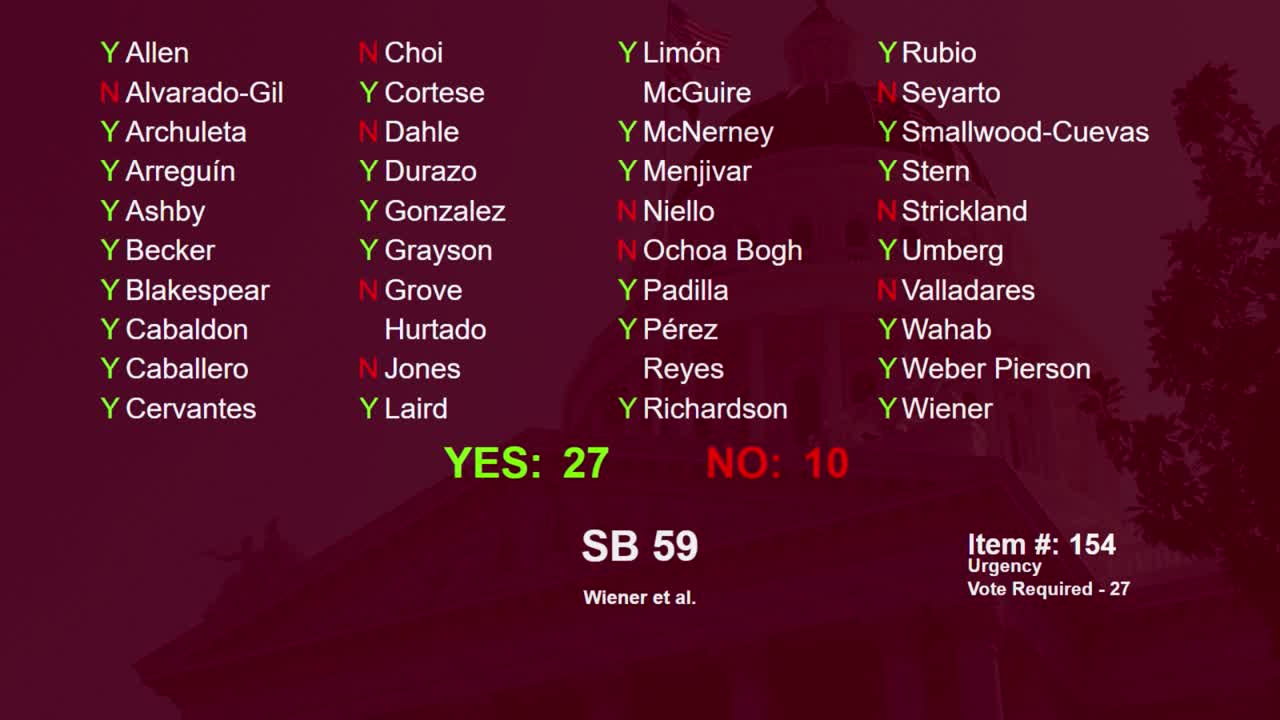 17MIN
Senate Floor
 13MIN