SB 630: State parks: real property: acquisitions and leases.
- Session Year: 2025-2026
- House: Senate
- Latest Version Date: 2025-10-13
Current Status:
Passed
(2025-10-13: Chaptered by Secretary of State. Chapter 775, Statutes of 2025.)
Introduced
In Committee
Awaiting First Chamber Vote
Passed First Chamber
In Committee
Awaiting Second Chamber Vote
Passed Second Chamber
Enacted
Existing law designates all parks, public campgrounds, monument sites, landmark sites, and sites of historical interest established or acquired by the state, or that are under its control, as the state park system, except as specified. Under existing law, the Department of Parks and Recreation controls the state park system, which is made up of units. Existing law requires the approval of the Director of General Services before the state may enter into a contract for the acquisition or hiring of real property, subject to a list of specified exceptions, as provided. Existing law requires the Department of General Services to review and approve appraisals related to the acquisition of property conducted by the Department of Parks and Recreation.
This bill would authorize the director to waive the approvals as described above regarding state acquisition or hiring of real property and appraisals conducted by the Department of Parks and Recreation. The bill would, until January 1, 2033, additionally exempt from the requirement of contract approval by the Director of General Services the acquisition by the Department of Parks and Recreation of real property for park purposes under specific circumstances.
Existing law authorizes the Department of Parks and Recreation to acquire title to or any interest in real property, including personal property incidental to the purchase of real property and options to purchase property, that the department deems necessary or proper for the extension, improvement, or development of the state park system. Existing law requires that all land and other real property to be acquired by or for any state agency be acquired by the State Public Works Board, except as specified.
This bill would additionally exempt from this requirement, until January 1, 2033, acquisition of real property by the Department of Parks and Recreation for park purposes under specific circumstances.
Existing law authorizes the Director of General Services to exempt from the directors approval, or from the approval of the Department of General Services, any state real estate acquisition or conveyance involving not more than $150,000.
This bill would expand this authorization regarding exemption of real estate acquisition or conveyance to any state real estate acquisition or conveyance involving not more than $750,000.
Existing law authorizes the Department of Parks and Recreation to lease, for any use, all or any portion of any parcel of real property acquired for state park system purposes under specific circumstances, including, among others, that the lease is subject to approval by the Department of General Services. Existing law authorizes the Department of Parks and Recreation, with the consent of the Department of General Services, to lease real or personal property that the department deems necessary or proper for the extension, improvement, or development of the state park system. Existing law requires the Department of General Services to approve the lease of real property by the Department of Parks and Recreation for agricultural purposes.
This bill would authorize the Department of General Services to waive its consent or approval of leases as described above regarding property leases for park purposes.
Before entering into a lease contract for park and recreational areas, existing law requires lands proposed to be leased to be appraised by the Department of General Services to determine the fair market value of the lands, and requires the total amount of rent to be paid for the entire term under a lease contract to not be in excess of the fair market value of the lands, as determined by the Department of General Services, as specified.
This bill would require the Department of Parks and Recreation, rather than the Department of General Services, to conduct the appraisal of the lands proposed to be leased. The bill would require the Department of General Services to review and approve the appraisal, unless review and approval is waived by the Department of General Services.
The bill would require the Department of Parks and Recreation to submit a report, on or before January 1, 2028, January 1, 2030, and January 1, 2032, to the Legislature detailing the departments use of the authority granted pursuant to the bill regarding the acquisition of real property without the approval of the Director of General Services.
This bill would incorporate additional changes to Section 15853 of the Government Code and Section 5006.1 of the Public Resources Code proposed by AB 679 to be operative only if this bill and AB 679 are enacted and this bill is enacted last.
Existing law designates all parks, public campgrounds, monument sites, landmark sites, and sites of historical interest established or acquired by the state, or that are under its control, as the state park system, except as specified. Under existing law, the Department of Parks and Recreation controls the state park system, which is made up of units. Existing law requires the approval of the Director of General Services before the state may enter into a contract for the acquisition or hiring of real property, subject to a list of specified exceptions, as provided. Existing law requires the Department of General Services to review and approve appraisals related to the acquisition of property conducted by the Department of Parks and Recreation.
This bill would authorize the director to waive the approvals as described above regarding state acquisition or hiring of real property and appraisals conducted by the Department of Parks and Recreation. The bill would, until January 1, 2031, add to the list of specified exceptions 2033, additionally exempt from the requirement of contract approval by the Director of General Services the acquisition by the Department of Parks and Recreation of real property for park purposes under specific circumstances.
Existing law authorizes the Department of Parks and Recreation to acquire title to or any interest in real property, including personal property incidental to the purchase of real property and options to purchase property, that the department deems necessary or proper for the extension, improvement, or development of the state park system. Existing law requires that all land and other real property to be acquired by or for any state agency be acquired by the State Public Works Board, except as specified.
This bill would additionally exempt from this requirement, until January 1, 2031, 2033, acquisition of real property by the Department of Parks and Recreation for park purposes under specific circumstances.
Existing law authorizes the Director of General Services to exempt from the directors approval, or from the approval of the Department of General Services, any state real estate acquisition or conveyance involving not more than $150,000.
This bill would expand this authorization regarding exemption of real estate acquisition or conveyance to any state real estate acquisition or conveyance involving not more than $500,000. $750,000.
Existing law authorizes the Department of Parks and Recreation to lease, for any use, all or any portion of any parcel of real property acquired for state park system purposes under specific circumstances, including, among others, that the lease is subject to approval by the Department of General Services. Existing law authorizes the Department of Parks and Recreation, with the consent of the Department of General Services, to lease real or personal property that the department deems necessary or proper for the extension, improvement, or development of the state park system. Existing law requires the Department of General Services to approve the lease of real property by the Department of Parks and Recreation for agricultural purposes.
This bill would authorize the Department of General Services to waive its consent or approval of leases as described above regarding property leases for park purposes.
Before entering into a lease contract for park and recreational areas, existing law requires lands proposed to be leased to be appraised by the Department of General Services to determine the fair market value of the lands, and requires the total amount of rent to be paid for the entire term under a lease contract to not be in excess of the fair market value of the lands, as determined by the Department of General Services, as specified.
This bill would require the Department of Parks and Recreation, rather than the Department of General Services, to conduct the appraisal of the lands proposed to be leased. The bill would require the Department of General Services to review and approve the appraisal, unless review and approval is waived by the Department of General Services.
The bill would require the Department of Parks and Recreation to submit a report, on or before January 1, 2028, January 1, 2030, and January 1, 2032, to the Legislature detailing the departments use of the authority granted pursuant to the bill regarding the acquisition of real property without the approval of the Director of General Services.
Existing law designates all parks, public campgrounds, monument sites, landmark sites, and sites of historical interest established or acquired by the state, or that are under its control, as the state park system, except as specified. Under existing law, the Department of Parks and Recreation controls the state park system, which is made up of units. Existing law requires the approval of the Director of General Services before the state may enter into a contract for the acquisition or hiring of real property, subject to a list of specified exceptions, as provided. Existing law requires the Department of General Services to review and approve appraisals related to the acquisition of property conducted by the Department of Parks and Recreation.
This bill would authorize the director to waive the approvals as described above regarding state acquisition or hiring of real property and appraisals conducted by the Department of Parks and Recreation. The bill would would, until January 1, 2031, add to the list of specified exceptions the acquisition or hiring by the Department of Parks and Recreation of real property for park purposes under specific circumstances.
Existing law authorizes the Department of Parks and Recreation to acquire title to or any interest in real property, including personal property incidental to the purchase of real property and options to purchase property, that the department deems necessary or proper for the extension, improvement, or development of the state park system. Existing law requires that all land and other real property to be acquired by or for any state agency be acquired by the State Public Works Board, except as specified.
This bill would additionally exempt from this requirement requirement, until January 1, 2031, acquisition of real property by the Department of Parks and Recreation for park purposes under specific circumstances.
Existing law authorizes the Director of General Services to exempt from the directors approval, or from the approval of the Department of General Services, any state real estate acquisition or conveyance involving not more than $150,000.
This bill would expand this authorization regarding exemption of real estate acquisition or conveyance to any state real estate acquisition or conveyance involving not more than $1,000,000. $500,000.
Existing law authorizes the Department of Parks and Recreation to lease, for any use, all or any portion of any parcel of real property acquired for state park system purposes under specific circumstances, including, among others, that the lease is subject to approval by the Department of General Services. Existing law authorizes the Department of Parks and Recreation, with the consent of the Department of General Services, to lease real or personal property that the department deems necessary or proper for the extension, improvement, or development of the state park system. Existing law requires the Department of General Services to approve the lease of real property by the Department of Parks and Recreation for agricultural purposes.
This bill would authorize the Department of General Services to waive its consent or approval of leases as described above regarding property leases for park purposes.
Before entering into a lease contract for park and recreational areas, existing law requires lands proposed to be leased to be appraised by the Department of General Services to determine the fair market value of the lands, and requires the total amount of rent to be paid for the entire term under a lease contract to not be in excess of the fair market value of the lands, as determined by the Department of General Services, as specified.
This bill would require the Department of Parks and Recreation, rather than the Department of General Services, to conduct the appraisal of the lands proposed to be leased. The bill would require the Department of General Services to review and approve the appraisal, unless review and approval is waived by the Department of General Services.
Existing law designates all parks, public campgrounds, monument sites, landmark sites, and sites of historical interest established or acquired by the state, or that are under its control, as the state park system, except as specified. Under existing law, the Department of Parks and Recreation controls the state park system, which is made up of units. Existing law requires the approval of the Director of General Services before the state may enter into a contract for the acquisition or hiring of real property, subject to a list of specified exceptions, as provided. Existing law requires the Department of General Services to review and approve appraisals related to the acquisition of property conducted by the Department of Parks and Recreation.
This bill would authorize the director to waive the approvals as described above regarding state acquisition or hiring of real property and appraisals conducted by the Department of Parks and Recreation. The bill would add to the list of specified exceptions the acquisition or hiring by the Department of Parks and Recreation of real property for park purposes under specific circumstances.
Existing law authorizes the Department of Parks and Recreation to acquire title to or any interest in real property, including personal property incidental to the purchase of real property and options to purchase property, that the department deems necessary or proper for the extension, improvement, or development of the state park system. Existing law requires that all land and other real property to be acquired by or for any state agency be acquired by the State Public Works Board, except as specified.
This bill would additionally exempt from this requirement acquisition of real property by the Department of Parks and Recreation for park purposes under specific circumstances.
Existing law authorizes the Director of General Services to exempt from the directors approval, or from the approval of the Department of General Services, any state real estate acquisition or conveyance involving not more than $150,000.
This bill would expand this authorization regarding exemption of real estate acquisition or conveyance to any state real estate acquisition or conveyance involving not more than $1,000,000.
Existing law authorizes the Department of Parks and Recreation to lease, for any use, all or any portion of any parcel of real property acquired for state park system purposes under specific circumstances, including, among others, that the lease is subject to approval by the Department of General Services. Existing law authorizes the Department of Parks and Recreation, with the consent of the Department of General Services, to lease real or personal property that the department deems necessary or proper for the extension, improvement, or development of the state park system. Existing law requires the Department of General Services to approve the lease of real property by the Department of Parks and Recreation for agricultural purposes.
This bill would authorize the Department of General Services to waive its consent or approval of leases as described above regarding property leases for park purposes.
Before entering into a lease contract for park and recreational areas, existing law requires lands proposed to be leased to be appraised by the Department of General Services to determine the fair market value of the lands, and requires the total amount of rent to be paid for the entire term under a lease contract to not be in excess of the fair market value of the lands, as determined by the Department of General Services, as specified.
This bill would require the Department of Parks and Recreation, rather than the Department of General Services, to conduct the appraisal of the lands proposed to be leased. The bill would require the Department of General Services to review and approve the appraisal, unless review and approval is waived by the Department of General Services.
(1)The Personal Income Tax Law and the Corporation Tax Law allow various credits against the taxes imposed by those laws, including a motion picture credit (motion picture credit 4.0) to be allocated by the California Film Commission on or after July 1, 2025, in an amount equal to 20% or 25% of qualified expenditures for the production of a qualified motion picture in this state, and limits the aggregate amount of the credit that may be allocated for a fiscal year to $330,000,000, as specified. Existing law defines a qualified motion picture for purposes of these tax credits to include a motion picture that is produced for distribution to the general public that includes, among other productions, a feature with a specified minimum production budget, an independent film, a new television series produced in California, as specified, or a television series that relocated to California. Existing law allows a qualified taxpayer to elect to be paid a refund equal to 90% of the total refundable amount, as specified, if the amount allowable as a credit under the motion picture credit 4.0 exceeds the qualified taxpayers tax liability for the taxable year, and allows the excess to be carried over, as specified. This bill, with respect to motion picture credit 4.0, for taxable years beginning on or after January 1, 2025, would revise the definition of qualified motion picture to include live action and animated series with episodes averaging 20 minutes or more, animated films, and large-scale competition shows, as specified. The bill would specify that a television series that completed principal photography on the previous season more than 48 months prior to applying for an allocation of this credit is considered a new television series for purposes of the definition of qualified motion picture, unless certain conditions are met. The bill would increase the credit amount allowed for a qualified motion picture to 35% or 40%, as specified. The bill would additionally increase the amount of qualified expenditures the California Film Commission is allowed to consider when determining the credit amount allocated to a qualified motion picture. The bill would revise the allocation limitations for specified qualified motion pictures within the aggregate amount of credits that may be allocated in a fiscal year. The bill would increase the amount a qualified taxpayer may elect to be paid as a refund to 100% of the total refundable amount of the allowable credit that exceeds the qualified taxpayers tax liability for the taxable year, as specified. The bill would additionally correct erroneous cross-references in those provisions. By requiring additional moneys to be paid from the Tax Relief and Refund Account, a continuously appropriated fund, the bill would make an appropriation.(2)Existing law also allows a credit for taxable years beginning on or after January 1, 2022, and before January 1, 2032, in an amount equal to 20% or 25%, or as modified, of qualified expenditures paid or incurred during the taxable year by a qualified motion picture produced in this state at a certified studio construction project.This bill, with respect to the certified studio construction project credit, for taxable years beginning on or after January 1, 2025, would revise specified provisions of the definition of qualified motion picture, the credit amount allowed for a qualified motion picture, and the total credit amount allowed to be allocated to a television series, as specified, in conformity with the motion picture credit 4.0, as described above. The bill would also end the requirement that a certified studio construction project is produced by a qualified taxpayer that either owns more than 50% of the soundstage or soundstages on which the production is filmed or entered into a contract or lease of 10 years or more.(3)Existing law requires the California Film Commission to develop an application process for the allocation of the above-described credits. Existing law requires the issuance of a credit for any subsequent season for the life of a television series that has been approved and issued a credit allocation under any of the existing motion picture credits. Existing law requires the California Film Commission to limit the amount of credits any recurring television series receives in subsequent seasons to no more than the amount reserved in the prior fiscal year it received the credit.This bill would instead limit the amount of credits received by a recurring television series to the sum of the base year allocation and the product of the base year allocation, the number of subsequent years, and 3%, as those terms are defined. The bill would additionally, for purposes of the motion picture credit 4.0, require a recurring television series to reapply for the credit if it does not request a credit allocation within 18 months from the date of completion of principal photography of the previous season, as specified.(4)Existing law establishes a Career Pathways Program, under the California Film Commission, to fund technical skills training for individuals from underserved communities for entry into film and television jobs. Existing law requires the program to work with nonprofit organizations that have an established record of training and job placement in the entertainment industry, focus on training individuals from traditionally underserved communities, and offer training courses focused on skilled, technical positions, as specified. Existing law requires a qualified motion picture to pay a fee equal to 0.5 percent of their approved credit amount to the program, and authorizes the California Film Commission to increase the fee amount, as specified.This bill would require the California Film Commission to expand the number of nonprofit organizations that partner with the Career Pathways program, and would require the California Film Commission to establish an application process for nonprofit organizations to obtain approval as a Career Pathways Program. The bill would require the application meet specified requirements to be approved and would provide criteria for the California Film Commission to consider when approving applications. The bill would require the California Film Commission, before July 1, 2026, to develop criteria to incentivize the placement of trainees from the Career Pathways Program in qualified productions, and for the motion picture credit 4.0, would authorize the California Film Commission to increase the credit amount up to 2% of qualified expenditures for qualified productions that employ trainees from a Career Pathways Program.(5)This bill would include a change in state statute that would result in a taxpayer paying a higher tax within the meaning of Section 3 of Article XIII A of the California Constitution, and thus would require for passage the approval of 2/3 of the membership of each house of the Legislature.(1)The Personal Income Tax Law and the Corporation Tax Law allow various credits against the taxes imposed by those laws, including a motion picture credit (motion picture credit 3.0) for taxable years beginning on or after January 1, 2020, to be allocated by the California Film Commission on or after July 1, 2020, and before July 1, 2025, in an amount equal to 20% or 25% of qualified expenditures for the production of a qualified motion picture in this state, with additional credit amounts allowed, as specified.
This bill, with respect to motion picture credit 3.0, for taxable years beginning on or after January 1, 2025, would revise the definition of a qualified motion picture to exclude a pilot for a new television series that is longer than 40 minutes of running time, exclusive of commercials, that is produced in California, and with a minimum production budget of $1,000,000.Existing law additionally allows a motion picture credit (motion picture credit 4.0) to be allocated by the California Film Commission on or after July 1, 2025, in an amount equal to 20% or 25% of qualified expenditures for the production of a qualified motion picture in this state, and limits the aggregate amount of the credit that may be allocated for a fiscal year to $330,000,000, as specified. Existing law defines a qualified motion picture for purposes of these tax credits to include a motion picture that is produced for distribution to the general public that includes, among other productions, a feature with a specified minimum production budget, an independent film, a new television series produced in California, as specified, or a television series that relocated to California. Existing law allows a qualified taxpayer to elect to be paid a refund equal to 90% of the total refundable amount, as specified, if the amount allowable as a credit under the motion picture credit 4.0 exceeds the qualified taxpayers tax liability for the taxable year, and allows the excess to be carried over, as specified.
This bill, with respect to motion picture credit 4.0, for taxable years beginning on or after January 1, 2025, would revise the definition of qualified motion picture to include live action and animated series with episodes averaging 20 minutes or more, animated films, and large-scale competition shows, as specified. The bill would specify that a television series that completed principal photography on the previous season more than 48 months prior to applying for an allocation of this credit is considered a new television series for purposes of the definition of qualified motion picture, unless certain conditions are met. The bill would increase the credit amount allowed for a qualified motion picture, picture to 35% or 40% 40%, as specified. The bill would additionally increase the amount of qualified expenditures the California Film Commission is allowed to consider when determining the credit amount allocated to a qualified motion picture. The bill would revise the allocations for independent films allocation limitations for specified qualified motion pictures within the aggregate amount of credits that may be allocated in a fiscal year. The bill would increase the amount a qualified taxpayer may elect to be paid as a refund to 100% of the total refundable amount of the allowable credit that exceeds the qualified taxpayers tax liability for the taxable year, as specified. The bill would additionally correct erroneous cross-references in those provisions. By requiring additional moneys to be paid from the Tax Relief and Refund Account, a continuously appropriated fund, the bill would make an appropriation.
Existing(2)Existing law also allows a credit for taxable years beginning on or after January 1, 2022, and before January 1, 2032, in an amount equal to 20% or 25%, or as modified, of qualified expenditures paid or incurred during the taxable year by a qualified motion picture produced in this state at a certified studio construction project.
This bill, with respect to the certified studio construction project credit, for taxable years beginning on or after January 1, 2025, would revise specified provisions of the definition of qualified motion picture, the credit amount allowed for a qualified motion picture, and the total credit amount allowed to be allocated to a television series, as specified, in conformity with the motion picture credit 4.0, as described above. The bill would also end the requirement that a certified studio construction project is produced by a qualified taxpayer that either owns more than 50% of the soundstage or soundstages on which the production is filmed or entered into a contract or lease of 10 years or more.
Existing(3)Existing law requires the California Film Commission to develop an application process for the allocation of the above-described credits. Existing law requires the issuance of a credit for any subsequent season for the life of a television series that has been approved and issued a credit allocation under any of the existing motion picture credits. Existing law requires the California Film Commission to limit the amount of credits any recurring television series receives in subsequent seasons to no more than the amount reserved in the prior fiscal year it received the credit.
This bill would instead limit the amount of credits received by a recurring television series to the sum of the base year allocation and the product of the base year allocation, the number of subsequent years, and 3%, as those terms are defined. The bill would additionally, for purposes of the motion picture credit 4.0, require a recurring television series to reapply for the credit if it does not request a credit allocation within 18 months from the date of completion of principal photography of the previous season, as specified.
(4)Existing law establishes a Career Pathways Program, under the California Film Commission, to fund technical skills training for individuals from underserved communities for entry into film and television jobs. Existing law requires the program to work with nonprofit organizations that have an established record of training and job placement in the entertainment industry, focus on training individuals from traditionally underserved communities, and offer training courses focused on skilled, technical positions, as specified. Existing law requires a qualified motion picture to pay a fee equal to 0.5 percent of their approved credit amount to the program, and authorizes the California Film Commission to increase the fee amount, as specified.
This bill would require the California Film Commission to expand the number of nonprofit organizations that partner with the Career Pathways program, and would require the California Film Commission to establish an application process for nonprofit organizations to obtain approval as a Career Pathways Program. The bill would require the application meet specified requirements to be approved and would provide criteria for the California Film Commission to consider when approving applications. The bill would require the California Film Commission, before July 1, 2026, to develop criteria to incentivize the placement of trainees from the Career Pathways Program in qualified productions, and for the motion picture credit 4.0, would authorize the California Film Commission to increase the credit amount up to 2% of qualified expenditures for qualified productions that employ trainees from a Career Pathways Program.
This(5)This bill would include a change in state statute that would result in a taxpayer paying a higher tax within the meaning of Section 3 of Article XIII A of the California Constitution, and thus would require for passage the approval of 2/3 of the membership of each house of the Legislature.
The Personal Income Tax Law and the Corporation Tax Law allow various credits against the taxes imposed by those laws, including a motion picture credit credit (motion picture credit 3.0) for taxable years beginning on or after January 1, 2020, to be allocated by the California Film Commission on or after July 1, 2020, and before July 1, 2025, in an amount equal to 20% or 25% of qualified expenditures for the production of a qualified motion picture in this state, with additional credit amounts allowed, as specified.
This bill, with respect to motion picture credit 3.0, for taxable years beginning on or after January 1, 2025, would revise the definition of a qualified motion picture to exclude a pilot for a new television series that is longer than 40 minutes of running time, exclusive of commercials, that is produced in California, and with a minimum production budget of $1,000,000.
Existing law additionally allows a motion picture credit (motion picture credit 4.0) to be allocated by the commission California Film Commission on or after July 1, 2025, in an amount equal to 20% or 25% of qualified expenditures for the production of a qualified motion picture in this state, and limits the aggregate amount of the credit that may be allocated for a fiscal year to $330,000,000, as specified. Existing law defines a qualified motion picture for purposes of these tax credits to include a motion picture that is produced for distribution to the general public that includes, among other productions, a feature with a specified minimum production budget, an independent film, a new television series produced in California, as specified, or a television series that relocated to California. Existing law allows a qualified taxpayer to elect to be paid a refund equal to 90% of the total refundable amount, as specified, if the amount allowable as a credit under the motion picture credit 4.0 exceeds the qualified taxpayers tax liability for the taxable year, and allows the excess to be carried over, as specified.
Existing law also allows a credit for taxable years beginning on or after January 1, 2022, and before January 1, 2032, in an amount equal to 20% or 25%, or as modified, of qualified expenditures paid or incurred during the taxable year by a qualified motion picture produced in this state at a certified studio construction project.This bill, with respect to Motion Picture Credit motion picture credit 4.0, for taxable years beginning on or after January 1, 2025, would revise the definition of qualified motion picture to include live action and animated series with episodes averaging 20 minutes or more, animated films, and large-scale competition shows, as specified. The bill would specify that a television series that completed principal photography on the previous season more than 48 months prior to applying for an allocation of this credit is considered a new television series for purposes of the definition of qualified motion picture. picture, unless certain conditions are met. The bill would increase the credit amount allowed for a qualified motion picture, to 35% or 40% as specified. The bill would additionally increase the amount of qualified expenditures the California Film Commission is allowed to consider when determining the credit amount allocated to a qualified motion picture. The bill would increase revise the allocations for independent films within the aggregate amount of credits that may be allocated in a fiscal year to $750,000,000, and would revise the allocations for independent films within that amount. year. The bill would increase the amount a qualified taxpayer may elect to be paid as a refund to 100% of the total refundable amount of the allowable credit that exceeds the qualified taxpayers tax liability for the taxable year, as specified. The bill would additionally correct erroneous cross-references in those provisions. By requiring additional moneys to be paid from the Tax Relief and Refund Account, a continuously appropriated fund, the bill would make an appropriation.
Existing law also allows a credit for taxable years beginning on or after January 1, 2022, and before January 1, 2032, in an amount equal to 20% or 25%, or as modified, of qualified expenditures paid or incurred during the taxable year by a qualified motion picture produced in this state at a certified studio construction project.
This bill, with respect to the certified studio construction project credit, for taxable years beginning on or after January 1, 2025, would revise specified provisions of the definition of qualified motion picture, the credit amount allowed for a qualified motion picture, and the total credit amount allowed to be allocated to a television series, as specified, in conformity with the Motion Picture Credit motion picture credit 4.0, as described above. The bill would also end the requirement that a certified studio construction project is produced by a qualified taxpayer that either owns more than 50% of the soundstage or soundstages on which the production is filmed or entered into a contract or lease of 10 years or more.
Existing law requires the California Film Commission to develop an application process for the allocation of the above-described credits. Existing law requires the issuance of a credit for any subsequent season for the life of a television series that has been approved and issued a credit allocation under any of the existing motion picture credits. Existing law requires the California Film Commission to limit the amount of credits any recurring television series receives in subsequent seasons to no more than the amount reserved in the prior fiscal year it received the credit.
This bill would instead limit the amount of credits received by a recurring television series to the sum of the base year allocation and the product of the base year allocation, the number of subsequent years, and 3%, as those terms are defined. The bill would additionally, for purposes of the motion picture credit 4.0, require a recurring television series to reapply for the credit if it does not request a credit allocation within 18 months from the date of completion of principal photography of the previous season, as specified.
This bill would include a change in state statute that would result in a taxpayer paying a higher tax within the meaning of Section 3 of Article XIII A of the California Constitution, and thus would require for passage the approval of 2/3 2/3 of the membership of each house of the Legislature.
The Personal Income Tax Law and the Corporation Tax Law allow various credits against the taxes imposed by those laws, including a motion picture credit (motion picture credit 4.0) to be allocated by the commission on or after July 1, 2025, in an amount equal to 20% or 25% of qualified expenditures for the production of a qualified motion picture in this state, and limits the aggregate amount of the credit that may be allocated for a fiscal year to $330,000,000, as specified. Existing law defines a qualified motion picture for purposes of these tax credits to include a motion picture that is produced for distribution to the general public that includes, among other productions, a feature with a specified minimum production budget, an independent film, a new television series produced in California, as specified, or a television series that relocated to California. Existing law allows a qualified taxpayer to elect to be paid a refund if the amount allowable as a credit under the motion picture credit 4.0 exceeds the qualified taxpayers tax liability for the taxable year, and allows the excess to be carried over, as specified.
Existing law also allows a credit for taxable years beginning on or after January 1, 2022, and before January 1, 2032, in an amount equal to 20% or 25%, or as modified, of qualified expenditures paid or incurred during the taxable year by a qualified motion picture produced in this state at a certified studio construction project.
This bill, with respect to Motion Picture Credit 4.0, for taxable years beginning on or after January 1, 2025, would revise the definition of qualified motion picture to include live action and animated series with episodes averaging 20 minutes or more, animated films, and large-scale competition shows, as specified. The bill would specify that a television series that completed principal photography on the previous season more than 48 months prior to applying for an allocation of this credit is considered a new television series for purposes of the definition of qualified motion picture. The bill would increase the credit amount allowed for a qualified motion picture, to 35% or 40% as specified. The bill would additionally increase the amount of qualified expenditures the California Film Commission is allowed to consider when determining the credit amount allocated to a qualified motion picture. The bill would increase the aggregate amount of credits that may be allocated in a fiscal year to $750,000,000, and would revise the allocations for independent films within that amount. The bill would additionally correct erroneous cross-references in those provisions. By requiring additional moneys to be paid from the Tax Relief and Refund Account, a continuously appropriated fund, the bill would make an appropriation.
This bill, with respect to the certified studio construction project credit, for taxable years beginning on or after January 1, 2025, would revise specified provisions of the definition of qualified motion picture, the credit amount allowed for a qualified motion picture, and the total credit amount allowed to be allocated to a television series, as specified, in conformity with the Motion Picture Credit 4.0, as described above. The bill would also end the requirement that a certified studio construction project is produced by a qualified taxpayer that either owns more than 50% of the soundstage or soundstages on which the production is filmed or entered into a contract or lease of 10 years or more.
Existing law requires the California Film Commission to develop an application process for the allocation of the above-described credits. Existing law requires the issuance of a credit for any subsequent season for the life of a television series that has been approved and issued a credit allocation under any of the existing motion picture credits. Existing law requires the California Film Commission to limit the amount of credits any recurring television series receives in subsequent seasons to no more than the amount reserved in the prior fiscal year it received the credit.
This bill would instead limit the amount of credits received by a recurring television series to the sum of the base year allocation and the product of the base year allocation, the number of subsequent years, and 3%, as those terms are defined. The bill would additionally, for purposes of the motion picture credit 4.0, require a recurring television series to reapply for the credit if it does not request a credit allocation within 18 months from the date of completion of principal photography of the previous season, as specified.
This bill would include a change in state statute that would result in a taxpayer paying a higher tax within the meaning of Section 3 of Article XIII A of the California Constitution, and thus would require for passage the approval of 2/3 of the membership of each house of the Legislature.
The Personal Income Tax Law and the Corporation Tax Law allow various credits against the taxes imposed by those laws, including a motion picture credit (motion picture credit 4.0) to be allocated by the commission on or after July 1, 2025, in an amount equal to 20% or 25% of qualified expenditures for the production of a qualified motion picture in this state, and limits the aggregate amount of the credit that may be allocated for a fiscal year to $330,000,000, as specified. Existing law defines a qualified motion picture for purposes of these tax credits to include a motion picture that is produced for distribution to the general public that includes, among other productions, a feature with a specified minimum production budget, an independent film, a new television series produced in California, as specified, or a television series that relocated to California. Existing law allows a qualified taxpayer to elect to be paid a refund if the amount allowable as a credit under the motion picture credit 4.0 exceeds the qualified taxpayers tax liability for the taxable year, and allows the excess to be carried over, as specified. Existing law also allows a credit for taxable years beginning on or after January 1, 2022, and before January 1, 2032, in an amount equal to 20% or 25%, or as modified, of qualified expenditures paid or incurred during the taxable year by a qualified motion picture produced in this state at a certified studio construction project.This bill, with respect to Motion Picture Credit 4.0, for taxable years beginning on or after January 1, 2025, would revise the definition of qualified motion picture to include series with episodes averaging 20 minutes or more, animation films, series, and shorts, and large-scale competition shows, as specified. The bill would increase the credit amount allowed for a qualified motion picture, including to 35% for amounts paid or incurred inside the Los Angeles zone. The bill would additionally increase the amount of qualified expenditures the California Film Commission is allowed to consider when determining the credit amount allocated to a qualified motion picture, and would allow an additional credit percentage of up to 5% percent for qualified expenditures in an economic opportunity zone. The bill would increase the aggregate amount of credits that may be allocated in a fiscal year to $750,000,000, and would revise the allocations for independent films within that amount. The bill would additionally correct erroneous cross-references in those provisions. By requiring additional moneys to be paid from the Tax Relief and Refund Account, a continuously appropriated fund, the bill would make an appropriation.This bill, with respect to the certified studio construction project credit, for taxable years beginning on or after January 1, 2025, would revise the definition of qualified motion picture, the credit amount allowed for a qualified motion picture, including to 35% for amounts paid or incurred inside the Los Angeles zone, and the total credit amount allowed to be allocated to a television series, as specified, in conformity with the Motion Picture Credit 4.0, as described above. The bill would also end the requirement that a certified studio construction project is produced by a qualified taxpayer that either owns more than 50% of the soundstage or soundstages on which the production is filmed or entered into a contract or lease of 10 years or more.This bill would include a change in state statute that would result in a taxpayer paying a higher tax within the meaning of Section 3 of Article XIII A of the California Constitution, and thus would require for passage the approval of 2/3 of the membership of each house of the Legislature.The Personal Income Tax Law and the Corporation Tax Law allow various credits against the taxes imposed by those laws, including a motion picture credit (motion picture credit 4.0) to be allocated by the commission on or after July 1, 2025, in an amount equal to 20% or 25% of qualified expenditures for the production of a qualified motion picture in this state, and limits the aggregate amount of the credit that may be allocated for a fiscal year to $330,000,000, as specified. Existing law defines a qualified motion picture for purposes of these tax credits to include a motion picture that is produced for distribution to the general public that includes, among other productions, a feature with a specified minimum production budget, an independent film, a new television series produced in California, as specified, or a television series that relocated to California. Existing law allows a qualified taxpayer to elect to be paid a refund if the amount allowable as a credit under the motion picture credit 4.0 exceeds the qualified taxpayers tax liability for the taxable year, and allows the excess to be carried over, as specified.
Existing law also allows a credit for taxable years beginning on or after January 1, 2022, and before January 1, 2032, in an amount equal to 20% or 25%, or as modified, of qualified expenditures paid or incurred during the taxable year by a qualified motion picture produced in this state at a certified studio construction project.
This bill, with respect to Motion Picture Credit 4.0, for taxable years beginning on or after January 1, 2025, would revise the definition of qualified motion picture to include series with episodes averaging 20 minutes or more, animation films, series, and shorts, and large-scale competition shows, as specified. The bill would increase the credit amount allowed for a qualified motion picture, including to 35% for amounts paid or incurred inside the Los Angeles zone. The bill would additionally increase the amount of qualified expenditures the California Film Commission is allowed to consider when determining the credit amount allocated to a qualified motion picture, and would allow an additional credit percentage of up to 5% percent for qualified expenditures in an economic opportunity zone. The bill would increase the aggregate amount of credits that may be allocated in a fiscal year to $750,000,000, and would revise the allocations for independent films within that amount. The bill would additionally correct erroneous cross-references in those provisions. By requiring additional moneys to be paid from the Tax Relief and Refund Account, a continuously appropriated fund, the bill would make an appropriation.
This bill, with respect to the certified studio construction project credit, for taxable years beginning on or after January 1, 2025, would revise the definition of qualified motion picture, the credit amount allowed for a qualified motion picture, including to 35% for amounts paid or incurred inside the Los Angeles zone, and the total credit amount allowed to be allocated to a television series, as specified, in conformity with the Motion Picture Credit 4.0, as described above. The bill would also end the requirement that a certified studio construction project is produced by a qualified taxpayer that either owns more than 50% of the soundstage or soundstages on which the production is filmed or entered into a contract or lease of 10 years or more.
This bill would include a change in state statute that would result in a taxpayer paying a higher tax within the meaning of Section 3 of Article XIII A of the California Constitution, and thus would require for passage the approval of 2/3 of the membership of each house of the Legislature.
The Personal Income Tax Law and the Corporation Tax Law allow various credits against the taxes imposed by those laws, including motion picture credits for taxable years beginning on or after January 1, 2020, to be allocated by the California Film Commission on or after July 1, 2020, and before July 1, 2025. Existing law also provides for a new motion picture credit to be allocated by the commission on or after July 1, 2025, and before July 1, 2030. Existing law defines a qualified motion picture for purposes of these tax credits to include a motion picture that is produced for distribution to the general public that includes, among other productions, a feature with a specified minimum production budget, an independent film, a new television series produced in California, as specified, or a television series that relocated to California.This bill would state the intent of the Legislature to enact legislation to amend, update, and modernize Californias Film and Television Tax Credit Program, as provided.The Personal Income Tax Law and the Corporation Tax Law allow various credits against the taxes imposed by those laws, including motion picture credits for taxable years beginning on or after January 1, 2020, to be allocated by the California Film Commission on or after July 1, 2020, and before July 1, 2025. Existing law also provides for a new motion picture credit to be allocated by the commission on or after July 1, 2025, and before July 1, 2030. Existing law defines a qualified motion picture for purposes of these tax credits to include a motion picture that is produced for distribution to the general public that includes, among other productions, a feature with a specified minimum production budget, an independent film, a new television series produced in California, as specified, or a television series that relocated to California.
This bill would state the intent of the Legislature to enact legislation to amend, update, and modernize Californias Film and Television Tax Credit Program, as provided.
(a)(1)Unless the Legislature specifically provides that approval is not required, every gift or dedication to the state of personal property, or every gift to the state of real property in fee or in any lesser estate or interest, shall be approved by the Director of Finance.
(2)Unless the Legislature specifically provides that approval is not required, every contract for the acquisition or hiring of real property in fee or in any lesser estate or interest, entered into by or on behalf of the state, shall be approved by the Director of General Services, unless the approval is waived by the director.
(3)Any contract entered into in violation of this section is void. This section applies to any state agency that, by general or specific statute, is expressly or impliedly authorized to enter into transactions referred to in this section.
(b)This section does not apply to any of the following:
(1)Unconditional gifts of money.
(2)The acquisition or hiring by the Department of Transportation of real property in fee or in any lesser estate or interest for highway purposes, but this section does apply to the hiring by that department of office space in any office building.
(3)Contracts entered into under the authority of Chapter 4 (commencing with Section 11770) of Part 3 of Division 2 of the Insurance Code.
(4)The receipt of donated, unencumbered personal property from private sources received in conjunction with the administration of the Federal Surplus Personal Property Program by the Department of General Services.
(5)The receipt of gifts of personal property in the form of interpretive or historical objects, each valued at fifteen thousand dollars ($15,000) or less, by the Department of Parks and Recreation.
(6)The acceptance by the State Coastal Conservancy of offers to dedicate public accessways made pursuant to Division 20 (commencing with Section 30000) of the Public Resources Code.
(7)The acquisition or hiring by the High-Speed Rail Authority of real property in fee or in any lesser estate or interest for high-speed rail purposes, but this section does apply to the hiring by that authority of office space in any office building.
(8)The acquisition by the Department of Parks and Recreation of real property in fee or in any lesser estate or interest for park purposes, when the following conditions are met:
(A)The acquisition is not for creating a new unit of the state park system.
(B)The consideration to be paid by the Department of Parks and Recreation for the acquisition does not exceed one million dollars ($1,000,000).
(C)At the time of the acquisition, the property does not require capital improvements or additional resources that cannot be absorbed within existing resources available to the Department of Parks and Recreation.
(D)Public notice has been given, and a public meeting has been held, pursuant to subdivision (c) of Section 5006.1 of the Public Resources Code.
(c)This section shall remain in effect only until January 1, 2033, and as of that date is repealed.
SEC. 2.Section 11005 is added to the Government Code, to read:11005.(a)(1)Unless the Legislature specifically provides that approval is not required, every gift or dedication to the state of personal property, or every gift to the state of real property in fee or in any lesser estate or interest, shall be approved by the Director of Finance.
(2)Unless the Legislature specifically provides that approval is not required, every contract for the acquisition or hiring of real property in fee or in any lesser estate or interest, entered into by or on behalf of the state, shall be approved by the Director of General Services, unless the approval is waived by the director.
(3)Any contract entered into in violation of this section is void. This section applies to any state agency that, by general or specific statute, is expressly or impliedly authorized to enter into transactions referred to in this section.
(b)This section does not apply to any of the following:
(1)Unconditional gifts of money.
(2)The acquisition or hiring by the Department of Transportation of real property in fee or in any lesser estate or interest for highway purposes, but this section does apply to the hiring by that department of office space in any office building.
(3)Contracts entered into under the authority of Chapter 4 (commencing with Section 11770) of Part 3 of Division 2 of the Insurance Code.
(4)The receipt of donated, unencumbered personal property from private sources received in conjunction with the administration of the Federal Surplus Personal Property Program by the Department of General Services.
(5)The receipt of gifts of personal property in the form of interpretive or historical objects, each valued at fifteen thousand dollars ($15,000) or less, by the Department of Parks and Recreation.
(6)The acceptance by the State Coastal Conservancy of offers to dedicate public accessways made pursuant to Division 20 (commencing with Section 30000) of the Public Resources Code.
(7)The acquisition or hiring by the High-Speed Rail Authority of real property in fee or in any lesser estate or interest for high-speed rail purposes, but this section does apply to the hiring by that authority of office space in any office building.
(c)This section shall become operative on January 1, 2033.
SEC. 3.Section 14667.1 of the Government Code is amended to read:14667.1.Notwithstanding Section 14616, the director may exempt from the directors approval, or from the approval of the department, any state real estate acquisition or conveyance involving not more than seven hundred fifty thousand dollars ($750,000) for which approval is required by statute whenever, in the directors judgment, the state agency delegated that authority has the necessary real estate expertise and experience to complete the transaction competently and professionally while protecting the best interests of the state. Written notice of exemptions shall be given to the Controller.
SEC. 4.Section 15853 of the Government Code is amended to read:15853.(a)The board may select and acquire, in the name of and on behalf of the state, with the consent of the state agency concerned, the fee or any lesser right or interest in any real property necessary for any state purpose or function.
(b)If moneys are appropriated by the Legislature in the annual Budget Act for any fiscal year or by any other act for the acquisition of land or other real property, either (1) subject to this part or (2) for any state agency for whom property is acquired by the board, the moneys and acquisitions are subject to this part and the moneys shall be expended in accordance with this part, notwithstanding any other law.
(c)Notwithstanding any other law, all land and other real property to be acquired by or for any state agency, other than the Department of Transportation, the High-Speed Rail Authority, the Department of Water Resources, the Central Valley Flood Protection Board, the Department of Fish and Wildlife, the Wildlife Conservation Board, the Public Employees Retirement System, the State Teachers Retirement System, the Department of Housing and Community Development, the State Lands Commission, except for property to be acquired for the State Lands Commission pursuant to an appropriation from the General Fund, the State Coastal Conservancy with respect to acceptance of offers to dedicate public accessways made pursuant to the California Coastal Act of 1976 (Division 20 (commencing with Section 30000)) of, and for the purposes of Chapter 10 (commencing with Section 31411) of Division 21 of, the Public Resources Code, and the Department of Parks and Recreation, until January 1, 2033, with respect to acquisitions set forth in paragraph (8) of subdivision (b) of Section 11005, shall be acquired by the State Public Works Board in accordance with this part.
(d)(1)Notwithstanding subdivision (a), and except as provided in subdivision (c), the board shall acquire, on behalf of and for the Department of Parks and Recreation, in accordance with this part, any interests in real property, including options to purchase, which have been appraised, selected, and settled through purchase negotiations by the Department of Parks and Recreation pursuant to subdivision (b) of Section 5006 of the Public Resources Code. Out of moneys appropriated for the acquisition of options to purchase, no more than ten thousand dollars ($10,000) may be expended for the acquisition of any single option unless otherwise provided by the Legislature.
(2)Notwithstanding Section 15854, purchase negotiations for interests in real property for the state park system pursuant to subdivision (d) of Section 5006 of the Public Resources Code shall be initiated within six months of the effective date of the act that appropriates funds for the acquisition. Purchase negotiations on all projects not proposed pursuant to subdivision (d) of Section 5006 of the Public Resources Code shall be initiated within 12 months of the effective date of the act appropriating funds for the acquisition. Either title shall be conveyed or a written agreement to transfer title shall be executed within the appropriate authorization period unless the Department of Parks and Recreation formally abandons the acquisition before the conclusion of the appropriate authorization period. For purposes of this section, in order for the Department of Parks and Recreation to formally abandon an acquisition, it shall transmit written notification to the board of its intent not to proceed with the acquisition.
(3)The board, at any time during the periods specified in paragraph (2), may commence condemnation proceedings if it finds it to be appropriate. However, if during the appropriate authorization period title is not conveyed or a written agreement to transfer title is not signed, the acquisition has not been formally abandoned, or condemnation proceedings have not been commenced, the Department of Parks and Recreation shall notify, by letter, the chair of the committee in each house of the Legislature that considers appropriations, the Chair of the Joint Legislative Budget Committee, and the Members of the Legislature within whose district any part of the land or other real property is located of the status of the acquisition. For the purpose of this paragraph, condemnation proceedings shall be deemed to be commenced as of the date the board authorizes acquisition by condemnation.
(4)The board may schedule special meetings as are necessary to expedite the acquisition of options to purchase real property for the state park system.
(e)The board may acquire furnishings that the owner of the furnishings agrees to sell and that are contained within improvements acquired by the board. The cost of acquisition of furnishings shall be charged to the appropriation available for acquisition of the real property.
(f)This section does not apply to the acquisition of conservation easements made pursuant to the California Forest Legacy Program Act of 2007 (Division 10.5 (commencing with Section 12200) of the Public Resources Code).
SEC. 4.5.Section 15853 of the Government Code is amended to read:15853.(a)The board may select and acquire, in the name of and on behalf of the state, with the consent of the state agency concerned, the fee or any lesser right or interest in any real property necessary for any state purpose or function.
(b)If moneys are appropriated by the Legislature in the annual Budget Act for any fiscal year or by any other act for the acquisition of land or other real property, either (1) subject to this part or (2) for any state agency for whom property is acquired by the board, the moneys and acquisitions are subject to this part and the moneys shall be expended in accordance with this part, notwithstanding any other law.
(c)Notwithstanding any other law, all land and other real property to be acquired by or for any state agency, other than the Department of Transportation, the High-Speed Rail Authority, the Department of Water Resources, the Central Valley Flood Protection Board, the Department of Fish and Wildlife, the Wildlife Conservation Board, the Department of Parks and Recreation, until January 1, 2033, with respect to property acquired for Big Basin Redwoods, Ano Nuevo, and Butano State Parks pursuant to Section 15853.1, and with respect to acquisitions set forth in paragraph (8) of subdivision (b) of Section 11005, the Public Employees Retirement System, the State Teachers Retirement System, the Department of Housing and Community Development, the State Lands Commission, except for property to be acquired for the State Lands Commission pursuant to an appropriation from the General Fund, and the State Coastal Conservancy with respect to acceptance of offers to dedicate public accessways made pursuant to the California Coastal Act of 1976 (Division 20 (commencing with Section 30000)) of, and for the purposes of Chapter 10 (commencing with Section 31411) of Division 21 of, the Public Resources Code, shall be acquired by the State Public Works Board in accordance with this part.
(d)(1)Notwithstanding subdivision (a), and except as provided in subdivision (c), the board shall acquire, on behalf of and for the Department of Parks and Recreation, in accordance with this part, any interests in real property, including options to purchase, which have been appraised, selected, and settled through purchase negotiations by the Department of Parks and Recreation pursuant to subdivision (b) of Section 5006 of the Public Resources Code. Out of moneys appropriated for the acquisition of options to purchase, no more than ten thousand dollars ($10,000) may be expended for the acquisition of any single option unless otherwise provided by the Legislature.
(2)Notwithstanding Section 15854, purchase negotiations for interests in real property for the state park system pursuant to subdivision (d) of Section 5006 of the Public Resources Code shall be initiated within six months of the effective date of the act that appropriates funds for the acquisition. Purchase negotiations on all projects not proposed pursuant to subdivision (d) of Section 5006 of the Public Resources Code shall be initiated within 12 months of the effective date of the act appropriating funds for the acquisition. Either title shall be conveyed or a written agreement to transfer title shall be executed within the appropriate authorization period unless the Department of Parks and Recreation formally abandons the acquisition before the conclusion of the appropriate authorization period. For purposes of this section, in order for the Department of Parks and Recreation to formally abandon an acquisition, it shall transmit written notification to the board of its intent not to proceed with the acquisition.
(3)The board, at any time during the periods specified in paragraph (2), may commence condemnation proceedings if it finds it to be appropriate. However, if during the appropriate authorization period title is not conveyed or a written agreement to transfer title is not signed, the acquisition has not been formally abandoned, or condemnation proceedings have not been commenced, the Department of Parks and Recreation shall notify, by letter, the chair of the committee in each house of the Legislature that considers appropriations, the Chair of the Joint Legislative Budget Committee, and the Members of the Legislature within whose district any part of the land or other real property is located of the status of the acquisition. For the purpose of this paragraph, condemnation proceedings shall be deemed to be commenced as of the date the board authorizes acquisition by condemnation.
(4)The board may schedule special meetings as are necessary to expedite the acquisition of options to purchase real property for the state park system.
(e)The board may acquire furnishings that the owner of the furnishings agrees to sell and that are contained within improvements acquired by the board. The cost of acquisition of furnishings shall be charged to the appropriation available for acquisition of the real property.
(f)This section does not apply to the acquisition of conservation easements made pursuant to the California Forest Legacy Program Act of 2007 (Division 10.5 (commencing with Section 12200) of the Public Resources Code).
SEC. 5.Section 5003.17 of the Public Resources Code is amended to read:5003.17.(a)The department may lease, for any use, all or any portion of any parcel of real property acquired for state park system purposes, if the director finds that the use would be compatible with the use of the real property as a unit or part of a unit and with the sound management and conservation of resources within the unit.
(b)Rent shall be based on the fair market value of the property when used for the purpose for which it is leased. All rent shall be deposited pursuant to Section 5010.
(c)The lease term shall not exceed 10 years. All leases are subject to the approval of the Department of General Services, unless the approval is waived by the department.
(d)A lease shall not be entered into that extends beyond the 10-year period unless both of the following conditions are met:
(1)At least 30 days prior written notice of the proposed lease, including a copy of the proposed lease, has been provided by the director to the Joint Legislative Budget Committee.
(2)The director has included with the proposed lease sufficient documentation to enable the Joint Legislative Budget Committee to determine whether the lease conforms to the requirements of this article and to evaluate fully all terms upon which the lease is proposed to be let, including the amount of the rent and other revenues that may be generated under the lease.
SEC. 6.Section 5006 of the Public Resources Code is amended to read:5006.(a)The department, with the consent of the Department of Finance, and subject to Section 15853 of the Government Code, may acquire title to or any interest in real property, including personal property incidental to the purchase of real property and options to purchase property, which the department deems necessary or proper for the extension, improvement, or development of the state park system. All real and personal property acquired by the department for the state park system shall be under the jurisdiction of the department immediately upon transfer of title to the state.
(b)(1)The department, pursuant to paragraph (1) of subdivision (d) of Section 15853 of the Government Code, may appraise and select real property for the purpose of acquiring an option to purchase the real property for the state park system. The department may use the services of the Real Estate Services Division of the Department of General Services or may contract with independent appraisers appropriately certified by the Office of Real Estate Appraisers, to assist in appraising property.
(2)The department, pursuant to paragraph (1) of subdivision (d) of Section 15853 of the Government Code, may appraise and select real property for potential acquisition of, and addition to, the state park system. The department may use the services of the Real Estate Services Division of the Department of General Services or may contract with independent appraisers appropriately certified by the Office of Real Estate Appraisers, to assist in appraising the property. Before appraising the property, the Department of Parks and Recreation shall notify the owners of the real property that the department is considering the real property for acquisition, and may have it appraised. The department shall determine the form and manner of giving the notice.
(3)The department, pursuant to paragraph (1) of subdivision (d) of Section 15853 of the Government Code, may select real property it has appraised and submit purchase offers and negotiate a purchase agreement with the owner or owners of the property. The department shall be responsible for implementing and processing the purchase agreement and conveyance of title to the state. The department may use the services of the Real Estate Services Division of the Department of General Services, or may contract with other state agencies with real estate and right-of-way acquisition programs, to assist in negotiating purchase agreements and conveyance of title.
(c)Upon acquisition of real property for the state park system, the department shall be responsible for providing relocation assistance to displaced persons as provided under Chapter 16 (commencing with Section 7260) of Division 7 of Title 1 of the Government Code. The department may use the services of the Real Estate Services Division of the Department of General Services, or may contract with other state agencies or private consultants with real estate and right-of-way acquisition programs, to assist in relocation planning and implementation.
(d)(1)Requests for funding to administer the departments acquisition program shall be submitted by the department for inclusion in the Governors Budget for each fiscal year.
(2)Requests for funding to acquire options to purchase real and personal property for the state park system shall be submitted by the department for inclusion in the Governors Budget for each fiscal year based upon its estimate of the amount needed for that purpose. If an option to purchase real property for the state park system has been acquired, the funding proposed by the department shall be the appraised value of the property less the sum expended for the purchase of the option. The expenditure of the moneys shall be subject to the limitation specified in paragraph (1) of subdivision (d) of Section 15853 of the Government Code unless otherwise provided by the Legislature.
(3)Requests for funding to acquire real property or any interest in real property shall be submitted by the department for inclusion in the Governors Budget for each fiscal year. The projects shall have been selected and appraised by the department pursuant to subdivision (b) before inclusion. The Governors Budget shall contain a separate description of each project, or acquisition program and its appraised value, or funding allocation.
(e)The requirements imposed by subdivision (d) are in addition to any other law requiring the inclusion of state park system acquisition projects in the Governors Budget.
(f)The department shall not enter into a purchase agreement for the acquisition of real property if the consideration to be paid by the department is in excess of five hundred thousand dollars ($500,000), unless Section 5006.1 has been complied with.
(g)(1)Notwithstanding any other law, all appraisals conducted by the department pursuant to this section shall be reviewed and approved by the Department of General Services or, at the discretion of the Department of General Services, a competent professional appraiser approved by the Department of General Services. Real property shall be appraised and appraisal review completed before commencement of purchasing negotiations. All contracts related to the acquisition of real property are subject to Section 11005 of the Government Code.
(2)Notwithstanding paragraph (1), the Department of General Services may waive its review and approval of any appraisal conducted by the department.
SEC. 7.Section 5006.1 of the Public Resources Code is amended to read:5006.1.(a)(1)Before submitting a proposal pursuant to subdivision (f) of Section 5006, for an appropriation for the acquisition of real property in excess of five million dollars ($5,000,000) in value for any state park system project, the department shall hold a public meeting within the county in which the proposed project is located at which interested members of the public may comment on the proposed project. Notice of the meeting shall be published at least twice in a newspaper of general circulation within that county.
(2)(A)The department shall provide written notice of its intent to acquire the real property to the city or county, or both, having jurisdiction over the property, to the members of the Legislature who are the Chair and Vice Chair of the Joint Legislative Budget Committee, the chair of the budget subcommittee in each house having jurisdiction over resources, the chair in each house of the appropriate legislative policy committee, and the legislators within whose district the property proposed for acquisition is located, as early as possible in the acquisition process, but not less than 90 days from the date of acquisition. Within 30 days of receiving written notice of the proposed acquisition, a member of the city council or board of supervisors of the respective city or county, or a Member of the Legislature who has been notified pursuant to this subparagraph, may request that the department hold a public meeting regarding the acquisition of the property, if the acquisition is between five hundred thousand dollars ($500,000) and five million dollars ($5,000,000).
(B)The written notice of intent shall describe any potential impact that the acquisition may have on the departments efforts to provide park and recreational opportunities.
(b)With respect to real property in excess of five million dollars ($5,000,000) that is not proposed to be acquired pursuant to subdivision (f) of Section 5006, the department shall hold a public meeting within the county in which the real property is located, at which interested members of the public may comment on the proposed acquisition. Notice of the meeting shall be published at least twice in a newspaper of general circulation within the county. The department shall provide written notice of its intent to acquire the real property to the city or county, or both, having jurisdiction over the property, as early as possible in the acquisition process.
(c)(1)With respect to real property acquired pursuant to paragraph (8) of subdivision (b) of Section 11005 of the Government Code, the department shall do all of the following:
(A)Provide written notice to the county board of supervisors for the county in which the land is located, of the intent to acquire the real property.
(B)No fewer than 30 days before the close of escrow, hold a meeting where the public may make comments regarding a specific transaction or transactions regarding the real property under consideration by the department.
(i)The meeting may take place via teleconference.
(ii)The meeting may take place at an otherwise planned public meeting hosted by the department.
(C)No fewer than 10 days before the meeting described in subparagraph (B), notify the public of the meeting by posting information about the meeting on the departments internet website on a webpage visible to the public and notifying all owners of record of adjacent parcels of land.
(i)The department shall make a good faith effort to notify owners of record identified pursuant to this subparagraph by using existing distribution lists or available contact information. Owners of record may be contacted electronically or by mail.
(ii)In all circumstances, the meeting notice shall clearly state the specific real property transaction on which the public may comment at the meeting and an explanation of the proposed use of the land by the department.
(2)Subparagraphs (B) and (C) of paragraph (1) shall not apply to properties that, on all boundaries, are adjacent to state-owned lands.
(3)(A)On or before January 1, 2028, and on or before January 1 of every even-numbered year thereafter, the department shall submit a report to the Legislature, in compliance with Section 9795 of the Government Code, detailing the departments use of authority granted under paragraph (8) of subdivision (b) of Section 11005 of the Government Code for the acquisition without approval of the Director of General Services of fee title or any lesser right or interest in real property by the department.
(B)A report submitted pursuant to subparagraph (A) shall, for the reporting period, include, but not be limited to, a summary of each transaction conducted, any associated costs or savings as a result of the transaction, and the duration of the real estate transaction.
(d)This section does not apply to any real property to be acquired by grant, gift, devise, or bequest.
(e)This section shall remain in effect only until January 1, 2033, and as of that date is repealed.
SEC. 7.5.Section 5006.1 of the Public Resources Code is amended to read:5006.1.(a)(1)Before submitting a proposal pursuant to subdivision (f) of Section 5006, for an appropriation for the acquisition of real property in excess of five million dollars ($5,000,000) in value for any state park system project, the department shall hold a public meeting within the county in which the proposed project is located at which interested members of the public may comment on the proposed project. Notice of the meeting shall be published at least twice in a newspaper of general circulation within that county.
(2)(A)The department shall provide written notice of its intent to acquire the real property to the city or county, or both, having jurisdiction over the property, to the members of the Legislature who are the Chair and Vice Chair of the Joint Legislative Budget Committee, the chair of the budget subcommittee in each house having jurisdiction over resources, the chair in each house of the appropriate legislative policy committee, and the legislators within whose district the property proposed for acquisition is located, as early as possible in the acquisition process, but not less than 90 days from the date of acquisition. Within 30 days of receiving written notice of the proposed acquisition, a member of the city council or board of supervisors of the respective city or county, or a Member of the Legislature who has been notified pursuant to this subparagraph, may request that the department hold a public meeting regarding the acquisition of the property, if the acquisition is between five hundred thousand dollars ($500,000) and five million dollars ($5,000,000).
(B)The written notice of intent shall describe any potential impact that the acquisition may have on the departments efforts to provide park and recreational opportunities.
(b)With respect to real property in excess of five million dollars ($5,000,000) that is not proposed to be acquired pursuant to subdivision (f) of Section 5006, the department shall hold a public meeting within the county in which the real property is located, at which interested members of the public may comment on the proposed acquisition. Notice of the meeting shall be published at least twice in a newspaper of general circulation within the county. The department shall provide written notice of its intent to acquire the real property to the city or county, or both, having jurisdiction over the property, as early as possible in the acquisition process.
(c)(1)With respect to real property acquired pursuant to subdivision (c) of Section 15853 of, and paragraph (8) of subdivision (b) of Section 11005 of, the Government Code, the department shall do all of the following:
(A)Provide written notice to the county board of supervisors for the county in which the land is located of the intent to acquire the real property.
(B)No fewer than 30 days before the close of escrow, hold a meeting where the public may make comments regarding a specific transaction or transactions regarding the real property under consideration by the department.
(i)The meeting may take place via teleconference.
(ii)The meeting may take place at an otherwise planned public meeting hosted by the department.
(C)No fewer than 10 days before the meeting described in subparagraph (B), notify the public of the meeting by posting information about the meeting on the departments internet website on a webpage visible to the public and notifying all owners of record of adjacent parcels of land.
(i)The department shall make a good faith effort to notify owners of record identified pursuant to this subparagraph by using existing distribution lists or available contact information. Owners of record may be contacted electronically or by mail.
(ii)In all circumstances, the meeting notice shall clearly state the specific real property transaction on which the public may comment at the meeting and an explanation of the proposed use of the land by the department.
(2)With respect to real property acquired pursuant to subdivision (c) of Section 15853 of the Government Code, for purposes of the notification in subparagraph (C) of paragraph (1), the following:
(A)The department shall also make a good faith effort to locate current contact information for all adjacent landowners displaced due to the 2020 CZU Lightning Complex Fire.
(B)The department may consult with the relevant county agencies or officials to locate contact information for landowners.
(3)Subparagraphs (B) and (C) of paragraph (1) shall not apply to properties that, on all boundaries, are adjacent to state-owned lands.
(4)(A)On or before January 1, 2028, and on or before January 1 of every even-numbered year thereafter, the department shall submit a report to the Legislature, in compliance with Section 9795 of the Government Code, detailing the departments use of authority granted under subdivision (c) of Section 15853 of, and paragraph (8) of subdivision (b) of Section 11005 of, the Government Code for the acquisition without the State Public Works Board or without the approval of the Director of General Services, as applicable, of fee title or any lesser right or interest in real property by the department.
(B)A report submitted pursuant to subparagraph (A) shall, for the reporting period, include, but not be limited to, a summary of each transaction conducted, any associated costs or savings as a result of the transaction, and duration of the real estate transaction.
(d)This section does not apply to any real property to be acquired by grant, gift, devise, or bequest.
(e)This section shall remain in effect only until January 1, 2033, and as of that date is repealed.
SEC. 8.Section 5006.1 is added to the Public Resources Code, to read:5006.1.(a)(1)Before submitting a proposal pursuant to subdivision (f) of Section 5006, for an appropriation for the acquisition of real property in excess of five million dollars ($5,000,000) in value for any state park system project, the department shall hold a public meeting within the county in which the proposed project is located at which interested members of the public may comment on the proposed project. Notice of the meeting shall be published at least twice in a newspaper of general circulation within that county.
(2)(A)The department shall provide written notice of its intent to acquire the real property to the city or county, or both, having jurisdiction over the property, to the members of the Legislature who are the Chair and Vice Chair of the Joint Legislative Budget Committee, the chair of the budget subcommittee in each house having jurisdiction over resources, the chair in each house of the appropriate legislative policy committee, and the legislators within whose district the property proposed for acquisition is located, as early as possible in the acquisition process, but not less than 90 days from the date of acquisition. Within 30 days of receiving written notice of the proposed acquisition, a member of the city council or board of supervisors of the respective city or county, or a Member of the Legislature who has been notified pursuant to this subparagraph, may request that the department hold a public meeting regarding the acquisition of the property, if the acquisition is between five hundred thousand dollars ($500,000) and five million dollars ($5,000,000).
(B)The written notice of intent shall describe any potential impact that the acquisition may have on the departments efforts to provide park and recreational opportunities.
(b)With respect to real property in excess of five million dollars ($5,000,000) that is not proposed to be acquired pursuant to subdivision (f) of Section 5006, the department shall hold a public meeting within the county in which the real property is located, at which interested members of the public may comment on the proposed acquisition. Notice of the meeting shall be published at least twice in a newspaper of general circulation within the county. The department shall provide written notice of its intent to acquire the real property to the city or county, or both, having jurisdiction over the property, as early as possible in the acquisition process.
(c)This section does not apply to any real property to be acquired by grant, gift, devise, or bequest.
(d)This section shall become operative on January 1, 2033.
SEC. 9.Section 5006.5 of the Public Resources Code is amended to read:5006.5.The department may lease any interest in real or personal property that the department deems necessary or proper for the extension, improvement, or development of the state park system. A lease described in this section shall require the consent of the Department of General Services, unless consent is waived by the Department of General Services. Payment from state money in excess of one thousand dollars ($1,000) a year shall not be made pursuant to any such lease unless money equal to or exceeding one-half of the excess over one thousand dollars ($1,000) is made available for expenditure by the state for this purpose by some person, corporation, public district, municipality or political subdivision other than the state, or by the United States or a federal agency. A lease shall not be executed under this section until the department has first consulted with the planning commission of the county in which the department proposes to lease lands for park or recreational purposes. This section shall not apply when the Department of General Services leases land for the use of the Department of Parks and Recreation under Section 14669 of the Government Code.
SEC. 10.Section 5063 of the Public Resources Code is amended to read:5063.Before entering into any lease contract, the lands proposed to be leased shall be appraised by the department to determine the fair market value of the lands. The total amount of rent to be paid for the entire term under any lease contract shall not be in excess of the fair market value of the lands, as determined by the appraisal. The Department of General Services shall review and approve any appraisal conducted by the department pursuant to this section, unless review and approval is waived by the Department of General Services.
SEC. 11.Section 5069.3 of the Public Resources Code is amended to read:5069.3.(a)The rent for real property leased for agricultural purposes shall be based upon the fair market value of the real property when used for agricultural purposes. All rents shall be deposited pursuant to Section 5010.
(b)A lease term shall not exceed 10 years. A lease may be renewed for additional terms.
(c)A lease entered into pursuant to this article shall be subject to approval by the Department of General Services, unless that approval is waived by the Department of General Services. Each lease shall require the lessee to pay the taxes on the lessees interest in the real property that become due, owing, or unpaid on the interest created by the lease.
SEC. 12.(a)Section 4.5 of this bill incorporates amendments to Section 15853 of the Government Code proposed by both this bill and Assembly Bill 679. That section of this bill shall only become operative if (1) both bills are enacted and become effective on or before January 1, 2026, (2) each bill amends Section 15853 of the Government Code, and (3) this bill is enacted after Assembly Bill 679, in which case Section 4 of this bill shall not become operative.
(b)Section 7.5 of this bill incorporates amendments to Section 5006.1 of the Public Resources Code proposed by both this bill and Assembly Bill 679. That section of this bill shall only become operative if (1) both bills are enacted and become effective on or before January 1, 2026, (2) each bill amends Section 5006.1 of the Public Resources Code, and (3) this bill is enacted after Assembly Bill 679, in which case Section 7 of this bill shall not become operative.
(a)(1)Unless the Legislature specifically provides that approval is not required, every gift or dedication to the state of personal property, or every gift to the state of real property in fee or in any lesser estate or interest, shall be approved by the Director of Finance.
(2)Unless the Legislature specifically provides that approval is not required, every contract for the acquisition or hiring of real property in fee or in any lesser estate or interest, entered into by or on behalf of the state, shall be approved by the Director of General Services, unless the approval is waived by the director.
(3)Any contract entered into in violation of this section is void. This section applies to any state agency that, by general or specific statute, is expressly or impliedly authorized to enter into transactions referred to in this section.
(b)This section does not apply to any of the following:
(1)Unconditional gifts of money.
(2)The acquisition or hiring by the Department of Transportation of real property in fee or in any lesser estate or interest for highway purposes, but this section does apply to the hiring by that department of office space in any office building.
(3)Contracts entered into under the authority of Chapter 4 (commencing with Section 11770) of Part 3 of Division 2 of the Insurance Code.
(4)The receipt of donated, unencumbered personal property from private sources received in conjunction with the administration of the Federal Surplus Personal Property Program by the Department of General Services.
(5)The receipt of gifts of personal property in the form of interpretive or historical objects, each valued at fifteen thousand dollars ($15,000) or less, by the Department of Parks and Recreation.
(6)The acceptance by the State Coastal Conservancy of offers to dedicate public accessways made pursuant to Division 20 (commencing with Section 30000) of the Public Resources Code.
(7)The acquisition or hiring by the High-Speed Rail Authority of real property in fee or in any lesser estate or interest for high-speed rail purposes, but this section does apply to the hiring by that authority of office space in any office building.
(8)The acquisition by the Department of Parks and Recreation of real property in fee or in any lesser estate or interest for park purposes, when the following conditions are met:
(A)The acquisition is not for creating a new unit of the state park system.
(B)The consideration to be paid by the Department of Parks and Recreation for the acquisition does not exceed one million dollars ($1,000,000).
(C)At the time of the acquisition, the property does not require capital improvements or additional resources that cannot be absorbed within existing resources available to the Department of Parks and Recreation.
(D)Public notice has been given, and a public meeting has been held, pursuant to subdivision (c) of Section 5006.1 of the Public Resources Code.
(c)This section shall remain in effect only until January 1, 2033, and as of that date is repealed.
SEC. 2.Section 11005 is added to the Government Code, to read:11005.(a)(1)Unless the Legislature specifically provides that approval is not required, every gift or dedication to the state of personal property, or every gift to the state of real property in fee or in any lesser estate or interest, shall be approved by the Director of Finance.
(2)Unless the Legislature specifically provides that approval is not required, every contract for the acquisition or hiring of real property in fee or in any lesser estate or interest, entered into by or on behalf of the state, shall be approved by the Director of General Services, unless the approval is waived by the director.
(3)Any contract entered into in violation of this section is void. This section applies to any state agency that, by general or specific statute, is expressly or impliedly authorized to enter into transactions referred to in this section.
(b)This section does not apply to any of the following:
(1)Unconditional gifts of money.
(2)The acquisition or hiring by the Department of Transportation of real property in fee or in any lesser estate or interest for highway purposes, but this section does apply to the hiring by that department of office space in any office building.
(3)Contracts entered into under the authority of Chapter 4 (commencing with Section 11770) of Part 3 of Division 2 of the Insurance Code.
(4)The receipt of donated, unencumbered personal property from private sources received in conjunction with the administration of the Federal Surplus Personal Property Program by the Department of General Services.
(5)The receipt of gifts of personal property in the form of interpretive or historical objects, each valued at fifteen thousand dollars ($15,000) or less, by the Department of Parks and Recreation.
(6)The acceptance by the State Coastal Conservancy of offers to dedicate public accessways made pursuant to Division 20 (commencing with Section 30000) of the Public Resources Code.
(7)The acquisition or hiring by the High-Speed Rail Authority of real property in fee or in any lesser estate or interest for high-speed rail purposes, but this section does apply to the hiring by that authority of office space in any office building.
(c)This section shall become operative on January 1, 2033.
SEC. 3.Section 14667.1 of the Government Code is amended to read:14667.1.Notwithstanding Section 14616, the director may exempt from the directors approval, or from the approval of the department, any state real estate acquisition or conveyance involving not more than seven hundred fifty thousand dollars ($750,000) for which approval is required by statute whenever, in the directors judgment, the state agency delegated that authority has the necessary real estate expertise and experience to complete the transaction competently and professionally while protecting the best interests of the state. Written notice of exemptions shall be given to the Controller.
SEC. 4.Section 15853 of the Government Code is amended to read:15853.(a)The board may select and acquire, in the name of and on behalf of the state, with the consent of the state agency concerned, the fee or any lesser right or interest in any real property necessary for any state purpose or function.
(b)If moneys are appropriated by the Legislature in the annual Budget Act for any fiscal year or by any other act for the acquisition of land or other real property, either (1) subject to this part or (2) for any state agency for whom property is acquired by the board, the moneys and acquisitions are subject to this part and the moneys shall be expended in accordance with this part, notwithstanding any other law.
(c)Notwithstanding any other law, all land and other real property to be acquired by or for any state agency, other than the Department of Transportation, the High-Speed Rail Authority, the Department of Water Resources, the Central Valley Flood Protection Board, the Department of Fish and Wildlife, the Wildlife Conservation Board, the Public Employees Retirement System, the State Teachers Retirement System, the Department of Housing and Community Development, the State Lands Commission, except for property to be acquired for the State Lands Commission pursuant to an appropriation from the General Fund, the State Coastal Conservancy with respect to acceptance of offers to dedicate public accessways made pursuant to the California Coastal Act of 1976 (Division 20 (commencing with Section 30000)) of, and for the purposes of Chapter 10 (commencing with Section 31411) of Division 21 of, the Public Resources Code, and the Department of Parks and Recreation, until January 1, 2033, with respect to acquisitions set forth in paragraph (8) of subdivision (b) of Section 11005, shall be acquired by the State Public Works Board in accordance with this part.
(d)(1)Notwithstanding subdivision (a), and except as provided in subdivision (c), the board shall acquire, on behalf of and for the Department of Parks and Recreation, in accordance with this part, any interests in real property, including options to purchase, which have been appraised, selected, and settled through purchase negotiations by the Department of Parks and Recreation pursuant to subdivision (b) of Section 5006 of the Public Resources Code. Out of moneys appropriated for the acquisition of options to purchase, no more than ten thousand dollars ($10,000) may be expended for the acquisition of any single option unless otherwise provided by the Legislature.
(2)Notwithstanding Section 15854, purchase negotiations for interests in real property for the state park system pursuant to subdivision (d) of Section 5006 of the Public Resources Code shall be initiated within six months of the effective date of the act that appropriates funds for the acquisition. Purchase negotiations on all projects not proposed pursuant to subdivision (d) of Section 5006 of the Public Resources Code shall be initiated within 12 months of the effective date of the act appropriating funds for the acquisition. Either title shall be conveyed or a written agreement to transfer title shall be executed within the appropriate authorization period unless the Department of Parks and Recreation formally abandons the acquisition before the conclusion of the appropriate authorization period. For purposes of this section, in order for the Department of Parks and Recreation to formally abandon an acquisition, it shall transmit written notification to the board of its intent not to proceed with the acquisition.
(3)The board, at any time during the periods specified in paragraph (2), may commence condemnation proceedings if it finds it to be appropriate. However, if during the appropriate authorization period title is not conveyed or a written agreement to transfer title is not signed, the acquisition has not been formally abandoned, or condemnation proceedings have not been commenced, the Department of Parks and Recreation shall notify, by letter, the chair of the committee in each house of the Legislature that considers appropriations, the Chair of the Joint Legislative Budget Committee, and the Members of the Legislature within whose district any part of the land or other real property is located of the status of the acquisition. For the purpose of this paragraph, condemnation proceedings shall be deemed to be commenced as of the date the board authorizes acquisition by condemnation.
(4)The board may schedule special meetings as are necessary to expedite the acquisition of options to purchase real property for the state park system.
(e)The board may acquire furnishings that the owner of the furnishings agrees to sell and that are contained within improvements acquired by the board. The cost of acquisition of furnishings shall be charged to the appropriation available for acquisition of the real property.
(f)This section does not apply to the acquisition of conservation easements made pursuant to the California Forest Legacy Program Act of 2007 (Division 10.5 (commencing with Section 12200) of the Public Resources Code).
SEC. 4.5.Section 15853 of the Government Code is amended to read:15853.(a)The board may select and acquire, in the name of and on behalf of the state, with the consent of the state agency concerned, the fee or any lesser right or interest in any real property necessary for any state purpose or function.
(b)If moneys are appropriated by the Legislature in the annual Budget Act for any fiscal year or by any other act for the acquisition of land or other real property, either (1) subject to this part or (2) for any state agency for whom property is acquired by the board, the moneys and acquisitions are subject to this part and the moneys shall be expended in accordance with this part, notwithstanding any other law.
(c)Notwithstanding any other law, all land and other real property to be acquired by or for any state agency, other than the Department of Transportation, the High-Speed Rail Authority, the Department of Water Resources, the Central Valley Flood Protection Board, the Department of Fish and Wildlife, the Wildlife Conservation Board, the Department of Parks and Recreation, until January 1, 2033, with respect to property acquired for Big Basin Redwoods, Ano Nuevo, and Butano State Parks pursuant to Section 15853.1, and with respect to acquisitions set forth in paragraph (8) of subdivision (b) of Section 11005, the Public Employees Retirement System, the State Teachers Retirement System, the Department of Housing and Community Development, the State Lands Commission, except for property to be acquired for the State Lands Commission pursuant to an appropriation from the General Fund, and the State Coastal Conservancy with respect to acceptance of offers to dedicate public accessways made pursuant to the California Coastal Act of 1976 (Division 20 (commencing with Section 30000)) of, and for the purposes of Chapter 10 (commencing with Section 31411) of Division 21 of, the Public Resources Code, shall be acquired by the State Public Works Board in accordance with this part.
(d)(1)Notwithstanding subdivision (a), and except as provided in subdivision (c), the board shall acquire, on behalf of and for the Department of Parks and Recreation, in accordance with this part, any interests in real property, including options to purchase, which have been appraised, selected, and settled through purchase negotiations by the Department of Parks and Recreation pursuant to subdivision (b) of Section 5006 of the Public Resources Code. Out of moneys appropriated for the acquisition of options to purchase, no more than ten thousand dollars ($10,000) may be expended for the acquisition of any single option unless otherwise provided by the Legislature.
(2)Notwithstanding Section 15854, purchase negotiations for interests in real property for the state park system pursuant to subdivision (d) of Section 5006 of the Public Resources Code shall be initiated within six months of the effective date of the act that appropriates funds for the acquisition. Purchase negotiations on all projects not proposed pursuant to subdivision (d) of Section 5006 of the Public Resources Code shall be initiated within 12 months of the effective date of the act appropriating funds for the acquisition. Either title shall be conveyed or a written agreement to transfer title shall be executed within the appropriate authorization period unless the Department of Parks and Recreation formally abandons the acquisition prior to before the conclusion of the appropriate authorization period. For the purposes of this section, in order for the Department of Parks and Recreation to formally abandon an acquisition, it shall transmit written notification to the board of its intent not to proceed with the acquisition.
(3)The board, at any time during the periods specified in paragraph (2), may commence condemnation proceedings if it finds it to be appropriate. However, if during the appropriate authorization period title is not conveyed or a written agreement to transfer title is not signed, the acquisition has not been formally abandoned, or condemnation proceedings have not been commenced, the Department of Parks and Recreation shall notify, by letter, the chair of the committee in each house of the Legislature that considers appropriations, the Chair of the Joint Legislative Budget Committee, and the Members of the Legislature within whose district any part of the land or other real property is located of the status of the acquisition. For the purpose of this paragraph, condemnation proceedings shall be deemed to be commenced as of the date the board authorizes acquisition by condemnation.
(4)The board may schedule special meetings as are necessary to expedite the acquisition of options to purchase real property for the state park system.
(e)The board may acquire furnishings that the owner thereof of the furnishings agrees to sell and that are contained within improvements acquired by the board. The cost of acquisition of furnishings shall be charged to the appropriation available for acquisition of the real property.
(f)This section shall does not apply to the acquisition of conservation easements made pursuant to the California Forest Legacy Program Act of 2007 (Division 10.5 (commencing with Section 12200) of the Public Resources Code).
SEC. 5.Section 5003.17 of the Public Resources Code is amended to read:5003.17.(a)The department may lease, for any use, all or any portion of any parcel of real property acquired for state park system purposes, if the director finds that the use would be compatible with the use of the real property as a unit or part of a unit and with the sound management and conservation of resources within the unit.
(b)Rent shall be based on the fair market value of the property when used for the purpose for which it is leased. All rent shall be deposited pursuant to Section 5010.
(c)The lease term shall not exceed 10 years. All leases are subject to the approval of the Department of General Services, unless the approval is waived by the department.
(d)A lease shall not be entered into that extends beyond the 10-year period unless both of the following conditions are met:
(1)At least 30 days prior written notice of the proposed lease, including a copy of the proposed lease, has been provided by the director to the Joint Legislative Budget Committee.
(2)The director has included with the proposed lease sufficient documentation to enable the Joint Legislative Budget Committee to determine whether the lease conforms to the requirements of this article and to evaluate fully all terms upon which the lease is proposed to be let, including the amount of the rent and other revenues that may be generated under the lease.
SEC. 6.Section 5006 of the Public Resources Code is amended to read:5006.(a)The department, with the consent of the Department of Finance, and subject to Section 15853 of the Government Code, may acquire title to or any interest in real property, including personal property incidental to the purchase of real property and options to purchase property, which the department deems necessary or proper for the extension, improvement, or development of the state park system. All real and personal property acquired by the department for the state park system shall be under the jurisdiction of the department immediately upon transfer of title to the state.
(b)(1)The department, pursuant to paragraph (1) of subdivision (d) of Section 15853 of the Government Code, may appraise and select real property for the purpose of acquiring an option to purchase the real property for the state park system. The department may use the services of the Real Estate Services Division of the Department of General Services or may contract with independent appraisers appropriately certified by the Office of Real Estate Appraisers, to assist in appraising property.
(2)The department, pursuant to paragraph (1) of subdivision (d) of Section 15853 of the Government Code, may appraise and select real property for potential acquisition of, and addition to, the state park system. The department may use the services of the Real Estate Services Division of the Department of General Services or may contract with independent appraisers appropriately certified by the Office of Real Estate Appraisers, to assist in appraising the property. Before appraising the property, the Department of Parks and Recreation shall notify the owners of the real property that the department is considering the real property for acquisition, and may have it appraised. The department shall determine the form and manner of giving the notice.
(3)The department, pursuant to paragraph (1) of subdivision (d) of Section 15853 of the Government Code, may select real property it has appraised and submit purchase offers and negotiate a purchase agreement with the owner or owners of the property. The department shall be responsible for implementing and processing the purchase agreement and conveyance of title to the state. The department may use the services of the Real Estate Services Division of the Department of General Services, or may contract with other state agencies with real estate and right-of-way acquisition programs, to assist in negotiating purchase agreements and conveyance of title.
(c)Upon acquisition of real property for the state park system, the department shall be responsible for providing relocation assistance to displaced persons as provided under Chapter 16 (commencing with Section 7260) of Division 7 of Title 1 of the Government Code. The department may use the services of the Real Estate Services Division of the Department of General Services, or may contract with other state agencies or private consultants with real estate and right-of-way acquisition programs, to assist in relocation planning and implementation.
(d)(1)Requests for funding to administer the departments acquisition program shall be submitted by the department for inclusion in the Governors Budget for each fiscal year.
(2)Requests for funding to acquire options to purchase real and personal property for the state park system shall be submitted by the department for inclusion in the Governors Budget for each fiscal year based upon its estimate of the amount needed for that purpose. If an option to purchase real property for the state park system has been acquired, the funding proposed by the department shall be the appraised value of the property less the sum expended for the purchase of the option. The expenditure of the moneys shall be subject to the limitation specified in paragraph (1) of subdivision (d) of Section 15853 of the Government Code unless otherwise provided by the Legislature.
(3)Requests for funding to acquire real property or any interest in real property shall be submitted by the department for inclusion in the Governors Budget for each fiscal year. The projects shall have been selected and appraised by the department pursuant to subdivision (b) before inclusion. The Governors Budget shall contain a separate description of each project, or acquisition program and its appraised value, or funding allocation.
(e)The requirements imposed by subdivision (d) are in addition to any other law requiring the inclusion of state park system acquisition projects in the Governors Budget.
(f)The department shall not enter into a purchase agreement for the acquisition of real property if the consideration to be paid by the department is in excess of five hundred thousand dollars ($500,000), unless Section 5006.1 has been complied with.
(g)(1)Notwithstanding any other law, all appraisals conducted by the department pursuant to this section shall be reviewed and approved by the Department of General Services or, at the discretion of the Department of General Services, a competent professional appraiser approved by the Department of General Services. Real property shall be appraised and appraisal review completed before commencement of purchasing negotiations. All contracts related to the acquisition of real property are subject to Section 11005 of the Government Code.
(2)Notwithstanding paragraph (1), the Department of General Services may waive its review and approval of any appraisal conducted by the department.
SEC. 7.Section 5006.1 of the Public Resources Code is amended to read:5006.1.(a)(1)Before submitting a proposal pursuant to subdivision (f) of Section 5006, for an appropriation for the acquisition of real property in excess of five million dollars ($5,000,000) in value for any state park system project, the department shall hold a public meeting within the county in which the proposed project is located at which interested members of the public may comment on the proposed project. Notice of the meeting shall be published at least twice in a newspaper of general circulation within that county.
(2)(A)The department shall provide written notice of its intent to acquire the real property to the city or county, or both, having jurisdiction over the property, to the members of the Legislature who are the Chair and Vice Chair of the Joint Legislative Budget Committee, the chair of the budget subcommittee in each house having jurisdiction over resources, the chair in each house of the appropriate legislative policy committee, and the legislators within whose district the property proposed for acquisition is located, as early as possible in the acquisition process, but not less than 90 days from the date of acquisition. Within 30 days of receiving written notice of the proposed acquisition, a member of the city council or board of supervisors of the respective city or county, or a Member of the Legislature who has been notified pursuant to this subparagraph, may request that the department hold a public meeting regarding the acquisition of the property, if the acquisition is between five hundred thousand dollars ($500,000) and five million dollars ($5,000,000).
(B)The written notice of intent shall describe any potential impact that the acquisition may have on the departments efforts to provide park and recreational opportunities.
(b)With respect to real property in excess of five million dollars ($5,000,000) that is not proposed to be acquired pursuant to subdivision (f) of Section 5006, the department shall hold a public meeting within the county in which the real property is located, at which interested members of the public may comment on the proposed acquisition. Notice of the meeting shall be published at least twice in a newspaper of general circulation within the county. The department shall provide written notice of its intent to acquire the real property to the city or county, or both, having jurisdiction over the property, as early as possible in the acquisition process.
(c)(1)With respect to real property acquired pursuant to paragraph (8) of subdivision (b) of Section 11005 of the Government Code, the department shall do all of the following:
(A)Provide written notice to the county board of supervisors for the county in which the land is located, of the intent to acquire the real property.
(B)No fewer than 30 days before the close of escrow, hold a meeting where the public may make comments regarding a specific transaction or transactions regarding the real property under consideration by the department.
(i)The meeting may take place via teleconference.
(ii)The meeting may take place at an otherwise planned public meeting hosted by the department.
(C)No fewer than 10 days before the meeting described in subparagraph (B), notify the public of the meeting by posting information about the meeting on the departments internet website on a webpage visible to the public and notifying all owners of record of adjacent parcels of land.
(i)The department shall make a good faith effort to notify owners of record identified pursuant to this subparagraph by using existing distribution lists or available contact information. Owners of record may be contacted electronically or by mail.
(ii)In all circumstances, the meeting notice shall clearly state the specific real property transaction on which the public may comment at the meeting and an explanation of the proposed use of the land by the department.
(2)Subparagraphs (B) and (C) of paragraph (1) shall not apply to properties that, on all boundaries, are adjacent to state-owned lands.
(3)(A)On or before January 1, 2028, and on or before January 1 of every even-numbered year thereafter, the department shall submit a report to the Legislature, in compliance with Section 9795 of the Government Code, detailing the departments use of authority granted under paragraph (8) of subdivision (b) of Section 11005 of the Government Code for the acquisition without approval of the Director of General Services of fee title or any lesser right or interest in real property by the department.
(B)A report submitted pursuant to subparagraph (A) shall, for the reporting period, include, but not be limited to, a summary of each transaction conducted, any associated costs or savings as a result of the transaction, and the duration of the real estate transaction.
(d)This section does not apply to any real property to be acquired by grant, gift, devise, or bequest.
(e)This section shall remain in effect only until January 1, 2033, and as of that date is repealed.
SEC. 7.5.Section 5006.1 of the Public Resources Code is amended to read:5006.1.(a)(1)Prior toBefore submitting a proposal pursuant to subdivision (f) of Section 5006, for an appropriation for the acquisition of real property in excess of five million dollars ($5,000,000) in value for any state park system project, the department shall hold a public hearing meeting within the county in which the proposed project is located at which interested members of the public may comment on the proposed project. Notice of the hearing meeting shall be published at least twice in a newspaper of general circulation within that county.
(2)(A)The department shall provide written notice of its intent to acquire the real property to the city or county, or both, having jurisdiction over the property, to the members of the Legislature who are the chair Chair and vice chair Vice Chair of the joint legislative budget committee, Joint Legislative Budget Committee, the chair of the budget subcommittee in each house having jurisdiction over resources, the chair in each house of the appropriate legislative policy committee, and the legislators within whose district the property proposed for acquisition is located, as early as possible in the acquisition process, but not less than 90 days from the date of acquisition. Within 30 days of receiving written notice of the proposed acquisition, a member of the city council or board of supervisors of the respective city or county, or a Member of the Legislature who has been notified pursuant to this subparagraph, may request that the department hold a public hearing meeting regarding the acquisition of the property, if the acquisition is between five hundred thousand dollars ($500,000) and five million dollars ($5,000,000).
(B)The written notice of intent shall describe any potential impact that the acquisition may have on the departments efforts to provide park and recreational opportunities.
(b)With respect to real property in excess of five million dollars ($5,000,000) that is not proposed to be acquired pursuant to subdivision (f) of Section 5006, the department shall hold a public hearing meeting within the county in which the real property is located, at which interested members of the public may comment on the proposed acquisition. Notice of the hearing meeting shall be published at least twice in a newspaper of general circulation within the county. The department shall provide written notice of its intent to acquire the real property to the city or county, or both, having jurisdiction over the property, as early as possible in the acquisition process.
(c)(1)With respect to real property acquired pursuant to subdivision (c) of Section 15853 of, and paragraph (8) of subdivision (b) of Section 11005 of, the Government Code, the department shall do all of the following:
(A)Provide written notice to the county board of supervisors for the county in which the land is located of the intent to acquire the real property.
(B)No fewer than 30 days before the close of escrow, hold a meeting where the public may make comments regarding a specific transaction or transactions regarding the real property under consideration by the department.
(i)The meeting may take place via teleconference.
(ii)The meeting may take place at an otherwise planned public meeting hosted by the department.
(C)No fewer than 10 days before the meeting described in subparagraph (B), notify the public of the meeting by posting information about the meeting on the departments internet website on a webpage visible to the public and notifying all owners of record of adjacent parcels of land.
(i)The department shall make a good faith effort to notify owners of record identified pursuant to this subparagraph by using existing distribution lists or available contact information. Owners of record may be contacted electronically or by mail.
(ii)In all circumstances, the meeting notice shall clearly state the specific real property transaction on which the public may comment at the meeting and an explanation of the proposed use of the land by the department.
(2)With respect to real property acquired pursuant to subdivision (c) of Section 15853 of the Government Code, for purposes of the notification in subparagraph (C) of paragraph (1), the following:
(A)The department shall also make a good faith effort to locate current contact information for all adjacent landowners displaced due to the 2020 CZU Lightning Complex Fire.
(B)The department may consult with the relevant county agencies or officials to locate contact information for landowners.
(3)Subparagraphs (B) and (C) of paragraph (1) shall not apply to properties that, on all boundaries, are adjacent to state-owned lands.
(4)(A)On or before January 1, 2028, and on or before January 1 of every even-numbered year thereafter, the department shall submit a report to the Legislature, in compliance with Section 9795 of the Government Code, detailing the departments use of authority granted under subdivision (c) of Section 15853 of, and paragraph (8) of subdivision (b) of Section 11005 of, the Government Code for the acquisition without the State Public Works Board or without the approval of the Director of General Services, as applicable, of fee title or any lesser right or interest in real property by the department.
(B)A report submitted pursuant to subparagraph (A) shall, for the reporting period, include, but not be limited to, a summary of each transaction conducted, any associated costs or savings as a result of the transaction, and duration of the real estate transaction.
(c)(d)This section does not apply to any real property to be acquired by grant, gift, devise, or bequest.
(e)This section shall remain in effect only until January 1, 2033, and as of that date is repealed.
SEC. 8.Section 5006.1 is added to the Public Resources Code, to read:5006.1.(a)(1)Before submitting a proposal pursuant to subdivision (f) of Section 5006, for an appropriation for the acquisition of real property in excess of five million dollars ($5,000,000) in value for any state park system project, the department shall hold a public meeting within the county in which the proposed project is located at which interested members of the public may comment on the proposed project. Notice of the meeting shall be published at least twice in a newspaper of general circulation within that county.
(2)(A)The department shall provide written notice of its intent to acquire the real property to the city or county, or both, having jurisdiction over the property, to the members of the Legislature who are the Chair and Vice Chair of the Joint Legislative Budget Committee, the chair of the budget subcommittee in each house having jurisdiction over resources, the chair in each house of the appropriate legislative policy committee, and the legislators within whose district the property proposed for acquisition is located, as early as possible in the acquisition process, but not less than 90 days from the date of acquisition. Within 30 days of receiving written notice of the proposed acquisition, a member of the city council or board of supervisors of the respective city or county, or a Member of the Legislature who has been notified pursuant to this subparagraph, may request that the department hold a public meeting regarding the acquisition of the property, if the acquisition is between five hundred thousand dollars ($500,000) and five million dollars ($5,000,000).
(B)The written notice of intent shall describe any potential impact that the acquisition may have on the departments efforts to provide park and recreational opportunities.
(b)With respect to real property in excess of five million dollars ($5,000,000) that is not proposed to be acquired pursuant to subdivision (f) of Section 5006, the department shall hold a public meeting within the county in which the real property is located, at which interested members of the public may comment on the proposed acquisition. Notice of the meeting shall be published at least twice in a newspaper of general circulation within the county. The department shall provide written notice of its intent to acquire the real property to the city or county, or both, having jurisdiction over the property, as early as possible in the acquisition process.
(c)This section does not apply to any real property to be acquired by grant, gift, devise, or bequest.
(d)This section shall become operative on January 1, 2033.
SEC. 9.Section 5006.5 of the Public Resources Code is amended to read:5006.5.The department may lease any interest in real or personal property that the department deems necessary or proper for the extension, improvement, or development of the state park system. A lease described in this section shall require the consent of the Department of General Services, unless consent is waived by the Department of General Services. Payment from state money in excess of one thousand dollars ($1,000) a year shall not be made pursuant to any such lease unless money equal to or exceeding one-half of the excess over one thousand dollars ($1,000) is made available for expenditure by the state for this purpose by some person, corporation, public district, municipality or political subdivision other than the state, or by the United States or a federal agency. A lease shall not be executed under this section until the department has first consulted with the planning commission of the county in which the department proposes to lease lands for park or recreational purposes. This section shall not apply when the Department of General Services leases land for the use of the Department of Parks and Recreation under Section 14669 of the Government Code.
SEC. 10.Section 5063 of the Public Resources Code is amended to read:5063.Before entering into any lease contract, the lands proposed to be leased shall be appraised by the department to determine the fair market value of the lands. The total amount of rent to be paid for the entire term under any lease contract shall not be in excess of the fair market value of the lands, as determined by the appraisal. The Department of General Services shall review and approve any appraisal conducted by the department pursuant to this section, unless review and approval is waived by the Department of General Services.
SEC. 11.Section 5069.3 of the Public Resources Code is amended to read:5069.3.(a)The rent for real property leased for agricultural purposes shall be based upon the fair market value of the real property when used for agricultural purposes. All rents shall be deposited pursuant to Section 5010.
(b)A lease term shall not exceed 10 years. A lease may be renewed for additional terms.
(c)A lease entered into pursuant to this article shall be subject to approval by the Department of General Services, unless that approval is waived by the Department of General Services. Each lease shall require the lessee to pay the taxes on the lessees interest in the real property that become due, owing, or unpaid on the interest created by the lease.
SEC. 12.(a)Section 4.5 of this bill incorporates amendments to Section 15853 of the Government Code proposed by both this bill and Assembly Bill 679. That section of this bill shall only become operative if (1) both bills are enacted and become effective on or before January 1, 2026, (2) each bill amends Section 15853 of the Government Code, and (3) this bill is enacted after Assembly Bill 679, in which case Section 4 of this bill shall not become operative.
(b)Section 7.5 of this bill incorporates amendments to Section 5006.1 of the Public Resources Code proposed by both this bill and Assembly Bill 679. That section of this bill shall only become operative if (1) both bills are enacted and become effective on or before January 1, 2026, (2) each bill amends Section 5006.1 of the Public Resources Code, and (3) this bill is enacted after Assembly Bill 679, in which case Section 7 of this bill shall not become operative.
(a)(1)Unless the Legislature specifically provides that approval is not required, every gift or dedication to the state of personal property, or every gift to the state of real property in fee or in any lesser estate or interest, shall be approved by the Director of Finance.
(2)Unless the Legislature specifically provides that approval is not required, every contract for the acquisition or hiring of real property in fee or in any lesser estate or interest, entered into by or on behalf of the state, shall be approved by the Director of General Services, unless the approval is waived by the director.
(3)Any contract entered into in violation of this section is void. This section applies to any state agency that, by general or specific statute, is expressly or impliedly authorized to enter into transactions referred to in this section.
(b)This section does not apply to any of the following:
(1)Unconditional gifts of money.
(2)The acquisition or hiring by the Department of Transportation of real property in fee or in any lesser estate or interest for highway purposes, but this section does apply to the hiring by that department of office space in any office building.
(3)Contracts entered into under the authority of Chapter 4 (commencing with Section 11770) of Part 3 of Division 2 of the Insurance Code.
(4)The receipt of donated, unencumbered personal property from private sources received in conjunction with the administration of the Federal Surplus Personal Property Program by the Department of General Services.
(5)The receipt of gifts of personal property in the form of interpretive or historical objects, each valued at fifteen thousand dollars ($15,000) or less, by the Department of Parks and Recreation.
(6)The acceptance by the State Coastal Conservancy of offers to dedicate public accessways made pursuant to Division 20 (commencing with Section 30000) of the Public Resources Code.
(7)The acquisition or hiring by the High-Speed Rail Authority of real property in fee or in any lesser estate or interest for high-speed rail purposes, but this section does apply to the hiring by that authority of office space in any office building.
(8)The acquisition by the Department of Parks and Recreation of real property in fee or in any lesser estate or interest for park purposes, when the following conditions are met:
(A)The acquisition is not for creating a new unit of the state park system.
(B)The consideration to be paid by the Department of Parks and Recreation for the acquisition does not exceed one million dollars ($1,000,000).
(C)At the time of the acquisition, the property does not require capital improvements or additional resources that cannot be absorbed within existing resources available to the Department of Parks and Recreation.
(D)Public notice has been given given, and a public meeting has been held, pursuant to subdivision (c) of Section 5006.1 of the Public Resources Code.
(c)This section shall remain in effect only until January 1, 2031, 2033, and as of that date is repealed.
SEC. 2.Section 11005 is added to the Government Code, to read:11005.(a)(1)Unless the Legislature specifically provides that approval is not required, every gift or dedication to the state of personal property, or every gift to the state of real property in fee or in any lesser estate or interest, shall be approved by the Director of Finance.
(2)Unless the Legislature specifically provides that approval is not required, every contract for the acquisition or hiring of real property in fee or in any lesser estate or interest, entered into by or on behalf of the state, shall be approved by the Director of General Services, unless the approval is waived by the director.
(3)Any contract entered into in violation of this section is void. This section applies to any state agency that, by general or specific statute, is expressly or impliedly authorized to enter into transactions referred to in this section.
(b)This section does not apply to any of the following:
(1)Unconditional gifts of money.
(2)The acquisition or hiring by the Department of Transportation of real property in fee or in any lesser estate or interest for highway purposes, but this section does apply to the hiring by that department of office space in any office building.
(3)Contracts entered into under the authority of Chapter 4 (commencing with Section 11770) of Part 3 of Division 2 of the Insurance Code.
(4)The receipt of donated, unencumbered personal property from private sources received in conjunction with the administration of the Federal Surplus Personal Property Program by the Department of General Services.
(5)The receipt of gifts of personal property in the form of interpretive or historical objects, each valued at fifteen thousand dollars ($15,000) or less, by the Department of Parks and Recreation.
(6)The acceptance by the State Coastal Conservancy of offers to dedicate public accessways made pursuant to Division 20 (commencing with Section 30000) of the Public Resources Code.
(7)The acquisition or hiring by the High-Speed Rail Authority of real property in fee or in any lesser estate or interest for high-speed rail purposes, but this section does apply to the hiring by that authority of office space in any office building.
(c)This section shall become operative on January 1, 2031. 2033.
SEC. 3.Section 14667.1 of the Government Code is amended to read:14667.1.Notwithstanding Section 14616, the director may exempt from the directors approval, or from the approval of the department, any state real estate acquisition or conveyance involving not more than five seven hundred fifty thousand dollars ($500,000) ($750,000) for which approval is required by statute whenever, in the directors judgment, the state agency delegated that authority has the necessary real estate expertise and experience to complete the transaction competently and professionally while protecting the best interests of the state. Written notice of exemptions shall be given to the Controller.
SEC. 4.Section 15853 of the Government Code is amended to read:15853.(a)The board may select and acquire, in the name of and on behalf of the state, with the consent of the state agency concerned, the fee or any lesser right or interest in any real property necessary for any state purpose or function.
(b)If moneys are appropriated by the Legislature in the annual Budget Act for any fiscal year or by any other act for the acquisition of land or other real property, either (1) subject to this part or (2) for any state agency for whom property is acquired by the board, the moneys and acquisitions are subject to this part and the moneys shall be expended in accordance with this part, notwithstanding any other law.
(c)Notwithstanding any other law, all land and other real property to be acquired by or for any state agency, other than the Department of Transportation, the High-Speed Rail Authority, the Department of Water Resources, the Central Valley Flood Protection Board, the Department of Fish and Wildlife, the Wildlife Conservation Board, the Public Employees Retirement System, the State Teachers Retirement System, the Department of Housing and Community Development, the State Lands Commission, except for property to be acquired for the State Lands Commission pursuant to an appropriation from the General Fund, the State Coastal Conservancy with respect to acceptance of offers to dedicate public accessways made pursuant to the California Coastal Act of 1976 (Division 20 (commencing with Section 30000)) of, and for the purposes of Chapter 10 (commencing with Section 31411) of Division 21 of, the Public Resources Code, and the Department of Parks and Recreation, until January 1, 2031, 2033, with respect to acquisitions set forth in paragraph (8) of subdivision (b) of Section 11005, shall be acquired by the State Public Works Board in accordance with this part.
(d)(1)Notwithstanding subdivision (a), and except as provided in subdivision (c), the board shall acquire, on behalf of and for the Department of Parks and Recreation, in accordance with this part, any interests in real property, including options to purchase, which have been appraised, selected, and settled through purchase negotiations by the Department of Parks and Recreation pursuant to subdivision (b) of Section 5006 of the Public Resources Code. Out of moneys appropriated for the acquisition of options to purchase, no more than ten thousand dollars ($10,000) may be expended for the acquisition of any single option unless otherwise provided by the Legislature.
(2)Notwithstanding Section 15854, purchase negotiations for interests in real property for the state park system pursuant to subdivision (d) of Section 5006 of the Public Resources Code shall be initiated within six months of the effective date of the act that appropriates funds for the acquisition. Purchase negotiations on all projects not proposed pursuant to subdivision (d) of Section 5006 of the Public Resources Code shall be initiated within 12 months of the effective date of the act appropriating funds for the acquisition. Either title shall be conveyed or a written agreement to transfer title shall be executed within the appropriate authorization period unless the Department of Parks and Recreation formally abandons the acquisition before the conclusion of the appropriate authorization period. For purposes of this section, in order for the Department of Parks and Recreation to formally abandon an acquisition, it shall transmit written notification to the board of its intent not to proceed with the acquisition.
(3)The board, at any time during the periods specified in paragraph (2), may commence condemnation proceedings if it finds it to be appropriate. However, if during the appropriate authorization period title is not conveyed or a written agreement to transfer title is not signed, the acquisition has not been formally abandoned, or condemnation proceedings have not been commenced, the Department of Parks and Recreation shall notify, by letter, the chair of the committee in each house of the Legislature that considers appropriations, the Chair of the Joint Legislative Budget Committee, and the Members of the Legislature within whose district any part of the land or other real property is located of the status of the acquisition. For the purpose of this paragraph, condemnation proceedings shall be deemed to be commenced as of the date the board authorizes acquisition by condemnation.
(4)The board may schedule special meetings as are necessary to expedite the acquisition of options to purchase real property for the state park system.
(e)The board may acquire furnishings that the owner of the furnishings agrees to sell and that are contained within improvements acquired by the board. The cost of acquisition of furnishings shall be charged to the appropriation available for acquisition of the real property.
(f)This section does not apply to the acquisition of conservation easements made pursuant to the California Forest Legacy Program Act of 2007 (Division 10.5 (commencing with Section 12200) of the Public Resources Code).
SEC. 5.Section 5003.17 of the Public Resources Code is amended to read:5003.17.(a)The department may lease, for any use, all or any portion of any parcel of real property acquired for state park system purposes, if the director finds that the use would be compatible with the use of the real property as a unit or part of a unit and with the sound management and conservation of resources within the unit.
(b)Rent shall be based on the fair market value of the property when used for the purpose for which it is leased. All rent shall be deposited pursuant to Section 5010.
(c)The lease term shall not exceed 10 years. All leases are subject to the approval of the Department of General Services, unless the approval is waived by the department.
(d)A lease shall not be entered into that extends beyond the 10-year period unless both of the following conditions are met:
(1)At least 30 days prior written notice of the proposed lease, including a copy of the proposed lease, has been provided by the director to the Joint Legislative Budget Committee.
(2)The director has included with the proposed lease sufficient documentation to enable the Joint Legislative Budget Committee to determine whether the lease conforms to the requirements of this article and to evaluate fully all terms upon which the lease is proposed to be let, including the amount of the rent and other revenues that may be generated under the lease.
SEC. 6.Section 5006 of the Public Resources Code is amended to read:5006.(a)The department, with the consent of the Department of Finance, and subject to Section 15853 of the Government Code, may acquire title to or any interest in real property, including personal property incidental to the purchase of real property and options to purchase property, which the department deems necessary or proper for the extension, improvement, or development of the state park system. All real and personal property acquired by the department for the state park system shall be under the jurisdiction of the department immediately upon transfer of title to the state.
(b)(1)The department, pursuant to paragraph (1) of subdivision (d) of Section 15853 of the Government Code, may appraise and select real property for the purpose of acquiring an option to purchase the real property for the state park system. The department may use the services of the Real Estate Services Division of the Department of General Services or may contract with independent appraisers appropriately certified by the Office of Real Estate Appraisers, to assist in appraising property.
(2)The department, pursuant to paragraph (1) of subdivision (d) of Section 15853 of the Government Code, may appraise and select real property for potential acquisition of, and addition to, the state park system. The department may use the services of the Real Estate Services Division of the Department of General Services or may contract with independent appraisers appropriately certified by the Office of Real Estate Appraisers, to assist in appraising the property. Before appraising the property, the Department of Parks and Recreation shall notify the owners of the real property that the department is considering the real property for acquisition, and may have it appraised. The department shall determine the form and manner of giving the notice.
(3)The department, pursuant to paragraph (1) of subdivision (d) of Section 15853 of the Government Code, may select real property it has appraised and submit purchase offers and negotiate a purchase agreement with the owner or owners of the property. The department shall be responsible for implementing and processing the purchase agreement and conveyance of title to the state. The department may use the services of the Real Estate Services Division of the Department of General Services, or may contract with other state agencies with real estate and right-of-way acquisition programs, to assist in negotiating purchase agreements and conveyance of title.
(c)Upon acquisition of real property for the state park system, the department shall be responsible for providing relocation assistance to displaced persons as provided under Chapter 16 (commencing with Section 7260) of Division 7 of Title 1 of the Government Code. The department may use the services of the Real Estate Services Division of the Department of General Services, or may contract with other state agencies or private consultants with real estate and right-of-way acquisition programs, to assist in relocation planning and implementation.
(d)(1)Requests for funding to administer the departments acquisition program shall be submitted by the department for inclusion in the Governors Budget for each fiscal year.
(2)Requests for funding to acquire options to purchase real and personal property for the state park system shall be submitted by the department for inclusion in the Governors Budget for each fiscal year based upon its estimate of the amount needed for that purpose. If an option to purchase real property for the state park system has been acquired, the funding proposed by the department shall be the appraised value of the property less the sum expended for the purchase of the option. The expenditure of the moneys shall be subject to the limitation specified in paragraph (1) of subdivision (d) of Section 15853 of the Government Code unless otherwise provided by the Legislature.
(3)Requests for funding to acquire real property or any interest in real property shall be submitted by the department for inclusion in the Governors Budget for each fiscal year. The projects shall have been selected and appraised by the department pursuant to subdivision (b) before inclusion. The Governors Budget shall contain a separate description of each project, or acquisition program and its appraised value, or funding allocation.
(e)The requirements imposed by subdivision (d) are in addition to any other law requiring the inclusion of state park system acquisition projects in the Governors Budget.
(f)The department shall not enter into a purchase agreement for the acquisition of real property if the consideration to be paid by the department is in excess of five hundred thousand dollars ($500,000), unless Section 5006.1 has been complied with.
(g)(1)Notwithstanding any other law, all appraisals conducted by the department pursuant to this section shall be reviewed and approved by the Department of General Services or, at the discretion of the Department of General Services, a competent professional appraiser approved by the Department of General Services. Real property shall be appraised and appraisal review completed before commencement of purchasing negotiations. All contracts related to the acquisition of real property are subject to Section 11005 of the Government Code.
(2)Notwithstanding paragraph (1), the Department of General Services may waive its review and approval of any appraisal conducted by the department.
SEC. 7.Section 5006.1 of the Public Resources Code is amended to read:5006.1.(a)(1)Before submitting a proposal pursuant to subdivision (f) of Section 5006, for an appropriation for the acquisition of real property in excess of five million dollars ($5,000,000) in value for any state park system project, the department shall hold a public meeting within the county in which the proposed project is located at which interested members of the public may comment on the proposed project. Notice of the meeting shall be published at least twice in a newspaper of general circulation within that county.
(2)(A)The department shall provide written notice of its intent to acquire the real property to the city or county, or both, having jurisdiction over the property, to the members of the Legislature who are the Chair and Vice Chair of the Joint Legislative Budget Committee, the chair of the budget subcommittee in each house having jurisdiction over resources, the chair in each house of the appropriate legislative policy committee, and the legislators within whose district the property proposed for acquisition is located, as early as possible in the acquisition process, but not less than 90 days from the date of acquisition. Within 30 days of receiving written notice of the proposed acquisition, a member of the city council or board of supervisors of the respective city or county, or a Member of the Legislature who has been notified pursuant to this subparagraph, may request that the department hold a public meeting regarding the acquisition of the property, if the acquisition is between five hundred thousand dollars ($500,000) and five million dollars ($5,000,000).
(B)The written notice of intent shall describe any potential impact that the acquisition may have on the departments efforts to provide park and recreational opportunities.
(b)With respect to real property in excess of five million dollars ($5,000,000) that is not proposed to be acquired pursuant to subdivision (f) of Section 5006, the department shall hold a public meeting within the county in which the real property is located, at which interested members of the public may comment on the proposed acquisition. Notice of the meeting shall be published at least twice in a newspaper of general circulation within the county. The department shall provide written notice of its intent to acquire the real property to the city or county, or both, having jurisdiction over the property, as early as possible in the acquisition process.
(c)(1)With respect to real property acquired pursuant to paragraph (8) of subdivision (b) of Section 11005 of the Government Code, the department shall do all of the following:
(A)Provide written notice to the county board of supervisors for the county the land is located in in which the land is located, of the intent to acquire the real property.
(B)No fewer than 30 days before the close of escrow, hold a meeting where the public may make comments regarding a specific transaction or transactions regarding the real property under consideration by the department.
(i)The meeting may take place via teleconference.
(ii)The meeting may take place at an otherwise planned public meeting hosted by the department.
(C)No fewer than 10 days before the meeting described in subparagraph (B), notify the public of the meeting by posting information about the hearing meeting on the departments internet website on a webpage visible to the public and notifying all owners of record of adjacent parcels of land.
(i)The department shall make a good faith effort to notify owners of record identified pursuant to this subparagraph by using existing distribution lists or available contact information. Owners of record may be contacted electronically or by mail.
(ii)In all circumstances, the meeting notice shall clearly state the specific real property transaction on which the public may comment at the meeting and an explanation of the proposed use of the land by the department.
(2)Subparagraphs (B) and (C) of paragraph (1) shall not apply to properties that, on all boundaries, are adjacent to state-owned lands.
(3)(A)On or before January 1, 2028, and on or before January 1 of every even-numbered year thereafter, the department shall submit a report to the Legislature, in compliance with Section 9795 of the Government Code, detailing the departments use of authority granted under paragraph (8) of subdivision (b) of Section 11005 of the Government Code for the acquisition without approval of the Director of General Services of fee title or any lesser right or interest in real property by the department.
(B)A report submitted pursuant to subparagraph (A) shall, for the reporting period, include, but not be limited to, a summary of each transaction conducted, any associated costs or savings as a result of the transaction, and the duration of the real estate transaction.
(d)This section does not apply to any real property to be acquired by grant, gift, devise, or bequest.
(e)This section shall remain in effect only until January 1, 2031, 2033, and as of that date is repealed.
SEC. 8.Section 5006.1 is added to the Public Resources Code, to read:5006.1.(a)(1)Prior to Before submitting a proposal pursuant to subdivision (f) of Section 5006, for an appropriation for the acquisition of real property in excess of five million dollars ($5,000,000) in value for any state park system project, the department shall hold a public meeting within the county in which the proposed project is located at which interested members of the public may comment on the proposed project. Notice of the meeting shall be published at least twice in a newspaper of general circulation within that county.
(2)(A)The department shall provide written notice of its intent to acquire the real property to the city or county, or both, having jurisdiction over the property, to the members of the Legislature who are the Chair and Vice Chair of the Joint Legislative Budget Committee, the chair of the budget subcommittee in each house having jurisdiction over resources, the chair in each house of the appropriate legislative policy committee, and the legislators within whose district the property proposed for acquisition is located, as early as possible in the acquisition process, but not less than 90 days from the date of acquisition. Within 30 days of receiving written notice of the proposed acquisition, a member of the city council or board of supervisors of the respective city or county, or a Member of the Legislature who has been notified pursuant to this subparagraph, may request that the department hold a public meeting regarding the acquisition of the property, if the acquisition is between five hundred thousand dollars ($500,000) and five million dollars ($5,000,000), inclusive. ($5,000,000).
(B)The written notice of intent shall describe any potential impact that the acquisition may have on the departments efforts to provide park and recreational opportunities.
(b)With respect to real property in excess of five million dollars ($5,000,000) that is not proposed to be acquired pursuant to subdivision (f) of Section 5006, the department shall hold a public meeting within the county in which the real property is located, at which interested members of the public may comment on the proposed acquisition. Notice of the meeting shall be published at least twice in a newspaper of general circulation within the county. The department shall provide written notice of its intent to acquire the real property to the city or county, or both, having jurisdiction over the property, as early as possible in the acquisition process.
(c)This section does not apply to any real property to be acquired by grant, gift, devise, or bequest.
(d)This section shall become operative on January 1, 2031. 2033.
SEC. 9.Section 5006.5 of the Public Resources Code is amended to read:5006.5.The department may lease any interest in real or personal property that the department deems necessary or proper for the extension, improvement, or development of the state park system. A lease described in this section shall require the consent of the Department of General Services, unless consent is waived by the Department of General Services. Payment from state money in excess of one thousand dollars ($1,000) a year shall not be made pursuant to any such lease unless money equal to or exceeding one-half of the excess over one thousand dollars ($1,000) is made available for expenditure by the state for this purpose by some person, corporation, public district, municipality or political subdivision other than the state, or by the United States or a federal agency. A lease shall not be executed under this section until the department has first consulted with the planning commission of the county in which the department proposes to lease lands for park or recreational purposes. This section shall not apply when the Department of General Services leases land for the use of the Department of Parks and Recreation under Section 14669 of the Government Code.
SEC. 10.Section 5063 of the Public Resources Code is amended to read:5063.Before entering into any lease contract, the lands proposed to be leased shall be appraised by the department to determine the fair market value of the lands. The total amount of rent to be paid for the entire term under any lease contract shall not be in excess of the fair market value of the lands, as determined by the appraisal. The Department of General Services shall review and approve any appraisal conducted by the department pursuant to this section, unless review and approval is waived by the Department of General Services.
SEC. 11.Section 5069.3 of the Public Resources Code is amended to read:5069.3.(a)The rent for real property leased for agricultural purposes shall be based upon the fair market value of the real property when used for agricultural purposes. All rents shall be deposited pursuant to Section 5010.
(b)A lease term shall not exceed 10 years. A lease may be renewed for additional terms.
(c)A lease entered into pursuant to this article shall be subject to approval by the Department of General Services, unless that approval is waived by the Department of General Services. Each lease shall require the lessee to pay the taxes on the lessees interest in the real property that become due, owing, or unpaid on the interest created by the lease.
(a)(1)Unless the Legislature specifically provides that approval is not required, every gift or dedication to the state of personal property, or every gift to the state of real property in fee or in any lesser estate or interest, shall be approved by the Director of Finance.
(2)Unless the Legislature specifically provides that approval is not required, every contract for the acquisition or hiring of real property in fee or in any lesser estate or interest, entered into by or on behalf of the state, shall be approved by the Director of General Services, unless the approval is waived by the director.
(3)Any contract entered into in violation of this section is void. This section applies to any state agency that, by general or specific statute, is expressly or impliedly authorized to enter into transactions referred to in this section.
(b)This section does not apply to any of the following:
(1)Unconditional gifts of money.
(2)The acquisition or hiring by the Department of Transportation of real property in fee or in any lesser estate or interest for highway purposes, but this section does apply to the hiring by that department of office space in any office building.
(3)Contracts entered into under the authority of Chapter 4 (commencing with Section 11770) of Part 3 of Division 2 of the Insurance Code.
(4)The receipt of donated, unencumbered personal property from private sources received in conjunction with the administration of the Federal Surplus Personal Property Program by the Department of General Services.
(5)The receipt of gifts of personal property in the form of interpretive or historical objects, each valued at fifteen thousand dollars ($15,000) or less, by the Department of Parks and Recreation.
(6)The acceptance by the State Coastal Conservancy of offers to dedicate public accessways made pursuant to Division 20 (commencing with Section 30000) of the Public Resources Code.
(7)The acquisition or hiring by the High-Speed Rail Authority of real property in fee or in any lesser estate or interest for high-speed rail purposes, but this section does apply to the hiring by that authority of office space in any office building.
(8)The acquisition or hiring by the Department of Parks and Recreation of real property in fee or in any lesser estate or interest for park purposes as provided in subdivision (h) of Section 5006 of the Public Resources Code. purposes, when the following conditions are met:
(A)The acquisition is not for creating a new unit of the state park system.
(B)The consideration to be paid by the Department of Parks and Recreation for the acquisition does not exceed one million dollars ($1,000,000).
(C)At the time of the acquisition, the property does not require capital improvements or additional resources that cannot be absorbed within existing resources available to the Department of Parks and Recreation.
(D)Public notice has been given pursuant to subdivision (c) of Section 5006.1 of the Public Resources Code.
(c)This section shall remain in effect only until January 1, 2031, and as of that date is repealed.
SEC. 2.Section 11005 is added to the Government Code, to read:11005.(a)(1)Unless the Legislature specifically provides that approval is not required, every gift or dedication to the state of personal property, or every gift to the state of real property in fee or in any lesser estate or interest, shall be approved by the Director of Finance.
(2)Unless the Legislature specifically provides that approval is not required, every contract for the acquisition or hiring of real property in fee or in any lesser estate or interest, entered into by or on behalf of the state, shall be approved by the Director of General Services, unless the approval is waived by the director.
(3)Any contract entered into in violation of this section is void. This section applies to any state agency that, by general or specific statute, is expressly or impliedly authorized to enter into transactions referred to in this section.
(b)This section does not apply to any of the following:
(1)Unconditional gifts of money.
(2)The acquisition or hiring by the Department of Transportation of real property in fee or in any lesser estate or interest for highway purposes, but this section does apply to the hiring by that department of office space in any office building.
(3)Contracts entered into under the authority of Chapter 4 (commencing with Section 11770) of Part 3 of Division 2 of the Insurance Code.
(4)The receipt of donated, unencumbered personal property from private sources received in conjunction with the administration of the Federal Surplus Personal Property Program by the Department of General Services.
(5)The receipt of gifts of personal property in the form of interpretive or historical objects, each valued at fifteen thousand dollars ($15,000) or less, by the Department of Parks and Recreation.
(6)The acceptance by the State Coastal Conservancy of offers to dedicate public accessways made pursuant to Division 20 (commencing with Section 30000) of the Public Resources Code.
(7)The acquisition or hiring by the High-Speed Rail Authority of real property in fee or in any lesser estate or interest for high-speed rail purposes, but this section does apply to the hiring by that authority of office space in any office building.
(c)This section shall become operative on January 1, 2031.
SEC. 2.SEC. 3.Section 14667.1 of the Government Code is amended to read:14667.1.Notwithstanding Section 14616, the director may exempt from the directors approval, or from the approval of the department, any state real estate acquisition or conveyance involving not more than one million dollars ($1,000,000) five hundred thousand dollars ($500,000) for which approval is required by statute whenever, in the directors judgment, the state agency delegated that authority has the necessary real estate expertise and experience to complete the transaction competently and professionally while protecting the best interests of the state. Written notice of exemptions shall be given to the Controller.
SEC. 3.SEC. 4.Section 15853 of the Government Code is amended to read:15853.(a)The board may select and acquire, in the name of and on behalf of the state, with the consent of the state agency concerned, the fee or any lesser right or interest in any real property necessary for any state purpose or function.
(b)If moneys are appropriated by the Legislature in the annual Budget Act for any fiscal year or by any other act for the acquisition of land or other real property, either (1) subject to this part or (2) for any state agency for whom property is acquired by the board, the moneys and acquisitions are subject to this part and the moneys shall be expended in accordance with this part, notwithstanding any other law.
(c)Notwithstanding any other law, all land and other real property to be acquired by or for any state agency, other than the Department of Transportation, the High-Speed Rail Authority, the Department of Water Resources, the Central Valley Flood Protection Board, the Department of Fish and Wildlife, the Wildlife Conservation Board, the Public Employees Retirement System, the State Teachers Retirement System, the Department of Housing and Community Development, the State Lands Commission, except for property to be acquired for the State Lands Commission pursuant to an appropriation from the General Fund, the State Coastal Conservancy with respect to acceptance of offers to dedicate public accessways made pursuant to the California Coastal Act of 1976 (Division 20 (commencing with Section 30000)) of, and for the purposes of Chapter 10 (commencing with Section 31411) of Division 21 of, the Public Resources Code, and the Department of Parks and Recreation Recreation, until January 1, 2031, with respect to acquisitions set forth in subdivision (h) of Section 5006 of the Public Resources Code, paragraph (8) of subdivision (b) of Section 11005, shall be acquired by the State Public Works Board in accordance with this part.
(d)(1)Notwithstanding subdivision (a), and except as provided in subdivision (c), the board shall acquire, on behalf of and for the Department of Parks and Recreation, in accordance with this part, any interests in real property, including options to purchase, which have been appraised, selected, and settled through purchase negotiations by the Department of Parks and Recreation pursuant to subdivision (b) of Section 5006 of the Public Resources Code. Out of moneys appropriated for the acquisition of options to purchase, no more than ten thousand dollars ($10,000) may be expended for the acquisition of any single option unless otherwise provided by the Legislature.
(2)Notwithstanding Section 15854, purchase negotiations for interests in real property for the state park system pursuant to subdivision (d) of Section 5006 of the Public Resources Code shall be initiated within six months of the effective date of the act that appropriates funds for the acquisition. Purchase negotiations on all projects not proposed pursuant to subdivision (d) of Section 5006 of the Public Resources Code shall be initiated within 12 months of the effective date of the act appropriating funds for the acquisition. Either title shall be conveyed or a written agreement to transfer title shall be executed within the appropriate authorization period unless the Department of Parks and Recreation formally abandons the acquisition before the conclusion of the appropriate authorization period. For purposes of this section, in order for the Department of Parks and Recreation to formally abandon an acquisition, it shall transmit written notification to the board of its intent not to proceed with the acquisition.
(3)The board, at any time during the periods specified in paragraph (2), may commence condemnation proceedings if it finds it to be appropriate. However, if during the appropriate authorization period title is not conveyed or a written agreement to transfer title is not signed, the acquisition has not been formally abandoned, or condemnation proceedings have not been commenced, the Department of Parks and Recreation shall notify, by letter, the chair of the committee in each house of the Legislature that considers appropriations, the Chair of the Joint Legislative Budget Committee, and the Members of the Legislature within whose district any part of the land or other real property is located of the status of the acquisition. For the purpose of this paragraph, condemnation proceedings shall be deemed to be commenced as of the date the board authorizes acquisition by condemnation.
(4)The board may schedule special meetings as are necessary to expedite the acquisition of options to purchase real property for the state park system.
(e)The board may acquire furnishings that the owner of the furnishings agrees to sell and that are contained within improvements acquired by the board. The cost of acquisition of furnishings shall be charged to the appropriation available for acquisition of the real property.
(f)This section does not apply to the acquisition of conservation easements made pursuant to the California Forest Legacy Program Act of 2007 (Division 10.5 (commencing with Section 12200) of the Public Resources Code).
SEC. 4.SEC. 5.Section 5003.17 of the Public Resources Code is amended to read:5003.17.(a)The department may lease, for any use, all or any portion of any parcel of real property acquired for state park system purposes, if the director finds that the use would be compatible with the use of the real property as a unit or part of a unit and with the sound management and conservation of resources within the unit.
(b)Rent shall be based on the fair market value of the property when used for the purpose for which it is leased. All rent shall be deposited pursuant to Section 5010.
(c)The lease term shall not exceed 10 years. All leases are subject to the approval of the Department of General Services, unless the approval is waived by the department.
(d)A lease shall not be entered into that extends beyond the 10-year period unless both of the following conditions are met:
(1)At least 30 days prior written notice of the proposed lease, including a copy of the proposed lease, has been provided by the director to the Joint Legislative Budget Committee.
(2)The director has included with the proposed lease sufficient documentation to enable the Joint Legislative Budget Committee to determine whether the lease conforms to the requirements of this article and to evaluate fully all terms upon which the lease is proposed to be let, including the amount of the rent and other revenues that may be generated under the lease.
SEC. 5.SEC. 6.Section 5006 of the Public Resources Code is amended to read:5006.(a)The department, with the consent of the Department of Finance, and subject to Section 15853 of the Government Code, may acquire title to or any interest in real property, including personal property incidental to the purchase of real property and options to purchase property, which the department deems necessary or proper for the extension, improvement, or development of the state park system. All real and personal property acquired by the department for the state park system shall be under the jurisdiction of the department immediately upon transfer of title to the state.
(b)(1)The department, pursuant to paragraph (1) of subdivision (d) of Section 15853 of the Government Code, may appraise and select real property for the purpose of acquiring an option to purchase the real property for the state park system. The department may use the services of the Real Estate Services Division of the Department of General Services or may contract with independent appraisers appropriately certified by the Office of Real Estate Appraisers, to assist in appraising property.
(2)The department, pursuant to paragraph (1) of subdivision (d) of Section 15853 of the Government Code, may appraise and select real property for potential acquisition of, and addition to, the state park system. The department may use the services of the Real Estate Services Division of the Department of General Services or may contract with independent appraisers appropriately certified by the Office of Real Estate Appraisers, to assist in appraising the property. Before appraising the property, the Department of Parks and Recreation shall notify the owners of the real property that the department is considering the real property for acquisition, and may have it appraised. The department shall determine the form and manner of giving the notice.
(3)The department, pursuant to paragraph (1) of subdivision (d) of Section 15853 of the Government Code, may select real property it has appraised and submit purchase offers and negotiate a purchase agreement with the owner or owners of the property. The department shall be responsible for implementing and processing the purchase agreement and conveyance of title to the state. The department may use the services of the Real Estate Services Division of the Department of General Services, or may contract with other state agencies with real estate and right-of-way acquisition programs, to assist in negotiating purchase agreements and conveyance of title.
(c)Upon acquisition of real property for the state park system, the department shall be responsible for providing relocation assistance to displaced persons as provided under Chapter 16 (commencing with Section 7260) of Division 7 of Title 1 of the Government Code. The department may use the services of the Real Estate Services Division of the Department of General Services, or may contract with other state agencies or private consultants with real estate and right-of-way acquisition programs, to assist in relocation planning and implementation.
(d)(1)Requests for funding to administer the departments acquisition program shall be submitted by the department for inclusion in the Governors Budget for each fiscal year.
(2)Requests for funding to acquire options to purchase real and personal property for the state park system shall be submitted by the department for inclusion in the Governors Budget for each fiscal year based upon its estimate of the amount needed for that purpose. If an option to purchase real property for the state park system has been acquired, the funding proposed by the department shall be the appraised value of the property less the sum expended for the purchase of the option. The expenditure of the moneys shall be subject to the limitation specified in paragraph (1) of subdivision (d) of Section 15853 of the Government Code unless otherwise provided by the Legislature.
(3)Requests for funding to acquire real property or any interest in real property shall be submitted by the department for inclusion in the Governors Budget for each fiscal year. The projects shall have been selected and appraised by the department pursuant to subdivision (b) before inclusion. The Governors Budget shall contain a separate description of each project, or acquisition program and its appraised value, or funding allocation.
(e)The requirements imposed by subdivision (d) are in addition to any other law requiring the inclusion of state park system acquisition projects in the Governors Budget.
(f)The department shall not enter into a purchase agreement for the acquisition of real property if the consideration to be paid by the department is in excess of five hundred thousand dollars ($500,000), unless Section 5006.1 has been complied with.
(g)(1)Notwithstanding any other law, all appraisals conducted by the department pursuant to this section shall be reviewed and approved by the Department of General Services or, at the discretion of the Department of General Services, a competent professional appraiser approved by the Department of General Services. Real property shall be appraised and appraisal review completed before commencement of purchasing negotiations. All contracts related to the acquisition of real property are subject to Section 11005 of the Government Code.
(2)Notwithstanding paragraph (1), the Department of General Services may waive its review and approval of any appraisal conducted by the department.
(h)Notwithstanding any other law, acquisitions of title to or any interest in real property by the department pursuant to this section shall not be subject to Section 11005 or 15853 of the Government Code when the following conditions are met:(1)The acquisition is not for creating a new unit of the state park system.(2)The consideration to be paid by the department for the acquisition does not exceed one million dollars ($1,000,000).(3)Capital improvement or additional resources needed for the property to be acquired do not exceed the budget provided by the department for the acquisition at the time of the acquisition.SEC. 7.Section 5006.1 of the Public Resources Code is amended to read:5006.1.(a)(1)Prior to Before submitting a proposal pursuant to subdivision (f) of Section 5006, for an appropriation for the acquisition of real property in excess of five million dollars ($5,000,000) in value for any state park system project, the department shall hold a public hearing meeting within the county in which the proposed project is located at which interested members of the public may comment on the proposed project. Notice of the hearing meeting shall be published at least twice in a newspaper of general circulation within that county.
(2)(A)The department shall provide written notice of its intent to acquire the real property to the city or county, or both, having jurisdiction over the property, to the members of the Legislature who are the chair and vice chair of the joint legislative budget committee, Chair and Vice Chair of the Joint Legislative Budget Committee, the chair of the budget subcommittee in each house having jurisdiction over resources, the chair in each house of the appropriate legislative policy committee, and the legislators within whose district the property proposed for acquisition is located, as early as possible in the acquisition process, but not less than 90 days from the date of acquisition. Within 30 days of receiving written notice of the proposed acquisition, a member of the city council or board of supervisors of the respective city or county, or a Member of the Legislature who has been notified pursuant to this subparagraph, may request that the department hold a public hearing meeting regarding the acquisition of the property, if the acquisition is between five hundred thousand dollars ($500,000) and five million dollars ($5,000,000).
(B)The written notice of intent shall describe any potential impact that the acquisition may have on the departments efforts to provide park and recreational opportunities.
(b)With respect to real property in excess of five million dollars ($5,000,000) that is not proposed to be acquired pursuant to subdivision (f) of Section 5006, the department shall hold a public hearing meeting within the county in which the real property is located, at which interested members of the public may comment on the proposed acquisition. Notice of the hearing meeting shall be published at least twice in a newspaper of general circulation within the county. The department shall provide written notice of its intent to acquire the real property to the city or county, or both, having jurisdiction over the property, as early as possible in the acquisition process.
(c)(1)With respect to real property acquired pursuant to paragraph (8) of subdivision (b) of Section 11005 of the Government Code, the department shall do all of the following:
(A)Provide written notice to the county board of supervisors for the county the land is located in of the intent to acquire the real property.
(B)No fewer than 30 days before the close of escrow, hold a meeting where the public may make comments regarding a specific transaction or transactions regarding the real property under consideration by the department.
(i)The meeting may take place via teleconference.
(ii)The meeting may take place at an otherwise planned public meeting hosted by the department.
(C)No fewer than 10 days before the meeting described in subparagraph (B), notify the public of the meeting by posting information about the hearing on the departments internet website on a webpage visible to the public and notifying all owners of record of adjacent parcels of land.
(i)The department shall make a good faith effort to notify owners of record identified pursuant to this subparagraph by using existing distribution lists or available contact information. Owners of record may be contacted electronically or by mail.
(ii)In all circumstances, the meeting notice shall clearly state the specific real property transaction on which the public may comment at the meeting and an explanation of the proposed use of the land by the department.
(2)Subparagraphs (B) and (C) shall not apply to properties that, on all boundaries, are adjacent to state-owned lands.
(c)(d)This section does not apply to any real property to be acquired by grant, gift, devise, or bequest.
(e)This section shall remain in effect only until January 1, 2031, and as of that date is repealed.
SEC. 8.Section 5006.1 is added to the Public Resources Code, to read:5006.1.(a)(1)Prior to submitting a proposal pursuant to subdivision (f) of Section 5006, for an appropriation for the acquisition of real property in excess of five million dollars ($5,000,000) in value for any state park system project, the department shall hold a public meeting within the county in which the proposed project is located at which interested members of the public may comment on the proposed project. Notice of the meeting shall be published at least twice in a newspaper of general circulation within that county.
(2)(A)The department shall provide written notice of its intent to acquire the real property to the city or county, or both, having jurisdiction over the property, to the members of the Legislature who are the Chair and Vice Chair of the Joint Legislative Budget Committee, the chair of the budget subcommittee in each house having jurisdiction over resources, the chair in each house of the appropriate legislative policy committee, and the legislators within whose district the property proposed for acquisition is located, as early as possible in the acquisition process, but not less than 90 days from the date of acquisition. Within 30 days of receiving written notice of the proposed acquisition, a member of the city council or board of supervisors of the respective city or county, or a Member of the Legislature who has been notified pursuant to this subparagraph, may request that the department hold a public meeting regarding the acquisition of the property, if the acquisition is between five hundred thousand dollars ($500,000) and five million dollars ($5,000,000), inclusive.
(B)The written notice of intent shall describe any potential impact that the acquisition may have on the departments efforts to provide park and recreational opportunities.
(b)With respect to real property in excess of five million dollars ($5,000,000) that is not proposed to be acquired pursuant to subdivision (f) of Section 5006, the department shall hold a public meeting within the county in which the real property is located, at which interested members of the public may comment on the proposed acquisition. Notice of the meeting shall be published at least twice in a newspaper of general circulation within the county. The department shall provide written notice of its intent to acquire the real property to the city or county, or both, having jurisdiction over the property, as early as possible in the acquisition process.
(c)This section does not apply to any real property to be acquired by grant, gift, devise, or bequest.
(d)This section shall become operative on January 1, 2031.
SEC. 6.SEC. 9.Section 5006.5 of the Public Resources Code is amended to read:5006.5.The department may lease any interest in real or personal property that the department deems necessary or proper for the extension, improvement, or development of the state park system. A lease described in this section shall require the consent of the Department of General Services, unless consent is waived by the Department of General Services. Payment from state money in excess of one thousand dollars ($1,000) a year shall not be made pursuant to any such lease unless money equal to or exceeding one-half of the excess over one thousand dollars ($1,000) is made available for expenditure by the state for this purpose by some person, corporation, public district, municipality or political subdivision other than the state, or by the United States or a federal agency. A lease shall not be executed under this section until the department has first consulted with the planning commission of the county in which the department proposes to lease lands for park or recreational purposes. This section shall not apply when the Department of General Services leases land for the use of the Department of Parks and Recreation under Section 14669 of the Government Code.
SEC. 7.SEC. 10.Section 5063 of the Public Resources Code is amended to read:5063.Before entering into any lease contract, the lands proposed to be leased shall be appraised by the department to determine the fair market value of the lands. The total amount of rent to be paid for the entire term under any lease contract shall not be in excess of the fair market value of the lands, as determined by the appraisal. The Department of General Services shall review and approve any appraisal conducted by the department pursuant to this section, unless review and approval is waived by the Department of General Services.
SEC. 8.SEC. 11.Section 5069.3 of the Public Resources Code is amended to read:5069.3.(a)The rent for real property leased for agricultural purposes shall be based upon the fair market value of the real property when used for agricultural purposes. All rents shall be deposited pursuant to Section 5010.
(b)A lease term shall not exceed 10 years. A lease may be renewed for additional terms.
(c)A lease entered into pursuant to this article shall be subject to approval by the Department of General Services, unless that approval is waived by the Department of General Services. Each lease shall require the lessee to pay the taxes on the lessees interest in the real property that become due, owing, or unpaid on the interest created by the lease.
REVISIONS: HeadingLine 2.(a)(1)Unless the Legislature specifically provides that approval is not required, every gift or dedication to the state of personal property, or every gift to the state of real property in fee or in any lesser estate or interest, shall be approved by the Director of Finance, and every contract for the acquisition or hiring of real property in fee or in any lesser estate or interest, entered into by or on behalf of the state, shall be approved by the Director of General Services. Any contract entered into in violation of this section is void. This section applies to any state agency that, by general or specific statute, is expressly or impliedly authorized to enter into transactions referred to in this section. Finance.
(2)Unless the Legislature specifically provides that approval is not required, every contract for the acquisition or hiring of real property in fee or in any lesser estate or interest, entered into by or on behalf of the state, shall be approved by the Director of General Services, unless the approval is waived by the director.
(3)Any contract entered into in violation of this section is void. This section applies to any state agency that, by general or specific statute, is expressly or impliedly authorized to enter into transactions referred to in this section.
(b)This section does not apply to any of the following:
(1)Unconditional gifts of money.
(2)The acquisition or hiring by the Department of Transportation of real property in fee or in any lesser estate or interest for highway purposes, but this section does apply to the hiring by that department of office space in any office building.
(3)Contracts entered into under the authority of Chapter 4 (commencing with Section 11770) of Part 3 of Division 2 of the Insurance Code.
(4)The receipt of donated, unencumbered personal property from private sources received in conjunction with the administration of the Federal Surplus Personal Property Program by the Department of General Services.
(5)The receipt of gifts of personal property in the form of interpretive or historical objects, each valued at fifteen thousand dollars ($15,000) or less, by the Department of Parks and Recreation.
(6)The acceptance by the State Coastal Conservancy of offers to dedicate public accessways made pursuant to Division 20 (commencing with Section 30000) of the Public Resources Code.
(7)The acquisition or hiring by the High-Speed Rail Authority of real property in fee or in any lesser estate or interest for high-speed rail purposes, but this section does apply to the hiring by that authority of office space in any office building.
(8)The acquisition or hiring by the Department of Parks and Recreation of real property in fee or in any lesser estate or interest for park purposes as provided in subdivision (h) of Section 5006 of the Public Resources Code.
SEC. 2.Section 14667.1 of the Government Code is amended to read:14667.1.Notwithstanding Section 14616, the director may exempt from his or her the directors approval, or from the approval of the department, any state real estate acquisition or conveyance involving not more than one hundred fifty thousand million dollars ($150,000) ($1,000,000) for which approval is required by statute whenever, in his or her the directors judgment, the state agency delegated that authority has the necessary real estate expertise and experience to complete the transaction competently and professionally while protecting the best interests of the state. Written notice of exemptions shall be given to the Controller.
SEC. 3.Section 15853 of the Government Code is amended to read:15853.(a)The board may select and acquire, in the name of and on behalf of the state, with the consent of the state agency concerned, the fee or any lesser right or interest in any real property necessary for any state purpose or function.
(b)If moneys are appropriated by the Legislature in the annual Budget Act for any fiscal year or by any other act for the acquisition of land or other real property, either (1) subject to this part or (2) for any state agency for whom property is acquired by the board, the moneys and acquisitions are subject to this part and the moneys shall be expended in accordance with this part, notwithstanding any other law.
(c)Notwithstanding any other law, all land and other real property to be acquired by or for any state agency, other than the Department of Transportation, the High-Speed Rail Authority, the Department of Water Resources, the Central Valley Flood Protection Board, the Department of Fish and Wildlife, the Wildlife Conservation Board, the Public Employees Retirement System, the State Teachers Retirement System, the Department of Housing and Community Development, the State Lands Commission, except for property to be acquired for the State Lands Commission pursuant to an appropriation from the General Fund, and the State Coastal Conservancy with respect to acceptance of offers to dedicate public accessways made pursuant to the California Coastal Act of 1976 (Division 20 (commencing with Section 30000)) of, and for the purposes of Chapter 10 (commencing with Section 31411) of Division 21 of, the Public Resources Code, and the Department of Parks and Recreation with respect to acquisitions set forth in subdivision (h) of Section 5006 of the Public Resources Code, shall be acquired by the State Public Works Board in accordance with this part.
(d)(1)Notwithstanding subdivision (a), and except as provided in subdivision (c), the board shall acquire, on behalf of and for the Department of Parks and Recreation, in accordance with this part, any interests in real property, including options to purchase, which have been appraised, selected, and settled through purchase negotiations by the Department of Parks and Recreation pursuant to subdivision (b) of Section 5006 of the Public Resources Code. Out of moneys appropriated for the acquisition of options to purchase, no more than ten thousand dollars ($10,000) may be expended for the acquisition of any single option unless otherwise provided by the Legislature.
(2)Notwithstanding Section 15854, purchase negotiations for interests in real property for the state park system pursuant to subdivision (d) of Section 5006 of the Public Resources Code shall be initiated within six months of the effective date of the act that appropriates funds for the acquisition. Purchase negotiations on all projects not proposed pursuant to subdivision (d) of Section 5006 of the Public Resources Code shall be initiated within 12 months of the effective date of the act appropriating funds for the acquisition. Either title shall be conveyed or a written agreement to transfer title shall be executed within the appropriate authorization period unless the Department of Parks and Recreation formally abandons the acquisition prior to before the conclusion of the appropriate authorization period. For the purposes of this section, in order for the Department of Parks and Recreation to formally abandon an acquisition, it shall transmit written notification to the board of its intent not to proceed with the acquisition.
(3)The board, at any time during the periods specified in paragraph (2), may commence condemnation proceedings if it finds it to be appropriate. However, if during the appropriate authorization period title is not conveyed or a written agreement to transfer title is not signed, the acquisition has not been formally abandoned, or condemnation proceedings have not been commenced, the Department of Parks and Recreation shall notify, by letter, the chair of the committee in each house of the Legislature that considers appropriations, the Chair of the Joint Legislative Budget Committee, and the Members of the Legislature within whose district any part of the land or other real property is located of the status of the acquisition. For the purpose of this paragraph, condemnation proceedings shall be deemed to be commenced as of the date the board authorizes acquisition by condemnation.
(4)The board may schedule special meetings as are necessary to expedite the acquisition of options to purchase real property for the state park system.
(e)The board may acquire furnishings that the owner thereof of the furnishings agrees to sell and that are contained within improvements acquired by the board. The cost of acquisition of furnishings shall be charged to the appropriation available for acquisition of the real property.
(f)This section shall does not apply to the acquisition of conservation easements made pursuant to the California Forest Legacy Program Act of 2007 (Division 10.5 (commencing with Section 12200) of the Public Resources Code).
SEC. 4.Section 5003.17 of the Public Resources Code is amended to read:5003.17.(a)The department may lease, for any use, all or any portion of any parcel of real property acquired for state park system purposes, if the director finds that the use would be compatible with the use of the real property as a unit or part of a unit and with the sound management and conservation of resources within the unit.
(b)Rent shall be based on the fair market value of the property when used for the purpose for which it is leased. All rent shall be deposited pursuant to Section 5010.
(c)The lease term shall not exceed 10 years. All leases are subject to the approval of the Department of General Services. Services, unless the approval is waived by the department.
(d)No A lease shall not be entered into that extends beyond the 10-year period unless both of the following conditions are met:
(1)At least 30 days prior written notice of the proposed lease, including a copy of the proposed lease, has been provided by the director to the Joint Legislative Budget Committee.
(2)The director has included with the proposed lease sufficient documentation to enable the Joint Legislative Budget Committee to determine whether the lease conforms to the requirements of this article and to evaluate fully all terms upon which the lease is proposed to be let, including the amount of the rent and other revenues that may be generated under the lease.
SEC. 5.Section 5006 of the Public Resources Code is amended to read:5006.(a)The department, with the consent of the Department of Finance, and subject to Section 15853 of the Government Code, may acquire title to or any interest in real property, including personal property incidental to the purchase of real property and options to purchase property, which the department deems necessary or proper for the extension, improvement, or development of the state park system. All real and personal property acquired by the department for the state park system shall be under the jurisdiction of the department immediately upon transfer of title to the state.
(b)(1)The department, pursuant to paragraph (1) of subdivision (d) of Section 15853 of the Government Code, may appraise and select real property for the purpose of acquiring an option to purchase the real property for the state park system. The department may utilize use the services of the Real Estate Services Division of the Department of General Services or may contract with independent appraisers appropriately certified by the Office of Real Estate Appraisers, to assist in appraising property.
(2)The department, pursuant to paragraph (1) of subdivision (d) of Section 15853 of the Government Code, may appraise and select real property for potential acquisition of, and addition to, the state park system. The department may utilize use the services of the Real Estate Services Division of the Department of General Services or may contract with independent appraisers appropriately certified by the Office of Real Estate Appraisers, to assist in appraising the property. Prior to Before appraising the property, the Department of Parks and Recreation shall notify the owners of the real property that the department is considering the real property for acquisition, and may have it appraised. The department shall determine the form and manner of giving the notice.
(3)The department, pursuant to paragraph (1) of subdivision (d) of Section 15853 of the Government Code, may select real property it has appraised and submit purchase offers and negotiate a purchase agreement with the owner or owners of the property. The department shall be responsible for implementing and processing the purchase agreement and conveyance of title to the state. The department may utilize use the services of the Real Estate Services Division of the Department of General Services, or may contract with other state agencies with real estate and right-of-way acquisition programs, to assist in negotiating purchase agreements and conveyance of title.
(c)Upon acquisition of real property for the state park system, the department shall be responsible for providing relocation assistance to displaced persons as provided under Chapter 16 (commencing with Section 7260) of Division 7 of Title 1 of the Government Code. The department may utilize use the services of the Real Estate Services Division of the Department of General Services, or may contract with other state agencies or private consultants with real estate and right-of-way acquisition programs, to assist in relocation planning and implementation.
(d)(1)Requests for funding to administer the departments acquisition program shall be submitted by the department for inclusion in the Governors Budget for each fiscal year.
(2)Requests for funding to acquire options to purchase real and personal property for the state park system shall be submitted by the department for inclusion in the Governors Budget for each fiscal year based upon its estimate of the amount needed for that purpose. If an option to purchase real property for the state park system has been acquired, the funding proposed by the department shall be the appraised value of the property less the sum expended for the purchase of the option. The expenditure of the moneys shall be subject to the limitation specified in paragraph (1) of subdivision (d) of Section 15853 of the Government Code unless otherwise provided by the Legislature.
(3)Requests for funding to acquire real property or any interest in real property shall be submitted by the department for inclusion in the Governors Budget for each fiscal year. The projects shall have been selected and appraised by the department pursuant to subdivision (b) prior to before inclusion. The Governors Budget shall contain a separate description of each project, or acquisition program and its appraised value, or funding allocation.
(e)The requirements imposed by subdivision (d) are in addition to any other provisions of law requiring the inclusion of state park system acquisition projects in the Governors Budget.
(f)The department shall not enter into any a purchase agreements agreement for the acquisition of real property if the consideration to be paid by the department is in excess of five hundred thousand dollars ($500,000), unless Section 5006.1 has been complied with.
(g)(1)Notwithstanding any other provision of law, all appraisals conducted by the department pursuant to this section shall be reviewed and approved by the Department of General Services or, at the discretion of the Department of General Services, a competent professional appraiser approved by the Department of General Services. Real property shall be appraised and appraisal review completed before commencement of purchasing negotiations. All contracts related to the acquisition of real property shall be reviewed and approved by the Department of General Services pursuant are subject to Section 11005 of the Government Code.
(2)Notwithstanding paragraph (1), the Department of General Services may waive its review and approval of any appraisal conducted by the department.
(h)Notwithstanding any other law, acquisitions of title to or any interest in real property by the department pursuant to this section shall not be subject to Section 11005 or 15853 of the Government Code when the following conditions are met:
(1)The acquisition is not for creating a new unit of the state park system.
(2)The consideration to be paid by the department for the acquisition does not exceed one million dollars ($1,000,000).
(3)Capital improvement or additional resources needed for the property to be acquired do not exceed the budget provided by the department for the acquisition at the time of the acquisition.
SEC. 6.Section 5006.5 of the Public Resources Code is amended to read:5006.5.The department, with the consent of the Department of General Services, department may lease any interest in real or personal property which that the department deems necessary or proper for the extension, improvement, or development of the state park system. No payment A lease described in this section shall require the consent of the Department of General Services, unless consent is waived by the Department of General Services. Payment from state money in excess of one thousand dollars ($1,000) a year shall not be made pursuant to any such lease unless and until money equal to or exceeding one-half of the excess over one thousand dollars ($1,000) shall have been is made available for expenditure by the state for the this purpose by some person, corporation, public district, municipality or political subdivision other than the state, or by the United States or an agency thereof. No a federal agency. A lease shall not be executed under this section until the department has first consulted with the planning commission of the county in which the department proposes to lease lands for park or recreational purposes. The provisions of this This section shall not apply when the Department of General Services leases land for the use of the Department of Parks and Recreation under Section 14669 of the Government Code.
SEC. 7.Section 5063 of the Public Resources Code is amended to read:5063.Before entering into any such lease contract, the lands proposed to be leased shall be appraised by the Department of General Services department to determine the fair market value of the lands. The total amount of rental rent to be paid for the entire term under any lease contract shall not be in excess of the fair market value of the lands, as determined by the appraisal. The Department of General Services. The Director of General Services shall deliver one copy of review and approve any appraisal conducted by the appraisal department pursuant to this section, unless review and approval is waived by the Department of Parks and Recreation. General Services.
SEC. 8.Section 5069.3 of the Public Resources Code is amended to read:5069.3.(a)The rent for any real property leased for agricultural purposes shall be based upon the fair market value of the real property when used for agricultural purposes. All rents shall be deposited pursuant to Section 5010.
(b)A lease term may shall not exceed 10 years. Leases A lease may be renewed for additional terms.
(c)Every A lease entered into pursuant to this article shall be subject to approval by the Department of General Services, unless that approval is waived by the Department of General Services. Every Each lease shall require the lessee to pay the taxes on the lessees interest in the real property which that become due, owing, or unpaid on the interest created by the lease.
SECTION 1.Section 17053.98 of the Revenue and Taxation Code is amended to read:17053.98.(a)(1)For taxable years beginning on or after January 1, 2020, there shall be allowed to a qualified taxpayer a credit against the net tax, as defined in Section 17039, subject to a computation and ranking by the California Film Commission in subdivision (g) and the allocation amount categories described in subdivision (i), in an amount equal to 20 percent or 25 percent, whichever is the applicable credit percentage described in paragraph (4), of the qualified expenditures for the production of a qualified motion picture in California. A credit shall not be allowed under this section for any qualified expenditures for the production of a motion picture in California if a credit has been claimed for those same expenditures under Section 17053.85 or 17053.95.(2)Except as otherwise provided in this section, the credit shall be allowed for the taxable year in which the California Film Commission issues the credit certificate pursuant to subdivision (g) for the qualified motion picture, but in no instance prior to July 1, 2020, and shall be for the applicable percentage of all qualified expenditures paid or incurred by the qualified taxpayer in all taxable years for that qualified motion picture.(3)(A)The amount of the credit allowed to a qualified taxpayer shall be limited to the amount specified in the credit certificate issued to the qualified taxpayer by the California Film Commission pursuant to subdivision (g).(B)In determining the amount specified in the credit certificate in subparagraph (A), the California Film Commission shall be limited to the following amounts of qualified expenditures for each qualified motion picture:(i)(I)In the case of a feature, up to one hundred million dollars ($100,000,000).(II)Notwithstanding subclause (I), for taxable years beginning on or after January 1, 2025, and only for purposes of the credit allowed in subdivision (k), in the case of a feature, up to one hundred twenty million dollars ($120,000,000).(ii)(I)In the case of a miniseries described in clause (ii) of subparagraph (A) of paragraph (18) of subdivision (b), up to one hundred million dollars ($100,000,000).(II)Notwithstanding subclause (I), for taxable years beginning on or after January 1, 2025, and only for purposes of the credit allowed in subdivision (k), in the case of a miniseries described in clause (ii) of subparagraph (A) of paragraph (18) of subdivision (b), up to one hundred twenty million dollars ($120,000,000).(iii)(I)In the case of a television series described in clause (iii) or clause (v) of subparagraph (A) of paragraph (18) of subdivision (b), up to one hundred million dollars ($100,000,000) per season.(II)Notwithstanding subclause (I), for taxable years beginning on or after January 1, 2025, and only for purposes of the credit allowed in subdivision (k), in the case of a television series described in clause (iii) or clause (v) of subparagraph (A) of paragraph (18) of subdivision (b), up to one hundred twenty million dollars ($120,000,000).(iv)In the case of an independent film, up to ten million dollars ($10,000,000).(4)For purposes of paragraphs (1) and (2), the applicable credit percentage shall be:(A)Twenty percent of the qualified expenditures attributable to the production of a qualified motion picture in California, including, but not limited to, a feature or a television series that relocated to California that is in its second or subsequent years of receiving a tax credit allocation pursuant to this section, Section 17053.85, or Section 17053.95.(B)Twenty-five percent of the qualified expenditures attributable to the production of a qualified motion picture in California where the qualified motion picture is a television series that relocated to California in its first year of receiving a tax credit allocation pursuant to this section.(C)Twenty-five percent of the qualified expenditures attributable to the production of a qualified motion picture that is an independent film.(D)Additional credits shall be allowed for the production of a qualified motion picture whose applicable credit percentage is determined pursuant to subparagraph (A), in an aggregate amount not to exceed 5 percent of the qualified expenditures under that subparagraph, as follows:(i)(I)Five percent of qualified expenditures, excluding qualified wages described in subparagraph (E), relating to original photography outside the Los Angeles zone.(II)For purposes of this clause and subparagraph (E):(ia)Applicable period means the period that commences with preproduction and ends when original photography concludes. The applicable period includes the time necessary to strike a remote location and return to the Los Angeles zone.(ib)Los Angeles zone means the area within a circle 30 miles in radius from Beverly Boulevard and La Cienega Boulevard, Los Angeles, California, and includes Agua Dulce, Castaic, including Castaic Lake, Leo Carrillo State Beach, Ontario International Airport, Piru, and Pomona, including the Los Angeles County Fairgrounds. The Metro-Goldwyn-Mayer, Inc. Conejo Ranch property is within the Los Angeles zone.(ic)Original photography includes principal photography and reshooting original footage.(id)Qualified expenditures relating to original photography outside the Los Angeles zone means amounts paid or incurred during the applicable period for tangible personal property purchased or leased and used or consumed outside the Los Angeles zone and relating to original photography outside the Los Angeles zone and qualified wages paid for services performed outside the Los Angeles zone and relating to original photography outside the Los Angeles zone.(ii)Five percent of the qualified expenditures relating to qualified visual effects attributable to the production of a qualified motion picture in California.(E)(i)Notwithstanding subparagraph (D), an amount equal to 10 percent of qualified wages paid for services performed relating to original photography outside of the Los Angeles zone to qualified individuals who reside in California but outside the Los Angeles zone shall be allowed as an additional credit for the production of a qualified motion picture whose applicable credit percentage is determined pursuant to subparagraph (A).(ii)Notwithstanding subparagraph (D), an amount equal to 5 percent of qualified wages paid for services performed relating to original photography outside of the Los Angeles zone to qualified individuals who reside in California but outside the Los Angeles zone shall be allowed as an additional credit for the production of a qualified motion picture whose applicable credit percentage is determined pursuant to subparagraph (B) or (C).(b)For purposes of this section:(1)Ancillary product means any article for sale to the public that contains a portion of, or any element of, the qualified motion picture.(2)Budget means an estimate of all expenses paid or incurred during the production period of a qualified motion picture. It shall be the same budget used by the qualified taxpayer and production company for all qualified motion picture purposes.(3)Clip use means a use of any portion of a motion picture, other than the qualified motion picture, used in the qualified motion picture.(4)Credit certificate means the certificate issued by the California Film Commission pursuant to subparagraph (D) of paragraph (3) of subdivision (g).(5)(A)Employee fringe benefits means the amount allowable as a deduction under this part to the qualified taxpayer involved in the production of the qualified motion picture, exclusive of any amounts contributed by employees, for any year during the production period with respect to any of the following:(i)Employer contributions under any pension, profit-sharing, annuity, or similar plan.(ii)Employer-provided coverage under any accident or health plan for employees.(iii)The employers cost of life or disability insurance provided to employees.(B)Any amount treated as wages under clause (i) of subparagraph (A) of paragraph (21) shall not be taken into account under this paragraph.(6)(A)Independent film means a motion picture with a minimum budget of one million dollars ($1,000,000) that is produced by a company that is not publicly traded and publicly traded companies do not own, directly or indirectly, more than 25 percent of the producing company.(B)Notwithstanding subparagraph (A), for taxable years beginning on or after January 1, 2025, and only for purposes of the credit allowed in subdivision (k), a motion picture with a minimum budget of one million dollars ($1,000,000) that is produced by a company that is not publicly traded and publicly traded companies do not own, directly or indirectly, more than 30 percent of the producing company.(7)Jobs ratio means the amount of qualified wages paid to qualified individuals divided by the amount of tax credit, not including any additional credit allowed pursuant to subparagraphs (D) and (E) of paragraph (4) of subdivision (a), as computed by the California Film Commission. For the purposes of the calculation of the jobs ratio only, 70 percent of qualified expenditures for visual effects paid to third-party vendors for work performed in California shall be deemed to be qualified wages paid to a qualified individual.(8)Licensing means any grant of rights to distribute the qualified motion picture, in whole or in part.(9)New use means any use of a motion picture in a medium other than the medium for which it was initially created.(10)Pilot for a new television series means the initial episode produced for a proposed television series.(11)(A)Postproduction means the final activities in a qualified motion pictures production, including editing, foley recording, automatic dialogue replacement, sound editing, scoring, music track recording by musicians and music editing, beginning and end credits, negative cutting, negative processing and duplication, the addition of sound and visual effects, sound mixing, film-to-tape transfers, encoding, and color correction.(B)Postproduction does not include the manufacture or shipping of release prints or their equivalent.(12)Preproduction means the process of preparation for actual physical production which begins after a qualified motion picture has received a firm agreement of financial commitment, or is greenlit, with, for example, the establishment of a dedicated production office, the hiring of key crew members, and includes, but is not limited to, activities that include location scouting and execution of contracts with vendors of equipment and stage space.(13)Principal photography means the phase of production during which the motion picture is actually shot, as distinguished from preproduction and postproduction.(14)Production period means the period beginning with preproduction and ending upon completion of postproduction.(15)Qualified entity means a personal service corporation as defined in Section 269A(b)(1) of the Internal Revenue Code, a payroll services corporation, or any entity receiving qualified wages with respect to services performed by a qualified individual.(16)Qualified expenditures means amounts paid or incurred for tangible personal property purchased or leased, and used, within this state in the production of a qualified motion picture and payments, including qualified wages, for services performed within this state in the production of a qualified motion picture.(17)(A)Qualified individual means any individual who performs services during the production period in an activity related to the production of a qualified motion picture.(B)Qualified individual shall not include either of the following:(i)Any individual related to the qualified taxpayer as described in subparagraph (A), (B), or (C) of Section 51(i)(1) of the Internal Revenue Code.(ii)Any 5-percent owner, as defined in Section 416(i)(1)(B) of the Internal Revenue Code, of the qualified taxpayer.(18)(A)Qualified motion picture means a motion picture that is produced for distribution to the general public, regardless of medium, that is one of the following:(i)A feature with a minimum production budget of one million dollars ($1,000,000).(ii)A miniseries consisting of two or more episodes, each longer than 40 minutes of running time, exclusive of commercials, that is produced in California, with a minimum production budget of one million dollars ($1,000,000) per episode.(iii)A new television series of episodes longer than 40 minutes each of running time, exclusive of commercials, that is produced in California, with a minimum production budget of one million dollars ($1,000,000) per episode.(iv)An independent film.(v)A television series that relocated to California.(vi)(I)A pilot for a new television series that is longer than 40 minutes of running time, exclusive of commercials, that is produced in California, and with a minimum production budget of one million dollars ($1,000,000). For purposes of the credit allowed in subdivision (k), this subclause shall only apply for taxable years beginning before January 1, 2025.(II)For taxable years beginning on or after January 1, 2025, and only for purposes of the credit allowed in subdivision (k), a pilot for a new live action or animated series that is at least 20 minutes of running time, exclusive of commercials, and is produced in California with a minimum production budget of one million dollars ($1,000,000) per episode.(vii)For taxable years beginning on or after January 1, 2025, and only for purposes of the credit allowed in subdivision (k), a live action or animated series, averaging across a season at least 20 minutes of running time per episode, exclusive of commercials, that is produced in California, with a minimum production budget of one million dollars ($1,000,000) per episode.(viii)For taxable years beginning on or after January 1, 2025, and only for purposes of the credit allowed in subdivision (k), an animated film that is produced in California, with a minimum production budget of one million dollars ($1,000,000).(ix)For taxable years beginning on or after January 1, 2025, and only for purposes of the credit allowed in subdivision (k), a large-scale competition show, not including traditional reality, game shows, talk shows, or docufollow television programming, that is produced in California, with a minimum production budget of one million dollars ($1,000,000) per episode.(B)To qualify as a qualified motion picture, all of the following conditions shall be satisfied:(i)At least 75 percent of the principal photography days occur wholly in California or 75 percent of the production budget is incurred for payment for services performed within the state and the purchase or rental of property used within the state.(ii)Production of the qualified motion picture is completed within 30 months from the date on which the qualified taxpayers application is approved by the California Film Commission. For purposes of this section, a qualified motion picture is completed when the process of postproduction has been finished.(iii)The copyright for the motion picture is registered with the United States Copyright Office pursuant to Title 17 of the United States Code.(iv)Principal photography of the qualified motion picture commences after the date on which the application is approved by the California Film Commission, but no later than 180 days after the date of that approval if the qualified motion picture has a budget with qualified expenditures of less than one hundred million dollars ($100,000,000), and no later than 240 days after the date of that approval in the case of a qualified motion picture with a budget of qualified expenditures with at least one hundred million dollars ($100,000,000), unless death, disability, or disfigurement of the director or of a principal cast member; an act of God, including, but not limited to, fire, flood, earthquake, storm, hurricane, or other natural disaster; terrorist activities; or government sanction has directly prevented a productions ability to begin principal photography within the prescribed 180- or 240-day commencement period.(C)For the purposes of subparagraph (A), in computing the total wages paid or incurred for the production of a qualified motion picture, all amounts paid or incurred by all persons or entities that share in the costs of the qualified motion picture shall be aggregated.(D)Qualified motion picture shall not include commercial advertising, music videos, a motion picture produced for private noncommercial use, such as weddings, graduations, or as part of an educational course and made by students, a news program, current events or public events program, talk show, game show, sporting event or activity, awards show, telethon or other production that solicits funds, reality television program, except as specified in clause (ix) of subparagraph (A), clip-based programming if more than 50 percent of the content is comprised of licensed footage, documentaries, variety programs, daytime dramas, strip shows, one-half hour (air time) episodic television shows, except as specified in clause (vii) of subparagraph (A), or any production that falls within the recordkeeping requirements of Section 2257 of Title 18 of the United States Code.(19)(A)Qualified taxpayer means a taxpayer who has paid or incurred qualified expenditures, participated in the Career Readiness requirement in Section 17053.95, and has been issued a credit certificate by the California Film Commission pursuant to subdivision (g).(B)In the case of any pass-thru entity, the determination of whether a taxpayer is a qualified taxpayer under this section shall be made at the entity level and any credit under this section is not allowed to the pass-thru entity but shall be passed through to the partners or shareholders in accordance with applicable provisions of Part 10 (commencing with Section 17001) or Part 11 (commencing with Section 23001). For purposes of this paragraph, pass-thru entity means any entity taxed as a partnership or S corporation.(20)Qualified visual effects means visual effects where at least 75 percent or a minimum of ten million dollars ($10,000,000) of the qualified expenditures for the visual effects are paid or incurred in California.(21)(A)Qualified wages means all of the following:(i)Any wages subject to withholding under Division 6 (commencing with Section 13000) of the Unemployment Insurance Code that were paid or incurred by any taxpayer involved in the production of a qualified motion picture with respect to a qualified individual for services performed on the qualified motion picture production within this state.(ii)The portion of any employee fringe benefits paid or incurred by any taxpayer involved in the production of the qualified motion picture that are properly allocable to qualified wage amounts described in clauses (i), (iii), and (iv).(iii)Any payments made to a qualified entity for services performed in this state by qualified individuals within the meaning of paragraph (17).(iv)Remuneration paid to an independent contractor who is a qualified individual for services performed within this state by that qualified individual.(B)Qualified wages shall not include any of the following:(i)Expenses, including wages, related to new use, reuse, clip use, licensing, secondary markets, or residual compensation, or the creation of any ancillary product, including, but not limited to, a soundtrack album, toy, game, trailer, or teaser.(ii)Expenses, including wages, paid or incurred with respect to acquisition, development, turnaround, or any rights thereto.(iii)Expenses, including wages, related to financing, overhead, marketing, promotion, or distribution of a qualified motion picture.(iv)Expenses, including wages, paid per person per qualified motion picture for writers, directors, music directors, music composers, music supervisors, producers, and performers, other than background actors with no scripted lines.(22)Recurring television series means any television series that was previously approved and issued a credit allocation letter under this section.(23)Residual compensation means supplemental compensation paid at the time that a motion picture is exhibited through new use, reuse, clip use, or in secondary markets, as distinguished from payments made during production.(24)Reuse means any use of a qualified motion picture in the same medium for which it was created, following the initial use in that medium.(25)Secondary markets means media in which a qualified motion picture is exhibited following the initial media in which it is exhibited.(26)Television series that relocated to California means a television series, without regard to episode length or initial media exhibition, with a minimum production budget of one million dollars ($1,000,000) per episode, that filmed at least 75 percent of principal photography days in its most recent season outside of California or has filmed all seasons outside of California and for which the taxpayer certifies that the credit provided pursuant to this section is the primary reason for relocating to California.(27)Visual effects means the creation, alteration, or enhancement of images that cannot be captured on a set or location during live action photography and therefore is accomplished in postproduction. It includes, but is not limited to, matte paintings, animation, set extensions, computer-generated objects, characters and environments, compositing (combining two or more elements in a final image), and wire removals. Visual effects does not include fully animated projects, whether created by traditional or digital means.(c)(1)Notwithstanding any other law, a qualified taxpayer may sell any credit allowed under this section that is attributable to an independent film, as defined in paragraph (6) of subdivision (b), to an unrelated party.(2)The qualified taxpayer shall report to the Franchise Tax Board prior to the sale of the credit, in the form and manner specified by the Franchise Tax Board, all required information regarding the purchase and sale of the credit, including the social security or other taxpayer identification number of the unrelated party to whom the credit has been sold, the face amount of the credit sold, and the amount of consideration received by the qualified taxpayer for the sale of the credit.(3)In the case where the credit allowed under this section exceeds the net tax, the excess credit may be carried over to reduce the net tax in the following taxable year, and succeeding eight taxable years, if necessary, until the credit has been exhausted.(4)A credit shall not be sold pursuant to this subdivision to more than one taxpayer, nor may the credit be resold by the unrelated party to another taxpayer or other party.(5)A party that has acquired tax credits under this subdivision shall be subject to the requirements of this section.(6)In no event may a qualified taxpayer assign or sell any tax credit to the extent the tax credit allowed by this section is claimed on any tax return of the qualified taxpayer.(7)In the event that both the taxpayer originally allocated a credit under this section by the California Film Commission and a taxpayer to whom the credit has been sold both claim the same amount of credit on their tax returns, the Franchise Tax Board may disallow the credit of either taxpayer, so long as the statute of limitations upon assessment remains open.(8)Chapter 3.5 (commencing with Section 11340) of Part 1 of Division 3 of Title 2 of the Government Code does not apply to any standard, criterion, procedure, determination, rule, notice, or guideline established or issued by the Franchise Tax Board pursuant to this subdivision.(9)Subdivision (g) of Section 17039 shall not apply to any credit sold pursuant to this subdivision.(10)For purposes of this subdivision, the unrelated party or parties that purchase a credit pursuant to this subdivision shall be treated as a qualified taxpayer pursuant to paragraph (1) of subdivision (a).(d)(1)No credit shall be allowed pursuant to this section unless the qualified taxpayer provides the following to the California Film Commission:(A)Identification of each qualified individual.(B)The specific start and end dates of production.(C)The total wages paid.(D)The total amount of qualified wages paid to qualified individuals.(E)Aggregate data for individuals whose wages are excluded from qualified wages by clause (iv) of subparagraph (B) of paragraph (21) of subdivision (b), including their gender, ethnic, and racial makeup.(F)The copyright registration number, as reflected on the certificate of registration issued under the authority of Section 410 of Title 17 of the United States Code, relating to registration of claim and issuance of certificate. The registration number shall be provided on the return claiming the credit.(G)The total amounts paid or incurred to purchase or lease tangible personal property used in the production of a qualified motion picture.(H)Information to substantiate its qualified expenditures.(I)Information required by the California Film Commission under regulations promulgated pursuant to subdivision (g) necessary to verify the amount of credit claimed.(J)Data regarding the diversity of the workforce employed by the applicant on the qualified motion picture, as described in subdivision (g).(K)Documentation verifying completion of the Career Readiness requirement.(L)Documentation verifying that the qualified taxpayer paid a fee as described in subdivision (e).(2)(A)Based on the information provided in paragraph (1), the California Film Commission shall recompute the jobs ratio previously computed in subdivision (g) and compare this recomputed jobs ratio to the jobs ratio that the qualified taxpayer previously listed on the application submitted pursuant to subdivision (g).(B)(i)If the California Film Commission determines that the jobs ratio has been reduced by more than 10 percent for a qualified motion picture, the California Film Commission shall reduce the amount of credit allowed by an equal percentage, unless the qualified taxpayer demonstrates, and the California Film Commission determines, that reasonable cause exists for the jobs ratio reduction.(ii)If the California Film Commission determines that the jobs ratio has been reduced by more than 20 percent for a qualified motion picture, the California Film Commission shall not accept an application described in subdivision (g) from that qualified taxpayer or any member of the qualified taxpayers controlled group for a period of not less than one year from the date of that determination, unless the qualified taxpayer demonstrates, and the California Film Commission determines, that reasonable cause exists for the jobs ratio reduction.(C)For the purposes of this paragraph, reasonable cause means unforeseen circumstances beyond the control of the qualified taxpayer, such as, but not limited to, the cancellation of a television series prior to the completion of the scheduled number of episodes or other similar circumstances as determined by the California Film Commission in regulations to be adopted pursuant to subdivision (e).(e)(1)(A)Subject to the Administrative Procedure Act (Chapter 3.5 (commencing with Section 11340) of Part 1 of Division 3 of Title 2 of the Government Code), the California Film Commission shall adopt rules and regulations to implement a pilot Career Pathways Training program including a fee to be paid by the qualified taxpayer, if the qualified taxpayer receives a credit under this section, to fund technical skills training to individuals from underserved communities for entry into film and television industry jobs. The California Film Commission shall (i) identify a not-for-profit fiscal agent with direct relationships to industry skills training programs to manage the funds; and (ii) engage labor-management jointly administered training programs with skills training focused on the entertainment industry to implement the program with California Film Commission approval and oversight. With regard to the Career Readiness requirement in Section 17053.95, the California Film Commission shall identify training and public service opportunities that may include, but not be limited to, hiring interns, public service announcements, and community outreach shall continue. The California Film Commission may prescribe rules and regulations to carry out the purposes of this section, including, subparagraph (D) of paragraph (4) of subdivision (a) and clause (iv) of subparagraph (D) of paragraph (2) of subdivision (g), and including any rules and regulations necessary to establish procedures, processes, requirements, application fee structure, and rules identified in or required to implement this section, including credit and logo requirements and credit allocation procedures over multiple fiscal years where the qualified taxpayer is producing a series of features that will be filmed concurrently.(B)Notwithstanding any other law, prior to preparing a notice of proposed action pursuant to Section 11346.4 of the Government Code and prior to making any revision to the proposed regulation other than a change that is nonsubstantial or solely grammatical in nature, the Governors Office of Business and Economic Development shall first approve the proposed regulation or proposed change to a proposed regulation regarding allocating the credit pursuant to subdivision (i), computing the jobs ratio as described in subdivisions (d) and (g), and defining reasonable cause pursuant to subparagraph (C) of paragraph (2) of subdivision (d).(2)(A)Implementation of this section for the 202021 fiscal year is deemed an emergency and necessary for the immediate preservation of the public peace, health, and safety, or general welfare and, therefore, the California Film Commission is hereby authorized to adopt emergency regulations to implement this section during the 202021 fiscal year in accordance with the rulemaking provisions of the Administrative Procedure Act (Chapter 3.5 (commencing with Section 11340) of Part 1 of Division 3 of Title 2 of the Government Code).(B)Nothing in this paragraph shall be construed to require the Governors Office of Business and Economic Development to approve emergency regulations adopted pursuant to this paragraph.(3)The California Film Commission shall not be required to prepare an economic impact analysis pursuant to the Administrative Procedure Act (Chapter 3.5 (commencing with Section 11340) of Part 1 of Division 3 of Title 2 of the Government Code) with regard to any rules and regulations adopted pursuant to this subdivision.(f)If the qualified taxpayer fails to provide the copyright registration number as required in subparagraph (E) of paragraph (1) of subdivision (d), the credit shall be disallowed and assessed and collected under Section 19051 until the procedures are satisfied.(g)For purposes of this section, the California Film Commission shall do the following:(1)Subject to the requirements of subparagraphs (A) to (E), inclusive, of paragraph (2), on or after July 1, 2020, and before July 1, 2025, in two or more allocation periods per fiscal year, allocate tax credits to applicants.(2)(A)Establish a procedure for applicants to file with the California Film Commission a written application, on a form jointly prescribed by the California Film Commission and the Franchise Tax Board for the allocation of the tax credit. The application shall include, but not be limited to, the following information:(i)The budget for the motion picture production.(ii)The number of production days.(iii)A financing plan for the production.(iv)The diversity of the workforce employed by the applicant, including, but not limited to, the ethnic and racial makeup of the individuals employed by the applicant during the production of the qualified motion picture, to the extent possible.(v)All members of a combined reporting group, if known at the time of the application.(vi)The amount of qualified wages the applicant expects to pay to qualified individuals.(vii)The amount of tax credit the applicant computes the qualified motion picture will receive, applying the applicable credit percentages described in paragraph (4) of subdivision (a).(viii)A statement establishing that the tax credit described in this section is a significant factor in the applicants choice of location for the qualified motion picture. The statement shall include information about whether the qualified motion picture is at risk of not being filmed or specify the jurisdiction or jurisdictions in which the qualified motion picture will be located in the absence of the tax credit. The statement shall be signed by an officer or executive of the applicant.(ix)The applicants written policy against unlawful harassment, including, but not limited to, sexual harassment, which includes procedures for reporting and investigating harassment claims, a phone number for an individual who will be responsible for receiving harassment claims, and a statement that the company will not retaliate against an individual who reports harassment. The applicant shall also indicate how the policy will be distributed to employees and include a summary of education training resources, including the prohibition against, and prevention and correction of, sexual harassment and remedies available.(x)The ethnic and racial makeup and gender of individuals whose wages are excluded from qualified wages as set forth in clause (iv) of subparagraph (B) of paragraph (21) of subdivision (b).(xi)A summary of the applicants voluntary programs to increase the representation of minorities and women in the job classifications that are not included in qualified wages as set forth in clause (iv) of subparagraph (B) of paragraph (21) of subdivision (b) and information about how these programs are publicized to interested parties. The officer or executive referenced in clause (x) who is signing the statement shall provide additional information about these programs, if needed and upon request, to the California Film Commission.(xii)Any other information deemed relevant by the California Film Commission or the Franchise Tax Board.(B)Establish criteria, consistent with the requirements of this section, for allocating tax credits.(C)Determine and designate applicants who meet the requirements of this section.(D)(i)For purposes of allocating the credit amounts subject to the categories described in subdivision (i) in any fiscal year, the California Film Commission shall do all of the following:(ii)For each allocation date and for each category, list each applicant from highest to lowest according to the jobs ratio as computed by the California Film Commission.(iii)Subject to the applicable credit percentage, allocate the credit to each applicant according to the highest jobs ratio, working down the list, until the credit amount is exhausted.(iv)(I)Pursuant to regulations adopted pursuant to subdivision (e), the California Film Commission may increase the jobs ratio by up to 25 percent if a qualified motion picture increases economic activity in California according to criteria developed by the California Film Commission that would include, but not be limited to, such factors as, the amount of the production and postproduction spending in California, the utilization of scoring musicians in California, and other criteria measuring economic impact in California as determined by the California Film Commission.(II)For qualified motion pictures that are described in subparagraph (D) of paragraph (8) of subdivision (k), the jobs ratio shall be equal to the product of the jobs ratio calculated in paragraph (7) of subdivision (b) and 133 percent.(v)Notwithstanding any other law, any television series, relocating television series, or any new television series based on a pilot for a new television series that has been approved and issued a credit allocation by the California Film Commission under this section, including subdivision (k), Section 23698, including subdivision (k), or Section 17053.95, 23695, 17053.85, or 23685 shall be issued a credit for each subsequent season, for the life of that television series whenever credits are allocated within a fiscal year. For taxable years beginning before January 1, 2025, the California Film Commission shall limit the amount of credits any recurring television series receives in a subsequent season to no more than the amount reserved in its prior fiscal year Credit Allocation Letter or Letters, or if no amounts were reserved in the prior fiscal year, the most immediate prior fiscal year in which a Credit Allocation Letter or Letters were received. For taxable years beginning on or after January 1, 2025, the California Film Commission shall limit the amount of credits any recurring television series receives in a subsequent season to no more than the recurring television allocation amount, as defined in paragraph (23) of subdivision (b) of Section 17053.98.1. In the event that insufficient tax credits are available to fund all recurring television series pursuant to this clause for any fiscal year or in the event the California Film Commission projects, in collaboration with the Department of Finance, that there will be insufficient tax credits available to fund all recurring television series in either of the subsequent two fiscal years, the California Film Commission shall make the following adjustments in the order given until the shortfall, or any projected shortfall for the two subsequent fiscal years, for recurring television series is eliminated:(I)Notwithstanding clause (iii) of subparagraph (A) of paragraph (2) of subdivision (i), the California Film Commission may redirect up to 100 percent of the credit amounts allocated to the relocating television series category to recurring television series for that fiscal year until the shortfall or projected shortfall is eliminated.(II)Notwithstanding clause (iv) of subparagraph (A) of paragraph (2) of subdivision (i), the California Film Commission may redirect up to 100 percent of the credit amounts allocated to a new television series to recurring television series for that fiscal year until the shortfall or projected shortfall is eliminated.(III)Notwithstanding clause (ii) of subparagraph (A) of paragraph (2) of subdivision (i), the California Film Commission may redirect up to 100 percent of the credit allocations from the features category to the recurring television series category for that fiscal year until the shortfall is eliminated.(IV)Allocate up to 25 percent of total credit allocations that would otherwise be allocated in the 202425 fiscal year to recurring television series in the current fiscal year until the shortfall is eliminated. Any amounts transferred for allocation in the current fiscal year shall be subtracted from the amount allowed to be allocated in the 202425 fiscal year as specified in subdivision (i). Notwithstanding paragraph (3), the credit allocations that are subtracted from 202425 shall not be certified until July 1, 2025, or later.(V)The California Film Commission shall consult with the qualified taxpayers who are producing the recurring television series for purposes of negotiating a minimally impactful reduction in the amount of credits awarded to each recurring television series for that fiscal year until the shortfall is eliminated.(E)Subject to the annual cap and the allocation credit amounts based on categories described in subdivision (i), allocate an aggregate amount of credits under this section and Section 23698, and allocate any carryover of unallocated or unused credits from prior years and Sections 17053.85, 17053.95, 23685, and 23695, and the amount of any credits reduced pursuant to paragraph (2) of subdivision (d).(3)Certify tax credits allocated to qualified taxpayers.(A)Establish a verification procedure to update the information in subparagraph (A) of paragraph (2) of subdivision (g), including, but not limited to, all of the following:(i)The amounts of qualified expenditures paid or incurred by the applicant.(ii)The diversity of the workforce employed by the applicant.(iii)The ethnic and racial makeup and gender of individuals whose wages are excluded from qualified wages by clause (iv) of subparagraph (B) of paragraph (21) of subdivision (b).(B)Establish audit requirements that shall be satisfied before a credit certificate may be issued by the California Film Commission.(C)(i)Establish a procedure for a qualified taxpayer to report to the California Film Commission, prior to the issuance of a credit certificate, the following information:(I)If readily available, a list of the states, provinces, or other jurisdictions in which any member of the applicants combined reporting group in the same business unit as the qualified taxpayer that, in the preceding calendar year, has produced a qualified motion picture intended for release in the United States market. For purposes of this clause, qualified motion picture shall not include any episodes of a television series that were complete or in production prior to July 1, 2020.(II)Whether a qualified motion picture described in subclause (I) was awarded any financial incentive by the state, province, or other jurisdiction that was predicated on the performance of primary principal photography or postproduction in that location.(ii)The California Film Commission may provide that the report required by this subparagraph be filed in a single report provided on a calendar year basis for those qualified taxpayers that receive multiple credit certificates in a calendar year.(D)Issue a credit certificate to a qualified taxpayer upon completion of the qualified motion picture reflecting the credit amount allocated after qualified expenditures have been verified and the jobs ratio computed under this section. The amount of credit shown on the credit certificate shall not exceed the amount of credit allocated to that qualified taxpayer pursuant to this section.(4)Obtain, when possible, the following information from applicants that do not receive an allocation of credit:(A)Whether the qualified motion picture that was the subject of the application was completed.(B)If completed, in which state or foreign jurisdiction was the primary principal photography completed.(C)Whether the applicant received any financial incentives from the state or foreign jurisdiction to make the qualified motion picture in that location.(5)Provide the Legislative Analysts Office, upon request, any or all application materials or any other materials received from, or submitted by, applicants for which a credit allocation decision has been made, including, but not limited to, applicants that did not receive a credit allocation. Materials provided to the Legislative Analysts Office shall be in electronic format when available and include, but not be limited to, information provided pursuant to clauses (i) to (xii), inclusive, of subparagraph (A) of paragraph (2) and the diversity workplans provided pursuant to clause (iv) of subparagraph (B) of paragraph (2) of subdivision (k).(6)The information provided to the California Film Commission pursuant to this section shall constitute confidential tax information for purposes of Article 2 (commencing with Section 19542) of Chapter 7 of Part 10.2.(7)(A)Notwithstanding any other law, on or after July 1, 2025, the California Film Commission may allocate, pursuant to this section, any previously allocated credits not certified that have not previously been added to credit amounts available for allocation under this section or a successor section or sections.(B)For purposes of this section, previously allocated credits not certified means either:(i)Credits allocated under paragraph (1) for which the qualified taxpayer to which the credit amounts were originally allocated has notified the California Film Commission in writing that the qualified taxpayer will not request certification for the allocated credits.(ii)The difference between the amount of credits allocated under paragraph (1) to a qualified taxpayer and the amount of credits the California Film Commission certified, for that qualified taxpayer. For purposes of calculating the difference, the California Film Commission shall not consider any credit amounts for which the qualified taxpayer notifies the California Film Commission under clause (i).(8)Notwithstanding any other law, on or after July 1, 2025, the California Film Commission may allocate, pursuant to this section, any credit amounts described in subparagraphs (B) and (E) of paragraph (1) of subdivision (i) that have not previously been added to credit amounts available for allocation under this section or a successor section or sections.(9)The California Film Commission shall submit a report to the Legislature, on an annual basis beginning January 1, 2022, on aggregate diversity information for the productions allocated tax credits allowed in this section and the diversity of the motion picture production industry in California more generally.(h)(1)The California Film Commission shall annually provide the Legislative Analysts Office, the Franchise Tax Board, and the California Department of Tax and Fee Administration with a list of qualified taxpayers and the tax credit amounts allocated to each qualified taxpayer by the California Film Commission. The list shall include the names and taxpayer identification numbers, including taxpayer identification numbers of each partner or shareholder, as applicable, of the qualified taxpayer.(2)(A)Notwithstanding paragraph (6) of subdivision (g), the California Film Commission shall annually post on its internet website and make available for public release the following:(i)A table which includes all of the following information: a list of qualified taxpayers and the tax credit amounts allocated to each qualified taxpayer by the California Film Commission, the number of production days in California the qualified taxpayer represented in its application would occur, the number of California jobs that the qualified taxpayer represented in its application would be directly created by the production, and the total amount of qualified expenditures expected to be spent by the production.(ii)A narrative staff summary describing the production of the qualified taxpayer as well as background information regarding the qualified taxpayer contained in the qualified taxpayers application for the credit.(iii)For qualified taxpayers allocated a credit, the aggregate diversity information collected pursuant to clauses (iv) and (xii) of subparagraph (A) of paragraph (2) of subdivision (g) organized per production and an aggregate compilation describing the voluntary programs collected pursuant to clause (xiii) of subparagraph (A) of paragraph (2) of subdivision (g).(B)Nothing in this subdivision shall be construed to make the information submitted by an applicant for a tax credit under this section a public record, including for the purposes of the California Public Records Act (Division 10 (commencing with Section 7920.000) of Title 1 of the Government Code).(3)The California Film Commission shall provide each city and county in California with an instructional guide that includes, but is not limited to, a review of best practices for facilitating motion picture production in local jurisdictions, resources on hosting and encouraging motion picture production, and the California Film Commissions Model Filming Ordinance. The California Film Commission shall maintain on its internet website a list of initiatives by locality that encourage motion picture production in regions across the state. The list shall be distributed to each approved applicant for the program to highlight local jurisdictions that offer incentives to facilitate film production.(i)(1)(A)The aggregate amount of credits that may be allocated for a fiscal year pursuant to this section and Section 23698, except as provided in subdivision (k) of this section and subdivision (k) of Section 23698, is three hundred thirty million dollars ($330,000,000), plus any amount described in subparagraph (B), (C), (D), or (E) in credits for the 202021 fiscal year and each fiscal year thereafter, through and including the 202425 fiscal year, except as provided in paragraph (7) of subdivision (g), plus the amount described in subparagraph (F) in credits for the 202122 and 202223 fiscal years.(B)(i)Subject to clauses (ii) and (iii), the unused allocation credit amount, if any, for the preceding fiscal year.(ii)The amount of unused credit allocation attributable to independent films shall only be allocated according to clause (i) of subparagraph (A) of paragraph (2).(iii)The total amount of any unused credit allocation amount that is remaining shall only be allocated pursuant to clause (iv) of subparagraph (A) of paragraph (2).(C)The amount of previously allocated credits not certified.(D)The amount of any credits reduced pursuant to paragraph (2) of subdivision (d).(E)That portion of any unused allocation credit amount, if any, attributable to Section 17053.85, 17053.95, 23685, or 23695 available for that fiscal year in a manner as determined by regulations promulgated by the California Film Commission.(F)(i)For fiscal years 202122 and 202223, the California Film Commission shall allocate an additional fifteen million dollars ($15,000,000) in credits to be granted exclusively to television series that relocate to California.(I)Notwithstanding subparagraph (A) of paragraph (2) of this subdivision and clause (v) of subparagraph (D) of paragraph (2) of subdivision (g), the moneys allocated pursuant to this subparagraph shall not be redirected or reallocated.(II)Notwithstanding paragraph (25) of subdivision (b), for purposes of this subparagraph, a television series that relocated to California means a television series, without regard to episode length or initial media exhibition, with a minimum production budget of one million dollars ($1,000,000) per episode that both filmed at least 75 percent of principal photography days for at least one episode outside of California and has not filmed more than 25 percent of principal photography days for any episode inside of California.(ii)For fiscal years 202122 and 202223, the California Film Commission shall allocate an additional seventy-five million dollars ($75,000,000) in credits to be granted exclusively to recurring television series.(2)(A)Notwithstanding the foregoing, and subject to paragraph (4) of this subdivision and changes in allocations pursuant to clause (v) of subparagraph (D) of paragraph (2) of subdivision (g), the California Film Commission shall allocate the credit amounts subject to the following categories:(i)Independent films with qualified expenditures of ten million dollars ($10,000,000) or less shall be allocated 4.8 percent of the amount specified in paragraph (1). Independent films with qualified expenditures in excess of ten million dollars ($10,000,000) shall be allocated 3.2 percent of the amount specified in paragraph (1). These amounts shall be in addition to any unused allocation credit amount, if any, for the preceding fiscal year as described in subparagraph (B) of paragraph (1).(ii)Features shall be allocated 35 percent of the amount specified in paragraph (1).(iii)A relocating television series shall be allocated 17 percent of the amount specified in paragraph (1).(iv)A new television series, pilots for a new television series, miniseries, and recurring television series shall be allocated 40 percent of the amount specified in paragraph (1), plus any unused allocation credit amount, if any, for the preceding fiscal year as described in subparagraph (B) of paragraph (1).(B)Within any allocation period for credits to a relocating television series, any unused amount shall be reallocated to the category described in clause (iv) of subparagraph (A) and, if any unused amount remains, reallocated in the next allocation period for credits to a relocating television series.(C)With respect to a relocating television series issued a credit in a subsequent year pursuant to clause (v) of subparagraph (D) of paragraph (2) of subdivision (g), that subsequent credit amount shall be allowed from the allocation amount described in clause (iv) of subparagraph (A).(3)Any act that reduces the amount that may be allocated pursuant to paragraph (1) constitutes a change in state taxes for the purpose of increasing revenues within the meaning of Section 3 of Article XIIIA of the California Constitution and may be passed by not less than two-thirds of all Members elected to each of the two houses of the Legislature.(4)A qualified motion picture, as defined in subdivision (k), shall not be eligible for an allocation under subdivisions (a) to (j), inclusive, if it receives a credit under subdivision (k) during that fiscal year.(j)The California Film Commission shall have the authority to allocate tax credits in accordance with this section and in accordance with any regulations prescribed pursuant to subdivision (e) upon adoption.(k)(1)For taxable years beginning on or after January 1, 2022, and before January 1, 2032, there shall be allowed to a qualified taxpayer a credit against the net tax, as defined in Section 17039, subject to allocation by the California Film Commission, in an amount equal to:(A)For credits allocated before July 1, 2025, 20 percent or 25 percent, whichever is the applicable credit percentage described in paragraph (4) of subdivision (a), as modified by paragraph (3) of this subdivision, of the qualified expenditures for the production of a qualified motion picture produced in the state at a certified studio construction project.(B)For credits allocated on or after July 1, 2025, 35 percent or 40 percent, whichever is the applicable credit percentage described in paragraph (4) of subdivision (a) of Section 17053.98.1, as modified by paragraph (3) of this subdivision, of the qualified expenditures for the production of a qualified motion picture produced in the state at a certified studio construction project.(2)For purposes of this subdivision, the definitions in subdivision (b) shall apply except as otherwise provided in this subdivision.(A)Certified studio construction project means a construction or renovation project certified for a period of five years by the California Film Commission as having met all of the following criteria:(i)The project provides for the construction or renovation of one or more soundstages located in the state.(ii)Actual construction or renovation expenditures are not less than twenty-five million dollars ($25,000,000) of actual construction or renovation expenditures made over not more than five continuous calendar years.(iii)The construction or renovation of each certified studio construction project is performed in accordance with Section 17053.99.(iv)The construction or renovation of each certified studio construction project commences pursuant to a foundation permit or a structural building permit for the construction or renovation that is issued after the effective date of the act adopting this subdivision.(v)The certified studio construction project applicant or its affiliates shall not have received a California Competes Grant under Section 12096.6 of the Government Code for wages or investment related to construction of the studio construction project.(B)Qualified motion picture means a qualified motion picture, as defined in subdivision (b), that meets all of the following requirements:(i)During the production period, the qualified motion picture films at least 50 percent of its principal photography stage shooting days on a soundstage or soundstages certified as a certified studio construction project.(ii)During the production period, the qualified motion picture pays or incurs at least five million dollars ($5,000,000) in qualified wages for filming on a soundstage or soundstages certified as a certified studio construction project.(iii)For taxable years beginning before January 1, 2025, is produced by a qualified taxpayer that is either of the following:(I)More than 50 percent owned, directly or indirectly, by the same owner or owners of the soundstage or soundstages that is part of a certified studio construction project on which the production is filmed.(II)Entered into a contract or lease of 10 years or more with the owner or owners of a certified studio construction project on which the production is filmed.(iv)Provides a diversity workplan that is approved by the California Film Commission.(C)For purposes of this subdivision, a qualified taxpayer and a taxpayer include a passthrough entity and a disregarded entity.(3)(A)The diversity workplan required pursuant to clause (iv) of subparagraph (B) of paragraph (2) shall include all of the following:(i)A statement of the diversity goals the motion picture will seek to achieve in terms of qualified wages paid by race, ethnicity, gender, and disability status.(ii)A statement of the diversity goals the motion picture will seek to achieve for individuals whose wages are excluded from qualified wages as set forth in clause (iv) of subparagraph (B) of paragraph (21) of subdivision (b), with respect to both compensation and to the representation of diversity in the creative aspects of the motion picture.(iii)A plan of what strategies the motion picture will employ to achieve the goals in clauses (i) and (ii).(B)The diversity workplan shall include goals that are broadly reflective of Californias population, in terms of race, ethnicity, gender, and disability status.(C)The California Film Commission shall approve or reject the diversity workplan of an applicant, to the extent allowed by federal and state law.(D)(i)The California Film Commission shall not certify any tax credit under this subdivision until they have received a final diversity report from the qualified motion picture applicant.(ii)The final diversity report shall calculate and provide evidence for the extent to which the applicant met the diversity goals laid out in their diversity workplan.(iii)The California Film Commission shall have the authority to audit the final diversity report to determine if the diversity goals set forth in the applicants diversity workplan for the motion picture production were achieved.(iv)If the California Film Commission determines that the qualified motion picture applicant has met or made a good faith effort to meet the diversity goals in its diversity workplan, the applicants credit percentage described in paragraph (1) shall be increased by up to four percentage points as follows:(I)By two percentage points if the California Film Commission determines that the applicant has met or made a good faith effort to meet the diversity goals with respect to the diversity of the workforce employed by the applicant in its diversity workplan statement.(II)By two percentage points if the California Film Commission determines that the applicant has met or made a good faith effort to meet the diversity goals with respect to individuals whose wages are excluded from qualified wages as set forth in clause (iv) of subparagraph (B) of paragraph (21) of subdivision (b), in its diversity workplan statement.(E)The California Film Commission, in consultation with the Governors Office of Business and Economic Development, shall establish guidelines to evaluate diversity workplans as described in this paragraph. The guidelines shall be posted on the California Film Commissions internet website.(4)The credit allowed under this subdivision shall be administered in accordance with subdivisions (a), (b), (c), (d), (h), and (l), except that paragraph (1) of subdivision (a) shall not apply, paragraph (7) of subdivision (b) shall not apply, and paragraph (2) of subdivision (d) shall not apply.(5)Subparagraph (A) of paragraph (2), subparagraphs (A), (B), and (C) of paragraph (3), and paragraphs (4), (5), and (6) of subdivision (g) shall apply.(6)A conflict between this subdivision and any other subdivisions in this section shall be reconciled in favor of this subdivision.(7)The aggregate amount of credit allocated by the California Film Commission pursuant to subdivisions (a) to (j), inclusive, of this section and Section 23698 shall not be reduced by the tax credit allowed pursuant to this subdivision. The amount of credit allowed by this subdivision shall not be limited by subdivision (i).(8)(A)The credit allocated pursuant to this subdivision shall be allowed for the taxable year in which the California Film Commission issues a credit certificate in accordance with the procedures provided for in subdivision (g) for the qualified motion picture. The California Film Commission shall issue a credit certificate to a qualified taxpayer upon completion of the qualified motion picture reflecting the credit amount allocated after qualified expenditures have been verified.(B)The California Film Commission, commencing with fiscal year 202122, shall allocate tax credits each year to qualified motion pictures meeting the criteria of this subdivision. The total amount of credits that may be allocated under this subdivision is one hundred fifty million dollars ($150,000,000). For taxable years beginning before January 1, 2025, the amount of credit that may be allocated to a qualified motion picture under this subdivision shall not exceed the greater of twelve million dollars ($12,000,000), or seven hundred fifty thousand dollars ($750,000) per episode, for a season of a television series. For taxable years beginning on or after January 1, 2025, the amount of credit that may be allocated to a qualified motion picture under this subdivision shall not exceed the greater of twenty-one million dollars ($21,000,000), or one million three hundred thousand dollars ($1,300,000) per episode, for a season of a television series. Recurring television series receiving an initial allocation under this subdivision shall be allocated for subsequent seasons no more than allowed under this paragraph.(C)In any year the tax credits under this paragraph have been allocated by the California Film Commission, a qualified motion picture or a recurring television series that satisfies the criteria of this subdivision, but have not received an allocation of credits, may apply to receive an allocation of credits pursuant to subdivision (i).(D)A qualified motion picture that satisfies the criteria of this subdivision, other than a recurring television series described in subparagraph (E) of this paragraph, that does not receive a credit allocation under this subdivision because the total amount of credits authorized for the program in subparagraph (B) has been allocated or the qualified motion picture commenced production during the sixth year the certified studio construction project has been certified by the California Film Commission, or any year thereafter, may apply for a credit allocation under subdivisions (a) through (j), inclusive, subject to the jobs ratio enhancement in subclause (II) of clause (iv) of subparagraph (D) of paragraph (2) of subdivision (g).(E)A recurring television series that satisfies the criteria of this subdivision and that is no longer eligible for a credit allocation under this subdivision for a reason described in subparagraph (D) shall receive a credit allocation under subdivisions (a) through (j), inclusive, pursuant to clause (v) of subparagraph (D) of paragraph (2) of subdivision (g).(F)Credits shall be allocated based on the assumption that the motion picture meets the diversity criteria specified in clause (iv) of subparagraph (D) of paragraph (3).(G)If any successor tax credit program that modifies or replaces the program specified in subdivisions (a) through (j), inclusive, of this section or Section 23698 is enacted, both of the following shall apply:(i)A qualified motion picture described in subparagraph (D) may apply to receive an allocation of credits under the successor program.(ii)A recurring television series described in subparagraph (E) shall receive an allocation of credits under the successor program.(9)A qualified motion picture meeting the requirements of this subdivision that receives a credit allocation during the five-year period the certified studio construction project is certified by the California Film Commission shall be allowed a credit under this subdivision for subsequent seasons for the life of that recurring television series as long as the qualified motion picture continues to satisfy the criteria of this subdivision and to the extent the total credit amount the California Film Commission is permitted to allocate pursuant to subparagraph (B) of paragraph (8) has not previously been allocated.(10)Within six months of the effective date of this subdivision, the California Film Commission shall:(A)Establish procedures to certify a certified studio construction project.(B)Establish procedures to verify a qualified motion picture has met the criteria established in this section for filming in a certified studio construction project facility. That procedure shall include a requirement that the qualified motion picture pay 0.5 percent of the approved credit amount to the Career Pathways Training program specified in subdivision (e).(C)(i)Implementation of this subdivision for the 202324 fiscal year is deemed an emergency and necessary for the immediate preservation of the public peace, health, and safety, or general welfare and, therefore, the California Film Commission is hereby authorized to adopt emergency regulations to implement this subdivision during the 202324 fiscal year in accordance with the rulemaking provisions of the Administrative Procedure Act (Chapter 3.5 (commencing with Section 11340) of Part 1 of Division 3 of Title 2 of the Government Code).(ii)The California Film Commission shall adopt regulations in order to implement this paragraph.(iii)The California Film Commission shall not be required to prepare an economic impact analysis pursuant to the Administrative Procedure Act (Chapter 3.5 (commencing with Section 11340) of Part 1 of Division 3 of Title 2 of the Government Code) with regard to any rules and regulations adopted pursuant to this subdivision.(11)In the case where the credit allowed by this subdivision exceeds the taxpayers tax liability computed under this part, the excess credit may be carried over to reduce the net tax in the following taxable year, and succeeding eight taxable years, if necessary, until the credit has been exhausted.(12)Upon completion of construction or renovation of the soundstage or soundstages, the certified studio construction project applicant shall certify to the California Film Commission that all contractors and subcontractors performing construction work on the soundstage or soundstages were required to use a skilled and trained workforce to perform such work in accordance with subdivision (b) of Section 17053.99.(13)(A)Upon completion of construction or renovation of the soundstage or soundstages, the soundstage or soundstages shall be continuously operated, maintained, and repaired by any of the following:(i)A workforce that is paid at least the general prevailing rate of per diem wages for the type of work and geographic area, as determined by the Director of Industrial Relations pursuant to Sections 1773 and 1773.9 of the Labor Code, if such services are performed by a workforce that is employed directly, or indirectly through a motion picture payroll services company, by the owner or affiliate of the owner of the soundstage or lessee of the soundstage described in subclause (II) of clause (iii) of subparagraph (B) of paragraph (2) of this subdivision.(ii)A skilled and trained workforce as defined in Chapter 2.9 (commencing with Section 2600) of Part 1 of Division 2 of the Public Contract Code, if such services are provided by third-party vendors.(B)Each year following completion of construction or renovation of the soundstage or soundstages that a qualified motion picture is allocated a tax credit pursuant to this subdivision, the certified studio construction project applicant shall certify to the California Film Commission both of the following:(i)The total amount of payments to third-party vendors or qualified wages for operation, maintenance, and repair of the certified soundstage.(ii)The amount and percentage of the total amount of payments to third-party vendors or qualified wages for operation, maintenance, and repair of the certified soundstage performed by each workforce described in subparagraph (A).(C)If the percentage paid to workers in clause (i) of subparagraph (A) is certified to be 90 percent of the total amount under clause (i) of subparagraph (B) or greater, the qualified taxpayer shall be entitled to 100 percent of the applicable credit issued under this subdivision for the period. If the percentage paid to workers in clause (i) of subparagraph (A) is certified to be less than 90 percent of the total amount under clause (i) of subparagraph (B) but greater than or equal to 75 percent of the total amount under clause (i) of subparagraph (B), the qualified taxpayer shall be entitled to 50 percent of the applicable credit issued under this subdivision for the period. If the percentage paid to workers in clause (i) of subparagraph (A) is certified to be less than 75 percent of the total amount under clause (i) of subparagraph (B), the qualified taxpayer shall not be entitled to any credit issued under this subdivision for the applicable period.(14)(A)Except as provided in subparagraph (B), the changes made to this subdivision by the act adding this paragraph shall apply to taxable years beginning on or after January 1, 2023.(B)The changes made to subparagraphs (A) and (B) of paragraph (2) by the act adding this paragraph shall apply for all taxable years to any certified studio construction project that has been certified, and any qualified motion picture that has been allocated a credit, pursuant to this subdivision.(l)Section 41 shall not apply to the credits allowed by this section.SEC. 2.Section 17053.98.1 of the Revenue and Taxation Code is amended to read:17053.98.1.(a)(1)For taxable years beginning on or after January 1, 2025, there shall be allowed to a qualified taxpayer a credit against the net tax, as defined in Section 17039, subject to a computation and ranking by the California Film Commission in subdivision (g) and the allocation amount categories described in subdivision (i), in an amount equal to 35 or 40 percent, whichever is the applicable credit percentage described in paragraph (4), of the qualified expenditures for the production of a qualified motion picture in California. A credit shall not be allowed under this section for any qualified expenditures for the production of a motion picture in California if a credit has been claimed for those same expenditures under Section 17053.85, 17053.95, or 17053.98.(2)Except as otherwise provided in this section, the credit shall be allowed for the taxable year in which the California Film Commission issues the credit certificate pursuant to subdivision (g) for the qualified motion picture, but in no instance prior to July 1, 2025, and shall be for the applicable percentage of all qualified expenditures paid or incurred by the qualified taxpayer in all taxable years for that qualified motion picture.(3)(A)The amount of the credit allowed to a qualified taxpayer shall be limited to the amount specified in the credit certificate issued to the qualified taxpayer by the California Film Commission pursuant to subdivision (g).(B)In determining the amount specified in the credit certificate in subparagraph (A), the California Film Commission shall be limited to the following amounts of qualified expenditures for each qualified motion picture:(i)In the case of a feature, up to one hundred twenty million dollars ($120,000,000).(ii)In the case of a miniseries or limited series described in clause (ii) of subparagraph (A) of paragraph (19) of subdivision (b), up to one hundred twenty million dollars ($120,000,000).(iii)In the case of a television series described in clause (iii) or clause (v) of subparagraph (A) of paragraph (19) of subdivision (b), up to one hundred twenty million dollars ($120,000,000) per season.(iv)In the case of an independent film, up to twenty million dollars ($20,000,000).(4)For purposes of paragraphs (1) and (2), the applicable credit percentage shall be as follows:(A)Thirty-five percent of the qualified expenditures attributable to the production of a qualified motion picture in California, including, but not limited to, a feature or a television series that relocated to California that is in its second or subsequent years of receiving a tax credit allocation pursuant to this section, or Section 17053.85, 17053.95, or 17053.98.(B)Forty percent of the qualified expenditures attributable to the production of a qualified motion picture in California where the qualified motion picture is a television series that relocated to California in its first year of receiving a tax credit allocation pursuant to this section.(C)Thirty-five percent of the qualified expenditures attributable to the production of a qualified motion picture that is an independent film.(D)Additional credits shall be allowed for the production of a qualified motion picture which applicable credit percentage is determined pursuant to subparagraph (A), in an aggregate amount not to exceed 5 percent of the qualified expenditures under that subparagraph, as follows:(i)(I)Five percent of qualified expenditures, excluding qualified wages described in subparagraph (E), relating to original photography outside the Los Angeles zone.(II)For purposes of this clause and subparagraph (E):(ia)Applicable period means the period that commences with preproduction and ends when original photography concludes. The applicable period includes the time necessary to strike a remote location and return to the Los Angeles zone.(ib)Los Angeles zone means the area within a circle 30 miles in radius from Beverly Boulevard and La Cienega Boulevard, Los Angeles, California, and includes Agua Dulce, Castaic, including Castaic Lake, Leo Carrillo State Beach, Ontario International Airport, Piru, and Pomona, including the Los Angeles County Fairgrounds. The Metro-Goldwyn-Mayer, Inc. Conejo Ranch property is within the Los Angeles zone.(ic)Original photography includes principal photography and reshooting original footage.(id)Qualified expenditures relating to original photography outside the Los Angeles zone means amounts paid or incurred during the applicable period for tangible personal property purchased or leased and used or consumed outside the Los Angeles zone and relating to original photography outside the Los Angeles zone and qualified wages paid for services performed outside the Los Angeles zone and relating to original photography outside the Los Angeles zone.(ii)Five percent of the qualified expenditures relating to qualified visual effects attributable to the production of a qualified motion picture in California.(E)(i)Notwithstanding subparagraph (D), an amount equal to 10 percent of qualified wages paid for services performed relating to original photography outside of the Los Angeles zone to qualified individuals who reside in California but outside the Los Angeles zone shall be allowed as an additional credit for the production of a qualified motion picture which applicable credit percentage is determined pursuant to subparagraph (A) or (C).(ii)Notwithstanding subparagraph (D), an amount equal to 5 percent of qualified wages paid for services performed relating to original photography outside of the Los Angeles zone to qualified individuals who reside in California but outside the Los Angeles zone shall be allowed as an additional credit for the production of a qualified motion picture which applicable credit percentage is determined pursuant to subparagraph (B).(F)Notwithstanding subparagraph (D), an amount up to 2 percent of qualified expenditures, as determined by the California Film Commission, for qualified productions that employ trainees from a Career Pathways Program pursuant to subparagraph (E) of paragraph (10) of subdivision (g).(b)For purposes of this section:(1)Ancillary product means any article for sale to the public that contains a portion of, or any element of, the qualified motion picture.(2)Budget means an estimate of all expenses paid or incurred during the production period of a qualified motion picture. It shall be the same budget used by the qualified taxpayer and production company for all qualified motion picture purposes.(3)Clip use means a use of any portion of a motion picture, other than the qualified motion picture, used in the qualified motion picture.(4)Credit certificate means the certificate issued by the California Film Commission pursuant to subparagraph (D) of paragraph (3) of subdivision (g).(5)Diversity workplan checklist means a checklist developed by regulation by the California Film Commission that may include consideration of inclusive hiring above the line, inclusive hiring below the line, equity education, industry capacity building and supplier diversity as part of any diversity workplan.(6)(A)Employee fringe benefits means the amount allowable as a deduction under this part to the qualified taxpayer involved in the production of the qualified motion picture, exclusive of any amounts contributed by employees, for any year during the production period with respect to any of the following:(i)Employer contributions under any pension, profit sharing, annuity, or similar plan.(ii)Employer-provided coverage under any accident or health plan for employees.(iii)The employers cost of life or disability insurance provided to employees.(B)Any amount treated as wages under clause (i) of subparagraph (A) of paragraph (21) shall not be taken into account under this paragraph.(7)Independent film means a motion picture with a minimum budget of one million dollars ($1,000,000) that is produced by a company that is not publicly traded and publicly traded companies do not own, directly or indirectly, more than 30 percent of the producing company.(8)Jobs ratio means the amount of qualified wages paid to qualified individuals divided by the amount of tax credit, not including any additional credit allowed pursuant to subparagraphs (D) and (E) of paragraph (4) of subdivision (a), as computed by the California Film Commission. For the purposes of the calculation of the jobs ratio only, 70 percent of qualified expenditures for visual effects paid to third-party vendors for work performed in California shall be deemed to be qualified wages paid to a qualified individual.(9)Licensing means any grant of rights to distribute the qualified motion picture, in whole or in part.(10)New use means any use of a motion picture in a medium other than the medium for which it was initially created.(11)Pilot for a new television series means the initial episode produced for a proposed television series.(12)(A)Postproduction means the final activities in a qualified motion pictures production, including editing, foley recording, automatic dialogue replacement, sound editing, scoring, music track recording by musicians and music editing, beginning and end credits, negative cutting, negative processing and duplication, the addition of sound and visual effects, sound mixing, film-to-tape transfers, encoding, and color correction.(B)Postproduction does not include the manufacture or shipping of release prints or their equivalent.(13)Preproduction means the process of preparation for actual physical production which begins after a qualified motion picture has received a firm agreement of financial commitment, or is greenlit, with, for example, the establishment of a dedicated production office, the hiring of key crew members, and includes, but is not limited to, activities that include location scouting and execution of contracts with vendors of equipment and stage space.(14)Principal photography means the phase of production during which the motion picture is actually shot, as distinguished from preproduction and postproduction.(15)Production period means the period beginning with preproduction and ending upon completion of postproduction.(16)Qualified entity means a personal service corporation as defined in Section 269A(b)(1) of the Internal Revenue Code, a payroll services corporation, or any entity receiving qualified wages with respect to services performed by a qualified individual.(17)Qualified expenditures means amounts paid or incurred for tangible personal property purchased or leased, and used, within this state in the production of a qualified motion picture and payments, including qualified wages, for services performed within this state in the production of a qualified motion picture.(18)(A)Qualified individual means any individual who performs services during the production period in an activity related to the production of a qualified motion picture.(B)Qualified individual shall not include either of the following:(i)Any individual related to the qualified taxpayer as described in subparagraph (A), (B), or (C) of Section 51(i)(1) of the Internal Revenue Code.(ii)Any 5-percent owner, as defined in Section 416(i)(1)(B) of the Internal Revenue Code, of the qualified taxpayer.(19)(A)Qualified motion picture means a motion picture that is produced for distribution to the general public, regardless of medium, that is one of the following:(i)A feature with a minimum production budget of one million dollars ($1,000,000).(ii)A miniseries or limited series consisting of two or more episodes, each longer than 40 minutes of running time, exclusive of commercials, that is produced in California, with a minimum production budget of one million dollars ($1,000,000) per episode.(iii)An independent film.(iv)A television series that relocated to California.(v)A pilot for a new live action or animated television series that is at least 20 minutes of running time, exclusive of commercials, that is produced in California, and with a minimum production budget of one million dollars ($1,000,000).(vi)A live action or animated series, averaging across a season at least 20 minutes of running time per episode, exclusive of commercials, that is produced in California, with a minimum production budget of one million dollars ($1,000,000) per episode.(vii)An animated film that is produced in California, with a minimum production budget of one million dollars ($1,000,000).(viii)A large-scale competition show, not including traditional reality, game shows, talk shows, or docufollow television programming, that is produced in California, with a minimum production budget of one million dollars ($1,000,000) per episode.(B)To qualify as a qualified motion picture, all of the following conditions shall be satisfied:(i)At least 75 percent of the principal photography days occur wholly in California or 75 percent of the production budget is incurred for payment for services performed within the state and the purchase or rental of property used within the state.(ii)Production of the qualified motion picture is completed within 30 months from the date on which the qualified taxpayers application is approved by the California Film Commission. For purposes of this section, a qualified motion picture is completed when the process of postproduction has been finished.(iii)The copyright for the motion picture is registered with the United States Copyright Office pursuant to Title 17 of the United States Code.(iv)(I)Except as provided in subclause (II), principal photography of the qualified motion picture commences after the date on which the application is approved by the California Film Commission, but no later than 180 days after the date of that approval if the qualified motion picture has a budget with qualified expenditures of less than one hundred million dollars ($100,000,000), and no later than 240 days after the date of that approval in the case of a qualified motion picture with a budget of qualified expenditures with at least one hundred million dollars ($100,000,000), unless death, disability, or disfigurement of the director or of a principal cast member; an act of God, including, but not limited to, fire, flood, earthquake, storm, hurricane, or other natural disaster; terrorist activities; or government sanction has directly prevented a productions ability to begin principal photography within the prescribed 180- or 240-day commencement period.(II)Notwithstanding subclause (I), a production that has not previously received an allocation under this section or Section 17053.85, 17053.95, or 17053.98, and that completed principal photography of the previous season more than 48 months prior to the application for a credit allocation under this section, shall be deemed not to have commenced principal photography prior to the date on which the application for an allocation of credit under this section is approved by the California Film Commission. (III)Notwithstanding subclauses (I) and (II), a television series that did not commence principal photography prior to July 1, 2025, and applied for but did not receive an allocation under this section for its first season filming in California and makes an application for allocation of credit for its second season filming in California shall be deemed not to have commenced principal photography prior to the date on which the application for an allocation of credit under this section is approved by the California Film Commission.(v)(I)At least 75 percent of production costs for picture editing and postproduction sound labor and services shall be incurred in California.(II)This requirement shall only apply to a qualified motion picture applying for an allocation of credits under this section pursuant to subparagraph (G) of paragraph (8) of subdivision (k) of Section 17053.98 or Section 23698.(vi)Provides a diversity workplan checklist.(C)For the purposes of subparagraph (A), in computing the total wages paid or incurred for the production of a qualified motion picture, all amounts paid or incurred by all persons or entities that share in the costs of the qualified motion picture shall be aggregated.(D)Qualified motion picture shall not include commercial advertising, music videos, a motion picture produced for private noncommercial use, such as weddings, graduations, or as part of an educational course and made by students, a news program, current events or public events program, talk show, game show, sporting event or activity, awards show, telethon or other production that solicits funds, reality television program, except as specified in clause (ix) of subparagraph (A), clip-based programming if more than 50 percent of the content is comprised of licensed footage, documentaries, variety programs, daytime dramas, strip shows, or any production that falls within the recordkeeping requirements of Section 2257 of Title 18 of the United States Code.(20)(A)Qualified taxpayer means a taxpayer who has paid or incurred qualified expenditures, participated in the Career Readiness requirement in Section 17053.95, and has been issued a credit certificate by the California Film Commission pursuant to subdivision (g).(B)In the case of any pass-thru entity, the determination of whether a taxpayer is a qualified taxpayer under this section shall be made at the entity level and any credit under this section is not allowed to the pass-thru entity, but shall be passed through to the partners or shareholders in accordance with applicable provisions of Part 10 (commencing with Section 17001) or Part 11 (commencing with Section 23001). For purposes of this paragraph, pass-thru entity means any entity taxed as a partnership or S corporation.(21)Qualified visual effects means visual effects where at least 75 percent or a minimum of ten million dollars ($10,000,000) of the qualified expenditures for the visual effects are paid or incurred in California.(22)(A)Qualified wages means all of the following:(i)Any wages subject to withholding under Division 6 (commencing with Section 13000) of the Unemployment Insurance Code that were paid or incurred by any taxpayer involved in the production of a qualified motion picture with respect to a qualified individual for services performed on the qualified motion picture production within this state.(ii)The portion of any employee fringe benefits paid or incurred by any taxpayer involved in the production of the qualified motion picture that are properly allocable to qualified wage amounts described in clauses (i), (iii), and (iv).(iii)Any payments made to a qualified entity for services performed in this state by qualified individuals within the meaning of paragraph (17).(iv)Remuneration paid to an independent contractor who is a qualified individual for services performed within this state by that qualified individual.(B)Qualified wages shall not include any of the following:(i)Expenses, including wages, related to new use, reuse, clip use, licensing, secondary markets, or residual compensation, or the creation of any ancillary product, including, but not limited to, a soundtrack album, toy, game, trailer, or teaser.(ii)Expenses, including wages, paid or incurred with respect to acquisition, development, turnaround, or any rights thereto.(iii)Expenses, including wages, related to financing, overhead, marketing, promotion, or distribution of a qualified motion picture.(iv)Expenses, including wages, paid per person per qualified motion picture for writers, directors, music directors, music composers, music supervisors, producers, and performers, other than background actors with no scripted lines.(23)(A)Recurring television allocation amount means the sum of the base year allocation and the product of all of the following:(i)The base year allocation.(ii)The number of subsequent years.(iii)Three percent.(B)For purposes of this paragraph, the following definitions apply:(i)Base year allocation means the amount received by the recurring television series in its fiscal year 202526 Credit Allocation Letter or Letters, or if no amounts were reserved in fiscal year 202526, in the next fiscal year in which a Credit Allocation Letter or Letters were received.(ii)The number of subsequent years means the number of full or partial fiscal years that have elapsed since the fiscal year in which the base year allocation was made. (24)Recurring television series means any television series that was previously approved and issued a credit allocation letter under this section.(25)Residual compensation means supplemental compensation paid at the time that a motion picture is exhibited through new use, reuse, clip use, or in secondary markets, as distinguished from payments made during production.(26)Reuse means any use of a qualified motion picture in the same medium for which it was created, following the initial use in that medium.(27)Secondary markets means media in which a qualified motion picture is exhibited following the initial media in which it is exhibited.(28)Television series that relocated to California means a television series, without regard to episode length or initial media exhibition, with a minimum production budget of one million dollars ($1,000,000) per episode, that filmed at least 75 percent of principal photography days in its most recent season outside of California or has filmed all seasons outside of California and for which the taxpayer certifies that the credit provided pursuant to this section is the primary reason for relocating to California.(c)(1)Notwithstanding any other law, a qualified taxpayer may sell any credit allowed under this section that is attributable to an independent film, as defined in paragraph (7) of subdivision (b), to an unrelated party.(2)The qualified taxpayer shall report to the Franchise Tax Board prior to the sale of the credit, in the form and manner specified by the Franchise Tax Board, all required information regarding the purchase and sale of the credit, including the social security or other taxpayer identification number of the unrelated party to whom the credit has been sold, the face amount of the credit sold, and the amount of consideration received by the qualified taxpayer for the sale of the credit.(3)In the case where the credit allowed under this section exceeds the net tax, the excess credit may be carried over to reduce the net tax in the following taxable year, and succeeding eight taxable years, if necessary, until the credit has been exhausted.(4)A credit shall not be sold pursuant to this subdivision to more than one taxpayer, nor may the credit be resold by the unrelated party to another taxpayer or other party.(5)A party that has acquired tax credits under this subdivision shall be subject to the requirements of this section.(6)In no event may a qualified taxpayer assign or sell any tax credit to the extent the tax credit allowed by this section is claimed on any tax return of the qualified taxpayer.(7)In the event that both the taxpayer originally allocated a credit under this section by the California Film Commission and a taxpayer to whom the credit has been sold both claim the same amount of credit on their tax returns, the Franchise Tax Board may disallow the credit of either taxpayer, so long as the statute of limitations upon assessment remains open.(8)Chapter 3.5 (commencing with Section 11340) of Part 1 of Division 3 of Title 2 of the Government Code does not apply to any standard, criterion, procedure, determination, rule, notice, or guideline established or issued by the Franchise Tax Board pursuant to this subdivision.(9)Subdivision (g) of Section 17039 shall not apply to any credit sold pursuant to this subdivision.(10)For purposes of this subdivision, the unrelated party or parties that purchase a credit pursuant to this subdivision shall be treated as a qualified taxpayer pursuant to paragraph (1) of subdivision (a).(d)(1)No credit shall be allowed pursuant to this section unless the qualified taxpayer provides the following to the California Film Commission:(A)Identification of each qualified individual.(B)The specific start and end dates of production.(C)The total wages paid.(D)The total amount of qualified wages paid to qualified individuals.(E)Aggregate data for individuals whose wages are excluded from qualified wages by clause (iv) of subparagraph (B) of paragraph (22) of subdivision (b), including their gender, ethnic, and racial makeup.(F)The copyright registration number, as reflected on the certificate of registration issued under the authority of Section 410 of Title 17 of the United States Code, relating to registration of claim and issuance of certificate. The registration number shall be provided on the return claiming the credit.(G)The total amounts paid or incurred to purchase or lease tangible personal property used in the production of a qualified motion picture.(H)Information to substantiate its qualified expenditures.(I)Information required by the California Film Commission under regulations promulgated pursuant to subdivision (g) necessary to verify the amount of credit claimed.(J)Data regarding the diversity of the workforce employed by the applicant on the qualified motion picture, as described in subdivision (g).(K)Documentation verifying completion of the Career Readiness requirement.(L)Documentation verifying that the qualified taxpayer paid the Career Pathways Program fee.(2)(A)Based on the information provided in paragraph (1), the California Film Commission shall recompute the jobs ratio previously computed in subdivision (g) and compare this recomputed jobs ratio to the jobs ratio that the qualified taxpayer previously listed on the application submitted pursuant to subdivision (g).(B)(i)If the California Film Commission determines that the jobs ratio has been reduced by more than 10 percent for a qualified motion picture, the California Film Commission shall reduce the amount of credit allowed by an equal percentage, unless the qualified taxpayer demonstrates, and the California Film Commission determines, that reasonable cause exists for the jobs ratio reduction.(ii)If the California Film Commission determines that the jobs ratio has been reduced by more than 20 percent for a qualified motion picture, the California Film Commission shall not accept an application described in subdivision (g) from that qualified taxpayer or any member of the qualified taxpayers controlled group for a period of not less than one year from the date of that determination, unless the qualified taxpayer demonstrates, and the California Film Commission determines, that reasonable cause exists for the jobs ratio reduction.(C)For the purposes of this paragraph, reasonable cause means unforeseen circumstances beyond the control of the qualified taxpayer, such as, but not limited to, the cancellation of a television series prior to the completion of the scheduled number of episodes or other similar circumstances as determined by the California Film Commission in regulations to be adopted pursuant to subdivision (e).(e)(1)(A)Subject to the Administrative Procedure Act (Chapter 3.5 (commencing with Section 11340) of Part 1 of Division 3 of Title 2 of the Government Code), the California Film Commission shall prescribe rules and regulations to carry out the purposes of this section, including, but not limited to, the following:(i)Subparagraph (D) of paragraph (4) of subdivision (a) and clause (iv) of subparagraph (D) of paragraph (2) of subdivision (g).(ii)Any rules and regulations necessary to establish procedures, processes, requirements, and applications.(iii)(I)Continuing a Career Pathways Program established pursuant to subdivision (e) of Sections 17053.98 and 23698, and pursuant to paragraph (10) of subdivision (g) of this section and Section 23698.1, to fund technical skills training for individuals from underserved communities for entry into film and television jobs. The program shall be funded by a fee equal to 0.5 percent of the approved credit amount for a qualified motion picture. The program shall work with nonprofit organizations that have an established record of training and job placement in the entertainment industry, focus on training individuals from traditionally underserved communities, and offer training courses focused on skilled, technical positions that would be eligible for qualified wages if performed on a qualified motion picture as well as administrative- and industry-related technical occupations or soft skills training for the motion picture industry.(II)Notwithstanding subclause (I), independent films are required to pay a fee equal to 0.25 percent of the approved credit amount for a qualified motion picture.(iv)(I)Beginning January 1, 2028, the California Film Commission, in collaboration with labor and industry stakeholders, has the authority to increase the Career Pathways Training program fee by 0.25 percent per year, up to 1 percent of the approved credit amount for a qualified motion picture, based on evaluation of available information, including, but not limited to, the number of jobs available, job growth in the industry, and information included in the annual reports of the Career Pathways Training program required pursuant to paragraph (11) of subdivision (g). The evaluation shall be included in the annual report to the Legislature.(II)Independent films are not subject to an increase to the fee pursuant to subclause (I).(B)Notwithstanding any other law, prior to preparing a notice of proposed action pursuant to Section 11346.4 of the Government Code and prior to making any revision to the proposed regulation other than a change that is nonsubstantial or solely grammatical in nature, the Governors Office of Business and Economic Development shall first approve the proposed regulation or proposed change to a proposed regulation regarding allocating the credit pursuant to subdivision (i), computing the jobs ratio as described in subdivisions (d) and (g), and defining reasonable cause pursuant to subparagraph (C) of paragraph (2) of subdivision (d).(2)The California Film Commission shall not be required to prepare an economic impact analysis pursuant to the Administrative Procedure Act (Chapter 3.5 (commencing with Section 11340) of Part 1 of Division 3 of Title 2 of the Government Code) with regard to any rules and regulations adopted pursuant to this subdivision.(f)If the qualified taxpayer fails to provide the copyright registration number as required in subparagraph (E) of paragraph (1) of subdivision (d), the credit shall be disallowed and assessed and collected under Section 19051 until the procedures are satisfied.(g)For purposes of this section, the California Film Commission shall do all of the following:(1)Subject to the requirements of subparagraphs (A) to (E), inclusive, of paragraph (2), on or after July 1, 2025, and before July 1, 2030, in four or more allocation periods per fiscal year, allocate tax credits to applicants.(2)(A)Establish a procedure for applicants to file with the California Film Commission a written application, on a form jointly prescribed by the California Film Commission and the Franchise Tax Board for the allocation of the tax credit. The application shall include, but not be limited to, all of the following information:(i)The budget for the motion picture production.(ii)The number of production days.(iii)A financing plan for the production.(iv)The diversity of the workforce employed by the applicant, including, but not limited to, the ethnic and racial makeup of the individuals employed by the applicant during the production of the qualified motion picture, to the extent possible.(v)The amount of qualified wages the applicant expects to pay to qualified individuals.(vi)The amount of tax credit the applicant computes the qualified motion picture will receive, applying the applicable credit percentages described in paragraph (4) of subdivision (a).(vii)A statement establishing that the tax credit described in this section is a significant factor in the applicants choice of location for the qualified motion picture. The statement shall include information about whether the qualified motion picture is at risk of not being filmed or specify the jurisdiction or jurisdictions in which the qualified motion picture will be located in the absence of the tax credit. The statement shall be signed by an officer or executive of the applicant.(viii)The applicants written policy against unlawful harassment, including, but not limited to, sexual harassment, which includes procedures for reporting and investigating harassment claims, a phone number for an individual who will be responsible for receiving harassment claims, and a statement that the company will not retaliate against an individual who reports harassment. The applicant shall also indicate how the policy will be distributed to employees and include a summary of education training resources, including the prohibition against, and prevention and correction of, sexual harassment and remedies available.(ix)If applicable, summary of the applicants voluntary programs to increase the representation of minorities and women in the job classifications that are not included in qualified wages as set forth in clause (iv) of subparagraph (B) of paragraph (22) of subdivision (b) and information about how these programs are publicized to interested parties. The officer or executive referenced in clause (xi) who is signing the statement shall provide additional information about these programs, if needed and upon request, to the California Film Commission.(x)Any other information deemed relevant by the California Film Commission or the Franchise Tax Board.(B)Establish criteria, consistent with the requirements of this section, for allocating tax credits.(C)Determine and designate applicants who meet the requirements of this section.(D)For purposes of allocating the credit amounts subject to the categories described in subdivision (i) in any fiscal year, the California Film Commission shall do all of the following:(i)For each allocation date and for each category, list each applicant from highest to lowest according to the jobs ratio as computed by the California Film Commission.(ii)Subject to the applicable credit percentage, allocate the credit to each applicant according to the highest jobs ratio, working down the list, until the credit amount is exhausted.(iii)(I)Pursuant to regulations adopted pursuant to subdivision (e), the California Film Commission may increase the jobs ratio by up to 25 percent if a qualified motion picture increases economic activity in California according to criteria developed by the California Film Commission that would include, but not be limited to, those factors as, the amount of the production and postproduction spending in California, the employment of scoring musicians in California, and other criteria measuring economic impact in California as determined by the California Film Commission. The criteria developed by the California Film Commission shall not assess fewer points for the employment of scoring musicians in California than any other category within the jobs ratio bonus.(II)For qualified motion pictures that are described in clause (i) of subparagraph (G) of paragraph (8) of subdivision (k) of Section 17053.98 and Section 23698, the jobs ratio shall be equal to the product of the jobs ratio calculated in paragraph (8) of subdivision (b) and 133 percent.(iv)(I)Notwithstanding any other law, any television series, relocating television series, or any new television series based on a pilot for a new television series that has been approved and issued a credit allocation by the California Film Commission under this section, Section 17053.85, 17053.95, 17053.98, 23685, 23695, 23698, or 23698.1 shall be issued a credit for each subsequent season, for the life of that television series whenever credits are allocated within a fiscal year.(II)Notwithstanding subclause (I), a recurring television series that does not request a credit allocation within 18 months from the date of completion of principal photography of the previous season is deemed to have waived the credit allocation guarantee provided by this clause and must reapply for a credit allocation. The California Film Commission may by regulation determine the appropriate priority to be given in a reapplication process for a recurring series reapplying pursuant to this subclause.(III)The California Film Commission shall limit the amount of credits any recurring television series, including a recurring television series under subdivision (k) of Section 17053.98, receives in a subsequent season to no more than the recurring television allocation amount.(IV)In the event that insufficient tax credits are available to fund all recurring television series pursuant to this clause for any fiscal year or in the event the California Film Commission projects, in collaboration with the Department of Finance, that there will be insufficient tax credits available to fund all recurring television series in either of the subsequent two fiscal years, the California Film Commission shall make the following adjustments in the order given until the shortfall, or any projected shortfall for the two subsequent fiscal years, for recurring television series is eliminated:(V)(ia)Notwithstanding clause (iii) of subparagraph (A) of paragraph (2) of subdivision (i), the California Film Commission may redirect up to 100 percent of the credit amounts allocated to the relocating television series category to recurring television series for that fiscal year until the shortfall or projected shortfall is eliminated.(ib)Notwithstanding clause (iv) of subparagraph (A) of paragraph (2) of subdivision (i), the California Film Commission may redirect up to 100 percent of the credit amounts allocated to a new television series to recurring television series for that fiscal year until the shortfall or projected shortfall is eliminated.(ic)Notwithstanding clause (ii) of subparagraph (A) of paragraph (2) of subdivision (i), the California Film Commission may redirect up to 100 percent of the credit allocations from the features category to the recurring television series category for that fiscal year until the shortfall is eliminated.(id)Allocate up to 25 percent of total credit allocations that would otherwise be allocated in the 202930 fiscal year to recurring television series in the current fiscal year until the shortfall is eliminated. Any amounts transferred for allocation in the current fiscal year shall be subtracted from the amount allowed to be allocated in the 202930 fiscal year as specified in subdivision (i). Notwithstanding paragraph (3), the credit allocations that are subtracted from the 202930 fiscal year shall not be certified until July 1, 2030, or later.(ie)The California Film Commission shall consult with the qualified taxpayers who are producing the recurring television series for purposes of negotiating a minimally impactful reduction in the amount of credits awarded to each recurring television series for that fiscal year until the shortfall is eliminated.(E)Subject to the annual cap and the allocation credit amounts based on categories described in subdivision (i), allocate an aggregate amount of credits under this section and Section 23698.1, and allocate any carryover of unallocated or unused credits from prior years and Sections 17053.85, 17053.95, 17053.98, 23685, 23695, and 23698 and the amount of any credits reduced pursuant to paragraph (2) of subdivision (d).(3)Certify tax credits allocated to qualified taxpayers and do all of the following:(A)Establish a verification procedure to do both of the following:(i)Update the information in subparagraph (A) of paragraph (2) of subdivision (g), including, but not limited to, the amounts of qualified expenditures paid or incurred by the applicant.(ii)Ensure that the final safety evaluation report required pursuant to Section 9152 of the Labor Code has been submitted.(B)Establish audit requirements that shall be satisfied before a credit certificate may be issued by the California Film Commission.(C)Issue a credit certificate to a qualified taxpayer upon completion of the qualified motion picture reflecting the credit amount allocated after qualified expenditures have been verified and the jobs ratio computed under this section. The amount of credit shown on the credit certificate shall not exceed the amount of credit allocated to that qualified taxpayer pursuant to this section.(D)(i)Notwithstanding any other law, the California Film Commission shall certify a credit amount equal to 96 percent of the total credit allocated to the qualified taxpayer, unless the qualified taxpayer chooses to submit a diversity workplan and the California Film Commission determines that the qualified taxpayer has met or made a good-faith effort to meet the diversity goals in its diversity workplan, pursuant to clause (ii).(ii)The California Film Commission shall certify an additional credit amount equal to 4 percent of the total credit allocated to the qualified taxpayer if a qualified taxpayer submits to the California Film Commission, in the form and manner required by the commission, all of the following:(I)A diversity workplan within 30 days after receiving a credit allocation letter. The workplan shall be consistent with the diversity workplan checklist to address diversity and be broadly reflective of Californias population in terms of race, ethnicity, gender, and disability status, and shall include all of the following:(ia)A statement of the diversity goals the motion picture will seek to achieve in terms of qualified wages.(ib)A statement of the diversity goals the motion picture will seek to achieve for individuals whose wages are excluded from qualified wages.(ic)A plan of what strategies the motion picture will employ to achieve the goals in this subclause and subclause (II).(id)Other requirements as the California Film Commission shall determine by regulation.(II)An interim assessment on the qualified taxpayers efforts to meet the diversity workplan prior to the commencement of principal photography. Upon review pursuant to a procedure prescribed in regulations, the California Film Commission shall determine whether the interim assessment indicates that the qualified motion picture is making a good-faith effort to meet the goals of the diversity workplan and shall notify the qualified motion picture of its findings.(III)A final diversity assessment that includes information about how the project met or made a good-faith effort to meet the diversity workplan, including, but not limited to, aggregate data, voluntarily self-reported by individuals whose wages are included in qualified wages and individuals whose wages are excluded from qualified wages, with regard to their race, ethnicity, gender, and disability status.(iii)The California Film Commission, in consultation with the Governors Office of Business and Economic Development, shall establish guidelines to evaluate diversity workplans as described in this subparagraph. The guidelines shall be posted on the California Film Commissions internet website.(iv)The California Film Commission shall approve or reject the diversity workplan of an applicant, to the extent allowed by federal and state law.(v)This subparagraph shall not apply to an independent film with qualified expenditures of ten million dollars ($10,000,000) or less.(vi)The requirements of this subparagraph shall not apply to a recurring television series receiving an allocation of credits under this section pursuant to clause (ii) of subparagraph (G) of paragraph (8) of subdivision (k) of Section 17053.98 or Section 23698 and fulfills the diversity workplan and report requirements pursuant to subdivision (k) of Section 17053.98 or Section 23698.(vii)A qualified motion picture described in subparagraph (D) of paragraph (8) of subdivision (k) of Section 17053.98 or Section 23698 that applies for an allocation of credits under this section shall be subject to the requirements of this subparagraph and not those of clause (iv) of subparagraph (B) of paragraph (2) of subdivision (k) of Sections 17053.98 and 23698 and paragraph (3) of subdivision (k) of Sections 17053.98 and 23698.(4)Obtain, when possible, the following information from applicants that do not receive an allocation of credit:(A)Whether the qualified motion picture that was the subject of the application was completed.(B)If completed, in which state or foreign jurisdiction was the primary principal photography completed.(C)Whether the applicant received any financial incentives from the state or foreign jurisdiction to make the qualified motion picture in that location.(5)Provide the Legislative Analysts Office, upon request, any or all application materials or any other materials received from, or submitted by, applicants for which a credit allocation decision has been made, including, but not limited to, applicants that did not receive a credit allocation. Materials provided to the Legislative Analysts Office shall be in electronic format when available and include, but not be limited to, information provided pursuant to subclauses (I) to (III), inclusive, of clause (ii) of subparagraph (D) of paragraph (3).(6)The information provided to the California Film Commission pursuant to this section shall constitute confidential tax information for purposes of Article 2 (commencing with Section 19542) of Chapter 7 of Part 10.2.(7)(A)Notwithstanding any other law, on or after July 1, 2030, the California Film Commission may allocate, pursuant to this section, any previously allocated credits not certified that have not previously been added to credit amounts available for allocation under this section or a successor section or sections.(B)For purposes of this section, previously allocated credits not certified means either of the following:(i)Credits allocated under paragraph (1) for which the qualified taxpayer to which the credit amounts were originally allocated has notified the California Film Commission in writing that the qualified taxpayer will not request certification for the allocated credits.(ii)The difference between the amount of credits allocated under paragraph (1) to a qualified taxpayer and the amount of credits the California Film Commission certified, for that qualified taxpayer. For purposes of calculating the difference, the California Film Commission shall not consider any credit amounts for which the qualified taxpayer notifies the California Film Commission under clause (i).(8)Notwithstanding any other law, on or after July 1, 2030, the California Film Commission may allocate, pursuant to this section, any credit amounts described in subparagraphs (B) and (E) of paragraph (1) of subdivision (i) that have not previously been added to credit amounts available for allocation under this section or a successor section or sections.(9)The California Film Commission shall submit a report to the Legislature, on an annual basis beginning June 30, 2027, containing diversity data provided by the applicants. The report shall contain, in the aggregate and per project, an assessment of whether the diversity workplan goals required by this section were met for qualified motion pictures that submitted the final assessment to the California Film Commission in the prior fiscal year. The assessment shall contain an account of diversity workplans submitted, interim assessments submitted, and final assessments submitted, as well as which categories of the diversity workplan checklist established pursuant to paragraph (5) of subdivision (b) were included. In the event that a report is required pursuant to paragraph (9) of subdivision (g) of Section 17053.98 and Section 23698 in the same year as a report is required under this paragraph, the reports may be combined into one report. The California Film Commission shall submit each such assessment to the Legislature in compliance with section 9795 of the Government Code.(10)(A)The California Film Commission shall expand the number of nonprofit organizations that partner with the Career Pathways program to build upon their ongoing efforts to provide access to the widest cross-section of Californians, including historically disadvantaged and underrepresented individuals seeking training and employment opportunities in motion picture and television production.(B)(i)The California Film Commission shall establish an application process for career-based nonprofit organizations to obtain approval as a Career Pathways program.(ii)The application shall be submitted to the California Film Commissions fiscal agent during a request for proposal process initiated by the fiscal agent.(iii)The first request for proposal process shall be initiated by the California Film Commission or its fiscal agent prior to the first allocation of credits allowed under this section.(iv)The second request for proposal process shall be initiated by the California Film Commission or its fiscal agent as needed in response to changes in program revenue or training partners, but no later than July 1, 2027.(v)Subsequent request for proposal processes shall be initiated by the California Film Commission or its fiscal agent as the commission deems necessary.(C)The California Film Commission shall approve Career Pathways programs. Career Pathways programs shall meet all of the following requirements:(i)Be conducted by a nonprofit organization that has an established record of training and job placement in the entertainment industry.(ii)Be focused on training individuals eighteen (18) years or older from traditionally underserved communities.(iii)Offer training courses focused on one or more of the following:(I)Skilled, technical positions that would be eligible for qualified wages if performed on a qualified motion picture.(II)Administrative- and industry-related technical occupations.(III)Soft skills training for the motion picture industry.(iv)Meet minimum qualifications and standards for high-quality, skill-based training programs, as determined by the California Film Commission through regulations and in consultation with stakeholders.(D)To ensure the Career Pathways program is successful and has a meaningful impact, the California Film Commission and its fiscal agent shall, in addition to the requirements specified in subparagraph (C), consider the following aspects when evaluating applications:(i)Availability of participants.(ii)Fiscal agent administrative resources.(iii)Overlap with the focus areas of currently approved organizations, including but not limited to, industry role focus and student outreach focus.(iv)Specific industry labor needs, as determined by the fiscal agent and based on information provided by industry and labor stakeholders.(E)Before July 1, 2026, the California Film Commission shall develop criteria to incentivize supplemental placement of 1 to 4 trainees from the Career Pathways Program per qualified production. The placement of the trainees shall not displace otherwise anticipated or necessary hiring of experienced employees. Trainee wages shall be excluded from a productions qualified wages for purposes of the jobs ratio and incentive calculation.(11)Beginning January 1, 2025, the California Film Commission shall collect information to the extent available and based on data provided by the Career Pathways Training program, about the breakdown of spending by the Career Pathways Program, how participation in the Career Pathways Program by both program partners and participants has changed in comparison to prior years, whether graduates of the program are accessing jobs in the film industry upon completion of the program, what projects the students have worked on, whether those projects received a tax credit, whether students are employed in California or another state, and the aggregated self-reported and voluntarily provided ethnic, racial, gender, and disability status of such individuals. The California Film Commission shall report to the Legislature, in compliance with Section 9795 of the Government Code, and publish on its internet website an annual report about the Career Pathways Training program, with the above information. Such information shall be reported for participants for five years following a participants completion of the Career Pathways Training program, to the extent the information is available. This paragraph shall be applicable consistent with federal and state law.(h)(1)The California Film Commission shall annually provide the Legislative Analysts Office, the Franchise Tax Board, and the California Department of Tax and Fee Administration with a list of qualified taxpayers and the tax credit amounts allocated to each qualified taxpayer by the California Film Commission. The list shall include the names and taxpayer identification numbers, including taxpayer identification numbers of each partner or shareholder, as applicable, of the qualified taxpayer.(2)(A)Notwithstanding paragraph (6) of subdivision (g), the California Film Commission shall annually post on its internet website and make available for public release all of the following:(i)A table which includes all of the following information: a list of qualified taxpayers and the tax credit amounts allocated to each qualified taxpayer by the California Film Commission, the number of production days in California the qualified taxpayer represented in its application would occur, the number of California jobs that the qualified taxpayer represented in its application would be directly created by the production, and the total amount of qualified expenditures expected to be spent by the production.(ii)A narrative staff summary describing the production of the qualified taxpayer as well as background information regarding the qualified taxpayer contained in the qualified taxpayers application for the credit.(iii)The diversity report submitted annually to the Legislature described in paragraph (2) of subdivision (g) organized per production and an aggregate compilation describing the voluntary programs collected pursuant to clause (xiii) of subparagraph (A) of paragraph (2) of subdivision (g).(B)Nothing in this subdivision shall be construed to make the information submitted by an applicant for a tax credit under this section a public record, including for the purposes of the California Public Records Act (Division 10 (commencing with Section 7920.000) of Title 1 of the Government Code).(3)The California Film Commission shall provide each city and county in California with an instructional guide that includes, but is not limited to, a review of best practices for facilitating motion picture production in local jurisdictions, resources on hosting and encouraging motion picture production, and the California Film Commissions Model Filming Ordinance. The California Film Commission shall maintain on its internet website a list of initiatives by locality that encourage motion picture production in regions across the state. The list shall be distributed to each approved applicant for the program to highlight local jurisdictions that offer incentives to facilitate film production.(i)(1)(A)The aggregate amount of credits that may be allocated for a fiscal year pursuant to this section and Section 23698.1, except as provided in subdivision (k) of Section 17053.98 and subdivision (k) of Section 23698, is three hundred thirty million dollars ($330,000,000), plus any amount described in subparagraph (B), (C), (D), or (E) in credits for the 202526 fiscal year and each fiscal year thereafter, through and including the 202930 fiscal year, except as provided in paragraph (7) of subdivision (g).(B)(i)Subject to clauses (ii) and (iii), the unused allocation credit amount, if any, for the preceding fiscal year.(ii)The amount of unused credit allocation attributable to independent films shall only be allocated according to clause (i) of subparagraph (A) of paragraph (2).(iii)The total amount of any unused credit allocation amount that is remaining shall only be allocated pursuant to clause (iv) of subparagraph (A) of paragraph (2).(C)The amount of previously allocated credits not certified.(D)The amount of any credits reduced pursuant to paragraph (2) of subdivision (d).(E)That portion of any unused allocation credit amount, if any, attributable to Section 17053.85, 17053.95, 17053.98, 23685, 23695, or 23698 available for that fiscal year in a manner as determined by regulations promulgated by the California Film Commission.(2)(A)Notwithstanding the foregoing, and subject to paragraph (4) of this subdivision and changes in allocations pursuant to clause (v) of subparagraph (D) of paragraph (2) of subdivision (g), the California Film Commission shall allocate the credit amounts subject to the following categories, but shall have discretion to reallocate up to 30 percent of the funds within any category amongst the remaining categories to maximize the amount of total credits allocated:(i)Independent films with qualified expenditures of ten million dollars ($10,000,000) or less shall be allocated 5 percent of the amount specified in paragraph (1). Independent films with qualified expenditures in excess of ten million dollars ($10,000,000) shall be allocated 5 percent of the amount specified in paragraph (1). These amounts shall be in addition to any unused allocation credit amount, if any, for the preceding fiscal year as described in subparagraph (B) of paragraph (1).(ii)Features and animated films shall be allocated 35 percent of the amount specified in paragraph (1).(iii)A relocating television series shall be allocated 15 percent of the amount specified in paragraph (1).(iv)A television series described in clause (ii), (v), (vi), or (viii) of subparagraph (A) of paragraph (19) of subdivision (b) and a recurring television series shall be allocated 40 percent of the amount specified in paragraph (1), plus any unused allocation credit amount, if any, for the preceding fiscal year as described in subparagraph (B) of paragraph (1).(B)Within any allocation period for credits to a relocating television series, any unused amount shall be reallocated to the category described in clause (iv) of subparagraph (A) and, if any unused amount remains, reallocated in the next allocation period for credits to a relocating television series.(C)With respect to a relocating television series issued a credit in a subsequent year pursuant to clause (v) of subparagraph (D) of paragraph (2) of subdivision (g), that subsequent credit amount shall be allowed from the allocation amount described in clause (iv) of subparagraph (A).(3)Any act that reduces the amount that may be allocated pursuant to paragraph (1) constitutes a change in state taxes for the purpose of increasing revenues within the meaning of Section 3 of Article XIIIA of the California Constitution and may be passed by not less than two-thirds of all Members elected to each of the two houses of the Legislature.(4)A qualified motion picture, as defined in subdivision (k) of Sections 17053.98 and 23698, shall not be eligible for an allocation under subdivisions (a) to (j), inclusive, if it receives a credit under subdivision (k) of Section 17053.98 or Section 23698 during that fiscal year.(j)The California Film Commission shall have the authority to allocate tax credits in accordance with this section and in accordance with any regulations prescribed pursuant to subdivision (e) upon adoption.(k)(1)A qualified taxpayer may make a one-time election to be paid a refund for each taxable year of the refundable period, not to exceed the annual refundable amount.(2)For purposes of this subdivision, the following definitions shall apply:(A)Annual refundable amount means 20 percent of the total refundable amount.(B)(i)Credit amount means the credit amount specified in the credit certificate issued to the qualified taxpayer by the California Film Commission pursuant to subdivision (g).(ii)In the case of a pass-thru entity, the credit amount described in paragraphs (2) and (3) means the pro rata share or distributive share of the credit passed through to the partner or shareholder of the qualified taxpayer. For purposes of this subclause, the term pass-thru entity means any partnership, S corporation, or limited liability company treated as a partnership.(iii)In the case of an assigned credit, the credit amount means the credit amount that was assigned to the taxpayer.(C)Refundable period means the first taxable year that the credit certificate is issued to the qualified taxpayer by the California Film Commission pursuant to subdivision (g), and the succeeding four taxable years.(D)Total refundable amount means 100 percent of the credit amount that exceeds the net tax in the first taxable year of the refundable period.(3)The refund shall be computed as follows:(A)(i)In the first taxable year of the refundable period, the credit amount shall be allowed against the net tax computed under this part for the taxable year.(ii)If the credit allowed by this section exceeds the net tax in the first taxable year of the refundable period, the annual refundable amount shall be refunded to the qualified taxpayer.(B)(i)In each taxable year after the first taxable year of the refundable period, the annual refundable amount shall be allowed as a credit against the net tax computed under this part for the taxable year, and the excess, if any, shall be refunded to the qualified taxpayer.(ii)If the qualified taxpayers tax liability for the taxable year exceeds the annual refundable amount, only the annual refundable amount shall be allowed as a credit against the qualified taxpayers net tax.(4)(A)In the first taxable year of the refundable period, the total refundable amount, less the annual refundable amount, shall be carried over to the succeeding taxable year.(B)In each taxable year other than first taxable year of refundable period, the total refundable amount, less the annual refundable amount allowed against the qualified taxpayers net tax or refunded in the current and prior taxable years in the refundable period, shall be carried over to the next succeeding year of the refundable period.(C)Notwithstanding paragraph (3) of subdivision (c), if an election is made pursuant to this subdivision, no amount of credit shall be allowed after the refundable period.(5)Any refund pursuant to this subdivision shall be credited against other amounts due, if any, and the balance, if any, shall be paid from the Tax Relief and Refund Account and refunded to the qualified taxpayer upon their election.(6)An election made pursuant to this subdivision shall be irrevocable and shall be made on an original, timely filed return required under Part 10.2 (commencing with Section 18401) for the taxable year that the credit certificate is issued in the form and manner as prescribed by the Franchise Tax Board.(7)A taxpayer that purchases a credit pursuant to subdivision (c) cannot elect to be paid a refund pursuant to this subdivision.(l)For the purposes of complying with Section 41 with respect to this section and Section 23698.1 the Legislature finds and declares all of the following:(1)The specific goals, purposes, and objectives that the credits allowed by this section and Section 23698.1 will achieve include all of the following:(A)To maintain and expand motion picture and television productions, and the quality of the jobs they provide, in California.(B)To keep Californias Film Tax Credit competitive with production incentives offered by other states and other countries.(C)To increase the competitiveness of the tax credits allowed by this section and Section 23698.1 relative to previous California motion picture tax credit programs authorized by Sections 17053.85, 17053.95, 17053.98, 23685, 23695, and 23698 by allowing the tax credit to be refundable.(2)The performance indicators for the Legislature to use in determining if the credits accomplish the specific goals, purposes, and objectives may include, but are not limited to, all of the following:(A)The number and types of productions that apply for the tax credits allowed by this section and Section 23698.1.(B)The total amount of credit allocations applied for under this section and Section 23698.1.(C)The total amount of credits allocated under this section and Section 23698.1.(D)The total amount of credits certified as eligible to be claimed on a tax return under this section and Section 23698.1.(E)The number of jobs included in the budgets of productions receiving the tax credits allocated by this section and Section 23698.1.(F)The number of productions relocating from another state or country to California and receive the tax credits allocated by this section and Section 23698.1.(G)A comparison of the performance indicators specified in paragraphs (1) to (6), inclusive, with results from California motion picture tax credit programs authorized by Sections 17053.85, 17053.95, 17053.98, 23685, 23695, and 23698.(H)The total amount of credits allocated by this section and Section 23698.1 that are claimed as a refund on a tax return.(3)On or before May 1, 2028, the Legislative Analysts Office shall provide to the Assembly Committee on Revenue and Taxation, the Senate Committee on Governance and Finance, and the public a report evaluating the effectiveness of the tax credits allowed by this section and Section 23698.1 in achieving the metrics outlined in subdivision (a), including an assessment of the refundability of the tax credit in achieving those metrics. In researching the reports, the Legislative Analysts Office may do all of the following:(A)Request and receive all information of California Film Commission applicants for which a credit allocation decision has been made, including, but not limited to, applicants that did not receive a credit allocation, provided to the California Film Commission pursuant to subdivision (g) of this section and Sections 17053.95, 17053.98, 23695, 23698, and 23698.1.(B)Request and receive all information provided to the Franchise Tax Board relating to the sale or assignment of credits pursuant to subdivision (c) of this section and Sections 17053.95, 17053.98, 23695, 23698, and 23698.1.(C)Request and receive all information provided to the California Department of Tax and Fee Administration pursuant to subdivisions (c) and (g) of Section 6902.5.(4)Notwithstanding Section 19542, the California Film Commission, the California Department of Tax and Fee Administration, the Franchise Tax Board, the Employment Development Department, and all other relevant state agencies shall provide additional information, as requested by the Legislative Analysts Office, as necessary to research the report required by this subdivision.(5)(A)The information received by the Legislative Analysts Office pursuant to this section shall be considered confidential taxpayer information subject to Sections 7056, 7056.5, and 19542 of this code and Section 1094 of the Unemployment Insurance Code, and shall be subject to the appropriate confidentiality requirements of the participating state agency.(B)The Legislative Analysts Office may publish statistics in conjunction with the reports required by this section that are derived from information provided to the Legislative Analysts Office pursuant to this section, if the published statistics are classified to prevent the identification of particular taxpayers, reports, and tax returns and the publication of the percentage of dividends paid by a corporation that is deductible by the recipient under Part 11 (commencing with Section 23001) of Division 2.SEC. 3.Section 23698 of the Revenue and Taxation Code is amended to read:23698.(a)(1)For taxable years beginning on or after January 1, 2020, there shall be allowed to a qualified taxpayer a credit against the tax, as defined in Section 23036, subject to a computation and ranking by the California Film Commission in subdivision (g) and the allocation amount categories described in subdivision (i), in an amount equal to 20 percent or 25 percent, whichever is the applicable credit percentage described in paragraph (4), of the qualified expenditures for the production of a qualified motion picture in California. A credit shall not be allowed under this section for any qualified expenditures for the production of a motion picture in California if a credit has been claimed for those same expenditures under Section 23685 or 23695.(2)Except as otherwise provided in this section, the credit shall be allowed for the taxable year in which the California Film Commission issues the credit certificate pursuant to subdivision (g) for the qualified motion picture, but in no instance prior to July 1, 2020, and shall be for the applicable percentage of all qualified expenditures paid or incurred by the qualified taxpayer in all taxable years for that qualified motion picture.(3)(A)The amount of the credit allowed to a qualified taxpayer shall be limited to the amount specified in the credit certificate issued to the qualified taxpayer by the California Film Commission pursuant to subdivision (g).(B)In determining the amount specified in the credit certificate in subparagraph (A), the California Film Commission shall be limited to the following amounts of qualified expenditures for each qualified motion picture:(i)(I)In the case of a feature, up to one hundred million dollars ($100,000,000).(II)Notwithstanding subclause (I), for taxable years beginning on or after January 1, 2025, and only for purposes of the credit allowed in subdivision (k), in the case of a feature, up to one hundred twenty million dollars ($120,000,000).(ii)(I)In the case of a miniseries described in clause (ii) of subparagraph (A) of paragraph (18) of subdivision (b), up to one hundred million dollars ($100,000,000).(II)Notwithstanding subclause (I), for taxable years beginning on or after January 1, 2025, and only for purposes of the credit allowed in subdivision (k), in the case of a miniseries described in clause (ii) of subparagraph (A) of paragraph (18) of subdivision (b), up to one hundred twenty million dollars ($120,000,000).(iii)(I)In the case of a television series described in clause (iii) or clause (v) of subparagraph (A) of paragraph (18) of subdivision (b), up to one hundred million dollars ($100,000,000) per season.(II)Notwithstanding subclause (I), for taxable years beginning on or after January 1, 2025, and only for purposes of the credit allowed in subdivision (k), in the case of a television series described in clause (iii) or clause (v) of subparagraph (A) of paragraph (18) of subdivision (b), up to one hundred twenty million dollars ($120,000,000).(iv)In the case of an independent film, up to ten million dollars ($10,000,000).(4)For purposes of paragraphs (1) and (2), the applicable credit percentage shall be:(A)Twenty percent of the qualified expenditures attributable to the production of a qualified motion picture in California, including, but not limited to, a feature or a television series that relocated to California that is in its second or subsequent years of receiving a tax credit allocation pursuant to this section, Section 23685, or Section 23695.(B)Twenty-five percent of the qualified expenditures attributable to the production of a qualified motion picture in California where the qualified motion picture is a television series that relocated to California in its first year of receiving a tax credit allocation pursuant to this section.(C)Twenty-five percent of the qualified expenditures attributable to the production of a qualified motion picture that is an independent film.(D)Additional credits shall be allowed for the production of a qualified motion picture whose applicable credit percentage is determined pursuant to subparagraph (A), in an aggregate amount not to exceed 5 percent of the qualified expenditures under that subparagraph, as follows:(i)(I)Five percent of qualified expenditures, excluding qualified wages described in subparagraph (E), relating to original photography outside the Los Angeles zone.(II)For purposes of this clause and subparagraph (E):(ia)Applicable period means the period that commences with preproduction and ends when original photography concludes. The applicable period includes the time necessary to strike a remote location and return to the Los Angeles zone.(ib)Los Angeles zone means the area within a circle 30 miles in radius from Beverly Boulevard and La Cienega Boulevard, Los Angeles, California, and includes Agua Dulce, Castaic, including Castaic Lake, Leo Carrillo State Beach, Ontario International Airport, Piru, and Pomona, including the Los Angeles County Fairgrounds. The Metro-Goldwyn-Mayer, Inc. Conejo Ranch property is within the Los Angeles zone.(ic)Original photography includes principal photography and reshooting original footage.(id)Qualified expenditures relating to original photography outside the Los Angeles zone means amounts paid or incurred during the applicable period for tangible personal property purchased or leased and used or consumed outside the Los Angeles zone and relating to original photography outside the Los Angeles zone and qualified wages paid for services performed outside the Los Angeles zone and relating to original photography outside the Los Angeles zone.(ii)Five percent of the qualified expenditures relating to qualified visual effects attributable to the production of a qualified motion picture in California.(E)(i)Notwithstanding subparagraph (D), an amount equal to 10 percent of qualified wages paid for services performed relating to original photography outside of the Los Angeles zone to qualified individuals who reside in California but outside the Los Angeles zone shall be allowed as an additional credit for the production of a qualified motion picture whose applicable credit percentage is determined pursuant to subparagraph (A).(ii)Notwithstanding subparagraph (D), an amount equal to 5 percent of qualified wages paid for services performed relating to original photography outside of the Los Angeles zone to qualified individuals who reside in California but outside the Los Angeles zone shall be allowed as an additional credit for the production of a qualified motion picture whose applicable credit percentage is determined pursuant to subparagraph (B) or (C).(b)For purposes of this section:(1)Ancillary product means any article for sale to the public that contains a portion of, or any element of, the qualified motion picture.(2)Budget means an estimate of all expenses paid or incurred during the production period of a qualified motion picture. It shall be the same budget used by the qualified taxpayer and production company for all qualified motion picture purposes.(3)Clip use means a use of any portion of a motion picture, other than the qualified motion picture, used in the qualified motion picture.(4)Credit certificate means the certificate issued by the California Film Commission pursuant to subparagraph (D) of paragraph (3) of subdivision (g).(5)(A)Employee fringe benefits means the amount allowable as a deduction under this part to the qualified taxpayer involved in the production of the qualified motion picture, exclusive of any amounts contributed by employees, for any year during the production period with respect to any of the following:(i)Employer contributions under any pension, profit-sharing, annuity, or similar plan.(ii)Employer-provided coverage under any accident or health plan for employees.(iii)The employers cost of life or disability insurance provided to employees.(B)Any amount treated as wages under clause (i) of subparagraph (A) of paragraph (21) shall not be taken into account under this paragraph.(6)(A)Independent film means a motion picture with a minimum budget of one million dollars ($1,000,000) that is produced by a company that is not publicly traded and publicly traded companies do not own, directly or indirectly, more than 25 percent of the producing company.(B)Notwithstanding subparagraph (A), for taxable years beginning on or after January 1, 2025, and only for purposes of the credit allowed in subdivision (k), a motion picture with a minimum budget of one million dollars ($1,000,000) that is produced by a company that is not publicly traded and publicly traded companies do not own, directly or indirectly, more than 30 percent of the producing company.(7)Jobs ratio means the amount of qualified wages paid to qualified individuals divided by the amount of tax credit, not including any additional credit allowed pursuant to subparagraphs (D) and (E) of paragraph (4) of subdivision (a), as computed by the California Film Commission. For the purposes of the calculation of the jobs ratio only, 70 percent of qualified expenditures for visual effects paid to third-party vendors for work performed in California shall be deemed to be qualified wages paid to a qualified individual.(8)Licensing means any grant of rights to distribute the qualified motion picture, in whole or in part.(9)New use means any use of a motion picture in a medium other than the medium for which it was initially created.(10)Pilot for a new television series means the initial episode produced for a proposed television series.(11)(A)Postproduction means the final activities in a qualified motion pictures production, including editing, foley recording, automatic dialogue replacement, sound editing, scoring, music track recording by musicians and music editing, beginning and end credits, negative cutting, negative processing and duplication, the addition of sound and visual effects, sound mixing, film-to-tape transfers, encoding, and color correction.(B)Postproduction does not include the manufacture or shipping of release prints or their equivalent.(12)Preproduction means the process of preparation for actual physical production which begins after a qualified motion picture has received a firm agreement of financial commitment, or is greenlit, with, for example, the establishment of a dedicated production office, the hiring of key crew members, and includes, but is not limited to, activities that include location scouting and execution of contracts with vendors of equipment and stage space.(13)Principal photography means the phase of production during which the motion picture is actually shot, as distinguished from preproduction and postproduction.(14)Production period means the period beginning with preproduction and ending upon completion of postproduction.(15)Qualified entity means a personal service corporation as defined in Section 269A(b)(1) of the Internal Revenue Code, a payroll services corporation, or any entity receiving qualified wages with respect to services performed by a qualified individual.(16)Qualified expenditures means amounts paid or incurred for tangible personal property purchased or leased, and used, within this state in the production of a qualified motion picture and payments, including qualified wages, for services performed within this state in the production of a qualified motion picture.(17)(A)Qualified individual means any individual who performs services during the production period in an activity related to the production of a qualified motion picture.(B)Qualified individual shall not include either of the following:(i)Any individual related to the qualified taxpayer as described in subparagraph (A), (B), or (C) of Section 51(i)(1) of the Internal Revenue Code.(ii)Any 5-percent owner, as defined in Section 416(i)(1)(B) of the Internal Revenue Code, of the qualified taxpayer.(18)(A)Qualified motion picture means a motion picture that is produced for distribution to the general public, regardless of medium, that is one of the following:(i)A feature with a minimum production budget of one million dollars ($1,000,000).(ii)A miniseries consisting of two or more episodes, each longer than 40 minutes of running time, exclusive of commercials, that is produced in California, with a minimum production budget of one million dollars ($1,000,000) per episode.(iii)A new television series of episodes longer than 40 minutes each of running time, exclusive of commercials, that is produced in California, with a minimum production budget of one million dollars ($1,000,000) per episode.(iv)An independent film.(v)A television series that relocated to California.(vi)(I)A pilot for a new television series that is longer than 40 minutes of running time, exclusive of commercials, that is produced in California, and with a minimum production budget of one million dollars ($1,000,000). For purposes of the credit allowed in subdivision (k), this subclause shall only apply for taxable years beginning before January 1, 2025.(II)For taxable years beginning on or after January 1, 2025, and only for purposes of the credit allowed in subdivision (k), a pilot for a new live action or animated series that is at least 20 minutes of running time, exclusive of commercials, and is produced in California with a minimum production budget of one million dollars ($1,000,000) per episode. (vii)For taxable years beginning on or after January 1, 2025, and only for purposes of the credit allowed in subdivision (k), a live action or animated series, averaging across a season at least 20 minutes of running time per episode, exclusive of commercials, that is produced in California, with a minimum production budget of one million dollars ($1,000,000) per episode.(viii)For taxable years beginning on or after January 1, 2025, and only for purposes of the credit allowed in subdivision (k), an animated film that is produced in California, with a minimum production budget of one million dollars ($1,000,000).(ix)For taxable years beginning on or after January 1, 2025, and only for purposes of the credit allowed in subdivision (k), a large-scale competition show, not including traditional reality, game shows, talk shows, or docufollow television programming, that is produced in California, with a minimum production budget of one million dollars ($1,000,000) per episode. (B)To qualify as a qualified motion picture, all of the following conditions shall be satisfied:(i)At least 75 percent of the principal photography days occur wholly in California or 75 percent of the production budget is incurred for payment for services performed within the state and the purchase or rental of property used within the state.(ii)Production of the qualified motion picture is completed within 30 months from the date on which the qualified taxpayers application is approved by the California Film Commission. For purposes of this section, a qualified motion picture is completed when the process of postproduction has been finished.(iii)The copyright for the motion picture is registered with the United States Copyright Office pursuant to Title 17 of the United States Code.(iv)Principal photography of the qualified motion picture commences after the date on which the application is approved by the California Film Commission, but no later than 180 days after the date of that approval if the qualified motion picture has a budget with qualified expenditures of less than one hundred million dollars ($100,000,000), and no later than 240 days after the date of that approval in the case of a qualified motion picture with a budget of qualified expenditures with at least one hundred million dollars ($100,000,000), unless death, disability, or disfigurement of the director or of a principal cast member; an act of God, including, but not limited to, fire, flood, earthquake, storm, hurricane, or other natural disaster; terrorist activities; or government sanction has directly prevented a productions ability to begin principal photography within the prescribed 180- or 240-day commencement period.(C)For the purposes of subparagraph (A), in computing the total wages paid or incurred for the production of a qualified motion picture, all amounts paid or incurred by all persons or entities that share in the costs of the qualified motion picture shall be aggregated.(D)Qualified motion picture shall not include commercial advertising, music videos, a motion picture produced for private noncommercial use, such as weddings, graduations, or as part of an educational course and made by students, a news program, current events or public events program, talk show, game show, sporting event or activity, awards show, telethon or other production that solicits funds, reality television program, except as specified in clause (ix) of subparagraph (A), clip-based programming if more than 50 percent of the content is comprised of licensed footage, documentaries, variety programs, daytime dramas, strip shows, one-half hour (air time) episodic television shows, except as specified in clause (vii) of subparagraph (A), or any production that falls within the recordkeeping requirements of Section 2257 of Title 18 of the United States Code.(19)(A)Qualified taxpayer means a taxpayer who has paid or incurred qualified expenditures, participated in the Career Readiness requirement in Section 23695 and has been issued a credit certificate by the California Film Commission pursuant to subdivision (g).(B)(i)In the case of any pass-thru entity, the determination of whether a taxpayer is a qualified taxpayer under this section shall be made at the entity level and any credit under this section is not allowed to the pass-thru entity but shall be passed through to the partners or shareholders in accordance with applicable provisions of Part 10 (commencing with Section 17001) or Part 11 (commencing with Section 23001). For purposes of this paragraph, pass-thru entity means any entity taxed as a partnership or S corporation.(ii)In the case of an S corporation, the credit allowed under this section shall not be used by an S corporation as a credit against a tax imposed under Chapter 4.5 (commencing with Section 23800) of Part 11 of Division 2.(20)Qualified visual effects means visual effects where at least 75 percent or a minimum of ten million dollars ($10,000,000) of the qualified expenditures for the visual effects are paid or incurred in California.(21)(A)Qualified wages means all of the following:(i)Any wages subject to withholding under Division 6 (commencing with Section 13000) of the Unemployment Insurance Code that were paid or incurred by any taxpayer involved in the production of a qualified motion picture with respect to a qualified individual for services performed on the qualified motion picture production within this state.(ii)The portion of any employee fringe benefits paid or incurred by any taxpayer involved in the production of the qualified motion picture that are properly allocable to qualified wage amounts described in clauses (i), (iii), and (iv).(iii)Any payments made to a qualified entity for services performed in this state by qualified individuals within the meaning of paragraph (17).(iv)Remuneration paid to an independent contractor who is a qualified individual for services performed within this state by that qualified individual.(B)Qualified wages shall not include any of the following:(i)Expenses, including wages, related to new use, reuse, clip use, licensing, secondary markets, or residual compensation, or the creation of any ancillary product, including, but not limited to, a soundtrack album, toy, game, trailer, or teaser.(ii)Expenses, including wages, paid or incurred with respect to acquisition, development, turnaround, or any rights thereto.(iii)Expenses, including wages, related to financing, overhead, marketing, promotion, or distribution of a qualified motion picture.(iv)Expenses, including wages, paid per person per qualified motion picture for writers, directors, music directors, music composers, music supervisors, producers, and performers, other than background actors with no scripted lines.(22)Recurring television series means any television series that was previously approved and issued a credit allocation letter under this section.(23)Residual compensation means supplemental compensation paid at the time that a motion picture is exhibited through new use, reuse, clip use, or in secondary markets, as distinguished from payments made during production.(24)Reuse means any use of a qualified motion picture in the same medium for which it was created, following the initial use in that medium.(25)Secondary markets means media in which a qualified motion picture is exhibited following the initial media in which it is exhibited.(26)Television series that relocated to California means a television series, without regard to episode length or initial media exhibition, with a minimum production budget of one million dollars ($1,000,000) per episode, that filmed at least 75 percent of principal photography days in its most recent season outside of California or has filmed all seasons outside of California and for which the taxpayer certifies that the credit provided pursuant to this section is the primary reason for relocating to California.(27)Visual effects means the creation, alteration, or enhancement of images that cannot be captured on a set or location during live action photography and therefore is accomplished in postproduction. It includes, but is not limited to, matte paintings, animation, set extensions, computer-generated objects, characters and environments, compositing (combining two or more elements in a final image), and wire removals. Visual effects does not include fully animated projects, whether created by traditional or digital means.(c)(1)Notwithstanding subdivision (i) of Section 23036, in the case where the credit allowed by this section exceeds the taxpayers tax liability computed under this part, a qualified taxpayer may elect to assign any portion of the credit allowed under this section to one or more affiliated corporations for each taxable year in which the credit is allowed. For purposes of this subdivision, affiliated corporation has the meaning provided in subdivision (b) of Section 25110 as of the last day of the taxable year in which the credit is allowed, except that 100 percent is substituted for more than 50 percent wherever it appears in the section, and voting common stock is substituted for voting stock wherever it appears in the section.(2)The election provided in paragraph (1):(A)May be based on any method selected by the qualified taxpayer that originally receives the credit.(B)Shall be irrevocable for the taxable year the credit is allowed, once made.(C)May be changed for any subsequent taxable year if the election to make the assignment is expressly shown on each of the returns of the qualified taxpayer and the qualified taxpayers affiliated corporations that assign and receive the credits.(D)Shall be reported to the Franchise Tax Board, in the form and manner specified by the Franchise Tax Board, along with all required information regarding the assignment of the credit, including the corporation number, the federal employer identification number, or other taxpayer identification number of the assignee, and the amount of the credit assigned.(3)(A)Notwithstanding any other law, a qualified taxpayer may sell any credit allowed under this section that is attributable to an independent film, as defined in paragraph (6) of subdivision (b), to an unrelated party.(B)The qualified taxpayer shall report to the Franchise Tax Board prior to the sale of the credit, in the form and manner specified by the Franchise Tax Board, all required information regarding the purchase and sale of the credit, including the social security or other taxpayer identification number of the unrelated party to whom the credit has been sold, the face amount of the credit sold, and the amount of consideration received by the qualified taxpayer for the sale of the credit.(4)In the case where the credit allowed under this section exceeds the tax, the excess credit may be carried over to reduce the tax in the following taxable year, and succeeding eight taxable years, if necessary, until the credit has been exhausted.(5)A credit shall not be sold pursuant to this subdivision to more than one taxpayer, nor may the credit be resold by the unrelated party to another taxpayer or other party.(6)A party that has been assigned or acquired tax credits under this subdivision shall be subject to the requirements of this section.(7)In no event may a qualified taxpayer assign or sell any tax credit to the extent the tax credit allowed by this section is claimed on any tax return of the qualified taxpayer.(8)In the event that both the taxpayer originally allocated a credit under this section by the California Film Commission and a taxpayer to whom the credit has been sold both claim the same amount of credit on their tax returns, the Franchise Tax Board may disallow the credit of either taxpayer, so long as the statute of limitations upon assessment remains open.(9)Chapter 3.5 (commencing with Section 11340) of Part 1 of Division 3 of Title 2 of the Government Code does not apply to any standard, criterion, procedure, determination, rule, notice, or guideline established or issued by the Franchise Tax Board pursuant to this subdivision.(10)Subdivision (i) of Section 23036 shall not apply to any credit sold pursuant to this subdivision.(11)For purposes of this subdivision:(A)An affiliated corporation or corporations that are assigned a credit pursuant to paragraph (1) shall be treated as a qualified taxpayer pursuant to paragraph (1) of subdivision (a).(B)The unrelated party or parties that purchase a credit pursuant to paragraphs (3) to (10), inclusive, shall be treated as a qualified taxpayer pursuant to paragraph (1) of subdivision (a).(d)(1)No credit shall be allowed pursuant to this section unless the qualified taxpayer provides the following to the California Film Commission:(A)Identification of each qualified individual.(B)The specific start and end dates of production.(C)The total wages paid.(D)The total amount of qualified wages paid to qualified individuals.(E)Aggregate data for individuals whose wages are excluded from qualified wages by clause (iv) of subparagraph (B) of paragraph (21) of subdivision (b), including their gender, ethnic, and racial makeup.(F)The copyright registration number, as reflected on the certificate of registration issued under the authority of Section 410 of Title 17 of the United States Code, relating to registration of claim and issuance of certificate. The registration number shall be provided on the return claiming the credit.(G)The total amounts paid or incurred to purchase or lease tangible personal property used in the production of a qualified motion picture.(H)Information to substantiate its qualified expenditures.(I)Information required by the California Film Commission under regulations promulgated pursuant to subdivision (g) necessary to verify the amount of credit claimed.(J)Data regarding the diversity of the workforce employed by the applicant on the qualified motion picture, as described in subdivision (g).(K)Documentation verifying completion of the Career Readiness requirement.(L)Documentation verifying that the qualified taxpayer paid a fee as described in subdivision (e).(2)(A)Based on the information provided in paragraph (1), the California Film Commission shall recompute the jobs ratio previously computed in subdivision (g) and compare this recomputed jobs ratio to the jobs ratio that the qualified taxpayer previously listed on the application submitted pursuant to subdivision (g).(B)(i)If the California Film Commission determines that the jobs ratio has been reduced by more than 10 percent for a qualified motion picture, the California Film Commission shall reduce the amount of credit allowed by an equal percentage, unless the qualified taxpayer demonstrates, and the California Film Commission determines, that reasonable cause exists for the jobs ratio reduction.(ii)If the California Film Commission determines that the jobs ratio has been reduced by more than 20 percent for a qualified motion picture, the California Film Commission shall not accept an application described in subdivision (g) from that qualified taxpayer or any member of the qualified taxpayers controlled group for a period of not less than one year from the date of that determination, unless the qualified taxpayer demonstrates, and the California Film Commission determines, that reasonable cause exists for the jobs ratio reduction.(C)For the purposes of this paragraph, reasonable cause means unforeseen circumstances beyond the control of the qualified taxpayer, such as, but not limited to, the cancellation of a television series prior to the completion of the scheduled number of episodes or other similar circumstances as determined by the California Film Commission in regulations to be adopted pursuant to subdivision (e).(e)(1)(A)Subject to the Administrative Procedure Act (Chapter 3.5 (commencing with Section 11340) of Part 1 of Division 3 of Title 2 of the Government Code), the California Film Commission shall adopt rules and regulations to implement a pilot Career Pathways Training program including a fee to be paid by the qualified taxpayer, if the qualified taxpayer receives a credit under this section, to fund technical skills training to individuals from underserved communities for entry into film and television industry jobs. The California Film Commission shall (i) identify a not-for-profit fiscal agent with direct relationships to industry skills training programs to manage the funds; and (ii) engage labor-management jointly administered training programs with skills training focused on the entertainment industry to implement the program with California Film Commission approval and oversight. With regard to the Career Readiness requirement in Section 23695, the California Film Commission shall identify training and public service opportunities that may include, but not be limited to, hiring interns, public service announcements, and community outreach shall continue. The California Film Commission may prescribe rules and regulations to carry out the purposes of this section, including, subparagraph (D) of paragraph (4) of subdivision (a) and clause (iv) of subparagraph (D) of paragraph (2) of subdivision (g), and including any rules and regulations necessary to establish procedures, processes, requirements, application fee structure, and rules identified in or required to implement this section, including credit and logo requirements and credit allocation procedures over multiple fiscal years where the qualified taxpayer is producing a series of features that will be filmed concurrently.(B)Notwithstanding any other law, prior to preparing a notice of proposed action pursuant to Section 11346.4 of the Government Code and prior to making any revision to the proposed regulation other than a change that is nonsubstantial or solely grammatical in nature, the Governors Office of Business and Economic Development shall first approve the proposed regulation or proposed change to a proposed regulation regarding allocating the credit pursuant to subdivision (i), computing the jobs ratio as described in subdivisions (d) and (g), and defining reasonable cause pursuant to subparagraph (C) of paragraph (2) of subdivision (d).(2)(A)Implementation of this section for the 202021 fiscal year is deemed an emergency and necessary for the immediate preservation of the public peace, health, and safety, or general welfare and, therefore, the California Film Commission is hereby authorized to adopt emergency regulations to implement this section during the 202021 fiscal year in accordance with the rulemaking provisions of the Administrative Procedure Act (Chapter 3.5 (commencing with Section 11340) of Part 1 of Division 3 of Title 2 of the Government Code).(B)Nothing in this paragraph shall be construed to require the Governors Office of Business and Economic Development to approve emergency regulations adopted pursuant to this paragraph.(3)The California Film Commission shall not be required to prepare an economic impact analysis pursuant to the Administrative Procedure Act (Chapter 3.5 (commencing with Section 11340) of Part 1 of Division 3 of Title 2 of the Government Code) with regard to any rules and regulations adopted pursuant to this subdivision.(f)If the qualified taxpayer fails to provide the copyright registration number as required in subparagraph (E) of paragraph (1) of subdivision (d), the credit shall be disallowed and assessed and collected under Section 19051 until the procedures are satisfied.(g)For purposes of this section, the California Film Commission shall do the following:(1)Subject to the requirements of subparagraphs (A) to (E), inclusive, of paragraph (2), on or after July 1, 2020, and before July 1, 2025, in two or more allocation periods per fiscal year, allocate tax credits to applicants.(2)(A)Establish a procedure for applicants to file with the California Film Commission a written application, on a form jointly prescribed by the California Film Commission and the Franchise Tax Board for the allocation of the tax credit. The application shall include, but not be limited to, the following information:(i)The budget for the motion picture production.(ii)The number of production days.(iii)A financing plan for the production.(iv)The diversity of the workforce employed by the applicant, including, but not limited to, the ethnic and racial makeup of the individuals employed by the applicant during the production of the qualified motion picture, to the extent possible.(v)All members of a combined reporting group, if known at the time of the application.(vi)The amount of qualified wages the applicant expects to pay to qualified individuals.(vii)The amount of tax credit the applicant computes the qualified motion picture will receive, applying the applicable credit percentages described in paragraph (4) of subdivision (a).(viii)A statement establishing that the tax credit described in this section is a significant factor in the applicants choice of location for the qualified motion picture. The statement shall include information about whether the qualified motion picture is at risk of not being filmed or specify the jurisdiction or jurisdictions in which the qualified motion picture will be located in the absence of the tax credit. The statement shall be signed by an officer or executive of the applicant.(ix)The applicants written policy against unlawful harassment, including, but not limited to, sexual harassment, which includes procedures for reporting and investigating harassment claims, a phone number for an individual who will be responsible for receiving harassment claims, and a statement that the company will not retaliate against an individual who reports harassment. The applicant shall also indicate how the policy will be distributed to employees and include a summary of education training resources, including the prohibition against, and prevention and correction of, sexual harassment and remedies available.(x)The ethnic and racial makeup and gender of individuals whose wages are excluded from qualified wages as set forth in clause (iv) of subparagraph (B) of paragraph (21) of subdivision (b).(xi)A summary of the applicants voluntary programs to increase the representation of minorities and women in the job classifications that are not included in qualified wages as set forth in clause (iv) of subparagraph (B) of paragraph (21) of subdivision (b) and information about how these programs are publicized to interested parties. The officer or executive referenced in clause (x) who is signing the statement shall provide additional information about these programs, if needed and upon request, to the California Film Commission.(xii)Any other information deemed relevant by the California Film Commission or the Franchise Tax Board.(B)Establish criteria, consistent with the requirements of this section, for allocating tax credits.(C)Determine and designate applicants who meet the requirements of this section.(D)(i)For purposes of allocating the credit amounts subject to the categories described in subdivision (i) in any fiscal year, the California Film Commission shall do all of the following:(ii)For each allocation date and for each category, list each applicant from highest to lowest according to the jobs ratio as computed by the California Film Commission.(iii)Subject to the applicable credit percentage, allocate the credit to each applicant according to the highest jobs ratio, working down the list, until the credit amount is exhausted.(iv)(I)Pursuant to regulations adopted pursuant to subdivision (e), the California Film Commission may increase the jobs ratio by up to 25 percent if a qualified motion picture increases economic activity in California according to criteria developed by the California Film Commission that would include, but not be limited to, such factors as, the amount of the production and postproduction spending in California, the utilization of scoring musicians in California, and other criteria measuring economic impact in California as determined by the California Film Commission.(II)For qualified motion pictures that are described in subparagraph (D) of paragraph (8) of subdivision (k), the jobs ratio shall be equal to the product of the jobs ratio calculated in paragraph (7) of subdivision (b) and 133 percent.(v)Notwithstanding any other law, any television series, relocating television series, or any new television series based on a pilot for a new television series that has been approved and issued a credit allocation by the California Film Commission under this section, including subdivision (k), Section 17053.98, including subdivision (k), or Section 17053.85, 17053.95, 23685, or 23695 shall be issued a credit for each subsequent season, for the life of that television series whenever credits are allocated within a fiscal year. For taxable years beginning before January 1, 2025, the California Film Commission shall limit the amount of credits any recurring television series receives in a subsequent season to no more than the amount reserved in its prior fiscal year Credit Allocation Letter or Letters, or if no amounts were reserved in the prior fiscal year, the most immediate prior fiscal year in which a Credit Allocation Letter or Letters were received. For taxable years beginning on or after January 1, 2025, the California Film Commission shall limit the amount of credits any recurring television series receives in a subsequent season to no more than the recurring television allocation amount, as defined in paragraph (23) of subdivision (b) of Section 23698.1. In the event that insufficient tax credits are available to fund all recurring television series pursuant to this clause for any fiscal year or in the event the California Film Commission projects, in collaboration with the Department of Finance, that there will be insufficient tax credits available to fund all recurring television series in either of the subsequent two fiscal years, the California Film Commission shall make the following adjustments in the order given until the shortfall, or any projected shortfall for the two subsequent fiscal years, for recurring television series is eliminated:(I)Notwithstanding clause (iii) of subparagraph (A) of paragraph (2) of subdivision (i), the California Film Commission may redirect up to 100 percent of the credit amounts allocated to the relocating television series category to recurring television series for that fiscal year until the shortfall or projected shortfall is eliminated.(II)Notwithstanding clause (iv) of subparagraph (A) of paragraph (2) of subdivision (i), the California Film Commission may redirect up to 100 percent of the credit amounts allocated to a new television series to recurring television series for that fiscal year until the shortfall or projected shortfall is eliminated.(III)Notwithstanding clause (ii) of subparagraph (A) of paragraph (2) of subdivision (i), the California Film Commission may redirect up to 100 percent of the credit allocations from the features category to the recurring television series category for that fiscal year until the shortfall is eliminated.(IV)Allocate up to 25 percent of total credit allocations that would otherwise be allocated in the 202425 fiscal year to recurring television series in the current fiscal year until the shortfall is eliminated. Any amounts transferred for allocation in the current fiscal year shall be subtracted from the amount allowed to be allocated in the 202425 fiscal year as specified in subdivision (i). Notwithstanding paragraph (3), the credit allocations that are subtracted from 202425 shall not be certified until July 1, 2025, or later.(V)The California Film Commission shall consult with the qualified taxpayers who are producing the recurring television series for purposes of negotiating a minimally impactful reduction in the amount of credits awarded to each recurring television series for that fiscal year until the shortfall is eliminated.(E)Subject to the annual cap and the allocation credit amounts based on categories described in subdivision (i), allocate an aggregate amount of credits under this section and Section 17053.98, and allocate any carryover of unallocated or unused credits from prior years and Sections 17053.85, 17053.95, 23685, and 23695, and the amount of any credits reduced pursuant to paragraph (2) of subdivision (d).(3)Certify tax credits allocated to qualified taxpayers.(A)Establish a verification procedure to update the information in subparagraph (A) of paragraph (2) of subdivision (g), including, but not limited to, all of the following:(i)The amounts of qualified expenditures paid or incurred by the applicant.(ii)The diversity of the workforce employed by the applicant.(iii)The ethnic and racial makeup and gender of individuals whose wages are excluded from qualified wages by clause (iv) of subparagraph (B) of paragraph (21) of subdivision (b).(B)Establish audit requirements that shall be satisfied before a credit certificate may be issued by the California Film Commission.(C)(i)Establish a procedure for a qualified taxpayer to report to the California Film Commission, prior to the issuance of a credit certificate, the following information:(I)If readily available, a list of the states, provinces, or other jurisdictions in which any member of the applicants combined reporting group in the same business unit as the qualified taxpayer that, in the preceding calendar year, has produced a qualified motion picture intended for release in the United States market. For purposes of this clause, qualified motion picture shall not include any episodes of a television series that were complete or in production prior to July 1, 2020.(II)Whether a qualified motion picture described in subclause (I) was awarded any financial incentive by the state, province, or other jurisdiction that was predicated on the performance of primary principal photography or postproduction in that location.(ii)The California Film Commission may provide that the report required by this subparagraph be filed in a single report provided on a calendar year basis for those qualified taxpayers that receive multiple credit certificates in a calendar year.(D)Issue a credit certificate to a qualified taxpayer upon completion of the qualified motion picture reflecting the credit amount allocated after qualified expenditures have been verified and the jobs ratio computed under this section. The amount of credit shown on the credit certificate shall not exceed the amount of credit allocated to that qualified taxpayer pursuant to this section.(4)Obtain, when possible, the following information from applicants that do not receive an allocation of credit:(A)Whether the qualified motion picture that was the subject of the application was completed.(B)If completed, in which state or foreign jurisdiction was the primary principal photography completed.(C)Whether the applicant received any financial incentives from the state or foreign jurisdiction to make the qualified motion picture in that location.(5)Provide the Legislative Analysts Office, upon request, any or all application materials or any other materials received from, or submitted by, applicants for which a credit allocation decision has been made, including, but not limited to, applicants that did not receive a credit allocation. Materials provided to the Legislative Analysts Office shall be in electronic format when available and include, but not be limited to, information provided pursuant to clauses (i) to (xii), inclusive, of subparagraph (A) of paragraph (2) and the diversity workplans provided pursuant to clause (iv) of subparagraph (B) of paragraph (2) of subdivision (k).(6)The information provided to the California Film Commission pursuant to this section shall constitute confidential tax information for purposes of Article 2 (commencing with Section 19542) of Chapter 7 of Part 10.2.(7)(A)Notwithstanding any other law, on or after July 1, 2025, the California Film Commission may allocate, pursuant to this section, any previously allocated credits not certified that have not previously been added to credit amounts available for allocation under this section or a successor section or sections.(B)For purposes of this section, previously allocated credits not certified means either:(i)Credits allocated under paragraph (1) for which the qualified taxpayer to which the credit amounts were originally allocated has notified the California Film Commission in writing that the qualified taxpayer will not request certification for the allocated credits.(ii)The difference between the amount of credits allocated under paragraph (1) to a qualified taxpayer and the amount of credits the California Film Commission certified, for that qualified taxpayer. For purposes of calculating the difference, the California Film Commission shall not consider any credit amounts for which the qualified taxpayer notifies the California Film Commission under clause (i).(8)Notwithstanding any other law, on or after July 1, 2025, the California Film Commission may allocate, pursuant to this section, any credit amounts described in subparagraphs (B) and (E) of paragraph (1) of subdivision (i) that have not previously been added to credit amounts available for allocation under this section or a successor section or sections.(9)The California Film Commission shall submit a report to the Legislature, on an annual basis beginning January 1, 2022, on aggregate diversity information for the productions allocated tax credits allowed in this section and the diversity of the motion picture production industry in California more generally.(h)(1)The California Film Commission shall annually provide the Legislative Analysts Office, the Franchise Tax Board, and the California Department of Tax and Fee Administration with a list of qualified taxpayers and the tax credit amounts allocated to each qualified taxpayer by the California Film Commission. The list shall include the names and taxpayer identification numbers, including taxpayer identification numbers of each partner or shareholder, as applicable, of the qualified taxpayer.(2)(A)Notwithstanding paragraph (6) of subdivision (g), the California Film Commission shall annually post on its internet website and make available for public release the following:(i)A table which includes all of the following information: a list of qualified taxpayers and the tax credit amounts allocated to each qualified taxpayer by the California Film Commission, the number of production days in California the qualified taxpayer represented in its application would occur, the number of California jobs that the qualified taxpayer represented in its application would be directly created by the production, and the total amount of qualified expenditures expected to be spent by the production.(ii)A narrative staff summary describing the production of the qualified taxpayer as well as background information regarding the qualified taxpayer contained in the qualified taxpayers application for the credit.(iii)For qualified taxpayers allocated a credit, the aggregate diversity information collected pursuant to clauses (iv) and (xii) of subparagraph (A) of paragraph (2) of subdivision (g) organized per production and an aggregate compilation describing the voluntary programs collected pursuant to clause (xiii) of subparagraph (A) of paragraph (2) of subdivision (g).(B)Nothing in this subdivision shall be construed to make the information submitted by an applicant for a tax credit under this section a public record, including for the purposes of the California Public Records Act (Division 10 (commencing with Section 7920.000) of Title 1 of the Government Code).(3)The California Film Commission shall provide each city and county in California with an instructional guide that includes, but is not limited to, a review of best practices for facilitating motion picture production in local jurisdictions, resources on hosting and encouraging motion picture production, and the California Film Commissions Model Filming Ordinance. The California Film Commission shall maintain on its internet website a list of initiatives by locality that encourage motion picture production in regions across the state. The list shall be distributed to each approved applicant for the program to highlight local jurisdictions that offer incentives to facilitate film production.(i)(1)(A)The aggregate amount of credits that may be allocated for a fiscal year pursuant to this section and Section 17053.98, except as provided in subdivision (k) of this section and subdivision (k) of Section 17053.98, is three hundred thirty million dollars ($330,000,000), plus any amount described in subparagraph (B), (C), (D), or (E) in credits for the 202021 fiscal year and each fiscal year thereafter, through and including the 202425 fiscal year, except as provided in paragraph (7) of subdivision (g), plus the amount described in subparagraph (F) in credits for the 202122 and 202223 fiscal years.(B)(i)Subject to clauses (ii) and (iii), the unused allocation credit amount, if any, for the preceding fiscal year.(ii)The amount of unused credit allocation attributable to independent films shall only be allocated according to clause (i) of subparagraph (A) of paragraph (2).(iii)The total amount of any unused credit allocation amount that is remaining shall only be allocated pursuant to clause (iv) of subparagraph (A) of paragraph (2).(C)The amount of previously allocated credits not certified.(D)The amount of any credits reduced pursuant to paragraph (2) of subdivision (d).(E)That portion of any unused allocation credit amount, if any, attributable to Section 17053.85, 17053.95, 23685, or 23695 available for that fiscal year in a manner as determined by regulations promulgated by the California Film Commission.(F)(i)For fiscal years 202122 and 202223, the California Film Commission shall allocate an additional fifteen million dollars ($15,000,000) in credits to be granted exclusively to television series that relocate to California.(I)Notwithstanding subparagraph (A) of paragraph (2) of this subdivision and clause (v) of subparagraph (D) of paragraph (2) of subdivision (g), the moneys allocated pursuant to this subparagraph shall not be redirected or reallocated.(II)Notwithstanding paragraph (25) of subdivision (b), for purposes of this subparagraph, a television series that relocated to California means a television series, without regard to episode length or initial media exhibition, with a minimum production budget of one million dollars ($1,000,000) per episode that both filmed at least 75 percent of principal photography days for at least one episode outside of California and has not filmed more than 25 percent of principal photography days for any episode inside of California.(ii)For fiscal years 202122 and 202223, the California Film Commission shall allocate an additional seventy-five million dollars ($75,000,000) in credits to be granted exclusively to recurring television series.(2)(A)Notwithstanding the foregoing, and subject to paragraph (4) of this subdivision and changes in allocations pursuant to clause (v) of subparagraph (D) of paragraph (2) of subdivision (g), the California Film Commission shall allocate the credit amounts subject to the following categories:(i)Independent films with qualified expenditures of ten million dollars ($10,000,000) or less shall be allocated 4.8 percent of the amount specified in paragraph (1). Independent films with qualified expenditures in excess of ten million dollars ($10,000,000) shall be allocated 3.2 percent of the amount specified in paragraph (1). These amounts shall be in addition to any unused allocation credit amount, if any, for the preceding fiscal year as described in subparagraph (B) of paragraph (1).(ii)Features shall be allocated 35 percent of the amount specified in paragraph (1).(iii)A relocating television series shall be allocated 17 percent of the amount specified in paragraph (1).(iv)A new television series, pilots for a new television series, miniseries, and recurring television series shall be allocated 40 percent of the amount specified in paragraph (1), plus any unused allocation credit amount, if any, for the preceding fiscal year as described in subparagraph (B) of paragraph (1).(B)Within any allocation period for credits to a relocating television series, any unused amount shall be reallocated to the category described in clause (iv) of subparagraph (A) and, if any unused amount remains, reallocated in the next allocation period for credits to a relocating television series.(C)With respect to a relocating television series issued a credit in a subsequent year pursuant to clause (v) of subparagraph (D) of paragraph (2) of subdivision (g), that subsequent credit amount shall be allowed from the allocation amount described in clause (iv) of subparagraph (A).(3)Any act that reduces the amount that may be allocated pursuant to paragraph (1) constitutes a change in state taxes for the purpose of increasing revenues within the meaning of Section 3 of Article XIIIA of the California Constitution and may be passed by not less than two-thirds of all Members elected to each of the two houses of the Legislature.(4)A qualified motion picture, as defined in subdivision (k), shall not be eligible for an allocation under subdivisions (a) to (j), inclusive, if it receives a credit under subdivision (k) during that fiscal year.(j)The California Film Commission shall have the authority to allocate tax credits in accordance with this section and in accordance with any regulations prescribed pursuant to subdivision (e) upon adoption.(k)(1)For taxable years beginning on or after January 1, 2022, and before January 1, 2032, there shall be allowed to a qualified taxpayer a credit against the tax, as defined in Section 23036, subject to allocation by the California Film Commission, in an amount equal to:(A)For credits allocated before July 1, 2025, 20 percent or 25 percent, whichever is the applicable credit percentage described in paragraph (4) of subdivision (a), as modified by paragraph (3) of this subdivision, of the qualified expenditures for the production of a qualified motion picture produced in the state at a certified studio construction project.(B)For credits allocated on or after July 1, 2025, 35 percent or 40 percent, whichever is the applicable credit percentage described in paragraph (4) of subdivision (a) of Section 23698.1, as modified by paragraph (3) of this subdivision, of the qualified expenditures for the production of a qualified motion picture produced in the state at a certified studio construction project.(2)For purposes of this subdivision, the definitions in subdivision (b) shall apply except as otherwise provided in this subdivision.(A)Certified studio construction project means a construction or renovation project certified for a period of five years by the California Film Commission as having met all of the following criteria:(i)The project provides for the construction or renovation of one or more soundstages located in the state.(ii)Actual construction or renovation expenditures are not less than twenty-five million dollars ($25,000,000) of actual construction or renovation expenditures made over not more than five continuous calendar years.(iii)The construction or renovation of each certified studio construction project is performed in accordance with Section 17053.99.(iv)The construction or renovation of each certified studio construction project commences pursuant to a foundation permit or a structural building permit for the construction or renovation that is issued after the effective date of the act adopting this subdivision.(v)The certified studio construction project applicant or its affiliates shall not have received a California Competes Grant under Section 12096.6 of the Government Code for wages or investment related to construction of the studio construction project.(B)Qualified motion picture means a qualified motion picture, as defined in subdivision (b), that meets all of the following requirements:(i)During the production period, the qualified motion picture films at least 50 percent of its principal photography stage shooting days on a soundstage or soundstages certified as a certified studio construction project.(ii)During the production period, the qualified motion picture pays or incurs at least five million dollars ($5,000,000) in qualified wages for filming on a soundstage or soundstages certified as a certified studio construction project.(iii)For taxable years beginning before January 1, 2025, is produced by a qualified taxpayer that is either of the following:(I)More than 50 percent owned, directly or indirectly, by the same owner or owners of the soundstage or soundstages that is part of a certified studio construction project on which the production is filmed.(II)Entered into a contract or lease of 10 years or more with the owner or owners of a certified studio construction project on which the production is filmed.(iv)Provides a diversity workplan that is approved by the California Film Commission.(C)For purposes of this subdivision, a qualified taxpayer and a taxpayer include a passthrough entity and a disregarded entity.(3)(A)The diversity workplan required pursuant to clause (iv) of subparagraph (B) of paragraph (2) shall include all of the following:(i)A statement of the diversity goals the motion picture will seek to achieve in terms of qualified wages paid by race, ethnicity, gender, and disability status.(ii)A statement of the diversity goals the motion picture will seek to achieve for individuals whose wages are excluded from qualified wages as set forth in clause (iv) of subparagraph (B) of paragraph (21) of subdivision (b), with respect to both compensation and to the representation of diversity in the creative aspects of the motion picture.(iii)A plan of what strategies the motion picture will employ to achieve the goals in clauses (i) and (ii).(B)The diversity workplan shall include goals that are broadly reflective of Californias population, in terms of race, ethnicity, gender, and disability status.(C)The California Film Commission shall approve or reject the diversity workplan of an applicant, to the extent allowed by federal and state law.(D)(i)The California Film Commission shall not certify any tax credit under this subdivision until they have received a final diversity report from the qualified motion picture applicant.(ii)The final diversity report shall calculate and provide evidence for the extent to which the applicant met the diversity goals laid out in their diversity workplan.(iii)The California Film Commission shall have the authority to audit the final diversity report to determine if the diversity goals set forth in the applicants diversity workplan for the motion picture production were achieved.(iv)If the California Film Commission determines that the qualified motion picture applicant has met or made a good faith effort to meet the diversity goals in its diversity workplan, the applicants credit percentage described in paragraph (1) shall be increased by up to four percentage points as follows:(I)By two percentage points if the California Film Commission determines that the applicant has met or made a good faith effort to meet the diversity goals with respect to the diversity of the workforce employed by the applicant in its diversity workplan statement.(II)By two percentage points if the California Film Commission determines that the applicant has met or made a good faith effort to meet the diversity goals with respect to individuals whose wages are excluded from qualified wages as set forth in clause (iv) of subparagraph (B) of paragraph (21) of subdivision (b), in its diversity workplan statement.(E)The California Film Commission, in consultation with the Governors Office of Business and Economic Development, shall establish guidelines to evaluate diversity workplans as described in this paragraph. The guidelines shall be posted on the California Film Commissions internet website.(4)The credit allowed under this subdivision shall be administered in accordance with subdivisions (a), (b), (c), (d), (h), and (l), except that paragraph (1) of subdivision (a) shall not apply, paragraph (7) of subdivision (b) shall not apply, and paragraph (2) of subdivision (d) shall not apply.(5)Subparagraph (A) of paragraph (2), subparagraphs (A), (B), and (C) of paragraph (3), and paragraphs (4), (5), and (6) of subdivision (g) shall apply.(6)A conflict between this subdivision and any other subdivisions in this section shall be reconciled in favor of this subdivision.(7)The aggregate amount of credit allocated by the California Film Commission pursuant to subdivisions (a) to (j), inclusive, of this section and Section 17053.98 shall not be reduced by the tax credit allowed pursuant to this subdivision. The amount of credit allowed by this subdivision shall not be limited by subdivision (i).(8)(A)The credit allocated pursuant to this subdivision shall be allowed for the taxable year in which the California Film Commission issues a credit certificate in accordance with the procedures provided for in subdivision (g) for the qualified motion picture. The California Film Commission shall issue a credit certificate to a qualified taxpayer upon completion of the qualified motion picture reflecting the credit amount allocated after qualified expenditures have been verified.(B)The California Film Commission, commencing with fiscal year 202122, shall allocate tax credits each year to qualified motion pictures meeting the criteria of this subdivision. The total amount of credits that may be allocated under this subdivision is one hundred fifty million dollars ($150,000,000). For taxable years beginning before January 1, 2025, the amount of credit that may be allocated to a qualified motion picture under this subdivision shall not exceed the greater of twelve million dollars ($12,000,000), or seven hundred fifty thousand dollars ($750,000) per episode, for a season of a television series. For taxable years beginning on or after January 1, 2025, the amount of credit that may be allocated to a qualified motion picture under this subdivision shall not exceed the greater of twenty-one million dollars ($21,000,000), or one million three hundred thousand dollars ($1,300,000) per episode, for a season of a television series. Recurring television series receiving an initial allocation under this subdivision shall be allocated for subsequent seasons no more than allowed under this paragraph.(C)In any year the tax credits under this paragraph have been allocated by the California Film Commission, a qualified motion picture or a recurring television series that satisfies the criteria of this subdivision, but have not received an allocation of credits, may apply to receive an allocation of credits pursuant to subdivision (i).(D)A qualified motion picture that satisfies the criteria of this subdivision, other than a recurring television series described in subparagraph (E) of this paragraph, that does not receive a credit allocation under this subdivision because the total amount of credits authorized for the program in subparagraph (B) has been allocated or the qualified motion picture commenced production during the sixth year the certified studio construction project has been certified by the California Film Commission, or any year thereafter, may apply for a credit allocation under subdivisions (a) through (j), inclusive, subject to the jobs ratio enhancement in subclause (II) of clause (iv) of subparagraph (D) of paragraph (2) of subdivision (g).(E)A recurring television series that satisfies the criteria of this subdivision and that is no longer eligible for a credit allocation under this subdivision for a reason described in subparagraph (D) shall receive a credit allocation under subdivisions (a) through (j), inclusive, pursuant to clause (v) of subparagraph (D) of paragraph (2) of subdivision (g).(F)Credits shall be allocated based on the assumption that the motion picture meets the diversity criteria specified in clause (iv) of subparagraph (D) of paragraph (3).(G)If any successor tax credit program that modifies or replaces the program specified in subdivisions (a) through (j), inclusive, of this section or Section 17053.98 is enacted, both of the following shall apply:(i)A qualified motion picture described in subparagraph (D) may apply to receive an allocation of credits under the successor program.(ii)A recurring television series described in subparagraph (E) shall receive an allocation of credits under the successor program.(9)A qualified motion picture meeting the requirements of this subdivision that receives a credit allocation during the five-year period the certified studio construction project is certified by the California Film Commission shall be allowed a credit under this subdivision for subsequent seasons for the life of that recurring television series as long as the qualified motion picture continues to satisfy the criteria of this subdivision and to the extent the total credit amount the California Film Commission is permitted to allocate pursuant to subparagraph (B) of paragraph (8) has not previously been allocated.(10)Within six months of the effective date of this subdivision, the California Film Commission shall:(A)Establish procedures to certify a certified studio construction project.(B)Establish procedures to verify a qualified motion picture has met the criteria established in this section for filming in a certified studio construction project facility. That procedure shall include a requirement that the qualified motion picture pay 0.5 percent of the approved credit amount to the Career Pathways Training program specified in subdivision (e).(C)(i)Implementation of this subdivision for the 202324 fiscal year is deemed an emergency and necessary for the immediate preservation of the public peace, health, and safety, or general welfare and, therefore, the California Film Commission is hereby authorized to adopt emergency regulations to implement this subdivision during the 202324 fiscal year in accordance with the rulemaking provisions of the Administrative Procedure Act (Chapter 3.5 (commencing with Section 11340) of Part 1 of Division 3 of Title 2 of the Government Code).(ii)The California Film Commission shall adopt regulations in order to implement this paragraph.(iii)The California Film Commission shall not be required to prepare an economic impact analysis pursuant to the Administrative Procedure Act (Chapter 3.5 (commencing with Section 11340) of Part 1 of Division 3 of Title 2 of the Government Code) with regard to any rules and regulations adopted pursuant to this subdivision.(11)In the case where the credit allowed by this subdivision exceeds the taxpayers tax liability computed under this part, the excess credit may be carried over to reduce the tax in the following taxable year, and succeeding eight taxable years, if necessary, until the credit has been exhausted.(12)Upon completion of construction or renovation of the soundstage or soundstages, the certified studio construction project applicant shall certify to the California Film Commission that all contractors and subcontractors performing construction work on the soundstage or soundstages were required to use a skilled and trained workforce to perform such work in accordance with subdivision (b) of Section 17053.99.(13)(A)Upon completion of construction or renovation of the soundstage or soundstages, the soundstage or soundstages shall be continuously operated, maintained, and repaired by any of the following:(i)A workforce that is paid at least the general prevailing rate of per diem wages for the type of work and geographic area, as determined by the Director of Industrial Relations pursuant to Sections 1773 and 1773.9 of the Labor Code, if such services are performed by a workforce that is employed directly, or indirectly through a motion picture payroll services company, by the owner or affiliate of the owner of the soundstage or lessee of the soundstage described in subclause (II) of clause (iii) of subparagraph (B) of paragraph (2) of this subdivision.(ii)A skilled and trained workforce as defined in Chapter 2.9 (commencing with Section 2600) of Part 1 of Division 2 of the Public Contract Code, if such services are provided by third-party vendors.(B)Each year following completion of construction or renovation of the soundstage or soundstages that a qualified motion picture is allocated a tax credit pursuant to this subdivision, the certified studio construction project applicant shall certify to the California Film Commission both of the following:(i)The total amount of payments to third-party vendors or qualified wages for operation, maintenance, and repair of the certified soundstage.(ii)The amount and percentage of the total amount of payments to third-party vendors or qualified wages for operation, maintenance, and repair of the certified soundstage performed by each workforce described in subparagraph (A).(C)If the percentage paid to workers in clause (i) of subparagraph (A) is certified to be 90 percent of the total amount under clause (i) of subparagraph (B) or greater, the qualified taxpayer shall be entitled to 100 percent of the applicable credit issued under this subdivision for the period. If the percentage paid to workers in clause (i) of subparagraph (A) is certified to be less than 90 percent of the total amount under clause (i) of subparagraph (B) but greater than or equal to 75 percent of the total amount under clause (i) of subparagraph (B), the qualified taxpayer shall be entitled to 50 percent of the applicable credit issued under this subdivision for the period. If the percentage paid to workers in clause (i) of subparagraph (A) is certified to be less than 75 percent of the total amount under clause (i) of subparagraph (B), the qualified taxpayer shall not be entitled to any credit issued under this subdivision for the applicable period.(14)(A)Except as provided in subparagraph (B), the changes made to this subdivision by the act adding this paragraph shall apply to taxable years beginning on or after January 1, 2023.(B)The changes made to subparagraphs (A) and (B) of paragraph (2) by the act adding this paragraph shall apply for all taxable years to any certified studio construction project that has been certified, and any qualified motion picture that has been allocated a credit, pursuant to this subdivision.(l)Section 41 shall not apply to the credits allowed by this section.SEC. 4.Section 23698.1 of the Revenue and Taxation Code is amended to read:23698.1.(a)(1)For taxable years beginning on or after January 1, 2025, there shall be allowed to a qualified taxpayer a credit against the tax, as defined in Section 23036, subject to a computation and ranking by the California Film Commission in subdivision (g) and the allocation amount categories described in subdivision (i), in an amount equal to 35 or 40 percent, whichever is the applicable credit percentage described in paragraph (4), of the qualified expenditures for the production of a qualified motion picture in California. A credit shall not be allowed under this section for any qualified expenditures for the production of a motion picture in California if a credit has been claimed for those same expenditures under Section 23685, 23695, or 23698.(2)Except as otherwise provided in this section, the credit shall be allowed for the taxable year in which the California Film Commission issues the credit certificate pursuant to subdivision (g) for the qualified motion picture, but in no instance prior to July 1, 2025, and shall be for the applicable percentage of all qualified expenditures paid or incurred by the qualified taxpayer in all taxable years for that qualified motion picture.(3)(A)The amount of the credit allowed to a qualified taxpayer shall be limited to the amount specified in the credit certificate issued to the qualified taxpayer by the California Film Commission pursuant to subdivision (g).(B)In determining the amount specified in the credit certificate in subparagraph (A), the California Film Commission shall be limited to the following amounts of qualified expenditures for each qualified motion picture:(i)In the case of a feature, up to one hundred twenty million dollars ($120,000,000).(ii)In the case of a miniseries or limited series described in clause (ii) of subparagraph (A) of paragraph (19) of subdivision (b), up to one hundred twenty million dollars ($120,000,000).(iii)In the case of a television series described in clause (iii) or clause (v) of subparagraph (A) of paragraph (19) of subdivision (b), up to one hundred twenty million dollars ($120,000,000) per season.(iv)In the case of an independent film, up to twenty million dollars ($20,000,000).(4)For purposes of paragraphs (1) and (2), the applicable credit percentage shall be as follows:(A)Thirty-five percent of the qualified expenditures attributable to the production of a qualified motion picture in California, including, but not limited to, a feature or a television series that relocated to California that is in its second or subsequent years of receiving a tax credit allocation pursuant to this section, or Section 23685, 23695, or 23698.(B)Forty percent of the qualified expenditures attributable to the production of a qualified motion picture in California where the qualified motion picture is a television series that relocated to California in its first year of receiving a tax credit allocation pursuant to this section.(C)Thirty-five percent of the qualified expenditures attributable to the production of a qualified motion picture that is an independent film.(D)Additional credits shall be allowed for the production of a qualified motion picture which applicable credit percentage is determined pursuant to subparagraph (A), in an aggregate amount not to exceed 5 percent of the qualified expenditures under that subparagraph, as follows:(i)(I)Five percent of qualified expenditures, excluding qualified wages described in subparagraph (E), relating to original photography outside the Los Angeles zone.(II)For purposes of this clause and subparagraph (E):(ia)Applicable period means the period that commences with preproduction and ends when original photography concludes. The applicable period includes the time necessary to strike a remote location and return to the Los Angeles zone.(ib)Los Angeles zone means the area within a circle 30 miles in radius from Beverly Boulevard and La Cienega Boulevard, Los Angeles, California, and includes Agua Dulce, Castaic, including Castaic Lake, Leo Carrillo State Beach, Ontario International Airport, Piru, and Pomona, including the Los Angeles County Fairgrounds. The Metro-Goldwyn-Mayer, Inc. Conejo Ranch property is within the Los Angeles zone.(ic)Original photography includes principal photography and reshooting original footage.(id)Qualified expenditures relating to original photography outside the Los Angeles zone means amounts paid or incurred during the applicable period for tangible personal property purchased or leased and used or consumed outside the Los Angeles zone and relating to original photography outside the Los Angeles zone and qualified wages paid for services performed outside the Los Angeles zone and relating to original photography outside the Los Angeles zone.(ii)Five percent of the qualified expenditures relating to qualified visual effects attributable to the production of a qualified motion picture in California.(E)(i)Notwithstanding subparagraph (D), an amount equal to 10 percent of qualified wages paid for services performed relating to original photography outside of the Los Angeles zone to qualified individuals who reside in California but outside the Los Angeles zone shall be allowed as an additional credit for the production of a qualified motion picture which applicable credit percentage is determined pursuant to subparagraph (A) or (C).(ii)Notwithstanding subparagraph (D), an amount equal to 5 percent of qualified wages paid for services performed relating to original photography outside of the Los Angeles zone to qualified individuals who reside in California but outside the Los Angeles zone shall be allowed as an additional credit for the production of a qualified motion picture which applicable credit percentage is determined pursuant to subparagraph (B).(F)Notwithstanding subparagraph (D), an amount up to 2 percent of qualified expenditures, as determined by the California Film Commission, for qualified productions that employ trainees from a Career Pathways Program pursuant to subparagraph (E) of paragraph (10) of subdivision (g).(b)For purposes of this section:(1)Ancillary product means any article for sale to the public that contains a portion of, or any element of, the qualified motion picture.(2)Budget means an estimate of all expenses paid or incurred during the production period of a qualified motion picture. It shall be the same budget used by the qualified taxpayer and production company for all qualified motion picture purposes.(3)Clip use means a use of any portion of a motion picture, other than the qualified motion picture, used in the qualified motion picture.(4)Credit certificate means the certificate issued by the California Film Commission pursuant to subparagraph (D) of paragraph (3) of subdivision (g).(5)Diversity workplan checklist means a checklist developed by regulation by the California Film Commission that may include consideration of inclusive hiring above the line, inclusive hiring below the line, equity education, industry capacity building and supplier diversity as part of any diversity workplan.(6)(A)Employee fringe benefits means the amount allowable as a deduction under this part to the qualified taxpayer involved in the production of the qualified motion picture, exclusive of any amounts contributed by employees, for any year during the production period with respect to any of the following:(i)Employer contributions under any pension, profit sharing, annuity, or similar plan.(ii)Employer-provided coverage under any accident or health plan for employees.(iii)The employers cost of life or disability insurance provided to employees.(B)Any amount treated as wages under clause (i) of subparagraph (A) of paragraph (21) shall not be taken into account under this paragraph.(7)Independent film means a motion picture with a minimum budget of one million dollars ($1,000,000) that is produced by a company that is not publicly traded and publicly traded companies do not own, directly or indirectly, more than 30 percent of the producing company.(8)Jobs ratio means the amount of qualified wages paid to qualified individuals divided by the amount of tax credit, not including any additional credit allowed pursuant to subparagraphs (D) and (E) of paragraph (4) of subdivision (a), as computed by the California Film Commission. For the purposes of the calculation of the jobs ratio only, 70 percent of qualified expenditures for visual effects paid to third-party vendors for work performed in California shall be deemed to be qualified wages paid to a qualified individual.(9)Licensing means any grant of rights to distribute the qualified motion picture, in whole or in part.(10)New use means any use of a motion picture in a medium other than the medium for which it was initially created.(11)Pilot for a new television series means the initial episode produced for a proposed television series.(12)(A)Postproduction means the final activities in a qualified motion pictures production, including editing, foley recording, automatic dialogue replacement, sound editing, scoring, music track recording by musicians and music editing, beginning and end credits, negative cutting, negative processing and duplication, the addition of sound and visual effects, sound mixing, film-to-tape transfers, encoding, and color correction.(B)Postproduction does not include the manufacture or shipping of release prints or their equivalent.(13)Preproduction means the process of preparation for actual physical production which begins after a qualified motion picture has received a firm agreement of financial commitment, or is greenlit, with, for example, the establishment of a dedicated production office, the hiring of key crew members, and includes, but is not limited to, activities that include location scouting and execution of contracts with vendors of equipment and stage space.(14)Principal photography means the phase of production during which the motion picture is actually shot, as distinguished from preproduction and postproduction.(15)Production period means the period beginning with preproduction and ending upon completion of postproduction.(16)Qualified entity means a personal service corporation as defined in Section 269A(b)(1) of the Internal Revenue Code, a payroll services corporation, or any entity receiving qualified wages with respect to services performed by a qualified individual.(17)Qualified expenditures means amounts paid or incurred for tangible personal property purchased or leased, and used, within this state in the production of a qualified motion picture and payments, including qualified wages, for services performed within this state in the production of a qualified motion picture.(18)(A)Qualified individual means any individual who performs services during the production period in an activity related to the production of a qualified motion picture.(B)Qualified individual shall not include either of the following:(i)Any individual related to the qualified taxpayer as described in subparagraph (A), (B), or (C) of Section 51(i)(1) of the Internal Revenue Code.(ii)Any 5-percent owner, as defined in Section 416(i)(1)(B) of the Internal Revenue Code, of the qualified taxpayer.(19)(A)Qualified motion picture means a motion picture that is produced for distribution to the general public, regardless of medium, that is one of the following:(i)A feature with a minimum production budget of one million dollars ($1,000,000).(ii)A miniseries or limited series consisting of two or more episodes, each longer than 40 minutes of running time, exclusive of commercials, that is produced in California, with a minimum production budget of one million dollars ($1,000,000) per episode.(iii)An independent film.(iv)A television series that relocated to California.(v)A pilot for a new live action or animated television series that is at least 20 minutes of running time, exclusive of commercials, that is produced in California, and with a minimum production budget of one million dollars ($1,000,000).(vi)A live action or animated series, averaging across a season at least 20 minutes of running time per episode, exclusive of commercials, that is produced in California, with a minimum production budget of one million dollars ($1,000,000) per episode.(vii)An animated film that is produced in California, with a minimum production budget of one million dollars ($1,000,000).(viii)A large-scale competition show, not including traditional reality, game shows, talk shows, or docufollow television programming, that is produced in California, with a minimum production budget of one million dollars ($1,000,000) per episode. (B)To qualify as a qualified motion picture, all of the following conditions shall be satisfied:(i)At least 75 percent of the principal photography days occur wholly in California or 75 percent of the production budget is incurred for payment for services performed within the state and the purchase or rental of property used within the state.(ii)Production of the qualified motion picture is completed within 30 months from the date on which the qualified taxpayers application is approved by the California Film Commission. For purposes of this section, a qualified motion picture is completed when the process of postproduction has been finished.(iii)The copyright for the motion picture is registered with the United States Copyright Office pursuant to Title 17 of the United States Code.(iv)(I)Except as provided in subclause (II), principal photography of the qualified motion picture commences after the date on which the application is approved by the California Film Commission, but no later than 180 days after the date of that approval if the qualified motion picture has a budget with qualified expenditures of less than one hundred million dollars ($100,000,000), and no later than 240 days after the date of that approval in the case of a qualified motion picture with a budget of qualified expenditures with at least one hundred million dollars ($100,000,000), unless death, disability, or disfigurement of the director or of a principal cast member; an act of God, including, but not limited to, fire, flood, earthquake, storm, hurricane, or other natural disaster; terrorist activities; or government sanction has directly prevented a productions ability to begin principal photography within the prescribed 180- or 240-day commencement period.(II)Notwithstanding subclause (I), a production that has not previously received an allocation under this section or Section 23685, 23695, or 23698, and that completed principal photography of the previous season more than 48 months prior to the application for a credit allocation under this section, shall be deemed not to have commenced principal photography prior to the date on which the application for an allocation of credit under this section is approved by the California Film Commission. (III)Notwithstanding subclauses (I) and (II), a television series that did not commence principal photography prior to July 1, 2025, and applied for but did not receive an allocation under this section for its first season filming in California and makes an application for allocation of credit for its second season filming in California shall be deemed not to have commenced principal photography prior to the date on which the application for an allocation of credit under this section is approved by the California Film Commission.(v)(I)At least 75 percent of production costs for picture editing and postproduction sound labor and services shall be incurred in California.(II)This requirement shall only apply to a qualified motion picture applying for an allocation of credits under this section pursuant to subparagraph (G) of paragraph (8) of subdivision (k) of Section 17053.98 or Section 23698.(vi)Provides a diversity workplan checklist.(C)For the purposes of subparagraph (A), in computing the total wages paid or incurred for the production of a qualified motion picture, all amounts paid or incurred by all persons or entities that share in the costs of the qualified motion picture shall be aggregated.(D)Qualified motion picture shall not include commercial advertising, music videos, a motion picture produced for private noncommercial use, such as weddings, graduations, or as part of an educational course and made by students, a news program, current events or public events program, talk show, game show, sporting event or activity, awards show, telethon or other production that solicits funds, reality television program, except as specified in clause (ix) of subparagraph (A), clip-based programming if more than 50 percent of the content is comprised of licensed footage, documentaries, variety programs, daytime dramas, strip shows, or any production that falls within the recordkeeping requirements of Section 2257 of Title 18 of the United States Code.(20)(A)Qualified taxpayer means a taxpayer who has paid or incurred qualified expenditures, participated in the Career Readiness requirement in Section 23695, and has been issued a credit certificate by the California Film Commission pursuant to subdivision (g).(B)In the case of any pass-thru entity, the determination of whether a taxpayer is a qualified taxpayer under this section shall be made at the entity level and any credit under this section is not allowed to the pass-thru entity, but shall be passed through to the partners or shareholders in accordance with applicable provisions of Part 10 (commencing with Section 17001) or Part 11 (commencing with Section 23001). For purposes of this paragraph, pass-thru entity means any entity taxed as a partnership or S corporation.(C)In the case of an S corporation, the credit allowed under this section shall not be used by an S corporation as a credit against a tax imposed under Chapter 4.5 (commencing with Section 23800) of Part 11 of Division 2.(21)Qualified visual effects means visual effects where at least 75 percent or a minimum of ten million dollars ($10,000,000) of the qualified expenditures for the visual effects are paid or incurred in California.(22)(A)Qualified wages means all of the following:(i)Any wages subject to withholding under Division 6 (commencing with Section 13000) of the Unemployment Insurance Code that were paid or incurred by any taxpayer involved in the production of a qualified motion picture with respect to a qualified individual for services performed on the qualified motion picture production within this state.(ii)The portion of any employee fringe benefits paid or incurred by any taxpayer involved in the production of the qualified motion picture that are properly allocable to qualified wage amounts described in clauses (i), (iii), and (iv).(iii)Any payments made to a qualified entity for services performed in this state by qualified individuals within the meaning of paragraph (17).(iv)Remuneration paid to an independent contractor who is a qualified individual for services performed within this state by that qualified individual.(B)Qualified wages shall not include any of the following:(i)Expenses, including wages, related to new use, reuse, clip use, licensing, secondary markets, or residual compensation, or the creation of any ancillary product, including, but not limited to, a soundtrack album, toy, game, trailer, or teaser.(ii)Expenses, including wages, paid or incurred with respect to acquisition, development, turnaround, or any rights thereto.(iii)Expenses, including wages, related to financing, overhead, marketing, promotion, or distribution of a qualified motion picture.(iv)Expenses, including wages, paid per person per qualified motion picture for writers, directors, music directors, music composers, music supervisors, producers, and performers, other than background actors with no scripted lines.(23)(A)Recurring television allocation amount means the sum of the base year allocation and the product of all of the following:(i)The base year allocation.(ii)The number of subsequent years.(iii)Three percent.(B)For purposes of this paragraph, the following definitions apply:(i)Base year allocation means the amount received by the recurring television series in its fiscal year 202526 Credit Allocation Letter or Letters, or if no amounts were reserved in fiscal year 202526, in the next fiscal year in which a Credit Allocation Letter or Letters were received.(ii)The number of subsequent years means the number of full or partial fiscal years that have elapsed since the fiscal year in with the base year allocation was made. (24)Recurring television series means any television series that was previously approved and issued a credit allocation letter under this section.(25)Residual compensation means supplemental compensation paid at the time that a motion picture is exhibited through new use, reuse, clip use, or in secondary markets, as distinguished from payments made during production.(26)Reuse means any use of a qualified motion picture in the same medium for which it was created, following the initial use in that medium.(27)Secondary markets means media in which a qualified motion picture is exhibited following the initial media in which it is exhibited.(28)Television series that relocated to California means a television series, without regard to episode length or initial media exhibition, with a minimum production budget of one million dollars ($1,000,000) per episode, that filmed at least 75 percent of principal photography days in its most recent season outside of California or has filmed all seasons outside of California and for which the taxpayer certifies that the credit provided pursuant to this section is the primary reason for relocating to California.(c)(1)(A)Notwithstanding subdivision (i) of Section 23036, in the case where the credit allowed by this section exceeds the taxpayers tax liability computed under this part, a qualified taxpayer may elect to assign any portion of the credit allowed under this section to one or more affiliated corporations for each taxable year in which the credit is allowed.(B)For purposes of the election provided in subparagraph (A), all of the following shall apply:(i)The election may be based on any method selected by the qualified taxpayer that originally receives the credit.(ii)Once the election is made, it shall be irrevocable for the taxable year the credit is allowed.(iii)The election may be changed for any subsequent taxable year if the election to make the assignment is expressly shown on each of the returns of the qualified taxpayer and the qualified taxpayers affiliated corporations that assign and receive the credits.(iv)The election shall be reported to the Franchise Tax Board, in the form and manner specified by the Franchise Tax Board, along with all required information regarding the assignment of the credit, including the corporation number, the federal employer identification number, or other taxpayer identification number of the assignee, and the amount of the credit assigned.(C)For purposes of this paragraph, affiliated corporation has the same meaning provided in subdivision (b) of Section 25110, as of the last day of the taxable year in which the credit is allowed, except that 100 percent is substituted for more than 50 percent wherever it appears in the section, and voting common stock is substituted for voting stock wherever it appears in the section.(2)Notwithstanding any other law, a qualified taxpayer may sell any credit allowed under this section that is attributable to an independent film, as defined in paragraph (7) of subdivision (b), to an unrelated party.(3)The qualified taxpayer shall report to the Franchise Tax Board prior to the sale of the credit, in the form and manner specified by the Franchise Tax Board, all required information regarding the purchase and sale of the credit, including the social security or other taxpayer identification number of the unrelated party to whom the credit has been sold, the face amount of the credit sold, and the amount of consideration received by the qualified taxpayer for the sale of the credit.(4)In the case where the credit allowed under this section exceeds the tax, the excess credit may be carried over to reduce the tax in the following taxable year, and succeeding eight taxable years, if necessary, until the credit has been exhausted.(5)A credit shall not be sold pursuant to this subdivision to more than one taxpayer, nor may the credit be resold by the unrelated party to another taxpayer or other party.(6)A party that has been assigned or acquired tax credits under this subdivision shall be subject to the requirements of this section.(7)In no event may a qualified taxpayer assign or sell any tax credit to the extent the tax credit allowed by this section is claimed on any tax return of the qualified taxpayer.(8)In the event that both the taxpayer originally allocated a credit under this section by the California Film Commission and a taxpayer to whom the credit has been sold both claim the same amount of credit on their tax returns, the Franchise Tax Board may disallow the credit of either taxpayer, so long as the statute of limitations upon assessment remains open.(9)Chapter 3.5 (commencing with Section 11340) of Part 1 of Division 3 of Title 2 of the Government Code does not apply to any standard, criterion, procedure, determination, rule, notice, or guideline established or issued by the Franchise Tax Board pursuant to this subdivision.(10)Subdivision (g) of Section 23036 shall not apply to any credit sold pursuant to this subdivision.(11)For purposes of this subdivision, the following shall apply:(A)The unrelated party or parties that purchase a credit pursuant to paragraphs (2) to (10), inclusive, shall be treated as a qualified taxpayer pursuant to paragraph (1) of subdivision (a).(B)An affiliated corporation or corporations that are assigned a credit pursuant to paragraph (1) shall be treated as a qualified taxpayer pursuant to paragraph (1) of subdivision (a).(d)(1)No credit shall be allowed pursuant to this section unless the qualified taxpayer provides the following to the California Film Commission:(A)Identification of each qualified individual.(B)The specific start and end dates of production.(C)The total wages paid.(D)The total amount of qualified wages paid to qualified individuals.(E)Aggregate data for individuals whose wages are excluded from qualified wages by clause (iv) of subparagraph (B) of paragraph (22) of subdivision (b), including their gender, ethnic, and racial makeup.(F)The copyright registration number, as reflected on the certificate of registration issued under the authority of Section 410 of Title 17 of the United States Code, relating to registration of claim and issuance of certificate. The registration number shall be provided on the return claiming the credit.(G)The total amounts paid or incurred to purchase or lease tangible personal property used in the production of a qualified motion picture.(H)Information to substantiate its qualified expenditures.(I)Information required by the California Film Commission under regulations promulgated pursuant to subdivision (g) necessary to verify the amount of credit claimed.(J)Data regarding the diversity of the workforce employed by the applicant on the qualified motion picture, as described in subdivision (g).(K)Documentation verifying completion of the Career Readiness requirement.(L)Documentation verifying that the qualified taxpayer paid the Career Pathways Program fee.(2)(A)Based on the information provided in paragraph (1), the California Film Commission shall recompute the jobs ratio previously computed in subdivision (g) and compare this recomputed jobs ratio to the jobs ratio that the qualified taxpayer previously listed on the application submitted pursuant to subdivision (g).(B)(i)If the California Film Commission determines that the jobs ratio has been reduced by more than 10 percent for a qualified motion picture, the California Film Commission shall reduce the amount of credit allowed by an equal percentage, unless the qualified taxpayer demonstrates, and the California Film Commission determines, that reasonable cause exists for the jobs ratio reduction.(ii)If the California Film Commission determines that the jobs ratio has been reduced by more than 20 percent for a qualified motion picture, the California Film Commission shall not accept an application described in subdivision (g) from that qualified taxpayer or any member of the qualified taxpayers controlled group for a period of not less than one year from the date of that determination, unless the qualified taxpayer demonstrates, and the California Film Commission determines, that reasonable cause exists for the jobs ratio reduction.(C)For the purposes of this paragraph, reasonable cause means unforeseen circumstances beyond the control of the qualified taxpayer, such as, but not limited to, the cancellation of a television series prior to the completion of the scheduled number of episodes or other similar circumstances as determined by the California Film Commission in regulations to be adopted pursuant to subdivision (e).(e)(1)(A)Subject to the Administrative Procedure Act (Chapter 3.5 (commencing with Section 11340) of Part 1 of Division 3 of Title 2 of the Government Code), the California Film Commission shall prescribe rules and regulations to carry out the purposes of this section, including, but not limited to, the following:(i)Subparagraph (D) of paragraph (4) of subdivision (a) and clause (iv) of subparagraph (D) of paragraph (2) of subdivision (g).(ii)Any rules and regulations necessary to establish procedures, processes, requirements, and applications.(iii)(I)Continuing a Career Pathways Program established pursuant to subdivision (e) of Sections 17053.98 and 23698, and pursuant to paragraph (10) of subdivision (g) of this section and Section 17053.98.1, to fund technical skills training for individuals from underserved communities for entry into film and television jobs. The program shall be funded by a fee equal to 0.5 percent of the approved credit amount for a qualified motion picture. The program shall work with nonprofit organizations that have an established record of training and job placement in the entertainment industry, focus on training individuals from traditionally underserved communities, and offer training courses focused on skilled, technical positions that would be eligible for qualified wages if performed on a qualified motion picture as well as administrative- and industry-related technical occupations or soft skills training for the motion picture industry.(II)Notwithstanding subclause (I), independent films are required to pay a fee equal to 0.25 percent of the approved credit amount for a qualified motion picture.(iv)(I)Beginning January 1, 2028, the California Film Commission, in collaboration with labor and industry stakeholders, has the authority to increase the Career Pathways Training program fee by 0.25 percent per year, up to 1 percent of the approved credit amount for a qualified motion picture, based on evaluation of available information, including, but not limited to, the number of jobs available, job growth in the industry, and information included in the annual reports of the Career Pathways Training program required pursuant to paragraph (11) of subdivision (g). The evaluation shall be included in the annual report to the Legislature.(II)Independent films are not subject to an increase to the fee pursuant to subclause (I).(B)Notwithstanding any other law, prior to preparing a notice of proposed action pursuant to Section 11346.4 of the Government Code and prior to making any revision to the proposed regulation other than a change that is nonsubstantial or solely grammatical in nature, the Governors Office of Business and Economic Development shall first approve the proposed regulation or proposed change to a proposed regulation regarding allocating the credit pursuant to subdivision (i), computing the jobs ratio as described in subdivisions (d) and (g), and defining reasonable cause pursuant to subparagraph (C) of paragraph (2) of subdivision (d).(2)The California Film Commission shall not be required to prepare an economic impact analysis pursuant to the Administrative Procedure Act (Chapter 3.5 (commencing with Section 11340) of Part 1 of Division 3 of Title 2 of the Government Code) with regard to any rules and regulations adopted pursuant to this subdivision.(f)If the qualified taxpayer fails to provide the copyright registration number as required in subparagraph (E) of paragraph (1) of subdivision (d), the credit shall be disallowed and assessed and collected under Section 19051 until the procedures are satisfied.(g)For purposes of this section, the California Film Commission shall do all of the following:(1)Subject to the requirements of subparagraphs (A) to (E), inclusive, of paragraph (2), on or after July 1, 2025, and before July 1, 2030, in four or more allocation periods per fiscal year, allocate tax credits to applicants.(2)(A)Establish a procedure for applicants to file with the California Film Commission a written application, on a form jointly prescribed by the California Film Commission and the Franchise Tax Board for the allocation of the tax credit. The application shall include, but not be limited to, all of the following information:(i)The budget for the motion picture production.(ii)The number of production days.(iii)A financing plan for the production.(iv)The diversity of the workforce employed by the applicant, including, but not limited to, the ethnic and racial makeup of the individuals employed by the applicant during the production of the qualified motion picture, to the extent possible.(v)The amount of qualified wages the applicant expects to pay to qualified individuals.(vi)The amount of tax credit the applicant computes the qualified motion picture will receive, applying the applicable credit percentages described in paragraph (4) of subdivision (a).(vii)A statement establishing that the tax credit described in this section is a significant factor in the applicants choice of location for the qualified motion picture. The statement shall include information about whether the qualified motion picture is at risk of not being filmed or specify the jurisdiction or jurisdictions in which the qualified motion picture will be located in the absence of the tax credit. The statement shall be signed by an officer or executive of the applicant.(viii)The applicants written policy against unlawful harassment, including, but not limited to, sexual harassment, which includes procedures for reporting and investigating harassment claims, a phone number for an individual who will be responsible for receiving harassment claims, and a statement that the company will not retaliate against an individual who reports harassment. The applicant shall also indicate how the policy will be distributed to employees and include a summary of education training resources, including the prohibition against, and prevention and correction of, sexual harassment and remedies available.(ix)If applicable, summary of the applicants voluntary programs to increase the representation of minorities and women in the job classifications that are not included in qualified wages as set forth in clause (iv) of subparagraph (B) of paragraph (22) of subdivision (b) and information about how these programs are publicized to interested parties. The officer or executive referenced in clause (xi) who is signing the statement shall provide additional information about these programs, if needed and upon request, to the California Film Commission.(x)Any other information deemed relevant by the California Film Commission or the Franchise Tax Board.(B)Establish criteria, consistent with the requirements of this section, for allocating tax credits.(C)Determine and designate applicants who meet the requirements of this section.(D)For purposes of allocating the credit amounts subject to the categories described in subdivision (i) in any fiscal year, the California Film Commission shall do all of the following:(i)For each allocation date and for each category, list each applicant from highest to lowest according to the jobs ratio as computed by the California Film Commission.(ii)Subject to the applicable credit percentage, allocate the credit to each applicant according to the highest jobs ratio, working down the list, until the credit amount is exhausted.(iii)(I)Pursuant to regulations adopted pursuant to subdivision (e), the California Film Commission may increase the jobs ratio by up to 25 percent if a qualified motion picture increases economic activity in California according to criteria developed by the California Film Commission that would include, but not be limited to, those factors as, the amount of the production and postproduction spending in California, the employment of scoring musicians in California, and other criteria measuring economic impact in California as determined by the California Film Commission. The criteria developed by the California Film Commission shall not assess fewer points for the employment of scoring musicians in California than any other category within the jobs ratio bonus.(II)For qualified motion pictures that are described in clause (i) of subparagraph (G) of paragraph (8) of subdivision (k) of Section 17053.98 and Section 23698, the jobs ratio shall be equal to the product of the jobs ratio calculated in paragraph (8) of subdivision (b) and 133 percent.(iv)(I)Notwithstanding any other law, any television series, relocating television series, or any new television series based on a pilot for a new television series that has been approved and issued a credit allocation by the California Film Commission under this section or Section 17053.85, 17053.95, 17053.98, 17053.98.1, 23685, 23695, or 23698 shall be issued a credit for each subsequent season, for the life of that television series whenever credits are allocated within a fiscal year.(II)Notwithstanding subclause (I), a recurring television series that does not request a credit allocation within 18 months from the date of completion of principal photography of the previous season is deemed to have waived the credit allocation guarantee provided by this clause and must reapply for a credit allocation. The California Film Commission may by regulation determine the appropriate priority to be given in a reapplication process for a recurring series reapplying pursuant to this subclause.(III)The California Film Commission shall limit the amount of credits any recurring television series, including a recurring television series under subdivision (k) of Section 23698, receives in a subsequent season to no more than the recurring television allocation amount.(IV)In the event that insufficient tax credits are available to fund all recurring television series pursuant to this clause for any fiscal year or in the event the California Film Commission projects, in collaboration with the Department of Finance, that there will be insufficient tax credits available to fund all recurring television series in either of the subsequent two fiscal years, the California Film Commission shall make the following adjustments in the order given until the shortfall, or any projected shortfall for the two subsequent fiscal years, for recurring television series is eliminated:(V)(ia)Notwithstanding clause (iii) of subparagraph (A) of paragraph (2) of subdivision (i), the California Film Commission may redirect up to 100 percent of the credit amounts allocated to the relocating television series category to recurring television series for that fiscal year until the shortfall or projected shortfall is eliminated.(ib)Notwithstanding clause (iv) of subparagraph (A) of paragraph (2) of subdivision (i), the California Film Commission may redirect up to 100 percent of the credit amounts allocated to a new television series to recurring television series for that fiscal year until the shortfall or projected shortfall is eliminated.(ic)Notwithstanding clause (ii) of subparagraph (A) of paragraph (2) of subdivision (i), the California Film Commission may redirect up to 100 percent of the credit allocations from the features category to the recurring television series category for that fiscal year until the shortfall is eliminated.(id)Allocate up to 25 percent of total credit allocations that would otherwise be allocated in the 202930 fiscal year to recurring television series in the current fiscal year until the shortfall is eliminated. Any amounts transferred for allocation in the current fiscal year shall be subtracted from the amount allowed to be allocated in the 202930 fiscal year as specified in subdivision (i). Notwithstanding paragraph (3), the credit allocations that are subtracted from the 202930 fiscal year shall not be certified until July 1, 2030, or later.(ie)The California Film Commission shall consult with the qualified taxpayers who are producing the recurring television series for purposes of negotiating a minimally impactful reduction in the amount of credits awarded to each recurring television series for that fiscal year until the shortfall is eliminated.(E)Subject to the annual cap and the allocation credit amounts based on categories described in subdivision (i), allocate an aggregate amount of credits under this section and Section 17053.98.1, and allocate any carryover of unallocated or unused credits from prior years and Sections 17053.85, 17053.95, 17053.98, 23685, 23695, and 23698 and the amount of any credits reduced pursuant to paragraph (2) of subdivision (d).(3)Certify tax credits allocated to qualified taxpayers and do all of the following:(A)Establish a verification procedure to do both of the following:(i)Update the information in subparagraph (A) of paragraph (2) of subdivision (g), including, but not limited to, the amounts of qualified expenditures paid or incurred by the applicant.(ii)Ensure that the final safety evaluation report required pursuant to Section 9152 of the Labor Code has been submitted.(B)Establish audit requirements that shall be satisfied before a credit certificate may be issued by the California Film Commission.(C)Issue a credit certificate to a qualified taxpayer upon completion of the qualified motion picture reflecting the credit amount allocated after qualified expenditures have been verified and the jobs ratio computed under this section. The amount of credit shown on the credit certificate shall not exceed the amount of credit allocated to that qualified taxpayer pursuant to this section.(D)(i)Notwithstanding any other law, the California Film Commission shall certify a credit amount equal to 96 percent of the total credit allocated to the qualified taxpayer, unless the qualified taxpayer chooses to submit a diversity workplan and the California Film Commission determines that the qualified taxpayer has met or made a good-faith effort to meet the diversity goals in its diversity workplan, pursuant to clause (ii).(ii)The California Film Commission shall certify an additional credit amount equal to 4 percent of the total credit allocated to the qualified taxpayer if a qualified taxpayer submits to the California Film Commission, in the form and manner required by the commission, all of the following:(I)A diversity workplan within 30 days after receiving a credit allocation letter. The workplan shall be consistent with the diversity workplan checklist to address diversity and be broadly reflective of Californias population in terms of race, ethnicity, gender, and disability status, and shall include all of the following:(ia)A statement of the diversity goals the motion picture will seek to achieve in terms of qualified wages.(ib)A statement of the diversity goals the motion picture will seek to achieve for individuals whose wages are excluded from qualified wages.(ic)A plan of what strategies the motion picture will employ to achieve the goals in this subclause and subclause (II).(id)Other requirements as the California Film Commission shall determine by regulation.(II)An interim assessment on the qualified taxpayers efforts to meet the diversity workplan prior to the commencement of principal photography. Upon review pursuant to a procedure prescribed in regulations, the California Film Commission shall determine whether the interim assessment indicates that the qualified motion picture is making a good-faith effort to meet the goals of the diversity workplan and shall notify the qualified motion picture of its findings.(III)A final diversity assessment that includes information about how the project met or made a good-faith effort to meet the diversity workplan, including, but not limited to, aggregate data voluntarily self-reported by individuals whose wages are included in qualified wages and individuals whose wages are excluded from qualified wages, with regard to their race, ethnicity, gender, and disability status.(iii)The California Film Commission, in consultation with the Governors Office of Business and Economic Development, shall establish guidelines to evaluate diversity workplans as described in this subparagraph. The guidelines shall be posted on the California Film Commissions internet website.(iv)The California Film Commission shall approve or reject the diversity workplan of an applicant, to the extent allowed by federal and state law.(v)This subparagraph shall not apply to an independent film with qualified expenditures of ten million dollars ($10,000,000) or less.(vi)The requirements of this subparagraph shall not apply to a recurring television series receiving an allocation of credits under this section pursuant to clause (ii) of subparagraph (G) of paragraph (8) of subdivision (k) of Section 17053.98 or Section 23698 and fulfills the diversity workplan and report requirements pursuant to subdivision (k) of Section 17053.98 or Section 23698.(vii)A qualified motion picture described in subparagraph (D) of paragraph (8) of subdivision (k) of Section 17053.98 or Section 23698 that applies for an allocation of credits under this section shall be subject to the requirements of this subparagraph and not those of clause (iv) of subparagraph (B) of paragraph (2) of subdivision (k) of Sections 17053.98 and 23698 and paragraph (3) of subdivision (k) of Sections 17053.98 and 23698.(4)Obtain, when possible, the following information from applicants that do not receive an allocation of credit:(A)Whether the qualified motion picture that was the subject of the application was completed.(B)If completed, in which state or foreign jurisdiction was the primary principal photography completed.(C)Whether the applicant received any financial incentives from the state or foreign jurisdiction to make the qualified motion picture in that location.(5)Provide the Legislative Analysts Office, upon request, any or all application materials or any other materials received from, or submitted by, applicants for which a credit allocation decision has been made, including, but not limited to, applicants that did not receive a credit allocation. Materials provided to the Legislative Analysts Office shall be in electronic format when available and include, but not be limited to, information provided pursuant to subclause (I) to (III), inclusive, of clause (ii) of subparagraph (D) of paragraph (3).(6)The information provided to the California Film Commission pursuant to this section shall constitute confidential tax information for purposes of Article 2 (commencing with Section 19542) of Chapter 7 of Part 10.2.(7)(A)Notwithstanding any other law, on or after July 1, 2030, the California Film Commission may allocate, pursuant to this section, any previously allocated credits not certified that have not previously been added to credit amounts available for allocation under this section or a successor section or sections.(B)For purposes of this section, previously allocated credits not certified means either of the following:(i)Credits allocated under paragraph (1) for which the qualified taxpayer to which the credit amounts were originally allocated has notified the California Film Commission in writing that the qualified taxpayer will not request certification for the allocated credits.(ii)The difference between the amount of credits allocated under paragraph (1) to a qualified taxpayer and the amount of credits the California Film Commission certified, for that qualified taxpayer. For purposes of calculating the difference, the California Film Commission shall not consider any credit amounts for which the qualified taxpayer notifies the California Film Commission under clause (i).(8)Notwithstanding any other law, on or after July 1, 2030, the California Film Commission may allocate, pursuant to this section, any credit amounts described in subparagraphs (B) and (E) of paragraph (1) of subdivision (i) that have not previously been added to credit amounts available for allocation under this section or a successor section or sections.(9)The California Film Commission shall submit a report to the Legislature, on an annual basis beginning June 30, 2027, containing diversity data provided by the applicants. The report shall contain, in the aggregate and per project, an assessment of whether the diversity workplan goals required by this section were met for qualified motion pictures that submitted the final assessment to the California Film Commission in the prior fiscal year. The assessment shall contain an account of diversity workplans submitted, interim assessments submitted, and final assessments submitted, as well as which categories of the diversity workplan checklist established pursuant to paragraph (5) of subdivision (b) were included. In the event that a report is required pursuant to paragraph (9) of subdivision (g) of Section 17053.98 and Section 23698 in the same year as a report is required under this paragraph, the reports may be combined into one report. The California Film Commission shall submit each such assessment to the Legislature in compliance with section 9795 of the Government Code.(10)(A)The California Film Commission shall expand the number of nonprofit organizations that partner with the Career Pathways program to build upon their ongoing efforts to provide access to the widest cross-section of Californians, including historically disadvantaged and underrepresented individuals seeking training and employment opportunities in motion picture and television production.(B)(i)The California Film Commission shall establish an application process for career-based nonprofit organizations to obtain approval as a Career Pathways program.(ii)The application shall be submitted to the California Film Commissions fiscal agent during a request for proposal process initiated by the fiscal agent.(iii)The first request for proposal process shall be initiated by the California Film Commission or its fiscal agent prior to the first allocation of credits allowed under this section.(iv)The second request for proposal process shall be initiated by the California Film Commission or its fiscal agent as needed in response to changes in program revenue or training partners, but no later than July 1, 2027.(v)Subsequent request for proposal processes shall be initiated by the California Film Commission or its fiscal agent as the commission deems necessary.(C)The California Film Commission shall approve Career Pathways programs. Career Pathways programs shall meet all of the following requirements:(i)Be conducted by a nonprofit organization that has an established record of training and job placement in the entertainment industry.(ii)Be focused on training individuals eighteen (18) years or older from traditionally underserved communities.(iii)Offer training courses focused on one or more of the following:(I)Skilled, technical positions that would be eligible for qualified wages if performed on a qualified motion picture.(II)Administrative- and industry-related technical occupations.(III)Soft skills training for the motion picture industry.(iv)Meet minimum qualifications and standards for high-quality, skill-based training programs, as determined by the California Film Commission through regulations and in consultation with stakeholders.(D)To ensure the Career Pathways program is successful and has a meaningful impact, the California Film Commission and its fiscal agent shall, in addition to the requirements specified in subparagraph (C), consider the following aspects when evaluating applications:(i)Availability of participants.(ii)Fiscal agent administrative resources.(iii)Overlap with the focus areas of currently approved organizations, including but not limited to, industry role focus and student outreach focus.(iv)Specific industry labor needs, as determined by the fiscal agent and based on information provided by industry and labor stakeholders.(E)Before July 1, 2026, the California Film Commission shall develop criteria to incentivize supplemental placement of 1 to 4 trainees from the Career Pathways Program per qualified production. The placement of the trainees shall not displace otherwise anticipated or necessary hiring of experienced employees. Trainee wages shall be excluded from a productions qualified wages for purposes of the jobs ratio and incentive calculation.(11)Beginning January 1, 2025, the California Film Commission shall collect information to the extent available and based on data provided by the Career Pathways Training program, about the breakdown of spending by the Career Pathways Program, how participation in the Career Pathways Program by both program partners and participants has changed in comparison to prior years, whether graduates of the program are accessing jobs in the film industry upon completion of the program, what projects the students have worked on, whether those projects received a tax credit, whether students are employed in California or another state, and the aggregated self-reported and voluntarily provided ethnic, racial, gender, and disability status of such individuals. The California Film Commission shall report to the Legislature, in compliance with Section 9795 of the Government Code, and publish on its internet website an annual report about the Career Pathways Training program, with the above information. Such information shall be reported for participants for five years following a participants completion of the Career Pathways Training program, to the extent the information is available. This paragraph shall be applicable consistent with federal and state law.(h)(1)The California Film Commission shall annually provide the Legislative Analysts Office, the Franchise Tax Board, and the California Department of Tax and Fee Administration with a list of qualified taxpayers and the tax credit amounts allocated to each qualified taxpayer by the California Film Commission. The list shall include the names and taxpayer identification numbers, including taxpayer identification numbers of each partner or shareholder, as applicable, of the qualified taxpayer.(2)(A)Notwithstanding paragraph (6) of subdivision (g), the California Film Commission shall annually post on its internet website and make available for public release all of the following:(i)A table which includes all of the following information: a list of qualified taxpayers and the tax credit amounts allocated to each qualified taxpayer by the California Film Commission, the number of production days in California the qualified taxpayer represented in its application would occur, the number of California jobs that the qualified taxpayer represented in its application would be directly created by the production, and the total amount of qualified expenditures expected to be spent by the production.(ii)A narrative staff summary describing the production of the qualified taxpayer as well as background information regarding the qualified taxpayer contained in the qualified taxpayers application for the credit.(iii)The diversity report submitted annually to the Legislature described in paragraph (2) of subdivision (g) organized per production and an aggregate compilation describing the voluntary programs collected pursuant to clause (xiii) of subparagraph (A) of paragraph (2) of subdivision (g).(B)Nothing in this subdivision shall be construed to make the information submitted by an applicant for a tax credit under this section a public record, including for the purposes of the California Public Records Act (Division 10 (commencing with Section 7920.000) of Title 1 of the Government Code).(3)The California Film Commission shall provide each city and county in California with an instructional guide that includes, but is not limited to, a review of best practices for facilitating motion picture production in local jurisdictions, resources on hosting and encouraging motion picture production, and the California Film Commissions Model Filming Ordinance. The California Film Commission shall maintain on its internet website a list of initiatives by locality that encourage motion picture production in regions across the state. The list shall be distributed to each approved applicant for the program to highlight local jurisdictions that offer incentives to facilitate film production.(i)(1)(A)The aggregate amount of credits that may be allocated for a fiscal year pursuant to this section and Section 17053.98.1, except as provided in subdivision (k) of Section 23698 and subdivision (k) of Section 17053.98, is three hundred thirty million dollars ($330,000,000), plus any amount described in subparagraph (B), (C), (D), or (E) in credits for the 202526 fiscal year and each fiscal year thereafter, through and including the 202930 fiscal year, except as provided in paragraph (7) of subdivision (g).(B)(i)Subject to clauses (ii) and (iii), the unused allocation credit amount, if any, for the preceding fiscal year.(ii)The amount of unused credit allocation attributable to independent films shall only be allocated according to clause (i) of subparagraph (A) of paragraph (2).(iii)The total amount of any unused credit allocation amount that is remaining shall only be allocated pursuant to clause (iv) of subparagraph (A) of paragraph (2).(C)The amount of previously allocated credits not certified.(D)The amount of any credits reduced pursuant to paragraph (2) of subdivision (d).(E)That portion of any unused allocation credit amount, if any, attributable to Section 17053.85, 17053.95, 17053.98, 23685, 23695, or 23698 available for that fiscal year in a manner as determined by regulations promulgated by the California Film Commission.(2)(A)Notwithstanding the foregoing, and subject to paragraph (4) of this subdivision and changes in allocations pursuant to clause (v) of subparagraph (D) of paragraph (2) of subdivision (g), the California Film Commission shall allocate the credit amounts subject to the following categories, but shall have discretion to reallocate up to 30 percent of the funds within any category amongst the remaining categories to maximize the amount of total credits allocated:(i)Independent films with qualified expenditures of ten million dollars ($10,000,000) or less shall be allocated 5 percent of the amount specified in paragraph (1). Independent films with qualified expenditures in excess of ten million dollars ($10,000,000) shall be allocated 5 percent of the amount specified in paragraph (1). These amounts shall be in addition to any unused allocation credit amount, if any, for the preceding fiscal year as described in subparagraph (B) of paragraph (1).(ii)Features and animated films shall be allocated 35 percent of the amount specified in paragraph (1).(iii)A relocating television series shall be allocated 15 percent of the amount specified in paragraph (1).(iv)A television series described in clause (ii), (v), (vi), or (viii) of subparagraph (A) of paragraph (19) of subdivision (b) and recurring television series shall be allocated 40 percent of the amount specified in paragraph (1), plus any unused allocation credit amount, if any, for the preceding fiscal year as described in subparagraph (B) of paragraph (1).(B)Within any allocation period for credits to a relocating television series, any unused amount shall be reallocated to the category described in clause (iv) of subparagraph (A) and, if any unused amount remains, reallocated in the next allocation period for credits to a relocating television series.(C)With respect to a relocating television series issued a credit in a subsequent year pursuant to clause (v) of subparagraph (D) of paragraph (2) of subdivision (g), that subsequent credit amount shall be allowed from the allocation amount described in clause (iv) of subparagraph (A).(3)Any act that reduces the amount that may be allocated pursuant to paragraph (1) constitutes a change in state taxes for the purpose of increasing revenues within the meaning of Section 3 of Article XIIIA of the California Constitution and may be passed by not less than two-thirds of all Members elected to each of the two houses of the Legislature.(4)A qualified motion picture, as defined in subdivision (k) of Sections 17053.98 and 23698, shall not be eligible for an allocation under subdivisions (a) to (j), inclusive, if it receives a credit under subdivision (k) of Section 17053.98 or Section 23698 during that fiscal year.(j)The California Film Commission shall have the authority to allocate tax credits in accordance with this section and in accordance with any regulations prescribed pursuant to subdivision (e) upon adoption.(k)(1)A qualified taxpayer may make a one-time election to be paid a refund for each taxable year of the refundable period, not to exceed the annual refundable amount.(2)For purposes of this subdivision, the following definitions shall apply:(A)Annual refundable amount means 20 percent of the total refundable amount.(B)(i)Credit amount means the credit amount specified in the credit certificate issued to the qualified taxpayer by the California Film Commission pursuant to subdivision (g).(ii)In the case of a pass-thru entity, the credit amount means the pro rata share or distributive share of the credit passed through to the partner or shareholder of the qualified taxpayer. For purposes of this clause, the term pass-thru entity means any partnership, S corporation, or limited liability company treated as a partnership.(iii)In the case of an assigned credit, the credit amount means the credit amount that was assigned to the taxpayer.(C)Refundable period means the first taxable year that the credit certificate is issued to the qualified taxpayer by the California Film Commission pursuant to subdivision (g), and the succeeding four taxable years.(D)Total refundable amount means 100 percent of the credit amount that exceeds the tax in the first taxable year of the refundable period.(3)The refund shall be computed as follows:(A)(i)In the first taxable year of the refundable period, the credit amount shall be allowed against the tax computed under this part for the taxable year.(ii)If the credit allowed by this section exceeds the tax in the first taxable year of the refundable period, the annual refundable amount shall be refunded to the qualified taxpayer.(B)(i)In each taxable year after the first taxable year of the refundable period, the annual refundable amount shall be allowed as a credit against the tax computed under this part for the taxable year, and the excess, if any, shall be refunded to the qualified taxpayer.(ii)If the qualified taxpayers tax liability for the taxable year exceeds the annual refundable amount, only the annual refundable amount shall be allowed as a credit against the qualified taxpayers tax.(4)(A)In the first taxable year of the refundable period, the total refundable amount, less the annual refundable amount, shall be carried over to the succeeding taxable year.(B)In each taxable year other than the first taxable year of the refundable period, the total refundable amount, less the annual refundable amount allowed as a credit against the qualified taxpayers tax or refunded in the current and prior taxable years in the refundable period, shall be carried over to the next succeeding year of the refundable period.(C)Notwithstanding paragraph (3) of subdivision (c), if an election is made pursuant to this subdivision, no amount of credit shall be allowed after the refundable period.(5)Any refund pursuant to this subdivision shall be credited against other amounts due, if any, and the balance, if any, shall be paid from the Tax Relief and Refund Account and refunded to the qualified taxpayer upon their election.(6)An election made pursuant to this subdivision shall be irrevocable and shall be made on an original, timely filed return required under Part 10.2 (commencing with Section 18401) for the taxable year that the credit certificate is issued in the form and manner as prescribed by the Franchise Tax Board.(7)A taxpayer that purchases a credit pursuant to subdivision (c) cannot elect to be paid a refund pursuant to this paragraph.SEC. 5.The provisions of this act are severable. If any provision of this act or its application is held invalid, that invalidity shall not affect other provisions or applications that can be given effect without the invalid provision or application.(a)(1)For taxable years beginning on or after January 1, 2020, there shall be allowed to a qualified taxpayer a credit against the net tax, as defined in Section 17039, subject to a computation and ranking by the California Film Commission in subdivision (g) and the allocation amount categories described in subdivision (i), in an amount equal to 20 percent or 25 percent, whichever is the applicable credit percentage described in paragraph (4), of the qualified expenditures for the production of a qualified motion picture in California. A credit shall not be allowed under this section for any qualified expenditures for the production of a motion picture in California if a credit has been claimed for those same expenditures under Section 17053.85 or 17053.95.
(2)Except as otherwise provided in this section, the credit shall be allowed for the taxable year in which the California Film Commission issues the credit certificate pursuant to subdivision (g) for the qualified motion picture, but in no instance prior to July 1, 2020, and shall be for the applicable percentage of all qualified expenditures paid or incurred by the qualified taxpayer in all taxable years for that qualified motion picture.
(3)(A)The amount of the credit allowed to a qualified taxpayer shall be limited to the amount specified in the credit certificate issued to the qualified taxpayer by the California Film Commission pursuant to subdivision (g).
(B)In determining the amount specified in the credit certificate in subparagraph (A), the California Film Commission shall be limited to the following amounts of qualified expenditures for each qualified motion picture:
(i)(I)In the case of a feature, up to one hundred million dollars ($100,000,000).
(II)Notwithstanding subclause (I), for taxable years beginning on or after January 1, 2025, and only for purposes of the credit allowed in subdivision (k), in the case of a feature, up to one hundred twenty million dollars ($120,000,000).
(ii)(I)In the case of a miniseries described in clause (ii) of subparagraph (A) of paragraph (18) of subdivision (b), up to one hundred million dollars ($100,000,000).
(II)Notwithstanding subclause (I), for taxable years beginning on or after January 1, 2025, and only for purposes of the credit allowed in subdivision (k), in the case of a miniseries described in clause (ii) of subparagraph (A) of paragraph (18) of subdivision (b), up to one hundred twenty million dollars ($120,000,000).
(iii)(I)In the case of a television series described in clause (iii) or clause (v) of subparagraph (A) of paragraph (18) of subdivision (b), up to one hundred million dollars ($100,000,000) per season.
(II)Notwithstanding subclause (I), for taxable years beginning on or after January 1, 2025, and only for purposes of the credit allowed in subdivision (k), in the case of a television series described in clause (iii) or clause (v) of subparagraph (A) of paragraph (18) of subdivision (b), up to one hundred twenty million dollars ($120,000,000).
(iv)In the case of an independent film, up to ten million dollars ($10,000,000).
(4)For purposes of paragraphs (1) and (2), the applicable credit percentage shall be:
(A)Twenty percent of the qualified expenditures attributable to the production of a qualified motion picture in California, including, but not limited to, a feature or a television series that relocated to California that is in its second or subsequent years of receiving a tax credit allocation pursuant to this section, Section 17053.85, or Section 17053.95.
(B)Twenty-five percent of the qualified expenditures attributable to the production of a qualified motion picture in California where the qualified motion picture is a television series that relocated to California in its first year of receiving a tax credit allocation pursuant to this section.
(C)Twenty-five percent of the qualified expenditures attributable to the production of a qualified motion picture that is an independent film.
(D)Additional credits shall be allowed for the production of a qualified motion picture whose applicable credit percentage is determined pursuant to subparagraph (A), in an aggregate amount not to exceed 5 percent of the qualified expenditures under that subparagraph, as follows:
(i)(I)Five percent of qualified expenditures, excluding qualified wages described in subparagraph (E), relating to original photography outside the Los Angeles zone.
(II)For purposes of this clause and subparagraph (E):
(ia)Applicable period means the period that commences with preproduction and ends when original photography concludes. The applicable period includes the time necessary to strike a remote location and return to the Los Angeles zone.
(ib)Los Angeles zone means the area within a circle 30 miles in radius from Beverly Boulevard and La Cienega Boulevard, Los Angeles, California, and includes Agua Dulce, Castaic, including Castaic Lake, Leo Carrillo State Beach, Ontario International Airport, Piru, and Pomona, including the Los Angeles County Fairgrounds. The Metro-Goldwyn-Mayer, Inc. Conejo Ranch property is within the Los Angeles zone.
(ic)Original photography includes principal photography and reshooting original footage.
(id)Qualified expenditures relating to original photography outside the Los Angeles zone means amounts paid or incurred during the applicable period for tangible personal property purchased or leased and used or consumed outside the Los Angeles zone and relating to original photography outside the Los Angeles zone and qualified wages paid for services performed outside the Los Angeles zone and relating to original photography outside the Los Angeles zone.
(ii)Five percent of the qualified expenditures relating to qualified visual effects attributable to the production of a qualified motion picture in California.
(E)(i)Notwithstanding subparagraph (D), an amount equal to 10 percent of qualified wages paid for services performed relating to original photography outside of the Los Angeles zone to qualified individuals who reside in California but outside the Los Angeles zone shall be allowed as an additional credit for the production of a qualified motion picture whose applicable credit percentage is determined pursuant to subparagraph (A).
(ii)Notwithstanding subparagraph (D), an amount equal to 5 percent of qualified wages paid for services performed relating to original photography outside of the Los Angeles zone to qualified individuals who reside in California but outside the Los Angeles zone shall be allowed as an additional credit for the production of a qualified motion picture whose applicable credit percentage is determined pursuant to subparagraph (B) or (C).
(b)For purposes of this section:
(1)Ancillary product means any article for sale to the public that contains a portion of, or any element of, the qualified motion picture.
(2)Budget means an estimate of all expenses paid or incurred during the production period of a qualified motion picture. It shall be the same budget used by the qualified taxpayer and production company for all qualified motion picture purposes.
(3)Clip use means a use of any portion of a motion picture, other than the qualified motion picture, used in the qualified motion picture.
(4)Credit certificate means the certificate issued by the California Film Commission pursuant to subparagraph (D) of paragraph (3) of subdivision (g).
(5)(A)Employee fringe benefits means the amount allowable as a deduction under this part to the qualified taxpayer involved in the production of the qualified motion picture, exclusive of any amounts contributed by employees, for any year during the production period with respect to any of the following:
(i)Employer contributions under any pension, profit-sharing, annuity, or similar plan.
(ii)Employer-provided coverage under any accident or health plan for employees.
(iii)The employers cost of life or disability insurance provided to employees.
(B)Any amount treated as wages under clause (i) of subparagraph (A) of paragraph (21) shall not be taken into account under this paragraph.
(6)(A)Independent film means a motion picture with a minimum budget of one million dollars ($1,000,000) that is produced by a company that is not publicly traded and publicly traded companies do not own, directly or indirectly, more than 25 percent of the producing company.
(B)Notwithstanding subparagraph (A), for taxable years beginning on or after January 1, 2025, and only for purposes of the credit allowed in subdivision (k), a motion picture with a minimum budget of one million dollars ($1,000,000) that is produced by a company that is not publicly traded and publicly traded companies do not own, directly or indirectly, more than 30 percent of the producing company.
(7)Jobs ratio means the amount of qualified wages paid to qualified individuals divided by the amount of tax credit, not including any additional credit allowed pursuant to subparagraphs (D) and (E) of paragraph (4) of subdivision (a), as computed by the California Film Commission. For the purposes of the calculation of the jobs ratio only, 70 percent of qualified expenditures for visual effects paid to third-party vendors for work performed in California shall be deemed to be qualified wages paid to a qualified individual.
(8)Licensing means any grant of rights to distribute the qualified motion picture, in whole or in part.
(9)New use means any use of a motion picture in a medium other than the medium for which it was initially created.
(10)Pilot for a new television series means the initial episode produced for a proposed television series.
(11)(A)Postproduction means the final activities in a qualified motion pictures production, including editing, foley recording, automatic dialogue replacement, sound editing, scoring, music track recording by musicians and music editing, beginning and end credits, negative cutting, negative processing and duplication, the addition of sound and visual effects, sound mixing, film-to-tape transfers, encoding, and color correction.
(B)Postproduction does not include the manufacture or shipping of release prints or their equivalent.
(12)Preproduction means the process of preparation for actual physical production which begins after a qualified motion picture has received a firm agreement of financial commitment, or is greenlit, with, for example, the establishment of a dedicated production office, the hiring of key crew members, and includes, but is not limited to, activities that include location scouting and execution of contracts with vendors of equipment and stage space.
(13)Principal photography means the phase of production during which the motion picture is actually shot, as distinguished from preproduction and postproduction.
(14)Production period means the period beginning with preproduction and ending upon completion of postproduction.
(15)Qualified entity means a personal service corporation as defined in Section 269A(b)(1) of the Internal Revenue Code, a payroll services corporation, or any entity receiving qualified wages with respect to services performed by a qualified individual.
(16)Qualified expenditures means amounts paid or incurred for tangible personal property purchased or leased, and used, within this state in the production of a qualified motion picture and payments, including qualified wages, for services performed within this state in the production of a qualified motion picture.
(17)(A)Qualified individual means any individual who performs services during the production period in an activity related to the production of a qualified motion picture.
(B)Qualified individual shall not include either of the following:
(i)Any individual related to the qualified taxpayer as described in subparagraph (A), (B), or (C) of Section 51(i)(1) of the Internal Revenue Code.
(ii)Any 5-percent owner, as defined in Section 416(i)(1)(B) of the Internal Revenue Code, of the qualified taxpayer.
(18)(A)Qualified motion picture means a motion picture that is produced for distribution to the general public, regardless of medium, that is one of the following:
(i)A feature with a minimum production budget of one million dollars ($1,000,000).
(ii)A miniseries consisting of two or more episodes, each longer than 40 minutes of running time, exclusive of commercials, that is produced in California, with a minimum production budget of one million dollars ($1,000,000) per episode.
(iii)A new television series of episodes longer than 40 minutes each of running time, exclusive of commercials, that is produced in California, with a minimum production budget of one million dollars ($1,000,000) per episode.
(iv)An independent film.
(v)A television series that relocated to California.
(vi)For taxable years beginning before January 1, 2025, a (I)A pilot for a new television series that is longer than 40 minutes of running time, exclusive of commercials, that is produced in California, and with a minimum production budget of one million dollars ($1,000,000). For purposes of the credit allowed in subdivision (k), this subclause shall only apply for taxable years beginning before January 1, 2025.
(vii)(II)For taxable years beginning on or after January 1, 2025, and only for purposes of the credit allowed in subdivision (k), a pilot for a new live action or animated series that is at least 20 minutes of running time, exclusive of commercials, and is produced in California with a minimum production budget of one million dollars ($1,000,000) per episode.
(viii)(vii)For taxable years beginning on or after January 1, 2025, and only for purposes of the credit allowed in subdivision (k), a live action or animated series, averaging across a season at least 20 minutes of running time per episode, exclusive of commercials, that is produced in California, with a minimum production budget of one million dollars ($1,000,000) per episode.
(ix)(viii)For taxable years beginning on or after January 1, 2025, and only for purposes of the credit allowed in subdivision (k), an animated film that is produced in California, with a minimum production budget of one million dollars ($1,000,000).
(x)(ix)For taxable years beginning on or after January 1, 2025, and only for purposes of the credit allowed in subdivision (k), a large-scale competition show, not including traditional reality, game shows, talk shows, or docufollow television programming, that is produced in California, with a minimum production budget of one million dollars ($1,000,000) per episode.
(B)To qualify as a qualified motion picture, all of the following conditions shall be satisfied:
(i)At least 75 percent of the principal photography days occur wholly in California or 75 percent of the production budget is incurred for payment for services performed within the state and the purchase or rental of property used within the state.
(ii)Production of the qualified motion picture is completed within 30 months from the date on which the qualified taxpayers application is approved by the California Film Commission. For purposes of this section, a qualified motion picture is completed when the process of postproduction has been finished.
(iii)The copyright for the motion picture is registered with the United States Copyright Office pursuant to Title 17 of the United States Code.
(iv)Principal photography of the qualified motion picture commences after the date on which the application is approved by the California Film Commission, but no later than 180 days after the date of that approval if the qualified motion picture has a budget with qualified expenditures of less than one hundred million dollars ($100,000,000), and no later than 240 days after the date of that approval in the case of a qualified motion picture with a budget of qualified expenditures with at least one hundred million dollars ($100,000,000), unless death, disability, or disfigurement of the director or of a principal cast member; an act of God, including, but not limited to, fire, flood, earthquake, storm, hurricane, or other natural disaster; terrorist activities; or government sanction has directly prevented a productions ability to begin principal photography within the prescribed 180- or 240-day commencement period.
(C)For the purposes of subparagraph (A), in computing the total wages paid or incurred for the production of a qualified motion picture, all amounts paid or incurred by all persons or entities that share in the costs of the qualified motion picture shall be aggregated.
(D)Qualified motion picture shall not include commercial advertising, music videos, a motion picture produced for private noncommercial use, such as weddings, graduations, or as part of an educational course and made by students, a news program, current events or public events program, talk show, game show, sporting event or activity, awards show, telethon or other production that solicits funds, reality television program, except as specified in clause (ix) of subparagraph (A), clip-based programming if more than 50 percent of the content is comprised of licensed footage, documentaries, variety programs, daytime dramas, strip shows, one-half hour (air time) episodic television shows, except as specified in clause (vii) of subparagraph (A), or any production that falls within the recordkeeping requirements of Section 2257 of Title 18 of the United States Code.
(19)(A)Qualified taxpayer means a taxpayer who has paid or incurred qualified expenditures, participated in the Career Readiness requirement in Section 17053.95, and has been issued a credit certificate by the California Film Commission pursuant to subdivision (g).
(B)In the case of any pass-thru entity, the determination of whether a taxpayer is a qualified taxpayer under this section shall be made at the entity level and any credit under this section is not allowed to the pass-thru entity but shall be passed through to the partners or shareholders in accordance with applicable provisions of Part 10 (commencing with Section 17001) or Part 11 (commencing with Section 23001). For purposes of this paragraph, pass-thru entity means any entity taxed as a partnership or S corporation.
(20)Qualified visual effects means visual effects where at least 75 percent or a minimum of ten million dollars ($10,000,000) of the qualified expenditures for the visual effects are paid or incurred in California.
(21)(A)Qualified wages means all of the following:
(i)Any wages subject to withholding under Division 6 (commencing with Section 13000) of the Unemployment Insurance Code that were paid or incurred by any taxpayer involved in the production of a qualified motion picture with respect to a qualified individual for services performed on the qualified motion picture production within this state.
(ii)The portion of any employee fringe benefits paid or incurred by any taxpayer involved in the production of the qualified motion picture that are properly allocable to qualified wage amounts described in clauses (i), (iii), and (iv).
(iii)Any payments made to a qualified entity for services performed in this state by qualified individuals within the meaning of paragraph (17).
(iv)Remuneration paid to an independent contractor who is a qualified individual for services performed within this state by that qualified individual.
(B)Qualified wages shall not include any of the following:
(i)Expenses, including wages, related to new use, reuse, clip use, licensing, secondary markets, or residual compensation, or the creation of any ancillary product, including, but not limited to, a soundtrack album, toy, game, trailer, or teaser.
(ii)Expenses, including wages, paid or incurred with respect to acquisition, development, turnaround, or any rights thereto.
(iii)Expenses, including wages, related to financing, overhead, marketing, promotion, or distribution of a qualified motion picture.
(iv)Expenses, including wages, paid per person per qualified motion picture for writers, directors, music directors, music composers, music supervisors, producers, and performers, other than background actors with no scripted lines.
(22)Recurring television series means any television series that was previously approved and issued a credit allocation letter under this section.
(23)Residual compensation means supplemental compensation paid at the time that a motion picture is exhibited through new use, reuse, clip use, or in secondary markets, as distinguished from payments made during production.
(24)Reuse means any use of a qualified motion picture in the same medium for which it was created, following the initial use in that medium.
(25)Secondary markets means media in which a qualified motion picture is exhibited following the initial media in which it is exhibited.
(26)Television series that relocated to California means a television series, without regard to episode length or initial media exhibition, with a minimum production budget of one million dollars ($1,000,000) per episode, that filmed at least 75 percent of principal photography days in its most recent season outside of California or has filmed all seasons outside of California and for which the taxpayer certifies that the credit provided pursuant to this section is the primary reason for relocating to California.
(27)Visual effects means the creation, alteration, or enhancement of images that cannot be captured on a set or location during live action photography and therefore is accomplished in postproduction. It includes, but is not limited to, matte paintings, animation, set extensions, computer-generated objects, characters and environments, compositing (combining two or more elements in a final image), and wire removals. Visual effects does not include fully animated projects, whether created by traditional or digital means.
(c)(1)Notwithstanding any other law, a qualified taxpayer may sell any credit allowed under this section that is attributable to an independent film, as defined in paragraph (6) of subdivision (b), to an unrelated party.
(2)The qualified taxpayer shall report to the Franchise Tax Board prior to the sale of the credit, in the form and manner specified by the Franchise Tax Board, all required information regarding the purchase and sale of the credit, including the social security or other taxpayer identification number of the unrelated party to whom the credit has been sold, the face amount of the credit sold, and the amount of consideration received by the qualified taxpayer for the sale of the credit.
(3)In the case where the credit allowed under this section exceeds the net tax, the excess credit may be carried over to reduce the net tax in the following taxable year, and succeeding eight taxable years, if necessary, until the credit has been exhausted.
(4)A credit shall not be sold pursuant to this subdivision to more than one taxpayer, nor may the credit be resold by the unrelated party to another taxpayer or other party.
(5)A party that has acquired tax credits under this subdivision shall be subject to the requirements of this section.
(6)In no event may a qualified taxpayer assign or sell any tax credit to the extent the tax credit allowed by this section is claimed on any tax return of the qualified taxpayer.
(7)In the event that both the taxpayer originally allocated a credit under this section by the California Film Commission and a taxpayer to whom the credit has been sold both claim the same amount of credit on their tax returns, the Franchise Tax Board may disallow the credit of either taxpayer, so long as the statute of limitations upon assessment remains open.
(8)Chapter 3.5 (commencing with Section 11340) of Part 1 of Division 3 of Title 2 of the Government Code does not apply to any standard, criterion, procedure, determination, rule, notice, or guideline established or issued by the Franchise Tax Board pursuant to this subdivision.
(9)Subdivision (g) of Section 17039 shall not apply to any credit sold pursuant to this subdivision.
(10)For purposes of this subdivision, the unrelated party or parties that purchase a credit pursuant to this subdivision shall be treated as a qualified taxpayer pursuant to paragraph (1) of subdivision (a).
(d)(1)No credit shall be allowed pursuant to this section unless the qualified taxpayer provides the following to the California Film Commission:
(A)Identification of each qualified individual.
(B)The specific start and end dates of production.
(C)The total wages paid.
(D)The total amount of qualified wages paid to qualified individuals.
(E)Aggregate data for individuals whose wages are excluded from qualified wages by clause (iv) of subparagraph (B) of paragraph (21) of subdivision (b), including their gender, ethnic, and racial makeup.
(F)The copyright registration number, as reflected on the certificate of registration issued under the authority of Section 410 of Title 17 of the United States Code, relating to registration of claim and issuance of certificate. The registration number shall be provided on the return claiming the credit.
(G)The total amounts paid or incurred to purchase or lease tangible personal property used in the production of a qualified motion picture.
(H)Information to substantiate its qualified expenditures.
(I)Information required by the California Film Commission under regulations promulgated pursuant to subdivision (g) necessary to verify the amount of credit claimed.
(J)Data regarding the diversity of the workforce employed by the applicant on the qualified motion picture, as described in subdivision (g).
(K)Documentation verifying completion of the Career Readiness requirement.
(L)Documentation verifying that the qualified taxpayer paid a fee as described in subdivision (e).
(2)(A)Based on the information provided in paragraph (1), the California Film Commission shall recompute the jobs ratio previously computed in subdivision (g) and compare this recomputed jobs ratio to the jobs ratio that the qualified taxpayer previously listed on the application submitted pursuant to subdivision (g).
(B)(i)If the California Film Commission determines that the jobs ratio has been reduced by more than 10 percent for a qualified motion picture, the California Film Commission shall reduce the amount of credit allowed by an equal percentage, unless the qualified taxpayer demonstrates, and the California Film Commission determines, that reasonable cause exists for the jobs ratio reduction.
(ii)If the California Film Commission determines that the jobs ratio has been reduced by more than 20 percent for a qualified motion picture, the California Film Commission shall not accept an application described in subdivision (g) from that qualified taxpayer or any member of the qualified taxpayers controlled group for a period of not less than one year from the date of that determination, unless the qualified taxpayer demonstrates, and the California Film Commission determines, that reasonable cause exists for the jobs ratio reduction.
(C)For the purposes of this paragraph, reasonable cause means unforeseen circumstances beyond the control of the qualified taxpayer, such as, but not limited to, the cancellation of a television series prior to the completion of the scheduled number of episodes or other similar circumstances as determined by the California Film Commission in regulations to be adopted pursuant to subdivision (e).
(e)(1)(A)Subject to the Administrative Procedure Act (Chapter 3.5 (commencing with Section 11340) of Part 1 of Division 3 of Title 2 of the Government Code), the California Film Commission shall adopt rules and regulations to implement a pilot Career Pathways Training program including a fee to be paid by the qualified taxpayer, if the qualified taxpayer receives a credit under this section, to fund technical skills training to individuals from underserved communities for entry into film and television industry jobs. The California Film Commission shall (i) identify a not-for-profit fiscal agent with direct relationships to industry skills training programs to manage the funds; and (ii) engage labor-management jointly administered training programs with skills training focused on the entertainment industry to implement the program with California Film Commission approval and oversight. With regard to the Career Readiness requirement in Section 17053.95, the California Film Commission shall identify training and public service opportunities that may include, but not be limited to, hiring interns, public service announcements, and community outreach shall continue. The California Film Commission may prescribe rules and regulations to carry out the purposes of this section, including, subparagraph (D) of paragraph (4) of subdivision (a) and clause (iv) of subparagraph (D) of paragraph (2) of subdivision (g), and including any rules and regulations necessary to establish procedures, processes, requirements, application fee structure, and rules identified in or required to implement this section, including credit and logo requirements and credit allocation procedures over multiple fiscal years where the qualified taxpayer is producing a series of features that will be filmed concurrently.
(B)Notwithstanding any other law, prior to preparing a notice of proposed action pursuant to Section 11346.4 of the Government Code and prior to making any revision to the proposed regulation other than a change that is nonsubstantial or solely grammatical in nature, the Governors Office of Business and Economic Development shall first approve the proposed regulation or proposed change to a proposed regulation regarding allocating the credit pursuant to subdivision (i), computing the jobs ratio as described in subdivisions (d) and (g), and defining reasonable cause pursuant to subparagraph (C) of paragraph (2) of subdivision (d).
(2)(A)Implementation of this section for the 202021 fiscal year is deemed an emergency and necessary for the immediate preservation of the public peace, health, and safety, or general welfare and, therefore, the California Film Commission is hereby authorized to adopt emergency regulations to implement this section during the 202021 fiscal year in accordance with the rulemaking provisions of the Administrative Procedure Act (Chapter 3.5 (commencing with Section 11340) of Part 1 of Division 3 of Title 2 of the Government Code).
(B)Nothing in this paragraph shall be construed to require the Governors Office of Business and Economic Development to approve emergency regulations adopted pursuant to this paragraph.
(3)The California Film Commission shall not be required to prepare an economic impact analysis pursuant to the Administrative Procedure Act (Chapter 3.5 (commencing with Section 11340) of Part 1 of Division 3 of Title 2 of the Government Code) with regard to any rules and regulations adopted pursuant to this subdivision.
(f)If the qualified taxpayer fails to provide the copyright registration number as required in subparagraph (E) of paragraph (1) of subdivision (d), the credit shall be disallowed and assessed and collected under Section 19051 until the procedures are satisfied.
(g)For purposes of this section, the California Film Commission shall do the following:
(1)Subject to the requirements of subparagraphs (A) to (E), inclusive, of paragraph (2), on or after July 1, 2020, and before July 1, 2025, in two or more allocation periods per fiscal year, allocate tax credits to applicants.
(2)(A)Establish a procedure for applicants to file with the California Film Commission a written application, on a form jointly prescribed by the California Film Commission and the Franchise Tax Board for the allocation of the tax credit. The application shall include, but not be limited to, the following information:
(i)The budget for the motion picture production.
(ii)The number of production days.
(iii)A financing plan for the production.
(iv)The diversity of the workforce employed by the applicant, including, but not limited to, the ethnic and racial makeup of the individuals employed by the applicant during the production of the qualified motion picture, to the extent possible.
(v)All members of a combined reporting group, if known at the time of the application.
(vi)The amount of qualified wages the applicant expects to pay to qualified individuals.
(vii)The amount of tax credit the applicant computes the qualified motion picture will receive, applying the applicable credit percentages described in paragraph (4) of subdivision (a).
(viii)A statement establishing that the tax credit described in this section is a significant factor in the applicants choice of location for the qualified motion picture. The statement shall include information about whether the qualified motion picture is at risk of not being filmed or specify the jurisdiction or jurisdictions in which the qualified motion picture will be located in the absence of the tax credit. The statement shall be signed by an officer or executive of the applicant.
(ix)The applicants written policy against unlawful harassment, including, but not limited to, sexual harassment, which includes procedures for reporting and investigating harassment claims, a phone number for an individual who will be responsible for receiving harassment claims, and a statement that the company will not retaliate against an individual who reports harassment. The applicant shall also indicate how the policy will be distributed to employees and include a summary of education training resources, including the prohibition against, and prevention and correction of, sexual harassment and remedies available.
(x)The ethnic and racial makeup and gender of individuals whose wages are excluded from qualified wages as set forth in clause (iv) of subparagraph (B) of paragraph (21) of subdivision (b).
(xi)A summary of the applicants voluntary programs to increase the representation of minorities and women in the job classifications that are not included in qualified wages as set forth in clause (iv) of subparagraph (B) of paragraph (21) of subdivision (b) and information about how these programs are publicized to interested parties. The officer or executive referenced in clause (x) who is signing the statement shall provide additional information about these programs, if needed and upon request, to the California Film Commission.
(xii)Any other information deemed relevant by the California Film Commission or the Franchise Tax Board.
(B)Establish criteria, consistent with the requirements of this section, for allocating tax credits.
(C)Determine and designate applicants who meet the requirements of this section.
(D)(i)For purposes of allocating the credit amounts subject to the categories described in subdivision (i) in any fiscal year, the California Film Commission shall do all of the following:
(ii)For each allocation date and for each category, list each applicant from highest to lowest according to the jobs ratio as computed by the California Film Commission.
(iii)Subject to the applicable credit percentage, allocate the credit to each applicant according to the highest jobs ratio, working down the list, until the credit amount is exhausted.
(iv)(I)Pursuant to regulations adopted pursuant to subdivision (e), the California Film Commission may increase the jobs ratio by up to 25 percent if a qualified motion picture increases economic activity in California according to criteria developed by the California Film Commission that would include, but not be limited to, such factors as, the amount of the production and postproduction spending in California, the utilization of scoring musicians in California, and other criteria measuring economic impact in California as determined by the California Film Commission.
(II)For qualified motion pictures that are described in subparagraph (D) of paragraph (8) of subdivision (k), the jobs ratio shall be equal to the product of the jobs ratio calculated in paragraph (7) of subdivision (b) and 133 percent.
(v)Notwithstanding any other law, any television series, relocating television series, or any new television series based on a pilot for a new television series that has been approved and issued a credit allocation by the California Film Commission under this section, including subdivision (k), Section 23698, including subdivision (k), or Section 17053.95, 23695, 17053.85, or 23685 shall be issued a credit for each subsequent season, for the life of that television series whenever credits are allocated within a fiscal year. For taxable years beginning before January 1, 2025, the California Film Commission shall limit the amount of credits any recurring television series receives in a subsequent season to no more than the amount reserved in its prior fiscal year Credit Allocation Letter or Letters, or if no amounts were reserved in the prior fiscal year, the most immediate prior fiscal year in which a Credit Allocation Letter or Letters were received. For taxable years beginning on or after January 1, 2025, the California Film Commission shall limit the amount of credits any recurring television series receives in a subsequent season to no more than the recurring television allocation amount, as defined in paragraph (23) of subdivision (b) of Section 17053.98.1. In the event that insufficient tax credits are available to fund all recurring television series pursuant to this clause for any fiscal year or in the event the California Film Commission projects, in collaboration with the Department of Finance, that there will be insufficient tax credits available to fund all recurring television series in either of the subsequent two fiscal years, the California Film Commission shall make the following adjustments in the order given until the shortfall, or any projected shortfall for the two subsequent fiscal years, for recurring television series is eliminated:
(I)Notwithstanding clause (iii) of subparagraph (A) of paragraph (2) of subdivision (i), the California Film Commission may redirect up to 100 percent of the credit amounts allocated to the relocating television series category to recurring television series for that fiscal year until the shortfall or projected shortfall is eliminated.
(II)Notwithstanding clause (iv) of subparagraph (A) of paragraph (2) of subdivision (i), the California Film Commission may redirect up to 100 percent of the credit amounts allocated to a new television series to recurring television series for that fiscal year until the shortfall or projected shortfall is eliminated.
(III)Notwithstanding clause (ii) of subparagraph (A) of paragraph (2) of subdivision (i), the California Film Commission may redirect up to 100 percent of the credit allocations from the features category to the recurring television series category for that fiscal year until the shortfall is eliminated.
(IV)Allocate up to 25 percent of total credit allocations that would otherwise be allocated in the 202425 fiscal year to recurring television series in the current fiscal year until the shortfall is eliminated. Any amounts transferred for allocation in the current fiscal year shall be subtracted from the amount allowed to be allocated in the 202425 fiscal year as specified in subdivision (i). Notwithstanding paragraph (3), the credit allocations that are subtracted from 202425 shall not be certified until July 1, 2025, or later.
(V)The California Film Commission shall consult with the qualified taxpayers who are producing the recurring television series for purposes of negotiating a minimally impactful reduction in the amount of credits awarded to each recurring television series for that fiscal year until the shortfall is eliminated.
(E)Subject to the annual cap and the allocation credit amounts based on categories described in subdivision (i), allocate an aggregate amount of credits under this section and Section 23698, and allocate any carryover of unallocated or unused credits from prior years and Sections 17053.85, 17053.95, 23685, and 23695, and the amount of any credits reduced pursuant to paragraph (2) of subdivision (d).
(3)Certify tax credits allocated to qualified taxpayers.
(A)Establish a verification procedure to update the information in subparagraph (A) of paragraph (2) of subdivision (g), including, but not limited to, all of the following:
(i)The amounts of qualified expenditures paid or incurred by the applicant.
(ii)The diversity of the workforce employed by the applicant.
(iii)The ethnic and racial makeup and gender of individuals whose wages are excluded from qualified wages by clause (iv) of subparagraph (B) of paragraph (21) of subdivision (b).
(B)Establish audit requirements that shall be satisfied before a credit certificate may be issued by the California Film Commission.
(C)(i)Establish a procedure for a qualified taxpayer to report to the California Film Commission, prior to the issuance of a credit certificate, the following information:
(I)If readily available, a list of the states, provinces, or other jurisdictions in which any member of the applicants combined reporting group in the same business unit as the qualified taxpayer that, in the preceding calendar year, has produced a qualified motion picture intended for release in the United States market. For purposes of this clause, qualified motion picture shall not include any episodes of a television series that were complete or in production prior to July 1, 2020.
(II)Whether a qualified motion picture described in subclause (I) was awarded any financial incentive by the state, province, or other jurisdiction that was predicated on the performance of primary principal photography or postproduction in that location.
(ii)The California Film Commission may provide that the report required by this subparagraph be filed in a single report provided on a calendar year basis for those qualified taxpayers that receive multiple credit certificates in a calendar year.
(D)Issue a credit certificate to a qualified taxpayer upon completion of the qualified motion picture reflecting the credit amount allocated after qualified expenditures have been verified and the jobs ratio computed under this section. The amount of credit shown on the credit certificate shall not exceed the amount of credit allocated to that qualified taxpayer pursuant to this section.
(4)Obtain, when possible, the following information from applicants that do not receive an allocation of credit:
(A)Whether the qualified motion picture that was the subject of the application was completed.
(B)If completed, in which state or foreign jurisdiction was the primary principal photography completed.
(C)Whether the applicant received any financial incentives from the state or foreign jurisdiction to make the qualified motion picture in that location.
(5)Provide the Legislative Analysts Office, upon request, any or all application materials or any other materials received from, or submitted by, applicants for which a credit allocation decision has been made, including, but not limited to, applicants that did not receive a credit allocation. Materials provided to the Legislative Analysts Office shall be in electronic format when available and include, but not be limited to, information provided pursuant to clauses (i) to (xii), inclusive, of subparagraph (A) of paragraph (2) and the diversity workplans provided pursuant to clause (iv) of subparagraph (B) of paragraph (2) of subdivision (k).
(6)The information provided to the California Film Commission pursuant to this section shall constitute confidential tax information for purposes of Article 2 (commencing with Section 19542) of Chapter 7 of Part 10.2.
(7)(A)Notwithstanding any other law, on or after July 1, 2025, the California Film Commission may allocate, pursuant to this section, any previously allocated credits not certified that have not previously been added to credit amounts available for allocation under this section or a successor section or sections.
(B)For purposes of this section, previously allocated credits not certified means either:
(i)Credits allocated under paragraph (1) for which the qualified taxpayer to which the credit amounts were originally allocated has notified the California Film Commission in writing that the qualified taxpayer will not request certification for the allocated credits.
(ii)The difference between the amount of credits allocated under paragraph (1) to a qualified taxpayer and the amount of credits the California Film Commission certified, for that qualified taxpayer. For purposes of calculating the difference, the California Film Commission shall not consider any credit amounts for which the qualified taxpayer notifies the California Film Commission under clause (i).
(8)Notwithstanding any other law, on or after July 1, 2025, the California Film Commission may allocate, pursuant to this section, any credit amounts described in subparagraphs (B) and (E) of paragraph (1) of subdivision (i) that have not previously been added to credit amounts available for allocation under this section or a successor section or sections.
(9)The California Film Commission shall submit a report to the Legislature, on an annual basis beginning January 1, 2022, on aggregate diversity information for the productions allocated tax credits allowed in this section and the diversity of the motion picture production industry in California more generally.
(h)(1)The California Film Commission shall annually provide the Legislative Analysts Office, the Franchise Tax Board, and the California Department of Tax and Fee Administration with a list of qualified taxpayers and the tax credit amounts allocated to each qualified taxpayer by the California Film Commission. The list shall include the names and taxpayer identification numbers, including taxpayer identification numbers of each partner or shareholder, as applicable, of the qualified taxpayer.
(2)(A)Notwithstanding paragraph (6) of subdivision (g), the California Film Commission shall annually post on its internet website and make available for public release the following:
(i)A table which includes all of the following information: a list of qualified taxpayers and the tax credit amounts allocated to each qualified taxpayer by the California Film Commission, the number of production days in California the qualified taxpayer represented in its application would occur, the number of California jobs that the qualified taxpayer represented in its application would be directly created by the production, and the total amount of qualified expenditures expected to be spent by the production.
(ii)A narrative staff summary describing the production of the qualified taxpayer as well as background information regarding the qualified taxpayer contained in the qualified taxpayers application for the credit.
(iii)For qualified taxpayers allocated a credit, the aggregate diversity information collected pursuant to clauses (iv) and (xii) of subparagraph (A) of paragraph (2) of subdivision (g) organized per production and an aggregate compilation describing the voluntary programs collected pursuant to clause (xiii) of subparagraph (A) of paragraph (2) of subdivision (g).
(B)Nothing in this subdivision shall be construed to make the information submitted by an applicant for a tax credit under this section a public record, including for the purposes of the California Public Records Act (Division 10 (commencing with Section 7920.000) of Title 1 of the Government Code).
(3)The California Film Commission shall provide each city and county in California with an instructional guide that includes, but is not limited to, a review of best practices for facilitating motion picture production in local jurisdictions, resources on hosting and encouraging motion picture production, and the California Film Commissions Model Filming Ordinance. The California Film Commission shall maintain on its internet website a list of initiatives by locality that encourage motion picture production in regions across the state. The list shall be distributed to each approved applicant for the program to highlight local jurisdictions that offer incentives to facilitate film production.
(i)(1)(A)The aggregate amount of credits that may be allocated for a fiscal year pursuant to this section and Section 23698, except as provided in subdivision (k) of this section and subdivision (k) of Section 23698, is three hundred thirty million dollars ($330,000,000), plus any amount described in subparagraph (B), (C), (D), or (E) in credits for the 202021 fiscal year and each fiscal year thereafter, through and including the 202425 fiscal year, except as provided in paragraph (7) of subdivision (g), plus the amount described in subparagraph (F) in credits for the 202122 and 202223 fiscal years.
(B)(i)Subject to clauses (ii) and (iii), the unused allocation credit amount, if any, for the preceding fiscal year.
(ii)The amount of unused credit allocation attributable to independent films shall only be allocated according to clause (i) of subparagraph (A) of paragraph (2).
(iii)The total amount of any unused credit allocation amount that is remaining shall only be allocated pursuant to clause (iv) of subparagraph (A) of paragraph (2).
(C)The amount of previously allocated credits not certified.
(D)The amount of any credits reduced pursuant to paragraph (2) of subdivision (d).
(E)That portion of any unused allocation credit amount, if any, attributable to Section 17053.85, 17053.95, 23685, or 23695 available for that fiscal year in a manner as determined by regulations promulgated by the California Film Commission.
(F)(i)For fiscal years 202122 and 202223, the California Film Commission shall allocate an additional fifteen million dollars ($15,000,000) in credits to be granted exclusively to television series that relocate to California.
(I)Notwithstanding subparagraph (A) of paragraph (2) of this subdivision and clause (v) of subparagraph (D) of paragraph (2) of subdivision (g), the moneys allocated pursuant to this subparagraph shall not be redirected or reallocated.
(II)Notwithstanding paragraph (25) of subdivision (b), for purposes of this subparagraph, a television series that relocated to California means a television series, without regard to episode length or initial media exhibition, with a minimum production budget of one million dollars ($1,000,000) per episode that both filmed at least 75 percent of principal photography days for at least one episode outside of California and has not filmed more than 25 percent of principal photography days for any episode inside of California.
(ii)For fiscal years 202122 and 202223, the California Film Commission shall allocate an additional seventy-five million dollars ($75,000,000) in credits to be granted exclusively to recurring television series.
(2)(A)Notwithstanding the foregoing, and subject to paragraph (4) of this subdivision and changes in allocations pursuant to clause (v) of subparagraph (D) of paragraph (2) of subdivision (g), the California Film Commission shall allocate the credit amounts subject to the following categories:
(i)Independent films with qualified expenditures of ten million dollars ($10,000,000) or less shall be allocated 4.8 percent of the amount specified in paragraph (1). Independent films with qualified expenditures in excess of ten million dollars ($10,000,000) shall be allocated 3.2 percent of the amount specified in paragraph (1). These amounts shall be in addition to any unused allocation credit amount, if any, for the preceding fiscal year as described in subparagraph (B) of paragraph (1).
(ii)Features shall be allocated 35 percent of the amount specified in paragraph (1).
(iii)A relocating television series shall be allocated 17 percent of the amount specified in paragraph (1).
(iv)A new television series, pilots for a new television series, miniseries, and recurring television series shall be allocated 40 percent of the amount specified in paragraph (1), plus any unused allocation credit amount, if any, for the preceding fiscal year as described in subparagraph (B) of paragraph (1).
(B)Within any allocation period for credits to a relocating television series, any unused amount shall be reallocated to the category described in clause (iv) of subparagraph (A) and, if any unused amount remains, reallocated in the next allocation period for credits to a relocating television series.
(C)With respect to a relocating television series issued a credit in a subsequent year pursuant to clause (v) of subparagraph (D) of paragraph (2) of subdivision (g), that subsequent credit amount shall be allowed from the allocation amount described in clause (iv) of subparagraph (A).
(3)Any act that reduces the amount that may be allocated pursuant to paragraph (1) constitutes a change in state taxes for the purpose of increasing revenues within the meaning of Section 3 of Article XIIIA of the California Constitution and may be passed by not less than two-thirds of all Members elected to each of the two houses of the Legislature.
(4)A qualified motion picture, as defined in subdivision (k), shall not be eligible for an allocation under subdivisions (a) to (j), inclusive, if it receives a credit under subdivision (k) during that fiscal year.
(j)The California Film Commission shall have the authority to allocate tax credits in accordance with this section and in accordance with any regulations prescribed pursuant to subdivision (e) upon adoption.
(k)(1)For taxable years beginning on or after January 1, 2022, and before January 1, 2032, there shall be allowed to a qualified taxpayer a credit against the net tax, as defined in Section 17039, subject to allocation by the California Film Commission, in an amount equal to:
(A)For credits allocated before July 1, 2025, 20 percent or 25 percent, whichever is the applicable credit percentage described in paragraph (4) of subdivision (a), as modified by paragraph (3) of this subdivision, of the qualified expenditures for the production of a qualified motion picture produced in the state at a certified studio construction project.
(B)For credits allocated on or after July 1, 2025, 35 percent or 40 percent, whichever is the applicable credit percentage described in paragraph (4) of subdivision (a) of Section 17053.98.1, as modified by paragraph (3) of this subdivision, of the qualified expenditures for the production of a qualified motion picture produced in the state at a certified studio construction project.
(2)For purposes of this subdivision, the definitions in subdivision (b) shall apply except as otherwise provided in this subdivision.
(A)Certified studio construction project means a construction or renovation project certified for a period of five years by the California Film Commission as having met all of the following criteria:
(i)The project provides for the construction or renovation of one or more soundstages located in the state.
(ii)Actual construction or renovation expenditures are not less than twenty-five million dollars ($25,000,000) of actual construction or renovation expenditures made over not more than five continuous calendar years.
(iii)The construction or renovation of each certified studio construction project is performed in accordance with Section 17053.99.
(iv)The construction or renovation of each certified studio construction project commences pursuant to a foundation permit or a structural building permit for the construction or renovation that is issued after the effective date of the act adopting this subdivision.
(v)The certified studio construction project applicant or its affiliates shall not have received a California Competes Grant under Section 12096.6 of the Government Code for wages or investment related to construction of the studio construction project.
(B)Qualified motion picture means a qualified motion picture, as defined in subdivision (b), that meets all of the following requirements:
(i)During the production period, the qualified motion picture films at least 50 percent of its principal photography stage shooting days on a soundstage or soundstages certified as a certified studio construction project.
(ii)During the production period, the qualified motion picture pays or incurs at least five million dollars ($5,000,000) in qualified wages for filming on a soundstage or soundstages certified as a certified studio construction project.
(iii)For taxable years beginning before January 1, 2025, is produced by a qualified taxpayer that is either of the following:
(I)More than 50 percent owned, directly or indirectly, by the same owner or owners of the soundstage or soundstages that is part of a certified studio construction project on which the production is filmed.
(II)Entered into a contract or lease of 10 years or more with the owner or owners of a certified studio construction project on which the production is filmed.
(iv)Provides a diversity workplan that is approved by the California Film Commission.
(C)For purposes of this subdivision, a qualified taxpayer and a taxpayer include a passthrough entity and a disregarded entity.
(3)(A)The diversity workplan required pursuant to clause (iv) of subparagraph (B) of paragraph (2) shall include all of the following:
(i)A statement of the diversity goals the motion picture will seek to achieve in terms of qualified wages paid by race, ethnicity, gender, and disability status.
(ii)A statement of the diversity goals the motion picture will seek to achieve for individuals whose wages are excluded from qualified wages as set forth in clause (iv) of subparagraph (B) of paragraph (21) of subdivision (b), with respect to both compensation and to the representation of diversity in the creative aspects of the motion picture.
(iii)A plan of what strategies the motion picture will employ to achieve the goals in clauses (i) and (ii).
(B)The diversity workplan shall include goals that are broadly reflective of Californias population, in terms of race, ethnicity, gender, and disability status.
(C)The California Film Commission shall approve or reject the diversity workplan of an applicant, to the extent allowed by federal and state law.
(D)(i)The California Film Commission shall not certify any tax credit under this subdivision until they have received a final diversity report from the qualified motion picture applicant.
(ii)The final diversity report shall calculate and provide evidence for the extent to which the applicant met the diversity goals laid out in their diversity workplan.
(iii)The California Film Commission shall have the authority to audit the final diversity report to determine if the diversity goals set forth in the applicants diversity workplan for the motion picture production were achieved.
(iv)If the California Film Commission determines that the qualified motion picture applicant has met or made a good faith effort to meet the diversity goals in its diversity workplan, the applicants credit percentage described in paragraph (1) shall be increased by up to four percentage points as follows:
(I)By two percentage points if the California Film Commission determines that the applicant has met or made a good faith effort to meet the diversity goals with respect to the diversity of the workforce employed by the applicant in its diversity workplan statement.
(II)By two percentage points if the California Film Commission determines that the applicant has met or made a good faith effort to meet the diversity goals with respect to individuals whose wages are excluded from qualified wages as set forth in clause (iv) of subparagraph (B) of paragraph (21) of subdivision (b), in its diversity workplan statement.
(E)The California Film Commission, in consultation with the Governors Office of Business and Economic Development, shall establish guidelines to evaluate diversity workplans as described in this paragraph. The guidelines shall be posted on the California Film Commissions internet website.
(4)The credit allowed under this subdivision shall be administered in accordance with subdivisions (a), (b), (c), (d), (h), and (l), except that paragraph (1) of subdivision (a) shall not apply, paragraph (7) of subdivision (b) shall not apply, and paragraph (2) of subdivision (d) shall not apply.
(5)Subparagraph (A) of paragraph (2), subparagraphs (A), (B), and (C) of paragraph (3), and paragraphs (4), (5), and (6) of subdivision (g) shall apply.
(6)A conflict between this subdivision and any other subdivisions in this section shall be reconciled in favor of this subdivision.
(7)The aggregate amount of credit allocated by the California Film Commission pursuant to subdivisions (a) to (j), inclusive, of this section and Section 23698 shall not be reduced by the tax credit allowed pursuant to this subdivision. The amount of credit allowed by this subdivision shall not be limited by subdivision (i).
(8)(A)The credit allocated pursuant to this subdivision shall be allowed for the taxable year in which the California Film Commission issues a credit certificate in accordance with the procedures provided for in subdivision (g) for the qualified motion picture. The California Film Commission shall issue a credit certificate to a qualified taxpayer upon completion of the qualified motion picture reflecting the credit amount allocated after qualified expenditures have been verified.
(B)The California Film Commission, commencing with fiscal year 202122, shall allocate tax credits each year to qualified motion pictures meeting the criteria of this subdivision. The total amount of credits that may be allocated under this subdivision is one hundred fifty million dollars ($150,000,000). For taxable years beginning before January 1, 2025, the amount of credit that may be allocated to a qualified motion picture under this subdivision shall not exceed the greater of twelve million dollars ($12,000,000), or seven hundred fifty thousand dollars ($750,000) per episode, for a season of a television series. For taxable years beginning on or after January 1, 2025, the amount of credit that may be allocated to a qualified motion picture under this subdivision shall not exceed the greater of twenty-one million dollars ($21,000,000), or one million three hundred thousand dollars ($1,300,000) per episode, for a season of a television series. Recurring television series receiving an initial allocation under this subdivision shall be allocated for subsequent seasons no more than allowed under this paragraph.
(C)In any year the tax credits under this paragraph have been allocated by the California Film Commission, a qualified motion picture or a recurring television series that satisfies the criteria of this subdivision, but have not received an allocation of credits, may apply to receive an allocation of credits pursuant to subdivision (i).
(D)A qualified motion picture that satisfies the criteria of this subdivision, other than a recurring television series described in subparagraph (E) of this paragraph, that does not receive a credit allocation under this subdivision because the total amount of credits authorized for the program in subparagraph (B) has been allocated or the qualified motion picture commenced production during the sixth year the certified studio construction project has been certified by the California Film Commission, or any year thereafter, may apply for a credit allocation under subdivisions (a) through (j), inclusive, subject to the jobs ratio enhancement in subclause (II) of clause (iv) of subparagraph (D) of paragraph (2) of subdivision (g).
(E)A recurring television series that satisfies the criteria of this subdivision and that is no longer eligible for a credit allocation under this subdivision for a reason described in subparagraph (D) shall receive a credit allocation under subdivisions (a) through (j), inclusive, pursuant to clause (v) of subparagraph (D) of paragraph (2) of subdivision (g).
(F)Credits shall be allocated based on the assumption that the motion picture meets the diversity criteria specified in clause (iv) of subparagraph (D) of paragraph (3).
(G)If any successor tax credit program that modifies or replaces the program specified in subdivisions (a) through (j), inclusive, of this section or Section 23698 is enacted, both of the following shall apply:
(i)A qualified motion picture described in subparagraph (D) may apply to receive an allocation of credits under the successor program.
(ii)A recurring television series described in subparagraph (E) shall receive an allocation of credits under the successor program.
(9)A qualified motion picture meeting the requirements of this subdivision that receives a credit allocation during the five-year period the certified studio construction project is certified by the California Film Commission shall be allowed a credit under this subdivision for subsequent seasons for the life of that recurring television series as long as the qualified motion picture continues to satisfy the criteria of this subdivision and to the extent the total credit amount the California Film Commission is permitted to allocate pursuant to subparagraph (B) of paragraph (8) has not previously been allocated.
(10)Within six months of the effective date of this subdivision, the California Film Commission shall:
(A)Establish procedures to certify a certified studio construction project.
(B)Establish procedures to verify a qualified motion picture has met the criteria established in this section for filming in a certified studio construction project facility. That procedure shall include a requirement that the qualified motion picture pay 0.5 percent of the approved credit amount to the Career Pathways Training program specified in subdivision (e).
(C)(i)Implementation of this subdivision for the 202324 fiscal year is deemed an emergency and necessary for the immediate preservation of the public peace, health, and safety, or general welfare and, therefore, the California Film Commission is hereby authorized to adopt emergency regulations to implement this subdivision during the 202324 fiscal year in accordance with the rulemaking provisions of the Administrative Procedure Act (Chapter 3.5 (commencing with Section 11340) of Part 1 of Division 3 of Title 2 of the Government Code).
(ii)The California Film Commission shall adopt regulations in order to implement this paragraph.
(iii)The California Film Commission shall not be required to prepare an economic impact analysis pursuant to the Administrative Procedure Act (Chapter 3.5 (commencing with Section 11340) of Part 1 of Division 3 of Title 2 of the Government Code) with regard to any rules and regulations adopted pursuant to this subdivision.
(11)In the case where the credit allowed by this subdivision exceeds the taxpayers tax liability computed under this part, the excess credit may be carried over to reduce the net tax in the following taxable year, and succeeding eight taxable years, if necessary, until the credit has been exhausted.
(12)Upon completion of construction or renovation of the soundstage or soundstages, the certified studio construction project applicant shall certify to the California Film Commission that all contractors and subcontractors performing construction work on the soundstage or soundstages were required to use a skilled and trained workforce to perform such work in accordance with subdivision (b) of Section 17053.99.
(13)(A)Upon completion of construction or renovation of the soundstage or soundstages, the soundstage or soundstages shall be continuously operated, maintained, and repaired by any of the following:
(i)A workforce that is paid at least the general prevailing rate of per diem wages for the type of work and geographic area, as determined by the Director of Industrial Relations pursuant to Sections 1773 and 1773.9 of the Labor Code, if such services are performed by a workforce that is employed directly, or indirectly through a motion picture payroll services company, by the owner or affiliate of the owner of the soundstage or lessee of the soundstage described in subclause (II) of clause (iii) of subparagraph (B) of paragraph (2) of this subdivision.
(ii)A skilled and trained workforce as defined in Chapter 2.9 (commencing with Section 2600) of Part 1 of Division 2 of the Public Contract Code, if such services are provided by third-party vendors.
(B)Each year following completion of construction or renovation of the soundstage or soundstages that a qualified motion picture is allocated a tax credit pursuant to this subdivision, the certified studio construction project applicant shall certify to the California Film Commission both of the following:
(i)The total amount of payments to third-party vendors or qualified wages for operation, maintenance, and repair of the certified soundstage.
(ii)The amount and percentage of the total amount of payments to third-party vendors or qualified wages for operation, maintenance, and repair of the certified soundstage performed by each workforce described in subparagraph (A).
(C)If the percentage paid to workers in clause (i) of subparagraph (A) is certified to be 90 percent of the total amount under clause (i) of subparagraph (B) or greater, the qualified taxpayer shall be entitled to 100 percent of the applicable credit issued under this subdivision for the period. If the percentage paid to workers in clause (i) of subparagraph (A) is certified to be less than 90 percent of the total amount under clause (i) of subparagraph (B) but greater than or equal to 75 percent of the total amount under clause (i) of subparagraph (B), the qualified taxpayer shall be entitled to 50 percent of the applicable credit issued under this subdivision for the period. If the percentage paid to workers in clause (i) of subparagraph (A) is certified to be less than 75 percent of the total amount under clause (i) of subparagraph (B), the qualified taxpayer shall not be entitled to any credit issued under this subdivision for the applicable period.
(14)(A)Except as provided in subparagraph (B), the changes made to this subdivision by the act adding this paragraph shall apply to taxable years beginning on or after January 1, 2023.
(B)The changes made to subparagraphs (A) and (B) of paragraph (2) by the act adding this paragraph shall apply for all taxable years to any certified studio construction project that has been certified, and any qualified motion picture that has been allocated a credit, pursuant to this subdivision.
(l)Section 41 shall not apply to the credits allowed by this section.
SEC. 2.Section 17053.98.1 of the Revenue and Taxation Code is amended to read:17053.98.1.(a)(1)For taxable years beginning on or after January 1, 2025, there shall be allowed to a qualified taxpayer a credit against the net tax, as defined in Section 17039, subject to a computation and ranking by the California Film Commission in subdivision (g) and the allocation amount categories described in subdivision (i), in an amount equal to 35 or 40 percent, whichever is the applicable credit percentage described in paragraph (4), of the qualified expenditures for the production of a qualified motion picture in California. A credit shall not be allowed under this section for any qualified expenditures for the production of a motion picture in California if a credit has been claimed for those same expenditures under Section 17053.85, 17053.95, or 17053.98.
(2)Except as otherwise provided in this section, the credit shall be allowed for the taxable year in which the California Film Commission issues the credit certificate pursuant to subdivision (g) for the qualified motion picture, but in no instance prior to July 1, 2025, and shall be for the applicable percentage of all qualified expenditures paid or incurred by the qualified taxpayer in all taxable years for that qualified motion picture.
(3)(A)The amount of the credit allowed to a qualified taxpayer shall be limited to the amount specified in the credit certificate issued to the qualified taxpayer by the California Film Commission pursuant to subdivision (g).
(B)In determining the amount specified in the credit certificate in subparagraph (A), the California Film Commission shall be limited to the following amounts of qualified expenditures for each qualified motion picture:
(i)In the case of a feature, up to one hundred twenty million dollars ($100,000,000). ($120,000,000).
(ii)In the case of a miniseries or limited series described in clause (ii) of subparagraph (A) of paragraph (19) of subdivision (b), up to one hundred twenty million dollars ($100,000,000). ($120,000,000).
(iii)In the case of a television series described in clause (iii) or clause (v) of subparagraph (A) of paragraph (19) of subdivision (b), up to one hundred twenty million dollars ($100,000,000) ($120,000,000) per season.
(iv)In the case of an independent film, up to twenty million dollars ($20,000,000).
(4)For purposes of paragraphs (1) and (2), the applicable credit percentage shall be as follows:
(A)Thirty-five percent of the qualified expenditures attributable to the production of a qualified motion picture in California, including, but not limited to, a feature or a television series that relocated to California that is in its second or subsequent years of receiving a tax credit allocation pursuant to this section, or Section 17053.85, 17053.95, or 17053.98.
(B)Forty percent of the qualified expenditures attributable to the production of a qualified motion picture in California where the qualified motion picture is a television series that relocated to California in its first year of receiving a tax credit allocation pursuant to this section.
(C)Thirty-five percent of the qualified expenditures attributable to the production of a qualified motion picture that is an independent film.
(D)Additional credits shall be allowed for the production of a qualified motion picture which applicable credit percentage is determined pursuant to subparagraph (A), in an aggregate amount not to exceed 5 percent of the qualified expenditures under that subparagraph, as follows:
(i)(I)Five percent of qualified expenditures, excluding qualified wages described in subparagraph (E), relating to original photography outside the Los Angeles zone.
(II)For purposes of this clause and subparagraph (E):
(ia)Applicable period means the period that commences with preproduction and ends when original photography concludes. The applicable period includes the time necessary to strike a remote location and return to the Los Angeles zone.
(ib)Los Angeles zone means the area within a circle 30 miles in radius from Beverly Boulevard and La Cienega Boulevard, Los Angeles, California, and includes Agua Dulce, Castaic, including Castaic Lake, Leo Carrillo State Beach, Ontario International Airport, Piru, and Pomona, including the Los Angeles County Fairgrounds. The Metro-Goldwyn-Mayer, Inc. Conejo Ranch property is within the Los Angeles zone.
(ic)Original photography includes principal photography and reshooting original footage.
(id)Qualified expenditures relating to original photography outside the Los Angeles zone means amounts paid or incurred during the applicable period for tangible personal property purchased or leased and used or consumed outside the Los Angeles zone and relating to original photography outside the Los Angeles zone and qualified wages paid for services performed outside the Los Angeles zone and relating to original photography outside the Los Angeles zone.
(ii)Five percent of the qualified expenditures relating to qualified visual effects attributable to the production of a qualified motion picture in California.
(E)(i)Notwithstanding subparagraph (D), an amount equal to 10 percent of qualified wages paid for services performed relating to original photography outside of the Los Angeles zone to qualified individuals who reside in California but outside the Los Angeles zone shall be allowed as an additional credit for the production of a qualified motion picture which applicable credit percentage is determined pursuant to subparagraph (A) or (C).
(ii)Notwithstanding subparagraph (D), an amount equal to 5 percent of qualified wages paid for services performed relating to original photography outside of the Los Angeles zone to qualified individuals who reside in California but outside the Los Angeles zone shall be allowed as an additional credit for the production of a qualified motion picture which applicable credit percentage is determined pursuant to subparagraph (B).
(F)Notwithstanding subparagraph (D), an amount up to 2 percent of qualified expenditures, as determined by the California Film Commission, for qualified productions that employ trainees from a Career Pathways Program pursuant to subparagraph (E) of paragraph (10) of subdivision (g).
(b)For purposes of this section:
(1)Ancillary product means any article for sale to the public that contains a portion of, or any element of, the qualified motion picture.
(2)Budget means an estimate of all expenses paid or incurred during the production period of a qualified motion picture. It shall be the same budget used by the qualified taxpayer and production company for all qualified motion picture purposes.
(3)Clip use means a use of any portion of a motion picture, other than the qualified motion picture, used in the qualified motion picture.
(4)Credit certificate means the certificate issued by the California Film Commission pursuant to subparagraph (D) of paragraph (3) of subdivision (g).
(5)Diversity workplan checklist means a checklist developed by regulation by the California Film Commission that may include consideration of inclusive hiring above the line, inclusive hiring below the line, equity education, industry capacity building and supplier diversity as part of any diversity workplan.
(6)(A)Employee fringe benefits means the amount allowable as a deduction under this part to the qualified taxpayer involved in the production of the qualified motion picture, exclusive of any amounts contributed by employees, for any year during the production period with respect to any of the following:
(i)Employer contributions under any pension, profit sharing, annuity, or similar plan.
(ii)Employer-provided coverage under any accident or health plan for employees.
(iii)The employers cost of life or disability insurance provided to employees.
(B)Any amount treated as wages under clause (i) of subparagraph (A) of paragraph (21) shall not be taken into account under this paragraph.
(7)Independent film means a motion picture with a minimum budget of one million dollars ($1,000,000) that is produced by a company that is not publicly traded and publicly traded companies do not own, directly or indirectly, more than 25 30 percent of the producing company.
(8)Jobs ratio means the amount of qualified wages paid to qualified individuals divided by the amount of tax credit, not including any additional credit allowed pursuant to subparagraphs (D) and (E) of paragraph (4) of subdivision (a), as computed by the California Film Commission. For the purposes of the calculation of the jobs ratio only, 70 percent of qualified expenditures for visual effects paid to third-party vendors for work performed in California shall be deemed to be qualified wages paid to a qualified individual.
(9)Licensing means any grant of rights to distribute the qualified motion picture, in whole or in part.
(10)New use means any use of a motion picture in a medium other than the medium for which it was initially created.
(11)Pilot for a new television series means the initial episode produced for a proposed television series.
(12)(A)Postproduction means the final activities in a qualified motion pictures production, including editing, foley recording, automatic dialogue replacement, sound editing, scoring, music track recording by musicians and music editing, beginning and end credits, negative cutting, negative processing and duplication, the addition of sound and visual effects, sound mixing, film-to-tape transfers, encoding, and color correction.
(B)Postproduction does not include the manufacture or shipping of release prints or their equivalent.
(13)Preproduction means the process of preparation for actual physical production which begins after a qualified motion picture has received a firm agreement of financial commitment, or is greenlit, with, for example, the establishment of a dedicated production office, the hiring of key crew members, and includes, but is not limited to, activities that include location scouting and execution of contracts with vendors of equipment and stage space.
(14)Principal photography means the phase of production during which the motion picture is actually shot, as distinguished from preproduction and postproduction.
(15)Production period means the period beginning with preproduction and ending upon completion of postproduction.
(16)Qualified entity means a personal service corporation as defined in Section 269A(b)(1) of the Internal Revenue Code, a payroll services corporation, or any entity receiving qualified wages with respect to services performed by a qualified individual.
(17)Qualified expenditures means amounts paid or incurred for tangible personal property purchased or leased, and used, within this state in the production of a qualified motion picture and payments, including qualified wages, for services performed within this state in the production of a qualified motion picture.
(18)(A)Qualified individual means any individual who performs services during the production period in an activity related to the production of a qualified motion picture.
(B)Qualified individual shall not include either of the following:
(i)Any individual related to the qualified taxpayer as described in subparagraph (A), (B), or (C) of Section 51(i)(1) of the Internal Revenue Code.
(ii)Any 5-percent owner, as defined in Section 416(i)(1)(B) of the Internal Revenue Code, of the qualified taxpayer.
(19)(A)Qualified motion picture means a motion picture that is produced for distribution to the general public, regardless of medium, that is one of the following:
(i)A feature with a minimum production budget of one million dollars ($1,000,000).
(ii)A miniseries or limited series consisting of two or more episodes, each longer than 40 minutes of running time, exclusive of commercials, that is produced in California, with a minimum production budget of one million dollars ($1,000,000) per episode.
(iii)An independent film.
(iv)A television series that relocated to California.
(v)A pilot for a new live action or animated television series that is at least 20 minutes of running time, exclusive of commercials, that is produced in California, and with a minimum production budget of one million dollars ($1,000,000).
(vi)A live action or animated series, averaging across a season at least 20 minutes of running time per episode, exclusive of commercials, that is produced in California, with a minimum production budget of one million dollars ($1,000,000) per episode.
(vii)An animated film that is produced in California, with a minimum production budget of one million dollars ($1,000,000).
(viii)A large-scale competition show, not including traditional reality, game shows, talk shows, or docufollow television programming, that is produced in California, with a minimum production budget of one million dollars ($1,000,000) per episode.
(B)To qualify as a qualified motion picture, all of the following conditions shall be satisfied:
(i)At least 75 percent of the principal photography days occur wholly in California or 75 percent of the production budget is incurred for payment for services performed within the state and the purchase or rental of property used within the state.
(ii)Production of the qualified motion picture is completed within 30 months from the date on which the qualified taxpayers application is approved by the California Film Commission. For purposes of this section, a qualified motion picture is completed when the process of postproduction has been finished.
(iii)The copyright for the motion picture is registered with the United States Copyright Office pursuant to Title 17 of the United States Code.
(iv)(I)Except as provided in subclause (II), principal photography of the qualified motion picture commences after the date on which the application is approved by the California Film Commission, but no later than 180 days after the date of that approval if the qualified motion picture has a budget with qualified expenditures of less than one hundred million dollars ($100,000,000), and no later than 240 days after the date of that approval in the case of a qualified motion picture with a budget of qualified expenditures with at least one hundred million dollars ($100,000,000), unless death, disability, or disfigurement of the director or of a principal cast member; an act of God, including, but not limited to, fire, flood, earthquake, storm, hurricane, or other natural disaster; terrorist activities; or government sanction has directly prevented a productions ability to begin principal photography within the prescribed 180- or 240-day commencement period.
(II)Notwithstanding subclause (I), a production that has not previously received an allocation under this section or Section 17053.85, 17053.95, or 17053.98, and that completed principal photography of the previous season more than 48 months prior to the application for a credit allocation under this section, shall be deemed not to have commenced principal photography prior to the date on which the application for an allocation of credit under this section is approved by the California Film Commission.
(III)Notwithstanding subclauses (I) and (II), a television series that did not commence principal photography prior to July 1, 2025, and applied for but did not receive an allocation under this section for its first season filming in California and makes an application for allocation of credit for its second season filming in California shall be deemed not to have commenced principal photography prior to the date on which the application for an allocation of credit under this section is approved by the California Film Commission.
(v)(I)At least 75 percent of production costs for picture editing and postproduction sound labor and services shall be incurred in California.
(II)This requirement shall only apply to a qualified motion picture applying for an allocation of credits under this section pursuant to subparagraph (G) of paragraph (8) of subdivision (k) of Section 17053.98 or Section 23698.
(vi)Provides a diversity workplan checklist.
(C)For the purposes of subparagraph (A), in computing the total wages paid or incurred for the production of a qualified motion picture, all amounts paid or incurred by all persons or entities that share in the costs of the qualified motion picture shall be aggregated.
(D)Qualified motion picture shall not include commercial advertising, music videos, a motion picture produced for private noncommercial use, such as weddings, graduations, or as part of an educational course and made by students, a news program, current events or public events program, talk show, game show, sporting event or activity, awards show, telethon or other production that solicits funds, reality television program, except as specified in clause (ix) of subparagraph (A), clip-based programming if more than 50 percent of the content is comprised of licensed footage, documentaries, variety programs, daytime dramas, strip shows, or any production that falls within the recordkeeping requirements of Section 2257 of Title 18 of the United States Code.
(20)(A)Qualified taxpayer means a taxpayer who has paid or incurred qualified expenditures, participated in the Career Readiness requirement in Section 17053.95, and has been issued a credit certificate by the California Film Commission pursuant to subdivision (g).
(B)In the case of any pass-thru entity, the determination of whether a taxpayer is a qualified taxpayer under this section shall be made at the entity level and any credit under this section is not allowed to the pass-thru entity, but shall be passed through to the partners or shareholders in accordance with applicable provisions of Part 10 (commencing with Section 17001) or Part 11 (commencing with Section 23001). For purposes of this paragraph, pass-thru entity means any entity taxed as a partnership or S corporation.
(21)Qualified visual effects means visual effects where at least 75 percent or a minimum of ten million dollars ($10,000,000) of the qualified expenditures for the visual effects are paid or incurred in California.
(22)(A)Qualified wages means all of the following:
(i)Any wages subject to withholding under Division 6 (commencing with Section 13000) of the Unemployment Insurance Code that were paid or incurred by any taxpayer involved in the production of a qualified motion picture with respect to a qualified individual for services performed on the qualified motion picture production within this state.
(ii)The portion of any employee fringe benefits paid or incurred by any taxpayer involved in the production of the qualified motion picture that are properly allocable to qualified wage amounts described in clauses (i), (iii), and (iv).
(iii)Any payments made to a qualified entity for services performed in this state by qualified individuals within the meaning of paragraph (17).
(iv)Remuneration paid to an independent contractor who is a qualified individual for services performed within this state by that qualified individual.
(B)Qualified wages shall not include any of the following:
(i)Expenses, including wages, related to new use, reuse, clip use, licensing, secondary markets, or residual compensation, or the creation of any ancillary product, including, but not limited to, a soundtrack album, toy, game, trailer, or teaser.
(ii)Expenses, including wages, paid or incurred with respect to acquisition, development, turnaround, or any rights thereto.
(iii)Expenses, including wages, related to financing, overhead, marketing, promotion, or distribution of a qualified motion picture.
(iv)Expenses, including wages, paid per person per qualified motion picture for writers, directors, music directors, music composers, music supervisors, producers, and performers, other than background actors with no scripted lines.
(23)(A)Recurring television allocation amount means the sum of the base year allocation and the product of all of the following:
(i)The base year allocation.
(ii)The number of subsequent years.
(iii)Three percent.
(B)For purposes of this paragraph, the following definitions apply:
(i)Base year allocation means the amount received by the recurring television series in its fiscal year 202526 Credit Allocation Letter or Letters, or if no amounts were reserved in fiscal year 202526, in the next fiscal year in which a Credit Allocation Letter or Letters were received.
(ii)The number of subsequent years means the number of full or partial fiscal years that have elapsed since the fiscal year in which the base year allocation was made.
(24)Recurring television series means any television series that was previously approved and issued a credit allocation letter under this section.
(25)Residual compensation means supplemental compensation paid at the time that a motion picture is exhibited through new use, reuse, clip use, or in secondary markets, as distinguished from payments made during production.
(26)Reuse means any use of a qualified motion picture in the same medium for which it was created, following the initial use in that medium.
(27)Secondary markets means media in which a qualified motion picture is exhibited following the initial media in which it is exhibited.
(28)Television series that relocated to California means a television series, without regard to episode length or initial media exhibition, with a minimum production budget of one million dollars ($1,000,000) per episode, that filmed at least 75 percent of principal photography days in its most recent season outside of California or has filmed all seasons outside of California and for which the taxpayer certifies that the credit provided pursuant to this section is the primary reason for relocating to California.
(c)(1)Notwithstanding any other law, a qualified taxpayer may sell any credit allowed under this section that is attributable to an independent film, as defined in paragraph (7) of subdivision (b), to an unrelated party.
(2)The qualified taxpayer shall report to the Franchise Tax Board prior to the sale of the credit, in the form and manner specified by the Franchise Tax Board, all required information regarding the purchase and sale of the credit, including the social security or other taxpayer identification number of the unrelated party to whom the credit has been sold, the face amount of the credit sold, and the amount of consideration received by the qualified taxpayer for the sale of the credit.
(3)In the case where the credit allowed under this section exceeds the net tax, the excess credit may be carried over to reduce the net tax in the following taxable year, and succeeding eight taxable years, if necessary, until the credit has been exhausted.
(4)A credit shall not be sold pursuant to this subdivision to more than one taxpayer, nor may the credit be resold by the unrelated party to another taxpayer or other party.
(5)A party that has acquired tax credits under this subdivision shall be subject to the requirements of this section.
(6)In no event may a qualified taxpayer assign or sell any tax credit to the extent the tax credit allowed by this section is claimed on any tax return of the qualified taxpayer.
(7)In the event that both the taxpayer originally allocated a credit under this section by the California Film Commission and a taxpayer to whom the credit has been sold both claim the same amount of credit on their tax returns, the Franchise Tax Board may disallow the credit of either taxpayer, so long as the statute of limitations upon assessment remains open.
(8)Chapter 3.5 (commencing with Section 11340) of Part 1 of Division 3 of Title 2 of the Government Code does not apply to any standard, criterion, procedure, determination, rule, notice, or guideline established or issued by the Franchise Tax Board pursuant to this subdivision.
(9)Subdivision (g) of Section 17039 shall not apply to any credit sold pursuant to this subdivision.
(10)For purposes of this subdivision, the unrelated party or parties that purchase a credit pursuant to this subdivision shall be treated as a qualified taxpayer pursuant to paragraph (1) of subdivision (a).
(d)(1)No credit shall be allowed pursuant to this section unless the qualified taxpayer provides the following to the California Film Commission:
(A)Identification of each qualified individual.
(B)The specific start and end dates of production.
(C)The total wages paid.
(D)The total amount of qualified wages paid to qualified individuals.
(E)Aggregate data for individuals whose wages are excluded from qualified wages by clause (iv) of subparagraph (B) of paragraph (22) of subdivision (b), including their gender, ethnic, and racial makeup.
(F)The copyright registration number, as reflected on the certificate of registration issued under the authority of Section 410 of Title 17 of the United States Code, relating to registration of claim and issuance of certificate. The registration number shall be provided on the return claiming the credit.
(G)The total amounts paid or incurred to purchase or lease tangible personal property used in the production of a qualified motion picture.
(H)Information to substantiate its qualified expenditures.
(I)Information required by the California Film Commission under regulations promulgated pursuant to subdivision (g) necessary to verify the amount of credit claimed.
(J)Data regarding the diversity of the workforce employed by the applicant on the qualified motion picture, as described in subdivision (g).
(K)Documentation verifying completion of the Career Readiness requirement.
(L)Documentation verifying that the qualified taxpayer paid the Career Pathways Program fee.
(2)(A)Based on the information provided in paragraph (1), the California Film Commission shall recompute the jobs ratio previously computed in subdivision (g) and compare this recomputed jobs ratio to the jobs ratio that the qualified taxpayer previously listed on the application submitted pursuant to subdivision (g).
(B)(i)If the California Film Commission determines that the jobs ratio has been reduced by more than 10 percent for a qualified motion picture, the California Film Commission shall reduce the amount of credit allowed by an equal percentage, unless the qualified taxpayer demonstrates, and the California Film Commission determines, that reasonable cause exists for the jobs ratio reduction.
(ii)If the California Film Commission determines that the jobs ratio has been reduced by more than 20 percent for a qualified motion picture, the California Film Commission shall not accept an application described in subdivision (g) from that qualified taxpayer or any member of the qualified taxpayers controlled group for a period of not less than one year from the date of that determination, unless the qualified taxpayer demonstrates, and the California Film Commission determines, that reasonable cause exists for the jobs ratio reduction.
(C)For the purposes of this paragraph, reasonable cause means unforeseen circumstances beyond the control of the qualified taxpayer, such as, but not limited to, the cancellation of a television series prior to the completion of the scheduled number of episodes or other similar circumstances as determined by the California Film Commission in regulations to be adopted pursuant to subdivision (e).
(e)(1)(A)Subject to the Administrative Procedure Act (Chapter 3.5 (commencing with Section 11340) of Part 1 of Division 3 of Title 2 of the Government Code), the California Film Commission shall prescribe rules and regulations to carry out the purposes of this section, including, but not limited to, the following:
(i)Subparagraph (D) of paragraph (4) of subdivision (a) and clause (iv) of subparagraph (D) of paragraph (2) of subdivision (g).
(ii)Any rules and regulations necessary to establish procedures, processes, requirements, and applications.
(iii)(I)Continuing a Career Pathways Program established pursuant to subdivision (e) of Sections 17053.98 and 23698 23698, and pursuant to paragraph (10) of subdivision (g) of this section and Section 23698.1, to fund technical skills training for individuals from underserved communities for entry into film and television jobs. The program shall be funded by a fee equal to 0.5 percent of the approved credit amount for a qualified motion picture. The program shall work with nonprofit organizations that have an established record of training and job placement in the entertainment industry, focus on training individuals from traditionally underserved communities, and offer training courses focused on skilled, technical positions that would be eligible for qualified wages if performed on a qualified motion picture as well as administrative- and industry-related technical occupations or soft skills training for the motion picture industry.
(II)Notwithstanding subclause (I), independent films are required to pay a fee equal to 0.25 percent of the approved credit amount for a qualified motion picture.
(iv)(I)Beginning January 1, 2028, the California Film Commission, in collaboration with labor and industry stakeholders, has the authority to increase the Career Pathways Training program fee by 0.25 percent per year, up to 1 percent of the approved credit amount for a qualified motion picture, based on evaluation of available information, including, but not limited to, the number of jobs available, job growth in the industry, and information included in the annual reports of the Career Pathways Training program required pursuant to paragraph (10) (11) of subdivision (g). The evaluation shall be included in the annual report to the Legislature.
(II)Independent films are not subject to an increase to the fee pursuant to subclause (I).
(B)Notwithstanding any other law, prior to preparing a notice of proposed action pursuant to Section 11346.4 of the Government Code and prior to making any revision to the proposed regulation other than a change that is nonsubstantial or solely grammatical in nature, the Governors Office of Business and Economic Development shall first approve the proposed regulation or proposed change to a proposed regulation regarding allocating the credit pursuant to subdivision (i), computing the jobs ratio as described in subdivisions (d) and (g), and defining reasonable cause pursuant to subparagraph (C) of paragraph (2) of subdivision (d).
(2)The California Film Commission shall not be required to prepare an economic impact analysis pursuant to the Administrative Procedure Act (Chapter 3.5 (commencing with Section 11340) of Part 1 of Division 3 of Title 2 of the Government Code) with regard to any rules and regulations adopted pursuant to this subdivision.
(f)If the qualified taxpayer fails to provide the copyright registration number as required in subparagraph (E) of paragraph (1) of subdivision (d), the credit shall be disallowed and assessed and collected under Section 19051 until the procedures are satisfied.
(g)For purposes of this section, the California Film Commission shall do all of the following:
(1)Subject to the requirements of subparagraphs (A) to (E), inclusive, of paragraph (2), on or after July 1, 2025, and before July 1, 2030, in four or more allocation periods per fiscal year, allocate tax credits to applicants.
(2)(A)Establish a procedure for applicants to file with the California Film Commission a written application, on a form jointly prescribed by the California Film Commission and the Franchise Tax Board for the allocation of the tax credit. The application shall include, but not be limited to, all of the following information:
(i)The budget for the motion picture production.
(ii)The number of production days.
(iii)A financing plan for the production.
(iv)The diversity of the workforce employed by the applicant, including, but not limited to, the ethnic and racial makeup of the individuals employed by the applicant during the production of the qualified motion picture, to the extent possible.
(v)The amount of qualified wages the applicant expects to pay to qualified individuals.
(vi)The amount of tax credit the applicant computes the qualified motion picture will receive, applying the applicable credit percentages described in paragraph (4) of subdivision (a).
(vii)A statement establishing that the tax credit described in this section is a significant factor in the applicants choice of location for the qualified motion picture. The statement shall include information about whether the qualified motion picture is at risk of not being filmed or specify the jurisdiction or jurisdictions in which the qualified motion picture will be located in the absence of the tax credit. The statement shall be signed by an officer or executive of the applicant.
(viii)The applicants written policy against unlawful harassment, including, but not limited to, sexual harassment, which includes procedures for reporting and investigating harassment claims, a phone number for an individual who will be responsible for receiving harassment claims, and a statement that the company will not retaliate against an individual who reports harassment. The applicant shall also indicate how the policy will be distributed to employees and include a summary of education training resources, including the prohibition against, and prevention and correction of, sexual harassment and remedies available.
(ix)If applicable, summary of the applicants voluntary programs to increase the representation of minorities and women in the job classifications that are not included in qualified wages as set forth in clause (iv) of subparagraph (B) of paragraph (22) of subdivision (b) and information about how these programs are publicized to interested parties. The officer or executive referenced in clause (xi) who is signing the statement shall provide additional information about these programs, if needed and upon request, to the California Film Commission.
(x)Any other information deemed relevant by the California Film Commission or the Franchise Tax Board.
(B)Establish criteria, consistent with the requirements of this section, for allocating tax credits.
(C)Determine and designate applicants who meet the requirements of this section.
(D)For purposes of allocating the credit amounts subject to the categories described in subdivision (i) in any fiscal year, the California Film Commission shall do all of the following:
(i)For each allocation date and for each category, list each applicant from highest to lowest according to the jobs ratio as computed by the California Film Commission.
(ii)Subject to the applicable credit percentage, allocate the credit to each applicant according to the highest jobs ratio, working down the list, until the credit amount is exhausted.
(iii)(I)Pursuant to regulations adopted pursuant to subdivision (e), the California Film Commission may increase the jobs ratio by up to 25 percent if a qualified motion picture increases economic activity in California according to criteria developed by the California Film Commission that would include, but not be limited to, those factors as, the amount of the production and postproduction spending in California, the utilization employment of scoring musicians in California, and other criteria measuring economic impact in California as determined by the California Film Commission. The criteria developed by the California Film Commission shall not assess fewer points for the employment of scoring musicians in California than any other category within the jobs ratio bonus.
(II)For qualified motion pictures that are described in clause (i) of subparagraph (G) of paragraph (8) of subdivision (k) of Section 17053.98 and Section 23698, the jobs ratio shall be equal to the product of the jobs ratio calculated in paragraph (8) of subdivision (b) and 133 percent.
(iv)(I)Notwithstanding any other law, any television series, relocating television series, or any new television series based on a pilot for a new television series that has been approved and issued a credit allocation by the California Film Commission under this section, Section 17053.85, 17053.95, 17053.98, 23685, 23695, 23698, or 23698.1 shall be issued a credit for each subsequent season, for the life of that television series whenever credits are allocated within a fiscal year.
(II)Notwithstanding subclause (I), a recurring television series that does not request a credit allocation within 18 months from the date of completion of principal photography of the previous season is deemed to have waived the credit allocation guarantee provided by this clause and must reapply for a credit allocation. The California Film Commission may by regulation determine the appropriate priority to be given in a reapplication process for a recurring series reapplying pursuant to this subclause.
(III)The California Film Commission shall limit the amount of credits any recurring television series, including a recurring television series under subdivision (k) of Section 17053.98, receives in a subsequent season to no more than the recurring television allocation amount.
(IV)In the event that insufficient tax credits are available to fund all recurring television series pursuant to this clause for any fiscal year or in the event the California Film Commission projects, in collaboration with the Department of Finance, that there will be insufficient tax credits available to fund all recurring television series in either of the subsequent two fiscal years, the California Film Commission shall make the following adjustments in the order given until the shortfall, or any projected shortfall for the two subsequent fiscal years, for recurring television series is eliminated:
(V)(ia)Notwithstanding clause (iii) of subparagraph (A) of paragraph (2) of subdivision (i), the California Film Commission may redirect up to 100 percent of the credit amounts allocated to the relocating television series category to recurring television series for that fiscal year until the shortfall or projected shortfall is eliminated.
(ib)Notwithstanding clause (iv) of subparagraph (A) of paragraph (2) of subdivision (i), the California Film Commission may redirect up to 100 percent of the credit amounts allocated to a new television series to recurring television series for that fiscal year until the shortfall or projected shortfall is eliminated.
(ic)Notwithstanding clause (ii) of subparagraph (A) of paragraph (2) of subdivision (i), the California Film Commission may redirect up to 100 percent of the credit allocations from the features category to the recurring television series category for that fiscal year until the shortfall is eliminated.
(id)Allocate up to 25 percent of total credit allocations that would otherwise be allocated in the 202930 fiscal year to recurring television series in the current fiscal year until the shortfall is eliminated. Any amounts transferred for allocation in the current fiscal year shall be subtracted from the amount allowed to be allocated in the 202930 fiscal year as specified in subdivision (i). Notwithstanding paragraph (3), the credit allocations that are subtracted from the 202930 fiscal year shall not be certified until July 1, 2030, or later.
(ie)The California Film Commission shall consult with the qualified taxpayers who are producing the recurring television series for purposes of negotiating a minimally impactful reduction in the amount of credits awarded to each recurring television series for that fiscal year until the shortfall is eliminated.
(E)Subject to the annual cap and the allocation credit amounts based on categories described in subdivision (i), allocate an aggregate amount of credits under this section and Section 23698.1, and allocate any carryover of unallocated or unused credits from prior years and Sections 17053.85, 17053.95, 17053.98, 23685, 23695, and 23698 and the amount of any credits reduced pursuant to paragraph (2) of subdivision (d).
(3)Certify tax credits allocated to qualified taxpayers and do all of the following:
(A)Establish a verification procedure to do both of the following:
(i)Update the information in subparagraph (A) of paragraph (2) of subdivision (g), including, but not limited to, the amounts of qualified expenditures paid or incurred by the applicant.
(ii)Ensure that the final safety evaluation report required pursuant to Section 9152 of the Labor Code has been submitted.
(B)Establish audit requirements that shall be satisfied before a credit certificate may be issued by the California Film Commission.
(C)Issue a credit certificate to a qualified taxpayer upon completion of the qualified motion picture reflecting the credit amount allocated after qualified expenditures have been verified and the jobs ratio computed under this section. The amount of credit shown on the credit certificate shall not exceed the amount of credit allocated to that qualified taxpayer pursuant to this section.
(D)(i)Notwithstanding any other law, the California Film Commission shall certify a credit amount equal to 96 percent of the total credit allocated to the qualified taxpayer, unless the qualified taxpayer chooses to submit a diversity workplan and the California Film Commission determines that the qualified taxpayer has met or made a good-faith effort to meet the diversity goals in its diversity workplan, pursuant to clause (ii).
(ii)The California Film Commission shall certify an additional credit amount equal to 4 percent of the total credit allocated to the qualified taxpayer if a qualified taxpayer submits to the California Film Commission, in the form and manner required by the commission, all of the following:
(I)A diversity workplan within 30 days after receiving a credit allocation letter. The workplan shall be consistent with the diversity workplan checklist to address diversity and be broadly reflective of Californias population in terms of race, ethnicity, gender, and disability status, and shall include all of the following:
(ia)A statement of the diversity goals the motion picture will seek to achieve in terms of qualified wages.
(ib)A statement of the diversity goals the motion picture will seek to achieve for individuals whose wages are excluded from qualified wages.
(ic)A plan of what strategies the motion picture will employ to achieve the goals in this subclause and subclause (II).
(id)Other requirements as the California Film Commission shall determine by regulation.
(II)An interim assessment on the qualified taxpayers efforts to meet the diversity workplan prior to the commencement of principal photography. Upon review pursuant to a procedure prescribed in regulations, the California Film Commission shall determine whether the interim assessment indicates that the qualified motion picture is making a good-faith effort to meet the goals of the diversity workplan and shall notify the qualified motion picture of its findings.
(III)A final diversity assessment that includes information about how the project met or made a good-faith effort to meet the diversity workplan, including, but not limited to, aggregate data, voluntarily self-reported by individuals whose wages are included in qualified wages and individuals whose wages are excluded from qualified wages, with regard to their race, ethnicity, gender, and disability status.
(iii)The California Film Commission, in consultation with the Governors Office of Business and Economic Development, shall establish guidelines to evaluate diversity workplans as described in this subparagraph. The guidelines shall be posted on the California Film Commissions internet website.
(iv)The California Film Commission shall approve or reject the diversity workplan of an applicant, to the extent allowed by federal and state law.
(v)This subparagraph shall not apply to an independent film with qualified expenditures of ten million dollars ($10,000,000) or less.
(vi)The requirements of this subparagraph shall not apply to a recurring television series receiving an allocation of credits under this section pursuant to clause (ii) of subparagraph (G) of paragraph (8) of subdivision (k) of Section 17053.98 or Section 23698 and fulfills the diversity workplan and report requirements pursuant to subdivision (k) of Section 17053.98 or Section 23698.
(vii)A qualified motion picture described in subparagraph (D) of paragraph (8) of subdivision (k) of Section 17053.98 or Section 23698 that applies for an allocation of credits under this section shall be subject to the requirements of this subparagraph and not those of clause (iv) of subparagraph (B) of paragraph (2) of subdivision (k) of Sections 17053.98 and 23698 and paragraph (3) of subdivision (k) of Sections 17053.98 and 23698.
(4)Obtain, when possible, the following information from applicants that do not receive an allocation of credit:
(A)Whether the qualified motion picture that was the subject of the application was completed.
(B)If completed, in which state or foreign jurisdiction was the primary principal photography completed.
(C)Whether the applicant received any financial incentives from the state or foreign jurisdiction to make the qualified motion picture in that location.
(5)Provide the Legislative Analysts Office, upon request, any or all application materials or any other materials received from, or submitted by, applicants for which a credit allocation decision has been made, including, but not limited to, applicants that did not receive a credit allocation. Materials provided to the Legislative Analysts Office shall be in electronic format when available and include, but not be limited to, information provided pursuant to subclauses (I) to (III), inclusive, of clause (ii) of subparagraph (D) of paragraph (3).
(6)The information provided to the California Film Commission pursuant to this section shall constitute confidential tax information for purposes of Article 2 (commencing with Section 19542) of Chapter 7 of Part 10.2.
(7)(A)Notwithstanding any other law, on or after July 1, 2030, the California Film Commission may allocate, pursuant to this section, any previously allocated credits not certified that have not previously been added to credit amounts available for allocation under this section or a successor section or sections.
(B)For purposes of this section, previously allocated credits not certified means either of the following:
(i)Credits allocated under paragraph (1) for which the qualified taxpayer to which the credit amounts were originally allocated has notified the California Film Commission in writing that the qualified taxpayer will not request certification for the allocated credits.
(ii)The difference between the amount of credits allocated under paragraph (1) to a qualified taxpayer and the amount of credits the California Film Commission certified, for that qualified taxpayer. For purposes of calculating the difference, the California Film Commission shall not consider any credit amounts for which the qualified taxpayer notifies the California Film Commission under clause (i).
(8)Notwithstanding any other law, on or after July 1, 2030, the California Film Commission may allocate, pursuant to this section, any credit amounts described in subparagraphs (B) and (E) of paragraph (1) of subdivision (i) that have not previously been added to credit amounts available for allocation under this section or a successor section or sections.
(9)The California Film Commission shall submit a report to the Legislature, on an annual basis beginning June 30, 2027, containing diversity data provided by the applicants. The report shall contain, in the aggregate and per project, an assessment of whether the diversity workplan goals required by this section were met for qualified motion pictures that submitted the final assessment to the California Film Commission in the prior fiscal year. The assessment shall contain an account of diversity workplans submitted, interim assessments submitted, and final assessments submitted, as well as which categories of the diversity workplan checklist established pursuant to paragraph (5) of subdivision (b) were included. In the event that a report is required pursuant to paragraph (9) of subdivision (g) of Section 17053.98 and Section 23698 in the same year as a report is required under this paragraph, the reports may be combined into one report. The California Film Commission shall submit each such assessment to the Legislature in compliance with section 9795 of the Government Code.
(10)(10)(A)The California Film Commission shall expand the number of nonprofit organizations that partner with the Career Pathways program to build upon their ongoing efforts to provide access to the widest cross-section of Californians, including historically disadvantaged and underrepresented individuals seeking training and employment opportunities in motion picture and television production.
(B)(i)The California Film Commission shall establish an application process for career-based nonprofit organizations to obtain approval as a Career Pathways program.
(ii)The application shall be submitted to the California Film Commissions fiscal agent during a request for proposal process initiated by the fiscal agent.
(iii)The first request for proposal process shall be initiated by the California Film Commission or its fiscal agent prior to the first allocation of credits allowed under this section.
(iv)The second request for proposal process shall be initiated by the California Film Commission or its fiscal agent as needed in response to changes in program revenue or training partners, but no later than July 1, 2027.
(v)Subsequent request for proposal processes shall be initiated by the California Film Commission or its fiscal agent as the commission deems necessary.
(C)The California Film Commission shall approve Career Pathways programs. Career Pathways programs shall meet all of the following requirements:
(i)Be conducted by a nonprofit organization that has an established record of training and job placement in the entertainment industry.
(ii)Be focused on training individuals eighteen (18) years or older from traditionally underserved communities.
(iii)Offer training courses focused on one or more of the following:
(I)Skilled, technical positions that would be eligible for qualified wages if performed on a qualified motion picture.
(II)Administrative- and industry-related technical occupations.
(III)Soft skills training for the motion picture industry.
(iv)Meet minimum qualifications and standards for high-quality, skill-based training programs, as determined by the California Film Commission through regulations and in consultation with stakeholders.
(D)To ensure the Career Pathways program is successful and has a meaningful impact, the California Film Commission and its fiscal agent shall, in addition to the requirements specified in subparagraph (C), consider the following aspects when evaluating applications:
(i)Availability of participants.
(ii)Fiscal agent administrative resources.
(iii)Overlap with the focus areas of currently approved organizations, including but not limited to, industry role focus and student outreach focus.
(iv)Specific industry labor needs, as determined by the fiscal agent and based on information provided by industry and labor stakeholders.
(E)Before July 1, 2026, the California Film Commission shall develop criteria to incentivize supplemental placement of 1 to 4 trainees from the Career Pathways Program per qualified production. The placement of the trainees shall not displace otherwise anticipated or necessary hiring of experienced employees. Trainee wages shall be excluded from a productions qualified wages for purposes of the jobs ratio and incentive calculation.
(11)Beginning January 1, 2025, the California Film Commission shall collect information to the extent available and based on data provided by the Career Pathways Training program, about the breakdown of spending by the Career Pathways Program, how participation in the Career Pathways Program by both program partners and participants has changed in comparison to prior years, whether graduates of the program are accessing jobs in the film industry upon completion of the program, what projects the students have worked on, whether those projects received a tax credit, whether students are employed in California or another state, and the aggregated self-reported and voluntarily provided ethnic, racial, gender, and disability status of such individuals. The California Film Commission shall report to the Legislature, in compliance with Section 9795 of the Government Code, and publish on its internet website an annual report about the Career Pathways Training program, with the above information. Such information shall be reported for participants for five years following a participants completion of the Career Pathways Training program, to the extent the information is available. This paragraph shall be applicable consistent with federal and state law.
(h)(1)The California Film Commission shall annually provide the Legislative Analysts Office, the Franchise Tax Board, and the California Department of Tax and Fee Administration with a list of qualified taxpayers and the tax credit amounts allocated to each qualified taxpayer by the California Film Commission. The list shall include the names and taxpayer identification numbers, including taxpayer identification numbers of each partner or shareholder, as applicable, of the qualified taxpayer.
(2)(A)Notwithstanding paragraph (6) of subdivision (g), the California Film Commission shall annually post on its internet website and make available for public release all of the following:
(i)A table which includes all of the following information: a list of qualified taxpayers and the tax credit amounts allocated to each qualified taxpayer by the California Film Commission, the number of production days in California the qualified taxpayer represented in its application would occur, the number of California jobs that the qualified taxpayer represented in its application would be directly created by the production, and the total amount of qualified expenditures expected to be spent by the production.
(ii)A narrative staff summary describing the production of the qualified taxpayer as well as background information regarding the qualified taxpayer contained in the qualified taxpayers application for the credit.
(iii)The diversity report submitted annually to the Legislature described in paragraph (2) of subdivision (g) organized per production and an aggregate compilation describing the voluntary programs collected pursuant to clause (xiii) of subparagraph (A) of paragraph (2) of subdivision (g).
(B)Nothing in this subdivision shall be construed to make the information submitted by an applicant for a tax credit under this section a public record, including for the purposes of the California Public Records Act (Division 10 (commencing with Section 7920.000) of Title 1 of the Government Code).
(3)The California Film Commission shall provide each city and county in California with an instructional guide that includes, but is not limited to, a review of best practices for facilitating motion picture production in local jurisdictions, resources on hosting and encouraging motion picture production, and the California Film Commissions Model Filming Ordinance. The California Film Commission shall maintain on its internet website a list of initiatives by locality that encourage motion picture production in regions across the state. The list shall be distributed to each approved applicant for the program to highlight local jurisdictions that offer incentives to facilitate film production.
(i)(1)(A)The aggregate amount of credits that may be allocated for a fiscal year pursuant to this section and Section 23698.1, except as provided in subdivision (k) of Section 17053.98 and subdivision (k) of Section 23698, is three hundred thirty million dollars ($330,000,000), plus any amount described in subparagraph (B), (C), (D), or (E) in credits for the 202526 fiscal year and each fiscal year thereafter, through and including the 202930 fiscal year, except as provided in paragraph (7) of subdivision (g).
(B)(i)Subject to clauses (ii) and (iii), the unused allocation credit amount, if any, for the preceding fiscal year.
(ii)The amount of unused credit allocation attributable to independent films shall only be allocated according to clause (i) of subparagraph (A) of paragraph (2).
(iii)The total amount of any unused credit allocation amount that is remaining shall only be allocated pursuant to clause (iv) of subparagraph (A) of paragraph (2).
(C)The amount of previously allocated credits not certified.
(D)The amount of any credits reduced pursuant to paragraph (2) of subdivision (d).
(E)That portion of any unused allocation credit amount, if any, attributable to Section 17053.85, 17053.95, 17053.98, 23685, 23695, or 23698 available for that fiscal year in a manner as determined by regulations promulgated by the California Film Commission.
(2)(A)Notwithstanding the foregoing, and subject to paragraph (4) of this subdivision and changes in allocations pursuant to clause (v) of subparagraph (D) of paragraph (2) of subdivision (g), the California Film Commission shall allocate the credit amounts subject to the following categories, but shall have discretion to reallocate up to 10 30 percent of the funds within any category amongst the remaining categories to maximize the amount of total credits allocated:
(i)Independent films with qualified expenditures of ten million dollars ($10,000,000) or less shall be allocated 5 percent of the amount specified in paragraph (1). Independent films with qualified expenditures in excess of ten million dollars ($10,000,000) shall be allocated 5 percent of the amount specified in paragraph (1). These amounts shall be in addition to any unused allocation credit amount, if any, for the preceding fiscal year as described in subparagraph (B) of paragraph (1).
(ii)Features and animated films shall be allocated 35 percent of the amount specified in paragraph (1).
(iii)A relocating television series shall be allocated 15 percent of the amount specified in paragraph (1).
(iv)A television series described in clause (ii), (v), (vi), or (viii) of subparagraph (A) of paragraph (19) of subdivision (b) and a recurring television series shall be allocated 40 percent of the amount specified in paragraph (1), plus any unused allocation credit amount, if any, for the preceding fiscal year as described in subparagraph (B) of paragraph (1).
(B)Within any allocation period for credits to a relocating television series, any unused amount shall be reallocated to the category described in clause (iv) of subparagraph (A) and, if any unused amount remains, reallocated in the next allocation period for credits to a relocating television series.
(C)With respect to a relocating television series issued a credit in a subsequent year pursuant to clause (v) of subparagraph (D) of paragraph (2) of subdivision (g), that subsequent credit amount shall be allowed from the allocation amount described in clause (iv) of subparagraph (A).
(3)Any act that reduces the amount that may be allocated pursuant to paragraph (1) constitutes a change in state taxes for the purpose of increasing revenues within the meaning of Section 3 of Article XIIIA of the California Constitution and may be passed by not less than two-thirds of all Members elected to each of the two houses of the Legislature.
(4)A qualified motion picture, as defined in subdivision (k) of Sections 17053.98 and 23698, shall not be eligible for an allocation under subdivisions (a) to (j), inclusive, if it receives a credit under subdivision (k) of Section 17053.98 or Section 23698 during that fiscal year.
(j)The California Film Commission shall have the authority to allocate tax credits in accordance with this section and in accordance with any regulations prescribed pursuant to subdivision (e) upon adoption.
(k)(1)A qualified taxpayer may make a one-time election to be paid a refund for each taxable year of the refundable period, not to exceed the annual refundable amount.
(2)For purposes of this subdivision, the following definitions shall apply:
(A)Annual refundable amount means 20 percent of the total refundable amount.
(B)(i)Credit amount means the credit amount specified in the credit certificate issued to the qualified taxpayer by the California Film Commission pursuant to subdivision (g).
(ii)In the case of a pass-thru entity, the credit amount described in paragraphs (2) and (3) means the pro rata share or distributive share of the credit passed through to the partner or shareholder of the qualified taxpayer. For purposes of this subclause, the term pass-thru entity means any partnership, S corporation, or limited liability company treated as a partnership.
(iii)In the case of an assigned credit, the credit amount means the credit amount that was assigned to the taxpayer.
(C)Refundable period means the first taxable year that the credit certificate is issued to the qualified taxpayer by the California Film Commission pursuant to subdivision (g), and the succeeding four taxable years.
(D)Total refundable amount means 100 percent of the credit amount that exceeds the net tax in the first taxable year of the refundable period.
(3)The refund shall be computed as follows:
(A)(i)In the first taxable year of the refundable period, the credit amount shall be allowed against the net tax computed under this part for the taxable year.
(ii)If the credit allowed by this section exceeds the net tax in the first taxable year of the refundable period, the annual refundable amount shall be refunded to the qualified taxpayer.
(B)(i)In each taxable year after the first taxable year of the refundable period, the annual refundable amount shall be allowed as a credit against the net tax computed under this part for the taxable year, and the excess, if any, shall be refunded to the qualified taxpayer.
(ii)If the qualified taxpayers tax liability for the taxable year exceeds the annual refundable amount, only the annual refundable amount shall be allowed as a credit against the qualified taxpayers net tax.
(4)(A)In the first taxable year of the refundable period, the total refundable amount, less the annual refundable amount, shall be carried over to the succeeding taxable year.
(B)In each taxable year other than first taxable year of refundable period, the total refundable amount, less the annual refundable amount allowed against the qualified taxpayers net tax or refunded in the current and prior taxable years in the refundable period, shall be carried over to the next succeeding year of the refundable period.
(C)Notwithstanding paragraph (3) of subdivision (c), if an election is made pursuant to this subdivision, no amount of credit shall be allowed after the refundable period.
(5)Any refund pursuant to this subdivision shall be credited against other amounts due, if any, and the balance, if any, shall be paid from the Tax Relief and Refund Account and refunded to the qualified taxpayer upon their election.
(6)An election made pursuant to this subdivision shall be irrevocable and shall be made on an original, timely filed return required under Part 10.2 (commencing with Section 18401) for the taxable year that the credit certificate is issued in the form and manner as prescribed by the Franchise Tax Board.
(7)A taxpayer that purchases a credit pursuant to subdivision (c) cannot elect to be paid a refund pursuant to this subdivision.
(l)For the purposes of complying with Section 41 with respect to this section and Section 23698.1 the Legislature finds and declares all of the following:
(1)The specific goals, purposes, and objectives that the credits allowed by this section and Section 23698.1 will achieve include all of the following:
(A)To maintain and expand motion picture and television productions, and the quality of the jobs they provide, in California.
(B)To keep Californias Film Tax Credit competitive with production incentives offered by other states and other countries.
(C)To increase the competitiveness of the tax credits allowed by this section and Section 23698.1 relative to previous California motion picture tax credit programs authorized by Sections 17053.85, 17053.95, 17053.98, 23685, 23695, and 23698 by allowing the tax credit to be refundable.
(2)The performance indicators for the Legislature to use in determining if the credits accomplish the specific goals, purposes, and objectives may include, but are not limited to, all of the following:
(A)The number and types of productions that apply for the tax credits allowed by this section and Section 23698.1.
(B)The total amount of credit allocations applied for under this section and Section 23698.1.
(C)The total amount of credits allocated under this section and Section 23698.1.
(D)The total amount of credits certified as eligible to be claimed on a tax return under this section and Section 23698.1.
(E)The number of jobs included in the budgets of productions receiving the tax credits allocated by this section and Section 23698.1.
(F)The number of productions relocating from another state or country to California and receive the tax credits allocated by this section and Section 23698.1.
(G)A comparison of the performance indicators specified in paragraphs (1) to (6), inclusive, with results from California motion picture tax credit programs authorized by Sections 17053.85, 17053.95, 17053.98, 23685, 23695, and 23698.
(H)The total amount of credits allocated by this section and Section 23698.1 that are claimed as a refund on a tax return.
(3)On or before May 1, 2028, the Legislative Analysts Office shall provide to the Assembly Committee on Revenue and Taxation, the Senate Committee on Governance and Finance, and the public a report evaluating the effectiveness of the tax credits allowed by this section and Section 23698.1 in achieving the metrics outlined in subdivision (a), including an assessment of the refundability of the tax credit in achieving those metrics. In researching the reports, the Legislative Analysts Office may do all of the following:
(A)Request and receive all information of California Film Commission applicants for which a credit allocation decision has been made, including, but not limited to, applicants that did not receive a credit allocation, provided to the California Film Commission pursuant to subdivision (g) of this section and Sections 17053.95, 17053.98, 23695, 23698, and 23698.1.
(B)Request and receive all information provided to the Franchise Tax Board relating to the sale or assignment of credits pursuant to subdivision (c) of this section and Sections 17053.95, 17053.98, 23695, 23698, and 23698.1.
(C)Request and receive all information provided to the California Department of Tax and Fee Administration pursuant to subdivisions (c) and (g) of Section 6902.5.
(4)Notwithstanding Section 19542, the California Film Commission, the California Department of Tax and Fee Administration, the Franchise Tax Board, the Employment Development Department, and all other relevant state agencies shall provide additional information, as requested by the Legislative Analysts Office, as necessary to research the report required by this subdivision.
(5)(A)The information received by the Legislative Analysts Office pursuant to this section shall be considered confidential taxpayer information subject to Sections 7056, 7056.5, and 19542 of this code and Section 1094 of the Unemployment Insurance Code, and shall be subject to the appropriate confidentiality requirements of the participating state agency.
(B)The Legislative Analysts Office may publish statistics in conjunction with the reports required by this section that are derived from information provided to the Legislative Analysts Office pursuant to this section, if the published statistics are classified to prevent the identification of particular taxpayers, reports, and tax returns and the publication of the percentage of dividends paid by a corporation that is deductible by the recipient under Part 11 (commencing with Section 23001) of Division 2.
SEC. 3.Section 23698 of the Revenue and Taxation Code is amended to read:23698.(a)(1)For taxable years beginning on or after January 1, 2020, there shall be allowed to a qualified taxpayer a credit against the tax, as defined in Section 23036, subject to a computation and ranking by the California Film Commission in subdivision (g) and the allocation amount categories described in subdivision (i), in an amount equal to 20 percent or 25 percent, whichever is the applicable credit percentage described in paragraph (4), of the qualified expenditures for the production of a qualified motion picture in California. A credit shall not be allowed under this section for any qualified expenditures for the production of a motion picture in California if a credit has been claimed for those same expenditures under Section 23685 or 23695.
(2)Except as otherwise provided in this section, the credit shall be allowed for the taxable year in which the California Film Commission issues the credit certificate pursuant to subdivision (g) for the qualified motion picture, but in no instance prior to July 1, 2020, and shall be for the applicable percentage of all qualified expenditures paid or incurred by the qualified taxpayer in all taxable years for that qualified motion picture.
(3)(A)The amount of the credit allowed to a qualified taxpayer shall be limited to the amount specified in the credit certificate issued to the qualified taxpayer by the California Film Commission pursuant to subdivision (g).
(B)In determining the amount specified in the credit certificate in subparagraph (A), the California Film Commission shall be limited to the following amounts of qualified expenditures for each qualified motion picture:
(i)(I)In the case of a feature, up to one hundred million dollars ($100,000,000).
(II)Notwithstanding subclause (I), for taxable years beginning on or after January 1, 2025, and only for purposes of the credit allowed in subdivision (k), in the case of a feature, up to one hundred twenty million dollars ($120,000,000).
(ii)(I)In the case of a miniseries described in clause (ii) of subparagraph (A) of paragraph (18) of subdivision (b), up to one hundred million dollars ($100,000,000).
(II)Notwithstanding subclause (I), for taxable years beginning on or after January 1, 2025, and only for purposes of the credit allowed in subdivision (k), in the case of a miniseries described in clause (ii) of subparagraph (A) of paragraph (18) of subdivision (b), up to one hundred twenty million dollars ($120,000,000).
(iii)(I)In the case of a television series described in clause (iii) or clause (v) of subparagraph (A) of paragraph (18) of subdivision (b), up to one hundred million dollars ($100,000,000) per season.
(II)Notwithstanding subclause (I), for taxable years beginning on or after January 1, 2025, and only for purposes of the credit allowed in subdivision (k), in the case of a television series described in clause (iii) or clause (v) of subparagraph (A) of paragraph (18) of subdivision (b), up to one hundred twenty million dollars ($120,000,000).
(iv)In the case of an independent film, up to ten million dollars ($10,000,000).
(4)For purposes of paragraphs (1) and (2), the applicable credit percentage shall be:
(A)Twenty percent of the qualified expenditures attributable to the production of a qualified motion picture in California, including, but not limited to, a feature or a television series that relocated to California that is in its second or subsequent years of receiving a tax credit allocation pursuant to this section, Section 23685, or Section 23695.
(B)Twenty-five percent of the qualified expenditures attributable to the production of a qualified motion picture in California where the qualified motion picture is a television series that relocated to California in its first year of receiving a tax credit allocation pursuant to this section.
(C)Twenty-five percent of the qualified expenditures attributable to the production of a qualified motion picture that is an independent film.
(D)Additional credits shall be allowed for the production of a qualified motion picture whose applicable credit percentage is determined pursuant to subparagraph (A), in an aggregate amount not to exceed 5 percent of the qualified expenditures under that subparagraph, as follows:
(i)(I)Five percent of qualified expenditures, excluding qualified wages described in subparagraph (E), relating to original photography outside the Los Angeles zone.
(II)For purposes of this clause and subparagraph (E):
(ia)Applicable period means the period that commences with preproduction and ends when original photography concludes. The applicable period includes the time necessary to strike a remote location and return to the Los Angeles zone.
(ib)Los Angeles zone means the area within a circle 30 miles in radius from Beverly Boulevard and La Cienega Boulevard, Los Angeles, California, and includes Agua Dulce, Castaic, including Castaic Lake, Leo Carrillo State Beach, Ontario International Airport, Piru, and Pomona, including the Los Angeles County Fairgrounds. The Metro-Goldwyn-Mayer, Inc. Conejo Ranch property is within the Los Angeles zone.
(ic)Original photography includes principal photography and reshooting original footage.
(id)Qualified expenditures relating to original photography outside the Los Angeles zone means amounts paid or incurred during the applicable period for tangible personal property purchased or leased and used or consumed outside the Los Angeles zone and relating to original photography outside the Los Angeles zone and qualified wages paid for services performed outside the Los Angeles zone and relating to original photography outside the Los Angeles zone.
(ii)Five percent of the qualified expenditures relating to qualified visual effects attributable to the production of a qualified motion picture in California.
(E)(i)Notwithstanding subparagraph (D), an amount equal to 10 percent of qualified wages paid for services performed relating to original photography outside of the Los Angeles zone to qualified individuals who reside in California but outside the Los Angeles zone shall be allowed as an additional credit for the production of a qualified motion picture whose applicable credit percentage is determined pursuant to subparagraph (A).
(ii)Notwithstanding subparagraph (D), an amount equal to 5 percent of qualified wages paid for services performed relating to original photography outside of the Los Angeles zone to qualified individuals who reside in California but outside the Los Angeles zone shall be allowed as an additional credit for the production of a qualified motion picture whose applicable credit percentage is determined pursuant to subparagraph (B) or (C).
(b)For purposes of this section:
(1)Ancillary product means any article for sale to the public that contains a portion of, or any element of, the qualified motion picture.
(2)Budget means an estimate of all expenses paid or incurred during the production period of a qualified motion picture. It shall be the same budget used by the qualified taxpayer and production company for all qualified motion picture purposes.
(3)Clip use means a use of any portion of a motion picture, other than the qualified motion picture, used in the qualified motion picture.
(4)Credit certificate means the certificate issued by the California Film Commission pursuant to subparagraph (D) of paragraph (3) of subdivision (g).
(5)(A)Employee fringe benefits means the amount allowable as a deduction under this part to the qualified taxpayer involved in the production of the qualified motion picture, exclusive of any amounts contributed by employees, for any year during the production period with respect to any of the following:
(i)Employer contributions under any pension, profit-sharing, annuity, or similar plan.
(ii)Employer-provided coverage under any accident or health plan for employees.
(iii)The employers cost of life or disability insurance provided to employees.
(B)Any amount treated as wages under clause (i) of subparagraph (A) of paragraph (21) shall not be taken into account under this paragraph.
(6)(A)Independent film means a motion picture with a minimum budget of one million dollars ($1,000,000) that is produced by a company that is not publicly traded and publicly traded companies do not own, directly or indirectly, more than 25 percent of the producing company.
(B)Notwithstanding subparagraph (A), for taxable years beginning on or after January 1, 2025, and only for purposes of the credit allowed in subdivision (k), a motion picture with a minimum budget of one million dollars ($1,000,000) that is produced by a company that is not publicly traded and publicly traded companies do not own, directly or indirectly, more than 30 percent of the producing company.
(7)Jobs ratio means the amount of qualified wages paid to qualified individuals divided by the amount of tax credit, not including any additional credit allowed pursuant to subparagraphs (D) and (E) of paragraph (4) of subdivision (a), as computed by the California Film Commission. For the purposes of the calculation of the jobs ratio only, 70 percent of qualified expenditures for visual effects paid to third-party vendors for work performed in California shall be deemed to be qualified wages paid to a qualified individual.
(8)Licensing means any grant of rights to distribute the qualified motion picture, in whole or in part.
(9)New use means any use of a motion picture in a medium other than the medium for which it was initially created.
(10)Pilot for a new television series means the initial episode produced for a proposed television series.
(11)(A)Postproduction means the final activities in a qualified motion pictures production, including editing, foley recording, automatic dialogue replacement, sound editing, scoring, music track recording by musicians and music editing, beginning and end credits, negative cutting, negative processing and duplication, the addition of sound and visual effects, sound mixing, film-to-tape transfers, encoding, and color correction.
(B)Postproduction does not include the manufacture or shipping of release prints or their equivalent.
(12)Preproduction means the process of preparation for actual physical production which begins after a qualified motion picture has received a firm agreement of financial commitment, or is greenlit, with, for example, the establishment of a dedicated production office, the hiring of key crew members, and includes, but is not limited to, activities that include location scouting and execution of contracts with vendors of equipment and stage space.
(13)Principal photography means the phase of production during which the motion picture is actually shot, as distinguished from preproduction and postproduction.
(14)Production period means the period beginning with preproduction and ending upon completion of postproduction.
(15)Qualified entity means a personal service corporation as defined in Section 269A(b)(1) of the Internal Revenue Code, a payroll services corporation, or any entity receiving qualified wages with respect to services performed by a qualified individual.
(16)Qualified expenditures means amounts paid or incurred for tangible personal property purchased or leased, and used, within this state in the production of a qualified motion picture and payments, including qualified wages, for services performed within this state in the production of a qualified motion picture.
(17)(A)Qualified individual means any individual who performs services during the production period in an activity related to the production of a qualified motion picture.
(B)Qualified individual shall not include either of the following:
(i)Any individual related to the qualified taxpayer as described in subparagraph (A), (B), or (C) of Section 51(i)(1) of the Internal Revenue Code.
(ii)Any 5-percent owner, as defined in Section 416(i)(1)(B) of the Internal Revenue Code, of the qualified taxpayer.
(18)(A)Qualified motion picture means a motion picture that is produced for distribution to the general public, regardless of medium, that is one of the following:
(i)A feature with a minimum production budget of one million dollars ($1,000,000).
(ii)A miniseries consisting of two or more episodes, each longer than 40 minutes of running time, exclusive of commercials, that is produced in California, with a minimum production budget of one million dollars ($1,000,000) per episode.
(iii)A new television series of episodes longer than 40 minutes each of running time, exclusive of commercials, that is produced in California, with a minimum production budget of one million dollars ($1,000,000) per episode.
(iv)An independent film.
(v)A television series that relocated to California.
(vi)For taxable years beginning before January 1, 2025, a (I)A pilot for a new television series that is longer than 40 minutes of running time, exclusive of commercials, that is produced in California, and with a minimum production budget of one million dollars ($1,000,000). For purposes of the credit allowed in subdivision (k), this subclause shall only apply for taxable years beginning before January 1, 2025.
(vii)(II)For taxable years beginning on or after January 1, 2025, and only for purposes of the credit allowed in subdivision (k), a pilot for a new live action or animated series that is at least 20 minutes of running time, exclusive of commercials, and is produced in California with a minimum production budget of one million dollars ($1,000,000) per episode.
(viii)(vii)For taxable years beginning on or after January 1, 2025, and only for purposes of the credit allowed in subdivision (k), a live action or animated series, averaging across a season at least 20 minutes of running time per episode, exclusive of commercials, that is produced in California, with a minimum production budget of one million dollars ($1,000,000) per episode.
(ix)(viii)For taxable years beginning on or after January 1, 2025, and only for purposes of the credit allowed in subdivision (k), an animated film that is produced in California, with a minimum production budget of one million dollars ($1,000,000).
(x)(ix)For taxable years beginning on or after January 1, 2025, and only for purposes of the credit allowed in subdivision (k), a large-scale competition show, not including traditional reality, game shows, talk shows, or docufollow television programming, that is produced in California, with a minimum production budget of one million dollars ($1,000,000) per episode.
(B)To qualify as a qualified motion picture, all of the following conditions shall be satisfied:
(i)At least 75 percent of the principal photography days occur wholly in California or 75 percent of the production budget is incurred for payment for services performed within the state and the purchase or rental of property used within the state.
(ii)Production of the qualified motion picture is completed within 30 months from the date on which the qualified taxpayers application is approved by the California Film Commission. For purposes of this section, a qualified motion picture is completed when the process of postproduction has been finished.
(iii)The copyright for the motion picture is registered with the United States Copyright Office pursuant to Title 17 of the United States Code.
(iv)Principal photography of the qualified motion picture commences after the date on which the application is approved by the California Film Commission, but no later than 180 days after the date of that approval if the qualified motion picture has a budget with qualified expenditures of less than one hundred million dollars ($100,000,000), and no later than 240 days after the date of that approval in the case of a qualified motion picture with a budget of qualified expenditures with at least one hundred million dollars ($100,000,000), unless death, disability, or disfigurement of the director or of a principal cast member; an act of God, including, but not limited to, fire, flood, earthquake, storm, hurricane, or other natural disaster; terrorist activities; or government sanction has directly prevented a productions ability to begin principal photography within the prescribed 180- or 240-day commencement period.
(C)For the purposes of subparagraph (A), in computing the total wages paid or incurred for the production of a qualified motion picture, all amounts paid or incurred by all persons or entities that share in the costs of the qualified motion picture shall be aggregated.
(D)Qualified motion picture shall not include commercial advertising, music videos, a motion picture produced for private noncommercial use, such as weddings, graduations, or as part of an educational course and made by students, a news program, current events or public events program, talk show, game show, sporting event or activity, awards show, telethon or other production that solicits funds, reality television program, except as specified in clause (ix) of subparagraph (A), clip-based programming if more than 50 percent of the content is comprised of licensed footage, documentaries, variety programs, daytime dramas, strip shows, one-half hour (air time) episodic television shows, except as specified in clause (vii) of subparagraph (A), or any production that falls within the recordkeeping requirements of Section 2257 of Title 18 of the United States Code.
(19)(A)Qualified taxpayer means a taxpayer who has paid or incurred qualified expenditures, participated in the Career Readiness requirement in Section 23695 and has been issued a credit certificate by the California Film Commission pursuant to subdivision (g).
(B)(i)In the case of any pass-thru entity, the determination of whether a taxpayer is a qualified taxpayer under this section shall be made at the entity level and any credit under this section is not allowed to the pass-thru entity but shall be passed through to the partners or shareholders in accordance with applicable provisions of Part 10 (commencing with Section 17001) or Part 11 (commencing with Section 23001). For purposes of this paragraph, pass-thru entity means any entity taxed as a partnership or S corporation.
(ii)In the case of an S corporation, the credit allowed under this section shall not be used by an S corporation as a credit against a tax imposed under Chapter 4.5 (commencing with Section 23800) of Part 11 of Division 2.
(20)Qualified visual effects means visual effects where at least 75 percent or a minimum of ten million dollars ($10,000,000) of the qualified expenditures for the visual effects are paid or incurred in California.
(21)(A)Qualified wages means all of the following:
(i)Any wages subject to withholding under Division 6 (commencing with Section 13000) of the Unemployment Insurance Code that were paid or incurred by any taxpayer involved in the production of a qualified motion picture with respect to a qualified individual for services performed on the qualified motion picture production within this state.
(ii)The portion of any employee fringe benefits paid or incurred by any taxpayer involved in the production of the qualified motion picture that are properly allocable to qualified wage amounts described in clauses (i), (iii), and (iv).
(iii)Any payments made to a qualified entity for services performed in this state by qualified individuals within the meaning of paragraph (17).
(iv)Remuneration paid to an independent contractor who is a qualified individual for services performed within this state by that qualified individual.
(B)Qualified wages shall not include any of the following:
(i)Expenses, including wages, related to new use, reuse, clip use, licensing, secondary markets, or residual compensation, or the creation of any ancillary product, including, but not limited to, a soundtrack album, toy, game, trailer, or teaser.
(ii)Expenses, including wages, paid or incurred with respect to acquisition, development, turnaround, or any rights thereto.
(iii)Expenses, including wages, related to financing, overhead, marketing, promotion, or distribution of a qualified motion picture.
(iv)Expenses, including wages, paid per person per qualified motion picture for writers, directors, music directors, music composers, music supervisors, producers, and performers, other than background actors with no scripted lines.
(22)Recurring television series means any television series that was previously approved and issued a credit allocation letter under this section.
(23)Residual compensation means supplemental compensation paid at the time that a motion picture is exhibited through new use, reuse, clip use, or in secondary markets, as distinguished from payments made during production.
(24)Reuse means any use of a qualified motion picture in the same medium for which it was created, following the initial use in that medium.
(25)Secondary markets means media in which a qualified motion picture is exhibited following the initial media in which it is exhibited.
(26)Television series that relocated to California means a television series, without regard to episode length or initial media exhibition, with a minimum production budget of one million dollars ($1,000,000) per episode, that filmed at least 75 percent of principal photography days in its most recent season outside of California or has filmed all seasons outside of California and for which the taxpayer certifies that the credit provided pursuant to this section is the primary reason for relocating to California.
(27)Visual effects means the creation, alteration, or enhancement of images that cannot be captured on a set or location during live action photography and therefore is accomplished in postproduction. It includes, but is not limited to, matte paintings, animation, set extensions, computer-generated objects, characters and environments, compositing (combining two or more elements in a final image), and wire removals. Visual effects does not include fully animated projects, whether created by traditional or digital means.
(c)(1)Notwithstanding subdivision (i) of Section 23036, in the case where the credit allowed by this section exceeds the taxpayers tax liability computed under this part, a qualified taxpayer may elect to assign any portion of the credit allowed under this section to one or more affiliated corporations for each taxable year in which the credit is allowed. For purposes of this subdivision, affiliated corporation has the meaning provided in subdivision (b) of Section 25110 as of the last day of the taxable year in which the credit is allowed, except that 100 percent is substituted for more than 50 percent wherever it appears in the section, and voting common stock is substituted for voting stock wherever it appears in the section.
(2)The election provided in paragraph (1):
(A)May be based on any method selected by the qualified taxpayer that originally receives the credit.
(B)Shall be irrevocable for the taxable year the credit is allowed, once made.
(C)May be changed for any subsequent taxable year if the election to make the assignment is expressly shown on each of the returns of the qualified taxpayer and the qualified taxpayers affiliated corporations that assign and receive the credits.
(D)Shall be reported to the Franchise Tax Board, in the form and manner specified by the Franchise Tax Board, along with all required information regarding the assignment of the credit, including the corporation number, the federal employer identification number, or other taxpayer identification number of the assignee, and the amount of the credit assigned.
(3)(A)Notwithstanding any other law, a qualified taxpayer may sell any credit allowed under this section that is attributable to an independent film, as defined in paragraph (6) of subdivision (b), to an unrelated party.
(B)The qualified taxpayer shall report to the Franchise Tax Board prior to the sale of the credit, in the form and manner specified by the Franchise Tax Board, all required information regarding the purchase and sale of the credit, including the social security or other taxpayer identification number of the unrelated party to whom the credit has been sold, the face amount of the credit sold, and the amount of consideration received by the qualified taxpayer for the sale of the credit.
(4)In the case where the credit allowed under this section exceeds the tax, the excess credit may be carried over to reduce the tax in the following taxable year, and succeeding eight taxable years, if necessary, until the credit has been exhausted.
(5)A credit shall not be sold pursuant to this subdivision to more than one taxpayer, nor may the credit be resold by the unrelated party to another taxpayer or other party.
(6)A party that has been assigned or acquired tax credits under this subdivision shall be subject to the requirements of this section.
(7)In no event may a qualified taxpayer assign or sell any tax credit to the extent the tax credit allowed by this section is claimed on any tax return of the qualified taxpayer.
(8)In the event that both the taxpayer originally allocated a credit under this section by the California Film Commission and a taxpayer to whom the credit has been sold both claim the same amount of credit on their tax returns, the Franchise Tax Board may disallow the credit of either taxpayer, so long as the statute of limitations upon assessment remains open.
(9)Chapter 3.5 (commencing with Section 11340) of Part 1 of Division 3 of Title 2 of the Government Code does not apply to any standard, criterion, procedure, determination, rule, notice, or guideline established or issued by the Franchise Tax Board pursuant to this subdivision.
(10)Subdivision (i) of Section 23036 shall not apply to any credit sold pursuant to this subdivision.
(11)For purposes of this subdivision:
(A)An affiliated corporation or corporations that are assigned a credit pursuant to paragraph (1) shall be treated as a qualified taxpayer pursuant to paragraph (1) of subdivision (a).
(B)The unrelated party or parties that purchase a credit pursuant to paragraphs (3) to (10), inclusive, shall be treated as a qualified taxpayer pursuant to paragraph (1) of subdivision (a).
(d)(1)No credit shall be allowed pursuant to this section unless the qualified taxpayer provides the following to the California Film Commission:
(A)Identification of each qualified individual.
(B)The specific start and end dates of production.
(C)The total wages paid.
(D)The total amount of qualified wages paid to qualified individuals.
(E)Aggregate data for individuals whose wages are excluded from qualified wages by clause (iv) of subparagraph (B) of paragraph (21) of subdivision (b), including their gender, ethnic, and racial makeup.
(F)The copyright registration number, as reflected on the certificate of registration issued under the authority of Section 410 of Title 17 of the United States Code, relating to registration of claim and issuance of certificate. The registration number shall be provided on the return claiming the credit.
(G)The total amounts paid or incurred to purchase or lease tangible personal property used in the production of a qualified motion picture.
(H)Information to substantiate its qualified expenditures.
(I)Information required by the California Film Commission under regulations promulgated pursuant to subdivision (g) necessary to verify the amount of credit claimed.
(J)Data regarding the diversity of the workforce employed by the applicant on the qualified motion picture, as described in subdivision (g).
(K)Documentation verifying completion of the Career Readiness requirement.
(L)Documentation verifying that the qualified taxpayer paid a fee as described in subdivision (e).
(2)(A)Based on the information provided in paragraph (1), the California Film Commission shall recompute the jobs ratio previously computed in subdivision (g) and compare this recomputed jobs ratio to the jobs ratio that the qualified taxpayer previously listed on the application submitted pursuant to subdivision (g).
(B)(i)If the California Film Commission determines that the jobs ratio has been reduced by more than 10 percent for a qualified motion picture, the California Film Commission shall reduce the amount of credit allowed by an equal percentage, unless the qualified taxpayer demonstrates, and the California Film Commission determines, that reasonable cause exists for the jobs ratio reduction.
(ii)If the California Film Commission determines that the jobs ratio has been reduced by more than 20 percent for a qualified motion picture, the California Film Commission shall not accept an application described in subdivision (g) from that qualified taxpayer or any member of the qualified taxpayers controlled group for a period of not less than one year from the date of that determination, unless the qualified taxpayer demonstrates, and the California Film Commission determines, that reasonable cause exists for the jobs ratio reduction.
(C)For the purposes of this paragraph, reasonable cause means unforeseen circumstances beyond the control of the qualified taxpayer, such as, but not limited to, the cancellation of a television series prior to the completion of the scheduled number of episodes or other similar circumstances as determined by the California Film Commission in regulations to be adopted pursuant to subdivision (e).
(e)(1)(A)Subject to the Administrative Procedure Act (Chapter 3.5 (commencing with Section 11340) of Part 1 of Division 3 of Title 2 of the Government Code), the California Film Commission shall adopt rules and regulations to implement a pilot Career Pathways Training program including a fee to be paid by the qualified taxpayer, if the qualified taxpayer receives a credit under this section, to fund technical skills training to individuals from underserved communities for entry into film and television industry jobs. The California Film Commission shall (i) identify a not-for-profit fiscal agent with direct relationships to industry skills training programs to manage the funds; and (ii) engage labor-management jointly administered training programs with skills training focused on the entertainment industry to implement the program with California Film Commission approval and oversight. With regard to the Career Readiness requirement in Section 23695, the California Film Commission shall identify training and public service opportunities that may include, but not be limited to, hiring interns, public service announcements, and community outreach shall continue. The California Film Commission may prescribe rules and regulations to carry out the purposes of this section, including, subparagraph (D) of paragraph (4) of subdivision (a) and clause (iv) of subparagraph (D) of paragraph (2) of subdivision (g), and including any rules and regulations necessary to establish procedures, processes, requirements, application fee structure, and rules identified in or required to implement this section, including credit and logo requirements and credit allocation procedures over multiple fiscal years where the qualified taxpayer is producing a series of features that will be filmed concurrently.
(B)Notwithstanding any other law, prior to preparing a notice of proposed action pursuant to Section 11346.4 of the Government Code and prior to making any revision to the proposed regulation other than a change that is nonsubstantial or solely grammatical in nature, the Governors Office of Business and Economic Development shall first approve the proposed regulation or proposed change to a proposed regulation regarding allocating the credit pursuant to subdivision (i), computing the jobs ratio as described in subdivisions (d) and (g), and defining reasonable cause pursuant to subparagraph (C) of paragraph (2) of subdivision (d).
(2)(A)Implementation of this section for the 202021 fiscal year is deemed an emergency and necessary for the immediate preservation of the public peace, health, and safety, or general welfare and, therefore, the California Film Commission is hereby authorized to adopt emergency regulations to implement this section during the 202021 fiscal year in accordance with the rulemaking provisions of the Administrative Procedure Act (Chapter 3.5 (commencing with Section 11340) of Part 1 of Division 3 of Title 2 of the Government Code).
(B)Nothing in this paragraph shall be construed to require the Governors Office of Business and Economic Development to approve emergency regulations adopted pursuant to this paragraph.
(3)The California Film Commission shall not be required to prepare an economic impact analysis pursuant to the Administrative Procedure Act (Chapter 3.5 (commencing with Section 11340) of Part 1 of Division 3 of Title 2 of the Government Code) with regard to any rules and regulations adopted pursuant to this subdivision.
(f)If the qualified taxpayer fails to provide the copyright registration number as required in subparagraph (E) of paragraph (1) of subdivision (d), the credit shall be disallowed and assessed and collected under Section 19051 until the procedures are satisfied.
(g)For purposes of this section, the California Film Commission shall do the following:
(1)Subject to the requirements of subparagraphs (A) to (E), inclusive, of paragraph (2), on or after July 1, 2020, and before July 1, 2025, in two or more allocation periods per fiscal year, allocate tax credits to applicants.
(2)(A)Establish a procedure for applicants to file with the California Film Commission a written application, on a form jointly prescribed by the California Film Commission and the Franchise Tax Board for the allocation of the tax credit. The application shall include, but not be limited to, the following information:
(i)The budget for the motion picture production.
(ii)The number of production days.
(iii)A financing plan for the production.
(iv)The diversity of the workforce employed by the applicant, including, but not limited to, the ethnic and racial makeup of the individuals employed by the applicant during the production of the qualified motion picture, to the extent possible.
(v)All members of a combined reporting group, if known at the time of the application.
(vi)The amount of qualified wages the applicant expects to pay to qualified individuals.
(vii)The amount of tax credit the applicant computes the qualified motion picture will receive, applying the applicable credit percentages described in paragraph (4) of subdivision (a).
(viii)A statement establishing that the tax credit described in this section is a significant factor in the applicants choice of location for the qualified motion picture. The statement shall include information about whether the qualified motion picture is at risk of not being filmed or specify the jurisdiction or jurisdictions in which the qualified motion picture will be located in the absence of the tax credit. The statement shall be signed by an officer or executive of the applicant.
(ix)The applicants written policy against unlawful harassment, including, but not limited to, sexual harassment, which includes procedures for reporting and investigating harassment claims, a phone number for an individual who will be responsible for receiving harassment claims, and a statement that the company will not retaliate against an individual who reports harassment. The applicant shall also indicate how the policy will be distributed to employees and include a summary of education training resources, including the prohibition against, and prevention and correction of, sexual harassment and remedies available.
(x)The ethnic and racial makeup and gender of individuals whose wages are excluded from qualified wages as set forth in clause (iv) of subparagraph (B) of paragraph (21) of subdivision (b).
(xi)A summary of the applicants voluntary programs to increase the representation of minorities and women in the job classifications that are not included in qualified wages as set forth in clause (iv) of subparagraph (B) of paragraph (21) of subdivision (b) and information about how these programs are publicized to interested parties. The officer or executive referenced in clause (x) who is signing the statement shall provide additional information about these programs, if needed and upon request, to the California Film Commission.
(xii)Any other information deemed relevant by the California Film Commission or the Franchise Tax Board.
(B)Establish criteria, consistent with the requirements of this section, for allocating tax credits.
(C)Determine and designate applicants who meet the requirements of this section.
(D)(i)For purposes of allocating the credit amounts subject to the categories described in subdivision (i) in any fiscal year, the California Film Commission shall do all of the following:
(ii)For each allocation date and for each category, list each applicant from highest to lowest according to the jobs ratio as computed by the California Film Commission.
(iii)Subject to the applicable credit percentage, allocate the credit to each applicant according to the highest jobs ratio, working down the list, until the credit amount is exhausted.
(iv)(I)Pursuant to regulations adopted pursuant to subdivision (e), the California Film Commission may increase the jobs ratio by up to 25 percent if a qualified motion picture increases economic activity in California according to criteria developed by the California Film Commission that would include, but not be limited to, such factors as, the amount of the production and postproduction spending in California, the utilization of scoring musicians in California, and other criteria measuring economic impact in California as determined by the California Film Commission.
(II)For qualified motion pictures that are described in subparagraph (D) of paragraph (8) of subdivision (k), the jobs ratio shall be equal to the product of the jobs ratio calculated in paragraph (7) of subdivision (b) and 133 percent.
(v)Notwithstanding any other law, any television series, relocating television series, or any new television series based on a pilot for a new television series that has been approved and issued a credit allocation by the California Film Commission under this section, including subdivision (k), Section 17053.98, including subdivision (k), or Section 17053.85, 17053.95, 23685, or 23695 shall be issued a credit for each subsequent season, for the life of that television series whenever credits are allocated within a fiscal year. For taxable years beginning before January 1, 2025, the California Film Commission shall limit the amount of credits any recurring television series receives in a subsequent season to no more than the amount reserved in its prior fiscal year Credit Allocation Letter or Letters, or if no amounts were reserved in the prior fiscal year, the most immediate prior fiscal year in which a Credit Allocation Letter or Letters were received. For taxable years beginning on or after January 1, 2025, the California Film Commission shall limit the amount of credits any recurring television series receives in a subsequent season to no more than the recurring television allocation amount, as defined in paragraph (23) of subdivision (b) of Section 23698.1. In the event that insufficient tax credits are available to fund all recurring television series pursuant to this clause for any fiscal year or in the event the California Film Commission projects, in collaboration with the Department of Finance, that there will be insufficient tax credits available to fund all recurring television series in either of the subsequent two fiscal years, the California Film Commission shall make the following adjustments in the order given until the shortfall, or any projected shortfall for the two subsequent fiscal years, for recurring television series is eliminated:
(I)Notwithstanding clause (iii) of subparagraph (A) of paragraph (2) of subdivision (i), the California Film Commission may redirect up to 100 percent of the credit amounts allocated to the relocating television series category to recurring television series for that fiscal year until the shortfall or projected shortfall is eliminated.
(II)Notwithstanding clause (iv) of subparagraph (A) of paragraph (2) of subdivision (i), the California Film Commission may redirect up to 100 percent of the credit amounts allocated to a new television series to recurring television series for that fiscal year until the shortfall or projected shortfall is eliminated.
(III)Notwithstanding clause (ii) of subparagraph (A) of paragraph (2) of subdivision (i), the California Film Commission may redirect up to 100 percent of the credit allocations from the features category to the recurring television series category for that fiscal year until the shortfall is eliminated.
(IV)Allocate up to 25 percent of total credit allocations that would otherwise be allocated in the 202425 fiscal year to recurring television series in the current fiscal year until the shortfall is eliminated. Any amounts transferred for allocation in the current fiscal year shall be subtracted from the amount allowed to be allocated in the 202425 fiscal year as specified in subdivision (i). Notwithstanding paragraph (3), the credit allocations that are subtracted from 202425 shall not be certified until July 1, 2025, or later.
(V)The California Film Commission shall consult with the qualified taxpayers who are producing the recurring television series for purposes of negotiating a minimally impactful reduction in the amount of credits awarded to each recurring television series for that fiscal year until the shortfall is eliminated.
(E)Subject to the annual cap and the allocation credit amounts based on categories described in subdivision (i), allocate an aggregate amount of credits under this section and Section 17053.98, and allocate any carryover of unallocated or unused credits from prior years and Sections 17053.85, 17053.95, 23685, and 23695, and the amount of any credits reduced pursuant to paragraph (2) of subdivision (d).
(3)Certify tax credits allocated to qualified taxpayers.
(A)Establish a verification procedure to update the information in subparagraph (A) of paragraph (2) of subdivision (g), including, but not limited to, all of the following:
(i)The amounts of qualified expenditures paid or incurred by the applicant.
(ii)The diversity of the workforce employed by the applicant.
(iii)The ethnic and racial makeup and gender of individuals whose wages are excluded from qualified wages by clause (iv) of subparagraph (B) of paragraph (21) of subdivision (b).
(B)Establish audit requirements that shall be satisfied before a credit certificate may be issued by the California Film Commission.
(C)(i)Establish a procedure for a qualified taxpayer to report to the California Film Commission, prior to the issuance of a credit certificate, the following information:
(I)If readily available, a list of the states, provinces, or other jurisdictions in which any member of the applicants combined reporting group in the same business unit as the qualified taxpayer that, in the preceding calendar year, has produced a qualified motion picture intended for release in the United States market. For purposes of this clause, qualified motion picture shall not include any episodes of a television series that were complete or in production prior to July 1, 2020.
(II)Whether a qualified motion picture described in subclause (I) was awarded any financial incentive by the state, province, or other jurisdiction that was predicated on the performance of primary principal photography or postproduction in that location.
(ii)The California Film Commission may provide that the report required by this subparagraph be filed in a single report provided on a calendar year basis for those qualified taxpayers that receive multiple credit certificates in a calendar year.
(D)Issue a credit certificate to a qualified taxpayer upon completion of the qualified motion picture reflecting the credit amount allocated after qualified expenditures have been verified and the jobs ratio computed under this section. The amount of credit shown on the credit certificate shall not exceed the amount of credit allocated to that qualified taxpayer pursuant to this section.
(4)Obtain, when possible, the following information from applicants that do not receive an allocation of credit:
(A)Whether the qualified motion picture that was the subject of the application was completed.
(B)If completed, in which state or foreign jurisdiction was the primary principal photography completed.
(C)Whether the applicant received any financial incentives from the state or foreign jurisdiction to make the qualified motion picture in that location.
(5)Provide the Legislative Analysts Office, upon request, any or all application materials or any other materials received from, or submitted by, applicants for which a credit allocation decision has been made, including, but not limited to, applicants that did not receive a credit allocation. Materials provided to the Legislative Analysts Office shall be in electronic format when available and include, but not be limited to, information provided pursuant to clauses (i) to (xii), inclusive, of subparagraph (A) of paragraph (2) and the diversity workplans provided pursuant to clause (iv) of subparagraph (B) of paragraph (2) of subdivision (k).
(6)The information provided to the California Film Commission pursuant to this section shall constitute confidential tax information for purposes of Article 2 (commencing with Section 19542) of Chapter 7 of Part 10.2.
(7)(A)Notwithstanding any other law, on or after July 1, 2025, the California Film Commission may allocate, pursuant to this section, any previously allocated credits not certified that have not previously been added to credit amounts available for allocation under this section or a successor section or sections.
(B)For purposes of this section, previously allocated credits not certified means either:
(i)Credits allocated under paragraph (1) for which the qualified taxpayer to which the credit amounts were originally allocated has notified the California Film Commission in writing that the qualified taxpayer will not request certification for the allocated credits.
(ii)The difference between the amount of credits allocated under paragraph (1) to a qualified taxpayer and the amount of credits the California Film Commission certified, for that qualified taxpayer. For purposes of calculating the difference, the California Film Commission shall not consider any credit amounts for which the qualified taxpayer notifies the California Film Commission under clause (i).
(8)Notwithstanding any other law, on or after July 1, 2025, the California Film Commission may allocate, pursuant to this section, any credit amounts described in subparagraphs (B) and (E) of paragraph (1) of subdivision (i) that have not previously been added to credit amounts available for allocation under this section or a successor section or sections.
(9)The California Film Commission shall submit a report to the Legislature, on an annual basis beginning January 1, 2022, on aggregate diversity information for the productions allocated tax credits allowed in this section and the diversity of the motion picture production industry in California more generally.
(h)(1)The California Film Commission shall annually provide the Legislative Analysts Office, the Franchise Tax Board, and the California Department of Tax and Fee Administration with a list of qualified taxpayers and the tax credit amounts allocated to each qualified taxpayer by the California Film Commission. The list shall include the names and taxpayer identification numbers, including taxpayer identification numbers of each partner or shareholder, as applicable, of the qualified taxpayer.
(2)(A)Notwithstanding paragraph (6) of subdivision (g), the California Film Commission shall annually post on its internet website and make available for public release the following:
(i)A table which includes all of the following information: a list of qualified taxpayers and the tax credit amounts allocated to each qualified taxpayer by the California Film Commission, the number of production days in California the qualified taxpayer represented in its application would occur, the number of California jobs that the qualified taxpayer represented in its application would be directly created by the production, and the total amount of qualified expenditures expected to be spent by the production.
(ii)A narrative staff summary describing the production of the qualified taxpayer as well as background information regarding the qualified taxpayer contained in the qualified taxpayers application for the credit.
(iii)For qualified taxpayers allocated a credit, the aggregate diversity information collected pursuant to clauses (iv) and (xii) of subparagraph (A) of paragraph (2) of subdivision (g) organized per production and an aggregate compilation describing the voluntary programs collected pursuant to clause (xiii) of subparagraph (A) of paragraph (2) of subdivision (g).
(B)Nothing in this subdivision shall be construed to make the information submitted by an applicant for a tax credit under this section a public record, including for the purposes of the California Public Records Act (Division 10 (commencing with Section 7920.000) of Title 1 of the Government Code).
(3)The California Film Commission shall provide each city and county in California with an instructional guide that includes, but is not limited to, a review of best practices for facilitating motion picture production in local jurisdictions, resources on hosting and encouraging motion picture production, and the California Film Commissions Model Filming Ordinance. The California Film Commission shall maintain on its internet website a list of initiatives by locality that encourage motion picture production in regions across the state. The list shall be distributed to each approved applicant for the program to highlight local jurisdictions that offer incentives to facilitate film production.
(i)(1)(A)The aggregate amount of credits that may be allocated for a fiscal year pursuant to this section and Section 17053.98, except as provided in subdivision (k) of this section and subdivision (k) of Section 17053.98, is three hundred thirty million dollars ($330,000,000), plus any amount described in subparagraph (B), (C), (D), or (E) in credits for the 202021 fiscal year and each fiscal year thereafter, through and including the 202425 fiscal year, except as provided in paragraph (7) of subdivision (g), plus the amount described in subparagraph (F) in credits for the 202122 and 202223 fiscal years.
(B)(i)Subject to clauses (ii) and (iii), the unused allocation credit amount, if any, for the preceding fiscal year.
(ii)The amount of unused credit allocation attributable to independent films shall only be allocated according to clause (i) of subparagraph (A) of paragraph (2).
(iii)The total amount of any unused credit allocation amount that is remaining shall only be allocated pursuant to clause (iv) of subparagraph (A) of paragraph (2).
(C)The amount of previously allocated credits not certified.
(D)The amount of any credits reduced pursuant to paragraph (2) of subdivision (d).
(E)That portion of any unused allocation credit amount, if any, attributable to Section 17053.85, 17053.95, 23685, or 23695 available for that fiscal year in a manner as determined by regulations promulgated by the California Film Commission.
(F)(i)For fiscal years 202122 and 202223, the California Film Commission shall allocate an additional fifteen million dollars ($15,000,000) in credits to be granted exclusively to television series that relocate to California.
(I)Notwithstanding subparagraph (A) of paragraph (2) of this subdivision and clause (v) of subparagraph (D) of paragraph (2) of subdivision (g), the moneys allocated pursuant to this subparagraph shall not be redirected or reallocated.
(II)Notwithstanding paragraph (25) of subdivision (b), for purposes of this subparagraph, a television series that relocated to California means a television series, without regard to episode length or initial media exhibition, with a minimum production budget of one million dollars ($1,000,000) per episode that both filmed at least 75 percent of principal photography days for at least one episode outside of California and has not filmed more than 25 percent of principal photography days for any episode inside of California.
(ii)For fiscal years 202122 and 202223, the California Film Commission shall allocate an additional seventy-five million dollars ($75,000,000) in credits to be granted exclusively to recurring television series.
(2)(A)Notwithstanding the foregoing, and subject to paragraph (4) of this subdivision and changes in allocations pursuant to clause (v) of subparagraph (D) of paragraph (2) of subdivision (g), the California Film Commission shall allocate the credit amounts subject to the following categories:
(i)Independent films with qualified expenditures of ten million dollars ($10,000,000) or less shall be allocated 4.8 percent of the amount specified in paragraph (1). Independent films with qualified expenditures in excess of ten million dollars ($10,000,000) shall be allocated 3.2 percent of the amount specified in paragraph (1). These amounts shall be in addition to any unused allocation credit amount, if any, for the preceding fiscal year as described in subparagraph (B) of paragraph (1).
(ii)Features shall be allocated 35 percent of the amount specified in paragraph (1).
(iii)A relocating television series shall be allocated 17 percent of the amount specified in paragraph (1).
(iv)A new television series, pilots for a new television series, miniseries, and recurring television series shall be allocated 40 percent of the amount specified in paragraph (1), plus any unused allocation credit amount, if any, for the preceding fiscal year as described in subparagraph (B) of paragraph (1).
(B)Within any allocation period for credits to a relocating television series, any unused amount shall be reallocated to the category described in clause (iv) of subparagraph (A) and, if any unused amount remains, reallocated in the next allocation period for credits to a relocating television series.
(C)With respect to a relocating television series issued a credit in a subsequent year pursuant to clause (v) of subparagraph (D) of paragraph (2) of subdivision (g), that subsequent credit amount shall be allowed from the allocation amount described in clause (iv) of subparagraph (A).
(3)Any act that reduces the amount that may be allocated pursuant to paragraph (1) constitutes a change in state taxes for the purpose of increasing revenues within the meaning of Section 3 of Article XIIIA of the California Constitution and may be passed by not less than two-thirds of all Members elected to each of the two houses of the Legislature.
(4)A qualified motion picture, as defined in subdivision (k), shall not be eligible for an allocation under subdivisions (a) to (j), inclusive, if it receives a credit under subdivision (k) during that fiscal year.
(j)The California Film Commission shall have the authority to allocate tax credits in accordance with this section and in accordance with any regulations prescribed pursuant to subdivision (e) upon adoption.
(k)(1)For taxable years beginning on or after January 1, 2022, and before January 1, 2032, there shall be allowed to a qualified taxpayer a credit against the tax, as defined in Section 23036, subject to allocation by the California Film Commission, in an amount equal to:
(A)For credits allocated before July 1, 2025, 20 percent or 25 percent, whichever is the applicable credit percentage described in paragraph (4) of subdivision (a), as modified by paragraph (3) of this subdivision, of the qualified expenditures for the production of a qualified motion picture produced in the state at a certified studio construction project.
(B)For credits allocated on or after July 1, 2025, 35 percent or 40 percent, whichever is the applicable credit percentage described in paragraph (4) of subdivision (a) of Section 23698.1, as modified by paragraph (3) of this subdivision, of the qualified expenditures for the production of a qualified motion picture produced in the state at a certified studio construction project.
(2)For purposes of this subdivision, the definitions in subdivision (b) shall apply except as otherwise provided in this subdivision.
(A)Certified studio construction project means a construction or renovation project certified for a period of five years by the California Film Commission as having met all of the following criteria:
(i)The project provides for the construction or renovation of one or more soundstages located in the state.
(ii)Actual construction or renovation expenditures are not less than twenty-five million dollars ($25,000,000) of actual construction or renovation expenditures made over not more than five continuous calendar years.
(iii)The construction or renovation of each certified studio construction project is performed in accordance with Section 17053.99.
(iv)The construction or renovation of each certified studio construction project commences pursuant to a foundation permit or a structural building permit for the construction or renovation that is issued after the effective date of the act adopting this subdivision.
(v)The certified studio construction project applicant or its affiliates shall not have received a California Competes Grant under Section 12096.6 of the Government Code for wages or investment related to construction of the studio construction project.
(B)Qualified motion picture means a qualified motion picture, as defined in subdivision (b), that meets all of the following requirements:
(i)During the production period, the qualified motion picture films at least 50 percent of its principal photography stage shooting days on a soundstage or soundstages certified as a certified studio construction project.
(ii)During the production period, the qualified motion picture pays or incurs at least five million dollars ($5,000,000) in qualified wages for filming on a soundstage or soundstages certified as a certified studio construction project.
(iii)For taxable years beginning before January 1, 2025, is produced by a qualified taxpayer that is either of the following:
(I)More than 50 percent owned, directly or indirectly, by the same owner or owners of the soundstage or soundstages that is part of a certified studio construction project on which the production is filmed.
(II)Entered into a contract or lease of 10 years or more with the owner or owners of a certified studio construction project on which the production is filmed.
(iv)Provides a diversity workplan that is approved by the California Film Commission.
(C)For purposes of this subdivision, a qualified taxpayer and a taxpayer include a passthrough entity and a disregarded entity.
(3)(A)The diversity workplan required pursuant to clause (iv) of subparagraph (B) of paragraph (2) shall include all of the following:
(i)A statement of the diversity goals the motion picture will seek to achieve in terms of qualified wages paid by race, ethnicity, gender, and disability status.
(ii)A statement of the diversity goals the motion picture will seek to achieve for individuals whose wages are excluded from qualified wages as set forth in clause (iv) of subparagraph (B) of paragraph (21) of subdivision (b), with respect to both compensation and to the representation of diversity in the creative aspects of the motion picture.
(iii)A plan of what strategies the motion picture will employ to achieve the goals in clauses (i) and (ii).
(B)The diversity workplan shall include goals that are broadly reflective of Californias population, in terms of race, ethnicity, gender, and disability status.
(C)The California Film Commission shall approve or reject the diversity workplan of an applicant, to the extent allowed by federal and state law.
(D)(i)The California Film Commission shall not certify any tax credit under this subdivision until they have received a final diversity report from the qualified motion picture applicant.
(ii)The final diversity report shall calculate and provide evidence for the extent to which the applicant met the diversity goals laid out in their diversity workplan.
(iii)The California Film Commission shall have the authority to audit the final diversity report to determine if the diversity goals set forth in the applicants diversity workplan for the motion picture production were achieved.
(iv)If the California Film Commission determines that the qualified motion picture applicant has met or made a good faith effort to meet the diversity goals in its diversity workplan, the applicants credit percentage described in paragraph (1) shall be increased by up to four percentage points as follows:
(I)By two percentage points if the California Film Commission determines that the applicant has met or made a good faith effort to meet the diversity goals with respect to the diversity of the workforce employed by the applicant in its diversity workplan statement.
(II)By two percentage points if the California Film Commission determines that the applicant has met or made a good faith effort to meet the diversity goals with respect to individuals whose wages are excluded from qualified wages as set forth in clause (iv) of subparagraph (B) of paragraph (21) of subdivision (b), in its diversity workplan statement.
(E)The California Film Commission, in consultation with the Governors Office of Business and Economic Development, shall establish guidelines to evaluate diversity workplans as described in this paragraph. The guidelines shall be posted on the California Film Commissions internet website.
(4)The credit allowed under this subdivision shall be administered in accordance with subdivisions (a), (b), (c), (d), (h), and (l), except that paragraph (1) of subdivision (a) shall not apply, paragraph (7) of subdivision (b) shall not apply, and paragraph (2) of subdivision (d) shall not apply.
(5)Subparagraph (A) of paragraph (2), subparagraphs (A), (B), and (C) of paragraph (3), and paragraphs (4), (5), and (6) of subdivision (g) shall apply.
(6)A conflict between this subdivision and any other subdivisions in this section shall be reconciled in favor of this subdivision.
(7)The aggregate amount of credit allocated by the California Film Commission pursuant to subdivisions (a) to (j), inclusive, of this section and Section 17053.98 shall not be reduced by the tax credit allowed pursuant to this subdivision. The amount of credit allowed by this subdivision shall not be limited by subdivision (i).
(8)(A)The credit allocated pursuant to this subdivision shall be allowed for the taxable year in which the California Film Commission issues a credit certificate in accordance with the procedures provided for in subdivision (g) for the qualified motion picture. The California Film Commission shall issue a credit certificate to a qualified taxpayer upon completion of the qualified motion picture reflecting the credit amount allocated after qualified expenditures have been verified.
(B)The California Film Commission, commencing with fiscal year 202122, shall allocate tax credits each year to qualified motion pictures meeting the criteria of this subdivision. The total amount of credits that may be allocated under this subdivision is one hundred fifty million dollars ($150,000,000). For taxable years beginning before January 1, 2025, the amount of credit that may be allocated to a qualified motion picture under this subdivision shall not exceed the greater of twelve million dollars ($12,000,000), or seven hundred fifty thousand dollars ($750,000) per episode, for a season of a television series. For taxable years beginning on or after January 1, 2025, the amount of credit that may be allocated to a qualified motion picture under this subdivision shall not exceed the greater of twenty-one million dollars ($21,000,000), or one million three hundred thousand dollars ($1,300,000) per episode, for a season of a television series. Recurring television series receiving an initial allocation under this subdivision shall be allocated for subsequent seasons no more than allowed under this paragraph.
(C)In any year the tax credits under this paragraph have been allocated by the California Film Commission, a qualified motion picture or a recurring television series that satisfies the criteria of this subdivision, but have not received an allocation of credits, may apply to receive an allocation of credits pursuant to subdivision (i).
(D)A qualified motion picture that satisfies the criteria of this subdivision, other than a recurring television series described in subparagraph (E) of this paragraph, that does not receive a credit allocation under this subdivision because the total amount of credits authorized for the program in subparagraph (B) has been allocated or the qualified motion picture commenced production during the sixth year the certified studio construction project has been certified by the California Film Commission, or any year thereafter, may apply for a credit allocation under subdivisions (a) through (j), inclusive, subject to the jobs ratio enhancement in subclause (II) of clause (iv) of subparagraph (D) of paragraph (2) of subdivision (g).
(E)A recurring television series that satisfies the criteria of this subdivision and that is no longer eligible for a credit allocation under this subdivision for a reason described in subparagraph (D) shall receive a credit allocation under subdivisions (a) through (j), inclusive, pursuant to clause (v) of subparagraph (D) of paragraph (2) of subdivision (g).
(F)Credits shall be allocated based on the assumption that the motion picture meets the diversity criteria specified in clause (iv) of subparagraph (D) of paragraph (3).
(G)If any successor tax credit program that modifies or replaces the program specified in subdivisions (a) through (j), inclusive, of this section or Section 17053.98 is enacted, both of the following shall apply:
(i)A qualified motion picture described in subparagraph (D) may apply to receive an allocation of credits under the successor program.
(ii)A recurring television series described in subparagraph (E) shall receive an allocation of credits under the successor program.
(9)A qualified motion picture meeting the requirements of this subdivision that receives a credit allocation during the five-year period the certified studio construction project is certified by the California Film Commission shall be allowed a credit under this subdivision for subsequent seasons for the life of that recurring television series as long as the qualified motion picture continues to satisfy the criteria of this subdivision and to the extent the total credit amount the California Film Commission is permitted to allocate pursuant to subparagraph (B) of paragraph (8) has not previously been allocated.
(10)Within six months of the effective date of this subdivision, the California Film Commission shall:
(A)Establish procedures to certify a certified studio construction project.
(B)Establish procedures to verify a qualified motion picture has met the criteria established in this section for filming in a certified studio construction project facility. That procedure shall include a requirement that the qualified motion picture pay 0.5 percent of the approved credit amount to the Career Pathways Training program specified in subdivision (e).
(C)(i)Implementation of this subdivision for the 202324 fiscal year is deemed an emergency and necessary for the immediate preservation of the public peace, health, and safety, or general welfare and, therefore, the California Film Commission is hereby authorized to adopt emergency regulations to implement this subdivision during the 202324 fiscal year in accordance with the rulemaking provisions of the Administrative Procedure Act (Chapter 3.5 (commencing with Section 11340) of Part 1 of Division 3 of Title 2 of the Government Code).
(ii)The California Film Commission shall adopt regulations in order to implement this paragraph.
(iii)The California Film Commission shall not be required to prepare an economic impact analysis pursuant to the Administrative Procedure Act (Chapter 3.5 (commencing with Section 11340) of Part 1 of Division 3 of Title 2 of the Government Code) with regard to any rules and regulations adopted pursuant to this subdivision.
(11)In the case where the credit allowed by this subdivision exceeds the taxpayers tax liability computed under this part, the excess credit may be carried over to reduce the tax in the following taxable year, and succeeding eight taxable years, if necessary, until the credit has been exhausted.
(12)Upon completion of construction or renovation of the soundstage or soundstages, the certified studio construction project applicant shall certify to the California Film Commission that all contractors and subcontractors performing construction work on the soundstage or soundstages were required to use a skilled and trained workforce to perform such work in accordance with subdivision (b) of Section 17053.99.
(13)(A)Upon completion of construction or renovation of the soundstage or soundstages, the soundstage or soundstages shall be continuously operated, maintained, and repaired by any of the following:
(i)A workforce that is paid at least the general prevailing rate of per diem wages for the type of work and geographic area, as determined by the Director of Industrial Relations pursuant to Sections 1773 and 1773.9 of the Labor Code, if such services are performed by a workforce that is employed directly, or indirectly through a motion picture payroll services company, by the owner or affiliate of the owner of the soundstage or lessee of the soundstage described in subclause (II) of clause (iii) of subparagraph (B) of paragraph (2) of this subdivision.
(ii)A skilled and trained workforce as defined in Chapter 2.9 (commencing with Section 2600) of Part 1 of Division 2 of the Public Contract Code, if such services are provided by third-party vendors.
(B)Each year following completion of construction or renovation of the soundstage or soundstages that a qualified motion picture is allocated a tax credit pursuant to this subdivision, the certified studio construction project applicant shall certify to the California Film Commission both of the following:
(i)The total amount of payments to third-party vendors or qualified wages for operation, maintenance, and repair of the certified soundstage.
(ii)The amount and percentage of the total amount of payments to third-party vendors or qualified wages for operation, maintenance, and repair of the certified soundstage performed by each workforce described in subparagraph (A).
(C)If the percentage paid to workers in clause (i) of subparagraph (A) is certified to be 90 percent of the total amount under clause (i) of subparagraph (B) or greater, the qualified taxpayer shall be entitled to 100 percent of the applicable credit issued under this subdivision for the period. If the percentage paid to workers in clause (i) of subparagraph (A) is certified to be less than 90 percent of the total amount under clause (i) of subparagraph (B) but greater than or equal to 75 percent of the total amount under clause (i) of subparagraph (B), the qualified taxpayer shall be entitled to 50 percent of the applicable credit issued under this subdivision for the period. If the percentage paid to workers in clause (i) of subparagraph (A) is certified to be less than 75 percent of the total amount under clause (i) of subparagraph (B), the qualified taxpayer shall not be entitled to any credit issued under this subdivision for the applicable period.
(14)(A)Except as provided in subparagraph (B), the changes made to this subdivision by the act adding this paragraph shall apply to taxable years beginning on or after January 1, 2023.
(B)The changes made to subparagraphs (A) and (B) of paragraph (2) by the act adding this paragraph shall apply for all taxable years to any certified studio construction project that has been certified, and any qualified motion picture that has been allocated a credit, pursuant to this subdivision.
(l)Section 41 shall not apply to the credits allowed by this section.
SEC. 4.Section 23698.1 of the Revenue and Taxation Code is amended to read:23698.1.(a)(1)For taxable years beginning on or after January 1, 2025, there shall be allowed to a qualified taxpayer a credit against the tax, as defined in Section 23036, subject to a computation and ranking by the California Film Commission in subdivision (g) and the allocation amount categories described in subdivision (i), in an amount equal to 35 or 40 percent, whichever is the applicable credit percentage described in paragraph (4), of the qualified expenditures for the production of a qualified motion picture in California. A credit shall not be allowed under this section for any qualified expenditures for the production of a motion picture in California if a credit has been claimed for those same expenditures under Section 23685, 23695, or 23698.
(2)Except as otherwise provided in this section, the credit shall be allowed for the taxable year in which the California Film Commission issues the credit certificate pursuant to subdivision (g) for the qualified motion picture, but in no instance prior to July 1, 2025, and shall be for the applicable percentage of all qualified expenditures paid or incurred by the qualified taxpayer in all taxable years for that qualified motion picture.
(3)(A)The amount of the credit allowed to a qualified taxpayer shall be limited to the amount specified in the credit certificate issued to the qualified taxpayer by the California Film Commission pursuant to subdivision (g).
(B)In determining the amount specified in the credit certificate in subparagraph (A), the California Film Commission shall be limited to the following amounts of qualified expenditures for each qualified motion picture:
(i)In the case of a feature, up to one hundred twenty million dollars ($100,000,000). ($120,000,000).
(ii)In the case of a miniseries or limited series described in clause (ii) of subparagraph (A) of paragraph (19) of subdivision (b), up to one hundred twenty million dollars ($100,000,000). ($120,000,000).
(iii)In the case of a television series described in clause (iii) or clause (v) of subparagraph (A) of paragraph (19) of subdivision (b), up to one hundred twenty million dollars ($100,000,000) ($120,000,000) per season.
(iv)In the case of an independent film, up to twenty million dollars ($20,000,000).
(4)For purposes of paragraphs (1) and (2), the applicable credit percentage shall be as follows:
(A)Thirty-five percent of the qualified expenditures attributable to the production of a qualified motion picture in California, including, but not limited to, a feature or a television series that relocated to California that is in its second or subsequent years of receiving a tax credit allocation pursuant to this section, or Section 23685, 23695, or 23698.
(B)Forty percent of the qualified expenditures attributable to the production of a qualified motion picture in California where the qualified motion picture is a television series that relocated to California in its first year of receiving a tax credit allocation pursuant to this section.
(C)Thirty-five percent of the qualified expenditures attributable to the production of a qualified motion picture that is an independent film.
(D)Additional credits shall be allowed for the production of a qualified motion picture which applicable credit percentage is determined pursuant to subparagraph (A), in an aggregate amount not to exceed 5 percent of the qualified expenditures under that subparagraph, as follows:
(i)(I)Five percent of qualified expenditures, excluding qualified wages described in subparagraph (E), relating to original photography outside the Los Angeles zone.
(II)For purposes of this clause and subparagraph (E):
(ia)Applicable period means the period that commences with preproduction and ends when original photography concludes. The applicable period includes the time necessary to strike a remote location and return to the Los Angeles zone.
(ib)Los Angeles zone means the area within a circle 30 miles in radius from Beverly Boulevard and La Cienega Boulevard, Los Angeles, California, and includes Agua Dulce, Castaic, including Castaic Lake, Leo Carrillo State Beach, Ontario International Airport, Piru, and Pomona, including the Los Angeles County Fairgrounds. The Metro-Goldwyn-Mayer, Inc. Conejo Ranch property is within the Los Angeles zone.
(ic)Original photography includes principal photography and reshooting original footage.
(id)Qualified expenditures relating to original photography outside the Los Angeles zone means amounts paid or incurred during the applicable period for tangible personal property purchased or leased and used or consumed outside the Los Angeles zone and relating to original photography outside the Los Angeles zone and qualified wages paid for services performed outside the Los Angeles zone and relating to original photography outside the Los Angeles zone.
(ii)Five percent of the qualified expenditures relating to qualified visual effects attributable to the production of a qualified motion picture in California.
(E)(i)Notwithstanding subparagraph (D), an amount equal to 10 percent of qualified wages paid for services performed relating to original photography outside of the Los Angeles zone to qualified individuals who reside in California but outside the Los Angeles zone shall be allowed as an additional credit for the production of a qualified motion picture which applicable credit percentage is determined pursuant to subparagraph (A) or (C).
(ii)Notwithstanding subparagraph (D), an amount equal to 5 percent of qualified wages paid for services performed relating to original photography outside of the Los Angeles zone to qualified individuals who reside in California but outside the Los Angeles zone shall be allowed as an additional credit for the production of a qualified motion picture which applicable credit percentage is determined pursuant to subparagraph (B).
(F)Notwithstanding subparagraph (D), an amount up to 2 percent of qualified expenditures, as determined by the California Film Commission, for qualified productions that employ trainees from a Career Pathways Program pursuant to subparagraph (E) of paragraph (10) of subdivision (g).
(b)For purposes of this section:
(1)Ancillary product means any article for sale to the public that contains a portion of, or any element of, the qualified motion picture.
(2)Budget means an estimate of all expenses paid or incurred during the production period of a qualified motion picture. It shall be the same budget used by the qualified taxpayer and production company for all qualified motion picture purposes.
(3)Clip use means a use of any portion of a motion picture, other than the qualified motion picture, used in the qualified motion picture.
(4)Credit certificate means the certificate issued by the California Film Commission pursuant to subparagraph (D) of paragraph (3) of subdivision (g).
(5)Diversity workplan checklist means a checklist developed by regulation by the California Film Commission that may include consideration of inclusive hiring above the line, inclusive hiring below the line, equity education, industry capacity building and supplier diversity as part of any diversity workplan.
(6)(A)Employee fringe benefits means the amount allowable as a deduction under this part to the qualified taxpayer involved in the production of the qualified motion picture, exclusive of any amounts contributed by employees, for any year during the production period with respect to any of the following:
(i)Employer contributions under any pension, profit sharing, annuity, or similar plan.
(ii)Employer-provided coverage under any accident or health plan for employees.
(iii)The employers cost of life or disability insurance provided to employees.
(B)Any amount treated as wages under clause (i) of subparagraph (A) of paragraph (21) shall not be taken into account under this paragraph.
(7)Independent film means a motion picture with a minimum budget of one million dollars ($1,000,000) that is produced by a company that is not publicly traded and publicly traded companies do not own, directly or indirectly, more than 25 30 percent of the producing company.
(8)Jobs ratio means the amount of qualified wages paid to qualified individuals divided by the amount of tax credit, not including any additional credit allowed pursuant to subparagraphs (D) and (E) of paragraph (4) of subdivision (a), as computed by the California Film Commission. For the purposes of the calculation of the jobs ratio only, 70 percent of qualified expenditures for visual effects paid to third-party vendors for work performed in California shall be deemed to be qualified wages paid to a qualified individual.
(9)Licensing means any grant of rights to distribute the qualified motion picture, in whole or in part.
(10)New use means any use of a motion picture in a medium other than the medium for which it was initially created.
(11)Pilot for a new television series means the initial episode produced for a proposed television series.
(12)(A)Postproduction means the final activities in a qualified motion pictures production, including editing, foley recording, automatic dialogue replacement, sound editing, scoring, music track recording by musicians and music editing, beginning and end credits, negative cutting, negative processing and duplication, the addition of sound and visual effects, sound mixing, film-to-tape transfers, encoding, and color correction.
(B)Postproduction does not include the manufacture or shipping of release prints or their equivalent.
(13)Preproduction means the process of preparation for actual physical production which begins after a qualified motion picture has received a firm agreement of financial commitment, or is greenlit, with, for example, the establishment of a dedicated production office, the hiring of key crew members, and includes, but is not limited to, activities that include location scouting and execution of contracts with vendors of equipment and stage space.
(14)Principal photography means the phase of production during which the motion picture is actually shot, as distinguished from preproduction and postproduction.
(15)Production period means the period beginning with preproduction and ending upon completion of postproduction.
(16)Qualified entity means a personal service corporation as defined in Section 269A(b)(1) of the Internal Revenue Code, a payroll services corporation, or any entity receiving qualified wages with respect to services performed by a qualified individual.
(17)Qualified expenditures means amounts paid or incurred for tangible personal property purchased or leased, and used, within this state in the production of a qualified motion picture and payments, including qualified wages, for services performed within this state in the production of a qualified motion picture.
(18)(A)Qualified individual means any individual who performs services during the production period in an activity related to the production of a qualified motion picture.
(B)Qualified individual shall not include either of the following:
(i)Any individual related to the qualified taxpayer as described in subparagraph (A), (B), or (C) of Section 51(i)(1) of the Internal Revenue Code.
(ii)Any 5-percent owner, as defined in Section 416(i)(1)(B) of the Internal Revenue Code, of the qualified taxpayer.
(19)(A)Qualified motion picture means a motion picture that is produced for distribution to the general public, regardless of medium, that is one of the following:
(i)A feature with a minimum production budget of one million dollars ($1,000,000).
(ii)A miniseries or limited series consisting of two or more episodes, each longer than 40 minutes of running time, exclusive of commercials, that is produced in California, with a minimum production budget of one million dollars ($1,000,000) per episode.
(iii)An independent film.
(iv)A television series that relocated to California.
(v)A pilot for a new live action or animated television series that is at least 20 minutes of running time, exclusive of commercials, that is produced in California, and with a minimum production budget of one million dollars ($1,000,000).
(vi)A live action or animated series, averaging across a season at least 20 minutes of running time per episode, exclusive of commercials, that is produced in California, with a minimum production budget of one million dollars ($1,000,000) per episode.
(vii)An animated film that is produced in California, with a minimum production budget of one million dollars ($1,000,000).
(viii)A large-scale competition show, not including traditional reality, game shows, talk shows, or docufollow television programming, that is produced in California, with a minimum production budget of one million dollars ($1,000,000) per episode.
(B)To qualify as a qualified motion picture, all of the following conditions shall be satisfied:
(i)At least 75 percent of the principal photography days occur wholly in California or 75 percent of the production budget is incurred for payment for services performed within the state and the purchase or rental of property used within the state.
(ii)Production of the qualified motion picture is completed within 30 months from the date on which the qualified taxpayers application is approved by the California Film Commission. For purposes of this section, a qualified motion picture is completed when the process of postproduction has been finished.
(iii)The copyright for the motion picture is registered with the United States Copyright Office pursuant to Title 17 of the United States Code.
(iv)(I)Except as provided in subclause (II), principal photography of the qualified motion picture commences after the date on which the application is approved by the California Film Commission, but no later than 180 days after the date of that approval if the qualified motion picture has a budget with qualified expenditures of less than one hundred million dollars ($100,000,000), and no later than 240 days after the date of that approval in the case of a qualified motion picture with a budget of qualified expenditures with at least one hundred million dollars ($100,000,000), unless death, disability, or disfigurement of the director or of a principal cast member; an act of God, including, but not limited to, fire, flood, earthquake, storm, hurricane, or other natural disaster; terrorist activities; or government sanction has directly prevented a productions ability to begin principal photography within the prescribed 180- or 240-day commencement period.
(II)Notwithstanding subclause (I), a production that has not previously received an allocation under this section or Section 23685, 23695, or 23698, and that completed principal photography of the previous season more than 48 months prior to the application for a credit allocation under this section, shall be deemed not to have commenced principal photography prior to the date on which the application for an allocation of credit under this section is approved by the California Film Commission.
(III)Notwithstanding subclauses (I) and (II), a television series that did not commence principal photography prior to July 1, 2025, and applied for but did not receive an allocation under this section for its first season filming in California and makes an application for allocation of credit for its second season filming in California shall be deemed not to have commenced principal photography prior to the date on which the application for an allocation of credit under this section is approved by the California Film Commission.
(v)(I)At least 75 percent of production costs for picture editing and postproduction sound labor and services shall be incurred in California.
(II)This requirement shall only apply to a qualified motion picture applying for an allocation of credits under this section pursuant to subparagraph (G) of paragraph (8) of subdivision (k) of Section 17053.98 or Section 23698.
(vi)Provides a diversity workplan checklist.
(C)For the purposes of subparagraph (A), in computing the total wages paid or incurred for the production of a qualified motion picture, all amounts paid or incurred by all persons or entities that share in the costs of the qualified motion picture shall be aggregated.
(D)Qualified motion picture shall not include commercial advertising, music videos, a motion picture produced for private noncommercial use, such as weddings, graduations, or as part of an educational course and made by students, a news program, current events or public events program, talk show, game show, sporting event or activity, awards show, telethon or other production that solicits funds, reality television program, except as specified in clause (ix) of subparagraph (A), clip-based programming if more than 50 percent of the content is comprised of licensed footage, documentaries, variety programs, daytime dramas, strip shows, or any production that falls within the recordkeeping requirements of Section 2257 of Title 18 of the United States Code.
(20)(A)Qualified taxpayer means a taxpayer who has paid or incurred qualified expenditures, participated in the Career Readiness requirement in Section 23695, and has been issued a credit certificate by the California Film Commission pursuant to subdivision (g).
(B)In the case of any pass-thru entity, the determination of whether a taxpayer is a qualified taxpayer under this section shall be made at the entity level and any credit under this section is not allowed to the pass-thru entity, but shall be passed through to the partners or shareholders in accordance with applicable provisions of Part 10 (commencing with Section 17001) or Part 11 (commencing with Section 23001). For purposes of this paragraph, pass-thru entity means any entity taxed as a partnership or S corporation.
(C)In the case of an S corporation, the credit allowed under this section shall not be used by an S corporation as a credit against a tax imposed under Chapter 4.5 (commencing with Section 23800) of Part 11 of Division 2.
(21)Qualified visual effects means visual effects where at least 75 percent or a minimum of ten million dollars ($10,000,000) of the qualified expenditures for the visual effects are paid or incurred in California.
(22)(A)Qualified wages means all of the following:
(i)Any wages subject to withholding under Division 6 (commencing with Section 13000) of the Unemployment Insurance Code that were paid or incurred by any taxpayer involved in the production of a qualified motion picture with respect to a qualified individual for services performed on the qualified motion picture production within this state.
(ii)The portion of any employee fringe benefits paid or incurred by any taxpayer involved in the production of the qualified motion picture that are properly allocable to qualified wage amounts described in clauses (i), (iii), and (iv).
(iii)Any payments made to a qualified entity for services performed in this state by qualified individuals within the meaning of paragraph (17).
(iv)Remuneration paid to an independent contractor who is a qualified individual for services performed within this state by that qualified individual.
(B)Qualified wages shall not include any of the following:
(i)Expenses, including wages, related to new use, reuse, clip use, licensing, secondary markets, or residual compensation, or the creation of any ancillary product, including, but not limited to, a soundtrack album, toy, game, trailer, or teaser.
(ii)Expenses, including wages, paid or incurred with respect to acquisition, development, turnaround, or any rights thereto.
(iii)Expenses, including wages, related to financing, overhead, marketing, promotion, or distribution of a qualified motion picture.
(iv)Expenses, including wages, paid per person per qualified motion picture for writers, directors, music directors, music composers, music supervisors, producers, and performers, other than background actors with no scripted lines.
(23)(A)Recurring television allocation amount means the sum of the base year allocation and the product of all of the following:
(i)The base year allocation.
(ii)The number of subsequent years.
(iii)Three percent.
(B)For purposes of this paragraph, the following definitions apply:
(i)Base year allocation means the amount received by the recurring television series in its fiscal year 202526 Credit Allocation Letter or Letters, or if no amounts were reserved in fiscal year 202526, in the next fiscal year in which a Credit Allocation Letter or Letters were received.
(ii)The number of subsequent years means the number of full or partial fiscal years that have elapsed since the fiscal year in with the base year allocation was made.
(24)Recurring television series means any television series that was previously approved and issued a credit allocation letter under this section.
(25)Residual compensation means supplemental compensation paid at the time that a motion picture is exhibited through new use, reuse, clip use, or in secondary markets, as distinguished from payments made during production.
(26)Reuse means any use of a qualified motion picture in the same medium for which it was created, following the initial use in that medium.
(27)Secondary markets means media in which a qualified motion picture is exhibited following the initial media in which it is exhibited.
(28)Television series that relocated to California means a television series, without regard to episode length or initial media exhibition, with a minimum production budget of one million dollars ($1,000,000) per episode, that filmed at least 75 percent of principal photography days in its most recent season outside of California or has filmed all seasons outside of California and for which the taxpayer certifies that the credit provided pursuant to this section is the primary reason for relocating to California.
(c)(1)(A)Notwithstanding subdivision (i) of Section 23036, in the case where the credit allowed by this section exceeds the taxpayers tax liability computed under this part, a qualified taxpayer may elect to assign any portion of the credit allowed under this section to one or more affiliated corporations for each taxable year in which the credit is allowed.
(B)For purposes of the election provided in subparagraph (A), all of the following shall apply:
(i)The election may be based on any method selected by the qualified taxpayer that originally receives the credit.
(ii)Once the election is made, it shall be irrevocable for the taxable year the credit is allowed.
(iii)The election may be changed for any subsequent taxable year if the election to make the assignment is expressly shown on each of the returns of the qualified taxpayer and the qualified taxpayers affiliated corporations that assign and receive the credits.
(iv)The election shall be reported to the Franchise Tax Board, in the form and manner specified by the Franchise Tax Board, along with all required information regarding the assignment of the credit, including the corporation number, the federal employer identification number, or other taxpayer identification number of the assignee, and the amount of the credit assigned.
(C)For purposes of this paragraph, affiliated corporation has the same meaning provided in subdivision (b) of Section 25110, as of the last day of the taxable year in which the credit is allowed, except that 100 percent is substituted for more than 50 percent wherever it appears in the section, and voting common stock is substituted for voting stock wherever it appears in the section.
(2)Notwithstanding any other law, a qualified taxpayer may sell any credit allowed under this section that is attributable to an independent film, as defined in paragraph (7) of subdivision (b), to an unrelated party.
(3)The qualified taxpayer shall report to the Franchise Tax Board prior to the sale of the credit, in the form and manner specified by the Franchise Tax Board, all required information regarding the purchase and sale of the credit, including the social security or other taxpayer identification number of the unrelated party to whom the credit has been sold, the face amount of the credit sold, and the amount of consideration received by the qualified taxpayer for the sale of the credit.
(4)In the case where the credit allowed under this section exceeds the tax, the excess credit may be carried over to reduce the tax in the following taxable year, and succeeding eight taxable years, if necessary, until the credit has been exhausted.
(5)A credit shall not be sold pursuant to this subdivision to more than one taxpayer, nor may the credit be resold by the unrelated party to another taxpayer or other party.
(6)A party that has been assigned or acquired tax credits under this subdivision shall be subject to the requirements of this section.
(7)In no event may a qualified taxpayer assign or sell any tax credit to the extent the tax credit allowed by this section is claimed on any tax return of the qualified taxpayer.
(8)In the event that both the taxpayer originally allocated a credit under this section by the California Film Commission and a taxpayer to whom the credit has been sold both claim the same amount of credit on their tax returns, the Franchise Tax Board may disallow the credit of either taxpayer, so long as the statute of limitations upon assessment remains open.
(9)Chapter 3.5 (commencing with Section 11340) of Part 1 of Division 3 of Title 2 of the Government Code does not apply to any standard, criterion, procedure, determination, rule, notice, or guideline established or issued by the Franchise Tax Board pursuant to this subdivision.
(10)Subdivision (g) of Section 23036 shall not apply to any credit sold pursuant to this subdivision.
(11)For purposes of this subdivision, the following shall apply:
(A)The unrelated party or parties that purchase a credit pursuant to paragraphs (2) to (10), inclusive, shall be treated as a qualified taxpayer pursuant to paragraph (1) of subdivision (a).
(B)An affiliated corporation or corporations that are assigned a credit pursuant to paragraph (1) shall be treated as a qualified taxpayer pursuant to paragraph (1) of subdivision (a).
(d)(1)No credit shall be allowed pursuant to this section unless the qualified taxpayer provides the following to the California Film Commission:
(A)Identification of each qualified individual.
(B)The specific start and end dates of production.
(C)The total wages paid.
(D)The total amount of qualified wages paid to qualified individuals.
(E)Aggregate data for individuals whose wages are excluded from qualified wages by clause (iv) of subparagraph (B) of paragraph (22) of subdivision (b), including their gender, ethnic, and racial makeup.
(F)The copyright registration number, as reflected on the certificate of registration issued under the authority of Section 410 of Title 17 of the United States Code, relating to registration of claim and issuance of certificate. The registration number shall be provided on the return claiming the credit.
(G)The total amounts paid or incurred to purchase or lease tangible personal property used in the production of a qualified motion picture.
(H)Information to substantiate its qualified expenditures.
(I)Information required by the California Film Commission under regulations promulgated pursuant to subdivision (g) necessary to verify the amount of credit claimed.
(J)Data regarding the diversity of the workforce employed by the applicant on the qualified motion picture, as described in subdivision (g).
(K)Documentation verifying completion of the Career Readiness requirement.
(L)Documentation verifying that the qualified taxpayer paid the Career Pathways Program fee.
(2)(A)Based on the information provided in paragraph (1), the California Film Commission shall recompute the jobs ratio previously computed in subdivision (g) and compare this recomputed jobs ratio to the jobs ratio that the qualified taxpayer previously listed on the application submitted pursuant to subdivision (g).
(B)(i)If the California Film Commission determines that the jobs ratio has been reduced by more than 10 percent for a qualified motion picture, the California Film Commission shall reduce the amount of credit allowed by an equal percentage, unless the qualified taxpayer demonstrates, and the California Film Commission determines, that reasonable cause exists for the jobs ratio reduction.
(ii)If the California Film Commission determines that the jobs ratio has been reduced by more than 20 percent for a qualified motion picture, the California Film Commission shall not accept an application described in subdivision (g) from that qualified taxpayer or any member of the qualified taxpayers controlled group for a period of not less than one year from the date of that determination, unless the qualified taxpayer demonstrates, and the California Film Commission determines, that reasonable cause exists for the jobs ratio reduction.
(C)For the purposes of this paragraph, reasonable cause means unforeseen circumstances beyond the control of the qualified taxpayer, such as, but not limited to, the cancellation of a television series prior to the completion of the scheduled number of episodes or other similar circumstances as determined by the California Film Commission in regulations to be adopted pursuant to subdivision (e).
(e)(1)(A)Subject to the Administrative Procedure Act (Chapter 3.5 (commencing with Section 11340) of Part 1 of Division 3 of Title 2 of the Government Code), the California Film Commission shall prescribe rules and regulations to carry out the purposes of this section, including, but not limited to, the following:
(i)Subparagraph (D) of paragraph (4) of subdivision (a) and clause (iv) of subparagraph (D) of paragraph (2) of subdivision (g).
(ii)Any rules and regulations necessary to establish procedures, processes, requirements, and applications.
(iii)(I)Continuing a Career Pathways Program established pursuant to subdivision (e) of Sections 17053.98 and 23698 23698, and pursuant to paragraph (10) of subdivision (g) of this section and Section 17053.98.1, to fund technical skills training for individuals from underserved communities for entry into film and television jobs. The program shall be funded by a fee equal to 0.5 percent of the approved credit amount for a qualified motion picture. The program shall work with nonprofit organizations that have an established record of training and job placement in the entertainment industry, focus on training individuals from traditionally underserved communities, and offer training courses focused on skilled, technical positions that would be eligible for qualified wages if performed on a qualified motion picture as well as administrative- and industry-related technical occupations or soft skills training for the motion picture industry.
(II)Notwithstanding subclause (I), independent films are required to pay a fee equal to 0.25 percent of the approved credit amount for a qualified motion picture.
(iv)(I)Beginning January 1, 2028, the California Film Commission, in collaboration with labor and industry stakeholders, has the authority to increase the Career Pathways Training program fee by 0.25 percent per year, up to 1 percent of the approved credit amount for a qualified motion picture, based on evaluation of available information, including, but not limited to, the number of jobs available, job growth in the industry, and information included in the annual reports of the Career Pathways Training program required pursuant to paragraph (10) (11) of subdivision (g). The evaluation shall be included in the annual report to the Legislature.
(II)Independent films are not subject to an increase to the fee pursuant to subclause (I).
(B)Notwithstanding any other law, prior to preparing a notice of proposed action pursuant to Section 11346.4 of the Government Code and prior to making any revision to the proposed regulation other than a change that is nonsubstantial or solely grammatical in nature, the Governors Office of Business and Economic Development shall first approve the proposed regulation or proposed change to a proposed regulation regarding allocating the credit pursuant to subdivision (i), computing the jobs ratio as described in subdivisions (d) and (g), and defining reasonable cause pursuant to subparagraph (C) of paragraph (2) of subdivision (d).
(2)The California Film Commission shall not be required to prepare an economic impact analysis pursuant to the Administrative Procedure Act (Chapter 3.5 (commencing with Section 11340) of Part 1 of Division 3 of Title 2 of the Government Code) with regard to any rules and regulations adopted pursuant to this subdivision.
(f)If the qualified taxpayer fails to provide the copyright registration number as required in subparagraph (E) of paragraph (1) of subdivision (d), the credit shall be disallowed and assessed and collected under Section 19051 until the procedures are satisfied.
(g)For purposes of this section, the California Film Commission shall do all of the following:
(1)Subject to the requirements of subparagraphs (A) to (E), inclusive, of paragraph (2), on or after July 1, 2025, and before July 1, 2030, in four or more allocation periods per fiscal year, allocate tax credits to applicants.
(2)(A)Establish a procedure for applicants to file with the California Film Commission a written application, on a form jointly prescribed by the California Film Commission and the Franchise Tax Board for the allocation of the tax credit. The application shall include, but not be limited to, all of the following information:
(i)The budget for the motion picture production.
(ii)The number of production days.
(iii)A financing plan for the production.
(iv)The diversity of the workforce employed by the applicant, including, but not limited to, the ethnic and racial makeup of the individuals employed by the applicant during the production of the qualified motion picture, to the extent possible.
(v)The amount of qualified wages the applicant expects to pay to qualified individuals.
(vi)The amount of tax credit the applicant computes the qualified motion picture will receive, applying the applicable credit percentages described in paragraph (4) of subdivision (a).
(vii)A statement establishing that the tax credit described in this section is a significant factor in the applicants choice of location for the qualified motion picture. The statement shall include information about whether the qualified motion picture is at risk of not being filmed or specify the jurisdiction or jurisdictions in which the qualified motion picture will be located in the absence of the tax credit. The statement shall be signed by an officer or executive of the applicant.
(viii)The applicants written policy against unlawful harassment, including, but not limited to, sexual harassment, which includes procedures for reporting and investigating harassment claims, a phone number for an individual who will be responsible for receiving harassment claims, and a statement that the company will not retaliate against an individual who reports harassment. The applicant shall also indicate how the policy will be distributed to employees and include a summary of education training resources, including the prohibition against, and prevention and correction of, sexual harassment and remedies available.
(ix)If applicable, summary of the applicants voluntary programs to increase the representation of minorities and women in the job classifications that are not included in qualified wages as set forth in clause (iv) of subparagraph (B) of paragraph (22) of subdivision (b) and information about how these programs are publicized to interested parties. The officer or executive referenced in clause (xi) who is signing the statement shall provide additional information about these programs, if needed and upon request, to the California Film Commission.
(x)Any other information deemed relevant by the California Film Commission or the Franchise Tax Board.
(B)Establish criteria, consistent with the requirements of this section, for allocating tax credits.
(C)Determine and designate applicants who meet the requirements of this section.
(D)For purposes of allocating the credit amounts subject to the categories described in subdivision (i) in any fiscal year, the California Film Commission shall do all of the following:
(i)For each allocation date and for each category, list each applicant from highest to lowest according to the jobs ratio as computed by the California Film Commission.
(ii)Subject to the applicable credit percentage, allocate the credit to each applicant according to the highest jobs ratio, working down the list, until the credit amount is exhausted.
(iii)(I)Pursuant to regulations adopted pursuant to subdivision (e), the California Film Commission may increase the jobs ratio by up to 25 percent if a qualified motion picture increases economic activity in California according to criteria developed by the California Film Commission that would include, but not be limited to, those factors as, the amount of the production and postproduction spending in California, the utilization employment of scoring musicians in California, and other criteria measuring economic impact in California as determined by the California Film Commission. The criteria developed by the California Film Commission shall not assess fewer points for the employment of scoring musicians in California than any other category within the jobs ratio bonus.
(II)For qualified motion pictures that are described in clause (i) of subparagraph (G) of paragraph (8) of subdivision (k) of Section 17053.98 and Section 23698, the jobs ratio shall be equal to the product of the jobs ratio calculated in paragraph (8) of subdivision (b) and 133 percent.
(iv)(I)Notwithstanding any other law, any television series, relocating television series, or any new television series based on a pilot for a new television series that has been approved and issued a credit allocation by the California Film Commission under this section or Section 17053.85, 17053.95, 17053.98, 17053.98.1, 23685, 23695, or 23698 shall be issued a credit for each subsequent season, for the life of that television series whenever credits are allocated within a fiscal year.
(II)Notwithstanding subclause (I), a recurring television series that does not request a credit allocation within 18 months from the date of completion of principal photography of the previous season is deemed to have waived the credit allocation guarantee provided by this clause and must reapply for a credit allocation. The California Film Commission may by regulation determine the appropriate priority to be given in a reapplication process for a recurring series reapplying pursuant to this subclause.
(III)The California Film Commission shall limit the amount of credits any recurring television series, including a recurring television series under subdivision (k) of Section 23698, receives in a subsequent season to no more than the recurring television allocation amount.
(IV)In the event that insufficient tax credits are available to fund all recurring television series pursuant to this clause for any fiscal year or in the event the California Film Commission projects, in collaboration with the Department of Finance, that there will be insufficient tax credits available to fund all recurring television series in either of the subsequent two fiscal years, the California Film Commission shall make the following adjustments in the order given until the shortfall, or any projected shortfall for the two subsequent fiscal years, for recurring television series is eliminated:
(V)(ia)Notwithstanding clause (iii) of subparagraph (A) of paragraph (2) of subdivision (i), the California Film Commission may redirect up to 100 percent of the credit amounts allocated to the relocating television series category to recurring television series for that fiscal year until the shortfall or projected shortfall is eliminated.
(ib)Notwithstanding clause (iv) of subparagraph (A) of paragraph (2) of subdivision (i), the California Film Commission may redirect up to 100 percent of the credit amounts allocated to a new television series to recurring television series for that fiscal year until the shortfall or projected shortfall is eliminated.
(ic)Notwithstanding clause (ii) of subparagraph (A) of paragraph (2) of subdivision (i), the California Film Commission may redirect up to 100 percent of the credit allocations from the features category to the recurring television series category for that fiscal year until the shortfall is eliminated.
(id)Allocate up to 25 percent of total credit allocations that would otherwise be allocated in the 202930 fiscal year to recurring television series in the current fiscal year until the shortfall is eliminated. Any amounts transferred for allocation in the current fiscal year shall be subtracted from the amount allowed to be allocated in the 202930 fiscal year as specified in subdivision (i). Notwithstanding paragraph (3), the credit allocations that are subtracted from the 202930 fiscal year shall not be certified until July 1, 2030, or later.
(ie)The California Film Commission shall consult with the qualified taxpayers who are producing the recurring television series for purposes of negotiating a minimally impactful reduction in the amount of credits awarded to each recurring television series for that fiscal year until the shortfall is eliminated.
(E)Subject to the annual cap and the allocation credit amounts based on categories described in subdivision (i), allocate an aggregate amount of credits under this section and Section 17053.98.1, and allocate any carryover of unallocated or unused credits from prior years and Sections 17053.85, 17053.95, 17053.98, 23685, 23695, and 23698 and the amount of any credits reduced pursuant to paragraph (2) of subdivision (d).
(3)Certify tax credits allocated to qualified taxpayers and do all of the following:
(A)Establish a verification procedure to do both of the following:
(i)Update the information in subparagraph (A) of paragraph (2) of subdivision (g), including, but not limited to, the amounts of qualified expenditures paid or incurred by the applicant.
(ii)Ensure that the final safety evaluation report required pursuant to Section 9152 of the Labor Code has been submitted.
(B)Establish audit requirements that shall be satisfied before a credit certificate may be issued by the California Film Commission.
(C)Issue a credit certificate to a qualified taxpayer upon completion of the qualified motion picture reflecting the credit amount allocated after qualified expenditures have been verified and the jobs ratio computed under this section. The amount of credit shown on the credit certificate shall not exceed the amount of credit allocated to that qualified taxpayer pursuant to this section.
(D)(i)Notwithstanding any other law, the California Film Commission shall certify a credit amount equal to 96 percent of the total credit allocated to the qualified taxpayer, unless the qualified taxpayer chooses to submit a diversity workplan and the California Film Commission determines that the qualified taxpayer has met or made a good-faith effort to meet the diversity goals in its diversity workplan, pursuant to clause (ii).
(ii)The California Film Commission shall certify an additional credit amount equal to 4 percent of the total credit allocated to the qualified taxpayer if a qualified taxpayer submits to the California Film Commission, in the form and manner required by the commission, all of the following:
(I)A diversity workplan within 30 days after receiving a credit allocation letter. The workplan shall be consistent with the diversity workplan checklist to address diversity and be broadly reflective of Californias population in terms of race, ethnicity, gender, and disability status, and shall include all of the following:
(ia)A statement of the diversity goals the motion picture will seek to achieve in terms of qualified wages.
(ib)A statement of the diversity goals the motion picture will seek to achieve for individuals whose wages are excluded from qualified wages.
(ic)A plan of what strategies the motion picture will employ to achieve the goals in this subclause and subclause (II).
(id)Other requirements as the California Film Commission shall determine by regulation.
(II)An interim assessment on the qualified taxpayers efforts to meet the diversity workplan prior to the commencement of principal photography. Upon review pursuant to a procedure prescribed in regulations, the California Film Commission shall determine whether the interim assessment indicates that the qualified motion picture is making a good-faith effort to meet the goals of the diversity workplan and shall notify the qualified motion picture of its findings.
(III)A final diversity assessment that includes information about how the project met or made a good-faith effort to meet the diversity workplan, including, but not limited to, aggregate data voluntarily self-reported by individuals whose wages are included in qualified wages and individuals whose wages are excluded from qualified wages, with regard to their race, ethnicity, gender, and disability status.
(iii)The California Film Commission, in consultation with the Governors Office of Business and Economic Development, shall establish guidelines to evaluate diversity workplans as described in this subparagraph. The guidelines shall be posted on the California Film Commissions internet website.
(iv)The California Film Commission shall approve or reject the diversity workplan of an applicant, to the extent allowed by federal and state law.
(v)This subparagraph shall not apply to an independent film with qualified expenditures of ten million dollars ($10,000,000) or less.
(vi)The requirements of this subparagraph shall not apply to a recurring television series receiving an allocation of credits under this section pursuant to clause (ii) of subparagraph (G) of paragraph (8) of subdivision (k) of Section 17053.98 or Section 23698 and fulfills the diversity workplan and report requirements pursuant to subdivision (k) of Section 17053.98 or Section 23698.
(vii)A qualified motion picture described in subparagraph (D) of paragraph (8) of subdivision (k) of Section 17053.98 or Section 23698 that applies for an allocation of credits under this section shall be subject to the requirements of this subparagraph and not those of clause (iv) of subparagraph (B) of paragraph (2) of subdivision (k) of Sections 17053.98 and 23698 and paragraph (3) of subdivision (k) of Sections 17053.98 and 23698.
(4)Obtain, when possible, the following information from applicants that do not receive an allocation of credit:
(A)Whether the qualified motion picture that was the subject of the application was completed.
(B)If completed, in which state or foreign jurisdiction was the primary principal photography completed.
(C)Whether the applicant received any financial incentives from the state or foreign jurisdiction to make the qualified motion picture in that location.
(5)Provide the Legislative Analysts Office, upon request, any or all application materials or any other materials received from, or submitted by, applicants for which a credit allocation decision has been made, including, but not limited to, applicants that did not receive a credit allocation. Materials provided to the Legislative Analysts Office shall be in electronic format when available and include, but not be limited to, information provided pursuant to subclause (I) to (III), inclusive, of clause (ii) of subparagraph (D) of paragraph (3).
(6)The information provided to the California Film Commission pursuant to this section shall constitute confidential tax information for purposes of Article 2 (commencing with Section 19542) of Chapter 7 of Part 10.2.
(7)(A)Notwithstanding any other law, on or after July 1, 2030, the California Film Commission may allocate, pursuant to this section, any previously allocated credits not certified that have not previously been added to credit amounts available for allocation under this section or a successor section or sections.
(B)For purposes of this section, previously allocated credits not certified means either of the following:
(i)Credits allocated under paragraph (1) for which the qualified taxpayer to which the credit amounts were originally allocated has notified the California Film Commission in writing that the qualified taxpayer will not request certification for the allocated credits.
(ii)The difference between the amount of credits allocated under paragraph (1) to a qualified taxpayer and the amount of credits the California Film Commission certified, for that qualified taxpayer. For purposes of calculating the difference, the California Film Commission shall not consider any credit amounts for which the qualified taxpayer notifies the California Film Commission under clause (i).
(8)Notwithstanding any other law, on or after July 1, 2030, the California Film Commission may allocate, pursuant to this section, any credit amounts described in subparagraphs (B) and (E) of paragraph (1) of subdivision (i) that have not previously been added to credit amounts available for allocation under this section or a successor section or sections.
(9)The California Film Commission shall submit a report to the Legislature, on an annual basis beginning June 30, 2027, containing diversity data provided by the applicants. The report shall contain, in the aggregate and per project, an assessment of whether the diversity workplan goals required by this section were met for qualified motion pictures that submitted the final assessment to the California Film Commission in the prior fiscal year. The assessment shall contain an account of diversity workplans submitted, interim assessments submitted, and final assessments submitted, as well as which categories of the diversity workplan checklist established pursuant to paragraph (5) of subdivision (b) were included. In the event that a report is required pursuant to paragraph (9) of subdivision (g) of Section 17053.98 and Section 23698 in the same year as a report is required under this paragraph, the reports may be combined into one report. The California Film Commission shall submit each such assessment to the Legislature in compliance with section 9795 of the Government Code.
(10)(10)(A)The California Film Commission shall expand the number of nonprofit organizations that partner with the Career Pathways program to build upon their ongoing efforts to provide access to the widest cross-section of Californians, including historically disadvantaged and underrepresented individuals seeking training and employment opportunities in motion picture and television production.
(B)(i)The California Film Commission shall establish an application process for career-based nonprofit organizations to obtain approval as a Career Pathways program.
(ii)The application shall be submitted to the California Film Commissions fiscal agent during a request for proposal process initiated by the fiscal agent.
(iii)The first request for proposal process shall be initiated by the California Film Commission or its fiscal agent prior to the first allocation of credits allowed under this section.
(iv)The second request for proposal process shall be initiated by the California Film Commission or its fiscal agent as needed in response to changes in program revenue or training partners, but no later than July 1, 2027.
(v)Subsequent request for proposal processes shall be initiated by the California Film Commission or its fiscal agent as the commission deems necessary.
(C)The California Film Commission shall approve Career Pathways programs. Career Pathways programs shall meet all of the following requirements:
(i)Be conducted by a nonprofit organization that has an established record of training and job placement in the entertainment industry.
(ii)Be focused on training individuals eighteen (18) years or older from traditionally underserved communities.
(iii)Offer training courses focused on one or more of the following:
(I)Skilled, technical positions that would be eligible for qualified wages if performed on a qualified motion picture.
(II)Administrative- and industry-related technical occupations.
(III)Soft skills training for the motion picture industry.
(iv)Meet minimum qualifications and standards for high-quality, skill-based training programs, as determined by the California Film Commission through regulations and in consultation with stakeholders.
(D)To ensure the Career Pathways program is successful and has a meaningful impact, the California Film Commission and its fiscal agent shall, in addition to the requirements specified in subparagraph (C), consider the following aspects when evaluating applications:
(i)Availability of participants.
(ii)Fiscal agent administrative resources.
(iii)Overlap with the focus areas of currently approved organizations, including but not limited to, industry role focus and student outreach focus.
(iv)Specific industry labor needs, as determined by the fiscal agent and based on information provided by industry and labor stakeholders.
(E)Before July 1, 2026, the California Film Commission shall develop criteria to incentivize supplemental placement of 1 to 4 trainees from the Career Pathways Program per qualified production. The placement of the trainees shall not displace otherwise anticipated or necessary hiring of experienced employees. Trainee wages shall be excluded from a productions qualified wages for purposes of the jobs ratio and incentive calculation.
(11)Beginning January 1, 2025, the California Film Commission shall collect information to the extent available and based on data provided by the Career Pathways Training program, about the breakdown of spending by the Career Pathways Program, how participation in the Career Pathways Program by both program partners and participants has changed in comparison to prior years, whether graduates of the program are accessing jobs in the film industry upon completion of the program, what projects the students have worked on, whether those projects received a tax credit, whether students are employed in California or another state, and the aggregated self-reported and voluntarily provided ethnic, racial, gender, and disability status of such individuals. The California Film Commission shall report to the Legislature, in compliance with Section 9795 of the Government Code, and publish on its internet website an annual report about the Career Pathways Training program, with the above information. Such information shall be reported for participants for five years following a participants completion of the Career Pathways Training program, to the extent the information is available. This paragraph shall be applicable consistent with federal and state law.
(h)(1)The California Film Commission shall annually provide the Legislative Analysts Office, the Franchise Tax Board, and the California Department of Tax and Fee Administration with a list of qualified taxpayers and the tax credit amounts allocated to each qualified taxpayer by the California Film Commission. The list shall include the names and taxpayer identification numbers, including taxpayer identification numbers of each partner or shareholder, as applicable, of the qualified taxpayer.
(2)(A)Notwithstanding paragraph (6) of subdivision (g), the California Film Commission shall annually post on its internet website and make available for public release all of the following:
(i)A table which includes all of the following information: a list of qualified taxpayers and the tax credit amounts allocated to each qualified taxpayer by the California Film Commission, the number of production days in California the qualified taxpayer represented in its application would occur, the number of California jobs that the qualified taxpayer represented in its application would be directly created by the production, and the total amount of qualified expenditures expected to be spent by the production.
(ii)A narrative staff summary describing the production of the qualified taxpayer as well as background information regarding the qualified taxpayer contained in the qualified taxpayers application for the credit.
(iii)The diversity report submitted annually to the Legislature described in paragraph (2) of subdivision (g) organized per production and an aggregate compilation describing the voluntary programs collected pursuant to clause (xiii) of subparagraph (A) of paragraph (2) of subdivision (g).
(B)Nothing in this subdivision shall be construed to make the information submitted by an applicant for a tax credit under this section a public record, including for the purposes of the California Public Records Act (Division 10 (commencing with Section 7920.000) of Title 1 of the Government Code).
(3)The California Film Commission shall provide each city and county in California with an instructional guide that includes, but is not limited to, a review of best practices for facilitating motion picture production in local jurisdictions, resources on hosting and encouraging motion picture production, and the California Film Commissions Model Filming Ordinance. The California Film Commission shall maintain on its internet website a list of initiatives by locality that encourage motion picture production in regions across the state. The list shall be distributed to each approved applicant for the program to highlight local jurisdictions that offer incentives to facilitate film production.
(i)(1)(A)The aggregate amount of credits that may be allocated for a fiscal year pursuant to this section and Section 17053.98.1, except as provided in subdivision (k) of Section 23698 and subdivision (k) of Section 17053.98, is three hundred thirty million dollars ($330,000,000), plus any amount described in subparagraph (B), (C), (D), or (E) in credits for the 202526 fiscal year and each fiscal year thereafter, through and including the 202930 fiscal year, except as provided in paragraph (7) of subdivision (g).
(B)(i)Subject to clauses (ii) and (iii), the unused allocation credit amount, if any, for the preceding fiscal year.
(ii)The amount of unused credit allocation attributable to independent films shall only be allocated according to clause (i) of subparagraph (A) of paragraph (2).
(iii)The total amount of any unused credit allocation amount that is remaining shall only be allocated pursuant to clause (iv) of subparagraph (A) of paragraph (2).
(C)The amount of previously allocated credits not certified.
(D)The amount of any credits reduced pursuant to paragraph (2) of subdivision (d).
(E)That portion of any unused allocation credit amount, if any, attributable to Section 17053.85, 17053.95, 17053.98, 23685, 23695, or 23698 available for that fiscal year in a manner as determined by regulations promulgated by the California Film Commission.
(2)(A)Notwithstanding the foregoing, and subject to paragraph (4) of this subdivision and changes in allocations pursuant to clause (v) of subparagraph (D) of paragraph (2) of subdivision (g), the California Film Commission shall allocate the credit amounts subject to the following categories, but shall have discretion to reallocate up to 10 30 percent of the funds within any category amongst the remaining categories to maximize the amount of total credits allocated:
(i)Independent films with qualified expenditures of ten million dollars ($10,000,000) or less shall be allocated 5 percent of the amount specified in paragraph (1). Independent films with qualified expenditures in excess of ten million dollars ($10,000,000) shall be allocated 5 percent of the amount specified in paragraph (1). These amounts shall be in addition to any unused allocation credit amount, if any, for the preceding fiscal year as described in subparagraph (B) of paragraph (1).
(ii)Features and animated films shall be allocated 35 percent of the amount specified in paragraph (1).
(iii)A relocating television series shall be allocated 15 percent of the amount specified in paragraph (1).
(iv)A television series described in clause (ii), (v), (vi), or (viii) of subparagraph (A) of paragraph (19) of subdivision (b) and recurring television series shall be allocated 40 percent of the amount specified in paragraph (1), plus any unused allocation credit amount, if any, for the preceding fiscal year as described in subparagraph (B) of paragraph (1).
(B)Within any allocation period for credits to a relocating television series, any unused amount shall be reallocated to the category described in clause (iv) of subparagraph (A) and, if any unused amount remains, reallocated in the next allocation period for credits to a relocating television series.
(C)With respect to a relocating television series issued a credit in a subsequent year pursuant to clause (v) of subparagraph (D) of paragraph (2) of subdivision (g), that subsequent credit amount shall be allowed from the allocation amount described in clause (iv) of subparagraph (A).
(3)Any act that reduces the amount that may be allocated pursuant to paragraph (1) constitutes a change in state taxes for the purpose of increasing revenues within the meaning of Section 3 of Article XIIIA of the California Constitution and may be passed by not less than two-thirds of all Members elected to each of the two houses of the Legislature.
(4)A qualified motion picture, as defined in subdivision (k) of Sections 17053.98 and 23698, shall not be eligible for an allocation under subdivisions (a) to (j), inclusive, if it receives a credit under subdivision (k) of Section 17053.98 or Section 23698 during that fiscal year.
(j)The California Film Commission shall have the authority to allocate tax credits in accordance with this section and in accordance with any regulations prescribed pursuant to subdivision (e) upon adoption.
(k)(1)A qualified taxpayer may make a one-time election to be paid a refund for each taxable year of the refundable period, not to exceed the annual refundable amount.
(2)For purposes of this subdivision, the following definitions shall apply:
(A)Annual refundable amount means 20 percent of the total refundable amount.
(B)(i)Credit amount means the credit amount specified in the credit certificate issued to the qualified taxpayer by the California Film Commission pursuant to subdivision (g).
(ii)In the case of a pass-thru entity, the credit amount means the pro rata share or distributive share of the credit passed through to the partner or shareholder of the qualified taxpayer. For purposes of this clause, the term pass-thru entity means any partnership, S corporation, or limited liability company treated as a partnership.
(iii)In the case of an assigned credit, the credit amount means the credit amount that was assigned to the taxpayer.
(C)Refundable period means the first taxable year that the credit certificate is issued to the qualified taxpayer by the California Film Commission pursuant to subdivision (g), and the succeeding four taxable years.
(D)Total refundable amount means 100 percent of the credit amount that exceeds the tax in the first taxable year of the refundable period.
(3)The refund shall be computed as follows:
(A)(i)In the first taxable year of the refundable period, the credit amount shall be allowed against the tax computed under this part for the taxable year.
(ii)If the credit allowed by this section exceeds the tax in the first taxable year of the refundable period, the annual refundable amount shall be refunded to the qualified taxpayer.
(B)(i)In each taxable year after the first taxable year of the refundable period, the annual refundable amount shall be allowed as a credit against the tax computed under this part for the taxable year, and the excess, if any, shall be refunded to the qualified taxpayer.
(ii)If the qualified taxpayers tax liability for the taxable year exceeds the annual refundable amount, only the annual refundable amount shall be allowed as a credit against the qualified taxpayers tax.
(4)(A)In the first taxable year of the refundable period, the total refundable amount, less the annual refundable amount, shall be carried over to the succeeding taxable year.
(B)In each taxable year other than the first taxable year of the refundable period, the total refundable amount, less the annual refundable amount allowed as a credit against the qualified taxpayers tax or refunded in the current and prior taxable years in the refundable period, shall be carried over to the next succeeding year of the refundable period.
(C)Notwithstanding paragraph (3) of subdivision (c), if an election is made pursuant to this subdivision, no amount of credit shall be allowed after the refundable period.
(5)Any refund pursuant to this subdivision shall be credited against other amounts due, if any, and the balance, if any, shall be paid from the Tax Relief and Refund Account and refunded to the qualified taxpayer upon their election.
(6)An election made pursuant to this subdivision shall be irrevocable and shall be made on an original, timely filed return required under Part 10.2 (commencing with Section 18401) for the taxable year that the credit certificate is issued in the form and manner as prescribed by the Franchise Tax Board.
(7)A taxpayer that purchases a credit pursuant to subdivision (c) cannot elect to be paid a refund pursuant to this paragraph.
SEC. 5.The provisions of this act are severable. If any provision of this act or its application is held invalid, that invalidity shall not affect other provisions or applications that can be given effect without the invalid provision or application.
(a)(1)For taxable years beginning on or after January 1, 2020, there shall be allowed to a qualified taxpayer a credit against the net tax, as defined in Section 17039, subject to a computation and ranking by the California Film Commission in subdivision (g) and the allocation amount categories described in subdivision (i), in an amount equal to 20 percent or 25 percent, whichever is the applicable credit percentage described in paragraph (4), of the qualified expenditures for the production of a qualified motion picture in California. A credit shall not be allowed under this section for any qualified expenditures for the production of a motion picture in California if a credit has been claimed for those same expenditures under Section 17053.85 or 17053.95.
(2)Except as otherwise provided in this section, the credit shall be allowed for the taxable year in which the California Film Commission issues the credit certificate pursuant to subdivision (g) for the qualified motion picture, but in no instance prior to July 1, 2020, and shall be for the applicable percentage of all qualified expenditures paid or incurred by the qualified taxpayer in all taxable years for that qualified motion picture.
(3)(A)The amount of the credit allowed to a qualified taxpayer shall be limited to the amount specified in the credit certificate issued to the qualified taxpayer by the California Film Commission pursuant to subdivision (g).
(B)In determining the amount specified in the credit certificate in subparagraph (A), the California Film Commission shall be limited to the following amounts of qualified expenditures for each qualified motion picture:
(i)In the case of a feature, up to one hundred million dollars ($100,000,000).
(ii)In the case of a miniseries described in clause (ii) of subparagraph (A) of paragraph (18) of subdivision (b), up to one hundred million dollars ($100,000,000).
(iii)In the case of a television series described in clause (iii) or clause (v) of subparagraph (A) of paragraph (18) of subdivision (b), up to one hundred million dollars ($100,000,000) per season.
(iv)In the case of an independent film, up to ten million dollars ($10,000,000).
(4)For purposes of paragraphs (1) and (2), the applicable credit percentage shall be:
(A)Twenty percent of the qualified expenditures attributable to the production of a qualified motion picture in California, including, but not limited to, a feature or a television series that relocated to California that is in its second or subsequent years of receiving a tax credit allocation pursuant to this section, Section 17053.85, or Section 17053.95.
(B)Twenty-five percent of the qualified expenditures attributable to the production of a qualified motion picture in California where the qualified motion picture is a television series that relocated to California in its first year of receiving a tax credit allocation pursuant to this section.
(C)Twenty-five percent of the qualified expenditures attributable to the production of a qualified motion picture that is an independent film.
(D)Additional credits shall be allowed for the production of a qualified motion picture whose applicable credit percentage is determined pursuant to subparagraph (A), in an aggregate amount not to exceed 5 percent of the qualified expenditures under that subparagraph, as follows:
(i)(I)Five percent of qualified expenditures, excluding qualified wages described in subparagraph (E), relating to original photography outside the Los Angeles zone.
(II)For purposes of this clause and subparagraph (E):
(ia)Applicable period means the period that commences with preproduction and ends when original photography concludes. The applicable period includes the time necessary to strike a remote location and return to the Los Angeles zone.
(ib)Los Angeles zone means the area within a circle 30 miles in radius from Beverly Boulevard and La Cienega Boulevard, Los Angeles, California, and includes Agua Dulce, Castaic, including Castaic Lake, Leo Carrillo State Beach, Ontario International Airport, Piru, and Pomona, including the Los Angeles County Fairgrounds. The Metro-Goldwyn-Mayer, Inc. Conejo Ranch property is within the Los Angeles zone.
(ic)Original photography includes principal photography and reshooting original footage.
(id)Qualified expenditures relating to original photography outside the Los Angeles zone means amounts paid or incurred during the applicable period for tangible personal property purchased or leased and used or consumed outside the Los Angeles zone and relating to original photography outside the Los Angeles zone and qualified wages paid for services performed outside the Los Angeles zone and relating to original photography outside the Los Angeles zone.
(ii)Five percent of the qualified expenditures relating to qualified visual effects attributable to the production of a qualified motion picture in California.
(E)(i)Notwithstanding subparagraph (D), an amount equal to 10 percent of qualified wages paid for services performed relating to original photography outside of the Los Angeles zone to qualified individuals who reside in California but outside the Los Angeles zone shall be allowed as an additional credit for the production of a qualified motion picture whose applicable credit percentage is determined pursuant to subparagraph (A).
(ii)Notwithstanding subparagraph (D), an amount equal to 5 percent of qualified wages paid for services performed relating to original photography outside of the Los Angeles zone to qualified individuals who reside in California but outside the Los Angeles zone shall be allowed as an additional credit for the production of a qualified motion picture whose applicable credit percentage is determined pursuant to subparagraph (B) or (C).
(b)For purposes of this section:
(1)Ancillary product means any article for sale to the public that contains a portion of, or any element of, the qualified motion picture.
(2)Budget means an estimate of all expenses paid or incurred during the production period of a qualified motion picture. It shall be the same budget used by the qualified taxpayer and production company for all qualified motion picture purposes.
(3)Clip use means a use of any portion of a motion picture, other than the qualified motion picture, used in the qualified motion picture.
(4)Credit certificate means the certificate issued by the California Film Commission pursuant to subparagraph (D) of paragraph (3) of subdivision (g).
(5)(A)Employee fringe benefits means the amount allowable as a deduction under this part to the qualified taxpayer involved in the production of the qualified motion picture, exclusive of any amounts contributed by employees, for any year during the production period with respect to any of the following:
(i)Employer contributions under any pension, profit-sharing, annuity, or similar plan.
(ii)Employer-provided coverage under any accident or health plan for employees.
(iii)The employers cost of life or disability insurance provided to employees.
(B)Any amount treated as wages under clause (i) of subparagraph (A) of paragraph (21) shall not be taken into account under this paragraph.
(6)Independent film means a motion picture with a minimum budget of one million dollars ($1,000,000) that is produced by a company that is not publicly traded and publicly traded companies do not own, directly or indirectly, more than 25 percent of the producing company.
(7)Jobs ratio means the amount of qualified wages paid to qualified individuals divided by the amount of tax credit, not including any additional credit allowed pursuant to subparagraphs (D) and (E) of paragraph (4) of subdivision (a), as computed by the California Film Commission. For the purposes of the calculation of the jobs ratio only, 70 percent of qualified expenditures for visual effects paid to third-party vendors for work performed in California shall be deemed to be qualified wages paid to a qualified individual.
(8)Licensing means any grant of rights to distribute the qualified motion picture, in whole or in part.
(9)New use means any use of a motion picture in a medium other than the medium for which it was initially created.
(10)Pilot for a new television series means the initial episode produced for a proposed television series.
(11)(A)Postproduction means the final activities in a qualified motion pictures production, including editing, foley recording, automatic dialogue replacement, sound editing, scoring, music track recording by musicians and music editing, beginning and end credits, negative cutting, negative processing and duplication, the addition of sound and visual effects, sound mixing, film-to-tape transfers, encoding, and color correction.
(B)Postproduction does not include the manufacture or shipping of release prints or their equivalent.
(12)Preproduction means the process of preparation for actual physical production which begins after a qualified motion picture has received a firm agreement of financial commitment, or is greenlit, with, for example, the establishment of a dedicated production office, the hiring of key crew members, and includes, but is not limited to, activities that include location scouting and execution of contracts with vendors of equipment and stage space.
(13)Principal photography means the phase of production during which the motion picture is actually shot, as distinguished from preproduction and postproduction.
(14)Production period means the period beginning with preproduction and ending upon completion of postproduction.
(15)Qualified entity means a personal service corporation as defined in Section 269A(b)(1) of the Internal Revenue Code, a payroll services corporation, or any entity receiving qualified wages with respect to services performed by a qualified individual.
(16)Qualified expenditures means amounts paid or incurred for tangible personal property purchased or leased, and used, within this state in the production of a qualified motion picture and payments, including qualified wages, for services performed within this state in the production of a qualified motion picture.
(17)(A)Qualified individual means any individual who performs services during the production period in an activity related to the production of a qualified motion picture.
(B)Qualified individual shall not include either of the following:
(i)Any individual related to the qualified taxpayer as described in subparagraph (A), (B), or (C) of Section 51(i)(1) of the Internal Revenue Code.
(ii)Any 5-percent owner, as defined in Section 416(i)(1)(B) of the Internal Revenue Code, of the qualified taxpayer.
(18)(A)Qualified motion picture means a motion picture that is produced for distribution to the general public, regardless of medium, that is one of the following:
(i)A feature with a minimum production budget of one million dollars ($1,000,000).
(ii)A miniseries consisting of two or more episodes, each longer than 40 minutes of running time, exclusive of commercials, that is produced in California, with a minimum production budget of one million dollars ($1,000,000) per episode.
(iii)A new television series of episodes longer than 40 minutes each of running time, exclusive of commercials, that is produced in California, with a minimum production budget of one million dollars ($1,000,000) per episode.
(iv)An independent film.
(v)A television series that relocated to California.
(vi)A For taxable years beginning before January 1, 2025, a pilot for a new television series that is longer than 40 minutes of running time, exclusive of commercials, that is produced in California, and with a minimum production budget of one million dollars ($1,000,000).
(vii)For taxable years beginning on or after January 1, 2025, and only for purposes of the credit allowed in subdivision (k), a pilot for a new live action or animated series that is at least 20 minutes of running time, exclusive of commercials, and is produced in California with a minimum production budget of one million dollars ($1,000,000) per episode.
(vii)(viii)For taxable years beginning on or after January 1, 2025, and only for purposes of the credit allowed in subdivision (k), a live action or animated series, averaging across a season at least 20 minutes of running time per episode, exclusive of commercials, that is produced in California, with a minimum production budget of one million dollars ($1,000,000) per episode.
(viii)(ix)For taxable years beginning on or after January 1, 2025, and only for purposes of the credit allowed in subdivision (k), an animated film that is produced in California, with a minimum production budget of one million dollars ($1,000,000).
(ix)(x)For taxable years beginning on or after January 1, 2025, and only for purposes of the credit allowed in subdivision (k), a large-scale competition show, not including traditional reality, game shows, talk shows, or docufollow television programming, that is produced in California, with a minimum production budget of one million dollars ($1,000,000) per episode.
(B)To qualify as a qualified motion picture, all of the following conditions shall be satisfied:
(i)At least 75 percent of the principal photography days occur wholly in California or 75 percent of the production budget is incurred for payment for services performed within the state and the purchase or rental of property used within the state.
(ii)Production of the qualified motion picture is completed within 30 months from the date on which the qualified taxpayers application is approved by the California Film Commission. For purposes of this section, a qualified motion picture is completed when the process of postproduction has been finished.
(iii)The copyright for the motion picture is registered with the United States Copyright Office pursuant to Title 17 of the United States Code.
(iv)Principal photography of the qualified motion picture commences after the date on which the application is approved by the California Film Commission, but no later than 180 days after the date of that approval if the qualified motion picture has a budget with qualified expenditures of less than one hundred million dollars ($100,000,000), and no later than 240 days after the date of that approval in the case of a qualified motion picture with a budget of qualified expenditures with at least one hundred million dollars ($100,000,000), unless death, disability, or disfigurement of the director or of a principal cast member; an act of God, including, but not limited to, fire, flood, earthquake, storm, hurricane, or other natural disaster; terrorist activities; or government sanction has directly prevented a productions ability to begin principal photography within the prescribed 180- or 240-day commencement period.
(C)For the purposes of subparagraph (A), in computing the total wages paid or incurred for the production of a qualified motion picture, all amounts paid or incurred by all persons or entities that share in the costs of the qualified motion picture shall be aggregated.
(D)Qualified motion picture shall not include commercial advertising, music videos, a motion picture produced for private noncommercial use, such as weddings, graduations, or as part of an educational course and made by students, a news program, current events or public events program, talk show, game show, sporting event or activity, awards show, telethon or other production that solicits funds, reality television program, except as specified in clause (ix) of subparagraph (A), clip-based programming if more than 50 percent of the content is comprised of licensed footage, documentaries, variety programs, daytime dramas, strip shows, one-half hour (air time) episodic television shows, except as specified in clause (vii) of subparagraph (A), or any production that falls within the recordkeeping requirements of Section 2257 of Title 18 of the United States Code.
(19)(A)Qualified taxpayer means a taxpayer who has paid or incurred qualified expenditures, participated in the Career Readiness requirement in Section 17053.95, and has been issued a credit certificate by the California Film Commission pursuant to subdivision (g).
(B)In the case of any pass-thru entity, the determination of whether a taxpayer is a qualified taxpayer under this section shall be made at the entity level and any credit under this section is not allowed to the pass-thru entity but shall be passed through to the partners or shareholders in accordance with applicable provisions of Part 10 (commencing with Section 17001) or Part 11 (commencing with Section 23001). For purposes of this paragraph, pass-thru entity means any entity taxed as a partnership or S corporation.
(20)Qualified visual effects means visual effects where at least 75 percent or a minimum of ten million dollars ($10,000,000) of the qualified expenditures for the visual effects are paid or incurred in California.
(21)(A)Qualified wages means all of the following:
(i)Any wages subject to withholding under Division 6 (commencing with Section 13000) of the Unemployment Insurance Code that were paid or incurred by any taxpayer involved in the production of a qualified motion picture with respect to a qualified individual for services performed on the qualified motion picture production within this state.
(ii)The portion of any employee fringe benefits paid or incurred by any taxpayer involved in the production of the qualified motion picture that are properly allocable to qualified wage amounts described in clauses (i), (iii), and (iv).
(iii)Any payments made to a qualified entity for services performed in this state by qualified individuals within the meaning of paragraph (17).
(iv)Remuneration paid to an independent contractor who is a qualified individual for services performed within this state by that qualified individual.
(B)Qualified wages shall not include any of the following:
(i)Expenses, including wages, related to new use, reuse, clip use, licensing, secondary markets, or residual compensation, or the creation of any ancillary product, including, but not limited to, a soundtrack album, toy, game, trailer, or teaser.
(ii)Expenses, including wages, paid or incurred with respect to acquisition, development, turnaround, or any rights thereto.
(iii)Expenses, including wages, related to financing, overhead, marketing, promotion, or distribution of a qualified motion picture.
(iv)Expenses, including wages, paid per person per qualified motion picture for writers, directors, music directors, music composers, music supervisors, producers, and performers, other than background actors with no scripted lines.
(22)Recurring television series means any television series that was previously approved and issued a credit allocation letter under this section.
(23)Residual compensation means supplemental compensation paid at the time that a motion picture is exhibited through new use, reuse, clip use, or in secondary markets, as distinguished from payments made during production.
(24)Reuse means any use of a qualified motion picture in the same medium for which it was created, following the initial use in that medium.
(25)Secondary markets means media in which a qualified motion picture is exhibited following the initial media in which it is exhibited.
(26)Television series that relocated to California means a television series, without regard to episode length or initial media exhibition, with a minimum production budget of one million dollars ($1,000,000) per episode, that filmed at least 75 percent of principal photography days in its most recent season outside of California or has filmed all seasons outside of California and for which the taxpayer certifies that the credit provided pursuant to this section is the primary reason for relocating to California.
(27)Visual effects means the creation, alteration, or enhancement of images that cannot be captured on a set or location during live action photography and therefore is accomplished in postproduction. It includes, but is not limited to, matte paintings, animation, set extensions, computer-generated objects, characters and environments, compositing (combining two or more elements in a final image), and wire removals. Visual effects does not include fully animated projects, whether created by traditional or digital means.
(c)(1)Notwithstanding any other law, a qualified taxpayer may sell any credit allowed under this section that is attributable to an independent film, as defined in paragraph (6) of subdivision (b), to an unrelated party.
(2)The qualified taxpayer shall report to the Franchise Tax Board prior to the sale of the credit, in the form and manner specified by the Franchise Tax Board, all required information regarding the purchase and sale of the credit, including the social security or other taxpayer identification number of the unrelated party to whom the credit has been sold, the face amount of the credit sold, and the amount of consideration received by the qualified taxpayer for the sale of the credit.
(3)In the case where the credit allowed under this section exceeds the net tax, the excess credit may be carried over to reduce the net tax in the following taxable year, and succeeding eight taxable years, if necessary, until the credit has been exhausted.
(4)A credit shall not be sold pursuant to this subdivision to more than one taxpayer, nor may the credit be resold by the unrelated party to another taxpayer or other party.
(5)A party that has acquired tax credits under this subdivision shall be subject to the requirements of this section.
(6)In no event may a qualified taxpayer assign or sell any tax credit to the extent the tax credit allowed by this section is claimed on any tax return of the qualified taxpayer.
(7)In the event that both the taxpayer originally allocated a credit under this section by the California Film Commission and a taxpayer to whom the credit has been sold both claim the same amount of credit on their tax returns, the Franchise Tax Board may disallow the credit of either taxpayer, so long as the statute of limitations upon assessment remains open.
(8)Chapter 3.5 (commencing with Section 11340) of Part 1 of Division 3 of Title 2 of the Government Code does not apply to any standard, criterion, procedure, determination, rule, notice, or guideline established or issued by the Franchise Tax Board pursuant to this subdivision.
(9)Subdivision (g) of Section 17039 shall not apply to any credit sold pursuant to this subdivision.
(10)For purposes of this subdivision, the unrelated party or parties that purchase a credit pursuant to this subdivision shall be treated as a qualified taxpayer pursuant to paragraph (1) of subdivision (a).
(d)(1)No credit shall be allowed pursuant to this section unless the qualified taxpayer provides the following to the California Film Commission:
(A)Identification of each qualified individual.
(B)The specific start and end dates of production.
(C)The total wages paid.
(D)The total amount of qualified wages paid to qualified individuals.
(E)Aggregate data for individuals whose wages are excluded from qualified wages by clause (iv) of subparagraph (B) of paragraph (21) of subdivision (b), including their gender, ethnic, and racial makeup.
(F)The copyright registration number, as reflected on the certificate of registration issued under the authority of Section 410 of Title 17 of the United States Code, relating to registration of claim and issuance of certificate. The registration number shall be provided on the return claiming the credit.
(G)The total amounts paid or incurred to purchase or lease tangible personal property used in the production of a qualified motion picture.
(H)Information to substantiate its qualified expenditures.
(I)Information required by the California Film Commission under regulations promulgated pursuant to subdivision (g) necessary to verify the amount of credit claimed.
(J)Data regarding the diversity of the workforce employed by the applicant on the qualified motion picture, as described in subdivision (g).
(K)Documentation verifying completion of the Career Readiness requirement.
(L)Documentation verifying that the qualified taxpayer paid a fee as described in subdivision (e).
(2)(A)Based on the information provided in paragraph (1), the California Film Commission shall recompute the jobs ratio previously computed in subdivision (g) and compare this recomputed jobs ratio to the jobs ratio that the qualified taxpayer previously listed on the application submitted pursuant to subdivision (g).
(B)(i)If the California Film Commission determines that the jobs ratio has been reduced by more than 10 percent for a qualified motion picture, the California Film Commission shall reduce the amount of credit allowed by an equal percentage, unless the qualified taxpayer demonstrates, and the California Film Commission determines, that reasonable cause exists for the jobs ratio reduction.
(ii)If the California Film Commission determines that the jobs ratio has been reduced by more than 20 percent for a qualified motion picture, the California Film Commission shall not accept an application described in subdivision (g) from that qualified taxpayer or any member of the qualified taxpayers controlled group for a period of not less than one year from the date of that determination, unless the qualified taxpayer demonstrates, and the California Film Commission determines, that reasonable cause exists for the jobs ratio reduction.
(C)For the purposes of this paragraph, reasonable cause means unforeseen circumstances beyond the control of the qualified taxpayer, such as, but not limited to, the cancellation of a television series prior to the completion of the scheduled number of episodes or other similar circumstances as determined by the California Film Commission in regulations to be adopted pursuant to subdivision (e).
(e)(1)(A)Subject to the Administrative Procedure Act (Chapter 3.5 (commencing with Section 11340) of Part 1 of Division 3 of Title 2 of the Government Code), the California Film Commission shall adopt rules and regulations to implement a pilot Career Pathways Training program including a fee to be paid by the qualified taxpayer, if the qualified taxpayer receives a credit under this section, to fund technical skills training to individuals from underserved communities for entry into film and television industry jobs. The California Film Commission shall (i) identify a not-for-profit fiscal agent with direct relationships to industry skills training programs to manage the funds; and (ii) engage labor-management jointly administered training programs with skills training focused on the entertainment industry to implement the program with California Film Commission approval and oversight. With regard to the Career Readiness requirement in Section 17053.95, the California Film Commission shall identify training and public service opportunities that may include, but not be limited to, hiring interns, public service announcements, and community outreach shall continue. The California Film Commission may prescribe rules and regulations to carry out the purposes of this section, including, subparagraph (D) of paragraph (4) of subdivision (a) and clause (iv) of subparagraph (D) of paragraph (2) of subdivision (g), and including any rules and regulations necessary to establish procedures, processes, requirements, application fee structure, and rules identified in or required to implement this section, including credit and logo requirements and credit allocation procedures over multiple fiscal years where the qualified taxpayer is producing a series of features that will be filmed concurrently.
(B)Notwithstanding any other law, prior to preparing a notice of proposed action pursuant to Section 11346.4 of the Government Code and prior to making any revision to the proposed regulation other than a change that is nonsubstantial or solely grammatical in nature, the Governors Office of Business and Economic Development shall first approve the proposed regulation or proposed change to a proposed regulation regarding allocating the credit pursuant to subdivision (i), computing the jobs ratio as described in subdivisions (d) and (g), and defining reasonable cause pursuant to subparagraph (C) of paragraph (2) of subdivision (d).
(2)(A)Implementation of this section for the 202021 fiscal year is deemed an emergency and necessary for the immediate preservation of the public peace, health, and safety, or general welfare and, therefore, the California Film Commission is hereby authorized to adopt emergency regulations to implement this section during the 202021 fiscal year in accordance with the rulemaking provisions of the Administrative Procedure Act (Chapter 3.5 (commencing with Section 11340) of Part 1 of Division 3 of Title 2 of the Government Code).
(B)Nothing in this paragraph shall be construed to require the Governors Office of Business and Economic Development to approve emergency regulations adopted pursuant to this paragraph.
(3)The California Film Commission shall not be required to prepare an economic impact analysis pursuant to the Administrative Procedure Act (Chapter 3.5 (commencing with Section 11340) of Part 1 of Division 3 of Title 2 of the Government Code) with regard to any rules and regulations adopted pursuant to this subdivision.
(f)If the qualified taxpayer fails to provide the copyright registration number as required in subparagraph (E) of paragraph (1) of subdivision (d), the credit shall be disallowed and assessed and collected under Section 19051 until the procedures are satisfied.
(g)For purposes of this section, the California Film Commission shall do the following:
(1)Subject to the requirements of subparagraphs (A) to (E), inclusive, of paragraph (2), on or after July 1, 2020, and before July 1, 2025, in two or more allocation periods per fiscal year, allocate tax credits to applicants.
(2)(A)Establish a procedure for applicants to file with the California Film Commission a written application, on a form jointly prescribed by the California Film Commission and the Franchise Tax Board for the allocation of the tax credit. The application shall include, but not be limited to, the following information:
(i)The budget for the motion picture production.
(ii)The number of production days.
(iii)A financing plan for the production.
(iv)The diversity of the workforce employed by the applicant, including, but not limited to, the ethnic and racial makeup of the individuals employed by the applicant during the production of the qualified motion picture, to the extent possible.
(v)All members of a combined reporting group, if known at the time of the application.
(vi)The amount of qualified wages the applicant expects to pay to qualified individuals.
(vii)The amount of tax credit the applicant computes the qualified motion picture will receive, applying the applicable credit percentages described in paragraph (4) of subdivision (a).
(viii)A statement establishing that the tax credit described in this section is a significant factor in the applicants choice of location for the qualified motion picture. The statement shall include information about whether the qualified motion picture is at risk of not being filmed or specify the jurisdiction or jurisdictions in which the qualified motion picture will be located in the absence of the tax credit. The statement shall be signed by an officer or executive of the applicant.
(ix)The applicants written policy against unlawful harassment, including, but not limited to, sexual harassment, which includes procedures for reporting and investigating harassment claims, a phone number for an individual who will be responsible for receiving harassment claims, and a statement that the company will not retaliate against an individual who reports harassment. The applicant shall also indicate how the policy will be distributed to employees and include a summary of education training resources, including the prohibition against, and prevention and correction of, sexual harassment and remedies available.
(x)The ethnic and racial makeup and gender of individuals whose wages are excluded from qualified wages as set forth in clause (iv) of subparagraph (B) of paragraph (21) of subdivision (b).
(xi)A summary of the applicants voluntary programs to increase the representation of minorities and women in the job classifications that are not included in qualified wages as set forth in clause (iv) of subparagraph (B) of paragraph (21) of subdivision (b) and information about how these programs are publicized to interested parties. The officer or executive referenced in clause (x) who is signing the statement shall provide additional information about these programs, if needed and upon request, to the California Film Commission.
(xii)Any other information deemed relevant by the California Film Commission or the Franchise Tax Board.
(B)Establish criteria, consistent with the requirements of this section, for allocating tax credits.
(C)Determine and designate applicants who meet the requirements of this section.
(D)(i)For purposes of allocating the credit amounts subject to the categories described in subdivision (i) in any fiscal year, the California Film Commission shall do all of the following:
(ii)For each allocation date and for each category, list each applicant from highest to lowest according to the jobs ratio as computed by the California Film Commission.
(iii)Subject to the applicable credit percentage, allocate the credit to each applicant according to the highest jobs ratio, working down the list, until the credit amount is exhausted.
(iv)(I)Pursuant to regulations adopted pursuant to subdivision (e), the California Film Commission may increase the jobs ratio by up to 25 percent if a qualified motion picture increases economic activity in California according to criteria developed by the California Film Commission that would include, but not be limited to, such factors as, the amount of the production and postproduction spending in California, the utilization of scoring musicians in California, and other criteria measuring economic impact in California as determined by the California Film Commission.
(II)For qualified motion pictures that are described in subparagraph (D) of paragraph (8) of subdivision (k), the jobs ratio shall be equal to the product of the jobs ratio calculated in paragraph (7) of subdivision (b) and 133 percent.
(v)Notwithstanding any other law, any television series, relocating television series, or any new television series based on a pilot for a new television series that has been approved and issued a credit allocation by the California Film Commission under this section, including subdivision (k), Section 23698, including subdivision (k), or Section 17053.95, 23695, 17053.85, or 23685 shall be issued a credit for each subsequent season, for the life of that television series whenever credits are allocated within a fiscal year. For taxable years beginning before January 1, 2025, the California Film Commission shall limit the amount of credits any recurring television series receives in a subsequent season to no more than the amount reserved in its prior fiscal year Credit Allocation Letter or Letters, or if no amounts were reserved in the prior fiscal year, the most immediate prior fiscal year in which a Credit Allocation Letter or Letters were received. For taxable years beginning on or after January 1, 2025, the California Film Commission shall limit the amount of credits any recurring television series receives in a subsequent season to no more than the recurring television allocation amount, as defined in paragraph (23) of subdivision (b) of Section 17053.98.1. In the event that insufficient tax credits are available to fund all recurring television series pursuant to this clause for any fiscal year or in the event the California Film Commission projects, in collaboration with the Department of Finance, that there will be insufficient tax credits available to fund all recurring television series in either of the subsequent two fiscal years, the California Film Commission shall make the following adjustments in the order given until the shortfall, or any projected shortfall for the two subsequent fiscal years, for recurring television series is eliminated:
(I)Notwithstanding clause (iii) of subparagraph (A) of paragraph (2) of subdivision (i), the California Film Commission may redirect up to 100 percent of the credit amounts allocated to the relocating television series category to recurring television series for that fiscal year until the shortfall or projected shortfall is eliminated.
(II)Notwithstanding clause (iv) of subparagraph (A) of paragraph (2) of subdivision (i), the California Film Commission may redirect up to 100 percent of the credit amounts allocated to a new television series to recurring television series for that fiscal year until the shortfall or projected shortfall is eliminated.
(III)Notwithstanding clause (ii) of subparagraph (A) of paragraph (2) of subdivision (i), the California Film Commission may redirect up to 100 percent of the credit allocations from the features category to the recurring television series category for that fiscal year until the shortfall is eliminated.
(IV)Allocate up to 25 percent of total credit allocations that would otherwise be allocated in the 202425 fiscal year to recurring television series in the current fiscal year until the shortfall is eliminated. Any amounts transferred for allocation in the current fiscal year shall be subtracted from the amount allowed to be allocated in the 202425 fiscal year as specified in subdivision (i). Notwithstanding paragraph (3), the credit allocations that are subtracted from 202425 shall not be certified until July 1, 2025 2025, or later.
(V)The California Film Commission shall consult with the qualified taxpayers who are producing the recurring television series for purposes of negotiating a minimally impactful reduction in the amount of credits awarded to each recurring television series for that fiscal year until the shortfall is eliminated.
(E)Subject to the annual cap and the allocation credit amounts based on categories described in subdivision (i), allocate an aggregate amount of credits under this section and Section 23698, and allocate any carryover of unallocated or unused credits from prior years and Sections 17053.85, 17053.95, 23685, and 23695, and the amount of any credits reduced pursuant to paragraph (2) of subdivision (d).
(3)Certify tax credits allocated to qualified taxpayers.
(A)Establish a verification procedure to update the information in subparagraph (A) of paragraph (2) of subdivision (g), including, but not limited to, all of the following:
(i)The amounts of qualified expenditures paid or incurred by the applicant.
(ii)The diversity of the workforce employed by the applicant.
(iii)The ethnic and racial makeup and gender of individuals whose wages are excluded from qualified wages by clause (iv) of subparagraph (B) of paragraph (21) of subdivision (b).
(B)Establish audit requirements that shall be satisfied before a credit certificate may be issued by the California Film Commission.
(C)(i)Establish a procedure for a qualified taxpayer to report to the California Film Commission, prior to the issuance of a credit certificate, the following information:
(I)If readily available, a list of the states, provinces, or other jurisdictions in which any member of the applicants combined reporting group in the same business unit as the qualified taxpayer that, in the preceding calendar year, has produced a qualified motion picture intended for release in the United States market. For purposes of this clause, qualified motion picture shall not include any episodes of a television series that were complete or in production prior to July 1, 2020.
(II)Whether a qualified motion picture described in subclause (I) was awarded any financial incentive by the state, province, or other jurisdiction that was predicated on the performance of primary principal photography or postproduction in that location.
(ii)The California Film Commission may provide that the report required by this subparagraph be filed in a single report provided on a calendar year basis for those qualified taxpayers that receive multiple credit certificates in a calendar year.
(D)Issue a credit certificate to a qualified taxpayer upon completion of the qualified motion picture reflecting the credit amount allocated after qualified expenditures have been verified and the jobs ratio computed under this section. The amount of credit shown on the credit certificate shall not exceed the amount of credit allocated to that qualified taxpayer pursuant to this section.
(4)Obtain, when possible, the following information from applicants that do not receive an allocation of credit:
(A)Whether the qualified motion picture that was the subject of the application was completed.
(B)If completed, in which state or foreign jurisdiction was the primary principal photography completed.
(C)Whether the applicant received any financial incentives from the state or foreign jurisdiction to make the qualified motion picture in that location.
(5)Provide the Legislative Analysts Office, upon request, any or all application materials or any other materials received from, or submitted by, applicants for which a credit allocation decision has been made, including, but not limited to, applicants that did not receive a credit allocation. Materials provided to the Legislative Analysts Office shall be in electronic format when available and include, but not be limited to, information provided pursuant to clauses (i) to (xii), inclusive, of subparagraph (A) of paragraph (2) and the diversity workplans provided pursuant to clause (iv) of subparagraph (B) of paragraph (2) of subdivision (k).
(6)The information provided to the California Film Commission pursuant to this section shall constitute confidential tax information for purposes of Article 2 (commencing with Section 19542) of Chapter 7 of Part 10.2.
(7)(A)Notwithstanding any other law, on or after July 1, 2025, the California Film Commission may allocate, pursuant to this section, any previously allocated credits not certified that have not previously been added to credit amounts available for allocation under this section or a successor section or sections.
(B)For purposes of this section, previously allocated credits not certified means either:
(i)Credits allocated under paragraph (1) for which the qualified taxpayer to which the credit amounts were originally allocated has notified the California Film Commission in writing that the qualified taxpayer will not request certification for the allocated credits.
(ii)The difference between the amount of credits allocated under paragraph (1) to a qualified taxpayer and the amount of credits the California Film Commission certified, for that qualified taxpayer. For purposes of calculating the difference, the California Film Commission shall not consider any credit amounts for which the qualified taxpayer notifies the California Film Commission under clause (i).
(8)Notwithstanding any other law, on or after July 1, 2025, the California Film Commission may allocate, pursuant to this section, any credit amounts described in subparagraphs (B) and (E) of paragraph (1) of subdivision (i) that have not previously been added to credit amounts available for allocation under this section or a successor section or sections.
(9)The California Film Commission shall submit a report to the Legislature, on an annual basis beginning January 1, 2022, on aggregate diversity information for the productions allocated tax credits allowed in this section and the diversity of the motion picture production industry in California more generally.
(h)(1)The California Film Commission shall annually provide the Legislative Analysts Office, the Franchise Tax Board, and the California Department of Tax and Fee Administration with a list of qualified taxpayers and the tax credit amounts allocated to each qualified taxpayer by the California Film Commission. The list shall include the names and taxpayer identification numbers, including taxpayer identification numbers of each partner or shareholder, as applicable, of the qualified taxpayer.
(2)(A)Notwithstanding paragraph (6) of subdivision (g), the California Film Commission shall annually post on its internet website and make available for public release the following:
(i)A table which includes all of the following information: a list of qualified taxpayers and the tax credit amounts allocated to each qualified taxpayer by the California Film Commission, the number of production days in California the qualified taxpayer represented in its application would occur, the number of California jobs that the qualified taxpayer represented in its application would be directly created by the production, and the total amount of qualified expenditures expected to be spent by the production.
(ii)A narrative staff summary describing the production of the qualified taxpayer as well as background information regarding the qualified taxpayer contained in the qualified taxpayers application for the credit.
(iii)For qualified taxpayers allocated a credit, the aggregate diversity information collected pursuant to clauses (iv) and (xii) of subparagraph (A) of paragraph (2) of subdivision (g) organized per production and an aggregate compilation describing the voluntary programs collected pursuant to clause (xiii) of subparagraph (A) of paragraph (2) of subdivision (g).
(B)Nothing in this subdivision shall be construed to make the information submitted by an applicant for a tax credit under this section a public record, including for the purposes of the California Public Records Act (Division 10 (commencing with Section 7920.000) of Title 1 of the Government Code).
(3)The California Film Commission shall provide each city and county in California with an instructional guide that includes, but is not limited to, a review of best practices for facilitating motion picture production in local jurisdictions, resources on hosting and encouraging motion picture production, and the California Film Commissions Model Filming Ordinance. The California Film Commission shall maintain on its internet website a list of initiatives by locality that encourage motion picture production in regions across the state. The list shall be distributed to each approved applicant for the program to highlight local jurisdictions that offer incentives to facilitate film production.
(i)(1)(A)The aggregate amount of credits that may be allocated for a fiscal year pursuant to this section and Section 23698, except as provided in subdivision (k) of this section and subdivision (k) of Section 23698, is three hundred thirty million dollars ($330,000,000), plus any amount described in subparagraph (B), (C), (D), or (E) in credits for the 202021 fiscal year and each fiscal year thereafter, through and including the 202425 fiscal year, except as provided in paragraph (7) of subdivision (g), plus the amount described in subparagraph (F) in credits for the 202122 and 202223 fiscal years.
(B)(i)Subject to clauses (ii) and (iii), the unused allocation credit amount, if any, for the preceding fiscal year.
(ii)The amount of unused credit allocation attributable to independent films shall only be allocated according to clause (i) of subparagraph (A) of paragraph (2).
(iii)The total amount of any unused credit allocation amount that is remaining shall only be allocated pursuant to clause (iv) of subparagraph (A) of paragraph (2).
(C)The amount of previously allocated credits not certified.
(D)The amount of any credits reduced pursuant to paragraph (2) of subdivision (d).
(E)That portion of any unused allocation credit amount, if any, attributable to Section 17053.85, 17053.95, 23685, or 23695 available for that fiscal year in a manner as determined by regulations promulgated by the California Film Commission.
(F)(i)For fiscal years 202122 and 202223, the California Film Commission shall allocate an additional fifteen million dollars ($15,000,000) in credits to be granted exclusively to television series that relocate to California.
(I)Notwithstanding subparagraph (A) of paragraph (2) of this subdivision and clause (v) of subparagraph (D) of paragraph (2) of subdivision (g), the moneys allocated pursuant to this subparagraph shall not be redirected or reallocated.
(II)Notwithstanding paragraph (25) of subdivision (b), for purposes of this subparagraph, a television series that relocated to California means a television series, without regard to episode length or initial media exhibition, with a minimum production budget of one million dollars ($1,000,000) per episode that both filmed at least 75 percent of principal photography days for at least one episode outside of California and has not filmed more than 25 percent of principal photography days for any episode inside of California.
(ii)For fiscal years 202122 and 202223, the California Film Commission shall allocate an additional seventy-five million dollars ($75,000,000) in credits to be granted exclusively to recurring television series.
(2)(A)Notwithstanding the foregoing, and subject to paragraph (4) of this subdivision and changes in allocations pursuant to clause (v) of subparagraph (D) of paragraph (2) of subdivision (g), the California Film Commission shall allocate the credit amounts subject to the following categories:
(i)Independent films with qualified expenditures of ten million dollars ($10,000,000) or less shall be allocated 4.8 percent of the amount specified in paragraph (1). Independent films with qualified expenditures in excess of ten million dollars ($10,000,000) shall be allocated 3.2 percent of the amount specified in paragraph (1). These amounts shall be in addition to any unused allocation credit amount, if any, for the preceding fiscal year as described in subparagraph (B) of paragraph (1).
(ii)Features shall be allocated 35 percent of the amount specified in paragraph (1).
(iii)A relocating television series shall be allocated 17 percent of the amount specified in paragraph (1).
(iv)A new television series, pilots for a new television series, miniseries, and recurring television series shall be allocated 40 percent of the amount specified in paragraph (1), plus any unused allocation credit amount, if any, for the preceding fiscal year as described in subparagraph (B) of paragraph (1).
(B)Within any allocation period for credits to a relocating television series, any unused amount shall be reallocated to the category described in clause (iv) of subparagraph (A) and, if any unused amount remains, reallocated in the next allocation period for credits to a relocating television series.
(C)With respect to a relocating television series issued a credit in a subsequent year pursuant to clause (v) of subparagraph (D) of paragraph (2) of subdivision (g), that subsequent credit amount shall be allowed from the allocation amount described in clause (iv) of subparagraph (A).
(3)Any act that reduces the amount that may be allocated pursuant to paragraph (1) constitutes a change in state taxes for the purpose of increasing revenues within the meaning of Section 3 of Article XIIIA of the California Constitution and may be passed by not less than two-thirds of all Members elected to each of the two houses of the Legislature.
(4)A qualified motion picture, as defined in subdivision (k), shall not be eligible for an allocation under subdivisions (a) to (j), inclusive, if it receives a credit under subdivision (k) during that fiscal year.
(j)The California Film Commission shall have the authority to allocate tax credits in accordance with this section and in accordance with any regulations prescribed pursuant to subdivision (e) upon adoption.
(k)(1)For taxable years beginning on or after January 1, 2022, and before January 1, 2032, there shall be allowed to a qualified taxpayer a credit against the net tax, as defined in Section 17039, subject to allocation by the California Film Commission, in an amount equal to:
(A)For credits allocated before July 1, 2025, 20 percent or 25 percent, whichever is the applicable credit percentage described in paragraph (4) of subdivision (a), as modified by paragraph (3) of this subdivision, of the qualified expenditures for the production of a qualified motion picture produced in the state at a certified studio construction project.
(B)For credits allocated on or after July 1, 2025, 35 percent or 40 percent, whichever is the applicable credit percentage described in paragraph (4) of subdivision (a) of Section 17053.98.1, as modified by paragraph (3) of this subdivision, of the qualified expenditures for the production of a qualified motion picture produced in the state at a certified studio construction project.
(2)For purposes of this subdivision, the definitions in subdivision (b) shall apply except as otherwise provided in this subdivision.
(A)Certified studio construction project means a construction or renovation project certified for a period of five years by the California Film Commission as having met all of the following criteria:
(i)The project provides for the construction or renovation of one or more soundstages located in the state.
(ii)Actual construction or renovation expenditures are not less than twenty-five million dollars ($25,000,000) of actual construction or renovation expenditures made over not more than five continuous calendar years.
(iii)The construction or renovation of each certified studio construction project is performed in accordance with Section 17053.99.
(iv)The construction or renovation of each certified studio construction project commences pursuant to a foundation permit or a structural building permit for the construction or renovation that is issued after the effective date of the act adopting this subdivision.
(v)The certified studio construction project applicant or its affiliates shall not have received a California Competes Grant under Section 12096.6 of the Government Code for wages or investment related to construction of the studio construction project.
(B)Qualified motion picture means a qualified motion picture, as defined in subdivision (b), that meets all of the following requirements:
(i)During the production period, the qualified motion picture films at least 50 percent of its principal photography stage shooting days on a soundstage or soundstages certified as a certified studio construction project.
(ii)During the production period, the qualified motion picture pays or incurs at least five million dollars ($5,000,000) in qualified wages for filming on a soundstage or soundstages certified as a certified studio construction project.
(iii)For taxable years beginning before January 1, 2025, is produced by a qualified taxpayer that is either of the following:
(I)More than 50 percent owned, directly or indirectly, by the same owner or owners of the soundstage or soundstages that is part of a certified studio construction project on which the production is filmed.
(II)Entered into a contract or lease of 10 years or more with the owner or owners of a certified studio construction project on which the production is filmed.
(iv)Provides a diversity workplan that is approved by the California Film Commission.
(C)For purposes of this subdivision, a qualified taxpayer and a taxpayer include a passthrough entity and a disregarded entity.
(3)(A)The diversity workplan required pursuant to clause (iv) of subparagraph (B) of paragraph (2) shall include all of the following:
(i)A statement of the diversity goals the motion picture will seek to achieve in terms of qualified wages paid by race, ethnicity, gender, and disability status.
(ii)A statement of the diversity goals the motion picture will seek to achieve for individuals whose wages are excluded from qualified wages as set forth in clause (iv) of subparagraph (B) of paragraph (21) of subdivision (b), with respect to both compensation and to the representation of diversity in the creative aspects of the motion picture.
(iii)A plan of what strategies the motion picture will employ to achieve the goals in clauses (i) and (ii).
(B)The diversity workplan shall include goals that are broadly reflective of Californias population, in terms of race, ethnicity, gender, and disability status.
(C)The California Film Commission shall approve or reject the diversity workplan of an applicant, to the extent allowed by federal and state law.
(D)(i)The California Film Commission shall not certify any tax credit under this subdivision until they have received a final diversity report from the qualified motion picture applicant.
(ii)The final diversity report shall calculate and provide evidence for the extent to which the applicant met the diversity goals laid out in their diversity workplan.
(iii)The California Film Commission shall have the authority to audit the final diversity report to determine if the diversity goals set forth in the applicants diversity workplan for the motion picture production were achieved.
(iv)If the California Film Commission determines that the qualified motion picture applicant has met or made a good faith effort to meet the diversity goals in its diversity workplan, the applicants credit percentage described in paragraph (1) shall be increased by up to four percentage points as follows:
(I)By two percentage points if the California Film Commission determines that the applicant has met or made a good faith effort to meet the diversity goals with respect to the diversity of the workforce employed by the applicant in its diversity workplan statement.
(II)By two percentage points if the California Film Commission determines that the applicant has met or made a good faith effort to meet the diversity goals with respect to individuals whose wages are excluded from qualified wages as set forth in clause (iv) of subparagraph (B) of paragraph (21) of subdivision (b), in its diversity workplan statement.
(E)The California Film Commission, in consultation with the Governors Office of Business and Economic Development, shall establish guidelines to evaluate diversity workplans as described in this paragraph. The guidelines shall be posted on the California Film Commissions internet website.
(4)The credit allowed under this subdivision shall be administered in accordance with subdivisions (a), (b), (c), (d), (h), and (l), except that paragraph (1) of subdivision (a) shall not apply, paragraph (7) of subdivision (b) shall not apply, and paragraph (2) of subdivision (d) shall not apply.
(5)Subparagraph (A) of paragraph (2), subparagraphs (A), (B), and (C) of paragraph (3), and paragraphs (4), (5), and (6) of subdivision (g) shall apply.
(6)A conflict between this subdivision and any other subdivisions in this section shall be reconciled in favor of this subdivision.
(7)The aggregate amount of credit allocated by the California Film Commission pursuant to subdivisions (a) to (j), inclusive, of this section and Section 23698 shall not be reduced by the tax credit allowed pursuant to this subdivision. The amount of credit allowed by this subdivision shall not be limited by subdivision (i).
(8)(A)The credit allocated pursuant to this subdivision shall be allowed for the taxable year in which the California Film Commission issues a credit certificate in accordance with the procedures provided for in subdivision (g) for the qualified motion picture. The California Film Commission shall issue a credit certificate to a qualified taxpayer upon completion of the qualified motion picture reflecting the credit amount allocated after qualified expenditures have been verified.
(B)The California Film Commission, commencing with fiscal year 202122, shall allocate tax credits each year to qualified motion pictures meeting the criteria of this subdivision. The total amount of credits that may be allocated under this subdivision is one hundred fifty million dollars ($150,000,000). For taxable years beginning before January 1, 2025, the amount of credit that may be allocated to a qualified motion picture under this subdivision shall not exceed the greater of twelve million dollars ($12,000,000), or seven hundred fifty thousand dollars ($750,000) per episode, for a season of a television series. For taxable years beginning on or after January 1, 2025, the amount of credit that may be allocated to a qualified motion picture under this subdivision shall not exceed the greater of _____ twenty-one million dollars ($_____), or _____ ($21,000,000), or one million three hundred thousand dollars ($_____) ($1,300,000) per episode, for a season of a television series. Recurring television series receiving an initial allocation under this subdivision shall be allocated for subsequent seasons no more than allowed under this paragraph.
(C)In any year the tax credits under this paragraph have been allocated by the California Film Commission, a qualified motion picture or a recurring television series that satisfies the criteria of this subdivision, but have not received an allocation of credits, may apply to receive an allocation of credits pursuant to subdivision (i).
(D)A qualified motion picture that satisfies the criteria of this subdivision, other than a recurring television series described in subparagraph (E) of this paragraph, that does not receive a credit allocation under this subdivision because the total amount of credits authorized for the program in subparagraph (B) has been allocated or the qualified motion picture commenced production during the sixth year the certified studio construction project has been certified by the California Film Commission, or any year thereafter, may apply for a credit allocation under subdivisions (a) through (j), inclusive, subject to the jobs ratio enhancement in subclause (II) of clause (iv) of subparagraph (D) of paragraph (2) of subdivision (g).
(E)A recurring television series that satisfies the criteria of this subdivision and that is no longer eligible for a credit allocation under this subdivision for a reason described in subparagraph (D) shall receive a credit allocation under subdivisions (a) through (j), inclusive, pursuant to clause (v) of subparagraph (D) of paragraph (2) of subdivision (g).
(F)Credits shall be allocated based on the assumption that the motion picture meets the diversity criteria specified in clause (iv) of subparagraph (D) of paragraph (3).
(G)If any successor tax credit program that modifies or replaces the program specified in subdivisions (a) through (j), inclusive, of this section or Section 23698 is enacted, both of the following shall apply:
(i)A qualified motion picture described in subparagraph (D) may apply to receive an allocation of credits under the successor program.
(ii)A recurring television series described in paragraph subparagraph (E) shall receive an allocation of credits under the successor program.
(9)A qualified motion picture meeting the requirements of this subdivision that receives a credit allocation during the five-year period the certified studio construction project is certified by the California Film Commission shall be allowed a credit under this subdivision for subsequent seasons for the life of that recurring television series as long as the qualified motion picture continues to satisfy the criteria of this subdivision and to the extent the total credit amount the California Film Commission is permitted to allocate pursuant to subparagraph (B) of paragraph (8) has not previously been allocated.
(10)Within six months of the effective date of this subdivision, the California Film Commission shall:
(A)Establish procedures to certify a certified studio construction project.
(B)Establish procedures to verify a qualified motion picture has met the criteria established in this section for filming in a certified studio construction project facility. That procedure shall include a requirement that the qualified motion picture pay 0.5 percent of the approved credit amount to the Career Pathways Training program specified in subdivision (e).
(C)(i)Implementation of this subdivision for the 202324 fiscal year is deemed an emergency and necessary for the immediate preservation of the public peace, health, and safety, or general welfare and, therefore, the California Film Commission is hereby authorized to adopt emergency regulations to implement this subdivision during the 202324 fiscal year in accordance with the rulemaking provisions of the Administrative Procedure Act (Chapter 3.5 (commencing with Section 11340) of Part 1 of Division 3 of Title 2 of the Government Code).
(ii)The California Film Commission shall adopt regulations in order to implement this paragraph.
(iii)The California Film Commission shall not be required to prepare an economic impact analysis pursuant to the Administrative Procedure Act (Chapter 3.5 (commencing with Section 11340) of Part 1 of Division 3 of Title 2 of the Government Code) with regard to any rules and regulations adopted pursuant to this subdivision.
(11)In the case where the credit allowed by this subdivision exceeds the taxpayers tax liability computed under this part, the excess credit may be carried over to reduce the net tax in the following taxable year, and succeeding eight taxable years, if necessary, until the credit has been exhausted.
(12)Upon completion of construction or renovation of the soundstage or soundstages, the certified studio construction project applicant shall certify to the California Film Commission that all contractors and subcontractors performing construction work on the soundstage or soundstages were required to use a skilled and trained workforce to perform such work in accordance with subdivision (b) of Section 17053.99.
(13)(A)Upon completion of construction or renovation of the soundstage or soundstages, the soundstage or soundstages shall be continuously operated, maintained, and repaired by any of the following:
(i)A workforce that is paid at least the general prevailing rate of per diem wages for the type of work and geographic area, as determined by the Director of Industrial Relations pursuant to Sections 1773 and 1773.9 of the Labor Code, if such services are performed by a workforce that is employed directly, or indirectly through a motion picture payroll services company, by the owner or affiliate of the owner of the soundstage or lessee of the soundstage described in subclause (II) of clause (iii) of subparagraph (B) of paragraph (2) of this subdivision.
(ii)A skilled and trained workforce as defined in Chapter 2.9 (commencing with Section 2600) of Part 1 of Division 2 of the Public Contract Code, if such services are provided by third-party vendors.
(B)Each year following completion of construction or renovation of the soundstage or soundstages that a qualified motion picture is allocated a tax credit pursuant to this subdivision, the certified studio construction project applicant shall certify to the California Film Commission both of the following:
(i)The total amount of payments to third-party vendors or qualified wages for operation, maintenance, and repair of the certified soundstage.
(ii)The amount and percentage of the total amount of payments to third-party vendors or qualified wages for operation, maintenance, and repair of the certified soundstage performed by each workforce described in subparagraph (A).
(C)If the percentage paid to workers in clause (i) of subparagraph (A) is certified to be 90 percent of the total amount under clause (i) of subparagraph (B) or greater, the qualified taxpayer shall be entitled to 100 percent of the applicable credit issued under this subdivision for the period. If the percentage paid to workers in clause (i) of subparagraph (A) is certified to be less than 90 percent of the total amount under clause (i) of subparagraph (B) but greater than or equal to 75 percent of the total amount under clause (i) of subparagraph (B), the qualified taxpayer shall be entitled to 50 percent of the applicable credit issued under this subdivision for the period. If the percentage paid to workers in clause (i) of subparagraph (A) is certified to be less than 75 percent of the total amount under clause (i) of subparagraph (B), the qualified taxpayer shall not be entitled to any credit issued under this subdivision for the applicable period.
(14)(A)Except as provided in subparagraph (B), the changes made to this subdivision by the act adding this paragraph shall apply to taxable years beginning on or after January 1, 2023.
(B)The changes made to subparagraphs (A) and (B) of paragraph (2) by the act adding this paragraph shall apply for all taxable years to any certified studio construction project that has been certified, and any qualified motion picture that has been allocated a credit, pursuant to this subdivision.
(l)Section 41 shall not apply to the credits allowed by this section.
SEC. 2.Section 17053.98.1 of the Revenue and Taxation Code is amended to read:17053.98.1.(a)(1)For taxable years beginning on or after January 1, 2025, there shall be allowed to a qualified taxpayer a credit against the net tax, as defined in Section 17039, subject to a computation and ranking by the California Film Commission in subdivision (g) and the allocation amount categories described in subdivision (i), in an amount equal to 35 or 40 percent, whichever is the applicable credit percentage described in paragraph (4), of the qualified expenditures for the production of a qualified motion picture in California. A credit shall not be allowed under this section for any qualified expenditures for the production of a motion picture in California if a credit has been claimed for those same expenditures under Section 17053.85, 17053.95, or 17053.98.
(2)Except as otherwise provided in this section, the credit shall be allowed for the taxable year in which the California Film Commission issues the credit certificate pursuant to subdivision (g) for the qualified motion picture, but in no instance prior to July 1, 2025, and shall be for the applicable percentage of all qualified expenditures paid or incurred by the qualified taxpayer in all taxable years for that qualified motion picture.
(3)(A)The amount of the credit allowed to a qualified taxpayer shall be limited to the amount specified in the credit certificate issued to the qualified taxpayer by the California Film Commission pursuant to subdivision (g).
(B)In determining the amount specified in the credit certificate in subparagraph (A), the California Film Commission shall be limited to the following amounts of qualified expenditures for each qualified motion picture:
(i)In the case of a feature, up to one hundred million dollars ($100,000,000).
(ii)In the case of a miniseries or limited series described in clause (ii) of subparagraph (A) of paragraph (19) of subdivision (b), up to one hundred million dollars ($100,000,000).
(iii)In the case of a television series described in clause (iii) or clause (v) of subparagraph (A) of paragraph (19) of subdivision (b), up to one hundred million dollars ($100,000,000) per season.
(iv)In the case of an independent film, up to twenty million dollars ($20,000,000).
(4)For purposes of paragraphs (1) and (2), the applicable credit percentage shall be as follows:
(A)Thirty-five percent of the qualified expenditures attributable to the production of a qualified motion picture in California, including, but not limited to, a feature or a television series that relocated to California that is in its second or subsequent years of receiving a tax credit allocation pursuant to this section, or Section 17053.85, 17053.95, or 17053.98.
(B)Forty percent of the qualified expenditures attributable to the production of a qualified motion picture in California where the qualified motion picture is a television series that relocated to California in its first year of receiving a tax credit allocation pursuant to this section.
(C)Thirty-five percent of the qualified expenditures attributable to the production of a qualified motion picture that is an independent film.
(D)Additional credits shall be allowed for the production of a qualified motion picture which applicable credit percentage is determined pursuant to subparagraph (A), in an aggregate amount not to exceed 5 percent of the qualified expenditures under that subparagraph, as follows:
(i)(I)Five percent of qualified expenditures, excluding qualified wages described in subparagraph (E), relating to original photography outside the Los Angeles zone.
(II)For purposes of this clause and subparagraph (E):
(ia)Applicable period means the period that commences with preproduction and ends when original photography concludes. The applicable period includes the time necessary to strike a remote location and return to the Los Angeles zone.
(ib)Los Angeles zone means the area within a circle 30 miles in radius from Beverly Boulevard and La Cienega Boulevard, Los Angeles, California, and includes Agua Dulce, Castaic, including Castaic Lake, Leo Carrillo State Beach, Ontario International Airport, Piru, and Pomona, including the Los Angeles County Fairgrounds. The Metro-Goldwyn-Mayer, Inc. Conejo Ranch property is within the Los Angeles zone.
(ic)Original photography includes principal photography and reshooting original footage.
(id)Qualified expenditures relating to original photography outside the Los Angeles zone means amounts paid or incurred during the applicable period for tangible personal property purchased or leased and used or consumed outside the Los Angeles zone and relating to original photography outside the Los Angeles zone and qualified wages paid for services performed outside the Los Angeles zone and relating to original photography outside the Los Angeles zone.
(ii)Five percent of the qualified expenditures relating to qualified visual effects attributable to the production of a qualified motion picture in California.
(E)(i)Notwithstanding subparagraph (D), an amount equal to 10 percent of qualified wages paid for services performed relating to original photography outside of the Los Angeles zone to qualified individuals who reside in California but outside the Los Angeles zone shall be allowed as an additional credit for the production of a qualified motion picture which applicable credit percentage is determined pursuant to subparagraph (A). (A) or (C).
(ii)Notwithstanding subparagraph (D), an amount equal to 5 percent of qualified wages paid for services performed relating to original photography outside of the Los Angeles zone to qualified individuals who reside in California but outside the Los Angeles zone shall be allowed as an additional credit for the production of a qualified motion picture which applicable credit percentage is determined pursuant to subparagraph (B) or (C). (B).
(b)For purposes of this section:
(1)Ancillary product means any article for sale to the public that contains a portion of, or any element of, the qualified motion picture.
(2)Budget means an estimate of all expenses paid or incurred during the production period of a qualified motion picture. It shall be the same budget used by the qualified taxpayer and production company for all qualified motion picture purposes.
(3)Clip use means a use of any portion of a motion picture, other than the qualified motion picture, used in the qualified motion picture.
(4)Credit certificate means the certificate issued by the California Film Commission pursuant to subparagraph (D) of paragraph (3) of subdivision (g).
(5)Diversity workplan checklist means a checklist developed by regulation by the California Film Commission that may include consideration of inclusive hiring above the line, inclusive hiring below the line, equity education, industry capacity building and supplier diversity as part of any diversity workplan.
(6)(A)Employee fringe benefits means the amount allowable as a deduction under this part to the qualified taxpayer involved in the production of the qualified motion picture, exclusive of any amounts contributed by employees, for any year during the production period with respect to any of the following:
(i)Employer contributions under any pension, profit sharing, annuity, or similar plan.
(ii)Employer-provided coverage under any accident or health plan for employees.
(iii)The employers cost of life or disability insurance provided to employees.
(B)Any amount treated as wages under clause (i) of subparagraph (A) of paragraph (21) shall not be taken into account under this paragraph.
(7)Independent film means a motion picture with a minimum budget of one million dollars ($1,000,000) that is produced by a company that is not publicly traded and publicly traded companies do not own, directly or indirectly, more than 25 percent of the producing company.
(8)Jobs ratio means the amount of qualified wages paid to qualified individuals divided by the amount of tax credit, not including any additional credit allowed pursuant to subparagraphs (D) and (E) of paragraph (4) of subdivision (a), as computed by the California Film Commission. For the purposes of the calculation of the jobs ratio only, 70 percent of qualified expenditures for visual effects paid to third-party vendors for work performed in California shall be deemed to be qualified wages paid to a qualified individual.
(9)Licensing means any grant of rights to distribute the qualified motion picture, in whole or in part.
(10)New use means any use of a motion picture in a medium other than the medium for which it was initially created.
(11)Pilot for a new television series means the initial episode produced for a proposed television series.
(12)(A)Postproduction means the final activities in a qualified motion pictures production, including editing, foley recording, automatic dialogue replacement, sound editing, scoring, music track recording by musicians and music editing, beginning and end credits, negative cutting, negative processing and duplication, the addition of sound and visual effects, sound mixing, film-to-tape transfers, encoding, and color correction.
(B)Postproduction does not include the manufacture or shipping of release prints or their equivalent.
(13)Preproduction means the process of preparation for actual physical production which begins after a qualified motion picture has received a firm agreement of financial commitment, or is greenlit, with, for example, the establishment of a dedicated production office, the hiring of key crew members, and includes, but is not limited to, activities that include location scouting and execution of contracts with vendors of equipment and stage space.
(14)Principal photography means the phase of production during which the motion picture is actually shot, as distinguished from preproduction and postproduction.
(15)Production period means the period beginning with preproduction and ending upon completion of postproduction.
(16)Qualified entity means a personal service corporation as defined in Section 269A(b)(1) of the Internal Revenue Code, a payroll services corporation, or any entity receiving qualified wages with respect to services performed by a qualified individual.
(17)Qualified expenditures means amounts paid or incurred for tangible personal property purchased or leased, and used, within this state in the production of a qualified motion picture and payments, including qualified wages, for services performed within this state in the production of a qualified motion picture.
(18)(A)Qualified individual means any individual who performs services during the production period in an activity related to the production of a qualified motion picture.
(B)Qualified individual shall not include either of the following:
(i)Any individual related to the qualified taxpayer as described in subparagraph (A), (B), or (C) of Section 51(i)(1) of the Internal Revenue Code.
(ii)Any 5-percent owner, as defined in Section 416(i)(1)(B) of the Internal Revenue Code, of the qualified taxpayer.
(19)(A)Qualified motion picture means a motion picture that is produced for distribution to the general public, regardless of medium, that is one of the following:
(i)A feature with a minimum production budget of one million dollars ($1,000,000).
(ii)A miniseries or limited series consisting of two or more episodes, each longer than 40 minutes of running time, exclusive of commercials, that is produced in California, with a minimum production budget of one million dollars ($1,000,000) per episode.
(iii)A new television series of episodes longer than 40 minutes each of running time, exclusive of commercials, that is produced in California, with a minimum production budget of one million dollars ($1,000,000) per episode. For purposes of this clause, new television series includes a television series that has not previously received an allocation under this section or Section 17053.85, 17053.95, or 17053.98, and that completed principal photography of the previous season more than 48 months prior to their application for a tax credit allocation under this section.(iv)(iii)An independent film.
(v)(iv)A television series that relocated to California.
(vi)(v)A pilot for a new live action or animated television series that is longer than 40 at least 20 minutes of running time, exclusive of commercials, that is produced in California, and with a minimum production budget of one million dollars ($1,000,000).
(vii)(vi)A live action or animated series, averaging across a season at least 20 minutes of running time per episode, exclusive of commercials, that is produced in California, with a minimum production budget of one million dollars ($1,000,000) per episode.
(viii)(vii)An animated film that is produced in California, with a minimum production budget of one million dollars ($1,000,000).
(ix)(viii)A large-scale competition show, not including traditional reality, game shows, talk shows, or docufollow television programming, that is produced in California, with a minimum production budget of one million dollars ($1,000,000) per episode.
(B)To qualify as a qualified motion picture, all of the following conditions shall be satisfied:
(i)At least 75 percent of the principal photography days occur wholly in California or 75 percent of the production budget is incurred for payment for services performed within the state and the purchase or rental of property used within the state.
(ii)Production of the qualified motion picture is completed within 30 months from the date on which the qualified taxpayers application is approved by the California Film Commission. For purposes of this section, a qualified motion picture is completed when the process of postproduction has been finished.
(iii)The copyright for the motion picture is registered with the United States Copyright Office pursuant to Title 17 of the United States Code.
(iv)Principal (I)Except as provided in subclause (II), principal photography of the qualified motion picture commences after the date on which the application is approved by the California Film Commission, but no later than 180 days after the date of that approval if the qualified motion picture has a budget with qualified expenditures of less than one hundred million dollars ($100,000,000), and no later than 240 days after the date of that approval in the case of a qualified motion picture with a budget of qualified expenditures with at least one hundred million dollars ($100,000,000), unless death, disability, or disfigurement of the director or of a principal cast member; an act of God, including, but not limited to, fire, flood, earthquake, storm, hurricane, or other natural disaster; terrorist activities; or government sanction has directly prevented a productions ability to begin principal photography within the prescribed 180- or 240-day commencement period.
(II)Notwithstanding subclause (I), a production that has not previously received an allocation under this section or Section 17053.85, 17053.95, or 17053.98, and that completed principal photography of the previous season more than 48 months prior to the application for a credit allocation under this section, shall be deemed not to have commenced principal photography prior to the date on which the application for an allocation of credit under this section is approved by the California Film Commission.
(v)(I)At least 75 percent of production costs for picture editing and postproduction sound labor and services shall be incurred in California.
(II)This requirement shall only apply to a qualified motion picture applying for an allocation of credits under this section pursuant to subparagraph (G) of paragraph (8) of subdivision (k) of Section 17053.98 or Section 23698.
(vi)Provides a diversity workplan checklist.
(C)For the purposes of subparagraph (A), in computing the total wages paid or incurred for the production of a qualified motion picture, all amounts paid or incurred by all persons or entities that share in the costs of the qualified motion picture shall be aggregated.
(D)Qualified motion picture shall not include commercial advertising, music videos, a motion picture produced for private noncommercial use, such as weddings, graduations, or as part of an educational course and made by students, a news program, current events or public events program, talk show, game show, sporting event or activity, awards show, telethon or other production that solicits funds, reality television program, except as specified in clause (ix) of subparagraph (A), clip-based programming if more than 50 percent of the content is comprised of licensed footage, documentaries, variety programs, daytime dramas, strip shows, one-half hour (air time) episodic television shows, except as specified in clause (vii) of subparagraph (A), or any production that falls within the recordkeeping requirements of Section 2257 of Title 18 of the United States Code.
(20)(A)Qualified taxpayer means a taxpayer who has paid or incurred qualified expenditures, participated in the Career Readiness requirement in Section 17053.95, and has been issued a credit certificate by the California Film Commission pursuant to subdivision (g).
(B)In the case of any pass-thru entity, the determination of whether a taxpayer is a qualified taxpayer under this section shall be made at the entity level and any credit under this section is not allowed to the pass-thru entity, but shall be passed through to the partners or shareholders in accordance with applicable provisions of Part 10 (commencing with Section 17001) or Part 11 (commencing with Section 23001). For purposes of this paragraph, pass-thru entity means any entity taxed as a partnership or S corporation.
(21)Qualified visual effects means visual effects where at least 75 percent or a minimum of ten million dollars ($10,000,000) of the qualified expenditures for the visual effects are paid or incurred in California.
(22)(A)Qualified wages means all of the following:
(i)Any wages subject to withholding under Division 6 (commencing with Section 13000) of the Unemployment Insurance Code that were paid or incurred by any taxpayer involved in the production of a qualified motion picture with respect to a qualified individual for services performed on the qualified motion picture production within this state.
(ii)The portion of any employee fringe benefits paid or incurred by any taxpayer involved in the production of the qualified motion picture that are properly allocable to qualified wage amounts described in clauses (i), (iii), and (iv).
(iii)Any payments made to a qualified entity for services performed in this state by qualified individuals within the meaning of paragraph (17).
(iv)Remuneration paid to an independent contractor who is a qualified individual for services performed within this state by that qualified individual.
(B)Qualified wages shall not include any of the following:
(i)Expenses, including wages, related to new use, reuse, clip use, licensing, secondary markets, or residual compensation, or the creation of any ancillary product, including, but not limited to, a soundtrack album, toy, game, trailer, or teaser.
(ii)Expenses, including wages, paid or incurred with respect to acquisition, development, turnaround, or any rights thereto.
(iii)Expenses, including wages, related to financing, overhead, marketing, promotion, or distribution of a qualified motion picture.
(iv)Expenses, including wages, paid per person per qualified motion picture for writers, directors, music directors, music composers, music supervisors, producers, and performers, other than background actors with no scripted lines.
(23)(A)Recurring television allocation amount means the sum of the base year allocation and the product of all of the following:
(i)The base year allocation.
(ii)The number of subsequent years.
(iii)Three percent.
(B)For purposes of this paragraph, the following definitions apply:
(i)Base year allocation means the amount received by the recurring television series in its fiscal year 202526 Credit Allocation Letter or Letters, or if no amounts were reserved in fiscal year 202526, in the next fiscal year in which a Credit Allocation Letter or Letters were received.
(ii)The number of subsequent years means the number of full or partial fiscal years that have elapsed since the fiscal year in with which the base year allocation was made.
(24)Recurring television series means any television series that was previously approved and issued a credit allocation letter under this section.
(25)Residual compensation means supplemental compensation paid at the time that a motion picture is exhibited through new use, reuse, clip use, or in secondary markets, as distinguished from payments made during production.
(26)Reuse means any use of a qualified motion picture in the same medium for which it was created, following the initial use in that medium.
(27)Secondary markets means media in which a qualified motion picture is exhibited following the initial media in which it is exhibited.
(28)Television series that relocated to California means a television series, without regard to episode length or initial media exhibition, with a minimum production budget of one million dollars ($1,000,000) per episode, that filmed at least 75 percent of principal photography days in its most recent season outside of California or has filmed all seasons outside of California and for which the taxpayer certifies that the credit provided pursuant to this section is the primary reason for relocating to California.
(c)(1)Notwithstanding any other law, a qualified taxpayer may sell any credit allowed under this section that is attributable to an independent film, as defined in paragraph (7) of subdivision (b), to an unrelated party.
(2)The qualified taxpayer shall report to the Franchise Tax Board prior to the sale of the credit, in the form and manner specified by the Franchise Tax Board, all required information regarding the purchase and sale of the credit, including the social security or other taxpayer identification number of the unrelated party to whom the credit has been sold, the face amount of the credit sold, and the amount of consideration received by the qualified taxpayer for the sale of the credit.
(3)In the case where the credit allowed under this section exceeds the net tax, the excess credit may be carried over to reduce the net tax in the following taxable year, and succeeding eight taxable years, if necessary, until the credit has been exhausted.
(4)A credit shall not be sold pursuant to this subdivision to more than one taxpayer, nor may the credit be resold by the unrelated party to another taxpayer or other party.
(5)A party that has acquired tax credits under this subdivision shall be subject to the requirements of this section.
(6)In no event may a qualified taxpayer assign or sell any tax credit to the extent the tax credit allowed by this section is claimed on any tax return of the qualified taxpayer.
(7)In the event that both the taxpayer originally allocated a credit under this section by the California Film Commission and a taxpayer to whom the credit has been sold both claim the same amount of credit on their tax returns, the Franchise Tax Board may disallow the credit of either taxpayer, so long as the statute of limitations upon assessment remains open.
(8)Chapter 3.5 (commencing with Section 11340) of Part 1 of Division 3 of Title 2 of the Government Code does not apply to any standard, criterion, procedure, determination, rule, notice, or guideline established or issued by the Franchise Tax Board pursuant to this subdivision.
(9)Subdivision (g) of Section 17039 shall not apply to any credit sold pursuant to this subdivision.
(10)For purposes of this subdivision, the unrelated party or parties that purchase a credit pursuant to this subdivision shall be treated as a qualified taxpayer pursuant to paragraph (1) of subdivision (a).
(d)(1)No credit shall be allowed pursuant to this section unless the qualified taxpayer provides the following to the California Film Commission:
(A)Identification of each qualified individual.
(B)The specific start and end dates of production.
(C)The total wages paid.
(D)The total amount of qualified wages paid to qualified individuals.
(E)Aggregate data for individuals whose wages are excluded from qualified wages by clause (iv) of subparagraph (B) of paragraph (22) of subdivision (b), including their gender, ethnic, and racial makeup.
(F)The copyright registration number, as reflected on the certificate of registration issued under the authority of Section 410 of Title 17 of the United States Code, relating to registration of claim and issuance of certificate. The registration number shall be provided on the return claiming the credit.
(G)The total amounts paid or incurred to purchase or lease tangible personal property used in the production of a qualified motion picture.
(H)Information to substantiate its qualified expenditures.
(I)Information required by the California Film Commission under regulations promulgated pursuant to subdivision (g) necessary to verify the amount of credit claimed.
(J)Data regarding the diversity of the workforce employed by the applicant on the qualified motion picture, as described in subdivision (g).
(K)Documentation verifying completion of the Career Readiness requirement.
(L)Documentation verifying that the qualified taxpayer paid the Career Pathways Program fee.
(2)(A)Based on the information provided in paragraph (1), the California Film Commission shall recompute the jobs ratio previously computed in subdivision (g) and compare this recomputed jobs ratio to the jobs ratio that the qualified taxpayer previously listed on the application submitted pursuant to subdivision (g).
(B)(i)If the California Film Commission determines that the jobs ratio has been reduced by more than 10 percent for a qualified motion picture, the California Film Commission shall reduce the amount of credit allowed by an equal percentage, unless the qualified taxpayer demonstrates, and the California Film Commission determines, that reasonable cause exists for the jobs ratio reduction.
(ii)If the California Film Commission determines that the jobs ratio has been reduced by more than 20 percent for a qualified motion picture, the California Film Commission shall not accept an application described in subdivision (g) from that qualified taxpayer or any member of the qualified taxpayers controlled group for a period of not less than one year from the date of that determination, unless the qualified taxpayer demonstrates, and the California Film Commission determines, that reasonable cause exists for the jobs ratio reduction.
(C)For the purposes of this paragraph, reasonable cause means unforeseen circumstances beyond the control of the qualified taxpayer, such as, but not limited to, the cancellation of a television series prior to the completion of the scheduled number of episodes or other similar circumstances as determined by the California Film Commission in regulations to be adopted pursuant to subdivision (e).
(e)(1)(A)Subject to the Administrative Procedure Act (Chapter 3.5 (commencing with Section 11340) of Part 1 of Division 3 of Title 2 of the Government Code), the California Film Commission shall prescribe rules and regulations to carry out the purposes of this section, including, but not limited to, the following:
(i)Subparagraph (D) of paragraph (4) of subdivision (a) and clause (iv) of subparagraph (D) of paragraph (2) of subdivision (g).
(ii)Any rules and regulations necessary to establish procedures, processes, requirements, and applications.
(iii)(I)Continuing a Career Pathways Program established pursuant to subdivision (e) of Sections 17053.98 and 23698 to fund technical skills training for individuals from underserved communities for entry into film and television jobs. The program shall be funded by a fee equal to 0.5 percent of the approved credit amount for a qualified motion picture. The program shall work with nonprofit organizations that have an established record of training and job placement in the entertainment industry, focus on training individuals from traditionally underserved communities, and offer training courses focused on skilled, technical positions that would be eligible for qualified wages if performed on a qualified motion picture as well as administrative- and industry-related technical occupations or soft skills training for the motion picture industry.
(II)Notwithstanding subclause (I), independent films are required to pay a fee equal to 0.25 percent of the approved credit amount for a qualified motion picture.
(iv)(I)Beginning in January 1, 2028, the California Film Commission, in collaboration with labor and industry stakeholders, has the authority to increase the Career Pathways Training program fee by 0.25 percent per year, up to 1 percent of the approved credit amount for a qualified motion picture, based on evaluation of available information, including, but not limited to, the number of jobs available, job growth in the industry, and information included in the annual reports of the Career Pathways Training program required pursuant to paragraph (10) of subdivision (g). The evaluation shall be included in the annual report to the Legislature.
(II)Independent films are not subject to an increase to the fee pursuant to subclause (I).
(B)Notwithstanding any other law, prior to preparing a notice of proposed action pursuant to Section 11346.4 of the Government Code and prior to making any revision to the proposed regulation other than a change that is nonsubstantial or solely grammatical in nature, the Governors Office of Business and Economic Development shall first approve the proposed regulation or proposed change to a proposed regulation regarding allocating the credit pursuant to subdivision (i), computing the jobs ratio as described in subdivisions (d) and (g), and defining reasonable cause pursuant to subparagraph (C) of paragraph (2) of subdivision (d).
(2)The California Film Commission shall not be required to prepare an economic impact analysis pursuant to the Administrative Procedure Act (Chapter 3.5 (commencing with Section 11340) of Part 1 of Division 3 of Title 2 of the Government Code) with regard to any rules and regulations adopted pursuant to this subdivision.
(f)If the qualified taxpayer fails to provide the copyright registration number as required in subparagraph (E) of paragraph (1) of subdivision (d), the credit shall be disallowed and assessed and collected under Section 19051 until the procedures are satisfied.
(g)For purposes of this section, the California Film Commission shall do all of the following:
(1)Subject to the requirements of subparagraphs (A) to (E), inclusive, of paragraph (2), on or after July 1, 2025, and before July 1, 2030, in four or more allocation periods per fiscal year, allocate tax credits to applicants.
(2)(A)Establish a procedure for applicants to file with the California Film Commission a written application, on a form jointly prescribed by the California Film Commission and the Franchise Tax Board for the allocation of the tax credit. The application shall include, but not be limited to, all of the following information:
(i)The budget for the motion picture production.
(ii)The number of production days.
(iii)A financing plan for the production.
(iv)The diversity of the workforce employed by the applicant, including, but not limited to, the ethnic and racial makeup of the individuals employed by the applicant during the production of the qualified motion picture, to the extent possible.
(v)The amount of qualified wages the applicant expects to pay to qualified individuals.
(vi)The amount of tax credit the applicant computes the qualified motion picture will receive, applying the applicable credit percentages described in paragraph (4) of subdivision (a).
(vii)A statement establishing that the tax credit described in this section is a significant factor in the applicants choice of location for the qualified motion picture. The statement shall include information about whether the qualified motion picture is at risk of not being filmed or specify the jurisdiction or jurisdictions in which the qualified motion picture will be located in the absence of the tax credit. The statement shall be signed by an officer or executive of the applicant.
(viii)The applicants written policy against unlawful harassment, including, but not limited to, sexual harassment, which includes procedures for reporting and investigating harassment claims, a phone number for an individual who will be responsible for receiving harassment claims, and a statement that the company will not retaliate against an individual who reports harassment. The applicant shall also indicate how the policy will be distributed to employees and include a summary of education training resources, including the prohibition against, and prevention and correction of, sexual harassment and remedies available.
(ix)If applicable, summary of the applicants voluntary programs to increase the representation of minorities and women in the job classifications that are not included in qualified wages as set forth in clause (iv) of subparagraph (B) of paragraph (22) of subdivision (b) and information about how these programs are publicized to interested parties. The officer or executive referenced in clause (xi) who is signing the statement shall provide additional information about these programs, if needed and upon request, to the California Film Commission.
(x)Any other information deemed relevant by the California Film Commission or the Franchise Tax Board.
(B)Establish criteria, consistent with the requirements of this section, for allocating tax credits.
(C)Determine and designate applicants who meet the requirements of this section.
(D)For purposes of allocating the credit amounts subject to the categories described in subdivision (i) in any fiscal year, the California Film Commission shall do all of the following:
(i)For each allocation date and for each category, list each applicant from highest to lowest according to the jobs ratio as computed by the California Film Commission.
(ii)Subject to the applicable credit percentage, allocate the credit to each applicant according to the highest jobs ratio, working down the list, until the credit amount is exhausted.
(iii)(I)Pursuant to regulations adopted pursuant to subdivision (e), the California Film Commission may increase the jobs ratio by up to 25 percent if a qualified motion picture increases economic activity in California according to criteria developed by the California Film Commission that would include, but not be limited to, those factors as, the amount of the production and postproduction spending in California, the utilization of scoring musicians in California, and other criteria measuring economic impact in California as determined by the California Film Commission.
(II)For qualified motion pictures that are described in clause (i) of subparagraph (G) of paragraph (8) of subdivision (k) of Section 17053.98 and Section 23698, the jobs ratio shall be equal to the product of the jobs ratio calculated in paragraph (8) of subdivision (b) and 133 percent.
(iv)(I)Notwithstanding any other law, any television series, relocating television series, or any new television series based on a pilot for a new television series that has been approved and issued a credit allocation by the California Film Commission under this section, Section 17053.85, 17053.95, 17053.98, 23685, 23695, 23698, or 23698.1 shall be issued a credit for each subsequent season, for the life of that television series whenever credits are allocated within a fiscal year.
(II)Notwithstanding subclause (I), a recurring television series that does not request a credit allocation within 18 months from the date of completion of principal photography of the previous season is deemed to have waived the credit allocation guarantee provided by this clause and must reapply for a credit allocation. The California Film Commission may by regulation determine the appropriate priority to be given in a reapplication process for a recurring series reapplying pursuant to this subclause.
(III)The California Film Commission shall limit the amount of credits any recurring television series, including a recurring television series under subdivision (k) of Section 17053.98, receives in a subsequent season to no more than the recurring television allocation amount.
(IV)In the event that insufficient tax credits are available to fund all recurring television series pursuant to this clause for any fiscal year or in the event the California Film Commission projects, in collaboration with the Department of Finance, that there will be insufficient tax credits available to fund all recurring television series in either of the subsequent two fiscal years, the California Film Commission shall make the following adjustments in the order given until the shortfall, or any projected shortfall for the two subsequent fiscal years, for recurring television series is eliminated:
(V)(ia)Notwithstanding clause (iii) of subparagraph (A) of paragraph (2) of subdivision (i), the California Film Commission may redirect up to 100 percent of the credit amounts allocated to the relocating television series category to recurring television series for that fiscal year until the shortfall or projected shortfall is eliminated.
(ib)Notwithstanding clause (iv) of subparagraph (A) of paragraph (2) of subdivision (i), the California Film Commission may redirect up to 100 percent of the credit amounts allocated to a new television series to recurring television series for that fiscal year until the shortfall or projected shortfall is eliminated.
(ic)Notwithstanding clause (ii) of subparagraph (A) of paragraph (2) of subdivision (i), the California Film Commission may redirect up to 100 percent of the credit allocations from the features category to the recurring television series category for that fiscal year until the shortfall is eliminated.
(id)Allocate up to 25 percent of total credit allocations that would otherwise be allocated in the 202930 fiscal year to recurring television series in the current fiscal year until the shortfall is eliminated. Any amounts transferred for allocation in the current fiscal year shall be subtracted from the amount allowed to be allocated in the 202930 fiscal year as specified in subdivision (i). Notwithstanding paragraph (3), the credit allocations that are subtracted from the 202930 fiscal year shall not be certified until July 1, 2030 2030, or later.
(ie)The California Film Commission shall consult with the qualified taxpayers who are producing the recurring television series for purposes of negotiating a minimally impactful reduction in the amount of credits awarded to each recurring television series for that fiscal year until the shortfall is eliminated.
(E)Subject to the annual cap and the allocation credit amounts based on categories described in subdivision (i), allocate an aggregate amount of credits under this section and Section 23698.1, and allocate any carryover of unallocated or unused credits from prior years and Sections 17053.85, 17053.95, 17053.98, 23685, 23695, and 23698 and the amount of any credits reduced pursuant to paragraph (2) of subdivision (d).
(3)Certify tax credits allocated to qualified taxpayers and do all of the following:
(A)Establish a verification procedure to do both of the following:
(i)Update the information in subparagraph (A) of paragraph (2) of subdivision (g), including, but not limited to, the amounts of qualified expenditures paid or incurred by the applicant.
(ii)Ensure that the final safety evaluation report required pursuant to Section 9152 of the Labor Code has been submitted.
(B)Establish audit requirements that shall be satisfied before a credit certificate may be issued by the California Film Commission.
(C)Issue a credit certificate to a qualified taxpayer upon completion of the qualified motion picture reflecting the credit amount allocated after qualified expenditures have been verified and the jobs ratio computed under this section. The amount of credit shown on the credit certificate shall not exceed the amount of credit allocated to that qualified taxpayer pursuant to this section.
(D)(i)Notwithstanding any other law, the California Film Commission shall certify a credit amount equal to 96 percent of the total credit allocated to the qualified taxpayer, unless the qualified taxpayer chooses to submit a diversity workplan and the California Film Commission determines that the qualified taxpayer has met or made a good-faith effort to meet the diversity goals in its diversity workplan, pursuant to clause (ii).
(ii)The California Film Commission shall certify an additional credit amount equal to 4 percent of the total credit allocated to the qualified taxpayer if a qualified taxpayer submits to the California Film Commission, in the form and manner required by the commission, all of the following:
(I)A diversity workplan within 30 days after receiving a credit allocation letter. The workplan shall be consistent with the diversity workplan checklist to address diversity and be broadly reflective of Californias population in terms of race, ethnicity, gender, and disability status, and shall include all of the following:
(ia)A statement of the diversity goals the motion picture will seek to achieve in terms of qualified wages.
(ib)A statement of the diversity goals the motion picture will seek to achieve for individuals whose wages are excluded from qualified wages.
(ic)A plan of what strategies the motion picture will employ to achieve the goals in this subclause and subclause (II).
(id)Other requirements as the California Film Commission shall determine by regulation.
(II)An interim assessment on the qualified taxpayers efforts to meet the diversity workplan prior to the commencement of principal photography. Upon review pursuant to a procedure prescribed in regulations, the California Film Commission shall determine whether the interim assessment indicates that the qualified motion picture is making a good-faith effort to meet the goals of the diversity workplan and shall notify the qualified motion picture of its findings.
(III)A final diversity assessment that includes information about how the project met or made a good-faith effort to meet the diversity workplan, including, but not limited to, aggregate data, voluntarily self-reported by individuals whose wages are included in qualified wages and individuals whose wages are excluded from qualified wages, with regard to their race, ethnicity, gender, and disability status.
(iii)The California Film Commission, in consultation with the Governors Office of Business and Economic Development, shall establish guidelines to evaluate diversity workplans as described in this subparagraph. The guidelines shall be posted on the California Film Commissions internet website.
(iv)The California Film Commission shall approve or reject the diversity workplan of an applicant, to the extent allowed by federal and state law.
(v)This subparagraph shall not apply to an independent film with qualified expenditures of ten million dollars ($10,000,000) or less.
(vi)The requirements of this subparagraph shall not apply to a recurring television series receiving an allocation of credits under this section pursuant to clause (ii) of subparagraph (G) of paragraph (8) of subdivision (k) of Section 17053.98 or Section 23698 and fulfills the diversity workplan and report requirements pursuant to subdivision (k) of Section 17053.98 or Section 23698.
(vii)A qualified motion picture described in subparagraph (D) of paragraph (8) of subdivision (k) of Section 17053.98 or Section 23698 that applies for an allocation of credits under this section shall be subject to the requirements of this subparagraph and not those of clause (iv) of subparagraph (B) of paragraph (2) of subdivision (k) of Sections 17053.98 and 23698 and paragraph (3) of subdivision (k) of Sections 17053.98 and 23698.
(4)Obtain, when possible, the following information from applicants that do not receive an allocation of credit:
(A)Whether the qualified motion picture that was the subject of the application was completed.
(B)If completed, in which state or foreign jurisdiction was the primary principal photography completed.
(C)Whether the applicant received any financial incentives from the state or foreign jurisdiction to make the qualified motion picture in that location.
(5)Provide the Legislative Analysts Office, upon request, any or all application materials or any other materials received from, or submitted by, applicants for which a credit allocation decision has been made, including, but not limited to, applicants that did not receive a credit allocation. Materials provided to the Legislative Analysts Office shall be in electronic format when available and include, but not be limited to, information provided pursuant to subclauses (I) to (III), inclusive, of clause (ii) of subparagraph (D) of paragraph (3).
(6)The information provided to the California Film Commission pursuant to this section shall constitute confidential tax information for purposes of Article 2 (commencing with Section 19542) of Chapter 7 of Part 10.2.
(7)(A)Notwithstanding any other law, on or after July 1, 2030, the California Film Commission may allocate, pursuant to this section, any previously allocated credits not certified that have not previously been added to credit amounts available for allocation under this section or a successor section or sections.
(B)For purposes of this section, previously allocated credits not certified means either of the following:
(i)Credits allocated under paragraph (1) for which the qualified taxpayer to which the credit amounts were originally allocated has notified the California Film Commission in writing that the qualified taxpayer will not request certification for the allocated credits.
(ii)The difference between the amount of credits allocated under paragraph (1) to a qualified taxpayer and the amount of credits the California Film Commission certified, for that qualified taxpayer. For purposes of calculating the difference, the California Film Commission shall not consider any credit amounts for which the qualified taxpayer notifies the California Film Commission under clause (i).
(8)Notwithstanding any other law, on or after July 1, 2030, the California Film Commission may allocate, pursuant to this section, any credit amounts described in subparagraphs (B) and (E) of paragraph (1) of subdivision (i) that have not previously been added to credit amounts available for allocation under this section or a successor section or sections.
(9)The California Film Commission shall submit a report to the Legislature, on an annual basis beginning June 30, 2027, containing diversity data provided by the applicants. The report shall contain, in the aggregate and per project, an assessment of whether the diversity workplan goals required by this section were met for qualified motion pictures that submitted the final assessment to the California Film Commission in the prior fiscal year. The assessment shall contain an account of diversity workplans submitted, interim assessments submitted, and final assessments submitted, as well as which categories of the diversity workplan checklist established pursuant to paragraph (5) of subdivision (b) were included. In the event that a report is required pursuant to paragraph (9) of subdivision (g) of Section 17053.98 and Section 23698 in the same year as a report is required under this paragraph, the reports may be combined into one report.
(10)Beginning January 1, 2025, the California Film Commission shall collect information to the extent available and based on data provided by the Career Pathways Training program, about the breakdown of spending by the Career Pathways Program, how participation in the Career Pathways Program by both program partners and participants has changed in comparison to prior years, whether graduates of the program are accessing jobs in the film industry upon completion of the program, what projects the students have worked on, whether those projects received a tax credit, whether students are employed in California or another state, and the aggregated self-reported and voluntarily provided ethnic, racial, gender, and disability status of such individuals. The California Film Commission shall report to the Legislature, in compliance with Section 9795 of the Government Code, and publish on its internet website an annual report about the Career Pathways Training program, with the above information. Such information shall be reported for participants for five years following a participants completion of the Career Pathways Training program, to the extent the information is available. This paragraph shall be applicable consistent with federal and state law.
(h)(1)The California Film Commission shall annually provide the Legislative Analysts Office, the Franchise Tax Board, and the California Department of Tax and Fee Administration with a list of qualified taxpayers and the tax credit amounts allocated to each qualified taxpayer by the California Film Commission. The list shall include the names and taxpayer identification numbers, including taxpayer identification numbers of each partner or shareholder, as applicable, of the qualified taxpayer.
(2)(A)Notwithstanding paragraph (6) of subdivision (g), the California Film Commission shall annually post on its internet website and make available for public release all of the following:
(i)A table which includes all of the following information: a list of qualified taxpayers and the tax credit amounts allocated to each qualified taxpayer by the California Film Commission, the number of production days in California the qualified taxpayer represented in its application would occur, the number of California jobs that the qualified taxpayer represented in its application would be directly created by the production, and the total amount of qualified expenditures expected to be spent by the production.
(ii)A narrative staff summary describing the production of the qualified taxpayer as well as background information regarding the qualified taxpayer contained in the qualified taxpayers application for the credit.
(iii)The diversity report submitted annually to the Legislature described in paragraph (2) of subdivision (g) organized per production and an aggregate compilation describing the voluntary programs collected pursuant to clause (xiii) of subparagraph (A) of paragraph (2) of subdivision (g).
(B)Nothing in this subdivision shall be construed to make the information submitted by an applicant for a tax credit under this section a public record, including for the purposes of the California Public Records Act (Division 10 (commencing with Section 7920.000) of Title 1 of the Government Code).
(3)The California Film Commission shall provide each city and county in California with an instructional guide that includes, but is not limited to, a review of best practices for facilitating motion picture production in local jurisdictions, resources on hosting and encouraging motion picture production, and the California Film Commissions Model Filming Ordinance. The California Film Commission shall maintain on its internet website a list of initiatives by locality that encourage motion picture production in regions across the state. The list shall be distributed to each approved applicant for the program to highlight local jurisdictions that offer incentives to facilitate film production.
(i)(1)(A)The aggregate amount of credits that may be allocated for a fiscal year pursuant to this section and Section 23698.1, except as provided in subdivision (k) of Section 17053.98 and subdivision (k) of Section 23698, is seven three hundred fifty thirty million dollars ($750,000,000), ($330,000,000), plus any amount described in subparagraph (B), (C), (D), or (E) in credits for the 202526 fiscal year and each fiscal year thereafter, through and including the 202930 fiscal year, except as provided in paragraph (7) of subdivision (g).
(B)(i)Subject to clauses (ii) and (iii), the unused allocation credit amount, if any, for the preceding fiscal year.
(ii)The amount of unused credit allocation attributable to independent films shall only be allocated according to clause (i) of subparagraph (A) of paragraph (2).
(iii)The total amount of any unused credit allocation amount that is remaining shall only be allocated pursuant to clause (iv) of subparagraph (A) of paragraph (2).
(C)The amount of previously allocated credits not certified.
(D)The amount of any credits reduced pursuant to paragraph (2) of subdivision (d).
(E)That portion of any unused allocation credit amount, if any, attributable to Section 17053.85, 17053.95, 17053.98, 23685, 23695, or 23698 available for that fiscal year in a manner as determined by regulations promulgated by the California Film Commission.
(2)(A)Notwithstanding the foregoing, and subject to paragraph (4) of this subdivision and changes in allocations pursuant to clause (v) of subparagraph (D) of paragraph (2) of subdivision (g), the California Film Commission shall allocate the credit amounts subject to the following categories, but shall have discretion to reallocate up to 10 percent of the funds within any category amongst the remaining categories to maximize the amount of total credits allocated:
(i)Independent films with qualified expenditures of ten million dollars ($10,000,000) or less shall be allocated 5 percent of the amount specified in paragraph (1). Independent films with qualified expenditures in excess of ten million dollars ($10,000,000) shall be allocated 5 percent of the amount specified in paragraph (1). These amounts shall be in addition to any unused allocation credit amount, if any, for the preceding fiscal year as described in subparagraph (B) of paragraph (1).
(ii)Features and animated films shall be allocated 35 percent of the amount specified in paragraph (1).
(iii)A relocating television series shall be allocated 15 percent of the amount specified in paragraph (1).
(iv)A new television series, pilots for a new television series, miniseries, A television series described in clause (ii), (v), (vi), or (viii) of subparagraph (A) of paragraph (19) of subdivision (b) and a recurring television series shall be allocated 40 percent of the amount specified in paragraph (1), plus any unused allocation credit amount, if any, for the preceding fiscal year as described in subparagraph (B) of paragraph (1).
(B)Within any allocation period for credits to a relocating television series, any unused amount shall be reallocated to the category described in clause (iv) of subparagraph (A) and, if any unused amount remains, reallocated in the next allocation period for credits to a relocating television series.
(C)With respect to a relocating television series issued a credit in a subsequent year pursuant to clause (v) of subparagraph (D) of paragraph (2) of subdivision (g), that subsequent credit amount shall be allowed from the allocation amount described in clause (iv) of subparagraph (A).
(3)Any act that reduces the amount that may be allocated pursuant to paragraph (1) constitutes a change in state taxes for the purpose of increasing revenues within the meaning of Section 3 of Article XIIIA of the California Constitution and may be passed by not less than two-thirds of all Members elected to each of the two houses of the Legislature.
(4)A qualified motion picture, as defined in subdivision (k) of Sections 17053.98 and 23698, shall not be eligible for an allocation under subdivisions (a) to (j), inclusive, if it receives a credit under subdivision (k) of Section 17053.98 or Section 23698 during that fiscal year.
(j)The California Film Commission shall have the authority to allocate tax credits in accordance with this section and in accordance with any regulations prescribed pursuant to subdivision (e) upon adoption.
(k)(1)A qualified taxpayer may make a one-time election to be paid a refund for each taxable year of the refundable period, not to exceed the annual refundable amount.
(2)For purposes of this subdivision, the following definitions shall apply:
(A)Annual refundable amount means 20 percent of the total refundable amount.
(B)(i)Credit amount means the credit amount specified in the credit certificate issued to the qualified taxpayer by the California Film Commission pursuant to subdivision (g).
(ii)In the case of a pass-thru entity, the credit amount described in paragraphs (2) and (3) means the pro rata share or distributive share of the credit passed through to the partner or shareholder of the qualified taxpayer. For purposes of this subclause, the term pass-thru entity means any partnership, S corporation, or limited liability company treated as a partnership.
(iii)In the case of an assigned credit, the credit amount means the credit amount that was assigned to the taxpayer.
(C)Refundable period means the first taxable year that the credit certificate is issued to the qualified taxpayer by the California Film Commission pursuant to subdivision (g), and the succeeding four taxable years.
(D)Total refundable amount means 100 percent of the credit amount that exceeds the net tax in the first taxable year of the refundable period.
(3)The refund shall be computed as follows:
(A)(i)In the first taxable year of the refundable period, the credit amount shall be allowed against the net tax computed under this part for the taxable year.
(ii)If the credit allowed by this section exceeds the net tax in the first taxable year of the refundable period, the annual refundable amount shall be refunded to the qualified taxpayer.
(B)(i)In each taxable year after the first taxable year of the refundable period, the annual refundable amount shall be allowed as a credit against the net tax computed under this part for the taxable year, and the excess, if any, shall be refunded to the qualified taxpayer.
(ii)If the qualified taxpayers tax liability for the taxable year exceeds the annual refundable amount, only the annual refundable amount shall be allowed as a credit against the qualified taxpayers net tax.
(4)(A)In the first taxable year of the refundable period, the total refundable amount, less the annual refundable amount, shall be carried over to the succeeding taxable year.
(B)In each taxable year other than first taxable year of refundable period, the total refundable amount, less the annual refundable amount allowed against the qualified taxpayers net tax or refunded in the current and prior taxable years in the refundable period, shall be carried over to the next succeeding year of the refundable period.
(C)Notwithstanding paragraph (3) of subdivision (c), if an election is made pursuant to this subdivision, no amount of credit shall be allowed after the refundable period.
(5)Any refund pursuant to this subdivision shall be credited against other amounts due, if any, and the balance, if any, shall be paid from the Tax Relief and Refund Account and refunded to the qualified taxpayer upon their election.
(6)An election made pursuant to this subdivision shall be irrevocable and shall be made on an original, timely filed return required under Part 10.2 (commencing with Section 18401) for the taxable year that the credit certificate is issued in the form and manner as prescribed by the Franchise Tax Board.
(7)A taxpayer that purchases a credit pursuant to subdivision (c) cannot elect to be paid a refund pursuant to this subdivision.
(l)For the purposes of complying with Section 41 with respect to this section and Section 23698.1 the Legislature finds and declares all of the following:
(1)The specific goals, purposes, and objectives that the credits allowed by this section and Section 23698.1 will achieve include all of the following:
(A)To maintain and expand motion picture and television productions, and the quality of the jobs they provide, in California.
(B)To keep Californias Film Tax Credit competitive with production incentives offered by other states and other countries.
(C)To increase the competitiveness of the tax credits allowed by this section and Section 23698.1 relative to previous California motion picture tax credit programs authorized by Sections 17053.85, 17053.95, 17053.98, 23685, 23695, and 23698 by allowing the tax credit to be refundable.
(2)The performance indicators for the Legislature to use in determining if the credits accomplish the specific goals, purposes, and objectives may include, but are not limited to, all of the following:
(A)The number and types of productions that apply for the tax credits allowed by this section and Section 23698.1.
(B)The total amount of credit allocations applied for under this section and Section 23698.1.
(C)The total amount of credits allocated under this section and Section 23698.1.
(D)The total amount of credits certified as eligible to be claimed on a tax return under this section and Section 23698.1.
(E)The number of jobs included in the budgets of productions receiving the tax credits allocated by this section and Section 23698.1.
(F)The number of productions relocating from another state or country to California and receive the tax credits allocated by this section and Section 23698.1.
(G)A comparison of the performance indicators specified in paragraphs (1) to (6), inclusive, with results from California motion picture tax credit programs authorized by Sections 17053.85, 17053.95, 17053.98, 23685, 23695, and 23698.
(H)The total amount of credits allocated by this section and Section 23698.1 that are claimed as a refund on a tax return.
(3)On or before May 1, 2028, the Legislative Analysts Office shall provide to the Assembly Committee on Revenue and Taxation, the Senate Committee on Governance and Finance, and the public a report evaluating the effectiveness of the tax credits allowed by this section and Section 23698.1 in achieving the metrics outlined in subdivision (a), including an assessment of the refundability of the tax credit in achieving those metrics. In researching the reports, the Legislative Analysts Office may do all of the following:
(A)Request and receive all information of California Film Commission applicants for which a credit allocation decision has been made, including, but not limited to, applicants that did not receive a credit allocation, provided to the California Film Commission pursuant to subdivision (g) of this section and Sections 17053.95, 17053.98, 23695, 23698, and 23698.1.
(B)Request and receive all information provided to the Franchise Tax Board relating to the sale or assignment of credits pursuant to subdivision (c) of this section and Sections 17053.95, 17053.98, 23695, 23698, and 23698.1.
(C)Request and receive all information provided to the California Department of Tax and Fee Administration pursuant to subdivisions (c) and (g) of Section 6902.5.
(4)Notwithstanding Section 19542, the California Film Commission, the California Department of Tax and Fee Administration, the Franchise Tax Board, the Employment Development Department, and all other relevant state agencies shall provide additional information, as requested by the Legislative Analysts Office, as necessary to research the report required by this subdivision.
(5)(A)The information received by the Legislative Analysts Office pursuant to this section shall be considered confidential taxpayer information subject to Sections 7056, 7056.5, and 19542 of this code and Section 1094 of the Unemployment Insurance Code, and shall be subject to the appropriate confidentiality requirements of the participating state agency.
(B)The Legislative Analysts Office may publish statistics in conjunction with the reports required by this section that are derived from information provided to the Legislative Analysts Office pursuant to this section, if the published statistics are classified to prevent the identification of particular taxpayers, reports, and tax returns and the publication of the percentage of dividends paid by a corporation that is deductible by the recipient under Part 11 (commencing with Section 23001) of Division 2.
SEC. 3.Section 23698 of the Revenue and Taxation Code is amended to read:23698.(a)(1)For taxable years beginning on or after January 1, 2020, there shall be allowed to a qualified taxpayer a credit against the tax, as defined in Section 23036, subject to a computation and ranking by the California Film Commission in subdivision (g) and the allocation amount categories described in subdivision (i), in an amount equal to 20 percent or 25 percent, whichever is the applicable credit percentage described in paragraph (4), of the qualified expenditures for the production of a qualified motion picture in California. A credit shall not be allowed under this section for any qualified expenditures for the production of a motion picture in California if a credit has been claimed for those same expenditures under Section 23685 or 23695.
(2)Except as otherwise provided in this section, the credit shall be allowed for the taxable year in which the California Film Commission issues the credit certificate pursuant to subdivision (g) for the qualified motion picture, but in no instance prior to July 1, 2020, and shall be for the applicable percentage of all qualified expenditures paid or incurred by the qualified taxpayer in all taxable years for that qualified motion picture.
(3)(A)The amount of the credit allowed to a qualified taxpayer shall be limited to the amount specified in the credit certificate issued to the qualified taxpayer by the California Film Commission pursuant to subdivision (g).
(B)In determining the amount specified in the credit certificate in subparagraph (A), the California Film Commission shall be limited to the following amounts of qualified expenditures for each qualified motion picture:
(i)In the case of a feature, up to one hundred million dollars ($100,000,000).
(ii)In the case of a miniseries described in clause (ii) of subparagraph (A) of paragraph (18) of subdivision (b), up to one hundred million dollars ($100,000,000).
(iii)In the case of a television series described in clause (iii) or clause (v) of subparagraph (A) of paragraph (18) of subdivision (b), up to one hundred million dollars ($100,000,000) per season.
(iv)In the case of an independent film, up to ten million dollars ($10,000,000).
(4)For purposes of paragraphs (1) and (2), the applicable credit percentage shall be:
(A)Twenty percent of the qualified expenditures attributable to the production of a qualified motion picture in California, including, but not limited to, a feature or a television series that relocated to California that is in its second or subsequent years of receiving a tax credit allocation pursuant to this section, Section 23685, or Section 23695.
(B)Twenty-five percent of the qualified expenditures attributable to the production of a qualified motion picture in California where the qualified motion picture is a television series that relocated to California in its first year of receiving a tax credit allocation pursuant to this section.
(C)Twenty-five percent of the qualified expenditures attributable to the production of a qualified motion picture that is an independent film.
(D)Additional credits shall be allowed for the production of a qualified motion picture whose applicable credit percentage is determined pursuant to subparagraph (A), in an aggregate amount not to exceed 5 percent of the qualified expenditures under that subparagraph, as follows:
(i)(I)Five percent of qualified expenditures, excluding qualified wages described in subparagraph (E), relating to original photography outside the Los Angeles zone.
(II)For purposes of this clause and subparagraph (E):
(ia)Applicable period means the period that commences with preproduction and ends when original photography concludes. The applicable period includes the time necessary to strike a remote location and return to the Los Angeles zone.
(ib)Los Angeles zone means the area within a circle 30 miles in radius from Beverly Boulevard and La Cienega Boulevard, Los Angeles, California, and includes Agua Dulce, Castaic, including Castaic Lake, Leo Carrillo State Beach, Ontario International Airport, Piru, and Pomona, including the Los Angeles County Fairgrounds. The Metro-Goldwyn-Mayer, Inc. Conejo Ranch property is within the Los Angeles zone.
(ic)Original photography includes principal photography and reshooting original footage.
(id)Qualified expenditures relating to original photography outside the Los Angeles zone means amounts paid or incurred during the applicable period for tangible personal property purchased or leased and used or consumed outside the Los Angeles zone and relating to original photography outside the Los Angeles zone and qualified wages paid for services performed outside the Los Angeles zone and relating to original photography outside the Los Angeles zone.
(ii)Five percent of the qualified expenditures relating to qualified visual effects attributable to the production of a qualified motion picture in California.
(E)(i)Notwithstanding subparagraph (D), an amount equal to 10 percent of qualified wages paid for services performed relating to original photography outside of the Los Angeles zone to qualified individuals who reside in California but outside the Los Angeles zone shall be allowed as an additional credit for the production of a qualified motion picture whose applicable credit percentage is determined pursuant to subparagraph (A).
(ii)Notwithstanding subparagraph (D), an amount equal to 5 percent of qualified wages paid for services performed relating to original photography outside of the Los Angeles zone to qualified individuals who reside in California but outside the Los Angeles zone shall be allowed as an additional credit for the production of a qualified motion picture whose applicable credit percentage is determined pursuant to subparagraph (B) or (C).
(b)For purposes of this section:
(1)Ancillary product means any article for sale to the public that contains a portion of, or any element of, the qualified motion picture.
(2)Budget means an estimate of all expenses paid or incurred during the production period of a qualified motion picture. It shall be the same budget used by the qualified taxpayer and production company for all qualified motion picture purposes.
(3)Clip use means a use of any portion of a motion picture, other than the qualified motion picture, used in the qualified motion picture.
(4)Credit certificate means the certificate issued by the California Film Commission pursuant to subparagraph (D) of paragraph (3) of subdivision (g).
(5)(A)Employee fringe benefits means the amount allowable as a deduction under this part to the qualified taxpayer involved in the production of the qualified motion picture, exclusive of any amounts contributed by employees, for any year during the production period with respect to any of the following:
(i)Employer contributions under any pension, profit-sharing, annuity, or similar plan.
(ii)Employer-provided coverage under any accident or health plan for employees.
(iii)The employers cost of life or disability insurance provided to employees.
(B)Any amount treated as wages under clause (i) of subparagraph (A) of paragraph (21) shall not be taken into account under this paragraph.
(6)Independent film means a motion picture with a minimum budget of one million dollars ($1,000,000) that is produced by a company that is not publicly traded and publicly traded companies do not own, directly or indirectly, more than 25 percent of the producing company.
(7)Jobs ratio means the amount of qualified wages paid to qualified individuals divided by the amount of tax credit, not including any additional credit allowed pursuant to subparagraphs (D) and (E) of paragraph (4) of subdivision (a), as computed by the California Film Commission. For the purposes of the calculation of the jobs ratio only, 70 percent of qualified expenditures for visual effects paid to third-party vendors for work performed in California shall be deemed to be qualified wages paid to a qualified individual.
(8)Licensing means any grant of rights to distribute the qualified motion picture, in whole or in part.
(9)New use means any use of a motion picture in a medium other than the medium for which it was initially created.
(10)Pilot for a new television series means the initial episode produced for a proposed television series.
(11)(A)Postproduction means the final activities in a qualified motion pictures production, including editing, foley recording, automatic dialogue replacement, sound editing, scoring, music track recording by musicians and music editing, beginning and end credits, negative cutting, negative processing and duplication, the addition of sound and visual effects, sound mixing, film-to-tape transfers, encoding, and color correction.
(B)Postproduction does not include the manufacture or shipping of release prints or their equivalent.
(12)Preproduction means the process of preparation for actual physical production which begins after a qualified motion picture has received a firm agreement of financial commitment, or is greenlit, with, for example, the establishment of a dedicated production office, the hiring of key crew members, and includes, but is not limited to, activities that include location scouting and execution of contracts with vendors of equipment and stage space.
(13)Principal photography means the phase of production during which the motion picture is actually shot, as distinguished from preproduction and postproduction.
(14)Production period means the period beginning with preproduction and ending upon completion of postproduction.
(15)Qualified entity means a personal service corporation as defined in Section 269A(b)(1) of the Internal Revenue Code, a payroll services corporation, or any entity receiving qualified wages with respect to services performed by a qualified individual.
(16)Qualified expenditures means amounts paid or incurred for tangible personal property purchased or leased, and used, within this state in the production of a qualified motion picture and payments, including qualified wages, for services performed within this state in the production of a qualified motion picture.
(17)(A)Qualified individual means any individual who performs services during the production period in an activity related to the production of a qualified motion picture.
(B)Qualified individual shall not include either of the following:
(i)Any individual related to the qualified taxpayer as described in subparagraph (A), (B), or (C) of Section 51(i)(1) of the Internal Revenue Code.
(ii)Any 5-percent owner, as defined in Section 416(i)(1)(B) of the Internal Revenue Code, of the qualified taxpayer.
(18)(A)Qualified motion picture means a motion picture that is produced for distribution to the general public, regardless of medium, that is one of the following:
(i)A feature with a minimum production budget of one million dollars ($1,000,000).
(ii)A miniseries consisting of two or more episodes, each longer than 40 minutes of running time, exclusive of commercials, that is produced in California, with a minimum production budget of one million dollars ($1,000,000) per episode.
(iii)A new television series of episodes longer than 40 minutes each of running time, exclusive of commercials, that is produced in California, with a minimum production budget of one million dollars ($1,000,000) per episode.
(iv)An independent film.
(v)A television series that relocated to California.
(vi)A For taxable years beginning before January 1, 2025, a pilot for a new television series that is longer than 40 minutes of running time, exclusive of commercials, that is produced in California, and with a minimum production budget of one million dollars ($1,000,000).
(vii)For taxable years beginning on or after January 1, 2025, and only for purposes of the credit allowed in subdivision (k), a pilot for a new live action or animated series that is at least 20 minutes of running time, exclusive of commercials, and is produced in California with a minimum production budget of one million dollars ($1,000,000) per episode.
(vii)(viii)For taxable years beginning on or after January 1, 2025, and only for purposes of the credit allowed in subdivision (k), a live action or animated series, averaging across a season at least 20 minutes of running time per episode, exclusive of commercials, that is produced in California, with a minimum production budget of one million dollars ($1,000,000) per episode.
(viii)(ix)For taxable years beginning on or after January 1, 2025, and only for purposes of the credit allowed in subdivision (k), an animated film that is produced in California, with a minimum production budget of one million dollars ($1,000,000).
(ix)(x)For taxable years beginning on or after January 1, 2025, and only for purposes of the credit allowed in subdivision (k), a large-scale competition show, not including traditional reality, game shows, talk shows, or docufollow television programming, that is produced in California, with a minimum production budget of one million dollars ($1,000,000) per episode.
(B)To qualify as a qualified motion picture, all of the following conditions shall be satisfied:
(i)At least 75 percent of the principal photography days occur wholly in California or 75 percent of the production budget is incurred for payment for services performed within the state and the purchase or rental of property used within the state.
(ii)Production of the qualified motion picture is completed within 30 months from the date on which the qualified taxpayers application is approved by the California Film Commission. For purposes of this section, a qualified motion picture is completed when the process of postproduction has been finished.
(iii)The copyright for the motion picture is registered with the United States Copyright Office pursuant to Title 17 of the United States Code.
(iv)Principal photography of the qualified motion picture commences after the date on which the application is approved by the California Film Commission, but no later than 180 days after the date of that approval if the qualified motion picture has a budget with qualified expenditures of less than one hundred million dollars ($100,000,000), and no later than 240 days after the date of that approval in the case of a qualified motion picture with a budget of qualified expenditures with at least one hundred million dollars ($100,000,000), unless death, disability, or disfigurement of the director or of a principal cast member; an act of God, including, but not limited to, fire, flood, earthquake, storm, hurricane, or other natural disaster; terrorist activities; or government sanction has directly prevented a productions ability to begin principal photography within the prescribed 180- or 240-day commencement period.
(C)For the purposes of subparagraph (A), in computing the total wages paid or incurred for the production of a qualified motion picture, all amounts paid or incurred by all persons or entities that share in the costs of the qualified motion picture shall be aggregated.
(D)Qualified motion picture shall not include commercial advertising, music videos, a motion picture produced for private noncommercial use, such as weddings, graduations, or as part of an educational course and made by students, a news program, current events or public events program, talk show, game show, sporting event or activity, awards show, telethon or other production that solicits funds, reality television program, except as specified in clause (ix) of subparagraph (A), clip-based programming if more than 50 percent of the content is comprised of licensed footage, documentaries, variety programs, daytime dramas, strip shows, one-half hour (air time) episodic television shows, except as specified in clause (vii) of subparagraph (A), or any production that falls within the recordkeeping requirements of Section 2257 of Title 18 of the United States Code.
(19)(A)Qualified taxpayer means a taxpayer who has paid or incurred qualified expenditures, participated in the Career Readiness requirement in Section 23695 and has been issued a credit certificate by the California Film Commission pursuant to subdivision (g).
(B)(i)In the case of any pass-thru entity, the determination of whether a taxpayer is a qualified taxpayer under this section shall be made at the entity level and any credit under this section is not allowed to the pass-thru entity but shall be passed through to the partners or shareholders in accordance with applicable provisions of Part 10 (commencing with Section 17001) or Part 11 (commencing with Section 23001). For purposes of this paragraph, pass-thru entity means any entity taxed as a partnership or S corporation.
(ii)In the case of an S corporation, the credit allowed under this section shall not be used by an S corporation as a credit against a tax imposed under Chapter 4.5 (commencing with Section 23800) of Part 11 of Division 2.
(20)Qualified visual effects means visual effects where at least 75 percent or a minimum of ten million dollars ($10,000,000) of the qualified expenditures for the visual effects are paid or incurred in California.
(21)(A)Qualified wages means all of the following:
(i)Any wages subject to withholding under Division 6 (commencing with Section 13000) of the Unemployment Insurance Code that were paid or incurred by any taxpayer involved in the production of a qualified motion picture with respect to a qualified individual for services performed on the qualified motion picture production within this state.
(ii)The portion of any employee fringe benefits paid or incurred by any taxpayer involved in the production of the qualified motion picture that are properly allocable to qualified wage amounts described in clauses (i), (iii), and (iv).
(iii)Any payments made to a qualified entity for services performed in this state by qualified individuals within the meaning of paragraph (17).
(iv)Remuneration paid to an independent contractor who is a qualified individual for services performed within this state by that qualified individual.
(B)Qualified wages shall not include any of the following:
(i)Expenses, including wages, related to new use, reuse, clip use, licensing, secondary markets, or residual compensation, or the creation of any ancillary product, including, but not limited to, a soundtrack album, toy, game, trailer, or teaser.
(ii)Expenses, including wages, paid or incurred with respect to acquisition, development, turnaround, or any rights thereto.
(iii)Expenses, including wages, related to financing, overhead, marketing, promotion, or distribution of a qualified motion picture.
(iv)Expenses, including wages, paid per person per qualified motion picture for writers, directors, music directors, music composers, music supervisors, producers, and performers, other than background actors with no scripted lines.
(22)Recurring television series means any television series that was previously approved and issued a credit allocation letter under this section.
(23)Residual compensation means supplemental compensation paid at the time that a motion picture is exhibited through new use, reuse, clip use, or in secondary markets, as distinguished from payments made during production.
(24)Reuse means any use of a qualified motion picture in the same medium for which it was created, following the initial use in that medium.
(25)Secondary markets means media in which a qualified motion picture is exhibited following the initial media in which it is exhibited.
(26)Television series that relocated to California means a television series, without regard to episode length or initial media exhibition, with a minimum production budget of one million dollars ($1,000,000) per episode, that filmed at least 75 percent of principal photography days in its most recent season outside of California or has filmed all seasons outside of California and for which the taxpayer certifies that the credit provided pursuant to this section is the primary reason for relocating to California.
(27)Visual effects means the creation, alteration, or enhancement of images that cannot be captured on a set or location during live action photography and therefore is accomplished in postproduction. It includes, but is not limited to, matte paintings, animation, set extensions, computer-generated objects, characters and environments, compositing (combining two or more elements in a final image), and wire removals. Visual effects does not include fully animated projects, whether created by traditional or digital means.
(c)(1)Notwithstanding subdivision (i) of Section 23036, in the case where the credit allowed by this section exceeds the taxpayers tax liability computed under this part, a qualified taxpayer may elect to assign any portion of the credit allowed under this section to one or more affiliated corporations for each taxable year in which the credit is allowed. For purposes of this subdivision, affiliated corporation has the meaning provided in subdivision (b) of Section 25110 as of the last day of the taxable year in which the credit is allowed, except that 100 percent is substituted for more than 50 percent wherever it appears in the section, and voting common stock is substituted for voting stock wherever it appears in the section.
(2)The election provided in paragraph (1):
(A)May be based on any method selected by the qualified taxpayer that originally receives the credit.
(B)Shall be irrevocable for the taxable year the credit is allowed, once made.
(C)May be changed for any subsequent taxable year if the election to make the assignment is expressly shown on each of the returns of the qualified taxpayer and the qualified taxpayers affiliated corporations that assign and receive the credits.
(D)Shall be reported to the Franchise Tax Board, in the form and manner specified by the Franchise Tax Board, along with all required information regarding the assignment of the credit, including the corporation number, the federal employer identification number, or other taxpayer identification number of the assignee, and the amount of the credit assigned.
(3)(A)Notwithstanding any other law, a qualified taxpayer may sell any credit allowed under this section that is attributable to an independent film, as defined in paragraph (6) of subdivision (b), to an unrelated party.
(B)The qualified taxpayer shall report to the Franchise Tax Board prior to the sale of the credit, in the form and manner specified by the Franchise Tax Board, all required information regarding the purchase and sale of the credit, including the social security or other taxpayer identification number of the unrelated party to whom the credit has been sold, the face amount of the credit sold, and the amount of consideration received by the qualified taxpayer for the sale of the credit.
(4)In the case where the credit allowed under this section exceeds the tax, the excess credit may be carried over to reduce the tax in the following taxable year, and succeeding eight taxable years, if necessary, until the credit has been exhausted.
(5)A credit shall not be sold pursuant to this subdivision to more than one taxpayer, nor may the credit be resold by the unrelated party to another taxpayer or other party.
(6)A party that has been assigned or acquired tax credits under this subdivision shall be subject to the requirements of this section.
(7)In no event may a qualified taxpayer assign or sell any tax credit to the extent the tax credit allowed by this section is claimed on any tax return of the qualified taxpayer.
(8)In the event that both the taxpayer originally allocated a credit under this section by the California Film Commission and a taxpayer to whom the credit has been sold both claim the same amount of credit on their tax returns, the Franchise Tax Board may disallow the credit of either taxpayer, so long as the statute of limitations upon assessment remains open.
(9)Chapter 3.5 (commencing with Section 11340) of Part 1 of Division 3 of Title 2 of the Government Code does not apply to any standard, criterion, procedure, determination, rule, notice, or guideline established or issued by the Franchise Tax Board pursuant to this subdivision.
(10)Subdivision (i) of Section 23036 shall not apply to any credit sold pursuant to this subdivision.
(11)For purposes of this subdivision:
(A)An affiliated corporation or corporations that are assigned a credit pursuant to paragraph (1) shall be treated as a qualified taxpayer pursuant to paragraph (1) of subdivision (a).
(B)The unrelated party or parties that purchase a credit pursuant to paragraphs (3) to (10), inclusive, shall be treated as a qualified taxpayer pursuant to paragraph (1) of subdivision (a).
(d)(1)No credit shall be allowed pursuant to this section unless the qualified taxpayer provides the following to the California Film Commission:
(A)Identification of each qualified individual.
(B)The specific start and end dates of production.
(C)The total wages paid.
(D)The total amount of qualified wages paid to qualified individuals.
(E)Aggregate data for individuals whose wages are excluded from qualified wages by clause (iv) of subparagraph (B) of paragraph (21) of subdivision (b), including their gender, ethnic, and racial makeup.
(F)The copyright registration number, as reflected on the certificate of registration issued under the authority of Section 410 of Title 17 of the United States Code, relating to registration of claim and issuance of certificate. The registration number shall be provided on the return claiming the credit.
(G)The total amounts paid or incurred to purchase or lease tangible personal property used in the production of a qualified motion picture.
(H)Information to substantiate its qualified expenditures.
(I)Information required by the California Film Commission under regulations promulgated pursuant to subdivision (g) necessary to verify the amount of credit claimed.
(J)Data regarding the diversity of the workforce employed by the applicant on the qualified motion picture, as described in subdivision (g).
(K)Documentation verifying completion of the Career Readiness requirement.
(L)Documentation verifying that the qualified taxpayer paid a fee as described in subdivision (e).
(2)(A)Based on the information provided in paragraph (1), the California Film Commission shall recompute the jobs ratio previously computed in subdivision (g) and compare this recomputed jobs ratio to the jobs ratio that the qualified taxpayer previously listed on the application submitted pursuant to subdivision (g).
(B)(i)If the California Film Commission determines that the jobs ratio has been reduced by more than 10 percent for a qualified motion picture, the California Film Commission shall reduce the amount of credit allowed by an equal percentage, unless the qualified taxpayer demonstrates, and the California Film Commission determines, that reasonable cause exists for the jobs ratio reduction.
(ii)If the California Film Commission determines that the jobs ratio has been reduced by more than 20 percent for a qualified motion picture, the California Film Commission shall not accept an application described in subdivision (g) from that qualified taxpayer or any member of the qualified taxpayers controlled group for a period of not less than one year from the date of that determination, unless the qualified taxpayer demonstrates, and the California Film Commission determines, that reasonable cause exists for the jobs ratio reduction.
(C)For the purposes of this paragraph, reasonable cause means unforeseen circumstances beyond the control of the qualified taxpayer, such as, but not limited to, the cancellation of a television series prior to the completion of the scheduled number of episodes or other similar circumstances as determined by the California Film Commission in regulations to be adopted pursuant to subdivision (e).
(e)(1)(A)Subject to the Administrative Procedure Act (Chapter 3.5 (commencing with Section 11340) of Part 1 of Division 3 of Title 2 of the Government Code), the California Film Commission shall adopt rules and regulations to implement a pilot Career Pathways Training program including a fee to be paid by the qualified taxpayer, if the qualified taxpayer receives a credit under this section, to fund technical skills training to individuals from underserved communities for entry into film and television industry jobs. The California Film Commission shall (i) identify a not-for-profit fiscal agent with direct relationships to industry skills training programs to manage the funds; and (ii) engage labor-management jointly administered training programs with skills training focused on the entertainment industry to implement the program with California Film Commission approval and oversight. With regard to the Career Readiness requirement in Section 23695, the California Film Commission shall identify training and public service opportunities that may include, but not be limited to, hiring interns, public service announcements, and community outreach shall continue. The California Film Commission may prescribe rules and regulations to carry out the purposes of this section, including, subparagraph (D) of paragraph (4) of subdivision (a) and clause (iv) of subparagraph (D) of paragraph (2) of subdivision (g), and including any rules and regulations necessary to establish procedures, processes, requirements, application fee structure, and rules identified in or required to implement this section, including credit and logo requirements and credit allocation procedures over multiple fiscal years where the qualified taxpayer is producing a series of features that will be filmed concurrently.
(B)Notwithstanding any other law, prior to preparing a notice of proposed action pursuant to Section 11346.4 of the Government Code and prior to making any revision to the proposed regulation other than a change that is nonsubstantial or solely grammatical in nature, the Governors Office of Business and Economic Development shall first approve the proposed regulation or proposed change to a proposed regulation regarding allocating the credit pursuant to subdivision (i), computing the jobs ratio as described in subdivisions (d) and (g), and defining reasonable cause pursuant to subparagraph (C) of paragraph (2) of subdivision (d).
(2)(A)Implementation of this section for the 202021 fiscal year is deemed an emergency and necessary for the immediate preservation of the public peace, health, and safety, or general welfare and, therefore, the California Film Commission is hereby authorized to adopt emergency regulations to implement this section during the 202021 fiscal year in accordance with the rulemaking provisions of the Administrative Procedure Act (Chapter 3.5 (commencing with Section 11340) of Part 1 of Division 3 of Title 2 of the Government Code).
(B)Nothing in this paragraph shall be construed to require the Governors Office of Business and Economic Development to approve emergency regulations adopted pursuant to this paragraph.
(3)The California Film Commission shall not be required to prepare an economic impact analysis pursuant to the Administrative Procedure Act (Chapter 3.5 (commencing with Section 11340) of Part 1 of Division 3 of Title 2 of the Government Code) with regard to any rules and regulations adopted pursuant to this subdivision.
(f)If the qualified taxpayer fails to provide the copyright registration number as required in subparagraph (E) of paragraph (1) of subdivision (d), the credit shall be disallowed and assessed and collected under Section 19051 until the procedures are satisfied.
(g)For purposes of this section, the California Film Commission shall do the following:
(1)Subject to the requirements of subparagraphs (A) to (E), inclusive, of paragraph (2), on or after July 1, 2020, and before July 1, 2025, in two or more allocation periods per fiscal year, allocate tax credits to applicants.
(2)(A)Establish a procedure for applicants to file with the California Film Commission a written application, on a form jointly prescribed by the California Film Commission and the Franchise Tax Board for the allocation of the tax credit. The application shall include, but not be limited to, the following information:
(i)The budget for the motion picture production.
(ii)The number of production days.
(iii)A financing plan for the production.
(iv)The diversity of the workforce employed by the applicant, including, but not limited to, the ethnic and racial makeup of the individuals employed by the applicant during the production of the qualified motion picture, to the extent possible.
(v)All members of a combined reporting group, if known at the time of the application.
(vi)The amount of qualified wages the applicant expects to pay to qualified individuals.
(vii)The amount of tax credit the applicant computes the qualified motion picture will receive, applying the applicable credit percentages described in paragraph (4) of subdivision (a).
(viii)A statement establishing that the tax credit described in this section is a significant factor in the applicants choice of location for the qualified motion picture. The statement shall include information about whether the qualified motion picture is at risk of not being filmed or specify the jurisdiction or jurisdictions in which the qualified motion picture will be located in the absence of the tax credit. The statement shall be signed by an officer or executive of the applicant.
(ix)The applicants written policy against unlawful harassment, including, but not limited to, sexual harassment, which includes procedures for reporting and investigating harassment claims, a phone number for an individual who will be responsible for receiving harassment claims, and a statement that the company will not retaliate against an individual who reports harassment. The applicant shall also indicate how the policy will be distributed to employees and include a summary of education training resources, including the prohibition against, and prevention and correction of, sexual harassment and remedies available.
(x)The ethnic and racial makeup and gender of individuals whose wages are excluded from qualified wages as set forth in clause (iv) of subparagraph (B) of paragraph (21) of subdivision (b).
(xi)A summary of the applicants voluntary programs to increase the representation of minorities and women in the job classifications that are not included in qualified wages as set forth in clause (iv) of subparagraph (B) of paragraph (21) of subdivision (b) and information about how these programs are publicized to interested parties. The officer or executive referenced in clause (x) who is signing the statement shall provide additional information about these programs, if needed and upon request, to the California Film Commission.
(xii)Any other information deemed relevant by the California Film Commission or the Franchise Tax Board.
(B)Establish criteria, consistent with the requirements of this section, for allocating tax credits.
(C)Determine and designate applicants who meet the requirements of this section.
(D)(i)For purposes of allocating the credit amounts subject to the categories described in subdivision (i) in any fiscal year, the California Film Commission shall do all of the following:
(ii)For each allocation date and for each category, list each applicant from highest to lowest according to the jobs ratio as computed by the California Film Commission.
(iii)Subject to the applicable credit percentage, allocate the credit to each applicant according to the highest jobs ratio, working down the list, until the credit amount is exhausted.
(iv)(I)Pursuant to regulations adopted pursuant to subdivision (e), the California Film Commission may increase the jobs ratio by up to 25 percent if a qualified motion picture increases economic activity in California according to criteria developed by the California Film Commission that would include, but not be limited to, such factors as, the amount of the production and postproduction spending in California, the utilization of scoring musicians in California, and other criteria measuring economic impact in California as determined by the California Film Commission.
(II)For qualified motion pictures that are described in subparagraph (D) of paragraph (8) of subdivision (k), the jobs ratio shall be equal to the product of the jobs ratio calculated in paragraph (7) of subdivision (b) and 133 percent.
(v)Notwithstanding any other law, any television series, relocating television series, or any new television series based on a pilot for a new television series that has been approved and issued a credit allocation by the California Film Commission under this section, including subdivision (k), Section 17053.98, including subdivision (k), or Section 17053.85, 17053.95, 23685, or 23695 shall be issued a credit for each subsequent season, for the life of that television series whenever credits are allocated within a fiscal year. The For taxable years beginning before January 1, 2025, the California Film Commission shall limit the amount of credits any recurring television series receives in a subsequent season to no more than the amount reserved in its prior fiscal year Credit Allocation Letter or Letters, or if no amounts were reserved in the prior fiscal year, the most immediate prior fiscal year in which a Credit Allocation Letter or Letters were received. For taxable years beginning on or after January 1, 2025, the California Film Commission shall limit the amount of credits any recurring television series receives in a subsequent season to no more than the recurring television allocation amount, as defined in paragraph (23) of subdivision (b) of Section 23698.1. In the event that insufficient tax credits are available to fund all recurring television series pursuant to this clause for any fiscal year or in the event the California Film Commission projects, in collaboration with the Department of Finance, that there will be insufficient tax credits available to fund all recurring television series in either of the subsequent two fiscal years, the California Film Commission shall make the following adjustments in the order given until the shortfall, or any projected shortfall for the two subsequent fiscal years, for recurring television series is eliminated:
(I)Notwithstanding clause (iii) of subparagraph (A) of paragraph (2) of subdivision (i), the California Film Commission may redirect up to 100 percent of the credit amounts allocated to the relocating television series category to recurring television series for that fiscal year until the shortfall or projected shortfall is eliminated.
(II)Notwithstanding clause (iv) of subparagraph (A) of paragraph (2) of subdivision (i), the California Film Commission may redirect up to 100 percent of the credit amounts allocated to a new television series to recurring television series for that fiscal year until the shortfall or projected shortfall is eliminated.
(III)Notwithstanding clause (ii) of subparagraph (A) of paragraph (2) of subdivision (i), the California Film Commission may redirect up to 100 percent of the credit allocations from the features category to the recurring television series category for that fiscal year until the shortfall is eliminated.
(IV)Allocate up to 25 percent of total credit allocations that would otherwise be allocated in the 202425 fiscal year to recurring television series in the current fiscal year until the shortfall is eliminated. Any amounts transferred for allocation in the current fiscal year shall be subtracted from the amount allowed to be allocated in the 202425 fiscal year as specified in subdivision (i). Notwithstanding paragraph (3), the credit allocations that are subtracted from 202425 shall not be certified until July 1, 2025 2025, or later.
(V)The California Film Commission shall consult with the qualified taxpayers who are producing the recurring television series for purposes of negotiating a minimally impactful reduction in the amount of credits awarded to each recurring television series for that fiscal year until the shortfall is eliminated.
(E)Subject to the annual cap and the allocation credit amounts based on categories described in subdivision (i), allocate an aggregate amount of credits under this section and Section 17053.98, and allocate any carryover of unallocated or unused credits from prior years and Sections 17053.85, 17053.95, 23685, and 23695, and the amount of any credits reduced pursuant to paragraph (2) of subdivision (d).
(3)Certify tax credits allocated to qualified taxpayers.
(A)Establish a verification procedure to update the information in subparagraph (A) of paragraph (2) of subdivision (g), including, but not limited to, all of the following:
(i)The amounts of qualified expenditures paid or incurred by the applicant.
(ii)The diversity of the workforce employed by the applicant.
(iii)The ethnic and racial makeup and gender of individuals whose wages are excluded from qualified wages by clause (iv) of subparagraph (B) of paragraph (21) of subdivision (b).
(B)Establish audit requirements that shall be satisfied before a credit certificate may be issued by the California Film Commission.
(C)(i)Establish a procedure for a qualified taxpayer to report to the California Film Commission, prior to the issuance of a credit certificate, the following information:
(I)If readily available, a list of the states, provinces, or other jurisdictions in which any member of the applicants combined reporting group in the same business unit as the qualified taxpayer that, in the preceding calendar year, has produced a qualified motion picture intended for release in the United States market. For purposes of this clause, qualified motion picture shall not include any episodes of a television series that were complete or in production prior to July 1, 2020.
(II)Whether a qualified motion picture described in subclause (I) was awarded any financial incentive by the state, province, or other jurisdiction that was predicated on the performance of primary principal photography or postproduction in that location.
(ii)The California Film Commission may provide that the report required by this subparagraph be filed in a single report provided on a calendar year basis for those qualified taxpayers that receive multiple credit certificates in a calendar year.
(D)Issue a credit certificate to a qualified taxpayer upon completion of the qualified motion picture reflecting the credit amount allocated after qualified expenditures have been verified and the jobs ratio computed under this section. The amount of credit shown on the credit certificate shall not exceed the amount of credit allocated to that qualified taxpayer pursuant to this section.
(4)Obtain, when possible, the following information from applicants that do not receive an allocation of credit:
(A)Whether the qualified motion picture that was the subject of the application was completed.
(B)If completed, in which state or foreign jurisdiction was the primary principal photography completed.
(C)Whether the applicant received any financial incentives from the state or foreign jurisdiction to make the qualified motion picture in that location.
(5)Provide the Legislative Analysts Office, upon request, any or all application materials or any other materials received from, or submitted by, applicants for which a credit allocation decision has been made, including, but not limited to, applicants that did not receive a credit allocation. Materials provided to the Legislative Analysts Office shall be in electronic format when available and include, but not be limited to, information provided pursuant to clauses (i) to (xii), inclusive, of subparagraph (A) of paragraph (2) and the diversity workplans provided pursuant to clause (iv) of subparagraph (B) of paragraph (2) of subdivision (k).
(6)The information provided to the California Film Commission pursuant to this section shall constitute confidential tax information for purposes of Article 2 (commencing with Section 19542) of Chapter 7 of Part 10.2.
(7)(A)Notwithstanding any other law, on or after July 1, 2025, the California Film Commission may allocate, pursuant to this section, any previously allocated credits not certified that have not previously been added to credit amounts available for allocation under this section or a successor section or sections.
(B)For purposes of this section, previously allocated credits not certified means either:
(i)Credits allocated under paragraph (1) for which the qualified taxpayer to which the credit amounts were originally allocated has notified the California Film Commission in writing that the qualified taxpayer will not request certification for the allocated credits.
(ii)The difference between the amount of credits allocated under paragraph (1) to a qualified taxpayer and the amount of credits the California Film Commission certified, for that qualified taxpayer. For purposes of calculating the difference, the California Film Commission shall not consider any credit amounts for which the qualified taxpayer notifies the California Film Commission under clause (i).
(8)Notwithstanding any other law, on or after July 1, 2025, the California Film Commission may allocate, pursuant to this section, any credit amounts described in subparagraphs (B) and (E) of paragraph (1) of subdivision (i) that have not previously been added to credit amounts available for allocation under this section or a successor section or sections.
(9)The California Film Commission shall submit a report to the Legislature, on an annual basis beginning January 1, 2022, on aggregate diversity information for the productions allocated tax credits allowed in this section and the diversity of the motion picture production industry in California more generally.
(h)(1)The California Film Commission shall annually provide the Legislative Analysts Office, the Franchise Tax Board, and the California Department of Tax and Fee Administration with a list of qualified taxpayers and the tax credit amounts allocated to each qualified taxpayer by the California Film Commission. The list shall include the names and taxpayer identification numbers, including taxpayer identification numbers of each partner or shareholder, as applicable, of the qualified taxpayer.
(2)(A)Notwithstanding paragraph (6) of subdivision (g), the California Film Commission shall annually post on its internet website and make available for public release the following:
(i)A table which includes all of the following information: a list of qualified taxpayers and the tax credit amounts allocated to each qualified taxpayer by the California Film Commission, the number of production days in California the qualified taxpayer represented in its application would occur, the number of California jobs that the qualified taxpayer represented in its application would be directly created by the production, and the total amount of qualified expenditures expected to be spent by the production.
(ii)A narrative staff summary describing the production of the qualified taxpayer as well as background information regarding the qualified taxpayer contained in the qualified taxpayers application for the credit.
(iii)For qualified taxpayers allocated a credit, the aggregate diversity information collected pursuant to clauses (iv) and (xii) of subparagraph (A) of paragraph (2) of subdivision (g) organized per production and an aggregate compilation describing the voluntary programs collected pursuant to clause (xiii) of subparagraph (A) of paragraph (2) of subdivision (g).
(B)Nothing in this subdivision shall be construed to make the information submitted by an applicant for a tax credit under this section a public record, including for the purposes of the California Public Records Act (Division 10 (commencing with Section 7920.000) of Title 1 of the Government Code).
(3)The California Film Commission shall provide each city and county in California with an instructional guide that includes, but is not limited to, a review of best practices for facilitating motion picture production in local jurisdictions, resources on hosting and encouraging motion picture production, and the California Film Commissions Model Filming Ordinance. The California Film Commission shall maintain on its internet website a list of initiatives by locality that encourage motion picture production in regions across the state. The list shall be distributed to each approved applicant for the program to highlight local jurisdictions that offer incentives to facilitate film production.
(i)(1)(A)The aggregate amount of credits that may be allocated for a fiscal year pursuant to this section and Section 17053.98, except as provided in subdivision (k) of this section and subdivision (k) of Section 17053.98, is three hundred thirty million dollars ($330,000,000), plus any amount described in subparagraph (B), (C), (D), or (E) in credits for the 202021 fiscal year and each fiscal year thereafter, through and including the 202425 fiscal year, except as provided in paragraph (7) of subdivision (g), plus the amount described in subparagraph (F) in credits for the 202122 and 202223 fiscal years.
(B)(i)Subject to clauses (ii) and (iii), the unused allocation credit amount, if any, for the preceding fiscal year.
(ii)The amount of unused credit allocation attributable to independent films shall only be allocated according to clause (i) of subparagraph (A) of paragraph (2).
(iii)The total amount of any unused credit allocation amount that is remaining shall only be allocated pursuant to clause (iv) of subparagraph (A) of paragraph (2).
(C)The amount of previously allocated credits not certified.
(D)The amount of any credits reduced pursuant to paragraph (2) of subdivision (d).
(E)That portion of any unused allocation credit amount, if any, attributable to Section 17053.85, 17053.95, 23685, or 23695 available for that fiscal year in a manner as determined by regulations promulgated by the California Film Commission.
(F)(i)For fiscal years 202122 and 202223, the California Film Commission shall allocate an additional fifteen million dollars ($15,000,000) in credits to be granted exclusively to television series that relocate to California.
(I)Notwithstanding subparagraph (A) of paragraph (2) of this subdivision and clause (v) of subparagraph (D) of paragraph (2) of subdivision (g), the moneys allocated pursuant to this subparagraph shall not be redirected or reallocated.
(II)Notwithstanding paragraph (25) of subdivision (b), for purposes of this subparagraph, a television series that relocated to California means a television series, without regard to episode length or initial media exhibition, with a minimum production budget of one million dollars ($1,000,000) per episode that both filmed at least 75 percent of principal photography days for at least one episode outside of California and has not filmed more than 25 percent of principal photography days for any episode inside of California.
(ii)For fiscal years 202122 and 2022-23, 202223, the California Film Commission shall allocate an additional seventy-five million dollars ($75,000,000) in credits to be granted exclusively to recurring television series.
(2)(A)Notwithstanding the foregoing, and subject to paragraph (4) of this subdivision and changes in allocations pursuant to clause (v) of subparagraph (D) of paragraph (2) of subdivision (g), the California Film Commission shall allocate the credit amounts subject to the following categories:
(i)Independent films with qualified expenditures of ten million dollars ($10,000,000) or less shall be allocated 4.8 percent of the amount specified in paragraph (1). Independent films with qualified expenditures in excess of ten million dollars ($10,000,000) shall be allocated 3.2 percent of the amount specified in paragraph (1). These amounts shall be in addition to any unused allocation credit amount, if any, for the preceding fiscal year as described in subparagraph (B) of paragraph (1).
(ii)Features shall be allocated 35 percent of the amount specified in paragraph (1).
(iii)A relocating television series shall be allocated 17 percent of the amount specified in paragraph (1).
(iv)A new television series, pilots for a new television series, miniseries, and recurring television series shall be allocated 40 percent of the amount specified in paragraph (1), plus any unused allocation credit amount, if any, for the preceding fiscal year as described in subparagraph (B) of paragraph (1).
(B)Within any allocation period for credits to a relocating television series, any unused amount shall be reallocated to the category described in clause (iv) of subparagraph (A) and, if any unused amount remains, reallocated in the next allocation period for credits to a relocating television series.
(C)With respect to a relocating television series issued a credit in a subsequent year pursuant to clause (v) of subparagraph (D) of paragraph (2) of subdivision (g), that subsequent credit amount shall be allowed from the allocation amount described in clause (iv) of subparagraph (A).
(3)Any act that reduces the amount that may be allocated pursuant to paragraph (1) constitutes a change in state taxes for the purpose of increasing revenues within the meaning of Section 3 of Article XIIIA of the California Constitution and may be passed by not less than two-thirds of all Members elected to each of the two houses of the Legislature.
(4)A qualified motion picture, as defined in subdivision (k), shall not be eligible for an allocation under subdivisions (a) to (j), inclusive, if it receives a credit under subdivision (k) during that fiscal year.
(j)The California Film Commission shall have the authority to allocate tax credits in accordance with this section and in accordance with any regulations prescribed pursuant to subdivision (e) upon adoption.
(k)(1)For taxable years beginning on or after January 1, 2022, and before January 1, 2032, there shall be allowed to a qualified taxpayer a credit against the tax, as defined in Section 23036, subject to allocation by the California Film Commission, in an amount equal to:
(A)For credits allocated before July 1, 2025, 20 percent or 25 percent, whichever is the applicable credit percentage described in paragraph (4) of subdivision (a), as modified by paragraph (3) of this subdivision, of the qualified expenditures for the production of a qualified motion picture produced in the state at a certified studio construction project.
(B)For credits allocated on or after July 1, 2025, 35 percent or 40 percent, whichever is the applicable credit percentage described in paragraph (4) of subdivision (a) of Section 23698.1, as modified by paragraph (3) of this subdivision, of the qualified expenditures for the production of a qualified motion picture produced in the state at a certified studio construction project.
(2)For purposes of this subdivision, the definitions in subdivision (b) shall apply except as otherwise provided in this subdivision.
(A)Certified studio construction project means a construction or renovation project certified for a period of five years by the California Film Commission as having met all of the following criteria:
(i)The project provides for the construction or renovation of one or more soundstages located in the state.
(ii)Actual construction or renovation expenditures are not less than twenty-five million dollars ($25,000,000) of actual construction or renovation expenditures made over not more than five continuous calendar years.
(iii)The construction or renovation of each certified studio construction project is performed in accordance with Section 17053.99.
(iv)The construction or renovation of each certified studio construction project commences pursuant to a foundation permit or a structural building permit for the construction or renovation that is issued after the effective date of the act adopting this subdivision.
(v)The certified studio construction project applicant or its affiliates shall not have received a California Competes Grant under Section 12096.6 of the Government Code for wages or investment related to construction of the studio construction project.
(B)Qualified motion picture means a qualified motion picture, as defined in subdivision (b), that meets all of the following requirements:
(i)During the production period, the qualified motion picture films at least 50 percent of its principal photography stage shooting days on a soundstage or soundstages certified as a certified studio construction project.
(ii)During the production period, the qualified motion picture pays or incurs at least five million dollars ($5,000,000) in qualified wages for filming on a soundstage or soundstages certified as a certified studio construction project.
(iii)For taxable years beginning before January 1, 2025, is produced by a qualified taxpayer that is either of the following:
(I)More than 50 percent owned, directly or indirectly, by the same owner or owners of the soundstage or soundstages that is part of a certified studio construction project on which the production is filmed.
(II)Entered into a contract or lease of 10 years or more with the owner or owners of a certified studio construction project on which the production is filmed.
(iv)Provides a diversity workplan that is approved by the California Film Commission.
(C)For purposes of this subdivision, a qualified taxpayer and a taxpayer include a passthrough entity and a disregarded entity.
(3)(A)The diversity workplan required pursuant to clause (iv) of subparagraph (B) of paragraph (2) shall include all of the following:
(i)A statement of the diversity goals the motion picture will seek to achieve in terms of qualified wages paid by race, ethnicity, gender, and disability status.
(ii)A statement of the diversity goals the motion picture will seek to achieve for individuals whose wages are excluded from qualified wages as set forth in clause (iv) of subparagraph (B) of paragraph (21) of subdivision (b), with respect to both compensation and to the representation of diversity in the creative aspects of the motion picture.
(iii)A plan of what strategies the motion picture will employ to achieve the goals in clauses (i) and (ii).
(B)The diversity workplan shall include goals that are broadly reflective of Californias population, in terms of race, ethnicity, gender, and disability status.
(C)The California Film Commission shall approve or reject the diversity workplan of an applicant, to the extent allowed by federal and state law.
(D)(i)The California Film Commission shall not certify any tax credit under this subdivision until they have received a final diversity report from the qualified motion picture applicant.
(ii)The final diversity report shall calculate and provide evidence for the extent to which the applicant met the diversity goals laid out in their diversity workplan.
(iii)The California Film Commission shall have the authority to audit the final diversity report to determine if the diversity goals set forth in the applicants diversity workplan for the motion picture production were achieved.
(iv)If the California Film Commission determines that the qualified motion picture applicant has met or made a good faith effort to meet the diversity goals in its diversity workplan, the applicants credit percentage described in paragraph (1) shall be increased by up to four percentage points as follows:
(I)By two percentage points if the California Film Commission determines that the applicant has met or made a good faith effort to meet the diversity goals with respect to the diversity of the workforce employed by the applicant in its diversity workplan statement.
(II)By two percentage points if the California Film Commission determines that the applicant has met or made a good faith effort to meet the diversity goals with respect to individuals whose wages are excluded from qualified wages as set forth in clause (iv) of subparagraph (B) of paragraph (21) of subdivision (b), in its diversity workplan statement.
(E)The California Film Commission, in consultation with the Governors Office of Business and Economic Development, shall establish guidelines to evaluate diversity workplans as described in this paragraph. The guidelines shall be posted on the California Film Commissions internet website.
(4)The credit allowed under this subdivision shall be administered in accordance with subdivisions (a), (b), (c), (d), (h), and (l), except that paragraph (1) of subdivision (a) shall not apply, paragraph (7) of subdivision (b) shall not apply, and paragraph (2) of subdivision (d) shall not apply.
(5)Subparagraph (A) of paragraph (2), subparagraphs (A), (B), and (C) of paragraph (3), and paragraphs (4), (5), and (6) of subdivision (g) shall apply.
(6)A conflict between this subdivision and any other subdivisions in this section shall be reconciled in favor of this subdivision.
(7)The aggregate amount of credit allocated by the California Film Commission pursuant to subdivisions (a) to (j), inclusive, of this section and Section 17053.98 shall not be reduced by the tax credit allowed pursuant to this subdivision. The amount of credit allowed by this subdivision shall not be limited by subdivision (i).
(8)(A)The credit allocated pursuant to this subdivision shall be allowed for the taxable year in which the California Film Commission issues a credit certificate in accordance with the procedures provided for in subdivision (g) for the qualified motion picture. The California Film Commission shall issue a credit certificate to a qualified taxpayer upon completion of the qualified motion picture reflecting the credit amount allocated after qualified expenditures have been verified.
(B)The California Film Commission, commencing with fiscal year 202122, shall allocate tax credits each year to qualified motion pictures meeting the criteria of this subdivision. The total amount of credits that may be allocated under this subdivision is one hundred fifty million dollars ($150,000,000). For taxable years beginning before January 1, 2025, the amount of credit that may be allocated to a qualified motion picture under this subdivision shall not exceed the greater of twelve million dollars ($12,000,000), or seven hundred fifty thousand dollars ($750,000) per episode, for a season of a television series. For taxable years beginning on or after January 1, 2025, the amount of credit that may be allocated to a qualified motion picture under this subdivision shall not exceed the greater of _____ twenty-one million dollars ($_____), ($21,000,000), or _____ one million three hundred thousand dollars ($_____) ($1,300,000) per episode, for a season of a television series. Recurring television series receiving an initial allocation under this subdivision shall be allocated for subsequent seasons no more than allowed under this paragraph.
(C)In any year the tax credits under this paragraph have been allocated by the California Film Commission, a qualified motion picture or a recurring television series that satisfies the criteria of this subdivision, but have not received an allocation of credits, may apply to receive an allocation of credits pursuant to subdivision (i).
(D)A qualified motion picture that satisfies the criteria of this subdivision, other than a recurring television series described in subparagraph (E) of this paragraph, that does not receive a credit allocation under this subdivision because the total amount of credits authorized for the program in subparagraph (B) has been allocated or the qualified motion picture commenced production during the sixth year the certified studio construction project has been certified by the California Film Commission, or any year thereafter, may apply for a credit allocation under subdivisions (a) through (j), inclusive, subject to the jobs ratio enhancement in subclause (II) of clause (iv) of subparagraph (D) of paragraph (2) of subdivision (g).
(E)A recurring television series that satisfies the criteria of this subdivision and that is no longer eligible for a credit allocation under this subdivision for a reason described in subparagraph (D) shall receive a credit allocation under subdivisions (a) through (j), inclusive, pursuant to clause (v) of subparagraph (D) of paragraph (2) of subdivision (g).
(F)Credits shall be allocated based on the assumption that the motion picture meets the diversity criteria specified in clause (iv) of subparagraph (D) of paragraph (3).
(G)If any successor tax credit program that modifies or replaces the program specified in subdivisions (a) through (j), inclusive, of this section or Section 17053.98 is enacted, both of the following shall apply:
(i)A qualified motion picture described in subparagraph (D) may apply to receive an allocation of credits under the successor program.
(ii)A recurring television series described in subparagraph (E) shall receive an allocation of credits under the successor program.
(9)A qualified motion picture meeting the requirements of this subdivision that receives a credit allocation during the five-year period the certified studio construction project is certified by the California Film Commission shall be allowed a credit under this subdivision for subsequent seasons for the life of that recurring television series as long as the qualified motion picture continues to satisfy the criteria of this subdivision and to the extent the total credit amount the California Film Commission is permitted to allocate pursuant to subparagraph (B) of paragraph (8) has not previously been allocated.
(10)Within six months of the effective date of this subdivision, the California Film Commission shall:
(A)Establish procedures to certify a certified studio construction project.
(B)Establish procedures to verify a qualified motion picture has met the criteria established in this section for filming in a certified studio construction project facility. That procedure shall include a requirement that the qualified motion picture pay 0.5 percent of the approved credit amount to the Career Pathways Training program specified in subdivision (e).
(C)(i)Implementation of this subdivision for the 202324 fiscal year is deemed an emergency and necessary for the immediate preservation of the public peace, health, and safety, or general welfare and, therefore, the California Film Commission is hereby authorized to adopt emergency regulations to implement this subdivision during the 202324 fiscal year in accordance with the rulemaking provisions of the Administrative Procedure Act (Chapter 3.5 (commencing with Section 11340) of Part 1 of Division 3 of Title 2 of the Government Code).
(ii)The California Film Commission shall adopt regulations in order to implement this paragraph.
(iii)The California Film Commission shall not be required to prepare an economic impact analysis pursuant to the Administrative Procedure Act (Chapter 3.5 (commencing with Section 11340) of Part 1 of Division 3 of Title 2 of the Government Code) with regard to any rules and regulations adopted pursuant to this subdivision.
(11)In the case where the credit allowed by this subdivision exceeds the taxpayers tax liability computed under this part, the excess credit may be carried over to reduce the tax in the following taxable year, and succeeding eight taxable years, if necessary, until the credit has been exhausted.
(12)Upon completion of construction or renovation of the soundstage or soundstages, the certified studio construction project applicant shall certify to the California Film Commission that all contractors and subcontractors performing construction work on the soundstage or soundstages were required to use a skilled and trained workforce to perform such work in accordance with subdivision (b) of Section 17053.99.
(13)(A)Upon completion of construction or renovation of the soundstage or soundstages, the soundstage or soundstages shall be continuously operated, maintained, and repaired by any of the following:
(i)A workforce that is paid at least the general prevailing rate of per diem wages for the type of work and geographic area, as determined by the Director of Industrial Relations pursuant to Sections 1773 and 1773.9 of the Labor Code, if such services are performed by a workforce that is employed directly, or indirectly through a motion picture payroll services company, by the owner or affiliate of the owner of the soundstage or lessee of the soundstage described in subclause (II) of clause (iii) of subparagraph (B) of paragraph (2) of this subdivision.
(ii)A skilled and trained workforce as defined in Chapter 2.9 (commencing with Section 2600) of Part 1 of Division 2 of the Public Contract Code, if such services are provided by third-party vendors.
(B)Each year following completion of construction or renovation of the soundstage or soundstages that a qualified motion picture is allocated a tax credit pursuant to this subdivision, the certified studio construction project applicant shall certify to the California Film Commission both of the following:
(i)The total amount of payments to third-party vendors or qualified wages for operation, maintenance, and repair of the certified soundstage.
(ii)The amount and percentage of the total amount of payments to third-party vendors or qualified wages for operation, maintenance, and repair of the certified soundstage performed by each workforce described in subparagraph (A).
(C)If the percentage paid to workers in clause (i) of subparagraph (A) is certified to be 90 percent of the total amount under clause (i) of subparagraph (B) or greater, the qualified taxpayer shall be entitled to 100 percent of the applicable credit issued under this subdivision for the period. If the percentage paid to workers in clause (i) of subparagraph (A) is certified to be less than 90 percent of the total amount under clause (i) of subparagraph (B) but greater than or equal to 75 percent of the total amount under clause (i) of subparagraph (B), the qualified taxpayer shall be entitled to 50 percent of the applicable credit issued under this subdivision for the period. If the percentage paid to workers in clause (i) of subparagraph (A) is certified to be less than 75 percent of the total amount under clause (i) of subparagraph (B), the qualified taxpayer shall not be entitled to any credit issued under this subdivision for the applicable period.
(14)(A)Except as provided in subparagraph (B), the changes made to this subdivision by the act adding this paragraph shall apply to taxable years beginning on or after January 1, 2023.
(B)The changes made to subparagraphs (A) and (B) of paragraph (2) by the act adding this paragraph shall apply for all taxable years to any certified studio construction project that has been certified, and any qualified motion picture that has been allocated a credit, pursuant to this subdivision.
(l)Section 41 shall not apply to the credits allowed by this section.
SEC. 4.Section 23698.1 of the Revenue and Taxation Code is amended to read:23698.1.(a)(1)For taxable years beginning on or after January 1, 2025, there shall be allowed to a qualified taxpayer a credit against the tax, as defined in Section 23036, subject to a computation and ranking by the California Film Commission in subdivision (g) and the allocation amount categories described in subdivision (i), in an amount equal to 35 or 40 percent, whichever is the applicable credit percentage described in paragraph (4), of the qualified expenditures for the production of a qualified motion picture in California. A credit shall not be allowed under this section for any qualified expenditures for the production of a motion picture in California if a credit has been claimed for those same expenditures under Section 23685, 23695, or 23698.
(2)Except as otherwise provided in this section, the credit shall be allowed for the taxable year in which the California Film Commission issues the credit certificate pursuant to subdivision (g) for the qualified motion picture, but in no instance prior to July 1, 2025, and shall be for the applicable percentage of all qualified expenditures paid or incurred by the qualified taxpayer in all taxable years for that qualified motion picture.
(3)(A)The amount of the credit allowed to a qualified taxpayer shall be limited to the amount specified in the credit certificate issued to the qualified taxpayer by the California Film Commission pursuant to subdivision (g).
(B)In determining the amount specified in the credit certificate in subparagraph (A), the California Film Commission shall be limited to the following amounts of qualified expenditures for each qualified motion picture:
(i)In the case of a feature, up to one hundred million dollars ($100,000,000).
(ii)In the case of a miniseries or limited series described in clause (ii) of subparagraph (A) of paragraph (19) of subdivision (b), up to one hundred million dollars ($100,000,000).
(iii)In the case of a television series described in clause (iii) or clause (v) of subparagraph (A) of paragraph (19) of subdivision (b), up to one hundred million dollars ($100,000,000) per season.
(iv)In the case of an independent film, up to twenty million dollars ($20,000,000).
(4)For purposes of paragraphs (1) and (2), the applicable credit percentage shall be as follows:
(A)Thirty-five percent of the qualified expenditures attributable to the production of a qualified motion picture in California, including, but not limited to, a feature or a television series that relocated to California that is in its second or subsequent years of receiving a tax credit allocation pursuant to this section, or Section 23685, 23695, or 23698.
(B)Forty percent of the qualified expenditures attributable to the production of a qualified motion picture in California where the qualified motion picture is a television series that relocated to California in its first year of receiving a tax credit allocation pursuant to this section.
(C)Thirty-five percent of the qualified expenditures attributable to the production of a qualified motion picture that is an independent film.
(D)Additional credits shall be allowed for the production of a qualified motion picture which applicable credit percentage is determined pursuant to subparagraph (A), in an aggregate amount not to exceed 5 percent of the qualified expenditures under that subparagraph, as follows:
(i)(I)Five percent of qualified expenditures, excluding qualified wages described in subparagraph (E), relating to original photography outside the Los Angeles zone.
(II)For purposes of this clause and subparagraph (E):
(ia)Applicable period means the period that commences with preproduction and ends when original photography concludes. The applicable period includes the time necessary to strike a remote location and return to the Los Angeles zone.
(ib)Los Angeles zone means the area within a circle 30 miles in radius from Beverly Boulevard and La Cienega Boulevard, Los Angeles, California, and includes Agua Dulce, Castaic, including Castaic Lake, Leo Carrillo State Beach, Ontario International Airport, Piru, and Pomona, including the Los Angeles County Fairgrounds. The Metro-Goldwyn-Mayer, Inc. Conejo Ranch property is within the Los Angeles zone.
(ic)Original photography includes principal photography and reshooting original footage.
(id)Qualified expenditures relating to original photography outside the Los Angeles zone means amounts paid or incurred during the applicable period for tangible personal property purchased or leased and used or consumed outside the Los Angeles zone and relating to original photography outside the Los Angeles zone and qualified wages paid for services performed outside the Los Angeles zone and relating to original photography outside the Los Angeles zone.
(ii)Five percent of the qualified expenditures relating to qualified visual effects attributable to the production of a qualified motion picture in California.
(E)(i)Notwithstanding subparagraph (D), an amount equal to 10 percent of qualified wages paid for services performed relating to original photography outside of the Los Angeles zone to qualified individuals who reside in California but outside the Los Angeles zone shall be allowed as an additional credit for the production of a qualified motion picture which applicable credit percentage is determined pursuant to subparagraph (A). (A) or (C).
(ii)Notwithstanding subparagraph (D), an amount equal to 5 percent of qualified wages paid for services performed relating to original photography outside of the Los Angeles zone to qualified individuals who reside in California but outside the Los Angeles zone shall be allowed as an additional credit for the production of a qualified motion picture which applicable credit percentage is determined pursuant to subparagraph (B) or (C). (B).
(b)For purposes of this section:
(1)Ancillary product means any article for sale to the public that contains a portion of, or any element of, the qualified motion picture.
(2)Budget means an estimate of all expenses paid or incurred during the production period of a qualified motion picture. It shall be the same budget used by the qualified taxpayer and production company for all qualified motion picture purposes.
(3)Clip use means a use of any portion of a motion picture, other than the qualified motion picture, used in the qualified motion picture.
(4)Credit certificate means the certificate issued by the California Film Commission pursuant to subparagraph (D) of paragraph (3) of subdivision (g).
(5)Diversity workplan checklist means a checklist developed by regulation by the California Film Commission that may include consideration of inclusive hiring above the line, inclusive hiring below the line, equity education, industry capacity building and supplier diversity as part of any diversity workplan.
(6)(A)Employee fringe benefits means the amount allowable as a deduction under this part to the qualified taxpayer involved in the production of the qualified motion picture, exclusive of any amounts contributed by employees, for any year during the production period with respect to any of the following:
(i)Employer contributions under any pension, profit sharing, annuity, or similar plan.
(ii)Employer-provided coverage under any accident or health plan for employees.
(iii)The employers cost of life or disability insurance provided to employees.
(B)Any amount treated as wages under clause (i) of subparagraph (A) of paragraph (21) shall not be taken into account under this paragraph.
(7)Independent film means a motion picture with a minimum budget of one million dollars ($1,000,000) that is produced by a company that is not publicly traded and publicly traded companies do not own, directly or indirectly, more than 25 percent of the producing company.
(8)Jobs ratio means the amount of qualified wages paid to qualified individuals divided by the amount of tax credit, not including any additional credit allowed pursuant to subparagraphs (D) and (E) of paragraph (4) of subdivision (a), as computed by the California Film Commission. For the purposes of the calculation of the jobs ratio only, 70 percent of qualified expenditures for visual effects paid to third-party vendors for work performed in California shall be deemed to be qualified wages paid to a qualified individual.
(9)Licensing means any grant of rights to distribute the qualified motion picture, in whole or in part.
(10)New use means any use of a motion picture in a medium other than the medium for which it was initially created.
(11)Pilot for a new television series means the initial episode produced for a proposed television series.
(12)(A)Postproduction means the final activities in a qualified motion pictures production, including editing, foley recording, automatic dialogue replacement, sound editing, scoring, music track recording by musicians and music editing, beginning and end credits, negative cutting, negative processing and duplication, the addition of sound and visual effects, sound mixing, film-to-tape transfers, encoding, and color correction.
(B)Postproduction does not include the manufacture or shipping of release prints or their equivalent.
(13)Preproduction means the process of preparation for actual physical production which begins after a qualified motion picture has received a firm agreement of financial commitment, or is greenlit, with, for example, the establishment of a dedicated production office, the hiring of key crew members, and includes, but is not limited to, activities that include location scouting and execution of contracts with vendors of equipment and stage space.
(14)Principal photography means the phase of production during which the motion picture is actually shot, as distinguished from preproduction and postproduction.
(15)Production period means the period beginning with preproduction and ending upon completion of postproduction.
(16)Qualified entity means a personal service corporation as defined in Section 269A(b)(1) of the Internal Revenue Code, a payroll services corporation, or any entity receiving qualified wages with respect to services performed by a qualified individual.
(17)Qualified expenditures means amounts paid or incurred for tangible personal property purchased or leased, and used, within this state in the production of a qualified motion picture and payments, including qualified wages, for services performed within this state in the production of a qualified motion picture.
(18)(A)Qualified individual means any individual who performs services during the production period in an activity related to the production of a qualified motion picture.
(B)Qualified individual shall not include either of the following:
(i)Any individual related to the qualified taxpayer as described in subparagraph (A), (B), or (C) of Section 51(i)(1) of the Internal Revenue Code.
(ii)Any 5-percent owner, as defined in Section 416(i)(1)(B) of the Internal Revenue Code, of the qualified taxpayer.
(19)(A)Qualified motion picture means a motion picture that is produced for distribution to the general public, regardless of medium, that is one of the following:
(i)A feature with a minimum production budget of one million dollars ($1,000,000).
(ii)A miniseries or limited series consisting of two or more episodes, each longer than 40 minutes of running time, exclusive of commercials, that is produced in California, with a minimum production budget of one million dollars ($1,000,000) per episode.
(iii)A new television series of episodes longer than 40 minutes each of running time, exclusive of commercials, that is produced in California, with a minimum production budget of one million dollars ($1,000,000) per episode. For purposes of this clause, new television series includes a television series that has not previously received an allocation under this section or Section 23685, 23695, or 23698, and that completed principal photography of the previous season more than 48 months prior to their application for a tax credit allocation under this section.(iv)(iii)An independent film.
(v)(iv)A television series that relocated to California.
(vi)(v)A pilot for a new live action or animated television series that is longer than 40 at least 20 minutes of running time, exclusive of commercials, that is produced in California, and with a minimum production budget of one million dollars ($1,000,000).
(vii)(vi)A live action or animated series, averaging across a season at least 20 minutes of running time per episode, exclusive of commercials, that is produced in California, with a minimum production budget of one million dollars ($1,000,000) per episode.
(viii)(vii)An animated film that is produced in California, with a minimum production budget of one million dollars ($1,000,000).
(ix)(viii)A large-scale competition show, not including traditional reality, game shows, talk shows, or docufollow television programming, that is produced in California, with a minimum production budget of one million dollars ($1,000,000) per episode.
(B)To qualify as a qualified motion picture, all of the following conditions shall be satisfied:
(i)At least 75 percent of the principal photography days occur wholly in California or 75 percent of the production budget is incurred for payment for services performed within the state and the purchase or rental of property used within the state.
(ii)Production of the qualified motion picture is completed within 30 months from the date on which the qualified taxpayers application is approved by the California Film Commission. For purposes of this section, a qualified motion picture is completed when the process of postproduction has been finished.
(iii)The copyright for the motion picture is registered with the United States Copyright Office pursuant to Title 17 of the United States Code.
(iv)Principal (I)Except as provided in subclause (II), principal photography of the qualified motion picture commences after the date on which the application is approved by the California Film Commission, but no later than 180 days after the date of that approval if the qualified motion picture has a budget with qualified expenditures of less than one hundred million dollars ($100,000,000), and no later than 240 days after the date of that approval in the case of a qualified motion picture with a budget of qualified expenditures with at least one hundred million dollars ($100,000,000), unless death, disability, or disfigurement of the director or of a principal cast member; an act of God, including, but not limited to, fire, flood, earthquake, storm, hurricane, or other natural disaster; terrorist activities; or government sanction has directly prevented a productions ability to begin principal photography within the prescribed 180- or 240-day commencement period.
(II)Notwithstanding subclause (I), a production that has not previously received an allocation under this section or Section 23685, 23695, or 23698, and that completed principal photography of the previous season more than 48 months prior to the application for a credit allocation under this section, shall be deemed not to have commenced principal photography prior to the date on which the application for an allocation of credit under this section is approved by the California Film Commission.
(v)(I)At least 75 percent of production costs for picture editing and postproduction sound labor and services shall be incurred in California.
(II)This requirement shall only apply to a qualified motion picture applying for an allocation of credits under this section pursuant to subparagraph (G) of paragraph (8) of subdivision (k) of Section 17053.98 or Section 23698.
(vi)Provides a diversity workplan checklist.
(C)For the purposes of subparagraph (A), in computing the total wages paid or incurred for the production of a qualified motion picture, all amounts paid or incurred by all persons or entities that share in the costs of the qualified motion picture shall be aggregated.
(D)Qualified motion picture shall not include commercial advertising, music videos, a motion picture produced for private noncommercial use, such as weddings, graduations, or as part of an educational course and made by students, a news program, current events or public events program, talk show, game show, sporting event or activity, awards show, telethon or other production that solicits funds, reality television program, except as specified in clause (ix) of subparagraph (A), clip-based programming if more than 50 percent of the content is comprised of licensed footage, documentaries, variety programs, daytime dramas, strip shows, one-half hour (air time) episodic television shows, except as specified in clause (vii) of subparagraph (A), or any production that falls within the recordkeeping requirements of Section 2257 of Title 18 of the United States Code.
(20)(A)Qualified taxpayer means a taxpayer who has paid or incurred qualified expenditures, participated in the Career Readiness requirement in Section 23695, and has been issued a credit certificate by the California Film Commission pursuant to subdivision (g).
(B)In the case of any pass-thru entity, the determination of whether a taxpayer is a qualified taxpayer under this section shall be made at the entity level and any credit under this section is not allowed to the pass-thru entity, but shall be passed through to the partners or shareholders in accordance with applicable provisions of Part 10 (commencing with Section 17001) or Part 11 (commencing with Section 23001). For purposes of this paragraph, pass-thru entity means any entity taxed as a partnership or S corporation.
(C)In the case of an S corporation, the credit allowed under this section shall not be used by an S corporation as a credit against a tax imposed under Chapter 4.5 (commencing with Section 23800) of Part 11 of Division 2.
(21)Qualified visual effects means visual effects where at least 75 percent or a minimum of ten million dollars ($10,000,000) of the qualified expenditures for the visual effects are paid or incurred in California.
(22)(A)Qualified wages means all of the following:
(i)Any wages subject to withholding under Division 6 (commencing with Section 13000) of the Unemployment Insurance Code that were paid or incurred by any taxpayer involved in the production of a qualified motion picture with respect to a qualified individual for services performed on the qualified motion picture production within this state.
(ii)The portion of any employee fringe benefits paid or incurred by any taxpayer involved in the production of the qualified motion picture that are properly allocable to qualified wage amounts described in clauses (i), (iii), and (iv).
(iii)Any payments made to a qualified entity for services performed in this state by qualified individuals within the meaning of paragraph (17).
(iv)Remuneration paid to an independent contractor who is a qualified individual for services performed within this state by that qualified individual.
(B)Qualified wages shall not include any of the following:
(i)Expenses, including wages, related to new use, reuse, clip use, licensing, secondary markets, or residual compensation, or the creation of any ancillary product, including, but not limited to, a soundtrack album, toy, game, trailer, or teaser.
(ii)Expenses, including wages, paid or incurred with respect to acquisition, development, turnaround, or any rights thereto.
(iii)Expenses, including wages, related to financing, overhead, marketing, promotion, or distribution of a qualified motion picture.
(iv)Expenses, including wages, paid per person per qualified motion picture for writers, directors, music directors, music composers, music supervisors, producers, and performers, other than background actors with no scripted lines.
(23)(A)Recurring television allocation amount means the sum of the base year allocation and the product of all of the following:
(i)The base year allocation.
(ii)The number of subsequent years.
(iii)Three percent.
(B)For purposes of this paragraph, the following definitions apply:
(i)Base year allocation means the amount received by the recurring television series in its fiscal year 202526 Credit Allocation Letter or Letters, or if no amounts were reserved in fiscal year 202526, in the next fiscal year in which a Credit Allocation Letter or Letters were received.
(ii)The number of subsequent years means the number of full or partial fiscal years that have elapsed since the fiscal year in with the base year allocation was made.
(24)Recurring television series means any television series that was previously approved and issued a credit allocation letter under this section.
(25)Residual compensation means supplemental compensation paid at the time that a motion picture is exhibited through new use, reuse, clip use, or in secondary markets, as distinguished from payments made during production.
(26)Reuse means any use of a qualified motion picture in the same medium for which it was created, following the initial use in that medium.
(27)Secondary markets means media in which a qualified motion picture is exhibited following the initial media in which it is exhibited.
(28)Television series that relocated to California means a television series, without regard to episode length or initial media exhibition, with a minimum production budget of one million dollars ($1,000,000) per episode, that filmed at least 75 percent of principal photography days in its most recent season outside of California or has filmed all seasons outside of California and for which the taxpayer certifies that the credit provided pursuant to this section is the primary reason for relocating to California.
(c)(1)(A)Notwithstanding subdivision (i) of Section 23036, in the case where the credit allowed by this section exceeds the taxpayers tax liability computed under this part, a qualified taxpayer may elect to assign any portion of the credit allowed under this section to one or more affiliated corporations for each taxable year in which the credit is allowed.
(B)For purposes of the election provided in subparagraph (A), all of the following shall apply:
(i)The election may be based on any method selected by the qualified taxpayer that originally receives the credit.
(ii)Once the election is made, it shall be irrevocable for the taxable year the credit is allowed.
(iii)The election may be changed for any subsequent taxable year if the election to make the assignment is expressly shown on each of the returns of the qualified taxpayer and the qualified taxpayers affiliated corporations that assign and receive the credits.
(iv)The election shall be reported to the Franchise Tax Board, in the form and manner specified by the Franchise Tax Board, along with all required information regarding the assignment of the credit, including the corporation number, the federal employer identification number, or other taxpayer identification number of the assignee, and the amount of the credit assigned.
(C)For purposes of this paragraph, affiliated corporation has the same meaning provided in subdivision (b) of Section 25110, as of the last day of the taxable year in which the credit is allowed, except that 100 percent is substituted for more than 50 percent wherever it appears in the section, and voting common stock is substituted for voting stock wherever it appears in the section.
(2)Notwithstanding any other law, a qualified taxpayer may sell any credit allowed under this section that is attributable to an independent film, as defined in paragraph (7) of subdivision (b), to an unrelated party.
(3)The qualified taxpayer shall report to the Franchise Tax Board prior to the sale of the credit, in the form and manner specified by the Franchise Tax Board, all required information regarding the purchase and sale of the credit, including the social security or other taxpayer identification number of the unrelated party to whom the credit has been sold, the face amount of the credit sold, and the amount of consideration received by the qualified taxpayer for the sale of the credit.
(4)In the case where the credit allowed under this section exceeds the tax, the excess credit may be carried over to reduce the tax in the following taxable year, and succeeding eight taxable years, if necessary, until the credit has been exhausted.
(5)A credit shall not be sold pursuant to this subdivision to more than one taxpayer, nor may the credit be resold by the unrelated party to another taxpayer or other party.
(6)A party that has been assigned or acquired tax credits under this subdivision shall be subject to the requirements of this section.
(7)In no event may a qualified taxpayer assign or sell any tax credit to the extent the tax credit allowed by this section is claimed on any tax return of the qualified taxpayer.
(8)In the event that both the taxpayer originally allocated a credit under this section by the California Film Commission and a taxpayer to whom the credit has been sold both claim the same amount of credit on their tax returns, the Franchise Tax Board may disallow the credit of either taxpayer, so long as the statute of limitations upon assessment remains open.
(9)Chapter 3.5 (commencing with Section 11340) of Part 1 of Division 3 of Title 2 of the Government Code does not apply to any standard, criterion, procedure, determination, rule, notice, or guideline established or issued by the Franchise Tax Board pursuant to this subdivision.
(10)Subdivision (g) of Section 23036 shall not apply to any credit sold pursuant to this subdivision.
(11)For purposes of this subdivision, the following shall apply:
(A)The unrelated party or parties that purchase a credit pursuant to paragraphs (2) to (10), inclusive, shall be treated as a qualified taxpayer pursuant to paragraph (1) of subdivision (a).
(B)An affiliated corporation or corporations that are assigned a credit pursuant to paragraph (1) shall be treated as a qualified taxpayer pursuant to paragraph (1) of subdivision (a).
(d)(1)No credit shall be allowed pursuant to this section unless the qualified taxpayer provides the following to the California Film Commission:
(A)Identification of each qualified individual.
(B)The specific start and end dates of production.
(C)The total wages paid.
(D)The total amount of qualified wages paid to qualified individuals.
(E)Aggregate data for individuals whose wages are excluded from qualified wages by clause (iv) of subparagraph (B) of paragraph (22) of subdivision (b), including their gender, ethnic, and racial makeup.
(F)The copyright registration number, as reflected on the certificate of registration issued under the authority of Section 410 of Title 17 of the United States Code, relating to registration of claim and issuance of certificate. The registration number shall be provided on the return claiming the credit.
(G)The total amounts paid or incurred to purchase or lease tangible personal property used in the production of a qualified motion picture.
(H)Information to substantiate its qualified expenditures.
(I)Information required by the California Film Commission under regulations promulgated pursuant to subdivision (g) necessary to verify the amount of credit claimed.
(J)Data regarding the diversity of the workforce employed by the applicant on the qualified motion picture, as described in subdivision (g).
(K)Documentation verifying completion of the Career Readiness requirement.
(L)Documentation verifying that the qualified taxpayer paid the Career Pathways Program fee.
(2)(A)Based on the information provided in paragraph (1), the California Film Commission shall recompute the jobs ratio previously computed in subdivision (g) and compare this recomputed jobs ratio to the jobs ratio that the qualified taxpayer previously listed on the application submitted pursuant to subdivision (g).
(B)(i)If the California Film Commission determines that the jobs ratio has been reduced by more than 10 percent for a qualified motion picture, the California Film Commission shall reduce the amount of credit allowed by an equal percentage, unless the qualified taxpayer demonstrates, and the California Film Commission determines, that reasonable cause exists for the jobs ratio reduction.
(ii)If the California Film Commission determines that the jobs ratio has been reduced by more than 20 percent for a qualified motion picture, the California Film Commission shall not accept an application described in subdivision (g) from that qualified taxpayer or any member of the qualified taxpayers controlled group for a period of not less than one year from the date of that determination, unless the qualified taxpayer demonstrates, and the California Film Commission determines, that reasonable cause exists for the jobs ratio reduction.
(C)For the purposes of this paragraph, reasonable cause means unforeseen circumstances beyond the control of the qualified taxpayer, such as, but not limited to, the cancellation of a television series prior to the completion of the scheduled number of episodes or other similar circumstances as determined by the California Film Commission in regulations to be adopted pursuant to subdivision (e).
(e)(1)(A)Subject to the Administrative Procedure Act (Chapter 3.5 (commencing with Section 11340) of Part 1 of Division 3 of Title 2 of the Government Code), the California Film Commission shall prescribe rules and regulations to carry out the purposes of this section, including, but not limited to, the following:
(i)Subparagraph (D) of paragraph (4) of subdivision (a) and clause (iv) of subparagraph (D) of paragraph (2) of subdivision (g).
(ii)Any rules and regulations necessary to establish procedures, processes, requirements, and applications.
(iii)(I)Continuing a Career Pathways Program established pursuant to subdivision (e) of sections Sections 17053.98 and 23698 to fund technical skills training for individuals from underserved communities for entry into film and television jobs. The program shall be funded by a fee equal to 0.5 percent of the approved credit amount for a qualified motion picture. The program shall work with nonprofit organizations that have an established record of training and job placement in the entertainment industry, focus on training individuals from traditionally underserved communities, and offer training courses focused on skilled, technical positions that would be eligible for qualified wages if performed on a qualified motion picture as well as administrative- and industry-related technical occupations or soft skills training for the motion picture industry.
(II)Notwithstanding subclause (I), independent films are required to pay a fee equal to 0.25 percent of the approved credit amount for a qualified motion picture.
(iv)(I)Beginning January 1, 2028, the California Film Commission, in collaboration with labor and industry stakeholders, has the authority to increase the Career Pathways Training program fee by 0.25 percent per year, up to 1 percent of the approved credit amount for a qualified motion picture, based on evaluation of available information, including, but not limited to, the number of jobs available, job growth in the industry, and information included in the annual reports of the Career Pathways Training program required pursuant to paragraph (10) of subdivision (g). The evaluation shall be included in the annual report to the Legislature.
(II)Independent films are not subject to an increase to the fee pursuant to subclause (I).
(B)Notwithstanding any other law, prior to preparing a notice of proposed action pursuant to Section 11346.4 of the Government Code and prior to making any revision to the proposed regulation other than a change that is nonsubstantial or solely grammatical in nature, the Governors Office of Business and Economic Development shall first approve the proposed regulation or proposed change to a proposed regulation regarding allocating the credit pursuant to subdivision (i), computing the jobs ratio as described in subdivisions (d) and (g), and defining reasonable cause pursuant to subparagraph (C) of paragraph (2) of subdivision (d).
(2)The California Film Commission shall not be required to prepare an economic impact analysis pursuant to the Administrative Procedure Act (Chapter 3.5 (commencing with Section 11340) of Part 1 of Division 3 of Title 2 of the Government Code) with regard to any rules and regulations adopted pursuant to this subdivision.
(f)If the qualified taxpayer fails to provide the copyright registration number as required in subparagraph (E) of paragraph (1) of subdivision (d), the credit shall be disallowed and assessed and collected under Section 19051 until the procedures are satisfied.
(g)For purposes of this section, the California Film Commission shall do all of the following:
(1)Subject to the requirements of subparagraphs (A) to (E), inclusive, of paragraph (2), on or after July 1, 2025, and before July 1, 2030, in four or more allocation periods per fiscal year, allocate tax credits to applicants.
(2)(A)Establish a procedure for applicants to file with the California Film Commission a written application, on a form jointly prescribed by the California Film Commission and the Franchise Tax Board for the allocation of the tax credit. The application shall include, but not be limited to, all of the following information:
(i)The budget for the motion picture production.
(ii)The number of production days.
(iii)A financing plan for the production.
(iv)The diversity of the workforce employed by the applicant, including, but not limited to, the ethnic and racial makeup of the individuals employed by the applicant during the production of the qualified motion picture, to the extent possible.
(v)The amount of qualified wages the applicant expects to pay to qualified individuals.
(vi)The amount of tax credit the applicant computes the qualified motion picture will receive, applying the applicable credit percentages described in paragraph (4) of subdivision (a).
(vii)A statement establishing that the tax credit described in this section is a significant factor in the applicants choice of location for the qualified motion picture. The statement shall include information about whether the qualified motion picture is at risk of not being filmed or specify the jurisdiction or jurisdictions in which the qualified motion picture will be located in the absence of the tax credit. The statement shall be signed by an officer or executive of the applicant.
(viii)The applicants written policy against unlawful harassment, including, but not limited to, sexual harassment, which includes procedures for reporting and investigating harassment claims, a phone number for an individual who will be responsible for receiving harassment claims, and a statement that the company will not retaliate against an individual who reports harassment. The applicant shall also indicate how the policy will be distributed to employees and include a summary of education training resources, including the prohibition against, and prevention and correction of, sexual harassment and remedies available.
(ix)If applicable, summary of the applicants voluntary programs to increase the representation of minorities and women in the job classifications that are not included in qualified wages as set forth in clause (iv) of subparagraph (B) of paragraph (22) of subdivision (b) and information about how these programs are publicized to interested parties. The officer or executive referenced in clause (xi) who is signing the statement shall provide additional information about these programs, if needed and upon request, to the California Film Commission.
(x)Any other information deemed relevant by the California Film Commission or the Franchise Tax Board.
(B)Establish criteria, consistent with the requirements of this section, for allocating tax credits.
(C)Determine and designate applicants who meet the requirements of this section.
(D)For purposes of allocating the credit amounts subject to the categories described in subdivision (i) in any fiscal year, the California Film Commission shall do all of the following:
(i)For each allocation date and for each category, list each applicant from highest to lowest according to the jobs ratio as computed by the California Film Commission.
(ii)Subject to the applicable credit percentage, allocate the credit to each applicant according to the highest jobs ratio, working down the list, until the credit amount is exhausted.
(iii)(I)Pursuant to regulations adopted pursuant to subdivision (e), the California Film Commission may increase the jobs ratio by up to 25 percent if a qualified motion picture increases economic activity in California according to criteria developed by the California Film Commission that would include, but not be limited to, those factors as, the amount of the production and postproduction spending in California, the utilization of scoring musicians in California, and other criteria measuring economic impact in California as determined by the California Film Commission.
(II)For qualified motion pictures that are described in clause (i) of subparagraph (G) of paragraph (8) of subdivision (k) of Section 17053.98 and Section 23698, the jobs ratio shall be equal to the product of the jobs ratio calculated in paragraph (8) of subdivision (b) and 133 percent.
(iv)(I)Notwithstanding any other law, any television series, relocating television series, or any new television series based on a pilot for a new television series that has been approved and issued a credit allocation by the California Film Commission under this section or Section 17053.85, 17053.95, 17053.98, 17053.98.1, 23685, or 23695 23695, or 23698 shall be issued a credit for each subsequent season, for the life of that television series whenever credits are allocated within a fiscal year.
(II)Notwithstanding subclause (I), a recurring television series that does not request a credit allocation within 18 months from the date of completion of principal photography of the previous season is deemed to have waived the credit allocation guarantee provided by this clause and must reapply for a credit allocation. The California Film Commission may by regulation determine the appropriate priority to be given in a reapplication process for a recurring series reapplying pursuant to this subclause.
(III)The California Film Commission shall limit the amount of credits any recurring television series, including a recurring television series under subdivision (k) of Section 23698, receives in a subsequent season to no more than the recurring television allocation amount.
(IV)In the event that insufficient tax credits are available to fund all recurring television series pursuant to this clause for any fiscal year or in the event the California Film Commission projects, in collaboration with the Department of Finance, that there will be insufficient tax credits available to fund all recurring television series in either of the subsequent two fiscal years, the California Film Commission shall make the following adjustments in the order given until the shortfall, or any projected shortfall for the two subsequent fiscal years, for recurring television series is eliminated:
(V)(ia)Notwithstanding clause (iii) of subparagraph (A) of paragraph (2) of subdivision (i), the California Film Commission may redirect up to 100 percent of the credit amounts allocated to the relocating television series category to recurring television series for that fiscal year until the shortfall or projected shortfall is eliminated.
(ib)Notwithstanding clause (iv) of subparagraph (A) of paragraph (2) of subdivision (i), the California Film Commission may redirect up to 100 percent of the credit amounts allocated to a new television series to recurring television series for that fiscal year until the shortfall or projected shortfall is eliminated.
(ic)Notwithstanding clause (ii) of subparagraph (A) of paragraph (2) of subdivision (i), the California Film Commission may redirect up to 100 percent of the credit allocations from the features category to the recurring television series category for that fiscal year until the shortfall is eliminated.
(id)Allocate up to 25 percent of total credit allocations that would otherwise be allocated in the 202930 fiscal year to recurring television series in the current fiscal year until the shortfall is eliminated. Any amounts transferred for allocation in the current fiscal year shall be subtracted from the amount allowed to be allocated in the 202930 fiscal year as specified in subdivision (i). Notwithstanding paragraph (3), the credit allocations that are subtracted from the 202930 fiscal year shall not be certified until July 1, 2030 2030, or later.
(ie)The California Film Commission shall consult with the qualified taxpayers who are producing the recurring television series for purposes of negotiating a minimally impactful reduction in the amount of credits awarded to each recurring television series for that fiscal year until the shortfall is eliminated.
(E)Subject to the annual cap and the allocation credit amounts based on categories described in subdivision (i), allocate an aggregate amount of credits under this section and Section 17053.98.1, and allocate any carryover of unallocated or unused credits from prior years and Sections 17053.85, 17053.95, 17053.98, 23685, 23695, and 23698 and the amount of any credits reduced pursuant to paragraph (2) of subdivision (d).
(3)Certify tax credits allocated to qualified taxpayers and do all of the following:
(A)Establish a verification procedure to do both of the following:
(i)Update the information in subparagraph (A) of paragraph (2) of subdivision (g), including, but not limited to, the amounts of qualified expenditures paid or incurred by the applicant.
(ii)Ensure that the final safety evaluation report required pursuant to section Section 9152 of the Labor Code has been submitted.
(B)Establish audit requirements that shall be satisfied before a credit certificate may be issued by the California Film Commission.
(C)Issue a credit certificate to a qualified taxpayer upon completion of the qualified motion picture reflecting the credit amount allocated after qualified expenditures have been verified and the jobs ratio computed under this section. The amount of credit shown on the credit certificate shall not exceed the amount of credit allocated to that qualified taxpayer pursuant to this section.
(D)(i)Notwithstanding any other law, the California Film Commission shall certify a credit amount equal to 96 percent of the total credit allocated to the qualified taxpayer, unless the qualified taxpayer chooses to submit a diversity workplan and the California Film Commission determines that the qualified taxpayer has met or made a good-faith effort to meet the diversity goals in its diversity workplan, pursuant to clause (ii).
(ii)The California Film Commission shall certify an additional credit amount equal to 4 percent of the total credit allocated to the qualified taxpayer if a qualified taxpayer submits to the California Film Commission, in the form and manner required by the commission, all of the following:
(I)A diversity workplan within 30 days after receiving a credit allocation letter. The workplan shall be consistent with the diversity workplan checklist to address diversity and be broadly reflective of Californias population in terms of race, ethnicity, gender, and disability status, and shall include all of the following:
(ia)A statement of the diversity goals the motion picture will seek to achieve in terms of qualified wages.
(ib)A statement of the diversity goals the motion picture will seek to achieve for individuals whose wages are excluded from qualified wages.
(ic)A plan of what strategies the motion picture will employ to achieve the goals in this subclause and subclause (II).
(id)Other requirements as the California Film Commission shall determine by regulation.
(II)An interim assessment on the qualified taxpayers efforts to meet the diversity workplan prior to the commencement of principal photography. Upon review pursuant to a procedure prescribed in regulations, the California Film Commission shall determine whether the interim assessment indicates that the qualified motion picture is making a good-faith effort to meet the goals of the diversity workplan and shall notify the qualified motion picture of its findings.
(III)A final diversity assessment that includes information about how the project met or made a good-faith effort to meet the diversity workplan, including, but not limited to, aggregate data voluntarily self-reported by individuals whose wages are included in qualified wages and individuals whose wages are excluded from qualified wages, with regard to their race, ethnicity, gender, and disability status.
(iii)The California Film Commission, in consultation with the Governors Office of Business and Economic Development, shall establish guidelines to evaluate diversity workplans as described in this subparagraph. The guidelines shall be posted on the California Film Commissions internet website.
(iv)The California Film Commission shall approve or reject the diversity workplan of an applicant, to the extent allowed by federal and state law.
(v)This subparagraph shall not apply to an independent film with qualified expenditures of ten million dollars ($10,000,000) or less.
(vi)The requirements of this subparagraph shall not apply to a recurring television series receiving an allocation of credits under this section pursuant to clause (ii) of subparagraph (G) of paragraph (8) of subdivision (k) of Section 17053.98 or Section 23698 and fulfills the diversity workplan and report requirements pursuant to subdivision (k) of Section 17053.98 or Section 23698.
(vii)A qualified motion picture described in subparagraph (D) of paragraph (8) of subdivision (k) of Section 17053.98 or Section 23698 that applies for an allocation of credits under this section shall be subject to the requirements of this subparagraph and not those of clause (iv) of subparagraph (B) of paragraph (2) of subdivision (k) of Sections 17053.98 and 23698 and paragraph (3) of subdivision (k) of Sections 17053.98 and 23698.
(4)Obtain, when possible, the following information from applicants that do not receive an allocation of credit:
(A)Whether the qualified motion picture that was the subject of the application was completed.
(B)If completed, in which state or foreign jurisdiction was the primary principal photography completed.
(C)Whether the applicant received any financial incentives from the state or foreign jurisdiction to make the qualified motion picture in that location.
(5)Provide the Legislative Analysts Office, upon request, any or all application materials or any other materials received from, or submitted by, applicants for which a credit allocation decision has been made, including, but not limited to, applicants that did not receive a credit allocation. Materials provided to the Legislative Analysts Office shall be in electronic format when available and include, but not be limited to, information provided pursuant to subclause (I) to (III), inclusive, of clause (ii) of subparagraph (D) of paragraph (3).
(6)The information provided to the California Film Commission pursuant to this section shall constitute confidential tax information for purposes of Article 2 (commencing with Section 19542) of Chapter 7 of Part 10.2.
(7)(A)Notwithstanding any other law, on or after July 1, 2030, the California Film Commission may allocate, pursuant to this section, any previously allocated credits not certified that have not previously been added to credit amounts available for allocation under this section or a successor section or sections.
(B)For purposes of this section, previously allocated credits not certified means either of the following:
(i)Credits allocated under paragraph (1) for which the qualified taxpayer to which the credit amounts were originally allocated has notified the California Film Commission in writing that the qualified taxpayer will not request certification for the allocated credits.
(ii)The difference between the amount of credits allocated under paragraph (1) to a qualified taxpayer and the amount of credits the California Film Commission certified, for that qualified taxpayer. For purposes of calculating the difference, the California Film Commission shall not consider any credit amounts for which the qualified taxpayer notifies the California Film Commission under clause (i).
(8)Notwithstanding any other law, on or after July 1, 2030, the California Film Commission may allocate, pursuant to this section, any credit amounts described in subparagraphs (B) and (E) of paragraph (1) of subdivision (i) that have not previously been added to credit amounts available for allocation under this section or a successor section or sections.
(9)The California Film Commission shall submit a report to the Legislature, on an annual basis beginning June 30, 2027, containing diversity data provided by the applicants. The report shall contain, in the aggregate and per project, an assessment of whether the diversity workplan goals required by this section were met for qualified motion pictures that submitted the final assessment to the California Film Commission in the prior fiscal year. The assessment shall contain an account of diversity workplans submitted, interim assessments submitted, and final assessments submitted, as well as which categories of the diversity workplan checklist established pursuant to paragraph (5) of subdivision (b) were included. In the event that a report is required pursuant to paragraph (9) of subdivision (g) of Section 17053.98 and Section 23698 in the same year as a report is required under this paragraph, the reports may be combined into one report.
(10)Beginning January 1, 2025, the California Film Commission shall collect information to the extent available and based on data provided by the Career Pathways Training program, about the breakdown of spending by the Career Pathways Program, how participation in the Career Pathways Program by both program partners and participants has changed in comparison to prior years, whether graduates of the program are accessing jobs in the film industry upon completion of the program, what projects the students have worked on, whether those projects received a tax credit, whether students are employed in California or another state, and the aggregated self-reported and voluntarily provided ethnic, racial, gender, and disability status of such individuals. The California Film Commission shall report to the Legislature, in compliance with Section 9795 of the Government Code, and publish on its internet website an annual report about the Career Pathways Training program, with the above information. Such information shall be reported for participants for five years following a participants completion of the Career Pathways Training program, to the extent the information is available. This paragraph shall be applicable consistent with federal and state law.
(h)(1)The California Film Commission shall annually provide the Legislative Analysts Office, the Franchise Tax Board, and the California Department of Tax and Fee Administration with a list of qualified taxpayers and the tax credit amounts allocated to each qualified taxpayer by the California Film Commission. The list shall include the names and taxpayer identification numbers, including taxpayer identification numbers of each partner or shareholder, as applicable, of the qualified taxpayer.
(2)(A)Notwithstanding paragraph (6) of subdivision (g), the California Film Commission shall annually post on its internet website and make available for public release all of the following:
(i)A table which includes all of the following information: a list of qualified taxpayers and the tax credit amounts allocated to each qualified taxpayer by the California Film Commission, the number of production days in California the qualified taxpayer represented in its application would occur, the number of California jobs that the qualified taxpayer represented in its application would be directly created by the production, and the total amount of qualified expenditures expected to be spent by the production.
(ii)A narrative staff summary describing the production of the qualified taxpayer as well as background information regarding the qualified taxpayer contained in the qualified taxpayers application for the credit.
(iii)The diversity report submitted annually to the Legislature described in paragraph (2) of subdivision (g) organized per production and an aggregate compilation describing the voluntary programs collected pursuant to clause (xiii) of subparagraph (A) of paragraph (2) of subdivision (g).
(B)Nothing in this subdivision shall be construed to make the information submitted by an applicant for a tax credit under this section a public record, including for the purposes of the California Public Records Act (Division 10 (commencing with Section 7920.000) of Title 1 of the Government Code).
(3)The California Film Commission shall provide each city and county in California with an instructional guide that includes, but is not limited to, a review of best practices for facilitating motion picture production in local jurisdictions, resources on hosting and encouraging motion picture production, and the California Film Commissions Model Filming Ordinance. The California Film Commission shall maintain on its internet website a list of initiatives by locality that encourage motion picture production in regions across the state. The list shall be distributed to each approved applicant for the program to highlight local jurisdictions that offer incentives to facilitate film production.
(i)(1)(A)The aggregate amount of credits that may be allocated for a fiscal year pursuant to this section and Section 17053.98.1, except as provided in subdivision (k) of Section 23698 and subdivision (k) of Section 17053.98, is seven three hundred fifty thirty million dollars ($750,000,000) ($330,000,000), plus any amount described in subparagraph (B), (C), (D), or (E) in credits for the 202526 fiscal year and each fiscal year thereafter, through and including the 202930 fiscal year, except as provided in paragraph (7) of subdivision (g).
(B)(i)Subject to clauses (ii) and (iii), the unused allocation credit amount, if any, for the preceding fiscal year.
(ii)The amount of unused credit allocation attributable to independent films shall only be allocated according to clause (i) of subparagraph (A) of paragraph (2).
(iii)The total amount of any unused credit allocation amount that is remaining shall only be allocated pursuant to clause (iv) of subparagraph (A) of paragraph (2).
(C)The amount of previously allocated credits not certified.
(D)The amount of any credits reduced pursuant to paragraph (2) of subdivision (d).
(E)That portion of any unused allocation credit amount, if any, attributable to Section 17053.85, 17053.95, 17053.98, 23685, 23695, or 23698 available for that fiscal year in a manner as determined by regulations promulgated by the California Film Commission.
(2)(A)Notwithstanding the foregoing, and subject to paragraph (4) of this subdivision and changes in allocations pursuant to clause (v) of subparagraph (D) of paragraph (2) of subdivision (g), the California Film Commission shall allocate the credit amounts subject to the following categories, but shall have discretion to reallocate up to 10 percent of the funds within any category amongst the remaining categories to maximize the amount of total credits allocated:
(i)Independent films with qualified expenditures of ten million dollars ($10,000,000) or less shall be allocated 5 percent of the amount specified in paragraph (1). Independent films with qualified expenditures in excess of ten million dollars ($10,000,000) shall be allocated 5 percent of the amount specified in paragraph (1). These amounts shall be in addition to any unused allocation credit amount, if any, for the preceding fiscal year as described in subparagraph (B) of paragraph (1).
(ii)Features and animated films shall be allocated 35 percent of the amount specified in paragraph (1).
(iii)A relocating television series shall be allocated 15 percent of the amount specified in paragraph (1).
(iv)A new television series, pilots for a new television series, miniseries, A television series described in clause (ii), (v), (vi), or (viii) of subparagraph (A) of paragraph (19) of subdivision (b) and recurring television series shall be allocated 40 percent of the amount specified in paragraph (1), plus any unused allocation credit amount, if any, for the preceding fiscal year as described in subparagraph (B) of paragraph (1).
(B)Within any allocation period for credits to a relocating television series, any unused amount shall be reallocated to the category described in clause (iv) of subparagraph (A) and, if any unused amount remains, reallocated in the next allocation period for credits to a relocating television series.
(C)With respect to a relocating television series issued a credit in a subsequent year pursuant to clause (v) of subparagraph (D) of paragraph (2) of subdivision (g), that subsequent credit amount shall be allowed from the allocation amount described in clause (iv) of subparagraph (A).
(3)Any act that reduces the amount that may be allocated pursuant to paragraph (1) constitutes a change in state taxes for the purpose of increasing revenues within the meaning of Section 3 of Article XIIIA of the California Constitution and may be passed by not less than two-thirds of all Members elected to each of the two houses of the Legislature.
(4)A qualified motion picture, as defined in subdivision (k) of Sections 17053.98 and 23698, shall not be eligible for an allocation under subdivisions (a) to (j), inclusive, if it receives a credit under subdivision (k) of Section 17053.98 or Section 23698 during that fiscal year.
(j)The California Film Commission shall have the authority to allocate tax credits in accordance with this section and in accordance with any regulations prescribed pursuant to subdivision (e) upon adoption.
(k)(1)A qualified taxpayer may make a one-time election to be paid a refund for each taxable year of the refundable period, not to exceed the annual refundable amount.
(2)For purposes of this subdivision, the following definitions shall apply:
(A)Annual refundable amount means 20 percent of the total refundable amount.
(B)(i)Credit amount means the credit amount specified in the credit certificate issued to the qualified taxpayer by the California Film Commission pursuant to subdivision (g).
(ii)In the case of a pass-thru entity, the credit amount means the pro rata share or distributive share of the credit passed through to the partner or shareholder of the qualified taxpayer. For purposes of this clause, the term pass-thru entity means any partnership, S corporation, or limited liability company treated as a partnership.
(iii)In the case of an assigned credit, the credit amount means the credit amount that was assigned to the taxpayer.
(C)Refundable period means the first taxable year that the credit certificate is issued to the qualified taxpayer by the California Film Commission pursuant to subdivision (g), and the succeeding four taxable years.
(D)Total refundable amount means 100 percent of the credit amount that exceeds the tax in the first taxable year of the refundable period.
(3)The refund shall be computed as follows:
(A)(i)In the first taxable year of the refundable period, the credit amount shall be allowed against the tax computed under this part for the taxable year.
(ii)If the credit allowed by this section exceeds the tax in the first taxable year of the refundable period, the annual refundable amount shall be refunded to the qualified taxpayer.
(B)(i)In each taxable year after the first taxable year of the refundable period, the annual refundable amount shall be allowed as a credit against the tax computed under this part for the taxable year, and the excess, if any, shall be refunded to the qualified taxpayer.
(ii)If the qualified taxpayers tax liability for the taxable year exceeds the annual refundable amount, only the annual refundable amount shall be allowed as a credit against the qualified taxpayers tax.
(4)(A)In the first taxable year of the refundable period, the total refundable amount, less the annual refundable amount, shall be carried over to the succeeding taxable year.
(B)In each taxable year other than the first taxable year of the refundable period, the total refundable amount, less the annual refundable amount allowed as a credit against the qualified taxpayers tax or refunded in the current and prior taxable years in the refundable period, shall be carried over to the next succeeding year of the refundable period.
(C)Notwithstanding paragraph (3) of subdivision (c), if an election is made pursuant to this subdivision, no amount of credit shall be allowed after the refundable period.
(5)Any refund pursuant to this subdivision shall be credited against other amounts due, if any, and the balance, if any, shall be paid from the Tax Relief and Refund Account and refunded to the qualified taxpayer upon their election.
(6)An election made pursuant to this subdivision shall be irrevocable and shall be made on an original, timely filed return required under Part 10.2 (commencing with Section 18401) for the taxable year that the credit certificate is issued in the form and manner as prescribed by the Franchise Tax Board.
(7)A taxpayer that purchases a credit pursuant to subdivision (c) cannot elect to be paid a refund pursuant to this paragraph.
SEC. 5.The provisions of this act are severable. If any provision of this act or its application is held invalid, that invalidity shall not affect other provisions or applications that can be given effect without the invalid provision or application.
(a)(1)For taxable years beginning on or after January 1, 2020, there shall be allowed to a qualified taxpayer a credit against the net tax, as defined in Section 17039, subject to a computation and ranking by the California Film Commission in subdivision (g) and the allocation amount categories described in subdivision (i), in an amount equal to 20 percent or 25 percent, whichever is the applicable credit percentage described in paragraph (4), of the qualified expenditures for the production of a qualified motion picture in California. A credit shall not be allowed under this section for any qualified expenditures for the production of a motion picture in California if a credit has been claimed for those same expenditures under Section 17053.85 or 17053.95.
(2)Except as otherwise provided in this section, the credit shall be allowed for the taxable year in which the California Film Commission issues the credit certificate pursuant to subdivision (g) for the qualified motion picture, but in no instance prior to July 1, 2020, and shall be for the applicable percentage of all qualified expenditures paid or incurred by the qualified taxpayer in all taxable years for that qualified motion picture.
(3)(A)The amount of the credit allowed to a qualified taxpayer shall be limited to the amount specified in the credit certificate issued to the qualified taxpayer by the California Film Commission pursuant to subdivision (g).
(B)In determining the amount specified in the credit certificate in subparagraph (A), the California Film Commission shall be limited to the following amounts of qualified expenditures for each qualified motion picture:
(i)In the case of a feature, up to one hundred million dollars ($100,000,000).
(ii)In the case of a miniseries described in clause (ii) of subparagraph (A) of paragraph (18) of subdivision (b), up to one hundred million dollars ($100,000,000).
(iii)In the case of a television series described in clause (iii) or clause (v) of subparagraph (A) of paragraph (18) of subdivision (b), up to one hundred million dollars ($100,000,000) per season.
(iv)In the case of an independent film, up to ten million dollars ($10,000,000).
(4)For purposes of paragraphs (1) and (2), the applicable credit percentage shall be:
(A)Twenty percent of the qualified expenditures attributable to the production of a qualified motion picture in California, including, but not limited to, a feature or a television series that relocated to California that is in its second or subsequent years of receiving a tax credit allocation pursuant to this section, Section 17053.85, or Section 17053.95.
(B)Twenty-five percent of the qualified expenditures attributable to the production of a qualified motion picture in California where the qualified motion picture is a television series that relocated to California in its first year of receiving a tax credit allocation pursuant to this section.
(C)Twenty-five percent of the qualified expenditures attributable to the production of a qualified motion picture that is an independent film.
(D)Additional credits shall be allowed for the production of a qualified motion picture whose applicable credit percentage is determined pursuant to subparagraph (A), in an aggregate amount not to exceed 5 percent of the qualified expenditures under that subparagraph, as follows:
(i)(I)Five percent of qualified expenditures, excluding qualified wages described in subparagraph (E), relating to original photography outside the Los Angeles zone.
(II)For purposes of this clause and subparagraph (E):
(ia)Applicable period means the period that commences with preproduction and ends when original photography concludes. The applicable period includes the time necessary to strike a remote location and return to the Los Angeles zone.
(ib)Los Angeles zone means the area within a circle 30 miles in radius from Beverly Boulevard and La Cienega Boulevard, Los Angeles, California, and includes Agua Dulce, Castaic, including Castaic Lake, Leo Carrillo State Beach, Ontario International Airport, Piru, and Pomona, including the Los Angeles County Fairgrounds. The Metro-Goldwyn-Mayer, Inc. Conejo Ranch property is within the Los Angeles zone.
(ic)Original photography includes principal photography and reshooting original footage.
(id)Qualified expenditures relating to original photography outside the Los Angeles zone means amounts paid or incurred during the applicable period for tangible personal property purchased or leased and used or consumed outside the Los Angeles zone and relating to original photography outside the Los Angeles zone and qualified wages paid for services performed outside the Los Angeles zone and relating to original photography outside the Los Angeles zone.
(ii)Five percent of the qualified expenditures relating to qualified visual effects attributable to the production of a qualified motion picture in California.
(E)(i)Notwithstanding subparagraph (D), an amount equal to 10 percent of qualified wages paid for services performed relating to original photography outside of the Los Angeles zone to qualified individuals who reside in California but outside the Los Angeles zone shall be allowed as an additional credit for the production of a qualified motion picture whose applicable credit percentage is determined pursuant to subparagraph (A).
(ii)Notwithstanding subparagraph (D), an amount equal to 5 percent of qualified wages paid for services performed relating to original photography outside of the Los Angeles zone to qualified individuals who reside in California but outside the Los Angeles zone shall be allowed as an additional credit for the production of a qualified motion picture whose applicable credit percentage is determined pursuant to subparagraph (B) or (C).
(b)For purposes of this section:
(1)Ancillary product means any article for sale to the public that contains a portion of, or any element of, the qualified motion picture.
(2)Budget means an estimate of all expenses paid or incurred during the production period of a qualified motion picture. It shall be the same budget used by the qualified taxpayer and production company for all qualified motion picture purposes.
(3)Clip use means a use of any portion of a motion picture, other than the qualified motion picture, used in the qualified motion picture.
(4)Credit certificate means the certificate issued by the California Film Commission pursuant to subparagraph (D) of paragraph (3) of subdivision (g).
(5)(A)Employee fringe benefits means the amount allowable as a deduction under this part to the qualified taxpayer involved in the production of the qualified motion picture, exclusive of any amounts contributed by employees, for any year during the production period with respect to any of the following:
(i)Employer contributions under any pension, profit-sharing, annuity, or similar plan.
(ii)Employer-provided coverage under any accident or health plan for employees.
(iii)The employers cost of life or disability insurance provided to employees.
(B)Any amount treated as wages under clause (i) of subparagraph (A) of paragraph (21) shall not be taken into account under this paragraph.
(6)Independent film means a motion picture with a minimum budget of one million dollars ($1,000,000) that is produced by a company that is not publicly traded and publicly traded companies do not own, directly or indirectly, more than 25 percent of the producing company.
(7)Jobs ratio means the amount of qualified wages paid to qualified individuals divided by the amount of tax credit, not including any additional credit allowed pursuant to subparagraphs (D) and (E) of paragraph (4) of subdivision (a), as computed by the California Film Commission. For the purposes of the calculation of the jobs ratio only, 70 percent of qualified expenditures for visual effects paid to third-party vendors for work performed in California shall be deemed to be qualified wages paid to a qualified individual.
(8)Licensing means any grant of rights to distribute the qualified motion picture, in whole or in part.
(9)New use means any use of a motion picture in a medium other than the medium for which it was initially created.
(10)Pilot for a new television series means the initial episode produced for a proposed television series.
(11)(A)Postproduction means the final activities in a qualified motion pictures production, including editing, foley recording, automatic dialogue replacement, sound editing, scoring, music track recording by musicians and music editing, beginning and end credits, negative cutting, negative processing and duplication, the addition of sound and visual effects, sound mixing, film-to-tape transfers, encoding, and color correction.
(B)Postproduction does not include the manufacture or shipping of release prints or their equivalent.
(12)Preproduction means the process of preparation for actual physical production which begins after a qualified motion picture has received a firm agreement of financial commitment, or is greenlit, with, for example, the establishment of a dedicated production office, the hiring of key crew members, and includes, but is not limited to, activities that include location scouting and execution of contracts with vendors of equipment and stage space.
(13)Principal photography means the phase of production during which the motion picture is actually shot, as distinguished from preproduction and postproduction.
(14)Production period means the period beginning with preproduction and ending upon completion of postproduction.
(15)Qualified entity means a personal service corporation as defined in Section 269A(b)(1) of the Internal Revenue Code, a payroll services corporation, or any entity receiving qualified wages with respect to services performed by a qualified individual.
(16)Qualified expenditures means amounts paid or incurred for tangible personal property purchased or leased, and used, within this state in the production of a qualified motion picture and payments, including qualified wages, for services performed within this state in the production of a qualified motion picture.
(17)(A)Qualified individual means any individual who performs services during the production period in an activity related to the production of a qualified motion picture.
(B)Qualified individual shall not include either of the following:
(i)Any individual related to the qualified taxpayer as described in subparagraph (A), (B), or (C) of Section 51(i)(1) of the Internal Revenue Code.
(ii)Any 5-percent owner, as defined in Section 416(i)(1)(B) of the Internal Revenue Code, of the qualified taxpayer.
(18)(A)Qualified motion picture means a motion picture that is produced for distribution to the general public, regardless of medium, that is one of the following:
(i)A feature with a minimum production budget of one million dollars ($1,000,000).
(ii)A miniseries consisting of two or more episodes, each longer than 40 minutes of running time, exclusive of commercials, that is produced in California, with a minimum production budget of one million dollars ($1,000,000) per episode.
(iii)A new television series of episodes longer than 40 minutes each of running time, exclusive of commercials, that is produced in California, with a minimum production budget of one million dollars ($1,000,000) per episode.
(iv)An independent film.
(v)A television series that relocated to California.
(vi)A pilot for a new television series that is longer than 40 minutes of running time, exclusive of commercials, that is produced in California, and with a minimum production budget of one million dollars ($1,000,000).
(vii)For taxable years beginning on or after January 1, 2025, and only for purposes of the credit allowed in subdivision (k), a live action or animated series, averaging across a season at least 20 minutes of running time per episode, exclusive of commercials, that is produced in California, with a minimum production budget of one million dollars ($1,000,000) per episode.
(viii)For taxable years beginning on or after January 1, 2025, and only for purposes of the credit allowed in subdivision (k), an animated film that is produced in California, with a minimum production budget of one million dollars ($1,000,000).
(ix)For taxable years beginning on or after January 1, 2025, and only for purposes of the credit allowed in subdivision (k), a large-scale competition show, not including traditional reality, talk shows, or docufollow television programming, that is produced in California, with a minimum production budget of one million dollars ($1,000,000) per episode.
(B)To qualify as a qualified motion picture, all of the following conditions shall be satisfied:
(i)At least 75 percent of the principal photography days occur wholly in California or 75 percent of the production budget is incurred for payment for services performed within the state and the purchase or rental of property used within the state.
(ii)Production of the qualified motion picture is completed within 30 months from the date on which the qualified taxpayers application is approved by the California Film Commission. For purposes of this section, a qualified motion picture is completed when the process of postproduction has been finished.
(iii)The copyright for the motion picture is registered with the United States Copyright Office pursuant to Title 17 of the United States Code.
(iv)Principal photography of the qualified motion picture commences after the date on which the application is approved by the California Film Commission, but no later than 180 days after the date of that approval if the qualified motion picture has a budget with qualified expenditures of less than one hundred million dollars ($100,000,000), and no later than 240 days after the date of that approval in the case of a qualified motion picture with a budget of qualified expenditures with at least one hundred million dollars ($100,000,000), unless death, disability, or disfigurement of the director or of a principal cast member; an act of God, including, but not limited to, fire, flood, earthquake, storm, hurricane, or other natural disaster; terrorist activities; or government sanction has directly prevented a productions ability to begin principal photography within the prescribed 180- or 240-day commencement period.
(C)For the purposes of subparagraph (A), in computing the total wages paid or incurred for the production of a qualified motion picture, all amounts paid or incurred by all persons or entities that share in the costs of the qualified motion picture shall be aggregated.
(D)Qualified motion picture shall not include commercial advertising, music videos, a motion picture produced for private noncommercial use, such as weddings, graduations, or as part of an educational course and made by students, a news program, current events or public events program, talk show, game show, sporting event or activity, awards show, telethon or other production that solicits funds, reality television program, except as specified in clause (ix) of subparagraph (A), clip-based programming if more than 50 percent of the content is comprised of licensed footage, documentaries, variety programs, daytime dramas, strip shows, one-half hour (air time) episodic television shows, except as specified in clause (vii) of subparagraph (A), or any production that falls within the recordkeeping requirements of Section 2257 of Title 18 of the United States Code.
(19)(A)Qualified taxpayer means a taxpayer who has paid or incurred qualified expenditures, participated in the Career Readiness requirement in Section 17053.95, and has been issued a credit certificate by the California Film Commission pursuant to subdivision (g).
(B)In the case of any pass-thru entity, the determination of whether a taxpayer is a qualified taxpayer under this section shall be made at the entity level and any credit under this section is not allowed to the pass-thru entity but shall be passed through to the partners or shareholders in accordance with applicable provisions of Part 10 (commencing with Section 17001) or Part 11 (commencing with Section 23001). For purposes of this paragraph, pass-thru entity means any entity taxed as a partnership or S corporation.
(20)Qualified visual effects means visual effects where at least 75 percent or a minimum of ten million dollars ($10,000,000) of the qualified expenditures for the visual effects are paid or incurred in California.
(21)(A)Qualified wages means all of the following:
(i)Any wages subject to withholding under Division 6 (commencing with Section 13000) of the Unemployment Insurance Code that were paid or incurred by any taxpayer involved in the production of a qualified motion picture with respect to a qualified individual for services performed on the qualified motion picture production within this state.
(ii)The portion of any employee fringe benefits paid or incurred by any taxpayer involved in the production of the qualified motion picture that are properly allocable to qualified wage amounts described in clauses (i), (iii), and (iv).
(iii)Any payments made to a qualified entity for services performed in this state by qualified individuals within the meaning of paragraph (17).
(iv)Remuneration paid to an independent contractor who is a qualified individual for services performed within this state by that qualified individual.
(B)Qualified wages shall not include any of the following:
(i)Expenses, including wages, related to new use, reuse, clip use, licensing, secondary markets, or residual compensation, or the creation of any ancillary product, including, but not limited to, a soundtrack album, toy, game, trailer, or teaser.
(ii)Expenses, including wages, paid or incurred with respect to acquisition, development, turnaround, or any rights thereto.
(iii)Expenses, including wages, related to financing, overhead, marketing, promotion, or distribution of a qualified motion picture.
(iv)Expenses, including wages, paid per person per qualified motion picture for writers, directors, music directors, music composers, music supervisors, producers, and performers, other than background actors with no scripted lines.
(22)Recurring television series means any television series that was previously approved and issued a credit allocation letter under this section.
(23)Residual compensation means supplemental compensation paid at the time that a motion picture is exhibited through new use, reuse, clip use, or in secondary markets, as distinguished from payments made during production.
(24)Reuse means any use of a qualified motion picture in the same medium for which it was created, following the initial use in that medium.
(25)Secondary markets means media in which a qualified motion picture is exhibited following the initial media in which it is exhibited.
(26)Television series that relocated to California means a television series, without regard to episode length or initial media exhibition, with a minimum production budget of one million dollars ($1,000,000) per episode, that filmed at least 75 percent of principal photography days in its most recent season outside of California or has filmed all seasons outside of California and for which the taxpayer certifies that the credit provided pursuant to this section is the primary reason for relocating to California.
(27)Visual effects means the creation, alteration, or enhancement of images that cannot be captured on a set or location during live action photography and therefore is accomplished in postproduction. It includes, but is not limited to, matte paintings, animation, set extensions, computer-generated objects, characters and environments, compositing (combining two or more elements in a final image), and wire removals. Visual effects does not include fully animated projects, whether created by traditional or digital means.
(c)(1)Notwithstanding any other law, a qualified taxpayer may sell any credit allowed under this section that is attributable to an independent film, as defined in paragraph (6) of subdivision (b), to an unrelated party.
(2)The qualified taxpayer shall report to the Franchise Tax Board prior to the sale of the credit, in the form and manner specified by the Franchise Tax Board, all required information regarding the purchase and sale of the credit, including the social security or other taxpayer identification number of the unrelated party to whom the credit has been sold, the face amount of the credit sold, and the amount of consideration received by the qualified taxpayer for the sale of the credit.
(3)In the case where the credit allowed under this section exceeds the net tax, the excess credit may be carried over to reduce the net tax in the following taxable year, and succeeding eight taxable years, if necessary, until the credit has been exhausted.
(4)A credit shall not be sold pursuant to this subdivision to more than one taxpayer, nor may the credit be resold by the unrelated party to another taxpayer or other party.
(5)A party that has acquired tax credits under this subdivision shall be subject to the requirements of this section.
(6)In no event may a qualified taxpayer assign or sell any tax credit to the extent the tax credit allowed by this section is claimed on any tax return of the qualified taxpayer.
(7)In the event that both the taxpayer originally allocated a credit under this section by the California Film Commission and a taxpayer to whom the credit has been sold both claim the same amount of credit on their tax returns, the Franchise Tax Board may disallow the credit of either taxpayer, so long as the statute of limitations upon assessment remains open.
(8)Chapter 3.5 (commencing with Section 11340) of Part 1 of Division 3 of Title 2 of the Government Code does not apply to any standard, criterion, procedure, determination, rule, notice, or guideline established or issued by the Franchise Tax Board pursuant to this subdivision.
(9)Subdivision (g) of Section 17039 shall not apply to any credit sold pursuant to this subdivision.
(10)For purposes of this subdivision, the unrelated party or parties that purchase a credit pursuant to this subdivision shall be treated as a qualified taxpayer pursuant to paragraph (1) of subdivision (a).
(d)(1)No credit shall be allowed pursuant to this section unless the qualified taxpayer provides the following to the California Film Commission:
(A)Identification of each qualified individual.
(B)The specific start and end dates of production.
(C)The total wages paid.
(D)The total amount of qualified wages paid to qualified individuals.
(E)Aggregate data for individuals whose wages are excluded from qualified wages by clause (iv) of subparagraph (B) of paragraph (21) of subdivision (b), including their gender, ethnic, and racial makeup.
(F)The copyright registration number, as reflected on the certificate of registration issued under the authority of Section 410 of Title 17 of the United States Code, relating to registration of claim and issuance of certificate. The registration number shall be provided on the return claiming the credit.
(G)The total amounts paid or incurred to purchase or lease tangible personal property used in the production of a qualified motion picture.
(H)Information to substantiate its qualified expenditures.
(I)Information required by the California Film Commission under regulations promulgated pursuant to subdivision (g) necessary to verify the amount of credit claimed.
(J)Data regarding the diversity of the workforce employed by the applicant on the qualified motion picture, as described in subdivision (g).
(K)Documentation verifying completion of the Career Readiness requirement.
(L)Documentation verifying that the qualified taxpayer paid a fee as described in subdivision (e).
(2)(A)Based on the information provided in paragraph (1), the California Film Commission shall recompute the jobs ratio previously computed in subdivision (g) and compare this recomputed jobs ratio to the jobs ratio that the qualified taxpayer previously listed on the application submitted pursuant to subdivision (g).
(B)(i)If the California Film Commission determines that the jobs ratio has been reduced by more than 10 percent for a qualified motion picture, the California Film Commission shall reduce the amount of credit allowed by an equal percentage, unless the qualified taxpayer demonstrates, and the California Film Commission determines, that reasonable cause exists for the jobs ratio reduction.
(ii)If the California Film Commission determines that the jobs ratio has been reduced by more than 20 percent for a qualified motion picture, the California Film Commission shall not accept an application described in subdivision (g) from that qualified taxpayer or any member of the qualified taxpayers controlled group for a period of not less than one year from the date of that determination, unless the qualified taxpayer demonstrates, and the California Film Commission determines, that reasonable cause exists for the jobs ratio reduction.
(C)For the purposes of this paragraph, reasonable cause means unforeseen circumstances beyond the control of the qualified taxpayer, such as, but not limited to, the cancellation of a television series prior to the completion of the scheduled number of episodes or other similar circumstances as determined by the California Film Commission in regulations to be adopted pursuant to subdivision (e).
(e)(1)(A)Subject to the Administrative Procedure Act (Chapter 3.5 (commencing with Section 11340) of Part 1 of Division 3 of Title 2 of the Government Code), the California Film Commission shall adopt rules and regulations to implement a pilot Career Pathways Training program including a fee to be paid by the qualified taxpayer, if the qualified taxpayer receives a credit under this section, to fund technical skills training to individuals from underserved communities for entry into film and television industry jobs. The California Film Commission shall (i) identify a not-for-profit fiscal agent with direct relationships to industry skills training programs to manage the funds; and (ii) engage labor-management jointly administered training programs with skills training focused on the entertainment industry to implement the program with California Film Commission approval and oversight. With regard to the Career Readiness requirement in Section 17053.95, the California Film Commission shall identify training and public service opportunities that may include, but not be limited to, hiring interns, public service announcements, and community outreach shall continue. The California Film Commission may prescribe rules and regulations to carry out the purposes of this section, including, subparagraph (D) of paragraph (4) of subdivision (a) and clause (iv) of subparagraph (D) of paragraph (2) of subdivision (g), and including any rules and regulations necessary to establish procedures, processes, requirements, application fee structure, and rules identified in or required to implement this section, including credit and logo requirements and credit allocation procedures over multiple fiscal years where the qualified taxpayer is producing a series of features that will be filmed concurrently.
(B)Notwithstanding any other law, prior to preparing a notice of proposed action pursuant to Section 11346.4 of the Government Code and prior to making any revision to the proposed regulation other than a change that is nonsubstantial or solely grammatical in nature, the Governors Office of Business and Economic Development shall first approve the proposed regulation or proposed change to a proposed regulation regarding allocating the credit pursuant to subdivision (i), computing the jobs ratio as described in subdivisions (d) and (g), and defining reasonable cause pursuant to subparagraph (C) of paragraph (2) of subdivision (d).
(2)(A)Implementation of this section for the 202021 fiscal year is deemed an emergency and necessary for the immediate preservation of the public peace, health, and safety, or general welfare and, therefore, the California Film Commission is hereby authorized to adopt emergency regulations to implement this section during the 202021 fiscal year in accordance with the rulemaking provisions of the Administrative Procedure Act (Chapter 3.5 (commencing with Section 11340) of Part 1 of Division 3 of Title 2 of the Government Code).
(B)Nothing in this paragraph shall be construed to require the Governors Office of Business and Economic Development to approve emergency regulations adopted pursuant to this paragraph.
(3)The California Film Commission shall not be required to prepare an economic impact analysis pursuant to the Administrative Procedure Act (Chapter 3.5 (commencing with Section 11340) of Part 1 of Division 3 of Title 2 of the Government Code) with regard to any rules and regulations adopted pursuant to this subdivision.
(f)If the qualified taxpayer fails to provide the copyright registration number as required in subparagraph (E) of paragraph (1) of subdivision (d), the credit shall be disallowed and assessed and collected under Section 19051 until the procedures are satisfied.
(g)For purposes of this section, the California Film Commission shall do the following:
(1)Subject to the requirements of subparagraphs (A) to (E), inclusive, of paragraph (2), on or after July 1, 2020, and before July 1, 2025, in two or more allocation periods per fiscal year, allocate tax credits to applicants.
(2)(A)Establish a procedure for applicants to file with the California Film Commission a written application, on a form jointly prescribed by the California Film Commission and the Franchise Tax Board for the allocation of the tax credit. The application shall include, but not be limited to, the following information:
(i)The budget for the motion picture production.
(ii)The number of production days.
(iii)A financing plan for the production.
(iv)The diversity of the workforce employed by the applicant, including, but not limited to, the ethnic and racial makeup of the individuals employed by the applicant during the production of the qualified motion picture, to the extent possible.
(v)All members of a combined reporting group, if known at the time of the application.
(vi)The amount of qualified wages the applicant expects to pay to qualified individuals.
(vii)The amount of tax credit the applicant computes the qualified motion picture will receive, applying the applicable credit percentages described in paragraph (4) of subdivision (a).
(viii)A statement establishing that the tax credit described in this section is a significant factor in the applicants choice of location for the qualified motion picture. The statement shall include information about whether the qualified motion picture is at risk of not being filmed or specify the jurisdiction or jurisdictions in which the qualified motion picture will be located in the absence of the tax credit. The statement shall be signed by an officer or executive of the applicant.
(ix)The applicants written policy against unlawful harassment, including, but not limited to, sexual harassment, which includes procedures for reporting and investigating harassment claims, a phone number for an individual who will be responsible for receiving harassment claims, and a statement that the company will not retaliate against an individual who reports harassment. The applicant shall also indicate how the policy will be distributed to employees and include a summary of education training resources, including the prohibition against, and prevention and correction of, sexual harassment and remedies available.
(x)The ethnic and racial makeup and gender of individuals whose wages are excluded from qualified wages as set forth in clause (iv) of subparagraph (B) of paragraph (21) of subdivision (b).
(xi)A summary of the applicants voluntary programs to increase the representation of minorities and women in the job classifications that are not included in qualified wages as set forth in clause (iv) of subparagraph (B) of paragraph (21) of subdivision (b) and information about how these programs are publicized to interested parties. The officer or executive referenced in clause (x) who is signing the statement shall provide additional information about these programs, if needed and upon request, to the California Film Commission.
(xii)Any other information deemed relevant by the California Film Commission or the Franchise Tax Board.
(B)Establish criteria, consistent with the requirements of this section, for allocating tax credits.
(C)Determine and designate applicants who meet the requirements of this section.
(D)(i)For purposes of allocating the credit amounts subject to the categories described in subdivision (i) in any fiscal year, the California Film Commission shall do all of the following:
(ii)For each allocation date and for each category, list each applicant from highest to lowest according to the jobs ratio as computed by the California Film Commission.
(iii)Subject to the applicable credit percentage, allocate the credit to each applicant according to the highest jobs ratio, working down the list, until the credit amount is exhausted.
(iv)(I)Pursuant to regulations adopted pursuant to subdivision (e), the California Film Commission may increase the jobs ratio by up to 25 percent if a qualified motion picture increases economic activity in California according to criteria developed by the California Film Commission that would include, but not be limited to, such factors as, the amount of the production and postproduction spending in California, the utilization of scoring musicians in California, and other criteria measuring economic impact in California as determined by the California Film Commission.
(II)For qualified motion pictures that are described in subparagraph (D) of paragraph (8) of subdivision (k), the jobs ratio shall be equal to the product of the jobs ratio calculated in paragraph (7) of subdivision (b) and 133 percent.
(v)Notwithstanding any other law, any television series, relocating television series, or any new television series based on a pilot for a new television series that has been approved and issued a credit allocation by the California Film Commission under this section, including subdivision (k), Section 23698, including subdivision (k), or Section 17053.95, 23695, 17053.85, or 23685 shall be issued a credit for each subsequent season, for the life of that television series whenever credits are allocated within a fiscal year. The For taxable years beginning before January 1, 2025, the California Film Commission shall limit the amount of credits any recurring television series receives in a subsequent season to no more than the amount reserved in its prior fiscal year Credit Allocation Letter or Letters, or if no amounts were reserved in the prior fiscal year, the most immediate prior fiscal year in which a Credit Allocation Letter or Letters were received. For taxable years beginning on or after January 1, 2025, the California Film Commission shall limit the amount of credits any recurring television series receives in a subsequent season to no more than the recurring television allocation amount, as defined in paragraph (23) of subdivision (b) of Section 17053.98.1. In the event that insufficient tax credits are available to fund all recurring television series pursuant to this clause for any fiscal year or in the event the California Film Commission projects, in collaboration with the Department of Finance, that there will be insufficient tax credits available to fund all recurring television series in either of the subsequent two fiscal years, the California Film Commission shall make the following adjustments in the order given until the shortfall, or any projected shortfall for the two subsequent fiscal years, for recurring television series is eliminated:
(I)Notwithstanding clause (iii) of subparagraph (A) of paragraph (2) of subdivision (i), the California Film Commission may redirect up to 100 percent of the credit amounts allocated to the relocating television series category to recurring television series for that fiscal year until the shortfall or projected shortfall is eliminated.
(II)Notwithstanding clause (iv) of subparagraph (A) of paragraph (2) of subdivision (i), the California Film Commission may redirect up to 100 percent of the credit amounts allocated to a new television series to recurring television series for that fiscal year until the shortfall or projected shortfall is eliminated.
(III)Notwithstanding clause (ii) of subparagraph (A) of paragraph (2) of subdivision (i), the California Film Commission may redirect up to 100 percent of the credit allocations from the features category to the recurring television series category for that fiscal year until the shortfall is eliminated.
(IV)Allocate up to 25 percent of total credit allocations that would otherwise be allocated in the 202425 fiscal year to recurring television series in the current fiscal year until the shortfall is eliminated. Any amounts transferred for allocation in the current fiscal year shall be subtracted from the amount allowed to be allocated in the 202425 fiscal year as specified in subdivision (i). Notwithstanding paragraph (3), the credit allocations that are subtracted from 202425 shall not be certified until July 1, 2025 or later.
(V)The California Film Commission shall consult with the qualified taxpayers who are producing the recurring television series for purposes of negotiating a minimally impactful reduction in the amount of credits awarded to each recurring television series for that fiscal year until the shortfall is eliminated.
(E)Subject to the annual cap and the allocation credit amounts based on categories described in subdivision (i), allocate an aggregate amount of credits under this section and Section 23698, and allocate any carryover of unallocated or unused credits from prior years and Sections 17053.85, 17053.95, 23685, and 23695, and the amount of any credits reduced pursuant to paragraph (2) of subdivision (d).
(3)Certify tax credits allocated to qualified taxpayers.
(A)Establish a verification procedure to update the information in subparagraph (A) of paragraph (2) of subdivision (g), including, but not limited to, all of the following:
(i)The amounts of qualified expenditures paid or incurred by the applicant.
(ii)The diversity of the workforce employed by the applicant.
(iii)The ethnic and racial makeup and gender of individuals whose wages are excluded from qualified wages by clause (iv) of subparagraph (B) of paragraph (21) of subdivision (b).
(B)Establish audit requirements that shall be satisfied before a credit certificate may be issued by the California Film Commission.
(C)(i)Establish a procedure for a qualified taxpayer to report to the California Film Commission, prior to the issuance of a credit certificate, the following information:
(I)If readily available, a list of the states, provinces, or other jurisdictions in which any member of the applicants combined reporting group in the same business unit as the qualified taxpayer that, in the preceding calendar year, has produced a qualified motion picture intended for release in the United States market. For purposes of this clause, qualified motion picture shall not include any episodes of a television series that were complete or in production prior to July 1, 2020.
(II)Whether a qualified motion picture described in subclause (I) was awarded any financial incentive by the state, province, or other jurisdiction that was predicated on the performance of primary principal photography or postproduction in that location.
(ii)The California Film Commission may provide that the report required by this subparagraph be filed in a single report provided on a calendar year basis for those qualified taxpayers that receive multiple credit certificates in a calendar year.
(D)Issue a credit certificate to a qualified taxpayer upon completion of the qualified motion picture reflecting the credit amount allocated after qualified expenditures have been verified and the jobs ratio computed under this section. The amount of credit shown on the credit certificate shall not exceed the amount of credit allocated to that qualified taxpayer pursuant to this section.
(4)Obtain, when possible, the following information from applicants that do not receive an allocation of credit:
(A)Whether the qualified motion picture that was the subject of the application was completed.
(B)If completed, in which state or foreign jurisdiction was the primary principal photography completed.
(C)Whether the applicant received any financial incentives from the state or foreign jurisdiction to make the qualified motion picture in that location.
(5)Provide the Legislative Analysts Office, upon request, any or all application materials or any other materials received from, or submitted by, applicants for which a credit allocation decision has been made, including, but not limited to, applicants that did not receive a credit allocation. Materials provided to the Legislative Analysts Office shall be in electronic format when available and include, but not be limited to, information provided pursuant to clauses (i) to (xii), inclusive, of subparagraph (A) of paragraph (2) and the diversity workplans provided pursuant to clause (iv) of subparagraph (B) of paragraph (2) of subdivision (k).
(6)The information provided to the California Film Commission pursuant to this section shall constitute confidential tax information for purposes of Article 2 (commencing with Section 19542) of Chapter 7 of Part 10.2.
(7)(A)Notwithstanding any other law, on or after July 1, 2025, the California Film Commission may allocate, pursuant to this section, any previously allocated credits not certified that have not previously been added to credit amounts available for allocation under this section or a successor section or sections.
(B)For purposes of this section, previously allocated credits not certified means either:
(i)Credits allocated under paragraph (1) for which the qualified taxpayer to which the credit amounts were originally allocated has notified the California Film Commission in writing that the qualified taxpayer will not request certification for the allocated credits.
(ii)The difference between the amount of credits allocated under paragraph (1) to a qualified taxpayer and the amount of credits the California Film Commission certified, for that qualified taxpayer. For purposes of calculating the difference, the California Film Commission shall not consider any credit amounts for which the qualified taxpayer notifies the California Film Commission under clause (i).
(8)Notwithstanding any other law, on or after July 1, 2025, the California Film Commission may allocate, pursuant to this section, any credit amounts described in subparagraphs (B) and (E) of paragraph (1) of subdivision (i) that have not previously been added to credit amounts available for allocation under this section or a successor section or sections.
(9)The California Film Commission shall submit a report to the Legislature, on an annual basis beginning January 1, 2022, on aggregate diversity information for the productions allocated tax credits allowed in this section and the diversity of the motion picture production industry in California more generally.
(h)(1)The California Film Commission shall annually provide the Legislative Analysts Office, the Franchise Tax Board, and the California Department of Tax and Fee Administration with a list of qualified taxpayers and the tax credit amounts allocated to each qualified taxpayer by the California Film Commission. The list shall include the names and taxpayer identification numbers, including taxpayer identification numbers of each partner or shareholder, as applicable, of the qualified taxpayer.
(2)(A)Notwithstanding paragraph (6) of subdivision (g), the California Film Commission shall annually post on its internet website and make available for public release the following:
(i)A table which includes all of the following information: a list of qualified taxpayers and the tax credit amounts allocated to each qualified taxpayer by the California Film Commission, the number of production days in California the qualified taxpayer represented in its application would occur, the number of California jobs that the qualified taxpayer represented in its application would be directly created by the production, and the total amount of qualified expenditures expected to be spent by the production.
(ii)A narrative staff summary describing the production of the qualified taxpayer as well as background information regarding the qualified taxpayer contained in the qualified taxpayers application for the credit.
(iii)For qualified taxpayers allocated a credit, the aggregate diversity information collected pursuant to clauses (iv) and (xii) of subparagraph (A) of paragraph (2) of subdivision (g) organized per production and an aggregate compilation describing the voluntary programs collected pursuant to clause (xiii) of subparagraph (A) of paragraph (2) of subdivision (g).
(B)Nothing in this subdivision shall be construed to make the information submitted by an applicant for a tax credit under this section a public record, including for the purposes of the California Public Records Act (Division 10 (commencing with Section 7920.000) of Title 1 of the Government Code).
(3)The California Film Commission shall provide each city and county in California with an instructional guide that includes, but is not limited to, a review of best practices for facilitating motion picture production in local jurisdictions, resources on hosting and encouraging motion picture production, and the California Film Commissions Model Filming Ordinance. The California Film Commission shall maintain on its internet website a list of initiatives by locality that encourage motion picture production in regions across the state. The list shall be distributed to each approved applicant for the program to highlight local jurisdictions that offer incentives to facilitate film production.
(i)(1)(A)The aggregate amount of credits that may be allocated for a fiscal year pursuant to this section and Section 23698, except as provided in subdivision (k) of this section and subdivision (k) of Section 23698, is three hundred thirty million dollars ($330,000,000), plus any amount described in subparagraph (B), (C), (D), or (E) in credits for the 202021 fiscal year and each fiscal year thereafter, through and including the 202425 fiscal year, except as provided in paragraph (7) of subdivision (g), plus the amount described in subparagraph (F) in credits for the 202122 and 202223 fiscal years.
(B)(i)Subject to clauses (ii) and (iii), the unused allocation credit amount, if any, for the preceding fiscal year.
(ii)The amount of unused credit allocation attributable to independent films shall only be allocated according to clause (i) of subparagraph (A) of paragraph (2).
(iii)The total amount of any unused credit allocation amount that is remaining shall only be allocated pursuant to clause (iv) of subparagraph (A) of paragraph (2).
(C)The amount of previously allocated credits not certified.
(D)The amount of any credits reduced pursuant to paragraph (2) of subdivision (d).
(E)That portion of any unused allocation credit amount, if any, attributable to Section 17053.85, 17053.95, 23685, or 23695 available for that fiscal year in a manner as determined by regulations promulgated by the California Film Commission.
(F)(i)For fiscal years 202122 and 202223, the California Film Commission shall allocate an additional fifteen million dollars ($15,000,000) in credits to be granted exclusively to television series that relocate to California.
(I)Notwithstanding subparagraph (A) of paragraph (2) of this subdivision and clause (v) of subparagraph (D) of paragraph (2) of subdivision (g), the moneys allocated pursuant to this subparagraph shall not be redirected or reallocated.
(II)Notwithstanding paragraph (25) of subdivision (b), for purposes of this subparagraph, a television series that relocated to California means a television series, without regard to episode length or initial media exhibition, with a minimum production budget of one million dollars ($1,000,000) per episode that both filmed at least 75 percent of principal photography days for at least one episode outside of California and has not filmed more than 25 percent of principal photography days for any episode inside of California.
(ii)For fiscal years 202122 and 202223, the California Film Commission shall allocate an additional seventy-five million dollars ($75,000,000) in credits to be granted exclusively to recurring television series.
(2)(A)Notwithstanding the foregoing, and subject to paragraph (4) of this subdivision and changes in allocations pursuant to clause (v) of subparagraph (D) of paragraph (2) of subdivision (g), the California Film Commission shall allocate the credit amounts subject to the following categories:
(i)Independent films with qualified expenditures of ten million dollars ($10,000,000) or less shall be allocated 4.8 percent of the amount specified in paragraph (1). Independent films with qualified expenditures in excess of ten million dollars ($10,000,000) shall be allocated 3.2 percent of the amount specified in paragraph (1). These amounts shall be in addition to any unused allocation credit amount, if any, for the preceding fiscal year as described in subparagraph (B) of paragraph (1).
(ii)Features shall be allocated 35 percent of the amount specified in paragraph (1).
(iii)A relocating television series shall be allocated 17 percent of the amount specified in paragraph (1).
(iv)A new television series, pilots for a new television series, miniseries, and recurring television series shall be allocated 40 percent of the amount specified in paragraph (1), plus any unused allocation credit amount, if any, for the preceding fiscal year as described in subparagraph (B) of paragraph (1).
(B)Within any allocation period for credits to a relocating television series, any unused amount shall be reallocated to the category described in clause (iv) of subparagraph (A) and, if any unused amount remains, reallocated in the next allocation period for credits to a relocating television series.
(C)With respect to a relocating television series issued a credit in a subsequent year pursuant to clause (v) of subparagraph (D) of paragraph (2) of subdivision (g), that subsequent credit amount shall be allowed from the allocation amount described in clause (iv) of subparagraph (A).
(3)Any act that reduces the amount that may be allocated pursuant to paragraph (1) constitutes a change in state taxes for the purpose of increasing revenues within the meaning of Section 3 of Article XIIIA of the California Constitution and may be passed by not less than two-thirds of all Members elected to each of the two houses of the Legislature.
(4)A qualified motion picture, as defined in subdivision (k), shall not be eligible for an allocation under subdivisions (a) to (j), inclusive, if it receives a credit under subdivision (k) during that fiscal year.
(j)The California Film Commission shall have the authority to allocate tax credits in accordance with this section and in accordance with any regulations prescribed pursuant to subdivision (e) upon adoption.
(k)(1)For taxable years beginning on or after January 1, 2022, and before January 1, 2032, there shall be allowed to a qualified taxpayer a credit against the net tax, as defined in Section 17039, subject to allocation by the California Film Commission, in an amount equal to 20 percent or 25 percent, whichever is the applicable credit percentage described in paragraph (4) of subdivision (a), as modified by paragraph (3) of this subdivision, of the qualified expenditures for the production of a qualified motion picture produced in the state at a certified studio construction project. to:
(A)For credits allocated before July 1, 2025, 20 percent or 25 percent, whichever is the applicable credit percentage described in paragraph (4) of subdivision (a), as modified by paragraph (3) of this subdivision, of the qualified expenditures for the production of a qualified motion picture produced in the state at a certified studio construction project.
(B)For credits allocated on or after July 1, 2025, 35 percent or 40 percent, whichever is the applicable credit percentage described in paragraph (4) of subdivision (a) of Section 17053.98.1, as modified by paragraph (3) of this subdivision, of the qualified expenditures for the production of a qualified motion picture produced in the state at a certified studio construction project.
(2)For purposes of this subdivision, the definitions in subdivision (b) shall apply except as otherwise provided in this subdivision.
(A)Certified studio construction project means a construction or renovation project certified for a period of five years by the California Film Commission as having met all of the following criteria:
(i)The project provides for the construction or renovation of one or more soundstages located in the state.
(ii)Actual construction or renovation expenditures are not less than twenty-five million dollars ($25,000,000) of actual construction or renovation expenditures made over not more than five continuous calendar years.
(iii)The construction or renovation of each certified studio construction project is performed in accordance with Section 17053.99.
(iv)The construction or renovation of each certified studio construction project commences pursuant to a foundation permit or a structural building permit for the construction or renovation that is issued after the effective date of the act adopting this subdivision.
(v)The certified studio construction project applicant or its affiliates shall not have received a California Competes Grant under Section 12096.6 of the Government Code for wages or investment related to construction of the studio construction project.
(B)Qualified motion picture means a qualified motion picture, as defined in subdivision (b), that meets all of the following requirements:
(i)During the production period, the qualified motion picture films at least 50 percent of its principal photography stage shooting days on a soundstage or soundstages certified as a certified studio construction project.
(ii)During the production period, the qualified motion picture pays or incurs at least five million dollars ($5,000,000) in qualified wages for filming on a soundstage or soundstages certified as a certified studio construction project.
(iii)Is For taxable years beginning before January 1, 2025, is produced by a qualified taxpayer that is either of the following:
(I)More than 50 percent owned, directly or indirectly, by the same owner or owners of the soundstage or soundstages that is part of a certified studio construction project on which the production is filmed.
(II)Entered into a contract or lease of 10 years or more with the owner or owners of a certified studio construction project on which the production is filmed.
(iv)Provides a diversity workplan that is approved by the California Film Commission.
(C)For purposes of this subdivision, a qualified taxpayer and a taxpayer include a passthrough entity and a disregarded entity.
(3)(A)The diversity workplan required pursuant to clause (iv) of subparagraph (B) of paragraph (2) shall include all of the following:
(i)A statement of the diversity goals the motion picture will seek to achieve in terms of qualified wages paid by race, ethnicity, gender, and disability status.
(ii)A statement of the diversity goals the motion picture will seek to achieve for individuals whose wages are excluded from qualified wages as set forth in clause (iv) of subparagraph (B) of paragraph (21) of subdivision (b), with respect to both compensation and to the representation of diversity in the creative aspects of the motion picture.
(iii)A plan of what strategies the motion picture will employ to achieve the goals in clauses (i) and (ii).
(B)The diversity workplan shall include goals that are broadly reflective of Californias population, in terms of race, ethnicity, gender, and disability status.
(C)The California Film Commission shall approve or reject the diversity workplan of an applicant, to the extent allowed by federal and state law.
(D)(i)The California Film Commission shall not certify any tax credit under this subdivision until they have received a final diversity report from the qualified motion picture applicant.
(ii)The final diversity report shall calculate and provide evidence for the extent to which the applicant met the diversity goals laid out in their diversity workplan.
(iii)The California Film Commission shall have the authority to audit the final diversity report to determine if the diversity goals set forth in the applicants diversity workplan for the motion picture production were achieved.
(iv)If the California Film Commission determines that the qualified motion picture applicant has met or made a good faith effort to meet the diversity goals in its diversity workplan, the applicants credit percentage described in paragraph (1) shall be increased by up to four percentage points as follows:
(I)By two percentage points if the California Film Commission determines that the applicant has met or made a good faith effort to meet the diversity goals with respect to the diversity of the workforce employed by the applicant in its diversity workplan statement.
(II)By two percentage points if the California Film Commission determines that the applicant has met or made a good faith effort to meet the diversity goals with respect to individuals whose wages are excluded from qualified wages as set forth in clause (iv) of subparagraph (B) of paragraph (21) of subdivision (b), in its diversity workplan statement.
(E)The California Film Commission, in consultation with the Governors Office of Business and Economic Development, shall establish guidelines to evaluate diversity workplans as described in this paragraph. The guidelines shall be posted on the California Film Commissions internet website.
(4)The credit allowed under this subdivision shall be administered in accordance with subdivisions (a), (b), (c), (d), (h), and (l), except that paragraph (1) of subdivision (a) shall not apply, paragraph (7) of subdivision (b) shall not apply, and paragraph (2) of subdivision (d) shall not apply.
(5)Subparagraph (A) of paragraph (2), subparagraphs (A), (B), and (C) of paragraph (3), and paragraphs (4), (5), and (6) of subdivision (g) shall apply.
(6)A conflict between this subdivision and any other subdivisions in this section shall be reconciled in favor of this subdivision.
(7)The aggregate amount of credit allocated by the California Film Commission pursuant to subdivisions (a) to (j), inclusive, of this section and Section 23698 shall not be reduced by the tax credit allowed pursuant to this subdivision. The amount of credit allowed by this subdivision shall not be limited by subdivision (i).
(8)(A)The credit allocated pursuant to this subdivision shall be allowed for the taxable year in which the California Film Commission issues a credit certificate in accordance with the procedures provided for in subdivision (g) for the qualified motion picture. The California Film Commission shall issue a credit certificate to a qualified taxpayer upon completion of the qualified motion picture reflecting the credit amount allocated after qualified expenditures have been verified.
(B)The California Film Commission, commencing with fiscal year 202122, shall allocate tax credits each year to qualified motion pictures meeting the criteria of this subdivision. The total amount of credits that may be allocated under this subdivision is one hundred fifty million dollars ($150,000,000). The For taxable years beginning before January 1, 2025, the amount of credit that may be allocated to a qualified motion picture under this subdivision may shall not exceed the greater of twelve million dollars ($12,000,000), or seven hundred fifty thousand dollars ($750,000) per episode, for a season of a television series. For taxable years beginning on or after January 1, 2025, the amount of credit that may be allocated to a qualified motion picture under this subdivision shall not exceed the greater of _____ dollars ($_____), or _____ dollars ($_____) per episode, for a season of a television series. Recurring television series receiving an initial allocation under this subdivision shall be allocated for subsequent seasons no more than allowed under this paragraph.
(C)In any year the tax credits under this paragraph have been allocated by the California Film Commission, a qualified motion picture or a recurring television series that satisfies the criteria of this subdivision, but have not received an allocation of credits, may apply to receive an allocation of credits pursuant to subdivision (i).
(D)A qualified motion picture that satisfies the criteria of this subdivision, other than a recurring television series described in subparagraph (E) of this paragraph, that does not receive a credit allocation under this subdivision because the total amount of credits authorized for the program in subparagraph (B) has been allocated or the qualified motion picture commenced production during the sixth year the certified studio construction project has been certified by the California Film Commission, or any year thereafter, may apply for a credit allocation under subdivisions (a) through (j), inclusive, subject to the jobs ratio enhancement in subclause (II) of clause (iv) of subparagraph (D) of paragraph (2) of subdivision (g).
(E)A recurring television series that satisfies the criteria of this subdivision and that is no longer eligible for a credit allocation under this subdivision for a reason described in subparagraph (D) shall receive a credit allocation under subdivisions (a) through (j), inclusive, pursuant to clause (v) of subparagraph (D) of paragraph (2) of subdivision (g).
(F)Credits shall be allocated based on the assumption that the motion picture meets the diversity criteria specified in clause (iv) of subparagraph (D) of paragraph (3).
(G)If any successor tax credit program that modifies or replaces the program specified in subdivisions (a) through (j), inclusive, of this section or Section 23698 is enacted, both of the following shall apply:
(i)A qualified motion picture described in subparagraph (D) may apply to receive an allocation of credits under the successor program.
(ii)A recurring television series described in paragraph (E) shall receive an allocation of credits under the successor program.
(9)A qualified motion picture meeting the requirements of this subdivision that receives a credit allocation during the five-year period the certified studio construction project is certified by the California Film Commission shall be allowed a credit under this subdivision for subsequent seasons for the life of that recurring television series as long as the qualified motion picture continues to satisfy the criteria of this subdivision and to the extent the total credit amount the California Film Commission is permitted to allocate pursuant to subparagraph (B) of paragraph (8) has not previously been allocated.
(10)Within six months of the effective date of this subdivision, the California Film Commission shall:
(A)Establish procedures to certify a certified studio construction project.
(B)Establish procedures to verify a qualified motion picture has met the criteria established in this section for filming in a certified studio construction project facility. That procedure shall include a requirement that the qualified motion picture pay 0.5 percent of the approved credit amount to the Career Pathways Training program specified in subdivision (e).
(C)(i)Implementation of this subdivision for the 202324 fiscal year is deemed an emergency and necessary for the immediate preservation of the public peace, health, and safety, or general welfare and, therefore, the California Film Commission is hereby authorized to adopt emergency regulations to implement this subdivision during the 202324 fiscal year in accordance with the rulemaking provisions of the Administrative Procedure Act (Chapter 3.5 (commencing with Section 11340) of Part 1 of Division 3 of Title 2 of the Government Code).
(ii)The California Film Commission shall adopt regulations in order to implement this paragraph.
(iii)The California Film Commission shall not be required to prepare an economic impact analysis pursuant to the Administrative Procedure Act (Chapter 3.5 (commencing with Section 11340) of Part 1 of Division 3 of Title 2 of the Government Code) with regard to any rules and regulations adopted pursuant to this subdivision.
(11)In the case where the credit allowed by this subdivision exceeds the taxpayers tax liability computed under this part, the excess credit may be carried over to reduce the net tax in the following taxable year, and succeeding eight taxable years, if necessary, until the credit has been exhausted.
(12)Upon completion of construction or renovation of the soundstage or soundstages, the certified studio construction project applicant shall certify to the California Film Commission that all contractors and subcontractors performing construction work on the soundstage or soundstages were required to use a skilled and trained workforce to perform such work in accordance with subdivision (b) of Section 17053.99.
(13)(A)Upon completion of construction or renovation of the soundstage or soundstages, the soundstage or soundstages shall be continuously operated, maintained, and repaired by any of the following:
(i)A workforce that is paid at least the general prevailing rate of per diem wages for the type of work and geographic area, as determined by the Director of Industrial Relations pursuant to Sections 1773 and 1773.9 of the Labor Code, if such services are performed by a workforce that is employed directly, or indirectly through a motion picture payroll services company, by the owner or affiliate of the owner of the soundstage or lessee of the soundstage described in subclause (II) of clause (iii) of subparagraph (B) of paragraph (2) of this subdivision.
(ii)A skilled and trained workforce as defined in Chapter 2.9 (commencing with Section 2600) of Part 1 of Division 2 of the Public Contract Code, if such services are provided by third-party vendors.
(B)Each year following completion of construction or renovation of the soundstage or soundstages that a qualified motion picture is allocated a tax credit pursuant to this subdivision, the certified studio construction project applicant shall certify to the California Film Commission both of the following:
(i)The total amount of payments to third-party vendors or qualified wages for operation, maintenance, and repair of the certified soundstage.
(ii)The amount and percentage of the total amount of payments to third-party vendors or qualified wages for operation, maintenance, and repair of the certified soundstage performed by each workforce described in subparagraph (A).
(C)If the percentage paid to workers in clause (i) of subparagraph (A) is certified to be 90 percent of the total amount under clause (i) of subparagraph (B) or greater, the qualified taxpayer shall be entitled to 100 percent of the applicable credit issued under this subdivision for the period. If the percentage paid to workers in clause (i) of subparagraph (A) is certified to be less than 90 percent of the total amount under clause (i) of subparagraph (B) but greater than or equal to 75 percent of the total amount under clause (i) of subparagraph (B), the qualified taxpayer shall be entitled to 50 percent of the applicable credit issued under this subdivision for the period. If the percentage paid to workers in clause (i) of subparagraph (A) is certified to be less than 75 percent of the total amount under clause (i) of subparagraph (B), the qualified taxpayer shall not be entitled to any credit issued under this subdivision for the applicable period.
(14)(A)Except as provided in subparagraph (B), the changes made to this subdivision by the act adding this paragraph shall apply to taxable years beginning on or after January 1, 2023.
(B)The changes made to subparagraphs (A) and (B) of paragraph (2) by the act adding this paragraph shall apply for all taxable years to any certified studio construction project that has been certified, and any qualified motion picture that has been allocated a credit, pursuant to this subdivision.
(l)Section 41 shall not apply to the credits allowed by this section.
SEC. 2.Section 17053.98.1 of the Revenue and Taxation Code is amended to read:17053.98.1.(a)(1)For taxable years beginning on or after January 1, 2025, there shall be allowed to a qualified taxpayer a credit against the net tax, as defined in Section 17039, subject to a computation and ranking by the California Film Commission in subdivision (g) and the allocation amount categories described in subdivision (i), in an amount equal to 20 35 or 25 40 percent, whichever is the applicable credit percentage described in paragraph (4), of the qualified expenditures for the production of a qualified motion picture in California. A credit shall not be allowed under this section for any qualified expenditures for the production of a motion picture in California if a credit has been claimed for those same expenditures under Section 17053.85, 17053.95, or 17053.98.
(2)Except as otherwise provided in this section, the credit shall be allowed for the taxable year in which the California Film Commission issues the credit certificate pursuant to subdivision (g) for the qualified motion picture, but in no instance prior to July 1, 2025, and shall be for the applicable percentage of all qualified expenditures paid or incurred by the qualified taxpayer in all taxable years for that qualified motion picture.
(3)(A)The amount of the credit allowed to a qualified taxpayer shall be limited to the amount specified in the credit certificate issued to the qualified taxpayer by the California Film Commission pursuant to subdivision (g).
(B)In determining the amount specified in the credit certificate in subparagraph (A), the California Film Commission shall be limited to the following amounts of qualified expenditures for each qualified motion picture:
(i)In the case of a feature, up to one hundred million dollars ($100,000,000).
(ii)In the case of a miniseries or limited series described in clause (ii) of subparagraph (A) of paragraph (19) of subdivision (b), up to one hundred million dollars ($100,000,000).
(iii)In the case of a television series described in clause (iii) or clause (v) of subparagraph (A) of paragraph (19) of subdivision (b), up to one hundred million dollars ($100,000,000) per season.
(iv)In the case of an independent film, up to ten twenty million dollars ($10,000,000). ($20,000,000).
(4)For purposes of paragraphs (1) and (2), the applicable credit percentage shall be as follows:
(A)Twenty Thirty-five percent of the qualified expenditures attributable to the production of a qualified motion picture in California, including, but not limited to, a feature or a television series that relocated to California that is in its second or subsequent years of receiving a tax credit allocation pursuant to this section, or Section 17053.85, 17053.95, or 17053.98.
(B)Twenty-five Forty percent of the qualified expenditures attributable to the production of a qualified motion picture in California where the qualified motion picture is a television series that relocated to California in its first year of receiving a tax credit allocation pursuant to this section.
(C)Twenty-five Thirty-five percent of the qualified expenditures attributable to the production of a qualified motion picture that is an independent film.
(D)Additional credits shall be allowed for the production of a qualified motion picture which applicable credit percentage is determined pursuant to subparagraph (A), in an aggregate amount not to exceed 5 percent of the qualified expenditures under that subparagraph, as follows:
(i)(I)Five percent of qualified expenditures, excluding qualified wages described in subparagraph (E), relating to original photography outside the Los Angeles zone.
(II)For purposes of this clause and subparagraph (E):
(ia)Applicable period means the period that commences with preproduction and ends when original photography concludes. The applicable period includes the time necessary to strike a remote location and return to the Los Angeles zone.
(ib)Los Angeles zone means the area within a circle 30 miles in radius from Beverly Boulevard and La Cienega Boulevard, Los Angeles, California, and includes Agua Dulce, Castaic, including Castaic Lake, Leo Carrillo State Beach, Ontario International Airport, Piru, and Pomona, including the Los Angeles County Fairgrounds. The Metro-Goldwyn-Mayer, Inc. Conejo Ranch property is within the Los Angeles zone.
(ic)Original photography includes principal photography and reshooting original footage.
(id)Qualified expenditures relating to original photography outside the Los Angeles zone means amounts paid or incurred during the applicable period for tangible personal property purchased or leased and used or consumed outside the Los Angeles zone and relating to original photography outside the Los Angeles zone and qualified wages paid for services performed outside the Los Angeles zone and relating to original photography outside the Los Angeles zone.
(ii)Five percent of the qualified expenditures relating to qualified visual effects attributable to the production of a qualified motion picture in California.
(E)(i)Notwithstanding subparagraph (D), an amount equal to 10 percent of qualified wages paid for services performed relating to original photography outside of the Los Angeles zone to qualified individuals who reside in California but outside the Los Angeles zone shall be allowed as an additional credit for the production of a qualified motion picture which applicable credit percentage is determined pursuant to subparagraph (A).
(ii)Notwithstanding subparagraph (D), an amount equal to 5 percent of qualified wages paid for services performed relating to original photography outside of the Los Angeles zone to qualified individuals who reside in California but outside the Los Angeles zone shall be allowed as an additional credit for the production of a qualified motion picture which applicable credit percentage is determined pursuant to subparagraph (B) or (C).
(b)For purposes of this section:
(1)Ancillary product means any article for sale to the public that contains a portion of, or any element of, the qualified motion picture.
(2)Budget means an estimate of all expenses paid or incurred during the production period of a qualified motion picture. It shall be the same budget used by the qualified taxpayer and production company for all qualified motion picture purposes.
(3)Clip use means a use of any portion of a motion picture, other than the qualified motion picture, used in the qualified motion picture.
(4)Credit certificate means the certificate issued by the California Film Commission pursuant to subparagraph (D) of paragraph (3) of subdivision (g).
(5)Diversity workplan checklist means a checklist developed by regulation by the California Film Commission that may include consideration of inclusive hiring above the line, inclusive hiring below the line, equity education, industry capacity building and supplier diversity as part of any diversity workplan.
(6)(A)Employee fringe benefits means the amount allowable as a deduction under this part to the qualified taxpayer involved in the production of the qualified motion picture, exclusive of any amounts contributed by employees, for any year during the production period with respect to any of the following:
(i)Employer contributions under any pension, profit sharing, annuity, or similar plan.
(ii)Employer-provided coverage under any accident or health plan for employees.
(iii)The employers cost of life or disability insurance provided to employees.
(B)Any amount treated as wages under clause (i) of subparagraph (A) of paragraph (21) shall not be taken into account under this paragraph.
(7)Independent film means a motion picture with a minimum budget of one million dollars ($1,000,000) that is produced by a company that is not publicly traded and publicly traded companies do not own, directly or indirectly, more than 25 percent of the producing company.
(8)Jobs ratio means the amount of qualified wages paid to qualified individuals divided by the amount of tax credit, not including any additional credit allowed pursuant to subparagraphs (D) and (E) of paragraph (4) of subdivision (a), as computed by the California Film Commission. For the purposes of the calculation of the jobs ratio only, 70 percent of qualified expenditures for visual effects paid to third-party vendors for work performed in California shall be deemed to be qualified wages paid to a qualified individual.
(9)Licensing means any grant of rights to distribute the qualified motion picture, in whole or in part.
(10)New use means any use of a motion picture in a medium other than the medium for which it was initially created.
(11)Pilot for a new television series means the initial episode produced for a proposed television series.
(12)(A)Postproduction means the final activities in a qualified motion pictures production, including editing, foley recording, automatic dialogue replacement, sound editing, scoring, music track recording by musicians and music editing, beginning and end credits, negative cutting, negative processing and duplication, the addition of sound and visual effects, sound mixing, film-to-tape transfers, encoding, and color correction.
(B)Postproduction does not include the manufacture or shipping of release prints or their equivalent.
(13)Preproduction means the process of preparation for actual physical production which begins after a qualified motion picture has received a firm agreement of financial commitment, or is greenlit, with, for example, the establishment of a dedicated production office, the hiring of key crew members, and includes, but is not limited to, activities that include location scouting and execution of contracts with vendors of equipment and stage space.
(14)Principal photography means the phase of production during which the motion picture is actually shot, as distinguished from preproduction and postproduction.
(15)Production period means the period beginning with preproduction and ending upon completion of postproduction.
(16)Qualified entity means a personal service corporation as defined in Section 269A(b)(1) of the Internal Revenue Code, a payroll services corporation, or any entity receiving qualified wages with respect to services performed by a qualified individual.
(17)Qualified expenditures means amounts paid or incurred for tangible personal property purchased or leased, and used, within this state in the production of a qualified motion picture and payments, including qualified wages, for services performed within this state in the production of a qualified motion picture.
(18)(A)Qualified individual means any individual who performs services during the production period in an activity related to the production of a qualified motion picture.
(B)Qualified individual shall not include either of the following:
(i)Any individual related to the qualified taxpayer as described in subparagraph (A), (B), or (C) of Section 51(i)(1) of the Internal Revenue Code.
(ii)Any 5-percent owner, as defined in Section 416(i)(1)(B) of the Internal Revenue Code, of the qualified taxpayer.
(19)(A)Qualified motion picture means a motion picture that is produced for distribution to the general public, regardless of medium, that is one of the following:
(i)A feature with a minimum production budget of one million dollars ($1,000,000).
(ii)A miniseries or limited series consisting of two or more episodes, each longer than 40 minutes of running time, exclusive of commercials, that is produced in California, with a minimum production budget of one million dollars ($1,000,000) per episode.
(iii)A new television series of episodes longer than 40 minutes each of running time, exclusive of commercials, that is produced in California, with a minimum production budget of one million dollars ($1,000,000) per episode. For purposes of this clause, new television series includes a television series that has not previously received an allocation under this section or Section 17053.85, 17053.95, or 17053.98, and that completed principal photography of the previous season more than 48 months prior to their application for a tax credit allocation under this section.
(iv)An independent film.
(v)A television series that relocated to California.
(vi)A pilot for a new television series that is longer than 40 minutes of running time, exclusive of commercials, that is produced in California, and with a minimum production budget of one million dollars ($1,000,000).
(vii)A live action or animated series, averaging across a season at least 20 minutes of running time per episode, exclusive of commercials, that is produced in California, with a minimum production budget of one million dollars ($1,000,000) per episode.
(viii)An animated film that is produced in California, with a minimum production budget of one million dollars ($1,000,000).
(ix)A large-scale competition show, not including traditional reality, talk shows, or docufollow television programming, that is produced in California, with a minimum production budget of one million dollars ($1,000,000) per episode.
(B)To qualify as a qualified motion picture, all of the following conditions shall be satisfied:
(i)At least 75 percent of the principal photography days occur wholly in California or 75 percent of the production budget is incurred for payment for services performed within the state and the purchase or rental of property used within the state.
(ii)Production of the qualified motion picture is completed within 30 months from the date on which the qualified taxpayers application is approved by the California Film Commission. For purposes of this section, a qualified motion picture is completed when the process of postproduction has been finished.
(iii)The copyright for the motion picture is registered with the United States Copyright Office pursuant to Title 17 of the United States Code.
(iv)Principal photography of the qualified motion picture commences after the date on which the application is approved by the California Film Commission, but no later than 180 days after the date of that approval if the qualified motion picture has a budget with qualified expenditures of less than one hundred million dollars ($100,000,000), and no later than 240 days after the date of that approval in the case of a qualified motion picture with a budget of qualified expenditures with at least one hundred million dollars ($100,000,000), unless death, disability, or disfigurement of the director or of a principal cast member; an act of God, including, but not limited to, fire, flood, earthquake, storm, hurricane, or other natural disaster; terrorist activities; or government sanction has directly prevented a productions ability to begin principal photography within the prescribed 180- or 240-day commencement period.
(v)(I)At least 75 percent of production costs for picture editing and postproduction sound labor and services shall be incurred in California.
(II)This requirement shall only apply to a qualified motion picture applying for an allocation of credits under this section pursuant to subparagraph (G) of paragraph (8) of subdivision (k) of Section 17053.98 or Section 23698.
(vi)Provides a diversity workplan checklist.
(C)For the purposes of subparagraph (A), in computing the total wages paid or incurred for the production of a qualified motion picture, all amounts paid or incurred by all persons or entities that share in the costs of the qualified motion picture shall be aggregated.
(D)Qualified motion picture shall not include commercial advertising, music videos, a motion picture produced for private noncommercial use, such as weddings, graduations, or as part of an educational course and made by students, a news program, current events or public events program, talk show, game show, sporting event or activity, awards show, telethon or other production that solicits funds, reality television program, except as specified in clause (ix) of subparagraph (A), clip-based programming if more than 50 percent of the content is comprised of licensed footage, documentaries, variety programs, daytime dramas, strip shows, one-half hour (air time) episodic television shows, except as specified in clause (vii) of subparagraph (A), or any production that falls within the recordkeeping requirements of Section 2257 of Title 18 of the United States Code.
(20)(A)Qualified taxpayer means a taxpayer who has paid or incurred qualified expenditures, participated in the Career Readiness requirement in Section 17053.95, and has been issued a credit certificate by the California Film Commission pursuant to subdivision (g).
(B)In the case of any pass-thru entity, the determination of whether a taxpayer is a qualified taxpayer under this section shall be made at the entity level and any credit under this section is not allowed to the pass-thru entity, but shall be passed through to the partners or shareholders in accordance with applicable provisions of Part 10 (commencing with Section 17001) or Part 11 (commencing with Section 23001). For purposes of this paragraph, pass-thru entity means any entity taxed as a partnership or S corporation.
(21)Qualified visual effects means visual effects where at least 75 percent or a minimum of ten million dollars ($10,000,000) of the qualified expenditures for the visual effects are paid or incurred in California.
(22)(A)Qualified wages means all of the following:
(i)Any wages subject to withholding under Division 6 (commencing with Section 13000) of the Unemployment Insurance Code that were paid or incurred by any taxpayer involved in the production of a qualified motion picture with respect to a qualified individual for services performed on the qualified motion picture production within this state.
(ii)The portion of any employee fringe benefits paid or incurred by any taxpayer involved in the production of the qualified motion picture that are properly allocable to qualified wage amounts described in clauses (i), (iii), and (iv).
(iii)Any payments made to a qualified entity for services performed in this state by qualified individuals within the meaning of paragraph (17).
(iv)Remuneration paid to an independent contractor who is a qualified individual for services performed within this state by that qualified individual.
(B)Qualified wages shall not include any of the following:
(i)Expenses, including wages, related to new use, reuse, clip use, licensing, secondary markets, or residual compensation, or the creation of any ancillary product, including, but not limited to, a soundtrack album, toy, game, trailer, or teaser.
(ii)Expenses, including wages, paid or incurred with respect to acquisition, development, turnaround, or any rights thereto.
(iii)Expenses, including wages, related to financing, overhead, marketing, promotion, or distribution of a qualified motion picture.
(iv)Expenses, including wages, paid per person per qualified motion picture for writers, directors, music directors, music composers, music supervisors, producers, and performers, other than background actors with no scripted lines.
(23)(A)Recurring television allocation amount means the sum of the base year allocation and the product of all of the following:
(i)The base year allocation.
(ii)The number of subsequent years.
(iii)Three percent.
(B)For purposes of this paragraph, the following definitions apply:
(i)Base year allocation means the amount received by the recurring television series in its fiscal year 202526 Credit Allocation Letter or Letters, or if no amounts were reserved in fiscal year 202526, in the next fiscal year in which a Credit Allocation Letter or Letters were received.
(ii)The number of subsequent years means the number of full or partial fiscal years that have elapsed since the fiscal year in with the base year allocation was made.
(23)(24)Recurring television series means any television series that was previously approved and issued a credit allocation letter under this section.
(24)(25)Residual compensation means supplemental compensation paid at the time that a motion picture is exhibited through new use, reuse, clip use, or in secondary markets, as distinguished from payments made during production.
(25)(26)Reuse means any use of a qualified motion picture in the same medium for which it was created, following the initial use in that medium.
(26)(27)Secondary markets means media in which a qualified motion picture is exhibited following the initial media in which it is exhibited.
(27)(28)Television series that relocated to California means a television series, without regard to episode length or initial media exhibition, with a minimum production budget of one million dollars ($1,000,000) per episode, that filmed at least 75 percent of principal photography days in its most recent season outside of California or has filmed all seasons outside of California and for which the taxpayer certifies that the credit provided pursuant to this section is the primary reason for relocating to California.
(c)(1)Notwithstanding any other law, a qualified taxpayer may sell any credit allowed under this section that is attributable to an independent film, as defined in paragraph (7) of subdivision (b), to an unrelated party.
(2)The qualified taxpayer shall report to the Franchise Tax Board prior to the sale of the credit, in the form and manner specified by the Franchise Tax Board, all required information regarding the purchase and sale of the credit, including the social security or other taxpayer identification number of the unrelated party to whom the credit has been sold, the face amount of the credit sold, and the amount of consideration received by the qualified taxpayer for the sale of the credit.
(3)In the case where the credit allowed under this section exceeds the net tax, the excess credit may be carried over to reduce the net tax in the following taxable year, and succeeding eight taxable years, if necessary, until the credit has been exhausted.
(4)A credit shall not be sold pursuant to this subdivision to more than one taxpayer, nor may the credit be resold by the unrelated party to another taxpayer or other party.
(5)A party that has acquired tax credits under this subdivision shall be subject to the requirements of this section.
(6)In no event may a qualified taxpayer assign or sell any tax credit to the extent the tax credit allowed by this section is claimed on any tax return of the qualified taxpayer.
(7)In the event that both the taxpayer originally allocated a credit under this section by the California Film Commission and a taxpayer to whom the credit has been sold both claim the same amount of credit on their tax returns, the Franchise Tax Board may disallow the credit of either taxpayer, so long as the statute of limitations upon assessment remains open.
(8)Chapter 3.5 (commencing with Section 11340) of Part 1 of Division 3 of Title 2 of the Government Code does not apply to any standard, criterion, procedure, determination, rule, notice, or guideline established or issued by the Franchise Tax Board pursuant to this subdivision.
(9)Subdivision (g) of Section 17039 shall not apply to any credit sold pursuant to this subdivision.
(10)For purposes of this subdivision, the unrelated party or parties that purchase a credit pursuant to this subdivision shall be treated as a qualified taxpayer pursuant to paragraph (1) of subdivision (a).
(d)(1)No credit shall be allowed pursuant to this section unless the qualified taxpayer provides the following to the California Film Commission:
(A)Identification of each qualified individual.
(B)The specific start and end dates of production.
(C)The total wages paid.
(D)The total amount of qualified wages paid to qualified individuals.
(E)Aggregate data for individuals whose wages are excluded from qualified wages by clause (iv) of subparagraph (B) of paragraph (22) of subdivision (b), including their gender, ethnic, and racial makeup.
(F)The copyright registration number, as reflected on the certificate of registration issued under the authority of Section 410 of Title 17 of the United States Code, relating to registration of claim and issuance of certificate. The registration number shall be provided on the return claiming the credit.
(G)The total amounts paid or incurred to purchase or lease tangible personal property used in the production of a qualified motion picture.
(H)Information to substantiate its qualified expenditures.
(I)Information required by the California Film Commission under regulations promulgated pursuant to subdivision (g) necessary to verify the amount of credit claimed.
(J)Data regarding the diversity of the workforce employed by the applicant on the qualified motion picture, as described in subdivision (g).
(K)Documentation verifying completion of the Career Readiness requirement.
(L)Documentation verifying that the qualified taxpayer paid the Career Pathways Program fee.
(2)(A)Based on the information provided in paragraph (1), the California Film Commission shall recompute the jobs ratio previously computed in subdivision (g) and compare this recomputed jobs ratio to the jobs ratio that the qualified taxpayer previously listed on the application submitted pursuant to subdivision (g).
(B)(i)If the California Film Commission determines that the jobs ratio has been reduced by more than 10 percent for a qualified motion picture, the California Film Commission shall reduce the amount of credit allowed by an equal percentage, unless the qualified taxpayer demonstrates, and the California Film Commission determines, that reasonable cause exists for the jobs ratio reduction.
(ii)If the California Film Commission determines that the jobs ratio has been reduced by more than 20 percent for a qualified motion picture, the California Film Commission shall not accept an application described in subdivision (g) from that qualified taxpayer or any member of the qualified taxpayers controlled group for a period of not less than one year from the date of that determination, unless the qualified taxpayer demonstrates, and the California Film Commission determines, that reasonable cause exists for the jobs ratio reduction.
(C)For the purposes of this paragraph, reasonable cause means unforeseen circumstances beyond the control of the qualified taxpayer, such as, but not limited to, the cancellation of a television series prior to the completion of the scheduled number of episodes or other similar circumstances as determined by the California Film Commission in regulations to be adopted pursuant to subdivision (e).
(e)(1)(A)Subject to the Administrative Procedure Act (Chapter 3.5 (commencing with Section 11340) of Part 1 of Division 3 of Title 2 of the Government Code), the California Film Commission shall prescribe rules and regulations to carry out the purposes of this section, including, but not limited to, the following:
(i)Subparagraph (D) of paragraph (4) of subdivision (a) and clause (iv) of subparagraph (D) of paragraph (2) of subdivision (g).
(ii)Any rules and regulations necessary to establish procedures, processes, requirements, and applications.
(iii)(I)Continuing a Career Pathways Program established pursuant to subdivision (e) of Sections 17053.98 and 23698 to fund technical skills training for individuals from underserved communities for entry into film and television jobs. The program shall be funded by a fee equal to 0.5 percent of the approved credit amount for a qualified motion picture. The program shall work with nonprofit organizations that have an established record of training and job placement in the entertainment industry, focus on training individuals from traditionally underserved communities, and offer training courses focused on skilled, technical positions that would be eligible for qualified wages if performed on a qualified motion picture as well as administrative- and industry-related technical occupations or soft skills training for the motion picture industry.
(II)Notwithstanding subclause (I), independent films are required to pay a fee equal to 0.25 percent of the approved credit amount for a qualified motion picture.
(iv)(I)Beginning in January 1, 2028, the California Film Commission, in collaboration with labor and industry stakeholders, has the authority to increase the Career Pathways Training program fee by 0.25 percent per year, up to 1 percent of the approved credit amount for a qualified motion picture, based on evaluation of available information, including, but not limited to, the number of jobs available, job growth in the industry, and information included in the annual reports of the Career Pathways Training program required pursuant to paragraph (10) of subdivision (g). The evaluation shall be included in the annual report to the Legislature.
(II)Independent films are not subject to an increase to the fee pursuant to subclause (I).
(B)Notwithstanding any other law, prior to preparing a notice of proposed action pursuant to Section 11346.4 of the Government Code and prior to making any revision to the proposed regulation other than a change that is nonsubstantial or solely grammatical in nature, the Governors Office of Business and Economic Development shall first approve the proposed regulation or proposed change to a proposed regulation regarding allocating the credit pursuant to subdivision (i), computing the jobs ratio as described in subdivisions (d) and (g), and defining reasonable cause pursuant to subparagraph (C) of paragraph (2) of subdivision (d).
(2)The California Film Commission shall not be required to prepare an economic impact analysis pursuant to the Administrative Procedure Act (Chapter 3.5 (commencing with Section 11340) of Part 1 of Division 3 of Title 2 of the Government Code) with regard to any rules and regulations adopted pursuant to this subdivision.
(f)If the qualified taxpayer fails to provide the copyright registration number as required in subparagraph (E) of paragraph (1) of subdivision (d), the credit shall be disallowed and assessed and collected under Section 19051 until the procedures are satisfied.
(g)For purposes of this section, the California Film Commission shall do all of the following:
(1)Subject to the requirements of subparagraphs (A) to (E), inclusive, of paragraph (2), on or after July 1, 2025, and before July 1, 2030, in two four or more allocation periods per fiscal year, allocate tax credits to applicants.
(2)(A)Establish a procedure for applicants to file with the California Film Commission a written application, on a form jointly prescribed by the California Film Commission and the Franchise Tax Board for the allocation of the tax credit. The application shall include, but not be limited to, all of the following information:
(i)The budget for the motion picture production.
(ii)The number of production days.
(iii)A financing plan for the production.
(iv)The diversity of the workforce employed by the applicant, including, but not limited to, the ethnic and racial makeup of the individuals employed by the applicant during the production of the qualified motion picture, to the extent possible.
(v)The amount of qualified wages the applicant expects to pay to qualified individuals.
(vi)The amount of tax credit the applicant computes the qualified motion picture will receive, applying the applicable credit percentages described in paragraph (4) of subdivision (a).
(vii)A statement establishing that the tax credit described in this section is a significant factor in the applicants choice of location for the qualified motion picture. The statement shall include information about whether the qualified motion picture is at risk of not being filmed or specify the jurisdiction or jurisdictions in which the qualified motion picture will be located in the absence of the tax credit. The statement shall be signed by an officer or executive of the applicant.
(viii)The applicants written policy against unlawful harassment, including, but not limited to, sexual harassment, which includes procedures for reporting and investigating harassment claims, a phone number for an individual who will be responsible for receiving harassment claims, and a statement that the company will not retaliate against an individual who reports harassment. The applicant shall also indicate how the policy will be distributed to employees and include a summary of education training resources, including the prohibition against, and prevention and correction of, sexual harassment and remedies available.
(ix)If applicable, summary of the applicants voluntary programs to increase the representation of minorities and women in the job classifications that are not included in qualified wages as set forth in clause (iv) of subparagraph (B) of paragraph (22) of subdivision (b) and information about how these programs are publicized to interested parties. The officer or executive referenced in clause (xi) who is signing the statement shall provide additional information about these programs, if needed and upon request, to the California Film Commission.
(x)Any other information deemed relevant by the California Film Commission or the Franchise Tax Board.
(B)Establish criteria, consistent with the requirements of this section, for allocating tax credits.
(C)Determine and designate applicants who meet the requirements of this section.
(D)For purposes of allocating the credit amounts subject to the categories described in subdivision (i) in any fiscal year, the California Film Commission shall do all of the following:
(i)For each allocation date and for each category, list each applicant from highest to lowest according to the jobs ratio as computed by the California Film Commission.
(ii)Subject to the applicable credit percentage, allocate the credit to each applicant according to the highest jobs ratio, working down the list, until the credit amount is exhausted.
(iii)(I)Pursuant to regulations adopted pursuant to subdivision (e), the California Film Commission may increase the jobs ratio by up to 25 percent if a qualified motion picture increases economic activity in California according to criteria developed by the California Film Commission that would include, but not be limited to, those factors as, the amount of the production and postproduction spending in California, the utilization of scoring musicians in California, and other criteria measuring economic impact in California as determined by the California Film Commission.
(II)For qualified motion pictures that are described in clause (i) of subparagraph (G) of paragraph (8) of subdivision (k) of Section 17053.98 and Section 23698, the jobs ratio shall be equal to the product of the jobs ratio calculated in paragraph (8) of subdivision (b) and 133 percent.
(iv)(I)Notwithstanding any other law, any television series, relocating television series, or any new television series based on a pilot for a new television series that has been approved and issued a credit allocation by the California Film Commission under this section, Section 17053.85, 17053.95, 17053.98, 23685, 23695, or 23698.1 shall be issued a credit for each subsequent season, for the life of that television series whenever credits are allocated within a fiscal year.
(II)Notwithstanding subclause (I), a recurring television series that does not request a credit allocation within 18 months from the date of completion of principal photography of the previous season is deemed to have waived the credit allocation guarantee provided by this clause and must reapply for a credit allocation. The California Film Commission may by regulation determine the appropriate priority to be given in a reapplication process for a recurring series reapplying pursuant to this subclause.
(III)The California Film Commission shall limit the amount of credits any recurring television series, including a recurring television series under subdivision (k) of Section 17053.98, receives in a subsequent season to no more than the recurring television allocation amount.
(iv)Notwithstanding any other law, any television series, relocating television series, or any new television series based on a pilot for a new television series that has been approved and issued a credit allocation by the California Film Commission under this section, Section 17053.85, 17053.95, 17053.98, 23685, 23695, or 23698.1 shall be issued a credit for each subsequent season, for the life of that television series whenever credits are allocated within a fiscal year. The California Film Commission shall limit the amount of credits any recurring television series receives in a subsequent season to no more than the amount reserved in its prior fiscal year Credit Allocation Letter or Letters, or if no amounts were reserved in the prior fiscal year, the most immediate prior fiscal year in which a Credit Allocation Letter or Letters were received. In(IV)In the event that insufficient tax credits are available to fund all recurring television series pursuant to this clause for any fiscal year or in the event the California Film Commission projects, in collaboration with the Department of Finance, that there will be insufficient tax credits available to fund all recurring television series in either of the subsequent two fiscal years, the California Film Commission shall make the following adjustments in the order given until the shortfall, or any projected shortfall for the two subsequent fiscal years, for recurring television series is eliminated:
(I)(V)(ia)Notwithstanding clause (iii) of subparagraph (A) of paragraph (2) of subdivision (i), the California Film Commission may redirect up to 100 percent of the credit amounts allocated to the relocating television series category to recurring television series for that fiscal year until the shortfall or projected shortfall is eliminated.
(II)(ib)Notwithstanding clause (iv) of subparagraph (A) of paragraph (2) of subdivision (i), the California Film Commission may redirect up to 100 percent of the credit amounts allocated to a new television series to recurring television series for that fiscal year until the shortfall or projected shortfall is eliminated.
(III)(ic)Notwithstanding clause (ii) of subparagraph (A) of paragraph (2) of subdivision (i), the California Film Commission may redirect up to 100 percent of the credit allocations from the features category to the recurring television series category for that fiscal year until the shortfall is eliminated.
(IV)(id)Allocate up to 25 percent of total credit allocations that would otherwise be allocated in the 202930 fiscal year to recurring television series in the current fiscal year until the shortfall is eliminated. Any amounts transferred for allocation in the current fiscal year shall be subtracted from the amount allowed to be allocated in the 202930 fiscal year as specified in subdivision (i). Notwithstanding paragraph (3), the credit allocations that are subtracted from the 202930 fiscal year shall not be certified until July 1, 2030 or later.
(V)(ie)The California Film Commission shall consult with the qualified taxpayers who are producing the recurring television series for purposes of negotiating a minimally impactful reduction in the amount of credits awarded to each recurring television series for that fiscal year until the shortfall is eliminated.
(E)Subject to the annual cap and the allocation credit amounts based on categories described in subdivision (i), allocate an aggregate amount of credits under this section and Section 23698.1, and allocate any carryover of unallocated or unused credits from prior years and Sections 17053.85, 17053.95, 17053.98, 23685, 23695, and 23698 and the amount of any credits reduced pursuant to paragraph (2) of subdivision (d).
(3)Certify tax credits allocated to qualified taxpayers and do all of the following:
(A)Establish a verification procedure to do both of the following:
(i)Update the information in subparagraph (A) of paragraph (2) of subdivision (g), including, but not limited to, the amounts of qualified expenditures paid or incurred by the applicant.
(ii)Ensure that the final safety evaluation report required pursuant to Section 9152 of the Labor Code has been submitted.
(B)Establish audit requirements that shall be satisfied before a credit certificate may be issued by the California Film Commission.
(C)Issue a credit certificate to a qualified taxpayer upon completion of the qualified motion picture reflecting the credit amount allocated after qualified expenditures have been verified and the jobs ratio computed under this section. The amount of credit shown on the credit certificate shall not exceed the amount of credit allocated to that qualified taxpayer pursuant to this section.
(D)(i)Notwithstanding any other law, the California Film Commission shall certify a credit amount equal to 96 percent of the total credit allocated to the qualified taxpayer, unless the qualified taxpayer chooses to submit a diversity workplan and the California Film Commission determines that the qualified taxpayer has met or made a good-faith effort to meet the diversity goals in its diversity workplan, pursuant to clause (ii).
(ii)The California Film Commission shall certify an additional credit amount equal to 4 percent of the total credit allocated to the qualified taxpayer if a qualified taxpayer submits to the California Film Commission, in the form and manner required by the commission, all of the following:
(I)A diversity workplan within 30 days after receiving a credit allocation letter. The workplan shall be consistent with the diversity workplan checklist to address diversity and be broadly reflective of Californias population in terms of race, ethnicity, gender, and disability status, and shall include all of the following:
(ia)A statement of the diversity goals the motion picture will seek to achieve in terms of qualified wages.
(ib)A statement of the diversity goals the motion picture will seek to achieve for individuals whose wages are excluded from qualified wages.
(ic)A plan of what strategies the motion picture will employ to achieve the goals in this subclause and subclause (II).
(id)Other requirements as the California Film Commission shall determine by regulation.
(II)An interim assessment on the qualified taxpayers efforts to meet the diversity workplan prior to the commencement of principal photography. Upon review pursuant to a procedure prescribed in regulations, the California Film Commission shall determine whether the interim assessment indicates that the qualified motion picture is making a good-faith effort to meet the goals of the diversity workplan and shall notify the qualified motion picture of its findings.
(III)A final diversity assessment that includes information about how the project met or made a good-faith effort to meet the diversity workplan, including, but not limited to, aggregate data, voluntarily self-reported by individuals whose wages are included in qualified wages and individuals whose wages are excluded from qualified wages, with regard to their race, ethnicity, gender, and disability status.
(iii)The California Film Commission, in consultation with the Governors Office of Business and Economic Development, shall establish guidelines to evaluate diversity workplans as described in this subparagraph. The guidelines shall be posted on the California Film Commissions internet website.
(iv)The California Film Commission shall approve or reject the diversity workplan of an applicant, to the extent allowed by federal and state law.
(v)This subparagraph shall not apply to an independent film with qualified expenditures of ten million dollars ($10,000,000) or less.
(vi)The requirements of this subparagraph shall not apply to a recurring television series receiving an allocation of credits under this section pursuant to clause (ii) of subparagraph (G) of paragraph (8) of subdivision (k) of Section 17053.98 or Section 23698 and fulfills the diversity workplan and report requirements pursuant to subdivision (k) of Section 17053.98 or Section 23698.
(vii)A qualified motion picture described in subparagraph (D) of paragraph (8) of subdivision (k) of Section 17053.98 or Section 23698 that applies for an allocation of credits under this section shall be subject to the requirements of this subparagraph and not those of clause (iv) of subparagraph (B) of paragraph (2) of subdivision (k) of Sections 17053.98 and 23698 and paragraph (3) of subdivision (k) of Sections 17053.98 and 23698.
(4)Obtain, when possible, the following information from applicants that do not receive an allocation of credit:
(A)Whether the qualified motion picture that was the subject of the application was completed.
(B)If completed, in which state or foreign jurisdiction was the primary principal photography completed.
(C)Whether the applicant received any financial incentives from the state or foreign jurisdiction to make the qualified motion picture in that location.
(5)Provide the Legislative Analysts Office, upon request, any or all application materials or any other materials received from, or submitted by, applicants for which a credit allocation decision has been made, including, but not limited to, applicants that did not receive a credit allocation. Materials provided to the Legislative Analysts Office shall be in electronic format when available and include, but not be limited to, information provided pursuant to subclauses (I) to (III), inclusive, of clause (ii) of subparagraph (D) of paragraph (3).
(6)The information provided to the California Film Commission pursuant to this section shall constitute confidential tax information for purposes of Article 2 (commencing with Section 19542) of Chapter 7 of Part 10.2.
(7)(A)Notwithstanding any other law, on or after July 1, 2030, the California Film Commission may allocate, pursuant to this section, any previously allocated credits not certified that have not previously been added to credit amounts available for allocation under this section or a successor section or sections.
(B)For purposes of this section, previously allocated credits not certified means either of the following:
(i)Credits allocated under paragraph (1) for which the qualified taxpayer to which the credit amounts were originally allocated has notified the California Film Commission in writing that the qualified taxpayer will not request certification for the allocated credits.
(ii)The difference between the amount of credits allocated under paragraph (1) to a qualified taxpayer and the amount of credits the California Film Commission certified, for that qualified taxpayer. For purposes of calculating the difference, the California Film Commission shall not consider any credit amounts for which the qualified taxpayer notifies the California Film Commission under clause (i).
(8)Notwithstanding any other law, on or after July 1, 2030, the California Film Commission may allocate, pursuant to this section, any credit amounts described in subparagraphs (B) and (E) of paragraph (1) of subdivision (i) that have not previously been added to credit amounts available for allocation under this section or a successor section or sections.
(9)The California Film Commission shall submit a report to the Legislature, on an annual basis beginning June 30, 2027, containing diversity data provided by the applicants. The report shall contain, in the aggregate and per project, an assessment of whether the diversity workplan goals required by this section were met for qualified motion pictures that submitted the final assessment to the California Film Commission in the prior fiscal year. The assessment shall contain an account of diversity workplans submitted, interim assessments submitted, and final assessments submitted, as well as which categories of the diversity workplan checklist established pursuant to paragraph (5) of subdivision (b) were included. In the event that a report is required pursuant to paragraph (9) of subdivision (g) of Section 17053.98 and Section 23698 in the same year as a report is required under this paragraph, the reports may be combined to into one report.
(10)Beginning January 1, 2025, the California Film Commission shall collect information to the extent available and based on data provided by the Career Pathways Training program, about the breakdown of spending by the Career Pathways Program, how participation in the Career Pathways Program by both program partners and participants has changed in comparison to prior years, whether graduates of the program are accessing jobs in the film industry upon completion of the program, what projects the students have worked on, whether those projects received a tax credit, whether students are employed in California or another state, and the aggregated self-reported and voluntarily provided ethnic, racial, gender, and disability status of such individuals. The California Film Commission shall report to the Legislature, in compliance with Section 9795 of the Government Code, and publish on its internet website an annual report about the Career Pathways Training program, with the above information. Such information shall be reported for participants for five years following a participants completion of the Career Pathways Training program, to the extent the information is available. This paragraph shall be applicable consistent with federal and state law.
(h)(1)The California Film Commission shall annually provide the Legislative Analysts Office, the Franchise Tax Board, and the California Department of Tax and Fee Administration with a list of qualified taxpayers and the tax credit amounts allocated to each qualified taxpayer by the California Film Commission. The list shall include the names and taxpayer identification numbers, including taxpayer identification numbers of each partner or shareholder, as applicable, of the qualified taxpayer.
(2)(A)Notwithstanding paragraph (6) of subdivision (g), the California Film Commission shall annually post on its internet website and make available for public release all of the following:
(i)A table which includes all of the following information: a list of qualified taxpayers and the tax credit amounts allocated to each qualified taxpayer by the California Film Commission, the number of production days in California the qualified taxpayer represented in its application would occur, the number of California jobs that the qualified taxpayer represented in its application would be directly created by the production, and the total amount of qualified expenditures expected to be spent by the production.
(ii)A narrative staff summary describing the production of the qualified taxpayer as well as background information regarding the qualified taxpayer contained in the qualified taxpayers application for the credit.
(iii)The diversity report submitted annually to the Legislature described in paragraph (2) of subdivision (g) organized per production and an aggregate compilation describing the voluntary programs collected pursuant to clause (xiii) of subparagraph (A) of paragraph (2) of subdivision (g).
(B)Nothing in this subdivision shall be construed to make the information submitted by an applicant for a tax credit under this section a public record, including for the purposes of the California Public Records Act (Division 10 (commencing with Section 7920.000) of Title 1 of the Government Code).
(3)The California Film Commission shall provide each city and county in California with an instructional guide that includes, but is not limited to, a review of best practices for facilitating motion picture production in local jurisdictions, resources on hosting and encouraging motion picture production, and the California Film Commissions Model Filming Ordinance. The California Film Commission shall maintain on its internet website a list of initiatives by locality that encourage motion picture production in regions across the state. The list shall be distributed to each approved applicant for the program to highlight local jurisdictions that offer incentives to facilitate film production.
(i)(1)(A)The aggregate amount of credits that may be allocated for a fiscal year pursuant to this section and Section 23698.1, except as provided in subdivision (k) of Section 17053.98.1 17053.98 and subdivision (k) of Section 23698, is three seven hundred thirty fifty million dollars ($330,000,000), ($750,000,000), plus any amount described in subparagraph (B), (C), (D), or (E) in credits for the 202526 fiscal year and each fiscal year thereafter, through and including the 202930 fiscal year, except as provided in paragraph (7) of subdivision (g).
(B)(i)Subject to clauses (ii) and (iii), the unused allocation credit amount, if any, for the preceding fiscal year.
(ii)The amount of unused credit allocation attributable to independent films shall only be allocated according to clause (i) of subparagraph (A) of paragraph (2).
(iii)The total amount of any unused credit allocation amount that is remaining shall only be allocated pursuant to clause (iv) of subparagraph (A) of paragraph (2).
(C)The amount of previously allocated credits not certified.
(D)The amount of any credits reduced pursuant to paragraph (2) of subdivision (d).
(E)That portion of any unused allocation credit amount, if any, attributable to Section 17053.85, 17053.95, 17053.98, 23685, 23695, or 23698 available for that fiscal year in a manner as determined by regulations promulgated by the California Film Commission.
(2)(A)Notwithstanding the foregoing, and subject to paragraph (4) of this subdivision and changes in allocations pursuant to clause (v) of subparagraph (D) of paragraph (2) of subdivision (g), the California Film Commission shall allocate the credit amounts subject to the following categories: categories, but shall have discretion to reallocate up to 10 percent of the funds within any category amongst the remaining categories to maximize the amount of total credits allocated:
(i)Independent films with qualified expenditures of ten million dollars ($10,000,000) or less shall be allocated 4.8 5 percent of the amount specified in paragraph (1). Independent films with qualified expenditures in excess of ten million dollars ($10,000,000) shall be allocated 3.2 5 percent of the amount specified in paragraph (1). These amounts shall be in addition to any unused allocation credit amount, if any, for the preceding fiscal year as described in subparagraph (B) of paragraph (1).
(ii)Features shall be allocated 35 percent of the amount specified in paragraph (1).
(iii)A relocating television series shall be allocated 17 15 percent of the amount specified in paragraph (1).
(iv)A new television series, pilots for a new television series, miniseries, and recurring television series shall be allocated 40 percent of the amount specified in paragraph (1), plus any unused allocation credit amount, if any, for the preceding fiscal year as described in subparagraph (B) of paragraph (1).
(B)Within any allocation period for credits to a relocating television series, any unused amount shall be reallocated to the category described in clause (iv) of subparagraph (A) and, if any unused amount remains, reallocated in the next allocation period for credits to a relocating television series.
(C)With respect to a relocating television series issued a credit in a subsequent year pursuant to clause (v) of subparagraph (D) of paragraph (2) of subdivision (g), that subsequent credit amount shall be allowed from the allocation amount described in clause (iv) of subparagraph (A).
(3)Any act that reduces the amount that may be allocated pursuant to paragraph (1) constitutes a change in state taxes for the purpose of increasing revenues within the meaning of Section 3 of Article XIIIA of the California Constitution and may be passed by not less than two-thirds of all Members elected to each of the two houses of the Legislature.
(4)A qualified motion picture, as defined in subdivision (k) of Sections 17053.98 and 23698, shall not be eligible for an allocation under subdivisions (a) to (j), inclusive, if it receives a credit under subdivision (k) of Section 17053.98 or Section 23698 during that fiscal year.
(j)The California Film Commission shall have the authority to allocate tax credits in accordance with this section and in accordance with any regulations prescribed pursuant to subdivision (e) upon adoption.
(k)(1)A qualified taxpayer may make a one-time election to be paid a refund for each taxable year of the refundable period, not to exceed the annual refundable amount.
(2)For purposes of this subdivision, the following definitions shall apply:
(A)Annual refundable amount means 20 percent of the total refundable amount.
(B)(i)Credit amount means the credit amount specified in the credit certificate issued to the qualified taxpayer by the California Film Commission pursuant to subdivision (g).
(ii)In the case of a pass-thru entity, the credit amount described in paragraphs (2) and (3) means the pro rata share or distributive share of the credit passed through to the partner or shareholder of the qualified taxpayer. For purposes of this subclause, the term pass-thru entity means any partnership, S corporation, or limited liability company treated as a partnership.
(iii)In the case of an assigned credit, the credit amount means the credit amount that was assigned to the taxpayer.
(C)Refundable period means the first taxable year that the credit certificate is issued to the qualified taxpayer by the California Film Commission pursuant to subdivision (g), and the succeeding four taxable years.
(D)Total refundable amount means 90 100 percent of the credit amount that exceeds the net tax in the first taxable year of the refundable period.
(3)The refund shall be computed as follows:
(A)(i)In the first taxable year of the refundable period, the credit amount shall be allowed against the net tax computed under this part for the taxable year.
(ii)If the credit allowed by this section exceeds the net tax in the first taxable year of the refundable period, the annual refundable amount shall be refunded to the qualified taxpayer.
(B)(i)In each taxable year after the first taxable year of the refundable period, the annual refundable amount shall be allowed as a credit against the net tax computed under this part for the taxable year, and the excess, if any, shall be refunded to the qualified taxpayer.
(ii)If the qualified taxpayers tax liability for the taxable year exceeds the annual refundable amount, only the annual refundable amount shall be allowed as a credit against the qualified taxpayers net tax.
(4)(A)In the first taxable year of the refundable period, the total refundable amount, less the annual refundable amount, shall be carried over to the succeeding taxable year.
(B)In each taxable year other than first taxable year of refundable period, the total refundable amount, less the annual refundable amount allowed against the qualified taxpayers net tax or refunded in the current and prior taxable years in the refundable period, shall be carried over to the next succeeding year of the refundable period.
(C)Notwithstanding paragraph (3) of subdivision (c), if an election is made pursuant to this subdivision, no amount of credit shall be allowed after the refundable period.
(5)Any refund pursuant to this subdivision shall be credited against other amounts due, if any, and the balance, if any, shall be paid from the Tax Relief and Refund Account and refunded to the qualified taxpayer upon their election.
(6)An election made pursuant to this subdivision shall be irrevocable and shall be made on an original, timely filed return required under Part 10.2 (commencing with Section 18401) for the taxable year that the credit certificate is issued in the form and manner as prescribed by the Franchise Tax Board.
(7)A taxpayer that purchases a credit pursuant to subdivision (c) cannot elect to be paid a refund pursuant to this subdivision.
(l)For the purposes of complying with Section 41 with respect to this section and Section 23698.1 the Legislature finds and declares all of the following:
(1)The specific goals, purposes, and objectives that the credits allowed by this section and Section 23698.1 will achieve include all of the following:
(A)To maintain and expand motion picture and television productions, and the quality of the jobs they provide, in California.
(B)To keep Californias Film Tax Credit competitive with production incentives offered by other states and other countries.
(C)To increase the competitiveness of the tax credits allowed by this section and Section 23698.1 relative to previous California motion picture tax credit programs authorized by Sections 17053.85, 17053.95, 17053.98, 23685, 23695, and 23698 by allowing the tax credit to be refundable.
(2)The performance indicators for the Legislature to use in determining if the credits accomplish the specific goals, purposes, and objectives may include, but are not limited to, all of the following:
(A)The number and types of productions that apply for the tax credits allowed by this Section section and Section 23698.1.
(B)The total amount of credit allocations applied for under this section and Section 23698.1.
(C)The total amount of credits allocated under this section and Section 23698.1.
(D)The total amount of credits certified as eligible to be claimed on a tax return under this section and Section 23698.1.
(E)The number of jobs included in the budgets of productions receiving the tax credits allocated by this section and Section 23698.1.
(F)The number of productions relocating from another state or country to California and receive the tax credits allocated by this section and Section 23698.1.
(G)A comparison of the performance indicators specified in paragraphs (1) to (6), inclusive, with results from California motion picture tax credit programs authorized by Sections 17053.85, 17053.95, 17053.98, 23685, 23695, and 23698.
(H)The total amount of credits allocated by this section and Section 23698.1 that are claimed as a refund on a tax return.
(3)On or before May 1, 2028, the Legislative Analysts Office shall provide to the Assembly Committee on Revenue and Taxation, the Senate Committee on Governance and Finance, and the public a report evaluating the effectiveness of the tax credits allowed by this section and Section 23698.1 in achieving the metrics outlined in subdivision (a), including an assessment of the refundability of the tax credit in achieving those metrics. In researching the reports, the Legislative Analysts Office may do all of the following:
(A)Request and receive all information of California Film Commission applicants for which a credit allocation decision has been made, including, but not limited to, applicants that did not receive a credit allocation, provided to the California Film Commission pursuant to subdivision (g) of this section and Sections 17053.95, 17053.98, 23695, 23698, and 23698.1.
(B)Request and receive all information provided to the Franchise Tax Board relating to the sale or assignment of credits pursuant to subdivision (c) of this section and Sections 17053.95, 17053.98, 23695, 23698, and 23698.1.
(C)Request and receive all information provided to the California Department of Tax and Fee Administration pursuant to subdivisions (c) and (g) of Section 6902.5.
(4)Notwithstanding Section 19542, the California Film Commission, the California Department of Tax and Fee Administration, the Franchise Tax Board, the Employment Development Department, and all other relevant state agencies shall provide additional information, as requested by the Legislative Analysts Office, as necessary to research the report required by this subdivision.
(5)(A)The information received by the Legislative Analysts Office pursuant to this section shall be considered confidential taxpayer information subject to Sections 7056, 7056.5, and 19542 of this code and Section 1094 of the Unemployment Insurance Code, and shall be subject to the appropriate confidentiality requirements of the participating state agency.
(B)The Legislative Analysts Office may publish statistics in conjunction with the reports required by this section that are derived from information provided to the Legislative Analysts Office pursuant to this section, if the published statistics are classified to prevent the identification of particular taxpayers, reports, and tax returns and the publication of the percentage of dividends paid by a corporation that is deductible by the recipient under Part 11 (commencing with Section 23001) of Division 2.
SEC. 3.Section 23698 of the Revenue and Taxation Code is amended to read:23698.(a)(1)For taxable years beginning on or after January 1, 2020, there shall be allowed to a qualified taxpayer a credit against the tax, as defined in Section 23036, subject to a computation and ranking by the California Film Commission in subdivision (g) and the allocation amount categories described in subdivision (i), in an amount equal to 20 percent or 25 percent, whichever is the applicable credit percentage described in paragraph (4), of the qualified expenditures for the production of a qualified motion picture in California. A credit shall not be allowed under this section for any qualified expenditures for the production of a motion picture in California if a credit has been claimed for those same expenditures under Section 23685 or 23695.
(2)Except as otherwise provided in this section, the credit shall be allowed for the taxable year in which the California Film Commission issues the credit certificate pursuant to subdivision (g) for the qualified motion picture, but in no instance prior to July 1, 2020, and shall be for the applicable percentage of all qualified expenditures paid or incurred by the qualified taxpayer in all taxable years for that qualified motion picture.
(3)(A)The amount of the credit allowed to a qualified taxpayer shall be limited to the amount specified in the credit certificate issued to the qualified taxpayer by the California Film Commission pursuant to subdivision (g).
(B)In determining the amount specified in the credit certificate in subparagraph (A), the California Film Commission shall be limited to the following amounts of qualified expenditures for each qualified motion picture:
(i)In the case of a feature, up to one hundred million dollars ($100,000,000).
(ii)In the case of a miniseries described in clause (ii) of subparagraph (A) of paragraph (18) of subdivision (b), up to one hundred million dollars ($100,000,000).
(iii)In the case of a television series described in clause (iii) or clause (v) of subparagraph (A) of paragraph (18) of subdivision (b), up to one hundred million dollars ($100,000,000) per season.
(iv)In the case of an independent film, up to ten million dollars ($10,000,000).
(4)For purposes of paragraphs (1) and (2), the applicable credit percentage shall be:
(A)Twenty percent of the qualified expenditures attributable to the production of a qualified motion picture in California, including, but not limited to, a feature or a television series that relocated to California that is in its second or subsequent years of receiving a tax credit allocation pursuant to this section, Section 23685, or Section 23695.
(B)Twenty-five percent of the qualified expenditures attributable to the production of a qualified motion picture in California where the qualified motion picture is a television series that relocated to California in its first year of receiving a tax credit allocation pursuant to this section.
(C)Twenty-five percent of the qualified expenditures attributable to the production of a qualified motion picture that is an independent film.
(D)Additional credits shall be allowed for the production of a qualified motion picture whose applicable credit percentage is determined pursuant to subparagraph (A), in an aggregate amount not to exceed 5 percent of the qualified expenditures under that subparagraph, as follows:
(i)(I)Five percent of qualified expenditures, excluding qualified wages described in subparagraph (E), relating to original photography outside the Los Angeles zone.
(II)For purposes of this clause and subparagraph (E):
(ia)Applicable period means the period that commences with preproduction and ends when original photography concludes. The applicable period includes the time necessary to strike a remote location and return to the Los Angeles zone.
(ib)Los Angeles zone means the area within a circle 30 miles in radius from Beverly Boulevard and La Cienega Boulevard, Los Angeles, California, and includes Agua Dulce, Castaic, including Castaic Lake, Leo Carrillo State Beach, Ontario International Airport, Piru, and Pomona, including the Los Angeles County Fairgrounds. The Metro-Goldwyn-Mayer, Inc. Conejo Ranch property is within the Los Angeles zone.
(ic)Original photography includes principal photography and reshooting original footage.
(id)Qualified expenditures relating to original photography outside the Los Angeles zone means amounts paid or incurred during the applicable period for tangible personal property purchased or leased and used or consumed outside the Los Angeles zone and relating to original photography outside the Los Angeles zone and qualified wages paid for services performed outside the Los Angeles zone and relating to original photography outside the Los Angeles zone.
(ii)Five percent of the qualified expenditures relating to qualified visual effects attributable to the production of a qualified motion picture in California.
(E)(i)Notwithstanding subparagraph (D), an amount equal to 10 percent of qualified wages paid for services performed relating to original photography outside of the Los Angeles zone to qualified individuals who reside in California but outside the Los Angeles zone shall be allowed as an additional credit for the production of a qualified motion picture whose applicable credit percentage is determined pursuant to subparagraph (A).
(ii)Notwithstanding subparagraph (D), an amount equal to 5 percent of qualified wages paid for services performed relating to original photography outside of the Los Angeles zone to qualified individuals who reside in California but outside the Los Angeles zone shall be allowed as an additional credit for the production of a qualified motion picture whose applicable credit percentage is determined pursuant to subparagraph (B) or (C).
(b)For purposes of this section:
(1)Ancillary product means any article for sale to the public that contains a portion of, or any element of, the qualified motion picture.
(2)Budget means an estimate of all expenses paid or incurred during the production period of a qualified motion picture. It shall be the same budget used by the qualified taxpayer and production company for all qualified motion picture purposes.
(3)Clip use means a use of any portion of a motion picture, other than the qualified motion picture, used in the qualified motion picture.
(4)Credit certificate means the certificate issued by the California Film Commission pursuant to subparagraph (D) of paragraph (3) of subdivision (g).
(5)(A)Employee fringe benefits means the amount allowable as a deduction under this part to the qualified taxpayer involved in the production of the qualified motion picture, exclusive of any amounts contributed by employees, for any year during the production period with respect to any of the following:
(i)Employer contributions under any pension, profit-sharing, annuity, or similar plan.
(ii)Employer-provided coverage under any accident or health plan for employees.
(iii)The employers cost of life or disability insurance provided to employees.
(B)Any amount treated as wages under clause (i) of subparagraph (A) of paragraph (21) shall not be taken into account under this paragraph.
(6)Independent film means a motion picture with a minimum budget of one million dollars ($1,000,000) that is produced by a company that is not publicly traded and publicly traded companies do not own, directly or indirectly, more than 25 percent of the producing company.
(7)Jobs ratio means the amount of qualified wages paid to qualified individuals divided by the amount of tax credit, not including any additional credit allowed pursuant to subparagraphs (D) and (E) of paragraph (4) of subdivision (a), as computed by the California Film Commission. For the purposes of the calculation of the jobs ratio only, 70 percent of qualified expenditures for visual effects paid to third-party vendors for work performed in California shall be deemed to be qualified wages paid to a qualified individual.
(8)Licensing means any grant of rights to distribute the qualified motion picture, in whole or in part.
(9)New use means any use of a motion picture in a medium other than the medium for which it was initially created.
(10)Pilot for a new television series means the initial episode produced for a proposed television series.
(11)(A)Postproduction means the final activities in a qualified motion pictures production, including editing, foley recording, automatic dialogue replacement, sound editing, scoring, music track recording by musicians and music editing, beginning and end credits, negative cutting, negative processing and duplication, the addition of sound and visual effects, sound mixing, film-to-tape transfers, encoding, and color correction.
(B)Postproduction does not include the manufacture or shipping of release prints or their equivalent.
(12)Preproduction means the process of preparation for actual physical production which begins after a qualified motion picture has received a firm agreement of financial commitment, or is greenlit, with, for example, the establishment of a dedicated production office, the hiring of key crew members, and includes, but is not limited to, activities that include location scouting and execution of contracts with vendors of equipment and stage space.
(13)Principal photography means the phase of production during which the motion picture is actually shot, as distinguished from preproduction and postproduction.
(14)Production period means the period beginning with preproduction and ending upon completion of postproduction.
(15)Qualified entity means a personal service corporation as defined in Section 269A(b)(1) of the Internal Revenue Code, a payroll services corporation, or any entity receiving qualified wages with respect to services performed by a qualified individual.
(16)Qualified expenditures means amounts paid or incurred for tangible personal property purchased or leased, and used, within this state in the production of a qualified motion picture and payments, including qualified wages, for services performed within this state in the production of a qualified motion picture.
(17)(A)Qualified individual means any individual who performs services during the production period in an activity related to the production of a qualified motion picture.
(B)Qualified individual shall not include either of the following:
(i)Any individual related to the qualified taxpayer as described in subparagraph (A), (B), or (C) of Section 51(i)(1) of the Internal Revenue Code.
(ii)Any 5-percent owner, as defined in Section 416(i)(1)(B) of the Internal Revenue Code, of the qualified taxpayer.
(18)(A)Qualified motion picture means a motion picture that is produced for distribution to the general public, regardless of medium, that is one of the following:
(i)A feature with a minimum production budget of one million dollars ($1,000,000).
(ii)A miniseries consisting of two or more episodes, each longer than 40 minutes of running time, exclusive of commercials, that is produced in California, with a minimum production budget of one million dollars ($1,000,000) per episode.
(iii)A new television series of episodes longer than 40 minutes each of running time, exclusive of commercials, that is produced in California, with a minimum production budget of one million dollars ($1,000,000) per episode.
(iv)An independent film.
(v)A television series that relocated to California.
(vi)A pilot for a new television series that is longer than 40 minutes of running time, exclusive of commercials, that is produced in California, and with a minimum production budget of one million dollars ($1,000,000).
(vii)For taxable years beginning on or after January 1, 2025, and only for purposes of the credit allowed in subdivision (k), a live action or animated series, averaging across a season at least 20 minutes of running time per episode, exclusive of commercials, that is produced in California, with a minimum production budget of one million dollars ($1,000,000) per episode.
(viii)For taxable years beginning on or after January 1, 2025, and only for purposes of the credit allowed in subdivision (k), an animated film that is produced in California, with a minimum production budget of one million dollars ($1,000,000).
(ix)For taxable years beginning on or after January 1, 2025, and only for purposes of the credit allowed in subdivision (k), a large-scale competition show, not including traditional reality, talk shows, or docufollow television programming, that is produced in California, with a minimum production budget of one million dollars ($1,000,000) per episode.
(B)To qualify as a qualified motion picture, all of the following conditions shall be satisfied:
(i)At least 75 percent of the principal photography days occur wholly in California or 75 percent of the production budget is incurred for payment for services performed within the state and the purchase or rental of property used within the state.
(ii)Production of the qualified motion picture is completed within 30 months from the date on which the qualified taxpayers application is approved by the California Film Commission. For purposes of this section, a qualified motion picture is completed when the process of postproduction has been finished.
(iii)The copyright for the motion picture is registered with the United States Copyright Office pursuant to Title 17 of the United States Code.
(iv)Principal photography of the qualified motion picture commences after the date on which the application is approved by the California Film Commission, but no later than 180 days after the date of that approval if the qualified motion picture has a budget with qualified expenditures of less than one hundred million dollars ($100,000,000), and no later than 240 days after the date of that approval in the case of a qualified motion picture with a budget of qualified expenditures with at least one hundred million dollars ($100,000,000), unless death, disability, or disfigurement of the director or of a principal cast member; an act of God, including, but not limited to, fire, flood, earthquake, storm, hurricane, or other natural disaster; terrorist activities; or government sanction has directly prevented a productions ability to begin principal photography within the prescribed 180- or 240-day commencement period.
(C)For the purposes of subparagraph (A), in computing the total wages paid or incurred for the production of a qualified motion picture, all amounts paid or incurred by all persons or entities that share in the costs of the qualified motion picture shall be aggregated.
(D)Qualified motion picture shall not include commercial advertising, music videos, a motion picture produced for private noncommercial use, such as weddings, graduations, or as part of an educational course and made by students, a news program, current events or public events program, talk show, game show, sporting event or activity, awards show, telethon or other production that solicits funds, reality television program, except as specified in clause (ix) of subparagraph (A), clip-based programming if more than 50 percent of the content is comprised of licensed footage, documentaries, variety programs, daytime dramas, strip shows, one-half hour (air time) episodic television shows, except as specified in clause (vii) of subparagraph (A), or any production that falls within the recordkeeping requirements of Section 2257 of Title 18 of the United States Code.
(19)(A)Qualified taxpayer means a taxpayer who has paid or incurred qualified expenditures, participated in the Career Readiness requirement in Section 23695 and has been issued a credit certificate by the California Film Commission pursuant to subdivision (g).
(B)(i)In the case of any pass-thru entity, the determination of whether a taxpayer is a qualified taxpayer under this section shall be made at the entity level and any credit under this section is not allowed to the pass-thru entity but shall be passed through to the partners or shareholders in accordance with applicable provisions of Part 10 (commencing with Section 17001) or Part 11 (commencing with Section 23001). For purposes of this paragraph, pass-thru entity means any entity taxed as a partnership or S corporation.
(ii)In the case of an S corporation, the credit allowed under this section shall not be used by an S corporation as a credit against a tax imposed under Chapter 4.5 (commencing with Section 23800) of Part 11 of Division 2.
(20)Qualified visual effects means visual effects where at least 75 percent or a minimum of ten million dollars ($10,000,000) of the qualified expenditures for the visual effects are paid or incurred in California.
(21)(A)Qualified wages means all of the following:
(i)Any wages subject to withholding under Division 6 (commencing with Section 13000) of the Unemployment Insurance Code that were paid or incurred by any taxpayer involved in the production of a qualified motion picture with respect to a qualified individual for services performed on the qualified motion picture production within this state.
(ii)The portion of any employee fringe benefits paid or incurred by any taxpayer involved in the production of the qualified motion picture that are properly allocable to qualified wage amounts described in clauses (i), (iii), and (iv).
(iii)Any payments made to a qualified entity for services performed in this state by qualified individuals within the meaning of paragraph (17).
(iv)Remuneration paid to an independent contractor who is a qualified individual for services performed within this state by that qualified individual.
(B)Qualified wages shall not include any of the following:
(i)Expenses, including wages, related to new use, reuse, clip use, licensing, secondary markets, or residual compensation, or the creation of any ancillary product, including, but not limited to, a soundtrack album, toy, game, trailer, or teaser.
(ii)Expenses, including wages, paid or incurred with respect to acquisition, development, turnaround, or any rights thereto.
(iii)Expenses, including wages, related to financing, overhead, marketing, promotion, or distribution of a qualified motion picture.
(iv)Expenses, including wages, paid per person per qualified motion picture for writers, directors, music directors, music composers, music supervisors, producers, and performers, other than background actors with no scripted lines.
(22)Recurring television series means any television series that was previously approved and issued a credit allocation letter under this section.
(23)Residual compensation means supplemental compensation paid at the time that a motion picture is exhibited through new use, reuse, clip use, or in secondary markets, as distinguished from payments made during production.
(24)Reuse means any use of a qualified motion picture in the same medium for which it was created, following the initial use in that medium.
(25)Secondary markets means media in which a qualified motion picture is exhibited following the initial media in which it is exhibited.
(26)Television series that relocated to California means a television series, without regard to episode length or initial media exhibition, with a minimum production budget of one million dollars ($1,000,000) per episode, that filmed at least 75 percent of principal photography days in its most recent season outside of California or has filmed all seasons outside of California and for which the taxpayer certifies that the credit provided pursuant to this section is the primary reason for relocating to California.
(27)Visual effects means the creation, alteration, or enhancement of images that cannot be captured on a set or location during live action photography and therefore is accomplished in postproduction. It includes, but is not limited to, matte paintings, animation, set extensions, computer-generated objects, characters and environments, compositing (combining two or more elements in a final image), and wire removals. Visual effects does not include fully animated projects, whether created by traditional or digital means.
(c)(1)Notwithstanding subdivision (i) of Section 23036, in the case where the credit allowed by this section exceeds the taxpayers tax liability computed under this part, a qualified taxpayer may elect to assign any portion of the credit allowed under this section to one or more affiliated corporations for each taxable year in which the credit is allowed. For purposes of this subdivision, affiliated corporation has the meaning provided in subdivision (b) of Section 25110 as of the last day of the taxable year in which the credit is allowed, except that 100 percent is substituted for more than 50 percent wherever it appears in the section, and voting common stock is substituted for voting stock wherever it appears in the section.
(2)The election provided in paragraph (1):
(A)May be based on any method selected by the qualified taxpayer that originally receives the credit.
(B)Shall be irrevocable for the taxable year the credit is allowed, once made.
(C)May be changed for any subsequent taxable year if the election to make the assignment is expressly shown on each of the returns of the qualified taxpayer and the qualified taxpayers affiliated corporations that assign and receive the credits.
(D)Shall be reported to the Franchise Tax Board, in the form and manner specified by the Franchise Tax Board, along with all required information regarding the assignment of the credit, including the corporation number, the federal employer identification number, or other taxpayer identification number of the assignee, and the amount of the credit assigned.
(3)(A)Notwithstanding any other law, a qualified taxpayer may sell any credit allowed under this section that is attributable to an independent film, as defined in paragraph (6) of subdivision (b), to an unrelated party.
(B)The qualified taxpayer shall report to the Franchise Tax Board prior to the sale of the credit, in the form and manner specified by the Franchise Tax Board, all required information regarding the purchase and sale of the credit, including the social security or other taxpayer identification number of the unrelated party to whom the credit has been sold, the face amount of the credit sold, and the amount of consideration received by the qualified taxpayer for the sale of the credit.
(4)In the case where the credit allowed under this section exceeds the tax, the excess credit may be carried over to reduce the tax in the following taxable year, and succeeding eight taxable years, if necessary, until the credit has been exhausted.
(5)A credit shall not be sold pursuant to this subdivision to more than one taxpayer, nor may the credit be resold by the unrelated party to another taxpayer or other party.
(6)A party that has been assigned or acquired tax credits under this subdivision shall be subject to the requirements of this section.
(7)In no event may a qualified taxpayer assign or sell any tax credit to the extent the tax credit allowed by this section is claimed on any tax return of the qualified taxpayer.
(8)In the event that both the taxpayer originally allocated a credit under this section by the California Film Commission and a taxpayer to whom the credit has been sold both claim the same amount of credit on their tax returns, the Franchise Tax Board may disallow the credit of either taxpayer, so long as the statute of limitations upon assessment remains open.
(9)Chapter 3.5 (commencing with Section 11340) of Part 1 of Division 3 of Title 2 of the Government Code does not apply to any standard, criterion, procedure, determination, rule, notice, or guideline established or issued by the Franchise Tax Board pursuant to this subdivision.
(10)Subdivision (i) of Section 23036 shall not apply to any credit sold pursuant to this subdivision.
(11)For purposes of this subdivision:
(A)An affiliated corporation or corporations that are assigned a credit pursuant to paragraph (1) shall be treated as a qualified taxpayer pursuant to paragraph (1) of subdivision (a).
(B)The unrelated party or parties that purchase a credit pursuant to paragraphs (3) to (10), inclusive, shall be treated as a qualified taxpayer pursuant to paragraph (1) of subdivision (a).
(d)(1)No credit shall be allowed pursuant to this section unless the qualified taxpayer provides the following to the California Film Commission:
(A)Identification of each qualified individual.
(B)The specific start and end dates of production.
(C)The total wages paid.
(D)The total amount of qualified wages paid to qualified individuals.
(E)Aggregate data for individuals whose wages are excluded from qualified wages by clause (iv) of subparagraph (B) of paragraph (21) of subdivision (b), including their gender, ethnic, and racial makeup.
(F)The copyright registration number, as reflected on the certificate of registration issued under the authority of Section 410 of Title 17 of the United States Code, relating to registration of claim and issuance of certificate. The registration number shall be provided on the return claiming the credit.
(G)The total amounts paid or incurred to purchase or lease tangible personal property used in the production of a qualified motion picture.
(H)Information to substantiate its qualified expenditures.
(I)Information required by the California Film Commission under regulations promulgated pursuant to subdivision (g) necessary to verify the amount of credit claimed.
(J)Data regarding the diversity of the workforce employed by the applicant on the qualified motion picture, as described in subdivision (g).
(K)Documentation verifying completion of the Career Readiness requirement.
(L)Documentation verifying that the qualified taxpayer paid a fee as described in subdivision (e).
(2)(A)Based on the information provided in paragraph (1), the California Film Commission shall recompute the jobs ratio previously computed in subdivision (g) and compare this recomputed jobs ratio to the jobs ratio that the qualified taxpayer previously listed on the application submitted pursuant to subdivision (g).
(B)(i)If the California Film Commission determines that the jobs ratio has been reduced by more than 10 percent for a qualified motion picture, the California Film Commission shall reduce the amount of credit allowed by an equal percentage, unless the qualified taxpayer demonstrates, and the California Film Commission determines, that reasonable cause exists for the jobs ratio reduction.
(ii)If the California Film Commission determines that the jobs ratio has been reduced by more than 20 percent for a qualified motion picture, the California Film Commission shall not accept an application described in subdivision (g) from that qualified taxpayer or any member of the qualified taxpayers controlled group for a period of not less than one year from the date of that determination, unless the qualified taxpayer demonstrates, and the California Film Commission determines, that reasonable cause exists for the jobs ratio reduction.
(C)For the purposes of this paragraph, reasonable cause means unforeseen circumstances beyond the control of the qualified taxpayer, such as, but not limited to, the cancellation of a television series prior to the completion of the scheduled number of episodes or other similar circumstances as determined by the California Film Commission in regulations to be adopted pursuant to subdivision (e).
(e)(1)(A)Subject to the Administrative Procedure Act (Chapter 3.5 (commencing with Section 11340) of Part 1 of Division 3 of Title 2 of the Government Code), the California Film Commission shall adopt rules and regulations to implement a pilot Career Pathways Training program including a fee to be paid by the qualified taxpayer, if the qualified taxpayer receives a credit under this section, to fund technical skills training to individuals from underserved communities for entry into film and television industry jobs. The California Film Commission shall (i) identify a not-for-profit fiscal agent with direct relationships to industry skills training programs to manage the funds; and (ii) engage labor-management jointly administered training programs with skills training focused on the entertainment industry to implement the program with California Film Commission approval and oversight. With regard to the Career Readiness requirement in Section 23695, the California Film Commission shall identify training and public service opportunities that may include, but not be limited to, hiring interns, public service announcements, and community outreach shall continue. The California Film Commission may prescribe rules and regulations to carry out the purposes of this section, including, subparagraph (D) of paragraph (4) of subdivision (a) and clause (iv) of subparagraph (D) of paragraph (2) of subdivision (g), and including any rules and regulations necessary to establish procedures, processes, requirements, application fee structure, and rules identified in or required to implement this section, including credit and logo requirements and credit allocation procedures over multiple fiscal years where the qualified taxpayer is producing a series of features that will be filmed concurrently.
(B)Notwithstanding any other law, prior to preparing a notice of proposed action pursuant to Section 11346.4 of the Government Code and prior to making any revision to the proposed regulation other than a change that is nonsubstantial or solely grammatical in nature, the Governors Office of Business and Economic Development shall first approve the proposed regulation or proposed change to a proposed regulation regarding allocating the credit pursuant to subdivision (i), computing the jobs ratio as described in subdivisions (d) and (g), and defining reasonable cause pursuant to subparagraph (C) of paragraph (2) of subdivision (d).
(2)(A)Implementation of this section for the 202021 fiscal year is deemed an emergency and necessary for the immediate preservation of the public peace, health, and safety, or general welfare and, therefore, the California Film Commission is hereby authorized to adopt emergency regulations to implement this section during the 202021 fiscal year in accordance with the rulemaking provisions of the Administrative Procedure Act (Chapter 3.5 (commencing with Section 11340) of Part 1 of Division 3 of Title 2 of the Government Code).
(B)Nothing in this paragraph shall be construed to require the Governors Office of Business and Economic Development to approve emergency regulations adopted pursuant to this paragraph.
(3)The California Film Commission shall not be required to prepare an economic impact analysis pursuant to the Administrative Procedure Act (Chapter 3.5 (commencing with Section 11340) of Part 1 of Division 3 of Title 2 of the Government Code) with regard to any rules and regulations adopted pursuant to this subdivision.
(f)If the qualified taxpayer fails to provide the copyright registration number as required in subparagraph (E) of paragraph (1) of subdivision (d), the credit shall be disallowed and assessed and collected under Section 19051 until the procedures are satisfied.
(g)For purposes of this section, the California Film Commission shall do the following:
(1)Subject to the requirements of subparagraphs (A) to (E), inclusive, of paragraph (2), on or after July 1, 2020, and before July 1, 2025, in two or more allocation periods per fiscal year, allocate tax credits to applicants.
(2)(A)Establish a procedure for applicants to file with the California Film Commission a written application, on a form jointly prescribed by the California Film Commission and the Franchise Tax Board for the allocation of the tax credit. The application shall include, but not be limited to, the following information:
(i)The budget for the motion picture production.
(ii)The number of production days.
(iii)A financing plan for the production.
(iv)The diversity of the workforce employed by the applicant, including, but not limited to, the ethnic and racial makeup of the individuals employed by the applicant during the production of the qualified motion picture, to the extent possible.
(v)All members of a combined reporting group, if known at the time of the application.
(vi)The amount of qualified wages the applicant expects to pay to qualified individuals.
(vii)The amount of tax credit the applicant computes the qualified motion picture will receive, applying the applicable credit percentages described in paragraph (4) of subdivision (a).
(viii)A statement establishing that the tax credit described in this section is a significant factor in the applicants choice of location for the qualified motion picture. The statement shall include information about whether the qualified motion picture is at risk of not being filmed or specify the jurisdiction or jurisdictions in which the qualified motion picture will be located in the absence of the tax credit. The statement shall be signed by an officer or executive of the applicant.
(ix)The applicants written policy against unlawful harassment, including, but not limited to, sexual harassment, which includes procedures for reporting and investigating harassment claims, a phone number for an individual who will be responsible for receiving harassment claims, and a statement that the company will not retaliate against an individual who reports harassment. The applicant shall also indicate how the policy will be distributed to employees and include a summary of education training resources, including the prohibition against, and prevention and correction of, sexual harassment and remedies available.
(x)The ethnic and racial makeup and gender of individuals whose wages are excluded from qualified wages as set forth in clause (iv) of subparagraph (B) of paragraph (21) of subdivision (b).
(xi)A summary of the applicants voluntary programs to increase the representation of minorities and women in the job classifications that are not included in qualified wages as set forth in clause (iv) of subparagraph (B) of paragraph (21) of subdivision (b) and information about how these programs are publicized to interested parties. The officer or executive referenced in clause (x) who is signing the statement shall provide additional information about these programs, if needed and upon request, to the California Film Commission.
(xii)Any other information deemed relevant by the California Film Commission or the Franchise Tax Board.
(B)Establish criteria, consistent with the requirements of this section, for allocating tax credits.
(C)Determine and designate applicants who meet the requirements of this section.
(D)(i)For purposes of allocating the credit amounts subject to the categories described in subdivision (i) in any fiscal year, the California Film Commission shall do all of the following:
(ii)For each allocation date and for each category, list each applicant from highest to lowest according to the jobs ratio as computed by the California Film Commission.
(iii)Subject to the applicable credit percentage, allocate the credit to each applicant according to the highest jobs ratio, working down the list, until the credit amount is exhausted.
(iv)(I)Pursuant to regulations adopted pursuant to subdivision (e), the California Film Commission may increase the jobs ratio by up to 25 percent if a qualified motion picture increases economic activity in California according to criteria developed by the California Film Commission that would include, but not be limited to, such factors as, the amount of the production and postproduction spending in California, the utilization of scoring musicians in California, and other criteria measuring economic impact in California as determined by the California Film Commission.
(II)For qualified motion pictures that are described in subparagraph (D) of paragraph (8) of subdivision (k), the jobs ratio shall be equal to the product of the jobs ratio calculated in paragraph (7) of subdivision (b) and 133 percent.
(v)Notwithstanding any other law, any television series, relocating television series, or any new television series based on a pilot for a new television series that has been approved and issued a credit allocation by the California Film Commission under this section, including subdivision (k), Section 17053.98, including subdivision (k), or Section 17053.85, 17053.95, 23685, or 23695 shall be issued a credit for each subsequent season, for the life of that television series whenever credits are allocated within a fiscal year. The California Film Commission shall limit the amount of credits any recurring television series receives in a subsequent season to no more than the amount reserved in its prior fiscal year Credit Allocation Letter or Letters, or if no amounts were reserved in the prior fiscal year, the most immediate prior fiscal year in which a Credit Allocation Letter or Letters were received. In the event that insufficient tax credits are available to fund all recurring television series pursuant to this clause for any fiscal year or in the event the California Film Commission projects, in collaboration with the Department of Finance, that there will be insufficient tax credits available to fund all recurring television series in either of the subsequent two fiscal years, the California Film Commission shall make the following adjustments in the order given until the shortfall, or any projected shortfall for the two subsequent fiscal years, for recurring television series is eliminated:
(I)Notwithstanding clause (iii) of subparagraph (A) of paragraph (2) of subdivision (i), the California Film Commission may redirect up to 100 percent of the credit amounts allocated to the relocating television series category to recurring television series for that fiscal year until the shortfall or projected shortfall is eliminated.
(II)Notwithstanding clause (iv) of subparagraph (A) of paragraph (2) of subdivision (i), the California Film Commission may redirect up to 100 percent of the credit amounts allocated to a new television series to recurring television series for that fiscal year until the shortfall or projected shortfall is eliminated.
(III)Notwithstanding clause (ii) of subparagraph (A) of paragraph (2) of subdivision (i), the California Film Commission may redirect up to 100 percent of the credit allocations from the features category to the recurring television series category for that fiscal year until the shortfall is eliminated.
(IV)Allocate up to 25 percent of total credit allocations that would otherwise be allocated in the 202425 fiscal year to recurring television series in the current fiscal year until the shortfall is eliminated. Any amounts transferred for allocation in the current fiscal year shall be subtracted from the amount allowed to be allocated in the 202425 fiscal year as specified in subdivision (i). Notwithstanding paragraph (3), the credit allocations that are subtracted from 202425 shall not be certified until July 1, 2025 or later.
(V)The California Film Commission shall consult with the qualified taxpayers who are producing the recurring television series for purposes of negotiating a minimally impactful reduction in the amount of credits awarded to each recurring television series for that fiscal year until the shortfall is eliminated.
(E)Subject to the annual cap and the allocation credit amounts based on categories described in subdivision (i), allocate an aggregate amount of credits under this section and Section 17053.98, and allocate any carryover of unallocated or unused credits from prior years and Sections 17053.85, 17053.95, 23685, and 23695, and the amount of any credits reduced pursuant to paragraph (2) of subdivision (d).
(3)Certify tax credits allocated to qualified taxpayers.
(A)Establish a verification procedure to update the information in subparagraph (A) of paragraph (2) of subdivision (g), including, but not limited to, all of the following:
(i)The amounts of qualified expenditures paid or incurred by the applicant.
(ii)The diversity of the workforce employed by the applicant.
(iii)The ethnic and racial makeup and gender of individuals whose wages are excluded from qualified wages by clause (iv) of subparagraph (B) of paragraph (21) of subdivision (b).
(B)Establish audit requirements that shall be satisfied before a credit certificate may be issued by the California Film Commission.
(C)(i)Establish a procedure for a qualified taxpayer to report to the California Film Commission, prior to the issuance of a credit certificate, the following information:
(I)If readily available, a list of the states, provinces, or other jurisdictions in which any member of the applicants combined reporting group in the same business unit as the qualified taxpayer that, in the preceding calendar year, has produced a qualified motion picture intended for release in the United States market. For purposes of this clause, qualified motion picture shall not include any episodes of a television series that were complete or in production prior to July 1, 2020.
(II)Whether a qualified motion picture described in subclause (I) was awarded any financial incentive by the state, province, or other jurisdiction that was predicated on the performance of primary principal photography or postproduction in that location.
(ii)The California Film Commission may provide that the report required by this subparagraph be filed in a single report provided on a calendar year basis for those qualified taxpayers that receive multiple credit certificates in a calendar year.
(D)Issue a credit certificate to a qualified taxpayer upon completion of the qualified motion picture reflecting the credit amount allocated after qualified expenditures have been verified and the jobs ratio computed under this section. The amount of credit shown on the credit certificate shall not exceed the amount of credit allocated to that qualified taxpayer pursuant to this section.
(4)Obtain, when possible, the following information from applicants that do not receive an allocation of credit:
(A)Whether the qualified motion picture that was the subject of the application was completed.
(B)If completed, in which state or foreign jurisdiction was the primary principal photography completed.
(C)Whether the applicant received any financial incentives from the state or foreign jurisdiction to make the qualified motion picture in that location.
(5)Provide the Legislative Analysts Office, upon request, any or all application materials or any other materials received from, or submitted by, applicants for which a credit allocation decision has been made, including, but not limited to, applicants that did not receive a credit allocation. Materials provided to the Legislative Analysts Office shall be in electronic format when available and include, but not be limited to, information provided pursuant to clauses (i) to (xii), inclusive, of subparagraph (A) of paragraph (2) and the diversity workplans provided pursuant to clause (iv) of subparagraph (B) of paragraph (2) of subdivision (k).
(6)The information provided to the California Film Commission pursuant to this section shall constitute confidential tax information for purposes of Article 2 (commencing with Section 19542) of Chapter 7 of Part 10.2.
(7)(A)Notwithstanding any other law, on or after July 1, 2025, the California Film Commission may allocate, pursuant to this section, any previously allocated credits not certified that have not previously been added to credit amounts available for allocation under this section or a successor section or sections.
(B)For purposes of this section, previously allocated credits not certified means either:
(i)Credits allocated under paragraph (1) for which the qualified taxpayer to which the credit amounts were originally allocated has notified the California Film Commission in writing that the qualified taxpayer will not request certification for the allocated credits.
(ii)The difference between the amount of credits allocated under paragraph (1) to a qualified taxpayer and the amount of credits the California Film Commission certified, for that qualified taxpayer. For purposes of calculating the difference, the California Film Commission shall not consider any credit amounts for which the qualified taxpayer notifies the California Film Commission under clause (i).
(8)Notwithstanding any other law, on or after July 1, 2025, the California Film Commission may allocate, pursuant to this section, any credit amounts described in subparagraphs (B) and (E) of paragraph (1) of subdivision (i) that have not previously been added to credit amounts available for allocation under this section or a successor section or sections.
(9)The California Film Commission shall submit a report to the Legislature, on an annual basis beginning January 1, 2022, on aggregate diversity information for the productions allocated tax credits allowed in this section and the diversity of the motion picture production industry in California more generally.
(h)(1)The California Film Commission shall annually provide the Legislative Analysts Office, the Franchise Tax Board, and the California Department of Tax and Fee Administration with a list of qualified taxpayers and the tax credit amounts allocated to each qualified taxpayer by the California Film Commission. The list shall include the names and taxpayer identification numbers, including taxpayer identification numbers of each partner or shareholder, as applicable, of the qualified taxpayer.
(2)(A)Notwithstanding paragraph (6) of subdivision (g), the California Film Commission shall annually post on its internet website and make available for public release the following:
(i)A table which includes all of the following information: a list of qualified taxpayers and the tax credit amounts allocated to each qualified taxpayer by the California Film Commission, the number of production days in California the qualified taxpayer represented in its application would occur, the number of California jobs that the qualified taxpayer represented in its application would be directly created by the production, and the total amount of qualified expenditures expected to be spent by the production.
(ii)A narrative staff summary describing the production of the qualified taxpayer as well as background information regarding the qualified taxpayer contained in the qualified taxpayers application for the credit.
(iii)For qualified taxpayers allocated a credit, the aggregate diversity information collected pursuant to clauses (iv) and (xii) of subparagraph (A) of paragraph (2) of subdivision (g) organized per production and an aggregate compilation describing the voluntary programs collected pursuant to clause (xiii) of subparagraph (A) of paragraph (2) of subdivision (g).
(B)Nothing in this subdivision shall be construed to make the information submitted by an applicant for a tax credit under this section a public record, including for the purposes of the California Public Records Act (Division 10 (commencing with Section 7920.000) of Title 1 of the Government Code).
(3)The California Film Commission shall provide each city and county in California with an instructional guide that includes, but is not limited to, a review of best practices for facilitating motion picture production in local jurisdictions, resources on hosting and encouraging motion picture production, and the California Film Commissions Model Filming Ordinance. The California Film Commission shall maintain on its internet website a list of initiatives by locality that encourage motion picture production in regions across the state. The list shall be distributed to each approved applicant for the program to highlight local jurisdictions that offer incentives to facilitate film production.
(i)(1)(A)The aggregate amount of credits that may be allocated for a fiscal year pursuant to this section and Section 17053.98, except as provided in subdivision (k) of this section and subdivision (k) of Section 17053.98, is three hundred thirty million dollars ($330,000,000), plus any amount described in subparagraph (B), (C), (D), or (E) in credits for the 202021 fiscal year and each fiscal year thereafter, through and including the 202425 fiscal year, except as provided in paragraph (7) of subdivision (g), plus the amount described in subparagraph (F) in credits for the 202122 and 202223 fiscal years.
(B)(i)Subject to clauses (ii) and (iii), the unused allocation credit amount, if any, for the preceding fiscal year.
(ii)The amount of unused credit allocation attributable to independent films shall only be allocated according to clause (i) of subparagraph (A) of paragraph (2).
(iii)The total amount of any unused credit allocation amount that is remaining shall only be allocated pursuant to clause (iv) of subparagraph (A) of paragraph (2).
(C)The amount of previously allocated credits not certified.
(D)The amount of any credits reduced pursuant to paragraph (2) of subdivision (d).
(E)That portion of any unused allocation credit amount, if any, attributable to Section 17053.85, 17053.95, 23685, or 23695 available for that fiscal year in a manner as determined by regulations promulgated by the California Film Commission.
(F)(i)For fiscal years 202122 and 202223, the California Film Commission shall allocate an additional fifteen million dollars ($15,000,000) in credits to be granted exclusively to television series that relocate to California.
(I)Notwithstanding subparagraph (A) of paragraph (2) of this subdivision and clause (v) of subparagraph (D) of paragraph (2) of subdivision (g), the moneys allocated pursuant to this subparagraph shall not be redirected or reallocated.
(II)Notwithstanding paragraph (25) of subdivision (b), for purposes of this subparagraph, a television series that relocated to California means a television series, without regard to episode length or initial media exhibition, with a minimum production budget of one million dollars ($1,000,000) per episode that both filmed at least 75 percent of principal photography days for at least one episode outside of California and has not filmed more than 25 percent of principal photography days for any episode inside of California.
(ii)For fiscal years 202122 and 2022-23, the California Film Commission shall allocate an additional seventy-five million dollars ($75,000,000) in credits to be granted exclusively to recurring television series.
(2)(A)Notwithstanding the foregoing, and subject to paragraph (4) of this subdivision and changes in allocations pursuant to clause (v) of subparagraph (D) of paragraph (2) of subdivision (g), the California Film Commission shall allocate the credit amounts subject to the following categories:
(i)Independent films with qualified expenditures of ten million dollars ($10,000,000) or less shall be allocated 4.8 percent of the amount specified in paragraph (1). Independent films with qualified expenditures in excess of ten million dollars ($10,000,000) shall be allocated 3.2 percent of the amount specified in paragraph (1). These amounts shall be in addition to any unused allocation credit amount, if any, for the preceding fiscal year as described in subparagraph (B) of paragraph (1).
(ii)Features shall be allocated 35 percent of the amount specified in paragraph (1).
(iii)A relocating television series shall be allocated 17 percent of the amount specified in paragraph (1).
(iv)A new television series, pilots for a new television series, miniseries, and recurring television series shall be allocated 40 percent of the amount specified in paragraph (1), plus any unused allocation credit amount, if any, for the preceding fiscal year as described in subparagraph (B) of paragraph (1).
(B)Within any allocation period for credits to a relocating television series, any unused amount shall be reallocated to the category described in clause (iv) of subparagraph (A) and, if any unused amount remains, reallocated in the next allocation period for credits to a relocating television series.
(C)With respect to a relocating television series issued a credit in a subsequent year pursuant to clause (v) of subparagraph (D) of paragraph (2) of subdivision (g), that subsequent credit amount shall be allowed from the allocation amount described in clause (iv) of subparagraph (A).
(3)Any act that reduces the amount that may be allocated pursuant to paragraph (1) constitutes a change in state taxes for the purpose of increasing revenues within the meaning of Section 3 of Article XIIIA of the California Constitution and may be passed by not less than two-thirds of all Members elected to each of the two houses of the Legislature.
(4)A qualified motion picture, as defined in subdivision (k), shall not be eligible for an allocation under subdivisions (a) to (j), inclusive, if it receives a credit under subdivision (k) during that fiscal year.
(j)The California Film Commission shall have the authority to allocate tax credits in accordance with this section and in accordance with any regulations prescribed pursuant to subdivision (e) upon adoption.
(k)(1)For taxable years beginning on or after January 1, 2022, and before January 1, 2032, there shall be allowed to a qualified taxpayer a credit against the tax, as defined in Section 23036, subject to allocation by the California Film Commission, in an amount equal to:
(k)(1)(A)For taxable years beginning on or after January 1, 2022, and credits allocated before January July 1, 2032, there shall be allowed to a qualified taxpayer a credit against the tax, as defined in Section 23036, subject to allocation by the California Film Commission, in an amount equal to 2025, 20 percent or 25 percent, whichever is the applicable credit percentage described in paragraph (4) of subdivision (a), as modified by paragraph (3) of this subdivision, of the qualified expenditures for the production of a qualified motion picture produced in the state at a certified studio construction project.
(B)For credits allocated on or after July 1, 2025, 35 percent or 40 percent, whichever is the applicable credit percentage described in paragraph (4) of subdivision (a) of Section 23698.1, as modified by paragraph (3) of this subdivision, of the qualified expenditures for the production of a qualified motion picture produced in the state at a certified studio construction project.
(2)For purposes of this subdivision, the definitions in subdivision (b) shall apply except as otherwise provided in this subdivision.
(A)Certified studio construction project means a construction or renovation project certified for a period of five years by the California Film Commission as having met all of the following criteria:
(i)The project provides for the construction or renovation of one or more soundstages located in the state.
(ii)Actual construction or renovation expenditures are not less than twenty-five million dollars ($25,000,000) of actual construction or renovation expenditures made over not more than five continuous calendar years.
(iii)The construction or renovation of each certified studio construction project is performed in accordance with Section 17053.99.
(iv)The construction or renovation of each certified studio construction project commences pursuant to a foundation permit or a structural building permit for the construction or renovation that is issued after the effective date of the act adopting this subdivision.
(v)The certified studio construction project applicant or its affiliates shall not have received a California Competes Grant under Section 12096.6 of the Government Code for wages or investment related to construction of the studio construction project.
(B)Qualified motion picture means a qualified motion picture, as defined in subdivision (b), that meets all of the following requirements:
(i)During the production period, the qualified motion picture films at least 50 percent of its principal photography stage shooting days on a soundstage or soundstages certified as a certified studio construction project.
(ii)During the production period, the qualified motion picture pays or incurs at least five million dollars ($5,000,000) in qualified wages for filming on a soundstage or soundstages certified as a certified studio construction project.
(iii)Is For taxable years beginning before January 1, 2025, is produced by a qualified taxpayer that is either of the following:
(I)More than 50 percent owned, directly or indirectly, by the same owner or owners of the soundstage or soundstages that is part of a certified studio construction project on which the production is filmed.
(II)Entered into a contract or lease of 10 years or more with the owner or owners of a certified studio construction project on which the production is filmed.
(iv)Provides a diversity workplan that is approved by the California Film Commission.
(C)For purposes of this subdivision, a qualified taxpayer and a taxpayer include a passthrough entity and a disregarded entity.
(3)(A)The diversity workplan required pursuant to clause (iv) of subparagraph (B) of paragraph (2) shall include all of the following:
(i)A statement of the diversity goals the motion picture will seek to achieve in terms of qualified wages paid by race, ethnicity, gender, and disability status.
(ii)A statement of the diversity goals the motion picture will seek to achieve for individuals whose wages are excluded from qualified wages as set forth in clause (iv) of subparagraph (B) of paragraph (21) of subdivision (b), with respect to both compensation and to the representation of diversity in the creative aspects of the motion picture.
(iii)A plan of what strategies the motion picture will employ to achieve the goals in clauses (i) and (ii).
(B)The diversity workplan shall include goals that are broadly reflective of Californias population, in terms of race, ethnicity, gender, and disability status.
(C)The California Film Commission shall approve or reject the diversity workplan of an applicant, to the extent allowed by federal and state law.
(D)(i)The California Film Commission shall not certify any tax credit under this subdivision until they have received a final diversity report from the qualified motion picture applicant.
(ii)The final diversity report shall calculate and provide evidence for the extent to which the applicant met the diversity goals laid out in their diversity workplan.
(iii)The California Film Commission shall have the authority to audit the final diversity report to determine if the diversity goals set forth in the applicants diversity workplan for the motion picture production were achieved.
(iv)If the California Film Commission determines that the qualified motion picture applicant has met or made a good faith effort to meet the diversity goals in its diversity workplan, the applicants credit percentage described in paragraph (1) shall be increased by up to four percentage points as follows:
(I)By two percentage points if the California Film Commission determines that the applicant has met or made a good faith effort to meet the diversity goals with respect to the diversity of the workforce employed by the applicant in its diversity workplan statement.
(II)By two percentage points if the California Film Commission determines that the applicant has met or made a good faith effort to meet the diversity goals with respect to individuals whose wages are excluded from qualified wages as set forth in clause (iv) of subparagraph (B) of paragraph (21) of subdivision (b), in its diversity workplan statement.
(E)The California Film Commission, in consultation with the Governors Office of Business and Economic Development, shall establish guidelines to evaluate diversity workplans as described in this paragraph. The guidelines shall be posted on the California Film Commissions internet website.
(4)The credit allowed under this subdivision shall be administered in accordance with subdivisions (a), (b), (c), (d), (h), and (l), except that paragraph (1) of subdivision (a) shall not apply, paragraph (7) of subdivision (b) shall not apply, and paragraph (2) of subdivision (d) shall not apply.
(5)Subparagraph (A) of paragraph (2), subparagraphs (A), (B), and (C) of paragraph (3), and paragraphs (4), (5), and (6) of subdivision (g) shall apply.
(6)A conflict between this subdivision and any other subdivisions in this section shall be reconciled in favor of this subdivision.
(7)The aggregate amount of credit allocated by the California Film Commission pursuant to subdivisions (a) to (j), inclusive, of this section and Section 17053.98 shall not be reduced by the tax credit allowed pursuant to this subdivision. The amount of credit allowed by this subdivision shall not be limited by subdivision (i).
(8)(A)The credit allocated pursuant to this subdivision shall be allowed for the taxable year in which the California Film Commission issues a credit certificate in accordance with the procedures provided for in subdivision (g) for the qualified motion picture. The California Film Commission shall issue a credit certificate to a qualified taxpayer upon completion of the qualified motion picture reflecting the credit amount allocated after qualified expenditures have been verified.
(B)The California Film Commission, commencing with fiscal year 202122, shall allocate tax credits each year to qualified motion pictures meeting the criteria of this subdivision. The total amount of credits that may be allocated under this subdivision is one hundred fifty million dollars ($150,000,000). The For taxable years beginning before January 1, 2025, the amount of credit that may be allocated to a qualified motion picture under this subdivision may shall not exceed the greater of twelve million dollars ($12,000,000), or seven hundred fifty thousand dollars ($750,000) per episode, for a season of a television series. For taxable years beginning on or after January 1, 2025, the amount of credit that may be allocated to a qualified motion picture under this subdivision shall not exceed the greater of _____ million dollars ($_____), or _____ dollars ($_____) per episode, for a season of a television series. Recurring television series receiving an initial allocation under this subdivision shall be allocated for subsequent seasons no more than allowed under this paragraph.
(C)In any year the tax credits under this paragraph have been allocated by the California Film Commission, a qualified motion picture or a recurring television series that satisfies the criteria of this subdivision, but have not received an allocation of credits, may apply to receive an allocation of credits pursuant to subdivision (i).
(D)A qualified motion picture that satisfies the criteria of this subdivision, other than a recurring television series described in subparagraph (E) of this paragraph, that does not receive a credit allocation under this subdivision because the total amount of credits authorized for the program in subparagraph (B) has been allocated or the qualified motion picture commenced production during the sixth year the certified studio construction project has been certified by the California Film Commission, or any year thereafter, may apply for a credit allocation under subdivisions (a) through (j), inclusive, subject to the jobs ratio enhancement in subclause (II) of clause (iv) of subparagraph (D) of paragraph (2) of subdivision (g).
(E)A recurring television series that satisfies the criteria of this subdivision and that is no longer eligible for a credit allocation under this subdivision for a reason described in subparagraph (D) shall receive a credit allocation under subdivisions (a) through (j), inclusive, pursuant to clause (v) of subparagraph (D) of paragraph (2) of subdivision (g).
(F)Credits shall be allocated based on the assumption that the motion picture meets the diversity criteria specified in clause (iv) of subparagraph (D) of paragraph (3).
(G)If any successor tax credit program that modifies or replaces the program specified in subdivisions (a) through (j), inclusive, of this section or Section 17053.98 is enacted, both of the following shall apply:
(i)A qualified motion picture described in subparagraph (D) may apply to receive an allocation of credits under the successor program.
(ii)A recurring television series described in paragraph subparagraph (E) shall receive an allocation of credits under the successor program.
(9)A qualified motion picture meeting the requirements of this subdivision that receives a credit allocation during the five-year period the certified studio construction project is certified by the California Film Commission shall be allowed a credit under this subdivision for subsequent seasons for the life of that recurring television series as long as the qualified motion picture continues to satisfy the criteria of this subdivision and to the extent the total credit amount the California Film Commission is permitted to allocate pursuant to subparagraph (B) of paragraph (8) has not previously been allocated.
(10)Within six months of the effective date of this subdivision, the California Film Commission shall:
(A)Establish procedures to certify a certified studio construction project.
(B)Establish procedures to verify a qualified motion picture has met the criteria established in this section for filming in a certified studio construction project facility. That procedure shall include a requirement that the qualified motion picture pay 0.5 percent of the approved credit amount to the Career Pathways Training program specified in subdivision (e).
(C)(i)Implementation of this subdivision for the 202324 fiscal year is deemed an emergency and necessary for the immediate preservation of the public peace, health, and safety, or general welfare and, therefore, the California Film Commission is hereby authorized to adopt emergency regulations to implement this subdivision during the 202324 fiscal year in accordance with the rulemaking provisions of the Administrative Procedure Act (Chapter 3.5 (commencing with Section 11340) of Part 1 of Division 3 of Title 2 of the Government Code).
(ii)The California Film Commission shall adopt regulations in order to implement this paragraph.
(iii)The California Film Commission shall not be required to prepare an economic impact analysis pursuant to the Administrative Procedure Act (Chapter 3.5 (commencing with Section 11340) of Part 1 of Division 3 of Title 2 of the Government Code) with regard to any rules and regulations adopted pursuant to this subdivision.
(11)In the case where the credit allowed by this subdivision exceeds the taxpayers tax liability computed under this part, the excess credit may be carried over to reduce the tax in the following taxable year, and succeeding eight taxable years, if necessary, until the credit has been exhausted.
(12)Upon completion of construction or renovation of the soundstage or soundstages, the certified studio construction project applicant shall certify to the California Film Commission that all contractors and subcontractors performing construction work on the soundstage or soundstages were required to use a skilled and trained workforce to perform such work in accordance with subdivision (b) of Section 17053.99.
(13)(A)Upon completion of construction or renovation of the soundstage or soundstages, the soundstage or soundstages shall be continuously operated, maintained, and repaired by any of the following:
(i)A workforce that is paid at least the general prevailing rate of per diem wages for the type of work and geographic area, as determined by the Director of Industrial Relations pursuant to Sections 1773 and 1773.9 of the Labor Code, if such services are performed by a workforce that is employed directly, or indirectly through a motion picture payroll services company, by the owner or affiliate of the owner of the soundstage or lessee of the soundstage described in subclause (II) of clause (iii) of subparagraph (B) of paragraph (2) of this subdivision.
(ii)A skilled and trained workforce as defined in Chapter 2.9 (commencing with Section 2600) of Part 1 of Division 2 of the Public Contract Code, if such services are provided by third-party vendors.
(B)Each year following completion of construction or renovation of the soundstage or soundstages that a qualified motion picture is allocated a tax credit pursuant to this subdivision, the certified studio construction project applicant shall certify to the California Film Commission both of the following:
(i)The total amount of payments to third-party vendors or qualified wages for operation, maintenance, and repair of the certified soundstage.
(ii)The amount and percentage of the total amount of payments to third-party vendors or qualified wages for operation, maintenance, and repair of the certified soundstage performed by each workforce described in subparagraph (A).
(C)If the percentage paid to workers in clause (i) of subparagraph (A) is certified to be 90 percent of the total amount under clause (i) of subparagraph (B) or greater, the qualified taxpayer shall be entitled to 100 percent of the applicable credit issued under this subdivision for the period. If the percentage paid to workers in clause (i) of subparagraph (A) is certified to be less than 90 percent of the total amount under clause (i) of subparagraph (B) but greater than or equal to 75 percent of the total amount under clause (i) of subparagraph (B), the qualified taxpayer shall be entitled to 50 percent of the applicable credit issued under this subdivision for the period. If the percentage paid to workers in clause (i) of subparagraph (A) is certified to be less than 75 percent of the total amount under clause (i) of subparagraph (B), the qualified taxpayer shall not be entitled to any credit issued under this subdivision for the applicable period.
(14)(A)Except as provided in subparagraph (B), the changes made to this subdivision by the act adding this paragraph shall apply to taxable years beginning on or after January 1, 2023.
(B)The changes made to subparagraphs (A) and (B) of paragraph (2) by the act adding this paragraph shall apply for all taxable years to any certified studio construction project that has been certified, and any qualified motion picture that has been allocated a credit, pursuant to this subdivision.
(l)Section 41 shall not apply to the credits allowed by this section.
SEC. 4.Section 23698.1 of the Revenue and Taxation Code is amended to read:23698.1.(a)(1)For taxable years beginning on or after January 1, 2025, there shall be allowed to a qualified taxpayer a credit against the tax, as defined in Section 23036, subject to a computation and ranking by the California Film Commission in subdivision (g) and the allocation amount categories described in subdivision (i), in an amount equal to 20 35 or 25 40 percent, whichever is the applicable credit percentage described in paragraph (4), of the qualified expenditures for the production of a qualified motion picture in California. A credit shall not be allowed under this section for any qualified expenditures for the production of a motion picture in California if a credit has been claimed for those same expenditures under Section 23685, 23695, or 23698.
(2)Except as otherwise provided in this section, the credit shall be allowed for the taxable year in which the California Film Commission issues the credit certificate pursuant to subdivision (g) for the qualified motion picture, but in no instance prior to July 1, 2025, and shall be for the applicable percentage of all qualified expenditures paid or incurred by the qualified taxpayer in all taxable years for that qualified motion picture.
(3)(A)The amount of the credit allowed to a qualified taxpayer shall be limited to the amount specified in the credit certificate issued to the qualified taxpayer by the California Film Commission pursuant to subdivision (g).
(B)In determining the amount specified in the credit certificate in subparagraph (A), the California Film Commission shall be limited to the following amounts of qualified expenditures for each qualified motion picture:
(i)In the case of a feature, up to one hundred million dollars ($100,000,000).
(ii)In the case of a miniseries or limited series described in clause (ii) of subparagraph (A) of paragraph (19) of subdivision (b), up to one hundred million dollars ($100,000,000).
(iii)In the case of a television series described in clause (iii) or clause (v) of subparagraph (A) of paragraph (19) of subdivision (b), up to one hundred million dollars ($100,000,000) per season.
(iv)In the case of an independent film, up to ten twenty million dollars ($10,000,000). ($20,000,000).
(4)For purposes of paragraphs (1) and (2), the applicable credit percentage shall be as follows:
(A)Twenty Thirty-five percent of the qualified expenditures attributable to the production of a qualified motion picture in California, including, but not limited to, a feature or a television series that relocated to California that is in its second or subsequent years of receiving a tax credit allocation pursuant to this section, or Section 23685, 23695, or 23698.
(B)Twenty-five Forty percent of the qualified expenditures attributable to the production of a qualified motion picture in California where the qualified motion picture is a television series that relocated to California in its first year of receiving a tax credit allocation pursuant to this section.
(C)Twenty-five Thirty-five percent of the qualified expenditures attributable to the production of a qualified motion picture that is an independent film.
(D)Additional credits shall be allowed for the production of a qualified motion picture which applicable credit percentage is determined pursuant to subparagraph (A), in an aggregate amount not to exceed 5 percent of the qualified expenditures under that subparagraph, as follows:
(i)(I)Five percent of qualified expenditures, excluding qualified wages described in subparagraph (E), relating to original photography outside the Los Angeles zone.
(II)For purposes of this clause and subparagraph (E):
(ia)Applicable period means the period that commences with preproduction and ends when original photography concludes. The applicable period includes the time necessary to strike a remote location and return to the Los Angeles zone.
(ib)Los Angeles zone means the area within a circle 30 miles in radius from Beverly Boulevard and La Cienega Boulevard, Los Angeles, California, and includes Agua Dulce, Castaic, including Castaic Lake, Leo Carrillo State Beach, Ontario International Airport, Piru, and Pomona, including the Los Angeles County Fairgrounds. The Metro-Goldwyn-Mayer, Inc. Conejo Ranch property is within the Los Angeles zone.
(ic)Original photography includes principal photography and reshooting original footage.
(id)Qualified expenditures relating to original photography outside the Los Angeles zone means amounts paid or incurred during the applicable period for tangible personal property purchased or leased and used or consumed outside the Los Angeles zone and relating to original photography outside the Los Angeles zone and qualified wages paid for services performed outside the Los Angeles zone and relating to original photography outside the Los Angeles zone.
(ii)Five percent of the qualified expenditures relating to qualified visual effects attributable to the production of a qualified motion picture in California.
(E)(i)Notwithstanding subparagraph (D), an amount equal to 10 percent of qualified wages paid for services performed relating to original photography outside of the Los Angeles zone to qualified individuals who reside in California but outside the Los Angeles zone shall be allowed as an additional credit for the production of a qualified motion picture which applicable credit percentage is determined pursuant to subparagraph (A).
(ii)Notwithstanding subparagraph (D), an amount equal to 5 percent of qualified wages paid for services performed relating to original photography outside of the Los Angeles zone to qualified individuals who reside in California but outside the Los Angeles zone shall be allowed as an additional credit for the production of a qualified motion picture which applicable credit percentage is determined pursuant to subparagraph (B) or (C).
(b)For purposes of this section:
(1)Ancillary product means any article for sale to the public that contains a portion of, or any element of, the qualified motion picture.
(2)Budget means an estimate of all expenses paid or incurred during the production period of a qualified motion picture. It shall be the same budget used by the qualified taxpayer and production company for all qualified motion picture purposes.
(3)Clip use means a use of any portion of a motion picture, other than the qualified motion picture, used in the qualified motion picture.
(4)Credit certificate means the certificate issued by the California Film Commission pursuant to subparagraph (D) of paragraph (3) of subdivision (g).
(5)Diversity workplan checklist means a checklist developed by regulation by the California Film Commission that may include consideration of inclusive hiring above the line, inclusive hiring below the line, equity education, industry capacity building and supplier diversity as part of any diversity workplan.
(6)(A)Employee fringe benefits means the amount allowable as a deduction under this part to the qualified taxpayer involved in the production of the qualified motion picture, exclusive of any amounts contributed by employees, for any year during the production period with respect to any of the following:
(i)Employer contributions under any pension, profit sharing, annuity, or similar plan.
(ii)Employer-provided coverage under any accident or health plan for employees.
(iii)The employers cost of life or disability insurance provided to employees.
(B)Any amount treated as wages under clause (i) of subparagraph (A) of paragraph (21) shall not be taken into account under this paragraph.
(7)Independent film means a motion picture with a minimum budget of one million dollars ($1,000,000) that is produced by a company that is not publicly traded and publicly traded companies do not own, directly or indirectly, more than 25 percent of the producing company.
(8)Jobs ratio means the amount of qualified wages paid to qualified individuals divided by the amount of tax credit, not including any additional credit allowed pursuant to subparagraphs (D) and (E) of paragraph (4) of subdivision (a), as computed by the California Film Commission. For the purposes of the calculation of the jobs ratio only, 70 percent of qualified expenditures for visual effects paid to third-party vendors for work performed in California shall be deemed to be qualified wages paid to a qualified individual.
(9)Licensing means any grant of rights to distribute the qualified motion picture, in whole or in part.
(10)New use means any use of a motion picture in a medium other than the medium for which it was initially created.
(11)Pilot for a new television series means the initial episode produced for a proposed television series.
(12)(A)Postproduction means the final activities in a qualified motion pictures production, including editing, foley recording, automatic dialogue replacement, sound editing, scoring, music track recording by musicians and music editing, beginning and end credits, negative cutting, negative processing and duplication, the addition of sound and visual effects, sound mixing, film-to-tape transfers, encoding, and color correction.
(B)Postproduction does not include the manufacture or shipping of release prints or their equivalent.
(13)Preproduction means the process of preparation for actual physical production which begins after a qualified motion picture has received a firm agreement of financial commitment, or is greenlit, with, for example, the establishment of a dedicated production office, the hiring of key crew members, and includes, but is not limited to, activities that include location scouting and execution of contracts with vendors of equipment and stage space.
(14)Principal photography means the phase of production during which the motion picture is actually shot, as distinguished from preproduction and postproduction.
(15)Production period means the period beginning with preproduction and ending upon completion of postproduction.
(16)Qualified entity means a personal service corporation as defined in Section 269A(b)(1) of the Internal Revenue Code, a payroll services corporation, or any entity receiving qualified wages with respect to services performed by a qualified individual.
(17)Qualified expenditures means amounts paid or incurred for tangible personal property purchased or leased, and used, within this state in the production of a qualified motion picture and payments, including qualified wages, for services performed within this state in the production of a qualified motion picture.
(18)(A)Qualified individual means any individual who performs services during the production period in an activity related to the production of a qualified motion picture.
(B)Qualified individual shall not include either of the following:
(i)Any individual related to the qualified taxpayer as described in subparagraph (A), (B), or (C) of Section 51(i)(1) of the Internal Revenue Code.
(ii)Any 5-percent owner, as defined in Section 416(i)(1)(B) of the Internal Revenue Code, of the qualified taxpayer.
(19)(A)Qualified motion picture means a motion picture that is produced for distribution to the general public, regardless of medium, that is one of the following:
(i)A feature with a minimum production budget of one million dollars ($1,000,000).
(ii)A miniseries or limited series consisting of two or more episodes, each longer than 40 minutes of running time, exclusive of commercials, that is produced in California, with a minimum production budget of one million dollars ($1,000,000) per episode.
(iii)A new television series of episodes longer than 40 minutes each of running time, exclusive of commercials, that is produced in California, with a minimum production budget of one million dollars ($1,000,000) per episode. For purposes of this clause, new television series includes a television series that has not previously received an allocation under this section or Section 23685, 23695, or 23698, and that completed principal photography of the previous season more than 48 months prior to their application for a tax credit allocation under this section.
(iv)An independent film.
(v)A television series that relocated to California.
(vi)A pilot for a new television series that is longer than 40 minutes of running time, exclusive of commercials, that is produced in California, and with a minimum production budget of one million dollars ($1,000,000).
(vii)A live action or animated series, averaging across a season at least 20 minutes of running time per episode, exclusive of commercials, that is produced in California, with a minimum production budget of one million dollars ($1,000,000) per episode.
(viii)An animated film that is produced in California, with a minimum production budget of one million dollars ($1,000,000).
(ix)A large-scale competition show, not including traditional reality, talk shows, or docufollow television programming, that is produced in California, with a minimum production budget of one million dollars ($1,000,000) per episode.
(B)To qualify as a qualified motion picture, all of the following conditions shall be satisfied:
(i)At least 75 percent of the principal photography days occur wholly in California or 75 percent of the production budget is incurred for payment for services performed within the state and the purchase or rental of property used within the state.
(ii)Production of the qualified motion picture is completed within 30 months from the date on which the qualified taxpayers application is approved by the California Film Commission. For purposes of this section, a qualified motion picture is completed when the process of postproduction has been finished.
(iii)The copyright for the motion picture is registered with the United States Copyright Office pursuant to Title 17 of the United States Code.
(iv)Principal photography of the qualified motion picture commences after the date on which the application is approved by the California Film Commission, but no later than 180 days after the date of that approval if the qualified motion picture has a budget with qualified expenditures of less than one hundred million dollars ($100,000,000), and no later than 240 days after the date of that approval in the case of a qualified motion picture with a budget of qualified expenditures with at least one hundred million dollars ($100,000,000), unless death, disability, or disfigurement of the director or of a principal cast member; an act of God, including, but not limited to, fire, flood, earthquake, storm, hurricane, or other natural disaster; terrorist activities; or government sanction has directly prevented a productions ability to begin principal photography within the prescribed 180- or 240-day commencement period.
(v)(I)At least 75 percent of production costs for picture editing and postproduction sound labor and services shall be incurred in California.
(II)This requirement shall only apply to a qualified motion picture applying for an allocation of credits under this section pursuant to subparagraph (G) of paragraph (8) of subdivision (k) of Section 17053.98 or Section 23698.
(vi)Provides a diversity workplan checklist.
(C)For the purposes of subparagraph (A), in computing the total wages paid or incurred for the production of a qualified motion picture, all amounts paid or incurred by all persons or entities that share in the costs of the qualified motion picture shall be aggregated.
(D)Qualified motion picture shall not include commercial advertising, music videos, a motion picture produced for private noncommercial use, such as weddings, graduations, or as part of an educational course and made by students, a news program, current events or public events program, talk show, game show, sporting event or activity, awards show, telethon or other production that solicits funds, reality television program, except as specified in clause (ix) of subparagraph (A), clip-based programming if more than 50 percent of the content is comprised of licensed footage, documentaries, variety programs, daytime dramas, strip shows, one-half hour (air time) episodic television shows, except as specified in clause (vii) of subparagraph (A), or any production that falls within the recordkeeping requirements of Section 2257 of Title 18 of the United States Code.
(20)(A)Qualified taxpayer means a taxpayer who has paid or incurred qualified expenditures, participated in the Career Readiness requirement in Section 23695, and has been issued a credit certificate by the California Film Commission pursuant to subdivision (g).
(B)In the case of any pass-thru entity, the determination of whether a taxpayer is a qualified taxpayer under this section shall be made at the entity level and any credit under this section is not allowed to the pass-thru entity, but shall be passed through to the partners or shareholders in accordance with applicable provisions of Part 10 (commencing with Section 17001) or Part 11 (commencing with Section 23001). For purposes of this paragraph, pass-thru entity means any entity taxed as a partnership or S corporation.
(C)In the case of an S corporation, the credit allowed under this section shall not be used by an S corporation as a credit against a tax imposed under Chapter 4.5 (commencing with Section 23800) of Part 11 of Division 2.
(21)Qualified visual effects means visual effects where at least 75 percent or a minimum of ten million dollars ($10,000,000) of the qualified expenditures for the visual effects are paid or incurred in California.
(22)(A)Qualified wages means all of the following:
(i)Any wages subject to withholding under Division 6 (commencing with Section 13000) of the Unemployment Insurance Code that were paid or incurred by any taxpayer involved in the production of a qualified motion picture with respect to a qualified individual for services performed on the qualified motion picture production within this state.
(ii)The portion of any employee fringe benefits paid or incurred by any taxpayer involved in the production of the qualified motion picture that are properly allocable to qualified wage amounts described in clauses (i), (iii), and (iv).
(iii)Any payments made to a qualified entity for services performed in this state by qualified individuals within the meaning of paragraph (17).
(iv)Remuneration paid to an independent contractor who is a qualified individual for services performed within this state by that qualified individual.
(B)Qualified wages shall not include any of the following:
(i)Expenses, including wages, related to new use, reuse, clip use, licensing, secondary markets, or residual compensation, or the creation of any ancillary product, including, but not limited to, a soundtrack album, toy, game, trailer, or teaser.
(ii)Expenses, including wages, paid or incurred with respect to acquisition, development, turnaround, or any rights thereto.
(iii)Expenses, including wages, related to financing, overhead, marketing, promotion, or distribution of a qualified motion picture.
(iv)Expenses, including wages, paid per person per qualified motion picture for writers, directors, music directors, music composers, music supervisors, producers, and performers, other than background actors with no scripted lines.
(23)(A)Recurring television allocation amount means the sum of the base year allocation and the product of all of the following:
(i)The base year allocation.
(ii)The number of subsequent years.
(iii)Three percent.
(B)For purposes of this paragraph, the following definitions apply:
(i)Base year allocation means the amount received by the recurring television series in its fiscal year 202526 Credit Allocation Letter or Letters, or if no amounts were reserved in fiscal year 202526, in the next fiscal year in which a Credit Allocation Letter or Letters were received.
(ii)The number of subsequent years means the number of full or partial fiscal years that have elapsed since the fiscal year in with the base year allocation was made.
(23)(24)Recurring television series means any television series that was previously approved and issued a credit allocation letter under this section.
(24)(25)Residual compensation means supplemental compensation paid at the time that a motion picture is exhibited through new use, reuse, clip use, or in secondary markets, as distinguished from payments made during production.
(25)(26)Reuse means any use of a qualified motion picture in the same medium for which it was created, following the initial use in that medium.
(26)(27)Secondary markets means media in which a qualified motion picture is exhibited following the initial media in which it is exhibited.
(27)(28)Television series that relocated to California means a television series, without regard to episode length or initial media exhibition, with a minimum production budget of one million dollars ($1,000,000) per episode, that filmed at least 75 percent of principal photography days in its most recent season outside of California or has filmed all seasons outside of California and for which the taxpayer certifies that the credit provided pursuant to this section is the primary reason for relocating to California.
(c)(1)(A)Notwithstanding subdivision (i) of Section 23036, in the case where the credit allowed by this section exceeds the taxpayers tax liability computed under this part, a qualified taxpayer may elect to assign any portion of the credit allowed under this section to one or more affiliated corporations for each taxable year in which the credit is allowed.
(B)For purposes of the election provided in subparagraph (A), all of the following shall apply:
(i)The election may be based on any method selected by the qualified taxpayer that originally receives the credit.
(ii)Once the election is made, it shall be irrevocable for the taxable year the credit is allowed.
(iii)The election may be changed for any subsequent taxable year if the election to make the assignment is expressly shown on each of the returns of the qualified taxpayer and the qualified taxpayers affiliated corporations that assign and receive the credits.
(iv)The election shall be reported to the Franchise Tax Board, in the form and manner specified by the Franchise Tax Board, along with all required information regarding the assignment of the credit, including the corporation number, the federal employer identification number, or other taxpayer identification number of the assignee, and the amount of the credit assigned.
(C)For purposes of this paragraph, affiliated corporation has the same meaning provided in subdivision (b) of Section 25110, as of the last day of the taxable year in which the credit is allowed, except that 100 percent is substituted for more than 50 percent wherever it appears in the section, and voting common stock is substituted for voting stock wherever it appears in the section.
(2)Notwithstanding any other law, a qualified taxpayer may sell any credit allowed under this section that is attributable to an independent film, as defined in paragraph (7) of subdivision (b), to an unrelated party.
(3)The qualified taxpayer shall report to the Franchise Tax Board prior to the sale of the credit, in the form and manner specified by the Franchise Tax Board, all required information regarding the purchase and sale of the credit, including the social security or other taxpayer identification number of the unrelated party to whom the credit has been sold, the face amount of the credit sold, and the amount of consideration received by the qualified taxpayer for the sale of the credit.
(4)In the case where the credit allowed under this section exceeds the tax, the excess credit may be carried over to reduce the tax in the following taxable year, and succeeding eight taxable years, if necessary, until the credit has been exhausted.
(5)A credit shall not be sold pursuant to this subdivision to more than one taxpayer, nor may the credit be resold by the unrelated party to another taxpayer or other party.
(6)A party that has been assigned or acquired tax credits under this subdivision shall be subject to the requirements of this section.
(7)In no event may a qualified taxpayer assign or sell any tax credit to the extent the tax credit allowed by this section is claimed on any tax return of the qualified taxpayer.
(8)In the event that both the taxpayer originally allocated a credit under this section by the California Film Commission and a taxpayer to whom the credit has been sold both claim the same amount of credit on their tax returns, the Franchise Tax Board may disallow the credit of either taxpayer, so long as the statute of limitations upon assessment remains open.
(9)Chapter 3.5 (commencing with Section 11340) of Part 1 of Division 3 of Title 2 of the Government Code does not apply to any standard, criterion, procedure, determination, rule, notice, or guideline established or issued by the Franchise Tax Board pursuant to this subdivision.
(10)Subdivision (g) of Section 23036 shall not apply to any credit sold pursuant to this subdivision.
(11)For purposes of this subdivision, the following shall apply:
(A)The unrelated party or parties that purchase a credit pursuant to paragraphs (2) to (10), inclusive, shall be treated as a qualified taxpayer pursuant to paragraph (1) of subdivision (a).
(B)An affiliated corporation or corporations that are assigned a credit pursuant to paragraph (1) shall be treated as a qualified taxpayer pursuant to paragraph (1) of subdivision (a).
(d)(1)No credit shall be allowed pursuant to this section unless the qualified taxpayer provides the following to the California Film Commission:
(A)Identification of each qualified individual.
(B)The specific start and end dates of production.
(C)The total wages paid.
(D)The total amount of qualified wages paid to qualified individuals.
(E)Aggregate data for individuals whose wages are excluded from qualified wages by clause (iv) of subparagraph (B) of paragraph (22) of subdivision (b), including their gender, ethnic, and racial makeup.
(F)The copyright registration number, as reflected on the certificate of registration issued under the authority of Section 410 of Title 17 of the United States Code, relating to registration of claim and issuance of certificate. The registration number shall be provided on the return claiming the credit.
(G)The total amounts paid or incurred to purchase or lease tangible personal property used in the production of a qualified motion picture.
(H)Information to substantiate its qualified expenditures.
(I)Information required by the California Film Commission under regulations promulgated pursuant to subdivision (g) necessary to verify the amount of credit claimed.
(J)Data regarding the diversity of the workforce employed by the applicant on the qualified motion picture, as described in subdivision (g).
(K)Documentation verifying completion of the Career Readiness requirement.
(L)Documentation verifying that the qualified taxpayer paid the Career Pathways Program fee.
(2)(A)Based on the information provided in paragraph (1), the California Film Commission shall recompute the jobs ratio previously computed in subdivision (g) and compare this recomputed jobs ratio to the jobs ratio that the qualified taxpayer previously listed on the application submitted pursuant to subdivision (g).
(B)(i)If the California Film Commission determines that the jobs ratio has been reduced by more than 10 percent for a qualified motion picture, the California Film Commission shall reduce the amount of credit allowed by an equal percentage, unless the qualified taxpayer demonstrates, and the California Film Commission determines, that reasonable cause exists for the jobs ratio reduction.
(ii)If the California Film Commission determines that the jobs ratio has been reduced by more than 20 percent for a qualified motion picture, the California Film Commission shall not accept an application described in subdivision (g) from that qualified taxpayer or any member of the qualified taxpayers controlled group for a period of not less than one year from the date of that determination, unless the qualified taxpayer demonstrates, and the California Film Commission determines, that reasonable cause exists for the jobs ratio reduction.
(C)For the purposes of this paragraph, reasonable cause means unforeseen circumstances beyond the control of the qualified taxpayer, such as, but not limited to, the cancellation of a television series prior to the completion of the scheduled number of episodes or other similar circumstances as determined by the California Film Commission in regulations to be adopted pursuant to subdivision (e).
(e)(1)(A)Subject to the Administrative Procedure Act (Chapter 3.5 (commencing with Section 11340) of Part 1 of Division 3 of Title 2 of the Government Code), the California Film Commission shall prescribe rules and regulations to carry out the purposes of this section, including, but not limited to, the following:
(i)Subparagraph (D) of paragraph (4) of subdivision (a) and clause (iv) of subparagraph (D) of paragraph (2) of subdivision (g).
(ii)Any rules and regulations necessary to establish procedures, processes, requirements, and applications.
(iii)(I)Continuing a Career Pathways Program established pursuant to subdivision (e) of sections 17053.98 and 23698 to fund technical skills training for individuals from underserved communities for entry into film and television jobs. The program shall be funded by a fee equal to 0.5 percent of the approved credit amount for a qualified motion picture. The program shall work with nonprofit organizations that have an established record of training and job placement in the entertainment industry, focus on training individuals from traditionally underserved communities, and offer training courses focused on skilled, technical positions that would be eligible for qualified wages if performed on a qualified motion picture as well as administrative- and industry-related technical occupations or soft skills training for the motion picture industry.
(II)Notwithstanding subclause (I), independent films are required to pay a fee equal to 0.25 percent of the approved credit amount for a qualified motion picture.
(iv)(I)Beginning in January 1, 2028, the California Film Commission, in collaboration with labor and industry stakeholders, has the authority to increase the Career Pathways Training program fee by 0.25 percent per year, up to 1 percent of the approved credit amount for a qualified motion picture, based on evaluation of available information, including, but not limited to, the number of jobs available, job growth in the industry, and information included in the annual reports of the Career Pathways Training program required pursuant to paragraph (10) of subdivision (g). The evaluation shall be included in the annual report to the Legislature.
(II)Independent films are not subject to an increase to the fee pursuant to subclause (I).
(B)Notwithstanding any other law, prior to preparing a notice of proposed action pursuant to Section 11346.4 of the Government Code and prior to making any revision to the proposed regulation other than a change that is nonsubstantial or solely grammatical in nature, the Governors Office of Business and Economic Development shall first approve the proposed regulation or proposed change to a proposed regulation regarding allocating the credit pursuant to subdivision (i), computing the jobs ratio as described in subdivisions (d) and (g), and defining reasonable cause pursuant to subparagraph (C) of paragraph (2) of subdivision (d).
(2)The California Film Commission shall not be required to prepare an economic impact analysis pursuant to the Administrative Procedure Act (Chapter 3.5 (commencing with Section 11340) of Part 1 of Division 3 of Title 2 of the Government Code) with regard to any rules and regulations adopted pursuant to this subdivision.
(f)If the qualified taxpayer fails to provide the copyright registration number as required in subparagraph (E) of paragraph (1) of subdivision (d), the credit shall be disallowed and assessed and collected under Section 19051 until the procedures are satisfied.
(g)For purposes of this section, the California Film Commission shall do all of the following:
(1)Subject to the requirements of subparagraphs (A) to (E), inclusive, of paragraph (2), on or after July 1, 2025, and before July 1, 2030, in two four or more allocation periods per fiscal year, allocate tax credits to applicants.
(2)(A)Establish a procedure for applicants to file with the California Film Commission a written application, on a form jointly prescribed by the California Film Commission and the Franchise Tax Board for the allocation of the tax credit. The application shall include, but not be limited to, all of the following information:
(i)The budget for the motion picture production.
(ii)The number of production days.
(iii)A financing plan for the production.
(iv)The diversity of the workforce employed by the applicant, including, but not limited to, the ethnic and racial makeup of the individuals employed by the applicant during the production of the qualified motion picture, to the extent possible.
(v)The amount of qualified wages the applicant expects to pay to qualified individuals.
(vi)The amount of tax credit the applicant computes the qualified motion picture will receive, applying the applicable credit percentages described in paragraph (4) of subdivision (a).
(vii)A statement establishing that the tax credit described in this section is a significant factor in the applicants choice of location for the qualified motion picture. The statement shall include information about whether the qualified motion picture is at risk of not being filmed or specify the jurisdiction or jurisdictions in which the qualified motion picture will be located in the absence of the tax credit. The statement shall be signed by an officer or executive of the applicant.
(viii)The applicants written policy against unlawful harassment, including, but not limited to, sexual harassment, which includes procedures for reporting and investigating harassment claims, a phone number for an individual who will be responsible for receiving harassment claims, and a statement that the company will not retaliate against an individual who reports harassment. The applicant shall also indicate how the policy will be distributed to employees and include a summary of education training resources, including the prohibition against, and prevention and correction of, sexual harassment and remedies available.
(ix)If applicable, summary of the applicants voluntary programs to increase the representation of minorities and women in the job classifications that are not included in qualified wages as set forth in clause (iv) of subparagraph (B) of paragraph (22) of subdivision (b) and information about how these programs are publicized to interested parties. The officer or executive referenced in clause (xi) who is signing the statement shall provide additional information about these programs, if needed and upon request, to the California Film Commission.
(x)Any other information deemed relevant by the California Film Commission or the Franchise Tax Board.
(B)Establish criteria, consistent with the requirements of this section, for allocating tax credits.
(C)Determine and designate applicants who meet the requirements of this section.
(D)For purposes of allocating the credit amounts subject to the categories described in subdivision (i) in any fiscal year, the California Film Commission shall do all of the following:
(i)For each allocation date and for each category, list each applicant from highest to lowest according to the jobs ratio as computed by the California Film Commission.
(ii)Subject to the applicable credit percentage, allocate the credit to each applicant according to the highest jobs ratio, working down the list, until the credit amount is exhausted.
(iii)(I)Pursuant to regulations adopted pursuant to subdivision (e), the California Film Commission may increase the jobs ratio by up to 25 percent if a qualified motion picture increases economic activity in California according to criteria developed by the California Film Commission that would include, but not be limited to, those factors as, the amount of the production and postproduction spending in California, the utilization of scoring musicians in California, and other criteria measuring economic impact in California as determined by the California Film Commission.
(II)For qualified motion pictures that are described in clause (i) of subparagraph (G) of paragraph (8) of subdivision (k) of Section 17053.98 and Section 23698, the jobs ratio shall be equal to the product of the jobs ratio calculated in paragraph (8) of subdivision (b) and 133 percent.
(iv)(I)Notwithstanding any other law, any television series, relocating television series, or any new television series based on a pilot for a new television series that has been approved and issued a credit allocation by the California Film Commission under this section or Section 17053.85, 17053.95, 17053.98, 23685, or 23695 shall be issued a credit for each subsequent season, for the life of that television series whenever credits are allocated within a fiscal year.
(II)Notwithstanding subclause (I), a recurring television series that does not request a credit allocation within 18 months from the date of completion of principal photography of the previous season is deemed to have waived the credit allocation guarantee provided by this clause and must reapply for a credit allocation. The California Film Commission may by regulation determine the appropriate priority to be given in a reapplication process for a recurring series reapplying pursuant to this subclause.
(III)The California Film Commission shall limit the amount of credits any recurring television series, including a recurring television series under subdivision (k) of Section 23698, receives in a subsequent season to no more than the recurring television allocation amount.
(iv)Notwithstanding any other law, any television series, relocating television series, or any new television series based on a pilot for a new television series that has been approved and issued a credit allocation by the California Film Commission under this section, Section 17053.85, 17053.95, 17053.98, 23685, 23695, or 23698.1 shall be issued a credit for each subsequent season, for the life of that television series whenever credits are allocated within a fiscal year. The California Film Commission shall limit the amount of credits any recurring television series receives in a subsequent season to no more than the amount reserved in its prior fiscal year Credit Allocation Letter or Letters, or if no amounts were reserved in the prior fiscal year, the most immediate prior fiscal year in which a Credit Allocation Letter or Letters were received. In(IV)In the event that insufficient tax credits are available to fund all recurring television series pursuant to this clause for any fiscal year or in the event the California Film Commission projects, in collaboration with the Department of Finance, that there will be insufficient tax credits available to fund all recurring television series in either of the subsequent two fiscal years, the California Film Commission shall make the following adjustments in the order given until the shortfall, or any projected shortfall for the two subsequent fiscal years, for recurring television series is eliminated:
(I)(V)(ia)Notwithstanding clause (iii) of subparagraph (A) of paragraph (2) of subdivision (i), the California Film Commission may redirect up to 100 percent of the credit amounts allocated to the relocating television series category to recurring television series for that fiscal year until the shortfall or projected shortfall is eliminated.
(II)(ib)Notwithstanding clause (iv) of subparagraph (A) of paragraph (2) of subdivision (i), the California Film Commission may redirect up to 100 percent of the credit amounts allocated to a new television series to recurring television series for that fiscal year until the shortfall or projected shortfall is eliminated.
(III)(ic)Notwithstanding clause (ii) of subparagraph (A) of paragraph (2) of subdivision (i), the California Film Commission may redirect up to 100 percent of the credit allocations from the features category to the recurring television series category for that fiscal year until the shortfall is eliminated.
(IV)(id)Allocate up to 25 percent of total credit allocations that would otherwise be allocated in the 202930 fiscal year to recurring television series in the current fiscal year until the shortfall is eliminated. Any amounts transferred for allocation in the current fiscal year shall be subtracted from the amount allowed to be allocated in the 202930 fiscal year as specified in subdivision (i). Notwithstanding paragraph (3), the credit allocations that are subtracted from the 202930 fiscal year shall not be certified until July 1, 2030 or later.
(V)(ie)The California Film Commission shall consult with the qualified taxpayers who are producing the recurring television series for purposes of negotiating a minimally impactful reduction in the amount of credits awarded to each recurring television series for that fiscal year until the shortfall is eliminated.
(E)Subject to the annual cap and the allocation credit amounts based on categories described in subdivision (i), allocate an aggregate amount of credits under this section and Section 23698.1, 17053.98.1, and allocate any carryover of unallocated or unused credits from prior years and Sections 17053.85, 17053.95, 17053.98, 23685, 23695, and 23698 and the amount of any credits reduced pursuant to paragraph (2) of subdivision (d).
(3)Certify tax credits allocated to qualified taxpayers and do all of the following:
(A)Establish a verification procedure to do both of the following:
(i)Update the information in subparagraph (A) of paragraph (2) of subdivision (g), including, but not limited to, the amounts of qualified expenditures paid or incurred by the applicant.
(ii)Ensure that the final safety evaluation report required pursuant to section 9152 of the Labor Code has been submitted.
(B)Establish audit requirements that shall be satisfied before a credit certificate may be issued by the California Film Commission.
(C)Issue a credit certificate to a qualified taxpayer upon completion of the qualified motion picture reflecting the credit amount allocated after qualified expenditures have been verified and the jobs ratio computed under this section. The amount of credit shown on the credit certificate shall not exceed the amount of credit allocated to that qualified taxpayer pursuant to this section.
(D)(i)Notwithstanding any other law, the California Film Commission shall certify a credit amount equal to 96 percent of the total credit allocated to the qualified taxpayer, unless the qualified taxpayer chooses to submit a diversity workplan and the California Film Commission determines that the qualified taxpayer has met or made a good-faith effort to meet the diversity goals in its diversity workplan, pursuant to clause (ii).
(ii)The California Film Commission shall certify an additional credit amount equal to 4 percent of the total credit allocated to the qualified taxpayer if a qualified taxpayer submits to the California Film Commission, in the form and manner required by the commission, all of the following:
(I)A diversity workplan within 30 days after receiving a credit allocation letter. The workplan shall be consistent with the diversity workplan checklist to address diversity and be broadly reflective of Californias population in terms of race, ethnicity, gender, and disability status, and shall include all of the following:
(ia)A statement of the diversity goals the motion picture will seek to achieve in terms of qualified wages.
(ib)A statement of the diversity goals the motion picture will seek to achieve for individuals whose wages are excluded from qualified wages.
(ic)A plan of what strategies the motion picture will employ to achieve the goals in this subclause and subclause (II).
(id)Other requirements as the California Film Commission shall determine by regulation.
(II)An interim assessment on the qualified taxpayers efforts to meet the diversity workplan prior to the commencement of principal photography. Upon review pursuant to a procedure prescribed in regulations, the California Film Commission shall determine whether the interim assessment indicates that the qualified motion picture is making a good-faith effort to meet the goals of the diversity workplan and shall notify the qualified motion picture of its findings.
(III)A final diversity assessment that includes information about how the project met or made a good-faith effort to meet the diversity workplan, including, but not limited to, aggregate data voluntarily self-reported by individuals whose wages are included in qualified wages and individuals whose wages are excluded from qualified wages, with regard to their race, ethnicity, gender, and disability status.
(iii)The California Film Commission, in consultation with the Governors Office of Business and Economic Development, shall establish guidelines to evaluate diversity workplans as described in this subparagraph. The guidelines shall be posted on the California Film Commissions internet website.
(iv)The California Film Commission shall approve or reject the diversity workplan of an applicant, to the extent allowed by federal and state law.
(v)This subparagraph shall not apply to an independent film with qualified expenditures of ten million dollars ($10,000,000) or less.
(vi)The requirements of this subparagraph shall not apply to a recurring television series receiving an allocation of credits under this section pursuant to clause (ii) of subparagraph (G) of paragraph (8) of subdivision (k) of Section 17053.98 or Section 23698 and fulfills the diversity workplan and report requirements pursuant to subdivision (k) of Section 17053.98 or Section 23698.
(vii)A qualified motion picture described in subparagraph (D) of paragraph (8) of subdivision (k) of Section 17053.98 or Section 23698 that applies for an allocation of credits under this section shall be subject to the requirements of this subparagraph and not those of clause (iv) of subparagraph (B) of paragraph (2) of subdivision (k) of Sections 17053.98 and 23698 and paragraph (3) of subdivision (k) of Sections 17053.98 and 23698.
(4)Obtain, when possible, the following information from applicants that do not receive an allocation of credit:
(A)Whether the qualified motion picture that was the subject of the application was completed.
(B)If completed, in which state or foreign jurisdiction was the primary principal photography completed.
(C)Whether the applicant received any financial incentives from the state or foreign jurisdiction to make the qualified motion picture in that location.
(5)Provide the Legislative Analysts Office, upon request, any or all application materials or any other materials received from, or submitted by, applicants for which a credit allocation decision has been made, including, but not limited to, applicants that did not receive a credit allocation. Materials provided to the Legislative Analysts Office shall be in electronic format when available and include, but not be limited to, information provided pursuant to subclause (I) to (III), inclusive, of clause (ii) of subparagraph (D) of paragraph (3).
(6)The information provided to the California Film Commission pursuant to this section shall constitute confidential tax information for purposes of Article 2 (commencing with Section 19542) of Chapter 7 of Part 10.2.
(7)(A)Notwithstanding any other law, on or after July 1, 2030, the California Film Commission may allocate, pursuant to this section, any previously allocated credits not certified that have not previously been added to credit amounts available for allocation under this section or a successor section or sections.
(B)For purposes of this section, previously allocated credits not certified means either of the following:
(i)Credits allocated under paragraph (1) for which the qualified taxpayer to which the credit amounts were originally allocated has notified the California Film Commission in writing that the qualified taxpayer will not request certification for the allocated credits.
(ii)The difference between the amount of credits allocated under paragraph (1) to a qualified taxpayer and the amount of credits the California Film Commission certified, for that qualified taxpayer. For purposes of calculating the difference, the California Film Commission shall not consider any credit amounts for which the qualified taxpayer notifies the California Film Commission under clause (i).
(8)Notwithstanding any other law, on or after July 1, 2030, the California Film Commission may allocate, pursuant to this section, any credit amounts described in subparagraphs (B) and (E) of paragraph (1) of subdivision (i) that have not previously been added to credit amounts available for allocation under this section or a successor section or sections.
(9)The California Film Commission shall submit a report to the Legislature, on an annual basis beginning June 30, 2027, containing diversity data provided by the applicants. The report shall contain, in the aggregate and per project, an assessment of whether the diversity workplan goals required by this section were met for qualified motion pictures that submitted the final assessment to the California Film Commission in the prior fiscal year. The assessment shall contain an account of diversity workplans submitted, interim assessments submitted, and final assessments submitted, as well as which categories of the diversity workplan checklist established pursuant to paragraph (5) of subdivision (b) were included. In the event that a report is required pursuant to paragraph (9) of subdivision (g) of Section 17053.98 and Section 23698 in the same year as a report is required under this paragraph, the reports may be combined to into one report.
(10)Beginning January 1, 2025, the California Film Commission shall collect information to the extent available and based on data provided by the Career Pathways Training program, about the breakdown of spending by the Career Pathways Program, how participation in the Career Pathways Program by both program partners and participants has changed in comparison to prior years, whether graduates of the program are accessing jobs in the film industry upon completion of the program, what projects the students have worked on, whether those projects received a tax credit, whether students are employed in California or another state, and the aggregated self-reported and voluntarily provided ethnic, racial, gender, and disability status of such individuals. The California Film Commission shall report to the Legislature, in compliance with Section 9795 of the Government Code, and publish on its internet website an annual report about the Career Pathways Training program, with the above information. Such information shall be reported for participants for five years following a participants completion of the Career Pathways Training program, to the extent the information is available. This paragraph shall be applicable consistent with federal and state law.
(h)(1)The California Film Commission shall annually provide the Legislative Analysts Office, the Franchise Tax Board, and the California Department of Tax and Fee Administration with a list of qualified taxpayers and the tax credit amounts allocated to each qualified taxpayer by the California Film Commission. The list shall include the names and taxpayer identification numbers, including taxpayer identification numbers of each partner or shareholder, as applicable, of the qualified taxpayer.
(2)(A)Notwithstanding paragraph (6) of subdivision (g), the California Film Commission shall annually post on its internet website and make available for public release all of the following:
(i)A table which includes all of the following information: a list of qualified taxpayers and the tax credit amounts allocated to each qualified taxpayer by the California Film Commission, the number of production days in California the qualified taxpayer represented in its application would occur, the number of California jobs that the qualified taxpayer represented in its application would be directly created by the production, and the total amount of qualified expenditures expected to be spent by the production.
(ii)A narrative staff summary describing the production of the qualified taxpayer as well as background information regarding the qualified taxpayer contained in the qualified taxpayers application for the credit.
(iii)The diversity report submitted annually to the Legislature described in paragraph (2) of subdivision (g) organized per production and an aggregate compilation describing the voluntary programs collected pursuant to clause (xiii) of subparagraph (A) of paragraph (2) of subdivision (g).
(B)Nothing in this subdivision shall be construed to make the information submitted by an applicant for a tax credit under this section a public record, including for the purposes of the California Public Records Act (Division 10 (commencing with Section 7920.000) of Title 1 of the Government Code).
(3)The California Film Commission shall provide each city and county in California with an instructional guide that includes, but is not limited to, a review of best practices for facilitating motion picture production in local jurisdictions, resources on hosting and encouraging motion picture production, and the California Film Commissions Model Filming Ordinance. The California Film Commission shall maintain on its internet website a list of initiatives by locality that encourage motion picture production in regions across the state. The list shall be distributed to each approved applicant for the program to highlight local jurisdictions that offer incentives to facilitate film production.
(i)(1)(A)The aggregate amount of credits that may be allocated for a fiscal year pursuant to this section and Section 17053.98.1, except as provided in subdivision (k) of Section 23698 and subdivision (k) of Section 17053.98, is three seven hundred thirty fifty million dollars ($330,000,000), ($750,000,000) plus any amount described in subparagraph (B), (C), (D), or (E) in credits for the 202526 fiscal year and each fiscal year thereafter, through and including the 202930 fiscal year, except as provided in paragraph (7) of subdivision (g).
(B)(i)Subject to clauses (ii) and (iii), the unused allocation credit amount, if any, for the preceding fiscal year.
(ii)The amount of unused credit allocation attributable to independent films shall only be allocated according to clause (i) of subparagraph (A) of paragraph (2).
(iii)The total amount of any unused credit allocation amount that is remaining shall only be allocated pursuant to clause (iv) of subparagraph (A) of paragraph (2).
(C)The amount of previously allocated credits not certified.
(D)The amount of any credits reduced pursuant to paragraph (2) of subdivision (d).
(E)That portion of any unused allocation credit amount, if any, attributable to Section 17053.85, 17053.95, 17053.98, 23685, 23695, or 23698 available for that fiscal year in a manner as determined by regulations promulgated by the California Film Commission.
(2)(A)Notwithstanding the foregoing, and subject to paragraph (4) of this subdivision and changes in allocations pursuant to clause (v) of subparagraph (D) of paragraph (2) of subdivision (g), the California Film Commission shall allocate the credit amounts subject to the following categories: categories, but shall have discretion to reallocate up to 10 percent of the funds within any category amongst the remaining categories to maximize the amount of total credits allocated:
(i)Independent films with qualified expenditures of ten million dollars ($10,000,000) or less shall be allocated 4.8 5 percent of the amount specified in paragraph (1). Independent films with qualified expenditures in excess of ten million dollars ($10,000,000) shall be allocated 3.2 5 percent of the amount specified in paragraph (1). These amounts shall be in addition to any unused allocation credit amount, if any, for the preceding fiscal year as described in subparagraph (B) of paragraph (1).
(ii)Features shall be allocated 35 percent of the amount specified in paragraph (1).
(iii)A relocating television series shall be allocated 17 15 percent of the amount specified in paragraph (1).
(iv)A new television series, pilots for a new television series, miniseries, and recurring television series shall be allocated 40 percent of the amount specified in paragraph (1), plus any unused allocation credit amount, if any, for the preceding fiscal year as described in subparagraph (B) of paragraph (1).
(B)Within any allocation period for credits to a relocating television series, any unused amount shall be reallocated to the category described in clause (iv) of subparagraph (A) and, if any unused amount remains, reallocated in the next allocation period for credits to a relocating television series.
(C)With respect to a relocating television series issued a credit in a subsequent year pursuant to clause (v) of subparagraph (D) of paragraph (2) of subdivision (g), that subsequent credit amount shall be allowed from the allocation amount described in clause (iv) of subparagraph (A).
(3)Any act that reduces the amount that may be allocated pursuant to paragraph (1) constitutes a change in state taxes for the purpose of increasing revenues within the meaning of Section 3 of Article XIIIA of the California Constitution and may be passed by not less than two-thirds of all Members elected to each of the two houses of the Legislature.
(4)A qualified motion picture, as defined in subdivision (k) of Sections 17053.98 and 23698, shall not be eligible for an allocation under subdivisions (a) to (j), inclusive, if it receives a credit under subdivision (k) of Section 17053.98 or Section 23698 during that fiscal year.
(j)The California Film Commission shall have the authority to allocate tax credits in accordance with this section and in accordance with any regulations prescribed pursuant to subdivision (e) upon adoption.
(k)(1)A qualified taxpayer may make a one-time election to be paid a refund for each taxable year of the refundable period, not to exceed the annual refundable amount.
(2)For purposes of this subdivision, the following definitions shall apply:
(A)Annual refundable amount means 20 percent of the total refundable amount.
(B)(i)Credit amount means the credit amount specified in the credit certificate issued to the qualified taxpayer by the California Film Commission pursuant to subdivision (g).
(ii)In the case of a pass-thru entity, the credit amount means the pro rata share or distributive share of the credit passed through to the partner or shareholder of the qualified taxpayer. For purposes of this clause, the term pass-thru entity means any partnership, S corporation, or limited liability company treated as a partnership.
(iii)In the case of an assigned credit, the credit amount means the credit amount that was assigned to the taxpayer.
(C)Refundable period means the first taxable year that the credit certificate is issued to the qualified taxpayer by the California Film Commission pursuant to subdivision (g), and the succeeding four taxable years.
(D)Total refundable amount means 90 100 percent of the credit amount that exceeds the tax in the first taxable year of the refundable period.
(3)The refund shall be computed as follows:
(A)(i)In the first taxable year of the refundable period, the credit amount shall be allowed against the tax computed under this part for the taxable year.
(ii)If the credit allowed by this section exceeds the tax in the first taxable year of the refundable period, the annual refundable amount shall be refunded to the qualified taxpayer.
(B)(i)In each taxable year after the first taxable year of the refundable period, the annual refundable amount shall be allowed as a credit against the tax computed under this part for the taxable year, and the excess, if any, shall be refunded to the qualified taxpayer.
(ii)If the qualified taxpayers tax liability for the taxable year exceeds the annual refundable amount, only the annual refundable amount shall be allowed as a credit against the qualified taxpayers tax.
(4)(A)In the first taxable year of the refundable period, the total refundable amount, less the annual refundable amount, shall be carried over to the succeeding taxable year.
(B)In each taxable year other than the first taxable year of the refundable period, the total refundable amount, less the annual refundable amount allowed as a credit against the qualified taxpayers tax or refunded in the current and prior taxable years in the refundable period, shall be carried over to the next succeeding year of the refundable period.
(C)Notwithstanding paragraph (3) of subdivision (c), if an election is made pursuant to this subdivision, no amount of credit shall be allowed after the refundable period.
(5)Any refund pursuant to this subdivision shall be credited against other amounts due, if any, and the balance, if any, shall be paid from the Tax Relief and Refund Account and refunded to the qualified taxpayer upon their election.
(6)An election made pursuant to this subdivision shall be irrevocable and shall be made on an original, timely filed return required under Part 10.2 (commencing with Section 18401) for the taxable year that the credit certificate is issued in the form and manner as prescribed by the Franchise Tax Board.
(7)A taxpayer that purchases a credit pursuant to subdivision (c) cannot elect to be paid a refund pursuant to this paragraph.
All matter omitted in this version of the bill appears in the bill as amended in the Senate, March 25, 2025. (JR11)(a)(1)For taxable years beginning on or after January 1, 2020, there shall be allowed to a qualified taxpayer a credit against the net tax, as defined in Section 17039, subject to a computation and ranking by the California Film Commission in subdivision (g) and the allocation amount categories described in subdivision (i), in an amount equal to 20 percent or 25 percent, whichever is the applicable credit percentage described in paragraph (4), of the qualified expenditures for the production of a qualified motion picture in California. A credit shall not be allowed under this section for any qualified expenditures for the production of a motion picture in California if a credit has been claimed for those same expenditures under Section 17053.85 or 17053.95.
(2)Except as otherwise provided in this section, the credit shall be allowed for the taxable year in which the California Film Commission issues the credit certificate pursuant to subdivision (g) for the qualified motion picture, but in no instance prior to July 1, 2020, and shall be for the applicable percentage of all qualified expenditures paid or incurred by the qualified taxpayer in all taxable years for that qualified motion picture.
(3)(A)The amount of the credit allowed to a qualified taxpayer shall be limited to the amount specified in the credit certificate issued to the qualified taxpayer by the California Film Commission pursuant to subdivision (g).
(B)In determining the amount specified in the credit certificate in subparagraph (A), the California Film Commission shall be limited to the following amounts of qualified expenditures for each qualified motion picture:
(i)In the case of a feature, up to one hundred million dollars ($100,000,000).
(ii)In the case of a miniseries described in clause (ii) of subparagraph (A) of paragraph (18) of subdivision (b), up to one hundred million dollars ($100,000,000).
(iii)In the case of a television series described in clause (iii) or clause (v) of subparagraph (A) of paragraph (18) of subdivision (b), up to one hundred million dollars ($100,000,000) per season.
(iv)In the case of an independent film, up to ten million dollars ($10,000,000).
(4)For purposes of paragraphs (1) and (2), the applicable credit percentage shall be:
(A)Twenty percent of the qualified expenditures attributable to the production of a qualified motion picture in California, including, but not limited to, a feature or a television series that relocated to California that is in its second or subsequent years of receiving a tax credit allocation pursuant to this section, Section 17053.85, or Section 17053.95.
(B)Twenty-five percent of the qualified expenditures attributable to the production of a qualified motion picture in California where the qualified motion picture is a television series that relocated to California in its first year of receiving a tax credit allocation pursuant to this section.
(C)Twenty-five percent of the qualified expenditures attributable to the production of a qualified motion picture that is an independent film.
(D)Additional credits shall be allowed for the production of a qualified motion picture whose applicable credit percentage is determined pursuant to subparagraph (A), in an aggregate amount not to exceed 5 percent of the qualified expenditures under that subparagraph, as follows:
(i)(I)Five percent of qualified expenditures, excluding qualified wages described in subparagraph (E), relating to original photography outside the Los Angeles zone.
(II)For purposes of this clause and subparagraph (E):
(ia)Applicable period means the period that commences with preproduction and ends when original photography concludes. The applicable period includes the time necessary to strike a remote location and return to the Los Angeles zone.
(ib)Los Angeles zone means the area within a circle 30 miles in radius from Beverly Boulevard and La Cienega Boulevard, Los Angeles, California, and includes Agua Dulce, Castaic, including Castaic Lake, Leo Carrillo State Beach, Ontario International Airport, Piru, and Pomona, including the Los Angeles County Fairgrounds. The Metro-Goldwyn-Mayer, Inc. Conejo Ranch property is within the Los Angeles zone.
(ic)Original photography includes principal photography and reshooting original footage.
(id)Qualified expenditures relating to original photography outside the Los Angeles zone means amounts paid or incurred during the applicable period for tangible personal property purchased or leased and used or consumed outside the Los Angeles zone and relating to original photography outside the Los Angeles zone and qualified wages paid for services performed outside the Los Angeles zone and relating to original photography outside the Los Angeles zone.
(ii)Five percent of the qualified expenditures relating to qualified visual effects attributable to the production of a qualified motion picture in California.
(E)(i)Notwithstanding subparagraph (D), an amount equal to 10 percent of qualified wages paid for services performed relating to original photography outside of the Los Angeles zone to qualified individuals who reside in California but outside the Los Angeles zone shall be allowed as an additional credit for the production of a qualified motion picture whose applicable credit percentage is determined pursuant to subparagraph (A).
(ii)Notwithstanding subparagraph (D), an amount equal to 5 percent of qualified wages paid for services performed relating to original photography outside of the Los Angeles zone to qualified individuals who reside in California but outside the Los Angeles zone shall be allowed as an additional credit for the production of a qualified motion picture whose applicable credit percentage is determined pursuant to subparagraph (B) or (C).
(b)For purposes of this section:
(1)Ancillary product means any article for sale to the public that contains a portion of, or any element of, the qualified motion picture.
(2)Budget means an estimate of all expenses paid or incurred during the production period of a qualified motion picture. It shall be the same budget used by the qualified taxpayer and production company for all qualified motion picture purposes.
(3)Clip use means a use of any portion of a motion picture, other than the qualified motion picture, used in the qualified motion picture.
(4)Credit certificate means the certificate issued by the California Film Commission pursuant to subparagraph (D) of paragraph (3) of subdivision (g).
(5)(A)Employee fringe benefits means the amount allowable as a deduction under this part to the qualified taxpayer involved in the production of the qualified motion picture, exclusive of any amounts contributed by employees, for any year during the production period with respect to any of the following:
(i)Employer contributions under any pension, profit-sharing, annuity, or similar plan.
(ii)Employer-provided coverage under any accident or health plan for employees.
(iii)The employers cost of life or disability insurance provided to employees.
(B)Any amount treated as wages under clause (i) of subparagraph (A) of paragraph (21) shall not be taken into account under this paragraph.
(6)Independent film means a motion picture with a minimum budget of one million dollars ($1,000,000) that is produced by a company that is not publicly traded and publicly traded companies do not own, directly or indirectly, more than 25 percent of the producing company.
(7)Jobs ratio means the amount of qualified wages paid to qualified individuals divided by the amount of tax credit, not including any additional credit allowed pursuant to subparagraphs (D) and (E) of paragraph (4) of subdivision (a), as computed by the California Film Commission. For the purposes of the calculation of the jobs ratio only, 70 percent of qualified expenditures for visual effects paid to third-party vendors for work performed in California shall be deemed to be qualified wages paid to a qualified individual.
(8)Licensing means any grant of rights to distribute the qualified motion picture, in whole or in part.
(9)New use means any use of a motion picture in a medium other than the medium for which it was initially created.
(10)Pilot for a new television series means the initial episode produced for a proposed television series.
(11)(A)Postproduction means the final activities in a qualified motion pictures production, including editing, foley recording, automatic dialogue replacement, sound editing, scoring, music track recording by musicians and music editing, beginning and end credits, negative cutting, negative processing and duplication, the addition of sound and visual effects, sound mixing, film-to-tape transfers, encoding, and color correction.
(B)Postproduction does not include the manufacture or shipping of release prints or their equivalent.
(12)Preproduction means the process of preparation for actual physical production which begins after a qualified motion picture has received a firm agreement of financial commitment, or is greenlit, with, for example, the establishment of a dedicated production office, the hiring of key crew members, and includes, but is not limited to, activities that include location scouting and execution of contracts with vendors of equipment and stage space.
(13)Principal photography means the phase of production during which the motion picture is actually shot, as distinguished from preproduction and postproduction.
(14)Production period means the period beginning with preproduction and ending upon completion of postproduction.
(15)Qualified entity means a personal service corporation as defined in Section 269A(b)(1) of the Internal Revenue Code, a payroll services corporation, or any entity receiving qualified wages with respect to services performed by a qualified individual.
(16)Qualified expenditures means amounts paid or incurred for tangible personal property purchased or leased, and used, within this state in the production of a qualified motion picture and payments, including qualified wages, for services performed within this state in the production of a qualified motion picture.
(17)(A)Qualified individual means any individual who performs services during the production period in an activity related to the production of a qualified motion picture.
(B)Qualified individual shall not include either of the following:
(i)Any individual related to the qualified taxpayer as described in subparagraph (A), (B), or (C) of Section 51(i)(1) of the Internal Revenue Code.
(ii)Any 5-percent owner, as defined in Section 416(i)(1)(B) of the Internal Revenue Code, of the qualified taxpayer.
(18)(A)Qualified motion picture means a motion picture that is produced for distribution to the general public, regardless of medium, that is one of the following:
(i)A feature with a minimum production budget of one million dollars ($1,000,000).
(ii)A miniseries consisting of two or more episodes, each longer than 40 minutes of running time, exclusive of commercials, that is produced in California, with a minimum production budget of one million dollars ($1,000,000) per episode.
(iii)A new television series of episodes longer than 40 minutes each of running time, exclusive of commercials, that is produced in California, with a minimum production budget of one million dollars ($1,000,000) per episode.
(iv)An independent film.
(v)A television series that relocated to California.
(vi)A pilot for a new television series that is longer than 40 minutes of running time, exclusive of commercials, that is produced in California, and with a minimum production budget of one million dollars ($1,000,000).
(vii)For taxable years beginning on or after January 1, 2025, and only for purposes of the credit allowed in subdivision (k), a series consisting of two or more episodes, averaging across a season at least 20 minutes of running time per episode, exclusive of commercials, that is produced in California, with a minimum production budget of one million dollars ($1,000,000) per episode.
(viii)For taxable years beginning on or after January 1, 2025, and only for purposes of the credit allowed in subdivision (k), an animation film, series, or short that is produced in California, with a minimum production budget of one million dollars ($1,000,000).
(ix)For taxable years beginning on or after January 1, 2025, and only for purposes of the credit allowed in subdivision (k), a large-scale competition show, not including traditional reality, game shows, talk shows, or documentary television programming, that is produced in California, with a minimum production budget of one million dollars ($1,000,000).
(B)To qualify as a qualified motion picture, all of the following conditions shall be satisfied:
(i)At least 75 percent of the principal photography days occur wholly in California or 75 percent of the production budget is incurred for payment for services performed within the state and the purchase or rental of property used within the state.
(ii)Production of the qualified motion picture is completed within 30 months from the date on which the qualified taxpayers application is approved by the California Film Commission. For purposes of this section, a qualified motion picture is completed when the process of postproduction has been finished.
(iii)The copyright for the motion picture is registered with the United States Copyright Office pursuant to Title 17 of the United States Code.
(iv)Principal photography of the qualified motion picture commences after the date on which the application is approved by the California Film Commission, but no later than 180 days after the date of that approval if the qualified motion picture has a budget with qualified expenditures of less than one hundred million dollars ($100,000,000), and no later than 240 days after the date of that approval in the case of a qualified motion picture with a budget of qualified expenditures with at least one hundred million dollars ($100,000,000), unless death, disability, or disfigurement of the director or of a principal cast member; an act of God, including, but not limited to, fire, flood, earthquake, storm, hurricane, or other natural disaster; terrorist activities; or government sanction has directly prevented a productions ability to begin principal photography within the prescribed 180- or 240-day commencement period.
(C)For the purposes of subparagraph (A), in computing the total wages paid or incurred for the production of a qualified motion picture, all amounts paid or incurred by all persons or entities that share in the costs of the qualified motion picture shall be aggregated.
(D)Qualified motion picture shall not include commercial advertising, music videos, a motion picture produced for private noncommercial use, such as weddings, graduations, or as part of an educational course and made by students, a news program, current events or public events program, talk show, game show, sporting event or activity, awards show, telethon or other production that solicits funds, reality television program, clip-based programming if more than 50 percent of the content is comprised of licensed footage, documentaries, variety programs, daytime dramas, strip shows, one-half hour (air time) episodic television shows, or any production that falls within the recordkeeping requirements of Section 2257 of Title 18 of the United States Code.
(19)(A)Qualified taxpayer means a taxpayer who has paid or incurred qualified expenditures, participated in the Career Readiness requirement in Section 17053.95, and has been issued a credit certificate by the California Film Commission pursuant to subdivision (g).
(B)In the case of any pass-thru entity, the determination of whether a taxpayer is a qualified taxpayer under this section shall be made at the entity level and any credit under this section is not allowed to the pass-thru entity but shall be passed through to the partners or shareholders in accordance with applicable provisions of Part 10 (commencing with Section 17001) or Part 11 (commencing with Section 23001). For purposes of this paragraph, pass-thru entity means any entity taxed as a partnership or S corporation.
(20)Qualified visual effects means visual effects where at least 75 percent or a minimum of ten million dollars ($10,000,000) of the qualified expenditures for the visual effects are paid or incurred in California.
(21)(A)Qualified wages means all of the following:
(i)Any wages subject to withholding under Division 6 (commencing with Section 13000) of the Unemployment Insurance Code that were paid or incurred by any taxpayer involved in the production of a qualified motion picture with respect to a qualified individual for services performed on the qualified motion picture production within this state.
(ii)The portion of any employee fringe benefits paid or incurred by any taxpayer involved in the production of the qualified motion picture that are properly allocable to qualified wage amounts described in clauses (i), (iii), and (iv).
(iii)Any payments made to a qualified entity for services performed in this state by qualified individuals within the meaning of paragraph (17).
(iv)Remuneration paid to an independent contractor who is a qualified individual for services performed within this state by that qualified individual.
(B)Qualified wages shall not include any of the following:
(i)Expenses, including wages, related to new use, reuse, clip use, licensing, secondary markets, or residual compensation, or the creation of any ancillary product, including, but not limited to, a soundtrack album, toy, game, trailer, or teaser.
(ii)Expenses, including wages, paid or incurred with respect to acquisition, development, turnaround, or any rights thereto.
(iii)Expenses, including wages, related to financing, overhead, marketing, promotion, or distribution of a qualified motion picture.
(iv)Expenses, including wages, paid per person per qualified motion picture for writers, directors, music directors, music composers, music supervisors, producers, and performers, other than background actors with no scripted lines.
(22)Recurring television series means any television series that was previously approved and issued a credit allocation letter under this section.
(23)Residual compensation means supplemental compensation paid at the time that a motion picture is exhibited through new use, reuse, clip use, or in secondary markets, as distinguished from payments made during production.
(24)Reuse means any use of a qualified motion picture in the same medium for which it was created, following the initial use in that medium.
(25)Secondary markets means media in which a qualified motion picture is exhibited following the initial media in which it is exhibited.
(26)Television series that relocated to California means a television series, without regard to episode length or initial media exhibition, with a minimum production budget of one million dollars ($1,000,000) per episode, that filmed at least 75 percent of principal photography days in its most recent season outside of California or has filmed all seasons outside of California and for which the taxpayer certifies that the credit provided pursuant to this section is the primary reason for relocating to California.
(27)Visual effects means the creation, alteration, or enhancement of images that cannot be captured on a set or location during live action photography and therefore is accomplished in postproduction. It includes, but is not limited to, matte paintings, animation, set extensions, computer-generated objects, characters and environments, compositing (combining two or more elements in a final image), and wire removals. Visual effects does not include fully animated projects, whether created by traditional or digital means.
(c)(1)Notwithstanding any other law, a qualified taxpayer may sell any credit allowed under this section that is attributable to an independent film, as defined in paragraph (6) of subdivision (b), to an unrelated party.
(2)The qualified taxpayer shall report to the Franchise Tax Board prior to the sale of the credit, in the form and manner specified by the Franchise Tax Board, all required information regarding the purchase and sale of the credit, including the social security or other taxpayer identification number of the unrelated party to whom the credit has been sold, the face amount of the credit sold, and the amount of consideration received by the qualified taxpayer for the sale of the credit.
(3)In the case where the credit allowed under this section exceeds the net tax, the excess credit may be carried over to reduce the net tax in the following taxable year, and succeeding eight taxable years, if necessary, until the credit has been exhausted.
(4)A credit shall not be sold pursuant to this subdivision to more than one taxpayer, nor may the credit be resold by the unrelated party to another taxpayer or other party.
(5)A party that has acquired tax credits under this subdivision shall be subject to the requirements of this section.
(6)In no event may a qualified taxpayer assign or sell any tax credit to the extent the tax credit allowed by this section is claimed on any tax return of the qualified taxpayer.
(7)In the event that both the taxpayer originally allocated a credit under this section by the California Film Commission and a taxpayer to whom the credit has been sold both claim the same amount of credit on their tax returns, the Franchise Tax Board may disallow the credit of either taxpayer, so long as the statute of limitations upon assessment remains open.
(8)Chapter 3.5 (commencing with Section 11340) of Part 1 of Division 3 of Title 2 of the Government Code does not apply to any standard, criterion, procedure, determination, rule, notice, or guideline established or issued by the Franchise Tax Board pursuant to this subdivision.
(9)Subdivision (g) of Section 17039 shall not apply to any credit sold pursuant to this subdivision.
(10)For purposes of this subdivision, the unrelated party or parties that purchase a credit pursuant to this subdivision shall be treated as a qualified taxpayer pursuant to paragraph (1) of subdivision (a).
(d)(1)No credit shall be allowed pursuant to this section unless the qualified taxpayer provides the following to the California Film Commission:
(A)Identification of each qualified individual.
(B)The specific start and end dates of production.
(C)The total wages paid.
(D)The total amount of qualified wages paid to qualified individuals.
(E)Aggregate data for individuals whose wages are excluded from qualified wages by clause (iv) of subparagraph (B) of paragraph (21) of subdivision (b), including their gender, ethnic, and racial makeup.
(F)The copyright registration number, as reflected on the certificate of registration issued under the authority of Section 410 of Title 17 of the United States Code, relating to registration of claim and issuance of certificate. The registration number shall be provided on the return claiming the credit.
(G)The total amounts paid or incurred to purchase or lease tangible personal property used in the production of a qualified motion picture.
(H)Information to substantiate its qualified expenditures.
(I)Information required by the California Film Commission under regulations promulgated pursuant to subdivision (g) necessary to verify the amount of credit claimed.
(J)Data regarding the diversity of the workforce employed by the applicant on the qualified motion picture, as described in subdivision (g).
(K)Documentation verifying completion of the Career Readiness requirement.
(L)Documentation verifying that the qualified taxpayer paid a fee as described in subdivision (e).
(2)(A)Based on the information provided in paragraph (1), the California Film Commission shall recompute the jobs ratio previously computed in subdivision (g) and compare this recomputed jobs ratio to the jobs ratio that the qualified taxpayer previously listed on the application submitted pursuant to subdivision (g).
(B)(i)If the California Film Commission determines that the jobs ratio has been reduced by more than 10 percent for a qualified motion picture, the California Film Commission shall reduce the amount of credit allowed by an equal percentage, unless the qualified taxpayer demonstrates, and the California Film Commission determines, that reasonable cause exists for the jobs ratio reduction.
(ii)If the California Film Commission determines that the jobs ratio has been reduced by more than 20 percent for a qualified motion picture, the California Film Commission shall not accept an application described in subdivision (g) from that qualified taxpayer or any member of the qualified taxpayers controlled group for a period of not less than one year from the date of that determination, unless the qualified taxpayer demonstrates, and the California Film Commission determines, that reasonable cause exists for the jobs ratio reduction.
(C)For the purposes of this paragraph, reasonable cause means unforeseen circumstances beyond the control of the qualified taxpayer, such as, but not limited to, the cancellation of a television series prior to the completion of the scheduled number of episodes or other similar circumstances as determined by the California Film Commission in regulations to be adopted pursuant to subdivision (e).
(e)(1)(A)Subject to the Administrative Procedure Act (Chapter 3.5 (commencing with Section 11340) of Part 1 of Division 3 of Title 2 of the Government Code), the California Film Commission shall adopt rules and regulations to implement a pilot Career Pathways Training program including a fee to be paid by the qualified taxpayer, if the qualified taxpayer receives a credit under this section, to fund technical skills training to individuals from underserved communities for entry into film and television industry jobs. The California Film Commission shall (i) identify a not-for-profit fiscal agent with direct relationships to industry skills training programs to manage the funds; and (ii) engage labor-management jointly administered training programs with skills training focused on the entertainment industry to implement the program with California Film Commission approval and oversight. With regard to the Career Readiness requirement in Section 17053.95, the California Film Commission shall identify training and public service opportunities that may include, but not be limited to, hiring interns, public service announcements, and community outreach shall continue. The California Film Commission may prescribe rules and regulations to carry out the purposes of this section, including, subparagraph (D) of paragraph (4) of subdivision (a) and clause (iv) of subparagraph (D) of paragraph (2) of subdivision (g), and including any rules and regulations necessary to establish procedures, processes, requirements, application fee structure, and rules identified in or required to implement this section, including credit and logo requirements and credit allocation procedures over multiple fiscal years where the qualified taxpayer is producing a series of features that will be filmed concurrently.
(B)Notwithstanding any other law, prior to preparing a notice of proposed action pursuant to Section 11346.4 of the Government Code and prior to making any revision to the proposed regulation other than a change that is nonsubstantial or solely grammatical in nature, the Governors Office of Business and Economic Development shall first approve the proposed regulation or proposed change to a proposed regulation regarding allocating the credit pursuant to subdivision (i), computing the jobs ratio as described in subdivisions (d) and (g), and defining reasonable cause pursuant to subparagraph (C) of paragraph (2) of subdivision (d).
(2)(A)Implementation of this section for the 202021 fiscal year is deemed an emergency and necessary for the immediate preservation of the public peace, health, and safety, or general welfare and, therefore, the California Film Commission is hereby authorized to adopt emergency regulations to implement this section during the 202021 fiscal year in accordance with the rulemaking provisions of the Administrative Procedure Act (Chapter 3.5 (commencing with Section 11340) of Part 1 of Division 3 of Title 2 of the Government Code).
(B)Nothing in this paragraph shall be construed to require the Governors Office of Business and Economic Development to approve emergency regulations adopted pursuant to this paragraph.
(3)The California Film Commission shall not be required to prepare an economic impact analysis pursuant to the Administrative Procedure Act (Chapter 3.5 (commencing with Section 11340) of Part 1 of Division 3 of Title 2 of the Government Code) with regard to any rules and regulations adopted pursuant to this subdivision.
(f)If the qualified taxpayer fails to provide the copyright registration number as required in subparagraph (E) of paragraph (1) of subdivision (d), the credit shall be disallowed and assessed and collected under Section 19051 until the procedures are satisfied.
(g)For purposes of this section, the California Film Commission shall do the following:
(1)Subject to the requirements of subparagraphs (A) to (E), inclusive, of paragraph (2), on or after July 1, 2020, and before July 1, 2025, in two or more allocation periods per fiscal year, allocate tax credits to applicants.
(2)(A)Establish a procedure for applicants to file with the California Film Commission a written application, on a form jointly prescribed by the California Film Commission and the Franchise Tax Board for the allocation of the tax credit. The application shall include, but not be limited to, the following information:
(i)The budget for the motion picture production.
(ii)The number of production days.
(iii)A financing plan for the production.
(iv)The diversity of the workforce employed by the applicant, including, but not limited to, the ethnic and racial makeup of the individuals employed by the applicant during the production of the qualified motion picture, to the extent possible.
(v)All members of a combined reporting group, if known at the time of the application.
(vi)The amount of qualified wages the applicant expects to pay to qualified individuals.
(vii)The amount of tax credit the applicant computes the qualified motion picture will receive, applying the applicable credit percentages described in paragraph (4) of subdivision (a).
(viii)A statement establishing that the tax credit described in this section is a significant factor in the applicants choice of location for the qualified motion picture. The statement shall include information about whether the qualified motion picture is at risk of not being filmed or specify the jurisdiction or jurisdictions in which the qualified motion picture will be located in the absence of the tax credit. The statement shall be signed by an officer or executive of the applicant.
(ix)The applicants written policy against unlawful harassment, including, but not limited to, sexual harassment, which includes procedures for reporting and investigating harassment claims, a phone number for an individual who will be responsible for receiving harassment claims, and a statement that the company will not retaliate against an individual who reports harassment. The applicant shall also indicate how the policy will be distributed to employees and include a summary of education training resources, including the prohibition against, and prevention and correction of, sexual harassment and remedies available.
(x)The ethnic and racial makeup and gender of individuals whose wages are excluded from qualified wages as set forth in clause (iv) of subparagraph (B) of paragraph (21) of subdivision (b).
(xi)A summary of the applicants voluntary programs to increase the representation of minorities and women in the job classifications that are not included in qualified wages as set forth in clause (iv) of subparagraph (B) of paragraph (21) of subdivision (b) and information about how these programs are publicized to interested parties. The officer or executive referenced in clause (x) who is signing the statement shall provide additional information about these programs, if needed and upon request, to the California Film Commission.
(xii)Any other information deemed relevant by the California Film Commission or the Franchise Tax Board.
(B)Establish criteria, consistent with the requirements of this section, for allocating tax credits.
(C)Determine and designate applicants who meet the requirements of this section.
(D)(i)For purposes of allocating the credit amounts subject to the categories described in subdivision (i) in any fiscal year, the California Film Commission shall do all of the following:
(ii)For each allocation date and for each category, list each applicant from highest to lowest according to the jobs ratio as computed by the California Film Commission.
(iii)Subject to the applicable credit percentage, allocate the credit to each applicant according to the highest jobs ratio, working down the list, until the credit amount is exhausted.
(iv)(I) Pursuant to regulations adopted pursuant to subdivision (e), the California Film Commission may increase the jobs ratio by up to 25 percent if a qualified motion picture increases economic activity in California according to criteria developed by the California Film Commission that would include, but not be limited to, such factors as, the amount of the production and postproduction spending in California, the utilization of scoring musicians in California, and other criteria measuring economic impact in California as determined by the California Film Commission.
(II)For qualified motion pictures that are described in subparagraph (D) of paragraph (8) of subdivision (k), the jobs ratio shall be equal to the product of the jobs ratio calculated in paragraph (7) of subdivision (b) and 133 percent.
(v)Notwithstanding any other law, any television series, relocating television series, or any new television series based on a pilot for a new television series that has been approved and issued a credit allocation by the California Film Commission under this section, including subdivision (k), Section 23698, including subdivision (k), or Section 17053.95, 23695, 17053.85, or 23685 shall be issued a credit for each subsequent season, for the life of that television series whenever credits are allocated within a fiscal year. The California Film Commission shall limit the amount of credits any recurring television series receives in a subsequent season to no more than the amount reserved in its prior fiscal year Credit Allocation Letter or Letters, or if no amounts were reserved in the prior fiscal year, the most immediate prior fiscal year in which a Credit Allocation Letter or Letters were received. In the event that insufficient tax credits are available to fund all recurring television series pursuant to this clause for any fiscal year or in the event the California Film Commission projects, in collaboration with the Department of Finance, that there will be insufficient tax credits available to fund all recurring television series in either of the subsequent two fiscal years, the California Film Commission shall make the following adjustments in the order given until the shortfall, or any projected shortfall for the two subsequent fiscal years, for recurring television series is eliminated:
(I)Notwithstanding clause (iii) of subparagraph (A) of paragraph (2) of subdivision (i), the California Film Commission may redirect up to 100 percent of the credit amounts allocated to the relocating television series category to recurring television series for that fiscal year until the shortfall or projected shortfall is eliminated.
(II)Notwithstanding clause (iv) of subparagraph (A) of paragraph (2) of subdivision (i), the California Film Commission may redirect up to 100 percent of the credit amounts allocated to a new television series to recurring television series for that fiscal year until the shortfall or projected shortfall is eliminated.
(III)Notwithstanding clause (ii) of subparagraph (A) of paragraph (2) of subdivision (i), the California Film Commission may redirect up to 100 percent of the credit allocations from the features category to the recurring television series category for that fiscal year until the shortfall is eliminated.
(IV)Allocate up to 25 percent of total credit allocations that would otherwise be allocated in the 202425 fiscal year to recurring television series in the current fiscal year until the shortfall is eliminated. Any amounts transferred for allocation in the current fiscal year shall be subtracted from the amount allowed to be allocated in the 202425 fiscal year as specified in subdivision (i). Notwithstanding paragraph (3), the credit allocations that are subtracted from 202425 shall not be certified until July 1, 2025 or later.
(V)The California Film Commission shall consult with the qualified taxpayers who are producing the recurring television series for purposes of negotiating a minimally impactful reduction in the amount of credits awarded to each recurring television series for that fiscal year until the shortfall is eliminated.
(E)Subject to the annual cap and the allocation credit amounts based on categories described in subdivision (i), allocate an aggregate amount of credits under this section and Section 23698, and allocate any carryover of unallocated or unused credits from prior years and Sections 17053.85, 17053.95, 23685, and 23695, and the amount of any credits reduced pursuant to paragraph (2) of subdivision (d).
(3)Certify tax credits allocated to qualified taxpayers.
(A)Establish a verification procedure to update the information in subparagraph (A) of paragraph (2) of subdivision (g), including, but not limited to, all of the following:
(i)The amounts of qualified expenditures paid or incurred by the applicant.
(ii)The diversity of the workforce employed by the applicant.
(iii)The ethnic and racial makeup and gender of individuals whose wages are excluded from qualified wages by clause (iv) of subparagraph (B) of paragraph (21) of subdivision (b).
(B)Establish audit requirements that shall be satisfied before a credit certificate may be issued by the California Film Commission.
(C)(i)Establish a procedure for a qualified taxpayer to report to the California Film Commission, prior to the issuance of a credit certificate, the following information:
(I)If readily available, a list of the states, provinces, or other jurisdictions in which any member of the applicants combined reporting group in the same business unit as the qualified taxpayer that, in the preceding calendar year, has produced a qualified motion picture intended for release in the United States market. For purposes of this clause, qualified motion picture shall not include any episodes of a television series that were complete or in production prior to July 1, 2020.
(II)Whether a qualified motion picture described in subclause (I) was awarded any financial incentive by the state, province, or other jurisdiction that was predicated on the performance of primary principal photography or postproduction in that location.
(ii)The California Film Commission may provide that the report required by this subparagraph be filed in a single report provided on a calendar year basis for those qualified taxpayers that receive multiple credit certificates in a calendar year.
(D)Issue a credit certificate to a qualified taxpayer upon completion of the qualified motion picture reflecting the credit amount allocated after qualified expenditures have been verified and the jobs ratio computed under this section. The amount of credit shown on the credit certificate shall not exceed the amount of credit allocated to that qualified taxpayer pursuant to this section.
(4)Obtain, when possible, the following information from applicants that do not receive an allocation of credit:
(A)Whether the qualified motion picture that was the subject of the application was completed.
(B)If completed, in which state or foreign jurisdiction was the primary principal photography completed.
(C)Whether the applicant received any financial incentives from the state or foreign jurisdiction to make the qualified motion picture in that location.
(5)Provide the Legislative Analysts Office, upon request, any or all application materials or any other materials received from, or submitted by, applicants for which a credit allocation decision has been made, including, but not limited to, applicants that did not receive a credit allocation. Materials provided to the Legislative Analysts Office shall be in electronic format when available and include, but not be limited to, information provided pursuant to clauses (i) to (xii), inclusive, of subparagraph (A) of paragraph (2) and the diversity workplans provided pursuant to clause (iv) of subparagraph (B) of paragraph (2) of subdivision (k).
(6)The information provided to the California Film Commission pursuant to this section shall constitute confidential tax information for purposes of Article 2 (commencing with Section 19542) of Chapter 7 of Part 10.2.
(7)(A) Notwithstanding any other law, on or after July 1, 2025, the California Film Commission may allocate, pursuant to this section, any previously allocated credits not certified that have not previously been added to credit amounts available for allocation under this section or a successor section or sections.
(B)For purposes of this section, previously allocated credits not certified means either:
(i)Credits allocated under paragraph (1) for which the qualified taxpayer to which the credit amounts were originally allocated has notified the California Film Commission in writing that the qualified taxpayer will not request certification for the allocated credits.
(ii)The difference between the amount of credits allocated under paragraph (1) to a qualified taxpayer and the amount of credits the California Film Commission certified, for that qualified taxpayer. For purposes of calculating the difference, the California Film Commission shall not consider any credit amounts for which the qualified taxpayer notifies the California Film Commission under clause (i).
(8)Notwithstanding any other law, on or after July 1, 2025, the California Film Commission may allocate, pursuant to this section, any credit amounts described in subparagraphs (B) and (E) of paragraph (1) of subdivision (i) that have not previously been added to credit amounts available for allocation under this section or a successor section or sections.
(9)The California Film Commission shall submit a report to the Legislature, on an annual basis beginning January 1, 2022, on aggregate diversity information for the productions allocated tax credits allowed in this section and the diversity of the motion picture production industry in California more generally.
(h)(1)The California Film Commission shall annually provide the Legislative Analysts Office, the Franchise Tax Board, and the California Department of Tax and Fee Administration with a list of qualified taxpayers and the tax credit amounts allocated to each qualified taxpayer by the California Film Commission. The list shall include the names and taxpayer identification numbers, including taxpayer identification numbers of each partner or shareholder, as applicable, of the qualified taxpayer.
(2)(A)Notwithstanding paragraph (6) of subdivision (g), the California Film Commission shall annually post on its internet website and make available for public release the following:
(i)A table which includes all of the following information: a list of qualified taxpayers and the tax credit amounts allocated to each qualified taxpayer by the California Film Commission, the number of production days in California the qualified taxpayer represented in its application would occur, the number of California jobs that the qualified taxpayer represented in its application would be directly created by the production, and the total amount of qualified expenditures expected to be spent by the production.
(ii)A narrative staff summary describing the production of the qualified taxpayer as well as background information regarding the qualified taxpayer contained in the qualified taxpayers application for the credit.
(iii)For qualified taxpayers allocated a credit, the aggregate diversity information collected pursuant to clauses (iv) and (xii) of subparagraph (A) of paragraph (2) of subdivision (g) organized per production and an aggregate compilation describing the voluntary programs collected pursuant to clause (xiii) of subparagraph (A) of paragraph (2) of subdivision (g).
(B)Nothing in this subdivision shall be construed to make the information submitted by an applicant for a tax credit under this section a public record, including for the purposes of the California Public Records Act (Division 10 (commencing with Section 7920.000) of Title 1 of the Government Code).
(3)The California Film Commission shall provide each city and county in California with an instructional guide that includes, but is not limited to, a review of best practices for facilitating motion picture production in local jurisdictions, resources on hosting and encouraging motion picture production, and the California Film Commissions Model Filming Ordinance. The California Film Commission shall maintain on its internet website a list of initiatives by locality that encourage motion picture production in regions across the state. The list shall be distributed to each approved applicant for the program to highlight local jurisdictions that offer incentives to facilitate film production.
(i)(1)(A)The aggregate amount of credits that may be allocated for a fiscal year pursuant to this section and Section 23698, except as provided in subdivision (k) of this section and subdivision (k) of Section 23698, is three hundred thirty million dollars ($330,000,000), plus any amount described in subparagraph (B), (C), (D), or (E) in credits for the 202021 fiscal year and each fiscal year thereafter, through and including the 202425 fiscal year, except as provided in paragraph (7) of subdivision (g), plus the amount described in subparagraph (F) in credits for the 202122 and 202223 fiscal years.
(B)(i)Subject to clauses (ii) and (iii), the unused allocation credit amount, if any, for the preceding fiscal year.
(ii)The amount of unused credit allocation attributable to independent films shall only be allocated according to clause (i) of subparagraph (A) of paragraph (2).
(iii)The total amount of any unused credit allocation amount that is remaining shall only be allocated pursuant to clause (iv) of subparagraph (A) of paragraph (2).
(C)The amount of previously allocated credits not certified.
(D)The amount of any credits reduced pursuant to paragraph (2) of subdivision (d).
(E)That portion of any unused allocation credit amount, if any, attributable to Section 17053.85, 17053.95, 23685, or 23695 available for that fiscal year in a manner as determined by regulations promulgated by the California Film Commission.
(F)(i)For fiscal years 202122 and 202223, the California Film Commission shall allocate an additional fifteen million dollars ($15,000,000) in credits to be granted exclusively to television series that relocate to California.
(I)Notwithstanding subparagraph (A) of paragraph (2) of this subdivision and clause (v) of subparagraph (D) of paragraph (2) of subdivision (g), the moneys allocated pursuant to this subparagraph shall not be redirected or reallocated.
(II)Notwithstanding paragraph (25) of subdivision (b), for purposes of this subparagraph, a television series that relocated to California means a television series, without regard to episode length or initial media exhibition, with a minimum production budget of one million dollars ($1,000,000) per episode that both filmed at least 75 percent of principal photography days for at least one episode outside of California and has not filmed more than 25 percent of principal photography days for any episode inside of California.
(ii)For fiscal years 202122 and 202223, the California Film Commission shall allocate an additional seventy-five million dollars ($75,000,000) in credits to be granted exclusively to recurring television series.
(2)(A)Notwithstanding the foregoing, and subject to paragraph (4) of this subdivision and changes in allocations pursuant to clause (v) of subparagraph (D) of paragraph (2) of subdivision (g), the California Film Commission shall allocate the credit amounts subject to the following categories:
(i)Independent films with qualified expenditures of ten million dollars ($10,000,000) or less shall be allocated 4.8 percent of the amount specified in paragraph (1). Independent films with qualified expenditures in excess of ten million dollars ($10,000,000) shall be allocated 3.2 percent of the amount specified in paragraph (1). These amounts shall be in addition to any unused allocation credit amount, if any, for the preceding fiscal year as described in subparagraph (B) of paragraph (1).
(ii)Features shall be allocated 35 percent of the amount specified in paragraph (1).
(iii)A relocating television series shall be allocated 17 percent of the amount specified in paragraph (1).
(iv)A new television series, pilots for a new television series, miniseries, and recurring television series shall be allocated 40 percent of the amount specified in paragraph (1), plus any unused allocation credit amount, if any, for the preceding fiscal year as described in subparagraph (B) of paragraph (1).
(B)Within any allocation period for credits to a relocating television series, any unused amount shall be reallocated to the category described in clause (iv) of subparagraph (A) and, if any unused amount remains, reallocated in the next allocation period for credits to a relocating television series.
(C)With respect to a relocating television series issued a credit in a subsequent year pursuant to clause (v) of subparagraph (D) of paragraph (2) of subdivision (g), that subsequent credit amount shall be allowed from the allocation amount described in clause (iv) of subparagraph (A).
(3)Any act that reduces the amount that may be allocated pursuant to paragraph (1) constitutes a change in state taxes for the purpose of increasing revenues within the meaning of Section 3 of Article XIIIA of the California Constitution and may be passed by not less than two-thirds of all Members elected to each of the two houses of the Legislature.
(4)A qualified motion picture, as defined in subdivision (k), shall not be eligible for an allocation under subdivisions (a) to (j), inclusive, if it receives a credit under subdivision (k) during that fiscal year.
(j)The California Film Commission shall have the authority to allocate tax credits in accordance with this section and in accordance with any regulations prescribed pursuant to subdivision (e) upon adoption.
(k)(1)(A)For taxable years beginning on or after January 1, 2022, and before January 1, 2032, there shall be allowed to a qualified taxpayer a credit against the net tax, as defined in Section 17039, subject to allocation by the California Film Commission, in an amount equal to 20 percent or 25 percent, whichever is the applicable credit percentage described in paragraph (4) of subdivision (a), as modified by subparagraph (B) and paragraph (3) of this subdivision, of the qualified expenditures for the production of a qualified motion picture produced in the state at a certified studio construction project.
(B)The applicable credit percentage in subparagraph (A) shall be 35 percent, instead of 20 percent or 25 percent, for amounts paid or incurred during the applicable period for tangible personal property purchased or leased and used or consumed, or for wages paid, inside the Los Angeles zone. Los Angeles zone shall have the same meaning as defined in subparagraph (D) of paragraph (4) of Section 17053.98.1.
(2)For purposes of this subdivision, the definitions in subdivision (b) shall apply except as otherwise provided in this subdivision.
(A)Certified studio construction project means a construction or renovation project certified for a period of five years by the California Film Commission as having met all of the following criteria:
(i)The project provides for the construction or renovation of one or more soundstages located in the state.
(ii)Actual construction or renovation expenditures are not less than twenty-five million dollars ($25,000,000) of actual construction or renovation expenditures made over not more than five continuous calendar years.
(iii)The construction or renovation of each certified studio construction project is performed in accordance with Section 17053.99.
(iv)The construction or renovation of each certified studio construction project commences pursuant to a foundation permit or a structural building permit for the construction or renovation that is issued after the effective date of the act adopting this subdivision.
(v)The certified studio construction project applicant or its affiliates shall not have received a California Competes Grant under Section 12096.6 of the Government Code for wages or investment related to construction of the studio construction project.
(B)Qualified motion picture means a qualified motion picture, as defined in subdivision (b), that meets all of the following requirements:
(i)During the production period, the qualified motion picture films at least 50 percent of its principal photography stage shooting days on a soundstage or soundstages certified as a certified studio construction project.
(ii)During the production period, the qualified motion picture pays or incurs at least five million dollars ($5,000,000) in qualified wages for filming on a soundstage or soundstages certified as a certified studio construction project.
(iii)Is For taxable years beginning before January 1, 2025, is produced by a qualified taxpayer that is either of the following:
(I)More than 50 percent owned, directly or indirectly, by the same owner or owners of the soundstage or soundstages that is part of a certified studio construction project on which the production is filmed.
(II)Entered into a contract or lease of 10 years or more with the owner or owners of a certified studio construction project on which the production is filmed.
(iv)Provides a diversity workplan that is approved by the California Film Commission.
(C)For purposes of this subdivision, a qualified taxpayer and a taxpayer include a passthrough entity and a disregarded entity.
(3)(A)The diversity workplan required pursuant to clause (iv) of subparagraph (B) of paragraph (2) shall include all of the following:
(i)A statement of the diversity goals the motion picture will seek to achieve in terms of qualified wages paid by race, ethnicity, gender, and disability status.
(ii)A statement of the diversity goals the motion picture will seek to achieve for individuals whose wages are excluded from qualified wages as set forth in clause (iv) of subparagraph (B) of paragraph (21) of subdivision (b), with respect to both compensation and to the representation of diversity in the creative aspects of the motion picture.
(iii)A plan of what strategies the motion picture will employ to achieve the goals in clauses (i) and (ii).
(B)The diversity workplan shall include goals that are broadly reflective of Californias population, in terms of race, ethnicity, gender, and disability status.
(C)The California Film Commission shall approve or reject the diversity workplan of an applicant, to the extent allowed by federal and state law.
(D)(i)The California Film Commission shall not certify any tax credit under this subdivision until they have received a final diversity report from the qualified motion picture applicant.
(ii)The final diversity report shall calculate and provide evidence for the extent to which the applicant met the diversity goals laid out in their diversity workplan.
(iii)The California Film Commission shall have the authority to audit the final diversity report to determine if the diversity goals set forth in the applicants diversity workplan for the motion picture production were achieved.
(iv)If the California Film Commission determines that the qualified motion picture applicant has met or made a good faith effort to meet the diversity goals in its diversity workplan, the applicants credit percentage described in paragraph (1) shall be increased by up to four percentage points as follows:
(I)By two percentage points if the California Film Commission determines that the applicant has met or made a good faith effort to meet the diversity goals with respect to the diversity of the workforce employed by the applicant in its diversity workplan statement.
(II)By two percentage points if the California Film Commission determines that the applicant has met or made a good faith effort to meet the diversity goals with respect to individuals whose wages are excluded from qualified wages as set forth in clause (iv) of subparagraph (B) of paragraph (21) of subdivision (b), in its diversity workplan statement.
(E)The California Film Commission, in consultation with the Governors Office of Business and Economic Development, shall establish guidelines to evaluate diversity workplans as described in this paragraph. The guidelines shall be posted on the California Film Commissions internet website.
(4)The credit allowed under this subdivision shall be administered in accordance with subdivisions (a), (b), (c), (d), (h), and (l), except that paragraph (1) of subdivision (a) shall not apply, paragraph (7) of subdivision (b) shall not apply, and paragraph (2) of subdivision (d) shall not apply.
(5)Subparagraph (A) of paragraph (2), subparagraphs (A), (B), and (C) of paragraph (3), and paragraphs (4), (5), and (6) of subdivision (g) shall apply.
(6)A conflict between this subdivision and any other subdivisions in this section shall be reconciled in favor of this subdivision.
(7)The aggregate amount of credit allocated by the California Film Commission pursuant to subdivisions (a) to (j), inclusive, of this section and Section 23698 shall not be reduced by the tax credit allowed pursuant to this subdivision. The amount of credit allowed by this subdivision shall not be limited by subdivision (i).
(8)(A)The credit allocated pursuant to this subdivision shall be allowed for the taxable year in which the California Film Commission issues a credit certificate in accordance with the procedures provided for in subdivision (g) for the qualified motion picture. The California Film Commission shall issue a credit certificate to a qualified taxpayer upon completion of the qualified motion picture reflecting the credit amount allocated after qualified expenditures have been verified.
(B)The California Film Commission, commencing with fiscal year 202122, shall allocate tax credits each year to qualified motion pictures meeting the criteria of this subdivision. The total amount of credits that may be allocated under this subdivision is one hundred fifty million dollars ($150,000,000). The For taxable years beginning before January 1, 2025, the amount of credit that may be allocated to a qualified motion picture under this subdivision may shall not exceed the greater of twelve million dollars ($12,000,000), or seven hundred fifty thousand dollars ($750,000) per episode, for a season of a television series. For taxable years beginning on or after January 1, 2025, the amount of credit that may be allocated to a qualified motion picture under this subdivision shall not exceed the greater of ____ dollars ($____), or ____ dollars ($____) per episode, for a season of a television series. Recurring television series receiving an initial allocation under this subdivision shall be allocated for subsequent seasons no more than allowed under this paragraph.
(C)In any year the tax credits under this paragraph have been allocated by the California Film Commission, a qualified motion picture or a recurring television series that satisfies the criteria of this subdivision, but have not received an allocation of credits, may apply to receive an allocation of credits pursuant to subdivision (i).
(D)A qualified motion picture that satisfies the criteria of this subdivision, other than a recurring television series described in subparagraph (E) of this paragraph, that does not receive a credit allocation under this subdivision because the total amount of credits authorized for the program in subparagraph (B) has been allocated or the qualified motion picture commenced production during the sixth year the certified studio construction project has been certified by the California Film Commission, or any year thereafter, may apply for a credit allocation under subdivisions (a) through (j), inclusive, subject to the jobs ratio enhancement in subclause (II) of clause (iv) of subparagraph (D) of paragraph (2) of subdivision (g).
(E)A recurring television series that satisfies the criteria of this subdivision and that is no longer eligible for a credit allocation under this subdivision for a reason described in subparagraph (D) shall receive a credit allocation under subdivisions (a) through (j), inclusive, pursuant to clause (v) of subparagraph (D) of paragraph (2) of subdivision (g).
(F)Credits shall be allocated based on the assumption that the motion picture meets the diversity criteria specified in clause (iv) of subparagraph (D) of paragraph (3).
(G)If any successor tax credit program that modifies or replaces the program specified in subdivisions (a) through (j), inclusive, of this section or Section 23698 is enacted, both of the following shall apply:
(i)A qualified motion picture described in subparagraph (D) may apply to receive an allocation of credits under the successor program.
(ii)A recurring television series described in paragraph (E) shall receive an allocation of credits under the successor program.
(9)A qualified motion picture meeting the requirements of this subdivision that receives a credit allocation during the five-year period the certified studio construction project is certified by the California Film Commission shall be allowed a credit under this subdivision for subsequent seasons for the life of that recurring television series as long as the qualified motion picture continues to satisfy the criteria of this subdivision and to the extent the total credit amount the California Film Commission is permitted to allocate pursuant to subparagraph (B) of paragraph (8) has not previously been allocated.
(10)Within six months of the effective date of this subdivision, the California Film Commission shall:
(A)Establish procedures to certify a certified studio construction project.
(B)Establish procedures to verify a qualified motion picture has met the criteria established in this section for filming in a certified studio construction project facility. That procedure shall include a requirement that the qualified motion picture pay 0.5 percent of the approved credit amount to the Career Pathways Training program specified in subdivision (e).
(C)(i)Implementation of this subdivision for the 202324 fiscal year is deemed an emergency and necessary for the immediate preservation of the public peace, health, and safety, or general welfare and, therefore, the California Film Commission is hereby authorized to adopt emergency regulations to implement this subdivision during the 202324 fiscal year in accordance with the rulemaking provisions of the Administrative Procedure Act (Chapter 3.5 (commencing with Section 11340) of Part 1 of Division 3 of Title 2 of the Government Code).
(ii)The California Film Commission shall adopt regulations in order to implement this paragraph.
(iii)The California Film Commission shall not be required to prepare an economic impact analysis pursuant to the Administrative Procedure Act (Chapter 3.5 (commencing with Section 11340) of Part 1 of Division 3 of Title 2 of the Government Code) with regard to any rules and regulations adopted pursuant to this subdivision.
(11)In the case where the credit allowed by this subdivision exceeds the taxpayers tax liability computed under this part, the excess credit may be carried over to reduce the net tax in the following taxable year, and succeeding eight taxable years, if necessary, until the credit has been exhausted.
(12)Upon completion of construction or renovation of the soundstage or soundstages, the certified studio construction project applicant shall certify to the California Film Commission that all contractors and subcontractors performing construction work on the soundstage or soundstages were required to use a skilled and trained workforce to perform such work in accordance with subdivision (b) of Section 17053.99.
(13)(A)Upon completion of construction or renovation of the soundstage or soundstages, the soundstage or soundstages shall be continuously operated, maintained, and repaired by any of the following:
(i)A workforce that is paid at least the general prevailing rate of per diem wages for the type of work and geographic area, as determined by the Director of Industrial Relations pursuant to Sections 1773 and 1773.9 of the Labor Code, if such services are performed by a workforce that is employed directly, or indirectly through a motion picture payroll services company, by the owner or affiliate of the owner of the soundstage or lessee of the soundstage described in subclause (II) of clause (iii) of subparagraph (B) of paragraph (2) of this subdivision.
(ii)A skilled and trained workforce as defined in Chapter 2.9 (commencing with Section 2600) of Part 1 of Division 2 of the Public Contract Code, if such services are provided by third-party vendors.
(B)Each year following completion of construction or renovation of the soundstage or soundstages that a qualified motion picture is allocated a tax credit pursuant to this subdivision, the certified studio construction project applicant shall certify to the California Film Commission both of the following:
(i)The total amount of payments to third-party vendors or qualified wages for operation, maintenance, and repair of the certified soundstage.
(ii)The amount and percentage of the total amount of payments to third-party vendors or qualified wages for operation, maintenance, and repair of the certified soundstage performed by each workforce described in subparagraph (A).
(C)If the percentage paid to workers in clause (i) of subparagraph (A) is certified to be 90 percent of the total amount under clause (i) of subparagraph (B) or greater, the qualified taxpayer shall be entitled to 100 percent of the applicable credit issued under this subdivision for the period. If the percentage paid to workers in clause (i) of subparagraph (A) is certified to be less than 90 percent of the total amount under clause (i) of subparagraph (B) but greater than or equal to 75 percent of the total amount under clause (i) of subparagraph (B), the qualified taxpayer shall be entitled to 50 percent of the applicable credit issued under this subdivision for the period. If the percentage paid to workers in clause (i) of subparagraph (A) is certified to be less than 75 percent of the total amount under clause (i) of subparagraph (B), the qualified taxpayer shall not be entitled to any credit issued under this subdivision for the applicable period.
(14)(A)Except as provided in subparagraph (B), the changes made to this subdivision by the act adding this paragraph shall apply to taxable years beginning on or after January 1, 2023.
(B)The changes made to subparagraphs (A) and (B) of paragraph (2) by the act adding this paragraph shall apply for all taxable years to any certified studio construction project that has been certified, and any qualified motion picture that has been allocated a credit, pursuant to this subdivision.
(l)Section 41 shall not apply to the credits allowed by this section.
SEC. 2.Section 17053.98.1 of the Revenue and Taxation Code is amended to read:17053.98.1.(a)(1)For taxable years beginning on or after January 1, 2025, there shall be allowed to a qualified taxpayer a credit against the net tax, as defined in Section 17039, subject to a computation and ranking by the California Film Commission in subdivision (g) and the allocation amount categories described in subdivision (i), in an amount equal to 20 or 25 percent, whichever is the applicable credit percentage described in paragraph (4), of the qualified expenditures for the production of a qualified motion picture in California. A credit shall not be allowed under this section for any qualified expenditures for the production of a motion picture in California if a credit has been claimed for those same expenditures under Section 17053.85, 17053.95, or 17053.98.
(2)Except as otherwise provided in this section, the credit shall be allowed for the taxable year in which the California Film Commission issues the credit certificate pursuant to subdivision (g) for the qualified motion picture, but in no instance prior to July 1, 2025, and shall be for the applicable percentage of all qualified expenditures paid or incurred by the qualified taxpayer in all taxable years for that qualified motion picture.
(3)(A)The amount of the credit allowed to a qualified taxpayer shall be limited to the amount specified in the credit certificate issued to the qualified taxpayer by the California Film Commission pursuant to subdivision (g).
(B)In determining the amount specified in the credit certificate in subparagraph (A), the California Film Commission shall be limited to the following amounts of qualified expenditures for each qualified motion picture:
(i)In the case of a feature, up to one hundred million ____ dollars ($100,000,000). ($____).
(ii)In the case of a miniseries or limited series described in clause (ii) of subparagraph (A) of paragraph (19) of subdivision (b), up to one hundred million ____ dollars ($100,000,000). ($____).
(iii)In the case of a television series described in clause (iii) or clause (v) of subparagraph (A) of paragraph (19) of subdivision (b), up to one hundred million ____ dollars ($100,000,000) ($____) per season.
(iv)In the case of an independent film, up to ten million ____ dollars ($10,000,000). ($____).
(4)For purposes of paragraphs (1) and (2), the applicable credit percentage shall be as follows:
(A)(i)Twenty percent of the qualified expenditures attributable to the production of a qualified motion picture in California, including, but not limited to, a feature or a television series that relocated to California that is in its second or subsequent years of receiving a tax credit allocation pursuant to this section, or Section 17053.85, 17053.95, or 17053.98.
(ii)The applicable credit percentage in clause (i) shall be 35 percent, instead of 20 percent, for amounts paid or incurred during the applicable period for tangible personal property purchased or leased and used or consumed, or for wages paid, inside the Los Angeles zone. Los Angeles zone shall have the same meaning as defined in subparagraph (D).
(B)Twenty-five ____ percent of the qualified expenditures attributable to the production of a qualified motion picture in California where the qualified motion picture is a television series that relocated to California in its first year of receiving a tax credit allocation pursuant to this section.
(C)Twenty-five ____ percent of the qualified expenditures attributable to the production of a qualified motion picture that is an independent film.
(D)Additional credits shall be allowed for the production of a qualified motion picture which applicable credit percentage is determined pursuant to subparagraph (A), in an aggregate amount not to exceed 5 percent of the qualified expenditures under that subparagraph, as follows:
(i)(I)Five percent of qualified expenditures, excluding qualified wages described in subparagraph (E), relating to original photography outside the Los Angeles zone or in an economic opportunity zone. It is the intent of the Legislature to enact subsequent legislation that provides requirements for economic opportunity zones.
(II)For purposes of this clause and subparagraph (E):
(ia)Applicable period means the period that commences with preproduction and ends when original photography concludes. The applicable period includes the time necessary to strike a remote location and return to the Los Angeles zone.
(ib)Los Angeles zone means the area within a circle 30 miles in radius from Beverly Boulevard and La Cienega Boulevard, Los Angeles, California, and includes Agua Dulce, Castaic, including Castaic Lake, Leo Carrillo State Beach, Ontario International Airport, Piru, and Pomona, including the Los Angeles County Fairgrounds. The Metro-Goldwyn-Mayer, Inc. Conejo Ranch property is within the Los Angeles zone.
(ic)Original photography includes principal photography and reshooting original footage.
(id)Qualified expenditures relating to original photography outside the Los Angeles zone means amounts paid or incurred during the applicable period for tangible personal property purchased or leased and used or consumed outside the Los Angeles zone and relating to original photography outside the Los Angeles zone and qualified wages paid for services performed outside the Los Angeles zone and relating to original photography outside the Los Angeles zone.
(ii)Five percent of the qualified expenditures relating to qualified visual effects attributable to the production of a qualified motion picture in California.
(E)(i)Notwithstanding subparagraph (D), an amount equal to 10 percent of qualified wages paid for services performed relating to original photography outside of the Los Angeles zone to qualified individuals who reside in California but outside the Los Angeles zone shall be allowed as an additional credit for the production of a qualified motion picture which applicable credit percentage is determined pursuant to subparagraph (A).
(ii)Notwithstanding subparagraph (D), an amount equal to 5 percent of qualified wages paid for services performed relating to original photography outside of the Los Angeles zone to qualified individuals who reside in California but outside the Los Angeles zone shall be allowed as an additional credit for the production of a qualified motion picture which applicable credit percentage is determined pursuant to subparagraph (B) or (C).
(b)For purposes of this section:
(1)Ancillary product means any article for sale to the public that contains a portion of, or any element of, the qualified motion picture.
(2)Budget means an estimate of all expenses paid or incurred during the production period of a qualified motion picture. It shall be the same budget used by the qualified taxpayer and production company for all qualified motion picture purposes.
(3)Clip use means a use of any portion of a motion picture, other than the qualified motion picture, used in the qualified motion picture.
(4)Credit certificate means the certificate issued by the California Film Commission pursuant to subparagraph (D) of paragraph (3) of subdivision (g).
(5)Diversity workplan checklist means a checklist developed by regulation by the California Film Commission that may include consideration of inclusive hiring above the line, inclusive hiring below the line, equity education, industry capacity building and supplier diversity as part of any diversity workplan.
(6)(A)Employee fringe benefits means the amount allowable as a deduction under this part to the qualified taxpayer involved in the production of the qualified motion picture, exclusive of any amounts contributed by employees, for any year during the production period with respect to any of the following:
(i)Employer contributions under any pension, profit sharing, annuity, or similar plan.
(ii)Employer-provided coverage under any accident or health plan for employees.
(iii)The employers cost of life or disability insurance provided to employees.
(B)Any amount treated as wages under clause (i) of subparagraph (A) of paragraph (21) shall not be taken into account under this paragraph.
(7)Independent film means a motion picture with a minimum budget of one million dollars ($1,000,000) that is produced by a company that is not publicly traded and publicly traded companies do not own, directly or indirectly, more than 25 percent of the producing company.
(8)Jobs ratio means the amount of qualified wages paid to qualified individuals divided by the amount of tax credit, not including any additional credit allowed pursuant to subparagraphs (D) and (E) of paragraph (4) of subdivision (a), as computed by the California Film Commission. For the purposes of the calculation of the jobs ratio only, 70 percent of qualified expenditures for visual effects paid to third-party vendors for work performed in California shall be deemed to be qualified wages paid to a qualified individual.
(9)Licensing means any grant of rights to distribute the qualified motion picture, in whole or in part.
(10)New use means any use of a motion picture in a medium other than the medium for which it was initially created.
(11)Pilot for a new television series means the initial episode produced for a proposed television series.
(12)(A)Postproduction means the final activities in a qualified motion pictures production, including editing, foley recording, automatic dialogue replacement, sound editing, scoring, music track recording by musicians and music editing, beginning and end credits, negative cutting, negative processing and duplication, the addition of sound and visual effects, sound mixing, film-to-tape transfers, encoding, and color correction.
(B)Postproduction does not include the manufacture or shipping of release prints or their equivalent.
(13)Preproduction means the process of preparation for actual physical production which begins after a qualified motion picture has received a firm agreement of financial commitment, or is greenlit, with, for example, the establishment of a dedicated production office, the hiring of key crew members, and includes, but is not limited to, activities that include location scouting and execution of contracts with vendors of equipment and stage space.
(14)Principal photography means the phase of production during which the motion picture is actually shot, as distinguished from preproduction and postproduction.
(15)Production period means the period beginning with preproduction and ending upon completion of postproduction.
(16)Qualified entity means a personal service corporation as defined in Section 269A(b)(1) of the Internal Revenue Code, a payroll services corporation, or any entity receiving qualified wages with respect to services performed by a qualified individual.
(17)Qualified expenditures means amounts paid or incurred for tangible personal property purchased or leased, and used, within this state in the production of a qualified motion picture and payments, including qualified wages, for services performed within this state in the production of a qualified motion picture.
(18)(A)Qualified individual means any individual who performs services during the production period in an activity related to the production of a qualified motion picture.
(B)Qualified individual shall not include either of the following:
(i)Any individual related to the qualified taxpayer as described in subparagraph (A), (B), or (C) of Section 51(i)(1) of the Internal Revenue Code.
(ii)Any 5-percent owner, as defined in Section 416(i)(1)(B) of the Internal Revenue Code, of the qualified taxpayer.
(19)(A)Qualified motion picture means a motion picture that is produced for distribution to the general public, regardless of medium, that is one of the following:
(i)A feature with a minimum production budget of one million dollars ($1,000,000).
(ii)A miniseries or limited series consisting of two or more episodes, each longer than 40 minutes of running time, exclusive of commercials, that is produced in California, with a minimum production budget of one million dollars ($1,000,000) per episode.
(iii)A new television series of episodes longer than 40 minutes each of running time, exclusive of commercials, that is produced in California, with a minimum production budget of one million dollars ($1,000,000) per episode.
(iv)An independent film.
(v)A television series that relocated to California.
(vi)A pilot for a new television series that is longer than 40 minutes of running time, exclusive of commercials, that is produced in California, and with a minimum production budget of one million dollars ($1,000,000).
(vii)A series consisting of two or more episodes, averaging across a season at least 20 minutes of running time per episode, exclusive of commercials, that is produced in California, with a minimum production budget of one million dollars ($1,000,000) per episode.
(viii)An animation film, series, or short that is produced in California, with a minimum production budget of one million dollars ($1,000,000).
(ix)A large-scale competition show, not including traditional reality, game shows, talk shows, or documentary television programming, that is produced in California, with a minimum production budget of one million dollars ($1,000,000).
(B)To qualify as a qualified motion picture, all of the following conditions shall be satisfied:
(i)At least 75 percent of the principal photography days occur wholly in California or 75 percent of the production budget is incurred for payment for services performed within the state and the purchase or rental of property used within the state.
(ii)Production of the qualified motion picture is completed within 30 months from the date on which the qualified taxpayers application is approved by the California Film Commission. For purposes of this section, a qualified motion picture is completed when the process of postproduction has been finished.
(iii)The copyright for the motion picture is registered with the United States Copyright Office pursuant to Title 17 of the United States Code.
(iv)Principal photography of the qualified motion picture commences after the date on which the application is approved by the California Film Commission, but no later than 180 days after the date of that approval if the qualified motion picture has a budget with qualified expenditures of less than one hundred million dollars ($100,000,000), and no later than 240 days after the date of that approval in the case of a qualified motion picture with a budget of qualified expenditures with at least one hundred million dollars ($100,000,000), unless death, disability, or disfigurement of the director or of a principal cast member; an act of God, including, but not limited to, fire, flood, earthquake, storm, hurricane, or other natural disaster; terrorist activities; or government sanction has directly prevented a productions ability to begin principal photography within the prescribed 180- or 240-day commencement period.
(v)(I)At least 75 percent of production costs for picture editing and postproduction sound labor and services shall be incurred in California.
(II)This requirement shall only apply to a qualified motion picture applying for an allocation of credits under this section pursuant to subparagraph (G) of paragraph (8) of subdivision (k) of Section 17053.98 or Section 23698.
(vi)Provides a diversity workplan checklist.
(C)For the purposes of subparagraph (A), in computing the total wages paid or incurred for the production of a qualified motion picture, all amounts paid or incurred by all persons or entities that share in the costs of the qualified motion picture shall be aggregated.
(D)Qualified motion picture shall not include commercial advertising, music videos, a motion picture produced for private noncommercial use, such as weddings, graduations, or as part of an educational course and made by students, a news program, current events or public events program, talk show, game show, sporting event or activity, awards show, telethon or other production that solicits funds, reality television program, except as specified in clause (ix) of subparagraph (D), clip-based programming if more than 50 percent of the content is comprised of licensed footage, documentaries, variety programs, daytime dramas, strip shows, one-half hour (air time) episodic television shows, except as specified in clause (vii) of subparagraph (D), or any production that falls within the recordkeeping requirements of Section 2257 of Title 18 of the United States Code.
(20)(A)Qualified taxpayer means a taxpayer who has paid or incurred qualified expenditures, participated in the Career Readiness requirement in Section 17053.95, and has been issued a credit certificate by the California Film Commission pursuant to subdivision (g).
(B)In the case of any pass-thru entity, the determination of whether a taxpayer is a qualified taxpayer under this section shall be made at the entity level and any credit under this section is not allowed to the pass-thru entity, but shall be passed through to the partners or shareholders in accordance with applicable provisions of Part 10 (commencing with Section 17001) or Part 11 (commencing with Section 23001). For purposes of this paragraph, pass-thru entity means any entity taxed as a partnership or S corporation.
(21)Qualified visual effects means visual effects where at least 75 percent or a minimum of ten million dollars ($10,000,000) of the qualified expenditures for the visual effects are paid or incurred in California.
(22)(A)Qualified wages means all of the following:
(i)Any wages subject to withholding under Division 6 (commencing with Section 13000) of the Unemployment Insurance Code that were paid or incurred by any taxpayer involved in the production of a qualified motion picture with respect to a qualified individual for services performed on the qualified motion picture production within this state.
(ii)The portion of any employee fringe benefits paid or incurred by any taxpayer involved in the production of the qualified motion picture that are properly allocable to qualified wage amounts described in clauses (i), (iii), and (iv).
(iii)Any payments made to a qualified entity for services performed in this state by qualified individuals within the meaning of paragraph (17).
(iv)Remuneration paid to an independent contractor who is a qualified individual for services performed within this state by that qualified individual.
(B)Qualified wages shall not include any of the following:
(i)Expenses, including wages, related to new use, reuse, clip use, licensing, secondary markets, or residual compensation, or the creation of any ancillary product, including, but not limited to, a soundtrack album, toy, game, trailer, or teaser.
(ii)Expenses, including wages, paid or incurred with respect to acquisition, development, turnaround, or any rights thereto.
(iii)Expenses, including wages, related to financing, overhead, marketing, promotion, or distribution of a qualified motion picture.
(iv)Expenses, including wages, paid per person per qualified motion picture for writers, directors, music directors, music composers, music supervisors, producers, and performers, other than background actors with no scripted lines.
(23)Recurring television series means any television series that was previously approved and issued a credit allocation letter under this section.
(24)Residual compensation means supplemental compensation paid at the time that a motion picture is exhibited through new use, reuse, clip use, or in secondary markets, as distinguished from payments made during production.
(25)Reuse means any use of a qualified motion picture in the same medium for which it was created, following the initial use in that medium.
(26)Secondary markets means media in which a qualified motion picture is exhibited following the initial media in which it is exhibited.
(27)Television series that relocated to California means a television series, without regard to episode length or initial media exhibition, with a minimum production budget of one million dollars ($1,000,000) per episode, that filmed at least 75 percent of principal photography days in its most recent season outside of California or has filmed all seasons outside of California and for which the taxpayer certifies that the credit provided pursuant to this section is the primary reason for relocating to California.
(c)(1)Notwithstanding any other law, a qualified taxpayer may sell any credit allowed under this section that is attributable to an independent film, as defined in paragraph (7) of subdivision (b), to an unrelated party.
(2)The qualified taxpayer shall report to the Franchise Tax Board prior to the sale of the credit, in the form and manner specified by the Franchise Tax Board, all required information regarding the purchase and sale of the credit, including the social security or other taxpayer identification number of the unrelated party to whom the credit has been sold, the face amount of the credit sold, and the amount of consideration received by the qualified taxpayer for the sale of the credit.
(3)In the case where the credit allowed under this section exceeds the net tax, the excess credit may be carried over to reduce the net tax in the following taxable year, and succeeding eight taxable years, if necessary, until the credit has been exhausted.
(4)A credit shall not be sold pursuant to this subdivision to more than one taxpayer, nor may the credit be resold by the unrelated party to another taxpayer or other party.
(5)A party that has acquired tax credits under this subdivision shall be subject to the requirements of this section.
(6)In no event may a qualified taxpayer assign or sell any tax credit to the extent the tax credit allowed by this section is claimed on any tax return of the qualified taxpayer.
(7)In the event that both the taxpayer originally allocated a credit under this section by the California Film Commission and a taxpayer to whom the credit has been sold both claim the same amount of credit on their tax returns, the Franchise Tax Board may disallow the credit of either taxpayer, so long as the statute of limitations upon assessment remains open.
(8)Chapter 3.5 (commencing with Section 11340) of Part 1 of Division 3 of Title 2 of the Government Code does not apply to any standard, criterion, procedure, determination, rule, notice, or guideline established or issued by the Franchise Tax Board pursuant to this subdivision.
(9)Subdivision (g) of Section 17039 shall not apply to any credit sold pursuant to this subdivision.
(10)For purposes of this subdivision, the unrelated party or parties that purchase a credit pursuant to this subdivision shall be treated as a qualified taxpayer pursuant to paragraph (1) of subdivision (a).
(d)(1)No credit shall be allowed pursuant to this section unless the qualified taxpayer provides the following to the California Film Commission:
(A)Identification of each qualified individual.
(B)The specific start and end dates of production.
(C)The total wages paid.
(D)The total amount of qualified wages paid to qualified individuals.
(E)Aggregate data for individuals whose wages are excluded from qualified wages by clause (iv) of subparagraph (B) of paragraph (22) of subdivision (b), including their gender, ethnic, and racial makeup.
(F)The copyright registration number, as reflected on the certificate of registration issued under the authority of Section 410 of Title 17 of the United States Code, relating to registration of claim and issuance of certificate. The registration number shall be provided on the return claiming the credit.
(G)The total amounts paid or incurred to purchase or lease tangible personal property used in the production of a qualified motion picture.
(H)Information to substantiate its qualified expenditures.
(I)Information required by the California Film Commission under regulations promulgated pursuant to subdivision (g) necessary to verify the amount of credit claimed.
(J)Data regarding the diversity of the workforce employed by the applicant on the qualified motion picture, as described in subdivision (g).
(K)Documentation verifying completion of the Career Readiness requirement.
(L)Documentation verifying that the qualified taxpayer paid the Career Pathways Program fee.
(2)(A)Based on the information provided in paragraph (1), the California Film Commission shall recompute the jobs ratio previously computed in subdivision (g) and compare this recomputed jobs ratio to the jobs ratio that the qualified taxpayer previously listed on the application submitted pursuant to subdivision (g).
(B)(i)If the California Film Commission determines that the jobs ratio has been reduced by more than 10 percent for a qualified motion picture, the California Film Commission shall reduce the amount of credit allowed by an equal percentage, unless the qualified taxpayer demonstrates, and the California Film Commission determines, that reasonable cause exists for the jobs ratio reduction.
(ii)If the California Film Commission determines that the jobs ratio has been reduced by more than 20 percent for a qualified motion picture, the California Film Commission shall not accept an application described in subdivision (g) from that qualified taxpayer or any member of the qualified taxpayers controlled group for a period of not less than one year from the date of that determination, unless the qualified taxpayer demonstrates, and the California Film Commission determines, that reasonable cause exists for the jobs ratio reduction.
(C)For the purposes of this paragraph, reasonable cause means unforeseen circumstances beyond the control of the qualified taxpayer, such as, but not limited to, the cancellation of a television series prior to the completion of the scheduled number of episodes or other similar circumstances as determined by the California Film Commission in regulations to be adopted pursuant to subdivision (e).
(e)(1)(A)Subject to the Administrative Procedure Act (Chapter 3.5 (commencing with Section 11340) of Part 1 of Division 3 of Title 2 of the Government Code), the California Film Commission shall prescribe rules and regulations to carry out the purposes of this section, including, but not limited to, the following:
(i)Subparagraph (D) of paragraph (4) of subdivision (a) and clause (iv) of subparagraph (D) of paragraph (2) of subdivision (g).
(ii)Any rules and regulations necessary to establish procedures, processes, requirements, and applications.
(iii)(I)Continuing a Career Pathways Program established pursuant to subdivision (e) of Sections 17053.98 and 23698 to fund technical skills training for individuals from underserved communities for entry into film and television jobs. The program shall be funded by a fee equal to 0.5 percent of the approved credit amount for a qualified motion picture. The program shall work with nonprofit organizations that have an established record of training and job placement in the entertainment industry, focus on training individuals from traditionally underserved communities, and offer training courses focused on skilled, technical positions that would be eligible for qualified wages if performed on a qualified motion picture as well as administrative- and industry-related technical occupations or soft skills training for the motion picture industry.
(II)Notwithstanding subclause (I), independent films are required to pay a fee equal to 0.25 percent of the approved credit amount for a qualified motion picture.
(iv)(I)Beginning in January 1, 2028, the California Film Commission, in collaboration with labor and industry stakeholders, has the authority to increase the Career Pathways Training program fee by 0.25 percent per year, up to 1 percent of the approved credit amount for a qualified motion picture, based on evaluation of available information, including, but not limited to, the number of jobs available, job growth in the industry, and information included in the annual reports of the Career Pathways Training program required pursuant to paragraph (10) of subdivision (g). The evaluation shall be included in the annual report to the Legislature.
(II)Independent films are not subject to an increase to the fee pursuant to subclause (I).
(B)Notwithstanding any other law, prior to preparing a notice of proposed action pursuant to Section 11346.4 of the Government Code and prior to making any revision to the proposed regulation other than a change that is nonsubstantial or solely grammatical in nature, the Governors Office of Business and Economic Development shall first approve the proposed regulation or proposed change to a proposed regulation regarding allocating the credit pursuant to subdivision (i), computing the jobs ratio as described in subdivisions (d) and (g), and defining reasonable cause pursuant to subparagraph (C) of paragraph (2) of subdivision (d).
(2)The California Film Commission shall not be required to prepare an economic impact analysis pursuant to the Administrative Procedure Act (Chapter 3.5 (commencing with Section 11340) of Part 1 of Division 3 of Title 2 of the Government Code) with regard to any rules and regulations adopted pursuant to this subdivision.
(f)If the qualified taxpayer fails to provide the copyright registration number as required in subparagraph (E) of paragraph (1) of subdivision (d), the credit shall be disallowed and assessed and collected under Section 19051 until the procedures are satisfied.
(g)For purposes of this section, the California Film Commission shall do all of the following:
(1)Subject to the requirements of subparagraphs (A) to (E), inclusive, of paragraph (2), on or after July 1, 2025, and before July 1, 2030, in two or more allocation periods per fiscal year, allocate tax credits to applicants.
(2)(A)Establish a procedure for applicants to file with the California Film Commission a written application, on a form jointly prescribed by the California Film Commission and the Franchise Tax Board for the allocation of the tax credit. The application shall include, but not be limited to, all of the following information:
(i)The budget for the motion picture production.
(ii)The number of production days.
(iii)A financing plan for the production.
(iv)The diversity of the workforce employed by the applicant, including, but not limited to, the ethnic and racial makeup of the individuals employed by the applicant during the production of the qualified motion picture, to the extent possible.
(v)The amount of qualified wages the applicant expects to pay to qualified individuals.
(vi)The amount of tax credit the applicant computes the qualified motion picture will receive, applying the applicable credit percentages described in paragraph (4) of subdivision (a).
(vii)A statement establishing that the tax credit described in this section is a significant factor in the applicants choice of location for the qualified motion picture. The statement shall include information about whether the qualified motion picture is at risk of not being filmed or specify the jurisdiction or jurisdictions in which the qualified motion picture will be located in the absence of the tax credit. The statement shall be signed by an officer or executive of the applicant.
(viii)The applicants written policy against unlawful harassment, including, but not limited to, sexual harassment, which includes procedures for reporting and investigating harassment claims, a phone number for an individual who will be responsible for receiving harassment claims, and a statement that the company will not retaliate against an individual who reports harassment. The applicant shall also indicate how the policy will be distributed to employees and include a summary of education training resources, including the prohibition against, and prevention and correction of, sexual harassment and remedies available.
(ix)If applicable, summary of the applicants voluntary programs to increase the representation of minorities and women in the job classifications that are not included in qualified wages as set forth in clause (iv) of subparagraph (B) of paragraph (22) of subdivision (b) and information about how these programs are publicized to interested parties. The officer or executive referenced in clause (xi) who is signing the statement shall provide additional information about these programs, if needed and upon request, to the California Film Commission.
(x)Any other information deemed relevant by the California Film Commission or the Franchise Tax Board.
(B)Establish criteria, consistent with the requirements of this section, for allocating tax credits.
(C)Determine and designate applicants who meet the requirements of this section.
(D)For purposes of allocating the credit amounts subject to the categories described in subdivision (i) in any fiscal year, the California Film Commission shall do all of the following:
(i)For each allocation date and for each category, list each applicant from highest to lowest according to the jobs ratio as computed by the California Film Commission.
(ii)Subject to the applicable credit percentage, allocate the credit to each applicant according to the highest jobs ratio, working down the list, until the credit amount is exhausted.
(iii)(I)Pursuant to regulations adopted pursuant to subdivision (e), the California Film Commission may increase the jobs ratio by up to 25 percent if a qualified motion picture increases economic activity in California according to criteria developed by the California Film Commission that would include, but not be limited to, those factors as, the amount of the production and postproduction spending in California, the utilization of scoring musicians in California, and other criteria measuring economic impact in California as determined by the California Film Commission.
(II)For qualified motion pictures that are described in clause (i) of subparagraph (G) of paragraph (8) of subdivision (k) of Section 17053.98 and Section 23698, the jobs ratio shall be equal to the product of the jobs ratio calculated in paragraph (8) of subdivision (b) and 133 percent.
(iv)Notwithstanding any other law, any television series, relocating television series, or any new television series based on a pilot for a new television series that has been approved and issued a credit allocation by the California Film Commission under this section, Section 17053.85, 17053.95, 17053.98, 23685, 23695, or 23698.1 shall be issued a credit for each subsequent season, for the life of that television series whenever credits are allocated within a fiscal year. The California Film Commission shall limit the amount of credits any recurring television series receives in a subsequent season to no more than the amount reserved in its prior fiscal year Credit Allocation Letter or Letters, or if no amounts were reserved in the prior fiscal year, the most immediate prior fiscal year in which a Credit Allocation Letter or Letters were received. In the event that insufficient tax credits are available to fund all recurring television series pursuant to this clause for any fiscal year or in the event the California Film Commission projects, in collaboration with the Department of Finance, that there will be insufficient tax credits available to fund all recurring television series in either of the subsequent two fiscal years, the California Film Commission shall make the following adjustments in the order given until the shortfall, or any projected shortfall for the two subsequent fiscal years, for recurring television series is eliminated:
(I)Notwithstanding clause (iii) of subparagraph (A) of paragraph (2) of subdivision (i), the California Film Commission may redirect up to 100 percent of the credit amounts allocated to the relocating television series category to recurring television series for that fiscal year until the shortfall or projected shortfall is eliminated.
(II)Notwithstanding clause (iv) of subparagraph (A) of paragraph (2) of subdivision (i), the California Film Commission may redirect up to 100 percent of the credit amounts allocated to a new television series to recurring television series for that fiscal year until the shortfall or projected shortfall is eliminated.
(III)Notwithstanding clause (ii) of subparagraph (A) of paragraph (2) of subdivision (i), the California Film Commission may redirect up to 100 percent of the credit allocations from the features category to the recurring television series category for that fiscal year until the shortfall is eliminated.
(IV)Allocate up to 25 percent of total credit allocations that would otherwise be allocated in the 202930 fiscal year to recurring television series in the current fiscal year until the shortfall is eliminated. Any amounts transferred for allocation in the current fiscal year shall be subtracted from the amount allowed to be allocated in the 202930 fiscal year as specified in subdivision (i). Notwithstanding paragraph (3), the credit allocations that are subtracted from the 202930 fiscal year shall not be certified until July 1, 2030 or later.
(V)The California Film Commission shall consult with the qualified taxpayers who are producing the recurring television series for purposes of negotiating a minimally impactful reduction in the amount of credits awarded to each recurring television series for that fiscal year until the shortfall is eliminated.
(E)Subject to the annual cap and the allocation credit amounts based on categories described in subdivision (i), allocate an aggregate amount of credits under this section and Section 23698.1, and allocate any carryover of unallocated or unused credits from prior years and Sections 17053.85, 17053.95, 17053.98, 23685, 23695, and 23698 and the amount of any credits reduced pursuant to paragraph (2) of subdivision (d).
(3)Certify tax credits allocated to qualified taxpayers and do all of the following:
(A)Establish a verification procedure to do both of the following:
(i)Update the information in subparagraph (A) of paragraph (2) of subdivision (g), including, but not limited to, the amounts of qualified expenditures paid or incurred by the applicant.
(ii)Ensure that the final safety evaluation report required pursuant to Section 9152 of the Labor Code has been submitted.
(B)Establish audit requirements that shall be satisfied before a credit certificate may be issued by the California Film Commission.
(C)Issue a credit certificate to a qualified taxpayer upon completion of the qualified motion picture reflecting the credit amount allocated after qualified expenditures have been verified and the jobs ratio computed under this section. The amount of credit shown on the credit certificate shall not exceed the amount of credit allocated to that qualified taxpayer pursuant to this section.
(D)(i)Notwithstanding any other law, the California Film Commission shall certify a credit amount equal to 96 percent of the total credit allocated to the qualified taxpayer, unless the qualified taxpayer chooses to submit a diversity workplan and the California Film Commission determines that the qualified taxpayer has met or made a good-faith effort to meet the diversity goals in its diversity workplan, pursuant to clause (ii).
(ii)The California Film Commission shall certify an additional credit amount equal to 4 percent of the total credit allocated to the qualified taxpayer if a qualified taxpayer submits to the California Film Commission, in the form and manner required by the commission, all of the following:
(I)A diversity workplan within 30 days after receiving a credit allocation letter. The workplan shall be consistent with the diversity workplan checklist to address diversity and be broadly reflective of Californias population in terms of race, ethnicity, gender, and disability status, and shall include all of the following:
(ia)A statement of the diversity goals the motion picture will seek to achieve in terms of qualified wages.
(ib)A statement of the diversity goals the motion picture will seek to achieve for individuals whose wages are excluded from qualified wages.
(ic)A plan of what strategies the motion picture will employ to achieve the goals in this subclause and subclause (II).
(id)Other requirements as the California Film Commission shall determine by regulation.
(II)An interim assessment on the qualified taxpayers efforts to meet the diversity workplan prior to the commencement of principal photography. Upon review pursuant to a procedure prescribed in regulations, the California Film Commission shall determine whether the interim assessment indicates that the qualified motion picture is making a good-faith effort to meet the goals of the diversity workplan and shall notify the qualified motion picture of its findings.
(III)A final diversity assessment that includes information about how the project met or made a good-faith effort to meet the diversity workplan, including, but not limited to, aggregate data, voluntarily self-reported by individuals whose wages are included in qualified wages and individuals whose wages are excluded from qualified wages, with regard to their race, ethnicity, gender, and disability status.
(iii)The California Film Commission, in consultation with the Governors Office of Business and Economic Development, shall establish guidelines to evaluate diversity workplans as described in this subparagraph. The guidelines shall be posted on the California Film Commissions internet website.
(iv)The California Film Commission shall approve or reject the diversity workplan of an applicant, to the extent allowed by federal and state law.
(v)This subparagraph shall not apply to an independent film with qualified expenditures of ten million dollars ($10,000,000) or less.
(vi)The requirements of this subparagraph shall not apply to a recurring television series receiving an allocation of credits under this section pursuant to clause (ii) of subparagraph (G) of paragraph (8) of subdivision (k) of Section 17053.98 or Section 23698 and fulfills the diversity workplan and report requirements pursuant to subdivision (k) of Section 17053.98 or Section 23698.
(vii)A qualified motion picture described in subparagraph (D) of paragraph (8) of subdivision (k) of Section 17053.98 or Section 23698 that applies for an allocation of credits under this section shall be subject to the requirements of this subparagraph and not those of clause (iv) of subparagraph (B) of paragraph (2) of subdivision (k) of Sections 17053.98 and 23698 and paragraph (3) of subdivision (k) of Sections 17053.98 and 23698.
(4)Obtain, when possible, the following information from applicants that do not receive an allocation of credit:
(A)Whether the qualified motion picture that was the subject of the application was completed.
(B)If completed, in which state or foreign jurisdiction was the primary principal photography completed.
(C)Whether the applicant received any financial incentives from the state or foreign jurisdiction to make the qualified motion picture in that location.
(5)Provide the Legislative Analysts Office, upon request, any or all application materials or any other materials received from, or submitted by, applicants for which a credit allocation decision has been made, including, but not limited to, applicants that did not receive a credit allocation. Materials provided to the Legislative Analysts Office shall be in electronic format when available and include, but not be limited to, information provided pursuant to subclauses (I) to (III), inclusive, of clause (ii) of subparagraph (D) of paragraph (3).
(6)The information provided to the California Film Commission pursuant to this section shall constitute confidential tax information for purposes of Article 2 (commencing with Section 19542) of Chapter 7 of Part 10.2.
(7)(A) Notwithstanding any other law, on or after July 1, 2030, the California Film Commission may allocate, pursuant to this section, any previously allocated credits not certified that have not previously been added to credit amounts available for allocation under this section or a successor section or sections.
(B)For purposes of this section, previously allocated credits not certified means either of the following:
(i)Credits allocated under paragraph (1) for which the qualified taxpayer to which the credit amounts were originally allocated has notified the California Film Commission in writing that the qualified taxpayer will not request certification for the allocated credits.
(ii)The difference between the amount of credits allocated under paragraph (1) to a qualified taxpayer and the amount of credits the California Film Commission certified, for that qualified taxpayer. For purposes of calculating the difference, the California Film Commission shall not consider any credit amounts for which the qualified taxpayer notifies the California Film Commission under clause (i).
(8)Notwithstanding any other law, on or after July 1, 2030, the California Film Commission may allocate, pursuant to this section, any credit amounts described in subparagraphs (B) and (E) of paragraph (1) of subdivision (i) that have not previously been added to credit amounts available for allocation under this section or a successor section or sections.
(9)The California Film Commission shall submit a report to the Legislature, on an annual basis beginning June 30, 2027, containing diversity data provided by the applicants. The report shall contain, in the aggregate and per project, an assessment of whether the diversity workplan goals required by this section were met for qualified motion pictures that submitted the final assessment to the California Film Commission in the prior fiscal year. The assessment shall contain an account of diversity workplans submitted, interim assessments submitted, and final assessments submitted, as well as which categories of the diversity workplan checklist established pursuant paragraph (5) of subdivision (b) were included. In the event that a report is required pursuant to paragraph (9) of subdivision (g) of Section 17053.98 and Section 23698 in the same year as a report is required under this paragraph, the reports may be combined to one report.
(10)Beginning January 1, 2025, the California Film Commission shall collect information to the extent available and based on data provided by the Career Pathways Training program, about the breakdown of spending by the Career Pathways Program, how participation in the Career Pathways Program by both program partners and participants has changed in comparison to prior years, whether graduates of the program are accessing jobs in the film industry upon completion of the program, what projects the students have worked on, whether those projects received a tax credit, whether students are employed in California or another state, and the aggregated self-reported and voluntarily provided ethnic, racial, gender, and disability status of such individuals. The California Film Commission shall report to the Legislature, in compliance with Section 9795 of the Government Code, and publish on its internet website an annual report about the Career Pathways Training program, with the above information. Such information shall be reported for participants for five years following a participants completion of the Career Pathways Training program, to the extent the information is available. This paragraph shall be applicable consistent with federal and state law.
(h)(1)The California Film Commission shall annually provide the Legislative Analysts Office, the Franchise Tax Board, and the California Department of Tax and Fee Administration with a list of qualified taxpayers and the tax credit amounts allocated to each qualified taxpayer by the California Film Commission. The list shall include the names and taxpayer identification numbers, including taxpayer identification numbers of each partner or shareholder, as applicable, of the qualified taxpayer.
(2)(A)Notwithstanding paragraph (6) of subdivision (g), the California Film Commission shall annually post on its internet website and make available for public release all of the following:
(i)A table which includes all of the following information: a list of qualified taxpayers and the tax credit amounts allocated to each qualified taxpayer by the California Film Commission, the number of production days in California the qualified taxpayer represented in its application would occur, the number of California jobs that the qualified taxpayer represented in its application would be directly created by the production, and the total amount of qualified expenditures expected to be spent by the production.
(ii)A narrative staff summary describing the production of the qualified taxpayer as well as background information regarding the qualified taxpayer contained in the qualified taxpayers application for the credit.
(iii)The diversity report submitted annually to the Legislature described in paragraph (2) of subdivision (g) organized per production and an aggregate compilation describing the voluntary programs collected pursuant to clause (xiii) of subparagraph (A) of paragraph (2) of subdivision (g).
(B)Nothing in this subdivision shall be construed to make the information submitted by an applicant for a tax credit under this section a public record, including for the purposes of the California Public Records Act (Division 10 (commencing with Section 7920.000) of Title 1 of the Government Code).
(3)The California Film Commission shall provide each city and county in California with an instructional guide that includes, but is not limited to, a review of best practices for facilitating motion picture production in local jurisdictions, resources on hosting and encouraging motion picture production, and the California Film Commissions Model Filming Ordinance. The California Film Commission shall maintain on its internet website a list of initiatives by locality that encourage motion picture production in regions across the state. The list shall be distributed to each approved applicant for the program to highlight local jurisdictions that offer incentives to facilitate film production.
(i)(1)(A)The aggregate amount of credits that may be allocated for a fiscal year pursuant to this section and Section 23698.1, except as provided in subdivision (k) of Section 17053.98.1 17053.98 and subdivision (k) of Section 23698, is three seven hundred thirty fifty million dollars ($330,000,000), ($750,000,000), plus any amount described in subparagraph (B), (C), (D), or (E) in credits for the 202526 fiscal year and each fiscal year thereafter, through and including the 202930 fiscal year, except as provided in paragraph (7) of subdivision (g).
(B)(i)Subject to clauses (ii) and (iii), the unused allocation credit amount, if any, for the preceding fiscal year.
(ii)The amount of unused credit allocation attributable to independent films shall only be allocated according to clause (i) of subparagraph (A) of paragraph (2).
(iii)The total amount of any unused credit allocation amount that is remaining shall only be allocated pursuant to clause (iv) of subparagraph (A) of paragraph (2).
(C)The amount of previously allocated credits not certified.
(D)The amount of any credits reduced pursuant to paragraph (2) of subdivision (d).
(E)That portion of any unused allocation credit amount, if any, attributable to Section 17053.85, 17053.95, 17053.98, 23685, 23695, or 23698 available for that fiscal year in a manner as determined by regulations promulgated by the California Film Commission.
(2)(A)Notwithstanding the foregoing, and subject to paragraph (4) of this subdivision and changes in allocations pursuant to clause (v) of subparagraph (D) of paragraph (2) of subdivision (g), the California Film Commission shall allocate the credit amounts subject to the following categories:
(i)Independent films with qualified expenditures of ten million ____ dollars ($10,000,000) ($____) or less shall be allocated 4.8 ____ percent of the amount specified in paragraph (1). Independent films with qualified expenditures in excess of ten million ____ dollars ($10,000,000) ($____) shall be allocated 3.2 ____ percent of the amount specified in paragraph (1). These amounts shall be in addition to any unused allocation credit amount, if any, for the preceding fiscal year as described in subparagraph (B) of paragraph (1).
(ii)Features shall be allocated 35 percent of the amount specified in paragraph (1).
(iii)A relocating television series shall be allocated 17 percent of the amount specified in paragraph (1).
(iv)A new television series, pilots for a new television series, miniseries, and recurring television series shall be allocated 40 percent of the amount specified in paragraph (1), plus any unused allocation credit amount, if any, for the preceding fiscal year as described in subparagraph (B) of paragraph (1).
(B)Within any allocation period for credits to a relocating television series, any unused amount shall be reallocated to the category described in clause (iv) of subparagraph (A) and, if any unused amount remains, reallocated in the next allocation period for credits to a relocating television series.
(C)With respect to a relocating television series issued a credit in a subsequent year pursuant to clause (v) of subparagraph (D) of paragraph (2) of subdivision (g), that subsequent credit amount shall be allowed from the allocation amount described in clause (iv) of subparagraph (A).
(3)Any act that reduces the amount that may be allocated pursuant to paragraph (1) constitutes a change in state taxes for the purpose of increasing revenues within the meaning of Section 3 of Article XIIIA of the California Constitution and may be passed by not less than two-thirds of all Members elected to each of the two houses of the Legislature.
(4)A qualified motion picture, as defined in subdivision (k) of Sections 17053.98 and 23698, shall not be eligible for an allocation under subdivisions (a) to (j), inclusive, if it receives a credit under subdivision (k) of Section 17053.98 or Section 23698 during that fiscal year.
(j)The California Film Commission shall have the authority to allocate tax credits in accordance with this section and in accordance with any regulations prescribed pursuant to subdivision (e) upon adoption.
(k)(1)A qualified taxpayer may make a one-time election to be paid a refund for each taxable year of the refundable period, not to exceed the annual refundable amount.
(2)For purposes of this subdivision, the following definitions shall apply:
(A)Annual refundable amount means 20 percent of the total refundable amount.
(B)(i)Credit amount means the credit amount specified in the credit certificate issued to the qualified taxpayer by the California Film Commission pursuant to subdivision (g).
(ii)In the case of a pass-thru entity, the credit amount described in paragraphs (2) and (3) means the pro rata share or distributive share of the credit passed through to the partner or shareholder of the qualified taxpayer. For purposes of this subclause, the term pass-thru entity means any partnership, S corporation, or limited liability company treated as a partnership.
(iii)In the case of an assigned credit, the credit amount means the credit amount that was assigned to the taxpayer.
(C)Refundable period means the first taxable year that the credit certificate is issued to the qualified taxpayer by the California Film Commission pursuant to subdivision (g), and the succeeding four taxable years.
(D)Total refundable amount means 90 percent of the credit amount that exceeds the net tax in the first taxable year of the refundable period.
(3)The refund shall be computed as follows:
(A)(i)In the first taxable year of the refundable period, the credit amount shall be allowed against the net tax computed under this part for the taxable year.
(ii)If the credit allowed by this section exceeds the net tax in the first taxable year of the refundable period, the annual refundable amount shall be refunded to the qualified taxpayer.
(B)(i)In each taxable year after the first taxable year of the refundable period, the annual refundable amount shall be allowed as a credit against the net tax computed under this part for the taxable year, and the excess, if any, shall be refunded to the qualified taxpayer.
(ii)If the qualified taxpayers tax liability for the taxable year exceeds the annual refundable amount, only the annual refundable amount shall be allowed as a credit against the qualified taxpayers net tax.
(4)(A)In the first taxable year of the refundable period, the total refundable amount, less the annual refundable amount, shall be carried over to the succeeding taxable year.
(B)In each taxable year other than first taxable year of refundable period, the total refundable amount, less the annual refundable amount allowed against the qualified taxpayers net tax or refunded in the current and prior taxable years in the refundable period, shall be carried over to the next succeeding year of the refundable period.
(C)Notwithstanding paragraph (3) of subdivision (c), if an election is made pursuant to this subdivision, no amount of credit shall be allowed after the refundable period.
(5)Any refund pursuant to this subdivision shall be credited against other amounts due, if any, and the balance, if any, shall be paid from the Tax Relief and Refund Account and refunded to the qualified taxpayer upon their election.
(6)An election made pursuant to this subdivision shall be irrevocable and shall be made on an original, timely filed return required under Part 10.2 (commencing with Section 18401) for the taxable year that the credit certificate is issued in the form and manner as prescribed by the Franchise Tax Board.
(7)A taxpayer that purchases a credit pursuant to subdivision (c) cannot elect to be paid a refund pursuant to this subdivision.
(l)For the purposes of complying with Section 41 with respect to this section and Section 23698.1 the Legislature finds and declares all of the following:
(1)The specific goals, purposes, and objectives that the credits allowed by this section and Section 23698.1 will achieve include all of the following:
(A)To maintain and expand motion picture and television productions, and the quality of the jobs they provide, in California.
(B)To keep Californias Film Tax Credit competitive with production incentives offered by other states and other countries.
(C)To increase the competitiveness of the tax credits allowed by this section and Section 23698.1 relative to previous California motion picture tax credit programs authorized by Sections 17053.85, 17053.95, 17053.98, 23685, 23695, and 23698 by allowing the tax credit to be refundable.
(2)The performance indicators for the Legislature to use in determining if the credits accomplish the specific goals, purposes, and objectives may include, but are not limited to, all of the following:
(A)The number and types of productions that apply for the tax credits allowed by this Section and Section 23698.1.
(B)The total amount of credit allocations applied for under this section and Section 23698.1.
(C)The total amount of credits allocated under this section and Section 23698.1.
(D)The total amount of credits certified as eligible to be claimed on a tax return under this section and Section 23698.1.
(E)The number of jobs included in the budgets of productions receiving the tax credits allocated by this section and Section 23698.1.
(F)The number of productions relocating from another state or country to California and receive the tax credits allocated by this section and Section 23698.1.
(G)A comparison of the performance indicators specified in paragraphs (1) to (6), inclusive, with results from California motion picture tax credit programs authorized by Sections 17053.85, 17053.95, 17053.98, 23685, 23695, and 23698.
(H)The total amount of credits allocated by this section and Section 23698.1 that are claimed as a refund on a tax return.
(3)On or before May 1, 2028, the Legislative Analysts Office shall provide to the Assembly Committee on Revenue and Taxation, the Senate Committee on Governance and Finance, and the public a report evaluating the effectiveness of the tax credits allowed by this section and Section 23698.1 in achieving the metrics outlined in subdivision (a), including an assessment of the refundability of the tax credit in achieving those metrics. In researching the reports, the Legislative Analysts Office may do all of the following:
(A)Request and receive all information of California Film Commission applicants for which a credit allocation decision has been made, including, but not limited to, applicants that did not receive a credit allocation, provided to the California Film Commission pursuant to subdivision (g) of this section and Sections 17053.95, 17053.98, 23695, 23698, and 23698.1.
(B)Request and receive all information provided to the Franchise Tax Board relating to the sale or assignment of credits pursuant to subdivision (c) of this section and Sections 17053.95, 17053.98, 23695, 23698, and 23698.1.
(C)Request and receive all information provided to the California Department of Tax and Fee Administration pursuant to subdivisions (c) and (g) of Section 6902.5.
(4)Notwithstanding Section 19542, the California Film Commission, the California Department of Tax and Fee Administration, the Franchise Tax Board, the Employment Development Department, and all other relevant state agencies shall provide additional information, as requested by the Legislative Analysts Office, as necessary to research the report required by this subdivision.
(5)(A)The information received by the Legislative Analysts Office pursuant to this section shall be considered confidential taxpayer information subject to Sections 7056, 7056.5, and 19542 of this code and Section 1094 of the Unemployment Insurance Code, and shall be subject to the appropriate confidentiality requirements of the participating state agency.
(B)The Legislative Analysts Office may publish statistics in conjunction with the reports required by this section that are derived from information provided to the Legislative Analysts Office pursuant to this section, if the published statistics are classified to prevent the identification of particular taxpayers, reports, and tax returns and the publication of the percentage of dividends paid by a corporation that is deductible by the recipient under Part 11 (commencing with Section 23001) of Division 2.
(m)It is the intent of the Legislature to enact subsequent legislation that does both of the following:
(1)Allows for the California Film Commission additional flexibility to move tax credit monies amongst various categories in order to be able to respond to demand.
(2)Gives the California Film Commission the authority to set a limitation on how long recurring television credits may be held by recipients.
SEC. 3.Section 23698 of the Revenue and Taxation Code is amended to read:23698.(a)(1)For taxable years beginning on or after January 1, 2020, there shall be allowed to a qualified taxpayer a credit against the tax, as defined in Section 23036, subject to a computation and ranking by the California Film Commission in subdivision (g) and the allocation amount categories described in subdivision (i), in an amount equal to 20 percent or 25 percent, whichever is the applicable credit percentage described in paragraph (4), of the qualified expenditures for the production of a qualified motion picture in California. A credit shall not be allowed under this section for any qualified expenditures for the production of a motion picture in California if a credit has been claimed for those same expenditures under Section 23685 or 23695.
(2)Except as otherwise provided in this section, the credit shall be allowed for the taxable year in which the California Film Commission issues the credit certificate pursuant to subdivision (g) for the qualified motion picture, but in no instance prior to July 1, 2020, and shall be for the applicable percentage of all qualified expenditures paid or incurred by the qualified taxpayer in all taxable years for that qualified motion picture.
(3)(A)The amount of the credit allowed to a qualified taxpayer shall be limited to the amount specified in the credit certificate issued to the qualified taxpayer by the California Film Commission pursuant to subdivision (g).
(B)In determining the amount specified in the credit certificate in subparagraph (A), the California Film Commission shall be limited to the following amounts of qualified expenditures for each qualified motion picture:
(i)In the case of a feature, up to one hundred million dollars ($100,000,000).
(ii)In the case of a miniseries described in clause (ii) of subparagraph (A) of paragraph (18) of subdivision (b), up to one hundred million dollars ($100,000,000).
(iii)In the case of a television series described in clause (iii) or clause (v) of subparagraph (A) of paragraph (18) of subdivision (b), up to one hundred million dollars ($100,000,000) per season.
(iv)In the case of an independent film, up to ten million dollars ($10,000,000).
(4)For purposes of paragraphs (1) and (2), the applicable credit percentage shall be:
(A)Twenty percent of the qualified expenditures attributable to the production of a qualified motion picture in California, including, but not limited to, a feature or a television series that relocated to California that is in its second or subsequent years of receiving a tax credit allocation pursuant to this section, Section 23685, or Section 23695.
(B)Twenty-five percent of the qualified expenditures attributable to the production of a qualified motion picture in California where the qualified motion picture is a television series that relocated to California in its first year of receiving a tax credit allocation pursuant to this section.
(C)Twenty-five percent of the qualified expenditures attributable to the production of a qualified motion picture that is an independent film.
(D)Additional credits shall be allowed for the production of a qualified motion picture whose applicable credit percentage is determined pursuant to subparagraph (A), in an aggregate amount not to exceed 5 percent of the qualified expenditures under that subparagraph, as follows:
(i)(I)Five percent of qualified expenditures, excluding qualified wages described in subparagraph (E), relating to original photography outside the Los Angeles zone.
(II)For purposes of this clause and subparagraph (E):
(ia)Applicable period means the period that commences with preproduction and ends when original photography concludes. The applicable period includes the time necessary to strike a remote location and return to the Los Angeles zone.
(ib)Los Angeles zone means the area within a circle 30 miles in radius from Beverly Boulevard and La Cienega Boulevard, Los Angeles, California, and includes Agua Dulce, Castaic, including Castaic Lake, Leo Carrillo State Beach, Ontario International Airport, Piru, and Pomona, including the Los Angeles County Fairgrounds. The Metro-Goldwyn-Mayer, Inc. Conejo Ranch property is within the Los Angeles zone.
(ic)Original photography includes principal photography and reshooting original footage.
(id)Qualified expenditures relating to original photography outside the Los Angeles zone means amounts paid or incurred during the applicable period for tangible personal property purchased or leased and used or consumed outside the Los Angeles zone and relating to original photography outside the Los Angeles zone and qualified wages paid for services performed outside the Los Angeles zone and relating to original photography outside the Los Angeles zone.
(ii)Five percent of the qualified expenditures relating to qualified visual effects attributable to the production of a qualified motion picture in California.
(E)(i)Notwithstanding subparagraph (D), an amount equal to 10 percent of qualified wages paid for services performed relating to original photography outside of the Los Angeles zone to qualified individuals who reside in California but outside the Los Angeles zone shall be allowed as an additional credit for the production of a qualified motion picture whose applicable credit percentage is determined pursuant to subparagraph (A).
(ii)Notwithstanding subparagraph (D), an amount equal to 5 percent of qualified wages paid for services performed relating to original photography outside of the Los Angeles zone to qualified individuals who reside in California but outside the Los Angeles zone shall be allowed as an additional credit for the production of a qualified motion picture whose applicable credit percentage is determined pursuant to subparagraph (B) or (C).
(b)For purposes of this section:
(1)Ancillary product means any article for sale to the public that contains a portion of, or any element of, the qualified motion picture.
(2)Budget means an estimate of all expenses paid or incurred during the production period of a qualified motion picture. It shall be the same budget used by the qualified taxpayer and production company for all qualified motion picture purposes.
(3)Clip use means a use of any portion of a motion picture, other than the qualified motion picture, used in the qualified motion picture.
(4)Credit certificate means the certificate issued by the California Film Commission pursuant to subparagraph (D) of paragraph (3) of subdivision (g).
(5)(A)Employee fringe benefits means the amount allowable as a deduction under this part to the qualified taxpayer involved in the production of the qualified motion picture, exclusive of any amounts contributed by employees, for any year during the production period with respect to any of the following:
(i)Employer contributions under any pension, profit-sharing, annuity, or similar plan.
(ii)Employer-provided coverage under any accident or health plan for employees.
(iii)The employers cost of life or disability insurance provided to employees.
(B)Any amount treated as wages under clause (i) of subparagraph (A) of paragraph (21) shall not be taken into account under this paragraph.
(6)Independent film means a motion picture with a minimum budget of one million dollars ($1,000,000) that is produced by a company that is not publicly traded and publicly traded companies do not own, directly or indirectly, more than 25 percent of the producing company.
(7)Jobs ratio means the amount of qualified wages paid to qualified individuals divided by the amount of tax credit, not including any additional credit allowed pursuant to subparagraphs (D) and (E) of paragraph (4) of subdivision (a), as computed by the California Film Commission. For the purposes of the calculation of the jobs ratio only, 70 percent of qualified expenditures for visual effects paid to third-party vendors for work performed in California shall be deemed to be qualified wages paid to a qualified individual.
(8)Licensing means any grant of rights to distribute the qualified motion picture, in whole or in part.
(9)New use means any use of a motion picture in a medium other than the medium for which it was initially created.
(10)Pilot for a new television series means the initial episode produced for a proposed television series.
(11)(A)Postproduction means the final activities in a qualified motion pictures production, including editing, foley recording, automatic dialogue replacement, sound editing, scoring, music track recording by musicians and music editing, beginning and end credits, negative cutting, negative processing and duplication, the addition of sound and visual effects, sound mixing, film-to-tape transfers, encoding, and color correction.
(B)Postproduction does not include the manufacture or shipping of release prints or their equivalent.
(12)Preproduction means the process of preparation for actual physical production which begins after a qualified motion picture has received a firm agreement of financial commitment, or is greenlit, with, for example, the establishment of a dedicated production office, the hiring of key crew members, and includes, but is not limited to, activities that include location scouting and execution of contracts with vendors of equipment and stage space.
(13)Principal photography means the phase of production during which the motion picture is actually shot, as distinguished from preproduction and postproduction.
(14)Production period means the period beginning with preproduction and ending upon completion of postproduction.
(15)Qualified entity means a personal service corporation as defined in Section 269A(b)(1) of the Internal Revenue Code, a payroll services corporation, or any entity receiving qualified wages with respect to services performed by a qualified individual.
(16)Qualified expenditures means amounts paid or incurred for tangible personal property purchased or leased, and used, within this state in the production of a qualified motion picture and payments, including qualified wages, for services performed within this state in the production of a qualified motion picture.
(17)(A)Qualified individual means any individual who performs services during the production period in an activity related to the production of a qualified motion picture.
(B)Qualified individual shall not include either of the following:
(i)Any individual related to the qualified taxpayer as described in subparagraph (A), (B), or (C) of Section 51(i)(1) of the Internal Revenue Code.
(ii)Any 5-percent owner, as defined in Section 416(i)(1)(B) of the Internal Revenue Code, of the qualified taxpayer.
(18)(A)Qualified motion picture means a motion picture that is produced for distribution to the general public, regardless of medium, that is one of the following:
(i)A feature with a minimum production budget of one million dollars ($1,000,000).
(ii)A miniseries consisting of two or more episodes, each longer than 40 minutes of running time, exclusive of commercials, that is produced in California, with a minimum production budget of one million dollars ($1,000,000) per episode.
(iii)A new television series of episodes longer than 40 minutes each of running time, exclusive of commercials, that is produced in California, with a minimum production budget of one million dollars ($1,000,000) per episode.
(iv)An independent film.
(v)A television series that relocated to California.
(vi)A pilot for a new television series that is longer than 40 minutes of running time, exclusive of commercials, that is produced in California, and with a minimum production budget of one million dollars ($1,000,000).
(vii)For taxable years beginning on or after January 1, 2025, and only for purposes of the credit allowed in subdivision (k), a series consisting of two or more episodes, averaging across a season at least 20 minutes of running time per episode, exclusive of commercials, that is produced in California, with a minimum production budget of one million dollars ($1,000,000) per episode.
(viii)For taxable years beginning on or after January 1, 2025, and only for purposes of the credit allowed in subdivision (k), an animation film, series, or short that is produced in California, with a minimum production budget of one million dollars ($1,000,000).
(ix)For taxable years beginning on or after January 1, 2025, and only for purposes of the credit allowed in subdivision (k), a large-scale competition show, not including traditional reality, game shows, talk shows, or documentary television programming, that is produced in California, with a minimum production budget of one million dollars ($1,000,000).
(B)To qualify as a qualified motion picture, all of the following conditions shall be satisfied:
(i)At least 75 percent of the principal photography days occur wholly in California or 75 percent of the production budget is incurred for payment for services performed within the state and the purchase or rental of property used within the state.
(ii)Production of the qualified motion picture is completed within 30 months from the date on which the qualified taxpayers application is approved by the California Film Commission. For purposes of this section, a qualified motion picture is completed when the process of postproduction has been finished.
(iii)The copyright for the motion picture is registered with the United States Copyright Office pursuant to Title 17 of the United States Code.
(iv)Principal photography of the qualified motion picture commences after the date on which the application is approved by the California Film Commission, but no later than 180 days after the date of that approval if the qualified motion picture has a budget with qualified expenditures of less than one hundred million dollars ($100,000,000), and no later than 240 days after the date of that approval in the case of a qualified motion picture with a budget of qualified expenditures with at least one hundred million dollars ($100,000,000), unless death, disability, or disfigurement of the director or of a principal cast member; an act of God, including, but not limited to, fire, flood, earthquake, storm, hurricane, or other natural disaster; terrorist activities; or government sanction has directly prevented a productions ability to begin principal photography within the prescribed 180- or 240-day commencement period.
(C)For the purposes of subparagraph (A), in computing the total wages paid or incurred for the production of a qualified motion picture, all amounts paid or incurred by all persons or entities that share in the costs of the qualified motion picture shall be aggregated.
(D)Qualified motion picture shall not include commercial advertising, music videos, a motion picture produced for private noncommercial use, such as weddings, graduations, or as part of an educational course and made by students, a news program, current events or public events program, talk show, game show, sporting event or activity, awards show, telethon or other production that solicits funds, reality television program, clip-based programming if more than 50 percent of the content is comprised of licensed footage, documentaries, variety programs, daytime dramas, strip shows, one-half hour (air time) episodic television shows, or any production that falls within the recordkeeping requirements of Section 2257 of Title 18 of the United States Code.
(19)(A)Qualified taxpayer means a taxpayer who has paid or incurred qualified expenditures, participated in the Career Readiness requirement in Section 23695 and has been issued a credit certificate by the California Film Commission pursuant to subdivision (g).
(B)(i)In the case of any pass-thru entity, the determination of whether a taxpayer is a qualified taxpayer under this section shall be made at the entity level and any credit under this section is not allowed to the pass-thru entity but shall be passed through to the partners or shareholders in accordance with applicable provisions of Part 10 (commencing with Section 17001) or Part 11 (commencing with Section 23001). For purposes of this paragraph, pass-thru entity means any entity taxed as a partnership or S corporation.
(ii)In the case of an S corporation, the credit allowed under this section shall not be used by an S corporation as a credit against a tax imposed under Chapter 4.5 (commencing with Section 23800) of Part 11 of Division 2.
(20)Qualified visual effects means visual effects where at least 75 percent or a minimum of ten million dollars ($10,000,000) of the qualified expenditures for the visual effects are paid or incurred in California.
(21)(A)Qualified wages means all of the following:
(i)Any wages subject to withholding under Division 6 (commencing with Section 13000) of the Unemployment Insurance Code that were paid or incurred by any taxpayer involved in the production of a qualified motion picture with respect to a qualified individual for services performed on the qualified motion picture production within this state.
(ii)The portion of any employee fringe benefits paid or incurred by any taxpayer involved in the production of the qualified motion picture that are properly allocable to qualified wage amounts described in clauses (i), (iii), and (iv).
(iii)Any payments made to a qualified entity for services performed in this state by qualified individuals within the meaning of paragraph (17).
(iv)Remuneration paid to an independent contractor who is a qualified individual for services performed within this state by that qualified individual.
(B)Qualified wages shall not include any of the following:
(i)Expenses, including wages, related to new use, reuse, clip use, licensing, secondary markets, or residual compensation, or the creation of any ancillary product, including, but not limited to, a soundtrack album, toy, game, trailer, or teaser.
(ii)Expenses, including wages, paid or incurred with respect to acquisition, development, turnaround, or any rights thereto.
(iii)Expenses, including wages, related to financing, overhead, marketing, promotion, or distribution of a qualified motion picture.
(iv)Expenses, including wages, paid per person per qualified motion picture for writers, directors, music directors, music composers, music supervisors, producers, and performers, other than background actors with no scripted lines.
(22)Recurring television series means any television series that was previously approved and issued a credit allocation letter under this section.
(23)Residual compensation means supplemental compensation paid at the time that a motion picture is exhibited through new use, reuse, clip use, or in secondary markets, as distinguished from payments made during production.
(24)Reuse means any use of a qualified motion picture in the same medium for which it was created, following the initial use in that medium.
(25)Secondary markets means media in which a qualified motion picture is exhibited following the initial media in which it is exhibited.
(26)Television series that relocated to California means a television series, without regard to episode length or initial media exhibition, with a minimum production budget of one million dollars ($1,000,000) per episode, that filmed at least 75 percent of principal photography days in its most recent season outside of California or has filmed all seasons outside of California and for which the taxpayer certifies that the credit provided pursuant to this section is the primary reason for relocating to California.
(27)Visual effects means the creation, alteration, or enhancement of images that cannot be captured on a set or location during live action photography and therefore is accomplished in postproduction. It includes, but is not limited to, matte paintings, animation, set extensions, computer-generated objects, characters and environments, compositing (combining two or more elements in a final image), and wire removals. Visual effects does not include fully animated projects, whether created by traditional or digital means.
(c)(1)Notwithstanding subdivision (i) of Section 23036, in the case where the credit allowed by this section exceeds the taxpayers tax liability computed under this part, a qualified taxpayer may elect to assign any portion of the credit allowed under this section to one or more affiliated corporations for each taxable year in which the credit is allowed. For purposes of this subdivision, affiliated corporation has the meaning provided in subdivision (b) of Section 25110 as of the last day of the taxable year in which the credit is allowed, except that 100 percent is substituted for more than 50 percent wherever it appears in the section, and voting common stock is substituted for voting stock wherever it appears in the section.
(2)The election provided in paragraph (1):
(A)May be based on any method selected by the qualified taxpayer that originally receives the credit.
(B)Shall be irrevocable for the taxable year the credit is allowed, once made.
(C)May be changed for any subsequent taxable year if the election to make the assignment is expressly shown on each of the returns of the qualified taxpayer and the qualified taxpayers affiliated corporations that assign and receive the credits.
(D)Shall be reported to the Franchise Tax Board, in the form and manner specified by the Franchise Tax Board, along with all required information regarding the assignment of the credit, including the corporation number, the federal employer identification number, or other taxpayer identification number of the assignee, and the amount of the credit assigned.
(3)(A)Notwithstanding any other law, a qualified taxpayer may sell any credit allowed under this section that is attributable to an independent film, as defined in paragraph (6) of subdivision (b), to an unrelated party.
(B)The qualified taxpayer shall report to the Franchise Tax Board prior to the sale of the credit, in the form and manner specified by the Franchise Tax Board, all required information regarding the purchase and sale of the credit, including the social security or other taxpayer identification number of the unrelated party to whom the credit has been sold, the face amount of the credit sold, and the amount of consideration received by the qualified taxpayer for the sale of the credit.
(4)In the case where the credit allowed under this section exceeds the tax, the excess credit may be carried over to reduce the tax in the following taxable year, and succeeding eight taxable years, if necessary, until the credit has been exhausted.
(5)A credit shall not be sold pursuant to this subdivision to more than one taxpayer, nor may the credit be resold by the unrelated party to another taxpayer or other party.
(6)A party that has been assigned or acquired tax credits under this subdivision shall be subject to the requirements of this section.
(7)In no event may a qualified taxpayer assign or sell any tax credit to the extent the tax credit allowed by this section is claimed on any tax return of the qualified taxpayer.
(8)In the event that both the taxpayer originally allocated a credit under this section by the California Film Commission and a taxpayer to whom the credit has been sold both claim the same amount of credit on their tax returns, the Franchise Tax Board may disallow the credit of either taxpayer, so long as the statute of limitations upon assessment remains open.
(9)Chapter 3.5 (commencing with Section 11340) of Part 1 of Division 3 of Title 2 of the Government Code does not apply to any standard, criterion, procedure, determination, rule, notice, or guideline established or issued by the Franchise Tax Board pursuant to this subdivision.
(10)Subdivision (i) of Section 23036 shall not apply to any credit sold pursuant to this subdivision.
(11)For purposes of this subdivision:
(A)An affiliated corporation or corporations that are assigned a credit pursuant to paragraph (1) shall be treated as a qualified taxpayer pursuant to paragraph (1) of subdivision (a).
(B)The unrelated party or parties that purchase a credit pursuant to paragraphs (3) to (10), inclusive, shall be treated as a qualified taxpayer pursuant to paragraph (1) of subdivision (a).
(d)(1)No credit shall be allowed pursuant to this section unless the qualified taxpayer provides the following to the California Film Commission:
(A)Identification of each qualified individual.
(B)The specific start and end dates of production.
(C)The total wages paid.
(D)The total amount of qualified wages paid to qualified individuals.
(E)Aggregate data for individuals whose wages are excluded from qualified wages by clause (iv) of subparagraph (B) of paragraph (21) of subdivision (b), including their gender, ethnic, and racial makeup.
(F)The copyright registration number, as reflected on the certificate of registration issued under the authority of Section 410 of Title 17 of the United States Code, relating to registration of claim and issuance of certificate. The registration number shall be provided on the return claiming the credit.
(G)The total amounts paid or incurred to purchase or lease tangible personal property used in the production of a qualified motion picture.
(H)Information to substantiate its qualified expenditures.
(I)Information required by the California Film Commission under regulations promulgated pursuant to subdivision (g) necessary to verify the amount of credit claimed.
(J)Data regarding the diversity of the workforce employed by the applicant on the qualified motion picture, as described in subdivision (g).
(K)Documentation verifying completion of the Career Readiness requirement.
(L)Documentation verifying that the qualified taxpayer paid a fee as described in subdivision (e).
(2)(A)Based on the information provided in paragraph (1), the California Film Commission shall recompute the jobs ratio previously computed in subdivision (g) and compare this recomputed jobs ratio to the jobs ratio that the qualified taxpayer previously listed on the application submitted pursuant to subdivision (g).
(B)(i)If the California Film Commission determines that the jobs ratio has been reduced by more than 10 percent for a qualified motion picture, the California Film Commission shall reduce the amount of credit allowed by an equal percentage, unless the qualified taxpayer demonstrates, and the California Film Commission determines, that reasonable cause exists for the jobs ratio reduction.
(ii)If the California Film Commission determines that the jobs ratio has been reduced by more than 20 percent for a qualified motion picture, the California Film Commission shall not accept an application described in subdivision (g) from that qualified taxpayer or any member of the qualified taxpayers controlled group for a period of not less than one year from the date of that determination, unless the qualified taxpayer demonstrates, and the California Film Commission determines, that reasonable cause exists for the jobs ratio reduction.
(C)For the purposes of this paragraph, reasonable cause means unforeseen circumstances beyond the control of the qualified taxpayer, such as, but not limited to, the cancellation of a television series prior to the completion of the scheduled number of episodes or other similar circumstances as determined by the California Film Commission in regulations to be adopted pursuant to subdivision (e).
(e)(1)(A)Subject to the Administrative Procedure Act (Chapter 3.5 (commencing with Section 11340) of Part 1 of Division 3 of Title 2 of the Government Code), the California Film Commission shall adopt rules and regulations to implement a pilot Career Pathways Training program including a fee to be paid by the qualified taxpayer, if the qualified taxpayer receives a credit under this section, to fund technical skills training to individuals from underserved communities for entry into film and television industry jobs. The California Film Commission shall (i) identify a not-for-profit fiscal agent with direct relationships to industry skills training programs to manage the funds; and (ii) engage labor-management jointly administered training programs with skills training focused on the entertainment industry to implement the program with California Film Commission approval and oversight. With regard to the Career Readiness requirement in Section 23695, the California Film Commission shall identify training and public service opportunities that may include, but not be limited to, hiring interns, public service announcements, and community outreach shall continue. The California Film Commission may prescribe rules and regulations to carry out the purposes of this section, including, subparagraph (D) of paragraph (4) of subdivision (a) and clause (iv) of subparagraph (D) of paragraph (2) of subdivision (g), and including any rules and regulations necessary to establish procedures, processes, requirements, application fee structure, and rules identified in or required to implement this section, including credit and logo requirements and credit allocation procedures over multiple fiscal years where the qualified taxpayer is producing a series of features that will be filmed concurrently.
(B)Notwithstanding any other law, prior to preparing a notice of proposed action pursuant to Section 11346.4 of the Government Code and prior to making any revision to the proposed regulation other than a change that is nonsubstantial or solely grammatical in nature, the Governors Office of Business and Economic Development shall first approve the proposed regulation or proposed change to a proposed regulation regarding allocating the credit pursuant to subdivision (i), computing the jobs ratio as described in subdivisions (d) and (g), and defining reasonable cause pursuant to subparagraph (C) of paragraph (2) of subdivision (d).
(2)(A)Implementation of this section for the 202021 fiscal year is deemed an emergency and necessary for the immediate preservation of the public peace, health, and safety, or general welfare and, therefore, the California Film Commission is hereby authorized to adopt emergency regulations to implement this section during the 202021 fiscal year in accordance with the rulemaking provisions of the Administrative Procedure Act (Chapter 3.5 (commencing with Section 11340) of Part 1 of Division 3 of Title 2 of the Government Code).
(B)Nothing in this paragraph shall be construed to require the Governors Office of Business and Economic Development to approve emergency regulations adopted pursuant to this paragraph.
(3)The California Film Commission shall not be required to prepare an economic impact analysis pursuant to the Administrative Procedure Act (Chapter 3.5 (commencing with Section 11340) of Part 1 of Division 3 of Title 2 of the Government Code) with regard to any rules and regulations adopted pursuant to this subdivision.
(f)If the qualified taxpayer fails to provide the copyright registration number as required in subparagraph (E) of paragraph (1) of subdivision (d), the credit shall be disallowed and assessed and collected under Section 19051 until the procedures are satisfied.
(g)For purposes of this section, the California Film Commission shall do the following:
(1)Subject to the requirements of subparagraphs (A) to (E), inclusive, of paragraph (2), on or after July 1, 2020, and before July 1, 2025, in two or more allocation periods per fiscal year, allocate tax credits to applicants.
(2)(A)Establish a procedure for applicants to file with the California Film Commission a written application, on a form jointly prescribed by the California Film Commission and the Franchise Tax Board for the allocation of the tax credit. The application shall include, but not be limited to, the following information:
(i)The budget for the motion picture production.
(ii)The number of production days.
(iii)A financing plan for the production.
(iv)The diversity of the workforce employed by the applicant, including, but not limited to, the ethnic and racial makeup of the individuals employed by the applicant during the production of the qualified motion picture, to the extent possible.
(v)All members of a combined reporting group, if known at the time of the application.
(vi)The amount of qualified wages the applicant expects to pay to qualified individuals.
(vii)The amount of tax credit the applicant computes the qualified motion picture will receive, applying the applicable credit percentages described in paragraph (4) of subdivision (a).
(viii)A statement establishing that the tax credit described in this section is a significant factor in the applicants choice of location for the qualified motion picture. The statement shall include information about whether the qualified motion picture is at risk of not being filmed or specify the jurisdiction or jurisdictions in which the qualified motion picture will be located in the absence of the tax credit. The statement shall be signed by an officer or executive of the applicant.
(ix)The applicants written policy against unlawful harassment, including, but not limited to, sexual harassment, which includes procedures for reporting and investigating harassment claims, a phone number for an individual who will be responsible for receiving harassment claims, and a statement that the company will not retaliate against an individual who reports harassment. The applicant shall also indicate how the policy will be distributed to employees and include a summary of education training resources, including the prohibition against, and prevention and correction of, sexual harassment and remedies available.
(x)The ethnic and racial makeup and gender of individuals whose wages are excluded from qualified wages as set forth in clause (iv) of subparagraph (B) of paragraph (21) of subdivision (b).
(xi)A summary of the applicants voluntary programs to increase the representation of minorities and women in the job classifications that are not included in qualified wages as set forth in clause (iv) of subparagraph (B) of paragraph (21) of subdivision (b) and information about how these programs are publicized to interested parties. The officer or executive referenced in clause (x) who is signing the statement shall provide additional information about these programs, if needed and upon request, to the California Film Commission.
(xii)Any other information deemed relevant by the California Film Commission or the Franchise Tax Board.
(B)Establish criteria, consistent with the requirements of this section, for allocating tax credits.
(C)Determine and designate applicants who meet the requirements of this section.
(D)(i)For purposes of allocating the credit amounts subject to the categories described in subdivision (i) in any fiscal year, the California Film Commission shall do all of the following:
(ii)For each allocation date and for each category, list each applicant from highest to lowest according to the jobs ratio as computed by the California Film Commission.
(iii)Subject to the applicable credit percentage, allocate the credit to each applicant according to the highest jobs ratio, working down the list, until the credit amount is exhausted.
(iv)(I)Pursuant to regulations adopted pursuant to subdivision (e), the California Film Commission may increase the jobs ratio by up to 25 percent if a qualified motion picture increases economic activity in California according to criteria developed by the California Film Commission that would include, but not be limited to, such factors as, the amount of the production and postproduction spending in California, the utilization of scoring musicians in California, and other criteria measuring economic impact in California as determined by the California Film Commission.
(II)For qualified motion pictures that are described in subparagraph (D) of paragraph (8) of subdivision (k), the jobs ratio shall be equal to the product of the jobs ratio calculated in paragraph (7) of subdivision (b) and 133 percent.
(v)Notwithstanding any other law, any television series, relocating television series, or any new television series based on a pilot for a new television series that has been approved and issued a credit allocation by the California Film Commission under this section, including subdivision (k), Section 17053.98, including subdivision (k), or Section 17053.85, 17053.95, 23685, or 23695 shall be issued a credit for each subsequent season, for the life of that television series whenever credits are allocated within a fiscal year. The California Film Commission shall limit the amount of credits any recurring television series receives in a subsequent season to no more than the amount reserved in its prior fiscal year Credit Allocation Letter or Letters, or if no amounts were reserved in the prior fiscal year, the most immediate prior fiscal year in which a Credit Allocation Letter or Letters were received. In the event that insufficient tax credits are available to fund all recurring television series pursuant to this clause for any fiscal year or in the event the California Film Commission projects, in collaboration with the Department of Finance, that there will be insufficient tax credits available to fund all recurring television series in either of the subsequent two fiscal years, the California Film Commission shall make the following adjustments in the order given until the shortfall, or any projected shortfall for the two subsequent fiscal years, for recurring television series is eliminated:
(I)Notwithstanding clause (iii) of subparagraph (A) of paragraph (2) of subdivision (i), the California Film Commission may redirect up to 100 percent of the credit amounts allocated to the relocating television series category to recurring television series for that fiscal year until the shortfall or projected shortfall is eliminated.
(II)Notwithstanding clause (iv) of subparagraph (A) of paragraph (2) of subdivision (i), the California Film Commission may redirect up to 100 percent of the credit amounts allocated to a new television series to recurring television series for that fiscal year until the shortfall or projected shortfall is eliminated.
(III)Notwithstanding clause (ii) of subparagraph (A) of paragraph (2) of subdivision (i), the California Film Commission may redirect up to 100 percent of the credit allocations from the features category to the recurring television series category for that fiscal year until the shortfall is eliminated.
(IV)Allocate up to 25 percent of total credit allocations that would otherwise be allocated in the 202425 fiscal year to recurring television series in the current fiscal year until the shortfall is eliminated. Any amounts transferred for allocation in the current fiscal year shall be subtracted from the amount allowed to be allocated in the 202425 fiscal year as specified in subdivision (i). Notwithstanding paragraph (3), the credit allocations that are subtracted from 202425 shall not be certified until July 1, 2025 or later.
(V)The California Film Commission shall consult with the qualified taxpayers who are producing the recurring television series for purposes of negotiating a minimally impactful reduction in the amount of credits awarded to each recurring television series for that fiscal year until the shortfall is eliminated.
(E)Subject to the annual cap and the allocation credit amounts based on categories described in subdivision (i), allocate an aggregate amount of credits under this section and Section 17053.98, and allocate any carryover of unallocated or unused credits from prior years and Sections 17053.85, 17053.95, 23685, and 23695, and the amount of any credits reduced pursuant to paragraph (2) of subdivision (d).
(3)Certify tax credits allocated to qualified taxpayers.
(A)Establish a verification procedure to update the information in subparagraph (A) of paragraph (2) of subdivision (g), including, but not limited to, all of the following:
(i)The amounts of qualified expenditures paid or incurred by the applicant.
(ii)The diversity of the workforce employed by the applicant.
(iii)The ethnic and racial makeup and gender of individuals whose wages are excluded from qualified wages by clause (iv) of subparagraph (B) of paragraph (21) of subdivision (b).
(B)Establish audit requirements that shall be satisfied before a credit certificate may be issued by the California Film Commission.
(C)(i)Establish a procedure for a qualified taxpayer to report to the California Film Commission, prior to the issuance of a credit certificate, the following information:
(I)If readily available, a list of the states, provinces, or other jurisdictions in which any member of the applicants combined reporting group in the same business unit as the qualified taxpayer that, in the preceding calendar year, has produced a qualified motion picture intended for release in the United States market. For purposes of this clause, qualified motion picture shall not include any episodes of a television series that were complete or in production prior to July 1, 2020.
(II)Whether a qualified motion picture described in subclause (I) was awarded any financial incentive by the state, province, or other jurisdiction that was predicated on the performance of primary principal photography or postproduction in that location.
(ii)The California Film Commission may provide that the report required by this subparagraph be filed in a single report provided on a calendar year basis for those qualified taxpayers that receive multiple credit certificates in a calendar year.
(D)Issue a credit certificate to a qualified taxpayer upon completion of the qualified motion picture reflecting the credit amount allocated after qualified expenditures have been verified and the jobs ratio computed under this section. The amount of credit shown on the credit certificate shall not exceed the amount of credit allocated to that qualified taxpayer pursuant to this section.
(4)Obtain, when possible, the following information from applicants that do not receive an allocation of credit:
(A)Whether the qualified motion picture that was the subject of the application was completed.
(B)If completed, in which state or foreign jurisdiction was the primary principal photography completed.
(C)Whether the applicant received any financial incentives from the state or foreign jurisdiction to make the qualified motion picture in that location.
(5)Provide the Legislative Analysts Office, upon request, any or all application materials or any other materials received from, or submitted by, applicants for which a credit allocation decision has been made, including, but not limited to, applicants that did not receive a credit allocation. Materials provided to the Legislative Analysts Office shall be in electronic format when available and include, but not be limited to, information provided pursuant to clauses (i) to (xii), inclusive, of subparagraph (A) of paragraph (2) and the diversity workplans provided pursuant to clause (iv) of subparagraph (B) of paragraph (2) of subdivision (k).
(6)The information provided to the California Film Commission pursuant to this section shall constitute confidential tax information for purposes of Article 2 (commencing with Section 19542) of Chapter 7 of Part 10.2.
(7)(A) Notwithstanding any other law, on or after July 1, 2025, the California Film Commission may allocate, pursuant to this section, any previously allocated credits not certified that have not previously been added to credit amounts available for allocation under this section or a successor section or sections.
(B)For purposes of this section, previously allocated credits not certified means either:
(i)Credits allocated under paragraph (1) for which the qualified taxpayer to which the credit amounts were originally allocated has notified the California Film Commission in writing that the qualified taxpayer will not request certification for the allocated credits.
(ii)The difference between the amount of credits allocated under paragraph (1) to a qualified taxpayer and the amount of credits the California Film Commission certified, for that qualified taxpayer. For purposes of calculating the difference, the California Film Commission shall not consider any credit amounts for which the qualified taxpayer notifies the California Film Commission under clause (i).
(8)Notwithstanding any other law, on or after July 1, 2025, the California Film Commission may allocate, pursuant to this section, any credit amounts described in subparagraphs (B) and (E) of paragraph (1) of subdivision (i) that have not previously been added to credit amounts available for allocation under this section or a successor section or sections.
(9)The California Film Commission shall submit a report to the Legislature, on an annual basis beginning January 1, 2022, on aggregate diversity information for the productions allocated tax credits allowed in this section and the diversity of the motion picture production industry in California more generally.
(h)(1)The California Film Commission shall annually provide the Legislative Analysts Office, the Franchise Tax Board, and the California Department of Tax and Fee Administration with a list of qualified taxpayers and the tax credit amounts allocated to each qualified taxpayer by the California Film Commission. The list shall include the names and taxpayer identification numbers, including taxpayer identification numbers of each partner or shareholder, as applicable, of the qualified taxpayer.
(2)(A)Notwithstanding paragraph (6) of subdivision (g), the California Film Commission shall annually post on its internet website and make available for public release the following:
(i)A table which includes all of the following information: a list of qualified taxpayers and the tax credit amounts allocated to each qualified taxpayer by the California Film Commission, the number of production days in California the qualified taxpayer represented in its application would occur, the number of California jobs that the qualified taxpayer represented in its application would be directly created by the production, and the total amount of qualified expenditures expected to be spent by the production.
(ii)A narrative staff summary describing the production of the qualified taxpayer as well as background information regarding the qualified taxpayer contained in the qualified taxpayers application for the credit.
(iii)For qualified taxpayers allocated a credit, the aggregate diversity information collected pursuant to clauses (iv) and (xii) of subparagraph (A) of paragraph (2) of subdivision (g) organized per production and an aggregate compilation describing the voluntary programs collected pursuant to clause (xiii) of subparagraph (A) of paragraph (2) of subdivision (g).
(B)Nothing in this subdivision shall be construed to make the information submitted by an applicant for a tax credit under this section a public record, including for the purposes of the California Public Records Act (Division 10 (commencing with Section 7920.000) of Title 1 of the Government Code).
(3)The California Film Commission shall provide each city and county in California with an instructional guide that includes, but is not limited to, a review of best practices for facilitating motion picture production in local jurisdictions, resources on hosting and encouraging motion picture production, and the California Film Commissions Model Filming Ordinance. The California Film Commission shall maintain on its internet website a list of initiatives by locality that encourage motion picture production in regions across the state. The list shall be distributed to each approved applicant for the program to highlight local jurisdictions that offer incentives to facilitate film production.
(i)(1)(A)The aggregate amount of credits that may be allocated for a fiscal year pursuant to this section and Section 17053.98, except as provided in subdivision (k) of this section and subdivision (k) of Section 17053.98, is three hundred thirty million dollars ($330,000,000), plus any amount described in subparagraph (B), (C), (D), or (E) in credits for the 202021 fiscal year and each fiscal year thereafter, through and including the 202425 fiscal year, except as provided in paragraph (7) of subdivision (g), plus the amount described in subparagraph (F) in credits for the 202122 and 202223 fiscal years.
(B)(i)Subject to clauses (ii) and (iii), the unused allocation credit amount, if any, for the preceding fiscal year.
(ii)The amount of unused credit allocation attributable to independent films shall only be allocated according to clause (i) of subparagraph (A) of paragraph (2).
(iii)The total amount of any unused credit allocation amount that is remaining shall only be allocated pursuant to clause (iv) of subparagraph (A) of paragraph (2).
(C)The amount of previously allocated credits not certified.
(D)The amount of any credits reduced pursuant to paragraph (2) of subdivision (d).
(E)That portion of any unused allocation credit amount, if any, attributable to Section 17053.85, 17053.95, 23685, or 23695 available for that fiscal year in a manner as determined by regulations promulgated by the California Film Commission.
(F)(i)For fiscal years 202122 and 202223, the California Film Commission shall allocate an additional fifteen million dollars ($15,000,000) in credits to be granted exclusively to television series that relocate to California.
(I)Notwithstanding subparagraph (A) of paragraph (2) of this subdivision and clause (v) of subparagraph (D) of paragraph (2) of subdivision (g), the moneys allocated pursuant to this subparagraph shall not be redirected or reallocated.
(II)Notwithstanding paragraph (25) of subdivision (b), for purposes of this subparagraph, a television series that relocated to California means a television series, without regard to episode length or initial media exhibition, with a minimum production budget of one million dollars ($1,000,000) per episode that both filmed at least 75 percent of principal photography days for at least one episode outside of California and has not filmed more than 25 percent of principal photography days for any episode inside of California.
(ii)For fiscal years 202122 and 2022-23, the California Film Commission shall allocate an additional seventy-five million dollars ($75,000,000) in credits to be granted exclusively to recurring television series.
(2)(A)Notwithstanding the foregoing, and subject to paragraph (4) of this subdivision and changes in allocations pursuant to clause (v) of subparagraph (D) of paragraph (2) of subdivision (g), the California Film Commission shall allocate the credit amounts subject to the following categories:
(i)Independent films with qualified expenditures of ten million dollars ($10,000,000) or less shall be allocated 4.8 percent of the amount specified in paragraph (1). Independent films with qualified expenditures in excess of ten million dollars ($10,000,000) shall be allocated 3.2 percent of the amount specified in paragraph (1). These amounts shall be in addition to any unused allocation credit amount, if any, for the preceding fiscal year as described in subparagraph (B) of paragraph (1).
(ii)Features shall be allocated 35 percent of the amount specified in paragraph (1).
(iii)A relocating television series shall be allocated 17 percent of the amount specified in paragraph (1).
(iv)A new television series, pilots for a new television series, miniseries, and recurring television series shall be allocated 40 percent of the amount specified in paragraph (1), plus any unused allocation credit amount, if any, for the preceding fiscal year as described in subparagraph (B) of paragraph (1).
(B)Within any allocation period for credits to a relocating television series, any unused amount shall be reallocated to the category described in clause (iv) of subparagraph (A) and, if any unused amount remains, reallocated in the next allocation period for credits to a relocating television series.
(C)With respect to a relocating television series issued a credit in a subsequent year pursuant to clause (v) of subparagraph (D) of paragraph (2) of subdivision (g), that subsequent credit amount shall be allowed from the allocation amount described in clause (iv) of subparagraph (A).
(3)Any act that reduces the amount that may be allocated pursuant to paragraph (1) constitutes a change in state taxes for the purpose of increasing revenues within the meaning of Section 3 of Article XIIIA of the California Constitution and may be passed by not less than two-thirds of all Members elected to each of the two houses of the Legislature.
(4)A qualified motion picture, as defined in subdivision (k), shall not be eligible for an allocation under subdivisions (a) to (j), inclusive, if it receives a credit under subdivision (k) during that fiscal year.
(j)The California Film Commission shall have the authority to allocate tax credits in accordance with this section and in accordance with any regulations prescribed pursuant to subdivision (e) upon adoption.
(k)(1)(A)For taxable years beginning on or after January 1, 2022, and before January 1, 2032, there shall be allowed to a qualified taxpayer a credit against the tax, as defined in Section 23036, subject to allocation by the California Film Commission, in an amount equal to 20 percent or 25 percent, whichever is the applicable credit percentage described in paragraph (4) of subdivision (a), as modified by subparagraph (B) and paragraph (3) of this subdivision, of the qualified expenditures for the production of a qualified motion picture produced in the state at a certified studio construction project.
(B)The applicable credit percentage in subparagraph (A) shall be 35 percent, instead of 20 percent or 25 percent, for amounts paid or incurred during the applicable period for tangible personal property purchased or leased and used or consumed, or for wages paid, inside the Los Angeles zone. Los Angeles zone shall have the same meaning as defined in subparagraph (D) of paragraph (4) of Section 17053.98.1.
(2)For purposes of this subdivision, the definitions in subdivision (b) shall apply except as otherwise provided in this subdivision.
(A)Certified studio construction project means a construction or renovation project certified for a period of five years by the California Film Commission as having met all of the following criteria:
(i)The project provides for the construction or renovation of one or more soundstages located in the state.
(ii)Actual construction or renovation expenditures are not less than twenty-five million dollars ($25,000,000) of actual construction or renovation expenditures made over not more than five continuous calendar years.
(iii)The construction or renovation of each certified studio construction project is performed in accordance with Section 17053.99.
(iv)The construction or renovation of each certified studio construction project commences pursuant to a foundation permit or a structural building permit for the construction or renovation that is issued after the effective date of the act adopting this subdivision.
(v)The certified studio construction project applicant or its affiliates shall not have received a California Competes Grant under Section 12096.6 of the Government Code for wages or investment related to construction of the studio construction project.
(B)Qualified motion picture means a qualified motion picture, as defined in subdivision (b), that meets all of the following requirements:
(i)During the production period, the qualified motion picture films at least 50 percent of its principal photography stage shooting days on a soundstage or soundstages certified as a certified studio construction project.
(ii)During the production period, the qualified motion picture pays or incurs at least five million dollars ($5,000,000) in qualified wages for filming on a soundstage or soundstages certified as a certified studio construction project.
(iii)Is For taxable years beginning before January 1, 2025, is produced by a qualified taxpayer that is either of the following:
(I)More than 50 percent owned, directly or indirectly, by the same owner or owners of the soundstage or soundstages that is part of a certified studio construction project on which the production is filmed.
(II)Entered into a contract or lease of 10 years or more with the owner or owners of a certified studio construction project on which the production is filmed.
(iv)Provides a diversity workplan that is approved by the California Film Commission.
(C)For purposes of this subdivision, a qualified taxpayer and a taxpayer include a passthrough entity and a disregarded entity.
(3)(A)The diversity workplan required pursuant to clause (iv) of subparagraph (B) of paragraph (2) shall include all of the following:
(i)A statement of the diversity goals the motion picture will seek to achieve in terms of qualified wages paid by race, ethnicity, gender, and disability status.
(ii)A statement of the diversity goals the motion picture will seek to achieve for individuals whose wages are excluded from qualified wages as set forth in clause (iv) of subparagraph (B) of paragraph (21) of subdivision (b), with respect to both compensation and to the representation of diversity in the creative aspects of the motion picture.
(iii)A plan of what strategies the motion picture will employ to achieve the goals in clauses (i) and (ii).
(B)The diversity workplan shall include goals that are broadly reflective of Californias population, in terms of race, ethnicity, gender, and disability status.
(C)The California Film Commission shall approve or reject the diversity workplan of an applicant, to the extent allowed by federal and state law.
(D)(i)The California Film Commission shall not certify any tax credit under this subdivision until they have received a final diversity report from the qualified motion picture applicant.
(ii)The final diversity report shall calculate and provide evidence for the extent to which the applicant met the diversity goals laid out in their diversity workplan.
(iii)The California Film Commission shall have the authority to audit the final diversity report to determine if the diversity goals set forth in the applicants diversity workplan for the motion picture production were achieved.
(iv)If the California Film Commission determines that the qualified motion picture applicant has met or made a good faith effort to meet the diversity goals in its diversity workplan, the applicants credit percentage described in paragraph (1) shall be increased by up to four percentage points as follows:
(I)By two percentage points if the California Film Commission determines that the applicant has met or made a good faith effort to meet the diversity goals with respect to the diversity of the workforce employed by the applicant in its diversity workplan statement.
(II)By two percentage points if the California Film Commission determines that the applicant has met or made a good faith effort to meet the diversity goals with respect to individuals whose wages are excluded from qualified wages as set forth in clause (iv) of subparagraph (B) of paragraph (21) of subdivision (b), in its diversity workplan statement.
(E)The California Film Commission, in consultation with the Governors Office of Business and Economic Development, shall establish guidelines to evaluate diversity workplans as described in this paragraph. The guidelines shall be posted on the California Film Commissions internet website.
(4)The credit allowed under this subdivision shall be administered in accordance with subdivisions (a), (b), (c), (d), (h), and (l), except that paragraph (1) of subdivision (a) shall not apply, paragraph (7) of subdivision (b) shall not apply, and paragraph (2) of subdivision (d) shall not apply.
(5)Subparagraph (A) of paragraph (2), subparagraphs (A), (B), and (C) of paragraph (3), and paragraphs (4), (5), and (6) of subdivision (g) shall apply.
(6)A conflict between this subdivision and any other subdivisions in this section shall be reconciled in favor of this subdivision.
(7)The aggregate amount of credit allocated by the California Film Commission pursuant to subdivisions (a) to (j), inclusive, of this section and Section 17053.98 shall not be reduced by the tax credit allowed pursuant to this subdivision. The amount of credit allowed by this subdivision shall not be limited by subdivision (i).
(8)(A)The credit allocated pursuant to this subdivision shall be allowed for the taxable year in which the California Film Commission issues a credit certificate in accordance with the procedures provided for in subdivision (g) for the qualified motion picture. The California Film Commission shall issue a credit certificate to a qualified taxpayer upon completion of the qualified motion picture reflecting the credit amount allocated after qualified expenditures have been verified.
(B)The California Film Commission, commencing with fiscal year 202122, shall allocate tax credits each year to qualified motion pictures meeting the criteria of this subdivision. The total amount of credits that may be allocated under this subdivision is one hundred fifty million dollars ($150,000,000). The For taxable years beginning before January 1, 2025, the amount of credit that may be allocated to a qualified motion picture under this subdivision may shall not exceed the greater of twelve million dollars ($12,000,000), or seven hundred fifty thousand dollars ($750,000) per episode, for a season of a television series. For taxable years beginning on or after January 1, 2025, the amount of credit that may be allocated to a qualified motion picture under this subdivision shall not exceed the greater of ____ million dollars ($____), or ____ dollars ($____) per episode, for a season of a television series. Recurring television series receiving an initial allocation under this subdivision shall be allocated for subsequent seasons no more than allowed under this paragraph.
(C)In any year the tax credits under this paragraph have been allocated by the California Film Commission, a qualified motion picture or a recurring television series that satisfies the criteria of this subdivision, but have not received an allocation of credits, may apply to receive an allocation of credits pursuant to subdivision (i).
(D)A qualified motion picture that satisfies the criteria of this subdivision, other than a recurring television series described in subparagraph (E) of this paragraph, that does not receive a credit allocation under this subdivision because the total amount of credits authorized for the program in subparagraph (B) has been allocated or the qualified motion picture commenced production during the sixth year the certified studio construction project has been certified by the California Film Commission, or any year thereafter, may apply for a credit allocation under subdivisions (a) through (j), inclusive, subject to the jobs ratio enhancement in subclause (II) of clause (iv) of subparagraph (D) of paragraph (2) of subdivision (g).
(E)A recurring television series that satisfies the criteria of this subdivision and that is no longer eligible for a credit allocation under this subdivision for a reason described in subparagraph (D) shall receive a credit allocation under subdivisions (a) through (j), inclusive, pursuant to clause (v) of subparagraph (D) of paragraph (2) of subdivision (g).
(F)Credits shall be allocated based on the assumption that the motion picture meets the diversity criteria specified in clause (iv) of subparagraph (D) of paragraph (3).
(G)If any successor tax credit program that modifies or replaces the program specified in subdivisions (a) through (j), inclusive, of this section or Section 17053.98 is enacted, both of the following shall apply:
(i)A qualified motion picture described in subparagraph (D) may apply to receive an allocation of credits under the successor program.
(ii)A recurring television series described in paragraph (E) shall receive an allocation of credits under the successor program.
(9)A qualified motion picture meeting the requirements of this subdivision that receives a credit allocation during the five-year period the certified studio construction project is certified by the California Film Commission shall be allowed a credit under this subdivision for subsequent seasons for the life of that recurring television series as long as the qualified motion picture continues to satisfy the criteria of this subdivision and to the extent the total credit amount the California Film Commission is permitted to allocate pursuant to subparagraph (B) of paragraph (8) has not previously been allocated.
(10)Within six months of the effective date of this subdivision, the California Film Commission shall:
(A)Establish procedures to certify a certified studio construction project.
(B)Establish procedures to verify a qualified motion picture has met the criteria established in this section for filming in a certified studio construction project facility. That procedure shall include a requirement that the qualified motion picture pay 0.5 percent of the approved credit amount to the Career Pathways Training program specified in subdivision (e).
(C)(i)Implementation of this subdivision for the 202324 fiscal year is deemed an emergency and necessary for the immediate preservation of the public peace, health, and safety, or general welfare and, therefore, the California Film Commission is hereby authorized to adopt emergency regulations to implement this subdivision during the 202324 fiscal year in accordance with the rulemaking provisions of the Administrative Procedure Act (Chapter 3.5 (commencing with Section 11340) of Part 1 of Division 3 of Title 2 of the Government Code).
(ii)The California Film Commission shall adopt regulations in order to implement this paragraph.
(iii)The California Film Commission shall not be required to prepare an economic impact analysis pursuant to the Administrative Procedure Act (Chapter 3.5 (commencing with Section 11340) of Part 1 of Division 3 of Title 2 of the Government Code) with regard to any rules and regulations adopted pursuant to this subdivision.
(11)In the case where the credit allowed by this subdivision exceeds the taxpayers tax liability computed under this part, the excess credit may be carried over to reduce the tax in the following taxable year, and succeeding eight taxable years, if necessary, until the credit has been exhausted.
(12)Upon completion of construction or renovation of the soundstage or soundstages, the certified studio construction project applicant shall certify to the California Film Commission that all contractors and subcontractors performing construction work on the soundstage or soundstages were required to use a skilled and trained workforce to perform such work in accordance with subdivision (b) of Section 17053.99.
(13)(A)Upon completion of construction or renovation of the soundstage or soundstages, the soundstage or soundstages shall be continuously operated, maintained, and repaired by any of the following:
(i)A workforce that is paid at least the general prevailing rate of per diem wages for the type of work and geographic area, as determined by the Director of Industrial Relations pursuant to Sections 1773 and 1773.9 of the Labor Code, if such services are performed by a workforce that is employed directly, or indirectly through a motion picture payroll services company, by the owner or affiliate of the owner of the soundstage or lessee of the soundstage described in subclause (II) of clause (iii) of subparagraph (B) of paragraph (2) of this subdivision.
(ii)A skilled and trained workforce as defined in Chapter 2.9 (commencing with Section 2600) of Part 1 of Division 2 of the Public Contract Code, if such services are provided by third-party vendors.
(B)Each year following completion of construction or renovation of the soundstage or soundstages that a qualified motion picture is allocated a tax credit pursuant to this subdivision, the certified studio construction project applicant shall certify to the California Film Commission both of the following:
(i)The total amount of payments to third-party vendors or qualified wages for operation, maintenance, and repair of the certified soundstage.
(ii)The amount and percentage of the total amount of payments to third-party vendors or qualified wages for operation, maintenance, and repair of the certified soundstage performed by each workforce described in subparagraph (A).
(C)If the percentage paid to workers in clause (i) of subparagraph (A) is certified to be 90 percent of the total amount under clause (i) of subparagraph (B) or greater, the qualified taxpayer shall be entitled to 100 percent of the applicable credit issued under this subdivision for the period. If the percentage paid to workers in clause (i) of subparagraph (A) is certified to be less than 90 percent of the total amount under clause (i) of subparagraph (B) but greater than or equal to 75 percent of the total amount under clause (i) of subparagraph (B), the qualified taxpayer shall be entitled to 50 percent of the applicable credit issued under this subdivision for the period. If the percentage paid to workers in clause (i) of subparagraph (A) is certified to be less than 75 percent of the total amount under clause (i) of subparagraph (B), the qualified taxpayer shall not be entitled to any credit issued under this subdivision for the applicable period.
(14)(A)Except as provided in subparagraph (B), the changes made to this subdivision by the act adding this paragraph shall apply to taxable years beginning on or after January 1, 2023.
(B)The changes made to subparagraphs (A) and (B) of paragraph (2) by the act adding this paragraph shall apply for all taxable years to any certified studio construction project that has been certified, and any qualified motion picture that has been allocated a credit, pursuant to this subdivision.
(l)Section 41 shall not apply to the credits allowed by this section.
SEC. 4.Section 23698.1 of the Revenue and Taxation Code is amended to read:23698.1.(a)(1)For taxable years beginning on or after January 1, 2025, there shall be allowed to a qualified taxpayer a credit against the tax, as defined in Section 23036, subject to a computation and ranking by the California Film Commission in subdivision (g) and the allocation amount categories described in subdivision (i), in an amount equal to 20 or 25 percent, whichever is the applicable credit percentage described in paragraph (4), of the qualified expenditures for the production of a qualified motion picture in California. A credit shall not be allowed under this section for any qualified expenditures for the production of a motion picture in California if a credit has been claimed for those same expenditures under Section 23685, 23695, or 23698.
(2)Except as otherwise provided in this section, the credit shall be allowed for the taxable year in which the California Film Commission issues the credit certificate pursuant to subdivision (g) for the qualified motion picture, but in no instance prior to July 1, 2025, and shall be for the applicable percentage of all qualified expenditures paid or incurred by the qualified taxpayer in all taxable years for that qualified motion picture.
(3)(A)The amount of the credit allowed to a qualified taxpayer shall be limited to the amount specified in the credit certificate issued to the qualified taxpayer by the California Film Commission pursuant to subdivision (g).
(B)In determining the amount specified in the credit certificate in subparagraph (A), the California Film Commission shall be limited to the following amounts of qualified expenditures for each qualified motion picture:
(i)In the case of a feature, up to one hundred million dollars ($100,000,000). to ____ dollars ($____).
(ii)In the case of a miniseries or limited series described in clause (ii) of subparagraph (A) of paragraph (19) of subdivision (b), up to one hundred million ____ dollars ($100,000,000). ($____).
(iii)In the case of a television series described in clause (iii) or clause (v) of subparagraph (A) of paragraph (19) of subdivision (b), up to one hundred million to ____ dollars ($100,000,000) ($____) per season.
(iv)In the case of an independent film, up to ten million to ____ dollars ($10,000,000). ($____).
(4)For purposes of paragraphs (1) and (2), the applicable credit percentage shall be as follows:
(A)(i)Twenty percent of the qualified expenditures attributable to the production of a qualified motion picture in California, including, but not limited to, a feature or a television series that relocated to California that is in its second or subsequent years of receiving a tax credit allocation pursuant to this section, or Section 23685, 23695, or 23698.
(ii)The applicable credit percentage in clause (i) shall be 35 percent, instead of 20 percent, for amounts paid or incurred during the applicable period for tangible personal property purchased or leased and used or consumed, or for wages paid, inside the Los Angeles zone. Los Angeles zone shall have the same meaning as defined in subparagraph (D).
(B)Twenty-five ____ percent of the qualified expenditures attributable to the production of a qualified motion picture in California where the qualified motion picture is a television series that relocated to California in its first year of receiving a tax credit allocation pursuant to this section.
(C)Twenty-five ____ percent of the qualified expenditures attributable to the production of a qualified motion picture that is an independent film.
(D)Additional credits shall be allowed for the production of a qualified motion picture which applicable credit percentage is determined pursuant to subparagraph (A), in an aggregate amount not to exceed 5 percent of the qualified expenditures under that subparagraph, as follows:
(i)(I)Five percent of qualified expenditures, excluding qualified wages described in subparagraph (E), relating to original photography outside the Los Angeles zone or in an economic opportunity zone. It is the intent of the Legislature to enact subsequent legislation that provides requirements for economic opportunity zones.
(II)For purposes of this clause and subparagraph (E):
(ia)Applicable period means the period that commences with preproduction and ends when original photography concludes. The applicable period includes the time necessary to strike a remote location and return to the Los Angeles zone.
(ib)Los Angeles zone means the area within a circle 30 miles in radius from Beverly Boulevard and La Cienega Boulevard, Los Angeles, California, and includes Agua Dulce, Castaic, including Castaic Lake, Leo Carrillo State Beach, Ontario International Airport, Piru, and Pomona, including the Los Angeles County Fairgrounds. The Metro-Goldwyn-Mayer, Inc. Conejo Ranch property is within the Los Angeles zone.
(ic)Original photography includes principal photography and reshooting original footage.
(id)Qualified expenditures relating to original photography outside the Los Angeles zone means amounts paid or incurred during the applicable period for tangible personal property purchased or leased and used or consumed outside the Los Angeles zone and relating to original photography outside the Los Angeles zone and qualified wages paid for services performed outside the Los Angeles zone and relating to original photography outside the Los Angeles zone.
(ii)Five percent of the qualified expenditures relating to qualified visual effects attributable to the production of a qualified motion picture in California.
(E)(i)Notwithstanding subparagraph (D), an amount equal to 10 percent of qualified wages paid for services performed relating to original photography outside of the Los Angeles zone to qualified individuals who reside in California but outside the Los Angeles zone shall be allowed as an additional credit for the production of a qualified motion picture which applicable credit percentage is determined pursuant to subparagraph (A).
(ii)Notwithstanding subparagraph (D), an amount equal to 5 percent of qualified wages paid for services performed relating to original photography outside of the Los Angeles zone to qualified individuals who reside in California but outside the Los Angeles zone shall be allowed as an additional credit for the production of a qualified motion picture which applicable credit percentage is determined pursuant to subparagraph (B) or (C).
(b)For purposes of this section:
(1)Ancillary product means any article for sale to the public that contains a portion of, or any element of, the qualified motion picture.
(2)Budget means an estimate of all expenses paid or incurred during the production period of a qualified motion picture. It shall be the same budget used by the qualified taxpayer and production company for all qualified motion picture purposes.
(3)Clip use means a use of any portion of a motion picture, other than the qualified motion picture, used in the qualified motion picture.
(4)Credit certificate means the certificate issued by the California Film Commission pursuant to subparagraph (D) of paragraph (3) of subdivision (g).
(5)Diversity workplan checklist means a checklist developed by regulation by the California Film Commission that may include consideration of inclusive hiring above the line, inclusive hiring below the line, equity education, industry capacity building and supplier diversity as part of any diversity workplan.
(6)(A)Employee fringe benefits means the amount allowable as a deduction under this part to the qualified taxpayer involved in the production of the qualified motion picture, exclusive of any amounts contributed by employees, for any year during the production period with respect to any of the following:
(i)Employer contributions under any pension, profit sharing, annuity, or similar plan.
(ii)Employer-provided coverage under any accident or health plan for employees.
(iii)The employers cost of life or disability insurance provided to employees.
(B)Any amount treated as wages under clause (i) of subparagraph (A) of paragraph (21) shall not be taken into account under this paragraph.
(7)Independent film means a motion picture with a minimum budget of one million dollars ($1,000,000) that is produced by a company that is not publicly traded and publicly traded companies do not own, directly or indirectly, more than 25 percent of the producing company.
(8)Jobs ratio means the amount of qualified wages paid to qualified individuals divided by the amount of tax credit, not including any additional credit allowed pursuant to subparagraphs (D) and (E) of paragraph (4) of subdivision (a), as computed by the California Film Commission. For the purposes of the calculation of the jobs ratio only, 70 percent of qualified expenditures for visual effects paid to third-party vendors for work performed in California shall be deemed to be qualified wages paid to a qualified individual.
(9)Licensing means any grant of rights to distribute the qualified motion picture, in whole or in part.
(10)New use means any use of a motion picture in a medium other than the medium for which it was initially created.
(11)Pilot for a new television series means the initial episode produced for a proposed television series.
(12)(A)Postproduction means the final activities in a qualified motion pictures production, including editing, foley recording, automatic dialogue replacement, sound editing, scoring, music track recording by musicians and music editing, beginning and end credits, negative cutting, negative processing and duplication, the addition of sound and visual effects, sound mixing, film-to-tape transfers, encoding, and color correction.
(B)Postproduction does not include the manufacture or shipping of release prints or their equivalent.
(13)Preproduction means the process of preparation for actual physical production which begins after a qualified motion picture has received a firm agreement of financial commitment, or is greenlit, with, for example, the establishment of a dedicated production office, the hiring of key crew members, and includes, but is not limited to, activities that include location scouting and execution of contracts with vendors of equipment and stage space.
(14)Principal photography means the phase of production during which the motion picture is actually shot, as distinguished from preproduction and postproduction.
(15)Production period means the period beginning with preproduction and ending upon completion of postproduction.
(16)Qualified entity means a personal service corporation as defined in Section 269A(b)(1) of the Internal Revenue Code, a payroll services corporation, or any entity receiving qualified wages with respect to services performed by a qualified individual.
(17)Qualified expenditures means amounts paid or incurred for tangible personal property purchased or leased, and used, within this state in the production of a qualified motion picture and payments, including qualified wages, for services performed within this state in the production of a qualified motion picture.
(18)(A)Qualified individual means any individual who performs services during the production period in an activity related to the production of a qualified motion picture.
(B)Qualified individual shall not include either of the following:
(i)Any individual related to the qualified taxpayer as described in subparagraph (A), (B), or (C) of Section 51(i)(1) of the Internal Revenue Code.
(ii)Any 5-percent owner, as defined in Section 416(i)(1)(B) of the Internal Revenue Code, of the qualified taxpayer.
(19)(A)Qualified motion picture means a motion picture that is produced for distribution to the general public, regardless of medium, that is one of the following:
(i)A feature with a minimum production budget of one million dollars ($1,000,000).
(ii)A miniseries or limited series consisting of two or more episodes, each longer than 40 minutes of running time, exclusive of commercials, that is produced in California, with a minimum production budget of one million dollars ($1,000,000) per episode.
(iii)A new television series of episodes longer than 40 minutes each of running time, exclusive of commercials, that is produced in California, with a minimum production budget of one million dollars ($1,000,000) per episode.
(iv)An independent film.
(v)A television series that relocated to California.
(vi)A pilot for a new television series that is longer than 40 minutes of running time, exclusive of commercials, that is produced in California, and with a minimum production budget of one million dollars ($1,000,000).
(vii)A series consisting of two or more episodes, averaging across a season at least 20 minutes of running time per episode, exclusive of commercials, that is produced in California, with a minimum production budget of one million dollars ($1,000,000) per episode.
(viii)An animation film, series, or short that is produced in California, with a minimum production budget of one million dollars ($1,000,000).
(ix)A large-scale competition show, not including traditional reality, game shows, talk shows, or documentary television programming, that is produced in California, with a minimum production budget of one million dollars ($1,000,000).
(B)To qualify as a qualified motion picture, all of the following conditions shall be satisfied:
(i)At least 75 percent of the principal photography days occur wholly in California or 75 percent of the production budget is incurred for payment for services performed within the state and the purchase or rental of property used within the state.
(ii)Production of the qualified motion picture is completed within 30 months from the date on which the qualified taxpayers application is approved by the California Film Commission. For purposes of this section, a qualified motion picture is completed when the process of postproduction has been finished.
(iii)The copyright for the motion picture is registered with the United States Copyright Office pursuant to Title 17 of the United States Code.
(iv)Principal photography of the qualified motion picture commences after the date on which the application is approved by the California Film Commission, but no later than 180 days after the date of that approval if the qualified motion picture has a budget with qualified expenditures of less than one hundred million dollars ($100,000,000), and no later than 240 days after the date of that approval in the case of a qualified motion picture with a budget of qualified expenditures with at least one hundred million dollars ($100,000,000), unless death, disability, or disfigurement of the director or of a principal cast member; an act of God, including, but not limited to, fire, flood, earthquake, storm, hurricane, or other natural disaster; terrorist activities; or government sanction has directly prevented a productions ability to begin principal photography within the prescribed 180- or 240-day commencement period.
(v)(I)At least 75 percent of production costs for picture editing and postproduction sound labor and services shall be incurred in California.
(II)This requirement shall only apply to a qualified motion picture applying for an allocation of credits under this section pursuant to subparagraph (G) of paragraph (8) of subdivision (k) of Section 17053.98 or Section 23698.
(vi)Provides a diversity workplan checklist.
(C)For the purposes of subparagraph (A), in computing the total wages paid or incurred for the production of a qualified motion picture, all amounts paid or incurred by all persons or entities that share in the costs of the qualified motion picture shall be aggregated.
(D)Qualified motion picture shall not include commercial advertising, music videos, a motion picture produced for private noncommercial use, such as weddings, graduations, or as part of an educational course and made by students, a news program, current events or public events program, talk show, game show, sporting event or activity, awards show, telethon or other production that solicits funds, reality television program, except as specified in clause (ix) of subparagraph (D), clip-based programming if more than 50 percent of the content is comprised of licensed footage, documentaries, variety programs, daytime dramas, strip shows, one-half hour (air time) episodic television shows, except as specified in clause (vii) of subparagraph (D), or any production that falls within the recordkeeping requirements of Section 2257 of Title 18 of the United States Code.
(20)(A)Qualified taxpayer means a taxpayer who has paid or incurred qualified expenditures, participated in the Career Readiness requirement in Section 23695, and has been issued a credit certificate by the California Film Commission pursuant to subdivision (g).
(B)In the case of any pass-thru entity, the determination of whether a taxpayer is a qualified taxpayer under this section shall be made at the entity level and any credit under this section is not allowed to the pass-thru entity, but shall be passed through to the partners or shareholders in accordance with applicable provisions of Part 10 (commencing with Section 17001) or Part 11 (commencing with Section 23001). For purposes of this paragraph, pass-thru entity means any entity taxed as a partnership or S corporation.
(C)In the case of an S corporation, the credit allowed under this section shall not be used by an S corporation as a credit against a tax imposed under Chapter 4.5 (commencing with Section 23800) of Part 11 of Division 2.
(21)Qualified visual effects means visual effects where at least 75 percent or a minimum of ten million dollars ($10,000,000) of the qualified expenditures for the visual effects are paid or incurred in California.
(22)(A)Qualified wages means all of the following:
(i)Any wages subject to withholding under Division 6 (commencing with Section 13000) of the Unemployment Insurance Code that were paid or incurred by any taxpayer involved in the production of a qualified motion picture with respect to a qualified individual for services performed on the qualified motion picture production within this state.
(ii)The portion of any employee fringe benefits paid or incurred by any taxpayer involved in the production of the qualified motion picture that are properly allocable to qualified wage amounts described in clauses (i), (iii), and (iv).
(iii)Any payments made to a qualified entity for services performed in this state by qualified individuals within the meaning of paragraph (17).
(iv)Remuneration paid to an independent contractor who is a qualified individual for services performed within this state by that qualified individual.
(B)Qualified wages shall not include any of the following:
(i)Expenses, including wages, related to new use, reuse, clip use, licensing, secondary markets, or residual compensation, or the creation of any ancillary product, including, but not limited to, a soundtrack album, toy, game, trailer, or teaser.
(ii)Expenses, including wages, paid or incurred with respect to acquisition, development, turnaround, or any rights thereto.
(iii)Expenses, including wages, related to financing, overhead, marketing, promotion, or distribution of a qualified motion picture.
(iv)Expenses, including wages, paid per person per qualified motion picture for writers, directors, music directors, music composers, music supervisors, producers, and performers, other than background actors with no scripted lines.
(23)Recurring television series means any television series that was previously approved and issued a credit allocation letter under this section.
(24)Residual compensation means supplemental compensation paid at the time that a motion picture is exhibited through new use, reuse, clip use, or in secondary markets, as distinguished from payments made during production.
(25)Reuse means any use of a qualified motion picture in the same medium for which it was created, following the initial use in that medium.
(26)Secondary markets means media in which a qualified motion picture is exhibited following the initial media in which it is exhibited.
(27)Television series that relocated to California means a television series, without regard to episode length or initial media exhibition, with a minimum production budget of one million dollars ($1,000,000) per episode, that filmed at least 75 percent of principal photography days in its most recent season outside of California or has filmed all seasons outside of California and for which the taxpayer certifies that the credit provided pursuant to this section is the primary reason for relocating to California.
(c)(1)(A)Notwithstanding subdivision (i) of Section 23036, in the case where the credit allowed by this section exceeds the taxpayers tax liability computed under this part, a qualified taxpayer may elect to assign any portion of the credit allowed under this section to one or more affiliated corporations for each taxable year in which the credit is allowed.
(B)For purposes of the election provided in subparagraph (A), all of the following shall apply:
(i)The election may be based on any method selected by the qualified taxpayer that originally receives the credit.
(ii)Once the election is made, it shall be irrevocable for the taxable year the credit is allowed.
(iii)The election may be changed for any subsequent taxable year if the election to make the assignment is expressly shown on each of the returns of the qualified taxpayer and the qualified taxpayers affiliated corporations that assign and receive the credits.
(iv)The election shall be reported to the Franchise Tax Board, in the form and manner specified by the Franchise Tax Board, along with all required information regarding the assignment of the credit, including the corporation number, the federal employer identification number, or other taxpayer identification number of the assignee, and the amount of the credit assigned.
(C)For purposes of this paragraph, affiliated corporation has the same meaning provided in subdivision (b) of Section 25110, as of the last day of the taxable year in which the credit is allowed, except that 100 percent is substituted for more than 50 percent wherever it appears in the section, and voting common stock is substituted for voting stock wherever it appears in the section.
(2)Notwithstanding any other law, a qualified taxpayer may sell any credit allowed under this section that is attributable to an independent film, as defined in paragraph (7) of subdivision (b), to an unrelated party.
(3)The qualified taxpayer shall report to the Franchise Tax Board prior to the sale of the credit, in the form and manner specified by the Franchise Tax Board, all required information regarding the purchase and sale of the credit, including the social security or other taxpayer identification number of the unrelated party to whom the credit has been sold, the face amount of the credit sold, and the amount of consideration received by the qualified taxpayer for the sale of the credit.
(4)In the case where the credit allowed under this section exceeds the tax, the excess credit may be carried over to reduce the tax in the following taxable year, and succeeding eight taxable years, if necessary, until the credit has been exhausted.
(5)A credit shall not be sold pursuant to this subdivision to more than one taxpayer, nor may the credit be resold by the unrelated party to another taxpayer or other party.
(6)A party that has been assigned or acquired tax credits under this subdivision shall be subject to the requirements of this section.
(7)In no event may a qualified taxpayer assign or sell any tax credit to the extent the tax credit allowed by this section is claimed on any tax return of the qualified taxpayer.
(8)In the event that both the taxpayer originally allocated a credit under this section by the California Film Commission and a taxpayer to whom the credit has been sold both claim the same amount of credit on their tax returns, the Franchise Tax Board may disallow the credit of either taxpayer, so long as the statute of limitations upon assessment remains open.
(9)Chapter 3.5 (commencing with Section 11340) of Part 1 of Division 3 of Title 2 of the Government Code does not apply to any standard, criterion, procedure, determination, rule, notice, or guideline established or issued by the Franchise Tax Board pursuant to this subdivision.
(10)Subdivision (g) of Section 23036 shall not apply to any credit sold pursuant to this subdivision.
(11)For purposes of this subdivision, the following shall apply:
(A)The unrelated party or parties that purchase a credit pursuant to paragraphs (2) to (10), inclusive, shall be treated as a qualified taxpayer pursuant to paragraph (1) of subdivision (a).
(B)An affiliated corporation or corporations that are assigned a credit pursuant to paragraph (1) shall be treated as a qualified taxpayer pursuant to paragraph (1) of subdivision (a).
(d)(1)No credit shall be allowed pursuant to this section unless the qualified taxpayer provides the following to the California Film Commission:
(A)Identification of each qualified individual.
(B)The specific start and end dates of production.
(C)The total wages paid.
(D)The total amount of qualified wages paid to qualified individuals.
(E)Aggregate data for individuals whose wages are excluded from qualified wages by clause (iv) of subparagraph (B) of paragraph (22) of subdivision (b), including their gender, ethnic, and racial makeup.
(F)The copyright registration number, as reflected on the certificate of registration issued under the authority of Section 410 of Title 17 of the United States Code, relating to registration of claim and issuance of certificate. The registration number shall be provided on the return claiming the credit.
(G)The total amounts paid or incurred to purchase or lease tangible personal property used in the production of a qualified motion picture.
(H)Information to substantiate its qualified expenditures.
(I)Information required by the California Film Commission under regulations promulgated pursuant to subdivision (g) necessary to verify the amount of credit claimed.
(J)Data regarding the diversity of the workforce employed by the applicant on the qualified motion picture, as described in subdivision (g).
(K)Documentation verifying completion of the Career Readiness requirement.
(L)Documentation verifying that the qualified taxpayer paid the Career Pathways Program fee.
(2)(A)Based on the information provided in paragraph (1), the California Film Commission shall recompute the jobs ratio previously computed in subdivision (g) and compare this recomputed jobs ratio to the jobs ratio that the qualified taxpayer previously listed on the application submitted pursuant to subdivision (g).
(B)(i)If the California Film Commission determines that the jobs ratio has been reduced by more than 10 percent for a qualified motion picture, the California Film Commission shall reduce the amount of credit allowed by an equal percentage, unless the qualified taxpayer demonstrates, and the California Film Commission determines, that reasonable cause exists for the jobs ratio reduction.
(ii)If the California Film Commission determines that the jobs ratio has been reduced by more than 20 percent for a qualified motion picture, the California Film Commission shall not accept an application described in subdivision (g) from that qualified taxpayer or any member of the qualified taxpayers controlled group for a period of not less than one year from the date of that determination, unless the qualified taxpayer demonstrates, and the California Film Commission determines, that reasonable cause exists for the jobs ratio reduction.
(C)For the purposes of this paragraph, reasonable cause means unforeseen circumstances beyond the control of the qualified taxpayer, such as, but not limited to, the cancellation of a television series prior to the completion of the scheduled number of episodes or other similar circumstances as determined by the California Film Commission in regulations to be adopted pursuant to subdivision (e).
(e)(1)(A)Subject to the Administrative Procedure Act (Chapter 3.5 (commencing with Section 11340) of Part 1 of Division 3 of Title 2 of the Government Code), the California Film Commission shall prescribe rules and regulations to carry out the purposes of this section, including, but not limited to, the following:
(i)Subparagraph (D) of paragraph (4) of subdivision (a) and clause (iv) of subparagraph (D) of paragraph (2) of subdivision (g).
(ii)Any rules and regulations necessary to establish procedures, processes, requirements, and applications.
(iii)(I)Continuing a Career Pathways Program established pursuant to subdivision (e) of sections 17053.98 and 23698 to fund technical skills training for individuals from underserved communities for entry into film and television jobs. The program shall be funded by a fee equal to 0.5 percent of the approved credit amount for a qualified motion picture. The program shall work with nonprofit organizations that have an established record of training and job placement in the entertainment industry, focus on training individuals from traditionally underserved communities, and offer training courses focused on skilled, technical positions that would be eligible for qualified wages if performed on a qualified motion picture as well as administrative- and industry-related technical occupations or soft skills training for the motion picture industry.
(II)Notwithstanding subclause (I), independent films are required to pay a fee equal to 0.25 percent of the approved credit amount for a qualified motion picture.
(iv)(I)Beginning in January 1, 2028, the California Film Commission, in collaboration with labor and industry stakeholders, has the authority to increase the Career Pathways Training program fee by 0.25 percent per year, up to 1 percent of the approved credit amount for a qualified motion picture, based on evaluation of available information, including, but not limited to, the number of jobs available, job growth in the industry, and information included in the annual reports of the Career Pathways Training program required pursuant to paragraph (10) of subdivision (g). The evaluation shall be included in the annual report to the Legislature.
(II)Independent films are not subject to an increase to the fee pursuant to subclause (I).
(B)Notwithstanding any other law, prior to preparing a notice of proposed action pursuant to Section 11346.4 of the Government Code and prior to making any revision to the proposed regulation other than a change that is nonsubstantial or solely grammatical in nature, the Governors Office of Business and Economic Development shall first approve the proposed regulation or proposed change to a proposed regulation regarding allocating the credit pursuant to subdivision (i), computing the jobs ratio as described in subdivisions (d) and (g), and defining reasonable cause pursuant to subparagraph (C) of paragraph (2) of subdivision (d).
(2)The California Film Commission shall not be required to prepare an economic impact analysis pursuant to the Administrative Procedure Act (Chapter 3.5 (commencing with Section 11340) of Part 1 of Division 3 of Title 2 of the Government Code) with regard to any rules and regulations adopted pursuant to this subdivision.
(f)If the qualified taxpayer fails to provide the copyright registration number as required in subparagraph (E) of paragraph (1) of subdivision (d), the credit shall be disallowed and assessed and collected under Section 19051 until the procedures are satisfied.
(g)For purposes of this section, the California Film Commission shall do all of the following:
(1)Subject to the requirements of subparagraphs (A) to (E), inclusive, of paragraph (2), on or after July 1, 2025, and before July 1, 2030, in two or more allocation periods per fiscal year, allocate tax credits to applicants.
(2)(A)Establish a procedure for applicants to file with the California Film Commission a written application, on a form jointly prescribed by the California Film Commission and the Franchise Tax Board for the allocation of the tax credit. The application shall include, but not be limited to, all of the following information:
(i)The budget for the motion picture production.
(ii)The number of production days.
(iii)A financing plan for the production.
(iv)The diversity of the workforce employed by the applicant, including, but not limited to, the ethnic and racial makeup of the individuals employed by the applicant during the production of the qualified motion picture, to the extent possible.
(v)The amount of qualified wages the applicant expects to pay to qualified individuals.
(vi)The amount of tax credit the applicant computes the qualified motion picture will receive, applying the applicable credit percentages described in paragraph (4) of subdivision (a).
(vii)A statement establishing that the tax credit described in this section is a significant factor in the applicants choice of location for the qualified motion picture. The statement shall include information about whether the qualified motion picture is at risk of not being filmed or specify the jurisdiction or jurisdictions in which the qualified motion picture will be located in the absence of the tax credit. The statement shall be signed by an officer or executive of the applicant.
(viii)The applicants written policy against unlawful harassment, including, but not limited to, sexual harassment, which includes procedures for reporting and investigating harassment claims, a phone number for an individual who will be responsible for receiving harassment claims, and a statement that the company will not retaliate against an individual who reports harassment. The applicant shall also indicate how the policy will be distributed to employees and include a summary of education training resources, including the prohibition against, and prevention and correction of, sexual harassment and remedies available.
(ix)If applicable, summary of the applicants voluntary programs to increase the representation of minorities and women in the job classifications that are not included in qualified wages as set forth in clause (iv) of subparagraph (B) of paragraph (22) of subdivision (b) and information about how these programs are publicized to interested parties. The officer or executive referenced in clause (xi) who is signing the statement shall provide additional information about these programs, if needed and upon request, to the California Film Commission.
(x)Any other information deemed relevant by the California Film Commission or the Franchise Tax Board.
(B)Establish criteria, consistent with the requirements of this section, for allocating tax credits.
(C)Determine and designate applicants who meet the requirements of this section.
(D)For purposes of allocating the credit amounts subject to the categories described in subdivision (i) in any fiscal year, the California Film Commission shall do all of the following:
(i)For each allocation date and for each category, list each applicant from highest to lowest according to the jobs ratio as computed by the California Film Commission.
(ii)Subject to the applicable credit percentage, allocate the credit to each applicant according to the highest jobs ratio, working down the list, until the credit amount is exhausted.
(iii)(I)Pursuant to regulations adopted pursuant to subdivision (e), the California Film Commission may increase the jobs ratio by up to 25 percent if a qualified motion picture increases economic activity in California according to criteria developed by the California Film Commission that would include, but not be limited to, those factors as, the amount of the production and postproduction spending in California, the utilization of scoring musicians in California, and other criteria measuring economic impact in California as determined by the California Film Commission.
(II)For qualified motion pictures that are described in clause (i) of subparagraph (G) of paragraph (8) of subdivision (k) of Section 17053.98 and Section 23698, the jobs ratio shall be equal to the product of the jobs ratio calculated in paragraph (8) of subdivision (b) and 133 percent.
(iv)Notwithstanding any other law, any television series, relocating television series, or any new television series based on a pilot for a new television series that has been approved and issued a credit allocation by the California Film Commission under this section, section or Section 17053.85, 17053.95, 17053.98, 23685, 23695, or 23698.1 23695 shall be issued a credit for each subsequent season, for the life of that television series whenever credits are allocated within a fiscal year. The California Film Commission shall limit the amount of credits any recurring television series receives in a subsequent season to no more than the amount reserved in its prior fiscal year Credit Allocation Letter or Letters, or if no amounts were reserved in the prior fiscal year, the most immediate prior fiscal year in which a Credit Allocation Letter or Letters were received. In the event that insufficient tax credits are available to fund all recurring television series pursuant to this clause for any fiscal year or in the event the California Film Commission projects, in collaboration with the Department of Finance, that there will be insufficient tax credits available to fund all recurring television series in either of the subsequent two fiscal years, the California Film Commission shall make the following adjustments in the order given until the shortfall, or any projected shortfall for the two subsequent fiscal years, for recurring television series is eliminated:
(I)Notwithstanding clause (iii) of subparagraph (A) of paragraph (2) of subdivision (i), the California Film Commission may redirect up to 100 percent of the credit amounts allocated to the relocating television series category to recurring television series for that fiscal year until the shortfall or projected shortfall is eliminated.
(II)Notwithstanding clause (iv) of subparagraph (A) of paragraph (2) of subdivision (i), the California Film Commission may redirect up to 100 percent of the credit amounts allocated to a new television series to recurring television series for that fiscal year until the shortfall or projected shortfall is eliminated.
(III)Notwithstanding clause (ii) of subparagraph (A) of paragraph (2) of subdivision (i), the California Film Commission may redirect up to 100 percent of the credit allocations from the features category to the recurring television series category for that fiscal year until the shortfall is eliminated.
(IV)Allocate up to 25 percent of total credit allocations that would otherwise be allocated in the 202930 fiscal year to recurring television series in the current fiscal year until the shortfall is eliminated. Any amounts transferred for allocation in the current fiscal year shall be subtracted from the amount allowed to be allocated in the 202930 fiscal year as specified in subdivision (i). Notwithstanding paragraph (3), the credit allocations that are subtracted from the 202930 fiscal year shall not be certified until July 1, 2030 or later.
(V)The California Film Commission shall consult with the qualified taxpayers who are producing the recurring television series for purposes of negotiating a minimally impactful reduction in the amount of credits awarded to each recurring television series for that fiscal year until the shortfall is eliminated.
(E)Subject to the annual cap and the allocation credit amounts based on categories described in subdivision (i), allocate an aggregate amount of credits under this section and Section 23698.1, 17053.98.1, and allocate any carryover of unallocated or unused credits from prior years and Sections 17053.85, 17053.95, 17053.98, 23685, 23695, and 23698 and the amount of any credits reduced pursuant to paragraph (2) of subdivision (d).
(3)Certify tax credits allocated to qualified taxpayers and do all of the following:
(A)Establish a verification procedure to do both of the following:
(i)Update the information in subparagraph (A) of paragraph (2) of subdivision (g), including, but not limited to, the amounts of qualified expenditures paid or incurred by the applicant.
(ii)Ensure that the final safety evaluation report required pursuant to section 9152 of the Labor Code has been submitted.
(B)Establish audit requirements that shall be satisfied before a credit certificate may be issued by the California Film Commission.
(C)Issue a credit certificate to a qualified taxpayer upon completion of the qualified motion picture reflecting the credit amount allocated after qualified expenditures have been verified and the jobs ratio computed under this section. The amount of credit shown on the credit certificate shall not exceed the amount of credit allocated to that qualified taxpayer pursuant to this section.
(D)(i)Notwithstanding any other law, the California Film Commission shall certify a credit amount equal to 96 percent of the total credit allocated to the qualified taxpayer, unless the qualified taxpayer chooses to submit a diversity workplan and the California Film Commission determines that the qualified taxpayer has met or made a good-faith effort to meet the diversity goals in its diversity workplan, pursuant to clause (ii).
(ii)The California Film Commission shall certify an additional credit amount equal to 4 percent of the total credit allocated to the qualified taxpayer if a qualified taxpayer submits to the California Film Commission, in the form and manner required by the commission, all of the following:
(I)A diversity workplan within 30 days after receiving a credit allocation letter. The workplan shall be consistent with the diversity workplan checklist to address diversity and be broadly reflective of Californias population in terms of race, ethnicity, gender, and disability status, and shall include all of the following:
(ia)A statement of the diversity goals the motion picture will seek to achieve in terms of qualified wages.
(ib)A statement of the diversity goals the motion picture will seek to achieve for individuals whose wages are excluded from qualified wages.
(ic)A plan of what strategies the motion picture will employ to achieve the goals in this subclause and subclause (II).
(id)Other requirements as the California Film Commission shall determine by regulation.
(II)An interim assessment on the qualified taxpayers efforts to meet the diversity workplan prior to the commencement of principal photography. Upon review pursuant to a procedure prescribed in regulations, the California Film Commission shall determine whether the interim assessment indicates that the qualified motion picture is making a good-faith effort to meet the goals of the diversity workplan and shall notify the qualified motion picture of its findings.
(III)A final diversity assessment that includes information about how the project met or made a good-faith effort to meet the diversity workplan, including, but not limited to, aggregate data voluntarily self-reported by individuals whose wages are included in qualified wages and individuals whose wages are excluded from qualified wages, with regard to their race, ethnicity, gender, and disability status.
(iii)The California Film Commission, in consultation with the Governors Office of Business and Economic Development, shall establish guidelines to evaluate diversity workplans as described in this subparagraph. The guidelines shall be posted on the California Film Commissions internet website.
(iv)The California Film Commission shall approve or reject the diversity workplan of an applicant, to the extent allowed by federal and state law.
(v)This subparagraph shall not apply to an independent film with qualified expenditures of ten million dollars ($10,000,000) or less.
(vi)The requirements of this subparagraph shall not apply to a recurring television series receiving an allocation of credits under this section pursuant to clause (ii) of subparagraph (G) of paragraph (8) of subdivision (k) of Section 17053.98 or Section 23698 and fulfills the diversity workplan and report requirements pursuant to subdivision (k) of Section 17053.98 or Section 23698.
(vii)A qualified motion picture described in subparagraph (D) of paragraph (8) of subdivision (k) of Section 17053.98 or Section 23698 that applies for an allocation of credits under this section shall be subject to the requirements of this subparagraph and not those of clause (iv) of subparagraph (B) of paragraph (2) of subdivision (k) of Sections 17053.98 and 23698 and paragraph (3) of subdivision (k) of Sections 17053.98 and 23698.
(4)Obtain, when possible, the following information from applicants that do not receive an allocation of credit:
(A)Whether the qualified motion picture that was the subject of the application was completed.
(B)If completed, in which state or foreign jurisdiction was the primary principal photography completed.
(C)Whether the applicant received any financial incentives from the state or foreign jurisdiction to make the qualified motion picture in that location.
(5)Provide the Legislative Analysts Office, upon request, any or all application materials or any other materials received from, or submitted by, applicants for which a credit allocation decision has been made, including, but not limited to, applicants that did not receive a credit allocation. Materials provided to the Legislative Analysts Office shall be in electronic format when available and include, but not be limited to, information provided pursuant to subclause (I) to (III), inclusive, of clause (ii) of subparagraph (D) of paragraph (3).
(6)The information provided to the California Film Commission pursuant to this section shall constitute confidential tax information for purposes of Article 2 (commencing with Section 19542) of Chapter 7 of Part 10.2.
(7)(A) Notwithstanding any other law, on or after July 1, 2030, the California Film Commission may allocate, pursuant to this section, any previously allocated credits not certified that have not previously been added to credit amounts available for allocation under this section or a successor section or sections.
(B)For purposes of this section, previously allocated credits not certified means either of the following:
(i)Credits allocated under paragraph (1) for which the qualified taxpayer to which the credit amounts were originally allocated has notified the California Film Commission in writing that the qualified taxpayer will not request certification for the allocated credits.
(ii)The difference between the amount of credits allocated under paragraph (1) to a qualified taxpayer and the amount of credits the California Film Commission certified, for that qualified taxpayer. For purposes of calculating the difference, the California Film Commission shall not consider any credit amounts for which the qualified taxpayer notifies the California Film Commission under clause (i).
(8)Notwithstanding any other law, on or after July 1, 2030, the California Film Commission may allocate, pursuant to this section, any credit amounts described in subparagraphs (B) and (E) of paragraph (1) of subdivision (i) that have not previously been added to credit amounts available for allocation under this section or a successor section or sections.
(9)The California Film Commission shall submit a report to the Legislature, on an annual basis beginning June 30, 2027, containing diversity data provided by the applicants. The report shall contain, in the aggregate and per project, an assessment of whether the diversity workplan goals required by this section were met for qualified motion pictures that submitted the final assessment to the California Film Commission in the prior fiscal year. The assessment shall contain an account of diversity workplans submitted, interim assessments submitted, and final assessments submitted, as well as which categories of the diversity workplan checklist established pursuant paragraph (5) of subdivision (b) were included. In the event that a report is required pursuant to paragraph (9) of subdivision (g) of Section 17053.98 and Section 23698 in the same year as a report is required under this paragraph, the reports may be combined to one report.
(10)Beginning January 1, 2025, the California Film Commission shall collect information to the extent available and based on data provided by the Career Pathways Training program, about the breakdown of spending by the Career Pathways Program, how participation in the Career Pathways Program by both program partners and participants has changed in comparison to prior years, whether graduates of the program are accessing jobs in the film industry upon completion of the program, what projects the students have worked on, whether those projects received a tax credit, whether students are employed in California or another state, and the aggregated self-reported and voluntarily provided ethnic, racial, gender, and disability status of such individuals. The California Film Commission shall report to the Legislature, in compliance with Section 9795 of the Government Code, and publish on its internet website an annual report about the Career Pathways Training program, with the above information. Such information shall be reported for participants for five years following a participants completion of the Career Pathways Training program, to the extent the information is available. This paragraph shall be applicable consistent with federal and state law.
(h)(1)The California Film Commission shall annually provide the Legislative Analysts Office, the Franchise Tax Board, and the California Department of Tax and Fee Administration with a list of qualified taxpayers and the tax credit amounts allocated to each qualified taxpayer by the California Film Commission. The list shall include the names and taxpayer identification numbers, including taxpayer identification numbers of each partner or shareholder, as applicable, of the qualified taxpayer.
(2)(A)Notwithstanding paragraph (6) of subdivision (g), the California Film Commission shall annually post on its internet website and make available for public release all of the following:
(i)A table which includes all of the following information: a list of qualified taxpayers and the tax credit amounts allocated to each qualified taxpayer by the California Film Commission, the number of production days in California the qualified taxpayer represented in its application would occur, the number of California jobs that the qualified taxpayer represented in its application would be directly created by the production, and the total amount of qualified expenditures expected to be spent by the production.
(ii)A narrative staff summary describing the production of the qualified taxpayer as well as background information regarding the qualified taxpayer contained in the qualified taxpayers application for the credit.
(iii)The diversity report submitted annually to the Legislature described in paragraph (2) of subdivision (g) organized per production and an aggregate compilation describing the voluntary programs collected pursuant to clause (xiii) of subparagraph (A) of paragraph (2) of subdivision (g).
(B)Nothing in this subdivision shall be construed to make the information submitted by an applicant for a tax credit under this section a public record, including for the purposes of the California Public Records Act (Division 10 (commencing with Section 7920.000) of Title 1 of the Government Code).
(3)The California Film Commission shall provide each city and county in California with an instructional guide that includes, but is not limited to, a review of best practices for facilitating motion picture production in local jurisdictions, resources on hosting and encouraging motion picture production, and the California Film Commissions Model Filming Ordinance. The California Film Commission shall maintain on its internet website a list of initiatives by locality that encourage motion picture production in regions across the state. The list shall be distributed to each approved applicant for the program to highlight local jurisdictions that offer incentives to facilitate film production.
(i)(1)(A)The aggregate amount of credits that may be allocated for a fiscal year pursuant to this section and Section 17053.98.1, except as provided in subdivision (k) of Section 23698 and subdivision (k) of Section 17053.98, is three seven hundred thirty fifty million dollars ($330,000,000), ($750,000,000) plus any amount described in subparagraph (B), (C), (D), or (E) in credits for the 202526 fiscal year and each fiscal year thereafter, through and including the 202930 fiscal year, except as provided in paragraph (7) of subdivision (g).
(B)(i)Subject to clauses (ii) and (iii), the unused allocation credit amount, if any, for the preceding fiscal year.
(ii)The amount of unused credit allocation attributable to independent films shall only be allocated according to clause (i) of subparagraph (A) of paragraph (2).
(iii)The total amount of any unused credit allocation amount that is remaining shall only be allocated pursuant to clause (iv) of subparagraph (A) of paragraph (2).
(C)The amount of previously allocated credits not certified.
(D)The amount of any credits reduced pursuant to paragraph (2) of subdivision (d).
(E)That portion of any unused allocation credit amount, if any, attributable to Section 17053.85, 17053.95, 17053.98, 23685, 23695, or 23698 available for that fiscal year in a manner as determined by regulations promulgated by the California Film Commission.
(2)(A)Notwithstanding the foregoing, and subject to paragraph (4) of this subdivision and changes in allocations pursuant to clause (v) of subparagraph (D) of paragraph (2) of subdivision (g), the California Film Commission shall allocate the credit amounts subject to the following categories:
(i)Independent films with qualified expenditures of ten million of ____ dollars ($10,000,000) ($____) or less shall be allocated 4.8 allocated ____ percent of the amount specified in paragraph (1). Independent films with qualified expenditures in excess of ten million of ____ dollars ($10,000,000) ($____) shall be allocated 3.2 ____ percent of the amount specified in paragraph (1). These amounts shall be in addition to any unused allocation credit amount, if any, for the preceding fiscal year as described in subparagraph (B) of paragraph (1).
(ii)Features shall be allocated 35 percent of the amount specified in paragraph (1).
(iii)A relocating television series shall be allocated 17 percent of the amount specified in paragraph (1).
(iv)A new television series, pilots for a new television series, miniseries, and recurring television series shall be allocated 40 percent of the amount specified in paragraph (1), plus any unused allocation credit amount, if any, for the preceding fiscal year as described in subparagraph (B) of paragraph (1).
(B)Within any allocation period for credits to a relocating television series, any unused amount shall be reallocated to the category described in clause (iv) of subparagraph (A) and, if any unused amount remains, reallocated in the next allocation period for credits to a relocating television series.
(C)With respect to a relocating television series issued a credit in a subsequent year pursuant to clause (v) of subparagraph (D) of paragraph (2) of subdivision (g), that subsequent credit amount shall be allowed from the allocation amount described in clause (iv) of subparagraph (A).
(3)Any act that reduces the amount that may be allocated pursuant to paragraph (1) constitutes a change in state taxes for the purpose of increasing revenues within the meaning of Section 3 of Article XIIIA of the California Constitution and may be passed by not less than two-thirds of all Members elected to each of the two houses of the Legislature.
(4)A qualified motion picture, as defined in subdivision (k) of Sections 17053.98 and 23698, shall not be eligible for an allocation under subdivisions (a) to (j), inclusive, if it receives a credit under subdivision (k) of Section 17053.98 or Section 23698 during that fiscal year.
(j)The California Film Commission shall have the authority to allocate tax credits in accordance with this section and in accordance with any regulations prescribed pursuant to subdivision (e) upon adoption.
(k)(1)A qualified taxpayer may make a one-time election to be paid a refund for each taxable year of the refundable period, not to exceed the annual refundable amount.
(2)For purposes of this subdivision, the following definitions shall apply:
(A)Annual refundable amount means 20 percent of the total refundable amount.
(B)(i)Credit amount means the credit amount specified in the credit certificate issued to the qualified taxpayer by the California Film Commission pursuant to subdivision (g).
(ii)In the case of a pass-thru entity, the credit amount means the pro rata share or distributive share of the credit passed through to the partner or shareholder of the qualified taxpayer. For purposes of this clause, the term pass-thru entity means any partnership, S corporation, or limited liability company treated as a partnership.
(iii)In the case of an assigned credit, the credit amount means the credit amount that was assigned to the taxpayer.
(C)Refundable period means the first taxable year that the credit certificate is issued to the qualified taxpayer by the California Film Commission pursuant to subdivision (g), and the succeeding four taxable years.
(D)Total refundable amount means 90 percent of the credit amount that exceeds the tax in the first taxable year of the refundable period.
(3)The refund shall be computed as follows:
(A)(i)In the first taxable year of the refundable period, the credit amount shall be allowed against the tax computed under this part for the taxable year.
(ii)If the credit allowed by this section exceeds the tax in the first taxable year of the refundable period, the annual refundable amount shall be refunded to the qualified taxpayer.
(B)(i)In each taxable year after the first taxable year of the refundable period, the annual refundable amount shall be allowed as a credit against the tax computed under this part for the taxable year, and the excess, if any, shall be refunded to the qualified taxpayer.
(ii)If the qualified taxpayers tax liability for the taxable year exceeds the annual refundable amount, only the annual refundable amount shall be allowed as a credit against the qualified taxpayers tax.
(4)(A)In the first taxable year of the refundable period, the total refundable amount, less the annual refundable amount, shall be carried over to the succeeding taxable year.
(B)In each taxable year other than first taxable year of the refundable period, the total refundable amount, less the annual refundable amount allowed as a credit against the qualified taxpayers tax or refunded in the current and prior taxable years in the refundable period, shall be carried over to the next succeeding year of the refundable period.
(C)Notwithstanding paragraph (3) of subdivision (c), if an election is made pursuant to this subdivision, no amount of credit shall be allowed after the refundable period.
(5)Any refund pursuant to this subdivision shall be credited against other amounts due, if any, and the balance, if any, shall be paid from the Tax Relief and Refund Account and refunded to the qualified taxpayer upon their election.
(6)An election made pursuant to this subdivision shall be irrevocable and shall be made on an original, timely filed return required under Part 10.2 (commencing with Section 18401) for the taxable year that the credit certificate is issued in the form and manner as prescribed by the Franchise Tax Board.
(7)A taxpayer that purchases a credit pursuant to subdivision (c) cannot elect to be paid a refund pursuant to this paragraph.
(l)It is the intent of the Legislature to enact subsequent legislation that does both of the following:
(1)Allows for the California Film Commission additional flexibility to move tax credit monies amongst various categories in order to be able to respond to demand.
(2)Gives the California Film Commission the authority to set a limitation on how long recurring television credits may be held by recipients.
SECTION 1.It is the intent of the Legislature to enact legislation to amend, update, and modernize Californias Film and Television Tax Credit Program to protect and bring back jobs that are leaving California for other states and international locations in the increasingly competitive motion picture and television production industry, and to ensure that California remains competitive and the leader in the industry.It is the intent of the Legislature to enact legislation to amend, update, and modernize Californias Film and Television Tax Credit Program to protect and bring back jobs that are leaving California for other states and international locations in the increasingly competitive motion picture and television production industry, and to ensure that California remains competitive and the leader in the industry.
|
Date
|
Status
|
|---|---|
| Oct 13, 2025 | Chaptered by Secretary of State. Chapter 775, Statutes of 2025. |
| Oct 13, 2025 | Approved by the Governor. |
| Sep 23, 2025 | Enrolled and presented to the Governor at 2 p.m. |
| Sep 12, 2025 | Assembly amendments concurred in. (Ayes 28. Noes 7. Page 3007.) Ordered to engrossing and enrolling. |
| Sep 12, 2025 | From committee: That the Assembly amendments be concurred in. (Ayes 4. Noes 1. Page 3064.) |
| Sep 11, 2025 | From committee: Be re-referred to Com. on N.R. & W. pursuant to Senate Rule 29.10(d). (Ayes 5. Noes 0. Page 2851.) Re-referred to Com. on N.R. & W. |
| Sep 11, 2025 | Re-referred to Com. on RLS. pursuant to Senate Rule 29.10(d). |
| Sep 10, 2025 | In Senate. Concurrence in Assembly amendments pending. |
| Sep 10, 2025 | Read third time. Passed. (Ayes 60. Noes 19. Page 3170.) Ordered to the Senate. |
| Sep 5, 2025 | Ordered to third reading. |
| Sep 5, 2025 | Read third time and amended. |
| Sep 5, 2025 | Assembly Rule 69(b)(1) suspended. |
| Aug 29, 2025 | Ordered to third reading. |
| Aug 29, 2025 | Read third time and amended. |
| Aug 21, 2025 | Read second time. Ordered to third reading. |
| Aug 20, 2025 | From committee: Do pass. (Ayes 11. Noes 4.) (August 20). |
| Aug 20, 2025 | Coauthors revised. |
| Jul 16, 2025 | Read second time and amended. Re-referred to Com. on APPR. |
| Jul 15, 2025 | From committee: Do pass as amended and re-refer to Com. on APPR. (Ayes 10. Noes 3.) (July 15). |
| Jun 27, 2025 | Re-referred to Com. on W. P., & W. pursuant to Assembly Rule 96. |
| Jun 23, 2025 | From committee with author's amendments. Read second time and amended. Re-referred to Com. on A.,E.,S., & T. |
| Jun 9, 2025 | Referred to Coms. on A.,E.,S., & T. and REV. & TAX. |
| Jun 4, 2025 | In Assembly. Read first time. Held at Desk. |
| Jun 3, 2025 | Read third time. Passed. (Ayes 34. Noes 1. Page 1440.) Ordered to the Assembly. |
| Jun 2, 2025 | Read second time. Ordered to third reading. |
| May 29, 2025 | Ordered to second reading. |
| May 29, 2025 | Read third time and amended. |
| May 27, 2025 | Read second time. Ordered to third reading. |
| May 23, 2025 | Read second time and amended. Ordered to second reading. |
| May 23, 2025 | From committee: Do pass as amended. (Ayes 5. Noes 1. Page 1207.) (May 23). |
| May 16, 2025 | Set for hearing May 23. |
| May 5, 2025 | May 5 hearing: Placed on APPR. suspense file. |
| Apr 25, 2025 | Set for hearing May 5. |
| Apr 23, 2025 | From committee: Do pass and re-refer to Com. on APPR. (Ayes 5. Noes 0. Page 872.) (April 23). Re-referred to Com. on APPR. |
| Apr 21, 2025 | From committee with author's amendments. Read second time and amended. Re-referred to Com. on REV. & TAX. |
| Apr 4, 2025 | Set for hearing April 23. |
| Apr 2, 2025 | Re-referred to Com. on REV. & TAX. |
| Mar 25, 2025 | From committee with author's amendments. Read second time and amended. Re-referred to Com. on RLS. |
| Mar 5, 2025 | Referred to Com. on RLS. |
| Feb 21, 2025 | From printer. May be acted upon on or after March 23. |
| Feb 20, 2025 | Introduced. Read first time. To Com. on RLS. for assignment. To print. |
|
Date
|
Description
|
Location
|
Votes
|
|
|---|---|---|---|---|
| Sep 12, 2025 | Unfinished Business SB630 Allen et al. Concurrence | Senate Floor |
Passed |
|
| Sep 12, 2025 | That the Assembly amendments be concurred in | Senate Standing Committee on Natural Resources and Water |
Passed |
|
| Sep 10, 2025 | SB 630 Allen Senate Third Reading By Pellerin | Assembly Floor |
Passed |
|
| Aug 20, 2025 | Do pass. | Assembly Standing Committee on Appropriations |
Passed |
|
| Jul 15, 2025 | Do pass as amended and be re-referred to the Committee on [Appropriations] | Assembly Standing Committee on Water, Parks, and Wildlife |
Passed |
|
| Jun 3, 2025 | Senate 3rd Reading SB630 Allen et al. | Senate Floor |
Passed |
|
| May 23, 2025 | Do pass as amended | Senate Standing Committee on Appropriations |
Passed |
|
| May 5, 2025 | Placed on suspense file | Senate Standing Committee on Appropriations |
Passed |
|
| Apr 23, 2025 | Do pass, but first be re-referred to the Committee on [Appropriations] | Senate Standing Committee on Revenue and Taxation |
Passed |
This list shows positions taken on this bill by organizations on the date displayed, which is linked to the original source.
Positions by individuals are not included.
|
Organization
|
Position
|
Date
|
|---|---|---|
| 6767 W Sunset Blvd, LLC | ** Support | |
| A coalition of environmental and recreational groups | ** Support | |
| American Federation of Musicians Local 47 | ** Support | |
| Association Of Talent Agents | ** Support | |
| Bardas Investment Group | ** Support | |
| California Association Of Local Conservation Corps | ** Support | |
| California Chamber Of Commerce | ** Support | |
| California Federation of Labor Unions, Afl-cio | ** Support | |
| California Iatse Council | ** Support | |
| California Invasive Plant Council | ** Support | |
| California Local Conservation Corps Foundation | ** Support | |
| California Mountain Biking Coalition | ** Support | |
| California Park & Recreation Society | ** Support | |
| California State Council Of Laborers | ** Support | |
| California State Parks Foundation | ** Support | |
| California Travel Association | ** Support | |
| Central City Association Of Los Angeles | ** Support | |
| Cesar Chavez Environmental Corps | ** Support | |
| Cinespace Studios | ** Support | |
| City Of Los Angeles | ** Support | |
| City of West Hollywood | ** Support | |
| Clean Earth 4 Kids | ** Support | |
| Community Services Employment Training | ** Support | |
| Concept Art Association | ** Support | |
| Conservation Corps North Bay | ** Support | |
| Conservation Corps of Long Beach | ** Support | |
| Cosm Films, LLC | ** Support | |
| Culver Studios; the | ** Support | |
| Directors Guild Of America, Inc. | ** Support | |
| East Contra Costa County Habitat Conservancy | ** Support | |
| Endangered Habitats League | ** Support | |
| Entertainment Union Coalition | ** Support | |
| Environment California | ** Support | |
| FilmLA, Inc. | ** Support | |
| Film Liaisons In California Statewide | ** Support | |
| FotoKem Industries, Inc. | ** Support | |
| Fresno Eoc Local Conservation Corps | ** Support | |
| Gidden Media | ** Support | |
| Greater Valley Conservation Corps | ** Support | |
| Hills for Everyone | ** Support | |
| hollywood chamber of commerce | ** Support | |
| Hollywood Professional Association | ** Support | |
| IATSE Local 119 | ** Support | |
| IATSE Local 122 | ** Support | |
| IATSE Local 16 | ** Support | |
| IATSE Local 44 | ** Support | |
| IATSE Local 600 | ** Support | |
| IATSE Local 695 | ** Support | |
| IATSE Local 700 | ** Support | |
| Iatse Local 705 | ** Support | |
| IATSE Local 728 | ** Support | |
| IATSE Local 729 | ** Support | |
| IATSE Local 80 | ** Support | |
| IATSE Local 839 | ** Support | |
| IATSE Local 871 | ** Support | |
| IATSE Local 884 | ** Support | |
| Independent Hospitality Coalition | ** Support | |
| John Muir Land Trust | ** Support | |
| Latino Film Institute | ** Support | |
| Los Angeles Conservation Corps | ** Support | |
| Los Angeles County Democratic Party | ** Support | |
| Los Angeles County Supervisor Lindsey P. Horvath | ** Support | |
| Los Angeles Neighborhood Land Trust | ** Support | |
| Midpeninsula Regional Open Space District | ** Support | |
| Mono Lake Committee | ** Support | |
| Motion Picture Association | ** Support | |
| Mousetrappe Media | ** Support | |
| Mujeres de la Tierra | ** Support | |
| Napa County Regional Park and Open Space District | ** Support | |
| Netflix | ** Support | |
| One individual. | ** Against | |
| Orange County Conservation Corps | ** Support | |
| Out-of-zone Coalition | ** Support | |
| Pacific Production Services, LLC. | ** Support | |
| Paramount Pictures | ** Support | |
| Producers Guild Of America | ** Support | |
| Rails to Trails Conservancy | ** Support | |
| Sacramento Regional Conservation Corps | ** Support | |
| San Jose Conservation Corps | ** Support | |
| Save Mount Diablo | ** Support | |
| Save the Redwoods League | ** Support | |
| Sempervirens Fund | ** Support | |
| Sequoia Community Corps | ** Support | |
| SetJetters, Inc. | ** Support | |
| Sierra Nevada Alliance | ** Support | |
| Sonoma County Regional Parks | ** Support | |
| Sony Pictures Entertainment | ** Support | |
| Southern California Mountains Foundation | ** Support | |
| South Yuba River Citizens League | ** Support | |
| Surfrider Foundation | ** Support | |
| The Nature Conservancy | ** Support | |
| Valley Economic Alliance; the | ** Support | |
| WALT DISNEY COMPANY AND ITS AFFILIATED ENTITIES; THE | ** Support | |
| WARNER BROS. DISCOVERY | ** Support | |
| Westside Council Of Chambers Of Commerce | ** Support | |
| Writers Guild Of America West | ** Support |
SENATE RULES COMMITTEE Office of Senate Floor Analyses (916) 651-1520 Fax: (916) 327-4478 | SB 630 |
UNFINISHED BUSINESS
Bill No: SB 630
Author: Allen (D), et al.
Amended: 9/5/25
Vote: 21
PRIOR SENATE VOTES NOT RELEVANT
SENATE NATURAL RES. & WATER COMMITTEE: 4-1, 9/12/25
AYES: Limón, Allen, Laird, Stern
NOES: Seyarto
NO VOTE RECORDED: Grove, Hurtado
ASSEMBLY FLOOR: 60-19, 9/10/25 - See last page for vote
SUBJECT: State parks: real property: acquisitions and leases
SOURCE: Author
DIGEST:
This bill exempts the Department of Parks and Recreation (State Parks) from using the State Public Works Board (SPWB) process to acquire land, under certain conditions, until January 1, 2033.
Assembly Amendments
- Exempt State Parks, when acquiring certain properties, from complying with the process to acquire land by the SPWB.
- The properties exempt from this process are those that:
- Do not create a new unit of the state park system;
- The consideration to be paid by State Parks is no more than one million dollars;
- Do not require capital improvements or additional resources that cannot be absorbed within existing resources available to State Parks; and
- State Parks has given public notice and held a public meeting prior to acquisition.
- This exemption sunsets on January 1, 2033.
- The properties exempt from this process are those that:
- Authorizes the Department of General Services (DGS) to waive approval for leases and appraisals related to land leased or acquired for State Parks’ use.
- Establishes public notice, public meeting, and legislative reporting requirements related to the acquisition of land by State Parks pursuant to this bill.
ANALYSIS:
Existing law:
- Establishes the Property Acquisition Law, which, with limited exception, vests the SPWB with authority to acquire land and other real property for other state agencies. Government Code (GOV) §§15850 et seq.
- Establishes State Parks within the California Natural Resources Agency (CNRA). Vests State Parks with control of the state park system. State Parks is responsible for administering, protecting, developing, and interpreting the state park system for the use and enjoyment of the public, protecting this system from damage, and preserving the peace. Public Resources Code (PRC) §§501, 5001, 5003, and 5008.
- Authorizes State Parks, with the Department of Finance’s (DOF) consent and subject to the Property Acquisition Law, to acquire title to or any interest in real property, which State Parks deems necessary or proper for the extension, improvement, or development of the state park system.
- Authorizes State Parks to appraise and select real property for potential acquisition of, and addition to, the state park system. Requires DGS to review and approve all appraisals conducted by State Parks before purchase negotiations commence.
- Authorizes State Parks to select real property it has appraised, submit purchase offers, and negotiate a purchase agreement with the owner or owners of the property. Requires DGS to review and approve all contracts related to the acquisition of real property by State Parks. PRC §5006.
- Requires State Parks to submit funding requests to administer State Park’s acquisition program through the Governor’s Budget for properties that the State Parks has selected and appraised. The Governor’s Budget must contain a separate description of each project, or acquisition program and its appraised value, or funding allocation. PRC §5006.
- Establishes notice and hearing requirements that State Parks must meet before entering into any purchase agreements for the acquisition of real property in excess of $500,000. PRC §5006.1.
- Directs the SPWB to acquire, on behalf of and for State Parks, any interests in real property, including options to purchase, which have been appraised, selected, and settled through purchase negotiations by State Parks, as specified. GOV §15853.
- Authorizes State Parks to receive and accept any gift, dedication, devise, grant, or other conveyance of title to or any interest in real property, including water rights, roads, trails, rights-of-way, buildings, facilities, and other improvements, to be added to or used in connection with the state park system. PRC §5005.
This bill:
- Exempt State Parks, when acquiring certain properties, from complying with the process to acquire land by the SPWB.
- The properties exempt from this process are those that:
- Do not create a new unit of the state park system;
- The consideration to be paid by State Parks is no more than one million dollars;
- Do not require capital improvements or additional resources that cannot be absorbed within existing resources available to State Parks; and
- State Parks has given public notice and held a public meeting prior to acquisition.
- This exemption sunsets on January 1, 2033.
- The properties exempt from this process are those that:
- Authorizes DGS to waive approval for leases and appraisals related to land leased or acquired for State Parks’ use.
- Establishes public notice, public meeting, and legislative reporting requirements related to the acquisition of land by State Parks pursuant to this bill.
Comments
Concerns with the SPWB process. Concerns with the SPWB process for acquiring land for State Parks or other conservation purposes is not new. AB 2497 (Laird, Chapter 462, Statutes of 2006) directed the CNRA Secretary and the DOF Director to convene a workgroup to evaluate and develop options for improving the efficiency of state resources land acquisition transactions for those departments and conservancies subject to the SPWB’s jurisdiction.
According to an Assembly floor analysis of AB 2455 (Laird, 2008, discussed below), the resulting AB 2497 report notes that the two-step approval process of the SPWB contributes to delays and increased costs to State Parks, who appears before SPWB more than any other resource agency. The report identified several options requiring legislative action, including expanding SPWB membership, establishing a new State Parks-related acquisition board, and creating a new resources conservation board to consider all state resources land acquisitions and set statewide acquisition priorities. The workgroup did not reach consensus on the options requiring legislative action.
AB 2455 (Laird, 2008) would have authorized State Parks to acquire real property, subject to the review and approval of a proposed State Parks Preservation Board. The Governor vetoed this bill noting that the administration at the time was implementing the actions identified in the AB 2497 report that did not require legislative action and that the Legislature should give this process time to play out before considering additional legislation.
Sempervirens Fund provided a recent example of how acquisitions for State Parks can get delayed through the existing process. Sempervirens Fund partnered with State Parks in May 2019 to acquire properties to eventually add to Castle Rock State Park, but the SPWB didn’t approve the acquisition until May 2023. According to Sempervirens, delays occurred during this multi-year process in part due to hold-ups with the SPWB and DGS. State Parks had little to no control over this part of the land sale process and often was not kept apprised of the status of the project. State Parks had to constantly follow up with these two departments to keep things moving.
Consistent Public Process. While there can be delays in the SPWB process, it is worth noting that there are many reasons for these delays, including factors that are not within SPWB’s control. For example, incomplete applications or applications that do not meet certain standards, for an appraisal for example, would slow the process. It is worth noting that the Legislature established the Property Acquisition Law to create uniformity in the state’s land acquisition process, provide checks on individual state agencies, and incorporate multiple layers of review and due diligence to ensure the state’s acquisition of lands is responsible. The Property Acquisition Law also includes a public process in these proceedings, providing a forum for the public to weigh in and comment on potential acquisitions. Finally, the Property Acquisition Law already provides some streamlining for State Parks compared to other state agencies by creating a process that is unique to State Parks.
That said, the Legislature has found it necessary to exempt some state agencies from the SPWB’s process, including the Department of Water Resources (DWR), the Central Valley Flood Protection Board, the Department of Fish and Wildlife (CDFW), and the Wildlife Conservation Board (WCB), as well as the State Lands Commission and the State Coastal Conservancy in certain instances. WCB may authorize acquisition of real property and authorize CDFW to acquire property. Before authorizing the purchase of any land, however, WCB must notify all the adjoining landowners of the property proposed for acquisition and include an explanation of the proposed use of the land. Other agencies exempt from the SPWB’s process make decisions at open meetings noticed to the public at least ten days in advance. Also, the purchase price for the property cannot exceed the fair market value of the property, which must be established by a licensed appraiser and approved by DGS.
Addressing Governor’s Veto. A similar proposal to this bill, but limited to specific parks in the Santa Cruz area, was previously heard in this Committee in 2024 (AB 2103, Pellerin) and at the time the bill came to this Committee it did not include requirements for public notice or comment. The Committee added a requirement for State Parks to notify the city or county, the budget and policy Committees of the Legislature, and members of the Legislature representing the area proposed for acquisition; for State Parks to hold a public hearing where the public could comment on the proposed acquisition; and require State Parks to provide an opportunity for the public to comment in writing on the proposed acquisition.
The Senate Appropriations analysis of AB 2103 discussed the following fiscal impacts of those public meeting requirements, communicated by State Parks:
Ongoing costs until January 1, 2030, likely in the upper tens or hundreds of thousands of dollars annually (General Fund), for State Parks to meet the requirements of this bill to fee title or any lesser right or interest in real property, as specified. State Parks estimates costs of $12,000 per day to hold public meetings, which includes travel and overnight accommodations for State Parks personnel as well as streaming services to allow for remote public participation and comment. Therefore, holding public meetings for 5 or more days would result in costs exceeding the Suspense threshold.
The Senate Appropriations Committee amended the bill to, instead of requiring State Parks to hold a public meeting, allow a City Council, Board of Supervisors, or Member of the Legislature to request a public meeting from State Parks.
Despite these amendments to lower the fiscal impact of the bill, Governor Newsom vetoed it. In his veto message, he wrote, “While the intent of this bill is to streamline [State Parks’s] acquisition process for park units impacted by the CZU Lightning Fire Complex, its public hearing requirements may slow the acquisition process and would significantly increase [State Parks’s] costs. […] It is important to remain disciplined when considering bills with significant fiscal implications that are not included in the budget, such as this measure.”
This bill has public notice and public meeting requirements that balance public transparency with fiscal impacts. Key to this balance is allowing State Parks to co-locate the opportunity to comment on a land acquisition at a pre-planned meeting that might have other items on the agenda. So long as adjacent landowners to the parcel to be acquired are notified, and the parcel to be acquired is clearly described in the meeting notice, State Parks may utilize existing resources to fulfill the requirements of the Committee amendments. This bill was gut-and-amended in the Assembly on June 23, 2025. Prior Senate votes on this bill were on the original bill related to taxation.
FISCAL EFFECT: Appropriation: No Fiscal Com.: Yes Local: No
SUPPORT: (Verified 9/12/25)
Clean Earth 4 Kids
OPPOSITION: (Verified 9/12/25)
None received
ARGUMENTS IN SUPPORT: According to the author, “[State Parks] has more potential to protect communities and the environment than is currently being realized. The standard acquisition process for State Parks is complex and routinely takes multiple years to complete, due primarily to onerous and oftentimes duplicative requirements and review by [DGS and SPWB] which face significant backlogs in processing acquisition packages from many state departments. With limited funds available to purchase critical lands needed to meet our 30x30 goals and increase outdoor access, the state should be removing bureaucratic barriers to help stretch every dollar. SB 630 creates a streamlined approval process for low-cost and low-risk property transactions after a due diligence process. SB 630 would allow State Parks to be more efficient and effective in meeting operational needs, reducing State costs and creating efficiencies for both State Parks and DGS. Importantly, it would allow State Parks to be more responsive in working with local agency and nonprofit partners to address pressing needs for park access, infrastructure, and operations.”
Assembly Floor 60 - 19 NVR 1
Ayes: Addis, Aguiar-Curry, Ahrens, Alvarez, Arambula, Ávila Farías, Bains, Bauer-Kahan, Bennett, Berman, Boerner, Bonta, Bryan, Calderon, Caloza, Carrillo, Connolly, Elhawary, Fong, Gabriel, Garcia, Gipson, Mark González, Haney, Harabedian, Hart, Irwin, Jackson, Kalra, Krell, Lee, Lowenthal, McKinnor, Muratsuchi, Nguyen, Ortega, Pacheco, Papan, Patel, Pellerin, Petrie-Norris, Quirk-Silva, Ramos, Ransom, Celeste Rodriguez, Michelle Rodriguez, Rogers, Blanca Rubio, Schiavo, Schultz, Sharp-Collins, Solache, Soria, Stefani, Valencia, Ward, Wicks, Wilson, Zbur, Rivas
Noes: Alanis, Castillo, Chen, Davies, DeMaio, Dixon, Ellis, Flora, Gallagher, Jeff Gonzalez, Hadwick, Hoover, Johnson, Lackey, Macedo, Patterson, Sanchez, Ta, Wallis
No Vote Recorded: Tangipa
Prepared by: Edith Hannigan / N.R. & W. / (916) 651-4116
9/12/25 11:19:44
**** END ****
SENATE COMMITTEE ON NATURAL RESOURCES AND WATER
Senator Monique Limón, Chair
2025 - 2026 Regular
Bill No: SB Hearing Date: September 12, 2025
Author: | Allen | ||
Version: | September 5, 2025 Amended | ||
Urgency: | No | Fiscal: | Yes |
Consultant: | Edith Hannigan | ||
Subject: State parks: real property: acquisitions and leases
SUMMARY
This bill would exempt the Department of Parks and Recreation (State Parks) from using the State Public Works Board (SPWB) process to acquire land, under certain conditions, until January 1, 2033.
BACKGROUND AND EXISTING LAW
State Parks. State Parks’ mission is to provide for the health, inspiration, and education of the people of California by helping to preserve the state's extraordinary biological diversity, protecting its most valued natural and cultural resources, and creating opportunities for high-quality outdoor recreation. With 280 state park units, over 340 miles of coastline, 970 miles of lake and river frontage, 15,000 campsites, 5,200 miles of trails, 3,195 historic buildings, and more than 11,000 known prehistoric and historic archaeological sites, the department contains the largest and most diverse recreational, natural, and cultural heritage holdings of any state agency in the nation. More than 68 million people annually visit California’s state park system.
Land acquisitions by the state. With limited exception, the Property Acquisition Law vests the SPWB with authority to acquire land and real property on behalf of state agencies. Specifically, the selection and acquisition of land or real property requires the SPWB’s approval. The Department of General Services (DGS), which staffs SPWB, also plays a role, reviewing the site selection and acquisition process. Further, any contract for the acquisition of real property by the state requires the approval of the DGS Director.
Land acquisitions for State Parks. The Property Acquisition Law and State Parks’ authorizing statutes provide a unique process for the acquisition of land and property for the state park system. In particular, State Parks, with the consent of the Department of Finance (DOF) and subject to the Property Acquisition Law, may acquire real property for the extension, improvement, or development of the state park system. Under this process, State Parks may select and appraise property for acquisition, but the appraisal and contract for acquisition requires DGS review and approval. The SPWB is responsible for acquiring any interests in real property, which have been appraised, selected, and settled through purchase negotiations by State Parks.
Existing law:
- Establishes the Property Acquisition Law, which, with limited exception, vests the SPWB with authority to acquire land and other real property for other state agencies. Government Code (GOV) §§15850 et seq.
- Establishes State Parks within the California Natural Resources Agency (CNRA). Vests State Parks with control of the state park system. State Parks is responsible for administering, protecting, developing, and interpreting the state park system for the use and enjoyment of the public, protecting this system from damage, and preserving the peace. Public Resources Code (PRC) §§501, 5001, 5003, and 5008.
- Authorizes State Parks, with DOF’s consent and subject to the Property Acquisition Law, to acquire title to or any interest in real property, which State Parks deems necessary or proper for the extension, improvement, or development of the state park system.
- Authorizes State Parks to appraise and select real property for potential acquisition of, and addition to, the state park system. Requires DGS to review and approve all appraisals conducted by State Parks before purchase negotiations commence.
- Authorizes State Parks to select real property it has appraised, submit purchase offers, and negotiate a purchase agreement with the owner or owners of the property. Requires DGS to review and approve all contracts related to the acquisition of real property by State Parks. PRC §5006.
- Requires State Parks to submit funding requests to administer State Park’s acquisition program through the Governor’s Budget for properties that the State Parks has selected and appraised. The Governor’s Budget must contain a separate description of each project, or acquisition program and its appraised value, or funding allocation. PRC §5006.
- Establishes notice and hearing requirements that State Parks must meet before entering into any purchase agreements for the acquisition of real property in excess of $500,000. PRC §5006.1.
- Directs the SPWB to acquire, on behalf of and for State Parks, any interests in real property, including options to purchase, which have been appraised, selected, and settled through purchase negotiations by State Parks, as specified. GOV §15853.
- Authorizes State Parks to receive and accept any gift, dedication, devise, grant, or other conveyance of title to or any interest in real property, including water rights, roads, trails, rights-of-way, buildings, facilities, and other improvements, to be added to or used in connection with the state park system. PRC §5005.
PROPOSED LAW
This bill would:
- Exempt State Parks, when acquiring certain properties, from complying with the process to acquire land by the SPWB.
- The properties exempt from this process are those that:
- Do not create a new unit of the state park system;
- The consideration to be paid by State Parks is no more than one million dollars;
- Do not require capital improvements or additional resources that cannot be absorbed within existing resources available to State Parks; and
- State Parks has given public notice and held a public meeting prior to acquisition.
- This exemption sunsets on January 1, 2033.
- The properties exempt from this process are those that:
- Authorizes DGS to waive approval for leases and appraisals related to land leased or acquired for State Parks’ use.
- Establishes public notice, public meeting, and legislative reporting requirements related to the acquisition of land by State Parks pursuant to this bill.
ARGUMENTS IN SUPPORT
According to the author, “[State Parks] has more potential to protect communities and the environment than is currently being realized. The standard acquisition process for State Parks is complex and routinely takes multiple years to complete, due primarily to onerous and oftentimes duplicative requirements and review by [DGS and SPWB] which face significant backlogs in processing acquisition packages from many state departments. With limited funds available to purchase critical lands needed to meet our 30x30 goals and increase outdoor access, the state should be removing bureaucratic barriers to help stretch every dollar. SB 630 creates a streamlined approval process for low-cost and low-risk property transactions after a due diligence process. SB 630 would allow State Parks to be more efficient and effective in meeting operational needs, reducing State costs and creating efficiencies for both State Parks and DGS. Importantly, it would allow State Parks to be more responsive in working with local agency and nonprofit partners to address pressing needs for park access, infrastructure, and operations.”
ARGUMENTS IN OPPOSITION
None received.
COMMENTS
This bill is double-jointed with AB 679 (Pellerin).
Concerns with the SPWB process. Concerns with the SPWB process for acquiring land for State Parks or other conservation purposes is not new. AB 2497 (Laird, Chapter 462, Statutes of 2006) directed the CNRA Secretary and the DOF Director to convene a workgroup to evaluate and develop options for improving the efficiency of state resources land acquisition transactions for those departments and conservancies subject to the SPWB’s jurisdiction.
According to an Assembly floor analysis of AB 2455 (Laird, 2008, discussed below), the resulting AB 2497 report notes that the two-step approval process of the SPWB contributes to delays and increased costs to State Parks, who appears before SPWB more than any other resource agency. The report identified several options requiring legislative action, including expanding SPWB membership, establishing a new State Parks-related acquisition board, and creating a new resources conservation board to consider all state resources land acquisitions and set statewide acquisition priorities. The workgroup did not reach consensus on the options requiring legislative action.
AB 2455 (Laird, 2008) would have authorized State Parks to acquire real property, subject to the review and approval of a proposed State Parks Preservation Board. The Governor vetoed this bill noting that the administration at the time was implementing the actions identified in the AB 2497 report that did not require legislative action and that the Legislature should give this process time to play out before considering additional legislation.
Sempervirens Fund provided a recent example of how acquisitions for State Parks can get delayed through the existing process. Sempervirens Fund partnered with State Parks in May 2019 to acquire properties to eventually add to Castle Rock State Park, but the SPWB didn’t approve the acquisition until May 2023. According to Sempervirens, delays occurred during this multi-year process in part due to hold-ups with the SPWB and DGS. State Parks had little to no control over this part of the land sale process and often was not kept apprised of the status of the project. State Parks had to constantly follow up with these two departments to keep things moving.
Consistent Public Process. While there can be delays in the SPWB process, it is worth noting that there are many reasons for these delays, including factors that are not within SPWB’s control. For example, incomplete applications or applications that do not meet certain standards, for an appraisal for example, would slow the process. It is worth noting that the Legislature established the Property Acquisition Law to create uniformity in the state’s land acquisition process, provide checks on individual state agencies, and incorporate multiple layers of review and due diligence to ensure the state’s acquisition of lands is responsible. The Property Acquisition Law also includes a public process in these proceedings, providing a forum for the public to weigh in and comment on potential acquisitions. Finally, the Property Acquisition Law already provides some streamlining for State Parks compared to other state agencies by creating a process that is unique to State Parks.
That said, the Legislature has found it necessary to exempt some state agencies from the SPWB’s process, including the Department of Water Resources (DWR), the Central Valley Flood Protection Board, the Department of Fish and Wildlife (CDFW), and the Wildlife Conservation Board (WCB), as well as the State Lands Commission and the State Coastal Conservancy in certain instances. WCB may authorize acquisition of real property and authorize CDFW to acquire property. Before authorizing the purchase of any land, however, WCB must notify all the adjoining landowners of the property proposed for acquisition and include an explanation of the proposed use of the land. Other agencies exempt from the SPWB’s process make decisions at open meetings noticed to the public at least ten days in advance. Also, the purchase price for the property cannot exceed the fair market value of the property, which must be established by a licensed appraiser and approved by DGS.
Addressing Governor’s Veto. A similar proposal to this bill, but limited to specific parks in the Santa Cruz area, was previously heard in this Committee in 2024 (AB 2103, Pellerin) and at the time the bill came to this Committee it did not include requirements for public notice or comment. The Committee added a requirement for State Parks to notify the city or county, the budget and policy Committees of the Legislature, and members of the Legislature representing the area proposed for acquisition; for State Parks to hold a public hearing where the public could comment on the proposed acquisition; and require State Parks to provide an opportunity for the public to comment in writing on the proposed acquisition.
The Senate Appropriations analysis of AB 2103 discussed the following fiscal impacts of those public meeting requirements, communicated by State Parks:
Ongoing costs until January 1, 2030, likely in the upper tens or hundreds of thousands of dollars annually (General Fund), for State Parks to meet the requirements of this bill to fee title or any lesser right or interest in real property, as specified. State Parks estimates costs of $12,000 per day to hold public meetings, which includes travel and overnight accommodations for State Parks personnel as well as streaming services to allow for remote public participation and comment. Therefore, holding public meetings for 5 or more days would result in costs exceeding the Suspense threshold.
The Senate Appropriations Committee amended the bill to, instead of requiring State Parks to hold a public meeting, allow a City Council, Board of Supervisors, or Member of the Legislature to request a public meeting from State Parks.
Despite these amendments to lower the fiscal impact of the bill, Governor Newsom vetoed it. In his veto message, he wrote, “While the intent of this bill is to streamline [State Parks’s] acquisition process for park units impacted by the CZU Lightning Fire Complex, its public hearing requirements may slow the acquisition process and would significantly increase [State Parks’s] costs. […] It is important to remain disciplined when considering bills with significant fiscal implications that are not included in the budget, such as this measure.”
This bill has public notice and public meeting requirements that balance public transparency with fiscal impacts. Key to this balance is allowing State Parks to co-locate the opportunity to comment on a land acquisition at a pre-planned meeting that might have other items on the agenda. So long as adjacent landowners to the parcel to be acquired are notified, and the parcel to be acquired is clearly described in the meeting notice, State Parks may utilize existing resources to fulfill the requirements of the Committee amendments.
Related legislation.
AB 679 (Pellerin, 2025) would exempt State Parks from the SPWB process for land acquisitions related to Big Basin Redwoods, Año Nuevo, and Butano State Parks. This bill was heard in the Senate Natural Resources and Water Committee on July 16, 2025, and on September 10, 2025, the bill was sent to Engrossing and Enrolling.
AB 2103 (Pellerin, 2024) would have exempted State Parks from the SPWB process for land acquisitions related to Big Basin Redwoods, Año Nuevo, and Butano State Parks. This bill was vetoed.
AB 566 (Pellerin, 2023) would have authorized State Parks to enter into an agreement with an eligible entity to permanently protect lands in or for the state park system and to acquire land on its own behalf. This bill failed to meet the House of Origin deadline.
SB 1167 (Allen, 2022) would have exempted acquisitions of land or other real property for the state park system from the requirement that the SPWB acquire the land if certain conditions were met, including that State Parks had determined that the land or property would not require additional state resource to manage, among others. This bill was not heard in Assembly Water, Parks, and Wildlife Committee.
AB 727 (Maze, 2007) would have removed the authority of DWR and WCB to acquire land or real property without the SPWB and removed DWR’s authority to use the power of eminent domain. This bill failed to pass the Assembly Business and Professions Committee.
AB 2455 (Laird, 2008) would have authorized State Parks to acquire real property, subject to the review and approval of a proposed State Parks Preservation Board. The Governor vetoed this bill.
AB 2497 (Laird, Chapter 462, Statutes of 2006) required the CNRA Secretary and DOF Director to jointly convene a workgroup to evaluate and develop options for improving the efficiency of state resource land acquisition transactions for those departments and conservancies subject to the jurisdiction of the SPWB.
SUPPORT
Clean Earth 4 Kids
OPPOSITION
None Received
-- END --
SENATE THIRD READING
STR Bill Id:SB 630
Author:(Allen)
As Amended Ver:September 5, 2025
Majority vote
SUMMARY
Exempts the Department of Parks and Recreation (State Parks) from certain Department of General Services (DGS) and State Public Works Board (SPWB) processes for the acquisition of specified properties.
Major Provisions
- Permits the Director of DGS to waive approval for all of the following:
- Every contract for the acquisition or hiring of real property in fee or in any lesser estate or interest, entered into by or on behalf of the state;
- Leases that State Parks enters into for leasing property in the state park system; and
- Leases of property that State Parks determines necessary or proper for the extension, improvement, or development of the state park system.
- Permits the Director of DGS to waive review and approval of any appraisal conducted by State Parks, including appraisals for leases such as agricultural leases.
- Increases the threshold value at which the Director of DGS may waive their approval for state real estate acquisitions or conveyances from $150,000 to $750,000.
- Provides, until January 1, 2033, that State Parks does not need approval from the Director of the Department of Finance to receive gifts of real property or approval from the Director of DGS for any contract for the acquisition or hiring of real property in fee or in any lesser estate or interest for transactions that meet the following requirements:
- The acquisition is not for creating a new unit of the state park system;
- The consideration to be paid by State Parks for the acquisition does not exceed one million dollars ($1,000,000);
- At the time of the acquisition, the property does not require capital improvements or additional resources that cannot be absorbed within existing resources available to State Parks; and
- Public notice has been given.
- Provides that State Parks does not need SPWB approval to acquire properties that meet the requirements in no. 4.
- Requires, on or before January 1, 2028 and every even-numbered year thereafter, State Parks to report to the Legislature on the use of authority granted in no. 4.
- Double joints this bill with AB 679 (Pellerin) to solve chaptering conflicts should both bills be enacted.
COMMENTS
There are 280 park units (beaches, historic sites, museums, off-highway vehicle recreation areas, parks, etc.), over 340 miles of coastline, 970 miles of lake and river frontage, 15,000 campsites, and 5,200 miles of trails in the state park system. Millions of people visit the California state park system annually.
For direct acquisitions of real property by most state agencies, statute provides an approval role for both DGS and SPWB. First, with few exceptions, every contract for the acquisition of real property entered into by or on behalf of the state must be approved by the Director of DGS. Second, as a general rule, both real property site selection and acquisitions made by state agencies must also be approved by SPWB (which is staffed by DGS for this purpose), unless the acquiring agency is exempt from the SPWB process. Before site selection or acquisitions are approved by SPWB, they are reviewed and approved by DGS, again as a matter of practice, rather than because of an explicit statutory requirement. For land acquiring agencies outside of the SPWB process, statute sometimes explicitly requires DGS to review and approve an appraisal. SPWB is required to both select the site of acquisition and acquire the property. State Parks is exempt from the requirement that SPWB select the property and is able to select properties on its own behalf to develop a cohesive state park system that achieves the mission of State Parks. As such, State Parks has developed a robust structure for evaluating and ranking priority properties.
Concerns with the SPWB process for acquiring land for State Parks or other conservation purposes are not new. A 2007 Legislative Analyst's Office report identified various challenges state agencies face when conducting appraisals for purposes of making land acquisitions for resource conservation, including the lack of recent sales of comparable property, resolution of land use and environmental permitting issues, and the "one of a kind" resource values that are integrally related to the public interest in the property. Over the years, there have been numerous efforts to improve the efficiency of state resource land acquisition transactions for state entities that are subject to the jurisdiction of SPWB, like State Parks.
This bill streamlines the acquisition process by allowing State Parks to make specific property acquisitions without oversight of DGS and SPWB. Arguably, the State Park properties that meet the requirements in this bill would not increase the cost to State Parks. Additionally, most of the properties that satisfy the qualifications of this bill have been held by State Park partners for many years and have already undergone thorough evaluation by the partners during their acquisition. This bill also proposes to extend the threshold at which the Director of DGS may waive approval of acquisitions by any state agency from $150,000 to $750,000.
According to the Author
"[State Parks] has more potential to protect communities and the environment than is currently being realized. The standard acquisition process for State Parks is complex and routinely takes multiple years to complete, due primarily to onerous and oftentimes duplicative requirements and review by [DGS] and [SPWB], which face significant backlogs in processing acquisition packages from many state departments. With limited funds available to purchase critical lands needed to meet our 30x30 goals and increase outdoor access, the state should be removing bureaucratic barriers to help stretch every dollar. [This bill] creates a streamlined approval process for low-cost and low-risk property transactions after a due diligence process. [This bill] would allow State Parks to be more efficient and effective in meeting operational needs, reducing state costs and creating efficiencies for both State Parks and DGS. Importantly, it would allow State Parks to be more responsive in working with local agencies and nonprofit partners to address pressing needs for park access, infrastructure, and operations."
Arguments in Support
A coalition of environmental and recreational groups write in support of increasing the efficiency by which State Parks can acquire properties to "complete existing parks." These groups note that there are many properties that land trusts and other partners have acquired at the request and support of State Parks and that have been held for decades in anticipation of transfer to State Parks. Supporters believe that "these property transfers will help address the significant recreational use demands on our park lands and, in many instances, actually reduce the burden of managing State Park units by lowering or eliminating the operational complications of inholdings or incomplete parks."
Arguments in Opposition
None on file.
FISCAL COMMENTS
According to the Assembly Appropriations Committee, this bill has the following fiscal impact:
1) State Parks anticipates cost savings of an unknown amount for each real estate transaction it undertakes utilizing the streamlined process authorized by this bill (General Fund, State Park and Recreation Fund). Currently, each transaction takes up to two or three years, and State Parks pays DGS a minimum of $90,000 to review each transaction. By allowing DGS to delegate its review to State Parks, each delegated transaction will likely result in time- and cost-savings.
In addition, State Parks expects a vast majority of the acquisitions affected by this bill to be in-holdings (areas within a state park that are owned by a private landowner). Many state park units experience operational, resource management, or land use challenges associated with these privately-owned lands located within or adjacent to park units. For example, an in-holding can create a situation where landowners encroach into the park with incompatible uses, such as vehicle storage and built structures, or an in-holding can require park staff to travel longer distances within the park because they must go around an in-holding. Therefore, acquiring in-holdings is a priority for State Parks, and the streamlined process authorized by this bill is likely to save the department time and money in managing its park units. Finally, State Parks notes the public notice and meeting requirements are absorbable within existing resources.
2) DGS reports minor and absorbable costs. The extent exempting the acquisition of property by State Parks from the SPWB process or DGS review results in increased costs to the state, these costs would likely be borne by the General Fund. However, these costs are speculative and the bill includes guardrails to ensure the streamlined process in the bill is used to acquire properties that are low- to no-cost and low-risk.
VOTES
SENATE FLOOR: 34-1-5
YES: Allen, Alvarado-Gil, Archuleta, Arreguín, Ashby, Becker, Blakespear, Cabaldon, Caballero, Cervantes, Choi, Cortese, Durazo, Gonzalez, Grayson, Grove, Laird, Limón, McGuire, McNerney, Menjivar, Ochoa Bogh, Padilla, Pérez, Richardson, Rubio, Smallwood-Cuevas, Stern, Strickland, Umberg, Valladares, Wahab, Weber Pierson, Wiener
NO: Niello
ABS, ABST OR NV: Dahle, Hurtado, Jones, Reyes, Seyarto
ASM WATER, PARKS, AND WILDLIFE: 10-3-0
YES: Papan, Alvarez, Ávila Farías, Bains, Bennett, Boerner, Caloza, Hart, Celeste Rodriguez, Rogers
NO: Jeff Gonzalez, Macedo, Tangipa
ASM APPROPRIATIONS: 11-4-0
YES: Wicks, Arambula, Calderon, Caloza, Elhawary, Fong, Mark González, Hart, Pacheco, Pellerin, Solache
NO: Dixon, Jeff Gonzalez, Ta, Tangipa
UPDATED
VERSION: September 5, 2025
CONSULTANT: Stephanie Mitchell / W., P., & W. / (916) 319-2096 FN: 0001767
SENATE THIRD READING
STR Bill Id:SB 630
Author:(Allen)
As Amended Ver:August 29, 2025
Majority vote
SUMMARY
Exempts the Department of Parks and Recreation (State Parks) from certain Department of General Services (DGS) and State Public Works Board (SPWB) processes for the acquisition of specified properties.
Major Provisions
- Permits the Director of DGS to waive approval for all of the following:
- Every contract for the acquisition or hiring of real property in fee or in any lesser estate or interest, entered into by or on behalf of the state;
- Leases that State Parks enters into for leasing property in the state park system; and
- Leases of property that State Parks determines necessary or proper for the extension, improvement, or development of the state park system.
- Permits the Director of DGS to waive review and approval of any appraisal conducted by State Parks, including appraisals for leases such as agricultural leases.
- Increases the threshold value at which the Director of DGS may waive their approval for state real estate acquisitions or conveyances from $150,000 to $750,000.
- Provides, until January 1, 2033, that State Parks does not need approval from the Director of the Department of Finance to receive gifts of real property or approval from the Director of DGS for any contract for the acquisition or hiring of real property in fee or in any lesser estate or interest for transactions that meet the following requirements:
- The acquisition is not for creating a new unit of the state park system;
- The consideration to be paid by State Parks for the acquisition does not exceed one million dollars ($1,000,000);
- At the time of the acquisition, the property does not require capital improvements or additional resources that cannot be absorbed within existing resources available to State Parks; and
- Public notice has been given.
- Provides that State Parks does not need SPWB approval to acquire properties that meet the requirements in #4.
- Requires, on or before January 1, 2028 and every even-numbered year thereafter, State Parks to report to the Legislature on the use of authority granted in #4.
COMMENTS
There are 280 park units (beaches, historic sites, museums, off-highway vehicle recreation areas, parks, etc.), over 340 miles of coastline, 970 miles of lake and river frontage, 15,000 campsites, and 5,200 miles of trails in the state park system. Millions of people visit the California state park system annually.
For direct acquisitions of real property by most state agencies, statute provides an approval role for both DGS and SPWB. First, with few exceptions, every contract for the acquisition of real property entered into by or on behalf of the state must be approved by the Director of DGS. Second, as a general rule, both real property site selection and acquisitions made by state agencies must also be approved by SPWB (which is staffed by DGS for this purpose), unless the acquiring agency is exempt from the SPWB process. Before site selection or acquisitions are approved by SPWB, they are reviewed and approved by DGS, again as a matter of practice, rather than because of an explicit statutory requirement. For land acquiring agencies outside of the SPWB process, statute sometimes explicitly requires DGS to review and approve an appraisal. SPWB is required to both select the site of acquisition and acquire the property. State Parks is exempt from the requirement that SPWB select the property and is able to select properties on its own behalf to develop a cohesive state park system that achieves the mission of State Parks. As such, State Parks has developed a robust structure for evaluating and ranking priority properties.
Concerns with the SPWB process for acquiring land for State Parks or other conservation purposes are not new. A 2007 Legislative Analyst's Office report identified various challenges state agencies face when conducting appraisals for purposes of making land acquisitions for resource conservation, including the lack of recent sales of comparable property, resolution of land use and environmental permitting issues, and the "one of a kind" resource values that are integrally related to the public interest in the property. Over the years, there have been numerous efforts to improve the efficiency of state resource land acquisition transactions for state entities that are subject to the jurisdiction of SPWB, like State Parks.
This bill streamlines the acquisition process by allowing State Parks to make specific property acquisitions without oversight of DGS and SPWB. Arguably, the State Park properties that meet the requirements in this bill would not increase the cost to State Parks. Additionally, most of the properties that satisfy the qualifications of this bill have been held by State Park partners for many years and have already undergone thorough evaluation by the partners during their acquisition. This bill also proposes to extend the threshold at which the Director of DGS may waive approval of acquisitions by any state agency from $150,000 to $750,000.
According to the Author
"[State Parks] has more potential to protect communities and the environment than is currently being realized. The standard acquisition process for State Parks is complex and routinely takes multiple years to complete, due primarily to onerous and oftentimes duplicative requirements and review by [DGS] and [SPWB], which face significant backlogs in processing acquisition packages from many state departments. With limited funds available to purchase critical lands needed to meet our 30x30 goals and increase outdoor access, the state should be removing bureaucratic barriers to help stretch every dollar. [This bill] creates a streamlined approval process for low-cost and low-risk property transactions after a due diligence process. [This bill] would allow State Parks to be more efficient and effective in meeting operational needs, reducing state costs and creating efficiencies for both State Parks and DGS. Importantly, it would allow State Parks to be more responsive in working with local agencies and nonprofit partners to address pressing needs for park access, infrastructure, and operations."
Arguments in Support
A coalition of environmental and recreational groups write in support of increasing the efficiency by which State Parks can acquire properties to "complete existing parks." These groups note that there are many properties that land trusts and other partners have acquired at the request and support of State Parks and that have been held for decades in anticipation of transfer to State Parks. Supporters believe that "these property transfers will help address the significant recreational use demands on our park lands and, in many instances, actually reduce the burden of managing State Park units by lowering or eliminating the operational complications of inholdings or incomplete parks."
Arguments in Opposition
None on file.
FISCAL COMMENTS
According to the Assembly Appropriations Committee, this bill has the following fiscal impact:
1) State Parks anticipates cost savings of an unknown amount for each real estate transaction it undertakes utilizing the streamlined process authorized by this bill (General Fund, State Park and Recreation Fund). Currently, each transaction takes up to two or three years, and State Parks pays DGS a minimum of $90,000 to review each transaction. By allowing DGS to delegate its review to State Parks, each delegated transaction will likely result in time- and cost-savings.
In addition, State Parks expects a vast majority of the acquisitions affected by this bill to be in-holdings (areas within a state park that are owned by a private landowner). Many state park units experience operational, resource management, or land use challenges associated with these privately-owned lands located within or adjacent to park units. For example, an in-holding can create a situation where landowners encroach into the park with incompatible uses, such as vehicle storage and built structures, or an in-holding can require park staff to travel longer distances within the park because they must go around an in-holding. Therefore, acquiring in-holdings is a priority for State Parks, and the streamlined process authorized by this bill is likely to save the department time and money in managing its park units. Finally, State Parks notes the public notice and meeting requirements are absorbable within existing resources.
2) DGS reports minor and absorbable costs. The extent exempting the acquisition of property by State Parks from the SPWB process or DGS review results in increased costs to the state, these costs would likely be borne by the General Fund. However, these costs are speculative and the bill includes guardrails to ensure the streamlined process in the bill is used to acquire properties that are low- to no-cost and low-risk.
VOTES
SENATE FLOOR: 34-1-5
YES: Allen, Alvarado-Gil, Archuleta, Arreguín, Ashby, Becker, Blakespear, Cabaldon, Caballero, Cervantes, Choi, Cortese, Durazo, Gonzalez, Grayson, Grove, Laird, Limón, McGuire, McNerney, Menjivar, Ochoa Bogh, Padilla, Pérez, Richardson, Rubio, Smallwood‑Cuevas, Stern, Strickland, Umberg, Valladares, Wahab, Weber Pierson, Wiener
NO: Niello
ABS, ABST OR NV: Dahle, Hurtado, Jones, Reyes, Seyarto
ASM WATER, PARKS, AND WILDLIFE: 10-3-0
YES: Papan, Alvarez, Ávila Farías, Bains, Bennett, Boerner, Caloza, Hart, Celeste Rodriguez, Rogers
NO: Jeff Gonzalez, Macedo, Tangipa
ASM APPROPRIATIONS: 11-4-0
YES: Wicks, Arambula, Calderon, Caloza, Elhawary, Fong, Mark González, Hart, Pacheco, Pellerin, Solache
NO: Dixon, Jeff Gonzalez, Ta, Tangipa
UPDATED
VERSION: August 29, 2025
CONSULTANT: Stephanie Mitchell / W., P., & W. / (916) 319-2096 FN: 0001426
SENATE THIRD READING
STR Bill Id:SB 630
Author:(Allen)
As Amended Ver:July 16, 2025
Majority vote
SUMMARY
Exempts the Department of Parks and Recreation (State Parks) from certain Department of General Services (DGS) and State Public Works Board (SPWB) processes for the acquisition of specified properties.
Major Provisions
- Permits the Director of DGS to waive approval for all of the following:
- Every contract for the acquisition or hiring of real property in fee or in any lesser estate or interest, entered into by or on behalf of the state;
- Leases that State Parks enters into for leasing property in the state park system; and
- Leases of property that State Parks determines necessary or proper for the extension, improvement, or development of the state park system.
- Permits the Director of DGS to waive review and approval of any appraisal conducted by State Parks, including appraisals for leases such as agricultural leases.
- Increases the threshold value at which the Director of DGS may waive their approval for state real estate acquisitions or conveyances from $150,000 to $500,000.
- Provides, until January 1, 2031, that State Parks does not need approval from the Director of the Department of Finance to receive gifts of real property or approval from the Director of DGS for any contract for the acquisition or hiring of real property in fee or in any lesser estate or interest for transactions that meet the following requirements:
- The acquisition is not for creating a new unit of the state park system;
- The consideration to be paid by State Parks for the acquisition does not exceed one million dollars ($1,000,000);
- At the time of the acquisition, the property does not require capital improvements or additional resources that cannot be absorbed within existing resources available to State Parks; and
- Public notice has been given.
- Provides that State Parks does not need SPWB approval to acquire properties that meet the requirements in #4.
COMMENTS
There are 280 park units (beaches, historic sites, museums, off-highway vehicle recreation areas, parks, etc.), over 340 miles of coastline, 970 miles of lake and river frontage, 15,000 campsites, and 5,200 miles of trails in the state park system. Millions of people visit the California state park system annually.
For direct acquisitions of real property by most state agencies, statute provides an approval role for both DGS and SPWB. First, with few exceptions, every contract for the acquisition of real property entered into by or on behalf of the state must be approved by the Director of DGS. Second, as a general rule, both real property site selection and acquisitions made by state agencies must also be approved by SPWB (which is staffed by DGS for this purpose), unless the acquiring agency is exempt from the SPWB process. Before site selection or acquisitions are approved by SPWB, they are reviewed and approved by DGS, again as a matter of practice, rather than because of an explicit statutory requirement. For land acquiring agencies outside of the SPWB process, statute sometimes explicitly requires DGS to review and approve an appraisal. SPWB is required to both select the site of acquisition and acquire the property. State Parks is exempt from the requirement that SPWB select the property and is able to select properties on its own behalf to develop a cohesive state park system that achieves the mission of State Parks. As such, State Parks has developed a robust structure for evaluating and ranking priority properties.
Concerns with the SPWB process for acquiring land for State Parks or other conservation purposes are not new. A 2007 Legislative Analyst's Office report identified various challenges state agencies face when conducting appraisals for purposes of making land acquisitions for resource conservation, including the lack of recent sales of comparable property, resolution of land use and environmental permitting issues, and the "one of a kind" resource values that are integrally related to the public interest in the property. Over the years, there have been numerous efforts to improve the efficiency of state resource land acquisition transactions for state entities that are subject to the jurisdiction of SPWB, like State Parks.
This bill streamlines the acquisition process by allowing State Parks to make specific property acquisitions without oversight of DGS and SPWB. Arguably, the State Park properties that meet the requirements in this bill would not increase the cost to State Parks. Additionally, most of the properties that satisfy the qualifications of this bill have been held by State Park partners for many years and have already undergone thorough evaluation by the partners during their acquisition. This bill also proposes to extend the threshold at which the Director of DGS may waive approval of acquisitions by any state agency from $150,000 to $500,000.
According to the Author
"[State Parks] has more potential to protect communities and the environment than is currently being realized. The standard acquisition process for State Parks is complex and routinely takes multiple years to complete, due primarily to onerous and oftentimes duplicative requirements and review by [DGS] and [SPWB], which face significant backlogs in processing acquisition packages from many state departments. With limited funds available to purchase critical lands needed to meet our 30x30 goals and increase outdoor access, the state should be removing bureaucratic barriers to help stretch every dollar. [This bill] creates a streamlined approval process for low-cost and low-risk property transactions after a due diligence process. [This bill] would allow State Parks to be more efficient and effective in meeting operational needs, reducing state costs and creating efficiencies for both State Parks and DGS. Importantly, it would allow State Parks to be more responsive in working with local agencies and nonprofit partners to address pressing needs for park access, infrastructure, and operations."
Arguments in Support
A coalition of environmental and recreational groups write in support of increasing the efficiency by which State Parks can acquire properties to "complete existing parks." These groups note that there are many properties that land trusts and other partners have acquired at the request and support of State Parks and that have been held for decades in anticipation of transfer to State Parks. Supporters believe that "these property transfers will help address the significant recreational use demands on our park lands and, in many instances, actually reduce the burden of managing State Park units by lowering or eliminating the operational complications of inholdings or incomplete parks."
Arguments in Opposition
None on file.
FISCAL COMMENTS
According to the Assembly Appropriations Committee, this bill has the following fiscal impact:
1) State Parks anticipates cost savings of an unknown amount for each real estate transaction it undertakes utilizing the streamlined process authorized by this bill (General Fund, State Park and Recreation Fund). Currently, each transaction takes up to two or three years, and State Parks pays DGS a minimum of $90,000 to review each transaction. By allowing DGS to delegate its review to State Parks, each delegated transaction will likely result in time- and cost-savings.
In addition, State Parks expects a vast majority of the acquisitions affected by this bill to be in-holdings (areas within a state park that are owned by a private landowner). Many state park units experience operational, resource management, or land use challenges associated with these privately-owned lands located within or adjacent to park units. For example, an in-holding can create a situation where landowners encroach into the park with incompatible uses, such as vehicle storage and built structures, or an in-holding can require park staff to travel longer distances within the park because they must go around an in-holding. Therefore, acquiring in-holdings is a priority for State Parks, and the streamlined process authorized by this bill is likely to save the department time and money in managing its park units. Finally, State Parks notes the public notice and meeting requirements are absorbable within existing resources.
2) DGS reports minor and absorbable costs. The extent exempting the acquisition of property by State Parks from the SPWB process or DGS review results in increased costs to the state, these costs would likely be borne by the General Fund. However, these costs are speculative and the bill includes guardrails to ensure the streamlined process in the bill is used to acquire properties that are low- to no-cost and low-risk.
VOTES
SENATE FLOOR: 34-1-5
YES: Allen, Alvarado-Gil, Archuleta, Arreguín, Ashby, Becker, Blakespear, Cabaldon, Caballero, Cervantes, Choi, Cortese, Durazo, Gonzalez, Grayson, Grove, Laird, Limón, McGuire, McNerney, Menjivar, Ochoa Bogh, Padilla, Pérez, Richardson, Rubio, Smallwood- Cuevas, Stern, Strickland, Umberg, Valladares, Wahab, Weber Pierson, Wiener
NO: Niello
ABS, ABST OR NV: Dahle, Hurtado, Jones, Reyes, Seyarto
ASM WATER, PARKS, AND WILDLIFE: 10-3-0
YES: Papan, Alvarez, Ávila Farías, Bains, Bennett, Boerner, Caloza, Hart, Celeste Rodriguez, Rogers
NO: Jeff Gonzalez, Macedo, Tangipa
ASM APPROPRIATIONS: 11-4-0
YES: Wicks, Arambula, Calderon, Caloza, Elhawary, Fong, Mark González, Hart, Pacheco, Pellerin, Solache
NO: Dixon, Jeff Gonzalez, Ta, Tangipa
UPDATED
VERSION: July 16, 2025
CONSULTANT: Stephanie Mitchell / W., P., & W. / (916) 319-2096 FN: 0001221
Date of Hearing: August 20, 2025
ASSEMBLY COMMITTEE ON APPROPRIATIONS
Buffy Wicks, Chair
SBPCA Bill Id:SB 630
Author:(Allen) – As Amended Ver:July 16, 2025
Policy Committee: | Water, Parks and Wildlife | Vote: | 10 - 3 |
|
| ||
|
|
Urgency: No State Mandated Local Program: No Reimbursable: No
SUMMARY:
This bill streamlines the acquisition of certain properties by the Department of Parks and Recreation (State Parks) and increases the monetary threshold for certain state real estate transactions for which the Department of General Services (DGS) may waive its approval.
Specifically, this bill, among other things:
- Exempts, until January 1, 2031, the acquisition by State Parks of real property in fee or in any lesser estate or interest for park purposes when specified conditions are met from the existing requirement that (a) every gift or dedication to the state of personal property, or every gift to the state of real property in fee or in any lesser estate or interest, be approved by the director of the Department Finance (DOF), and (b) every contract for the acquisition or hiring of real property in fee or in any lesser estate or interest, entered into by or on behalf of the state, be approved by the director of DGS, unless the approval is waived by the director.
- The conditions referenced in 1), above, are as follows: (a) the acquisition is not for creating a new unit of the state park system, (b) the consideration to be paid by State Parks for the acquisition does not exceed $1 million, (c) at the time of the acquisition, the property does not require capital improvements or additional resources that cannot be absorbed within existing resources available to State Parks, and (d) State Parks has provided public notice and held a public meeting, as specified.
- Exempts, until January 1, 2031, acquisitions set forth in 1) and 2), above, from the existing requirement that all land and other real property to be acquired by, or for, any state agency, be acquired by the State Public Works Board (SPWB), except as specified.
- Requires State Parks, rather than DGS, to conduct specified appraisals of lands proposed to be leased by State Parks. Permits the director of DGS to waive its approval of certain State Parks leases and appraisals, as specified.
- Increases the threshold value at which the director of DGS may waive their approval for any state real estate acquisition or conveyance from $150,000 to $500,000, as specified.
FISCAL EFFECT:
1) State Parks anticipates cost savings of an unknown amount for each real estate transaction it undertakes utilizing the streamlined process authorized by this bill (General Fund, State Park and Recreation Fund). Currently, each transaction takes up to two or three years, and State Parks pays DGS a minimum of $90,000 to review each transaction. By allowing DGS to delegate its review to State Parks, each delegated transaction will likely result in time- and cost-savings.
In addition, State Parks expects a vast majority of the acquisitions affected by this bill to be in-holdings (areas within a state park that is owned by a private landowner). Many state park units experience operational, resource management, or land use challenges associated with these privately-owned lands located within or adjacent to park units. For example, an in-holding can create a situation where landowners encroach into the park with incompatible uses, such as vehicle storage and built structures, or an in-holding can require park staff to travel longer distances within the park because they must go around an in-holding. Therefore, acquiring in-holdings is a priority for State Parks, and the streamlined process authorized by this bill is likely to save the department time and money in managing its park units. Finally, State Parks notes the public notice and meeting requirements are absorbable within existing resources.
2) DGS reports minor and absorbable costs. The committee notes that to the extent exempting the acquisition of property by State Parks from the SPWB process or DGS review results in increased costs to the state, these costs would likely be borne by the General Fund. However, these costs are speculative and the bill includes guardrails (see bill summary #2) to ensure the streamlined process in the bill is used to acquire properties that are low- to no-cost and low-risk.
COMMENTS:
1) Purpose. According to the author:
The standard acquisition process for State Parks is complex and routinely takes multiple years to complete, due primarily to onerous and oftentimes duplicative requirements and review by [DGS] and [SPWB], which face significant backlogs in processing acquisition packages from many state departments…[This bill] creates a streamlined approval process for low-cost and low-risk property transactions after a due diligence process. [This bill] would allow State Parks to be more efficient and effective in meeting operational needs, reducing state costs and creating efficiencies for both State Parks and DGS. Importantly, it would allow State Parks to be more responsive in working with local agency and nonprofit partners to address pressing needs for park access, infrastructure, and operations.
2) Background. For direct acquisitions of real property by most state agencies, current law provides an approval role for both DGS and SPWB. With limited exceptions, the Property Acquisition Law vests SPWB with the authority to acquire land and real property on behalf of state agencies. Specifically, the selection and acquisition of land or real property requires SPWB’s approval. DGS, which staffs SPWB, also plays a role, reviewing the site selection and acquisition process. Further, any contract for the acquisition of real property by the state requires the approval of the DGS director.
The Property Acquisition Law and State Parks’ authorizing statutes provide a unique process for the acquisition of land and property for the state park system. In particular, State Parks, with the consent of DOF, and subject to the Property Acquisition Law, may acquire real property for the extension, improvement, or development of the state park system. Under this process, State Parks may select and appraise property for acquisition, but the appraisal and contract for acquisition requires DGS review and approval. SPWB is responsible for acquiring any interests in real property, which have been appraised, selected, and settled through purchase negotiations by State Parks.
Concerns with the SPWB process for acquiring land for State Parks or other conservation purposes is not new. A 2007 Legislative Analyst’s Office report identified various challenges state agencies face when conducting appraisals for purposes of making land acquisitions for resource conservation, including the lack of recent sales of comparable property, resolution of land use and environmental permitting issues, and the “one of a kind” resource values that are integrally related to the public interest in the property. Over the years, there have been numerous efforts to try and improve the efficiency of state resource land acquisition transactions for state entities that are subject to the jurisdiction of SPWB, like State Parks.
Writing in support, a coalition of environmental organizations notes there is a large backlog of projects currently on State Parks’ acquisition list, and that many of these lands were “acquired at the bequest and with the support of State Parks and have been held by the undersigned land trusts for decades in anticipation of transfer to State Parks to complete existing parks for the benefit of all.” The coalition writes that currently, even the simplest transactions “take multiple years and cost State Parks considerable expense for redundant reviews even though both State Parks and land trusts have experienced real estate professionals,” and that this bill streamlines government processes, reduces costs, relieves burdens on nonprofit partners, and allows DGS and SPWB to focus on larger projects and investments.
3) Related Legislation. AB 679 (Pellerin) exempts State Parks from using the SPWB process to acquire land for Big Basin Redwoods, Año Nuevo, and Butano State Parks until January 1, 2031. AB 679 is pending in the Senate Appropriations Committee.
As part of its May Revision for the fiscal year 2025-26 budget, the administration proposed trailer bill language (TBL) addressing State Parks’ property acquisition process that significantly overlaps with this bill. The June budget agreement deferred action on this TBL in light of this bill and AB 679 (Pellerin) moving through the policy process.
Analysis Prepared by: Nikita Koraddi / APPR. / (916) 319-2081
Date of Hearing: July 15, 2025
ASSEMBLY COMMITTEE ON WATER, PARKS, AND WILDLIFE
Diane Papan, Chair
SBPCA Bill Id:SB 630
Author:(Allen) – As Amended Ver:June 23, 2025
SENATE VOTE: 34-1
SUBJECT: State parks: real property: acquisitions and leases
SUMMARY: Exempts the Department of Parks and Recreation (State Parks) from certain Department of General Services (DGS) and State Public Works Board (SPWB) processes for the acquisition of specified properties. Specifically, this bill:
- Permits the Director of DGS to waive approval for all of the following:
- Every contract for the acquisition or hiring of real property in fee or in any lesser estate or interest, entered into by or on behalf of the state;
- Leases that State Parks enters into to lease out property included in the state park system; and
- Leases of property that that State Parks determines necessary or proper for the extension, improvement, or development of the state park system.
- Permits the Director of DGS to waive review and approval of any appraisal conducted by State Parks, including appraisals for leases such as agricultural leases.
- Increases the threshold value at which the Director of DGS may waive their approval for state real estate acquisitions or conveyances from $150,000 to $1,000,000.
- Provides State Parks does not need approval from the Director of the Department of Finance to receive gifts of real property or approval from the Director of DGS for any contract for the acquisition or hiring of real property in fee or in any lesser estate or interest for transactions that meet the following requirements:
- The acquisition is not for creating a new unit of the state park system;
- The consideration to be paid by State Parks for the acquisition does not exceed one million dollars ($1,000,000); and
- Capital improvement or additional resources needed for the property to be acquired do not exceed the budget provided by State Parks for the acquisition.
- Provides that State Parks does not need SPWB approval to acquire properties that meet the requirements in #3.
- Makes various technical changes.
EXISTING LAW:
- Creates DGS to provide centralized services including, but not limited to, planning, acquisition, construction, and maintenance of state buildings and property; purchasing; printing; architectural services; administrative hearings; government claims; and accounting services. Requires DGS to develop, institute, and enforce policy and procedures to assure effective operation of all functions performed by DGS and to conserve the rights and interests of the state (Government Code § 14600).
- Requires, among other things, that DGS approve every contract for the acquisition of real property of the state, unless exempted by the Legislature (Government Code § 11005).
- Permits the Director of DGS to exempt from their approval or the approval of DGS any state real estate acquisition or conveyance that is less than $150,000, if the Director judges that the state agency has the necessary real estate expertise and experience to complete the transaction competently and professionally while protecting the best interests of the state (Government Code § 14667.1)
- Establishes the role of SPWB to select and acquire, on behalf of the state, and with the consent of the relevant state agency, the fee or any lesser right or interest in any real property necessary for any state purpose or function (Government Code § 15853).
- Requires that all land and other real property be acquired by SPWB on behalf of or for any state agency, except for the Department of Transportation, the High-Speed Rail Authority, the Department of Water Resources (DWR), the Central Valley Flood Protection Board, the Department of Fish and Wildlife, the Wildlife Conservation Board (WCB), and several others.
- Requires that SPWB shall acquire, on behalf of State Parks, any interests in real property, including options to purchase, which have been appraised, selected, and settled through purchase negotiations by State Parks.
- Establishes the California state park system and vests State Parks with control of the state park system and responsibility for administering, protecting, developing, and interpreting state parks for the use and enjoyment of the public [Public Resource Code (PRC) § 5001 et seq.].
- Allows State Parks to receive and accept any gift, dedication, devise, grant, or other conveyance of title to or any interest in real property, including water rights, roads, trails, rights-of-way, buildings, facilities, and other improvements, to be added to or used in connection with the state park system (PRC § 5005).
- Declares that it is vital to ensure public confidence in amounts paid, and procedures used, for the acquisition of property by state agencies that spend taxpayer or bond funds and that it is important to ensure that an acquisition agency act expeditiously to purchase critically needed conservation lands for their preservation and protection (PRC § 5096.500).
- Provides that State Parks, with the consent of the Department of Finance, may acquire the title to or any interest in real property that State Parks deems necessary or proper for the extension, improvement, or development of the state park system. All real and personal property acquired by State Parks for the state park system shall be under the jurisdiction of State Parks immediately upon transfer of title to the state (PRC § 5006).
- Allows State Parks to perform their own property appraisals, use the Real Estate Services Division (RESD) of DGS, or contract with an independent appraiser to assist in property appraisals.
- Allows State Parks to select real property it has appraised and submit purchase offers and negotiate a purchase agreement with the owners(s) of the property and implement and process the purchase agreement and conveyance of title to the state. State Parks may use the RESD of DGS or contract with other state agencies to assist in negotiating purchase agreements and conveyance of title.
- Provides that, regardless of all other law, all appraisals conducted by State Parks shall be reviewed and approved by DGS or, at the discretion of DGS, a competent professional appraiser approved by DGS. Real property shall be appraised and appraisal review completed before commencement of purchasing negotiations.
- Permits State Parks to lease state park properties if the lease is compatible with state park purposes and lease properties for the extension, improvement or development of the state park system, for fair market value. Requires DGS to appraise the lands approved to be leased (PRC §§ 5003.17, 5006.5, and 5063).
FISCAL EFFECT: Unknown. This bill is keyed fiscal.
COMMENTS:
- Purpose of this bill. According to the author, “[State Parks] has more potential to protect communities and the environment than is currently being realized. The standard acquisition process for State Parks is complex and routinely takes multiple years to complete, due primarily to onerous and oftentimes duplicative requirements and review by [DGS] and [SPWB], which face significant backlogs in processing acquisition packages from many state departments. With limited funds available to purchase critical lands needed to meet our 30x30 goals and increase outdoor access, the state should be removing bureaucratic barriers to help stretch every dollar. [This bill] creates a streamlined approval process for low-cost and low-risk property transactions after a due diligence process. [This bill] would allow State Parks to be more efficient and effective in meeting operational needs, reducing state costs and creating efficiencies for both State Parks and DGS. Importantly, it would allow State Parks to be more responsive in working with local agency and nonprofit partners to address pressing needs for park access, infrastructure, and operations.”
- Background. There are 280 park units (beaches, historic sites, museums, off-highway vehicle recreation areas, parks, etc.), over 340 miles of coastline, 970 miles of lake and river frontage, 15,000 campsites, and 5,200 miles of trails in the state park system. Millions of people visit the California state park system annually.
State Parks partnerships. Partnership is not new to State Parks. From their inception, California’s state parks were forged in partnership with community leaders and organizations. Among a collection of concession businesses, volunteers, and others supporting State Parks, nonprofits are invaluable partners that amplify the reach of State Parks’ own community engagement efforts, foster ongoing connection to parks with added programming and events, leverage public investments with additional sources of funding, and build on-ramps that increase park access to ever more Californians. Land transactions are a typical example, where the nonprofit secures a critical piece of wildlife corridor, watershed, or cultural resource to be later incorporated into the park system.
Land acquisitions by the state. For direct acquisitions of real property by most state agencies, statute provides an approval role for both DGS and SPWB. First, with few exceptions, every contract for the acquisition of real property entered into by or on behalf of the state must be approved by the Director of DGS (see Existing Law #2). Second, as a general rule, both real property site selection and acquisitions made by state agencies must also be approved by SPWB (which is staffed by DGS for this purpose), unless the acquiring agency is exempt from the SPWB process (see Existing Law #4). Before site selection or acquisitions are approved by SPWB, they are reviewed and approved by DGS, again as a matter of practice, rather than because of an explicit statutory requirement. For land acquiring agencies outside of the SPWB process, statute sometimes explicitly requires DGS to review and approve an appraisal. Of SPWB exempted agencies, WCB is most aligned with State Parks in mission (i.e., conservation and access), and as is guided by further requirements for property acquisition and public notice (Fish and Game Code § 1348 et seq.).
As noted above, SPWB is required to both select the site of acquisition and acquire the property. State Parks is exempt from the requirement that SPWB select the property and is able to select properties on its own behalf to develop a cohesive state park system that achieves the mission of State Parks. As such, State Parks has developed a robust structure for evaluating and ranking priority properties. The figure below presented by State Parks outlines the typical acquisition process:

Challenge of this process. Considering new methods for expeditious state land acquisition is not new. Much of this comes from the difficulty in assessing the value of conservation lands. In October 2007, the Legislative Analyst’s Office (LAO) released its report, “Improving the Appraisal Function in Resources Land Acquisitions,” which focused specifically on the appraisals the state relies upon when making resource conservation land acquisitions by all agencies. The LAO report identified the challenges of determining the appropriate price governmental entities should pay for acquiring land for conservation purposes. A significant issue is that a principle of appraisal is to assess a property’s value based on its highest and best economic uses (fair market value) over the noneconomic value of the uses of the property for which conservation acquisitions are typically made (public interest value). The LAO report identified various other external challenges that state agencies face when conducting appraisals for purposes of making land acquisitions for resource conservation, including the lack of recent sales of comparable property, resolution of land use and environmental permitting issues, and the “one of a kind” resource values that are integrally related to the public interest in the property.
Concerns with the SPWB process for acquiring conservation property were also in mind when the Legislature passed, and the Governor signed, AB 2497 (Laird), Chapter 462, Statutes of 2006, which requires the Secretary of the Resources Agency and the Department of Finance to jointly convene a workgroup consisting of representatives from specified state agencies and natural resource organizations to develop options for improving the efficiency of state resource land acquisition transactions for those departments and conservancies subject to the jurisdiction of the SPWB. According to a committee analysis, the AB 2497 report notes that the two-step approval process of the SPWB contributed to delays and increased costs to State Parks, who appears before SPWB the most out of all resource agencies. The report discusses several options requiring legislative action, including expanding SPWB membership, establishing a new parks acquisition board, and creating a new resources conservation board where all state resources land acquisitions would be considered and statewide acquisition priorities set. The report notes that the workgroup did not reach consensus on this or other options requiring legislative action. The option of creating a separate parks acquisition board, similar to the WCB, was the option presented in AB 2455 (Laird) of 2008; AB 2455 was vetoed.
Indeed, State Parks has presented the committee with numerous examples of seemingly simple acquisitions that took numerous years to be acquired or properties that State Parks lost the ability to acquire because of the lengthy process.
Gut and amend. Previously, this bill made changes to the motion picture and television production tax credit as well as the credit for productions at certified soundstages. Votes and letters received in the Senate are not relevant to the bill currently in print. The bill in print was proposed by the Administration through the trailer bill process and has been picked up by the author to be evaluated through the legislative process.
- Policy considerations. This bill seeks to address a complicated and long-standing challenge: how to promote expeditious acquisition of land for the public benefit and ensure appropriate oversight of these purchases (PRC § 5096.500). This bill streamlines the acquisition process by allowing State Parks to make specific property acquisitions without oversight of DGS and SPWB. Arguably, the State Park properties that meet the requirements in this bill would not increase the cost to State Parks. Additionally, most of the properties that satisfy the qualifications of this bill (Summary #4) have been held by State Park partners for many years and have already undergone thorough evaluation by the partners during their acquisition.
This bill proposes to extend the threshold at which the Director of DGS may waive approval of acquisitions by any state agency from $150,000 to $1,000,000. According to the analysis for AB 2459 (Campbell, 1998) in 1981, this cap was $50,000. In 1998, the Legislature increased this cap to $150,000 (a 3x increase, which is around 160% greater than inflation from 1981 to 1998). This bill proposes to increase this cap by 7x, which is around 340% greater than inflation since 1998.
- Proposed committee amendments. As noted above, this bill proposes to increase the cap under which the Director of DGS may waive approval for acquisitions by any state agency. The Committee may wish the author to adopt a cap that is more in line with the previous extension (i.e., around 3x increase, which is also around 160% greater than inflation from 1998 to the present):
Amendment 1 – Limit the DGS waiver threshold to $500,000 (currently $150,000)
Government Code § 14667.1. Notwithstanding Section 14616, the director may exempt from the director’s approval, or from the approval of the department, any state real estate acquisition or conveyance involving not more than one million five hundred thousand dollars ($1,000,000) ($500,000) for which approval is required by statute whenever, in the director’s judgment, the state agency delegated that authority has the necessary real estate expertise and experience to complete the transaction competently and professionally while protecting the best interests of the state. Written notice of exemptions shall be given to the Controller.
As a State Parks exemption from DGS and SPWB has not been previously granted, a sunset of this provision would provide a safe guard and allow the Legislature to revisit progress made under this authority. The Committee may wish the author to accept amendments to grant this authority for five years to allow for Legislative oversight:
Amendment 2 – Sunset the DGS and SPWB exemption, for properties that meet the qualifications listed in the bill Summary #4, on January 1, 2031. This exemption would apply to amendments in Government Code § 11005 and § 15853
Additionally, by exempting these State Parks acquisitions from SPWB, there is no statutory requirement for public engagement regarding properties subject to this bill. The Committee may wish the author to include a public notice and meeting requirement for properties that are not completely surrounded by other state-owned lands.
Amendment 3 – Establish a public notice and engagement process for properties that meet the qualifications listed in the bill Summary #4
PRC § 5006.1 (a) (1) Prior to submitting a proposal pursuant to subdivision (f) of Section 5006, for an appropriation for the acquisition of real property in excess of five million dollars ($5,000,000) in value for any state park system project, the department shall hold a public hearing meeting within the county in which the proposed project is located at which interested members of the public may comment on the proposed project. Notice of the hearing meeting shall be published at least twice in a newspaper of general circulation within that county.
(2) (A) The department shall provide written notice of its intent to acquire the real property to the city or county, or both, having jurisdiction over the property, to the members of the Legislature who are the chair and vice chair of the joint legislative budget committee, the chair of the budget subcommittee in each house having jurisdiction over resources, the chair in each house of the appropriate legislative policy committee, and the legislators within whose district the property proposed for acquisition is located, as early as possible in the acquisition process, but not less than 90 days from the date of acquisition. Within 30 days of receiving written notice of the proposed acquisition, a member of the city council or board of supervisors of the respective city or county, or a Member of the Legislature who has been notified pursuant to this subparagraph, may request that the department hold a public hearing meeting regarding the acquisition of the property, if the acquisition is between five hundred thousand dollars ($500,000) and five million dollars ($5,000,000).
(B) The written notice of intent shall describe any potential impact that the acquisition may have on the department’s efforts to provide park and recreational opportunities.
(b) With respect to real property in excess of five million dollars ($5,000,000) that is not proposed to be acquired pursuant to subdivision (f) of Section 5006, the department shall hold a public hearing meeting within the county in which the real property is located, at which interested members of the public may comment on the proposed acquisition. Notice of the hearing meeting shall be published at least twice in a newspaper of general circulation within the county. The department shall provide written notice of its intent to acquire the real property to the city or county, or both, having jurisdiction over the property, as early as possible in the acquisition process.
(c) With respect to real property acquired pursuant to subparagraph (b)(8) of Section 11005, the department shall do all of the following:
(1) The department shall provide written notice to the County Board of Supervisors for the county the land is located in of the intent to acquire real property.
(2) No fewer than 30 days prior to the close of escrow, the department shall hold a meeting where the public may make comments regarding a specific transaction or transactions regarding real property under contract with consideration by the department.
(a) The meeting may take place via teleconference.
(b) The meeting may take place at an otherwise planned public meeting hosted by the department.
(3) No fewer than 10 days prior to the meeting in subparagraph (2), the department shall notify the public of the meeting by posting information about the hearing on the department’s website on a webpage visible to the public and notifying all owners of record of adjacent parcels of land.
(a) The department shall make a good faith effort to notify owners of record identified in paragraph (3) by using existing distribution lists or available contact information. Owners of record may be contacted electronically or by mail.
(b) In all circumstances, the meeting notice shall clearly state the specific real property transaction on which the public may comment at the meeting and an explanation of the proposed use of the land by the department.
(4) The requirements of paragraphs (2) and (3) shall not apply for properties that, on all boundaries, are adjacent to state-owned lands.
(d) (c) This section does not apply to any real property to be acquired by grant, gift, devise, or bequest.
Finally, the Committee may wish to request that the author accept technical amendments to provide clarity on the qualifications of State Park properties for the DGS and SPWB exemptions provided in this bill. The following amendments accomplish these goals:
Amendment 4 – Clarify the qualifications of State Parks properties and move those requirements to Government Code § 15853 (b) (8) and update cross references accordingly
PRC § 5006 (…)
(h) Notwithstanding any other law, acquisitions of title to or any interest in real property by the department pursuant to this section shall not be subject to Section 11005 or 15853 of the Government Code when the following conditions are met:
(1) The acquisition is not for creating a new unit of the state park system.
(2) The consideration to be paid by the department for the acquisition does not exceed one million dollars ($1,000,000).
(3) Capital improvement or additional resources needed for the property to be acquired do not exceed the budget provided by the department for the acquisition at the time of the acquisition.
Government Code § 15853 (b) (8) (…)
(8) The acquisition or hiring by the Department of Parks and Recreation of real property in fee or in any lesser estate or interest for park purposes as provided in subdivision (h) of Section 5006 of the Public Resources Code. when the following conditions are met:
(1) The acquisition is not for creating a new unit of the state park system.
(2) The consideration to be paid by the department for the acquisition does not exceed one million dollars ($1,000,000).
(3) At the time of the acquisition, the property to be acquired does not require capital improvements or additional resources that cannot be absorbed within existing resources available to the department.
(4) Public notice has been given pursuant to Section 5006.1 (c) of the Public Resources Code.
- Arguments in support. A coalition of environmental and recreational groups write in support of increasing the efficiency by which State Parks can acquire properties to “complete existing parks.” These groups note that there are many properties that land trusts and other partners have acquired at the bequest and support of State Parks and that have been held for decades in anticipation of transfer to State Parks. Supporters believe that “these property transfers will help address the significant recreational use demands on our park lands and, in many instances, actually reduce the burden of managing State Park units by lowering or eliminating the operational complications of inholdings or incomplete parks.”
- Related legislation. AB 679 (Pellerin) of the current legislative session is substantially similar to AB 2103 and is set for hearing in the Senate Natural Resources and Water Committee.
AB 2103 (Pellerin) of 2024 would have exempted State Parks, for acquisitions of land or real property for Big Basin Redwoods, Año Nuevo, and Butano State Parks, from the requirement that the SPWB acquire property on behalf of State Parks. AB 2103 was vetoed by the Governor due to the cost pressures of the public hearing requirements.
AB 566 (Pellerin) of 2023 would have authorized State Parks to enter into an agreement with an eligible entity to permanently protect lands in or for the state park system and to acquire land on its own behalf. AB 566 was held in the Assembly Appropriations Committee.
SB 1167 (Allen) of 2022 would have exempted transactions for the purpose of the state parks system from the SPWB if the transaction met both conditions: (1) State Parks determined that it would not require additional state resource to manage the land or other real property and (2) a Phase I Environmental Site Assessment had been completed on the land and had no recognized environmental conditions identified. SB 1167 was held in the Assembly Water, Parks, and Wildlife Committee.
AB 2455 (Laird) of 2008 would have removed the SPWB as the entity designated to acquire property for State Parks, and instead created the State Parks Preservation Board (“board”), and would have required the board to review the State Park’s recommendations, and, subject to authorization by SPWB, would have authorized State Parks to acquire real property or rights in real property, subject to certain additional requirements. AB 2455 was vetoed by the Governor.
AB 727 (Maze) of 2007 would have removed DWR’s and WCB’s authority to acquire real property outside of the SPWB and removed DWR’s ability to use the power of eminent domain. AB 727 died in the Assembly Business and Professions Committee.
AB 2497 (Laird) Chapter 462, Statutes of 2006, required the Secretary of the Resources Agency and the Director of Finance to jointly convene a workgroup consisting of representatives from specified state agencies and natural resource organizations to evaluate and develop options for improving the efficiency of state resource land acquisition transactions for those departments and conservancies subject to the jurisdiction of the SPWB and report findings to the Governor and Legislature. AB 2497 required the workgroup to address, at a minimum, issues raised by the California Performance Review in 2004 regarding the SPWB review and approval process for resource land acquisition.
REGISTERED SUPPORT / OPPOSITION:
Support
California Association of Local Conservation Corps
California Invasive Plant Council
California Local Conservation Corps Foundation
California Mountain Biking Coalition
California Park & Recreation Society
California State Parks Foundation
Cesar Chavez Environmental Corps
Clean Earth 4 Kids
Community Services & Employment Training
Conservation Corps North Bay
Conservation Corps of Long Beach
East Contra Costa County Habitat Conservancy
Endangered Habitats League
Environment California
Fresno EOC Local Conservation Corps
Greater Valley Conservation Corps
Hills for Everyone
John Muir Land Trust
Los Angeles Conservation Corps
Los Angeles Neighborhood Land Trust
Midpeninsula Regional Open Space District
Mono Lake Committee
Mujeres de la Tierra
Napa County Regional Park and Open Space District
Orange County Conservation Corps
Rails to Trails Conservancy
Sacramento Regional Conservation Corps
San Jose Conservation Corps
Save Mount Diablo
Save the Redwoods League
Sempervirens Fund
Sequoia Community Corps
Sierra Nevada Alliance
Sonoma County Regional Parks
South Yuba River Citizens League
Southern California Mountains Foundation
Surfrider Foundation
The Nature Conservancy
Opposition
None on file
Analysis Prepared by: Stephanie Mitchell / W., P., & W. / (916) 319-2096
SENATE RULES COMMITTEE Office of Senate Floor Analyses (916) 651-1520 Fax: (916) 327-4478 | SB 630 |
THIRD READING
Bill No: SB 630
Author: Allen (D), Menjivar (D), Pérez (D) and Stern (D), et al.
Amended: 5/29/25
Vote: 27
SENATE REVENUE AND TAXATION COMMITTEE: 5-0, 4/23/25
AYES: McNerney, Valladares, Ashby, Grayson, Umberg
SENATE APPROPRIATIONS COMMITTEE: 5-1, 5/23/25
AYES: Caballero, Cabaldon, Grayson, Richardson, Wahab
NOES: Seyarto
NO VOTE RECORDED: Dahle
SUBJECT: Income and corporate taxes: tax credits: motion pictures
SOURCE: Author
DIGEST:
This bill makes several programmatic changes to the motion picture and television production tax credit as well as the credit for productions at certified soundstages.
Senate Floor Amendments of 5/29/25 make further programmatic changes to the motion picture and television production tax credit as well as the credit for productions at certified soundstages. The amendments also make technical, conforming, and clarifying changes.
ANALYSIS:
Existing law:
- Allows various income tax credits and deductions, as well as sales and use tax exemptions.
- Establishes the California Film Commission (CFC) to coordinate state and local governments’ efforts to provide an environment conducive for the film industry. The Governor, the Senate Pro Tempore, and the Speaker of the Assembly appoint CFC’s 26 members from the film industry, private sector, and state and local governments.
- Enacts a tax credit against the Personal Income and Corporation Taxes for producing qualified motion pictures with a minimum production budget of at least $1 million at a certified studio construction project but a cap of $100 million, in which the qualified taxpayer claiming a credit must have at least 50% ownership or a ten-year lease with the soundstage, using most of the same definitions and requirements from the motion picture production credit detailed below SB 144, (Portantino, Chapter 114, Statutes of 2021). CFC can allocate $150 million in credits for qualified motion pictures, but cannot allocate more than $12 million in total or $750,000 per episode.
- Enacts a tax credit against the Personal Income and Corporation Taxes for qualified motion picture production in California, directing CFC to allocate $330 million in credits each fiscal year through 2029-30 SB 132, (Committee on Budget & Fiscal Review, Chapter 56, Statutes of 2023); CFC can allocate credits to “qualified motion pictures” that:
- Have 75% of the motion picture shooting days take place in California, or have 75% of the production budget incurred within the state for services or the purchase or rental of property,
- Commence principal photography commence principal photography after the date CFC approves its application, but before 180 days after the date of approval, and finish within 30 months from the date when the application was approved by the CFC, with some exceptions,
- Obtain a copyright from the United States Copyright Office, and
- Provide a workplace diversity plan checklist.
- Provides that a qualified motion picture includes:
- A feature with a minimum production budget of at least $1 million; however, no more than $100 million in qualified expenditures count for purposes of generating the credit.
- A new television series produced in California with a minimum production budget of $1 million, and at least 40 minutes of running time.
- An independent film, defined as a motion picture that is produced by a company that is neither publicly traded, nor more than 25% owned by publicly traded companies.
- A television series that relocated to California, defined as one that had 75% of the principal photography of the most recent season conducted outside the state.
- A pilot for a new television series with more than 40 minutes of running time, exclusive of commercials, produced in California with a minimum production budget of $1 million.
- Precludes CFC from allocating credits to commercial advertising, music videos, motion pictures for non-commercial use, news and public events programs, talk shows, game shows, reality programming, documentaries, or sexually explicit films.
- Provides that the amount of the tax credit is equal to either:
- 20% of the qualified production expenditures for a feature, or a television series that relocated to California in its second or subsequent season, or
- 25% of the qualified expenditures of an independent film, or for the first year of production on a television series that relocates to California.
- States that qualified expenditures are amounts paid or incurred to purchase or lease tangible personal property, pay wages and fringe benefits, or contract for services performed in the state during production in California.
- Excludes from qualified expenditures any amounts paid to writers, directors, music directors, music composers, music supervisors, producers, or performers, other than background actors.
- Requires applicants to file an application to the CFC that includes specified information, including data regarding the diversity of the workforce employed by the applicant, and, if applicable, a summary of the applicant’s voluntary programs to increase the representation of minorities and women in the job classifications.
- Allows credit “uplifts” for productions when they incurred qualified expenditures for:
- Filming outside the Los Angeles zone (5%), as defined,
- Visual effects expenditures, where at least 75% or a minimum of $10 million is paid or incurred in California (5%), and
- Local-hire labor for feature films, new TV series, recurring TV series, pilots, miniseries (10%), independent films, or relocating TV series (5%).
- Provides that the credit is nonrefundable, but taxpayers have four options if they do not have sufficient income tax liability to offset the credit:
- Taxpayers with credits for independent films may sell the credit to not more than one unrelated party, who cannot subsequently resell it, so long as the taxpayer reports the sale along with specified information to the Franchise Tax Board (FTB).
- Taxpayers can elect to apply credits to offset any sales and use tax liability, and obtain either a refund of previously paid taxes or an offset of future ones, according to procedures set forth in statute.
- Corporation taxpayers may assign the credit to one or more affiliates within their unitary groups if the credit exceeds their liability.
- Commencing in the 2025 taxable year, make an irrevocable election to receive refunds equal to 90% of the nonrefundable credit amount, paid over a five year schedule.
- Requires CFC to allocate credits by listing each applicant from top to bottom according to an applicant’s “jobs ratio” equal to the amount of qualified wages paid by the production divided by the amount of credit, not including uplifts. CFC may increase the jobs ratio by up to 25% according to criteria it develops.
- Requires CFC to include on a tax credit application the diversity of the workforce employed by the applicant, including the ethnic and racial makeup of the individuals employed by the applicant during the production of the qualified motion picture, to the extent possible.
- Precludes CFC from allocating credits unless applicants supplied aggregate data for individuals whose wages cannot generate credits (such as actors, writers, and directors), including their gender, ethnic, and racial makeup.
- Requires CFC to report aggregate diversity information for the productions allocated tax credits and the diversity of California's motion picture production industry more generally.
- Under the general production credit, limits the overall credit amount to 96%, unless the qualified taxpayer chooses to submit a diversity work plan, and CFC determines that the applicant has met or made a good-faith effort to meet the diversity goals in its diversity work plan.
- Requires CFC to certify an additional 4% when the qualified taxpayers submit the following to CFC:
- A diversity work plan within 30 days after receiving a credit allocation letter, which must be consistent with the diversity work plan checklist to address diversity and be broadly reflective of California’s population in terms of race, ethnicity, gender, and disability status.
- A statement of the diversity goals the motion picture will seek to achieve in terms of qualified wages, and for individuals whose wages are excluded from qualified wages.
- A plan of what strategies the motion picture will employ to achieve its diversity goals.
- An interim assessment, and a final assessment, of whether it is meeting its diversity work plan.
- Directs CFC to approve or reject diversity work plans to the extent allowed by state and federal law.
- Requires CFC to also report diversity data supplied by applicants by June 30, 2027, including an assessment of whether the diversity work plan goals are met for productions that submitted a final assessment.
- Requires assessments to include accounts of diversity work plans submitted, interim assessments submitted, and final assessments submitted, as well as diversity checklist information.
- Directs CFC to adopt rules and regulations implementing voluntary programs designed to increase the representation of minorities and women in certain job classifications and establish the Career Pathways Training program, funded by a fee equal to 0.5% of the amount of credit allocated.
- Requires CFC to identify a fiscal agent with direct relationships to industry skills training programs to manage the funds; and engage labor-management jointly administered training programs with skills training focused on the entertainment industry to implement the Program with CFC approval and oversight.
- Requires applicants receiving a credit allocation letter under the current credit program to make a financial contribution to fund the Program for individuals from underserved communities to receive training for careers in the industry of 0.5% of the credit amount, which CFC can increase in 0.25% increments up to 1% after January 1, 2028.
- Directs the Program to work with nonprofit organizations that have an established record of training and job placement in the entertainment industry, focus on training individuals from traditionally underserved communities, and offer training courses focused on skilled, technical positions that would be eligible for qualified wages if performed on a qualified motion picture as well as administrative- and industry-related technical occupations or soft skills training for the motion picture industry.
- Directs CFC to annually allocate:
- 4.8% for independent films with a budget of less than $10 million; 3.2% for independent films with a budget of more than $10 million,
- 35% for features,
- 17% for relocating television series, and
- 40% for a new television series, pilots for a new television series, miniseries, and recurring television series.
- Directs CFC to allocate credits twice per year.
- Requires CFC to issue a credit for each year for any television series, relocating television series, or any new television series based on a pilot, that is in a production that was previously approved and issued a credit.
- Permits CFC to allocate any remaining unallocated credit from the previous year, plus any difference between allocated and certified credit amounts, as well as any credit returned because the applicant’s jobs ratio in its application exceeded its certified jobs ratio.
- Directs CFC to issue the applicant a credit allocation letter indicating the amount of credit reserved, pending continuing eligibility and final documentation. When the project is complete, the applicant must provide final documentation to CFC necessary to verify the qualified expenditures eligible for the credit and the applicable percentage, plus a copyright certificate. CFC then determines whether the project is still eligible for the credit, and if so, the amount of qualified expenditures, and the applicable credit percentage.
- Requires CFC to use final documentation to recalculate the jobs ratio, and allows CFC to reduce the amount of credit if the jobs ratio is reduced based on final documentation.
- Under both the general and soundstage credits, limits the credit amount to the amount listed in the previous credit allocation letter.
This bill:
- Modifies the certified soundstage credit to:
- Increase the cap on qualified expenditures from $100 million to $120 million, thereby allowing greater credit amounts, for features, miniseries, and television series, applicable commencing in the 2025 taxable year.
- Disconnect the requirement that the production have at least 50% ownership or a ten-year lease with the soundstage for credits allocated after July 1, 2025.
- Set a $21 million cap on total production and $1.3 million per episode production for credits allocated on or after July 1, 2025, instead of the current tax credit cap of $12 million per production and $750,000 per episode that applies in the 2025 taxable year and before.
- Amends both the general and soundstage credits to add new productions to the definition of qualified motion picture, therefore making them eligible for the credit, including:
- A live action or animated series produced in California with a run time of 20 minutes or more on average, with a minimum budget of $1 million per episode.
- Animated films produced in California with a $1 million budget or more.
- A large-scale competition show produced in California with a minimum budget of $1 million per episode.
- A pilot for a new live action or animated series with a run time of 20 minutes or more on average, produced in California with a minimum budget of $1 million per episode.
- Amends both the general and soundstage credits to increase credit percentages from:
- 20% to 35% for the base credit.
- 25% to 35% for independent films.
- 25% to 40% for relocating television.
- Amends the general and soundstage credits to apply a new cap for credits allocated to recurring television productions equal to the amount in its 2025-26 credit allocation letter, plus an amount equal to the number of years it claims the credit after 2025-26 times 3%. Provides that a recurring television series that does not request a credit allocation within 18 months from the date of completion of principal photography of the previous season is deemed to have waived the credit allocation guarantee.
- Amends the definition of “independent film” in the general and soundstage credits to increase the percentage ownership limit by publicly traded corporations to 30%, applicable this commencing in the 2025 taxable year.
- Modifies the general production credit to:
- Increase the cap on qualified expenditures to $120 million, thereby allowing greater credit amounts, for features, miniseries or limited series, and television series.
- Increase the production budget for a production to qualify as an independent film from $10 million to $20 million
- Apply the higher local hire uplift of 10% to independent films.
- Add a new credit uplift under the general production credit of up to 2% for qualified productions that employ trainees from a Career Pathways Program.
- Make “reboots” eligible under the new television category by specifying that principal photography for the most recently completed season that finished more than 48 months prior to a credit application does not disqualify a production, so long as it did not receive a credit.
- Provide that a television series that did not commence principal photography before July 1, 2025, applied but did not receive a credit allocation, and then applies for a credit in its second season, is deemed not to have commenced principal photography prior to the date CFC approves that application, thereby ensuring its eligibility.
- Increase from two to four the number of times per year CFC must allocate credits.
- Preclude CFC’s jobs ratio criteria from assessing fewer points for employment of scoring musicians than from other categories within the jobs ratio bonus.
- Require CFC to report each diversity work plan assessment to the Legislature.
- Require CFC to expand the number of nonprofit organizations that partner with the Career Pathways Program to provide access to the widest cross-section of Californians, including historically disadvantaged and underrepresented individuals seeking training and employment opportunities in motion picture and television production.
- Direct CFC to establish an application process for these nonprofit organizations, with applications submitted to the fiscal agent as part of a request for proposal process.
- Set forth a series of requirements for CFC to initiate and sequence the request for proposal process.
- Direct CFCs to approve Career Pathways Programs, and requires them to meet all of the following requirements:
- Be conducted by a nonprofit organization that has an established record of training and job placement in the entertainment industry.
- Be focused on training individuals 18 years or older from traditionally underserved communities.
- Offer training courses focused on one or more of the following:
- Skilled, technical positions that would be eligible for qualified wages if performed on a qualified motion picture.
- Administrative- and industry-related technical occupations.
- Soft skills training.
- Meet minimum qualifications and standards for high-quality, skill-based training, as determined by CFC.
- Require CFC and the fiscal agent to consider specified aspects when considering applications.
- Require CFC, before July 1, 2026, to develop criteria to incentivize supplemental placement of one to four trainees from the Program per qualified production, so long as placement does not displace otherwise anticipated or necessary hiring of experienced employees.
- Specify that trainee wages cannot be included as qualified wages for purposes of the jobs ratio and incentive calculation.
- Permit CFC to reallocate up to 30% of the funds within any category amongst the remaining categories to maximize the amount of total credits allocated.
- Increase the annual allocation percentage for independent films with a budget of less than $10 million from 4.8% to 5%, and for those with a budget of more than $10 million from 3.2% to 5%. Reduces the annual allocation percentage for relocating television from 17% to 15%.
- Eliminate the 10% reduction in the credit amount for taxpayers electing to receive refunds in lieu of reducing taxes paid.
- Makes several technical and conforming changes.
- Includes a severability clause.
Background
The Legislature first enacted a tax credit for qualified motion picture production in California, commonly known as “Film and TV Tax Credit 1.0,” directing CFC to annually allocate $100 million in credits until the 2012-13 fiscal year, commonly known as “Film and TV Tax Credit 1.0” SB 15 X3, (Calderon, Chapter 17, Statutes of 2009-10 Third Extraordinary Session and AB 15 X3, Krekorian, Chapter 10, Statutes of the 2009-10 Third Extraordinary Session). The Legislature extended the program for one year to 2014-15 AB 1069, (Fuentes, Chapter 731, Statutes of 2011), then extended it for two years until 2016-17 AB 2026, (Fuentes, Chapter 841, Statutes of 2012) and SB 1197, (Calderon, Chapter 840, Statutes of 2012).
In 2014, the Legislature enacted “Film and TV Tax Credit 2.0,” increasing the amount of credit CFC allocates to $330 million each fiscal year through 2019-20 (AB 1839, Gatto); the Legislature designed Film and TV Tax Credit 1.0 and 2.0 in very similar ways, but 2.0 contained several key differences in credit mechanics including higher credit percentages – known as “uplifts” – for certain categories of expenditures, among other changes. 2.0 also replaced the previous “first-come, first-served” allocation process with the “jobs ratio,” which ranks projects based on the amount of wages paid and other expenses incurred over the credit amount requested.
In 2018, the Legislature enacted “Film and TV Credit 3.0” authorizing the CFC to allocate $330 million in tax credits each fiscal year from 2020-21 to 2024-25 (SB 878, Committee on Budget & Fiscal Review, Chapter 456, Statutes of 2018). 3.0 modified the jobs ratio and altered allocation percentages for each production category, among other changes.
In 2021, the Legislature enacted SB 144, allocating an additional $150 million in film tax credits for productions filmed at new or renovated soundstages. When a taxpayer constructs or renovates a soundstage, they automatically qualify for credits for productions, notwithstanding the allocation process for the general credit. Taxpayers can claim credits beginning in the 2022 taxable year and until the 2031 taxable year. SB 144 directs CFC to identify and certify qualified soundstage construction projects, which then makes taxpayers eligible for the credit. According to its 2023 progress report, CFC has certified thirteen soundstages – eight newly constructed and five renovated – with a combined size of over 200,000 sq. ft.
In 2023, the Legislature enacted “Film and TV Credit 4.0,” which authorizes CFC to allocate $330 million annually for an additional five years, starting in 2025-26 and ending in 2029-30, in SB 132. SB 132 also makes the credit California’s first refundable business entity tax credit, which allows firms with no income or sales tax liability to receive a cash refund from the state. The 2023-24 Budget Act included $4.5 million General Fund and two limited term (two-year) positions and five permanent positions in 2023-24; $1.0 million General Fund in 2024-25; $753,000 General Fund in 2025-26 and ongoing for the FTB to expand the tax systems necessary to support refundable credits for business entities.
Earlier this year, Governor Newsom proposed to increase the total annual California Film and Television Tax Credit 4.0 award cap from $330 million to $750 million for fiscal years 2025-26 through 2029-30. The Senate Committee on Revenue & Taxation and Budget & Fiscal Review Subcommittee #4 held a joint oversight hearing to assess the Governor’s proposal on March 26, 2025.
FISCAL EFFECT: Appropriation: Yes Fiscal Com.: Yes Local: No
According to the Senate Appropriations Committee:
- Amending the bill to return to the current-law annual authorization amount of $330 million, as specified, would significantly reduce the annual revenue loss identified by FTB related to the previous version of the bill. However, even though the annual credit amount would return to $330 million per year, there could be a revenue impact resulting from various other provisions in the bill. FTB has yet to finalize its revenue estimate resulting from the amended version of the bill. FTB also has yet to determine the administrative costs that it would incur to implement its provisions.
- Administrative costs to the he California Film Commission (CFC) have yet be identified, but would likely be in the low thousands of dollars annually. (General Fund).
SUPPORT: (Verified 6/2/25)
Los Angeles County Supervisor Lindsey P. Horvath
American Federation of Musicians Local 47
Association of Talent Agents
Bardas Investment Group
California Chamber of Commerce
California Federation of Labor Unions, AFL-CIO
California IATSE Council
California State Council of Laborers
California Travel Association
Central City Association of Los Angeles
Cinespace Studios
City of Los Angeles
City of West Hollywood
Concept Art Association
Cosm Films, LLC
Culver Studios; the
Directors Guild of America, Inc.
Entertainment Union Coalition
Film Liaisons in California Statewide
FilmLA, Inc.
FotoKem Industries, Inc.
Gidden Media
Hollywood Chamber of Commerce
Hollywood Professional Association
IATSE Local 16
IATSE Local 44
IATSE Local 80
IATSE Local 119
IATSE Local 122
IATSE Local 600
IATSE Local 695
IATSE Local 700
IATSE Local 705
IATSE Local 728
IATSE Local 729
IATSE Local 800
IATSE Local 839
IATSE Local 871
IATSE Local 884
Independent Hospitality Coalition
Latino Film Institute
Los Angeles County Democratic Party
Motion Picture Association
Mousetrappe Media
Netflix
Out-of-Zone Coalition
Pacific Production Services, LLC
Paramount Pictures
Producers Guild of America
SetJetters, Inc.
Sony Pictures Entertainment
Valley Economic Alliance; the
Walt Disney Company and its Affiliated Entities; the
Warner Bros. Discovery
Westside Council of Chambers of Commerce
Writers Guild of America West
6767 W Sunset Blvd, LLC
22,749 Individuals
OPPOSITION: (Verified 6/2/25)
One individual
ARGUMENTS IN SUPPORT: According to the author, “California’s iconic film and television production industry is in crisis. As more states and countries are competing aggressively for film and television production, California has seen an unprecedented drop in jobs and production. This bill makes important changes and expansions to the California Film and TV Tax Credit Program to increase its competitiveness. This bill increases the base tax credit rate to cover more qualified production expenses, maintains incentives to film outside of the Los Angeles area, expands the program to include more productions such as 20-minute TV shows and animation, allows reboots of TV shows to qualify, expands access to the Soundstage Film Tax Credit Program, increases incentives for independent productions, and provides more flexibility to the California Film Commission to ensure all dollars are used efficiently. Since the California Film and TV Tax Credit Program was created in 2009, it has successfully generated 197,000 cast and crew jobs along with an estimated $26 billion in economic activity. The state’s investment in this program has produced more local tax revenue, wages, and Gross Domestic Product. While successful, programs in other states and countries are more competitive. Programs in the United Kingdom, New York, and Georgia have been especially effective at drawing production away from California, resulting in job losses and economic losses. To prevent further reductions in this historic industry in California, it is critical to expand and modernize the Film and TV Tax Credit Program.”
Click here to enter text.
Prepared by: Colin Grinnell / REV. & TAX. / (916) 651-4117
6/2/25 23:06:08
**** END ****
SENATE RULES COMMITTEE Office of Senate Floor Analyses (916) 651-1520 Fax: (916) 327-4478 | SB 630 |
THIRD READING
Bill No: SB 630
Author: Allen (D), Menjivar (D), Pérez (D) and Stern (D), et al.
Amended: 5/23/25
Vote: 27
SENATE REVENUE AND TAXATION COMMITTEE: 5-0, 4/23/25
AYES: McNerney, Valladares, Ashby, Grayson, Umberg
SENATE APPROPRIATIONS COMMITTEE: 5-1, 5/23/25
AYES: Caballero, Cabaldon, Grayson, Richardson, Wahab
NOES: Seyarto
NO VOTE RECORDED: Dahle
SUBJECT: Income and corporate taxes: tax credits: motion pictures
SOURCE: Author
DIGEST:
This bill makes several programmatic changes to the motion picture and television production tax credit as well as the credit for productions at certified soundstages.
ANALYSIS:
Existing law:
- Allows various income tax credits and deductions, as well as sales and use tax exemptions.
- Establishes the California Film Commission (CFC) to coordinate state and local governments’ efforts to provide an environment conducive for the film industry. The Governor, the Senate Pro Tempore, and the Speaker of the Assembly appoint CFC’s 26 members from the film industry, private sector, and state and local governments.
- Enacts a tax credit against the Personal Income and Corporation Taxes for producing qualified motion pictures at a certified studio construction project, in which the qualified taxpayer claiming a credit must have at least 50% ownership or a ten-year lease with the soundstage, using most of the same definitions and requirements from the motion picture production credit detailed below (SB 144, Portantino, Chapter 114, Statutes of 2021). CFC can allocate $150 million in credits for qualified motion pictures, but cannot allocate more than $12 million in total or $750,000 per episode.
- Enacts a tax credit against the Personal Income and Corporation Taxes for qualified motion picture production in California, directing CFC to allocate $330 million in credits each fiscal year through 2029-30 (SB 132, Committee on Budget & Fiscal Review, Chapter 56, Statutes of 2023); CFC can allocate credits to “qualified motion pictures” that:
- Have 75% of the motion picture shooting days take place in California, or have 75% of the production budget incurred within the state for services or the purchase or rental of property,
- Commence principal photography within 180 days, and finish within 30 months from the date when the application was approved by the CFC, with some exceptions,
- Obtain a copyright from the United States Copyright Office, and
- Provide a workplace diversity plan checklist.
- Provides that a qualified motion picture includes:
- A feature with a minimum production budget of at least $1 million; however, no more than $100 million in qualified expenditures count for purposes of generating the credit.
- A new television series produced in California with a minimum production budget of $1 million, and at least 40 minutes of running time.
- An independent film, defined as a motion picture that is produced by a company that is neither publicly traded, nor more than 25% owned by publicly traded companies.
- A television series that relocated to California, defined as one that had 75% of the principal photography of the most recent season conducted outside the state.
- A pilot for a new television series with more than 40 minutes of running time, exclusive of commercials, produced in California with a minimum production budget of $1 million.
- Precludes CFC from allocating credits to commercial advertising, music videos, motion pictures for non-commercial use, news and public events programs, talk shows, game shows, reality programming, documentaries, or sexually explicit films.
- Provides that the amount of the tax credit is equal to either:
- 20% of the qualified production expenditures for a feature, or a television series that relocated to California in its second or subsequent season, or
- 25% of the qualified expenditures of an independent film, or for the first year of production on a television series that relocates to California.
- States that qualified expenditures are amounts paid or incurred to purchase or lease tangible personal property, pay wages and fringe benefits, or contract for services performed in the state during production in California.
- Excludes from qualified expenditures any amounts paid to writers, directors, music directors, music composers, music supervisors, producers, or performers, other than background actors.
- Requires applicants to file an application to the CFC that includes specified information, including data regarding the diversity of the workforce employed by the applicant, and, if applicable, a summary of the applicant’s voluntary programs to increase the representation of minorities and women in the job classifications.
- Allows credit “uplifts” for productions when they incurred qualified expenditures for:
- Filming outside the Los Angeles zone (5%), as defined,
- Visual effects expenditures, where at least 75% or a minimum of $10 million is paid or incurred in California (5%), and
- Local-hire labor for feature films, new TV series, recurring TV series, pilots, miniseries (10%), independent films, or relocating TV series (5%).
- Limits any credit to 96% of the amount as determined above unless the qualified taxpayer chooses to submit a diversity work plan, and CFC determines that the applicant has met or made a good-faith effort to meet the diversity goals in its diversity work plan, as specified.
- Requires CFC to certify an additional 4% when the qualified taxpayers submit the following to CFC:
- A diversity workplan within 30 days after receiving a credit allocation letter, which must be consistent with the diversity workplan checklist to address diversity and be broadly reflective of California’s population in terms of race, ethnicity, gender, and disability status.
- A statement of the diversity goals the motion picture will seek to achieve in terms of qualified wages, and for individuals whose wages are excluded from qualified wages.
- A plan of what strategies the motion picture will employ to achieve its diversity goals.
- Provides that the credit is nonrefundable, but taxpayers have four options if they do not have sufficient income tax liability to offset the credit:
- Taxpayers with credits for independent films may sell the credit to not more than one unrelated party, who cannot subsequently resell it, so long as the taxpayer reports the sale along with specified information to the Franchise Tax Board (FTB).
- Taxpayers can elect to apply credits to offset any sales and use tax liability, and obtain either a refund of previously paid taxes or an offset of future ones, according to procedures set forth in statute.
- Corporation taxpayers may assign the credit to one or more affiliates within their unitary groups if the credit exceeds their liability.
- Commencing in the 2025 taxable year, make an irrevocable election to receive refunds equal to 90% of the nonrefundable credit amount, paid over a five year schedule.
- Requires CFC to implement a Career Pathways Training program, funded by a fee paid by a qualified taxpayer receiving a credit.
- Requires CFC to allocate credits by listing each applicant from top to bottom according to an applicant’s “jobs ratio” equal to the amount of qualified wages paid by the production divided by the amount of credit, not including uplifts. CFC may increase the jobs ratio by up to 25% according to criteria it develops.
- Directs CFC to annually allocate:
- 4.8% for independent films with a budget of less than $10 million; 3.2% for independent films with a budget of more than $10 million,
- 35% for features,
- 17% for relocating television series, and
- 40% for a new television series, pilots for a new television series, miniseries, and recurring television series.
- Directs CFC to allocate credits twice per year.
- Requires CFC to issue a credit for each year for any television series, relocating television series, or any new television series based on a pilot, that is in a production that was previously approved and issued a credit.
- Permits CFC to allocate any remaining unallocated credit from the previous year, plus any difference between allocated and certified credit amounts, as well as any credit returned because the applicant’s jobs ratio in its application exceeded its certified jobs ratio.
- Directs CFC to issue the applicant a credit allocation letter indicating the amount of credit reserved, pending continuing eligibility and final documentation. When the project is complete, the applicant must provide final documentation to CFC necessary to verify the qualified expenditures eligible for the credit and the applicable percentage, plus a copyright certificate. CFC then determines whether the project is still eligible for the credit, and if so, the amount of qualified expenditures, and the applicable credit percentage.
- Requires CFC to use final documentation to recalculate the jobs ratio, and allows CFC to reduce the amount of credit if the jobs ratio is reduced based on final documentation.
- Under both the general and soundstage credits, limits the credit amount to the amount listed in the previous credit allocation letter.
- Guarantees that a television series, relocating television series, or a new television series previously allocated a credit under any previous credit program must receive a credit in every fiscal year throughout the current program.
This bill:
- Amends both the general and soundstage credits to add new productions to the definition of qualified motion picture, therefore making them eligible for the credit, including:
- A live action or animated series with a run time of 20 minutes or more on average, with a minimum budget of $1 million per episode.
- Animated films with a $1 million budget or more.
- A large-scale competition show with a minimum budget of $1 million per episode.
- A pilot for a new live action or animated series with a run time of 20 minutes or more on average, with a minimum budget of $1 million per episode.
- Amends both the general and soundstage credits to increase credit percentages from:
- 20% to 35% for the base credit.
- 25% to 35% for independent films.
- 25% to 40% for relocating television.
- Amends the general and soundstage credits to apply a new cap for credits allocated to recurring television productions equal to the amount in its 2025-26 credit allocation letter, plus an amount equal to the number of years it claims the credit after 2025-26 times three percent. Provides that a recurring television series that does not request a credit allocation within 18 months from the date of completion of principal photography of the previous season is deemed to have waived the credit allocation guarantee.
- Modifies the general credit to:
- Increase the production budget for a production to qualify as an independent film from $10 million to $20 million.
- Apply the higher local hire uplift of 10% to independent films.
- Make “reboots” eligible under the new television category by specifying that principal photography for the most recently completed season that finished more than 48 months prior to a credit application does not disqualify a production, so long as it did not receive a credit.
- Increase from two to four the number of times per year CFC must allocate credits.
- Permit CFC to reallocate up to 10% of the funds within any category amongst the remaining categories to maximize the amount of total credits allocated.
- Increase the annual allocation percentage for independent films with a budget of less than $10 million from 4.8% to 5%, and for those with a budget of more than $10 million from 3.2% to 5%. Reduces the annual allocation percentage for relocating television from 17% to 15%.
- Eliminate the 10% reduction in the credit amount for taxpayers electing to receive refunds in lieu of reducing taxes paid.
- Changes the soundstage credit to:
- Disconnect the requirement that the production have at least 50% ownership or a ten-year lease with the soundstage for credits allocated after July 1, 2025.
- Set a $21 million cap on total production and $1.3 million per episode production for credits allocated on or after July 1, 2025, instead of the current tax credit cap of $12 million per production and $750,000 per episode that applies in the 2025 taxable year and before.
- Makes several technical and conforming changes.
- Includes a severability clause.
Background:
The Legislature first enacted a tax credit for qualified motion picture production in California, commonly known as “Film and TV Tax Credit 1.0,” directing CFC to annually allocate $100 million in credits until the 2012-13 fiscal year, commonly known as “Film and TV Tax Credit 1.0” (SB 15 X3, Calderon, Chapter 17, Statutes of 2009-10 Third Extraordinary Session and AB 15 X3, Krekorian, Chapter 10, Statutes of the 2009-10 Third Extraordinary Session). The Legislature extended the program for one year to 2014-15 (AB 1069, Fuentes, Chapter 731, Statutes of 2011), then extended it for two years until 2016-17 (AB 2026, Fuentes, Chapter 841, and SB 1197, Calderon, Chapter 840, Statutes of 2012).
In 2014, the Legislature enacted “Film and TV Tax Credit 2.0,” increasing the amount of credit CFC allocates to $330 million each fiscal year through 2019-20 (AB 1839, Gatto); the Legislature designed Film and TV Tax Credit 1.0 and 2.0 in very similar ways, but 2.0 contained several key differences in credit mechanics including higher credit percentages – known as “uplifts” – for certain categories of expenditures, among other changes. 2.0 also replaced the previous “first-come, first-served” allocation process with the “jobs ratio,” which ranks projects based on the amount of wages paid and other expenses incurred over the credit amount requested.
In 2018, the Legislature enacted “Film and TV Credit 3.0” authorizing the CFC to allocate $330 million in tax credits each fiscal year from 2020-21 to 2024-25 (SB 878, Committee on Budget & Fiscal Review, Chapter 456, Statutes of 2018). 3.0 modified the jobs ratio and altered allocation percentages for each production category, among other changes.
In 2021, the Legislature enacted SB 144, allocating an additional $150 million in film tax credits for productions filmed at new or renovated soundstages. When a taxpayer constructs or renovates a soundstage, they automatically qualify for credits for productions, notwithstanding the allocation process for the general credit. Taxpayers can claim credits beginning in the 2022 taxable year and until the 2031 taxable year. SB 144 directs CFC to identify and certify qualified soundstage construction projects, which then makes taxpayers eligible for the credit. According to its 2023 progress report, CFC has certified thirteen soundstages – eight newly constructed and five renovated – with a combined size of over 200,000 sq. ft.
In 2023, the Legislature enacted “Film and TV Credit 4.0,” which authorizes CFC to allocate $330 million annually for an additional five years, starting in 2025-26 and ending in 2029-30, in SB 132. SB 132 also makes the credit California’s first refundable business entity tax credit, which allows firms with no income or sales tax liability to receive a cash refund from the state. The 2023-24 Budget Act included $4.5 million General Fund and two limited term (two-year) positions and five permanent positions in 2023-24; $1.0 million General Fund in 2024-25; $753,000 General Fund in 2025-26 and ongoing for the Franchise Tax Board (FTB) to expand the tax systems necessary to support refundable credits for business entities.
Earlier this year, Governor Newsom proposed to increase the total annual California Film and Television Tax Credit 4.0 award cap from $330 million to $750 million for fiscal years 2025-26 through 2029-30. The Senate Committee on Revenue & Taxation and Budget & Fiscal Review Subcommittee #4 held a joint oversight hearing to assess the Governor’s proposal on March 26, 2025.
FISCAL EFFECT: Appropriation: Yes Fiscal Com.: Yes Local: No
According to the Senate Appropriations Committee:
- Amending the bill to return to the current-law annual authorization amount of $330 million, as specified, would significantly reduce the annual revenue loss identified by FTB related to the previous version of the bill. However, even though the annual credit amount would return to $330 million per year, there could be a revenue impact resulting from various other provisions in the bill. FTB has yet to finalize its revenue estimate resulting from the amended version of the bill. FTB also has yet to determine the administrative costs that it would incur to implement its provisions.
- Administrative costs to the he California Film Commission (CFC) have yet be identified, but would likely be in the low thousands of dollars annually. (General Fund).
SUPPORT: (Verified 5/23/25)
Los Angeles County Supervisor Lindsey P. Horvath
American Federation of Musicians Local 47
Association of Talent Agents
Bardas Investment Group
California Chamber of Commerce
California Federation of Labor Unions, AFL-CIO
California IATSE Council
California State Council of Laborers
California Travel Association
Central City Association of Los Angeles
Cinespace Studios
City of Los Angeles
City of West Hollywood
Concept Art Association
Cosm Films, LLC
Culver Studios; the
Directors Guild of America, Inc.
Entertainment Union Coalition
Film Liaisons in California Statewide
FilmLA, Inc.
FotoKem Industries, Inc.
Gidden Media
Hollywood Chamber of Commerce
Hollywood Professional Association
IATSE Local 16
IATSE Local 44
IATSE Local 80
IATSE Local 119
IATSE Local 122
IATSE Local 600
IATSE Local 695
IATSE Local 700
IATSE Local 705
IATSE Local 728
IATSE Local 729
IATSE Local 800
IATSE Local 839
IATSE Local 871
IATSE Local 884
Independent Hospitality Coalition
Latino Film Institute
Los Angeles County Democratic Party
Motion Picture Association
Mousetrappe Media
Netflix
Out-of-Zone Coalition
Pacific Production Services, LLC
Paramount Pictures
Producers Guild of America
SetJetters, Inc.
Sony Pictures Entertainment
Valley Economic Alliance; the
Walt Disney Company and its Affiliated Entities; the
Warner Bros. Discovery
Westside Council of Chambers of Commerce
Writers Guild of America West
6767 W Sunset Blvd, LLC
22,749 Individuals
OPPOSITION: (Verified 5/23/25)
One Individual
ARGUMENTS IN SUPPORT: According to the author, “California’s iconic film and television production industry is in crisis. As more states and countries are competing aggressively for film and television production, California has seen an unprecedented drop in jobs and production. This bill makes important changes and expansions to the California Film and TV Tax Credit Program to increase its competitiveness. This bill increases the base tax credit rate to cover more qualified production expenses, maintains incentives to film outside of the Los Angeles area, expands the program to include more productions such as 20-minute TV shows and animation, allows reboots of TV shows to qualify, expands access to the Soundstage Film Tax Credit Program, increases incentives for independent productions, and provides more flexibility to the California Film Commission to ensure all dollars are used efficiently. Since the California Film and TV Tax Credit Program was created in 2009, it has successfully generated 197,000 cast and crew jobs along with an estimated $26 billion in economic activity. The state’s investment in this program has produced more local tax revenue, wages, and Gross Domestic Product (GDP). While successful, programs in other states and countries are more competitive. Programs in the United Kingdom, New York, and Georgia have been especially effective at drawing production away from California, resulting in job losses and economic losses. To prevent further reductions in this historic industry in California, it is critical to expand and modernize the Film and TV Tax Credit Program.”
Prepared by: Colin Grinnell / REV. & TAX. / (916) 651-4117
5/27/25 13:24:07
**** END ****
SENATE COMMITTEE ON APPROPRIATIONS
Senator Anna Caballero, Chair
2025 - 2026 Regular Session
SB 630 (Allen) - Income and corporate taxes: tax credits: motion pictures
Version: April 21, 2025 | Policy Vote: REV. & TAX. 5 - 0 |
Urgency: No | Mandate: No |
Hearing Date: May 23, 2025 | Consultant: Robert Ingenito |
Bill Summary:
SB 630 would (1) increase the annual authorization amount under Film and Television Production Tax Credit from $330 million to $750 million, and (2) make specified changes to the credit’s provisions, including those to its soundstage program.
*********** ANALYSIS ADDENDUM – SUSPENSE FILE ***********
The following information is revised to reflect amendments
adopted by the committee on May 23, 2025
Fiscal Impact:
- Amending the bill to return to the current-law annual authorization amount of $330 million, as specified, would significantly reduce the annual revenue loss identified by FTB related to the previous version of the bill. However, even though the annual credit amount would return to $330 million per year, there could be a revenue impact resulting from various other provisions in the bill. FTB has yet to finalize its revenue estimate resulting from the amended version of the bill. FTB also has yet to determine the administrative costs that it would incur to implement its provisions.
- Administrative costs to the he California Film Commission (CFC) have yet be identified, but would likely be in the low thousands of dollars annually. (General Fund).
Author Amendments:
Increase the Soundstage Tax Credit, expand utilization of the tax credit for independent films, and make clarifying changes.
Committee Amendments:
Delete the increase in the annual authorization amount, and return it to $330 million.
-- END --
SENATE COMMITTEE ON APPROPRIATIONS
Senator Anna Caballero, Chair
2025 - 2026 Regular Session
SB 630 (Allen) - Income and corporate taxes: tax credits: motion pictures
Version: April 21, 2025 | Policy Vote: REV. & TAX. 5 - 0 |
Urgency: No | Mandate: No |
Hearing Date: May 5, 2025 | Consultant: Robert Ingenito |
Bill Summary:
SB 630 would (1) increase the annual authorization amount under Film and Television Production Tax Credit from $330 million to $750 million, and (2) make specified changes to the credit’s provisions, including those to its soundstage program.
Fiscal Impact:
- The Franchise Tax Board (FTB) estimates that this bill would result in a General Fund revenue loss of $20 million in 2025-26, $85 million in 2026-27, and $170 million in 2027-28. FTB’s administrative costs have yet to be identified.
- The California Film Commission (CFC) indicates that it would incur annual costs of $330,000 to implement its provisions in the bill (General Fund). CFC would require three positions to accommodate the increased administrative workload.
Background:
Tax expenditure programs (TEPs) are special tax provisions that reduce the amount of revenues the “basic” tax system would otherwise generate in order to provide (1) benefits to certain groups of taxpayers, and/or (2) incentives to encourage certain types of behavior and activities, such as charitable giving. Specifically, current law provides for, among other things, various income and corporation tax credits and deductions, as well as exemptions from the sales and use tax. The Department of Finance is required to publish a list of TEPs (currently totaling several hundred), which currently exceed $91 billion annually.
In response to the proliferation of state-level tax credits and other incentives for film and TV production in the early 2000s, the Legislature approved the creation of its own credit in 2009. As noted above, applications for the credit are evaluated by CFC, who then allocate and issue credits to successful applicants based on the amount of qualified expenditures the proposed production would make in California. The amount of credits available annually under the program has grown from $100 million in 2009 to $330 million as of 2015. The credit can be used to defray corporation, personal income, or sales tax liabilities.
In 2021, the Legislature enacted SB 144 (Portantino, 2021), allocating an additional $150 million in film tax credits for productions filmed at new or renovated soundstages. When a taxpayer constructs or renovates a soundstage, they automatically qualify for credits for productions, notwithstanding the allocation process for the general credit. Taxpayers can claim credits beginning in the 2022 taxable year and until the 2031 taxable year. SB 144 directs CFC to identify and certify qualified soundstage construction projects, which then makes taxpayers eligible for the credit. According to its 2023 progress report, CFC has certified thirteen soundstages – eight newly constructed and five renovated – with a combined size of over 200,000 sq. ft.
Earlier this year, Governor Newsom proposed to increase the total annual California Film and Television Tax Credit 4.0 award cap from $330 million to $750 million for fiscal years 2025-26 through 2029-30.
According to FTB, for tax years 2017 through 2019, 10 to 15 taxpayers annually used film tax credits to reduce their taxes. Taxpayers can apply credits to reduce their tax liability and carry over any remainder for up to eight subsequent taxable years. In addition to a credit carry forward, taxpayers can elect to assign the credit to one or more affiliated corporations, and independent films can sell their credit to one unrelated party, who cannot subsequently resell the credit. The taxpayer can sell their credit as long as they report the sale, along with specified information, to the FTB. Uniquely among the state’s current tax credits, taxpayers can also elect to apply credits to offset any sales and use tax liability, and obtain either a refund of previously paid sales and use taxes, or an offset of future ones. Lastly, the credit will become California’s first refundable business entity tax credit in the 2025 taxable year, which allows firms with no income or sales tax liability to receive a cash refund from the state, although at a reduced percentage of 90 percent of the value of a nonrefundable credit and with a requirement that refunds be paid over a five-year schedule.
However, last year the Legislature enacted a net operating loss suspension and limited the total of all business credits. The credit limitation includes the carryover of any credit for the taxable year to $5 million in tax years 2024 through 2026, unless the Director of Finance determines that General Fund money over the multiyear forecast is sufficient without the revenue impact of the net operating loss suspension and credit limitation (SB 167 and SB 175, Committee on Budget & Fiscal Review). Taxpayers can make an irrevocable election to receive an annual refundable credit amount in future tax years for business credits disallowed due to the limitation.
Proposed Law:
This bill, among other things, would do the following:
- Increase the annual authorization amount under Film and Television Production Tax Credit from $330 million to $750 million.
- Increase the base credit percentage from 20 percent to 35 percent; independent films from 25 percent to 35 percent; and relocating television series from 25 percent to 40 percent. The measure would not alter the current credit uplifts. Make the same credit percentage increases for the SB 144 sound stage credits for credits allocated after July 1, 2025.
- Add as eligible productions a live action or animated series with a run time of 20 minutes or more on average; animated films with a $1 million budget or more; and a large-scale competition show with a $1 million or more per episode budget. The measure also would make these productions eligible for the SB 144 soundstage credit.
- Apply a new cap for credits allocated under the recurring television category. For tax credits allocated before the 2025 taxable year, the credit amount would remain capped at the amount listed in the previous credit allocation letter. For subsequent taxable years, the bill applies a new cap equal to the amount in its 2025-26 credit allocation letter, plus an amount equal to the number of years it claims the credit after 2025-26 times three percent. The bill also would apply this change to the SB 144 soundstage credit.
- Qualify as a new television series one that was not previously allocated a credit, but completed principal photography more than 48 months before.
- Modify the definition of "independent film," and therefore the ability of the producer to sell a tax credit, by increasing the eligible production budget from $10 million to $20 million.
- Guarantee that a television series, relocating television series, or a new television series previously allocated a credit under any of the programs receives a credit in every fiscal year throughout the 4.0 program, unless they do not request one within 18 months of completion of principal photography on the previous season.
- Direct CFC to allocate credits four times per year, up from twice per year.
- Alter the category allocations to increase from 4.8 percent to 5 percent the share CFC allocates to independent films with a budget of less than $10 million, increase from 3.2 percent to 5 percent the share CFC allocates to independent films with a budget of more than $10 million, and reduces the percentage CFC allocates to relocating television from 17 percent to 15 percent.
- Permit CFC to reallocate up to 10 percent within any category amount among other categories to maximize the amount allocated.
- Remove the 10 percent reduction in credit value for productions claiming refundable credits.
- Make the following changes to the SB 144 sound stage program:
- Disconnect the requirement that the production have at least 50 percent ownership or a ten-year lease with the soundstage for credits allocated after July 1, 2025.
- Instead of the current tax credit cap of $12 million per production and $750,000 per episode taxable year 2025 and before, sets a blank cap on total production and per episode production for credits allocated on or after July 1, 2025.
Related Legislation:
AB 1138 (Zbur) contains changes to the credit and CFC’s administration similar to this bill, and is currently pending in the Assembly Revenue and Taxation Committee.
-- END --
SENATE COMMITTEE ON REVENUE AND TAXATION
Senator Jerry McNerney, Chair
2025 - 2026 Regular
Bill No: | SB 630 | Hearing Date: | 4/23/25 |
Author: | Allen | Tax Levy: | No |
Version: | 4/21/25 > | Fiscal: | Yes |
Consultant: | Grinnell | ||
Income and corporate taxes: tax credits: motion pictures
Increases the annual authorization amount under Film and Television Production Tax Credit 4.0 from $330 to $750 million; makes other changes to the 3.0 and 4.0 programs, as well as to the SB 144 soundstage program.
Background
Tax expenditures. California law allows various income tax credits, deductions, exemptions, and exclusions. When a tax law is determined to have a cost in the form of foregone revenues, such as a tax exemption, state law refers to them as "tax expenditures." The Legislature enacts such tax incentives to compensate taxpayers for incurring certain expenses, such as child adoption, or to influence certain behaviors, such as participating in charitable giving. The Legislature uses tax incentives to encourage taxpayers to do something they would otherwise not do but for the tax incentive. The Department of Finance must publish a list of tax expenditures annually, currently totaling around $91.5 billion per year.
Motion picture and television production tax credit. The Legislature enacted the Motion Picture, Television, and Commercial Industries Act of 1984, creating the California Film Commission (CFC) to coordinate state and local governments’ efforts to cultivate a successful environment for the film industry. Today, the Governor, the Senate Pro Tempore, and the Speaker of the Assembly appoint CFC’s 26 members from the film industry, private sector, and state and local governments.
The Legislature first enacted a tax credit for qualified motion picture production in California, commonly known as “Film and TV Tax Credit 1.0,” directing CFC to annually allocate $100 million in credits until the 2012-13 fiscal year (SBx3 15, Calderon and ABx3 15, Krekorian, 2009). In 2011, the Legislature extended the program until 2014-15 (AB 1069, Fuentes), and again until 2016-17 (AB 2026, Fuentes, 2012; and SB 1197, Calderon, 2012).
In 2014, the Legislature enacted “Film and TV Tax Credit 2.0,” increasing the amount of credit CFC allocates to $330 million in credits each fiscal year through 2019-20 (AB 1839, Gatto); the Legislature designed Film and TV Tax Credit 1.0 and 2.0 in very similar ways, but 2.0 contained several key differences in credit mechanics including higher credit percentages – known as “uplifts” – for certain categories of expenditures, among other changes. 2.0 also replaced the previous “first-come, first-served” allocation process with the “jobs ratio,” which ranks projects based on the amount of wages paid and other expenses incurred over the credit amount requested.
In 2018, the Legislature enacted “Film and TV Credit 3.0” authorizing the CFC to allocate $330 million in tax credits each fiscal year from 2020-21 to 2024-25 (SB 878, Committee on Budget and Fiscal Review). 3.0 modified the jobs ratio and altered allocation percentages for each production category, among other changes.
In 2021, the Legislature enacted SB 144 (Portantino, 2021), allocating an additional $150 million in film tax credits for productions filmed at new or renovated soundstages. When a taxpayer constructs or renovates a soundstage, they automatically qualify for credits for productions, notwithstanding the allocation process for the general credit. Taxpayers can claim credits beginning in the 2022 taxable year and until the 2031 taxable year. SB 144 directs CFC to identify and certify qualified soundstage construction projects, which then makes taxpayers eligible for the credit. According to its 2023 progress report, CFC has certified thirteen soundstages – eight newly constructed and five renovated – with a combined size of over 200,000 sq. ft.
In 2023, the Legislature enacted “Film and TV Credit 4.0,” which authorizes CFC to allocate $330 million annually for an additional five years, starting in 2025-26 and ending in 2029-30 (SB 132, Committee on Budget & Fiscal Review). SB 132 also makes the credit California’s first refundable business entity tax credit, which allows firms with no income or sales tax liability to receive a cash refund from the state. The 2023-24 Budget Act included $4.5 million General Fund and two limited term (two-year) positions and five permanent positions in 2023-24; $1.0 million General Fund in 2024-25; $753,000 General Fund in 2025-26 and ongoing for the Franchise Tax Board (FTB) to expand the tax systems necessary to support refundable credits for business entities.
Earlier this year, Governor Newsom proposed to increase the total annual California Film and Television Tax Credit 4.0 award cap from $330 million to $750 million for fiscal years 2025-26 through 2029-30. The Senate Committee on Revenue & Taxation and Budget and Fiscal Review Subcommittee #4 held a joint oversight hearing to assess the Governor’s proposal on March 26, 2025.
Credit eligibility. CFC can allocate credits to “qualified motion pictures,” which must:
- Have 75% of shooting days take place wholly within California, or have 75% of the motion production budget be incurred for services or the purchase and rental of property within the state;
- Commence principal photography within 180 days of CFC’s approval of a credit, and finish within 30 months from, the date on which the application is approved by the CFC (unless the production has a production budget of more than $100 million, in which case it must commence within 240 days), with exceptions for specified circumstances;
- Obtain a copyright from the United States Copyright Office; and
- Provide a diversity work plan checklist (new for 4.0).
CFC can allocate credits to any of the following productions:
- A feature with a minimum production budget of $1 million with a running time of at least 75 minutes, distributed in theatres or via streaming.
- A miniseries with a minimum production budget of $1 million per episode, consisting of two or more episodes each longer than 40 minutes of running time, exclusive of commercials.
- A new television series produced in California with a minimum production budget of $1 million and at least 40 minutes of running time, excluding commercials.
- An independent film, with a minimum budget of $1 million that is produced by a company that is not publicly traded and that publicly-traded companies do not own, directly or indirectly, more than 25 percent of its production company.
- A television series that relocated to California, defined as one that had 75% of the principal photography of the most recent season conducted outside the state.
- A pilot for a new television series produced in California with a minimum production budget of $1 million and a running time of at least 40 minutes, excluding commercials.
Animated productions, award shows, commercial advertising, current events or public events programs, daytime dramas, documentaries, educational programming, music videos, motion pictures for non-commercial use, news programs, talk shows, game shows, reality programming, or sexually explicit films are not eligible.
Credit percentages. The tax credit amount is equal to an “applicable percentage” of “qualified expenditures,” up to a maximum of $100 million of qualified expenditures, which are either:
- 20% of the qualified expenditures for a feature, or for a television series that relocated to California in its second or subsequent season; or
- 25% of the qualified expenditures of an independent film, or for the first year in which a television series relocates to California.
Qualified expenditures are amounts paid or incurred to purchase or lease tangible personal property, pay wages and fringe benefits, or contract for services performed in the state during the motion picture production in California. Costs for safety, construction, wardrobe, food, lodging, and lab processing are also qualified expenditures. Qualified wages also include payments to “qualified entities,” such as loan-out corporations.
Qualified expenditures do not include amounts paid to “above the line” workers, such as writers, directors, music directors, music composers, music supervisors, producers, or performers, other than background actors. Costs incurred for project acquisition and development are also excluded, as are financing, overhead, marketing, publicity, promotion, or distribution of a qualified motion picture. Any costs incurred outside the state also do not count.
Film and TV Credit 2.0 first enacted credit “uplifts” for productions, where specific costs incurred resulted in higher percentages of credit, which have continued on to 3.0 and 4.0. Uplifts include:
- Filming outside the Los Angeles zone, as defined (5%).
- Visual effects expenditures, where at least 75 percent or a minimum of $10 million is paid or incurred in California (5%).
- Local-hire labor for feature films, new TV series, recurring TV series, pilots, miniseries (10%), independent films, or relocating TV series (5%).
In 4.0, CFC can only certify 96% of the credit amount determined above unless the qualified taxpayer chooses to submit a diversity work plan, and the California Film Commission determines that the applicant has met or made a good-faith effort to meet the diversity goals in its diversity work plan, as specified.
Credit allocation categories. Under 4.0, CFC allocates credits twice per year to the following production categories:
- 40% for new television, recurring television, pilots, and miniseries.
- 35% for feature films.
- 17% for relocating television.
- 4.8% for independent films with a budget of less than $10 million; 3.2% for independent films with a budget of more than $10 million.
Tax credit mechanics. According to the Franchise Tax Board (FTB), in tax years 2017 through 2019, 10 to 15 taxpayers annually used film tax credits to reduce their taxes. Taxpayers can apply credits to reduce their tax liability and carry over any remainder for up to eight subsequent taxable years. In addition to a credit carry forward, taxpayers can elect to assign the credit to one or more affiliated corporations, and independent films can sell their credit to one unrelated party, who cannot subsequently resell the credit. The taxpayer can sell their credit as long as they report the sale, along with specified information, to the FTB. Uniquely among the state’s current tax credits, taxpayers can also elect to apply credits to offset any sales and use tax liability, and obtain either a refund of previously paid sales and use taxes, or an offset of future ones. Lastly, the credit will become California’s first refundable business entity tax credit in the 2025 taxable year, which allows firms with no income or sales tax liability to receive a cash refund from the state, although at a reduced percentage of 90% of the value of a nonrefundable credit and with a requirement that refunds be paid over a five-year schedule.
However, last year the Legislature enacted a net operating loss suspension and limited the total of all business credits. The credit limitation includes the carryover of any credit for the taxable year to $5,000,000 in tax years 2024 through 2026, unless the Director of Finance determines that General Fund money over the multiyear forecast is sufficient without the revenue impact of the net operating loss suspension and credit limitation (SB 167 and SB 175, Committee on Budget & Fiscal Review). Taxpayers can make an irrevocable election to receive an annual refundable credit amount in future tax years for business credits disallowed due to the limitation.
The author wants to enact the Governor’s proposal to increase the annual authorization amount CFC can allocate in credits and implement other changes intended to make California’s film tax credit program more competitive with other states.
Proposed Law
Senate Bill 630 increases the annual authorization amount under Film and Television Production Tax Credit 4.0 from $330 to $750 million. The measure also makes the following changes to the current 3.0 program, the SB 144 soundstage program, and the 4.0 program.
Specifically, the bill makes the following changes to the 4.0 program:
- Increases the base credit percentage from 20% to 35%; independent films from 25% to 35%; and television series relocating under 4.0 from 25% to 40%. The measure does not alter the current credit uplifts. The bill makes the same credit percentage increases for the SB 144 sound stage credits for credits allocated after July 1, 2025.
- Adds as eligible productions a live action or animated series with a run time of 20 minutes or more on average; animated films with a $1 million budget or more; and a large-scale competition show with a $1 million or more per episode budget. The measure also makes these productions eligible for the SB 144 soundstage credit.
- Applies a new cap for credits allocated under the recurring television category. For tax credits allocated before the 2025 taxable year, the credit amount remains capped at the amount listed in the previous credit allocation letter. For subsequent taxable years, the bill applies a new cap equal to the amount in its 2025-26 credit allocation letter, plus an amount equal to the number of years it claims the credit after 2025-26 times three percent. The bill also applies this change to the SB 144 soundstage credit.
- Qualifies as a new television series one that was not previously allocated a credit, but completed principal photography more than 48 months before.
- Modifies the definition of “independent film,” and therefore the ability of the producer to sell a tax credit, by increasing the eligible production budget from $10 million to $20 million.
- Guarantees that a television series, relocating television series, or a new television series previously allocated a credit under any of the programs receives a credit in every fiscal year throughout the 4.0 program, unless they do not request one within 18 months of completion of principal photography on the previous season.
- Directs CFC to allocate credits four times per year, up from twice per year.
- Alters the category allocations to increase from 4.8% to 5% the share CFC allocates to independent films with a budget of less than $10 million, increases from 3.2% to 5% the share CFC allocates to independent films with a budget of more than $10 million, and reduces the percentage CFC allocates to relocating television from 17% to 15%.
- Permits CFC to reallocate up to 10% within any category amount among other categories to maximize the amount allocated.
- Removes the 10% reduction in credit value for productions claiming refundable credits.
SB 630 also makes the following changes to the SB 144 sound stage program:
- Disconnects the requirement that the production have at least 50% ownership or a ten-year lease with the soundstage for credits allocated after July 1, 2025.
- Instead of the current tax credit cap of $12 million per production and $750,000 per episode taxable year 2025 and before, sets a blank cap on total production and per episode production for credits allocated on or after July 1, 2025.
SB 630 also makes technical and conforming changes.
State Revenue Impact
A revenue estimate for the 4/21/25 version of SB 630 is pending. However, the Franchise Tax Board estimates that the 3/25/25 version results in state revenue losses of $14.6 million in 2025-26; $70 million in 2026-27; and $140 million in 2027-28.
Comments
1. Purpose of the bill. According to the author, “California’s iconic film and television production industry is in crisis. As more states and countries are competing aggressively for film and television production, California has seen an unprecedented drop in jobs and production. This bill makes important changes and expansions to the California Film and TV Tax Credit Program to increase its competitiveness. This bill increases the base tax credit rate to cover more qualified production expenses, maintains incentives to film outside of the Los Angeles area, expands the program to include more productions such as 20-minute TV shows and animation, allows reboots of TV shows to qualify, expands access to the Soundstage Film Tax Credit Program, increases incentives for independent productions, and provides more flexibility to the California Film Commission to ensure all dollars are used efficiently. Since the California Film and TV Tax Credit Program was created in 2009, it has successfully generated 197,000 cast and crew jobs along with an estimated $26 billion in economic activity. The state’s investment in this program has produced more local tax revenue, wages, and Gross Domestic Product (GDP). While successful, programs in other states and countries are more competitive. Programs in the United Kingdom, New York, and Georgia have been especially effective at drawing production away from California, resulting in job losses and economic losses. To prevent further reductions in this historic industry in California, it is critical to expand and modernize the Film and TV Tax Credit Program.”
2. Is it worth it? SB 630 and the Governor’s proposal significantly increases the state’s investment in the entertainment industry from $330 to $750 million annually, for a new total of $3.75 billion over five years. The fiscal impact of any increase will be delayed, as credits are claimed four years after allocation on average because film productions typically take multiple years, and credits are only claimed once a verified tax return is filed. However, the state’s fiscal situation continues to worsen, with additional funds allocated to cover Medi-Cal deficiencies and assist Los Angeles County’s recovery from devastating wildfires. The federal government has impounded previously appropriated funds and threatens to make significant cuts to other federally-funded state administered programs. A trade war looms, with an ensuing recession beckoning. Volatility in equity and fixed income markets is the new normal – threatening the state’s largest source of revenue from income taxes. On March 26th, the Committee on Revenue & Taxation and Senate Budget and Fiscal Review Subcommittee #4 on State Administration and General Government held a joint oversight hearing to assess the Governor’s proposal to increase the credit authorization amount. Among other testimony, at the hearing:
- The Los Angeles County Economic Development Commission (LAEDC) argued that the effect of the California Film and Television Tax Credit Program continues to be vital to keeping well-paying entertainment jobs in California, generating a total of $7.4 billion in production spending (including $4.8 billion in qualifying expenditures) from $915 million in tax credits. LAEDC endorsed the Governor’s proposal, arguing that it will safeguard tens of thousands of jobs, lead to billions of dollars in economic activity, and keep California at the forefront of the global entertainment industry.
- The Legislative Analyst’s Office stated that neither this tax credit nor others “pay for themselves,” but the credit is a reasonable and effective way to increase film and television production in California, especially given the mobility of the industry and its responsiveness to tax incentives.
- The California Budget and Policy Center recommended supporting social safety net programs instead of providing additional support to the entertainment industry, especially given uncertainty over the state’s fiscal conditions and future cuts in federally funded assistance programs.
3. Hard times. SB 630 and the Governor’s proposal come at a time when the entertainment industry in California is facing some of its hardest times in recent memory. Nearly every year from 2010 through 2023, the number of TV programs rose in the United States. Although estimates vary, productions fell 24%, in 2023, heralding the potential end of “Peak TV,” according to Variety. The COVID-19 pandemic was followed by strikes by writers and actors. According to FilmLA, film and television production in Los Angeles is down by more than one-third over the past 10 years. LAO states that California’s share of industry employment nationwide has decreased from over 54 percent in 2010 to 46 percent as of 2023, becoming particularly volatile over the last few years. A stronger dollar provides an advantage to producing in foreign countries. California’s higher costs, combined with aggressive tax incentives from other states and countries, have lured production away from its global home (the New York Times recently estimated that state offer $25 billion in incentives).[1] At the joint oversight hearing, a panel of industry representatives and approximately 100 workers supported the proposal, arguing that the industry it’s needed to save an industry in existential crisis.
4. Priorities. While many motion picture and television production companies have state tax liabilities, others do not. As a result, the Motion Picture and Television Production Credit allows taxpayers several ways to use the credit that generally don’t apply to other credits: credits derived from independent films can be sold, and income tax credits can be used to reduce sales tax liability. Even with those provisions, some production companies could not utilize credits, so the Legislature in 2023 provided that companies with credits that don’t pay income or sales taxes can receive cash refunds from the state instead, commencing in 2025 and allocated funds to FTB to implement the system changes necessary to implement refundable credits. However, taxpayers receiving cash refunds must first reduce the credit to 90% of its value, and the state doesn’t pay them out all at once, instead applying a five-year schedule. SB 630 would discard the reduction to 90%, reducing the preference for firms that pay some amount of state income or sales tax, but maintain the five-year schedule. Proponents argue that the change is necessary to make California more competitive and attractive amid fierce competition from other states and countries, where credits can be refunded or transferred with few, if any, similar restrictions. The Committee may wish to consider whether the program should prefer firms that shoulder some financial burden to fund public services over those who do not.
5. I love LA? California’s entertainment industry is concentrated in Los Angeles, home to the world’s most prominent studios as well as the industry’s talented workforce. While the credit provides an “uplift” when producers spend money and shoot productions outside of Los Angeles, it’s unclear whether the economic activity generated by the credit is broadly distributed throughout the state, while the foregone revenue from the credit reduces funds available for statewide priorities. Increasing the program’s emphasis on independent films, which are more likely to be produced outside of Los Angeles compared to other categories, and allowing the local hire uplift to apply to independent films could help distribute the program’s benefits more widely.
6. Supporting role. Senate Budget and Fiscal Review Subcommittee #4 on State Administration and General Government will consider the Governor’s proposal at its hearing on April 24, 2025, which includes the increase in the credit authorization amount, but not any changes to the credit or CFC’s administration. In addition to SB 630, AB 1138 (Zbur), which contains changes to the credit and CFC’s administration similar to this bill, is currently pending in the Assembly Arts, Entertainment, Sports and Tourism Committee.
Support and Opposition
(4/20/25)
Support:
American Federation of Musicians Local 47
Bardas Investment Group
California IATSE Council
California State Council of Laborers
California Travel Association
Central City Association of Los Angeles
Cinespace Studios
City of West Hollywood
Culver Studios; the
Directors Guild of America, Inc.
Entertainment Union Coalition
Film Liaisons in California Statewide
FilmLA, Inc.
FotoKem Industries, Inc.
Hollywood Chamber of Commerce
Hollywood Professional Association
IATSE Local 16
IATSE Local 44
IATSE Local 80
IATSE Local 119
IATSE Local 122
IATSE Local 600
IATSE Local 695
IATSE Local 700
IATSE Local 705
IATSE Local 728
IATSE Local 729
IATSE Local 800
IATSE Local 839
IATSE Local 871
IATSE Local 884
Latino Film Institute
Motion Picture Association
Netflix
Pacific Production Services, LLC.
Paramount Pictures
Producers Guild of America
SetJetters, Inc.
Sony Pictures Entertainment
Valley Economic Alliance; the
Walt Disney Company and its Affiliated Entities; the
Warner Bros. Discovery
Writers Guild of America West
22,743 Individuals
Opposition: One Individual.
-- END --
Matt Stevens and Christopher Kuo, States Have Spent $25 Billion to Woo Hollywood. Is It Worth It?, New York Times, March 21, 2024. ↑
Discussed in Hearing
 29MIN
Senate Standing Committee on Natural Resources and Water
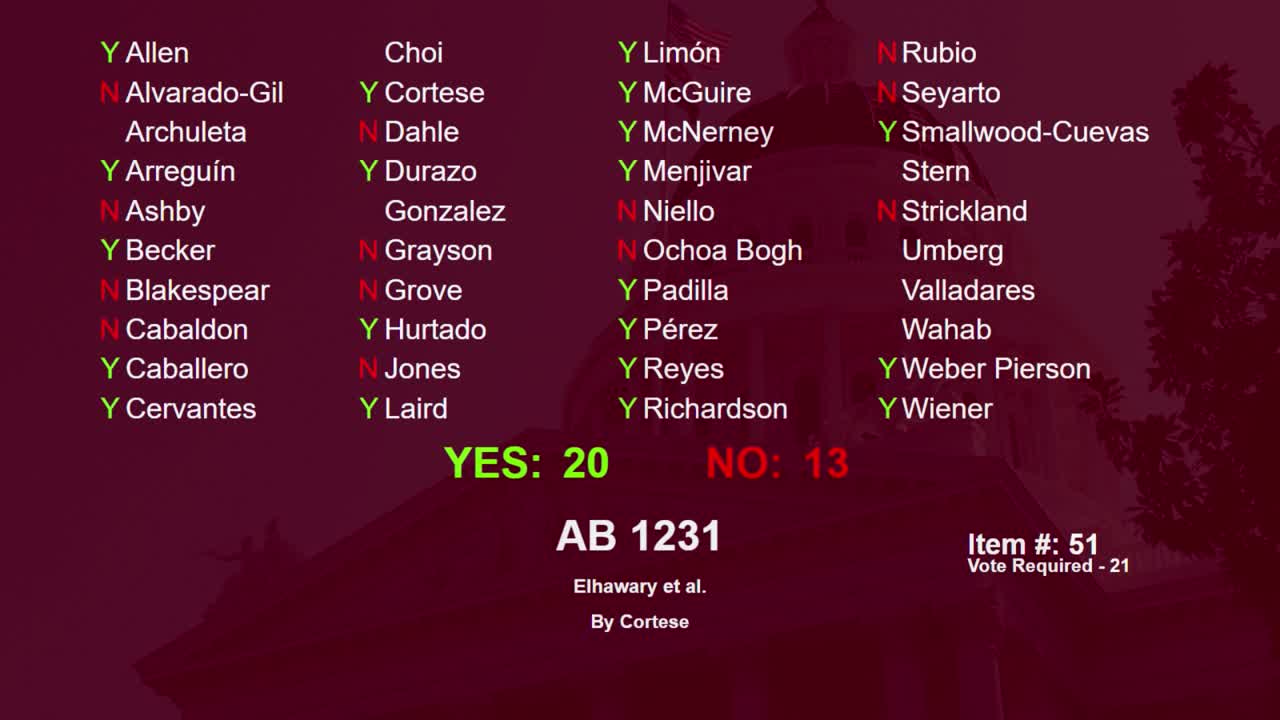 2MIN
Senate Floor
 2MIN
Senate Floor
 2MIN
Assembly Floor
 6MIN
Assembly Standing Committee on Appropriations
 22MIN
Assembly Standing Committee on Water, Parks, and Wildlife
 28MIN
Senate Floor
 7SEC