SB 642: Employment: payment of wages.
- Session Year: 2025-2026
- House: Senate
- Latest Version Date: 2025-10-08
Current Status:
Passed
(2025-10-08: Chaptered by Secretary of State. Chapter 468, Statutes of 2025.)
Introduced
In Committee
Awaiting First Chamber Vote
Passed First Chamber
In Committee
Awaiting Second Chamber Vote
Passed Second Chamber
Enacted
Existing law imposes varying requirements upon employers to share the pay scale for a position with an applicant or in a job posting, as provided. Existing law defines pay scale as the salary or hourly wage range that the employer reasonably expects to pay for the position.
This bill would revise the definition of pay scale to mean an estimate of this expected wage range that an employer reasonably expects to pay for the position upon hire and is made in good faith.
Existing law prohibits an employer from paying its employees at wage rates less than the rates paid to employees of the opposite sex or another race or ethnicity for substantially similar work, except under specified circumstances. Existing law requires a civil action to recover wages for a violation of those provisions to be commenced no later than 2 years after the cause of action occurs or, if the cause of action arises out of a willful violation, no later than 3 years after the cause of action occurs.
This bill would prohibit an employer from paying employees at wage rates less than the rates paid to employees of another sex instead of the opposite sex, and would require a civil action to recover wages to be commenced no later than 3 years after the last date the cause of action occurs. The bill would provide that an employee is entitled to obtain relief for the entire period of time in which a violation of its provisions exists, but not to exceed 6 years.
This bill would specify that a cause of action occurs when an alleged unlawful compensation decision or practice is adopted, when an individual becomes subject to the decision or practice, or when an individual is affected by the application of the decision or practice. The bill would provide that its provisions do not prohibit the application of prescribed legal doctrine. The bill would define wages, wage rates, and sex for purposes of those provisions, and would specify that its provisions shall not be construed to define these terms for other purposes.
Existing law imposes varying requirements upon employers to share the pay scale for a position with an applicant or in a job posting, as provided. Existing law defines pay scale as the salary or hourly wage range that the employer reasonably expects to pay for the position.
This bill would revise the definition of pay scale to mean an estimate of this expected wage range that an employer reasonably expects to pay for the position upon hire and is made in good faith.
Existing law prohibits an employer from paying its employees at wage rates less than the rates paid to employees of the opposite sex or another race or ethnicity for substantially similar work, except under specified circumstances. Existing law requires a civil action to recover wages for a violation of those provisions to be commenced no later than 2 years after the cause of action occurs or, if the cause of action arises out of a willful violation, no later than 3 years after the cause of action occurs.
This bill would prohibit an employer from paying employees at wage rates less than the rates paid to employees of another sex instead of the opposite sex, and would require a civil action to recover wages to be commenced no later than 3 years after the last date the cause of action occurs. The bill would provide that an employee is entitled to obtain relief for the entire period of time in which a violation of its provisions exists, but not to exceed 10 6 years.
This bill would specify that a cause of action occurs when a discriminatory an alleged unlawful compensation decision or practice is adopted, when an individual becomes subject to the decision or practice, or when an individual is affected by the application of the decision or practice. The bill would provide that its provisions do not prohibit the application of prescribed legal doctrine. The bill would define wages, wage rates, and sex for purposes of those provisions, and would specify that its provisions shall not be construed to define these terms for other purposes.
Existing law imposes varying requirements upon employers to share the pay scale for a position with an applicant or in a job posting, as provided. Existing law defines pay scale as the salary or hourly wage range that the employer reasonably expects to pay for the position.
This bill would revise the definition of pay scale to mean an estimate of this expected wage range that an employer reasonably expects to pay for the position upon hire and is made in good faith.
Existing law prohibits an employer from paying its employees at wage rates less than the rates paid to employees of the opposite sex or another race or ethnicity for substantially similar work, except under specified circumstances. Existing law requires a civil action to recover wages for a violation of those provisions to be commenced no later than 2 years after the cause of action occurs or, if the cause of action arises out of a willful violation, no later than 3 years after the cause of action occurs.
This bill would prohibit an employer from paying employees at wage rates less than the rates paid to employees of another sex instead of the opposite sex, and would require a civil action to recover wages to be commenced no later than 3 years after the last date the cause of action occurs. The bill would provide that an employee is entitled to obtain relief for the entire period of time in which a violation of its provisions exists, but not to exceed 10 years.
This bill would specify that a cause of action occurs when a discriminatory compensation decision or practice is adopted, when an individual becomes subject to the decision or practice, or when an individual is affected by the application of the decision or practice. The bill would make a series of discriminatory wage payments actionable as a continuing violation if the discriminatory wage payments arise from an ongoing discriminatory compensation decision or practice. The bill would provide that its provisions do not prohibit the application of prescribed legal doctrine. The bill would define wages, wage rates, and sex for purposes of those provisions. provisions, and would specify that its provisions shall not be construed to define these terms for other purposes.
Existing law imposes varying requirements upon employers to share the pay scale for a position with an applicant or in a job posting, as provided. Existing law defines pay scale as the salary or hourly wage range that the employer reasonably expects to pay for the position.
This bill would revise the definition of pay scale to mean an estimate of this expected wage range that is made in good faith.
Existing law prohibits an employer from paying its employees at wage rates less than the rates paid to employees of the opposite sex or another race or ethnicity for substantially similar work, except under specified circumstances. Existing law requires a civil action to recover wages for a violation of those provisions to be commenced no later than 2 years after the cause of action occurs or, if the cause of action arises out of a willful violation, no later than 3 years after the cause of action occurs.
This bill would prohibit an employer from paying employees at wage rates less than the rates paid to employees of another sex instead of the opposite sex, and would require a civil action to recover wages to be commenced no later than 3 years after the cause of action occurs or 4 years if the cause of action arises out of a willful violation. occurs.
This bill would specify that a cause of action occurs when a discriminatory compensation decision or practice is adopted, when an individual becomes subject to the decision or practice, or when an individual is affected by the application of the decision or practice. The bill would make a series of discriminatory wage payments actionable as a continuing violation if the discriminatory wage payments arise from an ongoing discriminatory compensation decision or practice. The bill would define wages, wage rates, and sex for purposes of those provisions.
Existing law imposes varying requirements upon employers to share the pay scale for a position with an applicant or in a job posting, as provided. Existing law defines pay scale as the salary or hourly wage range that the employer reasonably expects to pay for the position.
This bill would revise the definition of pay scale to mean an estimate of this expected wage range that is made in good faith.
Existing law prohibits an employer from paying its employees at wage rates less than the rates paid to employees of the opposite sex or another race or ethnicity for substantially similar work, except under specified circumstances. Existing law requires a civil action to recover wages for a violation of those provisions to be commenced no later than 2 years after the cause of action occurs or, if the cause of action arises out of a willful violation, no later than 3 years after the cause of action occurs.
This bill would prohibit an employer from paying employees at wage rates less than the rates paid to employees of another sex instead of the opposite sex, and would require a civil action to recover wages to be commenced no later than 3 years after the cause of action occurs or 4 years if the cause of action arises out of a willful violation.
This bill would specify that a cause of action occurs when a discriminatory compensation decision or practice is adopted, when an individual becomes subject to the decision or practice, or when an individual is affected by the application of the decision or practice. The bill would make a series of discriminatory wage payments actionable as a continuing violation if the discriminatory wage payments arise from an ongoing discriminatory compensation decision or practice. The bill would define wages, wage rates, and sex for purposes of those provisions.
The California Constitution requires the state to reimburse local agencies and school districts for certain costs mandated by the state. Statutory provisions establish procedures for making that reimbursement.This bill would provide that no reimbursement is required by this act for a specified reason.Existing law requires an employer, upon reasonable request, to provide the pay scale for a position to an applicant applying for the position. Existing law requires an employer with 15 or more employees to include the pay scale for a position in any job posting. Existing law also requires an employer with 15 or more employees that engages a third party to announce, post, publish, or otherwise make known a job posting to provide the pay scale to the third party and requires the third party to include the pay scale in the job posting. Existing law establishes certain civil penalties for a violation of those provisions, provides for enforcement by the Labor Commissioner of the Division of Labor Standards Enforcement, and makes violation of certain provisions a crime.
This bill would require the pay scale provided for purposes of those provisions to be no more than 10% above or below the mean pay rate within the salary or hourly wage range. By expanding the scope of an existing crime, this bill would impose a state-mandated local program.
Existing law prohibits an employer from paying its employees at wage rates less than the rates paid to employees of the opposite sex or another race or ethnicity for substantially similar work, except under specified circumstances. Existing law requires a civil action to recover wages for a violation of those provisions to be commenced no later than 2 years after the cause of action occurs or, if the cause of action arises out of a willful violation, no later than 3 years after the cause of action occurs.
This bill would prohibit an employer from paying employees at wage rates less than the rates paid to employees of another sex instead of the opposite sex, and would require a civil action to recover wages to be commenced no later than 3 years after the cause of action occurs or 4 years if the cause of action arises out of a willful violation.
This bill would specify that a cause of action occurs when a discriminatory compensation decision or practice is adopted, when an individual becomes subject to the decision or practice, or when an individual is affected by the application of the decision or practice. The bill would make a series of discriminatory wage payments actionable as a continuing violation if the discriminatory wage payments arise from an ongoing discriminatory compensation decision or practice. The bill would define wages, wage rates, and sex for purposes of those provisions.
The California Constitution requires the state to reimburse local agencies and school districts for certain costs mandated by the state. Statutory provisions establish procedures for making that reimbursement.
This bill would provide that no reimbursement is required by this act for a specified reason.
(a)An employer shall not rely on the salary history information of an applicant for employment as a factor in determining whether to offer employment to an applicant or what salary to offer an applicant.
(b)An employer shall not, orally or in writing, personally or through an agent, seek salary history information, including compensation and benefits, about an applicant for employment.
(c)(1)An employer, upon reasonable request, shall provide the pay scale for a position to an applicant applying for employment.
(2)An employer, upon request, shall provide an employee the pay scale for the position in which the employee is currently employed.
(3)An employer with 15 or more employees shall include the pay scale for a position in any job posting.
(4)An employer shall maintain records of a job title and wage rate history for each employee for the duration of the employment plus three years after the end of the employment in order for the Labor Commissioner to determine if there is still a pattern of wage discrepancy. These records shall be open to inspection by the Labor Commissioner.
(5)An employer with 15 or more employees that engages a third party to announce, post, publish, or otherwise make known a job posting shall provide the pay scale to the third party. The third party shall include the pay scale in the job posting.
(d)(1)A person who claims to be aggrieved by a violation of this section may file a written complaint with the Labor Commissioner within one year after the date the person learned of the violation. The complaint shall state the name and address of the employer and shall provide a detailed account of the alleged violation, as may be required by the Labor Commissioner.
(2)A person who claims to be aggrieved by a violation of this section may also bring a civil action for injunctive relief and any other relief that the court deems appropriate.
(3)The Labor Commissioner shall promptly investigate complaints alleging violation of this section.
(4)Upon finding that an employer has violated this section, the Labor Commissioner may order the employer to pay a civil penalty of no less than one hundred dollars ($100) and no more than ten thousand dollars ($10,000) per violation. The Labor Commissioner shall determine the amount of the penalty based on the totality of the circumstances, including, but not limited to, whether the employer has previously violated this section. For a first violation of subdivision (c), no penalty shall be assessed upon demonstration by the employer that all job postings for open positions have been updated to include the pay scale as required by this section.
(5)If an employer fails to keep records in violation of this section, there shall be a rebuttable presumption in favor of the employees claim.
(e)Section 433 does not apply to this section.
(f)This section does not apply to salary history information disclosable to the public pursuant to federal or state law, including the California Public Records Act (Division 10 (commencing with Section 7920.000) of Title 1 of the Government Code) or the federal Freedom of Information Act (Section 552 of Title 5 of the United States Code).
(g)This section applies to all employers, including state and local government employers and the Legislature.
(h)Nothing in this section shall prohibit an applicant from voluntarily and without prompting disclosing salary history information to a prospective employer.
(i)If an applicant voluntarily and without prompting discloses salary history information to a prospective employer, nothing in this section shall prohibit that employer from considering or relying on that voluntarily disclosed salary history information in determining the salary for that applicant.
(j)Nothing in this section shall prohibit an employer from asking an applicant about the applicants salary expectation for the position being applied for.
(k)Consistent with Section 1197.5, nothing in this section shall be construed to allow prior salary to justify any disparity in compensation.
(l)All civil penalties collected pursuant to this section shall be deposited into the Labor Enforcement and Compliance Fund for distribution to the Division of Labor Standards Enforcement. Upon appropriation by the Legislature, these funds may be expended by the division to cover reasonable ongoing costs of administering and enforcing this section.
(m)For purposes of this section, all of the following shall apply:
(1)Pay scale means a good faith estimate of the salary or hourly wage range that the employer reasonably expects to pay for the position upon hire.
(2)Applicant or applicant for employment means an individual who is seeking employment with the employer and is not currently employed with that employer in any capacity or position.
SEC. 2.Section 1197.5 of the Labor Code is amended to read:1197.5.(a)An employer shall not pay any of its employees at wage rates less than the rates paid to employees of another sex for substantially similar work, when viewed as a composite of skill, effort, and responsibility, and performed under similar working conditions, except where the employer demonstrates:
(1)The wage differential is based upon one or more of the following factors:
(A)A seniority system.
(B)A merit system.
(C)A system that measures earnings by quantity or quality of production.
(D)A bona fide factor other than sex, such as education, training, or experience. This factor shall apply only if the employer demonstrates that the factor is not based on or derived from a sex-based differential in compensation, is job related with respect to the position in question, and is consistent with a business necessity. For purposes of this subparagraph, business necessity means an overriding legitimate business purpose such that the factor relied upon effectively fulfills the business purpose it is supposed to serve. This defense shall not apply if the employee demonstrates that an alternative business practice exists that would serve the same business purpose without producing the wage differential.
(2)Each factor relied upon is applied reasonably.
(3)The one or more factors relied upon account for the entire wage differential.
(4)Prior salary shall not justify any disparity in compensation. Nothing in this section shall be interpreted to mean that an employer may not make a compensation decision based on a current employees existing salary, so long as any wage differential resulting from that compensation decision is justified by one or more of the factors in this subdivision.
(b)An employer shall not pay any of its employees at wage rates less than the rates paid to employees of another race or ethnicity for substantially similar work, when viewed as a composite of skill, effort, and responsibility, and performed under similar working conditions, except where the employer demonstrates:
(1)The wage differential is based upon one or more of the following factors:
(A)A seniority system.
(B)A merit system.
(C)A system that measures earnings by quantity or quality of production.
(D)A bona fide factor other than race or ethnicity, such as education, training, or experience. This factor shall apply only if the employer demonstrates that the factor is not based on or derived from a race- or ethnicity-based differential in compensation, is job related with respect to the position in question, and is consistent with a business necessity. For purposes of this subparagraph, business necessity means an overriding legitimate business purpose such that the factor relied upon effectively fulfills the business purpose it is supposed to serve. This defense shall not apply if the employee demonstrates that an alternative business practice exists that would serve the same business purpose without producing the wage differential.
(2)Each factor relied upon is applied reasonably.
(3)The one or more factors relied upon account for the entire wage differential.
(4)Prior salary shall not justify any disparity in compensation. Nothing in this section shall be interpreted to mean that an employer may not make a compensation decision based on a current employees existing salary, so long as any wage differential resulting from that compensation decision is justified by one or more of the factors listed in this subdivision.
(c)Any employer who violates subdivision (a) or (b) is liable to the employee affected in the amount of the wages, and interest thereon, of which the employee is deprived by reason of the violation, and an additional equal amount as liquidated damages.
(d)The Division of Labor Standards Enforcement shall administer and enforce this section. If the division finds that an employer has violated this section, it may supervise the payment of wages and interest found to be due and unpaid to employees under subdivision (a) or (b). Acceptance of payment in full made by an employer and approved by the division shall constitute a waiver on the part of the employee of the employees cause of action under subdivision (h).
(e)Every employer shall maintain records of the wages and wage rates, job classifications, and other terms and conditions of employment of the persons employed by the employer. All of the records shall be kept on file for a period of three years.
(f)Any employee may file a complaint with the division that the wages paid are less than the wages to which the employee is entitled under subdivision (a) or (b) or that the employer is in violation of subdivision (k). The complaint shall be investigated as provided in subdivision (b) of Section 98.7. The division shall keep confidential the name of any employee who submits to the division a complaint regarding an alleged violation of subdivision (a), (b), or (k) until the division establishes the validity of the complaint, unless the division must abridge confidentiality to investigate the complaint. The name of the complaining employee shall remain confidential if the complaint is withdrawn before the confidentiality is abridged by the division. The division shall take all proceedings necessary to enforce the payment of any sums found to be due and unpaid to these employees.
(g)The department or division may commence and prosecute, unless otherwise requested by the employee or affected group of employees, a civil action on behalf of the employee and on behalf of a similarly affected group of employees to recover unpaid wages and liquidated damages under subdivision (a) or (b), and in addition shall be entitled to recover costs of suit. The consent of any employee to the bringing of any action shall constitute a waiver on the part of the employee of the employees cause of action under subdivision (h) unless the action is dismissed without prejudice by the department or the division, except that the employee may intervene in the suit or may initiate independent action if the suit has not been determined within 180 days from the date of the filing of the complaint.
(h)An employee receiving less than the wage to which the employee is entitled under this section may recover in a civil action the balance of the wages, including interest thereon, and an equal amount as liquidated damages, together with the costs of the suit and reasonable attorneys fees, notwithstanding any agreement to work for a lesser wage.
(i)(1)A civil action to recover wages under subdivision (a) or (b) may be commenced no later than three years after the last date the cause of action occurs.
(2)An employee is entitled to obtain relief for the entire period of time in which a violation of subdivision (a) or (b) exists, but not to exceed six years.
(3)For purposes of this subdivision, a cause of action occurs when any of the following occur:
(A)An alleged unlawful compensation decision or other practice is adopted.
(B)An individual becomes subject to an alleged unlawful compensation decision or other practice.
(C)When an individual is affected by application of an alleged unlawful compensation decision or other practice, including each time wages, benefits, or other compensation is paid, resulting in whole or in part from the decision or other practice.
(4)Nothing in this subdivision shall prohibit the application of the doctrine of continuing violation or the discovery rule to any appropriate claim.
(j)If an employee recovers amounts due to the employee under subdivision (c), and also files a complaint or brings an action under subdivision (d) of Section 206 of Title 29 of the United States Code which results in an additional recovery under federal law for the same violation, the employee shall return to the employer the amounts recovered under subdivision (c), or the amounts recovered under federal law, whichever is less.
(k)(1)An employer shall not discharge, or in any manner discriminate or retaliate against, any employee by reason of any action taken by the employee to invoke or assist in any manner the enforcement of this section. If an employer engages in any action prohibited by this section within 90 days of the protected activity specified in this section, there shall be a rebuttable presumption in favor of the employees claim. An employer shall not prohibit an employee from disclosing the employees own wages, discussing the wages of others, inquiring about another employees wages, or aiding or encouraging any other employee to exercise their rights under this section. Nothing in this section creates an obligation to disclose wages.
(2)Any employee who has been discharged, discriminated or retaliated against, in the terms and conditions of their employment because the employee engaged in any conduct delineated in this section may recover in a civil action reinstatement and reimbursement for lost wages and work benefits caused by the acts of the employer, including interest thereon, as well as appropriate equitable relief.
(3)A civil action brought under this subdivision may be commenced no later than one year after the cause of action occurs.
(l)As used in this section:
(1)Employer includes public and private employers. Section 1199.5 does not apply to a public employer.
(2)Sex has the same meaning as defined in Section 12926 of the Government Code.
(3)Wages and wage rates include all forms of pay, including, but not limited to, salary, overtime pay, bonuses, stock, stock options, profit sharing and bonus plans, life insurance, vacation and holiday pay, cleaning or gasoline allowances, hotel accommodations, reimbursement for travel expenses, and benefits. Nothing in this paragraph shall be construed to define wages or wage rates for purposes of any other section of this code.
(a)An employer shall not rely on the salary history information of an applicant for employment as a factor in determining whether to offer employment to an applicant or what salary to offer an applicant.
(b)An employer shall not, orally or in writing, personally or through an agent, seek salary history information, including compensation and benefits, about an applicant for employment.
(c)(1)An employer, upon reasonable request, shall provide the pay scale for a position to an applicant applying for employment.
(2)An employer, upon request, shall provide an employee the pay scale for the position in which the employee is currently employed.
(3)An employer with 15 or more employees shall include the pay scale for a position in any job posting.
(4)An employer shall maintain records of a job title and wage rate history for each employee for the duration of the employment plus three years after the end of the employment in order for the Labor Commissioner to determine if there is still a pattern of wage discrepancy. These records shall be open to inspection by the Labor Commissioner.
(5)An employer with 15 or more employees that engages a third party to announce, post, publish, or otherwise make known a job posting shall provide the pay scale to the third party. The third party shall include the pay scale in the job posting.
(d)(1)A person who claims to be aggrieved by a violation of this section may file a written complaint with the Labor Commissioner within one year after the date the person learned of the violation. The complaint shall state the name and address of the employer and shall provide a detailed account of the alleged violation, as may be required by the Labor Commissioner.
(2)A person who claims to be aggrieved by a violation of this section may also bring a civil action for injunctive relief and any other relief that the court deems appropriate.
(3)The Labor Commissioner shall promptly investigate complaints alleging violation of this section.
(4)Upon finding that an employer has violated this section, the Labor Commissioner may order the employer to pay a civil penalty of no less than one hundred dollars ($100) and no more than ten thousand dollars ($10,000) per violation. The Labor Commissioner shall determine the amount of the penalty based on the totality of the circumstances, including, but not limited to, whether the employer has previously violated this section. For a first violation of subdivision (c), no penalty shall be assessed upon demonstration by the employer that all job postings for open positions have been updated to include the pay scale as required by this section.
(5)If an employer fails to keep records in violation of this section, there shall be a rebuttable presumption in favor of the employees claim.
(e)Section 433 does not apply to this section.
(f)This section does not apply to salary history information disclosable to the public pursuant to federal or state law, including the California Public Records Act (Division 10 (commencing with Section 7920.000) of Title 1 of the Government Code) or the federal Freedom of Information Act (Section 552 of Title 5 of the United States Code).
(g)This section applies to all employers, including state and local government employers and the Legislature.
(h)Nothing in this section shall prohibit an applicant from voluntarily and without prompting disclosing salary history information to a prospective employer.
(i)If an applicant voluntarily and without prompting discloses salary history information to a prospective employer, nothing in this section shall prohibit that employer from considering or relying on that voluntarily disclosed salary history information in determining the salary for that applicant.
(j)Nothing in this section shall prohibit an employer from asking an applicant about the applicants salary expectation for the position being applied for.
(k)Consistent with Section 1197.5, nothing in this section shall be construed to allow prior salary to justify any disparity in compensation.
(l)All civil penalties collected pursuant to this section shall be deposited into the Labor Enforcement and Compliance Fund for distribution to the Division of Labor Standards Enforcement. Upon appropriation by the Legislature, these funds may be expended by the division to cover reasonable ongoing costs of administering and enforcing this section.
(m)For purposes of this section, all of the following shall apply:
(1)Pay scale means a good faith estimate of the salary or hourly wage range that the employer reasonably expects to pay for the position upon hire.
(2)Applicant or applicant for employment means an individual who is seeking employment with the employer and is not currently employed with that employer in any capacity or position.
SEC. 2.Section 1197.5 of the Labor Code is amended to read:1197.5.(a)An employer shall not pay any of its employees at wage rates less than the rates paid to employees of another sex for substantially similar work, when viewed as a composite of skill, effort, and responsibility, and performed under similar working conditions, except where the employer demonstrates:
(1)The wage differential is based upon one or more of the following factors:
(A)A seniority system.
(B)A merit system.
(C)A system that measures earnings by quantity or quality of production.
(D)A bona fide factor other than sex, such as education, training, or experience. This factor shall apply only if the employer demonstrates that the factor is not based on or derived from a sex-based differential in compensation, is job related with respect to the position in question, and is consistent with a business necessity. For purposes of this subparagraph, business necessity means an overriding legitimate business purpose such that the factor relied upon effectively fulfills the business purpose it is supposed to serve. This defense shall not apply if the employee demonstrates that an alternative business practice exists that would serve the same business purpose without producing the wage differential.
(2)Each factor relied upon is applied reasonably.
(3)The one or more factors relied upon account for the entire wage differential.
(4)Prior salary shall not justify any disparity in compensation. Nothing in this section shall be interpreted to mean that an employer may not make a compensation decision based on a current employees existing salary, so long as any wage differential resulting from that compensation decision is justified by one or more of the factors in this subdivision.
(b)An employer shall not pay any of its employees at wage rates less than the rates paid to employees of another race or ethnicity for substantially similar work, when viewed as a composite of skill, effort, and responsibility, and performed under similar working conditions, except where the employer demonstrates:
(1)The wage differential is based upon one or more of the following factors:
(A)A seniority system.
(B)A merit system.
(C)A system that measures earnings by quantity or quality of production.
(D)A bona fide factor other than race or ethnicity, such as education, training, or experience. This factor shall apply only if the employer demonstrates that the factor is not based on or derived from a race- or ethnicity-based differential in compensation, is job related with respect to the position in question, and is consistent with a business necessity. For purposes of this subparagraph, business necessity means an overriding legitimate business purpose such that the factor relied upon effectively fulfills the business purpose it is supposed to serve. This defense shall not apply if the employee demonstrates that an alternative business practice exists that would serve the same business purpose without producing the wage differential.
(2)Each factor relied upon is applied reasonably.
(3)The one or more factors relied upon account for the entire wage differential.
(4)Prior salary shall not justify any disparity in compensation. Nothing in this section shall be interpreted to mean that an employer may not make a compensation decision based on a current employees existing salary, so long as any wage differential resulting from that compensation decision is justified by one or more of the factors listed in this subdivision.
(c)Any employer who violates subdivision (a) or (b) is liable to the employee affected in the amount of the wages, and interest thereon, of which the employee is deprived by reason of the violation, and an additional equal amount as liquidated damages.
(d)The Division of Labor Standards Enforcement shall administer and enforce this section. If the division finds that an employer has violated this section, it may supervise the payment of wages and interest found to be due and unpaid to employees under subdivision (a) or (b). Acceptance of payment in full made by an employer and approved by the division shall constitute a waiver on the part of the employee of the employees cause of action under subdivision (h).
(e)Every employer shall maintain records of the wages and wage rates, job classifications, and other terms and conditions of employment of the persons employed by the employer. All of the records shall be kept on file for a period of three years.
(f)Any employee may file a complaint with the division that the wages paid are less than the wages to which the employee is entitled under subdivision (a) or (b) or that the employer is in violation of subdivision (k). The complaint shall be investigated as provided in subdivision (b) of Section 98.7. The division shall keep confidential the name of any employee who submits to the division a complaint regarding an alleged violation of subdivision (a), (b), or (k) until the division establishes the validity of the complaint, unless the division must abridge confidentiality to investigate the complaint. The name of the complaining employee shall remain confidential if the complaint is withdrawn before the confidentiality is abridged by the division. The division shall take all proceedings necessary to enforce the payment of any sums found to be due and unpaid to these employees.
(g)The department or division may commence and prosecute, unless otherwise requested by the employee or affected group of employees, a civil action on behalf of the employee and on behalf of a similarly affected group of employees to recover unpaid wages and liquidated damages under subdivision (a) or (b), and in addition shall be entitled to recover costs of suit. The consent of any employee to the bringing of any action shall constitute a waiver on the part of the employee of the employees cause of action under subdivision (h) unless the action is dismissed without prejudice by the department or the division, except that the employee may intervene in the suit or may initiate independent action if the suit has not been determined within 180 days from the date of the filing of the complaint.
(h)An employee receiving less than the wage to which the employee is entitled under this section may recover in a civil action the balance of the wages, including interest thereon, and an equal amount as liquidated damages, together with the costs of the suit and reasonable attorneys fees, notwithstanding any agreement to work for a lesser wage.
(i)(1)A civil action to recover wages under subdivision (a) or (b) may be commenced no later than three years after the last date the cause of action occurs.
(2)An employee is entitled to obtain relief for the entire period of time in which a violation of subdivision (a) or (b) exists, but not to exceed 10 six years.
(3)For purposes of this subdivision, a cause of action occurs when any of the following occur:
(A)A discriminatory An alleged unlawful compensation decision or other practice is adopted.
(B)An individual becomes subject to a discriminatory an alleged unlawful compensation decision or other practice.
(C)When an individual is affected by application of a discriminatory an alleged unlawful compensation decision or other practice, including each time wages, benefits, or other compensation is paid, resulting in whole or in part from the decision or other practice.
(4)Nothing in this subdivision shall prohibit the application of the doctrine of continuing violation or the discovery rule to any appropriate claim.
(j)If an employee recovers amounts due to the employee under subdivision (c), and also files a complaint or brings an action under subdivision (d) of Section 206 of Title 29 of the United States Code which results in an additional recovery under federal law for the same violation, the employee shall return to the employer the amounts recovered under subdivision (c), or the amounts recovered under federal law, whichever is less.
(k)(1)An employer shall not discharge, or in any manner discriminate or retaliate against, any employee by reason of any action taken by the employee to invoke or assist in any manner the enforcement of this section. If an employer engages in any action prohibited by this section within 90 days of the protected activity specified in this section, there shall be a rebuttable presumption in favor of the employees claim. An employer shall not prohibit an employee from disclosing the employees own wages, discussing the wages of others, inquiring about another employees wages, or aiding or encouraging any other employee to exercise their rights under this section. Nothing in this section creates an obligation to disclose wages.
(2)Any employee who has been discharged, discriminated or retaliated against, in the terms and conditions of their employment because the employee engaged in any conduct delineated in this section may recover in a civil action reinstatement and reimbursement for lost wages and work benefits caused by the acts of the employer, including interest thereon, as well as appropriate equitable relief.
(3)A civil action brought under this subdivision may be commenced no later than one year after the cause of action occurs.
(l)As used in this section:
(1)Employer includes public and private employers. Section 1199.5 does not apply to a public employer.
(2)Sex has the same meaning as defined in Section 12926 of the Government Code.
(3)Wages and wage rates include all forms of pay, including, but not limited to, salary, overtime pay, bonuses, stock, stock options, profit sharing and bonus plans, life insurance, vacation and holiday pay, cleaning or gasoline allowances, hotel accommodations, reimbursement for travel expenses, and benefits. Nothing in this paragraph shall be construed to define wages or wage rates for purposes of any other section of this code.
(a)An employer shall not rely on the salary history information of an applicant for employment as a factor in determining whether to offer employment to an applicant or what salary to offer an applicant.
(b)An employer shall not, orally or in writing, personally or through an agent, seek salary history information, including compensation and benefits, about an applicant for employment.
(c)(1)An employer, upon reasonable request, shall provide the pay scale for a position to an applicant applying for employment.
(2)An employer, upon request, shall provide an employee the pay scale for the position in which the employee is currently employed.
(3)An employer with 15 or more employees shall include the pay scale for a position in any job posting.
(4)An employer shall maintain records of a job title and wage rate history for each employee for the duration of the employment plus three years after the end of the employment in order for the Labor Commissioner to determine if there is still a pattern of wage discrepancy. These records shall be open to inspection by the Labor Commissioner.
(5)An employer with 15 or more employees that engages a third party to announce, post, publish, or otherwise make known a job posting shall provide the pay scale to the third party. The third party shall include the pay scale in the job posting.
(d)(1)A person who claims to be aggrieved by a violation of this section may file a written complaint with the Labor Commissioner within one year after the date the person learned of the violation. The complaint shall state the name and address of the employer and shall provide a detailed account of the alleged violation, as may be required by the Labor Commissioner.
(2)A person who claims to be aggrieved by a violation of this section may also bring a civil action for injunctive relief and any other relief that the court deems appropriate.
(3)The Labor Commissioner shall promptly investigate complaints alleging violation of this section.
(4)Upon finding that an employer has violated this section, the Labor Commissioner may order the employer to pay a civil penalty of no less than one hundred dollars ($100) and no more than ten thousand dollars ($10,000) per violation. The Labor Commissioner shall determine the amount of the penalty based on the totality of the circumstances, including, but not limited to, whether the employer has previously violated this section. For a first violation of subdivision (c), no penalty shall be assessed upon demonstration by the employer that all job postings for open positions have been updated to include the pay scale as required by this section.
(5)If an employer fails to keep records in violation of this section, there shall be a rebuttable presumption in favor of the employees claim.
(e)Section 433 does not apply to this section.
(f)This section does not apply to salary history information disclosable to the public pursuant to federal or state law, including the California Public Records Act (Division 10 (commencing with Section 7920.000) of Title 1 of the Government Code) or the federal Freedom of Information Act (Section 552 of Title 5 of the United States Code).
(g)This section applies to all employers, including state and local government employers and the Legislature.
(h)Nothing in this section shall prohibit an applicant from voluntarily and without prompting disclosing salary history information to a prospective employer.
(i)If an applicant voluntarily and without prompting discloses salary history information to a prospective employer, nothing in this section shall prohibit that employer from considering or relying on that voluntarily disclosed salary history information in determining the salary for that applicant.
(j)Nothing in this section shall prohibit an employer from asking an applicant about the applicants salary expectation for the position being applied for.
(k)Consistent with Section 1197.5, nothing in this section shall be construed to allow prior salary to justify any disparity in compensation.
(l)All civil penalties collected pursuant to this section shall be deposited into the Labor Enforcement and Compliance Fund for distribution to the Division of Labor Standards Enforcement. Upon appropriation by the Legislature, these funds may be expended by the division to cover reasonable ongoing costs of administering and enforcing this section.
(m)For purposes of this section, all of the following shall apply:
(1)Pay scale means a good faith estimate of the salary or hourly wage range that the employer reasonably expects to pay for the position. position upon hire.
(2)Applicant or applicant for employment means an individual who is seeking employment with the employer and is not currently employed with that employer in any capacity or position.
SEC. 2.Section 1197.5 of the Labor Code is amended to read:1197.5.(a)An employer shall not pay any of its employees at wage rates less than the rates paid to employees of another sex for substantially similar work, when viewed as a composite of skill, effort, and responsibility, and performed under similar working conditions, except where the employer demonstrates:
(1)The wage differential is based upon one or more of the following factors:
(A)A seniority system.
(B)A merit system.
(C)A system that measures earnings by quantity or quality of production.
(D)A bona fide factor other than sex, such as education, training, or experience. This factor shall apply only if the employer demonstrates that the factor is not based on or derived from a sex-based differential in compensation, is job related with respect to the position in question, and is consistent with a business necessity. For purposes of this subparagraph, business necessity means an overriding legitimate business purpose such that the factor relied upon effectively fulfills the business purpose it is supposed to serve. This defense shall not apply if the employee demonstrates that an alternative business practice exists that would serve the same business purpose without producing the wage differential.
(2)Each factor relied upon is applied reasonably.
(3)The one or more factors relied upon account for the entire wage differential.
(4)Prior salary shall not justify any disparity in compensation. Nothing in this section shall be interpreted to mean that an employer may not make a compensation decision based on a current employees existing salary, so long as any wage differential resulting from that compensation decision is justified by one or more of the factors in this subdivision.
(b)An employer shall not pay any of its employees at wage rates less than the rates paid to employees of another race or ethnicity for substantially similar work, when viewed as a composite of skill, effort, and responsibility, and performed under similar working conditions, except where the employer demonstrates:
(1)The wage differential is based upon one or more of the following factors:
(A)A seniority system.
(B)A merit system.
(C)A system that measures earnings by quantity or quality of production.
(D)A bona fide factor other than race or ethnicity, such as education, training, or experience. This factor shall apply only if the employer demonstrates that the factor is not based on or derived from a race- or ethnicity-based differential in compensation, is job related with respect to the position in question, and is consistent with a business necessity. For purposes of this subparagraph, business necessity means an overriding legitimate business purpose such that the factor relied upon effectively fulfills the business purpose it is supposed to serve. This defense shall not apply if the employee demonstrates that an alternative business practice exists that would serve the same business purpose without producing the wage differential.
(2)Each factor relied upon is applied reasonably.
(3)The one or more factors relied upon account for the entire wage differential.
(4)Prior salary shall not justify any disparity in compensation. Nothing in this section shall be interpreted to mean that an employer may not make a compensation decision based on a current employees existing salary, so long as any wage differential resulting from that compensation decision is justified by one or more of the factors listed in this subdivision.
(c)Any employer who violates subdivision (a) or (b) is liable to the employee affected in the amount of the wages, and interest thereon, of which the employee is deprived by reason of the violation, and an additional equal amount as liquidated damages.
(d)The Division of Labor Standards Enforcement shall administer and enforce this section. If the division finds that an employer has violated this section, it may supervise the payment of wages and interest found to be due and unpaid to employees under subdivision (a) or (b). Acceptance of payment in full made by an employer and approved by the division shall constitute a waiver on the part of the employee of the employees cause of action under subdivision (h).
(e)Every employer shall maintain records of the wages and wage rates, job classifications, and other terms and conditions of employment of the persons employed by the employer. All of the records shall be kept on file for a period of three years.
(f)Any employee may file a complaint with the division that the wages paid are less than the wages to which the employee is entitled under subdivision (a) or (b) or that the employer is in violation of subdivision (k). The complaint shall be investigated as provided in subdivision (b) of Section 98.7. The division shall keep confidential the name of any employee who submits to the division a complaint regarding an alleged violation of subdivision (a), (b), or (k) until the division establishes the validity of the complaint, unless the division must abridge confidentiality to investigate the complaint. The name of the complaining employee shall remain confidential if the complaint is withdrawn before the confidentiality is abridged by the division. The division shall take all proceedings necessary to enforce the payment of any sums found to be due and unpaid to these employees.
(g)The department or division may commence and prosecute, unless otherwise requested by the employee or affected group of employees, a civil action on behalf of the employee and on behalf of a similarly affected group of employees to recover unpaid wages and liquidated damages under subdivision (a) or (b), and in addition shall be entitled to recover costs of suit. The consent of any employee to the bringing of any action shall constitute a waiver on the part of the employee of the employees cause of action under subdivision (h) unless the action is dismissed without prejudice by the department or the division, except that the employee may intervene in the suit or may initiate independent action if the suit has not been determined within 180 days from the date of the filing of the complaint.
(h)An employee receiving less than the wage to which the employee is entitled under this section may recover in a civil action the balance of the wages, including interest thereon, and an equal amount as liquidated damages, together with the costs of the suit and reasonable attorneys fees, notwithstanding any agreement to work for a lesser wage.
(i)(1)A civil action to recover wages under subdivision (a) or (b) may be commenced no later than three years after the last date the cause of action occurs.
(2)An employee is entitled to obtain relief for the entire period of time in which a violation of subdivision (a) or (b) exists, but not to exceed 10 years.
(2)(3)For purposes of this subdivision, a cause of action occurs when any of the following occur:
(A)A discriminatory compensation decision or other practice is adopted.
(B)An individual becomes subject to a discriminatory compensation decision or other practice.
(C)When an individual is affected by application of a discriminatory compensation decision or other practice, including each time wages, benefits, or other compensation is paid, resulting in whole or in part from the decision or other practice.
(3)A series of discriminatory wage payments shall be actionable as a continuing violation if the discriminatory wage payments arise in whole or in part from an ongoing discriminatory compensation decision or practice.(4)Nothing in this subdivision shall prohibit the application of the doctrine of continuing violation or the discovery rule to any appropriate claim.
(j)If an employee recovers amounts due to the employee under subdivision (c), and also files a complaint or brings an action under subdivision (d) of Section 206 of Title 29 of the United States Code which results in an additional recovery under federal law for the same violation, the employee shall return to the employer the amounts recovered under subdivision (c), or the amounts recovered under federal law, whichever is less.
(k)(1)An employer shall not discharge, or in any manner discriminate or retaliate against, any employee by reason of any action taken by the employee to invoke or assist in any manner the enforcement of this section. If an employer engages in any action prohibited by this section within 90 days of the protected activity specified in this section, there shall be a rebuttable presumption in favor of the employees claim. An employer shall not prohibit an employee from disclosing the employees own wages, discussing the wages of others, inquiring about another employees wages, or aiding or encouraging any other employee to exercise their rights under this section. Nothing in this section creates an obligation to disclose wages.
(2)Any employee who has been discharged, discriminated or retaliated against, in the terms and conditions of their employment because the employee engaged in any conduct delineated in this section may recover in a civil action reinstatement and reimbursement for lost wages and work benefits caused by the acts of the employer, including interest thereon, as well as appropriate equitable relief.
(3)A civil action brought under this subdivision may be commenced no later than one year after the cause of action occurs.
(l)As used in this section:
(1)Employer includes public and private employers. Section 1199.5 does not apply to a public employer.
(2)Sex has the same meaning as defined in Section 12926 of the Government Code.
(3)Wages and wage rates include all forms of pay, including, but not limited to, salary, overtime pay, bonuses, stock, stock options, profit sharing and bonus plans, life insurance, vacation and holiday pay, cleaning or gasoline allowances, hotel accommodations, reimbursement for travel expenses, and benefits. Nothing in this paragraph shall be construed to define wages or wage rates for purposes of any other section of this code.
REVISIONS: HeadingLine 2.(a)An employer shall not rely on the salary history information of an applicant for employment as a factor in determining whether to offer employment to an applicant or what salary to offer an applicant.
(b)An employer shall not, orally or in writing, personally or through an agent, seek salary history information, including compensation and benefits, about an applicant for employment.
(c)(1)An employer, upon reasonable request, shall provide the pay scale for a position to an applicant applying for employment.
(2)An employer, upon request, shall provide an employee the pay scale for the position in which the employee is currently employed.
(3)An employer with 15 or more employees shall include the pay scale for a position in any job posting.
(4)An employer shall maintain records of a job title and wage rate history for each employee for the duration of the employment plus three years after the end of the employment in order for the Labor Commissioner to determine if there is still a pattern of wage discrepancy. These records shall be open to inspection by the Labor Commissioner.
(5)An employer with 15 or more employees that engages a third party to announce, post, publish, or otherwise make known a job posting shall provide the pay scale to the third party. The third party shall include the pay scale in the job posting.
(d)(1)A person who claims to be aggrieved by a violation of this section may file a written complaint with the Labor Commissioner within one year after the date the person learned of the violation. The complaint shall state the name and address of the employer and shall provide a detailed account of the alleged violation, as may be required by the Labor Commissioner.
(2)A person who claims to be aggrieved by a violation of this section may also bring a civil action for injunctive relief and any other relief that the court deems appropriate.
(3)The Labor Commissioner shall promptly investigate complaints alleging violation of this section.
(4)Upon finding that an employer has violated this section, the Labor Commissioner may order the employer to pay a civil penalty of no less than one hundred dollars ($100) and no more than ten thousand dollars ($10,000) per violation. The Labor Commissioner shall determine the amount of the penalty based on the totality of the circumstances, including, but not limited to, whether the employer has previously violated this section. For a first violation of subdivision (c), no penalty shall be assessed upon demonstration by the employer that all job postings for open positions have been updated to include the pay scale as required by this section.
(5)If an employer fails to keep records in violation of this section, there shall be a rebuttable presumption in favor of the employees claim.
(e)Section 433 does not apply to this section.
(f)This section does not apply to salary history information disclosable to the public pursuant to federal or state law, including the California Public Records Act (Division 10 (commencing with Section 7920.000) of Title 1 of the Government Code) or the federal Freedom of Information Act (Section 552 of Title 5 of the United States Code).
(g)This section applies to all employers, including state and local government employers and the Legislature.
(h)Nothing in this section shall prohibit an applicant from voluntarily and without prompting disclosing salary history information to a prospective employer.
(i)If an applicant voluntarily and without prompting discloses salary history information to a prospective employer, nothing in this section shall prohibit that employer from considering or relying on that voluntarily disclosed salary history information in determining the salary for that applicant.
(j)Nothing in this section shall prohibit an employer from asking an applicant about the applicants salary expectation for the position being applied for.
(k)Consistent with Section 1197.5, nothing in this section shall be construed to allow prior salary to justify any disparity in compensation.
(l)All civil penalties collected pursuant to this section shall be deposited into the Labor Enforcement and Compliance Fund for distribution to the Division of Labor Standards Enforcement. Upon appropriation by the Legislature, these funds may be expended by the division to cover reasonable ongoing costs of administering and enforcing this section.
(m)For purposes of this section, all of the following shall apply:
(1)Pay scale means a good faith estimate of the salary or hourly wage range that the employer reasonably expects to pay for the position.
(2)Applicant or applicant for employment means an individual who is seeking employment with the employer and is not currently employed with that employer in any capacity or position.
SEC. 2.Section 1197.5 of the Labor Code is amended to read:1197.5.(a)An employer shall not pay any of its employees at wage rates less than the rates paid to employees of another sex for substantially similar work, when viewed as a composite of skill, effort, and responsibility, and performed under similar working conditions, except where the employer demonstrates:
(1)The wage differential is based upon one or more of the following factors:
(A)A seniority system.
(B)A merit system.
(C)A system that measures earnings by quantity or quality of production.
(D)A bona fide factor other than sex, such as education, training, or experience. This factor shall apply only if the employer demonstrates that the factor is not based on or derived from a sex-based differential in compensation, is job related with respect to the position in question, and is consistent with a business necessity. For purposes of this subparagraph, business necessity means an overriding legitimate business purpose such that the factor relied upon effectively fulfills the business purpose it is supposed to serve. This defense shall not apply if the employee demonstrates that an alternative business practice exists that would serve the same business purpose without producing the wage differential.
(2)Each factor relied upon is applied reasonably.
(3)The one or more factors relied upon account for the entire wage differential.
(4)Prior salary shall not justify any disparity in compensation. Nothing in this section shall be interpreted to mean that an employer may not make a compensation decision based on a current employees existing salary, so long as any wage differential resulting from that compensation decision is justified by one or more of the factors in this subdivision.
(b)An employer shall not pay any of its employees at wage rates less than the rates paid to employees of another race or ethnicity for substantially similar work, when viewed as a composite of skill, effort, and responsibility, and performed under similar working conditions, except where the employer demonstrates:
(1)The wage differential is based upon one or more of the following factors:
(A)A seniority system.
(B)A merit system.
(C)A system that measures earnings by quantity or quality of production.
(D)A bona fide factor other than race or ethnicity, such as education, training, or experience. This factor shall apply only if the employer demonstrates that the factor is not based on or derived from a race- or ethnicity-based differential in compensation, is job related with respect to the position in question, and is consistent with a business necessity. For purposes of this subparagraph, business necessity means an overriding legitimate business purpose such that the factor relied upon effectively fulfills the business purpose it is supposed to serve. This defense shall not apply if the employee demonstrates that an alternative business practice exists that would serve the same business purpose without producing the wage differential.
(2)Each factor relied upon is applied reasonably.
(3)The one or more factors relied upon account for the entire wage differential.
(4)Prior salary shall not justify any disparity in compensation. Nothing in this section shall be interpreted to mean that an employer may not make a compensation decision based on a current employees existing salary, so long as any wage differential resulting from that compensation decision is justified by one or more of the factors listed in this subdivision.
(c)Any employer who violates subdivision (a) or (b) is liable to the employee affected in the amount of the wages, and interest thereon, of which the employee is deprived by reason of the violation, and an additional equal amount as liquidated damages.
(d)The Division of Labor Standards Enforcement shall administer and enforce this section. If the division finds that an employer has violated this section, it may supervise the payment of wages and interest found to be due and unpaid to employees under subdivision (a) or (b). Acceptance of payment in full made by an employer and approved by the division shall constitute a waiver on the part of the employee of the employees cause of action under subdivision (h).
(e)Every employer shall maintain records of the wages and wage rates, job classifications, and other terms and conditions of employment of the persons employed by the employer. All of the records shall be kept on file for a period of three years.
(f)Any employee may file a complaint with the division that the wages paid are less than the wages to which the employee is entitled under subdivision (a) or (b) or that the employer is in violation of subdivision (k). The complaint shall be investigated as provided in subdivision (b) of Section 98.7. The division shall keep confidential the name of any employee who submits to the division a complaint regarding an alleged violation of subdivision (a), (b), or (k) until the division establishes the validity of the complaint, unless the division must abridge confidentiality to investigate the complaint. The name of the complaining employee shall remain confidential if the complaint is withdrawn before the confidentiality is abridged by the division. The division shall take all proceedings necessary to enforce the payment of any sums found to be due and unpaid to these employees.
(g)The department or division may commence and prosecute, unless otherwise requested by the employee or affected group of employees, a civil action on behalf of the employee and on behalf of a similarly affected group of employees to recover unpaid wages and liquidated damages under subdivision (a) or (b), and in addition shall be entitled to recover costs of suit. The consent of any employee to the bringing of any action shall constitute a waiver on the part of the employee of the employees cause of action under subdivision (h) unless the action is dismissed without prejudice by the department or the division, except that the employee may intervene in the suit or may initiate independent action if the suit has not been determined within 180 days from the date of the filing of the complaint.
(h)An employee receiving less than the wage to which the employee is entitled under this section may recover in a civil action the balance of the wages, including interest thereon, and an equal amount as liquidated damages, together with the costs of the suit and reasonable attorneys fees, notwithstanding any agreement to work for a lesser wage.
(i)(1)A civil action to recover wages under subdivision (a) or (b) may be commenced no later than three years after the cause of action occurs, except that a cause of action arising out of a willful violation may be commenced no later than four years after the cause of action occurs. occurs.
(2)For purposes of this subdivision, a cause of action occurs when any of the following occur:
(A)A discriminatory compensation decision or other practice is adopted.
(B)An individual becomes subject to a discriminatory compensation decision or other practice.
(C)When an individual is affected by application of a discriminatory compensation decision or other practice, including each time wages, benefits, or other compensation is paid, resulting in whole or in part from the decision or other practice.
(3)A series of discriminatory wage payments shall be actionable as a continuing violation if the discriminatory wage payments arise in whole or in part from an ongoing discriminatory compensation decision or practice.
(j)If an employee recovers amounts due to the employee under subdivision (c), and also files a complaint or brings an action under subdivision (d) of Section 206 of Title 29 of the United States Code which results in an additional recovery under federal law for the same violation, the employee shall return to the employer the amounts recovered under subdivision (c), or the amounts recovered under federal law, whichever is less.
(k)(1)An employer shall not discharge, or in any manner discriminate or retaliate against, any employee by reason of any action taken by the employee to invoke or assist in any manner the enforcement of this section. If an employer engages in any action prohibited by this section within 90 days of the protected activity specified in this section, there shall be a rebuttable presumption in favor of the employees claim. An employer shall not prohibit an employee from disclosing the employees own wages, discussing the wages of others, inquiring about another employees wages, or aiding or encouraging any other employee to exercise their rights under this section. Nothing in this section creates an obligation to disclose wages.
(2)Any employee who has been discharged, discriminated or retaliated against, in the terms and conditions of their employment because the employee engaged in any conduct delineated in this section may recover in a civil action reinstatement and reimbursement for lost wages and work benefits caused by the acts of the employer, including interest thereon, as well as appropriate equitable relief.
(3)A civil action brought under this subdivision may be commenced no later than one year after the cause of action occurs.
(l)As used in this section:
(1)Employer includes public and private employers. Section 1199.5 does not apply to a public employer.
(2)Sex has the same meaning as defined in Section 12926 of the Government Code.
(3)Wages and wage rates include all forms of pay, including, but not limited to, salary, overtime pay, bonuses, stock, stock options, profit sharing and bonus plans, life insurance, vacation and holiday pay, cleaning or gasoline allowances, hotel accommodations, reimbursement for travel expenses, and benefits.
(a)An employer shall not rely on the salary history information of an applicant for employment as a factor in determining whether to offer employment to an applicant or what salary to offer an applicant.
(b)An employer shall not, orally or in writing, personally or through an agent, seek salary history information, including compensation and benefits, about an applicant for employment.
(c)(1)An employer, upon reasonable request, shall provide the pay scale for a position to an applicant applying for employment. The pay scale provided in any job posting shall be no more than 10 percent above or below the mean pay rate within the salary or hourly wage range.
(2)An employer, upon request, shall provide an employee the pay scale for the position in which the employee is currently employed.
(3)An employer with 15 or more employees shall include the pay scale for a position in any job posting. The pay scale provided in any job posting shall be more than 10 percent above or below the mean pay rate within the salary or hourly wage range.
(4)An employer shall maintain records of a job title and wage rate history for each employee for the duration of the employment plus three years after the end of the employment in order for the Labor Commissioner to determine if there is still a pattern of wage discrepancy. These records shall be open to inspection by the Labor Commissioner.
(5)An employer with 15 or more employees that engages a third party to announce, post, publish, or otherwise make known a job posting shall provide the pay scale to the third party. The third party shall include the pay scale in the job posting. The pay scale provided in the job posting shall be no more than 10 percent above or below the mean pay rate within the salary or hourly wage range.
(d)(1)A person who claims to be aggrieved by a violation of this section may file a written complaint with the Labor Commissioner within one year after the date the person learned of the violation. The complaint shall state the name and address of the employer and shall provide a detailed account of the alleged violation, as may be required by the Labor Commissioner.
(2)A person who claims to be aggrieved by a violation of this section may also bring a civil action for injunctive relief and any other relief that the court deems appropriate.
(3)The Labor Commissioner shall promptly investigate complaints alleging violation of this section.
(4)Upon finding that an employer has violated this section, the Labor Commissioner may order the employer to pay a civil penalty of no less than one hundred dollars ($100) and no more than ten thousand dollars ($10,000) per violation. The Labor Commissioner shall determine the amount of the penalty based on the totality of the circumstances, including, but not limited to, whether the employer has previously violated this section. For a first violation of subdivision (c), no penalty shall be assessed upon demonstration by the employer that all job postings for open positions have been updated to include the pay scale as required by this section.
(5)If an employer fails to keep records in violation of this section, there shall be a rebuttable presumption in favor of the employees claim.
(e)Section 433 does not apply to this section.
(f)This section does not apply to salary history information disclosable to the public pursuant to federal or state law, including the California Public Records Act (Division 10 (commencing with Section 7920.000) of Title 1 of the Government Code) or the federal Freedom of Information Act (Section 552 of Title 5 of the United States Code).
(g)This section applies to all employers, including state and local government employers and the Legislature.
(h)Nothing in this section shall prohibit an applicant from voluntarily and without prompting disclosing salary history information to a prospective employer.
(i)If an applicant voluntarily and without prompting discloses salary history information to a prospective employer, nothing in this section shall prohibit that employer from considering or relying on that voluntarily disclosed salary history information in determining the salary for that applicant.
(j)Nothing in this section shall prohibit an employer from asking an applicant about the applicants salary expectation for the position being applied for.
(k)Consistent with Section 1197.5, nothing in this section shall be construed to allow prior salary to justify any disparity in compensation.
(l)All civil penalties collected pursuant to this section shall be deposited into the Labor Enforcement and Compliance Fund for distribution to the Division of Labor Standards Enforcement. Upon appropriation by the Legislature, these funds may be expended by the division to cover reasonable ongoing costs of administering and enforcing this section.
(m)For purposes of this section, all of the following shall apply:
(1)Pay scale means a good faith estimate of the salary or hourly wage range that the employer reasonably expects to pay for the position.
(2)Applicant or applicant for employment means an individual who is seeking employment with the employer and is not currently employed with that employer in any capacity or position.
SEC. 2.Section 1197.5 of the Labor Code is amended to read:1197.5.(a)An employer shall not pay any of its employees at wage rates less than the rates paid to employees of another sex for substantially similar work, when viewed as a composite of skill, effort, and responsibility, and performed under similar working conditions, except where the employer demonstrates:
(1)The wage differential is based upon one or more of the following factors:
(A)A seniority system.
(B)A merit system.
(C)A system that measures earnings by quantity or quality of production.
(D)A bona fide factor other than sex, such as education, training, or experience. This factor shall apply only if the employer demonstrates that the factor is not based on or derived from a sex-based differential in compensation, is job related with respect to the position in question, and is consistent with a business necessity. For purposes of this subparagraph, business necessity means an overriding legitimate business purpose such that the factor relied upon effectively fulfills the business purpose it is supposed to serve. This defense shall not apply if the employee demonstrates that an alternative business practice exists that would serve the same business purpose without producing the wage differential.
(2)Each factor relied upon is applied reasonably.
(3)The one or more factors relied upon account for the entire wage differential.
(4)Prior salary shall not justify any disparity in compensation. Nothing in this section shall be interpreted to mean that an employer may not make a compensation decision based on a current employees existing salary, so long as any wage differential resulting from that compensation decision is justified by one or more of the factors in this subdivision.
(b)An employer shall not pay any of its employees at wage rates less than the rates paid to employees of another race or ethnicity for substantially similar work, when viewed as a composite of skill, effort, and responsibility, and performed under similar working conditions, except where the employer demonstrates:
(1)The wage differential is based upon one or more of the following factors:
(A)A seniority system.
(B)A merit system.
(C)A system that measures earnings by quantity or quality of production.
(D)A bona fide factor other than race or ethnicity, such as education, training, or experience. This factor shall apply only if the employer demonstrates that the factor is not based on or derived from a race- or ethnicity-based differential in compensation, is job related with respect to the position in question, and is consistent with a business necessity. For purposes of this subparagraph, business necessity means an overriding legitimate business purpose such that the factor relied upon effectively fulfills the business purpose it is supposed to serve. This defense shall not apply if the employee demonstrates that an alternative business practice exists that would serve the same business purpose without producing the wage differential.
(2)Each factor relied upon is applied reasonably.
(3)The one or more factors relied upon account for the entire wage differential.
(4)Prior salary shall not justify any disparity in compensation. Nothing in this section shall be interpreted to mean that an employer may not make a compensation decision based on a current employees existing salary, so long as any wage differential resulting from that compensation decision is justified by one or more of the factors listed in this subdivision.
(c)Any employer who violates subdivision (a) or (b) is liable to the employee affected in the amount of the wages, and interest thereon, of which the employee is deprived by reason of the violation, and an additional equal amount as liquidated damages.
(d)The Division of Labor Standards Enforcement shall administer and enforce this section. If the division finds that an employer has violated this section, it may supervise the payment of wages and interest found to be due and unpaid to employees under subdivision (a) or (b). Acceptance of payment in full made by an employer and approved by the division shall constitute a waiver on the part of the employee of the employees cause of action under subdivision (h).
(e)Every employer shall maintain records of the wages and wage rates, job classifications, and other terms and conditions of employment of the persons employed by the employer. All of the records shall be kept on file for a period of three years.
(f)Any employee may file a complaint with the division that the wages paid are less than the wages to which the employee is entitled under subdivision (a) or (b) or that the employer is in violation of subdivision (k). The complaint shall be investigated as provided in subdivision (b) of Section 98.7. The division shall keep confidential the name of any employee who submits to the division a complaint regarding an alleged violation of subdivision (a), (b), or (k) until the division establishes the validity of the complaint, unless the division must abridge confidentiality to investigate the complaint. The name of the complaining employee shall remain confidential if the complaint is withdrawn before the confidentiality is abridged by the division. The division shall take all proceedings necessary to enforce the payment of any sums found to be due and unpaid to these employees.
(g)The department or division may commence and prosecute, unless otherwise requested by the employee or affected group of employees, a civil action on behalf of the employee and on behalf of a similarly affected group of employees to recover unpaid wages and liquidated damages under subdivision (a) or (b), and in addition shall be entitled to recover costs of suit. The consent of any employee to the bringing of any action shall constitute a waiver on the part of the employee of the employees cause of action under subdivision (h) unless the action is dismissed without prejudice by the department or the division, except that the employee may intervene in the suit or may initiate independent action if the suit has not been determined within 180 days from the date of the filing of the complaint.
(h)An employee receiving less than the wage to which the employee is entitled under this section may recover in a civil action the balance of the wages, including interest thereon, and an equal amount as liquidated damages, together with the costs of the suit and reasonable attorneys fees, notwithstanding any agreement to work for a lesser wage.
(i)(1)A civil action to recover wages under subdivision (a) or (b) may be commenced no later than three years after the cause of action occurs, except that a cause of action arising out of a willful violation may be commenced no later than four years after the cause of action occurs.
(2)For purposes of this subdivision, a cause of action occurs when any of the following occur:
(A)A discriminatory compensation decision or other practice is adopted.
(B)An individual becomes subject to a discriminatory compensation decision or other practice.
(C)When an individual is affected by application of a discriminatory compensation decision or other practice, including each time wages, benefits, or other compensation is paid, resulting in whole or in part from the decision or other practice.
(3)A series of discriminatory wage payments shall be actionable as a continuing violation if the discriminatory wage payments arise in whole or in part from an ongoing discriminatory compensation decision or practice.
(j)If an employee recovers amounts due to the employee under subdivision (c), and also files a complaint or brings an action under subdivision (d) of Section 206 of Title 29 of the United States Code which results in an additional recovery under federal law for the same violation, the employee shall return to the employer the amounts recovered under subdivision (c), or the amounts recovered under federal law, whichever is less.
(k)(1)An employer shall not discharge, or in any manner discriminate or retaliate against, any employee by reason of any action taken by the employee to invoke or assist in any manner the enforcement of this section. If an employer engages in any action prohibited by this section within 90 days of the protected activity specified in this section, there shall be a rebuttable presumption in favor of the employees claim. An employer shall not prohibit an employee from disclosing the employees own wages, discussing the wages of others, inquiring about another employees wages, or aiding or encouraging any other employee to exercise their rights under this section. Nothing in this section creates an obligation to disclose wages.
(2)Any employee who has been discharged, discriminated or retaliated against, in the terms and conditions of their employment because the employee engaged in any conduct delineated in this section may recover in a civil action reinstatement and reimbursement for lost wages and work benefits caused by the acts of the employer, including interest thereon, as well as appropriate equitable relief.
(3)A civil action brought under this subdivision may be commenced no later than one year after the cause of action occurs.
(l)As used in this section:
(1)Employer includes public and private employers. Section 1199.5 does not apply to a public employer.
(2)Sex has the same meaning as defined in Section 12926 of the Government Code.
(3)Wages and wage rates include all forms of pay, including, but not limited to, salary, overtime pay, bonuses, stock, stock options, profit sharing and bonus plans, life insurance, vacation and holiday pay, cleaning or gasoline allowances, hotel accommodations, reimbursement for travel expenses, and benefits.
SEC. 3.No reimbursement is required by this act pursuant to Section 6 of Article XIIIB of the California Constitution because the only costs that may be incurred by a local agency or school district will be incurred because this act creates a new crime or infraction, eliminates a crime or infraction, or changes the penalty for a crime or infraction, within the meaning of Section 17556 of the Government Code, or changes the definition of a crime within the meaning of Section 6 of Article XIIIB of the California Constitution.(a)An employer shall not rely on the salary history information of an applicant for employment as a factor in determining whether to offer employment to an applicant or what salary to offer an applicant.
(b)An employer shall not, orally or in writing, personally or through an agent, seek salary history information, including compensation and benefits, about an applicant for employment.
(c)(1)An employer, upon reasonable request, shall provide the pay scale for a position to an applicant applying for employment. The pay scale provided in any job posting shall be no more than 10 percent above or below the mean pay rate within the salary or hourly wage range.
(2)An employer, upon request, shall provide an employee the pay scale for the position in which the employee is currently employed.
(3)An employer with 15 or more employees shall include the pay scale for a position in any job posting. The pay scale provided in any job posting shall be more than 10 percent above or below the mean pay rate within the salary or hourly wage range.
(4)An employer shall maintain records of a job title and wage rate history for each employee for the duration of the employment plus three years after the end of the employment in order for the Labor Commissioner to determine if there is still a pattern of wage discrepancy. These records shall be open to inspection by the Labor Commissioner.
(5)An employer with 15 or more employees that engages a third party to announce, post, publish, or otherwise make known a job posting shall provide the pay scale to the third party. The third party shall include the pay scale in the job posting. The pay scale provided in the job posting shall be no more than 10 percent above or below the mean pay rate within the salary or hourly wage range.
(d)(1)A person who claims to be aggrieved by a violation of this section may file a written complaint with the Labor Commissioner within one year after the date the person learned of the violation. The complaint shall state the name and address of the employer and shall provide a detailed account of the alleged violation, as may be required by the Labor Commissioner.
(2)A person who claims to be aggrieved by a violation of this section may also bring a civil action for injunctive relief and any other relief that the court deems appropriate.
(3)The Labor Commissioner shall promptly investigate complaints alleging violation of this section.
(4)Upon finding that an employer has violated this section, the Labor Commissioner may order the employer to pay a civil penalty of no less than one hundred dollars ($100) and no more than ten thousand dollars ($10,000) per violation. The Labor Commissioner shall determine the amount of the penalty based on the totality of the circumstances, including, but not limited to, whether the employer has previously violated this section. For a first violation of subdivision (c), no penalty shall be assessed upon demonstration by the employer that all job postings for open positions have been updated to include the pay scale as required by this section.
(5)If an employer fails to keep records in violation of this section, there shall be a rebuttable presumption in favor of the employees claim.
(e)Section 433 does not apply to this section.
(f)This section does not apply to salary history information disclosable to the public pursuant to federal or state law, including the California Public Records Act (Division 10 (commencing with Section 7920.000) of Title 1 of the Government Code) or the federal Freedom of Information Act (Section 552 of Title 5 of the United States Code).
(g)This section applies to all employers, including state and local government employers and the Legislature.
(h)Nothing in this section shall prohibit an applicant from voluntarily and without prompting disclosing salary history information to a prospective employer.
(i)If an applicant voluntarily and without prompting discloses salary history information to a prospective employer, nothing in this section shall prohibit that employer from considering or relying on that voluntarily disclosed salary history information in determining the salary for that applicant.
(j)Nothing in this section shall prohibit an employer from asking an applicant about the applicants salary expectation for the position being applied for.
(k)Consistent with Section 1197.5, nothing in this section shall be construed to allow prior salary to justify any disparity in compensation.
(l)All civil penalties collected pursuant to this section shall be deposited into the Labor Enforcement and Compliance Fund for distribution to the Division of Labor Standards Enforcement. Upon appropriation by the Legislature, these funds may be expended by the division to cover reasonable ongoing costs of administering and enforcing this section.
(m)For purposes of this section, all of the following shall apply:
(1)Pay scale means the salary or hourly wage range that the employer reasonably expects to pay for the position.
(2)Applicant or applicant for employment means an individual who is seeking employment with the employer and is not currently employed with that employer in any capacity or position.
SEC. 2.Section 1197.5 of the Labor Code is amended to read:1197.5.(a)An employer shall not pay any of its employees at wage rates less than the rates paid to employees of the opposite another sex for substantially similar work, when viewed as a composite of skill, effort, and responsibility, and performed under similar working conditions, except where the employer demonstrates:
(1)The wage differential is based upon one or more of the following factors:
(A)A seniority system.
(B)A merit system.
(C)A system that measures earnings by quantity or quality of production.
(D)A bona fide factor other than sex, such as education, training, or experience. This factor shall apply only if the employer demonstrates that the factor is not based on or derived from a sex-based differential in compensation, is job related with respect to the position in question, and is consistent with a business necessity. For purposes of this subparagraph, business necessity means an overriding legitimate business purpose such that the factor relied upon effectively fulfills the business purpose it is supposed to serve. This defense shall not apply if the employee demonstrates that an alternative business practice exists that would serve the same business purpose without producing the wage differential.
(2)Each factor relied upon is applied reasonably.
(3)The one or more factors relied upon account for the entire wage differential.
(4)Prior salary shall not justify any disparity in compensation. Nothing in this section shall be interpreted to mean that an employer may not make a compensation decision based on a current employees existing salary, so long as any wage differential resulting from that compensation decision is justified by one or more of the factors in this subdivision.
(b)An employer shall not pay any of its employees at wage rates less than the rates paid to employees of another race or ethnicity for substantially similar work, when viewed as a composite of skill, effort, and responsibility, and performed under similar working conditions, except where the employer demonstrates:
(1)The wage differential is based upon one or more of the following factors:
(A)A seniority system.
(B)A merit system.
(C)A system that measures earnings by quantity or quality of production.
(D)A bona fide factor other than race or ethnicity, such as education, training, or experience. This factor shall apply only if the employer demonstrates that the factor is not based on or derived from a race- or ethnicity-based differential in compensation, is job related with respect to the position in question, and is consistent with a business necessity. For purposes of this subparagraph, business necessity means an overriding legitimate business purpose such that the factor relied upon effectively fulfills the business purpose it is supposed to serve. This defense shall not apply if the employee demonstrates that an alternative business practice exists that would serve the same business purpose without producing the wage differential.
(2)Each factor relied upon is applied reasonably.
(3)The one or more factors relied upon account for the entire wage differential.
(4)Prior salary shall not justify any disparity in compensation. Nothing in this section shall be interpreted to mean that an employer may not make a compensation decision based on a current employees existing salary, so long as any wage differential resulting from that compensation decision is justified by one or more of the factors listed in this subdivision.
(c)Any employer who violates subdivision (a) or (b) is liable to the employee affected in the amount of the wages, and interest thereon, of which the employee is deprived by reason of the violation, and an additional equal amount as liquidated damages.
(d)The Division of Labor Standards Enforcement shall administer and enforce this section. If the division finds that an employer has violated this section, it may supervise the payment of wages and interest found to be due and unpaid to employees under subdivision (a) or (b). Acceptance of payment in full made by an employer and approved by the division shall constitute a waiver on the part of the employee of the employees cause of action under subdivision (h).
(e)Every employer shall maintain records of the wages and wage rates, job classifications, and other terms and conditions of employment of the persons employed by the employer. All of the records shall be kept on file for a period of three years.
(f)Any employee may file a complaint with the division that the wages paid are less than the wages to which the employee is entitled under subdivision (a) or (b) or that the employer is in violation of subdivision (k). The complaint shall be investigated as provided in subdivision (b) of Section 98.7. The division shall keep confidential the name of any employee who submits to the division a complaint regarding an alleged violation of subdivision (a), (b), or (k) until the division establishes the validity of the complaint, unless the division must abridge confidentiality to investigate the complaint. The name of the complaining employee shall remain confidential if the complaint is withdrawn before the confidentiality is abridged by the division. The division shall take all proceedings necessary to enforce the payment of any sums found to be due and unpaid to these employees.
(g)The department or division may commence and prosecute, unless otherwise requested by the employee or affected group of employees, a civil action on behalf of the employee and on behalf of a similarly affected group of employees to recover unpaid wages and liquidated damages under subdivision (a) or (b), and in addition shall be entitled to recover costs of suit. The consent of any employee to the bringing of any action shall constitute a waiver on the part of the employee of the employees cause of action under subdivision (h) unless the action is dismissed without prejudice by the department or the division, except that the employee may intervene in the suit or may initiate independent action if the suit has not been determined within 180 days from the date of the filing of the complaint.
(h)An employee receiving less than the wage to which the employee is entitled under this section may recover in a civil action the balance of the wages, including interest thereon, and an equal amount as liquidated damages, together with the costs of the suit and reasonable attorneys fees, notwithstanding any agreement to work for a lesser wage.
(i)(1)A civil action to recover wages under subdivision (a) or (b) may be commenced no later than two three years after the cause of action occurs, except that a cause of action arising out of a willful violation may be commenced no later than three four years after the cause of action occurs.
(2)For purposes of this subdivision, a cause of action occurs when any of the following occur:
(A)A discriminatory compensation decision or other practice is adopted.
(B)An individual becomes subject to a discriminatory compensation decision or other practice.
(C)When an individual is affected by application of a discriminatory compensation decision or other practice, including each time wages, benefits, or other compensation is paid, resulting in whole or in part from the decision or other practice.
(3)A series of discriminatory wage payments shall be actionable as a continuing violation if the discriminatory wage payments arise in whole or in part from an ongoing discriminatory compensation decision or practice.
(j)If an employee recovers amounts due to the employee under subdivision (c), and also files a complaint or brings an action under subdivision (d) of Section 206 of Title 29 of the United States Code which results in an additional recovery under federal law for the same violation, the employee shall return to the employer the amounts recovered under subdivision (c), or the amounts recovered under federal law, whichever is less.
(k)(1)An employer shall not discharge, or in any manner discriminate or retaliate against, any employee by reason of any action taken by the employee to invoke or assist in any manner the enforcement of this section. If an employer engages in any action prohibited by this section within 90 days of the protected activity specified in this section, there shall be a rebuttable presumption in favor of the employees claim. An employer shall not prohibit an employee from disclosing the employees own wages, discussing the wages of others, inquiring about another employees wages, or aiding or encouraging any other employee to exercise their rights under this section. Nothing in this section creates an obligation to disclose wages.
(2)Any employee who has been discharged, discriminated or retaliated against, in the terms and conditions of their employment because the employee engaged in any conduct delineated in this section may recover in a civil action reinstatement and reimbursement for lost wages and work benefits caused by the acts of the employer, including interest thereon, as well as appropriate equitable relief.
(3)A civil action brought under this subdivision may be commenced no later than one year after the cause of action occurs.
(l)As used in this section, employer section:
(1)Employer includes public and private employers. Section 1199.5 does not apply to a public employer.
(2)Sex has the same meaning as defined in Section 12926 of the Government Code.
(3)Wages and wage rates include all forms of pay, including, but not limited to, salary, overtime pay, bonuses, stock, stock options, profit sharing and bonus plans, life insurance, vacation and holiday pay, cleaning or gasoline allowances, hotel accommodations, reimbursement for travel expenses, and benefits.
SEC. 3.No reimbursement is required by this act pursuant to Section 6 of Article XIIIB of the California Constitution because the only costs that may be incurred by a local agency or school district will be incurred because this act creates a new crime or infraction, eliminates a crime or infraction, or changes the penalty for a crime or infraction, within the meaning of Section 17556 of the Government Code, or changes the definition of a crime within the meaning of Section 6 of Article XIIIB of the California Constitution.
|
Date
|
Status
|
|---|---|
| Oct 8, 2025 | Chaptered by Secretary of State. Chapter 468, Statutes of 2025. |
| Oct 8, 2025 | Approved by the Governor. |
| Sep 17, 2025 | Enrolled and presented to the Governor at 2 p.m. |
| Sep 9, 2025 | Assembly amendments concurred in. (Ayes 30. Noes 10. Page 2717.) Ordered to engrossing and enrolling. |
| Sep 8, 2025 | In Senate. Concurrence in Assembly amendments pending. |
| Sep 8, 2025 | Read third time. Passed. (Ayes 58. Noes 15. Page 3007.) Ordered to the Senate. |
| Sep 3, 2025 | Read second time. Ordered to third reading. |
| Sep 2, 2025 | Read second time and amended. Ordered to second reading. |
| Aug 29, 2025 | From committee: Do pass as amended. (Ayes 11. Noes 4.) (August 29). |
| Aug 20, 2025 | August 20 set for first hearing. Placed on APPR. suspense file. |
| Jul 9, 2025 | From committee: Do pass and re-refer to Com. on APPR. (Ayes 9. Noes 3.) (July 8). Re-referred to Com. on APPR. |
| Jul 9, 2025 | Coauthors revised. |
| Jun 26, 2025 | From committee: Do pass and re-refer to Com. on JUD. (Ayes 5. Noes 0.) (June 25). Re-referred to Com. on JUD. |
| Jun 9, 2025 | Referred to Coms. on L. & E. and JUD. |
| Jun 4, 2025 | In Assembly. Read first time. Held at Desk. |
| Jun 3, 2025 | Read third time. Passed. (Ayes 28. Noes 10. Page 1448.) Ordered to the Assembly. |
| May 27, 2025 | Read second time. Ordered to third reading. |
| May 23, 2025 | Read second time and amended. Ordered to second reading. |
| May 23, 2025 | From committee: Do pass as amended. (Ayes 5. Noes 1. Page 1208.) (May 23). |
| May 20, 2025 | Set for hearing May 23. |
| May 19, 2025 | May 19 hearing: Placed on APPR. suspense file. |
| May 9, 2025 | Set for hearing May 19. |
| May 1, 2025 | Read second time and amended. Re-referred to Com. on APPR. |
| Apr 30, 2025 | From committee: Do pass as amended and re-refer to Com. on APPR. (Ayes 11. Noes 2. Page 942.) (April 29). |
| Apr 23, 2025 | From committee: Do pass and re-refer to Com. on JUD. (Ayes 4. Noes 1. Page 870.) (April 23). Re-referred to Com. on JUD. |
| Apr 10, 2025 | From committee with author's amendments. Read second time and amended. Re-referred to Com. on L., P.E. & R. |
| Apr 9, 2025 | Set for hearing April 29 in JUD. pending receipt. |
| Apr 4, 2025 | Set for hearing April 23. |
| Mar 12, 2025 | Referred to Coms. on L., P.E. & R. and JUD. |
| Feb 21, 2025 | From printer. May be acted upon on or after March 23. |
| Feb 20, 2025 | Introduced. Read first time. To Com. on RLS. for assignment. To print. |
|
Date
|
Description
|
Location
|
Votes
|
|
|---|---|---|---|---|
| Sep 9, 2025 | Unfinished Business SB642 Limón et al. Concurrence | Senate Floor |
Passed |
|
| Sep 8, 2025 | SB 642 Limón Senate Third Reading By Kalra | Assembly Floor |
Passed |
|
| Aug 29, 2025 | Do pass as amended. | Assembly Standing Committee on Appropriations |
Passed |
|
| Jul 8, 2025 | Do pass and be re-referred to the Committee on [Appropriations] | Assembly Standing Committee on Judiciary |
Passed |
|
| Jun 25, 2025 | Do pass and be re-referred to the Committee on [Judiciary] | Assembly Standing Committee on Labor and Employment |
Passed |
|
| Jun 3, 2025 | Senate 3rd Reading SB642 Limón | Senate Floor |
Passed |
|
| May 23, 2025 | Do pass as amended | Senate Standing Committee on Appropriations |
Passed |
|
| May 19, 2025 | Placed on suspense file | Senate Standing Committee on Appropriations |
Passed |
|
| Apr 29, 2025 | Do pass as amended, but first amend, and re-refer to the Committee on [Appropriations] | Senate Standing Committee on Judiciary |
Passed |
|
| Apr 23, 2025 | Do pass, but first be re-referred to the Committee on [Judiciary] | Senate Standing Committee on Labor, Public Employment and Retirement |
Passed |
This list shows positions taken on this bill by organizations on the date displayed, which is linked to the original source.
Positions by individuals are not included.
|
Organization
|
Position
|
Date
|
|---|---|---|
| AAUW California | ** Support | |
| Alliance for A Better Community | ** Support | |
| Alliance of Californians for Community Empowerment Action | ** Support | |
| American Association of University Women | ** Support | |
| Asian Americans Advancing Justice Southern California | ** Support | |
| California Association Of Winegrape Growers | ** Against | |
| California Chamber Of Commerce | ** Against | |
| California Commission on the Status of Women and Girls | ** Support | |
| California Employment Lawyers Association | ** Support | |
| California Farm Bureau | ** Against | |
| California Latinas for Reproductive Justice | ** Support | |
| California National Organization For Women | ** Support | |
| California Nurses Association | ** Support | |
| California Retailers Association | ** Against | |
| California Rural Legal Assistance Foundation | ** Support | |
| California Women Lawyers | ** Support | |
| California Womens Law Center | ** Support | |
| Child Care Law Center | ** Support | |
| Civil Justice Association Of California | ** Against | |
| Consumer Attorneys Of California | ** Support | |
| Courage California | ** Support | |
| Disability Rights California | ** Support | |
| End Child Poverty CA | ** Support | |
| Equality California | ** Support | |
| Equal Rights Advocates | ** Support | |
| Friends Committee On Legislation Of California | ** Support | |
| Fund Her | ** Support | |
| Golden State Opportunity | ** Support | |
| Hispanas Organized for Political Equality | ** Support | |
| Housing Contractors Of California | ** Against | |
| Indivisible Ca: Statestrong | ** Support | |
| Initiate Justice | ** Support | |
| Latina Coalition of Silicon Valley | ** Support | |
| Legal Aid At Work | ** Support | |
| Mujeres Unidas Y Activas | ** Support | |
| National Council of Jewish Women California | ** Support | |
| National Employment Law Project | ** Support | |
| National Federation Of Independent Business | ** Against | |
| NATIONAL WOMENS POLITICAL CAUCUS OF CALIFORNIA | ** Support | |
| Parent Voices California | ** Support | |
| Public Risk Innovation Solutions and Management | ** Against | |
| Techequity Action | ** Support | |
| VALLEY INDUSTRY AND COMMERCE ASSOCIATION | ** Against | |
| Valor | ** Support | |
| Women'S Foundation California | ** Support |
SENATE RULES COMMITTEE Office of Senate Floor Analyses (916) 651-1520 Fax: (916) 327-4478 | SB 642 |
UNFINISHED BUSINESS
Bill No: SB 642
Author: Limón (D), et al.
Amended: 9/2/25
Vote: 21
SENATE LABOR, PUB. EMP. & RET. COMMITTEE: 4-1, 4/23/25
AYES: Smallwood-Cuevas, Cortese, Durazo, Laird
NOES: Strickland
SENATE JUDICIARY COMMITTEE: 11-2, 4/29/25
AYES: Umberg, Allen, Arreguín, Ashby, Caballero, Durazo, Laird, Stern, Wahab, Weber Pierson, Wiener
NOES: Niello, Valladares
SENATE APPROPRIATIONS COMMITTEE: 5-1, 5/23/25
AYES: Caballero, Cabaldon, Grayson, Richardson, Wahab
NOES: Seyarto
NO VOTE RECORDED: Dahle
SENATE FLOOR: 28-10, 6/3/25
AYES: Allen, Archuleta, Arreguín, Ashby, Becker, Blakespear, Cabaldon, Caballero, Cervantes, Cortese, Durazo, Gonzalez, Grayson, Laird, Limón, McGuire, McNerney, Menjivar, Padilla, Pérez, Richardson, Rubio, Smallwood-Cuevas, Stern, Umberg, Wahab, Weber Pierson, Wiener
NOES: Alvarado-Gil, Choi, Dahle, Grove, Jones, Niello, Ochoa Bogh, Seyarto, Strickland, Valladares
NO VOTE RECORDED: Hurtado, Reyes
ASSEMBLY FLOOR: 58-15, 9/8/25 - See last page for vote
SUBJECT: Employment: payment of wages
SOURCE: California Commission on the Status of Women and Girls
California Employment Lawyers Association
Equal Rights Advocates
DIGEST:
This bill aims to strengthen California’s Equal Pay Act by, among other things, (1) revising the definition of “pay scale” for purposes of existing job posting requirements; (2) increasing the statute of limitations on civil actions for employer violations; and (3) specifying what constitutes a cause of action for violations.
Assembly Amendments
modified the provisions specifying what constitutes a cause of action by changing from a “discriminatory” decision to a “an alleged unlawful” decision and reduced from 10 to six, the number of years an employee is entitled to reach back to obtain relief for violations.
ANALYSIS:
Existing federal law establishes, under the Equal Pay Act (EPA) of 1963, the term “wages” includes all payments made to [or on behalf of] an employee as remuneration for employment. The term includes all forms of compensation irrespective of the time of payment, whether paid periodically or deferred until a later date, and whether called wages, salary, profit sharing, expense account, monthly minimum, bonus, uniform cleaning allowance, hotel accommodations, use of company car, gasoline allowance, or some other name. Fringe benefits are deemed to be remuneration for employment. (29 Code of Federal Regulations § 1620.10)
Existing state law:
- Establishes within the Department of Industrial Relations, various entities including the Division of Labor Standards Enforcement (DLSE) under the direction of the Labor Commissioner (LC), and empowers the LC with ensuring a just day’s pay and promotes economic justice through robust enforcement of labor laws. (Labor Code §79-107)
- Prohibits, under the California Equal Pay Act, an employer from paying any of its employees at wage rates less than the rates paid to employees of the opposite sex for substantially similar work, when viewed as a composite of skill, effort, and responsibility, and performed under similar working conditions, except where the employer demonstrates a wage differential based on one or more factors, as specified. (Labor Code §1197.5)
- Prohibits an employer from paying any of its employees at wage rates less than the rates paid to employees of another race or ethnicity for substantially similar work, when viewed as a composite of skill, effort, and responsibility, and performed under similar working conditions, except where the employer demonstrates a wage differential based on one or more factors, as specified. (Labor Code §1197.5)
- Establishes exceptions to these prohibitions where the employer demonstrates the wage differential is based upon one or more of the following factors:
- A seniority system;
- A merit system;
- A system that measures earnings by quantity or quality of production;
- A bona fide factor other than sex, such as education, training, or experience which applies only if the employer demonstrates the factor is not based on or derived from a sex-based or race/ethnicity based differential in compensation, is job related, and is consistent with a business necessity, as defined. (Labor Code §1197.5)
- Authorizes an employee receiving less than the wage to which the employee is entitled under these provisions file a complaint with the DLSE, who is then required to prosecute a civil action on behalf of the aggrieved employee(s), or, alternatively, authorizes the employee to file a civil action in court. Employees can recover the balance of wages owed, including interest thereon, and an equal amount as liquidated damages, together with the costs of the suit and reasonable attorney’s fees, as specified. (Labor Code §1197.5 (f)-(j))
- Provides that a civil action to recover wages owed may be commenced no later than two years after the cause of action occurs, except that a cause of action arising out of a willful violation may be commenced no later than three years after the cause of action occurs. (Labor Code §1197.5 (i))
- Prohibits an employer from discharging, or in any manner discriminating or retaliating against, any employee by reason of any action taken by the employee to invoke or assist in any manner the enforcement of these provisions. (Labor Code §1197.5 (k))
- Makes it a misdemeanor, punishable by a fine of up to $10,000 or by imprisonment, or both, for an employer, as specified, except for a public employer, to pay or cause to be paid to any employee a wage less than the rate paid to an employee of the opposite sex, race, or ethnicity or who reduces the wages of any employee in order to comply with wage protections for an employee of the opposite sex per Section 1197.5. (Labor Code §1199.5)
- Requires an employer, upon reasonable request, to provide the pay scale for a position to an applicant applying for employment or to an employee that is currently employed. Additionally, requires an employer with 15 or more employees to include the pay scale for a position in any job posting. A violation of these provisions authorizes an aggrieved person to file a complaint with the LC, bring a civil action for injunctive relief, and imposes civil penalties upon the employer, as specified. (Labor Code §432.3)
- Defines, for purposes of the pay scale provisions described above, “pay scale” to mean the salary or hourly wage range that the employer reasonably expects to pay for the position. (Labor Code §432.3)
- Requires an employer to maintain records of a job title and wage rate history for each employee for the duration of the employment plus three years after the end of the employment in order for the LC to determine if there is a pattern of wage discrepancy. (Labor Code §432.3)
- Authorizes persons aggrieved by an employers’ violation of the pay history or pay scale posting provisions described above, to file a claim with the LC and authorizes the LC to order a civil penalty of no less than one hundred dollars ($100) and no more than ten thousand dollars ($10,000) per violation, as specified. (Labor Code §432.3)
This bill:
- Revises the definition of “pay scale,” for purposes of the salary history and pay scale in job postings provisions of existing law, to mean a good faith estimate of the salary or hourly wage range that the employer reasonably expects to pay for the position upon hire.
- Revises the equal pay act provisions to prohibit an employer from paying employees at wage rates less than the rates paid to employees of “another” sex instead of “the opposite” sex as currently described in existing law.
- Increases the statute of limitations on when civil actions can be commenced for violations of the Equal Pay Act from two to three years after the last date the cause of action occurs. Additionally, entitles an employee to obtain relief for the entire period of time in which a violation exists, but not to exceed six years.
- Specifies that a cause of action occurs when any of the following occur:
- An alleged unlawful compensation decision or other practice is adopted.
- An individual becomes subject to an alleged unlawful compensation decision or other practice.
- When an individual is affected by application of an alleged unlawful compensation decision or other practice, including each time wages, benefits, or other compensation is paid, resulting in whole or in part from the decision or other practice.
- Specifies that nothing in these provisions shall prohibit the application of the doctrine of “continuing violation” or the “discovery rule” to any appropriate claim.
- Adds the following definitions to the provisions of the Equal Pay Act:
- “Sex” has the same meaning as defined in Section 12926 of the Government Code.
- Under Government Code section 12926 “sex” includes, but is not limited to: pregnancy or medical conditions related to pregnancy; childbirth or medical conditions related to childbirth; and breastfeeding or medical conditions related to breastfeeding. Under Government Code section 12926 “sex” also includes, but is not limited to, a person’s gender. “Gender” is defined to mean sex, and includes a person’s gender identity and gender expression. “Gender expression” means a person’s gender-related appearance and behavior whether or not stereotypically associated with the person’s assigned sex at birth.
- “Wages” and “wage rates” include all forms of pay, including, but not limited to, salary, overtime pay, bonuses, stock, stock options, profit sharing and bonus plans, life insurance, vacation and holiday pay, cleaning or gasoline allowances, hotel accommodations, reimbursement for travel expenses, and benefits.
- Specifies that nothing in this paragraph shall be construed to define “wages” or “wage rates” for purposes of any other section of the Labor Code.
- “Sex” has the same meaning as defined in Section 12926 of the Government Code.
Background
Pay Equity. There have been numerous studies dedicated to calculating disparities in earnings between men and women in the workplace over the last fifty years. In 1963, women who worked full-time year-round made 59 cents on average for every dollar earned by a man according to the American Association of University Women (AAUW). In 2023, women working full time in the United States typically were paid just 83 percent of what men were paid - $55,240 compared to $66,790 - leaving women and their families at a persistent financial disadvantage.[1] According to the AAUW, the pay gap challenges grow even more complex for women of color, LGBTQ+ women, and women with disabilities, who face compounded inequities.[2]
The wage gap is even larger for women of color. As noted by the AAUW, America’s history of slavery, segregation, and immigration policies has created deeply rooted systemic inequalities that persist today. Among women who hold full-time, year-round employment in the United States in 2023, black women earned 66% for every dollar earned by white, non-Hispanic men, while Latinas earned 58 percent for every dollar. Asian women earned 94 percent and white, non-Hispanic women earned 80% for every dollar earned by a man.[3]
In recognition of the pay inequities that continue to plague our country, over the past decade, the California Legislature has passed several efforts attempting to close the gender pay gaps. This bill [SB 642] continues efforts to strengthen California’s Equal Pay Act by requiring more transparency in job postings and increasing remedies for violations.
Need for this bill? According to the author: “On average, women nationwide lose a combined total of almost $1.7 trillion every year due to the wage gap. This impacts the ability of women to afford basic necessities like housing, food, and childcare, and also jeopardizes women's long-term financial security by hindering retirement savings. Research suggests that women have approximately 30 percent lower income in retirement than men and women receive Social Security benefits that are, on average, 80 percent of those men receive.
In California, the wage gap persists at 79 cents to the dollar for women overall in the state, with much larger gaps for women of color. It is imperative that we continue to proactively address gaps and loopholes in the law. SB 642 makes reforms to the California Equal Pay Act to ensure workers can effectively enforce their rights. Strengthening protections in California is crucial given uncertainty of pay equity and pay transparency laws at the federal level.”
[NOTE: Please see the Senate Labor, Public Employment and Retirement Committee analysis on this bill for more background information and information on prior legislation.]
Related/Prior Legislation
SB 464 (Smallwood-Cuevas, 2025) would, among other things, expand existing pay data reporting requirements to public employers, as defined.
AB 1251 (Berman, 2025) would require private employers that publicly advertise a job posting to include in the posting a conspicuous statement disclosing whether the posting is for an existing vacancy or not. The bill makes a violation of these provisions an unfair competition and authorizes the California Privacy Protection Agency to issue an administrative fine or cease and desist order. The bill requires the Labor Commissioner to investigate alleged violations.
FISCAL EFFECT: Appropriation: No Fiscal Com.: Yes Local: No
According to the Assembly Appropriations Committee:
- Costs of approximately $213,000 in the first year and $201,000 annually thereafter to the Labor Commissioner (LC) to investigate additional or expanded equal pay complaints and initiate related civil actions on behalf of affected employees to recover unpaid wages and liquidated damages (Labor Enforcement and Compliance Fund).
- Minor and absorbable costs to the Civil Rights Department, which has similar authority to investigate complaints and initiate civil actions.
- Costs of an unknown, but potentially significant amount, to the state as an employer, to the extent this bill allows additional or expanded civil actions against the state to proceed or results in additional relief owed to an employee (General Fund (GF) or special fund).
- Cost pressures (GF or Trial Court Trust Fund (TCTF)) of an unknown, but potentially significant amount, to the courts in additional workload by broadening allowable civil actions to enforce an equal pay violation. It is unclear how many actions may be filed statewide, but the estimated workload cost of one hour of court time is $1,000. Although courts are not funded on the basis of workload, increased pressure on staff and the TCTF may create a demand for increased court funding from the GF to perform existing duties. The Budget Act of 2025 provides $82 million ongoing GF to the TCTF for court operations.
SUPPORT: (Verified 9/8/25)
California Commission on the Status of Women and Girls (Co-source)
California Employment Lawyers Association (Co-source)
Equal Rights Advocates (Co-source)
AAUW California
Alliance for a Better Community
Alliance of Californians for Community Empowerment Action
American Association of University Women
Asian Americans Advancing Justice Southern California
California Latinas for Reproductive Justice
California National Organization for Women
California Nurses Association
California Rural Legal Assistance Foundation
California Women Lawyers
California Women’s Law Center
Child Care Law Center
Consumer Attorneys of California
Courage California
Disability Rights California
End Child Poverty CA
Equality California
Friends Committee on Legislation of California
Fund Her
Golden State Opportunity
Hispanas Organized for Political Equality
Indivisible CA: StateStrong
Initiate Justice
Latina Coalition of Silicon Valley
Legal Aid at Work
Mujeres Unidas y Activas
National Council of Jewish Women California
National Employment Law Project
National Women’s Political Caucus of California
Parent Voices California
TechEquity Action
VALOR
Women's Foundation California
OPPOSITION: (Verified 9/8/25)
California Association of Winegrape Growers
California Chamber of Commerce
California Farm Bureau
California Retailers Association
Civil Justice Association of California
Housing Contractors of California
National Federation of Independent Business
Public Risk Innovation Solutions and Management
Valley Industry and Commerce Association
ARGUMENTS IN SUPPORT: According to the sponsors of the measure:
“Historically, companies have tried to keep worker compensation secret. Because of this secrecy, workers do not become aware of equal pay violations unless and until their coworkers voluntarily disclose their compensation information that is otherwise kept a secret. When workers discover they are not paid equally to their coworkers of a different sex, race, or ethnicity, it is often too late to seek unpaid wages for many years of the equal pay violations…
This bill will also apply the ‘continuing violations’ doctrine to the Equal Pay Act, allowing workers to recover all of the pay that they have lost because of their employer’s ongoing discriminatory compensation decision or practice. Generally, the continuing violations doctrine allows workers to seek recovery for unlawful conduct that takes place outside the statute of limitations, so long as that conduct is sufficiently connected to conduct that took place within the limitations period. See Richards v. CH2M Hill, Inc. (2001) 26 Cal. 4th 798, 798. This provision will ensure workers can recover all of the pay that they have lost because of their employer’s ongoing discriminatory compensation decision or practice.”
ARGUMENTS IN OPPOSITION: A coalition of employer organizations, including the California Chamber of Commerce, are opposed and write:
“Our outstanding concern with SB 642 is proposed subdivision (i)(2) in Section 1197.5. That language allows recovery under the Equal Pay Act to reach back as far as ten years, which is five times the present statute of limitations. One of the reasons statute of limitations exist is to ensure memories and evidence are fresh. For example, last year Governor Newsom vetoed a bill that would have created a seven-year statute of limitations period for certain claims under the Fair Employment and Housing Act. While SB 642 is only concerned with the look-back period of recovery (as opposed for the amount of time a plaintiff has to file a case once a cause of action occurs), the rationale is the same here. A ten-year look back period means the parties must litigate the events of the last ten years, including the nature of the plaintiff’s job duties and performance as compared to work of their colleagues. The risk for the fading of memories or lack of evidence here is very high. Enacting a ten-year period here sets a troubling precedent for purposes of statutes of limitations and remedies issues.”
Ayes: Addis, Aguiar-Curry, Ahrens, Alvarez, Arambula, Bains, Bauer-Kahan, Bennett, Berman, Boerner, Bonta, Bryan, Calderon, Caloza, Carrillo, Connolly, Elhawary, Fong, Gabriel, Garcia, Gipson, Mark González, Haney, Harabedian, Hart, Irwin, Jackson, Kalra, Krell, Lee, Lowenthal, McKinnor, Muratsuchi, Ortega, Pacheco, Papan, Patel, Pellerin, Petrie-Norris, Quirk-Silva, Ramos, Ransom, Celeste Rodriguez, Michelle Rodriguez, Rogers, Blanca Rubio, Schiavo, Schultz, Sharp-Collins, Solache, Soria, Stefani, Valencia, Ward, Wicks, Wilson, Zbur, Rivas
Noes: Ávila Farías, Castillo, DeMaio, Dixon, Ellis, Gallagher, Jeff Gonzalez, Hadwick, Johnson, Lackey, Macedo, Patterson, Sanchez, Ta, Tangipa
No Vote Recorded: Alanis, Chen, Davies, Flora, Hoover, Nguyen, Wallis
Prepared by: Alma Perez-Schwab / L., P.E. & R. / (916) 651-1556
9/8/25 19:51:47
**** END ****
American Association of University Women, “The Not So Simple Truth About the Gender Pay Gap,” 2025 Update. https://www.aauw.org/app/uploads/2025/03/The_Simple_Truth_Gender_Pay_Gap_2025_3.28.pdf ↑
Ibid. ↑
Ibid. ↑
SENATE THIRD READING
STR Bill Id:SB 642
Author:(Limón)
As Amended Ver:September 02, 2025
Majority vote
SUMMARY
Revises state pay transparency laws and the state Equal Pay Act to provide, among other things, a narrower definition of "pay scale" for job postings, a three-year statute of limitations for pay discrimination claims, and recovery of lost wages up to six years.
Major Provisions
- Revises the definition of "pay scale" for purposes of employer obligations to provide salary information to mean a good faith estimate of the salary or hourly wage range that the employer reasonably expects to pay for the position upon hire.
- Updates the prohibition on an employer paying its employees at wage rates less than rates paid to "employees of the opposite sex" for substantially similar work to "employees of another sex."
- Extends the statute of limitations for a violation of pay discrimination from no later than two years after the cause of action occurs for a non-willful violation to three years after the last date the cause of action occurs whether willful or not.
- Adds that an employee is entitled to relief for the entire period of time in which a violation of the pay discrimination law exists, but not to exceed six years.
- States that a cause of action for sex-, race- or ethnicity-based pay discrimination occurs when any of the following occur:
- An alleged unlawful compensation decision or other practice is adopted.
- An individual becomes subject to an alleged unlawful compensation decision or other practice.
- When an individual is affected by application of an alleged unlawful compensation decision or other practice, including each time wages, benefits, or other compensation is paid, resulting in whole or in part from the decision or other practice.
- States that nothing in 5) above shall prohibit the application of the doctrine of "continuing violation" or the "discovery rule" to any appropriate claim.
- Defines the following terms for purposes of the prohibition on sex-, race- or ethnicity based pay discrimination:
- "Sex" has the same meaning as defined in the Fair Employment and Housing Act.
- "Wages" and "wage rates" include all forms of pay, including, but not limited to, salary, overtime pay, bonuses, stock, stock options, profit sharing and bonus plans, life insurance, vacation and holiday pay, cleaning or gasoline allowances, hotel accommodations, reimbursement for travel expenses, and benefits. Nothing in this paragraph shall be construed to define "wages" or "wage rates" for purposes of any other section of this code.
COMMENTS
Despite California passing some of the strongest laws prohibiting pay discrimination, women and women of color in particular are still trailing behind their male counterparts in annual earnings. This "pay gap," defined as the difference in men's and women's median salary, widened in the U.S. in 2023 for the first time in 20 years. According to the National Partnership for Women and Families, women earned 75 cents for every dollar paid to men, while Black women made just 64 cents and Latina women 51 cents, comparatively.[1] In California, women earned 87 cents for every dollar paid to men if only full-time workers are counted.[2]
The gender pay gap not only affects women's pay but their retirement income and security as well. According to the U.S. Department of the Treasury, research suggests in 2024 that women have approximately 30% lower income in retirement than men.[3] This gap is especially significant given that women tend to retire slightly earlier than men.
Perhaps the most startling impact of the earnings gap is its effect on the economy. From 1967 to 2021, the pay gap has cost women $61 trillion dollars in lost wages.[4] These lost wages could have stimulated local economies, supported families, and given many women economic self-sufficiency.
According to the Author
According to the author, "This year marks the 10th anniversary of the passage of the California Fair Pay Act - a historic, bipartisan measure to address gaps in the Equal Pay Act. While progress has been made, the promise of equal pay remains unfulfilled and the gender pay gap continues to cost women thousands of dollars a year. SB 642 offers a critical step forward by modernizing and strengthening our Equal Pay Act, ensuring workers have the right to a fair wage. Strengthening protections in California is crucial given uncertainty of pay equity and pay transparency laws at the federal level."
Arguments in Support
A coalition of women's and social justice organizations, including Legal Aid at Work, are in support and state, "the bill will extend the statute of limitations under the Equal Pay Act to align the statute with other wage claims under the Labor Code and our anti-discrimination laws. Generally, California wage laws under the Labor Code permit workers to file claims for unpaid wages for a period of three years after the wage violations occurred. See Code of Civil Procedure Section 338. Yet the Labor Code only gives women or workers of color two years after the equal pay wage violations occurred, unless they prove the violations were "willful". See Labor Code Section 1197.5(i). SB 642 will extend the statute of limitations under the Equal Pay Act to three years, or four years for willful violations. The bill will also allow workers to recover more of the pay that they lost in violation of the California Equal Pay Act."
Arguments in Opposition
The Valley Industry and Commerce Association is opposed and states, "The bill…modifies the definition of "pay scale" to require a good faith estimate of expected pay upon hire. While VICA supports transparency in hiring practices, this expanded definition would place further administrative burdens on employers, particularly small and mid-sized businesses that do not have the resources to precisely forecast wage ranges for every posted position. Additionally, employers are already required to maintain extensive wage and job history records under existing law, and SB 642 would create additional compliance risks with minimal evidence of improved outcomes for workers."
FISCAL COMMENTS
According to the Assembly Appropriations Committee,
- Costs of approximately $213,000 in the first year and $201,000 annually thereafter to the Labor Commissioner (LC) to investigate additional or expanded equal pay complaints and initiate related civil actions on behalf of affected employees to recover unpaid wages and liquidated damages (Labor Enforcement and Compliance Fund).
- Minor and absorbable costs to the Civil Rights Department, which has similar authority to investigate complaints and initiate civil actions.
- Costs of an unknown, but potentially significant amount, to the state as an employer, to the extent this bill allows additional or expanded civil actions against the state to proceed or results in additional relief owed to an employee (General Fund (GF) or special fund).
- Cost pressures (GF or Trial Court Trust Fund (TCTF)) of an unknown, but potentially significant amount, to the courts in additional workload by broadening allowable civil actions to enforce an equal pay violation. It is unclear how many actions may be filed statewide, but the estimated workload cost of one hour of court time is $1,000. Although courts are not funded on the basis of workload, increased pressure on staff and the TCTF may create a demand for increased court funding from the GF to perform existing duties. The Budget Act of 2025 provides $82 million ongoing GF to the TCTF for court operations.
VOTES
SENATE FLOOR: 28-10-2
YES: Allen, Archuleta, Arreguín, Ashby, Becker, Blakespear, Cabaldon, Caballero, Cervantes, Cortese, Durazo, Gonzalez, Grayson, Laird, Limón, McGuire, McNerney, Menjivar, Padilla, Pérez, Richardson, Rubio, Smallwood-Cuevas, Stern, Umberg, Wahab, Weber Pierson, Wiener
NO: Alvarado-Gil, Choi, Dahle, Grove, Jones, Niello, Ochoa Bogh, Seyarto, Strickland, Valladares
ABS, ABST OR NV: Hurtado, Reyes
ASM LABOR AND EMPLOYMENT: 5-0-2
YES: Ortega, Elhawary, Kalra, Lee, Ward
ABS, ABST OR NV: Flora, Chen
ASM JUDICIARY: 9-3-0
YES: Kalra, Hart, Bryan, Connolly, Harabedian, Pacheco, Papan, Stefani, Zbur
NO: Dixon, Macedo, Sanchez
ASM APPROPRIATIONS: 11-4-0
YES: Wicks, Arambula, Calderon, Caloza, Elhawary, Fong, Mark González, Ahrens, Pacheco, Pellerin, Solache
NO: Sanchez, Dixon, Ta, Tangipa
UPDATED
VERSION: September 02, 2025
CONSULTANT: Megan Lane / L. & E. / (916) 319-2091 FN: 0001435
American Association of University Women, "The Not So Simple Truth About the Gender Pay Gap," 2025 update. See: The_Simple_Truth_Gender_Pay_Gap_2025.pdf. ↑
National Women's Law Center, The Wage Gap by State for Women Overall," September 2024. See: Wage-Gap-State-by-State-Women-Overall-9.20.24v2-1.pdf. ↑
Fritzberg, Suzanna, "Spotlighting Women's Retirement Security," U.S. Department of the Treasury, September 20, 2024. ↑
American Association of University Women, "The Not So Simple Truth About the Gender Pay Gap," 2025 update. See: The_Simple_Truth_Gender_Pay_Gap_2025.pdf. ↑
Date of Hearing: August 20, 2025
ASSEMBLY COMMITTEE ON APPROPRIATIONS
Buffy Wicks, Chair
SBPCA Bill Id:SB 642
Author:(Limón) – As Amended Ver:May 23, 2025
Policy Committee: | Labor and Employment | Vote: | 5 - 0 |
Judiciary | 9 - 3 | ||
|
|
Urgency: No State Mandated Local Program: No Reimbursable: No
SUMMARY:
This bill expands the state Equal Pay Act to extend the statute of limitations for pay discrimination claims and allow for up to 10 years of lost wage recovery.
Specifically, this bill:
- Revises the definition of “pay scale” under the Pay Transparency Act to include a good faith estimate of the expected wage range for the position upon hire.
- Defines “wages” under the Equal Pay Act to include all forms of pay, not limited to salary, overtime pay, bonuses, stock, benefits, and other items.
- Extends the statute of limitations for a civil action to recover wages from an equal pay violation from generally two years after the cause of action occurs to three years after the last date the cause of action occurs.
- Provides the conditions under which a cause of action occurs and entitles an employee to obtain relief for the entire time period, up to 10 years, of the equal pay violation.
FISCAL EFFECT:
- Costs of approximately $213,000 in the first year and $201,000 annually thereafter to the Labor Commissioner (LC) to investigate additional or expanded equal pay complaints and initiate related civil actions on behalf of affected employees to recover unpaid wages and liquidated damages (Labor Enforcement and Compliance Fund).
- Minor and absorbable costs to the Civil Rights Department, which has similar authority to investigate complaints and initiate civil actions.
- Costs of an unknown, but potentially significant amount, to the state as an employer, to the extent this bill allows additional or expanded civil actions against the state to proceed or results in additional relief owed to an employee (General Fund (GF) or special fund).
- Cost pressures (GF or Trial Court Trust Fund (TCTF)) of an unknown, but potentially significant amount, to the courts in additional workload by broadening allowable civil actions to enforce an equal pay violation. It is unclear how many actions may be filed statewide, but the estimated workload cost of one hour of court time is $1,000. Although courts are not funded on the basis of workload, increased pressure on staff and the TCTF may create a demand for increased court funding from the GF to perform existing duties. The Budget Act of 2025 provides $82 million ongoing GF to the TCTF for court operations.
COMMENTS:
- Purpose. The author notes that this year marks the 10th anniversary of the state Equal Pay Act, but “the promise of equal pay remains unfulfilled and the gender pay gap continues to cost women thousands of dollars a year.” According to the author, this bill “offers a critical step forward by modernizing and strengthening our Equal Pay Act,” which is “crucial given uncertainty of pay equity and pay transparency laws at the federal level.”
- Background. Pay Transparency Act. SB 1162 (Limon), Chapter 559, Statutes of 2022, established various pay-related disclosure requirements on certain private employers, including publicizing pay scales during the hiring process and course of employment. However, as noted in the Assembly Judiciary Committee’s analysis of this bill, “some employers are instead providing the range of pay for every employee in a given position” instead of “providing insight into what a new hire, or someone similarly situated, may hope to be paid.” This bill clarifies the requirements for pay scale postings to mean a good faith estimate of the salary the employer reasonably expects to pay upon hire.
California Equal Pay Act. The state Equal Pay Act prohibits a public or private employer from paying an employee a lower wage than another employee of the opposite sex or a different race or ethnicity for substantially similar work. Currently, a plaintiff has two years to bring an action to recover wages owed under the act, or three years for a claim arising out of a willful violation. This bill eliminates the distinction between willful violations and other violations to establish a three-year statute of limitations from the last date of any violation. This bill also allows a worker to recover wages for the entire period of time, up to 10 years, during which the employer violated the act. Lastly, this bill provides a definition of “wages” to prevent an employer from circumventing the intent of the act by providing certain employees compensation in different forms.
- Support and Opposition. This bill is co-sponsored by the California Employment Lawyers Association, Equal Rights Advocates, and California Commission on the Status of Women and Girls, which argue this bill “makes common-sense reforms to ensure workers can effectively enforce their rights under the California Equal Pay Act.” This bill is also supported by a large coalition of social justice groups and labor organizations.
This bill is opposed by a coalition of employer organizations, led by the California Chamber of Commerce, unless amended to address the ten-year look back period, arguing the “risk for the fading of memories or lack of evidence here is very high” which “sets a troubling precedent for purposes of statutes of limitations and remedies issues.”
Analysis Prepared by: Irene Ho / APPR. / (916) 319-2081
Date of Hearing: June 25, 2025
ASSEMBLY COMMITTEE ON LABOR AND EMPLOYMENT
Liz Ortega, Chair
SBPCA Bill Id:SB 642
Author:(Limón) – As Amended Ver:May 23, 2025
SENATE VOTE: 28-10
SUBJECT: Employment: payment of wages
SUMMARY: Revises state pay transparency laws and the state Equal Pay Act to provide, among other things, a narrower definition of “pay scale” for job postings, a three-year statute of limitations for pay discrimination claims, and recovery of lost wages up to ten years. Specifically, this bill:
- Revises the definition of “pay scale” for purposes of employer obligations to provide salary information to mean a good faith estimate of the salary or hourly wage range that the employer reasonably expects to pay for the position upon hire.
- Updates the prohibition on an employer paying its employees at wage rates less than rates paid to “employees of the opposite sex” for substantially similar work to “employees of another sex.”
- Extends the statute of limitations for a violation of pay discrimination from no later than two years after the cause of action occurs for a non-willful violation to three years after the last date the cause of action occurs whether willful or not.
- Adds that an employee is entitled to relief for the entire period of time in which a violation of the pay discrimination law exists, but not to exceed 10 years.
- States that a cause of action for sex-, race- or ethnicity-based pay discrimination occurs when any of the following occur:
- A discriminatory compensation decision or other practice is adopted.
- An individual becomes subject to a discriminatory compensation decision or other practice.
- When an individual is affected by application of a discriminatory compensation decision or other practice, including each time wages, benefits, or other compensation is paid, resulting in whole or in part from the decision or other practice.
- States that nothing in 5) above shall prohibit the application of the doctrine of “continuing violation” or the “discovery rule” to any appropriate claim.
- Defines the following terms for purposes of the prohibition on sex-, race- or ethnicity based pay discrimination:
- “Sex” has the same meaning as defined in the Fair Employment and Housing Act.
- “Wages” and “wage rates” include all forms of pay, including, but not limited to, salary, overtime pay, bonuses, stock, stock options, profit sharing and bonus plans, life insurance, vacation and holiday pay, cleaning or gasoline allowances, hotel accommodations, reimbursement for travel expenses, and benefits. Nothing in this paragraph shall be construed to define “wages” or “wage rates” for purposes of any other section of this code.
EXISTING LAW:
- Prohibits an employer from relying on the salary history information of an applicant for employment as a factor in determining whether to offer employment to an applicant or what salary to offer an applicant. Labor Code §432.3(a).
- Prohibits an employer from, orally or in writing, personally or through an agent, seeking salary history information, including compensation and benefits, about an applicant for employment. Labor Code §432.3(b).
- Requires an employer, upon reasonable request, to provide the pay scale for a position to an applicant applying for employment, and, upon request, to provide an employee the pay scale for the position in which the employee is currently employed. Labor Code §432.3(c)(1-2).
- Requires an employer with 15 or more employees to include the pay scale for a position in any job posting. Labor Code §432.3(c)(3).
- Authorizes a person who claims to be aggrieved by a violation of the above to file a written complaint with the Labor Commissioner (LC) within one year after the date the person learned of the violation. Labor Code §432.3(d)(1).
- Authorizes a person who claims to be aggrieved by a violation of the above to also bring a civil action for injunctive relief and any other relief that the court deems appropriate. Labor Code §432.3(d)(2).
- Requires the LC to promptly investigate complaints alleging a violation of the above provisions. Labor Code §432.3(d)(3).
- Defines “pay scale” to mean the salary or hourly wage range that the employer reasonably expects to pay for the position. Labor Code §432.3(m)(1).
- Prohibits an employer from paying any of its employees at wage rates less than the rates paid to employees of the opposite sex or of another race or ethnicity for substantially similar work, when viewed as a composite of skill, effort, and responsibility, and performed under similar working conditions, except where the employer demonstrates:
- The wage differential is based upon one or more of the following factors:
- A seniority system.
- A merit system.
- A system that measures earnings by quantity or quality of production.
- A bona fide factor other than sex, such as education, training, or experience, as specified.
- Each factor relied upon is applied reasonably.
- The one or more factors relied upon account for the entire wage differential. Labor Code §1197.5 (a), (b).
- The wage differential is based upon one or more of the following factors:
- Provides that any employer who violates (9) above is liable to the employee affected in the amount of the wages, and interest thereon, of which the employee is deprived by reason of the violation, and an additional equal amount as liquidated damages. Labor Code §1197.5 (c).
- Authorizes an employee to file a complaint with the Civil Rights Department (CRD) that the wages paid are less than the wages to which the employee is entitled under (9) above. Labor Code §1197.5 (f).
- Authorizes the Division of Labor Standards Enforcement (DLSE) or the CRD to commence and prosecute, unless otherwise requested by the employee or affected group of employees, a civil action on behalf of the employee and on behalf of a similarly affected group of employees to recover unpaid wages and liquidated damages under (9) above. Labor Code §1197.5 (g).
- Authorizes an employee receiving less than the wage to which the employee is entitled under (9) above to recover in a civil action the balance of the wages, including interest thereon, and an equal amount as liquidated damages, together with the costs of the suit and reasonable attorney’s fees, notwithstanding any agreement to work for a lesser wage. Labor Code §1197.5 (h).
- States that a civil action to recover wages under (9) above may be commenced no later than two years after the cause of action occurs, except that a cause of action arising out of a willful violation may be commenced no later than three years after the cause of action occurs. Labor Code §1197.5 (i).
FISCAL EFFECT: According to the Senate Appropriations Committee,
- The Department of Industrial Relations (DIR) indicates that it would incur first-year costs of $213,000, and $201,000 annually thereafter, to implement the provisions of the bill. (Labor Enforcement and Compliance Fund).
- Administrative costs to the California Civil Right Department (CRD) would be minor and absorbable.
COMMENTS: This bill is double referred to the Assembly Judiciary Committee upon passage out of this Committee.
Despite California passing some of the strongest laws prohibiting pay discrimination, women and women of color in particular are still trailing behind their male counterparts in annual earnings. This “pay gap,” defined as the difference in men’s and women’s median salary, widened in the U.S. in 2023 for the first time in 20 years. According to the National Partnership for Women and Families, women earned 75 cents for every dollar paid to men, while Black women made just 64 cents and Latina women 51 cents, comparatively.[1] In California, women earned 87 cents for every dollar paid to men if only full-time workers are counted.[2]
The gender pay gap not only affects women’s pay but their retirement income and security as well. According to the U.S. Department of the Treasury, research suggests in 2024 that women have approximately 30 percent lower income in retirement than men.[3] This gap is especially significant given that women tend to retire slightly earlier than men.
Perhaps the most startling impact of the earnings gap is its effect on the economy. From 1967 to 2021, the pay gap has cost women $61 trillion dollars in lost wages.[4] These lost wages could have stimulated local economies, supported families, and given many women economic self-sufficiency.
According to the author, “This year marks the 10th anniversary of the passage of the California Fair Pay Act - a historic, bipartisan measure to address gaps in the Equal Pay Act. While progress has been made, the promise of equal pay remains unfulfilled and the gender pay gap continues to cost women thousands of dollars a year. SB 642 offers a critical step forward by modernizing and strengthening our Equal Pay Act, ensuring workers have the right to a fair wage. Strengthening protections in California is crucial given uncertainty of pay equity and pay transparency laws at the federal level.”
Arguments in Support
The California Employment Lawyers Association, Equal Rights Advocates, and the
California Commission on the Status of Women and Girls, co-sponsors of the bill state, “SB 642 makes common-sense reforms to ensure workers can effectively enforce their rights under the California Equal Pay Act. We do not expect that SB 642 will create significant cost pressures or
increase workload to the Civil Rights Department (CRD) or courts. Most California Equal Pay Act claims are willful, which already has a three-year statute of limitations. This bill simply ensures that workers who have experienced equal pay violations have the same filing timeline as other Labor Code wage-related violations under the Labor Code. Moreover, prior legislation extending the deadline for filing administrative claims under the Fair Employment and Housing Act (FEHA) with CRD from 1 to 3 years did not lead to a measurable increase in filings. There is no evidence that this bill, which will only extend the statute of limitations one year, would have any greater impact on the Department or courts. Research shows that closing the gender wage gap would reduce poverty rates. Reducing poverty in California would reduce related costs to the state, including reliance on government assistance.
Shoring up protections in California is especially important now as we are already seeing rollbacks on pay equity and pay transparency happening at the federal level. For example, the January 21 Executive Order, American “Ending Illegal Discrimination and Restoring Merit-Based Opportunity,” rescinded Executive Order 11246, a 60-year-old executive order signed by President Johnson and expanded by later presidents. EO 11246 provided core civil rights protections for workers employed by federal contractors—approximately one–fifth of the entire U.S. labor force—by prohibiting federal contractors from discriminating on the basis of race, national origin, religion, sex, sexual orientation, or gender identity. The EO helped promote fairness in pay by requiring contractors to undertake affirmative efforts to address and prevent pay inequality, among other harms. As the result of the rescission of EO 11246, the Office of Federal Contract Compliance Programs (OFCCP) no longer has the tools to ensure federal
contractors comply with transparency and other pay equity practices.”
Arguments in Opposition
A coalition of employer organizations, including the California Chamber of Commerce, are opposed unless amended and state, “Our outstanding concern with SB 642 is proposed subdivision (i)(2) in Section 1197.5. That language allows recovery under the Equal Pay Act to reach back as far as ten years, which is five times the present statute of limitations. One of the reasons statute of limitations exist is to ensure memories and evidence are fresh. For example, last year Governor Newsom vetoed a bill that would have created a seven-year statute of limitations period for certain claims under the Fair Employment and Housing Act. While SB 642 is only concerned with the look-back period of recovery (as opposed for the amount of time a plaintiff has to file a case once a cause of action occurs), the rationale is the same here. A ten-year look back period means the parties must litigate the events of the last ten years, including the nature of the plaintiff’s job duties and performance as compared to work of their colleagues. The risk for the fading of memories or lack of evidence here is very high. Enacting a ten-year period here sets a troubling precedent for purposes of statutes of limitations and remedies issues.”
Related and Prior Legislation
SB 464 (Smallwood-Cuevas) of 2025 would require, commencing May 2027, public employers with 100 or more employees to submit an annual pay data report with specified information, including demographic data provided by employees relative to ethnicity, race, disability, veteran status, and gender, organized by job category as listed in the civil service pay scale, as specified. This bill is pending in this committee.
SB 1162 (Limon) Chapter 559, Statutes of 2022 expanded, among other things, pay data reporting requirements to cover contracted employees and required employers to make pay scale information for positions available to employees and included in job postings.
SB 973 (Jackson) Chapter 363, Statutes of 2020 required employers with 100 or more employees to provide the DFEH with specified EEO-1 data.
AB 2282 (Eggman) Chapter 127, Statutes of 2018 clarified that, while prior salary information cannot justify disparities in compensation, an employer may make a compensation decision based on an applicant’s current salary as long as any wage differential resulting from that compensation decision is justified by: (a) a seniority system; (b) a merit system; (c) a system that measures earnings by quantity or quality of production; or (d) a bona fide factor other than sex, such as education, training, or experience.
AB 46 (Cooper) Chapter 776, Statutes of 2017 clarified that the California Equal Pay Act applies to public as well as private sector employers.
AB 168 (Eggman) Chapter 688, Statutes of 2017 prohibited an employer from seeking or relying on the salary history information of an applicant as a factor in determining whether to offer an applicant employment or what salary to offer an applicant. The bill also required an employer, upon reasonable request, to provide the pay scale for a position to an applicant.
AB 1209 (Gonzalez-Fletcher) of 2017 would have required employers with 500 or more employees in California to provide the Secretary of State with specific information regarding gender wage differentials for exempt employees and board members every two years as part of their corporate filings. The measure was vetoed by Governor Brown.
SB 1063 (Hall) Chapter 866, Statutes of 2016 expanded the prohibitions on pay discrimination to include discrimination based on race or ethnicity.
AB 1676 (Campos) Chapter 856, Statutes of 2016 provided that prior salary shall not, by itself, justify any disparity in compensation.
SB 358 (Jackson) Chapter 546, Statutes of 2015 amended the Equal Pay Act to require employers to justify any gender pay differential with a legitimate non-sex-based factor and prohibited retaliation against employees for disclosing or discussing their wages with their co-workers.
REGISTERED SUPPORT / OPPOSITION:
Support
Alliance for a Better Community
Alliance of Californians for Community Empowerment (ACCE) Action
American Association of University Women
Asian Americans Advancing Justice Southern California
California Commission on the Status of Women and Girls
California Employment Lawyers Association
California Latinas for Reproductive Justice
California National Organization for Women
California Nurses Association
California Rural Legal Assistance Foundation
California Women Lawyers
California Women's Law Center
Child Care Law Center
Consumer Attorneys of California
Courage California
Disability Rights California
End Child Poverty CA
Equal Rights Advocates
Equality California
Friends Committee on Legislation of California
Fund Her
Golden State Opportunity
Hispanas Organized for Political Equality
Indivisible California Statestrong
Initiate Justice
Latina Coalition of Silicon Valley
Legal Aid At Work
Mujeres Unidas Y Activas
National Council of Jewish Women CA
National Employment Law Project
National Women's Political Caucus of CA
Parent Voices California
Techequity Action
Valor
Women's Foundation California
Opposed Unless Amended
California Association of Winegrape Growers
California Chamber of Commerce
California Farm Bureau
California Retailers Association
Civil Justice Association of California (CJAC)
Housing Contractors of California
National Federation of Independent Business (NFIB)
Public Risk Innovation, Solutions, and Management (PRISM)
Analysis Prepared by: Megan Lane / L. & E. /
American Association of University Women, “The Not So Simple Truth About the Gender Pay Gap,” 2025 update. See: The_Simple_Truth_Gender_Pay_Gap_2025.pdf. ↑
National Women’s Law Center, The Wage Gap by State for Women Overall,” September 2024. See: Wage-Gap-State-by-State-Women-Overall-9.20.24v2-1.pdf. ↑
Fritzberg, Suzanna, “Spotlighting Women’s Retirement Security,” U.S. Department of the Treasury, September 20, 2024. ↑
American Association of University Women, “The Not So Simple Truth About the Gender Pay Gap,” 2025 update. See: The_Simple_Truth_Gender_Pay_Gap_2025.pdf. ↑
SENATE RULES COMMITTEE Office of Senate Floor Analyses (916) 651-1520 Fax: (916) 327-4478 | SB 642 |
THIRD READING
Bill No: SB 642
Author: Limón (D)
Amended: 5/23/25
Vote: 21
SENATE LABOR, PUB. EMP. & RET. COMMITTEE: 4-1, 4/23/25
AYES: Smallwood-Cuevas, Cortese, Durazo, Laird
NOES: Strickland
SENATE JUDICIARY COMMITTEE: 11-2, 4/29/25
AYES: Umberg, Allen, Arreguín, Ashby, Caballero, Durazo, Laird, Stern, Wahab, Weber Pierson, Wiener
NOES: Niello, Valladares
SENATE APPROPRIATIONS COMMITTEE: 5-1, 5/23/25
AYES: Caballero, Cabaldon, Grayson, Richardson, Wahab
NOES: Seyarto
NO VOTE RECORDED: Dahle
SUBJECT: Employment: payment of wages
SOURCE: California Commission on the Status of Women and Girls
California Employment Lawyers Association
Equal Rights Advocates
DIGEST:
This bill aims to strengthen California’s Equal Pay Act by, among other things, (1) revising the definition of “pay scale” for purposes of existing job posting requirements; (2) increasing the statute of limitations on civil actions for employer violations; and (3) specifying what constitutes a cause of action for violations.
ANALYSIS:
Existing federal law establishes, under the Equal Pay Act (EPA) of 1963, the term “wages” includes all payments made to [or on behalf of] an employee as remuneration for employment. The term includes all forms of compensation irrespective of the time of payment, whether paid periodically or deferred until a later date, and whether called wages, salary, profit sharing, expense account, monthly minimum, bonus, uniform cleaning allowance, hotel accommodations, use of company car, gasoline allowance, or some other name. Fringe benefits are deemed to be remuneration for employment. (29 Code of Federal Regulations § 1620.10)
Existing state law:
- Establishes within the Department of Industrial Relations, various entities including the Division of Labor Standards Enforcement (DLSE) under the direction of the Labor Commissioner (LC), and empowers the LC with ensuring a just day’s pay and promotes economic justice through robust enforcement of labor laws. (Labor Code §79-107)
- Under the California Equal Pay Act, prohibits an employer from paying any of its employees at wage rates less than the rates paid to employees of the opposite sex for substantially similar work, when viewed as a composite of skill, effort, and responsibility, and performed under similar working conditions, except where the employer demonstrates a wage differential based on one or more factors, as specified. (Labor Code §1197.5)
- Prohibits an employer from paying any of its employees at wage rates less than the rates paid to employees of another race or ethnicity for substantially similar work, when viewed as a composite of skill, effort, and responsibility, and performed under similar working conditions, except where the employer demonstrates a wage differential based on one or more factors, as specified. (Labor Code §1197.5)
- Establishes exceptions to these prohibitions where the employer demonstrates the wage differential is based upon one or more of the following factors:
- A seniority system;
- A merit system;
- A system that measures earnings by quantity or quality of production;
- A bona fide factor other than sex, such as education, training, or experience which applies only if the employer demonstrates the factor is not based on or derived from a sex-based or race/ethnicity based differential in compensation, is job related, and is consistent with a business necessity, as defined. (Labor Code §1197.5)
- Authorizes an employee receiving less than the wage to which the employee is entitled under these provisions file a complaint with the DLSE, who is then required to prosecute a civil action on behalf of the aggrieved employee(s), or, alternatively, authorizes the employee to file a civil action in court. Employees can recover the balance of wages owed, including interest thereon, and an equal amount as liquidated damages, together with the costs of the suit and reasonable attorney’s fees, as specified. (Labor Code §1197.5 (f)-(j))
- Provides that a civil action to recover wages owed may be commenced no later than two years after the cause of action occurs, except that a cause of action arising out of a willful violation may be commenced no later than three years after the cause of action occurs. (Labor Code §1197.5 (i))
- Prohibits an employer from discharging, or in any manner discriminating or retaliating against, any employee by reason of any action taken by the employee to invoke or assist in any manner the enforcement of these provisions. (Labor Code §1197.5 (k))
- Makes it a misdemeanor, punishable by a fine of up to $10,000 or by imprisonment, or both, for an employer, as specified, except for a public employer, to pay or cause to be paid to any employee a wage less than the rate paid to an employee of the opposite sex, race, or ethnicity or who reduces the wages of any employee in order to comply with wage protections for an employee of the opposite sex per Section 1197.5. (Labor Code §1199.5)
- Requires an employer, upon reasonable request, to provide the pay scale for a position to an applicant applying for employment or to an employee that is currently employed. Additionally, requires an employer with 15 or more employees to include the pay scale for a position in any job posting. A violation of these provisions authorizes an aggrieved person to file a complaint with the LC, bring a civil action for injunctive relief, and imposes civil penalties upon the employer, as specified. (Labor Code §432.3)
- Defines, for purposes of the pay scale provisions described above, “pay scale” to mean the salary or hourly wage range that the employer reasonably expects to pay for the position. (Labor Code §432.3)
- Requires an employer to maintain records of a job title and wage rate history for each employee for the duration of the employment plus three years after the end of the employment in order for the LC to determine if there is a pattern of wage discrepancy. (Labor Code §432.3)
- Authorizes persons aggrieved by an employers’ violation of the pay history or pay scale posting provisions described above, to file a claim with the LC and authorizes the LC to order a civil penalty of no less than one hundred dollars ($100) and no more than ten thousand dollars ($10,000) per violation, as specified. (Labor Code §432.3)
This bill:
- Revises the definition of “pay scale,” for purposes of the salary history and pay scale in job postings provisions of existing law, to mean a good faith estimate of the salary or hourly wage range that the employer reasonably expects to pay for the position upon hire.
- Revises the equal pay act provisions to prohibit an employer from paying employees at wage rates less than the rates paid to employees of “another” sex instead of “the opposite” sex as currently described in existing law.
- Increases the statute of limitations on when civil actions can be commenced for violations of the Equal Pay Act from two to three years after the last date the cause of action occurs. Additionally, entitles an employee to obtain relief for the entire period of time in which a violation exists, but not to exceed 10 years.
- Specifies that a cause of action occurs when any of the following occur:
- A discriminatory compensation decision or other practice is adopted.
- An individual becomes subject to a discriminatory compensation decision or other practice.
- When an individual is affected by application of a discriminatory compensation decision or other practice, including each time wages, benefits, or other compensation is paid, resulting in whole or in part from the decision or other practice.
- Specifies that nothing in these provisions shall prohibit the application of the doctrine of “continuing violation” or the “discovery rule” to any appropriate claim.
- Adds the following definitions to the provisions of the Equal Pay Act:
- “Sex” has the same meaning as defined in Section 12926 of the Government Code.
- Under Government Code section 12926 “sex” includes, but is not limited to: pregnancy or medical conditions related to pregnancy; childbirth or medical conditions related to childbirth; and breastfeeding or medical conditions related to breastfeeding. Under Government Code section 12926 “sex” also includes, but is not limited to, a person’s gender. “Gender” is defined to mean sex, and includes a person’s gender identity and gender expression. “Gender expression” means a person’s gender-related appearance and behavior whether or not stereotypically associated with the person’s assigned sex at birth.
- “Wages” and “wage rates” include all forms of pay, including, but not limited to, salary, overtime pay, bonuses, stock, stock options, profit sharing and bonus plans, life insurance, vacation and holiday pay, cleaning or gasoline allowances, hotel accommodations, reimbursement for travel expenses, and benefits.
- Specifies that nothing in this paragraph shall be construed to define “wages” or “wage rates” for purposes of any other section of the Labor Code.
- “Sex” has the same meaning as defined in Section 12926 of the Government Code.
Background
Pay Equity. There have been numerous studies dedicated to calculating disparities in earnings between men and women in the workplace over the last fifty years. In 1963, women who worked full-time year-round made 59 cents on average for every dollar earned by a man according to the American Association of University Women (AAUW). In 2023, women working full time in the United States typically were paid just 83 percent of what men were paid - $55,240 compared to $66,790 - leaving women and their families at a persistent financial disadvantage.[1] According to the AAUW, the pay gap challenges grow even more complex for women of color, LGBTQ+ women, and women with disabilities, who face compounded inequities.[2]
The wage gap is even larger for women of color. As noted by the AAUW, America’s history of slavery, segregation, and immigration policies has created deeply rooted systemic inequalities that persist today. Among women who hold full-time, year-round employment in the United States in 2023, black women earned 66% for every dollar earned by white, non-Hispanic men, while Latinas earned 58 percent for every dollar. Asian women earned 94 percent and white, non-Hispanic women earned 80% for every dollar earned by a man.[3]
In recognition of the pay inequities that continue to plague our country, over the past decade, the California Legislature has passed several efforts attempting to close the gender pay gaps. This bill [SB 642] continues efforts to strengthen California’s Equal Pay Act by requiring more transparency in job postings and increasing remedies for violations.
Need for this bill? According to the author: “On average, women nationwide lose a combined total of almost $1.7 trillion every year due to the wage gap. This impacts the ability of women to afford basic necessities like housing, food, and childcare, and also jeopardizes women's long-term financial security by hindering retirement savings. Research suggests that women have approximately 30 percent lower income in retirement than men and women receive Social Security benefits that are, on average, 80 percent of those men receive.
In California, the wage gap persists at 79 cents to the dollar for women overall in the state, with much larger gaps for women of color. It is imperative that we continue to proactively address gaps and loopholes in the law.
SB 642 makes reforms to the California Equal Pay Act to ensure workers can effectively enforce their rights. Strengthening protections in California is crucial given uncertainty of pay equity and pay transparency laws at the federal level.”
[NOTE: Please see the Senate Labor, Public Employment and Retirement Committee analysis on this bill for more background information and information on prior legislation.]
Related/Prior Legislation
SB 464 (Smallwood-Cuevas, 2025) would, among other things, expand existing pay data reporting requirements to public employers, as defined.
AB 1251 (Berman, 2025) would require private employers that publicly advertise a job posting to include in the posting a conspicuous statement disclosing whether the posting is for an existing vacancy or not. The bill makes a violation of these provisions an unfair competition and authorizes the California Privacy Protection Agency to issue an administrative fine or cease and desist order. The bill requires the Labor Commissioner to investigate alleged violations.
FISCAL EFFECT: Appropriation: No Fiscal Com.: Yes Local: No
According to the Senate Appropriations Committee:
- The Department of Industrial Relations (DIR) indicates that it would incur first-year costs of $213,000, and $201,000 annually thereafter, to implement the provisions of the bill. (Labor Enforcement and Compliance Fund).
- Administrative costs to the California Civil Right Department (CRD) would be minor and absorbable.
SUPPORT: (Verified 5/23/25)
California Commission on the Status of Women and Girls (Co-source)
California Employment Lawyers Association (Co-source)
Equal Rights Advocates (Co-source)
AAUW California
Alliance of Californians for Community Empowerment Action
Asian Americans Advancing Justice Southern California
California National Organization for Women
California Nurses Association
California Rural Legal Assistance Foundation
California Women Lawyers
Child Care Law Center
Consumer Attorneys of California
Courage California
Disability Rights California
End Child Poverty CA
Equality California
Friends Committee on Legislation of California
Fund Her
Golden State Opportunity
Hispanas Organized for Political Equality
Indivisible CA: StateStrong
Initiate Justice
Legal Aid at Work
Mujeres Unidas y Activas
National Council of Jewish Women California
National Employment Law Project
National Women’s Political Caucus of California
Parent Voices California
TechEquity Action
VALOR
Women's Foundation California
OPPOSITION: (Verified 5/23/25)
California Association of Winegrape Growers
California Chamber of Commerce
California Farm Bureau
California Retailers Association
Civil Justice Association of California
Housing Contractors of California
National Federation of Independent Business
ARGUMENTS IN SUPPORT:
According to the sponsors of the measure:
“Historically, companies have tried to keep worker compensation secret. Because of this secrecy, workers do not become aware of equal pay violations unless and until their coworkers voluntarily disclose their compensation information that is otherwise kept a secret. When workers discover they are not paid equally to their coworkers of a different sex, race, or ethnicity, it is often too late to seek unpaid wages for many years of the equal pay violations…
This bill will also apply the ‘continuing violations’ doctrine to the Equal Pay Act, allowing workers to recover all of the pay that they have lost because of their employer’s ongoing discriminatory compensation decision or practice. Generally, the continuing violations doctrine allows workers to seek recovery for unlawful conduct that takes place outside the statute of limitations, so long as that conduct is sufficiently connected to conduct that took place within the limitations period. See Richards v. CH2M Hill, Inc. (2001) 26 Cal. 4th 798, 798. This provision will ensure workers can recover all of the pay that they have lost because of their employer’s ongoing discriminatory compensation decision or practice.”
ARGUMENTS IN OPPOSITION:
A coalition of employer organizations, including the California Chamber of Commerce, are opposed and argue:
“Our primary concern with SB 642 is proposed (i)(3). That language would effectively eliminate the statute of limitations. The proposed language provides that ‘a series of discriminatory wage payments shall be actionable as a continuing violation if the discriminatory wage payments arise in whole or in part from an ongoing discriminatory compensation decision or practice.’ In practice, there would be no need to bring a claim in a timely manner. For example, where an employee claims they were hired at a lower salary than a colleague, the claim would never be time barred. Each new paycheck under proposed section (i)(2) would be the new beginning of a statute of limitations period and the claim would reach back to the time of hiring when the decision at issue was made. In this example, the employee could file one, five, or ten years later and the impact would be the same- they could recover wages going back to the date of hire. Statute of limitations are critical both for ensuring memories and evidence are fresh and to ensure illegal behavior is promptly reported and vanquished.”
Opposition to this bill has not been updated since the bill was amended in Senate Appropriations Committee’s suspense hearing. Recent amendments may have addressed some of these concerns.
Prepared by: Alma Perez-Schwab / L., P.E. & R. / (916) 651-1556
5/27/25 13:24:04
**** END ****
American Association of University Women, “The Not So Simple Truth About the Gender Pay Gap,” 2025 Update. https://www.aauw.org/app/uploads/2025/03/The_Simple_Truth_Gender_Pay_Gap_2025_3.28.pdf ↑
Ibid. ↑
Ibid. ↑
SENATE COMMITTEE ON
Senator Anna Caballero, Chair
2025 - 2026 Regular Session
SB 642 (Limón) - Employment: payment of wages
Version: | Policy Vote: |
Urgency: | Mandate: |
Hearing Date: | Consultant: |
Bill Summary:
SB 642 would make specified changes to California’s Equal Pay Act.
*********** ANALYSIS ADDENDUM – SUSPENSE FILE ***********
The following information is revised to reflect amendments
adopted by the committee on May 23, 2025
Fiscal Impact:
- The Department of Industrial Relations (DIR) indicates that it would incur first-year costs of $213,000, and $201,000 annually thereafter, to implement the provisions of the bill. (Labor Enforcement and Compliance Fund).
- Administrative costs to the California Civil Right Department (CRD) would be minor and absorbable.
Author Amendments:
Limit the continuing violations recovery period to 10 years and require a claim to be filed within 3 years of when the cause of action occurred, and make other technical and clarifying changes.
-- END --
SENATE COMMITTEE ON APPROPRIATIONS
Senator Anna Caballero, Chair
2025 - 2026 Regular Session
SB 642 (Limón) - Employment: payment of wages
Version: May 1, 2025 | Policy Vote: L., P.E. & R. 4 - 1, JUD. 11 - 2 |
Urgency: No | Mandate: No |
Hearing Date: May 19, 2025 | Consultant: Robert Ingenito |
Bill Summary:
SB 642 would make specified changes to California’s Equal Pay Act.
Fiscal Impact:
- The Department of Industrial Relations (DIR) indicates that it would incur first-year costs of $213,000, and $201,000 annually thereafter, to implement the provisions of the bill. (Labor Enforcement and Compliance Fund).
- Administrative costs to the California Civil Right Department (CRD) would be minor and absorbable.
Background:
Studies consistently show that women continue to earn less than their male counterparts. In 1963, women who worked full-time year-round made 59 cents on average for every dollar earned by a man according to the American Association of University Women (AAUW). Today, women working full time in the United States typically are paid just 84 percent of what men are paid, a gap of 16 cents on every dollar. The greatest disparities appear where the categories intersect. For example, the National Women’s Law Center estimates that the average black woman earns just 63 percent of what her white male counterpart makes. Of course, these gaps compound over time, such that even relatively small pay gaps add up to earnings disparities ranging into the hundreds of thousands of dollars or more over the course of a lifetime of work. According to the American Association of University Women (AAUW), the pay gap challenges grow even more complex for women of color, LGBTQ+ women, and women with disabilities, who face compounded inequities.
Originally enacted in 1949, California’s Equal Pay Act prohibited employment of any individual at wage rates less than the rates paid to employees of the opposite sex in the same establishment for equal work on jobs. The vagueness of the law allowed employers to find loopholes to underpay women for decades. In 2015, SB 358 (Jackson, Chapter 546, Statutes of 2015) enacted the California Fair Pay Act, which strengthened the Equal Pay Act in a number of ways and signaled California’s commitment to achieving real gender pay equity. SB 358 reinforced the employer prohibition of paying any of its employees at wage rates less than those paid to employees of the opposite sex for substantially similar work and revised the employer defenses to such pay differentials.
In 2020, California enacted SB 973 (Jackson) requiring, among other things, California employers with 100 or more employees to compile data showing how much they pay their employees, broken down by rough category of work performed and cross-referenced by race, ethnicity, and gender. Covered employers are required to submit this pay data to CRD annually. CRD is required to keep each individual employer’s data confidential but must also develop and publish a yearly report based on the aggregate data.
Other legislative efforts have addressed the salaries of workers specifically. AB 1676 (Campos, 2016) specified that prior salary cannot, by itself, justify any disparity in compensation under the bona fide factor exception in the Equal Pay Act law. AB 168 (Eggman, 2017) prohibited employers, including the Legislature, the state, and local governments, from seeking salary history information about an applicant for employment and requires an employer to provide the pay scale for a position to an applicant upon reasonable request.
SB 1162 (Limon, 2022) expanded pay data reporting requirements to, among other things, cover contracted employees hired through labor contractors and required employers to make pay scale information for positions available to employees and included in job postings.
Proposed Law:
This bill would modify the Equal Pay Act by, among other things, doing the following:
- Revise the definition of "pay scale," for purposes of the salary history and pay scale in job postings provisions of existing law, to mean a good faith estimate of the salary or hourly wage range that the employer reasonably expects to pay for the position.
- Prohibit an employer from paying employees at wage rates less than the rates paid to employees of another sex instead of the opposite sex, and require a civil action to recover wages to be commenced no later than 3 years after the cause of action occurs.
- Specify that a cause of action occurs when any of the following occur: (1) a discriminatory compensation decision or other practice is adopted, (2) an individual becomes subject to a discriminatory compensation decision or other practice, or (3) when an individual is affected by application of a discriminatory compensation decision or other practice, including each time wages, benefits, or other compensation is paid, resulting in whole or in part from the decision or other practice.
- Make a series of discriminatory wage payments actionable as a continuing violation if the discriminatory wage payments arise in whole or in part from an ongoing discriminatory compensation decision or practice.
- Add the following definitions to the provisions of the Equal Pay Act:
- "Sex" has the same meaning as defined in Section 12926 of the Government Code.
- "Wages" and "wage rates" include all forms of pay, including, but not limited to, salary, overtime pay, bonuses, stock, stock options, profit sharing and bonus plans, life insurance, vacation and holiday pay, cleaning or gasoline allowances, hotel accommodations, reimbursement for travel expenses, and benefits.
Related Legislation:
- SB 464 (Smallwood-Cuevas) would revise existing workforce demographic pay data reporting requirements of employers to (1) include sexual orientation of employees, (2) require the Civil Rights Departments (CRD) to publish private employer pay data reports, and (3) expand the pay data reporting requirements to public employers. The bill is currently pending in this Committee.
- AB 1251 (Berman) would (1) require private employers that publicly advertise a job posting to include in the posting a conspicuous statement disclosing whether the posting is for an existing vacancy or not, (2) make a violation of these provisions an unfair competition and authorize the California Privacy Protection Agency to issue an administrative fine or cease and desist order, and (3) require the Labor Commissioner to investigate alleged violations. The bill is currently pending in the Assembly Appropriations Committee.
- SB 1162 (Limon, Chapter 559, Statutes of 2022), among other things, expanded pay data reporting requirements to cover contracted employees and required employers to make pay scale information for positions available to employees and included in job postings.
- SB 973 (Jackson, Chapter 363, Statutes of 2020) required employers with 100 or more employees to provide the Department of Fair Employment and Housing (now the Civil Rights Department) with pay data for specified job categories broken down by race, ethnicity, and sex.
- AB 2282 (Eggman, Chapter 127, Statutes of 2018) made clarifying changes to the prohibition on requesting a job applicant’s prior salary and prohibits the use of prior salary to justify any disparity in compensation. The bill also clarified that an employer is authorized to ask applicants about their salary expectations for the position.
- AB 46 (Cooper, Chapter 776, Statutes of 2017) specified that the Equal Pay Act provisions which prohibit employers from paying a lower wage rate to employees on the basis of gender, race, or ethnicity apply to both public and private employers.
- AB 168 (Eggman, Chapter 688, Statutes of 2017) prohibited employers, including the Legislature, the state, and local governments, from seeking salary history information about an applicant for employment and requires an employer to provide the pay scale for a position to an applicant upon reasonable request.
- AB 1209 (Gonzalez, 2017, Vetoed) would have required employers of 500 or more employees in California to collect specified information on gender wage differentials for exempt employees and board members located in California and submit it to the Secretary of State (SOS) for publishing on its Internet site. The bill was vetoed by Governor Brown.
- AB 1676 (Campos, Chapter 856, Statutes of 2016) specified that prior salary cannot, by itself, justify any disparity in compensation under the bona fide factor exception in the existing Equal Pay Act law.
- SB 1063 (Hall, Chapter 866, Statutes of 2016) expanded the prohibitions in the Equal Pay Act regarding gender, to include discrimination based on race or ethnicity.
- SB 358 (Jackson, Chapter 546, Statutes of 2015) prohibited an employer from paying any of its employees at wage rates less than those paid to employees of the opposite sex for substantially similar work and revised the employer defenses to such pay differentials.
-- END --
Senator Thomas Umberg, Chair
2025-2026 Regular Session
Bill No: SB 642 (Author:Limón)
Version: April 10, 2025
Hearing Date: April 29, 2025
Fiscal: Yes
Urgency: No
Consultant: ME
SUBJECT
Employment: payment of wages
DIGEST
This bill revises the California Equal Pay Act.
EXECUTIVE SUMMARY
Because of occupational segregation and disparities in pay, it is well documented that white men regularly receive greater compensation than their counterparts who are not white men. Recent California initiatives have sought to reduce that pay gap by increasing transparency around employee pay and requiring equal pay for equal work. Despite California’s Equal Pay Act (Labor Code § 1197.5) and private employer pay data reporting law (Gov. Code § 12999), data continues to demonstrate persistent inequities in income based on gender, including gender identity, race, and, ethnicity in California.[1] This bill makes changes to the California Equal Pay Act in an effort to shrink the pay gap.
The bill is sponsored by the California Commission on the Status of Women and Girls, the California Employment Lawyers Association, and Equal Rights Advocates. The bill is supported by the California Nurses Association/National Nurses United and other organizations that support strengthening the Equal Pay Act. It is opposed by a coalition of business groups that include the California Chamber of Commerce. This bill was heard in the Senate Committee on Labor, Public Employment & Retirement and passed the Committee on a vote of 4 to 1.
PROPOSED CHANGES TO THE LAW
Existing law:
- Imposes varying requirements upon employers to share the pay scale for a position with an applicant or in a job posting, as provided. (Labor Code § 432.3 (a)-(m).)
- Defines “pay scale” as the salary or hourly wage range that the employer reasonably expects to pay for the position. (Labor Code § 432.3 (m)(1).)
- Prohibits an employer from paying its employees at wage rates less than the rates paid to employees of the “opposite sex” or another race or ethnicity for substantially similar work, except under specified circumstances. (Labor Code § 1197.5 (a) & (b).)
- Requires a civil action to recover wages for a violation of those provisions to be commenced no later than 2 years after the cause of action occurs or, if the cause of action arises out of a willful violation, no later than 3 years after the cause of action occurs. (Labor Code § 1197.5 (i).)
- Provides that “sex” includes, but is not limited to: pregnancy or medical conditions related to pregnancy; childbirth or medical conditions related to childbirth; and breastfeeding or medical conditions related to breastfeeding. (Gov. Code § 12926.)
- Provides that “sex” also includes, but is not limited to, a person’s gender. “Gender” is defined to mean sex, and includes a person’s gender identity and gender expression. “Gender expression” means a person’s gender-related appearance and behavior whether or not stereotypically associated with the person’s assigned sex at birth. (Gov. Code § 12926.)
This bill:
- Revises the definition of “pay scale” to mean a good faith estimate of the salary or hourly wage range that the employer reasonably expects to pay for the position.
- Prohibits an employer from paying employees at wage rates less than the rates paid to employees of “another sex” instead of the “opposite sex.”
- Requires a civil action to recover wages to be commenced no later than 3 years after the cause of action occurs or 4 years if the cause of action arises out of a willful violation.
- Specifies that a cause of action occurs when: a discriminatory compensation decision or practice is adopted; when an individual becomes subject to the decision or practice; or when an individual is affected by the application of the decision or practice.
- Provides that a series of discriminatory wage payments shall be actionable as a continuing violation if the discriminatory wage payments arise in whole or in part from an ongoing discriminatory compensation decision or practice.
- Defines “wages,” and “wage rates,” for purposes of the equal pay law, to include all forms of pay, including, but not limited to, salary, overtime pay, bonuses, stock, stock options, profit sharing and bonus plans, life insurance, vacation and holiday pay, cleaning or gasoline allowances, hotel accommodations, reimbursement for travel expenses, and benefits.
- Defines “sex” for purposes of the equal pay law to have the same meaning as defined in Government Code section 12926. Under Government Code section 12926 “sex” includes, but is not limited to: pregnancy or medical conditions related to pregnancy; childbirth or medical conditions related to childbirth; and breastfeeding or medical conditions related to breastfeeding. Under Government Code section 12926 “sex” also includes, but is not limited to, a person’s gender. “Gender” is defined to mean sex, and includes a person’s gender identity and gender expression. “Gender expression” means a person’s gender-related appearance and behavior whether or not stereotypically associated with the person’s assigned sex at birth.
COMMENTS
- Statements in support of the bill
According to the author:
This year marks the 10th anniversary of the passage of the California Fair Pay Act - a historic, bipartisan measure to address gaps in the Equal Pay Act. While progress has been made, the promise of equal pay remains unfulfilled and the gender pay gap continues to cost women thousands of dollars a year. SB 642 offers a critical step forward by modernizing and strengthening our Equal Pay Act, ensuring workers have the right to a fair wage. Strengthening protections in California is crucial given uncertainty of pay equity and pay transparency laws at the federal level.
According to the California Employment Lawyers Association, Equal Rights Advocates, and the California Commission on the Status of Women and Girls, sponsors of the bill:
This year marks the 10th anniversary of the passage of the California Fair Pay Act - a historic, bipartisan measure that addressed gaping loopholes in the state’s Equal Pay Act. Ten years later, while progress has been made, the gender pay gap continues to persist, with women of color experiencing the widest gaps.
In fact, the wage gap widened in 2023 from 2022, the first time this has happened since 2003. For women in the United States, the wage gap adds up to an individual earnings difference of $14,170 over the course of a year. On average, women nationwide lose a combined total of almost $1.7 trillion every year due to the wage gap. This not only affects women’s ability to cover basic needs such as rent, groceries, and day care, but it also affects women’s ability to save for retirement. Research suggests that women have approximately 30 percent lower income in retirement than men and women receive Social Security benefits that are, on average, 80 percent of those men receive.
In California, the wage gap persists at 79 cents to the dollar for women overall in the state, with much larger gaps for women of color. Black women in California are paid 56 cents for every dollar earned by their white, non-Hispanic male counterparts, far below the national average for Black women of 66 cents. Native women in California earn just 42 cents to the dollar, and at 41 cents, California Latinas face the worst wage gap in the country. It is imperative that we continue to proactively address gaps and loopholes in the law to better prevent and address discriminatory pay based on sex, race and/or ethnicity.
2. California Equal Pay Act
The California Equal Pay Act was first enacted in 1949 to require that men and women be paid equal pay for equal work. It is codified in Labor Code section 1197.5, which prohibits an employer from paying its employees at wage rates less than those of other employees of the opposite sex, or another race or ethnicity who is doing substantially similar work, unless the employer can demonstrate certain conditions are met. (Lab. Code § 1197.5.) Those conditions are: that the wage differential was based upon a seniority system, a merit system, a system that measures earnings by quantity or quality of production, or upon a bona fide factor other than the prohibited discrimination; that each factor relied upon is applied reasonably; that one or more other factors relied upon accounted for the entire wage differential; and that the prior salary of the worker did not justify the compensation disparity. (Lab. Code § 1197.5(a)-(b).) The Equal Pay Act allows the Labor Commissioner to bring an action to prosecute a violation of its provisions requiring equal pay, and also allows an aggrieved worker under its provisions to file a complaint with the Labor Commissioner or bring an action in court. (Lab. Code § 1197.5(f)-(h).) It also prohibits an employer from firing, discriminating against, or otherwise retaliating against an employee for asserting their rights to equal pay. (Lab. Code § 1197.5(k).) Despite this law and the decades that have passed since it was enacted, data continues to demonstrate persistent inequities in income for women and people of color in California.[2]
3. How SB 642 revises the Equal Pay Act
According to the California Nurses Association/National Nurses United, supporters of the bill:
Nearly a decade after the passage of the California Fair Pay Act, significant wage disparities remain – especially for women of color, who continue to face the widest gaps. Despite existing protections, outdated statutory language and loopholes limit the law’s ability to fully address discriminatory pay practices. In particular, the current binary definition of sex, lack of clarity around equity compensation, and a shortened statute of limitations all hinder workers’ ability to achieve equal pay for equal work.
SB 642 updates the Equal Pay Act by replacing the outdated term “opposite sex” with “another sex,” ensuring the law is inclusive and consistent with other anti-discrimination protections. It clarifies that “wages” include equity compensation, such as stock options, which are often used to conceal disparities in total compensation. The bill also extends the statute of limitations to three years (or four for willful violations) and applies the “continuing violations” doctrine, so workers can recover all lost wages from ongoing discrimination. Additionally, it places reasonable limits on posted salary ranges, preventing employers from undermining pay transparency with overly broad figures.
a. Updates the California Equal Pay Act by prohibiting an employer from paying employees at wage rates less than the rates paid to employees of “another sex” instead of the “opposite sex,” and defines “sex” for purposes of the Equal Pay Act to have the same meaning as defined in Government Code section 12926
According to the sponsors of the bill:
The California Equal Pay Act prohibits an employer from paying any of its employees at wage rates that are less than what it pays employees of “the opposite sex” for substantially similar work. This binary language does not reflect the realities of our workforce and therefore does not adequately address some forms of sex-based pay discrimination. Research shows that non-binary individuals earn 70 cents for every dollar earned by the average worker in the United States and are concentrated in the lowest-paid jobs.
SB 642 will replace “the opposite sex” with “another sex,” making it consistent with the parallel race provision in the Equal Pay Act, which prohibits employers from paying any of its employees at wage rates that are less than what it pays employees of “another race” (emphasis added). The bill will also clarify that the definition of “sex” under the Equal Pay Act is the same as the definition of “sex” under the Fair Employment and Housing Act. For example, this definition includes a person’s gender identity and gender expression (See Section 12926(r) of the Government Code).
Opposition has not raised concerns with this provision of the bill.
b. Requires a civil action to recover wages to be commenced no later than 3 years after the cause of action occurs, instead of 2 years as under current law; and to be commenced no later than 4 years if the cause of action arises out of a willful violation, instead of 3 years as under current law
According to the sponsors of the bill:
Historically, companies have tried to keep worker compensation secret. Because of this secrecy, workers do not become aware of equal pay violations unless and until their coworkers voluntarily disclose their compensation information that is otherwise kept a secret. When workers discover they are not paid equally to their coworkers of a different sex, race, or ethnicity, it is often too late to seek unpaid wages for many years of the equal pay violations.
Generally, California wage laws under the Labor Code permit workers to file claims for unpaid wages, including for minimum wage and overtime wage violations, for a period of three years after the wage violations occurred. See Code of Civil Procedure § 338. Yet the Labor Code only gives women or workers of color two years after the equal pay wage violations occurred, unless they prove the violations were “willful”. See Labor Code § 1197.5(i). Furthermore, California’s anti-discrimination laws also provide for a three-year statute of limitations. See Gov. Code § 12960.
This bill will extend the statute of limitations under the Equal Pay Act to three years, aligning the statute with other wage claims under the Labor code and our anti-discrimination laws, and to four years for willful violations.
In response, a coalition of opponents which includes the California Chamber of Commerce asserts:
We do not object to increasing the statute of limitations for Equal Pay Act claims from two to three years so that it is in line with discrimination claims under the Fair Employment and Housing Act (FEHA). An employee with an Equal Pay Act claim would also likely bring a discrimination claim and it therefore makes sense that the two statutes of limitations would be consistent. However, we therefore believe there is no need to continue to have a “willful” statute of limitations that is longer than the discrimination claim. If an employee proves a claim for discrimination under FEHA, that must include, at least to some degree, that the discriminatory treatment was intentional. It therefore makes sense that the same statute of limitations would apply to both claims: three years. Further, practically speaking, every claim is going to allege that the conduct was willful in order to conduct discovery on that issue. Therefore, all claims will trigger the proposed longer four-year statute of limitations. Effectively then, the impact of SB 642 would be to give Equal Pay Act claims a four-year statute of limitations. We believe these claims and FEHA discrimination claims should be treated the same with a three-year statute of limitations.
The author has agreed to amend the bill to address this concern of opponents. This amendment returns willful claims to the current statute of limitations of three years.
Amendment
Amend 1195.5 (i) (1) as follows:
(i) (1) A civil action to recover wages under subdivision (a) or (b) may be commenced no later than three years after the cause of action occurs, except that a cause of action arising out of a willful violation may be commenced no later than four years after the cause of action occurs.
c. Specifies that a cause of action occurs when: a discriminatory compensation decision or practice is adopted; when an individual becomes subject to the decision or practice; or when an individual is affected by the application of the decision or practice
According to the sponsors of the bill:
In the class action matter of McCracken et al v Riot Games et al, class representatives did not discover they were paid significantly less than their male peers performing equal work until a group of employees decided to administer a survey of employees willing to disclose their titles, compensation, and gender. It was through this survey and accompanying communications that many female employees discovered the violations and ultimately filed suit. Although the violations spanned many years, the company used the two-year statute of limitations to argue that their female employees’ recovery was limited to two years from their filing of the lawsuit. The company therefore used their secrecy in compensation practices and the employees’ resulting ignorance of the equal pay violations to try to avoid full accountability despite that other California wage violations in the Labor Code have a three-year statute of limitations period.
Opponents do not raise concerns with these provisions of the bill outside of how they intersect with the continuing violations provision described below.
d. Provides that a series of discriminatory wage payments shall be actionable as a continuing violation if the discriminatory wage payments arise in whole or in part from an ongoing discriminatory compensation decision or practice
According to the sponsors of the bill:
This bill will also apply the “continuing violations” doctrine to the Equal Pay Act, allowing workers to recover all of the pay that they have lost because of their employer’s ongoing discriminatory compensation decision or practice. Generally, the continuing violations doctrine allows workers to seek recovery for unlawful conduct that takes place outside the statute of limitations, so long as that conduct is sufficiently connected to conduct that took place within the limitations period. See Richards v. CH2M Hill, Inc. (2001) 26 Cal. 4th 798, 798. This provision will ensure workers can recover all of the pay that they have lost because of their employer’s ongoing discriminatory compensation decision or practice.
In response, the California Chamber of Commerce asserts:
Our primary concern with SB 642 is proposed (i)(3). That language would effectively eliminate the statute of limitations. The proposed language provides that “a series of discriminatory wage payments shall be actionable as a continuing violation if the discriminatory wage payments arise in whole or in part from an ongoing discriminatory compensation decision or practice.” In practice, there would be no need to bring a claim in a timely manner. For example, where an employee claims they were hired at a lower salary than a colleague, the claim would never be time barred. Each new paycheck under proposed section (i)(2) would be the new beginning of a statute of limitations period and the claim would reach back to the time of hiring when the decision at issue was made. In this example, the employee could file one, five, or ten years later and the impact would be the same- they could recover wages going back to the date of hire. Statute of limitations are critical both for ensuring memories and evidence are fresh and to ensure illegal behavior is promptly reported and vanquished.
The author has agreed to continue working with opposition on amendments to the continuing violation provision as the bill moves through the legislative process.
e. Defines “wages,” and “wage rates,” for purposes of the equal pay law, to include all forms of pay, including, but not limited to, salary, overtime pay, bonuses, stock, stock options, profit sharing and bonus plans, life insurance, vacation and holiday pay, cleaning or gasoline allowances, hotel accommodations, reimbursement for travel expenses, and benefits
According to the sponsors of the bill:
Recently in Shah v. Skillz, Inc. (2024) 101 Cal.App.5th 285, 314 the First District Court of Appeal held that stock options do not constitute “wages” under the Labor Code. The court reasoned that “stock options are not wages because they ‘are not “amounts.” They are not money at all. They are contractual rights to buy shares of stock.’” Id., quoting International Business Machines Corp. V. Bajorek (9th Cir. 1999) 191 F.3d 1033, 1039. In doing so, the Shah court rejected as dicta the California supreme court’s statement in Schachter v. Citigroup, Inc. (2009) 47 Cal.4th 610, 614 that restricted stock are wages. The court of appeal noted, “While we recognize that companies, especially startups like Skillz, often award stock options to incentivize employees to join and stay with the company for less cash pay, this does not make them ‘wages’ under the Labor Code because those wages must be fixed or ascertainable ‘amounts.’” Shah, 101 Cal.App.5th at 315.
Under the federal Equal Pay Act, wages are more broadly defined to include “all payments made to [or on behalf of] an employee as remuneration for employment. The term includes “all forms of compensation irrespective of the time of payment, whether paid periodically or deferred until a later date, and whether called wages, salary, profit sharing, expense account, monthly minimum, bonus, uniform cleaning allowance, hotel accommodations, use of company car, gasoline allowance, or some other name. Fringe benefits are deemed to be remuneration for employment.” 29 CFR § 1620.10. “Wage rate” is defined as “the standard or measure by which an employee's wage is determined and is considered to encompass all rates of wages whether calculated on a time, commission, piece, job incentive, profit sharing, bonus, or other basis.” 29 CFR § 1620.12. The EEOC also considers wages to include stock options.
In the class action matter of McCracken et al v Riot Games et al, the named plaintiffs (five of seven of whom are women of color) and the California Civil Rights Department discovered and exposed that the bulk of the sex-based equal pay violations was through equity compensation, including stock options, rather than base wages. Equity is a common form of compensation that may exponentially increase sex-based and race-based wage disparities. Companies can and frequently do mask equal pay violations by compensating male and non-minority employees significantly more than female and minority employees through equity, including through stock options, while keeping their base wages similar. This bill will ensure that companies do not award stock options as a work around to their obligations under the Equal Pay Act.
In response, opponents of the bill, including the California Chamber of Commerce write:
We request that the proposed definition of “wages” and “wage rates” be modified so that it only applies to items that are truly “wages,” such as hourly rates, salary, or overtime pay. Labor Code Section 200 defines wages as “all amounts for labor performed by employees of every description, whether the amount is fixed or ascertained by the standard of time, task, piece, commission basis, or other method of calculation.” For example, a “wage” under the California Labor Code does not include items like reimbursement for travel expenses or stock options. See Labor Code Section 2802 (governs when expenses must be reimbursed); Shah v. Skillz Inc., 101 Cal. App. 5th 285 (2024) (stock options are not wages). If an employee believed they were not adequately compensated for reimbursements, they would pursue that as a failure to reimburse claim under Labor Code Section 2802. Classifying items here as “wages” when they are not could have broader implications for other obligations under the Labor Code as well as the Tax Code that are specific only to wages.
The intent of the equal pay law in California was to shrink the pay gap between workers of one sex and those of another and to shrink the pay gap between workers of one race and ethnicity and those of another. If wages and wage rates do not statutorily include all forms of pay into the calculus then employers can skirt the intent of the equal pay law and continue widening the pay gap if other forms of pay are not included such as salary, overtime pay, bonuses, stock, stock options, profit sharing and bonus plans, life insurance, vacation and holiday pay, cleaning or gasoline allowances, hotel accommodations, reimbursement for travel expenses, and benefits. This change to the equal pay law in SB 642 arguably brings the law into alliance with what was always intended and will indeed serve to shrink the wage gap.
f. Updates the California Equal Pay Act by revising the definition of “pay scale” to clarify that a “good faith estimate” of the salary or hourly wage range that the employer reasonably expects to pay for the position is required
According to the sponsors of the bill:
In 2022, the Legislature passed SB 1162 (Limón), which requires companies with 15 or more employees to include the pay scale for a position in any job posting. The legislation did not provide any outer limits on the pay scale that must be provided, allowing companies to post meaningless pay scales and still be in compliance. For example, one job posting gave a salary range of $65,000 USD to $400,000 USD annually - a $335,000 range.
The author seeks to address the employer practice of posting wide salary ranges in the required pay scale by requiring that the employer make a “good faith estimate of” the salary or hourly wage range that the employer reasonably expects to pay for the position. The equal pay act currently specifies the employer pay scale to mean the salary or hourly wage range that the employer reasonably expects to pay for the position. Committee staff notes that the employer’s reasonable expectation should always be in “good faith” and that adding the words ”good faith” should not in any way burden the employer. An employer should not be working in bad faith when ascertaining what they reasonably expect to pay. Because the author and sponsors have seen salary ranges with a spread of hundreds of thousands of dollars it is arguably reasonable to specify in statute that the employer must make a good faith estimate. The Committee may wish to ask the author if salary ranges that span hundreds of thousands of dollars have been litigated under the provisions of the Equal Pay Act. Opposition has not raised concerns with this provision of the bill.
SUPPORT
California Commission on the Status of Women and Girls (sponsor)
California Employment Lawyers Association (sponsor)
Equal Rights Advocates (sponsor)
AAUW California
Alliance of Californians for Community Empowerment Action
Asian Americans Advancing Justice Southern California
California National Organization for Women
California Nurses Association/National Nurses United
California Rural Legal Assistance Foundation
California Women Lawyers
Child Care Law Center
Consumer Attorneys of California
Courage California
Disability Rights California
End Child Poverty California
Equality California
Friends Committee on Legislation
Fund Her
Golden State Opportunity
Indivisible CA: StateStrong, a coalition of over 80 Indivisible groups
Initiate Justice
Mujeres Unidas y Activas
National Council of Jewish Women California
National Employment Law Project
National Women’s Political Caucus of California
Parent Voices California
TechEquity Action
VALOR
Women’s Foundation California
OPPOSITION
California Association of Winegrape Growers
California Chamber of Commerce
California Farm Bureau
California Retailers Association
Civil Justice Association of California
Housing Contractors of California
National Federation of Independent Business
RELATED LEGISLATION
Pending Legislation:
SB 310 (Wiener, 2025) permits an employee to recover a statutory penalty for their employer’s failure to pay their wages, as specified, through an independent civil action. SB 310 is currently pending before the Senate Appropriations Committee.
SB 464 (Smallwood-Cuevas, 2025) amends the pay data reporting law for specified private employers at Government Code 12999 and requires public employers, as defined, to submit a pay data report to the CRD for the prior calendar year, as specified. SB 464 is currently pending before this Committee and will be heard on the same day as SB 642.
Prior Legislation:
SB 1162 (Limón, Ch. 559, Stats. 2022) required employers of 100 or more workers hired through labor contractors to provide the Department of Fair Employment and Housing (DFEH) certain specified information, including pay data, about their workers. This bill also requires employers to provide the pay scale for a position to an applicant for employment and include it in job postings
AB 1192 (Kalra, 2021) would have required the report and publication of a series of metrics for large California employers about the nature of their workforce, pay, benefits, and conditions including, among others, disparities in pay based on race and gender. AB 1192 died on the Assembly inactive file.
SB 973 (Jackson, Ch. 363, Stats. 2020) required California employers with 100 or more employees to compile and submit pay equity data to the DFEH annually and directed DFEH to publish a yearly report on statewide pay equity based on this data in the aggregate.
SB 171 (Jackson, 2019) was substantially similar to SB 973. SB 171 died in the Assembly Appropriations Committee.
SB 1284 (Jackson, 2018) was substantially similar to SB 973. SB 1284 died in the Assembly Appropriations Committee.
AB 2282 (Eggman, Ch. 127, Stats. 2018) clarified that, while prior salary information cannot justify disparities in compensation, an employer may make a compensation decision based on an applicant’s current salary as long as any wage differential resulting from that compensation decision is justified by: (a) a seniority system; (b) a merit system; (c) a system that measures earnings by quantity or quality of production; or (d) a bona fide factor other than sex, such as education, training, or experience.
AB 46 (Cooper, Ch. 776, Stats. 2017) clarified that the California Equal Pay Act applies to public as well as private sector employers.
AB 168 (Eggman, Ch. 688, Stats. 2017) prohibited an employer from seeking or relying on the salary history information of an applicant as a factor in determining whether to offer an applicant employment or what salary to offer an applicant. The bill also required an employer, upon reasonable request, to provide the pay scale for a position to an applicant.
AB 1209 (Gonzalez-Fletcher, 2017) would have required employers with 500 or more employees in California to provide the Secretary of State with specific information regarding gender wage differentials for exempt employees and board members every two years as part of their corporate filings. In his message vetoing AB 1209, then Governor Brown wrote that “ambiguous” language in the bill “could be exploited to encourage more litigation than pay equity.” In addition, he wrote: “[w]hile transparency is often the first step to addressing an identified problem, it is unclear that the bill… will provide data that will meaningfully contribute to efforts to close the gender wage gap.”
SB 1063 (Hall, Ch. 866, Stats. 2016) expanded the prohibitions in the California
Equal Pay Act regarding gender to include discrimination based on race or ethnicity.
AB 1676 (Campos, Ch. 856, Stats. 2016) required that prior salary shall not, by itself, justify any disparity in compensation.
SB 358 (Jackson, Ch. 546, Stats. 2015) amended the Equal Pay Act to require employers to justify any gender pay differential with a legitimate non-sex-based factor. The bill also prohibited retaliation against employees for disclosing or discussing their wages with co-workers.
AB 160 (Grunsky, Ch. 804, Stats. 1949) enacted California’s original Equal Pay Act.
PRIOR VOTES:
Senate Labor, Public Employment & Retirement Committee (Ayes 4, Noes 1)
**************
Kelly Lu, “New pay data shows ongoing gender, racial pay gaps in California,” Davis Vanguard (April 5, 2025), https://davisvanguard.org/2025/04/new-pay-data-shows-ongoing-gender-racial-pay-gaps-in-california/. ↑
Kelly Lu, “New pay data shows ongoing gender, racial pay gaps in California,” Davis Vanguard (April 5, 2025), https://davisvanguard.org/2025/04/new-pay-data-shows-ongoing-gender-racial-pay-gaps-in-california/. ↑
SENATE COMMITTEE ON LABOR, PUBLIC EMPLOYMENT AND RETIREMENT
Senator Lola Smallwood-Cuevas, Chair
2025 - 2026 Regular
Bill No: SB 642 Hearing Date: April 23, 2025
Author: | Limón | ||
Version: | April 10, 2025 | ||
Urgency: | No | Fiscal: | Yes |
Consultant: | Alma Perez-Schwab | ||
SUBJECT: Employment: payment of wages
KEY ISSUES
This bill aims to strengthen California’s Equal Pay Act by 1) revising the definition of “pay scale” for purposes of existing job posting requirements; 2) defining “wages” for purposes of the Act; 3) increasing the statute of limitations on when civil actions for employer violations can be commenced; 4) specifying what constitutes a cause of action for violations; and 5) establishing that a series of discriminatory wage payments are actionable as a continuing violation.
ANALYSIS
Existing federal law:
- Establishes the Equal Pay Act (EPA) of 1963 which prohibits sex-based wage discrimination between men and women in the same establishment who perform jobs that require substantially equal skill, effort, and responsibility under similar working conditions.
(29 U.S.C. § 201 et seq.)
- Under the EPA, the term “wages” includes all payments made to [or on behalf of] an employee as remuneration for employment. The term includes all forms of compensation irrespective of the time of payment, whether paid periodically or deferred until a later date, and whether called wages, salary, profit sharing, expense account, monthly minimum, bonus, uniform cleaning allowance, hotel accommodations, use of company car, gasoline allowance, or some other name. Fringe benefits are deemed to be remuneration for employment.
(29 CFR § 1620.10)
Existing state law:
- Establishes within the Department of Industrial Relations, various entities including the Division of Labor Standards Enforcement (DLSE) under the direction of the Labor Commissioner (LC), and empowers the LC with ensuring a just day’s pay and promotes economic justice through robust enforcement of labor laws. (Labor Code §79-107)
- Under the California Equal Pay Act, prohibits an employer from paying any of its employees at wage rates less than the rates paid to employees of the opposite sex for substantially similar work, when viewed as a composite of skill, effort, and responsibility, and performed under similar working conditions, except where the employer demonstrates a wage differential based on one or more factors, as specified. (Labor Code §1197.5)
- Prohibits an employer from paying any of its employees at wage rates less than the rates paid to employees of another race or ethnicity for substantially similar work, when viewed as a composite of skill, effort, and responsibility, and performed under similar working conditions, except where the employer demonstrates a wage differential based on one or more factors, as specified. (Labor Code §1197.5)
- Establishes exceptions to these prohibitions where the employer demonstrates the wage differential is based upon one or more of the following factors:
- A seniority system;
- A merit system;
- A system that measures earnings by quantity or quality of production;
- A bona fide factor other than sex, such as education, training, or experience which applies only if the employer demonstrates the factor is not based on or derived from a sex-based or race/ethnicity based differential in compensation, is job related, and is consistent with a business necessity, as defined. (Labor Code §1197.5)
- Authorizes an employee receiving less than the wage to which the employee is entitled under these provisions file a complaint with the DLSE, who is then required to prosecute a civil action on behalf of the aggrieved employee(s), or, alternatively, authorizes the employee to file a civil action in court. Employees can recover the balance of wages owed, including interest thereon, and an equal amount as liquidated damages, together with the costs of the suit and reasonable attorney’s fees, as specified. (Labor Code §1197.5 (f)-(j))
- Provides that a civil action to recover wages owed may be commenced no later than two years after the cause of action occurs, except that a cause of action arising out of a willful violation may be commenced no later than three years after the cause of action occurs. (Labor Code §1197.5 (i))
- Prohibits an employer from discharging, or in any manner discriminating or retaliating against, any employee by reason of any action taken by the employee to invoke or assist in any manner the enforcement of these provisions. (Labor Code §1197.5 (k))
- Makes it a misdemeanor, punishable by a fine of up to $10,000 or by imprisonment, or both, for an employer, as specified, except for a public employer, to pay or cause to be paid to any employee a wage less than the rate paid to an employee of the opposite sex, race, or ethnicity or who reduces the wages of any employee in order to comply with wage protections for an employee of the opposite sex per Section 1197.5. (Labor Code §1199.5)
- Prohibits an employer from relying on the salary history information of an applicant for employment as a factor in determining whether to offer employment to an applicant or what salary to offer an applicant. Additionally, prohibits an employer from, orally or in writing, personally or through an agent, seeking salary history information, including compensation and benefits, about an applicant for employment. (Labor Code §432.3)
- Requires an employer, upon reasonable request, to provide the pay scale for a position to an applicant applying for employment or to an employee that is currently employed. Additionally, requires an employer with 15 or more employees to include the pay scale for a position in any job posting. A violation of these provisions authorizes an aggrieved person to file a complaint with the LC, bring a civil action for injunctive relief, and imposes civil penalties upon the employer, as specified. (Labor Code §432.3)
- Defines, for purposes of the pay scale provisions described above, “pay scale” to mean the salary or hourly wage range that the employer reasonably expects to pay for the position. (Labor Code §432.3)
- Requires an employer to maintain records of a job title and wage rate history for each employee for the duration of the employment plus three years after the end of the employment in order for the LC to determine if there is a pattern of wage discrepancy. (Labor Code §432.3)
- Authorizes persons aggrieved by an employers’ violation of the pay history or pay scale posting provisions described above, to file a claim with the LC and authorizes the LC to order a civil penalty of no less than one hundred dollars ($100) and no more than ten thousand dollars ($10,000) per violation, as specified. (Labor Code §432.3)
- Requires, on or before the second Wednesday of May of each year, a private employer that has 100 or more employees, as well as a private employer that has 100 or more employee hired through labor contractors, to submit a pay data report to the Civil Rights Department (CRD). The report is required to include, among other things, the following information:
- The number of employees by race, ethnicity, and sex in specified job categories.
- Within each job category, for each combination of race, ethnicity, and sex, the median and mean hourly rate.
- The total number of hours worked by each employee, as specified.
(Government Code §12999)
- Requires CRD to develop, publish on an annual basis, and publicize aggregate reports based on the data obtained through the employer submitted reports, provided that the aggregated reports are reasonably calculated to prevent the association of any data with any individual business or person. (Government Code §12999 (i))
This bill:
- Revises the definition of “pay scale,” for purposes of the salary history and pay scale in job postings provisions of existing law, to mean a good faith estimate of the salary or hourly wage range that the employer reasonably expects to pay for the position.
- Revises the equal pay act provisions to prohibit an employer from paying employees at wage rates less than the rates paid to employees of “another” sex instead of “the opposite” sex as currently described in existing law.
- Increases the statute of limitations on when civil actions can be commenced for violations of the Equal Pay Act from two to three years after a cause of action occurs, and for willful violations, from three to four years after the cause of action occurs.
- Specifies that a cause of action occurs when any of the following occur:
- A discriminatory compensation decision or other practice is adopted.
- An individual becomes subject to a discriminatory compensation decision or other practice.
- When an individual is affected by application of a discriminatory compensation decision or other practice, including each time wages, benefits, or other compensation is paid, resulting in whole or in part from the decision or other practice.
- Makes a series of discriminatory wage payments actionable as a continuing violation if the discriminatory wage payments arise in whole or in part from an ongoing discriminatory compensation decision or practice.
- Adds the following definitions to the provisions of the Equal Pay Act:
- “Sex” has the same meaning as defined in Section 12926 of the Government Code.
- “Wages” and “wage rates” include all forms of pay, including, but not limited to, salary, overtime pay, bonuses, stock, stock options, profit sharing and bonus plans, life insurance, vacation and holiday pay, cleaning or gasoline allowances, hotel accommodations, reimbursement for travel expenses, and benefits.
COMMENTS
1. Background:
Pay Equity:
There have been numerous studies dedicated to calculating disparities in earnings between men and women in the workplace over the last fifty years. In 1963, women who worked full-time year-round made 59 cents on average for every dollar earned by a man according to the American Association of University Women (AAUW). In 2023, women working full time in the United States typically were paid just 83 percent of what men were paid - $55,240 compared to $66,790 - leaving women and their families at a persistent financial disadvantage.[1] According to the AAUW, the pay gap challenges grow even more complex for women of color, LGBTQ+ women, and women with disabilities, who face compounded inequities.[2]
The wage gap is even larger for women of color. As noted by the AAUW, America’s history of slavery, segregation, and immigration policies has created deeply rooted systemic inequalities that persist today. Among women who hold full-time, year-round employment in the United States in 2023, black women earned 66 percent for every dollar earned by white, non-Hispanic men, while Latinas earned 58 percent for every dollar. Asian women earned 94 percent and white, non-Hispanic women earned 80 percent for every dollar earned by a man.[3]
Legislative Efforts to Address Pay Inequity:
In recognition of the pay inequities that continue to plague our country, over the past decade, the California Legislature has passed several efforts attempting to close the gender pay gaps.
Originally enacted in 1949, California’s Equal Pay Act prohibited employment of any individual at wage rates less than the rates paid to employees of the opposite sex in the same establishment for equal work on jobs. The vagueness of the law allowed employers to find loopholes to underpay women for decades. In 2015, SB 358 (Jackson, Chapter 546, Statutes of 2015) enacted the California Fair Pay Act, which strengthened the Equal Pay Act in a number of ways and signaled California’s commitment to achieving real gender pay equity. SB 358 reinforced the employer prohibition of paying any of its employees at wage rates less than those paid to employees of the opposite sex for substantially similar work and revised the employer defenses to such pay differentials.
In 2020, California enacted SB 973 (Jackson, Chapter 363, Statutes of 2020) requiring, among other things, California employers with 100 or more employees to compile data showing how much they pay their employees, broken down by rough category of work performed and cross-referenced by race, ethnicity, and gender. Covered employers are required to submit this pay data to the Civil Rights Department (CRD) annually on or before the second Wednesday of May. CRD is required to keep each individual employer’s data confidential but must also develop and publish a yearly report based on the aggregate data.
Other legislative efforts have addressed the salaries of workers specifically. AB 1676 (Campos, Chapter 856, Statutes of 2016) specified that prior salary cannot, by itself, justify any disparity in compensation under the bona fide factor exception in the Equal Pay Act law. AB 168 (Eggman, Chapter 688, Statutes of 2017) prohibited employers, including the Legislature, the state, and local governments, from seeking salary history information about an applicant for employment and requires an employer to provide the pay scale for a position to an applicant upon reasonable request.
SB 1162 (Limon, Chapter 559, Statutes of 2022) built upon previous efforts by expanding pay data reporting requirements to, among other things, cover contracted employees hired through labor contractors and required employers to make pay scale information for positions available to employees and included in job postings.
Is it working?
As noted above, in 2023, women working full time in the United States typically were paid just 83 percent of what men were paid - $55,240 compared to $66,790. In California, the numbers show a more positive sign. According to a 2025 report on the status of women and girls in California[4]:
- Back in 2000, women working full time in California earned about 78% of what men made. By 2023, that number had risen to 87%, narrowing the gap by nearly 12%. While women's earnings have been steadily catching up to men's, the rate of change has slowed and the gap stubbornly remains.
- California women's median earnings vary significantly across racial and ethnic groups when compared to both ALL men and specifically White men. In 2023, the median earnings of ALL California’s full-time working women was 63% of what White men earned. When we disaggregate by race, White and Asian women earned 81% of what White men earned, African American women earned 62%, and Latinas earned 44%. Over the past decade, the wage gap has narrowed for most women, except for full-time working African American women.
Pay inequity continues and more needs to be done. According to a CNBC article, at this rate, it could take 134 years to close the global gender pay gap, according to estimates by the World Economic Forum.[5] California will likely get there sooner, but sadly, not soon enough.
This bill is another attempt to strengthen California’s Equal Pay Act by revising the definition of “pay scale” for purposes of existing pay scale job posting requirements, defining “wages” for purposes of the Act, increasing the statute of limitations on when civil actions for employer violations can be commenced, and making a series of discriminatory wage payments actionable as a continuing violation, as specified.
Staff Note: The author and sponsors of the measure state that the definition of “wages” in the bill would be consistent with federal law. Committee staff notes that the definition, although not identical, follows the same concept that all wages, allowances, fringe and other benefits should be afforded equally to all individuals doing the same work and therefore should be included under the protections of California’s Equal Pay Act. Staff notes that the federal law includes “fringe benefits,” defined as including medical, hospital, accident, life insurance and retirement benefits; profit sharing and bonus plans; leave; and other such concepts. This bill specifically includes stock, stock options, and life insurance among the list of what constitutes wages.
2. Need for this bill?
According to the author:
“On average, women nationwide lose a combined total of almost $1.7 trillion every year due to the wage gap. This impacts the ability of women to afford basic necessities like housing, food, and childcare, and also jeopardizes women's long-term financial security by hindering retirement savings. Research suggests that women have approximately 30 percent lower income in retirement than men and women receive Social Security benefits that are, on average, 80 percent of those men receive.
In California, the wage gap persists at 79 cents to the dollar for women overall in the state, with much larger gaps for women of color. It is imperative that we continue to proactively address gaps and loopholes in the law.
SB 642 makes reforms to the California Equal Pay Act to ensure workers can effectively enforce their rights. Strengthening protections in California is crucial given uncertainty of pay equity and pay transparency laws at the federal level.”
3. Proponent Arguments:
According to the sponsors of the measure, the California Employment Lawyers Association, Equal Rights Advocates, and the California Commission on the Status of Women and Girls:
“This bill will help strengthen the California Fair Pay Act by: (1) revising outdated gender binary language, (2) clarifying what constitutes ‘wages,’ (3) harmonizing the statute of limitations with other wage and antidiscrimination statutes, (4) allowing workers to recover lost wages for all discriminatory paychecks, and (5) providing limits on how wide pay ranges may be in public job postings.
Eliminating Gender Binary Language
The California Equal Pay Act prohibits an employer from paying any of its employees at wage rates that are less than what it pays employees of ‘the opposite sex’ for substantially similar work. This binary language does not reflect the realities of our workforce and therefore does not adequately address some forms of sex-based pay discrimination…SB 642 will replace ‘the opposite sex’ with ‘another sex,’ making it consistent with the parallel race provision in the Equal Pay Act, which prohibits employers from paying any of its employees at wage rates that are less than what it pays employees of ‘another race.’
Clarifying What Constitutes “Wages”
Recently in Shah v. Skillz, Inc. (2024) 101 Cal.App.5th 285, 314 the First District Court of Appeal held that stock options do not constitute ‘wages’ under the Labor Code. The court reasoned that ‘stock options are not wages because they ‘are not ‘amounts.’ They are not money at all. They are contractual rights to buy shares of stock.’ Id., quoting International Business Machines Corp. V. Bajorek (9th Cir. 1999) 191 F.3d 1033, 1039. In doing so, the Shah court rejected as dicta the California supreme court’s statement in Schachter v. Citigroup, Inc. (2009) 47 Cal.4th 610, 614 that restricted stock are wages. The court of appeal noted, ‘While we recognize that companies, especially startups like Skillz, often award stock options to incentivize employees to join and stay with the company for less cash pay, this does not make them ‘wages’ under the Labor Code because those wages must be fixed or ascertainable ‘amounts.’’ Shah, 101 Cal.App.5th at 315.
Under the federal Equal Pay Act, wages are more broadly defined…In the class action matter of McCracken et al v Riot Games et al, the named plaintiffs (five of seven of whom are women of color) and the California Civil Rights Department discovered and exposed that the bulk of the sex-based equal pay violations was through equity compensation, including stock options, rather than base wages. Equity is a common form of compensation that may exponentially increase sex-based and race-based wage disparities. Companies can and frequently do mask equal pay violations by compensating male and non-minority employees significantly more than female and minority employees through equity, including through stock options, while keeping their base wages similar. This bill will ensure that companies do not award stock options as a work around to their obligations under the Equal Pay Act.
[Continuing Violations]
Historically, companies have tried to keep worker compensation secret. Because of this secrecy, workers do not become aware of equal pay violations unless and until their coworkers voluntarily disclose their compensation information that is otherwise kept a secret. When workers discover they are not paid equally to their coworkers of a different sex, race, or ethnicity, it is often too late to seek unpaid wages for many years of the equal pay violations…
This bill will also apply the ‘continuing violations’ doctrine to the Equal Pay Act, allowing workers to recover all of the pay that they have lost because of their employer’s ongoing discriminatory compensation decision or practice. Generally, the continuing violations doctrine allows workers to seek recovery for unlawful conduct that takes place outside the statute of limitations, so long as that conduct is sufficiently connected to conduct that took place within the limitations period. See Richards v. CH2M Hill, Inc. (2001) 26 Cal. 4th 798, 798. This provision will ensure workers can recover all of the pay that they have lost because of their employer’s ongoing discriminatory compensation decision or practice.”
Limiting Pay Ranges in Job Postings
In 2022, the Legislature passed SB 1162 (Limón), which requires companies with 15 or more employees to include the pay scale for a position in any job posting. The legislation did not provide any outer limits on the pay scale that must be provided, allowing companies to post meaningless pay scales and still be in compliance. For example, one job posting gave a salary range of $65,000 USD to $400,000 USD annually - a $335,000 range. This bill places reasonable limits on how wide the range can be…”
They conclude by stating that, “Shoring up protections in California is especially important now as we are already seeing rollbacks on pay equity and pay transparency happening at the federal level.”
4. Opponent Arguments:
A coalition of employer organizations, including the California Chamber of Commerce, are opposed and argue:
“Our primary concern with SB 642 is proposed (i)(3). That language would effectively eliminate the statute of limitations. The proposed language provides that ‘a series of discriminatory wage payments shall be actionable as a continuing violation if the discriminatory wage payments arise in whole or in part from an ongoing discriminatory compensation decision or practice.’ In practice, there would be no need to bring a claim in a timely manner. For example, where an employee claims they were hired at a lower salary than a colleague, the claim would never be time barred. Each new paycheck under proposed section (i)(2) would be the new beginning of a statute of limitations period and the claim would reach back to the time of hiring when the decision at issue was made. In this example, the employee could file one, five, or ten years later and the impact would be the same- they could recover wages going back to the date of hire. Statute of limitations are critical both for ensuring memories and evidence are fresh and to ensure illegal behavior is promptly reported and vanquished.
We do not object to increasing the statute of limitations for Equal Pay Act claims from two to three years so that it is in line with discrimination claims under the Fair Employment and Housing Act (FEHA). An employee with an Equal Pay Act claim would also likely bring a discrimination claim and it therefore makes sense that the two statutes of limitations would be consistent. However, we therefore believe there is no need to continue to have a ‘willful’ statute of limitations that is longer than the discrimination claim. If an employee proves a claim for discrimination under FEHA, that must include, at least to some degree, that the discriminatory treatment was intentional. It therefore makes sense that the same statute of limitations would apply to both claims: three years. Further, practically speaking, every claim is going to allege that the conduct was willful in order to conduct discovery on that issue. Therefore, all claims will trigger the proposed longer four-year statute of limitations. Effectively then, the impact of SB 642 would be to give Equal Pay Act claims a four-year statute of limitations. We believe these claims and FEHA discrimination claims should be treated the same with a three-year statute of limitations.
The Proposed Definition of “Wages” Includes Items That are Not Wages
We request that the proposed definition of ‘wages’ and ‘wage rates’ be modified so that it only applies to items that are truly ‘wages,’ such as hourly rates, salary, or overtime pay. Labor Code Section 200 defines wages as ‘all amounts for labor performed by employees of every description, whether the amount is fixed or ascertained by the standard of time, task, piece, commission basis, or other method of calculation.’ For example, a ‘wage’ under the California Labor Code does not include items like reimbursement for travel expenses or stock options. See Labor Code Section 2802 (governs when expenses must be reimbursed); Shah v. Skillz Inc., 101 Cal. App. 5th 285 (2024) (stock options are not wages). If an employee believed they were not adequately compensated for reimbursements, they would pursue that as a failure to reimburse claim under Labor Code Section 2802. Classifying items here as ‘wages’ when they are not could have broader implications for other obligations under the Labor Code as well as the Tax Code that are specific only to wages.”
5. Double Referral:
This bill has been double referred and if approved by this Committee today, will be sent to Senate Judiciary Committee for a hearing.
6. Prior/Related Legislation:
SB 464 (Smallwood-Cuevas, 2025) would revise existing workforce demographic pay data reporting requirements of employers to 1) include sexual orientation of employees; 2) require CRD to publish private employer pay data reports; and 3) expand the pay data reporting requirements to public employers. SB 464 is pending in this Committee.
AB 1251 (Berman, 2025) would require private employers that publicly advertise a job posting to include in the posting a conspicuous statement disclosing whether the posting is for an existing vacancy or not. The bill makes a violation of these provisions an unfair competition and authorizes the California Privacy Protection Agency to issue an administrative fine or cease and desist order. The bill requires the Labor Commissioner to investigate alleged violations. AB 1251 is pending in Assembly Appropriations Committee.
SB 1162 (Limon, Chapter 559, Statutes of 2022), among other things, expanded pay data reporting requirements to cover contracted employees and required employers to make pay scale information for positions available to employees and included in job postings.
SB 973 (Jackson, Chapter 363, Statutes of 2020) required employers with 100 or more employees to provide the Department of Fair Employment and Housing (now the Civil Rights Department) with pay data for specified job categories broken down by race, ethnicity, and sex.
AB 2282 (Eggman, Chapter 127, Statutes of 2018) made clarifying changes to the prohibition on requesting a job applicant’s prior salary and prohibits the use of prior salary to justify any disparity in compensation. The bill also clarified that an employer is authorized to ask applicants about their salary expectations for the position.
AB 46 (Cooper, Chapter 776, Statutes of 2017) specified that the Equal Pay Act provisions which prohibit employers from paying a lower wage rate to employees on the basis of gender, race, or ethnicity apply to both public and private employers.
AB 168 (Eggman, Chapter 688, Statutes of 2017) prohibited employers, including the Legislature, the state, and local governments, from seeking salary history information about an applicant for employment and requires an employer to provide the pay scale for a position to an applicant upon reasonable request.
AB 1209 (Gonzalez, 2017, Vetoed) would have required employers of 500 or more employees in California to collect specified information on gender wage differentials for exempt employees and board members located in California and submit it to the Secretary of State (SOS) for publishing on its Internet site. AB 1209 was vetoed by Governor Brown.
AB 1676 (Campos, Chapter 856, Statutes of 2016) specified that prior salary cannot, by itself, justify any disparity in compensation under the bona fide factor exception in the existing Equal Pay Act law.
SB 1063 (Hall, Chapter 866, Statutes of 2016) expanded the prohibitions in the Equal Pay Act regarding gender, to include discrimination based on race or ethnicity.
SB 358 (Jackson, Chapter 546, Statutes of 2015) prohibited an employer from paying any of its employees at wage rates less than those paid to employees of the opposite sex for substantially similar work and revised the employer defenses to such pay differentials.
SUPPORT
California Commission on the Status of Women and Girls (Co-Sponsor)
California Employment Lawyers Association (Co-Sponsor)
Equal Rights Advocates (Co-Sponsor)
Alliance of Californians for Community Empowerment (ACCE) Action
Asian Americans Advancing Justice Southern California
California National Organization for Women
Consumer Attorneys of California
Courage California
End Child Poverty CA
Friends Committee on Legislation of California
Fund Her
Golden State Opportunity
Indivisible CA: StateStrong
Initiate Justice
Mujeres Unidas y Activas
National Council of Jewish Women California
Parent Voices California
TechEquity Action
VALOR
Women's Foundation California
OPPOSITION
California Association of Winegrape Growers
California Chamber of Commerce
California Farm Bureau
California Retailers Association
Civil Justice Association of California
Housing Contractors of California
National Federation of Independent Business
-- END --
American Association of University Women, “The Not So Simple Truth About the Gender Pay Gap,” 2025 Update. https://www.aauw.org/app/uploads/2025/03/The_Simple_Truth_Gender_Pay_Gap_2025_3.28.pdf ↑
Ibid. ↑
Ibid. ↑
The Art of Change: Women, Leadership and the Power of Representation, The Report On The Status of Women And Girls In California 2025. Center for the Advancement of Women, Mount Saint Mary’s University. https://www.msmu.edu/media/website/learning-amp-research-communities/center-for-the-advancement-of-women/MSMU_RSWG_2025_FNL.pdf ↑
Dickler, Jessica. “Women are never, ever going to catch up, researcher says.” CNBC, March 25, 2025. https://www.cnbc.com/2025/03/25/equal-pay-day-highlights-stalled-progress-on-closing-gender-pay-gap.html ↑
Discussed in Hearing
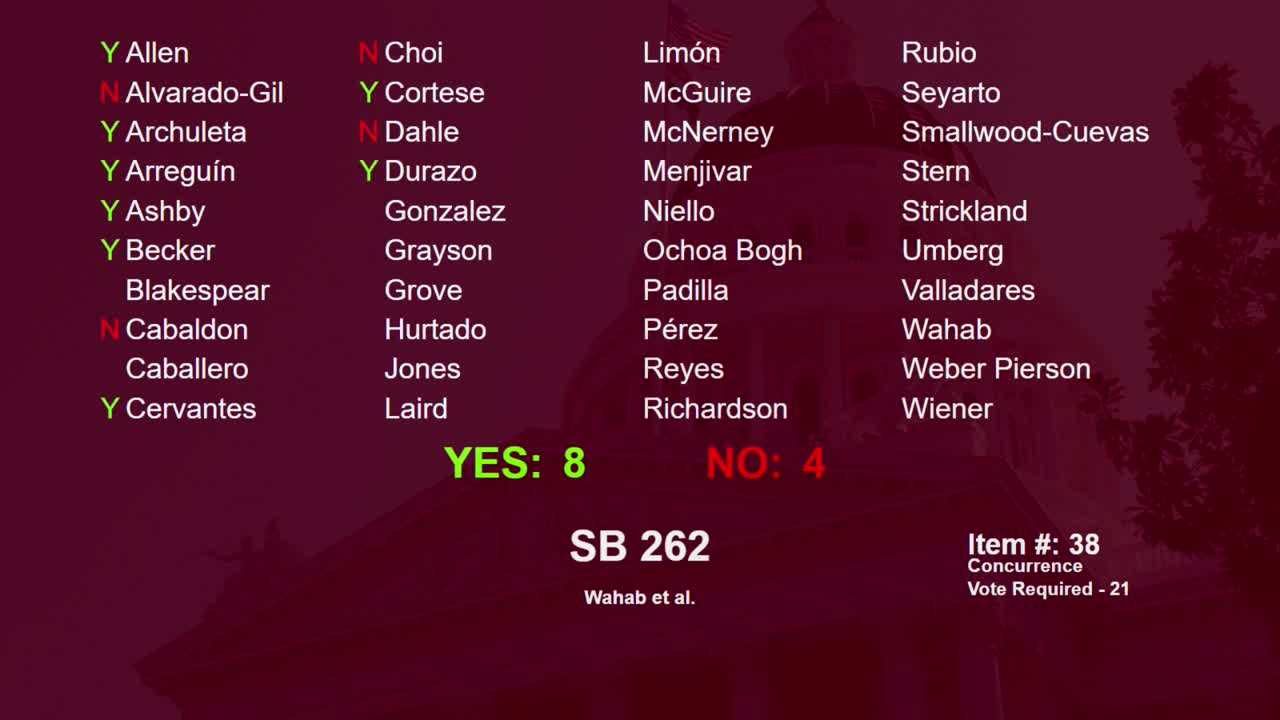 1MIN
Senate Floor
 2MIN
Assembly Floor
 11MIN
Assembly Standing Committee on Judiciary
 9MIN
Assembly Standing Committee on Labor and Employment
 1MIN
Senate Floor
 9MIN
Senate Standing Committee on Judiciary
 11MIN
Senate Standing Committee on Labor, Public Employment and Retirement
Bill Author

Bill Co-Author(s):
