SB 645: Juries: peremptory challenges.
- Session Year: 2025-2026
- House: Senate
- Latest Version Date: 2025-10-11
Current Status:
Passed
(2025-10-11: Chaptered by Secretary of State. Chapter 656, Statutes of 2025.)
Introduced
In Committee
Awaiting First Chamber Vote
Passed First Chamber
In Committee
Awaiting Second Chamber Vote
Passed Second Chamber
Enacted
Existing law provides for the exclusion of a prospective juror from a trial jury by peremptory challenge. Existing law prohibits a party from using a peremptory challenge to remove a prospective juror on the basis of, among other things, the prospective jurors race, ethnicity, or gender. Existing law allows a party, or the trial court on its own motion, to object to the use of a peremptory challenge based on these criteria. Upon objection, existing law requires the party exercising the challenge to state the reasons the peremptory challenge has been exercised. Existing law requires the court to evaluate the reasons given, as specified, and, if the court grants the objection, authorizes the court to take certain actions, including, but not limited to, starting a new jury selection, declaring a mistrial at the request of the objecting party, seating the challenged juror, or providing another remedy as the court deems appropriate. Under existing law, one of the circumstances the court may consider includes whether the counsel or counsels office exercising the challenge has used peremptory challenges disproportionately against a given race, ethnicity, gender, gender identity, sexual orientation, national origin, or religious affiliation, or perceived membership in any of these groups, in the present case or in past cases, as specified. Existing law, until January 1, 2026, prohibits the application of these provisions to civil cases.
This bill would extend the prohibition against application of these provisions to civil cases indefinitely, except as specified, including cases involving a civil rights violation and cases for the civil commitment of a person. The bill would require the party bringing specified claims to notify the court and the other party or parties of the applicability of these provisions in those civil cases, as specified. The bill would limit the courts consideration of counsel or counsels office use of peremptory challenges in the present case or in past cases, as described above, to when counsel or counsels office is a public entity.
Existing law provides for the exclusion of a prospective juror from a trial jury by peremptory challenge. Existing law prohibits a party from using a peremptory challenge to remove a prospective juror on the basis of, among other things, the prospective jurors race, ethnicity, or gender. Existing law allows a party, or the trial court on its own motion, to object to the use of a peremptory challenge based on these criteria. Upon objection, existing law requires the party exercising the challenge to state the reasons the peremptory challenge has been exercised. Existing law requires the court to evaluate the reasons given, as specified, and, if the court grants the objection, authorizes the court to take certain actions, including, but not limited to, starting a new jury selection, declaring a mistrial at the request of the objecting party, seating the challenged juror, or providing another remedy as the court deems appropriate. Under existing law, one of the circumstances the court may consider includes whether the counsel or counsels office exercising the challenge has used peremptory challenges disproportionately against a given race, ethnicity, gender, gender identity, sexual orientation, national origin, or religious affiliation, or perceived membership in any of these groups, in the present case or in past cases, as specified. Existing law, until January 1, 2026, prohibits the application of these provisions to civil cases.
This bill would extend the prohibition against application of these provisions to civil cases indefinitely, except as specified, including cases involving a civil rights violation and cases for the civil commitment of a person. The bill would require the court to notify the parties party bringing specified claims to notify the court and the other party or parties of the applicability of these provisions in those civil cases, as specified. The bill would limit the courts consideration of counsel or counsels office use of peremptory challenges in the present case or in past cases, as described above, to when counsel or counsels office is a public entity.
Existing law provides for the exclusion of a prospective juror from a trial jury by peremptory challenge. Existing law prohibits a party from using a peremptory challenge to remove a prospective juror on the basis of, among other things, the prospective jurors race, ethnicity, or gender. Existing law allows a party, or the trial court on its own motion, to object to the use of a peremptory challenge based on these criteria. Upon objection, existing law requires the party exercising the challenge to state the reasons the peremptory challenge has been exercised. Existing law requires the court to evaluate the reasons given, as specified, and, if the court grants the objection, authorizes the court to take certain actions, including, but not limited to, starting a new jury selection, declaring a mistrial at the request of the objecting party, seating the challenged juror, or providing another remedy as the court deems appropriate. Under existing law, one of the circumstances the court may consider includes whether the counsel or counsels office exercising the challenge has used peremptory challenges disproportionately against a given race, ethnicity, gender, gender identity, sexual orientation, national origin, or religious affiliation, or perceived membership in any of these groups, in the present case or in past cases, as specified. Existing law, until January 1, 2026, prohibits the application of these provisions to civil cases.
This bill would extend the prohibition against application of these provisions to civil cases indefinitely, except as specified. specified, including cases involving a civil rights violation and cases for the civil commitment of a person. The bill would require the court to notify the parties of the applicability of these provisions in those civil cases, as specified. The bill would limit the courts consideration of counsel or counsels office use of peremptory challenges in the present case or in past cases, as described above, to when the party represented by counsel or counsels office is a public entity.
Existing law provides for the exclusion of a prospective juror from a trial jury by peremptory challenge. Existing law prohibits a party from using a peremptory challenge to remove a prospective juror on the basis of, among other things, the prospective jurors race, ethnicity, or gender. Existing law allows a party, or the trial court on its own motion, to object to the use of a peremptory challenge based on these criteria. Upon objection, existing law requires the party exercising the challenge to state the reasons the peremptory challenge has been exercised. Existing law requires the court to evaluate the reasons given, as specified, and, if the court grants the objection, authorizes the court to take certain actions, including, but not limited to, starting a new jury selection, declaring a mistrial at the request of the objecting party, seating the challenged juror, or providing another remedy as the court deems appropriate. Under existing law, one of the circumstances the court may consider includes whether the counsel or counsels office exercising the challenge has used peremptory challenges disproportionately against a given race, ethnicity, gender, gender identity, sexual orientation, national origin, or religious affiliation, or perceived membership in any of these groups, in the present case or in past cases, as specified. Existing law, until January 1, 2026, prohibits the application of these provisions to civil cases.
This bill would extend the prohibition against application of these provisions to civil cases indefinitely. indefinitely, except as specified. The bill would limit the courts consideration of counsel or counsels office use of peremptory challenges in the present case or in past cases, as described above, to when the party represented by counsel or counsels office is a public entity.
Existing law provides for the exclusion of a prospective juror from a trial jury by peremptory challenge. Existing law prohibits a party from using a peremptory challenge to remove a prospective juror on the basis of, among other things, the prospective jurors race, ethnicity, or gender. Existing law allows a party, or the trial court on its own motion, to object to the use of a peremptory challenge based on these criteria. Upon objection, existing law requires the party exercising the challenge to state the reasons the peremptory challenge has been exercised. Existing law requires the court to evaluate the reasons given, as specified, and, if the court grants the objection, authorizes the court to take certain actions, including, but not limited to, starting a new jury selection, declaring a mistrial at the request of the objecting party, seating the challenged juror, or providing another remedy as the court deems appropriate. Existing law, until January 1, 2026, prohibits the application of these provisions to civil cases.
This bill would extend the prohibition against application of these provisions to civil cases indefinitely.
(a)A party shall not use a peremptory challenge to remove a prospective juror on the basis of the prospective jurors race, ethnicity, gender, gender identity, sexual orientation, national origin, or religious affiliation, or the perceived membership of the prospective juror in any of those groups.
(b)A party, or the trial court on its own motion, may object to the improper use of a peremptory challenge under subdivision (a). After the objection is made, any further discussion shall be conducted outside the presence of the panel. The objection shall be made before the jury is impaneled, unless information becomes known that could not have reasonably been known before the jury was impaneled.
(c)Notwithstanding Section 226, upon objection to the exercise of a peremptory challenge pursuant to this section, the party exercising the peremptory challenge shall state the reasons the peremptory challenge has been exercised.
(d)(1)The court shall evaluate the reasons given to justify the peremptory challenge in light of the totality of the circumstances. The court shall consider only the reasons actually given and shall not speculate on, or assume the existence of, other possible justifications for the use of the peremptory challenge. If the court determines there is a substantial likelihood that an objectively reasonable person would view race, ethnicity, gender, gender identity, sexual orientation, national origin, or religious affiliation, or perceived membership in any of those groups, as a factor in the use of the peremptory challenge, then the objection shall be sustained. The court need not find purposeful discrimination to sustain the objection. The court shall explain the reasons for its ruling on the record. A motion brought under this section shall also be deemed a sufficient presentation of claims asserting the discriminatory exclusion of jurors in violation of the United States and California Constitutions.
(2)(A)For purposes of this section, an objectively reasonable person is aware that unconscious bias, in addition to purposeful discrimination, have resulted in the unfair exclusion of potential jurors in the State of California.
(B)For purposes of this section, a substantial likelihood means more than a mere possibility but less than a standard of more likely than not.
(C)For purposes of this section, unconscious bias includes implicit and institutional biases.
(3)In making its determination, the circumstances the court may consider include, but are not limited to, any of the following:
(A)Whether any of the following circumstances exist:
(i)The objecting party is a member of the same perceived cognizable group as the challenged juror.
(ii)The alleged victim is not a member of that perceived cognizable group.
(iii)Witnesses or the parties are not members of that perceived cognizable group.
(B)Whether race, ethnicity, gender, gender identity, sexual orientation, national origin, or religious affiliation, or perceived membership in any of those groups, bear on the facts of the case to be tried.
(C)The number and types of questions posed to the prospective juror, including, but not limited to, any of the following:
(i)Consideration of whether the party exercising the peremptory challenge failed to question the prospective juror about the concerns later stated by the party as the reason for the peremptory challenge pursuant to subdivision (c).
(ii)Whether the party exercising the peremptory challenge engaged in cursory questioning of the challenged potential juror.
(iii)Whether the party exercising the peremptory challenge asked different questions of the potential juror against whom the peremptory challenge was used in contrast to questions asked of other jurors from different perceived cognizable groups about the same topic or whether the party phrased those questions differently.
(D)Whether other prospective jurors, who are not members of the same cognizable group as the challenged prospective juror, provided similar, but not necessarily identical, answers but were not the subject of a peremptory challenge by that party.
(E)Whether a reason might be disproportionately associated with a race, ethnicity, gender, gender identity, sexual orientation, national origin, or religious affiliation, or perceived membership in any of those groups.
(F)Whether the reason given by the party exercising the peremptory challenge was contrary to or unsupported by the record.
(G)Whether counsel or counsels office, if it is a public entity, exercising the challenge has used peremptory challenges disproportionately against a given race, ethnicity, gender, gender identity, sexual orientation, national origin, or religious affiliation, or perceived membership in any of those groups, in the present case or in past cases, including whether the counsel or counsels office, if it is a public entity, who made the challenge has a history of prior violations under Batson v. Kentucky (1986) 476 U.S. 79, People v. Wheeler (1978) 22 Cal.3d 258, Section 231.5, or this section.
(e)A peremptory challenge for any of the following reasons is presumed to be invalid unless the party exercising the peremptory challenge can show by clear and convincing evidence that an objectively reasonable person would view the rationale as unrelated to a prospective jurors race, ethnicity, gender, gender identity, sexual orientation, national origin, or religious affiliation, or perceived membership in any of those groups, and that the reasons articulated bear on the prospective jurors ability to be fair and impartial in the case:
(1)Expressing a distrust of or having a negative experience with law enforcement or the criminal legal system.
(2)Expressing a belief that law enforcement officers engage in racial profiling or that criminal laws have been enforced in a discriminatory manner.
(3)Having a close relationship with people who have been stopped, arrested, or convicted of a crime.
(4)A prospective jurors neighborhood.
(5)Having a child outside of marriage.
(6)Receiving state benefits.
(7)Not being a native English speaker.
(8)The ability to speak another language.
(9)Dress, attire, or personal appearance.
(10)Employment in a field that is disproportionately occupied by members listed in subdivision (a) or that serves a population disproportionately comprised of members of a group or groups listed in subdivision (a).
(11)Lack of employment or underemployment of the prospective juror or prospective jurors family member.
(12)A prospective jurors apparent friendliness with another prospective juror of the same group as listed in subdivision (a).
(13)Any justification that is similarly applicable to a questioned prospective juror or jurors, who are not members of the same cognizable group as the challenged prospective juror, but were not the subject of a peremptory challenge by that party. The unchallenged prospective juror or jurors need not share any other characteristics with the challenged prospective juror for peremptory challenge relying on this justification to be considered presumptively invalid.
(f)For purposes of subdivision (e), the term clear and convincing refers to the degree of certainty the factfinder must have in determining whether the reasons given for the exercise of a peremptory challenge are unrelated to the prospective jurors cognizable group membership, bearing in mind conscious and unconscious bias. To determine that a presumption of invalidity has been overcome, the factfinder shall determine that it is highly probable that the reasons given for the exercise of a peremptory challenge are unrelated to conscious or unconscious bias and are instead specific to the juror and bear on that jurors ability to be fair and impartial in the case.
(g)(1)The following reasons for peremptory challenges have historically been associated with improper discrimination in jury selection:
(A)The prospective juror was inattentive, or staring or failing to make eye contact.
(B)The prospective juror exhibited either a lack of rapport or problematic attitude, body language, or demeanor.
(C)The prospective juror provided unintelligent or confused answers.
(2)The reasons set forth in paragraph (1) are presumptively invalid unless the trial court is able to confirm that the asserted behavior occurred, based on the courts own observations or the observations of counsel for the objecting party. Even with that confirmation, the counsel offering the reason shall explain why the asserted demeanor, behavior, or manner in which the prospective juror answered questions matters to the case to be tried.
(h)Upon a court granting an objection to the improper exercise of a peremptory challenge, the court shall do one or more of the following:
(1)Quash the jury venire and start jury selection anew. This remedy shall be provided if requested by the objecting party.
(2)If the motion is granted after the jury has been impaneled, declare a mistrial and select a new jury if requested by the defendant.
(3)Seat the challenged juror.
(4)Provide the objecting party additional challenges.
(5)Provide another remedy as the court deems appropriate.
(i)This section applies in all jury trials in which jury selection begins on or after January 1, 2022.
(j)The denial of an objection made under this section shall be reviewed by the appellate court de novo, with the trial courts express factual findings reviewed for substantial evidence. The appellate court shall not impute to the trial court any findings, including findings of a prospective jurors demeanor, that the trial court did not expressly state on the record. The reviewing court shall consider only reasons actually given under subdivision (c) and shall not speculate as to or consider reasons that were not given to explain either the partys use of the peremptory challenge or the partys failure to challenge similarly situated jurors who are not members of the same cognizable group as the challenged juror, regardless of whether the moving party made a comparative analysis argument in the trial court. Should the appellate court determine that the objection was erroneously denied, that error shall be deemed prejudicial, the judgment shall be reversed, and the case remanded for a new trial.
(k)(1)Except as specified in paragraph (2), this section shall not apply to civil cases.
(2)This section shall apply in the following civil cases:
(A)Civil cases involving a civil rights violation, including the following:
(i)Actions alleging a violation against a protected class enumerated in subdivision (a).
(ii)Actions alleging a violation of the Tom Bane Civil Rights Act (Section 52.1 of the Civil Code) or the Unruh Civil Rights Act (Section 51 of the Civil Code).
(iii)Actions alleging a violation pursuant to Section 1983 of Title 42 of the United States Code.
(iv)Actions alleging a violation of Title VI of the federal Civil Rights Act of 1964 (42 U.S.C. Sec. 2000d, et seq.), the federal Voting Rights Act of 1965 (52 U.S.C. Sec. 10301 et seq.), or the federal Fair Housing Act (42 U.S.C. Sec. 3601 et seq.).
(v)Actions alleging a violation of the California Fair Employment and Housing Act (Part 2.8 (commencing with Section 12900) of Division 3 of Title 2 of the Government Code), including, but not limited to, actions alleging discrimination, harassment, or retaliation.
(B)Actions for the civil commitment of a person, including a person who is determined to be a sexually violent predator pursuant to Article 4 (commencing with Section 6600) of Chapter 2 of Part 2 of Division 6 of the Welfare and Institutions Code.
(C)Civil cases for damages arising from a hate crime.
(l)For civil cases governed under paragraph (2) of subdivision (k), the party bringing the claim described in paragraph (2) of subdivision (k) shall notify the court and the other party or parties, after the final status conference, or, if no final status conference is held, at least 15 calendar days before the date of the trial, that the procedures under this section apply.
(m)It is the intent of the Legislature that enactment of this section shall not, in purpose or effect, lower the standard for judging challenges for cause or expand use of challenges for cause.
(n)The provisions of this section are severable. If any provision of this section or its application is held invalid, that invalidity shall not affect other provisions or applications that can be given effect without the invalid provision or application.
SEC. 2.Section 231.7 of the Code of Civil Procedure, as added by Section 3 of Chapter 318 of the Statutes of 2020, is repealed.(a)A party shall not use a peremptory challenge to remove a prospective juror on the basis of the prospective jurors race, ethnicity, gender, gender identity, sexual orientation, national origin, or religious affiliation, or the perceived membership of the prospective juror in any of those groups.
(b)A party, or the trial court on its own motion, may object to the improper use of a peremptory challenge under subdivision (a). After the objection is made, any further discussion shall be conducted outside the presence of the panel. The objection shall be made before the jury is impaneled, unless information becomes known that could not have reasonably been known before the jury was impaneled.
(c)Notwithstanding Section 226, upon objection to the exercise of a peremptory challenge pursuant to this section, the party exercising the peremptory challenge shall state the reasons the peremptory challenge has been exercised.
(d)(1)The court shall evaluate the reasons given to justify the peremptory challenge in light of the totality of the circumstances. The court shall consider only the reasons actually given and shall not speculate on, or assume the existence of, other possible justifications for the use of the peremptory challenge. If the court determines there is a substantial likelihood that an objectively reasonable person would view race, ethnicity, gender, gender identity, sexual orientation, national origin, or religious affiliation, or perceived membership in any of those groups, as a factor in the use of the peremptory challenge, then the objection shall be sustained. The court need not find purposeful discrimination to sustain the objection. The court shall explain the reasons for its ruling on the record. A motion brought under this section shall also be deemed a sufficient presentation of claims asserting the discriminatory exclusion of jurors in violation of the United States and California Constitutions.
(2)(A)For purposes of this section, an objectively reasonable person is aware that unconscious bias, in addition to purposeful discrimination, have resulted in the unfair exclusion of potential jurors in the State of California.
(B)For purposes of this section, a substantial likelihood means more than a mere possibility but less than a standard of more likely than not.
(C)For purposes of this section, unconscious bias includes implicit and institutional biases.
(3)In making its determination, the circumstances the court may consider include, but are not limited to, any of the following:
(A)Whether any of the following circumstances exist:
(i)The objecting party is a member of the same perceived cognizable group as the challenged juror.
(ii)The alleged victim is not a member of that perceived cognizable group.
(iii)Witnesses or the parties are not members of that perceived cognizable group.
(B)Whether race, ethnicity, gender, gender identity, sexual orientation, national origin, or religious affiliation, or perceived membership in any of those groups, bear on the facts of the case to be tried.
(C)The number and types of questions posed to the prospective juror, including, but not limited to, any of the following:
(i)Consideration of whether the party exercising the peremptory challenge failed to question the prospective juror about the concerns later stated by the party as the reason for the peremptory challenge pursuant to subdivision (c).
(ii)Whether the party exercising the peremptory challenge engaged in cursory questioning of the challenged potential juror.
(iii)Whether the party exercising the peremptory challenge asked different questions of the potential juror against whom the peremptory challenge was used in contrast to questions asked of other jurors from different perceived cognizable groups about the same topic or whether the party phrased those questions differently.
(D)Whether other prospective jurors, who are not members of the same cognizable group as the challenged prospective juror, provided similar, but not necessarily identical, answers but were not the subject of a peremptory challenge by that party.
(E)Whether a reason might be disproportionately associated with a race, ethnicity, gender, gender identity, sexual orientation, national origin, or religious affiliation, or perceived membership in any of those groups.
(F)Whether the reason given by the party exercising the peremptory challenge was contrary to or unsupported by the record.
(G)Whether counsel or counsels office, if it is a public entity, exercising the challenge has used peremptory challenges disproportionately against a given race, ethnicity, gender, gender identity, sexual orientation, national origin, or religious affiliation, or perceived membership in any of those groups, in the present case or in past cases, including whether the counsel or counsels office, if it is a public entity, who made the challenge has a history of prior violations under Batson v. Kentucky (1986) 476 U.S. 79, People v. Wheeler (1978) 22 Cal.3d 258, Section 231.5, or this section.
(e)A peremptory challenge for any of the following reasons is presumed to be invalid unless the party exercising the peremptory challenge can show by clear and convincing evidence that an objectively reasonable person would view the rationale as unrelated to a prospective jurors race, ethnicity, gender, gender identity, sexual orientation, national origin, or religious affiliation, or perceived membership in any of those groups, and that the reasons articulated bear on the prospective jurors ability to be fair and impartial in the case:
(1)Expressing a distrust of or having a negative experience with law enforcement or the criminal legal system.
(2)Expressing a belief that law enforcement officers engage in racial profiling or that criminal laws have been enforced in a discriminatory manner.
(3)Having a close relationship with people who have been stopped, arrested, or convicted of a crime.
(4)A prospective jurors neighborhood.
(5)Having a child outside of marriage.
(6)Receiving state benefits.
(7)Not being a native English speaker.
(8)The ability to speak another language.
(9)Dress, attire, or personal appearance.
(10)Employment in a field that is disproportionately occupied by members listed in subdivision (a) or that serves a population disproportionately comprised of members of a group or groups listed in subdivision (a).
(11)Lack of employment or underemployment of the prospective juror or prospective jurors family member.
(12)A prospective jurors apparent friendliness with another prospective juror of the same group as listed in subdivision (a).
(13)Any justification that is similarly applicable to a questioned prospective juror or jurors, who are not members of the same cognizable group as the challenged prospective juror, but were not the subject of a peremptory challenge by that party. The unchallenged prospective juror or jurors need not share any other characteristics with the challenged prospective juror for peremptory challenge relying on this justification to be considered presumptively invalid.
(f)For purposes of subdivision (e), the term clear and convincing refers to the degree of certainty the factfinder must have in determining whether the reasons given for the exercise of a peremptory challenge are unrelated to the prospective jurors cognizable group membership, bearing in mind conscious and unconscious bias. To determine that a presumption of invalidity has been overcome, the factfinder shall determine that it is highly probable that the reasons given for the exercise of a peremptory challenge are unrelated to conscious or unconscious bias and are instead specific to the juror and bear on that jurors ability to be fair and impartial in the case.
(g)(1)The following reasons for peremptory challenges have historically been associated with improper discrimination in jury selection:
(A)The prospective juror was inattentive, or staring or failing to make eye contact.
(B)The prospective juror exhibited either a lack of rapport or problematic attitude, body language, or demeanor.
(C)The prospective juror provided unintelligent or confused answers.
(2)The reasons set forth in paragraph (1) are presumptively invalid unless the trial court is able to confirm that the asserted behavior occurred, based on the courts own observations or the observations of counsel for the objecting party. Even with that confirmation, the counsel offering the reason shall explain why the asserted demeanor, behavior, or manner in which the prospective juror answered questions matters to the case to be tried.
(h)Upon a court granting an objection to the improper exercise of a peremptory challenge, the court shall do one or more of the following:
(1)Quash the jury venire and start jury selection anew. This remedy shall be provided if requested by the objecting party.
(2)If the motion is granted after the jury has been impaneled, declare a mistrial and select a new jury if requested by the defendant.
(3)Seat the challenged juror.
(4)Provide the objecting party additional challenges.
(5)Provide another remedy as the court deems appropriate.
(i)This section applies in all jury trials in which jury selection begins on or after January 1, 2022.
(j)The denial of an objection made under this section shall be reviewed by the appellate court de novo, with the trial courts express factual findings reviewed for substantial evidence. The appellate court shall not impute to the trial court any findings, including findings of a prospective jurors demeanor, that the trial court did not expressly state on the record. The reviewing court shall consider only reasons actually given under subdivision (c) and shall not speculate as to or consider reasons that were not given to explain either the partys use of the peremptory challenge or the partys failure to challenge similarly situated jurors who are not members of the same cognizable group as the challenged juror, regardless of whether the moving party made a comparative analysis argument in the trial court. Should the appellate court determine that the objection was erroneously denied, that error shall be deemed prejudicial, the judgment shall be reversed, and the case remanded for a new trial.
(k)(1)Except as specified in paragraph (2), this section shall not apply to civil cases.
(2)This section shall apply in the following civil cases:
(A)Civil cases involving a civil rights violation, including the following:
(i)Actions alleging a violation against a protected class enumerated in subdivision (a).
(ii)Actions alleging a violation of the Tom Bane Civil Rights Act (Section 52.1 of the Civil Code) or the Unruh Civil Rights Act (Section 51 of the Civil Code).
(iii)Actions alleging a violation pursuant to Section 1983 of Title 42 of the United States Code.
(iv)Actions alleging a violation of Title VI of the federal Civil Rights Act of 1964 (42 U.S.C. Sec. 2000d, et seq.), the federal Voting Rights Act of 1965 (52 U.S.C. Sec. 10301 et seq.), or the federal Fair Housing Act (42 U.S.C. Sec. 3601 et seq.).
(v)Actions alleging a violation of the California Fair Employment and Housing Act (Part 2.8 (commencing with Section 12900) of Division 3 of Title 2 of the Government Code), including, but not limited to, actions alleging discrimination, harassment, or retaliation.
(B)Actions for the civil commitment of a person, including a person who is determined to be a sexually violent predator pursuant to Article 4 (commencing with Section 6600) of Chapter 2 of Part 2 of Division 6 of the Welfare and Institutions Code.
(C)Civil cases for damages arising from a hate crime.
(D)Dependency cases pursuant to Article 6 (commencing with Section 300) of Chapter 2 of Part 1 of Division 2 of the Welfare and Institutions Code.(l)For civil cases governed under paragraph (2) of subdivision (k), after the final status conference is held, or, if no final status conference is held, at least 15 calendar days before the date of trial, the judicial officer shall inform the parties the party bringing the claim described in paragraph (2) of subdivision (k) shall notify the court and the other party or parties, after the final status conference, or, if no final status conference is held, at least 15 calendar days before the date of the trial, that the procedures under this section apply.
(m)It is the intent of the Legislature that enactment of this section shall not, in purpose or effect, lower the standard for judging challenges for cause or expand use of challenges for cause.
(n)The provisions of this section are severable. If any provision of this section or its application is held invalid, that invalidity shall not affect other provisions or applications that can be given effect without the invalid provision or application.
SEC. 2.Section 231.7 of the Code of Civil Procedure, as added by Section 3 of Chapter 318 of the Statutes of 2020, is repealed.(a)A party shall not use a peremptory challenge to remove a prospective juror on the basis of the prospective jurors race, ethnicity, gender, gender identity, sexual orientation, national origin, or religious affiliation, or the perceived membership of the prospective juror in any of those groups.
(b)A party, or the trial court on its own motion, may object to the improper use of a peremptory challenge under subdivision (a). After the objection is made, any further discussion shall be conducted outside the presence of the panel. The objection shall be made before the jury is impaneled, unless information becomes known that could not have reasonably been known before the jury was impaneled.
(c)Notwithstanding Section 226, upon objection to the exercise of a peremptory challenge pursuant to this section, the party exercising the peremptory challenge shall state the reasons the peremptory challenge has been exercised.
(d)(1)The court shall evaluate the reasons given to justify the peremptory challenge in light of the totality of the circumstances. The court shall consider only the reasons actually given and shall not speculate on, or assume the existence of, other possible justifications for the use of the peremptory challenge. If the court determines there is a substantial likelihood that an objectively reasonable person would view race, ethnicity, gender, gender identity, sexual orientation, national origin, or religious affiliation, or perceived membership in any of those groups, as a factor in the use of the peremptory challenge, then the objection shall be sustained. The court need not find purposeful discrimination to sustain the objection. The court shall explain the reasons for its ruling on the record. A motion brought under this section shall also be deemed a sufficient presentation of claims asserting the discriminatory exclusion of jurors in violation of the United States and California Constitutions.
(2)(A)For purposes of this section, an objectively reasonable person is aware that unconscious bias, in addition to purposeful discrimination, have resulted in the unfair exclusion of potential jurors in the State of California.
(B)For purposes of this section, a substantial likelihood means more than a mere possibility but less than a standard of more likely than not.
(C)For purposes of this section, unconscious bias includes implicit and institutional biases.
(3)In making its determination, the circumstances the court may consider include, but are not limited to, any of the following:
(A)Whether any of the following circumstances exist:
(i)The objecting party is a member of the same perceived cognizable group as the challenged juror.
(ii)The alleged victim is not a member of that perceived cognizable group.
(iii)Witnesses or the parties are not members of that perceived cognizable group.
(B)Whether race, ethnicity, gender, gender identity, sexual orientation, national origin, or religious affiliation, or perceived membership in any of those groups, bear on the facts of the case to be tried.
(C)The number and types of questions posed to the prospective juror, including, but not limited to, any of the following:
(i)Consideration of whether the party exercising the peremptory challenge failed to question the prospective juror about the concerns later stated by the party as the reason for the peremptory challenge pursuant to subdivision (c).
(ii)Whether the party exercising the peremptory challenge engaged in cursory questioning of the challenged potential juror.
(iii)Whether the party exercising the peremptory challenge asked different questions of the potential juror against whom the peremptory challenge was used in contrast to questions asked of other jurors from different perceived cognizable groups about the same topic or whether the party phrased those questions differently.
(D)Whether other prospective jurors, who are not members of the same cognizable group as the challenged prospective juror, provided similar, but not necessarily identical, answers but were not the subject of a peremptory challenge by that party.
(E)Whether a reason might be disproportionately associated with a race, ethnicity, gender, gender identity, sexual orientation, national origin, or religious affiliation, or perceived membership in any of those groups.
(F)Whether the reason given by the party exercising the peremptory challenge was contrary to or unsupported by the record.
(G)If the party is a public entity, whether counsel or counsels office for the public entity Whether counsel or counsels office, if it is a public entity, exercising the challenge has used peremptory challenges disproportionately against a given race, ethnicity, gender, gender identity, sexual orientation, national origin, or religious affiliation, or perceived membership in any of those groups, in the present case or in past cases, including whether the counsel or counsels office office, if it is a public entity, who made the challenge has a history of prior violations under Batson v. Kentucky (1986) 476 U.S. 79, People v. Wheeler (1978) 22 Cal.3d 258, Section 231.5, or this section.
(e)A peremptory challenge for any of the following reasons is presumed to be invalid unless the party exercising the peremptory challenge can show by clear and convincing evidence that an objectively reasonable person would view the rationale as unrelated to a prospective jurors race, ethnicity, gender, gender identity, sexual orientation, national origin, or religious affiliation, or perceived membership in any of those groups, and that the reasons articulated bear on the prospective jurors ability to be fair and impartial in the case:
(1)Expressing a distrust of or having a negative experience with law enforcement or the criminal legal system.
(2)Expressing a belief that law enforcement officers engage in racial profiling or that criminal laws have been enforced in a discriminatory manner.
(3)Having a close relationship with people who have been stopped, arrested, or convicted of a crime.
(4)A prospective jurors neighborhood.
(5)Having a child outside of marriage.
(6)Receiving state benefits.
(7)Not being a native English speaker.
(8)The ability to speak another language.
(9)Dress, attire, or personal appearance.
(10)Employment in a field that is disproportionately occupied by members listed in subdivision (a) or that serves a population disproportionately comprised of members of a group or groups listed in subdivision (a).
(11)Lack of employment or underemployment of the prospective juror or prospective jurors family member.
(12)A prospective jurors apparent friendliness with another prospective juror of the same group as listed in subdivision (a).
(13)Any justification that is similarly applicable to a questioned prospective juror or jurors, who are not members of the same cognizable group as the challenged prospective juror, but were not the subject of a peremptory challenge by that party. The unchallenged prospective juror or jurors need not share any other characteristics with the challenged prospective juror for peremptory challenge relying on this justification to be considered presumptively invalid.
(f)For purposes of subdivision (e), the term clear and convincing refers to the degree of certainty the factfinder must have in determining whether the reasons given for the exercise of a peremptory challenge are unrelated to the prospective jurors cognizable group membership, bearing in mind conscious and unconscious bias. To determine that a presumption of invalidity has been overcome, the factfinder shall determine that it is highly probable that the reasons given for the exercise of a peremptory challenge are unrelated to conscious or unconscious bias and are instead specific to the juror and bear on that jurors ability to be fair and impartial in the case.
(g)(1)The following reasons for peremptory challenges have historically been associated with improper discrimination in jury selection:
(A)The prospective juror was inattentive, or staring or failing to make eye contact.
(B)The prospective juror exhibited either a lack of rapport or problematic attitude, body language, or demeanor.
(C)The prospective juror provided unintelligent or confused answers.
(2)The reasons set forth in paragraph (1) are presumptively invalid unless the trial court is able to confirm that the asserted behavior occurred, based on the courts own observations or the observations of counsel for the objecting party. Even with that confirmation, the counsel offering the reason shall explain why the asserted demeanor, behavior, or manner in which the prospective juror answered questions matters to the case to be tried.
(h)Upon a court granting an objection to the improper exercise of a peremptory challenge, the court shall do one or more of the following:
(1)Quash the jury venire and start jury selection anew. This remedy shall be provided if requested by the objecting party.
(2)If the motion is granted after the jury has been impaneled, declare a mistrial and select a new jury if requested by the defendant.
(3)Seat the challenged juror.
(4)Provide the objecting party additional challenges.
(5)Provide another remedy as the court deems appropriate.
(i)This section applies in all jury trials in which jury selection begins on or after January 1, 2022.
(j)The denial of an objection made under this section shall be reviewed by the appellate court de novo, with the trial courts express factual findings reviewed for substantial evidence. The appellate court shall not impute to the trial court any findings, including findings of a prospective jurors demeanor, that the trial court did not expressly state on the record. The reviewing court shall consider only reasons actually given under subdivision (c) and shall not speculate as to or consider reasons that were not given to explain either the partys use of the peremptory challenge or the partys failure to challenge similarly situated jurors who are not members of the same cognizable group as the challenged juror, regardless of whether the moving party made a comparative analysis argument in the trial court. Should the appellate court determine that the objection was erroneously denied, that error shall be deemed prejudicial, the judgment shall be reversed, and the case remanded for a new trial.
(k)(1)Except as specified in paragraph (2), this section shall not apply to civil cases.
(2)This section shall apply in the following civil cases:
(A)Civil cases involving a civil rights violation, including, but not limited to the following: including the following:
(i)Actions alleging a violation against a protected class enumerated in subdivision (a).
(ii)Actions alleging a violation against a protected class enumerated in of the Tom Bane Civil Rights Act (Section 52.1 of the Civil Code) and or the Unruh Civil Rights Act (Section 51 of the Civil Code).
(iii)Actions alleging a violation pursuant to Section 1983 of Title 42 of the United States Code.
(iv)Actions alleging a violation of Title VI of the federal Civil Rights Act of 1964 (42 U.S.C. Sec. 2000d, et seq.), the federal Voting Rights Act of 1965 (52 U.S.C. Sec. 10301 et seq.), or the federal Fair Housing Act (42 U.S.C. Sec. 3601 et seq.).
(v)Actions alleging a violation of the California Fair Employment and Housing Act (Part 2.8 (commencing with Section 12900) of Division 3 of Title 2 of the Government Code), including, but not limited to, actions alleging discrimination, harassment, or retaliation.
(B)Actions for the civil commitment of a person person, including a person who is determined to be a sexually violent predator pursuant to Article 4 (commencing with Section 6600) of Chapter 2 of Part 2 of Division 6 of the Welfare and Institutions Code.
(C)Civil cases for damages arising from a hate crime.
(D)Dependency cases pursuant to Article 6 (commencing with Section 300) of Chapter 2 of Part 1 of Division 2 of the Welfare and Institutions Code.
(l)For civil cases governed under paragraph (2) of subdivision (k), after the final status conference is held, or, if no final status conference is held, at least 15 calendar days before the date of trial, the judicial officer shall inform the parties that the procedures under this section apply.
(l)(m)It is the intent of the Legislature that enactment of this section shall not, in purpose or effect, lower the standard for judging challenges for cause or expand use of challenges for cause.
(m)(n)The provisions of this section are severable. If any provision of this section or its application is held invalid, that invalidity shall not affect other provisions or applications that can be given effect without the invalid provision or application.
SEC. 2.Section 231.7 of the Code of Civil Procedure, as added by Section 3 of Chapter 318 of the Statutes of 2020, is repealed.(a)A party shall not use a peremptory challenge to remove a prospective juror on the basis of the prospective jurors race, ethnicity, gender, gender identity, sexual orientation, national origin, or religious affiliation, or the perceived membership of the prospective juror in any of those groups.
(b)A party, or the trial court on its own motion, may object to the improper use of a peremptory challenge under subdivision (a). After the objection is made, any further discussion shall be conducted outside the presence of the panel. The objection shall be made before the jury is impaneled, unless information becomes known that could not have reasonably been known before the jury was impaneled.
(c)Notwithstanding Section 226, upon objection to the exercise of a peremptory challenge pursuant to this section, the party exercising the peremptory challenge shall state the reasons the peremptory challenge has been exercised.
(d)(1)The court shall evaluate the reasons given to justify the peremptory challenge in light of the totality of the circumstances. The court shall consider only the reasons actually given and shall not speculate on, or assume the existence of, other possible justifications for the use of the peremptory challenge. If the court determines there is a substantial likelihood that an objectively reasonable person would view race, ethnicity, gender, gender identity, sexual orientation, national origin, or religious affiliation, or perceived membership in any of those groups, as a factor in the use of the peremptory challenge, then the objection shall be sustained. The court need not find purposeful discrimination to sustain the objection. The court shall explain the reasons for its ruling on the record. A motion brought under this section shall also be deemed a sufficient presentation of claims asserting the discriminatory exclusion of jurors in violation of the United States and California Constitutions.
(2)(A)For purposes of this section, an objectively reasonable person is aware that unconscious bias, in addition to purposeful discrimination, have resulted in the unfair exclusion of potential jurors in the State of California.
(B)For purposes of this section, a substantial likelihood means more than a mere possibility but less than a standard of more likely than not.
(C)For purposes of this section, unconscious bias includes implicit and institutional biases.
(3)In making its determination, the circumstances the court may consider include, but are not limited to, any of the following:
(A)Whether any of the following circumstances exist:
(i)The objecting party is a member of the same perceived cognizable group as the challenged juror.
(ii)The alleged victim is not a member of that perceived cognizable group.
(iii)Witnesses or the parties are not members of that perceived cognizable group.
(B)Whether race, ethnicity, gender, gender identity, sexual orientation, national origin, or religious affiliation, or perceived membership in any of those groups, bear on the facts of the case to be tried.
(C)The number and types of questions posed to the prospective juror, including, but not limited to, any of the following:
(i)Consideration of whether the party exercising the peremptory challenge failed to question the prospective juror about the concerns later stated by the party as the reason for the peremptory challenge pursuant to subdivision (c).
(ii)Whether the party exercising the peremptory challenge engaged in cursory questioning of the challenged potential juror.
(iii)Whether the party exercising the peremptory challenge asked different questions of the potential juror against whom the peremptory challenge was used in contrast to questions asked of other jurors from different perceived cognizable groups about the same topic or whether the party phrased those questions differently.
(D)Whether other prospective jurors, who are not members of the same cognizable group as the challenged prospective juror, provided similar, but not necessarily identical, answers but were not the subject of a peremptory challenge by that party.
(E)Whether a reason might be disproportionately associated with a race, ethnicity, gender, gender identity, sexual orientation, national origin, or religious affiliation, or perceived membership in any of those groups.
(F)Whether the reason given by the party exercising the peremptory challenge was contrary to or unsupported by the record.
(G)Whether the If the party is a public entity, whether counsel or counsels office for the public entity exercising the challenge has used peremptory challenges disproportionately against a given race, ethnicity, gender, gender identity, sexual orientation, national origin, or religious affiliation, or perceived membership in any of those groups, in the present case or in past cases, including whether the counsel or counsels office who made the challenge has a history of prior violations under Batson v. Kentucky (1986) 476 U.S. 79, People v. Wheeler (1978) 22 Cal.3d 258, Section 231.5, or this section.
(e)A peremptory challenge for any of the following reasons is presumed to be invalid unless the party exercising the peremptory challenge can show by clear and convincing evidence that an objectively reasonable person would view the rationale as unrelated to a prospective jurors race, ethnicity, gender, gender identity, sexual orientation, national origin, or religious affiliation, or perceived membership in any of those groups, and that the reasons articulated bear on the prospective jurors ability to be fair and impartial in the case:
(1)Expressing a distrust of or having a negative experience with law enforcement or the criminal legal system.
(2)Expressing a belief that law enforcement officers engage in racial profiling or that criminal laws have been enforced in a discriminatory manner.
(3)Having a close relationship with people who have been stopped, arrested, or convicted of a crime.
(4)A prospective jurors neighborhood.
(5)Having a child outside of marriage.
(6)Receiving state benefits.
(7)Not being a native English speaker.
(8)The ability to speak another language.
(9)Dress, attire, or personal appearance.
(10)Employment in a field that is disproportionately occupied by members listed in subdivision (a) or that serves a population disproportionately comprised of members of a group or groups listed in subdivision (a).
(11)Lack of employment or underemployment of the prospective juror or prospective jurors family member.
(12)A prospective jurors apparent friendliness with another prospective juror of the same group as listed in subdivision (a).
(13)Any justification that is similarly applicable to a questioned prospective juror or jurors, who are not members of the same cognizable group as the challenged prospective juror, but were not the subject of a peremptory challenge by that party. The unchallenged prospective juror or jurors need not share any other characteristics with the challenged prospective juror for peremptory challenge relying on this justification to be considered presumptively invalid.
(f)For purposes of subdivision (e), the term clear and convincing refers to the degree of certainty the factfinder must have in determining whether the reasons given for the exercise of a peremptory challenge are unrelated to the prospective jurors cognizable group membership, bearing in mind conscious and unconscious bias. To determine that a presumption of invalidity has been overcome, the factfinder shall determine that it is highly probable that the reasons given for the exercise of a peremptory challenge are unrelated to conscious or unconscious bias and are instead specific to the juror and bear on that jurors ability to be fair and impartial in the case.
(g)(1)The following reasons for peremptory challenges have historically been associated with improper discrimination in jury selection:
(A)The prospective juror was inattentive, or staring or failing to make eye contact.
(B)The prospective juror exhibited either a lack of rapport or problematic attitude, body language, or demeanor.
(C)The prospective juror provided unintelligent or confused answers.
(2)The reasons set forth in paragraph (1) are presumptively invalid unless the trial court is able to confirm that the asserted behavior occurred, based on the courts own observations or the observations of counsel for the objecting party. Even with that confirmation, the counsel offering the reason shall explain why the asserted demeanor, behavior, or manner in which the prospective juror answered questions matters to the case to be tried.
(h)Upon a court granting an objection to the improper exercise of a peremptory challenge, the court shall do one or more of the following:
(1)Quash the jury venire and start jury selection anew. This remedy shall be provided if requested by the objecting party.
(2)If the motion is granted after the jury has been impaneled, declare a mistrial and select a new jury if requested by the defendant.
(3)Seat the challenged juror.
(4)Provide the objecting party additional challenges.
(5)Provide another remedy as the court deems appropriate.
(i)This section applies in all jury trials in which jury selection begins on or after January 1, 2022.
(j)The denial of an objection made under this section shall be reviewed by the appellate court de novo, with the trial courts express factual findings reviewed for substantial evidence. The appellate court shall not impute to the trial court any findings, including findings of a prospective jurors demeanor, that the trial court did not expressly state on the record. The reviewing court shall consider only reasons actually given under subdivision (c) and shall not speculate as to or consider reasons that were not given to explain either the partys use of the peremptory challenge or the partys failure to challenge similarly situated jurors who are not members of the same cognizable group as the challenged juror, regardless of whether the moving party made a comparative analysis argument in the trial court. Should the appellate court determine that the objection was erroneously denied, that error shall be deemed prejudicial, the judgment shall be reversed, and the case remanded for a new trial.
(k)This (1)Except as specified in paragraph (2), this section shall not apply to civil cases.
(2)This section shall apply in the following civil cases:
(A)Civil cases involving a civil rights violation, including, but not limited to the following:
(i)Actions alleging a violation against a protected class enumerated in subdivision (a).
(ii)Actions alleging a violation against a protected class enumerated in the Tom Bane Civil Rights Act (Section 52.1 of the Civil Code) and the Unruh Civil Rights Act (Section 51 of the Civil Code).
(iii)Actions alleging a violation pursuant to Section 1983 of Title 42 of the United States Code.
(iv)Actions alleging a violation of Title VI of the federal Civil Rights Act of 1964 (42 U.S.C. Sec. 2000d, et seq.), federal Voting Rights Act of 1965 (52 U.S.C. Sec. 10301 et seq.), or the federal Fair Housing Act (42 U.S.C. Sec. 3601 et seq.).
(B)Actions for the civil commitment of a person who is determined to be a sexually violent predator pursuant to Article 4 (commencing with Section 6600) of Chapter 2 of Part 2 of Division 6 of the Welfare and Institutions Code.
(C)Civil cases for damages arising from a hate crime.
(D)Dependency cases pursuant to Article 6 (commencing with Section 300) of Chapter 2 of Part 1 of Division 2 of the Welfare and Institutions Code.
(l)It is the intent of the Legislature that enactment of this section shall not, in purpose or effect, lower the standard for judging challenges for cause or expand use of challenges for cause.
(m)The provisions of this section are severable. If any provision of this section or its application is held invalid, that invalidity shall not affect other provisions or applications that can be given effect without the invalid provision or application.
SEC. 2.Section 231.7 of the Code of Civil Procedure, as added by Section 3 of Chapter 318 of the Statutes of 2020, is repealed.(a)A party shall not use a peremptory challenge to remove a prospective juror on the basis of the prospective jurors race, ethnicity, gender, gender identity, sexual orientation, national origin, or religious affiliation, or the perceived membership of the prospective juror in any of those groups.
(b)A party, or the trial court on its own motion, may object to the improper use of a peremptory challenge under subdivision (a). After the objection is made, any further discussion shall be conducted outside the presence of the panel. The objection shall be made before the jury is impaneled, unless information becomes known that could not have reasonably been known before the jury was impaneled.
(c)Notwithstanding Section 226, upon objection to the exercise of a peremptory challenge pursuant to this section, the party exercising the peremptory challenge shall state the reasons the peremptory challenge has been exercised.
(d)(1)The court shall evaluate the reasons given to justify the peremptory challenge in light of the totality of the circumstances. The court shall consider only the reasons actually given and shall not speculate on, or assume the existence of, other possible justifications for the use of the peremptory challenge. If the court determines there is a substantial likelihood that an objectively reasonable person would view race, ethnicity, gender, gender identity, sexual orientation, national origin, or religious affiliation, or perceived membership in any of those groups, as a factor in the use of the peremptory challenge, then the objection shall be sustained. The court need not find purposeful discrimination to sustain the objection. The court shall explain the reasons for its ruling on the record. A motion brought under this section shall also be deemed a sufficient presentation of claims asserting the discriminatory exclusion of jurors in violation of the United States and California Constitutions.
(2)(A)For purposes of this section, an objectively reasonable person is aware that unconscious bias, in addition to purposeful discrimination, have resulted in the unfair exclusion of potential jurors in the State of California.
(B)For purposes of this section, a substantial likelihood means more than a mere possibility but less than a standard of more likely than not.
(C)For purposes of this section, unconscious bias includes implicit and institutional biases.
(3)In making its determination, the circumstances the court may consider include, but are not limited to, any of the following:
(A)Whether any of the following circumstances exist:
(i)The objecting party is a member of the same perceived cognizable group as the challenged juror.
(ii)The alleged victim is not a member of that perceived cognizable group.
(iii)Witnesses or the parties are not members of that perceived cognizable group.
(B)Whether race, ethnicity, gender, gender identity, sexual orientation, national origin, or religious affiliation, or perceived membership in any of those groups, bear on the facts of the case to be tried.
(C)The number and types of questions posed to the prospective juror, including, but not limited to, any the following:
(i)Consideration of whether the party exercising the peremptory challenge failed to question the prospective juror about the concerns later stated by the party as the reason for the peremptory challenge pursuant to subdivision (c).
(ii)Whether the party exercising the peremptory challenge engaged in cursory questioning of the challenged potential juror.
(iii)Whether the party exercising the peremptory challenge asked different questions of the potential juror against whom the peremptory challenge was used in contrast to questions asked of other jurors from different perceived cognizable groups about the same topic or whether the party phrased those questions differently.
(D)Whether other prospective jurors, who are not members of the same cognizable group as the challenged prospective juror, provided similar, but not necessarily identical, answers but were not the subject of a peremptory challenge by that party.
(E)Whether a reason might be disproportionately associated with a race, ethnicity, gender, gender identity, sexual orientation, national origin, or religious affiliation, or perceived membership in any of those groups.
(F)Whether the reason given by the party exercising the peremptory challenge was contrary to or unsupported by the record.
(G)Whether the counsel or counsels office exercising the challenge has used peremptory challenges disproportionately against a given race, ethnicity, gender, gender identity, sexual orientation, national origin, or religious affiliation, or perceived membership in any of those groups, in the present case or in past cases, including whether the counsel or counsels office who made the challenge has a history of prior violations under Batson v. Kentucky (1986) 476 U.S. 79, People v. Wheeler (1978) 22 Cal.3d 258, Section 231.5, or this section.
(e)A peremptory challenge for any of the following reasons is presumed to be invalid unless the party exercising the peremptory challenge can show by clear and convincing evidence that an objectively reasonable person would view the rationale as unrelated to a prospective jurors race, ethnicity, gender, gender identity, sexual orientation, national origin, or religious affiliation, or perceived membership in any of those groups, and that the reasons articulated bear on the prospective jurors ability to be fair and impartial in the case:
(1)Expressing a distrust of or having a negative experience with law enforcement or the criminal legal system.
(2)Expressing a belief that law enforcement officers engage in racial profiling or that criminal laws have been enforced in a discriminatory manner.
(3)Having a close relationship with people who have been stopped, arrested, or convicted of a crime.
(4)A prospective jurors neighborhood.
(5)Having a child outside of marriage.
(6)Receiving state benefits.
(7)Not being a native English speaker.
(8)The ability to speak another language.
(9)Dress, attire, or personal appearance.
(10)Employment in a field that is disproportionately occupied by members listed in subdivision (a) or that serves a population disproportionately comprised of members of a group or groups listed in subdivision (a).
(11)Lack of employment or underemployment of the prospective juror or prospective jurors family member.
(12)A prospective jurors apparent friendliness with another prospective juror of the same group as listed in subdivision (a).
(13)Any justification that is similarly applicable to a questioned prospective juror or jurors, who are not members of the same cognizable group as the challenged prospective juror, but were not the subject of a peremptory challenge by that party. The unchallenged prospective juror or jurors need not share any other characteristics with the challenged prospective juror for peremptory challenge relying on this justification to be considered presumptively invalid.
(f)For purposes of subdivision (e), the term clear and convincing refers to the degree of certainty the factfinder must have in determining whether the reasons given for the exercise of a peremptory challenge are unrelated to the prospective jurors cognizable group membership, bearing in mind conscious and unconscious bias. To determine that a presumption of invalidity has been overcome, the factfinder shall determine that it is highly probable that the reasons given for the exercise of a peremptory challenge are unrelated to conscious or unconscious bias and are instead specific to the juror and bear on that jurors ability to be fair and impartial in the case.
(g)(1)The following reasons for peremptory challenges have historically been associated with improper discrimination in jury selection:
(A)The prospective juror was inattentive, or staring or failing to make eye contact.
(B)The prospective juror exhibited either a lack of rapport or problematic attitude, body language, or demeanor.
(C)The prospective juror provided unintelligent or confused answers.
(2)The reasons set forth in paragraph (1) are presumptively invalid unless the trial court is able to confirm that the asserted behavior occurred, based on the courts own observations or the observations of counsel for the objecting party. Even with that confirmation, the counsel offering the reason shall explain why the asserted demeanor, behavior, or manner in which the prospective juror answered questions matters to the case to be tried.
(h)Upon a court granting an objection to the improper exercise of a peremptory challenge, the court shall do one or more of the following:
(1)Quash the jury venire and start jury selection anew. This remedy shall be provided if requested by the objecting party.
(2)If the motion is granted after the jury has been impaneled, declare a mistrial and select a new jury if requested by the defendant.
(3)Seat the challenged juror.
(4)Provide the objecting party additional challenges.
(5)Provide another remedy as the court deems appropriate.
(i)This section applies in all jury trials in which jury selection begins on or after January 1, 2022.
(j)The denial of an objection made under this section shall be reviewed by the appellate court de novo, with the trial courts express factual findings reviewed for substantial evidence. The appellate court shall not impute to the trial court any findings, including findings of a prospective jurors demeanor, that the trial court did not expressly state on the record. The reviewing court shall consider only reasons actually given under subdivision (c) and shall not speculate as to or consider reasons that were not given to explain either the partys use of the peremptory challenge or the partys failure to challenge similarly situated jurors who are not members of the same cognizable group as the challenged juror, regardless of whether the moving party made a comparative analysis argument in the trial court. Should the appellate court determine that the objection was erroneously denied, that error shall be deemed prejudicial, the judgment shall be reversed, and the case remanded for a new trial.
(k)This section shall not apply to civil cases.
(l)It is the intent of the Legislature that enactment of this section shall not, in purpose or effect, lower the standard for judging challenges for cause or expand use of challenges for cause.
(m)The provisions of this section are severable. If any provision of this section or its application is held invalid, that invalidity shall not affect other provisions or applications that can be given effect without the invalid provision or application.
(n)This section shall remain in effect only until January 1, 2026, and as of that date is repealed.SEC. 2.Section 231.7 of the Code of Civil Procedure, as added by Section 3 of Chapter 318 of the Statutes of 2020, is repealed.231.7.(a)A party shall not use a peremptory challenge to remove a prospective juror on the basis of the prospective jurors race, ethnicity, gender, gender identity, sexual orientation, national origin, or religious affiliation, or the perceived membership of the prospective juror in any of those groups.(b)A party, or the trial court on its own motion, may object to the improper use of a peremptory challenge under subdivision (a). After the objection is made, any further discussion shall be conducted outside the presence of the panel. The objection shall be made before the jury is impaneled, unless information becomes known that could not have reasonably been known before the jury was impaneled.(c)Notwithstanding Section 226, upon objection to the exercise of a peremptory challenge pursuant to this section, the party exercising the peremptory challenge shall state the reasons the peremptory challenge has been exercised.(d)(1)The court shall evaluate the reasons given to justify the peremptory challenge in light of the totality of the circumstances. The court shall consider only the reasons actually given and shall not speculate on, or assume the existence of, other possible justifications for the use of the peremptory challenge. If the court determines there is a substantial likelihood that an objectively reasonable person would view race, ethnicity, gender, gender identity, sexual orientation, national origin, or religious affiliation, or perceived membership in any of those groups, as a factor in the use of the peremptory challenge, then the objection shall be sustained. The court need not find purposeful discrimination to sustain the objection. The court shall explain the reasons for its ruling on the record. A motion brought under this section shall also be deemed a sufficient presentation of claims asserting the discriminatory exclusion of jurors in violation of the United States and California Constitutions.(2)(A)For purposes of this section, an objectively reasonable person is aware that unconscious bias, in addition to purposeful discrimination, have resulted in the unfair exclusion of potential jurors in the State of California.(B)For purposes of this section, a substantial likelihood means more than a mere possibility but less than a standard of more likely than not.(C)For purposes of this section, unconscious bias includes implicit and institutional biases.(3)In making its determination, the circumstances the court may consider include, but are not limited to, any of the following:(A)Whether any of the following circumstances exist:(i)The objecting party is a member of the same perceived cognizable group as the challenged juror.(ii)The alleged victim is not a member of that perceived cognizable group.(iii)Witnesses or the parties are not members of that perceived cognizable group.(B)Whether race, ethnicity, gender, gender identity, sexual orientation, national origin, or religious affiliation, or perceived membership in any of those groups, bear on the facts of the case to be tried.(C)The number and types of questions posed to the prospective juror, including, but not limited to, any the following:(i)Consideration of whether the party exercising the peremptory challenge failed to question the prospective juror about the concerns later stated by the party as the reason for the peremptory challenge pursuant to subdivision (c).(ii)Whether the party exercising the peremptory challenge engaged in cursory questioning of the challenged potential juror.(iii)Whether the party exercising the peremptory challenge asked different questions of the potential juror against whom the peremptory challenge was used in contrast to questions asked of other jurors from different perceived cognizable groups about the same topic or whether the party phrased those questions differently.(D)Whether other prospective jurors, who are not members of the same cognizable group as the challenged prospective juror, provided similar, but not necessarily identical, answers but were not the subject of a peremptory challenge by that party.(E)Whether a reason might be disproportionately associated with a race, ethnicity, gender, gender identity, sexual orientation, national origin, or religious affiliation, or perceived membership in any of those groups.(F)Whether the reason given by the party exercising the peremptory challenge was contrary to or unsupported by the record.(G)Whether the counsel or counsels office exercising the challenge has used peremptory challenges disproportionately against a given race, ethnicity, gender, gender identity, sexual orientation, national origin, or religious affiliation, or perceived membership in any of those groups, in the present case or in past cases, including whether the counsel or counsels office who made the challenge has a history of prior violations under Batson v. Kentucky (1986) 476 U.S. 79, People v. Wheeler (1978) 22 Cal.3d 258, Section 231.5, or this section.(e)A peremptory challenge for any of the following reasons is presumed to be invalid unless the party exercising the peremptory challenge can show by clear and convincing evidence that an objectively reasonable person would view the rationale as unrelated to a prospective jurors race, ethnicity, gender, gender identity, sexual orientation, national origin, or religious affiliation, or perceived membership in any of those groups, and that the reasons articulated bear on the prospective jurors ability to be fair and impartial in the case:(1)Expressing a distrust of or having a negative experience with law enforcement or the criminal legal system.(2)Expressing a belief that law enforcement officers engage in racial profiling or that criminal laws have been enforced in a discriminatory manner.(3)Having a close relationship with people who have been stopped, arrested, or convicted of a crime.(4)A prospective jurors neighborhood.(5)Having a child outside of marriage.(6)Receiving state benefits.(7)Not being a native English speaker.(8)The ability to speak another language.(9)Dress, attire, or personal appearance.(10)Employment in a field that is disproportionately occupied by members listed in subdivision (a) or that serves a population disproportionately comprised of members of a group or groups listed in subdivision (a).(11)Lack of employment or underemployment of the prospective juror or prospective jurors family member.(12)A prospective jurors apparent friendliness with another prospective juror of the same group as listed in subdivision (a).(13)Any justification that is similarly applicable to a questioned prospective juror or jurors, who are not members of the same cognizable group as the challenged prospective juror, but were not the subject of a peremptory challenge by that party. The unchallenged prospective juror or jurors need not share any other characteristics with the challenged prospective juror for peremptory challenge relying on this justification to be considered presumptively invalid.(f)For purposes of subdivision (e), the term clear and convincing refers to the degree of certainty the factfinder must have in determining whether the reasons given for the exercise of a peremptory challenge are unrelated to the prospective jurors cognizable group membership, bearing in mind conscious and unconscious bias. To determine that a presumption of invalidity has been overcome, the factfinder shall determine that it is highly probable that the reasons given for the exercise of a peremptory challenge are unrelated to conscious or unconscious bias and are instead specific to the juror and bear on that jurors ability to be fair and impartial in the case.(g)(1)The following reasons for peremptory challenges have historically been associated with improper discrimination in jury selection:(A)The prospective juror was inattentive, or staring or failing to make eye contact.(B)The prospective juror exhibited either a lack of rapport or problematic attitude, body language, or demeanor.(C)The prospective juror provided unintelligent or confused answers.(2)The reasons set forth in paragraph (1) are presumptively invalid unless the trial court is able to confirm that the asserted behavior occurred, based on the courts own observations or the observations of counsel for the objecting party. Even with that confirmation, the counsel offering the reason shall explain why the asserted demeanor, behavior, or manner in which the prospective juror answered questions matters to the case to be tried.(h)Upon a court granting an objection to the improper exercise of a peremptory challenge, the court shall do one or more of the following:(1)Quash the jury venire and start jury selection anew. This remedy shall be provided if requested by the objecting party.(2)If the motion is granted after the jury has been impaneled, declare a mistrial and select a new jury if requested by the defendant.(3)Seat the challenged juror.(4)Provide the objecting party additional challenges.(5)Provide another remedy as the court deems appropriate.(i)This section applies in all jury trials in which jury selection begins on or after January 1, 2022.(j)The denial of an objection made under this section shall be reviewed by the appellate court de novo, with the trial courts express factual findings reviewed for substantial evidence. The appellate court shall not impute to the trial court any findings, including findings of a prospective jurors demeanor, that the trial court did not expressly state on the record. The reviewing court shall consider only reasons actually given under subdivision (c) and shall not speculate as to or consider reasons that were not given to explain either the partys use of the peremptory challenge or the partys failure to challenge similarly situated jurors who are not members of the same cognizable group as the challenged juror, regardless of whether the moving party made a comparative analysis argument in the trial court. Should the appellate court determine that the objection was erroneously denied, that error shall be deemed prejudicial, the judgment shall be reversed, and the case remanded for a new trial.(k)It is the intent of the Legislature that enactment of this section shall not, in purpose or effect, lower the standard for judging challenges for cause or expand use of challenges for cause.(l)The provisions of this section are severable. If any provision of this section or its application is held invalid, that invalidity shall not affect other provisions or applications that can be given effect without the invalid provision or application.(m)This section shall become operative January 1, 2026.|
Date
|
Status
|
|---|---|
| Oct 11, 2025 | Chaptered by Secretary of State. Chapter 656, Statutes of 2025. |
| Oct 11, 2025 | Approved by the Governor. |
| Sep 23, 2025 | Enrolled and presented to the Governor at 2 p.m. |
| Sep 12, 2025 | Assembly amendments concurred in. (Ayes 37. Noes 0. Page 2987.) Ordered to engrossing and enrolling. |
| Sep 12, 2025 | In Senate. Concurrence in Assembly amendments pending. |
| Sep 11, 2025 | Read third time. Passed. (Ayes 80. Noes 0. Page 3275.) Ordered to the Senate. |
| Sep 4, 2025 | Ordered to third reading. |
| Sep 4, 2025 | Read third time and amended. |
| Sep 2, 2025 | Read second time. Ordered to third reading. |
| Aug 29, 2025 | From committee: Do pass. (Ayes 15. Noes 0.) (August 29). |
| Aug 20, 2025 | August 20 set for first hearing. Placed on APPR. suspense file. |
| Jul 9, 2025 | From committee: Do pass and re-refer to Com. on APPR. (Ayes 12. Noes 0.) (July 8). Re-referred to Com. on APPR. |
| Jul 3, 2025 | From committee with author's amendments. Read second time and amended. Re-referred to Com. on JUD. |
| Jun 16, 2025 | Referred to Com. on JUD. |
| Jun 5, 2025 | In Assembly. Read first time. Held at Desk. |
| Jun 4, 2025 | Read third time. Passed. (Ayes 39. Noes 0. Page 1494.) Ordered to the Assembly. |
| Jun 2, 2025 | Read second time. Ordered to third reading. |
| May 29, 2025 | Ordered to second reading. |
| May 29, 2025 | Read third time and amended. |
| May 20, 2025 | Read second time. Ordered to third reading. |
| May 19, 2025 | From committee: Be ordered to second reading pursuant to Senate Rule 28.8. |
| May 9, 2025 | Set for hearing May 19. |
| May 8, 2025 | May 12 hearing postponed by committee. |
| May 2, 2025 | Set for hearing May 12. |
| Apr 16, 2025 | April 21 hearing postponed by committee. |
| Apr 10, 2025 | Set for hearing April 21. |
| Apr 9, 2025 | From committee: Do pass and re-refer to Com. on APPR. (Ayes 11. Noes 0. Page 706.) (April 8). Re-referred to Com. on APPR. |
| Mar 17, 2025 | Set for hearing April 8. |
| Mar 5, 2025 | Referred to Com. on JUD. |
| Feb 21, 2025 | From printer. May be acted upon on or after March 23. |
| Feb 20, 2025 | Introduced. Read first time. To Com. on RLS. for assignment. To print. |
|
Date
|
Description
|
Location
|
Votes
|
|
|---|---|---|---|---|
| Sep 12, 2025 | Unfinished Business SB645 Umberg Concurrence | Senate Floor |
Passed |
|
| Sep 11, 2025 | SB 645 Umberg Senate Third Reading By Papan | Assembly Floor |
Passed |
|
| Aug 29, 2025 | Do pass. | Assembly Standing Committee on Appropriations |
Passed |
|
| Jul 8, 2025 | Do pass and be re-referred to the Committee on [Appropriations] | Assembly Standing Committee on Judiciary |
Passed |
|
| Jun 4, 2025 | Senate 3rd Reading SB645 Umberg | Senate Floor |
Passed |
|
| Apr 8, 2025 | Do pass, but first be re-referred to the Committee on [Appropriations] | Senate Standing Committee on Judiciary |
Passed |
This list shows positions taken on this bill by organizations on the date displayed, which is linked to the original source.
Positions by individuals are not included.
|
Organization
|
Position
|
Date
|
|---|---|---|
| California Attorneys For Criminal Justice | ** Against | |
| California Defense Counsel | ** Support | |
| Consumer Attorneys Of California | ** Support | |
| Greater Sacramento Urban League | ** Against | |
| Secretary of State Shirley N. Weber | ** Against |
SENATE RULES COMMITTEE Office of Senate Floor Analyses (916) 651-1520 Fax: (916) 327-4478 | SB 645 |
UNFINISHED BUSINESS
Bill No: SB 645
Author: Umberg (D)
Amended: 10/11/25
Vote: 21
SENATE JUDICIARY COMMITTEE: 11-0, 4/8/25
AYES: Umberg, Niello, Allen, Ashby, Caballero, Durazo, Laird, Stern, Valladares, Wahab, Wiener
NO VOTE RECORDED: Arreguín, Weber Pierson
SENATE APPROPRIATIONS COMMITTEE: Senate Rule 28.8
SENATE FLOOR: 39-0, 6/4/25
AYES: Allen, Alvarado-Gil, Archuleta, Arreguín, Ashby, Becker, Blakespear, Cabaldon, Caballero, Cervantes, Choi, Cortese, Dahle, Durazo, Gonzalez, Grayson, Grove, Hurtado, Jones, Laird, Limón, McGuire, McNerney, Menjivar, Niello, Ochoa Bogh, Padilla, Pérez, Richardson, Rubio, Seyarto, Smallwood-Cuevas, Stern, Strickland, Umberg, Valladares, Wahab, Weber Pierson, Wiener
NO VOTE RECORDED: Reyes
ASSEMBLY FLOOR: 80-0, 9/11/25 - See last page for vote
SUBJECT: Juries: peremptory challenges
SOURCE: California Defense Counsel
Consumer Attorneys of California
DIGEST:
This bill permanently exempts most civil case types from the statutory procedure for reviewing objections to peremptory challenges currently used in criminal cases, while requiring the procedure to apply in civil rights cases, civil commitment actions, and civil cases for damages arising from a hate crime, as specified.
Assembly Amendments
of 9/4/25 modify the categories of civil cases in which the statutory peremptory challenge procedure will apply; and require the plaintiff in a civil case in which the statutory peremptory challenge procedure applies to notify the court and the other parties of that fact within a specified timeframe prior to trial.
ANALYSIS:
Existing law:
- Provides for the right to trial by an impartial jury as follows:
- In all criminal prosecutions; however, in a criminal prosecution in state court, the jury may be waived with the consent of both parties in open court. (United States Constitution (U.S. Const.), 6th amend; Ramos v. Louisiana (2020) 590 U.S. 83, 93 (Sixth Amendment applies to the states through incorporation by way of the Fourteenth Amendment); (California Constitution) Cal. Const., art. I, § 16.)
- In civil suits at common law in federal court, where the value in controversy exceeds $20. (U.S. Const., 7th amend.; Minneapolis & St. Louis Railroad Co. v. Bombolis (1916) 241 U.S. 211, 217.)
- In civil suits under state law in state court; a verdict may be rendered by three-fourths of the jury. (Cal. Const., art. I, § 16.)
- Establishes the Trial Jury Selection and Management Act (the TJSMA), which governs the selection of jurors and the formation of trial juries in civil and criminal cases in all trial courts of the state. (Code of Civil Procedure (Code Civ. Proc.), pt. 1, tit. 3, ch. 1, §§ 190 et seq.)
- Provides that voir dire of potential jurors in criminal and civil cases shall be conducted in two steps:
- First, the judge conducts an initial examination of prospective jurors; the judge may, as they deem proper, include in their initial questioning additional questions submitted by the parties.
- Second, upon completion of the judge’s initial examination, counsel for each party has the right to examine, by oral and direct questioning, any of the prospective jurors. The scope of counsel’s examination shall be within reasonable limits prescribed by the judge, and the judge shall permit liberal and probing examination calculated to discover bias or prejudice with regard to the circumstances of the particular case. (Code Civ. Proc., §§ 222.5, 223.)
- Establishes two types of challenges to a potential trial juror:
- Challenges for cause, which may be for one of three reasons: (1) the juror is disqualified from serving in the action or trial (e.g., because they are a party or a witness); (2) the juror’s implied bias, based on the facts as ascertained; or (3) the juror’s actual bias, which will prevent the juror from acting with entire impartiality and without prejudice to the substantial rights of any party.
- Peremptory challenges. (Code Civ. Proc., §§ 225-231.)
- Establishes the number of peremptory challenges available by case type: 6 challenges per side in a civil case; 6, 10, or 20 challenges per side in a criminal case, depending on the maximum punishment for the offense charged; and additional challenges in which there are multiple parties per side or multiple defendants, as specified. (Code Civ. Proc., § 231.)
- Prohibits a party from using a peremptory challenge on the basis of a juror’s membership in a cognizable group, as follows:
- A party may not use peremptory challenges to discriminate against members of a cognizable racial, religious, ethnic, or other identifiable group. (People v. Arias (1996) 13 Cal.4th 92, 135; see also Batson v. Kentucky (1986) 476 U.S. 79, 84 (deliberate exclusion of an individual from a jury on the basis of the individual’s race violates the Equal Protection Clause of the Fourteenth Amendment).)
- A party may not use a peremptory challenge to remove a prospective juror on the basis of an assumption that the juror is biased merely because of the juror’s sex, race, color, religion, ancestry, national origin, ethnic group identification, age, mental disability, physical disability, medical condition, genetic information, marital status, sexual orientation, gender, gender identity, gender expression, or similar grounds. (Code Civ. Proc., § 231.5; Gov. Code, §§ 11135, 12926.)
- Establishes, through case law, a procedure (known as a Batson-Wheeler hearing) by which the judge can address a party’s objection to another party’s peremptory challenge, when the first party believes that the peremptory challenge was improperly exercised. (Johnson, supra, 545 U.S. at p. 168; People v. Scott (2015) 61 Cal.4th 363, 383-392; People v. Wheeler (1978) 22 Cal.3d 258, 278-283, overruled in part by Johnson, supra.)
- Establishes, by statute, an alternative procedure for a party to object to an allegedly improper use of a peremptory challenge, and for the judge to rule on the objection, in criminal cases. Among other things, this statutory procedure makes certain bases for exercising a peremptory challenge presumptively invalid and requires a judge to consider whether unconscious bias motivated the use of a peremptory challenge. (Code Civ. Proc., § 231.7.)
- Provides the procedures in 8) shall not apply in civil cases until January 1, 2026. (Code Civ. Proc., § 231.7(n); AB 3070 (Weber, Ch. 318, Stats. 2020, § 3.)
This bill:
- Removes the January 1, 2026, sunrise date for the statutory peremptory challenge procedure to apply in civil cases.
- Adds a provision stating that the statutory peremptory challenge procedure shall apply in the following civil cases:
- Civil cases involving civil rights violations, including specified state and federal causes of action.
- Actions for the civil commitment of a person, including a person who is determined to be a sexually violent predator.
- Civil cases for damages arising from a hate crime.
- Requires a party bringing a civil claim described in 2) to notify the court and the other party or parties, after the final status conference, or, if no final status conference is held, at least 15 calendar days before the end of the trial, that the statutory peremptory challenge procedure applies.
- Makes a conforming change to the existing statutory procedure to reflect that a public entity might not be a party in a case.
Comments
Voir dire is the process by which prospective jurors are questioned by the judge and the attorneys from both sides to evaluate their backgrounds and potential biases. Existing law allows the parties in criminal and civil cases to remove jurors from the jury panel by exercising challenges for cause and peremptory challenges, to select a jury composed of individuals who can render a fair judgment about the facts of the case.
Challenges for cause are statutory and include incapacity, relationship to the parties’ interests in the action, opinion on the merits, bias, or prejudice. Peremptory challenges, however, may be exercised by a party without an explanation for why the attorney believes the juror is not a good fit for the case. Parties are prohibited, however, from exercising a peremptory challenge to discriminate against jurors on the basis of protected characteristics, such as race, gender, or marital status.
In 2020, the Legislature enacted AB 3070 (Weber, Chapter 318, Statutes of 2020), which created a statutory process for parties to object to a peremptory challenge they believed was exercised for a prohibited reason. AB 3070 was initially drafted to apply in both civil and criminal cases, but civil justice advocates supported an exclusion for civil cases, which was accepted by the author prior to Senate hearings. A civil sunrise provision, however, was inserted into the bill in the Senate Appropriations Committee, applying AB 3070 to civil cases beginning in 2026.
This bill was originally intended to remove the sunrise provision from the AB 3070 peremptory challenge procedure, thereby permanently exempting all civil cases from the procedure. The sponsors of the bill—California Defense Council and Consumer Attorneys of California—argue that the AB 3070 procedure is not well-tailored for civil cases, and that many of the issues the AB 3070 procedure seeks to address are not present, or are not as acute, in civil cases as in criminal cases. After discussions with additional stakeholders, however—including Secretary of State Shirley N. Weber—the author amended the bill to permit the AB 3070 procedure to be used in specified civil case types: civil rights cases, civil commitment actions, and civil cases for damages arising from a hate crime. The stakeholders believe that the issues presented in these case types are sufficiently similar to the issues in criminal cases to warrant the use of the AB 3070 procedure in these cases. The bill continues to exempt the rest of civil cases from the AB 3070 procedure, and requires the plaintiff in a civil case bringing a qualifying civil claim to notify the court and other parties that the statutory peremptory challenge procedure will apply.
FISCAL EFFECT: Appropriation: No Fiscal Com.: Yes Local: No
According to the Assembly Appropriations Committee, this bill presents:
Cost pressures (Trial Court Trust Fund, General Fund) to the courts of an unknown but potentially significant amount, possibly in excess of $150,000, to make the required notifications described in item 2, above. Although courts are not funded on the basis of workload, increased pressure on the Trial Court Trust Fund may create a demand for increased funding for courts from the General Fund. The fiscal year 2025-26 state budget provides $82 million ongoing General Fund to the Trial Court Trust Fund for court operations.
SUPPORT: (Verified 9/9/25)
California Defense Counsel (source)
Consumer Attorneys of California (source)
OPPOSITION: (Verified 9/9/25)
California Attorneys for Criminal Justice
Greater Sacramento Urban League
ARGUMENTS IN SUPPORT: According to California Defense Counsel and the Consumer Attorneys of California:
The jurisprudence concerning peremptory challenges, and their improper use by counsel, has been almost exclusively a criminal phenomenon. In terms of Batson-Wheeler challenges in California, our research suggests that Batson v. Kentucky has been cited in 1,569 published and unpublished appellate decisions, of which 1,559 were criminal and only 10 were civil. With respect to citations to Wheeler v. California, we have located 2,090 published and unpublished appellate decisions citing the case, of which 2,065 were criminal cases and only 25 were civil.[…]
Criminal proceedings implicate liberty interests in a way that civil cases do not. In every case, the “plaintiff” in a criminal case is the people, represented by city, county, or state prosecutors. In criminal matters, judges and counsel can evaluate patterns of conduct in the use of peremptory challenges that are completely different than in civil matters, since plaintiffs in civil cases are very rarely repeat parties, and even defendants may well only be named in one or a small number of cases.
Second, civil cases cover a far-ranging variety of issue areas such as personal injury, employment, class actions, environmental toxic exposure, privacy/data breach, civil rights, elder abuse, and more. The provisions of AB 3070 are crafted specifically with criminal [cases] in mind rather than considering all the case types in civil cases. For example, in law enforcement whistleblower cases where a law enforcement officer is suing their department for misconduct, whether a juror has a distrust in law enforcement is relevant to the proceedings. Instead of this factor being racially motivated as in criminal cases, in a civil whistleblower case distrust would provide counsel insight as to how the juror views the case at hand.
Third, criminal voir dire is often a lengthy process, longer than civil voir dire. Therefore, civil counsel often must make decisions on jury selection based off less information from the jurors. For example, one of the factors a court can consider in whether a peremptory challenge was improper relates to the length of time questioning the specific juror. With more stringent time constraints, this factor would be problematic for either side’s counsel to challenge an alleged AB 3070 violation by clear and convincing evidence as required under the bill.
ARGUMENTS IN OPPOSITION: According to the Greater Sacramento Urban League:
AB 3070 was a landmark reform designed to make juries more representative and reduce the longstanding influence of racial bias in jury selection. It requires judges to scrutinize peremptory challenges that appear to rely on racial stereotypes or coded proxies—ensuring that jurors are not dismissed based on assumptions tied to race, gender, or identity. These protections have already taken effect in criminal trials and are scheduled to apply to civil cases beginning in 2026. SB 645 would strip civil litigants—including those seeking justice in cases of police misconduct, prison conditions, and systemic discrimination—of the opportunity to benefit from these protections before they are even implemented. This would undermine the very purpose of AB 3070 and send the wrong message about our state’s commitment to fair and impartial justice.
ASSEMBLY FLOOR: 80-0, 9/11/25
AYES: Addis, Aguiar-Curry, Ahrens, Alanis, Alvarez, Arambula, Ávila Farías, Bains, Bauer-Kahan, Bennett, Berman, Boerner, Bonta, Bryan, Calderon, Caloza, Carrillo, Castillo, Chen, Connolly, Davies, DeMaio, Dixon, Elhawary, Ellis, Flora, Fong, Gabriel, Gallagher, Garcia, Gipson, Jeff Gonzalez, Mark González, Hadwick, Haney, Harabedian, Hart, Hoover, Irwin, Jackson, Johnson, Kalra, Krell, Lackey, Lee, Lowenthal, Macedo, McKinnor, Muratsuchi, Nguyen, Ortega, Pacheco, Papan, Patel, Patterson, Pellerin, Petrie-Norris, Quirk-Silva, Ramos, Ransom, Celeste Rodriguez, Michelle Rodriguez, Rogers, Blanca Rubio, Sanchez, Schiavo, Schultz, Sharp-Collins, Solache, Soria, Stefani, Ta, Tangipa, Valencia, Wallis, Ward, Wicks, Wilson, Zbur, Rivas
Prepared by: Allison Whitt Meredith / JUD. / (916) 651-4113
7/15/26 16:28:37
**** END ****
SENATE RULES COMMITTEE Office of Senate Floor Analyses (916) 651-1520 Fax: (916) 327-4478 | SB 645 |
UNFINISHED BUSINESS
Bill No: SB 645
Author: Umberg (D)
Amended: 9/4/25 in Assembly
Vote: 21
SENATE JUDICIARY COMMITTEE: 11-0, 4/8/25
AYES: Umberg, Niello, Allen, Ashby, Caballero, Durazo, Laird, Stern, Valladares, Wahab, Wiener
NO VOTE RECORDED: Arreguín, Weber Pierson
SENATE APPROPRIATIONS COMMITTEE: Senate Rule 28.8
SENATE FLOOR: 39-0, 6/4/25
AYES: Allen, Alvarado-Gil, Archuleta, Arreguín, Ashby, Becker, Blakespear, Cabaldon, Caballero, Cervantes, Choi, Cortese, Dahle, Durazo, Gonzalez, Grayson, Grove, Hurtado, Jones, Laird, Limón, McGuire, McNerney, Menjivar, Niello, Ochoa Bogh, Padilla, Pérez, Richardson, Rubio, Seyarto, Smallwood-Cuevas, Stern, Strickland, Umberg, Valladares, Wahab, Weber Pierson, Wiener
NO VOTE RECORDED: Reyes
ASSEMBLY FLOOR: 63-0, 9/11/25 – Roll call not available.
SUBJECT: Juries: peremptory challenges
SOURCE: California Defense Counsel
Consumer Attorneys of California
DIGEST:
This bill permanently exempts most civil case types from the statutory procedure for reviewing objections to peremptory challenges currently used in criminal cases, while requiring the procedure to apply in civil rights cases, civil commitment actions, and civil cases for damages arising from a hate crime, as specified.
Assembly Amendments
of 9/4/25 modify the categories of civil cases in which the statutory peremptory challenge procedure will apply; and require the plaintiff in a civil case in which the statutory peremptory challenge procedure applies to notify the court and the other parties of that fact within a specified timeframe prior to trial.
ANALYSIS:
Existing law:
- Provides for the right to trial by an impartial jury as follows:
- In all criminal prosecutions; however, in a criminal prosecution in state court, the jury may be waived with the consent of both parties in open court. (United States Constitution (U.S. Const.), 6th amend; Ramos v. Louisiana (2020) 590 U.S. 83, 93 (Sixth Amendment applies to the states through incorporation by way of the Fourteenth Amendment); (California Constitution) Cal. Const., art. I, § 16.)
- In civil suits at common law in federal court, where the value in controversy exceeds $20. (U.S. Const., 7th amend.; Minneapolis & St. Louis Railroad Co. v. Bombolis (1916) 241 U.S. 211, 217.)
- In civil suits under state law in state court; a verdict may be rendered by three-fourths of the jury. (Cal. Const., art. I, § 16.)
- Establishes the Trial Jury Selection and Management Act (the TJSMA), which governs the selection of jurors and the formation of trial juries in civil and criminal cases in all trial courts of the state. (Code of Civil Procedure (Code Civ. Proc.), pt. 1, tit. 3, ch. 1, §§ 190 et seq.)
- Provides that voir dire of potential jurors in criminal and civil cases shall be conducted in two steps:
- First, the judge conducts an initial examination of prospective jurors; the judge may, as they deem proper, include in their initial questioning additional questions submitted by the parties.
- Second, upon completion of the judge’s initial examination, counsel for each party has the right to examine, by oral and direct questioning, any of the prospective jurors. The scope of counsel’s examination shall be within reasonable limits prescribed by the judge, and the judge shall permit liberal and probing examination calculated to discover bias or prejudice with regard to the circumstances of the particular case. (Code Civ. Proc., §§ 222.5, 223.)
- Establishes two types of challenges to a potential trial juror:
- Challenges for cause, which may be for one of three reasons: (1) the juror is disqualified from serving in the action or trial (e.g., because they are a party or a witness); (2) the juror’s implied bias, based on the facts as ascertained; or (3) the juror’s actual bias, which will prevent the juror from acting with entire impartiality and without prejudice to the substantial rights of any party.
- Peremptory challenges. (Code Civ. Proc., §§ 225-231.)
- Establishes the number of peremptory challenges available by case type: 6 challenges per side in a civil case; 6, 10, or 20 challenges per side in a criminal case, depending on the maximum punishment for the offense charged; and additional challenges in which there are multiple parties per side or multiple defendants, as specified. (Code Civ. Proc., § 231.)
- Prohibits a party from using a peremptory challenge on the basis of a juror’s membership in a cognizable group, as follows:
- A party may not use peremptory challenges to discriminate against members of a cognizable racial, religious, ethnic, or other identifiable group. (People v. Arias (1996) 13 Cal.4th 92, 135; see also Batson v. Kentucky (1986) 476 U.S. 79, 84 (deliberate exclusion of an individual from a jury on the basis of the individual’s race violates the Equal Protection Clause of the Fourteenth Amendment).)
- A party may not use a peremptory challenge to remove a prospective juror on the basis of an assumption that the juror is biased merely because of the juror’s sex, race, color, religion, ancestry, national origin, ethnic group identification, age, mental disability, physical disability, medical condition, genetic information, marital status, sexual orientation, gender, gender identity, gender expression, or similar grounds. (Code Civ. Proc., § 231.5; Gov. Code, §§ 11135, 12926.)
- Establishes, through case law, a procedure (known as a Batson-Wheeler hearing) by which the judge can address a party’s objection to another party’s peremptory challenge, when the first party believes that the peremptory challenge was improperly exercised. (Johnson, supra, 545 U.S. at p. 168; People v. Scott (2015) 61 Cal.4th 363, 383-392; People v. Wheeler (1978) 22 Cal.3d 258, 278-283, overruled in part by Johnson, supra.)
- Establishes, by statute, an alternative procedure for a party to object to an allegedly improper use of a peremptory challenge, and for the judge to rule on the objection, in criminal cases. Among other things, this statutory procedure makes certain bases for exercising a peremptory challenge presumptively invalid and requires a judge to consider whether unconscious bias motivated the use of a peremptory challenge. (Code Civ. Proc., § 231.7.)
- Provides the procedures in 8) shall not apply in civil cases until January 1, 2026. (Code Civ. Proc., § 231.7(n); AB 3070 (Weber, Ch. 318, Stats. 2020, § 3.)
This bill:
- Removes the January 1, 2026, sunrise date for the statutory peremptory challenge procedure to apply in civil cases.
- Adds a provision stating that the statutory peremptory challenge procedure shall apply in the following civil cases:
- Civil cases involving civil rights violations, including specified state and federal causes of action.
- Actions for the civil commitment of a person, including a person who is determined to be a sexually violent predator.
- Civil cases for damages arising from a hate crime.
- Requires a party bringing a civil claim described in 2) to notify the court and the other party or parties, after the final status conference, or, if no final status conference is held, at least 15 calendar days before the end of the trial, that the statutory peremptory challenge procedure applies.
- Makes a conforming change to the existing statutory procedure to reflect that a public entity might not be a party in a case.
Comments
Voir dire is the process by which prospective jurors are questioned by the judge and the attorneys from both sides to evaluate their backgrounds and potential biases. Existing law allows the parties in criminal and civil cases to remove jurors from the jury panel by exercising challenges for cause and peremptory challenges, to select a jury composed of individuals who can render a fair judgment about the facts of the case.
Challenges for cause are statutory and include incapacity, relationship to the parties’ interests in the action, opinion on the merits, bias, or prejudice. Peremptory challenges, however, may be exercised by a party without an explanation for why the attorney believes the juror is not a good fit for the case. Parties are prohibited, however, from exercising a peremptory challenge to discriminate against jurors on the basis of protected characteristics, such as race, gender, or marital status.
In 2020, the Legislature enacted AB 3070 (Weber, Chapter 318, Statutes of 2020), which created a statutory process for parties to object to a peremptory challenge they believed was exercised for a prohibited reason. AB 3070 was initially drafted to apply in both civil and criminal cases, but civil justice advocates supported an exclusion for civil cases, which was accepted by the author prior to Senate hearings. A civil sunrise provision, however, was inserted into the bill in the Senate Appropriations Committee, applying AB 3070 to civil cases beginning in 2026.
This bill was originally intended to remove the sunrise provision from the AB 3070 peremptory challenge procedure, thereby permanently exempting all civil cases from the procedure. The sponsors of the bill—California Defense Council and Consumer Attorneys of California—argue that the AB 3070 procedure is not well-tailored for civil cases, and that many of the issues the AB 3070 procedure seeks to address are not present, or are not as acute, in civil cases as in criminal cases. After discussions with additional stakeholders, however—including Secretary of State Shirley N. Weber—the author amended the bill to permit the AB 3070 procedure to be used in specified civil case types: civil rights cases, civil commitment actions, and civil cases for damages arising from a hate crime. The stakeholders believe that the issues presented in these case types are sufficiently similar to the issues in criminal cases to warrant the use of the AB 3070 procedure in these cases. The bill continues to exempt the rest of civil cases from the AB 3070 procedure, and requires the plaintiff in a civil case bringing a qualifying civil claim to notify the court and other parties that the statutory peremptory challenge procedure will apply.
FISCAL EFFECT: Appropriation: No Fiscal Com.: Yes Local: No
According to the Assembly Appropriations Committee, this bill presents:
Cost pressures (Trial Court Trust Fund, General Fund) to the courts of an unknown but potentially significant amount, possibly in excess of $150,000, to make the required notifications described in item 2, above. Although courts are not funded on the basis of workload, increased pressure on the Trial Court Trust Fund may create a demand for increased funding for courts from the General Fund. The fiscal year 2025-26 state budget provides $82 million ongoing General Fund to the Trial Court Trust Fund for court operations.
SUPPORT: (Verified 9/9/25)
California Defense Counsel (source)
Consumer Attorneys of California (source)
OPPOSITION: (Verified 9/9/25)
California Attorneys for Criminal Justice
Greater Sacramento Urban League
ARGUMENTS IN SUPPORT: According to California Defense Counsel and the Consumer Attorneys of California:
The jurisprudence concerning peremptory challenges, and their improper use by counsel, has been almost exclusively a criminal phenomenon. In terms of Batson-Wheeler challenges in California, our research suggests that Batson v. Kentucky has been cited in 1,569 published and unpublished appellate decisions, of which 1,559 were criminal and only 10 were civil. With respect to citations to Wheeler v. California, we have located 2,090 published and unpublished appellate decisions citing the case, of which 2,065 were criminal cases and only 25 were civil.[…]
Criminal proceedings implicate liberty interests in a way that civil cases do not. In every case, the “plaintiff” in a criminal case is the people, represented by city, county, or state prosecutors. In criminal matters, judges and counsel can evaluate patterns of conduct in the use of peremptory challenges that are completely different than in civil matters, since plaintiffs in civil cases are very rarely repeat parties, and even defendants may well only be named in one or a small number of cases.
Second, civil cases cover a far-ranging variety of issue areas such as personal injury, employment, class actions, environmental toxic exposure, privacy/data breach, civil rights, elder abuse, and more. The provisions of AB 3070 are crafted specifically with criminal [cases] in mind rather than considering all the case types in civil cases. For example, in law enforcement whistleblower cases where a law enforcement officer is suing their department for misconduct, whether a juror has a distrust in law enforcement is relevant to the proceedings. Instead of this factor being racially motivated as in criminal cases, in a civil whistleblower case distrust would provide counsel insight as to how the juror views the case at hand.
Third, criminal voir dire is often a lengthy process, longer than civil voir dire. Therefore, civil counsel often must make decisions on jury selection based off less information from the jurors. For example, one of the factors a court can consider in whether a peremptory challenge was improper relates to the length of time questioning the specific juror. With more stringent time constraints, this factor would be problematic for either side’s counsel to challenge an alleged AB 3070 violation by clear and convincing evidence as required under the bill.
ARGUMENTS IN OPPOSITION: According to the Greater Sacramento Urban League:
AB 3070 was a landmark reform designed to make juries more representative and reduce the longstanding influence of racial bias in jury selection. It requires judges to scrutinize peremptory challenges that appear to rely on racial stereotypes or coded proxies—ensuring that jurors are not dismissed based on assumptions tied to race, gender, or identity. These protections have already taken effect in criminal trials and are scheduled to apply to civil cases beginning in 2026. SB 645 would strip civil litigants—including those seeking justice in cases of police misconduct, prison conditions, and systemic discrimination—of the opportunity to benefit from these protections before they are even implemented. This would undermine the very purpose of AB 3070 and send the wrong message about our state’s commitment to fair and impartial justice.
Prepared by: Allison Whitt Meredith / JUD. / (916) 651-4113
9/11/25 11:00:26
**** END ****
SENATE THIRD READING
STR Bill Id:SB 645
Author:(Umberg)
As Amended Ver:September 04, 2025
Majority vote
SUMMARY
Exempts most civil cases from the modernized procedures for evaluating peremptory challenges currently utilized in all criminal matters.
Major Provisions
- Exempts civil cases from the modernized peremptory challenge rules utilized in criminal cases.
- Provides that, notwithstanding 1), the following case types are to utilize the modernized peremptory challenge procedures utilized in criminal cases:
- Civil actions alleging a violation against a protected class, as specified;
- Civil actions alleging a violation of the Tom Bane Civil Rights Act or Unruh Civil Rights Act;
- Actions alleging a violation of Section 1983 of Title 42 of the United States Code;
- Actions alleging a violation of Title VI of the federal Civil Rights Act of 1964 or the federal Fair Housing Act;
- Actions alleging a violation of the Fair Employment and Housing Act;
- Actions for the civil commitment of a person who is deemed a sexually violent predator;
- Civil actions arising from an alleged hate crime.
- Requires a party bringing a claim to notify the court and other parties, after the final status conference, or if no final status conference is held, at least 15 days before trial, which jury selections procedures are to be utilized.
- Makes technical and conforming changes.
COMMENTS
Beginning in the 1970s, California and federal courts ruled that the use of peremptory challenges to remove potential jurors from a jury panel could be discriminatory. In 1978, the California Supreme Court, forbid the use of peremptory challenges based on the belief that certain individuals are biased because they are members of a specific racial, ethnic, or religious group. (People v. Wheeler (1978) 22 Cal.3d 258.) The United States Supreme Court followed suit in 1986. (Batson v. Kentucky (1986) 476 U.S. 79.) These two rulings, and the progeny, created the "Batson-Wheeler" test, which governed the biased use of peremptory challenges in California law for decades. However, in 2020, at the height of the George Floyd protests, the Legislature acknowledged that Batson-Wheeler permitted attorneys to utilize proxies for race in dismissing jurors. The Legislature enacted AB 3070 (Weber) Chapter 318, Statutes of 2020, to codify that specific traits being utilized as a proxy for protected classes could not be utilized to dismiss jurors and overhauled the procedures and standards of review for evaluating peremptory challenges. That bill delayed the use of its procedures for civil juries until 2026. This bill recognizes that the AB 3070 framework was largely designed for criminal trials, and permanently exempts most civil cases from the AB 3070 framework.
Notwithstanding all Californians' obligation to serve on a jury, the existing law allows the parties in criminal and civil cases to remove jurors from the jury panel by exercising challenges for cause and peremptory (without cause) challenges. For cause challenges are based on specific statutorily provided characteristics including: incapacity; consanguinity or affinity; fiduciary, domestic or business relationships; serving as a juror or witness in a previous trial involving the parties; interest in the action; opinions on the merits; bias or prejudice; or being a party to another action. (Code of Civil Procedure Section 129; see also 7 Witkin Cal. Proc. Trial Sec. 130.) When making a for cause challenge, the parties are required to specifically state the cause to the judicial officer.
Conversely, each party is authorized to request a certain number of peremptory challenges to remove jurors without cause during the voir dire process. So long as these challenges are not made for a discriminatory purpose, parties need not state a rationale for removing a juror. California court procedural manuals note "the purpose of the peremptory challenge is to insure an impartial jury by allowing a specific number of jurors to be excused even though no statutory challenge for cause can be made; e.g., where a juror is believed to be biased but the bias cannot be proved." (7 Witkin Cal. Proc. Trial Sec. 125.) However, much like for cause challenges, if a party believes a peremptory challenge is being made for an unlawful purpose, the challenge must be evaluated by the court.
For most of the past 50 years, following the California Supreme Court's decision in People v. Wheeler, supra, case law required judicial officers to determine if a peremptory challenge was offered for a discriminatory purpose. In evaluating a challenge to a peremptory challenge the court was required to apply the three-part "Batson-Wheeler" test. In applying the Baston-Wheeler test, first, the trial court must resolve whether or not the proponent has raised a prima facie case "by showing that the totality of the relevant facts gives rise to an inference of discriminatory purpose." (Johnson v. California (2005) 545 U.S. 168.) Evidence of such a discriminatory purpose may include a party using a disproportionate number of their peremptory challenges against members of a specific group, or a party has failed to engage the prospective juror in meaningful questioning. (People v. Wheeler, supra, at pp. 280-281.)
Second, upon determining that the prima facie showing was made, the judicial officer must then ask the striking party to provide a justification for each peremptory challenge. To be considered valid, the reason given must be facially neutral. Examples of reasons considered valid and non-discriminatory include: antipathy towards prosecutor or criminal justice system, bad feelings towards law enforcement, family member with criminal conviction, a juror's occupation, hostile looks, hunches, or manner of dress. (People v. Mayfield (1997) 14 Cal.4th 668; People v. Johnson (1989) 47 Cal.3d 1194; (People v. Cummings (1993) 4 Cal.4th 1233; People v. Semien (2008) 162 Cal.App.4th 701; People v. Gutierrez (2002) 28 Cal.4th 1083; People v. Hall (1983) 35 Cal.3d 161; People v. Barber (1988) 200 Cal.App.3d 378, respectively.)
Third and finally, following the attorney's explanation, the trial court must decide if their reasons are genuine or merely a pretext cloaking discriminatory intent. In making this decision, the court may consider an evaluation of the striking party's "state of mind" based on demeanor and credibility; comparison of the dismissed juror against similar jurors who are not members of the cognizable group whom the attorney did not dismiss; or whether or not the striking party failed to fully question the juror they now seek to dismiss. (Hernandez v. New York (1991) 500 U.S. 352; Miller-El v. Dretke (2005) 545 U.S. 231, 246, respectively.) If a peremptory challenge is ultimately determined to have been made with discriminatory intent, the court may decide to reseat the prospective juror, dismiss the panel and recommence voir dire, or give the aggrieved party additional peremptory challenges.
As facially comprehensive as the Batson-Wheeler test appears, by 2020, it was clear that gaps existed in the law that permitted discriminatory intent to seep through as a valid rationale for dismissing a juror. As noted in this Committee's analysis of AB 3070, studies demonstrated that minority voters were still subjected to a disproportionate portion of peremptory challenges. (Assem. Com. on Judiciary, Analysis of Assem. Bill No. 3070 (2019-2020 Reg. Sess.) as amended May 4, 2020, p. 8.) Given the inadequacies of Baston-Wheeler, AB 3070 adopted new procedures for peremptory challenges in California, based on best practices identified by academics and criminal justice reform groups.
Recognizing that Batson-Wheeler was a creation of case law, AB 3070 explicitly codified that a peremptory challenge on the basis of a prospective juror's race, ethnicity, gender, gender identity, sexual orientation, national origin, or religious affiliation, or the perceived membership of the prospective juror in any of those groups is unlawful. AB 3070 then outlined specified procedures for determining if a challenge was unlawful on the basis of a protected class. AB 3070 also requires courts to use an objective, rather than subjective, test to determine whether a challenge was motivated by the juror's membership in a protected group. Lastly, one of the most important aspects of the AB 3070 procedures requires court to look for both explicit and implicit biases when ruling on a peremptory challenge. The bill provides specific criteria that might serve as a proxy for a protected class, for example, one's prior interactions with the criminal justice system, or an opinion regarding law enforcement.
Given that AB 3070 was sponsored by criminal justice reform advocates, much of the discussion of the bill surrounded criminal proceedings. To that end, civil matters were, at one point, exempted from the bill before being inserted into the measure before its final passage. However, reflecting the different issues and potential biases at play in civil versus criminal proceedings, applying the AB 3070 procedures to civil cases was delayed until 2026.
This bill exempts most civil cases from the AB 3070 procedures. In practice, this means that most civil cases will be subject to the Batson-Wheeler test when evaluating peremptory challenges while criminal cases continue to use the AB 3070 procedures. As a result of stakeholder discussions, civil cases in which a litigant's membership in a protected class is an element of the case will continue to use the AB 3070 procedures. Specifically, cases involving claims under the Unruh and Bane Civil Rights Acts, Fair Employment and Housing Act, and specified federal civil rights statutes will remain in the AB 3070 framework in addition to some civil commitments.
This bill also makes several minor technical amendments. The bill modifies the existing AB 3070 procedures as it relates to historic misbehavior by attorneys in public employment during jury selection to better define what entities are subject to that provision. The bill also requires plaintiffs in civil cases to inform the parties which procedures will be used in jury selection at least 15 days prior to the trial.
According to the Author
In 2020, AB 3070 sought to improve the peremptory challenge process in California for both civil and criminal cases. Civil justice advocates supported an exclusion for civil cases, which was accepted by the author prior to Senate hearings. However, contrary to the author's wishes, a civil sunrise provision was inserted into the bill in Senate Appropriations, applying AB 3070 to civil cases beginning in 2026.
The jurisprudence concerning peremptory challenges and their improper use by counsel has been almost exclusively a phenomenon in criminal cases. Criminal proceedings implicate liberty interests in a way that civil cases do not. Take for example, the concept of patterns of conduct. In every case, the "plaintiff" in a criminal case is the people, represented by city, county, or state prosecutors. In criminal matters, judges and counsel can evaluate patterns of conduct in the use of peremptory challenges that are completely different than in civil matters, since plaintiffs in civil cases are very rarely repeat parties, and even defendants may well only be named in one or a small number of cases.
Second, civil cases encompass a broad range of issue areas, including personal injury, employment, class actions, environmental toxic exposure, privacy/data breaches, civil rights, elder abuse, and more. AB 3070 was crafted specifically with criminal court in mind to avoid all the case types in civil cases.
Third, criminal voir dire is often a lengthy process, longer than civil voir dire. Consequently, civil counsel often must make decisions on jury selection less information from potential jurors.
SB 645 honors the policy process engaged in by Dr. Weber and stakeholders and agreements therein by deleting the sunrise provision applying the new peremptory challenge framework to civil proceedings in January 2026. Under SB 645, California's new and improved peremptory challenge policies and rules will only apply to the much more complicated and nuanced cases of criminal court and only certain types of civil cases. In doing so, this measure will allow for the continued streamlining of California's civil court proceedings as the courts work to clear longstanding backlogs and will preserve the Batson-Wheeler process for civil cases, ensuring civil proceedings remain protected from unlawful discrimination in the jury selection process.
Arguments in Support
This bill is co-sponsored by the California Defense Counsel and the Consumer Attorneys of California. On behalf of the civil litigators they represent a coalition letter from the sponsors states:
The jurisprudence concerning peremptory challenges, and their improper use by counsel, has been almost exclusively a criminal phenomenon. In terms of Batson-Wheeler challenges in California, our research suggests that Batson v. Kentucky has been cited in 1,569 published and unpublished appellate decisions, of which 1,559 were criminal and only 10 were civil. With respect to citations to Wheeler v. California, we have located 2,090 published and unpublished appellate decisions citing the case, of which 2,065 were criminal cases and only 25 were civil. Indeed, California Supreme Court Associate Justice Goodwin Liu's dissent in People v. Harris is focused on the use of peremptory challenges and the perception of bias in the criminal justice system. In sum, 99% of the case law in this area is related to criminal challenges while only 1% related to civil proceedings.
Criminal proceedings implicate liberty interests in a way that civil cases do not. In every case, the "plaintiff" in a criminal case is the people, represented by city, county or state prosecutors. In criminal matters, judges and counsel can evaluate patterns of conduct in the use of peremptory challenges that are completely different than in civil matters, since plaintiffs in civil cases are very rarely repeat parties, and even defendants may well only be named in one or a small number of cases.
Second, civil cases cover a far-ranging variety of issue areas such as personal injury, employment, class actions, environmental toxic exposure, privacy/data breach, civil rights, elder abuse, and more. The provisions of AB 3070 are crafted specifically with criminal in mind rather than considering all the case types in civil cases. For example, in law enforcement whistleblower cases where a law enforcement officer is suing their department for misconduct, whether a juror has a distrust in law enforcement is relevant to the proceedings. Instead of this factor being racially motivated as in criminal cases, in a civil whistleblower case distrust would provide counsel insight as to how the juror views the case at hand.
Third, criminal voir dire is often a lengthy process, longer than civil voir dire. Therefore, civil counsel often must make decisions on jury selection based off less information from the jurors. For example, one of the factors a court can consider in whether a peremptory challenge was improper relates to the length of time questioning the specific juror. With more stringent time constraints, this factor would be problematic for either side's counsel to challenge an alleged AB 3070 violation by clear and convincing evidence as required under the bill.
With the targeted exceptions noted above, SB 645 will preserve the Batson-Wheeler process for civil cases, ensuring civil proceedings remain protected from unlawful discrimination in the jury selection process. We would be happy to respond to any questions you might have and urge your aye vote on SB 645.
Arguments in Opposition
The bill is opposed by California Attorneys for Criminal Justice (CACJ). They write:
CACJ typically does not take a position on civil-related legislation, and acknowledges that it is unusual for the organization to weigh in on a measure that is limited to civil jury trials. However, CACJ is uniquely positioned to do so as it was the sole official sponsor of AB 3070 (Weber) in 2020, which SB 645 will amend to exclude civil jury trials. To that end, we would be remiss if we did not stand on principle in opposing this effort to amend AB 3070 and explain our reasons for doing so.
The core principle of AB 3070 is that our judicial system should not tolerate jury selection practices that disproportionately exclude people of color. It is critical to note that the legislation also prohibits discriminatory practices based upon ethnicity, gender, gender identity, sexual orientation, religious affiliation, or national origin.
As introduced and consistent with Washington's approach, AB 3070 applied to both civil and criminal trials. The bill made its way through the first house with the dual application intact. In the State Senate, around the time of the hearing in the policy committee hearing, the civil plaintiffs and defense bar raised concerns about the bill and requested that civil trials be removed from the legislation. Ultimately, the author of the bill amended the legislation to do just that.
However, when AB 3070 was released from the State Senate Appropriations Committee suspense file, it was amended to once again include civil trials, allowed a five-year ramp up period for civil attorneys to prepare for the change, or possibly, develop their own legislation. At that juncture CACJ continued as sponsor and helped to move the bill through the final stages of the legislative process until it was signed into law by the Governor.
CACJ understands that the majority of Batson/Wheeler appeals, though not exclusively, involve criminal cases. It is unclear to us whether there is evidence that implicit/explicit bias does not exist within the civil arena, especially since it appears is just about every other facet of social life.
Rather, there are far fewer civil trials than criminal trials. According to the most recent Judicial Council of California statistics, out of approximately 4000 jury trials in the state, less than 600 were civil. More important, however, only a fraction of civil jury trial judgments are appealed.
As an organization, CACJ stands for the constitutional principle that bias based upon race, ethnicity, gender, sexual identity or orientation, and religious affiliation in the selection of juries has no place in our judicial system. Our criminal defense attorneys have found that AB 3070 has measurably reduced prosecutors' reliance on racial stereotypes and racial proxies to justify their peremptory challenges and judges' endorsement of reasons historically associated with discrimination. The result is more diverse juries overall—juries that are more representative of their communities. CACJ believes that more representative juries are vital to the fair administration of justice and to confidence in jury verdicts, whether they are delivered in criminal or civil trials. As sponsors of the bill, we stand by AB 3070 in its final form, as it was passed by the Legislature and signed by the Governor.
FISCAL COMMENTS
According to the Assembly Appropriations Committee, cost pressures (Trial Court Trust Fund, General Fund) to the courts of an unknown but potentially significant amount, possibly in excess of $150,000, to make the required notifications. Although courts are not funded on the basis of workload, increased pressure on the Trial Court Trust Fund may create a demand for increased funding for courts from the General Fund. The fiscal year 2025-26 state budget provides $82 million ongoing General Fund to the Trial Court Trust Fund for court operations.
VOTES
SENATE FLOOR: 39-0-1
YES: Allen, Alvarado-Gil, Archuleta, Arreguín, Ashby, Becker, Blakespear, Cabaldon, Caballero, Cervantes, Choi, Cortese, Dahle, Durazo, Gonzalez, Grayson, Grove, Hurtado, Jones, Laird, Limón, McGuire, McNerney, Menjivar, Niello, Ochoa Bogh, Padilla, Pérez, Richardson, Rubio, Seyarto, Smallwood-Cuevas, Stern, Strickland, Umberg, Valladares, Wahab, Weber Pierson, Wiener
ABS, ABST OR NV: Reyes
ASM JUDICIARY: 12-0-0
YES: Kalra, Dixon, Hart, Bryan, Connolly, Harabedian, Macedo, Pacheco, Papan, Sanchez, Stefani, Zbur
ASM APPROPRIATIONS: 15-0-0
YES: Wicks, Sanchez, Arambula, Calderon, Caloza, Dixon, Elhawary, Fong, Mark González, Ahrens, Pacheco, Pellerin, Solache, Ta, Tangipa
UPDATED
VERSION: September 04, 2025
CONSULTANT: Nicholas Liedtke / JUD. / (916) 319-2334 FN: 0001684
SENATE THIRD READING
STR Bill Id:SB 645
Author:(Umberg)
As Amended Ver:July 3, 2025
Majority vote
SUMMARY
Exempts most civil cases from the modernized procedures for evaluating peremptory challenges currently utilized in all criminal matters.
Major Provisions
- Exempts civil cases from the modernized peremptory challenge rules utilized in criminal cases.
- Provides that, notwithstanding 1), the following case types are to utilize the modernized peremptory challenge procedures utilized in criminal cases:
- Civil actions alleging a violation against a protected class, as specified;
- Civil actions alleging a violation of the Tom Bane Civil Rights Act or Unruh Civil Rights Act;
- Actions alleging a violation of Section 1983 of Title 42 of the United States Code;
- Actions alleging a violation of Title VI of the federal Civil Rights Act of 1964 or the federal Fair Housing Act;
- Actions alleging a violation of the Fair Employment and Housing Act;
- Actions for the civil commitment of a person who is deemed a sexually violent predator;
- Civil actions arising from an alleged hate crime; and
- Dependency actions.
- Requires the judicial officer overseeing a civil case, after the final status conference is held, or if no conference is held at least 15 days prior to the trial date, to inform the parties which procedures will govern jury selection.
- Makes technical and conforming changes.
COMMENTS
Beginning in the 1970s, California and federal courts ruled that the use of peremptory challenges to remove potential jurors from a jury panel could be discriminatory. In 1978, the California Supreme Court, forbid the use of peremptory challenges based on the belief that certain individuals are biased because they are members of a specific racial, ethnic, or religious group. (People v. Wheeler (1978) 22 Cal.3d 258.) The United States Supreme Court followed suit in 1986. (Batson v. Kentucky (1986) 476 U.S. 79.) These two rulings, and the progeny, created the "Batson-Wheeler" test, which governed the biased use of peremptory challenges in California law for decades. However, in 2020, at the height of the George Floyd protests, the Legislature acknowledged that Batson-Wheeler permitted attorneys to utilize proxies for race in dismissing jurors. The Legislature enacted AB 3070 (Weber) Chapter 318, Statutes of 2020, to codify that specific traits being utilized as a proxy for protected classes could not be utilized to dismiss jurors and overhauled the procedures and standards of review for evaluating peremptory challenges. That bill delayed the use of its procedures for civil juries until 2026. This bill recognizes that the AB 3070 framework was largely designed for criminal trials, and permanently exempts most civil cases from the AB 3070 framework.
Notwithstanding all Californians' obligation to serve on a jury, the existing law allows the parties in criminal and civil cases to remove jurors from the jury panel by exercising challenges for cause and peremptory (without cause) challenges. For cause challenges are based on specific statutorily provided characteristics including: incapacity; consanguinity or affinity; fiduciary, domestic or business relationships; serving as a juror or witness in a previous trial involving the parties; interest in the action; opinions on the merits; bias or prejudice; or being a party to another action. (Code of Civil Procedure Section 129; see also 7 Witkin Cal. Proc. Trial Sec. 130.) When making a for cause challenge, the parties are required to specifically state the cause to the judicial officer.
Conversely, each party is authorized to request a certain number of peremptory challenges to remove jurors without cause during the voir dire process. So long as these challenges are not made for a discriminatory purpose, parties need not state a rationale for removing a juror. California court procedural manuals note "the purpose of the peremptory challenge is to insure an impartial jury by allowing a specific number of jurors to be excused even though no statutory challenge for cause can be made; e.g., where a juror is believed to be biased but the bias cannot be proved." (7 Witkin Cal. Proc. Trial Sec. 125.) However, much like for cause challenges, if a party believes a peremptory challenge is being made for an unlawful purpose, the challenge must be evaluated by the court.
For most of the past 50 years, following the California Supreme Court's decision in People v. Wheeler, supra, case law required judicial officers to determine if a peremptory challenge was offered for a discriminatory purpose. In evaluating a challenge to a peremptory challenge the court was required to apply the three-part "Batson-Wheeler" test. In applying the Baston-Wheeler test, first, the trial court must resolve whether or not the proponent has raised a prima facie case "by showing that the totality of the relevant facts gives rise to an inference of discriminatory purpose." (Johnson v. California (2005) 545 U.S. 168.) Evidence of such a discriminatory purpose may include a party using a disproportionate number of their peremptory challenges against members of a specific group, or a party has failed to engage the prospective juror in meaningful questioning. (People v. Wheeler, supra, at pp. 280-281.)
Second, upon determining that the prima facie showing was made, the judicial officer must then ask the striking party to provide a justification for each peremptory challenge. To be considered valid, the reason given must be facially neutral. Examples of reasons considered valid and non-discriminatory include: antipathy towards prosecutor or criminal justice system, bad feelings towards law enforcement, family member with criminal conviction, a juror's occupation, hostile looks, hunches, or manner of dress. (People v. Mayfield (1997) 14 Cal.4th 668; People v. Johnson (1989) 47 Cal.3d 1194; (People v. Cummings (1993) 4 Cal.4th 1233; People v. Semien (2008) 162 Cal.App.4th 701; People v. Gutierrez (2002) 28 Cal.4th 1083; People v. Hall (1983) 35 Cal.3d 161; People v. Barber (1988) 200 Cal.App.3d 378, respectively.)
Third and finally, following the attorney's explanation, the trial court must decide if their reasons are genuine or merely a pretext cloaking discriminatory intent. In making this decision, the court may consider an evaluation of the striking party's "state of mind" based on demeanor and credibility; comparison of the dismissed juror against similar jurors who are not members of the cognizable group whom the attorney did not dismiss; or whether or not the striking party failed to fully question the juror they now seek to dismiss. (Hernandez v. New York (1991) 500 U.S. 352; Miller-El v. Dretke (2005) 545 U.S. 231, 246, respectively.) If a peremptory challenge is ultimately determined to have been made with discriminatory intent, the court may decide to reseat the prospective juror, dismiss the panel and recommence voir dire, or give the aggrieved party additional peremptory challenges.
As facially comprehensive as the Batson-Wheeler test appears, by 2020, it was clear that gaps existed in the law that permitted discriminatory intent to seep through as a valid rationale for dismissing a juror. As noted in this Committee's analysis of AB 3070, studies demonstrated that minority voters were still subjected to a disproportionate portion of peremptory challenges. (Assem. Com. on Judiciary, Analysis of Assem. Bill No. 3070 (2019-2020 Reg. Sess.) as amended May 4, 2020, p. 8.) Given the inadequacies of Baston-Wheeler, AB 3070 adopted new procedures for peremptory challenges in California, based on best practices identified by academics and criminal justice reform groups.
Recognizing that Batson-Wheeler was a creation of case law, AB 3070 explicitly codified that a peremptory challenge on the basis of a prospective juror's race, ethnicity, gender, gender identity, sexual orientation, national origin, or religious affiliation, or the perceived membership of the prospective juror in any of those groups is unlawful. AB 3070 then outlined specified procedures for determining if a challenge was unlawful on the basis of a protected class. AB 3070 also requires courts to use an objective, rather than subjective, test to determine whether a challenge was motivated by the juror's membership in a protected group. Lastly, one of the most important aspects of the AB 3070 procedures requires court to look for both explicit and implicit biases when ruling on a peremptory challenge. The bill provides specific criteria that might serve as a proxy for a protected class, for example, one's prior interactions with the criminal justice system, or an opinion regarding law enforcement.
Given that AB 3070 was sponsored by criminal justice reform advocates, much of the discussion of the bill surrounded criminal proceedings. To that end, civil matters were, at one point, exempted from the bill before being inserted into the measure before its final passage. However, reflecting the different issues and potential biases at play in civil versus criminal proceedings, applying the AB 3070 procedures to civil cases was delayed until 2026.
This bill exempts most civil cases from the AB 3070 procedures. In practice, this means that most civil cases will be subject to the Batson-Wheeler test when evaluating peremptory challenges while criminal cases continue to use the AB 3070 procedures. As a result of stakeholder discussions, civil cases in which a litigant's membership in a protected class is an element of the case will continue to use the AB 3070 procedures. Specifically, cases involving claims under the Unruh and Bane Civil Rights Acts, Fair Employment and Housing Act, and specified federal civil rights statutes will remain in the AB 3070 framework in addition to dependency cases and some civil commitments.
This bill also makes several minor technical amendments. The bill modifies the existing AB 3070 procedures as it relates to historic misbehavior by attorneys in public employment during jury selection to better define what entities are subject to that provision. The bill also requires judicial officers in civil cases to inform the parties which procedures will be used in jury selection at least 15 days prior to the trial.
According to the Author
In 2020, AB 3070 sought to improve the peremptory challenge process in California for both civil and criminal cases. Civil justice advocates supported an exclusion for civil cases, which was accepted by the author prior to Senate hearings. However, contrary to the author's wishes, a civil sunrise provision was inserted into the bill in Senate Appropriations, applying AB 3070 to civil cases beginning in 2026.
The jurisprudence concerning peremptory challenges and their improper use by counsel has been almost exclusively a phenomenon in criminal cases. Criminal proceedings implicate liberty interests in a way that civil cases do not. Take for example, the concept of patterns of conduct. In every case, the "plaintiff" in a criminal case is the people, represented by city, county, or state prosecutors. In criminal matters, judges and counsel can evaluate patterns of conduct in the use of peremptory challenges that are completely different than in civil matters, since plaintiffs in civil cases are very rarely repeat parties, and even defendants may well only be named in one or a small number of cases.
Second, civil cases encompass a broad range of issue areas, including personal injury, employment, class actions, environmental toxic exposure, privacy/data breaches, civil rights, elder abuse, and more. AB 3070 was crafted specifically with criminal court in mind to avoid all the case types in civil cases.
Third, criminal voir dire is often a lengthy process, longer than civil voir dire. Consequently, civil counsel often must make decisions on jury selection less information from potential jurors.
SB 645 honors the policy process engaged in by Dr. Weber and stakeholders and agreements therein by deleting the sunrise provision applying the new peremptory challenge framework to civil proceedings in January 2026. Under SB 645, California's new and improved peremptory challenge policies and rules will only apply to the much more complicated and nuanced cases of criminal court and only certain types of civil cases. In doing so, this measure will allow for the continued streamlining of California's civil court proceedings as the courts work to clear longstanding backlogs and will preserve the Batson-Wheeler process for civil cases, ensuring civil proceedings remain protected from unlawful discrimination in the jury selection process.
Arguments in Support
This bill is co-sponsored by the California Defense Counsel and the Consumer Attorneys of California. On behalf of the civil litigators they represent a coalition letter from the sponsors states:
The jurisprudence concerning peremptory challenges, and their improper use by counsel, has been almost exclusively a criminal phenomenon. In terms of Batson-Wheeler challenges in California, our research suggests that Batson v. Kentucky has been cited in 1,569 published and unpublished appellate decisions, of which 1,559 were criminal and only 10 were civil. With respect to citations to Wheeler v. California, we have located 2,090 published and unpublished appellate decisions citing the case, of which 2,065 were criminal cases and only 25 were civil. Indeed, California Supreme Court Associate Justice Goodwin Liu's dissent in People v. Harris is focused on the use of peremptory challenges and the perception of bias in the criminal justice system. In sum, 99% of the case law in this area is related to criminal challenges while only 1% related to civil proceedings.
Criminal proceedings implicate liberty interests in a way that civil cases do not. In every case, the "plaintiff" in a criminal case is the people, represented by city, county or state prosecutors. In criminal matters, judges and counsel can evaluate patterns of conduct in the use of peremptory challenges that are completely different than in civil matters, since plaintiffs in civil cases are very rarely repeat parties, and even defendants may well only be named in one or a small number of cases.
Second, civil cases cover a far-ranging variety of issue areas such as personal injury, employment, class actions, environmental toxic exposure, privacy/data breach, civil rights, elder abuse, and more. The provisions of AB 3070 are crafted specifically with criminal in mind rather than considering all the case types in civil cases. For example, in law enforcement whistleblower cases where a law enforcement officer is suing their department for misconduct, whether a juror has a distrust in law enforcement is relevant to the proceedings. Instead of this factor being racially motivated as in criminal cases, in a civil whistleblower case distrust would provide counsel insight as to how the juror views the case at hand.
Third, criminal voir dire is often a lengthy process, longer than civil voir dire. Therefore, civil counsel often must make decisions on jury selection based off less information from the jurors. For example, one of the factors a court can consider in whether a peremptory challenge was improper relates to the length of time questioning the specific juror. With more stringent time constraints, this factor would be problematic for either side's counsel to challenge an alleged AB 3070 violation by clear and convincing evidence as required under the bill.
With the targeted exceptions noted above, SB 645 will preserve the Batson-Wheeler process for civil cases, ensuring civil proceedings remain protected from unlawful discrimination in the jury selection process. We would be happy to respond to any questions you might have and urge your aye vote on SB 645.
Arguments in Opposition
The bill is opposed by California Attorneys for Criminal Justice (CACJ). They write:
CACJ typically does not take a position on civil-related legislation, and acknowledges that it is unusual for the organization to weigh in on a measure that is limited to civil jury trials. However, CACJ is uniquely positioned to do so as it was the sole official sponsor of AB 3070 (Weber) in 2020, which SB 645 will amend to exclude civil jury trials. To that end, we would be remiss if we did not stand on principle in opposing this effort to amend AB 3070 and explain our reasons for doing so.
The core principle of AB 3070 is that our judicial system should not tolerate jury selection practices that disproportionately exclude people of color. It is critical to note that the legislation also prohibits discriminatory practices based upon ethnicity, gender, gender identity, sexual orientation, religious affiliation, or national origin.
As introduced and consistent with Washington's approach, AB 3070 applied to both civil and criminal trials. The bill made its way through the first house with the dual application intact. In the State Senate, around the time of the hearing in the policy committee hearing, the civil plaintiffs and defense bar raised concerns about the bill and requested that civil trials be removed from the legislation. Ultimately, the author of the bill amended the legislation to do just that.
However, when AB 3070 was released from the State Senate Appropriations Committee suspense file, it was amended to once again include civil trials, allowed a five-year ramp up period for civil attorneys to prepare for the change, or possibly, develop their own legislation. At that juncture CACJ continued as sponsor and helped to move the bill through the final stages of the legislative process until it was signed into law by the Governor.
CACJ understands that the majority of Batson/Wheeler appeals, though not exclusively, involve criminal cases. It is unclear to us whether there is evidence that implicit/explicit bias does not exist within the civil arena, especially since it appears is just about every other facet of social life.
Rather, there are far fewer civil trials than criminal trials. According to the most recent Judicial Council of California statistics, out of approximately 4000 jury trials in the state, less than 600 were civil. More important, however, only a fraction of civil jury trial judgments are appealed.
As an organization, CACJ stands for the constitutional principle that bias based upon race, ethnicity, gender, sexual identity or orientation, and religious affiliation in the selection of juries has no place in our judicial system. Our criminal defense attorneys have found that AB 3070 has measurably reduced prosecutors' reliance on racial stereotypes and racial proxies to justify their peremptory challenges and judges' endorsement of reasons historically associated with discrimination. The result is more diverse juries overall—juries that are more representative of their communities. CACJ believes that more representative juries are vital to the fair administration of justice and to confidence in jury verdicts, whether they are delivered in criminal or civil trials. As sponsors of the bill, we stand by AB 3070 in its final form, as it was passed by the Legislature and signed by the Governor.
FISCAL COMMENTS
According to the Assembly Appropriations Committee, cost pressures (Trial Court Trust Fund, General Fund) to the courts of an unknown but potentially significant amount, possibly in excess of $150,000, to make the required notifications described in item 2, above. Although courts are not funded on the basis of workload, increased pressure on the Trial Court Trust Fund may create a demand for increased funding for courts from the General Fund. The fiscal year 2025-26 state budget provides $82 million ongoing General Fund to the Trial Court Trust Fund for court operations.
VOTES
SENATE FLOOR: 39-0-1
YES: Allen, Alvarado-Gil, Archuleta, Arreguín, Ashby, Becker, Blakespear, Cabaldon, Caballero, Cervantes, Choi, Cortese, Dahle, Durazo, Gonzalez, Grayson, Grove, Hurtado, Jones, Laird, Limón, McGuire, McNerney, Menjivar, Niello, Ochoa Bogh, Padilla, Pérez, Richardson, Rubio, Seyarto, Smallwood-Cuevas, Stern, Strickland, Umberg, Valladares, Wahab, Weber Pierson, Wiener
ABS, ABST OR NV: Reyes
ASM JUDICIARY: 12-0-0
YES: Kalra, Dixon, Hart, Bryan, Connolly, Harabedian, Macedo, Pacheco, Papan, Sanchez, Stefani, Zbur
ASM APPROPRIATIONS: 15-0-0
YES: Wicks, Sanchez, Arambula, Calderon, Caloza, Dixon, Elhawary, Fong, Mark González, Ahrens, Pacheco, Pellerin, Solache, Ta, Tangipa
UPDATED
VERSION: July 3, 2025
CONSULTANT: Nicholas Liedtke / JUD. / (916) 319-2334 FN: 0001457
Date of Hearing: August 20, 2025
ASSEMBLY COMMITTEE ON APPROPRIATIONS
Buffy Wicks, Chair
SBPCA Bill Id:SB 645
Author:(Umberg) – As Amended Ver:July 3, 2025
Policy Committee: | Judiciary | Vote: | 12 - 0 |
|
| ||
|
|
Urgency: No State Mandated Local Program: No Reimbursable: No
SUMMARY:
This bill exempts most civil trials from the procedures in existing law that apply when an attorney in a criminal trial exercises a preemptory challenge to remove a prospective juror.
Specifically, this bill:
- Specifies that existing procedures that govern an attorney’s exercise of a preemptory challenge at trial do not apply to civil cases, except for cases involving a civil rights violation, actions for the civil commitment of a person, civil cases for damages arising from a hate crime, and dependency cases, as specified.
- Requires the judicial officer in a civil case in which the existing preemptory challenge procedures apply to inform the parties that the existing preemptory challenge procedures apply, as specified.
FISCAL EFFECT:
Cost pressures (Trial Court Trust Fund, General Fund) to the courts of an unknown but potentially significant amount, possibly in excess of $150,000, to make the required notifications described in item 2, above. Although courts are not funded on the basis of workload, increased pressure on the Trial Court Trust Fund may create a demand for increased funding for courts from the General Fund. The fiscal year 2025-26 state budget provides $82 million ongoing General Fund to the Trial Court Trust Fund for court operations.
COMMENTS:
- Background. Voir dire is the process through which attorneys in a criminal or civil trial evaluate prospective jurors who may be assigned to the trial. During voir dire, an attorney may “challenge” a prospective juror, which means the attorney requests to have the prospective juror removed from the jury pool. There are two types of challenges: challenges for cause and preemptory challenges. A challenge for cause must be based on one of several reasons authorized in statute, including a prospective juror’s incapacity or fiduciary relationship with a party to the case. An attorney must tell the judge the basis of a for cause challenge. Conversely, an attorney may make a preemptory challenge for any reason, as long as the challenge is not for a discriminatory purpose. An attorney does not need to tell the judge their rationale for making a preemptory challenge. Historically in California, exercise of preemptory challenges has been governed by case law, as discussed in more detail in the analysis of this bill by the policy committees.
In 2020, seeking to better discourage discriminatory use of preemptory challenges, the Legislature enacted AB 3070 (Weber), Chapter 318, Statutes of 2020, which codified a procedure for evaluating an attorney’s exercise of a preemptory challenge. AB 3070 applied the procedure to criminal trials beginning in 2022, and included a sunrise that will apply the procedure to civil trials beginning January 1, 2026, unless further action is taken.
- Purpose. This bill eliminates the sunrise for the AB 3070 procedures for many types of civil cases, with specified exceptions for cases involving civil rights, hate crimes, and other issues. According to the author, the AB 3070 procedure is not a good fit for civil cases because (a) criminal proceedings involve liberty interests in a way that civil cases do not; (b) civil cases encompass a much broader range of issue areas than criminal cases, but AB 3070 was drafted with criminal court in mind; and (c) voir dire is much shorter in civil cases than in criminal cases, and civil attorneys must generally make decisions on jury selection with much less information than criminal attorneys.
Analysis Prepared by: Annika Carlson / APPR. / (916) 319-2081
SENATE RULES COMMITTEE Office of Senate Floor Analyses (916) 651-1520 Fax: (916) 327-4478 | SB 645 |
THIRD READING
Bill No: SB 645
Author: Umberg (D)
Amended: 5/29/25
Vote: 21
SENATE JUDICIARY COMMITTEE: 11-0, 4/8/25
AYES: Umberg, Niello, Allen, Ashby, Caballero, Durazo, Laird, Stern, Valladares, Wahab, Wiener
NO VOTE RECORDED: Arreguín, Weber Pierson
SENATE APPROPRIATIONS COMMITTEE: Senate Rule 28.8
SUBJECT: Juries: peremptory challenges
SOURCE: California Defense Counsel
Consumer Attorneys of California
DIGEST:
This bill permanently exempts most civil case types from the statutory procedure for reviewing objections to peremptory challenges currently used in criminal cases, while requiring the procedure to apply in civil rights cases, actions for the civil commitment of a person determined to be a sexually violent predator, civil cases for damages arising from a hate crime, and dependency cases, as specified.
Senate Floor Amendments of 5/29/05 added the requirement that the statutory peremptory challenge procedure apply in specified civil case types.
ANALYSIS:
Existing law:
- Provides for the right to trial by an impartial jury as follows:
- In all criminal prosecutions; however, in a criminal prosecution in state court, the jury may be waived with the consent of both parties in open court. (United States Constitution (U.S. Const.), 6th amend; Ramos v. Louisiana (2020) 590 U.S. 83, 93 (Sixth Amendment applies to the states through incorporation by way of the Fourteenth Amendment); (California Constitution) California Constitution (Cal. Const.), art. I, § 16.)
- In civil suits at common law in federal court, where the value in controversy exceeds $20. (U.S. Const., 7th amend.; Minneapolis & St. Louis Railroad Co. v. Bombolis (1916) 241 U.S. 211, 217.)
- In civil suits under state law in state court; a verdict may be rendered by three-fourths of the jury. (Cal. Const., art. I, § 16.)
- Establishes the Trial Jury Selection and Management Act (the TJSMA), which governs the selection of jurors and the formation of trial juries in civil and criminal cases in all trial courts of the state. (Code of Civil Procedure (Code Civ. Proc.), pt. 1, tit. 3, ch. 1, §§ 190 et seq.)
- Provides that voir dire of potential jurors in criminal and civil cases shall be conducted in two steps:
- First, the judge conducts an initial examination of prospective jurors; the judge may, as they deem proper, include in their initial questioning additional questions submitted by the parties.
- Second, upon completion of the judge’s initial examination, counsel for each party has the right to examine, by oral and direct questioning, any of the prospective jurors. The scope of counsel’s examination shall be within reasonable limits prescribed by the judge, and the judge shall permit liberal and probing examination calculated to discover bias or prejudice with regard to the circumstances of the particular case. (Code Civ. Proc., §§ 222.5, 223.)
- Establishes two types of challenges to a potential trial juror:
- Challenges for cause, which may be for one of three reasons: (1) the juror is disqualified from serving in the action or trial (e.g., because they are a party or a witness); (2) the juror’s implied bias, based on the facts as ascertained; or (3) the juror’s actual bias, which will prevent the juror from acting with entire impartiality and without prejudice to the substantial rights of any party.
- Peremptory challenges. (Code Civ. Proc., §§ 225-231.)
- Establishes the number of peremptory challenges available by case type: 6 challenges per side in a civil case; 6, 10, or 20 challenges per side in a criminal case, depending on the maximum punishment for the offense charged; and additional challenges in which there are multiple parties per side or multiple defendants, as specified. (Code Civ. Proc., § 231.)
- Prohibits a party from using a peremptory challenge on the basis of a juror’s membership in a cognizable group, as follows:
- A party may not use peremptory challenges to discriminate against members of a cognizable racial, religious, ethnic, or other identifiable group. (People v. Arias (1996) 13 Cal.4th 92, 135; see also Batson v. Kentucky (1986) 476 U.S. 79, 84 (deliberate exclusion of an individual from a jury on the basis of the individual’s race violates the Equal Protection Clause of the Fourteenth Amendment).)
- A party may not use a peremptory challenge to remove a prospective juror on the basis of an assumption that the juror is biased merely because of the juror’s sex, race, color, religion, ancestry, national origin, ethnic group identification, age, mental disability, physical disability, medical condition, genetic information, marital status, sexual orientation, gender, gender identity, gender expression, or similar grounds. (Code Civ. Proc., § 231.5; Gov. Code, §§ 11135, 12926.)
- Establishes, through case law, a procedure (known as a Batson-Wheeler hearing) by which the judge can address a party’s objection to another party’s peremptory challenge, when the first party believes that the peremptory challenge was improperly exercised. (Johnson, supra, 545 U.S. at p. 168; People v. Scott (2015) 61 Cal.4th 363, 383-392; People v. Wheeler (1978) 22 Cal.3d 258, 278-283, overruled in part by Johnson, supra.)
- Establishes, by statute, an alternative procedure for a party to object to an allegedly improper use of a peremptory challenge, and for the judge to rule on the objection, in criminal cases. Among other things, this statutory procedure makes certain bases for exercising a peremptory challenge presumptively invalid and requires a judge to consider whether unconscious bias motivated the use of a peremptory challenge. (Code Civ. Proc., § 231.7.)
- Provides the procedures in 8) shall not apply in civil cases until January 1, 2026. (Code Civ. Proc., § 231.7(n); AB 3070 (Weber, Chapter 318, Statutes. 2020) , § 3.)
This bill:
- Removes the January 1, 2026, sunrise date for the statutory peremptory challenge procedure to apply in civil cases.
- Adds a provision stating that the statutory peremptory challenge procedure shall apply only in the following civil cases:
- Civil cases involving civil rights violations, including, but not limited to, specified state and federal causes of action.
- Actions for the civil commitment of a person who is determined to be a sexually violent predator.
- Civil cases for damages arising from a hate crime.
- Dependency cases.
- Makes a conforming change to the existing statutory procedure to reflect that a public entity might not be a party in a case.
Comments
Voir dire is the process by which prospective jurors are questioned by the judge and the attorneys from both sides to evaluate their backgrounds and potential biases. Existing law allows the parties in criminal and civil cases to remove jurors from the jury panel by exercising challenges for cause and peremptory challenges, to select a jury composed of individuals who can render a fair judgment about the facts of the case.
Challenges for cause are statutory and include incapacity, relationship to the parties' interests in the action, opinion on the merits, bias, or prejudice. Peremptory challenges, however, may be exercised by a party without an explanation for why the attorney believes the juror is not a good fit for the case. Parties are prohibited, however, from exercising a peremptory challenge to discriminate against jurors on the basis of protected characteristics, such as race, gender, or marital status.
In 2020, the Legislature enacted AB 3070, which created a statutory process for parties to object to a peremptory challenge they believed was exercised for a prohibited reason. AB 3070 was initially drafted to apply in both civil and criminal cases, but civil justice advocates supported an exclusion for civil cases, which was accepted by the author prior to Senate hearings. A civil sunrise provision, however, was inserted into the bill in the Senate Appropriations Committee, applying AB 3070 to civil cases beginning in 2026.
This bill was originally intended to remove the sunrise provision from the AB 3070 peremptory challenge procedure, thereby permanently exempting all civil cases from the procedure. The sponsors of the bill—California Defense Council and Consumer Attorneys of California—argue that the AB 3070 procedure is not well-tailored for civil cases, and that many of the issues the AB 3070 procedure seeks to address are not present, or are not as acute, in civil cases as in criminal cases. After discussions with additional stakeholders, however—including Secretary of State Shirley N. Weber—the author amended the bill to permit the AB 3070 procedure to be used in specified civil case types: civil rights cases, actions for the civil commitment of a person determined to be a sexually violent predator, civil cases for damages arising from a hate crime, and dependency cases. The stakeholders believe that the issues presented in these case types are sufficiently similar to the issues in criminal cases to warrant the use of the AB 3070 procedure in these cases. The bill continues to exempt the rest of civil cases from the AB 3070 procedure, and also makes a conforming change to the AB 3070 procedure to reflect that a public entity might not be a party in the case.
FISCAL EFFECT: Appropriation: No Fiscal Com.: Yes Local: No
SUPPORT: (Verified 5/27/25)
California Defense Counsel (source)
Consumer Attorneys of California (source)
OPPOSITION: (Verified 5/27/25)
California Attorneys for Criminal Justice
Greater Sacramento Urban League
Secretary of State Shirley N. Weber
ARGUMENTS IN SUPPORT: According to California Defense Counsel and the Consumer Attorneys of California:
The jurisprudence concerning peremptory challenges, and their improper use by counsel, has been almost exclusively a criminal phenomenon. In terms of Batson-Wheeler challenges in California, our research suggests that Batson v. Kentucky has been cited in 1,569 published and unpublished appellate decisions, of which 1,559 were criminal and only 10 were civil. With respect to citations to Wheeler v. California, we have located 2,090 published and unpublished appellate decisions citing the case, of which 2,065 were criminal cases and only 25 were civil.[…]
Criminal proceedings implicate liberty interests in a way that civil cases do not. In every case, the “plaintiff” in a criminal case is the people, represented by city, county, or state prosecutors. In criminal matters, judges and counsel can evaluate patterns of conduct in the use of peremptory challenges that are completely different than in civil matters, since plaintiffs in civil cases are very rarely repeat parties, and even defendants may well only be named in one or a small number of cases.
Second, civil cases cover a far-ranging variety of issue areas such as personal injury, employment, class actions, environmental toxic exposure, privacy/data breach, civil rights, elder abuse, and more. The provisions of AB 3070 are crafted specifically with criminal [cases] in mind rather than considering all the case types in civil cases. For example, in law enforcement whistleblower cases where a law enforcement officer is suing their department for misconduct, whether a juror has a distrust in law enforcement is relevant to the proceedings. Instead of this factor being racially motivated as in criminal cases, in a civil whistleblower case distrust would provide counsel insight as to how the juror views the case at hand.
Third, criminal voir dire is often a lengthy process, longer than civil voir dire. Therefore, civil counsel often must make decisions on jury selection based off less information from the jurors. For example, one of the factors a court can consider in whether a peremptory challenge was improper relates to the length of time questioning the specific juror. With more stringent time constraints, this factor would be problematic for either side’s counsel to challenge an alleged AB 3070 violation by clear and convincing evidence as required under the bill.
ARGUMENTS IN OPPOSITION: According to California Attorneys for Criminal Justice (CACJ):
As background, AB 3070 was a ground-breaking civil rights measure, modeled in significant part on General Rule 37, which was adopted by the Washington Supreme Court in 2018, and “applies in all jury trials. The purpose of GR 37 “is to eliminate the unfair exclusion of potential jurors based on race or ethnicity.” The law was already clear when the Washington Supreme Court acted: exercising a peremptory challenge based on the race of the potential juror violates the state and federal Constitutions. Since 1986, when the United States decided Batson v. Kentucky, state and federal courts had followed the procedure it established for determining the lawfulness of peremptory challenges against prospective jurors. However, a study commissioned by [the] Washington Supreme Court, as well as many other studies, demonstrated that Batson had failed to reduce the exercise of discriminatory challenges. General Rule 37 adopted an entirely new approach.
California followed a similar path with AB 3070. The need for the legislation was scrupulously documented in “Whitewashing the Jury Box,” a report that provided a qualitative and quantitative analysis of hundreds of appellate opinions in Batson/Wheeler cases…
As an organization, CACJ stands for the constitutional principle that bias based upon race, ethnicity, gender, sexual identity or orientation, and religious affiliation in the selection of juries has no place in our judicial system. Our criminal defense attorneys have found that AB 3070 has measurably reduced prosecutors’ reliance on racial stereotypes and racial proxies to justify their peremptory challenges and judges’ endorsement of reasons historically associated with discrimination. The result is more diverse juries overall—juries that are more representative of their communities. CACJ believes that more representative juries are vital to the fair administration of justice and to confidence in jury verdicts, whether they are delivered in criminal or civil trials. As sponsors of the bill, we stand by AB 3070 in its final form, as it was passed by the Legislature and signed by the Governor.
Although the following cases are statutorily defined as civil in nature, they often impact our clients, and at times can stem from or are adjacent to criminal cases:
- Lawsuits for police abuse or other civil rights litigation related to police department practices, and jail or state prison litigation regarding conditions of confinement.
- SVP and mentally disturbed offender cases (MDO).
At minimum, CACJ recommends that SB 645 be amended to exclude these cases.
We also ask that the author consider amending the bill to allow the AB 3070 to take effect in civil cases for a limited number of years (sunset) which will permit a review of how well it works and an opportunity to determine whether any amendments are needed. Alternatively, CACJ suggests extending the sunrise by two years to allow for legal experts to discuss the matter further.
Click here to enter text.
Prepared by: Allison Whitt Meredith / JUD. / (916) 651-4113
6/2/25 23:06:10
**** END ****
SENATE RULES COMMITTEE Office of Senate Floor Analyses (916) 651-1520 Fax: (916) 327-4478 | SB 645 |
THIRD READING
Bill No: SB 645
Author: Umberg (D)
Introduced: 2/20/25
Vote: 21
SENATE JUDICIARY COMMITTEE: 11-0, 4/8/25
AYES: Umberg, Niello, Allen, Ashby, Caballero, Durazo, Laird, Stern, Valladares, Wahab, Wiener
NO VOTE RECORDED: Arreguín, Weber Pierson
SENATE APPROPRIATIONS COMMITTEE: Senate Rule 28.8
SUBJECT: Juries: peremptory challenges
SOURCE: California Defense Counsel
Consumer Attorneys of California
DIGEST:
This bill eliminates the sunrise provision that would apply existing statutory procedures for objecting to, and reviewing, peremptory challenges in criminal cases to civil cases, thereby permanently exempting civil cases from those procedures.
ANALYSIS:
Existing law:
- Provides for the right to trial by an impartial jury as follows:
- In all criminal prosecutions; however, in a criminal prosecution in state court, the jury may be waived with the consent of both parties in open court. (United States Constitution (U.S. Const.), 6th amend; Ramos v. Louisiana (2020) 590 U.S. 83, 93 (Sixth Amendment applies to the states through incorporation by way of the Fourteenth Amendment); (California Constitution) Cal. Const., art. I, § 16.)
- In civil suits at common law in federal court, where the value in controversy exceeds $20. (U.S. Const., 7th amend.; Minneapolis & St. Louis Railroad Co. v. Bombolis (1916) 241 U.S. 211, 217.)
- In civil suits under state law in state court; a verdict may be rendered by three-fourths of the jury. (Cal. Const., art. I, § 16.)
- Establishes the Trial Jury Selection and Management Act (the TJSMA), which governs the selection of jurors and the formation of trial juries in civil and criminal cases in all trial courts of the state. (Code of Civil Procedure (Code Civ. Proc.), pt. 1, tit. 3, ch. 1, §§ 190 et seq.)
- Provides that voir dire of potential jurors in criminal and civil cases shall be conducted in two steps:
- First, the judge conducts an initial examination of prospective jurors; the judge may, as they deem proper, include in their initial questioning additional questions submitted by the parties.
- Second, upon completion of the judge’s initial examination, counsel for each party has the right to examine, by oral and direct questioning, any of the prospective jurors. The scope of counsel’s examination shall be within reasonable limits prescribed by the judge, and the judge shall permit liberal and probing examination calculated to discover bias or prejudice with regard to the circumstances of the particular case. (Code Civ. Proc., §§ 222.5, 223.)
- Establishes two types of challenges to a potential trial juror:
- Challenges for cause, which may be for one of three reasons: (1) the juror is disqualified from serving in the action or trial (e.g., because they are a party or a witness); (2) the juror’s implied bias, based on the facts as ascertained; or (3) the juror’s actual bias, which will prevent the juror from acting with entire impartiality and without prejudice to the substantial rights of any party.
- Peremptory challenges. (Code Civ. Proc., §§ 225-231.)
- Establishes the number of peremptory challenges available by case type: 6 challenges per side in a civil case; 6, 10, or 20 challenges per side in a criminal case, depending on the maximum punishment for the offense charged; and additional challenges in which there are multiple parties per side or multiple defendants, as specified. (Code Civ. Proc., § 231.)
- Prohibits a party from using a peremptory challenge on the basis of a juror’s membership in a cognizable group, as follows:
- A party may not use peremptory challenges to discriminate against members of a cognizable racial, religious, ethnic, or other identifiable group. (People v. Arias (1996) 13 Cal.4th 92, 135; see also Batson v. Kentucky (1986) 476 U.S. 79, 84 (deliberate exclusion of an individual from a jury on the basis of the individual’s race violates the Equal Protection Clause of the Fourteenth Amendment).)
- A party may not use a peremptory challenge to remove a prospective juror on the basis of an assumption that the juror is biased merely because of the juror’s sex, race, color, religion, ancestry, national origin, ethnic group identification, age, mental disability, physical disability, medical condition, genetic information, marital status, sexual orientation, gender, gender identity, gender expression, or similar grounds. (Code Civ. Proc., § 231.5; Gov. Code, §§ 11135, 12926.)
- Establishes, through case law, a procedure (known as a Batson-Wheeler hearing) by which the judge can address a party’s objection to another party’s peremptory challenge, when the first party believes that the peremptory challenge was improperly exercised. (Johnson, supra, 545 U.S. at p. 168; People v. Scott (2015) 61 Cal.4th 363, 383-392; People v. Wheeler (1978) 22 Cal.3d 258, 278-283, overruled in part by Johnson, supra.)
- Establishes, by statute, an alternative procedure for a party to object to an allegedly improper use of a peremptory challenge, and for the judge to rule on the objection, in criminal cases. Among other things, this statutory procedure makes certain bases for exercising a peremptory challenge presumptively invalid and requires a judge to consider whether unconscious bias motivated the use of a peremptory challenge. (Code Civ. Proc., § 231.7.)
- Provides the procedures in 8) shall not apply in civil cases until January 1, 2026. (Code Civ. Proc., § 231.7(n); AB 3070 (Weber, Ch. 318, Stats. 2020, § 3.)
This bill removes the January 1, 2026, sunrise date for the statutory peremptory challenge procedure to apply in civil cases, thereby permanently exempting civil cases from the use of those procedures.
Comments
SB 645 would prohibit certain prohibitions on peremptory challenges from being applicable to civil cases.
Voir dire is the process by which prospective jurors are questioned by the judge and the attorneys from both sides to evaluate their backgrounds and potential biases. Existing law allows the parties in criminal and civil cases to remove jurors from the jury panel by exercising challenges for cause and peremptory challenges, to select a jury composed of individuals who can render a fair judgment about the facts of the case.
Challenges for cause are statutory and include incapacity, relationship to the parties' interests in the action, opinion on the merits, bias, or prejudice. In contrast, peremptory challenges are made without the need to state a cause if the attorney believes they are not a good fit for their case. Code of Civil Procedure (CCP) §231.7 contains a list of statutorily invalid reasons for an attorney to exercise preemptory challenges. The list of invalid reasons has long included traditionally protected classes such as race, sex, and religion.
In 2020, AB 3070 sought to improve the peremptory challenge process in California for both civil and criminal cases. Civil justice advocates supported an exclusion for civil cases, which was accepted by the author prior to Senate hearings. However, contrary to the author’s wishes, a civil sunrise provision was inserted into the bill in Senate Appropriations, applying AB 3070 to civil cases beginning in 2026.
The jurisprudence concerning peremptory challenges and their improper use by counsel has been almost exclusively a phenomenon in criminal cases. Criminal proceedings implicate liberty interests in a way that civil cases do not. Take for example, the concept of patterns of conduct.. In every case, the “plaintiff” in a criminal case is the people, represented by city, county, or state prosecutors. In criminal matters, judges and counsel can evaluate patterns of conduct in the use of peremptory challenges that are completely different than in civil matters, since plaintiffs in civil cases are very rarely repeat parties, and even defendants may well only be named in one or a small number of cases.
Second, civil cases encompass a broad range of issue areas, including personal injury, employment, class actions, environmental toxic exposure, privacy/data breaches, civil rights, elder abuse, and more. AB 3070 was crafted specifically with criminal court in mind to avoid all the case types in civil cases.
Third, criminal voir dire is often a lengthy process, longer than civil voir dire. Consequently, civil counsel often must make decisions on jury selection based off less information from potential jurors…
Under SB 645, California’s new and improved peremptory challenge policies and rules will only apply to the much more complicated and nuanced cases of criminal court. In doing so, this measure will allow for the continued streamlining of California’s civil court proceedings as the courts work to clear longstanding backlogs and will preserve the Batson-Wheeler process for civil cases, ensuring civil proceedings remain protected from unlawful discrimination in the jury selection process.
FISCAL EFFECT: Appropriation: No Fiscal Com.: Yes Local: No
SUPPORT: (Verified 5/20/25)
California Defense Counsel (source)
Consumer Attorneys of California (source)
OPPOSITION: (Verified 5/20/25)
California Attorneys for Criminal Justice
Greater Sacramento Urban League
Secretary of State Shirley N. Weber
ARGUMENTS IN SUPPORT: According to California Defense Counsel and the Consumer Attorneys of California:
The jurisprudence concerning peremptory challenges, and their improper use by counsel, has been almost exclusively a criminal phenomenon. In terms of Batson-Wheeler challenges in California, our research suggests that Batson v. Kentucky has been cited in 1,569 published and unpublished appellate decisions, of which 1,559 were criminal and only 10 were civil. With respect to citations to Wheeler v. California, we have located 2,090 published and unpublished appellate decisions citing the case, of which 2,065 were criminal cases and only 25 were civil.[…]
Criminal proceedings implicate liberty interests in a way that civil cases do not. In every case, the “plaintiff” in a criminal case is the people, represented by city, county, or state prosecutors. In criminal matters, judges and counsel can evaluate patterns of conduct in the use of peremptory challenges that are completely different than in civil matters, since plaintiffs in civil cases are very rarely repeat parties, and even defendants may well only be named in one or a small number of cases.
Second, civil cases cover a far-ranging variety of issue areas such as personal injury, employment, class actions, environmental toxic exposure, privacy/data breach, civil rights, elder abuse, and more. The provisions of AB 3070 are crafted specifically with criminal [cases] in mind rather than considering all the case types in civil cases. For example, in law enforcement whistleblower cases where a law enforcement officer is suing their department for misconduct, whether a juror has a distrust in law enforcement is relevant to the proceedings. Instead of this factor being racially motivated as in criminal cases, in a civil whistleblower case distrust would provide counsel insight as to how the juror views the case at hand.
Third, criminal voir dire is often a lengthy process, longer than civil voir dire. Therefore, civil counsel often must make decisions on jury selection based off less information from the jurors. For example, one of the factors a court can consider in whether a peremptory challenge was improper relates to the length of time questioning the specific juror. With more stringent time constraints, this factor would be problematic for either side’s counsel to challenge an alleged AB 3070 violation by clear and convincing evidence as required under the bill.
ARGUMENTS IN OPPOSITION: According to California Attorneys for Criminal Justice (CACJ):
As background, AB 3070 was a ground-breaking civil rights measure, modeled in significant part on General Rule 37, which was adopted by the Washington Supreme Court in 2018, and “applies in all jury trials. The purpose of GR 37 “is to eliminate the unfair exclusion of potential jurors based on race or ethnicity.” The law was already clear when the Washington Supreme Court acted: exercising a peremptory challenge based on the race of the potential juror violates the state and federal Constitutions. Since 1986, when the United States decided Batson v. Kentucky, state and federal courts had followed the procedure it established for determining the lawfulness of peremptory challenges against prospective jurors. However, a study commissioned by [the] Washington Supreme Court, as well as many other studies, demonstrated that Batson had failed to reduce the exercise of discriminatory challenges. General Rule 37 adopted an entirely new approach.
California followed a similar path with AB 3070. The need for the legislation was scrupulously documented in “Whitewashing the Jury Box,” a report that provided a qualitative and quantitative analysis of hundreds of appellate opinions in Batson/Wheeler cases…
As an organization, CACJ stands for the constitutional principle that bias based upon race, ethnicity, gender, sexual identity or orientation, and religious affiliation in the selection of juries has no place in our judicial system. Our criminal defense attorneys have found that AB 3070 has measurably reduced prosecutors’ reliance on racial stereotypes and racial proxies to justify their peremptory challenges and judges’ endorsement of reasons historically associated with discrimination. The result is more diverse juries overall—juries that are more representative of their communities. CACJ believes that more representative juries are vital to the fair administration of justice and to confidence in jury verdicts, whether they are delivered in criminal or civil trials. As sponsors of the bill, we stand by AB 3070 in its final form, as it was passed by the Legislature and signed by the Governor.
Although the following cases are statutorily defined as civil in nature, they often impact our clients, and at times can stem from or are adjacent to criminal cases:
- Lawsuits for police abuse or other civil rights litigation related to police department practices, and jail or state prison litigation regarding conditions of confinement.
- SVP and mentally disturbed offender cases (MDO).
At minimum, CACJ recommends that SB 645 be amended to exclude these cases.
We also ask that the author consider amending the bill to allow the AB 3070 to take effect in civil cases for a limited number of years (sunset) which will permit a review of how well it works and an opportunity to determine whether any amendments are needed. Alternatively, CACJ suggests extending the sunrise by two years to allow for legal experts to discuss the matter further.
Prepared by: Allison Whitt Meredith / JUD. / (916) 651-4113
5/20/25 16:51:16
**** END ****
Senator Thomas Umberg, Chair
2025-2026 Regular Session
Bill No: SB 645 (Author:Umberg)
Version: February 20, 2025
Hearing Date: April 8, 2025
Fiscal: Yes
Urgency: No
Consultant: AWM
SUBJECT
Juries: peremptory challenges
DIGEST
This bill permanently exempts civil cases from requiring certain procedures to be used when a peremptory challenge is exercised against a potential juror.
EXECUTIVE SUMMARY
The United States and California Constitutions protect the right to a trial by an impartial jury in criminal and civil cases. The voir dire process, in which the court and counsel select a jury, permits counsel to exercise peremptory strikes against potential jurors without needing to state a reason for the strikes. To ensure that peremptory strikes are not used to remove jurors for discriminatory reasons—e.g., to keep potential jurors of a specific race or gender off of the panel—California courts have used a three-step process by which counsel can challenge the other party’s peremptory strike and the court determines whether the strike was, in fact, improperly motivated.
In 2020, the Legislature enacted AB 3070 (Weber, Ch. 318, Stats. 2020), which established a more in-depth process by which courts would determine whether a peremptory challenge was the product of improper discrimination. AB 3070’s new process was immediately applicable in criminal cases, and is set to apply in civil cases beginning January 1, 2026.
This bill removes the January 1, 2026, date for AB 3070’s application in civil cases, so that voir dire in civil cases will continue to use the three-step process for testing potentially discriminatory peremptory strikes. The bill does not affect AB 3070’s application in criminal cases.
This bill is sponsored by the Consumer Attorneys of California and California Defense Counsel. The Committee has not received timely opposition to this bill.
PROPOSED CHANGES TO THE LAW
Existing law:
- Provides for the right to trial by an impartial jury as follows:
- In all criminal prosecutions; however, in a criminal prosecution in state court, the jury may be waived with the consent of both parties in open court. (U.S. Const., 6th amend; Ramos v. Louisiana (2020) 590 U.S. 83, 93 (Sixth Amendment applies to the states through incorporation by way of the Fourteenth Amendment); Cal. Const., art. I, § 16.)
- In civil suits at common law in federal court, where the value in controversy exceeds $20. (U.S. Const., 7th amend.; Minneapolis & St. Louis Railroad Co. v. Bombolis (1916) 241 U.S. 211, 217.)
- In civil suits under state law in state court; a verdict may be rendered by three-fourths of the jury. (Cal. Const., art. I, § 16.)
- Establishes the Trial Jury Selection and Management Act (the TJSMA), which governs the selection of jurors and the formation of trial juries in civil and criminal cases in all trial courts of the state. (Code Civ. Proc., pt. 1, tit. 3, ch. 1, §§ 190 et seq.)
- Provides that voir dire of potential jurors in criminal and civil cases shall be conducted in two steps:[1]
- First, the judge conducts an initial examination of prospective jurors; the judge may, as they deem proper, include in their initial questioning additional questions submitted by the parties.
- Second, upon completion of the judge’s initial examination, counsel for each party has the right to examine, by oral and direct questioning, any of the prospective jurors. The scope of counsel’s examination shall be within reasonable limits prescribed by the judge, and the judge shall permit liberal and probing examination calculated to discover bias or prejudice with regard to the circumstances of the particular case. (Code Civ. Proc., §§ 222.5, 223.)
- Establishes two types of challenges to a potential trial juror:
- Challenges for cause, which may be for one of three reasons: (1) the juror is disqualified from serving in the action or trial (e.g., because they are a party or a witness); (2) the juror’s implied bias, based on the facts as ascertained; or (3) the juror’s actual bias, which will prevent the juror from acting with entire impartiality and without prejudice to the substantial rights of any party.
- Peremptory challenges. (Code Civ. Proc., §§ 225-231.)
- Establishes the number of peremptory challenges available by case type, as follows:
- In a criminal case in which the offense charged is punishable by death or life imprisonment, the defendant and the people are entitled to 20 peremptory challenges each.
- In a criminal case in which the offense charged is punishable by less than death or life imprisonment, but more than a maximum term of imprisonment of 90 days or fewer, the defendant and the people are entitled to 10 peremptory challenges each.
- In a criminal case in which the offense charged is punishable with a maximum term of imprisonment of 90 days or fewer, the defendant and the people are entitled to 6 peremptory challenges each.
- In civil cases, each party is entitled to six peremptory challenges.
- In criminal cases in which multiple defendants are tried jointly, and in civil cases in which there are more than two parties, each party is entitled to additional peremptory challenges, as specified. (Code Civ. Proc., § 231.)
- Prohibits a party from using a peremptory challenge on the basis of a juror’s membership in a cognizable group, as follows:
- A party may not use peremptory challenges to discriminate against members of a cognizable racial, religious, ethnic, or other identifiable group. (People v. Arias (1996) 13 Cal.4th 92, 135; see also Batson v. Kentucky (1986) 476 U.S. 79, 84 (deliberate exclusion of an individual from a jury on the basis of the individual’s race violates the Equal Protection Clause of the Fourteenth Amendment).)
- A party may not use a peremptory challenge to remove a prospective juror on the basis of an assumption that the juror is biased merely because of the juror’s sex, race, color, religion, ancestry, national origin, ethnic group identification, age, mental disability, physical disability, medical condition, genetic information, marital status, sexual orientation, gender, gender identity, gender expression, or similar grounds. (Code Civ. Proc., § 231.5; Gov. Code, §§ 11135, 12926.)
- Establishes, through case law, a procedure (known as a Batson-Wheeler hearing) by which the judge can address a party’s objection to another party’s peremptory challenge, when the first party believes that the peremptory challenge was improperly exercised:
- The party who believes the peremptory challenge was improper must make a timely objection, i.e., before jury empanelment is complete.
- The trial judge then must rule on whether the objection party raised a prima facie case of discriminatory purpose “by showing that the totality of the relevant facts gives rise to an inference of discriminatory purpose” (Johnson v. California (2005) 545 U.S. 162, 168); the judge must consider a number of factors in determining whether an inference of discriminatory intent has been established, including whether the party has struck all or most of the members of an identified group.
- If the trial judge finds that a prima facie case of discriminatory intent has been made, the party exercising the challenge must provide a genuine and neutral justification for each challenged peremptory strike.
- The trial judge must then determine whether the proffered genuine and neutral reasons are true or merely a pretext for discrimination.
- If the court determines that the peremptory challenge was improper and a juror was improperly stricken, the court must fashion an agreeable remedy, which may include dismissing the panel and commencing jury selection with an entirely new venire, or ordering the improperly dismissed juror reseated. (Johnson, supra, 545 U.S. at p. 168; People v. Scott (2015) 61 Cal.4th 363, 383-392; People v. Wheeler (1978) 22 Cal.3d 258, 278-283, overruled in part by Johnson, supra.)
- Establishes, by statute, an alternative procedure for a party to object to an allegedly improper use of a peremptory challenge, and for the judge to rule on the objection, in criminal cases. Among other things, this statutory procedure makes certain bases for exercising a peremptory challenge presumptively invalid and requires a judge to consider whether unconscious bias motivated the use of a peremptory challenge. (Code Civ. Proc., § 231.7.)
- Provides that the provision exempting civil cases from using the alternative procedure set forth in 8) will sunset on January 1, 2026. (Code Civ. Proc., § 231.7(n); AB 3070 (Weber, Ch. 318, Stats. 2020, § 3.)
This bill:
- Removes the January 1, 2026, sunset date for the provision excluding civil cases from the statutory peremptory challenge objection statute, making the exclusion permanent.
COMMENTS
- Author’s comment
According to the author:
SB 645 would prohibit certain prohibitions on peremptory challenges from being applicable to civil cases.
Voir dire is the process by which prospective jurors are questioned by the judge and the attorneys from both sides to evaluate their backgrounds and potential biases. Existing law allows the parties in criminal and civil cases to remove jurors from the jury panel by exercising challenges for cause and peremptory challenges, to select a jury composed of individuals who can render a fair judgment about the facts of the case.
Challenges for cause are statutory and include incapacity, relationship to the parties' interests in the action, opinion on the merits, bias, or prejudice. In contrast, peremptory challenges are made without the need to state a cause if the attorney believes they are not a good fit for their case. Code of Civil Procedure (CCP) §231.7 contains a list of statutorily invalid reasons for an attorney to exercise preemptory challenges. The list of invalid reasons has long included traditionally protected classes such as race, sex, and religion.
In 2020, AB 3070 sought to improve the peremptory challenge process in California for both civil and criminal cases. Civil justice advocates supported an exclusion for civil cases, which was accepted by the author prior to Senate hearings. However, contrary to the author’s wishes, a civil sunrise provision was inserted into the bill in Senate Appropriations, applying AB 3070 to civil cases beginning in 2026.
The jurisprudence concerning peremptory challenges and their improper use by counsel has been almost exclusively a phenomenon in criminal cases. Criminal proceedings implicate liberty interests in a way that civil cases do not. Take for example, the concept of patterns of conduct.. In every case, the “plaintiff” in a criminal case is the people, represented by city, county, or state prosecutors. In criminal matters, judges and counsel can evaluate patterns of conduct in the use of peremptory challenges that are completely different than in civil matters, since plaintiffs in civil cases are very rarely repeat parties, and even defendants may well only be named in one or a small number of cases.
Second, civil cases encompass a broad range of issue areas, including personal injury, employment, class actions, environmental toxic exposure, privacy/data breaches, civil rights, elder abuse, and more. AB 3070 was crafted specifically with criminal court in mind to avoid all the case types in civil cases.
Third, criminal voir dire is often a lengthy process, longer than civil voir dire. Consequently, civil counsel often must make decisions on jury selection based off less information from potential jurors…
Under SB 645, California’s new and improved peremptory challenge policies and rules will only apply to the much more complicated and nuanced cases of criminal court. In doing so, this measure will allow for the continued streamlining of California’s civil court proceedings as the courts work to clear longstanding backlogs and will preserve the Batson-Wheeler process for civil cases, ensuring civil proceedings remain protected from unlawful discrimination in the jury selection process.
2. The voir dire process in civil cases
The right to trial by jury is protected in both the federal and state Constitutions.[2] While the Seventh Amendment’s guarantee of a trial by jury in civil cases has not been incorporated to apply to the states by way of the Fourteenth Amendment,[3] California’s Constitution separately guarantees the parties the right to a trial by jury.[4] The right may be waived with the consent of both parties, and unlike in a criminal case, a civil jury verdict may be rendered when only three-fourths of the jurors agree.[5]
The TJSMA governs the jury selection process in California state court proceedings.[6] The TJSMA covers matters from who is qualified to serve as a juror[7] to how lists of qualified jurors are created for jury selection[8] to jurors’ duties during trial.[9] Relevant to this bill are the TJSMA’s provisions for voir dire and peremptory challenges.
In voir dire, or the jury selection process, members of the jury pool are asked questions to determine their fitness to serve in the particular trial. The judge first asks the potential jurors a standardized set of general questions, and then counsel for the parties are permitted to ask more probing questions to determine if there are reasons why the juror may not be fit to serve.[10] After questioning, counsel for one of the parties can request that a juror be struck from the panel in one of two ways: through a “for cause” strike; or through a “peremptory challenge.”[11]
A party may ask a court to strike a juror “for cause” when they believe that there is a statutory reason why the juror is unfit to serve in the particular trial.[12] For-cause strikes may be granted for a range of reasons, including that the juror does not possess sufficient knowledge of the English language to meaningfully participate; that the juror is the subject of a conservatorship; or that the juror harbors an implied or actual bias that would prevent them from rendering a fair verdict at trial.[13] There is no limit on how many strikes for cause may be granted, but trial judges are generally reluctant to grant for-cause strikes unless it is clear that the potential juror does not satisfy the statutory requirements.
In addition to for-cause strikes, each party in a civil case also has six peremptory challenges, which the party may exercise against a potential juror without stating a reason.[14] The parties take turns exercising their peremptory challenges,[15] which can lead to a game of chicken wherein each side declines to use a peremptory challenge on a potentially problematic juror with the goal of forcing the other side to use one of their challenges. Peremptory challenges can generally be exercised for any reason or no reason,[16] except that peremptory challenges cannot be exercised to discriminate against members of a “cognizable racial, religious, ethnic, or other identifiable group.”[17] Additionally, a party may not use a peremptory challenge to remove a prospective juror on the basis of an assumption that the juror is biased as a result of specified characteristics, including race, sex, gender, gender identity, sexual orientation, religion, and other similar bases.[18]
3. Batson-Wheeler and AB 3070
Through 2020, in both criminal and civil cases, if a party believed that another party was exercising peremptory challenges for an improper purpose—e.g., to exclude all members of a particular race from the jury—the party would object to the challenge and the court would hold a ”Batson-Wheeler hearing” to rule on the objection.[19]
A Batson-Wheeler hearing is a three-step process. First, the party objecting to the peremptory challenge must make a prima facie case that the challenge was improper by “showing that the totality of the relevant facts gives rise to an inference of discriminatory purpose.”[20] If the objecting party succeeds in making their prima facie case, the burden shifts to the party that exercised the challenge “to give an adequate nondiscriminatory explanation for the challenges,” which must be “reasonably clear and specific.”[21] Assuming the challenging party offers a nondiscriminatory reason—unsurprisingly, it is rare for a party to admit to improper discrimination—the judge is then required to determine whether the objecting party proved purposeful determination.[22] At this step, the judge must determine whether the objecting party has established that it is more likely than not that the challenger engaged in purposeful discrimination.[23] In making this ruling the judge must determine whether, as a subjective matter, the challenging party’s justification was a pretext for discrimination or whether it was genuine.[24] If the judge determines that the challenge was improper, the judge has broad discretion to fashion an equitable remedy, including allowing the improperly stricken juror to be seated or dismissing the venire and restarting jury selection with an entirely new panel of potential jurors.[25]
In 2020, the Legislature enacted AB 3070 (Weber, Ch. 318, Stats. 2020), which established a new process by which courts would determine whether a peremptory challenge was the product of improper discrimination. AB 3070’s process is significantly more intricate than the Batson-Wheeler process, requiring courts to look not only for deliberate discrimination but also implicit and unconscious bias.[26] AB 3070 also requires courts to use an objective, rather than subjective, test to determine whether a challenge was motivated by the juror’s membership in a protected group, and requires courts to consider a number of factors in reaching this decision.[27] The author of AB 3070 believed that the Batson-Wheeler process was insufficient to address the still-rampant problem of discrimination, including discrimination as a result of implicit bias, in the jury selection.[28]
AB 3070 was originally drafted to apply in both civil and criminal cases. The Senate Appropriations Committee, however, amended the bill to exclude civil cases from AB 3070’s requirements until January 1, 2026. The bill was signed with the 2026 sunset intact.
4. This bill removes the sunset provision exempting civil cases from AB 3070
This bill eliminates the sunset on AB 3070’s exemption for civil cases, permanently preventing AB 3070’s peremptory challenge process from applying in civil cases. Under this bill, the Batson-Wheeler procedure for ruling on peremptory challenge objections would remain in effect in civil cases. Because this bill does not alter AB 3070’s application in criminal cases, this bill has not been referred to the Senate Public Safety Committee.
The Consumer Attorneys of California and California Defense Counsel, the bill’s sponsors, explain why they believe AB 3070’s peremptory challenge process is not needed in civil cases:
The jurisprudence concerning peremptory challenges, and their improper use by counsel, has been almost exclusively a criminal phenomenon. In terms of Batson-Wheeler challenges in California, our research suggests that Batson v. Kentucky has been cited in 1,569 published and unpublished appellate decisions, of which 1,559 were criminal and only 10 were civil. With respect to citations to Wheeler v. California, we have located 2,090 published and unpublished appellate decisions citing the case, of which 2,065 were criminal cases and only 25 were civil.[…]
Criminal proceedings implicate liberty interests in a way that civil cases do not. In every case, the “plaintiff” in a criminal case is the people, represented by city, county, or state prosecutors. In criminal matters, judges and counsel can evaluate patterns of conduct in the use of peremptory challenges that are completely different than in civil matters, since plaintiffs in civil cases are very rarely repeat parties, and even defendants may well only be named in one or a small number of cases.
Second, civil cases cover a far-ranging variety of issue areas such as personal injury, employment, class actions, environmental toxic exposure, privacy/data breach, civil rights, elder abuse, and more. The provisions of AB 3070 are crafted specifically with criminal [cases] in mind rather than considering all the case types in civil cases. For example, in law enforcement whistleblower cases where a law enforcement officer is suing their department for misconduct, whether a juror has a distrust in law enforcement is relevant to the proceedings. Instead of this factor being racially motivated as in criminal cases, in a civil whistleblower case distrust would provide counsel insight as to how the juror views the case at hand.
Third, criminal voir dire is often a lengthy process, longer than civil voir dire. Therefore, civil counsel often must make decisions on jury selection based off less information from the jurors. For example, one of the factors a court can consider in whether a peremptory challenge was improper relates to the length of time questioning the specific juror. With more stringent time constraints, this factor would be problematic for either side’s counsel to challenge an alleged AB 3070 violation by clear and convincing evidence as required under the bill.
SUPPORT
California Defense Counsel (co-sponsor)
Consumer Attorneys of California (co-sponsor)
OPPOSITION
None received
RELATED LEGISLATION
Pending legislation: SB 758 (Umberg, 2025) limits certain bases relating to beliefs and feelings about law enforcement, and the juror’s history with law enforcement, in Section 231.7’s list of presumptively invalid bases for a peremptory challenge, so that they do not apply in cases where a law enforcement officer is the defendant or alleged victim. SB 758 is pending before the Senate Public Safety Committee.
Prior legislation:
AB 3039 (Essayli, 2024) would have removed two bases relating to beliefs and feelings about law enforcement from Section 231.7’s list of presumptively invalid bases for a peremptory challenge. AB 3039 failed passage in the Assembly Judiciary Committee.
SB 212 (Umberg, 2021) would have eliminated peremptory challenges in criminal cases and repealed Section 231.7 as it applied to criminal cases. SB 212 failed passage in the Senate Public Safety Committee.
AB 3070 (Weber, Ch. 318, Stats. 2020) See Part 3 of this analysis.
**************
There are slight differences between the criminal and civil voir dire process that are not relevant to this analysis. (Compare Code Civ. Proc., § 222.5 with id., § 223.) ↑
U.S. Const., 6th & 7th amends.; Cal. Const., art. I, § 16. ↑
E.g., Curtis v. Loether (415 U.S. 189, 192, fn. 6. ↑
Cal. Const., art. I, § 16. ↑
Ibid. ↑
Code Civ. Proc., pt. 1, tit. 3, ch. 1, §§ 190 et seq. ↑
Id., § 203. ↑
Id., §§ 198, 198.5. ↑
Id., § 236. ↑
Id., §§ 222.5, 223. ↑
Id., § 225. ↑
Ibid. ↑
Id., §§ 203, 225, 228-230. ↑
Id., § 231(c). If there are more than two parties in the case, the judge determines which parties are on each “side,” and each side gets eight peremptory challenges; if there are more than two “sides,” the judge may grant additional peremptory challenges as the interests of justice require. (Ibid.) ↑
Id., § 231(d). ↑
Id., § 226(b). ↑
People v. Arias (1996) 13 Cal.4th 92, 135 (cleaned up). ↑
Code Civ. Proc., § 231.5. ↑
Batson-Wheeler hearings are named for federal and state cases prohibiting discrimination in jury selection. (See Batson v. Kentucky (1986) 476 U.S. 79, 84; People v. Wheeler (1978) 22 Cal.3d 258, 278-283, overruled in part by Johnson v. California (2005) 545 U.S. 162, 168.) ↑
People v. Gutierrez (2017) 2 Cal.5th 1150, 1158. ↑
Ibid. (internal quotation marks omitted). ↑
Ibid. ↑
Ibid. ↑
Id. at pp. 1158-1159. ↑
People v. Willis (2002) 27 Cal.4th 811, 821-822. ↑
See Code Civ. Proc., § 231.7 (enacted by AB 3070). ↑
Ibid. ↑
Sen. Com. on Public Safety, Analysis of Assem. Bill No. 3070 (2019-2020 Reg. Sess.) as amended Jul. 28, 2020, pp. 8-9. ↑
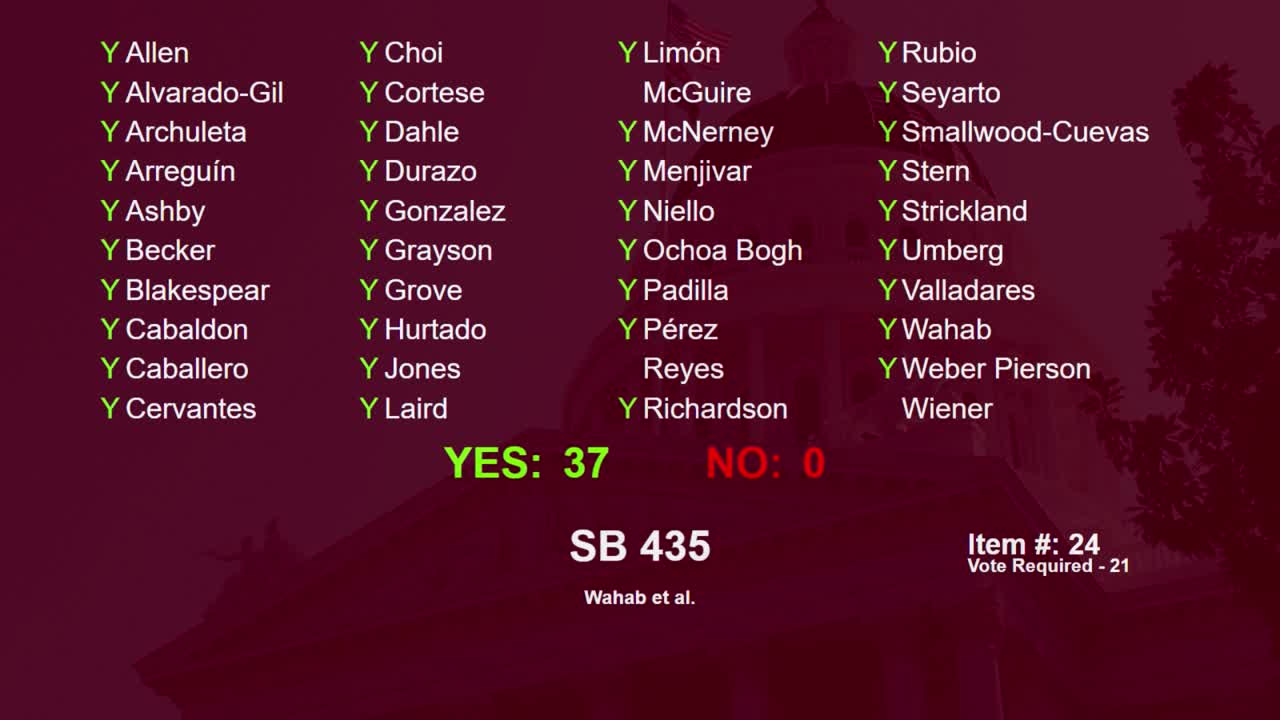
Bill Author
Bill Co-Author(s):