SB 647: Energy: Equitable Building Decarbonization Program: Low-Income Oversight Board: membership.
- Session Year: 2025-2026
- House: Senate
- Latest Version Date: 2025-09-18
Current Status:
Failed
(2026-03-02: Veto sustained.)
Introduced
In Committee
Awaiting First Chamber Vote
Passed First Chamber
In Committee
Awaiting Second Chamber Vote
Passed Second Chamber
Enacted
Existing law requires the State Energy Resources Conservation and Development Commission (Energy Commission) to establish the Equitable Building Decarbonization Program that includes the direct install program and the statewide incentive program for low-carbon building technologies, as provided.
This bill would require the Energy Commission to establish a mechanism to notify applicants to the Equitable Building Decarbonization Program that they may also be eligible for building energy efficiency and decarbonization incentives authorized by the Public Utilities Commission (PUC).
Existing law vests the PUC with regulatory authority over public utilities, including electrical corporations and gas corporations. Existing law establishes an 11-member Low-Income Oversight Board to advise the PUC on low-income electrical, gas, and water customer issues, as specified.
This bill would add to the Low-Income Oversight Board a member to be selected by the Executive Director of the Energy Commission.
Existing law requires the State Energy Resources Conservation and Development Commission (Energy Commission) to establish the Equitable Building Decarbonization Program that includes the direct install program and the statewide incentive program for low-carbon building technologies, as provided.
This bill would require the Energy Commission to establish a mechanism to notify applicants to the Equitable Building Decarbonization Program that they may also be eligible for building energy efficiency and decarbonization incentives authorized by the Public Utilities Commission (PUC).
Existing law vests the PUC with regulatory authority over public utilities, including electrical corporations and gas corporations. Under existing law, the PUC supervises certain rate assistance and energy efficiency programs administered by electrical corporations and gas corporations, or administered by third-party administrators on their behalf. Existing law requires the PUC to ensure that all eligible low-income electricity and gas customers are given the opportunity to participate in low-income energy efficiency programs, including the Energy Savings Assistance Program, that are designed to provide long-term reductions in energy consumption at the dwelling unit, including customers occupying apartments or similar multiunit residential structures, as specified. Existing law requires that these programs be designed to provide long-term reductions in energy consumption at the dwelling unit, as specified. corporations.
Existing law establishes an 11-member Low-Income Oversight Board to advise the PUC on low-income electric, electrical, gas, and water customer issues, as specified.
This bill would add to the Low-Income Oversight Board a member to be selected by the Executive Director of the Energy Commission.
This bill would require the PUC, in consultation with the Low-Income Oversight Board, to establish standardized statewide performance metrics to evaluate the effectiveness, equity, and accountability of certain programs, as specified. The bill would require the commission to require administrators of those programs to collect and report data related to those metrics in a standardized format.Under existing law, a violation of the Public Utilities Act or an order, decision, rule, direction, demand, or requirement of the PUC is a crime.Because a program administrators failure to collect and report that data in violation of a PUC action implementing this bills requirements would be a crime, the bill would impose a state-mandated local program.The California Constitution requires the state to reimburse local agencies and school districts for certain costs mandated by the state. Statutory provisions establish procedures for making that reimbursement.This bill would provide that no reimbursement is required by this act for a specified reason.Existing law requires the State Energy Resources Conservation and Development Commission (Energy Commission) to establish the Equitable Building Decarbonization Program that includes the direct install program and the statewide incentive program for low-carbon building technologies, as provided.
This bill would require the Energy Commission to establish a mechanism to notify applicants to the Equitable Building Decarbonization Program that they may also be eligible for building energy efficiency and decarbonization incentives authorized by the Public Utilities Commission (PUC).
Existing law vests the PUC with regulatory authority over public utilities, including electrical corporations and gas corporations. Under existing law, the PUC supervises certain rate assistance and energy efficiency programs administered by electrical corporations and gas corporations, or administered by third-party administrators on their behalf. Existing law requires the PUC to ensure that all eligible low-income electricity and gas customers are given the opportunity to participate in low-income energy efficiency programs, including the Energy Savings Assistance Program, that are designed to provide long-term reductions in energy consumption at the dwelling unit, including customers occupying apartments or similar multiunit residential structures, as specified. Existing law requires that these programs be designed to provide long-term reductions in energy consumption at the dwelling unit, as specified.
Existing law establishes an 11-member Low-Income Oversight Board to advise the PUC on low-income electric, gas, and water customer issues, as specified.
This bill would add to the Low-Income Oversight Board a member to be selected by the Executive Director of the Energy Commission. The bill would require the Low-Income Oversight Board, on or before January 1, 2027, to conduct an assessment of state and ratepayer-funded energy-efficiency incentives provided to low-income residents and to low-to-moderate income residents, as defined, which would include, among other things, recommendations for options to address the energy assistance needs of low-to-moderate income California households with household incomes that exceed the thresholds for existing low-income programs, as provided. The bill would require the Low-Income Oversight Board to publish its final assessment on its internet website on or before July 1, 2027.
This bill would require the PUC, in consultation with the Low-Income Oversight Board, to establish standardized statewide performance metrics to evaluate the effectiveness, equity, and accountability of certain programs, as specified. The bill would require the commission to require administrators of those programs to collect and report data related to those metrics in a standardized format.
Under existing law, a violation of the Public Utilities Act or an order, decision, rule, direction, demand, or requirement of the PUC is a crime.
Because a program administrators failure to collect and report that data in violation of a PUC action implementing this bills requirements would be a crime, the bill would impose a state-mandated local program.
The California Constitution requires the state to reimburse local agencies and school districts for certain costs mandated by the state. Statutory provisions establish procedures for making that reimbursement.
This bill would provide that no reimbursement is required by this act for a specified reason.
Existing law requires the State Energy Resources Conservation and Development Commission (Energy Commission) to establish the Equitable Building Decarbonization Program that includes the direct install program and the statewide incentive program for low-carbon building technologies, as provided.
This bill would require the Energy Commission to establish a mechanism to notify applicants to the Equitable Building Decarbonization Program that they may also be eligible for building energy efficiency and decarbonization incentives authorized by the Public Utilities Commission (PUC).
Existing law vests the Public Utilities Commission (PUC) PUC with regulatory authority over public utilities, including electrical corporations and gas corporations. Under existing law, the PUC supervises certain rate assistance and energy efficiency programs administered by electrical corporations and gas corporations, or administered by third-party administrators on their behalf.Existing behalf. Existing law requires the PUC to ensure that all eligible low-income electricity and gas customers are given the opportunity to participate in low-income energy efficiency programs, including the Energy Savings Assistance Program, that are designed to provide long-term reductions in energy consumption at the dwelling unit, including customers occupying apartments or similar multiunit residential structures, as specified. Existing law requires that these programs be designed to provide long-term reductions in energy consumption at the dwelling unit, as specified.
Existing law establishes an 11-member Low-Income Oversight Board to advise the PUC on low-income electric, gas, and water customer issues, as specified.
This bill would add to the Low-Income Oversight Board a member to be selected by the Executive Director of the State Energy Resources Conservation and Development Commission and a member to be selected by the Executive Director of the State Air Resources Board. Commission. The bill would require the Low-Income Oversight Board, on or before January 1, 2027, to conduct an assessment of state and ratepayer-funded energy-efficiency incentives provided to low-income residents and to low-to-moderate income residents, as defined, which would include, among other things, recommendations for options to address the energy assistance needs of low-to-moderate income California households with household incomes that exceed the thresholds for existing low-income programs, as provided. The bill would require the Low-Income Oversight Board to publish its final assessment on its internet website on or before July 1, 2027.
Existing law vests the Public Utilities Commission (PUC) with regulatory authority over public utilities, including electrical corporations and gas corporations. Under existing law, the PUC supervises certain rate assistance and energy efficiency programs administered by electrical corporations and gas corporations, or administered by third-party administrators on their behalf. Existing law states the intent of the Legislature to protect and strengthen the current network of community service providers by, among other things, directing that any evaluation of the effectiveness of the low-income energy efficiency programs be based not solely on cost criteria, but also on the degree to which the provision of services allows maximum program accessibility to quality programs to low-income communities by entities that have demonstrated performance in effectively delivering services to the communities.
This bill would instead state that it is intent of the Legislature to protect and strengthen the current network of community-based organizations by directing that any evaluation of the effectiveness of the low-income energy efficiency programs be based not solely on cost criteria, but also on specified factors, including, among other things, whether the program combines energy upgrades, electrification, and health improvements or coordinates with other initiatives, the delivery of measurable cost reductions, improved health and safety outcomes, and equitable access for underserved communities, and the degree to which the provision of services allows maximum program accessibility to quality programs to low-income communities by entities that have demonstrated performance in effectively delivering services to the communities, as specified.Existing law requires the PUC to ensure that all eligible low-income electricity and gas customers are given the opportunity to participate in low-income energy efficiency programs, including the Energy Savings Assistance Program, that are designed to provide long-term reductions in energy consumption at the dwelling unit, including customers occupying apartments or similar multiunit residential structures, as specified. Existing law requires that these programs be designed to provide long-term reductions in energy consumption at the dwelling unit, as specified.
This bill would instead require the PUC to ensure that all eligible low-to-moderate income electricity and gas customers are given the opportunity to participate in low-to-moderate income energy efficiency programs and would also require the above-mentioned programs to increase the health and safety of individuals. The bill would require the PUC to ensure that these programs prioritize advanced upgrades including heat pumps, efficient heating, ventilation, and air-conditioning systems, and deep weatherization measures to achieve increased savings on energy costs per household.Existing law establishes an 11-member Low-Income Oversight Board to advise the PUC on low-income electric, gas, and water customer issues, as specified.
This bill would instead require the board to advise the PUC on low-to-moderate income electric, gas, and water customer issues and would add to the Low-Income Oversight Board a member to be selected by the Executive Director of the State Energy Resources Conservation and Development Commission (Energy Commission) and a member to be selected by the Executive Director of the State Air Resources Board. The bill would require the Low-Income Oversight Board, on or before January 1, 2027, to conduct an assessment of state and ratepayer-funded energy-efficiency incentives provided to low-income residents and to low-to-moderate income residents, as defined, which would include, among other things, recommendations for options to address the energy assistance needs of low-to-moderate income California households with household incomes that exceed the thresholds for existing low-income programs, as provided. The bill would require the Low-Income Oversight Board to publish its final assessment on its internet website on or before July 1, 2027.
Existing law requires the Energy Commission to establish the Equitable Building Decarbonization Program, which includes a direct install program for installation of energy-efficient electric appliances, energy efficiency measures, demand flexibility measures, wiring and panel upgrades, building infrastructure upgrades, efficient air-conditioning systems, ceiling fans, and other measures for low-to-moderate income households, and a statewide incentive program for low-carbon building technologies, as specified.This bill would require the Low-Income Oversight Board, in conjunction with the PUC and the Energy Commission, to integrate, to the extent feasible, the administration of the Energy Savings Assistance Program and the Equitable Building Decarbonization Program in order to, among other things, align program rules and objectives to eliminate redundancies and simplify participation for eligible households.The bill would require the Energy Savings Assistance Program to serve households of low-to-moderate income instead of low-income households. The bill would require the PUC to require an electrical or gas corporation to appoint a program administrator, with specified qualifications, for purposes of the Energy Savings Assistance Program, as provided. The bill would require that the program administrator have certain priorities, including, among other things, reducing utility costs for customers with low-to-moderate income through energy-efficient appliances and weatherization improvements.Under existing law, a violation of the Public Utilities Act or any order, decision, rule, direction, demand, or requirement of the PUC is a crime.Because certain provisions of this bill would be part of the act and a violation of a PUC action implementing the bills requirements would be a crime, the bill would impose a state-mandated local program.The California Constitution requires the state to reimburse local agencies and school districts for certain costs mandated by the state. Statutory provisions establish procedures for making that reimbursement.This bill would provide that no reimbursement is required by this act for a specified reason.Existing law vests the Public Utilities Commission (PUC) with regulatory authority over public utilities, including electrical corporations and gas corporations. Under existing law, the commission PUC supervises certain rate assistance and energy efficiency programs administered by electrical corporations and gas corporations, or administered by third-party administrators on their behalf. Existing law states the intent of the Legislature to protect and strengthen the current network of community service providers by, among other things, directing that any evaluation of the effectiveness of the low-income energy efficiency programs be based not solely on cost criteria, but also on the degree to which the provision of services allows maximum program accessibility to quality programs to low-income communities by entities that have demonstrated performance in effectively delivering services to the communities.
This bill would instead state that it is intent of the Legislature to protect and strengthen the current network of community service providers community-based organizations by directing that any evaluation of the effectiveness of the low-income energy efficiency programs be based not solely on cost criteria, but also on specified factors, including, among other things, whether the program combines energy upgrades, electrification, and health improvements or coordinates with other initiatives, the delivery of measurable cost reductions, improved health and safety outcomes, and equitable access for underserved communities, and the degree to which the provision of services allows maximum program accessibility to quality programs to low-income communities by entities that have demonstrated performance in effectively delivering services to the communities, as specified.
Existing law requires the commission PUC to ensure that all eligible low-income electricity and gas customers are given the opportunity to participate in low-income energy efficiency programs programs, including the Energy Savings Assistance Program, that are designed to provide long-term reductions in energy consumption at the dwelling unit, including customers occupying apartments or similar multiunit residential structures, as specified. Existing law requires these programs be designed to provide long-term reductions in energy consumption at the dwelling unit, as specified.
This bill would instead require the PUC to ensure that all eligible low-to-moderate income electricity and gas customers are given the opportunity to participate in low-to-moderate income energy efficiency programs and would also require the above-mentioned programs to increase the health and safety of individuals. The bill would require the commission PUC to ensure that these programs prioritize advanced upgrades including heat pumps, efficient heating, ventilation, and air conditioning air-conditioning systems, and deep weatherization measures to achieve increased savings on energy costs per household.
Existing law establishes an 11-member Low-Income Oversight Board to advise the PUC on low-income electric, gas, and water customer issues, as specified.
This bill would instead require the board to advise the PUC on low-to-moderate income electric, gas, and water customer issues and would add a member to be selected by the State Energy Resources Conservation and Development Commission (Energy Commission) and a member to be selected by the State Air Resources Board.
Existing law requires the Energy Commission to establish the Equitable Building Decarbonization Program, which includes a direct install program for installation of energy-efficient electric appliances, energy efficiency measures, demand flexibility measures, wiring and panel upgrades, building infrastructure upgrades, efficient air-conditioning systems, ceiling fans, and other measures for low-to-moderate income households, and a statewide incentive program for low-carbon building technologies, as specified.
This bill would require the Low-Income Oversight Board, in conjunction with the PUC and the Energy Commission, to integrate, to the extent feasible, the administration of the Energy Savings Assistance Program and the Equitable Building Decarbonization Program in order to, among other things, align program rules and objectives to eliminate redundancies and simplify participation for eligible households.
The bill would require the Energy Savings Assistance Program to serve households of low-to-moderate income instead of low-income households. The bill would require the PUC to require an electrical or gas corporation to appoint a program administrator, with specified qualifications, for purposes of the Energy Savings Assistance Program, as provided. The bill would require that the program administrator have certain priorities, including, among other things, reducing utility costs for customers with low-to-moderate income through energy-efficient appliances and weatherization improvements.
Under existing law, a violation of the Public Utilities Act or any order, decision, rule, direction, demand, or requirement of the commission PUC is a crime.
Because the certain provisions of this bill would be part of the act and a violation of a commission PUC action implementing the bills requirements would be a crime, the bill would impose a state-mandated local program.
The California Constitution requires the state to reimburse local agencies and school districts for certain costs mandated by the state. Statutory provisions establish procedures for making that reimbursement.
This bill would provide that no reimbursement is required by this act for a specified reason.
Existing law vests the Public Utilities Commission with regulatory authority over public utilities, including electrical corporations and gas corporations. Under existing law, the commission supervises certain rate assistance and energy efficiency programs administered by electrical corporations and gas corporations, or administered by third-party administrators on their behalf. Existing law states the intent of the Legislature to protect and strengthen the current network of community service providers by, among other things, directing that any evaluation of the effectiveness of the low-income energy efficiency programs be based not solely on cost criteria, but also on the degree to which the provision of services allows maximum program accessibility to quality programs to low-income communities by entities that have demonstrated performance in effectively delivering services to the communities.
This bill would instead state that it is intent of the Legislature to protect and strengthen the current network of community service providers by directing that any evaluation of the effectiveness of the low-income energy efficiency programs be based not solely on cost criteria, but also on specified factors, including, among other things, whether the program combines energy upgrades, electrification, and health improvements or coordinates with other initiatives, the delivery of measurable cost reductions, improved health and safety outcomes, and equitable access for underserved communities, and the degree to which the provision of services allows maximum program accessibility to quality programs to low-income communities by entities that have demonstrated performance in effectively delivering services to the communities, as specified.
Existing law requires the commission to ensure that all eligible low-income electricity and gas customers are given the opportunity to participate in low-income energy efficiency programs that are designed to provide long-term reductions in energy consumption at the dwelling unit, including customers occupying apartments or similar multiunit residential structures, as specified. Existing law requires these programs be designed to provide long-term reductions in energy consumption at the dwelling unit, as specified.
This bill would also require the above-mentioned programs to increase the health and safety of individuals. The bill would require the commission to ensure that these programs prioritize advanced upgrades including heat pumps, efficient heating, ventilation, and air conditioning systems, and deep weatherization measures to achieve increased savings on energy costs per household.
Under existing law, a violation of the Public Utilities Act or any order, decision, rule, direction, demand, or requirement of the commission is a crime.
Because the provisions of this bill would be part of the act and a violation of a commission action implementing the bills requirements would be a crime, the bill would impose a state-mandated local program.
The California Constitution requires the state to reimburse local agencies and school districts for certain costs mandated by the state. Statutory provisions establish procedures for making that reimbursement.
This bill would provide that no reimbursement is required by this act for a specified reason.
(a)(1)The commission shall establish the Equitable Building Decarbonization Program.
(2)The Equitable Building Decarbonization Program includes the direct install program established pursuant to Section 25665.3 and the statewide incentive program for low-carbon building technologies established pursuant to Section 25665.5.
(b)If moneys made available for the Equitable Building Decarbonization Program remain unspent after two years, the commission shall evaluate potential changes to the Equitable Building Decarbonization Program to increase participation and may make those unspent funds, or a portion of those unspent funds, available for other purposes consistent with the Equitable Building Decarbonization Program.
(c)The commission shall establish a mechanism to notify applicants to the Equitable Building Decarbonization Program that they may also be eligible for building energy efficiency and decarbonization incentives authorized by the Public Utilities Commission.
SEC. 2.Section 382.1 of the Public Utilities Code is amended to read:382.1.(a)There is hereby established a Low-Income Oversight Board that shall advise the commission on low-income electric, gas, and water customer issues and shall serve as a liaison for the commission to low-income ratepayers and representatives. The Low-Income Oversight Board shall replace the Low-Income Advisory Board in existence on January 1, 2000. The Low-Income Oversight Board shall do all of the following to advise the commission regarding the commissions duties:
(1)Monitor and evaluate implementation of all programs provided to low-income electricity, gas, and water customers.
(2)Assist in the development and analysis of any assessments of low-income customer need.
(3)Encourage collaboration between state and utility programs for low-income electricity and gas customers to maximize the leverage of state and federal energy efficiency funds to both lower the bills and increase the comfort of low-income customers.
(4)Provide reports to the Legislature, as requested, summarizing the assessment of need, audits, and analysis of program implementation.
(5)Assist in streamlining the application and enrollment process of programs for low-income electricity and gas customers with general low-income programs, including, but not limited to, the Universal Lifeline Telephone Service (ULTS) program and, including compliance with Section 739.1.
(6)Encourage the usage of the network of community service providers in accordance with Section 381.5.
(b)The Low-Income Oversight Board shall comprise 12 members to be selected as follows:
(1)Five members selected by the commission who have expertise in the low-income community and who are not affiliated with any state agency or utility group. These members shall be selected in a manner to ensure an equitable geographic distribution.
(2)One member selected by the Governor.
(3)One member selected by the commission who is a commissioner or commissioner designee.
(4)One member selected by the Department of Community Services and Development.
(5)One member selected by the commission who is a representative of private weatherization contractors.
(6)One member selected by the commission who is a representative of an electrical or gas corporation.
(7)One member selected by the commission who is a representative of a water corporation.
(8)One member selected by the Executive Director of the Energy Commission.
(c)The Low-Income Oversight Board shall alternate meeting locations between northern, central, and southern California.
(d)The Low-Income Oversight Board may establish a technical advisory committee consisting of low-income service providers, utility representatives, consumer organizations, and commission staff, to assist the board and may request utility representatives and commission staff to assist the technical advisory committee.
(e)The commission shall do all of the following in conjunction with the board:
(1)Work with the board, interested parties, and community-based organizations to increase participation in programs for low-income customers.
(2)Provide technical support to the board.
(3)Ensure that the energy burden of low-income electricity and gas customers is reduced.
(4)Provide formal notice of board meetings in the commissions daily calendar.
(f)(1)Members of the board and members of the technical advisory committee shall be eligible for compensation in accordance with state guidelines for necessary travel.
(2)Members of the board and members of the technical advisory committee who are not salaried state service employees shall be eligible for reasonable compensation for attendance at board meetings.
(3)All reasonable costs incurred by the board in carrying out its duties pursuant to subdivision (a), including staffing, travel, and administrative costs, shall be reimbursed through the public utilities reimbursement account and shall be part of the budget of the commission and the commission shall consult with the board in the preparation of that portion of the commissions annual proposed budget.
SEC. 3.Section 383.1 is added to the Public Utilities Code, to read:383.1.(a)The commission, in consultation with the Low-Income Oversight Board, shall establish standardized statewide performance metrics to evaluate the effectiveness, equity, and accountability of programs funded pursuant to this article.(b)The standardized statewide performance metrics shall include, but not be limited to, all of the following:(1)Reductions to the energy burden of participating households, evaluated through postinstallation verifications or equivalent follow-up mechanisms.(2)Participation rates disaggregated by income level, housing tenure, rural or urban location, and designation as a hard-to-reach population.(3)Scope and depth of services delivered, including the number and types of measures installed and the extent to which projects include electrification and health and safety improvements.(4)Customer satisfaction with program services, assessed through follow-up surveys or other postinstallation evaluation tools.(5)Contractor and workforce diversity, measured by the share of total contract value awarded to certified small businesses, disabled veteran business enterprises, community-based organizations, and diverse suppliers consistent with the commissions General Order 156.(6)Timeliness of payments to contractors and subcontractors, measured by invoice processing time and compliance with applicable prompt payment requirements.(7)Support for small business and community-based organization development, measured by participation in training, mentorship, and technical assistance activities, including recipient feedback.(c)The commission shall require program administrators to collect and report data related to the metrics described in subdivision (b) in a standardized format. The commission shall incorporate the metrics into annual evaluations and may periodically revise the metrics to align with state energy, equity, workforce, and decarbonization goals.SEC. 4.No reimbursement is required by this act pursuant to Section 6 of Article XIIIB of the California Constitution because the only costs that may be incurred by a local agency or school district will be incurred because this act creates a new crime or infraction, eliminates a crime or infraction, or changes the penalty for a crime or infraction, within the meaning of Section 17556 of the Government Code, or changes the definition of a crime within the meaning of Section 6 of Article XIIIB of the California Constitution.(a)(1)The commission shall establish the Equitable Building Decarbonization Program.
(2)The Equitable Building Decarbonization Program includes the direct install program established pursuant to Section 25665.3 and the statewide incentive program for low-carbon building technologies established pursuant to Section 25665.5.
(b)If moneys made available for the Equitable Building Decarbonization Program remain unspent after two years, the commission shall evaluate potential changes to the Equitable Building Decarbonization Program to increase participation and may make those unspent funds, or a portion of those unspent funds, available for other purposes consistent with the Equitable Building Decarbonization Program.
(c)The commission shall establish a mechanism to notify applicants to the Equitable Building Decarbonization Program that they may also be eligible for building energy efficiency and decarbonization incentives authorized by the Public Utilities Commission.
SEC. 2.Section 382.1 of the Public Utilities Code is amended to read:382.1.(a)There is hereby established a Low-Income Oversight Board that shall advise the commission on low-income electric, gas, and water customer issues and shall serve as a liaison for the commission to low-income ratepayers and representatives. The Low-Income Oversight Board shall replace the Low-Income Advisory Board in existence on January 1, 2000. The Low-Income Oversight Board shall do all of the following to advise the commission regarding the commissions duties:
(1)Monitor and evaluate implementation of all programs provided to low-income electricity, gas, and water customers.
(2)Assist in the development and analysis of any assessments of low-income customer need.
(3)Encourage collaboration between state and utility programs for low-income electricity and gas customers to maximize the leverage of state and federal energy efficiency funds to both lower the bills and increase the comfort of low-income customers.
(4)Provide reports to the Legislature, as requested, summarizing the assessment of need, audits, and analysis of program implementation.
(5)Assist in streamlining the application and enrollment process of programs for low-income electricity and gas customers with general low-income programs, including, but not limited to, the Universal Lifeline Telephone Service (ULTS) program and, including compliance with Section 739.1.
(6)Encourage the usage of the network of community service providers in accordance with Section 381.5.
(b)The Low-Income Oversight Board shall comprise 12 members to be selected as follows:
(1)Five members selected by the commission who have expertise in the low-income community and who are not affiliated with any state agency or utility group. These members shall be selected in a manner to ensure an equitable geographic distribution.
(2)One member selected by the Governor.
(3)One member selected by the commission who is a commissioner or commissioner designee.
(4)One member selected by the Department of Community Services and Development.
(5)One member selected by the commission who is a representative of private weatherization contractors.
(6)One member selected by the commission who is a representative of an electrical or gas corporation.
(7)One member selected by the commission who is a representative of a water corporation.
(8)One member selected by the Executive Director of the Energy Commission.
(c)The Low-Income Oversight Board shall alternate meeting locations between northern, central, and southern California.
(d)The Low-Income Oversight Board may establish a technical advisory committee consisting of low-income service providers, utility representatives, consumer organizations, and commission staff, to assist the board and may request utility representatives and commission staff to assist the technical advisory committee.
(e)The commission shall do all of the following in conjunction with the board:
(1)Work with the board, interested parties, and community-based organizations to increase participation in programs for low-income customers.
(2)Provide technical support to the board.
(3)Ensure that the energy burden of low-income electricity and gas customers is reduced.
(4)Provide formal notice of board meetings in the commissions daily calendar.
(f)(1)Members of the board and members of the technical advisory committee shall be eligible for compensation in accordance with state guidelines for necessary travel.
(2)Members of the board and members of the technical advisory committee who are not salaried state service employees shall be eligible for reasonable compensation for attendance at board meetings.
(3)All reasonable costs incurred by the board in carrying out its duties pursuant to subdivision (a), including staffing, travel, and administrative costs, shall be reimbursed through the public utilities reimbursement account and shall be part of the budget of the commission and the commission shall consult with the board in the preparation of that portion of the commissions annual proposed budget.
SEC. 3.Section 383 is added to the Public Utilities Code, to read:383.(a)On or before January 1, 2027, the Low-Income Oversight Board shall conduct an assessment of state and ratepayer-funded energy efficiency incentives provided to low-income residents and to low-to-moderate income residents. The assessment shall include at least all of the following:(1)An assessment of and recommendations regarding opportunities for and barriers to improving the stacking of energy efficiency and building decarbonization incentives aimed at low-income households and owners of multifamily residences that house low-income residents.(2)Recommendations for options to address the energy assistance needs of low-to-moderate income California households with household incomes that exceed the thresholds for existing low-income programs.(3)Opportunities for energy efficiency incentives to better support the growth of small and diverse businesses that perform energy upgrades financed by those incentives.(4)The potential rate impacts of recommendations included in the assessment, and recommendations on opportunities to mitigate or prevent those impacts.(b)On or before July 1, 2027, the board shall publish its final assessment, pursuant to this section, on its internet website.(c)For purposes of this section, low-to-moderate income has the same meaning as defined in Section 25665 of the Public Resources Code.(d)This section shall remain in effect only until January 1, 2030, and as of that date is repealed.SEC. 4.SEC. 3.Section 383.1 is added to the Public Utilities Code, to read:383.1.(a)The commission, in consultation with the Low-Income Oversight Board, shall establish standardized statewide performance metrics to evaluate the effectiveness, equity, and accountability of programs funded pursuant to this article.
(b)The standardized statewide performance metrics shall include, but not be limited to, all of the following:
(1)Reductions to the energy burden of participating households, evaluated through postinstallation verifications or equivalent follow-up mechanisms.
(2)Participation rates disaggregated by income level, housing tenure, rural or urban location, and designation as a hard-to-reach population.
(3)Scope and depth of services delivered, including the number and types of measures installed and the extent to which projects include electrification and health and safety improvements.
(4)Customer satisfaction with program services, assessed through follow-up surveys or other postinstallation evaluation tools.
(5)Contractor and workforce diversity, measured by the share of total contract value awarded to certified small businesses, disabled veteran business enterprises, community-based organizations, and diverse suppliers consistent with the commissions General Order 156.
(6)Timeliness of payments to contractors and subcontractors, measured by invoice processing time and compliance with applicable prompt payment requirements.
(7)Support for small business and community-based organization development, measured by participation in training, mentorship, and technical assistance activities, including recipient feedback.
(c)The commission shall require program administrators to collect and report data related to the metrics described in subdivision (b) in a standardized format. The commission shall incorporate the metrics into annual evaluations and may periodically revise the metrics to align with state energy, equity, workforce, and decarbonization goals.
SEC. 5.SEC. 4.No reimbursement is required by this act pursuant to Section 6 of Article XIIIB of the California Constitution because the only costs that may be incurred by a local agency or school district will be incurred because this act creates a new crime or infraction, eliminates a crime or infraction, or changes the penalty for a crime or infraction, within the meaning of Section 17556 of the Government Code, or changes the definition of a crime within the meaning of Section 6 of Article XIIIB of the California Constitution.
(a)(1)The commission shall establish the Equitable Building Decarbonization Program.
(2)The Equitable Building Decarbonization Program includes the direct install program established pursuant to Section 25665.3 and the statewide incentive program for low-carbon building technologies established pursuant to section Section 25665.5.
(b)If moneys made available for the Equitable Building Decarbonization Program remain unspent after two years, the commission shall evaluate potential changes to the Equitable Building Decarbonization Program to increase participation and may make those unspent funds, or a portion of those unspent funds, available for other purposes consistent with the Equitable Building Decarbonization Program.
(c)The commission shall establish a mechanism to notify applicants to the Equitable Building Decarbonization Program that they may also be eligible for building energy efficiency and decarbonization incentives authorized by the Public Utilities Commission.
SEC. 2.Section 382.1 of the Public Utilities Code is amended to read:382.1.(a)There is hereby established a Low-Income Oversight Board that shall advise the commission on low-income electric, gas, and water customer issues and shall serve as a liaison for the commission to low-income ratepayers and representatives. The Low-Income Oversight Board shall replace the Low-Income Advisory Board in existence on January 1, 2000. The Low-Income Oversight Board shall do all of the following to advise the commission regarding the commissions duties:
(1)Monitor and evaluate implementation of all programs provided to low-income electricity, gas, and water customers.
(2)Assist in the development and analysis of any assessments of low-income customer need.
(3)Encourage collaboration between state and utility programs for low-income electricity and gas customers to maximize the leverage of state and federal energy efficiency funds to both lower the bills and increase the comfort of low-income customers.
(4)Provide reports to the Legislature, as requested, summarizing the assessment of need, audits, and analysis of program implementation.
(5)Assist in streamlining the application and enrollment process of programs for low-income electricity and gas customers with general low-income programs, including, but not limited to, the Universal Lifeline Telephone Service (ULTS) program and, including compliance with Section 739.1.
(6)Encourage the usage of the network of community service providers in accordance with Section 381.5.
(b)The Low-Income Oversight Board shall comprise 12 members to be selected as follows:
(1)Five members selected by the commission who have expertise in the low-income community and who are not affiliated with any state agency or utility group. These members shall be selected in a manner to ensure an equitable geographic distribution.
(2)One member selected by the Governor.
(3)One member selected by the commission who is a commissioner or commissioner designee.
(4)One member selected by the Department of Community Services and Development.
(5)One member selected by the commission who is a representative of private weatherization contractors.
(6)One member selected by the commission who is a representative of an electrical or gas corporation.
(7)One member selected by the commission who is a representative of a water corporation.
(8)One member selected by the Executive Director of the Energy Commission.
(c)The Low-Income Oversight Board shall alternate meeting locations between northern, central, and southern California.
(d)The Low-Income Oversight Board may establish a technical advisory committee consisting of low-income service providers, utility representatives, consumer organizations, and commission staff, to assist the board and may request utility representatives and commission staff to assist the technical advisory committee.
(e)The commission shall do all of the following in conjunction with the board:
(1)Work with the board, interested parties, and community-based organizations to increase participation in programs for low-income customers.
(2)Provide technical support to the board.
(3)Ensure that the energy burden of low-income electricity and gas customers is reduced.
(4)Provide formal notice of board meetings in the commissions daily calendar.
(f)(1)Members of the board and members of the technical advisory committee shall be eligible for compensation in accordance with state guidelines for necessary travel.
(2)Members of the board and members of the technical advisory committee who are not salaried state service employees shall be eligible for reasonable compensation for attendance at board meetings.
(3)All reasonable costs incurred by the board in carrying out its duties pursuant to subdivision (a), including staffing, travel, and administrative costs, shall be reimbursed through the public utilities reimbursement account and shall be part of the budget of the commission and the commission shall consult with the board in the preparation of that portion of the commissions annual proposed budget.
SEC. 3.Section 383 is added to the Public Utilities Code, to read:383.(a)On or before January 1, 2027, the Low-Income Oversight Board shall conduct an assessment of state and ratepayer-funded energy efficiency incentives provided to low-income residents and to low-to-moderate income residents. The assessment shall include at least all of the following:
(1)An assessment of and recommendations regarding opportunities for and barriers to improving the stacking of energy efficiency and building decarbonization incentives aimed at low-income households and owners of multifamily residences that house low-income residents.
(2)Recommendations for options to address the energy assistance needs of low-to-moderate income California households with household incomes that exceed the thresholds for existing low-income programs.
(3)Opportunities for energy efficiency incentives to better support the growth of small and diverse businesses that perform energy upgrades financed by those incentives.
(4)The potential rate impacts of recommendations included in the assessment, and recommendations on opportunities to mitigate or prevent those impacts.
(b)On or before July 1, 2027, the board shall publish its final assessment, pursuant to this section, on its internet website.
(c)For purposes of this section, low-to-moderate income has the same meaning as defined in Section 25665 of the Public Resources Code.
(d)This section shall remain in effect only until January 1, 2030, and as of that date is repealed.
SEC. 4.Section 383.1 is added to the Public Utilities Code, to read:383.1.(a)The commission, in consultation with the Low-Income Oversight Board, shall establish standardized statewide performance metrics to evaluate the effectiveness, equity, and accountability of programs funded pursuant to this article.
(b)The standardized statewide performance metrics shall include, but not be limited to, all of the following:
(1)Reductions to the energy burden of participating households, evaluated through postinstallation verifications or equivalent follow-up mechanisms.
(2)Participation rates disaggregated by income level, housing tenure, rural or urban location, and designation as a hard-to-reach population.
(3)Scope and depth of services delivered, including the number and types of measures installed and the extent to which projects include electrification and health and safety improvements.
(4)Customer satisfaction with program services, assessed through follow-up surveys or other postinstallation evaluation tools.
(5)Contractor and workforce diversity, measured by the share of total contract value awarded to certified small businesses, disabled veteran business enterprises, community-based organizations, and diverse suppliers consistent with the commissions General Order 156.
(6)Timeliness of payments to contractors and subcontractors, measured by invoice processing time and compliance with applicable prompt payment requirements.
(7)Support for small business and community-based organization development, measured by participation in training, mentorship, and technical assistance activities, including recipient feedback.
(c)The commission shall require program administrators to collect and report data related to the metrics described in subdivision (b) in a standardized format. The commission shall incorporate the metrics into annual evaluations and may periodically revise the metrics to align with state energy, equity, workforce, and decarbonization goals.
SEC. 5.No reimbursement is required by this act pursuant to Section 6 of Article XIIIB of the California Constitution because the only costs that may be incurred by a local agency or school district will be incurred because this act creates a new crime or infraction, eliminates a crime or infraction, or changes the penalty for a crime or infraction, within the meaning of Section 17556 of the Government Code, or changes the definition of a crime within the meaning of Section 6 of Article XIIIB of the California Constitution.
(a)(1)The commission shall establish the Equitable Building Decarbonization Program.
(2)The Equitable Building Decarbonization Program includes the direct install program established pursuant to Section 25665.3 and the statewide incentive program for low-carbon building technologies established pursuant to section 25665.5.
(b)If moneys made available for the Equitable Building Decarbonization Program remain unspent after two years, the commission shall evaluate potential changes to the Equitable Building Decarbonization Program to increase participation and may make those unspent funds, or a portion of those unspent funds, available for other purposes consistent with the Equitable Building Decarbonization Program.
(c)The commission shall establish a mechanism to notify applicants to the Equitable Building Decarbonization Program that they may also be eligible for building energy efficiency and decarbonization incentives authorized by the Public Utilities Commission.
SECTION 1.SEC. 2.Section 382.1 of the Public Utilities Code is amended to read:382.1.(a)There is hereby established a Low-Income Oversight Board that shall advise the commission on low-income electric, gas, and water customer issues and shall serve as a liaison for the commission to low-income ratepayers and representatives. The Low-Income Oversight Board shall replace the Low-Income Advisory Board in existence on January 1, 2000. The Low-Income Oversight Board shall do all of the following to advise the commission regarding the commissions duties:
(1)Monitor and evaluate implementation of all programs provided to low-income electricity, gas, and water customers.
(2)Assist in the development and analysis of any assessments of low-income customer need.
(3)Encourage collaboration between state and utility programs for low-income electricity and gas customers to maximize the leverage of state and federal energy efficiency funds to both lower the bills and increase the comfort of low-income customers.
(4)Provide reports to the Legislature, as requested, summarizing the assessment of need, audits, and analysis of program implementation.
(5)Assist in streamlining the application and enrollment process of programs for low-income electricity and gas customers with general low-income programs, including, but not limited to, the Universal Lifeline Telephone Service (ULTS) program and, including compliance with Section 739.1.
(6)Encourage the usage of the network of community service providers in accordance with Section 381.5.
(b)The Low-Income Oversight Board shall comprise 13 12 members to be selected as follows:
(1)Five members selected by the commission who have expertise in the low-income community and who are not affiliated with any state agency or utility group. These members shall be selected in a manner to ensure an equitable geographic distribution.
(2)One member selected by the Governor.
(3)One member selected by the commission who is a commissioner or commissioner designee.
(4)One member selected by the Department of Community Services and Development.
(5)One member selected by the commission who is a representative of private weatherization contractors.
(6)One member selected by the commission who is a representative of an electrical or gas corporation.
(7)One member selected by the commission who is a representative of a water corporation.
(8)One member selected by the Executive Director of the Energy Commission.
(9)One member selected by the Executive Director of the State Air Resources Board.(c)The Low-Income Oversight Board shall alternate meeting locations between northern, central, and southern California.
(d)The Low-Income Oversight Board may establish a technical advisory committee consisting of low-income service providers, utility representatives, consumer organizations, and commission staff, to assist the board and may request utility representatives and commission staff to assist the technical advisory committee.
(e)The commission shall do all of the following in conjunction with the board:
(1)Work with the board, interested parties, and community-based organizations to increase participation in programs for low-income customers.
(2)Provide technical support to the board.
(3)Ensure that the energy burden of low-income electricity and gas customers is reduced.
(4)Provide formal notice of board meetings in the commissions daily calendar.
(f)(1)Members of the board and members of the technical advisory committee shall be eligible for compensation in accordance with state guidelines for necessary travel.
(2)Members of the board and members of the technical advisory committee who are not salaried state service employees shall be eligible for reasonable compensation for attendance at board meetings.
(3)All reasonable costs incurred by the board in carrying out its duties pursuant to subdivision (a), including staffing, travel, and administrative costs, shall be reimbursed through the public utilities reimbursement account and shall be part of the budget of the commission and the commission shall consult with the board in the preparation of that portion of the commissions annual proposed budget.
SEC. 2.SEC. 3.Section 383 is added to the Public Utilities Code, to read:383.(a)On or before January 1, 2027, the Low-Income Oversight Board shall conduct an assessment of state and ratepayer-funded energy efficiency incentives provided to low-income residents and to low-to-moderate income residents. The assessment shall include at least all of the following:
(1)An assessment of and recommendations regarding opportunities for and barriers to improving the stacking of energy efficiency and building decarbonization incentives aimed at low-income households and owners of multifamily residences that house low-income residents.
(2)Recommendations for options to address the energy assistance needs of low-to-moderate income California households with household incomes that exceed the thresholds for existing low-income programs.
(3)Opportunities for energy efficiency incentives to better support the growth of small and diverse businesses that perform energy upgrades financed by those incentives.
(4)The potential rate impacts of recommendations included in the assessment, and recommendations on opportunities to mitigate or prevent those impacts.
(b)On or before July 1, 2027, the board shall publish its final assessment, pursuant to this section, on its internet website.
(c)For purposes of this section, low-to-moderate income has the same meaning as defined in Section 25665 of the Public Resources Code.
(d)This section shall remain in effect only until January 1, 2030, and as of that date is repealed.
(a)There is hereby established a Low-Income Oversight Board that shall advise the commission on low-to-moderate income low-income electric, gas, and water customer issues and shall serve as a liaison for the commission to low-to-moderate income low-income ratepayers and representatives. The Low-Income Oversight Board shall replace the Low-Income Advisory Board in existence on January 1, 2000. The Low-Income Oversight Board shall do all of the following to advise the commission regarding the commissions duties:
(1)Monitor and evaluate implementation of all programs provided to low-to-moderate income low-income electricity, gas, and water customers.
(2)Assist in the development and analysis of any assessments of low-to-moderate income low-income customer need.
(3)Encourage collaboration between state and utility programs for low-to-moderate income low-income electricity and gas customers to maximize the leverage of state and federal energy efficiency funds to both lower the bills and increase the comfort of low-to-moderate income low-income customers.
(4)Provide reports to the Legislature, as requested, summarizing the assessment of need, audits, and analysis of program implementation.
(5)Assist in streamlining the application and enrollment process of programs for low-to-moderate income low-income electricity and gas customers with general low-to-moderate income low-income programs, including, but not limited to, the Universal Lifeline Telephone Service (ULTS) program and, including compliance with Section 739.1.
(6)Encourage the usage of the network of community-based organizations community service providers in accordance with Section 381.5.
(b)The Low-Income Oversight Board shall comprise 13 members to be selected as follows:
(1)Five members selected by the commission who have expertise in the low-income community and who are not affiliated with any state agency or utility group. These members shall be selected in a manner to ensure an equitable geographic distribution.
(2)One member selected by the Governor.
(3)One member selected by the commission who is a commissioner or commissioner designee.
(4)One member selected by the Department of Community Services and Development.
(5)One member selected by the commission who is a representative of private weatherization contractors.
(6)One member selected by the commission who is a representative of an electrical or gas corporation.
(7)One member selected by the commission who is a representative of a water corporation.
(8)One member selected by the Executive Director of the Energy Commission who is a commissioner or commissioner designee. Commission.
(9)One member selected by the Executive Director of the State Air Resources Board who is a board member or a board member designee. Board.
(c)The Low-Income Oversight Board shall alternate meeting locations between northern, central, and southern California.
(d)The Low-Income Oversight Board may establish a technical advisory committee consisting of low-income service providers, utility representatives, consumer organizations, and commission staff, to assist the board and may request utility representatives and commission staff to assist the technical advisory committee.
(e)The commission shall do all of the following in conjunction with the board:
(1)Work with the board, interested parties, and community-based organizations to increase participation in programs for low-to-moderate income low-income customers.
(2)Provide technical support to the board.
(3)Ensure that the energy burden of low-to-moderate income low-income electricity and gas customers is reduced.
(4)Provide formal notice of board meetings in the commissions daily calendar.
(f)(1)Members of the board and members of the technical advisory committee shall be eligible for compensation in accordance with state guidelines for necessary travel.
(2)Members of the board and members of the technical advisory committee who are not salaried state service employees shall be eligible for reasonable compensation for attendance at board meetings.
(3)All reasonable costs incurred by the board in carrying out its duties pursuant to subdivision (a), including staffing, travel, and administrative costs, shall be reimbursed through the public utilities reimbursement account and shall be part of the budget of the commission and the commission shall consult with the board in the preparation of that portion of the commissions annual proposed budget.
(g)For purposes of this section, low-to-moderate income has the same meaning as defined in Section 25665 of the Public Resources Code.SEC. 4.SEC. 2.Section 383 is added to the Public Utilities Code, to read:383.The (a)On or before January 1, 2027, the Low-Income Oversight Board, working in conjunction with the commission and the Energy Commission, shall integrate the administration of the Energy Savings Assistance Program established pursuant to Sections 382, 2790, and 2790.1, and the Equitable Building Decarbonization Program established pursuant to Article 5 (commencing with Section 25665) of Chapter 7.6 of Division 15 of the Public Resources Code, to the extent feasible, in order to do all of Board shall conduct an assessment of state and ratepayer-funded energy efficiency incentives provided to low-income residents and to low-to-moderate income residents. The assessment shall include at least all of the following:
(a)Align program rules and objectives to eliminate redundancies and simplify participation for eligible households.(b)Streamline administrative processes to reduce overhead, enabling more efficient allocation of resources toward direct services.(c)Enhance service delivery by offering comprehensive energy efficiency and decarbonization solutions tailored to the needs of households in disadvantaged communities.(d)Leverage economies of scale to improve cost-effectiveness and maximize the impact of funding for disadvantaged communities.(e)Leverage the regulatory expertise of the commission and the technical expertise of the Energy Commission to ensure effective implementation and oversight.(f)Be modeled after successful state-level collaborations that have demonstrated effective joint administration to meet energy efficiency and equity goals.(g)Align the states decarbonization and equity goals by creating unified program standards for equitable access to energy efficiency measures.(h)Ensure funds are prioritized for direct community investments, reducing reliance on large administrative costs.(i)Include ideas and information from representatives of community-based organizations, small businesses, consumer advocacy groups, and energy policy experts.(j)Provide recommendations to the commission and the Energy Commission on program improvements, equity considerations, and community engagement strategies.(k)Conduct regular reviews, audits, and performance evaluations of the administration of the programs.(l)Provide annual public reports on outcomes, challenges, and areas for improvement.(1)An assessment of and recommendations regarding opportunities for and barriers to improving the stacking of energy efficiency and building decarbonization incentives aimed at low-income households and owners of multifamily residences that house low-income residents.
(2)Recommendations for options to address the energy assistance needs of low-to-moderate income California households with household incomes that exceed the thresholds for existing low-income programs.
(3)Opportunities for energy efficiency incentives to better support the growth of small and diverse businesses that perform energy upgrades financed by those incentives.
(4)The potential rate impacts of recommendations included in the assessment, and recommendations on opportunities to mitigate or prevent those impacts.
(b)On or before July 1, 2027, the board shall publish its final assessment, pursuant to this section, on its internet website.
(c)For purposes of this section, low-to-moderate income has the same meaning as defined in Section 25665 of the Public Resources Code.
(d)This section shall remain in effect only until January 1, 2030, and as of that date is repealed.
SEC. 5.Section 2790 of the Public Utilities Code is amended to read:2790.(a)The commission shall require an electrical or gas corporation to perform home weatherization services for customers of low-to-moderate income if the commission determines that a significant need for those services exists in the corporations service territory, taking into consideration both the cost-effectiveness of the services and the policy of reducing the hardships facing households of low-to-moderate income.(b)(1)For purposes of this section, weatherization may include, where feasible, any of the following measures for any dwelling unit:(A)Attic insulation.(B)Caulking.(C)Weatherstripping.(D)Low-flow showerhead.(E)Waterheater blanket.(F)Door and building envelope repairs that reduce air infiltration.(2)The commission shall direct an electrical or gas corporation to provide as many of these measures as are feasible for each eligible dwelling unit with a household of low-to-moderate income.(c)For purposes of this section, weatherization may also include other building conservation measures, energy management technology, energy-efficient appliances, and energy education programs determined by the commission to be feasible, taking into consideration for all measures both the cost-effectiveness of the measures as a whole and the policy of reducing energy-related hardships facing households of low-to-moderate income.(d)Weatherization programs shall use the needs assessment pursuant to Section 382.1 to maximize efficiency of delivery.(e)The commission shall not increase the authorized budgets for the Energy Savings Assistance Program based on the expansion of income eligibility made under paragraph (1).(f)For purposes of this section, all of the following definitions apply:(1)Energy management technology may include a product, service, or software that allows a customer to better understand and manage electricity or gas use in the customers home.(2)Low-to-moderate income has the same meaning as defined in Section 25665 of the Public Resources Code.(3)Under-resourced community has the same meaning as defined in Section 25665 of the Public Resources Code.SEC. 6.Section 2790.1 is added to the Public Utilities Code, to read:2790.1.(a)The commission shall require an electrical or gas corporation to appoint a program administrator for the purposes of the Energy Savings Assistance Program established pursuant to Sections 382 and 2790. (b)The program administrator shall meet all of the following qualifications:(1)Be a state-based entity, with at least 51 percent of its operations and revenue generated within the state.(2)Not be a subsidiary, affiliate, or extension of a multinational corporation or financial institution, including a bank, investment firm, or publicly traded company.(3)Hold a small business or disabled veteran business enterprise certification as recognized by the Department of General Services, with a preference for business enterprises described in Article 5 (commencing with Section 8281) of Chapter 7 of Division 4.(4)Demonstrate at least five years of experience delivering services in under-resourced communities, with proven success in energy efficiency or decarbonization programs.(5)Commit to equitable workforce development, ensuring training and employment opportunities for individuals from under-resourced communities.(c)The program administrator shall contract with subcontractors that are nonprofit organizations or businesses that meet all of the following qualifications: (1)Be a state-based entity, with at least 51 percent of its operations and revenue generated within the state.(2)Not be a subsidiary, affiliate, or extension of a multinational corporation or financial institution, including a bank, investment firm, or publicly traded company.(3)Hold a small business or disabled veteran business enterprise certification as recognized by the Department of General Services, with a preference for business enterprises described in Article 5 (commencing with Section 8281) of Chapter 7 of Division 4, or be a nonprofit organization.(4)Demonstrate at least five years of experience delivering services in under-resourced communities, with proven success in energy efficiency or decarbonization programs.(5)Commit to equitable workforce development, ensuring training and employment opportunities for individuals from under-resourced communities.(d)The subcontractors shall perform functions, including, but not limited to, all of the following:(1)Design programs that are culturally relevant and meet specific community needs.(2)Conduct outreach to effectively engage residents and encourage participation.(3)Implement services using local knowledge and resources.(4)Provide feedback to continuously improve program effectiveness.(5)Expand economic opportunities for businesses in under-resourced communities and ensure local hiring and opportunities.(e)The program administrator and subcontractors shall implement a workforce development component that includes all of the following:(1)Prioritizing the hiring of local workers, with a preference for local workers from under-resourced communities.(2)Partnering with local workforce boards, community colleges, and apprenticeship programs to create career pathways.(3)Establishing a job placement and retention program to connect trained individuals with permanent employment.(4)Providing grants and incentives to small businesses and local contractors that commit to hiring and training workers from under-resourced communities.(f)The program administrator shall prioritize all of the following:(1)Reducing utility costs for customers with low-to-moderate income through energy-efficient appliances and weatherization improvements at minimal or no cost.(2)Improving health outcomes by enhancing indoor air quality through cleaner technologies and better ventilation systems.(3)Defining affordability as reducing household energy expenses to a sustainable level relative to income, considering regional cost variations and family size.(4)Conducting periodic affordability assessments to ensure evolving household needs are met.(5)Including public reporting on affordability outcomes and independent audits to verify cost reductions.(g)For purposes of this section, both of the following definitions apply:(1)Low-to-moderate income has the same meaning as defined in Section 25665 of the Public Resources Code.(2)Under-resourced community has the same meaning as defined in Section 25665 of the Public Resources Code.SEC. 7.No reimbursement is required by this act pursuant to Section 6 of Article XIIIB of the California Constitution because the only costs that may be incurred by a local agency or school district will be incurred because this act creates a new crime or infraction, eliminates a crime or infraction, or changes the penalty for a crime or infraction, within the meaning of Section 17556 of the Government Code, or changes the definition of a crime within the meaning of Section 6 of Article XIIIB of the California Constitution.It is the intent of the Legislature to protect and strengthen the current network of community service providers community-based organizations by doing both of the following:
(a)Directing that any evaluation of the effectiveness of the low-income energy efficiency programs shall be based not solely on cost criteria, but also on all of the following factors:
(1)The clarity of the objectives.
(2)The delivery of measurable cost reductions, improved health and safety outcomes, and equitable access for underserved communities.
(3)Whether the program combines energy upgrades, electrification, and health improvements or coordinates with other initiatives.
(4)The strength of stakeholder engagement.
(5)Whether the outreach of the program is effective, the enrollment simple, how the program eliminates barriers, and how the program uses data to target underserved populations.
(6)The clarity of the metrics used by the program, including whether the program tracks and shares meaningful outcomes, including energy savings, health improvement outcomes, or cost reductions.
(7)The quality of workforce development, including whether the program creates local jobs or results in investments in a trained, diverse workforce.
(8)The degree to which the provision of services allows maximum program accessibility to quality programs to low-income communities by entities that have demonstrated performance in effectively delivering services to the communities.
(b)Ensuring that high quality, low-income energy efficiency programs are delivered to the maximum number of eligible participants at a reasonable cost.
SEC. 2.Section 382 of the Public Utilities Code is amended to read:382.(a)Programs provided to low-income electricity customers, customers of low-to-moderate income, including, but not limited to, targeted energy-efficiency services and the California Alternate Rates for Energy program program, shall be funded at not less than 1996 authorized levels based on an assessment of customer need.
(b)In order to meet legitimate needs of electric and gas customers who are unable to pay their electric and gas bills and who satisfy eligibility criteria for assistance, recognizing that electricity is a basic necessity, and that all residents of the state should be able to afford essential electricity and gas supplies, the commission shall ensure that low-income ratepayers of low-to-moderate income are not jeopardized or overburdened by monthly energy expenditures. Energy expenditure may be reduced through the establishment of different rates for low-income ratepayers, ratepayers of low-to-moderate income, different levels of rate assistance, and energy efficiency programs.
(c)Nothing in this section shall be construed to prohibit electric and gas providers from offering any special rate or program for low-income ratepayers of low-to-moderate income that is not specifically required in this section.
(d)Beginning in 2002, an assessment of the needs of low-income electricity and gas ratepayers of low-to-moderate income shall be conducted periodically by the commission with the assistance of the Low-Income Oversight Board. A periodic assessment shall be made not less often than every third year. The assessment shall evaluate low-income program implementation for households of low-to-moderate income and the effectiveness of weatherization services and energy efficiency measures in low-income households. households of low-to-moderate income. The assessment shall consider whether existing programs adequately address low-income low-to-moderate income electricity and gas customers energy expenditures, hardship, language needs, and economic burdens.
(e)(1)The commission shall ensure that all eligible low-income electricity and gas customers of low-to-moderate income are given the opportunity to participate in low-income energy efficiency programs, programs for households of low-to-moderate income, including customers occupying apartments or similar multiunit residential structures. The commission and commission, electrical corporations corporations, and gas corporations shall make all reasonable efforts to coordinate ratepayer-funded programs with other energy conservation and efficiency programs and to obtain additional federal funding to support actions undertaken pursuant to this subdivision.
(2)The programs described in paragraph (1) shall be designed to do both of the following:
(A)Provide long-term reductions in energy consumption at the dwelling unit, based on an audit or assessment of the dwelling unit, that may include improved insulation, energy efficient appliances, measures that utilize solar energy, and other improvements to the physical structure.
(B)Increase the health and safety of individuals.
(3)The commission shall ensure that the programs described in paragraph (1) prioritize advanced upgrades, including heat pumps, efficient heating, ventilation, and air-conditioning systems, and deep weatherization measures to achieve increased savings on energy costs per household.
(f)The commission shall allocate funds necessary to meet the low-income low-to-moderate income objectives in this section.
(g)For purposes of this section, low-to-moderate income has the same meaning as defined in Section 25665 of the Public Resources Code.
SEC. 3.Section 382.1 of the Public Utilities Code is amended to read:382.1.(a)There is hereby established a Low-Income Oversight Board that shall advise the commission on low-income low-to-moderate income electric, gas, and water customer issues and shall serve as a liaison for the commission to low-income low-to-moderate income ratepayers and representatives. The Low-Income Oversight Board shall replace the Low-Income Advisory Board in existence on January 1, 2000. The Low-Income Oversight Board shall do all of the following to advise the commission regarding the commissions duties:
(1)Monitor and evaluate implementation of all programs provided to low-income low-to-moderate income electricity, gas, and water customers.
(2)Assist in the development and analysis of any assessments of low-income low-to-moderate income customer need.
(3)Encourage collaboration between state and utility programs for low-income low-to-moderate income electricity and gas customers to maximize the leverage of state and federal energy efficiency funds to both lower the bills and increase the comfort of low-income low-to-moderate income customers.
(4)Provide reports to the Legislature, as requested, summarizing the assessment of need, audits, and analysis of program implementation.
(5)Assist in streamlining the application and enrollment process of programs for low-income low-to-moderate income electricity and gas customers with general low-income low-to-moderate income programs, including, but not limited to, the Universal Lifeline Telephone Service (ULTS) program and, including compliance with Section 739.1.
(6)Encourage the usage of the network of community service providers community-based organizations in accordance with Section 381.5.
(b)The Low-Income Oversight Board shall be comprised of 11 comprise 13 members to be selected as follows:
(1)Five members selected by the commission who have expertise in the low-income community and who are not affiliated with any state agency or utility group. These members shall be selected in a manner to ensure an equitable geographic distribution.
(2)One member selected by the Governor.
(3)One member selected by the commission who is a commissioner or commissioner designee.
(4)One member selected by the Department of Community Services and Development.
(5)One member selected by the commission who is a representative of private weatherization contractors.
(6)One member selected by the commission who is a representative of an electrical or gas corporation.
(7)One member selected by the commission who is a representative of a water corporation.
(8)One member selected by the Energy Commission who is a commissioner or commissioner designee.
(9)One member selected by the State Air Resources Board who is a board member or a board member designee.
(c)The Low-Income Oversight Board shall alternate meeting locations between northern, central, and southern California.
(d)The Low-Income Oversight Board may establish a technical advisory committee consisting of low-income service providers, utility representatives, consumer organizations, and commission staff, to assist the board and may request utility representatives and commission staff to assist the technical advisory committee.
(e)The commission shall do all of the following in conjunction with the board:
(1)Work with the board, interested parties, and community-based organizations to increase participation in programs for low-income low-to-moderate income customers.
(2)Provide technical support to the board.
(3)Ensure that the energy burden of low-income low-to-moderate income electricity and gas customers is reduced.
(4)Provide formal notice of board meetings in the commissions daily calendar.
(f)(1)Members of the board and members of the technical advisory committee shall be eligible for compensation in accordance with state guidelines for necessary travel.
(2)Members of the board and members of the technical advisory committee who are not salaried state service employees shall be eligible for reasonable compensation for attendance at board meetings.
(3)All reasonable costs incurred by the board in carrying out its duties pursuant to subdivision (a), including staffing, travel, and administrative costs, shall be reimbursed through the public utilities reimbursement account and shall be part of the budget of the commission and the commission shall consult with the board in the preparation of that portion of the commissions annual proposed budget.
(g)For purposes of this section, low-to-moderate income has the same meaning as defined in Section 25665 of the Public Resources Code.
SEC. 4.Section 383 is added to the Public Utilities Code, to read:383.The Low-Income Oversight Board, working in conjunction with the commission and the Energy Commission, shall integrate the administration of the Energy Savings Assistance Program established pursuant to Sections 382, 2790, and 2790.1, and the Equitable Building Decarbonization Program established pursuant to Article 5 (commencing with Section 25665) of Chapter 7.6 of Division 15 of the Public Resources Code, to the extent feasible, in order to do all of the following:
(a)Align program rules and objectives to eliminate redundancies and simplify participation for eligible households.
(b)Streamline administrative processes to reduce overhead, enabling more efficient allocation of resources toward direct services.
(c)Enhance service delivery by offering comprehensive energy efficiency and decarbonization solutions tailored to the needs of households in disadvantaged communities.
(d)Leverage economies of scale to improve cost-effectiveness and maximize the impact of funding for disadvantaged communities.
(e)Leverage the regulatory expertise of the commission and the technical expertise of the Energy Commission to ensure effective implementation and oversight.
(f)Be modeled after successful state-level collaborations that have demonstrated effective joint administration to meet energy efficiency and equity goals.
(g)Align the states decarbonization and equity goals by creating unified program standards for equitable access to energy efficiency measures.
(h)Ensure funds are prioritized for direct community investments, reducing reliance on large administrative costs.
(i)Include ideas and information from representatives of community-based organizations, small businesses, consumer advocacy groups, and energy policy experts.
(j)Provide recommendations to the commission and the Energy Commission on program improvements, equity considerations, and community engagement strategies.
(k)Conduct regular reviews, audits, and performance evaluations of the administration of the programs.
(l)Provide annual public reports on outcomes, challenges, and areas for improvement.
SEC. 5.Section 2790 of the Public Utilities Code is amended to read:2790.(a)The commission shall require an electrical or gas corporation to perform home weatherization services for low-income customers of low-to-moderate income if the commission determines that a significant need for those services exists in the corporations service territory, taking into consideration both the cost-effectiveness of the services and the policy of reducing the hardships facing low-income households. households of low-to-moderate income.
(b)(1)For purposes of this section, weatherization may include, where feasible, any of the following measures for any dwelling unit:
(A)Attic insulation.
(B)Caulking.
(C)Weatherstripping.
(D)Low-flow showerhead.
(E)Waterheater blanket.
(F)Door and building envelope repairs that reduce air infiltration.
(2)The commission shall direct an electrical or gas corporation to provide as many of these measures as are feasible for each eligible low-income dwelling unit. dwelling unit with a household of low-to-moderate income.
(c)For purposes of this section, weatherization may also include other building conservation measures, energy management technology, energy-efficient appliances, and energy education programs determined by the commission to be feasible, taking into consideration for all measures both the cost-effectiveness of the measures as a whole and the policy of reducing energy-related hardships facing low-income households. households of low-to-moderate income.
(d)Weatherization programs shall use the needs assessment pursuant to Section 382.1 to maximize efficiency of delivery.
(e)For purposes of this section, energy management technology may include a product, service, or software that allows a customer to better understand and manage electricity or gas use in the customers home.(f)(1)For purposes of this section, low-income customers means persons and families whose household income is at or below 250 percent of the federal poverty level.(2)(e)The commission shall not increase the authorized budgets for the Energy Savings Assistance Program based on the expansion of income eligibility made under paragraph (1).
(g)This section shall become operative on July 1, 2022.(f)For purposes of this section, all of the following definitions apply:
(1)Energy management technology may include a product, service, or software that allows a customer to better understand and manage electricity or gas use in the customers home.
(2)Low-to-moderate income has the same meaning as defined in Section 25665 of the Public Resources Code.
(3)Under-resourced community has the same meaning as defined in Section 25665 of the Public Resources Code.
SEC. 6.Section 2790.1 is added to the Public Utilities Code, to read:2790.1.(a)The commission shall require an electrical or gas corporation to appoint a program administrator for the purposes of the Energy Savings Assistance Program established pursuant to Sections 382 and 2790.
(b)The program administrator shall meet all of the following qualifications:
(1)Be a state-based entity, with at least 51 percent of its operations and revenue generated within the state.
(2)Not be a subsidiary, affiliate, or extension of a multinational corporation or financial institution, including a bank, investment firm, or publicly traded company.
(3)Hold a small business or disabled veteran business enterprise certification as recognized by the Department of General Services, with a preference for business enterprises described in Article 5 (commencing with Section 8281) of Chapter 7 of Division 4.
(4)Demonstrate at least five years of experience delivering services in under-resourced communities, with proven success in energy efficiency or decarbonization programs.
(5)Commit to equitable workforce development, ensuring training and employment opportunities for individuals from under-resourced communities.
(c)The program administrator shall contract with subcontractors that are nonprofit organizations or businesses that meet all of the following qualifications:
(1)Be a state-based entity, with at least 51 percent of its operations and revenue generated within the state.
(2)Not be a subsidiary, affiliate, or extension of a multinational corporation or financial institution, including a bank, investment firm, or publicly traded company.
(3)Hold a small business or disabled veteran business enterprise certification as recognized by the Department of General Services, with a preference for business enterprises described in Article 5 (commencing with Section 8281) of Chapter 7 of Division 4, or be a nonprofit organization.
(4)Demonstrate at least five years of experience delivering services in under-resourced communities, with proven success in energy efficiency or decarbonization programs.
(5)Commit to equitable workforce development, ensuring training and employment opportunities for individuals from under-resourced communities.
(d)The subcontractors shall perform functions, including, but not limited to, all of the following:
(1)Design programs that are culturally relevant and meet specific community needs.
(2)Conduct outreach to effectively engage residents and encourage participation.
(3)Implement services using local knowledge and resources.
(4)Provide feedback to continuously improve program effectiveness.
(5)Expand economic opportunities for businesses in under-resourced communities and ensure local hiring and opportunities.
(e)The program administrator and subcontractors shall implement a workforce development component that includes all of the following:
(1)Prioritizing the hiring of local workers, with a preference for local workers from under-resourced communities.
(2)Partnering with local workforce boards, community colleges, and apprenticeship programs to create career pathways.
(3)Establishing a job placement and retention program to connect trained individuals with permanent employment.
(4)Providing grants and incentives to small businesses and local contractors that commit to hiring and training workers from under-resourced communities.
(f)The program administrator shall prioritize all of the following:
(1)Reducing utility costs for customers with low-to-moderate income through energy-efficient appliances and weatherization improvements at minimal or no cost.
(2)Improving health outcomes by enhancing indoor air quality through cleaner technologies and better ventilation systems.
(3)Defining affordability as reducing household energy expenses to a sustainable level relative to income, considering regional cost variations and family size.
(4)Conducting periodic affordability assessments to ensure evolving household needs are met.
(5)Including public reporting on affordability outcomes and independent audits to verify cost reductions.
(g)For purposes of this section, both of the following definitions apply:
(1)Low-to-moderate income has the same meaning as defined in Section 25665 of the Public Resources Code.
(2)Under-resourced community has the same meaning as defined in Section 25665 of the Public Resources Code.
SEC. 3.SEC. 7.No reimbursement is required by this act pursuant to Section 6 of Article XIIIB of the California Constitution because the only costs that may be incurred by a local agency or school district will be incurred because this act creates a new crime or infraction, eliminates a crime or infraction, or changes the penalty for a crime or infraction, within the meaning of Section 17556 of the Government Code, or changes the definition of a crime within the meaning of Section 6 of Article XIIIB of the California Constitution.
It is the intent of the Legislature to protect and strengthen the current network of community service providers by doing both of the following:
(a)Directing that any evaluation of the effectiveness of the low-income energy efficiency programs shall be based not solely on cost criteria, but also on the degree to which the provision of services allows maximum program accessibility to quality programs to low-income communities by entities that have demonstrated performance in effectively delivering services to the communities. all of the following factors:
(1)The clarity of the objectives.
(2)The delivery of measurable cost reductions, improved health and safety outcomes, and equitable access for underserved communities.
(3)Whether the program combines energy upgrades, electrification, and health improvements or coordinates with other initiatives.
(4)The strength of stakeholder engagement.
(5)Whether the outreach of the program is effective, the enrollment simple, how the program eliminates barriers, and how the program uses data to target underserved populations.
(6)The clarity of the metrics used by the program, including whether the program tracks and shares meaningful outcomes, including energy savings, health improvement outcomes, or cost reductions.
(7)The quality of workforce development, including whether the program creates local jobs or results in investments in a trained, diverse workforce.
(8)The degree to which the provision of services allows maximum program accessibility to quality programs to low-income communities by entities that have demonstrated performance in effectively delivering services to the communities.
(b)Ensuring that high quality, low-income energy efficiency programs are delivered to the maximum number of eligible participants at a reasonable cost.
SEC. 2.Section 382 of the Public Utilities Code is amended to read:382.(a)Programs provided to low-income electricity customers, including, but not limited to, targeted energy-efficiency services and the California Alternate Rates for Energy program shall be funded at not less than 1996 authorized levels based on an assessment of customer need.
(b)In order to meet legitimate needs of electric and gas customers who are unable to pay their electric and gas bills and who satisfy eligibility criteria for assistance, recognizing that electricity is a basic necessity, and that all residents of the state should be able to afford essential electricity and gas supplies, the commission shall ensure that low-income ratepayers are not jeopardized or overburdened by monthly energy expenditures. Energy expenditure may be reduced through the establishment of different rates for low-income ratepayers, different levels of rate assistance, and energy efficiency programs.
(c)Nothing in this section shall be construed to prohibit electric and gas providers from offering any special rate or program for low-income ratepayers that is not specifically required in this section.
(d)Beginning in 2002, an assessment of the needs of low-income electricity and gas ratepayers shall be conducted periodically by the commission with the assistance of the Low-Income Oversight Board. A periodic assessment shall be made not less often than every third year. The assessment shall evaluate low-income program implementation and the effectiveness of weatherization services and energy efficiency measures in low-income households. The assessment shall consider whether existing programs adequately address low-income electricity and gas customers energy expenditures, hardship, language needs, and economic burdens.
(e)(1)The commission shall, by not later than December 31, 2020, shall ensure that all eligible low-income electricity and gas customers are given the opportunity to participate in low-income energy efficiency programs, including customers occupying apartments or similar multiunit residential structures. The commission and electrical corporations and gas corporations shall make all reasonable efforts to coordinate ratepayer-funded programs with other energy conservation and efficiency programs and to obtain additional federal funding to support actions undertaken pursuant to this subdivision.
These(2)The programs described in paragraph (1) shall be designed to do both of the following: provide
(A)Provide long-term reductions in energy consumption at the dwelling unit unit, based on an audit or assessment of the dwelling unit, and unit, that may include improved insulation, energy efficient appliances, measures that utilize solar energy, and other improvements to the physical structure.
(B)Increase the health and safety of individuals.
(3)The commission shall ensure that the programs described in paragraph (1) prioritize advanced upgrades, including heat pumps, efficient heating, ventilation, and air-conditioning systems, and deep weatherization measures to achieve increased savings on energy costs per household.
(f)The commission shall allocate funds necessary to meet the low-income objectives in this section.
SEC. 3.No reimbursement is required by this act pursuant to Section 6 of Article XIIIB of the California Constitution because the only costs that may be incurred by a local agency or school district will be incurred because this act creates a new crime or infraction, eliminates a crime or infraction, or changes the penalty for a crime or infraction, within the meaning of Section 17556 of the Government Code, or changes the definition of a crime within the meaning of Section 6 of Article XIIIB of the California Constitution.
|
Date
|
Status
|
|---|---|
| Mar 2, 2026 | Veto sustained. |
| Mar 2, 2026 | Stricken from file. |
| Oct 3, 2025 | In Senate. Consideration of Governor's veto pending. |
| Oct 3, 2025 | Vetoed by the Governor. |
| Sep 23, 2025 | Enrolled and presented to the Governor at 2 p.m. |
| Sep 13, 2025 | Assembly amendments concurred in. (Ayes 29. Noes 7. Page 3020.) Ordered to engrossing and enrolling. |
| Sep 12, 2025 | In Senate. Concurrence in Assembly amendments pending. |
| Sep 12, 2025 | Read third time. Passed. (Ayes 61. Noes 18. Page 3398.) Ordered to the Senate. |
| Sep 3, 2025 | Read second time. Ordered to third reading. |
| Sep 2, 2025 | Read second time and amended. Ordered to second reading. |
| Aug 29, 2025 | From committee: Do pass as amended. (Ayes 11. Noes 3.) (August 29). |
| Aug 20, 2025 | August 20 set for first hearing. Placed on APPR. suspense file. |
| Jul 14, 2025 | Read second time and amended. Re-referred to Com. on APPR. |
| Jul 10, 2025 | From committee: Do pass as amended and re-refer to Com. on APPR. (Ayes 13. Noes 2.) (July 9). |
| Jun 25, 2025 | From committee with author's amendments. Read second time and amended. Re-referred to Com. on U. & E. |
| Jun 16, 2025 | June 25 set for first hearing canceled at the request of author. |
| Jun 5, 2025 | Referred to Com. on U. & E. |
| May 29, 2025 | In Assembly. Read first time. Held at Desk. |
| May 29, 2025 | Read third time. Passed. (Ayes 28. Noes 7. Page 1338.) Ordered to the Assembly. |
| May 27, 2025 | Read second time. Ordered to third reading. |
| May 23, 2025 | From committee: Do pass as amended. (Ayes 5. Noes 1. Page 1208.) (May 23). |
| May 23, 2025 | Read second time and amended. Ordered to second reading. |
| May 20, 2025 | Set for hearing May 23. |
| May 19, 2025 | May 19 hearing: Placed on APPR. suspense file. |
| May 9, 2025 | Set for hearing May 19. |
| May 6, 2025 | Read second time and amended. Re-referred to Com. on APPR. |
| May 5, 2025 | From committee: Do pass as amended and re-refer to Com. on APPR. (Ayes 13. Noes 1. Page 935.) (April 29). |
| Apr 11, 2025 | Set for hearing April 29. |
| Apr 2, 2025 | From committee with author's amendments. Read second time and amended. Re-referred to Com. on E., U & C. |
| Mar 5, 2025 | Referred to Com. on E., U & C. |
| Feb 21, 2025 | From printer. May be acted upon on or after March 23. |
| Feb 20, 2025 | Introduced. Read first time. To Com. on RLS. for assignment. To print. |
|
Date
|
Description
|
Location
|
Votes
|
|
|---|---|---|---|---|
| Sep 13, 2025 | Unfinished Business SB647 Hurtado Concurrence | Senate Floor |
Passed |
|
| Sep 12, 2025 | Unfinished Business SB647 Hurtado Concurrence | Senate Floor |
Passed |
|
| Sep 12, 2025 | SB 647 Hurtado Senate Third Reading By Arambula | Assembly Floor |
Passed |
|
| Aug 29, 2025 | Do pass as amended. | Assembly Standing Committee on Appropriations |
Passed |
|
| Jul 9, 2025 | Do pass as amended and be re-referred to the Committee on [Appropriations] | Assembly Standing Committee on Utilities and Energy |
Passed |
|
| May 29, 2025 | Senate 3rd Reading SB647 Hurtado | Senate Floor |
Passed |
|
| May 23, 2025 | Do pass as amended | Senate Standing Committee on Appropriations |
Passed |
|
| May 19, 2025 | Placed on suspense file | Senate Standing Committee on Appropriations |
Passed |
|
| Apr 29, 2025 | Do pass as amended, but first amend, and re-refer to the Committee on [Appropriations] | Senate Standing Committee on Energy, Utilities and Communications |
Passed |
This list shows positions taken on this bill by organizations on the date displayed, which is linked to the original source.
Positions by individuals are not included.
|
Organization
|
Position
|
Date
|
|---|---|---|
| Access Plus Capital | ** Support | |
| Asian Business Association of Silicon Valley | ** Support | |
| Association of California Community and Energy Services | ** Support | |
| Association of California Community and Energy Services, if amended | ** Support | |
| Association of California Community & Energy Services | ** Support | |
| Bay Counties Construction & Maintenance | ** Support | |
| California Center For Sustainable Energy | ** Against | |
| California Community Action Partnership Association | ** Support | |
| California community builders | ** Support | |
| California Solar & Storage Association | ** Support | |
| Chicana Latina Foundation | ** Support | |
| City Of Dinuba | ** Support | |
| Climate Resilient Communities | ** Support | |
| Community Consumer Defense League | ** Support | |
| Community Development Inc. | ** Support | |
| Community Housing Opportunities Corporation | ** Support | |
| Community Outreach Services | ** Support | |
| Community Resource Project | ** Support | |
| CR Energy Solutions | ** Support | |
| DNA Contracting, LLC | ** Support | |
| El Concilio of San Mateo | ** Support | |
| Energy Transition Collective | ** Support | |
| Fresno Community Development Financial Institution | ** Support | |
| Fresno Hmong Newyear | ** Support | |
| Highlands Diversified | ** Support | |
| Inland Empire Latino Coalition | ** Support | |
| Latinxs and the Environment | ** Support | |
| N'de Apache Nation Tribe | ** Support | |
| Pacific Gas And Electric Company | ** Against | |
| Proteus, Inc. | ** Support | |
| Quantum Energy Services & Technologies | ** Support | |
| Quest | ** Support | |
| Regenerate CA Innovations | ** Support | |
| Regenerate California Innovation, INC | ** Support | |
| San Diego Gas & Electric Company | ** Support | |
| Self-Help Enterprises | ** Support | |
| Solar-Oversight | ** Support | |
| Southern California Edison | ** Against | |
| Southern California Gas Company | ** Support | |
| Suscol Intertribal Council | ** Support | |
| TELACU | ** Support | |
| TELACU, if amended | ** Support | |
| The Ortiz Group | ** Support | |
| The Two Hundred for Homeownership | ** Support | |
| Viridis Consulting | ** Support | |
| West Coast Green Builders, LLC | ** Support |
SENATE RULES COMMITTEE Office of Senate Floor Analyses (916) 651-1520 Fax: (916) 327-4478 | SB 647 |
VETO
Bill No: SB 647
Author: Hurtado (D)
Enrolled: 9/18/25
Vote: 27
SENATE ENERGY, U. & C. COMMITTEE: 13-1, 4/29/25
AYES: Becker, Allen, Archuleta, Arreguín, Ashby, Caballero, Gonzalez, Hurtado, Limón, McNerney, Rubio, Stern, Wahab
NOES: Strickland
NO VOTE RECORDED: Ochoa Bogh, Dahle, Grove
SENATE APPROPRIATIONS COMMITTEE: 5-1, 5/23/25
AYES: Caballero, Cabaldon, Grayson, Richardson, Wahab
NOES: Seyarto
NO VOTE RECORDED: Dahle
SENATE FLOOR: 29-7, 9/13/25
AYES: Allen, Archuleta, Arreguín, Ashby, Becker, Blakespear, Cabaldon, Caballero, Cervantes, Cortese, Durazo, Grayson, Hurtado, Laird, Limón, McGuire, McNerney, Menjivar, Padilla, Pérez, Reyes, Richardson, Rubio, Smallwood-Cuevas, Stern, Umberg, Wahab, Weber Pierson, Wiener
NOES: Alvarado-Gil, Dahle, Grove, Jones, Niello, Seyarto, Strickland
NO VOTE RECORDED: Choi, Gonzalez, Ochoa Bogh, Valladares
ASSEMBLY FLOOR: 61-18, 9/12/25 - See last page for vote
SUBJECT: Energy: Equitable Building Decarbonization Program: Low-Income Oversight Board: membership
SOURCE: Energy Transition Collective
DIGEST:
This bill adds a representative to the Low-Income Oversight Board (LIOB) from the California Energy Commission (CEC) and requires the CEC to provide applicants to the Equitable Building Decarbonization (EBD) program with information about other energy efficiency and building decarbonization incentives overseen by the California Public Utilities Commission (CPUC).
ANALYSIS:
Existing law:
- Establishes the LIOB to advise the CPUC regarding low-income electric, gas and water customer issues. Existing law specifies the LIOB’s duties, including, but not limited to encouraging collaboration between state and utility programs for low-income electricity and gas customers. Existing law specifies the membership of the LIOB, which includes 11 members. (Public Utilities Code §382.1)
- Establishes Energy Savings Assistance Program (ESAP), which is overseen by the CPUC, to provide ratepayer-funded upgrades to low-income households, including low-income residents in multi-family housing. Under existing law, these upgrades may include improved insulation, weatherization services, low-flow shower heads, building envelope repairs and caulking, and installation of energy-efficient refrigerators and furnaces. Existing law specifies that low-income households eligible for ESAP are those households whose incomes are at or below 250% of the federal poverty level (FPL). Existing law prohibits the CPUC from increasing the authorized budgets of ESAP based on increased income thresholds. (Public Utilities Code §§382 and 2790)
- Establishes the EBD program, which is overseen by the CEC, to provide incentives for specified energy efficiency, demand response, and building decarbonization measures. Existing law authorizes the CEC to establish regional third-party administrators for the EBD program. Under existing law, the EBD program includes the following three main subprograms:
- Statewide Direct Install program: provides no-cost energy efficiency and electrification retrofits for low-income households in California.
- Statewide Incentive program: provides financing mechanisms to reduce the cost of loans for home energy retrofits that improve energy efficiency and reduce greenhouse gas (GHG) emissions.
- Tribal Direct Install program: provides direct install incentives specifically for residential buildings owned or management by a California Native American tribe, tribal organization, or tribal member. (Public Resources Code §25665 et. seq.)
- Existing law restricts eligibility for EBD direct install incentives to “low-to-moderate income” households and defines “low-to-moderate income” households whose income does not exceed 120% of area median income (AMI), adjusted for family size as specified by the United States Department of Housing and Urban Development (HUD). (Health and Safety Code §50093 and Public Resources Code §§25665 and 25665.3)
This bill:
- Expands the membership of the LIOB from 11 to 12 members by adding a representative from the CEC.
- The CEC shall establish a mechanism to notify applicants for the EBD program that they may also be eligible for building energy efficiency and decarbonization incentives authorized by the CPUC.
Background
Multiple agencies oversee energy efficiency and building decarbonization incentives aimed at low and moderate income households. The Legislature has established multiple programs aimed at providing incentives to low and moderate income households for the purposes of limiting energy consumption, increasing behind-the-meter generation, and helping these households fuel switch from gas to electric appliances. ESAP is one of the oldest low-income energy assistance programs, and it is administered by the CPUC to provide weatherization and other energy efficiency incentives. The CPUC has long overseen the majority of these low-income ratepayer assistance programs. However, recent legislation established the EBD program, which provides incentives to low and moderate income households for certain building decarbonization upgrades through the CEC. Below is a description of these two programs and their respective administration requirements:
- ESAP is overseen by the CPUC and funded by ratepayer monies. The large investor-owned utilities (IOUs) and small multi-jurisdictional utilities administer the program. ESAP incentives are only available within each utility’s service territory, which reflects the need to effectively manage ratepayer costs for each utility.
- The EBD Program is overseen by the CEC and is funded through several different non-ratepayer sources, including General Fund moneys and Greenhouse Gas Reduction Fund (GGRF dollars). Since the program does not use ratepayer funds, EBD program incentives are available statewide. Existing law also allowed the CEC to select regional third-party administrators for the program.
Bill aims to increase households’ awareness about opportunities to stack decarbonization incentives across departments. A substantial challenge for stacking incentives is the lack of alignment in income eligibility across programs. While the CPUC’s ESAP program provides incentives to households whose incomes are at or below 250% of the FPL, the CPUC’s EBD program provides incentives to low and moderate-income households based on AMI. These differing income restriction definitions result in significant variability in eligibility. For example, the annual FPL income limit for a family of four is $78,000. However, under AMI in Sacramento County, the annual low-to-moderate income threshold for a family of four is between $94,300 and $136,700. While this variability can make it challenging for households to align incentives across programs, ESAP’s focus on households meeting certain FPL thresholds helps ensure that ratepayer funds are provided to those households least able to access other incentives. Additionally, it limits the extent to which lower income ratepayers are forced to compete against higher income households for limited funds. Many California households have incomes that are impacted by disparities between local wages and the cost-of-living. These households’ incomes may exceed FPL but remain relatively lower for their geographic locations. For example, Fresno County’s low-to-moderate AMI income threshold for a family of four is between $70,300 and $105,500 while the same AMI threshold in San Francisco County is between $156,650 and $223,900. The use of AMI income thresholds in the EBD program enables the CEC to use non-ratepayer funds to reach these households. This bill requires the CEC to establish a mechanism to notify EBD applicants about the availability of decarbonization incentives at CPUC that applicants may stack with EBD incentives to make deeper decarbonization upgrades.
Related/Prior Legislation
AB 209 (Committee on Budget, Chapter 251, Statutes of 2022) allocated various funds to implement the 2022 Budget Act. The bill established various energy programs, including the EBD program at the CEC.
SB 756 (Hueso, Chapter 248, Statutes of 2021) increased the income eligibility threshold for ESAP from 200% of the FPL to 250% of the FPL and prohibited the CPUC from increasing the authorized budget for ESAP based on the expansion of income eligibility.
SB 1403 (Hueso) of 2020, would have expanded ESAP income eligibility. The bill died in the Assembly.
FISCAL EFFECT: Appropriation: No Fiscal Com.: Yes Local: No
According to the Assembly Appropriations Committee:
- This bill requires new analytical and administrative work of the CPUC to evaluate existing metrics, develop new metrics and incorporate them into evaluations, and to regulate the actions of program administrators. Doing so will likely require new resources in the hundreds of thousands of dollars annually, mainly for new staff, with costs diminishing somewhat in the out years, following development and incorporation of the new metrics (Public Utilities Commission Utilities Reimbursement Account).
The CPUC estimates it will need $437,000 annually ongoing. Those cost are comprised of $363,000 in personnel costs for one regulatory analyst ($218,000 annually) and one administrative analyst ($145,000), as well as $110,000 annually for travel, materials, equipment and other miscellaneous costs.
- Costs to CEC should be minor and absorbable.
SUPPORT: (Verified 10/6/25)
Energy Transition Collective (Source)
Access Plus Capital
Asian Business Association of Silicon Valley
Association of California Community and Energy Services
Bay Counties Construction & Maintenance
California Community Action Partnership Association
California Community Builders
California Solar & Storage Association
Chicana Latina Foundation
City of Dinuba
Climate Resilient Communities
Community Consumer Defense League
Community Development Inc.
Community Housing Opportunities Corporation
Community Outreach Services
Community Resource Project
CR Energy Solutions
DNA Contracting, LLC
El Concilio of San Mateo
Fresno Hmong Newyear
Highlands Diversified
Inland Empire Latino Coalition
Latinxs and the Environment
N'de Apache Nation Tribe
Proteus, Inc.
Quantum Energy Services & Technologies
Regenerate California Innovation, Inc.
San Diego Gas & Electric Company
Self-Help Enterprises
Solar-Oversight
Southern California Gas Company
Suscol Intertribal Council
TELACU
The Ortiz Group
The Two Hundred for Homeownership
Viridis Consulting
West Coast Green Builders, LLC
OPPOSITION: (Verified 10/6/25)
None received
ARGUMENTS IN SUPPORT: According to the author:
The energy affordability crisis disproportionately impacts low and moderate-income households, particularly in the Central Valley, where extreme summer heat, aging housing stock, and rising utility costs create serious financial and public health challenges. Many families in the Central Valley and across the state live in homes with inadequate insulation, inefficient cooling systems, and outdated appliances that only increase their energy costs. SB 647 strengthens and modernizes California’s low-income energy assistance programs by prioritizing health, safety, affordability, and equitable access so that more individuals can benefit from these programs and reduce their monthly bills. With this measure we are addressing structural barriers that prevent vulnerable households from accessing critical energy efficiency upgrades needed to lower utility costs, enhance indoor air quality, and create safer, more sustainable living conditions. SB 647 alleviates some of the financial burden on households most affected by California’s energy affordability crisis.
GOVERNOR'S VETO MESSAGE:
I am returning Senate Bill 647 without my signature.
This bill would make several changes related to the State’s energy efficiency programs and the Low-Income Oversight Board (LIOB), including expanding the Board’s membership. The bill also requires the California Energy Commission (CEC) Equitable Decarbonization program to notify applicants of other available incentive programs overseen by the California Public Utilities Commission (CPUC).
I support providing Californians greater access to the state’s customer energy programs. However, this bill proposes changes that expand the scope of the LIOB beyond its intended purpose and increase the CPUC and CEC’s administrative costs. Additionally, the Disadvantaged Communities Advisory Group (DACAG), already coordinates with the LIOB and advises the CEC and CPUC on customer energy programs available to disadvantaged communities throughout the state. I encourage the DACAG and LIOB to continue their coordination and identify additional methods and strategies to enhance customer access to various energy programs.
At a time when electric bill affordability continues to be a pervasive challenge, it is important that we maximize existing coordination groups and consider the new workload and costs impacts to the CEC and CPUC, some of which are ultimately borne by electric customers, to avoid further compounding the costs embedded in customer electric bills.
For these reasons, I cannot sign this bill.
ASSEMBLY FLOOR: 61-18, 9/12/25
AYES: Addis, Aguiar-Curry, Ahrens, Alvarez, Arambula, Ávila Farías, Bains, Bauer-Kahan, Bennett, Berman, Boerner, Bonta, Bryan, Calderon, Caloza, Carrillo, Connolly, Davies, Elhawary, Fong, Gabriel, Garcia, Gipson, Mark González, Haney, Harabedian, Hart, Irwin, Jackson, Kalra, Krell, Lee, Lowenthal, McKinnor, Muratsuchi, Nguyen, Ortega, Pacheco, Papan, Patel, Pellerin, Petrie-Norris, Quirk-Silva, Ramos, Ransom, Celeste Rodriguez, Michelle Rodriguez, Rogers, Blanca Rubio, Schiavo, Schultz, Sharp-Collins, Solache, Soria, Stefani, Valencia, Ward, Wicks, Wilson, Zbur, Rivas
NOES: Alanis, Castillo, Chen, DeMaio, Dixon, Ellis, Flora, Gallagher, Jeff Gonzalez, Hadwick, Hoover, Johnson, Lackey, Macedo, Patterson, Sanchez, Tangipa, Wallis
NO VOTE RECORDED: Ta
Prepared by: Sarah Smith / E., U. & C. / (916) 651-4107
10/8/25 14:36:56
**** END ****
SENATE RULES COMMITTEE Office of Senate Floor Analyses (916) 651-1520 Fax: (916) 327-4478 | SB 647 |
UNFINISHED BUSINESS
Bill No: SB 647
Author: Hurtado (D)
Amended: 9/2/25 in Assembly
Vote: 21
SENATE ENERGY, U. & C. COMMITTEE: 13-1, 4/29/25
AYES: Becker, Allen, Archuleta, Arreguín, Ashby, Caballero, Gonzalez, Hurtado, Limón, McNerney, Rubio, Stern, Wahab
NOES: Strickland
NO VOTE RECORDED: Ochoa Bogh, Dahle, Grove
SENATE APPROPRIATIONS COMMITTEE: 5-1, 5/23/25
AYES: Caballero, Cabaldon, Grayson, Richardson, Wahab
NOES: Seyarto
NO VOTE RECORDED: Dahle
SENATE FLOOR: 28-7, 5/29/25
AYES: Allen, Archuleta, Arreguín, Ashby, Becker, Blakespear, Cabaldon, Caballero, Cervantes, Cortese, Durazo, Gonzalez, Grayson, Hurtado, Laird, McGuire, McNerney, Menjivar, Padilla, Pérez, Richardson, Rubio, Smallwood-Cuevas, Stern, Umberg, Wahab, Weber Pierson, Wiener
NOES: Alvarado-Gil, Choi, Dahle, Jones, Niello, Seyarto, Strickland
NO VOTE RECORDED: Grove, Limón, Ochoa Bogh, Reyes, Valladares
ASSEMBLY FLOOR: 49-7, 9/12/25 – Roll call not available.
SUBJECT: Energy: Equitable Building Decarbonization Program: Low-Income Oversight Board: membership
SOURCE: Energy Transition Collective
DIGEST:
This bill adds a representative to the Low-Income Oversight Board (LIOB) from the California Energy Commission (CEC) and requires the CEC to provide applicants to the Equitable Building Decarbonization (EBD) program with information about other energy efficiency and building decarbonization incentives overseen by the California Public Utilities Commission (CPUC).
Assembly Amendments
of 9/2/25 narrow this bill to provisions expanding the LIOB to include a representative from the CEC and provisions requiring the CEC establish a mechanism notifying EBD applicants about decarbonization incentives at the CPUC.
ANALYSIS:
Existing law:
- Establishes the LIOB to advise the CPUC regarding low-income electric, gas and water customer issues. Existing law specifies the LIOB’s duties, including, but not limited to encouraging collaboration between state and utility programs for low-income electricity and gas customers. Existing law specifies the membership of the LIOB, which includes 11 members. (Public Utilities Code §382.1)
- Establishes Energy Savings Assistance Program (ESAP), which is overseen by the CPUC, to provide ratepayer-funded upgrades to low-income households, including low-income residents in multi-family housing. Under existing law, these upgrades may include improved insulation, weatherization services, low-flow shower heads, building envelope repairs and caulking, and installation of energy-efficient refrigerators and furnaces. Existing law specifies that low-income households eligible for ESAP are those households whose incomes are at or below 250% of the federal poverty level (FPL). Existing law prohibits the CPUC from increasing the authorized budgets of ESAP based on increased income thresholds. (Public Utilities Code §§382 and 2790)
- Establishes the EBD program, which is overseen by the CEC, to provide incentives for specified energy efficiency, demand response, and building decarbonization measures. Existing law authorizes the CEC to establish regional third-party administrators for the EBD program. Under existing law, the EBD program includes the following three main subprograms:
- Statewide Direct Install program: provides no-cost energy efficiency and electrification retrofits for low-income households in California.
- Statewide Incentive program: provides financing mechanisms to reduce the cost of loans for home energy retrofits that improve energy efficiency and reduce greenhouse gas (GHG) emissions.
- Tribal Direct Install program: provides direct install incentives specifically for residential buildings owned or management by a California Native American tribe, tribal organization, or tribal member. (Public Resources Code §25665 et. seq.)
- Existing law restricts eligibility for EBD direct install incentives to “low-to-moderate income” households and defines “low-to-moderate income” households whose income does not exceed 120% of area median income (AMI), adjusted for family size as specified by the United States Department of Housing and Urban Development (HUD). (Health and Safety Code §50093 and Public Resources Code §§25665 and 25665.3)
This bill:
- Expands the membership of the LIOB from 11 to 12 members by adding a representative from the CEC.
- The CEC shall establish a mechanism to notify applicants for the EBD program that they may also be eligible for building energy efficiency and decarbonization incentives authorized by the CPUC.
Background
Multiple agencies oversee energy efficiency and building decarbonization incentives aimed at low and moderate income households. The Legislature has established multiple programs aimed at providing incentives to low and moderate income households for the purposes of limiting energy consumption, increasing behind-the-meter generation, and helping these households fuel switch from gas to electric appliances. ESAP is one of the oldest low-income energy assistance programs, and it is administered by the CPUC to provide weatherization and other energy efficiency incentives. The CPUC has long overseen the majority of these low-income ratepayer assistance programs. However, recent legislation established the EBD program, which provides incentives to low and moderate income households for certain building decarbonization upgrades through the CEC. Below is a description of these two programs and their respective administration requirements:
- ESAP is overseen by the CPUC and funded by ratepayer monies. The large investor-owned utilities (IOUs) and small multi-jurisdictional utilities administer the program. ESAP incentives are only available within each utility’s service territory, which reflects the need to effectively manage ratepayer costs for each utility.
- The EBD Program is overseen by the CEC and is funded through several different non-ratepayer sources, including General Fund moneys and Greenhouse Gas Reduction Fund (GGRF dollars). Since the program does not use ratepayer funds, EBD program incentives are available statewide. Existing law also allowed the CEC to select regional third-party administrators for the program.
Bill aims to increase households’ awareness about opportunities to stack decarbonization incentives across departments. A substantial challenge for stacking incentives is the lack of alignment in income eligibility across programs. While the CPUC’s ESAP program provides incentives to households whose incomes are at or below 250% of the FPL, the CPUC’s EBD program provides incentives to low and moderate-income households based on AMI. These differing income restriction definitions result in significant variability in eligibility. For example, the annual FPL income limit for a family of four is $78,000. However, under AMI in Sacramento County, the annual low-to-moderate income threshold for a family of four is between $94,300 and $136,700. While this variability can make it challenging for households to align incentives across programs, ESAP’s focus on households meeting certain FPL thresholds helps ensure that ratepayer funds are provided to those households least able to access other incentives. Additionally, it limits the extent to which lower income ratepayers are forced to compete against higher income households for limited funds. Many California households have incomes that are impacted by disparities between local wages and the cost-of-living. These households’ incomes may exceed FPL but remain relatively lower for their geographic locations. For example, Fresno County’s low-to-moderate AMI income threshold for a family of four is between $70,300 and $105,500 while the same AMI threshold in San Francisco County is between $156,650 and $223,900. The use of AMI income thresholds in the EBD program enables the CEC to use non-ratepayer funds to reach these households. This bill requires the CEC to establish a mechanism to notify EBD applicants about the availability of decarbonization incentives at CPUC that applicants may stack with EBD incentives to make deeper decarbonization upgrades.
Related/Prior Legislation
AB 209 (Committee on Budget, Chapter 251, Statutes of 2022) allocated various funds to implement the 2022 Budget Act. The bill established various energy programs, including the EBD program at the CEC.
SB 756 (Hueso, Chapter 248, Statutes of 2021) increased the income eligibility threshold for ESAP from 200% of the FPL to 250% of the FPL and prohibited the CPUC from increasing the authorized budget for ESAP based on the expansion of income eligibility.
SB 1403 (Hueso) of 2020, would have expanded ESAP income eligibility. The bill died in the Assembly.
FISCAL EFFECT: Appropriation: No Fiscal Com.: Yes Local: No
According to the Assembly Appropriations Committee:
- This bill requires new analytical and administrative work of the CPUC to evaluate existing metrics, develop new metrics and incorporate them into evaluations, and to regulate the actions of program administrators. Doing so will likely require new resources in the hundreds of thousands of dollars annually, mainly for new staff, with costs diminishing somewhat in the out years, following development and incorporation of the new metrics (Public Utilities Commission Utilities Reimbursement Account).
The CPUC estimates it will need $437,000 annually ongoing. Those cost are comprised of $363,000 in personnel costs for one regulatory analyst ($218,000 annually) and one administrative analyst ($145,000), as well as $110,000 annually for travel, materials, equipment and other miscellaneous costs.
- Costs to CEC should be minor and absorbable.
SUPPORT: (Verified 9/9/25)
Energy Transition Collective (Source)
Access Plus Capital
Asian Business Association of Silicon Valley
Association of California Community and Energy Services
Bay Counties Construction & Maintenance
California Community Action Partnership Association
California Community Builders
California Solar & Storage Association
Chicana Latina Foundation
City of Dinuba
Climate Resilient Communities
Community Consumer Defense League
Community Development Inc.
Community Housing Opportunities Corporation
Community Outreach Services
CR Energy Solutions
DNA Contracting, LLC
El Concilio of San Mateo
Fresno Hmong Newyear
Highlands Diversified
Inland Empire Latino Coalition
Latinxs and the Environment
N'de Apache Nation Tribe
Proteus, Inc.
QUEST
Regenerate California Innovation, Inc.
San Diego Gas & Electric Company
Self-Help Enterprises
Solar-Oversight
Southern California Gas Company
Suscol Intertribal Council
TELACU
The Ortiz Group
The Two Hundred for Homeownership
Viridis Consulting
West Coast Green Builders, LLC
OPPOSITION: (Verified 9/9/25)
None received
ARGUMENTS IN SUPPORT: According to the author:
The energy affordability crisis disproportionately impacts low and moderate-income households, particularly in the Central Valley, where extreme summer heat, aging housing stock, and rising utility costs create serious financial and public health challenges. Many families in the Central Valley and across the state live in homes with inadequate insulation, inefficient cooling systems, and outdated appliances that only increase their energy costs. SB 647 strengthens and modernizes California’s low-income energy assistance programs by prioritizing health, safety, affordability, and equitable access so that more individuals can benefit from these programs and reduce their monthly bills. With this measure we are addressing structural barriers that prevent vulnerable households from accessing critical energy efficiency upgrades needed to lower utility costs, enhance indoor air quality, and create safer, more sustainable living conditions. SB 647 alleviates some of the financial burden on households most affected by California’s energy affordability crisis.
Prepared by: Sarah Smith / E., U. & C. / (916) 651-4107
9/12/25 17:07:30
**** END ****
SENATE THIRD READING
STR Bill Id:SB 647
Author:(Hurtado)
As Amended Ver:September 02, 2025
Majority vote
SUMMARY
Requires the California Energy Commission (CEC) to establish a mechanism to notify applicants to the Equitable Building Decarbonization Program that they may also be eligible for building energy efficiency and decarbonization incentives authorized by the California Public Utilities Commission (CPUC). Additionally, adds a 12th member, chosen by the executive director of the California CEC, to the Low-Income Oversight Board (LOIB).
Major Provisions
COMMENTS
The Low-Income Oversight Board (LIOB). The LIOB is a legislatively established advisory body within the CPUC that represents the interests of low-income utility customers. Its responsibilities include advising on programs such as the California Alternate Rates for Energy (CARE) and Energy Savings Assistance (ESA), monitoring program effectiveness, and making recommendations on affordability and equity in energy and water services. LIOB is composed of representatives from community organizations, consumer advocates, investor-owned utilities, and state agencies, and serves as a platform for public input to ensure CPUC decisions reflect the needs of vulnerable households.
CEC: Equitable Building Decarbonization Program (EBD Program) – Established through AB 209 (Committee on Budget, Chapter 251, Statutes of 2022), the Equitable Building Decarbonization (EBD) program—overseen by the CEC—provides funding to help low-income households replace gas-fueled appliances with clean electric alternatives such as heat pump water heaters, space heating systems, and induction cooktops. To address barriers that often prevent participation in the clean energy transition, the program also supports pre-electrification upgrades (e.g., panel replacements), offers technical assistance, and funds community-based organizations to conduct outreach and engagement.
The EBD program is implemented through three subprograms: the Statewide Direct Install Program, which provides no-cost energy efficiency and electrification retrofits for low-income households; the Statewide Incentive Program, which reduces the cost of loans for home retrofits that improve efficiency and lower greenhouse gas (GHG) emissions; and the Tribal Direct Install Program, which provides incentives for residential buildings owned or managed by a California Native American tribe.
According to the Author
According to the author, "SB 647, the Home Energy Savings Expansion Act, ensures California's clean energy future works for everyone, not just those who can already afford to upgrade. Too many hardworking families – our farmworkers, caregivers, teachers, and seniors – live in homes with outdated systems that drive up energy bills and worsen indoor air quality, especially in regions like the Central Valley where heat is extreme and incomes are limited. To address these inequities, SB 647 strengthens oversight and coordination of state energy efficiency programs by expanding the Low-Income Oversight Board and requiring a comprehensive assessment of how current energy programs serve low- and moderate-income households while also identifying gaps and barriers so the legislature can begin to close them with more effective, targeted solutions. At its core, this bill tackles the structural barriers that prevent vulnerable Californians from benefiting fully from energy savings programs bringing fairness, transparency, and equity into California's energy transition, while providing necessary financial relief to those who are hurting the most."
Arguments in Support
A coalition of labor, environmental, and community advocates support this bill, noting that it will ensure low-income households receive comprehensive energy efficiency upgrades that lower utility costs and improve living conditions through better coordination of existing assistance programs.
San Diego Gas & Electric Company (SDG&E) and Southern California Gas Company (SoCalGas) previously adopted a "support if amended" position, contending that the bill's proposed performance metrics were either duplicative or impractical to implement. They urged that the CPUC first evaluate existing reporting requirements and add only those metrics deemed necessary to improve program effectiveness. Recent amendments taken in the Assembly Committee on Appropriations remove the performance metrics language, so it is uncertain whether SDG&E and SoCalGas maintain the same position on the bill.
Arguments in Opposition
None on file.
FISCAL COMMENTS
According to the Assembly Committee on Appropriations, the costs to CEC should be minor and absorbable.
VOTES
SENATE FLOOR: 28-7-5
YES: Allen, Archuleta, Arreguín, Ashby, Becker, Blakespear, Cabaldon, Caballero, Cervantes, Cortese, Durazo, Gonzalez, Grayson, Hurtado, Laird, McGuire, McNerney, Menjivar, Padilla, Pérez, Richardson, Rubio, Smallwood-Cuevas, Stern, Umberg, Wahab, Weber Pierson, Wiener
NO: Alvarado-Gil, Choi, Dahle, Jones, Niello, Seyarto, Strickland
ABS, ABST OR NV: Grove, Limón, Ochoa Bogh, Reyes, Valladares
ASM UTILITIES AND ENERGY: 13-2-3
YES: Petrie-Norris, Boerner, Calderon, Davies, Mark González, Harabedian, Hart, Irwin, Kalra, Papan, Schiavo, Schultz, Zbur
NO: Patterson, Wallis
ABS, ABST OR NV: Chen, Rogers, Ta
ASM APPROPRIATIONS: 11-3-1
YES: Wicks, Arambula, Calderon, Caloza, Elhawary, Fong, Mark González, Ahrens, Pacheco, Pellerin, Solache
NO: Sanchez, Dixon, Tangipa
ABS, ABST OR NV: Ta
UPDATED
VERSION: September 02, 2025
CONSULTANT: Lina V. Malova / U. & E. / (916) 319-2083 FN: 0001484
Date of Hearing: August 20, 2025
ASSEMBLY COMMITTEE ON APPROPRIATIONS
Buffy Wicks, Chair
SBPCA Bill Id:SB 647
Author:(Hurtado) – As Amended Ver:July 14, 2025
Policy Committee: | Utilities and Energy | Vote: | 13 - 2 |
|
| ||
|
|
Urgency: No State Mandated Local Program: Yes Reimbursable: No
SUMMARY:
This bill requires the development of metrics to evaluate the effectiveness, equity and accountability of specified existing programs to provide energy efficiency incentives for low- and moderate-income residents.
Specifically, this bill:
- Directs the California Public Utilities Commission (CPUC), in consultation with the Low-Income Oversight Board (LOIB), to establish standardized statewide performance metrics to evaluate the effectiveness, equity and accountability of specified programs created by statute to provide energy efficiency incentives for low- and moderate-income residents.
- Directs CPUC to (a) require administrators of these energy efficiency incentives program to collect and report data related to the performance metrics and (b) incorporate the metrics into annual evaluations.
- Adds a 12th member, chosen by the executive director of the California Energy Commission (CEC), to the LOIB, which existing statute charges with advising the CPUC on low-income electric, gas, and water customer issues.
- Requires the California Energy Commission (CEC) to establish a mechanism to notify applicants to the Equitable Building Decarbonization Program that they may also be eligible for building energy efficiency and decarbonization incentives authorized by the CPUC.
FISCAL EFFECT:
- This bill requires new analytical and administrative work of the CPUC to evaluate existing metrics, develop new metrics and incorporate them into evaluations, and to regulate the actions of program administrators. Doing so will likely require new resources in the hundreds of thousands of dollars annually, mainly for new staff, with costs diminishing somewhat in the out years, following development and incorporation of the new metrics (Public Utilities Commission Utilities Reimbursement Account).
The CPUC estimates it will need $437,000 annually ongoing. Those cost are comprised of $363,000 in personnel costs for one regulatory analyst ($218,000 annually) and one administrative analyst ($145,000), as well as $110,000 annually for travel, materials, equipment and other miscellaneous costs.
- Costs to CEC should be minor and absorbable.
COMMENTS:
Existing law establishes several programs, administered by the CPUC or CEC, that help lower-income customers fund energy efficiency upgrades and similar measures at their homes and to help such customers pay their electric and gas utility bills. State law establishes the LIOB and tasks it with advising the CPUC on low-income electric, gas and water customer issues and with serving as a liaison to the CPUC for low-income ratepayers and representatives. Statute lays out LIOB membership, as follows:
- Five members, selected by the CPUC, who have expertise in the low-income community and who are not affiliated with any state agency or utility group, selected in a manner to ensure an equitable geographic distribution.
- One member selected by the Governor.
- One member selected by the CPUC who is a commissioner or commissioner designee.
- One member selected by the Department of Community Services and Development.
- One member selected by the CPUC who is a representative of private weatherization contractors.
- One member selected by the CPUC who is a representative of an electrical or gas corporation.
- One member selected by the CPUC who is a representative of a water corporation.
The author describes the state’s current situation as one in which “Too many hardworking families – our farmworkers, caregivers, teachers, and seniors – live in homes with outdated systems that drive up energy bills and worsen indoor air quality, especially in regions like the Central Valley where heat is extreme and incomes are limited.” Yet, the author contends, “structural barriers” prevent such Californians from “benefitting fully from energy savings programs.” According to the author, this bill addresses the situation by strengthening:
oversight and coordination of state energy efficiency programs by expanding the Low-Income Oversight Board and requiring a comprehensive assessment of how current energy programs serve low- and moderate-income households while also identifying gaps and barriers so the legislature can begin to close them with more effective, targeted solutions.
The bill is supported by various organizations made up of, or that advocate on behalf of, low-income Californians. The committee is unaware of opposition to the current version of this bill.
Analysis Prepared by: Jay Dickenson / APPR. / (916) 319-2081
Date of Hearing: July 9, 2025
ASSEMBLY COMMITTEE ON UTILITIES AND ENERGY
Cottie Petrie-Norris, Chair
SBPCA Bill Id:SB 647
Author:(Hurtado) – As Amended Ver:June 25, 2025
SENATE VOTE: 28-7
SUBJECT: Energy: Equitable Building Decarbonization Program: Low-Income Oversight Board: membership: assessment: energy efficiency incentives
SUMMARY: Expands the membership of the Low-Income Oversight Board (LIOB) and requires the LIOB to assess energy efficiency incentives for low- and moderate-income residents. Also, directs the California Energy Commission (CEC) to inform Equitable Building Decarbonization (EBD) applicants of related California Public Utilities Commission (CPUC) programs and requires both agencies to support the LIOB’s assessment. Specifically, this bill:
- Expands the membership of the LIOB from 11 to 12 members by adding a representative from the CEC.
- Requires the LIOB to assess state and ratepayer-funded energy efficiency incentives for low-income and low-to-moderate income residents by January 1, 2027.
- Requires the LIOB’s assessment to include at least all the following:
- An assessment of and recommendations regarding opportunities for and barriers to improving the stacking of energy efficiency and building decarbonization incentives aimed at low-income households and owners of multifamily residences that house low-income residents.
- Recommendations for options to address the energy assistance needs of low-to-moderate income California households with household incomes that exceed the thresholds for existing low-income programs.
- Opportunities for energy efficiency incentives to better support the growth of small and diverse businesses that perform energy upgrades financed by those incentives.
- The potential rate impacts of recommendations included in the assessment, and recommendations on opportunities to mitigate or prevent those impacts.
- Requires the LIOB to publish this assessment on its internet website by July 1, 2027.
- Requires the CEC to establish a mechanism to notify applicants for the EBD program that they may also be eligible for building energy efficiency and decarbonization incentives authorized by the CPUC.
- Requires the CPUC, in consultation with the LIOB, to establish standardized statewide performance metrics to evaluate the effectiveness, equity, and accountability of certain programs as specified.
- Sunsets on January 1, 2030.
EXISTING LAW:
- Grants the CPUC with regulatory authority over public utilities, including electrical corporations and gas corporations. ( Public Utilities Code § 382.1)
- Establishes the LIOB to advise the CPUC regarding low-income electric, gas and water customer issues. Existing law specifies the board’s duties, including, but not limited to encouraging collaboration between state and utility programs for low-income electricity and gas customers. Existing law specifies the membership of the LIOB, which includes 11 members. (Public Utilities Code § 382.1)
- Establishes ESAP, which is overseen by the California Public Utilities Commission (CPUC), to provide ratepayer-funded upgrades to low-income households, including low-income residents in multi-family housing. Under existing law, these upgrades may include improved insulation, weatherization services, low-flow shower heads, building envelope repairs and caulking, and installation of energy-efficient refrigerators and furnaces. Existing law specifies that low-income households eligible for ESAP are those households whose incomes are at or below 250% of the federal poverty level (FPL). Existing law prohibits the CPUC from increasing the authorized budgets of ESAP based on increased income thresholds. (Public Utilities Code §§ 382 and 2790)
- Establishes the EBD program, which is overseen by the CEC, to provide incentives for specified energy efficiency, demand response, and building decarbonization measures. Existing law authorizes the CEC to establish regional third-party administrators for the EBD program. Under existing law, the EBD program includes the following three main subprograms:
- Statewide Direct Install program: provides no-cost energy efficiency and electrification retrofits for low-income households in California.
- Statewide Incentive program: provides financing mechanisms to reduce the cost of loans for home energy retrofits that improve energy efficiency and reduce greenhouse gas (GHG) emissions.
- Tribal Direct Install program: provides direct install incentives specifically for residential buildings owned or management by a California Native American tribe, tribal organization, or tribal member. (Public Resources Code § 25665 et. seq.)
- Existing law restricts eligibility for EBD direct install incentives to “low-to-moderate income” households and defines “low-to-moderate income” households whose income does not exceed 120% of area median income (AMI), adjusted for family size as specified by the United States Department of Housing and Urban Development (HUD). (Health and Safety Code §50093 and Public Resources Code §§ 25665 and 25665.3)
FISCAL EFFECT:
According to the Senate Committee on Appropriations, the CPUC estimates ongoing costs of $403,000 annually for the first three years and $145,000 annually thereafter—funded by ratepayers—to support the expanded Low-Income Oversight Board (LIOB). The CEC also anticipates ongoing costs, likely in the hundreds of thousands of dollars annually to support a new Deputy Public Advisor who will serve on and assist the Board, as well as provide required notifications to eligible program participants.
CUSTOMER IMPACTS: Unknown.
BACKGROUND:
The Role of the Low-Income Oversight Board (LIOB) – The LIOB is a legislatively established advisory body within the CPUC that was created to ensure that the interests of low-income electric and gas customers are adequately represented in the CPUC’s decision-making processes.[1] Its statutory responsibilities were later expanded[2] to include water-related issues affecting low-income households. The LIOB is composed of representatives from community-based organizations, consumer advocates, investor-owned utilities, and state agencies, such as the Department of Community Services and Development.[3] It advises the CPUC on the development, implementation, and evaluation of programs such as the California Alternate Rates for Energy (CARE) and Energy Savings Assistance (ESA) programs, which provide bill discounts and no-cost energy efficiency services to qualifying households. The LIOB also monitors program effectiveness, provides recommendations on affordability policy, and helps ensure that CPUC decisions take into account California’s most vulnerable households. As such, it has served as a platform for public input, regularly producing recommendations to improve affordability, program access, and equity in energy and water services.
CEC: Equitable Building Decarbonization Program (EBD Program) – Established through AB 209 (Committee on Budget, Chapter 251, Statutes of 2022), the EBD program directs state funding to support low-income households in replacing gas-fueled appliances with clean electric alternatives, such as heat pump water heaters, space heating systems, and induction cooktops. Recognizing barriers that often limit low-income residents from participating in clean energy transitions, the EBD program also funds pre-electrification upgrades (e.g., panel replacements), provides technical assistance, and supports community-based organizations to conduct outreach and engagement. These investments help ensure that low-income communities – often disproportionally affected by pollution, and high energy costs – are included in California’s clean energy transition. By centering equity and affordability, the EBD program supports the state’s climate goals while promoting healthier homes for those who need them most. Administered by the CEC, the EBD Program is funded through several different non-ratepayer sources, including General Fund moneys and Greenhouse Gas Reduction Fund. As a result, the EBD program incentives are available statewide.
COMMENTS:
- Author’s statement. According to the author, SB 647, the Home Energy Savings Expansion Act, ensures California’s clean energy future works for everyone, not just those who can already afford to upgrade. Too many hardworking families – our farmworkers, caregivers, teachers, and seniors – live in homes with outdated systems that drive up energy bills and worsen indoor air quality, especially in regions like the Central Valley where heat is extreme and incomes are limited. To address these inequities, SB 647 strengthens oversight and coordination of state energy efficiency programs by expanding the Low-Income Oversight Board and requiring a comprehensive assessment of how current energy programs serve low- and moderate-income households while also identifying gaps and barriers so the legislature can begin to close them with more effective, targeted solutions. At its core, this bill tackles the structural barriers that prevent vulnerable Californians from benefiting fully from energy savings programs bringing fairness, transparency, and equity into California’s energy transition, while providing necessary financial relief to those who are hurting the most.”
- Strategic Representation. This measure expands the membership of the LIOB from 11 to 12 members by adding a representative from the CEC. By including the CEC—an agency central to the state’s decarbonization strategy—the bill ensures that low-income energy programs benefit from aligned planning, implementation, and evaluation across key agencies. Furthermore, integrating the CEC’s perspective strengthens the LIOB’s ability to guide the equitable rollout of energy efficiency and electrification initiatives, particularly as California scales up climate investments in disadvantaged communities. This ensures oversight of these programs reflects the state’s long-term goals around climate equity and affordability.
- Expanding Awareness. Establishing a formal mechanism for the CEC to notify Equitable Building Decarbonization (EBD) Program applicants of potential eligibility for related CPUC-administered incentives as this legislation provides is essential to expanding access for low-income households. California’s building decarbonization efforts are supported by distinct but overlapping initiatives —administered by different agencies—with similar goals but not always aligned in implementation. These include ratepayer-funded initiatives such as TECH Clean California, the Energy Savings Assistance (ESA) Program, and the Self-Generation Incentive Program (SGIP). Absent a formal mechanism for cross-program awareness, eligible low-income households may be unable to fully access or layer available incentives, limiting both the effectiveness of individual programs and the equity outcomes they seek to advance.
- Overlapping Efforts? This bill requires the LIOB to conduct a targeted assessment of state and ratepayer-funded energy efficiency incentives available to low- and moderate-income households. The assessment is intended to identify barriers that limit the ability of these households—particularly those in multifamily and disadvantaged communities—to access and stack multiple incentives for building decarbonization and energy efficiency. By surfacing gaps and opportunities, this bill seeks to support the expansion of clean energy programs, helping to extend their impact across communities.
However, this targeted approach is distinct from broader statewide efforts such as AB 3264 (Petrie-Norris, Chapter 762, Statutes of 2024), which updates an existing CPUC report on energy efficiency programs to include all demand-side management (DSM) programs, and requires new assessments of each program's bill savings to ratepayers, cost-effectiveness, and impacts, among other requirements. These evaluations were sought to help policymakers track the activity levels of these programs – particularly bringing awareness to programs that may not be attracting participation or are not being actively managed – and adjust their needs or budgets, which, if reduced or recouped, could provide relief to ratepayers. The updated report is due to the Legislature before July 1, 2025; however, the actual expected delivery date of the report is currently unknown.
In addition, among the many requests in Governor Newsom’s October 2024 Executive Order N-5-24 to address California’s rising electricity costs and broader affordability concerns,[4] was a directive to the CPUC and the CEC to conduct a comprehensive review of all electric ratepayer-funded programs under their jurisdiction, identifying those that drive up rates without delivering proportional benefits.
Given these overlapping efforts, the committee recommends deleting PUC § 383 in Section 3 of this measure, which directs the LIOB to conduct a targeted assessment of energy efficiency incentives available to low- and moderate-income households, to streamline efforts with broader evaluations already proposed or underway.
- Related Legislation.
AB 825 (Petrie-Norris, 2025) proposes a range of policies affecting electrical corporations, including measures intended to address rising utility bills through a review of statewide demand-side management programs. Status: pending hearing in the Senate Committee on Energy, Utilities, and Communications.
- Prior Legislation.
AB 3264 (Petrie-Norris) requires a suite of actions by the CPUC to help address energy costs, including developing a total energy framework to be used to evaluate IOU spending requests; requiring IOUs to publish visual representations of certain cost categories; studying alternative financing for transmission infrastructure; and broadening the triennial CPUC report on energy efficiency and conservation programs to include specified metrics and criteria. Status: Chapter 762, Statutes of 2024.
AB 209 (Committee on Budget) allocated various funds to implement the 2022 Budget Act. The bill established various energy programs, including the EBD program at the CEC. Status: Chapter 251, Statutes of 2022)
SB 756 (Hueso) increased the income eligibility threshold for ESAP from 200% of the FPL to 250% of the FPL and prohibited the CPUC from increasing the utilities' budgets for the ESAP. Status: Chapter 248, Statutes of 2021.
SB 1403 (Hueso) of 2020 would have expanded ESAP income eligibility. Status: The bill died in the Assembly.
REGISTERED SUPPORT / OPPOSITION:
Support
Asian Business Association of Silicon Valley
Association of California Community & Energy Services
Bay Counties Construction & Maintenance
California Community Action Partnership Association
California Community Builders
Chicana Latina Foundation
Climare Resilient Communities
Community Consumer Defense League
Community Development INC
Community Resource Project, INC.
El Concilio of San Mateo County
Energy Transition Collective
Fresno Community Development Financial Institution
Inland Empire Latino Coalition
Latinxs and the Environment
N'de Apache Nation Tribe
Quest
Regenerate CA Innovations
Regenerate California Innovation, INC
Self-help Enterprises
Solar-oversight
Suscol Intertribal Council
The Ortiz Group
West Coast Green Builders, LLC
Opposition
None on file.
Analysis Prepared by: Lina V. Malova / U. & E. / (916) 319-2083
SENATE RULES COMMITTEE Office of Senate Floor Analyses (916) 651-1520 Fax: (916) 327-4478 | SB 647 |
THIRD READING
Bill No: SB 647
Author: Hurtado (D)
Amended: 5/23/25
Vote: 21
SENATE ENERGY, U. & C. COMMITTEE: 13-1, 4/29/25
AYES: Becker, Allen, Archuleta, Arreguín, Ashby, Caballero, Gonzalez, Hurtado, Limón, McNerney, Rubio, Stern, Wahab
NOES: Strickland
NO VOTE RECORDED: Ochoa Bogh, Dahle, Grove
SENATE APPROPRIATIONS COMMITTEE: 5-1, 5/23/25
AYES: Caballero, Cabaldon, Grayson, Richardson, Wahab
NOES: Seyarto
NO VOTE RECORDED: Dahle
SUBJECT: Energy: Equitable Building Decarbonization Program: Low-Income Oversight Board: membership: assessment: energy efficiency incentives
SOURCE: Energy Transition Collective
DIGEST:
This bill adds a representative to the Low-Income Oversight Board (LIOB) from the California Energy Commission (CEC) and requires the LIOB conduct a specified assessment of state and ratepayer-funded energy efficiency incentives for low-income and low-to-moderate income residents by January 1, 2027. This bill also requires the CEC to provide applicants to the Equitable Building Decarbonization (EBD) program with information about other energy efficiency and building decarbonization incentives overseen by the California Public Utilities Commission (CPUC)
ANALYSIS:
Existing law:
- Establishes the LIOB to advise the CPUC regarding low-income electric, gas and water customer issues. Existing law specifies the LIOB’s duties, including, but not limited to encouraging collaboration between state and utility programs for low-income electricity and gas customers. Existing law specifies the membership of the LIOB, which includes 11 members. (Public Utilities Code (PUC) §382.1)
- Establishes Energy Savings Assistance Program (ESAP), which is overseen by the CPUC, to provide ratepayer-funded upgrades to low-income households, including low-income residents in multi-family housing. Under existing law, these upgrades may include improved insulation, weatherization services, low-flow shower heads, building envelope repairs and caulking, and installation of energy-efficient refrigerators and furnaces. Existing law specifies that low-income households eligible for ESAP are those households whose incomes are at or below 250% of the federal poverty level (FPL). Existing law prohibits the CPUC from increasing the authorized budgets of ESAP based on increased income thresholds. (PUC §§382 and 2790)
- Establishes the EBD program, which is overseen by the CEC, to provide incentives for specified energy efficiency, demand response, and building decarbonization measures. Existing law authorizes the CEC to establish regional third-party administrators for the EBD program. Under existing law, the EBD program includes the following three main subprograms:
- Statewide Direct Install program: provides no-cost energy efficiency and electrification retrofits for low-income households in California.
- Statewide Incentive program: provides financing mechanisms to reduce the cost of loans for home energy retrofits that improve energy efficiency and reduce greenhouse gas (GHG) emissions.
- Tribal Direct Install program: provides direct install incentives specifically for residential buildings owned or management by a California Native American tribe, tribal organization, or tribal member. (Public Resources Code (PRC) §25665 et. seq.)
- Existing law restricts eligibility for EBD direct install incentives to “low-to-moderate income” households and defines “low-to-moderate income” households whose income does not exceed 120% of area median income (AMI), adjusted for family size as specified by the United States Department of Housing and Urban Development (HUD). (Health and Safety Code §50093 and PRC §§25665 and 25665.3)
This bill:
- Expands the membership of the LIOB from 11 to 12 members by adding a representatives from the CEC.
- Requires the LIOB to assess state and ratepayer-funded energy efficiency incentives for low-income and low-to-moderate income residents by January 1, 2027.
- Requires the LIOB’s assessment to include at least all the following:
- An assessment of and recommendations regarding opportunities for and barriers to improving the stacking of energy efficiency and building decarbonization incentives aimed at low-income households and owners of multifamily residences that house low-income residents.
- Recommendations for options to address the energy assistance needs of low-to-moderate income California households with household incomes that exceed the thresholds for existing low-income programs.
- Opportunities for energy efficiency incentives to better support the growth of small and diverse businesses that perform energy upgrades financed by those incentives.
- The potential rate impacts of recommendations included in the assessment, and recommendations on opportunities to mitigate or prevent those impacts.
- Requires the LIOB to publish this assessment on its internet website by July 1, 2027.
- The CEC shall establish a mechanism to notify applicants for the EBD program that they may also be eligible for building energy efficiency and decarbonization incentives authorized by the CPUC.
- Sunsets this bill on January 1, 2030.
Background
Multiple agencies oversee energy efficiency and building decarbonization incentives aimed at low and moderate income households. The Legislature has established multiple programs aimed at providing incentives to low and moderate income households for the purposes of limiting energy consumption, increasing behind-the-meter generation, and helping these households fuel switch from gas to electric appliances. ESAP is one of the oldest low-income energy assistance programs, and it is administered by the CPUC to provide weatherization and other energy efficiency incentives. The CPUC has long overseen the majority of these low-income ratepayer assistance programs. However, recent legislation established the EBD program, which provides incentives to low and moderate income households for certain building decarbonization upgrades through the CEC. Below is a description of these two programs and their respective administration requirements:
- ESAP is overseen by the CPUC and funded by ratepayer monies. The large investor-owned utilities (IOUs) and small multi-jurisdictional utilities administer the program. ESAP incentives are only available within each utility’s service territory, which reflects the need to effectively manage ratepayer costs for each utility.
- The EBD Program is overseen by the CEC and is funded through several different non-ratepayer sources, including General Fund moneys and Greenhouse Gas Reduction Fund (GGRF dollars). Since the program does not use ratepayer funds, EBD program incentives are available statewide. Existing law also allowed the CEC to select regional third-party administrators for the program.
Bill seeks to identify ways to streamline low and moderate income ratepayer and state incentives across agencies. This bill adds members to the LIOB and requires the LIOB to conduct an assessment of low and moderate income energy efficiency and decarbonization incentives to identify barriers and opportunities to better stack and streamline the provision of these incentives across agencies. Some low-income households are eligible for both EBD and ESAP incentives. Stacking these incentives can help these households maximize resources to make deeper energy efficiency and decarbonization changes. Despite this potential overlapping eligibility for certain households, differing funding sources and differing statutory frameworks limit the extent to which ESAP and EBD can be consolidated or co-administered. Program administrators, the CEC, and the CPUC generally seek opportunities to help applicants leverage different funding sources to make deeper building decarbonization investments where moneys are available. Despite efforts to help align incentives, program applicants may face challenges when trying to draw down funding from both programs for a single project. This bill could help identify opportunities to help applicants maximize resources and identify specific needs of those who do not qualify for low-income assistance but remain priced out of making certain upgrades. To the extent that applicants for the EBD program are unaware of other low-income energy conservation and building decarbonization incentives overseen by the CPUC, this bill may also improve those applicants’ awareness of other opportunities.
Maintaining separate programs can help ensure low-income households’ access to certain incentives. A substantial challenge for stacking incentives is the lack of alignment in income eligibility across programs. While the CPUC’s ESAP program provides incentives to households whose incomes are at or below 250% of the FPL, the CPUC’s EBD program provides incentives to low and moderate-income households based on AMI. These differing income restriction definitions result in significant variability in eligibility. For example, the annual FPL income limit for a family of four is $78,000. However, under AMI in Sacramento County, the annual low-to-moderate income threshold for a family of four is between $94,300 and $136,700. While this variability can make it challenging for households to align incentives across programs, ESAP’s focus on households meeting certain FPL thresholds helps ensure that ratepayer funds are provided to those households least able to access other incentives. Additionally, it limits the extent to which lower income ratepayers are forced to compete against higher income households for limited funds. Many California households have incomes that are impacted by disparities between local wages and the cost-of-living. These households’ incomes may exceed federal poverty levels but remain relatively lower for their geographic locations. For example, Fresno County’s low-to-moderate AMI income threshold for a family of four is between $70,300 and $105,500 while the same AMI threshold in San Francisco County is between $156,650 and $223,900. The use of AMI income thresholds in the EBD program enables the CEC to use non-ratepayer funds to reach these households.
Related/Prior Legislation
AB 209 (Committee on Budget, Chapter 251, Statutes of 2022) allocated various funds to implement the 2022 Budget Act. The bill established various energy programs, including the EBD program at the CEC.
SB 756 (Hueso, Chapter 248, Statutes of 2021) increased the income eligibility threshold for ESAP from 200% of the FPL to 250% of the FPL and prohibited the CPUC from increasing the
SB 1403 (Hueso) of 2020 would have expanded ESAP income eligibility. The bill died in the Assembly.
FISCAL EFFECT: Appropriation: No Fiscal Com.: Yes Local: No
According to the Senate Appropriations Committee:
- The California Public Utilities Commission (CPUC) estimates ongoing costs of $403,000 per year for the first three years and $145,000 annually thereafter (ratepayer funds) to provide general support the expanded LIOB, support the LIOB in conducting the required assessment, including research, analysis, coordination, outreach, and report development, and finalize and publish the required assessment.
- Ongoing costs, likely in the hundreds of thousands of dollars annually (Energy Resources Programs Account [ERPA]), for the California Energy Commission (CEC) to support one new Deputy Public Advisor to serve on the Board and assist the Board as well as to provide notifications to certain eligible program participants, as specified.
SUPPORT: (Verified 5/22/25)
Energy Transition Collective (Source)
Access Plus Capital
Asian Business Association of Silicon Valley
Association of California Community and Energy Services
Bay Counties Construction & Maintenance
California Community Action Partnership Association
California Community Builders
California Solar & Storage Association
Chicana Latina Foundation
Climate Resilient Communities
Community Development Inc.
Community Housing Opportunities Corporation
Community Outreach Services
CR Energy Solutions
DNA Contracting, LLC
Fresno Hmong Newyear
Highlands Diversified
Inland Empire Latino Coalition
Latinxs and the Environment
N'de Apache Nation Tribe
Proteus, Inc.
QUEST
Regenerate California Innovation, Inc.
Self-Help Enterprises
Solar-Oversight
Suscol Intertribal Council
TELACU
The Ortiz Group
The Two Hundred for Homeownership
Viridis Consulting
West Coast Green Builders, LLC
OPPOSITION: (Verified 5/22/25)
None received
ARGUMENTS IN SUPPORT: According to the author:
The energy affordability crisis disproportionately impacts low and moderate-income households, particularly in the Central Valley, where extreme summer heat, aging housing stock, and rising utility costs create serious financial and public health challenges. Many families in the Central Valley and across the state live in homes with inadequate insulation, inefficient cooling systems, and outdated appliances that only increase their energy costs. SB 647 strengthens and modernizes California’s low-income energy assistance programs by prioritizing health, safety, affordability, and equitable access so that more individuals can benefit from these programs and reduce their monthly bills. With this measure we are addressing structural barriers that prevent vulnerable households from accessing critical energy efficiency upgrades needed to lower utility costs, enhance indoor air quality, and create safer, more sustainable living conditions. SB 647 alleviates some of the financial burden on households most affected by California’s energy affordability crisis.
Prepared by: Sarah Smith / E., U. & C. / (916) 651-4107
5/27/25 14:02:43
**** END ****
SENATE COMMITTEE ON
Senator Anna Caballero, Chair
2025 - 2026 Regular Session
SB 647 (Hurtado) - Low-Income Oversight Board: membership: assessment: energy efficiency incentives
Version: | Policy Vote: |
Urgency: | Mandate: |
Hearing Date: | Consultant: |
Bill Summary:
This bill would add two members to the Low-Income Oversight Board (LIOB) and require the board to conduct an assessment of state and ratepayer-funded energy-efficiency incentives provided to low- and to low-to-moderate income residents.
*********** ANALYSIS ADDENDUM – SUSPENSE FILE ***********
The following information is revised to reflect amendments
adopted by the committee on May 23, 2025
Fiscal Impact:
- The California Public Utilities Commission (CPUC) estimates ongoing costs of $403,000 per year for the first three years and $145,000 annually thereafter (ratepayer funds) to provide general support the expanded LIOB, support the LIOB in conducting the required assessment, including research, analysis, coordination, outreach, and report development, and finalize and publish the required assessment.
- Ongoing costs, likely in the hundreds of thousands of dollars annually (Energy Resources Programs Account [ERPA]), for the California Energy Commission (CEC) to support one new Deputy Public Advisor to serve on the Board and assist the Board as well as to provide notifications to certain eligible program participants, as specified.
Committee Amendments:
Committee amendments would strike the addition a board member from CARB and would require the CEC to provide program eligibility notifications, as specified.
-- END --
SENATE COMMITTEE ON
Senator Anna Caballero, Chair
2025 - 2026 Regular Session
SB 647 (Hurtado) - Low-Income Oversight Board: membership: assessment: energy efficiency incentives
Version: | Policy Vote: |
Urgency: | Mandate: |
Hearing Date: | Consultant: |
Bill Summary:
This bill would add two members to the Low-Income Oversight Board (LIOB) and require the board to conduct an assessment of state and ratepayer-funded energy-efficiency incentives provided to low- and to low-to-moderate income residents.
Fiscal Impact:
- The California Public Utilities Commission (CPUC) estimates ongoing costs of $403,000 per year for the first three years and $145,000 annually thereafter (ratepayer funds) to provide general support the expanded LIOB, support the LIOB in conducting the required assessment, including research, analysis, coordination, outreach, and report development, and finalize and publish the required assessment.
- The California Energy Commission (CEC) estimates annual costs of $231,000 (Energy Resources Programs Account [ERPA]) to support one new Deputy Public Advisor to serve on the Board and assist the Board with an assessment of state- and ratepayer-funded energy efficiency incentives provided to low- and low-to-moderate income residents.
- The California Air Resources Board (CARB) estimates ongoing costs of about $282,000 annually (General Fund) to support one new member on the Board.
Background:
During the special session on the 2000-01 energy crisis, the Legislature created the LIOB to advise the CPUC on low-income electric and gas customer issues and serve as a liaison for the commission to low-income ratepayers and representatives. In 2005, the Legislature expanded the duties of the LIOB to include water customer issues. The LIOB consists of 11 members.
While ESAP and the EBD program both provide incentives to make upgrades to buildings to improve buildings’ emissions and energy profiles. The Legislature established these programs separately with different agency oversight and funding sources. These administrative differences reflect the differing goals and history of each program. While ESAP is one of the CPUC’s oldest low-income energy assistance programs, the CEC only adopted program guidelines to implement the EBD program in 2023. Below is a description of each program and its administration:
- ESAP is overseen by the CPUC and funded by ratepayer monies. The large investor-owned utilities (IOUs) and small multi-jurisdictional utilities administer the program. ESAP incentives are only available within each utility’s service territory, which reflects the need to effectively manage ratepayer costs for each utility.
- The EBD Program is overseen by the CEC and is funded through several different non-ratepayer sources, including General Fund moneys and Greenhouse Gas Reduction Fund (GGRF dollars). Since the program does not use ratepayer funds, EBD program incentives are available statewide. Existing law also allowed the CEC to select regional third-party administrators for the program.
Differing funding sources and differing statutory frameworks limit the extent to which ESAP and EBD can be consolidated or co-administered. However, program administrators, the CEC, and the CPUC generally seek opportunities to help applicants leverage different funding sources to make deeper building decarbonization investments where moneys are available.
Proposed Law:
This bill would add to the Low-Income Oversight Board a member to be selected by the Executive Director of the CEC and a member to be selected by the Executive Director of CARB. It would require the Board to conduct an assessment of state and ratepayer-funded energy-efficiency incentives provided to low- and to low-to-moderate income residents, as defined, which would include, among other things, recommendations for options to address the energy assistance needs of low-to-moderate income California households with household incomes that exceed the thresholds for existing low-income programs, as provided. The bill would require the Low-Income Oversight Board to publish its final assessment on its internet website on or before July 1, 2027.
Related Legislation:
AB 209 (Committee on Budget, Chapter 251, Statutes of 2022) allocated various funds to implement the 2022 Budget Act. The bill established various energy programs, including the EBD program at the CEC.
SB 756 (Hueso, Chapter 248, Statutes of 2021) increased the income eligibility threshold for ESAP from 200% of the FPL to 250% of the FPL and prohibited the CPUC from increasing the
SB 1403 (Hueso) of 2020, would have expanded ESAP income eligibility in a manner similar to this bill. The bill died in the Assembly.
Staff Comments:
The main operating fund of the CEC, the Energy Resources Programs Account (ERPA), currently has a structural deficit. ERPA was established to provide funds for ongoing energy programs and energy projects, including the operations of the CEC. ERPA is supported by a statutory surcharge on electricity consumption. According to the CEC, as building and appliance energy efficiency and the increase of behind-the-meter solar produce customer savings and flatten statewide electricity consumption, ERPA revenues have decreased, and the costs have been borne by fewer and fewer customers. Even as revenues drop, ERPA is repeatedly tapped to support new programs and must cover increases in employee compensation and benefit contributions.
The CEC sought authority to increase this surcharge via a budget trailer bill in 2024 but was unsuccessful. Using ERPA to fund implementation of this bill would increase ERPA expenditures thereby exacerbating the structural deficit. Should the bill move forward, a better funding source may need to be identified to cover CEC costs.
-- END --
SENATE COMMITTEE ON ENERGY, UTILITIES AND COMMUNICATIONS
Senator Josh Becker, Chair
2025 - 2026 Regular
Bill No: SB 647 Hearing Date: 4/29/2025
Author: | Hurtado | ||
Version: | 4/2/2025 Amended | ||
Urgency: | No | Fiscal: | Yes |
Consultant: | Sarah Smith | ||
SUBJECT: Low-income energy assistance programs: equitable building decarbonization program
DIGEST: This bill makes various modifications to the Energy Savings Assistance Program (ESAP) and the Equitable Building Decarbonization (EBD) program, including, but not limited to, consolidating the programs, expanding eligibility for the programs to moderate income households, and requiring the implementation of a specified third-party administrator system for the programs. This bill also expands the membership of the Low-Income Oversight Board (LIOB) to include representatives from the California Energy Commission (CEC) and the California Air Resources Board (CARB) and requires the LIOB to take certain steps to modify the administration of the ESAP and EBD program.
ANALYSIS:
Existing law:
- Establishes ESAP, which is overseen by the California Public Utilities Commission (CPUC), to provide ratepayer-funded upgrades to low-income households, including low-income residents in multi-family housing. Under existing law, these upgrades may include improved insulation, weatherization services, low-flow shower heads, building envelope repairs and caulking, and installation of energy-efficient refrigerators and furnaces. Existing law specifies that low-income households eligible for ESAP are those households whose incomes are at or below 250% of the federal poverty level (FPL). Existing law prohibits the CPUC from increasing the authorized budgets of ESAP based on increased income thresholds. (Public Utilities Code §§382 and 2790)
- Establishes the EBD program, which is overseen by the CEC, to provide incentives for specified energy efficiency, demand response, and building decarbonization measures. Existing law authorizes the CEC to establish regional third-party administrators for the EBD program. Under existing law, the EBD program includes the following three main subprograms:
- Statewide Direct Install program: provides no-cost energy efficiency and electrification retrofits for low-income households in California.
- Statewide Incentive program: provides financing mechanisms to reduce the cost of loans for home energy retrofits that improve energy efficiency and reduce greenhouse gas (GHG) emissions.
- Tribal Direct Install program: provides direct install incentives specifically for residential buildings owned or management by a California Native American tribe, tribal organization, or tribal member. (Public Resources Code §25665 et. seq.)
- Existing law restricts eligibility for EBD direct install incentives to “low-to-moderate income” households and defines “low-to-moderate income” households whose income does not exceed 120% of area median income (AMI), adjusted for family size as specified by the United States Department of Housing and Urban Development (HUD). (Health and Safety Code §50093 and Public Resources Code §§25665 and 25665.3)
- Establishes the LIOB to advise the CPUC regarding low-income electric, gas and water customer issues. Existing law specifies the board’s duties, including, but not limited to encouraging collaboration between state and utility programs for low-income electricity and gas customers. Existing law specifies the membership of the LIOB, which includes 11 members. (Public Utilities Code §382.1)
This bill:
- Expands income eligibility for ESAP from low-income households to low-to-moderate income, conforming income eligibility for ESAP to income eligibility for the EBD direct install program.
- Expands the purpose of the ESAP program from improving buildings’ energy consumption to also include increasing health and safety of individuals. This bill also requires the CPUC to prioritize the use of ESAP for more advanced building upgrades, as specified.
- Expands the membership of the LIOB from 11 to 13 members by adding representatives from the CEC and CARB. This bill specifies that these representatives must be a Commissioner or a commissioner’s designee and a CARB board member or a board members’ designee.
- Requires the LIOB to work with the CEC to integrate ESAP’s administration into the EBD program. This bill requires the LIOB to undertake specific tasks to integrate ESAP into the EBD program, including, but not limited to aligning program rules between ESAP and the EBD program, aligning state decarbonization and equity goals by creating unified program standards, and conducting regular reviews, audits, performance evaluations, and reports on the program activities.
- Requires the CPUC to shift the administration of ESAP from utilities to a single third-party administrator framework established by this bill. This bill establishes criteria for this third-party administrator, including requiring the ESAP third party administrator to hold a small business or disabled veteran business enterprise certification with the Department of General Services (DGS). This bill also establishes criteria for contractors that the third-party administrator may work with. Under this bill, any business or nonprofit subcontracting with the ESAP third-party administrator must also hold a small business or disabled veteran business enterprise certification with DGS. This bill specifies the duties of a third-party administrator’s subcontractor.
Background
Bill seeks to align the administration of the ESAP and EBD programs. This bill requires the LIOB to undertake a number of duties to integrate ESAP’s administration into the EBD program. While ESAP and the EBD program both provide incentives to make upgrades to buildings to improve buildings’ emissions and energy profiles. The Legislature established these programs separately with different agency oversight and funding sources. These administrative differences reflect the differing goals and history of each program. While ESAP is one of the CPUC’s oldest low-income energy assistance programs, the CEC only adopted program guidelines to implement the EBD program in 2023. Below is a description of each program and its administration:
- ESAP is overseen by the CPUC and funded by ratepayer monies. The large investor-owned utilities (IOUs) and small multi-jurisdictional utilities administer the program. ESAP incentives are only available within each utility’s service territory, which reflects the need to effectively manage ratepayer costs for each utility.
- The EBD Program is overseen by the CEC and is funded through several different non-ratepayer sources, including General Fund moneys and Greenhouse Gas Reduction Fund (GGRF dollars). Since the program does not use ratepayer funds, EBD program incentives are available statewide. Existing law also allowed the CEC to select regional third-party administrators for the program.
Differing funding sources and differing statutory frameworks limit the extent to which ESAP and EBD can be consolidated or co-administered. However, program administrators, the CEC, and the CPUC generally seek opportunities to help applicants leverage different funding sources to make deeper building decarbonization investments where moneys are available. This bill also requires ESAP to shift from a utility-administered program to a program administered by a third-party entity. This bill also establishes specific criteria for an ESAP third-party administrator and any subcontractor of that administrator. While the CEC is using regional third-party administrators for the EBD program, it is not clear that even those administrators selected by the CEC would meet this bill’s criteria for serving as ESAP’s third-party administrator.
Bill would substantially expand income eligibility for ESAP. This bill modifies the income eligibility for the ESAP program to match the income criteria used by the EBD program. This change to ESAP’s income eligibility would substantially increase the scope of households eligible for funding through ESAP because the EBD program bases income eligibility on AMI calculations, which differs between counties. For example, the annual FPL income limit for a family of four is $78,000. However, under AMI in Sacramento County, the annual low-to-moderate income threshold for a family of four is between $94,300 and $136,700. To the extent that households with higher incomes are better positioned to apply for and receive ratepayer incentives, this bill may drive a proportionately higher amount of ratepayer incentives to households with moderate incomes. Additionally, due to AMI disparities between counties, this bill could drive ratepayer dollars to counties with higher AMIs. For example, Fresno County’s low-to-moderate AMI income threshold for a family of four is between $70,300 and $105,500 while the same AMI threshold in San Francisco County is between $156,650 and $223,900. While this bill substantially expands the income eligibility for ESAP, this bill retains provisions in existing law that prohibit the CPUC from expanding the utilities’ budgets for ESAP. While this limitation can prevent runaway ratepayer costs, it also may result in moderate income consumers crowding out low-income consumers from ESAP.
Need for amendments. As currently drafted, this bill’s expansion of income eligibility for existing low-income energy assistance programs could limit the extent to which resources are targeted to low-income households. This bill’s requirement to integrate ESAP and the EBD program administration appears infeasible since these programs have differing funding sources, statutory authorities and lead agencies. This bill requires LIOB to carryout specified duties to integrate ESAP into the EBD program; however, these duties appear inconsistent with the LIOB’s role as an advisor and liaison to the CPUC. This bill also adds a CEC commissioner and a CARB board member or their designees to the LIOB. While representation from CEC and CARB on the LIOB could be beneficial, it is not clear that a commissioner or board member is needed to help coordinate energy efficiency programs. Additionally, this bill’s third-party administrator framework appears to be overly proscriptive and would likely disqualify a number of otherwise qualified program administrators. As a result, the author and committee may wish to amend this bill to do the following:
- Remove provisions of the bill requiring program consolidation, establishing a new third-party administrator framework and expanding income eligibility for existing low-income energy assistance programs.
- Modify the LIOB appointments to allow the executive directors of CARB and the CEC to designate staff to represent the CEC and CARB on the LIOB.
- Replace the duties assigned to the LIOB in this bill with requirements for the LIOB to do the following:
- Assess and provide recommendations regarding opportunities and barriers to improving the stacking of energy efficiency incentives aimed at low-income households and owners of multi-family residences that serve low-income Californians.
- Recommend options for addressing energy assistance needs of Californians whose incomes exceed thresholds for existing low-income programs but whose incomes are between 50% and 80% of their respective county’s Area Median Income.
- Identify opportunities for energy efficiency incentives to better support the growth of small and diverse businesses that perform energy upgrades financed by these incentives.
- Identify the potential rate impacts of LIOB recommendations pursuant to this bill and recommend opportunities to mitigate or prevent those impacts.
Prior/Related Legislation
AB 209 (Committee on Budget, Chapter 251, Statutes of 2022) allocated various funds to implement the 2022 Budget Act. The bill established various energy programs, including the EBD program at the CEC.
SB 756 (Hueso, Chapter 248, Statutes of 2021) increased the income eligibility threshold for ESAP from 200% of the FPL to 250% of the FPL and prohibited the CPUC from increasing the
SB 1403 (Hueso) of 2020, would have expanded ESAP income eligibility in a manner similar to this bill. The bill died in the Assembly.
FISCAL EFFECT: Appropriation: No Fiscal Com.: Yes Local: Yes
SUPPORT:
Energy Transition Collective (Sponsor)
Asian Business Association of Silicon Valley
Association of California Community and Energy Services, if amended
Bay Counties Construction & Maintenance
California Community Builders
California Solar & Storage Association, if amended
Chicana Latina Foundation
Climate Resilient Communities
Community Development INC
Community Housing Opportunities Corporation
CR Energy Solutions
DNA Contracting, LLC
Fresno Hmong Newyear
Highlands Diversified
Latinxs and the Environment
N'de Apache Nation Tribe
Proteus, Inc.
QUEST
Regenerate California Innovation, Inc.
Self-Help Enterprises
Solar-Oversight
Suscol Intertribal Council
TELACU, if amended
The Ortiz Group
The Two Hundred for Homeownership
West Coast Green Builders, LLC
OPPOSITION:
California Center for Sustainable Energy
Pacific Gas and Electric Company
San Diego Gas and Electric Company
Southern California Edison
Southern California Gas Company
ARGUMENTS IN SUPPORT: According to the author:
The energy affordability crisis disproportionately impacts low and moderate-income households, particularly in the Central Valley, where extreme summer heat, aging housing stock, and rising utility costs create serious financial and public health challenges. Many families in the Central Valley and across the state live in homes with inadequate insulation, inefficient cooling systems, and outdated appliances that only increase their energy costs. SB 647 strengthens and modernizes California’s low-income energy assistance programs by prioritizing health, safety, affordability, and equitable access so that more individuals can benefit from these programs and reduce their monthly bills. With this measure we are addressing structural barriers that prevent vulnerable households from accessing critical energy efficiency upgrades needed to lower utility costs, enhance indoor air quality, and create safer, more sustainable living conditions. SB 647 alleviates some of the financial burden on households most affected by California’s energy affordability crisis.
ARGUMENTS IN OPPOSITION: The state’s three largest IOUs and the Center for Sustainable Energy oppose this bill because they believe that this bill could lessen benefits targeted to low-income populations, exacerbate ratepayer cost-shifts, and unnecessarily complicate program administration, resulting delayed implementation of building decarbonization incentives. In opposition, the Center for Sustainable Energy states:
CSE supports the braiding/stacking of decarbonization programs to benefit the most households as possible but opposes SB 647 because it would require the Low-Income Oversight Board to add complicated “Low-to-Moderate” modifications and merge two state energy agencies’ programs, one funded by the general fund and the other funded via ratepayers, that have distinctive goals, administration structures, and expected outcomes…With these differences in mind, CSE would like to inform the committee that EBD RAs are currently working with the CEC and Southern California Edison (SCE) and Pacific Gas and Electric (PG&E) ESA programs to see how we can layer EBD funding with ESA funding to stretch both program dollars further for ratepayers and program participants under current equity-based eligibility thresholds. In other words, much of what this bill seeks to accomplish is already in the works.
-- END --
Discussed in Hearing
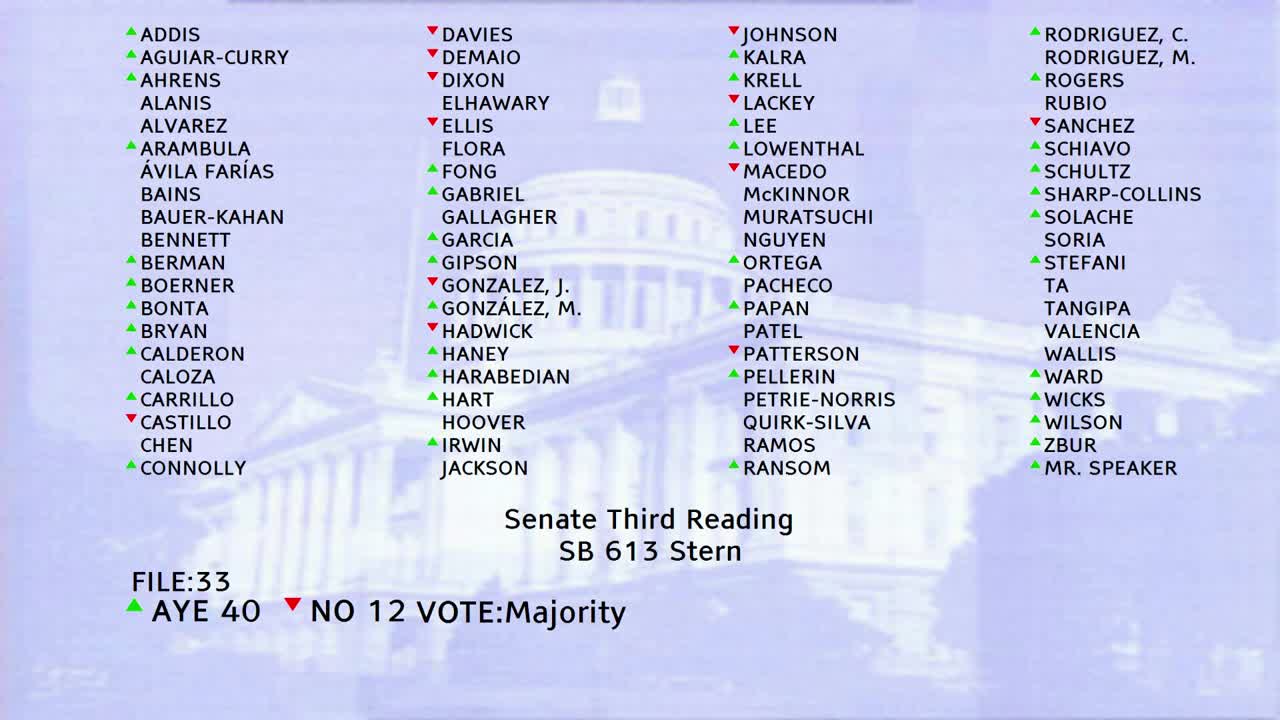 1MIN
Assembly Floor
 1MIN
Senate Floor
 3MIN
Senate Floor
 18MIN
Senate Standing Committee on Energy, Utilities and Communications
Bill Author

Bill Co-Author(s):