SB 676: California Environmental Quality Act: judicial streamlining: state of emergency: wildfire.
- Session Year: 2025-2026
- House: Senate
- Latest Version Date: 2025-10-10
Current Status:
Passed
(2025-10-10: Chaptered by Secretary of State. Chapter 550, Statutes of 2025.)
Introduced
In Committee
Awaiting First Chamber Vote
Passed First Chamber
In Committee
Awaiting Second Chamber Vote
Passed Second Chamber
Enacted
The California Environmental Quality Act (CEQA) requires a lead agency, as defined, to prepare, or cause to be prepared, and certify the completion of an environmental impact report on a project that it proposes to carry out or approve that may have a significant effect on the environment or to adopt a negative declaration if it finds that the project will not have that effect. CEQA also requires a lead agency to prepare a mitigated negative declaration for a project that may have a significant effect on the environment if revisions in the project would avoid or mitigate that effect and there is no substantial evidence that the project, as revised, would have a significant effect on the environment.
This bill would require, on and after January 1, 2027, for a project, located in a geographic area for which the Governor declared a state of emergency on or after January 1, 2023, that is to maintain, repair, restore, demolish, or replace property or facilities damaged or destroyed by wildfire, and the project is not otherwise exempt from CEQA, as specified, the lead agency to prepare the record of proceeding concurrently with the administrative process. The bill would also require an action or proceeding brought to attack, review, set aside, void, or annul the certification of an environmental impact report, or the adoption of a negative declaration or mitigated negative declaration, for the project to be resolved, to the extent feasible, within 270 calendar days of the filing of the certified record of proceedings. The bill would require an applicant to agree to pay the costs of the trial court and court of appeal in hearing and deciding any action or proceeding brought under these provisions, as provided. The bill would require the Judicial Council to adopt rules of court to implement these requirements. The bill would require the project to be consistent with the applicable zoning and land use ordinances. By requiring a lead agency to prepare the record of proceedings concurrently with the administrative process, this bill would impose a state-mandated local program.
The California Constitution requires the state to reimburse local agencies and school districts for certain costs mandated by the state. Statutory provisions establish procedures for making that reimbursement.
This bill would provide that no reimbursement is required by this act for a specified reason.
The California Environmental Quality Act (CEQA) requires a lead agency, as defined, to prepare, or cause to be prepared, and certify the completion of an environmental impact report on a project that it proposes to carry out or approve that may have a significant effect on the environment or to adopt a negative declaration if it finds that the project will not have that effect. CEQA also requires a lead agency to prepare a mitigated negative declaration for a project that may have a significant effect on the environment if revisions in the project would avoid or mitigate that effect and there is no substantial evidence that the project, as revised, would have a significant effect on the environment.
This bill would require, on and after January 1, 2027, for a project, located in a geographic area for which the Governor declared a state of emergency on or after January 1, 2023, that is to maintain, repair, restore, demolish, or replace property or facilities damaged or destroyed by wildfire, and the project is not otherwise exempt from CEQA, as specified, the lead agency to prepare the record of proceeding concurrently with the administrative process. The bill would also require an action or proceeding brought to attack, review, set aside, void, or annul the certification of an environmental impact report, or the adoption of a negative declaration or mitigation mitigated negative declaration, for the project to be resolved, to the extent feasible, within 270 calendar days of the filing of the certified record of proceedings. The bill would require an applicant to agree to pay the costs of the trial court and court of appeal in hearing and deciding any action or proceeding brought under these provisions, as provided. The bill would require the Judicial Council to adopt rules of court to implement these requirements. The bill would require the project to be consistent with the applicable zoning and land use ordinances. By requiring a lead agency to prepare the record of proceedings concurrently with the administrative process, this bill would impose a state-mandated local program.
The California Constitution requires the state to reimburse local agencies and school districts for certain costs mandated by the state. Statutory provisions establish procedures for making that reimbursement.
This bill would provide that no reimbursement is required by this act for a specified reason.
The California Environmental Quality Act (CEQA) requires a lead agency, as defined, to prepare, or cause to be prepared, and certify the completion of an environmental impact report on a project that it proposes to carry out or approve that may have a significant effect on the environment or to adopt a negative declaration if it finds that the project will not have that effect. CEQA also requires a lead agency to prepare a mitigated negative declaration for a project that may have a significant effect on the environment if revisions in the project would avoid or mitigate that effect and there is no substantial evidence that the project, as revised, would have a significant effect on the environment.
This bill would require, for a project project, located in a geographic area that was damaged by fire for which the Governor declared a state of emergency on or after January 1, 2023, that is to maintain, repair, restore, demolish, or replace property or facilities damaged or destroyed by wildfire, and the project is not otherwise exempt from CEQA, as specified, the lead agency to prepare the record of proceeding concurrently with the administrative process. The bill would also require an action or proceeding brought to attack, review, set aside, void, or annul the certification of an environmental impact report, or the adoption of a negative declaration or mitigation negative declaration, for the project to be resolved, to the extent feasible, within 270 calendar days of the filing of the certified record of proceedings. The bill would require the project to be consistent with the applicable zoning and land use ordinances. By requiring a lead agency to prepare the record of proceedings concurrently with the administrative process, this bill would impose a state-mandated local program.
No reimbursement is required by this act pursuant to Section 6 of Article XIIIB of the California Constitution because a local agency or school district has the authority to levy service charges, fees, or assessments sufficient to pay for the program or level of service mandated by this act, within the meaning of Section 17556 of the Government Code.The California Constitution requires the state to reimburse local agencies and school districts for certain costs mandated by the state. Statutory provisions establish procedures for making that reimbursement.
This bill would provide that no reimbursement is required by this act for a specified reason.
The California Environmental Quality Act (CEQA) requires a lead agency, as defined, to prepare, or cause to be prepared, and certify the completion of an environmental impact report on a project that it proposes to carry out or approve that may have a significant effect on the environment or to adopt a negative declaration if it finds that the project will not have that effect. CEQA also requires a lead agency to prepare a mitigated negative declaration for a project that may have a significant effect on the environment if revisions in the project would avoid or mitigate that effect and there is no substantial evidence that the project, as revised, would have a significant effect on the environment.
This bill would require, for a project located in a geographic area that was damaged by fire for which the Governor declared a state of emergency on or after January 1, 2023, and the project is not otherwise exempt from CEQA, as specified, the lead agency to prepare the record of proceeding concurrently with the administrative process. The bill would also require an action or proceeding brought to attack, review, set aside, void, or annul the certification of an environmental impact report, or the adoption of a negative declaration or mitigation negative declaration, for the project to be resolved, to the extent feasible, within 270 calendar days of the filing of the certified record of proceedings. The bill would require the project to be consistent with the applicable zoning and land use ordinances. By requiring a lead agency to prepare the record of proceedings concurrently with the administrative process, this bill would impose a state-mandated local program.
No reimbursement is required by this act pursuant to Section 6 of Article XIIIB of the California Constitution because a local agency or school district has the authority to levy service charges, fees, or assessments sufficient to pay for the program or level of service mandated by this act, within the meaning of Section 17556 of the Government Code.
The California Constitution requires the state to reimburse local agencies and school districts for certain costs mandated by the state. Statutory provisions establish procedures for making that reimbursement.
This bill would provide that no reimbursement is required by this act for a specified reason.
The California Environmental Quality Act (CEQA) requires a lead agency, as defined, to prepare, or cause to be prepared, and certify the completion of an environmental impact report on a project that the lead agency proposes to carry out or approve that may have a significant effect on the environment or to adopt a negative declaration if it finds that the project will not have that effect. CEQA also requires a lead agency to prepare a mitigated negative declaration for a project that may have a significant effect on the environment if revisions in the project would avoid or mitigate that effect and there is no substantial evidence that the project, as revised, would have a significant effect on the environment. CEQA defines responsible agency for purposes of the act to include a public agency, other than a lead agency, that has responsibility for, among other things, approving a project.This bill would expand the definition of responsible agency to include a public agency, other than the lead agency, that has responsibility for permitting a project. To the extent this bill would impose new duties on local agencies related to new responsible agency designations, this bill would impose a state-mandated local program.The California Constitution requires the state to reimburse local agencies and school districts for certain costs mandated by the state. Statutory provisions establish procedures for making that reimbursement.This bill would provide that no reimbursement is required by this act for a specified reason.The California Environmental Quality Act (CEQA) requires a lead agency, as defined, to prepare, or cause to be prepared, and certify the completion of an environmental impact report on a project that the lead agency proposes to carry out or approve that may have a significant effect on the environment or to adopt a negative declaration if it finds that the project will not have that effect. CEQA also requires a lead agency to prepare a mitigated negative declaration for a project that may have a significant effect on the environment if revisions in the project would avoid or mitigate that effect and there is no substantial evidence that the project, as revised, would have a significant effect on the environment. CEQA defines responsible agency for purposes of the act to include a public agency, other than a lead agency, that has responsibility for, among other things, approving a project.
This bill would expand the definition of responsible agency to include a public agency, other than the lead agency, that has responsibility for permitting a project. To the extent this bill would impose new duties on local agencies related to new responsible agency designations, this bill would impose a state-mandated local program.
The California Constitution requires the state to reimburse local agencies and school districts for certain costs mandated by the state. Statutory provisions establish procedures for making that reimbursement.
This bill would provide that no reimbursement is required by this act for a specified reason.
(a)On and after January 1, 2027, and subject to subdivisions (b) and (c), for a project, located in a geographic area for which the Governor declared a state of emergency pursuant to Chapter 7 (commencing with Section 8550) of Division 1 of Title 2 of the Government Code, that is to maintain, repair, restore, demolish, or replace property or facilities damaged or destroyed by wildfire, and the project is not otherwise exempt from this division by paragraph (3) of subdivision (b) of Section 21080 or by a Governors executive order, all of the following shall apply:
(1)The record of proceedings shall be prepared in accordance with the manner specified in subdivision (a) of Section 21167.6.2.
(2)(A)An action or proceeding brought to attack, review, set aside, void, or annul the certification of an environmental impact report, or the adoption of a negative declaration or mitigated negative declaration, for the project or the granting of any project approval, including any potential appeals to the court of appeal or the Supreme Court, shall, to the extent feasible, be resolved within 270 calendar days of the filing of the certified record of proceedings with the court.
(B)The Judicial Council shall adopt rules of court to implement subparagraph (A).
(3)The applicant shall agree to pay the costs of the trial court and the court of appeal in hearing and deciding any action or proceeding brought under this section in a form and manner as provided in a rule of court, that the Judicial Council shall adopt, which shall include, but not be limited to, the costs for the appointment of a special master if deemed appropriate by the court.
(b)(1)Subdivision (a) only applies to a project that is consistent with the applicable zoning and land use ordinances.
(2)Subdivision (a) does not apply to a project that is proposed after the Governor rescinds the declaration of the state of emergency for that geographic area.
(c)This section applies to projects in a geographic area that was damaged by fire for which the Governor has declared a state of emergency on or after January 1, 2023.
SEC. 2.No reimbursement is required by this act pursuant to Section 6 of Article XIIIB of the California Constitution because a local agency or school district has the authority to levy service charges, fees, or assessments sufficient to pay for the program or level of service mandated by this act, within the meaning of Section 17556 of the Government Code.
(a)Subject On and after January 1, 2027, and subject to subdivisions (b) and (c), for a project, located in a geographic area for which the Governor declared a state of emergency pursuant to Chapter 7 (commencing with Section 8550) of Division 1 of Title 2 of the Government Code, that is to maintain, repair, restore, demolish, or replace property or facilities damaged or destroyed by wildfire, and the project is not otherwise exempt from this division by paragraph (3) of subdivision (b) of Section 21080 or by a Governors executive order, both all of the following shall apply:
(1)The record of proceedings shall be prepared in accordance with the manner specified in subdivision (a) of Section 21167.6.2.
(2)(A)An action or proceeding brought to attack, review, set aside, void, or annul the certification of an environmental impact report, or the adoption of a negative declaration or mitigated negative declaration, for the project or the granting of any project approval, including any potential appeals to the court of appeal or the Supreme Court, shall, to the extent feasible, be resolved within 270 calendar days of the filing of the certified record of proceedings with the court.
(B)The Judicial Council shall adopt rules of court to implement subparagraph (A).
(3)The applicant shall agree to pay the costs of the trial court and the court of appeal in hearing and deciding any action or proceeding brought under this section in a form and manner as provided in a rule of court, that the Judicial Council shall adopt, which shall include, but not be limited to, the costs for the appointment of a special master if deemed appropriate by the court.
(b)(1)Subdivision (a) only applies to a project that is consistent with the applicable zoning and land use ordinances.
(2)Subdivision (a) does not apply to a project that is proposed after the Governor rescinds the declaration of the state of emergency for that geographic area.
(c)This section applies to projects in a geographic area that was damaged by fire for which the Governor has declared a state of emergency on or after January 1, 2023.
SEC. 2.No reimbursement is required by this act pursuant to Section 6 of Article XIIIB of the California Constitution because a local agency or school district has the authority to levy service charges, fees, or assessments sufficient to pay for the program or level of service mandated by this act, within the meaning of Section 17556 of the Government Code.
(a)Subject to subdivisions (b) and (c), for a project that is project, located in a geographic area that was damaged by a fire for which the Governor declared a state of emergency pursuant to Chapter 7 (commencing with Section 8550) of Division 1 of Title 2 of the Government Code Code, that is to maintain, repair, restore, demolish, or replace property or facilities damaged or destroyed by wildfire, and the project is not otherwise exempt from this division by paragraph (3) of subdivision (b) of Section 21080 or by a Governors executive order, both of the following shall apply:
(1)The record of proceedings shall be prepared in accordance with the manner specified in subdivision (a) of Section 21167.6.2.
(2)(A)An action or proceeding brought to attack, review, set aside, void, or annul the certification of an environmental impact report, or the adoption of a negative declaration or mitigated negative declaration, for the project or the granting of any project approval, including any potential appeals to the court of appeal or the Supreme Court, shall, to the extent feasible, be resolved within 270 calendar days of the filing of the certified record of proceedings with the court.
(B)The Judicial Council shall adopt rules of court to implement subparagraph (A).
(b)(1)Subdivision (a) only applies to a project that is consistent with the applicable zoning and land use ordinances.
(2)Subdivision (a) does not apply to a project that is proposed after the Governor rescinds the declaration of the state of emergency for that geographic area.
(c)This section applies to projects in a geographic area that was damaged by fire for which the Governor has declared a state of emergency on or after January 1, 2023.
SEC. 2.No reimbursement is required by this act pursuant to Section 6 of Article XIIIB of the California Constitution because a local agency or school district has the authority to levy service charges, fees, or assessments sufficient to pay for the program or level of service mandated by this act, within the meaning of Section 17556 of the Government Code.
REVISIONS: HeadingLine 6.(a)Subject to subdivisions (b) and (c), for a project that is located in a geographic area that was damaged by a fire for which the Governor declared a state of emergency pursuant to Chapter 7 (commencing with Section 8550) of Division 1 of Title 2 of the Government Code and the project is not otherwise exempt from this division by paragraph (3) of subdivision (b) of Section 21080 or by a Governors executive order, both of the following shall apply:
(1)The record of proceedings shall be prepared in accordance with the manner specified in subdivision (a) of Section 21167.6.2.
(2)(A)An action or proceeding brought to attack, review, set aside, void, or annul the certification of an environmental impact report, or the adoption of a negative declaration or mitigated negative declaration, for the project or the granting of any project approval, including any potential appeals to the court of appeal or the Supreme Court, shall, to the extent feasible, be resolved within 270 calendar days of the filing of the certified record of proceedings with the court.
(B)The Judicial Council shall adopt rules of court to implement subparagraph (A).
(b)(1)Subdivision (a) only applies to a project that is consistent with the applicable zoning and land use ordinances.
(2)Subdivision (a) does not apply to a project that is proposed after the Governor rescinds the declaration of the state of emergency for that geographic area.
(c)This section applies to projects in a geographic area that was damaged by fire for which the Governor has declared a state of emergency on or after January 1, 2023.
SEC. 2.No reimbursement is required by this act pursuant to Section 6 of Article XIIIB of the California Constitution because a local agency or school district has the authority to levy service charges, fees, or assessments sufficient to pay for the program or level of service mandated by this act, within the meaning of Section 17556 of the Government Code.
SECTION 1.Section 21069 of the Public Resources Code is amended to read:21069.Responsible agency means a public agency, other than the lead agency, that has responsibility for carrying out, permitting, or approving a project.SEC. 2.No reimbursement is required by this act pursuant to Section 6 of Article XIIIB of the California Constitution because a local agency or school district has the authority to levy service charges, fees, or assessments sufficient to pay for the program or level of service mandated by this act, within the meaning of Section 17556 of the Government Code.Responsible agency means a public agency, other than the lead agency, which that has responsibility for carrying out out, permitting, or approving a project.
SEC. 2.No reimbursement is required by this act pursuant to Section 6 of Article XIIIB of the California Constitution because a local agency or school district has the authority to levy service charges, fees, or assessments sufficient to pay for the program or level of service mandated by this act, within the meaning of Section 17556 of the Government Code.
|
Date
|
Status
|
|---|---|
| Oct 10, 2025 | Chaptered by Secretary of State. Chapter 550, Statutes of 2025. |
| Oct 10, 2025 | Approved by the Governor. |
| Sep 17, 2025 | Enrolled and presented to the Governor at 2 p.m. |
| Sep 9, 2025 | Assembly amendments concurred in. (Ayes 40. Noes 0. Page 2717.) Ordered to engrossing and enrolling. |
| Sep 8, 2025 | In Senate. Concurrence in Assembly amendments pending. |
| Sep 8, 2025 | Read third time. Passed. (Ayes 79. Noes 0. Page 3008.) Ordered to the Senate. |
| Sep 3, 2025 | Read second time. Ordered to third reading. |
| Sep 2, 2025 | Read second time and amended. Ordered to second reading. |
| Aug 29, 2025 | From committee: Do pass as amended. (Ayes 11. Noes 0.) (August 29). |
| Aug 20, 2025 | August 20 set for first hearing. Placed on APPR. suspense file. |
| Jul 16, 2025 | From committee: Do pass and re-refer to Com. on APPR. (Ayes 12. Noes 0.) (July 15). Re-referred to Com. on APPR. |
| Jul 16, 2025 | Coauthors revised. |
| Jul 9, 2025 | Read second time and amended. Re-referred to Com. on JUD. |
| Jul 8, 2025 | From committee: Do pass as amended and re-refer to Com. on JUD. (Ayes 12. Noes 0.) (July 7). |
| Jun 9, 2025 | Referred to Coms. on NAT. RES. and JUD. |
| Jun 4, 2025 | In Assembly. Read first time. Held at Desk. |
| Jun 3, 2025 | Read third time. Passed. (Ayes 39. Noes 0. Page 1453.) Ordered to the Assembly. |
| May 29, 2025 | Ordered to third reading. |
| May 29, 2025 | From special consent calendar on motion of Senator Gonzalez. |
| May 27, 2025 | Ordered to special consent calendar. |
| May 23, 2025 | Read second time. Ordered to third reading. |
| May 23, 2025 | From committee: Do pass. (Ayes 6. Noes 0. Page 1209.) (May 23). |
| May 16, 2025 | Set for hearing May 23. |
| May 5, 2025 | May 5 hearing: Placed on APPR. suspense file. |
| Apr 25, 2025 | Set for hearing May 5. |
| Apr 23, 2025 | From committee: Do pass and re-refer to Com. on APPR. with recommendation: To consent calendar. (Ayes 13. Noes 0. Page 836.) (April 22). Re-referred to Com. on APPR. |
| Apr 10, 2025 | Set for hearing April 22. |
| Apr 9, 2025 | Re-referred to Com. on JUD. |
| Apr 3, 2025 | From committee: Do pass and re-refer to Com. on RLS. (Ayes 8. Noes 0. Page 635.) (April 2). Re-referred to Com. on RLS. |
| Mar 24, 2025 | From committee with author's amendments. Read second time and amended. Re-referred to Com. on E.Q. |
| Mar 11, 2025 | Set for hearing April 2. |
| Mar 5, 2025 | Referred to Com. on E.Q. |
| Feb 24, 2025 | Read first time. |
| Feb 24, 2025 | From printer. May be acted upon on or after March 24. |
| Feb 21, 2025 | Introduced. To Com. on RLS. for assignment. To print. |
|
Date
|
Description
|
Location
|
Votes
|
|
|---|---|---|---|---|
| Sep 9, 2025 | Unfinished Business SB676 Limón et al. Concurrence | Senate Floor |
Passed |
|
| Sep 8, 2025 | SB 676 Limón Senate Third Reading By Bennett | Assembly Floor |
Passed |
|
| Aug 29, 2025 | Do pass as amended. | Assembly Standing Committee on Appropriations |
Passed |
|
| Jul 15, 2025 | Do pass and be re-referred to the Committee on [Appropriations] | Assembly Standing Committee on Judiciary |
Passed |
|
| Jul 7, 2025 | Do pass as amended and be re-referred to the Committee on [Judiciary] | Assembly Standing Committee on Natural Resources |
Passed |
|
| Jun 3, 2025 | Senate 3rd Reading SB676 Limón et al. | Senate Floor |
Passed |
|
| May 23, 2025 | Do pass | Senate Standing Committee on Appropriations |
Passed |
|
| May 5, 2025 | Placed on suspense file | Senate Standing Committee on Appropriations |
Passed |
|
| Apr 22, 2025 | Do pass, but first be re-referred to the Committee on [Appropriations] with the recommendation: To Consent Calendar | Senate Standing Committee on Judiciary |
Passed |
|
| Apr 2, 2025 | Do pass, but first be re-referred to the Committee on [Rules] | Senate Standing Committee on Environmental Quality |
Passed |
This list shows positions taken on this bill by organizations on the date displayed, which is linked to the original source.
Positions by individuals are not included.
|
Organization
|
Position
|
Date
|
|---|---|---|
| California Apartment Association | ** Support | |
| California Association Of Realtors | ** Support | |
| County of Ventura | ** Support | |
| Judicial Council | ** Against | |
| LeadingAge California | ** Support | |
| League Of California Cities | ** Support | |
| Santa Barbara County | ** Support |
SENATE RULES COMMITTEE Office of Senate Floor Analyses (916) 651-1520 Fax: (916) 327-4478 | SB 676 |
UNFINISHED BUSINESS
Bill No: SB 676
Author: Limón (D) and Blakespear (D), et al.
Amended: 9/2/25
Vote: 21
SENATE ENVIRONMENTAL QUALITY COMMITTEE: 8-0, 4/2/25
AYES: Blakespear, Valladares, Dahle, Gonzalez, Hurtado, Menjivar, Padilla, Pérez
SENATE JUDICIARY COMMITTEE: 13-0, 4/22/25
AYES: Umberg, Niello, Allen, Arreguín, Ashby, Caballero, Durazo, Laird, Stern, Valladares, Wahab, Weber Pierson, Wiener
SENATE APPROPRIATIONS COMMITTEE: 6-0, 5/23/25
AYES: Caballero, Seyarto, Cabaldon, Grayson, Richardson, Wahab
NO VOTE RECORDED: Dahle
SENATE FLOOR: 39-0, 6/3/25
AYES: Allen, Alvarado-Gil, Archuleta, Arreguín, Ashby, Becker, Blakespear, Cabaldon, Caballero, Cervantes, Choi, Cortese, Dahle, Durazo, Gonzalez, Grayson, Grove, Hurtado, Jones, Laird, Limón, McGuire, McNerney, Menjivar, Niello, Ochoa Bogh, Padilla, Pérez, Richardson, Rubio, Seyarto, Smallwood-Cuevas, Stern, Strickland, Umberg, Valladares, Wahab, Weber Pierson, Wiener
NO VOTE RECORDED: Reyes
ASSEMBLY FLOOR: 79-0, 9/8/25 - See last page for vote
SUBJECT: California Environmental Quality Act: judicial streamlining: state of emergency: wildfire
SOURCE: Author
DIGEST:
This bill establishes expedited administrative and judicial review procedures under the California Environmental Quality Act (CEQA) for projects that maintain, repair, restore, demolish, or replace wildfire-damaged property or facilities located in an area for which the Governor declared a state of emergency, beginning January 1, 2027.
Assembly Amendments
: Specify that the project applicant must pay the costs of the trial court and court of appeal in hearing and deciding any action or proceeding brought under these provisions, and requires the Judicial Council to adopt rules of court to implement these requirements.
ANALYSIS:
Existing law:
- CEQA requires lead agencies with the principal responsibility for carrying out or approving a project to prepare a negative declaration (ND), mitigated negative declaration (MND), or environmental impact report (EIR) for the project unless the project is exempt from CEQA. (Public Resources Code (PRC) §21000 et seq.)
- If a project may have a significant effect on the environment, the lead agency must prepare a draft EIR. (CEQA Guidelines §15064(a)(1), (f)(1))
- Established the Jobs and Economic Improvement Through Environmental Leadership Act of 2011 (AB 900, Buchanan, Chapter 354, Statutes of 2011), which established CEQA administrative and judicial review procedures for an "environmental leadership" project. The Act was later extended and modified in 2021 (SB 7, Atkins, Chapter 19, Statutes of 2021). (PRC §21178 et seq.)
- Exempts emergency projects from CEQA, including:
- Projects to maintain, repair, restore, demolish, or replace property or facilities damaged or destroyed as a result of a disaster in a disaster-stricken area in which a state of emergency has been proclaimed by the Governor pursuant to the California Emergency Services Act, commencing with Section 8550 of the Government Code. This includes projects that will remove, destroy, or significantly alter an historical resource when that resource represents an imminent threat to the public of bodily harm or damage to adjacent property or when the project has received a determination by the State Office of Historic Preservation pursuant to Section 5028(b) of Public Resources Code.
- Emergency repairs to publicly or privately owned service facilities necessary to maintain services essential to public health, safety or welfare. Emergency repairs include those that require a reasonable amount of planning to address an anticipated emergency.
- Actions necessary to prevent or mitigate an emergency, as specified.
- Projects undertaken, carried out, or approved by a public agency to maintain, repair, or restore an existing highway damaged by fire, flood, storm, earthquake, land subsidence, gradual earth movement, or landslide, provided that the project is within the existing right of way of that highway and is initiated within one year of the damage occurring. This exemption does not apply to highways designated as official state scenic highways, nor any project undertaken, carried out, or approved by a public agency to expand or widen a highway damaged by fire, flood, storm, earthquake, land subsidence, gradual earth movement, or landslide.
- Seismic work on highways and bridges pursuant to Section 180.2 of the Streets and Highways Code, Section 180 et seq. (CCR Tit 14 Cal., § 15269)
This bill:
- Establishes CEQA streamlining for projects that are consistent with applicable zoning and land use ordinances and are in areas damaged by a fire where the Governor declared a state of emergency after January 1st, 2023.
- Requires that any legal action or proceeding relevant to CEQA for a project be resolved within 270 days as feasible, and that projects prepare the administrative at the same time as they prepare the environmental review documents under CEQA.
- Requires the Judicial Council to adopt rules of court to implement this requirement.
- Requires the applicant to agree to pay the costs of the trial court and court of appeal, as specified.
Background
- The A, B, C’s of CEQA. CEQA is designed to (a) make government agencies and the public aware of the environmental impacts of a proposed project, (b) ensure the public can take part in the review process, and (c) identify and implement measures to mitigate or eliminate any negative impact the project may have on the environment. CEQA is enforced by civil lawsuits that can challenge any project’s environmental review. Nonprofits, private individuals, public agencies, advocacy groups, and other organizations can all file lawsuits under CEQA.
Under CEQA, projects (unless they have a specific exemption) must undergo environmental analysis. This process starts with an initial study which determines what level of further environmental review is needed for a given project. If a project has no significant effects on the environment, or if those effects can be fully mitigated, the project can move forward with a negative declaration (ND) or mitigated negative declaration (MND). If the initial study finds that the project has potentially significant effects on the environment, then a full EIR is conducted. An EIR provides a thorough environmental review of a proposed project, analyzing the significant direct and indirect environmental impacts of a proposed project on water quality, transportation, air quality and greenhouse gas emissions, terrestrial and aquatic biological resources, surface and subsurface hydrology, land use and agricultural resources, aesthetics, geology and soils, recreation, public services and utilities such as water supply and wastewater disposal, and cultural resources, among other factors. The EIR also includes proposed mitigation measures for any significant effects that it identifies and considers alternatives to the proposed project.
- CEQA timelines. Under CEQA, state and local agencies must complete and adopt a ND in 180 days, and certify an EIR within a year. If there is a compelling circumstance to extend this timeline, agencies may take longer, but only if the project applicant consents. Potentially the longest portion of the CEQA process occurs if there is a CEQA lawsuit against the project. Judicial Council asserts that it often takes over six months just for a CEQA case to get a hearing, let alone reach a decision.
To help speed CEQA cases through the court system, current law provides several measures to prioritize CEQA cases and speed up judicial review, including:
- The Superior Court and the Court of Appeal must give CEQA lawsuits preference over all other civil actions;
- If feasible, the Court of Appeal must hear a CEQA appeal within one year of filing;
- Discovery is generally not allowed, as CEQA cases are generally restricted to review of the record; and
- Counties with a population of over 200,000 must designate one or more judges to develop expertise on CEQA and hear CEQA cases.
- CEQA streamlining. The Legislature has developed even further streamlining measures to speed any CEQA lawsuits against specified projects through the courts. In existing law, CEQA streamlining entails both judicial and administrative streamlining. Judicial streamlining requires that a CEQA lawsuit be heard in 270 days, including all appeals, as feasible. Administrative streamlining requires projects to prepare the administrative record, the comprehensive document at the heart of a CEQA case, at the same time as the environmental review documents are prepared. Preparing these documents concurrently, instead of sequentially, saves time if there is a lawsuit. These streamlining measures shorten what is potentially the lengthiest portion of the CEQA process—litigation—while retaining the full environmental review and public engagement offered under CEQA.
In 2011, the Legislature passed the first CEQA streamlining certification program with the Jobs and Economic Improvement Through Environmental Leadership Act (Leadership Act), which created CEQA streamlining for residential, retail, commercial, sports, and recreational use projects that were certified as Environmental Leadership Development Projects (ELDP) by the Governor (AB 900, Buchanan, Chapter 354, Statutes of 2011). The ELDP program was further extended and modified in 2021 with (SB 7, Atkins, Chapter 19, Statutes of 2021).
In 2023, The Legislature expanded these same streamlining provisions again for certain energy, transportation, and water infrastructure projects (SB 149, Caballero, Chapter 60, Statutes of 2023).
The specific criteria that projects must meet to be eligible for CEQA streamlining vary by project and process, but all are intended to ensure that projects meet high environmental and labor standards. In current law, environmental criteria for streamlining includes requirements such as achieving Leadership in Energy and Environmental Design (LEED) Gold certification and being greenhouse gas neutral. SB 149 (Caballero, Chapter 60, Statutes of 2023) also includes a specific equity provision which requires that projects both minimize significant environmental impacts in disadvantaged communities and take mitigation measures that directly benefit the affected community. In offering CEQA streamlining for projects that meet these high standards, California has been able to promote projects that align with the State’s environmental, climate, and labor goals.
- Los Angeles fires and increasing wildfire danger. In January 2025, a number of deadly wildfires in Los Angeles, including the Palisades and Eaton fires, burned through 40,306 acres, most of which were in Altadena and Pacific Palisades. These Los Angeles wildfires caused at least 29 deaths, destroyed over 16,000 structures, and resulted in property damage estimates ranging from $28 to $53.8 billion.[1] Following these devastating fires, Governor Newsom released EO N-4-25, which specified that repair and rebuild for projects damaged by the LA wildfires and future emergency-status fires would be exempt from CEQA in order to speed up recovery from the wildfire.
Comments
- Purpose of Bill. According to the author, “The LA wildfires, Eaton and Palisades have reportedly caused property losses close to $53 billion. In addition, a few weeks prior to the LA wildfires, the Mountain Fire in Camarillo destroyed 243 structures. As wildfire risks continue to rise every year, it is imperative that we ensure affected communities can be restored after a disaster. By adding consistency to the community rebuilding process, SB 676 aims to support the state’s wildfire resiliency efforts.”
- Bookending CEQA: exemptions and streamlining. Projects to rebuild following a Governor-declared emergency, like the LA Wildfires, are already exempt from CEQA under existing law. This removes CEQA review on the front end of the CEQA process.
However, for numerous reasons, property owners may choose to build something substantially different from what was burned down, in which case they are not exempt from CEQA under existing law. For those projects in these burned areas, SB 676 shortens the amount of time for CEQA on the back end if a project is sued by capping the judicial review time to 270 days, as feasible. This cap on judicial review time adds certainty for project developers that their projects will not get mired in CEQA lawsuits.
FISCAL EFFECT: Appropriation: No Fiscal Com.: Yes Local: Yes
According to the assembly appropriations committee, the bill will result in: “Ongoing cost pressures (Trial Court Trust Fund (TCTF), General Fund) of an unknown but potentially significant amount, possibly in the hundreds of thousands to millions of dollars, to the courts to process and hear CEQA challenges within the timeframes prescribed by the bill. Judicial Council is unable to determine how many CEQA non-compliance challenges may be brought, but given the widespread damage wildfires can cause throughout the state in any given year, Judicial Council estimates this bill would significantly affect court calendars where a fire emergency has occurred – particularly in the state’s smallest courts in more rural parts of the state (where wildfires are typically more common), which typically have fewer resources. Previous bills authorizing CEQA streamlining have generally been for more specific projects and have typically required a higher filing fee of $180,000 to ensure the courts have the resources needed to timely adjudicate complicated CEQA cases. This bill does not provide the courts the authority to charge higher filing fees and does not offer the courts additional resources to handle the higher anticipated workload. Although courts are not funded on the basis of workload, increased pressure on the TCTF may create a demand for increased funding for courts from the General Fund. The fiscal year (FY) 2025-26 state budget provides $82 million ongoing General Fund to the TCTF for court operations. Judicial Council notes, beginning with FY 2024–25, the trial courts have an ongoing $55 million reduction to their operational funding, which impacts their ability to provide core services, and more workload for the courts will further stretch court resources and may impact access to justice.
Judicial Council anticipates minor and absorbable costs to adopt the required rules of court. However, Judicial Council notes that while other existing CEQA judicial streamlining rules are specific to a project or designation (environmental leadership projects, for example), this bill includes such broad applicability that it will not fit within existing rules of court. Judicial Council will require more time to craft a clear and concise rule that incorporates the requirements of the bill, and anticipates needing a year delayed implementation to draft, approve, and obtain public comment on any new rules of court.”
SUPPORT: (Verified 9/8/25)
California Apartment Association
County of Ventura
League of California Cities
OPPOSITION: (Verified 9/8/25)
Assembly Floor, 79-0, 9/8/25
Ayes: Addis, Aguiar-Curry, Ahrens, Alanis, Alvarez, Arambula, Ávila Farías, Bains, Bauer-Kahan, Bennett, Berman, Boerner, Bonta, Bryan, Calderon, Caloza, Carrillo, Castillo, Chen, Connolly, Davies, DeMaio, Dixon, Elhawary, Ellis, Flora, Fong, Gabriel, Gallagher, Garcia, Gipson, Jeff Gonzalez, Mark González, Hadwick, Haney, Harabedian, Hart, Hoover, Irwin, Jackson, Johnson, Kalra, Krell, Lackey, Lee, Lowenthal, Macedo, McKinnor, Muratsuchi, Ortega, Pacheco, Papan, Patel, Patterson, Pellerin, Petrie-Norris, Quirk-Silva, Ramos, Ransom, Celeste Rodriguez, Michelle Rodriguez, Rogers, Blanca Rubio, Sanchez, Schiavo, Schultz, Sharp-Collins, Solache, Soria, Stefani, Ta, Tangipa, Valencia, Wallis, Ward, Wicks, Wilson, Zbur, Rivas
Noes:
No Vote Recorded: Nguyen
Prepared by: Brynn Cook / E.Q. / (916) 651-4108
9/8/25 19:51:48
**** END ****
SENATE THIRD READING
STR Bill Id:SB 676
Author:(Limón and Blakespear)
As Amended Ver:September 02, 2025
Majority vote
SUMMARY
Beginning January 1, 2027, establishes expedited administrative and judicial review procedures under the California Environmental Quality Act (CEQA) for a project to maintain, repair, restore, demolish, or replace wildfire-damaged property or facilities located in an area for which the Governor declared a state of emergency, requiring the courts to resolve lawsuits within 270 days, to the extent feasible.
Major Provisions
- Requires, on and after January 1, 2027, for a project that is (1) located in a geographic area for which the Governor declared a state of emergency and (2) to maintain, repair, restore, demolish, or replace property or facilities damaged or destroyed by wildfire and (3) not otherwise exempt from CEQA under the existing emergency exemption or by a Governor's executive order:
- Concurrent preparation of the administrative record pursuant to Public Resources Code 21167.6.2.
- Lawsuits challenging approval of the project to be resolved, to the extent feasible, within 270 calendar days of the filing of the certified record of proceedings with the court.
- Requires the Judicial Council to adopt rules of court to implement this requirement.
- Requires the applicant to agree to pay the costs of the trial court and court of appeal, as specified.
- Provides the bill:
- Applies only to a project that is consistent with the applicable zoning and land use ordinances.
- Does not apply to a project that is proposed after the Governor rescinds the emergency declaration.
- Applies to projects in a geographic area that was damaged by fire for which the Governor has declared a state of emergency on or after January 1, 2023.
COMMENTS
CEQA provides a process for evaluating the environmental effects of applicable projects undertaken or approved by public agencies. If a project is not exempt from CEQA, an initial study is prepared to determine whether the project may have a significant effect on the environment. If the initial study shows that there would not be a significant effect on the environment, the lead agency must prepare a negative declaration. If the initial study shows that the project may have a significant effect on the environment, the lead agency must prepare an EIR.
An EIR must accurately describe the proposed project, identify and analyze each significant environmental impact expected to result from the proposed project, identify mitigation measures to reduce those impacts to the extent feasible, and evaluate a range of reasonable alternatives to the proposed project. If mitigation measures are required or incorporated into a project, the agency must adopt a reporting or monitoring program to ensure compliance with those measures.
Generally, CEQA actions taken by public agencies can be challenged in superior court once the agency approves or determines to carry out the project. CEQA appeals are subject to unusually short statutes of limitations. Under current law, court challenges of CEQA decisions generally must be filed within 30-35 days, depending on the type of decision. The courts are required to give CEQA actions preference over all other civil actions. However, the schedules for briefing, hearing, and decision are less definite. The petitioner must request a hearing within 90 days of filing the petition and, generally, briefing must be completed within 90 days of the request for hearing. There is no deadline specified for the court to render a decision.
According to the Author
The LA wildfires, Eaton and Palisades have reportedly caused property losses close to $53 billion. In addition, a few weeks prior to the LA wildfires, the Mountain Fire in Camarillo destroyed 243 structures. As wildfire risks continue to rise every year, it is imperative that we ensure affected communities can be restored after a disaster. By adding consistency to the community rebuilding process, SB 676 aims to support the state's wildfire resiliency efforts.
Arguments in Support
According to Santa Barbara County, SB 676 is a critical tool to support timely, equitable recovery in the wake of disasters our County knows all too well…It also respects local control by requiring projects to comply with zoning, land use ordinances, general plans, and community standards…Importantly, the bill covers projects not eligible for streamlined local permitting—such as private schools, camps, and those in sensitive overlay zones—and provides targeted CEQA relief…As wildfire threats grow statewide, SB 676 offers a consistent, equitable rebuilding framework—avoiding reliance on case-by-case exemptions or executive orders.
According to the California Apartment Association, (p)rojects rebuilt following a Governor-declared emergency, like the LA Wildfires, are already exempt from CEQA under existing law. For numerous reasons, however, property owners may choose to build a home, rental property, or commercial building that is substantially different from what was burned down, in which case they are not exempt from CEQA. For those projects in these burned areas, SB 676 shortens the amount of time if a property owner is faced with a CEQA challenge.
According to the California Association of Realtors, SB 676 ensures that rebuilding efforts after a major fire are not impeded by unnecessary delays in the courts.
According to the League of California Cities, (SB 676's) streamlined approach will help accelerate any legal challenges to projects impacted by fire and to further support the state's wildfire resiliency efforts.
Arguments in Opposition
According to Judicial Council, (SB 676) is problematic as CEQA actions are already entitled under current law to calendar preference "over all other civil actions"…Imposing an expedited 270-day judicial review timeline on top of existing CEQA calendar preferences is arbitrary and likely to be unworkable in practice. This limited timeframe is especially restrictive if the court of appeal or the California Supreme Court must also decide some portion of a CEQA case. Even assuming that no extensions of time are granted for any aspect of the proceedings, it takes an estimated six months to get a case to hearing in the superior court, plus the additional time for the judge to decide and issue a decision…Unlike other "judicial streamlining" legislation, which the Judicial Council categorically opposes due to calendaring pressures, SB 676 deviates even further by seeking to require judicial streamlining not just to a particular project but to a broad and densely populated geographical area of Los Angeles where each parcel of land is potentially a cause of action…Senate Bill 676 also requires the Judicial Council to adopt rules of court to implement the bill. The aforementioned unworkable language in SB 676 presents not only an incalculable obligation for the courts to undertake in terms of anticipated workload but it also presents an impossible task for the Judicial Council because it requires the Council to adopt new rules of court to attempt to manage many different projects and many different CEQA lawsuits. The Council cannot conceivably adopt an appropriate rule of court that would adequately account for the myriad causes of action the courts would receive should this legislation succeed as currently drafted.
FISCAL COMMENTS
According to the Assembly Appropriations Committee, ongoing cost pressures (Trial Court Trust Fund (TCTF), General Fund) of an unknown but potentially significant amount, possibly in the hundreds of thousands to millions of dollars, to the courts to process and hear CEQA challenges within the timeframes prescribed by the bill. Judicial Council is unable to determine how many CEQA non-compliance challenges may be brought, but given the widespread damage wildfires can cause throughout the state in any given year, Judicial Council estimates this bill would significantly affect court calendars where a fire emergency has occurred – particularly in the state's smallest courts in more rural parts of the state (where wildfires are typically more common), which typically have fewer resources. The bill requires the applicant to pay the costs of the trial court and the court of appeal in hearing and deciding any action or proceeding brought under this bill. The committee assumes Judicial Council would amend the existing rule of court 3.2240 – which provides a $180,000 filing fee for specific streamlined CEQA projects – to include challenges covered by this bill.
VOTES
SENATE FLOOR: 39-0-1
YES: Allen, Alvarado-Gil, Archuleta, Arreguín, Ashby, Becker, Blakespear, Cabaldon, Caballero, Cervantes, Choi, Cortese, Dahle, Durazo, Gonzalez, Grayson, Grove, Hurtado, Jones, Laird, Limón, McGuire, McNerney, Menjivar, Niello, Ochoa Bogh, Padilla, Pérez, Richardson, Rubio, Seyarto, Smallwood-Cuevas, Stern, Strickland, Umberg, Valladares, Wahab, Weber Pierson, Wiener
ABS, ABST OR NV: Reyes
ASM NATURAL RESOURCES: 12-0-2
YES: Bryan, Alanis, Connolly, Ellis, Flora, Haney, Hoover, Kalra, Muratsuchi, Pellerin, Schultz, Zbur
ABS, ABST OR NV: Garcia, Wicks
ASM JUDICIARY: 12-0-0
YES: Kalra, Dixon, Bauer-Kahan, Bryan, Connolly, Harabedian, Macedo, Pacheco, Papan, Sanchez, Stefani, Zbur
ASM APPROPRIATIONS: 11-0-4
YES: Wicks, Arambula, Calderon, Caloza, Elhawary, Fong, Mark González, Ahrens, Pacheco, Pellerin, Solache
ABS, ABST OR NV: Sanchez, Dixon, Ta, Tangipa
UPDATED
VERSION: September 02, 2025
CONSULTANT: Lawrence Lingbloom / NAT. RES. / (916) 319-2092 FN: 0001492
Date of Hearing: August 20, 2025
ASSEMBLY COMMITTEE ON APPROPRIATIONS
Buffy Wicks, Chair
SBPCA Bill Id:SB 676
Author:(Limón) – As Amended Ver:July 9, 2025
Policy Committee: | Natural Resources | Vote: | 12 - 0 |
Judiciary | 12 - 0 | ||
|
|
Urgency: No State Mandated Local Program: Yes Reimbursable: No
SUMMARY:
This bill establishes expedited administrative and judicial review procedures under the California Environmental Quality Act (CEQA) for a project located in a geographic area that was damaged by a fire for which the Governor declared a state of emergency.
Specifically, this bill, among other things:
- Provides that for a project located in a geographic area for which the Governor declared a state of emergency (on or after January 1, 2023) that is to maintain, repair, restore, demolish, or replace property or facilities damaged or destroyed by wildfire, and the project is not otherwise exempt from CEQA, both of the following apply:
- The record of proceedings must be prepared concurrently with the administrative process, made available to the public in an electronic format, as specified, and be certified by the lead agency within 30 days after the filing of the notice of declaration or determination.
- An action or proceeding brought to attack, review, set aside, void, or annul the certification of an environmental impact report, or the adoption of a negative declaration or mitigated negative declaration, for the project or the granting of any project approval, must, to the extent feasible, be resolved within 270 calendar days of the filing of the certified record of proceedings with the court.
- Requires the Judicial Council to adopt rules of court to implement the requirements described above.
- Provides the requirements described above apply only to a project consistent with the applicable zoning and land use ordinances, and does not apply to a project proposed after the Governor rescinds the declaration of the state of emergency for that geographic area.
FISCAL EFFECT:
1) Ongoing cost pressures (Trial Court Trust Fund (TCTF), General Fund) of an unknown but potentially significant amount, possibly in the hundreds of thousands to millions of dollars, to the courts to process and hear CEQA challenges within the timeframes prescribed by the bill. Judicial Council is unable to determine how many CEQA non-compliance challenges may be brought, but given the widespread damage wildfires can cause throughout the state in any given year, Judicial Council estimates this bill would significantly affect court calendars where a fire emergency has occurred – particularly in the state’s smallest courts in more rural parts of the state (where wildfires are typically more common), which typically have fewer resources. Previous bills authorizing CEQA streamlining have generally been for more specific projects and have typically required a higher filing fee of $180,000 to ensure the courts have the resources needed to timely adjudicate complicated CEQA cases. This bill does not provide the courts the authority to charge higher filing fees and does not offer the courts additional resources to handle the higher anticipated workload.
Although courts are not funded on the basis of workload, increased pressure on the TCTF may create a demand for increased funding for courts from the General Fund. The fiscal year (FY) 2025-26 state budget provides $82 million ongoing General Fund to the TCTF for court operations. Judicial Council notes, beginning with FY 2024–25, the trial courts have an ongoing $55 million reduction to their operational funding, which impacts their ability to provide core services, and more workload for the courts will further stretch court resources and may impact access to justice.
2) Judicial Council anticipates minor and absorbable costs to adopt the required rules of court. However, Judicial Council notes that while other existing CEQA judicial streamlining rules are specific to a project or designation (environmental leadership projects, for example), this bill includes such broad applicability that it will not fit within existing rules of court. Judicial Council will require more time to craft a clear and concise rule that incorporates the requirements of the bill, and anticipates needing a year delayed implementation to draft, approve, and obtain public comment on any new rules of court.
COMMENTS:
1) Purpose. According to the author:
The LA wildfires, Eaton and Palisades have reportedly caused property losses close to $53 billion. In addition, a few weeks prior to the LA wildfires, the Mountain Fire in Camarillo destroyed 243 structures. As wildfire risks continue to rise every year, it is imperative that we ensure affected communities can be restored after a disaster. By adding consistency to the community rebuilding process, SB 676 aims to support the state’s wildfire resiliency efforts.
2) Background. CEQA generally requires state and local government agencies to inform decisionmakers and the public about the potential environmental impacts of proposed projects, and to reduce those impacts to the extent feasible.
Governor Newsom waived the applicability of CEQA as it applied to properties impacted by the 2025 Los Angeles County fires (Executive Order N-4-25). However, according to the California Apartment Association (CAA), which writes in support of this bill, “for numerous reasons, property owners may choose to build a home, rental property, or commercial building that is substantially different from what was burned down, in which case they are not exempt from CEQA.” This bill provides any project to maintain, repair, restore, demolish, or replace property or facilities damaged or destroyed by a wildfire that is located in an area for which the Governor declared a state of emergency expedited judicial review if the project faces a challenge under CEQA. CAA contends, “This cap on judicial review will add certainty for project developers, ensuring that their projects will not get mired in CEQA lawsuits and communities will not remain scarred for years.”
Generally, CEQA actions taken by a public agency may be challenged in superior court once the agency approves a project or determines to carry it out. CEQA appeals are subject to relatively short statutes of limitations. Under current law, a petitioner generally has 30 to 35 days from the time a public agency makes a CEQA decision to challenge the decision in court. Current law requires courts to give CEQA actions preference over all other civil actions. The petitioner must request a hearing within 90 days of filing the petition and, generally, briefing must be completed within 90 days of the request for hearing. There is no deadline by which the court is to render a decision.
Over the past decade, the state has adopted several measures that permit cases involving CEQA to obtain preferred, fast-track treatment in the courts. CEQA cases can be highly complex, and to facilitate proper review of the cases, staff may be pulled from other judicial departments. Judicial Council notes the growing trend for proposed legislation to include an expedited judicial review for various types of litigation without clear direction to the courts on how to prioritize among these cases, which complicates civil calendars. This bill may dramatically expand the number of cases for which litigants seek judicial streamlining. Should this bill result in an influx of streamlined cases, the courts may become overwhelmed. If the trial courts are presented with multiple cases, the feasibility of resolving each case in time may diminish, as may the benefit of the bill.
Analysis Prepared by: Nikita Koraddi / APPR. / (916) 319-2081
Date of Hearing: July 15, 2025
ASSEMBLY COMMITTEE ON JUDICIARY
Ash Kalra, Chair
SBPCA Bill Id:SB 676
Author:(Limón) – As Amended Ver:July 9, 2025
SENATE VOTE: 39-0
SUBJECT: California Environmental Quality Act: judicial streamlining: state of emergency: fire
KEY ISSUE: should projects seeking to maintain, repair, restore, demolish, or replace property or facilities damaged or destroyed by wildfire be provided expedited judicial review for any challenges arising under the California environmental quality act?
SYNOPSIS
As a result of climate change the past decade has seen some of the largest and most destructive wildfires in California’s history. Increasingly, these wind-driven fires are leaving the wildland-urban interface and becoming massive urban conflagrations that decimate entire communities. The damage inflicted by these fires is further complicating California’s already precarious availability of affordable housing. Although rarely as controversial as new developments, post-wildfire rebuilding efforts are still subject to reviews in accordance with the California Environmental Quality Act. Should litigation arise surrounding the environmental review of a post-fire reconstruction project, the reconstruction of fire damaged communities can be significantly delayed.
This bill would authorize litigation involving projects to maintain, repair, restore, demolish, or replace property or facilities damaged or destroyed by wildfire that are challenged for non-compliance with the California Environmental Quality Act to receive expedited judicial review. The bill requires challenges to post-fire rebuilding projects to be decided by the courts within 270 days, if feasible. The bill also calls for the expedited preparation of the administrative record surrounding a project.
This bill is supported by several local governments and housing advocates. The proponents of the bill note that the timely reconstruction of properties damaged by wildfires is critical to rebuilding communities and restoring the lives of those impacted by wildfires. The bill is opposed by the Judicial Council of California, which argues that the bill places undue burdens on California’s court system, and in conjunction with other recently enacted judicial streamlining bills, risks rendering all expedited judicial review statutes meaningless. This measure was previously heard and approved by the Committee on Natural Resources by a vote of 12 to 0.
SUMMARY: Provides for an expedited judicial review of California Environmental Quality Act challenges to projects that maintain, repair, restore, demolish, or replace property or facilities damaged or destroyed by wildfire. Specifically, this bill:
- Provides that for a project located in a geographic area for which the Governor declared a state of emergency that is to maintain, repair, restore, demolish, or replace property or facilities damaged or destroyed by wildfire, and the project is not otherwise exempt from the California Environmental Quality Act, both of the following apply:
- The record of proceedings must be prepared concurrently with the administrative process, made available to the public in an electronic format, as specified, and be certified by the lead agency within 30 days after the filing of the notice of declaration or determination; and
- An action or proceeding brought to attack, review, set aside, void, or annul the certification of an environmental impact report, or the adoption of a negative declaration or mitigated negative declaration, for the project or the granting of any project approval, including any potential appeals to the court of appeal or the Supreme Court, must, to the extent feasible, be resolved within 270 calendar days of the filing of the certified record of proceedings with the court.
- Requires the Judicial Council of California to adopt Rules of Court to implement 1).
- Limits the applicability of 1) to the following:
- A project that is consistent with the applicable zoning and land use ordinances;
- A project that is in a geographic area that was damaged by fire for which the Governor has declared a state of emergency on or after January 1, 2023; and
- A project that is proposed during the pendency of the Governor’s state of emergency.
EXISTING LAW:
- Establishes the California Environmental Quality Act that, generally, requires a public agency to prepare, or cause to be prepared, and to certify the completion of, an environmental impact report on a project that it proposes to carry out or approve that may have a significant effect on the environment or to adopt a negative declaration if it finds that the project will not have significant effects. (Public Resources Code Section 21100 et seq.)
- Defines a “project” for the purpose of the California Environmental Quality Act as an activity that may cause either a direct physical change in the environment, or a reasonably foreseeable indirect physical change in the environment, and includes any of the following:
- An activity directly undertaken by any public agency;
- An activity undertaken by a person which is supported, in whole or in part, through contracts, grants, subsidies, loans, or other forms of assistance from one or more public agencies; or
- An activity that involves the issuance to a person of a lease, permit, license, certificate, or other entitlement for use by one or more public agencies. (Public Resources Code Section 21065.)
- Provides that an action or proceeding to attack, review, set aside, void, or annul the acts or decisions of a public agency on the grounds of noncompliance with the California Environmental Quality Act may be commenced when it is alleged that:
- A public agency is carrying out or has approved a project that may have a significant effect on the environment without having determined whether the project may have a significant effect on the environment;
- A public agency has improperly determined whether a project may have a significant effect on the environment;
- An environmental impact report prepared by, or caused to be prepared by, a public agency does not comply with the California Environmental Quality Act;
- A public agency has improperly determined that a project is not subject to the California Environmental Quality Act; or
- Any other act or omission of a public agency does not comply with the California Environmental Quality Act. (Public Resources Code Section 21167.)
- Requires the superior court and court of appeal to provide lawsuits related to the California Environmental Quality Act preference over all other civil actions therein, in the matter of setting the same for hearing or trial, and in hearing the same, to the end that the action or proceeding must be quickly heard and determined. (Public Resources Code Section 21167.1 (a).)
- Provides for categorical exemptions to the California Environmental Quality Act for actions that include the following:
- Ministerial projects proposed to be carried out or approved by public agencies;
- Emergency repairs to public service facilities necessary to maintain service;
- Projects undertaken, carried out, or approved by a public agency to maintain, repair, restore, demolish, or replace property or facilities damaged or destroyed as a result of a disaster in a disaster-stricken area in which a state of emergency has been proclaimed by the Governor;
- Specified actions necessary to prevent or mitigate an emergency;
- Actions undertaken by a public agency relating to any thermal power plant site or facility, as specified;
- Activities or approvals necessary to the bidding for, hosting or staging of, and funding or carrying out of, an Olympic games under the authority of the International Olympic Committee, except for the construction of facilities necessary for the Olympic games;
- The establishment, modification, structuring, restructuring, or approval of rates, tolls, fares, or other charges by public agencies, as specified;
- A project for the institution or increase of passenger or commuter services on rail or highway rights-of-way already in use, including modernization of existing stations and parking facilities;
- A project for the institution or increase of passenger or commuter service on high-occupancy vehicle lanes already in use, including the modernization of existing stations and parking facilities; and
- A project for the development of a regional transportation improvement program, the state transportation improvement program, or a congestion management program. (Public Resources Code Section 21080 (b).)
- Provides that any action or proceeding brought to attack, review, set aside, void, or annul the certification of an environmental impact report for an “infrastructure project” certified by the Governor, as specified, including any potential appeals to the court of appeal or the Supreme Court, shall be resolved, to the extent feasible, within 270 days of the filing of the certified record of proceedings with the court. (Public Resources Code Section 21189.85 (a).)
- Authorizes the Governor to certify specified “infrastructure projects” for expedited judicial review for matters arising under the California Environmental Quality Act if the following conditions are satisfied:
- The applicant agrees to pay the costs of the trial court and the court of appeal in hearing and deciding any case challenging a lead agency’s action on a certified project, including payment of the costs for the appointment of a special master if deemed appropriate by the court, in a form and manner as provided in the rule of court adopted by the Judicial Council;
- The applicant agrees to pay the costs of preparing the record of proceedings for the project concurrent with the review and consideration of the project under this division, in a form and manner specified by the lead agency for the project; and
- For a project for which environmental review has commenced, the applicant demonstrates that the record of proceedings is being prepared, as specified by law. (Public Resources Code Section 21189.82.)
- Requires specified projects eligible for expedited review of California Environmental Quality Act claims to utilize a skilled and trained workforce, as specified, in the construction of the project. (Public Resources Code Section 21183.5.)
FISCAL EFFECT: As currently in print this bill is keyed fiscal.
COMMENTS: Over the past decade, several climate change-driven wildfires have exploded into urban configurations destroying entire neighborhoods. From Santa Rosa to Paradise to Altadena, cities across California have felt the devastating impact of these wind driven fires. Several studies have demonstrated that rebuilding after a wildfire can take years. (Kramer et at, Post-wildfire rebuilding and new development in California indicates minimal adaptation to fire risk (2021) 107 Land Use Policy 105502, available at: https://www.sciencedirect.com/science/article/abs/pii/S0264837721002258#:~:text=Rebuilding%20was%20common%3A%2058%25%20of,course%20of%2013%E2%80%9325%20yr.) Like other areas of development in California, one potential roadblock to rebuilding is the California Environmental Quality Act (CEQA). Although Governor Newsom waived the applicability of CEQA as it applied to properties impacted by the 2025 Los Angeles County fires (Executive Order N-4-25), not all wildfire survivors have been provided such benefits. This bill would provide all victims of wildfires occurring after January 1, 2023 in which the Governor has declared a state of emergency the ability, to receive expedited judicial review should an attempt to rebuild a property face a challenge under CEQA. In support of this bill the author states:
The LA wildfires, Eaton and Palisades have reportedly caused property losses close to $53 billion. In addition, a few weeks prior to the LA wildfires, the Mountain Fire in Camarillo destroyed 243 structures. As wildfire risks continue to rise every year, it is imperative that we ensure affected communities can be restored after a disaster. By adding consistency to the community rebuilding process, SB 676 aims to support the state’s wildfire resiliency efforts.
The CEQA process and potential court challenges. At its core, CEQA seeks to ensure that public agencies do not approve projects without considering the negative impacts a project may inflict on the environment. Although CEQA is too often, and incorrectly, viewed as a tool to skew outcomes in a manner that favors environmentalists and deters development, in reality, “CEQA operates, not by dictating proenvironmental outcomes, but rather by mandating that ‘decision makers and the public’ study the likely environmental effects of contemplated government actions and thus make fully informed decisions regarding those actions.” (Citizens Coalition Los Angeles v. City of Los Angeles (2018) 26 Cal. App. 5th 561, 577.) Thus, the primary objective of the environmental review required by CEQA is to steer agency decision makers into approving projects in a manner that utilizes feasible alternatives and mitigation measures to lessen the project’s impact on the environment. The consideration of the impacts of a project is to be analyzed in the agency’s environmental impact report. The failure to properly consider a project’s impacts is what typically results in litigation.
The process of finalizing an environmental impact report requires several steps. First, the local lead agency must determine if a project qualifies for one of the many exemptions to CEQA provided in statute and the Office of Planning and Research’s regulations, more commonly known as the CEQA Guidelines. If no exemption exists, the lead agency must then begin to initially study the project in order to determine the scope of the project and associated environmental review. At this point if the agency believes no environmental impacts exist they may opt to file a negative declaration stating as much and proceed to approve the project. Once the scope of the project and review is properly determined, the environmental review is conducted and a draft environmental impact report is submitted for public comment. A lead agency must respond to all written comments on the environmental impact report received during the public comment period, and revise the environmental impact report as necessary. The responses to comments should explain why the comments are rejected by the agency, or if the comment resulted in the adoption of a mitigation measure. Once the public review is completed, the agency can certify the final environmental impact report.
Once a final environmental impact report is certified, and a project is subsequently approved, any litigation over the environmental review of the project can begin. Courts require an environmental impact report to make a good faith effort at fully disclosing the impacts of the project; provide a detailed set of information about project impacts; and serving as the foundation for agency review. The court must review the environmental impact report in two ways. First, a court must determine if the environmental impact report was prepared in a procedurally sufficient manner, as described above, and contains the proper content as required by law. Secondly, the court must determine the substantive aspect of its review and determine whether the conclusions and decisions made by the lead agency are based on substantial evidence in the record. (Vineyard Area Citizens v. City of Rancho Cordova (2007) 40 Cal.4th 412.)
This bill offers the same expedited CEQA review that the Legislature has approved for stadiums, controversial infrastructure projects, and movie studios to everyday Californians impacted by devastating wildfires. The Legislature’s first foray into expediting the review of CEQA cases was the passage of AB 900 (Buchanan) Chap. 354, Stats. 2011. That measure provided that “environmental leadership” projects, projects meeting specified environmental and labor requirements, would be granted immediate appellate-level review within 175 days of a case being filed. Those provisions were ultimately struck down as unconstitutional. (Planning and Conservation League v. State of California (2012) RG12626904 (Alameda Sup. Ct.).) Moving away from the strict timeline and original appellate jurisdiction provisions, the Legislature began adopting project-specific CEQA streamlining bills that adopted a 270-day hearing timeline at the superior courts if such a timeline was “feasible.” (See, e.g. SB 743 (Steinberg) Chap. 386, Stats. 2013.) In addition to the project-specific CEQA exemptions, the Legislature has repeatedly reenacted provisions of AB 900 adopting the “if feasible” 270-day timeline approach. An additional extension of the AB 900 framework was adopted with the passage of SB 7 (Atkins) Chap. 19, Stats. 2021.
The AB 900 framework, as modified by SB 743, has been mimicked in numerous project-specific CEQA streamlining bills in the dozen years since SB 743 became law. This framework has been utilized to expedite the review of several sports venues, movie studios, and transportation projects proposed to ease the burden of traffic surrounding the 2028 Los Angeles Olympics. It should be noted that all of these project-specific CEQA streamlining measures were backed by well-connected proponents of large public projects.
This bill would adopt aspects of the AB 900 framework and apply it to post-wildfire rebuilding projects. While not containing as many conditions as the AB 900 framework, this bill represents the first proposal to permit average Californians to avail themselves of expedited judicial review of CEQA cases. While many wildfire victims, including those in Los Angeles County, are given full CEQA exemptions as a result of executive orders from the Governor, for those not receiving an exemption, this bill would expedite the rebuilding process.
The bill authorizes any project that is located in a geographic area for which the Governor declared a state of emergency, the purposes of which is to maintain, repair, restore, demolish, or replace property or facilities damaged or destroyed by wildfire, to have all CEQA claims litigated within 270-days, if feasible. The bill also adopts many of the streamlined record production procedures of the AB 900 framework. Like many prior CEQA streamlining measures, this bill tasks the Judicial Council with developing rules of court to implement the measure.
Expedited CEQA review following a wildfire appears to be a far more reasonable approach than carte blanche waivers of CEQA. Although several prior CEQA streamlining bills have been opposed by environmental groups on the grounds that they deny impacted communities the opportunity to have their voices heard; this bill has no such opposition. Indeed, compared to a complete waiver of all CEQA review after a wildfire, this bill protects much of the CEQA process, including the composition of an EIR and public participation. To this end, this bill strikes a very reasonable balance between ensuring community members can participate in discussions surrounding post-fire rebuilding efforts and ensuring that unnecessary litigation delays do not prolong the trauma of Californians who are impacted by wildfires.
Although the growing number of expedited judicial review bills adopted by the Legislature risk overwhelming California’s courts, this bill appears reasonable under the circumstances. This bill is not operating in a vacuum. Seeking to address California’s ongoing housing crisis, in recent years, the Legislature has adopted a number of bills to fast-track judicial review of a number of land use and planning case types. These bills have been adopted in addition to the annual assortment of project-specific CEQA streamlining measures passed in recent years. While this bill, and its benefits for fire victims, is certainly worthwhile, the Legislature must be vigilant as not to overwhelm the courts with judicial streamlining legislation and undercut the effectiveness of each proposal.
This bill also differs from most CEQA judicial streamlining measures in another key way. Unlike stadiums or other large infrastructure projects with known locations and litigation timelines that can be somewhat predictable, the unpredictable nature of wildfires means that this bill may be utilized in any county in the state at any time. For example, when the Golden1 Center in downtown Sacramento was provided with CEQA judicial streamlining, one court (the Sacramento County Superior Court) was impacted and could generally anticipate when the litigants would arrive on the courthouse steps. In the last decade, massive wildfires have devastated over a dozen California counties and have occurred throughout the year—whether at the peak of the summer heat, or in the dead of winter. This bill requires the Judicial Council to adopt a rule that would apply to all counties. Certainly, large counties, such as Los Angeles and Alameda, can likely handle any impacts of this bill. However, because many smaller rural counties do not have superior court systems on the scale of California’s metropolitan hubs, this bill may pose some implementation challenges for the courts. This is especially true given that rural areas of the state are still more likely to experience the worst impacts of wildfire. Nonetheless, on balance, ensuring that Californians can rebuild after wildfires supersedes these impacts. Given that this bill balances environmental reviews with expeditious post-fire rebuilding efforts, this bill appears meritorious.
ARGUMENTS IN SUPPORT: This bill is supported by a coalition of local governments and housing advocates. In support of the bill, the League of California Cities writes:
SB 676 would add consistency measures to environmental review procedures under CEQA for projects located in a geographic area that was damaged by fire for which the Governor declared a state of emergency on or after January 1, 2023. The bill would allow a project that is not otherwise exempt from CEQA to be able to prepare the record of proceeding concurrently with the administrative process to transparently share the relevant materials. The record of proceeding, otherwise known as the administrative record, is a series of documentation related to the project’s environmental review, often serving as the basis for judicial review of the agency’s decision. In addition to the consistency measures proposed, SB 676 would require an action or proceeding brought to challenge the certification of an environmental impact report or the adoption of a negative declaration or mitigation negative declaration to be resolved within 270 calendar days of the filing of the certified record of proceedings for a project in the above-described geographic areas damaged by fire. This streamlined approach will help accelerate any legal challenges to projects impacted by fire and to further support the state’s wildfire resiliency efforts.
ARGUMENTS IN OPPOSITION: This bill is opposed by the Judicial Council of California, which argues:
The Judicial Council opposes SB 676, which would require, for a project located in a geographic area that was damaged by fire for which the Governor declared a state of emergency on or after January 1, 2023, and where the project is not otherwise exempt from the California Environmental Quality Act (CEQA), as specified, the lead agency to prepare the record of proceedings concurrently with the administrative process. The bill would also require an action or proceeding brought to attack, review, set aside, void, or annul the certification of an environmental impact report, or the adoption of a negative declaration or mitigation negative declaration, for the project to be resolved, to the extent feasible, within 270 calendar days of the filing of the certified record of proceedings.
This is problematic as CEQA actions are already entitled under current law to calendar preference “over all other civil actions” pursuant to section 21167.1(a) of the Public Resources Code in both the superior courts and the Courts of Appeal.
Imposing an expedited 270-day judicial review timeline on top of existing CEQA calendar preferences is arbitrary and likely to be unworkable in practice. This limited timeframe is especially restrictive if the court of appeal or the California Supreme Court must also decide some portion of a CEQA case. Even assuming that no extensions of time are granted for any aspect of the proceedings, it takes an estimated six months to get a case to hearing in the superior court, plus the additional time for the judge to decide and issue a decision.
Unlike other “judicial streamlining” legislation, which the Judicial Council categorically opposes due to calendaring pressures, SB 676 deviates even further by seeking to require judicial streamlining not just to a particular project but to a broad and densely populated geographical area of Los Angeles where each parcel of land is potentially a cause of action. The bill applies to any project located in an area that was damaged by a fire for which the Governor declared a state of emergency on or after January 1, 2023, and given the devastation in our fire-damaged regions, the courts cannot possibly estimate how many potential causes of action would be required to be “streamlined” under this proposed legislation.
REGISTERED SUPPORT / OPPOSITION:
Support
California Apartment Association
California Association of Realtors
County of Santa Barbara
LeadingAge California
League of California Cities
Opposition
Judicial Council of California
Analysis Prepared by: Nicholas Liedtke / JUD. / (916) 319-2334
SENATE RULES COMMITTEE Office of Senate Floor Analyses (916) 651-1520 Fax: (916) 327-4478 | SB 676 |
THIRD READING
Bill No: SB 676
Author: Limón (D) and Blakespear (D), et al.
Amended: 3/24/25
Vote: 21
SENATE ENVIRONMENTAL QUALITY COMMITTEE: 8-0, 4/2/25
AYES: Blakespear, Valladares, Dahle, Gonzalez, Hurtado, Menjivar, Padilla, Pérez
SENATE JUDICIARY COMMITTEE: 13-0, 4/22/25
AYES: Umberg, Niello, Allen, Arreguín, Ashby, Caballero, Durazo, Laird, Stern, Valladares, Wahab, Weber Pierson, Wiener
SENATE APPROPRIATIONS COMMITTEE: 6-0, 5/23/25
AYES: Caballero, Seyarto, Cabaldon, Grayson, Richardson, Wahab
NO VOTE RECORDED: Dahle
SUBJECT: California Environmental Quality Act: judicial streamlining: state of emergency: fire
SOURCE: Author
DIGEST:
This bill establishes judicial streamlining under the California Environmental Quality Act (CEQA) for projects located in a geographic area that was damaged by fire for which the Governor declared a state of emergency on or after January 1, 2023, that are consistent with applicable zoning and land use ordinances.
ANALYSIS:
Existing law:
- Requires CEQA lead agencies with the principal responsibility for carrying out or approving a project to prepare a negative declaration (ND), mitigated negative declaration (MND), or environmental impact report (EIR) for the project unless the project is exempt from CEQA. (Public Resources Code (PRC) §21000 et seq.)
- If a project may have a significant effect on the environment, the lead agency must prepare a draft EIR. (CEQA Guidelines §15064(a)(1), (f)(1))
- Established the Jobs and Economic Improvement Through Environmental Leadership Act of 2011 (AB 900, Buchanan, Chapter 354, Statutes of 2011), which established CEQA administrative and judicial review procedures for an “environmental leadership” project. The Act was later extended and modified in 2021 (SB 7, Atkins, Chapter 19, Statutes of 2021). (PRC §21178 et seq.)
- Exempts emergency projects from CEQA, including:
- Projects to maintain, repair, restore, demolish, or replace property or facilities damaged or destroyed as a result of a disaster in a disaster-stricken area in which a state of emergency has been proclaimed by the Governor pursuant to the California Emergency Services Act, commencing with Section 8550 of the Government Code. This includes projects that will remove, destroy, or significantly alter an historical resource when that resource represents an imminent threat to the public of bodily harm or damage to adjacent property or when the project has received a determination by the State Office of Historic Preservation pursuant to Section 5028(b) of Public Resources Code.
- Emergency repairs to publicly or privately owned service facilities necessary to maintain services essential to public health, safety, or welfare. Emergency repairs include those that require a reasonable amount of planning to address an anticipated emergency.
- Actions necessary to prevent or mitigate an emergency, as specified.
- Projects undertaken, carried out, or approved by a public agency to maintain, repair, or restore an existing highway damaged by fire, flood, storm, earthquake, land subsidence, gradual earth movement, or landslide, provided that the project is within the existing right of way of that highway and is initiated within one year of the damage occurring. This exemption does not apply to highways designated as official state scenic highways, nor any project undertaken, carried out, or approved by a public agency to expand or widen a highway damaged by fire, flood, storm, earthquake, land subsidence, gradual earth movement, or landslide.
- Seismic work on highways and bridges pursuant to Section 180.2 of the Streets and Highways Code, Section 180 et seq. (CCR Tit 14 Cal., § 15269)
This bill:
- Establishes CEQA streamlining for projects that are consistent with applicable zoning and land use ordinances and are in areas damaged by a fire where the Governor declared a state of emergency after January 1, 2023.
- Requires that any legal action or proceeding relevant to CEQA for a project be resolved within 270 days as feasible, and that projects prepare the administrative at the same time as they prepare the environmental review documents under CEQA.
Background
- The A, B, C’s of CEQA. CEQA is designed to (a) make government agencies and the public aware of the environmental impacts of a proposed project, (b) ensure the public can take part in the review process, and (c) identify and implement measures to mitigate or eliminate any negative impact the project may have on the environment. CEQA is enforced by civil lawsuits that can challenge any project’s environmental review. Nonprofits, private individuals, public agencies, advocacy groups, and other organizations can all file lawsuits under CEQA.
Under CEQA, projects (unless they have a specific exemption) must undergo environmental analysis. This process starts with an initial study which determines what level of further environmental review is needed for a given project. If a project has no significant effects on the environment, or if those effects can be fully mitigated, the project can move forward with a negative declaration (ND) or mitigated negative declaration (MND). If the initial study finds that the project has potentially significant effects on the environment, then a full EIR is conducted. An EIR provides a thorough environmental review of a proposed project, analyzing the significant direct and indirect environmental impacts of a proposed project on water quality, transportation, air quality and greenhouse gas emissions, terrestrial and aquatic biological resources, surface and subsurface hydrology, land use and agricultural resources, aesthetics, geology and soils, recreation, public services and utilities such as water supply and wastewater disposal, and cultural resources, among other factors. The EIR also includes proposed mitigation measures for any significant effects that it identifies and considers alternatives to the proposed project.
- CEQA timelines. Under CEQA, state and local agencies must complete and adopt a ND in 180 days, and certify an EIR within a year. If there is a compelling circumstance to extend this timeline, agencies may take longer, but only if the project applicant consents. Potentially the longest portion of the CEQA process occurs if there is a CEQA lawsuit against the project. Judicial Council asserts that it often takes over six months just for a CEQA case to get a hearing, let alone reach a decision.
To help speed CEQA cases through the court system, current law provides several measures to prioritize CEQA cases and speed up judicial review, including:
- The Superior Court and the Court of Appeal must give CEQA lawsuits preference over all other civil actions;
- If feasible, the Court of Appeal must hear a CEQA appeal within one year of filing;
- Discovery is generally not allowed, as CEQA cases are generally restricted to review of the record; and
- Counties with a population of over 200,000 must designate one or more judges to develop expertise on CEQA and hear CEQA cases.
- CEQA streamlining. The Legislature has developed even further streamlining measures to speed any CEQA lawsuits against specified projects through the courts. In existing law, CEQA streamlining entails both judicial and administrative streamlining. Judicial streamlining requires that a CEQA lawsuit be heard in 270 days, including all appeals, as feasible. Administrative streamlining requires projects to prepare the administrative record, the comprehensive document at the heart of a CEQA case, at the same time as the environmental review documents are prepared. Preparing these documents concurrently, instead of sequentially, saves time if there is a lawsuit. These streamlining measures shorten what is potentially the lengthiest portion of the CEQA process—litigation—while retaining the full environmental review and public engagement offered under CEQA.
In 2011, the Legislature passed the first CEQA streamlining certification program with the Jobs and Economic Improvement Through Environmental Leadership Act (Leadership Act), which created CEQA streamlining for residential, retail, commercial, sports, and recreational use projects that were certified as Environmental Leadership Development Projects (ELDP) by the Governor (AB 900, Buchanan, Chapter 354, Statutes of 2011). The ELDP program was further extended and modified in 2021 with (SB 7, Atkins, Chapter 19, Statutes of 2021).
In 2023, the Legislature expanded these same streamlining provisions again for certain energy, transportation, and water infrastructure projects (SB 149, Caballero, Chapter 60, Statutes of 2023).
The specific criteria that projects must meet to be eligible for CEQA streamlining vary by project and process, but all are intended to ensure that projects meet high environmental and labor standards. In current law, environmental criteria for streamlining includes requirements such as achieving Leadership in Energy and Environmental Design (LEED) Gold certification and being greenhouse gas neutral. SB 149 (Caballero, Chapter 60, Statutes of 2023) also includes a specific equity provision which requires that projects both minimize significant environmental impacts in disadvantaged communities and take mitigation measures that directly benefit the affected community. In offering CEQA streamlining for projects that meet these high standards, California has been able to promote projects that align with the state’s environmental, climate, and labor goals.
- Los Angeles fires and increasing wildfire danger. In January 2025, a number of deadly wildfires in Los Angeles, including the Palisades and Eaton fires, burned through 40,306 acres, most of which were in Altadena and Pacific Palisades. These Los Angeles wildfires caused at least 29 deaths, destroyed over 16,000 structures, and resulted in property damage estimates ranging from $28 to $53.8 billion.[1] Following these devastating fires, Governor Newsom released EO N-4-25, which specified that repair and rebuild for projects damaged by the LA wildfires and future emergency-status fires would be exempt from CEQA in order to speed up recovery from the wildfire.
Comments
- Purpose of Bill. According to the author, “The LA wildfires, Eaton and Palisades have reportedly caused property losses close to $53 billion. In addition, a few weeks prior to the LA wildfires, the Mountain Fire in Camarillo destroyed 243 structures. As wildfire risks continue to rise every year, it is imperative that we ensure affected communities can be restored after a disaster. By adding consistency to the community rebuilding process, SB 676 aims to support the state’s wildfire resiliency efforts.”
- Bookending CEQA: exemptions and streamlining. Projects to rebuild following a Governor-declared emergency, like the LA Wildfires, are already exempt from CEQA under existing law. This removes CEQA review on the front end of the CEQA process.
However, for numerous reasons, property owners may choose to build something substantially different from what was burned down, in which case they are not exempt from CEQA under existing law. For those projects in these burned areas, SB 676 shortens the amount of time for CEQA on the back end if a project is sued by capping the judicial review time to 270 days, as feasible. This cap on judicial review time adds certainty for project developers that their projects will not get mired in CEQA lawsuits.
Related/Prior Legislation
SB 149 (Caballero, Chapter 60, Statutes of 2023) makes a broad swath of energy, transportation, water, and semiconductor projects meeting certain environmental and labor criteria eligible for expedited judicial review under CEQA. The streamlining certification ends January 1, 2033.
FISCAL EFFECT: Appropriation: No Fiscal Com.: Yes Local: Yes
This bill would result in potential cost pressure of an unknown amount to the state-funded court system to process and hear challenges to a project’s environmental review within the timeframes prescribed by the bill. It is possible that, absent this bill, the state would face similar costs resulting from challenges to a project that would occur over a period longer than timeframes prescribed by this bill. However, the acceleration of some cases due to this bill could result in the need for extra personnel and resources in order for the courts to hear them within the required period.
According to the Office of Judicial Council, generally speaking, Rules of Court are minor and absorbable but the office does need time to work through them so it typically asks for a year delayed implementation. This bill as currently written would go into effect on January 1, 2026.
Secondly, Judicial Council notes that for other, identified CEQA judicial streamlining bills, the office has Rule of Court 3.2240, which imposes a higher ($180,000) filing fee to help pay for the focused staff and court time needed to meet these expedited timelines. The office notes that this bill would not fit into the existing parameters as it does not include any particular kind of project and under the current language, any CEQA applicable project could fall under the 270-day streamlining included in the bill. Judicial Council cautions that this broad allowance could have a significant impact on court calendars and might cause significant delays for other types of filings.
SUPPORT: (Verified 5/24/25)
California Apartment Association
County of Ventura
League of California Cities
OPPOSITION: (Verified 5/24/25)
None received
Prepared by: Brynn Cook / E.Q. / (916) 651-4108
5/26/25 15:53:30
**** END ****
SENATE COMMITTEE ON
Senator Anna Caballero, Chair
2025 - 2026 Regular Session
SB 676 (Limón) - California Environmental Quality Act: judicial streamlining: state of emergency: fire
Version: | Policy Vote: |
Urgency: | Mandate: |
Hearing Date: | Consultant: |
Bill Summary:
This bill would establish judicial streamlining under the California Environmental Quality Act (CEQA) for projects located in a geographic area that was damaged by fire for which the Governor declared a state of emergency on or after January 1, 2023, that are consistent with applicable zoning and land use ordinances.
Fiscal Impact:
- Unknown but potentially significant cost pressure (General Fund) to the state-funded court system to process and hear challenges to the project's environmental review within the timeframes prescribed by the bill. (See staff comments.)
- Unknown but potentially significant costs (General Fund) to Judicial Council to adopt rules of the court to guide implementation of the provisions of this bill.
Background:
Under CEQA, state and local agencies must complete and adopt a ND in 180 days, and certify an EIR within a year. If there is a compelling circumstance to extend this timeline, agencies may take longer, but only if the project applicant consents. Potentially the longest portion of the CEQA process occurs if there is a CEQA lawsuit against the project. Judicial Council asserts that it often takes over six months just for a CEQA case to get a hearing, let alone reach a decision.
To help speed CEQA cases through the court system, current law provides several measures to prioritize CEQA cases and speed up judicial review, including:
- The Superior Court and the Court of Appeal must give CEQA lawsuits preference over all other civil actions;
- If feasible, the Court of Appeal must hear a CEQA appeal within one year of filing;
- Discovery is generally not allowed, as CEQA cases are generally restricted to review of the record; and
- Counties with a population of over 200,000 must designate one or more judges to develop expertise on CEQA and hear CEQA cases.
CEQA streamlining. The Legislature has developed even further streamlining measures to speed any CEQA lawsuits against specified projects through the courts. In existing law, CEQA streamlining entails both judicial and administrative streamlining. Judicial streamlining requires that a CEQA lawsuit be heard in 270 days, including all appeals, as feasible. Administrative streamlining requires projects to prepare the administrative record, the comprehensive document at the heart of a CEQA case, at the same time as the environmental review documents are prepared. Preparing these documents concurrently, instead of sequentially, saves time if there is a lawsuit. These streamlining measures shorten what is potentially the lengthiest portion of the CEQA process—litigation—while retaining the full environmental review and public engagement offered under CEQA.
In 2011, the Legislature passed the first CEQA streamlining certification program with the Jobs and Economic Improvement Through Environmental Leadership Act (Leadership Act), which created CEQA streamlining for residential, retail, commercial, sports, and recreational use projects that were certified as Environmental Leadership Development Projects (ELDP) by the Governor (AB 900, Buchanan, Chapter 354, Statutes of 2011). The ELDP program was further extended and modified in 2021 with (SB 7, Atkins, Chapter 19, Statutes of 2021).
In 2023, The Legislature expanded these same streamlining provisions again for certain energy, transportation, and water infrastructure projects (SB 149, Caballero, Chapter 60, Statutes of 2023).
The specific criteria that projects must meet to be eligible for CEQA streamlining vary by project and process, but all are intended to ensure that projects meet high environmental and labor standards. In current law, environmental criteria for streamlining includes requirements such as achieving Leadership in Energy and Environmental Design (LEED) Gold certification and being greenhouse gas neutral. SB 149 (Caballero, Chapter 60, Statutes of 2023) also includes a specific equity provision which requires that projects both minimize significant environmental impacts in disadvantaged communities and take mitigation measures that directly benefit the affected community. In offering CEQA streamlining for projects that meet these high standards, California has been able to promote projects that align with the State’s environmental, climate, and labor goals.
Los Angeles fires and increasing wildfire danger. In January 2025, a number of deadly wildfires in Los Angeles, including the Palisades and Eaton fires, burned through 40,306 acres, most of which were in Altadena and Pacific Palisades. These Los Angeles wildfires caused at least 29 deaths, destroyed over 16,000 structures, and resulted in property damage estimates ranging from $28 to $53.8 billion. Following these devastating fires, Governor Newsom released EO N-4-25, which specified that repair and rebuild for projects damaged by the LA wildfires and future emergency-status fires would be exempt from CEQA in order to speed up recovery from the wildfire.
Proposed Law:
This bill would:
- Establish CEQA streamlining for projects that are consistent with applicable zoning and land use ordinances and are in areas damaged by a fire where the Governor declared a state of emergency after January 1st, 2023.
- Require that any legal action or proceeding relevant to CEQA for a project be resolved within 270 days as feasible, and that projects prepare the administrative at the same time as they prepare the environmental review documents under CEQA.
Related Legislation:
SB 149 (Caballero, Chapter 60, Statutes of 2023) makes a broad swath of energy, transportation, water, and semiconductor projects meeting certain environmental and labor criteria eligible for expedited judicial review under CEQA. The streamlining certification ends January 1, 2033.
Staff Comments:
This bill would result in potential cost pressure of an unknown amount to the state-funded court system to process and hear challenges to a project's environmental review within the timeframes prescribed by the bill. It is possible that, absent this bill, the state would face similar costs resulting from challenges to a project that would occur over a period longer than timeframes prescribed by this bill. However, the acceleration of some cases due to this bill could result in the need for extra personnel and resources in order for the courts to hear them within the required period.
According to the Office of Judicial Council, generally speaking, Rules of Court are minor and absorbable but the office does need time to work through them so it typically asks for a year delayed implementation. The bill as currently written would go into effect on January 1, 2026.
Secondly, Judicial Council notes that for other, identified CEQA judicial streamlining bills, the office has Rule of Court 3.2240, which imposes a higher ($180,000) filing fee to help pay for the focused staff and court time needed to meet these expedited timelines. The office notes that this bill would not fit into the existing parameters as it does not include any particular kind of project and under the current language, any CEQA applicable project could fall under the 270-day streamlining included in the bill. Judicial Council cautions that this broad allowance could have a significant impact on court calendars and might cause significant delays for other types of filings.
-- END --
Senator Thomas Umberg, Chair
2025-2026 Regular Session
Bill No: SB 676 (Author:Limón)
Version: March 24, 2025
Hearing Date: April 22, 2025
Fiscal: Yes
Urgency: No
Consultant: AM
SUBJECT
California Environmental Quality Act: judicial streamlining: state of emergency: fire
DIGEST
This bill makes projects that are located in a geographic area that was damaged by a fire for which the Governor declared a state of emergency on or after January 1, 2023, eligible for expedited administrative and judicial review under the California Environmental Quality Act (CEQA), as provided.
EXECUTIVE SUMMARY
In January 2025, a number of deadly wildfires in Los Angeles, including the Palisades and Eaton fires, collectively burned over 39,000 acres,[1] caused at least 30 deaths,[2] destroyed over 16,000 structures, and resulted in property damage estimates ranging from $28 to $53.8 billion.[3] Following these devastating fires, Governor Newsom released an executive order that specified that repair and rebuild for projects damaged by the LA wildfires and future emergency-status fires would be exempt from CEQA in order to speed up recovery from the wildfire.[4] Under existing law, certain major projects that meet certain environmental standards are eligible for accelerated CEQA review. These provisions are intended to expedite beneficial development but entail potential tradeoffs with respect to the sufficiency of environmental review, the burden on courts, and access to justice for other litigants, a concern magnified by the judicial backlog arising from the COVID-19 pandemic.
This bill, a part of the Senate’s Golden State Commitment legislative package to strengthen wildfire recovery, provides for expedited CEQA judicial review for projects that are located in a geographic area that was damaged by a fire for which the Governor declares a state of emergency on or after January 1, 2023. The bill is author sponsored and is supported by the California Apartment Association, the California Association of Realtors, and the League of California Cities. No timely opposition was received by the Committee. The bill passed the Senate Environmental Quality Committee on a vote of 8 to 0.
PROPOSED CHANGES TO THE LAW
Existing Law:
- Requires lead agencies with the principal responsibility for carrying out or approving a proposed discretionary project to prepare a negative declaration, mitigated declaration, or environmental impact report (EIR) for this action, unless the project is exempt from CEQA (CEQA includes various statutory exemptions, as well as categorical exemptions in the CEQA Guidelines). (Pub. Res. Code § 21100 et seq.)[5]
- Sets requirements relating to the preparation, review, comment, approval and certification of environmental documents, as well as procedures relating to an action or proceeding to attack, review, set aside, void, or annul various actions of a public agency on the grounds of noncompliance with CEQA. (§ 21165 et seq.)
- Requires both the superior court and the court of appeal to give CEQA lawsuits preference over all other civil actions. Requires, if feasible, the court of appeal to hear a CEQA appeal within one year of filing. (§ 21167.1(a)).
- Establishes the Jobs and Economic Improvement through Environmental Leadership Act of 2021 (SB 7 (Atkins, Ch. 19, Stats. 2021).
- Requires, the Judicial Council, on or before January 1, 2023, to adopt rules of court establishing procedures requiring actions or proceedings seeking judicial review of the certification of an EIR for an environmental leadership development project certified by the Governor under the Act or the granting of any project approvals that require the actions or proceedings, including any appeals to the court of appeal or the Supreme Court, to be resolved, to the extent feasible, within 270 calendar days of the filing of the certified record of proceedings with the court. (§ 21178 et seq.)
- The Act sunsets on January 1, 2034. (§ 21189.3.)
- Requires, the Judicial Council, on or before January 1, 2023, to adopt rules of court establishing procedures requiring actions or proceedings seeking judicial review pursuant to CEQA or the granting of project approvals, including any appeals to the court of appeal or the Supreme Court, to be resolved, to the extent feasible, within 365 calendar days of the filing of the certified record of proceedings with the court to an action or proceeding seeking judicial review of the lead agency’s action related to an environmental leadership transit project. This provisions sunsets on January 1, 2026. (§ 21168.6.9 et seq.)
This bill:
- Requires the Judicial Council to adopt a rule of court to establish procedures that require actions or proceedings brought to attack, review, set aside, void, or annul the certification of EIR for a project that is located in a geographic area that was damaged by a fire for which the Governor declared a state of emergency on or after January 1, 2023, including any potential appeals to the court of appeal or the Supreme Court, to be resolved, to the extent feasible, within 270 days of the filing of the certified record of proceedings with the court.
- Specifies how the preparation and certification of the record must be conducted.
- Specifies that the expedited judicial review provisions only apply to a project that is consistent with the applicable zoning and land use ordinances.
- Specifies that the expedited judicial review provisions do not apply to a project that is proposed after the Governor rescinds the declaration of the state of emergency for that geographic area.
COMMENTS
- Stated need for the bill
The author writes:
The Los Angeles, Eaton, and Palisades wildfires have reportedly caused property losses close to $53 billion. In addition, a few weeks prior to the LA wildfires, the Mountain Fire in Camarillo destroyed 243 structures. As wildfire risks continue to rise every year, it is imperative that we ensure affected communities can be restored after a disaster. By adding consistency to the community rebuilding process, SB 676 aims to support the state’s wildfire resiliency efforts.
- CEQA generally
Enacted in 1970, CEQA requires state and local agencies to follow a set protocol to disclose and evaluate the significant environmental impacts of proposed projects and to adopt feasible measures to mitigate those impacts. CEQA itself applies to projects undertaken or requiring approval by public agencies, and, if more than one agency is involved, CEQA requires one of the agencies to be designated as the “lead agency.” The environmental review process required by CEQA consists of: (1) determining if the activity is a project; (2) determining if the project is exempt from CEQA; and (3) performing an initial study to identify the environmental impacts and, depending on the findings, prepare either a Negative Declaration (for projects with no significant impacts), a Mitigated Negative Declaration (for projects with significant impacts but that are revised in some form to avoid or mitigate those impacts), or an EIR (for projects with significant impacts).
An EIR must accurately describe the proposed project, identify and analyze each significant environmental impact expected to result from the proposed project, identify mitigation measures to reduce those impacts to the extent feasible, and evaluate a range of reasonable alternatives to the proposed project. Before approving any project that has received environmental review, an agency must make certain findings pertaining to the project’s environmental impact and any associated mitigation measures. If mitigation measures are required or incorporated into a project, the public agency must adopt a reporting or monitoring program to ensure compliance with those measures. To enforce the requirements of CEQA, a civil action may be brought under several code sections to attack, review, set aside, void, or annul the acts or decisions of a public agency for noncompliance with the act.
“CEQA operates, not by dictating proenvironmental outcomes, but rather by mandating that ‘decision makers and the public’ study the likely environmental effects of contemplated government actions and thus make fully informed decisions regarding those actions. … In other words, CEQA does not care what decision is made as long as it is an informed one.” (Citizens Coalition Los Angeles v. City of Los Angeles (2018) 26 Cal. App. 5th 561, 577.)
- Expedited judicial review under CEQA
There are several existing statutes that provide for a 270-day judicial review period, if feasible, for environmental leadership projects AB 900 (Buchanan, Ch. 354, Stats. 2011; SB 7 (Atkins, Ch. 19, Stats. 2021); SB 149 (Caballero, Ch. 60, Stats. 2023), for environmental leadership transit projects SB 44 (Allen, Ch. 44, Stats. 2021), as well as for specified stadium projects.[6]
Unlike other environmental laws specific to air resources, water resources, or the control of toxic substances, there is no statewide bureaucracy charged with enforcement of CEQA. Rather, it is enforced through citizen participation and litigation if necessary. Arguably, this makes the implementation of CEQA more efficient and expeditious than if a state agency were created to administer the law. Thus, CEQA litigation could more appropriately be characterized as mere enforcement.
Several provisions streamline judicial review of challenges to projects under CEQA, including:
- discovery is generally not allowed, as CEQA cases are generally restricted to review of the record;[7]
- concurrent preparation of the record of proceedings to enable judicial review to occur sooner;[8]
- counties with a population of over 200,000 must designate one or more judges to develop expertise on CEQA and hear CEQA cases (§ 21167.1 (b));
- both the Superior Court and the Court of Appeal must give CEQA lawsuits preference over all other civil actions (§ 21167.1(a)); and
- if feasible, the Court of Appeal must hear a CEQA appeal within one year of filing (§ 21167.1(a)).
Additionally, several bills have provided for a 270-day judicial review period for environmental leadership projects,[9] as well as for specified stadium projects,[10] and a San Diego transit and transportation facilities project.[11] The principal framework associated with these provisions is AB 900 (Buchanan, Ch. 354, Stats. 2011); (§§ 21178 et seq.), which established procedures for 270-day expedited judicial review for “environmental leadership” projects with a minimum investment of $100,000,000 that are certified by the Governor and meet specified conditions. Such projects include clean renewable energy projects, clean energy manufacturing projects, and LEED Gold-certified infill site projects with transportation efficiency 15 percent greater than comparable projects and zero net additional GHG emissions. To date, 19 projects have been certified under this process. AB 900 sunset on January 1, 2021, but was renewed under SB 7 (Atkins, Ch. 19, Stats. 2021) to include housing development projects with a minimum investment of $15,000,000.
A 2019 report entitled Review of Environmental Leadership Development Projects from the Senate Office of Research reviewed litigation under AB 900 and SB 743 (Steinberg, Ch. 386, Stats. 2013), which provided for 270-day review for the Sacramento Kings arena. The report found the following timelines, which under then-existing law began when the administrative record was certified[12] and include the trial court, court of appeal, and the Supreme Court’s denial of review, for those cases:
Project | Business days | Calendar days |
Kings arena | 243 | 352 |
Warriors arena | 257 | 376 |
8150 Sunset Boulevard | 395 | 578 |
The report concludes that these projects were reviewed under a faster timeline than normally would apply, benefiting the developers and providing upfront financial security. The report also states that “the impacts to the court from such a short timeline also should be taken into consideration when determining how fast the Legislature would like [AB 900] cases resolved,” and suggests a longer timeline may be appropriate.[13]
- Expedited judicial review for a project that is located in a geographic area that was damaged by a fire for which the Governor declares a state of emergency on or after January 1, 2023
This bill is brought in response to the LA wildfires and is a part of the Senate’s Golden State Commitment legislative package to strengthen wildfire recovery. The bill provides for expedited review for a project that is located in a geographic area that was damaged by a fire for which the Governor declared a state of emergency on or after January 1, 2023, and the project is not otherwise exempt from CEQA under existing law or by a Governor’s executive order. The bill specifies that it only applies to a project that is consistent with the applicable zoning and land use ordinances, and does not apply to a project that is proposed after the Governor rescinds the declaration of the state of emergency for that geographic area.
- Statements in support
The League of California Cities writes in support, stating:
SB 676 would add consistency measures to environmental review procedures under CEQA for projects located in a geographic area that was damaged by fire for which the Governor declared a state of emergency on or after January 1, 2023. The bill would allow a project that is not otherwise exempt from CEQA to be able to prepare the record of proceeding concurrently with the administrative process to transparently share the relevant materials. The record of proceeding, otherwise known as the administrative record, is a series of documentation related to the projects environmental review, often serving as the basis for judicial review of the agency’s decision. In addition the consistency measures proposed, SB 676 would require an action or proceeding brought to challenge the certification of an environmental impact report or the adoption of a negative declaration or mitigation negative declaration to be resolved within 270 calendar days of the filing of the certified record of proceedings for a project in the above described geographic areas damaged by fire. This streamlined approach will help accelerate any legal challenges to projects impacted by fire and to further support the state’s wildfire resiliency efforts.
SUPPORT
California Apartment Association
California Association of Realtors
League of California Cities
OPPOSITION
None received
RELATED LEGISLATION
Pending Legislation: None known.
Prior Legislation: See Comment 3, above.
PRIOR VOTES:
Senate Environmental Quality Committee (Ayes 8, Noes 0)
**************
Governor’s Exec. Order No. N-4-25 (Jan. 12, 2025). ↑
Jesus Jiménez, L.A. Fires Death Toll Rises to 30 After Remains Are Found, L.A. Times, (Apr. 3, 2025), available at https://www.nytimes.com/2025/04/03/us/la-fires-death-toll.html. ↑
Palisades and Eaton wildfires caused up to $53.8 billion in property damage, study finds, The Orange County Register, (Feb. 27, 2025), available at https://www.ocregister.com/2025/02/27/palisades-and-eaton-wildfires-caused-up-to-53-8-billion-in-property-damage-study-finds/. ↑
Governor’s Exec. Order No. N-4-25 (Jan. 12, 2025). ↑
All further references are to the Public Resources Code unless otherwise indicated. ↑
SB 292 (Padilla, Ch. 353, Stats. 2011); SB 743 (Steinberg, Ch. 386, Stats. 2013) (see Saltonstall v. City of Sacramento (2014) 231 Cal.App.4th 837, 855-856); AB 734 (Bonta, Ch. 959, Stats. 2018); AB 987 (Kamlager-Dove, Ch. 961, Stats. 2018). ↑
See Cadiz Land Co. v. Rail Cycle, LP (2000) 83 Cal.App.4th 74, 122. ↑
SB 122 (Jackson, Ch. 476, Stats. 2016). ↑
AB 900 (Buchanan, 2011), Ch. 354, Stats. 2011. ↑
SB 292 (Padilla, Ch. 353, Stats. 2011); SB 743 (Steinberg, Ch. 386, Stats. 2013); (see Saltonstall v. City of Sacramento (2014) 231 Cal.App.4th 837, 855-856); AB 734 (Bonta, Ch. 959, Stats. 2018) AB 987 (Kamlager-Dove, Ch. 961, Stats. 2018). ↑
AB 2731 (Gloria, Ch. 291, Stats. 2020). ↑
Review of Environmental Leadership Development Projects, Cal. Sen. Office of Research (Apr. 2019) at pp. 6-8 (noting some uncertainties in the calculation methodology). ↑
Id. at p. 15. ↑
SENATE COMMITTEE ON ENVIRONMENTAL QUALITY
Senator Blakespear, Chair
2025 - 2026 Regular
Bill No: SB 676
Author: | Limón | ||
Version: | 3/24/2025 | Hearing Date: | 4/2/2025 |
Urgency: | No | Fiscal: | Yes |
Consultant: | Brynn Cook | ||
SUBJECT: California Environmental Quality Act: judicial streamlining: state of emergency: fire
DIGEST: This bill would establish judicial streamlining under the California Environmental Quality Act (CEQA) for projects located in a geographic area that was damaged by fire for which the Governor declared a state of emergency on or after January 1, 2023, that are consistent with applicable zoning and land use ordinances.
ANALYSIS:
Existing law:
- CEQA requires lead agencies with the principal responsibility for carrying out or approving a project to prepare a negative declaration (ND), mitigated negative declaration (MND), or environmental impact report (EIR) for the project unless the project is exempt from CEQA. (Public Resources Code (PRC) §21000 et seq.)
- If a project may have a significant effect on the environment, the lead agency must prepare a draft EIR. (CEQA Guidelines §15064(a)(1), (f)(1))
- Established the Jobs and Economic Improvement Through Environmental Leadership Act of 2011 (AB 900, Buchanan, Chapter 354, Statutes of 2011), which established CEQA administrative and judicial review procedures for an "environmental leadership" project. The Act was later extended and modified in 2021 (SB 7, Atkins, Chapter 19, Statutes of 2021). (PRC §21178 et seq.)
- Exempts emergency projects from CEQA, including:
- Projects to maintain, repair, restore, demolish, or replace property or facilities damaged or destroyed as a result of a disaster in a disaster-stricken area in which a state of emergency has been proclaimed by the Governor pursuant to the California Emergency Services Act, commencing with Section 8550 of the Government Code. This includes projects that will remove, destroy, or significantly alter an historical resource when that resource represents an imminent threat to the public of bodily harm or damage to adjacent property or when the project has received a determination by the State Office of Historic Preservation pursuant to Section 5028(b) of Public Resources Code.
- Emergency repairs to publicly or privately owned service facilities necessary to maintain services essential to public health, safety or welfare. Emergency repairs include those that require a reasonable amount of planning to address an anticipated emergency.
- Actions necessary to prevent or mitigate an emergency, as specified.
- Projects undertaken, carried out, or approved by a public agency to maintain, repair, or restore an existing highway damaged by fire, flood, storm, earthquake, land subsidence, gradual earth movement, or landslide, provided that the project is within the existing right of way of that highway and is initiated within one year of the damage occurring. This exemption does not apply to highways designated as official state scenic highways, nor any project undertaken, carried out, or approved by a public agency to expand or widen a highway damaged by fire, flood, storm, earthquake, land subsidence, gradual earth movement, or landslide.
- Seismic work on highways and bridges pursuant to Section 180.2 of the Streets and Highways Code, Section 180 et seq. (CCR Tit 14 Cal., § 15269)
This bill:
- Establishes CEQA streamlining for projects that are consistent with applicable zoning and land use ordinances and are in areas damaged by a fire where the Governor declared a state of emergency after January 1st, 2023.
- Requires that any legal action or proceeding relevant to CEQA for a project be resolved within 270 days as feasible, and that projects prepare the administrative at the same time as they prepare the environmental review documents under CEQA.
Background
- The A, B, C’s of CEQA. CEQA is designed to (a) make government agencies and the public aware of the environmental impacts of a proposed project, (b) ensure the public can take part in the review process, and (c) identify and implement measures to mitigate or eliminate any negative impact the project may have on the environment. CEQA is enforced by civil lawsuits that can challenge any project’s environmental review. Nonprofits, private individuals, public agencies, advocacy groups, and other organizations can all file lawsuits under CEQA.
Under CEQA, projects (unless they have a specific exemption) must undergo environmental analysis. This process starts with an initial study which determines what level of further environmental review is needed for a given project. If a project has no significant effects on the environment, or if those effects can be fully mitigated, the project can move forward with a negative declaration (ND) or mitigated negative declaration (MND). If the initial study finds that the project has potentially significant effects on the environment, then a full EIR is conducted. An EIR provides a thorough environmental review of a proposed project, analyzing the significant direct and indirect environmental impacts of a proposed project on water quality, transportation, air quality and greenhouse gas emissions, terrestrial and aquatic biological resources, surface and subsurface hydrology, land use and agricultural resources, aesthetics, geology and soils, recreation, public services and utilities such as water supply and wastewater disposal, and cultural resources, among other factors. The EIR also includes proposed mitigation measures for any significant effects that it identifies and considers alternatives to the proposed project.
- CEQA timelines. Under CEQA, state and local agencies must complete and adopt a ND in 180 days, and certify an EIR within a year. If there is a compelling circumstance to extend this timeline, agencies may take longer, but only if the project applicant consents. Potentially the longest portion of the CEQA process occurs if there is a CEQA lawsuit against the project. Judicial Council asserts that it often takes over six months just for a CEQA case to get a hearing, let alone reach a decision.
To help speed CEQA cases through the court system, current law provides several measures to prioritize CEQA cases and speed up judicial review, including:
- The Superior Court and the Court of Appeal must give CEQA lawsuits preference over all other civil actions;
- If feasible, the Court of Appeal must hear a CEQA appeal within one year of filing;
- Discovery is generally not allowed, as CEQA cases are generally restricted to review of the record; and
- Counties with a population of over 200,000 must designate one or more judges to develop expertise on CEQA and hear CEQA cases.
- CEQA streamlining. The Legislature has developed even further streamlining measures to speed any CEQA lawsuits against specified projects through the courts. In existing law, CEQA streamlining entails both judicial and administrative streamlining. Judicial streamlining requires that a CEQA lawsuit be heard in 270 days, including all appeals, as feasible. Administrative streamlining requires projects to prepare the administrative record, the comprehensive document at the heart of a CEQA case, at the same time as the environmental review documents are prepared. Preparing these documents concurrently, instead of sequentially, saves time if there is a lawsuit. These streamlining measures shorten what is potentially the lengthiest portion of the CEQA process—litigation—while retaining the full environmental review and public engagement offered under CEQA.
In 2011, the Legislature passed the first CEQA streamlining certification program with the Jobs and Economic Improvement Through Environmental Leadership Act (Leadership Act), which created CEQA streamlining for residential, retail, commercial, sports, and recreational use projects that were certified as Environmental Leadership Development Projects (ELDP) by the Governor (AB 900, Buchanan, Chapter 354, Statutes of 2011). The ELDP program was further extended and modified in 2021 with (SB 7, Atkins, Chapter 19, Statutes of 2021).
In 2023, The Legislature expanded these same streamlining provisions again for certain energy, transportation, and water infrastructure projects (SB 149, Caballero, Chapter 60, Statutes of 2023).
The specific criteria that projects must meet to be eligible for CEQA streamlining vary by project and process, but all are intended to ensure that projects meet high environmental and labor standards. In current law, environmental criteria for streamlining includes requirements such as achieving Leadership in Energy and Environmental Design (LEED) Gold certification and being greenhouse gas neutral. SB 149 (Caballero, Chapter 60, Statutes of 2023) also includes a specific equity provision which requires that projects both minimize significant environmental impacts in disadvantaged communities and take mitigation measures that directly benefit the affected community. In offering CEQA streamlining for projects that meet these high standards, California has been able to promote projects that align with the State’s environmental, climate, and labor goals.
- Los Angeles fires and increasing wildfire danger. In January 2025, a number of deadly wildfires in Los Angeles, including the Palisades and Eaton fires, burned through 40,306 acres, most of which were in Altadena and Pacific Palisades. These Los Angeles wildfires caused at least 29 deaths, destroyed over 16,000 structures, and resulted in property damage estimates ranging from $28 to $53.8 billion.[1] Following these devastating fires, Governor Newsom released EO N-4-25, which specified that repair and rebuild for projects damaged by the LA wildfires and future emergency-status fires would be exempt from CEQA in order to speed up recovery from the wildfire.
Comments
- Purpose of Bill. According to the author, “The LA wildfires, Eaton and Palisades have reportedly caused property losses close to $53 billion. In addition, a few weeks prior to the LA wildfires, the Mountain Fire in Camarillo destroyed 243 structures. As wildfire risks continue to rise every year, it is imperative that we ensure affected communities can be restored after a disaster. By adding consistency to the community rebuilding process, SB 676 aims to support the state’s wildfire resiliency efforts.”
- Bookending CEQA: exemptions and streamlining. Projects to rebuild following a Governor-declared emergency, like the LA Wildfires, are already exempt from CEQA under existing law. This removes CEQA review on the front end of the CEQA process.
However, for numerous reasons, property owners may choose to build something substantially different from what was burned down, in which case they are not exempt from CEQA under existing law. For those projects in these burned areas, SB 676 shortens the amount of time for CEQA on the back end if a project is sued by capping the judicial review time to 270 days, as feasible. This cap on judicial review time adds certainty for project developers that their projects will not get mired in CEQA lawsuits.
DOUBLE REFERRAL:
If this measure is approved by the Senate Environmental Quality Committee, the do pass motion must include the action to re-refer the bill to the Senate Judiciary Committee.
Related/Prior Legislation
SB 149 (Caballero, Chapter 60, Statutes of 2023) makes a broad swath of energy, transportation, water, and semiconductor projects meeting certain environmental and labor criteria eligible for expedited judicial review under CEQA. The streamlining certification ends January 1, 2033
SOURCE:
Author
SUPPORT:
None received
OPPOSITION:
None received
-- END --
Discussed in Hearing
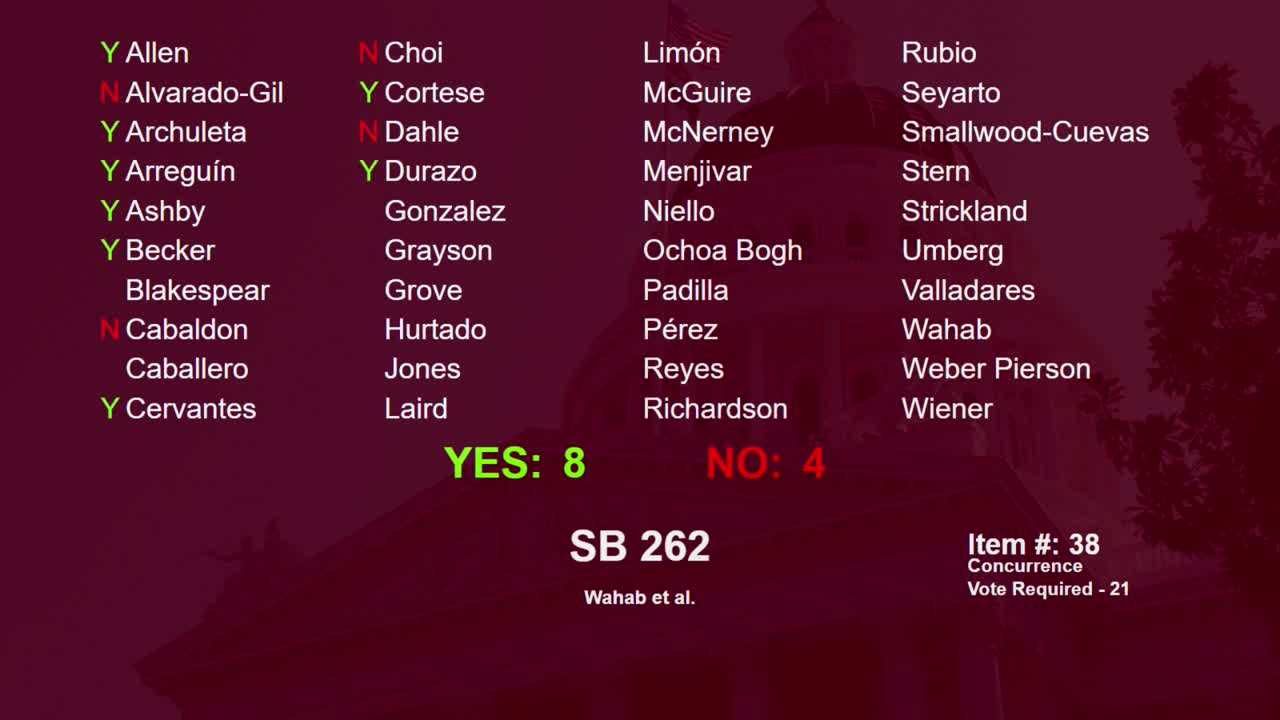 1MIN
Senate Floor
 2MIN
Assembly Floor
 10MIN
Assembly Standing Committee on Judiciary
 6MIN
Assembly Standing Committee on Natural Resources
 1MIN
Senate Floor
 8MIN