SB 692: Vehicles: homelessness.
- Session Year: 2025-2026
- House: Senate
- Latest Version Date: 2026-09-30
Current Status:
Passed
(2026-09-30: Chaptered by Secretary of State. Chapter 977, Statutes of 2026.)
Introduced
In Committee
Awaiting First Chamber Vote
Passed First Chamber
In Committee
Awaiting Second Chamber Vote
Passed Second Chamber
Enacted
Existing law makes it unlawful for a peace officer or an unauthorized person to remove an unattended vehicle from a highway, except as provided. Under existing law, the removal of a vehicle is a seizure, subject to the limits set forth in jurisprudence for the Fourth Amendment of the United States Constitution. Existing law authorizes a city, county, or city and county to adopt an ordinance establishing procedures for the abatement and removal, as public nuisances, of abandoned, wrecked, dismantled, or inoperative vehicles or parts of vehicles from private or public property.
Existing law, whenever a peace officer or other public employee removes an abandoned vehicle valued at $500 or less, requires the public agency that removed, or caused the removal of, the vehicle to cause the disposal of the vehicle subject to specified requirements, including providing notice, as specified, to the registered and legal owners and any other person known to have an interest in the vehicle, and a process for the owners and interested persons to request and have a poststorage hearing, as specified.
This bill would authorize a public agency of a city, county, or city and county to dismantle, or cause the dismantlement of, an abandoned vehicle, as defined, if the abandoned vehicle cannot be towed or otherwise moved and the vehicle has been declared a nuisance or hazard by a fire marshal, environmental health director, or public health officer of a city, county, or city and county, if various requirements are met, including attaching a distinctive notice to the vehicle at least 15 days prior to dismantlement that states the vehicle will be dismantled by the public agency if the hazard is not abated, sending a notice, within 48 hours of the attachment of the notice to the vehicle, to the owners and any other person known to have an interest in the vehicle informing them of specified information, including that the vehicle may be disposed of at least 15 days from the date of the notice and that they may have a hearing before the public agency if a request for a hearing is made within 10 days from the date of notice, as specified. This bill would require a requested hearing to be conducted within 5 business days of the request. If, after at least 15 days from the notification, the vehicle remains unclaimed, and if no request for a hearing was made or a hearing was not attended, the bill would require the public agency to provide the lienholder authorization to dismantle the vehicle. The bill would provide that a local government is not prevented from performing emergency summary abatement of an abandoned vehicle that is creating imminent health or safety hazards.
Existing law makes it unlawful for a peace officer or an unauthorized person to remove an unattended vehicle from a highway, except as provided. Under existing law, the removal of a vehicle is a seizure, subject to the limits set forth in jurisprudence for the Fourth Amendment of the United States Constitution. Existing law authorizes a city, county, or city and county to adopt an ordinance establishing procedures for the abatement and removal, as public nuisances, of abandoned, wrecked, dismantled, or inoperative vehicles or parts of vehicles from private or public property. Existing law requires that any ordinance for the removal of abandoned vehicles contain certain provisions, including a provision exempting vehicles under certain circumstances, and a provision providing no less than a 10-day notice of intention to abate and remove the vehicle or part thereof as a public nuisance, unless the property owner and the owner of the vehicle sign releases. Existing law also exempts from the 10-day notice prior to removal provision, a vehicle meeting specified requirements, including being valued at less than $200 and being determined to be a public nuisance, if the property owner has signed a release.
This bill would specifically authorize a local government to perform emergency summary abatement of vehicles creating imminent health and safety hazards. The bill would modify the exemption from prior 10-day notice of intention to abate and remove a vehicle to no longer require that both the vehicle be determined to be a public nuisance and that the property owner sign a release.Existing law, whenever a peace officer or other public employee removes an abandoned vehicle valued at $500 or less, requires the public agency that removed, or caused the removal of, the vehicle to cause the disposal of the vehicle subject to specified requirements, including providing notice, as specified, to the registered and legal owners and any other person known to have an interest in the vehicle, and a process for the owners and interested persons to request and have a poststorage hearing, as specified.
This bill would authorize a public agency of a city, county, or city and county to dismantle, or cause the dismantlement of, an abandoned vehicle, as defined, if the abandoned vehicle cannot be towed or otherwise moved and the vehicle has been declared a nuisance or hazard by a fire marshal, environmental health director, or public health officer of a city, county, or city and county, if various requirements are met, including attaching a distinctive notice to the vehicle at least 15 days prior to dismantlement that states the vehicle will be dismantled by the public agency if the hazard is not abated, sending a notice, within 48 hours of the attachment of the notice to the vehicle, to the owners and any other person known to have an interest in the vehicle informing them of specified information, including that the vehicle may be disposed of at least 15 days from the date of the notice and that they may have a hearing before the public agency if a request for a hearing is made within 10 days from the date of notice, as specified. This bill would require a requested hearing to be conducted within 5 business days of the request. If, after at least 15 days from the notification, the vehicle remains unclaimed, and if no request for a hearing was made or a hearing was not attended, the bill would require the public agency to provide the lienholder authorization to dismantle the vehicle. The bill would provide that a local government is not prevented from performing emergency summary abatement of an abandoned vehicle that is creating imminent health or safety hazards.
Existing law makes it unlawful for a peace officer or an unauthorized person to remove an unattended vehicle from a highway, except as provided. Under existing law, the removal of a vehicle is a seizure, subject to the limits set forth in jurisprudence for the Fourth Amendment of the United States Constitution. Existing law authorizes a city, county, or city and county to adopt an ordinance establishing procedures for the abatement and removal, as public nuisances, of abandoned, wrecked, dismantled, or inoperative vehicles or parts of vehicles from private or public property. Existing law requires that any ordinance for the removal of abandoned vehicles contain certain provisions, including a provision exempting vehicles under certain circumstances, and a provision providing no less than a 10-day notice of intention to abate and remove the vehicle or part thereof as a public nuisance, unless the property owner and the owner of the vehicle sign releases. Existing law also exempts from the 10-day notice prior to removal provision, a vehicle meeting specified requirements, including being valued at less than $200 and being determined to be a public nuisance, if the property owner has signed a release.
This bill would specifically authorize a local government to perform emergency summary abatement of vehicles creating imminent health and safety hazards. The bill would modify the exemption from prior 10-day notice of intention to abate and remove a vehicle to no longer require that both the vehicle be determined to be a public nuisance and that the property owner sign a release.
Existing law, whenever a peace officer or other public employee removes an abandoned vehicle valued at $500 or less, requires the public agency that removed, or caused the removal of, the vehicle to cause the disposal of the vehicle subject to specified requirements, including providing notice, as specified, to the registered and legal owners and any other person known to have an interest in the vehicle, and a process for the owners and interested persons to request and have a poststorage hearing, as specified.
This bill would authorize a public agency of a city, county, or city and county to dismantle, or cause the dismantlement of, an abandoned vehicle, as defined, if the abandoned vehicle cannot be towed or otherwise moved and the vehicle has been declared a nuisance or hazard by a fire marshal, environmental health director, or public health officer of a city, county, or city and county, if various requirements are met, including attaching a distinctive notice to the vehicle at least 15 days prior to dismantlement that states the vehicle will be dismantled by the public agency if the hazard is not abated, sending a notice, within 48 hours of the attachment of the notice to the vehicle, to the owners and any other person known to have an interest in the vehicle informing them of specified information, including that the vehicle may be disposed of at least 15 days from the date of the notice and that they may have a hearing before the public agency if a request for a hearing is made within 10 days from the date of notice, as specified. This bill would require a requested hearing to be conducted within 5 business days of the request. If, after at least 15 days from the notification, the vehicle remains unclaimed, and if no request for a hearing was made or a hearing was not attended, the bill would require the public agency to provide the lienholder authorization to dismantle the vehicle. The bill would provide that a local government is not prevented from performing emergency summary abatement of an abandoned vehicle that is creating imminent health or safety hazards.
Existing law makes it unlawful for a peace officer or an unauthorized person to remove an unattended vehicle from a highway, except as provided. Under existing law, the removal of a vehicle is a seizure, subject to the limits set forth in jurisprudence for the Fourth Amendment of the United States Constitution. Existing law authorizes a city, county, or city and county to adopt an ordinance establishing procedures for the abatement and removal, as public nuisances, of abandoned, wrecked, dismantled, or inoperative vehicles or parts of vehicles from private or public property. Existing law requires that any ordinance for the removal of abandoned vehicles contain certain provisions, including a provision exempting vehicles under certain circumstances, and a provision providing no less than a 10-day notice of intention to abate and remove the vehicle or part thereof as a public nuisance, unless the property owner and the owner of the vehicle sign releases. Existing law also exempts from the 10-day notice prior to removal provision, a vehicle meeting specified requirements, including being valued at less than $200 and being determined to be a public nuisance, if the property owner has signed a release.
Existing law requires a peace officer, or any other authorized employee of a public agency, at least 72 hours prior to removal of a vehicle, to attach a distinctive notice that states the vehicle will be removed by the public agency, except as specified.This bill would specifically authorize a local government to perform emergency summary abatement of vehicles creating imminent health and safety hazards. The bill would modify the exemption from prior 10-day notice of intention to abate and remove a vehicle to no longer require that both the vehicle be determined to be a public nuisance and that the property owner sign a release. The bill would additionally exempt abandoned vehicles or parts from those notice provisions if the vehicle or part is inoperable due to the absence of, among other things, a motor or transmission, and the local agency has determined the vehicle or part to be a public nuisance, as specified.
Existing law makes it unlawful for a peace officer or an unauthorized person to remove an unattended vehicle from a highway, except as provided. Under existing law, the removal of a vehicle is a seizure, subject to the limits set forth in jurisprudence for the Fourth Amendment of the United States Constitution. Existing law authorizes a city, county, or city and county to adopt an ordinance establishing procedures for the abatement and removal, as public nuisances, of abandoned, wrecked, dismantled, or inoperative vehicles or parts of vehicles from private or public property. Existing law requires that any ordinance for the removal of abandoned vehicles contain certain provisions, including a provision exempting vehicles under certain circumstances, and a provision providing no less than a 10-day notice of intention to abate and remove the vehicle or part thereof as a public nuisance, unless the property owner and the owner of the vehicle sign releases. Existing law also exempts from the 10-day notice prior to removal provision, a vehicle meeting specified requirements, including being valued at less than $200 and being determined to be a public nuisance, if the property owner has signed a release.
Existing law requires a peace officer, or any other authorized employee of a public agency, at least 72 hours prior to removal of a vehicle, to attach a distinctive notice that states the vehicle will be removed by the public agency, except as specified.
This bill would specifically authorize a local government to perform emergency summary abatement of vehicles creating imminent health and safety hazards. The bill would modify the exemption from prior 10-day notice of intention to abate and remove a vehicle to no longer require that both the vehicle be determined to be a public nuisance and that the property owner sign a release. The bill would additionally exempt abandoned vehicles or parts from those notice provisions if the vehicle or part is inoperable due to the absence of, among other things, a motor or transmission, and the local agency has determined the vehicle or part to be a public nuisance, as specified.
Existing law makes it unlawful for a peace officer or an unauthorized person to remove an unattended vehicle from a highway, except as provided. Under existing law, the removal of a vehicle is a seizure, subject to the limits set forth in jurisprudence for the Fourth Amendment of the United States Constitution. Existing law authorizes a city, county, or city and county to adopt an ordinance establishing procedures for the abatement and removal, as public nuisances, of abandoned, wrecked, dismantled, or inoperative vehicles or parts of vehicles from private or public property. Existing law requires that any ordinance for the removal of abandoned vehicles contain certain provisions, including a provision exempting vehicles under certain circumstances, and a provision providing no less than a 10-day notice of intention to abate and remove the vehicle or part thereof as a public nuisance, unless the property owner and the owner of the vehicle sign releases. Existing law also exempts from the 10-day notice prior to removal provision, a vehicle meeting specified requirements, including being valued at less than $200 and being determined to be a public nuisance, if the property owner has signed a release.
This bill would additionally authorize a city, county, or city and county to adopt an ordinance for the abatement and removal of vehicles formerly used as shelter by a person. The bill would require an ordinance establishing procedures for the removal of abandoned vehicles to contain a provision making the ordinance applicable to public agencies operating certain vehicle buyback programs, as specified. The bill would also specifically authorize a local government to perform emergency summary abatement of vehicles creating imminent health and safety hazards. The bill would modify the exemption from prior 10-day notice of intention to abate and remove a vehicle to no longer require that both the vehicle be determined to be a public nuisance and that the property owner sign a release.
Existing law authorizes vehicles or parts thereof to be disposed of by removal to, among other places, a scrapyard or automobile dismantlers yard.The bill would authorize specified vehicles to be scrapped and dismantled in place and disposed of at a suitable site operated by a local authority.Existing law makes it unlawful for a peace officer or an unauthorized person to remove an unattended vehicle from a highway, except as provided. Under existing law, the removal of a vehicle is a seizure, subject to the limits set forth in jurisprudence for the Fourth Amendment of the United States Constitution. Existing law authorizes a city, county, or city and county to adopt an ordinance establishing procedures for the abatement and removal, as public nuisances, of abandoned, wrecked, dismantled, or inoperative vehicles or parts of vehicles from private or public property. Existing law requires that any ordinance for the removal of abandoned vehicles contain certain provisions, including a provision exempting vehicles under certain circumstances, and a provision providing no less than a 10-day notice of intention to abate and remove the vehicle or part thereof as a public nuisance, unless the property owner and the owner of the vehicle sign releases. Existing law also exempts from the 10-day notice prior to removal provision, a vehicle meeting specified requirements, including being valued at less than $200 and being determined to be a public nuisance, if the property owner has signed a release.
This bill would additionally authorize a city, county, or city and county to adopt an ordinance for the abatement and removal of vehicles formerly used as shelter by persons experiencing homelessness. a person. The bill would require an ordinance establishing procedures for the removal of abandoned vehicles to contain a provision making the ordinance applicable to public agencies operating certain vehicle buyback programs, as specified. The bill would also specifically authorize a local government to perform emergency summary abatement of vehicles creating imminent health and safety hazards. The bill would modify the exemption from prior 10-day notice of intention to abate and remove a vehicle to no longer require that both the vehicle be determined to be a public nuisance and that the property owner sign a release.
Existing law authorizes vehicles or parts thereof to be disposed of by removal to, among other places, a scrapyard or automobile dismantlers yard.
The bill would authorize specified vehicles to be scrapped and dismantled in place and disposed of at a suitable site operated by a local authority.
Existing law establishes the Homeless Housing, Assistance, and Prevention program, administered by the California Interagency Council on Homelessness, for the purpose of providing jurisdictions with grant funds to support regional coordination and expand or develop local capacity to address their immediate homelessness challenges, as specified. Existing law provides for the allocation of funding under the program among continuums of care, cities, counties, and tribes in rounds and establishes round 5 for the purpose of creating and implementing regionally coordinated plans that organize and deploy the full array of homelessness programs and resources comprehensively and effectively. Existing law authorizes the use of those funds for services for people experiencing unsheltered homelessness, including, among other things, street outreach, and specified programs funded by the Encampment Resolution Grant. Existing law establishes round 6 for the purpose of, among other things, expeditiously reducing unsheltered homelessness through homelessness prevention activities and sustaining existing interim housing solutions. Existing law authorizes the use of those funds for, among other things, permanent housing solutions that can prevent or serve those experiencing unsheltered homelessness, as specified.This bill would additionally authorize the use of funds from rounds 5 and 6 for vehicle buyback programs for persons experiencing vehicular homelessness, if the buyback offer is paired with an offer of interim or permanent housing.Existing law makes it unlawful for a peace officer or an unauthorized person to remove an unattended vehicle from a highway, except as provided. Under existing law, the removal of a vehicle is a seizure, subject to the limits set forth in jurisprudence for the Fourth Amendment of the United States Constitution. Existing law authorizes a city, county, or city and county to adopt an ordinance establishing procedures for the abatement and removal, as public nuisances, of abandoned, wrecked, dismantled, or inoperative vehicles or parts of vehicles from private or public property. Existing law requires that any ordinance for the removal of abandoned vehicles contain certain provisions, including a provision exempting vehicles under certain circumstances, and a provision providing no less than a 10-day notice of intention to abate and remove the vehicle or part thereof as a public nuisance, unless the property owner and the owner of the vehicle sign releases. Existing law also exempts from the 10-day notice prior to removal provision, a vehicle meeting specified requirements, including being valued at less than $200 and being determined to be a public nuisance, if the property owner has signed a release.
This bill would additionally authorize a city, county, or city and county to adopt an ordinance for the abatement and removal of vehicles formerly used as shelter by persons experiencing homelessness. The bill would require an ordinance establishing procedures for the removal of abandoned vehicles to contain a provision making the ordinance applicable to public agencies operating certain vehicle buyback programs, as specified. The bill would also specifically authorize a local government to perform emergency summary abatement of vehicles creating imminent health and safety hazards. The bill would modify the exemption from prior 10-day notice of intention to abate and remove a vehicle to no longer require that both the vehicle be determined to be a public nuisance and that the property owner sign a release.
Existing law authorizes vehicles or parts thereof to be disposed of by removal to, among other places, a scrapyard or automobile dismantlers yard.
The bill would authorize specified vehicles to be scrapped and dismantled in place and disposed of at a suitable site operated by a local authority.
Existing law establishes the Homeless Housing, Assistance, and Prevention program, administered by the California Interagency Council on Homelessness, for the purpose of providing jurisdictions with grant funds to support regional coordination and expand or develop local capacity to address their immediate homelessness challenges, as specified. Existing law provides for the allocation of funding under the program among continuums of care, cities, counties, and tribes in rounds and establishes round 5 for the purpose of creating and implementing regionally coordinated plans that organize and deploy the full array of homelessness programs and resources comprehensively and effectively. Existing law authorizes the use of those funds for services for people experiencing unsheltered homelessness, including, among other things, street outreach, and specified programs funded by the Encampment Resolution Grant. Existing law establishes round 6 for the purpose of, among other things, expeditiously reducing unsheltered homelessness through homelessness prevention activities and sustaining existing interim housing solutions. Existing law authorizes the use of those funds for, among other things, permanent housing solutions that can prevent or serve those experiencing unsheltered homelessness, as specified.
This bill would additionally authorize the use of funds from rounds 5 and 6 for vehicle buyback programs for persons experiencing vehicular homelessness, if the buyback offer is paired with an offer of interim or permanent housing.
Existing law requires the Department of the California Highway Patrol to regulate the safe operation of specified vehicles including, among others, trucks and trailers, as specified, buses, and a combination of a motortruck and a vehicle or vehicles that exceeds 40 feet in length when coupled together. Existing law prohibits a recreational vehicle, as defined, that is designed to be towed from being manufactured for sale in this state, sold, leased, or rented unless it is equipped with a safety connection, as specified.This bill would state the intent of the Legislature to enact legislation relating to vehicles, including, but not limited to, recreational vehicles, trailers, and oversized vehicles.Existing law requires the Department of the California Highway Patrol to regulate the safe operation of specified vehicles including, among others, trucks and trailers, as specified, buses, and a combination of a motortruck and a vehicle or vehicles that exceeds 40 feet in length when coupled together. Existing law prohibits a recreational vehicle, as defined, that is designed to be towed from being manufactured for sale in this state, sold, leased, or rented unless it is equipped with a safety connection, as specified.
This bill would state the intent of the Legislature to enact legislation relating to vehicles, including, but not limited to, recreational vehicles, trailers, and oversized vehicles.
(a)If an abandoned vehicle cannot be towed or otherwise moved and the abandoned vehicle has been declared a nuisance or hazard by the fire marshal, environmental health director, or public health officer of the city, county, or city and county in which the public agency is located, the public agency may dismantle, or cause the dismantlement of, the vehicle in the place that it was abandoned, if all of the following requirements are met:
(1)Except as provided in subdivision (c), at least 15 days prior to dismantlement of the abandoned vehicle, the peace officer, as defined in Chapter 4.5 (commencing with Section 830) of Title 3 of Part 2 of the Penal Code, or any other employee of a public agency authorized pursuant to Section 22669, shall securely attach a distinctive notice to the vehicle that states the vehicle will be dismantled by the public agency if the hazard is not abated.
(2)Immediately after identifying the abandoned vehicle for dismantlement and posting the public notice on the vehicle, the public agency that seeks to dismantle, or caused the dismantlement of, the abandoned vehicle, shall notify the Stolen Vehicle System of the Department of Justice in Sacramento of the intent to dismantle.
(3)The public agency that seeks to dismantle, or cause the dismantlement of, the abandoned vehicle or, at the request of the public agency, the lienholder shall obtain a copy of the names and addresses of all persons having an interest in the vehicle, if any, from the Department of Motor Vehicles either directly or by use of the California Law Enforcement Telecommunications System. This subdivision does not require the public agency or lienholder to obtain a copy of the actual record on file at the Department of Motor Vehicles.
(4)Within 48 hours of the posting of the notice pursuant to paragraph (1), excluding weekends and holidays, the public agency that seeks to dismantle, or cause the dismantlement of, the vehicle shall send a notice to the registered and legal owners at their addresses of record with the Department of Motor Vehicles, and to any other person known to have an interest in the vehicle. A notice sent by the public agency shall be sent by certified or first-class mail, and a notice sent by the lienholder shall be sent by certified mail. The notice shall include all of the following information:
(A)The name, address, and telephone number of the public agency providing the notice.
(B)The location of the place of the vehicle and description of the vehicle that shall include, if available, the vehicle make, license plate number, vehicle identification number, and mileage.
(C)The authority and purpose for the removal of the vehicle.
(D)A statement that the vehicle may be disposed of at least 15 days from the date of the notice.
(E)A statement that the owners and interested persons, or their agents, have the opportunity for a hearing before the public agency that seeks to dismantle, or caused the dismantlement of, the vehicle to determine the validity of the determination if a request for a hearing is made in person, in writing, or by telephone within 10 days from the date of notice. The statement shall also advise that if the owner or interested person, or their agent, disagrees with the decision of the public agency, the decision may be reviewed pursuant to Section 11523 of the Government Code. The statement shall further include that during the time of the initial hearing, or during the time the decision is being reviewed pursuant to Section 11523 of the Government Code, the vehicle in question may not be disposed of.
(5)(A)A requested hearing shall be conducted within five business days of the request, excluding weekends and holidays. The public agency that seeks to dismantle the vehicle may authorize its own officers to conduct the hearing if the hearing officer is not the same person who directed the storage of the vehicle.
(B)Failure of either the registered or legal owner or interested person, or their agent, to request or to attend a scheduled hearing shall satisfy the hearing requirement of this section.
(6)An authorization for disposal may not be issued by the public agency prior to the conclusion of a requested hearing or any judicial review of that hearing.
(7)If, after at least 15 days from the notification, the vehicle remains unclaimed and if no request for a hearing was made or a hearing was not attended, the public agency that sought to dismantle, or sought to cause the dismantlement of, the vehicle shall provide to the lienholder, on a form approved by the Department of Motor Vehicles, authorization to dismantle the vehicle. The lienholder may request the public agency to provide the authorization to dismantle the vehicle.
(8)If the names and addresses of the registered and legal owners of the vehicle are not available from the records of the Department of Motor Vehicles, either directly or by use of the California Law Enforcement Telecommunications System, the public agency may dismantle or cause the dismantlement of the vehicle at any time after the 15th day from the date of the notice.
(b)A vehicle disposed of pursuant to this section shall not be reconstructed or made operable, unless it is a vehicle that qualifies for either horseless carriage license plates or historical vehicle license plates, pursuant to Section 5004, in which case the vehicle may be reconstructed or made operable.
(c)This section does not prevent a local government from performing emergency summary abatement of an abandoned vehicle that is creating imminent health and safety hazards pursuant to state law or local ordinance.
(d)For the purposes of this section, abandoned vehicle means that the vehicle is left on public or private property in such a neglected condition that the owners intention to relinquish all further rights or interests in the vehicle may be reasonably concluded, and either of the following is met:
(1)The vehicle does not have signs of human habitation and the city, county, or city and county reasonably believes the vehicle is not being used for human habitation based on recently conducted outreach.
(2)The vehicle is inoperable due the absence of a motor, transmission, or wheels.
(a)If an abandoned vehicle cannot be towed or otherwise moved and the abandoned vehicle has been declared a nuisance or hazard by the fire marshal, environmental health director, or public health officer of the city, county, or city and county in which the public agency is located, the public agency may dismantle, or cause the dismantlement of, the vehicle in the place that it was abandoned, if all of the following requirements are met:
(1)Except as provided in subdivision (d), (c), at least 15 days prior to dismantlement of the abandoned vehicle, the peace officer, as defined in Chapter 4.5 (commencing with Section 830) of Title 3 of Part 2 of the Penal Code, or any other employee of a public agency authorized pursuant to Section 22669, shall securely attach a distinctive notice to the vehicle that states the vehicle will be dismantled by the public agency if the hazard is not abated.
(2)Immediately after identifying the abandoned vehicle for dismantlement and posting the public notice on the vehicle, the public agency that seeks to dismantle, or caused the dismantlement of, the abandoned vehicle, shall notify the Stolen Vehicle System of the Department of Justice in Sacramento of the intent to dismantle.
(3)The public agency that seeks to dismantle, or cause the dismantlement of, the abandoned vehicle or, at the request of the public agency, the lienholder shall obtain a copy of the names and addresses of all persons having an interest in the vehicle, if any, from the Department of Motor Vehicles either directly or by use of the California Law Enforcement Telecommunications System. This subdivision does not require the public agency or lienholder to obtain a copy of the actual record on file at the Department of Motor Vehicles.
(4)Within 48 hours of the posting of the notice pursuant to subdivision (a), paragraph (1), excluding weekends and holidays, the public agency that seeks to dismantle, or cause the dismantlement of, the vehicle shall send a notice to the registered and legal owners at their addresses of record with the Department of Motor Vehicles, and to any other person known to have an interest in the vehicle. A notice sent by the public agency shall be sent by certified or first-class mail, and a notice sent by the lienholder shall be sent by certified mail. The notice shall include all of the following information:
(A)The name, address, and telephone number of the public agency providing the notice.
(B)The location of the place of the vehicle and description of the vehicle that shall include, if available, the vehicle make, license plate number, vehicle identification number, and mileage.
(C)The authority and purpose for the removal of the vehicle.
(D)A statement that the vehicle may be disposed of at least 15 days from the date of the notice.
(E)A statement that the owners and interested persons, or their agents, have the opportunity for a hearing before the public agency that seeks to dismantle, or caused the dismantlement of, the vehicle to determine the validity of the determination if a request for a hearing is made in person, in writing, or by telephone within 10 days from the date of notice. The statement shall also advise that if the owner or interested person, or their agent, disagrees with the decision of the public agency, the decision may be reviewed pursuant to Section 11523 of the Government Code. The statement shall further include that during the time of the initial hearing, or during the time the decision is being reviewed pursuant to Section 11523 of the Government Code, the vehicle in question may not be disposed of.
(5)(A)A requested hearing shall be conducted within five business days of the request, excluding weekends and holidays. The public agency that seeks to dismantle the vehicle may authorize its own officers to conduct the hearing if the hearing officer is not the same person who directed the storage of the vehicle.
(B)Failure of either the registered or legal owner or interested person, or their agent, to request or to attend a scheduled hearing shall satisfy the hearing requirement of this section.
(6)An authorization for disposal may not be issued by the public agency prior to the conclusion of a requested hearing or any judicial review of that hearing.
(7)If, after at least 15 days from the notification, the vehicle remains unclaimed and if no request for a hearing was made or a hearing was not attended, the public agency that sought to dismantle, or sought to cause the dismantlement of, the vehicle shall provide to the lienholder, on a form approved by the Department of Motor Vehicles, authorization to dismantle the vehicle. The lienholder may request the public agency to provide the authorization to dismantle the vehicle.
(8)If the names and addresses of the registered and legal owners of the vehicle are not available from the records of the Department of Motor Vehicles, either directly or by use of the California Law Enforcement Telecommunications System, the public agency may dismantle or cause the dismantlement of the vehicle at any time after the 15th day from the date of the notice.
(c)(b)A vehicle disposed of pursuant to this section shall not be reconstructed or made operable, unless it is a vehicle that qualifies for either horseless carriage license plates or historical vehicle license plates, pursuant to Section 5004, in which case the vehicle may be reconstructed or made operable.
(d)(c)This section does not prevent a local government from performing emergency summary abatement of an abandoned vehicle that is creating imminent health and safety hazards pursuant to state law or local ordinance.
(d)For the purposes of this section, abandoned vehicle means that the vehicle is left on public or private property in such a neglected condition that the owners intention to relinquish all further rights or interests in the vehicle may be reasonably concluded, and either of the following is met:
(1)The vehicle does not have signs of human habitation and the city, county, or city and county reasonably believes the vehicle is not being used for human habitation based on recently conducted outreach.
(2)The vehicle is inoperable due the absence of a motor, transmission, or wheels.
Any ordinance establishing procedures for the removal of abandoned or inoperable vehicles shall contain all of the following provisions:
(a)The requirement that notice be given to the Department of Motor Vehicles within five days after the date of removal, identifying the vehicle or part thereof and any evidence of registration available, including, but not limited to, the registration card, certificates of ownership, or license plates.
(b)Making the ordinance inapplicable to (1) a vehicle or part thereof that is completely enclosed within a building in a lawful manner where it is not visible from the street or other public or private property or (2) a vehicle or part thereof that is stored or parked in a lawful manner on private property in connection with the business of a licensed dismantler, licensed vehicle dealer, or a junkyard. This exception shall not, however, authorize the maintenance of a public or private nuisance as defined under provisions of law other than this chapter.
(c)(1)The requirement that not less than a 10-day notice of intention to abate and remove the vehicle or part thereof as a public nuisance be issued, unless the property owner and the owner of the vehicle have signed releases authorizing removal and waiving further interest in the vehicle or part thereof.
(2)However, prior notice of intention is not required for removal of a vehicle or part thereof that is inoperable due to the absence of a motor, transmission, or wheels, and is valued at less than two hundred dollars ($200) by a person specified in Section 22855, if either of the following criteria is met:
(A)The property owner has signed a release authorizing removal and waiving their interest in the vehicle or part thereof.
(B)The vehicle or part is determined by the local agency to be a public nuisance presenting an imminent threat to public health or safety.
(3)Prior to final disposition pursuant to Section 22662 of a vehicle or part for which evidence of registration was recovered pursuant to subdivision (a), the local agency shall provide notice to the registered and legal owners of intent to dispose of the vehicle or part, and if the vehicle or part is not claimed and removed within 12 days after the notice is mailed, from a location specified in Section 22662, or if the owner signs a release waiving the waiting period, final disposition may proceed. A local agency or contractor thereof is not liable for damage caused to a vehicle or part thereof by removal consistent with this section.
(4)Paragraph (2) applies only as follows:
(A)To inoperable vehicles located upon a parcel that is zoned for agricultural use.
(B)To inoperable vehicles located upon a parcel that is not improved with a residential structure containing one or more dwelling units.
(d)The 10-day notice of intention to abate and remove a vehicle or part thereof, when required by this section, shall contain a statement of the hearing rights of the owner of the property on which the vehicle is located and of the owner of the vehicle. The statement shall include notice to the property owner that they may appear in person at a hearing or may submit a sworn written statement denying responsibility for the presence of the vehicle on the land, with their reasons for such denial, in lieu of appearing. The notice of intention to abate shall be mailed, by registered or certified mail, to the owner of the land as shown on the last equalized assessment roll and to the last registered and legal owners of record unless the vehicle is in such condition that identification numbers are not available to determine ownership.
(e)The requirement that a public hearing be held before the governing body of the city, county, or city and county, or any other board, commissioner, or official of the city, county, or city and county as designated by the governing body, upon request for such a hearing by the owner of the vehicle or the owner of the land on which the vehicle is located. This request shall be made to the appropriate public body, agency, or officer within 10 days after the mailing of notice of intention to abate and remove the vehicle or at the time of signing a release pursuant to subdivision (c). If the owner of the land on which the vehicle is located submits a sworn written statement denying responsibility for the presence of the vehicle on their land within that time period, this statement shall be construed as a request for hearing that does not require the presence of the owner submitting the request. If the request is not received within that period, the appropriate public body, agency, or officer shall have the authority to remove the vehicle.
(f)The requirement that after a vehicle has been removed, it shall not be reconstructed or made operable, unless it is a vehicle that qualifies for either horseless carriage license plates or historical vehicle license plates, pursuant to Section 5004, in which case the vehicle may be reconstructed or made operable.
(g)A provision authorizing the owner of the land on which the vehicle is located to appear in person at the hearing or present a sworn written statement denying responsibility for the presence of the vehicle on the land, with their reasons for the denial. If it is determined at the hearing that the vehicle was placed on the land without the consent of the landowner and that they have not subsequently acquiesced to its presence, then the local authority shall not assess costs of administration or removal of the vehicle against the property upon which the vehicle is located or otherwise attempt to collect those costs from the owner.
SEC. 2.Section 22851.35 is added to the Vehicle Code, to read:22851.35.(a)For the purposes of this section, abandoned vehicle means any of the following:
(1)A vehicle that does not have signs of human habitation and where the city, county, or city and county reasonably believes the vehicle is not being used for human habitation based on recently conducted outreach.
(2)The vehicle is inoperable due to the absence of a motor, transmission, or wheels and incapable of being towed.
(b)If an abandoned vehicle cannot be towed or otherwise moved and the abandoned vehicle has been declared a nuisance or hazard by the fire marshal, environmental health director, or public health officer of the city, county, or city and county in which the public agency is located, the public agency may dismantle, or cause the dismantlement of, the vehicle in the place that it was abandoned, if all of the following requirements are met:
(1)Except as provided in subdivision (d), at least 15 days prior to dismantlement of the abandoned vehicle, the peace officer, as defined in Chapter 4.5 (commencing with Section 830) of Title 3 of Part 2 of the Penal Code, or any other employee of a public agency authorized pursuant to Section 22669, shall securely attach a distinctive notice to the vehicle that states the vehicle will be dismantled by the public agency if the hazard is not abated.
(2)Immediately after identifying the abandoned vehicle for dismantlement and posting the public notice on the vehicle, the public agency that seeks to dismantle, or caused the dismantlement of, the abandoned vehicle, shall notify the Stolen Vehicle System of the Department of Justice in Sacramento of the intent to dismantle.
(3)The public agency that seeks to dismantle, or cause the dismantlement of, the abandoned vehicle or, at the request of the public agency, the lienholder shall obtain a copy of the names and addresses of all persons having an interest in the vehicle, if any, from the Department of Motor Vehicles either directly or by use of the California Law Enforcement Telecommunications System. This subdivision does not require the public agency or lienholder to obtain a copy of the actual record on file at the Department of Motor Vehicles.
(4)Within 48 hours of the posting of the notice pursuant to subdivision (a), excluding weekends and holidays, the public agency that seeks to dismantle, or cause the dismantlement of, the vehicle shall send a notice to the registered and legal owners at their addresses of record with the Department of Motor Vehicles, and to any other person known to have an interest in the vehicle. A notice sent by the public agency shall be sent by certified or first-class mail, and a notice sent by the lienholder shall be sent by certified mail. The notice shall include all of the following information:
(A)The name, address, and telephone number of the public agency providing the notice.
(B)The location of the place of the vehicle and description of the vehicle that shall include, if available, the vehicle make, license plate number, vehicle identification number, and mileage.
(C)The authority and purpose for the removal of the vehicle.
(D)A statement that the vehicle may be disposed of at least 15 days from the date of the notice.
(E)A statement that the owners and interested persons, or their agents, have the opportunity for a hearing before the public agency that seeks to dismantle, or caused the dismantlement of, the vehicle to determine the validity of the determination if a request for a hearing is made in person, in writing, or by telephone within 10 days from the date of notice. The statement shall also advise that if the owner or interested person, or their agent, disagrees with the decision of the public agency, the decision may be reviewed pursuant to Section 11523 of the Government Code. The statement shall further include that during the time of the initial hearing, or during the time the decision is being reviewed pursuant to Section 11523 of the Government Code, the vehicle in question may not be disposed of.
(5)(A)A requested hearing shall be conducted within five business days of the request, excluding weekends and holidays. The public agency that seeks to dismantle the vehicle may authorize its own officers to conduct the hearing if the hearing officer is not the same person who directed the storage of the vehicle.
(B)Failure of either the registered or legal owner or interested person, or their agent, to request or to attend a scheduled hearing shall satisfy the hearing requirement of this section.
(6)An authorization for disposal may not be issued by the public agency prior to the conclusion of a requested hearing or any judicial review of that hearing.
(7)If, after at least 15 days from the notification, the vehicle remains unclaimed and if no request for a hearing was made or a hearing was not attended, the public agency that sought to dismantle, or sought to cause the dismantlement of, the vehicle shall provide to the lienholder, on a form approved by the Department of Motor Vehicles, authorization to dismantle the vehicle. The lienholder may request the public agency to provide the authorization to dismantle the vehicle.
(8)If the names and addresses of the registered and legal owners of the vehicle are not available from the records of the Department of Motor Vehicles, either directly or by use of the California Law Enforcement Telecommunications System, the public agency may dismantle or cause the dismantlement of the vehicle at any time after the 15th day from the date of the notice.
(c)A vehicle disposed of pursuant to this section shall not be reconstructed or made operable, unless it is a vehicle that qualifies for either horseless carriage license plates or historical vehicle license plates, pursuant to Section 5004, in which case the vehicle may be reconstructed or made operable.
(d)This section does not prevent a local government from performing emergency summary abatement of an abandoned vehicle that is creating imminent health and safety hazards pursuant to state law or local ordinance.
Any ordinance establishing procedures for the removal of abandoned or inoperable vehicles shall contain all of the following provisions:
(a)The requirement that notice be given to the Department of Motor Vehicles within five days after the date of removal, identifying the vehicle or part thereof and any evidence of registration available, including, but not limited to, the registration card, certificates of ownership, or license plates.
(b)Making the ordinance inapplicable to (1) a vehicle or part thereof that is completely enclosed within a building in a lawful manner where it is not visible from the street or other public or private property or (2) a vehicle or part thereof that is stored or parked in a lawful manner on private property in connection with the business of a licensed dismantler, licensed vehicle dealer, or a junkyard. This exception shall not, however, authorize the maintenance of a public or private nuisance as defined under provisions of law other than this chapter.
(c)(1)The requirement that not less than a 10-day notice of intention to abate and remove the vehicle or part thereof as a public nuisance be issued, unless the property owner and the owner of the vehicle have signed releases authorizing removal and waiving further interest in the vehicle or part thereof.
(2)However, prior notice of intention is not required for removal of a vehicle or part thereof that is inoperable due to the absence of a motor, transmission, or wheels and incapable of being towed, wheels, and is valued at less than two hundred dollars ($200) by a person specified in Section 22855, if either of the following criteria is met:
(A)The property owner has signed a release authorizing removal and waiving their interest in the vehicle or part thereof.
(B)The vehicle or part is determined by the local agency to be a public nuisance presenting an imminent threat to public health or safety.
(3)Prior to final disposition pursuant to Section 22662 of a vehicle or part for which evidence of registration was recovered pursuant to subdivision (a), the local agency shall provide notice to the registered and legal owners of intent to dispose of the vehicle or part, and if the vehicle or part is not claimed and removed within 12 days after the notice is mailed, from a location specified in Section 22662, or if the owner signs a release waiving the waiting period, final disposition may proceed. A local agency or contractor thereof is not liable for damage caused to a vehicle or part thereof by removal consistent with this section.
(4)Paragraph (2) applies only as follows:
(A)To inoperable vehicles located upon a parcel that is zoned for agricultural use.
(B)To inoperable vehicles located upon a parcel that is not improved with a residential structure containing one or more dwelling units.
(d)The 10-day notice of intention to abate and remove a vehicle or part thereof, when required by this section, shall contain a statement of the hearing rights of the owner of the property on which the vehicle is located and of the owner of the vehicle. The statement shall include notice to the property owner that they may appear in person at a hearing or may submit a sworn written statement denying responsibility for the presence of the vehicle on the land, with their reasons for such denial, in lieu of appearing. The notice of intention to abate shall be mailed, by registered or certified mail, to the owner of the land as shown on the last equalized assessment roll and to the last registered and legal owners of record unless the vehicle is in such condition that identification numbers are not available to determine ownership.
(e)The requirement that a public hearing be held before the governing body of the city, county, or city and county, or any other board, commissioner, or official of the city, county, or city and county as designated by the governing body, upon request for such a hearing by the owner of the vehicle or the owner of the land on which the vehicle is located. This request shall be made to the appropriate public body, agency, or officer within 10 days after the mailing of notice of intention to abate and remove the vehicle or at the time of signing a release pursuant to subdivision (c). If the owner of the land on which the vehicle is located submits a sworn written statement denying responsibility for the presence of the vehicle on their land within that time period, this statement shall be construed as a request for hearing that does not require the presence of the owner submitting the request. If the request is not received within that period, the appropriate public body, agency, or officer shall have the authority to remove the vehicle.
(f)The requirement that after a vehicle has been removed, it shall not be reconstructed or made operable, unless it is a vehicle that qualifies for either horseless carriage license plates or historical vehicle license plates, pursuant to Section 5004, in which case the vehicle may be reconstructed or made operable.
(g)A provision authorizing the owner of the land on which the vehicle is located to appear in person at the hearing or present a sworn written statement denying responsibility for the presence of the vehicle on the land, with their reasons for the denial. If it is determined at the hearing that the vehicle was placed on the land without the consent of the landowner and that they have not subsequently acquiesced to its presence, then the local authority shall not assess costs of administration or removal of the vehicle against the property upon which the vehicle is located or otherwise attempt to collect those costs from the owner.
SEC. 2.Section 22851.3 of the Vehicle Code is amended to read:22851.3.Whenever a peace officer, as defined in Chapter 4.5 (commencing with Section 830) of Title 3 of Part 2 of the Penal Code, or any other employee of a public agency authorized pursuant to Section 22669, removes, or causes the removal of, a vehicle pursuant to Section 22669 and the public agency or, at the request of the public agency, the lienholder determines the estimated value of the vehicle is five hundred dollars ($500) or less, the public agency that removed, or caused the removal of, the vehicle shall cause the disposal of the vehicle under this section, subject to all of the following requirements:(a)Not less than 72 hours before the vehicle is removed, the peace officer or the authorized public employee has securely attached to the vehicle a distinctive notice which states that the vehicle will be removed by the public agency. This subdivision does not apply to abandoned vehicles removed pursuant to subdivision (d) of Section 22669, or abandoned vehicles or parts thereof that are inoperable due to the absence of a motor, transmission, or wheels and incapable of being towed, and are determined by the local agency to be a public nuisance presenting an immediate threat to public health or safety, which are determined by the public agency to have an estimated value of three hundred dollars ($300) or less.(b)Immediately after removal of the vehicle, the public agency which removed, or caused the removal of, the vehicle shall notify the Stolen Vehicle System of the Department of Justice in Sacramento of the removal.(c)The public agency that removed, or caused the removal of, the vehicle or, at the request of the public agency, the lienholder shall obtain a copy of the names and addresses of all persons having an interest in the vehicle, if any, from the Department of Motor Vehicles either directly or by use of the California Law Enforcement Telecommunications System. This paragraph does not require the public agency or lienholder to obtain a copy of the actual record on file at the Department of Motor Vehicles.(d)Within 48 hours of the removal, excluding weekends and holidays, the public agency that removed, or caused the removal of, the vehicle or, at the request of the public agency, the lienholder shall send a notice to the registered and legal owners at their addresses of record with the Department of Motor Vehicles, and to any other person known to have an interest in the vehicle. A notice sent by the public agency shall be sent by certified or first-class mail, and a notice sent by the lienholder shall be sent by certified mail. The notice shall include all of the following information:(1)The name, address, and telephone number of the public agency providing the notice.(2)The location of the place of storage and description of the vehicle which shall include, if available, the vehicle make, license plate number, vehicle identification number, and mileage.(3)The authority and purpose for the removal of the vehicle.(4)A statement that the vehicle may be disposed of 15 days from the date of the notice.(5)A statement that the owners and interested persons, or their agents, have the opportunity for a poststorage hearing before the public agency that removed, or caused the removal of, the vehicle to determine the validity of the storage if a request for a hearing is made in person, in writing, or by telephone within 10 days from the date of notice; that, if the owner or interested person, or their agent, disagrees with the decision of the public agency, the decision may be reviewed pursuant to Section 11523 of the Government Code; and that during the time of the initial hearing, or during the time the decision is being reviewed pursuant to Section 11523 of the Government Code, the vehicle in question may not be disposed of.(e)(1)A requested hearing shall be conducted within 48 hours of the request, excluding weekends and holidays. The public agency that removed the vehicle may authorize its own officers to conduct the hearing if the hearing officer is not the same person who directed the storage of the vehicle.(2)Failure of either the registered or legal owner or interested person, or their agent, to request or to attend a scheduled hearing shall satisfy the poststorage validity hearing requirement of this section.(f)The public agency employing the person, or utilizing the services of a contractor or franchiser pursuant to subdivision (b) of Section 22669, that removed, or caused the removal of, the vehicle and that directed any towing or storage, is responsible for the costs incurred for towing and storage if it is determined in the hearing that reasonable grounds to believe that the vehicle was abandoned are not established.(g)An authorization for disposal may not be issued by the public agency that removed, or caused the removal of, the vehicle to a lienholder who is storing the vehicle prior to the conclusion of a requested poststorage hearing or any judicial review of that hearing.(h)If, after 15 days from the notification date, the vehicle remains unclaimed and the towing and storage fees have not been paid, and if no request for a poststorage hearing was requested or a poststorage hearing was not attended, the public agency that removed, or caused the removal of, the vehicle shall provide to the lienholder who is storing the vehicle, on a form approved by the Department of Motor Vehicles, authorization to dispose of the vehicle. The lienholder may request the public agency to provide the authorization to dispose of the vehicle.(i)If the vehicle is claimed by the owner or their agent within 15 days of the notice date, the lienholder who is storing the vehicle may collect reasonable fees for services rendered, but may not collect lien sale fees as provided in Section 22851.12.(j)Disposal of the vehicle by the lienholder who is storing the vehicle may only be to a licensed dismantler or scrap iron processor. A copy of the public agencys authorization for disposal shall be forwarded to the licensed dismantler within five days of disposal to a licensed dismantler. A copy of the public agencys authorization for disposal shall be retained by the lienholder who stored the vehicle for a period of 90 days if the vehicle is disposed of to a scrap iron processor.(k)If the names and addresses of the registered and legal owners of the vehicle are not available from the records of the Department of Motor Vehicles, either directly or by use of the California Law Enforcement Telecommunications System, the public agency may issue to the lienholder who stored the vehicle an authorization for disposal at any time after the removal.The lienholder may request the public agency to issue an authorization for disposal after the lienholder ascertains that the names and addresses of the registered and legal owners of the vehicle are not available from the records of the Department of Motor Vehicles either directly or by use of the California Law Enforcement Telecommunications System.(l)A vehicle disposed of pursuant to this section may not be reconstructed or made operable, unless it is a vehicle that qualifies for either horseless carriage license plates or historical vehicle license plates, pursuant to Section 5004, in which case the vehicle may be reconstructed or made operable.Any ordinance establishing procedures for the removal of abandoned or inoperable vehicles shall contain all of the following provisions:
(a)The requirement that notice be given to the Department of Motor Vehicles within five days after the date of removal, identifying the vehicle or part thereof and any evidence of registration available, including, but not limited to, the registration card, certificates of ownership, or license plates.
(b)Making the ordinance inapplicable to (1) a vehicle or part thereof that is completely enclosed within a building in a lawful manner where it is not visible from the street or other public or private property or (2) a vehicle or part thereof that is stored or parked in a lawful manner on private property in connection with the business of a licensed dismantler, licensed vehicle dealer, or a junkyard. This exception shall not, however, authorize the maintenance of a public or private nuisance as defined under provisions of law other than this chapter.
(c)(1)The requirement that not less than a 10-day notice of intention to abate and remove the vehicle or part thereof as a public nuisance be issued, unless the property owner and the owner of the vehicle have signed releases authorizing removal and waiving further interest in the vehicle or part thereof.
(2)However, prior notice of intention is not required for removal of a vehicle or part thereof that is inoperable due to the absence of a motor, transmission, or wheels and incapable of being towed, and is valued at less than two hundred dollars ($200) by a person specified in Section 22855, if either of the following criteria is met:
(A)The property owner has signed a release authorizing removal and waiving their interest in the vehicle or part thereof.
(B)The vehicle or part is determined by the local agency to be a public nuisance presenting an imminent threat to public health or safety.
(3)Prior to final disposition pursuant to Section 22662 of a vehicle or part for which evidence of registration was recovered pursuant to subdivision (a), the local agency shall provide notice to the registered and legal owners of intent to dispose of the vehicle or part, and if the vehicle or part is not claimed and removed within 12 days after the notice is mailed, from a location specified in Section 22662, or if the owner signs a release waiving the waiting period, final disposition may proceed. A local agency or contractor thereof is not liable for damage caused to a vehicle or part thereof by removal consistent with this section.
(4)Paragraph (2) applies only as follows:
(A)To inoperable vehicles located upon a parcel that is zoned for agricultural use.
(B)To inoperable vehicles located upon a parcel that is not improved with a residential structure containing one or more dwelling units.
(d)The 10-day notice of intention to abate and remove a vehicle or part thereof, when required by this section, shall contain a statement of the hearing rights of the owner of the property on which the vehicle is located and of the owner of the vehicle. The statement shall include notice to the property owner that they may appear in person at a hearing or may submit a sworn written statement denying responsibility for the presence of the vehicle on the land, with their reasons for such denial, in lieu of appearing. The notice of intention to abate shall be mailed, by registered or certified mail, to the owner of the land as shown on the last equalized assessment roll and to the last registered and legal owners of record unless the vehicle is in such condition that identification numbers are not available to determine ownership.
(e)The requirement that a public hearing be held before the governing body of the city, county, or city and county, or any other board, commissioner, or official of the city, county, or city and county as designated by the governing body, upon request for such a hearing by the owner of the vehicle or the owner of the land on which the vehicle is located. This request shall be made to the appropriate public body, agency, or officer within 10 days after the mailing of notice of intention to abate and remove the vehicle or at the time of signing a release pursuant to subdivision (c). If the owner of the land on which the vehicle is located submits a sworn written statement denying responsibility for the presence of the vehicle on their land within that time period, this statement shall be construed as a request for hearing that does not require the presence of the owner submitting the request. If the request is not received within that period, the appropriate public body, agency, or officer shall have the authority to remove the vehicle.
(f)The requirement that after a vehicle has been removed, it shall not be reconstructed or made operable, unless it is a vehicle that qualifies for either horseless carriage license plates or historical vehicle license plates, pursuant to Section 5004, in which case the vehicle may be reconstructed or made operable.
(g)A provision authorizing the owner of the land on which the vehicle is located to appear in person at the hearing or present a sworn written statement denying responsibility for the presence of the vehicle on the land, with their reasons for the denial. If it is determined at the hearing that the vehicle was placed on the land without the consent of the landowner and that they have not subsequently acquiesced to its presence, then the local authority shall not assess costs of administration or removal of the vehicle against the property upon which the vehicle is located or otherwise attempt to collect those costs from the owner.
SEC. 3.SEC. 2.Section 22851.3 of the Vehicle Code is amended to read:22851.3.(a)Whenever a peace officer, as defined in Chapter 4.5 (commencing with Section 830) of Title 3 of Part 2 of the Penal Code, or any other employee of a public agency authorized pursuant to Section 22669, removes, or causes the removal of, a vehicle pursuant to Section 22669 and the public agency or, at the request of the public agency, the lienholder determines the estimated value of the vehicle is five hundred dollars ($500) or less, the public agency that removed, or caused the removal of, the vehicle shall cause the disposal of the vehicle under this section, subject to all of the following requirements:
(1)(a)Not less than 72 hours before the vehicle is removed, the peace officer or the authorized public employee has securely attached to the vehicle a distinctive notice which states that the vehicle will be removed by the public agency. This subdivision does not apply to abandoned vehicles removed pursuant to subdivision (d) of Section 22669 22669, or abandoned vehicles or parts thereof that are inoperable due to the absence of a motor, transmission, or wheels and incapable of being towed, and are determined by the local agency to be a public nuisance presenting an immediate threat to public health or safety, which are determined by the public agency to have an estimated value of three hundred dollars ($300) or less.
(2)(b)Immediately after removal of the vehicle, the public agency which removed, or caused the removal of, the vehicle shall notify the Stolen Vehicle System of the Department of Justice in Sacramento of the removal.
(3)(c)The public agency that removed, or caused the removal of, the vehicle or, at the request of the public agency, the lienholder shall obtain a copy of the names and addresses of all persons having an interest in the vehicle, if any, from the Department of Motor Vehicles either directly or by use of the California Law Enforcement Telecommunications System. This paragraph does not require the public agency or lienholder to obtain a copy of the actual record on file at the Department of Motor Vehicles.
(4)(d)Within 48 hours of the removal, excluding weekends and holidays, the public agency that removed, or caused the removal of, the vehicle or, at the request of the public agency, the lienholder shall send a notice to the registered and legal owners at their addresses of record with the Department of Motor Vehicles, and to any other person known to have an interest in the vehicle. A notice sent by the public agency shall be sent by certified or first-class mail, and a notice sent by the lienholder shall be sent by certified mail. The notice shall include all of the following information:
(A)(1)The name, address, and telephone number of the public agency providing the notice.
(B)(2)The location of the place of storage and description of the vehicle which shall include, if available, the vehicle make, license plate number, vehicle identification number, and mileage.
(C)(3)The authority and purpose for the removal of the vehicle.
(D)(4)A statement that the vehicle may be disposed of 15 days from the date of the notice.
(E)(5)A statement that the owners and interested persons, or their agents, have the opportunity for a poststorage hearing before the public agency that removed, or caused the removal of, the vehicle to determine the validity of the storage if a request for a hearing is made in person, in writing, or by telephone within 10 days from the date of notice; that, if the owner or interested person, or their agent, disagrees with the decision of the public agency, the decision may be reviewed pursuant to Section 11523 of the Government Code; and that during the time of the initial hearing, or during the time the decision is being reviewed pursuant to Section 11523 of the Government Code, the vehicle in question may not be disposed of.
(5)(A)(e)(1)A requested hearing shall be conducted within 48 hours of the request, excluding weekends and holidays. The public agency that removed the vehicle may authorize its own officers to conduct the hearing if the hearing officer is not the same person who directed the storage of the vehicle.
(B)(2)Failure of either the registered or legal owner or interested person, or their agent, to request or to attend a scheduled hearing shall satisfy the poststorage validity hearing requirement of this section.
(6)(f)The public agency employing the person, or utilizing the services of a contractor or franchiser pursuant to subdivision (b) of Section 22669, that removed, or caused the removal of, the vehicle and that directed any towing or storage, is responsible for the costs incurred for towing and storage if it is determined in the hearing that reasonable grounds to believe that the vehicle was abandoned are not established.
(7)(g)An authorization for disposal may not be issued by the public agency that removed, or caused the removal of, the vehicle to a lienholder who is storing the vehicle prior to the conclusion of a requested poststorage hearing or any judicial review of that hearing.
(8)(h)If, after 15 days from the notification date, the vehicle remains unclaimed and the towing and storage fees have not been paid, and if no request for a poststorage hearing was requested or a poststorage hearing was not attended, the public agency that removed, or caused the removal of, the vehicle shall provide to the lienholder who is storing the vehicle, on a form approved by the Department of Motor Vehicles, authorization to dispose of the vehicle. The lienholder may request the public agency to provide the authorization to dispose of the vehicle.
(9)(i)If the vehicle is claimed by the owner or their agent within 15 days of the notice date, the lienholder who is storing the vehicle may collect reasonable fees for services rendered, but may not collect lien sale fees as provided in Section 22851.12.
(10)(j)Disposal of the vehicle by the lienholder who is storing the vehicle may only be to a licensed dismantler or scrap iron processor. A copy of the public agencys authorization for disposal shall be forwarded to the licensed dismantler within five days of disposal to a licensed dismantler. A copy of the public agencys authorization for disposal shall be retained by the lienholder who stored the vehicle for a period of 90 days if the vehicle is disposed of to a scrap iron processor.
(11)(k)If the names and addresses of the registered and legal owners of the vehicle are not available from the records of the Department of Motor Vehicles, either directly or by use of the California Law Enforcement Telecommunications System, the public agency may issue to the lienholder who stored the vehicle an authorization for disposal at any time after the removal.
The lienholder may request the public agency to issue an authorization for disposal after the lienholder ascertains that the names and addresses of the registered and legal owners of the vehicle are not available from the records of the Department of Motor Vehicles either directly or by use of the California Law Enforcement Telecommunications System.
(12)(l)A vehicle disposed of pursuant to this section may not be reconstructed or made operable, unless it is a vehicle that qualifies for either horseless carriage license plates or historical vehicle license plates, pursuant to Section 5004, in which case the vehicle may be reconstructed or made operable.
(b)The requirements in subdivision (a) shall be waived if the public agency meets either of the following conditions:(1)Obtains a release signed by the owner of the vehicle assigning their interest in the vehicle to the public agency for purposes of disposition.(2)Determines that the vehicle poses a public nuisance, has posted a 15-day public notice to the vehicle specifying that the vehicle is subject to disposal if not removed, and allows for a hearing pursuant to paragraphs (5) to (8), inclusive, of subdivision (a).(a)It is unlawful for a peace officer or an unauthorized person to remove an unattended vehicle from a highway to a garage or to any other place, except as provided in this code.
(b)Any removal of a vehicle is a seizure under the Fourth Amendment of the Constitution of the United States and Section 13 of Article I of the California Constitution, and shall be reasonable and subject to the limits set forth in Fourth Amendment jurisprudence. A removal pursuant to an authority, including, but not limited to, as provided in Section 22651, that is based on community caretaking, is only reasonable if the removal is necessary to achieve the community caretaking need, such as ensuring the safe flow of traffic or protecting property from theft or vandalism.
(c)Those law enforcement and other agencies identified in this chapter as having the authority to remove vehicles shall also have the authority to provide hearings in compliance with the provisions of Section 22852. During these hearings the storing agency shall have the burden of establishing the authority for, and the validity of, the removal.
(d)This section does not prevent a review or other action as may be permitted by the laws of this state by a court of competent jurisdiction.
(e)This article does not prevent a local government from performing emergency summary abatement of vehicles, as defined in Section 670, vehicles that are creating imminent health and safety hazards, pursuant to state law or local ordinance.
SEC. 2.Section 22660 of the Vehicle Code is amended to read:22660.Notwithstanding any other provision of law, a city, county, or city and county may adopt an ordinance establishing procedures for the abatement and removal, as public nuisances, of abandoned, wrecked, dismantled, or inoperative vehicles, or vehicles, as defined in Section 670, or parts thereof from private or public property, and for the recovery, pursuant to Section 25845 or 38773.5 of the Government Code, or assumption by the local authority, of costs of administration and the removal.SEC. 3.SEC. 2.Section 22661 of the Vehicle Code is amended to read:22661.Any ordinance establishing procedures for the removal of abandoned or inoperable vehicles shall contain all of the following provisions:
(a)The requirement that notice be given to the Department of Motor Vehicles within five days after the date of removal, identifying the vehicle or part thereof and any evidence of registration available, including, but not limited to, the registration card, certificates of ownership, or license plates.
(b)Making the ordinance inapplicable to (1) a vehicle or part thereof that is completely enclosed within a building in a lawful manner where it is not visible from the street or other public or private property or (2) a vehicle or part thereof that is stored or parked in a lawful manner on private property in connection with the business of a licensed dismantler, licensed vehicle dealer, or a junkyard. This exception shall not, however, authorize the maintenance of a public or private nuisance as defined under provisions of law other than this chapter.
(c)Making the ordinance applicable to public agencies operating a vehicle buyback program for the removal of vehicles, as defined in Section 670, including, but not limited to, vehicles that are being used, or have been used, as shelter, and wishing to dispose of those vehicles from public or private property, irrespective of the vehicles operability, registration status, or condition.(d)(c)(1)The requirement that not less than a 10-day notice of intention to abate and remove the vehicle or part thereof as a public nuisance be issued, unless the property owner and the owner of the vehicle have signed releases authorizing removal and waiving further interest in the vehicle or part thereof.
(2)However, prior notice of intention is not required for removal of a vehicle or part thereof that is inoperable due to the absence of a motor, transmission, or wheels and incapable of being towed, and is valued at less than two hundred dollars ($200) by a person specified in Section 22855, if either of the following criteria is met:
(A)The property owner has signed a release authorizing removal and waiving their interest in the vehicle or part thereof.
(B)The vehicle or part is determined by the local agency to be a public nuisance presenting an imminent threat to public health or safety.
(3)Prior to final disposition pursuant to Section 22662 of a vehicle or part for which evidence of registration was recovered pursuant to subdivision (a), the local agency shall provide notice to the registered and legal owners of intent to dispose of the vehicle or part, and if the vehicle or part is not claimed and removed within 12 days after the notice is mailed, from a location specified in Section 22662, or if the owner signs a release waiving the waiting period, final disposition may proceed. A local agency or contractor thereof is not liable for damage caused to a vehicle or part thereof by removal pursuant to consistent with this section.
(4)Paragraph (2) applies only as follows:
(A)To inoperable vehicles located upon a parcel that is zoned for agricultural use.
(B)To inoperable vehicles located upon a parcel that is not improved with a residential structure containing one or more dwelling units.
(e)(d)The 10-day notice of intention to abate and remove a vehicle or part thereof, when required by this section, shall contain a statement of the hearing rights of the owner of the property on which the vehicle is located and of the owner of the vehicle. The statement shall include notice to the property owner that they may appear in person at a hearing or may submit a sworn written statement denying responsibility for the presence of the vehicle on the land, with their reasons for such denial, in lieu of appearing. The notice of intention to abate shall be mailed, by registered or certified mail, to the owner of the land as shown on the last equalized assessment roll and to the last registered and legal owners of record unless the vehicle is in such condition that identification numbers are not available to determine ownership.
(f)(e)The requirement that a public hearing be held before the governing body of the city, county, or city and county, or any other board, commissioner, or official of the city, county, or city and county as designated by the governing body, upon request for such a hearing by the owner of the vehicle or the owner of the land on which the vehicle is located. This request shall be made to the appropriate public body, agency, or officer within 10 days after the mailing of notice of intention to abate and remove the vehicle or at the time of signing a release pursuant to subdivision (d). (c). If the owner of the land on which the vehicle is located submits a sworn written statement denying responsibility for the presence of the vehicle on their land within that time period, this statement shall be construed as a request for hearing that does not require the presence of the owner submitting the request. If the request is not received within that period, the appropriate public body, agency, or officer shall have the authority to remove the vehicle.
(g)(f)The requirement that after a vehicle has been removed, it shall not be reconstructed or made operable, unless it is a vehicle that qualifies for either horseless carriage license plates or historical vehicle license plates, pursuant to Section 5004, in which case the vehicle may be reconstructed or made operable.
(h)(g)A provision authorizing the owner of the land on which the vehicle is located to appear in person at the hearing or present a sworn written statement denying responsibility for the presence of the vehicle on the land, with their reasons for the denial. If it is determined at the hearing that the vehicle was placed on the land without the consent of the landowner and that they have not subsequently acquiesced to its presence, then the local authority shall not assess costs of administration or removal of the vehicle against the property upon which the vehicle is located or otherwise attempt to collect those costs from the owner.
(i)A provision specifying that, notwithstanding any other provision of law, emergency summary abatement of vehicles creating imminent health and safety hazards shall be permissible pursuant to procedures specified in all applicable state laws or local ordinances.SEC. 4.Section 22662 of the Vehicle Code is amended to read:22662.(a)Vehicles or parts thereof may be disposed of by removal to a scrapyard, automobile dismantlers yard, or any suitable site operated by a local authority for processing as scrap, or other final disposition consistent with subdivision (e) of Section 22661.(b)A local authority may operate such a disposal site when its governing body determines that commercial channels of disposition are not available or are inadequate, and it may make final disposition of such vehicles or parts, or the local agency may transfer such vehicle or parts to another, provided such disposal shall be only as scrap. Vehicles described in subdivision (c) of Section 22661 may be scrapped and dismantled in place and disposed of at a suitable site operated by a local authority.SEC. 5.SEC. 3.Section 22851.3 of the Vehicle Code is amended to read:22851.3.(a)Whenever a peace officer, as defined in Chapter 4.5 (commencing with Section 830) of Title 3 of Part 2 of the Penal Code, or any other employee of a public agency authorized pursuant to Section 22669, removes, or causes the removal of, a vehicle pursuant to Section 22669 and the public agency or, at the request of the public agency, the lienholder determines the estimated value of the vehicle is five hundred dollars ($500) or less, the public agency that removed, or caused the removal of, the vehicle shall cause the disposal of the vehicle under this section, subject to all of the following requirements:
(1)Not less than 72 hours before the vehicle is removed, the peace officer or the authorized public employee has securely attached to the vehicle a distinctive notice which states that the vehicle will be removed by the public agency. This subdivision does not apply to abandoned vehicles removed pursuant to subdivision (d) of Section 22669 which are determined by the public agency to have an estimated value of three hundred dollars ($300) or less.
(2)Immediately after removal of the vehicle, the public agency which removed, or caused the removal of, the vehicle shall notify the Stolen Vehicle System of the Department of Justice in Sacramento of the removal.
(3)The public agency that removed, or caused the removal of, the vehicle or, at the request of the public agency, the lienholder shall obtain a copy of the names and addresses of all persons having an interest in the vehicle, if any, from the Department of Motor Vehicles either directly or by use of the California Law Enforcement Telecommunications System. This paragraph does not require the public agency or lienholder to obtain a copy of the actual record on file at the Department of Motor Vehicles.
(4)Within 48 hours of the removal, excluding weekends and holidays, the public agency that removed, or caused the removal of, the vehicle or, at the request of the public agency, the lienholder shall send a notice to the registered and legal owners at their addresses of record with the Department of Motor Vehicles, and to any other person known to have an interest in the vehicle. A notice sent by the public agency shall be sent by certified or first-class mail, and a notice sent by the lienholder shall be sent by certified mail. The notice shall include all of the following information:
(A)The name, address, and telephone number of the public agency providing the notice.
(B)The location of the place of storage and description of the vehicle which shall include, if available, the vehicle make, license plate number, vehicle identification number, and mileage.
(C)The authority and purpose for the removal of the vehicle.
(D)A statement that the vehicle may be disposed of 15 days from the date of the notice.
(E)A statement that the owners and interested persons, or their agents, have the opportunity for a poststorage hearing before the public agency that removed, or caused the removal of, the vehicle to determine the validity of the storage if a request for a hearing is made in person, in writing, or by telephone within 10 days from the date of notice; that, if the owner or interested person, or their agent, disagrees with the decision of the public agency, the decision may be reviewed pursuant to Section 11523 of the Government Code; and that during the time of the initial hearing, or during the time the decision is being reviewed pursuant to Section 11523 of the Government Code, the vehicle in question may not be disposed of.
(5)(A)A requested hearing shall be conducted within 48 hours of the request, excluding weekends and holidays. The public agency that removed the vehicle may authorize its own officers to conduct the hearing if the hearing officer is not the same person who directed the storage of the vehicle.
(B)Failure of either the registered or legal owner or interested person, or their agent, to request or to attend a scheduled hearing shall satisfy the poststorage validity hearing requirement of this section.
(6)The public agency employing the person, or utilizing the services of a contractor or franchiser pursuant to subdivision (b) of Section 22669, that removed, or caused the removal of, the vehicle and that directed any towing or storage, is responsible for the costs incurred for towing and storage if it is determined in the hearing that reasonable grounds to believe that the vehicle was abandoned are not established.
(7)An authorization for disposal may not be issued by the public agency that removed, or caused the removal of, the vehicle to a lienholder who is storing the vehicle prior to the conclusion of a requested poststorage hearing or any judicial review of that hearing.
(8)If, after 15 days from the notification date, the vehicle remains unclaimed and the towing and storage fees have not been paid, and if no request for a poststorage hearing was requested or a poststorage hearing was not attended, the public agency that removed, or caused the removal of, the vehicle shall provide to the lienholder who is storing the vehicle, on a form approved by the Department of Motor Vehicles, authorization to dispose of the vehicle. The lienholder may request the public agency to provide the authorization to dispose of the vehicle.
(9)If the vehicle is claimed by the owner or their agent within 15 days of the notice date, the lienholder who is storing the vehicle may collect reasonable fees for services rendered, but may not collect lien sale fees as provided in Section 22851.12.
(10)Disposal of the vehicle by the lienholder who is storing the vehicle may only be to a licensed dismantler or scrap iron processor. A copy of the public agencys authorization for disposal shall be forwarded to the licensed dismantler within five days of disposal to a licensed dismantler. A copy of the public agencys authorization for disposal shall be retained by the lienholder who stored the vehicle for a period of 90 days if the vehicle is disposed of to a scrap iron processor.
(11)If the names and addresses of the registered and legal owners of the vehicle are not available from the records of the Department of Motor Vehicles, either directly or by use of the California Law Enforcement Telecommunications System, the public agency may issue to the lienholder who stored the vehicle an authorization for disposal at any time after the removal.
The lienholder may request the public agency to issue an authorization for disposal after the lienholder ascertains that the names and addresses of the registered and legal owners of the vehicle are not available from the records of the Department of Motor Vehicles either directly or by use of the California Law Enforcement Telecommunications System.
(12)A vehicle disposed of pursuant to this section may not be reconstructed or made operable, unless it is a vehicle that qualifies for either horseless carriage license plates or historical vehicle license plates, pursuant to Section 5004, in which case the vehicle may be reconstructed or made operable.
(b)The requirements in subdivision (a) shall be waived if the public agency meets either of the following conditions:
(1)Obtains a release signed by the owner of the vehicle assigning their interest in the vehicle to the public agency for purposes of disposition.
(2)Determines that the vehicle poses a public nuisance, has posted a 15-day public notice to the vehicle specifying that the vehicle is subject to disposal if not removed, and allows for a hearing pursuant to paragraphs (5) to (8), inclusive, of subdivision (a).
(a)It is unlawful for a peace officer or an unauthorized person to remove an unattended vehicle from a highway to a garage or to any other place, except as provided in this code.
(b)Any removal of a vehicle is a seizure under the Fourth Amendment of the Constitution of the United States and Section 13 of Article I of the California Constitution, and shall be reasonable and subject to the limits set forth in Fourth Amendment jurisprudence. A removal pursuant to an authority, including, but not limited to, as provided in Section 22651, that is based on community caretaking, is only reasonable if the removal is necessary to achieve the community caretaking need, such as ensuring the safe flow of traffic or protecting property from theft or vandalism.
(c)Those law enforcement and other agencies identified in this chapter as having the authority to remove vehicles shall also have the authority to provide hearings in compliance with the provisions of Section 22852. During these hearings the storing agency shall have the burden of establishing the authority for, and the validity of, the removal.
(d)This section does not prevent a review or other action as may be permitted by the laws of this state by a court of competent jurisdiction.
(e)This article does not prevent a local government from performing emergency summary abatement of vehicles vehicles, as defined in Section 670, that are creating imminent health and safety hazards, pursuant to state law or local ordinance.
SEC. 4.SEC. 2.Section 22660 of the Vehicle Code is amended to read:22660.Notwithstanding any other provision of law, a city, county, or city and county may adopt an ordinance establishing procedures for the abatement and removal, as public nuisances, of abandoned, wrecked, dismantled, or inoperative vehicles, or vehicles formerly used as shelter by persons experiencing homelessness, vehicles, as defined in Section 670, or parts thereof from private or public property, and for the recovery, pursuant to Section 25845 or 38773.5 of the Government Code, or assumption by the local authority, of costs of administration and the removal.
SEC. 5.SEC. 3.Section 22661 of the Vehicle Code is amended to read:22661.Any ordinance establishing procedures for the removal of abandoned vehicles shall contain all of the following provisions:
(a)The requirement that notice be given to the Department of Motor Vehicles within five days after the date of removal, identifying the vehicle or part thereof and any evidence of registration available, including, but not limited to, the registration card, certificates of ownership, or license plates.
(b)Making the ordinance inapplicable to (1) a vehicle or part thereof that is completely enclosed within a building in a lawful manner where it is not visible from the street or other public or private property or (2) a vehicle or part thereof that is stored or parked in a lawful manner on private property in connection with the business of a licensed dismantler, licensed vehicle dealer, or a junkyard. This exception shall not, however, authorize the maintenance of a public or private nuisance as defined under provisions of law other than this chapter.
(c)Making the ordinance applicable to public agencies operating a vehicle buyback program for persons experiencing homelessness, utilizing funding from Sections 50232 to 50238, inclusive, Sections 50239 to 50244, inclusive, or Sections 50250 to 50254.5, inclusive, of the Health and Safety Code, and wishing to dispose of a vehicle, formerly used as shelter by a person experiencing homelessness, the removal of vehicles, as defined in Section 670, including, but not limited to, vehicles that are being used, or have been used, as shelter, and wishing to dispose of those vehicles from public or private property, irrespective of the vehicles operability, registration status, or condition.
(d)(1)The requirement that not less than a 10-day notice of intention to abate and remove the vehicle or part thereof as a public nuisance be issued, unless the property owner and the owner of the vehicle have signed releases authorizing removal and waiving further interest in the vehicle or part thereof.
(2)However, prior notice of intention is not required for removal of a vehicle or part thereof that is inoperable due to the absence of a motor, transmission, or wheels and incapable of being towed, and is valued at less than two hundred dollars ($200) by a person specified in Section 22855, if either of the following criteria is met:
(A)The property owner has signed a release authorizing removal and waiving their interest in the vehicle or part thereof.
(B)The vehicle or part is determined by the local agency to be a public nuisance presenting an imminent threat to public health or safety.
(3)Prior to final disposition pursuant to Section 22662 of a vehicle or part for which evidence of registration was recovered pursuant to subdivision (a), the local agency shall provide notice to the registered and legal owners of intent to dispose of the vehicle or part, and if the vehicle or part is not claimed and removed within 12 days after the notice is mailed, from a location specified in Section 22662, or if the owner signs a release waiving the waiting period, final disposition may proceed. A local agency or contractor thereof is not liable for damage caused to a vehicle or part thereof by removal pursuant to this section.
(4)Paragraph (2) applies only as follows:
(A)To inoperable vehicles located upon a parcel that is zoned for agricultural use.
(B)To inoperable vehicles located upon a parcel that is not improved with a residential structure containing one or more dwelling units.
(e)The 10-day notice of intention to abate and remove a vehicle or part thereof, when required by this section, shall contain a statement of the hearing rights of the owner of the property on which the vehicle is located and of the owner of the vehicle. The statement shall include notice to the property owner that they may appear in person at a hearing or may submit a sworn written statement denying responsibility for the presence of the vehicle on the land, with their reasons for such denial, in lieu of appearing. The notice of intention to abate shall be mailed, by registered or certified mail, to the owner of the land as shown on the last equalized assessment roll and to the last registered and legal owners of record unless the vehicle is in such condition that identification numbers are not available to determine ownership.
(f)The requirement that a public hearing be held before the governing body of the city, county, or city and county, or any other board, commissioner, or official of the city, county, or city and county as designated by the governing body, upon request for such a hearing by the owner of the vehicle or the owner of the land on which the vehicle is located. This request shall be made to the appropriate public body, agency, or officer within 10 days after the mailing of notice of intention to abate and remove the vehicle or at the time of signing a release pursuant to subdivision (d). If the owner of the land on which the vehicle is located submits a sworn written statement denying responsibility for the presence of the vehicle on their land within that time period, this statement shall be construed as a request for hearing that does not require the presence of the owner submitting the request. If the request is not received within that period, the appropriate public body, agency, or officer shall have the authority to remove the vehicle.
(g)The requirement that after a vehicle has been removed, it shall not be reconstructed or made operable, unless it is a vehicle that qualifies for either horseless carriage license plates or historical vehicle license plates, pursuant to Section 5004, in which case the vehicle may be reconstructed or made operable.
(h)A provision authorizing the owner of the land on which the vehicle is located to appear in person at the hearing or present a sworn written statement denying responsibility for the presence of the vehicle on the land, with their reasons for the denial. If it is determined at the hearing that the vehicle was placed on the land without the consent of the landowner and that they have not subsequently acquiesced to its presence, then the local authority shall not assess costs of administration or removal of the vehicle against the property upon which the vehicle is located or otherwise attempt to collect those costs from the owner.
(i)A provision specifying that, notwithstanding any other provision of law, emergency summary abatement of vehicles creating imminent health and safety hazards shall be permissible pursuant to procedures specified in all applicable state laws or local ordinances.
SEC. 6.SEC. 4.Section 22662 of the Vehicle Code is amended to read:22662.(a)Vehicles or parts thereof may be disposed of by removal to a scrapyard, automobile dismantlers yard, or any suitable site operated by a local authority for processing as scrap, or other final disposition consistent with subdivision (e) of Section 22661.
(b)A local authority may operate such a disposal site when its governing body determines that commercial channels of disposition are not available or are inadequate, and it may make final disposition of such vehicles or parts, or the local agency may transfer such vehicle or parts to another, provided such disposal shall be only as scrap. Vehicles described in subdivision (c) of Section 22661 may be scrapped and dismantled in place and disposed of at a suitable site operated by a local authority.
SEC. 7.SEC. 5.Section 22851.3 of the Vehicle Code is amended to read:22851.3.(a)Whenever a peace officer, as defined in Chapter 4.5 (commencing with Section 830) of Title 3 of Part 2 of the Penal Code, or any other employee of a public agency authorized pursuant to Section 22669, removes, or causes the removal of, a vehicle pursuant to Section 22669 and the public agency or, at the request of the public agency, the lienholder determines the estimated value of the vehicle is five hundred dollars ($500) or less, the public agency that removed, or caused the removal of, the vehicle shall cause the disposal of the vehicle under this section, subject to all of the following requirements:
(1)Not less than 72 hours before the vehicle is removed, the peace officer or the authorized public employee has securely attached to the vehicle a distinctive notice which states that the vehicle will be removed by the public agency. This subdivision does not apply to abandoned vehicles removed pursuant to subdivision (d) of Section 22669 which are determined by the public agency to have an estimated value of three hundred dollars ($300) or less.
(2)Immediately after removal of the vehicle, the public agency which removed, or caused the removal of, the vehicle shall notify the Stolen Vehicle System of the Department of Justice in Sacramento of the removal.
(3)The public agency that removed, or caused the removal of, the vehicle or, at the request of the public agency, the lienholder shall obtain a copy of the names and addresses of all persons having an interest in the vehicle, if any, from the Department of Motor Vehicles either directly or by use of the California Law Enforcement Telecommunications System. This paragraph does not require the public agency or lienholder to obtain a copy of the actual record on file at the Department of Motor Vehicles.
(4)Within 48 hours of the removal, excluding weekends and holidays, the public agency that removed, or caused the removal of, the vehicle or, at the request of the public agency, the lienholder shall send a notice to the registered and legal owners at their addresses of record with the Department of Motor Vehicles, and to any other person known to have an interest in the vehicle. A notice sent by the public agency shall be sent by certified or first-class mail, and a notice sent by the lienholder shall be sent by certified mail. The notice shall include all of the following information:
(A)The name, address, and telephone number of the public agency providing the notice.
(B)The location of the place of storage and description of the vehicle which shall include, if available, the vehicle make, license plate number, vehicle identification number, and mileage.
(C)The authority and purpose for the removal of the vehicle.
(D)A statement that the vehicle may be disposed of 15 days from the date of the notice.
(E)A statement that the owners and interested persons, or their agents, have the opportunity for a poststorage hearing before the public agency that removed, or caused the removal of, the vehicle to determine the validity of the storage if a request for a hearing is made in person, in writing, or by telephone within 10 days from the date of notice; that, if the owner or interested person, or their agent, disagrees with the decision of the public agency, the decision may be reviewed pursuant to Section 11523 of the Government Code; and that during the time of the initial hearing, or during the time the decision is being reviewed pursuant to Section 11523 of the Government Code, the vehicle in question may not be disposed of.
(5)(A)A requested hearing shall be conducted within 48 hours of the request, excluding weekends and holidays. The public agency that removed the vehicle may authorize its own officers to conduct the hearing if the hearing officer is not the same person who directed the storage of the vehicle.
(B)Failure of either the registered or legal owner or interested person, or their agent, to request or to attend a scheduled hearing shall satisfy the poststorage validity hearing requirement of this section.
(6)The public agency employing the person, or utilizing the services of a contractor or franchiser pursuant to subdivision (b) of Section 22669, that removed, or caused the removal of, the vehicle and that directed any towing or storage, is responsible for the costs incurred for towing and storage if it is determined in the hearing that reasonable grounds to believe that the vehicle was abandoned are not established.
(7)An authorization for disposal may not be issued by the public agency that removed, or caused the removal of, the vehicle to a lienholder who is storing the vehicle prior to the conclusion of a requested poststorage hearing or any judicial review of that hearing.
(8)If, after 15 days from the notification date, the vehicle remains unclaimed and the towing and storage fees have not been paid, and if no request for a poststorage hearing was requested or a poststorage hearing was not attended, the public agency that removed, or caused the removal of, the vehicle shall provide to the lienholder who is storing the vehicle, on a form approved by the Department of Motor Vehicles, authorization to dispose of the vehicle. The lienholder may request the public agency to provide the authorization to dispose of the vehicle.
(9)If the vehicle is claimed by the owner or their agent within 15 days of the notice date, the lienholder who is storing the vehicle may collect reasonable fees for services rendered, but may not collect lien sale fees as provided in Section 22851.12.
(10)Disposal of the vehicle by the lienholder who is storing the vehicle may only be to a licensed dismantler or scrap iron processor. A copy of the public agencys authorization for disposal shall be forwarded to the licensed dismantler within five days of disposal to a licensed dismantler. A copy of the public agencys authorization for disposal shall be retained by the lienholder who stored the vehicle for a period of 90 days if the vehicle is disposed of to a scrap iron processor.
(11)If the names and addresses of the registered and legal owners of the vehicle are not available from the records of the Department of Motor Vehicles, either directly or by use of the California Law Enforcement Telecommunications System, the public agency may issue to the lienholder who stored the vehicle an authorization for disposal at any time after the removal.
The lienholder may request the public agency to issue an authorization for disposal after the lienholder ascertains that the names and addresses of the registered and legal owners of the vehicle are not available from the records of the Department of Motor Vehicles either directly or by use of the California Law Enforcement Telecommunications System.
(12)A vehicle disposed of pursuant to this section may not be reconstructed or made operable, unless it is a vehicle that qualifies for either horseless carriage license plates or historical vehicle license plates, pursuant to Section 5004, in which case the vehicle may be reconstructed or made operable.
(b)The requirements in subdivision (a) shall be waived if the public agency meets either of the following conditions:
(1)Obtains a release signed by the owner of the vehicle assigning their interest in the vehicle to the public agency for purposes of disposition.
(2)Determines that the vehicle poses a public nuisance, has posted a 15-day public notice to the vehicle specifying that the vehicle is subject to disposal if not removed, and allows for a hearing pursuant to paragraphs (5) to (8), inclusive, of subdivision (a).
(a)The intent of round 5 is to sustain existing federal, state, and local investments towards long-term sustainability of housing and supportive services.
(b)Applicants shall develop data-driven plans which fund the states priorities.
(c)Provided that before proposing to use round 5 resources to fund new interim housing solutions, the applicant first demonstrates that the region has dedicated sufficient resources from other sources to long-term permanent housing solutions, including capital and operating costs, allowable uses of round 5 base program allocation funds include all of the following:
(1)Permanent housing solutions, including all of the following:
(A)Rental subsidies, including to support placement of individuals in CARE Court.
(B)Landlord incentives, such as security deposits, holding fees, funding for needed repairs, and recruitment and relationship management costs.
(C)Move-in expenses.
(D)Operating subsidies in new and existing affordable or supportive housing units serving people experiencing homelessness, including programs such as Homekey, new or existing residential care facilities, funded by the Behavioral Health Continuum Infrastructure Program or the Community Care Expansion Program. Operating subsidies may include operating reserves.
(E)Homelessness prevention through rental assistance, rapid rehousing, and other programs, so long as they prioritize households with incomes at or below 30 percent of the area median income, who pay more than 50 percent of their income in housing costs, and who meet criteria for being at highest risk of homelessness through data-informed criteria adopted by the council.
(F)Problem-solving and diversion support programs that prevent people at risk of or recently experiencing homelessness from entering unsheltered or sheltered homelessness.
(G)Services for people in permanent housing, so long as the services are trauma-informed and practice harm reduction, to include intensive case management services, assertive community treatment services, critical time intervention services, other tenancy support services, evidence-based employment services, coordinating mental health, substance use, and primary care treatment, or other evidence-based supportive services to increase housing retention.
(H)Capital for permanent housing that serves people experiencing homelessness, including conversion of underutilized buildings or existing interim or transitional housing into permanent housing.
(2)Interim housing solutions, including all of the following:
(A)Navigation centers that are low barrier, as defined in Sections 65660 and 65662 of the Government Code, to include any of the following:
(B)Operating expenses in existing congregate shelter sites.
(C)Operating expenses in new or existing noncongregate shelter sites and transitional housing for youth.
(D)Motel or hotel vouchers.
(E)Services provided to people in interim housing, to include trauma-informed and evidence-based intensive case management services, housing navigation, connecting people to substance use or mental health treatment, public benefits advocacy, and other supportive services to promote stability and referral into permanent housing.
(F)Capital funding to build new noncongregate shelter sites, including for construction, rehabilitation, and capital improvements to convert existing congregate sites into noncongregate sites.
(G)Capital funding for clinically enhanced congregate or noncongregate shelter sites.
(H)Youth-focused services in transitional housing.
(3)(A)Services for people experiencing unsheltered homelessness, including street outreach, including, but not limited to, persons experiencing homelessness from encampment sites and those transitioning out of encampment sites funded by the program known as the Encampment Resolution Grant consistent with Section 50251 to access permanent housing and services. This includes evidence-based engagement services, intensive case management services, assertive community treatment, housing navigation, harm reduction services, coordination with street-based health care services, and hygiene services for people living in encampments and unsheltered individuals.
(B)Vehicle buyback programs for persons experiencing vehicular homelessness, if those buyback offers are paired with an offer of interim or permanent housing.
(B)(C)Services coordination, which may include access to workforce, education, and training programs, or other services needed to promote housing stability in supportive housing.
(C)(D)Systems support for activities necessary to create regional partnerships and maintain a homeless services and housing delivery system, particularly for vulnerable populations, including families and homeless youth.
(D)(E)Improvements to existing emergency shelters to lower barriers and increase privacy.
(E)(F)Any new interim sheltering funded by round 5 funds must be low-barrier, comply with Housing First as provided in Chapter 6.5 (commencing with Section 8255) of Division 8 of the Welfare and Institutions Code, and prioritize interventions other than congregate shelters.
(4)A program recipient shall not use funding from the program allocated under this section to supplant existing Encampment Resolution Grant funds provided under Section 50251.
(d)(1)Applicants may request, in a form prescribed by the council, approval to utilize round 5 funding on allowable expenditures outside of the states intended priorities, as enumerated in this section.
(2)The council may grant applicants preapproval to utilize program funding on allowable uses only after an applicant has demonstrated that state priorities are adequately resourced, and the applicant has exhausted all means to accomplish these priorities.
(e)An applicant shall not use more than 7 percent of a round 5 program allocation for administrative costs incurred by the city, county, continuum of care, or tribe to administer its program allocation. For purposes of this subdivision, administrative costs does not include staff or other costs directly related to implementing activities funded by the program allocation.
(f)(1)The council may authorize an applicant to use up to an additional 1 percent for costs related to the Homeless Management Information System. Related costs include Homeless Management Information System licenses, training, system operating costs, and costs associated with carrying out related activities.
(2)Upon agreement between the grantee and the Homeless Management Information System lead entity, the grantee shall transfer the authorized amount of funds pursuant to paragraph (1) for related costs to the Homeless Management Information System lead entity. The council shall specify the method and manner for this transfer of funds.
(g)A recipient of a round 5 program allocation shall comply with Housing First as provided in Chapter 6.5 (commencing with Section 8255) of Division 8 of the Welfare and Institutions Code.
(h)Notwithstanding Section 27011 of the Government Code, or any other law governing the deposit of funds in the county treasury, a county may accept or deposit into the county treasury funds from any source for the purpose of administering a project, proposal, or program under this chapter.
(i)For purposes of Section 1090 of the Government Code, a representative of a county serving on a board, committee, or body with the primary purpose of administering funds or making funding recommendations for applications pursuant to this chapter shall have no financial interest in any contract, program, or project voted on by the board, committee, or body on the basis of the receipt of compensation for holding public office or public employment as a representative of the county.
SEC. 2.Section 50243 of the Health and Safety Code is amended to read:50243.(a)The intent of round 6 is to reflect the states priorities to prevent and expeditiously reduce unsheltered homelessness through homelessness prevention activities, sustaining existing interim housing solutions, and permanent housing solutions, including long-term sustainability of affordable permanent supportive housing.
(b)Applicants shall develop data-driven plans that fund the states priorities.
(c)Applicants shall demonstrate how the region will use available resources to sustain all existing and, as applicable, any proposed interim housing investments within the region, including, but not limited to, use of local dedicated funding, Behavioral Health Services Act funds, or any funds pursuant to Chapter 6 (commencing with Section 50216) or this chapter as long-term capitalized operating reserves, or any other local, state, or federal funding source.
(d)Before proposing to use round 6 resources to fund new interim housing other than new interim housing for youth or proposing to use round 6 resources to fund nonhousing solutions, applicants shall first demonstrate that their region has dedicated sufficient resources from other sources to sustain their existing and planned portfolio of long-term permanent affordable housing and existing interim solutions, including capital and operating costs.
(e)Subject to subdivision (d), allowable uses of round 6 base program allocation funds include all of the following:
(1)Permanent housing solutions that can prevent or serve those experiencing unsheltered homelessness, including, but not limited to, persons experiencing homelessness coming from encampment sites. These uses include all of the following:
(A)Rental subsidies, including to support placement of individuals in CARE Court.
(B)Landlord incentives, such as security deposits, holding fees, funding for needed repairs, and recruitment and relationship management costs.
(C)Move-in expenses.
(D)Operating subsidies in new and existing affordable or supportive housing units serving people experiencing or at risk of homelessness, including programs such as Homekey, new or existing residential care facilities, funded by the Behavioral Health Continuum Infrastructure Program or the Community Care Expansion Program. Operating subsidies may include capitalized operating reserves.
(E)Supportive services for people in permanent housing, so long as the services are trauma-informed and practice harm reduction, to include intensive case management services, assertive community treatment services, critical time intervention services, other tenancy support services, evidence-based employment services, coordinating mental health, substance use, and primary care treatment, or other evidence-based supportive services to increase housing retention.
(F)Capital for permanent housing that serves people experiencing homelessness, including conversion of underutilized buildings or existing interim or transitional housing into permanent housing.
(G)Services coordination, which may include access to workforce, education, and training programs, or other services needed to promote housing stability in permanent supportive housing.
(2)Homelessness prevention includes, but is not limited to, both of the following:
(A)Rental assistance, rapid rehousing, and other programs as long as they prioritize households with incomes at or below 30 percent of the area median income.
(B)Diversion support programs that prevent people at risk of or recently experiencing homelessness from entering unsheltered or sheltered homelessness.
(3)Interim housing solutions, that can provide shelter to those experiencing unsheltered homelessness, including, but not limited to, persons experiencing homelessness coming from encampment sites. These uses include all of the following:
(A)Navigation centers that are low barrier, as defined in Sections 65660 and 65662 of the Government Code.
(B)Operating expenses for existing congregate shelter sites.
(C)Operating expenses in new or existing noncongregate shelter sites and transitional housing for youth.
(D)Motel or hotel vouchers.
(E)Services provided to people in interim housing, to include trauma-informed and evidence-based intensive case management services, housing navigation, connecting people to substance use or mental health treatment, public benefits advocacy, and other supportive services to promote stability and referral into permanent housing.
(F)Capital funding to build new noncongregate shelter sites and transitional housing sites for homeless youth, including for construction, rehabilitation, and capital improvements to convert existing congregate sites into noncongregate sites.
(G)Capital funding for clinically enhanced congregate or noncongregate shelter sites.
(H)Youth-focused services in transitional housing.
(I)Improvements to existing emergency shelters to lower barriers and increase privacy.
(J)Any new interim sheltering funded by round 6 funds shall be low barrier, comply with Housing First as provided in Chapter 6.5 (commencing with Section 8255) of Division 8 of the Welfare and Institutions Code, and prioritize interventions other than congregate shelters except clinically enhanced congregate shelters as specified in subparagraph (G).
(4)Nonhousing solutions, including nonhousing services for people experiencing unsheltered homelessness, including, but not limited to, persons experiencing homelessness from encampment sites and those transitioning out of encampment sites. This includes street outreach, evidence-based engagement services, intensive case management services, assertive community treatment, housing navigation, harm reduction services, coordination with street-based health care services, and hygiene services for people living in encampments and unsheltered individuals.
(5)Vehicle buyback programs for persons experiencing vehicular homelessness, if those buyback offers are paired with an offer of interim or permanent housing.
(f)(1)Applicants may request, in a form prescribed by the department, approval to utilize round 6 funding on allowable expenditures outside of the states intended priorities, as enumerated in this section.
(2)The department may grant applicants preapproval to utilize program funding on allowable uses only after an applicant has demonstrated that state priorities are adequately resourced, and the applicant has exhausted all means to accomplish these priorities.
(g)An applicant shall not use more than 7 percent of a round 6 program allocation for administrative costs incurred by the city, county, continuum of care, or tribe to administer its program allocation. For purposes of this subdivision, administrative costs does not include staff or other costs directly related to implementing activities funded by the program allocation.
(h)(1)The department may authorize an applicant to use up to an additional 1 percent for costs related to the Homeless Management Information System. Related costs include Homeless Management Information System licenses, training, system operating costs, and costs associated with carrying out related activities.
(2)Upon agreement between the grantee and the Homeless Management Information System lead entity, the grantee shall transfer the authorized amount of funds pursuant to paragraph (1) for related costs to the Homeless Management Information System lead entity. The department shall specify the method and manner for this transfer of funds.
(i)A recipient of a round 6 program allocation shall comply with Housing First as provided in Chapter 6.5 (commencing with Section 8255) of Division 8 of the Welfare and Institutions Code.
(j)Notwithstanding Section 27011 of the Government Code, or any other law governing the deposit of funds in the county treasury, a county may accept or deposit into the county treasury funds from any source for the purpose of administering a project, proposal, or program under this article.
(k)For purposes of Section 1090 of the Government Code, a representative of a county serving on a board, committee, or body with the primary purpose of administering funds or making funding recommendations for applications pursuant to this article shall have no financial interest in any contract, program, or project voted on by the board, committee, or body on the basis of the receipt of compensation for holding public office or public employment as a representative of the county.
(l)A program recipient shall not use funding from the program allocated under this section to supplant Encampment Resolution Funding program grant funds provided under Section 50251.
SEC. 3.Section 22650 of the Vehicle Code is amended to read:22650.(a)It is unlawful for a peace officer or an unauthorized person to remove an unattended vehicle from a highway to a garage or to any other place, except as provided in this code.
(b)Any removal of a vehicle is a seizure under the Fourth Amendment of the Constitution of the United States and Section 13 of Article I of the California Constitution, and shall be reasonable and subject to the limits set forth in Fourth Amendment jurisprudence. A removal pursuant to an authority, including, but not limited to, as provided in Section 22651, that is based on community caretaking, is only reasonable if the removal is necessary to achieve the community caretaking need, such as ensuring the safe flow of traffic or protecting property from theft or vandalism.
(c)Those law enforcement and other agencies identified in this chapter as having the authority to remove vehicles shall also have the authority to provide hearings in compliance with the provisions of Section 22852. During these hearings the storing agency shall have the burden of establishing the authority for, and the validity of, the removal.
(d)This section does not prevent a review or other action as may be permitted by the laws of this state by a court of competent jurisdiction.
(e)This article does not prevent a local government from performing emergency summary abatement of vehicles creating imminent health and safety hazards, pursuant to state law or local ordinance.
SEC. 4.Section 22660 of the Vehicle Code is amended to read:22660.Notwithstanding any other provision of law, a city, county, or city and county may adopt an ordinance establishing procedures for the abatement and removal, as public nuisances, of abandoned, wrecked, dismantled, or inoperative vehicles vehicles, or vehicles formerly used as shelter by persons experiencing homelessness, or parts thereof from private or public property, and for the recovery, pursuant to Section 25845 or 38773.5 of the Government Code, or assumption by the local authority, of costs of administration and the removal.
SEC. 5.Section 22661 of the Vehicle Code is amended to read:22661.Any ordinance establishing procedures for the removal of abandoned vehicles shall contain all of the following provisions:
(a)The requirement that notice be given to the Department of Motor Vehicles within five days after the date of removal, identifying the vehicle or part thereof and any evidence of registration available, including, but not limited to, the registration card, certificates of ownership, or license plates.
(b)Making the ordinance inapplicable to (1) a vehicle or part thereof that is completely enclosed within a building in a lawful manner where it is not visible from the street or other public or private property or (2) a vehicle or part thereof that is stored or parked in a lawful manner on private property in connection with the business of a licensed dismantler, licensed vehicle dealer, or a junkyard. This exception shall not, however, authorize the maintenance of a public or private nuisance as defined under provisions of law other than this chapter.
(c)Making the ordinance applicable to public agencies operating a vehicle buyback program for persons experiencing homelessness, utilizing funding from Sections 50232 to 50238, inclusive, Sections 50239 to 50244, inclusive, or Sections 50250 to 50254.5, inclusive, of the Health and Safety Code, and wishing to dispose of a vehicle, formerly used as shelter by a person experiencing homelessness, from public or private property, irrespective of the vehicles operability, registration status, or condition.
(c)(d)(1)The requirement that not less than a 10-day notice of intention to abate and remove the vehicle or part thereof as a public nuisance be issued, unless the property owner and the owner of the vehicle have signed releases authorizing removal and waiving further interest in the vehicle or part thereof. However, the
(2)However, prior notice of intention is not required for removal of a vehicle or part thereof that is inoperable due to the absence of a motor, transmission, or wheels and incapable of being towed, and is valued at less than two hundred dollars ($200) by a person specified in Section 22855, and is determined by the local agency to be a public nuisance presenting an immediate threat to public health or safety, provided that the property owner has signed a release authorizing removal and waiving further interest in the vehicle or part thereof. Prior to final disposition under Section 22662 of such a low-valued vehicle or part for which evidence of registration was recovered pursuant to subdivision (a), the local agency shall provide notice to the registered and legal owners of intent to dispose of the vehicle or part, and if the vehicle or part is not claimed and removed within 12 days after the notice is mailed, from a location specified in Section 22662, final disposition may proceed. No local agency or contractor thereof shall be liable for damage caused to a vehicle or part thereof by removal pursuant to this section. if either of the following criteria is met:
(A)The property owner has signed a release authorizing removal and waiving their interest in the vehicle or part thereof.
(B)The vehicle or part is determined by the local agency to be a public nuisance presenting an imminent threat to public health or safety.
(3)Prior to final disposition pursuant to Section 22662 of a vehicle or part for which evidence of registration was recovered pursuant to subdivision (a), the local agency shall provide notice to the registered and legal owners of intent to dispose of the vehicle or part, and if the vehicle or part is not claimed and removed within 12 days after the notice is mailed, from a location specified in Section 22662, or if the owner signs a release waiving the waiting period, final disposition may proceed. A local agency or contractor thereof is not liable for damage caused to a vehicle or part thereof by removal pursuant to this section.
This subdivision(4)Paragraph (2) applies only to inoperable vehicles located upon a parcel that is (1) zoned for agricultural use or (2) not improved with a residential structure containing one or more dwelling units. as follows:
(A)To inoperable vehicles located upon a parcel that is zoned for agricultural use.
(B)To inoperable vehicles located upon a parcel that is not improved with a residential structure containing one or more dwelling units.
(d)(e)The 10-day notice of intention to abate and remove a vehicle or part thereof, when required by this section, shall contain a statement of the hearing rights of the owner of the property on which the vehicle is located and of the owner of the vehicle. The statement shall include notice to the property owner that he or she they may appear in person at a hearing or may submit a sworn written statement denying responsibility for the presence of the vehicle on the land, with his or her their reasons for such denial, in lieu of appearing. The notice of intention to abate shall be mailed, by registered or certified mail, to the owner of the land as shown on the last equalized assessment roll and to the last registered and legal owners of record unless the vehicle is in such condition that identification numbers are not available to determine ownership.
(e)(f)The requirement that a public hearing be held before the governing body of the city, county, or city and county, or any other board, commissioner, or official of the city, county, or city and county as designated by the governing body, upon request for such a hearing by the owner of the vehicle or the owner of the land on which the vehicle is located. This request shall be made to the appropriate public body, agency, or officer within 10 days after the mailing of notice of intention to abate and remove the vehicle or at the time of signing a release pursuant to subdivision (c). (d). If the owner of the land on which the vehicle is located submits a sworn written statement denying responsibility for the presence of the vehicle on his or her their land within that time period, this statement shall be construed as a request for hearing that does not require the presence of the owner submitting the request. If the request is not received within that period, the appropriate public body, agency, or officer shall have the authority to remove the vehicle.
(f)(g)The requirement that after a vehicle has been removed, it shall not be reconstructed or made operable, unless it is a vehicle that qualifies for either horseless carriage license plates or historical vehicle license plates, pursuant to Section 5004, in which case the vehicle may be reconstructed or made operable.
(g)(h)A provision authorizing the owner of the land on which the vehicle is located to appear in person at the hearing or present a sworn written statement denying responsibility for the presence of the vehicle on the land, with his or her their reasons for the denial. If it is determined at the hearing that the vehicle was placed on the land without the consent of the landowner and that he or she has they have not subsequently acquiesced to its presence, then the local authority shall not assess costs of administration or removal of the vehicle against the property upon which the vehicle is located or otherwise attempt to collect those costs from the owner.
(i)A provision specifying that, notwithstanding any other provision of law, emergency summary abatement of vehicles creating imminent health and safety hazards shall be permissible pursuant to procedures specified in all applicable state laws or local ordinances.
SEC. 6.Section 22662 of the Vehicle Code is amended to read:22662.(a)Vehicles or parts thereof may be disposed of by removal to a scrapyard, automobile dismantlers yard, or any suitable site operated by a local authority for processing as scrap, or other final disposition consistent with subdivision (e) of Section 22661. A
(b)A local authority may operate such a disposal site when its governing body determines that commercial channels of disposition are not available or are inadequate, and it may make final disposition of such vehicles or parts, or the local agency may transfer such vehicle or parts to another, provided such disposal shall be only as scrap. Vehicles described in subdivision (c) of Section 22661 may be scrapped and dismantled in place and disposed of at a suitable site operated by a local authority.
SEC. 7.Section 22851.3 of the Vehicle Code is amended to read:22851.3.(a)Whenever a peace officer, as defined in Chapter 4.5 (commencing with Section 830) of Title 3 of Part 2 of the Penal Code, or any other employee of a public agency authorized pursuant to Section 22669, removes, or causes the removal of, a vehicle pursuant to Section 22669 and the public agency or, at the request of the public agency, the lienholder determines the estimated value of the vehicle is five hundred dollars ($500) or less, the public agency that removed, or caused the removal of, the vehicle shall cause the disposal of the vehicle under this section, subject to all of the following requirements:
(a)(1)Not less than 72 hours before the vehicle is removed, the peace officer or the authorized public employee has securely attached to the vehicle a distinctive notice which states that the vehicle will be removed by the public agency. This subdivision does not apply to abandoned vehicles removed pursuant to subdivision (d) of Section 22669 which are determined by the public agency to have an estimated value of three hundred dollars ($300) or less.
(b)(2)Immediately after removal of the vehicle, the public agency which removed, or caused the removal of, the vehicle shall notify the Stolen Vehicle System of the Department of Justice in Sacramento of the removal.
(c)(3)The public agency that removed, or caused the removal of, the vehicle or, at the request of the public agency, the lienholder shall obtain a copy of the names and addresses of all persons having an interest in the vehicle, if any, from the Department of Motor Vehicles either directly or by use of the California Law Enforcement Telecommunications System. This subdivision paragraph does not require the public agency or lienholder to obtain a copy of the actual record on file at the Department of Motor Vehicles.
(d)(4)Within 48 hours of the removal, excluding weekends and holidays, the public agency that removed, or caused the removal of, the vehicle or, at the request of the public agency, the lienholder shall send a notice to the registered and legal owners at their addresses of record with the Department of Motor Vehicles, and to any other person known to have an interest in the vehicle. A notice sent by the public agency shall be sent by certified or first-class mail, and a notice sent by the lienholder shall be sent by certified mail. The notice shall include all of the following information:
(1)(A)The name, address, and telephone number of the public agency providing the notice.
(2)(B)The location of the place of storage and description of the vehicle which shall include, if available, the vehicle make, license plate number, vehicle identification number, and mileage.
(3)(C)The authority and purpose for the removal of the vehicle.
(4)(D)A statement that the vehicle may be disposed of 15 days from the date of the notice.
(5)(E)A statement that the owners and interested persons, or their agents, have the opportunity for a poststorage hearing before the public agency that removed, or caused the removal of, the vehicle to determine the validity of the storage if a request for a hearing is made in person, in writing, or by telephone within 10 days from the date of notice; that, if the owner or interested person, or his or her their agent, disagrees with the decision of the public agency, the decision may be reviewed pursuant to Section 11523 of the Government Code; and that during the time of the initial hearing, or during the time the decision is being reviewed pursuant to Section 11523 of the Government Code, the vehicle in question may not be disposed of.
(e)(1)(5)(A)A requested hearing shall be conducted within 48 hours of the request, excluding weekends and holidays. The public agency that removed the vehicle may authorize its own officers to conduct the hearing if the hearing officer is not the same person who directed the storage of the vehicle.
(2)(B)Failure of either the registered or legal owner or interested person, or his or her their agent, to request or to attend a scheduled hearing shall satisfy the poststorage validity hearing requirement of this section.
(f)(6)The public agency employing the person, or utilizing the services of a contractor or franchiser pursuant to subdivision (b) of Section 22669, that removed, or caused the removal of, the vehicle and that directed any towing or storage, is responsible for the costs incurred for towing and storage if it is determined in the hearing that reasonable grounds to believe that the vehicle was abandoned are not established.
(g)(7)An authorization for disposal may not be issued by the public agency that removed, or caused the removal of, the vehicle to a lienholder who is storing the vehicle prior to the conclusion of a requested poststorage hearing or any judicial review of that hearing.
(h)(8)If, after 15 days from the notification date, the vehicle remains unclaimed and the towing and storage fees have not been paid, and if no request for a poststorage hearing was requested or a poststorage hearing was not attended, the public agency that removed, or caused the removal of, the vehicle shall provide to the lienholder who is storing the vehicle, on a form approved by the Department of Motor Vehicles, authorization to dispose of the vehicle. The lienholder may request the public agency to provide the authorization to dispose of the vehicle.
(i)(9)If the vehicle is claimed by the owner or his or her their agent within 15 days of the notice date, the lienholder who is storing the vehicle may collect reasonable fees for services rendered, but may not collect lien sale fees as provided in Section 22851.12.
(j)(10)Disposal of the vehicle by the lienholder who is storing the vehicle may only be to a licensed dismantler or scrap iron processor. A copy of the public agencys authorization for disposal shall be forwarded to the licensed dismantler within five days of disposal to a licensed dismantler. A copy of the public agencys authorization for disposal shall be retained by the lienholder who stored the vehicle for a period of 90 days if the vehicle is disposed of to a scrap iron processor.
(k)(11)If the names and addresses of the registered and legal owners of the vehicle are not available from the records of the Department of Motor Vehicles, either directly or by use of the California Law Enforcement Telecommunications System, the public agency may issue to the lienholder who stored the vehicle an authorization for disposal at any time after the removal.
The lienholder may request the public agency to issue an authorization for disposal after the lienholder ascertains that the names and addresses of the registered and legal owners of the vehicle are not available from the records of the Department of Motor Vehicles either directly or by use of the California Law Enforcement Telecommunications System.
(l)(12)A vehicle disposed of pursuant to this section may not be reconstructed or made operable, unless it is a vehicle that qualifies for either horseless carriage license plates or historical vehicle license plates, pursuant to Section 5004, in which case the vehicle may be reconstructed or made operable.
(b)The requirements in subdivision (a) shall be waived if the public agency meets either of the following conditions:
(1)Obtains a release signed by the owner of the vehicle assigning their interest in the vehicle to the public agency for purposes of disposition.
(2)Determines that the vehicle poses a public nuisance, has posted a 15-day public notice to the vehicle specifying that the vehicle is subject to disposal if not removed, and allows for a hearing pursuant to paragraphs (5) to (8), inclusive, of subdivision (a).
SECTION 1.It is the intent of the Legislature to enact legislation relating to vehicles, including, but not limited to, recreational vehicles, trailers, and oversized vehicles.It is the intent of the Legislature to enact legislation relating to vehicles, including, but not limited to, recreational vehicles, trailers, and oversized vehicles.
|
Date
|
Status
|
|---|---|
| Sep 30, 2026 | Chaptered by Secretary of State. Chapter 977, Statutes of 2026. |
| Sep 30, 2026 | Approved by the Governor. |
| Aug 27, 2026 | Enrolled and presented to the Governor at 4:30 p.m. |
| Aug 24, 2026 | Assembly amendments concurred in. (Ayes 40. Noes 0. Page 5682.) Ordered to engrossing and enrolling. |
| Aug 24, 2026 | Assembly amendments concurred in. (Ayes 40. Noes 0.) Ordered to engrossing and enrolling. |
| Aug 24, 2026 | Assembly amendments concurred in. (Ayes 39. Noes 0.) Ordered to engrossing and enrolling. |
| Aug 19, 2026 | In Senate. Concurrence in Assembly amendments pending. |
| Aug 19, 2026 | Read third time. Passed. (Ayes 77. Noes 0. Page 6261.) Ordered to the Senate. |
| Aug 19, 2026 | Read third time. Passed. Ordered to the Senate. |
| Aug 10, 2026 | Ordered to third reading. |
| Aug 10, 2026 | Read third time and amended. |
| Aug 6, 2026 | Read second time. Ordered to third reading. |
| Aug 5, 2026 | From committee: Do pass. (Ayes 15. Noes 0.) (August 5). |
| Jun 25, 2026 | From committee with author's amendments. Read second time and amended. Re-referred to Com. on APPR. |
| Jul 16, 2025 | Read second time and amended. Re-referred to Com. on APPR. |
| Jul 15, 2025 | From committee: Do pass as amended and re-refer to Com. on APPR. (Ayes 16. Noes 0.) (July 14). |
| Jul 3, 2025 | Read second time and amended. Re-referred to Com. on TRANS. |
| Jul 2, 2025 | From committee: Do pass as amended and re-refer to Com. on TRANS. (Ayes 9. Noes 0.) (July 1). |
| Jun 16, 2025 | Referred to Coms. on PUB. S. and TRANS. |
| Jun 4, 2025 | In Assembly. Read first time. Held at Desk. |
| Jun 3, 2025 | Read third time. Passed. (Ayes 38. Noes 0. Page 1437.) Ordered to the Assembly. |
| May 27, 2025 | Read second time. Ordered to third reading. |
| May 23, 2025 | Read second time and amended. Ordered to second reading. |
| May 23, 2025 | From committee: Do pass as amended. (Ayes 6. Noes 0. Page 1210.) (May 23). |
| May 16, 2025 | Set for hearing May 23. |
| May 5, 2025 | May 5 hearing: Placed on APPR. suspense file. |
| Apr 25, 2025 | Set for hearing May 5. |
| Apr 23, 2025 | Re-referred to Com. on APPR. |
| Apr 23, 2025 | Withdrawn from committee. |
| Apr 23, 2025 | From committee: Do pass and re-refer to Com. on HOUSING. (Ayes 6. Noes 0. Page 842.) (April 22). Re-referred to Com. on HOUSING. |
| Apr 9, 2025 | From committee with author's amendments. Read second time and amended. Re-referred to Com. on PUB. S. |
| Apr 9, 2025 | Set for hearing April 22. |
| Apr 2, 2025 | Re-referred to Coms. on PUB. S. and HOUSING. |
| Mar 25, 2025 | From committee with author's amendments. Read second time and amended. Re-referred to Com. on RLS. |
| Mar 5, 2025 | Referred to Com. on RLS. |
| Feb 24, 2025 | Read first time. |
| Feb 24, 2025 | From printer. May be acted upon on or after March 24. |
| Feb 21, 2025 | Introduced. To Com. on RLS. for assignment. To print. |
|
Date
|
Description
|
Location
|
Votes
|
|
|---|---|---|---|---|
| Aug 24, 2026 | Unfinished Business SB692 Arreguín et al. Concurrence | Senate Floor |
Passed |
|
| Aug 19, 2026 | SB 692 Arreguín Senate Third Reading By Mark González | Assembly Floor |
Passed |
|
| Aug 5, 2026 | Do pass. | Assembly Standing Committee on Appropriations |
Passed |
|
| Jul 14, 2025 | Do pass as amended and be re-referred to the Committee on [Appropriations] | Assembly Standing Committee on Transportation |
Passed |
|
| Jul 1, 2025 | Do pass as amended and be re-referred to the Committee on [Transportation] | Assembly Standing Committee on Public Safety |
Passed |
|
| Jun 3, 2025 | Senate 3rd Reading SB692 Arreguín et al. | Senate Floor |
Passed |
|
| May 23, 2025 | Do pass as amended | Senate Standing Committee on Appropriations |
Passed |
|
| May 5, 2025 | Placed on suspense file | Senate Standing Committee on Appropriations |
Passed |
|
| Apr 22, 2025 | Do pass, but first be re-referred to the Committee on [Housing] | Senate Standing Committee on Public Safety |
Passed |
This list shows positions taken on this bill by organizations on the date displayed, which is linked to the original source.
Positions by individuals are not included.
|
Organization
|
Position
|
Date
|
|---|---|---|
| Aclu California Action | ** Against | |
| Bay Area Council | ** Support | |
| California Civil Liberties Advocacy | ** Against | |
| California Downtown Association | ** Support | |
| City of Berkeley | ** Support | |
| City of Concord | ** Support | |
| City Of Oakland | ** Support | |
| City of Santa Rosa | ** Support | |
| City of Stockton | ** Support | |
| City Of Upland | ** Support | |
| Department of Housing and Urban Development | ** Support | |
| Fair Chance Project | ** Against | |
| Felony Murder Elimination Project | ** Against | |
| Initiate Justice | ** Against | |
| League Of California Cities | ** Support | |
| Sacramento County District Attorney's Office | ** Support | |
| Sacramento County District Attorney’s Office | ** Support | |
| San Francisco Public Defender | ** Against | |
| western center on law & poverty | ** Against |
SENATE RULES COMMITTEE Office of Senate Floor Analyses (916) 651-4171 | SB 692 |
UNFINISHED BUSINESS
Bill No: SB 692
Author: Arreguín (D), et al.
Amended: 8/10/26
Vote: 21
SENATE PUBLIC SAFETY COMMITTEE: 6-0, 4/22/25
AYES: Arreguín, Seyarto, Caballero, Gonzalez, Pérez, Wiener
SENATE APPROPRIATIONS COMMITTEE: 6-0, 5/23/25
AYES: Caballero, Seyarto, Cabaldon, Grayson, Richardson, Wahab
NO VOTE RECORDED: Dahle
SENATE FLOOR: 38-0, 6/3/25
AYES: Allen, Alvarado-Gil, Archuleta, Arreguín, Ashby, Becker, Blakespear, Cabaldon, Caballero, Cervantes, Choi, Cortese, Dahle, Durazo, Gonzalez, Grayson, Grove, Jones, Laird, Limón, McGuire, McNerney, Menjivar, Niello, Ochoa Bogh, Padilla, Pérez, Richardson, Rubio, Seyarto, Smallwood-Cuevas, Stern, Strickland, Umberg, Valladares, Wahab, Weber Pierson, Wiener
NO VOTE RECORDED: Hurtado, Reyes
ASSEMBLY FLOOR: 77-0, 8/19/26 - See last page for vote
SUBJECT: Vehicles: homelessness
SOURCE: City of Oakland
DIGEST:
This bill facilitates the disposal of abandoned vehicles that have been declared a nuisance or hazard.
Assembly Amendments
create a process for a public agency to dismantle an abandoned vehicle (declared a nuisance or hazard) in the place where it was abandoned if the vehicle cannot be towed or otherwise moved and define abandoned vehicle for purposes of the provisions of law created by this bill.
ANALYSIS:
Existing law:
- Defines “vehicle” as a device used to propel, move, or draw people or property on a highway, excluding devices moved exclusively by human power or used on stationary rails or tracks. (Vehicle Code (VEH), § 670.)
- Makes it unlawful for a peace officer or an unauthorized person to remove an unattended vehicle from a highway to a garage or to any other place except as provided for by California statute. (VEH § 22650, subd. (a).)
- Clarifies that the removal of and storage of a vehicle, as authorized by California statute, is a seizure and must be reasonable under the Fourth Amendment and California Constitution. (VEH § 22650, subd. (b).)
- Provides that vehicle removals authorized by any authority, including California statute, that are based on the community caretaking exception, are reasonable only if the removal was necessary to achieve the community caretaking need, such as ensuring the safe flow of traffic or protecting property from theft or vandalism. (VEH § 22650, subd. (b).)
- Provides that law enforcement and other agencies having authority to remove vehicles shall also have the authority to provide hearings, as specified. (VEH § 22650, subd. (c).)
- Places the burden of establishing the validity of the removal on the storing agency. (VEH § 22650, subd. (c).)
- Specifies that this statute does not prevent review or other action as may be permitted by California law by a court of competent jurisdiction. (VEH § 22650, subd. (d).)
- Authorizes an officer to remove a vehicle and imposes guidelines for storage and release, as specified. (VEH §§ 22651.05-22856.)
- Authorizes a city, county, or city and count to adopt an ordinance establishing procedures for the abatement and removal, as public nuisances, of abandoned, wrecked, dismantled, or inoperative vehicles or parts of an inoperative vehicle from private or public property. (VEH § 22660.)
- Requires an ordinance establishing procedures for the removal of abandoned vehicles to contain certain provisions, including a provision exempting vehicles under certain circumstances. (VEH § 22661, subd. (b).)
- States the aforementioned exceptions do not authorize the maintenance of a public or private nuisance, as defined by law. (VEH § 22661, subd. (b).)
- States the ordinance must require that notice be given to the Department of Motor Vehicles within five days of removal, identifying the vehicle or part and any evidence of registration available, including, but not limited to, the registration card, certificates of ownership, or license plates. (VEH § 22661, subd. (a).)
- Provides that the ordinance must require the issuance of a not less than 10-day notice of intention to abate and remove the vehicle or part as a public nuisance unless the property owner and the owner of the vehicle have signed releases authorizing removal and waiving further interest in the vehicle. This applies only to inoperable vehicles located on a parcel zoned for agricultural use or not improved with a residential structure containing one or more dwelling units. (VEH § 22661, subd. (c).)
- Allows abatement and removal of a vehicle or part without a notice of intention if the vehicle or part is inoperable due to the absence of a motor, transmission, or wheels and incapable of being towed, is valued at less than $200, and if:
- It is determined by the local agency to be a public nuisance presenting an immediate threat to public health or safety; and,
- The owner has signed a release authorizing removal and waiving further interest in the vehicle. (VEH § 22661, subd. (c).)
- States that if evidence of registration is discovered for the abandoned vehicle, a local agency must provide notice of intent to dispose of the vehicle to the registered and legal owners; if it is not claimed within 12 days after the notice is mailed, final disposition may proceed. (VEH § 22661, subd. (c).)
- Provides that vehicles or parts may be disposed of by removal to a scrapyard, automobile dismantler’s yard, or any suitable site operated by a local authority for processing as scrap, or other final disposition, as specified. (VEH § 22662.)
- Allows a local authority to operate a disposal site when its governing body determines that commercial channels of disposition are not available or are inadequate and make final disposition of vehicles or parts, or transfer the vehicle or parts to another if the disposal is only as scrap. (VEH § 22662.)
- Authorizes the disposal of a removed vehicle if the estimated value is $500 or less and if the public agency has followed certain procedures, including attached a removal notice to the vehicle at least 72 hours prior to it being removed and sent a notice of removal to all registered an legal owners no later than 48 hours after removal and advising of the right to a hearing. The vehicle may be scrapped or dismantled if after 15 days from the notice it remains unclaimed. (VEH § 22851.3, subd. (a)-(k).)
This bill:
- Provides that if an abandoned vehicle cannot be towed or otherwise moved and the abandoned vehicle has been declared a nuisance or hazard by the fire marshal, environmental health director, or public health officer of the city or county in which the public agency is located, the public agency may dismantle, or cause the dismantlement of, the vehicle in the place that it was abandoned, if all of the following requirements are met:
- Except when performing emergency summary abatement pursuant to state law or local ordinance, as specified, at least 15 days prior to dismantlement of the abandoned vehicle, the peace officer or other authorized employee of a public agency securely attach a distinctive notice to the vehicle that states the vehicle will be dismantled by the public agency if the hazard is not abated.
- Immediately after identifying the abandoned vehicle for dismantlement and posting the public notice on the vehicle, the public agency that seeks to dismantle, or cause the dismantlement of, the abandoned vehicle, must notify the Stolen Vehicle System of the Department of Justice in Sacramento of the intent to dismantle.
- The public agency that seeks to dismantle, or cause the dismantlement of, the abandoned vehicle or, at the request of the public agency, the lienholder must obtain a copy of the names and addresses of all persons having an interest in the vehicle, if any, from the Department of Motor Vehicles (DMV) either directly or by use of the California Law Enforcement Telecommunications System (CLETS), although the public agency or lienholder is not required to obtain a copy of the actual record on file at the DMV.
- Within 48 hours of the posting of the distinctive notice, excluding weekends and holidays, the public agency that seeks to dismantle, or cause the dismantlement of, the vehicle must send a notice to the registered and legal owners at their addresses of record with the DMV, and to any other person known to have an interest in the vehicle. Requires the notice sent by the public agency to be sent by certified or first-class mail, and a notice sent by the lienholder to be sent by certified mail, and include the following information:
- The name, address, and phone number of the public agency providing the notice
- The location of the vehicle and description of the vehicle that includes, if available, the vehicle make, license plate number, vehicle identification number, and mileage
- The authority and purpose for the removal of the vehicle;
- A statement that the vehicle may be disposed of at least 15 days from the date of the notice;
- A statement that the owners and interested persons, or their agents, have the opportunity for a hearing before the public agency that seeks to dismantle, or cause the dismantlement of, the vehicle to determine the validity of the determination if a request for a hearing is made in person, in writing, or by phone within 10 days from the date of notice.
- The statement must also advise that if the owner or interested person, or their agent, disagrees with the decision of the public agency, the decision may be reviewed, as specified, and the statement must further include that during the time of the initial hearing, or during the time the decision is being reviewed, as specified, the vehicle in question may not be disposed of.
- A requested hearing must be conducted within five business days of the request, excluding weekends and holidays, and the public agency that seeks to dismantle the vehicle may authorize its own officers to conduct the hearing if the hearing officer is not the same person who directed the storage of the vehicle. Provides that a failure of either the registered or legal owner or interested person, or their agent, to request or to attend a scheduled hearing shall satisfy the hearing requirement of this bill.
- An authorization for disposal may not be issued by the public agency prior to the conclusion of a requested hearing or any judicial review of that hearing.
- If, after at least 15 days from the notification, the vehicle remains unclaimed and if no request for a hearing was made or a hearing was not attended, the public agency that sought to dismantle, or sought to cause the dismantlement of, the vehicle must provide to the lienholder, on a form approved by the DMV, authorization to dismantle the vehicle, and the lienholder may request the public agency to provide the authorization to dismantle the vehicle.
- If the names and addresses of the registered and legal owners of the vehicle are not available from the records of the DMV, either directly or by use of the CLETS, the public agency may dismantle or cause the dismantlement of the vehicle at any time after the 15th day from the date of the notice.
- Prohibits a vehicle disposed of pursuant to the provisions of this bill from being reconstructed or made operable, except as specified.
- Provides that the provisions of this bill do not prevent a local government from performing emergency summary abatement of an abandoned vehicle that is creating imminent health and safety hazards pursuant to state law or local ordinance.
- Defines “abandoned vehicle” to mean a vehicle left on public or private property in such a neglected condition that the owner’s intention to relinquish all further rights or interests in the vehicle may be reasonably concluded, and either of the following is met:
- The vehicle does not have signs of human habitation, and the city or county reasonably believes the vehicle is not being used for human habitation based on recently conducted outreach.
- The vehicle is inoperable due to the absence of a motor, transmission, or wheels.
Background
Fourth Amendment and Warrantless Removal of Vehicles under the Community Caretaker Exception. The Fourth Amendment of the U.S. Constitution protects people from excessively intrusive government searches and seizures. The Supreme Court has emphasized that the Fourth Amendment requires adherence to judicial processes, and has stressed that searches and seizures occurring without a warrant issued by a judge or magistrate are considered to be per se unreasonable under the Fourth Amendment. (Katz v. U.S. (1967) 389 U.S. 347, 357.) There are exceptions, however, such exceptions must comply with the touchstone of the Fourth Amendment—reasonableness. (Florida v. Jimeno (1991) 500 U.S. 248, 250.)
Generally speaking, officers may remove a vehicle without a warrant under certain conditions. Officers have the authority to remove vehicles that jeopardize public safety or impede the movement of vehicular traffic as part of their “community caretaking function.” (See South Dakota v. Opperman (1976) 428 U.S. 364, 368-369) [“The authority of police to seize and remove from the streets vehicles impeding traffic or threatening public safety and convenience is beyond challenge.”]; Coal. on Homelessness v. City & Cnty. of San Francisco (2023) 93 Cal.App.5th 928 [discussing the vehicular community caretaking exception as covering “cars that are illegally parked, create a hazard to other drivers or an obstacle to the flow of traffic, or are a target for vandalism or theft,” but concluding “tows of legally parked cars based on unpaid tickets are not within the vehicular community caretaking exception.”).
The decision to remove the vehicle under the community caretaking doctrine depends on the location of the vehicle and the officer’s duty to prevent it from being an obstruction or hazard to traffic, or potentially being stolen. (Miranda v. City of Cornelius (9th Cir. 2005) 429 F.3d 858, 864.) Therefore, removing the car must be reasonable in relation to the officer’s community caretaking function. (People v. Williams (2006) 145 Cal.App.4th 756, 761-62.)
Current law outlines specific circumstances wherein an officer may remove a vehicle. (Veh. Code, § 22650 et seq.) Even in cases where a statute may authorize the removal of a vehicle, the removal must still be reasonable under the Fourth Amendment. (People v. Williams, supra, 145 Cal.App.4th at p. 762; see also Veh. Code, § 22650, subd. (b).)
AB 2876 (Jones-Sawyer, Chapter 592, Statutes of 2018), codified the case law holding that warrantless removal of vehicles must be reasonable, regardless of whether the removal was made pursuant to an authorizing statute. AB 2876 specified that a removal under any authority based on the community caretaker exception is only reasonable if it was necessary to achieve a community caretaking need, such as ensuring the safe flow of traffic or protecting property from theft or vandalism.
As noted above, government officials are allowed to remove vehicles that pose safety or other public health hazards under the “community caretaking exception” to the Fourth Amendment’s warrant requirement. But the vehicle removal must be reasonable, and reasonableness is determined by the circumstances, including the need to address a specific threat or hazard
FISCAL EFFECT: Appropriation: No Fiscal Com.: Yes Local: No
According to the Assembly Appropriations Committee:
Minor costs to the Department of Motor Vehicles (Motor Vehicle Account) to approve the form authorizing dismantlement and to process requests for vehicle ownership records, likely absorbable within existing resources.
Cost pressures (Trial Court Trust Fund) of an unknown, but likely minor amount, to the extent owners or interested persons seek judicial review of local dismantlement decisions pursuant to Government Code Section 11523.
SUPPORT: (Verified 8/19/26)
City of Oakland (source)
Bay Area Council
City of Berkeley
City of Concord
City of Santa Rosa
City of Stockton
City of Upland
League of California Cities
Sacramento County District Attorney’s Office
OPPOSITION: (Verified 8/19/26)
ACLU California Action
California Civil Liberties Advocacy
Western Center on Law & Poverty
ASSEMBLY FLOOR: 77-0, 8/19/26
AYES: Addis, Aguiar-Curry, Ahrens, Alanis, Alvarez, Arambula, Ávila Farías, Bains, Bauer-Kahan, Bennett, Berman, Boerner, Bonta, Bryan, Calderon, Carrillo, Castillo, Chen, Connolly, Davies, DeMaio, Dixon, Elhawary, Ellis, Flora, Fong, Gabriel, Garcia, Gipson, Jeff Gonzalez, Mark González, Hadwick, Haney, Harabedian, Hart, Hoover, Irwin, Jackson, Johnson, Kalra, Krell, Lackey, Lee, Lowenthal, Macedo, McKinnor, Muratsuchi, Nguyen, Ortega, Pacheco, Papan, Patel, Patterson, Pellerin, Petrie-Norris, Quirk-Silva, Ramos, Ransom, Celeste Rodriguez, Michelle Rodriguez, Rogers, Sanchez, Schiavo, Schultz, Sharp-Collins, Solache, Soria, Stefani, Ta, Tangipa, Valencia, Wallis, Ward, Wicks, Wilson, Zbur, Rivas
NO VOTE RECORDED: Caloza, Blanca Rubio
Prepared by: Stephanie Jordan / PUB. S. /
8/19/26 14:35:10
SENATE THIRD READING
STR Bill Id:SB 692
Author:(Arreguín)
As Amended Ver:August 10, 2026
Majority vote
SUMMARY
Creates a process for a public agency to dismantle an abandoned vehicle in the place where it was abandoned if the vehicle has been declared a nuisance or hazard and cannot be towed or otherwise moved.
Major Provisions
- States that if an abandoned vehicle cannot be towed or otherwise moved and the abandoned vehicle has been declared a nuisance or hazard by the fire marshal, environmental health director, or public health officer of the city or county in which the public agency is located, the public agency may dismantle, or cause the dismantlement of, the vehicle in the place that it was abandoned, if all of the following requirements are met:
- Except when performing emergency summary abatement pursuant to state law or local ordinance, as specified, at least 15 days prior to dismantlement of the abandoned vehicle, the peace officer or other authorized employee of a public agency shall securely attach a distinctive notice to the vehicle that states the vehicle will be dismantled by the public agency if the hazard is not abated.
- Immediately after identifying the abandoned vehicle for dismantlement and posting the public notice on the vehicle, the public agency that seeks to dismantle, or cause the dismantlement of, the abandoned vehicle, shall notify the Stolen Vehicle System of the Department of Justice in Sacramento of the intent to dismantle.
- The public agency that seeks to dismantle, or cause the dismantlement of, the abandoned vehicle or, at the request of the public agency, the lienholder shall obtain a copy of the names and addresses of all persons having an interest in the vehicle, if any, from the Department of Motor Vehicles (DMV) either directly or by use of the California Law Enforcement Telecommunications System (CLETS), although the public agency or lienholder is not required to obtain a copy of the actual record on file at the DMV.
- Within 48 hours of the posting of the distinctive notice, excluding weekends and holidays, the public agency that seeks to dismantle, or cause the dismantlement of, the vehicle shall send a notice to the registered and legal owners at their addresses of record with the DMV, and to any other person known to have an interest in the vehicle.
- The notice sent by the public agency shall be sent by certified or first-class mail, and a notice sent by the lienholder shall be sent by certified mail, and shall include the following information:
- The name, address, and telephone number of the public agency providing the notice.
- The location of the vehicle and description of the vehicle that shall include, if available, the vehicle make, license plate number, vehicle identification number, and mileage.
- The authority and purpose for the removal of the vehicle.
- A statement that the vehicle may be disposed of at least 15 days from the date of the notice.
- A statement that the owners and interested persons, or their agents, have the opportunity for a hearing before the public agency that seeks to dismantle, or cause the dismantlement of, the vehicle to determine the validity of the determination if a request for a hearing is made in person, in writing, or by telephone within 10 days from the date of notice.
- The statement must also advise that if the owner or interested person, or their agent, disagrees with the decision of the public agency, the decision may be reviewed, as specified, and the statement shall further include that during the time of the initial hearing, or during the time the decision is being reviewed, as specified, the vehicle in question may not be disposed of.
- A requested hearing shall be conducted within five business days of the request, excluding weekends and holidays, and the public agency that seeks to dismantle the vehicle may authorize its own officers to conduct the hearing if the hearing officer is not the same person who directed the storage of the vehicle.
- Failure of either the registered or legal owner or interested person, or their agent, to request or to attend a scheduled hearing shall satisfy the hearing requirement of this bill.
- An authorization for disposal may not be issued by the public agency prior to the conclusion of a requested hearing or any judicial review of that hearing.
- If, after at least 15 days from the notification, the vehicle remains unclaimed and if no request for a hearing was made or a hearing was not attended, the public agency that sought to dismantle, or sought to cause the dismantlement of, the vehicle shall provide to the lienholder, on a form approved by the DMV, authorization to dismantle the vehicle, and the lienholder may request the public agency to provide the authorization to dismantle the vehicle.
- If the names and addresses of the registered and legal owners of the vehicle are not available from the records of the DMV, either directly or by use of the CLETS, the public agency may dismantle or cause the dismantlement of the vehicle at any time after the 15th day from the date of the notice.
- States that a vehicle disposed of pursuant to the above dismantle-in-place process shall not be reconstructed or made operable, unless it is a vehicle that qualifies for either horseless carriage license plates or historical vehicle license plates, as specified, in which case the vehicle may be reconstructed or made operable.
- States that the above dismantle-in-place provisions do not prevent a local government from performing emergency summary abatement of an abandoned vehicle that is creating imminent health and safety hazards pursuant to state law or local ordinance.
- Defines ″abandoned vehicle,″for purposes of the above dismantle-in-place process, to mean a vehicle left on public or private property in such a neglected condition that the owner′s intention to relinquish all further rights or interests in the vehicle may be reasonably concluded, and either of the following is met:
- The vehicle does not have signs of human habitation, and the city or county reasonably believes the vehicle is not being used for human habitation based on recently conducted outreach; or
- The vehicle is inoperable due to the absence of a motor, transmission, or wheels.
COMMENTS
According to the Author
″SB 692 allows local governments the ability to abate and remove abandoned or inoperable vehicles that are valued at less than $200 and pose an imminent threat to public health or safety while still ensuring adequate noticing and hearing requirements are followed.
″When an individual experiencing homelessness is moved indoors, these abandoned, and oftentimes inoperable, vehicles remain on the street. In many cases, these vehicles are in such poor condition and pose serious health and safety risks to the community, with local towing companies refusing to take the vehicles given the conditions. The current Vehicle Code prohibits local governments from abating and addressing imminent health and safety risks when these conditions occur in a vehicle.
″SB 692 is a moderate change in the Vehicle Code that will allow local governments to take action when an abandoned or inoperable vehicle is posing an imminent threat to public health or safety, thereby delivering the results that California communities are demanding.″
Arguments in Support
According to the League of California Cities, SB 692 ″would provide local governments with additional tools to dismantle abandoned vehicles.
″Specifically, SB 692 would authorize local governments to carry out emergency summary abatement and removal of abandoned or inoperable vehicles that present an imminent threat to public safety.
″California′s cities are on the front lines of addressing homelessness, helping connect residents to housing and services. According to the Department of Housing and Urban Development, unsheltered homelessness includes individuals living in vehicles—66% of California′s homeless population is unsheltered. As cities transition unsheltered residents indoors, their abandoned, often inoperable vehicles remain, creating health and safety hazards. Many tow companies refuse to remove them due to their condition, and current law prevents local governments from taking action.
″SB 692 would provide cities with more tools and flexibility to address abandoned vehicles, helping to keep our streets and public spaces clean and safe for all.″
Arguments in Opposition
According to ACLU California Action, SB 692 ″would authorize local government authorities to remove or dismantle abandoned vehicles that cannot be towed or otherwise be moved, creates a health or safety hazards, has been declared a nuisance, and allows emergency summary abatement…
″For many people, their vehicle is their home. When local governments remove and dispose of people′s vehicles, people experiencing homelessness who are living in their vehicles not only lose their mode of transportation, but they also lose their home and all of their possessions, including documents they need to get housed, personal items, and often all that they have of value and meaning, without any recourse.
″Further, due to the significant substantial amendments taken to the bill since July 16, 2025, the new language should be heard in a policy committee for a full opportunity for all stakeholder organizations, advocates, and community members to have time to weigh in publicly on the new language.
″The most recent June 25, 2026 amendments would create a new California Vehicle Code section 22851.35, which creates a new definition of ″abandoned vehicles″ and procedures to dismantle vehicles. Creating a new vehicle code section makes a significant policy change in how the entire state must adhere to a new law for defining and dismantling abandoned vehicles. Therefore, all stakeholders should be provided with the opportunity to publicly discuss in a policy committee.
″Moreover, this new definition of ″abandoned vehicle″ and new procedure for removing vehicles is unnecessary because the California Vehicle Code already contains two procedures for removing abandoned vehicles. California Vehicle Code Section 226691 and Section 22851.32 sets forth procedures for removing abandoned vehicles parked on the public roadway.″
FISCAL COMMENTS
According to the Assembly Appropriations Committee:
- Minor costs to the Department of Motor Vehicles (Motor Vehicle Account) to approve the form authorizing dismantlement and to process requests for vehicle ownership records, likely absorbable within existing resources.
- Cost pressures (Trial Court Trust Fund) of an unknown, but likely minor amount, to the extent owners or interested persons seek judicial review of local dismantlement decisions pursuant to Government Code Section 11523.
VOTES
SENATE FLOOR: 38-0-2
YES: Allen, Alvarado-Gil, Archuleta, Arreguín, Ashby, Becker, Blakespear, Cabaldon, Caballero, Cervantes, Choi, Cortese, Dahle, Durazo, Gonzalez, Grayson, Grove, Jones, Laird, Limón, McGuire, McNerney, Menjivar, Niello, Ochoa Bogh, Padilla, Pérez, Richardson, Rubio, Seyarto, Smallwood-Cuevas, Stern, Strickland, Umberg, Valladares, Wahab, Weber Pierson, Wiener
ABS, ABST OR NV: Hurtado, Reyes
ASM PUBLIC SAFETY: 9-0-0
YES: Schultz, Alanis, Mark González, Haney, Harabedian, Lackey, Nguyen, Ramos, Sharp-Collins
ASM TRANSPORTATION: 16-0-0
YES: Wilson, Davies, Aguiar-Curry, Ahrens, Carrillo, Harabedian, Hart, Hoover, Jackson, Lackey, Lowenthal, Macedo, Papan, Ransom, Rogers, Ward
ASM APPROPRIATIONS: 15-0-0
YES: Wicks, Hoover, Arambula, Calderon, Caloza, Dixon, Fong, Mark González, Krell, Pacheco, Pellerin, Sharp-Collins, Solache, Ta, Tangipa
UPDATED
VERSION: August 10, 2026
CONSULTANT: Ilan Zur / PUB. S. / (916) 319-3744 FN: 0003408
SENATE THIRD READING
STR Bill Id:SB 692
Author:(Arreguín)
As Amended Ver:June 25, 2026
Majority vote
SUMMARY
Creates a process for a public agency to dismantle an abandoned vehicle in the place where it was abandoned if the vehicle has been declared a nuisance or hazard and cannot be towed or otherwise moved, among other changes.
Major Provisions
- States that if an abandoned vehicle cannot be towed or otherwise moved and the abandoned vehicle has been declared a nuisance or hazard by the fire marshal, environmental health director, or public health officer of the city or county in which the public agency is located, the public agency may dismantle, or cause the dismantlement of, the vehicle in the place that it was abandoned, if all of the following requirements are met:
- Except when performing emergency summary abatement pursuant to state law or local ordinance, as specified, at least 15 days prior to dismantlement of the abandoned vehicle, the peace officer or other authorized employee of a public agency shall securely attach a distinctive notice to the vehicle that states the vehicle will be dismantled by the public agency if the hazard is not abated.
- Immediately after identifying the abandoned vehicle for dismantlement and posting the public notice on the vehicle, the public agency that seeks to dismantle, or cause the dismantlement of, the abandoned vehicle, shall notify the Stolen Vehicle System of the Department of Justice in Sacramento of the intent to dismantle.
- The public agency that seeks to dismantle, or cause the dismantlement of, the abandoned vehicle or, at the request of the public agency, the lienholder shall obtain a copy of the names and addresses of all persons having an interest in the vehicle, if any, from the Department of Motor Vehicles (DMV) either directly or by use of the California Law Enforcement Telecommunications System (CLETS), although the public agency or lienholder is not required to obtain a copy of the actual record on file at the DMV.
- Within 48 hours of the posting of the distinctive notice, excluding weekends and holidays, the public agency that seeks to dismantle, or cause the dismantlement of, the vehicle shall send a notice to the registered and legal owners at their addresses of record with the DMV, and to any other person known to have an interest in the vehicle.
- The notice sent by the public agency shall be sent by certified or first-class mail, and a notice sent by the lienholder shall be sent by certified mail, and shall include the following information:
- The name, address, and telephone number of the public agency providing the notice.
- The location of the vehicle and description of the vehicle that shall include, if available, the vehicle make, license plate number, vehicle identification number, and mileage.
- The authority and purpose for the removal of the vehicle.
- A statement that the vehicle may be disposed of at least 15 days from the date of the notice.
- A statement that the owners and interested persons, or their agents, have the opportunity for a hearing before the public agency that seeks to dismantle, or cause the dismantlement of, the vehicle to determine the validity of the determination if a request for a hearing is made in person, in writing, or by telephone within 10 days from the date of notice.
- The statement must also advise that if the owner or interested person, or their agent, disagrees with the decision of the public agency, the decision may be reviewed, as specified, and the statement shall further include that during the time of the initial hearing, or during the time the decision is being reviewed, as specified, the vehicle in question may not be disposed of.
- A requested hearing shall be conducted within five business days of the request, excluding weekends and holidays, and the public agency that seeks to dismantle the vehicle may authorize its own officers to conduct the hearing if the hearing officer is not the same person who directed the storage of the vehicle.
- Failure of either the registered or legal owner or interested person, or their agent, to request or to attend a scheduled hearing shall satisfy the hearing requirement of this bill.
- An authorization for disposal may not be issued by the public agency prior to the conclusion of a requested hearing or any judicial review of that hearing.
- If, after at least 15 days from the notification, the vehicle remains unclaimed and if no request for a hearing was made or a hearing was not attended, the public agency that sought to dismantle, or sought to cause the dismantlement of, the vehicle shall provide to the lienholder, on a form approved by the DMV, authorization to dismantle the vehicle, and the lienholder may request the public agency to provide the authorization to dismantle the vehicle.
- If the names and addresses of the registered and legal owners of the vehicle are not available from the records of the DMV, either directly or by use of the CLETS, the public agency may dismantle or cause the dismantlement of the vehicle at any time after the 15th day from the date of the notice.
- States that a vehicle disposed of pursuant to the above dismantle-in-place process shall not be reconstructed or made operable, unless it is a vehicle that qualifies for either horseless carriage license plates or historical vehicle license plates, as specified, in which case the vehicle may be reconstructed or made operable.
- States that the above dismantle-in-place provisions do not prevent a local government from performing emergency summary abatement of an abandoned vehicle that is creating imminent health and safety hazards pursuant to state law or local ordinance.
- Defines "abandoned vehicle," for purposes of the above dismantle-in-place process, to mean any of the following:
- A vehicle that does not have signs of human habitation and where the city or county reasonably believes the vehicle is not being used for human habitation based on recently conducted outreach; or
- The vehicle is inoperable due to the absence of a motor, transmission, or wheels and incapable of being towed.
- Specifies that the provisions required to be included in any city, county, or city and county ordinance establishing procedures for the removal of abandoned vehicles also apply to an ordinance establishing procedures for the removal of inoperable vehicles.
- Provides the following, for purposes of what must be included in an ordinance establishing procedures for the removal of abandoned or inoperable vehicles:
- Expands specified requirements governing the removal of inoperable vehicles located on land zoned for agricultural use or not improved with a residential structure, such as the requirement that a 10-day notice of intention to remove a vehicle as a public nuisance be issued, to apply to the removal of abandoned and inoperable vehicles more generally.
- Authorizes removal of a vehicle located on agriculturally-zoned land or land not improved with a residential dwelling unit, as a public nuisance, without issuing a prior 10 day notice of intention if the vehicle is inoperable due to the absence of a motor, transmission, or wheels, valued at less than $200 by a specified person, and if either the vehicle is determined to be a public nuisance presenting an imminent threat to public health or safety, or the owner has signed a release authorizing removal and waiving their interest in the vehicle (rather than requiring both pursuant to existing law).
- Exempts local agencies from the requirement that final disposition of a vehicle may only occur 12 days after notifying the owner, in cases where the owner signs a release waiving the 12-day waiting period.
COMMENTS
According to the Author
"SB 692 allows local governments the ability to abate and remove abandoned or inoperable vehicles that are valued at less than $200 and pose an imminent threat to public health or safety while still ensuring adequate noticing and hearing requirements are followed.
"When an individual experiencing homelessness is moved indoors, these abandoned, and oftentimes inoperable, vehicles remain on the street. In many cases, these vehicles are in such poor condition and pose serious health and safety risks to the community, with local towing companies refusing to take the vehicles given the conditions. The current Vehicle Code prohibits local governments from abating and addressing imminent health and safety risks when these conditions occur in a vehicle.
"SB 692 is a moderate change in the Vehicle Code that will allow local governments to take action when an abandoned or inoperable vehicle is posing an imminent threat to public health or safety, thereby delivering the results that California communities are demanding."
Arguments in Support
According to the League of California Cities, SB 692 "would provide local governments with additional tools to dismantle abandoned vehicles.
"Specifically, SB 692 would authorize local governments to carry out emergency summary abatement and removal of abandoned or inoperable vehicles that present an imminent threat to public safety.
"California's cities are on the front lines of addressing homelessness, helping connect residents to housing and services. According to the Department of Housing and Urban Development, unsheltered homelessness includes individuals living in vehicles—66% of California's homeless population is unsheltered. As cities transition unsheltered residents indoors, their abandoned, often inoperable vehicles remain, creating health and safety hazards. Many tow companies refuse to remove them due to their condition, and current law prevents local governments from taking action.
"SB 692 would provide cities with more tools and flexibility to address abandoned vehicles, helping to keep our streets and public spaces clean and safe for all."
Arguments in Opposition
According to ACLU California Action, SB 692 "would authorize local government authorities to remove or dismantle abandoned vehicles that cannot be towed or otherwise be moved, creates a health or safety hazards, has been declared a nuisance, and allows emergency summary abatement…
"For many people, their vehicle is their home. When local governments remove and dispose of people's vehicles, people experiencing homelessness who are living in their vehicles not only lose their mode of transportation, but they also lose their home and all of their possessions, including documents they need to get housed, personal items, and often all that they have of value and meaning, without any recourse.
"Further, due to the significant substantial amendments taken to the bill since July 16, 2025, the new language should be heard in a policy committee for a full opportunity for all stakeholder organizations, advocates, and community members to have time to weigh in publicly on the new language.
"The most recent June 25, 2026 amendments would create a new California Vehicle Code section 22851.35, which creates a new definition of "abandoned vehicles" and procedures to dismantle vehicles. Creating a new vehicle code section makes a significant policy change in how the entire state must adhere to a new law for defining and dismantling abandoned vehicles. Therefore, all stakeholders should be provided with the opportunity to publicly discuss in a policy committee.
"Moreover, this new definition of "abandoned vehicle" and new procedure for removing vehicles is unnecessary because the California Vehicle Code already contains two procedures for removing abandoned vehicles. California Vehicle Code section 226691 and section 22851.32 sets forth procedures for removing abandoned vehicles parked on the public roadway."
FISCAL COMMENTS
According to the Assembly Appropriations Committee:
- Minor costs to the Department of Motor Vehicles (Motor Vehicle Account) to approve the form authorizing dismantlement and to process requests for vehicle ownership records, likely absorbable within existing resources.
- Cost pressures (Trial Court Trust Fund) of an unknown, but likely minor amount, to the extent owners or interested persons seek judicial review of local dismantlement decisions pursuant to Government Code Section 11523.
VOTES
SENATE FLOOR: 38-0-2
YES: Allen, Alvarado-Gil, Archuleta, Arreguín, Ashby, Becker, Blakespear, Cabaldon, Caballero, Cervantes, Choi, Cortese, Dahle, Durazo, Gonzalez, Grayson, Grove, Jones, Laird, Limón, McGuire, McNerney, Menjivar, Niello, Ochoa Bogh, Padilla, Pérez, Richardson, Rubio, Seyarto, Smallwood-Cuevas, Stern, Strickland, Umberg, Valladares, Wahab, Weber Pierson, Wiener
ABS, ABST OR NV: Hurtado, Reyes
ASM PUBLIC SAFETY: 9-0-0
YES: Schultz, Alanis, Mark González, Haney, Harabedian, Lackey, Nguyen, Ramos, Sharp-Collins
ASM TRANSPORTATION: 16-0-0
YES: Wilson, Davies, Aguiar-Curry, Ahrens, Carrillo, Harabedian, Hart, Hoover, Jackson, Lackey, Lowenthal, Macedo, Papan, Ransom, Rogers, Ward
ASM APPROPRIATIONS: 15-0-0
YES: Wicks, Hoover, Arambula, Calderon, Caloza, Dixon, Fong, Mark González, Krell, Pacheco, Pellerin, Sharp-Collins, Solache, Ta, Tangipa
UPDATED
VERSION: June 25, 2026
CONSULTANT: Ilan Zur / PUB. S. / (916) 319-3744 FN: 0003392
Date of Hearing: August 5, 2026
ASSEMBLY COMMITTEE ON APPROPRIATIONS
Buffy Wicks, Chair
SBPCA Bill Id:SB 692
Author:(Arreguín) – As Amended Ver:June 25, 2026
Policy Committee: | Public Safety | Vote: | 9 - 0 |
Transportation | 16 - 0 | ||
|
|
Urgency: No State Mandated Local Program: No Reimbursable: No
SUMMARY:
This bill authorizes a local public agency to dismantle an abandoned vehicle in place, subject to specified conditions and procedures, and revises the requirements for local ordinances governing removal of low-value abandoned vehicles.
Specifically, this bill:
- Authorizes a public agency of a city, county, or city and county to dismantle, or cause the dismantlement of, an abandoned vehicle in the place the vehicle was abandoned if the vehicle cannot be towed or otherwise moved and has been declared a nuisance or hazard by the local fire marshal, environmental health director, or public health officer.
- Defines an abandoned vehicle for these purposes as either a vehicle that does not have signs of human habitation and that the local agency reasonably believes is not being used for human habitation based on recently conducted outreach, or a vehicle that is inoperable due to the absence of a motor, transmission, or wheels and incapable of being towed.
- Requires specified notice to the registered and legal owners, an opportunity for a hearing, and compliance with disposition requirements before in-place dismantlement may occur.
- Revises the content requirements for local abandoned vehicle abatement ordinances to provide that the exemption from certain procedural requirements for low-value vehicles applies where the vehicle either has been released by the property owner or has been determined to be a nuisance, rather than requiring both conditions.
FISCAL EFFECT:
- Minor costs to the Department of Motor Vehicles (Motor Vehicle Account) to approve the form authorizing dismantlement and to process requests for vehicle ownership records, likely absorbable within existing resources.
- Cost pressures (Trial Court Trust Fund) of an unknown, but likely minor amount, to the extent owners or interested persons seek judicial review of local dismantlement decisions pursuant to Government Code Section 11523.
COMMENTS:
- Purpose. According to the author:
SB692 would provide local governments with a narrowly tailored tool to abate and remove abandoned or inoperable vehicles that have become a serious public health and safety hazard but are incapable of being towed. In many cases, abandoned vehicles are in such poor condition and pose serious health and safety risks to the community, with local towing companies refusing to take the vehicles given the conditions. The current Vehicle Code prohibits local governments from abating and addressing imminent health and safety risks when these conditions occur in a vehicle.
SB 692 is a moderate change in the Vehicle Code that will allow local governments to take action when an abandoned or inoperable vehicle is posing an imminent threat to public health or safety, thereby delivering the results that California communities are demanding.
- Background. Existing law establishes a comprehensive framework for the abatement, removal, and disposal of abandoned vehicles, including authority for local agencies to adopt abatement ordinances meeting specified content requirements. Existing law generally contemplates that an abandoned vehicle will be towed to a storage or dismantling facility before disposal. Some abandoned vehicles, however, cannot practicably be towed — vehicles stripped of motors, transmissions, or wheels, or vehicles located where towing equipment cannot reach — and remain in place as fire, environmental, or public health hazards. This bill creates an express pathway for local agencies to dismantle such vehicles where the vehicles sit, conditioned on a nuisance or hazard declaration by a designated local official, a habitation-related definition informed by recently conducted outreach, and notice, hearing, and disposition procedures. As passed by the Assembly Public Safety and Transportation Committees in July 2025, this bill contained broader provisions, including authorization for local vehicle buyback programs and related changes to the Homeless Housing, Assistance, and Prevention program. The June 25, 2026, author’s amendments removed those provisions; the bill in print contains only the in-place dismantlement authority and the ordinance-content revisions described above.
Analysis Prepared by: Shiran Zohar / APPR. / (916) 319-2081
Date of Hearing: July 14, 2025
ASSEMBLY COMMITTEE ON TRANSPORTATION
Lori D. Wilson, Chair
SBPCA Bill Id:SB 692
Author:(Arreguín) – As Amended Ver:May 23, 2025
SENATE VOTE: 38-0
SUBJECT: Vehicles: homelessness
SUMMARY: Lessens the procedures a local agency must comply with in order to remove and dispose of specified low-value vehicles that have been determined to be abandoned or are inoperable. Specifically, this bill:
- Specifies that procedures for removal of abandoned vehicles also apply to inoperable vehicles.
- Requires a notice of not less than 10 days of the intention to abate and remove a vehicle or part thereof as a public nuisance unless the property owner and the owner of the vehicle have signed releases authorizing removal and waiving further interest in the vehicle or part thereof.
- Exempts from the 10-day prior notice requirement vehicles that are inoperable due to the absence of a motor, transmission, or wheels and are incapable of being towed, and are valued at less than $200 by a person with the authority to appraise vehicles, if either of the following criteria is met
- The property owner has signed a release authorizing removal and waiving their interest in the vehicle or part; and,
- A local agency determines the vehicle or part is determined to be a public nuisance presenting imminent threat to public health or safety.
- Adds the option for an owner to sign a release waiving the waiting period prior to the final disposition of a vehicle or part by a local agency.
- Adds that the exemption of the 10-day notice requirement for inoperable vehicles only applies to parcels that are zoned for agricultural use in addition to parcels not improved with a residential structure containing one or more dwelling units.
- Expands the exemption from the 72 hour notice before a vehicle is removed by a public agency to apply to abandoned vehicles or parts thereof that are inoperable due to the absence of a motor, transmission, or wheels and incapable of being towed, and are determined by the local agency to be a public nuisance presenting an immediate to public health or safety.
EXISTING LAW:
- Gives specified peace officers the authority to make appraisals of the value of vehicles, for the purposes of determining when the vehicle may be subject to removal or disposal, as specified. (Vehicle Code (VC) 22855)
- Authorizes a peace officer and other specified persons to remove a vehicle, subject to specified notice, storage, and release requirements, in a variety of enumerated circumstances, including where a vehicle is left unattended upon a bridge and constitutes an obstruction to traffic, where a vehicle is parked on a highway in a position that obstructs traffic or creates a hazard to other traffic, and if the vehicle is parked so as to block the entrance to a private driveway. (VC 22651 – 22856)
- Authorizes a city, county, or city and county to adopt an ordinance establishing procedures for the abatement and removal, as public nuisances, of abandoned, wrecked, dismantled, or inoperative vehicles, from private or public property. (VC 22660.)
4) Requires an ordinance establishing procedures for the removal of abandoned vehicles to:
- Give notice to the Department of Motor Vehicles within five days of removal that identifies the vehicle and any evidence of registration. (VC 22661(a));
- Make the ordinance inapplicable to a vehicle lawfully enclosed within a building in a manner where it is not visible, as specified, or a vehicle lawfully stored in connection with a licensed dismantler, licensed vehicle dealer, or a junkyard, although this does not authorize a public or private nuisance. (VC 22661(b)); and,
- Require the issuing of a 10 day notice of intention to abate and remove the vehicle as a public nuisance, unless the applicable owners have signed a release authorizing removal and waiving further interest in the vehicle, subject to the following:
- This does not apply to a removal of a vehicle that is: 1) inoperable due to the absence of a motor, transmission, or wheels and incapable of being towed; 2) valued under $200; 3) determined to be a public nuisance presenting an immediate threat to public health or safety; and 4) provided that the property owner has signed a release authorizing removal and waiving further interest in the vehicle.
- Prior to final disposition of such a low-valued vehicle, if evidence of registration was recovered the agency shall provide notice to the applicable property owners of intent to dispose of the vehicle, and if it is not claimed and removed within 12 days after the notice is mailed, as specified, final disposition may proceed.
- No local agency or contractor shall be liable for damage caused to a vehicle by removal, as specified.
- This only applies to inoperable vehicles located upon a parcel that is zoned for agricultural use or not improved with a residential structure containing one or more dwelling units. (VC 22661(c))
- Require the 10 day notice of intention, when required, to be mailed to the applicable property owners, and to contain a statement of the owners hearing rights, including their right to appear in person and to deny responsibility for the presence of the vehicle. (VC 22661(d))
- Provide that an owner may request a public hearing within 12 days of the mailing of the notice of intention or signing of the release, which must be held if requested. If the owner of the land submits a statement denying responsibility for the vehicle within this time period, that statement constitutes a request for a hearing, however, if a request is not received within this time period, the governing body may remove the vehicle. (VC 22661(e))
- Prohibit a vehicle, after it has been removed, from being reconstructed or made operable, unless as otherwise specified. (VC 22661(f))
- Provide that if an owner of the land denies responsibility for the presence of the vehicle and it is determined the vehicle was placed on the land without the consent of the landowner and that they have not subsequently acquiesced to its presence, the local authority shall not assess costs of administration or removal of the vehicle against the property upon which the vehicle is located or otherwise attempt to collect those costs from the owner. (VC 22661(g))
- Provides that vehicles may be disposed of by removal to a scrapyard, automobile dismantler’s yard, or any suitable site operated by a local authority for processing as scrap, or other final disposition, consistent with the above requirements. (VC 22662)
- Authorizes peace officers or other designated person who have reasonable grounds to believe that the vehicle has been abandoned, to remove the vehicle from a highway or from public or private property. (VC 22669(a))
- Declares motor vehicles that are parked, resting, or otherwise immobilized on any highway or public right-of-way and which lack an engine, transmission, wheels, tires, doors, windshield, or any other part or equipment necessary to operate safely on the highways of this state, to be a hazard to public health, safety, and welfare, and authorizes their removal, immediately upon discovery by a peace officer or other authorized person. (VC 22669(d))
- Provides that when a peace officer or other authorized person removes a vehicle because they have reasonable grounds to believe that the vehicle has been abandoned or because the vehicle constitutes a hazard to public health safety and welfare, and where the estimated value of the vehicle is $500 or less, the agency that removed the vehicle shall cause its disposal, subject to the following:
- The peace officer or authorized person must securely attach to the vehicle a distinctive notice stating that the vehicle will be removed at least 72 hours before the vehicle is removed, unless it is an abandoned vehicle valued at $300 or less that is a hazard to public health, safety, and welfare, as specified. (VC 22851.3 (a))
FISCAL EFFECT: According to the Senate Appropriations Committee, “Unknown, potential cost savings (local funds) to the extent that local governments are able to abate vehicles without a 10-day notice of intention if the owner signs a release.”
COMMENTS: Californians have consistently cited homelessness as a top issue facing the state, and in 2024, homelessness reached record highs. Based on the 2024 point-in-time (PIT) count of people experiencing homelessness on a given night, over 24% (187,000) of the nation’s people experiencing homelessness were in California, a 3.1% increase from 2023. Two in three of those experiencing homelessness in California were unsheltered.
Homelessness arises from an interaction between structural factors, such as the shortage of affordable housing and deficiencies in the social safety net, and individual factors, such as substance use and childhood adversity. According to the National Low Income Housing Coalition, in 2021 there were 33 units of affordable housing available for every 100 extremely low income households, defined as those earning less than 30% of the area median income. Regions where affordable housing is particularly scarce have elevated rates of homelessness. Only one in four US households that are eligible for a housing choice voucher (a rental subsidy also known as Section 8) receive one, because of a lack of federal funding to provide subsidies for all who are eligible. Rising home prices and rent have outpaced home building in the state, and California has among the lowest homeownership rates in the country. Over a quarter of Californians, including four in ten lower-income adults, worry about their housing costs every day or almost every day. Within this context, people with individual vulnerabilities, such as having a substance use disorder, severe mental illness, or a history of incarceration, are at heightened risk for homelessness.
Unhoused individuals are increasingly policed and subject to criminal penalties. As summarized by a peer reviewed journal, Transport Reviews:
“[There has been] a general trend of increasing criminalization of homelessness over the last three decades; transit environments are no exception. Broadly, this has entailed the adoption of ordinances restricting activities associated with homelessness (such as camping, loitering, and panhandling), more intensive policing, and the use of hostile architecture in public spaces [citation omitted]). For example, a number of municipalities have enacted since the early 1990s “sit-lie” ordinances, which prohibit individuals from lingering, sitting, or sleeping in public spaces.”
This is particularly true following the 2024 U.S. Supreme Court decision in City of Grants Pass v. Johnson, which overturned legal precedent and permitted local governments to arrest and fine unhoused persons in public spaces, even when no alternative shelter is available. (City of Grants Pass v. Johnson (2024) 603 U.S. 52.) Following this court case, there has been an uptick in criminal penalties associated with being unhoused. For example, the City of Fresno has since made it a misdemeanor to camp anywhere, even if no shelter is available. As of September, 2024, at least 15 local jurisdictions in California modified their ordinances to further punish conduct associated with homelessness.
Who is experiencing homelessness? According to the 2024 PIT in California, of those experiencing homelessness, 36.9% identified as Hispanic or Latino, 36.4% white, 22.2% Black, African American or African, 3.0% American Indian or Alaska Native, 2.0% Asian or Asian American, and 0.9% Native Hawaiian or other Pacific Islander. Sixty-four percent were men, 33.7% were women, and the remaining people identified as transgender, gender questioning, culturally specific identity, different identity, non-binary, or more than one gender. Additionally, the homeless population is aging reflecting a nationwide trend. In 2023 almost half of single homeless adults in California were ages fifty and older, compared with 11% in San Francisco in 1990. Research has shown that homeless adults experience accelerated aging, with premature onset of chronic medical conditions, functional and cognitive impairments, and high rates of age-adjusted mortality.
Who lives in a vehicle? In Los Angeles, almost half of the unsheltered population live in their vehicles. In San Jose, an estimated 17% of people experiencing homelessness live in their vehicles, while in Sonoma County the estimate is 29%. Vehicles represent a critical last-resort for persons on the verge of losing shelter. As stated by Transfer Magazine, a publication of the Pacific Southwest Region University Transportation Center:
“A car is often shelter of last resort for housing-insecure people. If a person loses their housing and has a vehicle, that vehicle can prevent them from living on sidewalks and other public places. Tents and other makeshift shelters can offer protection from the elements, but cars tend to offer more safety and stability, and more mobility. A car can be locked to secure one’s belongings, blends into the neighborhood in ways a sidewalk tent doesn’t, and offers a way to reach jobs, schools, and services.”
According to the University of California, Los Angeles (UCLA) report Who Lives in Vehicles and Why? Understanding Vehicular Homelessness in Los Angeles in 2020, almost 60% of the city's unhoused population lived in their vehicle. According to that report, “Compared to non-vehicular respondents, people living in vehicles identified as female, White, and older at higher rates. The vehicular unhoused were also more likely to be in households with children. People living in vehicles reported higher employment rates and were more likely to be actively looking for work.”
According to the UCLA report, while women make up 30% of the unhoused population, they make up 46% of those living in a vehicle. While only 5% of the unhoused population were living with children, 18% of those living in a vehicle were living with children. A higher percentage of unhoused persons living in vehicles were unhoused because of domestic violence (10.7%) while 31% of those living in their vehicles reported suffering from domestic violence.
If a person who is residing in their vehicle loses it to a tow, recovering the vehicle is expensive. Towed into Debt: How Towing Practices in California Punish Poor People, a report issued by the sponsors of this bill, notes that the average tow fee in California is $189, with a $53 storage fee per day and a $150 administrative fee. After three days of storage, a towing fee would be $499. This would amount to over 33% of an indigent person's monthly income if they made the maximum amount to make them eligible for Medi-Cal.
Addressing homelessness. Housing programs are implemented locally, as a result, there is wide variation in the availability, distribution, and number of beds available. The challenges of providing beds for homeless people are highlighted by rising costs and limited progress despite increased spending. In San Francisco, where capacity has grown significantly, the city's homelessness department projected it would need almost $1 billion more in funding to end unsheltered homelessness over the next three years. In Los Angeles, programs such as Inside Safe have attempted to address capacity issues, but concerns about high costs and the difficulty of tracking and improving longer-term outcomes resulted in city officials agreeing to an independent audit. Calls for increased transparency have grown since separate audits released in April 2024 found that both the state and the cities of San Diego and San Jose have failed to consistently monitor program spending or effectiveness.
California voters passed Proposition 1 in March 2024 to approve a $6.4 billion bond to build (1) more places for mental health care and drug or alcohol treatment and (2) more housing for people with mental health, drug, or alcohol challenges. In light of concerns about costs and monitoring—as well as state and local budget constraints—it will be important to make careful use of this and other funding for programs designed to address homelessness. Tracking spending, collecting data, and evaluating outcomes can help ensure that temporary and permanent housing programs are having their intended impact.
Homeless encampments. In June of 2024, the Supreme Court ruled in Grants Pass v. Johnson, effectively allowing cities to enforce blanket bans on camping, even if no shelter beds are available. In July of 2024, Governor Newsom issued an executive order that directed state agencies to take immediate action to remove homeless encampments on state land. Since July 2021, more than 16,000 encampments have been cleared from the state right of way. In an effort to encourage local governments to follow suit in clearing encampments, the administration released a model ordinance for cities and counties to immediately address encampments. In some municipalities, such as San Francisco, arrests and citations have increased by 500%.
Committee comments. This bill makes it easier for local governments to remove and dispose of low-valued vehicles that are considered “abandoned” by removing certain pre-removal notice requirements currently required to be provided before removal and disposal. Notably, the Vehicle Code does not define when a vehicle is “abandoned.” This gives local governments a certain amount of discretion to make this determination. This has led some localities to create a very permissible standard for abandonment such as where a vehicle “is left 72 hours or more on the highway.” Further, persons authorized to appraise the value of vehicles, for the purposes of determining when the vehicle may be subject to removal or disposal, include peace officers. Expediting the process of removing and disposing low-value “abandoned vehicles” could provide localities that are hostile to persons living in their vehicles with a more streamlined tool to seize such means of shelter, which may contribute to the homelessness crisis in this state.
According to the author. “SB 692 allows local governments the ability to abate and remove abandoned or inoperable vehicles that are valued at less than $200 and pose an imminent threat to public health or safety while still ensuring adequate noticing and hearing requirements are followed.
When an individual experiencing homelessness is moved indoors, these abandoned, and oftentimes inoperable, vehicles remain on the street. In many cases, these vehicles are in such poor condition and pose serious health and safety risks to the community, with local towing companies refusing to take the vehicles given the conditions. The current Vehicle Code prohibits local governments from abating and addressing imminent health and safety risks when these conditions occur in a vehicle.
SB 692 is a moderate change in the Vehicle Code that will allow local governments to take action when an abandoned or inoperable vehicle is posing an imminent threat to public health or safety, thereby delivering the results that California communities are demanding.”
Arguments in support. The Bay Area Council states, “public spaces, SB 692 is a welcomed and pragmatic approach to removing abandoned vehicles that present an imminent risk to health and safety. SB 692 equips local governments with the tools to swiftly address hazardous conditions caused by abandoned or inoperable vehicles, while maintaining appropriate legal safeguards. The bill strikes a balance between enforcement and compassion, streamlining notice and abatement procedures in urgent situations while still preserving due process. By addressing this issue thoughtfully and proactively, SB 692 supports the health and safety of all communities.
SB 692 is in alignment with the Bay Area Council’s long-standing commitment to improve the quality of life of residents, employers and employees, and visitors. Safe and well-maintained streets are foundational to our broader economic vitality and are therefore key to the sustainability and resilience of the Bay Area.”
Arguments in opposition. The Western Center on Law & Poverty states, “Western Center opposes SB 692 because it would have a disparate impact on people experiencing homelessness and open the door to them further being deprived of their property.
Across California, many people experiencing houselessness are vehicularly housed. In 2023 in Los Angeles County, 39% of people experiencing houselessness were vehicularly housed; in San Jose and Sonoma Counties, those numbers were 17% and 29%, respectively. Vehicles are often shelters of last resort, and can offer “more safety [..], stability, and […] mobility.” Many vehicularly housed people claim that vehicles are "safer and provide more stable and secure lodging than living in public spaces such as sidewalks, underpasses, or parks.” Vehicles may be “locked to secure one’s belongings […] and offer a way to reach jobs, schools, and services.” The towing and impounding of vehicles leaves vehicularly housed people and families without safety, shelter, and a crucial means of transportation.
Allowing cities and counties to impound a vehicle solely because it is used as a residence will further marginalize the women, children, disabled, and older adults who need these vehicles for shelter, transportation, and safety. It will set these families impossibly far back in their search for more stable housing.”
Double referral. This bill was heard in the Assembly Public Safety Committee where it passed by a vote of 9-0.
Committee amendments. The author and this Committee have agreed to strike the words “incapable of being towed” from Section 1. Section 22661(c)(2) of the Vehicle Code and strike Section 2 from the bill.
SECTION 1. Section 22661 of the Vehicle Code is amended to read:
22661. Any ordinance establishing procedures for the removal of abandoned or inoperable vehicles shall contain all of the following provisions:
(a) The requirement that notice be given to the Department of Motor Vehicles within five days after the date of removal, identifying the vehicle or part thereof and any evidence of registration available, including, but not limited to, the registration card, certificates of ownership, or license plates.
(b) Making the ordinance inapplicable to (1) a vehicle or part thereof that is completely enclosed within a building in a lawful manner where it is not visible from the street or other public or private property or (2) a vehicle or part thereof that is stored or parked in a lawful manner on private property in connection with the business of a licensed dismantler, licensed vehicle dealer, or a junkyard. This exception shall not, however, authorize the maintenance of a public or private nuisance as defined under provisions of law other than this chapter.
(c) (1) The requirement that not less than a 10-day notice of intention to abate and remove the vehicle or part thereof as a public nuisance be issued, unless the property owner and the owner of the vehicle have signed releases authorizing removal and waiving further interest in the vehicle or part thereof.
(2) However, prior notice of intention is not required for removal of a vehicle or part thereof that is inoperable due to the absence of a motor, transmission, or wheels and incapable of being towed, and is valued at less than two hundred dollars ($200) by a person specified in Section 22855, if either of the following criteria is met:
SEC. 2. Section 22851.3 of the Vehicle Code is amended to read:
22851.3. Whenever a peace officer, as defined in Chapter 4.5 (commencing with Section 830) of Title 3 of Part 2 of the Penal Code, or any other employee of a public agency authorized pursuant to Section 22669, removes, or causes the removal of, a vehicle pursuant to Section 22669 and the public agency or, at the request of the public agency, the lienholder determines the estimated value of the vehicle is five hundred dollars ($500) or less, the public agency that removed, or caused the removal of, the vehicle shall cause the disposal of the vehicle under this section, subject to all of the following requirements:
(a) Not less than 72 hours before the vehicle is removed, the peace officer or the authorized public employee has securely attached to the vehicle a distinctive notice which states that the vehicle will be removed by the public agency. This subdivision does not apply to abandoned vehicles removed pursuant to subdivision (d) of Section 22669, or abandoned vehicles or parts thereof that are inoperable due to the absence of a motor, transmission, or wheels and incapable of being towed, and are determined by the local agency to be a public nuisance presenting an immediate threat to public health or safety, which are determined by the public agency to have an estimated value of three hundred dollars ($300) or less.
(b) Immediately after removal of the vehicle, the public agency which removed, or caused the removal of, the vehicle shall notify the Stolen Vehicle System of the Department of Justice in Sacramento of the removal.
(c) The public agency that removed, or caused the removal of, the vehicle or, at the request of the public agency, the lienholder shall obtain a copy of the names and addresses of all persons having an interest in the vehicle, if any, from the Department of Motor Vehicles either directly or by use of the California Law Enforcement Telecommunications System. This paragraph does not require the public agency or lienholder to obtain a copy of the actual record on file at the Department of Motor Vehicles.
(d) Within 48 hours of the removal, excluding weekends and holidays, the public agency that removed, or caused the removal of, the vehicle or, at the request of the public agency, the lienholder shall send a notice to the registered and legal owners at their addresses of record with the Department of Motor Vehicles, and to any other person known to have an interest in the vehicle. A notice sent by the public agency shall be sent by certified or first-class mail, and a notice sent by the lienholder shall be sent by certified mail. The notice shall include all of the following information:
(1) The name, address, and telephone number of the public agency providing the notice.
(2) The location of the place of storage and description of the vehicle which shall include, if available, the vehicle make, license plate number, vehicle identification number, and mileage.
(3) The authority and purpose for the removal of the vehicle.
(4) A statement that the vehicle may be disposed of 15 days from the date of the notice.
(5) A statement that the owners and interested persons, or their agents, have the opportunity for a poststorage hearing before the public agency that removed, or caused the removal of, the vehicle to determine the validity of the storage if a request for a hearing is made in person, in writing, or by telephone within 10 days from the date of notice; that, if the owner or interested person, or their agent, disagrees with the decision of the public agency, the decision may be reviewed pursuant to Section 11523 of the Government Code; and that during the time of the initial hearing, or during the time the decision is being reviewed pursuant to Section 11523 of the Government Code, the vehicle in question may not be disposed of.
(e) (1) A requested hearing shall be conducted within 48 hours of the request, excluding weekends and holidays. The public agency that removed the vehicle may authorize its own officers to conduct the hearing if the hearing officer is not the same person who directed the storage of the vehicle.
(2) Failure of either the registered or legal owner or interested person, or their agent, to request or to attend a scheduled hearing shall satisfy the poststorage validity hearing requirement of this section.
(f) The public agency employing the person, or utilizing the services of a contractor or franchiser pursuant to subdivision (b) of Section 22669, that removed, or caused the removal of, the vehicle and that directed any towing or storage, is responsible for the costs incurred for towing and storage if it is determined in the hearing that reasonable grounds to believe that the vehicle was abandoned are not established.
(g) An authorization for disposal may not be issued by the public agency that removed, or caused the removal of, the vehicle to a lienholder who is storing the vehicle prior to the conclusion of a requested poststorage hearing or any judicial review of that hearing.
(h) If, after 15 days from the notification date, the vehicle remains unclaimed and the towing and storage fees have not been paid, and if no request for a poststorage hearing was requested or a poststorage hearing was not attended, the public agency that removed, or caused the removal of, the vehicle shall provide to the lienholder who is storing the vehicle, on a form approved by the Department of Motor Vehicles, authorization to dispose of the vehicle. The lienholder may request the public agency to provide the authorization to dispose of the vehicle.
(i) If the vehicle is claimed by the owner or their agent within 15 days of the notice date, the lienholder who is storing the vehicle may collect reasonable fees for services rendered, but may not collect lien sale fees as provided in Section 22851.12.
(j) Disposal of the vehicle by the lienholder who is storing the vehicle may only be to a licensed dismantler or scrap iron processor. A copy of the public agency’s authorization for disposal shall be forwarded to the licensed dismantler within five days of disposal to a licensed dismantler. A copy of the public agency’s authorization for disposal shall be retained by the lienholder who stored the vehicle for a period of 90 days if the vehicle is disposed of to a scrap iron processor.
(k) If the names and addresses of the registered and legal owners of the vehicle are not available from the records of the Department of Motor Vehicles, either directly or by use of the California Law Enforcement Telecommunications System, the public agency may issue to the lienholder who stored the vehicle an authorization for disposal at any time after the removal.
The lienholder may request the public agency to issue an authorization for disposal after the lienholder ascertains that the names and addresses of the registered and legal owners of the vehicle are not available from the records of the Department of Motor Vehicles either directly or by use of the California Law Enforcement Telecommunications System.
(l) A vehicle disposed of pursuant to this section may not be reconstructed or made operable, unless it is a vehicle that qualifies for either horseless carriage license plates or historical vehicle license plates, pursuant to Section 5004, in which case the vehicle may be reconstructed or made operable.
Previous and related legislation. AB 630 (Mark Gonzalez of 2025) authorizes a public agency to remove and dispose of an abandoned recreational vehicle if the recreational vehicle is estimated to have a value of $4,000 or less and the public agency has verified that the recreational vehicle is inoperable, as specified. AB 630 is pending in the Senate.
AB 1022 (Kalra of 2025) would have removes from existing law the authority of a peace officer to impound a vehicle that has five or more unpaid parking tickets or traffic violations, or to place a device designed to immobilize such a vehicle, effective January 1, 2026. AB 1022 was held in Assembly Appropriations Committee.
AB 2876 (Jones-Sawyer), Chapter 592, Statutes of 2018, clarifies that the protections against unreasonable seizures provided by the Fourth Amendment of the U.S. Constitution apply even when a vehicle is removed pursuant to an authorizing California statute.
AB 478 (Ridley-Thomas), Chapter 67, Statutes of 2003, provides the amount of time a public agency may wait after sending a notice to the vehicle's owner prior to disposing of a suspected abandoned vehicle is 15 days, and increases the maximum dollar value, from $300 to $500, of a vehicle that may qualify for disposal.
REGISTERED SUPPORT / OPPOSITION:
Support
Bay Area Council
California Downtown Association
League of California Cities
Oppose
Fair Chance Project
Felony Murder Elimination Project
Initiate Justice
San Francisco Public Defender
Western Center on Law & Poverty
Analysis Prepared by: Aaron Kurz / TRANS. / (916) 319-2093
SENATE RULES COMMITTEE Office of Senate Floor Analyses (916) 651-1520 Fax: (916) 327-4478 | SB 692 |
THIRD READING
Bill No: SB 692
Author: Arreguín (D), et al.
Amended: 5/23/25
Vote: 21
SENATE PUBLIC SAFETY COMMITTEE: 6-0, 4/22/25
AYES: Arreguín, Seyarto, Caballero, Gonzalez, Pérez, Wiener
SENATE APPROPRIATIONS COMMITTEE: 6-0, 5/23/25
AYES: Caballero, Seyarto, Cabaldon, Grayson, Richardson, Wahab
NO VOTE RECORDED: Dahle
SUBJECT: Vehicles: homelessness
SOURCE: The City of Oakland
DIGEST:
This bill facilitates removal and disposal of vehicles creating imminent health and safety hazards.
ANALYSIS:
Existing law:
- Defines “vehicle” as a device used to propel, move, or draw people or property on a highway, excluding devices moved exclusively by human power or used on stationary rails or tracks. (Vehicle Code (VEH), § 670.)
- Makes it unlawful for a peace officer or an unauthorized person to remove an unattended vehicle from a highway to a garage or to any other place except as provided for by California statute. (VEH § 22650, subd. (a).)
- Clarifies that the removal of and storage of a vehicle, as authorized by California statute, is a seizure and must be reasonable under the Fourth Amendment and California Constitution. (VEH § 22650, subd. (b).)
- Provides that vehicle removals authorized by any authority, including California statute, that are based on the community caretaking exception, are reasonable only if the removal was necessary to achieve the community caretaking need, such as ensuring the safe flow of traffic or protecting property from theft or vandalism. (VEH § 22650, subd. (b).)
- Provides that law enforcement and other agencies having authority to remove vehicles shall also have the authority to provide hearings, as specified. (VEH § 22650, subd. (c).)
- Places the burden of establishing the validity of the removal on the storing agency. (VEH § 22650, subd. (c).)
- Specifies that this statute does not prevent review or other action as may be permitted by California law by a court of competent jurisdiction. (VEH § 22650, subd. (d).)
- Authorizes an officer to remove a vehicle and imposes guidelines for storage and release, as specified. (VEH §§ 22651.05 – 22856.)
- Authorizes a city, county, or city and count to adopt an ordinance establishing procedures for the abatement and removal, as public nuisances, of abandoned, wrecked, dismantled, or inoperative vehicles or parts of an inoperative vehicle from private or public property. (VEH § 22660.)
- Requires an ordinance establishing procedures for the removal of abandoned vehicles to contain certain provisions, including a provision exempting vehicles under certain circumstances. (VEH § 22661, subd. (b).)
- States the aforementioned exceptions do not authorize the maintenance of a public or private nuisance, as defined by law. (VEH § 22661, subd. (b).)
- States the ordinance must require that notice be given to the Department of Motor Vehicles within five days of removal, identifying the vehicle or part and any evidence of registration available, including, but not limited to, the registration card, certificates of ownership, or license plates. (VEH § 22661, subd. (a).)
- Provides that the ordinance must require the issuance of a not less than 10-day notice of intention to abate and remove the vehicle or part as a public nuisance unless the property owner and the owner of the vehicle have signed releases authorizing removal and waiving further interest in the vehicle. This applies only to inoperable vehicles located on a parcel zoned for agricultural use or not improved with a residential structure containing one or more dwelling units. (VEH § 22661, subd. (c).)
- Allows abatement and removal of a vehicle or part without a notice of intention if the vehicle or part is inoperable due to the absence of a motor, transmission, or wheels and incapable of being towed, is valued at less than $200, and if:
- It is determined by the local agency to be a public nuisance presenting an immediate threat to public health or safety; and,
- The owner has signed a release authorizing removal and waiving further interest in the vehicle. (VEH § 22661, subd. (c).)
- It is determined by the local agency to be a public nuisance presenting an immediate threat to public health or safety; and,
- States that if evidence of registration is discovered for the abandoned vehicle, a local agency must provide notice of intent to dispose of the vehicle to the registered and legal owners; if it is not claimed within 12 days after the notice is mailed, final disposition may proceed. (VEH § 22661, subd. (c).)
- Provides that vehicles or parts may be disposed of by removal to a scrapyard, automobile dismantler’s yard, or any suitable site operated by a local authority for processing as scrap, or other final disposition, as specified. (VEH § 22662.)
- Allows a local authority to operate a disposal site when its governing body determines that commercial channels of disposition are not available or are inadequate and make final disposition of vehicles or parts, or transfer the vehicle or parts to another if the disposal is only as scrap. (VEH § 22662.)
- Authorizes the disposal of a removed vehicle if the estimated value is $500 or less and if the public agency has followed certain procedures, including attached a removal notice to the vehicle at least 72 hours prior to it being removed and sent a notice of removal to all registered an legal owners no later than 48 hours after removal and advising of the right to a hearing. The vehicle may be scrapped or dismantled if after 15 days from the notice it remains unclaimed. (VEH § 22851.3, subd. (a)-(k).)
This bill:
- States that the provisions regarding removal and storage of a vehicle on a highway do not prevent a local government from performing emergency summary abatement of vehicles creating imminent health and safety hazards, pursuant to state law or local ordinance.
- Allows abatement and removal of a vehicle or part without a notice of intention if the vehicle or part is inoperable, incapable of being towed, valued at less than $200, and if either the vehicle or part is determined to be a nuisance presenting an immediate threat to public health or safety, or (rather than and) the owner has signed a release.
- Permits final disposition of an abandoned vehicle to proceed if the owner signs a release waiving the 12-day waiting period.
- Authorizes disposal of a removed vehicle valued at less than $500 or less if the public agency:
- Obtains a release signed by the owner of the vehicle assigning their interest in the vehicle to the public agency for purposes of disposition, or,
- Determines that the vehicle poses a public nuisance, has posted a 15-day public notice to the vehicle specifying that the vehicle is subject to disposal if not removed, and allows for a hearing prior to disposing of the vehicle.
- Obtains a release signed by the owner of the vehicle assigning their interest in the vehicle to the public agency for purposes of disposition, or,
Background
Fourth Amendment and Warrantless Removal of Vehicles under the Community Caretaker Exception. The Fourth Amendment of the U.S. Constitution protects people from excessively intrusive government searches and seizures. The Supreme Court has emphasized that the Fourth Amendment requires adherence to judicial processes, and has stressed that searches and seizures occurring without a warrant issued by a judge or magistrate are considered to be per se unreasonable under the Fourth Amendment. (Katz v. U.S. (1967) 389 U.S. 347, 357.) There are exceptions, however, such exceptions must comply with the touchstone of the Fourth Amendment—reasonableness. (Florida v. Jimeno (1991) 500 U.S. 248, 250.)
Generally speaking, officers may remove a vehicle without a warrant under certain conditions. Officers have the authority to remove vehicles that jeopardize public safety or impede the movement of vehicular traffic as part of their “community caretaking function.” (See,South Dakota v. Opperman (1976) 428 U.S. 364, 368-369) ["The authority of police to seize and remove from the streets vehicles impeding traffic or threatening public safety and convenience is beyond challenge."]; Coal. on Homelessness v. City & Cnty. of San Francisco (2023) 93 Cal.App.5th 928 [discussing the vehicular community caretaking exception as covering "cars that are illegally parked, create a hazard to other drivers or an obstacle to the flow of traffic, or are a target for vandalism or theft," but concluding "tows of legally parked cars based on unpaid tickets are not within the vehicular community caretaking exception.").
The decision to remove the vehicle under the community caretaking doctrine depends on the location of the vehicle and the officer’s duty to prevent it from being an obstruction or hazard to traffic, or potentially being stolen. (Miranda v. City of Cornelius (9th Cir. 2005) 429 F.3d 858, 864.) Therefore, removing the car must be reasonable in relation to the officer’s community caretaking function. (People v. Williams (2006) 145 Cal.App.4th 756, 761-62.)
Current law outlines specific circumstances wherein an officer may remove a vehicle. (Veh. Code, § 22650 et seq.) Even in cases where a statute may authorize the removal of a vehicle, the removal must still be reasonable under the Fourth Amendment. (People v. Williams, supra, 145 Cal.App.4th at p. 762; see also Veh. Code, § 22650, subd. (b).)
AB 2876 (Jones-Sawyer, Chapter 592, Statutes of 2018), codified the case law holding that warrantless removal of vehicles must be reasonable, regardless of whether the removal was made pursuant to an authorizing statute. AB 2876 specified that a removal under any authority based on the community caretaker exception is only reasonable if it was necessary to achieve a community caretaking need, such as ensuring the safe flow of traffic or protecting property from theft or vandalism.
As noted above, government officials are allowed to remove vehicles that pose safety or other public health hazards under the "community caretaking exception" to the Fourth Amendment's warrant requirement. But the vehicle removal must be reasonable, and reasonableness is determined by the circumstances, including the need to address a specific threat or hazard.|
FISCAL EFFECT: Appropriation: No Fiscal Com.: Yes Local: No
According to the Senate Appropriations Committee:
Unknown, potential cost savings (local funds) to the extent that local governments are able to abate vehicles without a 10-day notice of intention if the owner signs a release.
SUPPORT: (Verified 5/23/25)
City of Oakland (source)
Bay Area Council
City of Concord
City of Stockton
League of California Cities
Sacramento County District Attorney's Office
OPPOSITION: (Verified 5/23/25)
ACLU California Action
California Civil Liberties Advocacy
Western Center on Law & Poverty, INC.
ARGUMENTS IN SUPPORT:
According to the City of Oakland, the bill’s co-sponsor:
…Senate Bill 692 (Arreguin) … will provide cities with more tools and flexibility to address two problems; the crisis of substandard, inhumane, and often hazardous vehicular homelessness and illegally dumped junked vehicles.
According to the 2024 Point-in-Time Count, vehicular homelessness is now the modal form of homelessness in Alameda County. Many of these unsheltered residents live in vehicles that are posing serious health and safety problems—rodent and other vermin infestations, overflowing or leaking sewage, fire and other life safety hazards – both to the unsheltered people who reside in them, as well as the broader community. Moreover, in recent years, there have been increases in the number of RVs, trailers, and other large vehicles abandoned on local streets and in public spaces.
The issue of illegally dumped, hazardous, and abandoned recreational vehicles, trailers, and oversized vehicles extends far beyond Oakland—it affects cities across our great state. We recognize that the majority of those living in these vehicles are victims of the Bay Area’s and State’s broader affordable housing and shelter crisis. We also know, however, that many are being sold or leased to the unsheltered as substandard vehicles by unscrupulous actors – vehicles that are too blighted and dangerous for anyone in the first place.
The City of Oakland has implemented a multifaceted approach to address homelessness, focusing on both immediate relief and long-term solutions. In April 2024, Oakland received $7.2 million from the State of California from the Encampment Resolution Fund specifically for homeless encampment resolution, aiming to provide housing solutions for approximately 150 individuals. In October 2024, Oakland received over $28 million through the Homeless Housing, Assistance and Prevention Program. This funding is allocated for building permanent housing, providing rental assistance, and offering case management services. The city's Public Works crews regularly visit known encampments to conduct trash removal and service portable sanitation facilities. Between 2021 and 2024, Oakland closed 537 homeless camps, with approximately 1,500 encampments remaining as of mid-2024. Oakland collaborates with various stakeholders, including public health professionals, corporate partners, service providers, and city staff, to develop and evaluate approaches aimed at ending homelessness. This collective effort ensures that diverse perspectives contribute to the city's strategies. Through these combined efforts, Oakland aims to address the immediate needs of its unhoused population while working toward sustainable, long-term solutions to reduce homelessness in the community.
However, even after all of these efforts, these abandoned and non-working vehicles remain on our streets, either because they are in such poor condition and pose such serious health and safety risks that local towing companies refuse to take them, or because local tow companies do not have the lot space to accommodate so many large vehicles at once.
SB 692 proposes multiple options for cities to follow and would allow local governments to remove and dismantle vehicles formerly used as shelter and purchased through a buy-back program, if the buyback offer is paired with an offer of interim or permanent housing.
Emerging research from guaranteed income programs demonstrates that when people in poverty are given cash, they use it to wisely meet their most pressing economic needs, and this bill affords that same opportunity for our most vulnerable vehicular residents. And once their vehicles have been purchased and their residents safely moved indoors, it would afford greater discretion to local governments to avoid the impound process altogether by sending these vehicles straight to dismantlement, where they belong – preventing these health hazards from being used as substandard shelter by anyone again.
Our City is committed to compassionate, proven approaches to ending vehicular homelessness while simultaneously fulfilling our duties as local governments to keep our streets and public spaces clean and safe for all. For these reasons, we are pleased to support SB 692.
ARGUMENTS IN OPPOSITION:
According to the California Civil Liberties Advocacy,
…We recognize the tension between neighborhood safety, environmental health, and the humanitarian crisis of homelessness. We also support novel approaches, such as voluntary vehicle buyback programs tied to housing offers, as a constructive component of a broader continuum of care. However, these mechanisms must be carefully designed to avoid unintentionally creating a second-tier system of justice and property rights for unsheltered individuals living in vehicles.
Concerns with SB 692
- Weakening of Due Process Protections
SB 692 removes the dual requirement that a vehicle must (1) be declared a public nuisance and (2) have a property owner’s signed release before being exempt from the 10-day notice requirement. This opens the door to arbitrary or premature seizures, with little to no recourse for the person living in the vehicle. - Emergency Summary Abatement Language Is Overbroad
The bill authorizes local governments to summarily abate vehicles creating "imminent health and safety hazards" but fails to define objective criteria or establish standards for what qualifies as "imminent." This vagueness invites inconsistent enforcement and may be used as a pretext to displace homeless persons without adequate notice or housing alternatives.
3. Constitutional Implications
The bill implicates the Fourth Amendment (unlawful seizure), Fourteenth Amendment (due process and equal protection), and Article I, Section 13 of the California Constitution. Courts have been increasingly skeptical of policies that criminalize homelessness or use administrative tools to skirt constitutional scrutiny (see Martin v. Boise (9th Cir. 2019) 920 F.3d 584). SB 692 may be found unconstitutional if used to justify removals where no adequate shelter or housing alternative is offered.
4. Potential Creation of a “Subclass”
The bill would effectively subject individuals dwelling in vehicles to diminished legal protections, creating a subclass of Californians who are treated differently in matters of property, shelter, and notice—based not on conduct, but on economic status….
Prepared by: Cheryl Anderson / PUB. S. /
5/27/25 14:15:53
**** END ****
SENATE COMMITTEE ON
Senator Anna Caballero, Chair
2025 - 2026 Regular Session
SB 692 (Arreguín) - Vehicles: homelessness
Version: | Policy Vote: |
Urgency: | Mandate: |
Hearing Date: | Consultant: |
Bill Summary:
SB 692 streamlines summary abatement and dismantling of vehicles, as specified.
*********** ANALYSIS ADDENDUM – SUSPENSE FILE ***********
The following information is revised to reflect amendments
adopted by the committee on May 23, 2025
Fiscal Impact:
Unknown, potential cost savings (local funds) to the extent that local governments are able to abate vehicles without a 10-day notice of intention if the owner signs a release.
Author Amendments:
- Add Assemblymember Mark González as a coauthor.
- Strike provisions authorizing a local government to adopt an ordinance for the abatement and removal of vehicles used as shelter by a person.
- Strike provisions requiring local governments that have existing ordinances establishing procedures for the removal of abandoned vehicles to adopt a provision making the ordinance applicable to public agencies operating a vehicle buyback program.
- Strike provisions authorizing specified vehicles to be scrapped and dismantled, as specified.
-- END --
SENATE COMMITTEE ON
Senator Anna Caballero, Chair
2025 - 2026 Regular Session
SB 692 (Arreguín) - Vehicles: homelessness
Version: | Policy Vote: |
Urgency: | Mandate: |
Hearing Date: | Consultant: |
Bill Summary:
SB 692 streamlines summary abatement and dismantling of vehicles, including those used as shelter, and those located on private property, irrespective of the vehicle’s operability, registration status, or condition.
Fiscal Impact:
- State and Local Law Enforcement: Costs pressures (General Funds, local funds) to law enforcement agencies, including the California Highway Patrol, sheriffs, police, University of California Police Department, and more associated with potentially increased appraisals of the value of vehicles for purposes of this bill. In addition, to the extent that this bill results in increased vehicle tows and impounds, the impounding agency is responsible for any costs of impounding a vehicle if the associated case is dismissed, not filed or the court orders the release of the vehicle at the expense of the impounding agency.
- Local Governments: Unknown, potentially reimbursable costs to local governments that have existing ordinances for the abatement of vehicles (local Funds, General Fund). This bill would require local governments to bring such ordinances into compliance with this bill. Costs will likely vary by jurisdiction, and depend on the cost to amend the ordinance or take other appropriate action. General Fund costs will depend on whether this bill constitutes a reimbursable state mandate, as determined by the Commission on State Mandates.
- Trial Courts: Unknown, potentially significant costs to the state funded trial courts (Trial Court Trust Fund, General Fund) as a result of increased summary abatements that may be challenged in court and require judicial review. Nothing in this bill prevents a review of a vehicle removal or destruction by a court of competent jurisdiction. Additionally, as this bill would require local governments to adopt ordinances that substantially expand their authority to remove and destroy vehicles, even those used as shelter and those located on private property, these seizures must still comply with the contours of the Fourth Amendment’s warrant requirement. As a result, this bill could increase filings for applications for inspection and abatement warrants for example, under Code of Civil Procedure section 1822.50.
The fiscal impact of this bill to the courts will depend on many unknown factors, including the number of cases filed and the factors unique to each case. An eight-hour court day costs approximately $10,500 in staff in workload. If court days exceed 10, costs to the trial courts could reach hundreds of thousands of dollars. In 2023–24, over 4.8 million cases were filed statewide in the superior courts. Filings increased over the past year, driven mostly by misdemeanors and infractions, and civil limited cases. The increase in filings from the previous year is greater than 5% for civil limited and unlimited, appellate division appeals, juvenile delinquency, misdemeanors and infractions, and probate. While the courts are not funded on a workload basis, an increase in workload could result in delayed court services and would put pressure on the General Fund to fund additional staff and resources and to increase the amount appropriated to backfill for trial court operations. The Governor’s 2025-26 budget proposes a $40 million ongoing increase in discretionary funding from the General Fund to help pay for increased trial court operation costs beginning in 2025-26.
Background:
The Fourth Amendment to the U.S. Constitution protects from our property from seizure by the government without a warrant. It is undisputed that seizures occur when cars are impounded. (Miranda v. City of Cornelius (9th Cir. 2005) 429 F.3d 858, 862.) A seizure conducted without a warrant is per se unreasonable under the Fourth Amendment—subject only to a few specifically established and well delineated exceptions. (Ibid; see also City of Los Angeles v. Patel (2015) 576 U.S. 409, 419.) Thus, officials may remove a vehicle without a warrant in limited situations. But, even when authorized by state law, removal must be reasonable under the Fourth Amendment. (Ibid.)
The pertinent exception to the warrant requirement for vehicle impoundments is the Vehicular Community Caretaker Doctrine. The United States Supreme Court in Cady v. Dombrowski (1973) 413 U.S. 433, 441, first articulated the vehicular community caretaking exception, which allows police to seize and remove from the streets “vehicles impeding traffic or threatening public safety and convenience”. (Ibid.) The exception allows for the impoundment of cars actively posing a problem to the community’s welfare due to their location. The exception does not justify impoundments that do not address a present need under the vehicular community caretaking exception, courts have consistently emphasized the immediate public needs served thereby. (Miranda, supra; South Dakota v. Opperman (1976) 428 U.S. 364, 368-369) ["The authority of police to seize and remove from the streets vehicles impeding traffic or threatening public safety and convenience is beyond challenge."]; Coal. on Homelessness v. City & Cnty. of San Francisco (2023) 93 Cal.App.5th 928 [discussing the vehicular community caretaking exception as covering "cars that are illegally parked, create a hazard to other drivers or an obstacle to the flow of traffic, or are a target for vandalism or theft," but concluding "tows of legally parked cars based on unpaid tickets are not within the vehicular community caretaking exception."]).
Ultimately, the decision to impound a vehicle must be reasonable and in furtherance of public benefit and public safety. This rule has been codified in California law; Vehicle Code section 22650 provides: “A removal […] is only reasonable if the removal is necessary to achieve the community caretaking need, such as ensuring the safe flow of traffic or protecting property from theft or vandalism.” (Veh. Code, § 22650, subd. (b); see also S. Dakota v. Opperman (1976) 428 U.S. 364, 369, [noting police will impound automobiles that jeopardize both the public safety and the efficient movement of vehicular traffic]; see also People v. Williams (2006) 145 Cal.App.4th 756, 762–763 [tow served no community caretaking function where the car was legally parked, there was no particular possibility that the vehicle would be stolen, broken into, or vandalized, and the car did not pose hazard or impediment to other traffic]; Miranda, at p. 866 [an officer cannot reasonably order an impoundment in situations where the location of the vehicle does not create any need for the police to protect the vehicle or to avoid a hazard to other drivers].) AB 2876 (Jones-Sawyer), Ch. 592, Statutes of 2018, codified the case law holding that warrantless removal of vehicles must be reasonable under the Fourth Amendment. Otherwise put, even if removal is authorized by statute, it must also be reasonable. AB 2876 specified that a removal under any authority based on the community caretaker exception is only reasonable if it was necessary to achieve a community caretaking need, such as ensuring the safe flow of traffic or protecting property from theft or vandalism.
Current law outlines specific grounds allowing an officer to remove a vehicle. (Veh. Code, § 22650 et seq.) Current law authorizes local governments to adopt an ordinance to address abandoned, wrecked, inoperative, or dismantled vehicles, and requires strict notification and timelines. (Veh. Code, § 22660 et seq.)
It is critical to recognize that vehicle tows are a significant intrusion on property rights that may seriously impact the lives of the owners. (S. Clement v. City of Glendale (9th Cir. 2008) 518 F.3d 1090, 1094 [“Normally, of course, removal of an automobile is a big deal, as the absence of one’s vehicle can cause serious disruption of life in twenty-first century America.”]; Stypmann v. City & Cnty. of San Francisco (9th Cir. 1977) 557 F.2d 1338, 1342–1343 [“The private interest in the uninterrupted use of an automobile is substantial. A person’s ability to make a living and his access to both the necessities and amenities of life may depend upon the availability of an automobile when needed.”].) In addition, tows allow peace officers to conduct warrantless vehicle searches, including searches of locked portions of the vehicle, like the trunk. (People v. Benites (1992) Cal.App.5th Dist. 1992 [the inevitable inventory search following impoundment is also proper].) This affects the guarantees Fourth Amendment, as it allows for warrantless searches and seizures of not only the automobile, but of the property therein. As the court has cautioned “we should not ignore that purported caretaking tows may also conceal a criminal law “investigatory motive.” (People v. Torres (2010) 188 Cal.App.4th 775, 790.)
Proposed Law:
- Expands existing law that authorizes local governments to adopt an ordinance for the abatement and removal, as public nuisances, of abandoned, wrecked, dismantled, or inoperative vehicles from private or public property, to include all vehicles, regardless of condition.
- Allows, if a vehicle is inoperable due to the absence of a motor, transmission, or wheels and incapable of being towed and is valued at less than $200, abatement and removal of without a notice of intention if the vehicle is determined to be a nuisance presenting an immediate threat to public health or safety, or the owner has signed a release, rather than requiring both.
- Authorizes disposal of a vehicle if the registered and legal owner signs a release waiving the 12-day waiting period.
- Requires local ordinances that establish procedures for the removal of abandoned vehicles to contain a provision making the ordinance applicable to public agencies operating buyback programs for the removal of vehicles, including vehicles used as shelter, and wishing to dispose of those vehicles from public or private property, irrespective of the vehicle’s operability, registration status, or condition.
- Requires local ordinances to contain a provision specifying that emergency summary abatement of vehicles creating imminent health and safety hazards is permissible pursuant to procedures specified in all applicable state laws or local ordinances.
- Specifies that buyback program vehicles may be scrapped and dismantled in place and disposed of at a suitable site operated by a local authority.
- Authorizes disposal of a vehicle if the public agency:
- Obtains a release signed by the owner of the vehicle assigning their interest in the vehicle to the public agency for purposes of disposition, or,
- Determines that the vehicle poses a public nuisance, has posted a 15-day public notice to the vehicle specifying that the vehicle is subject to disposal if not removed, and allows for a hearing prior to disposing of the vehicle.
Related Legislation:
SB 748 (Richardson), of the 2025-2026 Legislative Session, expands the purposes of the Encampment Resolution Funding (ERF) program to include assisting local jurisdictions in urban communities within a county that offer temporary shelters and safe parking sites with: the removal and storage of cars and recreational vehicles (RVs) while locating temporary shelter for people experiencing homelessness in encampments; code enforcement of the parking, storage, inspection, and towing; and acquiring property for safe parking sites and increasing safe parking site hours. SB 748 is pending hearing in the Senate Housing Committee.
AB 630 (Gonzalez), of the 2025-2026 Legislative Session, expands the procedures for the disposal of an abandoned vehicle valued at $500 to a recreational vehicle valued at $4,000 or less. AB 630 is pending hearing in the Assembly Transportation Committee.
-- END --
SENATE COMMITTEE ON PUBLIC SAFETY
Senator Jesse Arreguín, Chair
2025 - 2026 Regular
Bill No: SB 692 Hearing Date: April 22, 2025
Author: | Arreguín | ||
Version: | April 9, 2025 | ||
Urgency: | No | Fiscal: | Yes |
Consultant: | CA | ||
Subject: Vehicles: homelessness
HISTORY
Source: The City of Oakland
Prior Legislation: AB 2786 (Jones-Sawyer), Ch. 592, Stats. of 2018
AB 478 (Ridley-Thomas), Ch. 67, Stats. of 2003
Support: Bay Area Council; City of Stockton; League of California Cities
Opposition: California Civil Liberties Advocacy
PURPOSE
The purpose of this bill is to facilitate removal and disposal of vehicles creating imminent health and safety hazards.
Existing law defines “vehicle” as a device used to propel, move, or draw people or property on a highway, excluding devices moved exclusively by human power or used on stationary rails or tracks. (Veh. Code, § 670.)
Existing law makes it unlawful for a peace officer or an unauthorized person to remove an unattended vehicle from a highway to a garage or to any other place except as provided for by California statute. (Veh. Code, § 22650, subd. (a).)
Existing law clarifies that the removal of and storage of a vehicle, as authorized by California statute, is a seizure and must be reasonable under the Fourth Amendment and California Constitution. (Veh. Code, § 22650, subd. (b).)
Existing law provides that vehicle removals authorized by any authority, including California statute, that are based on the community caretaking exception, are reasonable only if the removal was necessary to achieve the community caretaking need, such as ensuring the safe flow of traffic or protecting property from theft or vandalism. (Veh. Code, § 22650, subd. (b).)
Existing law provides that law enforcement and other agencies having authority to remove vehicles shall also have the authority to provide hearings, as specified. (Veh. Code, § 22650, subd. (c).)
Existing law places the burden of establishing the validity of the removal on the storing agency. (Veh. Code, § 22650, subd. (c).)
Existing law specifies that this statute does not prevent review or other action as may be permitted by California law by a court of competent jurisdiction. (Veh. Code, § 22650, subd. (d).)
This bill states these provisions do not prevent a local government from performing emergency summary abatement of vehicles creating imminent health and safety hazards, pursuant to state law or local ordinance.
Existing law authorizes an officer to remove a vehicle and imposes guidelines for storage and release, as specified. (Veh. Code, §§ 22651.05 – 22856.)
Existing law authorizes a city, county, or city and count to adopt an ordinance establishing procedures for the abatement and removal, as public nuisances, of abandoned, wrecked, dismantled, or inoperative vehicles or parts of an inoperative vehicle from private or public property. (Veh. Code, § 22660.)
This bill expands the ordinance provision to include all vehicles, regardless of condition.
Existing law requires an ordinance establishing procedures for the removal of abandoned vehicles to contain certain provisions, including a provision exempting vehicles under certain circumstances:
- A vehicle or part that is completely enclosed within a building in a lawful manner where it is not visible from the street or other public or private property; or,
- A vehicle or part that is stored or parked in a lawful manner on private property in connection with the business of a licensed dismantler, licensed vehicle dealer, or a junkyard. (Veh. Code, § 22661, subd. (b).)
Existing law states the aforementioned exceptions do not authorize the maintenance of a public or private nuisance, as defined by law. (Veh. Code, § 22661, subd. (b).)
Existing law states the ordinance must require that notice be given to the Department of Motor Vehicles within five days of removal, identifying the vehicle or part and any evidence of registration available, including, but not limited to, the registration card, certificates of ownership, or license plates. (Veh. Code, § 22661, subd. (a).)
Existing law provides that the ordinance must require the issuance of a not less than 10-day notice of intention to abate and remove the vehicle or part as a public nuisance unless the property owner and the owner of the vehicle have signed releases authorizing removal and waiving further interest in the vehicle. This applies only to inoperable vehicles located on a parcel zoned for agricultural use or not improved with a residential structure containing one or more dwelling units. (Veh. Code, § 22661, subd. (c).)
Existing law allows abatement and removal of a vehicle or part without a notice of intention if the vehicle or part is inoperable due to the absence of a motor, transmission, or wheels and incapable of being towed, is valued at less than $200, and if:
- It is determined by the local agency to be a public nuisance presenting an immediate threat to public health or safety; and,
- The owner has signed a release authorizing removal and waiving further interest in the vehicle. (Veh. Code, § 22661, subd. (c).)
This bill allows abatement and removal of a vehicle or part without a notice of intention under the above circumstances if either the vehicle or part is determined to be a nuisance presenting an immediate threat to public health or safety, or the owner has signed a release, rather than requiring both.
Existing law states that if evidence of registration is discovered for the abandoned vehicle, a local agency must provide notice of intent to dispose of the vehicle to the registered and legal owners; if it is not claimed within 12 days after the notice is mailed, final disposition may proceed. (Veh. Code, § 22661, subd. (c).)
This bill permits final disposition to proceed if the owner signs a release waiving the 12-day waiting period.
This bill requires an ordinance establishing procedures for the removal of abandoned vehicles to contain a provision making the ordinance applicable to public agencies operating buyback programs for the removal of vehicles, including vehicles that are being used, or have been used, as shelter, and wishing to dispose of those vehicles from public or private property, irrespective of the vehicle’s operability, registration status, or condition.
This bill requires the ordinance to also contain a provision specifying that, notwithstanding any other provision of law, emergency summary abatement of vehicles creating imminent health and safety hazards is permissible pursuant to procedures specified in all applicable state laws or local ordinances.
Existing law provides that vehicles or parts may be disposed of by removal to a scrapyard, automobile dismantler’s yard, or any suitable site operated by a local authority for processing as scrap, or other final disposition, as specified. (Veh. Code, § 22662.)
Existing law allows a local authority to operate a disposal site when its governing body determines that commercial channels of disposition are not available or are inadequate and make final disposition of vehicles or parts, or transfer the vehicle or parts to another if the disposal is only as scrap. (Veh. Code, § 22662.)
This bill provides that buyback program vehicles may be scrapped and dismantled in place and disposed of at a suitable site operated by a local authority.
Existing law authorizes the disposal of a removed vehicle if the estimated value is $500 or less and if the public agency has followed certain procedures, including attached a removal notice to the vehicle at least 72 hours prior to it being removed and sent a notice of removal to all registered an legal owners no later than 48 hours after removal and advising of the right to a hearing. The vehicle may be scrapped or dismantled if after 15 days from the notice it remains unclaimed. (Veh. Code, § 22851.3, subd. (a)-(k).)
This bill authorizes disposal if the public agency:
- Obtains a release signed by the owner of the vehicle assigning their interest in the vehicle to the public agency for purposes of disposition, or,
- Determines that the vehicle poses a public nuisance, has posted a 15-day public notice to the vehicle specifying that the vehicle is subject to disposal if not removed, and allows for a hearing prior to disposing of the vehicle.
COMMENTS
- Need for This Bill
According to the author:
SB 692 would authorize local governments to enact an ordinance to abate and remove abandoned or inoperable vehicles with certain procedures and notice requirements to be followed. Additionally, this bill would authorize local governments to implement a vehicle buyback program for individuals living in these vehicles.
When an individual experiencing homelessness is moved indoors, these abandoned, and oftentimes inoperable, vehicles remain on the street. In many cases, these vehicles are in such poor condition and pose serious health and safety risks, which results in local towing companies refusing to take them. Moreover, the current Vehicle Code prohibits local governments from abating and addressing imminent health and safety risks when these conditions occur in a vehicle.
Emerging research demonstrates that people living in vehicles often decline resources for fear of losing their largest asset: their vehicle. Yet emerging research also demonstrates that when people in poverty are given cash, they use it to wisely meet their most pressing economic needs. SB 692 affords that same opportunity to our most vulnerable residents living in vehicles. Once these vehicles are vacated, it would allow local governments to avoid the impound process altogether and instead have them be dismantled.
- Background: Fourth Amendment and Warrantless Removal of Vehicles under the Community Caretaker Exception
The Fourth Amendment of the U.S. Constitution protects people from excessively intrusive government searches and seizures. The Supreme Court has emphasized that the Fourth Amendment requires adherence to judicial processes, and has stressed that searches and seizures occurring without a warrant issued by a judge or magistrate are considered to be per se unreasonable under the Fourth Amendment. (Katz v. U.S. (1967) 389 U.S. 347, 357.) There are exceptions, however, such exceptions must comply with the touchstone of the Fourth Amendment—reasonableness. (Florida v. Jimeno (1991) 500 U.S. 248, 250.)
Generally speaking, officers may remove a vehicle without a warrant under certain conditions. Officers have the authority to remove vehicles that jeopardize public safety or impede the movement of vehicular traffic as part of their “community caretaking function.” (See,South Dakota v. Opperman (1976) 428 U.S. 364, 368-369) ["The authority of police to seize and remove from the streets vehicles impeding traffic or threatening public safety and convenience is beyond challenge."]; Coal. on Homelessness v. City & Cnty. of San Francisco (2023) 93 Cal.App.5th 928 [discussing the vehicular community caretaking exception as covering "cars that are illegally parked, create a hazard to other drivers or an obstacle to the flow of traffic, or are a target for vandalism or theft," but concluding "tows of legally parked cars based on unpaid tickets are not within the vehicular community caretaking exception.").
The decision to remove the vehicle under the community caretaking doctrine depends on the location of the vehicle and the officer’s duty to prevent it from being an obstruction or hazard to traffic, or potentially being stolen. (Miranda v. City of Cornelius (9th Cir. 2005) 429 F.3d 858, 864.) Therefore, removing the car must be reasonable in relation to the officer’s community caretaking function. (People v. Williams (2006) 145 Cal.App.4th 756, 761-62.)
Current law outlines specific circumstances wherein an officer may remove a vehicle. (Veh. Code, § 22650 et seq.) Even in cases where a statute may authorize the removal of a vehicle, the removal must still be reasonable under the Fourth Amendment. (People v. Williams, supra, 145 Cal.App.4th at p. 762; see also Veh. Code, § 22650, subd. (b).)
AB 2876 (Jones-Sawyer), Ch. 592, Statutes of 2018, codified the case law holding that warrantless removal of vehicles must be reasonable, regardless of whether the removal was made pursuant to an authorizing statute. AB 2876 specified that a removal under any authority based on the community caretaker exception is only reasonable if it was necessary to achieve a community caretaking need, such as ensuring the safe flow of traffic or protecting property from theft or vandalism.
As noted above, government officials are allowed to remove vehicles that pose safety or other public health hazards under the "community caretaking exception" to the Fourth Amendment's warrant requirement. But the vehicle removal must be reasonable, and reasonableness is determined by the circumstances, including the need to address a specific threat or hazard.|
This bill provides statutory authority for a local government to perform emergency summary abatement of vehicles creating imminent health and safety hazards, following the procedures in other state law or local ordinance. The seizure must still be reasonable under the Fourth Amendment.
- Ordinances to Address Abandoned, Wrecked, Inoperative, or Dismantled Vehicles
Current law authorizes local governments to adopt an ordinance to address abandoned, wrecked, inoperative, or dismantled vehicles, and requires strict notification and timelines. (Veh. Code, § 22660 et seq.)
This bill expands the local government ordinance authorization to include all vehicles, regardless of condition.
- Vehicle Buy Back Programs
To improve regional air quality, the Bay Area Air Quality Management District’s (BAAQMD) operates a voluntary Vehicle Buy Back Program. The program incentivizes bay area residents to retire older, more polluting vehicles by offering a $1,500 cash payment to those who turn in eligible vehicles for scrapping. To be eligible, the vehicle:
- Must be a 1998 or older model;
- Must currently be registered as operable and in operating condition;
- Must have been registered in the Bay Area for the past 2 years;
- Must pass a Smog Check if within 60 days of a required one; and,
- Must be owned by the person turning it in and have been driven as a personal vehicle.
(https://www.baaqmd.gov/funding-and-incentives/residents/vehicle-buy-back-program [as of April 14, 2025].)
According to information provided by the author’s office, “…the City of Berkeley used State funding (Encampment Resolution Fund round 3 [ERF-3]) funding to create a vehicle buy-back program for vehicles being used as shelter, paying $175/linear foot for shelter vehicles IF (1) the occupant moves into shelter, and (2) the vehicle is removed from the street. When their last remaining yet illiquid asset was liquified in the form of a mutually acceptable cash payment, residents in 20 of 21 vehicles in the target encampment accepted this offer and moved indoors, ending the unsheltered homelessness of vehicle residents that jurisdictions often struggle to serve with existing homeless interventions, and authorizing the city to remove their vehicle. However, the city ran into numerous restrictions under State law to expedite the removal of these vehicles when local tow companies refused them for lack of impound yard space, concerns over health/safety hazards, or concerns about the general condition of the vehicle.”
This bill requires an ordinance establishing procedures for the removal of abandoned vehicles to contain a provision making the ordinance applicable to public agencies operating a vehicle buyback program. This bill also provides that the buyback vehicles may be scrapped and dismantled in place and disposed of at a suitable site operated by a local authority.
- Disposal of Removed Vehicles
Current law authorizes a removed vehicle to be disposed of if the estimated value is $500 or less and if the public agency has followed certain procedures, including attached a removal notice to the vehicle at least 72 hours prior to it being removed and sent a notice of removal to all registered an legal owners no later than 48 hours after removal and advising of the right to a hearing. The vehicle may be scrapped or dismantled if after 15 days from the notice it remains unclaimed. (Veh. Code, § 22851.3, subd. (a)-(k).)
This bill also allows disposal of a vehicle if the public agency obtains a release signed by the owner; or determines that the vehicle poses a public nuisance, has posted a 15-day public notice to the vehicle that is subject to disposal if not removed, and allows for a hearing prior to disposing of the vehicle. - Related Legislation
SB 748 (Richardson), of the 2025-2026 Legislative Session, expands the purposes of the Encampment Resolution Funding (ERF) program to include assisting local jurisdictions in urban communities within a county that offer temporary shelters and safe parking sites with: the removal and storage of cars and recreational vehicles (RVs) while locating temporary shelter for people experiencing homelessness in encampments; code enforcement of the parking, storage, inspection, and towing; and acquiring property for safe parking sites and increasing safe parking site hours. SB 748 is pending hearing in the Senate Housing Committee.
AB 630 (Gonzalez), of the 2025-2026 Legislative Session, expands the procedures for the disposal of an abandoned vehicle valued at $500 to a recreational vehicle valued at $4,000 or less. AB 630 is pending hearing in the Assembly Transportation Committee.
- Argument in Support
According to the City of Oakland, the bill’s co-sponsor:
…Senate Bill 692 (Arreguin), … will provide cities with more tools and flexibility to address two problems; the crisis of substandard, inhumane, and often hazardous vehicular homelessness and illegally dumped junked vehicles.
According to the 2024 Point-in-Time Count, vehicular homelessness is now the modal form of homelessness in Alameda County. Many of these unsheltered residents live in vehicles that are posing serious health and safety problems—rodent and other vermin infestations, overflowing or leaking sewage, fire and other life safety hazards – both to the unsheltered people who reside in them, as well as the broader community. Moreover, in recent years, there have been increases in the number of RVs, trailers, and other large vehicles abandoned on local streets and in public spaces.
The issue of illegally dumped, hazardous, and abandoned recreational vehicles, trailers, and oversized vehicles extends far beyond Oakland—it affects cities across our great state. We recognize that the majority of those living in these vehicles are victims of the Bay Area’s and State’s broader affordable housing and shelter crisis. We also know, however, that many are being sold or leased to the unsheltered as substandard vehicles by unscrupulous actors – vehicles that are too blighted and dangerous for anyone in the first place.
The City of Oakland has implemented a multifaceted approach to address homelessness, focusing on both immediate relief and long-term solutions. In April 2024, Oakland received $7.2 million from the State of California from the Encampment Resolution Fund specifically for homeless encampment resolution, aiming to provide housing solutions for approximately 150 individuals. In October 2024, Oakland received over $28 million through the Homeless Housing, Assistance and Prevention Program. This funding is allocated for building permanent housing, providing rental assistance, and offering case management services. The city's Public Works crews regularly visit known encampments to
conduct trash removal and service portable sanitation facilities. Between 2021 and 2024, Oakland closed 537 homeless camps, with approximately 1,500 encampments remaining as of mid-2024. Oakland collaborates with various stakeholders, including public health professionals, corporate partners, service providers, and city staff, to develop and evaluate approaches aimed at ending homelessness. This collective effort ensures that diverse perspectives contribute to the city's strategies. Through these combined efforts, Oakland aims to address the immediate needs of its unhoused population while working toward sustainable, long-term solutions to reduce homelessness in the community.
However, even after all of these efforts, these abandoned and non-working vehicles remain on our streets, either because they are in such poor condition and pose such serious health and safety risks that local towing companies refuse to take them, or because local tow companies do not have the lot space to accommodate so many large vehicles at once.
SB 692 proposes multiple options for cities to follow and would allow local governments to remove and dismantle vehicles formerly used as shelter and purchased through a buy-back program, if the buyback offer is paired with an offer of interim or permanent housing.
Emerging research from guaranteed income programs demonstrates that when people in poverty are given cash, they use it to wisely meet their most pressing economic needs, and this bill affords that same opportunity for our most vulnerable vehicular residents. And once their vehicles have been purchased and their residents safely moved indoors, it would afford greater discretion to local governments to avoid the impound process altogether by sending these vehicles straight to dismantlement, where they belong – preventing these health hazards from being used as substandard shelter by anyone again.
Our City is committed to compassionate, proven approaches to ending vehicular homelessness while simultaneously fulfilling our duties as local governments to keep our streets and public spaces clean and safe for all. For these reasons, we are pleased to support SB 692.
- Argument in Opposition
According to the California Civil Liberties Advocacy,
…We recognize the tension between neighborhood safety, environmental health, and the humanitarian crisis of homelessness. We also support novel approaches, such as voluntary vehicle buyback programs tied to housing offers, as a constructive component of a broader continuum of care. However, these mechanisms must be carefully designed to avoid unintentionally creating a second-tier system of justice and property rights for unsheltered individuals living in vehicles.
Concerns with SB 692
- Weakening of Due Process Protections
SB 692 removes the dual requirement that a vehicle must (1) be declared a public nuisance and (2) have a property owner’s signed release before being exempt from the 10-day notice requirement. This opens the door to arbitrary or premature seizures, with little to no recourse for the person living in the vehicle. - Emergency Summary Abatement Language Is Overbroad
The bill authorizes local governments to summarily abate vehicles creating "imminent health and safety hazards" but fails to define objective criteria or establish standards for what qualifies as "imminent." This vagueness invites inconsistent enforcement and may be used as a pretext to displace homeless persons without adequate notice or housing alternatives.
3. Constitutional Implications
The bill implicates the Fourth Amendment (unlawful seizure), Fourteenth Amendment (due process and equal protection), and Article I, Section 13 of the California Constitution. Courts have been increasingly skeptical of policies that criminalize homelessness or use administrative tools to skirt constitutional scrutiny (see Martin v. Boise (9th Cir. 2019) 920 F.3d 584). SB 692 may be found unconstitutional if used to justify removals where no adequate shelter or housing alternative is offered.
4. Potential Creation of a “Subclass”
The bill would effectively subject individuals dwelling in vehicles to diminished legal protections, creating a subclass of Californians who are treated differently in matters of property, shelter, and notice—based not on conduct, but on economic status….
-- END –
Discussed in Hearing
 1MIN
Senate Floor
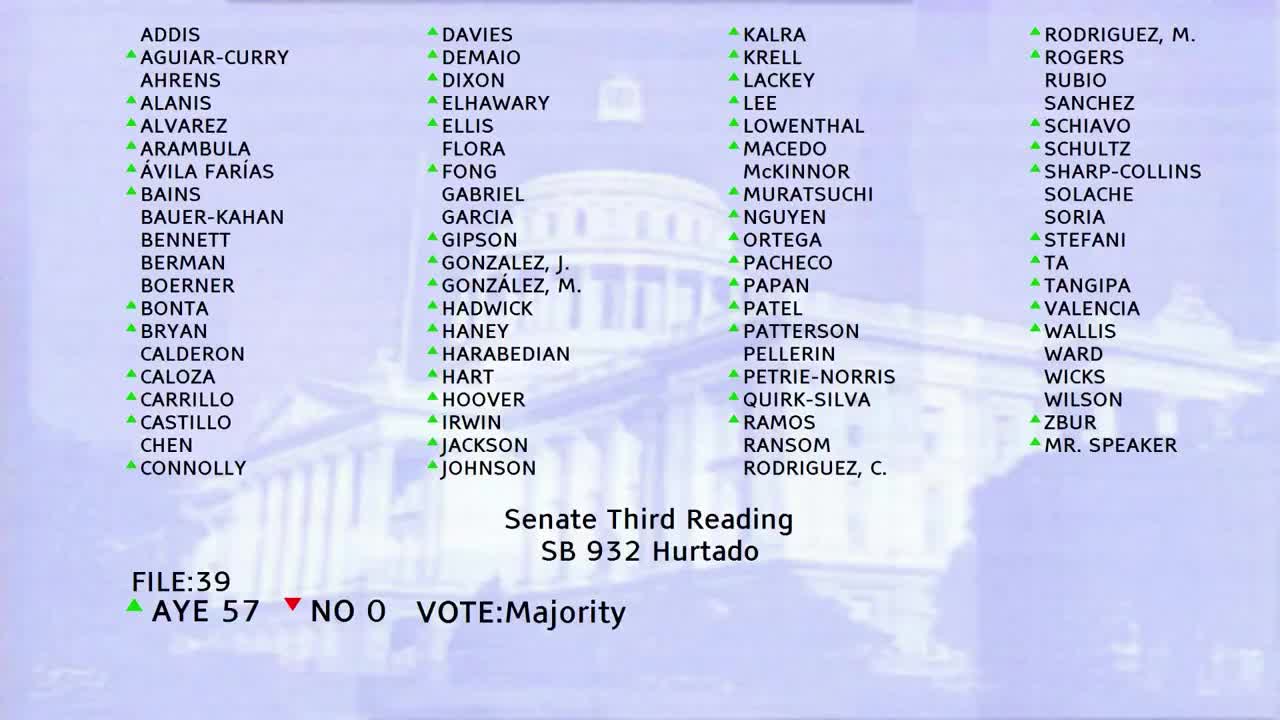 1MIN
Assembly Floor
 5MIN
Assembly Standing Committee on Transportation
 18MIN
Assembly Standing Committee on Public Safety
 5MIN
Senate Floor
 20MIN
Senate Standing Committee on Public Safety
Bill Author