SB 742: Electricity: electrical infrastructure: permanently abandoned transmission facilities: emergency response: liaisons.
- Session Year: 2025-2026
- House: Senate
- Latest Version Date: 2026-09-29
Current Status:
Passed
(2026-09-29: Chaptered by Secretary of State. Chapter 769, Statutes of 2026.)
Introduced
In Committee
Awaiting First Chamber Vote
Passed First Chamber
In Committee
Awaiting Second Chamber Vote
Passed Second Chamber
Enacted
Existing law vests the Public Utilities Commission with regulatory authority over public utilities, including electrical corporations. Existing law requires electrical corporations to construct, maintain, and operate their electrical lines and equipment in a manner that will minimize the risk of catastrophic wildfire, as specified. Existing law requires electrical corporations to annually prepare and submit wildfire mitigation plans to the Office of Energy Infrastructure Safety for review and approval.
This bill would require the commission, on or before January 1, 2028, to update a general order to require each electrical corporation to remove all permanently abandoned transmission facilities, as specified.
This bill would require that an electrical corporations wildfire mitigation plan also include an accounting of all transmission facilities, including permanently abandoned transmission facilities, as defined, and include a plan for how and when each permanently abandoned transmission facility will be removed and the wildfire mitigation measures that are being implemented to prevent hazards, as provided.
Under existing law, a violation of any order, decision, rule, direction, demand, or requirement of the commission is a crime.
Because a violation of a commission action implementing this bills requirements would be a crime, the bill would impose a state-mandated local program.
Existing law, the California Emergency Services Act, establishes, within the office of the Governor, the Office of Emergency Services (OES) under the supervision of the Director of Emergency Services. Existing law requires OES to establish a standardized emergency management system for use by all emergency response agencies.
This bill would require certain electrical corporations and local publicly owned electric utilities, in cooperation with OES and other emergency service agencies, to establish procedures for the coordination of efforts between electrical corporations and local publicly owned electric utilities and their representatives and those of emergency response agencies. The bill would require these electrical corporations and local publicly owned electric utilities to assign liaison representatives to work with each local emergency operations center, as provided.
By imposing new duties on local publicly owned electric utilities, this bill would impose a state-mandated local program.
The California Constitution requires the state to reimburse local agencies and school districts for certain costs mandated by the state. Statutory provisions establish procedures for making that reimbursement.
This bill would provide that no reimbursement is required by this act for specified reasons.
Existing law vests the Public Utilities Commission with regulatory authority over public utilities, including electrical corporations. Existing law requires electrical corporations to construct, maintain, and operate their electrical lines and equipment in a manner that will minimize the risk of catastrophic wildfire, as specified. Existing law requires electrical corporations to annually prepare and submit wildfire mitigation plans to the Office of Energy Infrastructure Safety for review and approval.
This bill would require the commission, on or before January 1, 2027, 2028, to update a general order to require each electrical corporation to remove all permanently abandoned transmission facilities, as specified.
This bill would require that an electrical corporations wildfire mitigation plan also include an accounting of all transmission facilities, including permanently abandoned transmission facilities, and include a plan for how and when each permanently abandoned transmission facility will be removed and the wildfire mitigation measures that are being implemented to prevent hazards, as provided.
Under existing law, a violation of any order, decision, rule, direction, demand, or requirement of the commission is a crime.
Because a violation of a commission action implementing this bills requirements would be a crime, the bill would impose a state-mandated local program.
Existing law, the California Emergency Services Act, establishes, within the office of the Governor, the Office of Emergency Services (OES) under the supervision of the Director of Emergency Services. Existing law requires OES to establish a standardized emergency management system for use by all emergency response agencies.
This bill would require certain electrical corporations and local publicly owned electric utilities, in cooperation with OES and other emergency service agencies, to establish procedures for the coordination of efforts between electrical corporations and local publicly owned electric utilities and their representatives and those of emergency response agencies. The bill would require these electrical corporations and local publicly owned electric utilities to assign liaison representatives to work within with each local emergency operations center, as provided.
By imposing new duties on local publicly owned electric utilities, this bill would impose a state-mandated local program.
The California Constitution requires the state to reimburse local agencies and school districts for certain costs mandated by the state. Statutory provisions establish procedures for making that reimbursement.
This bill would provide that no reimbursement is required by this act for specified reasons.
Existing law vests the Public Utilities Commission with regulatory authority over public utilities, including electrical corporations. Existing law requires electrical corporations to construct, maintain, and operate their electrical lines and equipment in a manner that will minimize the risk of catastrophic wildfire, as specified. Existing law requires electrical corporations to annually prepare and submit wildfire mitigation plans to the Office of Energy Infrastructure Safety for review and approval.
This bill would require the commission, on or before January 1, 2027, to update a general order to require each electrical corporation to remove all permanently abandoned facilities, as specified.
This bill would require that an electrical corporations wildfire mitigation plan also include an accounting of all transmission facilities, including permanently abandoned transmission facilities, and include a plan for how and when each permanently abandoned transmission facility will be removed and the wildfire mitigation measures that are being implemented to prevent hazards, as provided.
Under existing law, a violation of any order, decision, rule, direction, demand, or requirement of the commission is a crime.
Because a violation of a commission action implementing this bills requirements would be a crime, the bill would impose a state-mandated local program.
Existing law, the California Emergency Services Act, establishes, within the office of the Governor, the Office of Emergency Services (OES) under the supervision of the Director of Emergency Services. Existing law requires OES to establish a standardized emergency management system for use by all emergency response agencies.
This bill would require certain electrical corporations and local publicly owned electric utilities, in cooperation with OES and other emergency service agencies, to establish procedures for the coordination of efforts between electrical corporations and local publicly owned electric utilities and their representatives and those of emergency response agencies. The bill would require these electrical corporations and local publicly owned electric utilities to assign liaison representatives to work within each local operations center, as provided.
By imposing new duties on local publicly owned electric utilities, this bill would impose a state-mandated local program.
The California Constitution requires the state to reimburse local agencies and school districts for certain costs mandated by the state. Statutory provisions establish procedures for making that reimbursement.
This bill would provide that no reimbursement is required by this act for specified reasons.
The California Water District Law provides for the establishment of water districts, and grants a district the power to acquire, plan, construct, maintain, improve, operate, and keep in repair the necessary works for the production, storage, transmission, and distribution of water for irrigation, domestic, industrial, and municipal purposes.This bill would state the intent of the Legislature to enact subsequent legislation related to the regulation of water systems and water districts.The California Water District Law provides for the establishment of water districts, and grants a district the power to acquire, plan, construct, maintain, improve, operate, and keep in repair the necessary works for the production, storage, transmission, and distribution of water for irrigation, domestic, industrial, and municipal purposes.
This bill would state the intent of the Legislature to enact subsequent legislation related to the regulation of water systems and water districts.
(a)On or before January 1, 2028, the commission shall update General Order No. 95, as revised on December 19, 2024, by commission Resolution ESRB-12, to require each electrical corporation to remove all permanently abandoned transmission facilities in order to prevent public nuisances or hazards to life or property.
(b)The commission shall ensure all applicable safety requirements, including wildfire mitigation measures, apply to permanently abandoned and out-of-service transmission facilities until they are removed.
(c)This section does not, and the update required pursuant to subdivision (a) shall not, impact an electrical corporations right to an easement.
(d)For purposes of this section, permanently abandoned transmission facility means a transmission facility that is out of service, as determined by the commission, and the owner cannot demonstrate, with appropriate documentation, an intent to place the facility, or portions of the facility, into service within a time determined by the commission.
SEC. 2.Section 8386 of the Public Utilities Code is amended to read:8386.(a)Each electrical corporation shall construct, maintain, and operate its electrical lines and equipment in a manner that will minimize the risk of catastrophic wildfire posed by those electrical lines and equipment, taking into account both the time required to implement the proposed mitigation and the amount of risk reduced for the cost and risk remaining.
(b)Each electrical corporation shall submit a wildfire mitigation plan to the office for review at least once every four years. The office shall establish a schedule for the submission of subsequent comprehensive wildfire mitigation plans, which may allow for the staggering of evaluation and performance periods for each electrical corporation.
(c)(1)Beginning January 1, 2027, each electrical corporation shall submit a preliminary wildfire mitigation plan to the office at the earliest date of one year before the filing of its general rate case application or concurrent with the filing of its Risk Assessment Mitigation Phase application with the commission. The wildfire mitigation plan shall cover the same period as the general rate case period.
(2)Paragraph (1) does not apply to independent transmission owners.
(d)The wildfire mitigation plan shall include all of the following:
(1)An accounting of the responsibilities of persons responsible for executing the plan.
(2)The objectives of the plan.
(3)A description of the preventive strategies and programs to be adopted by the electrical corporation to minimize the risk of its electrical lines and equipment causing catastrophic wildfires, including consideration of dynamic climate change risks.
(4)A description of the metrics the electrical corporation plans to use to measure and track the implementation of the plan and the assumptions that underlie the use of those metrics.
(5)A discussion of how the application of previously identified metrics to previous plan performances has informed the plan.
(6)A description of the electrical corporations protocols for disabling reclosers and deenergizing portions of the electrical distribution system that consider the associated impacts on public safety. As part of these protocols, each electrical corporation shall include protocols related to mitigating the public safety impacts of disabling reclosers and deenergizing portions of the electrical distribution system that consider the impacts on all of the following:
(A)Critical first responders.
(B)Health and communication infrastructure.
(C)Customers who receive medical baseline allowances pursuant to subdivision (c) of Section 739. The electrical corporation may deploy backup electrical resources or provide financial assistance for backup electrical resources to a customer receiving a medical baseline allowance for a customer who meets all of the following requirements:
(i)The customer relies on life-support equipment that operates on electricity to sustain life.
(ii)The customer demonstrates financial need, including through enrollment in the California Alternate Rates for Energy program continued pursuant to Section 739.1.
(iii)The customer is not eligible for backup electrical resources provided through medical services, medical insurance, or community resources.
(D)Subparagraph (C) does not prevent an electrical corporation from deploying backup electrical resources or providing financial assistance for backup electrical resources under any other authority.
(7)A description of the electrical corporations appropriate and feasible procedures for notifying a customer who may be impacted by the deenergizing of electrical lines, including procedures for those customers receiving medical baseline allowances as described in paragraph (6). The procedures shall direct notification to all public safety offices, critical first responders, health care facilities, and operators of telecommunications infrastructure with premises within the footprint of potential deenergization for a given event. The procedures shall comply with any orders of the commission regarding notifications of deenergization events.
(8)Identification of circuits that have frequently been deenergized pursuant to a deenergization event to mitigate the risk of wildfire and the measures taken, or planned to be taken, by the electrical corporation to reduce the need for, and impact of, future deenergization of those circuits, including, but not limited to, the estimated annual decline in circuit deenergization and deenergization impact on customers, and replacing, hardening, or undergrounding any portion of the circuit or of upstream transmission or distribution lines.
(9)Plans for vegetation management.
(10)Plans for inspections of the electrical corporations electrical infrastructure.
(11)A description of the electrical corporations protocols for the deenergization of the electrical corporations transmission infrastructure, for instances when the deenergization may impact customers who, or entities that, are dependent upon the infrastructure. The protocols shall comply with any order of the commission regarding deenergization events.
(12)A list that identifies, describes, and prioritizes all wildfire risks, and drivers for those risks, throughout the electrical corporations service territory, including all relevant wildfire risk and risk mitigation information that is required by the commissions risk-based decisionmaking framework established in commission Application 15-05-002 or Rulemaking 20-07-013, or subsequent safety model assessment proceedings, and the Risk Assessment Mitigation Phase filings. The list shall include, but not be limited to, all of the following:
(A)Risks and risk drivers associated with design, construction, operations, and maintenance of the electrical corporations equipment and facilities.
(B)Particular risks and risk drivers associated with topographic and climatological risk factors throughout the different parts of the electrical corporations service territory.
(C)Particular risks and risk drivers associated with the speed with which wildfire risk mitigation measures can and will be deployed by an electrical corporation within its service territory.
(D)An estimate of cost-per-avoided ignition for each risk, or an explanation on why such a value could not be assigned to a particular risk.
(13)A description of how the plan accounts for the wildfire risk identified in the electrical corporations Risk Assessment Mitigation Phase filing, if applicable.
(14)A description of the actions the electrical corporation will take to ensure its system will achieve the highest level of safety, reliability, and resiliency, taking into account the cost and time required to achieve those benefits, and to ensure that its system is prepared for a major event, including hardening and modernizing its infrastructure with improved engineering, system design, standards, equipment, and facilities, such as undergrounding, insulating of distribution wires, and replacing poles. The electrical corporation shall present the cost-efficiency measures adopted by the commission, calculated consistently with the direction provided by the commissions most recent risk-based decisionmaking framework proceeding, for at least two reasonable mitigation alternatives for a given identified wildfire risk.
(15)A description of where and how the electrical corporation considered undergrounding electrical distribution lines within those areas of its service territory identified to have the highest wildfire risk in a commission fire threat map.
(16)A showing that the electrical corporation has an adequately sized and trained workforce to promptly restore service after a major event, taking into account employees of other utilities pursuant to mutual aid agreements and employees of entities that have entered into contracts with the electrical corporation.
(17)Identification of any geographic area in the electrical corporations service territory that is a higher wildfire threat than is currently identified in a commission fire threat map, and where the commission should consider expanding the high fire threat district based on new information or changes in the environment.
(18)A methodology for identifying and presenting enterprisewide safety risk and wildfire-related risk that is consistent with the methodology used by other electrical corporations unless the commission determines otherwise.
(19)A description of how the plan is consistent with the electrical corporations disaster and emergency preparedness plan prepared pursuant to Section 768.6, including both of the following:
(A)Plans to prepare for, and to restore service after, a wildfire, including workforce mobilization and prepositioning equipment and employees.
(B)Plans for community outreach and public awareness before, during, and after a wildfire, including language notification in English, Spanish, and the top three primary languages used in the state other than English or Spanish, as determined by the commission based on the United States Census data.
(20)A statement of how the electrical corporation will restore service after a wildfire.
(21)Protocols for compliance with requirements adopted by the commission regarding activities to support customers during and after a wildfire, outage reporting, support for low-income customers, billing adjustments, deposit waivers, extended payment plans, suspension of disconnection and nonpayment fees, repair processing and timing, access to electrical corporation representatives, and emergency communications.
(22)A description of the processes and procedures the electrical corporation will use to do all of the following:
(A)Monitor and audit the implementation of the plan.
(B)Identify any deficiencies in the plan or the plans implementation and correct those deficiencies.
(C)Monitor and audit the effectiveness of electrical line and equipment inspections, including inspections performed by contractors, carried out under the plan and other applicable statutes and commission rules.
(23)(A)An accounting of all transmission facilities, including a list of facilities that are in service, facilities that are out of service, and permanently abandoned transmission facilities. For permanently abandoned transmission facilities, the accounting shall include a plan for how and when each facility will be removed and the wildfire mitigation measures that are being implemented to prevent hazards, including, but not limited to, induction.
(B)For purposes of this paragraph, permanently abandoned transmission facilities has the same meaning as defined in Section 762.8.
(24)Any other information that the office may require.
(e)The office shall post all wildfire mitigation plans submitted pursuant to this section on the offices internet website beginning July 1, 2021, for no less than two months before the offices decision regarding approval of the plan. The office shall accept comments on each plan from the public, other local and state agencies, and interested parties, and verify that the plan complies with all applicable rules, regulations, and standards, as appropriate.
SEC. 3.Chapter 8 (commencing with Section 8395) is added to Division 4.1 of the Public Utilities Code, to read:8.Emergency Operations8395.(a)All electrical corporations, consistent with Section 768.6, and local publicly owned electric utilities that have a service area that overlaps with the boundaries of a local emergency operations center, in cooperation with the Office of Emergency Services and other emergency service agencies, shall establish procedures for the coordination of efforts between electrical corporations and local publicly owned electric utilities and their representatives and those of emergency response agencies.
(b)All electrical corporations and local publicly owned electric utilities subject to subdivision (a) shall assign a liaison representative to work with each local emergency operations center that has boundaries that overlap with the electrical corporations or local publicly owned electric utilitys service area. The representative shall complete the Standardized Emergency Management System and National Incident Management System trainings sufficient to enable them to assist activated emergency operations centers, to the fullest extent possible.
SEC. 4.No reimbursement is required by this act pursuant to Section 6 of Article XIIIB of the California Constitution because a local agency or school district has the authority to levy service charges, fees, or assessments sufficient to pay for the program or level of service mandated by this act or because costs that may be incurred by a local agency or school district will be incurred because this act creates a new crime or infraction, eliminates a crime or infraction, or changes the penalty for a crime or infraction, within the meaning of Section 17556 of the Government Code, or changes the definition of a crime within the meaning of Section 6 of Article XIIIB of the California Constitution.
(a)On or before January 1, 2028, the commission shall update General Order No. 95, as revised on December 19, 2024, by commission Resolution ESRB-12, to require each electrical corporation to remove all permanently abandoned transmission facilities in order to prevent public nuisances or hazards to life or property.
(b)The commission shall ensure all applicable safety requirements, including wildfire mitigation measures, apply to permanently abandoned and out-of-service transmission facilities until they are removed.
(c)This section does not, and the update required pursuant to subdivision (a) shall not, impact an electrical corporations right to an easement.
(d)For purposes of this section, permanently abandoned transmission facility means a transmission facility that is out of service service, as determined by the commission, and the owner cannot demonstrate, with appropriate documentation, an intent to place the facility, or portions of the facility, into service within a time determined by the commission.
SEC. 2.Section 8386 of the Public Utilities Code is amended to read:8386.(a)Each electrical corporation shall construct, maintain, and operate its electrical lines and equipment in a manner that will minimize the risk of catastrophic wildfire posed by those electrical lines and equipment, taking into account both the time required to implement the proposed mitigation and the amount of risk reduced for the cost and risk remaining.
(b)Each electrical corporation shall submit a wildfire mitigation plan to the office for review at least once every four years. The office shall establish a schedule for the submission of subsequent comprehensive wildfire mitigation plans, which may allow for the staggering of evaluation and performance periods for each electrical corporation.
(c)(1)Beginning January 1, 2027, each electrical corporation shall submit a preliminary wildfire mitigation plan to the office at the earliest date of one year before the filing of its general rate case application or concurrent with the filing of its Risk Assessment Mitigation Phase application with the commission. The wildfire mitigation plan shall cover the same period as the general rate case period.
(2)Paragraph (1) does not apply to independent transmission owners.
(d)The wildfire mitigation plan shall include all of the following:
(1)An accounting of the responsibilities of persons responsible for executing the plan.
(2)The objectives of the plan.
(3)A description of the preventive strategies and programs to be adopted by the electrical corporation to minimize the risk of its electrical lines and equipment causing catastrophic wildfires, including consideration of dynamic climate change risks.
(4)A description of the metrics the electrical corporation plans to use to measure and track the implementation of the plan and the assumptions that underlie the use of those metrics.
(5)A discussion of how the application of previously identified metrics to previous plan performances has informed the plan.
(6)A description of the electrical corporations protocols for disabling reclosers and deenergizing portions of the electrical distribution system that consider the associated impacts on public safety. As part of these protocols, each electrical corporation shall include protocols related to mitigating the public safety impacts of disabling reclosers and deenergizing portions of the electrical distribution system that consider the impacts on all of the following:
(A)Critical first responders.
(B)Health and communication infrastructure.
(C)Customers who receive medical baseline allowances pursuant to subdivision (c) of Section 739. The electrical corporation may deploy backup electrical resources or provide financial assistance for backup electrical resources to a customer receiving a medical baseline allowance for a customer who meets all of the following requirements:
(i)The customer relies on life-support equipment that operates on electricity to sustain life.
(ii)The customer demonstrates financial need, including through enrollment in the California Alternate Rates for Energy program continued pursuant to Section 739.1.
(iii)The customer is not eligible for backup electrical resources provided through medical services, medical insurance, or community resources.
(D)Subparagraph (C) does not prevent an electrical corporation from deploying backup electrical resources or providing financial assistance for backup electrical resources under any other authority.
(7)A description of the electrical corporations appropriate and feasible procedures for notifying a customer who may be impacted by the deenergizing of electrical lines, including procedures for those customers receiving medical baseline allowances as described in paragraph (6). The procedures shall direct notification to all public safety offices, critical first responders, health care facilities, and operators of telecommunications infrastructure with premises within the footprint of potential deenergization for a given event. The procedures shall comply with any orders of the commission regarding notifications of deenergization events.
(8)Identification of circuits that have frequently been deenergized pursuant to a deenergization event to mitigate the risk of wildfire and the measures taken, or planned to be taken, by the electrical corporation to reduce the need for, and impact of, future deenergization of those circuits, including, but not limited to, the estimated annual decline in circuit deenergization and deenergization impact on customers, and replacing, hardening, or undergrounding any portion of the circuit or of upstream transmission or distribution lines.
(9)Plans for vegetation management.
(10)Plans for inspections of the electrical corporations electrical infrastructure.
(11)A description of the electrical corporations protocols for the deenergization of the electrical corporations transmission infrastructure, for instances when the deenergization may impact customers who, or entities that, are dependent upon the infrastructure. The protocols shall comply with any order of the commission regarding deenergization events.
(12)A list that identifies, describes, and prioritizes all wildfire risks, and drivers for those risks, throughout the electrical corporations service territory, including all relevant wildfire risk and risk mitigation information that is required by the commissions risk-based decisionmaking framework established in commission Application 15-05-002 or Rulemaking 20-07-013, or subsequent safety model assessment proceedings, and the Risk Assessment Mitigation Phase filings. The list shall include, but not be limited to, all of the following:
(A)Risks and risk drivers associated with design, construction, operations, and maintenance of the electrical corporations equipment and facilities.
(B)Particular risks and risk drivers associated with topographic and climatological risk factors throughout the different parts of the electrical corporations service territory.
(C)Particular risks and risk drivers associated with the speed with which wildfire risk mitigation measures can and will be deployed by an electrical corporation within its service territory.
(D)An estimate of cost-per-avoided ignition for each risk, or an explanation on why such a value could not be assigned to a particular risk.
(13)A description of how the plan accounts for the wildfire risk identified in the electrical corporations Risk Assessment Mitigation Phase filing, if applicable.
(14)A description of the actions the electrical corporation will take to ensure its system will achieve the highest level of safety, reliability, and resiliency, taking into account the cost and time required to achieve those benefits, and to ensure that its system is prepared for a major event, including hardening and modernizing its infrastructure with improved engineering, system design, standards, equipment, and facilities, such as undergrounding, insulating of distribution wires, and replacing poles. The electrical corporation shall present the cost-efficiency measures adopted by the commission, calculated consistently with the direction provided by the commissions most recent risk-based decisionmaking framework proceeding, for at least two reasonable mitigation alternatives for a given identified wildfire risk.
(15)A description of where and how the electrical corporation considered undergrounding electrical distribution lines within those areas of its service territory identified to have the highest wildfire risk in a commission fire threat map.
(16)A showing that the electrical corporation has an adequately sized and trained workforce to promptly restore service after a major event, taking into account employees of other utilities pursuant to mutual aid agreements and employees of entities that have entered into contracts with the electrical corporation.
(17)Identification of any geographic area in the electrical corporations service territory that is a higher wildfire threat than is currently identified in a commission fire threat map, and where the commission should consider expanding the high fire threat district based on new information or changes in the environment.
(18)A methodology for identifying and presenting enterprisewide safety risk and wildfire-related risk that is consistent with the methodology used by other electrical corporations unless the commission determines otherwise.
(19)A description of how the plan is consistent with the electrical corporations disaster and emergency preparedness plan prepared pursuant to Section 768.6, including both of the following:
(A)Plans to prepare for, and to restore service after, a wildfire, including workforce mobilization and prepositioning equipment and employees.
(B)Plans for community outreach and public awareness before, during, and after a wildfire, including language notification in English, Spanish, and the top three primary languages used in the state other than English or Spanish, as determined by the commission based on the United States Census data.
(20)A statement of how the electrical corporation will restore service after a wildfire.
(21)Protocols for compliance with requirements adopted by the commission regarding activities to support customers during and after a wildfire, outage reporting, support for low-income customers, billing adjustments, deposit waivers, extended payment plans, suspension of disconnection and nonpayment fees, repair processing and timing, access to electrical corporation representatives, and emergency communications.
(22)A description of the processes and procedures the electrical corporation will use to do all of the following:
(A)Monitor and audit the implementation of the plan.
(B)Identify any deficiencies in the plan or the plans implementation and correct those deficiencies.
(C)Monitor and audit the effectiveness of electrical line and equipment inspections, including inspections performed by contractors, carried out under the plan and other applicable statutes and commission rules.
(23)(A)An accounting of all transmission facilities, including a list of facilities that are in service, facilities that are out of service, and permanently abandoned transmission facilities. For permanently abandoned transmission facilities, the accounting shall include a plan for how and when each facility will be removed and the wildfire mitigation measures that are being implemented to prevent hazards, including, but not limited to, induction.
(B)For purposes of this paragraph, permanently abandoned transmission facilities has the same meaning as defined in Section 762.8.
(24)Any other information that the office may require.
(e)The office shall post all wildfire mitigation plans submitted pursuant to this section on the offices internet website beginning July 1, 2021, for no less than two months before the offices decision regarding approval of the plan. The office shall accept comments on each plan from the public, other local and state agencies, and interested parties, and verify that the plan complies with all applicable rules, regulations, and standards, as appropriate.
SEC. 3.Chapter 8 (commencing with Section 8395) is added to Division 4.1 of the Public Utilities Code, to read:8.Emergency Operations8395.(a)All electrical corporations, consistent with Section 768.6, and local publicly owned electric utilities that have a service area that overlaps with the boundaries of a local emergency operations center, in cooperation with the Office of Emergency Services and other emergency service agencies, shall establish procedures for the coordination of efforts between electrical corporations and local publicly owned electric utilities and their representatives and those of emergency response agencies.
(b)All electrical corporations and local publicly owned electric utilities subject to subdivision (a) shall assign a liaison representative to work with each local emergency operations center that has boundaries that overlap with the electrical corporations or local publicly owned electric utilitys service area. The representative shall complete the Standardized Emergency Management System and National Incident Management System trainings sufficient to enable them to assist activated emergency operations centers, to the fullest extent possible.
SEC. 4.No reimbursement is required by this act pursuant to Section 6 of Article XIIIB of the California Constitution because a local agency or school district has the authority to levy service charges, fees, or assessments sufficient to pay for the program or level of service mandated by this act or because costs that may be incurred by a local agency or school district will be incurred because this act creates a new crime or infraction, eliminates a crime or infraction, or changes the penalty for a crime or infraction, within the meaning of Section 17556 of the Government Code, or changes the definition of a crime within the meaning of Section 6 of Article XIIIB of the California Constitution.
(a)On or before January 1, 2027, 2028, the commission shall update General Order No. 95, as revised on December 19, 2024, by commission Resolution ESRB-12, to require each electrical corporation to remove all permanently abandoned transmission facilities in order to prevent public nuisances or hazards to life or property.
(b)The commission shall ensure all applicable safety requirements, including wildfire mitigation measures, apply to permanently abandoned and out-of-service transmission facilities until they are removed.
(c)This section does not, and the update required pursuant to subdivision (a) shall not, impact an electrical corporations right to an easement.
(d)For purposes of this section, permanently abandoned transmission facility means a transmission facility that is out of service and the owner cannot demonstrate, with appropriate documentation, an intent to place the facility, or portions of the facility, into service within a time determined by the commission.
SEC. 2.Section 8386 of the Public Utilities Code is amended to read:8386.(a)Each electrical corporation shall construct, maintain, and operate its electrical lines and equipment in a manner that will minimize the risk of catastrophic wildfire posed by those electrical lines and equipment, taking into account both the time required to implement the proposed mitigation and the amount of risk reduced for the cost and risk remaining.
(b)Each electrical corporation shall submit a wildfire mitigation plan to the office for review at least once every four years. The office shall establish a schedule for the submission of subsequent comprehensive wildfire mitigation plans, which may allow for the staggering of evaluation and performance periods for each electrical corporation.
(c)(1)Beginning January 1, 2027, each electrical corporation shall submit a preliminary wildfire mitigation plan to the office at the earliest date of one year before the filing of its general rate case application or concurrent with the filing of its Risk Assessment Mitigation Phase application with the commission. The wildfire mitigation plan shall cover the same period as the general rate case period.
(2)Paragraph (1) does not apply to independent transmission owners.
(d)The wildfire mitigation plan shall include all of the following:
(1)An accounting of the responsibilities of persons responsible for executing the plan.
(2)The objectives of the plan.
(3)A description of the preventive strategies and programs to be adopted by the electrical corporation to minimize the risk of its electrical lines and equipment causing catastrophic wildfires, including consideration of dynamic climate change risks.
(4)A description of the metrics the electrical corporation plans to use to measure and track the implementation of the plan and the assumptions that underlie the use of those metrics.
(5)A discussion of how the application of previously identified metrics to previous plan performances has informed the plan.
(6)A description of the electrical corporations protocols for disabling reclosers and deenergizing portions of the electrical distribution system that consider the associated impacts on public safety. As part of these protocols, each electrical corporation shall include protocols related to mitigating the public safety impacts of disabling reclosers and deenergizing portions of the electrical distribution system that consider the impacts on all of the following:
(A)Critical first responders.
(B)Health and communication infrastructure.
(C)Customers who receive medical baseline allowances pursuant to subdivision (c) of Section 739. The electrical corporation may deploy backup electrical resources or provide financial assistance for backup electrical resources to a customer receiving a medical baseline allowance for a customer who meets all of the following requirements:
(i)The customer relies on life-support equipment that operates on electricity to sustain life.
(ii)The customer demonstrates financial need, including through enrollment in the California Alternate Rates for Energy program continued pursuant to Section 739.1.
(iii)The customer is not eligible for backup electrical resources provided through medical services, medical insurance, or community resources.
(D)Subparagraph (C) does not prevent an electrical corporation from deploying backup electrical resources or providing financial assistance for backup electrical resources under any other authority.
(7)A description of the electrical corporations appropriate and feasible procedures for notifying a customer who may be impacted by the deenergizing of electrical lines, including procedures for those customers receiving medical baseline allowances as described in paragraph (6). The procedures shall direct notification to all public safety offices, critical first responders, health care facilities, and operators of telecommunications infrastructure with premises within the footprint of potential deenergization for a given event. The procedures shall comply with any orders of the commission regarding notifications of deenergization events.
(8)Identification of circuits that have frequently been deenergized pursuant to a deenergization event to mitigate the risk of wildfire and the measures taken, or planned to be taken, by the electrical corporation to reduce the need for, and impact of, future deenergization of those circuits, including, but not limited to, the estimated annual decline in circuit deenergization and deenergization impact on customers, and replacing, hardening, or undergrounding any portion of the circuit or of upstream transmission or distribution lines.
(9)Plans for vegetation management.
(10)Plans for inspections of the electrical corporations electrical infrastructure.
(11)A description of the electrical corporations protocols for the deenergization of the electrical corporations transmission infrastructure, for instances when the deenergization may impact customers who, or entities that, are dependent upon the infrastructure. The protocols shall comply with any order of the commission regarding deenergization events.
(12)A list that identifies, describes, and prioritizes all wildfire risks, and drivers for those risks, throughout the electrical corporations service territory, including all relevant wildfire risk and risk mitigation information that is required by the commissions risk-based decisionmaking framework established in commission Application 15-05-002 or Rulemaking 20-07-013, or subsequent safety model assessment proceedings, and the Risk Assessment Mitigation Phase filings. The list shall include, but not be limited to, all of the following:
(A)Risks and risk drivers associated with design, construction, operations, and maintenance of the electrical corporations equipment and facilities.
(B)Particular risks and risk drivers associated with topographic and climatological risk factors throughout the different parts of the electrical corporations service territory.
(C)Particular risks and risk drivers associated with the speed with which wildfire risk mitigation measures can and will be deployed by an electrical corporation within its service territory.
(D)An estimate of cost-per-avoided ignition for each risk, or an explanation on why such a value could not be assigned to a particular risk.
(13)A description of how the plan accounts for the wildfire risk identified in the electrical corporations Risk Assessment Mitigation Phase filing, if applicable.
(14)A description of the actions the electrical corporation will take to ensure its system will achieve the highest level of safety, reliability, and resiliency, taking into account the cost and time required to achieve those benefits, and to ensure that its system is prepared for a major event, including hardening and modernizing its infrastructure with improved engineering, system design, standards, equipment, and facilities, such as undergrounding, insulating of distribution wires, and replacing poles. The electrical corporation shall present the cost-efficiency measures adopted by the commission, calculated consistently with the direction provided by the commissions most recent risk-based decisionmaking framework proceeding, for at least two reasonable mitigation alternatives for a given identified wildfire risk.
(15)A description of where and how the electrical corporation considered undergrounding electrical distribution lines within those areas of its service territory identified to have the highest wildfire risk in a commission fire threat map.
(16)A showing that the electrical corporation has an adequately sized and trained workforce to promptly restore service after a major event, taking into account employees of other utilities pursuant to mutual aid agreements and employees of entities that have entered into contracts with the electrical corporation.
(17)Identification of any geographic area in the electrical corporations service territory that is a higher wildfire threat than is currently identified in a commission fire threat map, and where the commission should consider expanding the high fire threat district based on new information or changes in the environment.
(18)A methodology for identifying and presenting enterprisewide safety risk and wildfire-related risk that is consistent with the methodology used by other electrical corporations unless the commission determines otherwise.
(19)A description of how the plan is consistent with the electrical corporations disaster and emergency preparedness plan prepared pursuant to Section 768.6, including both of the following:
(A)Plans to prepare for, and to restore service after, a wildfire, including workforce mobilization and prepositioning equipment and employees.
(B)Plans for community outreach and public awareness before, during, and after a wildfire, including language notification in English, Spanish, and the top three primary languages used in the state other than English or Spanish, as determined by the commission based on the United States Census data.
(20)A statement of how the electrical corporation will restore service after a wildfire.
(21)Protocols for compliance with requirements adopted by the commission regarding activities to support customers during and after a wildfire, outage reporting, support for low-income customers, billing adjustments, deposit waivers, extended payment plans, suspension of disconnection and nonpayment fees, repair processing and timing, access to electrical corporation representatives, and emergency communications.
(22)A description of the processes and procedures the electrical corporation will use to do all of the following:
(A)Monitor and audit the implementation of the plan.
(B)Identify any deficiencies in the plan or the plans implementation and correct those deficiencies.
(C)Monitor and audit the effectiveness of electrical line and equipment inspections, including inspections performed by contractors, carried out under the plan and other applicable statutes and commission rules.
(23)(A)An accounting of all transmission facilities, including a list of facilities that are in service, facilities that are out of service, and permanently abandoned facilities that are transmission facilities. For permanently abandoned facilities that are transmission facilities, the accounting shall include a plan for how and when each facility will be removed and the wildfire mitigation measures that are being implemented to prevent hazards, including, but not limited to, induction.
(B)For purposes of this paragraph, permanently abandoned transmission facilities has the same meaning as defined in Section 762.8.
(24)Any other information that the office may require.
(e)The office shall post all wildfire mitigation plans submitted pursuant to this section on the offices internet website beginning July 1, 2021, for no less than two months before the offices decision regarding approval of the plan. The office shall accept comments on each plan from the public, other local and state agencies, and interested parties, and verify that the plan complies with all applicable rules, regulations, and standards, as appropriate.
SEC. 3.Chapter 8 (commencing with Section 8395) is added to Division 4.1 of the Public Utilities Code, to read:8.Emergency Operations8395.(a)All electrical corporations corporations, consistent with Section 768.6, and local publicly owned electric utilities that have a service area that overlaps with the boundaries of a local emergency operations center, in cooperation with the Office of Emergency Services and other emergency service agencies, shall establish procedures for the coordination of efforts between electrical corporations and local publicly owned electric utilities and their representatives and those of emergency response agencies.
(b)All electrical corporations and local publicly owned electric utilities subject to subdivision (a) shall assign a liaison representative to work within with each local emergency operations center that has boundaries that overlap with the electrical corporations or local publicly owned electric utilitys service area. The representative shall complete the Standardized Emergency Management System and National Incident Management System trainings sufficient to enable them to assist activated emergency operations centers, to the fullest extent possible.
SEC. 4.No reimbursement is required by this act pursuant to Section 6 of Article XIIIB of the California Constitution because a local agency or school district has the authority to levy service charges, fees, or assessments sufficient to pay for the program or level of service mandated by this act or because costs that may be incurred by a local agency or school district will be incurred because this act creates a new crime or infraction, eliminates a crime or infraction, or changes the penalty for a crime or infraction, within the meaning of Section 17556 of the Government Code, or changes the definition of a crime within the meaning of Section 6 of Article XIIIB of the California Constitution.
(a)On or before January 1, 2027, the commission shall update General Order No. 95, as revised on December 19, 2024, by commission Resolution ESRB-12, to require each electrical corporation to remove all permanently abandoned facilities in order to prevent public nuisances or hazards to life or property.
(b)The commission shall ensure all applicable safety requirements, including wildfire mitigation measures, apply to permanently abandoned facilities until they are removed.
(c)This section does not, and the update required pursuant to subdivision (a) shall not, impact an electrical corporations right to an easement.
(d)For purposes of this section, permanently abandoned facility means a facility that is out of service and the owner cannot demonstrate, with appropriate documentation, an intent to place the facility, or portions of the facility, into service within a time determined by the commission.
SEC. 2.Section 8386 of the Public Utilities Code is amended to read:8386.(a)Each electrical corporation shall construct, maintain, and operate its electrical lines and equipment in a manner that will minimize the risk of catastrophic wildfire posed by those electrical lines and equipment, taking into account both the time required to implement the proposed mitigation and the amount of risk reduced for the cost and risk remaining.
(b)Each electrical corporation shall submit a wildfire mitigation plan to the office for review at least once every four years. The office shall establish a schedule for the submission of subsequent comprehensive wildfire mitigation plans, which may allow for the staggering of evaluation and performance periods for each electrical corporation.
(c)(1)Beginning January 1, 2027, each electrical corporation shall submit a preliminary wildfire mitigation plan to the office at the earliest date of one year before the filing of its general rate case application or concurrent with the filing of its Risk Assessment Mitigation Phase application with the commission. The wildfire mitigation plan shall cover the same period as the general rate case period.
(2)Paragraph (1) does not apply to independent transmission owners.
(d)The wildfire mitigation plan shall include all of the following:
(1)An accounting of the responsibilities of persons responsible for executing the plan.
(2)The objectives of the plan.
(3)A description of the preventive strategies and programs to be adopted by the electrical corporation to minimize the risk of its electrical lines and equipment causing catastrophic wildfires, including consideration of dynamic climate change risks.
(4)A description of the metrics the electrical corporation plans to use to measure and track the implementation of the plan and the assumptions that underlie the use of those metrics.
(5)A discussion of how the application of previously identified metrics to previous plan performances has informed the plan.
(6)A description of the electrical corporations protocols for disabling reclosers and deenergizing portions of the electrical distribution system that consider the associated impacts on public safety. As part of these protocols, each electrical corporation shall include protocols related to mitigating the public safety impacts of disabling reclosers and deenergizing portions of the electrical distribution system that consider the impacts on all of the following:
(A)Critical first responders.
(B)Health and communication infrastructure.
(C)Customers who receive medical baseline allowances pursuant to subdivision (c) of Section 739. The electrical corporation may deploy backup electrical resources or provide financial assistance for backup electrical resources to a customer receiving a medical baseline allowance for a customer who meets all of the following requirements:
(i)The customer relies on life-support equipment that operates on electricity to sustain life.
(ii)The customer demonstrates financial need, including through enrollment in the California Alternate Rates for Energy program continued pursuant to Section 739.1.
(iii)The customer is not eligible for backup electrical resources provided through medical services, medical insurance, or community resources.
(D)Subparagraph (C) does not prevent an electrical corporation from deploying backup electrical resources or providing financial assistance for backup electrical resources under any other authority.
(7)A description of the electrical corporations appropriate and feasible procedures for notifying a customer who may be impacted by the deenergizing of electrical lines, including procedures for those customers receiving medical baseline allowances as described in paragraph (6). The procedures shall direct notification to all public safety offices, critical first responders, health care facilities, and operators of telecommunications infrastructure with premises within the footprint of potential deenergization for a given event. The procedures shall comply with any orders of the commission regarding notifications of deenergization events.
(8)Identification of circuits that have frequently been deenergized pursuant to a deenergization event to mitigate the risk of wildfire and the measures taken, or planned to be taken, by the electrical corporation to reduce the need for, and impact of, future deenergization of those circuits, including, but not limited to, the estimated annual decline in circuit deenergization and deenergization impact on customers, and replacing, hardening, or undergrounding any portion of the circuit or of upstream transmission or distribution lines.
(9)Plans for vegetation management.
(10)Plans for inspections of the electrical corporations electrical infrastructure.
(11)A description of the electrical corporations protocols for the deenergization of the electrical corporations transmission infrastructure, for instances when the deenergization may impact customers who, or entities that, are dependent upon the infrastructure. The protocols shall comply with any order of the commission regarding deenergization events.
(12)A list that identifies, describes, and prioritizes all wildfire risks, and drivers for those risks, throughout the electrical corporations service territory, including all relevant wildfire risk and risk mitigation information that is required by the commissions risk-based decisionmaking framework established in commission Application 15-05-002 or Rulemaking 20-07-013, or subsequent safety model assessment proceedings, and the Risk Assessment Mitigation Phase filings. The list shall include, but not be limited to, all of the following:
(A)Risks and risk drivers associated with design, construction, operations, and maintenance of the electrical corporations equipment and facilities.
(B)Particular risks and risk drivers associated with topographic and climatological risk factors throughout the different parts of the electrical corporations service territory.
(C)Particular risks and risk drivers associated with the speed with which wildfire risk mitigation measures can and will be deployed by an electrical corporation within its service territory.
(D)An estimate of cost-per-avoided ignition for each risk, or an explanation on why such a value could not be assigned to a particular risk.
(13)A description of how the plan accounts for the wildfire risk identified in the electrical corporations Risk Assessment Mitigation Phase filing, if applicable.
(14)A description of the actions the electrical corporation will take to ensure its system will achieve the highest level of safety, reliability, and resiliency, taking into account the cost and time required to achieve those benefits, and to ensure that its system is prepared for a major event, including hardening and modernizing its infrastructure with improved engineering, system design, standards, equipment, and facilities, such as undergrounding, insulating of distribution wires, and replacing poles. The electrical corporation shall present the cost-efficiency measures adopted by the commission, calculated consistently with the direction provided by the commissions most recent risk-based decisionmaking framework proceeding, for at least two reasonable mitigation alternatives for a given identified wildfire risk.
(15)A description of where and how the electrical corporation considered undergrounding electrical distribution lines within those areas of its service territory identified to have the highest wildfire risk in a commission fire threat map.
(16)A showing that the electrical corporation has an adequately sized and trained workforce to promptly restore service after a major event, taking into account employees of other utilities pursuant to mutual aid agreements and employees of entities that have entered into contracts with the electrical corporation.
(17)Identification of any geographic area in the electrical corporations service territory that is a higher wildfire threat than is currently identified in a commission fire threat map, and where the commission should consider expanding the high fire threat district based on new information or changes in the environment.
(18)A methodology for identifying and presenting enterprisewide safety risk and wildfire-related risk that is consistent with the methodology used by other electrical corporations unless the commission determines otherwise.
(19)A description of how the plan is consistent with the electrical corporations disaster and emergency preparedness plan prepared pursuant to Section 768.6, including both of the following:
(A)Plans to prepare for, and to restore service after, a wildfire, including workforce mobilization and prepositioning equipment and employees.
(B)Plans for community outreach and public awareness before, during, and after a wildfire, including language notification in English, Spanish, and the top three primary languages used in the state other than English or Spanish, as determined by the commission based on the United States Census data.
(20)A statement of how the electrical corporation will restore service after a wildfire.
(21)Protocols for compliance with requirements adopted by the commission regarding activities to support customers during and after a wildfire, outage reporting, support for low-income customers, billing adjustments, deposit waivers, extended payment plans, suspension of disconnection and nonpayment fees, repair processing and timing, access to electrical corporation representatives, and emergency communications.
(22)A description of the processes and procedures the electrical corporation will use to do all of the following:
(A)Monitor and audit the implementation of the plan.
(B)Identify any deficiencies in the plan or the plans implementation and correct those deficiencies.
(C)Monitor and audit the effectiveness of electrical line and equipment inspections, including inspections performed by contractors, carried out under the plan and other applicable statutes and commission rules.
(23)(A)An accounting of all transmission facilities, including a list of facilities that are in service, facilities that are out of service, and permanently abandoned facilities that are transmission facilities. For permanently abandoned facilities that are transmission facilities, the accounting shall include a plan for how and when each facility will be removed and the wildfire mitigation measures that are being implemented to prevent hazards, including, but not limited to, induction.
(B)For purposes of this paragraph, permanently abandoned facilities has the same meaning as defined in Section 762.8.
(23)(24)Any other information that the office may require.
(e)The office shall post all wildfire mitigation plans submitted pursuant to this section on the offices internet website beginning July 1, 2021, for no less than two months before the offices decision regarding approval of the plan. The office shall accept comments on each plan from the public, other local and state agencies, and interested parties, and verify that the plan complies with all applicable rules, regulations, and standards, as appropriate.
SEC. 3.Chapter 8 (commencing with Section 8395) is added to Division 4.1 of the Public Utilities Code, to read:8.Emergency Operations8395.(a)All electrical corporations and local publicly owned electric utilities that have a service area that overlaps with the boundaries of a local operations center, in cooperation with the Office of Emergency Services and other emergency service agencies, shall establish procedures for the coordination of efforts between electrical corporations and local publicly owned electric utilities and their representatives and those of emergency response agencies.
(b)All electrical corporations and local publicly owned electric utilities subject to subdivision (a) shall assign a liaison representative to work within each local operations center that has boundaries that overlap with the electrical corporations or local publicly owned electric utilitys service area. The representative shall complete the Standardized Emergency Management System and National Incident Management System trainings sufficient to enable them to assist activated emergency operations centers, to the fullest extent possible.
SEC. 4.No reimbursement is required by this act pursuant to Section 6 of Article XIIIB of the California Constitution because a local agency or school district has the authority to levy service charges, fees, or assessments sufficient to pay for the program or level of service mandated by this act or because costs that may be incurred by a local agency or school district will be incurred because this act creates a new crime or infraction, eliminates a crime or infraction, or changes the penalty for a crime or infraction, within the meaning of Section 17556 of the Government Code, or changes the definition of a crime within the meaning of Section 6 of Article XIIIB of the California Constitution.
SECTION 1.It is the intent of the Legislature to enact subsequent legislation related to the regulation of water systems and water districts.It is the intent of the Legislature to enact subsequent legislation related to the regulation of water systems and water districts.
|
Date
|
Status
|
|---|---|
| Sep 29, 2026 | Chaptered by Secretary of State. Chapter 769, Statutes of 2026. |
| Sep 29, 2026 | Approved by the Governor. |
| Aug 30, 2026 | Enrolled and presented to the Governor at 6 p.m. |
| Aug 25, 2026 | Assembly amendments concurred in. (Ayes 39. Noes 0. Page 5793.) Ordered to engrossing and enrolling. |
| Aug 25, 2026 | Assembly amendments concurred in. (Ayes 39. Noes 0.) Ordered to engrossing and enrolling. |
| Aug 24, 2026 | In Senate. Concurrence in Assembly amendments pending. |
| Aug 24, 2026 | Read third time. Passed. (Ayes 78. Noes 0. Page 6389.) Ordered to the Senate. |
| Aug 24, 2026 | Read third time. Passed. Ordered to the Senate. |
| Aug 13, 2026 | Read second time. Ordered to third reading. |
| Aug 13, 2026 | From committee: Do pass. (Ayes 15. Noes 0.) (August 13). |
| Aug 13, 2026 | Assembly Rule 63 suspended. |
| Aug 5, 2026 | August 5 set for first hearing. Placed on suspense file. |
| Jun 15, 2026 | Read second time and amended. Re-referred to Com. on APPR. |
| Jun 11, 2026 | From committee: Do pass as amended and re-refer to Com. on APPR. with recommendation: To consent calendar. (Ayes 18. Noes 0.) (June 10). |
| May 4, 2026 | Referred to Com. on U. & E. |
| Jan 26, 2026 | In Assembly. Read first time. Held at Desk. |
| Jan 26, 2026 | Read third time. Passed. (Ayes 39. Noes 0. Page 3284.) Ordered to the Assembly. |
| Jan 22, 2026 | Read second time. Ordered to third reading. |
| Jan 22, 2026 | From committee: Do pass. (Ayes 5. Noes 0. Page 3270.) (January 22). |
| Jan 21, 2026 | Set for hearing January 22. |
| Jan 20, 2026 | January 20 hearing: Placed on APPR. suspense file. |
| Jan 15, 2026 | Set for hearing January 20. |
| Jan 15, 2026 | Read second time and amended. Re-referred to Com. on APPR. |
| Jan 14, 2026 | From committee: Do pass as amended and re-refer to Com. on APPR. (Ayes 12. Noes 0. Page 3203.) (January 12). |
| Jan 6, 2026 | Set for hearing January 12. |
| Jan 5, 2026 | Re-referred to Com. on E., U & C. |
| Jan 5, 2026 | From committee with author's amendments. Read second time and amended. Re-referred to Com. on RLS. |
| Mar 12, 2025 | Referred to Com. on RLS. |
| Feb 24, 2025 | Read first time. |
| Feb 24, 2025 | From printer. May be acted upon on or after March 24. |
| Feb 21, 2025 | Introduced. To Com. on RLS. for assignment. To print. |
|
Date
|
Description
|
Location
|
Votes
|
|
|---|---|---|---|---|
| Aug 25, 2026 | Unfinished Business SB742 Pérez et al. Concurrence | Senate Floor |
Passed |
|
| Aug 24, 2026 | SB 742 Pérez Senate Third Reading By Harabedian | Assembly Floor |
Passed |
|
| Aug 13, 2026 | Do pass. | Assembly Standing Committee on Appropriations |
Passed |
|
| Jun 10, 2026 | Do pass as amended, and be re-referred to the Committee on [Appropriations] with recommendation: To Consent Calendar | Assembly Standing Committee on Utilities and Energy |
Passed |
|
| Jan 26, 2026 | Senate 3rd Reading SB742 Pérez et al. | Senate Floor |
Passed |
|
| Jan 22, 2026 | Do pass | Senate Standing Committee on Appropriations |
Passed |
|
| Jan 20, 2026 | Placed on suspense file | Senate Standing Committee on Appropriations |
Passed |
|
| Jan 12, 2026 | Do pass as amended, but first amend, and re-refer to the Committee on [Appropriations] | Senate Standing Committee on Energy, Utilities and Communications |
Passed |
This list shows positions taken on this bill by organizations on the date displayed, which is linked to the original source.
Positions by individuals are not included.
|
Organization
|
Position
|
Date
|
|---|---|---|
| California Professional Firefighters | ** Support | |
| City of Torrance | ** Support | |
| County Of Los Angeles | ** Support | |
| Eaton Fire Survivors Network | ** Support | |
| Sustainable Rossmoor | ** Support | |
| The Utility Reform Network | ** Support | |
| Utility Reform Network (TURN) | ** Support |
SENATE RULES COMMITTEE Office of Senate Floor Analyses (916) 651-1520 | SB 742 |
UNFINISHED BUSINESS
Bill No: SB 742
Author: Pérez (D), et al.
Amended: 6/15/26
Vote: 21
SENATE ENERGY, U. & C. COMMITTEE: 12-0, 1/12/26
AYES: Becker, Ochoa Bogh, Allen, Archuleta, Arreguín, Caballero, Hurtado, McNerney, Rubio, Stern, Strickland, Wahab
NO VOTE RECORDED: Ashby, Dahle, Gonzalez, Grove, Limón
SENATE APPROPRIATIONS COMMITTEE: 5-0, 1/22/26
AYES: Caballero, Cabaldon, Grayson, Richardson, Wahab
NO VOTE RECORDED: Seyarto, Dahle
SENATE FLOOR: 39-0, 1/26/26
AYES: Allen, Alvarado-Gil, Archuleta, Arreguín, Ashby, Becker, Blakespear, Cabaldon, Caballero, Cervantes, Choi, Cortese, Dahle, Durazo, Grayson, Grove, Hurtado, Jones, Laird, Limón, McGuire, McNerney, Menjivar, Niello, Ochoa Bogh, Padilla, Pérez, Reyes, Richardson, Rubio, Seyarto, Smallwood-Cuevas, Stern, Strickland, Umberg, Valladares, Wahab, Weber Pierson, Wiener
NO VOTE RECORDED: Gonzalez
ASSEMBLY FLOOR: 78-0, 8/24/26 - See last page for vote
SUBJECT: Electricity: electrical infrastructure: permanently abandoned transmission facilities: emergency response: liaisons
SOURCE: Author
DIGEST:
This bill requires (1) specified actions of the California Public Utilities Commission (CPUC) to address safety, including wildfire risks, of electrical corporation’s abandoned transmission facilities, transmission facilities that are permanently out-of-service; (2) requires wildfire mitigation of abandoned transmission facilities as part of an electrical corporation’s wildfire mitigation plan (WMP); and (3) requires coordination by electric utilities with local emergency operations centers.
Assembly Amendments
further clarify that out-of-service transmission lines for purposes of updating General Order (GO) 95 are those determined by the CPUC to be out-of-service, pursuant to this bill’s proposed requirements.
ANALYSIS:
Existing law:
- Establishes the CPUC with regulatory authority over public utilities, including electrical corporations. (Article XII of the California Constitution)
- Establishes the Office of Energy Infrastructure Safety (OEIS) within the Natural Resources Agency which, as of July 1, 2021, subsumed the Wildfire Safety Division (WSD) responsibilities at the CPUC, including to review the WMPs of electrical corporations and the power to compel information and conduct investigations. (Government Code §§15740 et seq., Public Utilities Code §§326 and 8385)
- Establishes the Office of Emergency Services (OES) within the office of the Governor and under the supervision of the Director of Emergency Services, with the responsibility for the state’s emergency and disaster response services. (Government Code §8585)
- Requires OES to establish a standardized emergency management system for use by all emergency response agencies and requires all state agencies to use the standardized emergency management system to coordinate multiple jurisdiction or multiple agency emergency and disaster operations. (Government Code §8607)
- Requires every public utility to furnish and maintain adequate, efficient, just, and reasonable service, instrumentalities, equipment, and facilities, as are necessary to promote the safety, health, comfort, and convenience of its patrons, employees, and the public. (Public Utilities Code §451)
- Authorizes the CPUC to supervise and regulate every public utility in the state and to do all things necessary and convenient in the exercise of such power and jurisdiction. (Public Utilities Code §701)
- Requires the CPUC to establish standards for the electrical corporations’ disaster and emergency preparedness plans and requires electrical corporations to develop, adopt, and update an emergency and disaster preparedness plan in compliance with the standards established by the CPUC. (Public Utilities Code §768.6)
- Requires each electrical corporation to construct, maintain, and operate its electrical lines and equipment in a manner that will minimize the risk of catastrophic wildfire posed by those electrical lines and equipment, considering both the time required to implement the proposed mitigation, and the amount of risk reduced for the costs and risk remaining. Requires each electrical corporation to submit a WMP to the OEIS for review at least once every four years. Requires the WMP to cover the same period as the general rate case (GRC) period. (Public Utilities Code §8386)
This bill:
- Requires the CPUC, on or before January 1, 2028, to update GO 95 to require each electrical corporation to remove all permanently abandoned transmission facilities.
- Requires that an electrical corporation’s WMP also include an accounting of all transmission facilities, including permanently abandoned transmission facilities and include a pan for how and when each permanently abandoned facility will be removed and the wildfire mitigation measures that are being implemented to prevent hazards.
- Requires that certain electrical corporations and local publicly owned electric utilities, in cooperation with OES and other local emergency service agencies, to establish procedures for the coordination of efforts between electrical corporations and local publicly owned electric utilities and their representatives and those of emergency response agencies. Requires these electric utilities to assign liaison representatives to work with each local emergency operations center.
Background
California wildfire and electric utility infrastructure. In recent years, California has experienced several catastrophic wildfires, including many ignited by electrical utility infrastructure. Electrical infrastructure, including downed power lines, arcing, and conductor contact with trees and grass, can act as an ignition source. Risks for wildfires also increased with the extended drought and bark beetle infestation that has increased tree mortalities and, as a result, increased the fuel, and risk for wildfires.
Wildfire Mitigation Plan (WMP). As a result of SB 1028 (Hill, Chapter 598, Statutes of 2016), and further expanded by SB 901 (Dodd, Chapter 626, Statutes of 2018) and AB 1054 (Holden, Chapter 79, Statutes of 2019), electric investor-owned utilities (IOUs) are required to file WMPs with guidance by OEIS (as of 2021). OEIS reviews and determines whether to approve these plans and ensures compliance with guidance and statute. The electric IOUs’ WMPs detail, describe and summarize electric IOU responsibilities, actions, and resources to mitigate wildfires. These actions include plans to harden their system to prevent wildfire ignitions caused by utility infrastructure, such as widespread electric line replacement with covered conductors designed to lower wildfire ignition, pole replacement, and other actions. The plans also include information regarding the electric IOUs’ efforts to conduct extensive vegetation management to reduce the risk of tree branches, grasses, and other vegetation from contacting utility infrastructure. Pursuant to the recent changes made by SB 254 (Becker, Chapter 119, Statutes of 2025), electrical corporations must submit a WMP to the OEIS at least once every four years and required the WMP to cover the same period as the electrical corporation’s GRC. SB 254 also requires the electrical corporations to take into account the cost and time required to implement each measure proposed in the WMP to achieve the safety, reliability, and resiliency benefits.
January 2025 Eaton Fire. In January 2025, with expected severe Santa Ana winds, low-humidity, high vegetation growth from previous wet winters, and dry conditions due to delayed precipitation, Southern California was at high risk for wildfires. Additionally, aerial fire suppression was limited by the extreme winds, which included gusts approaching 100 mph in some areas. The region experienced multiple fires, including the Palisades Fire and the Eaton Fire, two of the most destructive and deadly fires in the state’s history. In the case of the Eaton Fire, the fire seems to have originated in the Eaton Canyon, just north of the foothill communities of Altadena and Sierra Madre in Southern California. Due to the high winds the fire seems to have quickly spread and engulfed much of Altadena and portions of Sierra Madre. The fire resulted in 19 deaths and destroyed more than 9,000 buildings, becoming the fifth deadliest and the second most destructive wildfire in California history. The fire investigation confirmed the cause of the ignition source was a dormant electrical transmission facility, one that has been out-of-service for 50 years. The fire investigation found that the out-of-serve transmission line and its towers may have experienced induction (where electromagnetic fields from live circuits could have reenergized the dormant line) causing sparks and a potential ignition source on the available fuel source of dry grasses on the ground.
General Order 95. The CPUC in its oversight of public utilities, including electrical corporations, adopts and updates general orders which cover regulatory requirements such as the reporting of incidents, the safety requirements of utility infrastructure, and others. General orders are often updated, though not on a specific schedule or cadence. The CPUC enforces the requirements of the general orders on the public utilities it regulates. GO 95 specifically addresses overhead electric line construction and includes numerous specific rules as to construction, operations, materials, clearance, and other standards and requirements for overhead electric line construction. Rule 31.6 of GO 95 specifically addresses abandoned lines – electric lines that are permanently out-of-service – and which are required to be removed by their owner to not become a public nuisance or a hazard to life or property. Rule 31.6 was last updated in 2005 (CPUC Decision 05-01-030) and defined abandoned lines as those that are determined by their owner to have no foreseeable future use. As a result of this definition, Southern California Edison (SCE) has been able to maintain the dormant transmission line found to be the ignition source of the Eaton Fire for over 50 years with the ability to claim the line would be used in the foreseeable future. As reported by the LA Times, the original proposed rule was changed in 2005 based on lobbying by the utilities. As a result, it is up to the utilities, the owners of the idle lines, to decide whether a facility is considered abandoned and should be removed, even when it has not been in service for over half a century.
Comments
Need for this bill. The author states:
To address this crisis [catastrophic wildfires], the Legislature has strengthened oversight of electrical utilities through Wild Fire Mitigation Plans, system hardening, and Public Safety Power Shutoffs (PSPS). However, there is still a gap we need to address in prevention and communication when these catastrophic events occur. It has been reported that an idle transmission line that had not carried electricity for over 50 years may have sparked the Eaton Fire. In response to the wildfire risks posed by abandoned infrastructure, SB 742 requires the removal of permanently decommissioned power lines and requires utilities to collaborate with regional emergency centers to better navigate wildfire and emergency response situations.
Kinkade Fire in 2019 also involved idle transmission line. As noted above, the risk of induction to electrical infrastructure needs to be mitigated by electric utilities, including from the risks to out-of-service lines. The 2019 Kinkade Fire in Sonoma County within the service territory of Pacific Gas & Electric (PG&E) also involved induction of an out-of-service transmission facility. As a result of that fire, the CPUC negotiated an Administrative Consent Order (Resolution SED-6, December 2, 2021) which in addition assessing a $40 million fine on the utility, also required PG&E to not seek recovery of capital expenditures of $85 million for the permanent removal of abandoned transmission facilities within its service territory. PG&E submitted a plan to remove 72 permanently abandoned transmission facilities over a 10-year period, with 86% planned to be removed by 2024 and the remaining 14% by the end of 2031, with prioritization based on wildfire and public safety concerns.
Addressing wildfire risks from idle or abandoned transmission facilities. Currently, the decision as to whether a transmission line will be used in the foreseeable future is left to the discretion of the utility. This bill seeks to require the owners of the facility (electric utilities) to demonstrate to the CPUC whether a line will be used in the foreseeable future, thereby not leaving it completely up to the utility to make the determination. Additionally, this bill requires wildfire mitigation for idle, out-of-service transmission lines, both by requiring the CPUC to ensure electrical corporations are ensuring their safety and by requiring their explicit inclusion within the WMPs reviewed by OEIS for in-service, out-of-service, and abandoned transmission facilities.
With the speculation on the ignition source of the Eaton Fire, some of these efforts have begun. In a late December 2025 proposed draft response of SCE’s WMP, OEIS has identified the need for SCE to address these facilities further and an intention by OEIS to do so with other utilities. Based on data requests by OEIS of the state’s electrical corporations, the utilities identify the following number of miles of idle transmission lines in their service territory within the high fire risk areas:
- Liberty Utilities – 0 miles
- PacificCorp – 0 miles
- Pacific Gas & Electric – 2.25 miles
- San Diego Gas & Electric – 14.69 miles
- Southern California Edison – 355 miles
However, OEIS is still undergoing a review of these facilities, approaches, and how best to identify them, including how each utility defines idle and abandoned facilities. As a result, these numbers are likely preliminary and may be adjusted.
Costs. By explicitly requiring electrical corporations to account for transmission facilities (both in and out-of-service) and wildfire mitigation measures for idle and abandoned transmission lines within the WMP, these proposed measures would fall within the cost and time considerations required by SB 254 (Becker, Chapter 119, Statutes of 2025). In other words, these measures need to be considered based on how soon they could be implemented, at what cost, and in comparison, to alternatives. Additionally, these costs could be eligible for the up to $6 billion of expenditures that electrical corporations are prohibited from including in their equity rate base per SB 254, though it would depend on the timing of implementing and recovering the costs of these measures, and importantly, whether they are subject to CPUC review or rate recovery review by the Federal Energy Regulatory Commission (who generally oversees rates for transmission). In the case of the changes to GO 95, the CPUC would need to make determinations as to the appropriate definition for abandoned lines, as the bill does not provide a specific timeframe, presumably to allow the CPUC to take into consideration safety and affordability concerns. Nonetheless, there are likely to be some, potentially significant, costs that may need to be recovered from ratepayers to implement these measures. These will need to be balanced against the risks of catastrophic fires which in the case of the Eaton Fire are estimated to be $20-45 billion dollars in damages for that one fire.
Related/Prior Legislation
SB 254 (Becker, Chapter 119, Statutes of 2025) included various proposals to address electric utility bill affordability and wildfire mitigation measures, including requiring electrical corporations to consider the time required to implement a wildfire mitigation measure and the amount of risk reduced for the costs and risk remaining.
SB 256 (Perez, 2025) among its provisions, included similar language as this bill when it was heard in the Assembly. The bill was held by the Assembly Appropriations Committee.
AB 1650 (Portantino, Chapter 472, Statutes of 2012) required the CPUC to establish standards for disaster and emergency preparedness plans within an existing proceeding and authorizes every city and county within the electric IOUs’ service area to designate a point of contact for the electrical IOU to consult on emergency disaster preparedness plans.
FISCAL EFFECT: Appropriation: No Fiscal Com.: Yes Local: Yes
According to the Assembly Appropriations Committee:
- This bill creates one-time work of the CPUC to update its applicable rules by January 1, 2028, and significant ongoing work to ensure all applicable safety requirements apply to permanently abandoned electricity transmission facilities until they are removed.
The CPUC asserts it will need resources equivalent to approximately $2.1 million (Public Utilities Commission Utilities Reimbursement Account) annually to fund nine positions. The CPUC concludes it will need no new resources to update its rules and attributes the workload created by this bill entirely to the requirement the CPUC ensure all applicable safety requirements, including wildfire mitigation measures, apply to permanently abandoned and out-of-service electricity transmission facilities until they are removed.
- This bill also creates significant new work of the OEIS to modify WMP guidelines and review WMPs. The OEIS says this work will require $378,000 (special fund) ongoing to fund a regulatory analyst and data specialist. It is reasonable to expect the OEIS to need resources to update WMP guidelines. However, the OEIS must regularly review WMPs as part of its existing duties. Therefore, it is not clear why this bill would result in ongoing OEIS workload.
SUPPORT: (Verified 8/18/26)
California Professional Firefighters
County of Los Angeles
Eaton Fire Survivors Network
Sustainable Rossmoor
The Utility Reform Network
OPPOSITION: (Verified 8/18/26)
None received
ARGUMENTS IN SUPPORT: According to The Utility Reform Network:
The WMP process is relatively comprehensive in its consideration of active energy transmission and distribution facilities, however there is no consideration of, or planning for, abandoned facilities. Given that transmission facilities, even when abandoned and no longer in use, still pose a fire risk, it is a gross oversight not to include them in the WMP for each utility. SB 742 corrects this fatal flaw and provides a clear and reasonable timeline for utilities to provide an inventory of their abandoned facilities and a plan for how to remove them and eliminate their fire threat. TURN strongly supports this practical and thoughtful approach to increasing safety.
ASSEMBLY FLOOR: 78-0, 8/24/26
AYES: Addis, Aguiar-Curry, Ahrens, Alanis, Alvarez, Arambula, Ávila Farías, Bains, Bauer-Kahan, Bennett, Berman, Boerner, Bonta, Bryan, Calderon, Caloza, Carrillo, Castillo, Chen, Connolly, Davies, DeMaio, Dixon, Elhawary, Ellis, Flora, Fong, Gabriel, Garcia, Gipson, Jeff Gonzalez, Mark González, Hadwick, Haney, Harabedian, Hart, Hoover, Irwin, Jackson, Johnson, Kalra, Krell, Lackey, Lee, Lowenthal, Macedo, Muratsuchi, Nguyen, Ortega, Pacheco, Papan, Patel, Patterson, Pellerin, Petrie-Norris, Quirk-Silva, Ramos, Ransom, Celeste Rodriguez, Michelle Rodriguez, Rogers, Blanca Rubio, Sanchez, Schiavo, Schultz, Sharp-Collins, Solache, Soria, Stefani, Ta, Tangipa, Valencia, Wallis, Ward, Wicks, Wilson, Zbur, Rivas
NO VOTE RECORDED: McKinnor
Prepared by: Nidia Bautista / E., U. & C. / (916) 651-4107
9/21/26 12:25:09
**** END ****
SENATE RULES COMMITTEE Office of Senate Floor Analyses (916) 651-1520 | SB 742 |
UNFINISHED BUSINESS
Bill No: SB 742
Author: Pérez (D), et al.
Amended: 6/15/26
Vote: 21
SENATE ENERGY, U. & C. COMMITTEE: 12-0, 1/12/26
AYES: Becker, Ochoa Bogh, Allen, Archuleta, Arreguín, Caballero, Hurtado, McNerney, Rubio, Stern, Strickland, Wahab
NO VOTE RECORDED: Ashby, Dahle, Gonzalez, Grove, Limón
SENATE APPROPRIATIONS COMMITTEE: 5-0, 1/22/26
AYES: Caballero, Cabaldon, Grayson, Richardson, Wahab
NO VOTE RECORDED: Seyarto, Dahle
SENATE FLOOR: 39-0, 1/26/26
AYES: Allen, Alvarado-Gil, Archuleta, Arreguín, Ashby, Becker, Blakespear, Cabaldon, Caballero, Cervantes, Choi, Cortese, Dahle, Durazo, Grayson, Grove, Hurtado, Jones, Laird, Limón, McGuire, McNerney, Menjivar, Niello, Ochoa Bogh, Padilla, Pérez, Reyes, Richardson, Rubio, Seyarto, Smallwood-Cuevas, Stern, Strickland, Umberg, Valladares, Wahab, Weber Pierson, Wiener
NO VOTE RECORDED: Gonzalez
ASSEMBLY FLOOR: Passed, 8/24/26
SUBJECT: Electricity: electrical infrastructure: permanently abandoned transmission facilities: emergency response: liaisons
SOURCE: Author
DIGEST:
This bill requires (1) specified actions of the California Public Utilities Commission (CPUC) to address safety, including wildfire risks, of electrical corporation’s abandoned transmission facilities, transmission facilities that are permanently out-of-service; (2) requires wildfire mitigation of abandoned transmission facilities as part of an electrical corporation’s wildfire mitigation plan (WMP); and (3) requires coordination by electric utilities with local emergency operations centers.
Assembly Amendments
further clarify that out-of-service transmission lines for purposes of updating General Order (GO) 95 are those determined by the CPUC to be out-of-service, pursuant to this bill’s proposed requirements.
ANALYSIS:
Existing law:
- Establishes the CPUC with regulatory authority over public utilities, including electrical corporations. (Article XII of the California Constitution)
- Establishes the Office of Energy Infrastructure Safety (OEIS) within the Natural Resources Agency which, as of July 1, 2021, subsumed the Wildfire Safety Division (WSD) responsibilities at the CPUC, including to review the WMPs of electrical corporations and the power to compel information and conduct investigations. (Government Code §§15740 et seq., Public Utilities Code §§326 and 8385)
- Establishes the Office of Emergency Services (OES) within the office of the Governor and under the supervision of the Director of Emergency Services, with the responsibility for the state’s emergency and disaster response services. (Government Code §8585)
- Requires OES to establish a standardized emergency management system for use by all emergency response agencies and requires all state agencies to use the standardized emergency management system to coordinate multiple jurisdiction or multiple agency emergency and disaster operations. (Government Code §8607)
- Requires every public utility to furnish and maintain adequate, efficient, just, and reasonable service, instrumentalities, equipment, and facilities, as are necessary to promote the safety, health, comfort, and convenience of its patrons, employees, and the public. (Public Utilities Code §451)
- Authorizes the CPUC to supervise and regulate every public utility in the state and to do all things necessary and convenient in the exercise of such power and jurisdiction. (Public Utilities Code §701)
- Requires the CPUC to establish standards for the electrical corporations’ disaster and emergency preparedness plans and requires electrical corporations to develop, adopt, and update an emergency and disaster preparedness plan in compliance with the standards established by the CPUC. (Public Utilities Code §768.6)
- Requires each electrical corporation to construct, maintain, and operate its electrical lines and equipment in a manner that will minimize the risk of catastrophic wildfire posed by those electrical lines and equipment, considering both the time required to implement the proposed mitigation, and the amount of risk reduced for the costs and risk remaining. Requires each electrical corporation to submit a WMP to the OEIS for review at least once every four years. Requires the WMP to cover the same period as the general rate case (GRC) period. (Public Utilities Code §8386)
This bill:
- Requires the CPUC, on or before January 1, 2028, to update GO 95 to require each electrical corporation to remove all permanently abandoned transmission facilities.
- Requires that an electrical corporation’s WMP also include an accounting of all transmission facilities, including permanently abandoned transmission facilities and include a pan for how and when each permanently abandoned facility will be removed and the wildfire mitigation measures that are being implemented to prevent hazards.
- Requires that certain electrical corporations and local publicly owned electric utilities, in cooperation with OES and other local emergency service agencies, to establish procedures for the coordination of efforts between electrical corporations and local publicly owned electric utilities and their representatives and those of emergency response agencies. Requires these electric utilities to assign liaison representatives to work with each local emergency operations center.
Background
California wildfire and electric utility infrastructure. In recent years, California has experienced several catastrophic wildfires, including many ignited by electrical utility infrastructure. Electrical infrastructure, including downed power lines, arcing, and conductor contact with trees and grass, can act as an ignition source. Risks for wildfires also increased with the extended drought and bark beetle infestation that has increased tree mortalities and, as a result, increased the fuel, and risk for wildfires.
Wildfire Mitigation Plan (WMP). As a result of SB 1028 (Hill, Chapter 598, Statutes of 2016), and further expanded by SB 901 (Dodd, Chapter 626, Statutes of 2018) and AB 1054 (Holden, Chapter 79, Statutes of 2019), electric investor-owned utilities (IOUs) are required to file WMPs with guidance by OEIS (as of 2021). OEIS reviews and determines whether to approve these plans and ensures compliance with guidance and statute. The electric IOUs’ WMPs detail, describe and summarize electric IOU responsibilities, actions, and resources to mitigate wildfires. These actions include plans to harden their system to prevent wildfire ignitions caused by utility infrastructure, such as widespread electric line replacement with covered conductors designed to lower wildfire ignition, pole replacement, and other actions. The plans also include information regarding the electric IOUs’ efforts to conduct extensive vegetation management to reduce the risk of tree branches, grasses, and other vegetation from contacting utility infrastructure. Pursuant to the recent changes made by SB 254 (Becker, Chapter 119, Statutes of 2025), electrical corporations must submit a WMP to the OEIS at least once every four years and required the WMP to cover the same period as the electrical corporation’s GRC. SB 254 also requires the electrical corporations to take into account the cost and time required to implement each measure proposed in the WMP to achieve the safety, reliability, and resiliency benefits.
January 2025 Eaton Fire. In January 2025, with expected severe Santa Ana winds, low-humidity, high vegetation growth from previous wet winters, and dry conditions due to delayed precipitation, Southern California was at high risk for wildfires. Additionally, aerial fire suppression was limited by the extreme winds, which included gusts approaching 100 mph in some areas. The region experienced multiple fires, including the Palisades Fire and the Eaton Fire, two of the most destructive and deadly fires in the state’s history. In the case of the Eaton Fire, the fire seems to have originated in the Eaton Canyon, just north of the foothill communities of Altadena and Sierra Madre in Southern California. Due to the high winds the fire seems to have quickly spread and engulfed much of Altadena and portions of Sierra Madre. The fire resulted in 19 deaths and destroyed more than 9,000 buildings, becoming the fifth deadliest and the second most destructive wildfire in California history. The fire investigation confirmed the cause of the ignition source was a dormant electrical transmission facility, one that has been out-of-service for 50 years. The fire investigation found that the out-of-serve transmission line and its towers may have experienced induction (where electromagnetic fields from live circuits could have reenergized the dormant line) causing sparks and a potential ignition source on the available fuel source of dry grasses on the ground.
General Order 95. The CPUC in its oversight of public utilities, including electrical corporations, adopts and updates general orders which cover regulatory requirements such as the reporting of incidents, the safety requirements of utility infrastructure, and others. General orders are often updated, though not on a specific schedule or cadence. The CPUC enforces the requirements of the general orders on the public utilities it regulates. GO 95 specifically addresses overhead electric line construction and includes numerous specific rules as to construction, operations, materials, clearance, and other standards and requirements for overhead electric line construction. Rule 31.6 of GO 95 specifically addresses abandoned lines – electric lines that are permanently out-of-service – and which are required to be removed by their owner to not become a public nuisance or a hazard to life or property. Rule 31.6 was last updated in 2005 (CPUC Decision 05-01-030) and defined abandoned lines as those that are determined by their owner to have no foreseeable future use. As a result of this definition, Southern California Edison (SCE) has been able to maintain the dormant transmission line found to be the ignition source of the Eaton Fire for over 50 years with the ability to claim the line would be used in the foreseeable future. As reported by the LA Times, the original proposed rule was changed in 2005 based on lobbying by the utilities. As a result, it is up to the utilities, the owners of the idle lines, to decide whether a facility is considered abandoned and should be removed, even when it has not been in service for over half a century.
Comments
Need for this bill. The author states:
To address this crisis [catastrophic wildfires], the Legislature has strengthened oversight of electrical utilities through Wild Fire Mitigation Plans, system hardening, and Public Safety Power Shutoffs (PSPS). However, there is still a gap we need to address in prevention and communication when these catastrophic events occur. It has been reported that an idle transmission line that had not carried electricity for over 50 years may have sparked the Eaton Fire. In response to the wildfire risks posed by abandoned infrastructure, SB 742 requires the removal of permanently decommissioned power lines and requires utilities to collaborate with regional emergency centers to better navigate wildfire and emergency response situations.
Kinkade Fire in 2019 also involved idle transmission line. As noted above, the risk of induction to electrical infrastructure needs to be mitigated by electric utilities, including from the risks to out-of-service lines. The 2019 Kinkade Fire in Sonoma County within the service territory of Pacific Gas & Electric (PG&E) also involved induction of an out-of-service transmission facility. As a result of that fire, the CPUC negotiated an Administrative Consent Order (Resolution SED-6, December 2, 2021) which in addition assessing a $40 million fine on the utility, also required PG&E to not seek recovery of capital expenditures of $85 million for the permanent removal of abandoned transmission facilities within its service territory. PG&E submitted a plan to remove 72 permanently abandoned transmission facilities over a 10-year period, with 86% planned to be removed by 2024 and the remaining 14% by the end of 2031, with prioritization based on wildfire and public safety concerns.
Addressing wildfire risks from idle or abandoned transmission facilities. Currently, the decision as to whether a transmission line will be used in the foreseeable future is left to the discretion of the utility. This bill seeks to require the owners of the facility (electric utilities) to demonstrate to the CPUC whether a line will be used in the foreseeable future, thereby not leaving it completely up to the utility to make the determination. Additionally, this bill requires wildfire mitigation for idle, out-of-service transmission lines, both by requiring the CPUC to ensure electrical corporations are ensuring their safety and by requiring their explicit inclusion within the WMPs reviewed by OEIS for in-service, out-of-service, and abandoned transmission facilities.
With the speculation on the ignition source of the Eaton Fire, some of these efforts have begun. In a late December 2025 proposed draft response of SCE’s WMP, OEIS has identified the need for SCE to address these facilities further and an intention by OEIS to do so with other utilities. Based on data requests by OEIS of the state’s electrical corporations, the utilities identify the following number of miles of idle transmission lines in their service territory within the high fire risk areas:
- Liberty Utilities – 0 miles
- PacificCorp – 0 miles
- Pacific Gas & Electric – 2.25 miles
- San Diego Gas & Electric – 14.69 miles
- Southern California Edison – 355 miles
However, OEIS is still undergoing a review of these facilities, approaches, and how best to identify them, including how each utility defines idle and abandoned facilities. As a result, these numbers are likely preliminary and may be adjusted.
Costs. By explicitly requiring electrical corporations to account for transmission facilities (both in and out-of-service) and wildfire mitigation measures for idle and abandoned transmission lines within the WMP, these proposed measures would fall within the cost and time considerations required by SB 254 (Becker, Chapter 119, Statutes of 2025). In other words, these measures need to be considered based on how soon they could be implemented, at what cost, and in comparison, to alternatives. Additionally, these costs could be eligible for the up to $6 billion of expenditures that electrical corporations are prohibited from including in their equity rate base per SB 254, though it would depend on the timing of implementing and recovering the costs of these measures, and importantly, whether they are subject to CPUC review or rate recovery review by the Federal Energy Regulatory Commission (who generally oversees rates for transmission). In the case of the changes to GO 95, the CPUC would need to make determinations as to the appropriate definition for abandoned lines, as the bill does not provide a specific timeframe, presumably to allow the CPUC to take into consideration safety and affordability concerns. Nonetheless, there are likely to be some, potentially significant, costs that may need to be recovered from ratepayers to implement these measures. These will need to be balanced against the risks of catastrophic fires which in the case of the Eaton Fire are estimated to be $20-45 billion dollars in damages for that one fire.
Related/Prior Legislation
SB 254 (Becker, Chapter 119, Statutes of 2025) included various proposals to address electric utility bill affordability and wildfire mitigation measures, including requiring electrical corporations to consider the time required to implement a wildfire mitigation measure and the amount of risk reduced for the costs and risk remaining.
SB 256 (Perez, 2025) among its provisions, included similar language as this bill when it was heard in the Assembly. The bill was held by the Assembly Appropriations Committee.
AB 1650 (Portantino, Chapter 472, Statutes of 2012) required the CPUC to establish standards for disaster and emergency preparedness plans within an existing proceeding and authorizes every city and county within the electric IOUs’ service area to designate a point of contact for the electrical IOU to consult on emergency disaster preparedness plans.
FISCAL EFFECT: Appropriation: No Fiscal Com.: Yes Local: Yes
According to the Assembly Appropriations Committee:
- This bill creates one-time work of the CPUC to update its applicable rules by January 1, 2028, and significant ongoing work to ensure all applicable safety requirements apply to permanently abandoned electricity transmission facilities until they are removed.
The CPUC asserts it will need resources equivalent to approximately $2.1 million (Public Utilities Commission Utilities Reimbursement Account) annually to fund nine positions. The CPUC concludes it will need no new resources to update its rules and attributes the workload created by this bill entirely to the requirement the CPUC ensure all applicable safety requirements, including wildfire mitigation measures, apply to permanently abandoned and out-of-service electricity transmission facilities until they are removed.
- This bill also creates significant new work of the OEIS to modify WMP guidelines and review WMPs. The OEIS says this work will require $378,000 (special fund) ongoing to fund a regulatory analyst and data specialist. It is reasonable to expect the OEIS to need resources to update WMP guidelines. However, the OEIS must regularly review WMPs as part of its existing duties. Therefore, it is not clear why this bill would result in ongoing OEIS workload.
SUPPORT: (Verified 8/18/26)
California Professional Firefighters
County of Los Angeles
Eaton Fire Survivors Network
Sustainable Rossmoor
The Utility Reform Network
OPPOSITION: (Verified 8/18/26)
None received
ARGUMENTS IN SUPPORT: According to The Utility Reform Network:
The WMP process is relatively comprehensive in its consideration of active energy transmission and distribution facilities, however there is no consideration of, or planning for, abandoned facilities. Given that transmission facilities, even when abandoned and no longer in use, still pose a fire risk, it is a gross oversight not to include them in the WMP for each utility. SB 742 corrects this fatal flaw and provides a clear and reasonable timeline for utilities to provide an inventory of their abandoned facilities and a plan for how to remove them and eliminate their fire threat. TURN strongly supports this practical and thoughtful approach to increasing safety.
Prepared by: Nidia Bautista / E., U. & C. / (916) 651-4107
8/24/26 17:17:14
**** END ****
SENATE THIRD READING
STR Bill Id:SB 742
Author:(Pérez)
As Amended Ver:June 15, 2026
Majority vote
SUMMARY
Makes several changes to existing law governing electrical infrastructure safety, wildfire mitigation, and emergency response coordination, with a particular focus on requiring the removal of permanently abandoned transmission facilities and ensuring such facilities are subject to safety and wildfire mitigation requirements until removed.
Major Provisions
- Requires the California Public Utilities Commission (CPUC), by January 1, 2028, to update General Order No. 95 to mandate that electrical corporations remove all permanently abandoned transmission facilities to prevent public nuisances or hazards to life or property, while ensuring all applicable safety and wildfire mitigation requirements apply to such facilities until removed.
- Defines ″permanently abandoned transmission facility″ as a transmission facility that is out of service, as determined by the CPUC, and for which the owner cannot demonstrate, with appropriate documentation, an intent to return the facility to service within a timeframe determined by the CPUC.
- Requires wildfire mitigation plans to include an accounting of all transmission facilities – those in service, out of service, and permanently abandoned – along with a removal plan and interim wildfire mitigation measures for permanently abandoned facilities.
- Requires electrical corporations and local publicly owned electric utilities whose service areas overlap with a local emergency operations center to establish coordination procedures with emergency response agencies and assign a trained liaison representative to each such center.
COMMENTS
This bill seeks to address the public safety and wildfire risks posed by permanently abandoned and idle transmission facilities that remain in place across electrical corporation service territories without adequate oversight or removal requirements.
The risks associated with idle transmission lines – including induction hazards – are documented, most notably in connection with the 2019 Kincade Fire and more recently in speculation surrounding the cause of the 2025 Eaton Fire. Currently, the determination of whether a transmission line will be used in the foreseeable future is left largely to the discretion of the utility. This bill seeks to shift that burden by requiring electrical corporations to demonstrate to the CPUC, with appropriate documentation, whether a facility will be returned to service, rather than leaving that determination solely to the utility.
Additionally, the bill intends to strengthen wildfire mitigation for idle and out-of-service lines by requiring the CPUC to ensure applicable safety measures are in place until such facilities are removed, and by mandating their explicit inclusion in wildfire mitigation plans reviewed by the Office of Energy Infrastructure Safety (Energy Safety).
Based on data requests by Energy Safety of the state’s electrical corporations, the utilities identify the following number of miles of idle transmission lines in their service territory within the high fire risk areas:
- Liberty Utilities – 0 miles
- PacificCorp – 0 miles
- PG&E – 2.25 miles
- SDG&E – 14.69 miles
- SCE – 355 miles
However, Energy Safety is still undergoing a review of these facilities, approaches, and how best to identify them, including how each utility defines idle and abandoned facilities.
According to the Author
″Over the past decade, California’s wildfires have destroyed a total of 53,970 structures and claimed 207 lives, with numerous incidents traced back to electrical infrastructure failures. The Eaton and Palisades fires in Los Angeles County alone destroyed 16,246 structures and caused 30 deaths, ranking it amongst the most destructive. UCLA estimates the broader economic impact for Los Angeles County could reach $131 billion, with up to $45 billion in insured losses and $297 million in lost wages. To address this crisis, the Legislature has strengthened oversight of electrical utilities through Wildfire Mitigation Plans, system hardening, and Public Safety Power Shutoffs (PSPS). However, there is still a gap we need to address in prevention and communication when these catastrophic events occur. It has been reported that an idle transmission line that had not carried electricity for over 50 years may have sparked the Eaton Fire. In response to the wildfire risks posed by abandoned infrastructure, SB 742 requires the removal of permanently decommissioned power lines and requires utilities to collaborate with regional emergency centers to better navigate wildfire and emergency response situations.″
Arguments in Support
According to the Utility Reform Network (TURN), ″The [wildfire mitigation planning] WMP process is relatively comprehensive in its consideration of active energy transmission and distribution facilities, however there is no consideration of, or planning for, abandoned facilities. Given that transmission facilities, even when abandoned and no longer in use, still pose a fire risk, it is a gross oversight not to include them in the WMP for each utility. SB 742 corrects this fatal flaw and provides a plan for how to remove them and eliminate their fire threat.″
Arguments in Opposition
None on file.
FISCAL COMMENTS
According to the Assembly Committee on Appropriations, the bill will result in approximately $2.1 million in annual funding needed to the CPUC and $378,000 annually to Energy Safety. The Appropriations Committee notes, however, that while one-time funding to Energy Safety is reasonable, it ″is not clear why this bill would result in ongoing Energy Safety workload″ given the existing duties of Energy Safety to review WMPs overlap with the ongoing work of this bill.
VOTES
SENATE FLOOR: 39-0-1
YES: Allen, Alvarado-Gil, Archuleta, Arreguín, Ashby, Becker, Blakespear, Cabaldon, Caballero, Cervantes, Choi, Cortese, Dahle, Durazo, Grayson, Grove, Hurtado, Jones, Laird, Limón, McGuire, McNerney, Menjivar, Niello, Ochoa Bogh, Padilla, Pérez, Reyes, Richardson, Rubio, Seyarto, Smallwood-Cuevas, Stern, Strickland, Umberg, Valladares, Wahab, Weber Pierson, Wiener
ABS, ABST OR NV: Gonzalez
ASM UTILITIES AND ENERGY: 18-0-0
YES: Petrie-Norris, Patterson, Boerner, Calderon, Chen, Davies, Mark González, Harabedian, Hart, Irwin, Kalra, Papan, Rogers, Schiavo, Schultz, Ta, Wallis, Zbur
ASM APPROPRIATIONS: 15-0-0
YES: Wicks, Hoover, Arambula, Calderon, Caloza, Dixon, Fong, Mark González, Krell, Pacheco, Pellerin, Sharp-Collins, Solache, Ta, Tangipa
UPDATED
VERSION: June 15, 2026
CONSULTANT: Suman Tatapudy / U. & E. / (916) 319-2083 FN: 0003478
Date of Hearing: August 5, 2026
ASSEMBLY COMMITTEE ON APPROPRIATIONS
Buffy Wicks, Chair
SBPCA Bill Id:SB 742
Author:(Pérez) – As Amended Ver:June 15, 2026
Policy Committee: | Utilities and Energy | Vote: | 18 - 0 |
|
| ||
|
|
Urgency: No State Mandated Local Program: Yes Reimbursable: No
SUMMARY:
This bill makes several safety-related requirements regarding, among other things, electricity transmission facilities, such as wires and transformers.
Specifically, this bill:
- (a) Requires the California Public Utilities Commission (CPUC), by January 1, 2028, to update its rules to require each electrical corporation (also known as an “investor-owned utility” or “IOU”) to remove all permanently abandoned electricity transmission facilities to prevent public nuisances or hazards to life or property and (b) directs the CPUC to ensure all applicable safety requirements, including wildfire mitigation measures, apply to permanently abandoned and out-of-service electricity transmission facilities until they are removed.
- Amends existing law that requires each IOU to annually prepare a wildfire mitigation plan (WMP) so that each IOU must include in its WMP an accounting of all electricity transmission facilities and, for permanently abandoned electricity transmission facilities, a plan for how and when each facility will be removed and the wildfire mitigation measures being implemented to prevent hazards.
- Requires any IOU or publicly owned utility (POU) that has a service area that overlaps with the boundaries of a state regional emergency operations center, in cooperation with the Office of Energy Infrastructure Safety (OEIS) and other emergency service agencies, to establish procedures for the coordination of efforts between IOUs and POUs and emergency response agencies, and further requires any such IOU or POU to assign a representative, trained as specified, to work within each state regional operations center that has boundaries that overlap with the IOU’s or POU’s service area.
FISCAL EFFECT:
- This bill creates one-time work of the CPUC to update its applicable rules by January 1, 2028, and significant ongoing work to ensure all applicable safety requirements apply to permanently abandoned electricity transmission facilities until they are removed.
The CPUC asserts it will need resources equivalent to approximately $2.1 million (Public Utilities Commission Utilities Reimbursement Account) annually to fund nine positions. The CPUC concludes it will need no new resources to update its rules and attributes the workload created by this bill entirely to the requirement the CPUC ensure all applicable safety requirements, including wildfire mitigation measures, apply to permanently abandoned and out-of-service electricity transmission facilities until they are removed.
- This bill also creates significant new work of the OEIS to modify WMP guidelines and review WMPs. The OEIS says this work will require $378,000 (special fund) ongoing to fund a regulatory analyst and data specialist. It is reasonable to expect the OEIS to need resources to update WMP guidelines. However, the OEIS must regularly review WMPs as part of its existing duties. Therefore, it is not clear why this bill would result in ongoing OEIS workload.
COMMENTS:
Following several years of particularly harmful wildfires, many of them sparked by equipment owned and operated by the state’s electric IOUs, state law required each of the state’s electrical utilities to regularly produce a WMP that describes how the utility will reduce the risk of wildfire associated with its equipment. In the case of the IOUs, the law requires each IOU to submit its WMP to OEIS, which determines whether the WMP will achieve the maximum feasible wildfire risk reduction. Subsequently, the CPUC reviews each IOU’s WMP to determine whether its costs are just and reasonable.
The law similarly requires each POU annually adopt a WMP, which the POU submits to the California Wildfire Safety Advisory Board.
In addition, state law requires the Department of Forestry and Fire Protection (Calfire) to map fire hazards within certain areas of the state based on fuel loading, slope, fire weather, and other relevant factors, including areas where Calfire has identified winds as a major cause of wildfire spread. These areas are known as fire hazard severity zones, which Calfire classifies as moderate, high or very high, based on the average hazard across the area included in the zone.
In January of 2025, several devastating wildfires tore through Southern California, taking dozens of lives and causing hundreds of billions of dollars in property damage. Whipped by unusually forceful winds and fueled by exceptionally dry conditions, the fires burnt through broad sections of Southern California, including residential neighborhoods not classified by Calfire as at high risk for wildfire.
While investigations into the initial causes of the fires are ongoing, an abandoned electrical power line owned by electrical IOU Southern California Edison is the subject of suspicion and speculation. CPUC rules (General Order 95, Rule 31.6) requires the owner of a permanently abandoned electricity in to remove the line, as follows:
Lines or portions of lines permanently abandoned shall be removed by their owners so that such lines shall not become a public nuisance or a hazard to life or property. For the purposes of this rule, lines that are permanently abandoned shall be defined as those lines that are determined by their owner to have no foreseeable future use.
However, despite the CPUC rule, Southern California Edison never removed the abandoned power line in question.
The wildfires have led some, including the author, to conclude that the state’s current wildfire mitigation efforts are wanting. For example, The Utility Reform Network (TURN), writing in support of this bill, describes the existing WMP process as “relatively comprehensive in its consideration of active energy transmission and distribution facilities,” but critiques the process as giving “no consideration of, or planning for, abandoned facilities.” Similarly, the California Professional Firefighters describes the bill as requiring “common-sense safeguards and requirements.”
There is no opposition registered against this bill. Its provisions are very similar to some of those contained in SB 256 (Perez) of this legislative session, which was held on suspense by this committee.
Analysis Prepared by: Jay Dickenson / APPR. / (916) 319-2081
Date of Hearing: June 10, 2026
ASSEMBLY COMMITTEE ON UTILITIES AND ENERGY
Cottie Petrie-Norris, Chair
SBPCA Bill Id:SB 742
Author:(Pérez) – As Amended Ver:January 15, 2026
SENATE VOTE: 39-0
SUBJECT: Electricity: electrical infrastructure: permanently abandoned transmission facilities: emergency response: liaisons
SUMMARY: Makes several changes to existing law governing electrical infrastructure safety, wildfire mitigation, and emergency response coordination, with a particular focus on requiring the removal of permanently abandoned transmission facilities and ensuring such facilities are subject to safety and wildfire mitigation requirements until removed. Specifically, this bill:
- Requires the California Public Utilities Commission (CPUC), by January 1, 2028, to update General Order No. 95 to mandate that electrical corporations remove all permanently abandoned transmission facilities to prevent public nuisances or hazards to life or property, while ensuring all applicable safety and wildfire mitigation requirements apply to such facilities until removed.
- Defines “permanently abandoned transmission facility” as a transmission facility that is out of service and for which the owner cannot demonstrate, with appropriate documentation, an intent to return the facility to service within a timeframe determined by the CPUC.
- Requires wildfire mitigation plans to include an accounting of all transmission facilities – those in service, out of service, and permanently abandoned – along with a removal plan and interim wildfire mitigation measures for permanently abandoned facilities.
- Requires electrical corporations and local publicly owned electric utilities whose service areas overlap with a local emergency operations center to establish coordination procedures with emergency response agencies and assign a trained liaison representative to each such center.
EXISTING LAW:
- Establishes the CPUC with regulatory authority over public utilities, including electrical corporations. (Article XII of the California Constitution)
- Establishes the Office of Energy Infrastructure Safety (Energy Safety) within the Natural Resources Agency which, as of July 1, 2021, subsumed the Wildfire Safety Division (WSD) responsibilities at the CPUC, including to review the Wildfire Mitigation Plans (WMPs) of electrical corporations and the power to compel information and conduct investigations. (Government Code §§ 15740 et seq., Public Utilities Code §§ 326 and 8385)
- Establishes the Office of Emergency Services (OES) within the office of the Governor and under the supervision of the Director of Emergency Services, with the responsibility for the state’s emergency and disaster response services for natural, technological, or man-made disasters and emergencies, including responsibility for activities necessary to prevent, respond to, recover from, and mitigate the effects of emergencies and disasters to people and property. (Government Code § 8585)
- Requires OES to establish a standardized emergency management system for use by all emergency response agencies and requires all state agencies to use the standardized emergency management system to coordinate multiple-jurisdiction or multiple-agency emergency and disaster operations. Requires the standardized emergency management system to include specified systems as a framework for responding to and managing emergencies and disasters involving multiple jurisdictions or agencies, including the Incident Command Systems, mutual aid agreement, and operational area concept. (Government Code § 8607)
- Requires every public utility to furnish and maintain adequate, efficient, just, and reasonable service, instrumentalities, equipment, and facilities, as are necessary to promote the safety, health, comfort, and convenience of its patrons, employees, and the public. (Public Utilities Code § 451)
- Establishes the policy of the state that each electrical corporation is required to continue to operate its electric distribution grid in its service territory and to do so in a safe, reliable, efficient, and cost-effective manner. (Public Utilities Code § 399.2(a))
- Authorizes the CPUC to supervise and regulate every public utility in the state and to do all things necessary and convenient in the exercise of such power and jurisdiction. (Public Utilities Code § 701)
- Requires the CPUC to establish standards for the electrical corporations’ disaster and emergency preparedness plans and requires electrical corporations to develop, adopt, and update an emergency and disaster preparedness plan in compliance with the standards established by the CPUC. Requires electrical corporations to invite representatives of every city, county, or city and county within their service area to meet with, and provide consultation to, the electrical corporation. (Public Utilities Code § 768.6)
- Requires each electrical corporation to construct, maintain, and operate its electrical lines and equipment in a manner that will minimize the risk of catastrophic wildfire posed by those electrical lines and equipment, considering both the time required to implement the proposed mitigation, and the amount of risk reduced for the costs and risk remaining. (Public Utilities Code § 8386(a))
- Requires each electrical corporation to submit a WMP to Energy Safety for review at least once every four years. Requires Energy Safety to establish a schedule for the submission of subsequent comprehensive WMPs for review and approval. Requires each electrical corporation, beginning January 1, 2027, to submit a preliminary WMP to Energy Safety at least one year before the filing of its general rate case (GRC) application or concurrent with the filing of its Risk Assessment Mitigation Phase application with the CPUC. Requires the WMP to cover the same period as the GRC period. (Public Utilities Code § 8386(b)(c))
- Requires a WMP of an electrical corporation to include a description of how the plan accounts for the wildfire risk identified in the electrical corporation’s Risk Assessment Mitigation Phase filing. (Public Utilities Code § 8386(d)(13))
- Requires a WMP of an electrical corporation to also include a description of the actions the electrical corporation will take to ensure its system will achieve the highest level of safety, reliability, and resiliency, taking into account the cost and time required to achieve those benefits, and to ensure that its system is prepared for a major event, including hardening and modernizing its infrastructure with improved engineering, system design, standards, equipment, and facilities. Requires the electrical corporation to present the cost-efficiency measures adopted by the CPUC, calculated consistently with the direction provided by the CPUC’s most recent risk-based decision-making framework proceeding, for at least two reasonable mitigation alternatives for a given identified wildfire risk. (Public Utilities Code § 8386(d)(14))
FISCAL EFFECT: Unknown. This bill is keyed fiscal, and will be referred to the Assembly Committee on Appropriations for its review. According to the Senate Committee on Appropriations, this bill would result in a fiscal impact of: (1) ongoing annual costs of $200,000 to $400,000 (ratepayer funds) to Energy Safety in order to modify WMP guidelines and review WMPs consistent with the requirements of the bill; (2) ongoing annual costs of $200,000 to $400,000 (ratepayer funds) to the CPUC in order to address additional workload related to safety certifications and WMP review; and (3) to the extent that utilities incur significant costs to implement the changes required by this bill, there could be costs to the state as a ratepayer as the state is an electrical customer, purchasing around 1% of the state’s electricity.
BACKGROUND:
Wildfire Mitigation Plans – Wildfire Mitigation Plans (WMPs) were initiated by the enactment of SB 1028 (Hill, Chapter 598, Statutes of 2016). These original WMPs included, among other provisions, a description of preventative strategies and programs that can minimize risk of catastrophic wildfires. They were approved by the CPUC in June 2019 through the rulemaking process. Later in 2019, the Legislature revised the scope of the WMP to cover at least a three-year period[1] and divided oversight of the plans between Energy Safety and the CPUC.[2] Energy Safety is tasked with assessing safety; they evaluate if proposed actions in the WMP achieve the maximum feasible wildfire risk reduction.[3] The CPUC is then tasked with reviewing cost; they evaluate if the cost of implementing each mitigation effort in the WMP is just and reasonable for purposes of cost recovery. The CPUC also has enforcement authority with regard to an IOU’s progress and performance of their WMPs.
California wildfire and electric utility infrastructure – In recent years, California has experienced several catastrophic wildfires, including many ignited by electrical utility infrastructure. Electrical infrastructure, including downed power lines, arcing, and conductor contact with trees and grass, can act as an ignition source. Risks for wildfires also increased with the extended drought and bark beetle infestation that has increased tree mortalities and, as a result, increased the fuel and risk for wildfires.
Risks and Rules Regarding Permanently Abandoned Utility Lines – The risk posed by abandoned electrical utility lines includes injury, such as electrocution, and wildfire, among others. The CPUC, in its oversight of public utilities, including electrical corporations, adopts and updates general orders which cover regulatory requirements such as the reporting of incidents, the safety requirements of utility infrastructure, and others. General orders are often updated, though not on a specific schedule or cadence. The CPUC is able to enforce the requirements of the general orders on the public utilities it regulates. General Order 95 dictates uniform requirements for overhead electrical line construction to ensure service and safety in California, and includes provisions that apply to abandoned utility facilities.
General Order 95, Rule 31.6 states:
Lines or portions of lines permanently abandoned shall be removed by their owners so that such lines shall not become a public nuisance or a hazard to life or property. For the purposes of this rule, lines that are permanently abandoned shall be defined as those lines that are determined by their owner to have no foreseeable future use.
Rule 31.6 was last updated in 2005 (CPUC Decision 05-01-030). It is up to the utilities, the owners of the idle lines, to decide whether a facility is considered abandoned and should be removed.
In July 2020, it was determined by CAL FIRE that the 2019 Kincade Fire, which burned 77,758 acres in Sonoma County,[4] was caused by PG&E’s electrical transmission lines. It was found by the Safety and Enforcement Division of the CPUC in their investigation of the 2019 Kincade Fire that PG&E violated General Order 95 Rule 31.6 regarding abandoned lines.
In response to the Kincade Fire, PG&E was required to pay a $40 million fine to the General Fund and to not seek rate recovery of capital expenditures in the amount of $85 million for the permanent removal of abandoned transmission facilities within its service territory, for a total of $125 million. Part of the agreement included PG&E developing and implementing a comprehensive plan to remove identified permanently abandoned transmission facilities within PG&E’s service territory.[5]
In January 2025, with expected severe Santa Ana winds, low-humidity, high vegetation growth from previous wet winters, and dry conditions due to delayed precipitation, Southern California was at high risk for wildfires. Additionally, aerial fire suppression was limited by the extreme winds, which included gusts approaching 100 mph in some areas. The region experienced multiple fires, including the Palisades Fire and the Eaton Fire, two of the most destructive and deadly fires in the state’s history. In the case of the Eaton Fire, the fire seems to have originated in the Eaton Canyon, just north of the foothill communities of Altadena and Sierra Madre in Southern California. Due to the high winds, the fire seems to have quickly spread and engulfed much of Altadena and portions of Sierra Madre. The fire resulted in 19 deaths and destroyed more than 9,000 buildings, becoming the fifth deadliest and second most destructive wildfire in California history. While the investigation as to the cause of the fire is still in process, there is widespread speculation, including by the CEO of the parent company of Southern California Edison, that the cause of the ignition source may have been a dormant electrical transmission facility, one that has been out-of-service for 50 years. The speculation is that the out-of-service transmission line and its towers may have experienced induction – where electromagnetic fields from live circuits could have reenergized the dormant line, causing sparks and a potential ignition source. In this case, the speculation is that the dormant line experienced induction from active high-voltage transmission lines that may have been about 60-100 feet away, perhaps with failures in any grounding measures.
COMMENTS:
- Author’s Statement. According to the author, “Over the past decade, California’s wildfires have destroyed a total of 53,970 structures and claimed 207 lives, with numerous incidents traced back to electrical infrastructure failures. The Eaton and Palisades fires in Los Angeles County alone destroyed 16,246 structures and caused 30 deaths, ranking it amongst the most destructive. UCLA estimates the broader economic impact for Los Angeles County could reach $131 billion, with up to $45 billion in insured losses and $297 million in lost wages. To address this crisis, the Legislature has strengthened oversight of electrical utilities through Wildfire Mitigation Plans, system hardening, and Public Safety Power Shutoffs (PSPS). However, there is still a gap we need to address in prevention and communication when these catastrophic events occur. It has been reported that an idle transmission line that had not carried electricity for over 50 years may have sparked the Eaton Fire. In response to the wildfire risks posed by abandoned infrastructure, SB 742 requires the removal of permanently decommissioned power lines and requires utilities to collaborate with regional emergency centers to better navigate wildfire and emergency response situations.”
- Purpose of Bill. This bill seeks to address the public safety and wildfire risks posed by permanently abandoned and idle transmission facilities that remain in place across electrical corporation service territories without adequate oversight or removal requirements. The risks associated with idle transmission lines – including induction hazards – are documented, most notably in connection with the 2019 Kincade Fire and more recently in speculation surrounding the cause of the 2025 Eaton Fire. Currently, the determination of whether a transmission line will be used in the foreseeable future is left largely to the discretion of the utility. This bill seeks to shift that burden by requiring electrical corporations to demonstrate to the CPUC, with appropriate documentation, whether a facility will be returned to service, rather than leaving that determination solely to the utility.
Additionally, the bill intends to strengthen wildfire mitigation for idle and out-of-service lines by requiring the CPUC to ensure applicable safety measures are in place until such facilities are removed, and by mandating their explicit inclusion in WMPs reviewed by Energy Safety.
- Scale of the Issue. Based on data requests by Energy Safety of the state’s electrical corporations, the utilities identify the following number of miles of idle transmission lines in their service territory within the high fire risk areas:
- Liberty Utilities – 0 miles
- PacificCorp – 0 miles
- PG&E – 2.25 miles
- SDG&E – 14.69 miles
- SCE – 355 miles
However, Energy Safety is still undergoing a review of these facilities, approaches, and how best to identify them, including how each utility defines idle and abandoned facilities.[6]
- Costs. By explicitly requiring electrical corporations to account for transmission facilities (both in and out-of-service) and wildfire mitigation measures for idle and abandoned transmission lines within the WMP, these proposed measures would fall within the cost and time considerations required by SB 254 (Becker, 2025). In other words, the safety measures required under this bill would need to be considered based on how soon they could be implemented, at what cost, and in comparison, to alternatives. Additionally, these costs could be eligible for the up to $6 billion of expenditures that electrical corporations are prohibited from including in their equity rate base per SB 254, though it would depend on the timing of implementing and recovering these measures and whether they are subject to CPUC review or rate recovery review by the Federal Energy Regulatory Commission (which generally oversees rates for transmission). In the case of the changes to GO 95, the CPUC would need to make determinations as to the appropriate definition for abandoned lines, as the bill does not provide a specific timeframe, presumably to allow the CPUC to take into consideration safety and affordability concerns. Nonetheless, there are likely to be some, potentially significant, costs that may need to be recovered from ratepayers to implement these measures. These will need to be balanced against the risks of catastrophic fires which in the case of the Eaton Fire are estimated to be $20-45 billion dollars in damages.
- Defining a Key Term: “out of service”. The Committee recommends technical, clarifying amendments to Section 726.8(d). The bill currently uses the term “out of service” in defining a permanently abandoned transmission facility but does not define that term. The amendment clarifies that the CPUC shall determine what constitutes an “out of service” transmission facility.
- Prior Legislation.
SB 254 (Becker) included various proposals to address electric utility bill affordability and wildfire mitigation measures, including requiring electrical corporations to consider the time required to implement a wildfire mitigation measure and the amount of risk reduced for the costs and risks remaining. Status: Chapter 119, Statutes of 2025.
SB 256 (Pérez, 2025), among its provisions, included similar language as this bill when it was heard in the Assembly. Status: Held in the Assembly Committee on Appropriations.
SB 1003 (Dodd, 2024) included some provisions that are similar to those in SB 254 (Becker), would have modified timelines relevant to the WMPs by electrical corporations and required the electrical corporations to take into account both the time required to implement a mitigation measure and the amount of risk reduced for the costs and risks remaining. Status: Held on the Assembly Floor.
SB 533 (Stern) required electrical corporations to identify circuits that have frequently been deenergized to mitigate the risk of wildfire and the measures taken to reduce the need for future deenergization of those circuits, as specified. Status: Chapter 244, Statutes of 2021.
AB 1054 (Holden) included numerous provisions related to addressing wildfires caused by electric utility infrastructure, including bolstering safety oversight and processes, recasting recovery of costs from damages to third parties, including the authorization for an electrical corporation and ratepayer jointly funded Wildfire Fund to address future damages. Status: Chapter 79, Statutes of 2019.
SB 901 (Dodd) addressed numerous issues concerning wildfire prevention, response and recovery, including funding for mutual aid, fuel reduction and forestry policies, WMP by electric utilities, and cost recovery of wildfire-related damages by electrical corporations. Status: Chapter 626, Statutes of 2018.
SB 1028 (Hill) required electrical corporations to file annual WMPs and required the CPUC to review and comment on those plans. Status: Chapter 598, Statutes of 2016.
AB 1650 (Portantino) required the CPUC to establish standards for disaster and emergency preparedness plans within an existing proceeding and authorizes every city and county within the electric IOUs’ service area to designate a point of contact for the electrical IOU to consult on emergency disaster preparedness plans. Status: Chapter 472, Statutes of 2012.
REGISTERED SUPPORT / OPPOSITION:
Support
California Professional Firefighters
Sustainable Rossmoor
The Utility Reform Network (TURN)
Support if Amended
City of Torrance
Opposition
None on file
Analysis Prepared by: Suman Tatapudy / U. & E. / (916) 319-2083
AB 1054 (Holden, Chapter 79, Statutes of 2019). ↑
AB 111 (Committee on Budget, Chapter 81, Statutes of 2019). ↑
“Maximum feasible” means capable of being accomplished in a successful manner within a reasonable period of time, taking into account economic, environmental, legal, social, and technological factors. Public Utilities Code § 326. ↑
Sonoma Operational Area and the County of Sonoma Department of Emergency Management, “2019 Kincade Fire After Action Report” March 2020. ↑
CPUC, Resolution SED-6, 2021. ↑
Senate Committee on Energy, Utilities and Communications, analysis of Senate Bil 742 (January 12, 2026). ↑
SENATE RULES COMMITTEE Office of Senate Floor Analyses (916) 651-1520 Fax: (916) 327-4478 | SB 742 |
THIRD READING
Bill No: SB 742
Author: Pérez (D), et al.
Amended: 1/15/26
Vote: 21
SENATE ENERGY, U. & C. COMMITTEE: 12-0, 1/12/26
AYES: Becker, Ochoa Bogh, Allen, Archuleta, Arreguín, Caballero, Hurtado, McNerney, Rubio, Stern, Strickland, Wahab
NO VOTE RECORDED: Ashby, Dahle, Gonzalez, Grove, Limón
SENATE APPROPRIATIONS COMMITTEE: 5-0, 1/22/26
AYES: Caballero, Cabaldon, Grayson, Richardson, Wahab
NO VOTE RECORDED: Seyarto, Dahle
SUBJECT: Electricity: electrical infrastructure: permanently abandoned transmission facilities: emergency response: liaisons
SOURCE: Author
DIGEST:
This bill requires (1) specified actions of the California Public Utilities Commission (CPUC) to address safety, including wildfire risks, of electrical corporation’s abandoned transmission facilities, transmission facilities that are permanently out-of-service; (2) requires wildfire mitigation of abandoned transmission facilities as part of an electrical corporation’s wildfire mitigation plan (WMP); and (3) requires coordination by electric utilities with local emergency operations centers.
ANALYSIS:
Existing law:
- Establishes the CPUC with regulatory authority over public utilities, including electrical corporations. (Article XII of the California Constitution)
- Establishes the Office of Energy Infrastructure Safety (OEIS) within the Natural Resources Agency which, as of July 1, 2021, subsumed the Wildfire Safety Division (WSD) responsibilities at the CPUC, including to review the WMPs of electrical corporations and the power to compel information and conduct investigations. (Government Code §§15740 et seq., Public Utilities Code §§326 and 8385)
- Establishes the Office of Emergency Services (OES) within the office of the Governor and under the supervision of the Director of Emergency Services, with the responsibility for the state’s emergency and disaster response services. (Government Code §8585)
- Requires OES to establish a standardized emergency management system for use by all emergency response agencies and requires all state agencies to use the standardized emergency management system to coordinate multiple jurisdiction or multiple agency emergency and disaster operations. (Government Code §8607)
- Requires every public utility to furnish and maintain adequate, efficient, just, and reasonable service, instrumentalities, equipment, and facilities, as are necessary to promote the safety, health, comfort, and convenience of its patrons, employees, and the public. (Public Utilities Code §451)
- Authorizes the CPUC to supervise and regulate every public utility in the state and to do all things necessary and convenient in the exercise of such power and jurisdiction. (Public Utilities Code §701)
- Requires the CPUC to establish standards for the electrical corporations’ disaster and emergency preparedness plans and requires electrical corporations to develop, adopt, and update an emergency and disaster preparedness plan in compliance with the standards established by the CPUC. (Public Utilities Code §768.6)
- Requires each electrical corporation to construct, maintain, and operate its electrical lines and equipment in a manner that will minimize the risk of catastrophic wildfire posed by those electrical lines and equipment, considering both the time required to implement the proposed mitigation, and the amount of risk reduced for the costs and risk remaining. (Public Utilities Code §8386 (a))
- Requires each electrical corporation to submit a WMP to the OEIS for review at least once every four years. Requires the OEIS to establish a schedule for the submission of subsequent comprehensive WMPs for review and approval. Requires each electrical corporation, beginning January 1, 2027, to submit a preliminary WMP to the OEIS at least one year before the filing of its general rate case (GRC) application or concurrent with the filing of its Risk Assessment Mitigation Phase application with the CPUC. Requires the WMP to cover the same period as the GRC period. (Public Utilities Code §8386 (b)(c))
- Requires a WMP of an electrical corporation to also include a description of the actions the electrical corporation will take to ensure its system will achieve the highest level of safety, reliability, and resiliency, taking into account the cost and time required to achieve those benefits, and to ensure that its system is prepared for a major event, including hardening and modernizing its infrastructure with improved engineering, system design, standards, equipment, and facilities. (Public Utilities Code §8386 (d)(14))
This bill:
- Requires the CPUC, on or before January 1, 2028, to update General Order (GO) 95 to require each electrical corporation to remove all permanently abandoned transmission facilities.
- Requires that an electrical corporation’s WMP also include an accounting of all transmission facilities, including permanently abandoned transmission facilities.
- Requires that certain electrical corporations and local publicly owned electric utilities, in cooperation with OES and other local emergency service agencies, to establish procedures for the coordination of efforts between electrical corporations and local publicly owned electric utilities and their representatives and those of emergency response agencies. Requires these electric utilities to assign liaison representatives to work with each local emergency operations center.
Background
California wildfire and electric utility infrastructure. In recent years, California has experienced several catastrophic wildfires, including many ignited by electrical utility infrastructure. Electrical infrastructure, including downed power lines, arcing, and conductor contact with trees and grass, can act as an ignition source. Risks for wildfires also increased with the extended drought and bark beetle infestation that has increased tree mortalities and, as a result, increased the fuel, and risk for wildfires.
Wildfire Mitigation Plan (WMP). As a result of SB 1028 (Hill, Chapter 598, Statutes of 2016), and further expanded by SB 901 (Dodd, Chapter 626, Statutes of 2018) and AB 1054 (Holden, Chapter 79, Statutes of 2019), electric investor-owned utilities (IOUs) are required to file WMPs with guidance by OEIS (as of 2021). OEIS reviews and determines whether to approve these plans and ensures compliance with guidance and statute. The electric IOUs’ WMPs detail, describe and summarize electric IOU responsibilities, actions, and resources to mitigate wildfires. These actions include plans to harden their system to prevent wildfire ignitions caused by utility infrastructure, such as widespread electric line replacement with covered conductors designed to lower wildfire ignition, pole replacement, and other actions. The plans also include information regarding the electric IOUs’ efforts to conduct extensive vegetation management to reduce the risk of tree branches, grasses, and other vegetation from contacting utility infrastructure. Pursuant to the recent changes made by SB 254 (Becker, Chapter 119, Statutes of 2025), electrical corporations must submit a WMP to the OEIS at least once every four years and requires the WMP to cover the same period as the electrical corporation’s GRC. SB 254 also requires the electrical corporations to take into account the cost and time required to implement each measure proposed in the WMP to achieve the safety, reliability, and resiliency benefits.
January 2025 Eaton Fire. In January 2025, with expected severe Santa Ana winds, low-humidity, high vegetation growth from previous wet winters, and dry conditions due to delayed precipitation, Southern California was at high risk for wildfires. Additionally, aerial fire suppression was limited by the extreme winds, which included gusts approaching 100 mph in some areas. The region experienced multiple fires, including the Palisades Fire and the Eaton Fire, two of the most destructive and deadly fires in the state’s history. In the case of the Eaton Fire, the fire seems to have originated in the Eaton Canyon, just north of the foothill communities of Altadena and Sierra Madre in Southern California. Due to the high winds the fire seems to have quickly spread an engulfed much of Altadena and portions of Sierra Madre. The fire resulted in 19 deaths and destroyed more than 9,000 buildings, becoming the fifth deadliest and the second most destructive wildfire in California history. While the fire investigation as to the cause of the fire is still in process, there is widespread speculation, including by the CEO of the parent company of Southern California Edison (SCE), that the cause of the ignition source may have been a dormant electrical transmission facility, one that has been out-of-service for 50 years. The speculation is that the out-of-serve transmission line and its towers may have experienced induction – where electromagnetic fields from live circuits could have reenergized the dormant line, causing sparks and a potential ignition source. In this case, the speculation is that the dormant line experienced induction from active high-voltage transmission lines that may have been about 60-100 feet away, perhaps with failures in the grounding measures for the dormant line.
General Order 95. The CPUC in its oversight of public utilities, including electrical corporations, adopts and updates general orders which cover regulatory requirements such as the reporting of incidents, the safety requirements of utility infrastructure, and others. General orders are often updated, though not on a specific schedule or cadence. The CPUC enforces the requirements of the general orders on the public utilities it regulates. GO 95 specifically addresses overhead electric line construction and includes numerous specific rules as to construction, operations, materials, clearance, and other standards and requirements for overhead electric line construction. Rule 31.6 of GO 95 specifically addresses abandoned lines – electric lines that are permanently out-of-service – and which are required to be removed by their owner to not become a public nuisance or a hazard to life or property. Rule 31.6 was last updated in 2005 (CPUC Decision 05-01-030) and defined abandoned lines as those that are determined by their owner to have no foreseeable future use. As a result of this definition, SCE has been able to maintain the dormant transmission line speculated to be the ignition source of the Eaton Fire for over 50 years with the ability to claim the line would be used in the foreseeable future. As reported by the LA Times, the original proposed rule was changed in 2005 based on lobbying by the utilities. As a result, it is up to the utilities, the owners of the idle lines, to decide whether a facility is considered abandoned and should be removed, even when it has not been in service for over half a century.
Comments
Need for this bill. The author states:
To address this crisis [catastrophic wildfires], the Legislature has strengthened oversight of electrical utilities through Wild Fire Mitigation Plans, system hardening, and Public Safety Power Shutoffs (PSPS). However, there is still a gap we need to address in prevention and communication when these catastrophic events occur. It has been reported that an idle transmission line that had not carried electricity for over 50 years may have sparked the Eaton Fire. In response to the wildfire risks posed by abandoned infrastructure, SB 742 requires the removal of permanently decommissioned power lines and requires utilities to collaborate with regional emergency centers to better navigate wildfire and emergency response situations.
Kinkade Fire in 2019 also involved idle transmission line. As noted above, the risk of induction to electrical infrastructure needs to be mitigated by electric utilities, including from the risks to out-of-service lines. The 2019 Kinkade Fire in Sonoma County within the service territory of Pacific Gas & Electric (PG&E) also involved induction of an out-of-service transmission facility. As a result of that fire, the CPUC negotiated an Administrative Consent Order (Resolution SED-6, December 2, 2021) which in addition assessing a $40 million fine on the utility, also required PG&E to not seek recovery of capital expenditures of $85 million for the permanent removal of abandoned transmission facilities within its service territory. PG&E submitted a plan to remove 72 permanently abandoned transmission facilities over a 10-year period, with 86% planned to be removed by 2024 and the remaining 14% by the end of 2031, with prioritization based on wildfire and public safety concerns.
Addressing wildfire risks from idle or abandoned transmission facilities. Currently, the decision as to whether a transmission line will be used in the foreseeable future is left to the discretion of the utility. This bill seeks to require the owners of the facility (electric utilities) to demonstrate to the CPUC whether a line will be used in the foreseeable future, thereby not leaving it completely up to the utility to make the determination. Additionally, this bill intends to require wildfire mitigation for idle, out-of-service transmission lines, both by requiring the CPUC to ensure electrical corporations are ensuring their safety and by requiring their explicit inclusion within the WMPs reviewed by OEIS for in-service, out-of-service, and abandoned transmission facilities. With the speculation on the ignition source of the Eaton Fire, some of these efforts have begun. In a late December 2025 proposed draft response of SCE’s WMP, OEIS has identified the need for SCE to address these facilities further and an intention by OEIS to do so with other utilities. Based on data requests by OEIS of the state’s electrical corporations, the utilities identify the following number of miles of idle transmission lines in their service territory within the high fire risk areas:
- Liberty Utilities – 0 miles
- PacificCorp – 0 miles
- Pacific Gas & Electric – 2.25 miles
- San Diego Gas & Electric – 14.69 miles
- Southern California Edison – 355 miles
However, OEIS is still undergoing a review of these facilities, approaches, and how best to identify them, including how each utility defines idle and abandoned facilities. As a result, these numbers are likely preliminary and may be adjusted.
Costs. By explicitly requiring electrical corporations to account for transmission facilities (both in and out-of-service) and wildfire mitigation measures for idle and abandoned transmission lines within the WMP, these proposed measures would fall within the cost and time considerations required by SB 254 (Becker, 2025). In other words, these measures would need to be considered based on how soon they could be implemented, at what cost, and in comparison, to alternatives. Additionally, these costs could be eligible for the up to $6 billion of expenditures that electrical corporations are prohibited from including in their equity rate base per SB 254, though it would depend on the timing of implementing and recovering the costs of these measures, and importantly, whether they are subject to CPUC review or rate recovery review by the Federal Energy Regulatory Commission (who generally oversees rates for transmission). In the case of the changes to GO 95, the CPUC would need to make determinations as to the appropriate definition for abandoned lines, as the bill does not provide a specific timeframe, presumably to allow the CPUC to take into consideration safety and affordability concerns. Nonetheless, there are likely to be some, potentially significant, costs that may need to be recovered from ratepayers to implement these measures. These will need to be balanced against the risks of catastrophic fires which in the case of the Eaton Fire are estimated to be $20-45 billion dollars in damages for that one fire.
Related/Prior Legislation
SB 254 (Becker, Chapter 119, Statutes of 2025) included various proposals to address electric utility bill affordability and wildfire mitigation measures, including requiring electrical corporations to consider the time required to implement a wildfire mitigation measure and the amount of risk reduced for the costs and risk remaining.
SB 256 (Perez) of 2025, among its provisions, included similar language as this bill when it was heard in the Assembly. The bill was held in the Assembly Appropriations Committee.
AB 1650 (Portantino, Chapter 472, Statutes of 2012) required the CPUC to establish standards for disaster and emergency preparedness plans within an existing proceeding and authorizes every city and county within the electric IOUs’ service area to designate a point of contact for the electrical IOU to consult on emergency disaster preparedness plans.
FISCAL EFFECT: Appropriation: No Fiscal Com.: Yes Local: Yes
According to the Senate Appropriations Committee:
- Ongoing annual costs of $200,000 to $400,000 (ratepayer funds) to the OEIS in order to modify WMP guidelines and review WMPS consistent with the requirements of this bill.
- Ongoing annual costs of $200,000 to $400,000 (ratepayer funds) to the CPUC in order to address additional workload related to safety certifications and WMP review.
- To the extent that utilities incur significant costs to implement the changes required by this bill, there could be costs to the state as a ratepayer. The state is an electrical customer, purchasing around 1% of the state’s electricity. As such, any costs that may be recovered by ratepayers would also be borne in part by the state.
SUPPORT: (Verified 1/22/26)
The Utility Reform Network
OPPOSITION: (Verified 1/22/26)
None received
ARGUMENTS IN SUPPORT: According to The Utility Reform Network:
The WMP process is relatively comprehensive in its consideration of active energy transmission and distribution facilities, however there is no consideration of, or planning for, abandoned facilities. Given that transmission facilities, even when abandoned and no longer in use, still pose a fire risk, it is a gross oversight not to include them in the WMP for each utility. SB 742 corrects this fatal flaw and provides a clear and reasonable timeline for utilities to provide an inventory of their abandoned facilities and a plan for how to remove them and eliminate their fire threat. TURN strongly supports this practical and thoughtful approach to increasing safety.
Prepared by: Nidia Bautista / E., U. & C. / (916) 651-4107
1/23/26 15:39:16
**** END ****
SENATE COMMITTEE ON
Senator Anna Caballero, Chair
2025 - 2026 Regular Session
SB 742 (Pérez) - Electricity: electrical infrastructure: permanently abandoned transmission facilities: emergency response: liaisons
Version: | Policy Vote: |
Urgency: | Mandate: |
Hearing Date: | Consultant: |
Bill Summary:
This bill would require the California Public Utilities Commission (CPUC) to revise General Order (GO) 95 to require the removal of all permanently abandoned transmission facilities and ensure safety requirements for transmission facilities that are not removed as well as require the wildfire mitigation plans (WMPs) to include wildfire mitigation measures of abandoned transmission facilities. It would also require coordination by electric utilities with local emergency operations centers.
Fiscal Impact:
- Ongoing annual costs of $200,000 to $400,000 (ratepayer funds) to the Office of Energy Infrastructure Safety (OEIS) in order to modify wildfire mitigation plan guidelines and review wildfire mitigation plans consistent with the requirements of this bill.
- Ongoing annual costs of $200,000 to $400,000 (ratepayer funds) to the California Public Utilities Commission (CPUC) in order to address additional workload related to safety certifications and wildfire mitigation plan review.
- To the extent that utilities incur significant costs to implement the changes required by this bill, there could be costs to the state as a ratepayer. The state is an electrical customer, purchasing around 1% of the state’s electricity. As such, any costs that may be recovered by ratepayers would also be borne in part by the state.
Background:
January 2025 Eaton Fire. In January 2025, with expected severe Santa Ana winds, low-humidity, high vegetation growth from previous wet winters, and dry conditions due to delayed precipitation, Southern California was at high risk for wildfires. Additionally, aerial fire suppression was limited by the extreme winds, which included gusts approaching 100 mph in some areas. The region experienced multiple fires, including the Palisades Fire and the Eaton Fire, two of the most destructive and deadly fires in the state’s history. In the case of the Eaton Fire, the fire seems to have originated in the Eaton Canyon, just north of the foothill communities of Altadena and Sierra Madre in Southern California. Due to the high winds the fire seems to have quickly spread an engulfed much of Altadena and portions of Sierra Madre. The fire resulted in 19 deaths and destroyed more than 9,000 buildings, becoming the fifth deadliest and the second most destructive wildfire in California history. While the fire investigation as to the cause of the fire is still in process, there is widespread speculation, including by the CEO of the parent company of Southern California Edison (SCE), that the cause of the ignition source may have been a dormant electrical transmission facility, one that has been out-of-service for 50 years. The speculation is that the out-of-serve transmission line and its towers may have experienced induction – where electromagnetic fields from live circuits could have reenergized the dormant line, causing sparks and a potential ignition source. In this case, the speculation is that the dormant line experienced induction from active high-voltage transmission lines that may have been about 60-100 feet away, perhaps with failures in any grounding measures.
General Order 95. The CPUC in its oversight of public utilities, including electrical corporations, adopts and updates general orders which cover regulatory requirements such as the reporting of incidents, the safety requirements of utility infrastructure, and others. General orders are often updated, though not on a specific schedule or cadence. The CPUC is able to enforce the requirements of the general orders on the public utilities it regulates. GO 95 specifically addresses overhead electric line construction and includes numerous specific rules as to construction, operations, materials, clearance, and other standards and requirements for overhead electric line construction. Rule 31.6 of GO 95 specifically addresses abandoned lines – electric lines that are permanently out-of-service – and which are required to be removed by their owner in order to not become a public nuisance or a hazard to life or property. Rule 31.6 was last updated in 2005 (CPUC Decision 05-01-030) and defined abandoned lines as those that are determined by their owner to have no foreseeable future use. As a result of this definition, SCE has been able to maintain the dormant transmission line for over 50 years with the ability to claim the line would be used in the foreseeable future. As reported by the LA Times, the original proposed rule was changed in 2005 based on lobbying by the utilities. As a result, it is up to the utilities, the owners of the idle lines, to decide whether a facility is considered abandoned and should be removed, even when it has not been in service for over half a century.
Proposed Law:
This bill would:
- Require the CPUC, on or before January 1, 2028, to update General Order (GO) 95 to require each electrical corporation to remove all permanently abandoned facilities.
- Require that an electrical corporation’s WMP also include an accounting of all transmission facilities, including permanently abandoned transmission facilities.
- Require that certain electrical corporations and local publicly owned electric utilities, in cooperation with OES and other emergency service agencies, to establish procedures for the coordination of efforts between electrical corporations and local publicly owned electric utilities and their representatives and those of emergency response agencies. Requires these electric utilities to assign liaison representatives to work within each local operations center.
Related Legislation:
SB 254 (Becker, Chapter 119, Statutes of 2025) included various proposals to address electric utility bill affordability and wildfire mitigation measures, including requiring electrical corporations to consider the time required to implement a wildfire mitigation measure and the amount of risk reduced for the costs and risk remaining.
SB 256 (Perez) of 2025, among its provisions, included similar language as this bill when it was heard in the Assembly. The bill was held in the Assembly Appropriations Committee.
SB 1003 (Dodd) of 2024, included some provisions that are similar to those in SB 254 (Becker), would have modified timelines relevant to the WMPs by electrical corporations and required the electrical corporations to take into account both the time required to implement a mitigation measure, and the amount of risk reduced for the costs and risk remaining. The bill was held on the Assembly Floor.
SB 533 (Stern, Chapter 244, Statutes of 2021) required electrical corporations to identify circuits that have frequently been deenergized to mitigate the risk of wildfire and the measures taken to reduce the need for future deenergization of those circuits, as specified.
AB 1054 (Holden, Chapter 79, Statutes of 2019) included numerous provisions related to addressing wildfires caused by electric utility infrastructure, including: bolstering safety oversight and processes, recasting recovery of costs from damages to third parties, including the authorization for an electrical corporation and ratepayer jointly funded Wildfire Fund to address future damages.
SB 901 (Dodd, Chapter 626, Statutes of 2018) addressed numerous issues concerning wildfire prevention, response and recovery, including funding for mutual aid, fuel reduction and forestry policies, WMP by electric utilities, and cost recovery of wildfire-related damages by electrical corporations.
SB 1028 (Hill, Chapter 598, Statutes of 2016) required electrical corporations to file annual WMPs and requires the CPUC to review and comment on those plans.
AB 1650 (Portantino, Chapter 472, Statutes of 2012) required the CPUC to establish standards for disaster and emergency preparedness plans within an existing proceeding and authorizes every city and county within the electric IOUs’ service area to designate a point of contact for the electrical IOU to consult on emergency disaster preparedness plans.
-- END --
SENATE COMMITTEE ON
Senator Anna Caballero, Chair
2025 - 2026 Regular Session
SB 742 (Pérez) - Electricity: electrical infrastructure: permanently abandoned transmission facilities: emergency response: liaisons
Version: | Policy Vote: |
Urgency: | Mandate: |
Hearing Date: | Consultant: |
Bill Summary:
This bill would require the California Public Utilities Commission (CPUC) to revise General Order (GO) 95 to require the removal of all permanently abandoned transmission facilities and ensure safety requirements for transmission facilities that are not removed as well as require the wildfire mitigation plans (WMPs) to include wildfire mitigation measures of abandoned transmission facilities. It would also require coordination by electric utilities with local emergency operations centers.
Fiscal Impact:
- Ongoing annual costs of $200,000 to $400,000 (ratepayer funds) to the Office of Energy Infrastructure Safety (OEIS) in order to modify wildfire mitigation plan guidelines and review wildfire mitigation plans consistent with the requirements of this bill.
- Ongoing annual costs of $200,000 to $400,000 (ratepayer funds) to the California Public Utilities Commission (CPUC) in order to address additional workload related to safety certifications and wildfire mitigation plan review.
- To the extent that utilities incur significant to implement the changes required by this bill, there could be costs to the state as a ratepayer. The state is an electrical customer, purchasing around 1% of the state’s electricity. As such, any costs that may be recovered by ratepayers would also be borne in part by the state.
Background:
January 2025 Eaton Fire. In January 2025, with expected severe Santa Ana winds, low-humidity, high vegetation growth from previous wet winters, and dry conditions due to delayed precipitation, Southern California was at high risk for wildfires. Additionally, aerial fire suppression was limited by the extreme winds, which included gusts approaching 100 mph in some areas. The region experienced multiple fires, including the Palisades Fire and the Eaton Fire, two of the most destructive and deadly fires in the state’s history. In the case of the Eaton Fire, the fire seems to have originated in the Eaton Canyon, just north of the foothill communities of Altadena and Sierra Madre in Southern California. Due to the high winds the fire seems to have quickly spread an engulfed much of Altadena and portions of Sierra Madre. The fire resulted in 19 deaths and destroyed more than 9,000 buildings, becoming the fifth deadliest and the second most destructive wildfire in California history. While the fire investigation as to the cause of the fire is still in process, there is widespread speculation, including by the CEO of the parent company of Southern California Edison (SCE), that the cause of the ignition source may have been a dormant electrical transmission facility, one that has been out-of-service for 50 years. The speculation is that the out-of-serve transmission line and its towers may have experienced induction – where electromagnetic fields from live circuits could have reenergized the dormant line, causing sparks and a potential ignition source. In this case, the speculation is that the dormant line experienced induction from active high-voltage transmission lines that may have been about 60-100 feet away, perhaps with failures in any grounding measures.
General Order 95. The CPUC in its oversight of public utilities, including electrical corporations, adopts and updates general orders which cover regulatory requirements such as the reporting of incidents, the safety requirements of utility infrastructure, and others. General orders are often updated, though not on a specific schedule or cadence. The CPUC is able to enforce the requirements of the general orders on the public utilities it regulates. GO 95 specifically addresses overhead electric line construction and includes numerous specific rules as to construction, operations, materials, clearance, and other standards and requirements for overhead electric line construction. Rule 31.6 of GO 95 specifically addresses abandoned lines – electric lines that are permanently out-of-service – and which are required to be removed by their owner in order to not become a public nuisance or a hazard to life or property. Rule 31.6 was last updated in 2005 (CPUC Decision 05-01-030) and defined abandoned lines as those that are determined by their owner to have no foreseeable future use. As a result of this definition, SCE has been able to maintain the dormant transmission line for over 50 years with the ability to claim the line would be used in the foreseeable future. As reported by the LA Times, the original proposed rule was changed in 2005 based on lobbying by the utilities. As a result, it is up to the utilities, the owners of the idle lines, to decide whether a facility is considered abandoned and should be removed, even when it has not been in service for over half a century.
Proposed Law:
This bill would:
- Require the CPUC, on or before January 1, 2028, to update General Order (GO) 95 to require each electrical corporation to remove all permanently abandoned facilities.
- Require that an electrical corporation’s WMP also include an accounting of all transmission facilities, including permanently abandoned transmission facilities.
- Require that certain electrical corporations and local publicly owned electric utilities, in cooperation with OES and other emergency service agencies, to establish procedures for the coordination of efforts between electrical corporations and local publicly owned electric utilities and their representatives and those of emergency response agencies. Requires these electric utilities to assign liaison representatives to work within each local operations center.
Related Legislation:
SB 254 (Becker, Chapter 119, Statutes of 2025) included various proposals to address electric utility bill affordability and wildfire mitigation measures, including requiring electrical corporations to consider the time required to implement a wildfire mitigation measure and the amount of risk reduced for the costs and risk remaining.
SB 256 (Perez) of 2025, among its provisions, included similar language as this bill when it was heard in the Assembly. The bill was held in the Assembly Appropriations Committee.
SB 1003 (Dodd) of 2024, included some provisions that are similar to those in SB 254 (Becker), would have modified timelines relevant to the WMPs by electrical corporations and required the electrical corporations to take into account both the time required to implement a mitigation measure, and the amount of risk reduced for the costs and risk remaining. The bill was held on the Assembly Floor.
SB 533 (Stern, Chapter 244, Statutes of 2021) required electrical corporations to identify circuits that have frequently been deenergized to mitigate the risk of wildfire and the measures taken to reduce the need for future deenergization of those circuits, as specified.
AB 1054 (Holden, Chapter 79, Statutes of 2019) included numerous provisions related to addressing wildfires caused by electric utility infrastructure, including: bolstering safety oversight and processes, recasting recovery of costs from damages to third parties, including the authorization for an electrical corporation and ratepayer jointly funded Wildfire Fund to address future damages.
SB 901 (Dodd, Chapter 626, Statutes of 2018) addressed numerous issues concerning wildfire prevention, response and recovery, including funding for mutual aid, fuel reduction and forestry policies, WMP by electric utilities, and cost recovery of wildfire-related damages by electrical corporations.
SB 1028 (Hill, Chapter 598, Statutes of 2016) required electrical corporations to file annual WMPs and requires the CPUC to review and comment on those plans.
AB 1650 (Portantino, Chapter 472, Statutes of 2012) required the CPUC to establish standards for disaster and emergency preparedness plans within an existing proceeding and authorizes every city and county within the electric IOUs’ service area to designate a point of contact for the electrical IOU to consult on emergency disaster preparedness plans.
-- END --
SENATE COMMITTEE ON ENERGY, UTILITIES AND COMMUNICATIONS
Senator Josh Becker, Chair
2025 - 2026 Regular
Bill No: Hearing Date: 1/12/2026
Author: | |||
Version: | Amended | ||
Urgency: | Fiscal: | ||
Consultant: | |||
SUBJECT:
DIGEST: This bill requires specified actions of the California Public Utilities Commission (CPUC) to address electrical corporation’s abandoned facilities. This bill also requires wildfire mitigation of abandoned transmission facilities as part of an electrical corporation’s wildfire mitigation plan (WMP). Additionally, this bill requires coordination by electric utilities with local emergency operations centers.
ANALYSIS:
Existing law:
- Establishes the CPUC with regulatory authority over public utilities, including electrical corporations. (Article XII of the California Constitution)
- Establishes the Office of Energy Infrastructure Safety (OEIS) within the Natural Resources Agency which, as of July 1, 2021, subsumed the Wildfire Safety Division (WSD) responsibilities at the CPUC, including to review the WMPs of electrical corporations and the power to compel information and conduct investigations. (Government Code §§15740 et seq., Public Utilities Code §§326 and 8385)
- Establishes the Office of Emergency Services (OES) within the office of the Governor and under the supervision of the Director of Emergency Services, with the responsibility for the state’s emergency and disaster response services for natural, technological, or man-made disasters and emergencies, including responsibility for activities necessary to prevent, respond to, recover from, and mitigate the effects of emergencies and disasters to people and property. (Government Code §8585)
- Requires OES to establish a standardized emergency management system for use by all emergency response agencies and requires all state agencies to use the standardized emergency management system to coordinate multiple jurisdiction or multiple agency emergency and disaster operations. Requires the standardized emergency management system to include specified systems as a framework for responding to and managing emergencies and disasters involving multiple jurisdictions or agencies, including the Incident Command Systems, mutual aid agreement, and operational area concept. (Government Code §8607)
- Requires every public utility to furnish and maintain adequate, efficient, just, and reasonable service, instrumentalities, equipment, and facilities, as are necessary to promote the safety, health, comfort, and convenience of its patrons, employees, and the public. (Public Utilities Code §451)
- Establishes the policy of the state that each electrical corporation is required to continue operate its electric distribution grid in its service territory and to do so in a safe, reliable, efficient, and cost-effective manner. (Public Utilities Code §399.2(a))
- Authorizes the CPUC to supervise and regulate every public utility in the state and to do all things necessary and convenient in the exercise of such power and jurisdiction. (Public Utilities Code §701)
- Requires the CPUC to establish standards for the electrical corporations’ disaster and emergency preparedness plans and requires electrical corporations to develop, adopt, and update an emergency and disaster preparedness plan in compliance with the standards established by the CPUC. Requires electrical corporations to invite representatives of every city, county, or city and county within their service area to meet with, and provide consultation to, the electrical corporation. (Public Utilities Code §768.6)
- Requires each electrical corporation to construct, maintain, and operate its electrical lines and equipment in a manner that will minimize the risk of catastrophic wildfire posed by those electrical lines and equipment, considering both the time required to implement the proposed mitigation, and the amount of risk reduced for the costs and risk remaining. (Public Utilities Code §8386 (a))
- Requires each electrical corporation to submit a WMP to the OEIS for review at least once every four years. Requires the OEIS to establish a schedule for the submission of subsequent comprehensive WMPs for review and approval. Requires each electrical corporation, beginning January 1, 2027, to submit a preliminary WMP to the OEIS at least one year before the filing of its general rate case (GRC) application or concurrent with the filing of its Risk Assessment Mitigation Phase application with the CPUC. Requires the WMP to cover the same period as the GRC period. (Public Utilities Code §8386 (b)(c))
- Requires a WMP of an electrical corporation to include a description of how the plan accounts for the wildfire risk identified in the electrical corporation’s Risk Assessment Mitigation Phase filing. (Public Utilities Code §8386 (d)(13))
- Requires a WMP of an electrical corporation to also include a description of the actions the electrical corporation will take to ensure its system will achieve the highest level of safety, reliability, and resiliency, taking into account the cost and time required to achieve those benefits, and to ensure that its system is prepared for a major event, including hardening and modernizing its infrastructure with improved engineering, system design, standards, equipment, and facilities. Requires the electrical corporation to present the cost-efficiency measures adopted by the CPUC, calculated consistently with the direction provided by the CPUC’s most recent risk-based decision-making framework proceeding, for at least two reasonable mitigation alternatives for a given identified wildfire risk. (Public Utilities Code §8386 (d)(14))
This bill:
- Requires the CPUC, on or before January 1, 2027, to update General Order (GO) 95 to require each electrical corporation to remove all permanently abandoned facilities.
- Requires that an electrical corporation’s WMP also include an accounting of all transmission facilities, including permanently abandoned transmission facilities.
- Requires that certain electrical corporations and local publicly owned electric utilities, in cooperation with OES and other emergency service agencies, to establish procedures for the coordination of efforts between electrical corporations and local publicly owned electric utilities and their representatives and those of emergency response agencies. Requires these electric utilities to assign liaison representatives to work within each local operations center.
Background
California wildfire and electric utility infrastructure. In recent years, California has experienced several catastrophic wildfires, including many ignited by electrical utility infrastructure. Electrical infrastructure, including downed power lines, arcing, and conductor contact with trees and grass, can act as an ignition source. Risks for wildfires also increased with the extended drought and bark beetle infestation that has increased tree mortalities and, as a result, increased the fuel, and risk for wildfires.
Wildfire Mitigation Plan (WMP). As a result of SB 1028 (Hill, Chapter 598, Statutes of 2016), and further expanded by SB 901 (Dodd, Chapter 626, Statutes of 2018) and AB 1054 (Holden, Chapter 79, Statutes of 2019), electric investor-owned utilities (IOUs) are required to file WMPs with guidance by OEIS (as of 2021). OEIS reviews and determines whether to approve these plans and ensures compliance with guidance and statute. The electric IOUs’ WMPs detail, describe and summarize electric IOU responsibilities, actions, and resources to mitigate wildfires. These actions include plans to harden their system to prevent wildfire ignitions caused by utility infrastructure, such as widespread electric line replacement with covered conductors designed to lower wildfire ignition, pole replacement, and other actions. The plans also include information regarding the electric IOUs’ efforts to conduct extensive vegetation management to reduce the risk of tree branches, grasses, and other vegetation from contacting utility infrastructure. Pursuant to the recent changes made by SB 254 (Becker, Chapter 119, Statutes of 2025), electrical corporations must submit a WMP to the OEIS at least once every four years and requires the WMP to cover the same period as the electrical corporation’s GRC. SB 254 also requires the electrical corporations to take into account the cost and time required of each measure proposed in the WMP to achieve the safety, reliability, and resiliency benefits.
January 2025 Eaton Fire. In January 2025, with expected severe Santa Ana winds, low-humidity, high vegetation growth from previous wet winters, and dry conditions due to delayed precipitation, Southern California was at high risk for wildfires. Additionally, aerial fire suppression was limited by the extreme winds, which included gusts approaching 100 mph in some areas. The region experienced multiple fires, including the Palisades Fire and the Eaton Fire, two of the most destructive and deadly fires in the state’s history. In the case of the Eaton Fire, the fire seems to have originated in the Eaton Canyon, just north of the foothill communities of Altadena and Sierra Madre in Southern California. Due to the high winds the fire seems to have quickly spread an engulfed much of Altadena and portions of Sierra Madre. The fire resulted in 19 deaths and destroyed more than 9,000 buildings, becoming the fifth deadliest and the second most destructive wildfire in California history. While the fire investigation as to the cause of the fire is still in process, there is widespread speculation, including by the CEO of the parent company of Southern California Edison (SCE), that the cause of the ignition source may have been a dormant electrical transmission facility, one that has been out-of-service for 50 years. The speculation is that the out-of-serve transmission line and its towers may have experienced induction – where electromagnetic fields from live circuits could have reenergized the dormant line, causing sparks and a potential ignition source. In this case, the speculation is that the dormant line experienced induction from active high-voltage transmission lines that may have been about 60-100 feet away, perhaps with failures in any grounding measures.
General Order 95. The CPUC in its oversight of public utilities, including electrical corporations, adopts and updates general orders which cover regulatory requirements such as the reporting of incidents, the safety requirements of utility infrastructure, and others. General orders are often updated, though not on a specific schedule or cadence. The CPUC is able to enforce the requirements of the general orders on the public utilities it regulates. GO 95 specifically addresses overhead electric line construction and includes numerous specific rules as to construction, operations, materials, clearance, and other standards and requirements for overhead electric line construction. Rule 31.6 of GO 95 specifically addresses abandoned lines – electric lines that are permanently out-of-service – and which are required to be removed by their owner in order to not become a public nuisance or a hazard to life or property. Rule 31.6 was last updated in 2005 (CPUC Decision 05-01-030) and defined abandoned lines as those that are determined by their owner to have no foreseeable future use. As a result of this definition, SCE has been able to maintain the dormant transmission line for over 50 years with the ability to claim the line would be used in the foreseeable future. As reported by the LA Times, the original proposed rule was changed in 2005 based on lobbying by the utilities. As a result, it is up to the utilities, the owners of the idle lines, to decide whether a facility is considered abandoned and should be removed, even when it has not been in service for over half a century.
Comments
Need for thi bill. The author states:
To address this crisis [catastrophic wildfires], the Legislature has strengthened oversight of electrical utilities through Wild Fire Mitigation Plans, system hardening, and Public Safety Power Shutoffs (PSPS). However, there is still a gap we need to address in prevention and communication when these catastrophic events occur. It has been reported that an idle transmission line that had not carried electricity for over 50 years may have sparked the Eaton Fire. In response to the wildfire risks posed by abandoned infrastructure, SB 742 requires the removal of permanently decommissioned power lines and requires utilities to collaborate with regional emergency centers to better navigate wildfire and emergency response situations.
Kinkade Fire in 2019 also involved idle transmission line. As noted above, the risk of induction to electrical infrastructure needs to be mitigated by electric utilities, including from the risks to out-of-service lines. The 2019 Kinkade Fire in Sonoma County within the service territory of Pacific Gas & Electric (PG&E) also involved induction of an out-of-service transmission facility. As a result of that fire, the CPUC negotiated an Administrative Consent Order (Resolution SED-6, December 2, 2021) which in addition assessing a $40 million fine on the utility, also required PG&E to not seek recovery of capital expenditures of $85 million for the permanent removal of abandoned transmission facilities within its service territory. PG&E submitted a plan to remove 72 permanently abandoned transmission facilities over a 10-year period, with 86% planned to be removed by 2024 and the remaining 14% by the end of 2031, with prioritization based on wildfire and public safety concerns.
Addressing wildfire risks from idle or abandoned facilities. The risks of induction and other hazards from idle transmission lines is a known as mentioned above, given the experience with the Kinkade Fire in 2019 and speculation about the Eaton Fire. Currently, the decision as to whether a transmission line will be used in the foreseeable future is left to the discretion of the utility. This bill seeks to require the owners of the facility (electric utilities) to demonstrate to the CPUC whether a line will be used in the foreseeable future, thereby not leaving it completely up to the utility to make the determination. Additionally, this bill intends to require wildfire mitigation for idle, out-of-service lines, both by requiring the CPUC to ensure electrical corporations are ensuring their safety and by requiring their explicit inclusion within the WMPs reviewed by OEIS for in-service, out-of-service, and abandoned facilities. Since the speculation on the cause of the Eaton Fire, some of these efforts have begun. In a late December 2025 proposed draft response of SCE’s WMP, OEIS has identified the need for SCE to address these facilities further and an intention by OEIS to do so with other utilities. Based on data requests by OEIS of the state’s electrical corporations, the utilities identify the following number of miles of idle transmission lines in their service territory within the high fire risk areas:
- Liberty Utilities – 0 miles
- PacificCorp – 0 miles
- Pacific Gas & Electric – 2.25 miles
- San Diego Gas & Electric – 14.69 miles
- Southern California Edison – 355 miles
However, OEIS is still undergoing a review of these facilities, approaches, and how best to identify them, including how each utility defines idle and abandoned facilities.
Costs. By explicitly requiring electrical corporations to account for transmission facilities (both in and out-of-service) and wildfire mitigation measures for idle and abandoned transmission lines within the WMP, these proposed measures would fall within the cost and time considerations required by SB 254 (Becker, 2025). In other words, these measures would need to be considered based on how soon they could be implemented, at what cost, and in comparison, to alternatives. Additionally, these costs could be eligible for the up to $6 billion of expenditures that electrical corporations are prohibited from including in their equity rate base per SB 254, though it would depend on the timing of implementing and recovering these measures and whether they are subject to CPUC review, or rate recovery review by the Federal Energy Regulatory Commission (who generally oversees rates for transmission). In the case of the changes to GO 95, the CPUC would need to make determinations as to the appropriate definition for abandoned lines, as the bill does not provide a specific timeframe, presumably to allow the CPUC to take into consideration safety and affordability concerns. Nonetheless, there are likely to be some, potentially significant, costs that may need to be recovered from ratepayers to implement these measures. These will need to be balanced against the risks of catastrophic fires which in the case of the Eaton Fire are estimated to be $20-45 billion dollars in damages for just that fire.
Need for clarifying amendments. The author and committee may wish to adopt clarifying amendments to ensure this bill is feasible and meets the intent. Specifically, the author and committee may wish to move the date by when the CPUC must adopt an updated GO 95 to January 1, 2028 in order to allow the CPUC sufficient time from the date of enactment of this bill, add the words “transmission” to abandoned facilities in order to ensure the changes proposed are targeted to these facilities not other overhead facilities, and the word “emergency” in reference to local operations centers, and other clarifying changes.
Prior/Related Legislation
SB 254 (Becker, Chapter 119, Statutes of 2025) included various proposals to address electric utility bill affordability and wildfire mitigation measures, including requiring electrical corporations to consider the time required to implement a wildfire mitigation measure and the amount of risk reduced for the costs and risk remaining.
SB 256 (Perez) of 2025, among its provisions, included similar language as this bill when it was heard in the Assembly. The bill was held in the Assembly Appropriations Committee.
SB 1003 (Dodd) of 2024, included some provisions that are similar to those in SB 254 (Becker), would have modified timelines relevant to the WMPs by electrical corporations and required the electrical corporations to take into account both the time required to implement a mitigation measure, and the amount of risk reduced for the costs and risk remaining. The bill was held on the Assembly Floor.
SB 533 (Stern, Chapter 244, Statutes of 2021) required electrical corporations to identify circuits that have frequently been deenergized to mitigate the risk of wildfire and the measures taken to reduce the need for future deenergization of those circuits, as specified.
AB 1054 (Holden, Chapter 79, Statutes of 2019) included numerous provisions related to addressing wildfires caused by electric utility infrastructure, including: bolstering safety oversight and processes, recasting recovery of costs from damages to third parties, including the authorization for an electrical corporation and ratepayer jointly funded Wildfire Fund to address future damages.
SB 901 (Dodd, Chapter 626, Statutes of 2018) addressed numerous issues concerning wildfire prevention, response and recovery, including funding for mutual aid, fuel reduction and forestry policies, WMP by electric utilities, and cost recovery of wildfire-related damages by electrical corporations.
SB 1028 (Hill, Chapter 598, Statutes of 2016) required electrical corporations to file annual WMPs and requires the CPUC to review and comment on those plans.
AB 1650 (Portantino, Chapter 472, Statutes of 2012) required the CPUC to establish standards for disaster and emergency preparedness plans within an existing proceeding and authorizes every city and county within the electric IOUs’ service area to designate a point of contact for the electrical IOU to consult on emergency disaster preparedness plans.
FISCAL EFFECT: Appropriation: Fiscal Com.: Local:
SUPPORT:
The Utility Reform Network
OPPOSITION:
None received
ARGUMENTS IN SUPPORT: According to The Utility Reform Network:
The WMP process is relatively comprehensive in its consideration of active energy transmission and distribution facilities, however there is no consideration of, or planning for, abandoned facilities. Given that transmission facilities, even when abandoned and no longer in use, still pose a fire risk, it is a gross oversight not to include them in the WMP for each utility. SB 742 corrects this fatal flaw and provides a clear and reasonable timeline for utilities to provide an inventory of their abandoned facilities and a plan for how to remove them and eliminate their fire threat. TURN strongly supports this practical and thoughtful approach to increasing safety.
-- END --
Discussed in Hearing
 2MIN
Senate Floor
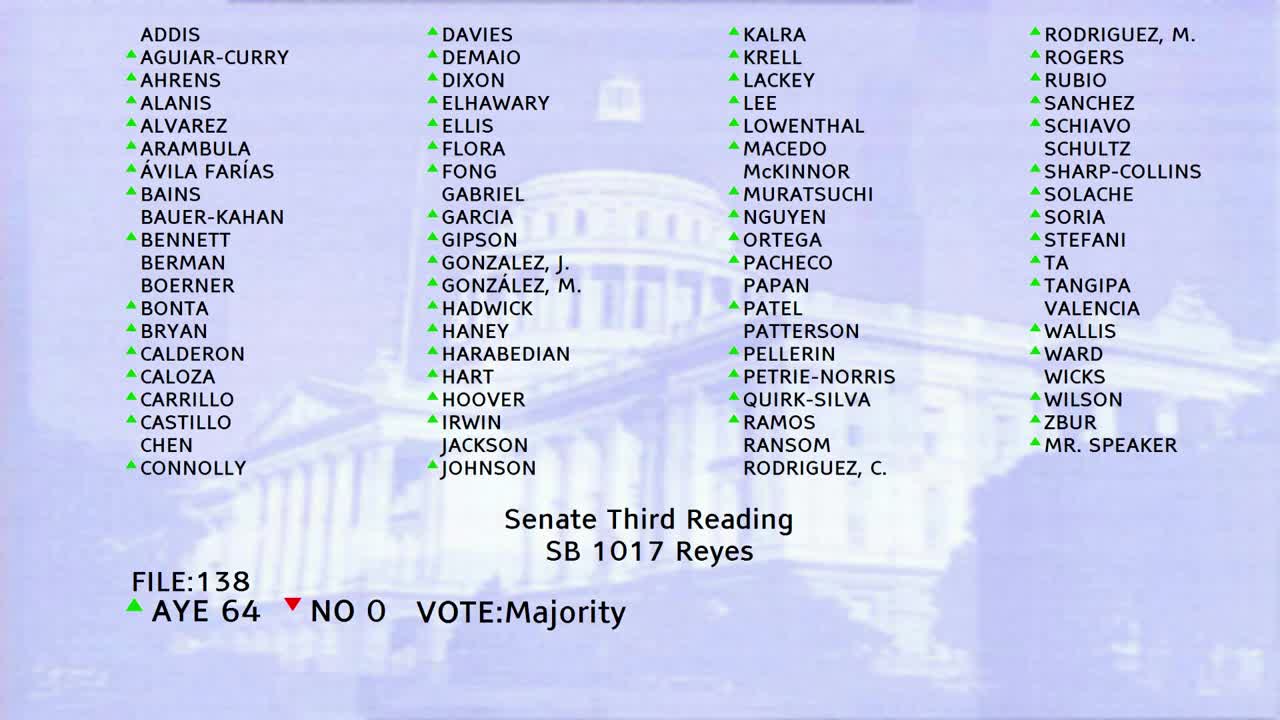 1MIN
Assembly Floor
 3MIN
Senate Floor
 21MIN
Senate Standing Committee on Energy, Utilities and Communications
Bill Author

Bill Co-Author(s):
