SB 744: Accrediting agencies.
- Session Year: 2025-2026
- House: Senate
- Latest Version Date: 2025-10-06
Current Status:
Passed
(2025-10-06: Chaptered by Secretary of State. Chapter 425, Statutes of 2025.)
Introduced
In Committee
Awaiting First Chamber Vote
Passed First Chamber
In Committee
Awaiting Second Chamber Vote
Passed Second Chamber
Enacted
Existing law establishes the California Community Colleges, the California State University, the University of California, independent institutions of higher education, and private postsecondary educational institutions as the segments of postsecondary education in the state. Existing law requires certain postsecondary educational institutions to be accredited by an accrediting agency recognized by the United States Department of Education to qualify as an independent institution of higher education to be eligible for certain programs and to receive an approval to operate.
Existing laws applicable to, among other things, the licensure and regulation of various professions and vocations by the Department of Consumer Affairs require applicants for licensure or licensees to satisfy educational requirements by completing programs or degrees from institutions or universities accredited by a regional or national accrediting agency or association recognized by the United States Department of Education, or otherwise impose a requirement that a school or program be accredited by an accrediting agency recognized by the United States Department of Education.
This bill would require, for purposes of any code or statute, a national or regional accrediting agency recognized by the United States Department of Education as of January 1, 2025, to retain that recognition until July 1, 2029, provided that the accrediting agency continues to operate in substantially the same manner as it did on January 1, 2025. The bill would repeal those provisions on January 1, 2030.
Existing law establishes the California Community Colleges, the California State University, the University of California, independent institutions of higher education, and private postsecondary educational institutions as the segments of postsecondary education in the state. Existing law requires certain postsecondary educational institutions to be accredited by an accrediting agency recognized by the United States Department of Education to qualify as an independent institution of higher education to be eligible for certain programs and to receive an approval to operate.
Existing laws applicable to, among other things, the licensure and regulation of various professions and vocations by the Department of Consumer Affairs require applicants for licensure or licensees to satisfy educational requirements by completing programs or degrees from institutions or universities accredited by a regional or national accrediting agency or association recognized by the United States Department of Education, or otherwise impose a requirement that a school or program be accredited by an accrediting agency recognized by the United States Department of Education.
This bill would provide that, require, for purposes of any code or statute, a national or regional accrediting agency recognized by the United States Department of Education as of January 1, 2025, shall to retain that recognition until January 20, July 1, 2029, provided that the accrediting agency continues to operate in substantially the same manner as it did on January 1, 2025. The bill would repeal those provisions on January 1, 2030.
Existing law establishes the California Community Colleges, the California State University, the University of California, independent institutions of higher education, and private postsecondary educational institutions as the segments of postsecondary education in the state. Existing law requires certain postsecondary educational institutions to be accredited by an accrediting agency recognized by the United States Department of Education to qualify as an independent institution of higher education to be eligible for certain programs and to receive an approval to operate.
Existing laws applicable to, among other things, the licensure and regulation of various professions and vocations by the Department of Consumer Affairs require applicants for licensure or licensees to satisfy educational requirements by completing programs or degrees from institutions or universities accredited by a regional or national accrediting agency or association recognized by the United States Department of Education, or otherwise impose a requirement that a school or program be accredited by an accrediting agency recognized by the United States Department of Education.
This bill would provide that, for purposes of any code or statute, a national or regional accrediting agency recognized by the United States Department of Education as of January 1, 2025, shall retain that recognition until January 20, 2029, provided that the accrediting agency continues to operate in substantially the same manner as it did on January 1, 2025. The bill would repeal those provisions on January 1, 2030.
Existing law requires the Chancellor of the California Community Colleges to establish, by March 31, 2019, an initiative to expand the use of course credit at the California Community Colleges for students with prior learning. Existing law required the chancellor to submit, by January 1, 2020, a report on the initiative to the Legislature.This bill would delete those requirements and would instead require the chancellor to award credit for competency-based educational opportunities that recognize students prior learning and help students advance toward a credential or degree while reducing redundant study and student expenses. The bill would require the office of the Chancellor of the California Community Colleges to establish competencies, with the advice of appropriate faculty and employers, that are focused on the knowledge and skills a student needs to demonstrate in order to pass a course and to earn a degree or credential, or to transfer to a baccalaureate degree program. The bill would describe methods for awarding credit pursuant to these provisions as including, but not being limited to, military service, credit by examination, and evaluation of training, certifications, apprenticeships, licenses, and service learning, as provided. The bill would require the chancellors office, on or before September 1, 2027, to submit a report to the Legislature on the credits awarded pursuant to these provisions.Existing law establishes a system through which state funds are apportioned to community college districts based on specified formulas and identifies certain noncredit community college courses and classes that are eligible for that state apportionment funding.This bill would require individualized evaluation, assessment, and portfolio review of students prior learning and competencies for the awarding of credit pursuant to the above-described provisions to be eligible for state apportionment funding.Existing law requires the Chancellor of the California Community Colleges to establish, by March 31, 2019, an initiative to expand the use of course credit at the California Community Colleges for students with prior learning. Existing law required the chancellor to submit, by January 1, 2020, a report on the initiative to the Legislature.
This bill would delete those requirements and would instead require the chancellor to award credit for competency-based educational opportunities that recognize students prior learning and help students advance toward a credential or degree while reducing redundant study and student expenses. The bill would require the office of the Chancellor of the California Community Colleges to establish competencies, with the advice of appropriate faculty and employers, that are focused on the knowledge and skills a student needs to demonstrate in order to pass a course and to earn a degree or credential, or to transfer to a baccalaureate degree program. The bill would describe methods for awarding credit pursuant to these provisions as including, but not being limited to, military service, credit by examination, and evaluation of training, certifications, apprenticeships, licenses, and service learning, as provided. The bill would require the chancellors office, on or before September 1, 2027, to submit a report to the Legislature on the credits awarded pursuant to these provisions.
Existing law establishes a system through which state funds are apportioned to community college districts based on specified formulas and identifies certain noncredit community college courses and classes that are eligible for that state apportionment funding.
This bill would require individualized evaluation, assessment, and portfolio review of students prior learning and competencies for the awarding of credit pursuant to the above-described provisions to be eligible for state apportionment funding.
(a)For purposes of any code or statute, a national or regional accrediting agency recognized by the United States Department of Education as of January 1, 2025, shall retain that recognition until July 1, 2029, provided that the accrediting agency continues to operate in substantially the same manner as it did on January 1, 2025.
(b)This section shall remain in effect only until January 1, 2030, and as of that date is repealed.
SEC. 2.Section 66010 of the Education Code is amended to read:66010.(a)Public higher education consists of (1) the California Community Colleges, (2) the California State University, and each campus, branch, and function thereof, and (3) each campus, branch, and function of the University of California.
(b)(1)Except as provided in paragraph (2), as used in this part, independent institutions of higher education are those nonpublic higher education institutions that grant undergraduate degrees, graduate degrees, or both, and that are formed as nonprofit corporations in this state and are accredited by an agency recognized by the United States Department of Education.
(2)For purposes of any code or statute, a national or regional accrediting agency recognized by the United States Department of Education as of January 1, 2025, shall retain that recognition until July 1, 2029, provided that the accrediting agency continues to operate in substantially the same manner as it did on January 1, 2025.
(c)No provision of this part is intended to regulate, subsidize, or intrude upon private education, including, but not limited to, independent educational institutions and religious schools, nor to vary existing state law or state constitutional provisions relating to private education.
(d)This section shall remain in effect only until January 1, 2030, and as of that date is repealed.
SEC. 3.Section 66010 is added to the Education Code, to read:66010.(a)Public higher education consists of (1) the California Community Colleges, (2) the California State University, and each campus, branch, and function thereof, and (3) each campus, branch, and function of the University of California.
(b)As used in this part, independent institutions of higher education are those nonpublic higher education institutions that grant undergraduate degrees, graduate degrees, or both, and that are formed as nonprofit corporations in this state and are accredited by an agency recognized by the United States Department of Education.
(c)No provision of this part is intended to regulate, subsidize, or intrude upon private education, including, but not limited to, independent educational institutions and religious schools, nor to vary existing state law or state constitutional provisions relating to private education.
(d)This section shall become operative on January 1, 2030.
(a)For purposes of any code or statute, a national or regional accrediting agency recognized by the United States Department of Education as of January 1, 2025, shall retain that recognition until January 20, July 1, 2029, provided that the accrediting agency continues to operate in substantially the same manner as it did on January 1, 2025.
(b)This section shall remain in effect only until January 1, 2030, and as of that date is repealed.
SEC. 2.Section 66010 of the Education Code is amended to read:66010.(a)Public higher education consists of (1) the California Community Colleges, (2) the California State University, and each campus, branch, and function thereof, and (3) each campus, branch, and function of the University of California.
(b)(1)Except as provided in paragraph (2), as used in this part, independent institutions of higher education are those nonpublic higher education institutions that grant undergraduate degrees, graduate degrees, or both, and that are formed as nonprofit corporations in this state and are accredited by an agency recognized by the United States Department of Education.
(2)For purposes of any code or statute, a national or regional accrediting agency recognized by the United States Department of Education as of January 1, 2025, shall retain that recognition until January 20, July 1, 2029, provided that the accrediting agency continues to operate in substantially the same manner as it did on January 1, 2025.
(c)No provision of this part is intended to regulate, subsidize, or intrude upon private education, including, but not limited to, independent educational institutions and religious schools, nor to vary existing state law or state constitutional provisions relating to private education.
(d)This section shall remain in effect only until January 1, 2030, and as of that date is repealed.
SEC. 3.Section 66010 is added to the Education Code, to read:66010.(a)Public higher education consists of (1) the California Community Colleges, (2) the California State University, and each campus, branch, and function thereof, and (3) each campus, branch, and function of the University of California.
(b)As used in this part, independent institutions of higher education are those nonpublic higher education institutions that grant undergraduate degrees, graduate degrees, or both, and that are formed as nonprofit corporations in this state and are accredited by an agency recognized by the United States Department of Education.
(c)No provision of this part is intended to regulate, subsidize, or intrude upon private education, including, but not limited to, independent educational institutions and religious schools, nor to vary existing state law or state constitutional provisions relating to private education.
(d)This section shall become operative on January 20, 2029. 1, 2030.
(a)For purposes of any code or statute, a national or regional accrediting agency recognized by the United States Department of Education as of January 1, 2025, shall retain that recognition until January 20, 2029, provided that the accrediting agency continues to operate in substantially the same manner as it did on January 1, 2025.
(b)This section shall remain in effect only until January 1, 2030, and as of that date is repealed.
SEC. 2.Section 66010 of the Education Code is amended to read:66010.(a)Public higher education consists of (1) the California Community Colleges, (2) the California State University, and each campus, branch, and function thereof, and (3) each campus, branch, and function of the University of California.
(b)As (1)Except as provided in paragraph (2), as used in this part, independent institutions of higher education are those nonpublic higher education institutions that grant undergraduate degrees, graduate degrees, or both, and that are formed as nonprofit corporations in this state and are accredited by an agency recognized by the United States Department of Education.
(2)For purposes of any code or statute, a national or regional accrediting agency recognized by the United States Department of Education as of January 1, 2025, shall retain that recognition until January 20, 2029, provided that the accrediting agency continues to operate in substantially the same manner as it did on January 1, 2025.
(c)No provision of this part is intended to regulate, subsidize, or intrude upon private education, including, but not limited to, independent educational institutions and religious schools, nor to vary existing state law or state constitutional provisions relating to private education.
(d)This section shall remain in effect only until January 1, 2030, and as of that date is repealed.
SEC. 3.Section 66010 is added to the Education Code, to read:66010.(a)Public higher education consists of (1) the California Community Colleges, (2) the California State University, and each campus, branch, and function thereof, and (3) each campus, branch, and function of the University of California.
(b)As used in this part, independent institutions of higher education are those nonpublic higher education institutions that grant undergraduate degrees, graduate degrees, or both, and that are formed as nonprofit corporations in this state and are accredited by an agency recognized by the United States Department of Education.
(c)No provision of this part is intended to regulate, subsidize, or intrude upon private education, including, but not limited to, independent educational institutions and religious schools, nor to vary existing state law or state constitutional provisions relating to private education.
(d)This section shall become operative on January 20, 2029.
SECTION 1.Section 66025.7 of the Education Code is repealed.SEC. 2.Section 66025.7 is added to the Education Code, to read:66025.7.(a)The Chancellor of the California Community Colleges shall award credit for competency-based educational opportunities that recognize students prior learning and help students advance toward a credential or degree while reducing redundant study and student expenses.(b)The chancellors office shall establish competencies, with the advice of appropriate faculty and employers, that are focused on the knowledge and skills a student needs to demonstrate in order to pass a course and to earn a degree or credential, or to transfer to a baccalaureate degree program.(c)Methods for awarding credit pursuant to this section shall include, but are not limited to, all of the following:(1)Military service, as provided in Section 66025.71.(2)Credit by examination. The chancellors office, in coordination with the academic senate, shall support faculty in developing, sharing, and redeploying assessments to award credit by examination for courses that articulate to a public university and courses with common identifier designations. Assessments shall be developed to enable students to demonstrate mastery and shall be mapped to the competencies.(3)Evaluation of training, certifications, apprenticeships, licenses, and service learning, including certifications earned as part of the Golden State Pathways Program or career technical education programs in secondary schools. The chancellors office, in coordination with the academic senate, shall establish guidelines by which certificated personnel shall examine a students training and determine whether the outcomes of that training correspond to the outcomes of a course. Where appropriate under the guidelines, a community college district shall be eligible for funding pursuant to Section 84757 when the evaluation, assessment, or portfolio review is organized as a noncredit course or a supervised student support service. The chancellors office shall prioritize prior learning and credit in programs leading to high-demand careers.(d)Credit granted pursuant to this section shall be reciprocal among California community college districts and accepted for transfer in the same manner and for the same purposes as regular course credit by each qualifying institution, as defined in subdivision (l) of Section 69432.7.(e)The State Allocation Board may consider the effectiveness of a community college district in furthering opportunities for students pursuant to this section in evaluating and prioritizing funds allocated pursuant to Section 17078.74.(f)(1)On or before September 1, 2027, the chancellors office shall submit a report to the Legislature, in compliance with Section 9795 of the Government Code, on the credits awarded pursuant to this section, including, but not limited to:(A)The number of students awarded credit.(B)The number of courses awarded.(C)The number of units awarded.(2)The report pursuant to paragraph (1) shall not include elective credit that does not satisfy a requirement for a credential or degree, or for transfer to a baccalaureate degree program.(g)For purposes of this section, chancellors office means the office of the Chancellor of the California Community Colleges.SEC. 3.Section 84757 of the Education Code is amended to read:84757.(a)For purposes of this chapter, the following noncredit courses, noncredit classes, and support services shall be eligible for funding:(1)Parenting, including parent cooperative preschools, classes in child growth and development and parent-child relationships.(2)Elementary and secondary foundational skills and other courses and classes such as pretransfer-level academic courses or classes in reading, mathematics, and language arts.(3)English as a second language.(4)Classes and courses for immigrants eligible for educational services in citizenship, English as a second language, and workforce preparation classes in the foundational skills of speaking, listening, reading, writing, mathematics, decisionmaking and problem solving skills, and other classes required for preparation to participate in job-specific technical training.(5)Education programs for persons with substantial disabilities.(6)Short-term vocational programs with high employment potential.(7)Education programs for older adults.(8)Education programs for home economics.(9)Health and safety education.(10)Supervised tutoring for foundational skills and for degree-applicable and transfer-level courses, as authorized pursuant to regulations adopted by the board of governors on or before July 31, 2023. These regulations shall ensure that community colleges are compliant with Section 78213 in the implementation of supervised tutoring pursuant to this paragraph.(11)Individualized evaluation, assessment, and portfolio review of students prior learning and competencies for the awarding of credit pursuant to Section 66025.7.(b)No state apportionment shall be made for any class or course that is not set forth in subdivision (a) and for which no credit is given.(a)The Chancellor of the California Community Colleges shall award credit for competency-based educational opportunities that recognize students prior learning and help students advance toward a credential or degree while reducing redundant study and student expenses.
(b)The chancellors office shall establish competencies, with the advice of appropriate faculty and employers, that are focused on the knowledge and skills a student needs to demonstrate in order to pass a course and to earn a degree or credential, or to transfer to a baccalaureate degree program.
(c)Methods for awarding credit pursuant to this section shall include, but are not limited to, all of the following:
(1)Military service, as provided in Section 66025.71.
(2)Credit by examination. The chancellors office, in coordination with the academic senate, shall support faculty in developing, sharing, and redeploying assessments to award credit by examination for courses that articulate to a public university and courses with common identifier designations. Assessments shall be developed to enable students to demonstrate mastery and shall be mapped to the competencies.
(3)Evaluation of training, certifications, apprenticeships, licenses, and service learning, including certifications earned as part of the Golden State Pathways Program or career technical education programs in secondary schools. The chancellors office, in coordination with the academic senate, shall establish guidelines by which certificated personnel shall examine a students training and determine whether the outcomes of that training correspond to the outcomes of a course. Where appropriate under the guidelines, a community college district shall be eligible for funding pursuant to Section 84757 when the evaluation, assessment, or portfolio review is organized as a noncredit course or a supervised student support service. The chancellors office shall prioritize prior learning and credit in programs leading to high-demand careers.
(d)Credit granted pursuant to this section shall be reciprocal among California community college districts and accepted for transfer in the same manner and for the same purposes as regular course credit by each qualifying institution, as defined in subdivision (l) of Section 69432.7.
(e)The State Allocation Board may consider the effectiveness of a community college district in furthering opportunities for students pursuant to this section in evaluating and prioritizing funds allocated pursuant to Section 17078.74.
(f)(1)On or before September 1, 2027, the chancellors office shall submit a report to the Legislature, in compliance with Section 9795 of the Government Code, on the credits awarded pursuant to this section, including, but not limited to:
(A)The number of students awarded credit.
(B)The number of courses awarded.
(C)The number of units awarded.
(2)The report pursuant to paragraph (1) shall not include elective credit that does not satisfy a requirement for a credential or degree, or for transfer to a baccalaureate degree program.
(g)For purposes of this section, chancellors office means the office of the Chancellor of the California Community Colleges.
SEC. 3.Section 84757 of the Education Code is amended to read:84757.(a)For purposes of this chapter, the following noncredit courses, noncredit classes, and support services shall be eligible for funding:
(1)Parenting, including parent cooperative preschools, classes in child growth and development and parent-child relationships.
(2)Elementary and secondary foundational skills and other courses and classes such as pretransfer-level academic courses or classes in reading, mathematics, and language arts.
(3)English as a second language.
(4)Classes and courses for immigrants eligible for educational services in citizenship, English as a second language, and workforce preparation classes in the foundational skills of speaking, listening, reading, writing, mathematics, decisionmaking and problem solving skills, and other classes required for preparation to participate in job-specific technical training.
(5)Education programs for persons with substantial disabilities.
(6)Short-term vocational programs with high employment potential.
(7)Education programs for older adults.
(8)Education programs for home economics.
(9)Health and safety education.
(10)Supervised tutoring for foundational skills and for degree-applicable and transfer-level courses, as authorized pursuant to regulations adopted by the board of governors on or before July 31, 2023. These regulations shall ensure that community colleges are compliant with Section 78213 in the implementation of supervised tutoring pursuant to this paragraph.
(11)Individualized evaluation, assessment, and portfolio review of students prior learning and competencies for the awarding of credit pursuant to Section 66025.7.
(b)No state apportionment shall be made for any class or course that is not set forth in subdivision (a) and for which no credit is given.
|
Date
|
Status
|
|---|---|
| Oct 6, 2025 | Chaptered by Secretary of State. Chapter 425, Statutes of 2025. |
| Oct 6, 2025 | Approved by the Governor. |
| Sep 23, 2025 | Enrolled and presented to the Governor at 2 p.m. |
| Sep 13, 2025 | Assembly amendments concurred in. (Ayes 30. Noes 5. Page 3026.) Ordered to engrossing and enrolling. |
| Sep 12, 2025 | In Senate. Concurrence in Assembly amendments pending. |
| Sep 12, 2025 | Read third time. Passed. (Ayes 60. Noes 18. Page 3391.) Ordered to the Senate. |
| Sep 3, 2025 | Ordered to third reading. |
| Sep 3, 2025 | Read third time and amended. |
| Sep 2, 2025 | Read second time. Ordered to third reading. |
| Aug 29, 2025 | From committee: Do pass. (Ayes 11. Noes 4.) (August 29). |
| Aug 20, 2025 | August 20 set for first hearing. Placed on APPR. suspense file. |
| Jul 9, 2025 | From committee: Do pass and re-refer to Com. on APPR. (Ayes 7. Noes 3.) (July 8). Re-referred to Com. on APPR. |
| Jun 11, 2025 | From committee with author's amendments. Read second time and amended. Re-referred to Com. on HIGHER ED. |
| Jun 5, 2025 | Referred to Com. on HIGHER ED. |
| May 29, 2025 | In Assembly. Read first time. Held at Desk. |
| May 29, 2025 | Read third time. Passed. (Ayes 38. Noes 0. Page 1329.) Ordered to the Assembly. |
| May 27, 2025 | Ordered to special consent calendar. |
| May 23, 2025 | Read second time. Ordered to third reading. |
| May 23, 2025 | From committee: Do pass. (Ayes 6. Noes 0. Page 1211.) (May 23). |
| May 16, 2025 | Set for hearing May 23. |
| Apr 21, 2025 | April 21 hearing: Placed on APPR. suspense file. |
| Apr 10, 2025 | Set for hearing April 21. |
| Apr 9, 2025 | From committee: Do pass and re-refer to Com. on APPR. (Ayes 7. Noes 0. Page 736.) (April 9). Re-referred to Com. on APPR. |
| Mar 26, 2025 | Set for hearing April 9. |
| Mar 12, 2025 | Referred to Com. on ED. |
| Feb 24, 2025 | Read first time. |
| Feb 24, 2025 | From printer. May be acted upon on or after March 24. |
| Feb 21, 2025 | Introduced. To Com. on RLS. for assignment. To print. |
|
Date
|
Description
|
Location
|
Votes
|
|
|---|---|---|---|---|
| Sep 13, 2025 | Unfinished Business SB744 Cabaldon Concurrence | Senate Floor |
Passed |
|
| Sep 12, 2025 | Unfinished Business SB744 Cabaldon Concurrence | Senate Floor |
Passed |
|
| Sep 12, 2025 | SB 744 Cabaldon Senate Third Reading By Bryan | Assembly Floor |
Passed |
|
| Aug 29, 2025 | Do pass. | Assembly Standing Committee on Appropriations |
Passed |
|
| Jul 8, 2025 | Do pass and be re-referred to the Committee on [Appropriations] | Assembly Standing Committee on Higher Education |
Passed |
|
| May 29, 2025 | Special Consent SB744 Cabaldon | Senate Floor |
Passed |
|
| May 23, 2025 | Do pass | Senate Standing Committee on Appropriations |
Passed |
|
| Apr 21, 2025 | Placed on suspense file | Senate Standing Committee on Appropriations |
Passed |
|
| Apr 9, 2025 | Do pass, but first be re-referred to the Committee on [Appropriations] | Senate Standing Committee on Education |
Passed |
This list shows positions taken on this bill by organizations on the date displayed, which is linked to the original source.
Positions by individuals are not included.
|
Organization
|
Position
|
Date
|
|---|---|---|
| Coast Community College District | ** Support | |
| Rancho Santiago Community College District | ** Support |
SENATE RULES COMMITTEE Office of Senate Floor Analyses (916) 651-1520 Fax: (916) 327-4478 | SB 744 |
UNFINISHED BUSINESS
Bill No: SB 744
Author: Cabaldon (D)
Amended: 10/6/25
Vote: 21
SENATE EDUCATION COMMITTEE: 7-0, 4/9/25
AYES: Pérez, Ochoa Bogh, Cabaldon, Choi, Cortese, Gonzalez, Laird
SENATE APPROPRIATIONS COMMITTEE: 6-0, 5/23/25
AYES: Caballero, Seyarto, Cabaldon, Grayson, Richardson, Wahab
NO VOTE RECORDED: Dahle
SENATE FLOOR: 38-0, 5/29/25
AYES: Allen, Alvarado-Gil, Archuleta, Arreguín, Ashby, Becker, Blakespear, Cabaldon, Caballero, Cervantes, Choi, Cortese, Dahle, Durazo, Gonzalez, Grayson, Grove, Hurtado, Jones, Laird, McGuire, McNerney, Menjivar, Niello, Ochoa Bogh, Padilla, Pérez, Richardson, Rubio, Seyarto, Smallwood-Cuevas, Stern, Strickland, Umberg, Valladares, Wahab, Weber Pierson, Wiener
NO VOTE RECORDED: Limón, Reyes
ASSEMBLY FLOOR: 60-18, 9/12/25 - See last page for vote
SUBJECT: Accrediting agencies
SOURCE: Author
DIGEST:
This bill provides that, for purposes of any code or statute, recognition of national or regional accreditation by the United States Department of Education (USDE) as of January 1, 2025, is retained until July 1, 2029 for an accrediting agency that continues to operate in substantially the same manner as it did on January 1, 2025.
Assembly Amendments
of 9/3/25 replace the original contents of this bill with current provisions on accrediting agencies.
ANALYSIS:
Existing law:
1) Establishes the University of California (UC) as a public trust to be administered by the Regents of the UC; and, grants the Regents full powers of organization and government, subject only to such legislative control as may be necessary to ensure security of its funds, compliance with the terms of its endowments, statutory requirements around competitive bidding and contracts, sales of property and the purchase of materials, goods and services. (Article IX, Section (9)(a) of the California Constitution)
2) Establishes the Donahoe Higher Education Act, setting forth the mission of the UC, California State University (CSU), and California Community Colleges (CCC). (Education Code (EC) § 66010, et seq.)
3) Defines “independent institutions of higher education” as those nonpublic higher education institutions that grant undergraduate degrees, graduate degrees, or both, and that are formed as nonprofit corporations in this state and are accredited by an agency recognized by the USDE. (EC § 66010, et seq.)
4) Confers upon the CSU Trustees the powers, duties, and functions with respect to the management, administration, control of the CSU system and provides that the Trustees are responsible for the rule of government of their appointees and employees. (EC § 66606 and 89500, et seq.)
5) Establishes the CCC under the administration of the Board of Governors of the CCC, as one of the segments of public postsecondary education in this State, and specifies that the CCC is comprised of community college districts. (EC § 70900)
6) Requires that all campuses or other units of any segment of postsecondary education that receive public funding through state or federal financial aid programs be institutionally accredited by an accrediting agency recognized by the USDE, and requires those institutions make final accreditation documents available to the public via display in a prominent location on the institution’s website. (EC § 66014.8)
7) Requires certain for-profit postsecondary educational institutions to be accredited by an accrediting agency recognized by the USDE to be eligible for certain programs and to receive an approval to operate. (EC § 94885, et seq.)
8) Specifically exempts schools that are accredited by the Accrediting Commission for Senior Colleges and Universities, Western Association of Schools and Colleges, or the Accrediting Commission for Community and Junior Colleges, Western Association of Schools and Colleges (WASC) from the California Private Postsecondary Education Act of 2009 and oversight by the oversight by the Bureau of Private Postsecondary Education (BPPE). (EC § 94874 (i))
9) Requires the regional accrediting agency for the community colleges to report to the appropriate policy and budget subcommittees of the Legislature upon the issuance of a decision that affects the accreditation status of a CCC campus and, on a biannual basis, report any accreditation policy changes that affect the accreditation process or status for a CCC campus. (EC § 72208)
10) Requires degree-granting institutions to provide evidence of accreditation of the institution and of all degree programs to California State Approving Agency for Veterans Education (CSAAVE) in order to remain eligible for federal Title 38 awards. (EC § 67102)
11) Requires accreditation for certain institutions in order to be considered a “qualified institution” for the Ortiz-Pacheco-Poochigian-Vasconcellos Cal Grant (Cal Grant) Program. (EC § 69432.7(l)(1) et seq.)
12) Various professions and vocations overseen by the Department of Consumer Affairs require applicants for licensure or licensees to satisfy educational requirements by completing programs or degrees from institutions or universities accredited by a regional or national accrediting agency or association recognized by the United States Department of Education, or otherwise impose a requirement that a school or program be accredited by an accrediting agency recognized by the United States Department of Education. (Business and Professions Code (BPC) § 2084, BPC § 4996.18, BPC § 10153.5, BPC Section 2786.2, BPC § 1941, and others)
13) Requires each community college within a district be an accredited institution, specifies that accreditation will be determined only by an accrediting agency recommended by the Chancellor and approved by the Board of Governors (BOG). Specifies that the BOG will approve only an accreditor recognized and approved by the U.S. Secretary of Education under the Higher Education Act of 1965 acting within the agency’s scope of recognition. (Title V of the California Code of Regulations (CCR) § 51016)
This bill:
- Provides that, for purposes of any code or statute, recognition of national or regional accreditation by the USDE as of January 1, 2025 is retained until July 1, 2029 for an accrediting agency that continues to operate in substantially the same manner as it did on January 1, 2025.
- Sunsets the bill’s provisions on January 1, 2030.
Comments
Need for this bill. According to the author, “Under California state law, higher education institutions must receive accreditation to be eligible for state resources and professional licensures. Accreditors review institutions' policies and curricula to certify that they meet a specified level of quality for all higher education institutions, including law schools and medical institutions. This accreditation makes students eligible for financial aid, student loans, and deems that a degree or certificate that they earn from the institutions meets a federally recognized standard.
“On April 23, 2025, President Trump weaponized the Federal Department of Education to target universities through Executive Order 14279. The policy directs accreditors to remove all standards related to diversity and to uphold the values of the President’s administration. The federal government has the authority to revoke accreditation, rendering these institutions ineligible for federal funding and potentially affecting the recognition of students' degrees and certificates. Most recently, the Department of Education notified the accrediting agency for Columbia University of an investigation related to a violation of antidiscrimination laws. With erratic changes in accreditation policy, California needs to provide a safeguard for its universities.
“SB 744 recognizes any federal accreditor that was certified before January 1, 2025 for the purposes of state law. This policy protects California universities by allowing universities to continue to operate for the purposes of state financial aid, programs, and licensures in the event the federal government revokes accreditation.”
The role of accreditation and USDE. Accreditation serves as a baseline measure of institutional quality for the education or training offered by higher education institutions. Accrediting agencies are private organizations that establish operating standards for educational or professional institutions and programs, and determine the extent to which those standards are met. While accrediting agencies set standards for institutions, the USDE establishes the general standards for accreditation agencies and recognizes those accrediting agencies that are deemed reliable authorities on education quality. Under Title IV of the federal Higher Education Act of 1965, an institution of higher education may be eligible to receive federal financial aid programs provided they meet certain standards. This includes obtaining state authorization, receiving certification from the USDE, and earning accreditation from an accrediting agency association recognized by the USDE. State law also requires accreditation as a prerequisite for public or private institutions to access certain state benefits or meet compliance requirements, such as gaining approval to operate in this state for degree-granting private institutions or qualifying for student aid programs.
Executive order on Accreditation. As noted in the author’s statement the Trump administration earlier this year issued an Executive Order that claims that accreditors have prioritized Diversity, Equity and Inclusion (DEI)-based requirements and governance mandates over student outcomes, and seeks to refocus accreditation on program quality, value, and lawful nondiscriminatory practices. It directs the U.S. Secretary of Education to hold accreditors who fail to meet the applicable recognition criteria or “violate federal law including by requiring institutions seeking accreditation to engage in unlawful discrimination in accreditation-related activity under the guise of diversity, equity, and inclusion initiatives.” The order applies to all accrediting agencies with specific attention placed on the American Bar Association and the Accreditation Council for Graduate Medical Education. The USDE is instructed to assess whether to suspend or terminate their recognition if warranted.
Preserves state recognition for four years. This bill effectively preserves California’s recognition of accrediting agencies in state law for a period of four years. It attempts to reduce disruption at the state level by ensuring that institutions accredited by an accrediting agency affected by federal changes continue to meet California statutory requirements tied to accreditation, even if USDE recognition changes. For example, an institution could retain state authorization to operate despite being accredited by an agency that lost its USDE recognition. This relief is extended to accrediting agencies that operate in “substantially in the same manner”. However, it is unclear how the determination of whether an accreditation agency’s operations have significantly changed will be made or by who.
The potential impact of losing federal recognition. This bill would not shield institutions or students against federal consequences resulting from an accrediting agency’s loss of recognition, such as the loss of eligibility for federal student aid. Federal funding is tied to accreditation and losing eligibility for federal funding may create potential gaps in oversight and enforcement if institutions remain recognized under state law but no longer receive or are accountable to federal funding conditions.
FISCAL EFFECT: Appropriation: No Fiscal Com.: Yes Local: No
According to the Assembly Appropriations Committee analysis, this bill would have the following fiscal impact:
- By preserving access to state financial aid and other programs requiring accreditation for California institutions of higher education (IHEs) should their accrediting agency lose federal recognition, the bill creates ongoing General Fund cost pressures of an unknown but potentially significant amount, likely in the millions of dollars, each year through the 2030-31 academic year for state financial aid programs to fund the increased unmet need due to the lack of federal financial aid.
SUPPORT: (Verified 9/12/25)
None received
OPPOSITION: (Verified 9/12/25)
None received
ASSEMBLY FLOOR: 60-18, 9/12/25
AYES: Addis, Aguiar-Curry, Ahrens, Alvarez, Arambula, Ávila Farías, Bains, Bauer-Kahan, Bennett, Berman, Boerner, Bonta, Bryan, Calderon, Caloza, Carrillo, Connolly, Elhawary, Fong, Gabriel, Garcia, Gipson, Mark González, Haney, Harabedian, Hart, Irwin, Jackson, Kalra, Krell, Lee, Lowenthal, McKinnor, Muratsuchi, Nguyen, Ortega, Pacheco, Papan, Patel, Pellerin, Petrie-Norris, Quirk-Silva, Ramos, Ransom, Celeste Rodriguez, Michelle Rodriguez, Rogers, Blanca Rubio, Schiavo, Schultz, Sharp-Collins, Solache, Soria, Stefani, Valencia, Ward, Wicks, Wilson, Zbur, Rivas
NOES: Alanis, Castillo, Chen, Davies, DeMaio, Dixon, Ellis, Gallagher, Jeff Gonzalez, Hadwick, Hoover, Johnson, Lackey, Macedo, Patterson, Sanchez, Ta, Tangipa
NO VOTE RECORDED: Flora, Wallis
Prepared by: Olgalilia Ramirez / ED. / (916) 651-4105
7/21/26 10:21:47
SENATE RULES COMMITTEE Office of Senate Floor Analyses (916) 651-1520 Fax: (916) 327-4478 | SB 744 |
UNFINISHED BUSINESS
Bill No: SB 744
Author: Cabaldon (D)
Amended: 9/3/25 in Assembly
Vote: 21
SENATE EDUCATION COMMITTEE: 7-0, 4/9/25
AYES: Pérez, Ochoa Bogh, Cabaldon, Choi, Cortese, Gonzalez, Laird
SENATE APPROPRIATIONS COMMITTEE: 6-0, 5/23/25
AYES: Caballero, Seyarto, Cabaldon, Grayson, Richardson, Wahab
NO VOTE RECORDED: Dahle
SENATE FLOOR: 38-0, 5/29/25
AYES: Allen, Alvarado-Gil, Archuleta, Arreguín, Ashby, Becker, Blakespear, Cabaldon, Caballero, Cervantes, Choi, Cortese, Dahle, Durazo, Gonzalez, Grayson, Grove, Hurtado, Jones, Laird, McGuire, McNerney, Menjivar, Niello, Ochoa Bogh, Padilla, Pérez, Richardson, Rubio, Seyarto, Smallwood-Cuevas, Stern, Strickland, Umberg, Valladares, Wahab, Weber Pierson, Wiener
NO VOTE RECORDED: Limón, Reyes
ASSEMBLY FLOOR: 47-16, 9/12/25 – Roll call vote not available.
SUBJECT: Accrediting Agencies
SOURCE: Author
DIGEST:
This bill provides that, for purposes of any code or statute, recognition of national or regional accreditation by the United States Department of Education (USDE) as of January 1, 2025, is retained until July 1, 2029 for an accrediting agency that continues to operate in substantially the same manner as it did on January 1, 2025.
Assembly Amendments
of 9/3/25 replace the original contents of this bill with current provisions on accrediting agencies.
ANALYSIS:
Existing law:
1) Establishes the University of California (UC) as a public trust to be administered by the Regents of the UC; and, grants the Regents full powers of organization and government, subject only to such legislative control as may be necessary to ensure security of its funds, compliance with the terms of its endowments, statutory requirements around competitive bidding and contracts, sales of property and the purchase of materials, goods and services. (Article IX, Section (9)(a) of the California Constitution)
2) Establishes the Donahoe Higher Education Act, setting forth the mission of the UC, California State University (CSU), and California Community Colleges (CCC). (Education Code (EC) § 66010, et seq.)
3) Defines “independent institutions of higher education” as those nonpublic higher education institutions that grant undergraduate degrees, graduate degrees, or both, and that are formed as nonprofit corporations in this state and are accredited by an agency recognized by the USDE. (EC § 66010, et seq.)
4) Confers upon the CSU Trustees the powers, duties, and functions with respect to the management, administration, control of the CSU system and provides that the Trustees are responsible for the rule of government of their appointees and employees. (EC § 66606 and 89500, et seq.)
5) Establishes the CCC under the administration of the Board of Governors of the CCC, as one of the segments of public postsecondary education in this State, and specifies that the CCC is comprised of community college districts. (EC § 70900)
6) Requires that all campuses or other units of any segment of postsecondary education that receive public funding through state or federal financial aid programs be institutionally accredited by an accrediting agency recognized by the USDE, and requires those institutions make final accreditation documents available to the public via display in a prominent location on the institution’s website. (EC § 66014.8)
7) Requires certain for-profit postsecondary educational institutions to be accredited by an accrediting agency recognized by the USDE to be eligible for certain programs and to receive an approval to operate. (EC § 94885, et seq.)
8) Specifically exempts schools that are accredited by the Accrediting Commission for Senior Colleges and Universities, Western Association of Schools and Colleges, or the Accrediting Commission for Community and Junior Colleges, Western Association of Schools and Colleges (WASC) from the California Private Postsecondary Education Act of 2009 and oversight by the oversight by the Bureau of Private Postsecondary Education (BPPE). (EC § 94874 (i))
9) Requires the regional accrediting agency for the community colleges to report to the appropriate policy and budget subcommittees of the Legislature upon the issuance of a decision that affects the accreditation status of a CCC campus and, on a biannual basis, report any accreditation policy changes that affect the accreditation process or status for a CCC campus. (EC § 72208)
10) Requires degree-granting institutions to provide evidence of accreditation of the institution and of all degree programs to California State Approving Agency for Veterans Education (CSAAVE) in order to remain eligible for federal Title 38 awards. (EC § 67102)
11) Requires accreditation for certain institutions in order to be considered a “qualified institution” for the Ortiz-Pacheco-Poochigian-Vasconcellos Cal Grant (Cal Grant) Program. (EC § 69432.7(l)(1) et seq.)
12) Various professions and vocations overseen by the Department of Consumer Affairs require applicants for licensure or licensees to satisfy educational requirements by completing programs or degrees from institutions or universities accredited by a regional or national accrediting agency or association recognized by the United States Department of Education, or otherwise impose a requirement that a school or program be accredited by an accrediting agency recognized by the United States Department of Education. (Business and Professions Code (BPC) § 2084, BPC § 4996.18, BPC § 10153.5, BPC Section 2786.2, BPC § 1941, and others)
13) Requires each community college within a district be an accredited institution, specifies that accreditation will be determined only by an accrediting agency recommended by the Chancellor and approved by the Board of Governors (BOG). Specifies that the BOG will approve only an accreditor recognized and approved by the U.S. Secretary of Education under the Higher Education Act of 1965 acting within the agency’s scope of recognition. (Title V of the California Code of Regulations (CCR) § 51016)
ANALYSIS
This bill:
- Provides that, for purposes of any code or statute, recognition of national or regional accreditation by the USDE as of January 1, 2025 is retained until July 1, 2029 for an accrediting agency that continues to operate in substantially the same manner as it did on January 1, 2025.
- Sunsets the bill’s provisions on January 1, 2030.
Comments
Need for this bill. According to the author, “Under California state law, higher education institutions must receive accreditation to be eligible for state resources and professional licensures. Accreditors review institutions' policies and curricula to certify that they meet a specified level of quality for all higher education institutions, including law schools and medical institutions. This accreditation makes students eligible for financial aid, student loans, and deems that a degree or certificate that they earn from the institutions meets a federally recognized standard.
“On April 23, 2025, President Trump weaponized the Federal Department of Education to target universities through Executive Order 14279. The policy directs accreditors to remove all standards related to diversity and to uphold the values of the President’s administration. The federal government has the authority to revoke accreditation, rendering these institutions ineligible for federal funding and potentially affecting the recognition of students' degrees and certificates. Most recently, the Department of Education notified the accrediting agency for Columbia University of an investigation related to a violation of antidiscrimination laws. With erratic changes in accreditation policy, California needs to provide a safeguard for its universities.
“SB 744 recognizes any federal accreditor that was certified before January 1, 2025 for the purposes of state law. This policy protects California universities by allowing universities to continue to operate for the purposes of state financial aid, programs, and licensures in the event the federal government revokes accreditation.”
The role of accreditation and USDE. Accreditation serves as a baseline measure of institutional quality for the education or training offered by higher education institutions. Accrediting agencies are private organizations that establish operating standards for educational or professional institutions and programs, and determine the extent to which those standards are met. While accrediting agencies set standards for institutions, the USDE establishes the general standards for accreditation agencies and recognizes those accrediting agencies that are deemed reliable authorities on education quality. Under Title IV of the federal Higher Education Act of 1965, an institution of higher education may be eligible to receive federal financial aid programs provided they meet certain standards. This includes obtaining state authorization, receiving certification from the USDE, and earning accreditation from an accrediting agency association recognized by the USDE. State law also requires accreditation as a prerequisite for public or private institutions to access certain state benefits or meet compliance requirements, such as gaining approval to operate in this state for degree-granting private institutions or qualifying for student aid programs.
Executive order on Accreditation. As noted in the author’s statement the Trump administration earlier this year issued an Executive Order that claims that accreditors have prioritized Diversity, Equity and Inclusion (DEI)-based requirements and governance mandates over student outcomes, and seeks to refocus accreditation on program quality, value, and lawful nondiscriminatory practices. It directs the U.S. Secretary of Education to hold accreditors who fail to meet the applicable recognition criteria or “violate federal law including by requiring institutions seeking accreditation to engage in unlawful discrimination in accreditation-related activity under the guise of diversity, equity, and inclusion initiatives.” The order applies to all accrediting agencies with specific attention placed on the American Bar Association and the Accreditation Council for Graduate Medical Education. The USDE is instructed to assess whether to suspend or terminate their recognition if warranted.
Preserves state recognition for four years. This bill effectively preserves California’s recognition of accrediting agencies in state law for a period of four years. It attempts to reduce disruption at the state level by ensuring that institutions accredited by an accrediting agency affected by federal changes continue to meet California statutory requirements tied to accreditation, even if USDE recognition changes. For example, an institution could retain state authorization to operate despite being accredited by an agency that lost its USDE recognition. This relief is extended to accrediting agencies that operate in “substantially in the same manner”. However, it is unclear how the determination of whether an accreditation agency’s operations have significantly changed will be made or by who.
The potential impact of losing federal recognition. This bill would not shield institutions or students against federal consequences resulting from an accrediting agency’s loss of recognition, such as the loss of eligibility for federal student aid. Federal funding is tied to accreditation and losing eligibility for federal funding may create potential gaps in oversight and enforcement if institutions remain recognized under state law but no longer receive or are accountable to federal funding conditions.
FISCAL EFFECT: Appropriation: No Fiscal Com.: Yes Local: No
According to the Assembly Appropriations Committee analysis, this bill would have the following fiscal impact:
- By preserving access to state financial aid and other programs requiring accreditation for California institutions of higher education (IHEs) should their accrediting agency lose federal recognition, the bill creates ongoing General Fund cost pressures of an unknown but potentially significant amount, likely in the millions of dollars, each year through the 2030-31 academic year for state financial aid programs to fund the increased unmet need due to the lack of federal financial aid.
SUPPORT: (Verified 9/12/25)
None received
OPPOSITION: (Verified 9/12/25)
None received
Prepared by: Olgalilia Ramirez / ED. / (916) 651-4105
9/12/25 18:18:23
SENATE THIRD READING
STR Bill Id:SB 744
Author:(Cabaldon)
As Amended Ver:September 3, 2025
Majority vote
SUMMARY
Requires, for the purposes of any code or statute, a national or regional accrediting agency recognized by the United States Department of Education as of January 1, 2025, will retain that recognition until July 1, 2029, provided that the accrediting agency continues to operate in substantially the same manner as it did on January 1, 2025. The bill would repeal those provisions on January 1, 2030
Major Provisions
See summary.
COMMENTS
Background. According to An Overview of Accreditation of Higher Education in the United States, a report published for members of Congress by the Congressional Research Service in April of 2024, the federal government provides varying types of support to postsecondary students and schools, including student financial assistance (e.g., Pell Grants and Direct Loans) authorized under Title IV of the Higher Education Act. Postsecondary schools seeking to participate in these federal programs must meet a variety of requirements, including being accredited by an agency recognized by the U.S. Department of Education as a reliable authority on the quality of the education being offered.
The United States does not have a centralized authority exercising singular national control over postsecondary educational institutions. Consequently, the character and quality of postsecondary schools and their programs can vary widely. The role of accreditation in higher education is to serve as a marker of a level of acceptable quality across the wide array of postsecondary schools and educational programs. The federal government has come to rely on accrediting agencies recognized by the U.S. Department of Education to help ensure the postsecondary institutions and educational programs to which federal funds are provided meet a minimum quality level.
Higher education practitioners and stakeholders often refer to three general types of accrediting agencies. Regional accrediting agencies historically concentrated their reviews on institutions in specific regions of the United States. National accrediting agencies operated across the United States and primarily review proprietary institutions, career- based single-purpose institutions, and religiously affiliated institutions. Programmatic accrediting agencies operate nationwide and review individual educational programs and single-purpose institutions. The U.S. Department of Education refers to the different accreditors as institutional accreditors, which evaluate entire postsecondary schools and comprise regional and national accreditors, and programmatic accreditors.
Regional versus National accreditation. California law makes certain distinctions between regional and national accreditors. Prior to 2020, institutions generally sought accreditation from the accreditor associated with their geographic region. Institutions accredited by WASC, or the Accrediting Commission for Community and Junior Colleges, for example, are exempt from the California Private Postsecondary Education Act of 2009 and oversight by the BPPE.
In 2020 the U.S. Department of Education, in their final accreditation and state authorization regulations, removed the distinction between regional and national accreditors, and now categorizes both types of agencies as institutional accreditors. The U.S. Department of Education also removed the limitation on regional accreditors' geographic scope.
Staff notes that SB 744 (Cabaldon) continues to use the "regional" and "national" distinctions, and Staff understands that the intent is to remain consistent with aspects of existing law that rely on these distinction.
Executive Order 14279. On April 23, 2025, President Donald J. Trump issued Executive Order 14279—Reforming Accreditation To Strengthen Higher Education. In the Executive Order, President Trump asserts that "accreditors routinely approve institutions that are low-quality by the most important measures. The national six-year undergraduate graduation rate was an alarming 64% in 2020. Further, many accredited institutions offer undergraduate and graduate programs with a negative return on investment—almost 25% of bachelor's degrees and more than 40%of master's degrees—which may leave students financially worse off and in enormous debt by charging them exorbitant sums for a degree with very modest earnings potential. Notwithstanding this slide in graduation rates and graduates' performance in the labor market, the spike in debt obligations in relation to expected earnings, and repayment rates on student loans, accreditors have remained improperly focused on compelling adoption of discriminatory ideology, rather than on student outcomes."
The Executive Order calls on the U.S. Attorney General and the U.S. Secretary of Education to "investigate and take appropriate action to terminate unlawful discrimination by American law schools that is advanced by the Council, including unlawful 'diversity, equity, and inclusion' requirements under the guise of accreditation standards. The Secretary of Education shall also assess whether to suspend or terminate the Council's status as an accrediting agency under Federal law."
In addition to the potential investigation and suspension of accrediting bodies, the Executive Order seeks to establish new principles of "Student-Oriented Accreditation" that specifically require:
- "Accreditation requires higher education institutions to provide high-quality, high-value academic programs free from unlawful discrimination or other violations of Federal law."
- "Barriers are reduced that limit institutions from adopting practices that advance credential and degree completion and spur new models of education."
- "Accreditation requires that institutions support and appropriately prioritize intellectual diversity amongst faculty in order to advance academic freedom, intellectual inquiry, and student learning."
- "Accreditors are not using their role under Federal law to encourage or force institution to violate State laws, unless such State laws violate the Constitution or Federal law."
- "Accreditors are prohibited from engaging in practices that result in credential inflation that burdens students with additional unnecessary costs."
Committee comments. While this bill will provide some insulation for California institutions for the purpose of complying with our accreditation law, it does raise policy questions as to whether the State will assume the role of ensuring that institutions follow the spirit of accreditation while an institution's status is in limbo, or if that institution is working to gain accreditation following a negative federal action.
According to the Author
According to the author, "under California state law, higher education institutions must receive accreditation to be eligible for state resources and professional licensures. Accreditors review institutions' policies and curricula to certify that they meet a specified level of quality for all higher education institutions, including law schools and medical institutions. This accreditation makes students eligible for financial aid, student loans, and deems that a degree or certificate that they earn from the institutions meets a federally recognized standard."
"On April 23, 2025, President Trump weaponized the Federal Department of Education to target universities through Executive Order 14279. The policy directs accreditors to remove all standards related to diversity and to uphold the values of the President's administration. The federal government has the authority to revoke accreditation, rendering these institutions ineligible for federal funding and potentially affecting the recognition of students' degrees and certificates. Most recently, the [U.S.] Department of Education notified the accrediting agency for Columbia University of an investigation related to a violation of antidiscrimination laws. With erratic changes in accreditation policy, California needs to provide a safeguard for its universities."
"SB 744 recognizes any federal accreditor that was certified before January 1, 2025 for the purposes of state law. This policy protects California universities by allowing universities to continue to operate for the purposes of state financial aid, programs, and licensures in the event the federal government revokes accreditation."
Arguments in Support
None on file for the current version of the bill, as amended in the Assembly.
Arguments in Opposition
None on file.
FISCAL COMMENTS
According to the Assembly Committee on Appropriations:
By preserving access to state financial aid and other programs requiring accreditation for California institutions of higher education (IHEs) should their accrediting agency lose federal recognition, the bill creates ongoing General Fund cost pressures of an unknown but potentially significant amount, likely in the millions of dollars, each year through the 2030-31 academic year for state financial aid programs to fund the increased unmet need due to the lack of federal financial aid.
VOTES
SENATE FLOOR: 38-0-2
YES: Allen, Alvarado-Gil, Archuleta, Arreguín, Ashby, Becker, Blakespear, Cabaldon, Caballero, Cervantes, Choi, Cortese, Dahle, Durazo, Gonzalez, Grayson, Grove, Hurtado, Jones, Laird, McGuire, McNerney, Menjivar, Niello, Ochoa Bogh, Padilla, Pérez, Richardson, Rubio, Seyarto, Smallwood-Cuevas, Stern, Strickland, Umberg, Valladares, Wahab, Weber Pierson, Wiener
ABS, ABST OR NV: Limón, Reyes
ASM HIGHER EDUCATION: 7-3-0
YES: Fong, Boerner, Jackson, Muratsuchi, Patel, Celeste Rodriguez, Sharp-Collins
NO: DeMaio, Jeff Gonzalez, Tangipa
ASM APPROPRIATIONS: 11-4-0
YES: Wicks, Arambula, Calderon, Caloza, Elhawary, Fong, Mark González, Ahrens, Pacheco, Pellerin, Solache
NO: Sanchez, Dixon, Ta, Tangipa
UPDATED
VERSION: September 3, 2025
CONSULTANT: Kevin J. Powers / HIGHER ED. / (916) 319-3744 FN: 0001615
SENATE THIRD READING
STR Bill Id:SB 744
Author:(Cabaldon)
As Amended Ver:June 11, 2025
Majority vote
SUMMARY
Provides that, for the purposes of any code or statute, a national or regional accrediting agency recognized by the United States Department of Education as of January 1, 2025, will retain that recognition until January 20, 2029, provided that the accrediting agency continues to operate in substantially the same manner as it did on January 1, 2025. The bill would repeal those provisions on January 1, 2030.
Major Provisions
See summary.
COMMENTS
Background. According to An Overview of Accreditation of Higher Education in the United States, a report published for members of Congress by the Congressional Research Service in April of 2024, the federal government provides varying types of support to postsecondary students and schools, including student financial assistance (e.g., Pell Grants and Direct Loans) authorized under Title IV of the Higher Education Act. Postsecondary schools seeking to participate in these federal programs must meet a variety of requirements, including being accredited by an agency recognized by the U.S. Department of Education as a reliable authority on the quality of the education being offered.
The United States does not have a centralized authority exercising singular national control over postsecondary educational institutions. Consequently, the character and quality of postsecondary schools and their programs can vary widely. The role of accreditation in higher education is to serve as a marker of a level of acceptable quality across the wide array of postsecondary schools and educational programs. The federal government has come to rely on accrediting agencies recognized by the U.S. Department of Education to help ensure the postsecondary institutions and educational programs to which federal funds are provided meet a minimum quality level.
Higher education practitioners and stakeholders often refer to three general types of accrediting agencies. Regional accrediting agencies historically concentrated their reviews on institutions in specific regions of the United States. National accrediting agencies operated across the United States and primarily review proprietary institutions, career- based single-purpose institutions, and religiously affiliated institutions. Programmatic accrediting agencies operate nationwide and review individual educational programs and single-purpose institutions. The U.S. Department of Education refers to the different accreditors as institutional accreditors, which evaluate entire postsecondary schools and comprise regional and national accreditors, and programmatic accreditors.
Regional versus National accreditation. California law makes certain distinctions between regional and national accreditors. Prior to 2020, institutions generally sought accreditation from the accreditor associated with their geographic region. Institutions accredited by WASC, or the Accrediting Commission for Community and Junior Colleges, for example, are exempt from the California Private Postsecondary Education Act of 2009 and oversight by the BPPE.
In 2020 the U.S. Department of Education, in their final accreditation and state authorization regulations, removed the distinction between regional and national accreditors, and now categorizes both types of agencies as institutional accreditors. The U.S. Department of Education also removed the limitation on regional accreditors′ geographic scope.
Staff notes that SB 744 (Cabaldon) continues to use the ″regional″ and ″national″ distinctions, and Staff understands that the intent is to remain consistent with aspects of existing law that rely on these distinction.
Executive Order 14279. On April 23, 2025, President Donald J. Trump issued Executive Order 14279—Reforming Accreditation To Strengthen Higher Education. In the Executive Order, President Trump asserts that ″accreditors routinely approve institutions that are low-quality by the most important measures. The national six-year undergraduate graduation rate was an alarming 64% in 2020. Further, many accredited institutions offer undergraduate and graduate programs with a negative return on investment—almost 25% of bachelor′s degrees and more than 40%of master′s degrees—which may leave students financially worse off and in enormous debt by charging them exorbitant sums for a degree with very modest earnings potential. Notwithstanding this slide in graduation rates and graduates′ performance in the labor market, the spike in debt obligations in relation to expected earnings, and repayment rates on student loans, accreditors have remained improperly focused on compelling adoption of discriminatory ideology, rather than on student outcomes.″
The Executive Order calls on the U.S. Attorney General and the U.S. Secretary of Education to ″investigate and take appropriate action to terminate unlawful discrimination by American law schools that is advanced by the Council, including unlawful ′diversity, equity, and inclusion′ requirements under the guise of accreditation standards. The Secretary of Education shall also assess whether to suspend or terminate the Council′s status as an accrediting agency under Federal law.″
In addition to the potential investigation and suspension of accrediting bodies, the Executive Order seeks to establish new principles of ″Student-Oriented Accreditation″ that specifically require:
- ″Accreditation requires higher education institutions to provide high-quality, high-value academic programs free from unlawful discrimination or other violations of Federal law.″
- ″Barriers are reduced that limit institutions from adopting practices that advance credential and degree completion and spur new models of education.″
- ″Accreditation requires that institutions support and appropriately prioritize intellectual diversity amongst faculty in order to advance academic freedom, intellectual inquiry, and student learning.″
- ″Accreditors are not using their role under Federal law to encourage or force institution to violate State laws, unless such State laws violate the Constitution or Federal law.″
- ″Accreditors are prohibited from engaging in practices that result in credential inflation that burdens students with additional unnecessary costs.″
Committee comments. While this bill will provide some insulation for California institutions for the purpose of complying with our accreditation law, it does raise policy questions as to whether the State will assume the role of ensuring that institutions follow the spirit of accreditation while an institution′s status is in limbo, or if that institution is working to gain accreditation following a negative federal action.
According to the Author
According to the author, ″under California state law, higher education institutions must receive accreditation to be eligible for state resources and professional licensures. Accreditors review institutions′ policies and curricula to certify that they meet a specified level of quality for all higher education institutions, including law schools and medical institutions. This accreditation makes students eligible for financial aid, student loans, and deems that a degree or certificate that they earn from the institutions meets a federally recognized standard.″
″On April 23, 2025, President Trump weaponized the Federal Department of Education to target universities through Executive Order 14279. The policy directs accreditors to remove all standards related to diversity and to uphold the values of the President′s administration. The federal government has the authority to revoke accreditation, rendering these institutions ineligible for federal funding and potentially affecting the recognition of students′ degrees and certificates. Most recently, the [U.S.] Department of Education notified the accrediting agency for Columbia University of an investigation related to a violation of antidiscrimination laws. With erratic changes in accreditation policy, California needs to provide a safeguard for its universities.″
″SB 744 recognizes any federal accreditor that was certified before January 1, 2025 for the purposes of state law. This policy protects California universities by allowing universities to continue to operate for the purposes of state financial aid, programs, and licensures in the event the federal government revokes accreditation.″
Arguments in Support
None on file for the current version of the bill, as amended in the Assembly.
Arguments in Opposition
None on file.
FISCAL COMMENTS
According to the Assembly Committee on Appropriations:
By preserving access to state financial aid and other programs requiring accreditation for California institutions of higher education (IHEs) should their accrediting agency lose federal recognition, the bill creates ongoing General Fund cost pressures of an unknown but potentially significant amount, likely in the millions of dollars, each year through the 2030-31 academic year for state financial aid programs to fund the increased unmet need due to the lack of federal financial aid.
VOTES
SENATE FLOOR: 38-0-2
YES: Allen, Alvarado-Gil, Archuleta, Arreguín, Ashby, Becker, Blakespear, Cabaldon, Caballero, Cervantes, Choi, Cortese, Dahle, Durazo, Gonzalez, Grayson, Grove, Hurtado, Jones, Laird, McGuire, McNerney, Menjivar, Niello, Ochoa Bogh, Padilla, Pérez, Richardson, Rubio, Seyarto, Smallwood-Cuevas, Stern, Strickland, Umberg, Valladares, Wahab, Weber Pierson, Wiener
ABS, ABST OR NV: Limón, Reyes
ASM HIGHER EDUCATION: 7-3-0
YES: Fong, Boerner, Jackson, Muratsuchi, Patel, Celeste Rodriguez, Sharp-Collins
NO: DeMaio, Jeff Gonzalez, Tangipa
ASM APPROPRIATIONS: 11-4-0
YES: Wicks, Arambula, Calderon, Caloza, Elhawary, Fong, Mark González, Ahrens, Pacheco, Pellerin, Solache
NO: Sanchez, Dixon, Ta, Tangipa
UPDATED
VERSION: June 11, 2025
CONSULTANT: Kevin J. Powers / HIGHER ED. / (916) 319-3960 FN: 0001392
Date of Hearing: August 20, 2025
ASSEMBLY COMMITTEE ON APPROPRIATIONS
Buffy Wicks, Chair
SBPCA Bill Id:SB 744
Author:(Cabaldon) – As Amended Ver:June 11, 2025
Policy Committee: | Higher Education | Vote: | 7 - 3 |
|
| ||
|
|
Urgency: No State Mandated Local Program: No Reimbursable: No
SUMMARY:
This bill provides that a national or regional accrediting agency recognized by the United States Department of Education (USDE) as of January 1, 2025, retain such recognition until January 20, 2029, subject to specified conditions. The bill repeals these provisions on January 1, 2030.
FISCAL EFFECT:
By preserving access to state financial aid and other programs requiring accreditation for California institutions of higher education (IHEs) should their accrediting agency lose federal recognition, the bill creates ongoing General Fund cost pressures of an unknown but potentially significant amount, likely in the millions of dollars, each year through the 2030-31 academic year for state financial aid programs to fund the increased unmet need due to the lack of federal financial aid.
COMMENTS:
- Purpose. According to the author:
On April 23, 2025, President Trump weaponized the Federal Department of Education to target universities through Executive Order 14279. The policy directs accreditors to remove all standards related to diversity and to uphold the values of the President’s administration. The federal government has the authority to revoke accreditation, rendering these institutions ineligible for federal funding and potentially affecting the recognition of students' degrees and certificates. Most recently, the [U.S.] Department of Education notified the accrediting agency for Columbia University of an investigation related to a violation of antidiscrimination laws. With erratic changes in accreditation policy, California needs to provide a safeguard for its universities.
SB 744 recognizes any federal accreditor that was certified before January 1, 2025 for the purposes of state law. This policy protects California universities by allowing universities to continue to operate for the purposes of state financial aid, programs, and licensures in the event the federal government revokes accreditation.
- Background. Higher Education Accreditation. In order for an IHE to participate in federal programs, such as federal financial aid, it must meet specified requirements prescribed by each program, all of which include accreditation by an agency recognized by the USDE. Therefore, because the United States does not have a centralized authority charged with overseeing educational quality of IHEs, the USDE relies on accrediting agencies it recognizes to ensure educational programs receiving federal funds meet a minimum quality standard.
2025 Executive Order. On April 23, 2025, President Trump signed an executive order calling on the U.S. Attorney General and the U.S. Secretary of Education to:
Investigate and take appropriate action to terminate unlawful discrimination by American law schools that is advanced by the Council, including unlawful ‘diversity, equity, and inclusion’ requirements under the guise of accreditation standards. The Secretary of Education shall also assess whether to suspend or terminate the Council's status as an accrediting agency under Federal law.
This executive order puts at risk the recognized status for any accrediting agency the federal government may deem to no longer meet recognition standards of the USDE, which may be solely based on ideological differences with the federal administration’s values rather than actual academic quality. By extension, any IHE accredited by such an agency would lose eligibility for federal financial aid and programs. This bill would provide for an IHE whose accrediting agency loses its federal recognition to still retain eligibility for state financial aid, state programs, and licensures through January 20, 2029, so long as the accrediting agency continues to operate in substantially the same manner as it did on January 1, 2025.
Analysis Prepared by: Aaron Heredia / APPR. / (916) 319-2081
Date of Hearing: July 8, 2025
ASSEMBLY COMMITTEE ON HIGHER EDUCATION
Mike Fong, Chair
SBPCA Bill Id:SB 744
Author:(Cabaldon) – As Amended Ver:June 11, 2025
SENATE VOTE: 38-0
SUBJECT: Accrediting agencies
SUMMARY: Provides that, for the purposes of any code or statute, a national or regional accrediting agency recognized by the United States Department of Education as of January 1, 2025, will retain that recognition until January 20, 2029, provided that the accrediting agency continues to operate in substantially the same manner as it did on January 1, 2025. The bill would repeal those provisions on January 1, 2030.
EXISTING LAW:
- Establishes the University of California (UC) as a public trust to be administered by the Regents of the UC; and, grants the Regents full powers of organization and government, subject only to such legislative control as may be necessary to ensure security of its funds, compliance with the terms of its endowments, statutory requirements around competitive bidding and contracts, sales of property and the purchase of materials, goods and services (Article IX, Section (9)(a) of the California Constitution).
- Establishes the Donahoe Higher Education Act, setting forth the mission of the UC, California State University (CSU), and California Community Colleges (CCC) (Education Code (EDC) Section 66010, et seq.).
- Defines “independent institutions of higher education” as those nonpublic higher education institutions that grant undergraduate degrees, graduate degrees, or both, and that are formed as nonprofit corporations in this state and are accredited by an agency recognized by the United States Department of Education (EDC Section 66010, et seq.).
- Confers upon the CSU Trustees the powers, duties, and functions with respect to the management, administration, control of the CSU system and provides that the Trustees are responsible for the rule of government of their appointees and employees (EDC Sections 66606 and 89500, et seq.).
- Establishes the CCC under the administration of the Board of Governors of the CCC, as one of the segments of public postsecondary education in this State, and specifies that the CCC is comprised of community college districts (EDC Section 70900).
- Requires that all campuses or other units of any segment of postsecondary education that receive public funding through state or federal financial aid programs be institutionally accredited by an accrediting agency recognized by the United States Department of Education, and requires those institutions make final accreditation documents available to the public via display in a prominent location on the institution’s Internet Web site. (EDC Section 66014.8).
- Requires certain for-profit postsecondary educational institutions to be accredited by an accrediting agency recognized by the United States Department of Education to be eligible for certain programs and to receive an approval to operate. (EDC Section 94885, et seq.)
- Specifically exempts schools that are accredited by the Accrediting Commission for Senior Colleges and Universities, Western Association of Schools and Colleges, or the Accrediting Commission for Community and Junior Colleges, Western Association of Schools and Colleges (WASC) from the provisions of the are exempt from the California Private Postsecondary Education Act of 2009 and oversight by the oversight by the Bureau of Private Postsecondary Education (BPPE). (EDC Section 94874 (i))
- Requires the regional accrediting agency for the community colleges to report to the appropriate policy and budget subcommittees of the Legislature upon the issuance of a decision that affects the accreditation status of a CCC campus and, on a biannual basis, report any accreditation policy changes that affect the accreditation process or status for a CCC campus. (EDC Section 72208)
- Requires degree-granting institutions to provide evidence of accreditation of the institution and of all degree programs to California State Approving Agency for Veterans Education (CSAAVE) in order to remain eligible for federal Title 38 awards. (EDC Section 67102)
- Requires accreditation for certain institutions in order to be considered a “qualified institution” for the Ortiz-Pacheco-Poochigian-Vasconcellos Cal Grant (Cal Grant) Program. (EDC Section 69432.7(l)(1) et seq.).
- Various professions and vocations overseen by the Department of Consumer Affairs require applicants for licensure or licensees to satisfy educational requirements by completing programs or degrees from institutions or universities accredited by a regional or national accrediting agency or association recognized by the United States Department of Education, or otherwise impose a requirement that a school or program be accredited by an accrediting agency recognized by the United States Department of Education. (Business and Professions Code (BPC) Section 2084, BPC Section 4996.18, BPC Section 10153.5, BPC Section 2786.2, BPC Section 1941, and others)
- Requires each community college within a district be an accredited institution, Specifies that accreditation will be determined only by an accrediting agency recommended by the Chancellor and approved by the Board of Governors. Specifies that the Board will approve only an accreditor recognized and approved by the U.S. Secretary of Education under the Higher Education Act of 1965 acting within the agency's scope of recognition. (Title Five of the California Code of Regulations (CCR), Section 51016)
FISCAL EFFECT: Unknown. The provisions of SB 744 (Cabaldon) that were analyzed by the Senate Committee on Appropriations have been removed and replaced with the current language.
COMMENTS: Background. According to An Overview of Accreditation of Higher Education in the United States, a report published for members of Congress by the Congressional Research Service in April of 2024, the federal government provides varying types of support to postsecondary students and schools, including student financial assistance (e.g., Pell Grants and Direct Loans) authorized under Title IV of the Higher Education Act. Postsecondary schools seeking to participate in these federal programs must meet a variety of requirements, including being accredited by an agency recognized by the U.S. Department of Education as a reliable authority on the quality of the education being offered.
The United States does not have a centralized authority exercising singular national control over postsecondary educational institutions. Consequently, the character and quality of postsecondary schools and their programs can vary widely. The role of accreditation in higher education is to serve as a marker of a level of acceptable quality across the wide array of postsecondary schools and educational programs. The federal government has come to rely on accrediting agencies recognized by the U.S. Department of Education to help ensure the postsecondary institutions and educational programs to which federal funds are provided meet a minimum quality level.
Higher education practitioners and stakeholders often refer to three general types of accrediting agencies. Regional accrediting agencies historically concentrated their reviews on institutions in specific regions of the United States. National accrediting agencies operated across the United States and primarily review proprietary institutions, career- based single-purpose institutions, and religiously affiliated institutions. Programmatic accrediting agencies operate nationwide and review individual educational programs and single-purpose institutions. The U.S. Department of Education refers to the different accreditors as institutional accreditors, which evaluate entire postsecondary schools and comprise regional and national accreditors, and programmatic accreditors.
Regional versus National accreditation. California law makes certain distinctions between regional and national accreditors. Prior to 2020, institutions generally sought accreditation from the accreditor associated with their geographic region. Institutions accredited by WASC, or the Accrediting Commission for Community and Junior Colleges, for example, are exempt from the California Private Postsecondary Education Act of 2009 and oversight by the BPPE.
In 2020 the U.S. Department of Education, in their final accreditation and state authorization regulations, removed the distinction between regional and national accreditors, and now categorizes both types of agencies as institutional accreditors. The U.S. Department of Education also removed the limitation on regional accreditors’ geographic scope.
Committee Staff notes that SB 744 (Cabaldon) continues to use the “regional” and “national” distinctions, and Staff understands that the intent is to remain consistent with aspects of existing law that rely on these distinction. Moving forward, the Committee may wish to consider if elements of existing law should be reviewed to consider how federal changes to institutional accreditors impact state accreditation standards and requirements.
Executive Order 14279. On April 23, 2025, President Donald J. Trump issued Executive Order 14279—Reforming Accreditation To Strengthen Higher Education. In the Executive Order, President Trump asserts that “accreditors routinely approve institutions that are low-quality by the most important measures. The national six-year undergraduate graduation rate was an alarming 64% in 2020. Further, many accredited institutions offer undergraduate and graduate programs with a negative return on investment—almost 25% of bachelor's degrees and more than 40%of master's degrees—which may leave students financially worse off and in enormous debt by charging them exorbitant sums for a degree with very modest earnings potential. Notwithstanding this slide in graduation rates and graduates' performance in the labor market, the spike in debt obligations in relation to expected earnings, and repayment rates on student loans, accreditors have remained improperly focused on compelling adoption of discriminatory ideology, rather than on student outcomes.”
The Executive Order calls on the U.S. Attorney General and the U.S. Secretary of Education to “investigate and take appropriate action to terminate unlawful discrimination by American law schools that is advanced by the Council, including unlawful ‘diversity, equity, and inclusion’ requirements under the guise of accreditation standards. The Secretary of Education shall also assess whether to suspend or terminate the Council's status as an accrediting agency under Federal law.”
In addition to the potential investigation and suspension of accrediting bodies, the Executive Order seeks to establish new principles of “Student-Oriented Accreditation” that specifically require:
- “Accreditation requires higher education institutions to provide high-quality, high-value academic programs free from unlawful discrimination or other violations of Federal law.”
- “Barriers are reduced that limit institutions from adopting practices that advance credential and degree completion and spur new models of education.”
- “Accreditation requires that institutions support and appropriately prioritize intellectual diversity amongst faculty in order to advance academic freedom, intellectual inquiry, and student learning.”
- “Accreditors are not using their role under Federal law to encourage or force institution to violate State laws, unless such State laws violate the Constitution or Federal law.”
- “Accreditors are prohibited from engaging in practices that result in credential inflation that burdens students with additional unnecessary costs.”
Purpose. According to the author, “under California state law, higher education institutions must receive accreditation to be eligible for state resources and professional licensures. Accreditors review institutions' policies and curricula to certify that they meet a specified level of quality for all higher education institutions, including law schools and medical institutions. This accreditation makes students eligible for financial aid, student loans, and deems that a degree or certificate that they earn from the institutions meets a federally recognized standard.”
“On April 23, 2025, President Trump weaponized the Federal Department of Education to target universities through Executive Order 14279. The policy directs accreditors to remove all standards related to diversity and to uphold the values of the President’s administration. The federal government has the authority to revoke accreditation, rendering these institutions ineligible for federal funding and potentially affecting the recognition of students' degrees and certificates. Most recently, the [U.S.] Department of Education notified the accrediting agency for Columbia University of an investigation related to a violation of antidiscrimination laws. With erratic changes in accreditation policy, California needs to provide a safeguard for its universities.”
“SB 744 recognizes any federal accreditor that was certified before January 1, 2025 for the purposes of state law. This policy protects California universities by allowing universities to continue to operate for the purposes of state financial aid, programs, and licensures in the event the federal government revokes accreditation.”
Committee comments. While this bill will provide some insulation for California institutions for the purpose of complying with our accreditation law, it does raise policy questions as to whether the State will assume the role of ensuring that institutions follow the spirit of accreditation while an institution’s status is in limbo, or if that institution is working to gain accreditation following a negative federal action. The Committee may wish to consider if the State poised to enforce existing state laws to prevent discrimination and sexual harassment.
REGISTERED SUPPORT / OPPOSITION:
Support
None on file.
Opposition
None on file.
Analysis Prepared by: Kevin J. Powers / HIGHER ED. / (916) 319-3960
SENATE RULES COMMITTEE Office of Senate Floor Analyses (916) 651-1520 Fax: (916) 327-4478 | SB 744 |
THIRD READING
Bill No: SB 744
Author: Cabaldon (D)
Introduced: 2/21/25
Vote: 21
SENATE EDUCATION COMMITTEE: 7-0, 4/9/25
AYES: Pérez, Ochoa Bogh, Cabaldon, Choi, Cortese, Gonzalez, Laird
SENATE APPROPRIATIONS COMMITTEE: 6-0, 5/23/25
AYES: Caballero, Seyarto, Cabaldon, Grayson, Richardson, Wahab
NO VOTE RECORDED: Dahle
SUBJECT: Community colleges: credit for students with prior learning
SOURCE: Author
DIGEST:
This bill (1) requires the California Community College (CCC) Chancellor to award credit for competency-based educational opportunities that recognize students’ prior learning. It further (2) expands the type of noncredit courses eligible for state apportionment funding to include individualized evaluation assessment and portfolio review of students’ prior learning and competencies for the awarding of credit for competency-based educational opportunities.
ANALYSIS:
Existing law:
- Requires the Chancellor of the CCC to establish, by March 31, 2019, an initiative to expand the use of course credit at the CCC for students with prior learning. It required the chancellor to submit, by January 1, 2020, a report on the initiative to the Legislature. (Education Code (EC) § 66025.7)
- Requires the CCC Chancellor’s Office and the California State University (CSU) Chancellor’s Office, in collaboration with their respective Academic Senates, and requests the University of California (UC) to develop a consistent policy for awarding course credit for prior military education, training, and service, and periodically review and adjust the policy developed to align with policies of other postsecondary educational institutions. (EC § 66025.71)
- Establishes a system through which state funds are apportioned to community college districts based on specified formulas and identifies certain noncredit community college courses and classes that are eligible for that state apportionment funding, including classes or courses in parenting, remedial education, English as a second language, citizenship for immigrants, workforce preparation, supervised tutoring, education programs for persons with substantial disabilities, older adults, home economics, short-term vocational programs, and health and safety education. (EC § 84760.5 and § 84757(a))
- Prohibits state apportionment for a noncredit course or class that is not identified in EC § 84757. (EC § 84757 (b))
This bill:
- Requires the CCC Chancellor to award credit for competency-based educational opportunities that recognize students’ prior learning, help students advance toward a credential or degree and reduce redundant study and student expenses.
- Requires the Chancellor’s Office to establish competencies, with the advice of appropriate faculty and employers that are focused on the knowledge and skills a student needs to demonstrate in order to pass a course and to earn a degree or credential, or to transfer to a baccalaureate degree program.
- Requires that the methods for awarding credit for competency-based educational opportunities include, but be not limited to, all of the following:
- Military service, as provided in existing state law for military personnel and veterans who have an official Joint Services Transcript.
- Credit by examination. The Chancellor’s Office, in coordination with the academic senate, is required to support faculty in developing, sharing, and redeploying assessments to award credit by examination for courses that articulate to a public university and courses with common identifier designations. Assessments are to be developed to enable students to demonstrate mastery and mapped to competencies.
- Evaluation of trainings, certifications, apprenticeships, licenses, and service learning, including certifications earned as part of the Golden State Pathways Program or career technical education programs in secondary schools. The Chancellor’s Office, in coordination with the Academic Senate, is required to establish guidelines by which certificated personnel are required to examine a student’s training and determine whether the outcomes of that training correspond to the outcomes of a course. Where appropriate under the guidelines, a community college district is to be deemed eligible for apportionment funding available to certain noncredit courses when the evaluation, assessment, or portfolio review is organized as a noncredit course or a supervised student support service. The chancellor’s office is required to prioritize prior learning and credit in programs leading to high-demand careers.
- Requires that the credit granted for competency-based educational opportunities be reciprocal among CCC districts and accepted for transfer in the same manner and for the same purposes as regular course credit by each Cal Grant-qualifying institution.
- Authorizes the State Allocation Board to consider the effectiveness of a community college district in further opportunities for students pursuant to the bill’s provisions in evaluating and prioritizing funds allocated pursuant to existing state law.
- Requires, by September 1, 2027, the Chancellor’s Office to submit a report to the Legislature, on the credits awarded for competency-based educational opportunities, including, but not limited, to the number of students awarded credit, the number of courses awarded, and the number of units awarded. The report is not to include elective credit that does not satisfy a requirement for a credential or degree or for transfer to a baccalaureate degree program.
- Expands the type of noncredit courses eligible for state apportionment funding to include individualized evaluation assessment and portfolio review of students’ prior learning and competencies for the awarding of credit for competency-based educational opportunities.
Comments
- Need for the bill. According to the author, “Credit for Prior Learning (CPL) programs award students with academic credits for knowledge and skills acquired outside traditional academic settings; saving them time and money. CPL includes work experience, military service, and prior coursework. When students are able to utilize CPL, they are twice as likely to complete a degree. However, challenges remain in implementing and recognizing CPL across different segments of higher education.
“SB 744 aims to expand the use of CPL by requiring the California Community College system to establish standardized criteria for awarding credits based on students’ training and experience. Additionally, the bill ensures that CPL credits are transferable to other universities and clarifies that faculty members that review CPL transcripts are eligible for funding.
“This policy will help students save time and money by reducing the number of courses they need to take, allowing them to graduate faster and pay less in tuition.”
- Credit for prior learning. Credit for prior learning generally refers to the awarding of college credit for skills learned outside the classroom, such as through work experience or military service. Students may earn credit for these experiences in various ways, including by passing an exam, submitting a portfolio of their work for faculty review, or demonstrating they have earned an industry credential that faculty have deemed equivalent to certain courses. Some definitions of credit for prior learning also include credit earned through standardized exams, such as Advanced Placement exams. Nationally, one of the most well-established forms of credit for prior learning applies to active duty military and veteran students. These students typically receive joint services transcripts from their branch of service documenting their military training and experiences. The American Council on Education, in turn, has developed recommendations for converting certain types of military training. The American Council on Education, in turn, has developed recommendations for converting certain types of military training and experiences into certain types and amounts of college credit. Colleges may consider these recommendations when deciding how much credit to grant. Additionally, current law requires the CCC Chancellor’s Office to develop a consistent policy for awarding course credit for prior military education, training, and service and periodically review and adjust the policy developed to align with policies of other postsecondary educational institutions.
In 2020, the CCC Chancellor’s Office adopted regulations requiring all community college districts to have credit for prior learning policies. These locally developed policies are to include procedures for students to earn credit for prior learning through joint services transcripts, examinations, student‑created portfolios, and industry‑recognized credentials. The Chancellor’s
Office reports that all 115 credit‑granting colleges in the system now offer some form of credit for prior learning, though the practice has not been implemented at scale at most colleges. Based on the best available data, the Chancellor’s Office estimates that at least 4,100 veteran students earned a total of about 23,000 credits for prior learning in 2023‑24. These students earned an average of about six credits each (the equivalent of two typical college courses). The Chancellor’s Office further estimates that at least 36,000 other students earned credit for prior learning in 2023‑24, though the number of credits earned by these other students is not well documented. (This count may also include students earning credit through standardized exams, such as Advanced Placement exams.)
- Transferability of credits. This bill attempts to ensure that the credit granted is transferable to each Cal Grant-qualifying institution, which includes UC, CSU, and some private colleges. However, this bill mandates that receiving colleges must accept the credit. The bill is silent on consultation from their faculty.
- Eligible for state apportionment funding. As noted in the background of this analysis, under state law, certain noncredit courses are eligible for state apportionment funding. Those courses consist of classes relating to career development and college preparation, including instruction of some pre-transfer level courses, supervised tutoring, English as a Second Language courses, and Career Technical Education courses. This bill adds the evaluation, assessment, or portfolio review for the awarding of credit for competency-based educational opportunities to the list of apportionment eligible noncredit courses.
- Related budget activity. The Governor’s January 2025-26 budget proposal also attempts to expand credit for prior learning opportunities by providing $7 million in ongoing funds and $43 million in one-time funds from Proposition 98 General Funding to the CCC Chancellor’s Office. With these funds, the Chancellor’s office is to establish a system-wide credit for prior learning initiative that builds upon prior initiatives. The ongoing funds are for system-wide purposes, including coordination, technology infrastructure, and faculty work groups. The one‑time funds are to support local implementation of credit for prior learning. The trailer bill language directs the Chancellor’s Office to allocate the one‑time funds to colleges based on metrics related to their use of credit for prior learning to increase access, increase completion, and advance career attainment. The language specifies that colleges must demonstrate they are doing those things prior to receiving any funding. The Governor presents this proposal as part of a Master Plan for Career Education.
FISCAL EFFECT: Appropriation: No Fiscal Com.: Yes Local: No
According to the Senate Appropriations Committee analysis, this bill would have the following fiscal impact:
- By expanding the type of noncredit courses eligible for state apportionment funds, this bill could result in additional Proposition 98 General Fund costs each year. A precise estimate is unknown and would depend on the exact number of students taking these courses, but it could be in the low millions of dollars each year.
- The Chancellor’s Office estimates one-time General Fund workload costs of between $33,000 and $53,000 to establish competencies that are focused on appropriate skills and knowledge, and $60,000 to submit a legislative report regarding the number of students awarded credit for prior learning.
SUPPORT: (Verified 5/23/25)
Coast Community College District
Rancho Santiago Community College District
OPPOSITION: (Verified 5/23/25)
None received
Prepared by: Olgalilia Ramirez / ED. / (916) 651-4105
5/26/25 13:45:46
SENATE COMMITTEE ON APPROPRIATIONS
Senator Anna Caballero, Chair
2025 - 2026 Regular Session
SB 744 (Cabaldon) - Community colleges: credit for students with prior learning
Version: February 21, 2025 | Policy Vote: ED. 7 - 0 |
Urgency: No | Mandate: No |
Hearing Date: April 21, 2025 | Consultant: Lenin Del Castillo |
Bill Summary:
This bill requires the Chancellor for the California Community Colleges (CCCs) to award credit for competency-based educational opportunities that recognize students’ prior learning. The bill also expands the type of noncredit courses eligible for state apportionment funding to include individualized evaluation assessment and portfolio review of students’ prior learning and competencies, as specified.
Fiscal Impact:
- By expanding the type of noncredit courses eligible for state apportionment funds, this bill could result in additional Proposition 98 General Fund costs each year. A precise estimate is unknown and would depend on the exact number of students taking these courses, but it could be in the low millions of dollars each year.
- The Chancellor’s Office estimates one-time General Fund workload costs of between $33,000 and $53,000 to establish competencies that are focused on appropriate skills and knowledge, and $60,000 to submit a legislative report regarding the number of students awarded credit for prior learning.
Background:
Existing law requires the CCC Chancellor’s Office and the California State University (CSU) Chancellor’s Office, in collaboration with their respective Academic Senates, and requests the University of California (UC), to develop a consistent policy for awarding course credit for prior military education, training, and service, and periodically review and adjust the policy developed to align with policies of other postsecondary educational institutions. Credit for prior learning generally refers to the awarding of college credit for skills learned outside the classroom, such as through work experience or military service. Students may earn credit for these experiences in various ways, including by passing an exam, submitting a portfolio of their work for faculty review, or demonstrating they have earned an industry credential that faculty have deemed equivalent to certain courses. Some definitions of credit for prior learning also include credit earned through standardized exams, such as Advanced Placement exams. Nationally, one of the most well-established forms of credit for prior learning applies to active duty military and veteran students. These students typically receive joint services transcripts from their branch of service documenting their military training and experiences.
Existing law establishes a system through which state funds are apportioned to community college districts based on specified formulas and identifies certain noncredit community college courses and classes that are eligible for that state apportionment funding, including classes or courses in parenting, remedial education, English as a second language (ESL), citizenship for immigrants, workforce preparation, supervised tutoring, education programs for persons with substantial disabilities, older adults, home economics, short-term vocational programs, and health and safety education. The law prohibits state apportionment for a noncredit course or class that is not identified in Section 84757 of the Education Code.
Proposed Law:
This bill requires the Chancellor to award credit for competency-based educational opportunities that recognize students’ prior learning, help students advance toward a credential or degree and reduce redundant study and student expenses. The bill also requires the Chancellor’s Office to establish competencies, with the advice of appropriate faculty and employers, that are focused on the knowledge and skills a student needs to demonstrate in order to pass a course and to earn a degree or credential, or to transfer to a baccalaureate degree program.
This bill provides that the methods for awarding credit for competency-based educational opportunities shall include, but be not limited to, all of the following:
- Military service, as provided in existing state law for military personnel and veterans who have an official Joint Services Transcript.
- Credit by examination. The Chancellor’s Office, in coordination with the academic senate, is required to support faculty in developing, sharing, and redeploying assessments to award credit by examination for courses that articulate to a public university and courses with common identifier designations. Assessments are to be developed to enable students to demonstrate mastery and mapped to competencies.
- Evaluation of trainings, certifications, apprenticeships, licenses, and service learning, including certifications earned as part of the Golden State Pathways Program or career technical education programs in secondary schools, as specified.
This bill requires that the credit granted for competency-based educational opportunities be reciprocal among CCC districts and accepted for transfer in the same manner and for the same purposes as regular course credit by each Cal Grant-qualifying institution.
This bill authorizes the State Allocation Board to consider the effectiveness of a community college district in further opportunities for students pursuant to the bill’s provisions in evaluating and prioritizing funds allocated pursuant to existing state law.
This bill requires, by September 1, 2027, the Chancellor’s Office to submit a report to the Legislature, on the credits awarded for competency-based educational opportunities, including, but not limited, to the number of students awarded credit, the number of courses awarded, and the number of units awarded. The report is not to include elective credit that does not satisfy a requirement for a credential or degree or for transfer to a baccalaureate degree program.
This bill expands the type of noncredit courses eligible for state apportionment funding to include individualized evaluation assessment and portfolio review of students’ prior learning and competencies for the awarding of credit for competency-based educational opportunities.
Staff Comments:
Under state law, certain noncredit courses are eligible for state apportionment funding. Those courses consist of classes relating to career development and college preparation, including instruction of some pre-transfer level courses, supervised tutoring, English as a Second Language courses, and Career Technical Education courses. This bill adds the evaluation, assessment, or portfolio review for the awarding of credit for competency-based educational opportunities to the list of apportionment eligible noncredit courses. This expansion could result in additional state apportionment funds for community college districts. For 2023-24, the Chancellor’s Office estimates that 36,391 students earned approximately 16,766 credit units. Using the Student Centered Funding Formula noncredit rate of $4,465 for 2024-25, these students would have generated approximately $5 million in additional revenue.
Staff notes that the 2025-26 Governor’s Budget proposes Proposition 98 funding of $7 million ongoing and $43 million one-time funds to scale credit for prior learning policies across all 116 community colleges. With these funds, the Chancellor’s office is to establish a systemwide credit for prior learning initiative that builds upon prior initiatives. The ongoing funds are for systemwide purposes, including coordination, technology infrastructure, and faculty work groups. The funds proposed in the Governor’s Budget could potentially offset the bill’s projected state operations costs for the Chancellor’s Office.
-- END --
SENATE COMMITTEE ON EDUCATION
Senator Sasha Renée Pérez, Chair
2025 - 2026 Regular
Bill No: Hearing Date: April 9, 2025
Author: | Cabaldon | ||
Version: |
| ||
Urgency: | Fiscal: | ||
Consultant: | |||
Subject: .
SUMMARY
This bill requires the California Community College (CCC) Chancellor to award credit for competency-based educational opportunities that recognize students’ prior learning. It further expands the type of noncredit courses eligible for state apportionment funding to include individualized evaluation assessment and portfolio review of students’ prior learning and competencies for the awarding of credit for competency-based educational opportunities.
BACKGROUND
Existing law:
- Requires the Chancellor of the CCC to establish, by March 31, 2019, an initiative to expand the use of course credit at the CCC for students with prior learning. It required the chancellor to submit, by January 1, 2020, a report on the initiative to the Legislature. (Education Code (EC) § 66025.7)
- Requires the CCC Chancellor’s Office and the California State University (CSU) Chancellor’s Office, in collaboration with their respective Academic Senates, and requests the University of California (UC) to develop a consistent policy for awarding course credit for prior military education, training, and service, and periodically review and adjust the policy developed to align with policies of other postsecondary educational institutions. (EC § 66025.71)
- Establishes a system through which state funds are apportioned to community college districts based on specified formulas and identifies certain noncredit community college courses and classes that are eligible for that state apportionment funding, including classes or courses in parenting, remedial education, English as a second language (ESL), citizenship for immigrants, workforce preparation, supervised tutoring, education programs for persons with substantial disabilities, older adults, home economics, short-term vocational programs, and health and safety education. (EC § 84760.5 and § 84757(a))
- Prohibits state apportionment for a noncredit course or class that is not identified
in EC § 84757 of the education code. (EC § 84757 (b))
ANALYSIS
This bill:
- Requires the CCC Chancellor to award credit for competency-based educational opportunities that recognize students’ prior learning, help students advance toward a credential or degree and reduce redundant study and student expenses.
- Requires the Chancellor’s Office to establish competencies, with the advice of appropriate faculty and employers that are focused on the knowledge and skills a student needs to demonstrate in order to pass a course and to earn a degree or credential, or to transfer to a baccalaureate degree program.
- Requires that the methods for awarding credit for competency-based educational opportunities include, but be not limited to, all of the following:
- Military service, as provided in existing state law for military personnel and
veterans who have an official Joint Services Transcript.
- Credit by examination. The Chancellor’s Office, in coordination with the
academic senate, is required to support faculty in developing, sharing, and redeploying assessments to award credit by examination for courses that articulate to a public university and courses with common identifier designations. Assessments are to be developed to enable students to demonstrate mastery and mapped to competencies.
- Evaluation of trainings, certifications, apprenticeships, licenses, and
service learning, including certifications earned as part of the Golden State Pathways Program or career technical education programs in secondary schools. The Chancellor’s Office, in coordination with the Academic \Senate, is required to establish guidelines by which certificated personnel are required to examine a student’s training and determine whether the outcomes of that training correspond to the outcomes of a course. Where appropriate under the guidelines, a community college district is to be deemed eligible for apportionment funding available to certain noncredit courses when the evaluation, assessment, or portfolio review is organized as a noncredit course or a supervised student support service. The chancellor’s office is required to prioritize prior learning and credit in programs leading to high-demand careers.
- Requires that the credit granted for competency-based educational opportunities be reciprocal among CCC districts and accepted for transfer in the same manner and for the same purposes as regular course credit by each Cal Grant-qualifying institution.
- Authorizes the State Allocation Board to consider the effectiveness of a community college district in further opportunities for students pursuant to the bill’s provisions in evaluating and prioritizing funds allocated pursuant to existing state law.
- Requires, by September 1, 2027, the Chancellor’s Office to submit a report to the Legislature, on the credits awarded for competency-based educational opportunities, including, but not limited, to the number of students awarded credit, the number of courses awarded, and the number of units awarded. The report is not to include elective credit that does not satisfy a requirement for a credential or degree or for transfer to a baccalaureate degree program.
- Expands the type of noncredit courses eligible for state apportionment funding to include individualized evaluation assessment and portfolio review of students’ prior learning and competencies for the awarding of credit for competency-based educational opportunities.
STAFF COMMENTS
- Need for the bill. According to the author, “Credit for Prior Learning (CPL) programs award students with academic credits for knowledge and skills acquired outside traditional academic settings; saving them time and money. CPL includes work experience, military service, and prior coursework. When students are able to utilize CPL, they are twice as likely to complete a degree. However, challenges remain in implementing and recognizing CPL across different segments of higher education.
“SB 744 aims to expand the use of CPL by requiring the California Community College system to establish standardized criteria for awarding credits based on students’ training and experience. Additionally, the bill ensures that CPL credits are transferable to other universities and clarifies that faculty members that review CPL transcripts are eligible for funding.
“This policy will help students save time and money by reducing the number of courses they need to take, allowing them to graduate faster and pay less in tuition.”
- Credit for prior learning. Credit for prior learning generally refers to the awarding of college credit for skills learned outside the classroom, such as through work experience or military service. Students may earn credit for these experiences in various ways, including by passing an exam, submitting a portfolio of their work for faculty review, or demonstrating they have earned an industry credential that faculty have deemed equivalent to certain courses. Some definitions of credit for prior learning also include credit earned through standardized exams, such as Advanced Placement exams. Nationally, one of the most well-established forms of credit for prior learning applies to active duty military and veteran students. These students typically receive joint services transcripts from their branch of service documenting their military training and experiences. The American Council on Education, in turn, has developed recommendations for converting certain types of military training. The American Council on Education, in turn, has developed recommendations for converting certain types of military training and experiences into certain types and amounts of college credit. Colleges may consider these recommendations when deciding how much credit to grant. Additionally, current law requires the CCC Chancellor’s Office to develop a consistent policy for awarding course credit for prior military education, training, and service and periodically review and adjust the policy developed to align with policies of other postsecondary educational institutions.
In 2020, the CCC Chancellor’s Office adopted regulations requiring all community college districts to have credit for prior learning policies. These locally developed policies are to include procedures for students to earn credit for prior learning through joint services transcripts, examinations, student‑created portfolios, and industry‑recognized credentials. The Chancellor’s
Office reports that all 115 credit‑granting colleges in the system now offer some form of credit for prior learning, though the practice has not been implemented at scale at most colleges. Based on the best available data, the Chancellor’s Office estimates that at least 4,100 veteran students earned a total of about 23,000
credits for prior learning in 2023‑24. These students earned an average of about six credits each (the equivalent of two typical college courses). The Chancellor’s Office further estimates that at least 36,000 other students earned credit for prior learning in 2023‑24, though the number of credits earned by these other students is not well documented. (This count may also include students earning credit through standardized exams, such as Advanced Placement exams.)
- Colleges rather than Chancellor. This bill requires the CCC Chancellor to award credit and establish competencies. However, it is individual colleges in partnership with faculty, not the Chancellor, which control the awarding of credit. Additionally, faculty are responsible for determining the competencies applicable to a course or degree. This bill affords faculty an advisory role. Accordingly, the author may wish to consider changing this reference from the Chancellor to the colleges. The author may additionally wish to consider whether it is necessary to elevate the role of the faculty to ensure a collaborative process that takes into account their subject matter expertise.
- Transferability of credits. This bill attempts to ensure that the credit granted is transferable to each Cal Grant-qualifying institution, which includes UC, CSU, and some private colleges. However, the bill mandates that receiving colleges must accept the credit. The bill is silent on consultation from their faculty. As such, the author may wish to consider including consultation with the Academic Senate of the CSU and the Academic Senate of the UC to ensure alignment with academic and competency standards to the extent possible.
- Eligible for state apportionment funding. As noted in the background of this analysis, under state law, certain noncredit courses are eligible for state apportionment funding. Those courses consist of classes relating to career development and college preparation, including instruction of some pre-transfer level courses, supervised tutoring, English as a Second Language courses, and Career Technical Education courses. This bill adds the evaluation, assessment, or portfolio review for the awarding of credit for competency-based educational opportunities to the list of apportionment eligible noncredit courses.
- Related budget activity. As noted in the Senate Subcommittee 1 on Education analysis, the 2024‑25 Budget Act provided $6 million in one‑time Proposition 98 General Fund for a credit for prior learning initiative within the CCC system. The Chancellor’s Office indicates these funds are supporting the Mapping Articulated Pathways (MAP) Initiative, which it administers jointly with the Riverside Community College District. The MAP Initiative provides technology, training, and support to colleges in implementing credit for prior learning. With the 2024‑25 appropriation, the Chancellor’s Office reports the MAP Initiative is now available to all colleges across the system. While the spending plan for the $6 million is still being finalized, the Chancellor’s Office currently anticipates spending $1.7 million in 2024‑25 and the remaining $4.3 million in 2025‑26.
The Governor’s 2025-26 budget proposal also attempts to expand credit for prior learning opportunities by providing $7 million in ongoing funds and $43 million in one-time funds from Proposition 98 General Funding to the CCC Chancellor’s Office. With these funds, the Chancellor’s office is to establish a systemwide credit for prior learning initiative that builds upon prior initiatives. The ongoing funds are for systemwide purposes, including coordination, technology infrastructure, and faculty work groups. The one‑time funds are to support local implementation of credit for prior learning. The trailer bill language directs the Chancellor’s Office to allocate the one‑time funds to colleges based on metrics related to their use of credit for prior learning to increase access, increase completion, and advance career attainment. The language specifies that colleges must demonstrate they are doing those things prior to receiving any funding. The Governor presents this proposal as part of a Master Plan for Career Education.
SUPPORT
None received
OPPOSITION
None received
-- END --
Discussed in Hearing
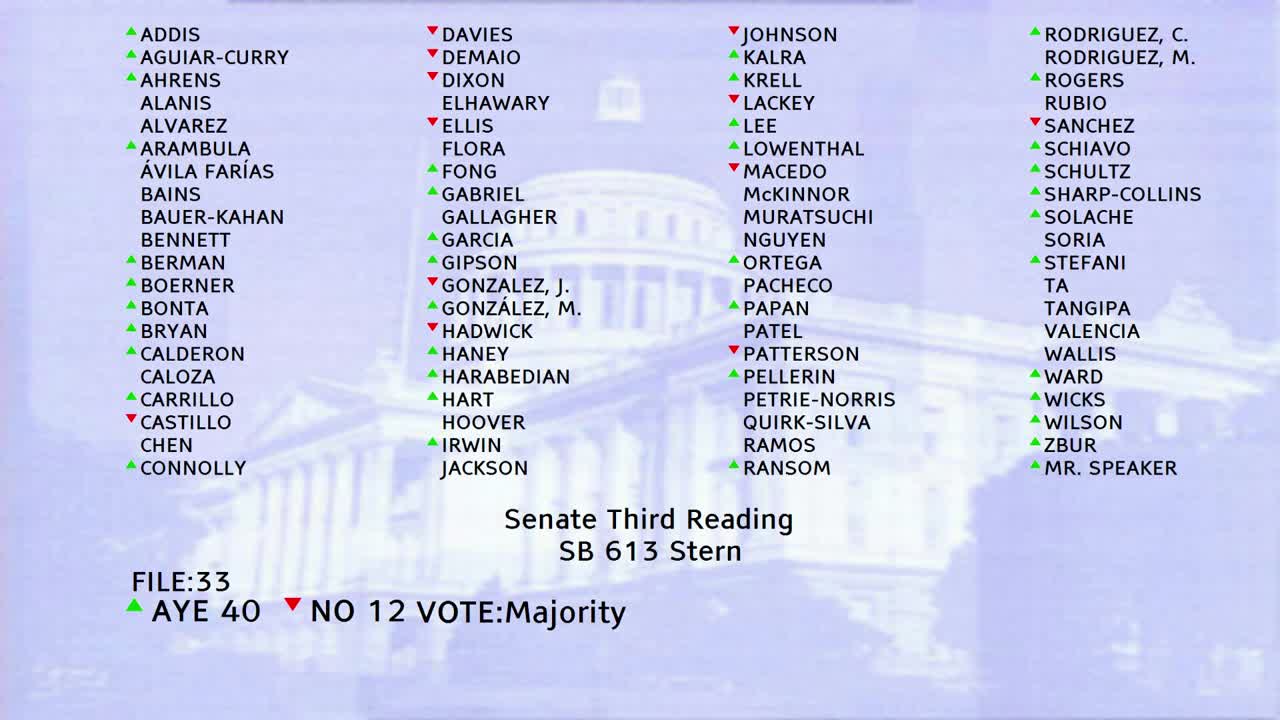 3MIN
Assembly Floor
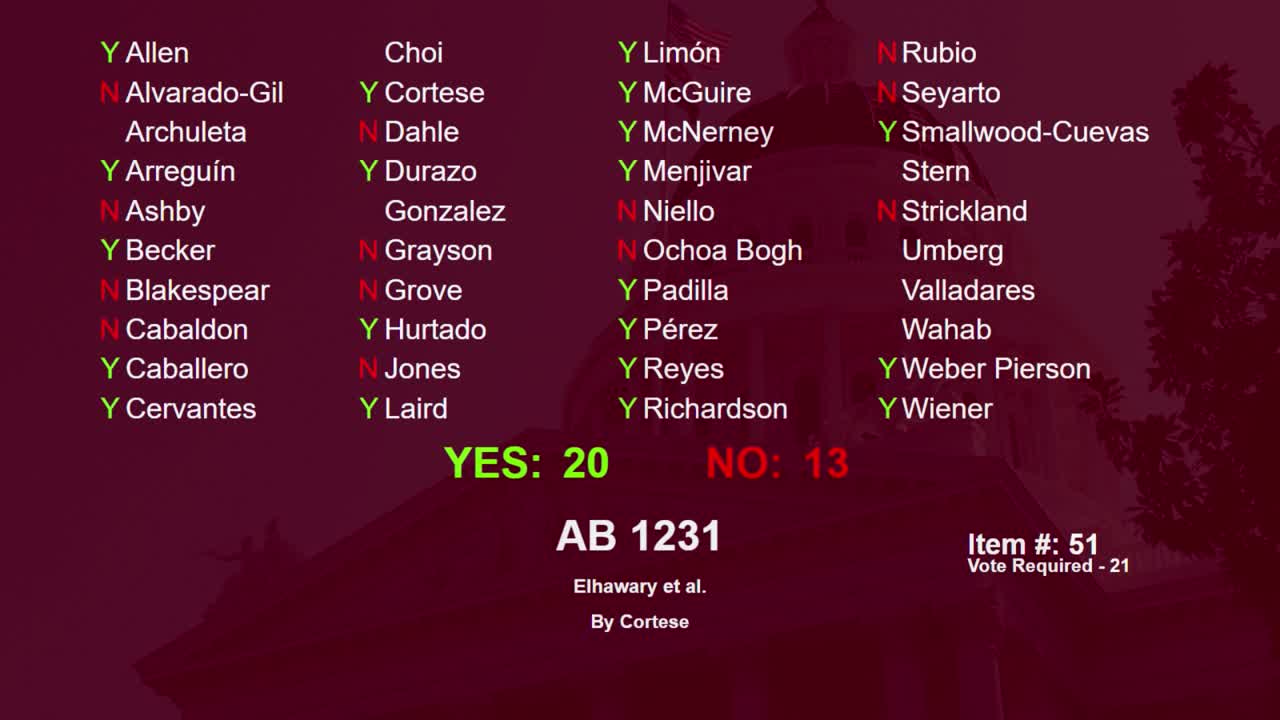 3MIN
Senate Floor
 6MIN
Assembly Standing Committee on Higher Education
 7MIN
Senate Standing Committee on Education
Bill Author

Bill Co-Author(s):