SB 747: Civil rights: deprivation of federal constitutional rights, privileges, and immunities.
- Session Year: 2025-2026
- House: Senate
- Latest Version Date: 2026-09-29
Current Status:
Passed
(2026-09-29: Chaptered by Secretary of State. Chapter 752, Statutes of 2026.)
Introduced
In Committee
Awaiting First Chamber Vote
Passed First Chamber
In Committee
Awaiting Second Chamber Vote
Passed Second Chamber
Enacted
Under existing law, the Tom Bane Civil Rights Act (act), if a person or persons, whether or not acting under color of law, interferes or attempts to interfere, by threats, intimidation, or coercion, with the exercise or enjoyment by any individual or individuals of rights secured by the Constitution or laws of the United States, or of the rights secured by the Constitution or laws of this state, the Attorney General, or any district attorney or city attorney, is authorized to bring a civil action for injunctive and other appropriate equitable relief in the name of the people of the State of California, in order to protect the exercise or enjoyment of the right or rights secured.
Under that act, an individual may also institute and prosecute in their own name and on their own behalf a civil action for damages, as described, for any resulting interference or attempt at interference of the individuals exercise or enjoyment of rights secured by the Constitution or laws of the United States or this state. The act authorizes the court to award the petitioner or plaintiff reasonable attorneys fees in addition to any damages, injunction, or other equitable relief awarded in these civil actions (attorneys fees authorization).
Existing federal law provides that every person who, under color of any statute, ordinance, regulation, custom, or usage, of any state, territory, or the District of Columbia, subjects or causes to be subjected any United States citizen or other person within the jurisdiction to the deprivation of any rights, privileges, or immunities secured by the Constitution and laws, is liable to the party injured in an action at law, suit in equity, or other proper proceeding for redress, except as provided.
This bill would also provide that every natural person, as defined, who, under color of any law, statute, ordinance, regulation, custom, or usage, as defined, subjects or causes to be subjected any citizen of this state or any person within the jurisdiction thereof to the deprivation of any rights, privileges, or immunities secured by the United States Constitution, shall be liable to the party injured in an action at law, suit in equity, or other proper proceeding for redress, except as specified. The bill would apply the aforementioned attorneys fees authorization, except as specified, to any action brought under these provisions. The bill would authorize a court, in its discretion, to also award costs, except as specified, to the prevailing plaintiff in any action brought under these provisions.
This bill would authorize a defendant in an action brought under these provisions to assert and receive the benefit of a defense of absolute or qualified immunity only to the same extent as a person sued under certain federal provisions under like circumstances, as specified, and would specify that nothing in these provisions is to be construed to waive or abrogate any defense of sovereign immunity otherwise available to a party, as specified. The bill would prohibit any civil action brought under these provisions from being commenced later than 2 years after the date that the cause of action accrues. The bill would make its provisions severable. The bill would specify that these provisions apply retroactively to March 1, 2025, as provided.
This bill would declare the intent of the Legislature in enacting these provisions.
This bill would declare that it is to take effect immediately as an urgency statute.
Under existing law, the Tom Bane Civil Rights Act (act), if a person or persons, whether or not acting under color of law, interferes or attempts to interfere, by threats, intimidation, or coercion, with the exercise or enjoyment by any individual or individuals of rights secured by the Constitution or laws of the United States, or of the rights secured by the Constitution or laws of this state, the Attorney General, or any district attorney or city attorney, is authorized to bring a civil action for injunctive and other appropriate equitable relief in the name of the people of the State of California, in order to protect the exercise or enjoyment of the right or rights secured.
Under that act, an individual may also institute and prosecute in their own name and on their own behalf a civil action for damages, as described, for any resulting interference or attempt at interference of the individuals exercise or enjoyment of rights secured by the Constitution or laws of the United States or this state. That act requires the aforementioned actions to be filed in either the superior court for the county in which the conduct complained of occurred or in the superior court for the county in which a person whose conduct complained of resides or has their place of business (venue requirement). The act authorizes the court to award the petitioner or plaintiff reasonable attorneys fees in addition to any damages, injunction, or other equitable relief awarded in these civil actions (attorneys fees authorization).
Existing federal law provides that every person who, under color of any statute, ordinance, regulation, custom, or usage, of any state, territory, or the District of Columbia, subjects or causes to be subjected any United States citizen or other person within the jurisdiction to the deprivation of any rights, privileges, or immunities secured by the Constitution and laws, is liable to the party injured in an action at law, suit in equity, or other proper proceeding for redress, except as provided.
This bill would also provide that every natural person, as defined, who, under color of any law, statute, ordinance, regulation, custom, or usage, as defined, subjects or causes to be subjected any citizen of this state or any person within the jurisdiction thereof to the deprivation of any rights, privileges, or immunities secured by the United States Constitution, shall be liable to the party injured in an action at law, suit in equity, or other proper proceeding for redress, except as specified. The bill would apply the aforementioned venue requirement and attorneys fees authorization, except as specified, to any action brought under these provisions. The bill would authorize a court, in its discretion, to also award costs, except as specified, and expert fees to the prevailing plaintiff in any action brought under these provisions.
This bill would authorize a defendant in an action brought under these provisions to assert assert and receive the benefit of a defense of absolute or qualified immunity only to the same extent as a person sued under certain federal provisions under like circumstances, as specified, and would specify that nothing in these provisions is to be construed to waive or abrogate any defense of sovereign immunity otherwise available to a party, as specified. The bill would prohibit any civil action brought under these provisions from being commenced later than 2 years after the date that the cause of action accrues. The bill would make its provisions severable. The bill would specify that these provisions apply retroactively to March 1, 2025, as provided.
This bill would declare the intent of the Legislature in enacting these provisions.
This bill would declare that it is to take effect immediately as an urgency statute.
Under existing law, the Tom Bane Civil Rights Act (act), if a person or persons, whether or not acting under color of law, interferes or attempts to interfere, by threats, intimidation, or coercion, with the exercise or enjoyment by any individual or individuals of rights secured by the Constitution or laws of the United States, or of the rights secured by the Constitution or laws of this state, the Attorney General, or any district attorney or city attorney, is authorized to bring a civil action for injunctive and other appropriate equitable relief in the name of the people of the State of California, in order to protect the exercise or enjoyment of the right or rights secured.
Under that act, an individual may also institute and prosecute in their own name and on their own behalf a civil action for damages, as described, for any resulting interference or attempt at interference of the individuals exercise or enjoyment of rights secured by the Constitution or laws of the United States or this state. That act requires the aforementioned actions to be filed in either the superior court for the county in which the conduct complained of occurred or in the superior court for the county in which a person whose conduct complained of resides or has their place of business (venue requirement). The act authorizes the court to award the petitioner or plaintiff reasonable attorneys fees in addition to any damages, injunction, or other equitable relief awarded in these civil actions (attorneys fees authorization).
Existing federal law provides that every person who, under color of any statute, ordinance, regulation, custom, or usage, of any state, territory, or the District of Columbia, subjects or causes to be subjected any United States citizen or other person within the jurisdiction to the deprivation of any rights, privileges, or immunities secured by the Constitution and laws, is liable to the party injured in an action at law, suit in equity, or other proper proceeding for redress, except as provided.
This bill would also provide that every natural person, as defined, who, under color of any law, statute, ordinance, regulation, custom, or usage, as defined, subjects or causes to be subjected any citizen of this state or any person within the jurisdiction thereof to the deprivation of any rights, privileges, or immunities secured by the United States Constitution, shall be liable to the party injured in an action at law, suit in equity, or other proper proceeding for redress, except as specified. The bill would apply the aforementioned venue requirement and attorneys fees authorization, except as specified, to any action brought under these provisions. The bill would authorize a court, in its discretion, to also award costs, except as specified, and expert fees to the prevailing plaintiff in any action brought under these provisions.
This bill would authorize a defendant in an action brought under these provisions to assert a defense of absolute or qualified immunity to the same extent as a person sued under certain federal provisions under like circumstances, as specified, and would specify that nothing in these provisions is to be construed to waive or abrogate any defense of sovereign immunity otherwise available to a party, as specified. The bill would prohibit any civil action brought under these provisions from being commenced later than 2 years after the date that the cause of action accrues. The bill would make its provisions severable. The bill would specify that these provisions apply retroactively to March 1, 2025, as provided.
This bill would declare that it is to take effect immediately as an urgency statute.
Under existing law, the Tom Bane Civil Rights Act (act), if a person or persons, whether or not acting under color of law, interferes or attempts to interfere, by threats, intimidation, or coercion, with the exercise or enjoyment by any individual or individuals of rights secured by the Constitution or laws of the United States, or of the rights secured by the Constitution or laws of this state, the Attorney General, or any district attorney or city attorney, is authorized to bring a civil action for injunctive and other appropriate equitable relief in the name of the people of the State of California, in order to protect the exercise or enjoyment of the right or rights secured.
Under that act, an individual may also institute and prosecute in their own name and on their own behalf a civil action for damages, as described, for any resulting interference or attempt at interference of the individuals exercise or enjoyment of rights secured by the Constitution or laws of the United States or this state. That act requires the aforementioned actions to be filed in either the superior court for the county in which the conduct complained of occurred or in the superior court for the county in which a person whose conduct complained of resides or has their place of business (venue requirement). The act authorizes the court to award the petitioner or plaintiff reasonable attorneys fees in addition to any damages, injunction, or other equitable relief awarded in these civil actions (attorneys fees authorization).
Existing federal law provides that every person who, under color of any statute, ordinance, regulation, custom, or usage, of any state, territory, or the District of Columbia, subjects or causes to be subjected any United States citizen or other person within the jurisdiction to the deprivation of any rights, privileges, or immunities secured by the Constitution and laws, is liable to the party injured in an action at law, suit in equity, or other proper proceeding for redress, except as provided.
This bill would also provide that every person natural person, as defined, who, under color of any law, statute, ordinance, regulation, custom, or usage, as defined, subjects or causes to be subjected any citizen of this state or any person within the jurisdiction thereof to the deprivation of any rights, privileges, or immunities secured by the United States Constitution, shall be liable to the party injured in an action at law, suit in equity, or other proper proceeding for redress, except as specified. The bill would apply the aforementioned venue requirement and attorneys fees authorization, except as specified, to any action brought under these provisions. The bill would authorize a court, in its discretion, to also award costs, except as specified, and expert fees to the prevailing plaintiff in any action brought under these provisions.
This bill would authorize a defendant in an action brought under these provisions to assert a defense of absolute or qualified immunity to the same extent as a person sued under certain federal provisions under like circumstances, as specified, and would specify that nothing in these provisions is to be construed to waive or abrogate any defense of sovereign immunity otherwise available to a party, as specified. The bill would prohibit any civil action brought under these provisions from being commenced later than 2 years after the date that the cause of action accrues. The bill would make its provisions severable. The bill would specify that these provisions apply retroactively to March 1, 2025, as provided.
Under existing law, the Tom Bane Civil Rights Act (act), if a person or persons, whether or not acting under color of law, interferes or attempts to interfere, by threats, intimidation, or coercion, with the exercise or enjoyment by any individual or individuals of rights secured by the Constitution or laws of the United States, or of the rights secured by the Constitution or laws of this state, the Attorney General, or any district attorney or city attorney, is authorized to bring a civil action for injunctive and other appropriate equitable relief in the name of the people of the State of California, in order to protect the exercise or enjoyment of the right or rights secured.
Under that act, an individual may also institute and prosecute in their own name and on their own behalf a civil action for damages, as described, for any resulting interference or attempt at interference of the individuals exercise or enjoyment of rights secured by the Constitution or laws of the United States or this state. That act requires the aforementioned actions to be filed in either the superior court for the county in which the conduct complained of occurred or in the superior court for the county in which a person whose conduct complained of resides or has their place of business (venue requirement). The act authorizes the court to award the petitioner or plaintiff reasonable attorneys fees in addition to any damages, injunction, or other equitable relief awarded in these civil actions (attorneys fees authorization).
Existing federal law provides that every person who, under color of any statute, ordinance, regulation, custom, or usage, of any state, territory, or the District of Columbia, subjects or causes to be subjected any United States citizen or other person within the jurisdiction to the deprivation of any rights, privileges, or immunities secured by the Constitution and laws, is liable to the party injured in an action at law, suit in equity, or other proper proceeding for redress, except as provided.
This bill would also provide that every person who, under color of any law, statute, ordinance, regulation, custom, or usage, as defined, subjects or causes to be subjected any citizen of this state or any person within the jurisdiction thereof to the deprivation of any rights, privileges, or immunities secured by the United States Constitution, shall be liable to the party injured in an action at law, suit in equity, or other proper proceeding for redress, except as specified. The bill would apply the aforementioned venue requirement and attorneys fees authorization, except as specified, to any action brought under these provisions. The bill would authorize a court, in its discretion, to also award costs, except as specified, and expert fees to the prevailing plaintiff in any action brought under these provisions.
TheThis bill would authorize a defendant in an action brought under these provisions to assert a defense of absolute or qualified immunity to the same extent as a person sued under certain federal provisions under like circumstances, as specified, and would specify that nothing in these provisions is to be construed to waive or abrogate any defense of sovereign immunity otherwise available to a party, as specified. The bill would prohibit any civil action brought under these provisions from being commenced later than 2 years after the date that the cause of action accrues. The bill would make its provisions severable. The bill would specify that these provisions apply retroactively to March 1, 2025. 2025, as provided.
This bill would declare that it is to take effect immediately as an urgency statute.Under existing law, the Tom Bane Civil Rights Act (act), if a person or persons, whether or not acting under color of law, interferes or attempts to interfere, by threats, intimidation, or coercion, with the exercise or enjoyment by any individual or individuals of rights secured by the Constitution or laws of the United States, or of the rights secured by the Constitution or laws of this state, the Attorney General, or any district attorney or city attorney, is authorized to bring a civil action for injunctive and other appropriate equitable relief in the name of the people of the State of California, in order to protect the exercise or enjoyment of the right or rights secured.
Under that act, an individual may also institute and prosecute in their own name and on their own behalf a civil action for damages, as described, for any resulting interference or attempt at interference of the individuals exercise or enjoyment of rights secured by the Constitution or laws of the United States or this state. That act requires the aforementioned actions to be filed in either the superior court for the county in which the conduct complained of occurred or in the superior court for the county in which a person whose conduct complained of resides or has their place of business (venue requirement). The act authorizes the court to award the petitioner or plaintiff reasonable attorneys fees in addition to any damages, injunction, or other equitable relief awarded in these civil actions (attorneys fees authorization).
Existing federal law provides that every person who, under color of any statute, ordinance, regulation, custom, or usage, of any state, territory, or the District of Columbia, subjects or causes to be subjected any United States citizen or other person within the jurisdiction to the deprivation of any rights, privileges, or immunities secured by the Constitution and laws, is liable to the party injured in an action at law, suit in equity, or other proper proceeding for redress, except as provided.
This bill would also provide that every person who, under color of any law, statute, ordinance, regulation, custom, or usage, as defined, subjects or causes to be subjected any citizen of this state or any person within the jurisdiction thereof to the deprivation of any rights, privileges, or immunities secured by the United States Constitution, shall be liable to the party injured in an action at law, suit in equity, or other proper proceeding for redress, except as specified. The bill would apply the aforementioned venue requirement and attorneys fees authorization, except as specified, to any action brought under these provisions. The bill would authorize a court, in its discretion, to also award costs, except as specified, and expert fees to the prevailing plaintiff in any action brought under these provisions.
The bill would authorize a defendant in an action brought under these provisions to assert a defense of absolute or qualified immunity to the same extent as a person sued under certain federal provisions under like circumstances, as specified, and would specify that nothing in these provisions is to be construed to waive or abrogate any defense of sovereign immunity otherwise available to a party, as specified. The bill would prohibit any civil action brought under these provisions from being commenced later than 2 years after the date that the cause of action accrues. The bill would make its provisions severable. The bill would specify that these provisions apply retroactively to March 1, 2025.
This bill would declare that it is to take effect immediately as an urgency statute.
Under existing law, the Tom Bane Civil Rights Act (act), if a person or persons, whether or not acting under color of law, interferes or attempts to interfere, by threats, intimidation, or coercion, with the exercise or enjoyment by any individual or individuals of rights secured by the Constitution or laws of the United States, or of the rights secured by the Constitution or laws of this state, the Attorney General, or any district attorney or city attorney, is authorized to bring a civil action for injunctive and other appropriate equitable relief in the name of the people of the State of California, in order to protect the exercise or enjoyment of the right or rights secured.Under that act, an individual may also institute and prosecute in their own name and on their own behalf a civil action for damages, as described, for any resulting interference or attempt at interference of the individuals exercise or enjoyment of rights secured by the Constitution or laws of the United States or this state. The act authorizes the court to award the petitioner or plaintiff reasonable attorneys fees in addition to any damages, injunction, or other equitable relief awarded in these civil actions (attorneys fees authorization).That act requires the aforementioned actions to be filed in either the superior court for the county in which the conduct complained of occurred or in the superior court for the county in which a person whose conduct complained of resides or has their place of business (venue requirement). If a court issues a temporary restraining order or a preliminary or permanent injunction in the aforementioned actions, the act also requires a specified statement to be included in any order requiring a defendant to refrain from conduct or activities (order requirement).Existing federal law provides that every person who, under color of any statute, ordinance, regulation, custom, or usage, of any state, territory, or the District of Columbia, subjects or causes to be subjected any United States citizen or other person within the jurisdiction to the deprivation of any rights, privileges, or immunities secured by the Constitution and laws, is liable to the party injured in an action at law, suit in equity, or other proper proceeding for redress, except as provided.This bill would also provide that every person who, under color of any statute, ordinance, regulation, custom, or usage of the United States or this state, subjects or causes to be subjected any citizen of this state or other person within the jurisdiction thereof to the deprivation of any rights, privileges, or immunities secured by the United States Constitution, shall be liable to the party injured in an action at law, suit in equity, or other proper proceeding for redress. The bill would apply the aforementioned venue and order requirements and attorneys fees authorization to actions under this provision. The bill would make its provisions severable.This bill would declare that it is to take effect immediately as an urgency statute.Under existing law, the Tom Bane Civil Rights Act (act), if a person or persons, whether or not acting under color of law, interferes or attempts to interfere, by threats, intimidation, or coercion, with the exercise or enjoyment by any individual or individuals of rights secured by the Constitution or laws of the United States, or of the rights secured by the Constitution or laws of this state, the Attorney General, or any district attorney or city attorney, is authorized to bring a civil action for injunctive and other appropriate equitable relief in the name of the people of the State of California, in order to protect the exercise or enjoyment of the right or rights secured.
Under that act, an individual may also institute and prosecute in their own name and on their own behalf a civil action for damages, as described, for any resulting interference or attempt at interference of the individuals exercise or enjoyment of rights secured by the Constitution or laws of the United States or this state. The act authorizes the court to award the petitioner or plaintiff reasonable attorneys fees in addition to any damages, injunction, or other equitable relief awarded in these civil actions (attorneys fees authorization).
That act requires the aforementioned actions to be filed in either the superior court for the county in which the conduct complained of occurred or in the superior court for the county in which a person whose conduct complained of resides or has their place of business (venue requirement). If a court issues a temporary restraining order or a preliminary or permanent injunction in the aforementioned actions, the act also requires a specified statement to be included in any order requiring a defendant to refrain from conduct or activities (order requirement).
Existing federal law provides that every person who, under color of any statute, ordinance, regulation, custom, or usage, of any state, territory, or the District of Columbia, subjects or causes to be subjected any United States citizen or other person within the jurisdiction to the deprivation of any rights, privileges, or immunities secured by the Constitution and laws, is liable to the party injured in an action at law, suit in equity, or other proper proceeding for redress, except as provided.
This bill would also provide that every person who, under color of any statute, ordinance, regulation, custom, or usage of the United States or this state, subjects or causes to be subjected any citizen of this state or other person within the jurisdiction thereof to the deprivation of any rights, privileges, or immunities secured by the United States Constitution, shall be liable to the party injured in an action at law, suit in equity, or other proper proceeding for redress. The bill would apply the aforementioned venue and order requirements and attorneys fees authorization to actions under this provision. The bill would make its provisions severable.
This bill would declare that it is to take effect immediately as an urgency statute.
Existing law establishes the Department of Industrial Relations within the Labor and Workforce Development Agency and sets forth the functions of the department, which include, among others, fostering, promoting, and developing the welfare of the wage earners of California and improving their working conditions. Existing law establishes within the department the Division of Labor Standards Enforcement, headed by the Labor Commissioner, for the purposes of enforcing labor laws. Existing law prohibits an employer from paying any of its employees at wage rates less than the rates paid to employees of the opposite sex for substantially similar work, when viewed as a composite of skill, effort, and responsibility, and performed under similar working conditions, unless the employer demonstrates that one or more specific factors, reasonably applied, account for the entire wage differential. Existing law also similarly prohibits an employer from paying any of its employees at wage rates less than the rates paid to employees of another race or ethnicity for substantially similar work. Under existing law, a violation of the laws relating to payment of wages, hours, and working conditions is a misdemeanor. This bill would require a covered employer to report to the department the compensation it provides to behavioral health employees and to medical-surgical employees. The bill would authorize the department, if it does not receive a report from a covered employer pursuant to these provisions, to seek an order requiring the employer to comply with the requirement and would entitle the department to recover the costs associated with seeking the order. The bill would authorize a court, upon request by the department, to impose a civil penalty, as prescribed.The bill would require any data regarding the compensation of behavioral health employees and medical-surgical employees reported by a covered employer to be exclusively available to certain departments, including the department, and to be confidential and not made publicly available. The bill would, notwithstanding that provision, require the department to consult with certain departments, including the Department of Health Care Access and Information, regarding the data, and thereafter to, among other things, incorporate the data into a report that identifies any compensation disparities between behavioral health employees and similarly situated medical-surgical employees. The bill would require the department, on or before January 1, 2027, to submit the above-described report to the Legislature, as specified. The bill would specify that a violation of its provisions does not constitute a misdemeanor, and would define various terms for these purposes.Existing constitutional provisions require that a statute that limits the right of access to the meetings of public bodies or the writings of public officials and agencies be adopted with findings demonstrating the interest protected by the limitation and the need for protecting that interest.This bill would make legislative findings to that effect.Existing law establishes the Department of Industrial Relations within the Labor and Workforce Development Agency and sets forth the functions of the department, which include, among others, fostering, promoting, and developing the welfare of the wage earners of California and improving their working conditions. Existing law establishes within the department the Division of Labor Standards Enforcement, headed by the Labor Commissioner, for the purposes of enforcing labor laws.
Existing law prohibits an employer from paying any of its employees at wage rates less than the rates paid to employees of the opposite sex for substantially similar work, when viewed as a composite of skill, effort, and responsibility, and performed under similar working conditions, unless the employer demonstrates that one or more specific factors, reasonably applied, account for the entire wage differential. Existing law also similarly prohibits an employer from paying any of its employees at wage rates less than the rates paid to employees of another race or ethnicity for substantially similar work. Under existing law, a violation of the laws relating to payment of wages, hours, and working conditions is a misdemeanor.
This bill would require a covered employer, as defined, employer to report to the department the compensation it provides to behavioral health employees and to medical-surgical employees. The bill would authorize the department, if it does not receive a report from a covered employer pursuant to these provisions, to seek an order requiring the employer to comply with the requirement and would entitle the department to recover the costs associated with seeking the order. The bill would authorize a court, upon request by the department, to impose a civil penalty, as prescribed, and prescribed.
The bill would require any data regarding the compensation of behavioral health employees and medical-surgical employees reported by a covered employer to be exclusively available to certain departments, including the department, and to be confidential and not made publicly available. The bill would, notwithstanding that provision, require the department to consult with certain departments, including the Department of Health Care Access and Information, regarding the data, and thereafter to, among other things, incorporate the data into a report that identifies any compensation disparities between behavioral health employees and similarly situated medical-surgical employees. The bill would require the department, on or before January 1, 2027, to submit the above-described report to the Legislature, as specified.
The bill would specify that a violation of the above-described reporting requirement its provisions does not constitute a misdemeanor. misdemeanor, and would define various terms for these purposes.
Existing constitutional provisions require that a statute that limits the right of access to the meetings of public bodies or the writings of public officials and agencies be adopted with findings demonstrating the interest protected by the limitation and the need for protecting that interest.
This bill would make legislative findings to that effect.
Existing law establishes the Department of Industrial Relations within the Labor and Workforce Development Agency and sets forth the functions of the department, which include, among others, fostering, promoting, and developing the welfare of the wage earners of California and improving their working conditions. Existing law establishes within the department the Division of Labor Standards Enforcement, headed by the Labor Commissioner, for the purposes of enforcing labor laws.
Existing law prohibits an employer from paying any of its employees at wage rates less than the rates paid to employees of the opposite sex for substantially similar work, when viewed as a composite of skill, effort, and responsibility, and performed under similar working conditions, unless the employer demonstrates that one or more specific factors, reasonably applied, account for the entire wage differential. Existing law also similarly prohibits an employer from paying any of its employees at wage rates less than the rates paid to employees of another race or ethnicity for substantially similar work. Under existing law, a violation of the laws relating to payment of wages, hours, and working conditions is a misdemeanor.
This bill would require a covered employer, as defined, to report to the department the compensation it provides to behavioral health employees and to medical-surgical employees. The bill would authorize the department, if it does not receive a report from a covered employer pursuant to these provisions, to seek an order requiring the employer to comply with the requirement and would entitle the department to recover the costs associated with seeking the order. The bill would authorize a court, upon request by the department, to impose a civil penalty, as prescribed, and would specify that a violation of the above-described reporting requirement does not constitute a misdemeanor.
Existing law requires a person who owns a vending machine to affix to the machine their name and address, as specified. If the person owns more than one vending machine located at the same place, existing law instead authorizes the person to post a clearly readable sign containing their name and address in a conspicuous location near the machines.This bill would authorize a person to post their telephone number, email address, or both, on the machine or in a conspicuous location, as may be appropriate.Existing law requires a person who owns a vending machine to affix to the machine their name and address, as specified. If the person owns more than one vending machine located at the same place, existing law instead authorizes the person to post a clearly readable sign containing their name and address in a conspicuous location near the machines.
This bill would authorize a person to post their telephone number, email address, or both, on the machine or in a conspicuous location, as may be appropriate.
(a)It is the intent of the Legislature that the cause of action created by subdivision (b) of Section 53.8 of the Civil Code, as added by this act, does not provide for any substantive rights Chapman v. Houston Welfare Rights Organization, 441 U.S. 600, 617 (1979). It is intended only to ensure that an individual had a cause of action for violations of the Constitution (Id.), and no other substantive law. Thus, [a]ll civil suits . . . which this [a]ct authorizes, are not based upon it (Id.), they are based on a persons rights under the Constitution of the United States.
(b)It is the intent of the Legislature that the defense of absolute or qualified immunity available under subdivision (c) of Section 53.8 of the Civil Code, as added by this act, to any defendant, including a federal, state, or local official, be identical to the defense available to a person sued under Section 1983 of Title 42 of the United States Code under like circumstances, and that the defense reflect future developments in the law of immunity under that section so that the defenses remain identical. However, nothing in this legislation is intended to alter or amend current statutory or decisional law regarding application of qualified or absolute immunity to any other provision of California law.
(c)It is the intent of the Legislature that nothing in this act is intended to alter or amend current statutory or decisional law regarding Section 52.1 of the Civil Code.
(d)The Legislature recognizes that a violation of the United States Constitution is an essential element of any action brought under Section 53.8 of the Civil Code, as added by this act, and that such actions therefore necessarily present questions of federal constitutional law. Nothing in this act shall be construed to limit, constrain, or weigh against the exercise of any right of removal that exists under federal law. This subdivision shall not be construed to express any intent of the Legislature respecting the proper forum for, or the removability of, any other action or proceeding brought under any other provision of California law. No inference regarding the states interest in the adjudication of any other action or proceeding in the courts of this state shall be drawn from this act.
SEC. 2.Section 53.8 is added to the Civil Code, to read:53.8.(a)This section shall be known, and may be cited, as the No Kings Act.
(b)Every natural person who, under color of any law, statute, ordinance, regulation, custom, or usage, subjects, or causes to be subjected, any citizen of this state or any person within the jurisdiction thereof to the deprivation of any rights, privileges, or immunities secured by the United States Constitution, shall be liable to the party injured in an action at law, suit in equity, or other proper proceeding for redress, except that in any action brought against a judicial officer for an act or omission taken in the officers judicial capacity, injunctive relief shall not be granted unless a declaratory decree was violated or declaratory relief was unavailable.
(c)(1)A defendant in an action brought under subdivision (b) may assert, and shall receive the benefit of, a defense of absolute or qualified immunity only to the same extent as a person sued under Section 1983 of Title 42 of the United States Code under like circumstances.
(2)Nothing in this section shall be construed to make a defense described in this subdivision broader or narrower than that defense would be if asserted under like circumstances in an action under Section 1983 of Title 42 of the United States Code.
(3)This subdivision applies only to proceedings brought under subdivision (b), and does not alter, amend, create, or support a qualified or absolute immunity defense, or any rule or decision governing such a defense, in any other action or proceeding brought under any other provision of California law.
(d)Nothing in this section shall be construed to waive or abrogate any defense of sovereign immunity otherwise available to a party. This subdivision applies only to proceedings brought under subdivision (b), and does not alter, amend, create, or support a sovereign immunity defense in any other action or proceeding brought under any other provision of California law.
(e)In any action or proceeding brought under this section, the court, in its discretion, may award a prevailing plaintiff reasonable attorneys fees and costs, except that in any action brought against a judicial officer for an act or omission taken in the officers judicial capacity, the officer shall not be held liable for any fees or costs, except if the officers action was clearly in excess of the officers jurisdiction.
(f)A civil action brought under subdivision (b) shall not be commenced later than two years after the date that the cause of action accrues.
(g)The provisions of this section are severable. If any provision of this section or its application is held invalid, that invalidity shall not affect other provisions or applications that can be given effect without the invalid provision or application.
(h)(1)This section shall apply retroactively to March 1, 2025, provided that, for any claim for a violation of the United States Constitution that occurred between March 1, 2025, and the effective date of this section, the only monetary damages that shall be available pursuant to this section for that constitutional violation are nominal and compensatory damages.
(2)(A)An action shall not be brought under this section by or on behalf of an injured party if, before the effective date of this section, a court of competent jurisdiction entered a final judgment on the merits determining either of the following:
(i)Whether the conduct complained of deprived that party of rights, privileges, or immunities secured by the United States Constitution.
(ii)The person whose conduct is complained of did not violate clearly established constitutional rights of which a reasonable person would have known at the time of the conduct complained of.
(B)For purposes of this paragraph, a judgment is not a judgment on the merits if it rested on the absence or unavailability of a cause of action or remedy for the alleged deprivation, rather than on a determination described in clause (i) or (ii) of subparagraph (A).
(3)Paragraph (2) supplements, and does not limit or displace, any otherwise applicable law governing claim or issue preclusion.
(i)For purposes of this section, both of the following definitions apply:
(1)Color of any law, statute, ordinance, regulation, custom, or usage includes color of any statute, ordinance, regulation, custom, or usage, of the United States and of any state or territory or the District of Columbia.
(2) Natural person does not include a federal, state, or local official who is sued in their official capacity for monetary relief.
SEC. 3.The provisions of this act are severable. If any provision of this act or its application is held invalid, that invalidity shall not affect other provisions or applications that can be given effect without the invalid provision or application.
SEC. 4.This act is an urgency statute necessary for the immediate preservation of the public peace, health, or safety within the meaning of Article IV of the California Constitution and shall go into immediate effect. The facts constituting the necessity are:
In order to provide sufficient redress for the infringement of the civil liberties of all persons in the state as soon as possible, it is necessary for this act to take effect immediately.
(a)It is the intent of the Legislature that the cause of action created by subdivision (b) of Section 53.8 of the Civil Code, as added by this act, does not provide for any substantive rights Chapman v. Houston Welfare Rights Organization, 441 U.S. 600, 617 (1979). It is intended only to ensure that an individual had a cause of action for violations of the Constitution (Id.), and no other substantive law. Thus, [a]ll civil suits . . . which this [a]ct authorizes, are not based upon it (Id.), they are based on a persons rights under the Constitution of the United States.
(b)It is the intent of the Legislature that the defense of absolute or qualified immunity available under subdivision (c) of Section 53.8 of the Civil Code, as added by this act, to any defendant, including a federal, state, or local official, be identical to the defense available to a person sued under Section 1983 of Title 42 of the United States Code under like circumstances, and that the defense reflect future developments in the law of immunity under that section so that the defenses remain identical. However, nothing in this legislation is intended to alter or amend current statutory or decisional law regarding application of qualified or absolute immunity to any other provision of California law.
(c)It is the intent of the Legislature that nothing in this act is intended to alter or amend current statutory or decisional law regarding Section 52.1 of the Civil Code.
(d)The Legislature recognizes that a violation of the United States Constitution is an essential element of any action brought under Section 53.8 of the Civil Code, as added by this act, and that such actions therefore necessarily present questions of federal constitutional law. Nothing in this act shall be construed to limit, constrain, or weigh against the exercise of any right of removal that exists under federal law. This subdivision shall not be construed to express any intent of the Legislature respecting the proper forum for, or the removability of, any other action or proceeding brought under any other provision of California law. No inference regarding the states interest in the adjudication of any other action or proceeding in the courts of this state shall be drawn from this act.
SECTION 1.SEC. 2.Section 53.8 is added to the Civil Code, to read:53.8.(a)This section shall be known, and may be cited, as the No Kings Act.
(b)Every natural person who, under color of any law, statute, ordinance, regulation, custom, or usage, subjects, or causes to be subjected, any citizen of this state or any person within the jurisdiction thereof to the deprivation of any rights, privileges, or immunities secured by the United States Constitution, shall be liable to the party injured in an action at law, suit in equity, or other proper proceeding for redress, except that in any action brought against a judicial officer for an act or omission taken in the officers judicial capacity, injunctive relief shall not be granted unless a declaratory decree was violated or declaratory relief was unavailable.
(c)An action brought pursuant to subdivision (b) may be filed either in the superior court for the county in which the conduct complained of occurred or in the superior court for the county in which a natural person whose conduct complained of resides or has their place of business.(d)A defendant in an action brought under subdivision (b) may assert a defense of absolute or qualified immunity to the same extent as a person sued under Section 1983 of Title 42 of the United States Code under like circumstances. This subdivision applies only to proceedings brought under subdivision (b), and does not alter, amend, create, or support a qualified or absolute immunity defense in any other action or proceeding brought under any other provision of California law.(c)(1)A defendant in an action brought under subdivision (b) may assert, and shall receive the benefit of, a defense of absolute or qualified immunity only to the same extent as a person sued under Section 1983 of Title 42 of the United States Code under like circumstances.
(2)Nothing in this section shall be construed to make a defense described in this subdivision broader or narrower than that defense would be if asserted under like circumstances in an action under Section 1983 of Title 42 of the United States Code.
(3)This subdivision applies only to proceedings brought under subdivision (b), and does not alter, amend, create, or support a qualified or absolute immunity defense, or any rule or decision governing such a defense, in any other action or proceeding brought under any other provision of California law.
(e)(d)Nothing in this section shall be construed to waive or abrogate any defense of sovereign immunity otherwise available to a party. This subdivision applies only to proceedings brought under subdivision (b), and does not alter, amend, create, or support a sovereign immunity defense in any other action or proceeding brought under any other provision of California law.
(f)(e)In any action or proceeding brought under this section, the court, in its discretion, may award a prevailing plaintiff reasonable attorneys fees and costs, except that in any action brought against a judicial officer for an act or omission taken in the officers judicial capacity, the officer shall not be held liable for any fees or costs, except if the officers action was clearly in excess of the officers jurisdiction. In any action or proceeding brought under this section, the court, in its discretion, may award expert fees to the prevailing plaintiff.
(g)(f)A civil action brought under subdivision (b) shall not be commenced later than two years after the date that the cause of action accrues.
(h)(g)The provisions of this section are severable. If any provision of this section or its application is held invalid, that invalidity shall not affect other provisions or applications that can be given effect without the invalid provision or application.
(i)This section shall apply retroactively to March 1, 2025, provided that, for any claim for a violation of the United States Constitution that occurred between March 1, 2025, and the effective date of this section, the only monetary damages that shall be available pursuant to this section for that constitutional violation are nominal and compensatory damages.(h)(1)This section shall apply retroactively to March 1, 2025, provided that, for any claim for a violation of the United States Constitution that occurred between March 1, 2025, and the effective date of this section, the only monetary damages that shall be available pursuant to this section for that constitutional violation are nominal and compensatory damages.
(2)(A)An action shall not be brought under this section by or on behalf of an injured party if, before the effective date of this section, a court of competent jurisdiction entered a final judgment on the merits determining either of the following:
(i)Whether the conduct complained of deprived that party of rights, privileges, or immunities secured by the United States Constitution.
(ii)The person whose conduct is complained of did not violate clearly established constitutional rights of which a reasonable person would have known at the time of the conduct complained of.
(B)For purposes of this paragraph, a judgment is not a judgment on the merits if it rested on the absence or unavailability of a cause of action or remedy for the alleged deprivation, rather than on a determination described in clause (i) or (ii) of subparagraph (A).
(3)Paragraph (2) supplements, and does not limit or displace, any otherwise applicable law governing claim or issue preclusion.
(j)(i)For purposes of this section, both of the following definitions apply:
(1)Color of any law, statute, ordinance, regulation, custom, or usage includes color of any statute, ordinance, regulation, custom, or usage, of the United States and of any state or territory or the District of Columbia.
(2) Natural person does not include a federal, state, or local official who is sued in their official capacity for monetary relief.
SEC. 3.The provisions of this act are severable. If any provision of this act or its application is held invalid, that invalidity shall not affect other provisions or applications that can be given effect without the invalid provision or application.
SEC. 2.SEC. 4.This act is an urgency statute necessary for the immediate preservation of the public peace, health, or safety within the meaning of Article IV of the California Constitution and shall go into immediate effect. The facts constituting the necessity are:
In order to provide sufficient redress for the infringement of the civil liberties of all persons in the state as soon as possible, it is necessary for this act to take effect immediately.
(a)This section shall be known, and may be cited, as the No Kings Act.
(b)Every natural person who, under color of any law, statute, ordinance, regulation, custom, or usage, subjects, or causes to be subjected, any citizen of this state or any person within the jurisdiction thereof to the deprivation of any rights, privileges, or immunities secured by the United States Constitution, shall be liable to the party injured in an action at law, suit in equity, or other proper proceeding for redress, except that in any action brought against a judicial officer for an act or omission taken in the officers judicial capacity, injunctive relief shall not be granted unless a declaratory decree was violated or declaratory relief was unavailable.
(c)An action brought pursuant to subdivision (b) may be filed either in the superior court for the county in which the conduct complained of occurred or in the superior court for the county in which a natural person whose conduct complained of resides or has their place of business.
(d)A defendant in an action brought under subdivision (b) may assert a defense of absolute or qualified immunity to the same extent as a person sued under Section 1983 of Title 42 of the United States Code under like circumstances. This subdivision applies only to proceedings brought under subdivision (b), and does not alter, amend, create, or support a qualified or absolute immunity defense in any other action or proceeding brought under any other provision of California law.
(e)Nothing in this section shall be construed to waive or abrogate any defense of sovereign immunity otherwise available to a party. This subdivision applies only to proceedings brought under subdivision (b), and does not alter, amend, create, or support a sovereign immunity defense in any other action or proceeding brought under any other provision of California law.
(f)In any action or proceeding brought under this section, the court, in its discretion, may award a prevailing plaintiff reasonable attorneys fees and costs, except that in any action brought against a judicial officer for an act or omission taken in the officers judicial capacity, the officer shall not be held liable for any fees or costs, except if the officers action was clearly in excess of the officers jurisdiction. In any action or proceeding brought under this section, the court, in its discretion, may award expert fees to the prevailing plaintiff.
(g)A civil action brought under subdivision (b) shall not be commenced later than two years after the date that the cause of action accrues.
(h)The provisions of this section are severable. If any provision of this section or its application is held invalid, that invalidity shall not affect other provisions or applications that can be given effect without the invalid provision or application.
(i)This section shall apply retroactively to March 1, 2025, provided that, for any claim for a violation of the United States Constitution that occurred between March 1, 2025, and the effective date of this section, the only monetary damages that shall be available pursuant to this section for that constitutional violation are nominal and compensatory damages.
(j)For purposes of this section, both of the following definitions apply:
(1)Color of any law, statute, ordinance, regulation, custom, or usage includes color of any statute, ordinance, regulation, custom, or usage, of the United States and of any state or territory or the District of Columbia.
(2) Natural person does not include a federal, state, or local official who is sued in their official capacity for monetary relief.
SEC. 2.This act is an urgency statute necessary for the immediate preservation of the public peace, health, or safety within the meaning of Article IV of the California Constitution and shall go into immediate effect. The facts constituting the necessity are:
In order to provide sufficient redress for the infringement of the civil liberties of all persons in the state as soon as possible, it is necessary for this act to take effect immediately.
(a)This section shall be known, and may be cited, as the No Kings Act.
(b)Every natural person who, under color of any law, statute, ordinance, regulation, custom, or usage, subjects, or causes to be subjected, any citizen of this state or any person within the jurisdiction thereof to the deprivation of any rights, privileges, or immunities secured by the United States Constitution, shall be liable to the party injured in an action at law, suit in equity, or other proper proceeding for redress, except that in any action brought against a judicial officer for an act or omission taken in the officers judicial capacity, injunctive relief shall not be granted unless a declaratory decree was violated or declaratory relief was unavailable.
(c)An action brought pursuant to subdivision (b) may be filed either in the superior court for the county in which the conduct complained of occurred or in the superior court for the county in which a natural person whose conduct complained of resides or has their place of business.
(d)A defendant in an action brought under subdivision (b) may assert a defense of absolute or qualified immunity to the same extent as a person sued under Section 1983 of Title 42 of the United States Code under like circumstances. This subdivision applies only to proceedings brought under subdivision (b), and does not alter, amend, create, or support a qualified or absolute immunity defense in any other action or proceeding brought under any other provision of California law.
(e)Nothing in this section shall be construed to waive or abrogate any defense of sovereign immunity otherwise available to a party. This subdivision applies only to proceedings brought under subdivision (b), and does not alter, amend, create, or support a sovereign immunity defense in any other action or proceeding brought under any other provision of California law.
(f)In any action or proceeding brought under this section, the court, in its discretion, may award a prevailing plaintiff reasonable attorneys fees and costs, except that in any action brought against a judicial officer for an act or omission taken in the officers judicial capacity, the officer shall not be held liable for any fees or costs, except if the officers action was clearly in excess of the officers jurisdiction. In any action or proceeding brought under this section, the court, in its discretion, may award expert fees to the prevailing plaintiff.
(g)A civil action brought under subdivision (b) shall not be commenced later than two years after the date that the cause of action accrues.
(h)The provisions of this section are severable. If any provision of this section or its application is held invalid, that invalidity shall not affect other provisions or applications that can be given effect without the invalid provision or application.
(i)This section shall apply retroactively to March 1, 2025, provided that, for any claim for a violation of the United States Constitution that occurred between March 1, 2025, and the effective date of this section, the only monetary damages that shall be available pursuant to this section for that constitutional violation are nominal and compensatory damages.
(j)For purposes of this section, color both of the following definitions apply:
(1)Color of any law, statute, ordinance, regulation, custom, or usage includes color of any statute, ordinance, regulation, custom, or usage, of the United States and of any state or territory or the District of Columbia.
(2) Natural person does not include a federal, state, or local official who is sued in their official capacity for monetary relief.
(a)This section shall be known, and may be cited, as the No Kings Act.
(b)Every person who, under color of any law, statute, ordinance, regulation, custom, or usage, subjects, or causes to be subjected, any citizen of this state or any person within the jurisdiction thereof to the deprivation of any rights, privileges, or immunities secured by the United States Constitution, shall be liable to the party injured in an action at law, suit in equity, or other proper proceeding for redress, except that in any action brought against a judicial officer for an act or omission taken in the officers judicial capacity, injunctive relief shall not be granted unless a declaratory decree was violated or declaratory relief was unavailable.
(c)An action brought pursuant to subdivision (b) may be filed either in the superior court for the county in which the conduct complained of occurred or in the superior court for the county in which a person whose conduct complained of resides or has their place of business.
(d)A defendant in an action brought under subdivision (b) may assert a defense of absolute or qualified immunity to the same extent as a person sued under Section 1983 of Title 42 of the United States Code under like circumstances. This subdivision applies only to proceedings brought under subdivision (b), and does not alter, amend, create, or support a qualified or absolute immunity defense in any other action or proceeding brought under any other provision of California law.
(e)Nothing in this section shall be construed to waive or abrogate any defense of sovereign immunity otherwise available to a party. This subdivision applies only to proceedings brought under subdivision (b), and does not alter, amend, create, or support a sovereign immunity defense in any other action or proceeding brought under any other provision of California law.
(f)In any action or proceeding brought under this section, the court, in its discretion, may award a prevailing plaintiff reasonable attorneys fees and costs, except that in any action brought against a judicial officer for an act or omission taken in the officers judicial capacity, the officer shall not be held liable for any fees or costs, except if the officers action was clearly in excess of the officers jurisdiction. In any action or proceeding brought under this section, the court, in its discretion, may award expert fees to the prevailing plaintiff.
(g)A civil action brought under subdivision (b) shall not be commenced later than two years after the date that the cause of action accrues.
(h)The provisions of this section are severable. If any provision of this section or its application is held invalid, that invalidity shall not affect other provisions or applications that can be given effect without the invalid provision or application.
(i)This section shall apply retroactively to March 1, 2025. 2025, provided that, for any claim for a violation of the United States Constitution that occurred between March 1, 2025, and the effective date of this section, the only monetary damages that shall be available pursuant to this section for that constitutional violation are nominal and compensatory damages.
(j)For purposes of this section, color of any law, statute, ordinance, regulation, custom, or usage includes color of any statute, ordinance, regulation, custom, or usage, of the United States and of any state or territory or the District of Columbia.
SEC. 2.This act is an urgency statute necessary for the immediate preservation of the public peace, health, or safety within the meaning of Article IV of the California Constitution and shall go into immediate effect. The facts constituting the necessity are:In order to provide sufficient redress for the infringement of the civil liberties of all persons in the state as soon as possible, it is necessary for this act to take effect immediately.(a)This section shall be known, and may be cited, as the No Kings Act.
(b)Every person who, under color of any law, statute, ordinance, regulation, custom, or usage, subjects, or causes to be subjected, any citizen of this state or any person within the jurisdiction thereof to the deprivation of any rights, privileges, or immunities secured by the United States Constitution, shall be liable to the party injured in an action at law, suit in equity, or other proper proceeding for redress, except that in any action brought against a judicial officer for an act or omission taken in the officers judicial capacity, injunctive relief shall not be granted unless a declaratory decree was violated or declaratory relief was unavailable.
(c)An action brought pursuant to subdivision (b) may be filed either in the superior court for the county in which the conduct complained of occurred or in the superior court for the county in which a person whose conduct complained of resides or has their place of business.
(d)A defendant in an action brought under subdivision (b) may assert a defense of absolute or qualified immunity to the same extent as a person sued under Section 1983 of Title 42 of the United States Code under like circumstances. This subdivision applies only to proceedings brought under subdivision (b), and does not alter, amend, create, or support a qualified or absolute immunity defense in any other action proceeding brought under any other provision of California law.
(e)Nothing in this section shall be construed to waive or abrogate any defense of sovereign immunity otherwise available to a party. This subdivision applies only to proceedings brought under subdivision (b), and does not alter, amend, create, or support a sovereign immunity defense in any other action proceeding brought under any other provision of California law.
(f)In any action or proceeding brought under this section, the court, in its discretion, may award a prevailing plaintiff reasonable attorneys fees and costs, except that in any action brought against a judicial officer for an act or omission taken in the officers judicial capacity, the officer shall not be held liable for any fees or costs, except if the officers action was clearly in excess of the officers jurisdiction. In any action or proceeding brought under this section, the court, in its discretion, may award expert fees to the prevailing plaintiff.
(g)A civil action brought under subdivision (b) shall not be commenced later than two years after the date that the cause of action accrues.
(h)The provisions of this section are severable. If any provision of this section or its application is held invalid, that invalidity shall not affect other provisions or applications that can be given effect without the invalid provision or application.
(i)This section shall apply retroactively to March 1, 2025.
(j)For purposes of this section, color of any law, statute, ordinance, regulation, custom, or usage includes color of any statute, ordinance, regulation, custom, or usage, of the United States and of any state or territory or the District of Columbia.
SEC. 2.This act is an urgency statute necessary for the immediate preservation of the public peace, health, or safety within the meaning of Article IV of the California Constitution and shall go into immediate effect. The facts constituting the necessity are:
In order to provide sufficient redress for the infringement of the civil liberties of all persons in the state as soon as possible, it is necessary for this act to take effect immediately.
SECTION 1.Section 52.1 of the Civil Code is amended to read:52.1.(a)This section shall be known, and may be cited, as the Tom Bane Civil Rights Act.(b)If a person or persons, whether or not acting under color of law, interferes by threat, intimidation, or coercion, or attempts to interfere by threat, intimidation, or coercion, with the exercise or enjoyment by any individual or individuals of rights secured by the Constitution or laws of the United States, or of the rights secured by the Constitution or laws of this state, the Attorney General, or any district attorney or city attorney may bring a civil action for injunctive and other appropriate equitable relief in the name of the people of the State of California, in order to protect the peaceable exercise or enjoyment of the right or rights secured. An action brought by the Attorney General, any district attorney, or any city attorney may also seek a civil penalty of twenty-five thousand dollars ($25,000). If this civil penalty is requested, it shall be assessed individually against each person who is determined to have violated this section and the penalty shall be awarded to each individual whose rights under this section are determined to have been violated.(c)Any individual whose exercise or enjoyment of rights secured by the Constitution or laws of the United States, or of rights secured by the Constitution or laws of this state, has been interfered with, or attempted to be interfered with, as described in subdivision (b), may institute and prosecute in their own name and on their own behalf a civil action for damages, including, but not limited to, damages under Section 52, injunctive relief, and other appropriate equitable relief to protect the peaceable exercise or enjoyment of the right or rights secured, including appropriate equitable and declaratory relief to eliminate a pattern or practice of conduct as described in subdivision (b).(d)Every person who, under color of any statute, ordinance, regulation, custom, or usage of the United States or of this state, subjects or causes to be subjected any citizen of this state or other person within the jurisdiction thereof to the deprivation of any rights, privileges, or immunities secured by the United States Constitution, shall be liable to the party injured in an action at law, suit in equity, or other proper proceeding for redress.(e)An action brought pursuant to subdivision (b), (c), or (d) may be filed either in the superior court for the county in which the conduct complained of occurred or in the superior court for the county in which a person whose conduct complained of resides or has their place of business. An action brought by the Attorney General pursuant to subdivision (b) also may be filed in the superior court for any county wherein the Attorney General has an office, and in that case, the jurisdiction of the court shall extend throughout the state.(f)If a court issues a temporary restraining order or a preliminary or permanent injunction in an action brought pursuant to subdivision (b), (c), or (d) ordering a defendant to refrain from conduct or activities, the order issued shall include the following statement: VIOLATION OF THIS ORDER IS A CRIME PUNISHABLE UNDER SECTION 422.77 OF THE PENAL CODE.(g)The court shall order the plaintiff or the attorney for the plaintiff to deliver, or the clerk of the court to mail, two copies of any order, extension, modification, or termination thereof granted pursuant to this section, by the close of the business day on which the order, extension, modification, or termination was granted, to each local law enforcement agency having jurisdiction over the residence of the plaintiff and any other locations where the court determines that acts of violence against the plaintiff are likely to occur. Those local law enforcement agencies shall be designated by the plaintiff or the attorney for the plaintiff. Each appropriate law enforcement agency receiving any order, extension, or modification of any order issued pursuant to this section shall serve forthwith one copy thereof upon the defendant. Each appropriate law enforcement agency shall provide to any law enforcement officer responding to the scene of reported violence, information as to the existence of, terms, and current status of, any order issued pursuant to this section.(h)A court shall not have jurisdiction to issue an order or injunction under this section, if that order or injunction would be prohibited under Section 527.3 of the Code of Civil Procedure.(i)An action brought pursuant to this section is independent of any other action, remedy, or procedure that may be available to an aggrieved individual under any other provision of law, including, but not limited to, an action, remedy, or procedure brought pursuant to Section 51.7.(j)In addition to any damages, injunction, or other equitable relief awarded in an action brought pursuant to subdivision (c) or (d), the court may award the petitioner or plaintiff reasonable attorneys fees.(k)A violation of an order described in subdivision (f) may be punished either by prosecution under Section 422.77 of the Penal Code, or by a proceeding for contempt brought pursuant to Title 5 (commencing with Section 1209) of Part 3 of the Code of Civil Procedure. However, in any proceeding pursuant to the Code of Civil Procedure, if it is determined that the person proceeded against is guilty of the contempt charged, in addition to any other relief, a fine may be imposed not exceeding one thousand dollars ($1,000), or the person may be ordered imprisoned in a county jail not exceeding six months, or the court may order both the imprisonment and fine.(l)Speech alone is not sufficient to support an action brought pursuant to subdivision (b) or (c), except upon a showing that the speech itself threatens violence against a specific person or group of persons; and the person or group of persons against whom the threat is directed reasonably fears that, because of the speech, violence will be committed against them or their property and that the person threatening violence had the apparent ability to carry out the threat.(m)No order issued in any proceeding brought pursuant to subdivision (b) or (c) shall restrict the content of any persons speech. An order restricting the time, place, or manner of any persons speech shall do so only to the extent reasonably necessary to protect the peaceable exercise or enjoyment of constitutional or statutory rights, consistent with the constitutional rights of the person sought to be enjoined.(n)The rights, penalties, remedies, forums, and procedures of this section shall not be waived by contract except as provided in Section 51.7.(o)The state immunity provisions provided in Sections 821.6, 844.6, and 845.6 of the Government Code shall not apply to any cause of action brought against any peace officer or custodial officer, as those terms are defined in Chapter 4.5 (commencing with Section 830) of Title 3 of Part 2 of the Penal Code, or directly against a public entity that employs a peace officer or custodial officer, under this section.(p)Sections 825, 825.2, 825.4, and 825.6 of the Government Code, providing for indemnification of an employee or former employee of a public entity, shall apply to any cause of action brought under this section against an employee or former employee of a public entity.SEC. 2.The provisions of this act are severable. If any provision of this act or its application is held invalid, that invalidity shall not affect other provisions or applications that can be given effect without the invalid provision or application.SEC. 3.This act is an urgency statute necessary for the immediate preservation of the public peace, health, or safety within the meaning of Article IV of the California Constitution and shall go into immediate effect. The facts constituting the necessity are:In order to provide sufficient redress for the infringement of the civil liberties of all persons in the state as soon as possible, it is necessary for this act to take effect immediately.(a)This section shall be known, and may be cited, as the Tom Bane Civil Rights Act.
(b)If a person or persons, whether or not acting under color of law, interferes by threat, intimidation, or coercion, or attempts to interfere by threat, intimidation, or coercion, with the exercise or enjoyment by any individual or individuals of rights secured by the Constitution or laws of the United States, or of the rights secured by the Constitution or laws of this state, the Attorney General, or any district attorney or city attorney may bring a civil action for injunctive and other appropriate equitable relief in the name of the people of the State of California, in order to protect the peaceable exercise or enjoyment of the right or rights secured. An action brought by the Attorney General, any district attorney, or any city attorney may also seek a civil penalty of twenty-five thousand dollars ($25,000). If this civil penalty is requested, it shall be assessed individually against each person who is determined to have violated this section and the penalty shall be awarded to each individual whose rights under this section are determined to have been violated.
(c)Any individual whose exercise or enjoyment of rights secured by the Constitution or laws of the United States, or of rights secured by the Constitution or laws of this state, has been interfered with, or attempted to be interfered with, as described in subdivision (b), may institute and prosecute in their own name and on their own behalf a civil action for damages, including, but not limited to, damages under Section 52, injunctive relief, and other appropriate equitable relief to protect the peaceable exercise or enjoyment of the right or rights secured, including appropriate equitable and declaratory relief to eliminate a pattern or practice of conduct as described in subdivision (b).
(d)Every person who, under color of any statute, ordinance, regulation, custom, or usage of the United States or of this state, subjects or causes to be subjected any citizen of this state or other person within the jurisdiction thereof to the deprivation of any rights, privileges, or immunities secured by the United States Constitution, shall be liable to the party injured in an action at law, suit in equity, or other proper proceeding for redress.
(d)(e)An action brought pursuant to subdivision (b) or (c) (b), (c), or (d) may be filed either in the superior court for the county in which the conduct complained of occurred or in the superior court for the county in which a person whose conduct complained of resides or has their place of business. An action brought by the Attorney General pursuant to subdivision (b) also may be filed in the superior court for any county wherein the Attorney General has an office, and in that case, the jurisdiction of the court shall extend throughout the state.
(e)(f)If a court issues a temporary restraining order or a preliminary or permanent injunction in an action brought pursuant to subdivision (b) or (c), (b), (c), or (d) ordering a defendant to refrain from conduct or activities, the order issued shall include the following statement: VIOLATION OF THIS ORDER IS A CRIME PUNISHABLE UNDER SECTION 422.77 OF THE PENAL CODE.
(f)(g)The court shall order the plaintiff or the attorney for the plaintiff to deliver, or the clerk of the court to mail, two copies of any order, extension, modification, or termination thereof granted pursuant to this section, by the close of the business day on which the order, extension, modification, or termination was granted, to each local law enforcement agency having jurisdiction over the residence of the plaintiff and any other locations where the court determines that acts of violence against the plaintiff are likely to occur. Those local law enforcement agencies shall be designated by the plaintiff or the attorney for the plaintiff. Each appropriate law enforcement agency receiving any order, extension, or modification of any order issued pursuant to this section shall serve forthwith one copy thereof upon the defendant. Each appropriate law enforcement agency shall provide to any law enforcement officer responding to the scene of reported violence, information as to the existence of, terms, and current status of, any order issued pursuant to this section.
(g)(h)A court shall not have jurisdiction to issue an order or injunction under this section, if that order or injunction would be prohibited under Section 527.3 of the Code of Civil Procedure.
(h)(i)An action brought pursuant to this section is independent of any other action, remedy, or procedure that may be available to an aggrieved individual under any other provision of law, including, but not limited to, an action, remedy, or procedure brought pursuant to Section 51.7.
(i)(j)In addition to any damages, injunction, or other equitable relief awarded in an action brought pursuant to subdivision (c), (c) or (d), the court may award the petitioner or plaintiff reasonable attorneys fees.
(j)(k)A violation of an order described in subdivision (e) (f) may be punished either by prosecution under Section 422.77 of the Penal Code, or by a proceeding for contempt brought pursuant to Title 5 (commencing with Section 1209) of Part 3 of the Code of Civil Procedure. However, in any proceeding pursuant to the Code of Civil Procedure, if it is determined that the person proceeded against is guilty of the contempt charged, in addition to any other relief, a fine may be imposed not exceeding one thousand dollars ($1,000), or the person may be ordered imprisoned in a county jail not exceeding six months, or the court may order both the imprisonment and fine.
(k)(l)Speech alone is not sufficient to support an action brought pursuant to subdivision (b) or (c), except upon a showing that the speech itself threatens violence against a specific person or group of persons; and the person or group of persons against whom the threat is directed reasonably fears that, because of the speech, violence will be committed against them or their property and that the person threatening violence had the apparent ability to carry out the threat.
(l )(m)No order issued in any proceeding brought pursuant to subdivision (b) or (c) shall restrict the content of any persons speech. An order restricting the time, place, or manner of any persons speech shall do so only to the extent reasonably necessary to protect the peaceable exercise or enjoyment of constitutional or statutory rights, consistent with the constitutional rights of the person sought to be enjoined.
(m)(n)The rights, penalties, remedies, forums, and procedures of this section shall not be waived by contract except as provided in Section 51.7.
(n)(o)The state immunity provisions provided in Sections 821.6, 844.6, and 845.6 of the Government Code shall not apply to any cause of action brought against any peace officer or custodial officer, as those terms are defined in Chapter 4.5 (commencing with Section 830) of Title 3 of Part 2 of the Penal Code, or directly against a public entity that employs a peace officer or custodial officer, under this section.
(o)(p)Sections 825, 825.2, 825.4, and 825.6 of the Government Code, providing for indemnification of an employee or former employee of a public entity, shall apply to any cause of action brought under this section against an employee or former employee of a public entity.
SEC. 2.The provisions of this act are severable. If any provision of this act or its application is held invalid, that invalidity shall not affect other provisions or applications that can be given effect without the invalid provision or application.
SEC. 3.This act is an urgency statute necessary for the immediate preservation of the public peace, health, or safety within the meaning of Article IV of the California Constitution and shall go into immediate effect. The facts constituting the necessity are:
In order to provide sufficient redress for the infringement of the civil liberties of all persons in the state as soon as possible, it is necessary for this act to take effect immediately.
SECTION 1.Section 1197.6 is added to the Labor Code, to read:1197.6.(a)A covered employer shall report to the Department of Industrial Relations the compensation it provides to behavioral health employees and to medical-surgical employees.(b)(1)If the department does not receive a report from a covered employer as required by this section, the department may seek an order requiring the employer to comply with this section and shall be entitled to recover the costs associated with seeking the order.(2)Upon request by the department, a court may impose a civil penalty not to exceed one hundred dollars ($100) per employee upon any employer in violation of this section and not to exceed two hundred dollars ($200) per employee upon any employer for any subsequent violations of this section.(c)Except as provided in subdivision (d), any data regarding the compensation of behavioral health employees and medical-surgical employees reported by a covered employer pursuant to this section shall be exclusively available to the department, the Department of Health Care Access and Information, and the Department of Managed Health Care, and shall be confidential and not made publicly available.(d)(1)The department shall consult with the Department of Health Care Access and Information and the Department of Managed Health Care regarding the data, and thereafter, the department shall produce nonspecific aggregated data, analyze any data regarding the compensation of behavioral health employees and medical-surgical employees received pursuant to this section, and incorporate that data into a report that identifies any compensation disparities between behavioral health employees and similarly situated medical-surgical employees.(2)(A)On or before January 1, 2027, the department shall submit the report described in paragraph (1) to the Legislature.(B)(i)The requirement for submitting a report imposed under this paragraph is inoperative on January 1, 2031, pursuant to Section 10231.5 of the Government Code.(ii)A report to be submitted pursuant to this paragraph shall be submitted in compliance with Section 9795 of the Government Code. (e)A violation of this section shall not constitute a misdemeanor under Section 1199.(f)For purposes of this section, the following definitions apply:(1)(A)Behavioral health employee means an employee engaged in a profession regulated by the Board of Psychology or the Board of Behavioral Sciences, a psychiatric or mental health nurse regulated by the Board of Registered Nursing, a counselor for alcohol or drug dependency with a certification approved by the State Department of Health Care Services, or a qualified autism service provider. (B)Behavioral health employee includes a contracted or subcontracted individual under either of the following circumstances: (i)The individual provides behavioral health care services or services supporting the provision of behavioral health care as a contractor to the covered employer. (ii)The individual provides the covered employer with behavioral health care services or services supporting the provision of behavioral health care as an employee of, or as a contractor to, an entity that contracts with the covered employer. (2)Covered employer means either of the following:(A)A medical group exclusively contracted by a nonprofit health care service plan with at least 3,500,000 enrollees that owns or operates its own pharmacies to provide medical services to its enrollees within a specified geographic region.(B)A health care service plan with at least 3,500,000 enrollees that owns or operates its own pharmacies and that provides health care services to enrollees in a specific geographic area through a mutually exclusive contract with a single medical group. (3)Medical-surgical employee means an employee engaged in a profession regulated by the Physician Assistant Board, the California Board of Occupational Therapy, the Physical Therapy Board of California, the California Board of Recreation Therapy Certification, the California Board of Occupational Therapy, the Respiratory Care Board of California, the Radiologic Health Branch within the State Department of Public Health, or the Speech-Language Pathology and Audiology and Hearing Aid Dispensers Board, or an employee engaged in a profession regulated by the Board of Registered Nursing that provides medical-surgical care. SEC. 2.The Legislature finds and declares that Section 1 of this act, which adds Section 1197.6 to the Labor Code, imposes a limitation on the publics right of access to the meetings of public bodies or the writings of public officials and agencies within the meaning of Section 3 of Article I of the California Constitution. Pursuant to that constitutional provision, the Legislature makes the following findings to demonstrate the interest protected by this limitation and the need for protecting that interest:Data on the compensation of behavioral health employees and medical-surgical employees to be reported to the Department of Industrial Relations is necessary to understand and address compensation disparities between those employees and to promote increased access for Californians to behavioral health care. The limitation on access to this data is necessary to avert unintended interference in health care market pricing mechanisms.(a)A covered employer shall report to the Department of Industrial Relations the compensation it provides to behavioral health employees and to medical-surgical employees.
(b)(1)If the department does not receive a report from a covered employer as required by this section, the department may seek an order requiring the employer to comply with this section and shall be entitled to recover the costs associated with seeking the order.
(2)Upon request by the department, a court may impose a civil penalty not to exceed one hundred dollars ($100) per employee upon any employer in violation of this section and not to exceed two hundred dollars ($200) per employee upon any employer for any subsequent violations of this section.
(c)Except as provided in subdivision (d), any data regarding the compensation of behavioral health employees and medical-surgical employees reported by a covered employer pursuant to this section shall be exclusively available to the department, the Department of Health Care Access and Information, and the Department of Managed Health Care, and shall be confidential and not made publicly available.
(d)(1)The department shall consult with the Department of Health Care Access and Information and the Department of Managed Health Care regarding the data, and thereafter, the department shall produce nonspecific aggregated data, analyze any data regarding the compensation of behavioral health employees and medical-surgical employees received pursuant to this section, and incorporate that data into a report that identifies any compensation disparities between behavioral health employees and similarly situated medical-surgical employees.
(2)(A)On or before January 1, 2027, the department shall submit the report described in paragraph (1) to the Legislature.
(B)(i)The requirement for submitting a report imposed under this paragraph is inoperative on January 1, 2031, pursuant to Section 10231.5 of the Government Code.
(ii)A report to be submitted pursuant to this paragraph shall be submitted in compliance with Section 9795 of the Government Code.
(c)(e)A violation of this section shall not constitute a misdemeanor under Section 1199.
(d)(f)For purposes of this section, the following definitions apply:
(1)(A)Behavioral health employee means an employee engaged in a profession regulated by the Board of Psychology or the Board of Behavioral Sciences, a psychiatric or mental health nurse regulated by the Board of Registered Nursing, a counselor for alcohol or drug dependency with a certification approved by the State Department of Health Care Services, or a qualified autism service provider.
(B)Behavioral health employee includes a contracted or subcontracted individual under either of the following circumstances:
(i)The individual provides behavioral health care services or services supporting the provision of behavioral health care as a contractor to the covered employer.
(ii)The individual provides the covered employer with behavioral health care services or services supporting the provision of behavioral health care as an employee of, or as a contractor to, an entity that contracts with the covered employer.
(2)Covered employer means either of the following:
(A)A medical group exclusively contracted by a nonprofit health care service plan with at least 3,500,000 enrollees that owns or operates its own pharmacies to provide medical services to its enrollees within a specified geographic region.
(B)A health care service plan with at least 3,500,000 enrollees that owns or operates its own pharmacies and that provides health care services to enrollees in a specific geographic area through a mutually exclusive contract with a single medical group.
(3)Medical-surgical employee means an employee engaged in a profession regulated by the Physician Assistant Board, the California Board of Occupational Therapy, the Physical Therapy Board of California, the California Board of Recreation Therapy Certification, the California Board of Occupational Therapy, the Respiratory Care Board of California, the Radiologic Health Branch within the State Department of Public Health, or the Speech-Language Pathology and Audiology and Hearing Aid Dispensers Board, or an employee engaged in a profession regulated by the Board of Registered Nursing that provides medical-surgical care.
SEC. 2.The Legislature finds and declares that Section 1 of this act, which adds Section 1197.6 to the Labor Code, imposes a limitation on the publics right of access to the meetings of public bodies or the writings of public officials and agencies within the meaning of Section 3 of Article I of the California Constitution. Pursuant to that constitutional provision, the Legislature makes the following findings to demonstrate the interest protected by this limitation and the need for protecting that interest:
Data on the compensation of behavioral health employees and medical-surgical employees to be reported to the Department of Industrial Relations is necessary to understand and address compensation disparities between those employees and to promote increased access for Californians to behavioral health care. The limitation on access to this data is necessary to avert unintended interference in health care market pricing mechanisms.
(a)A covered employer shall report to the Department of Industrial Relations the compensation it provides to behavioral health employees and to medical-surgical employees.
(b)(1)If the department does not receive a report from a covered employer as required by this section, the department may seek an order requiring the employer to comply with this section and shall be entitled to recover the costs associated with seeking the order.
(2)Upon request by the department, a court may impose a civil penalty not to exceed one hundred dollars ($100) per employee upon any employer in violation of this section and not to exceed two hundred dollars ($200) per employee upon any employer for any subsequent violations of this section.
(c)A violation of this section shall not constitute a misdemeanor under Section 1199.
(d)For purposes of this section, the following definitions apply:
(1)(A)Behavioral health employee means an employee engaged in a profession regulated by the Board of Psychology or the Board of Behavioral Sciences, a psychiatric or mental health nurse regulated by the Board of Registered Nursing, a counselor for alcohol or drug dependency with a certification approved by the State Department of Health Care Services, or a qualified autism service provider.
(B)Behavioral health employee includes a contracted or subcontracted individual under either of the following circumstances:
(i)The individual provides behavioral health care services or services supporting the provision of behavioral health care as a contractor to the covered employer.
(ii)The individual provides the covered employer with behavioral health care services or services supporting the provision of behavioral health care as an employee of, or as a contractor to, an entity that contracts with the covered employer.
(2)Covered employer means either of the following:
(A)A medical group exclusively contracted by a nonprofit health care service plan with at least 3,500,000 enrollees that owns or operates its own pharmacies to provide medical services to its enrollees within a specified geographic region.
(B)A health care service plan with at least 3,500,000 enrollees that owns or operates its own pharmacies and that provides health care services to enrollees in a specific geographic area through a mutually exclusive contract with a single medical group.
(3)Medical-surgical employee means an employee engaged in a profession regulated by the Physician Assistant Board, the California Board of Occupational Therapy, the Physical Therapy Board of California, the California Board of Recreation Therapy Certification, the California Board of Occupational Therapy, the Respiratory Care Board of California, the Radiologic Health Branch within the State Department of Public Health, or the Speech-Language Pathology and Audiology and Hearing Aid Dispensers Board, or an employee engaged in a profession regulated by the Board of Registered Nursing that provides medical-surgical care.
SECTION 1.Section 17570 of the Business and Professions Code is amended to read:17570.(a)A person who owns a vending machine shall have their name and address affixed to the machine in a place where it may be seen by anyone using the machine.(b)Notwithstanding subdivision (a), a person who owns more than one vending machine located at the same place may, as an alternative to the above, post a clearly readable sign containing their name and address in a conspicuous location near the machines.(c)In addition to posting their name and address, as specified in subdivisions (a) and (b), a person may also post their telephone number, email address, or both, on the machine or in a conspicuous location, as may be appropriate.On and after July 1, 1969, every (a)A person who owns a vending machine shall have his their name and address affixed thereto to the machine in a place where it may be seen by anyone using the machine.
Notwithstanding the foregoing, in the event that(b)Notwithstanding subdivision (a), a person who owns more than one vending machine located at the same place, such a person place may, as an alternative to the above, post a clearly readable sign containing his their name and address in a conspicuous location near the machines.
(c)In addition to posting their name and address, as specified in subdivisions (a) and (b), a person may also post their telephone number, email address, or both, on the machine or in a conspicuous location, as may be appropriate.
|
Date
|
Status
|
|---|---|
| Sep 29, 2026 | Chaptered by Secretary of State. Chapter 752, Statutes of 2026. |
| Sep 29, 2026 | Approved by the Governor. |
| Sep 2, 2026 | Enrolled and presented to the Governor at 3 p.m. |
| Aug 27, 2026 | Assembly amendments concurred in. (Ayes 30. Noes 10. Page 5994.) Ordered to engrossing and enrolling. |
| Aug 27, 2026 | Assembly amendments concurred in. (Ayes 30. Noes 10.) Ordered to engrossing and enrolling. |
| Aug 27, 2026 | Urgency clause adopted. |
| Aug 25, 2026 | In Senate. Concurrence in Assembly amendments pending. |
| Aug 25, 2026 | Read third time. Urgency clause adopted. Passed. (Ayes 57. Noes 19. Page 6479.) Ordered to the Senate. |
| Aug 25, 2026 | Read third time. Urgency clause adopted. Passed. Ordered to the Senate. |
| Aug 17, 2026 | Read second time. Ordered to third reading. |
| Aug 13, 2026 | Read second time and amended. Ordered to second reading. |
| Aug 13, 2026 | From committee: Do pass as amended. (Ayes 11. Noes 4.) (August 13). |
| Aug 13, 2026 | Assembly Rule 63 suspended. |
| Jun 24, 2026 | June 24 set for first hearing. Placed on suspense file. |
| Jun 10, 2026 | Read second time and amended. Re-referred to Com. on APPR. |
| Jun 9, 2026 | From committee: Do pass as amended and re-refer to Com. on APPR. (Ayes 9. Noes 3.) (June 9). |
| May 27, 2026 | From committee with author's amendments. Read second time and amended. Re-referred to Com. on JUD. |
| May 4, 2026 | Referred to Com. on JUD. |
| Jan 27, 2026 | In Assembly. Read first time. Held at Desk. |
| Jan 27, 2026 | Read third time. Passed. (Ayes 30. Noes 10. Page 3301.) Ordered to the Assembly. |
| Jan 26, 2026 | Read second time. Ordered to third reading. |
| Jan 22, 2026 | Read second time and amended. Ordered to second reading. |
| Jan 22, 2026 | From committee: Do pass as amended. (Ayes 5. Noes 2. Page 3270.) (January 22). |
| Jan 21, 2026 | Set for hearing January 22. |
| Jan 20, 2026 | January 20 hearing: Placed on APPR. suspense file. |
| Jan 15, 2026 | Set for hearing January 20. |
| Jan 14, 2026 | From committee: Do pass and re-refer to Com. on APPR. (Ayes 11. Noes 2. Page 3214.) (January 13). Re-referred to Com. on APPR. |
| Jan 6, 2026 | Set for hearing January 13. |
| Jan 5, 2026 | Re-referred to Coms. on JUD. and APPR. |
| Jan 5, 2026 | From committee with author's amendments. Read second time and amended. Re-referred to Com. on RLS. |
| Sep 13, 2025 | Re-referred to Com. on RLS. |
| Sep 12, 2025 | Read second time and amended. Ordered to second reading. |
| Sep 12, 2025 | Ordered to second reading. |
| Sep 12, 2025 | From inactive file. |
| Sep 12, 2025 | Joint Rule 61(a)(13) suspended. (Ayes 28. Noes 8. Page 2999.) |
| Jun 5, 2025 | Ordered to inactive file on request of Senator Wiener. |
| May 23, 2025 | Read second time. Ordered to third reading. |
| May 23, 2025 | From committee: Do pass. (Ayes 5. Noes 1. Page 1211.) (May 23). |
| May 20, 2025 | Set for hearing May 23. |
| May 19, 2025 | May 19 hearing: Placed on APPR. suspense file. |
| May 9, 2025 | Set for hearing May 19. |
| May 1, 2025 | Read second time and amended. Re-referred to Com. on APPR. |
| Apr 30, 2025 | From committee: Do pass as amended and re-refer to Com. on APPR. (Ayes 9. Noes 2. Page 943.) (April 29). |
| Apr 23, 2025 | Set for hearing April 29. |
| Apr 23, 2025 | From committee: Do pass and re-refer to Com. on JUD. (Ayes 4. Noes 0. Page 870.) (April 23). Re-referred to Com. on JUD. |
| Apr 4, 2025 | Set for hearing April 23. |
| Apr 2, 2025 | Re-referred to Coms. on L., P.E. & R. and JUD. |
| Mar 24, 2025 | From committee with author's amendments. Read second time and amended. Re-referred to Com. on RLS. |
| Mar 12, 2025 | Referred to Com. on RLS. |
| Feb 24, 2025 | Read first time. |
| Feb 24, 2025 | From printer. May be acted upon on or after March 24. |
| Feb 21, 2025 | Introduced. To Com. on RLS. for assignment. To print. |
|
Date
|
Description
|
Location
|
Votes
|
|
|---|---|---|---|---|
| Aug 27, 2026 | Unfinished Business SB747 Wiener et al. Urgency Clause Concurrence | Senate Floor |
Passed |
|
| Aug 25, 2026 | SB 747 Wiener Third Reading Urgency By Mark González | Assembly Floor |
Passed |
|
| Aug 13, 2026 | Do pass as amended. | Assembly Standing Committee on Appropriations |
Passed |
|
| Jun 9, 2026 | Do pass as amended and be re-referred to the Committee on [Appropriations] | Assembly Standing Committee on Judiciary |
Passed |
|
| Jan 27, 2026 | Senate 3rd Reading SB747 Wiener et al. | Senate Floor |
Passed |
|
| Jan 22, 2026 | Do pass as amended | Senate Standing Committee on Appropriations |
Passed |
|
| Jan 20, 2026 | Placed on suspense file | Senate Standing Committee on Appropriations |
Passed |
|
| Jan 13, 2026 | Do pass, but first be re-referred to the Committee on [Appropriations] | Senate Standing Committee on Judiciary |
Passed |
|
| May 23, 2025 | Do pass | Senate Standing Committee on Appropriations |
Passed |
|
| May 19, 2025 | Placed on suspense file | Senate Standing Committee on Appropriations |
Passed |
|
| Apr 29, 2025 | Do pass as amended, but first amend, and re-refer to the Committee on [Appropriations] | Senate Standing Committee on Judiciary |
Passed |
|
| Apr 23, 2025 | Do pass, but first be re-referred to the Committee on [Judiciary] | Senate Standing Committee on Labor, Public Employment and Retirement |
Passed |
This list shows positions taken on this bill by organizations on the date displayed, which is linked to the original source.
Positions by individuals are not included.
|
Organization
|
Position
|
Date
|
|---|---|---|
| Aclu California Action | ** Support | |
| AmericaS Physician Groups | ** Against | |
| Antelope Valley Economic Development & Growth Enterprise | ** Against | |
| Arcadia Police Officers’ Association | ** Against | |
| Association For Los Angeles Deputy Sheriffs | ** Against | |
| Av Edge | ** Against | |
| Bizfed Central Valley | ** Against | |
| Black Alliance for Just Immigration | ** Support | |
| Brea Police Association | ** Against | |
| Burbank Police Officers’ Association | ** Against | |
| Cal Asian Chamber of Commerce | ** Against | |
| California African American Chamber Of Commerce | ** Against | |
| California Alliance For Retired Americans | ** Support | |
| California Asian Pacific Chamber Of Commerce | ** Against | |
| California Association Of Health Plans | ** Against | |
| California Association Of Highway Patrolmen | ** Against | |
| California Association of School Police Chiefs | ** Against | |
| California Chamber Of Commerce | ** Against | |
| California Coalition of School Safety Professionals | ** Against | |
| California District Attorneys Association | ** Against | |
| California Faculty Association | ** Support | |
| California Federation of Labor Unions, Afl-cio | ** Support | |
| California Hispanic Chambers Of Commerce | ** Against | |
| California Hospital Association | ** Against | |
| California League of Cities | ** Against | |
| California Medical Association | ** Against | |
| California Narcotic Officers’ Association | ** Against | |
| California OneCare | ** Support | |
| California OneCare Education Fund | ** Support | |
| California Peace Officers Association | ** Against | |
| California Police Chiefs Association | ** Against | |
| California PTA | ** Support | |
| California Reserve Peace Officers Association | ** Against | |
| California Rural Legal Assistance Foundation, Inc. | ** Support | |
| California School Employees Association | ** Support | |
| California State Sheriffs' Association | ** Against | |
| California State Sheriffs’ Association | ** Against | |
| California Teachers Association | ** Support | |
| Carson Chamber of Commerce | ** Against | |
| Central City Association Of Los Angeles | ** Against | |
| CFT – a Union of Educators & Classified Professionals, AFT, AFL-CIO | ** Support | |
| Chino Valley Chamber of Commerce | ** Against | |
| City of Vacaville | ** Against | |
| CLAREMONT POLICE OFFICERS ASSOCIATION | ** Against | |
| Consumer Attorneys Of California | ** Support | |
| Corona Police Officers Association | ** Against | |
| County of Sonoma | ** Support | |
| Courage California | ** Support | |
| Culver City Police Officers’ Association | ** Against | |
| Democrats of Rossmoor | ** Support | |
| Electronic Frontier Foundation | ** Support | |
| Ella Baker Center For Human Rights | ** Support | |
| Friends Committee On Legislation Of California | ** Support | |
| Fullerton Police Officers’ Association | ** Against | |
| Garden Grove Chamber Of Commerce | ** Against | |
| Gente Organizada | ** Support | |
| Greater Conejo Valley Chamber of Commerce | ** Against | |
| Greater San Fernando Valley Chamber of Commerce | ** Against | |
| Health Care for All California | ** Support | |
| Healthy California Now | ** Support | |
| hollywood chamber of commerce | ** Against | |
| Inclusive Action for the City | ** Support | |
| Inland Coalition for Immigrant Justice | ** Support | |
| Inland Coalition for Immigration Justice | ** Support | |
| Inland Empire Economic Partnership | ** Against | |
| Kaiser Permanente | ** Against | |
| League Of Women Voters Of California | ** Support | |
| Los Angeles Area Chamber Of Commerce | ** Against | |
| Los Angeles County Business Federation | ** Against | |
| Los Angeles County Democratic Party | ** Support | |
| Los Angeles Police Protective League | ** Against | |
| Los Angeles School Police Management Association | ** Against | |
| los angeles school police officers association | ** Against | |
| Murrieta Police Officers’ Association | ** Against | |
| NASW California | ** Support | |
| National Union for Health Workers | ** Support | |
| National Union Of Healthcare Workers | ** Support | |
| Newport Beach Police Association | ** Against | |
| North Bay Leadership Council | ** Against | |
| Oakland Chamber of Commerce | ** Against | |
| Oceanside Chamber of Commerce | ** Against | |
| Orange County Board of Supervisors | ** Support | |
| Orange County Business Council | ** Against | |
| Orange County Sheriff's Department | ** Against | |
| Orange County Sheriff’s Department | ** Against | |
| Palos Verdes Police Officers Association | ** Against | |
| Peace Officers Research Association Of California | ** Against | |
| Physicians for A National Health Program -- California Chapter | ** Support | |
| Placer County Deputy Sheriffs’ Association | ** Against | |
| Pomona Police Officers’ Association | ** Against | |
| Prosecutor's Alliance Action | ** Support | |
| Prosecutors Alliance Action | ** Support | |
| Protect Democracy United | ** Support | |
| Public Counsel | ** Support | |
| Riverside County Sheriff’s Office | ** Against | |
| RIVERSIDE POLICE OFFICERS ASSOCIATION | ** Against | |
| Riverside Sheriffs’ Association | ** Against | |
| Sacramento Hispanic Chamber of Commerce | ** Against | |
| Sacramento Metro Chamber of Commerce | ** Against | |
| San Bernardino Community Service Center, Inc. | ** Support | |
| San Diego Regional Chamber Of Commerce | ** Against | |
| San Francisco Chamber of Commerce | ** Against | |
| San Gabriel Valley Economic Partnership | ** Against | |
| San Marcos Chamber Of Commerce | ** Against | |
| Santa Monica Democratic Club | ** Support | |
| Silicon Valley Leadership Group | ** Against | |
| Smart Justice California | ** Support | |
| Southwest California Legislative Council | ** Against | |
| Supervisor Vicente Sarmiento, Orange County Board of Supervisors | ** Support | |
| the greater coachella valley chamber of commerce | ** Against | |
| Tri County Chamber Alliance | ** Against | |
| UDW/AFSCME Local 3930 | ** Support | |
| Unidosus | ** Support | |
| United Farm Workers | ** Support | |
| Unite Here International Union, Afl-Cio | ** Support | |
| University Of California Student Association | ** Support | |
| VALLEY INDUSTRY AND COMMERCE ASSOCIATION | ** Against | |
| Vision y Compromiso | ** Support | |
| Westside Council Of Chambers Of Commerce | ** Against | |
| West Ventura County Business Alliance | ** Against |
SENATE RULES COMMITTEE Office of Senate Floor Analyses (916) 651-4171 | SB 747 |
UNFINISHED BUSINESS
Bill No: SB 747
Author: Wiener (D) and Wahab (D), et al.
Amended: 8/13/26
Vote: 27 - Urgency
SENATE JUDICIARY COMMITTEE: 11-2, 1/13/26
AYES: Umberg, Allen, Ashby, Caballero, Durazo, Laird, Reyes, Stern, Wahab, Weber Pierson, Wiener
NOES: Niello, Valladares
SENATE APPROPRIATIONS COMMITTEE: 5-2, 1/22/26
AYES: Caballero, Cabaldon, Grayson, Richardson, Wahab
NOES: Seyarto, Dahle
SENATE FLOOR: 30-10, 1/27/26
AYES: Allen, Archuleta, Arreguín, Ashby, Becker, Blakespear, Cabaldon, Caballero, Cervantes, Cortese, Durazo, Gonzalez, Grayson, Hurtado, Laird, Limón, McGuire, McNerney, Menjivar, Padilla, Pérez, Reyes, Richardson, Rubio, Smallwood-Cuevas, Stern, Umberg, Wahab, Weber Pierson, Wiener
NOES: Alvarado-Gil, Choi, Dahle, Grove, Jones, Niello, Ochoa Bogh, Seyarto, Strickland, Valladares
ASSEMBLY FLOOR: 57-19, 8/25/26 - See last page for vote
SUBJECT: Civil rights: deprivation of federal constitutional rights, privileges, and immunities
SOURCE: Inland Coalition for Immigrant Justice
Prosecutors Alliance Action
Protect Democracy United
DIGEST:
This bill establishes, on an urgency basis, a cause of action for the violation of a person’s constitutional rights by a government official, subject to specified immunities and defenses.
Assembly Amendments
added findings and declarations regarding the Legislature’s intent; removed venue provisions; clarified that the cause of action may be filed only against a natural person; clarified the availability of defenses; removed the discretionary award of expert fees to a prevailing plaintiff; prevent an action under the measure from being filed if there has already been a final judgment on the merits for a related claim; and added an urgency clause.
ANALYSIS:
Existing federal law:
- Provides that the U.S. Constitution (Const.), and the Laws of the United States, are the supreme law of the land. (U.S. Const., art. VI, cl. 2.)
- Provides that every person who, under color of any statute, ordinance, regulation, custom, or usage, of any State or Territory or the District of Columbia, subjects, or causes to be subjected, any citizen of the United States or other person within the jurisdiction thereof to the deprivation of any rights, privileges, or immunities secured by the Constitution and laws, shall be liable to the party injured in an action at law, suit in equity, or other proper proceeding for redress, except as provided. (42 United States Code (U.S.C.) § 1983 (“Section 1983”).)
- Establishes the Federal Tort Claims Act (FTCA), which authorizes injured parties to bring certain tort suits against the United States, in the same manner and to the same extent as a private individual under like circumstances, except as provided. (28 U.S.C. §§ 1346, 2671 et seq.)
- Provides that the above remedies are exclusive of any other civil action or proceeding for money damages by reason of the same subject matter against the employee whose act or omission gave rise to the claim or against the estate of such employee. Any other civil action or proceeding for money damages arising out of or relating to the same subject matter against the employee or the employee’s estate is precluded without regard to when the act or omission occurred. (28 U.S.C. § 2679 (“Westfall Act”).)
Existing state law establishes the Tom Bane Civil Rights Act (Tom Bane Act), which provides that if a person, whether or not acting under color of law, interferes by threat, intimidation, or coercion, or attempts to so interfere, with the exercise or enjoyment of rights secured by the Constitution or laws of the United States, or of the rights secured by the Constitution or laws of this state, the Attorney General, or any district attorney or city attorney, or the person whose exercise or enjoyment of rights was interfered with, or attempted to be interfered with, may institute a civil action for damages. (Civil (Civ.) Code § 52.1.)
This bill:
- Makes findings and declarations regarding the Legislature’s intent regarding the cause of action established by this measure, including the following:
- This measure does not provide for any substantive rights, but is intended only to ensure that an individual has a cause of action for violations of the United States Constitution.
- The defense of absolute or qualified immunity, as added by this measure, for any defendant, is identical to the defense available to a person sued under Section 1983 under like circumstances, and the defense should reflect future developments to Section 1983 defenses so that the defenses remain identical; but nothing is intended to alter or amend current statutory or decisional law regarding the application of qualified or absolute immunity to any other provision of California law.
- Nothing in this measure is intended to alter or amend current statutory or decisional law regarding the Tom Bane Act.
- A violation of the United States Constitution is an essential element of any action brought under this measure, and therefore necessarily present questions of federal constitutional law, and nothing in the measure should be construed to limit, constrain, or weigh against the exercise of any right of removal that currently exists under federal law.
- Establishes the No Kings Act.
- Provides that every natural person who, under color of any law, statute, ordinance, regulation, custom, or usage, subjects, or causes to be subjected, any citizen of this state or any person within the jurisdiction thereof to the deprivation of any rights, privileges, or immunities secured by the United States Constitution, shall be liable to the party injured in an action at law, suit in equity, or other proper proceeding for redress, except as provided.
- Provides that “color of any law, statute, ordinance, regulation, custom, or usage” includes color of any statute, ordinance, regulation, custom, or usage, of the United States and of any state or territory or the District of Columbia, and that a “natural person” does not include a federal, state, or local official who is sued in their capacity for monetary relief.
- Provides that a defendant in an action brought under 3) may assert, and shall receive the benefit of, a defense of absolute or qualified immunity only to the same extent as a person sued under Section 1983.
- The measure shall not be construed to make an absolute or qualified immunity defense broader or narrower than that defense would be if asserted under like circumstances in a Section 1983 action.
- These provisions apply only to proceedings brought pursuant to 3) and do not later, amend, create, or support a qualified or absolute immunity defense, or any rule or decision governing such a defense, in any other action or proceeding brought under any other provision of California law.
- Provides that nothing in the measure shall be construed to waive or abrogate any defense of sovereign immunity otherwise available to a party; this provision applies only to proceedings brought under 3) and does not alter, amend, create, or support a sovereign immunity defense in any other action or proceeding brought under any other provision of California law.
- Applies retroactively to March 1, 2025, provided that, for any claim for a violation of the United States Constitution that occurred between March 1, 2025, and the effective date of this law, the only monetary damages that shall be available pursuant hereto for that constitutional violation are nominal and compensatory damages; except that an action may not be brought under 3) if, before the effective date of the measure, a court of competent jurisdiction entered a final judgment on the merits determining whether the conduct in question deprived the injured party of rights secured by the United States Constitution, as specified.
- Includes a severability clause.
- Includes an urgency clause.
Background
Under federal law, specifically Section 1983, a cause of action is provided to those whose rights are violated under color of law. However, this does not afford a cause of action where the defendants are federal officials. Historically, plaintiffs have relied on a court-made doctrine to bring such actions, however courts have recently been increasingly resistant to inferring a right of action against federal defendants. Additionally, existing statutory paths to seeking remedies, at both the state and federal levels, are onerous and provided only limited relief.
This bill establishes the “No Kings Act.” It creates a state level analogue of Section 1983, allowing for a cause of action against governmental officials when their constitutional rights have been violated. It does not bestow individuals with any additional substantive rights—instead, it establishes a more explicit cause of action to vindicate their constitutional rights. This bill imports the same immunities currently afforded governmental defendants under existing law. Given the recent incidents in which federal officials are alleged to have unlawfully intruded on Californians’ rights, this bill applies retroactively to March 1, 2025, as provided, except where a court has already entered a final judgment on the merits on the plaintiff’s claim, as specified.
FISCAL EFFECT: Appropriation: No Fiscal Com.: No Local: No
According to the Assembly Appropriations Committee:
- Cost pressures (Trial Court Trust Fund, General Fund) to the trial courts to adjudicate a new category of civil action. Because the bill creates a new cause of action and authorizes recovery of attorney’s fees, costs, and expert fees, it may prompt filings that would not otherwise be brought and produce lengthier, more complex proceedings. It generally costs approximately $1,000 to operate a courtroom for one hour. Although courts are not funded on the basis of workload, increased pressure on the Trial Court Trust Fund may create a demand for increased funding for courts from the General Fund. The state budget provides annual General Fund backfills to the Trial Court Trust Fund to offset revenue reductions, totaling approximately $117.3 million in 2025-26.
- Costs of an unknown but potentially significant amount for litigation defense exposure (General Fund, special funds, local funds) to state and local officials newly subject to suit under this cause of action, plus possible increases in liability insurance costs. Because 42 U.S.C. Section 1983 and the Bane Act already permit constitutional-tort actions against state and local actors, this exposure may be limited in practice, but the additional state pathway could increase filings, motion practice, and defense costs.
- Costs of an unknown but potentially significant amount for litigation defense costs (General Fund) to the Department of Justice. To the extent the statute is challenged in court, any costs to defend its constitutionality would be borne by the Department of Justice
SUPPORT: (Verified 8/25/26)
Inland Coalition for Immigrant Justice (co-source)
Prosecutors Alliance Action (co-source)
Protect Democracy United (co-source)
ACLU California Action
Black Alliance for Just Immigration
California Alliance for Retired Americans
California Rural Legal Assistance Foundation, INC.
CFT – A Union of Educators & Classified Professionals, AFT, AFL-CIO
Consumer Attorneys of California
County of Sonoma
Courage California
Electronic Frontier Foundation
Ella Baker Center for Human Rights
Friends Committee on Legislation of California
Gente Organizada
Inclusive Action for the City
Los Angeles County Democratic Party
National Union of Healthcare Workers
San Bernardino Community Service Center, Inc.
Smart Justice California
Supervisor Vicente Sarmiento, Orange County Board of Supervisors
Public Counsel
UDW/AFSCME Local 3930
University of California Student Association
Visión y Compromiso
OPPOSITION: (Verified 8/25/26)
Arcadia Police Officers’ Association
Association for Los Angeles Deputy Sheriffs
Brea Police Association
Burbank Police Officers’ Association
California Association of Highway Patrolmen
California Association of School Police Chiefs
California Coalition of School Safety Professionals
California District Attorneys Association
California Narcotic Officers’ Association
California Peace Officers Association
California Police Chiefs Association
California Reserve Peace Officers Association
California State Sheriffs’ Association
Claremont Police Officers Association
Corona Police Officers Association
Culver City Police Officers’ Association
Fullerton Police Officers’ Association
Los Angeles Police Protective League
Los Angeles School Police Management Association
Los Angeles School Police Officers Association
Murrieta Police Officers’ Association
Newport Beach Police Association
Orange County Sheriff’s Department
Palos Verdes Police Officers Association
Peace Officers Research Association of California
Placer County Deputy Sheriffs’ Association
Pomona Police Officers’ Association
Riverside County Sheriff’s Office
Riverside Police Officers Association
Riverside Sheriffs’ Association
ARGUMENTS IN SUPPORT: The sponsors of this bill, Protect Democracy United, the Inland Coalition for Immigrant Justice, and Prosecutors Alliance Action argue:
SB 747 is necessary to correct an imbalance in how federal, state, and local officials are held accountable to the Constitution. While a federal law, 42 U.S.C. § 1983, allows people to sue state and local officials for constitutional violations, no equivalent federal law exists for suing federal officials. Instead, people injured by federal officials have historically relied on a “Bivens action”—a limited, implied right to sue directly under the Constitution.
Making matters worse, the Supreme Court has sharply curtailed the availability of Bivens actions in recent years. And as Bivens has been narrowed, a dangerous gap has emerged: federal officers often have de facto immunity and cannot be sued for damages, even for willful violations of constitutional rights. This disparity—where federal officers operate without the same accountability as state and local actors—violates the longstanding and foundational legal principle that “every right, when withheld, must have a remedy, and every injury its proper redress.” Marbury v. Madison, 5 U.S. (1 Cranch) 137, 147 (1803).
Senate Bill 747 closes that accountability gap. By providing for a clear statutory pathway to sue any official—federal, state, or local—who violates the Constitution, it affirms that the United States Constitution (and not the whims of any governmental official) is the supreme law of the United States. Most importantly, by providing for a universal remedy for violations of the United States Constitution, SB 747 will ensure that Californians can exercise their constitutional rights knowing they are enforceable rights, not just hollow promises.
ARGUMENTS IN OPPOSITION: According to the California State Sheriffs’ Association:
Existing state law already protects against and provides meaningful avenues to address alleged civil rights violations. The Tom Bane Civil Rights Act allows a civil action to be brought if a person interferes, by threats, intimidation, or coercion, with the exercise or enjoyment of a person’s rights secured by federal or state Constitutions or laws. However, in attempting to fill a perceived deficiency in federal law, SB 747 creates a new state law cause of action that is not limited in scope to actions taken by federal agents and excludes the important safeguard contained in existing state law that the alleged violation of rights occurs through threat, intimidation, or coercion. This opens the door for state-level accusations of civil rights violations by California officers based on disputes that fail to include any specific intent to harm. Society asks peace officers to make split-second decisions on matters of life and liberty, a fact that must be recognized when considering a measure that will promote second-guessing of a public employee’s actions made in good faith.
While the measure attempts to define the types of immunity claims that may be asserted in actions authorized by the bill, the fact remains that SB 747 opens the door to lawsuits that today generally do not meet the longstanding thresholds for these types of serious allegations to be filed under state law. Also, given the history of qualified immunity jurisprudence, it is unclear whether the bill’s language will be sufficient to convey the immunity it purports to grant to peace officers.
ASSEMBLY FLOOR: 57-19, 8/25/26
AYES: Addis, Aguiar-Curry, Ahrens, Alvarez, Arambula, Ávila Farías, Bains, Bauer-Kahan, Bennett, Berman, Boerner, Bonta, Bryan, Calderon, Caloza, Carrillo, Connolly, Elhawary, Fong, Gabriel, Garcia, Gipson, Mark González, Haney, Harabedian, Hart, Irwin, Jackson, Kalra, Krell, Lee, Lowenthal, Muratsuchi, Nguyen, Ortega, Pacheco, Papan, Patel, Pellerin, Petrie-Norris, Quirk-Silva, Ransom, Celeste Rodriguez, Michelle Rodriguez, Rogers, Schiavo, Schultz, Sharp-Collins, Solache, Soria, Stefani, Valencia, Ward, Wicks, Wilson, Zbur, Rivas
NOES: Alanis, Castillo, Chen, Davies, DeMaio, Dixon, Ellis, Flora, Jeff Gonzalez, Hadwick, Hoover, Johnson, Lackey, Macedo, Patterson, Sanchez, Ta, Tangipa, Wallis
NO VOTE RECORDED: McKinnor, Ramos, Blanca Rubio
Prepared by: Allison Whitt Meredith / JUD. / (916) 651-4113
9/21/26 15:31:54
**** END ****
SENATE RULES COMMITTEE Office of Senate Floor Analyses (916) 651-4171 | SB 747 |
UNFINISHED BUSINESS
Bill No: SB 747
Author: Wiener (D) and Wahab (D), et al.
Amended: 8/13/26
Vote: 27 - Urgency
SENATE JUDICIARY COMMITTEE: 11-2, 1/13/26
AYES: Umberg, Allen, Ashby, Caballero, Durazo, Laird, Reyes, Stern, Wahab, Weber Pierson, Wiener
NOES: Niello, Valladares
SENATE APPROPRIATIONS COMMITTEE: 5-2, 1/22/26
AYES: Caballero, Cabaldon, Grayson, Richardson, Wahab
NOES: Seyarto, Dahle
SENATE FLOOR: 30-10, 1/27/26
AYES: Allen, Archuleta, Arreguín, Ashby, Becker, Blakespear, Cabaldon, Caballero, Cervantes, Cortese, Durazo, Gonzalez, Grayson, Hurtado, Laird, Limón, McGuire, McNerney, Menjivar, Padilla, Pérez, Reyes, Richardson, Rubio, Smallwood-Cuevas, Stern, Umberg, Wahab, Weber Pierson, Wiener
NOES: Alvarado-Gil, Choi, Dahle, Grove, Jones, Niello, Ochoa Bogh, Seyarto, Strickland, Valladares
ASSEMBLY FLOOR: Passed, 8/25/26
SUBJECT: Civil rights: deprivation of federal constitutional rights, privileges, and immunities
SOURCE: Inland Coalition for Immigrant Justice
Prosecutors Alliance Action
Protect Democracy United
DIGEST:
This bill establishes, on an urgency basis, a cause of action for the violation of a person’s constitutional rights by a government official, subject to specified immunities and defenses.
Assembly Amendments
added findings and declarations regarding the Legislature’s intent; removed venue provisions; clarified that the cause of action may be filed only against a natural person; clarified the availability of defenses; removed the discretionary award of expert fees to a prevailing plaintiff; prevent an action under the measure from being filed if there has already been a final judgment on the merits for a related claim; and added an urgency clause.
ANALYSIS:
Existing federal law:
- Provides that the U.S. Constitution (Const.), and the Laws of the United States, are the supreme law of the land. (U.S. Const., art. VI, cl. 2.)
- Provides that every person who, under color of any statute, ordinance, regulation, custom, or usage, of any State or Territory or the District of Columbia, subjects, or causes to be subjected, any citizen of the United States or other person within the jurisdiction thereof to the deprivation of any rights, privileges, or immunities secured by the Constitution and laws, shall be liable to the party injured in an action at law, suit in equity, or other proper proceeding for redress, except as provided. (42 United States Code (U.S.C.) § 1983 (“Section 1983”).)
- Establishes the Federal Tort Claims Act (FTCA), which authorizes injured parties to bring certain tort suits against the United States, in the same manner and to the same extent as a private individual under like circumstances, except as provided. (28 U.S.C. §§ 1346, 2671 et seq.)
- Provides that the above remedies are exclusive of any other civil action or proceeding for money damages by reason of the same subject matter against the employee whose act or omission gave rise to the claim or against the estate of such employee. Any other civil action or proceeding for money damages arising out of or relating to the same subject matter against the employee or the employee’s estate is precluded without regard to when the act or omission occurred. (28 U.S.C. § 2679 (“Westfall Act”).)
Existing state law establishes the Tom Bane Civil Rights Act (Tom Bane Act), which provides that if a person, whether or not acting under color of law, interferes by threat, intimidation, or coercion, or attempts to so interfere, with the exercise or enjoyment of rights secured by the Constitution or laws of the United States, or of the rights secured by the Constitution or laws of this state, the Attorney General, or any district attorney or city attorney, or the person whose exercise or enjoyment of rights was interfered with, or attempted to be interfered with, may institute a civil action for damages. (Civil (Civ.) Code § 52.1.)
This bill:
- Makes findings and declarations regarding the Legislature’s intent regarding the cause of action established by this measure, including the following:
- This measure does not provide for any substantive rights, but is intended only to ensure that an individual has a cause of action for violations of the United States Constitution.
- The defense of absolute or qualified immunity, as added by this measure, for any defendant, is identical to the defense available to a person sued under Section 1983 under like circumstances, and the defense should reflect future developments to Section 1983 defenses so that the defenses remain identical; but nothing is intended to alter or amend current statutory or decisional law regarding the application of qualified or absolute immunity to any other provision of California law.
- Nothing in this measure is intended to alter or amend current statutory or decisional law regarding the Tom Bane Act.
- A violation of the United States Constitution is an essential element of any action brought under this measure, and therefore necessarily present questions of federal constitutional law, and nothing in the measure should be construed to limit, constrain, or weigh against the exercise of any right of removal that currently exists under federal law.
- Establishes the No Kings Act.
- Provides that every natural person who, under color of any law, statute, ordinance, regulation, custom, or usage, subjects, or causes to be subjected, any citizen of this state or any person within the jurisdiction thereof to the deprivation of any rights, privileges, or immunities secured by the United States Constitution, shall be liable to the party injured in an action at law, suit in equity, or other proper proceeding for redress, except as provided.
- Provides that “color of any law, statute, ordinance, regulation, custom, or usage” includes color of any statute, ordinance, regulation, custom, or usage, of the United States and of any state or territory or the District of Columbia, and that a “natural person” does not include a federal, state, or local official who is sued in their capacity for monetary relief.
- Provides that a defendant in an action brought under 3) may assert, and shall receive the benefit of, a defense of absolute or qualified immunity only to the same extent as a person sued under Section 1983.
- The measure shall not be construed to make an absolute or qualified immunity defense broader or narrower than that defense would be if asserted under like circumstances in a Section 1983 action.
- These provisions apply only to proceedings brought pursuant to 3) and do not later, amend, create, or support a qualified or absolute immunity defense, or any rule or decision governing such a defense, in any other action or proceeding brought under any other provision of California law.
- Provides that nothing in the measure shall be construed to waive or abrogate any defense of sovereign immunity otherwise available to a party; this provision applies only to proceedings brought under 3) and does not alter, amend, create, or support a sovereign immunity defense in any other action or proceeding brought under any other provision of California law.
- Applies retroactively to March 1, 2025, provided that, for any claim for a violation of the United States Constitution that occurred between March 1, 2025, and the effective date of this law, the only monetary damages that shall be available pursuant hereto for that constitutional violation are nominal and compensatory damages; except that an action may not be brought under 3) if, before the effective date of the measure, a court of competent jurisdiction entered a final judgment on the merits determining whether the conduct in question deprived the injured party of rights secured by the United States Constitution, as specified.
- Includes a severability clause.
- Includes an urgency clause.
Background
Under federal law, specifically Section 1983, a cause of action is provided to those whose rights are violated under color of law. However, this does not afford a cause of action where the defendants are federal officials. Historically, plaintiffs have relied on a court-made doctrine to bring such actions, however courts have recently been increasingly resistant to inferring a right of action against federal defendants. Additionally, existing statutory paths to seeking remedies, at both the state and federal levels, are onerous and provided only limited relief.
This bill establishes the “No Kings Act.” It creates a state level analogue of Section 1983, allowing for a cause of action against governmental officials when their constitutional rights have been violated. It does not bestow individuals with any additional substantive rights—instead, it establishes a more explicit cause of action to vindicate their constitutional rights. This bill imports the same immunities currently afforded governmental defendants under existing law. Given the recent incidents in which federal officials are alleged to have unlawfully intruded on Californians’ rights, this bill applies retroactively to March 1, 2025, as provided, except where a court has already entered a final judgment on the merits on the plaintiff’s claim, as specified.
FISCAL EFFECT: Appropriation: No Fiscal Com.: No Local: No
According to the Assembly Appropriations Committee:
- Cost pressures (Trial Court Trust Fund, General Fund) to the trial courts to adjudicate a new category of civil action. Because the bill creates a new cause of action and authorizes recovery of attorney’s fees, costs, and expert fees, it may prompt filings that would not otherwise be brought and produce lengthier, more complex proceedings. It generally costs approximately $1,000 to operate a courtroom for one hour. Although courts are not funded on the basis of workload, increased pressure on the Trial Court Trust Fund may create a demand for increased funding for courts from the General Fund. The state budget provides annual General Fund backfills to the Trial Court Trust Fund to offset revenue reductions, totaling approximately $117.3 million in 2025-26.
- Costs of an unknown but potentially significant amount for litigation defense exposure (General Fund, special funds, local funds) to state and local officials newly subject to suit under this cause of action, plus possible increases in liability insurance costs. Because 42 U.S.C. Section 1983 and the Bane Act already permit constitutional-tort actions against state and local actors, this exposure may be limited in practice, but the additional state pathway could increase filings, motion practice, and defense costs.
- Costs of an unknown but potentially significant amount for litigation defense costs (General Fund) to the Department of Justice. To the extent the statute is challenged in court, any costs to defend its constitutionality would be borne by the Department of Justice
SUPPORT: (Verified 8/25/26)
Inland Coalition for Immigrant Justice (co-source)
Prosecutors Alliance Action (co-source)
Protect Democracy United (co-source)
ACLU California Action
Black Alliance for Just Immigration
California Alliance for Retired Americans
California Rural Legal Assistance Foundation, INC.
CFT – A Union of Educators & Classified Professionals, AFT, AFL-CIO
Consumer Attorneys of California
County of Sonoma
Courage California
Electronic Frontier Foundation
Ella Baker Center for Human Rights
Friends Committee on Legislation of California
Gente Organizada
Inclusive Action for the City
Los Angeles County Democratic Party
National Union of Healthcare Workers
San Bernardino Community Service Center, Inc.
Smart Justice California
Supervisor Vicente Sarmiento, Orange County Board of Supervisors
Public Counsel
UDW/AFSCME Local 3930
University of California Student Association
Visión y Compromiso
OPPOSITION: (Verified 8/25/26)
Arcadia Police Officers’ Association
Association for Los Angeles Deputy Sheriffs
Brea Police Association
Burbank Police Officers’ Association
California Association of Highway Patrolmen
California Association of School Police Chiefs
California Coalition of School Safety Professionals
California District Attorneys Association
California Narcotic Officers’ Association
California Peace Officers Association
California Police Chiefs Association
California Reserve Peace Officers Association
California State Sheriffs’ Association
Claremont Police Officers Association
Corona Police Officers Association
Culver City Police Officers’ Association
Fullerton Police Officers’ Association
Los Angeles Police Protective League
Los Angeles School Police Management Association
Los Angeles School Police Officers Association
Murrieta Police Officers’ Association
Newport Beach Police Association
Orange County Sheriff’s Department
Palos Verdes Police Officers Association
Peace Officers Research Association of California
Placer County Deputy Sheriffs’ Association
Pomona Police Officers’ Association
Riverside County Sheriff’s Office
Riverside Police Officers Association
Riverside Sheriffs’ Association
ARGUMENTS IN SUPPORT: The sponsors of this bill, Protect Democracy United, the Inland Coalition for Immigrant Justice, and Prosecutors Alliance Action argue:
SB 747 is necessary to correct an imbalance in how federal, state, and local officials are held accountable to the Constitution. While a federal law, 42 U.S.C. § 1983, allows people to sue state and local officials for constitutional violations, no equivalent federal law exists for suing federal officials. Instead, people injured by federal officials have historically relied on a “Bivens action”—a limited, implied right to sue directly under the Constitution.
Making matters worse, the Supreme Court has sharply curtailed the availability of Bivens actions in recent years. And as Bivens has been narrowed, a dangerous gap has emerged: federal officers often have de facto immunity and cannot be sued for damages, even for willful violations of constitutional rights. This disparity—where federal officers operate without the same accountability as state and local actors—violates the longstanding and foundational legal principle that “every right, when withheld, must have a remedy, and every injury its proper redress.” Marbury v. Madison, 5 U.S. (1 Cranch) 137, 147 (1803).
Senate Bill 747 closes that accountability gap. By providing for a clear statutory pathway to sue any official—federal, state, or local—who violates the Constitution, it affirms that the United States Constitution (and not the whims of any governmental official) is the supreme law of the United States. Most importantly, by providing for a universal remedy for violations of the United States Constitution, SB 747 will ensure that Californians can exercise their constitutional rights knowing they are enforceable rights, not just hollow promises.
ARGUMENTS IN OPPOSITION: According to the California State Sheriffs’ Association:
Existing state law already protects against and provides meaningful avenues to address alleged civil rights violations. The Tom Bane Civil Rights Act allows a civil action to be brought if a person interferes, by threats, intimidation, or coercion, with the exercise or enjoyment of a person’s rights secured by federal or state Constitutions or laws. However, in attempting to fill a perceived deficiency in federal law, SB 747 creates a new state law cause of action that is not limited in scope to actions taken by federal agents and excludes the important safeguard contained in existing state law that the alleged violation of rights occurs through threat, intimidation, or coercion. This opens the door for state-level accusations of civil rights violations by California officers based on disputes that fail to include any specific intent to harm. Society asks peace officers to make split-second decisions on matters of life and liberty, a fact that must be recognized when considering a measure that will promote second-guessing of a public employee’s actions made in good faith.
While the measure attempts to define the types of immunity claims that may be asserted in actions authorized by the bill, the fact remains that SB 747 opens the door to lawsuits that today generally do not meet the longstanding thresholds for these types of serious allegations to be filed under state law. Also, given the history of qualified immunity jurisprudence, it is unclear whether the bill’s language will be sufficient to convey the immunity it purports to grant to peace officers.
Prepared by: Allison Whitt Meredith / JUD. / (916) 651-4113
8/25/26 14:16:40
**** END ****
SENATE THIRD READING
STR Bill Id:SB 747
Author:(Wiener and Wahab)
As Amended Ver:August 13, 2026
2/3 vote. Urgency
SUMMARY
Authorizes a cause of action to be brought against a government official that violates a person's constitutional rights.
Major Provisions
- Provides that every natural person who, under color of any law, statute, ordinance, regulation, custom, or usage, subjects, or causes to be subjected, any citizen of this state or any person within the jurisdiction thereof to the deprivation of any rights, privileges, or immunities secured by the United States Constitution, is to be liable to the party injured in an action at law, suit in equity, or other proper proceeding for redress, except that in any action brought against a judicial officer for an act or omission taken in the officer's judicial capacity, injunctive relief shall not be granted unless a declaratory decree was violated or declaratory relief was unavailable.
- Provides that a defendant in an action brought pursuant to 1) may assert, and must receive, a defense of absolute or qualified immunity to the same extent as a person sued under Section 1983 of Title 42 of the United States Code under like circumstances.
- Provides that nothing in 2) is to be construed to broaden or narrow a defense as it would be applied in a case filed under Section 1983 of Title 42 of the United States Code.
- Provides that nothing in this bill is to be construed to waive or abrogate any defense of sovereign immunity otherwise available to a party, as specified.
- Provides that in any action or proceeding brought pursuant to 1) the court, in its discretion, may award a prevailing plaintiff reasonable attorney's fees and costs, except that in any action brought against a judicial officer for an act or omission taken in the officer's judicial capacity, the officer is not to be held liable for any fees or costs, except if the officer's action was clearly in excess of the officer's jurisdiction.
- Requires any action brought pursuant to 1) to be brought within two years of the cause of action accruing.
- Provides that an action brought pursuant to 1) may be brought for conduct occurring after March 1, 2025 unless a court of competent jurisdiction entered a final judgment on the merits in the manner, as specified.
- Defines the following:
- "Color of any law, statute, ordinance, regulation, custom, or usage" includes color of any statute, ordinance, regulation, custom, or usage, of the United States and of any state or territory or the District of Columbia; and
- "Natural person" does not include a federal, state, or local official who is sued in their official capacity for monetary relief.
- Applies the provision of the bill to any claim that occurred starting on March 1, 2025.
- Provides that the provisions of the bill may be cited as the "No Kings Act."
- Adopts findings and declarations.
- Adopts a severability clause.
- Adopts an urgency clause.
COMMENTS
Both state and federal law provide a means of relief for persons who have their constitutional rights violated by government officials acting under the color of law. However, the California statute, the Tom Bane Civil Rights Act, does not apply to federal government officials. While caselaw interpreting the federal statute, Section 1983 of Title 28 of the United States Code, does permit actions against federal officials, recent Supreme Court precedent is limiting the applicability of that law to federal law enforcement. This bill would adopt a state-level analogue to Section 1983 and apply it to all government officials at the local, state, and federal level.
Existing laws that aim to protect against the violation of one's civil rights, however, make it difficult to hold federal officials accountable for civil rights violations. Existing federal law, dating back to 1871, permits a private party to file a lawsuit against a state actor who violates their rights under the Constitution and laws of the United States. Now found in Section 1983 of Title 28 of the United States Code, the law is frequently utilized to hold law enforcement and other government actors to account when they violate a person's civil rights. Although originally only applicable to state and local government actors, in 1971, the United States Supreme Court held that federal officials can be held accountable under Section 1983 actions. (Bivens v. Six Unknown Named Agents of Fed. Bureau of Narcotics (1971) 403 U.S. 388.) In Bivens, the Supreme Court noted that a violation of a person's Fourth Amendment rights could give rise to a civil action for monetary damages even though the Amendment itself does not explicitly authorize such an award. The court rooted this holding in its review of longstanding case law and noted that, "the very essence of civil liberty certainly consists in the right of every individual to claim the protection of the laws, whenever he receives an injury." (Id. at 396 citing Marbury v. Madison (1803) 1 Cranch 137, 163.)
However, in 2022, the United States Supreme Court held that "recognizing a cause of action under Bivens is a disfavored judicial activity." (Egbert v. Boule (2022) 596 U.S. 482, 490-492.) The court in Egbert further noted that courts must look to Congressional intent when determining if a right to sue exists under various federal law. This poses additional challenges to persons facing civil rights violations as many federal statutes waiving federal immunities impose strict standing requirements. For example, when seeking to prevent immigration official's indiscriminate patrols that detained persons of (apparently) Latin American descent, the Supreme Court refused to enjoin the federal governments conduct. (Perdomo v. Noem (2025) 146 S.Ct. 1.) In part of the concurrence to the Perdomo decision, Justice Kavanaugh argued that, based on the court's prior decision in in Los Angeles v. Lyons (1983) 461 U.S. 95, the "plaintiffs likely lack Article III standing to seek a broad injunction restricting immigration officers from making these investigative stops. In Lyons, the Court held that standing to obtain future injunctive relief does not exist merely because plaintiffs experienced past harm and fear its recurrence. What matters is the 'reality of the threat of repeated injury,' not 'subjective apprehensions.' So too here." (Perdomo, supra, at 2.)
Although California's Bane Act provides remedies for civil rights violations, it does not apply to federal officials. For California residents who have their civil rights violated, in addition to filing a Section 1983 claim, an action can be maintained under the Tom Bane Civil Rights Act. Although the Bane Act is silent as to the scope of its applicability, the law is violated anytime, "a person, whether or not acting under color of law, interferes by threat, intimidation, or coercion, or attempts to interfere by threat, intimidation, or coercion, with the exercise or enjoyment by any individual or individuals of rights secured by the Constitution or laws of the United States, or of the rights secured by the Constitution or laws of this state…" (Civil Code Section 52.1.) However, federal courts have essentially limited the applicability of the law to local or state law enforcement only.
Although the courts have provided some leeway for Bane Act claims when a plaintiff can show that a defendant violated an underlying federal statute, the Ninth Circuit has refused to recognize the validity of, "Bane Act claims deriving from constitutional violations." (Lewis v. Mossbrooks (2019) 788 Fed. Appx. 455, 460.) Several federal trial courts in California have gone further arguing that Bane Act claims against individual defendants are precluded because the Bane Act, "is a 'state law cause of action sounding in tort even predicated on violations of the constitution and other statutes,'" (Quinonez v. United States (2023) 2023 U.S. Dist. LEXIS 153482), and that "a Bane Act claim against a federal employee fails as a matter of law." (Haynes v. Hanson (2014) U.S. Dist. LEXIS 58773.)
This bill would adopt a California analogue to the federal Section 1983. Recognizing that the right to seek redress against harms caused by federal officials is based solely on an implied, and shrinking, reading of federal law, this bill would codify a state analogue to the federal Section 1983 and provide Californians a cause of action to remedy constitutional violations committed by federal officials. The bill states that "every natural person who, under color of any law, statute, ordinance, regulation, custom, or usage, subjects, or causes to be subjected, any citizen of this state or any person within the jurisdiction thereof to the deprivation of any rights, privileges, or immunities secured by the United States Constitution" may be liable for damages to the aggrieved person. This phrasing largely mirrors federal law, except it omits reference to "state" law thereby seeking to apply to persons acting under laws adopted at all levels of government.
Recognizing the suspect legality of some of the federal government's actions in this state during the summer of 2025, the bill applies retroactively to March 2025, and explicitly authorizes courts to award prevailing plaintiffs in such actions with reasonable attorney's fees and costs and expert fees. The bill also makes clear that it does not curtail the ability of defendants to assert sovereign immunity or absolute or qualified immunity as can be asserted under Section 1983 claims. Finally, recognizing that federal law enforcement may be redeployed to California in large numbers in the run-up to the 2026 midterms, this bill seeks to adopt an urgency clause and makes necessary and related findings.
According to the Author
Senate Bill 747 provides a clear statutory pathway to sue any official — federal, state, or local — who violates a Californian's federal rights under the United States Constitution. This bill affirms that the United States Constitution is the supreme law of the United States.
Currently, federal law allows citizens to sue state and local officials for constitutional violations, however, there is no statutory equivalent for federal officials. Historically, courts relied on an implied right to sue, but the Supreme Court has severely curtailed this doctrine. This has created a dangerous double standard where federal agents effectively cannot be sued for damages, even for willful violations of constitutional rights. SB 747 creates a legal claim in state court for anyone injured by a government official's unconstitutional acts. This replaces blind trust in executive good faith with an enforceable remedy before an independent tribunal.
Californians need a way to stand up to this Administration's unprecedented disregard for their Constitutional rights. Our rights mean little if government agents can violate Constitutional rights of Californians without consequences. By providing for a universal remedy for violations of the United States Constitution, SB 747 ensures that Californians can exercise their constitutional rights knowing they are enforceable rights, not just hollow promises.
Arguments in Support
This bill is jointly sponsored by Protect Democracy United, Prosecutor's Alliance Action, the Inland Coalition for Immigration Justice, and the California PTA. The bill enjoys support from several other civil liberties organizations. In support of the bill, the co-sponsors write:
SB 747 is necessary to correct an imbalance in how federal, state, and local officials are held accountable to the Constitution. While a federal law, 42 U.S.C. Section 1983, allows people to sue state and local officials for constitutional violations, no equivalent federal law exists for suing federal officials. Instead, people injured by federal officials have historically relied on a "Bivens action"—a limited, implied right to sue directly under the Constitution.
Making matters worse, the Supreme Court has sharply curtailed the availability of Bivens actions in recent years. And as Bivens has been narrowed, a dangerous gap has emerged: federal officers often have de facto immunity and cannot be sued for damages, even for willful violations of constitutional rights. This disparity—where federal officers operate without the same accountability as state and local actors—violates the longstanding and foundational legal principle that "every right, when withheld, must have a remedy, and every injury its proper redress." Marbury v. Madison, 5 U.S. (1 Cranch) 137, 147 (1803).
Senate Bill 747 closes that accountability gap. By providing for a clear statutory pathway to sue any official—federal, state, or local—who violates the Constitution, it affirms that the United States Constitution (and not the whims of any governmental official) is the supreme law of the United States. Most importantly, by providing for a universal remedy for violations of the United States Constitution, SB 747 will ensure that Californians can exercise their constitutional rights knowing they are enforceable rights, not just hollow promises.
Arguments in Opposition
This bill is opposed by a litany of local law enforcement agencies, their labor representatives, and the local governments that maintain police forces. Representative of the opposition, the California League of Cities writes:
Although SB 747 is intended to expand remedies for alleged constitutional violations by federal agents, the bill raises serious legal and practical concerns for local employees and governments.
First, the bill largely duplicates existing civil-rights remedies, including claims already available under 42 U.S.C. Section 1983. Rather than addressing a true remedial gap, SB 747 would create an overlapping state-law pathway for claims that can already be asserted against local public employees and entities. That duplication would encourage parallel pleadings and forum shopping, and generate threshold litigation over removal, preemption, immunity, and claim-splitting, thereby increasing local defense costs.
Second, the bill also appears to create uncertainty regarding applicable defenses. Proposed section 53.8(d) directs courts to evaluate immunities to the same extent as in a 42 U.S.C. Section 1983 action. That approach risks conflict or, at minimum, confusion when the bill is read alongside other California statutes reflecting different policy choices about immunity and defenses. The result would be additional motion practice, inconsistent rulings, and delayed resolution for all parties.
Third, SB 747 would necessarily place additional burdens on California's already strained judicial system. By creating a parallel state law cause of action overlapping with existing federal remedies, the bill would generate duplicative filings and procedural disputes in both state and federal court, without producing corresponding benefits for claimants.
FISCAL COMMENTS
According to the Assembly Appropriations Committee:
- Cost pressures (Trial Court Trust Fund, General Fund) to the trial courts to adjudicate a new category of civil action. Because the bill creates a new cause of action and authorizes recovery of attorney's fees, costs, and expert fees, it may prompt filings that would not otherwise be brought and produce lengthier, more complex proceedings. It generally costs approximately $1,000 to operate a courtroom for one hour. Although courts are not funded on the basis of workload, increased pressure on the Trial Court Trust Fund may create a demand for increased funding for courts from the General Fund. The state budget provides annual General Fund backfills to the Trial Court Trust Fund to offset revenue reductions, totaling approximately $117.3 million in 2025-26.
- Costs of an unknown but potentially significant amount for litigation defense exposure (General Fund, special funds, local funds) to state and local officials newly subject to suit under this cause of action, plus possible increases in liability insurance costs. Because 42 U.S.C. Section 1983 and the Bane Act already permit constitutional-tort actions against state and local actors, this exposure may be limited in practice, but the additional state pathway could increase filings, motion practice, and defense costs.
- Costs of an unknown but potentially significant amount for litigation defense costs (General Fund) to the Department of Justice. To the extent the statute is challenged in court, any costs to defend its constitutionality would be borne by the Department of Justice.
VOTES
SENATE FLOOR: 30-10-0
YES: Allen, Archuleta, Arreguín, Ashby, Becker, Blakespear, Cabaldon, Caballero, Cervantes, Cortese, Durazo, Gonzalez, Grayson, Hurtado, Laird, Limón, McGuire, McNerney, Menjivar, Padilla, Pérez, Reyes, Richardson, Rubio, Smallwood-Cuevas, Stern, Umberg, Wahab, Weber Pierson, Wiener
NO: Alvarado-Gil, Choi, Dahle, Grove, Jones, Niello, Ochoa Bogh, Seyarto, Strickland, Valladares
ASM JUDICIARY: 9-3-0
YES: Kalra, Bauer-Kahan, Bryan, Connolly, Harabedian, Pacheco, Papan, Stefani, Zbur
NO: Macedo, Dixon, Sanchez
ASM APPROPRIATIONS: 11-4-0
YES: Wicks, Arambula, Calderon, Caloza, Fong, Mark González, Krell, Pacheco, Pellerin, Sharp-Collins, Solache
NO: Hoover, Dixon, Ta, Tangipa
UPDATED
VERSION: August 13, 2026
CONSULTANT: Nicholas Liedtke / JUD. / (916) 319-2334 FN: 0003525
Date of Hearing: June 24, 2026
ASSEMBLY COMMITTEE ON APPROPRIATIONS
Buffy Wicks, Chair
SBPCA Bill Id:SB 747
Author:(Wiener) – As Amended Ver:June 10, 2026
Policy Committee: | Judiciary | Vote: | 9 - 3 |
|
| ||
|
|
Urgency: Yes State Mandated Local Program: No Reimbursable: No
SUMMARY:
This bill establishes a civil cause of action allowing a person to sue a government official who, under color of law, deprives them of rights secured by the United States Constitution.
Specifically, this bill:
- Authorizes a court, in its discretion, to award a prevailing plaintiff reasonable attorney’s fees, costs, and expert fees.
- Allows a defendant to assert absolute or qualified immunity to the same extent as a person sued under 42 United States Code (U.S.C.) Section 1983.
- Applies retroactively to March 1, 2025, limiting damages for any claim arising between that date and the bill’s effective date to nominal and compensatory damages.
- Requires an action to be filed within two years of the cause of action accruing.
- Takes effect immediately as an urgency statute.
FISCAL EFFECT:
- Cost pressures (Trial Court Trust Fund, General Fund) to the trial courts to adjudicate a new category of civil action. Because the bill creates a new cause of action and authorizes recovery of attorney’s fees, costs, and expert fees, it may prompt filings that would not otherwise be brought and produce lengthier, more complex proceedings. It generally costs approximately $1,000 to operate a courtroom for one hour. Although courts are not funded on the basis of workload, increased pressure on the Trial Court Trust Fund may create a demand for increased funding for courts from the General Fund. The state budget provides annual General Fund backfills to the Trial Court Trust Fund to offset revenue reductions, totaling approximately $117.3 million in 2025-26.
- Costs of an unknown but potentially significant amount for litigation defense exposure (General Fund, special funds, local funds) to state and local officials newly subject to suit under this cause of action, plus possible increases in liability insurance costs. Because 42 U.S.C. Section 1983 and the Bane Act already permit constitutional-tort actions against state and local actors, this exposure may be limited in practice, but the additional state pathway could increase filings, motion practice, and defense costs.
- Costs of an unknown but potentially significant amount for litigation defense costs (General Fund) to the Department of Justice. To the extent the statute is challenged in court, any costs to defend its constitutionality would be borne by the Department of Justice.
COMMENTS:
- Purpose. According to the author, “Senate Bill 747 provides a clear statutory pathway to sue any official — federal, state, or local — who violates a Californian’s federal rights under the United States Constitution.” The author states the bill responds to federal immigration-enforcement conduct in California and to the recent narrowing of remedies against federal officials.
- Background. Existing law provides two principal vehicles for constitutional-tort claims: 42 U.S.C. Section 1983, which reaches state and local officials, and the Tom Bane Civil Rights Act (Civil Code Section 52.1). Neither reliably reaches federal officials — courts have read the Bane Act not to apply to federal actors, and the implied federal-officer remedy recognized in Bivens has been substantially narrowed by the U.S. Supreme Court (Egbert v. Boule (2022)). This bill adds Civil Code Section 53.8, a state-law analogue to Section 1983 applicable to officials at every level of government. The sponsors and the policy committee analysis contend that, to survive a preemption or intergovernmental-immunity challenge, such a statute must be generally applicable rather than singling out federal officers, pointing to Geo Group, Inc. v. Newsom and a recent federal decision enjoining California’s law-enforcement face-covering restriction (United States v. California) as illustrating that measures treating state and federal law enforcement differently are vulnerable. That general applicability is the source of opponents’ concern that the bill sweeps in state and local officials.
The bill’s reach is narrowed by how it defines its defendant; the cause of action runs only against a “natural person,” which the bill defines to exclude an official sued in an official capacity for monetary relief. The section’s money remedy therefore runs against individual officials personally, not against a state agency, city, or other governmental entity—unlike Section 1983, under which a municipality is itself a suable “person.” In practice, however, governments commonly indemnify public officials for personal-capacity judgments, so this structure may shift costs to public funds even though the named defendant is an individual.
- Support and Opposition. The bill is jointly sponsored by Protect Democracy United, Prosecutors Alliance Action, the Inland Coalition for Immigrant Justice, and the California State PTA, and is supported by ACLU California Action and other civil-liberties and labor organizations, who argue it closes an accountability gap for federal officials. It is opposed by a broad set of law enforcement associations (including PORAC and the California State Sheriffs’ Association) and local-government groups (including the League of California Cities), who argue the bill duplicates existing Section 1983 remedies, invites forum-shopping and threshold litigation over removal, preemption, and immunity, and needlessly exposes state and local officials and entities to liability and defense costs.
Analysis Prepared by: Shiran Zohar / APPR. / (916) 319-2081
Date of Hearing: June 9, 2026
ASSEMBLY COMMITTEE ON JUDICIARY
Ash Kalra, Chair
SBPCA Bill Id:SB 747
Author:(Wiener and Wahab) – As Amended Ver:May 27, 2026
As Proposed to be Amended to Add an Urgency Clause
SENATE VOTE: 30-10
SUBJECT: Civil rights: deprivation of federal constitutional rights, privileges, and immunities
SYNOPSIS
Since returning to office in January 2025, the administration of President Donald Trump sought to enact the President’s campaign promise of massive deportation actions across the United States. Starting with the near invasion of Los Angeles by federal officials in the summer of 2025, the federal government has repeatedly used brutal, and likely unlawful, tactics to carry out the federal government’s massive immigration enforcement efforts. This brutality has not only been directed against undocumented immigrants but against any person who looked like they may be an immigrant and against American citizens simply protesting the federal government’s ruthlessness. From questionable detentions, to unlawful practices before grand juries, to the murder of two United States citizens protesting – millions of Americans are aghast at the behavior of federal law enforcement. Unfortunately, thanks to a series of federal court decisions, the remedies available to Americans harmed by the actions of the federal government are growing smaller by the day.
This bill, the “No Kings Act” seeks to adopt a state-level law to provide a means to hold federal law enforcement accountable for their actions. Modeled after federal law, which provides some means for suing bad-acting federal officials, this bill would authorize a civil cause of action for a person who has their constitutional rights violated by federal law officials. The bill codifies many of the defenses provided in federal law to such actions. The bill recognizes the violations of Californians’ civil rights have very likely already occurred at the hands of federal law enforcement and makes its provisions retroactive to March 2025. As proposed to be amended this bill will adopt an urgency clause and make necessary findings.
This bill is jointly sponsored by Protect Democracy United, Prosecutor’s Alliance Action, the Inland Coalition for Immigration Justice, and the California PTA. The supporters of the bill argue that new tools are necessary to protect Californians from federal overreach. This measure is opposed by a litany of local law enforcement agencies and local governments who believe the bill is overbroad and needlessly exposes state and local officials to liability when the true target of the bill is the federal government. However, as discussed in detail in the analysis, such broad applicability is unlikely to truly generate new liability for state law enforcement and is largely necessary to provide the bill the greatest chance of withstanding constitutional scrutiny and legal challenges.
SUMMARY: Authorizes a cause of action to be brought against a government official that violates a person’s constitutional rights. Specifically, this bill:
- Provides that every natural person who, under color of any law, statute, ordinance, regulation, custom, or usage, subjects, or causes to be subjected, any citizen of this state or any person within the jurisdiction thereof to the deprivation of any rights, privileges, or immunities secured by the United States Constitution, is to be liable to the party injured in an action at law, suit in equity, or other proper proceeding for redress, except that in any action brought against a judicial officer for an act or omission taken in the officer’s judicial capacity, injunctive relief shall not be granted unless a declaratory decree was violated or declaratory relief was unavailable.
- Provides that an action brought to enforce the provisions of 1) may be filed either in the superior court for the county in which the conduct complained of occurred or in the superior court for the county in which a natural person whose conduct complained of resides or has their place of business.
- Provides that a defendant in an action brought pursuant to 1) may assert a defense of absolute or qualified immunity to the same extent as a person sued under Section 1983 of Title 42 of the United States Code under like circumstances.
- Provides that nothing in 3) alters, amends, creates, or supports a qualified or absolute immunity defense in any other action or proceeding brought under any other provision of California.
- Provides that nothing in this bill is to be construed to waive or abrogate any defense of sovereign immunity otherwise available to a party, as specified.
- Provides that in any action or proceeding brought pursuant to 1) the court, in its discretion, may award a prevailing plaintiff reasonable attorney’s fees and costs, except that in any action brought against a judicial officer for an act or omission taken in the officer’s judicial capacity, the officer is not to be held liable for any fees or costs, except if the officer’s action was clearly in excess of the officer’s jurisdiction.
- Requires any action brought pursuant to 1) to be brought within two years of the cause of action accruing.
- Defines the following:
- “Color of any law, statute, ordinance, regulation, custom, or usage” includes color of any statute, ordinance, regulation, custom, or usage, of the United States and of any state or territory or the District of Columbia; and
- “Natural person” does not include a federal, state, or local official who is sued in their official capacity for monetary relief.
- Applies the provision of the bill to any claim that occurred starting on March 1, 2025.
- Provides that the provisions of the bill may be cited as the “No Kings Act.”
- Adopts a severability clause.
- Adopts an urgency clause.
EXISTING LAW:
- Provides, as a part of the Tom Bane Civil Rights Act, that a person, whether or not acting under color of law, interferes by threat, intimidation, or coercion, or attempts to interfere by threat, intimidation, or coercion, with the exercise or enjoyment by any individual or individuals of rights secured by the Constitution or laws of the United States, or of the rights secured by the Constitution or laws of this state, the Attorney General, or any district attorney or city attorney may bring a civil action for injunctive and other appropriate equitable relief in the name of the people of the State of California, in order to protect the peaceable exercise or enjoyment of the right or rights secured. (Civil Code Section 52.1 (b).)
- Provides that in an action to enforce 1) brought by the Attorney General, any district attorney, or any city attorney the plaintiff may also seek a civil penalty of twenty-five thousand dollars ($25,000). (Ibid.)
- Provides that, notwithstanding 2), any individual whose exercise or enjoyment of rights secured by the Constitution or laws of the United States, or of rights secured by the Constitution or laws of this state, has been interfered with, or attempted to be interfered with may institute and prosecute in their own name and on their own behalf a civil action for damages, injunctive relief, and other appropriate equitable relief to protect the peaceable exercise or enjoyment of the right or rights secured, including appropriate equitable and declaratory relief to eliminate a pattern or practice of conduct. (Civil Code Section 52.1 (c).)
- Provides that whoever denies, aids or incites a denial, or makes any discrimination or distinction contrary to state civil rights laws is liable for each and every offense for the actual damages, and any amount that may be determined by a jury, or a court sitting without a jury, up to a maximum of three times the amount of actual damage but in no case less than four thousand dollars ($4,000), and any attorney’s fees that may be determined by the court in addition thereto, suffered by any person denied their rights. (Civil Code Section 52.)
- Provides, pursuant to federal law, that every person who, under color of any statute, ordinance, regulation, custom, or usage, of any State or Territory or the District of Columbia, subjects, or causes to be subjected, any citizen of the United States or other person within the jurisdiction thereof to the deprivation of any rights, privileges, or immunities secured by the Constitution and laws, shall be liable to the party injured in an action at law, suit in equity, or other proper proceeding for redress, except as provided. (42 U.S.C. Section 1983.)
FISCAL EFFECT: As currently in print this bill is keyed non-fiscal.
COMMENTS: Both state and federal law provide a means of relief for persons who have their constitutional rights violated by government officials acting under the color of law. However, the California statute, the Tom Bane Civil Rights Act, does not apply to federal government officials. While caselaw interpreting the federal statute, Section 1983 of Title 28 of the United States Code, does permit actions against federal officials, recent Supreme Court precedent is limiting the applicability of that law to federal law enforcement. This bill would adopt a state-level analogue to Section 1983 and apply it to all government officials at the local, state, and federal level. In support of this bill, the author states:
Senate Bill 747 provides a clear statutory pathway to sue any official — federal, state, or local — who violates a Californian’s federal rights under the United States Constitution. This bill affirms that the United States Constitution is the supreme law of the United States.
Currently, federal law allows citizens to sue state and local officials for constitutional violations, however, there is no statutory equivalent for federal officials. Historically, courts relied on an implied right to sue, but the Supreme Court has severely curtailed this doctrine. This has created a dangerous double standard where federal agents effectively cannot be sued for damages, even for willful violations of constitutional rights. SB 747 creates a legal claim in state court for anyone injured by a government official’s unconstitutional acts. This replaces blind trust in executive good faith with an enforceable remedy before an independent tribunal.
Californians need a way to stand up to this Administration’s unprecedented disregard for their Constitutional rights. Our rights mean little if government agents can violate Constitutional rights of Californians without consequences. By providing for a universal remedy for violations of the United States Constitution, SB 747 ensures that Californians can exercise their constitutional rights knowing they are enforceable rights, not just hollow promises.
Existing laws that aim to protect against the violation of one’s civil rights, however, make it difficult to hold federal officials accountable for civil rights violations. Existing federal law, dating back to 1871, permits a private party to file a lawsuit against a state actor who violates their rights under the Constitution and laws of the United States. Now found in Section 1983 of Title 28 of the United States Code, the law is frequently utilized to hold law enforcement and other government actors to account when they violate a person’s civil rights. Although originally only applicable to state and local government actors, in 1971, the United States Supreme Court held that federal officials can be held accountable under Section 1983 actions. (Bivens v. Six Unknown Named Agents of Fed. Bureau of Narcotics (1971) 403 U.S. 388.) In Bivens, the Supreme Court noted that a violation of a person’s Fourth Amendment rights could give rise to a civil action for monetary damages even though the Amendment itself does not explicitly authorize such an award. The court rooted this holding in its review of longstanding case law and noted that, “the very essence of civil liberty certainly consists in the right of every individual to claim the protection of the laws, whenever he receives an injury.” (Id. at 396 citing Marbury v. Madison (1803) 1 Cranch 137, 163.)
However, like many areas of previously well settled law, the current United States Supreme Court is now moving to limit the ability of Americans to seek redress against federal officials. Indeed, in 2022, the United States Supreme Court held that “recognizing a cause of action under Bivens is a disfavored judicial activity.” (Egbert v. Boule (2022) 596 U.S. 482, 490-492.) The court in Egbert further noted that courts must look to Congressional intent when determining if a right to sue exists under various federal law. This poses additional challenges to persons facing civil rights violations as many federal statutes waiving federal immunities impose strict standing requirements. For example, when seeking to prevent immigration official’s indiscriminate patrols that detained persons of (apparently) Latin American descent, the Supreme Court refused to enjoin the federal governments conduct. (Perdomo v. Noem (2025) 146 S.Ct. 1.) In part of the concurrence to the Perdomo decision, Justice Kavanaugh argued that, based on the court’s prior decision in in Los Angeles v. Lyons (1983) 461 U.S. 95, the “plaintiffs likely lack Article III standing to seek a broad injunction restricting immigration officers from making these investigative stops. In Lyons, the Court held that standing to obtain future injunctive relief does not exist merely because plaintiffs experienced past harm and fear its recurrence. What matters is the ‘reality of the threat of repeated injury,’ not ‘subjective apprehensions.’ So too here.” (Perdomo, supra, at 2.)
Although California’s Bane Act provides remedies for civil rights violations, it does not apply to federal officials. For California residents who have their civil rights violated, in addition to filing a Section 1983 claim, an action can be maintained under the Tom Bane Civil Rights Act. Although the Bane Act is silent as to the scope of its applicability, the law is violated anytime, “a person, whether or not acting under color of law, interferes by threat, intimidation, or coercion, or attempts to interfere by threat, intimidation, or coercion, with the exercise or enjoyment by any individual or individuals of rights secured by the Constitution or laws of the United States, or of the rights secured by the Constitution or laws of this state…” (Civil Code Section 52.1.) However, federal courts have essentially limited the applicability of the law to local or state law enforcement only.
Although the courts have provided some leeway for Bane Act claims when a plaintiff can show that a defendant violated an underlying federal statute, the Ninth Circuit has refused to recognize the validity of, “Bane Act claims deriving from constitutional violations.” (Lewis v. Mossbrooks (2019) 788 Fed. Appx. 455, 460.) Several federal trial courts in California have gone further arguing that Bane Act claims against individual defendants are precluded because the Bane Act, “is a ‘state law cause of action sounding in tort even predicated on violations of the constitution and other statutes,’” (Quinonez v. United States (2023) 2023 U.S. Dist. LEXIS 153482), and that “a Bane Act claim against a federal employee fails as a matter of law.” (Haynes v. Hanson (2014) U.S. Dist. LEXIS 58773.)
Overzealous federal law enforcement is no longer a hypothetical threat. The current iteration of this bill appears to stem from the sweeping immigration enforcement efforts, and subsequent crackdown on protesters, that occurred in Los Angeles in the summer of 2025. The actions of federal law enforcement injured protesters, detained American citizens, and left the city in terror for much of the summer. (Dani Anguiano, ‘Living an American nightmare’: LA hearing details lasting trauma of ICE raids, The Guardian (Nov. 26, 2025) available at: https://www.theguardian.com/us-news/2025/nov/25/los-angeles-congressional-hearing-ice-raids.)
Unfortunately, Los Angeles was just the start of the federal government’s overzealous and legally suspect attempts to conduct mass immigration actions. When federal authorities descended on Chicago in the fall of 2025, dozens of protesters and American citizens were detained. Demonstrating the dubious legal claims made by federal law enforcement to justify their actions, recently all changes were dropped against the so called “Broadview Six” after a federal trial judge found significant irregularities occurred at the grand jury. (Edward Helmore, All charges against Chicago protesters dropped in latest ICE case to unravel, The Guardian (May 22, 2026) available at: https://www.theguardian.com/us-news/2026/may/22/chicago-ice-protesters-charges-dropped-broadview-six.) Tragically, most Americans are now also aware of the significant legal abuses that occurred in Minneapolis during federal immigration agent’s January 2026, mass immigration actions that resulted in the deaths of two unarmed protesters.
Given that the Bane Act is inapplicable to federal law enforcement and that the United States Supreme Court appears to be moving to fully overturn Bivens, and shield federal law enforcement from any meaningful accountability, Californians appear to need new legal authority to protect against overreach by federal law enforcement.
This bill would adopt a California analogue to the federal Section 1983. Recognizing that the right to seek redress against harms caused by federal officials is based solely on an implied, and shrinking, reading of federal law, this bill would codify a state analogue to the federal Section 1983 and provide Californians a cause of action to remedy constitutional violations committed by federal officials. The bill states that “every natural person who, under color of any law, statute, ordinance, regulation, custom, or usage, subjects, or causes to be subjected, any citizen of this state or any person within the jurisdiction thereof to the deprivation of any rights, privileges, or immunities secured by the United States Constitution” may be liable for damages to the aggrieved person. This phrasing largely mirrors federal law, except it omits reference to “state” law thereby seeking to apply to persons acting under laws adopted at all levels of government.
Recognizing the suspect legality of some of the federal government’s actions in this state during the summer of 2025, the bill applies retroactively to March 2025, and explicitly authorizes courts to award prevailing plaintiffs in such actions with reasonable attorney’s fees and costs and expert fees. The bill also makes clear that it does not curtail the ability of defendants to assert sovereign immunity or absolute or qualified immunity as can be asserted under Section 1983 claims. Finally, recognizing that federal law enforcement may be redeployed to California in large numbers in the run-up to the 2026 midterms, this bill seeks to adopt an urgency clause and makes necessary and related findings.
Despite opposition concerns about new liability for local agencies, existing law already subjects local governments to liability for the depravation of Californians civil rights. While federal agencies, as is typical for state-level policy disputes, have not weighed in on this matter, numerous local agencies have written to oppose this bill. Representative of the opposition, the California State Sheriff’s Association writes, “SB 747 unnecessarily drags state and local employees into its crosshairs and could even fail in its attempt to regulate the behavior of federal entities.” The arguments of the Sheriff’s Association, and those of other state and local law enforcement agencies opposing the bill, are well taken.
However, as noted above, both the Bane Act and Section 1983 already permit causes of action against state and local law enforcement that violate a Californian’s constitutional rights. While there is little question the author of this measure intends to capture unlawful behavior by federal law enforcement, in order to withstand constitutional scrutiny, recent cases appear to dictate that a broadly applicable mandate that treats local, state, and federal law enforcement alike is the only type of state law that may have any hope of withstanding court challenge. In striking down California’s mandate barring face masks from being worn by law enforcement, a tactic widely used by federal agents, the United States District Court for the Central District of California ruled that the bill, “would interfere with or take control of federal law enforcement operations.” (United States of America v. State of California (2026) No. 26-926 at p. 8.) One of the most apparent flaws of the bill identified by the courts appears to be how it treated some California law enforcement agencies, including those housed within the California Natural Resources Agency (Fish and Game Wardens, Park Rangers, and CALFIRE law enforcement), the California Department of Corrections and Rehabilitation, and the California Transportation Agency (the California Highway Patrol) differently from federal law enforcement. (Id. at 5, see footnote 2.) This holding builds on prior Ninth Circuit case law which found that state laws must be “generally applicable” and that a state law cannot directly undermine the federal government’s decision-making authority. (Geo Group, Inc. v. Newsom (2022) F.4th 745, 756-57.)
Accordingly, when applying those standards to this bill, in order to have any hope of withstanding court challenges, the law must be generally applicable. Accordingly, it must apply to law enforcement acting under both state and federal authority. While it is understandable that local law enforcement may wish to be excluded from a bill inspired by the widespread misconduct of federal authorities, such a bill would likely fail constitutional scrutiny. Given that state and local law enforcement may already be subject to suit under existing law should they violate a person’s constitutional rights, this bill does not appear to dramatically expand the scope of these agency’s liability.
ARGUMENTS IN SUPPORT: This bill is jointly sponsored by Protect Democracy United, Prosecutor’s Alliance Action, the Inland Coalition for Immigration Justice, and the California PTA. The bill enjoys support from several other civil liberties organizations. In support of the bill, the co-sponsors write:
SB 747 is necessary to correct an imbalance in how federal, state, and local officials are held accountable to the Constitution. While a federal law, 42 U.S.C. § 1983, allows people to sue state and local officials for constitutional violations, no equivalent federal law exists for suing federal officials. Instead, people injured by federal officials have historically relied on a “Bivens action”—a limited, implied right to sue directly under the Constitution.
Making matters worse, the Supreme Court has sharply curtailed the availability of Bivens actions in recent years. And as Bivens has been narrowed, a dangerous gap has emerged: federal officers often have de facto immunity and cannot be sued for damages, even for willful violations of constitutional rights. This disparity—where federal officers operate without the same accountability as state and local actors—violates the longstanding and foundational legal principle that “every right, when withheld, must have a remedy, and every injury its proper redress.” Marbury v. Madison, 5 U.S. (1 Cranch) 137, 147 (1803).
Senate Bill 747 closes that accountability gap. By providing for a clear statutory pathway to sue any official—federal, state, or local—who violates the Constitution, it affirms that the United States Constitution (and not the whims of any governmental official) is the supreme law of the United States. Most importantly, by providing for a universal remedy for violations of the United States Constitution, SB 747 will ensure that Californians can exercise their constitutional rights knowing they are enforceable rights, not just hollow promises.
ARGUMENTS IN OPPOSITION: As noted this bill is opposed by a litany of local law enforcement agencies, their labor representatives, and the local governments that maintain police forces. Representative of the opposition, the California League of Cities writes:
Although SB 747 is intended to expand remedies for alleged constitutional violations by federal agents, the bill raises serious legal and practical concerns for local employees and governments.
First, the bill largely duplicates existing civil-rights remedies, including claims already available under 42 U.S.C. § 1983. Rather than addressing a true remedial gap, SB 747 would create an overlapping state-law pathway for claims that can already be asserted against local public employees and entities. That duplication would encourage parallel pleadings and forum shopping, and generate threshold litigation over removal, preemption, immunity, and claim-splitting, thereby increasing local defense costs.
Second, the bill also appears to create uncertainty regarding applicable defenses. Proposed section 53.8(d) directs courts to evaluate immunities to the same extent as in a 42 U.S.C. § 1983 action. That approach risks conflict or, at minimum, confusion when the bill is read alongside other California statutes reflecting different policy choices about immunity and defenses. The result would be additional motion practice, inconsistent rulings, and delayed resolution for all parties.
Third, SB 747 would necessarily place additional burdens on California’s already strained judicial system. By creating a parallel state law cause of action overlapping with existing federal remedies, the bill would generate duplicative filings and procedural disputes in both state and federal court, without producing corresponding benefits for claimants.
REGISTERED SUPPORT / OPPOSITION:
Support
California State PTA (co-sponsor)
Prosecutors Alliance Action (co-sponsor)
Inland Coalition for Immigrant Justice (co-sponsor)
Protect Democracy United (co-sponsor)
ACLU California Action
California Alliance for Retired Americans
California Faculty Association
California School Employees Association
California Teachers Association
Democrats of Rossmoor
League of Women Voters of California
Santa Monica Democratic Club
Unidosus
United Domestic Workers/AFSCME Local 3930
United Farm Workers
Opposition
Arcadia Police Officers' Association
Association for Los Angeles Deputy Sheriffs
Brea Police Association
Burbank Police Officers' Association
California Association of Highway Patrolmen
California Association of School Police Chiefs
California Coalition of School Safety Professionals
California Narcotic Officers' Association
California Police Chiefs Association (unless amended)
California Reserve Peace Officers Association
California State Sheriffs' Association
City of Vacaville
Claremont Police Officers Association
Corona Police Officers Association
Culver City Police Officers' Association
Fullerton Police Officers' Association
League of California Cities
Los Angeles School Police Management Association
Los Angeles School Police Officers Association
Murrieta Police Officers' Association
Newport Beach Police Association
Palos Verdes Police Officers Association
Peace Officers Research Association of California (PORAC)
Placer County Deputy Sheriffs' Association
Pomona Police Officers' Association
Riverside County Sheriff's Office
Riverside Police Officers Association
Riverside Sheriffs' Association
Analysis Prepared by: Nicholas Liedtke / JUD. / (916) 319-2334
SENATE RULES COMMITTEE Office of Senate Floor Analyses (916) 651-1520 Fax: (916) 327-4478 | SB 747 |
THIRD READING
Bill No: SB 747
Author: Wiener (D) and Wahab (D), et al.
Amended: 1/22/26
Vote: 21
SENATE LABOR, PUB. EMP. & RET. COMMITTEE: 4-0, 4/23/25
AYES: Smallwood-Cuevas, Cortese, Durazo, Laird
NO VOTE RECORDED: Strickland
SENATE JUDICIARY COMMITTEE: 9-2, 4/29/25
AYES: Umberg, Allen, Ashby, Caballero, Durazo, Laird, Stern, Wahab, Wiener
NOES: Niello, Valladares
NO VOTE RECORDED: Arreguín, Weber Pierson
SENATE APPROPRIATIONS COMMITTEE: 5-1, 5/23/25
AYES: Caballero, Cabaldon, Grayson, Richardson, Wahab
NOES: Seyarto
NO VOTE RECORDED: Dahle
SENATE JUDICIARY COMMITTEE: 11-2, 1/13/26
AYES: Umberg, Allen, Ashby, Caballero, Durazo, Laird, Reyes, Stern, Wahab, Weber Pierson, Wiener
NOES: Niello, Valladares
SENATE APPROPRIATIONS COMMITTEE: 5-2, 1/22/26
AYES: Caballero, Cabaldon, Grayson, Richardson, Wahab
NOES: Seyarto, Dahle
SUBJECT: Civil rights: deprivation of federal constitutional rights, privileges, and immunities
SOURCE: Inland Coalition for Immigrant Justice
Prosecutors Alliance Action
Protect Democracy United
DIGEST:
This bill provides a cause of action for violations of one’s constitutional rights by government officials, and fees and costs, to be applied retroactively.
ANALYSIS:
Existing federal law:
- Provides that the U.S. Constitution (Const.), and the Laws of the United States, are the supreme law of the land. (U.S. Const., art. VI, cl. 2.)
- Provides that every person who, under color of any statute, ordinance, regulation, custom, or usage, of any State or Territory or the District of Columbia, subjects, or causes to be subjected, any citizen of the United States or other person within the jurisdiction thereof to the deprivation of any rights, privileges, or immunities secured by the Constitution and laws, shall be liable to the party injured in an action at law, suit in equity, or other proper proceeding for redress, except as provided. (42 United States Code (U.S.C.) § 1983 (“Section 1983”).)
- Establishes the Federal Tort Claims Act (FTCA), which authorizes injured parties to bring certain tort suits against the United States, in the same manner and to the same extent as a private individual under like circumstances, except as provided. (28 U.S.C. §§ 1346, 2671 et seq.)
- Provides that the above remedies are exclusive of any other civil action or proceeding for money damages by reason of the same subject matter against the employee whose act or omission gave rise to the claim or against the estate of such employee. Any other civil action or proceeding for money damages arising out of or relating to the same subject matter against the employee or the employee’s estate is precluded without regard to when the act or omission occurred. (28 U.S.C. § 2679 (“Westfall Act”).)
Existing state law establishes the Tom Bane Civil Rights Act (Tom Bane Act), which provides that if a person, whether or not acting under color of law, interferes by threat, intimidation, or coercion, or attempts to so interfere, with the exercise or enjoyment of rights secured by the Constitution or laws of the United States, or of the rights secured by the Constitution or laws of this state, the Attorney General, or any district attorney or city attorney, or the person whose exercise or enjoyment of rights was interfered with, or attempted to be interfered with, may institute a civil action for damages. (Civil (Civ.) Code § 52.1.)
This bill:
- Establishes the No Kings Act.
- Provides that every person who, under color of any law, statute, ordinance, regulation, custom, or usage, subjects, or causes to be subjected, any citizen of this state or any person within the jurisdiction thereof to the deprivation of any rights, privileges, or immunities secured by the United States Constitution, shall be liable to the party injured in an action at law, suit in equity, or other proper proceeding for redress, except as provided.
- Provides that “color of any law, statute, ordinance, regulation, custom, or usage” includes color of any statute, ordinance, regulation, custom, or usage, of the United States and of any state or territory or the District of Columbia.
- Establishes proper venue for actions brought hereto. This bill permits the court in such actions to award a prevailing plaintiff reasonable attorney’s fees and costs and expert fees, except as provided. A civil action brought hereto shall not be commenced later than two years after the date that the cause of action accrues.
- Preserves the defense of absolute or qualified immunity to the same extent as a person sued under Section 1983 under like circumstances. Nothing herein shall be construed to waive or abrogate any defense of sovereign immunity otherwise available to a party. However, these provisions do not alter, amend, create, or support a qualified or absolute immunity defense or a sovereign immunity defense in any other action or proceeding brought under any other provision of California law.
- Includes a severability clause.
- Applies retroactively to March 1, 2025, provided that, for any claim for a violation of the United States Constitution that occurred between March 1, 2025, and the effective date of this law, the only monetary damages that shall be available pursuant hereto for that constitutional violation are nominal and compensatory damages.
Background
Under federal law, specifically Section 1983, a cause of action is provided to those whose rights are violated under color of law. However, this does not afford a cause of action where the defendants are federal officials. Historically, plaintiffs have relied on a court-made doctrine to bring such actions, however courts have recently been increasingly resistant to inferring a right of action against federal defendants. Additionally, existing statutory paths to seeking remedies, at both the state and federal levels, are onerous and provided only limited relief.
This bill establishes the “No Kings Act.” It creates a state level analog of Section 1983, allowing for a cause of action against governmental officials when their constitutional rights have been violated. It does not bestow individuals with any additional substantive rights, rather a more explicit cause of action to vindicate their constitutional rights. This bill imports the same immunities currently afforded governmental defendants under existing law. Given the recent incidents in which federal officials are alleged to have unlawfully intruded on Californians’ rights, this bill applies retroactively to March 1, 2025, as provided.
This bill is sponsored by Protect Democracy United, the Prosecutors Alliance Action, and the Inland Coalition for Immigrant Justice. It is supported by legal services organizations and Sonoma County. It is opposed by a coalition of law enforcement groups, including the California State Sheriffs’ Association. For a more thorough discussion of this bill and overview of the relevant existing law, please see the Senate Judiciary Committee analysis of this bill, which is incorporated herein by reference.
Comments
According to the author:
Senate Bill 747 provides a clear statutory pathway to sue any official — federal, state, or local — who violates a Californian’s federal rights under the United States Constitution. This bill affirms that the United States Constitution is the supreme law of the United States.
Currently, federal law allows citizens to sue state and local officials for constitutional violations, however, there is no statutory equivalent for federal officials. Historically, courts relied on an implied right to sue, but the Supreme Court has severely curtailed this doctrine. This has created a dangerous double standard where federal agents effectively cannot be sued for damages, even for willful violations of constitutional rights. SB 747 creates a legal claim in state court for anyone injured by a government official’s unconstitutional acts. This replaces blind trust in executive good faith with an enforceable remedy before an independent tribunal.
Californians need a way to stand up to this Administration’s unprecedented disregard for their Constitutional rights. Our rights mean little if government agents can violate Constitutional rights of Californians without consequences. By providing for a universal remedy for violations of the United States Constitution, SB 747 ensures that Californians can exercise their constitutional rights knowing they are enforceable rights, not just hollow promises.
FISCAL EFFECT: Appropriation: No Fiscal Com.: No Local: No
According to the Senate Appropriations Committee:
- Unknown, potentially significant costs to the state funded trial court system (Trial Court Trust Fund, General Fund) to adjudicate civil actions. Creating a new cause of action that allows for the recovery of attorney’s fees may lead to additional case filings that otherwise would not have been commenced. Creating new causes of action could lead to lengthier and more complex court proceedings with attendant workload and resource costs to the court. The fiscal impact of this bill to the courts will depend on many unknowns, including the number of cases filed and the factors unique to each case. An eight-hour court day costs approximately $10,500 in staff in workload. This is a conservative estimate, based on the hourly rate of court personnel including at minimum the judge, clerk, bailiff, court reporter, jury administrator, administrative staff, and jury per-diems. If court days exceed 10, costs to the trial courts could reach hundreds of thousands of dollars. While the courts are not funded on a workload basis, an increase in workload could result in delayed court services and would put pressure on the General Fund to fund additional staff and resources and to increase the amount appropriated to backfill for trial court operations. The proposed fiscal year 2026–27 Governor’s provides for $70 million ongoing General Fund to help the trial courts address increases in operational costs (e.g.: salaries and benefits, supplies, equipment, and other services necessary for the courts to operate) and mitigate potential reductions to core program and services.
- Unknown, potentially significant costs to state and local government officials (General Fund, special funds, local funds) for increased exposure to civil liability. Agencies may also incur higher liability insurance costs due to increased litigation exposure.
SUPPORT: (Verified 1/23/26)
Inland Coalition for Immigrant Justice (co-source)
Prosecutors Alliance Action (co-source)
Protect Democracy United (co-source)
ACLU California Action
California Rural Legal Assistance Foundation, INC.
County of Sonoma
Courage California
National Union of Healthcare Workers
Supervisor Vicente Sarmiento, Orange County Board of Supervisors
Public Counsel
OPPOSITION: (Verified 1/23/26)
Arcadia Police Officers' Association
Association for Los Angeles Deputy Sheriffs
Brea Police Association
Burbank Police Officers' Association
California Association of Highway Patrolmen
California Association of School Police Chiefs
California Coalition of School Safety Professionals
California District Attorneys Association
California Narcotic Officers' Association
California Peace Officers Association
California Police Chiefs Association
California Reserve Peace Officers Association
California State Sheriffs' Association
Claremont Police Officers Association
Corona Police Officers Association
Culver City Police Officers' Association
Fullerton Police Officers' Association
Los Angeles Police Protective League
Los Angeles School Police Management Association
Los Angeles School Police Officers Association
Murrieta Police Officers' Association
Newport Beach Police Association
Orange County Sheriff's Department
Palos Verdes Police Officers Association
Peace Officers Research Association of California
Placer County Deputy Sheriffs' Association
Pomona Police Officers' Association
Riverside County Sheriff's Office
Riverside Police Officers Association
Riverside Sheriffs' Association
ARGUMENTS IN SUPPORT: The sponsors of this bill, Protect Democracy United, the Inland Coalition for Immigrant Justice, and Prosecutors Alliance Action argue:
SB 747 is necessary to correct an imbalance in how federal, state, and local officials are held accountable to the Constitution. While a federal law, 42 U.S.C. § 1983, allows people to sue state and local officials for constitutional violations, no equivalent federal law exists for suing federal officials. Instead, people injured by federal officials have historically relied on a “Bivens action”—a limited, implied right to sue directly under the Constitution.
Making matters worse, the Supreme Court has sharply curtailed the availability of Bivens actions in recent years. And as Bivens has been narrowed, a dangerous gap has emerged: federal officers often have de facto immunity and cannot be sued for damages, even for willful violations of constitutional rights. This disparity—where federal officers operate without the same accountability as state and local actors—violates the longstanding and foundational legal principle that “every right, when withheld, must have a remedy, and every injury its proper redress.” Marbury v. Madison, 5 U.S. (1 Cranch) 137, 147 (1803).
Senate Bill 747 closes that accountability gap. By providing for a clear statutory pathway to sue any official—federal, state, or local—who violates the Constitution, it affirms that the United States Constitution (and not the whims of any governmental official) is the supreme law of the United States. Most importantly, by providing for a universal remedy for violations of the United States Constitution, SB 747 will ensure that Californians can exercise their constitutional rights knowing they are enforceable rights, not just hollow promises.
ARGUMENTS IN OPPOSITION: The Peace Officers’ Research Association of California argues:
Existing California law provides robust remedies for constitutional violations. SB 747 is not needed to enable suits against federal officers over immigration enforcement, as that ability exists in the Bane Act. “The elements of a Bane Act claim are essentially identical to the elements of a § 1983 claim.” Hughes v. Rodriguez, 31 F.4th 1211, 1224 (9th Cir. 2022) This bill is not only superfluous, but by placing qualified immunity in statute rather than leaving it as a federal judicial doctrine, the bill makes that defense vulnerable to future legislative amendment or repeal. Subjecting qualified immunity to future jeopardy also undermines the compromises reached during the amendments to Senate Bill 2.
Moreover, Supremacy Clause defenses exist regardless of whether constitutional claims are brought under the existing Bane Act or the bill’s new cause of action. Bane Act claims can be brought against federal officers in their individual capacity. Cal. Civ. Code § 52.1(b)(“whether or not acting under color of law.”) Before enacting new legislation with the potential to disturb careful balances struck between liability and accountability, proponents should first challenge the federal overreaches through the Bane Act.
SB 747 adds duplicative causes of action and uncertainty while offering no additional relief where the Supremacy Clause already bars suits against federal officers acting within their authority.
Prepared by: Christian Kurpiewski / JUD / (916) 651-4113
1/27/26 9:13:47
SENATE RULES COMMITTEE Office of Senate Floor Analyses (916) 651-1520 Fax: (916) 327-4478 | SB 747 |
THIRD READING
Bill No: SB 747
Author: Wiener (D) and Wahab (D), et al.
Amended: 1/22/26
Vote: 21
SENATE LABOR, PUB. EMP. & RET. COMMITTEE: 4-0, 4/23/25
AYES: Smallwood-Cuevas, Cortese, Durazo, Laird
NO VOTE RECORDED: Strickland
SENATE JUDICIARY COMMITTEE: 9-2, 4/29/25
AYES: Umberg, Allen, Ashby, Caballero, Durazo, Laird, Stern, Wahab, Wiener
NOES: Niello, Valladares
NO VOTE RECORDED: Arreguín, Weber Pierson
SENATE APPROPRIATIONS COMMITTEE: 5-1, 5/23/25
AYES: Caballero, Cabaldon, Grayson, Richardson, Wahab
NOES: Seyarto
NO VOTE RECORDED: Dahle
SENATE JUDICIARY COMMITTEE: 11-2, 1/13/26
AYES: Umberg, Allen, Ashby, Caballero, Durazo, Laird, Reyes, Stern, Wahab, Weber Pierson, Wiener
NOES: Niello, Valladares
SENATE APPROPRIATIONS COMMITTEE: 5-2, 1/22/26
AYES: Caballero, Cabaldon, Grayson, Richardson, Wahab
NOES: Seyarto, Dahle
SUBJECT: Civil rights: deprivation of federal constitutional rights, privileges, and immunities
SOURCE: Inland Coalition for Immigrant Justice
Prosecutors Alliance Action
Protect Democracy United
DIGEST:
This bill provides a cause of action for violations of one’s constitutional rights by government officials, and fees and costs, to be applied retroactively.
ANALYSIS:
Existing federal law:
- Provides that the U.S. Constitution (Const.), and the Laws of the United States, are the supreme law of the land. (U.S. Const., art. VI, cl. 2.)
- Provides that every person who, under color of any statute, ordinance, regulation, custom, or usage, of any State or Territory or the District of Columbia, subjects, or causes to be subjected, any citizen of the United States or other person within the jurisdiction thereof to the deprivation of any rights, privileges, or immunities secured by the Constitution and laws, shall be liable to the party injured in an action at law, suit in equity, or other proper proceeding for redress, except as provided. (42 United States Code (U.S.C.) § 1983 (“Section 1983”).)
- Establishes the Federal Tort Claims Act (FTCA), which authorizes injured parties to bring certain tort suits against the United States, in the same manner and to the same extent as a private individual under like circumstances, except as provided. (28 U.S.C. §§ 1346, 2671 et seq.)
- Provides that the above remedies are exclusive of any other civil action or proceeding for money damages by reason of the same subject matter against the employee whose act or omission gave rise to the claim or against the estate of such employee. Any other civil action or proceeding for money damages arising out of or relating to the same subject matter against the employee or the employee’s estate is precluded without regard to when the act or omission occurred. (28 U.S.C. § 2679 (“Westfall Act”).)
Existing state law establishes the Tom Bane Civil Rights Act (Tom Bane Act), which provides that if a person, whether or not acting under color of law, interferes by threat, intimidation, or coercion, or attempts to so interfere, with the exercise or enjoyment of rights secured by the Constitution or laws of the United States, or of the rights secured by the Constitution or laws of this state, the Attorney General, or any district attorney or city attorney, or the person whose exercise or enjoyment of rights was interfered with, or attempted to be interfered with, may institute a civil action for damages. (Civil (Civ.) Code § 52.1.)
This bill:
- Establishes the No Kings Act.
- Provides that every person who, under color of any law, statute, ordinance, regulation, custom, or usage, subjects, or causes to be subjected, any citizen of this state or any person within the jurisdiction thereof to the deprivation of any rights, privileges, or immunities secured by the United States Constitution, shall be liable to the party injured in an action at law, suit in equity, or other proper proceeding for redress, except as provided.
- Provides that “color of any law, statute, ordinance, regulation, custom, or usage” includes color of any statute, ordinance, regulation, custom, or usage, of the United States and of any state or territory or the District of Columbia.
- Establishes proper venue for actions brought hereto. This bill permits the court in such actions to award a prevailing plaintiff reasonable attorney’s fees and costs and expert fees, except as provided. A civil action brought hereto shall not be commenced later than two years after the date that the cause of action accrues.
- Preserves the defense of absolute or qualified immunity to the same extent as a person sued under Section 1983 under like circumstances. Nothing herein shall be construed to waive or abrogate any defense of sovereign immunity otherwise available to a party. However, these provisions do not alter, amend, create, or support a qualified or absolute immunity defense or a sovereign immunity defense in any other action or proceeding brought under any other provision of California law.
- Includes a severability clause.
- Applies retroactively to March 1, 2025, provided that, for any claim for a violation of the United States Constitution that occurred between March 1, 2025, and the effective date of this law, the only monetary damages that shall be available pursuant hereto for that constitutional violation are nominal and compensatory damages.
Background
Under federal law, specifically Section 1983, a cause of action is provided to those whose rights are violated under color of law. However, this does not afford a cause of action where the defendants are federal officials. Historically, plaintiffs have relied on a court-made doctrine to bring such actions, however courts have recently been increasingly resistant to inferring a right of action against federal defendants. Additionally, existing statutory paths to seeking remedies, at both the state and federal levels, are onerous and provided only limited relief.
This bill establishes the “No Kings Act.” It creates a state level analog of Section 1983, allowing for a cause of action against governmental officials when their constitutional rights have been violated. It does not bestow individuals with any additional substantive rights, rather a more explicit cause of action to vindicate their constitutional rights. This bill imports the same immunities currently afforded governmental defendants under existing law. Given the recent incidents in which federal officials are alleged to have unlawfully intruded on Californians’ rights, this bill applies retroactively to March 1, 2025, as provided.
This bill is sponsored by Protect Democracy United, the Prosecutors Alliance Action, and the Inland Coalition for Immigrant Justice. It is supported by legal services organizations and Sonoma County. It is opposed by a coalition of law enforcement groups, including the California State Sheriffs’ Association. For a more thorough discussion of this bill and overview of the relevant existing law, please see the Senate Judiciary Committee analysis of this bill, which is incorporated herein by reference.
Comments
According to the author:
Senate Bill 747 provides a clear statutory pathway to sue any official — federal, state, or local — who violates a Californian’s federal rights under the United States Constitution. This bill affirms that the United States Constitution is the supreme law of the United States.
Currently, federal law allows citizens to sue state and local officials for constitutional violations, however, there is no statutory equivalent for federal officials. Historically, courts relied on an implied right to sue, but the Supreme Court has severely curtailed this doctrine. This has created a dangerous double standard where federal agents effectively cannot be sued for damages, even for willful violations of constitutional rights. SB 747 creates a legal claim in state court for anyone injured by a government official’s unconstitutional acts. This replaces blind trust in executive good faith with an enforceable remedy before an independent tribunal.
Californians need a way to stand up to this Administration’s unprecedented disregard for their Constitutional rights. Our rights mean little if government agents can violate Constitutional rights of Californians without consequences. By providing for a universal remedy for violations of the United States Constitution, SB 747 ensures that Californians can exercise their constitutional rights knowing they are enforceable rights, not just hollow promises.
FISCAL EFFECT: Appropriation: No Fiscal Com.: No Local: No
According to the Senate Appropriations Committee:
- Unknown, potentially significant costs to the state funded trial court system (Trial Court Trust Fund, General Fund) to adjudicate civil actions. Creating a new cause of action that allows for the recovery of attorney’s fees may lead to additional case filings that otherwise would not have been commenced. Creating new causes of action could lead to lengthier and more complex court proceedings with attendant workload and resource costs to the court. The fiscal impact of this bill to the courts will depend on many unknowns, including the number of cases filed and the factors unique to each case. An eight-hour court day costs approximately $10,500 in staff in workload. This is a conservative estimate, based on the hourly rate of court personnel including at minimum the judge, clerk, bailiff, court reporter, jury administrator, administrative staff, and jury per-diems. If court days exceed 10, costs to the trial courts could reach hundreds of thousands of dollars. While the courts are not funded on a workload basis, an increase in workload could result in delayed court services and would put pressure on the General Fund to fund additional staff and resources and to increase the amount appropriated to backfill for trial court operations. The proposed fiscal year 2026–27 Governor’s provides for $70 million ongoing General Fund to help the trial courts address increases in operational costs (e.g.: salaries and benefits, supplies, equipment, and other services necessary for the courts to operate) and mitigate potential reductions to core program and services.
- Unknown, potentially significant costs to state and local government officials (General Fund, special funds, local funds) for increased exposure to civil liability. Agencies may also incur higher liability insurance costs due to increased litigation exposure.
SUPPORT: (Verified 1/23/26)
Inland Coalition for Immigrant Justice (co-source)
Prosecutors Alliance Action (co-source)
Protect Democracy United (co-source)
ACLU California Action
California Alliance for Retired Americans
California Federation of Labor Unions, AFL-CIO
California Onecare
California Rural Legal Assistance Foundation, Inc.
County of Sonoma
Courage California
Health Care for All - California
Healthy California Now
NASW California
National Union of Healthcare Workers
Public Counsel
Supervisor Vicente Sarmiento, Orange County Board of Supervisors
Unite Here International Union, AFL-CIO
OPPOSITION: (Verified 1/23/26)
America’s Physician Groups
Arcadia Police Officers’ Association
Association for Los Angeles Deputy Sheriffs
Antelope Valley Economic Development & Growth Enterprise
Brea Police Association
Burbank Police Officers’ Association
Cal Asian Chamber of Commerce
California African American Chamber of Commerce
California Asian Pacific Chamber of Commerce
California Association of Health Plans
California Association of Highway Patrolmen
California Association of School Police Chiefs
California Chamber of Commerce
California Coalition of School Safety Professionals
California District Attorneys Association
California Hispanic Chambers of Commerce
California Hospital Association
California Medical Association
California Narcotic Officers’ Association
California Peace Officers Association
California Police Chiefs Association
California Reserve Peace Officers Association
California State Sheriffs’ Association
Chino Valley Chamber of Commerce
Claremont Police Officers Association
Corona Police Officers Association
Culver City Police Officers’ Association
Fullerton Police Officers’ Association
Garden Grove Chamber of Commerce
Greater Conejo Valley Chamber of Commerce
Hollywood Chamber of Commerce
Inland Empire Economic Partnership
Kaiser Permanente
Los Angeles Area Chamber of Commerce
Los Angeles Police Protective League
Los Angeles School Police Management Association
Los Angeles School Police Officers Association
Murrieta Police Officers’ Association
Newport Beach Police Association
North Bay Leadership Council
Oakland Chamber of Commerce
Orange County Business Council
Orange County Sheriff’s Department
Palos Verdes Police Officers Association
Peace Officers Research Association of California
Placer County Deputy Sheriffs’ Association
Pomona Police Officers’ Association
Riverside County Sheriff’s Office
Riverside Police Officers Association
Riverside Sheriffs’ Association
Sacramento Hispanic Chamber of Commerce
Sacramento Metro Chamber of Commerce
San Francisco Chamber of Commerce
The Greater Coachella Valley Chamber of Commerce
West Ventura County Business Alliance
Westside Council of Chambers of Commerce
ARGUMENTS IN SUPPORT: The sponsors of this bill, Protect Democracy United, the Inland Coalition for Immigrant Justice, and Prosecutors Alliance Action argue:
SB 747 is necessary to correct an imbalance in how federal, state, and local officials are held accountable to the Constitution. While a federal law, 42 U.S.C. § 1983, allows people to sue state and local officials for constitutional violations, no equivalent federal law exists for suing federal officials. Instead, people injured by federal officials have historically relied on a “Bivens action”—a limited, implied right to sue directly under the Constitution.
Making matters worse, the Supreme Court has sharply curtailed the availability of Bivens actions in recent years. And as Bivens has been narrowed, a dangerous gap has emerged: federal officers often have de facto immunity and cannot be sued for damages, even for willful violations of constitutional rights. This disparity—where federal officers operate without the same accountability as state and local actors—violates the longstanding and foundational legal principle that “every right, when withheld, must have a remedy, and every injury its proper redress.” Marbury v. Madison, 5 U.S. (1 Cranch) 137, 147 (1803).
Senate Bill 747 closes that accountability gap. By providing for a clear statutory pathway to sue any official—federal, state, or local—who violates the Constitution, it affirms that the United States Constitution (and not the whims of any governmental official) is the supreme law of the United States. Most importantly, by providing for a universal remedy for violations of the United States Constitution, SB 747 will ensure that Californians can exercise their constitutional rights knowing they are enforceable rights, not just hollow promises.
ARGUMENTS IN OPPOSITION: The Peace Officers’ Research Association of California argues:
Existing California law provides robust remedies for constitutional violations. SB 747 is not needed to enable suits against federal officers over immigration enforcement, as that ability exists in the Bane Act. “The elements of a Bane Act claim are essentially identical to the elements of a § 1983 claim.” Hughes v. Rodriguez, 31 F.4th 1211, 1224 (9th Cir. 2022) This bill is not only superfluous, but by placing qualified immunity in statute rather than leaving it as a federal judicial doctrine, the bill makes that defense vulnerable to future legislative amendment or repeal. Subjecting qualified immunity to future jeopardy also undermines the compromises reached during the amendments to Senate Bill 2.
Moreover, Supremacy Clause defenses exist regardless of whether constitutional claims are brought under the existing Bane Act or the bill’s new cause of action. Bane Act claims can be brought against federal officers in their individual capacity. Cal. Civ. Code § 52.1(b)(“whether or not acting under color of law.”) Before enacting new legislation with the potential to disturb careful balances struck between liability and accountability, proponents should first challenge the federal overreaches through the Bane Act.
SB 747 adds duplicative causes of action and uncertainty while offering no additional relief where the Supremacy Clause already bars suits against federal officers acting within their authority.
Prepared by: Christian Kurpiewski / JUD / (916) 651-4113
1/26/26 13:22:04
SENATE COMMITTEE ON
Senator Anna Caballero, Chair
2025 - 2026 Regular Session
SB 747 (Wiener) - Civil rights: deprivation of federal constitutional rights, privileges, and immunities
Version: | Policy Vote: |
Urgency: | Mandate: |
Hearing Date: | Consultant: |
Bill Summary:
SB 747 would establish a civil cause of action for violations of one’s constitutional rights by government officials, and plaintiff’s fees and costs, to be applied retroactively.
*********** ANALYSIS ADDENDUM – SUSPENSE FILE ***********
The following information is revised to reflect amendments
adopted by the committee on January 22, 2026
Fiscal Impact:
- Unknown, potentially significant costs to the state funded trial court system (Trial Court Trust Fund, General Fund) to adjudicate civil actions. Creating a new cause of action that allows for the recovery of attorney’s fees may lead to additional case filings that otherwise would not have been commenced. Creating new causes of action could lead to lengthier and more complex court proceedings with attendant workload and resource costs to the court. The fiscal impact of this bill to the courts will depend on many unknowns, including the number of cases filed and the factors unique to each case. An eight-hour court day costs approximately $10,500 in staff in workload. This is a conservative estimate, based on the hourly rate of court personnel including at minimum the judge, clerk, bailiff, court reporter, jury administrator, administrative staff, and jury per-diems. If court days exceed 10, costs to the trial courts could reach hundreds of thousands of dollars. While the courts are not funded on a workload basis, an increase in workload could result in delayed court services and would put pressure on the General Fund to fund additional staff and resources and to increase the amount appropriated to backfill for trial court operations. The proposed fiscal year 2026–27 Governor’s provides for $70 million ongoing General Fund to help the trial courts address increases in operational costs (e.g.: salaries and benefits, supplies, equipment, and other services necessary for the courts to operate) and mitigate potential reductions to core program and services.
- Unknown, potentially significant costs to state and local government officials (General Fund, special funds, local funds) for increased exposure to civil liability. Agencies may also incur higher liability insurance costs due to increased litigation exposure.
Author Amendments:
- Specify that the bill applies retroactively to March 1, 2025, provided that, for any claim for a violation of the United States Constitution that occurred between March 1, 2025, and the effective date of this section, the only monetary damages that shall be available pursuant to this section for that constitutional violation are nominal and compensatory damages.
- Strike the urgency clause.
- Make minor, nonsubstantive changes.
- Add Senators Becker and Cortese as co-authors.
-- END --
SENATE COMMITTEE ON
Senator Anna Caballero, Chair
2025 - 2026 Regular Session
SB 747 (Wiener) - Civil rights: deprivation of federal constitutional rights, privileges, and immunities
Version: | Policy Vote: |
Urgency: | Mandate: |
Hearing Date: | Consultant: |
Bill Summary:
SB 747 would establish a civil cause of action for violations of one’s constitutional rights by government officials, and plaintiff’s fees and costs, to be applied retroactively.
Fiscal Impact:
- Unknown, potentially significant costs to the state funded trial court system (Trial Court Trust Fund, General Fund) to adjudicate civil actions. Creating a new cause of action that allows for the recovery of attorney’s fees may lead to additional case filings that otherwise would not have been commenced. Creating new causes of action could lead to lengthier and more complex court proceedings with attendant workload and resource costs to the court. The fiscal impact of this bill to the courts will depend on many unknowns, including the number of cases filed and the factors unique to each case. An eight-hour court day costs approximately $10,500 in staff in workload. This is a conservative estimate, based on the hourly rate of court personnel including at minimum the judge, clerk, bailiff, court reporter, jury administrator, administrative staff, and jury per-diems. If court days exceed 10, costs to the trial courts could reach hundreds of thousands of dollars. While the courts are not funded on a workload basis, an increase in workload could result in delayed court services and would put pressure on the General Fund to fund additional staff and resources and to increase the amount appropriated to backfill for trial court operations. The proposed fiscal year 2026–27 Governor’s provides for $70 million ongoing General Fund to help the trial courts address increases in operational costs (e.g.: salaries and benefits, supplies, equipment, and other services necessary for the courts to operate) and mitigate potential reductions to core program and services.
- Unknown, potentially significant costs to state and local government officials (General Fund, special funds, local funds) for increased exposure to civil liability. Agencies may also incur higher liability insurance costs due to increased litigation exposure.
Background:
Under federal law, specifically 42 U.S.C. section 1983 (“Section 1983”), a cause of action is provided to those whose rights are violated under color of law. However, Section 1983 this does not afford a cause of action where the defendants are federal officials. Historically, plaintiffs have relied on a court-made doctrine to bring such actions, however courts have been increasingly resistant to inferring a right of action against federal government officials. Additionally, existing statutory paths to seeking remedies, at both the state and federal levels, are onerous and provided only limited relief, especially against federal officials.
This bill creates a state level analog of Section 1983, allowing for a cause of action against any person acting under color of law (including federal, state, and local officials) in state court when their constitutional rights have been violated.
Proposed Law:
- Provides that every person who, under color of any law, statute, ordinance, regulation, custom, or usage, subjects, or causes to be subjected, any citizen of this state or any person within the jurisdiction thereof to the deprivation of any rights, privileges, or immunities secured by the United States Constitution, shall be liable to the party injured in an action at law, suit in equity, or other proper proceeding for redress.
- States that an action may be filed either in the superior court for the county in which the conduct complained of occurred or in the superior court for the county in which a person whose conduct complained of resides or has their place of business.
- Authorizes a defendant to assert a defense of absolute or qualified immunity to the same extent as a person sued under Section 1983 of Title 42 of the United States Code under like circumstances.
- States that nothing in this section shall be construed to waive or abrogate any defense of sovereign immunity otherwise available to a party.
- Allows the court, in its discretion, to award a prevailing plaintiff reasonable attorney’s fees and costs.
- Allows the court, in its discretion, to award expert fees to the prevailing plaintiff.
- Provides that an action shall not be commenced later than two years after the date that the cause of action accrues.
- Contains a severability clause.
- States that these provisions apply retroactively to March 1, 2025.
-- END --
Senator Thomas Umberg, Chair
2025-2026 Regular Session
Bill No: SB 747 (Author:Wiener)
Version: January 5, 2026
Hearing Date: January 13, 2026
Fiscal: No
Urgency: Yes
Consultant: CK
SUBJECT
Civil rights: deprivation of federal constitutional rights, privileges, and immunities
DIGEST
This bill provides a cause of action for violations of one’s constitutional rights by government officials, and fees and costs, to be applied retroactively.
EXECUTIVE SUMMARY
Under federal law, specifically 42 U.S.C. section 1983 (“Section 1983”), a cause of action is provided to those whose rights are violated under color of law. However, this does not afford a cause of action where the defendants are federal officials. Historically, plaintiffs have relied on a court-made doctrine to bring such actions, however courts have recently been increasingly resistant to inferring a right of action against federal defendants. Additionally, existing statutory paths to seeking remedies, at both the state and federal levels, are onerous and provided only limited relief.
This bill establishes the “No Kings Act.” It creates a state level analog of Section 1983, allowing for a cause of action against governmental officials when their constitutional rights have been violated. It does not bestow individuals with any additional substantive rights, rather a more explicit cause of action to vindicate their constitutional rights. The bill imports the same immunities currently afforded governmental defendants under existing law. Given the recent incidents in which federal officials are alleged to have unlawfully intruded on Californians’ rights, the bill applies retroactively to March 1, 2025.
The bill is sponsored by Protect Democracy United, the Prosecutors Alliance Action, and the Inland Coalition for Immigrant Justice. It is supported by legal services organizations and several counties, including the Orange County Board of Supervisors. It is opposed by a coalition of law enforcement groups, including the California State Sheriffs’ Association.
PROPOSED CHANGES TO THE LAW
Existing federal law:
- Provides that the U.S. Constitution, and the Laws of the United States, are the supreme law of the land. (U.S. Const., art. VI, cl. 2.)
- Provides that every person who, under color of any statute, ordinance, regulation, custom, or usage, of any State or Territory or the District of Columbia, subjects, or causes to be subjected, any citizen of the United States or other person within the jurisdiction thereof to the deprivation of any rights, privileges, or immunities secured by the Constitution and laws, shall be liable to the party injured in an action at law, suit in equity, or other proper proceeding for redress, except as provided. (42 U.S.C. § 1983 (“Section 1983”).)
- Establishes the Federal Tort Claims Act (FTCA), which authorizes injured parties to bring certain tort suits against the United States, in the same manner and to the same extent as a private individual under like circumstances, except as provided. This includes claims against the United States, for money damages for injury or loss of property, or personal injury or death caused by the negligent or wrongful act or omission of any employee of the Government while acting within the scope of his office or employment, under circumstances where the United States, if a private person, would be liable to the claimant in accordance with the law of the place where the act or omission occurred. (28 U.S.C. §§ 1346, 2671 et seq.)
- Provides that the above remedies are exclusive of any other civil action or proceeding for money damages by reason of the same subject matter against the employee whose act or omission gave rise to the claim or against the estate of such employee. Any other civil action or proceeding for money damages arising out of or relating to the same subject matter against the employee or the employee’s estate is precluded without regard to when the act or omission occurred. (28 U.S.C. § 2679 (“Westfall Act”).)
Existing state law:
- Establishes the Tom Bane Civil Rights Act (Tom Bane Act), which provides that if a person or persons, whether or not acting under color of law, interferes by threat, intimidation, or coercion, or attempts to interfere by threat, intimidation, or coercion, with the exercise or enjoyment by any individual or individuals of rights secured by the Constitution or laws of the United States, or of the rights secured by the Constitution or laws of this state, the Attorney General, or any district attorney or city attorney, or the person whose exercise or enjoyment of rights was interfered with, or attempted to be interfered with, may institute a civil action for damages, including a $25,000 civil penalty, injunctive relief, and other appropriate equitable relief to protect the peaceable exercise enjoyment of the rights secured, and the court may award the petitioner or plaintiff reasonable attorney’s fees. (Civ. Code § 52.1.)
This bill:
- Establishes the No Kings Act.
- Provides that every person who, under color of any law, statute, ordinance, regulation, custom, or usage, subjects, or causes to be subjected, any citizen of this state or any person within the jurisdiction thereof to the deprivation of any rights, privileges, or immunities secured by the United States Constitution, shall be liable to the party injured in an action at law, suit in equity, or other proper proceeding for redress, except as provided.
- Provides that “color of any law, statute, ordinance, regulation, custom, or usage” includes color of any statute, ordinance, regulation, custom, or usage, of the United States and of any state or territory or the District of Columbia.
- Establishes proper venue for actions brought hereto. The bill permits the court in such actions to award a prevailing plaintiff reasonable attorney’s fees and costs and expert fees, except as provided. A civil action brought hereto shall not be commenced later than two years after the date that the cause of action accrues.
- Preserves the defense of absolute or qualified immunity to the same extent as a person sued under Section 1983 under like circumstances. Nothing herein shall be construed to waive or abrogate any defense of sovereign immunity otherwise available to a party. However, these provisions do not alter, amend, create, or support a qualified or absolute immunity defense or a sovereign immunity defense in any other action or proceeding brought under any other provision of California law.
- Includes a severability clause.
- Applies retroactively to March 1, 2025.
- Provides that it is an urgency statute to take effect immediately in order to provide sufficient redress for the infringement of the civil liberties of all persons in the state as soon as possible.
COMMENTS
- A gap in protections against federal officials’ constitutional violations
Section 1983, first enacted as part of the Civil Rights Act of 1871, allows private parties to sue state actors who violate their rights under “the Constitution and laws” of the United States. Specifically, it provides a cause of action for violation of such rights by persons acting under “color of” state laws and regulations. However, this does not provide a cause of action against federal officials.
To ensure the protection of constitutional rights in the face of federal action, the United States Supreme Court in Bivens v. Six Unknown Named Agents of Fed. Bureau of Narcotics (1971) 403 U.S. 388, 396, created a federal analog to suits brought against state and local officials pursuant to Section 1983. The Court held that violations of a person’s Fourth Amendment rights are actionable even though “the Fourth Amendment does not in so many words provide for its enforcement by an award of money damages for the consequences of its violation.” The Court looked back to the principles laid out in one of its earliest decisions in reading such a remedy into the law: “The very essence of civil liberty certainly consists in the right of every individual to claim the protection of the laws, whenever he receives an injury.” (Marbury v. Madison (1803) 1 Cranch 137, 163.)
While this holding, and subsequent expansions in other cases to other constitutional rights, have provided a basis for seeking redress against federal officials for such injuries, the courts have severely curtailed its application in recent years. The Supreme Court in Egbert v. Boule (2022) 596 U.S. 482, 490-492, “emphasized that recognizing a cause of action under Bivens is ‘a disfavored judicial activity.’” The opinion in Egbert finds:
When asked to imply a Bivens action, “our watchword is caution.” “[I]f there are sound reasons to think Congress might doubt the efficacy or necessity of a damages remedy[,] the courts must refrain from creating [it].” “[E]ven a single sound reason to defer to Congress” is enough to require a court to refrain from creating such a remedy. Put another way, “the most important question is who should decide whether to provide for a damages remedy, Congress or the courts?” If there is a rational reason to think that the answer is “Congress”—as it will be in most every case . . .—no Bivens action may lie.
(Egbert, at 491-492 (internal citations omitted).)
Other federal laws and judicial doctrines provide alternative methods for addressing constitutional violations by federal officials, but each method is limited, has additional hurdles involved, and fails to provide the same baseline protection that Section 1983 does in the state actor context.
For instance, persons may seek to enjoin federal official from further constitutional violations, but the standing requirements are onerous, requiring a plaintiff to show specific, concrete, and imminent future injury before proceeding. (See Los Angeles v. Lyons (1983) 461 U.S. 95, 105.) Earlier this year, the Supreme Court made these limitations clear. Plaintiffs in Perdomo v. Noem (2025) 790 F. Supp. 3d 850, 863, challenged federal immigration officials’ “roving patrols” indiscriminately rounding up individuals without reasonable suspicion. Plaintiffs simply sought to order the federal government to stop and the federal district court granted a temporary injunction against those patrols. However, the Supreme Court granted the federal government’s motion to stay that holding, and the court, in a concurrence, illustrated the burdens of seeking to enjoin federal officials even when a constitutional violation is established:
[U]nder this Court’s decision in Los Angeles v. Lyons, 461 U. S. 95, 103 S. Ct. 1660, 75 L. Ed. 2d 675 (1983), plaintiffs likely lack Article III standing to seek a broad injunction restricting immigration officers from making these investigative stops. In Lyons, the Court held that standing to obtain future injunctive relief does not exist merely because plaintiffs experienced past harm and fear its recurrence. What matters is the “reality of the threat of repeated injury,” not “subjective apprehensions.” So too here.
Plaintiffs’ standing theory largely tracks the theory rejected in Lyons. Like in Lyons, plaintiffs here allege that they were the subjects of unlawful law enforcement actions in the past—namely, being stopped for immigration questioning allegedly without reasonable suspicion of unlawful presence. And like in Lyons, plaintiffs seek a forward-looking injunction to enjoin law enforcement from stopping them without reasonable suspicion in the future. But like in Lyons, plaintiffs have no good basis to believe that law enforcement will unlawfully stop them in the future based on the prohibited factors—and certainly no good basis for believing that any stop of the plaintiffs is imminent. Therefore, they lack Article III standing: “Absent a sufficient likelihood” that the plaintiffs “will again be wronged in a similar way,” they are “no more entitled to an injunction than any other citizen of Los Angeles; and a federal court may not entertain a claim by any or all citizens who no more than assert that certain practices of law enforcement officers are unconstitutional.”
(Noem v. Perdomo (2025) 222 L. Ed. 2d 1213, 1215 (internal citations omitted).)
Similarly, actions pursuant to the Federal Tort Claims Act (FTCA) are fraught with procedural hurdles, limitations, and the preclusion of other claims for the relevant unlawful conduct.
Injured plaintiffs have attempted to use California law to fill this gap, but recent opinions have drawn the effectiveness of such methods into question. For instance, plaintiffs in Quinonez v. United States (2023) 2023 U.S. Dist. LEXIS 153482, alleged constitutional violations against federal officials seeking relief under Bivens, the Westfall Act, and the First and Fourth Amendments. But the federal district court denied all of those claims, finding none of them provided a cause of action to the plaintiffs. The plaintiffs then sought to assert claims pursuant to California’s Bane Act, which provides that if a person or persons, whether or not acting under color of law, interferes by threat, intimidation, or coercion, or attempts to interfere by threat, intimidation, or coercion, with the exercise or enjoyment by any individual or individuals of rights secured by the Constitution or laws of the United States, or of the rights secured by the Constitution or laws of this state, the Attorney General, or any district attorney or city attorney, or the person whose exercise or enjoyment of rights was interfered with, or attempted to be interfered with, may institute a civil action for damages, including a $25,000 civil penalty, injunctive relief, and other appropriate equitable relief to protect the peaceable exercise enjoyment of the rights secured, and the court may award the petitioner or plaintiff reasonable attorney’s fees. The district court rejected this approach:
The issue is futility, and it depends on the relationship between the Bane Act, the Westfall Act, and the FTCA.
The FTCA waives the sovereign immunity of the United States for “certain torts committed by federal employees acting within the scope of their employment.” The Westfall Act “accords federal employees absolute immunity from common law tort claims arising out of acts they undertake in the course of their official duties.” As the Supreme Court explained in Osborn [v. Haley (2007) 549 U.S. 225, 229]:
When a federal employee is sued for wrongful or negligent conduct, the Act empowers the Attorney General to certify that the employee “was acting within the scope of his office or employment at the time of the incident out of which the claim arose. Upon the Attorney General’s certification, the employee is dismissed from the action, and the United States is substituted as defendant in place of the employee. The litigation is thereafter governed by the Federal Tort Claims Act.
“The substitution leads, in effect, to a single avenue of recovery against the United States under the Federal Tort Claims Act.”
The Westfall Act does not, however, apply to civil actions against government employees “brought for a violation of the Constitution of the United States.” 28 U.S.C. § 2679(b)(2)(A). The plaintiffs contend that this caveat provides room to assert First and Fourth Amendment violations under the Bane Act . . . .
The United States argues that the Westfall Act does not authorize Bane Act claims against the individual defendants because it is a “state law cause of action sounding in tort even predicated on violations of the constitution and other statutes.” It further argues that the Bane Act claims could not be asserted against the United States because the United States did not waive sovereign immunity for such claims under the FTCA. The plaintiffs’ requested amendments are another attempt to circumvent the combined limitations of the Westfall Act and FTCA. They made similar arguments on the motions to dismiss, arguing that the Westfall Act “could be read to preserve . . . state tort remedies in cases alleging a violation of the Constitution by federal officials.” I declined to create such a caveat then, and I decline to do so now.
(Quinonez, at *8-9; see also Haynes v. Hanson, 2014 U.S. Dist. LEXIS 58773, *7-8 fn. 2 (“Plaintiff’s proposal to bring a Bane Act claim against a federal employee fails as a matter of law”); Hernandez v. Mesa (2020) 140 S. Ct. 735, 748 (2020) (describing the FTCA as “the exclusive remedy for most claims against government employees arising out of their official conduct”).)
- Filling in the gap to protect Californians
According to the author:
Senate Bill 747 provides a clear statutory pathway to sue any official — federal, state, or local — who violates a Californian’s federal rights under the United States Constitution. This bill affirms that the United States Constitution is the supreme law of the United States.
Currently, federal law allows citizens to sue state and local officials for constitutional violations, however, there is no statutory equivalent for federal officials. Historically, courts relied on an implied right to sue, but the Supreme Court has severely curtailed this doctrine. This has created a dangerous double standard where federal agents effectively cannot be sued for damages, even for willful violations of constitutional rights. SB 747 creates a legal claim in state court for anyone injured by a government official’s unconstitutional acts. This replaces blind trust in executive good faith with an enforceable remedy before an independent tribunal.
Californians need a way to stand up to this Administration’s unprecedented disregard for their Constitutional rights. Our rights mean little if government agents can violate Constitutional rights of Californians without consequences. By providing for a universal remedy for violations of the United States Constitution, SB 747 ensures that Californians can exercise their constitutional rights knowing they are enforceable rights, not just hollow promises.
This bill seeks to fill the gap by codifying a state analog of Section 1983 that provides Californians a cause of action to remedy constitutional violations committed by federal officials. It provides that every person who, under color of any law, statute, ordinance, regulation, custom, or usage, subjects, or causes to be subjected, any citizen of this state or any person within the jurisdiction thereof to the deprivation of any rights, privileges, or immunities secured by the United States Constitution, shall be liable to the party injured in an action at law, suit in equity, or other proper proceeding for redress, except as provided. This closely mirrors Section 1983 but does not limit application to those acting under the color of state law, specifically providing that “color of any law, statute, ordinance, regulation, custom, or usage” includes “color of any statute, ordinance, regulation, custom, or usage, of the United States and of any state or territory or the District of Columbia.” It also explicitly authorizes courts to award prevailing plaintiffs in such actions with reasonable attorney’s fees and costs and expert fees.
The bill also makes clear that it does not curtail the ability of defendants to assert sovereign immunity or absolute or qualified immunity as can be asserted under Section 1983 claims.
The bill applies its provisions retroactively to March 1, 2025. This provides a remedy for those who have had their rights violated in the last year, including as a result of recent incursions of federal officers into California, namely the immigration raids in southern California. The recent tragic shooting of a woman in Minnesota by ICE agents, at least the ninth ICE shooting in just the last four months, along with a host of other violent encounters across the country emphasizes the urgency for providing an avenue to vindicate our constitutional rights.[1]
Proponents argue that this bill does not afford any new rights, but merely affords a remedy for specific violations of existing constitutional or statutory law. The sponsors of the bill, Protect Democracy United, the Inland Coalition for Immigrant Justice, and Prosecutors Alliance Action make the case:
SB 747 is necessary to correct an imbalance in how federal, state, and local officials are held accountable to the Constitution. While a federal law, 42 U.S.C. § 1983, allows people to sue state and local officials for constitutional violations, no equivalent federal law exists for suing federal officials. Instead, people injured by federal officials have historically relied on a “Bivens action”—a limited, implied right to sue directly under the Constitution.
Making matters worse, the Supreme Court has sharply curtailed the availability of Bivens actions in recent years. And as Bivens has been narrowed, a dangerous gap has emerged: federal officers often have de facto immunity and cannot be sued for damages, even for willful violations of constitutional rights. This disparity—where federal officers operate without the same accountability as state and local actors—violates the longstanding and foundational legal principle that “every right, when withheld, must have a remedy, and every injury its proper redress.” Marbury v. Madison, 5 U.S. (1 Cranch) 137, 147 (1803).
Senate Bill 747 closes that accountability gap. By providing for a clear statutory pathway to sue any official—federal, state, or local—who violates the Constitution, it affirms that the United States Constitution (and not the whims of any governmental official) is the supreme law of the United States. Most importantly, by providing for a universal remedy for violations of the United States Constitution, SB 747 will ensure that Californians can exercise their constitutional rights knowing they are enforceable rights, not just hollow promises.
- Legal challenges to the bill
Some stakeholders have raised concerns regarding the legal viability of creating such a cause of action at the state level despite its scope being limited to violations of rights afforded by existing constitutional law. While the bill is very likely to be challenged by the federal government if signed into law, case law has provided some encouragement that a bill such as this could successfully thread the needle and avoid federal preemption.
A concurrence in one recent federal opinion outlines the bleak options currently available but argues that a properly crafted state law claim could bridge the gap:
Tort suits against federal officers are channeled through the Federal Tort Claims Act. That’s because another statute — the Westfall Act — makes the FTCA “the exclusive remedy for most claims against [federal] employees arising out of their official conduct.” So tort victims generally cannot sue federal officers personally under state law.
But the FTCA’s remedies are limited. It puts procedural and substantive limits on claims that would otherwise be available under state law. That leaves some victims of officers’ unconstitutional conduct without compensation. . . .
That gap was temporarily filled, in part, by Bivens suits — damages actions implied under the Constitution. But the modern Supreme Court has all-but removed that option. Since 1980, the Court has refused to expand Bivens beyond three narrow contexts. . . . Does that leave today’s Plaintiffs with no remedy for federal officers’ allegedly unconstitutional conduct? They say it does. I’m not so sure. For most of our history, state tort suits were the primary mechanism for holding federal officers accountable. And an overlooked exception to the Westfall Act may allow some of those suits to proceed today. . . .
If federal officers had been above the law at the Founding, the new rights won at Yorktown and guaranteed by the Bill of Rights would have been significantly declawed. For that reason, some judges and scholars have said prohibiting all damages actions against federal officers might be a constitutional problem today. But those concerns may be premature. It’s possible that a careful reading of the Westfall Act avoids any constitutional problem by preserving state tort suits against federal officers for constitutional violations.
Recall that the Westfall Act generally prohibits tort victims from bringing state tort suits against federal officers, forcing victims instead to pursue the limited remedies in the FTCA. 28 U.S.C. § 2679(b)(1). But the Westfall Act does not preclude “a civil action . . . brought for a violation of the Constitution of the United States.” Though overlooked, that exception may allow state tort suits “brought for” constitutional violations to proceed.
(Buchanan v. Barr (2023) 71 F.4th 1003, 1013-1016 (concurring opinion, internal citations omitted).)
This bill may properly take advantage of that exception and allow those whose constitutional rights have been violated by government officials to finally have a proper path to redress.
- Stakeholder positions
The Orange County Board of Supervisors writes in support:
SB 747 is essential to ensure that the constitutional rights of all Californians are protected, including when that interference comes from individuals acting under the color of authority. The bill reaffirms that no one, government official or otherwise, is above the law and that abuse of power must be held accountable.
A number of California law enforcement groups write in opposition to the bill and argue that the bill represents an expansion of potential liability for them. The Peace Officers’ Research Association of California argues:
The amended bill adds Section 53.8 to the Civil Code, mirroring the language of 42 U.S.C. § 1983 by imposing liability on any person acting “under color of any law, statute, ordinance, regulation, custom, or usage” who deprives a California citizen or person within the state’s jurisdiction of rights secured by the U.S. Constitution. Unlike the Bane Act, which requires proof of interference through threats, intimidation, or coercion and a specific intent to violate rights. Shoyoye v. County of Los
Angeles, 203 Cal.App.4th 947 (2012). Section 53.8 contains no such limiting elements.
This represents a significant expansion of liability from the current framework, where courts have emphasized that the Bane Act addresses only “egregious interferences with constitutional rights” involving “deliberate or spiteful” conduct. By creating a parallel and independent pathway for claims, lowering the threshold to mere constitutional deprivations under an objective reasonableness standard, SB 747 dramatically increases litigation risks for peace officers. Officers making good-faith decisions in rapidly evolving situations could face lawsuits in state court without the heightened intent standard that has served as a functional safeguard under existing law.
The author disagrees:
42 U.S.C. § 1983 imposes civil liability on state and local officials that violate the United States Constitution. Thus, the law already requires state and local officers to follow the Constitution, and imposes a damages remedy when they do not do so. Nonetheless, the bill would allow suit against state and local officers in addition to federal officers.
The bill does so in an attempt to avoid any constitutional question with respect to the intergovernmental immunity doctrine. . . .
[A]s a practical matter, the bill will not expand the liability of state and local officials. That’s because the bill specifically includes reference to the immunity defenses that state and local officials presently have in Section 1983 actions. Under existing federal law, state and local officials have qualified immunity from damages claims unless their actions violated clearly established constitutional law. (See Pearson v. Callahan, 555 U.S. 223, 231 (2009)). Thus, the bill will not expand the liability of state and local officials beyond the liability they already have under Section 1983.
Further, any action brought under the bill in superior court in California—even those brought against state and local officials—should be removable to federal court by the defendants if defendants choose to do so.
A coalition of other law enforcement groups, including the Riverside Sheriffs’ Association, take issue with the retroactivity element of the bill:
SB 747’s retroactive application to March 1, 2025, raises serious fairness and continuity concerns. Retroactive expansions of civil liability are strongly disfavored as they alter legal consequences after the fact and undermine settled expectations for public agencies and employees who acted under existing law.
The California Rural Legal Assistance Foundation makes the case for the bill:
In California, actions by federal officers from the Immigration and Customs Enforcement (ICE) have resulted in arrests and detention of United States Citizens, property losses, and caused physical and emotional harm to both adults and children. These are not isolated incidents, increasingly people are being injured by actions that require more accountability and clarity under the law by which people may seek remedies. The issue is whether ICE and other federal officers can be sued for damages and for willful violations of a person’s U.S. constitutional rights in a clear and direct manner.
Currently, there are two ways to sue federal officials and United States for monetary and injunctive relief. First, is a “Bivens” action by a lawsuit against a federal official under a constitutional tort theory. Second, is by bringing a lawsuit against the United States under the Federal Tort Claims Act (FTCA). However, the United States Supreme Court has narrowed the interpretation of the laws resulting in the need to correct the ability for people to seek judicial relief from the harm caused by federal official’s unlawful conduct. Moreover, the FTCA process is procedurally and administratively complex.
In contrast, state and local law enforcement officials have more accountability than federal officials acting unlawfully in California, which is where the gap exists that needs to close.
SB 747 will hold federal law enforcement officers accountable for state or federal violations by requiring direct and unequivocal statutory authority.
SUPPORT
Inland Coalition for Immigrant Justice (sponsor)
Prosecutors Alliance Action (sponsor)
Protect Democracy United (sponsor)
California Rural Legal Assistance Foundation, Inc.
County of Sonoma
National Union of Healthcare Workers
Orange County Board of Supervisors
OPPOSITION
Arcadia Police Officers’ Association
Association for Los Angeles Deputy Sheriffs (ALADS)
Brea Police Association
Burbank Police Officers’ Association
California Association of Highway Patrolmen
California Association of School Police Chiefs
California Coalition of School Safety Professionals
California Narcotic Officers’ Association
California Peace Officers Association
California Police Chiefs Association
California Reserve Peace Officers Association
California State Sheriffs’ Association
Claremont Police Officers Association
Corona Police Officers Association
Culver City Police Officers’ Association
Fullerton Police Officers’ Association
Los Angeles Police Protective League
Los Angeles School Police Management Association
Los Angeles School Police Officers Association
Murrieta Police Officers’ Association
Newport Beach Police Association
Orange County Sheriff’s Department
Palos Verdes Police Officers Association
Peace Officers Research Association of California
Placer County Deputy Sheriffs’ Association
Pomona Police Officers’ Association
Riverside County Sheriff’s Office
Riverside Police Officers Association
Riverside Sheriffs’ Association
RELATED LEGISLATION
Pending Legislation: None known.
Prior Legislation:
SB 771 (Stern, 2025) would have created, effective January 1, 2027, a civil action against a social media platform, as defined, with over $100 million in gross annual revenues that aids and abets the commission of, conspires with a person to violate, or is a joint tortfeasor for a violation of, specified civil rights and hate crime laws. Governor Newsom vetoed the bill, stating in part:
I support the author’s goal of ensuring that our nation-leading civil rights laws apply equally both online and offline. I likewise share the author’s concern about the growth of discriminatory threats, violence, and coercive harassment online. I am concerned, however, that this bill is premature. Our first step should be to determine if, and to what extent, existing civil rights laws are sufficient to address violations perpetrated through algorithms. To the extent our laws prove inadequate, they should be bolstered at that time.
PRIOR VOTES:
Prior votes not relevant to current version of the bill.
**************
See Chris Hippensteel, Albert Sun & Jill Cowan, Deadly Minneapolis Encounter Is the 9th ICE Shooting Since September (January 7, 2026) The New York Times, https://www.nytimes.com/2026/01/07/us/ice-shootings-minneapolis-other-cities.html; Leo Stallworth & Leanne Suter, ICE agents ram car to take man into custody in Boyle Heights (June 11, 2025) ABC 7 News, https://abc7.com/post/federal-agents-involved-boyle-heights-crash-accused-hit-run-lapd-investigating/16724558/; Jose Olivares, US citizen detained by immigration officials who dismissed his Real ID as fake (May 24, 2025) The Guardian, https://www.theguardian.com/us-news/2025/may/24/us-citizen-detained-ice-real-id. All internet citations current as of January 9, 2026. ↑
SENATE RULES COMMITTEE Office of Senate Floor Analyses (916) 651-1520 Fax: (916) 327-4478 | SB 747 |
THIRD READING
Bill No: SB 747
Author: Wiener (D)
Amended: 5/1/25
Vote: 21
SENATE LABOR, PUB. EMP. & RET. COMMITTEE: 4-0, 4/23/25
AYES: Smallwood-Cuevas, Cortese, Durazo, Laird
NO VOTE RECORDED: Strickland
SENATE JUDICIARY COMMITTEE: 9-2, 4/29/25
AYES: Umberg, Allen, Ashby, Caballero, Durazo, Laird, Stern, Wahab, Wiener
NOES: Niello, Valladares
NO VOTE RECORDED: Arreguín, Weber Pierson
SENATE APPROPRIATIONS COMMITTEE: 5-1, 5/23/25
AYES: Caballero, Cabaldon, Grayson, Richardson, Wahab
NOES: Seyarto
NO VOTE RECORDED: Dahle
SUBJECT: Wages: behavioral health and medical-surgical employees
SOURCE: National Union of Healthcare Workers
DIGEST:
This bill requires Kaiser Permanente to report to the Department of Industrial Relations (DIR) the compensation it provides to behavioral health employees and to medical-surgical employees. It also authorizes DIR to seek an order requiring Kaiser to comply with the bill’s provisions and entitles DIR to recover the costs associated with seeking the order. Furthermore, the bill authorizes civil penalties not to exceed $100 per employee for first-time violations of the bill’s reporting requirements and up $200 per employee for subsequent violations.
ANALYSIS:
Existing law:
- Prevents, under federal law through the Mental Health Parity and Addiction Equity Act of 2008 (MHPAEA), group health plans and health insurance issuers that provide mental health or substance use disorder (MH/SUD) benefits from imposing less favorable benefit limitations on those benefits than on medical/surgical benefits. (29 United States (U.S.) Code § 1185a)
- Regulates, under state law, wages, hours, and working conditions offered by employers to employees in this state, as specified. (Labor Code § 1171, et seq.)
- Requires every person employing labor in this state to furnish to DIR, at its request, reports or information that it requires to perform its duties, as specified. (Labor Code § 1174)
- Makes every employer or other person acting either individually or as an officer, agent, or employee of another person guilty of a misdemeanor and punishable by a fine of not less than one hundred dollars ($100) or by imprisonment for not less than 30 days, or by both, who, inter alia, violates or refuses or neglects to comply with any provision, as specified, regulating wages, hours and working conditions in this state. (Labor Code § 1199)
This bill:
- Requires a covered employer to report to DIR the compensation it provides to behavioral health employees and to medical-surgical employees and defines covered employer in a manner that exclusively applies to Kaiser Permanente (see below).
- Authorizes DIR to seek an order requiring Kaiser to comply with this bill’s provisions and entitles DIR to recover the costs associated with seeking the order from Kaiser if DIR does not receive the required report.
- Authorizes a court, upon DIR’s request, to impose a civil penalty not to exceed one hundred dollars ($100) per employee upon any employer in violation of this bill’s requirements and not to exceed two hundred dollars ($200) per employee upon Kaiser for any subsequent violations.
- Makes any data regarding the compensation of behavioral health employees and medical-surgical employees reported pursuant to this section available exclusively to DIR, the Department of Health Care Access and Information, and the Department of Managed Health Care, and requires that the data be confidential and not made publicly available.
- Requires DIR to consult with the Department of Health Care Access and Information and the Department of Managed Health Care regarding the data, and thereafter, to produce nonspecific aggregated data, analyze any data regarding the compensation of behavioral health employees and medical-surgical employees, and incorporate that data into a report that identifies any compensation disparities between behavioral health employees and similarly situated medical-surgical employees.
- Requires DIR to submit the report on the data to the Legislature, as specified, on or before January 1, 2027.
- Provides that a violation does not constitute a misdemeanor under Labor Code Section 1199 for refusing or neglecting to comply with specified provisions of the Labor Code regulating wages; hours and working conditions; or any order or ruling of the commission.
- Defines the following terms:
- “Behavioral health employee” means an employee engaged in a profession regulated by the Board of Psychology or the Board of Behavioral Sciences, a psychiatric or mental health nurse regulated by the Board of Registered Nursing, a counselor for alcohol or drug dependency with a certification approved by the State Department of Health Care Services, or a qualified autism service provider. “Behavioral health employee” includes a contracted or subcontracted individual under either of the following circumstances:
- The individual provides behavioral health care services or services supporting the provision of behavioral health care as a contractor to the covered employer.
- The individual provides the covered employer with behavioral health care services or services supporting the provision of behavioral health care as an employee of, or as a contractor to, an entity that contracts with the covered employer.
- “Covered employer” means either of the following:
- A medical group exclusively contracted by a nonprofit health care service plan with at least 3.5 million enrollees that owns or operates its own pharmacies to provide medical services to its enrollees within a specified geographic region.
- A health care service plan with at least 3,500,000 enrollees that owns or operates its own pharmacies and that provides health care services to enrollees in a specific geographic area through a mutually exclusive contract with a single medical group.
- “Medical-surgical employee” means an employee engaged in a profession regulated by the Physician Assistant Board, the California Board of Occupational Therapy, the Physical Therapy Board of California, the California Board of Recreation Therapy Certification, the California Board of Occupational Therapy, the Respiratory Care Board of California, the Radiologic Health Branch within the State Department of Public Health, or the Speech-Language Pathology and Audiology and Hearing Aid Dispensers Board, or an employee engaged in a profession regulated by the Board of Registered Nursing that provides medical-surgical care.
- “Behavioral health employee” means an employee engaged in a profession regulated by the Board of Psychology or the Board of Behavioral Sciences, a psychiatric or mental health nurse regulated by the Board of Registered Nursing, a counselor for alcohol or drug dependency with a certification approved by the State Department of Health Care Services, or a qualified autism service provider. “Behavioral health employee” includes a contracted or subcontracted individual under either of the following circumstances:
9) Makes legislative findings and declarations related to provisions that impose a limitation on the public’s right of access to the meetings of public bodies or the writings of public officials and agencies and demonstrates the interest protected by this limitation and the need for protecting that interest, as specified.
Background
Mental health and substance abuse is a serious issue in California and throughout the United States. However, access to behavioral health care services for far too many Californians has long been very limited, creating what many have called a mental health crisis in America. Recognizing this, Congress passed the Paul Wellstone and Pete Domenici Mental Health Parity and Addiction Equity Act of 2008 (Pub. L. No. 110-343, 122 Stats. 3765) (MHPAEA). The MHPAEA aimed to create parity between mental health or substance use disorder benefits and medical or surgical benefits.
This requirement of parity requires health care providers to document and evaluate their policies and non-quantitative treatment limitations. These treatment limitations could include efforts to recruit and keep behavioral health providers, including through compensation. The author argues that this bill would strengthen California's ability to assess health plans' compliance with federal parity requirements.
Related/Prior Legislation
AB 37 (Elhawary, 2024) would require the California Workforce Development Board to study how to expand the workforce of mental health service providers who provide services to homeless persons. This bill is pending in the Assembly Labor and Employment Committee.
AB 616 (Rodriguez, 2023) would have established the Medical Group Financial Transparency Act and authorized the disclosure of audited financial reports and comprehensive financial statements of physician organizations of 50 or more physicians and physician organizations that are part of a fully integrated delivery system, collected by the Office of Health Care Affordability (OHCA), and financial and other records of risk-bearing organizations (RBOs) made available to the Department of Managed Health Care (DMHC). The Governor vetoed AB 616.
FISCAL EFFECT: Appropriation: No Fiscal Com.: Yes Local: No
According to the Senate Appropriations Committee:
“DIR indicates that it would incur annual costs in the hundreds of thousands of dollars to implement the provisions of the bill (Labor Enforcement and Compliance Fund).”
SUPPORT: (Verified 5/23/2025)
National Union of Healthcare Workers (source)
California Alliance for Retired Americans
California Federation of Labor Unions
California OneCare
Courage California
Health Care for All - California
Healthy California Now
NASW California
Physicians for a National Health Program -- California Chapter
Unite Here International Union
OPPOSITION: (Verified 5/23/2025)
America's Physician Groups
Av Edge (Antelope Valley Economic Development & Growth Enterprise)
Bizfed Central Valley
Cal Asian Chamber of Commerce
California African American Chamber of Commerce
California Asian Pacific Chamber of Commerce
California Association of Health Plans
California Chamber of Commerce
California Hispanic Chambers of Commerce
California Hospital Association
California Medical Association
Carson Chamber of Commerce
Central City Association of Los Angeles
Chino Valley Chamber of Commerce
Garden Grove Chamber of Commerce
Greater Conejo Valley Chamber of Commerce
Greater San Fernando Valley Chamber of Commerce
Hollywood Chamber of Commerce
Inland Empire Economic Partnership
Kaiser Permanente
Los Angeles Area Chamber of Commerce
Los Angeles County Business Federation
North Bay Leadership Council
Oakland Chamber of Commerce
Oceanside Chamber of Commerce
Orange County Business Council
Sacramento Hispanic Chamber of Commerce
Sacramento Metro Chamber of Commerce
San Diego Regional Chamber of Commerce
San Francisco Chamber of Commerce
San Gabriel Valley Economic Partnership
San Marcos Chamber of Commerce
Silicon Valley Leadership Group
Southwest California Legislative Council
The Greater Coachella Valley Chamber of Commerce
Tri County Chamber Alliance
Valley Industry and Commerce Association
West Ventura County Business Alliance
Westside Council of Chambers of Commerce
ARGUMENTS IN SUPPORT:
According to the National Union of Healthcare Workers:
“SB 747 recognizes that behavioral health parity remains an unfulfilled promise in California's healthcare system. While we have made progress in requiring insurers to cover behavioral health services, the persistent compensation gap between behavioral health and medical-surgical providers reveals a continuing undervaluation of behavioral health care.
By requiring specified health care service plans and providers of medical services to report their relevant compensation data, SB 747 creates transparency and accountability that can help illuminate the extent of compensation disparities, provide data to support future policy interventions, and ultimately address the difficulties patients face in accessing behavioral health care.”
ARGUMENTS IN OPPOSITION:
According to Kaiser Permanente:
“SB 747 will divert resources and attention away from core patient care and service delivery by mandating that “covered employers” report detailed wage data for behavioral health and medical-surgical employees, including those who are contracted or subcontracted to do this work. Requiring detailed compensation reporting presents privacy and data security concerns when compiling and reporting sensitive wage and employee data, creating additional vulnerabilities for the misuse of private wage information.
While the sponsors of the bill imply that this bill would apply to any large health care service plan, the reality is that the bill’s narrow definition of a “covered employer” is designed to target one organization, and one organization only -- Kaiser Permanente. The bill, which is sponsored by one party to an ongoing collective bargaining negotiation and is targeting the other party in that negotiation, interferes with collective bargaining. For this reason, the bill would be preempted by federal labor law and unenforceable.”
Prepared by: Glenn Miles / L., P.E. & R. / (916) 651-1556
5/26/25 16:01:28
**** END ****
SENATE COMMITTEE ON
Senator Anna Caballero, Chair
2025 - 2026 Regular Session
SB 747 (Wiener) - Wages: behavioral health and medical-surgical employees
Version: | Policy Vote: |
Urgency: | Mandate: |
Hearing Date: | Consultant: |
Bill Summary:
SB 747 would require specified employers to report to the Department of Industrial Relations (DIR) the compensation provided to behavioral health employees and to medical-surgical employees, as specified.
Fiscal Impact:
DIR indicates that it would incur annual costs in the hundreds of thousands of dollars to implement the provisions of the bill (Labor Enforcement and Compliance Fund).
Background:
As summarized by the Senate Judiciary Committee, mental health and substance abuse is a serious issue in California and throughout the United States. However, access to behavioral health care services for far too many Californians has long been very limited, creating what many have called a mental health crisis in America. Recognizing this, Congress passed the Paul Wellstone and Pete Domenici Mental Health Parity and Addiction Equity Act of 2008 (Pub. L. No. 110-343, 122 Stats. 3765) (MHPAEA). The MHPAEA aimed to create parity between mental health or substance use disorder benefits and medical or surgical benefits. This requirement of parity requires health care providers to document and evaluate their policies and non-quantitative treatment limitations. These treatment limitations could include efforts to recruit and keep behavioral health providers, including through compensation.
Proposed Law:
This bill, among other things, would do the following:
- Require a covered employer to report to DIR the compensation it provides to behavioral health employees and to medical-surgical employees.
- Authorize DIR, if it does not receive a report from a covered employer as specified, to seek an order requiring the employer to comply with the requirement. Entitle DIR to recover the costs associated with seeking the order.
- Authorize a court, upon request by DIR, to impose a civil penalty, not to exceed $100 per employee for any employer in violation of specified provisions, and not to exceed $200 per employee upon any employer for any subsequent violations.
- Require any data regarding the compensation of behavioral health employees and medical-surgical employees reported by a covered employer to be exclusively available to specified departments, including DIR, and to be confidential and not made publicly available.
- Require DIR to consult with certain departments, including the Department of Health Care Access and Information, regarding the data, and thereafter to, among other things, incorporate the data into a report that identifies any compensation disparities between behavioral health employees and similarly situated medical-surgical employees.
- Require DIR, on or before January 1, 2027, to submit the report to the Legislature, as specified.
Related Legislation:
- AB 37 (Elhawary) would require the California Workforce Development Board to study how to expand the workforce of mental health service providers who provide services to homeless persons. This bill is pending in the Assembly Appropriations Committee.
- AB 616 (Rodriguez. 2023) would have established the Medical Group Financial Transparency Act and authorized the disclosure of audited financial reports and comprehensive financial statements of physician organizations of 50 or more physicians and physician organizations that are part of a fully integrated delivery system, collected by the Office of Health Care Affordability (OHCA), and financial and other records of risk-bearing organizations (RBOs) made available to the Department of Managed Health Care (DMHC). The bill was vetoed by Governor Newsom.
Staff Comments: As previously summarized by both (1) the Senate Committee on Labor, Public Employment and Retirement, and (2) the Senate Judiciary Committee, this bill’s definitions are such that it likely would only be applicable to Kaiser Permanente. Kaiser Permanente notes that it has at least 96,000 employees, and 20,000 contracted behavioral health professionals that meet the definitions in the bill.
-- END --
Senator Thomas Umberg, Chair
2025-2026 Regular Session
Bill No: SB 747 (Author:Wiener)
Version: March 24, 2025
Hearing Date: April 29, 2025
Fiscal: Yes
Urgency: No
Consultant: ID
SUBJECT
Wages: behavioral health and medical-surgical employees
DIGEST
This bill requires specified covered employers to report to the Department of Industrial Relations the compensation it provides to behavioral health employees and to medical-surgical employees, and provides for enforcement of this requirement by the Department of Industrial Relations through a court order and civil penalties, as specified.
EXECUTIVE SUMMARY
Mental health and substance abuse is a serious issue in California and throughout the United States. However, access to behavioral health care services for far too many Californians has long been very limited, creating what many have called a mental health crisis in America. Recognizing this, Congress passed the Paul Wellstone and Pete Domenici Mental Health Parity and Addiction Equity Act of 2008 (Pub. L. No. 110-343, 122 Stats. 3765) (MHPAEA). The MHPAEA aimed to create parity between mental health or substance use disorder benefits and medical or surgical benefits. This requirement of parity requires health care providers to document and evaluate their policies and non-quantitative treatment limitations. These treatment limitations could include efforts to recruit and keep behavioral health providers, including through compensation. SB 747 requires certain health care providers to provide a report to the Department of Industrial Relations with the compensation that they provide mental health and substance use disorder employees and medical-surgical care employees, and provides the Department of Industrial Relations with the ability to enforce the requirement through a court order and civil penalties, as specified. SB 747 is sponsored by the National Union of Health Workers, and is supported by a variety of healthcare and worker organizations. It is opposed by the California Chamber of Commerce, Kaiser Permanente, and a number of health care groups. SB 747 previously passed out of the Senate Labor, Public Employment and Retirement Committee by a vote of 4 to 0.
PROPOSED CHANGES TO THE LAW
Existing federal law:
- Establishes the Paul Wellstone and Pete Domenici Mental Health Parity and Addiction Equity Act of 2008 (MHPAEA) to prevent group health plans and health insurance issuers that provide mental health or substance use disorder benefits from imposing more limitations on those benefits than on medical-surgical benefits, and to provide guidance for such plans to comply with this requirement. (42 U.S.C. 300gg-26.)
Existing state law:
- Establishes the Department of Industrial Relations (DIR) within the Labor and Workforce Development Agency for the purposes of fostering, promoting, and the development the welfare of workers in California, and improving working conditions. (Lab. Code §§ 50 et seq.)
- Requires every employer to maintain records of the wages, rates, job classifications, and other conditions of employment of the persons employed by the employer, and requires employers to keep such records for a period of three years. (Lab. Code § 1197.5(e).)
- Requires an employer to maintain records of a job title and wage rate history for each employee for the duration of that employee’s employment, and for another three years, in order for the Labor Commissioner to determine if there is still a pattern of wage discrepancy, as provided. Specifies that the records must be open to inspection by the Labor Commissioner. (Lab. Code § 432.3(c)(4).)
- Requires that, no later than January 1, 2015, a large group health care service plan contract provide all covered mental health and substance use disorder benefits in compliance with the MHPAEA, as well as the rules, regulations, and guidance issued pursuant to that act. (Heath & Saf. Code § 1374.76(a).)
- Establishes the Knox-Keene Health Care Service Plan Act of 1975 to regulate and license health care service providers, providing for various standards for the provision of health care services by those plans in the state. (Health & Saf. Code § 1340.)
This bill:
- Requires a covered employer to report to the DIR the compensation that it provides to behavioral health employees and to medical-surgical employees.
- Specifies that, if DIR does not receive the report as required by (1), above, DIR may seek a court order requiring the employer to comply, and entitles DIR to recover the costs associated with seeking the order.
- Permits the court, upon request by DIR, to impose a civil penalty not to exceed $100 per employee upon any employer in violation of (1), above, and not to exceed $200 per employee for any subsequent violation.
- Specifies that a violation of its provisions does not constitute a misdemeanor under specified law.
- Provides the following definitions for its provisions:
- “Behavioral health employee” to mean an employee engaged in a profession regulated by the Board of Psychology or the Board of Behavioral Sciences, a psychiatric or mental health nurse regulated by the Board of Registered Nursing, a counselor for alcohol or drug dependency with a certification approved by the Department of Health Care Services, or a qualified autism service provider.
- Specifies that “behavioral health employee” includes a contracted or subcontracted individual who provides behavioral health care services or services supporting the provision of behavioral health care as a contractor to the covered employer, or who provides the covered employer with behavioral health care services or services supporting the provision of behavioral health care as an employee of, or contractor to, an entity that contracts with the employer.
- “Covered employer” to mean either: a medical group exclusively contracted by a nonprofit health care service plan with at least 3,500,000 enrollees that owns or operates its own pharmacies to provide medical services to its enrollees within a specified geographic region; or a health care service plan with at least 3,500,000 enrollees that owns or operates its own pharmacies and that provides health care services to enrollees in a specific geographic area through a mutually exclusive contract with a single medical group.
- “Medical-surgical employee” to mean an employee engaged in a profession regulated by the Physician Assistant Board, the California Board of Occupational Therapy, the Physical Therapy Board of California, the California Board of Recreation Therapy Certification, the California Board of Occupational Therapy, the Respiratory Care Board of California, the Radiologic Health Branch within the Department of Public Health, or the Speech-Language Pathology and Audiology and Hearing Air Dispenser Board, or an employee engaged in a profession regulated by the Board of Registered Nursing that provides medical-surgical care.
- “Behavioral health employee” to mean an employee engaged in a profession regulated by the Board of Psychology or the Board of Behavioral Sciences, a psychiatric or mental health nurse regulated by the Board of Registered Nursing, a counselor for alcohol or drug dependency with a certification approved by the Department of Health Care Services, or a qualified autism service provider.
COMMENTS
- Author’s statement
According to the author:
The mental health crisis in California has reached alarming levels, affecting millions of people across all age groups and backgrounds. Rising rates of anxiety, depression, and other mental illnesses have been exacerbated by social and economic pressures, lack of access to care, and lingering stigma surrounding mental health issues. Despite growing awareness, many individuals still struggle to receive proper treatment due to the shortage of mental health professionals. The disparities in compensation between similarly situated behavioral health providers and medical-surgical providers contributes to shortages of behavioral health professionals, which makes it difficult to meet the growing demand for mental health and substance use disorder treatments. SB 747 recognizes that mental health parity remains an unfulfilled promise in California’s healthcare system, and urges healthcare service plans to report their compensation data to promote transparency that can help illuminate the extent of wage disparities. SB 747 will produce data that can be used in future policy interventions that can provide a remedy that can address these disparities.
- Mental health parity is essential for Californians’ health
Mental health and substance abuse is a serious issue in California and throughout the United States. An estimated 47.6 million adults in the United States, or 19.1% of the adult population, had a mental illness in 2018.[1] In addition, 20.3 million people over the age of 12 had a substance use disorder related to alcohol or drugs in the past year.[2] Yet the numbers have only gotten worse, as the COVID-19 pandemic greatly increased rates of anxiety, depression, and suicidality, and exacerbated mental health issues for many who were managing mental health issues before the pandemic.[3] This has led many to claim that the United States is in a “mental health crisis,” in which rates of mental health illnesses and substance use disorders are greatly increasing, while access to care to treat such illnesses remains limited.
- The Mental Health Parity and Addition Equity Act helps ensure parity
Despite the prevalence of mental health illnesses and substance use disorders, insurance coverage for and the availability of mental health care historically has been limited. Recognizing this, efforts dating back to the 1960s have attempted to increase the availability of such care. One of the earliest calls came from President John F. Kennedy, who called on the U.S. Civil Services Commission to require the health insurer of federal employees to cover psychiatric illness care at a level equivalent to general medical care.[4] Yet federal laws to create parity in coverage of and access to mental health care with other types of medical care did not come into being until the nineties. In 1996, the United States Congress passed the Mental Health Parity Act of 1996 (MHPA), which required group health plans with 50 or more employees that offered mental health benefits to provide equivalent annual and lifetime limits for mental health benefits to what they did for medical or surgical benefits. (Pub. L. No. 104-204, 110 Stat. 2944.) However, the MHPA did not cover substance use disorder treatments, and did not address broader coverage parity. It also exempted employers with between two to fifty employees.
In 2008, the MHPA was supplanted and expanded upon by the Paul Wellstone and Pete Domenici Mental Health Parity and Addiction Equity Act of 2008 (Pub. L. No. 110-343, 122 Stats. 3765) (MHPAEA). MHPAEA aimed to prevent group health plans and health insurance issuers that provide mental health or substance use disorder benefits from imposing less favorable benefit limitations on those benefits than on other medical or surgical benefits. It expanded the parity requirements of the MHPA to include parity in treatment limitations (such as on the frequency of treatment or days of coverage), financial requirements (such as deductibles and copayments), and in- and out-of-network benefits. However, the MHPAEA did not apply to the individual health insurance marketplace. In 2010, the Affordable Care Act expanded its reach to include parity requirements in qualified health plans, certain Medicaid plans, and plans offered through the individual market. (Pub. L. No. 111-148, 124 Stat. 119.)
The MHPAEA was further amended by the Consolidated Appropriations Act of 2021 (Pub. L. No. 116-260, 134 Stat. 1182) to prohibit covered health plans that impose non-quantitative treatment limitations (NQTLs) from also imposing NQTLs for mental health and substance use disorder benefits that are more restrictive than those for medical or surgical benefits. It also required covered plans to complete and document a comparative analysis of NQTLs between mental health and substance use disorder benefits and medical and surgical benefits to ensure compliance. NQTLs are non-financial restrictions that health care plans use to limit benefits, such as requirements for prior authorization. The Consolidated Appropriations Act required the implementing Departments to issue guidance providing clarifying information and illustrative examples of the methods, processes, strategies, evidentiary standards, and other factors that group health plans may use to develop and apply NQTLs to ensure parity, and guidance regarding the data that plans must provide.(26 U.S.C. § 9812(a)(8).)
The regulations to implement the MHPAEA were originally published in 2013. However, new final rules implementing the MHPAEA were published on September 9, 2024. The new regulations included standards related to network compensation as an illustrative example of a NQTL that must have parity. Network compensation standards include: standards for provider and facility admission to participate in a network; methods for reimbursement rates; credentialing standards; and procedures for ensuring the network includes an adequate number of each category of provider or facility. (45 CFR § 146.136(c)(4)((ii)(D).) If the data that a provider must collect demonstrates that differences in NQTLs between mental health and substance use disorder benefits and medical or surgical benefits create a material difference in access to care, the provider must take reasonable action to address those material differences. This include: strengthening efforts to recruit and encourage a broad range of mental health and substance use disorder providers and facilities for the plan’s network; streamlining the credentialing process; and increasing compensation for mental health and substance use disorder providers. (45 CFR § 146.136()(C)(1).)
California’s own laws regarding health care plans also include language requiring regulated plans to comply with the MHPAEA and its implementing regulations. The Knox-Keene Health Care Service Plan Act of 1975 (AB 138, Ch. 941, Stats. 1975) provides for the licensure and regulation of health care service plans in California by the Department of Managed Health Care (DMHC), and establishes certain standards for health care services. Those standards include requirements for prompt follow-up care and appointment availability, quality assurance monitoring, and more. It also requires that covered plans be in compliance with the MHPAEA. (Health & Saf. Code §§ 1367.005(a)(2)(D), 1374.76(a).)
- SB 747 proposes to require certain healthcare employers to provide compensation data to DIR
SB 747 proposes to require a certain medical groups to provide information regarding the compensation they provide to their behavioral health employees and medical-surgical employees. It would require that a covered provider report the compensation it provides to those two categories of employees to DIR. Additionally, it specifies that, if DIR does not receive this report from a covered employer, DIR may seek an order requiring the employer to comply. In seeking such an order, SB 747 permits DIR to recover the costs associated with that action. SB 747 also permits a court to impose a civil penalty of $100 per employee upon any employer who fails to provide the required compensation, and a penalty of $200 per employee for any subsequent violation.
SB 747’s requirements only apply to certain medical providers. By its provisions, it only applies to: a medical group exclusively contracted by a nonprofit health care service plan with at least 3,500,000 enrollees that owns or operates its own pharmacies to provide medical services within a specified geographic region; and to a health care service plan with at least 3,500,000 enrollees that owns or operates its own pharmacies that provides health care services in a specific geographic area through a mutually exclusive contract with a single medical group.
- The proponents’ and opponents’ arguments
The author and the sponsor of the bill, the National Union of Health Workers (NUHW), asserts that SB 747 is necessary to address parity for mental health and substance use disorder care with medical-surgical care. They assert that SB 747 is a transparency tool that will help the state evaluate the degree to which there is a disparity between the compensation of behavioral health care providers and medical-surgical care providers, which is an important factor in the access to quality behavioral health care. They assert that the disparity leads to an undervaluation of behavioral health services that creates persistent shortages in behavioral health professionals, high turnover rates, and growing difficulty meeting the increasing demand for behavioral health services. Furthermore, the sponsor asserts that health care service plans claim that they are compliant with MHPAEA’s parity requirements for behavioral health services and medical-surgical services because they have parity of compensation between behavioral health providers and medical-surgical services providers, but that the veracity of this assertion is not possible to ascertain without access to compensation data.
Kaiser Permanente, which is opposed to the bill, argues that the extremely specific definition of covered employer means that SB 747 would essentially only apply to it. Indeed, Kaiser Permanente reports 4.6 million members for its Northern California region, and 4.8 million members for its Southern California region, thus meeting the enrollee requirement.[5] Kaiser Permanente also argues that this data reporting would divert its resources and attention away from patient care and service delivery. It asserts that there is no public policy purpose for this reporting.
The NUHW and Kaiser Permanente have been in a protracted labor dispute in the last few years. Earlier this year, NUHW members in Southern California went on strike, as the contract negotiations continued.[6] At the heart of the union and Kaiser Permanente’s dispute are claims of overly long patient wait times and heavy clinician workloads for behavioral health services. DMHC just earlier this month released a report that found that Kaiser Permanente has failed in the last few years to meet and address deficiencies regarding various standards required by the Knox-Keene Act for its mental health and substance use disorder care, including relating to the timelines for patient appointments.[7] In 2019, Kaiser Permanente was ordered to pay $200 million by the DMHC for deficiencies in its behavioral health services.[8] Kaiser Permanente asserts that it provides behavioral health services above the state’s standards, and that it has been investing in and expanding its mental health care workforce and provider network.
- Amendments
Amendments were taken on SB 747 when the bill was before the Senate Labor, Public Employment and Retirement Committee. However, due to the brief amount of time between that hearing and this Committee’s hearing on SB 747, those amendments will be taken in this Committee. Those amendments require that any data regarding compensation that is reported is to be confidential, and that DIR produce a report of non-specific, aggregated data to be provided to the Legislature. A mock-up of these amendments is attached at the end of this analysis.
The California Constitution and laws generally recognize that public access to information regarding the conduct of the people’s business is a fundamental right. However, this right must be balanced against the right to privacy. Thus, the general right of access to public records may be limited where the Legislature finds a public policy justification necessitating limiting access. These amendments to SB 747 limit access to public records by requiring that DIR keep the compensation data submitted by a covered employer confidential. The purpose of this limitation is to protect the privacy of this sensitive data and to avert interference in healthcare market pricing mechanisms. Considering the potential that such data could interfere with the healthcare market pricing by allowing a covered employer’s competitor access to this sensitive data, as thoroughly described in the Senate Labor Committee analysis, this limitation on the public’s access to this information seems warranted.
- Arguments in support
According to the National Union of Health Workers, which is the sponsor of SB 747:
The bill addresses a critical gap in our state's efforts to ensure true behavioral health parity in our healthcare system. Despite existing federal and state mental health parity laws and regulations, significant disparities in compensation between behavioral health providers and medical-surgical providers persist, contributing to severe shortages of qualified behavioral health professionals, high turnover rates, and widespread difficulty in meeting the growing demand for behavioral health and substance use disorder treatment.
[…]
Californians face growing challenges in accessing care from qualified behavioral health providers, including psychologists, psychiatric nurses, marriage and family therapists, clinical social workers, substance use counselors, and qualified autism service providers. Millions of Californians are forced to wait months to see qualified behavioral health providers as a result, putting their lives and safety at risk. Comprehensive research, including a recent study by RTI International, establishes that significant compensation disparities exist between similarly situated behavioral health providers and medical-surgical providers. Their report, "Behavioral Health Parity–Pervasive Disparities in Access to In-Network Care," documents how these disparities contribute to the behavioral health workforce crisis we face today.
The disparities are not merely an issue of compensation fairness but have profound implications for patient access to care. When behavioral health professionals are systematically undervalued and underpaid compared to their medical-surgical counterparts, we see:
- Persistent shortages of qualified behavioral health professionals who can provide timely care
- High turnover rates among behavioral health staff, disrupting continuity of care
- Growing difficulty meeting the increasing demand for behavioral health and substance use disorder treatment services
The United States Department of Labor's regulations implementing the federal Mental Health Parity and Addiction Equity Act (MHPAEA) prohibit health care service plans from applying factors, processes, and strategies to set provider compensation for behavioral health services that are not comparable to, or are more stringent than, those used to set provider compensation for medical-surgical services.
Health care service plans may assert, and some have asserted, in their MHPAEA compliance filings that parity of compensation between similarly situated providers of behavioral health services and medical-surgical services should be taken as evidence of their compliance with the law's requirements. However, without ready access to necessary data, the State of California has no reliable way to determine whether health care service plans that assert this basis for compliance do in fact demonstrate true parity of compensation. […] SB 747 would address this critical gap by requiring large integrated healthcare systems to report their compensation data to the Department of Industrial Relations. […]
Importantly, SB 747 is narrowly tailored to focus only on large integrated healthcare systems and medical groups with significant numbers of both behavioral health and medical-surgical workers. This approach ensures we capture data from entities where health care service plans and medical groups coordinate in setting compensation, while not imposing unnecessary burdens on smaller providers. […]
In the same way that wage transparency has proven effective in addressing gender and racial pay gaps in other sectors, compensation data transparency in healthcare can help address the systematic undervaluation of behavioral health services. This undervaluation of behavioral health services creates barriers to timely access to appropriate care, and these access barriers contribute to and exacerbate our state’s behavioral health crisis. […]
SB 747 would also strengthen California's ability to assess health plans' compliance with federal parity requirements. The MHPAEA requires that the processes, strategies, evidentiary standards, and other factors used to determine compensation and reimbursement rates for behavioral health services be comparable to and applied no more stringently than those used for medical-surgical services.
Health plans often assert that their compensation practices comply with this requirement, but without access to actual compensation data, regulators cannot verify these claims. By requiring reporting of compensation data, SB 747 would provide a foundation for meaningful assessment of parity compliance.
The lack of access to affordable, timely behavioral health services in California is reaching crisis levels, with Californians in rural communities facing a severe shortage of providers. According to the California Health Care Foundation, 52% of Californians who sought behavioral health care reported difficulty finding a provider who would accept their insurance, and 55% reported unreasonable wait times for behavioral health treatment.
By creating transparency around compensation disparities that contribute to these workforce and access shortages, SB 747 represents an important step toward developing effective solutions to ensure all Californians can access the behavioral health care they need.
- Arguments in opposition
According to Kaiser Permanente, which opposes SB 747:
SB 747 will divert resources and attention away from core patient care and service delivery by mandating that “covered employers” report detailed wage data for behavioral health and medical-surgical employees, including those who are contracted or subcontracted to do this work. Requiring detailed compensation reporting presents privacy and data security concerns when compiling and reporting sensitive wage and employee data, creating additional vulnerabilities for the misuse of private wage information.
While the sponsors of the bill imply that this bill would apply to any large health care service plan, the reality is that the bill’s narrow definition of a “covered employer” is designed to target one organization, and one organization only -- Kaiser Permanente. The bill would create a precedent of legislative intervention in collective bargaining negotiations. For this reason, the bill would be preempted by federal labor law and unenforceable.
SB 747 requires the disclosure of sensitive personal salary and wage information to a state agency with no clear public policy purpose for doing so – especially considering the data that will be sent to the state under this bill would come from only one health care employer, giving the state skewed, incomplete, and distorted data from one employer that generally pays their workforce above market rates.
Despite claims from the sponsors, Kaiser Permanente’s network of 20,000 employed and contracted mental health care providers are delivering care to ensure that patients can receive non-urgent appointments on average within 6 days, which exceeds the state’s requirement. Members with urgent needs can get appointments within 48 hours, and we have staff available for anyone in crisis to get care 24 hours a day, 7 days a week.
SUPPORT
National Union for Health Workers (NUHW) (sponsor)
California Alliance for Retired Americans
California Federation of Labor Unions, AFL-CIO
California Onecare
Courage California
Health Care for All - California
Healthy California Now
Nasw California
Unite Here International Union, AFL-CIO
OPPOSITION
America's Physician Groups
Av Edge (antelope Valley Economic Development & Growth Enterprise)
Cal Asian Chamber of Commerce
California African American Chamber of Commerce
California Asian Pacific Chamber of Commerce
California Association of Health Plans
California Chamber of Commerce
California Hispanic Chambers of Commerce
California Hospital Association
California Medical Association
Chino Valley Chamber of Commerce
Garden Grove Chamber of Commerce
Kaiser Permanente
Oakland Chamber of Commerce
Orange County Business Council
Sacramento Hispanic Chamber of Commerce
Sacramento Metro Chamber of Commerce
San Francisco Chamber of Commerce
West Ventura County Business Alliance
RELATED LEGISLATION
Pending Legislation:
AB 1429 (Bains, 2025) requires the Kaiser Foundation Health Plan to fully reimburse an enrollee who incurs out-of-pocket costs for behavioral health care services obtained from non-Kaiser providers or facilities or non-Kaiser pharmacies on or after May 1, 2022, until DMHC certifies to the Legislature that Kaiser has successfully completed implementation of a corrective action work plan resulting from its settlement agreement with DMHC. AB 1429 is currently pending before the Assembly Health Committee.
AB 1032 (Harabedian, 2025) requires an individual or group health care service plan contract or health insurance policy issued, amended, or renewed after January 1, 2026 to reimburse an eligible enrollee for up to 12 visits per year with a licensed behavioral health provider, if the enrollee is in a county where a local or state emergency has been declared due to wildfires. AB 1032 is currently pending before the Assembly Health Committee.
Prior Legislation:
SB 964 (Wiener, 2022) required DMHC to commission consultants to prepare a report to the Legislature that provides an analysis of the current behavioral health workforce and the state’s behavioral health workforce needs, and recommendations on how to address the state’s behavioral health workforce shortage. SB 964 was vetoed by the Governor because of cost concerns.
PRIOR VOTES:
Senate Labor, Public Employment and Retirement Committee (Ayes 4, Noes 0)
**************
Mock-up of Amendments to 2025-2026 SB 747 (Wiener)
(Amendments may be subject to technical changes by Legislative Counsel)
The people of the State of California do enact as follows:
SECTION 1. Section 1197.6 is added to the Labor Code, to read:
1197.6. (a) A covered employer shall report to the Department of Industrial Relations the compensation it provides to behavioral health employees and to medical-surgical employees.
(b) (1) If the department does not receive a report from a covered employer as required by this section, the department may seek an order requiring the employer to comply with this section and shall be entitled to recover the costs associated with seeking the order.
(2) Upon request by the department, a court may impose a civil penalty not to exceed one hundred dollars ($100) per employee upon any employer in violation of this section and not to exceed two hundred dollars ($200) per employee upon any employer for any subsequent violations of this section.
(c) Except as provided in subdivision (d), any data regarding the compensation of behavioral health employees and medical-surgical employees reported by a covered employer pursuant to this section shall be exclusively available to the department, the Department of Health Care Access and Information, and the Department of Managed Health Care, and shall be confidential and not made publicly available.
(d) (1) The department shall consult with the Department of Health Care Access and Information and the Department of Managed Health Care regarding the data, and thereafter, the department shall produce non-specific aggregated data, analyze any data regarding the compensation of behavioral health employees and medical-surgical employees received pursuant to this section and incorporate that data into a report that identifies any compensation disparities between behavioral health employees and similarly-situated medical-surgical employees.
(2) (A) The department shall, on or before January 1, 2027, submit the report described in paragraph (1) to the Legislature.
(B) (i) The requirement for submitting a report imposed under this paragraph is inoperative on January 1, 2031, pursuant to Section 10231.5 of the Government Code.
(ii) A report to be submitted pursuant to this paragraph shall be submitted in compliance with Section 9795 of the Government Code.
(c) (e) A violation of this section shall not constitute a misdemeanor under Section 1199.
(d) (f) For purposes of this section, the following definitions apply:
(1) (A) “Behavioral health employee” means an employee engaged in a profession regulated by the Board of Psychology or the Board of Behavioral Sciences, a psychiatric or mental health nurse regulated by the Board of Registered Nursing, a counselor for alcohol or drug dependency with a certification approved by the State Department of Health Care Services, or a qualified autism service provider.
(B) “Behavioral health employee” includes a contracted or subcontracted individual under either of the following circumstances:
(i) The individual provides behavioral health care services or services supporting the provision of behavioral health care as a contractor to the covered employer.
(ii) The individual provides the covered employer with behavioral health care services or services supporting the provision of behavioral health care as an employee of, or as a contractor to, an entity that contracts with the covered employer.
(2) “Covered employer” means either of the following:
(A) A medical group exclusively contracted by a nonprofit health care service plan with at least 3,500,000 enrollees that owns or operates its own pharmacies to provide medical services to its enrollees within a specified geographic region.
(B) A health care service plan with at least 3,500,000 enrollees that owns or operates its own pharmacies and that provides health care services to enrollees in a specific geographic area through a mutually exclusive contract with a single medical group.
(3) “Medical-surgical employee” means an employee engaged in a profession regulated by the Physician Assistant Board, the California Board of Occupational Therapy, the Physical Therapy Board of California, the California Board of Recreation Therapy Certification, the California Board of Occupational Therapy, the Respiratory Care Board of California, the Radiologic Health Branch within the State Department of Public Health, or the Speech-Language Pathology and Audiology and Hearing Aid Dispensers Board, or an employee engaged in a profession regulated by the Board of Registered Nursing that provides medical-surgical care.
SEC. 2. The Legislature finds and declares that Section 1 of this act, which adds Section 1197.6 to the Labor Code, imposes a limitation on the public’s right of access to the meetings of public bodies or the writings of public officials and agencies within the meaning of Section 3 of Article I of the California Constitution. Pursuant to that constitutional provision, the Legislature makes the following findings to demonstrate the interest protected by this limitation and the need for protecting that interest:
- The data to be reported to the department is necessary to understand and address pay disparity between behavioral health employees and medical/ surgical employees and to promote increased Californians access to behavioral healthcare.
- The limitation is necessary to avert unintended interference in healthcare market pricing mechanisms.
Abuse and Mental Health Services Administration, Key Substance Use and Mental Health Indicators in the United States: Results from the 2018 National Survey on Drug Use and Health, U.S. Dept. of Health & Hum. Svcs. (Aug. 2019), available at https://library.samhsa.gov/product/results-2018-national-survey-drug-use-and-health-nsduh-key-substance-use-and-mental-health. ↑
Id. ↑
Thomas Insel, America’s Mental Health Crisis, Pew Charitable Trusts (Dec. 8, 2023), https://www.pewtrusts.org/en/trend/archive/fall-2023/americas-mental-health-crisis#:~:text=A%20report%20in%20JAMA%20Health,lethal%20drugs%20such%20as%20fentanyl. ↑
Colleen L. Barry et al., A Political History of Federal Mental Health and Addition Insurance Parity, Milbank Q. Vol. 88, Issue 4, p. 404 (Sept. 2010), https://pmc.ncbi.nlm.nih.gov/articles/PMC2950754/. ↑
Kaiser Permanente, “Fast Facts: Our Company” (Dec. 31, 2024), https://about.kaiserpermanente.org/who-we-are/fast-facts. ↑
National Union of Health Workers, “Kaiser mental health professionals launch L.A. hunger strike,” (Apr. 4, 2025), https://home.nuhw.org/2025/04/04/kaiser-mental-health-professionals-launch-l-a-hunger-strike/; Kaiser Permanente, “NUHW bargaining updates,” https://about.kaiserpermanente.org/who-we-are/labor-relations/nuhw-bargaining/nuhw-bargaining-updates. ↑
Office of Plan Monitoring, Final Report: Nonroutine Survey of Kaiser Foundation Health Plan, Inc., Dept. of Managed Health Care (Feb. 25, 2025), https://www.dmhc.ca.gov/LicensingReporting/HealthPlanComplianceMedicalSurvey/ViewMedicalSurveyReports/hmoPlan/055.aspx. ↑
Ana B. Ibarra, “Kaiser Agrees to $200 million settlement over California mental health delays, CalMatters (Oct. 12, 2023), https://calmatters.org/health/2023/10/kaiser-permanente-california-behavioral-health-settlement/. ↑
SENATE COMMITTEE ON LABOR, PUBLIC EMPLOYMENT AND RETIREMENT
Senator Lola Smallwood-Cuevas, Chair
2025 - 2026 Regular
Bill No: SB 747 Hearing Date: April 23, 2025
Author: | Wiener | ||
Version: | March 24, 2025 | ||
Urgency: | No | Fiscal: | Yes |
Consultant: | Glenn Miles | ||
SUBJECT: Wages: behavioral health and medical-surgical employees
KEY ISSUE
This bill requires Kaiser Permanente to report to the Department of Industrial Relations (DIR) the compensation it provides to behavioral health employees and to medical-surgical employees. It also authorizes DIR to seek an order requiring Kaiser to comply with the bill’s provisions and entitles DIR to recover the costs associated with seeking the order. Furthermore, the bill authorizes civil penalties not to exceed $100 per employee for first-time violations of the bill’s reporting requirements and up $200 per employee for subsequent violations.
ANALYSIS
Existing law:
- Prevents, under federal law through the Mental Health Parity and Addiction Equity Act of 2008 (MHPAEA), group health plans and health insurance issuers that provide mental health or substance use disorder (MH/SUD) benefits from imposing less favorable benefit limitations on those benefits than on medical/surgical benefits. (29 U.S. Code §1185a)
- Regulates, under state law, wages, hours, and working conditions offered by employers to employees in this state, as specified. (Labor Code §1171 et seq.)
- Requires every person employing labor in this state to furnish to DIR, at its request, reports or information that it requires to perform its duties, as specified. (Labor Code §1174)
- Makes every employer or other person acting either individually or as an officer, agent, or employee of another person guilty of a misdemeanor and punishable by a fine of not less than one hundred dollars ($100) or by imprisonment for not less than 30 days, or by both, who, inter alia, violates or refuses or neglects to comply with any provision, as specified, regulating wages, hours and working conditions in this state. (Labor Code §1199)
This bill:
- Requires a covered employer to report to DIR the compensation it provides to behavioral health employees and to medical-surgical employees and defines covered employer in a manner that exclusively applies to Kaiser Permanente (see below).
- Authorizes DIR to seek an order requiring Kaiser to comply with the bill’s provisions and entitles DIR to recover the costs associated with seeking the order from Kaiser if DIR does not receive the required report.
- Authorizes a court, upon DIR’s request, to impose a civil penalty not to exceed one hundred dollars ($100) per employee upon any employer in violation of the bill’s requirements and not to exceed two hundred dollars ($200) per employee upon Kaiser for any subsequent violations.
- Provides that a violation does not constitute a misdemeanor under Labor Code Section 1199 for refusing or neglecting to comply with specified provisions of the Labor Code regulating wages; hours and working conditions; or any order or ruling of the commission.
- Defines the following terms:
- “Behavioral health employee” means an employee engaged in a profession regulated by the Board of Psychology or the Board of Behavioral Sciences, a psychiatric or mental health nurse regulated by the Board of Registered Nursing, a counselor for alcohol or drug dependency with a certification approved by the State Department of Health Care Services, or a qualified autism service provider.
“Behavioral health employee” includes a contracted or subcontracted individual under either of the following circumstances:
- The individual provides behavioral health care services or services supporting the provision of behavioral health care as a contractor to the covered employer.
- The individual provides the covered employer with behavioral health care services or services supporting the provision of behavioral health care as an employee of, or as a contractor to, an entity that contracts with the covered employer.
- “Covered employer” means either of the following:
- A medical group exclusively contracted by a nonprofit health care service plan with at least 3,500,000 enrollees that owns or operates its own pharmacies to provide medical services to its enrollees within a specified geographic region.
- A health care service plan with at least 3,500,000 enrollees that owns or operates its own pharmacies and that provides health care services to enrollees in a specific geographic area through a mutually exclusive contract with a single medical group.
- “Medical-surgical employee” means an employee engaged in a profession regulated by the Physician Assistant Board, the California Board of Occupational Therapy, the Physical Therapy Board of California, the California Board of Recreation Therapy Certification, the California Board of Occupational Therapy, the Respiratory Care Board of California, the Radiologic Health Branch within the State Department of Public Health, or the Speech-Language Pathology and Audiology and Hearing Aid Dispensers Board, or an employee engaged in a profession regulated by the Board of Registered Nursing that provides medical-surgical care.
COMMENTS
1. Committee Comments
This bill, like many before it, implicates conflicting state priorities. In this case, the committee must consider its remit to ensure that California employers appropriately compensate their employees, including behavioral health employees, for their labor and not inappropriately discriminate against them in favor of other employees doing like work with substantially equivalent skill sets.
However, the committee’s responsibilities include a number of other policy considerations, including the proper functioning of collective bargaining, to the extent not preempted by federal law; the process of contracting for health benefits for state and local public employees; and the appropriate role of the state as a market participant in negotiating those benefits. The latter issue raises similar considerations with respect to the state’s MediCal and Covered California programs, although those programs are not this committee’s jurisdiction.
The bill’s supporters ask us to focus on the state’s important policy priority to increase patient access to behavioral healthcare. Technically, that policy concern does not fall within this committee’s jurisdiction. However, the imposition of regulatory requirements on employers regarding their employees’ compensation does fall within this committee’s jurisdiction. The author and sponsor argue this bill is necessary to extrapolate from the required compensation data, specifically from Kaiser, to determine if and why compensation inequality between behavioral health employees and medical/surgical employees in the larger health care sector continues to exist and to what extent that disparity limits access to behavioral healthcare for the state’s residents. This is certainly important work.
Nevertheless, the committee cannot ignore that this bill presents itself in the middle of contract negotiations and an existing labor dispute between Kaiser and the bill’s sponsor. The committee understands that the sponsor’s members have been participating in a labor action against Kaiser South since October 2024, and that this follows on a previous labor action against Kaiser North by the sponsor that was also substantial. Ideally, our collective bargaining system should provide an efficient mechanism for employers and employees to reach mutually acceptable terms and conditions of employment without constant legislative interference in those negotiations.
Thus, it is appropriate to cautiously consider whether the timing of this bill intrinsically inserts the legislature into private parties’ negotiations and interferes with the collective bargaining process in a manner that might result in legal or regulatory action under federal law. Such a conflict would likely be resource intensive just when the state’s resources face substantial challenges from the Los Angeles fires, ongoing inflation, the potential impact of a trade war, the prospect of a potential recession, the federal government’s focus on cost reductions, and the stock and bond markets’ recent volatility.
The bill certainly places great pressure on Kaiser. Kaiser could suffer substantial penalties should it fail to comply, and yet, complying could substantially damage Kaiser’s competitive market and negotiating positions (as discussed below). Moreover, the bill is vague as to what exactly meets compliance. What data exactly must Kaiser provide? How and who determines whether Kaiser’s submissions are sufficient? Is there a cure period if Kaiser unintentionally excludes some employees’ data? How exactly, does Kaiser avoid the substantial civil penalties the bill authorizes? Are these penalties discretionary by DIR or by the courts or are they required upon any finding that Kaiser is in violation, no matter how technical, of the reporting requirement? Such vagueness implicitly places Kaiser into an untenable position.
To complicate matters, the state is not a neutral, uninterested party in this field. The state has an important policy priority of ensuring that California public employees receive the best possible health coverage to retain skilled employees and to maintain a healthy workforce to serve the people of this state. That policy priority includes the objective of limiting those healthcare costs through market negotiation so that more state and local agency dollars can go to public services. Kaiser is the largest healthcare benefit provider for state employees. Through the California Public Employees’ Retirement System (CalPERS), whose operations do fall in this committee’s jurisdiction, the state negotiates with Kaiser to provide health care benefits to state and local public employees.
Thus, the state acts as a market participant in relation to Kaiser and may directly benefit from the required disclosure the bill seeks to impose on Kaiser since that private data is instrumental in determining Kaiser’s price of contracted services. This relation creates the perception that the state is impermissibly exercising its police power to get a commercial advantage.
Paradoxically, this bill may also negatively affect the state in its procurement of health benefits. Kaiser competes with other health plans for the state’s business. This bill would allow Kaiser’s competitors to obtain key cost inputs in Kaiser’s bid formations and either adjust their own bids to underprice Kaiser or, in the case where Kaiser pays greater compensation, raise their inputs closer to, but still lower, than Kaiser’s, thus eliminating possible savings to the state from CalPERS’ negotiations. Put plainly, this bill could result in increased health care costs to the state and local governments, and to their public employees and retirees. Premiums could potentially increase due to increased compensation to healthcare employees or decreased competition among the health plans, or both. That outcome would lead to less support available for public services just as the demand for public services is likely to increase.
In outlining the policy concerns above it is not the committee’s intent to diminish the bill’s important policy objectives to expand behavioral healthcare services. The author’s concerns are legitimate and important. This is especially true given the state’s experience with behavioral health issues and the impact that the unavailability of appropriate care has had on our state’s residents. Deciding which of its several policy responsibilities the committee should prioritize in assessing this bill is an especially difficult decision.
The committee recommends amendments that could address several of its concerns by doing the following:
- Require that the raw data reported by Kaiser to DIR remain designated for exclusive, confidential use by DIR officials.
- Task DIR to analyze and incorporate that data in a manner to produce non-specific aggregated data and to produce a report to the Legislature identifying continuing compensation disparity between behavioral employees and medical/surgical employees, its causes, and potential policies to eliminate such disparities.
Because this bill is dual referred, legislative deadlines and timing require that any such potential amendments be made in the subsequent committee hearing the bill.
2. Need for this bill?
According to the author:
“California faces a severe and growing shortage of qualified psychiatrists, psychologists, licensed marriage and family therapists (LMFTs), licensed professional clinical counselors (LPCCs), and licensed clinical social workers (LCSWs). Millions of Californians are forced to wait months to see qualified behavioral health providers as a result, putting their lives and safety at risk.”
“Transparency regarding these compensation differences will also assist policymakers in evaluating the extent to which systemic undervaluation of behavioral health services is a driver of patients’ inability to access timely and appropriate behavioral health care.”
3. Proponent Arguments
According to the National Union of Healthcare Workers:
“The bill addresses a critical gap in our state's efforts to ensure true behavioral health parity in our healthcare system. Despite existing federal and state mental health parity laws and regulations, significant disparities in compensation between behavioral health providers and medical-surgical providers persist, contributing to severe shortages of qualified behavioral health professionals, high turnover rates, and widespread difficulty in meeting the growing demand for behavioral health and substance use disorder treatment.”
“In the same way that wage transparency has proven effective in addressing gender and racial pay gaps in other sectors, compensation data transparency in healthcare can help address the systematic undervaluation of behavioral health services. This undervaluation of behavioral health services creates barriers to timely access to appropriate care, and these access barriers contribute to and exacerbate our state’s behavioral health crisis.”
According to the California Federation of Labor Unions:
“SB 747 requires specified health care service plans and providers of medical services to report their relevant compensation data, creates transparency and accountability that can help illuminate the extent of compensation disparities, and provides data to support future policy interventions that will address the difficulties patients face in accessing behavioral health care.”
4. Opponent Arguments:
According to Kaiser Permanente:
“While the sponsors of the bill imply that this bill would apply to any large health care service plan, the reality is that the bill’s narrow definition of a “covered employer” is designed to target one organization, and one organization only -- Kaiser Permanente. The bill would create a precedent of legislative intervention in collective bargaining negotiations. For this reason, the bill would be preempted by federal labor law and unenforceable.”
“SB 747 requires the disclosure of sensitive personal salary and wage information to a state agency with no clear public policy purpose for doing so – especially considering the data that will be sent to the state under this bill would come from only one health care employer, giving the state skewed, incomplete, and distorted data from one employer that generally pays their workforce above market rates.”
“Despite claims from the sponsors, Kaiser Permanente’s network of 20,000 employed and contracted mental health care providers are delivering care to ensure that patients can receive non-urgent appointments on average within 6 days, which exceeds the state’s requirement. Members with urgent needs can get appointments within 48 hours, and we have staff available for anyone in crisis to get care 24 hours a day, 7 days a week.”
According to a coalition of stakeholders, including physicians, medical groups, business groups, health plans, and hospitals and health systems:
“Requiring the disclosure of sensitive personal salary and wage information from any health care employer to a state agency with no clear public policy purpose will drive up health care costs and will do nothing to improve access to quality care.”
5. Dual Referral:
The Senate Rules Committee referred this bill to the Senate Labor, Public Employment and Retirement Committee and to the Senate Judiciary Committee.
6. Related/ Prior Legislation:
AB 37 (Elhawary, 2024) would require the California Workforce Development Board to study how to expand the workforce of mental health service providers who provide services to homeless persons. This bill is pending in the Assembly Labor and Employment Committee.
AB 616 (Rodriguez. 2023) would have established the Medical Group Financial Transparency Act and authorized the disclosure of audited financial reports and comprehensive financial statements of physician organizations of 50 or more physicians and physician organizations that are part of a fully integrated delivery system, collected by the Office of Health Care Affordability (OHCA), and financial and other records of risk-bearing organizations (RBOs) made available to the Department of Managed Health Care (DMHC). The Governor vetoed AB 616, stating the following in his veto message:
This bill would require OHCA and DMHC to publicly disclose audited financial reports and comprehensive financial statements of provider and physician organizations.
Just last year, the OHCA was established within the Department of Health Care Access and Information (HCAI) to develop data-informed policies and to create a state strategy for controlling the costs of health care while ensuring affordability. The OHCA is authorized to receive financial information from the DMHC, with specific provisions regarding confidentiality and use.
While I support transparency, this policy is premature. Given the OHCA is in its initial stages of implementation, any additional requirements and associated impacts should be evaluated following full implementation of existing law.
SUPPORT
National Union of Healthcare Workers (Sponsor)
California Alliance for Retired Americans
California Federation of Labor Unions
California OneCare Education Fund
Courage California
Health Care for All - California
Healthy California Now
Physicians for a National Health Program -- California Chapter
Unite Here International Union
OPPOSITION
America's Physician Groups
California Association of Health Plans
California Chamber of Commerce
California Hospital Association
California Medical Association
Chino Valley Chamber of Commerce
Garden Grove Chamber of Commerce
Kaiser Permanente
West Ventura County Business Alliance
-- END --
Discussed in Hearing
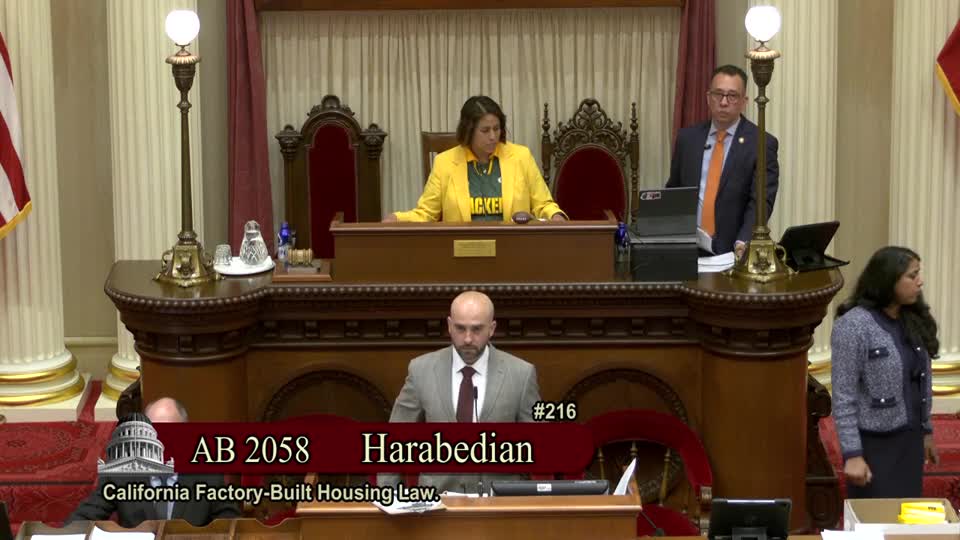 4MIN
Senate Floor
 2MIN
Assembly Floor
 38MIN
Assembly Standing Committee on Judiciary
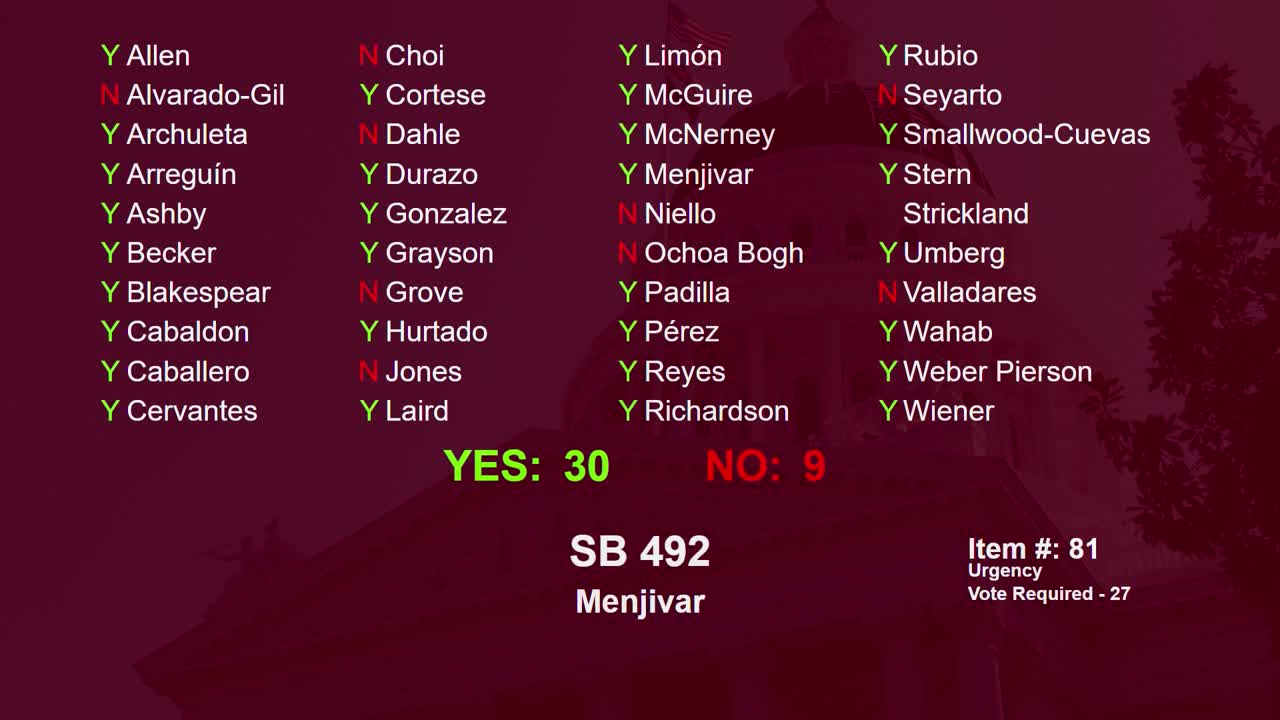 1H
Senate Floor
 1H
Senate Standing Committee on Judiciary
 21MIN
Senate Standing Committee on Judiciary
 16MIN
Senate Standing Committee on Labor, Public Employment and Retirement


Bill Co-Author(s):