SB 750: California Housing Finance Agency: credit enhancement mechanisms study.
- Session Year: 2025-2026
- House: Senate
- Latest Version Date: 2026-09-29
Current Status:
Passed
(2026-09-29: Chaptered by Secretary of State. Chapter 803, Statutes of 2026.)
Introduced
In Committee
Awaiting First Chamber Vote
Passed First Chamber
In Committee
Awaiting Second Chamber Vote
Passed Second Chamber
Enacted
Existing law establishes the California Housing Finance Agency for the primary purpose of meeting the housing needs of persons and families of low or moderate income, and sets forth various programs administered by the agency to fulfill that purpose.
This bill would require the agency to conduct a comprehensive assessment of potential credit enhancement mechanisms designed to reduce borrowing costs for housing projects receiving state financial assistance that includes specified evaluations. The bill would require the agency to submit an interim report by January 1, 2028, and a final report by July 1, 2028, as specified.
Existing law establishes the California Housing Finance Agency for the primary purpose of meeting the housing needs of persons and families of low or moderate income, and sets forth various programs administered by the agency to fulfill that purpose.
This bill would require the agency to conduct a comprehensive assessment of potential credit enhancement mechanisms designed to reduce borrowing costs for housing projects receiving state financial assistance that includes specified evaluations. The bill would require the agency to submit an interim report by January 1, 2028, and a final report by July 1, 2028, as specified.
Existing law establishes the California Housing Finance Agency for the primary purpose of meeting the housing needs of persons and families of low or moderate income, and sets forth various programs administered by the agency to fulfill that purpose.
This bill would require the agency to conduct a comprehensive assessment of potential credit enhancement mechanisms designed to reduce borrowing costs for housing projects receiving state financial assistance that includes specified evaluations. The bill would require the agency to submit an interim report by January 1, 2028, and a final report by July 1, 2028, as specified. Upon appropriation, and within 6 months of that appropriation, the bill would authorize the agency to establish a limited-scale pilot credit enhancement product and program to run concurrently with the assessment and a fund for the purpose of deploying that product, as specified.
Existing law establishes the California Housing Finance Agency for the primary purpose of meeting the housing needs of persons and families of low or moderate income, and sets forth various programs administered by the agency to fulfill that purpose.
This bill would require the agency to conduct a comprehensive assessment of potential credit enhancement mechanisms designed to reduce borrowing costs for housing projects receiving state financial assistance that includes specified evaluations. The bill would require the agency to submit an interim report by January 1, 2028, and a final report by July 1, 2028, as specified. Upon appropriation, and within 6 months of that appropriation, the bill would authorize the agency to establish a limited-scale pilot credit enhancement product and program to run concurrently with the assessment and a fund for the purpose of deploying that product, as specified.
Existing law, the California Health Facility Construction Loan Insurance Law, establishes an insurance program for health facility construction, improvement, and expansion loans in order to stimulate the flow of private capital into health facilities construction, improvement, and expansion and in order to rationally meet the need for new, expanded, and modernized public and nonprofit health facilities necessary to protect the health of all the people of this state.Existing law establishes the California Housing Finance Agency in the Business, Consumer Services, and Housing Agency. Existing law also establishes the California Homebuyers Downpayment Assistance Program for purposes of assisting first-time low- and moderate-income homebuyers utilizing existing mortgage financing, as described, and requires the agency to administer the program.Commencing January 1, 2027, and only if Senate Constitutional Amendment ____ of the 202526 Regular Session is approved by voters, this bill would enact the California Housing Finance and Credit Act (CAHFCA) to establish, without cost, a credit enhancement program for affordable housing construction loans and permanent loans to further housing production within the state by stimulating the flow of private capital into affordable housing construction and development in order to rationally meet the need for new and expanded affordable housing necessary to house all the people of this state. CAHFCA would require the agency to administer and implement the program, as provided, and would authorize the agency to insure and offer credit enhancements for construction loans and permanent loans for affordable housing developments. CAHFCA would require the agency to prepare an annual report and obtain an annual agreed-upon procedures engagement, as specified. CAHFCA would require the Legislative Analysts Office to prepare a biannual report regarding the effectiveness of the program, as specified. CAHFCA would set forth various powers and duties of the agency in the event of a default of a loan insured by the program.CAHFCA would establish the California Housing Finance and Credit Fund in the State Treasury and would continuously appropriate moneys in the fund to the agency for the purpose of providing credit enhancements for insuring construction loans and permanent loans under the program and for the purpose of defraying administrative expenses incurred by the agency in operating and implementing the program. CAHFCA would require the agency to establish a premium charge for the insurance of loans under the program and would require that this charge be deposited in the fund. CAHFCA would authorize the premium rate to vary, as specified, but would prohibit the rate from being greater than 2%. CAHFCA would require the Governor to include in the budget as submitted to the Legislature a limit to the authorization for the agency to insure housing construction and expansion loans for the budget year, as provided. CAHFCA would also make related findings and declarations.Existing law, the State General Obligation Bond Law, generally sets forth the procedures for the issuance and sale of bonds governed by its provisions and for the disbursal of the proceeds of the sale of those bonds. CAHFCA would declare that its provisions are not subject to the State General Obligation Bond Law. CAHFCA would also declare that its provisions are severable.Existing law, the California Health Facility Construction Loan Insurance Law, establishes an insurance program for health facility construction, improvement, and expansion loans in order to stimulate the flow of private capital into health facilities construction, improvement, and expansion and in order to rationally meet the need for new, expanded, and modernized public and nonprofit health facilities necessary to protect the health of all the people of this state.
Existing law establishes the California Housing Finance Agency in the Business, Consumer Services, and Housing Agency. Existing law also establishes the California Homebuyers Downpayment Assistance Program for purposes of assisting first-time low- and moderate-income homebuyers utilizing existing mortgage financing, as described, and requires the agency to administer the program.
Commencing January 1, 2027, and only if Senate Constitutional Amendment ____ of the 202526 Regular Session is approved by voters, this bill would enact the California Housing Finance and Credit Act (CAHFCA) to establish, without cost, a credit enhancement program for affordable housing construction loans and permanent loans to further housing production within the state by stimulating the flow of private capital into affordable housing construction and development in order to rationally meet the need for new and expanded affordable housing necessary to house all the people of this state. CAHFCA would require the agency to administer and implement the program, as provided, and would authorize the agency to insure and offer credit enhancements for construction loans and permanent loans for affordable housing developments. CAHFCA would require the agency to prepare an annual report and obtain an annual agreed-upon procedures engagement, as specified. CAHFCA would require the Legislative Analysts Office to prepare a biannual report regarding the effectiveness of the program, as specified. CAHFCA would set forth various powers and duties of the agency in the event of a default of a loan insured by the program.
CAHFCA would establish the California Housing Finance and Credit Fund in the State Treasury and would continuously appropriate moneys in the fund to the agency for the purpose of providing credit enhancements for insuring construction loans and permanent loans under the program and for the purpose of defraying administrative expenses incurred by the agency in operating and implementing the program. CAHFCA would require the agency to establish a premium charge for the insurance of loans under the program and would require that this charge be deposited in the fund. CAHFCA would authorize the premium rate to vary, as specified, but would prohibit the rate from being greater than 2%. CAHFCA would require the Governor to include in the budget as submitted to the Legislature a limit to the authorization for the agency to insure housing construction and expansion loans for the budget year, as provided. CAHFCA would also make related findings and declarations.
Existing law, the State General Obligation Bond Law, generally sets forth the procedures for the issuance and sale of bonds governed by its provisions and for the disbursal of the proceeds of the sale of those bonds.
CAHFCA would declare that its provisions are not subject to the State General Obligation Bond Law. CAHFCA would also declare that its provisions are severable.
Existing law, the California Health Facility Construction Loan Insurance Law, establishes an insurance program for health facility construction, improvement, and expansion loans in order to stimulate the flow of private capital into health facilities construction, improvement, and expansion and in order to rationally meet the need for new, expanded, and modernized public and nonprofit health facilities necessary to protect the health of all the people of this state.
Existing law establishes the California Housing Finance Agency in the Business, Consumer Services, and Housing Agency. Existing law also establishes the California Homebuyers Downpayment Assistance Program for purposes of assisting first-time low- and moderate-income homebuyers utilizing existing mortgage financing, as described, and requires the agency to administer the program.
Commencing January 1, 2027, and only if Senate Constitutional Amendment ____ of the 202526 Regular Session is approved by voters, this bill would enact the California Housing Finance and Credit Act (CAHFCA) to establish, without cost, a credit enhancement program for affordable housing construction loans and permanent loans to further housing production within the state by stimulating the flow of private capital into affordable housing construction and development in order to rationally meet the need for new and expanded affordable housing necessary to house all the people of this state. CAHFCA would require the agency to administer and implement the program, as provided, and would authorize the agency to insure and offer credit enhancements for construction loans and permanent loans for affordable housing developments. CAHFCA would require the agency to prepare an annual report and obtain an annual agreed-upon procedures engagement, as specified. CAHFCA would require the Legislative Analysts Office to prepare a biannual report regarding the effectiveness of the program, as specified. CAHFCA would set forth various powers and duties of the agency in the event of a default of a loan insured by the program.
CAHFCA would establish the California Housing Finance and Credit Fund in the State Treasury and would continuously appropriate moneys in the fund to the agency for the purpose of providing credit enhancements for insuring construction loans and permanent loans under the program and for the purpose of defraying administrative expenses incurred by the agency in operating and implementing the program. CAHFCA would require the agency to establish a premium charge for the insurance of loans under the program and would require that this charge be deposited in the fund. CAHFCA would authorize the premium rate to vary, as specified, but would prohibit the rate from being greater than 2%. CAHFCA would require the Governor to include in the budget as submitted to the Legislature a limit to the authorization for the agency to insure housing construction and expansion loans for the budget year, as provided. CAHFCA would also make related findings and declarations.
Existing law, the State General Obligation Bond Law, generally sets forth the procedures for the issuance and sale of bonds governed by its provisions and for the disbursal of the proceeds of the sale of those bonds.
CAHFCA would declare that its provisions are not subject to the State General Obligation Bond Law. CAHFCA would also declare that its provisions are severable.
Existing law, the California Health Facility Construction Loan Insurance Law, establishes an insurance program for health facility construction, improvement, and expansion loans in order to stimulate the flow of private capital into health facilities construction, improvement, and expansion and in order to rationally meet the need for new, expanded, and modernized public and nonprofit health facilities necessary to protect the health of all the people of this state.
Existing law establishes the California Housing Finance Agency in the Business, Consumer Services, and Housing Agency. Existing law also establishes the California Homebuyers Downpayment Assistance Program for purposes of assisting first-time low- and moderate-income homebuyers utilizing existing mortgage financing, as described, and requires the agency to administer the program.
Commencing January 1, 2027, and only if Senate Constitutional Amendment ____ of the 202526 Regular Session is approved by voters, this bill would enact the California Residential Mortgage Insurance Housing Finance and Credit Act (Cal REMIA) (CAHFCA) to establish, without cost, an insurance a credit enhancement program for affordable multifamily housing construction loans in order to stimulate and permanent loans to further housing production within the state by stimulating the flow of private capital into affordable multifamily housing construction and development in order to rationally meet the need for new, expanded, and modernized new and expanded affordable multifamily housing necessary to house all the people of this state. Cal REMIA CAHFCA would require the agency to administer and implement the program, as provided, and would authorize the agency to insure and offer credit enhancements for construction loans and permanent loans for affordable multifamily housing developments. Cal REMIA CAHFCA would require the agency to prepare an annual report and obtain an annual agreed-upon procedures engagement, as specified. Cal REMIA CAHFCA would require the Legislative Analysts Office to prepare a biannual report regarding the effectiveness of the program, as specified. Cal REMIA CAHFCA would set forth various powers and duties of the agency in the event of a default of a loan insured by the program.
Cal REMIACAHFCA would establish the California Residential Mortgage Insurance Housing Finance and Credit Fund in the State Treasury and would continuously appropriate moneys in the fund to the agency for the purpose of providing credit enhancements for insuring construction loans and permanent loans and providing credit enhancements under the program and for the purpose of defraying administrative expenses incurred by the agency in operating and implementing the program. Cal REMIA CAHFCA would require the agency to establish a premium charge for the insurance of loans under the program and would require that this charge be deposited in the fund. Cal REMIA CAHFCA would authorize the premium rate to vary, as specified, but would prohibit the rate from being greater than 2%. Cal REMIA CAHFCA would require the Governor to include in the budget as submitted to the Legislature a limit to the authorization for the agency to insure housing construction and expansion loans for the budget year, as provided. CAHFCA would also make related findings and declarations.
Existing law, the State General Obligation Bond Law, generally sets forth the procedures for the issuance and sale of bonds governed by its provisions and for the disbursal of the proceeds of the sale of those bonds.
Cal REMIACAHFCA would declare that its provisions are not subject to the State General Obligation Bond Law. Cal REMIA CAHFCA would also declare that its provisions are severable.
Existing law, the California Health Facility Construction Loan Insurance Law, establishes an insurance program for health facility construction, improvement, and expansion loans in order to stimulate the flow of private capital into health facilities construction, improvement, and expansion and in order to rationally meet the need for new, expanded, and modernized public and nonprofit health facilities necessary to protect the health of all the people of this state.
Existing law establishes the California Housing Finance Agency in the Business, Consumer Services, and Housing Agency. Existing law also establishes the California Homebuyers Downpayment Assistance Program for purposes of assisting first-time low- and moderate-income homebuyers utilizing existing mortgage financing, as described, and requires the agency to administer the program.
Commencing January 1, 2027, and only if Senate Constitutional Amendment ____ of the 202526 Regular Session is approved by voters, this bill would enact the California Residential Mortgage Insurance Act (Cal REMIA) to establish, without cost, an insurance program for affordable multifamily housing construction loans in order to stimulate the flow of private capital into affordable multifamily housing construction and in order to rationally meet the need for new, expanded, and modernized affordable multifamily housing necessary to house all the people of this state. Cal REMIA would require the agency to administer and implement the program, as provided, and would authorize the agency to insure and offer credit enhancements for construction loans and permanent loans for affordable multifamily housing developments. Cal REMIA would require the agency to prepare an annual report and obtain an annual agreed-upon procedures engagement, as specified. Cal REMIA would require the Legislative Analysts Office to prepare a biannual report regarding the effectiveness of the program, as specified. Cal REMIA would set forth various powers and duties of the agency in the event of a default of a loan insured by the program.
Cal REMIA would establish the California Residential Mortgage Insurance Fund in the State Treasury and would continuously appropriate moneys in the fund to the agency for the purpose of insuring construction loans and permanent loans and providing credit enhancements under the program and for the purpose of defraying administrative expenses incurred by the agency in operating and implementing the program. Cal REMIA would require the agency to establish a premium charge for the insurance of loans under the program and would require that this charge be deposited in the fund. Cal REMIA would authorize the premium rate to vary, as specified, but would prohibit the rate from being greater than 2%. Cal REMIA would also make related findings and declarations.
Existing law, the State General Obligation Bond Law, generally sets forth the procedures for the issuance and sale of bonds governed by its provisions and for the disbursal of the proceeds of the sale of those bonds.
Cal REMIA would declare that its provisions are not subject to the State General Obligation Bond Law. Cal REMIA would also declare that its provisions are severable.
Existing law, the California Health Facility Construction Loan Insurance Law, establishes an insurance program for health facility construction, improvement, and expansion loans in order to stimulate the flow of private capital into health facilities construction, improvement, and expansion and in order to rationally meet the need for new, expanded, and modernized public and nonprofit health facilities necessary to protect the health of all the people of this state.
Existing law establishes the California Housing Finance Agency in the Business, Consumer Services, and Housing Agency. Existing law also establishes the California Homebuyers Downpayment Assistance Program for purposes of assisting first-time low- and moderate-income homebuyers utilizing existing mortgage financing, as described, and requires the agency to administer the program.
Commencing January 1, 2027, and only if Senate Constitutional Amendment ____ of the 202526 Regular Session is approved by voters, this bill would enact the California Residential Mortgage Insurance Act (Cal REMIA) to establish, without cost, an insurance program for multifamily housing construction loans in order to stimulate the flow of private capital into multifamily housing construction and in order to rationally meet the need for new, expanded, and modernized multifamily housing necessary to house all the people of this state. Cal REMIA would require the agency to administer and implement the program, as provided, and would authorize the agency to insure and offer credit enhancements for construction loans and permanent loans for multifamily housing developments. Cal REMIA would require the agency to prepare an annual report and obtain an annual agreed-upon procedures engagement, as specified. Cal REMIA would set forth various powers and duties of the agency in the event of a default of a loan insured by the program.
Cal REMIA would establish the California Residential Mortgage Insurance Fund in the State Treasury and would continuously appropriate moneys in the fund to the agency for the purpose of insuring construction loans and permanent loans and providing credit enhancements under the program and for the purpose of defraying administrative expenses incurred by the agency in operating and implementing the program. Cal REMIA would require the agency to establish a premium charge for the insurance of loans under the program and would require that this charge be deposited in the fund. Cal REMIA would authorize the premium rate to vary, as specified, but would prohibit the rate from being greater than 2%. Cal REMIA would also make related findings and declarations.
Existing law, the State General Obligation Bond Law, generally sets forth the procedures for the issuance and sale of bonds governed by its provisions and for the disbursal of the proceeds of the sale of those bonds.
Cal REMIA would declare that its provisions are not subject to the State General Obligation Bond Law. Cal REMIA would also declare that its provisions are severable.
(a)It is the intent of the Legislature to evaluate strategies to reduce borrowing costs and improve capital efficiency for housing developments receiving state financial assistance by assessing potential state-administered lending and credit enhancement tools applicable to both construction phase and permanent financing, with a specific focus and priority on reducing construction financing costs.
(b)The agency shall conduct a comprehensive assessment of potential credit enhancement mechanisms designed to reduce borrowing costs for housing projects receiving state financial assistance that includes, but is not limited to, an evaluation of all of the following:
(1)Credit enhancement structures applicable to both construction phase and permanent financing, with a primary emphasis on construction phase risk and strategies to reduce construction loan interest rates and financing volatility.
(2)Mechanisms that could do any of the following:
(A)Reduce construction and permanent loan interest rates.
(B)Mitigate lender risk and volatility during the construction period.
(C)Improve capital efficiency and pricing for permanent financing, where feasible.
(D)Support projects that are funded by a combination of state, local, federal, or private financing, including, but not limited to, projects administered by the Department of Housing and Community Development, the agency, and the Housing Development and Finance Committee.
(E)Provide credit enhancement options for state-funded projects that do not utilize available federal mortgage insurance or risk-sharing programs, including, but not limited to, the FHA-HFA Risk-Sharing Program.
(F)Encourage housing trusts and pension funds to invest in housing development.
(G)Boost the creation of midsize housing developments.
(H)Provide credit enhancement to complement local and regional bond projects.
(3)Construction phase risk and market conditions, including, but not limited to, all of the following:
(A)Short-term loan pricing dynamics for constructions loans with typical terms of 12 to 36 months.
(B)Allocation of risk among lenders, developers, and the state during the construction period.
(C)Claims timing, loss severity, and administrative considerations under existing insurance or guarantee programs.
(D)Market demand for state-backed credit enhancement products targeting construction financing.
(4)Permanent financing considerations, including, but not limited to, all of the following:
(A)Interaction between construction phase credit enhancement and permanent loan pricing.
(B)Opportunities to transition from construction phase enhancement to permanent phase risk-sharing or insurance programs.
(C)Market gaps in permanent financing for state-assisted projects.
(5)Credit enhancement structures, including, but not limited to, all of the following:
(A)Portfolio-based loan loss reserve structures providing first-loss coverage.
(B)Partial state guarantees covering a defined percentage of principal loss.
(C)Construction phase insurance or backstop products.
(D)Hybrid models transitioning from construction enhancement to permanent phase federal insurance or risk-sharing programs.
(E)State-administered credit enhancement products for projects ineligible for federal insurance programs.
(6)Financial modeling and fiscal analysis, including, but not limited to, all of the following:
(A)Initial capitalization scenarios.
(B)Expected leverage ratios under varying program structures.
(C)Estimated reductions in borrowing costs, expressed in basis points, for both construction and permanent financing.
(D)Portfolio-level savings projections under varying construction and permanent lending pipeline sizes.
(E)Sensitivity analysis under adverse market conditions.
(F)Projected claims frequency and severity.
(G)Net present value analysis comparing projected borrower savings to required state capitalization.
(7)Governance and administrative structure, including, but not limited to, all of the following:
(A)Program governance and oversight.
(B)Underwriting standards and eligibility criteria.
(C)Rating agency considerations and potential impacts on state credit ratings.
(D)Claims administration and reserve management.
(E)Premium pricing structures and cost recovery models.
(F)Integration with existing agency programs.
(c)In conducting the assessment required by subdivision (b), the agency shall consult with, and may contract with, any of the following:
(1)Construction lenders.
(2)Permanent lenders.
(3)Community development financial institutions.
(4)Bond underwriters.
(5)Bond counsel.
(6)Actuaries.
(7)Credit risk modelers.
(8)Insurance and reinsurance advisors.
(9)Rating agency consultants.
(10)Affordable housing developers.
(11)Representatives of other housing finance agencies.
(d)(1)The agency shall submit an interim report by January 1, 2028, to the Legislature and the Department of Finance that includes all of the following:
(A)Preliminary findings.
(B)Capitalization scenarios.
(C)Financial modeling results.
(D)Stakeholder feedback.
(2)The agency shall submit a final report by July 1, 2028, to the Legislature and the Department of Finance that includes, but is not limited to, all of the following:
(A)Recommended program design.
(B)Fiscal impact analysis.
(C)Risk modeling results.
(D)An implementation roadmap, including, but not limited to, specific recommendations for reducing construction financing costs.
(3)The reports required by this subdivision shall be submitted in accordance with Section 9795 of the Government Code.
(a)It is the intent of the Legislature to evaluate strategies to reduce borrowing costs and improve capital efficiency for housing developments receiving state financial assistance by assessing potential state-administered lending and credit enhancement tools applicable to both construction phase and permanent financing, with a specific focus and priority on reducing construction financing costs.
(b)The agency shall conduct a comprehensive assessment of potential credit enhancement mechanisms designed to reduce borrowing costs for housing projects receiving state financial assistance that includes, but is not limited to, an evaluation of all of the following:
(1)Credit enhancement structures applicable to both construction phase and permanent financing, with a primary emphasis on construction phase risk and strategies to reduce construction loan interest rates and financing volatility.
(2)Mechanisms that could do any of the following:
(A)Reduce construction and permanent loan interest rates.
(B)Mitigate lender risk and volatility during the construction period.
(C)Improve capital efficiency and pricing for permanent financing, where feasible.
(D)Support projects that are funded by a combination of state, local, federal, or private financing, including, but not limited to, projects administered by the Department of Housing and Community Development, the agency, and the Housing Development and Finance Committee.
(E)Provide credit enhancement options for state-funded projects that do not utilize available federal mortgage insurance or risk-sharing programs, including, but not limited to, the FHA-HFA Risk-Sharing Program.
(F)Encourage housing trusts and pension funds to invest in housing development.
(G)Boost the creation of midsize housing developments.
(H)Provide credit enhancement to complement local and regional bond projects.
(3)Construction phase risk and market conditions, including, but not limited to, all of the following:
(A)Short-term loan pricing dynamics for constructions loans with typical terms of 12 to 36 months.
(B)Allocation of risk among lenders, developers, and the state during the construction period.
(C)Claims timing, loss severity, and administrative considerations under existing insurance or guarantee programs.
(D)Market demand for state-backed credit enhancement products targeting construction financing.
(4)Permanent financing considerations, including, but not limited to, all of the following:
(A)Interaction between construction phase credit enhancement and permanent loan pricing.
(B)Opportunities to transition from construction phase enhancement to permanent phase risk-sharing or insurance programs.
(C)Market gaps in permanent financing for state-assisted projects.
(5)Credit enhancement structures, including, but not limited to, all of the following:
(A)Portfolio-based loan loss reserve structures providing first-loss coverage.
(B)Partial state guarantees covering a defined percentage of principal loss.
(C)Construction phase insurance or backstop products.
(D)Hybrid models transitioning from construction enhancement to permanent phase federal insurance or risk-sharing programs.
(E)State-administered credit enhancement products for projects ineligible for federal insurance programs.
(6)Financial modeling and fiscal analysis, including, but not limited to, all of the following:
(A)Initial capitalization scenarios.
(B)Expected leverage ratios under varying program structures.
(C)Estimated reductions in borrowing costs, expressed in basis points, for both construction and permanent financing.
(D)Portfolio-level savings projections under varying construction and permanent lending pipeline sizes.
(E)Sensitivity analysis under adverse market conditions.
(F)Projected claims frequency and severity.
(G)Net present value analysis comparing projected borrower savings to required state capitalization.
(7)Governance and administrative structure, including, but not limited to, all of the following:
(A)Program governance and oversight.
(B)Underwriting standards and eligibility criteria.
(C)Rating agency considerations and potential impacts on state credit ratings.
(D)Claims administration and reserve management.
(E)Premium pricing structures and cost recovery models.
(F)Integration with existing agency programs.
(c)In conducting the assessment required by subdivision (b), the agency shall consult with, and may contract with, any of the following:
(1)Construction lenders.
(2)Permanent lenders.
(3)Community development financial institutions.
(4)Bond underwriters.
(5)Bond counsel.
(6)Actuaries.
(7)Credit risk modelers.
(8)Insurance and reinsurance advisors.
(9)Rating agency consultants.
(10)Affordable housing developers.
(11)Representatives of other housing finance agencies.
(d)(1)The agency shall submit an interim report by January 1, 2028, to the Legislature and the Department of Finance that includes all of the following:
(A)Preliminary findings.
(B)Capitalization scenarios.
(C)Financial modeling results.
(D)Stakeholder feedback.
(2)The agency shall submit a final report by July 1, 2028, to the Legislature and the Department of Finance that includes, but is not limited to, all of the following:
(A)Recommended program design.
(B)Fiscal impact analysis.
(C)Risk modeling results.
(D)An implementation roadmap, including, but not limited to, specific recommendations for reducing construction financing costs.
(3)The reports required by this subdivision shall be submitted in accordance with Section 9795 of the Government Code.
(a)It is the intent of the Legislature to evaluate strategies to reduce borrowing costs and improve capital efficiency for housing developments receiving state financial assistance by assessing potential state-administered lending and credit enhancement tools applicable to both construction phase and permanent financing, with a specific focus and priority on reducing construction financing costs.
(b)The agency shall conduct a comprehensive assessment of potential credit enhancement mechanisms designed to reduce borrowing costs for housing projects receiving state financial assistance that includes, but is not limited to, an evaluation of all of the following:
(1)Credit enhancement structures applicable to both construction phase and permanent financing, with a primary emphasis on construction phase risk and strategies to reduce construction loan interest rates and financing volatility.
(2)Mechanisms that could do any of the following:
(A)Reduce construction and permanent loan interest rates.
(B)Mitigate lender risk and volatility during the construction period.
(C)Improve capital efficiency and pricing for permanent financing, where feasible.
(D)Support projects that are funded by a combination of state, local, federal, or private financing, including, but not limited to, projects administered by the Department of Housing and Community Development, the agency, and the Housing Development and Finance Committee.
(E)Provide credit enhancement options for state-funded projects that do not utilize available federal mortgage insurance or risk-sharing programs, including, but not limited to, the FHA-HFA Risk-Sharing Program.
(F)Encourage housing trusts and pension funds to invest in housing development.
(G)Boost the creation of midsize housing developments.
(H)Provide credit enhancement to complement local and regional bond projects.
(3)Construction phase risk and market conditions, including, but not limited to, all of the following:
(A)Short-term loan pricing dynamics for constructions loans with typical terms of 12 to 36 months.
(B)Allocation of risk among lenders, developers, and the state during the construction period.
(C)Claims timing, loss severity, and administrative considerations under existing insurance or guarantee programs.
(D)Market demand for state-backed credit enhancement products targeting construction financing.
(4)Permanent financing considerations, including, but not limited to, all of the following:
(A)Interaction between construction phase credit enhancement and permanent loan pricing.
(B)Opportunities to transition from construction phase enhancement to permanent phase risk-sharing or insurance programs.
(C)Market gaps in permanent financing for state-assisted projects.
(5)Credit enhancement structures, including, but not limited to, all of the following:
(A)Portfolio-based loan loss reserve structures providing first-loss coverage.
(B)Partial state guarantees covering a defined percentage of principal loss.
(C)Construction phase insurance or backstop products.
(D)Hybrid models transitioning from construction enhancement to permanent phase federal insurance or risk-sharing programs.
(E)State-administered credit enhancement products for projects ineligible for federal insurance programs.
(6)Financial modeling and fiscal analysis, including, but not limited to, all of the following:
(A)Initial capitalization scenarios.
(B)Expected leverage ratios under varying program structures.
(C)Estimated reductions in borrowing costs, expressed in basis points, for both construction and permanent financing.
(D)Portfolio-level savings projections under varying construction and permanent lending pipeline sizes.
(E)Sensitivity analysis under adverse market conditions.
(F)Projected claims frequency and severity.
(G)Net present value analysis comparing projected borrower savings to required state capitalization.
(7)Governance and administrative structure, including, but not limited to, all of the following:
(A)Program governance and oversight.
(B)Underwriting standards and eligibility criteria.
(C)Rating agency considerations and potential impacts on state credit ratings.
(D)Claims administration and reserve management.
(E)Premium pricing structures and cost recovery models.
(F)Integration with existing agency programs.
(c)In conducting the assessment required by subdivision (b), the agency shall consult with, and may contract with, any of the following:
(1)Construction lenders.
(2)Permanent lenders.
(3)Community development financial institutions.
(4)Bond underwriters.
(5)Bond counsel.
(6)Actuaries.
(7)Credit risk modelers.
(8)Insurance and reinsurance advisors.
(9)Rating agency consultants.
(10)Affordable housing developers.
(11)Representatives of other housing finance agencies.
(d)(1)The agency shall submit an interim report by January 1, 2028, to the Legislature and the Department of Finance that includes all of the following:
(A)Preliminary findings.
(B)Capitalization scenarios.
(C)Financial modeling results.
(D)Stakeholder feedback.
(E)Results from the pilot credit enhancement project described in subdivision (e), if applicable.(2)The agency shall submit a final report by July 1, 2028, to the Legislature and the Department of Finance that includes, but is not limited to, all of the following:
(A)Recommended program design.
(B)Fiscal impact analysis.
(C)Risk modeling results.
(D)An implementation roadmap, including, but not limited to, specific recommendations for reducing construction financing costs.
(3)The reports required by this subdivision shall be submitted in accordance with Section 9795 of the Government Code.
(e)(1)Upon appropriation, the agency may establish both of the following within six months of the appropriation:(A)A limited-scale pilot credit enhancement product and program that will run concurrently with the assessment required by subdivision (b).(B)The Construction Credit Enhancement Fund for the purpose of deploying the product described in subparagraph (A).(2)The program shall comply with all of the following:(A)It shall prioritize decreasing loan value ratios by up to 10 percent for underwritten and otherwise shovel-ready projects.(B)Not less than the general prevailing rate of per diem wages for work of a similar character in the locality in which the development is located, and not less than the general prevailing rate of per diem wages for holiday and overtime work fixed as provided in this chapter, shall be paid to all workers employed on a development funded by the program.(C)Minimum qualifications for a proponent of an affordable housing development to qualify for credit enhancements for any construction loan insurance and permanent loan insurance available under the program, including, but not limited to, a recorded regulatory agreement with any of the following:(i)The agency.(ii)The California Tax Credit Allocation Committee.(iii)The Department of Housing and Community Development.(iv)The Housing Development and Finance Committee.(D)All units developed pursuant to the program shall be affordable to a mix of lower income households, as defined in Section 50079.5, and persons and families of moderate income, as defined in Section 50093.(3)The program may include any of the following:(A)Deployment of credit enhancement products on a limited basis.(B)Testing of pricing assumptions and lender participation.(C)Collection of performance data to inform final program design.(a)It is the intent of the Legislature to evaluate strategies to reduce borrowing costs and improve capital efficiency for housing developments receiving state financial assistance by assessing potential state-administered lending and credit enhancement tools applicable to both construction phase and permanent financing, with a specific focus and priority on reducing construction financing costs.
(b)The agency shall conduct a comprehensive assessment of potential credit enhancement mechanisms designed to reduce borrowing costs for housing projects receiving state financial assistance that includes, but is not limited to, an evaluation of all of the following:
(1)Credit enhancement structures applicable to both construction phase and permanent financing, with a primary emphasis on construction phase risk and strategies to reduce construction loan interest rates and financing volatility.
(2)Mechanisms that could do any of the following:
(A)Reduce construction and permanent loan interest rates.
(B)Mitigate lender risk and volatility during the construction period.
(C)Improve capital efficiency and pricing for permanent financing, where feasible.
(D)Support projects that are funded by a combination of state, local, federal, or private financing, including, but not limited to, projects administered by the Department of Housing and Community Development, the agency, and the Housing Development and Finance Committee.
(E)Provide credit enhancement options for state-funded projects that do not utilize available federal mortgage insurance or risk-sharing programs, including, but not limited to, the FHA-HFA Risk-Sharing Program.
(F)Encourage housing trusts and pension funds to invest in housing development.
(G)Boost the creation of midsize housing developments.
(H)Provide credit enhancement to complement local and regional bond projects.
(3)Construction phase risk and market conditions, including, but not limited to, all of the following:
(A)Short-term loan pricing dynamics for constructions loans with typical terms of 12 to 36 months.
(B)Allocation of risk among lenders, developers, and the state during the construction period.
(C)Claims timing, loss severity, and administrative considerations under existing insurance or guarantee programs.
(D)Market demand for state-backed credit enhancement products targeting construction financing.
(4)Permanent financing considerations, including, but not limited to, all of the following:
(A)Interaction between construction phase credit enhancement and permanent loan pricing.
(B)Opportunities to transition from construction phase enhancement to permanent phase risk-sharing or insurance programs.
(C)Market gaps in permanent financing for state-assisted projects.
(5)Credit enhancement structures, including, but not limited to, all of the following:
(A)Portfolio-based loan loss reserve structures providing first-loss coverage.
(B)Partial state guarantees covering a defined percentage of principal loss.
(C)Construction phase insurance or backstop products.
(D)Hybrid models transitioning from construction enhancement to permanent phase federal insurance or risk-sharing programs.
(E)State-administered credit enhancement products for projects ineligible for federal insurance programs.
(6)Financial modeling and fiscal analysis, including, but not limited to, all of the following:
(A)Initial capitalization scenarios.
(B)Expected leverage ratios under varying program structures.
(C)Estimated reductions in borrowing costs, expressed in basis points, for both construction and permanent financing.
(D)Portfolio-level savings projections under varying construction and permanent lending pipeline sizes.
(E)Sensitivity analysis under adverse market conditions.
(F)Projected claims frequency and severity.
(G)Net present value analysis comparing projected borrower savings to required state capitalization.
(7)Governance and administrative structure, including, but not limited to, all of the following:
(A)Program governance and oversight.
(B)Underwriting standards and eligibility criteria.
(C)Rating agency considerations and potential impacts on state credit ratings.
(D)Claims administration and reserve management.
(E)Premium pricing structures and cost recovery models.
(F)Integration with existing agency programs.
(c)In conducting the assessment required by subdivision (b), the agency shall consult with, and may contract with, any of the following:
(1)Construction lenders.
(2)Permanent lenders.
(3)Community development financial institutions.
(4)Bond underwriters.
(5)Bond counsel.
(6)Actuaries.
(7)Credit risk modelers.
(8)Insurance and reinsurance advisors.
(9)Rating agency consultants.
(10)Affordable housing developers.
(11)Representatives of other housing finance agencies.
(d)(1)The agency shall submit an interim report by January 1, 2028, to the Legislature and the Department of Finance that includes all of the following:
(A)Preliminary findings.
(B)Capitalization scenarios.
(C)Financial modeling results.
(D)Stakeholder feedback.
(E)Results from the pilot credit enhancement project described in subdivision (e), if applicable.
(2)The agency shall submit a final report by July 1, 2028, to the Legislature and the Department of Finance that includes, but is not limited to, all of the following:
(A)Recommended program design.
(B)Fiscal impact analysis.
(C)Risk modeling results.
(D)An implementation roadmap, including, but not limited to, specific recommendations for reducing construction financing costs.
(3)The reports required by this subdivision shall be submitted in accordance with Section 9795 of the Government Code.
(e)(1)Upon appropriation, the agency may establish both of the following within six months of the appropriation:
(A)A limited-scale pilot credit enhancement product and program that will run concurrently with the assessment required by subdivision (b).
(B)The Construction Credit Enhancement Fund for the purpose of deploying the product described in subparagraph (A).
(2)The program shall comply with all of the following:
(A)It shall prioritize decreasing loan value ratios by up to 10 percent for underwritten and otherwise shovel-ready projects.
(B)Not less than the general prevailing rate of per diem wages for work of a similar character in the locality in which the development is located, and not less than the general prevailing rate of per diem wages for holiday and overtime work fixed as provided in this chapter, shall be paid to all workers employed on a development funded by the program.
(C)Minimum qualifications for a proponent of an affordable housing development to qualify for credit enhancements for any construction loan insurance and permanent loan insurance available under the program, including, but not limited to, a recorded regulatory agreement with any of the following:
(i)The agency.
(ii)The California Tax Credit Allocation Committee.
(iii)The Department of Housing and Community Development.
(iv)The Housing Development and Finance Committee.
(D)All units developed pursuant to the program shall be affordable to a mix of lower income households, as defined in Section 50079.5, and persons and families of moderate income, as defined in Section 50093.
(3)The program may include any of the following:
(A)Deployment of credit enhancement products on a limited basis.
(B)Testing of pricing assumptions and lender participation.
(C)Collection of performance data to inform final program design.
SECTION 1.The Legislature finds and declares all of the following:(a)In the fifth housing element cycle, which ends in March 2025, only 20 percent of the units required to house the states very low income population were permitted. In other words, 277,523 units were needed and only 57,392 were permitted.(b)The numbers are only slightly better for the states low-income population, where only 30 percent of the units have been permitted. Of the 184,921 units needed, only 57,135 were permitted.(c)In the San Francisco Bay area alone, 395 projects are currently in predevelopment waiting for funding. Enterprise Community Partners estimate that over seven billion dollars ($7,000,000,000) is needed to get these projects out of the pipeline and into the construction phase.(d)The New York City Residential Mortgage Insurance Corporation was created to insure mortgages for the production and rehabilitation of affordable housing throughout the City of New York through the issuance of mortgage insurance. In its 49 years of existence, the corporation has only had 16 claims for insured loans totaling six hundred fifty thousand six hundred forty-eight dollars ($650,648).SEC. 2.Part 4.1 (commencing with Section 51700) is added to Division 31 of the Health and Safety Code, to read:4.1.California Housing Finance and Credit Act1.General Provisions51700.This part shall be known, and may be cited, as the California Housing Finance and Credit Act.51701.The purpose of this part is to provide, without cost to the state, a credit enhancement program for affordable housing construction loans and permanent loans to further housing production within the state by stimulating the flow of private capital into affordable housing construction and development in order to rationally meet the need for new and expanded affordable housing necessary to house all the people of this state. The provisions of this part are to be liberally construed to achieve this purpose.51702.For purposes of this part:(a)Affordable means affordable to a mix of lower income and moderate-income households. For purposes of this subdivision, lower income households has the same meaning as the term is defined in Section 50079.5 of the Health and Safety Code, and moderate-income households has the same meaning as the term persons and families of moderate income is defined in Section 50093 of the Health and Safety Code.(b)Agency means the California Housing Finance Agency.(c)Construction loan means a short-term loan fully secured by a deed of trust or other means of security made for financing the construction of an affordable multifamily housing development.(d)Credit enhancement means a method of reducing risk for a lender, including, but not limited to, credit insurance, loan guarantees, bond ratings and guarantees, and other forms of securitization that optimize securitized credit ratings.(e)Debenture means any form of written evidence of indebtedness issued by the State Treasurer pursuant to this chapter, as authorized by Section 1.6 of Article XVI of the California Constitution.(f)Executive director means the Executive Director of the California Housing Finance Agency.(g)Fund means the California Housing Finance and Credit Fund, created pursuant to Section 51726.(h)Loan means money or credit advanced for the costs of construction and includes both initial loans and loans secured upon refinancing and may include both interim or short-term loans and long-term loans. A duly authorized bond or bond issue, or an installment sale agreement, may constitute a loan. (i)Permanent loan means a long-term loan that is fully secured by a deed of trust or other means of security.(j)Program means the California Housing Finance and Credit Program established pursuant to this part.51703.(a)The agency shall administer and implement the program. The agency may do both of the following in the administration of the program:(1)Insure construction loans or permanent loans for affordable housing developments pursuant to this part.(2)Offer credit enhancements for construction loans and permanent loans for affordable housing developments pursuant to this part.(b)The agency may review, adopt, amend, and repeal guidelines to implement uniform standards or criteria that supplement or clarify the terms, references, or standards set forth in this part.(c)The agency shall include guidelines or criteria for lending to projects that provide home ownership opportunities in any notices of available credit enhancements for construction loans or permanent loans for housing developments to borrowers.51704.In conducting the business and affairs of this part, the executive director may do any of the following:(a)Enter into contracts of insurance.(b)Decline to insure any risk in which the minimum requirements of the insurance fund are not complied with, or which is beyond the safe carrying of the fund.(c)Reinsure any risk or any part thereof.(d)Make rules for the settlement of claims against the fund and determine to whom and through whom the payments are to be made.(e)Enter into any contracts or obligations relating to the fund.(f)Conduct all business and affairs and perform all acts relating to the fund whether or not specifically designated in this part.51705.The agency may commence any action to protect or enforce any right conferred upon it by any law, mortgage, contract of insurance, or any other agreement. The agency may bid for and purchase property sold in satisfaction thereof at any foreclosure or other sale or may otherwise acquire and take possession of that property.51706.(a)The agency shall establish a premium charge for the insurance of loans under this part, and this charge shall be deposited in the fund. A one-time nonrefundable premium charge shall be paid at the time the loan is insured. The premium rate may vary based upon the assessed level of relative financial risk determined by the agency, but shall in no event be greater than 2 percent. The amount of premium shall be computed on the basis of the application of the rate to the total amount of principal and interest payable over the term of the loan.(b)The agency may annually charge a portion of the premium in advance commencing at the time of issuing or extending the commitment until the date the loan is insured or the commitment expires. The amount of the advance premium shall not exceed six dollars ($6) per year for each one thousand dollars ($1,000) of principal of the proposed loan. The total dollar amount of the premium advanced shall be nonrefundable and shall be credited against the amount of the premium charged pursuant to this section, or if the commitment expires and the loan is not insured, the advance shall be retained by the agency to offset costs and expenses of the agency related to preliminary work, underwriting the loan commitment, and monitoring construction.51707.(a)The agency shall prepare an annual report on the condition of the program that shall include an evaluation of program effectiveness in relation to cost and shall include recommendations and suggested legislation for the improvement of the program, if any.(b)The agency shall obtain an annual agreed-upon procedures engagement of the funds books and accounts with respect to its activities under this part to be made at least once for each calendar year by an independent certified public accountant.(c)(1)A copy of the annual agreed-upon procedures engagement and annual report shall be transmitted to the Governor, to the chairperson and vice chairperson of the Senate and Assembly housing policy committees, the Senate and Assembly budget committees, and the Joint Legislative Budget Committee, and made available for review by interested parties no later than November 1 of each year for the annual agreed-upon procedures engagement and the program evaluation report.(2)The agency shall submit each report required by this section to the Legislature in compliance with Section 9795 of the Government Code. (d)For purposes of this section, the agreed-upon procedures engagement shall be conducted in accordance with the most recent Statements on Standards for Attestation Engagements, as issued by the American Institute of Certified Public Accountants.51707.1.(a)The Legislative Analysts Office shall submit a report to the Legislature, on or before January 1 of every other year thereafter, regarding the effectiveness of the program established pursuant to this part, with recommendations to the Legislature for adjustments to the program to increase the distribution of credit enhancements. The report shall include, but not be limited to:(1)The percentage of debt capacity used by the program.(2)The number of credit enhancement beneficiaries.(3)The number of affordable housing units planned for each income level, including lower income, as that term is defined in subdivision (l) of Section 65582 of the Government Code.(b)The office shall submit each report required by this section to the Legislature in compliance with Section 9795 of the Government Code.2.Qualifications and Requirements for Loan Insurance51708.(a)The agency shall establish minimum qualifications for a proponent of an affordable housing development to qualify for credit enhancements for construction loan insurance and permanent loan insurance available under this part, including, but not limited to, a requirement that the development complies with any of the following:(1)The development is receiving financing from, and will have a recorded regulatory agreement with, the agency, the California Tax Credit Allocation Committee, or the Department of Housing and Community Development.(2)The development is subject to a recorded regulatory agreement substantially equivalent to the requirements of a regulatory agreement with the agency, the California Tax Credit Allocation Committee, or the Department of Housing and Community Development for at least 55 years for rental units or 45 years for homeownership units.(3)Each unit for sale in the development complies with all of the following requirements:(A)The unit is for sale by a nonprofit corporation organized pursuant to Section 501(c)(3) of the Internal Revenue Code.(B)The unit is for sale for a price below the fair market value of the unit.(C)The unit receives a property tax welfare exemption.(b)The agency shall establish minimum requirements for loans that are insured or subject to a credit enhancement pursuant to this part that shall include, but not be limited to, all of the following:(1)Maximum duration.(2)Maximum amount.(3)Loan security requirements.(4)Loan-to-value limitations.(c)For the purpose of increasing the efficiency and minimizing the cost of the loan insurance program, the agency may insure or issue commitments to insure loans upon the certification of an approved financial institution that the borrower is qualified for loan insurance according to eligibility requirements specified by the agency pursuant to this section.51709.A pledge by or to the agency of, or the grant to the agency of a security interest in, revenues, moneys, accounts, accounts receivable, contract rights, general intangibles, documents, instruments, chattel paper, and other rights to payment of whatever kind made by or to the agency pursuant to the authority granted in this part shall be valid and binding from the time the pledge is made for the benefit of pledgees and successors thereto. The revenues, moneys, accounts, accounts receivable, contract rights, general intangibles, documents, instruments, chattel paper, and other rights to payment of whatever kind pledged by or to the agency or its assignees shall immediately be subject to the lien of the pledge without physical delivery or further act. The lien of that pledge shall be valid and binding against all parties, irrespective of whether the parties have notice of the lien. The indenture, trust agreement, resolution, or another instrument by which that pledge is created need not be recorded or the security interest otherwise perfected.51710.The agency may upon application of the borrower insure any loan that is eligible for insurance under this part, and upon the terms prescribed by the agency, may make commitments for the insuring of the loans prior to their date of execution or disbursement thereon. The decision to grant loan insurance upon an application of the borrower is within the discretion of the executive director. Showing need for the project or meeting the eligibility requirements for loan insurance and establishing financial feasibility of the project or recommendation for approval from the committee does not create any entitlement to loan insurance.51711.(a)The agency shall not regulate, impose requirements on, or require approval by the agency of a professional, or a fee charged by a professional, used by applicants for the initial application for loan insurance. The choice of any professional and the funding source used shall be left entirely to the participants.(b)For purposes of this section, professional includes, but is not limited to, an underwriter, bond counsel, or consultant.(c)Nothing in this section shall prohibit the agency, in the event of defaults, from taking any action authorized under this chapter to protect the financial interest of the state.51712.(a)Not less than the general prevailing rate of per diem wages for work of a similar character in the locality in which the development is located, and not less than the general prevailing rate of per diem wages for holiday and overtime work fixed as provided in this chapter, shall be paid to all workers employed on a development under this part.(b)Notwithstanding subdivision (a), the Legislature may amend this section to prescribe applicable wage standards.3.Defaults51713.(a)(1)In any case when the lender under a loan insured under this part shall have foreclosed and taken possession of the property under a mortgage in accordance with regulations of, and within a period to be determined by the agency, or shall, with the consent of the agency, have otherwise acquired the property from the borrower after default, the lender shall be entitled to receive the benefit of the insurance as provided in this part, upon (A) the prompt conveyance to the agency of title to the property that meets the requirements of the regulations of the agency in force at the time the loan was insured, and that is evidenced in the manner prescribed by the regulations, and (B) the assignment to the agency of all claims of the lender against the borrower or others arising out of the loan transaction or foreclosure proceedings except claims that may have been released with the consent of the agency. Upon the conveyance and assignment, the agency shall notify the Treasurer, who shall issue to the lender debentures having a total face value equal to the outstanding value of the loan.(2)For the purposes of this section, the outstanding value of the loan shall be determined, in accordance with the regulations prescribed by the agency, by (A) adding to the amounts of the original principal obligation of the loan and interest that are accrued and unpaid the amount of all payments that have been made by the lender for the following: taxes and assessments, ground rents, water rates, and other liens that are prior to the mortgage; charges for the administration, operation, maintenance and repair of the property; insurance on the project property, loan insurance premiums, and any tax imposed by a city or county upon any deed or other instrument by which the property was acquired by the lender and transferred or conveyed to the agency; and the costs of foreclosure or of acquiring the property by other means actually paid by the lender and approved by the agency; and by (B) deducting from the total amount any amounts received by the lender after the borrowers default on account of the loans or as rent or other income from the property.(b)In the event of a default on an insured loan not secured by a first mortgage, the agency may, in lieu of proceeding under subdivision (a), acquire the insured loan and any security therefor upon payment to the approved financial institution of an amount equal to the unpaid principal balance of the loan, accrued interest, and other costs that the agency finds are fair, reasonable, and authorized.51714.In any case when a political subdivision defaults on the payment of interest or principal accrued and due on bonds or other evidences of indebtedness insured under this part, debentures in an amount equal to the outstanding original principal obligation and interest on the bonds that were accrued and unpaid on the date of default and bearing interest at a rate equal to and payment schedule identical with those of the bonds shall be issued by the Treasurer upon notification thereof by the agency to the bondholders upon the surrender of the bonds to the agency.51715.Notwithstanding any requirement contained in this part relating to acquisition of title and possession of the project property by the lender and its subsequent conveyance and transfer to the agency, and for the purpose of avoiding unnecessary conveyance expenses in connection with payment of insurance benefits under the provisions of this part, the agency may, subject to regulations that it may prescribe, permit the lender to tender to the agency a satisfactory conveyance of title and transfer of possession direct from the borrower or other appropriate grantor and to pay to the lender the insurance benefits to which it would otherwise be entitled if the conveyance had been made to the lender and from the lender to the agency.51716.(a)Upon receiving notice of the default of any loan insured under this part, the agency, in its discretion and for the purpose of avoiding foreclosure under Section 51713 and notwithstanding the fact that it has previously approved a request of the lender for extensions of the time for curing the default and of the time for commencing foreclosure proceedings or for otherwise acquiring title to the project property, or has approved a modification of the loan for the purpose of changing the amortization provisions by recasting the unpaid balance, may acquire the loan and security agreements securing the loans upon the issuance to the lender of debentures in an amount equal to the unpaid principal balance of the loan plus any accrued unpaid loan interest plus reimbursement for attorneys fees and costs of the lender enumerated in Section 51713.(b)After the acquisition of the loan and security interests therefor by the agency, the lender shall have no further rights, liabilities, or obligations with respect thereto. The provisions of Section 51713 relating to the issuance of debentures incident to the acquisition of foreclosed properties shall apply with respect to debentures issued under this section, and the provisions of this part relating to the rights, liabilities, and obligations of a lender shall apply with respect to the agency when it has acquired an insured loan under this section, in accordance with and subject to any regulations prescribed by the agency modifying the provisions to the extent necessary to render their application for these purposes appropriate and effective.51717.Notwithstanding any other provision of this chapter, after the agency determines that the lender and borrower have exhausted all reasonable means of curing any default, the agency within its discretion may, when it is in the best interests of the state, the borrower, and the lender, cure the default of the borrower by making payment from the fund directly to the lender of any amounts of the original principal obligation and interest of the loan that are accrued and unpaid. The payment shall be secured by an assignment to the agency of a pro rata share of the security agreements made to the lender and, upon the payment, the borrower shall become liable for repayment of the amount thereof to the agency over a period and at a rate of interest as shall be determined by the agency.51718.The agency may at any time, under the terms and conditions that it may prescribe, consent to the lenders release of the borrower from its liability under the loan or the security agreement securing the loan, or consent to the release of parts of the project property from the lien of any security agreement.51719.Debentures issued under this part shall be in the form and denomination, subject to the terms and conditions, and shall include provisions for redemption, if any, as may be prescribed by the agency and may be in coupon or registered form. 51720.(a)(1)All debentures issued under this part to any lender or bondholder shall be executed in the name of the fund as obligor, shall be signed by the Treasurer, and shall be negotiable. Pursuant to Sections 51713 and 51714, all debentures shall be dated as of the date of the institution of foreclosure proceedings or as of the date of the acquisition of the property after default by other than foreclosure, or as of another date as the agency, in its discretion, may establish.(2)The debentures shall bear interest from that date at a rate equal to the insured loan or bonds, and shall be payable on a payment schedule identical with payments on the insured loan or bonds. The Treasurer shall take appropriate steps to the extent feasible to provide that interest on the debentures is exempt from federal income taxation under Section 103 of the Internal Revenue Code to the extent interest on the insured loan or bonds is exempt from federal income taxation under Section 103 of the Internal Revenue Code on the date the insured loan or bonds is exchanged for debentures. All debentures shall be exempt, both as to principal and interest, from all taxation now or hereafter imposed by the state or local taxing agencies, shall be paid out of the fund, which shall be primarily liable therefor, and shall be, pursuant to Section 1.6 of Article XVI of the California Constitution, fully and unconditionally guaranteed as to principal and interest by the State of California, which guaranty shall be expressed on the face of the debentures.(3)If the fund fails to pay upon demand, when due, the principal of, or interest on, any debentures issued under this part, the Treasurer shall pay to the holders the amount thereof, which amount, notwithstanding Section 13340 of the Government Code, is hereby continuously appropriated from the General Fund, without regard to fiscal years, and thereupon, to the extent of the amount so paid, the Treasurer shall succeed to all the rights of the holders of the debentures. The fund shall be liable for repayment to the General Fund of any moneys paid from the General Fund pursuant to this section in accordance with procedures jointly established by the Treasurer and the agency.(b)Any debenture issued under this chapter shall be paid on a par with general obligation bonds issued by the state.51721.(a)Notwithstanding any other law relating to the acquisition, management, or disposal of real property by the state, the agency shall have power to deal with, operate, complete, lease, rent, renovate, modernize, insure, or sell for cash or credit, in its discretion, any properties conveyed to it in exchange for debentures as provided in this part. Notwithstanding any other law, the agency shall also have power to pursue to final collection by way of compromise or otherwise all claims against borrowers assigned by lenders to the agency as provided in this part. All income from the operation, rental, or lease of the property and all proceeds from the sale thereof shall be deposited in the fund and all costs incurred by the agency in its exercise of powers granted in this section shall be met by the fund.(b)The power to convey and to execute in the name of the agency deeds of conveyance, deeds of release, assignments and satisfactions of loans and mortgages, and any other written instrument relating to real or personal property or any interest therein acquired by the agency pursuant to the provisions of this part may be exercised by the agency or by any officer of the agency appointed by it.51722.A lender or borrower shall not have any right or interest in any property conveyed to the agency or in any claim assigned to it, and the agency shall not owe any duty to any lender or borrower with respect to the management or disposal of this property.51723.Notwithstanding any other law, if, prior to foreclosing on any collateral provided by a borrower, the agency institutes a judicial proceeding or takes any action against a borrower to enforce compliance with the obligations set out in the regulatory agreement, the contract of insurance, or any other contractual loan closing document or law, that remedy or action shall not constitute an action within the meaning of subdivision (a) of Section 726 of the Code of Civil Procedure, or in any way constitute a violation of the intent or purposes of Section 726 of the Code of Civil Procedure, or constitute a money judgment or a deficiency judgment within the meaning of Sections 580a, 580b, 580d, or subdivision (b) of Section 726 of the Code of Civil Procedure. However, these provisions of the Code of Civil Procedure shall apply to any judicial proceeding instituted, or nonjudicial foreclosure action taken, by the agency to collect the principal and interest due on the loan with the borrower.4.Termination of Insurance51724.The obligation to pay any subsequent premium charge for insurance shall cease, and all rights of the lender and the borrower under this part shall terminate as of the date of the notice, as herein provided, in the event that (a) any lender under a loan forecloses on the mortgaged property, or has otherwise acquired the project property from the borrower after default, but does not convey the property to the agency in accordance with this part, and the agency is given written notice thereof, or (b) the borrower pays the obligation under the loan in full prior to the maturity thereof, and the agency is given written notice thereof.51725.The agency is authorized to terminate any insurance contract upon joint request by the borrower and the lender and upon payment of a termination charge that the agency determines to be equitable, taking into consideration the necessity of protecting the fund. Upon the termination, borrowers and lenders shall be entitled to the rights, if any, that they would be entitled to under this part if the insurance contract were terminated by payment in full of the insured loan.5.California Housing Finance and Credit Fund51726.(a)The California Housing Finance and Credit Fund is hereby created in the State Treasury.(b)Notwithstanding Section 13340 of the Government Code, or any other law, moneys in the fund are continuously appropriated, without regard to fiscal year, to the agency for the purpose of providing credit enhancements for insuring construction loans and permanent loans pursuant to this part and for the purpose of defraying administrative expenses incurred by the agency in operating and implementing this part.(c)Notwithstanding Chapter 2 (commencing with Section 12850) of Part 2.5 of Division 3 of Title 2 of the Government Code, Article 2 (commencing with Section 13320) of Chapter 3 of Part 3 of Division 3 of Title 2 of the Government Code, or any other provision of law, expenditures of the fund shall not be subject to the supervision or approval of any other officer or division of state government.51727.The agency shall, from time to time, direct the Treasurer to invest moneys in the fund that are not required for its current needs in eligible securities designated by the agency from among those specified in Section 16430 of the Government Code or as otherwise permitted by law. The agency may direct the Treasurer to deposit moneys in the fund in interest-bearing accounts in state or national banks or other financial institutions having principal offices in this state. To the extent permitted by law, the agency may invest moneys in the fund in obligations of financial institutions. The agency may also require the transfer of moneys in the fund to the Surplus Money Investment Fund for investment pursuant to Article 4 (commencing with Section 16470) of Chapter 3 of Part 2 of Division 4 of Title 2 of the Government Code.51728.The agency may, with the approval of the Treasurer, purchase the debentures issued under this part. Debentures so purchased shall be canceled and not reissued.51729.(a)Each year, the Governor shall include in the budget as submitted to the Legislature a limit to the authorization for the agency to insure housing construction and expansion loans under this chapter for the budget year. This limit shall be subject to the budget process, and shall be established in the Budget Bill.(b)(1)The limit pursuant to subdivision (a) shall not be set at a level that, in combination with other obligations of the state, creates an excessive risk of increasing interest rates for loans under this chapter due to factors including, but not limited to, adversely affecting the states credit rating.(2)For purposes of this subdivision, excessive risk means engaging in behavior that creates more risk than is reasonable or necessary, especially when the probability of a negative outcome far outweighs potential gains. Excessive risk refers to taking on a level of risk that significantly exceeds what is considered acceptable or manageable which is likely to lead to substantial financial losses or instability.SEC. 3.This act shall not be subject to the requirements of Part 3 (commencing with Section 16650) of Division 4 of Title 2 of the Government Code.SEC. 4.The provisions of this measure are severable. If any provision of this measure or its application is held invalid, that invalidity shall not affect other provisions or applications that can be given effect without the invalid provision or application.SEC. 5.This act shall become operative only if Senate Constitutional Amendment ____ of the 202526 Regular Session is approved by the voters, and in that event, shall become operative on January 1, 2027, or the effective date of that measure, whichever is later.The Legislature finds and declares all of the following:
(a)In the fifth housing element cycle, which ends in March 2025, only 20 percent of the units required to house the states very low income population were permitted. In other words, 277,523 units were needed and only 57,392 were permitted.
(b)The numbers are only slightly better for the states low-income population, where only 30 percent of the units have been permitted. Of the 184,921 units needed, only 57,135 were permitted.
(c)In the San Francisco Bay area alone, 395 projects are currently in predevelopment waiting for funding. Enterprise Community Partners estimate that over seven billion dollars ($7,000,000,000) is needed to get these projects out of the pipeline and into the construction phase.
(d)The New York City Residential Mortgage Insurance Corporation was created to insure mortgages for the production and rehabilitation of affordable housing throughout the City of New York through the issuance of mortgage insurance. In its 49 years of existence, the corporation has only had 16 claims for insured loans totaling six hundred fifty thousand six hundred forty-eight dollars ($650,648).
SEC. 2.Part 4.1 (commencing with Section 51700) is added to Division 31 of the Health and Safety Code, to read:4.1.California Housing Finance and Credit Act1.General Provisions51700.This part shall be known, and may be cited, as the California Housing Finance and Credit Act.
51701.The purpose of this part is to provide, without cost to the state, a credit enhancement program for affordable housing construction loans and permanent loans to further housing production within the state by stimulating the flow of private capital into affordable housing construction and development in order to rationally meet the need for new and expanded affordable housing necessary to house all the people of this state. The provisions of this part are to be liberally construed to achieve this purpose.
51702.For purposes of this part:
(a)Affordable means affordable to a mix of lower income and moderate-income households. For purposes of this subdivision, lower income households has the same meaning as the term is defined in Section 50079.5 of the Health and Safety Code, and moderate-income households has the same meaning as the term persons and families of moderate income is defined in Section 50093 of the Health and Safety Code.
(b)Agency means the California Housing Finance Agency.
(c)Construction loan means a short-term loan fully secured by a deed of trust or other means of security made for financing the construction of an affordable multifamily housing development.
(d)Credit enhancement means a method of reducing risk for a lender, including, but not limited to, credit insurance, loan guarantees, bond ratings and guarantees, and other forms of securitization that optimize securitized credit ratings.
(e)Debenture means any form of written evidence of indebtedness issued by the State Treasurer pursuant to this chapter, as authorized by Section 1.6 of Article XVI of the California Constitution.
(f)Executive director means the Executive Director of the California Housing Finance Agency.
(g)Fund means the California Housing Finance and Credit Fund, created pursuant to Section 51726.
(h)Loan means money or credit advanced for the costs of construction and includes both initial loans and loans secured upon refinancing and may include both interim or short-term loans and long-term loans. A duly authorized bond or bond issue, or an installment sale agreement, may constitute a loan.
(i)Permanent loan means a long-term loan that is fully secured by a deed of trust or other means of security.
(j)Program means the California Housing Finance and Credit Program established pursuant to this part.
51703.(a)The agency shall administer and implement the program. The agency may do both of the following in the administration of the program:
(1)Insure construction loans or permanent loans for affordable housing developments pursuant to this part.
(2)Offer credit enhancements for construction loans and permanent loans for affordable housing developments pursuant to this part.
(b)The agency may review, adopt, amend, and repeal guidelines to implement uniform standards or criteria that supplement or clarify the terms, references, or standards set forth in this part.
(c)The agency shall include guidelines or criteria for lending to projects that provide home ownership opportunities in any notices of available credit enhancements for construction loans or permanent loans for housing developments to borrowers.
51704.In conducting the business and affairs of this part, the executive director may do any of the following:
(a)Enter into contracts of insurance.
(b)Decline to insure any risk in which the minimum requirements of the insurance fund are not complied with, or which is beyond the safe carrying of the fund.
(c)Reinsure any risk or any part thereof.
(d)Make rules for the settlement of claims against the fund and determine to whom and through whom the payments are to be made.
(e)Enter into any contracts or obligations relating to the fund.
(f)Conduct all business and affairs and perform all acts relating to the fund whether or not specifically designated in this part.
51705.The agency may commence any action to protect or enforce any right conferred upon it by any law, mortgage, contract of insurance, or any other agreement. The agency may bid for and purchase property sold in satisfaction thereof at any foreclosure or other sale or may otherwise acquire and take possession of that property.
51706.(a)The agency shall establish a premium charge for the insurance of loans under this part, and this charge shall be deposited in the fund. A one-time nonrefundable premium charge shall be paid at the time the loan is insured. The premium rate may vary based upon the assessed level of relative financial risk determined by the agency, but shall in no event be greater than 2 percent. The amount of premium shall be computed on the basis of the application of the rate to the total amount of principal and interest payable over the term of the loan.
(b)The agency may annually charge a portion of the premium in advance commencing at the time of issuing or extending the commitment until the date the loan is insured or the commitment expires. The amount of the advance premium shall not exceed six dollars ($6) per year for each one thousand dollars ($1,000) of principal of the proposed loan. The total dollar amount of the premium advanced shall be nonrefundable and shall be credited against the amount of the premium charged pursuant to this section, or if the commitment expires and the loan is not insured, the advance shall be retained by the agency to offset costs and expenses of the agency related to preliminary work, underwriting the loan commitment, and monitoring construction.
51707.(a)The agency shall prepare an annual report on the condition of the program that shall include an evaluation of program effectiveness in relation to cost and shall include recommendations and suggested legislation for the improvement of the program, if any.
(b)The agency shall obtain an annual agreed-upon procedures engagement of the funds books and accounts with respect to its activities under this part to be made at least once for each calendar year by an independent certified public accountant.
(c)(1)A copy of the annual agreed-upon procedures engagement and annual report shall be transmitted to the Governor, to the chairperson and vice chairperson of the Senate and Assembly housing policy committees, the Senate and Assembly budget committees, and the Joint Legislative Budget Committee, and made available for review by interested parties no later than November 1 of each year for the annual agreed-upon procedures engagement and the program evaluation report.
(2)The agency shall submit each report required by this section to the Legislature in compliance with Section 9795 of the Government Code.
(d)For purposes of this section, the agreed-upon procedures engagement shall be conducted in accordance with the most recent Statements on Standards for Attestation Engagements, as issued by the American Institute of Certified Public Accountants.
51707.1.(a)The Legislative Analysts Office shall submit a report to the Legislature, on or before January 1 of every other year thereafter, regarding the effectiveness of the program established pursuant to this part, with recommendations to the Legislature for adjustments to the program to increase the distribution of credit enhancements. The report shall include, but not be limited to:
(1)The percentage of debt capacity used by the program.
(2)The number of credit enhancement beneficiaries.
(3)The number of affordable housing units planned for each income level, including lower income, as that term is defined in subdivision (l) of Section 65582 of the Government Code.
(b)The office shall submit each report required by this section to the Legislature in compliance with Section 9795 of the Government Code.
2.Qualifications and Requirements for Loan Insurance51708.(a)The agency shall establish minimum qualifications for a proponent of an affordable housing development to qualify for credit enhancements for construction loan insurance and permanent loan insurance available under this part. part, including, but not limited to, a requirement that the development complies with any of the following:
(1)The development is receiving financing from, and will have a recorded regulatory agreement with, the agency, the California Tax Credit Allocation Committee, or the Department of Housing and Community Development.
(2)The development is subject to a recorded regulatory agreement substantially equivalent to the requirements of a regulatory agreement with the agency, the California Tax Credit Allocation Committee, or the Department of Housing and Community Development for at least 55 years for rental units or 45 years for homeownership units.
(3)Each unit for sale in the development complies with all of the following requirements:
(A)The unit is for sale by a nonprofit corporation organized pursuant to Section 501(c)(3) of the Internal Revenue Code.
(B)The unit is for sale for a price below the fair market value of the unit.
(C)The unit receives a property tax welfare exemption.
(b)The agency shall establish minimum requirements for loans that are insured or subject to a credit enhancement pursuant to this part that shall include, but not be limited to, all of the following:
(1)Maximum duration.
(2)Maximum amount.
(3)Loan security requirements.
(4)Loan-to-value limitations.
(5)Ensuring that a development is receiving financing from, and will have a recorded regulatory agreement with, the agency, the California Tax Credit Allocation Committee, or the Department of Housing and Community Development.(c)For the purpose of increasing the efficiency and minimizing the cost of the loan insurance program, the agency may insure or issue commitments to insure loans upon the certification of an approved financial institution that the borrower is qualified for loan insurance according to eligibility requirements specified by the agency pursuant to this section.
51709.A pledge by or to the agency of, or the grant to the agency of a security interest in, revenues, moneys, accounts, accounts receivable, contract rights, general intangibles, documents, instruments, chattel paper, and other rights to payment of whatever kind made by or to the agency pursuant to the authority granted in this part shall be valid and binding from the time the pledge is made for the benefit of pledgees and successors thereto. The revenues, moneys, accounts, accounts receivable, contract rights, general intangibles, documents, instruments, chattel paper, and other rights to payment of whatever kind pledged by or to the agency or its assignees shall immediately be subject to the lien of the pledge without physical delivery or further act. The lien of that pledge shall be valid and binding against all parties, irrespective of whether the parties have notice of the lien. The indenture, trust agreement, resolution, or another instrument by which that pledge is created need not be recorded or the security interest otherwise perfected.
51710.The agency may upon application of the borrower insure any loan that is eligible for insurance under this part, and upon the terms prescribed by the agency, may make commitments for the insuring of the loans prior to their date of execution or disbursement thereon. The decision to grant loan insurance upon an application of the borrower is within the discretion of the executive director. Showing need for the project or meeting the eligibility requirements for loan insurance and establishing financial feasibility of the project or recommendation for approval from the committee does not create any entitlement to loan insurance.
51711.(a)The agency shall not regulate, impose requirements on, or require approval by the agency of a professional, or a fee charged by a professional, used by applicants for the initial application for loan insurance. The choice of any professional and the funding source used shall be left entirely to the participants.
(b)For purposes of this section, professional includes, but is not limited to, an underwriter, bond counsel, or consultant.
(c)Nothing in this section shall prohibit the agency, in the event of defaults, from taking any action authorized under this chapter to protect the financial interest of the state.
51712.(a)Not less than the general prevailing rate of per diem wages for work of a similar character in the locality in which the development is located, and not less than the general prevailing rate of per diem wages for holiday and overtime work fixed as provided in this chapter, shall be paid to all workers employed on a development under this part.
(b)Notwithstanding subdivision (a), the Legislature may amend this section to prescribe applicable wage standards.
3.Defaults51713.(a)(1)In any case when the lender under a loan insured under this part shall have foreclosed and taken possession of the property under a mortgage in accordance with regulations of, and within a period to be determined by the agency, or shall, with the consent of the agency, have otherwise acquired the property from the borrower after default, the lender shall be entitled to receive the benefit of the insurance as provided in this part, upon (A) the prompt conveyance to the agency of title to the property that meets the requirements of the regulations of the agency in force at the time the loan was insured, and that is evidenced in the manner prescribed by the regulations, and (B) the assignment to the agency of all claims of the lender against the borrower or others arising out of the loan transaction or foreclosure proceedings except claims that may have been released with the consent of the agency. Upon the conveyance and assignment, the agency shall notify the Treasurer, who shall issue to the lender debentures having a total face value equal to the outstanding value of the loan.
(2)For the purposes of this section, the outstanding value of the loan shall be determined, in accordance with the regulations prescribed by the agency, by (A) adding to the amounts of the original principal obligation of the loan and interest that are accrued and unpaid the amount of all payments that have been made by the lender for the following: taxes and assessments, ground rents, water rates, and other liens that are prior to the mortgage; charges for the administration, operation, maintenance and repair of the property; insurance on the project property, loan insurance premiums, and any tax imposed by a city or county upon any deed or other instrument by which the property was acquired by the lender and transferred or conveyed to the agency; and the costs of foreclosure or of acquiring the property by other means actually paid by the lender and approved by the agency; and by (B) deducting from the total amount any amounts received by the lender after the borrowers default on account of the loans or as rent or other income from the property.
(b)In the event of a default on an insured loan not secured by a first mortgage, the agency may, in lieu of proceeding under subdivision (a), acquire the insured loan and any security therefor upon payment to the approved financial institution of an amount equal to the unpaid principal balance of the loan, accrued interest, and other costs that the agency finds are fair, reasonable, and authorized.
51714.In any case when a political subdivision defaults on the payment of interest or principal accrued and due on bonds or other evidences of indebtedness insured under this part, debentures in an amount equal to the outstanding original principal obligation and interest on the bonds that were accrued and unpaid on the date of default and bearing interest at a rate equal to and payment schedule identical with those of the bonds shall be issued by the Treasurer upon notification thereof by the agency to the bondholders upon the surrender of the bonds to the agency.
51715.Notwithstanding any requirement contained in this part relating to acquisition of title and possession of the project property by the lender and its subsequent conveyance and transfer to the agency, and for the purpose of avoiding unnecessary conveyance expenses in connection with payment of insurance benefits under the provisions of this part, the agency may, subject to regulations that it may prescribe, permit the lender to tender to the agency a satisfactory conveyance of title and transfer of possession direct from the borrower or other appropriate grantor and to pay to the lender the insurance benefits to which it would otherwise be entitled if the conveyance had been made to the lender and from the lender to the agency.
51716.(a)Upon receiving notice of the default of any loan insured under this part, the agency, in its discretion and for the purpose of avoiding foreclosure under Section 51713 and notwithstanding the fact that it has previously approved a request of the lender for extensions of the time for curing the default and of the time for commencing foreclosure proceedings or for otherwise acquiring title to the project property, or has approved a modification of the loan for the purpose of changing the amortization provisions by recasting the unpaid balance, may acquire the loan and security agreements securing the loans upon the issuance to the lender of debentures in an amount equal to the unpaid principal balance of the loan plus any accrued unpaid loan interest plus reimbursement for attorneys fees and costs of the lender enumerated in Section 51713.
(b)After the acquisition of the loan and security interests therefor by the agency, the lender shall have no further rights, liabilities, or obligations with respect thereto. The provisions of Section 51713 relating to the issuance of debentures incident to the acquisition of foreclosed properties shall apply with respect to debentures issued under this section, and the provisions of this part relating to the rights, liabilities, and obligations of a lender shall apply with respect to the agency when it has acquired an insured loan under this section, in accordance with and subject to any regulations prescribed by the agency modifying the provisions to the extent necessary to render their application for these purposes appropriate and effective.
51717.Notwithstanding any other provision of this chapter, after the agency determines that the lender and borrower have exhausted all reasonable means of curing any default, the agency within its discretion may, when it is in the best interests of the state, the borrower, and the lender, cure the default of the borrower by making payment from the fund directly to the lender of any amounts of the original principal obligation and interest of the loan that are accrued and unpaid. The payment shall be secured by an assignment to the agency of a pro rata share of the security agreements made to the lender and, upon the payment, the borrower shall become liable for repayment of the amount thereof to the agency over a period and at a rate of interest as shall be determined by the agency.
51718.The agency may at any time, under the terms and conditions that it may prescribe, consent to the lenders release of the borrower from its liability under the loan or the security agreement securing the loan, or consent to the release of parts of the project property from the lien of any security agreement.
51719.Debentures issued under this part shall be in the form and denomination, subject to the terms and conditions, and shall include provisions for redemption, if any, as may be prescribed by the agency and may be in coupon or registered form.
51720.(a)(1)All debentures issued under this part to any lender or bondholder shall be executed in the name of the fund as obligor, shall be signed by the Treasurer, and shall be negotiable. Pursuant to Sections 51713 and 51714, all debentures shall be dated as of the date of the institution of foreclosure proceedings or as of the date of the acquisition of the property after default by other than foreclosure, or as of another date as the agency, in its discretion, may establish.
(2)The debentures shall bear interest from that date at a rate equal to the insured loan or bonds, and shall be payable on a payment schedule identical with payments on the insured loan or bonds. The Treasurer shall take appropriate steps to the extent feasible to provide that interest on the debentures is exempt from federal income taxation under Section 103 of the Internal Revenue Code to the extent interest on the insured loan or bonds is exempt from federal income taxation under Section 103 of the Internal Revenue Code on the date the insured loan or bonds is exchanged for debentures. All debentures shall be exempt, both as to principal and interest, from all taxation now or hereafter imposed by the state or local taxing agencies, shall be paid out of the fund, which shall be primarily liable therefor, and shall be, pursuant to Section 1.6 of Article XVI of the California Constitution, fully and unconditionally guaranteed as to principal and interest by the State of California, which guaranty shall be expressed on the face of the debentures.
(3)If the fund fails to pay upon demand, when due, the principal of, or interest on, any debentures issued under this part, the Treasurer shall pay to the holders the amount thereof, which amount, notwithstanding Section 13340 of the Government Code, is hereby continuously appropriated from the General Fund, without regard to fiscal years, and thereupon, to the extent of the amount so paid, the Treasurer shall succeed to all the rights of the holders of the debentures. The fund shall be liable for repayment to the General Fund of any moneys paid from the General Fund pursuant to this section in accordance with procedures jointly established by the Treasurer and the agency.
(b)Any debenture issued under this chapter shall be paid on a par with general obligation bonds issued by the state.
51721.(a)Notwithstanding any other law relating to the acquisition, management, or disposal of real property by the state, the agency shall have power to deal with, operate, complete, lease, rent, renovate, modernize, insure, or sell for cash or credit, in its discretion, any properties conveyed to it in exchange for debentures as provided in this part. Notwithstanding any other law, the agency shall also have power to pursue to final collection by way of compromise or otherwise all claims against borrowers assigned by lenders to the agency as provided in this part. All income from the operation, rental, or lease of the property and all proceeds from the sale thereof shall be deposited in the fund and all costs incurred by the agency in its exercise of powers granted in this section shall be met by the fund.
(b)The power to convey and to execute in the name of the agency deeds of conveyance, deeds of release, assignments and satisfactions of loans and mortgages, and any other written instrument relating to real or personal property or any interest therein acquired by the agency pursuant to the provisions of this part may be exercised by the agency or by any officer of the agency appointed by it.
51722.A lender or borrower shall not have any right or interest in any property conveyed to the agency or in any claim assigned to it, and the agency shall not owe any duty to any lender or borrower with respect to the management or disposal of this property.
51723.Notwithstanding any other law, if, prior to foreclosing on any collateral provided by a borrower, the agency institutes a judicial proceeding or takes any action against a borrower to enforce compliance with the obligations set out in the regulatory agreement, the contract of insurance, or any other contractual loan closing document or law, that remedy or action shall not constitute an action within the meaning of subdivision (a) of Section 726 of the Code of Civil Procedure, or in any way constitute a violation of the intent or purposes of Section 726 of the Code of Civil Procedure, or constitute a money judgment or a deficiency judgment within the meaning of Sections 580a, 580b, 580d, or subdivision (b) of Section 726 of the Code of Civil Procedure. However, these provisions of the Code of Civil Procedure shall apply to any judicial proceeding instituted, or nonjudicial foreclosure action taken, by the agency to collect the principal and interest due on the loan with the borrower.
4.Termination of Insurance51724.The obligation to pay any subsequent premium charge for insurance shall cease, and all rights of the lender and the borrower under this part shall terminate as of the date of the notice, as herein provided, in the event that (a) any lender under a loan forecloses on the mortgaged property, or has otherwise acquired the project property from the borrower after default, but does not convey the property to the agency in accordance with this part, and the agency is given written notice thereof, or (b) the borrower pays the obligation under the loan in full prior to the maturity thereof, and the agency is given written notice thereof.
51725.The agency is authorized to terminate any insurance contract upon joint request by the borrower and the lender and upon payment of a termination charge that the agency determines to be equitable, taking into consideration the necessity of protecting the fund. Upon the termination, borrowers and lenders shall be entitled to the rights, if any, that they would be entitled to under this part if the insurance contract were terminated by payment in full of the insured loan.
5.California Housing Finance and Credit Fund51726.(a)The California Housing Finance and Credit Fund is hereby created in the State Treasury.
(b)Notwithstanding Section 13340 of the Government Code, or any other law, moneys in the fund are continuously appropriated, without regard to fiscal year, to the agency for the purpose of providing credit enhancements for insuring construction loans and permanent loans pursuant to this part and for the purpose of defraying administrative expenses incurred by the agency in operating and implementing this part.
(c)Notwithstanding Chapter 2 (commencing with Section 12850) of Part 2.5 of Division 3 of Title 2 of the Government Code, Article 2 (commencing with Section 13320) of Chapter 3 of Part 3 of Division 3 of Title 2 of the Government Code, or any other provision of law, expenditures of the fund shall not be subject to the supervision or approval of any other officer or division of state government.
51727.The agency shall, from time to time, direct the Treasurer to invest moneys in the fund that are not required for its current needs in eligible securities designated by the agency from among those specified in Section 16430 of the Government Code or as otherwise permitted by law. The agency may direct the Treasurer to deposit moneys in the fund in interest-bearing accounts in state or national banks or other financial institutions having principal offices in this state. To the extent permitted by law, the agency may invest moneys in the fund in obligations of financial institutions. The agency may also require the transfer of moneys in the fund to the Surplus Money Investment Fund for investment pursuant to Article 4 (commencing with Section 16470) of Chapter 3 of Part 2 of Division 4 of Title 2 of the Government Code.
51728.The agency may, with the approval of the Treasurer, purchase the debentures issued under this part. Debentures so purchased shall be canceled and not reissued.
51729.(a)Each year, the Governor shall include in the budget as submitted to the Legislature a limit to the authorization for the agency to insure housing construction and expansion loans under this chapter for the budget year. This limit shall be subject to the budget process, and shall be established in the Budget Bill.
(b)(1)The limit pursuant to subdivision (a) shall not be set at a level that, in combination with other obligations of the state, creates an excessive risk of increasing interest rates for loans under this chapter due to factors including, but not limited to, adversely affecting the states credit rating.
(2)For purposes of this subdivision, excessive risk means engaging in behavior that creates more risk than is reasonable or necessary, especially when the probability of a negative outcome far outweighs potential gains. Excessive risk refers to taking on a level of risk that significantly exceeds what is considered acceptable or manageable which is likely to lead to substantial financial losses or instability.
SEC. 3.This act shall not be subject to the requirements of Part 3 (commencing with Section 16650) of Division 4 of Title 2 of the Government Code.
SEC. 4.The provisions of this measure are severable. If any provision of this measure or its application is held invalid, that invalidity shall not affect other provisions or applications that can be given effect without the invalid provision or application.
SEC. 5.This act shall become operative only if Senate Constitutional Amendment ____ of the 202526 Regular Session is approved by the voters, and in that event, shall become operative on January 1, 2027, or the effective date of that measure, whichever is later.
The Legislature finds and declares all of the following:
(a)In the fifth housing element cycle, which ends in March 2025, only 20 percent of the units required to house the state's states very low income population were permitted. In other words, 277,523 units were needed and only 57,392 were permitted.
(b)The numbers are only slightly better for the state's states low-income population, where only 30 percent of the units have been permitted. Of the 184,921 units needed, only 57,135 were permitted.
(c)In the San Francisco Bay area alone, 395 projects are currently in predevelopment waiting for funding. Enterprise Community Partners estimate that over seven billion dollars ($7,000,000,000) is needed to get these projects out of the pipeline and into the construction phase.
(d)The New York City Residential Mortgage Insurance Corporation was created to insure mortgages for the production and rehabilitation of affordable housing throughout the City of New York through the issuance of mortgage insurance. In its 49 years of existence, the corporation has only had 16 claims for insured loans totaling six hundred fifty thousand six hundred forty-eight dollars ($650,648).
SEC. 2.Part 4.1 (commencing with Section 51700) is added to Division 31 of the Health and Safety Code, to read:4.1.California Housing Finance and Credit Act1.General Provisions51700.This part shall be known, and may be cited, as the California Housing Finance and Credit Act.
51701.The purpose of this part is to provide, without cost to the state, a credit enhancement program for affordable housing construction loans and permanent loans to further housing production within the state by stimulating the flow of private capital into affordable housing construction and development in order to rationally meet the need for new and expanded affordable housing necessary to house all the people of this state. The provisions of this part are to be liberally construed to achieve this purpose.
51702.For purposes of this part:
(a)Affordable means affordable to a mix of lower income and moderate-income households. For purposes of this subdivision, lower income households has the same meaning as the term is defined in Section 50079.5 of the Health and Safety Code, and moderate-income households has the same meaning as the term persons and families of moderate income is defined in Section 50093 of the Health and Safety Code.
(b)Agency means the California Housing Finance Agency.
(c)Construction loan means a short-term loan fully secured by a deed of trust or other means of security made for financing the construction of an affordable multifamily housing development.
(d)Credit enhancement means a method of reducing risk for a lender, including, but not limited to, credit insurance, loan guarantees, bond ratings and guarantees, and other forms of securitization that optimize securitized credit ratings.
(e)Debenture means any form of written evidence of indebtedness issued by the State Treasurer pursuant to this chapter, as authorized by Section 1.6 of Article XVI of the California Constitution.
(f)Executive director means the Executive Director of the California Housing Finance Agency.
(g)Fund means the California Housing Finance and Credit Fund, created pursuant to Section 51726.
(h)Loan means money or credit advanced for the costs of construction and includes both initial loans and loans secured upon refinancing and may include both interim or short-term loans and long-term loans. A duly authorized bond or bond issue, or an installment sale agreement, may constitute a loan.
(i)Permanent loan means a long-term loan that is fully secured by a deed of trust or other means of security.
(j)Program means the California Housing Finance and Credit Program established pursuant to this part.
51703.(a)The agency shall administer and implement the program. The agency may do both of the following in the administration of the program:
(1)Insure construction loans or permanent loans for affordable housing developments pursuant to this part.
(2)Offer credit enhancements for construction loans and permanent loans for affordable housing developments pursuant to this part.
(b)The agency may review, adopt, amend, and repeal guidelines to implement uniform standards or criteria that supplement or clarify the terms, references, or standards set forth in this part.
(c)The agency shall include guidelines or criteria for lending to projects that provide home ownership opportunities in any notices of available credit enhancements for construction loans or permanent loans for housing developments to borrowers.
51704.In conducting the business and affairs of this part, the executive director may do any of the following:
(a)Enter into contracts of insurance.
(b)Decline to insure any risk in which the minimum requirements of the insurance fund are not complied with, or which is beyond the safe carrying of the fund.
(c)Reinsure any risk or any part thereof.
(d)Make rules for the settlement of claims against the fund and determine to whom and through whom the payments are to be made.
(e)Enter into any contracts or obligations relating to the fund.
(f)Conduct all business and affairs and perform all acts relating to the fund whether or not specifically designated in this part.
51705.The agency may commence any action to protect or enforce any right conferred upon it by any law, mortgage, contract of insurance, or any other agreement. The agency may bid for and purchase property sold in satisfaction thereof at any foreclosure or other sale or may otherwise acquire and take possession of that property.
51706.(a)The agency shall establish a premium charge for the insurance of loans under this part, and this charge shall be deposited in the fund. A one-time nonrefundable premium charge shall be paid at the time the loan is insured. The premium rate may vary based upon the assessed level of relative financial risk determined by the agency, but shall in no event be greater than 2 percent. The amount of premium shall be computed on the basis of the application of the rate to the total amount of principal and interest payable over the term of the loan.
(b)The agency may annually charge a portion of the premium in advance commencing at the time of issuing or extending the commitment until the date the loan is insured or the commitment expires. The amount of the advance premium shall not exceed six dollars ($6) per year for each one thousand dollars ($1,000) of principal of the proposed loan. The total dollar amount of the premium advanced shall be nonrefundable and shall be credited against the amount of the premium charged pursuant to this section, or if the commitment expires and the loan is not insured, the advance shall be retained by the agency to offset costs and expenses of the agency related to preliminary work, underwriting the loan commitment, and monitoring construction.
51707.(a)The agency shall prepare an annual report on the condition of the program that shall include an evaluation of program effectiveness in relation to cost and shall include recommendations and suggested legislation for the improvement of the program, if any.
(b)The agency shall obtain an annual agreed-upon procedures engagement of the funds books and accounts with respect to its activities under this part to be made at least once for each calendar year by an independent certified public accountant.
(c)(1)A copy of the annual agreed-upon procedures engagement and annual report shall be transmitted to the Governor, to the chairperson and vice chairperson of the Senate and Assembly housing policy committees, the Senate and Assembly budget committees, and the Joint Legislative Budget Committee, and made available for review by interested parties no later than November 1 of each year for the annual agreed-upon procedures engagement and the program evaluation report.
(2)The agency shall submit each report required by this section to the Legislature in compliance with Section 9795 of the Government Code.
(d)For purposes of this section, the agreed-upon procedures engagement shall be conducted in accordance with the most recent Statements on Standards for Attestation Engagements, as issued by the American Institute of Certified Public Accountants.
51707.1.(a)The Legislative Analysts Office shall submit a report to the Legislature, on or before January 1 of every other year thereafter, regarding the effectiveness of the program established pursuant to this part, with recommendations to the Legislature for adjustments to the program to increase the distribution of credit enhancements. The report shall include, but not be limited to:
(1)The percentage of debt capacity used by the program.
(2)The number of credit enhancement beneficiaries.
(3)The number of affordable housing units planned for each income level, including lower income, as that term is defined in subdivision (l) of Section 65582 of the Government Code.
(b)The office shall submit each report required by this section to the Legislature in compliance with Section 9795 of the Government Code.
2.Qualifications and Requirements for Loan Insurance51708.(a)The agency shall establish minimum qualifications for a proponent of an affordable housing development to qualify for credit enhancements for construction loan insurance and permanent loan insurance available under this part.
(b)The agency shall establish minimum requirements for loans that are insured or subject to a credit enhancement pursuant to this part that shall include, but not be limited to, all of the following:
(1)Maximum duration.
(2)Maximum amount.
(3)Loan security requirements.
(4)Loan-to-value limitations.
(5)Ensuring that a development is receiving financing from, and will have a recorded regulatory agreement with, the agency, the California Tax Credit Allocation Committee, or the Department of Housing and Community Development.
(c)For the purpose of increasing the efficiency and minimizing the cost of the loan insurance program, the agency may insure or issue commitments to insure loans upon the certification of an approved financial institution that the borrower is qualified for loan insurance according to eligibility requirements specified by the agency pursuant to this section.
51709.A pledge by or to the agency of, or the grant to the agency of a security interest in, revenues, moneys, accounts, accounts receivable, contract rights, general intangibles, documents, instruments, chattel paper, and other rights to payment of whatever kind made by or to the agency pursuant to the authority granted in this part shall be valid and binding from the time the pledge is made for the benefit of pledgees and successors thereto. The revenues, moneys, accounts, accounts receivable, contract rights, general intangibles, documents, instruments, chattel paper, and other rights to payment of whatever kind pledged by or to the agency or its assignees shall immediately be subject to the lien of the pledge without physical delivery or further act. The lien of that pledge shall be valid and binding against all parties, irrespective of whether the parties have notice of the lien. The indenture, trust agreement, resolution, or another instrument by which that pledge is created need not be recorded or the security interest otherwise perfected.
51710.The agency may upon application of the borrower insure any loan that is eligible for insurance under this part, and upon the terms prescribed by the agency, may make commitments for the insuring of the loans prior to their date of execution or disbursement thereon. The decision to grant loan insurance upon an application of the borrower is within the discretion of the executive director. Showing need for the project or meeting the eligibility requirements for loan insurance and establishing financial feasibility of the project or recommendation for approval from the committee does not create any entitlement to loan insurance.
51711.(a)The agency shall not regulate, impose requirements on, or require approval by the agency of a professional, or a fee charged by a professional, used by applicants for the initial application for loan insurance. The choice of any professional and the funding source used shall be left entirely to the participants.
(b)For purposes of this section, professional includes, but is not limited to, an underwriter, bond counsel, or consultant.
(c)Nothing in this section shall prohibit the agency, in the event of defaults, from taking any action authorized under this chapter to protect the financial interest of the state.
51712.(a)Not less than the general prevailing rate of per diem wages for work of a similar character in the locality in which the development is located, and not less than the general prevailing rate of per diem wages for holiday and overtime work fixed as provided in this chapter, shall be paid to all workers employed on a development under this part.
(b)Notwithstanding subdivision (a), the Legislature may amend this section to prescribe applicable wage standards.
3.Defaults51713.(a)(1)In any case when the lender under a loan insured under this part shall have foreclosed and taken possession of the property under a mortgage in accordance with regulations of, and within a period to be determined by the agency, or shall, with the consent of the agency, have otherwise acquired the property from the borrower after default, the lender shall be entitled to receive the benefit of the insurance as provided in this part, upon (A) the prompt conveyance to the agency of title to the property that meets the requirements of the regulations of the agency in force at the time the loan was insured, and that is evidenced in the manner prescribed by the regulations, and (B) the assignment to the agency of all claims of the lender against the borrower or others arising out of the loan transaction or foreclosure proceedings except claims that may have been released with the consent of the agency. Upon the conveyance and assignment, the agency shall notify the Treasurer, who shall issue to the lender debentures having a total face value equal to the outstanding value of the loan.
(2)For the purposes of this section, the outstanding value of the loan shall be determined, in accordance with the regulations prescribed by the agency, by (A) adding to the amounts of the original principal obligation of the loan and interest that are accrued and unpaid the amount of all payments that have been made by the lender for the following: taxes and assessments, ground rents, water rates, and other liens that are prior to the mortgage; charges for the administration, operation, maintenance and repair of the property; insurance on the project property, loan insurance premiums, and any tax imposed by a city or county upon any deed or other instrument by which the property was acquired by the lender and transferred or conveyed to the agency; and the costs of foreclosure or of acquiring the property by other means actually paid by the lender and approved by the agency; and by (B) deducting from the total amount any amounts received by the lender after the borrowers default on account of the loans or as rent or other income from the property.
(b)In the event of a default on an insured loan not secured by a first mortgage, the agency may, in lieu of proceeding under subdivision (a), acquire the insured loan and any security therefor upon payment to the approved financial institution of an amount equal to the unpaid principal balance of the loan, accrued interest, and other costs that the agency finds are fair, reasonable, and authorized.
51714.In any case when a political subdivision defaults on the payment of interest or principal accrued and due on bonds or other evidences of indebtedness insured under this part, debentures in an amount equal to the outstanding original principal obligation and interest on the bonds that were accrued and unpaid on the date of default and bearing interest at a rate equal to and payment schedule identical with those of the bonds shall be issued by the Treasurer upon notification thereof by the agency to the bondholders upon the surrender of the bonds to the agency.
51715.Notwithstanding any requirement contained in this part relating to acquisition of title and possession of the project property by the lender and its subsequent conveyance and transfer to the agency, and for the purpose of avoiding unnecessary conveyance expenses in connection with payment of insurance benefits under the provisions of this part, the agency may, subject to regulations that it may prescribe, permit the lender to tender to the agency a satisfactory conveyance of title and transfer of possession direct from the borrower or other appropriate grantor and to pay to the lender the insurance benefits to which it would otherwise be entitled if the conveyance had been made to the lender and from the lender to the agency.
51716.(a)Upon receiving notice of the default of any loan insured under this part, the agency, in its discretion and for the purpose of avoiding foreclosure under Section 51713 and notwithstanding the fact that it has previously approved a request of the lender for extensions of the time for curing the default and of the time for commencing foreclosure proceedings or for otherwise acquiring title to the project property, or has approved a modification of the loan for the purpose of changing the amortization provisions by recasting the unpaid balance, may acquire the loan and security agreements securing the loans upon the issuance to the lender of debentures in an amount equal to the unpaid principal balance of the loan plus any accrued unpaid loan interest plus reimbursement for attorneys fees and costs of the lender enumerated in Section 51713.
(b)After the acquisition of the loan and security interests therefor by the agency, the lender shall have no further rights, liabilities, or obligations with respect thereto. The provisions of Section 51713 relating to the issuance of debentures incident to the acquisition of foreclosed properties shall apply with respect to debentures issued under this section, and the provisions of this part relating to the rights, liabilities, and obligations of a lender shall apply with respect to the agency when it has acquired an insured loan under this section, in accordance with and subject to any regulations prescribed by the agency modifying the provisions to the extent necessary to render their application for these purposes appropriate and effective.
51717.Notwithstanding any other provision of this chapter, after the agency determines that the lender and borrower have exhausted all reasonable means of curing any default, the agency within its discretion may, when it is in the best interests of the state, the borrower, and the lender, cure the default of the borrower by making payment from the fund directly to the lender of any amounts of the original principal obligation and interest of the loan that are accrued and unpaid. The payment shall be secured by an assignment to the agency of a pro rata share of the security agreements made to the lender and, upon the payment, the borrower shall become liable for repayment of the amount thereof to the agency over a period and at a rate of interest as shall be determined by the agency.
51718.The agency may at any time, under the terms and conditions that it may prescribe, consent to the lenders release of the borrower from its liability under the loan or the security agreement securing the loan, or consent to the release of parts of the project property from the lien of any security agreement.
51719.Debentures issued under this part shall be in the form and denomination, subject to the terms and conditions, and shall include provisions for redemption, if any, as may be prescribed by the agency and may be in coupon or registered form.
51720.(a)(1)All debentures issued under this part to any lender or bondholder shall be executed in the name of the fund as obligor, shall be signed by the Treasurer, and shall be negotiable. Pursuant to Sections 51713 and 51714, all debentures shall be dated as of the date of the institution of foreclosure proceedings or as of the date of the acquisition of the property after default by other than foreclosure, or as of another date as the agency, in its discretion, may establish.
(2)The debentures shall bear interest from that date at a rate equal to the insured loan or bonds, and shall be payable on a payment schedule identical with payments on the insured loan or bonds. The Treasurer shall take appropriate steps to the extent feasible to provide that interest on the debentures is exempt from federal income taxation under Section 103 of the Internal Revenue Code to the extent interest on the insured loan or bonds is exempt from federal income taxation under Section 103 of the Internal Revenue Code on the date the insured loan or bonds is exchanged for debentures. All debentures shall be exempt, both as to principal and interest, from all taxation now or hereafter imposed by the state or local taxing agencies, shall be paid out of the fund, which shall be primarily liable therefor, and shall be, pursuant to Section 1.6 of Article XVI of the California Constitution, fully and unconditionally guaranteed as to principal and interest by the State of California, which guaranty shall be expressed on the face of the debentures.
(3)If the fund fails to pay upon demand, when due, the principal of, or interest on, any debentures issued under this part, the Treasurer shall pay to the holders the amount thereof, which amount, notwithstanding Section 13340 of the Government Code, is hereby continuously appropriated from the General Fund, without regard to fiscal years, and thereupon, to the extent of the amount so paid, the Treasurer shall succeed to all the rights of the holders of the debentures. The fund shall be liable for repayment to the General Fund of any moneys paid from the General Fund pursuant to this section in accordance with procedures jointly established by the Treasurer and the agency.
(b)Any debenture issued under this chapter shall be paid on a par with general obligation bonds issued by the state.
51721.(a)Notwithstanding any other law relating to the acquisition, management, or disposal of real property by the state, the agency shall have power to deal with, operate, complete, lease, rent, renovate, modernize, insure, or sell for cash or credit, in its discretion, any properties conveyed to it in exchange for debentures as provided in this part. Notwithstanding any other law, the agency shall also have power to pursue to final collection by way of compromise or otherwise all claims against borrowers assigned by lenders to the agency as provided in this part. All income from the operation, rental, or lease of the property and all proceeds from the sale thereof shall be deposited in the fund and all costs incurred by the agency in its exercise of powers granted in this section shall be met by the fund.
(b)The power to convey and to execute in the name of the agency deeds of conveyance, deeds of release, assignments and satisfactions of loans and mortgages, and any other written instrument relating to real or personal property or any interest therein acquired by the agency pursuant to the provisions of this part may be exercised by the agency or by any officer of the agency appointed by it.
51722.A lender or borrower shall not have any right or interest in any property conveyed to the agency or in any claim assigned to it, and the agency shall not owe any duty to any lender or borrower with respect to the management or disposal of this property.
51723.Notwithstanding any other law, if, prior to foreclosing on any collateral provided by a borrower, the agency institutes a judicial proceeding or takes any action against a borrower to enforce compliance with the obligations set out in the regulatory agreement, the contract of insurance, or any other contractual loan closing document or law, that remedy or action shall not constitute an action within the meaning of subdivision (a) of Section 726 of the Code of Civil Procedure, or in any way constitute a violation of the intent or purposes of Section 726 of the Code of Civil Procedure, or constitute a money judgment or a deficiency judgment within the meaning of Sections 580a, 580b, 580d, or subdivision (b) of Section 726 of the Code of Civil Procedure. However, these provisions of the Code of Civil Procedure shall apply to any judicial proceeding instituted, or nonjudicial foreclosure action taken, by the agency to collect the principal and interest due on the loan with the borrower.
4.Termination of Insurance51724.The obligation to pay any subsequent premium charge for insurance shall cease, and all rights of the lender and the borrower under this part shall terminate as of the date of the notice, as herein provided, in the event that (a) any lender under a loan forecloses on the mortgaged property, or has otherwise acquired the project property from the borrower after default, but does not convey the property to the agency in accordance with this part, and the agency is given written notice thereof, or (b) the borrower pays the obligation under the loan in full prior to the maturity thereof, and the agency is given written notice thereof.
51725.The agency is authorized to terminate any insurance contract upon joint request by the borrower and the lender and upon payment of a termination charge that the agency determines to be equitable, taking into consideration the necessity of protecting the fund. Upon the termination, borrowers and lenders shall be entitled to the rights, if any, that they would be entitled to under this part if the insurance contract were terminated by payment in full of the insured loan.
5.California Housing Finance and Credit Fund51726.(a)The California Housing Finance and Credit Fund is hereby created in the State Treasury.
(b)Notwithstanding Section 13340 of the Government Code, or any other provision of law, moneys in the fund are continuously appropriated, without regard to fiscal year, to the agency for the purpose of providing credit enhancements for insuring construction loans and permanent loans pursuant to this part and for the purpose of defraying administrative expenses incurred by the agency in operating and implementing this part.
(c)Notwithstanding Chapter 2 (commencing with Section 12850) of Part 2.5 of Division 3 of Title 2 of the Government Code, Article 2 (commencing with Section 13320) of Chapter 3 of Part 3 of Division 3 of Title 2 of the Government Code, or any other provision of law, expenditures of the fund shall not be subject to the supervision or approval of any other officer or division of state government.
51727.The agency shall, from time to time, direct the Treasurer to invest moneys in the fund that are not required for its current needs in eligible securities designated by the agency from among those specified in Section 16430 of the Government Code or as otherwise permitted by law. The agency may direct the Treasurer to deposit moneys in the fund in interest-bearing accounts in state or national banks or other financial institutions having principal offices in this state. To the extent permitted by law, the agency may invest moneys in the fund in obligations of financial institutions. The agency may also require the transfer of moneys in the fund to the Surplus Money Investment Fund for investment pursuant to Article 4 (commencing with Section 16470) of Chapter 3 of Part 2 of Division 4 of Title 2 of the Government Code.
51728.The agency may, with the approval of the Treasurer, purchase the debentures issued under this part. Debentures so purchased shall be canceled and not reissued.
51729.(a)Each year, the Governor shall include in the budget as submitted to the Legislature a limit to the authorization for the agency to insure housing construction and expansion loans under this chapter for the budget year. This limit shall be subject to the budget process, and shall be established in the Budget Bill.
(b)(1)The limit pursuant to subdivision (a) shall not be set at a level that, in combination with other obligations of the state, creates an excessive risk of increasing interest rates for loans under this chapter due to factors including, but not limited to, adversely affecting the states credit rating.
(2)For purposes of this subdivision, excessive risk means engaging in behavior that creates more risk than is reasonable or necessary, especially when the probability of a negative outcome far outweighs potential gains. Excessive risk refers to taking on a level of risk that significantly exceeds what is considered acceptable or manageable which is likely to lead to substantial financial losses or instability.
SEC. 3.This act shall not be subject to the requirements of Part 3 (commencing with Section 16650) of Division 4 of Title 2 of the Government Code.
SEC. 4.The provisions of this measure are severable. If any provision of this measure or its application is held invalid, that invalidity shall not affect other provisions or applications that can be given effect without the invalid provision or application.
SEC. 5.This act shall become operative only if Senate Constitutional Amendment ____ of the 202526 Regular Session is approved by the voters, and in that event, shall become operative on January 1, 2027, or the effective date of that measure, whichever is later.
The Legislature finds and declares all of the following:
(a)In the fifth housing element cycle, which ends in March 2025, only 20 percent of the units required to house the state's very low income population were permitted. In other words, 277,523 units were needed and only 57,392 were permitted.
(b)The numbers are only slightly better for the state's low-income population, where only 30 percent of the units have been permitted. Of the 184,921 units needed, only 57,135 were permitted.
(c)In the San Francisco Bay area alone, 395 projects are currently in predevelopment waiting for funding. Enterprise Community Partners estimate that over seven billion dollars ($7,000,000,000) is needed to get these projects out of the pipeline and into the construction phase.
(d)The New York City Residential Mortgage Insurance Corporation was created to insure mortgages for the production and rehabilitation of affordable housing throughout the City of New York through the issuance of mortgage insurance. In its 49 years of existence, the corporation has only had 16 claims for insured loans totaling six hundred fifty thousand six hundred forty-eight dollars ($650,648).
SEC. 2.Part 4.1 (commencing with Section 51700) is added to Division 31 of the Health and Safety Code, to read:4.1.California Residential Mortgage Insurance Housing Finance and Credit Act1.General Provisions51700.This part shall be known, and may be cited, as the California Residential Mortgage Insurance Housing Finance and Credit Act.
51701.The purpose of this part is to provide, without cost to the state, an insurance a credit enhancement program for affordable multifamily housing construction loans in order to stimulate and permanent loans to further housing production within the state by stimulating the flow of private capital into affordable multifamily housing construction and development in order to rationally meet the need for new, expanded, and modernized new and expanded affordable multifamily housing necessary to house all the people of this state. The provisions of this part are to be liberally construed to achieve this purpose.
51702.For purposes of this part:
(a)Affordable means affordable to a mix of lower income and moderate-income households. For purposes of this subdivision, lower income households has the same meaning as the term is defined in Section 50079.5 of the Health and Safety Code, and moderate-income households has the same meaning as the term persons and families of moderate income is defined in Section 50093 of the Health and Safety Code.
(b)Agency means the California Housing Finance Agency.
(c)Construction loan means a short-term loan fully secured by a deed of trust or other means of security made for financing the construction or rehabilitation of an affordable multifamily housing development.
(d)Credit enhancement means a method of reducing risk for a lender through letters of credit and bond and loan insurance. lender, including, but not limited to, credit insurance, loan guarantees, bond ratings and guarantees, and other forms of securitization that optimize securitized credit ratings.
(e)Debenture means any form of written evidence of indebtedness issued by the State Treasurer pursuant to this chapter, as authorized by Section 1.6 of Article XVI of the California Constitution.
(f)Executive director means the Executive Director of the California Housing Finance Agency.
(g)Fund means the California Residential Mortgage Insurance Housing Finance and Credit Fund, created pursuant to Section 51726.
(h)Multifamily housing development means a housing development with five or more residential units.(h)Loan means money or credit advanced for the costs of construction and includes both initial loans and loans secured upon refinancing and may include both interim or short-term loans and long-term loans. A duly authorized bond or bond issue, or an installment sale agreement, may constitute a loan.
(i)Permanent loan means a long-term loan that is fully secured by a deed of trust. trust or other means of security.
(j)Program means the California Residential Mortgage Insurance Housing Finance and Credit Program established pursuant to this part.
51703.(a)The agency shall administer and implement the program. The agency may do both of the following in the administration of the program:
(1)Insure construction loans or permanent loans for affordable multifamily housing developments pursuant to this part.
(2)Offer credit enhancements for construction loans and permanent loans for affordable multifamily housing developments pursuant to this part.
(b)The agency may review, adopt, amend, and repeal guidelines to implement uniform standards or criteria that supplement or clarify the terms, references, or standards set forth in this part.
(c)The agency shall include guidelines or criteria for lending to projects that provide home ownership opportunities in any notices of available credit enhancements for construction loans or permanent loans for housing developments to borrowers.
51704.In conducting the business and affairs of this part, the executive director may do any of the following:
(a)Enter into contracts of insurance.
(b)Decline to insure any risk in which the minimum requirements of the insurance fund are not complied with, or which is beyond the safe carrying of the fund.
(c)Reinsure any risk or any part thereof.
(d)Make rules for the settlement of claims against the fund and determine to whom and through whom the payments are to be made.
(e)Enter into any contracts or obligations relating to the fund.
(f)Conduct all business and affairs and perform all acts relating to the fund whether or not specifically designated in this part.
51705.The agency may commence any action to protect or enforce any right conferred upon it by any law, mortgage, contract of insurance, or any other agreement. The agency may bid for and purchase property sold in satisfaction thereof at any foreclosure or other sale or may otherwise acquire and take possession of that property.
51706.(a)The agency shall establish a premium charge for the insurance of loans under this part, and this charge shall be deposited in the fund. A one-time nonrefundable premium charge shall be paid at the time the loan is insured. The premium rate may vary based upon the assessed level of relative financial risk determined by the agency, but shall in no event be greater than 2 percent. The amount of premium shall be computed on the basis of the application of the rate to the total amount of principal and interest payable over the term of the loan.
(b)The agency may annually charge a portion of the premium in advance commencing at the time of issuing or extending the commitment until the date the loan is insured or the commitment expires. The amount of the advance premium shall not exceed six dollars ($6) per year for each one thousand dollars ($1,000) of principal of the proposed loan. The total dollar amount of the premium advanced shall be nonrefundable and shall be credited against the amount of the premium charged pursuant to this section, or if the commitment expires and the loan is not insured, the advance shall be retained by the department agency to offset costs and expenses of the department agency related to preliminary work, underwriting the loan commitment, and monitoring construction.
51707.(a)The agency shall prepare an annual report on the condition of the program that shall include an evaluation of program effectiveness in relation to cost and shall include recommendations and suggested legislation for the improvement of the program, if any.
(b)The agency shall obtain an annual agreed-upon procedures engagement of the funds books and accounts with respect to its activities under this part to be made at least once for each calendar year by an independent certified public accountant.
(c)(1)A copy of the annual agreed-upon procedures engagement and annual report shall be transmitted to the Governor, to the chairperson and vice chairperson of the Senate and Assembly housing policy committees, the Senate and Assembly budget committees, and the Joint Legislative Budget Committee, and made available for review by interested parties no later than November 1 of each year for the annual agreed-upon procedures engagement and the program evaluation report.
(2)The agency shall submit each report required by this section to the Legislature in compliance with Section 9795 of the Government Code.
(d)For purposes of this section, the agreed-upon procedures engagement shall be conducted in accordance with the most recent Statements on Standards for Attestation Engagements, as issued by the American Institute of Certified Public Accountants.
51707.1.(a)The Legislative Analysts Office shall submit a report to the Legislature, on or before January 1 of every other year thereafter, regarding the effectiveness of the program established pursuant to this part, with recommendations to the Legislature for adjustments to the program to increase the distribution of credit enhancements. The report shall include, but not be limited to:
(1)The percentage of debt capacity used by the program.
(2)The number of credit enhancement beneficiaries.
(3)The number of affordable housing units planned for each income level, including lower income, as that term is defined in subdivision (l) of Section 65582 of the Government Code.
(b)The office shall submit each report required by this section to the Legislature in compliance with Section 9795 of the Government Code.
2.Qualifications and Requirements for Insurance Loans Loan Insurance51708.(a)The agency shall establish minimum qualifications for a proponent of an affordable multifamily housing development to qualify for credit enhancements for construction loan insurance, insurance and permanent loan insurance, or credit enhancements insurance available under this part.
(b)The agency shall establish minimum requirements for loans that are insured or subject to a credit enhancement pursuant to this part that shall include, but not be limited to, all of the following:
(1)Maximum duration.
(2)Maximum amount.
(3)Loan security requirements.
(4)Loan-to-value limitations.
(c)For the purpose of increasing the efficiency and minimizing the cost of the loan insurance and credit enhancement program, the agency may insure or issue commitments to insure loans upon the certification of an approved financial institution that the borrower is qualified for loan insurance according to eligibility requirements specified by the agency pursuant to this section.
51709.A pledge by or to the agency of, or the grant to the agency of a security interest in, revenues, moneys, accounts, accounts receivable, contract rights, general intangibles, documents, instruments, chattel paper, and other rights to payment of whatever kind made by or to the agency pursuant to the authority granted in this part shall be valid and binding from the time the pledge is made for the benefit of pledgees and successors thereto. The revenues, moneys, accounts, accounts receivable, contract rights, general intangibles, documents, instruments, chattel paper, and other rights to payment of whatever kind pledged by or to the agency or its assignees shall immediately be subject to the lien of the pledge without physical delivery or further act. The lien of that pledge shall be valid and binding against all parties, irrespective of whether the parties have notice of the lien. The indenture, trust agreement, resolution, or another instrument by which that pledge is created need not be recorded or the security interest otherwise perfected.
51710.The agency may upon application of the borrower insure any loan that is eligible for insurance under this part, and upon the terms prescribed by the agency, may make commitments for the insuring of the loans prior to their date of execution or disbursement thereon. The decision to grant loan insurance upon an application of the borrower is within the discretion of the executive director. Showing need for the project or meeting the eligibility requirements for loan insurance and establishing financial feasibility of the project or recommendation for approval from the committee does not create any entitlement to loan insurance.
51711.(a)The agency shall not regulate, impose requirements on, or require approval by the agency of a professional, or a fee charged by a professional, used by applicants for the initial application for loan insurance. The choice of any professional and the funding source used shall be left entirely to the participants.
(b)For purposes of this section, professional includes, but is not limited to, an underwriter, bond counsel, or consultant.
(c)Nothing in this section shall prohibit the agency, in the event of defaults, from taking any action authorized under this chapter to protect the financial interest of the state.
51712.(a)Not less than the general prevailing rate of per diem wages for work of a similar character in the locality in which the development is located, and not less than the general prevailing rate of per diem wages for holiday and overtime work fixed as provided in this chapter, shall be paid to all workers employed on a development under this part.
(b)Notwithstanding subdivision (a), the Legislature may amend this section to prescribe applicable wage standards.
3.Defaults51713.(a)(1)In any case when the lender under a loan insured under this part shall have foreclosed and taken possession of the property under a mortgage in accordance with regulations of, and within a period to be determined by the agency, or shall, with the consent of the agency, have otherwise acquired the property from the borrower after default, the lender shall be entitled to receive the benefit of the insurance as provided in this part, upon (A) the prompt conveyance to the office agency of title to the property that meets the requirements of the regulations of the agency in force at the time the loan was insured, and that is evidenced in the manner prescribed by the regulations, and (B) the assignment to the agency of all claims of the lender against the borrower or others arising out of the loan transaction or foreclosure proceedings except claims that may have been released with the consent of the agency. Upon the conveyance and assignment, the agency shall notify the Treasurer, who shall issue to the lender debentures having a total face value equal to the outstanding value of the loan.
(2)For the purposes of this section, the outstanding value of the loan shall be determined, in accordance with the regulations prescribed by the agency, by (A) adding to the amounts of the original principal obligation of the loan and interest that are accrued and unpaid the amount of all payments that have been made by the lender for the following: taxes and assessments, ground rents, water rates, and other liens that are prior to the mortgage; charges for the administration, operation, maintenance and repair of the health facility property; insurance on the project property, loan insurance premiums, and any tax imposed by a city or county upon any deed or other instrument by which the property was acquired by the lender and transferred or conveyed to the agency; and the costs of foreclosure or of acquiring the property by other means actually paid by the lender and approved by the agency; and by (B) deducting from the total amount any amounts received by the lender after the borrowers default on account of the loans or as rent or other income from the property.
(b)In the event of a default on an insured loan not secured by a first mortgage, the agency may, in lieu of proceeding under subdivision (a), acquire the insured loan and any security therefor upon payment to the approved financial institution of an amount equal to the unpaid principal balance of the loan, accrued interest, and other costs that the agency finds are fair, reasonable, and authorized.
51714.In any case when a political subdivision defaults on the payment of interest or principal accrued and due on bonds or other evidences of indebtedness insured under this part, debentures in an amount equal to the outstanding original principal obligation and interest on the bonds that were accrued and unpaid on the date of default and bearing interest at a rate equal to and payment schedule identical with those of the bonds shall be issued by the Treasurer upon notification thereof by the agency to the bondholders upon the surrender of the bonds to the agency.
51715.Notwithstanding any requirement contained in this part relating to acquisition of title and possession of the project property by the lender and its subsequent conveyance and transfer to the agency, and for the purpose of avoiding unnecessary conveyance expenses in connection with payment of insurance benefits under the provisions of this part, the agency may, subject to regulations that it may prescribe, permit the lender to tender to the agency a satisfactory conveyance of title and transfer of possession direct from the borrower or other appropriate grantor and to pay to the lender the insurance benefits to which it would otherwise be entitled if the conveyance had been made to the lender and from the lender to the agency.
51716.(a)Upon receiving notice of the default of any loan insured under this part, the agency, in its discretion and for the purpose of avoiding foreclosure under Section 51713 and notwithstanding the fact that it has previously approved a request of the lender for extensions of the time for curing the default and of the time for commencing foreclosure proceedings or for otherwise acquiring title to the project property, or has approved a modification of the loan for the purpose of changing the amortization provisions by recasting the unpaid balance, may acquire the loan and security agreements securing the loans upon the issuance to the lender of debentures in an amount equal to the unpaid principal balance of the loan plus any accrued unpaid loan interest plus reimbursement for attorneys fees and costs of the lender enumerated in Section 51713.
(b)After the acquisition of the loan and security interests therefor by the department, agency, the lender shall have no further rights, liabilities, or obligations with respect thereto. The provisions of Section 51713 relating to the issuance of debentures incident to the acquisition of foreclosed properties shall apply with respect to debentures issued under this section, and the provisions of this part relating to the rights, liabilities, and obligations of a lender shall apply with respect to the department agency when it has acquired an insured loan under this section, in accordance with and subject to any regulations prescribed by the department agency modifying the provisions to the extent necessary to render their application for these purposes appropriate and effective.
51717.Notwithstanding any other provision of this chapter, after the agency determines that the lender and borrower have exhausted all reasonable means of curing any default, the agency within its discretion may, when it is in the best interests of the state, the borrower, and the lender, cure the default of the borrower by making payment from the fund directly to the lender of any amounts of the original principal obligation and interest of the loan that are accrued and unpaid. The payment shall be secured by an assignment to the agency of a pro rata share of the security agreements made to the lender and, upon the payment, the borrower shall become liable for repayment of the amount thereof to the agency over a period and at a rate of interest as shall be determined by the agency.
51718.The agency may at any time, under the terms and conditions that it may prescribe, consent to the lenders release of the borrower from its liability under the loan or the security agreement securing the loan, or consent to the release of parts of the project property from the lien of any security agreement.
51719.Debentures issued under this part shall be in the form and denomination, subject to the terms and conditions, and shall include provisions for redemption, if any, as may be prescribed by the agency and may be in coupon or registered form.
51720.(a)(1)All debentures issued under this part to any lender or bondholder shall be executed in the name of the fund as obligor, shall be signed by the Treasurer, and shall be negotiable. Pursuant to Sections 51713 and 51714, all debentures shall be dated as of the date of the institution of foreclosure proceedings or as of the date of the acquisition of the property after default by other than foreclosure, or as of another date as the agency, in its discretion, may establish.
(2)The debentures shall bear interest from that date at a rate equal to the insured loan or bonds, and shall be payable on a payment schedule identical with payments on the insured loan or bonds. The Treasurer shall take appropriate steps to the extent feasible to provide that interest on the debentures is exempt from federal income taxation under Section 103 of the Internal Revenue Code to the extent interest on the insured loan or bonds is exempt from federal income taxation under Section 103 of the Internal Revenue Code on the date the insured loan or bonds is exchanged for debentures. All debentures shall be exempt, both as to principal and interest, from all taxation now or hereafter imposed by the state or local taxing agencies, shall be paid out of the fund, which shall be primarily liable therefor, and shall be, pursuant to Section 1.6 of Article XVI of the California Constitution, fully and unconditionally guaranteed as to principal and interest by the State of California, which guaranty shall be expressed on the face of the debentures.
(3)If the fund fails to pay upon demand, when due, the principal of, or interest on, any debentures issued under this part, the Treasurer shall pay to the holders the amount thereof, which amount, notwithstanding Section 13340 of the Government Code, is hereby continuously appropriated from the General Fund, without regard to fiscal years, and thereupon, to the extent of the amount so paid, the Treasurer shall succeed to all the rights of the holders of the debentures. The fund shall be liable for repayment to the General Fund of any moneys paid from the General Fund pursuant to this section in accordance with procedures jointly established by the Treasurer and the agency.
(b)Any debenture issued under this chapter shall be paid on a par with general obligation bonds issued by the state.
51721.(a)Notwithstanding any other law relating to the acquisition, management, or disposal of real property by the state, the agency shall have power to deal with, operate, complete, lease, rent, renovate, modernize, insure, or sell for cash or credit, in its discretion, any properties conveyed to it in exchange for debentures as provided in this part. Notwithstanding any other law, the agency shall also have power to pursue to final collection by way of compromise or otherwise all claims against borrowers assigned by lenders to the agency as provided in this part. All income from the operation, rental, or lease of the property and all proceeds from the sale thereof shall be deposited in the fund and all costs incurred by the agency in its exercise of powers granted in this section shall be met by the fund.
(b)The power to convey and to execute in the name of the agency deeds of conveyance, deeds of release, assignments and satisfactions of loans and mortgages, and any other written instrument relating to real or personal property or any interest therein acquired by the department agency pursuant to the provisions of this part may be exercised by the agency or by any officer of the agency appointed by it.
51722.A lender or borrower shall not have any right or interest in any property conveyed to the agency or in any claim assigned to it, and the agency shall not owe any duty to any lender or borrower with respect to the management or disposal of this property.
51723.Notwithstanding any other law, if, prior to foreclosing on any collateral provided by a borrower, the agency institutes a judicial proceeding or takes any action against a borrower to enforce compliance with the obligations set out in the regulatory agreement, the contract of insurance, or any other contractual loan closing document or law, that remedy or action shall not constitute an action within the meaning of subdivision (a) of Section 726 of the Code of Civil Procedure, or in any way constitute a violation of the intent or purposes of Section 726 of the Code of Civil Procedure, or constitute a money judgment or a deficiency judgment within the meaning of Sections 580a, 580b, 580d, or subdivision (b) of Section 726 of the Code of Civil Procedure. However, these provisions of the Code of Civil Procedure shall apply to any judicial proceeding instituted, or nonjudicial foreclosure action taken, by the department agency to collect the principal and interest due on the loan with the borrower.
4.Termination of Insurance51724.The obligation to pay any subsequent premium charge for insurance shall cease, and all rights of the lender and the borrower under this part shall terminate as of the date of the notice, as herein provided, in the event that (a) any lender under a loan forecloses on the mortgaged property, or has otherwise acquired the project property from the borrower after default, but does not convey the property to the department agency in accordance with this part, and the department agency is given written notice thereof, or (b) the borrower pays the obligation under the loan in full prior to the maturity thereof, and the department agency is given written notice thereof.
51725.The agency is authorized to terminate any insurance contract upon joint request by the borrower and the lender and upon payment of a termination charge that the agency determines to be equitable, taking into consideration the necessity of protecting the fund. Upon the termination, borrowers and lenders shall be entitled to the rights, if any, that they would be entitled to under this part if the insurance contract were terminated by payment in full of the insured loan.
5.California Residential Mortgage Insurance Housing Finance and Credit Fund51726.(a)The California Residential Mortgage Insurance Housing Finance and Credit Fund is hereby created in the State Treasury.
(b)Notwithstanding Section 13340 of the Government Code, or any other provision of law, moneys in the fund are continuously appropriated, without regard to fiscal year, to the agency for the purpose of providing credit enhancements for insuring construction loans and permanent loans and providing credit enhancements pursuant to this part and for the purpose of defraying administrative expenses incurred by the agency in operating and implementing this part.
(c)Notwithstanding Chapter 2 (commencing with Section 12850) of Part 2.5 of Division 3 of Title 2 of the Government Code, Article 2 (commencing with Section 13320) of Chapter 3 of Part 3 of Division 3 of Title 2 of the Government Code, or any other provision of law, expenditures of the fund shall not be subject to the supervision or approval of any other officer or division of state government.
51727.The agency shall, from time to time, direct the Treasurer to invest moneys in the fund that are not required for its current needs in eligible securities designated by the agency from among those specified in Section 16430 of the Government Code or as otherwise permitted by law. The agency may direct the Treasurer to deposit moneys in the fund in interest-bearing accounts in state or national banks or other financial institutions having principal offices in this state. To the extent permitted by law, the agency may invest moneys in the fund in obligations of financial institutions. The agency may also require the transfer of moneys in the fund to the Surplus Money Investment Fund for investment pursuant to Article 4 (commencing with Section 16470) of Chapter 3 of Part 2 of Division 4 of Title 2 of the Government Code.
51728.The agency may, with the approval of the Treasurer, purchase the debentures issued under this part. Debentures so purchased shall be canceled and not reissued.
51729.(a)Each year, the Governor shall include in the budget as submitted to the Legislature a limit to the authorization for the agency to insure housing construction and expansion loans under this chapter for the budget year. This limit shall be subject to the budget process, and shall be established in the Budget Bill.
(b)(1)The limit pursuant to subdivision (a) shall not be set at a level that, in combination with other obligations of the state, creates an excessive risk of increasing interest rates for loans under this chapter due to factors including, but not limited to, adversely affecting the states credit rating.
(2)For purposes of this subdivision, excessive risk means engaging in behavior that creates more risk than is reasonable or necessary, especially when the probability of a negative outcome far outweighs potential gains. Excessive risk refers to taking on a level of risk that significantly exceeds what is considered acceptable or manageable which is likely to lead to substantial financial losses or instability.
SEC. 3.This act shall not be subject to the requirements of Part 3 (commencing with Section 16650) of Division 4 of Title 2 of the Government Code.
SEC. 4.The provisions of this measure are severable. If any provision of this measure or its application is held invalid, that invalidity shall not affect other provisions or applications that can be given effect without the invalid provision or application.
SEC. 5.This act shall become operative only if Senate Constitutional Amendment ____ of the 202526 Regular Session is approved by the voters, and in that event, shall become operative on January 1, 2027, or the effective date of that measure, whichever is later.
The Legislature finds and declares all of the following:
(a)In the fifth housing element cycle, which ends in March 2025, only 20 percent of the units required to house the state's very low income population were permitted. In other words, 277,523 units were needed and only 57,392 were permitted.
(b)The numbers are only slightly better for the state's low-income population, where only 30 percent of the units have been permitted. Of the 184,921 units needed, only 57,135 were permitted.
(c)In the San Francisco Bay area alone, 395 projects are currently in predevelopment waiting for funding. Enterprise Community Partners estimate that over seven billion dollars ($7,000,000,000) is needed to get these projects out of the pipeline and into the construction phase.
(d)The New York City Residential Mortgage Insurance Corporation was created to insure mortgages for the production and rehabilitation of affordable housing throughout the City of New York through the issuance of mortgage insurance. In its 49 years of existence, the corporation has only had 16 claims for insured loans totaling six hundred fifty thousand six hundred forty-eight dollars ($650,648).
SEC. 2.Part 4.1 (commencing with Section 51700) is added to Division 31 of the Health and Safety Code, to read:4.1.California Residential Mortgage Insurance Act1.General Provisions51700.This part shall be known, and may be cited, as the California Residential Mortgage Insurance Act.
51701.The purpose of this part is to provide, without cost to the state, an insurance program for affordable multifamily housing construction loans in order to stimulate the flow of private capital into affordable multifamily housing construction and in order to rationally meet the need for new, expanded, and modernized affordable multifamily housing necessary to house all the people of this state. The provisions of this part are to be liberally construed to achieve this purpose.
51702.For purposes of this part:
(a)Affordable means affordable to a mix of lower income and moderate-income households. For purposes of this subdivision, lower income households has the same meaning as the term is defined in Section 50079.5 of the Health and Safety Code, and moderate-income households has the same meaning as the term persons and families of moderate income is defined in Section 50093 of the Health and Safety Code.
(a)(b)Agency means the California Housing Finance Agency.
(b)(c)Construction loan means a short-term loan made for financing the construction or rehabilitation of a an affordable multifamily housing development.
(c)(d)Credit enhancement means a method of reducing risk for a lender through letters of credit and bond and loan insurance.
(d)(e)Debenture means any form of written evidence of indebtedness issued by the State Treasurer pursuant to this chapter, as authorized by Section 1.6 of Article XVI of the California Constitution.
(e)(f)Executive director means the Executive Director of the California Housing Finance Agency.
(f)(g)Fund means the California Residential Mortgage Insurance Fund, created pursuant to Section 51725. 51726.
(g)(h)Multifamily housing development means a housing development with five or more residential units.
(h)(i)Permanent loan means a long-term loan that is secured by a deed of trust.
(i)(j)Program means the California Residential Mortgage Insurance Program established pursuant to this part.
51703.(a)The agency shall administer and implement the program. The agency may do both of the following in the administration of the program:
(1)Insure construction loans or permanent loans for affordable multifamily housing developments pursuant to this part.
(2)Offer credit enhancements for construction loans and permanent loans for affordable multifamily housing developments pursuant to this part.
(b)The agency may review, adopt, amend, and repeal guidelines to implement uniform standards or criteria that supplement or clarify the terms, references, or standards set forth in this part.
51704.In conducting the business and affairs of this part, the executive director may do any of the following:
(a)Enter into contracts of insurance.
(b)Decline to insure any risk in which the minimum requirements of the insurance fund are not complied with, or which is beyond the safe carrying of the fund.
(c)Reinsure any risk or any part thereof.
(d)Make rules for the settlement of claims against the fund and determine to whom and through whom the payments are to be made.
(e)Enter into any contracts or obligations relating to the fund.
(f)Conduct all business and affairs and perform all acts relating to the fund whether or not specifically designated in this part.
51705.The agency may commence any action to protect or enforce any right conferred upon it by any law, mortgage, contract of insurance, or any other agreement. The agency may bid for and purchase property sold in satisfaction thereof at any foreclosure or other sale or may otherwise acquire and take possession of that property.
51706.(a)The agency shall establish a premium charge for the insurance of loans under this part, and this charge shall be deposited in the fund. A one-time nonrefundable premium charge shall be paid at the time the loan is insured. The premium rate may vary based upon the assessed level of relative financial risk determined by the agency, but shall in no event be greater than 2 percent. The amount of premium shall be computed on the basis of the application of the rate to the total amount of principal and interest payable over the term of the loan.
(b)The agency may annually charge a portion of the premium in advance commencing at the time of issuing or extending the commitment until the date the loan is insured or the commitment expires. The amount of the advance premium shall not exceed six dollars ($6) per year for each one thousand dollars ($1,000) of principal of the proposed loan. The total dollar amount of the premium advanced shall be nonrefundable and shall be credited against the amount of the premium charged pursuant to this section, or if the commitment expires and the loan is not insured, the advance shall be retained by the department to offset costs and expenses of the department related to preliminary work, underwriting the loan commitment, and monitoring construction.
51707.(a)The agency shall prepare an annual report on the condition of the program that shall include an evaluation of program effectiveness in relation to cost and shall include recommendations and suggested legislation for the improvement of the program, if any.
(b)The agency shall obtain an annual agreed-upon procedures engagement of the funds books and accounts with respect to its activities under this part to be made at least once for each calendar year by an independent certified public accountant.
(c)(1)A copy of the annual agreed-upon procedures engagement and annual report shall be transmitted to the Governor, to the chairperson and vice chairperson of the Senate and Assembly housing policy committees, the Senate and Assembly budget committees, and the Joint Legislative Budget Committee, and made available for review by interested parties no later than November 1 of each year for the annual agreed-upon procedures engagement and the program evaluation report.
(2)The agency shall submit each report required by this section to the Legislature in compliance with Section 9795 of the Government Code.
(d)For purposes of this section, the agreed-upon procedures engagement shall be conducted in accordance with the most recent Statements on Standards for Attestation Engagements, as issued by the American Institute of Certified Public Accountants.
51707.1.(a)The Legislative Analysts Office shall submit a report to the Legislature, on or before January 1 of every other year thereafter, regarding the effectiveness of the program established pursuant to this part, with recommendations to the Legislature for adjustments to the program to increase the distribution of credit enhancements. The report shall include, but not be limited to:
(1)The percentage of debt capacity used by the program.
(2)The number of credit enhancement beneficiaries.
(3)The number of affordable housing units planned for each income level, including lower income, as that term is defined in subdivision (l) of Section 65582 of the Government Code.
(b)The office shall submit each report required by this section to the Legislature in compliance with Section 9795 of the Government Code.
2.Qualifications and Requirements for Insurance Loans 51708.(a)The agency shall establish minimum qualifications for a proponent of a an affordable multifamily housing development to qualify for construction loan insurance, permanent loan insurance, or credit enhancements available under this part.
(b)The agency shall establish minimum requirements for loans that are insured or subject to a credit enhancement pursuant to this part that shall include, but not be limited to, all of the following:
(1)Maximum duration.
(2)Maximum amount.
(3)Loan security requirements.
(4)Loan-to-value limitations.
(c)For the purpose of increasing the efficiency and minimizing the cost of the loan insurance and credit enhancement program, the agency may insure or issue commitments to insure loans upon the certification of an approved financial institution that the borrower is qualified for loan insurance according to eligibility requirements specified by the agency pursuant to this section.
51709.A pledge by or to the agency of, or the grant to the agency of a security interest in, revenues, moneys, accounts, accounts receivable, contract rights, general intangibles, documents, instruments, chattel paper, and other rights to payment of whatever kind made by or to the agency pursuant to the authority granted in this part shall be valid and binding from the time the pledge is made for the benefit of pledgees and successors thereto. The revenues, moneys, accounts, accounts receivable, contract rights, general intangibles, documents, instruments, chattel paper, and other rights to payment of whatever kind pledged by or to the agency or its assignees shall immediately be subject to the lien of the pledge without physical delivery or further act. The lien of that pledge shall be valid and binding against all parties, irrespective of whether the parties have notice of the lien. The indenture, trust agreement, resolution, or another instrument by which that pledge is created need not be recorded or the security interest otherwise perfected.
51710.The agency may upon application of the borrower insure any loan that is eligible for insurance under this part, and upon the terms prescribed by the agency, may make commitments for the insuring of the loans prior to their date of execution or disbursement thereon. The decision to grant loan insurance upon an application of the borrower is within the discretion of the executive director. Showing need for the project or meeting the eligibility requirements for loan insurance and establishing financial feasibility of the project or recommendation for approval from the committee does not create any entitlement to loan insurance.
51711.(a)The agency shall not regulate, impose requirements on, or require approval by the agency of a professional, or a fee charged by a professional, used by applicants for the initial application for loan insurance. The choice of any professional and the funding source used shall be left entirely to the participants.
(b)For purposes of this section, professional includes, but is not limited to, an underwriter, bond counsel, or consultant.
(c)Nothing in this section shall prohibit the agency, in the event of defaults, from taking any action authorized under this chapter to protect the financial interest of the state.
51712.(a)Not less than the general prevailing rate of per diem wages for work of a similar character in the locality in which the development is located, and not less than the general prevailing rate of per diem wages for holiday and overtime work fixed as provided in this chapter, shall be paid to all workers employed on a development under this part.
(b)Notwithstanding subdivision (a), the Legislature may amend this section to prescribe applicable wage standards.
3.Defaults51713.(a)(1)In any case when the lender under a loan insured under this part shall have foreclosed and taken possession of the property under a mortgage in accordance with regulations of, and within a period to be determined by the agency, or shall, with the consent of the agency, have otherwise acquired the property from the borrower after default, the lender shall be entitled to receive the benefit of the insurance as provided in this part, upon (A) the prompt conveyance to the office of title to the property that meets the requirements of the regulations of the agency in force at the time the loan was insured, and that is evidenced in the manner prescribed by the regulations, and (B) the assignment to the agency of all claims of the lender against the borrower or others arising out of the loan transaction or foreclosure proceedings except claims that may have been released with the consent of the agency. Upon the conveyance and assignment, the agency shall notify the Treasurer, who shall issue to the lender debentures having a total face value equal to the outstanding value of the loan.
(2)For the purposes of this section, the outstanding value of the loan shall be determined, in accordance with the regulations prescribed by the agency, by (A) adding to the amounts of the original principal obligation of the loan and interest that are accrued and unpaid the amount of all payments that have been made by the lender for the following: taxes and assessments, ground rents, water rates, and other liens that are prior to the mortgage; charges for the administration, operation, maintenance and repair of the health facility property; insurance on the project property, loan insurance premiums, and any tax imposed by a city or county upon any deed or other instrument by which the property was acquired by the lender and transferred or conveyed to the agency; and the costs of foreclosure or of acquiring the property by other means actually paid by the lender and approved by the agency; and by (B) deducting from the total amount any amounts received by the lender after the borrowers default on account of the loans or as rent or other income from the property.
(b)In the event of a default on an insured loan not secured by a first mortgage, the agency may, in lieu of proceeding under subdivision (a), acquire the insured loan and any security therefor upon payment to the approved financial institution of an amount equal to the unpaid principal balance of the loan, accrued interest, and other costs that the agency finds are fair, reasonable, and authorized.
51714.In any case when a political subdivision defaults on the payment of interest or principal accrued and due on bonds or other evidences of indebtedness insured under this part, debentures in an amount equal to the outstanding original principal obligation and interest on the bonds that were accrued and unpaid on the date of default and bearing interest at a rate equal to and payment schedule identical with those of the bonds shall be issued by the Treasurer upon notification thereof by the agency to the bondholders upon the surrender of the bonds to the agency.
51715.Notwithstanding any requirement contained in this part relating to acquisition of title and possession of the project property by the lender and its subsequent conveyance and transfer to the agency, and for the purpose of avoiding unnecessary conveyance expenses in connection with payment of insurance benefits under the provisions of this part, the agency may, subject to regulations that it may prescribe, permit the lender to tender to the agency a satisfactory conveyance of title and transfer of possession direct from the borrower or other appropriate grantor and to pay to the lender the insurance benefits to which it would otherwise be entitled if the conveyance had been made to the lender and from the lender to the agency.
51716.(a)Upon receiving notice of the default of any loan insured under this part, the agency, in its discretion and for the purpose of avoiding foreclosure under Section 51712 51713 and notwithstanding the fact that it has previously approved a request of the lender for extensions of the time for curing the default and of the time for commencing foreclosure proceedings or for otherwise acquiring title to the project property, or has approved a modification of the loan for the purpose of changing the amortization provisions by recasting the unpaid balance, may acquire the loan and security agreements securing the loans upon the issuance to the lender of debentures in an amount equal to the unpaid principal balance of the loan plus any accrued unpaid loan interest plus reimbursement for attorneys fees and costs of the lender enumerated in Section 51712. 51713.
(b)After the acquisition of the loan and security interests therefor by the department, the lender shall have no further rights, liabilities, or obligations with respect thereto. The provisions of Section 51712 51713 relating to the issuance of debentures incident to the acquisition of foreclosed properties shall apply with respect to debentures issued under this section, and the provisions of this part relating to the rights, liabilities, and obligations of a lender shall apply with respect to the department when it has acquired an insured loan under this section, in accordance with and subject to any regulations prescribed by the department modifying the provisions to the extent necessary to render their application for these purposes appropriate and effective.
51717.Notwithstanding any other provision of this chapter, after the agency determines that the lender and borrower have exhausted all reasonable means of curing any default, the agency within its discretion may, when it is in the best interests of the state, the borrower, and the lender, cure the default of the borrower by making payment from the fund directly to the lender of any amounts of the original principal obligation and interest of the loan that are accrued and unpaid. The payment shall be secured by an assignment to the agency of a pro rata share of the security agreements made to the lender and, upon the payment, the borrower shall become liable for repayment of the amount thereof to the agency over a period and at a rate of interest as shall be determined by the agency.
51718.The agency may at any time, under the terms and conditions that it may prescribe, consent to the lenders release of the borrower from its liability under the loan or the security agreement securing the loan, or consent to the release of parts of the project property from the lien of any security agreement.
51719.Debentures issued under this part shall be in the form and denomination, subject to the terms and conditions, and shall include provisions for redemption, if any, as may be prescribed by the agency and may be in coupon or registered form.
51720.(a)(1)All debentures issued under this part to any lender or bondholder shall be executed in the name of the fund as obligor, shall be signed by the Treasurer, and shall be negotiable. Pursuant to Sections 51712 51713 and 51713, 51714, all debentures shall be dated as of the date of the institution of foreclosure proceedings or as of the date of the acquisition of the property after default by other than foreclosure, or as of another date as the agency, in its discretion, may establish.
(2)The debentures shall bear interest from that date at a rate equal to the insured loan or bonds, and shall be payable on a payment schedule identical with payments on the insured loan or bonds. The Treasurer shall take appropriate steps to the extent feasible to provide that interest on the debentures is exempt from federal income taxation under Section 103 of the Internal Revenue Code to the extent interest on the insured loan or bonds is exempt from federal income taxation under Section 103 of the Internal Revenue Code on the date the insured loan or bonds is exchanged for debentures. All debentures shall be exempt, both as to principal and interest, from all taxation now or hereafter imposed by the state or local taxing agencies, shall be paid out of the fund, which shall be primarily liable therefor, and shall be, pursuant to Section 1.6 of Article XVI of the California Constitution, fully and unconditionally guaranteed as to principal and interest by the State of California, which guaranty shall be expressed on the face of the debentures.
(3)If the fund fails to pay upon demand, when due, the principal of, or interest on, any debentures issued under this part, the Treasurer shall pay to the holders the amount thereof, which amount, notwithstanding Section 13340 of the Government Code, is hereby continuously appropriated from the General Fund, without regard to fiscal years, and thereupon, to the extent of the amount so paid, the Treasurer shall succeed to all the rights of the holders of the debentures. The fund shall be liable for repayment to the General Fund of any moneys paid from the General Fund pursuant to this section in accordance with procedures jointly established by the Treasurer and the agency.
(b)Any debenture issued under this chapter shall be paid on a par with general obligation bonds issued by the state.
51721.(a)Notwithstanding any other law relating to the acquisition, management, or disposal of real property by the state, the agency shall have power to deal with, operate, complete, lease, rent, renovate, modernize, insure, or sell for cash or credit, in its discretion, any properties conveyed to it in exchange for debentures as provided in this part. Notwithstanding any other law, the agency shall also have power to pursue to final collection by way of compromise or otherwise all claims against borrowers assigned by lenders to the agency as provided in this part. All income from the operation, rental, or lease of the property and all proceeds from the sale thereof shall be deposited in the fund and all costs incurred by the agency in its exercise of powers granted in this section shall be met by the fund.
(b)The power to convey and to execute in the name of the agency deeds of conveyance, deeds of release, assignments and satisfactions of loans and mortgages, and any other written instrument relating to real or personal property or any interest therein acquired by the department pursuant to the provisions of this part may be exercised by the agency or by any officer of the agency appointed by it.
51722.A lender or borrower shall not have any right or interest in any property conveyed to the agency or in any claim assigned to it, and the agency shall not owe any duty to any lender or borrower with respect to the management or disposal of this property.
51723.Notwithstanding any other law, if, prior to foreclosing on any collateral provided by a borrower, the agency institutes a judicial proceeding or takes any action against a borrower to enforce compliance with the obligations set out in the regulatory agreement, the contract of insurance, or any other contractual loan closing document or law, that remedy or action shall not constitute an action within the meaning of subdivision (a) of Section 726 of the Code of Civil Procedure, or in any way constitute a violation of the intent or purposes of Section 726 of the Code of Civil Procedure, or constitute a money judgment or a deficiency judgment within the meaning of Sections 580a, 580b, 580d, or subdivision (b) of Section 726 of the Code of Civil Procedure. However, these provisions of the Code of Civil Procedure shall apply to any judicial proceeding instituted, or nonjudicial foreclosure action taken, by the department to collect the principal and interest due on the loan with the borrower.
4.Termination of Insurance51724.The obligation to pay any subsequent premium charge for insurance shall cease, and all rights of the lender and the borrower under this part shall terminate as of the date of the notice, as herein provided, in the event that (a) any lender under a loan forecloses on the mortgaged property, or has otherwise acquired the project property from the borrower after default, but does not convey the property to the department in accordance with this part, and the department is given written notice thereof, or (b) the borrower pays the obligation under the loan in full prior to the maturity thereof, and the department is given written notice thereof.
51725.The agency is authorized to terminate any insurance contract upon joint request by the borrower and the lender and upon payment of a termination charge that the agency determines to be equitable, taking into consideration the necessity of protecting the fund. Upon the termination, borrowers and lenders shall be entitled to the rights, if any, that they would be entitled to under this part if the insurance contract were terminated by payment in full of the insured loan.
5.California Residential Mortgage Insurance Fund51726.(a)The California Residential Mortgage Insurance Fund is hereby created in the State Treasury.
(b)Notwithstanding Section 13340 of the Government Code, or any other provision of law, moneys in the fund are continuously appropriated, without regard to fiscal year, to the agency for the purpose of insuring construction loans and permanent loans and providing credit enhancements pursuant to this part and for the purpose of defraying administrative expenses incurred by the agency in operating and implementing this part.
(c)Notwithstanding Chapter 2 (commencing with Section 12850) of Part 2.5 of Division 3 of Title 2 of the Government Code, Article 2 (commencing with Section 13320) of Chapter 3 of Part 3 of Division 3 of Title 2 of the Government Code, or any other provision of law, expenditures of the fund shall not be subject to the supervision or approval of any other officer or division of state government.
51727.The agency shall, from time to time, direct the Treasurer to invest moneys in the fund that are not required for its current needs in eligible securities designated by the agency from among those specified in Section 16430 of the Government Code or as otherwise permitted by law. The agency may direct the Treasurer to deposit moneys in the fund in interest-bearing accounts in state or national banks or other financial institutions having principal offices in this state. To the extent permitted by law, the agency may invest moneys in the fund in obligations of financial institutions. The agency may also require the transfer of moneys in the fund to the Surplus Money Investment Fund for investment pursuant to Article 4 (commencing with Section 16470) of Chapter 3 of Part 2 of Division 4 of Title 2 of the Government Code.
51728.The agency may, with the approval of the Treasurer, purchase the debentures issued under this part. Debentures so purchased shall be canceled and not reissued.
SEC. 3.This act shall not be subject to the requirements of Part 3 (commencing with Section 16650) of Division 4 of Title 2 of the Government Code.
SEC. 4.The provisions of this measure are severable. If any provision of this measure or its application is held invalid, that invalidity shall not affect other provisions or applications that can be given effect without the invalid provision or application.
SEC. 5.This act shall become operative only if Senate Constitutional Amendment ____ of the 202526 Regular Session is approved by the voters, and in that event, shall become operative on January 1, 2027, or the effective date of that measure, whichever is later.
The Legislature finds and declares all of the following:
(a)In the fifth housing element cycle, which ends in March 2025, only 20 percent of the units required to house the state's very low income population were permitted. In other words, 277,523 units were needed and only 57,392 were permitted.
(b)The numbers are only slightly better for the state's low-income population, where only 30 percent of the units have been permitted. Of the 184,921 units needed, only 57,135 were permitted.
(c)In the San Francisco Bay area alone, 395 projects are currently in predevelopment waiting for funding. Enterprise Community Partners estimate that over seven billion dollars ($7,000,000,000) is needed to get these projects out of the pipeline and into the construction phase.
(d)The New York City Residential Mortgage Insurance Corporation was created to insure mortgages for the production and rehabilitation of affordable housing throughout the City of New York through the issuance of mortgage insurance. In its 49 years of existence, the corporation has only had 16 claims for insured loans totaling six hundred fifty thousand six hundred forty-eight dollars ($650,648).
SEC. 2.Part 4.1 (commencing with Section 51700) is added to Division 31 of the Health and Safety Code, to read:4.1.California Residential Mortgage Insurance Act1.General Provisions51700.This part shall be known, and may be cited, as the California Residential Mortgage Insurance Act.
51701.The purpose of this part is to provide, without cost to the state, an insurance program for multifamily housing construction loans in order to stimulate the flow of private capital into multifamily housing construction and in order to rationally meet the need for new, expanded, and modernized multifamily housing necessary to house all the people of this state. The provisions of this part are to be liberally construed to achieve this purpose.
51702.For purposes of this part:
(a)Agency means the California Housing Finance Agency.
(b)Construction loan means a short-term loan made for financing the construction or rehabilitation of a multifamily housing development.
(c)Credit enhancement means a method of reducing risk for a lender through letters of credit and bond and loan insurance.
(d)Debenture means any form of written evidence of indebtedness issued by the State Treasurer pursuant to this chapter, as authorized by Section 1.6 of Article XVI of the California Constitution.
(e)Executive director means the Executive Director of the California Housing Finance Agency.
(f)Fund means the California Residential Mortgage Insurance Fund, created pursuant to Section 51725.
(g)Multifamily housing development means a housing development with five or more residential units.
(h)Permanent loan means a long-term loan that is secured by a deed of trust.
(i)Program means the California Residential Mortgage Insurance Program established pursuant to this part.
51703.(a)The agency shall administer and implement the program. The agency may do both of the following in the administration of the program:
(1)Insure construction loans or permanent loans for multifamily housing developments pursuant to this part.
(2)Offer credit enhancements for construction loans and permanent loans for multifamily housing developments pursuant to this part.
(b)The agency may review, adopt, amend, and repeal guidelines to implement uniform standards or criteria that supplement or clarify the terms, references, or standards set forth in this part.
51704.In conducting the business and affairs of this part, the executive director may do any of the following:
(a)Enter into contracts of insurance.
(b)Decline to insure any risk in which the minimum requirements of the insurance fund are not complied with, or which is beyond the safe carrying of the fund.
(c)Reinsure any risk or any part thereof.
(d)Make rules for the settlement of claims against the fund and determine to whom and through whom the payments are to be made.
(e)Enter into any contracts or obligations relating to the fund.
(f)Conduct all business and affairs and perform all acts relating to the fund whether or not specifically designated in this part.
51705.The agency may commence any action to protect or enforce any right conferred upon it by any law, mortgage, contract of insurance, or any other agreement. The agency may bid for and purchase property sold in satisfaction thereof at any foreclosure or other sale or may otherwise acquire and take possession of that property.
51706.(a)The agency shall establish a premium charge for the insurance of loans under this part, and this charge shall be deposited in the fund. A one-time nonrefundable premium charge shall be paid at the time the loan is insured. The premium rate may vary based upon the assessed level of relative financial risk determined by the agency, but shall in no event be greater than 2 percent. The amount of premium shall be computed on the basis of the application of the rate to the total amount of principal and interest payable over the term of the loan.
(b)The agency may annually charge a portion of the premium in advance commencing at the time of issuing or extending the commitment until the date the loan is insured or the commitment expires. The amount of the advance premium shall not exceed six dollars ($6) per year for each one thousand dollars ($1,000) of principal of the proposed loan. The total dollar amount of the premium advanced shall be nonrefundable and shall be credited against the amount of the premium charged pursuant to this section, or if the commitment expires and the loan is not insured, the advance shall be retained by the department to offset costs and expenses of the department related to preliminary work, underwriting the loan commitment, and monitoring construction.
51707.(a)The agency shall prepare an annual report on the condition of the program that shall include an evaluation of program effectiveness in relation to cost and shall include recommendations and suggested legislation for the improvement of the program, if any.
(b)The agency shall obtain an annual agreed-upon procedures engagement of the funds books and accounts with respect to its activities under this part to be made at least once for each calendar year by an independent certified public accountant.
(c)A copy of the annual agreed-upon procedures engagement and annual report shall be transmitted to the Governor, to the chairperson and vice chairperson of the Senate and Assembly housing policy committees, the Senate and Assembly budget committees, and the Joint Legislative Budget Committee, and made available for review by interested parties no later than November 1 of each year for the annual agreed-upon procedures engagement and the program evaluation report.
(d)For purposes of this section, the agreed-upon procedures engagement shall be conducted in accordance with the most recent Statements on Standards for Attestation Engagements, as issued by the American Institute of Certified Public Accountants.
2.Qualifications and Requirements for Insurance Loans 51708.(a)The agency shall establish minimum qualifications for a proponent of a multifamily housing development to qualify for construction loan insurance, permanent loan insurance, or credit enhancements available under this part.
(b)The agency shall establish minimum requirements for loans that are insured or subject to a credit enhancement pursuant to this part that shall include, but not be limited to, all of the following:
(1)Maximum duration.
(2)Maximum amount.
(3)Loan security requirements.
(4)Loan-to-value limitations.
(c)For the purpose of increasing the efficiency and minimizing the cost of the loan insurance and credit enhancement program, the agency may insure or issue commitments to insure loans upon the certification of an approved financial institution that the borrower is qualified for loan insurance according to eligibility requirements specified by the agency pursuant to this section.
51709.A pledge by or to the agency of, or the grant to the agency of a security interest in, revenues, moneys, accounts, accounts receivable, contract rights, general intangibles, documents, instruments, chattel paper, and other rights to payment of whatever kind made by or to the agency pursuant to the authority granted in this part shall be valid and binding from the time the pledge is made for the benefit of pledgees and successors thereto. The revenues, moneys, accounts, accounts receivable, contract rights, general intangibles, documents, instruments, chattel paper, and other rights to payment of whatever kind pledged by or to the agency or its assignees shall immediately be subject to the lien of the pledge without physical delivery or further act. The lien of that pledge shall be valid and binding against all parties, irrespective of whether the parties have notice of the lien. The indenture, trust agreement, resolution, or another instrument by which that pledge is created need not be recorded or the security interest otherwise perfected.
51710.The agency may upon application of the borrower insure any loan that is eligible for insurance under this part, and upon the terms prescribed by the agency, may make commitments for the insuring of the loans prior to their date of execution or disbursement thereon. The decision to grant loan insurance upon an application of the borrower is within the discretion of the executive director. Showing need for the project or meeting the eligibility requirements for loan insurance and establishing financial feasibility of the project or recommendation for approval from the committee does not create any entitlement to loan insurance.
51711.(a)The agency shall not regulate, impose requirements on, or require approval by the agency of a professional, or a fee charged by a professional, used by applicants for the initial application for loan insurance. The choice of any professional and the funding source used shall be left entirely to the participants.
(b)For purposes of this section, professional includes, but is not limited to, an underwriter, bond counsel, or consultant.
(c)Nothing in this section shall prohibit the agency, in the event of defaults, from taking any action authorized under this chapter to protect the financial interest of the state.
51712.(a)Not less than the general prevailing rate of per diem wages for work of a similar character in the locality in which the development is located, and not less than the general prevailing rate of per diem wages for holiday and overtime work fixed as provided in this chapter, shall be paid to all workers employed on a development under this part.
(b)Notwithstanding subdivision (a), the Legislature may amend this section to prescribe applicable wage standards.
3.Defaults51713.(a)(1)In any case when the lender under a loan insured under this part shall have foreclosed and taken possession of the property under a mortgage in accordance with regulations of, and within a period to be determined by the agency, or shall, with the consent of the agency, have otherwise acquired the property from the borrower after default, the lender shall be entitled to receive the benefit of the insurance as provided in this part, upon (A) the prompt conveyance to the office of title to the property that meets the requirements of the regulations of the agency in force at the time the loan was insured, and that is evidenced in the manner prescribed by the regulations, and (B) the assignment to the agency of all claims of the lender against the borrower or others arising out of the loan transaction or foreclosure proceedings except claims that may have been released with the consent of the agency. Upon the conveyance and assignment, the agency shall notify the Treasurer, who shall issue to the lender debentures having a total face value equal to the outstanding value of the loan.
(2)For the purposes of this section, the outstanding value of the loan shall be determined, in accordance with the regulations prescribed by the agency, by (A) adding to the amounts of the original principal obligation of the loan and interest that are accrued and unpaid the amount of all payments that have been made by the lender for the following: taxes and assessments, ground rents, water rates, and other liens that are prior to the mortgage; charges for the administration, operation, maintenance and repair of the health facility property; insurance on the project property, loan insurance premiums, and any tax imposed by a city or county upon any deed or other instrument by which the property was acquired by the lender and transferred or conveyed to the agency; and the costs of foreclosure or of acquiring the property by other means actually paid by the lender and approved by the agency; and by (B) deducting from the total amount any amounts received by the lender after the borrowers default on account of the loans or as rent or other income from the property.
(b)In the event of a default on an insured loan not secured by a first mortgage, the agency may, in lieu of proceeding under subdivision (a), acquire the insured loan and any security therefor upon payment to the approved financial institution of an amount equal to the unpaid principal balance of the loan, accrued interest, and other costs that the agency finds are fair, reasonable, and authorized.
51714.In any case when a political subdivision defaults on the payment of interest or principal accrued and due on bonds or other evidences of indebtedness insured under this part, debentures in an amount equal to the outstanding original principal obligation and interest on the bonds that were accrued and unpaid on the date of default and bearing interest at a rate equal to and payment schedule identical with those of the bonds shall be issued by the Treasurer upon notification thereof by the agency to the bondholders upon the surrender of the bonds to the agency.
51715.Notwithstanding any requirement contained in this part relating to acquisition of title and possession of the project property by the lender and its subsequent conveyance and transfer to the agency, and for the purpose of avoiding unnecessary conveyance expenses in connection with payment of insurance benefits under the provisions of this part, the agency may, subject to regulations that it may prescribe, permit the lender to tender to the agency a satisfactory conveyance of title and transfer of possession direct from the borrower or other appropriate grantor and to pay to the lender the insurance benefits to which it would otherwise be entitled if the conveyance had been made to the lender and from the lender to the agency.
51716.(a)Upon receiving notice of the default of any loan insured under this part, the agency, in its discretion and for the purpose of avoiding foreclosure under Section 51712 and notwithstanding the fact that it has previously approved a request of the lender for extensions of the time for curing the default and of the time for commencing foreclosure proceedings or for otherwise acquiring title to the project property, or has approved a modification of the loan for the purpose of changing the amortization provisions by recasting the unpaid balance, may acquire the loan and security agreements securing the loans upon the issuance to the lender of debentures in an amount equal to the unpaid principal balance of the loan plus any accrued unpaid loan interest plus reimbursement for attorneys fees and costs of the lender enumerated in Section 51712.
(b)After the acquisition of the loan and security interests therefor by the department, the lender shall have no further rights, liabilities, or obligations with respect thereto. The provisions of Section 51712 relating to the issuance of debentures incident to the acquisition of foreclosed properties shall apply with respect to debentures issued under this section, and the provisions of this part relating to the rights, liabilities, and obligations of a lender shall apply with respect to the department when it has acquired an insured loan under this section, in accordance with and subject to any regulations prescribed by the department modifying the provisions to the extent necessary to render their application for these purposes appropriate and effective.
51717.Notwithstanding any other provision of this chapter, after the agency determines that the lender and borrower have exhausted all reasonable means of curing any default, the agency within its discretion may, when it is in the best interests of the state, the borrower, and the lender, cure the default of the borrower by making payment from the fund directly to the lender of any amounts of the original principal obligation and interest of the loan that are accrued and unpaid. The payment shall be secured by an assignment to the agency of a pro rata share of the security agreements made to the lender and, upon the payment, the borrower shall become liable for repayment of the amount thereof to the agency over a period and at a rate of interest as shall be determined by the agency.
51718.The agency may at any time, under the terms and conditions that it may prescribe, consent to the lenders release of the borrower from its liability under the loan or the security agreement securing the loan, or consent to the release of parts of the project property from the lien of any security agreement.
51719.Debentures issued under this part shall be in the form and denomination, subject to the terms and conditions, and shall include provisions for redemption, if any, as may be prescribed by the agency and may be in coupon or registered form.
51720.(a)(1)All debentures issued under this part to any lender or bondholder shall be executed in the name of the fund as obligor, shall be signed by the Treasurer, and shall be negotiable. Pursuant to Sections 51712 and 51713, all debentures shall be dated as of the date of the institution of foreclosure proceedings or as of the date of the acquisition of the property after default by other than foreclosure, or as of another date as the agency, in its discretion, may establish.
(2)The debentures shall bear interest from that date at a rate equal to the insured loan or bonds, and shall be payable on a payment schedule identical with payments on the insured loan or bonds. The Treasurer shall take appropriate steps to the extent feasible to provide that interest on the debentures is exempt from federal income taxation under Section 103 of the Internal Revenue Code to the extent interest on the insured loan or bonds is exempt from federal income taxation under Section 103 of the Internal Revenue Code on the date the insured loan or bonds is exchanged for debentures. All debentures shall be exempt, both as to principal and interest, from all taxation now or hereafter imposed by the state or local taxing agencies, shall be paid out of the fund, which shall be primarily liable therefor, and shall be, pursuant to Section 1.6 of Article XVI of the California Constitution, fully and unconditionally guaranteed as to principal and interest by the State of California, which guaranty shall be expressed on the face of the debentures.
(3)If the fund fails to pay upon demand, when due, the principal of, or interest on, any debentures issued under this part, the Treasurer shall pay to the holders the amount thereof, which amount, notwithstanding Section 13340 of the Government Code, is hereby continuously appropriated from the General Fund, without regard to fiscal years, and thereupon, to the extent of the amount so paid, the Treasurer shall succeed to all the rights of the holders of the debentures. The fund shall be liable for repayment to the General Fund of any moneys paid from the General Fund pursuant to this section in accordance with procedures jointly established by the Treasurer and the agency.
(b)Any debenture issued under this chapter shall be paid on a par with general obligation bonds issued by the state.
51721.(a)Notwithstanding any other law relating to the acquisition, management, or disposal of real property by the state, the agency shall have power to deal with, operate, complete, lease, rent, renovate, modernize, insure, or sell for cash or credit, in its discretion, any properties conveyed to it in exchange for debentures as provided in this part. Notwithstanding any other law, the agency shall also have power to pursue to final collection by way of compromise or otherwise all claims against borrowers assigned by lenders to the agency as provided in this part. All income from the operation, rental, or lease of the property and all proceeds from the sale thereof shall be deposited in the fund and all costs incurred by the agency in its exercise of powers granted in this section shall be met by the fund.
(b)The power to convey and to execute in the name of the agency deeds of conveyance, deeds of release, assignments and satisfactions of loans and mortgages, and any other written instrument relating to real or personal property or any interest therein acquired by the department pursuant to the provisions of this part may be exercised by the agency or by any officer of the agency appointed by it.
51722.A lender or borrower shall not have any right or interest in any property conveyed to the agency or in any claim assigned to it, and the agency shall not owe any duty to any lender or borrower with respect to the management or disposal of this property.
51723.Notwithstanding any other law, if, prior to foreclosing on any collateral provided by a borrower, the agency institutes a judicial proceeding or takes any action against a borrower to enforce compliance with the obligations set out in the regulatory agreement, the contract of insurance, or any other contractual loan closing document or law, that remedy or action shall not constitute an action within the meaning of subdivision (a) of Section 726 of the Code of Civil Procedure, or in any way constitute a violation of the intent or purposes of Section 726 of the Code of Civil Procedure, or constitute a money judgment or a deficiency judgment within the meaning of Sections 580a, 580b, 580d, or subdivision (b) of Section 726 of the Code of Civil Procedure. However, these provisions of the Code of Civil Procedure shall apply to any judicial proceeding instituted, or nonjudicial foreclosure action taken, by the department to collect the principal and interest due on the loan with the borrower.
4.Termination of Insurance51724.The obligation to pay any subsequent premium charge for insurance shall cease, and all rights of the lender and the borrower under this part shall terminate as of the date of the notice, as herein provided, in the event that (a) any lender under a loan forecloses on the mortgaged property, or has otherwise acquired the project property from the borrower after default, but does not convey the property to the department in accordance with this part, and the department is given written notice thereof, or (b) the borrower pays the obligation under the loan in full prior to the maturity thereof, and the department is given written notice thereof.
51725.The agency is authorized to terminate any insurance contract upon joint request by the borrower and the lender and upon payment of a termination charge that the agency determines to be equitable, taking into consideration the necessity of protecting the fund. Upon the termination, borrowers and lenders shall be entitled to the rights, if any, that they would be entitled to under this part if the insurance contract were terminated by payment in full of the insured loan.
5.California Residential Mortgage Insurance Fund51726.(a)The California Residential Mortgage Insurance Fund is hereby created in the State Treasury.
(b)Notwithstanding Section 13340 of the Government Code, or any other provision of law, moneys in the fund are continuously appropriated, without regard to fiscal year, to the agency for the purpose of insuring construction loans and permanent loans and providing credit enhancements pursuant to this part and for the purpose of defraying administrative expenses incurred by the agency in operating and implementing this part.
(c)Notwithstanding Chapter 2 (commencing with Section 12850) of Part 2.5 of Division 3 of Title 2 of the Government Code, Article 2 (commencing with Section 13320) of Chapter 3 of Part 3 of Division 3 of Title 2 of the Government Code, or any other provision of law, expenditures of the fund shall not be subject to the supervision or approval of any other officer or division of state government.
51727.The agency shall, from time to time, direct the Treasurer to invest moneys in the fund that are not required for its current needs in eligible securities designated by the agency from among those specified in Section 16430 of the Government Code or as otherwise permitted by law. The agency may direct the Treasurer to deposit moneys in the fund in interest-bearing accounts in state or national banks or other financial institutions having principal offices in this state. To the extent permitted by law, the agency may invest moneys in the fund in obligations of financial institutions. The agency may also require the transfer of moneys in the fund to the Surplus Money Investment Fund for investment pursuant to Article 4 (commencing with Section 16470) of Chapter 3 of Part 2 of Division 4 of Title 2 of the Government Code.
51728.The agency may, with the approval of the Treasurer, purchase the debentures issued under this part. Debentures so purchased shall be canceled and not reissued.
SEC. 3.This act shall not be subject to the requirements of Part 3 (commencing with Section 16650) of Division 4 of Title 2 of the Government Code.
SEC. 4.The provisions of this measure are severable. If any provision of this measure or its application is held invalid, that invalidity shall not affect other provisions or applications that can be given effect without the invalid provision or application.
SEC. 5.This act shall become operative only if Senate Constitutional Amendment ____ of the 202526 Regular Session is approved by the voters, and in that event, shall become operative on January 1, 2027, or the effective date of that measure, whichever is later.
|
Date
|
Status
|
|---|---|
| Sep 29, 2026 | Chaptered by Secretary of State. Chapter 803, Statutes of 2026. |
| Sep 29, 2026 | Approved by the Governor. |
| Sep 4, 2026 | Enrolled and presented to the Governor at 2 p.m. |
| Aug 28, 2026 | Assembly amendments concurred in. (Ayes 40. Noes 0. Page 6087.) Ordered to engrossing and enrolling. |
| Aug 28, 2026 | Assembly amendments concurred in. (Ayes 40. Noes 0.) Ordered to engrossing and enrolling. |
| Aug 28, 2026 | In Senate. Concurrence in Assembly amendments pending. |
| Aug 27, 2026 | Read third time. Passed. (Ayes 64. Noes 6. Page 6746.) Ordered to the Senate. |
| Aug 27, 2026 | Read third time. Passed. Ordered to the Senate. |
| Aug 20, 2026 | Ordered to third reading. |
| Aug 20, 2026 | Read third time and amended. |
| Aug 17, 2026 | Read second time. Ordered to third reading. |
| Aug 13, 2026 | Assembly Rule 63 suspended. |
| Aug 13, 2026 | Read second time and amended. Ordered to second reading. |
| Aug 13, 2026 | From committee: Do pass as amended. (Ayes 11. Noes 0.) (August 13). |
| Aug 29, 2025 | August 29 hearing postponed by committee. |
| Aug 20, 2025 | August 20 set for first hearing. Placed on APPR. suspense file. |
| Jul 17, 2025 | Read second time and amended. Re-referred to Com. on APPR. |
| Jul 16, 2025 | From committee: Do pass as amended and re-refer to Com. on APPR. (Ayes 11. Noes 0.) (July 15). |
| Jul 7, 2025 | Read second time and amended. Re-referred to Com. on JUD. |
| Jul 3, 2025 | From committee: Do pass as amended and re-refer to Com. on JUD. (Ayes 8. Noes 0.) (July 2). |
| Jun 5, 2025 | Referred to Coms. on H. & C.D. and JUD. |
| May 28, 2025 | In Assembly. Read first time. Held at Desk. |
| May 28, 2025 | Read third time. Passed. (Ayes 38. Noes 0. Page 1293.) Ordered to the Assembly. |
| May 27, 2025 | Read second time. Ordered to third reading. |
| May 23, 2025 | Read second time and amended. Ordered to second reading. |
| May 23, 2025 | From committee: Do pass as amended. (Ayes 6. Noes 0. Page 1212.) (May 23). |
| May 20, 2025 | Set for hearing May 23. |
| May 19, 2025 | May 19 hearing: Placed on APPR. suspense file. |
| May 9, 2025 | Set for hearing May 19. |
| May 1, 2025 | Read second time and amended. Re-referred to Com. on APPR. |
| Apr 30, 2025 | From committee: Do pass as amended and re-refer to Com. on APPR. with recommendation: To consent calendar. (Ayes 13. Noes 0. Page 943.) (April 29). |
| Apr 23, 2025 | From committee: Do pass and re-refer to Com. on JUD. (Ayes 11. Noes 0. Page 832.) (April 22). Re-referred to Com. on JUD. |
| Apr 17, 2025 | Set for hearing April 29 in JUD. pending receipt. |
| Apr 4, 2025 | Set for hearing April 22. |
| Mar 12, 2025 | Referred to Coms. on HOUSING and JUD. |
| Feb 24, 2025 | Read first time. |
| Feb 24, 2025 | From printer. May be acted upon on or after March 24. |
| Feb 21, 2025 | Introduced. To Com. on RLS. for assignment. To print. |
|
Date
|
Description
|
Location
|
Votes
|
|
|---|---|---|---|---|
| Aug 28, 2026 | Unfinished Business SB750 Cortese et al. Concurrence | Senate Floor |
Passed |
|
| Aug 27, 2026 | SB 750 Cortese Senate Third Reading By Haney | Assembly Floor |
Passed |
|
| Aug 13, 2026 | Do pass as amended. | Assembly Standing Committee on Appropriations |
Passed |
|
| Jul 15, 2025 | Do pass as amended and be re-referred to the Committee on [Appropriations] | Assembly Standing Committee on Judiciary |
Passed |
|
| Jul 2, 2025 | Do pass as amended and be re-referred to the Committee on [Judiciary] | Assembly Standing Committee on Housing and Community Development |
Passed |
|
| May 28, 2025 | Senate 3rd Reading SB750 Cortese et al. | Senate Floor |
Passed |
|
| May 23, 2025 | Do pass as amended | Senate Standing Committee on Appropriations |
Passed |
|
| May 19, 2025 | Placed on suspense file | Senate Standing Committee on Appropriations |
Passed |
|
| Apr 29, 2025 | Do pass as amended, but first amend, and re-refer to the Committee on [Appropriations] with the recommendation: To Consent Calendar | Senate Standing Committee on Judiciary |
Passed |
|
| Apr 22, 2025 | Do pass, but first be re-referred to the Committee on [Judiciary] | Senate Standing Committee on Housing |
Passed |
This list shows positions taken on this bill by organizations on the date displayed, which is linked to the original source.
Positions by individuals are not included.
|
Organization
|
Position
|
Date
|
|---|---|---|
| Abundant Housing LA | ** Support | |
| All Home A Project Of Tides Center | ** Support | |
| ALL HOME, A PROJECT OF TIDES CENTER | ** Support | |
| Asian Law Alliance | ** Support | |
| Association Of Bay Area Governments | ** Support | |
| Bill Wilson Center | ** Support | |
| California Apartment Association | ** Support | |
| California community builders | ** Support | |
| California Housing Partnership | ** Support | |
| California YIMBY | ** Support | |
| City of Long Beach | ** Support | |
| Core Afffordable Housing | ** Support | |
| County of Santa Clara | ** Support | |
| East Bay YIMBY | ** Support | |
| Ethos Real Estate | ** Support | |
| Ethos Real Estate (Sponsor) | ** Support | |
| Fieldstead And Company, Inc. | ** Support | |
| Good River Partners | ** Support | |
| Grow the Richmond | ** Support | |
| Habitat For Humanity California | ** Support | |
| Homefirst Services of Santa Clara County | ** Support | |
| Housing Action Coalition | ** Support | |
| League Of California Cities | ** Support | |
| Los Angeles Business Council | ** Support | |
| Metropolitan Transportation Commission | ** Support | |
| Mountain View YIMBY | ** Support | |
| Napa-Solano for Everyone | ** Support | |
| National Alliance to End Homelessness | ** Support | |
| Natural Resources Defense Council | ** Support | |
| Non-Profit Housing Association of Northern California | ** Support | |
| Northern Neighbors Sf | ** Support | |
| Peninsula for Everyone | ** Support | |
| San Francisco Yimby | ** Support | |
| San Jose Yimby | ** Support | |
| San Mateo Forward | ** Support | |
| Santa Cruz Yimby | ** Support | |
| Santa Rosa Yimby | ** Support | |
| Silicon Valley Leadership Group | ** Support | |
| South Bay AFL-CIO Labor Council | ** Support | |
| South Bay Yimby | ** Support | |
| SPUR | ** Support | |
| The School of Arts and Culture | ** Support | |
| The Two Hundred | ** Support | |
| Ventura County YIMBY | ** Support | |
| Yes! in Redwood City | ** Support | |
| Yimby Action | ** Support | |
| YIMBY LA | ** Support | |
| YIMBY Los Angeles | ** Support | |
| Yimby Monterey Peninsula | ** Support | |
| Yimby SLO | ** Support |
SENATE RULES COMMITTEE Office of Senate Floor Analyses (916) 651-4171 | SB 750 |
UNFINISHED BUSINESS
Bill No: SB 750
Author: Cortese (D), et al.
Amended: 8/20/26
Vote: 21
SENATE HOUSING COMMITTEE: 11-0, 4/22/25
AYES: Wahab, Seyarto, Arreguín, Cabaldon, Caballero, Cortese, Durazo, Gonzalez, Grayson, Ochoa Bogh, Padilla
SENATE JUDICIARY COMMITTEE: 13-0, 4/29/25
AYES: Umberg, Niello, Allen, Arreguín, Ashby, Caballero, Durazo, Laird, Stern, Valladares, Wahab, Weber Pierson, Wiener
SENATE APPROPRIATIONS COMMITTEE: 6-0, 5/23/25
AYES: Caballero, Seyarto, Cabaldon, Grayson, Richardson, Wahab
NO VOTE RECORDED: Dahle
SENATE FLOOR: 38-0, 5/28/25
AYES: Allen, Alvarado-Gil, Archuleta, Arreguín, Ashby, Becker, Blakespear, Cabaldon, Caballero, Cervantes, Choi, Cortese, Dahle, Durazo, Gonzalez, Grayson, Grove, Hurtado, Jones, Laird, McGuire, McNerney, Menjivar, Niello, Ochoa Bogh, Padilla, Pérez, Richardson, Rubio, Seyarto, Smallwood-Cuevas, Stern, Strickland, Umberg, Valladares, Wahab, Weber Pierson, Wiener
NO VOTE RECORDED: Limón, Reyes
ASSEMBLY FLOOR: 64-6, 8/27/26 - See last page for vote
SUBJECT: California Housing Finance Agency: credit enhancement mechanisms study
SOURCE: Ethos Real Estate
DIGEST:
This bill requires the California Housing Finance Agency (CalHFA) to conduct a comprehensive assessment of potential credit enhancement mechanisms designed to reduce borrowing costs for housing projects receiving state financial assistance, by July 1, 2028.
Assembly Amendments
rewrite this bill to conduct an assessment of potential credit enhancement mechanisms to reduce borrowing costs for housing projects receiving state financial assistance.
ANALYSIS:
Existing law:
- Authorizes CalHFA to make loans to housing sponsors for housing developments and to qualified mortgage lenders, among others. Provides that the primary purpose of CalHFA is to meet the housing needs of persons and families of low- or moderate-income.
- Provides that CalHFA is administered by a board of directors and is supervised on a day-to-day basis by an executive director.
3) Establishes the Health Facility Construction Loan Insurance Law, which provides an insurance program for health facility construction, improvement, and expansion loans in order to stimulate the flow of private capital into health facilities construction, improvement, and expansion and to help meet the need for new, expanded and modernized public and nonprofit health facilities.
This bill:
1) Requires CalHFA to conduct a comprehensive assessment to evaluate a variety of potential credit enhancement mechanism designed to reduce borrowing costs for housing projects that receive state financial assistance. The assessment shall include, but not be limited to all of the following:
a) Credit enhancement structures applicable to both construction phase and permanent financing, with a primary emphasis on construction phase risk and strategies to reduce construction loan interest rates and financing volatility;
b) Mechanisms that could do any of the following:
- Reduce construction and permanent loan interest rates.
- Mitigate lender risk and volatility during the construction period.
- Improve capital efficiency and pricing for permanent financing, where feasible.
- Support projects that are funded by a combination of state, local, federal, or private financing, including, but not limited to, projects administered by the Department of Housing and Community Development, the agency, and the Housing Development and Finance Committee.
- Provide credit enhancement options for state-funded projects that do not utilize available federal mortgage insurance or risk-sharing programs, including, but not limited to, the FHA-HFA Risk-Sharing Program.
- Encourage housing trusts and pension funds to invest in housing development.
- Boost the creation of midsize housing developments.
- Provide credit enhancement to complement local and regional bond projects.
- Construction phase risk and market conditions, as specified;
- Permanent financing considerations, as specified;
- Credit enhancement structures, as specified;
- Financial modeling and fiscal analysis, as specified; and,
- Governance and administrative structure, as specified.
2) Requires CalHFA to submit an interim assessment to the Legislature and the Department of Finance by January 1, 2028, and the final assessment by July 1, 2028.
Background
Recent efforts to increase multifamily housing. Beginning largely in 2017, the State of California and the voters have taken significant steps to invest billions of dollars for affordable housing construction, homeownership opportunities, and flexible homelessness solutions, as well as investments in infrastructure necessary to support these projects. The Legislature has also created streamlined development approval processes and reduced opportunities for local governments to disapprove of quality permanent housing projects and homeless shelters, which have sped-up the approval of these processes and reduced costs associated with unreasonable project delays. Further, the state has increased planning requirements so that local governments must create an environment to facilitate the creation of housing, and in particular, affordable housing construction, and provided grants directly to local governments for these purposes.
Comments
- Author’s statement. “California’s affordable housing pipeline includes projects that could provide rental housing for up to 559,944 low to moderate-income households. Given the state’s current budget climate, we are in desperate need of a mechanism to unlock affordable housing with minimal cost to our General Fund. SB 750 would help solve this crisis by creating a program that guarantees loans and wraps bonds for housing. The program would accomplish this by unlocking private financing at favorable interest rates with no cost to the state General Fund, as administrative expenses would be covered by fees charged at origination. The Cal Mortgage Program at the Department of Healthcare Access and Information provides a clear precedent for using the state’s credit to attract private capital to projects the state desperately needs. For over 50 years, that program has insured loans totaling $9 billion without an ongoing cost to the General Fund. It’s time to do the same for housing. This bill is contingent on the accompanying Senate Constitutional Amendment passing the legislative process and being approved by the voters.”
- CalHFA background. CalHFA is the state’s affordable-housing bank. CalHFA borrows money from the private financial market at below-market interest rates by issuing tax-exempt revenue bonds. CalHFA passes these interest rate savings on to low- and moderate-income first-time homebuyers and affordable rental housing developers by offering below market-rate mortgages. These bonds are backed only by CalHFA revenues and not by the state General Fund. CalHFA also provides down payment assistance in the form of deferred, “silent second” mortgages (i.e., the borrower makes no monthly payments but repays the loan at sale or refinance) for families who need extra assistance achieving homeownership. CalHFA received $150 million for home purchase assistance from Proposition 1 (2018) bond funds to provide first and junior loan options for low- to moderate-income families, including low to zero interest rate down payment assistance loans.
CalHFA also operates multifamily housing programs, including their Permanent Loan Programs and their Conduit Issuer program. The Permanent Loan programs provide competitive long-term financing for affordable multifamily rental housing projects. Eligible projects include newly constructed or acquisition/rehabilitation developments that provide affordable housing opportunities for individuals, families, seniors, veterans, and special needs tenants. The CalHFA Conduit Issuer Program is designed to facilitate access to tax-exempt and taxable bonds by developers that seek financing for eligible projects that provide affordable multifamily rental housing for individuals, families, seniors, veterans or special needs tenants. The conduit bonds may be used to finance the acquisition, rehabilitation, and/or development of an existing project, or they can be used for the construction of a new project.
- Background of the Cal-Mortgage Program (an existing state-backed loan program). The Cal-Mortgage Program, since the 1960s, has assisted non-profit healthcare facilities in obtaining private financing to develop or expand health facilities and services in communities throughout California at no cost to taxpayers. Without such a guarantee, many of these facilities could not arrange the financing required to serve their communities. Under the administration of the Department of Healthcare Access and Information (HCAI), the Cal-Mortgage Program insures loans to nonprofit and public healthcare facilities for construction projects that improve access to needed healthcare. HCAI can insure loans to non-profit public benefit corporations or public entities (i.e., cities, counties, and municipalities including healthcare districts and joint powers authorities) in which the State of California guarantees the payments of principal and interest on the loans. The loan insurance allows the borrower to access lower interest rates, similar to the tax-exempt bond rates available to the state. According to the most recent Cal-Mortgage Consolidated State Plan[1], HCAI underwrote 44 loans between 2015-2020, including loans serving medically underserved populations, seismic retrofits for a hospital, community-based treatment centers, development of healthcare networks in rural communities, and technology improvements to improve quality of care for specialized populations.
FISCAL EFFECT: Appropriation: No Fiscal Com.: Yes Local: No
According to the Assembly Appropriations Committee, the following impacts are contingent upon voter approval of a corresponding constitutional amendment not yet introduced:
- CalHFA estimates significant General Fund (GF) costs, likely in the millions of dollars for program start up and annual on-going costs to administer the program. Staff would be required to coordinate with stakeholders and interested parties, develop and adopt guidelines and regulations, partner with private lenders and program applicants, underwrite agreements, perform IT systems upgrades, and conduct ongoing monitoring of affordable housing developments financed through the program. CalHFA notes this bill creates a new program unlike programs currently administered by the agency and requires new expertise, staff, and resources.
- Unknown, but potentially significant future GF costs to cover construction loan defaults, to the extent the Fund is not sufficiently capitalized to cover these costs.
- The LAO indicates the required report on the effectiveness of the Program will likely take 25% to 50% of an LAO analyst’s time over the course of a year to complete, with additional staff time needed to review and publish the report. The LAO’s budget is contained within the Legislature’s fixed expenditure cap and historically it does not receive additional funding for new statutorily-required reports. For this reason, the new reporting requirement will not directly increase state spending, but instead, will reduce the LAO’s capacity to serve the Legislature in other ways, such as responding to other legislative requests and completing other LAO reports.
Of note, there are multiple bills moving through the Legislative process requiring the LAO to analyze and report on various issues. Taken in totality, the requirements in these bills could, over time, diminish the time and capacity of LAO staff to not only respond to other legislative needs and priorities but also complete other core office responsibilities.
SUPPORT: (Verified 8/21/26)
Ethos Real Estate (Sponsor)
Abundant Housing LA
All Home, a Project of Tides Center
Asian Law Alliance
Bill Wilson Center
California Apartment Association
California Community Builders
California Housing Partnership
California Yimby
Core Afffordable Housing
East Bay Yimby
Fieldstead and Company, INC.
Good River Partners
Grow the Richmond
Habitat for Humanity California
Homefirst Services of Santa Clara County
Housing Action Coalition
Los Angeles Business Council
Mountain View Yimby
Napa-solano for Everyone
Northern Neighbors Sf
Peninsula for Everyone
San Francisco Yimby
San Jose Yimby
San Mateo Forward
Santa Cruz Yimby
Santa Rosa Yimby
Silicon Valley Leadership Group
South Bay Afl-cio Labor Council
South Bay Yimby
Spur
The School of Arts and Culture
The Two Hundred
Ventura County Yimby
Yes! in Redwood City
Yimby Action
Yimby LA
Yimby Los Angeles
Yimby Monterey Peninsula
Yimby Slo
OPPOSITION: (Verified 8/21/26)
None received
ASSEMBLY FLOOR: 64-6, 8/27/26
AYES: Addis, Aguiar-Curry, Ahrens, Alanis, Alvarez, Arambula, Ávila Farías, Bains, Bennett, Berman, Boerner, Bonta, Bryan, Calderon, Caloza, Carrillo, Connolly, Davies, Elhawary, Ellis, Fong, Gabriel, Garcia, Gipson, Mark González, Haney, Harabedian, Hart, Irwin, Jackson, Kalra, Krell, Lee, Lowenthal, Muratsuchi, Nguyen, Ortega, Pacheco, Papan, Patel, Patterson, Pellerin, Petrie-Norris, Quirk-Silva, Ramos, Ransom, Celeste Rodriguez, Michelle Rodriguez, Rogers, Blanca Rubio, Schiavo, Schultz, Sharp-Collins, Solache, Soria, Stefani, Ta, Valencia, Wallis, Ward, Wicks, Wilson, Zbur, Rivas
NOES: Chen, DeMaio, Dixon, Hadwick, Johnson, Macedo
NO VOTE RECORDED: Bauer-Kahan, Castillo, Flora, Jeff Gonzalez, Hoover, Lackey, McKinnor, Sanchez, Tangipa
Prepared by: Alison Hughes / HOUSING / (916) 651-4124
9/21/26 15:35:42
**** END ****
Department of Health Care Access and Information. 2017, 2019, 2021 Consolidated State Plan. March 2023, Accessed here: https://hcai.ca.gov/wp-content/uploads/2023/03/2017-2019-and-2021-Consolidated-State-Plan-Final.pdf ↑
SENATE RULES COMMITTEE Office of Senate Floor Analyses (916) 651-4171 | SB 750 |
UNFINISHED BUSINESS
Bill No: SB 750
Author: Cortese (D), et al.
Amended: 8/20/26
Vote: 21
SENATE HOUSING COMMITTEE: 11-0, 4/22/25
AYES: Wahab, Seyarto, Arreguín, Cabaldon, Caballero, Cortese, Durazo, Gonzalez, Grayson, Ochoa Bogh, Padilla
SENATE JUDICIARY COMMITTEE: 13-0, 4/29/25
AYES: Umberg, Niello, Allen, Arreguín, Ashby, Caballero, Durazo, Laird, Stern, Valladares, Wahab, Weber Pierson, Wiener
SENATE APPROPRIATIONS COMMITTEE: 6-0, 5/23/25
AYES: Caballero, Seyarto, Cabaldon, Grayson, Richardson, Wahab
NO VOTE RECORDED: Dahle
SENATE FLOOR: 38-0, 5/28/25
AYES: Allen, Alvarado-Gil, Archuleta, Arreguín, Ashby, Becker, Blakespear, Cabaldon, Caballero, Cervantes, Choi, Cortese, Dahle, Durazo, Gonzalez, Grayson, Grove, Hurtado, Jones, Laird, McGuire, McNerney, Menjivar, Niello, Ochoa Bogh, Padilla, Pérez, Richardson, Rubio, Seyarto, Smallwood-Cuevas, Stern, Strickland, Umberg, Valladares, Wahab, Weber Pierson, Wiener
NO VOTE RECORDED: Limón, Reyes
ASSEMBLY FLOOR: Passed, 8/27/26
SUBJECT: California Residential Mortgage Insurance Act
SOURCE: Ethos Real Estate
DIGEST:
This bill requires the California Housing Finance Agency (CalHFA) to conduct a comprehensive assessment of potential credit enhancement mechanisms designed to reduce borrowing costs for housing projects receiving state financial assistance, by July 1, 2028.
Assembly Amendments
rewrite this bill to conduct an assessment of potential credit enhancement mechanisms to reduce borrowing costs for housing projects receiving state financial assistance.
ANALYSIS:
Existing law:
- Authorizes CalHFA to make loans to housing sponsors for housing developments and to qualified mortgage lenders, among others. Provides that the primary purpose of CalHFA is to meet the housing needs of persons and families of low- or moderate-income.
- Provides that CalHFA is administered by a board of directors and is supervised on a day-to-day basis by an executive director.
3) Establishes the Health Facility Construction Loan Insurance Law, which provides an insurance program for health facility construction, improvement, and expansion loans in order to stimulate the flow of private capital into health facilities construction, improvement, and expansion and to help meet the need for new, expanded and modernized public and nonprofit health facilities.
This bill:
1) Requires CalHFA to conduct a comprehensive assessment to evaluate a variety of potential credit enhancement mechanism designed to reduce borrowing costs for housing projects that receive state financial assistance. The assessment shall include, but not be limited to all of the following:
a) Credit enhancement structures applicable to both construction phase and permanent financing, with a primary emphasis on construction phase risk and strategies to reduce construction loan interest rates and financing volatility;
b) Mechanisms that could do any of the following:
- Reduce construction and permanent loan interest rates.
- Mitigate lender risk and volatility during the construction period.
- Improve capital efficiency and pricing for permanent financing, where feasible.
- Support projects that are funded by a combination of state, local, federal, or private financing, including, but not limited to, projects administered by the Department of Housing and Community Development, the agency, and the Housing Development and Finance Committee.
- Provide credit enhancement options for state-funded projects that do not utilize available federal mortgage insurance or risk-sharing programs, including, but not limited to, the FHA-HFA Risk-Sharing Program.
- Encourage housing trusts and pension funds to invest in housing development.
- Boost the creation of midsize housing developments.
- Provide credit enhancement to complement local and regional bond projects.
- Construction phase risk and market conditions, as specified;
- Permanent financing considerations, as specified;
- Credit enhancement structures, as specified;
- Financial modeling and fiscal analysis, as specified; and,
- Governance and administrative structure, as specified.
2) Requires CalHFA to submit an interim assessment to the Legislature and the Department of Finance by January 1, 2028, and the final assessment by July 1, 2028.
Background
Recent efforts to increase multifamily housing. Beginning largely in 2017, the State of California and the voters have taken significant steps to invest billions of dollars for affordable housing construction, homeownership opportunities, and flexible homelessness solutions, as well as investments in infrastructure necessary to support these projects. The Legislature has also created streamlined development approval processes and reduced opportunities for local governments to disapprove of quality permanent housing projects and homeless shelters, which have sped-up the approval of these processes and reduced costs associated with unreasonable project delays. Further, the state has increased planning requirements so that local governments must create an environment to facilitate the creation of housing, and in particular, affordable housing construction, and provided grants directly to local governments for these purposes.
Comments
- Author’s statement. “California’s affordable housing pipeline includes projects that could provide rental housing for up to 559,944 low to moderate-income households. Given the state’s current budget climate, we are in desperate need of a mechanism to unlock affordable housing with minimal cost to our General Fund. SB 750 would help solve this crisis by creating a program that guarantees loans and wraps bonds for housing. The program would accomplish this by unlocking private financing at favorable interest rates with no cost to the state General Fund, as administrative expenses would be covered by fees charged at origination. The Cal Mortgage Program at the Department of Healthcare Access and Information provides a clear precedent for using the state’s credit to attract private capital to projects the state desperately needs. For over 50 years, that program has insured loans totaling $9 billion without an ongoing cost to the General Fund. It’s time to do the same for housing. This bill is contingent on the accompanying Senate Constitutional Amendment passing the legislative process and being approved by the voters.”
- CalHFA background. CalHFA is the state’s affordable-housing bank. CalHFA borrows money from the private financial market at below-market interest rates by issuing tax-exempt revenue bonds. CalHFA passes these interest rate savings on to low- and moderate-income first-time homebuyers and affordable rental housing developers by offering below market-rate mortgages. These bonds are backed only by CalHFA revenues and not by the state General Fund. CalHFA also provides down payment assistance in the form of deferred, “silent second” mortgages (i.e., the borrower makes no monthly payments but repays the loan at sale or refinance) for families who need extra assistance achieving homeownership. CalHFA received $150 million for home purchase assistance from Proposition 1 (2018) bond funds to provide first and junior loan options for low- to moderate-income families, including low to zero interest rate down payment assistance loans.
CalHFA also operates multifamily housing programs, including their Permanent Loan Programs and their Conduit Issuer program. The Permanent Loan programs provide competitive long-term financing for affordable multifamily rental housing projects. Eligible projects include newly constructed or acquisition/rehabilitation developments that provide affordable housing opportunities for individuals, families, seniors, veterans, and special needs tenants. The CalHFA Conduit Issuer Program is designed to facilitate access to tax-exempt and taxable bonds by developers that seek financing for eligible projects that provide affordable multifamily rental housing for individuals, families, seniors, veterans or special needs tenants. The conduit bonds may be used to finance the acquisition, rehabilitation, and/or development of an existing project, or they can be used for the construction of a new project.
- Background of the Cal-Mortgage Program (an existing state-backed loan program). The Cal-Mortgage Program, since the 1960s, has assisted non-profit healthcare facilities in obtaining private financing to develop or expand health facilities and services in communities throughout California at no cost to taxpayers. Without such a guarantee, many of these facilities could not arrange the financing required to serve their communities. Under the administration of the Department of Healthcare Access and Information (HCAI), the Cal-Mortgage Program insures loans to nonprofit and public healthcare facilities for construction projects that improve access to needed healthcare. HCAI can insure loans to non-profit public benefit corporations or public entities (i.e., cities, counties, and municipalities including healthcare districts and joint powers authorities) in which the State of California guarantees the payments of principal and interest on the loans. The loan insurance allows the borrower to access lower interest rates, similar to the tax-exempt bond rates available to the state. According to the most recent Cal-Mortgage Consolidated State Plan[1], HCAI underwrote 44 loans between 2015-2020, including loans serving medically underserved populations, seismic retrofits for a hospital, community-based treatment centers, development of healthcare networks in rural communities, and technology improvements to improve quality of care for specialized populations.
FISCAL EFFECT: Appropriation: No Fiscal Com.: Yes Local: No
According to the Assembly Appropriations Committee, the following impacts are contingent upon voter approval of a corresponding constitutional amendment not yet introduced:
- CalHFA estimates significant General Fund (GF) costs, likely in the millions of dollars for program start up and annual on-going costs to administer the program. Staff would be required to coordinate with stakeholders and interested parties, develop and adopt guidelines and regulations, partner with private lenders and program applicants, underwrite agreements, perform IT systems upgrades, and conduct ongoing monitoring of affordable housing developments financed through the program. CalHFA notes this bill creates a new program unlike programs currently administered by the agency and requires new expertise, staff, and resources.
- Unknown, but potentially significant future GF costs to cover construction loan defaults, to the extent the Fund is not sufficiently capitalized to cover these costs.
- The LAO indicates the required report on the effectiveness of the Program will likely take 25% to 50% of an LAO analyst’s time over the course of a year to complete, with additional staff time needed to review and publish the report. The LAO’s budget is contained within the Legislature’s fixed expenditure cap and historically it does not receive additional funding for new statutorily-required reports. For this reason, the new reporting requirement will not directly increase state spending, but instead, will reduce the LAO’s capacity to serve the Legislature in other ways, such as responding to other legislative requests and completing other LAO reports.
Of note, there are multiple bills moving through the Legislative process requiring the LAO to analyze and report on various issues. Taken in totality, the requirements in these bills could, over time, diminish the time and capacity of LAO staff to not only respond to other legislative needs and priorities but also complete other core office responsibilities.
SUPPORT: (Verified 8/21/26)
Ethos Real Estate (Sponsor)
Abundant Housing LA
All Home, a Project of Tides Center
Asian Law Alliance
Bill Wilson Center
California Apartment Association
California Community Builders
California Housing Partnership
California Yimby
Core Afffordable Housing
East Bay Yimby
Fieldstead and Company, INC.
Good River Partners
Grow the Richmond
Habitat for Humanity California
Homefirst Services of Santa Clara County
Housing Action Coalition
Los Angeles Business Council
Mountain View Yimby
Napa-solano for Everyone
Northern Neighbors Sf
Peninsula for Everyone
San Francisco Yimby
San Jose Yimby
San Mateo Forward
Santa Cruz Yimby
Santa Rosa Yimby
Silicon Valley Leadership Group
South Bay Afl-cio Labor Council
South Bay Yimby
Spur
The School of Arts and Culture
The Two Hundred
Ventura County Yimby
Yes! in Redwood City
Yimby Action
Yimby LA
Yimby Los Angeles
Yimby Monterey Peninsula
Yimby Slo
OPPOSITION: (Verified 8/21/26)
None received
Prepared by: Alison Hughes / HOUSING / (916) 651-4124
8/27/26 16:59:25
**** END ****
Department of Health Care Access and Information. 2017, 2019, 2021 Consolidated State Plan. March 2023, Accessed here: https://hcai.ca.gov/wp-content/uploads/2023/03/2017-2019-and-2021-Consolidated-State-Plan-Final.pdf ↑
SENATE THIRD READING
STR Bill Id:SB 750
Author:(Cortese)
As Amended Ver:August 20, 2026
Majority vote
SUMMARY
Requires the California Housing Finance Agency (CalHFA) to conduct a comprehensive assessment of potential credit enhancement mechanisms designed to reduce borrowing costs for housing projects receiving state financial assistance.
Major Provisions
- Requires the comprehensive assessment to evaluate a variety of potential credit enhancement mechanism designed to reduce borrowing costs for housing projects that receive state financial assistance.
- Requires CalHFA to submit the comprehensive report to the Legislature and Department of Finance, as specified, by January 1, 2028.
COMMENTS
CalHFA is the state's affordable housing lender. In addition to multi-family loan and grant programs, CalHFA runs several programs to support first-time homebuyers, including a 30-year fixed interest mortgage and down payment assistance. The fixed interest first mortgage is an FHA-insured loan that is secured on a property. CalHFA does not lend money directly to consumers. CalHFA-approved lenders qualify consumers and make all mortgage loans. CalHFA purchases closed loans that meet their requirements.
CalHFA borrows money from the private financial market at below-market interest rates by issuing tax-exempt revenue bonds. CalHFA passes these interest rate savings on to low- and moderate-income first-time homebuyers and affordable rental housing developers by offering below market-rate mortgages. These bonds are backed only by CalHFA revenues and not by the state General Fund. CalHFA also operates multifamily housing programs, including their Permanent Loan Programs and their Conduit Issuer program. The Permanent Loan programs provide competitive long-term financing for affordable multifamily rental housing projects. Eligible projects include newly constructed or acquisition/rehabilitation developments that provide affordable housing opportunities for individuals, families, seniors, veterans, and special needs tenants. The CalHFA Conduit Issuer Program is designed to facilitate access to tax-exempt and taxable bonds by developers that seek financing for eligible projects that provide affordable multifamily rental housing for individuals, families, seniors, veterans or special needs tenants. The conduit bonds may be used to finance the acquisition, rehabilitation, and/or development of an existing project, or they can be used for the construction of a new project.
Existing Federally-Backed Construction Loan Programs: The federal Department of Housing and Urban Development (HUD) operates several Federal Housing Administration (FHA) Mortgage Insurance programs for the new construction or substantial rehabilitation of multifamily rental or cooperative housing for moderate-income families, elderly, and persons with disabilities. These programs insure lenders against loss on mortgage defaults and assist the private industry in the construction or rehabilitation of rental and cooperative housing for moderate-income and displaced families by making capital more readily available. The program allows for long-term mortgages (up to 40 years) that can be financed with Government National Mortgage Association (GNMA) Mortgage Backed Securities.
Background of the Cal-Mortgage Program (an existing state-backed loan program): The Cal-Mortgage Program was authorized in 1968 by an initiative vote (Proposition 5), which added the following section to the State Constitution (Article 16, Section 4):
"The Legislature shall have the power to insure or guarantee loans made by private or public lenders to nonprofit corporations and public agencies, the proceeds of which are to be used for the construction, expansion, enlargement, improvement, renovation or repair of any public or nonprofit hospital, health facility, or extended care facility, facility for the treatment of mental illness, or all of them, including any outpatient facility and any other facility useful and convenient in the operation of the hospital and any original equipment for any such hospital or facility, or both."
Legislation enabling the Cal-Mortgage Program was enacted in 1969. The Cal-Mortgage Program has assisted nonprofit healthcare facilities in obtaining private financing to develop or expand health facilities and services in communities throughout California at no cost to taxpayers. Without such a guarantee, many of these facilities could not arrange the financing required to serve their communities. Under the administration of the Department of Healthcare Access and Information (HCAI), the Cal-Mortgage Program insures loans to nonprofit and public healthcare facilities for construction projects that improve access to needed healthcare. HCAI can insure loans to nonprofit public benefit corporations or public entities (i.e., cities, counties, and municipalities including healthcare districts and joint powers authorities) in which the State of California guarantees the payments of principal and interest on the loans. The loan insurance allows the borrower to access lower interest rates, similar to the tax-exempt bond rates available to the state.
The California Health Facility Construction Loan Insurance Law (Insurance Law) established the Health Facility Construction Loan Insurance Fund (Insurance Fund). The Insurance Fund is used as a depository of fees and insurance premiums and may only be used to pay administrative costs of the Cal-Mortgage Program and payment shortfalls resulting from defaults by insured borrowers. As a trust fund, the Insurance Fund and the interest (or other earnings) generated may not be used for non-program purposes.
The Cal-Mortgage Program provides reports to the HCAI Director, the California Health and Human Services Agency (CalHHS), and the State Legislature. The Cal-Mortgage Program prepares monthly and annual reports detailing Cal-Mortgage Program activity, the cash balance of the Insurance Fund, and, in conjunction with the HCAI accounting staff, the assets and liabilities of the Cal-Mortgage Program. In even-numbered years, HCAI contracts for an actuarial study of the Cal-Mortgage Program. Since the fiscal year ending June 30, 2000, the Cal-Mortgage Program has annually prepared two reports for the Legislature: (1) Financial Status of the California Health Facility Construction Loan Insurance Program and Insured Portfolio, and (2) Borrowers' Compliance with their Community Service Obligations.
According to the most recent Cal-Mortgage Consolidated State Plan, HCAI underwrote 44 loans between 2015-2020, including loans serving medically underserved populations, seismic retrofits for a hospital, community-based treatment centers, development of healthcare networks in rural communities, and technology improvements to improve quality of care for specialized populations.
According to the Author
"California's affordable housing pipeline includes projects that could provide rental housing for up to 559,944 low to moderate-income households. Given the state's current budget climate, we are in desperate need of a mechanism to unlock affordable housing with minimal cost to our General Fund. SB 750 would help solve this crisis by creating a program that guarantees loans and wraps bonds for housing. The program would accomplish this by unlocking private financing at favorable interest rates with no cost to the state General Fund, as administrative expenses would be covered by fees charged at origination. The Cal Mortgage Program at the Department of Healthcare Access and Information provides a clear precedent for using the state's credit to attract private capital to projects the state desperately needs. For over 50 years, that program has insured loans totaling $9 billion without an ongoing cost to the General Fund. It's time to do the same for housing. This bill is contingent on the accompanying Senate Constitutional Amendment passing the legislative process and being approved by the voters."
Arguments in Support
According to one of the bill's sponsors, Good River Partners, "this bill would allow the State to guarantee part or all of the financing for housing projects, with no cost to the State General Fund, as administrative expenses would be covered by fees charged at origination. As these fees accumulate, the program would be able to cover default payments as well. The success of the Cal Mortgage Program at the Department of Healthcare Access and Information shows that the state can guarantee financing without seriously impacting the general fund. Despite recent budget surpluses, the State has not yet found a way to effectively address the ongoing housing crisis. Punctuated by thousands of homes lost in the Los Angeles wildfires, and with projections of budget challenges in the near future, now is the time for policymakers to embrace innovative solutions."
Arguments in Opposition
None on file.
FISCAL COMMENTS
According to the Assembly Committee on Appropriations:
One-time General Fund costs of an unknown but likely absorbable amount to CalHFA in fiscal years 2026-27 and 2027-28, to conduct a comprehensive assessment of potential credit enhancement mechanisms and submit an interim and a final report to the Legislature.
VOTES
SENATE FLOOR: 38-0-2
YES: Allen, Alvarado-Gil, Archuleta, Arreguín, Ashby, Becker, Blakespear, Cabaldon, Caballero, Cervantes, Choi, Cortese, Dahle, Durazo, Gonzalez, Grayson, Grove, Hurtado, Jones, Laird, McGuire, McNerney, Menjivar, Niello, Ochoa Bogh, Padilla, Pérez, Richardson, Rubio, Seyarto, Smallwood-Cuevas, Stern, Strickland, Umberg, Valladares, Wahab, Weber Pierson, Wiener
ABS, ABST OR NV: Limón, Reyes
ASM HOUSING AND COMMUNITY DEVELOPMENT: 8-0-4
YES: Haney, Patterson, Ávila Farías, Ward, Garcia, Kalra, Ta, Wilson
ABS, ABST OR NV: Lee, Quirk-Silva, Tangipa, Wicks
ASM JUDICIARY: 11-0-1
YES: Kalra, Dixon, Bauer-Kahan, Bryan, Connolly, Harabedian, Macedo, Pacheco, Papan, Stefani, Zbur
ABS, ABST OR NV: Sanchez
ASM APPROPRIATIONS: 11-0-4
YES: Wicks, Arambula, Calderon, Caloza, Fong, Mark González, Krell, Pacheco, Pellerin, Sharp-Collins, Solache
ABS, ABST OR NV: Hoover, Dixon, Ta, Tangipa
UPDATED
VERSION: August 20, 2026
CONSULTANT: Lisa Engel / H. & C.D. / (916) 319-2085 FN: 0003911
SENATE THIRD READING
STR Bill Id:SB 750
Author:(Cortese)
As Amended Ver:August 20, 2026
Majority vote
SUMMARY
Requires the California Housing Finance Agency (CalHFA) to conduct a comprehensive assessment of potential credit enhancement mechanisms designed to reduce borrowing costs for housing projects receiving state financial assistance.
Major Provisions
- Requires the comprehensive assessment to evaluate a variety of potential credit enhancement mechanism designed to reduce borrowing costs for housing projects that receive state financial assistance.
- Requires CalHFA to submit the comprehensive report to the Legislature and Department of Finance, as specified, by January 1, 2028.
COMMENTS
CalHFA is the state's affordable housing lender. In addition to multi-family loan and grant programs, CalHFA runs several programs to support first-time homebuyers, including a 30-year fixed interest mortgage and down payment assistance. The fixed interest first mortgage is an FHA-insured loan that is secured on a property. CalHFA does not lend money directly to consumers. CalHFA-approved lenders qualify consumers and make all mortgage loans. CalHFA purchases closed loans that meet their requirements.
CalHFA borrows money from the private financial market at below-market interest rates by issuing tax-exempt revenue bonds. CalHFA passes these interest rate savings on to low- and moderate-income first-time homebuyers and affordable rental housing developers by offering below market-rate mortgages. These bonds are backed only by CalHFA revenues and not by the state General Fund. CalHFA also operates multifamily housing programs, including their Permanent Loan Programs and their Conduit Issuer program. The Permanent Loan programs provide competitive long-term financing for affordable multifamily rental housing projects. Eligible projects include newly constructed or acquisition/rehabilitation developments that provide affordable housing opportunities for individuals, families, seniors, veterans, and special needs tenants. The CalHFA Conduit Issuer Program is designed to facilitate access to tax-exempt and taxable bonds by developers that seek financing for eligible projects that provide affordable multifamily rental housing for individuals, families, seniors, veterans or special needs tenants. The conduit bonds may be used to finance the acquisition, rehabilitation, and/or development of an existing project, or they can be used for the construction of a new project.
Existing Federally-Backed Construction Loan Programs: The federal Department of Housing and Urban Development (HUD) operates several Federal Housing Administration (FHA) Mortgage Insurance programs for the new construction or substantial rehabilitation of multifamily rental or cooperative housing for moderate-income families, elderly, and persons with disabilities. These programs insure lenders against loss on mortgage defaults and assist the private industry in the construction or rehabilitation of rental and cooperative housing for moderate-income and displaced families by making capital more readily available. The program allows for long-term mortgages (up to 40 years) that can be financed with Government National Mortgage Association (GNMA) Mortgage Backed Securities.
Background of the Cal-Mortgage Program (an existing state-backed loan program): The Cal-Mortgage Program was authorized in 1968 by an initiative vote (Proposition 5), which added the following section to the State Constitution (Article 16, Section 4):
"The Legislature shall have the power to insure or guarantee loans made by private or public lenders to nonprofit corporations and public agencies, the proceeds of which are to be used for the construction, expansion, enlargement, improvement, renovation or repair of any public or nonprofit hospital, health facility, or extended care facility, facility for the treatment of mental illness, or all of them, including any outpatient facility and any other facility useful and convenient in the operation of the hospital and any original equipment for any such hospital or facility, or both."
Legislation enabling the Cal-Mortgage Program was enacted in 1969. The Cal-Mortgage Program has assisted nonprofit healthcare facilities in obtaining private financing to develop or expand health facilities and services in communities throughout California at no cost to taxpayers. Without such a guarantee, many of these facilities could not arrange the financing required to serve their communities. Under the administration of the Department of Healthcare Access and Information (HCAI), the Cal-Mortgage Program insures loans to nonprofit and public healthcare facilities for construction projects that improve access to needed healthcare. HCAI can insure loans to nonprofit public benefit corporations or public entities (i.e., cities, counties, and municipalities including healthcare districts and joint powers authorities) in which the State of California guarantees the payments of principal and interest on the loans. The loan insurance allows the borrower to access lower interest rates, similar to the tax-exempt bond rates available to the state.
The California Health Facility Construction Loan Insurance Law (Insurance Law) established the Health Facility Construction Loan Insurance Fund (Insurance Fund). The Insurance Fund is used as a depository of fees and insurance premiums and may only be used to pay administrative costs of the Cal-Mortgage Program and payment shortfalls resulting from defaults by insured borrowers. As a trust fund, the Insurance Fund and the interest (or other earnings) generated may not be used for non-program purposes.
The Cal-Mortgage Program provides reports to the HCAI Director, the California Health and Human Services Agency (CalHHS), and the State Legislature. The Cal-Mortgage Program prepares monthly and annual reports detailing Cal-Mortgage Program activity, the cash balance of the Insurance Fund, and, in conjunction with the HCAI accounting staff, the assets and liabilities of the Cal-Mortgage Program. In even-numbered years, HCAI contracts for an actuarial study of the Cal-Mortgage Program. Since the fiscal year ending June 30, 2000, the Cal-Mortgage Program has annually prepared two reports for the Legislature: (1) Financial Status of the California Health Facility Construction Loan Insurance Program and Insured Portfolio, and (2) Borrowers' Compliance with their Community Service Obligations.
According to the most recent Cal-Mortgage Consolidated State Plan, HCAI underwrote 44 loans between 2015-2020, including loans serving medically underserved populations, seismic retrofits for a hospital, community-based treatment centers, development of healthcare networks in rural communities, and technology improvements to improve quality of care for specialized populations.
According to the Author
"California's affordable housing pipeline includes projects that could provide rental housing for up to 559,944 low to moderate-income households. Given the state's current budget climate, we are in desperate need of a mechanism to unlock affordable housing with minimal cost to our General Fund. SB 750 would help solve this crisis by creating a program that guarantees loans and wraps bonds for housing. The program would accomplish this by unlocking private financing at favorable interest rates with no cost to the state General Fund, as administrative expenses would be covered by fees charged at origination. The Cal Mortgage Program at the Department of Healthcare Access and Information provides a clear precedent for using the state's credit to attract private capital to projects the state desperately needs. For over 50 years, that program has insured loans totaling $9 billion without an ongoing cost to the General Fund. It's time to do the same for housing. This bill is contingent on the accompanying Senate Constitutional Amendment passing the legislative process and being approved by the voters."
Arguments in Support
According to one of the bill's sponsors, Good River Partners, "this bill would allow the State to guarantee part or all of the financing for housing projects, with no cost to the State General Fund, as administrative expenses would be covered by fees charged at origination. As these fees accumulate, the program would be able to cover default payments as well. The success of the Cal Mortgage Program at the Department of Healthcare Access and Information shows that the state can guarantee financing without seriously impacting the general fund. Despite recent budget surpluses, the State has not yet found a way to effectively address the ongoing housing crisis. Punctuated by thousands of homes lost in the Los Angeles wildfires, and with projections of budget challenges in the near future, now is the time for policymakers to embrace innovative solutions."
Arguments in Opposition
None on file.
FISCAL COMMENTS
According to the Assembly Committee on Appropriations:
General Fund costs to CalHFA as follows:
- One-time costs of an unknown but likely absorbable amount in fiscal years 2026-27 and 2027-28, to conduct a comprehensive assessment of potential credit enhancement mechanisms and submit an interim and a final report to the Legislature.
- Ongoing costs of an unknown amount, but likely in the low millions of dollars annually beginning within six months of an appropriation by the Legislature for this purpose to establish a pilot credit enhancement product and program to run concurrently with the assessment.
The author is pursuing funding in the 2026-27 budget to fund the pilot program.
VOTES
SENATE FLOOR: 38-0-2
YES: Allen, Alvarado-Gil, Archuleta, Arreguín, Ashby, Becker, Blakespear, Cabaldon, Caballero, Cervantes, Choi, Cortese, Dahle, Durazo, Gonzalez, Grayson, Grove, Hurtado, Jones, Laird, McGuire, McNerney, Menjivar, Niello, Ochoa Bogh, Padilla, Pérez, Richardson, Rubio, Seyarto, Smallwood-Cuevas, Stern, Strickland, Umberg, Valladares, Wahab, Weber Pierson, Wiener
ABS, ABST OR NV: Limón, Reyes
ASM HOUSING AND COMMUNITY DEVELOPMENT: 8-0-4
YES: Haney, Patterson, Ávila Farías, Ward, Garcia, Kalra, Ta, Wilson
ABS, ABST OR NV: Lee, Quirk-Silva, Tangipa, Wicks
ASM JUDICIARY: 11-0-1
YES: Kalra, Dixon, Bauer-Kahan, Bryan, Connolly, Harabedian, Macedo, Pacheco, Papan, Stefani, Zbur
ABS, ABST OR NV: Sanchez
ASM APPROPRIATIONS: 11-0-4
YES: Wicks, Arambula, Calderon, Caloza, Fong, Mark González, Krell, Pacheco, Pellerin, Sharp-Collins, Solache
ABS, ABST OR NV: Hoover, Dixon, Ta, Tangipa
UPDATED
VERSION: August 20, 2026
CONSULTANT: Lisa Engel / H. & C.D. / (916) 319-2085 FN: 0003911
SENATE THIRD READING
STR Bill Id:SB 750
Author:(Cortese)
As Amended Ver:August 13, 2026
Majority vote
SUMMARY
Requires the California Housing Finance Agency (CalHFA) to conduct a comprehensive assessment of potential credit enhancement mechanisms designed to reduce borrowing costs for housing projects receiving state financial assistance. Allows CalFHA, upon appropriation, to run a pilot program to provide credit enhancements concurrently with the assessment.
Major Provisions
- Requires the comprehensive assessment to evaluate a variety of potential credit enhancement mechanism designed to reduce borrowing costs for housing projects receive state financial assistance.
- Requires CalHFA to submit the comprehensive report to the Legislature and Department of Finance, as specified, by January 1, 2028.
- Authorizes CalHFA, upon appropriation of funds, may establish both of the following:
- A limited-scale pilot enhancement product and program as specified that will run concurrently with assessment require by 1); and
- The Construction Credit Enhancement Fund for the purpose of deploying a limited scale pilot enhancement product.
COMMENTS
CalHFA is the state's affordable housing lender. In addition to multi-family loan and grant programs, CalHFA runs several programs to support first-time homebuyers, including a 30-year fixed interest mortgage and down payment assistance. The fixed interest first mortgage is an FHA-insured loan that is secured on a property. CalHFA does not lend money directly to consumers. CalHFA-approved lenders qualify consumers and make all mortgage loans. CalHFA purchases closed loans that meet their requirements.
CalHFA borrows money from the private financial market at below-market interest rates by issuing tax-exempt revenue bonds. CalHFA passes these interest rate savings on to low- and moderate-income first-time homebuyers and affordable rental housing developers by offering below market-rate mortgages. These bonds are backed only by CalHFA revenues and not by the state General Fund. CalHFA also operates multifamily housing programs, including their Permanent Loan Programs and their Conduit Issuer program. The Permanent Loan programs provide competitive long-term financing for affordable multifamily rental housing projects. Eligible projects include newly constructed or acquisition/rehabilitation developments that provide affordable housing opportunities for individuals, families, seniors, veterans, and special needs tenants. The CalHFA Conduit Issuer Program is designed to facilitate access to tax-exempt and taxable bonds by developers that seek financing for eligible projects that provide affordable multifamily rental housing for individuals, families, seniors, veterans or special needs tenants. The conduit bonds may be used to finance the acquisition, rehabilitation, and/or development of an existing project, or they can be used for the construction of a new project.
Existing Federally-Backed Construction Loan Programs: The federal Department of Housing and Urban Development (HUD) operates several Federal Housing Administration (FHA) Mortgage Insurance programs for the new construction or substantial rehabilitation of multifamily rental or cooperative housing for moderate-income families, elderly, and persons with disabilities. These programs insure lenders against loss on mortgage defaults and assist the private industry in the construction or rehabilitation of rental and cooperative housing for moderate-income and displaced families by making capital more readily available. The program allows for long-term mortgages (up to 40 years) that can be financed with Government National Mortgage Association (GNMA) Mortgage Backed Securities.
Background of the Cal-Mortgage Program (an existing state-backed loan program): The Cal-Mortgage Program was authorized in 1968 by an initiative vote (Proposition 5), which added the following section to the State Constitution (Article 16, Section 4):
- "The Legislature shall have the power to insure or guarantee loans made by private or public lenders to nonprofit corporations and public agencies, the proceeds of which are to be used for the construction, expansion, enlargement, improvement, renovation or repair of any public or nonprofit hospital, health facility, or extended care facility, facility for the treatment of mental illness, or all of them, including any outpatient facility and any other facility useful and convenient in the operation of the hospital and any original equipment for any such hospital or facility, or both."
Legislation enabling the Cal-Mortgage Program was enacted in 1969. The Cal-Mortgage Program has assisted nonprofit healthcare facilities in obtaining private financing to develop or expand health facilities and services in communities throughout California at no cost to taxpayers. Without such a guarantee, many of these facilities could not arrange the financing required to serve their communities. Under the administration of the Department of Healthcare Access and Information (HCAI), the Cal-Mortgage Program insures loans to nonprofit and public healthcare facilities for construction projects that improve access to needed healthcare. HCAI can insure loans to nonprofit public benefit corporations or public entities (i.e., cities, counties, and municipalities including healthcare districts and joint powers authorities) in which the State of California guarantees the payments of principal and interest on the loans. The loan insurance allows the borrower to access lower interest rates, similar to the tax-exempt bond rates available to the state.
The California Health Facility Construction Loan Insurance Law (Insurance Law) established the Health Facility Construction Loan Insurance Fund (Insurance Fund). The Insurance Fund is used as a depository of fees and insurance premiums and may only be used to pay administrative costs of the Cal-Mortgage Program and payment shortfalls resulting from defaults by insured borrowers. As a trust fund, the Insurance Fund and the interest (or other earnings) generated may not be used for non-program purposes.
The Cal-Mortgage Program provides reports to the HCAI Director, the California Health and Human Services Agency (CalHHS), and the State Legislature. The Cal-Mortgage Program prepares monthly and annual reports detailing Cal-Mortgage Program activity, the cash balance of the Insurance Fund, and, in conjunction with the HCAI accounting staff, the assets and liabilities of the Cal-Mortgage Program. In even-numbered years, HCAI contracts for an actuarial study of the Cal-Mortgage Program. Since the fiscal year ending June 30, 2000, the Cal-Mortgage Program has annually prepared two reports for the Legislature: (1) Financial Status of the California Health Facility Construction Loan Insurance Program and Insured Portfolio, and (2) Borrowers' Compliance with their Community Service Obligations.
According to the most recent Cal-Mortgage Consolidated State Plan, HCAI underwrote 44 loans between 2015-2020, including loans serving medically underserved populations, seismic retrofits for a hospital, community-based treatment centers, development of healthcare networks in rural communities, and technology improvements to improve quality of care for specialized populations.[1]
According to the Author
"California's affordable housing pipeline includes projects that could provide rental housing for up to 559,944 low to moderate-income households. Given the state's current budget climate, we are in desperate need of a mechanism to unlock affordable housing with minimal cost to our General Fund. SB 750 would help solve this crisis by creating a program that guarantees loans and wraps bonds for housing. The program would accomplish this by unlocking private financing at favorable interest rates with no cost to the state General Fund, as administrative expenses would be covered by fees charged at origination. The Cal Mortgage Program at the Department of Healthcare Access and Information provides a clear precedent for using the state's credit to attract private capital to projects the state desperately needs. For over 50 years, that program has insured loans totaling $9 billion without an ongoing cost to the General Fund. It's time to do the same for housing. This bill is contingent on the accompanying Senate Constitutional Amendment passing the legislative process and being approved by the voters."
Arguments in Support
According to one of the bill's sponsors, Good River Partners, "this bill would allow the State to guarantee part or all of the financing for housing projects, with no cost to the State General Fund, as administrative expenses would be covered by fees charged at origination. As these fees accumulate, the program would be able to cover default payments as well. The success of the Cal Mortgage Program at the Department of Healthcare Access and Information shows that the state can guarantee financing without seriously impacting the general fund. Despite recent budget surpluses, the State has not yet found a way to effectively address the ongoing housing crisis. Punctuated by thousands of homes lost in the Los Angeles wildfires, and with projections of budget challenges in the near future, now is the time for policymakers to
embrace innovative solutions."
Arguments in Opposition
None on file.
FISCAL COMMENTS
According to the Assembly committee on Appropriations:
General Fund costs to CalHFA as follows:
- One-time costs of an unknown but likely absorbable amount in fiscal years 2026-27 and 2027-28, to conduct a comprehensive assessment of potential credit enhancement mechanisms and submit an interim and a final report to the Legislature.
- Ongoing costs of an unknown amount, but likely in the low millions of dollars annually beginning within six months of an appropriation by the Legislature for this purpose to establish a pilot credit enhancement product and program to run concurrently with the assessment.
The author is pursuing funding in the 2026-27 budget to fund the pilot program.
VOTES
SENATE FLOOR: 38-0-2
YES: Allen, Alvarado-Gil, Archuleta, Arreguín, Ashby, Becker, Blakespear, Cabaldon, Caballero, Cervantes, Choi, Cortese, Dahle, Durazo, Gonzalez, Grayson, Grove, Hurtado, Jones, Laird, McGuire, McNerney, Menjivar, Niello, Ochoa Bogh, Padilla, Pérez, Richardson, Rubio, Seyarto, Smallwood-Cuevas, Stern, Strickland, Umberg, Valladares, Wahab, Weber Pierson, Wiener
ABS, ABST OR NV: Limón, Reyes
ASM HOUSING AND COMMUNITY DEVELOPMENT: 8-0-4
YES: Haney, Patterson, Ávila Farías, Ward, Garcia, Kalra, Ta, Wilson
ABS, ABST OR NV: Lee, Quirk-Silva, Tangipa, Wicks
ASM JUDICIARY: 11-0-1
YES: Kalra, Dixon, Bauer-Kahan, Bryan, Connolly, Harabedian, Macedo, Pacheco, Papan, Stefani, Zbur
ABS, ABST OR NV: Sanchez
ASM APPROPRIATIONS: 11-0-4
YES: Wicks, Arambula, Calderon, Caloza, Fong, Mark González, Krell, Pacheco, Pellerin, Sharp-Collins, Solache
ABS, ABST OR NV: Hoover, Dixon, Ta, Tangipa
UPDATED
VERSION: August 13, 2026
CONSULTANT: Lisa Engel / H. & C.D. / (916) 319-2085 FN: 0003660
Department of Health Care Access and Information. 2017, 2019, 2021 Consolidated State Plan. March 2023, Accessed here: https://hcai.ca.gov/wp-content/uploads/2023/03/2017-2019-and-2021-Consolidated-State-Plan-Final.pdf ↑
Date of Hearing: August 20, 2025
ASSEMBLY COMMITTEE ON APPROPRIATIONS
Buffy Wicks, Chair
SBPCA Bill Id:SB 750
Author:(Cortese) – As Amended Ver:July 17, 2025
Policy Committee: | Housing and Community Development | Vote: | 8 - 0 |
Judiciary | 11 - 0 | ||
|
|
Urgency: No State Mandated Local Program: No Reimbursable: No
SUMMARY:
This bill, subject to voter approval of a constitutional amendment, establishes the California Housing Finance and Credit Program (Program), a state-backed credit enhancement program for affordable housing construction loans administered by the California Housing Finance Agency (CalHFA).
Beginning January 1, 2027, and contingent upon voter approval of a corresponding constitutional amendment not yet introduced, this bill, among other provisions:
- Creates a state-backed construction loan program administered by CalHFA for purposes of constructing housing, as specified, and creates the California Housing Finance and Credit Fund (Fund) to fund the Program.
- Requires CalHFA to administer and implement the Program by, among other things, insuring construction loans or permanent loans and offering credit enhancements for construction loans and permanent loans for affordable housing developments.
- Authorizes the CalHFA Executive Director to enter into contracts, decline to insure risk, reinsure any risk, make rules for the settlement of claims, conduct all business and affairs necessary to implement the program, and charge an annual fee, as specified.
- Requires CalHFA to submit an annual report to specified legislative committees that includes an evaluation of the Program effectiveness in relation to cost and recommendations for improvement of the Program.
- Requires the Legislative Analyst’s Office (LAO) to report every other year to the Legislature regarding the effectiveness of the Program, with recommendations for adjustments to the Program.
- Requires the Governor to, each year, include in the budget a limit to authorization for CalHFA to insure housing construction and expansion loans for the year, as specified.
- Requires CalHFA to establish minimum qualifications for a proponent of a housing development to qualify for construction loan insurance and permanent loan insurance available under the Program, and establishes minimum requirements for loans that are insured or subject to a credit enhancement.
- Provides that nothing prohibits CalHFA, in the event of defaults, from taking any action authorized to protect the financial interest of the state.
- Requires a housing project developer to pay all workers employed on the development no less than the general prevailing rate of per diem wages for work of a similar character in the locality in which the development is located, and not less than the general prevailing rate of per diem wages for holiday and overtime work.
FISCAL EFFECT:
This following impacts are contingent upon voter approval of a corresponding constitutional amendment not yet introduced:
- CalHFA estimates significant General Fund (GF) costs, likely in the millions of dollars for program start up and annual on-going costs to administer the program. Staff would be required to coordinate with stakeholders and interested parties, develop and adopt guidelines and regulations, partner with private lenders and program applicants, underwrite agreements, perform IT systems upgrades, and conduct ongoing monitoring of affordable housing developments financed through the program. CalHFA notes this bill creates a new program unlike programs currently administered by the agency and requires new expertise, staff, and resources.
- Unknown, but potentially significant future GF costs to cover construction loan defaults, to the extent the Fund is not sufficiently capitalized to cover these costs.
- The LAO indicates the required report on the effectiveness of the Program will likely take 25% to 50% of an LAO analyst’s time over the course of a year to complete, with additional staff time needed to review and publish the report. The LAO’s budget is contained within the Legislature’s fixed expenditure cap and historically it does not receive additional funding for new statutorily-required reports. For this reason, the new reporting requirement will not directly increase state spending, but instead, will reduce the LAO’s capacity to serve the Legislature in other ways, such as responding to other legislative requests and completing other LAO reports.
Of note, there are multiple bills moving through the Legislative process requiring the LAO to analyze and report on various issues. Taken in totality, the requirements in these bills could, over time, diminish the time and capacity of LAO staff to not only respond to other legislative needs and priorities but also complete other core office responsibilities.
COMMENTS:
- Purpose. According to the author:
Given the state’s current budget climate, we are in desperate need of a mechanism to unlock affordable housing with minimal cost to our General Fund. [This bill] would help solve this crisis by creating a program that guarantees loans and wraps bonds for housing. The program would accomplish this by unlocking private financing at favorable interest rates with no cost to the state General Fund, as administrative expenses would be covered by fees charged at origination. The Cal Mortgage Program at the Department of Healthcare Access and Information provides a clear precedent for using the state’s credit to attract private capital to projects the state desperately needs.
- Background. CalHFA. CalHFA is an independent entity established in 1975 as the state’s affordable housing lender. The agency is governed by its own board of directors, and is financially self-supporting, with its own credit rating. CalHFA borrows money from the private financial market at below-market interest rates by issuing tax-exempt revenue bonds. CalHFA passes these interest rate savings on to low- and moderate-income first-time homebuyers and affordable rental housing developers by offering below market-rate mortgages. These bonds are backed only by CalHFA revenues and not by the state General Fund. Fees for specific services cover its lending costs and risks. While the annual Budget Act may appropriate funds for specific purposes, CalHFA’s operations are not funded through the state budget.
Cal-Mortgage Program. Although the federal government provides loan insurance through a number of programs, California has generally not provided mortgage insurance, with the exception of the Cal-Mortgage Program created in 1968 by Proposition 5 and enabling legislation a year later.
Under the administration of the Department of Healthcare Access and Information (HCAI), the Cal-Mortgage Program insures loans to nonprofit and public healthcare facilities for health facility construction projects. HCAI utilizes the credit of the state to guarantee and insure loans, which allows health care facilities to obtain lower interest rates and more financing, thus making such projects financially feasible. Many of the Cal-Mortgage Program’s provisions mirror those of federal mortgage insurance programs.
The Cal-Mortgage Program’s enabling legislation established the Health Facility Construction Loan Insurance Fund, a depository of fees and insurance premiums used only to pay administrative costs of the program and payment shortfalls resulting from defaults by insured borrowers. If there are not sufficient funds in the insurance fund to cover defaulted loan amounts, the state General Fund must cover any remaining amount, with future repayment from the insurance fund. The Cal-Mortgage program is limited to charging premiums of up to three percent, and may not insure more than $3 billion in loans.
As of 2023, the Cal-Mortgage Program has insured 584 loans since its inception for a total insured amount of $8.8 billion to healthcare facilities. While 20 borrowers have defaulted on their insured loans since the program began, the Cal-Mortgage program has been self-supporting and has operated without cost to the state.
The program proposed in this bill is modeled after the Cal-Mortgage Program.
Because the California Constitution limits the state’s ability to create debt (Article XVI, Section 1), the program created by this bill would become operative only if the Legislature enacts, by two-thirds vote, and the voters approve, a constitutional amendment authorizing an exception. The author has not yet introduced a bill to place a constitutional amendment before the voters.
Analysis Prepared by: Jennifer Swenson / APPR. / (916) 319-2081
Date of Hearing: July 15, 2025
ASSEMBLY COMMITTEE ON JUDICIARY
Ash Kalra, Chair
SBPCA Bill Id:SB 750
Author:(Cortese) – As Amended Ver:July 7, 2025
As Proposed to be Amended
SENATE VOTE: 38-0
SUBJECT: California Housing Finance and Credit Act
KEY ISSUE: should California establish a “credit enhancement program” to draw more private capital into the construction of affordable housing?
SYNOPSIS
This bill, pending voter approval of a constitutional amendment, would establish the California Housing and Credit Program, to be administered by the California Housing Finance Agency (CalFHA). The program would use the state’s credit to ensure loans and offer other “credit enhancements” as a way of facilitating investment in the construction of affordable multifamily housing. Among other things, the bill would also require the developer to pay workers prevailing wage rates in exchange for guaranteed loans and other credit enhancements.
Because the California Constitution limits the state’s ability to create debt, the program created by this bill would only become operative if the Legislature enacts, by two-thirds vote, and the voters approve, a constitutional amendment. The author has indicated to the Committee that he will introduce the constitutional amendment in January of 2026. Tentatively, language for that amendment would track an earlier constitutional amendment that allowed the state to guarantee loans for construction of nonprofit and public medical facilities.
This author-sponsored bill is supported by the California Apartment Association, the League of California Cities, and California Yimby among others. There is no registered opposition to this bill which recently passed out of the Assembly Housing and Community Development Committee on an 8-0 vote, with four members not voting. The author will take an amendment in this Committee that was agreed to in principle in the prior Committee.
SUMMARY: Creates the California Housing Finance and Credit Program (Program), a state-backed construction loan program at the California Housing Finance Agency (CalHFA) for purposes facilitating housing construction. Specifically, this bill:
- Creates the California Housing Finance and Credit Program (Program), a state-backed construction loan program at the California Housing Finance Agency (CalHFA) for purposes of constructing housing, as specified, and creates the California Housing Finance and Credit Fund (Fund) for purposes of funding the Program.
- Empowers CalHFA to administer and implement the Program by, among other things, doing the following:
- Insuring construction loans or permanent loans for affordable housing development.
- Offering credit enhancements for construction loans and permanent loans for affordable housing developments.
- Authorizes the CalHFA Executive Director to do the following:
- Enter into contracts of insurance and any other contracts relating to the Program.
- Decline to insure any risk in which the minimum requirements of the Program are not complied with, or which is beyond the safe carrying of the fund.
- Reinsure any risk.
- Make rules for the settlement of claims against the Program and determine to whom and through whom the payments are to be made.
- Conduct all business and affairs and perform all acts as they deem necessary to implement Program.
- Charge an annual fee, a portion of the premium in advance until the loan is insured or until the commitment expires.
- Requires CalHFA to submit an annual report to specified legislative committees annually that shall include an evaluation of the Program effectiveness in relation to cost and shall include recommendations for the improvement of the Program.
- Requires the Legislative Analyst’s Office to report biennially to the Legislature regarding the effectiveness of the Program, with recommendations for adjustments to the program.
- Requires the Governor to include in the budget a limit to authorization for CalHFA to insure housing construction and expansion loans for the year. The limit shall not be set at a level that, in combination with other obligations of the state, creates an excessive risk of increasing interest rates for loans, including but not limited to adversely affecting the state’s credit rating.
- Requires CalHFA to establish minimum qualifications for a proponent of a housing development to qualify for construction loan insurance and permanent loan insurance available under the Program, and establishes minimum requirements for loans that are insured or subject to a credit enhancement.
- Authorizes CalHFA to insure or issue commitments to insure loans upon the certification of an approved financial institution that the borrower is qualified for loan insurance.
- Allows CalHFA to insure any loan that is eligible for insurance and to make commitments for the insuring of the loans prior to their date of execution or disbursement thereon.
- Provides that nothing prohibits CalHFA, in the event of defaults, from taking any action authorized to protect the financial interest of the state.
- Requires the housing project developer to pay all workers employed on the development no less than the general prevailing rate of per diem wages for work of a similar character in the locality in which the development is located, and not less than the general prevailing rate of per diem wages for holiday and overtime work.
- Makes this bill contingent upon approval of a future constitutional amendment that is approved by the voters, and in that event, shall become operative on January 1, 2027.
EXISTING LAW:
- Prohibits the Legislature from creating any debts or liabilities that on their own or in the aggregate exceed $300,000, except in the case of war or to suppress insurrection, unless the debt or liability is authorized by law for a single object or work, upon the vote of two-thirds’ of the Legislature and a majority of the voters, as specified. (California Constitution, Article XVI, Section 1.)
- Provides the Legislature with the authority to insure or guarantee loans made by private or public lenders to nonprofit corporations and public agencies for the construction, expansion, enlargement, improvement, or renovation or repair of any public or nonprofit hospital or other health care facility. Specifies that no provision of the Constitution, including Section 1 of Article 16 and Section 14 of Article 11, shall be construed to limit this section. (Cal. Const. Art. XVI, Sec. 4.)
- Establishes the California Housing Finance Agency, administered by a board of directors, to support the needs of low- and moderate-income renters and homebuyers through financing and various other programs. (Health & Safety Code Section 50900.)
- Establishes the Health Facility Construction Loan Insurance Law, which provides for a mortgage insurance program for health facility construction, improvement, and expansion projects in order to stimulate the flow of private capital into health facilities construction, improvement, and expansion, and to help meet the need for new, expanded and modernized public and nonprofit health facilities. (Health & Safety Code Section 129000.)
FISCAL EFFECT: As currently in print this bill is keyed fiscal.
COMMENTS: According to the author:
California’s affordable housing pipeline includes projects that could provide rental housing for up to 559,944 low to moderate-income households. Given the state’s current budget climate, we are in desperate need of a mechanism to unlock affordable housing with minimal cost to our General Fund. SB 750 would help solve this crisis by creating a program that guarantees loans and wraps bonds for housing. The program would accomplish this by unlocking private financing at favorable interest rates with no cost to the state General Fund, as administrative expenses would be covered by fees charged at origination. The Cal Mortgage Program at the Department of Healthcare Access and Information provides a clear precedent for using the state’s credit to attract private capital to projects the state desperately needs. For over 50 years, that program has insured loans totaling $9 billion without an ongoing cost to the General Fund. It’s time to do the same for housing. This bill is contingent on the accompanying Senate Constitutional Amendment passing the legislative process and being approved by the voters.
This bill, pending voter approval of a constitutional amendment in 2026, would enact the California Housing Finance and Credit Act to create a “credit enhancement program” for affordable housing construction loans. “Credit enhancement” refers to any method of reducing risk for a lender, including loan guarantees, credit insurance, bond ratings and guarantees, and other forms of securitization. The author and supporters hope that the bill will use the state’s credit to stimulate the flow of private capital and facilitate the development of sorely needed affordable housing construction. The bill would require the CalHFA – which has extensive experience in financing housing – to administer the program and authorize it to insure and offer credit enhancements for construction loans for affordable housing developments. CalHFA is the state’s affordable-housing bank. Currently, CalHFA borrows money from the private financial market at below-market interest rates by issuing tax-exempt revenue bonds. CalHFA passes these interest rate savings on to low- and moderate-income first-time homebuyers and affordable rental housing developers by offering below market-rate mortgages. These bonds are backed only by CalHFA revenues and not by the state General Fund. This bill would expand the CalHFA role in financing affordable housing through the administration of California Housing Finance and Credit Program.
The bill would also require CalHFA to prepare an annual report and develop procedures for engagement, and would require the Legislative Analyst’s Office to prepare a biennial report on the program’s effectiveness. The bill would create a California Housing Finance and Credit Fund within the State Treasury. This money would be continuously appropriated to insure loans, offer other credit enhancements, and cover implementation costs. Finally, the bill would require the developer to pay all workers employed on the development no less than the prevailing wage rates for the region.
Constitutional limitations on state debt and the need for an amendment. Section 1 of Article 16 of the California Constitution limits the state’s ability to create any debt or liability exceeding $300,000 unless authorized by law. This authorization must specify “a single object or work” and provide ways and means for repayment of the debt. Moreover, the authorization requires a two-thirds vote of the legislature and a majority vote of the people. As one might imagine the state has incurred debts and liabilities far in excess of $300,000, and the sections following the general prohibition in Section 1of Article 16 are followed by several sections authorizing specific exceptions to the prohibition. As a precedent for this bill, Section 4 of Article 16 grants the Legislature the power to “insure or guarantee loans made by private lenders to nonprofit corporations and public agencies” for the construction, expansion, or improvement of any public or non-profit medical facility. Section IV expressly states that no provision in the Constitution, including Section 1 of Article 16, limits this authorization.
The bill, therefore, is conditioned on two-thirds of Legislature passing, and the voters approving, a constitutional amendment authorizing the state to insure and guarantee loans for affordable housing, just as Section 4 authorized the state to insure and guarantees loans for construction, expansion, or improvement of public or nonprofit medical facilities. Although the author has not yet introduced a bill to place a constitutional amendment before the voters, the language of such an amendment would read, tentatively, as follows:
SEC. 1.6. The Legislature shall have the power to insure or guarantee loans and insure or guarantee bond issuances, in full or in part, made by private or public financial institutions, the proceeds of which are to be used for the construction, expansion, or enlargement of multifamily housing. No provision of this Constitution, including, but not limited to, this article, shall be construed as a limitation upon the authority granted to the Legislature by this section.
In conclusion, as noted in the bills legislative findings and declaration, only 20 percent of the units required to house the state’s very low-income population has been permitted, and only 30 percent of the units needed to house the state’s low-income population has been permitted. In a market economy, the law of supply and demand means that the shortage of housing means that rents will rise, making it even more difficult for struggling Californians to find affordable housing. This Committee has heard several measures that address the problem of affordable housing in various ways. This bill would seemingly address the problem very directly by marshaling private capital to build more affordable housing.
Proposed Amendment. The author will take the following amendment in this Committee. The amendment ensures that the recipients of the credit enhancements meet certain qualifications.
- On page 7, line 23 and insert: part, including, but not limited to, a requirement that the development complies with any of the following:
(1) The development is receiving financing from, and will have a recorded regulatory agreement with, the agency, the California Tax Credit Allocation Committee, or the Department of Housing and Community Development.
(2) The development is subject to a recorded regulatory agreement substantially equivalent to the requirements of a regulatory agreement with the agency, the California Tax Credit Allocation Committee, or the Department of Housing and Community Development for at least 55 years for rental units or 45 years for homeownership units.
(3) Each unit for sale in the development complies with all of the following requirements:
(A) The unit is for sale by a nonprofit corporation organized pursuant to Section
501(c) (3) of the Internal Revenue Code.
(B) The unit is for sale for a price below the fair market value of the unit.
(C) The unit receives a property tax welfare exemption.
- On page 7, strike out lines 31-34 inclusive.
ARGUMENTS IN SUPPORT: All Home, an affordable housing advocate, writes:
By unlocking access to lower-cost capital for affordable housing developers—particularly in a high-interest-rate environment—SB 750 provides a powerful new way to scale the production of affordable and supportive housing that low-income households and people experiencing homelessness need.
The measure also offers a fiscally prudent approach amidst an uncertain budget environment: the program would be self-sustaining, with origination fees covering administrative costs and no ongoing burden on the State’s General Fund. The proposal builds on successful models such as New York City’s Residential Mortgage Insurance Corporation (REMIC) and California’s own Health Facility Construction Loan Insurance Program, both of which demonstrate that leveraging public credit to support projects that serve the public good is both effective and low-risk.
SB 750 follows in that tradition, providing a scalable and timely solution to finance more of the housing California needs. California must build over a million homes in the coming decade—many of them affordable to extremely low- and very low-income households—in order to meaningfully address our housing crisis. SB 750 would help move the needle on that goal by making deeply affordable housing projects more viable and financeable. It is the kind of innovative, equity-driven policy that reflects All Home’s belief that everyone deserves a safe, stable place to call home.
YIMBY Action, and several of its local and regional affiliates, support this bill because it will “increase affordable housing supply by making multifamily housing loans more attractive to private lenders through state-backed guarantees.” YIMBY Action continues:
This kind of financial support for affordable housing is exactly what we need. . . With over 4,040 individual members, we fight at the local, state and national level for secure housing for all. California’s severe housing shortage is causing skyrocketing homelessness and poverty, crippling our economy, and exacerbating our global climate crisis. These impacts fall disproportionately on California’s low-income workers and families and disproportionately affect communities of color. SB 750 will help address the housing shortage and ensure a welcoming California where everyone can thrive.
REGISTERED SUPPORT / OPPOSITION:
Support
Abundant Housing LA
All Home, a Project of Tides Center
Asian Law Alliance
Association of Bay Area Governments
Bill Wilson Center
California Apartment Association
California Community Builders
California Housing Partnership
California Yimby
City of Long Beach
Core Affordable Housing
County of Santa Clara
East Bay Yimby
Ethos Real Estate
Fieldstead and Company, Inc.
Good River Partners
Grow the Richmond
Habitat for Humanity California
Home First Services of Santa Clara County
Housing Action Coalition
League of California Cities
Los Angeles Business Council
Metropolitan Transportation Commission
Mountain View Yimby
Napa-Solano for Everyone
National Alliance to End Homelessness
Natural Resources Defense Council
Non-profit Housing Association of Northern California
Northern Neighbors Sf
Peninsula for Everyone
San Francisco Yimby
Santa Cruz Yimby
Santa Rosa Yimby
SLOCO Yimby
South Bay AFL-CIO Labor Council
South Bay Yimby
Spur
The School of Arts and Culture
The Two Hundred
Ventura County Yimby
Yimby Action
Yimby LA
Yimby Los Angeles
Yimby SLO
Opposition
None on file
Analysis Prepared by: Tom Clark / JUD. / (916) 319-2334
SENATE RULES COMMITTEE Office of Senate Floor Analyses (916) 651-1520 Fax: (916) 327-4478 | SB 750 |
THIRD READING
Bill No: SB 750
Author: Cortese (D), et al.
Amended: 5/23/25
Vote: 27
SENATE HOUSING COMMITTEE: 11-0, 4/22/25
AYES: Wahab, Seyarto, Arreguín, Cabaldon, Caballero, Cortese, Durazo, Gonzalez, Grayson, Ochoa Bogh, Padilla
SENATE JUDICIARY COMMITTEE: 13-0, 4/29/25
AYES: Umberg, Niello, Allen, Arreguín, Ashby, Caballero, Durazo, Laird, Stern, Valladares, Wahab, Weber Pierson, Wiener
SENATE APPROPRIATIONS COMMITTEE: 6-0, 5/23/25
AYES: Caballero, Seyarto, Cabaldon, Grayson, Richardson, Wahab
NO VOTE RECORDED: Dahle
SUBJECT: California Housing Finance and Credit Act
SOURCE: Ethos Real Estate
DIGEST:
This bill creates the California Housing Finance and Credit Program (Program) state-backed construction loan program at the California Housing Finance Agency (CalHFA) for purposes of constructing housing, as specified.
ANALYSIS:
Existing law:
- Authorizes CalHFA to make loans to housing sponsors for housing developments and to qualified mortgage lenders, among others. Provides that the primary purpose of CalHFA is to meet the housing needs of persons and families of low- or moderate-income.
- Provides that CalHFA is administered by a board of directors and is supervised on a day-to-day basis by an executive director.
3) Establishes the Health Facility Construction Loan Insurance Law, which provides an insurance program for health facility construction, improvement, and expansion loans in order to stimulate the flow of private capital into health facilities construction, improvement, and expansion and to help meet the need for new, expanded and modernized public and nonprofit health facilities.
This bill:
- Defines “affordable” as affordable to a mix of lower-income and moderate-income households, as specified.
- Creates the California Housing Finance and Credit Fund, and those funds shall be continuously appropriated for purpose of the Program. Requires CalHFA to administer and implement the Program, which includes:
- Insure construction loans or permanent loans for affordable housing developments pursuant to this part.
- Offer credit enhancements for construction loans and permanent loans for affordable housing developments pursuant to this part.
- Authorizes the CalHFA Executive Director to do the following:
- Enter into contracts of insurance.
- Decline to insure any risk in which the minimum requirements of the Program are not complied with, or which is beyond the safe carrying of the fund.
- Reinsure any risk.
- Make rules for the settlement of claims against the Program and determine to whom and through whom the payments are to be made.
- Enter into any contracts or obligations relating to the Program.
- Conduct all business and affairs and perform all acts as they deem necessary to implement Program.
- Charge an annual fee a portion of the premium in advance until the loan is insured or until the commitment expires.
- Requires CalHFA to submit an annual report to specified legislative committees annually that shall include an evaluation of the Program effectiveness in relation to cost and shall include recommendations for the improvement of the Program.
- Requires the Legislative Analyst’s Office to report annually to the Legislature regarding the effectiveness of the Program, with recommendations for adjustments to the program, as specified.
- Requires the Governor to include a limit to the authorization for CalHFA to insure housing construction and expansion loans for the year in the annual budget. The limit shall not be set at a level that, in combination with other obligations of the state, creates an excessive risk of increasing interest rates for loans, including but not limited to adversely affecting the state’s credit rating, as specified.
- Requires CalHFA to establish minimum qualifications for a proponent of a housing development to qualify for construction loan insurance and permanent loan insurance available under this part. CalHFA shall also establish minimum requirements for loans that are insured or subject to a credit enhancement, as specified.
- Authorizes CalHFA to insure or issue commitments to insure loans upon the certification of an approved financial institution that the borrower is qualified for loan insurance. CalHFA may insure any loan that is eligible for insurance and may make commitments for the insuring of the loans prior to their date of execution or disbursement thereon. Nothing prohibits CalHFA, in the event of defaults, from taking any action authorized under this chapter to protect the financial interest of the state.
- Requires the housing project developer to pay all workers employed on the development no less than the general prevailing rate of per diem wages for work of a similar character in the locality in which the development is located, and not less than the general prevailing rate of per diem wages for holiday and overtime work.
- Provides that this bill will only become operative if a corresponding constitutional amendment is approved by the voters, and in that event, shall become operative on January 1, 2027.
Background
Recent efforts to increase multifamily housing. Beginning largely in 2017, the State of California and the voters have taken significant steps to invest billions of dollars for affordable housing construction, homeownership opportunities, and flexible homelessness solutions, as well as investments in infrastructure necessary to support these projects. The Legislature has also created streamlined development approval processes and reduced opportunities for local governments to disapprove of quality permanent housing projects and homeless shelters, which have sped-up the approval of these processes and reduced costs associated with unreasonable project delays. Further, the state has increased planning requirements so that local governments must create an environment to facilitate the creation of housing, and in particular, affordable housing construction, and provided grants directly to local governments for these purposes.
Comments
Author’s statement. “California’s affordable housing pipeline includes projects that could provide rental housing for up to 559,944 low to moderate-income households. Given the state’s current budget climate, we are in desperate need of a mechanism to unlock affordable housing with minimal cost to our General Fund. SB 750 would help solve this crisis by creating a program that guarantees loans and wraps bonds for housing. The program would accomplish this by unlocking private financing at favorable interest rates with no cost to the state General Fund, as administrative expenses would be covered by fees charged at origination. The Cal Mortgage Program at the Department of Healthcare Access and Information provides a clear precedent for using the state’s credit to attract private capital to projects the state desperately needs. For over 50 years, that program has insured loans totaling $9 billion without an ongoing cost to the General Fund. It’s time to do the same for housing. This bill is contingent on the accompanying Senate Constitutional Amendment passing the legislative process and being approved by the voters.”
CalHFA background. CalHFA is the state’s affordable-housing bank. CalHFA borrows money from the private financial market at below-market interest rates by issuing tax-exempt revenue bonds. CalHFA passes these interest rate savings on to low- and moderate-income first-time homebuyers and affordable rental housing developers by offering below market-rate mortgages. These bonds are backed only by CalHFA revenues and not by the state General Fund. CalHFA also provides down payment assistance in the form of deferred, “silent second” mortgages (i.e., the borrower makes no monthly payments but repays the loan at sale or refinance) for families who need extra assistance achieving homeownership. CalHFA received $150 million for home purchase assistance from Proposition 1 (2018) bond funds to provide first and junior loan options for low- to moderate-income families, including low to zero interest rate down payment assistance loans.
CalHFA also operates multifamily housing programs, including their Permanent Loan Programs and their Conduit Issuer program. The Permanent Loan programs provide competitive long-term financing for affordable multifamily rental housing projects. Eligible projects include newly constructed or acquisition/rehabilitation developments that provide affordable housing opportunities for individuals, families, seniors, veterans, and special needs tenants. The CalHFA Conduit Issuer Program is designed to facilitate access to tax-exempt and taxable bonds by developers that seek financing for eligible projects that provide affordable multifamily rental housing for individuals, families, seniors, veterans or special needs tenants. The conduit bonds may be used to finance the acquisition, rehabilitation, and/or development of an existing project, or they can be used for the construction of a new project.
Existing Federally-Backed Construction Loan Programs. The federal Department of Housing and Urban Development (HUD) operates several Federal Housing Administration (FHA) Mortgage Insurance programs for the new construction or substantial rehabilitation of multifamily rental or cooperative housing for moderate-income families, elderly, and persons with disabilities. These programs insure lenders against loss on mortgage defaults and assists the private industry in the construction or rehabilitation of rental and cooperative housing for moderate-income and displaced families by making capital more readily available. The program allows for long-term mortgages (up to 40 years) that can be financed with Government National Mortgage Association (GNMA) Mortgage Backed Securities.
Background of the Cal-Mortgage Program (an existing state-backed loan program). The Cal-Mortgage Program, since the 1960s, has assisted non-profit healthcare facilities in obtaining private financing to develop or expand health facilities and services in communities throughout California at no cost to taxpayers. Without such a guarantee, many of these facilities could not arrange the financing required to serve their communities. Under the administration of the Department of Healthcare Access and Information (HCAI), the Cal-Mortgage Program insures loans to nonprofit and public healthcare facilities for construction projects that improve access to needed healthcare. HCAI can insure loans to non-profit public benefit corporations or public entities (i.e., cities, counties, and municipalities including healthcare districts and joint powers authorities) in which the State of California guarantees the payments of principal and interest on the loans. The loan insurance allows the borrower to access lower interest rates, similar to the tax-exempt bond rates available to the state. According to the most recent Cal-Mortgage Consolidated State Plan[1], HCAI underwrote 44 loans between 2015-2020, including loans serving medically underserved populations, seismic retrofits for a hospital, community-based treatment centers, development of healthcare networks in rural communities, and technology improvements to improve quality of care for specialized populations.
State-backed loans for multifamily housing. This bill proposes to create a state-backed construction loan program, similar to the federal HUD programs and the existing state Cal-Mortgage Program, specifically for affordable housing, including a mix of income levels. According to the author, with higher interest rates, these “state-backed” construction loans would be more competitive than what is otherwise available on the market.
Appropriations Amendments. Author’s amendments taken in the Senate Appropriations Committee do the following:
- Change the name of the law from CalREMIA to the California Housing Finance and Credit Act (CAHFCA), and the name of the new fund to the California Housing Finance and Credit Fund.
- Revise the focus of the new program from an insurance program for affordable multifamily housing construction and rehabilitation to a credit enhancement program for affordable housing construction loans and permanent loans to further new and expanded affordable housing production, as specified.
- Delete rehabilitation as an eligible use of loan proceeds, and clarifies that a construction loan must be fully secured by a deed of trust or other means of security.
- Clarify that “credit enhancement” for purposes of the program includes credit insurance, loan guarantees, bond ratings and guarantees, and other forms of securitization that optimize securitized credit ratings.
- Require CalHFA to include guidelines or criteria for lending to projects that provide home ownership opportunities in any notices of available credit enhancements for construction loans or permanent loans for housing developments to borrowers.
- Require the Governor to include in the proposed annual budget a limit to the authorization for CalHFA to insure housing construction and expansion loans under the CAHFCA for the budget year. This limit must be subject to the budget process and established in the Budget Bill.
- Prohibit the limit from being set at a level that creates an excessive risk of increasing interest rates for loans under the CAHFCA due to factors adversely affecting the state’s credit rating, as specified.
- Make other technical and clarifying changes.
FISCAL EFFECT: Appropriation: Yes Fiscal Com.: Yes Local: No
According to the Senate Appropriations Committee:
- The California Housing Finance Agency (CalHFA) would incur unknown costs, potentially in the low millions of dollars annually, for staff resources to establish and implement an affordable housing construction loan credit enhancement program that is unlike programs currently administered by the Agency. Staff would be required to coordinate with stakeholders and interested parties, develop and adopt guidelines and regulations, partner with private lenders and program applicants, underwrite agreements, and conduct ongoing monitoring of affordable housing developments financed through the program. Staff estimates that CalHFA would also incur additional one-time expenditures for IT upgrades. While ongoing administrative expenses are expected to eventually be covered by fees and premiums deposited into the California Housing Finance and Credit Fund (CHFC Fund), initial startup costs may fall to the General Fund.
- Unknown, potentially significant future General Fund costs to cover any construction loan defaults, to the extent that the CHFC Fund is not sufficiently capitalized to pay for any defaults that may occur.
- The bill would result in unknown costs to the Legislative Analyst’s Office, potentially in the range of $100,000 in staff time biennially, to report to the Legislature on the effectiveness of the program. (General Fund)
SUPPORT: (Verified 5/23/25)
Ethos Real Estate (Source)
Abundant Housing LA
All Home, a Project of Tides Center
Asian Law Alliance
Bill Wilson Center
California Apartment Association
California Community Builders
California Housing Partnership
California Yimby
Core Afffordable Housing
East Bay Yimby
Fieldstead and Company, INC.
Good River Partners
Grow the Richmond
Homefirst Services of Santa Clara County
Housing Action Coalition
Mountain View Yimby
Napa-solano for Everyone
Northern Neighbors Sf
Peninsula for Everyone
San Francisco Yimby
Santa Cruz Yimby
Santa Rosa Yimby
South Bay Afl-cio Labor Council
South Bay Yimby
Spur
The School of Arts and Culture
The Two Hundred
Ventura County Yimby
Yimby Action
Yimby LA
Yimby Slo
OPPOSITION: (Verified 5/23/25)
Prepared by: Alison Hughes / HOUSING / (916) 651-4124
5/27/25 14:23:03
Department of Health Care Access and Information. 2017, 2019, 2021 Consolidated State Plan. March 2023, Accessed here: https://hcai.ca.gov/wp-content/uploads/2023/03/2017-2019-and-2021-Consolidated-State-Plan-Final.pdf ↑
SENATE COMMITTEE ON APPROPRIATIONS
Senator Anna Caballero, Chair
2025 - 2026 Regular Session
SB 750 (Cortese) - California Residential Mortgage Insurance Act
Version: May 1, 2025 | Policy Vote: HOUSING 11 - 0, JUD. 13 - 0 |
Urgency: No | Mandate: No |
Hearing Date: May 23, 2025 | Consultant: Mark McKenzie |
Bill Summary:
SB 750 would establish the California Residential Mortgage Insurance Act (CalREMIA), subject to approval of an accompanying Constitutional Amendment by the voters, to provide mortgage insurance, backed by the State General Fund, for affordable multifamily housing construction loans, as specified.
*********** ANALYSIS ADDENDUM – SUSPENSE FILE ***********
The following information is revised to reflect amendments
adopted by the committee on May 23, 2025
Fiscal Impact:
(All impacts are contingent upon voter approval of a corresponding Constitutional Amendment that has yet to be introduced)
- The California Housing Finance Agency (CalHFA) would incur unknown costs, potentially in the low millions of dollars annually, for staff resources to establish and implement an affordable housing construction loan credit enhancement program that is unlike programs currently administered by the Agency. Staff would be required to coordinate with stakeholders and interested parties, develop and adopt guidelines and regulations, partner with private lenders and program applicants, underwrite agreements, and conduct ongoing monitoring of affordable housing developments financed through the program. Staff estimates that CalHFA would also incur additional one-time expenditures for IT upgrades. While ongoing administrative expenses are expected to eventually be covered by fees and premiums deposited into the California Housing Finance and Credit Fund (CHFC Fund), initial startup costs may fall to the General Fund.
- Unknown, potentially significant future General Fund costs to cover any construction loan defaults, to the extent that the CHFC Fund is not sufficiently capitalized to pay for any defaults that may occur.
- The bill would result in unknown costs to the Legislative Analyst’s Office, potentially in the range of $100,000 in staff time biennially, to report to the Legislature on the effectiveness of the program. (General Fund)
Author Amendments:
- Change the name of the law from CalREMIA to the California Housing Finance and Credit Act (CAHFCA), and the name of the new fund to the California Housing Finance and Credit Fund.
- Revise the focus of the new program from an insurance program for affordable multifamily housing construction and rehabilitation to a credit enhancement program for affordable housing construction loans and permanent loans to further new and expanded affordable housing production, as specified.
- Delete rehabilitation as an eligible use of loan proceeds, and clarifies that a construction loan must be fully secured by a deed of trust or other means of security.
- Clarify that “credit enhancement” for purposes of the program includes credit insurance, loan guarantees, bond ratings and guarantees, and other forms of securitization that optimize securitized credit ratings.
- Require CalHFA to include guidelines or criteria for lending to projecs that provide home ownership opportunitites in any notices of available credit enhancements for construction loans or permanent loans for housing developments to borrowers.
- Require the Governor to include in the proposed annual budget a limit to the authorization for CalHFA to insure housing construction and expansion loans under the CAHFCA for the budget year. This limit must be subject to the budget process and established in the Budget Bill.
- Prohibit the limit from being set at a level that creates an excessive risk of increasing interest rates for loans under the CAHFCA due to factors adversely affecting the state’s credit rating, as specified.
- Make other technical and clarifying changes.
-- END --
SENATE COMMITTEE ON APPROPRIATIONS
Senator Anna Caballero, Chair
2025 - 2026 Regular Session
SB 750 (Cortese) - California Residential Mortgage Insurance Act
Version: May 1, 2025 | Policy Vote: HOUSING 11 - 0, JUD. 13 - 0 |
Urgency: No | Mandate: No |
Hearing Date: May 19, 2025 | Consultant: Mark McKenzie |
Bill Summary:
SB 750 would establish the California Residential Mortgage Insurance Act (CalREMIA), subject to approval of an accompanying Constitutional Amendment by the voters, to provide mortgage insurance, backed by the State General Fund, for affordable multifamily housing construction loans, as specified.
Fiscal Impact:
(All impacts are contingent upon voter approval of a corresponding Constitutional Amendment that has yet to be introduced)
- The California Housing Finance Agency (CalHFA) would incur unknown costs, potentially in the low millions of dollars annually, for staff resources to establish and implement a construction loan insurance and credit enhancement program that is unlike programs currently administered by the Agency. Staff would be required to coordinate with stakeholders and interested parties, develop and adopt guidelines and regulations, partner with private lenders and program applicants, underwrite agreements, and conduct ongoing monitoring of affordable housing developments financed through the program. Staff estimates that CalHFA would also incur additional one-time expenditures for IT upgrades. While ongoing administrative expenses are expected to eventually be covered by fees and premiums deposited into Cal REMIA’s fund, initial startup costs may fall to the General Fund.
- Unknown, potentially significant future General Fund costs to cover any construction loan defaults, to the extent that CalREMIAs Fund is not sufficiently capitalized to pay for any defaults that may occur.
- The bill would result in unknown costs to the Legislative Analyst’s Office, potentially in the range of $100,000 in staff time biennially, to report to the Legislature on the effectiveness of the program. (General Fund)
Background:
CalHFA is an independent public instrumentality and political subdivision of the state that was established in 1975 as the state’s affordable housing lender. The agency is governed by its own Board of Directors, and is financially self-supporting, with its own credit rating. While the annual Budget Act may appropriate funds for specific purposes, CalHFA’s operations are not funded through the state budget. Funding for its programs and operations comes from the sales of tax-exempt and taxable revenue bonds, and it sets its loan interest rates slightly higher than debt service costs and charges fees for specific services to cover its lending costs and risks. Historically, CalHFA has provided housing assistance in three areas: (1) below-market interest rate mortgages and downpayment assistance for first-time homebuyers, most of whom are low- and moderate income families and ethnic minorities not well-served by market rate products, (2) insurance for single-family home purchase mortgages, and (3) loans for the development of multifamily rental housing. These financial products are funded through sale of revenue bonds secured by the mortgage products and the underlying property. The operating costs of the agency are funded by origination and service fees, and the spread between the interest paid on its outstanding debt and the interest charged on the loans made.
California faces a severe housing crisis characterized by a significant shortage of affordable housing, rising costs, and a growing homeless population. The median home price in California is significantly higher than the national average, making it difficult for many residents, especially middle-class families, to afford housing. The State needs to build millions more homes to meet demand, but construction rates are lagging.
One strategy to increase the production of housing is by making housing construction more financially feasible, and by making financing more available. One way to do this is through having the federal government utilize its credit to insure loans and mortgages for the construction of housing, as this backing helps ensure lenders that they will be paid back, and thus helps lenders make loans they may otherwise not and to make those loans at lower interest rates. The federal government provides such loan insurance through a number of programs, such as its FHA/HUD 221(d)4 new construction and sub-rehabilitation loan program, and has done so through a variety of programs dating back to 1934.
California has not generally provided mortgage insurance, except for through the Cal-Mortgage program that provides for mortgage insurance for the construction or improvement of health care facilities. The Cal-Mortgage program was created in 1968 by Proposition 5 and enabling legislation a year later. Proposition 5 added Article 16, Section 4 to the California Constitution, which stated:
“The Legislature shall have the power to insure or guarantee loans made by private or public lenders to nonprofit corporations and public agencies, the proceeds of which are to be used for the construction, expansion, enlargement, improvement, renovation or repair of any public or nonprofit hospital, health facility, or extended care facility, facility for the treatment of mental illness, or all of them, including any outpatient facility and any other facility useful and convenient in the operation of the hospital and any original equipment for any such hospital or facility, or both.”
The Cal-Mortgage Program, which is administered by the Department of Healthcare Access and Information (HCAI), is designed to assist non-profit or public healthcare facilities in obtaining private financing to develop or expand health facilities at no cost to taxpayers. To achieve this, HCAI utilizes the credit of the state to guarantee and insure loans for health facility construction projects. These guarantees benefit the healthcare facilities by allowing them to obtain lower interest rates and more financing, thus making such projects financially feasible and resulting in the construction of more health facilities in the state. Many of the Cal-Mortgage’s provisions mirrored those of federal mortgage insurance programs. HCAI is required to develop a plan and allocate loan insurance based on its findings, and an advisory committee must review and make recommendations on loan insurance applications. The enacting laws also created the Health Facility Construction Loan Insurance Fund (Insurance Fund) to be used as a depository of fees and insurance premiums, as well as to pay the administrative costs of the program and any shortfalls resulting from defaults by insured borrowers.
The Cal-Mortgage program permits the program to require premiums and to take various steps in the case of a borrower’s default. It allows the government to take title to a project that defaults and issue debentures to pay back the loan, as well as to assume direct managerial control of the borrower in default. For any loans in default, the Insurance Fund covers the amount of the loan, but if there are not sufficient funds, then any remaining amount must be covered by the General Fund, with future repayment from the Insurance Fund. The Cal-Mortgage program is limited to charging premiums of up to three percent, and may not insure more than $3 billion in loans.
The Cal-Mortgage program insured its first loan in 1972. In 1993, the Triad Healthcare Corporation defaulted on an insured loan of $167 million. As a result, a moratorium on the program was put into place for new applications of insurance. However, after review and the conclusion that the program could continue without cost to the state, the moratorium was lifted the next year. As of 2020, the Cal-Mortgage program was still making payments out of the Insurance Fund for two defaulted loans. As of 2023, Cal-Mortgage has insured since its inception a total of 584 loans for a total insured amount of $8.8 billion to healthcare facilities. While 20 borrowers have defaulted on their insured loans since the program began, the Cal-Mortgage program has been self-supporting and has operated without cost to the state
Proposed Law:
This bill’s provisions would only become operative on January 1, 2027 if a corresponding constitutional amendment is approved by the voters. Among other things, the bill would do the following:
- Establish the California Residential Mortgage Insurance Act (Cal REMIA) to provide, without cost to the State, an insurance program for affordable multifamily housing construction loans in order to stimulate the flow of private capital into affordable multifamily housing construction.
- Defines specified terms for purposes of the bill, including “affordable,” “construction loan,” “credit enhancement,” “debenture,” “multifamily housing development,” and “permanent loan,” as specified.
- Require Cal HFA to administer and implement Cal REMIA, and permit the agency to insure construction loans or permanent loans for affordable multifamily housing developments, and offer credit enhancements for construction loans and permanent loans for affordable multifamily housing developments.
- Permit Cal HFA to review, adopt, amend, and repeal guidelines to implement uniform standards or criteria for the Cal REMIA program and these provisions.
- Permit Cal HFA to enter into contracts of insurance, decline to insure any risk in which the minimum requirements of the insurance fund are not complied with, or which is beyond the safe carrying of the fund; reinsure any risk or portion thereof; make rules for the settlement of claims against the fund and determine how payments are made; enter into any contracts or obligations relating to the fund; and conduct all business and affairs and perform all acts relating to the fund whether or not specifically designated.
- Permit Cal HFA to commence an action to protect or enforce any right it has, any mortgage, contract of insurance, or any other agreement, and permits Cal HFA to bid for and purchase property sold in satisfaction of any loan at a foreclosure or other sale, and to acquire or take possession of such property.
- Authorize Cal HFA to insure or issue commitments to insure loans upon the certification of an approved financial institution that the borrower is qualified for loan insurance. Permits Cal HFA to insure any loan that is eligible for insurance and to make commitments for the insuring of the loans prior to their date of execution or disbursement thereon. Specifies that nothing prohibits Cal HFA, in the event of defaults, from taking any action authorized under this chapter to protect the financial interest of the State.
- Permit Cal HFA to establish a premium for any loan insurance, to be deposited into the Cal REMIA’s fund, and permits the premium rate to be based upon the assessed level of relative financial risk, but to be no more than two percent of the loan.
- Permit Cal HFA to charge an annual premium advance at the time of issuing or extending the commitment up until the date that the loan is insured or the commitment expires, with this advance premium not to exceed six dollars per year per each $1,000 of principal of the proposed loan, which shall be non-reimbursable and credited against the total premium.
- Require Cal HFA to prepare an annual report on the condition of the program and its effectiveness in relation to cost, with recommendations and suggested legislation for the improvement of the program, as specified.
- Require the Legislative Analyst’s Office to report to the Legislature biennially, as specified, regarding the effectiveness of the program established pursuant to this part, with recommendations to the Legislature for adjustments to the program to increase the distribution of credit enhancements.
- Require Cal HFA to establish the minimum qualifications for a proponent of an affordable multifamily housing development to qualify for construction loan insurance, permanent loan insurance, or credit enhancements, including the maximum duration, maximum amount, loan security requirements, and loan-to-value limitations.
- Specify that Cal HFA may not regulate, or impose requirements upon, or require approval by the agency, of any professional or their fee that assists applicants with an initial application for loan insurance.
- Require nothing less than the general prevailing rate of per diem wages for work of a similar character in the locality of the development, and not less than the general prevailing rate of per diem wages for holiday and overtime work, may be paid to workers employed on a development that obtains assistance under the program.
- Specify that, if a lender of an insured loan forecloses on the borrower’s property and takes possession of it, the lender is entitled to receive the benefit of the insurance after conveying the title to Cal HFA and assigning all claims against the borrower or others. Requires Cal HFA to notify the Treasurer and that the Treasurer then issue debentures to the lender to cover the outstanding value of the loan.
- Specify that, if an insured loan not secured by a first mortgage defaults, Cal HFA may acquire the insured loan and any security for it upon paying to the lender the unpaid principal balance, accrued interest, and other costs.
- Permit Cal HFA, upon determination that the lender and borrower have exhausted all reasonable means of curing a default, to cure the default by making a payment of any unpaid obligations to the lender from the program’s fund, secured by an assignment to Cal HFA of a pro rata share of the security agreements made between the lender and borrower, for which the borrower would become liable for repayment.
- Specify that Cal HFA has the power to deal with, operate, complete, lease, rent, renovate, modernize, insure, or sell, in its discretion, any properties conveyed to it in exchange for debentures, and empowers Cal HFA to pursue a final collection. Specifies that all income from such operation or leasing of property must be deposited into the program’s fund.
- Specify that an obligation to pay any subsequent premium charge will cease, and all rights of the lender and borrower will terminate, if the lender forecloses on the mortgaged property but does not convey the property to Cal HFA, or when the borrower pays the obligation in full prior to its maturity, as specified.
- Authorize Cal HFA to terminate any insurance contract upon joint request by the borrower and lender and the payment of a termination charge, as specified.
- Create the California Residential Mortgage Insurance Fund, the moneys of which are to be continuously appropriated and may be invested or deposited into interest-bearing accounts. Permits the payment of an obligation on a defaulted loan to the lender from the fund, and specify that, if insufficient funds exist to cover the defaulted amount, the remaining amount must be paid by the General Fund, to be reimbursed by the fund.
Related Legislation: SB 417 (Cabaldon), which is currently pending in the Senate Rules Committee, would enact the Affordable Housing Bond Act of 2026, which would authorize the issuance of $10 billion of general obligation bonds for the financing of programs to fund affordable rental housing and home ownership programs, subject to approval by the voters on the statewide primary elections on June 2, 2026.
AB 736 (Wicks), which is currently pending in the Assembly Appropriations Committee, would enact the Affordable Housing Bond Act of 2026, which would authorize the issuance $10 billion in general obligation bonds for the financing of programs to fund affordable rental housing and home ownership programs.
AB 595 (Carrillo), which is currently pending in the Assembly Appropriations Committee, would require, on or before January 1, 2027 and upon appropriation, that the Treasurer, in consultation with Cal HFA, the Department of Housing and Community Development, and other stakeholders, to develop a Building Home Ownership for All Program to, among other things, expand access to home ownership.
AB 590 (Lee), which is currently pending in the Assembly Housing and Community Development Committee, would enact the Social Housing Bond Act of 2026 which, if approved by the voters, would authorize the issuance of $950 million of general obligation bonds to fund social housing programs, as specified.
Staff Comments:
As noted above, this bill is modeled after the Cal-Mortgage Program, which was authorized by Proposition 5, a Constitutional Amendment approved by the voters in 1968, prior to the enactment of legislation enabling the program the following year. The Committee may wish to consider whether it would be more prudent to approve the necessary Constitutional Amendment that must be placed on the ballot prior to enacting legislation establishing a new program that is contingent upon that Constitutional Amendment. In addition, unlike the Cal-Mortgage Program, which has a maximum limit of $3 billion in loans that it can insure, this bill has no specified cap. Staff recommends that the bill be amended to specify a maximum limit of loans that the program can guarantee to limit potential General Fund exposure.
-- END --
Senator Thomas Umberg, Chair
2025-2026 Regular Session
Bill No: SB 750 (Author:Cortese)
Version: February 21, 2025
Hearing Date: April 29, 2025
Fiscal: Yes
Urgency: No
Consultant: ID
SUBJECT
California Residential Mortgage Insurance Act
DIGEST
This bill creates the California Residential Mortgage Insurance Act to provide mortgage insurance and credit enhancements for the construction of multifamily housing developments.
EXECUTIVE SUMMARY
California is experiencing a serious affordable housing crisis. For California renters, rents have increased dramatically in the past decade. As a result of these high rents, significant numbers of California renters pay a disproportionate amount of their income toward rent, and struggle to make ends meet. A significant contributor to the state’s high rents is a lack of housing supply. While California has increased its production of housing in recent months, the state is still producing fewer housing units each year than it needs. In order to help encourage more housing construction, SB 750 proposes to create the California Residential Mortgage Insurance Program in which the state utilizes its credit to insure and provide credit enhancements for construction loans for multifamily housing developments. SB 750 would allow the program to charge a premium, not to exceed three percent of the loan, for the insurance, and would provide an array of powers for the program in the event that a borrower defaults. It would provide for the creation of a fund to hold premium payments and application fees to cover the administrative costs of the program, and to pay loans in default in certain circumstances. SB 750 would only go into effect on January 1, 2027 if the voters pass a constitutional amendment permitting the program. SB 750 is sponsored by Good River Partners and Ethos Real Estate, and is supported by YIMBY Action, the California Apartment Association, and a variety of nonprofits, housing entities, and the South Bay Labor Council AFL-CIO. The Committee has received no timely letters of opposition. SB 750 previously passed out of the Senate Housing Committee by a vote of 11 to 0.
PROPOSED CHANGES TO THE LAW
Existing law:
- Prohibits the Legislature from creating any debts or liabilities that on their own or in the aggregate exceed $300,000, except in the case of war or to suppress insurrection, unless the debt or liability is authorized by law for a single object or work, upon the vote of two-thirds’ of the Legislature and a majority of the voters, as specified. (Cal. Const. Art. XVI, Sec. 1.)
- Provides the Legislature with the authority to insure or guarantee loans made by private or public lenders to nonprofit corporations and public agencies for the construction, expansion, enlargement, improvement, or renovation or repair of any public or nonprofit hospital or other health care facility. Specifies that no provision of the Constitution, including Section 1 of Article 16 and Section 14 of Article 11 shall be construed to limit this section. (Cal. Const. Art. XVI, Sec. 4.)
- Establishes the California Housing Finance Agency, administered by a board of directors, to support the needs of low- and moderate-income renters and homebuyers through financing and various other programs. (Health & Saf. Code §§ 50900 et seq.)
- Establishes the Health Facility Construction Loan Insurance Law, which provides for a mortgage insurance program for health facility construction, improvement, and expansion projects in order to stimulate the flow of private capital into health facilities construction, improvement, and expansion, and to help meet the need for new, expanded and modernized public and nonprofit health facilities. (Health & Saf. Code § 129000.)
This bill:
- Makes various findings and declarations regarding the state’s production of housing and need for housing.
- Establishes the California Residential Mortgage Insurance Act (Cal REMIA) to provide, without cost to the state, an insurance program for multifamily housing construction loans in order to stimulate the flow of private capital into multifamily housing construction.
- Defines, for the purposes of its provisions, the following terms:
- “construction loan” to mean a short-term loan made for financing the construction or rehabilitation of a multifamily housing development.
- “credit enhancement” to mean a method of reducing risk for a lender through letters of credit and bond and loan insurance.
- “debenture” to mean any form of written evidence of indebtedness issued by the State Treasurer pursuant to these provisions.
- “multifamily housing development” to mean a housing development with five or more residential units.
- “permanent loan” to mean a long-term loan secured by a deed of trust.
- Requires the California Housing Finance Agency (Cal HFA) to administer and implement Cal REMIA, and permits the agency to insure construction loans or permanent loans for multifamily housing developments, and offer credit enhancements for construction loans and permanent loans for multifamily housing developments.
- Permits Cal HFA to review, adopt, amend, and repeal guidelines to implement uniform standards or criteria for the Cal REMIA program and these provisions.
- Permits Cal HFA to enter into contracts of insurance, decline to insure any risk in which the minimum requirements of the insurance fund are not complied with, or which is beyond the safe carrying of the fund; reinsure any risk or portion thereof; make rules for the settlement of claims against the fund and determine how payments are made; enter into any contracts or obligations relating to the fund; and conduct all business and affairs and perform all acts relating to the fund whether or not specifically designated.
- Permits Cal HFA to commence an action to protect or enforce any right it has, any mortgage, contract of insurance, or any other agreement, and permits Cal HFA to bid for and purchase property sold in satisfaction of any loan at a foreclosure or other sale, and to acquire or take possession of such property.
- Authorizes Cal HFA to insure or issue commitments to insure loans upon the certification of an approved financial institution that the borrower is qualified for loan insurance. Permits Cal HFA to insure any loan that is eligible for insurance and to make commitments for the insuring of the loans prior to their date of execution or disbursement thereon. Specifies that nothing prohibits Cal HFA, in the event of defaults, from taking any action authorized under this chapter to protect the financial interest of the state.
- Permits Cal HFA to establish a premium for any loan insurance, to be deposited into the Cal REMIA’s fund, and permits the premium rate to be based upon the assessed level of relative financial risk, but to be no more than two percent of the loan.
- Permits Cal HFA to charge an annual premium advance at the time of issuing or extending the commitment up until the date that the loan is insured or the commitment expires, with this advance premium not to exceed six dollars per year per each $1,000 of principal of the proposed loan, which shall be non-reimbursable and credited against the total premium.
- Requires Cal HFA to prepare an annual report on the condition of the program and its effectiveness in relation to cost, with recommendations and suggested legislation for the improvement of the program, as specified.
- Requires Cal HFA to establish the minimum qualifications for a proponent of a multifamily housing development to qualify for construction loan insurance, permanent loan insurance, or credit enhancements, including the maximum duration, maximum amount, loan security requirements, and loan-to-value limitations.
- Specifies that Cal HFA may not regulate, or impose requirements upon, or require approval by the agency, of any professional or their fee that assists applicants with an initial application for loan insurance.
- Requires nothing less than the general prevailing rate of per diem wages for work of a similar character in the locality of the development, and not less than the general prevailing rate of per diem wages for holiday and overtime work, may be paid to workers employed on a development that obtains assistance under the program.
- Specifies that, if a lender of an insured loan forecloses on the borrower’s property and takes possession of it, the lender is entitled to receive the benefit of the insurance after conveying the title to Cal HFA and assigning all claims against the borrower or others. Requires Cal HFA to notify the Treasurer and that the Treasurer then issue debentures to the lender to cover the outstanding value of the loan.
- Specifies that, if an insured loan not secured by a first mortgage defaults, Cal HFA may acquire the insured loan and any security for it upon paying to the lender the unpaid principal balance, accrued interest, and other costs.
- Permits Cal HFA, upon determination that the lender and borrower have exhausted all reasonable means of curing a default, to cure the default by making a payment of any unpaid obligations to the lender from the program’s fund, secured by an assignment to Cal HFA of a pro rata share of the security agreements made between the lender and borrower, for which the borrower would become liable for repayment.
- Specifies that Cal HFA has the power to deal with, operate, complete, lease, rent, renovate, modernize, insure, or sell, in its discretion, any properties conveyed to it in exchange for debentures, and empowers Cal HFA to pursue a final collection. Specifies that all income from such operation or leasing of property must be deposited into the program’s fund.
- Specifies that an obligation to pay any subsequent premium charge will cease, and all rights of the lender and borrower will terminate, if the lender forecloses on the mortgaged property but does not convey the property to Cal HFA, or when the borrower pays the obligation in full prior to its maturity, as specified.
- Authorizes Cal HFA to terminate any insurance contract upon joint request by the borrower and lender and the payment of a termination charge, as specified.
- Creates the California Residential Mortgage Insurance Fund, the moneys of which are to be continuously appropriated and may be invested or deposited into interest-bearing accounts. Permits the payment of an obligation on a defaulted loan to the lender from the fund, and specifies that, if insufficient funds exist to cover the defaulted amount, the remaining amount must be paid by the state’s General Fund, to be reimbursed by the fund.
- Provides that its provisions will only become operative if a corresponding constitutional amendment is approved by the voters, and in that event, shall become operative on January 1, 2027.
COMMENTS
- Author’s statement
According to the author:
California’s affordable housing pipeline includes projects that could provide rental housing for up to 559,944 low to moderate-income households. Given the state’s current budget climate, we are in desperate need of a mechanism to unlock affordable housing with minimal cost to our General Fund. SB 750 would help solve this crisis by creating a program that guarantees loans and wraps bonds for housing. The program would accomplish this by unlocking private financing at favorable interest rates with no cost to the state General Fund, as administrative expenses would be covered by fees charged at origination. The Cal Mortgage Program at the Department of Healthcare Access and Information provides a clear precedent for using the state’s credit to attract private capital to projects the state desperately needs. For over 50 years, that program has insured loans totaling $9 billion without an ongoing cost to the General Fund. It’s time to do the same for housing. This bill is contingent on the accompanying Senate Constitutional Amendment passing the legislative process and being approved by the voters.
- California is in a housing crisis
California is experiencing a serious affordable housing crisis. About 44% of all individuals in the state, or 17 million Californians, rent their apartments or homes.[1] For these Californians, rents have increased dramatically in the past decade. In 2022, the median gross rent in the state was $1,870, which represented about an eight percent increase per year from the median gross rent in 2019.[2] As a result of these high rents, significant numbers of California renters pay a disproportionate amount of their income toward rent and struggle to make ends meet. In 2019, 51.8 percent of California renters were cost-burdened, in which their rent costs exceeded 30 percent of their household income, and 27.3 percent were severely cost-burdened, in which their rent costs exceeded 50 percent of their household income.[3] Moreover, 78 percent of extremely low-income households are severely cost burdened, meaning that they spend more than half of their income on housing costs, and 52 percent of low-income households are severely cost burdened.[4] Data and multiple studies also have demonstrated a strong link between homelessness and the cost of housing, suggesting that California’s increases in residential rental rates contributes directly to the state’s growing population of individuals experiencing homelessness.[5] The state’s high rents significantly affect people of color, who disproportionately account for the state’s renters.[6]
A contributor to these high rents is the state’s lack of affordable housing, as the state is experiencing a record shortfall of available housing. It is estimated that the state is experiencing a shortfall of 1,283,734 affordable homes.[7] At the same time, the state is currently losing affordable housing every year. Between 1997 and 2022, California lost 22,078 affordable homes due to expiring regulatory restrictions on government-assisted multifamily developments.[8] It is estimated that 31,309 affordable homes are at risk of losing their affordability restrictions in the next 10 years.[9] Although the state built more homes in the last few years than it has in many years, production is still below what the state estimates is needed to be produced every year in order to meet the state’s needs.[10] Given these numbers, it is essential that the state build more housing, and do so quickly.
- Federal and the state Cal-Mortgage program provide insurance for certain construction loans
One strategy to increase the production of housing is by making housing construction more financially feasible, and by making financing more available. One way to do this is through having the federal government utilize its credit to insure loans and mortgages for the construction of housing, as this backing helps ensure lenders that they will be paid back, and thus helps lenders make loans they may otherwise not and to make those loans at lower interest rates. The federal government provides such loan insurance through a number of programs, such as its FHA/HUD 221(d)4 new construction and sub-rehabilitation loan program, and has done so through a variety of programs dating back to 1934.
California has not generally provided mortgage insurance, except for through the Cal-Mortgage program that provides for mortgage insurance for the construction or improvement of health care facilities. The Cal-Mortgage program was created in 1968 by Proposition 5 and enabling legislation a year later. Proposition 5 added section 21.5 to Article 13 of the California Constitution, which stated:
The Legislature shall have the power to insure or guarantee loans made by private or public lenders to nonprofit corporations and public agencies, the proceeds of which are to be used for the construction, expansion, enlargement, improvement, renovation or repair of any public or nonprofit hospital, health facility, or extended care facility, facility for the treatment of mental illness, or all of them, including any outpatient facility and any other facility useful and convenient in the operation of the hospital and any original equipment for any such hospital or facility, or both. (Former Cal. Const. Art. XIII, Sec. 21.5.)[11]
The Cal-Mortgage program required this constitutional amendment first because of the limitation in section one of Article 16 of the California Constitution, which prohibits the Legislature from creating any debts or liabilities that exceed $300,000, except in case of war or insurrection, or a bond law for a single object or work that is passed by two-thirds of the Legislature and approved by the voters. (Cal. Const. Art. XVI, Sec. 1.)
Proposition 5 added Section 21.5 to Article 13 of the Constitution to address the concern that the Legislature was otherwise prevented from creating any debt or liability against the credit of the state by Section 1 of Article 16. Proposition 5 overcame the bar to creating indebtedness under Article 16 by specifically providing that:
No provision of this Constitution, including but not limited to, Section 1 of Article XVI and Section 14 of Article XI, shall be construed as a limitation upon the authority granted by the Legislature by this section. (Cal. Const. Art. XVI, Sec. 4.)
The Constitutionality of Proposition 5 and the Cal-Mortgage statutory provisions, and particularly the statutory provisions allowing for the issuance of debentures (unsecured bonds backed by the state’s credit) to pay back the debt of a defaulted on by a borrower, were upheld in 1971. (Methodist Hospital of Sacramento v. Saylor (1971) 5 Cal. 3d 685.)
The Cal-Mortgage Program was designed to assist non-profit or public healthcare facilities in obtaining private financing to develop or expand health facilities at no cost to taxpayers. It did so by utilizing the credit of the state to guarantee and insure loans for health facility construction projects. These guarantees benefited the healthcare facilities who were granted them by allowing them to obtain lower interest rates and more financing, thus making such projects financially feasible and resulting in the construction of more health facilities in the state. Many of the Cal-Mortgage’s provisions mirrored those of federal mortgage insurance programs. The require the program to develop a plan and allocate loan insurance based on its findings, and require an advisory committee to review and make recommendations on loan insurance applications. The enacting laws also created the Health Facility Construction Loan Insurance Fund (Insurance Fund) to be used as a depository of fees and insurance premiums, as well as to pay the administrative costs of the program and any shortfalls resulting from defaults by insured borrowers.
The Cal-Mortgage program permits the program to require premiums and to take various steps in the case of a borrower’s default. It allows the government to take title to a project that defaults and issue debentures to pay back the loan, as well as to assume direct managerial control of the borrower in default. For any loans in default, the Insurance Fund is to cover the amount of the loan, but if there are not enough funds in the fund to do so, then any remaining amount must be covered by the General Fund, with repayment from the Insurance Fund. (Health & Saf. Code § 129160.) The Cal-Mortgage program is limited from charging premiums of any more than three percent, and may not insure more than $3 billion in loans. (Health & Saf. Code §§ 129040; 129210.)
The Cal-Mortgage program insured its first loan in 1972. In 1993, the Triad Healthcare Corporation defaulted on an insured loan of $167 million.[12] As a result, a moratorium on the program was put into place for new applications of insurance. However, after review and the conclusion that the program could continue without cost to the state, the moratorium was lifted the next year. As of 2020, the Cal-Mortgage program was still making payments out of the Insurance Fund for two defaulted loans.[13] As of 2023, Cal-Mortgage has insured since its inception a total of 584 loans for a total insured amount of $8.8 billion to healthcare facilities. While 20 borrowers have defaulted on their insured loans since the program began, the Cal-Mortgage program has been self-supporting and has operated without cost to the state.
- SB 750 proposes to create a state program to insure and wrap loans and mortgages for affordable multi-family housing
SB 750 creates a program, the California Residential Mortgage Insurance Act (Cal REMIA), commencing January 1, 2027, through which the state would provide loan insurance and credit enhancements for loans for the construction of multi-family housing. Multi-family housing developments that would qualify for the program are those with five or more residential units. To qualify for loan insurance or a credit enhancement, the development also must provide no less than the general prevailing rate of per diem wages, including for holiday and overtime work, of the locality in which the development is located.
Cal REMIA would be implemented and administered by the California Housing Finance Agency (Cal HFA), which would be required to establish minimum requirements for loans to qualify for insurance or credit enhancements. Cal HFA also would be required to establish a premium charge for the insurance of loans, to be paid at the time that the loan is insured, though the premium charge would not be permitted to be more than two percent of the loan. SB 750 allows Cal HFA to charge a portion of the premium in advance until the loan is insured or the commitment expires, but at no greater than six dollars per year for each $1,000 of principal of the proposed loan. This amount would be non-refundable, but creditable against the premium, so that Cal HFA can offset the costs and expenses related to preliminary work, underwriting the loan commitment, and monitoring construction.
SB 750 would create the California Residential Mortgage Insurance Fund within the state Treasury for the purposes of the Cal REMIA program. The proceeds from the premiums charged on insured loans would be deposited into the fund, along with any application fees charged to apply. Cal HFA would be permitted to invest the moneys within this fund, or otherwise deposit the moneys of the fund into an interest-bearing account. The fund would be used otherwise to cover any obligations on insured loans that default, and to cover the administrative expenses of the Cal REMIA program. If insufficient funds exist in the fund to cover an obligation, the remaining amount of the loan must be paid by funds from the General Fund appropriated by the State Treasurer. The fund would then be liable for the repayment of those funds to the General Fund.
SB 750 also includes a number of provisions that address loan defaults. These provisions specify that if a lender forecloses upon or takes possession of the property under mortgage, the lender is entitled to receive the benefit of the insurance. In such a case, SB 750 requires the State Treasurer to issue debentures to cover the outstanding amount of the loan. Cal HFA would also be permitted to acquire the insured loan and any security of a loan in default that is not secured by a first mortgage, and issue debentures to the lender to cover the remaining loan amount. SB 750 additionally permits Cal HFA to, upon exhaustion of all other means of curing the default between the parties, cure the default by making a payment to the lender from the program’s fund. This payment would be secured by an assignment to Cal HFA of a pro rata share of the security agreements for the loan, with the borrower liable to Cal HFA for repayment. If Cal HFA obtains any properties through a default in exchange for debentures, SB 750 permits Cal HFA to operate, complete, lease, rent, renovate, modernize, insure, or sell the property. Any incomes from such operations must be deposited into the program’s fund.
Additionally, SB 750 would require Cal HFA to prepare an annual report for the Legislature and Governor regarding the program. Like with the Cal Mortgage program, the Cal REMIA program would commence only if a Senate Constitutional Amendment is approved by voters to permit the program’s creation. That proposed constitutional amendment has not yet been introduced; however, when it is, it should explicitly specify that its provisions are not limited by Section 4 of Article 16 of the California Constitution, and should describe the program with sufficient specificity to include the issuance of debentures and all other authorities provided by this bill.
- Amendments
A number of amendments to SB 750 were agreed to in the Senate Housing Committee prior to the bill passing that committee and coming before this Committee. Those amendments will be taken in this Committee due to timing between the two committees’ hearings. Those amendments specify that the Cal REMIA program would be available only to developments of affordable housing, to include a mix of lower- and moderate-income households, as defined. The amendments also would require that the Legislative Analysts’ Office submit a biannual report on the program to the Legislature, regarding the effectiveness of the program with recommendations for the program. This report would include the percentage of debt capacity used by the program, the number of credit enhancement beneficiaries, and the number of affordable units planned for each income level.
The author has agreed to additional, technical amendments that correct references in Health and Safety Code sections 51716 and 51720 of the bill that referred to the incorrect section of this bill. A full mock-up of the amendments are attached at the end of this analysis.
- Arguments in support
According to Good River Partners, which is the sponsor of SB 750:
[SB 750] would allow the State to guarantee part or all of the financing for housing projects, with no cost to the State General Fund, as administrative expenses would be covered by fees charged at origination. As these fees accumulate, the program would be able to cover default payments as well. The success of the Cal Mortgage Program at the Department of Healthcare Access and Information shows that the state can guarantee financing without seriously impacting the general fund.
Despite recent budget surpluses, the State has not yet found a way to effectively address the ongoing housing crisis. Punctuated by thousands of homes lost in the Los Angeles wildfires, and with projections of budget challenges in the near future, now is the time for policymakers to embrace innovative solutions.
SUPPORT
Ethos Real Estate (sponsor)
Good River Partners (sponsor)
Abundant Housing LA
All Home, a Project of Tides Center
Asian Law Alliance
Bill Wilson Center
California Apartment Association
California Community Builders
California Housing Partnership
California Yimby
Core Afffordable Housing
East Bay Yimby
Fieldstead and Company, Inc.
Grow the Richmond
Habitat for Humanity California
Homefirst Services of Santa Clara County
Mountain View Yimby
Napa-solano for Everyone
Northern Neighbors Sf
Peninsula for Everyone
San Francisco Yimby
Santa Cruz Yimby
Santa Rosa Yimby
South Bay AFL-CIO Labor Council
South Bay Yimby
SPUR
The School of Arts and Culture
The Two Hundred
Ventura County Yimby
Yimby Action
Yimby LA
Yimby SLO
OPPOSITION
None received
RELATED LEGISLATION
Pending Legislation:
SB 417 (Cabaldon, 2025) enacts the Affordable Housing Bond Act of 2026, which would authorize the issuance of bonds in the amount of $10,000,000,000 pursuant to the State General Obligation Bond Law, for the financing of programs to fund affordable rental housing and home ownership programs. SB 417 places the bond act before the voters on the statewide primary elections on June 2, 2026. SB 417 is currently pending before the Senate Rules Committee.
AB 736 (Wicks, 2025) enacts the Affordable Housing Bond Act of 2026, which would authorize the issuance of bonds in the amount of $10,000,000,000 for the financing of programs to fund affordable rental housing and home ownership programs. AB 736 is currently pending before the Assembly Committee on Housing and Community Development.
AB 595 (Carrillo, 2025) requires, on or before January 1, 2027 and upon appropriation, that the Treasurer, in consultation with Cal HFA, the Department of Housing and Community Development, and other stakeholders, to develop a Building Home Ownership for All Program to, among other things, expand access to home ownership. AB 595 is currently pending before the Assembly Committee on Housing and Community Development.
AB 590 (Lee, 2025) enacts the Social Housing Bond Act of 2026 which, if approved by the voters, would authorize the issuance of bonds in the amount of $950,000,000 pursuant to the State General Obligation Bond Law, to fund social housing programs. Authorizes the issuance of bonds to build more low, very low, and extremely low income housing. Also creates the Social Housing Revolving Loan Fund to be used, upon appropriation of the Legislature, to provide zero-interest loans for the purpose of constructing housing to accommodate a mix of household incomes. AB 590 is currently pending before the Assembly Committee on Housing and Community Development.
Prior Legislation: None known.
PRIOR VOTES:
Senate Housing Committee (Ayes 11, Noes 0)
**************
MOCK-UP AMENDMENTS FOR 2025-2026 SB 750 (Cortese (S))
(Amendments may be subject to technical changes by Legislative Counsel)
THE PEOPLE OF THE STATE OF CALIFORNIA DO ENACT AS FOLLOWS:
SECTION 1. The Legislature finds and declares all of the following:
(a) In the fifth housing element cycle, which ends in March 2025, only 20 percent of the units required to house the state's very low income population were permitted. In other words, 277,523 units were needed and only 57,392 were permitted.
(b) The numbers are only slightly better for the state's low-income population, where only 30 percent of the units have been permitted. Of the 184,921 units needed, only 57,135 were permitted.
(c) In the San Francisco Bay area alone, 395 projects are currently in predevelopment waiting for funding. Enterprise Community Partners estimate that over seven billion dollars ($7,000,000,000) is needed to get these projects out of the pipeline and into the construction phase.
(d) The New York City Residential Mortgage Insurance Corporation was created to insure mortgages for the production and rehabilitation of affordable housing throughout the City of New York through the issuance of mortgage insurance. In its 49 years of existence, the corporation has only had 16 claims for insured loans totaling six hundred fifty thousand six hundred forty-eight dollars ($650,648).
SEC. 2. Part 4.1 (commencing with Section 51700) is added to Division 31 of the Health and Safety Code, to read:
PART 4.1. INSURANCE ACT CALIFORNIA RESIDENTIAL MORTGAGE
Chapter 1. General Provisions
51700. This part shall be known, and may be cited, as the California Residential Mortgage Insurance Act.
51701. The purpose of this part is to provide, without cost to the state, an insurance program for affordable multifamily housing construction loans in order to stimulate the flow of private capital into affordable multifamily housing construction and in order to rationally meet the need for new, expanded, and modernized affordable multifamily housing necessary to house all the people of this state. The provisions of this part are to be liberally construed to achieve this purpose.
51702. For purposes of this part:
(a) “Affordable” means affordable to a mix of lower income and moderate-income households. For purposes of this subdivision, “lower income households” has the same meaning as the term is defined in Section 50079.5 of the Health and Safety Code, and “moderate-income households” has the same meaning as the term “persons and families of moderate income” is defined in Section 50093 of the Health and Safety Code.
(a)
(b) “Agency” means the California Housing Finance Agency.
(b)
(c) “Construction loan” means a short-term loan made for financing the construction or rehabilitation of a an affordable multifamily housing development.
(c)
(d) “Credit enhancement” means a method of reducing risk for a lender through letters of credit and bond and loan insurance.
(d)
(e) “Debenture” means any form of written evidence of indebtedness issued by the State Treasurer pursuant to this chapter, as authorized by Section 1.6 of Article XVI of the California Constitution.
(e)
(f) “Executive director” means the Executive Director of the California Housing Finance Agency.
(f)
(g) “Fund” means the California Residential Mortgage Insurance Fund, created pursuant to Section 51725.
(g)
(h) “Multifamily housing development” means a housing development with five or more residential units.
(h)
(i) “Permanent loan” means a long-term loan that is secured by a deed of trust.
(i)
(j) “Program” means the California Residential Mortgage Insurance Program established pursuant to this part.
51703. (a) The agency shall administer and implement the program. The agency may do both of the following in the administration of the program:
(1) Insure construction loans or permanent loans for affordable multifamily housing developments pursuant to this part.
(2) Offer credit enhancements for construction loans and permanent loans for affordable multifamily housing developments pursuant to this part.
(b) The agency may review, adopt, amend, and repeal guidelines to implement uniform standards or criteria that supplement or clarify the terms, references, or standards set forth in this part.
51704. In conducting the business and affairs of this part, the executive director may do any of the following:
(a) Enter into contracts of insurance.
(b) Decline to insure any risk in which the minimum requirements of the insurance fund are not complied with, or which is beyond the safe carrying of the fund.
(c) Reinsure any risk or any part thereof.
(d) Make rules for the settlement of claims against the fund and determine to whom and through whom the payments are to be made.
(e) Enter into any contracts or obligations relating to the fund.
(f) Conduct all business and affairs and perform all acts relating to the fund whether or not specifically designated in this part.
51705. The agency may commence any action to protect or enforce any right conferred upon it by any law, mortgage, contract of insurance, or any other agreement. The agency may bid for and purchase property sold in satisfaction thereof at any foreclosure or other sale or may otherwise acquire and take possession of that property.
51706. (a) The agency shall establish a premium charge for the insurance of loans under this part, and this charge shall be deposited in the fund. A one-time nonrefundable premium charge shall be paid at the time the loan is insured. The premium rate may vary based upon the assessed level of relative financial risk determined by the agency, but shall in no event be greater than 2 percent. The amount of premium shall be computed on the basis of the application of the rate to the total amount of principal and interest payable over the term of the loan.
(b) The agency may annually charge a portion of the premium in advance commencing at the time of issuing or extending the commitment until the date the loan is insured or the commitment expires. The amount of the advance premium shall not exceed six dollars ($6) per year for each one thousand dollars ($1,000) of principal of the proposed loan. The total dollar amount of the premium advanced shall be nonrefundable and shall be credited against the amount of the premium charged pursuant to this section, or if the commitment expires and the loan is not insured, the advance shall be retained by the department to offset costs and expenses of the department related to preliminary work, underwriting the loan commitment, and monitoring construction.
51707. (a) The agency shall prepare an annual report on the condition of the program that shall include an evaluation of program effectiveness in relation to cost and shall include recommendations and suggested legislation for the improvement of the program, if any.
(b) The agency shall obtain an annual agreed-upon procedures engagement of the fund’s books and accounts with respect to its activities under this part to be made at least once for each calendar year by an independent certified public accountant.
(c) (1) A copy of the annual agreed-upon procedures engagement and annual report shall be transmitted to the Governor, to the chairperson and vice chairperson of the Senate and Assembly housing policy committees, the Senate and Assembly budget committees, and the Joint Legislative Budget Committee, and made available for review by interested parties no later than November 1 of each year for the annual agreed-upon procedures engagement and the program evaluation report.
(2) The agency shall submit each report required by this section to the Legislature in compliance with Section 9795 of the Government Code.
(d) For purposes of this section, the agreed-upon procedures engagement shall be conducted in accordance with the most recent Statements on Standards for Attestation Engagements, as issued by the American Institute of Certified Public Accountants.
51707.1. (a) The Legislative Analyst’s Office shall submit a report to the Legislature, on or before January 1 of every other year thereafter, regarding the effectiveness of the program established pursuant to this part, with recommendations to the Legislature for adjustments to the program to increase the distribution of credit enhancements. The report shall include, but not be limited to:
(1) The percentage of debt capacity used by the program.
(2) The number of credit enhancement beneficiaries.
(3) The number of affordable housing units planned for each income level, including lower income, as that term is defined in subdivision (l) of Section 65582 of the Government Code.
(b) The office shall submit each report required by this section to the Legislature in compliance with Section 9795 of the Government Code.
Chapter 2. Qualifications and Requirements for Insurance Loans
51708. (a) The agency shall establish minimum qualifications for a proponent of a an affordable multifamily housing development to qualify for construction loan insurance, permanent loan insurance, or credit enhancements available under this part.
(b) The agency shall establish minimum requirements for loans that are insured or subject to a credit enhancement pursuant to this part that shall include, but not be limited to, all of the following:
(1) Maximum duration.
(2) Maximum amount.
(3) Loan security requirements.
(4) Loan-to-value limitations.
(c) For the purpose of increasing the efficiency and minimizing the cost of the loan insurance and credit enhancement program, the agency may insure or issue commitments to insure loans upon the certification of an approved financial institution that the borrower is qualified for loan insurance according to eligibility requirements specified by the agency pursuant to this section.
51709. A pledge by or to the agency of, or the grant to the agency of a security interest in, revenues, moneys, accounts, accounts receivable, contract rights, general intangibles, documents, instruments, chattel paper, and other rights to payment of whatever kind made by or to the agency pursuant to the authority granted in this part shall be valid and binding from the time the pledge is made for the benefit of pledgees and successors thereto. The revenues, moneys, accounts, accounts receivable, contract rights, general intangibles, documents, instruments, chattel paper, and other rights to payment of whatever kind pledged by or to the agency or its assignees shall immediately be subject to the lien of the pledge without physical delivery or further act. The lien of that pledge shall be valid and binding against all parties, irrespective of whether the parties have notice of the lien. The indenture, trust agreement, resolution, or another instrument by which that pledge is created need not be recorded or the security interest otherwise perfected.
51710. The agency may upon application of the borrower insure any loan that is eligible for insurance under this part, and upon the terms prescribed by the agency, may make commitments for the insuring of the loans prior to their date of execution or disbursement thereon. The decision to grant loan insurance upon an application of the borrower is within the discretion of the executive director. Showing need for the project or meeting the eligibility requirements for loan insurance and establishing financial feasibility of the project or recommendation for approval from the committee does not create any entitlement to loan insurance.
51711. (a) The agency shall not regulate, impose requirements on, or require approval by the agency of a professional, or a fee charged by a professional, used by applicants for the initial application for loan insurance. The choice of any professional and the funding source used shall be left entirely to the participants.
(b) For purposes of this section, “professional” includes, but is not limited to, an underwriter, bond counsel, or consultant.
(c) Nothing in this section shall prohibit the agency, in the event of defaults, from taking any action authorized under this chapter to protect the financial interest of the state.
51712. (a) Not less than the general prevailing rate of per diem wages for work of a similar character in the locality in which the development is located, and not less than the general prevailing rate of per diem wages for holiday and overtime work fixed as provided in this chapter, shall be paid to all workers employed on a development under this part.
(b) Notwithstanding subdivision (a), the Legislature may amend this section to prescribe applicable wage standards.
Chapter 3. Defaults
51713. (a) (1) In any case when the lender under a loan insured under this part shall have foreclosed and taken possession of the property under a mortgage in accordance with regulations of, and within a period to be determined by the agency, or shall, with the consent of the agency, have otherwise acquired the property from the borrower after default, the lender shall be entitled to receive the benefit of the insurance as provided in this part, upon (A) the prompt conveyance to the office of title to the property that meets the requirements of the regulations of the agency in force at the time the loan was insured, and that is evidenced in the manner prescribed by the regulations, and (B) the assignment to the agency of all claims of the lender against the borrower or others arising out of the loan transaction or foreclosure proceedings except claims that may have been released with the consent of the agency. Upon the conveyance and assignment, the agency shall notify the Treasurer, who shall issue to the lender debentures having a total face value equal to the outstanding value of the loan.
(2) For the purposes of this section, the outstanding value of the loan shall be determined, in accordance with the regulations prescribed by the agency, by (A) adding to the amounts of the original principal obligation of the loan and interest that are accrued and unpaid the amount of all payments that have been made by the lender for the following: taxes and assessments, ground rents, water rates, and other liens that are prior to the mortgage; charges for the administration, operation, maintenance and repair of the health facility property; insurance on the project property, loan insurance premiums, and any tax imposed by a city or county upon any deed or other instrument by which the property was acquired by the lender and transferred or conveyed to the agency; and the costs of foreclosure or of acquiring the property by other means actually paid by the lender and approved by the agency; and by (B) deducting from the total amount any amounts received by the lender after the borrower’s default on account of the loans or as rent or other income from the property.
(b) In the event of a default on an insured loan not secured by a first mortgage, the agency may, in lieu of proceeding under subdivision (a), acquire the insured loan and any security therefor upon payment to the approved financial institution of an amount equal to the unpaid principal balance of the loan, accrued interest, and other costs that the agency finds are fair, reasonable, and authorized.
51714. In any case when a political subdivision defaults on the payment of interest or principal accrued and due on bonds or other evidences of indebtedness insured under this part, debentures in an amount equal to the outstanding original principal obligation and interest on the bonds that were accrued and unpaid on the date of default and bearing interest at a rate equal to and payment schedule identical with those of the bonds shall be issued by the Treasurer upon notification thereof by the agency to the bondholders upon the surrender of the bonds to the agency.
51715. Notwithstanding any requirement contained in this part relating to acquisition of title and possession of the project property by the lender and its subsequent conveyance and transfer to the agency, and for the purpose of avoiding unnecessary conveyance expenses in connection with payment of insurance benefits under the provisions of this part, the agency may, subject to regulations that it may prescribe, permit the lender to tender to the agency a satisfactory conveyance of title and transfer of possession direct from the borrower or other appropriate grantor and to pay to the lender the insurance benefits to which it would otherwise be entitled if the conveyance had been made to the lender and from the lender to the agency.
51716. (a) Upon receiving notice of the default of any loan insured under this part, the agency, in its discretion and for the purpose of avoiding foreclosure under Section 51712 Section 51713 and notwithstanding the fact that it has previously approved a request of the lender for extensions of the time for curing the default and of the time for commencing foreclosure proceedings or for otherwise acquiring title to the project property, or has approved a modification of the loan for the purpose of changing the amortization provisions by recasting the unpaid balance, may acquire the loan and security agreements securing the loans upon the issuance to the lender of debentures in an amount equal to the unpaid principal balance of the loan plus any accrued unpaid loan interest plus reimbursement for attorney’s fees and costs of the lender enumerated in Section 51712 Section 51713.
(b) After the acquisition of the loan and security interests therefor by the department, the lender shall have no further rights, liabilities, or obligations with respect thereto. The provisions of Section 51712 relating to the issuance of debentures incident to the acquisition of foreclosed properties shall apply with respect to debentures issued under this section, and the provisions of this part relating to the rights, liabilities, and obligations of a lender shall apply with respect to the department when it has acquired an insured loan under this section, in accordance with and subject to any regulations prescribed by the department modifying the provisions to the extent necessary to render their application for these purposes appropriate and effective.
51717. Notwithstanding any other provision of this chapter, after the agency determines that the lender and borrower have exhausted all reasonable means of curing any default, the agency within its discretion may, when it is in the best interests of the state, the borrower, and the lender, cure the default of the borrower by making payment from the fund directly to the lender of any amounts of the original principal obligation and interest of the loan that are accrued and unpaid. The payment shall be secured by an assignment to the agency of a pro rata share of the security agreements made to the lender and, upon the payment, the borrower shall become liable for repayment of the amount thereof to the agency over a period and at a rate of interest as shall be determined by the agency.
51718. The agency may at any time, under the terms and conditions that it may prescribe, consent to the lender’s release of the borrower from its liability under the loan or the security agreement securing the loan, or consent to the release of parts of the project property from the lien of any security agreement.
51719. Debentures issued under this part shall be in the form and denomination, subject to the terms and conditions, and shall include provisions for redemption, if any, as may be prescribed by the agency and may be in coupon or registered form.
51720. (a) (1) All debentures issued under this part to any lender or bondholder shall be executed in the name of the fund as obligor, shall be signed by the Treasurer, and shall be negotiable. Pursuant to Sections 51712 and 51713 Sections 51713 and 51714, all debentures shall be dated as of the date of the institution of foreclosure proceedings or as of the date of the acquisition of the property after default by other than foreclosure, or as of another date as the agency, in its discretion, may establish.
(2) The debentures shall bear interest from that date at a rate equal to the insured loan or bonds, and shall be payable on a payment schedule identical with payments on the insured loan or bonds. The Treasurer shall take appropriate steps to the extent feasible to provide that interest on the debentures is exempt from federal income taxation under Section 103 of the Internal Revenue Code to the extent interest on the insured loan or bonds is exempt from federal income taxation under Section 103 of the Internal Revenue Code on the date the insured loan or bonds is exchanged for debentures. All debentures shall be exempt, both as to principal and interest, from all taxation now or hereafter imposed by the state or local taxing agencies, shall be paid out of the fund, which shall be primarily liable therefor, and shall be, pursuant to Section 1.6 of Article XVI of the California Constitution, fully and unconditionally guaranteed as to principal and interest by the State of California, which guaranty shall be expressed on the face of the debentures.
(3) If the fund fails to pay upon demand, when due, the principal of, or interest on, any debentures issued under this part, the Treasurer shall pay to the holders the amount thereof, which amount, notwithstanding Section 13340 of the Government Code, is hereby continuously appropriated from the General Fund, without regard to fiscal years, and thereupon, to the extent of the amount so paid, the Treasurer shall succeed to all the rights of the holders of the debentures. The fund shall be liable for repayment to the General Fund of any moneys paid from the General Fund pursuant to this section in accordance with procedures jointly established by the Treasurer and the agency.
(b) Any debenture issued under this chapter shall be paid on a par with general obligation bonds issued by the state.
51721. (a) Notwithstanding any other law relating to the acquisition, management, or disposal of real property by the state, the agency shall have power to deal with, operate, complete, lease, rent, renovate, modernize, insure, or sell for cash or credit, in its discretion, any properties conveyed to it in exchange for debentures as provided in this part. Notwithstanding any other law, the agency shall also have power to pursue to final collection by way of compromise or otherwise all claims against borrowers assigned by lenders to the agency as provided in this part. All income from the operation, rental, or lease of the property and all proceeds from the sale thereof shall be deposited in the fund and all costs incurred by the agency in its exercise of powers granted in this section shall be met by the fund.
(b) The power to convey and to execute in the name of the agency deeds of conveyance, deeds of release, assignments and satisfactions of loans and mortgages, and any other written instrument relating to real or personal property or any interest therein acquired by the department pursuant to the provisions of this part may be exercised by the agency or by any officer of the agency appointed by it.
51722. A lender or borrower shall not have any right or interest in any property conveyed to the agency or in any claim assigned to it, and the agency shall not owe any duty to any lender or borrower with respect to the management or disposal of this property.
51723. Notwithstanding any other law, if, prior to foreclosing on any collateral provided by a borrower, the agency institutes a judicial proceeding or takes any action against a borrower to enforce compliance with the obligations set out in the regulatory agreement, the contract of insurance, or any other contractual loan closing document or law, that remedy or action shall not constitute an action within the meaning of subdivision (a) of Section 726 of the Code of Civil Procedure, or in any way constitute a violation of the intent or purposes of Section 726 of the Code of Civil Procedure, or constitute a money judgment or a deficiency judgment within the meaning of Sections 580a, 580b, 580d, or subdivision (b) of Section 726 of the Code of Civil Procedure. However, these provisions of the Code of Civil Procedure shall apply to any judicial proceeding instituted, or nonjudicial foreclosure action taken, by the department to collect the principal and interest due on the loan with the borrower.
CHAPTER 4. Termination of Insurance
51724. The obligation to pay any subsequent premium charge for insurance shall cease, and all rights of the lender and the borrower under this part shall terminate as of the date of the notice, as herein provided, in the event that (a) any lender under a loan forecloses on the mortgaged property, or has otherwise acquired the project property from the borrower after default, but does not convey the property to the department in accordance with this part, and the department is given written notice thereof, or (b) the borrower pays the obligation under the loan in full prior to the maturity thereof, and the department is given written notice thereof.
51725. The agency is authorized to terminate any insurance contract upon joint request by the borrower and the lender and upon payment of a termination charge that the agency determines to be equitable, taking into consideration the necessity of protecting the fund. Upon the termination, borrowers and lenders shall be entitled to the rights, if any, that they would be entitled to under this part if the insurance contract were terminated by payment in full of the insured loan.
CHAPTER 5. California Residential Mortgage Insurance Fund
51726. (a) The California Residential Mortgage Insurance Fund is hereby created in the State Treasury.
(b) Notwithstanding Section 13340 of the Government Code, or any other provision of law, moneys in the fund are continuously appropriated, without regard to fiscal year, to the agency for the purpose of insuring construction loans and permanent loans and providing credit enhancements pursuant to this part and for the purpose of defraying administrative expenses incurred by the agency in operating and implementing this part.
(c) Notwithstanding Chapter 2 (commencing with Section 12850) of Part 2.5 of Division 3 of Title 2 of the Government Code, Article 2 (commencing with Section 13320) of Chapter 3 of Part 3 of Division 3 of Title 2 of the Government Code, or any other provision of law, expenditures of the fund shall not be subject to the supervision or approval of any other officer or division of state government.
51727. The agency shall, from time to time, direct the Treasurer to invest moneys in the fund that are not required for its current needs in eligible securities designated by the agency from among those specified in Section 16430 of the Government Code or as otherwise permitted by law. The agency may direct the Treasurer to deposit moneys in the fund in interest-bearing accounts in state or national banks or other financial institutions having principal offices in this state. To the extent permitted by law, the agency may invest moneys in the fund in obligations of financial institutions. The agency may also require the transfer of moneys in the fund to the Surplus Money Investment Fund for investment pursuant to Article 4 (commencing with Section 16470) of Chapter 3 of Part 2 of Division 4 of Title 2 of the Government Code.
51728. The agency may, with the approval of the Treasurer, purchase the debentures issued under this part. Debentures so purchased shall be canceled and not reissued.
SEC. 3. This act shall not be subject to the requirements of Part 3 (commencing with Section 16650) of Division 4 of Title 2 of the Government Code.
SEC. 4. The provisions of this measure are severable. If any provision of this measure or its application is held invalid, that invalidity shall not affect other provisions or applications that can be given effect without the invalid provision or application.
SEC. 5. This act shall become operative only if Senate Constitutional Amendment ____ of the 2025–26 Regular Session is approved by the voters, and in that event, shall become operative on January 1, 2027, or the effective date of that measure, whichever is later.
Monica Davalos et al, California’s 17 Million Renters Face Housing Instability and Inequity Before and After COVID-19, California Budget & Policy Center (Jan. 2021), available at https://calbudgetcenter.org/resources/renters-face-housing-instability-and-inequity-before-and-after-covid-19/. ↑
U.S. Census Bureau, Table: Median Gross Rent by Bedroom, American Community Survey (multiple years) (accessed May 29, 2024), available at https://data.census.gov/. ↑
Davalos supra note 1, p. 3. ↑
California Housing Partnership, “Housing Needs Dashboard,” Mar. 2024, available at https://chpc.net/housingneeds/. ↑
Margot Kushel et al, “California Statewide Study of People Experiencing Homelessness, UCSF Benioff Homelessness and Housing Initiative (Jun. 2023), available at https://homelessness.ucsf.edu/our-impact/studies/california-statewide-study-people-experiencing-homelessness; Alex Horowitz et al, “How housing costs drive levels of homelessness: data from metro areas highlights strong connection,” The APew Charitable Trusts (ug. 22, 2023), available at https://www.pewtrusts.org/en/research-and-analysis/articles/2023/08/22/how-housing-costs-drive-levels-of-homelessness. ↑
Davalos supra note 1, p. 6. ↑
California Housing Partnership, “Housing Needs Dashboard,” Mar. 2024, available at https://chpc.net/housingneeds/. ↑
Danielle Mazzella et al, Report 2023: Affordable Homes At Risk, California Housing Partnership (Apr. 2023), available at https://chpc.net/resources/2023-subsidized-affordable-housing-at-risk-report/. ↑
Id. ↑
Ben Christopher, “California is losing population and building new houses. When will home prices come down?” CalMatters (May 16, 2023), https://calmatters.org/housing/2023/05/california-exodus-housing-cost/. ↑
While Proposition 5 added Section 21.5 to Article XII of the California Constitution, this section was moved by Proposition 8 in 1974 to become Section 4 of Article XVI, where it is currently located. ↑
Cal. Health Facility Construction Loan Insurance Program, “2017, 2019, 2021 Consolidated State Plan, Dept. of Health Care Access and Information (Mar. 2023), https://hcai.ca.gov/facilities/health-facility-financing/construction-financing/#state-plan. ↑
Id., p. 13. ↑
SENATE COMMITTEE ON HOUSING
Senator Aisha Wahab, Chair
2025 - 2026 Regular
Bill No: SB 750 Hearing Date: April 22, 2025
Author: | Cortese | ||
Version: | 2/21/2025 Introduced | ||
Urgency: | No | Fiscal: | Yes |
Consultant: | Alison Hughes | ||
SUBJECT: California Residential Mortgage Insurance Act
DIGEST: This bill creates the California Residential Mortgage Insurance Program (CRMIP) state-backed construction loan program at the California Housing Finance Agency (Cal-HFA) for purposes of constructing multifamily housing, as specified.
ANALYSIS:
Existing law:
- Authorizes CalHFA to make loans to housing sponsors for housing developments and to qualified mortgage lenders, among others. Provides that the primary purpose of CalHFA is to meet the housing needs of persons and families of low- or moderate-income.
- Provides that CalHFA is administered by a board of directors and is supervised on a day-to-day basis by an executive director.
3) Establishes the Health Facility Construction Loan Insurance Law, which provides an insurance program for health facility construction, improvement, and expansion loans in order to stimulate the flow of private capital into health facilities construction, improvement, and expansion and to help meet the need for new, expanded and modernized public and nonprofit health facilities.
This bill:
- Defines “multifamily housing development” as containing five or more units.
- Requires CalHFA to administer and implement CRMIP, which includes:
- Insure construction loans or permanent loans for multifamily housing developments pursuant to this part.
- Offer credit enhancements for construction loans and permanent loans for multifamily housing developments pursuant to this part.
- Authorizes the CalHFA Executive Director to do the following:
- Enter into contracts of insurance.
- Decline to insure any risk in which the minimum requirements of the CRMIP are not complied with, or which is beyond the safe carrying of the fund.
- Reinsure any risk.
- Make rules for the settlement of claims against the CRMIP and determine to whom and through whom the payments are to be made.
- Enter into any contracts or obligations relating to the CRMIP.
- Conduct all business and affairs and perform all acts as they deem necessary to implement CRMIP.
- Charge an annual fee a portion of the premium in advance until the loan is insured or until the commitment expires.
- Requires CalHFA to submit an annual report to specified legislative committees annually that shall include an evaluation of the program effectiveness in relation to cost and shall include recommendations for the improvement of the program.
- Requires CalHFA to establish minimum qualifications for a proponent of a multifamily housing development to qualify for construction loan insurance, permanent loan insurance, or credit enhancements available under this part. CalHFA shall also establish minimum requirements for loans that are insured or subject to a credit enhancement including, but not be limited to, all of the following:
- Maximum duration.
- Maximum amount.
- Loan security requirements.
- Loan-to-value limitations.
- Authorizes CalHFA to insure or issue commitments to insure loans upon the certification of an approved financial institution that the borrower is qualified for loan insurance. CalHFA may insure any loan that is eligible for insurance and may make commitments for the insuring of the loans prior to their date of execution or disbursement thereon. Nothing prohibits CalHFA, in the event of defaults, from taking any action authorized under this chapter to protect the financial interest of the state.
- Requires the housing project developer to pay all workers employed on the development no less than the general prevailing rate of per diem wages for work of a similar character in the locality in which the development is located, and not less than the general prevailing rate of per diem wages for holiday and overtime work.
- Creates the California Residential Mortgage Insurance Fund, and those funds shall be continuously appropriated for purpose of the CRMIP.
- Provides that this bill will only become operative if a corresponding constitutional amendment is approved by the voters, and in that event, shall become operative on January 1, 2027.
Background
Recent efforts to increase multifamily housing. Beginning largely in 2017, the State of California and the voters have taken significant steps to invest billions of dollars for affordable housing construction, homeownership opportunities, and flexible homelessness solutions, as well as investments in infrastructure necessary to support these projects. The Legislature has also created streamlined development approval processes and reduced opportunities for local governments to disapprove of quality permanent housing projects and homeless shelters, which have sped-up the approval of these processes and reduced costs associated with unreasonable project delays. Further, the state has increased planning requirements so that local governments must create an environment to facilitate the creation of housing, and in particular, affordable housing construction, and provided grants directly to local governments for these purposes.
Comments
1) Author’s statement. “California’s affordable housing pipeline includes projects that could provide rental housing for up to 559,944 low to moderate-income households. Given the state’s current budget climate, we are in desperate need of a mechanism to unlock affordable housing with minimal cost to our General Fund. SB 750 would help solve this crisis by creating a program that guarantees loans and wraps bonds for housing. The program would accomplish this by unlocking private financing at favorable interest rates with no cost to the state General Fund, as administrative expenses would be covered by fees charged at origination. The Cal Mortgage Program at the Department of Healthcare Access and Information provides a clear precedent for using the state’s credit to attract private capital to projects the state desperately needs. For over 50 years, that program has insured loans totaling $9 billion without an ongoing cost to the General Fund. It’s time to do the same for housing. This bill is contingent on the accompanying Senate Constitutional Amendment passing the legislative process and being approved by the voters.”
2) CalHFA background. CalHFA is the state’s affordable-housing bank. CalHFA borrows money from the private financial market at below-market interest rates by issuing tax-exempt revenue bonds. CalHFA passes these interest rate savings on to low- and moderate-income first-time homebuyers and affordable rental housing developers by offering below market-rate mortgages. These bonds are backed only by CalHFA revenues and not by the state General Fund. CalHFA also provides down payment assistance in the form of deferred, “silent second” mortgages (i.e., the borrower makes no monthly payments but repays the loan at sale or refinance) for families who need extra assistance achieving homeownership. CalHFA received $150 million for home purchase assistance from Proposition 1 (2018) bond funds to provide first and junior loan options for low- to moderate-income families, including low to zero interest rate down payment assistance loans.
CalHFA also operates multifamily housing programs, including their Permanent Loan Programs and their Conduit Issuer program. The Permanent Loan programs provide competitive long-term financing for affordable multifamily rental housing projects. Eligible projects include newly constructed or acquisition/rehabilitation developments that provide affordable housing opportunities for individuals, families, seniors, veterans, and special needs tenants. The CalHFA Conduit Issuer Program is designed to facilitate access to tax-exempt and taxable bonds by developers that seek financing for eligible projects that provide affordable multifamily rental housing for individuals, families, seniors, veterans or special needs tenants. The conduit bonds may be used to finance the acquisition, rehabilitation, and/or development of an existing project, or they can be used for the construction of a new project.
3) Existing Federally-Backed Construction Loan Programs. HUD operates several FHA Mortgage Insurance programs for the new construction or substantial rehabilitation of multifamily rental or cooperative housing for moderate-income families, elderly, and persons with disabilities. These programs insure lenders against loss on mortgage defaults and assists the private industry in the construction or rehabilitation of rental and cooperative housing for moderate-income and displaced families by making capital more readily available. The program allows for long-term mortgages (up to 40 years) that can be financed with Government National Mortgage Association (GNMA) Mortgage Backed Securities.
4) Background of the Cal-Mortgage Program (an existing state-backed loan program). The Cal-Mortgage Program was authorized in 1968 by an initiative vote (Proposition 5), which added the following section to the State Constitution (Article 16, Section 4):
“The Legislature shall have the power to insure or guarantee loans made by private or public lenders to nonprofit corporations and public agencies, the proceeds of which are to be used for the construction, expansion, enlargement, improvement, renovation or repair of any public or nonprofit hospital, health facility, or extended care facility, facility for the treatment of mental illness, or all of them, including any outpatient facility and any other facility useful and convenient in the operation of the hospital and any original equipment for any such hospital or facility, or both.”
Legislation enabling the Cal-Mortgage Program was enacted in 1969. The Cal-Mortgage Program has assisted non-profit healthcare facilities in obtaining private financing to develop or expand health facilities and services in communities throughout California at no cost to taxpayers. Without such a guarantee, many of these facilities could not arrange the financing required to serve their communities. Under the administration of the Department of Healthcare Access and Information (HCAI), the Cal-Mortgage Program insures loans to nonprofit and public healthcare facilities for construction projects that improve access to needed healthcare. HCAI can insure loans to non-profit public benefit corporations or public entities (i.e., cities, counties, and municipalities including healthcare districts and joint powers authorities) in which the State of California guarantees the payments of principal and interest on the loans. The loan insurance allows the borrower to access lower interest rates, similar to the tax-exempt bond rates available to the state.
The California Health Facility Construction Loan Insurance Law (Insurance Law) established the Health Facility Construction Loan Insurance Fund (Insurance Fund). The Insurance Fund is used as a depository of fees and insurance premiums and may only be used to pay administrative costs of the Cal-Mortgage Program and payment shortfalls resulting from defaults by insured borrowers. As a trust fund, the Insurance Fund and the interest (or other earnings) generated may not be used for non-program purposes.
The Cal-Mortgage Program provides reports to the HCAI Director, the California Health and Human Services Agency (CalHHS), and the State Legislature. The Cal-Mortgage Program prepares monthly and annual reports detailing Cal-Mortgage Program activity, the cash balance of the Insurance Fund, and, in conjunction with the HCAI accounting staff, the assets and liabilities of the Cal-Mortgage Program. In even-numbered years, HCAI contracts for an actuarial study of the Cal-Mortgage Program. Beginning in the fiscal year ending (FYE) June 30, 2000, the Cal-Mortgage Program has annually prepared two reports for the Legislature: (1) Financial Status of the California Health Facility Construction Loan Insurance Program and Insured Portfolio and (2) Borrowers’ Compliance with their Community Service Obligations.
According to the most recent Cal-Mortgage Consolidated State Plan[1], HCAI underwrote 44 loans between 2015-2020, including loans serving medically underserved populations, seismic retrofits for a hospital, community-based treatment centers, development of healthcare networks in rural communities, and technology improvements to improve quality of care for specialized populations.
5) Loan monitoring for Cal-Mortgage. The Cal-Mortgage Program monitors each borrower during the construction phase of its project and throughout the life of the loan for compliance with loan covenants. The Cal-Mortgage Program staff monitors the entire construction process when a loan is used for the construction or remodeling of a healthcare facility. Staff conduct site visits throughout the construction period to verify completion of work and to authorize payment for construction expenses. These site visits allow the staff to identify any issues that may affect the timeline or cost of the construction project.
The Cal-Mortgage Program staff monitors each borrower for financial performance and compliance with loan covenants throughout the life of the loan. The monitoring process entails reviewing quarterly/monthly financial statements, annual audited financial statements, monthly trustee statements for payment information, annual budgets, insurance coverages, attending board meetings, and annual site visits. These site visits enable staff to determine the continuing viability of the borrower to provide healthcare services in the community and to verify its ability to make timely payments. The Cal-Mortgage Program staff monitors all borrowers and assigns a risk rating (A through F) for each loan. Risk ratings may be revised during the year as circumstances relating to a borrower change.
6) State-backed loans for multifamily housing. This bill proposes to create a state-backed construction loan program, similar to the federal HUD programs and the existing state Cal-Mortgage Program, specifically for multifamily housing. According to the author, with higher interest rates, these “state-backed” construction loans would be more competitive than what is otherwise available on the market.
State housing funds are generally limited to financing units that are affordable to low- and moderate-income families due to the ability to leverage federal funds and assist families that are more likely to be rent burdened by market rate housing rents. The author will accept an amendment (which will be made in the next committee due to timing) to make the loans available to projects that provide a mix of housing units affordable to low- and moderate-income households.
7) Author’s amendments. The author is proposing several amendments that will be adopted in the next committee due to timing. These amendments do the following:
- Require the Legislative Analyst’s Office to submit a report to the Legislature annually on January 1, regarding the effectiveness of the program with recommendations for adjustments to the program to increase the distribution of credit enhancements, including:
- The percentage of debt capacity used by the program;
- The number of credit enhancement beneficiaries;
- The number of affordable units planned for each income level;
8) Constitutional amendment. The author is planning to simultaneously run, but has not yet introduced, a constitutional amendment change should that be necessary to implement this program.
9) Double-referral. This bill was also referred to the Senate Judiciary Committee.
FISCAL EFFECT: Appropriation: Fiscal Com.: Local:
POSITIONS: (Communicated to the committee before noon on Wednesday,
April 16, 2025.)
SUPPORT:
Ethos Real Estate (SPONSOR)
Abundant Housing LA
All Home, a Project of Tides Center
Asian Law Alliance
California Apartment Association
California Community Builders
California Yimby
Core Afffordable Housing
East Bay Yimby
Fieldstead and Company, INC.
Good River Partners
Grow the Richmond
Homefirst Services of Santa Clara County
Housing Action Coalition
Mountain View Yimby
Napa-solano for Everyone
Northern Neighbors Sf
Peninsula for Everyone
San Francisco Yimby
Santa Cruz Yimby
Santa Rosa Yimby
South Bay Afl-cio Labor Council
South Bay Yimby
Spur
The Two Hundred
Ventura County Yimby
Yimby Action
Yimby LA
Yimby Slo
OPPOSITION:
None received.
-- END --
Department of Health Care Access and Information. 2017, 2019, 2021 Consolidated State Plan. March 2023, Accessed here: https://hcai.ca.gov/wp-content/uploads/2023/03/2017-2019-and-2021-Consolidated-State-Plan-Final.pdf ↑
Discussed in Hearing
 49SEC
Senate Floor
 1MIN
Assembly Floor
 8MIN
Assembly Standing Committee on Judiciary
 15MIN
Assembly Standing Committee on Housing and Community Development
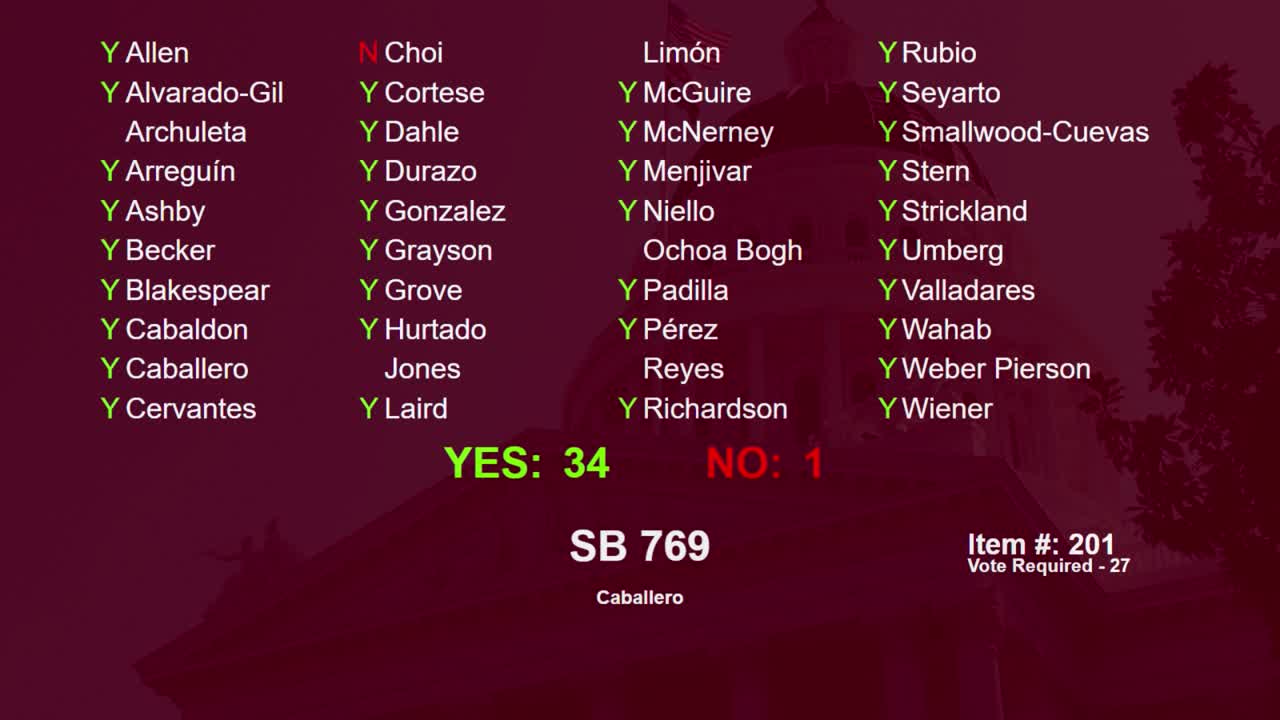 2MIN
Senate Floor
 4SEC
Senate Standing Committee on Appropriations
 15MIN