SB 763: Conspiracy against trade: punishment.
- Session Year: 2025-2026
- House: Senate
- Latest Version Date: 2025-10-06
Current Status:
Passed
(2025-10-06: Chaptered by Secretary of State. Chapter 426, Statutes of 2025.)
Introduced
In Committee
Awaiting First Chamber Vote
Passed First Chamber
In Committee
Awaiting Second Chamber Vote
Passed Second Chamber
Enacted
Existing law, known as the Cartwright Act, generally regulates trusts, which the act defines as a combination of capital, skill, or acts by 2 or more persons for certain purposes, including to create or carry out restrictions in trade or commerce. If a violator of the act is a corporation, the act punishes the violator by a fine of the greater of an amount not more than $1,000,000 and an amount related to the pecuniary gain from the violation or the pecuniary loss to another by the violation, as prescribed. If a violator of the act is an individual, the act punishes the violator by imprisonment of one, 2, or 3 years in a state prison or county jail, as specified, imprisonment of not more than one year in a county jail, by a fine of not more than the greater of $250,000 and an amount related to the pecuniary gain from the violation or the pecuniary loss to another by the violation, or by both a fine and imprisonment.
This bill would increase the fine described above with respect to corporate violators to $6,000,000. The bill would also increase the fine described above with respect to an individual violator to $1,000,000. The bill would impose an additional civil penalty of $1,000,000 on a person, corporation, or business entity for violating the act, as prescribed. The bill would also make a technical change.
Existing law, known as the Cartwright Act, generally regulates trusts, which the act defines as a combination of capital, skill, or acts by 2 or more persons for certain purposes, including to create or carry out restrictions in trade or commerce. If a violator of the act is a corporation, the act punishes the violator by a fine of the greater of an amount not more than $1,000,000 and an amount related to the pecuniary gain from the violation or the pecuniary loss to another by the violation, as prescribed. If a violator of the act is an individual, the act punishes the violator by imprisonment of one, 2, or 3 years in a state prison or county jail, as specified, imprisonment of not more than one year in a county jail, by a fine of not more than the greater of $250,000 and an amount related to the pecuniary gain from the violation or the pecuniary loss to another by the violation, or by both a fine and imprisonment.
This bill would increase the fine described above with respect to corporate violators to $6,000,000. The bill would also change the term of imprisonment in a state prison or county jail described above to not more than 2, 3, or 5 years and would increase the fine described above with respect to an individual violator to $1,000,000. By increasing the maximum term an individual violator could serve in a county prison, the bill would impose a state-mandated local program. The bill would impose an additional civil penalty of $1,000,000 on a person, corporation, or business entity for violating the act, as prescribed. The bill would also make a technical change.
The California Constitution requires the state to reimburse local agencies and school districts for certain costs mandated by the state. Statutory provisions establish procedures for making that reimbursement.This bill would provide that, if the Commission on State Mandates determines that the bill contains costs mandated by the state, reimbursement for those costs shall be made pursuant to the statutory provisions noted above.Existing law, known as the Cartwright Act, generally regulates trusts, which the act defines as a combination of capital, skill, or acts by 2 or more persons for certain purposes, including to create or carry out restrictions in trade or commerce. If a violator of the act is a corporation, the act punishes the violator by a fine of the greater of an amount not more than $1,000,000 and an amount related to the pecuniary gain from the violation or the pecuniary loss to another by the violation, as prescribed. If a violator of the act is an individual, the act punishes the violator by imprisonment of one, 2, or 3 years in a state prison or county jail, as specified, imprisonment of not more than one year in a county jail, by a fine of not more than the greater of $250,000 and an amount related to the pecuniary gain from the violation or the pecuniary loss to another by the violation, or by both a fine and imprisonment.
This bill would increase the fine described above with respect to corporate violators to $100,000,000. $6,000,000. The bill would also increase change the term of imprisonment in a state prison or county jail described above to not more than 2, 3, or 5 years and would increase the fine described above with respect to an individual violator to $1,000,000. By increasing the maximum term an individual violator could serve in a county prison, this the bill would impose a state-mandated local program. The bill would also impose an additional civil penalty of $1,000,000 on a person, corporation, or business entity for violating the act, as prescribed. The bill would also make a technical change.
The California Constitution requires the state to reimburse local agencies and school districts for certain costs mandated by the state. Statutory provisions establish procedures for making that reimbursement.
This bill would provide that, if the Commission on State Mandates determines that the bill contains costs mandated by the state, reimbursement for those costs shall be made pursuant to the statutory provisions noted above.
Existing law, known as the Cartwright Act, generally regulates trusts, which the act defines as a combination of capital, skill, or acts by 2 or more persons for certain purposes, including to create or carry out restrictions in trade or commerce. If a violator of the act is a corporation, the act punishes the violator by a fine of the greater of an amount not more than $1,000,000 and an amount related to the pecuniary gain from the violation or the pecuniary loss to another by the violation, as prescribed. If a violator of the act is an individual, the act punishes the violator by imprisonment of one, 2, or 3 years in a state prison or county jail, as specified, imprisonment of not more than one year in a county jail, by a fine of not more than the greater of $250,000 and an amount related to the pecuniary gain from the violation or the pecuniary loss to another by the violation, or by both a fine and imprisonment.
This bill would increase the fine described above with respect to corporate violators to $100,000,000. The bill would also increase change the term of imprisonment in a state prison or county jail described above to not more than 2, 3, or 5 years and would increase the fine described above with respect to an individual violator to $1,000,000. By increasing the maximum term an individual violator could serve in a county prison, this bill would impose a state-mandated local program. The bill would also impose an additional civil penalty of $1,000,000 on a person, corporation, or business entity for violating the act, as prescribed.
The California Constitution requires the state to reimburse local agencies and school districts for certain costs mandated by the state. Statutory provisions establish procedures for making that reimbursement.
This bill would provide that, if the Commission on State Mandates determines that the bill contains costs mandated by the state, reimbursement for those costs shall be made pursuant to the statutory provisions noted above.
(a)Any violation of this chapter is a conspiracy against trade, and any person who engages in any such conspiracy or takes part therein, or aids or advises in its commission, or who as principal, manager, director, agent, servant or employee, or in any other capacity, knowingly carries out any of the stipulations, purposes, prices, rates, or furnishes any information to assist in carrying out those purposes, or orders thereunder or in pursuance thereof, is punishable, as follows:
(1)If the violator is a corporation, by a fine of not more than six million dollars ($6,000,000) or the applicable amount under paragraph (3), whichever is greater.
(2)If the violator is an individual, by imprisonment pursuant to subdivision (h) of Section 1170 of the Penal Code for one, two, or three years, by imprisonment for not more than one year in a county jail, by a fine of not more than the greater of one million dollars ($1,000,000) and a fine of the applicable amount under paragraph (3), or by both a fine and imprisonment.
(3)If any person derives pecuniary gain from a violation of this chapter, or the violation results in pecuniary loss to a person other than the violator, the violator may be fined not more than an amount equal to the amount of the gross gain multiplied by two or an amount equal to the amount of the gross loss multiplied by two, whichever is applicable.
(b)Any action pursuant to this section may be commenced at any time within four years after the commission of the last act comprising a part of any violation. No cause of action barred under existing law on the effective date of the amendment of this section at the 197778 Regular Session of the Legislature shall be revived by that amendment.
(c)All moneys received by any court in payment of any fine or civil penalty imposed pursuant to this section shall, as soon as practicable after receipt thereof, be deposited with the county treasurer of the county in which the court is situated. Amounts so deposited shall be paid as soon as practicable as follows: 100 percent to the Treasurer by warrant of the county auditor drawn upon the requisition of the clerk or judge of said court to be deposited in the Attorney General antitrust account within the General Fund of the State Treasury, as established under Section 12526 of the Government Code, on order of the Controller if the moneys received resulted from an action initiated and prosecuted by the Attorney General. If the action was initiated and prosecuted by a district attorney, then 100 percent shall be paid as soon as practicable to the treasurer of the county in which the prosecution is conducted. If the action was initiated and prosecuted jointly by the Attorney General and a district attorney or jointly by more than one district attorney, those amounts shall be paid to the State Treasurer and to the treasurer or treasurers of the county or counties participating in the prosecution in a proportion agreed upon by the agencies jointly prosecuting the case and as approved by the court.
SEC. 2.Section 16755.1 is added to the Business and Professions Code, to read:16755.1.(a)A civil penalty of not more than one million dollars ($1,000,000) shall be assessed and recovered in any civil action brought by the Attorney General or district attorney against any person, corporation, or business entity for each violation of this chapter.
(b)In assessing the amount of a civil penalty pursuant to this section, a court or jury shall consider any relevant circumstances presented by any of the parties to the case, including, but not limited to, all of the following:
(1)The nature and seriousness of the misconduct.
(2)The number of violations committed by the defendant.
(3)The persistence of the defendants misconduct.
(4)The length of time over which the defendants misconduct occurred.
(5)The willfulness of the defendants misconduct.
(6)The defendants assets, liabilities, and net worth.
(7)The extent to which the defendant cooperated in the Attorney Generals or district attorneys investigation and litigation.
(c)The penalty described in this section shall be recovered only in a civil action brought by the Attorney General or a district attorney, or by any of that persons attorneys designated by it for that purpose, against any party that violates this chapter.
(d)A penalty collected pursuant to this section shall accrue only to the State of California or the county treasurer of the county in which the court is situated, and all proceeds retained pursuant to this section shall be deposited pursuant to subdivision (c) of Section 16755.
SEC. 3.Section 16762 is added to the Business and Professions Code, to read:16762.Unless otherwise expressly provided, the remedies or penalties provided by this chapter are cumulative to each other and to the remedies or penalties available under other state law.
(a)Any violation of this chapter is a conspiracy against trade, and any person who engages in any such conspiracy or takes part therein, or aids or advises in its commission, or who as principal, manager, director, agent, servant or employee, or in any other capacity, knowingly carries out any of the stipulations, purposes, prices, rates, or furnishes any information to assist in carrying out those purposes, or orders thereunder or in pursuance thereof, is punishable, as follows:
(1)If the violator is a corporation, by a fine of not more than six million dollars ($6,000,000) or the applicable amount under paragraph (3), whichever is greater.
(2)If the violator is an individual, by imprisonment pursuant to subdivision (h) of Section 1170 of the Penal Code for one, two, three, or five or three years, by imprisonment for not more than one year in a county jail, by a fine of not more than the greater of one million dollars ($1,000,000) and a fine of the applicable amount under paragraph (3), or by both a fine and imprisonment.
(3)If any person derives pecuniary gain from a violation of this chapter, or the violation results in pecuniary loss to a person other than the violator, the violator may be fined not more than an amount equal to the amount of the gross gain multiplied by two or an amount equal to the amount of the gross loss multiplied by two, whichever is applicable.
(b)Any action pursuant to this section may be commenced at any time within four years after the commission of the last act comprising a part of any violation. No cause of action barred under existing law on the effective date of the amendment of this section at the 197778 Regular Session of the Legislature shall be revived by that amendment.
(c)All moneys received by any court in payment of any fine or civil penalty imposed pursuant to this section shall, as soon as practicable after receipt thereof, be deposited with the county treasurer of the county in which the court is situated. Amounts so deposited shall be paid as soon as practicable as follows: 100 percent to the Treasurer by warrant of the county auditor drawn upon the requisition of the clerk or judge of said court to be deposited in the Attorney General antitrust account within the General Fund of the State Treasury, as established under Section 12526 of the Government Code, on order of the Controller if the moneys received resulted from an action initiated and prosecuted by the Attorney General. If the action was initiated and prosecuted by a district attorney, then 100 percent shall be paid as soon as practicable to the treasurer of the county in which the prosecution is conducted. If the action was initiated and prosecuted jointly by the Attorney General and a district attorney or jointly by more than one district attorney, those amounts shall be paid to the State Treasurer and to the treasurer or treasurers of the county or counties participating in the prosecution in a proportion agreed upon by the agencies jointly prosecuting the case and as approved by the court.
SEC. 2.Section 16755.1 is added to the Business and Professions Code, to read:16755.1.(a)A civil penalty of not more than one million dollars ($1,000,000) shall be assessed and recovered in any civil action brought by the Attorney General or district attorney against any person, corporation, or business entity for each violation of this chapter.
(b)In assessing the amount of a civil penalty pursuant to this section, a court or jury shall consider any relevant circumstances presented by any of the parties to the case, including, but not limited to, all of the following:
(1)The nature and seriousness of the misconduct.
(2)The number of violations committed by the defendant.
(3)The persistence of the defendants misconduct.
(4)The length of time over which the defendants misconduct occurred.
(5)The willfulness of the defendants misconduct.
(6)The defendants assets, liabilities, and net worth.
(7)The extent to which the defendant cooperated in the Attorney Generals or district attorneys investigation and litigation.
(c)The penalty described in this section shall be recovered only in a civil action brought by the Attorney General or a district attorney, or by any of that persons attorneys designated by it for that purpose, against any party that violates this chapter.
(d)A penalty collected pursuant to this section shall accrue only to the State of California or the county treasurer of the county in which the court is situated, and all proceeds retained pursuant to this section shall be deposited pursuant to subdivision (c) of Section 16755.
SEC. 3.Section 16762 is added to the Business and Professions Code, to read:16762.Unless otherwise expressly provided, the remedies or penalties provided by this chapter are cumulative to each other and to the remedies or penalties available under other state law.
SEC. 4.If the Commission on State Mandates determines that this act contains costs mandated by the state, reimbursement to local agencies and school districts for those costs shall be made pursuant to Part 7 (commencing with Section 17500) of Division 4 of Title 2 of the Government Code.(a)Any violation of this chapter is a conspiracy against trade, and any person who engages in any such conspiracy or takes part therein, or aids or advises in its commission, or who as principal, manager, director, agent, servant or employee, or in any other capacity, knowingly carries out any of the stipulations, purposes, prices, rates, or furnishes any information to assist in carrying out such those purposes, or orders thereunder or in pursuance thereof, is punishable, as follows:
(1)If the violator is a corporation, by a fine of not more than one hundred six million dollars ($100,000,000) ($6,000,000) or the applicable amount under paragraph (3), whichever is greater.
(2)If the violator is an individual, by imprisonment pursuant to subdivision (h) of Section 1170 of the Penal Code for two, three, or five years, by imprisonment for not more than one year in a county jail, by a fine of not more than the greater of one million dollars ($1,000,000) and a fine of the applicable amount under paragraph (3), or by both a fine and imprisonment.
(3)If any person derives pecuniary gain from a violation of this chapter, or the violation results in pecuniary loss to a person other than the violator, the violator may be fined not more than an amount equal to the amount of the gross gain multiplied by two or an amount equal to the amount of the gross loss multiplied by two, whichever is applicable.
(b)Any action pursuant to this section may be commenced at any time within four years after the commission of the last act comprising a part of any violation. No cause of action barred under existing law on the effective date of the amendment of this section at the 197778 Regular Session of the Legislature shall be revived by such that amendment.
(c)Subject to Section 13521 of the Penal Code, all All moneys received by any court in payment of any fine or civil penalty imposed pursuant to this section shall, as soon as practicable after receipt thereof, be deposited with the county treasurer of the county in which the court is situated. Amounts so deposited shall be paid as soon as practicable as follows: 100 percent to the Treasurer by warrant of the county auditor drawn upon the requisition of the clerk or judge of said court to be deposited in the Attorney General antitrust account within the General Fund of the State Treasury Treasury, as established under Section 12526 of the Government Code, on order of the Controller if the moneys received resulted from an action initiated and prosecuted by the Attorney General. If the action was initiated and prosecuted by a district attorney attorney, then 100 percent shall be paid as soon as practicable to the treasurer of the county in which the prosecution is conducted. If the action was initiated and prosecuted jointly by the Attorney General and a district attorney or jointly by more than one district attorney, such those amounts shall be paid to the State Treasurer and to the treasurer(s) treasurer or treasurers of the county or counties participating in the prosecution in a proportion agreed upon by the agencies jointly prosecuting such the case and as approved by the court.
SEC. 2.Section 16755.1 is added to the Business and Professions Code, to read:16755.1.(a)A civil penalty of not more than one million dollars ($1,000,000) shall be assessed and recovered in any civil action brought by the Attorney General or district attorney against any person, corporation, or business entity for each violation of this chapter.
(b)In assessing the amount of a civil penalty pursuant to this section, a court or jury shall consider any relevant circumstances presented by any of the parties to the case, including, but not limited to, all of the following:
(1)The nature and seriousness of the misconduct.
(2)The number of violations committed by defendant.
(3)The persistence of the defendants misconduct.
(4)The length of time over which the defendants misconduct occurred.
(5)The willfulness of the defendants misconduct.
(6)The defendants assets, liabilities, and net worth.
(7)The extent to which the defendant cooperated in the Attorney Generals or district attorneys investigation and litigation.
(c)The penalty described in this section shall be recovered only in a civil action brought by the Attorney General or a district attorney, or by any of that persons attorneys designated by it for that purpose, against any party that violates this chapter.
(d)A penalty collected pursuant to this section shall accrue only to the State of California or the county treasurer of the county in which the court is situated, and all proceeds retained pursuant to this section shall be deposited pursuant to subdivision (c) Section 16755.
SEC. 3.Section 16762 is added to the Business and Professions Code, to read:16762.Unless otherwise expressly provided, the remedies or penalties provided by this chapter are cumulative to each other and to the remedies or penalties available under other state law.
SEC. 4.If the Commission on State Mandates determines that this act contains costs mandated by the state, reimbursement to local agencies and school districts for those costs shall be made pursuant to Part 7 (commencing with Section 17500) of Division 4 of Title 2 of the Government Code.
(a)Any violation of this chapter is a conspiracy against trade, and any person who engages in any such conspiracy or takes part therein, or aids or advises in its commission, or who as principal, manager, director, agent, servant or employee, or in any other capacity, knowingly carries out any of the stipulations, purposes, prices, rates, or furnishes any information to assist in carrying out such purposes, or orders thereunder or in pursuance thereof, is punishable, as follows:
(1)If the violator is a corporation, by a fine of not more than one hundred million dollars ($1,000,000) ($100,000,000) or the applicable amount under paragraph (3), whichever is greater.
(2)If the violator is an individual, by imprisonment pursuant to subdivision (h) of Section 1170 of the Penal Code for one, two, or three two, three, or five years, by imprisonment for not more than one year in a county jail, by a fine of not more than the greater of two hundred fifty thousand one million dollars ($250,000), ($1,000,000) and a fine of the applicable amount under paragraph (3), or by both a fine and imprisonment.
(3)If any person derives pecuniary gain from a violation of this chapter, or the violation results in pecuniary loss to a person other than the violator, the violator may be fined not more than an amount equal to the amount of the gross gain multiplied by two or an amount equal to the amount of the gross loss multiplied by two, whichever is applicable.
(b)Any action pursuant to this section may be commenced at any time within four years after the commission of the last act comprising a part of any violation. No cause of action barred under existing law on the effective date of the amendment of this section at the 197778 Regular Session of the Legislature shall be revived by such amendment.
(c)Subject to Section 13521 of the Penal Code, all moneys received by any court in payment of any fine or civil penalty imposed pursuant to this section shall, as soon as practicable after receipt thereof, be deposited with the county treasurer of the county in which the court is situated. Amounts so deposited shall be paid as soon as practicable as follows: 100 percent to the Treasurer by warrant of the county auditor drawn upon the requisition of the clerk or judge of said court to be deposited in the Attorney General antitrust account within the General Fund of the State Treasury on order of the Controller if the moneys received resulted from an action initiated and prosecuted by the Attorney General. If the action was initiated and prosecuted by a district attorney then 100 percent shall be paid as soon as practicable to the treasurer of the county in which the prosecution is conducted. If the action was initiated and prosecuted jointly by the Attorney General and a district attorney or jointly by more than one district attorney, such amounts shall be paid to the State Treasurer and to the treasurer(s) of the county or counties participating in the prosecution in a proportion agreed upon by the agencies jointly prosecuting such case and as approved by the court.
SEC. 2.Section 16755.1 is added to the Business and Professions Code, to read:16755.1.(a)A civil penalty of not more than one million dollars ($1,000,000) shall be assessed and recovered in any civil action brought by the Attorney General or district attorney against any person, corporation, or business entity for each violation of this chapter.
(b)In assessing the amount of a civil penalty pursuant to this section, a court or jury shall consider any relevant circumstances presented by any of the parties to the case, including, but not limited to, all of the following:
(1)The nature and seriousness of the misconduct.
(2)The number of violations committed by defendant.
(3)The persistence of the defendants misconduct.
(4)The length of time over which the defendants misconduct occurred.
(5)The willfulness of the defendants misconduct.
(6)The defendants assets, liabilities, and net worth.
(7)The extent to which the defendant cooperated in the Attorney Generals or district attorneys investigation and litigation.
(c)The penalty described in this section shall be recovered only in a civil action brought by the Attorney General or a district attorney, or by any of that persons attorneys designated by it for that purpose, against any party that violates this chapter.
(d)A penalty collected pursuant to this section shall accrue only to the State of California or the county treasurer of the county in which the court is situated, and all proceeds retained pursuant to this section shall be deposited pursuant to subdivision (c) Section 16755.
SEC. 3.Section 16762 is added to the Business and Professions Code, to read:16762.Unless otherwise expressly provided, the remedies or penalties provided by this chapter are cumulative to each other and to the remedies or penalties available under other state law.
SEC. 4.If the Commission on State Mandates determines that this act contains costs mandated by the state, reimbursement to local agencies and school districts for those costs shall be made pursuant to Part 7 (commencing with Section 17500) of Division 4 of Title 2 of the Government Code.
|
Date
|
Status
|
|---|---|
| Oct 6, 2025 | Chaptered by Secretary of State. Chapter 426, Statutes of 2025. |
| Oct 6, 2025 | Approved by the Governor. |
| Sep 23, 2025 | Enrolled and presented to the Governor at 2 p.m. |
| Sep 13, 2025 | Assembly amendments concurred in. (Ayes 29. Noes 8. Page 3020.) Ordered to engrossing and enrolling. |
| Sep 12, 2025 | In Senate. Concurrence in Assembly amendments pending. |
| Sep 12, 2025 | Read third time. Passed. (Ayes 53. Noes 20. Page 3400.) Ordered to the Senate. |
| Sep 3, 2025 | Read second time. Ordered to third reading. |
| Sep 2, 2025 | Read second time and amended. Ordered to second reading. |
| Aug 29, 2025 | From committee: Do pass as amended. (Ayes 10. Noes 4.) (August 29). |
| Aug 20, 2025 | August 20 set for first hearing. Placed on APPR. suspense file. |
| Jul 16, 2025 | From committee: Do pass and re-refer to Com. on APPR. (Ayes 7. Noes 2.) (July 15). Re-referred to Com. on APPR. |
| Jul 2, 2025 | From committee: Do pass and re-refer to Com. on PUB. S. (Ayes 8. Noes 3.) (July 1). Re-referred to Com. on PUB. S. |
| Jun 16, 2025 | Referred to Coms. on JUD. and PUB. S. |
| Jun 5, 2025 | In Assembly. Read first time. Held at Desk. |
| Jun 4, 2025 | Read third time. Passed. (Ayes 29. Noes 10. Page 1519.) Ordered to the Assembly. |
| May 27, 2025 | Read second time. Ordered to third reading. |
| May 23, 2025 | Read second time and amended. Ordered to second reading. |
| May 23, 2025 | From committee: Do pass as amended. (Ayes 5. Noes 1. Page 1212.) (May 23). |
| May 16, 2025 | Set for hearing May 23. |
| May 12, 2025 | May 12 hearing: Placed on APPR. suspense file. |
| May 2, 2025 | Set for hearing May 12. |
| Apr 30, 2025 | From committee: Do pass and re-refer to Com. on APPR. (Ayes 5. Noes 1. Page 945.) (April 29). Re-referred to Com. on APPR. |
| Apr 11, 2025 | Set for hearing April 29. |
| Apr 9, 2025 | From committee: Do pass and re-refer to Com. on PUB. S. (Ayes 11. Noes 2. Page 707.) (April 8). Re-referred to Com. on PUB. S. |
| Mar 24, 2025 | Set for hearing April 8. |
| Mar 12, 2025 | Referred to Coms. on JUD. and PUB. S. |
| Feb 24, 2025 | Read first time. |
| Feb 24, 2025 | From printer. May be acted upon on or after March 24. |
| Feb 21, 2025 | Introduced. To Com. on RLS. for assignment. To print. |
|
Date
|
Description
|
Location
|
Votes
|
|
|---|---|---|---|---|
| Sep 13, 2025 | Unfinished Business SB763 Hurtado Concurrence | Senate Floor |
Passed |
|
| Sep 12, 2025 | Unfinished Business SB763 Hurtado Concurrence | Senate Floor |
Passed |
|
| Sep 12, 2025 | SB 763 Hurtado Senate Third Reading By Kalra | Assembly Floor |
Passed |
|
| Aug 29, 2025 | Do pass as amended. | Assembly Standing Committee on Appropriations |
Passed |
|
| Jul 15, 2025 | Do pass and be re-referred to the Committee on [Appropriations] | Assembly Standing Committee on Public Safety |
Passed |
|
| Jul 1, 2025 | Do pass and be re-referred to the Committee on [Public Safety] | Assembly Standing Committee on Judiciary |
Passed |
|
| Jun 4, 2025 | Senate 3rd Reading SB763 Hurtado | Senate Floor |
Passed |
|
| May 23, 2025 | Do pass as amended | Senate Standing Committee on Appropriations |
Passed |
|
| May 12, 2025 | Placed on suspense file | Senate Standing Committee on Appropriations |
Passed |
|
| Apr 29, 2025 | Do pass, but first be re-referred to the Committee on [Appropriations] | Senate Standing Committee on Public Safety |
Passed |
|
| Apr 8, 2025 | Do pass, but first be re-referred to the Committee on [Public Safety] | Senate Standing Committee on Judiciary |
Passed |
This list shows positions taken on this bill by organizations on the date displayed, which is linked to the original source.
Positions by individuals are not included.
|
Organization
|
Position
|
Date
|
|---|---|---|
| American Economic Liberties Project | ** Support | |
| American Property Casualty Insurance Association | ** Against | |
| Associated Builders And Contractors Of California | ** Against | |
| Attorney General Rob Bonta | ** Support | |
| Brea Chamber of Commerce | ** Against | |
| CalBroadband | ** Against | |
| California Apartment Association | ** Against | |
| California Building Industry Association | ** Against | |
| California Business Properties Association | ** Against | |
| California Chamber Of Commerce | ** Against | |
| California Department of Justice (DOJ) | ** Support | |
| California Federation of Labor Unions, Afl-cio | ** Support | |
| California Grocers Association | ** Against | |
| California Hospital Association | ** Against | |
| California Nurses Association/National Nurses United | ** Support | |
| California Restaurant Association | ** Against | |
| California Retailers Association | ** Against | |
| Carlsbad Chamber of Commerce | ** Against | |
| Civil Justice Association Of California | ** Against | |
| Consumer Federation Of California | ** Support | |
| Council of Business and Industries | ** Against | |
| Council of Industries | ** Against | |
| Ctia The Wireless Association | ** Against | |
| CTIA – The Wireless Association | ** Against | |
| Economic Security California Action | ** Support | |
| Family Business Association of California | ** Against | |
| Greater Conejo Valley Chamber of Commerce | ** Against | |
| Health Access California | ** Support | |
| Insights Association | ** Against | |
| National Association of Mutual Insurance Companies | ** Against | |
| Oceanside Chamber of Commerce | ** Against | |
| Personal Insurance Federation Of California | ** Against | |
| SEIU California | ** Support | |
| Software & Information Industry Association | ** Against | |
| Software Information Industry Association | ** Against | |
| Techequity Action | ** Support | |
| Technet | ** Against | |
| UDW/AFSCME Local 3930 | ** Support | |
| United Hospital Association | ** Against | |
| Writers Guild Of America West | ** Support |
SENATE RULES COMMITTEE Office of Senate Floor Analyses (916) 651-1520 Fax: (916) 327-4478 | SB 763 |
UNFINISHED BUSINESS
Bill No: SB 763
Author: Hurtado (D)
Amended: 10/6/25
Vote: 21
SENATE JUDICIARY COMMITTEE: 11-2, 4/8/25
AYES: Umberg, Allen, Arreguín, Ashby, Caballero, Durazo, Laird, Stern, Wahab, Weber Pierson, Wiener
NOES: Niello, Valladares
SENATE PUBLIC SAFETY COMMITTEE: 5-1, 4/29/25
AYES: Arreguín, Caballero, Gonzalez, Pérez, Wiener
NOES: Seyarto
SENATE APPROPRIATIONS COMMITTEE: 5-1, 5/23/25
AYES: Caballero, Cabaldon, Grayson, Richardson, Wahab
NOES: Seyarto
NO VOTE RECORDED: Dahle
SENATE FLOOR: 29-10, 6/4/25
AYES: Allen, Archuleta, Arreguín, Ashby, Becker, Blakespear, Cabaldon, Caballero, Cervantes, Cortese, Durazo, Gonzalez, Grayson, Hurtado, Laird, Limón, McGuire, McNerney, Menjivar, Padilla, Pérez, Richardson, Rubio, Smallwood-Cuevas, Stern, Umberg, Wahab, Weber Pierson, Wiener
NOES: Alvarado-Gil, Choi, Dahle, Grove, Jones, Niello, Ochoa Bogh, Seyarto, Strickland, Valladares
NO VOTE RECORDED: Reyes
ASSEMBLY FLOOR: 53-20, 9/12/25 - See last page for vote
SUBJECT: Conspiracy against trade: punishment
SOURCE: Attorney General Rob Bonta
DIGEST:
This bill increases existing criminal fines, and permits the Attorney General or a district attorney to seek civil penalties of up to $1 million, for a violation of the Cartwright Act.
Assembly Amendments
deleted the bill’s provisions that would have increased the maximum period of imprisonment for a criminal violation of the Cartwright Act.
ANALYSIS:
Existing federal law:
- Establishes the Sherman Antitrust Act of 1890 (Sherman Act). (15 United States Code (U.S.C.) §§ 1-7.)
- Makes illegal, under the Sherman Act, every contract, combination in the form of trust or otherwise, or conspiracy, in restraint of trade or commerce among the states or with foreign nations. (15 U.S.C. § 1.)
- Authorizes a state attorney general to bring a civil action in the name of the state in any district court of the United States having jurisdiction over the defendant to secure monetary relief, as provided, for violations of the Sherman Act. (15 U.S.C. § 15c.)
Existing state law:
- Establishes the Cartwright Act. (Bus. & Prof. Code, div. 7, pt. 2, ch. 2, §§ 16700 et seq.)
- Defines a “trust” under the Cartwright Act as a combination of capital, skill, or acts by two or more persons for any of the following purposes:
- To create or carry out restrictions in trade or commerce.
- To limit or reduce the production, or increase the price of merchandise or of any commodity.
- To prevent competition in manufacturing, making, transportation, sale, or purchase of merchandise, produce, or any commodity.
- To fix at any standard or figure, whereby its price to the public or consumer shall be in any manner controlled or established, any article or commodity of merchandise, produce, or commerce intended for sale, barter, use, or consumption in the state.
- To make or enter into or execute or carry out any contracts, obligations, or agreements of any kind or description, by which they do all or any combination of specified acts.
- Agree to pool, combine, or directly or indirectly unite any interests that they may have connected with the sale or transportation of any such article or commodity, that its price in any manner might be affected. (Bus. & Prof. Code, § 16720.)
- Makes every trust unlawful, against public policy, and void, except as exempted under the Cartwright Act. (Bus. & Prof. Code, § 16726.)
- Provides that any contract or agreement in violation of the Cartwright Act is absolutely void and not enforceable. (Bus & Prof. Code, § 16722.)
- Authorizes the Attorney General, or the district attorney of any county, subject to specified notice requirements, to initiate a civil action or criminal proceeding for a violation of the Cartwright Act. (Bus. & Prof. Code, § 16754.)
- Authorizes any person who is injured in their business or property by reason of anything forbidden under the Cartwright Act, regardless of whether the injured person dealt directly or indirectly with the defendant, to file a civil action to recover treble damages, interest, and injunctive relief.
- Authorizes the Attorney General to file a civil action in the name of the people of the State of California, as parens patriae on behalf of natural persons residing in the state, for a violation of the Cartwright Act, to secure monetary relief in the form of treble damages sustained by those natural persons, interest, costs, and reasonable attorney fees. (Bus. & Prof. Code, § 16760.)
- Provides that a violation of the Cartwright Act is a conspiracy against trade, and that knowingly engaging or participating in such a conspiracy is a crime, punishable as follows:
- If the violator is a corporation, by a fine of not more than $1 million or the amount under (c), whichever is greater.
- If the violator is an individual, by imprisonment pursuant to Penal Code section 1170(h) for one, two, or three years; by imprisonment for up to one year in a county jail; by a fine of not more $250,000 or the amount under (c), whichever is greater; or by both a fine and imprisonment.
- If any person derives pecuniary gain from a violation of the Cartwright Act, or the violation results in pecuniary loss to a person other than the violator, the violator may be fined not more than twice the amount of the gain or loss. (Bus. & Prof. Code, § 16755(a).)
- Provides that all moneys received by a court in payment of any fine or civil penalty imposed pursuant to 9) shall be paid to the State Treasury, if the Attorney General initiated and prosecuted the action; or to the treasurer of the county in which the prosecution is conducted, if the district attorney initiated and prosecuted the action. In an action prosecuted jointly by the Attorney General and a district attorney, the amounts shall be paid in the proportion agreed upon by the prosecuting entities. (Bus. & Prof. Code, § 16755(c).)
This bill:
- Increases the existing criminal penalties for a violation of the Cartwright Act, as follows:
- If the violator is a corporation, the maximum fine is increased from a maximum of $1 million to a maximum of $6 million, or twice the gain or loss caused by the violation, whichever is greater.
- If the violator is an individual, the maximum fine is increased from a maximum of $250,000 to a maximum of $1 million, or twice the gain or loss caused by the violation, whichever is greater.
- Requires, in an action initiated and prosecuted by the Attorney General, all moneys received by any court in payment for a fine or civil penalty imposed pursuant to a violation of the Cartwright Act to be deposited in the Attorney General antitrust account within the General Fund of the State Treasury.
- Provides that a civil penalty of not more than $1 million shall be assessed and recovered in any civil action brought by the Attorney General or district attorney against any person, corporation, or business entity for a violation of the Cartwright Act.
- Requires a court or jury, in assessing the amount of a civil penalty under 3), to consider any relevant circumstances presented by the parties to the case, including, but not limited to:
- The nature and seriousness of the misconduct.
- The number of violations committed by the defendant.
- The persistence of the defendant’s misconduct.
- The length of time over which the defendant’s misconduct occurred.
- The willfulness of the defendant’s misconduct.
- The defendant’s assets, liabilities, and net worth.
- The extent to which the defendant cooperated in the Attorney General’s or district attorney’s investigation and litigation.
- Provides that the civil penalty described in 3) shall be recovered only in a civil action brought by the Attorney General or a district attorney, or by any of their attorneys designated by them for that purpose, against any party that violates the Cartwright Act.
- Provides that a penalty collected pursuant to 3) shall accrue only to the State of California or the county treasurer of the county in which the court is situated, and all proceeds shall be deposited in the Attorney General antitrust account of the General Fund (in an action brought by the Attorney General) or to the county (in an action brought by a district attorney).
- Provides that, unless otherwise expressly provided by law, the remedies or penalties provided within the Cartwright Act are cumulative to each other and to the remedies or penalties available under other state law.
Comments
California’s primary antitrust law, the Cartwright Act, prohibits businesses from restraining trade, fixing prices, and reducing competition. The Cartwright Act provides criminal and civil enforcement mechanisms, permitting the Attorney General or a district attorney to seek fines and jail time for criminal violations, and treble damages in a suit brought on behalf of the people of California or the county in which the district attorney is located.
This bill modifies the available penalties under the Cartwright Act. First, the bill increases the criminal fines available under the Cartwright Act against a corporate and an individual violator. Second, the bill authorizes the Attorney General or a district attorney to seek civil penalties in any civil suit they bring under the Cartwright Act. Additionally, the bill allows any penalties recovered by the Attorney General to be deposited in the Attorney General antitrust account within the General Fund. These measures are intended to strengthen the Cartwright Act and ensure that the Attorney General is able to prosecute Cartwright Actions against powerful corporations that are harming Californians.
FISCAL EFFECT: Appropriation: No Fiscal Com.: Yes Local: No
According to the Assembly Appropriations Committee, the fiscal effect is as follows:
- Cost pressures (Trial Court Trust Fund, General Fund) of an unknown but potentially significant amount to the courts to assess civil penalties as authorized by this bill. Actual costs will depend on the number of cases filed and the amount of court time needed to hear evidence and assess penalties. It generally costs approximately $1,000 to operate a courtroom for one hour. Although courts are not funded on the basis of workload, increased pressure on the Trial Court Trust Fund may create a demand for increased funding for courts from the General Fund. The fiscal year 2025-26 state budget provides $82 million ongoing General Fund to the Trial Court Trust Fund for court operations.
- Costs (local funds, General Fund) to the counties and the California Department of Corrections and Rehabilitation to incarcerate people convicted of conspiracy against trade. Actual incarceration costs will depend on the number of convictions, the length of each sentence, and whether each sentence must be served in county jail or state prison. The average annual cost to incarcerate one person in county jail is approximately $29,000, though costs are higher in larger counties. The Legislative Analyst’s Office estimates the average annual cost to incarcerate one person in state prison is $133,000. County incarceration costs are not subject to reimbursement by the state. However, overcrowding in county jails creates cost pressure on the General Fund because the state has historically granted new funding to counties to offset overcrowding resulting from public safety realignment.
- Possible increase in revenue (Attorney General Antitrust Account, local funds) of an unknown but potentially significant amount. This bill creates a new civil penalty and increases criminal fines. To the extent these penalties and fines are issued and collected, the resulting revenue may be used to fund antitrust enforcement actions by the Attorney General or distributed to the county of the district attorney that brought the action.
- The Department of Justice (DOJ) reports no fiscal impact to the department. DOJ anticipates any future increase in workload resulting from more robust antitrust enforcement would be funded by the fine and penalty revenue described above.
SUPPORT: (Verified 9/10/25)
Attorney General Rob Bonta (source)
American Economic Liberties Project
California Federation of Labor Unions, AFL-CIO
California Nurses Association/National Nurses United
Consumer Federation of California
Economic Security California Action
Health Access California
SEIU California
TechEquity Action
UDW/AFSCME Local 3930
Writers Guild of America West
OPPOSITION: (Verified 9/10/25)
American Property Casualty Insurance Association
Associated Builders and Contractors of California
Brea Chamber of Commerce
CalBroadband
California Apartment Association
California Business Properties Association
California Chamber of Commerce
California Grocers Association
California Hospital Association
California Restaurant Association
California Retailers Association
Civil Justice Association of California
Council of Business and Industries
CTIA – The Wireless Association
Family Business Association of California
Greater Conejo Valley Chamber of Commerce
Insights Association
National Association of Mutual Insurance Companies
Oceanside Chamber of Commerce
Personal Insurance Federation of California
Software Information Industry Association
TechNet
United Hospital Association
ARGUMENTS IN SUPPORT: According to the bill’s source, Attorney General Rob Bonta:
Given their vast resources, corporations and individuals currently view the existing criminal fines as a minor cost of doing business, leading to repeated antitrust violations. Without stronger financial and personal penalties, there is no meaningful disincentive for committing illegal practices like price-fixing, as the costs of violating the antitrust laws will be outweighed by the potential financial gains. The resulting antitrust abuses systemically undermine fair competition, which negatively impacts workers, business, and consumers.
Accordingly, SB 763 would upgrade criminal penalties under the Cartwright Act to better align them with those provided under the federal Sherman Antitrust Act…
In addition, the bill would add civil penalties of up to $1 million per violation that courts can impose based on factors such as the nature, seriousness, and persistence of the misconduct. In adding civil penalties to the Cartwright Act, SB 763 would join California with 44 other states that already provide such remedies under their state antitrust laws. Of the 44 states that already authorize civil penalties, 40 of them impose a higher civil penalty than the $2,500 per violation that is recoverable in California, indirectly, through enforcement of the Unfair Competition Law.
As the fifth largest economy in the world, and home to some of the wealthiest corporations, California has a responsibility to fight for a fair and competitive marketplace, especially amid the unprecedented wave of corporate mergers and market consolidation that we are seeing today. For these reasons, updating the penalties in the Cartwright Act is critical to deterring anticompetitive conduct in the current market.
ARGUMENTS IN OPPOSITION: According to a coalition of the bill’s opponents:
The California Supreme Court has noted that the Cartwright Act is "broader in range and deeper in reach" than the Sherman Act. As a result, the penalties under the Cartwright Act would not be consistent with federal law because they could potentially apply to conduct beyond the scope of the Sherman Act. The California Office of the Attorney General has also acknowledged the Cartwright Act covers “broader” conduct than its federal counterpart and argued that pleading a Cartwright Act violation does not require meeting the heightened pleading standard of Federal Rule of Civil Procedure 9(b).
The broader reach of the Cartwright Act, coupled with the possible lower pleading standards, could mean companies and individuals doing business in California could face devastating penalties with this increase. Moreover, the Cartright Act provides a broader private right of action than the Sherman Act. Unnecessary and unwarranted expansions of California’s antitrust law will invite excessive and abusive litigation and ultimately harm California’s consumers and its economy.
ASSEMBLY FLOOR: 9/12/25 53-20
AYES: Addis, Aguiar-Curry, Ahrens, Alvarez, Arambula, Ávila Farías, Bauer-Kahan, Bennett, Berman, Boerner, Bonta, Bryan, Caloza, Carrillo, Connolly, Elhawary, Fong, Gabriel, Garcia, Gipson, Mark González, Haney, Harabedian, Hart, Irwin, Jackson, Kalra, Krell, Lee, Lowenthal, McKinnor, Muratsuchi, Ortega, Papan, Patel, Pellerin, Quirk-Silva, Ramos, Ransom, Celeste Rodriguez, Rogers, Schiavo, Schultz, Sharp-Collins, Solache, Soria, Stefani, Valencia, Ward, Wicks, Wilson, Zbur, Rivas
NOES: Alanis, Castillo, Chen, Davies, DeMaio, Dixon, Ellis, Flora, Gallagher, Jeff Gonzalez, Hadwick, Hoover, Johnson, Lackey, Macedo, Patterson, Sanchez, Ta, Tangipa, Wallis
NO VOTE RECORDED: Bains, Calderon, Nguyen, Pacheco, Petrie-Norris, Michelle Rodriguez, Blanca Rubio
Prepared by: Allison Whitt Meredith / JUD. / (916) 651-4113
7/21/26 11:48:48
**** END ****
SENATE RULES COMMITTEE Office of Senate Floor Analyses (916) 651-1520 Fax: (916) 327-4478 | SB 763 |
UNFINISHED BUSINESS
Bill No: SB 763
Author: Hurtado (D)
Amended: 9/2/25 in Assembly
Vote: 21
SENATE JUDICIARY COMMITTEE: 11-2, 4/8/25
AYES: Umberg, Allen, Arreguín, Ashby, Caballero, Durazo, Laird, Stern, Wahab, Weber Pierson, Wiener
NOES: Niello, Valladares
SENATE PUBLIC SAFETY COMMITTEE: 5-1, 4/29/25
AYES: Arreguín, Caballero, Gonzalez, Pérez, Wiener
NOES: Seyarto
SENATE APPROPRIATIONS COMMITTEE: 5-1, 5/23/25
AYES: Caballero, Cabaldon, Grayson, Richardson, Wahab
NOES: Seyarto
NO VOTE RECORDED: Dahle
SENATE FLOOR: 29-10, 6/4/25
AYES: Allen, Archuleta, Arreguín, Ashby, Becker, Blakespear, Cabaldon, Caballero, Cervantes, Cortese, Durazo, Gonzalez, Grayson, Hurtado, Laird, Limón, McGuire, McNerney, Menjivar, Padilla, Pérez, Richardson, Rubio, Smallwood-Cuevas, Stern, Umberg, Wahab, Weber Pierson, Wiener
NOES: Alvarado-Gil, Choi, Dahle, Grove, Jones, Niello, Ochoa Bogh, Seyarto, Strickland, Valladares
NO VOTE RECORDED: Reyes
ASSEMBLY FLOOR: 42-19, 9/12/25 – Roll call not available
SUBJECT: Conspiracy against trade: punishment
SOURCE: Attorney General Rob Bonta
DIGEST:
This bill increases existing criminal fines, and permits the Attorney General or a district attorney to seek civil penalties of up to $1 million, for a violation of the Cartwright Act.
Assembly Amendments
deleted the bill’s provisions that would have increased the maximum period of imprisonment for a criminal violation of the Cartwright Act.
ANALYSIS:
Existing federal law:
- Establishes the Sherman Antitrust Act of 1890 (Sherman Act). (15 United States Code (U.S.C.) §§ 1-7.)
- Makes illegal, under the Sherman Act, every contract, combination in the form of trust or otherwise, or conspiracy, in restraint of trade or commerce among the states or with foreign nations. (15 U.S.C. § 1.)
- Authorizes a state attorney general to bring a civil action in the name of the state in any district court of the United States having jurisdiction over the defendant to secure monetary relief, as provided, for violations of the Sherman Act. (15 U.S.C. § 15c.)
Existing state law:
- Establishes the Cartwright Act. (Bus. & Prof. Code, div. 7, pt. 2, ch. 2, §§ 16700 et seq.)
- Defines a “trust” under the Cartwright Act as a combination of capital, skill, or acts by two or more persons for any of the following purposes:
- To create or carry out restrictions in trade or commerce.
- To limit or reduce the production, or increase the price of merchandise or of any commodity.
- To prevent competition in manufacturing, making, transportation, sale, or purchase of merchandise, produce, or any commodity.
- To fix at any standard or figure, whereby its price to the public or consumer shall be in any manner controlled or established, any article or commodity of merchandise, produce, or commerce intended for sale, barter, use, or consumption in the state.
- To make or enter into or execute or carry out any contracts, obligations, or agreements of any kind or description, by which they do all or any combination of specified acts.
- Agree to pool, combine, or directly or indirectly unite any interests that they may have connected with the sale or transportation of any such article or commodity, that its price in any manner might be affected. (Bus. & Prof. Code, § 16720.)
- Makes every trust unlawful, against public policy, and void, except as exempted under the Cartwright Act. (Bus. & Prof. Code, § 16726.)
- Provides that any contract or agreement in violation of the Cartwright Act is absolutely void and not enforceable. (Bus & Prof. Code, § 16722.)
- Authorizes the Attorney General, or the district attorney of any county, subject to specified notice requirements, to initiate a civil action or criminal proceeding for a violation of the Cartwright Act. (Bus. & Prof. Code, § 16754.)
- Authorizes any person who is injured in their business or property by reason of anything forbidden under the Cartwright Act, regardless of whether the injured person dealt directly or indirectly with the defendant, to file a civil action to recover treble damages, interest, and injunctive relief.
- Authorizes the Attorney General to file a civil action in the name of the people of the State of California, as parens patriae on behalf of natural persons residing in the state, for a violation of the Cartwright Act, to secure monetary relief in the form of treble damages sustained by those natural persons, interest, costs, and reasonable attorney fees. (Bus. & Prof. Code, § 16760.)
- Provides that a violation of the Cartwright Act is a conspiracy against trade, and that knowingly engaging or participating in such a conspiracy is a crime, punishable as follows:
- If the violator is a corporation, by a fine of not more than $1 million or the amount under (c), whichever is greater.
- If the violator is an individual, by imprisonment pursuant to Penal Code section 1170(h) for one, two, or three years; by imprisonment for up to one year in a county jail; by a fine of not more $250,000 or the amount under (c), whichever is greater; or by both a fine and imprisonment.
- If any person derives pecuniary gain from a violation of the Cartwright Act, or the violation results in pecuniary loss to a person other than the violator, the violator may be fined not more than twice the amount of the gain or loss. (Bus. & Prof. Code, § 16755(a).)
- Provides that all moneys received by a court in payment of any fine or civil penalty imposed pursuant to 9) shall be paid to the State Treasury, if the Attorney General initiated and prosecuted the action; or to the treasurer of the county in which the prosecution is conducted, if the district attorney initiated and prosecuted the action. In an action prosecuted jointly by the Attorney General and a district attorney, the amounts shall be paid in the proportion agreed upon by the prosecuting entities. (Bus. & Prof. Code, § 16755(c).)
This bill:
- Increases the existing criminal penalties for a violation of the Cartwright Act, as follows:
- If the violator is a corporation, the maximum fine is increased from a maximum of $1 million to a maximum of $6 million, or twice the gain or loss caused by the violation, whichever is greater.
- If the violator is an individual, the maximum fine is increased from a maximum of $250,000 to a maximum of $1 million, or twice the gain or loss caused by the violation, whichever is greater.
- Requires, in an action initiated and prosecuted by the Attorney General, all moneys received by any court in payment for a fine or civil penalty imposed pursuant to a violation of the Cartwright Act to be deposited in the Attorney General antitrust account within the General Fund of the State Treasury.
- Provides that a civil penalty of not more than $1 million shall be assessed and recovered in any civil action brought by the Attorney General or district attorney against any person, corporation, or business entity for a violation of the Cartwright Act.
- Requires a court or jury, in assessing the amount of a civil penalty under 3), to consider any relevant circumstances presented by the parties to the case, including, but not limited to:
- The nature and seriousness of the misconduct.
- The number of violations committed by the defendant.
- The persistence of the defendant’s misconduct.
- The length of time over which the defendant’s misconduct occurred.
- The willfulness of the defendant’s misconduct.
- The defendant’s assets, liabilities, and net worth.
- The extent to which the defendant cooperated in the Attorney General’s or district attorney’s investigation and litigation.
- Provides that the civil penalty described in 3) shall be recovered only in a civil action brought by the Attorney General or a district attorney, or by any of their attorneys designated by them for that purpose, against any party that violates the Cartwright Act.
- Provides that a penalty collected pursuant to 3) shall accrue only to the State of California or the county treasurer of the county in which the court is situated, and all proceeds shall be deposited in the Attorney General antitrust account of the General Fund (in an action brought by the Attorney General) or to the county (in an action brought by a district attorney).
- Provides that, unless otherwise expressly provided by law, the remedies or penalties provided within the Cartwright Act are cumulative to each other and to the remedies or penalties available under other state law.
Comments
California’s primary antitrust law, the Cartwright Act, prohibits businesses from restraining trade, fixing prices, and reducing competition. The Cartwright Act provides criminal and civil enforcement mechanisms, permitting the Attorney General or a district attorney to seek fines and jail time for criminal violations, and treble damages in a suit brought on behalf of the people of California or the county in which the district attorney is located.
This bill modifies the available penalties under the Cartwright Act. First, the bill increases the criminal fines available under the Cartwright Act against a corporate and an individual violator. Second, the bill authorizes the Attorney General or a district attorney to seek civil penalties in any civil suit they bring under the Cartwright Act. Additionally, the bill allows any penalties recovered by the Attorney General to be deposited in the Attorney General antitrust account within the General Fund. These measures are intended to strengthen the Cartwright Act and ensure that the Attorney General is able to prosecute Cartwright Actions against powerful corporations that are harming Californians.
FISCAL EFFECT: Appropriation: No Fiscal Com.: Yes Local: No
According to the Assembly Appropriations Committee, the fiscal effect is as follows:
- Cost pressures (Trial Court Trust Fund, General Fund) of an unknown but potentially significant amount to the courts to assess civil penalties as authorized by this bill. Actual costs will depend on the number of cases filed and the amount of court time needed to hear evidence and assess penalties. It generally costs approximately $1,000 to operate a courtroom for one hour. Although courts are not funded on the basis of workload, increased pressure on the Trial Court Trust Fund may create a demand for increased funding for courts from the General Fund. The fiscal year 2025-26 state budget provides $82 million ongoing General Fund to the Trial Court Trust Fund for court operations.
- Costs (local funds, General Fund) to the counties and the California Department of Corrections and Rehabilitation to incarcerate people convicted of conspiracy against trade. Actual incarceration costs will depend on the number of convictions, the length of each sentence, and whether each sentence must be served in county jail or state prison. The average annual cost to incarcerate one person in county jail is approximately $29,000, though costs are higher in larger counties. The Legislative Analyst’s Office estimates the average annual cost to incarcerate one person in state prison is $133,000. County incarceration costs are not subject to reimbursement by the state. However, overcrowding in county jails creates cost pressure on the General Fund because the state has historically granted new funding to counties to offset overcrowding resulting from public safety realignment.
- Possible increase in revenue (Attorney General Antitrust Account, local funds) of an unknown but potentially significant amount. This bill creates a new civil penalty and increases criminal fines. To the extent these penalties and fines are issued and collected, the resulting revenue may be used to fund antitrust enforcement actions by the Attorney General or distributed to the county of the district attorney that brought the action.
- The Department of Justice (DOJ) reports no fiscal impact to the department. DOJ anticipates any future increase in workload resulting from more robust antitrust enforcement would be funded by the fine and penalty revenue described above.
SUPPORT: (Verified 9/10/25)
Attorney General Rob Bonta (source)
American Economic Liberties Project
California Federation of Labor Unions, AFL-CIO
California Nurses Association/National Nurses United
Consumer Federation of California
Economic Security California Action
Health Access California
SEIU California
TechEquity Action
UDW/AFSCME Local 3930
Writers Guild of America West
OPPOSITION: (Verified 9/10/25)
American Property Casualty Insurance Association
Associated Builders and Contractors of California
Brea Chamber of Commerce
CalBroadband
California Apartment Association
California Business Properties Association
California Chamber of Commerce
California Grocers Association
California Hospital Association
California Restaurant Association
California Retailers Association
Civil Justice Association of California
Council of Business and Industries
CTIA – The Wireless Association
Family Business Association of California
Greater Conejo Valley Chamber of Commerce
Insights Association
National Association of Mutual Insurance Companies
Oceanside Chamber of Commerce
Personal Insurance Federation of California
Software Information Industry Association
TechNet
United Hospital Association
ARGUMENTS IN SUPPORT: According to the bill’s source, Attorney General Rob Bonta:
Given their vast resources, corporations and individuals currently view the existing criminal fines as a minor cost of doing business, leading to repeated antitrust violations. Without stronger financial and personal penalties, there is no meaningful disincentive for committing illegal practices like price-fixing, as the costs of violating the antitrust laws will be outweighed by the potential financial gains. The resulting antitrust abuses systemically undermine fair competition, which negatively impacts workers, business, and consumers.
Accordingly, SB 763 would upgrade criminal penalties under the Cartwright Act to better align them with those provided under the federal Sherman Antitrust Act…
In addition, the bill would add civil penalties of up to $1 million per violation that courts can impose based on factors such as the nature, seriousness, and persistence of the misconduct. In adding civil penalties to the Cartwright Act, SB 763 would join California with 44 other states that already provide such remedies under their state antitrust laws. Of the 44 states that already authorize civil penalties, 40 of them impose a higher civil penalty than the $2,500 per violation that is recoverable in California, indirectly, through enforcement of the Unfair Competition Law.
As the fifth largest economy in the world, and home to some of the wealthiest corporations, California has a responsibility to fight for a fair and competitive marketplace, especially amid the unprecedented wave of corporate mergers and market consolidation that we are seeing today. For these reasons, updating the penalties in the Cartwright Act is critical to deterring anticompetitive conduct in the current market.
ARGUMENTS IN OPPOSITION: According to a coalition of the bill’s opponents:
The California Supreme Court has noted that the Cartwright Act is "broader in range and deeper in reach" than the Sherman Act. As a result, the penalties under the Cartwright Act would not be consistent with federal law because they could potentially apply to conduct beyond the scope of the Sherman Act. The California Office of the Attorney General has also acknowledged the Cartwright Act covers “broader” conduct than its federal counterpart and argued that pleading a Cartwright Act violation does not require meeting the heightened pleading standard of Federal Rule of Civil Procedure 9(b).
The broader reach of the Cartwright Act, coupled with the possible lower pleading standards, could mean companies and individuals doing business in California could face devastating penalties with this increase. Moreover, the Cartright Act provides a broader private right of action than the Sherman Act. Unnecessary and unwarranted expansions of California’s antitrust law will invite excessive and abusive litigation and ultimately harm California’s consumers and its economy.
Prepared by: Allison Whitt Meredith / JUD. / (916) 651-4113
9/12/25 17:21:48
**** END ****
SENATE THIRD READING
STR Bill Id:SB 763
Author:(Hurtado)
As Amended Ver:September 2, 2025
Majority vote
SUMMARY
Permits public prosecutors to seek up to $1 million in civil penalties for a violation of the Cartwright Act, and increases the cap on criminal penalties for a corporation from $1 million to $6 million.
Major Provisions
- Increases the existing criminal penalties for a violation of the Cartwright Act, as follows:
- If the violator is a corporation, the maximum fine is increased from a maximum of $1 million to a maximum of $6 million, or twice the gain or loss caused by the violation, whichever is greater.
- If the violator is an individual, the maximum fine is increased from a maximum of $250,000 to a maximum of $1 million, or twice the gain or loss caused by the violation, whichever is greater.
- Requires, in an action initiated and prosecuted by the Attorney General, all moneys received by any court in payment for a fine or civil penalty imposed pursuant to a violation of the Cartwright Act to be deposited in the Attorney General antitrust account within the General Fund of the State Treasury.
- Provides that a civil penalty of not more than $1 million shall be assessed and recovered in any civil action brought by the Attorney General or district attorney against any person, corporation, or business entity for a violation of the Cartwright Act.
- Requires a court or jury, in assessing the amount of a civil penalty under 3), to consider any relevant circumstances presented by the parties to the case, including, but not limited to:
- The nature and seriousness of the misconduct.
- The number of violations committed by the defendant.
- The persistence of the defendant's misconduct.
- The length of time over which the defendant's misconduct occurred.
- The willfulness of the defendant's misconduct.
- The defendant's assets, liabilities, and net worth.
- The extent to which the defendant cooperated in the Attorney General's or district attorney's investigation and litigation.
- Provides that the civil penalty described in 3) shall be recovered only in a civil action brought by the Attorney General or a district attorney, or by any of their attorneys designated by them for that purpose, against any party that violates the Cartwright Act.
- Provides that a penalty collected pursuant to 3) shall accrue only to the State of California or the county treasurer of the county in which the court is situated, and all proceeds shall be deposited in the Attorney General antitrust account of the General Fund (in an action brought by the Attorney General) or to the county (in an action brought by a district attorney).
- Provides that, unless otherwise expressly provided by law, the remedies or penalties provided within the Cartwright Act are cumulative to each other and to the remedies or penalties available under other state law.
COMMENTS
The Cartwright Act (Business and Professions Code (B&P) Section 16700 et seq.) is California's principal antitrust statute, modeled in part on the federal Sherman Act (15 U.S.C. Section 1 et seq.). It prohibits combinations, agreements, and conspiracies that restrain trade, including price fixing, bid rigging, output restrictions, and market allocation. The statute authorizes both public and private enforcement, and permits recovery of treble damages, injunctive relief, and attorney's fees.
Until recently, Cartwright Act enforcement in California has overwhelmingly occurred through civil litigation, with criminal enforcement functionally dormant for decades. Under current law, the California Attorney General, district attorneys, and city attorneys in large cities may bring civil enforcement actions seeking injunctive relief and restitution. Private plaintiffs may also sue for damages and injunctive relief under B&P Section 16750. However, public prosecutors have lacked the ability to seek civil penalties, a limitation that SB 763 proposes to address.
The Cartwright Act, enacted in 1907, is California's primary antitrust statute and predates the modern federal Clayton Act by several years. The law was enacted in response to concerns over the growing power of corporate trusts and monopolistic behavior in California's contemporary industries. (Landry, J., et al., The Journal of the Antitrust and Unfair Competition Law Section of the State Bar of California, One Hundred Years in the Making: The Cartwright Act in Broad Outline, Vol. 17, No. 2, Fall 2008.) It broadly prohibits agreements that restrain trade or result in price fixing, bid rigging, output restrictions, or monopolistic behavior. Though structurally similar to Section 1 of the Sherman Act (15 U.S.C. Section 1), the Cartwright Act contains broader language and does not require a showing of interstate commerce.
The Cartwright Act prohibits "[e]very trust" and defines "trust" to include any "combination of capital, skill or acts by two or more persons" for the purposes of restraining trade or fixing prices (B&P Section 16720). It also prohibits attempts and conspiracies to form such combinations (B&P Section 16726). The Act permits treble damages, injunctive relief, and attorneys' fees for private plaintiffs and authorizes public enforcement by the Attorney General, district attorneys, and certain city attorneys.
California courts have interpreted the Cartwright Act as analogous but not identical to the Sherman Act. In Marin County Bd. of Realtors, Inc. v. Palsson (1976) 16 Cal.3d 920, the California Supreme Court expressly held that federal antitrust law is persuasive but not controlling in interpreting the Cartwright Act. The Court emphasized that the Act "must be construed liberally in favor of protecting competition," and that it does not require proof of an interstate effect. B&P Section 16750(a) provides that "any person who is injured in his or her business or property by reason of anything forbidden or declared unlawful by this chapter… may sue… and shall recover three times the damages sustained." This provision mirrors Section 4 of the Clayton Act (15 U.S.C. Section 15) and has led to robust private enforcement, particularly in consumer price-fixing and bid-rigging cases.
Public civil enforcement. The Attorney General's Antitrust Section has participated in multistate actions and led state-specific cases, but often has done so in collaboration with federal agencies, such as the U.S. Department of Justice or the Federal Trade Commission. Public enforcement by the California Attorney General has traditionally been selective, and largely limited by resources and the absence of civil penalty authority. Currently, state law authorizes the California Attorney General and county district attorneys to initiate civil actions for violations of the Cartwright Act and to seek an injunction, money damages on behalf of the state and its agencies, or as parens patriae on behalf of residents to secure monetary relief. (B&P Section 16750(c), (g), 16754, 16754.5, 16760.) Though penalties can be assessed through California's Unfair Competition Law with Cartwright Act violations as the predicate "unfair competition" violations, those are capped at $2,500 per violation. (B&P Section 17206(a).) The UCL does not define "a violation" for purposes of assessing these civil penalties; rather, it is left to the courts "to determine appropriate penalties on a case-by-case basis." (People v. JTH Tax, Inc. (2013) 212 Cal. App. 4th 1219, 1250 (citing cases).) In that respect, a violation is not the same as the cause of action. (Id. at 1250-51.) Courts have imposed a per-victim method and also a per-act per-victim method, which have resulted in the application of a multiple of tens of thousands for purposes of assessing civil penalties for a UCL violation. (See, e.g., (2002) People v. Fremont Life Insurance Co. (104 Cal. App. 508, 513, 530) (finding over 9,000 violations of sections 17200 and 17536).)
Criminal enforcement. While the Cartwright Act has always included criminal penalties (B&P Section 16755), prosecutions have been virtually nonexistent in modern history. There had been no publicly reported criminal prosecutions under the Cartwright Act in over 25 years, and state prosecutors often refer such matters to the U.S. DOJ Antitrust Division. Once the federal government enters into a plea agreement, successfully prosecutes, or receives an acquittal on a criminal antitrust case, a state public enforcer may be precluded from pursuing a criminal prosecution under state law. (Penal Code Section 656.) However, the statute does not preclude state enforcers from bringing civil actions. (See, e.g., People v. Gonzalez, 241 Cal. App. 4th 1103.) The limitation of criminal charges for actions already prosecuted under federal law might help explain the dormancy of state criminal prosecution. A much more likely explanation is simply that the juice is not worth the squeeze. Investigating and prosecuting heavily fact-specific antitrust cases are notoriously time-consuming and costly, and the Cartwright Act caps criminal penalties at $1 million—a figure that has remained unchanged since 1975. Adjusting for inflation, $1 million in 1975 is approximately $6.1 million in today's dollars. (U.S. Bureau of Labor Statistics, CPI Inflation Calculator, https://www.bls.gov/data/inflation_calculator.htm.)
Modern revival in criminal and civil enforcement. In the second half of the 20th century, antitrust litigation was relatively uncommon, particularly by the United States Department of Justice. The Senate Judiciary's analysis of this bill lays out the transformational change in the U.S. economy over the past century, most acutely, the income disparity and concentration of corporate power. (Senate Judiciary Committee Analysis of SB 763, at p. 7.) In response to this transformation, federal and state prosecutors have increased their antitrust litigation. Much of the prosecutors' ire has been directed at large tech companies, including lawsuits against tech mammoths such as Google, Amazon, and Meta. Additional antitrust litigation has been more targeted at niche players, accused of algorithmic price-fixing in violation of antitrust law. These lawsuits were all initiated under the Biden administration, and it remains unclear whether the Trump administration will continue in this approach. To date, those cases remain pending. The uncertainty about continued federal enforcement efforts are no doubt front of mind for California's own antitrust regulators. Even before the change in federal administration, California Department of Justice (DOJ) announced in March 2024 its intent to revive criminal prosecutions under the Cartwright Act, signaling a significant policy shift. California's Antitrust Chief Paula Blizzard indicated the DOJ's intent to bring criminal charges under state law, particularly against horizontal collusion that would also be prosecutable under the Sherman Act. This reflects a new willingness by state authorities to bring parallel or independent criminal prosecutions, which could prove especially important in the event of federal abdication.
This bill, as introduced, was much more ambitious. The criminal penalties were proposed to increase from $1 million to $100 million, reflecting not only inflation, but also market realities—including increases in corporate profits and market concentration. The originally-proposed $100 million penalty mirrored the criminal penalty under the Sherman Act. (15 U.S.C. Sections 1-3.) The bill in print caps criminal penalties at $6 million against corporations and imposes a maximum criminal fine of up to $1 million for individuals—the first such increase since the current fine of $250,000 was enacted in 1990 (SB 2576 (Kopp), Chap. 486, Stats. 1990). SB 763 also authorizes public prosecutors to seek civil penalties of up to $1 million per violation. Courts or juries must consider a list of aggravating and mitigating factors, including willfulness, duration of misconduct, the number of violations, persistence, defendant's cooperation, and financial condition. These factors closely mirror the factors considered when assessing amount of penalties under both the Unfair Competition Law (B&P Section 17206) and the False Advertising Law (B&P Section 17535.5).
According to the Author
SB 763 is a crucial step toward modernizing and strengthening the penalties under California's Cartwright Act to effectively deter anti-competitive practices that harm consumers, small businesses, and our overall economy. Over the past two decades, we've witnessed an alarming concentration of market power, with monopolies and oligopolies dominating entire industries. When corporations manipulate markets, inflate prices, and eliminate competition, they drive up costs for working families already struggling to afford necessities like rent, food, and energy. These corporate giants use mergers, acquisitions, and strategic barriers to crush competition, leaving consumers with fewer choices and higher prices. Despite this growing threat, California's penalties for anti-competitive behavior remain woefully outdated—corporate fines that once seemed substantial are now little more than the cost of doing business.
SB 763 addresses this imbalance by increasing the maximum penalty for corporate violators to $6 million and for individuals to $1 million. This ensures that our penalties more effectively deter corporations from interfering with trade, fixing prices, and reducing competition – actions that can raise prices and harm workers, businesses, and consumers. By strengthening these enforcement tools, we send a clear message: California will not allow powerful corporations to rig the system at the expense of working people.
Arguments in Support
Attorney General Rob Bonta, this bill's sponsor, explains the need for this measure:
Antitrust violations can lead to rising costs for consumers because when companies collude or gain significant market power through illegal anticompetitive practices, they have less pressure to keep prices low and can raise prices without fear of losing customers to other competitors. Competitive marketplaces established through antitrust vigilance help consumers by ensuring fair prices for goods and services, an array of products to choose from, quality goods and services, and the steady introduction of innovative new products.
California's Cartwright Act prohibits agreements between corporations to restrain trade, limit production, and fix prices or otherwise prevent competition. SB 763 is needed because the existing penalties for criminal violations of the Cartwright Act have not been updated for decades and are insufficient to deter antitrust violations in the current market.
Given their vast resources, corporations and individuals currently view the existing criminal fines as a minor cost of doing business, leading to repeated antitrust violations. Without stronger financial and personal penalties, there is no meaningful disincentive for committing illegal practices like price-fixing, as the costs of violating the antitrust laws will be outweighed by the potential financial gains. The resulting antitrust abuses systemically undermine fair competition, which negatively impacts workers, business, and consumers.
Health Access California, the statewide health care consumer advocacy coalition for quality and affordable health care, explains its support:
The Cartwright Act is an important law to protect consumers from anti-competitive behavior that drives up prices. In healthcare, Sutter Health was in a 14-year class action with union trusts and the Attorney General for violations of the Cartwright Act for engaging in anti-competitive contracting practices that drove up the cost of health care in Northern California. For example, in Southern California, hospital inpatient procedures cost $132,000, compared to more than $223,000 in Northern California. A 2016 study showed that Sacramento (where Sutter is based) cost to deliver a baby was $27,000, nearly double the cost for the same service in Los Angeles or New York; making Sacramento one of the most expensive places to deliver a baby. The legal battle resulted in Sutter settling for $575 in compensation, prohibitions on anti-competitive conduct and requirements for Sutter to restore competition in California's health care markets.
California's Cartwright Act penalty amounts have not been updated in decades, leaving the state without meaningful deterrents for industry against engaging in anti-competitive behavior that harms consumers. These amounts cannot be a cost of doing business for industry. The Sutter case is a critical example of why the Attorney General's office needs updated enforcement authority to protect Californians' health care from players in the health care system driving up the cost when Californians are already facing an affordability crisis. While that case was a win for consumers, that case took over a decade, while prices increased, harming consumers' access to care and financial stability. With increased enforcement, corporations in health care and other industries will think twice before engaging in anti-competitive behavior.
Arguments in Opposition
The opposition coalition, led by the California Chamber of Commerce removed their "Cost Driver" tag for this bill as a result of the amendments to reduce the maximum corporate penalties from $100 million to $6 million. They nevertheless continue to oppose this measure:
As a general matter, statutory reforms are appropriate when there is a demonstrable need for reform. Similarly, antitrust policy is most likely to benefit competition and consumers when it is supported by sound economic analysis. As we have noted in our comments to the California Law Revision Commission, which is actively in the process of considering an expansion of California's Cartwright Act following ACR 95 (Cunningham and Wicks, Chapter 147, Statutes of 2022), there has been no demonstration of any need to revise California's antitrust laws. Indeed, we have seen no showing that Californians are suffering from higher prices, inferior products or services, or less competition under the current California antitrust regime.
Additionally, the California Supreme Court has opined that the State's antitrust law is "broader in range and deeper in reach" than the Sherman Act. (See In re Cipro cases I and II (2015) 61 Cal.4th 116, 160.) In other words, the Cartwright Act arguably applies to conduct that extends beyond the scope of the Sherman Act. As a result, the penalties under state law cannot be directly equated to those under federal law, as the Sherman Act does not necessarily encompass all of the business activities regulated by the Cartwright Act. It simply is not an apples-to-apples comparison.
Nonetheless, existing penalties for violating the Cartwright Act – which include treble damages, attorney's fees and costs for prevailing parties, and injunctive relief in civil matters, as well as imprisonment and hefty fines in criminal matters – are significant. Moreover, the Cartwright Act already contains an alternative sentencing provision that allows the State to seek corporate fines in excess of the statutory maximum and up to two times the gross financial gain or financial loss caused by the unlawful conduct. The Cartwright Act's existing penalties are simply better aligned with the broader scope of the law and give State enforcers the flexibility needed to tailor penalties to the particular offenses proven.
To now pair exceedingly high penalties of the Sherman Act with the broader scope of the Cartwright Act, while also adding new statutory penalties (i.e., the proposed $1,000,000 civil penalty that would be assessed in a civil action brought by the AG or district attorney), would go beyond punishing bad actors and deterring unlawful conduct. It would harm businesses and California's economy, and burden consumers. The prospect of increased financial penalties could incentivize the filing of meritless or weak claims. And in all but the most baseless of cases, the looming threat of excessive liability will pressure and virtually guarantee that risk averse defendants will settle – not based on guilt, but simply to avoid the risks of litigation.
Penalties serve several different functions: they are designed to deter unlawful conduct, but are also designed to punish wrongdoers and compensate victims. It is bad policy to disrupt the balance of these aims with massive increases in penalties without some evidence that change is needed and without some inkling of how these changes will impact California businesses and consumers.
Recognizing that in cases involving unfair businesses practices or antitrust violations, penalties are designed to be severe enough to prevent corporations from treating fines as a mere cost of doing business, existing law already accomplishes this end. Moreover, both the U.S. Supreme Court and California Courts have recognized that penalties must be proportional to the wrongdoing and not excessive in order to avoid violating a defendant's due process rights, yet no such analysis has been conducted here. (See e.g. State Farm Mutual Automobile Insurance Co. v. Campbell (2003) 538 U.S. 408 wherein the U.S. Supreme Court noted that grossly excessive punitive damages can violate due process.)
FISCAL COMMENTS
According to the Assembly Appropriations Committee:
- Cost pressures (Trial Court Trust Fund, General Fund) of an unknown but potentially significant amount to the courts to assess civil penalties as authorized by this bill. Actual costs will depend on the number of cases filed and the amount of court time needed to hear evidence and assess penalties. It generally costs approximately $1,000 to operate a courtroom for one hour. Although courts are not funded on the basis of workload, increased pressure on the Trial Court Trust Fund may create a demand for increased funding for courts from the General Fund. The fiscal year 2025-26 state budget provides $82 million ongoing General Fund to the Trial Court Trust Fund for court operations.
- Possible increase in revenue (Attorney General Antitrust Account, local funds) of an unknown but potentially significant amount. This bill creates a new civil penalty and increases criminal fines. To the extent these penalties and fines are issued and collected, the resulting revenue may be used to fund antitrust enforcement actions by the Attorney General or distributed to the county of the district attorney that brought the action.
- The Department of Justice (DOJ) reports no fiscal impact to the department. DOJ anticipates any future increase in workload resulting from more robust antitrust enforcement would be funded by the fine and penalty revenue described above.
VOTES
SENATE FLOOR: 29-10-1
YES: Allen, Archuleta, Arreguín, Ashby, Becker, Blakespear, Cabaldon, Caballero, Cervantes, Cortese, Durazo, Gonzalez, Grayson, Hurtado, Laird, Limón, McGuire, McNerney, Menjivar, Padilla, Pérez, Richardson, Rubio, Smallwood-Cuevas, Stern, Umberg, Wahab, Weber Pierson, Wiener
NO: Alvarado-Gil, Choi, Dahle, Grove, Jones, Niello, Ochoa Bogh, Seyarto, Strickland, Valladares
ABS, ABST OR NV: Reyes
ASM JUDICIARY: 8-3-1
YES: Kalra, Bauer-Kahan, Bryan, Connolly, Harabedian, Papan, Stefani, Zbur
NO: Dixon, Macedo, Sanchez
ABS, ABST OR NV: Pacheco
ASM PUBLIC SAFETY: 7-2-0
YES: Schultz, Mark González, Haney, Harabedian, Nguyen, Ramos, Sharp-Collins
NO: Alanis, Lackey
ASM APPROPRIATIONS: 10-4-1
YES: Wicks, Arambula, Calderon, Caloza, Elhawary, Fong, Mark González, Ahrens, Pellerin, Solache
NO: Sanchez, Dixon, Ta, Tangipa
ABS, ABST OR NV: Pacheco
UPDATED
VERSION: September 2, 2025
CONSULTANT: Shiran Zohar / JUD. / (916) 319-2334 FN: 0001378
Date of Hearing: August 20, 2025
ASSEMBLY COMMITTEE ON APPROPRIATIONS
Buffy Wicks, Chair
SBPCA Bill Id:SB 763
Author:(Hurtado) – As Amended Ver:May 23, 2025
Policy Committee: | Judiciary | Vote: | 8 - 3 |
Public Safety | 7 - 2 | ||
|
|
Urgency: No State Mandated Local Program: Yes Reimbursable: No
SUMMARY:
This bill increases civil and criminal penalties for violations of the Cartwright Act.
Specifically, this bill:
- Increases the maximum criminal fine for a corporation from $1 million to $6 million, or twice the pecuniary gain or loss caused by the violation, whichever is greater.
- Increases the maximum criminal fine for an individual from $250,000 to $1 million, or twice the pecuniary gain or loss caused by the violation, whichever is greater.
- Increases the term of incarceration for an individual convicted of conspiracy against trade from one, two, or three years to two, three, or five years in county jail, or, if the individual has certain prior convictions, in state prison.
- Creates a civil penalty of up to $1 million per violation of the Cartwright Act, and specifies the circumstances a court or jury should assess when determining the amount of a penalty.
- Directs revenue from the civil penalty described above to the Attorney General Antitrust Account within the General Fund, if the action was brought by the Attorney General, or to the county treasurer or as otherwise specified, if the action was brought by a county district attorney.
FISCAL EFFECT:
- Cost pressures (Trial Court Trust Fund, General Fund) of an unknown but potentially significant amount to the courts to assess civil penalties as authorized by this bill. Actual costs will depend on the number of cases filed and the amount of court time needed to hear evidence and assess penalties. It generally costs approximately $1,000 to operate a courtroom for one hour. Although courts are not funded on the basis of workload, increased pressure on the Trial Court Trust Fund may create a demand for increased funding for courts from the General Fund. The fiscal year 2025-26 state budget provides $82 million ongoing General Fund to the Trial Court Trust Fund for court operations.
- Costs (local funds, General Fund) to the counties and the California Department of Corrections and Rehabilitation to incarcerate people convicted of conspiracy against trade. Actual incarceration costs will depend on the number of convictions, the length of each sentence, and whether each sentence must be served in county jail or state prison. The average annual cost to incarcerate one person in county jail is approximately $29,000, though costs are higher in larger counties. The Legislative Analyst’s Office estimates the average annual cost to incarcerate one person in state prison is $133,000. County incarceration costs are not subject to reimbursement by the state. However, overcrowding in county jails creates cost pressure on the General Fund because the state has historically granted new funding to counties to offset overcrowding resulting from public safety realignment.
- Possible increase in revenue (Attorney General Antitrust Account, local funds) of an unknown but potentially significant amount. This bill creates a new civil penalty and increases criminal fines. To the extent these penalties and fines are issued and collected, the resulting revenue may be used to fund antitrust enforcement actions by the Attorney General or distributed to the county of the district attorney that brought the action.
- The Department of Justice (DOJ) reports no fiscal impact to the department. DOJ anticipates any future increase in workload resulting from more robust antitrust enforcement would be funded by the fine and penalty revenue described above.
COMMENTS:
- Background. The Cartwright Act is a state antitrust law that prohibits anticompetitive business practices. A violation of the Cartwright Law may be enforced through a private right of action, a civil action brought by the Attorney General or a county district attorney, or through criminal charges filed by the Attorney General or a county district attorney.
A criminal violation of the Cartwright Act is called “conspiracy against trade.” Conspiracy against trade is an offense that may be charged either as a misdemeanor or a felony. Under current law, a misdemeanor violation is punishable by up to one year in county jail. A felony violation is punishable by one, two, or three years in county jail, or, if the defendant has certain prior convictions, a state prison term. A person convicted of conspiracy against trade may also be punished by a fine of up to $250,000 or two times the amount of pecuniary gain or loss caused by the violation, whichever is greater. If a corporation is convicted of conspiracy against trade, the offense is punishable by a fine of up to $1 million or two times the amount of pecuniary gain or loss from the violation, whichever is greater. In comparison, the federal Sherman Antitrust Act imposes criminal fines of up to $100 million for a corporation and $1 million for a person, and up to 10 years in federal prison for a person convicted of a violation.
As discussed in more detail in the analysis of this bill by the Assembly Committee on Judiciary, specified public prosecutors are authorized to bring civil enforcement actions for violations of the Cartwright Act, and may seek injunctive relief and money damages. The Cartwright Act does not include its own civil penalties, but a prosecutor may seek limited civil penalties for Cartwright violations through the state’s Unfair Competition Law.
- Purpose. This bill is sponsored by Attorney General Rob Bonta. According to DOJ, this bill “is needed because the existing penalties for criminal violations of the Cartwright Act have not been updated for decades and are insufficient to deter antitrust violations in the current market.” DOJ argues that corporations and individuals view the current penalties as “a minor cost of doing business” that is outweighed by “potential financial gain.” For many years, DOJ ceded criminal prosecution of antitrust matters to the federal Department of Justice. However, in recent years, DOJ has devoted more resources to its criminal antitrust practice, which may result in more convictions subject to the punishments increased by this bill.
- Ongoing Study. In 2022, the Legislature tasked the California Law Revision Commission (Commission) with studying the state’s antitrust laws and recommending changes to revise and modernize them. To that end, the Commission has recruited expert contributors and solicited and reviewed feedback from the public and industry professionals. The Commission’s recommendations on this topic may be completed in 2025, but are not expected to include discussion of Cartwright penalties.
- Prior Legislation. SB 697 (Hurtado), of the 2023-24 Legislative Session, would have increased the maximum criminal fine for violation of the Cartwright Act by a corporation or a person to $100 million or $1 million, respectively, and increased the term of incarceration for a felony conviction to up to 10 years in county jail or state prison. SB 697 was held on this committee’s suspense file.
Analysis Prepared by: Annika Carlson / APPR. / (916) 319-2081
Date of Hearing: July 15, 2025
Counsel: Dustin Weber
ASSEMBLY COMMITTEE ON PUBLIC SAFETY
Nick Schultz, Chair
REVISED
SBPCA Bill Id:SB 763
Author:(Hurtado) – As Amended Ver:May 23, 2025
SUMMARY:
Increases existing criminal penalties for a violation of the Cartwright Act and imposes an additional $1 million civil penalty for a violation of the Act. Specifically, this bill:
- Increases the criminal penalties for a violation of the Cartwright Act, as follows:
- If the violator is a corporation, the maximum fine is increased from $1 million to $6 million, or twice the pecuniary gain or loss caused by the violation, whichever is greater; or,
- If the violator is an individual, the maximum term of imprisonment is increased to two, three, or five years and the maximum fine is increased from $250,000 to $1 million, or twice the pecuniary gain or loss caused by the violation, which is greater.
- Requires, in an action initiated and prosecuted by the Attorney General, all moneys received by any court in payment for a fine or civil penalty imposed pursuant to a violation of the Cartwright Act to be deposited in the Department of Justice (DOJ) antitrust account within the General Fund of the State Treasury.
- Requires that a civil penalty of not more than $1 million be assessed and recovered in any civil action brought by DOJ or district attorney against any person, corporation, or business entity for a violation of the Cartwright Act. Provides a non-exclusive list of relevant circumstances that must be considered by a court or jury in assessing the amount of the civil penalty.
- Provides that the civil penalty collected shall accrue only to the State of California or the county treasurer of the county in which the court is situated, and all proceeds shall be deposited in the DOJ antitrust account of the General Fund (in an action brought by DOJ) or to the county (in an action brought by a district attorney).
- Provides that, unless otherwise expressly provided by law, the remedies or penalties provided within the Cartwright Act are cumulative to each other and to the remedies or penalties available under other state law.
EXISTING FEDERAL LAW:
- Establishes the Sherman Antitrust Act of 1890 (Sherman Act). (15 U.S.C. §§ 1-7.)
- Makes illegal, under the Sherman Act, every contract, combination in the form of trust or otherwise, or conspiracy, in restraint of trade or commerce among the states or with foreign nations. (15 U.S.C. § 1.)
- Authorizes a state attorney general to bring a civil action in the name of the state in any district court of the United States having jurisdiction over the defendant to secure monetary relief, as provided, for violations of the Sherman Act. (15 U.S.C. § 15c.)
- EXISTING LAW:
- Establishes the Cartwright Act. (Bus. & Prof. Code, §§ 16700 et seq.)
- Makes every trust unlawful, against public policy, and void, except as exempted under the Cartwright Act. (Bus. & Prof. Code, § 16726.)
- Provides that any contract or agreement in violation of the Cartwright Act is absolutely void and not enforceable. (Bus & Prof. Code, § 16722.)
- Authorizes the Attorney General, or the district attorney of any county, subject to specified notice requirements, to initiate a civil action or criminal proceeding for a violation of the Cartwright Act. (Bus. & Prof. Code, § 16754.)
- Provides that a violation of the Cartwright Act is a conspiracy against trade, and that a person who engages in any such conspiracy or takes part therein, or aids or advises in its commission, or who as principal, manager, director, agent, servant or employee, or in any other capacity, knowingly carries out any of the stipulations, purposes, prices, rates, or furnishes any information to assist in carrying out such purposes, or orders thereunder or in pursuance thereof, is punishable, as follows:
- If the violator is a corporation, by whichever is greater:
- A fine of not more than $1 million; or,
- Not more than twice the amount of any pecuniary gain derived from or pecuniary loss resulting from a violation of the Act;
- If the violator is an individual, by:
- Imprisonment in the county jail for one year, two years, or three years, or by imprisonment in the county jail for not more than one year:
- A fine of not more than the greater of $250,000 or not more than twice the amount of any pecuniary gain derived from or pecuniary loss resulting from a violation of the Act; or,
- By both fine and imprisonment. (Bus. & Prof. Code, § 16755, subd. (a).)
- Allows a criminal action pursuant to this section to be commenced within four years after the commission of the last act comprising a part of any violation. No cause of action barred under existing law on the effective date of the amendment of this section at the 1977–78 Regular Session of the Legislature shall be revived by such amendment. (Bus. & Prof. Code, § 16755, subd. (b).)
- Provides that all moneys received by a court in payment of any fine or civil penalty imposed must be paid to the State Treasury, if the Attorney General initiated and prosecuted the action; or to the treasurer of the county in which the prosecution is conducted, if the district attorney initiated and prosecuted the action. In an action that was prosecuted jointly by the Attorney General and a district attorney, the amounts shall be paid in the proportion agreed upon by the prosecuting entities. (Bus. & Prof. Code, § 16755, subd. (c).)
- Authorizes any person who is injured in their business or property by reason of anything forbidden under the Cartwright Act, regardless of whether the injured person dealt directly or indirectly with the defendant, to file a civil action to recover treble damages, interest, and injunctive relief. The Attorney General or a district attorney may file a suit for damages on behalf of a state or county political subdivision. (Bus. & Prof. Code, § 16750.)
- Authorizes the Attorney General to file a civil action in the name of the people of the State of California, as parens patriae on behalf of natural persons residing in the state, for a violation of the Cartwright Act, to secure monetary relief in the form of treble damages sustained by those natural persons, interest, costs, and reasonable attorney fees. (Bus. & Prof. Code, § 16760.)
- Defines “person” within the Cartwright Act to include corporations, firms, partnerships, and associations. (Bus. & Prof. Code, § 16702.)
- Defines a “trust” under the Cartwright Act as a combination of capital, skill, or acts by two or more persons for any of the following purposes:
- To create or carry out restrictions in trade or commerce;
- To limit or reduce the production, or increase the price of merchandise or of any commodity;
- To prevent competition in manufacturing, making, transportation, sale, or purchase of merchandise, produce, or any commodity;
- To fix at any standard or figure, whereby its price to the public or consumer shall be in any manner controlled or established, any article or commodity of merchandise, produce, or commerce intended for sale, barter, use, or consumption in the state;
- To make or enter into or execute or carry out any contracts, obligations, or agreements of any kind or description, by which they do all or any combination of the following:
- Bind themselves not to sell, dispose of, or transport any article or any commodity or any article of trade, use, merchandise, commerce, or consumption below a common standard figure, or fixed value;
- Agree in any manner to keep the price of such article, commodity, or transportation at a fixed or graduated figure;
- Establish or settle the price of any article, commodity, or transportation between them or themselves and others, so as directly or indirectly to preclude a free and unrestricted competition among themselves, or any purchasers or consumers in the sale or transportation of any such article or commodity; or,
- Agree to pool, combine, or directly or indirectly unite any interests that they may have connected with the sale or transportation of any such article or commodity, that its price in any manner might be affected. (Bus. & Prof. Code, § 16720.)
FISCAL EFFECT:
Unknown
COMMENTS:
- Author's Statement: According to the author, “SB 763 is a crucial step toward modernizing and strengthening the penalties under California's Cartwright Act to effectively deter anti-competitive practices that harm consumers, small businesses, and our overall economy. Over the past two decades, we’ve witnessed an alarming concentration of market power, with monopolies and oligopolies dominating entire industries. When corporations manipulate markets, inflate prices, and eliminate competition, they drive up costs for working families already struggling to afford necessities like rent, food, and energy.
“These corporate giants use mergers, acquisitions, and strategic barriers to crush competition, leaving consumers with fewer choices and higher prices. Despite this growing threat, California’s penalties for anti-competitive behavior remain woefully outdated—corporate fines that once seemed substantial are now little more than the cost of doing business.
“SB 763 addresses this imbalance by increasing the maximum penalty for corporate violators to $6 million and for individuals to $1 million, with the possibility of up to 5 years in prison. This ensures that our penalties more effectively deter corporations from interfering with trade, fixing prices, and reducing competition – actions that can raise prices and harm workers, businesses, and consumers. By strengthening these enforcement tools, we send a clear message: California will not allow powerful corporations to rig the system at the expense of working people.”
- Effect of the Bill: This bill would increase incarceration and financial penalties for individual and corporate violators of the Cartwright Act, which is a law designed to protect consumers and discourage anti-competitive business practices. (Marin County Bd. of Realtors, Inc. v. Palsson (1976) 16 Cal.3d 920, 935.) Currently, the maximum fine for corporations determined to have restrained trade in violation of the Cartwright Act is capped at the greater of $1 million or two times the amount of pecuniary gain or loss. (Bus. & Prof. Code, § 16755, subd. (a).) Individual violators face a maximum fine of the greater of $250,000 or two times the amount of pecuniary gain or loss. (Bus. & Prof. Code, § 16755, subd. (a).)
The $1 million fine for a corporate violator was added in 1975 and has not been increased since. (See Stats. 1975, Ch. 386, § 1.) The fine for an individual violator was raised from $100,000 to $250,000 in 1990. (See SB 2576 (Kopp), Ch. 486, Stats. 1990). In the same year, the alternative fine of double the violator’s pecuniary gain or loss caused by the violation was added for both individual and corporate defendants. (Ibid.)
This bill establishes criminal fines contained in state-level antitrust laws by raising the alternative maximum for corporations to $6 million and for individual violators to $1 million. Additionally, under the Cartwright Act, individual violators may be punished by imprisonment in the county jail for one, two, or three years. (Pen. Code, § 16755, subd. (a).) This bill increases punishment for individual violators of the Cartwright Act to two, three, or five years, by up to one year in county jail, or by both fine and imprisonment. This bill also provides that, unless otherwise expressly provided by law, the remedies or penalties provided within the Cartwright Act are cumulative to each other and to the remedies or penalties available under other state law.
It is unclear whether increasing penalties has a deterrent effect. There is reliable evidence showing increased penalties generally fails to deter criminal behavior.[1] Data shows greater deterrent effects as the likelihood of being caught increases and the perception rises that one will be caught.[2] In contrast, the act of punishment and the length of punishment largely do not increase deterrence.[3] Given the data on confinement and deterrence,[4] it is debatable whether new criminal penalties on violators of our antitrust laws will discourage anticompetitive behavior.
This bill additionally increases financial penalties for individual and corporate violators. Criminal fines rapidly balloon into unpayable amounts for most of the population, which create downstream economic consequences for impacted individuals and society. Unsurprisingly, the judicial branch reported that $8.6 billion in fines and fees remained unpaid at the end of 2019-20.[5] With evidence also showing that rising criminal fines increases felony recidivism,[6] deterrent effects from this bill are uncertain. It is likewise unclear whether greater deterrence and reduced recidivism can be realized from corporate violators of these laws.
- The Cartwright Act: This bill would update part of California’s antitrust statutory scheme. California’s main antitrust statute is the Cartwright Act, which closely parallels its federal counterpart – Section 1 of the Sherman Act (15 U.S.C. § 1). This part of the Sherman Act prohibits contracts, combinations, and conspiracies in restraint of trade. (See ibid.) Like its federal counterpart, the Cartwright Act is designed to aid the consumer by preserving and promoting competition in commercial markets by encouraging interaction among competitors to produce the best allocation of economic resources, including lower priced and higher quality goods. (Cianci v. Superior Court (1985) 40 Cal. 3d 903, 918-19.) California courts have construed the Cartwright Act as “broader in range and deeper in reach than the Sherman Act.” (Id. at 920.) Cartwright Act proscribes even indirect or subtle forms of coordinated behavior that may affect market prices or restrict trade. (See Bus. & Prof. Code, § 16720 et seq.)
This area of California law defines a “trust” to include combinations or agreements in which competitors “agree to pool, combine or directly or indirectly unite any interests that they may have connected with the sale or transportation of any such article or commodity, that its price might in any manner be affected.” (Bus. & Prof. Code, § 16720, subd. (e)(4).) Under the Cartwright Act, an “agreement” or “concerted action” refers to a mutual understanding or coordinated conduct between two or more persons to restrain trade, and is an essential element of any antitrust claim under both the Cartwright Act and the Sherman Act. (See Marin County Bd. of Realtors, Inc. v. Palsson (1976) 16 Cal.3d 920, 928 (Cartwright Act requires concerted action); see also Texaco, Inc. v. Dagher (2006) 547 U.S. 1, 5 (federal antitrust law also requires concerted action).)
Under California law, a restraint is considered unreasonable if it harms competition, rather than merely harming individual competitors. (G.H.I.I. v. MTS, Inc. (1983) 147 Cal. App. 3d 256, 269.) Courts evaluate this through either the per se rule or the rule of reason. (Palsson, supra, at p. 930.) Certain types of restraints are deemed per se unlawful, like group boycotts, because they are presumed to always harm competition. (Ibid.) Other restraints are analyzed under the rule of reason, which requires a case-specific inquiry into the conduct’s actual or likely anticompetitive effects, the parties’ market power, and any procompetitive justifications. (Id. at pp. 934-35.)
- Argument in Support: According to the California Department of Justice, “Currently, powerful corporations view antitrust enforcement as just another cost of doing business. SB 763 would increase criminal penalties and add civil penalties for violations of California’s Cartwright Act.
“Antitrust violations can lead to rising costs for consumers because when companies collude or gain significant market power through illegal anticompetitive practices, they have less pressure to keep prices low and can raise prices without fear of losing customers to other competitors. Competitive marketplaces established through antitrust vigilance help consumers by ensuring fair prices for goods and services, an array of products to choose from, quality goods and services, and the steady introduction of innovative new products.
“California’s Cartwright Act prohibits agreements between corporations to restrain trade, limit production, and fix prices or otherwise prevent competition. SB 763 is needed because the existing penalties for criminal violations of the Cartwright Act have not been updated for decades and are insufficient to deter antitrust violations in the current market.
“Given their vast resources, corporations and individuals currently view the existing criminal fines as a minor cost of doing business, leading to repeated antitrust violations. Without stronger financial and personal penalties, there is no meaningful disincentive for committing illegal practices like price-fixing, as the costs of violating the antitrust laws will be outweighed by the potential financial gains. The resulting antitrust abuses systemically undermine fair competition, which negatively impacts workers, business, and consumers.
“Accordingly, SB 763 would impose a maximum criminal fine of up to $6 million against corporations—the first time that this amount has been increased since the current $1 million fine was initially established in 1975. SB 763 would also impose a maximum criminal fine of up to $1 million for individuals—the first such increase since the current fine of $250,000 was enacted in 1990. (SB 2576 (Kopp), Ch. 486, Stats. 1990.)
“In addition, the bill would add civil penalties of up to $1 million per violation that courts can impose based on factors such as the nature, seriousness, and persistence of the misconduct. In adding civil penalties to the Cartwright Act, SB 763 would join California with 44 other states that already provide such remedies under their state antitrust laws. Of the 44 states that already authorize civil penalties, 40 of them impose a higher civil penalty than the $2,500 per violation that is recoverable in California, indirectly, through enforcement of the Unfair Competition Law.”
- Argument in Opposition: According to the California Apartment Association, “On behalf of the members of the California Apartment Association (CAA), I am writing to express CAA’s continued strong opposition to SB 763, your bill that proposes to significantly increase penalties under California’s antitrust law, the Cartwright Act.
“SB 763 would raise corporate penalties from $1 million to $6 million, or twice the gain or loss caused by the violation, whichever is greater. If the violator is an individual, it would impose a term of imprisonment to two, three, or five years; and the maximum fine would be increased from a maximum of $250,000 to a maximum of $1 million, or twice the gain or loss caused by the violation, whichever is greater. These penalties are severe when added to the imposition of an extra civil penalty of up to $1 million in any civil action brought by the Attorney General or a district attorney against any person, corporation, or business entity found in violation of the Cartwright Act.
“We are unaware of any precedent in which the State has sought to arbitrarily impose such a sweeping and disproportionate increase in penalties. This move seems to imply the existence of widespread antitrust violations occurring without consequence. Current penalties under the Cartwright Act are already substantial. They include treble damages, attorneys' fees and costs for prevailing parties, injunctive relief in civil cases, and criminal sanctions such as imprisonment and significant fines. Additionally, the Act already contains an alternative sentencing provision that allows the State to seek fines beyond the statutory maximum—up to twice the gross financial gain or loss resulting from the unlawful conduct. These measures ensure that penalties are severe enough to deter corporate misconduct and prevent companies from viewing fines as merely a cost of doing business. Given these existing enforcement tools and their proven deterrent effect, we believe SB 763's extreme increases in penalties are unnecessary and unjustified. For these reasons, the California Apartment Association must respectfully oppose SB 763.”
- Related Legislation:
- AB 325 (Aguiar-Curry) would instead provide that in a complaint for any violation of the Cartwright Act, it is sufficient to contain factual allegations demonstrating that the existence of a contract, combination in the form of a trust, or conspiracy to restrain trade or commerce is plausible. The bill would provide that a complaint for any violation of the Cartwright Act is not required to allege facts tending to exclude the possibility of independent action. This bill is pending hearing in the Senate Appropriations Committee.
- AB 1345 (Bauer-Kahan) would provide that is unlawful for one or more persons to act, cause, take, or direct a measure, action, or event that is either in restraint of trade, as specified, or to monopolize or monopsonize, as specified. AB 1345 was referred to, but never heard in the Assembly Judiciary Committee.
- Prior Legislation:
- SB 697 (Hurtado), of the 2023-24 Legislative Session, would have increased criminal penalties for violations of the Cartwright Act. This bill was held in the Assembly Appropriations Committee.
- AB 1199 (Gipson), of the 2021-22 Legislative Session, would have required a qualified entity, as defined, that owns qualified property, as defined, to report annually to the Secretary of State specified information regarding the qualified property owned by the qualified entity. This bill was held in the Assembly Revenue & Tax Committee.
REGISTERED SUPPORT / OPPOSITION:
Support
American Economic Liberties Project
California Department of Justice
California Federation of Labor Unions, Afl-cio
California State Council of Service Employees International Union (seiu California)
Economic Security California Action
Health Access California
Techequity Action
Udw/afscme Local 3930
Writers Guild of America West
Oppose
American Property Casualty Insurance Association
Associated Builders and Contractors of California
Brea Chamber of Commerce
Calbroadband
California Apartment Association
California Apartment Association
California Building Industry Association (CBIA)
California Business Properties Association
California Chamber of Commerce
California Grocers Association
California Hospital Association
California Restaurant Association
California Retailers Association
Carlsbad Chamber of Commerce
Civil Justice Association of California (CJAC)
Council of Business and Industries
Council of Industries
CTIA
Family Business Association of California
Greater Conejo Valley Chamber of Commerce
Insights Association
National Association of Mutual Insurance Companies
Oceanside Chamber of Commerce
Personal Insurance Federation of California
Software Information Industry Association
Technet
United Hospital Association
Analysis Prepared by: Dustin Weber / PUB. S. / (916) 319-3744
Five Things About Deterrence (May 2016) National Institute of Justice <https://www.ojp.gov/pdffiles1/nij/247350.pdf> [as of July 9, 2025]. ↑
Ibid. ↑
Ibid. ↑
See infra, at note 6. ↑
Overview of Criminal Fine and Fee System (May 13, 2021) Legislative Analyst’s Office <https://lao.ca.gov/Publications/Detail/4427> [as of July 9, 2025]. ↑
Giles, The Government Revenue, Recidivism, and Financial Health Effects of Criminal Fines and Fees (Sept. 9, 2023) Wellesley College <http://dx.doi.org/10.2139/ssrn.4568724> [as of July 9, 2025] (showing that the increase in fines levied for criminal punishment increased the likelihood of felony recidivism, especially among Black defendants). ↑
Date of Hearing: July 15, 2025
Counsel: Dustin Weber
ASSEMBLY COMMITTEE ON PUBLIC SAFETY
Nick Schultz, Chair
SBPCA Bill Id:SB 763
Author:(Hurtado) – As Amended Ver:May 23, 2025
SUMMARY:
Increases existing criminal penalties for a violation of the Cartwright Act and impose an additional $1 million civil penalty for a violation of the Act. Specifically, this bill:
- Increases the criminal penalties for a violation of the Cartwright Act, as follows:
- If the violator is a corporation, the maximum fine is increased from $1 million to $100 million, or twice the pecuniary gain or loss caused by the violation, whichever is greater; or,
- If the violator is an individual, the maximum term of imprisonment is increased to two, three, or five years and the maximum fine is increased from $250,000 to $1 million, or twice the pecuniary gain or loss caused by the violation, which is greater.
- Requires, in an action initiated and prosecuted by the Attorney General, all moneys received by any court in payment for a fine or civil penalty imposed pursuant to a violation of the Cartwright Act to be deposited in the Department of Justice (DOJ) antitrust account within the General Fund of the State Treasury.
- Requires that a civil penalty of not more than $1 million be assessed and recovered in any civil action brought by DOJ or district attorney against any person, corporation, or business entity for a violation of the Cartwright Act. Provides a non-exclusive list of relevant circumstances that must be considered by a court or jury in assessing the amount of the civil penalty.
- Provides that the civil penalty collected shall accrue only to the State of California or the county treasurer of the county in which the court is situated, and all proceeds shall be deposited in the DOJ antitrust account of the General Fund (in an action brought by DOJ) or to the county (in an action brought by a district attorney).
- Provides that, unless otherwise expressly provided by law, the remedies or penalties provided within the Cartwright Act are cumulative to each other and to the remedies or penalties available under other state law.
EXISTING FEDERAL LAW:
- Establishes the Sherman Antitrust Act of 1890 (Sherman Act). (15 U.S.C. §§ 1-7.)
- Makes illegal, under the Sherman Act, every contract, combination in the form of trust or otherwise, or conspiracy, in restraint of trade or commerce among the states or with foreign nations. (15 U.S.C. § 1.)
- Authorizes a state attorney general to bring a civil action in the name of the state in any district court of the United States having jurisdiction over the defendant to secure monetary relief, as provided, for violations of the Sherman Act. (15 U.S.C. § 15c.)
- EXISTING LAW:
- Establishes the Cartwright Act. (Bus. & Prof. Code, §§ 16700 et seq.)
- Makes every trust unlawful, against public policy, and void, except as exempted under the Cartwright Act. (Bus. & Prof. Code, § 16726.)
- Provides that any contract or agreement in violation of the Cartwright Act is absolutely void and not enforceable. (Bus & Prof. Code, § 16722.)
- Authorizes the Attorney General, or the district attorney of any county, subject to specified notice requirements, to initiate a civil action or criminal proceeding for a violation of the Cartwright Act. (Bus. & Prof. Code, § 16754.)
- Provides that a violation of the Cartwright Act is a conspiracy against trade, and that a person who engages in any such conspiracy or takes part therein, or aids or advises in its commission, or who as principal, manager, director, agent, servant or employee, or in any other capacity, knowingly carries out any of the stipulations, purposes, prices, rates, or furnishes any information to assist in carrying out such purposes, or orders thereunder or in pursuance thereof, is punishable, as follows:
- If the violator is a corporation, by whichever is greater:
- A fine of not more than $1 million; or,
- Not more than twice the amount of any pecuniary gain derived from or pecuniary loss resulting from a violation of the Act;
- If the violator is an individual, by:
- Imprisonment in the county jail for one year, two years, or three years, or by imprisonment in the county jail for not more than one year:
- A fine of not more than the greater of $250,000 or not more than twice the amount of any pecuniary gain derived from or pecuniary loss resulting from a violation of the Act; or,
- By both fine and imprisonment. (Bus. & Prof. Code, § 16755, subd. (a).)
- Allows a criminal action pursuant to this section to be commenced within four years after the commission of the last act comprising a part of any violation. No cause of action barred under existing law on the effective date of the amendment of this section at the 1977–78 Regular Session of the Legislature shall be revived by such amendment. (Bus. & Prof. Code, § 16755, subd. (b).)
- Provides that all moneys received by a court in payment of any fine or civil penalty imposed must be paid to the State Treasury, if the Attorney General initiated and prosecuted the action; or to the treasurer of the county in which the prosecution is conducted, if the district attorney initiated and prosecuted the action. In an action that was prosecuted jointly by the Attorney General and a district attorney, the amounts shall be paid in the proportion agreed upon by the prosecuting entities. (Bus. & Prof. Code, § 16755, subd. (c).)
- Authorizes any person who is injured in their business or property by reason of anything forbidden under the Cartwright Act, regardless of whether the injured person dealt directly or indirectly with the defendant, to file a civil action to recover treble damages, interest, and injunctive relief. The Attorney General or a district attorney may file a suit for damages on behalf of a state or county political subdivision. (Bus. & Prof. Code, § 16750.)
- Authorizes the Attorney General to file a civil action in the name of the people of the State of California, as parens patriae on behalf of natural persons residing in the state, for a violation of the Cartwright Act, to secure monetary relief in the form of treble damages sustained by those natural persons, interest, costs, and reasonable attorney fees. (Bus. & Prof. Code, § 16760.)
- Defines “person” within the Cartwright Act to include corporations, firms, partnerships, and associations. (Bus. & Prof. Code, § 16702.)
- Defines a “trust” under the Cartwright Act as a combination of capital, skill, or acts by two or more persons for any of the following purposes:
- To create or carry out restrictions in trade or commerce;
- To limit or reduce the production, or increase the price of merchandise or of any commodity;
- To prevent competition in manufacturing, making, transportation, sale, or purchase of merchandise, produce, or any commodity;
- To fix at any standard or figure, whereby its price to the public or consumer shall be in any manner controlled or established, any article or commodity of merchandise, produce, or commerce intended for sale, barter, use, or consumption in the state;
- To make or enter into or execute or carry out any contracts, obligations, or agreements of any kind or description, by which they do all or any combination of the following:
- Bind themselves not to sell, dispose of, or transport any article or any commodity or any article of trade, use, merchandise, commerce, or consumption below a common standard figure, or fixed value;
- Agree in any manner to keep the price of such article, commodity, or transportation at a fixed or graduated figure;
- Establish or settle the price of any article, commodity, or transportation between them or themselves and others, so as directly or indirectly to preclude a free and unrestricted competition among themselves, or any purchasers or consumers in the sale or transportation of any such article or commodity; or,
- Agree to pool, combine, or directly or indirectly unite any interests that they may have connected with the sale or transportation of any such article or commodity, that its price in any manner might be affected. (Bus. & Prof. Code, § 16720.)
FISCAL EFFECT:
Unknown
COMMENTS:
- Author's Statement: According to the author, “SB 763 is a crucial step toward modernizing and strengthening the penalties under California's Cartwright Act to effectively deter anti-competitive practices that harm consumers, small businesses, and our overall economy. Over the past two decades, we’ve witnessed an alarming concentration of market power, with monopolies and oligopolies dominating entire industries. When corporations manipulate markets, inflate prices, and eliminate competition, they drive up costs for working families already struggling to afford necessities like rent, food, and energy.
“These corporate giants use mergers, acquisitions, and strategic barriers to crush competition, leaving consumers with fewer choices and higher prices. Despite this growing threat, California’s penalties for anti-competitive behavior remain woefully outdated—corporate fines that once seemed substantial are now little more than the cost of doing business.
“SB 763 addresses this imbalance by increasing the maximum penalty for corporate violators to $6 million and for individuals to $1 million, with the possibility of up to 5 years in prison. This ensures that our penalties more effectively deter corporations from interfering with trade, fixing prices, and reducing competition – actions that can raise prices and harm workers, businesses, and consumers. By strengthening these enforcement tools, we send a clear message: California will not allow powerful corporations to rig the system at the expense of working people.”
- Effect of the Bill: This bill would increase incarceration and financial penalties for individual and corporate violators of the Cartwright Act, which is a law designed to protect consumers and discourage anti-competitive business practices. (Marin County Bd. of Realtors, Inc. v. Palsson (1976) 16 Cal.3d 920, 935.) Currently, the maximum fine for corporations determined to have restrained trade in violation of the Cartwright Act is capped at the greater of $1 million or two times the amount of pecuniary gain or loss. (Bus. & Prof. Code, § 16755, subd. (a).) Individual violators face a maximum fine of the greater of $250,000 or two times the amount of pecuniary gain or loss. (Bus. & Prof. Code, § 16755, subd. (a).)
The $1 million fine for a corporate violator was added in 1975 and has not been increased since. (See Stats. 1975, Ch. 386, § 1.) The fine for an individual violator was raised from $100,000 to $250,000 in 1990. (See SB 2576 (Kopp), Ch. 486, Stats. 1990). In the same year, the alternative fine of double the violator’s pecuniary gain or loss caused by the violation was added for both individual and corporate defendants. (Ibid.)
This bill aligns the criminal fines contained in state-level antitrust laws with those of the federal Sherman Act by raising the alternative maximum for corporations to $100 million and for individual violators to $1 million. Additionally, under the Cartwright Act, individual violators may be punished by imprisonment in the county jail for one, two, or three years. (Pen. Code, § 16755, subd. (a).) This bill increases punishment for individual violators of the Cartwright Act to two, three, or five years in the county jail. This bill also provides that, unless otherwise expressly provided by law, the remedies or penalties provided within the Cartwright Act are cumulative to each other and to the remedies or penalties available under other state law.
It is unclear whether increasing penalties has a deterrent effect. There is reliable evidence showing increased penalties generally fails to deter criminal behavior.[1] Data shows greater deterrent effects as the likelihood of being caught increases and the perception rises that one will be caught.[2] In contrast, the act of punishment and the length of punishment largely do not increase deterrence.[3] Given the data on confinement and deterrence,[4] it is debatable whether new criminal penalties on violators of our antitrust laws will discourage anticompetitive behavior.
This bill additionally increases financial penalties for individual and corporate violators. Criminal fines rapidly balloon into unpayable amounts for most of the population, which create downstream economic consequences for impacted individuals and society. Unsurprisingly, the judicial branch reported that $8.6 billion in fines and fees remained unpaid at the end of 2019-20.[5] With evidence also showing that rising criminal fines increases felony recidivism,[6] deterrent effects from this bill are uncertain. It is likewise unclear whether greater deterrence and reduced recidivism can be realized from corporate violators of these laws.
- The Cartwright Act: This bill would update part of California’s antitrust statutory scheme. California’s main antitrust statute is the Cartwright Act, which closely parallels its federal counterpart – Section 1 of the Sherman Act (15 U.S.C. § 1). This part of the Sherman Act prohibits contracts, combinations, and conspiracies in restraint of trade. (See ibid.) Like its federal counterpart, the Cartwright Act is designed to aid the consumer by preserving and promoting competition in commercial markets by encouraging interaction among competitors to produce the best allocation of economic resources, including lower priced and higher quality goods. (Cianci v. Superior Court (1985) 40 Cal. 3d 903, 918-19.) California courts have construed the Cartwright Act as “broader in range and deeper in reach than the Sherman Act.” (Id. at 920.) Cartwright Act proscribes even indirect or subtle forms of coordinated behavior that may affect market prices or restrict trade. (See Bus. & Prof. Code, § 16720 et seq.)
This area of California law defines a “trust” to include combinations or agreements in which competitors “agree to pool, combine or directly or indirectly unite any interests that they may have connected with the sale or transportation of any such article or commodity, that its price might in any manner be affected.” (Bus. & Prof. Code, § 16720, subd. (e)(4).) Under the Cartwright Act, an “agreement” or “concerted action” refers to a mutual understanding or coordinated conduct between two or more persons to restrain trade, and is an essential element of any antitrust claim under both the Cartwright Act and the Sherman Act. (See Marin County Bd. of Realtors, Inc. v. Palsson (1976) 16 Cal.3d 920, 928 (Cartwright Act requires concerted action); see also Texaco, Inc. v. Dagher (2006) 547 U.S. 1, 5 (federal antitrust law also requires concerted action).)
Under California law, a restraint is considered unreasonable if it harms competition, rather than merely harming individual competitors. (G.H.I.I. v. MTS, Inc. (1983) 147 Cal. App. 3d 256, 269.) Courts evaluate this through either the per se rule or the rule of reason. (Palsson, supra, at p. 930.) Certain types of restraints are deemed per se unlawful, like group boycotts, because they are presumed to always harm competition. (Ibid.) Other restraints are analyzed under the rule of reason, which requires a case-specific inquiry into the conduct’s actual or likely anticompetitive effects, the parties’ market power, and any procompetitive justifications. (Id. at pp. 934-35.)
- Argument in Support: According to the California Department of Justice, “Currently, powerful corporations view antitrust enforcement as just another cost of doing business. SB 763 would increase criminal penalties and add civil penalties for violations of California’s Cartwright Act.
“Antitrust violations can lead to rising costs for consumers because when companies collude or gain significant market power through illegal anticompetitive practices, they have less pressure to keep prices low and can raise prices without fear of losing customers to other competitors. Competitive marketplaces established through antitrust vigilance help consumers by ensuring fair prices for goods and services, an array of products to choose from, quality goods and services, and the steady introduction of innovative new products.
“California’s Cartwright Act prohibits agreements between corporations to restrain trade, limit production, and fix prices or otherwise prevent competition. SB 763 is needed because the existing penalties for criminal violations of the Cartwright Act have not been updated for decades and are insufficient to deter antitrust violations in the current market.
“Given their vast resources, corporations and individuals currently view the existing criminal fines as a minor cost of doing business, leading to repeated antitrust violations. Without stronger financial and personal penalties, there is no meaningful disincentive for committing illegal practices like price-fixing, as the costs of violating the antitrust laws will be outweighed by the potential financial gains. The resulting antitrust abuses systemically undermine fair competition, which negatively impacts workers, business, and consumers.
“Accordingly, SB 763 would impose a maximum criminal fine of up to $6 million against corporations—the first time that this amount has been increased since the current $1 million fine was initially established in 1975. SB 763 would also impose a maximum criminal fine of up to $1 million for individuals—the first such increase since the current fine of $250,000 was enacted in 1990. (SB 2576 (Kopp), Ch. 486, Stats. 1990.)
“In addition, the bill would add civil penalties of up to $1 million per violation that courts can impose based on factors such as the nature, seriousness, and persistence of the misconduct. In adding civil penalties to the Cartwright Act, SB 763 would join California with 44 other states that already provide such remedies under their state antitrust laws. Of the 44 states that already authorize civil penalties, 40 of them impose a higher civil penalty than the $2,500 per violation that is recoverable in California, indirectly, through enforcement of the Unfair Competition Law.”
- Argument in Opposition: According to the California Apartment Association, “On behalf of the members of the California Apartment Association (CAA), I am writing to express CAA’s continued strong opposition to SB 763, your bill that proposes to significantly increase penalties under California’s antitrust law, the Cartwright Act.
“SB 763 would raise corporate penalties from $1 million to $6 million, or twice the gain or loss caused by the violation, whichever is greater. If the violator is an individual, it would impose a term of imprisonment to two, three, or five years; and the maximum fine would be increased from a maximum of $250,000 to a maximum of $1 million, or twice the gain or loss caused by the violation, whichever is greater. These penalties are severe when added to the imposition of an extra civil penalty of up to $1 million in any civil action brought by the Attorney General or a district attorney against any person, corporation, or business entity found in violation of the Cartwright Act.
“We are unaware of any precedent in which the State has sought to arbitrarily impose such a sweeping and disproportionate increase in penalties. This move seems to imply the existence of widespread antitrust violations occurring without consequence. Current penalties under the Cartwright Act are already substantial. They include treble damages, attorneys' fees and costs for prevailing parties, injunctive relief in civil cases, and criminal sanctions such as imprisonment and significant fines. Additionally, the Act already contains an alternative sentencing provision that allows the State to seek fines beyond the statutory maximum—up to twice the gross financial gain or loss resulting from the unlawful conduct. These measures ensure that penalties are severe enough to deter corporate misconduct and prevent companies from viewing fines as merely a cost of doing business. Given these existing enforcement tools and their proven deterrent effect, we believe SB 763's extreme increases in penalties are unnecessary and unjustified. For these reasons, the California Apartment Association must respectfully oppose SB 763.”
- Related Legislation:
- AB 325 (Aguiar-Curry) would instead provide that in a complaint for any violation of the Cartwright Act, it is sufficient to contain factual allegations demonstrating that the existence of a contract, combination in the form of a trust, or conspiracy to restrain trade or commerce is plausible. The bill would provide that a complaint for any violation of the Cartwright Act is not required to allege facts tending to exclude the possibility of independent action. This bill is pending hearing in the Senate Appropriations Committee.
- AB 1345 (Bauer-Kahan) would provide that is unlawful for one or more persons to act, cause, take, or direct a measure, action, or event that is either in restraint of trade, as specified, or to monopolize or monopsonize, as specified. AB 1345 was referred to, but never heard in the Assembly Judiciary Committee.
- Prior Legislation:
- SB 697 (Hurtado), of the 2023-24 Legislative Session, would have increased criminal penalties for violations of the Cartwright Act. This bill was held in the Assembly Appropriations Committee.
- AB 1199 (Gipson), of the 2021-22 Legislative Session, would have required a qualified entity, as defined, that owns qualified property, as defined, to report annually to the Secretary of State specified information regarding the qualified property owned by the qualified entity. This bill was held in the Assembly Revenue & Tax Committee.
REGISTERED SUPPORT / OPPOSITION:
Support
American Economic Liberties Project
California Department of Justice
California Federation of Labor Unions, Afl-cio
California State Council of Service Employees International Union (seiu California)
Economic Security California Action
Health Access California
Techequity Action
Udw/afscme Local 3930
Writers Guild of America West
Oppose
American Property Casualty Insurance Association
Associated Builders and Contractors of California
Brea Chamber of Commerce
Calbroadband
California Apartment Association
California Apartment Association
California Building Industry Association (CBIA)
California Business Properties Association
California Chamber of Commerce
California Grocers Association
California Hospital Association
California Restaurant Association
California Retailers Association
Carlsbad Chamber of Commerce
Civil Justice Association of California (CJAC)
Council of Business and Industries
Council of Industries
CTIA
Family Business Association of California
Greater Conejo Valley Chamber of Commerce
Insights Association
National Association of Mutual Insurance Companies
Oceanside Chamber of Commerce
Personal Insurance Federation of California
Software Information Industry Association
Technet
United Hospital Association
Analysis Prepared by: Dustin Weber / PUB. S. / (916) 319-3744
Five Things About Deterrence (May 2016) National Institute of Justice <https://www.ojp.gov/pdffiles1/nij/247350.pdf> [as of July 9, 2025]. ↑
Ibid. ↑
Ibid. ↑
See infra, at note 6. ↑
Overview of Criminal Fine and Fee System (May 13, 2021) Legislative Analyst’s Office <https://lao.ca.gov/Publications/Detail/4427> [as of July 9, 2025]. ↑
Giles, The Government Revenue, Recidivism, and Financial Health Effects of Criminal Fines and Fees (Sept. 9, 2023) Wellesley College <http://dx.doi.org/10.2139/ssrn.4568724> [as of July 9, 2025] (showing that the increase in fines levied for criminal punishment increased the likelihood of felony recidivism, especially among Black defendants). ↑
Date of Hearing: July 1, 2025
ASSEMBLY COMMITTEE ON JUDICIARY
Ash Kalra, Chair
SBPCA Bill Id:SB 763
Author:(Hurtado) – As Amended Ver:May 23, 2025
SENATE VOTE: 29-10
SUBJECT: Conspiracy against trade: punishment
KEY ISSUE: SHOULD THE LEGISLATURE ENHANCE CARTWRIGHT ACT ENFORCEMENT BY INCREASING EXISTING CRIMINAL PENALTIES COMMESURATE WITH INFLATION AND PERMITTING PUBLIC PROSECUTORS TO SEEK CIVIL PENALTIES?
SYNOPSIS
The Cartwright Act (Business and Professions Code Section 16700 et seq.) is California’s principal antitrust statute. Enacted in 1907, it prohibits price fixing, bid rigging, output restrictions, and other anticompetitive conduct, and authorizes both public and private enforcement. The Cartwright Act provides criminal and civil enforcement mechanisms, permitting the Attorney General or a district attorney to seek fines and jail time for criminal violations, and treble damages in a suit brought on behalf of the people of California or the county in which the district attorney is located.
SB 763 amends public enforcement in two key ways. First, it modernizes the Cartwright Act’s criminal penalties by increasing the maximum fine for corporate violators from $1 million (unchanged since 1975) to $6 million, or twice the unlawful gain or loss—whichever is greater. For individual violators, the bill increases the maximum fine from $250,000 to $1 million and authorizes imprisonment for two, three, or five years. Second, this measure permits the imposition of civil penalties—relief that is unavailable under current law. Specifically, the bill authorizes the Attorney General or district attorneys to seek civil penalties of up to $1 million per violation. Courts or juries must weigh aggravating and mitigating factors when setting the penalty amount, including the willfulness of the conduct, persistence and duration of the violation, number of violations, and the defendant’s financial condition and cooperation. This measure is sponsored by Attorney General Rob Bonta and supported by labor and public interest organizations, including the California Federation of Labor Unions. In the event of SB 763’s successful passage out of the Committee, it will be heard by the Assembly Committee on Public Safety, which has jurisdiction over criminal penalties.
SUMMARY: Permits public prosecutors to seek up to $1 million in civil penalties for a violation of the Cartwright Act, and increases the cap on criminal penalties for a corporation from $1 million to $6 million. Specifically, this bill:
- Increases the existing criminal penalties for a violation of the Cartwright Act, as follows:
- If the violator is a corporation, the maximum fine is increased from a maximum of $1 million to a maximum of $6 million, or twice the gain or loss caused by the violation, whichever is greater.
- If the violator is an individual, the maximum term of imprisonment is increased to two, three, or five years; and the maximum fine is increased from a maximum of $250,000 to a maximum of $1 million, or twice the gain or loss caused by the violation, whichever is greater.
- Requires, in an action initiated and prosecuted by the Attorney General, all moneys received by any court in payment for a fine or civil penalty imposed pursuant to a violation of the Cartwright Act to be deposited in the Attorney General antitrust account within the General Fund of the State Treasury.
- Provides that a civil penalty of not more than $1 million shall be assessed and recovered in any civil action brought by the Attorney General or district attorney against any person, corporation, or business entity for a violation of the Cartwright Act.
- Requires a court or jury, in assessing the amount of a civil penalty under 3), to consider any relevant circumstances presented by the parties to the case, including, but not limited to:
- The nature and seriousness of the misconduct.
- The number of violations committed by the defendant.
- The persistence of the defendant’s misconduct.
- The length of time over which the defendant’s misconduct occurred.
- The willfulness of the defendant’s misconduct.
- The defendant’s assets, liabilities, and net worth.
- The extent to which the defendant cooperated in the Attorney General’s or district attorney’s investigation and litigation.
- Provides that the civil penalty described in 3) shall be recovered only in a civil action brought by the Attorney General or a district attorney, or by any of their attorneys designated by them for that purpose, against any party that violates the Cartwright Act.
- Provides that a penalty collected pursuant to 3) shall accrue only to the State of California or the county treasurer of the county in which the court is situated, and all proceeds shall be deposited in the Attorney General antitrust account of the General Fund (in an action brought by the Attorney General) or to the county (in an action brought by a district attorney).
- Provides that, unless otherwise expressly provided by law, the remedies or penalties provided within the Cartwright Act are cumulative to each other and to the remedies or penalties available under other state law.
EXISTING LAW:
- Establishes the Cartwright Act. (Business and Professions Code Sections 16700 et seq. All further statutory references are to the Business and Professions Code, unless otherwise specified.)
- Defines “person” within the Cartwright Act to include corporations, firms, partnerships, and associations. (Section 16702.)
- Defines a “trust” under the Cartwright Act as a combination of capital, skill, or acts by two or more persons for any of the following purposes:
- To create or carry out restrictions in trade or commerce.
- To limit or reduce the production, or increase the price of merchandise or of any commodity.
- To prevent competition in manufacturing, making, transportation, sale, or purchase of merchandise, produce, or any commodity.
- To fix at any standard or figure, whereby its price to the public or consumer shall be in any manner controlled or established, any article or commodity of merchandise, produce, or commerce intended for sale, barter, use, or consumption in the state.
- To make or enter into or execute or carry out any contracts, obligations, or agreements of any kind or description, by which they do all or any combination of the following:
- Bind themselves not to sell, dispose of, or transport any article or any commodity or any article of trade, use, merchandise, commerce, or consumption below a common standard figure, or fixed value.
- Agree in any manner to keep the price of such article, commodity, or transportation at a fixed or graduated figure.
- Establish or settle the price of any article, commodity, or transportation between them or themselves and others, so as directly or indirectly to preclude a free and unrestricted competition among themselves, or any purchasers or consumers in the sale or transportation of any such article or commodity.
- Agree to pool, combine, or directly or indirectly unite any interests that they may have connected with the sale or transportation of any such article or commodity, that its price in any manner might be affected. (Section 16720.)
- Makes every trust unlawful, against public policy, and void, except as exempted under the Cartwright Act. (Section 16726.)
- Provides that any contract or agreement in violation of the Cartwright Act is absolutely void and not enforceable. (Section 16722.)
- Authorizes the Attorney General, or the district attorney of any county, subject to specified notice requirements, to initiate a civil action or criminal proceeding for a violation of the Cartwright Act. (Section 16754.)
- Authorizes any person who is injured in their business or property by reason of anything forbidden under the Cartwright Act, regardless of whether the injured person dealt directly or indirectly with the defendant, to file a civil action to recover treble damages, interest, and injunctive relief.
- The state and its political subdivisions and public agencies are “persons” for the purpose of 7).
- The Attorney General or a district attorney may file a suit for damages on behalf of a state or county political subdivision, respectively. (Section 16750.)
- Authorizes the Attorney General to file a civil action in the name of the people of the State of California, as parens patriae on behalf of natural persons residing in the state, for a violation of the Cartwright Act, to secure monetary relief in the form of treble damages sustained by those natural persons, interest, costs, and reasonable attorney fees. (Section 16760.)
- Provides that a violation of the Cartwright Act is a conspiracy against trade, and that knowingly engaging or participating in such a conspiracy is a crime, punishable as follows:
- If the violator is a corporation, by a fine of not more than $1 million or the amount under (c), whichever is greater.
- If the violator is an individual, by imprisonment pursuant to Penal Code section 1170(h) for one, two, or three years; by imprisonment for up to one year in a county jail; by a fine of not more $250,000 or the amount under (c), whichever is greater; or by both a fine and imprisonment.
- If any person derives pecuniary gain from a violation of the Cartwright Act, or the violation results in pecuniary loss to a person other than the violator, the violator may be fined not more than twice the amount of the gain or loss. (Section 16755(a).)
- Provides that all moneys received by a court in payment of any fine or civil penalty imposed pursuant to 9) shall be paid to the State Treasury, if the Attorney General initiated and prosecuted the action; or to the treasurer of the county in which the prosecution is conducted, if the district attorney initiated and prosecuted the action. In an action prosecuted jointly by the Attorney General and a district attorney, the amounts shall be paid in the proportion agreed upon by the prosecuting entities. (Section 16755(c).)
FISCAL EFFECT: As currently in print this bill is keyed fiscal.
COMMENTS: The Cartwright Act (Business and Professions Code Section 16700 et seq.) is California’s principal antitrust statute, modeled in part on the federal Sherman Act (15 U.S.C. Section 1 et seq.). It prohibits combinations, agreements, and conspiracies that restrain trade, including price fixing, bid rigging, output restrictions, and market allocation. The statute authorizes both public and private enforcement, and permits recovery of treble damages, injunctive relief, and attorney’s fees.
Until recently, Cartwright Act enforcement in California has overwhelmingly occurred through civil litigation, with criminal enforcement functionally dormant for decades. Under current law, the California Attorney General, district attorneys, and city attorneys in large cities may bring civil enforcement actions seeking injunctive relief and restitution. Private plaintiffs may also sue for damages and injunctive relief under Business and Professions Code Section 16750. However, public prosecutors have lacked the ability to seek civil penalties, a limitation that SB 763 proposes to address.
As explained by the author:
SB 763 is a crucial step toward modernizing and strengthening the penalties under California's Cartwright Act to effectively deter anti-competitive practices that harm consumers, small businesses, and our overall economy. Over the past two decades, we’ve witnessed an alarming concentration of market power, with monopolies and oligopolies dominating entire industries. When corporations manipulate markets, inflate prices, and eliminate competition, they drive up costs for working families already struggling to afford necessities like rent, food, and energy. These corporate giants use mergers, acquisitions, and strategic barriers to crush competition, leaving consumers with fewer choices and higher prices. Despite this growing threat, California’s penalties for anti-competitive behavior remain woefully outdated—corporate fines that once seemed substantial are now little more than the cost of doing business.
SB 763 addresses this imbalance by increasing the maximum penalty for corporate violators to $6 million and for individuals to $1 million, with the possibility of up to 5 years in prison. This ensures that our penalties more effectively deter corporations from interfering with trade, fixing prices, and reducing competition – actions that can raise prices and harm workers, businesses, and consumers. By strengthening these enforcement tools, we send a clear message: California will not allow powerful corporations to rig the system at the expense of working people.
History of the Cartwright Act & public and private enforcement. The Cartwright Act, enacted in 1907, is California’s primary antitrust statute and predates the modern federal Clayton Act by several years. The law was enacted in response to concerns over the growing power of corporate trusts and monopolistic behavior in California’s contemporary industries. (Landry, J., et al., The Journal of the Antitrust and Unfair Competition Law Section of the State Bar of California, One Hundred Years in the Making: The Cartwright Act in Broad Outline, Vol. 17, No. 2, Fall 2008.) It broadly prohibits agreements that restrain trade or result in price fixing, bid rigging, output restrictions, or monopolistic behavior. Though structurally similar to Section 1 of the Sherman Act (15 U.S.C. Section 1), the Cartwright Act contains broader language and does not require a showing of interstate commerce.
The Cartwright Act prohibits “[e]very trust” and defines “trust” to include any “combination of capital, skill or acts by two or more persons” for the purposes of restraining trade or fixing prices (Business and Professions Code Section 16720). It also prohibits attempts and conspiracies to form such combinations (Business and Professions Code Section 16726). The Act permits treble damages, injunctive relief, and attorneys’ fees for private plaintiffs and authorizes public enforcement by the Attorney General, district attorneys, and certain city attorneys.
California courts have interpreted the Cartwright Act as analogous but not identical to the Sherman Act. In Marin County Bd. of Realtors, Inc. v. Palsson (1976) 16 Cal.3d 920, the California Supreme Court expressly held that federal antitrust law is persuasive but not controlling in interpreting the Cartwright Act. The Court emphasized that the Act “must be construed liberally in favor of protecting competition,” and that it does not require proof of an interstate effect.
Section 16750(a) provides that “any person who is injured in his or her business or property by reason of anything forbidden or declared unlawful by this chapter… may sue… and shall recover three times the damages sustained.” This provision mirrors Section 4 of the Clayton Act (15 U.S.C. Section 15) and has led to robust private enforcement, particularly in consumer price-fixing and bid-rigging cases.
Public civil enforcement. The Attorney General’s Antitrust Section has participated in multistate actions and led state-specific cases, but often has done so in collaboration with federal agencies, such as the U.S. Department of Justice or the Federal Trade Commission. Public enforcement by the California Attorney General has traditionally been selective, and largely limited by resources and the absence of civil penalty authority. Currently, state law authorizes the California Attorney General and county district attorneys to initiate civil actions for violations of the Cartwright Act and to seek an injunction, money damages on behalf of the state and its agencies, or as parens patriae on behalf of residents to secure monetary relief. (Section 16750(c), (g), 16754, 16754.5, 16760.) Though penalties can be assessed through California’s Unfair Competition Law with Cartwright Act violations as the predicate “unfair competition” violations, those are capped at $2,500 per violation. (Section 17206(a).) The UCL does not define “a violation” for purposes of assessing these civil penalties; rather, it is left to the courts “to determine appropriate penalties on a case-by-case basis.” (People v. JTH Tax, Inc. (2013) 212 Cal. App. 4th 1219, 1250 (citing cases).) In that respect, a violation is not the same as the cause of action. (Id. at 1250-51.) Courts have imposed a per-victim method and also a per-act per-victim method, which have resulted in the application of a multiple of tens of thousands for purposes of assessing civil penalties for a UCL violation. (See, e.g., (2002) People v. Fremont Life Insurance Co. (104 Cal. App. 508, 513, 530) (finding over 9,000 violations of sections 17200 and 17536).)
Criminal enforcement. While the Cartwright Act has always included criminal penalties (Business and Professions Code 16755), prosecutions have been virtually nonexistent in modern history. There had been no publicly reported criminal prosecutions under the Cartwright Act in over 25 years, and state prosecutors often refer such matters to the U.S. DOJ Antitrust Division. Once the federal government enters into a plea agreement, successfully prosecutes, or receives an acquittal on a criminal antitrust case, a state public enforcer may be precluded from pursuing a criminal prosecution under state law. (Penal Code Section 656.) However, the statute does not preclude state enforcers from bringing civil actions. (See, e.g., People v. Gonzalez, 241 Cal. App. 4th 1103.) The limitation of criminal charges for actions already prosecuted under federal law might help explain the dormancy of state criminal prosecution. A much more likely explanation is simply that the juice is not worth the squeeze. Investigating and prosecuting heavily fact-specific antitrust cases are notoriously time-consuming and costly, and the Cartwright Act caps criminal penalties at $1 million—a figure that has remained unchanged since 1975. Adjusting for inflation, $1 million in 1975 is approximately $6.1 million in today’s dollars. (U.S. Bureau of Labor Statistics, CPI Inflation Calculator, https://www.bls.gov/data/inflation_calculator.htm.)
Modern revival in criminal and civil enforcement. In the second half of the 20th century, antitrust litigation was relatively uncommon, particularly by the United States Department of Justice. The Senate Judiciary’s analysis of this bill lays out the transformational change in the U.S. economy over the past century, most acutely, the income disparity and concentration of corporate power. (Senate Judiciary Committee Analysis of SB 763, at p. 7.) In response to this transformation, federal and state prosecutors have increased their antitrust litigation. Much of the prosecutors’ ire has been directed at large tech companies, including lawsuits against tech mammoths such as Google (U.S. v. Google LLC (D.D.C.) Case No. 1:20-cv-03010; U.S. v. Google LLC (E.D. Va.) Case No. 1:23-cv-00108-LMB-JFA; State of Texas, et al. v. Google LLC (E.D. Tex.) Case No. 4:20-CV-957-SDJ), Amazon (FTC v. Amazon.com, Inc. (W.D. Wash.) Case No. 2:23-cv-01495-JHC), and Meta (FTC v. Meta Platforms, Inc. (D.D.C.) Case No. 1:20-cv-03590-JEB). Additional antitrust litigation has been more targeted at niche players, accused of algorithmic price-fixing in violation of antitrust law. (E.g., U.S., et al. v. RealPageInc., et al. (M.D.N.C.) 1:24-cv-00710-LCB-JLW and U.S. v. Agri Stats, Inc. (D. Minn.) Case No. 0:23-cv-030009.) These lawsuits were all initiated under the Biden administration, and it remains unclear whether the Trump administration will continue in this approach. To date, those cases remain pending. The uncertainty about continued federal enforcement efforts are no doubt front of mind for California’s own antitrust regulators. Even before the change in federal administration, California Department of Justice (DOJ) announced in March 2024 its intent to revive criminal prosecutions under the Cartwright Act, signaling a significant policy shift. California’s Antitrust Chief Paula Blizzard indicated the DOJ’s intent to bring criminal charges under state law, particularly against horizontal collusion that would also be prosecutable under the Sherman Act. This reflects a new willingness by state authorities to bring parallel or independent criminal prosecutions, which could prove especially important in the event of federal abdication.
This bill, as introduced, was much more ambitious. The criminal penalties were proposed to increase from $1 million to $100 million, reflecting not only inflation, but also market realities—including increases in corporate profits and market concentration. The originally-proposed $100 million penalty mirrored the criminal penalty under the Sherman Act. (15 U.S.C. Sections 1-3.) The bill in print caps criminal penalties at $6 million against corporations and imposes a maximum criminal fine of up to $1 million for individuals—the first such increase since the current fine of $250,000 was enacted in 1990 (SB 2576 (Kopp), Chap. 486, Stats. 1990). SB 763 also authorizes public prosecutors to seek civil penalties of up to $1 million per violation. Courts or juries must consider a list of aggravating and mitigating factors, including willfulness, duration of misconduct, the number of violations, persistence, defendant’s cooperation, and financial condition. These factors closely mirror the factors considered when assessing amount of penalties under both the Unfair Competition Law (Business and Professions Code Section 17206) and the False Advertising Law (Section 17535.5).
In the event of its successful passage out of the Judiciary Committee, this bill will be heard by the Assembly’s Committee on Public Safety, which has jurisdiction over criminal penalties.
ARGUMENTS IN SUPPORT: Attorney General Rob Bonta, this bill’s sponsor, explains the need for this measure:
Antitrust violations can lead to rising costs for consumers because when companies collude or gain significant market power through illegal anticompetitive practices, they have less pressure to keep prices low and can raise prices without fear of losing customers to other competitors. Competitive marketplaces established through antitrust vigilance help consumers by ensuring fair prices for goods and services, an array of products to choose from, quality goods and services, and the steady introduction of innovative new products.
California’s Cartwright Act prohibits agreements between corporations to restrain trade, limit production, and fix prices or otherwise prevent competition. SB 763 is needed because the existing penalties for criminal violations of the Cartwright Act have not been updated for decades and are insufficient to deter antitrust violations in the current market.
Given their vast resources, corporations and individuals currently view the existing criminal fines as a minor cost of doing business, leading to repeated antitrust violations. Without stronger financial and personal penalties, there is no meaningful disincentive for committing illegal practices like price-fixing, as the costs of violating the antitrust laws will be outweighed by the potential financial gains. The resulting antitrust abuses systemically undermine fair competition, which negatively impacts workers, business, and consumers.
Health Access California, the statewide health care consumer advocacy coalition for quality and affordable health care, explains its support:
The Cartwright Act is an important law to protect consumers from anti-competitive behavior that drives up prices. In healthcare, Sutter Health was in a 14-year class action with union trusts and the Attorney General for violations of the Cartwright Act for engaging in anti-competitive contracting practices that drove up the cost of health care in Northern California. For example, in Southern California, hospital inpatient procedures cost $132,000, compared to more than $223,000 in Northern California. A 2016 study showed that Sacramento (where Sutter is based) cost to deliver a baby was $27,000, nearly double the cost for the same service in Los Angeles or New York; making Sacramento one of the most expensive places to deliver a baby. The legal battle resulted in Sutter settling for $575 in compensation, prohibitions on anti-competitive conduct and requirements for Sutter to restore competition in California’s health care markets.
California’s Cartwright Act penalty amounts have not been updated in decades, leaving the state without meaningful deterrents for industry against engaging in anti-competitive behavior that harms consumers. These amounts cannot be a cost of doing business for industry. The Sutter case is a critical example of why the Attorney General’s office needs updated enforcement authority to protect Californians’ health care from players in the health care system driving up the cost when Californians are already facing an affordability crisis. While that case was a win for consumers, that case took over a decade, while prices increased, harming consumers’ access to care and financial stability. With increased enforcement, corporations in health care and other industries will think twice before engaging in anti-competitive behavior.
ARGUMENTS IN OPPOSITION: The opposition coalition, led by the California Chamber of Commerce removed their “Cost Driver” tag for this bill as a result of the amendments to reduce the maximum corporate penalties from $100 million to $6 million. They nevertheless continue to oppose this measure:
As a general matter, statutory reforms are appropriate when there is a demonstrable need for reform. Similarly, antitrust policy is most likely to benefit competition and consumers when it is supported by sound economic analysis. As we have noted in our comments to the California Law Revision Commission, which is actively in the process of considering an expansion of California’s Cartwright Act following ACR 95 (Cunningham and Wicks, Chapter 147, Statutes of 2022), there has been no demonstration of any need to revise California’s antitrust laws. Indeed, we have seen no showing that Californians are suffering from higher prices, inferior products or services, or less competition under the current California antitrust regime.
Additionally, the California Supreme Court has opined that the State’s antitrust law is “broader in range and deeper in reach” than the Sherman Act. (See In re Cipro cases I and II (2015) 61 Cal.4th 116, 160.) In other words, the Cartwright Act arguably applies to conduct that extends beyond the scope of the Sherman Act. As a result, the penalties under state law cannot be directly equated to those under federal law, as the Sherman Act does not necessarily encompass all of the business activities regulated by the Cartwright Act. It simply is not an apples-to-apples comparison.
Nonetheless, existing penalties for violating the Cartwright Act – which include treble damages, attorney’s fees and costs for prevailing parties, and injunctive relief in civil matters, as well as imprisonment and hefty fines in criminal matters – are significant. Moreover, the Cartwright Act already contains an alternative sentencing provision that allows the State to seek corporate fines in excess of the statutory maximum and up to two times the gross financial gain or financial loss caused by the unlawful conduct. The Cartwright Act’s existing penalties are simply better aligned with the broader scope of the law and give State enforcers the flexibility needed to tailor penalties to the particular offenses proven.
To now pair exceedingly high penalties of the Sherman Act with the broader scope of the Cartwright Act, while also adding new statutory penalties (i.e., the proposed $1,000,000 civil penalty that would be assessed in a civil action brought by the AG or district attorney), would go beyond punishing bad actors and deterring unlawful conduct. It would harm businesses and California’s economy, and burden consumers. The prospect of increased financial penalties could incentivize the filing of meritless or weak claims. And in all but the most baseless of cases, the looming threat of excessive liability will pressure and virtually guarantee that risk averse defendants will settle – not based on guilt, but simply to avoid the risks of litigation.
Penalties serve several different functions: they are designed to deter unlawful conduct, but are also designed to punish wrongdoers and compensate victims. It is bad policy to disrupt the balance of these aims with massive increases in penalties without some evidence that change is needed and without some inkling of how these changes will impact California businesses and consumers.
Recognizing that in cases involving unfair businesses practices or antitrust violations, penalties are designed to be severe enough to prevent corporations from treating fines as a mere cost of doing business, existing law already accomplishes this end. Moreover, both the U.S. Supreme Court and California Courts have recognized that penalties must be proportional to the wrongdoing and not excessive in order to avoid violating a defendant’s due process rights, yet no such analysis has been conducted here. (See e.g. State Farm Mutual Automobile Insurance Co. v. Campbell (2003) 538 U.S. 408 wherein the U.S. Supreme Court noted that grossly excessive punitive damages can violate due process.)
REGISTERED SUPPORT / OPPOSITION:
Support
California Department of Justice (sponsor)
American Economic Liberties Project
California Federation of Labor Unions, AFL-CIO
California State Council of Service Employees International Union (SEIU California)
Economic Security California Action
Health Access California
Techequity Action
UDW/AFSCME Local 3930
Writers Guild of America West
Opposition
American Property Casualty Insurance Association
Associated Builders and Contractors of California
Brea Chamber of Commerce
Calbroadband
California Apartment Association
California Building Industry Association (CBIA)
California Business Properties Association
California Chamber of Commerce
California Grocers Association
California Hospital Association
California Restaurant Association
California Retailers Association
Carlsbad Chamber of Commerce
Civil Justice Association of California (CJAC)
Council of Business and Industries
Council of Industries
CTIA
Family Business Association of California
Greater Conejo Valley Chamber of Commerce
Insights Association
National Association of Mutual Insurance Companies
Oceanside Chamber of Commerce
Personal Insurance Federation of California
Software Information Industry Association
Technet
United Hospital Association
Analysis Prepared by: Shiran Zohar / JUD. / (916) 319-2334
SENATE RULES COMMITTEE Office of Senate Floor Analyses (916) 651-1520 Fax: (916) 327-4478 | SB 763 |
THIRD READING
Bill No: SB 763
Author: Hurtado (D)
Amended: 5/23/25
Vote: 21
SENATE JUDICIARY COMMITTEE: 11-2, 4/8/25
AYES: Umberg, Allen, Arreguín, Ashby, Caballero, Durazo, Laird, Stern, Wahab, Weber Pierson, Wiener
NOES: Niello, Valladares
SENATE PUBLIC SAFETY COMMITTEE: 5-1, 4/29/25
AYES: Arreguín, Caballero, Gonzalez, Pérez, Wiener
NOES: Seyarto
SENATE APPROPRIATIONS COMMITTEE: 5-1, 5/23/25
AYES: Caballero, Cabaldon, Grayson, Richardson, Wahab
NOES: Seyarto
NO VOTE RECORDED: Dahle
SUBJECT: Conspiracy against trade: punishment
SOURCE: Attorney General Rob Bonta
DIGEST:
This bill increases the existing criminal penalties, and permits the Attorney General or a district attorney to seek civil penalties of up to $1 million, for a violation of the Cartwright Act.
ANALYSIS:
Existing federal law:
- Establishes the Sherman Antitrust Act of 1890 (Sherman Act). (15 U.S.C. §§ 1-7.)
- Makes illegal, under the Sherman Act, every contract, combination in the form of trust or otherwise, or conspiracy, in restraint of trade or commerce among the states or with foreign nations. (15 U.S.C. § 1.)
- Authorizes a state attorney general to bring a civil action in the name of the state in any district court of the United States having jurisdiction over the defendant to secure monetary relief, as provided, for violations of the Sherman Act. (15 U.S.C. § 15c.)
Existing state law:
- Establishes the Cartwright Act. (Business and Professions Code (BPC), div. 7, pt. 2, ch. 2, §§ 16700 et seq.)
- Defines a “trust” under the Cartwright Act as a combination of capital, skill, or acts by two or more persons for any of the following purposes:
- To create or carry out restrictions in trade or commerce.
- To limit or reduce the production, or increase the price of merchandise or of any commodity.
- To prevent competition in manufacturing, making, transportation, sale, or purchase of merchandise, produce, or any commodity.
- To fix at any standard or figure, whereby its price to the public or consumer shall be in any manner controlled or established, any article or commodity of merchandise, produce, or commerce intended for sale, barter, use, or consumption in the state.
- To make or enter into or execute or carry out any contracts, obligations, or agreements of any kind or description, by which they do all or any combination of specified acts.
- Agree to pool, combine, or directly or indirectly unite any interests that they may have connected with the sale or transportation of any such article or commodity, that its price in any manner might be affected. (BPC § 16720.)
- Makes every trust unlawful, against public policy, and void, except as exempted under the Cartwright Act. (BPC § 16726.)
- Provides that any contract or agreement in violation of the Cartwright Act is absolutely void and not enforceable. (BPC § 16722.)
- Authorizes the Attorney General, or the district attorney of any county, subject to specified notice requirements, to initiate a civil action or criminal proceeding for a violation of the Cartwright Act. (BPC § 16754.)
- Authorizes any person who is injured in their business or property by reason of anything forbidden under the Cartwright Act, regardless of whether the injured person dealt directly or indirectly with the defendant, to file a civil action to recover treble damages, interest, and injunctive relief.
- Authorizes the Attorney General to file a civil action in the name of the people of the State of California, as parens patriae on behalf of natural persons residing in the state, for a violation of the Cartwright Act, to secure monetary relief in the form of treble damages sustained by those natural persons, interest, costs, and reasonable attorney fees. (BPC § 16760.)
- Provides that a violation of the Cartwright Act is a conspiracy against trade, and that knowingly engaging or participating in such a conspiracy is a crime, punishable as follows:
- If the violator is a corporation, by a fine of not more than $1 million or the amount under (c), whichever is greater.
- If the violator is an individual, by imprisonment pursuant to Penal Code section 1170(h) for one, two, or three years; by imprisonment for up to one year in a county jail; by a fine of not more $250,000 or the amount under (c), whichever is greater; or by both a fine and imprisonment.
- If any person derives pecuniary gain from a violation of the Cartwright Act, or the violation results in pecuniary loss to a person other than the violator, the violator may be fined not more than twice the amount of the gain or loss. (Bus. & Prof. Code, § 16755(a).)
- Provides that all moneys received by a court in payment of any fine or civil penalty imposed pursuant to 9) shall be paid to the State Treasury, if the Attorney General initiated and prosecuted the action; or to the treasurer of the county in which the prosecution is conducted, if the district attorney initiated and prosecuted the action. In an action prosecuted jointly by the Attorney General and a district attorney, the amounts shall be paid in the proportion agreed upon by the prosecuting entities. (BPC § 16755(c).)
This bill:
- Increases the existing criminal penalties for a violation of the Cartwright Act, as follows:
- If the violator is a corporation, the maximum fine is increased from a maximum of $1 million to a maximum of $6 million, or twice the gain or loss caused by the violation, whichever is greater.
- If the violator is an individual, the maximum term of imprisonment is increased to two, three, or five years; and the maximum fine is increased from a maximum of $250,000 to a maximum of $1 million, or twice the gain or loss caused by the violation, whichever is greater.
- Requires, in an action initiated and prosecuted by the Attorney General, all moneys received by any court in payment for a fine or civil penalty imposed pursuant to a violation of the Cartwright Act to be deposited in the Attorney General antitrust account within the General Fund of the State Treasury.
- Provides that a civil penalty of not more than $1 million shall be assessed and recovered in any civil action brought by the Attorney General or district attorney against any person, corporation, or business entity for a violation of the Cartwright Act.
- Requires a court or jury, in assessing the amount of a civil penalty under 3), to consider any relevant circumstances presented by the parties to the case, including, but not limited to:
- The nature and seriousness of the misconduct.
- The number of violations committed by the defendant.
- The persistence of the defendant’s misconduct.
- The length of time over which the defendant’s misconduct occurred.
- The willfulness of the defendant’s misconduct.
- The defendant’s assets, liabilities, and net worth.
- The extent to which the defendant cooperated in the Attorney General’s or district attorney’s investigation and litigation.
- Provides that the civil penalty described in 3) shall be recovered only in a civil action brought by the Attorney General or a district attorney, or by any of their attorneys designated by them for that purpose, against any party that violates the Cartwright Act.
- Provides that a penalty collected pursuant to 3) shall accrue only to the State of California or the county treasurer of the county in which the court is situated, and all proceeds shall be deposited in the Attorney General antitrust account of the General Fund (in an action brought by the Attorney General) or to the county (in an action brought by a district attorney).
- Provides that, unless otherwise expressly provided by law, the remedies or penalties provided within the Cartwright Act are cumulative to each other and to the remedies or penalties available under other state law.
Comments
California’s primary antitrust law, the Cartwright Act, prohibits businesses from restraining trade, fixing prices, and reducing competition. The Cartwright Act provides criminal and civil enforcement mechanisms, permitting the Attorney General or a district attorney to seek fines and jail time for criminal violations, and treble damages in a suit brought on behalf of the people of California or the county in which the district attorney is located.
This bill modifies the available penalties under the Cartwright Act. First, this bill increases the criminal penalties available under the Cartwright Act by increasing both the maximum fines that can be assessed and the jail time that an individual violator may serve. Second, this bill authorizes the Attorney General or a district attorney to seek civil penalties in any civil suit they bring under the Cartwright Act. Additionally, this bill allows any penalties recovered by the Attorney General to be deposited in the Attorney General antitrust account within the General Fund. These measures are intended to strengthen the Cartwright Act and ensure that the Attorney General is able to prosecute Cartwright Actions against powerful corporations that are harming Californians.
FISCAL EFFECT: Appropriation: No Fiscal Com.: Yes Local: Yes
According to the Senate Appropriations Committee, the bill’s fiscal impact is as follows:
- Workload cost pressures (Attorney General antitrust account, General Fund, local funds) to the Department of Justice (DOJ) and local prosecutors of an unknown but potentially significant amount.
- Unknown, potentially significant cost to the state funded trial court system (Trial Court Trust Fund, General Fund) to adjudicate additional civil and criminal actions.
- Unknown, potentially significant costs (local funds, General Fund) to the counties and CDCR to incarcerate people for the increased criminal sentences in this bill. Potential cost pressures (General Fund) to the Department of State Hospitals (DSH), in order to adequately house, treat, and care for persons committed to DSH that otherwise would not. Cost pressures to DSH are connected with an increase in state prison sentences Unknown, potentially significant cost pressures (local funds) to county probation departments of an unknown, but potentially significant amount, if individuals convicted of offenses under this bill are supervised locally in the community in lieu of or in addition to incarceration.
SUPPORT: (Verified 5/24/25)
Attorney General Rob Bonta (source)
American Economic Liberties Project
California Federation of Labor Unions, AFL-CIO
Economic Security California Action
SEIU California
TechEquity Action
UDW/AFSCME Local 3930
OPPOSITION: (Verified 5/24/25)
American Property Casualty Insurance Association
Brea Chamber of Commerce
California Apartment Association
California Business Properties Association
California Chamber of Commerce
California Grocers Association
California Hospital Association
California Retailers Association
Civil Justice Association of California
Council of Business and Industries
Family Business Association of California
Greater Conejo Valley Chamber of Commerce
Insights Association
Oceanside Chamber of Commerce
Software Information Industry Association
United Hospital Association
ARGUMENTS IN SUPPORT: According to the bill’s source, Attorney General Rob Bonta:
Given their vast resources, corporations and individuals currently view the existing criminal fines as a minor cost of doing business, leading to repeated antitrust violations. Without stronger financial and personal penalties, there is no meaningful disincentive for committing illegal practices like price-fixing, as the costs of violating the antitrust laws will be outweighed by the potential financial gains. The resulting antitrust abuses systemically undermine fair competition, which negatively impacts workers, business, and consumers.
Accordingly, SB 763 would upgrade criminal penalties under the Cartwright Act to better align them with those provided under the federal Sherman Antitrust Act. Under SB 763, the proposed criminal fines in CA would become equal to those imposed by the federal Sherman Antitrust Act (15 U.S.C. §§ 1, 2), which imposes fines of up to $1 million against individuals and up to $100 million against corporations.
In addition, the bill would add civil penalties of up to $1 million per violation that courts can impose based on factors such as the nature, seriousness, and persistence of the misconduct. In adding civil penalties to the Cartwright Act, SB 763 would join California with 44 other states that already provide such remedies under their state antitrust laws. Of the 44 states that already authorize civil penalties, 40 of them impose a higher civil penalty than the $2,500 per violation that is recoverable in California, indirectly, through enforcement of the Unfair Competition Law.
As the fifth largest economy in the world, and home to some of the wealthiest corporations, California has a responsibility to fight for a fair and competitive marketplace, especially amid the unprecedented wave of corporate mergers and market consolidation that we are seeing today. For these reasons, updating the penalties in the Cartwright Act is critical to deterring anticompetitive conduct in the current market.
ARGUMENTS IN OPPOSITION: According to a coalition of the bill’s opponents:
The California Supreme Court has noted that the Cartwright Act is "broader in range and deeper in reach" than the Sherman Act. As a result, the penalties under the Cartwright Act would not be consistent with federal law because they could potentially apply to conduct beyond the scope of the Sherman Act.
The California Office of the Attorney General has also acknowledged the Cartwright Act covers “broader” conduct than its federal counterpart and argued that pleading a Cartwright Act violation does not require meeting the heightened pleading standard of Federal Rule of Civil Procedure 9(b).
The broader reach of the Cartwright Act, coupled with the possible lower pleading standards, could mean companies and individuals doing business in California could face devastating penalties with this increase. Moreover, the Cartright Act provides a broader private right of action than the Sherman Act. Unnecessary and unwarranted expansions of California’s antitrust law will invite excessive and abusive litigation and ultimately harm California’s consumers and its economy.
Prepared by: Allison Whitt Meredith / JUD. / (916) 651-4113
5/27/25 14:30:59
**** END ****
SENATE COMMITTEE ON
Senator Anna Caballero, Chair
2025 - 2026 Regular Session
SB 763 (Hurtado) - Conspiracy against trade: punishment
Version: | Policy Vote: |
Urgency: | Mandate: |
Hearing Date: | Consultant: |
Bill Summary:
SB 763 increases civil fines and criminal sentences for a violation of the Cartwright Act.
*********** ANALYSIS ADDENDUM – SUSPENSE FILE ***********
The following information is revised to reflect amendments
adopted by the committee on May 23, 2025
Fiscal Impact:
- Workload cost pressures (Attorney General antitrust account, General Fund, local funds) to the Department of Justice (DOJ) and local prosecutors of an unknown but potentially significant amount.
- Unknown, potentially significant cost to the state funded trial court system (Trial Court Trust Fund, General Fund) to adjudicate additional civil and criminal actions.
- Unknown, potentially significant costs (local funds, General Fund) to the counties and CDCR to incarcerate people for the increased criminal sentences in this bill. Potential cost pressures (General Fund) to the Department of State Hospitals (DSH), in order to adequately house, treat, and care for persons committed to DSH that otherwise would not. Cost pressures to DSH are connected with an increase in state prison sentences Unknown, potentially significant cost pressures (local funds) to county probation departments of an unknown, but potentially significant amount, if individuals convicted of offenses under this bill are supervised locally in the community in lieu of or in addition to incarceration.
Committee Amendments:
Reduce the fine for a violation by a corporation to $6,000,000.
-- END --
SENATE COMMITTEE ON
Senator Anna Caballero, Chair
2025 - 2026 Regular Session
SB 763 (Hurtado) - Conspiracy against trade: punishment
Version: | Policy Vote: |
Urgency: | Mandate: |
Hearing Date: | Consultant: |
Bill Summary:
SB 763 increases civil fines and criminal sentences for a violation of the Cartwright Act.
Fiscal Impact:
- Workload cost pressures (Attorney General antitrust account, General Fund, local funds) to the Department of Justice (DOJ) and local prosecutors of an unknown but potentially significant amount. If state and local prosecutors file civil enforcement actions as authorized by this bill it will result in a workload increase. The DOJ indicates no significant fiscal impact, but notes that numerous bills this session may result in no significant impact to the DOJ, should an aggregate of these bills chapter, the DOJ would submit a workload BCP for additional resources to process the increase to the DOJ workload.
- Unknown, potentially significant cost to the state funded trial court system (Trial Court Trust Fund, General Fund) to adjudicate additional civil and criminal actions. By authorizing a new civil penalty with considerable statutory damages, this bill may lead to additional filings that may otherwise not have been brought. Criminal defendants are constitutionally guaranteed certain rights during criminal proceedings, including the right to a jury trial and the right to counsel (at public expense if the defendants are unable to afford the costs of representation). Increasing penalties leads to lengthier and more complex court proceedings with attendant workload and resource costs to the court. The fiscal impact of this bill to the courts will depend on many unknown factors, including the number of cases filed and the factors unique to each case. An eight-hour court day costs approximately $10,500 in staff in workload. If court days exceed 10, costs to the trial courts could reach hundreds of thousands of dollars. In 2023–24, over 4.8 million cases were filed statewide in the superior courts. Filings increased over the past year, driven mostly by misdemeanors and infractions, and civil limited cases. The increase in filings from the previous year is greater than 5% for civil limited and unlimited, appellate division appeals, juvenile delinquency, misdemeanors and infractions, and probate. While the courts are not funded on a workload basis, an increase in workload could result in delayed court services and would put pressure on the General Fund to fund additional staff and resources and to increase the amount appropriated to backfill for trial court operations. The Governor’s 2025-26 budget proposes a $40 million ongoing increase in discretionary funding from the General Fund to help pay for increased trial court operation costs beginning in 2025-26.
- Unknown, potentially significant costs (local funds, General Fund) to the counties to incarcerate people for the increased criminal sentences in this bill. The average annual cost to incarcerate one person in county jail is approximately $77,252 per year. Actual incarceration costs to counties will depend on the number of convictions and the length of each sentence. Although county incarceration costs are generally not considered reimbursable state mandates pursuant to Proposition 30 (2012), overcrowding in county jails creates cost pressure on the General Fund because the state has historically granted new funding to counties to offset overcrowding resulting from 2011 public safety realignment. (See staff comments)
- While many individuals incarcerated under this bill will serve their sentences in county jail, this bill specifies that violations are punishable “pursuant to subdivision (h) of Section 1170.” Under subdivision (h) of Section 1170, if the defendant has specified prior felony convictions, the sentence for a felony shall be served in the state prison. The Legislative Analyst’s Office (LAO) estimates the average annual cost to incarcerate one person in state prison is $133,000. Even if just one person is sentenced to state prison for one year under this bill, it will add significant costs pressures to CDCR. The Governor’s budget estimates that Proposition 36 (2024), which increased punishment for various theft and drug crimes, will cause the average daily prison population to be about 1% higher in 2024‑25 and 4% higher in 2025‑26, adding costs pressures to the department. Also, given the prevalence of mental health needs among incarcerated people, legislation that sends more people to state prison adds significant costs to CDCR for the delivery of mental health care. About one‑third of the prison population has a diagnosed mental health need. The annual cost of operating a mental health crisis bed at CDCR is around $400,000. As part of the ongoing Coleman court case, CDCR has been incurring fines monthly since April 2023 for failing to reduce vacancy rates for five mental health classifications. The state has paid over $200 million in fines to date, and is still accruing fines.
- Potential cost pressures (General Fund) to the Department of State Hospitals (DSH), in order to adequately house, treat, and care for persons committed to DSH that otherwise would not. Cost pressures to DSH are connected with an increase in state prison sentences. Creating a new crime will increase the number of defendants declared incompetent to stand trial (IST), or committed to DSH due to their being not guilty by reason of insanity. DSH’s proposed budget for fiscal year 2025-26 totals $3.4 billion – an increase of $3.4 million from the 2024 Budget Act. An increase the DSH population would result in the need for additional funding.
- Unknown, potentially significant cost pressures (local funds) to county probation departments of an unknown, but potentially significant amount, if individuals convicted of offenses under this bill are supervised locally in the community in lieu of or in addition to incarceration. In each criminal case, county probation departments conduct investigations to provide presentencing reports to the courts after a conviction, supervise people in the community to ensure they comply with the terms of their supervision, and refer people to programs intended to help them avoid committing new crimes and improve their lives. This bill would create workload and costs pressures for probation departments, namely ensuring the defendant attends the required court ordered counseling. Annual supervision costs could range from approximately $4,000 to $15,000 per person. Actual costs would depend on the cost of supervision by each county probation department and how many individuals are granted probation.
Background:
The Cartwright Act provides that “agreements fixing or tampering with prices are illegal per se.” The Cartwright Act provides several civil and criminal avenues for remedying, or penalizing violations of, the Act. Persons, including state and local subdivisions, may seek treble damages from a Cartwright Act violator in a civil action. The Attorney General may also file a civil action in the name of the People of California, as parens patriae on behalf of natural persons residing in the state, to secure damages for injuries caused by Cartwright Act violations; a district attorney may file such a parens patriae suit on behalf of the natural persons residing in the district attorney’s county. A prevailing plaintiff in a civil action for a Cartwright Act violation is also entitled to interest, costs, and reasonable attorney fees.
Also, the Attorney General or a district attorney may file a criminal charges against any person who engages in, or takes part in, a conspiracy against trade, or any other person who knowingly aids in or carries out any portion of, such a conspiracy. A person found guilty can be punished with a fine and imprisonment.
Proposed Law:
- Raises the punishment for committing conspiracy against trade, as follows:
- From a fine of not more than $1,000,000 to not more than $100,000,000, for a corporation;
- From imprisonment for one, two, or three years to imprisonment from two, three, or five years for an individual; and,
- From a fine of not more $250,000, to not more than $1,000,000, as specified, for an individual.
- A civil penalty of not more than $1,000,000 shall be assessed and recovered in any civil action brought by the Attorney General or district attorney against any person, corporation, or business entity for each violation. In assessing the amount of a civil penalty, a court or jury shall consider any relevant circumstances presented by any of the parties to the case, including, but not limited to, all of the following:
- The nature and seriousness of the misconduct;
- The number of violations committed by defendant;
- The persistence of the defendant’s misconduct;
- The length of time over which the defendant’s misconduct occurred;
- The willfulness of the defendant’s misconduct;
- The defendant’s assets, liabilities, and net worth; and
- The extent to which the defendant cooperated in the Attorney General’s or district attorney’s investigation and litigation.
- Provides that all fines received for the payment of a fine or civil penalty for a conspiracy against trade offense shall be deposited into the Attorney General antitrust account within the General Fund of the state treasurer if the action is initiated by the AG. he action was initiated and prosecuted by a district attorney then 100 percent shall be paid as soon as practicable to the treasurer of the county in which the prosecution is conducted.
Staff Comments:
This bill increases criminal sentences. Mass incarceration in California did not occur in a vacuum; it was the result of decades of cumulative policy decisions—often well-intentioned on their own—that collectively expanded the scope and severity of the criminal justice system. Although individual pieces of legislation like this bill, and many others introduced this legislative session, may appear narrow or incremental, their combined effect will significantly increase incarceration rates. California has a well-documented history of prison overcrowding, which culminated in federal court intervention and a U.S. Supreme Court ruling in Brown v. Plata (2011) that found the state’s prison conditions unconstitutional due to severe overcrowding. Returning to such conditions would undermine fiscal sustainability, public safety, and rehabilitation goals.
-- END --
SENATE COMMITTEE ON PUBLIC SAFETY
Senator Jesse Arreguín, Chair
2025 - 2026 Regular
Bill No: SB 763 Hearing Date: April 29, 2025
Author: | Hurtado | ||
Version: | February 21, 2025 | ||
Urgency: | No | Fiscal: | Yes |
Consultant: | CA | ||
Subject: Conspiracy against trade: punishment
HISTORY
Source: California Department of Justice
Prior Legislation: SB 1154 (Hurtado), died in the Senate Judiciary Committee, 2024
SB 697 (Hurtado), died in the Assembly Appropriations Committee, 2024
SB 2230 (Bennett), died in the Assembly Judiciary Committee, 2024
Support: American Economic Liberties Project; California Federation Labor Unions AFL-CIO; California State Council of Service Employees International Union; Economic Security California Action; TechEquity Action
Opposition: American Property Casualty Insurance Association; Brea Chamber of Commerce; CarlBroadband; California Business Properties Assoicaiton; California Chamber of Commerce; California Grocers Association; California Hospital Association; California Restaurant Association; California Retailers Association; Carlsbad Chamber of Commerce; Civil Justice Association of California; Council of Business and Industries; Family Business Association of California; Greater Conejo Valley Chamber of Commerce; Insights Association; National Association of Mutual Insurance Companies; Oceanside Chamber of Commerce; Personal Insurance Federation of California; Software Information Industry Association; TechNet; United Hospital Association
PURPOSE
The purpose of this bill is to increase existing criminal penalties for a violation of the Cartwright Act and impose an additional $1 million civil penalty for a violation of the Act.
Existing federal law establishes the Sherman Antitrust Act of 1890 (Sherman Act). (15 U.S.C. §§ 1-7.)
Existing federal law makes illegal, under the Sherman Act, every contract, combination in the form of trust or otherwise, or conspiracy, in restraint of trade or commerce among the states or with foreign nations. (15 U.S.C. § 1.)
Existing federal law authorizes a state attorney general to bring a civil action in the name of the state in any district court of the United States having jurisdiction over the defendant to secure monetary relief, as provided, for violations of the Sherman Act. (15 U.S.C. § 15c.)
Existing law establishes the Cartwright Act. (Bus. & Prof. Code, §§ 16700 et seq.)
Existing law defines “person” within the Cartwright Act to include corporations, firms, partnerships, and associations. (Bus. & Prof. Code, § 16702.)
Existing law defines a “trust” under the Cartwright Act as a combination of capital, skill, or acts by two or more persons for any of the following purposes:
- To create or carry out restrictions in trade or commerce;
- To limit or reduce the production, or increase the price of merchandise or of any commodity;
- To prevent competition in manufacturing, making, transportation, sale, or purchase of merchandise, produce, or any commodity;
- To fix at any standard or figure, whereby its price to the public or consumer shall be in any manner controlled or established, any article or commodity of merchandise, produce, or commerce intended for sale, barter, use, or consumption in the state;
- To make or enter into or execute or carry out any contracts, obligations, or agreements of any kind or description, by which they do all or any combination of the following:
- Bind themselves not to sell, dispose of, or transport any article or any commodity or any article of trade, use, merchandise, commerce, or consumption below a common standard figure, or fixed value;
- Agree in any manner to keep the price of such article, commodity, or transportation at a fixed or graduated figure;
- Establish or settle the price of any article, commodity, or transportation between them or themselves and others, so as directly or indirectly to preclude a free and unrestricted competition among themselves, or any purchasers or consumers in the sale or transportation of any such article or commodity; or,
- Agree to pool, combine, or directly or indirectly unite any interests that they may have connected with the sale or transportation of any such article or commodity, that its price in any manner might be affected. (Bus. & Prof. Code, § 16720.)
Existing law makes every trust unlawful, against public policy, and void, except as exempted under the Cartwright Act. (Bus. & Prof. Code, § 16726.)
Existing law provides that any contract or agreement in violation of the Cartwright Act is absolutely void and not enforceable. (Bus & Prof. Code, § 16722.)
Existing law authorizes the Attorney General, or the district attorney of any county, subject to specified notice requirements, to initiate a civil action or criminal proceeding for a violation of the Cartwright Act. (Bus. & Prof. Code, § 16754.)
Existing law provides that a violation of the Cartwright Act is a conspiracy against trade, and that a person who engages in any such conspiracy or takes part therein, or aids or advises in its commission, or who as principal, manager, director, agent, servant or employee, or in any other capacity, knowingly carries out any of the stipulations, purposes, prices, rates, or furnishes any information to assist in carrying out such purposes, or orders thereunder or in pursuance thereof, is punishable, as follows:
- If the violator is a corporation, by whichever is greater:
- A fine of not more than $1 million; or,
- Not more than twice the amount of any pecuniary gain derived from or pecuniary loss resulting from a violation of the Act;
- If the violator is an individual, by:
- Imprisonment in the county jail for one year, two years, or three years, or by imprisonment in the county jail for not more than one year:
- A fine of not more than the greater of $250,000 or not more than twice the amount of any pecuniary gain derived from or pecuniary loss resulting from a violation of the Act; or,
- By both fine and imprisonment. (Bus. & Prof. Code, § 16755, subd. (a).)
Existing law allows a criminal action pursuant to this section to be commenced within four years after the commission of the last act comprising a part of any violation. No cause of action barred under existing law on the effective date of the amendment of this section at the 1977–78 Regular Session of the Legislature shall be revived by such amendment. (Bus. & Prof. Code, § 16755, subd. (b).)
Existing law provides that all moneys received by a court in payment of any fine or civil penalty imposed must be paid to the State Treasury, if the Attorney General initiated and prosecuted the action; or to the treasurer of the county in which the prosecution is conducted, if the district attorney initiated and prosecuted the action. In an action that was prosecuted jointly by the Attorney General and a district attorney, the amounts shall be paid in the proportion agreed upon by the prosecuting entities. (Bus. & Prof. Code, § 16755, subd. (c).)
Existing law authorizes any person who is injured in their business or property by reason of anything forbidden under the Cartwright Act, regardless of whether the injured person dealt directly or indirectly with the defendant, to file a civil action to recover treble damages, interest, and injunctive relief. The Attorney General or a district attorney may file a suit for damages on behalf of a state or county political subdivision. (Bus. & Prof. Code, § 16750.)
Existing law authorizes the Attorney General to file a civil action in the name of the people of the State of California, as parens patriae on behalf of natural persons residing in the state, for a violation of the Cartwright Act, to secure monetary relief in the form of treble damages sustained by those natural persons, interest, costs, and reasonable attorney fees. (Bus. & Prof. Code, § 16760.)
This bill increases the criminal penalties for a violation of the Cartwright Act, as follows:
- If the violator is a corporation, the maximum fine is increased from $1 million to $100 million, or twice the pecuniary gain or loss caused by the violation, whichever is greater; or,
- If the violator is an individual, the maximum term of imprisonment is increased to two, three, or five years and the maximum fine is increased from $250,000 to $1 million, or twice the pecuniary gain or loss caused by the violation, which is greater.
This bill requires, in an action initiated and prosecuted by the Attorney General, all moneys received by any court in payment for a fine or civil penalty imposed pursuant to a violation of the Cartwright Act to be deposited in the Attorney General antitrust account within the General Fund of the State Treasury.
This bill requires that a civil penalty of not more than $1 million be assessed and recovered in any civil action brought by the Attorney General or district attorney against any person, corporation, or business entity for a violation of the Cartwright Act. Provides a non-exclusive list of relevant circumstances that must be considered by a court or jury in assessing the amount of the civil penalty.
This bill provides that the civil penalty collected shall accrue only to the State of California or the county treasurer of the county in which the court is situated, and all proceeds shall be deposited in the Attorney General antitrust account of the General Fund (in an action brought by the Attorney General) or to the county (in an action brought by a district attorney).
This bill provides that, unless otherwise expressly provided by law, the remedies or penalties provided within the Cartwright Act are cumulative to each other and to the remedies or penalties available under other state law.
COMMENTS
- Need for This Bill
According to the author:
SB 763 is a crucial step toward modernizing and strengthening the penalties under California's Cartwright Act to effectively deter anti-competitive practices that harm consumers, small businesses, and our overall economy. Over the past two decades, we’ve witnessed an alarming concentration of market power, with monopolies and oligopolies dominating entire industries. When corporations manipulate markets, inflate prices, and eliminate competition, they drive up costs for working families already struggling to afford necessities like rent, food, and energy. These corporate giants use mergers, acquisitions, and strategic barriers to crush competition, leaving consumers with fewer choices and higher prices. Despite this growing threat, California’s penalties for anti-competitive behavior remain woefully outdated—corporate fines that once seemed substantial are now little more than the cost of doing business. SB 763 addresses this imbalance by increasing the maximum penalty for corporate violators to $100 million and for individuals to $1 million, with the possibility of up to 5 years in prison. This ensures that our penalties align with the federal Sherman Act and, more importantly, serve as real deterrents rather than minor inconveniences. By strengthening these enforcement tools, we send a clear message: California will not allow powerful corporations to rig the system at the expense of working people.
- The Cartwright Act
California’s main antitrust statute is the Cartwright Act, codified at Business and Professions Code Sections 16700 to 16770. Enacted in 1907, the Act closely parallels Section 1 of the Sherman Act (15 United States Code Section 1), which prohibits contracts, combinations, and conspiracies in restraint of trade. Like its federal counterpart, the Cartwright Act is designed to preserve and promote free competition in commercial markets. However, California courts have construed it as “broader in range and deeper in reach than the Sherman Act.” (Cianci v. Superior Court (1985) 40 Cal.3d 903, 920 [finding the Cartwright Act applicable to the professions, such as attorneys, solicitors, apothecaries, dentists, and surgeons].)
Business and Professions Code Section 16720, subdivision (e)(4) defines a “trust” to include combinations or agreements in which competitors “agree to pool, combine or directly or indirectly unite any interests that they may have connected with the sale or transportation of any such article or commodity, that its price might in any manner be affected.” In other words, the Cartwright Act proscribes even indirect or subtle forms of coordinated behavior that may affect market prices or restrict trade.
To violate the Act, conduct must typically involve:
- An agreement or concerted action between two or more people (so-called “single firm conduct” is not encompassed by the Act); and,
- Conduct that unreasonably restrains trade.
Under the Cartwright Act, an “agreement” or “concerted action” refers to a mutual understanding or coordinated conduct between two or more persons to restrain trade. It is the foundational element of any antitrust claim under both the Cartwright Act and the federal Sherman Act Section 1. (Marin County Bd. of Realtors, Inc. v. Palsson (1976) 16 Cal.3d 920, 928 (Cartwright Act requires concerted action); Texaco, Inc. v. Dagher (2006) 547 U.S. 1, 5 (federal antitrust law also requires concerted action).)
Once concerted action is established (either through direct or circumstantial evidence), the court turns to the second prong: whether the conduct unreasonably restrains trade. Under California law, a restraint is considered unreasonable if it harms competition, rather than merely harming individual competitors. (G.H.I.I. v. MTS, Inc. (1983) 147 Cal.App.3d 256, 269.) (“It is often repeated in antitrust cases that the law seeks to protect competition, not competitors; and stiff competition is encouraged, not condemned.”) (quotations omitted).) Courts evaluate this through either the per se rule or the rule of reason. Certain types of restraints are deemed per se unlawful—such as horizontal price fixing, market allocation, and bid rigging—because they are presumed to always harm competition and lack any legitimate justification. Other restraints are analyzed under the rule of reason, which requires a case-specific inquiry into the conduct’s actual or likely anticompetitive effects, the parties’ market power, and any procompetitive justifications. (Palsson, supra, 16 Cal.3d at 934-35.)
- Criminal Penalties under the Cartwright Act
Currently, the maximum fine for corporations determined to have restrained trade in violation of the Cartwright Act is capped at the greater of $1 million or two times the amount of pecuniary gain or loss. Individual violators face a maximum fine of the greater of $250,000 or two times the amount of pecuniary gain or loss. (Pen. Code, § 16755, subd. (a).)
The $1 million fine for a corporate violator was added in 1975 and has not been increased since. (See Stats. 1975, Ch. 386, § 1.) The fine for an individual violator was raised from $100,000 to $250,000 in 1990. (See SB 2576 (Kopp), Ch. 486, Stats. 1990). In the same year, the alternative fine of double the violator’s pecuniary gain or loss caused by the violation was added for both individual and corporate defendants. (Ibid.)
This bill aligns the criminal fines contained in state-level antitrust laws with those of the federal Sherman Act, by raising the alternative maximum for corporations to $100 million and for individual violators to $1 million. Should the penalty increase to $100 million take into account that individuals or small businesses can be a corporation? Should these penalty increases also take into account that under California law, fines are subject to a number of penalty assessment that increase the overall amount? (See e.g., Pen. Code, § 1464 ($10 for every $10) & Govt. Code, § 76000 ($7 for every $10).)
Additionally, under the Cartwright Act, individual violators may be punished by imprisonment in the county jail for one, two, or three years. (Pen. Code, § 16755, subd. (a) This bill increases punishment for individual violators of the Cartwright Act to two, three, or five years in the county jail.
This bill also provides that, unless otherwise expressly provided by law, the remedies or penalties provided within the Cartwright Act are cumulative to each other and to the remedies or penalties available under other state law. The Double Jeopardy Clause of the Fifth Amendment “‘protects against a second prosecution for the same offense after acquittal. It protects against a second prosecution for the same offense after conviction. And it protects against multiple punishments for the same offense.’ [Citation.]” (People v. Sloan (2007) 42 Cal.4th 110, 120-121, citing Brown v. Ohio (1977) 432 U.S. 161, 165.) Additionally, in the criminal context, Penal Code section 654 provides that “[a]n act or omission that is punishable in different ways by different provisions of law may be punished under either of such provisions, but in no case shall the act or omission be punished under more than one provision. An acquittal or conviction and sentence under any one bars a prosecution for the same act or omission under any other.”
- Related Legislation
SB 295 (Hurtado), of the 2025-2026 Legislative Session, establishes the California Preventing Algorithmic Collusion Act of 2025, which prohibits a person from using or distributing any pricing algorithm that uses, incorporates, or was trained with competitor data and requires a person using a pricing algorithm to recommend or set a price or
commercial term to make certain commercial disclosures. SB 295 is pending before the Senate Judiciary Committee.
AB 325 (Aguilar-Curry), of the 2025-2026 Legislative Session, expressly prohibits, within the Cartwright Act, the use or distribution of pricing algorithms that use, incorporate, or were trained on nonpublic competitor data. AB 325 is pending before the Assembly Judiciary Committee.
- Argument in Support
According to the California Department of Justice, the sponsor of this bill:
Attorney General Bonta is the sponsor of Senate Bill 763 (Hurtado) and urges your support for this legislation to more effectively deter corporations from restraining trade, fixing prices, and reducing competition — actions that can raise prices and harm workers, businesses, and consumers. Currently, powerful corporations view antitrust enforcement as just another cost of doing business. SB 763 would increase criminal penalties and add civil penalties for violations of California’s Cartwright Act.
Antitrust violations can lead to rising costs for consumers because when companies collude or gain significant market power through illegal anticompetitive practices, they have less pressure to keep prices low and can raise prices without fear of losing customers to other competitors. Competitive marketplaces established through antitrust vigilance help consumers by ensuring fair prices for goods and services, an array of products to choose from, quality goods and services, and the steady introduction of innovative new products.
California’s Cartwright Act prohibits agreements between corporations to restrain trade, limit production, and fix prices or otherwise prevent competition. SB 763 is needed because the existing penalties for criminal violations of the Cartwright Act have not been updated for decades and are insufficient to deter antitrust violations in the current market.
Given their vast resources, corporations and individuals currently view the existing criminal fines as a minor cost of doing business, leading to repeated antitrust violations. Without stronger financial and personal penalties, there is no meaningful disincentive for committing illegal practices like price-fixing, as the costs of violating the antitrust laws will be outweighed by the potential financial gains. The resulting antitrust abuses systemically undermine fair competition, which negatively impacts workers, business, and consumers.
Accordingly, SB 763 would upgrade criminal penalties under the Cartwright Act to better align them with those provided under the federal Sherman Antitrust Act. Under SB 763, the proposed criminal fines in CA would become equal to those imposed by the federal Sherman Antitrust Act (15 U.S.C. §§ 1, 2), which imposes fines of up to $1 million against individuals and up to $100 million against corporations.
In addition, the bill would add civil penalties of up to $1 million per violation that courts can impose based on factors such as the nature, seriousness, and persistence of the misconduct. In adding civil penalties to the Cartwright Act, SB 763 would join California with 44 other states that already provide such remedies under their state antitrust laws. Of the 44 states that already authorize civil penalties, 40 of them impose a higher civil penalty than the $2,500 per violation that is recoverable in California, indirectly, through enforcement of the Unfair Competition Law.
As the fifth largest economy in the world, and home to some of the wealthiest corporations, California has a responsibility to fight for a fair and competitive marketplace, especially amid the unprecedented wave of corporate mergers and market consolidation that we are seeing today. For these reasons, updating the penalties in the Cartwright Act is critical to deterring anticompetitive conduct in the current market. Attorney General Bonta has made robust antitrust enforcement a top priority and respectfully requests your support for this important legislation to strengthen the Cartwright Act
- Argument in Opposition
According to the California Chamber of Commerce,
…SB 763 (Hurtado) as introduced on February 21, 2025, …seeks to raise corporate penalties under California’s antitrust law, the Cartwright Act, from $1,000,000 to $100,000,000, and individual penalties from $250,000 to $1,000,000. This represents a 10,000% and 300% increase, respectively. SB 763 also authorizes an additional civil penalty of not more than $1,000,000 to be assessed and recovered in any civil action brought by the Attorney General (AG) or any district attorney against any person, corporation, or business entity for a violation of the Cartwright Act. These penalties would be cumulative of each other and all other remedies or penalties available under state law. We are unaware of any comparable instance wherein the State has arbitrarily sought to impose such a massive, across-the-board increase in penalties and fines. Doing so implies that there are widespread antitrust violations occurring with impunity – a claim for which no evidence has been presented and of which we are unaware.
As a general matter, statutory reforms are appropriate when there is a demonstrable need for reform. Similarly, antitrust policy is most likely to benefit competition and consumers when it is supported by sound economic analysis. As we have noted in our comments to the California Law Revision Commission, which is actively in the process of considering an expansion of California’s Cartwright Act following ACR 95 (Cunningham and Wicks, Chapter 147, Statutes of 2022), there has been no demonstration of any need to revise California’s antitrust laws. Indeed, we have seen no showing that Californians are suffering from higher prices, inferior products or services, or less competition under the current California antitrust regime.
Moreover, while the federal Sherman Antitrust Act of 1890 imposes criminal penalties of up to $100 million for a corporation and $1 million for an individual, with up to 10 years in prison, the California Supreme Court has opined that the State’s antitrust law is “broader in range and deeper in reach” than the Sherman Act. (See In re Cipro cases I and II (2015) 61 Cal.4th 116, 160.) In other words, the Cartwright Act arguably applies to conduct that extends beyond the scope of the Sherman Act. As a result, the penalties under state law cannot be directly equated to those under federal law, as the Sherman Act does not necessarily encompass all of the business activities regulated by the Cartwright Act. It simply is not an apples-to-apples comparison.
Nonetheless, existing penalties for violating the Cartwright Act – which include treble damages, attorney’s fees and costs for prevailing parties, and injunctive relief in civil matters, as well as imprisonment and hefty fines in criminal matters – are significant. Moreover, the Cartwright Act already contains an alternative sentencing provision that allows the State to seek corporate fines in excess of the statutory maximum and up to two times the gross financial gain or financial loss caused by the unlawful conduct. The Cartwright Act’s existing penalties are simply better aligned with the broader scope of the law and give State enforcers the flexibility needed to tailor penalties to the particular offenses proven.
To now pair exceedingly high penalties of the Sherman Act with the broader scope of the Cartwright Act, while also adding new statutory penalties (i.e., the proposed $1,000,000 civil penalty that would be assessed in a civil action brought by the AG or district attorney), would go beyond punishing bad actors and deterring unlawful conduct. It would cripple businesses, harm California’s economy, and burden consumers. The prospect of massive financial penalties could incentivize the filing of meritless or weak claims. And in all but the most baseless of cases, the looming threat of excessive liability will pressure and virtually guarantee that risk averse defendants will settle – not based on guilt, but simply to avoid the risks of litigation.
Penalties serve several different functions: they are designed to deter unlawful conduct, but are also designed to punish wrongdoers and compensate victims. It is bad policy to disrupt the balance of these aims with massive increases in penalties without some evidence that change is needed and without some inkling of how these changes will impact California businesses and consumers.
Recognizing that in cases involving unfair businesses practices or antitrust violations, penalties are designed to be severe enough to prevent corporations from treating fines as a mere cost of doing business, existing law already accomplishes this end. Moreover, both the U.S. Supreme Court and California Courts have recognized that penalties must be proportional to the wrongdoing and not excessive in order to avoid violating a defendant’s due process rights, yet no such analysis has been conducted here. (See e.g. State Farm Mutual Automobile Insurance Co. v. Campbell (2003) 538 U.S. 408 wherein the U.S. Supreme Court noted that grossly excessive punitive damages can violate due process.)
-- END –
Senator Thomas Umberg, Chair
2025-2026 Regular Session
Bill No: SB 763 (Author:Hurtado)
Version: February 21, 2025
Hearing Date: April 8, 2025
Fiscal: Yes
Urgency: No
Consultant: AWM
SUBJECT
Conspiracy against trade: punishment
DIGEST
This bill increases the existing criminal penalties, and permits the Attorney General or a district attorney to seek civil penalties of up to $1 million, for a violation of the Cartwright Act.
EXECUTIVE SUMMARY
California’s primary antitrust law, the Cartwright Act, prohibits businesses from restraining trade, fixing prices, and reducing competition. The Cartwright Act provides criminal and civil enforcement mechanisms, permitting the Attorney General or a district attorney to seek fines and jail time for criminal violations, and treble damages in a suit brought on behalf of the people of California or the county in which the district attorney is located.
This bill modifies the available penalties under the Cartwright Act. First, the bill increases the criminal penalties available under the Cartwright Act by increasing both the maximum fines that can be assessed and the jail time that an individual violator may serve. Second, the bill authorizes the Attorney General or a district attorney to seek civil penalties in any civil suit they bring under the Cartwright Act. Additionally, the bill allows any penalties recovered by the Attorney General to be deposited in the Attorney General antitrust account within the General Fund. These measures are intended to strengthen the Cartwright Act and ensure that the Attorney General is able to prosecute Cartwright Actions against powerful corporations that are harming Californians.
This bill is sponsored by Attorney General Rob Bonta and is supported by the American Economic Liberties Project, Economic Security California Action, and TechEquity Action. This bill is opposed by 15 business and trade organizations, including the California Chamber of Commerce and the Civil Justice Association of California. If this Committee passes this bill, it will next be heard by the Senate Public Safety Committee.
PROPOSED CHANGES TO THE LAW
Existing federal law:
- Establishes the Sherman Antitrust Act of 1890 (Sherman Act). (15 U.S.C. §§ 1-7.)
- Makes illegal, under the Sherman Act, every contract, combination in the form of trust or otherwise, or conspiracy, in restraint of trade or commerce among the states or with foreign nations. (15 U.S.C. § 1.)
- Authorizes a state attorney general to bring a civil action in the name of the state in any district court of the United States having jurisdiction over the defendant to secure monetary relief, as provided, for violations of the Sherman Act. (15 U.S.C. § 15c.)
Existing state law:
- Establishes the Cartwright Act. (Bus. & Prof. Code, div. 7, pt. 2, ch. 2, §§ 16700 et seq.)
- Defines “person” within the Cartwright Act to include corporations, firms, partnerships, and associations. (Bus. & Prof. Code, § 16702.)
- Defines a “trust” under the Cartwright Act as a combination of capital, skill, or acts by two or more persons for any of the following purposes:
- To create or carry out restrictions in trade or commerce.
- To limit or reduce the production, or increase the price of merchandise or of any commodity.
- To prevent competition in manufacturing, making, transportation, sale, or purchase of merchandise, produce, or any commodity.
- To fix at any standard or figure, whereby its price to the public or consumer shall be in any manner controlled or established, any article or commodity of merchandise, produce, or commerce intended for sale, barter, use, or consumption in the state.
- To make or enter into or execute or carry out any contracts, obligations, or agreements of any kind or description, by which they do all or any combination of the following:
- Bind themselves not to sell, dispose of, or transport any article or any commodity or any article of trade, use, merchandise, commerce, or consumption below a common standard figure, or fixed value.
- Agree in any manner to keep the price of such article, commodity, or transportation at a fixed or graduated figure.
- Establish or settle the price of any article, commodity, or transportation between them or themselves and others, so as directly or indirectly to preclude a free and unrestricted competition among themselves, or any purchasers or consumers in the sale or transportation of any such article or commodity.
- Agree to pool, combine, or directly or indirectly unite any interests that they may have connected with the sale or transportation of any such article or commodity, that its price in any manner might be affected. (Bus. & Prof. Code, § 16720.)
- Makes every trust unlawful, against public policy, and void, except as exempted under the Cartwright Act. (Bus. & Prof. Code, § 16726.)
- Provides that any contract or agreement in violation of the Cartwright Act is absolutely void and not enforceable. (Bus & Prof. Code, § 16722.)
- Authorizes the Attorney General, or the district attorney of any county, subject to specified notice requirements, to initiate a civil action or criminal proceeding for a violation of the Cartwright Act. (Bus. & Prof. Code, § 16754.)
- Authorizes any person who is injured in their business or property by reason of anything forbidden under the Cartwright Act, regardless of whether the injured person dealt directly or indirectly with the defendant, to file a civil action to recover treble damages, interest, and injunctive relief.
- The state and its political subdivisions and public agencies are “persons” for the purpose of 7).
- The Attorney General or a district attorney may file a suit for damages on behalf of a state or county political subdivision, respectively. (Bus. & Prof. Code, § 16750.)
- Authorizes the Attorney General to file a civil action in the name of the people of the State of California, as parens patriae on behalf of natural persons residing in the state, for a violation of the Cartwright Act, to secure monetary relief in the form of treble damages sustained by those natural persons, interest, costs, and reasonable attorney fees. (Bus. & Prof. Code, § 16760.)
- Provides that a violation of the Cartwright Act is a conspiracy against trade, and that knowingly engaging or participating in such a conspiracy is a crime, punishable as follows:
- If the violator is a corporation, by a fine of not more than $1 million or the amount under (c), whichever is greater.
- If the violator is an individual, by imprisonment pursuant to Penal Code section 1170(h) for one, two, or three years; by imprisonment for up to one year in a county jail; by a fine of not more $250,000 or the amount under (c), whichever is greater; or by both a fine and imprisonment.
- If any person derives pecuniary gain from a violation of the Cartwright Act, or the violation results in pecuniary loss to a person other than the violator, the violator may be fined not more than twice the amount of the gain or loss. (Bus. & Prof. Code, § 16755(a).)
- Provides that all moneys received by a court in payment of any fine or civil penalty imposed pursuant to 9) shall be paid to the State Treasury, if the Attorney General initiated and prosecuted the action; or to the treasurer of the county in which the prosecution is conducted, if the district attorney initiated and prosecuted the action. In an action prosecuted jointly by the Attorney General and a district attorney, the amounts shall be paid in the proportion agreed upon by the prosecuting entities. (Bus. & Prof. Code, § 16755(c).)
This bill:
- Increases the existing criminal penalties for a violation of the Cartwright Act, as follows:
- If the violator is a corporation, the maximum fine is increased from a maximum of $1 million to a maximum of $100 million, or twice the gain or loss caused by the violation, whichever is greater.
- If the violator is an individual, the maximum term of imprisonment is increased to two, three, or five years; and the maximum fine is increased from a maximum of $250,000 to a maximum of $1 million, or twice the gain or loss caused by the violation, whichever is greater.
- Requires, in an action initiated and prosecuted by the Attorney General, all moneys received by any court in payment for a fine or civil penalty imposed pursuant to a violation of the Cartwright Act to be deposited in the Attorney General antitrust account within the General Fund of the State Treasury.
- Provides that a civil penalty of not more than $1 million shall be assessed and recovered in any civil action brought by the Attorney General or district attorney against any person, corporation, or business entity for a violation of the Cartwright Act.
- Requires a court or jury, in assessing the amount of a civil penalty under 3), to consider any relevant circumstances presented by the parties to the case, including, but not limited to:
- The nature and seriousness of the misconduct.
- The number of violations committed by the defendant.
- The persistence of the defendant’s misconduct.
- The length of time over which the defendant’s misconduct occurred.
- The willfulness of the defendant’s misconduct.
- The defendant’s assets, liabilities, and net worth.
- The extent to which the defendant cooperated in the Attorney General’s or district attorney’s investigation and litigation.
- Provides that the civil penalty described in 3) shall be recovered only in a civil action brought by the Attorney General or a district attorney, or by any of their attorneys designated by them for that purpose, against any party that violates the Cartwright Act.
- Provides that a penalty collected pursuant to 3) shall accrue only to the State of California or the county treasurer of the county in which the court is situated, and all proceeds shall be deposited in the Attorney General antitrust account of the General Fund (in an action brought by the Attorney General) or to the county (in an action brought by a district attorney).
- Provides that, unless otherwise expressly provided by law, the remedies or penalties provided within the Cartwright Act are cumulative to each other and to the remedies or penalties available under other state law.
COMMENTS
- Author’s comment
According to the author:
SB 763 is a crucial step toward modernizing and strengthening the penalties under California's Cartwright Act to effectively deter anti-competitive practices that harm consumers, small businesses, and our overall economy. Over the past two decades, we’ve witnessed an alarming concentration of market power, with monopolies and oligopolies dominating entire industries. When corporations manipulate markets, inflate prices, and eliminate competition, they drive up costs for working families already struggling to afford necessities like rent, food, and energy. These corporate giants use mergers, acquisitions, and strategic barriers to crush competition, leaving consumers with fewer choices and higher prices. Despite this growing threat, California’s penalties for anti-competitive behavior remain woefully outdated—corporate fines that once seemed substantial are now little more than the cost of doing business. SB 763 addresses this imbalance by increasing the maximum penalty for corporate violators to $100 million and for individuals to $1 million, with the possibility of up to 5 years in prison. This ensures that our penalties align with the federal Sherman Act and, more importantly, serve as real deterrents rather than minor inconveniences. By strengthening these enforcement tools, we send a clear message: California will not allow powerful corporations to rig the system at the expense of working people.
2. An extremely brief history of antitrust law and the renewed interest in antitrust enforcement
American antitrust laws were enacted in the Gilded Age as a response to the industrial monopolies that arose during the Industrial Revolution.[1] The Sherman Act was enacted “to protect consumers “from practices that deprive them of the benefits of competition and transfer their wealth to firms with market power.”[2] California passed its own antitrust law, the Cartwright Act, in 1907.[3] The Sherman Act is complimentary to, and does not preempt, state antitrust laws such as the Cartwright Act.[4]
Antitrust litigation was common in the first half of the 20th century, but some argue that the courts improperly limited the scope of antitrust laws by focusing solely on restraints of trade that caused direct economic harm to consumers and incorrectly excluding other forms of commercial behavior that harm consumers.[5] For example, many agreed with Justice Louis Brandeis that “bigness” was a problem on its own because it allowed corporations to accrue too much power:
Power that controls the economy should be in the hands of elected representatives of the people, not in the hands of an industrial oligarchy. Industrial power should be decentralized. It should be scattered into many hands so that the fortunes of the people will not be dependent on the whim or caprice, the political prejudices, the emotional stability of a few self-appointed men. The fact that they are not vicious men but respectable and social minded is irrelevant. That is the philosophy and the command of the Sherman Act. It is founded on a theory of hostility to the concentration in private hands of power so great that only a government of the people should have it.[6]
In the second half of the 20th century, antitrust litigation was relatively uncommon, particularly by the United States Department of Justice.[7] Some credit this to the courts’ narrow interpretation of the conduct prohibited by antitrust laws.[8]
We are now in what many are calling a “New Gilded Age.”[9] Income inequality has reached, if not surpassed, Gilded Age levels. In the Gilded Age, the wealthiest 9 percent of families owned 71 percent of personal wealth in the United States.[10] According to the Board of Governors of the Federal Reserve, as of 2024, the top 10 percent of families held 67.2 percent of wealth in the United States,[11] with the top 0.1 percent worth over five times more than the entire bottom 50 percent ($22.14 trillion vs. $4.01 trillion).[12] Additionally, a small number of companies have amassed a remarkable amount of wealth, power, and control over Americans’ personal data and lives, which have enabled them to engage in anticompetitive behavior.[13]
In response, federal and state prosecutors have ramped up antitrust litigation. The defendants in many of these recent and pending antitrust suits are tech companies, including big players such as Google,[14] Amazon,[15] and Meta,[16] and more niche companies such as RealPage[17] and Agri Stats.[18] During the Biden Administration, Lina Khan, then-Chair of the Federal Trade Commission (FTC), was open about her concerns that Big Tech’s bigness and dominance were hurting, not helping, the country, and her belief that limiting antitrust analysis to consumer prices alone fails to capture the damage caused by other forms of anticompetitive behavior.[19]
The lawsuits listed above were all filed under the Biden Administration, and it is unclear whether the Trump Administration will take the same approach. President Trump fired Khan and—potentially illegally—two Democratic FTC commissioners,[20] but his replacement FTC Chair, Andrew Ferguson, has said that Big Tech remains one of the FTC’s priorities.[21] And while many Big Tech CEOs made a show of cozying up to President Trump,[22] apparently in hopes of getting on his good side and avoiding antitrust enforcement actions, it is too soon to say how much their kowtowing will get them. [23]
In the event that the federal government eases up on antitrust enforcement, states will still be able to enforce their own antitrust laws. California is a party to many of the pending suits noted above, and has also initiated many antitrust actions on behalf of Californians under the Cartwright Act.[24]
3. The Cartwright Act and its remedies
The State’s primary antitrust law, the Cartwright Act,[25] provides that “agreements fixing or tampering with prices are illegal per se.”[26] These prohibitions “rest on the premise that unrestrained interaction of competitive forces will yield the best allocation of our economic resources, the lowest prices, the highest quality and the greatest material progress, while at the same time providing an environment conducive to the preservation of our democratic political and social institutions.”[27] The Cartwright Act’s prohibitions on anticompetitive behavior are “broader and deeper in range” than the federal Sherman Act’s protections.[28]
The Cartwright Act provides several civil and criminal avenues for remedying, or penalizing violations of, the Act. Persons, including state and local subdivisions, may seek treble damages from a Cartwright Act violator in a civil action.[29] The Attorney General may also file a civil action in the name of the People of California, as parens patriae on behalf of natural persons residing in the state, to secure damages for injuries caused by Cartwright Act violations; a district attorney may file such a parens patriae suit on behalf of the natural persons residing in the district attorney’s county.[30] A prevailing plaintiff in a civil action for a Cartwright Act violation is also entitled to interest, costs, and reasonable attorney fees.[31]
On the criminal side, the Attorney General or a district attorney may file a criminal suit against any person who engages in, or takes part in, a conspiracy against trade, or any other person who knowingly aids in or carries out any portion of, such a conspiracy.[32] A person found guilty can be punished as follows:
- If the violator is a corporation, by a fine of not more than $1 million, or the amount of double the violator’s pecuniary gain or the loss caused by the violation, whichever is greater.
- If the violator is an individual, by imprisonment of one, two, or three years; by imprisonment for not more than one year in a county jail; by a fine of up to $250,000, or the amount of double the violator’s pecuniary gain or the loss caused by the violation, whichever is greater; or by both a fine and imprisonment.[33]
The $1 million maximum fine for a corporate violator was added in 1975 and has not been increased since.[34] The fine for an individual violator was raised from $100,000 to $250,000 in 1990.[35] In the same year, the alternative fine of double the violator’s pecuniary gain or loss caused by the violation was added for both individual and corporate defendants.[36]
4. This bill increases and expands the penalties available in Cartwright Act actions brought by the Attorney General or a district attorney
This bill makes several changes to the Cartwright Act’s enforcement mechanisms in order to strengthen the Act.
First, this bill increases the maximum criminal penalties that can be assessed in a criminal Cartwright Act action brought by the Attorney General or a district attorney. The maximum fine for a corporate violator is increased from a maximum of $1 million to a maximum of $100 million; the maximum fine for an individual violator is increased from $250,000 to $1 million. In both cases, the violator can alternatively be assessed a fine in the amount of double the gains or losses caused by the violation, if that amount is greater than the maximum fine. Additionally, this bill increases the term of imprisonment to which an individual violator can be sentenced, to up to a maximum of five years. The Senate Public Safety Committee, which is set to hear this bill if it passes out of this Committee, will analyze these provisions.
Second, this bill adds to the Cartwright Act a civil penalty of up to $1 million to be assessed in any civil Cartwright Act action brought by the Attorney General or a district attorney. The civil penalties assessable under this bill are less severe than the maximum criminal penalties under the bill, which seems consistent with the lower burden of proof necessary in a civil case. Additionally, the bill requires the judge assessing the penalty to consider a number of factors relating to the defendant’s behavior, which may indicate a greater or lesser degree of culpability, and to tailor the civil penalty accordingly. This provision appears to give courts the discretion necessary to ensure that an overly large civil penalty is not assessed. Information provided by the sponsor shows that over 40 states already allow the imposition of civil penalties for antitrust violations.
Finally, this bill provides that fines and penalties recovered in a Cartwright Act action brought by the Attorney General shall be deposited in the Attorney General antitrust account within the General Fund.
5. Arguments in support
According to the bill’s sponsor, Attorney General Rob Bonta:
Given their vast resources, corporations and individuals currently view the existing criminal fines as a minor cost of doing business, leading to repeated antitrust violations. Without stronger financial and personal penalties, there is no meaningful disincentive for committing illegal practices like price-fixing, as the costs of violating the antitrust laws will be outweighed by the potential financial gains. The resulting antitrust abuses systemically undermine fair competition, which negatively impacts workers, business, and consumers.
Accordingly, SB 763 would upgrade criminal penalties under the Cartwright Act to better align them with those provided under the federal Sherman Antitrust Act. Under SB 763, the proposed criminal fines in CA would become equal to those imposed by the federal Sherman Antitrust Act (15 U.S.C. §§ 1, 2), which imposes fines of up to $1 million against individuals and up to $100 million against corporations.
In addition, the bill would add civil penalties of up to $1 million per violation that courts can impose based on factors such as the nature, seriousness, and persistence of the misconduct. In adding civil penalties to the Cartwright Act, SB 763 would join California with 44 other states that already provide such remedies under their state antitrust laws. Of the 44 states that already authorize civil penalties, 40 of them impose a higher civil penalty than the $2,500 per violation that is recoverable in California, indirectly, through enforcement of the Unfair Competition Law.
As the fifth largest economy in the world, and home to some of the wealthiest corporations, California has a responsibility to fight for a fair and competitive marketplace, especially amid the unprecedented wave of corporate mergers and market consolidation that we are seeing today. For these reasons, updating the penalties in the Cartwright Act is critical to deterring anticompetitive conduct in the current market.
6. Arguments in opposition
According to a coalition of the bill’s opponents:
The California Supreme Court has noted that the Cartwright Act is "broader in range and deeper in reach" than the Sherman Act. As a result, the penalties under the Cartwright Act would not be consistent with federal law because they could potentially apply to conduct beyond the scope of the Sherman Act.
The California Office of the Attorney General has also acknowledged the Cartwright Act covers “broader” conduct than its federal counterpart and argued that pleading a Cartwright Act violation does not require meeting the heightened pleading standard of Federal Rule of Civil Procedure 9(b).
The broader reach of the Cartwright Act, coupled with the possible lower pleading standards, could mean companies and individuals doing business in California could face devastating penalties with this increase. Moreover, the Cartright Act provides a broader private right of action than the Sherman Act. Unnecessary and unwarranted expansions of California’s antitrust law will invite excessive and abusive litigation and ultimately harm California’s consumers and its economy.
SUPPORT
Attorney General Rob Bonta (sponsor)
American Economic Liberties Project
Economic Security California Action
TechEquity Action
OPPOSITION
American Property Casualty Insurance Association
Brea Chamber of Commerce
California Business Properties Association
California Chamber of Commerce
California Grocers Association
California Hospital Association
California Retailers Association
Civil Justice Association of California
Council of Business and Industries
Family Business Association of California
Greater Conejo Valley Chamber of Commerce
Insights Association
Oceanside Chamber of Commerce
Software Information Industry Association
United Hospital Association
RELATED LEGISLATION
Pending legislation:
SB 295 (Hurtado, 2025) establishes the California Preventing Algorithmic Collusion Act of 2025, which prohibits a person from using or distributing any pricing algorithm that uses, incorporates, or was trained with competitor data and requires a person using a pricing algorithm to recommend or set a price or commercial term to make certain commercial disclosures. SB 295 is pending before this Committee.
AB 325 (Aguiar-Curry, 2025) expressly prohibits, within the Cartwright Act, the use or distribution of pricing algorithms that use, incorporate, or were trained on nonpublic competitor data. AB 325 is pending before the Assembly Judiciary Committee.
Prior legislation:
SB 1154 (Hurtado, 2024) would have established the California Preventing Algorithmic Collusion Act of 2024, which would have prohibited the use of pricing algorithms to set or recommend a price or commercial term in this state that incorporates nonpublic competitor data, as defined. SB 1154 died in this Committee.
SB 697 (Hurtado, 2024) was substantially similar to this bill, except that it would have increased the maximum term of imprisonment to ten years. SB 697 died in the Assembly Appropriations Committee.
AB 2230 (Bennett, 2024) would have established the Residential Housing Unfair Practices Act of 2023, which would have amended the Cartwright Act to expressly list certain practices relating to the provision of housing. AB 2230 died in the Assembly Judiciary Committee.
**************
Simpson, Ebbs and Flows in Antitrust Enforcement, and the Resurgence of Public Favor (2022) 28 J.L. Bus. & Eth 109, 117-118. ↑
Id. at p. 121. ↑
Stats. 1907, Ch. 530, §§ 1-12, pp. 984-987. ↑
See Parker v. Brown (1943) 317 U.S. 341, 351. ↑
Leydecker, A Different Curse: Improving the Antitrust Debate About “Bigness” (2022) 18 N.Y.U. LJ. & Bus. 845, 860-861. ↑
U.S. v. Columbia Steel Co. (1948) 334 U.S. 494, 536 (dis. opn. of Douglas, J.). ↑
Simpson, supra, 28 J.L. Bus. & Eth. at pp. 124-125. ↑
Id. at pp. 123-124. ↑
E.g., Wu, The Curse of Bigness: Antitrust in the New Gilded Age (2018); Krugman, Why We’re in a New Gilded Age (May 8, 2014) N.Y. Rev., available at https://perma.cc/MVQ5-NS5S. All links in this analysis are current as of April 4, 2025. ↑
Simpson, supra, 28 J.L. Bus. & Eth. at p. 117. ↑
Board of Governors of the Federal Reserve System, DFA: Distributional Financial Accounts, Distribution of Household Wealth in the U.S. Since 1989, Wealth by wealth percentile group (shares), https://www.federalreserve.gov/releases/z1/dataviz/dfa/distribute/table/#quarter:141;series:Net%20worth;demographic:networth;population:all;units:shares. ↑
Board of Governors of the Federal Reserve System, DFA: Distributional Financial Accounts, Distribution of Household Wealth in the U.S. Since 1989, Wealth by wealth percentile group (levels), https://www.federalreserve.gov/releases/z1/dataviz/dfa/distribute/table/#quarter:141;series:Net%20worth;demographic:networth;population:all;units:levels. ↑
E.g., Simpson, supra, 28 J.L. Bus. & Eth. at pp. 126-129; Khan, Amazon’s Antitrust Paradox (2017) 126 Y.L.J. 710, passim. ↑
E.g., U.S. v. Google LLC (D.D.C.) Case No. 1:20-cv-03010; U.S. v. Google LLC (E.D. Va.) Case No. 1:23-cv-00108-LMB-JFA; State of Texas, et al. v. Google LLC (E.D. Tex.) Case No. 4:20-CV-957-SDJ. ↑
FTC v. Amazon.com, Inc. (W.D. Wash.) Case No. 2:23-cv-01495-JHC. ↑
FTC v. Meta Platforms, Inc. (D.D.C.) Case No. 1:20-cv-03590-JEB. ↑
U.S., et al. v. RealPageInc., et al. (M.D.N.C.) 1:24-cv-00710-LCB-JLW. ↑
U.S. v. Agri Stats, Inc. (D. Minn.) Case No. 0:23-cv-030009. ↑
E.g., FTC, Remarks of Chair Lina M. Khan at the FTC Tech Summit (Jan. 25, 2024), available at https://www.ftc.gov/news-events/news/speeches/remarks-chair-lina-m-khan-ftc-tech-summit. ↑
Weissert & Rugaber, Trump fires 2 Democrats on Federal Trade Commission, seeking more control over regulators (Mar. 18, 2025) AP, https://apnews.com/article/trump-ftc-firings-bedoya-slaughter-488bfe5419e48d5acbd95d3f9401404b. ↑
CNBC Exclusive: Transcript” FTC Chair Andrew Ferguson Speaks with “Squawk Box” Today (Mar. 13, 2025), CNBC, https://www.cnbc.com/2025/03/13/cnbc-exclusive-transcript-ftc-chair-andrew-ferguson-speaks-with-cnbcs-squawk-box-today.html. ↑
E.g., Trump inauguration: Zuckerberg, Bezos and Musk seated in front of cabinet picks (Jan. 20, 2025) The Guardian, https://www.theguardian.com/us-news/2025/jan/20/trump-inauguration-tech-executives. ↑
On the one hand, the FTC is moving forward with an antitrust probe of Microsoft commenced during the Biden Administration (Reuters, Trump’s FTC advances broad antitrust probe of Microsoft, Bloomberg News reports (Mar. 12, 2025), https://www.reuters.com/technology/trumps-ftc-moves-ahead-with-broad-antitrust-probe-microsoft-bloomberg-news-2025-03-12/), and the Department of Justice is still asking a federal judge to break up Google (Wong, Trump’s Justice Department still wants to break up Google (Mar. 7, 2025) LA Times, available at https://www.latimes.com/business/story/2025-03-07/trumps-doj-still-proposes-breaking-up-google). On the other hand, the Department of Justice in the same case has dropped its Biden-era demand that Google sell its AI investments (Godoy, US drops bid to make Google sell AI investments in antitrust case (Mar. 7, 2025) Reuters, https://www.reuters.com/technology/us-drops-bid-make-google-sell-ai-investments-antitrust-case-2025-03-07/), and President Trump has expressed hostility toward the EU’s attempts to regulate anticompetitive behavior by American tech companies (Parry, EU throws down gauntlet to Trump with Apple, Google rulings (Mar. 20, 2025) Politico, https://www.politico.eu/article/eu-donald-trump-google-apple-rulings-dma-tech/). ↑
See Office of the Attorney General, Antitrust Highlights, https://oag.ca.gov/antitrust/highlights. ↑
Bus. & Prof. Code, pt. 2, ch. 2, §§ 16700 et seq. ↑
Oakland-Alameda County Builders’ Exchange v. F. P. Lathrop Constr. Co. (1971) 4 Cal.3d 354, 363. ↑
Marin County Bd. of Realtors, Inc. v. Palsson (1976) 16 Cal.3d 920, 935 (internal quotation marks omitted). ↑
In re Cipro Cases I & II (2015) 61 Cal.4th 116, 160 (internal quotation marks omitted); see 15 U.S.C. §§ 1-7. ↑
Bus. & Prof. Code, § 16750. ↑
Id., § 16760. ↑
Id., §§ 16750, 16760. ↑
Id., § 16755. ↑
Ibid. ↑
See Stats. 1975, Ch. 386, § 1. ↑
See SB 2576 (Kopp, Ch. 486, Stats. 1990). ↑
Id. ↑
Discussed in Hearing
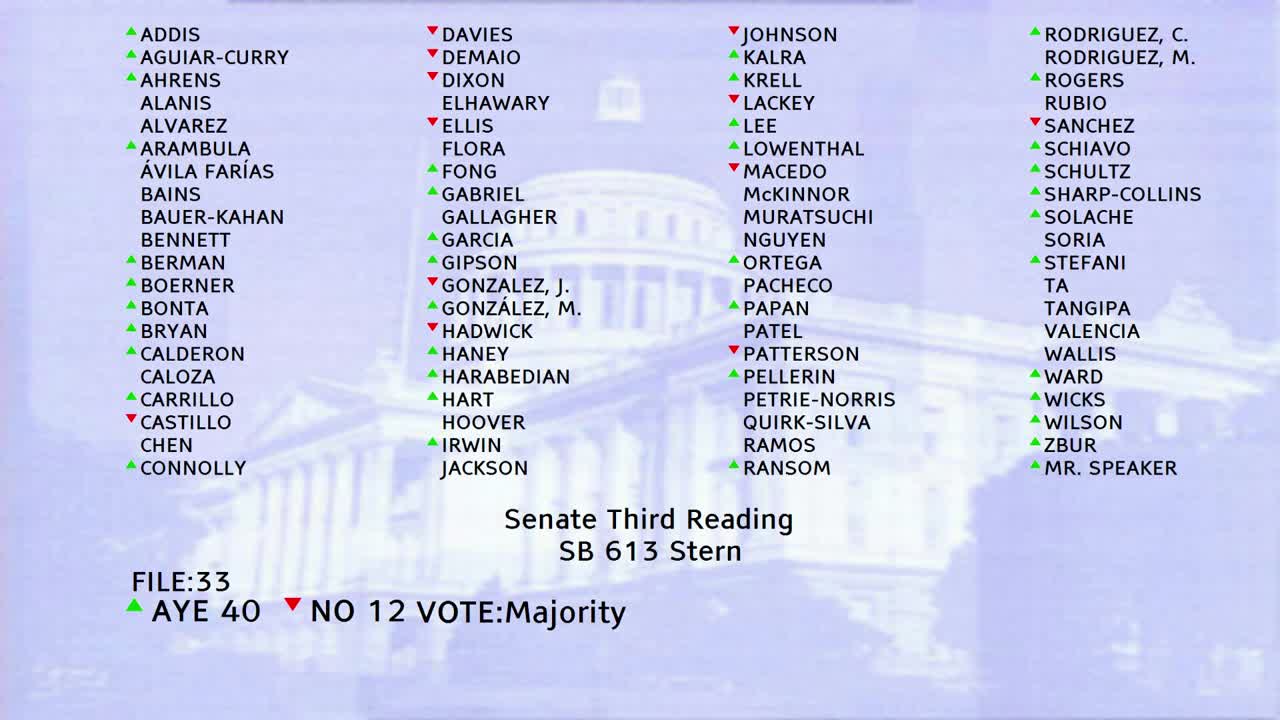 4MIN
Assembly Floor
 1MIN
Senate Floor
 12MIN
Assembly Standing Committee on Public Safety
 10MIN
Assembly Standing Committee on Judiciary
 2MIN
Senate Floor
 15MIN
Senate Standing Committee on Public Safety
 15MIN
Senate Standing Committee on Judiciary
Bill Author

Bill Co-Author(s):