SB 1051: Vehicles: parking enforcement: video image evidence.
- Session Year: 2015-2016
- House: Senate
- Latest Version Date: 2016-09-21
Existing law authorizes the City and County of San Francisco (San Francisco) to enforce parking violations in specified transit-only traffic lanes through the use of video imaging, and authorizes San Francisco to install automated forward facing parking control devices on city-owned public transit vehicles for the purpose of video imaging parking violations occurring in transit-only traffic lanes. Existing law requires a designated employee, who is qualified by San Francisco, to review video image recordings for the purpose of determining whether a parking violation occurred in a transit-only traffic lane, and to issue a notice of parking violation to a registered owner of a vehicle within 15 calendar days of the date of the violation. Existing laws makes these video image records confidential, and provides that these records are available only to public agencies to enforce parking violations. Existing law establishes the Alameda-Contra Costa Transit District.
This bill would extend the provisions to the Alameda-Contra Costa Transit District, thereby authorizing the district to enforce parking violations in specified transit-only traffic lanes through the use of video imaging evidence and to install automated forward facing parking control devices on district-owned public transit vehicles. The bill would repeal the authority for the Alameda-Contra Costa Transit District to implement an automated enforcement system to enforce parking violations occurring in transit-only traffic lanes on January 1, 2022.
This bill would require, under designated circumstances, the district and the City and County of San Francisco to submit to the transportation, privacy, and judiciary committees of the Legislature evaluations of the automated enforcement systems effectiveness, impact on privacy, cost to implement, and generation of revenue, no later than January 1, 2021.
This bill would make legislative findings and declarations as to the necessity of a special statute for the City and County of San Francisco and the Alameda-Contra Costa Transit District.
Existing constitutional provisions require that a statute that limits the right of access to the meetings of public bodies or the writings of public officials and agencies be adopted with findings demonstrating the interest protected by the limitation and the need for protecting that interest.
This bill would make legislative findings to that effect.
Existing law authorizes the City and County of San Francisco (San Francisco) to enforce parking violations in specified transit-only traffic lanes through the use of video imaging, and authorizes San Francisco to install automated forward facing parking control devices on city-owned public transit vehicles for the purpose of video imaging parking violations occurring in transit-only traffic lanes. Existing law requires a designated employee, who is qualified by San Francisco, to review video image recordings for the purpose of determining whether a parking violation occurred in a transit-only traffic lane, and to issue a notice of parking violation to a registered owner of a vehicle within 15 calendar days of the date of the violation. Existing laws makes these video image records confidential, and provides that these records are available only to public agencies to enforce parking violations. Existing law establishes the Alameda-Contra Costa Transit District.
This bill would extend the provisions to the Alameda-Contra Costa Transit District, thereby authorizing the district to enforce parking violations in specified transit-only traffic lanes through the use of video imaging evidence and to install automated forward facing parking control devices on district-owned public transit vehicles. The bill would repeal the authority for the Alameda-Contra Costa Transit District to implement an automated enforcement system to enforce violations occurring in transit-only traffic lanes on January 1, 2022.
This bill would require, under designated circumstances, the district and the City and County of San Francisco to submit to the transportation transportation, privacy, and judiciary committees of the Legislature evaluations of the automated enforcement systems effectiveness, impact on privacy, cost to implement, and generation of revenue, no later than January 1, 2021.
This bill would make legislative findings and declarations as to the necessity of a special statute for the City and County of San Francisco and the Alameda-Contra Costa Transit District.
Existing constitutional provisions require that a statute that limits the right of access to the meetings of public bodies or the writings of public officials and agencies be adopted with findings demonstrating the interest protected by the limitation and the need for protecting that interest.
This bill would make legislative findings to that effect.
Existing law authorizes the City and County of San Francisco (San Francisco) to enforce parking violations in specified transit-only traffic lanes through the use of video imaging, and authorizes San Francisco to install automated forward facing parking control devices on city-owned public transit vehicles for the purpose of video imaging parking violations occurring in transit-only traffic lanes. Existing law requires a designated employee, who is qualified by San Francisco, to review video image recordings for the purpose of determining whether a parking violation occurred in a transit-only traffic lane, and to issue a notice of parking violation to a registered owner of a vehicle within 15 calendar days of the date of the violation. Existing laws makes these video image records confidential, and provides that these records are available only to public agencies to enforce parking violations. Existing law establishes the Alameda-Contra Costa Transit District.
This bill would extend these provisions to violations occurring at bus stops, as specified. The bill additionally would extend the provisions to the Alameda-Contra Costa Transit District, thereby authorizing the district to enforce parking violations in specified transit-only traffic lanes through the use of video imaging evidence and to install automated forward facing parking control devices on district-owned public transit vehicles. The bill would repeal the authority for the Alameda-Contra Costa Transit District to implement an automated enforcement system to enforce violations occurring in transit-only traffic lanes and the authority for both the district and the City and County of San Francisco to implement an automated enforcement system to enforce parking violations occurring at bus stops on January 1, 2022. lanes on January 1, 2022.
This bill would require, under designated circumstances, the district and the City and County of San Francisco to submit to the transportation and judiciary committees of the Legislature evaluations of the automated enforcement systems effectiveness, impact on privacy, cost to implement, and generation of revenue, no later than January 1, 2021.
This bill would make legislative findings and declarations as to the necessity of a special statute for the City and County of San Francisco and the Alameda-Contra Costa Transit District.
Existing constitutional provisions require that a statute that limits the right of access to the meetings of public bodies or the writings of public officials and agencies be adopted with findings demonstrating the interest protected by the limitation and the need for protecting that interest.
This bill would make legislative findings to that effect.
Existing law authorizes the City and County of San Francisco (San Francisco) to enforce parking violations in specified transit-only traffic lanes through the use of video imaging, and authorizes San Francisco to install automated forward facing parking control devices on city-owned public transit vehicles for the purpose of video imaging parking violations occurring in transit-only traffic lanes. Existing law requires a designated employee, who is qualified by San Francisco, to review video image recordings for the purpose of determining whether a parking violation occurred in a transit-only traffic lane, and to issue a notice of parking violation to a registered owner of a vehicle within 15 calendar days of the date of the violation. Existing laws makes these video image records confidential, and provides that these records are available only to public agencies to enforce parking violations. Existing law establishes the Alameda-Contra Costa Transit District.
This bill would extend these provisions to violations occurring at bus stops, as specified. The bill additionally would extend the provisions to the Alameda-Contra Costa Transit District, thereby authorizing the district to enforce parking violations in specified transit-only traffic lanes through the use of video imaging evidence and to install automated forward facing parking control devices on district-owned public transit vehicles. The bill would repeal the authority for the Alameda-Contra Costa Transit District to implement an automated enforcement system to enforce violations occurring in transit-only traffic lanes and the authority for both the district and the City and County of San Francisco to implement an automated enforcement system to enforce parking violations occurring at bus stops on January 1, 2022.
This bill would require, under designated circumstances, the district and the City and County of San Francisco to submit to the transportation and judiciary committees of the Legislature evaluations of the automated enforcement systems effectiveness, impact on privacy, cost to implement, and generation of revenue, no later than January 1, 2021.
This bill would make legislative findings and declarations as to the necessity of a special statute for the City and County of San Francisco and the Alameda-Contra Costa Transit District.
Existing constitutional provisions require that a statute that limits the right of access to the meetings of public bodies or the writings of public officials and agencies be adopted with findings demonstrating the interest protected by the limitation and the need for protecting that interest.
This bill would make legislative findings to that effect.
Existing law authorizes the City and County of San Francisco (San Francisco) to enforce parking violations in specified transit-only traffic lanes through the use of video imaging, and authorizes San Francisco to install automated forward facing parking control devices on city-owned public transit vehicles for the purpose of video imaging parking violations occurring in transit-only traffic lanes. Existing law requires a designated employee, who is qualified by San Francisco, to review video image recordings for the purpose of determining whether a parking violation occurred in a transit-only traffic lane, and to issue a notice of parking violation to a registered owner of a vehicle within 15 calendar days of the date of the violation. Existing laws makes these video image records confidential, and provides that these records are available only to public agencies to enforce parking violations. Existing law establishes the Alameda-Contra Costa Transit District.
This bill would extend these provisions to violations occurring at bus stops, as specified. The bill additionally would extend the provisions to the Alameda-Contra Costa Transit District, thereby authorizing the district to enforce parking violations in specified transit-only traffic lanes through the use of video imaging evidence and to install automated forward facing parking control devices on district-owned public transit vehicles.
This bill would make legislative findings and declarations as to the necessity of a special statute for the City and County of San Francisco and the Alameda-Contra Costa Transit District.
Existing constitutional provisions require that a statute that limits the right of access to the meetings of public bodies or the writings of public officials and agencies be adopted with findings demonstrating the interest protected by the limitation and the need for protecting that interest.
This bill would make legislative findings to that effect.
Existing law authorizes the City and County of San Francisco (San Francisco) to enforce parking violations in specified transit-only traffic lanes through the use of video imaging, and authorizes San Francisco to install automated forward facing parking control devices on city-owned public transit vehicles for the purpose of video imaging parking violations occurring in transit-only traffic lanes. Existing law requires a designated employee, who is qualified by San Francisco, to review video image recordings for the purpose of determining whether a parking violation occurred in a transit-only traffic lane, and to issue a notice of parking violation to a registered owner of a vehicle within 15 calendar days of the date of the violation. Existing laws makes these video image records confidential, and provides that these records are available only to public agencies to enforce parking violations. Existing law establishes the Alameda-Contra Costa Transit District.
This bill would extend these provisions to the Alameda-Contra Costa Transit District, thereby authorizing the district to enforce parking violations in specified transit-only traffic through the use of video imaging evidence and to install automated forward facing parking control devices on district-owned public transit vehicles.
This bill would make legislative findings and declarations as to the necessity of a special statute for the Alameda-Contra Costa Transit District.
Existing constitutional provisions require that a statute that limits the right of access to the meetings of public bodies or the writings of public officials and agencies be adopted with findings demonstrating the interest protected by the limitation and the need for protecting that interest.
This bill would make legislative findings to that effect.
(a)Subject to subdivision (g), the City and County of San Francisco and the Alameda-Contra Costa Transit District may install automated forward facing parking control devices on city-owned or district-owned public transit vehicles, as defined by Section 99211 of the Public Utilities Code, for the purpose of video imaging of parking violations occurring in transit-only traffic lanes. Citations shall be issued only for violations captured during the posted hours of operation for a transit-only traffic lane. The devices shall be angled and focused so as to capture video images of parking violations and not unnecessarily capture identifying images of other drivers, vehicles, and pedestrians. The devices shall record the date and time of the violation at the same time as the video images are captured.
(b)Prior to issuing notices of parking violations pursuant to subdivision (a) of Section 40241, the City and County of San Francisco and the Alameda-Contra Costa Transit District shall commence a program to issue only warning notices for 30 days. The City and County of San Francisco and the Alameda-Contra Costa Transit District shall also make a public announcement of the program at least 30 days prior to commencement of issuing notices of parking violations.
(c)A designated employee of the City and County of San Francisco, or a contracted law enforcement agency for the Alameda-Contra Costa Transit District, who is qualified by the city and county or the district to issue parking citations, shall review video image recordings for the purpose of determining whether a parking violation occurred in a transit-only traffic lane. A violation of a statute, regulation, or ordinance governing vehicle parking under this code, under a federal or state statute or regulation, or under an ordinance enacted by the City and County of San Francisco or the Alameda-Contra Costa Transit District occurring in a transit-only traffic lane observed by the designated employee in the recordings is subject to a civil penalty.
(d)The registered owner shall be permitted to review the video image evidence of the alleged violation during normal business hours at no cost.
(e)(1)Except as it may be included in court records described in Section 68152 of the Government Code, or as provided in paragraph (2), the video image evidence may be retained for up to six months from the date the information was first obtained, or 60 days after final disposition of the citation, whichever date is later, after which time the information shall be destroyed.
(2)Notwithstanding Section 26202.6 of the Government Code, video image evidence from forward facing automated enforcement devices that does not contain evidence of a parking violation occurring in a transit-only traffic lane shall be destroyed within 15 days after the information was first obtained.
(f)Notwithstanding Section 6253 of the Government Code, or any other law, the video image records are confidential. Public agencies shall use and allow access to these records only for the purposes authorized by this article.
(g)The authority for the Alameda-Contra Costa Transit District to implement an automated enforcement system to enforce parking violations occurring in transit-only traffic lanes exists only until January 1, 2022.
(h)The following definitions shall apply for purposes of this article:
(1)Local agency means the City and County of San Francisco and the Alameda-Contra Costa Transit District.
(2)Transit-only traffic lane means any designated transit-only lane on which use is restricted to mass transit vehicles, or other designated vehicles including taxis and vanpools, during posted times.
SEC. 2.Section 40240.5 is added to the Vehicle Code, to read:40240.5.(a)If the Alameda-Contra Costa Transit District implements an automated enforcement system to enforce parking violations occurring in transit-only traffic lanes pursuant to this article, the district shall provide to the transportation, privacy, and judiciary committees of the Legislature an evaluation report of the enforcement systems effectiveness, impact on privacy, cost to implement, and generation of revenue, no later than January 1, 2021.
(b)(1)A report submitted pursuant to this section shall be submitted notwithstanding Section 10231.5 of the Government Code.
(2)A report submitted pursuant to this section shall be submitted in compliance with Section 9795 of the Government Code.
SEC. 3.Section 40241 of the Vehicle Code is amended to read:40241.(a)A designated employee of the local agency, including a contracted law enforcement agency for the Alameda-Contra Costa Transit District, shall issue a notice of parking violation to the registered owner of a vehicle within 15 calendar days of the date of the violation. The notice of parking violation shall set forth the violation of a statute, regulation, or ordinance governing vehicle parking under this code, under a federal or state statute or regulation, or under an ordinance enacted by the City and County of San Francisco or the Alameda-Contra Costa Transit District occurring in a transit-only traffic lane, a statement indicating that payment is required within 21 calendar days from the date of citation issuance, and the procedure for the registered owner, lessee, or rentee to deposit the parking penalty or contest the citation pursuant to Section 40215. The notice of parking violation shall also set forth the date, time, and location of the violation, the vehicle license number, registration expiration date, if visible, the color of the vehicle, and, if possible, the make of the vehicle. The notice of parking violation, or copy of the notice, shall be considered a record kept in the ordinary course of business of the City and County of San Francisco or the Alameda-Contra Costa Transit District and shall be prima facie evidence of the facts contained in the notice. The City and County of San Francisco or the Alameda-Contra Costa Transit District shall send information regarding the process for requesting review of the video image evidence along with the notice of parking violation.
(b)The notice of parking violation shall be served by depositing the notice in the United States mail to the registered owners last known address listed with the Department of Motor Vehicles. Proof of mailing demonstrating that the notice of parking violation was mailed to that address shall be maintained by the local agency. If the registered owner, by appearance or by mail, makes payment to the processing agency or contests the violation within either 21 calendar days from the date of mailing of the citation, or 14 calendar days after the mailing of the notice of delinquent parking violation, the parking penalty shall consist solely of the amount of the original penalty.
(c)If, within 21 days after the notice of parking violation is issued, the local agency determines that, in the interest of justice, the notice of parking violation should be canceled, the local agency shall cancel the notice of parking violation pursuant to subdivision (a) of Section 40215. The reason for the cancellation shall be set forth in writing.
(d)Following an initial review by the local agency, and an administrative hearing, pursuant to Section 40215, a contestant may seek court review by filing an appeal pursuant to Section 40230.
(e)The City and County of San Francisco or the contracted law enforcement agency for the Alameda-Contra Costa Transit District may contract with a private vendor for the processing of notices of parking violations and notices of delinquent violations. The City and County of San Francisco and the Alameda-Contra Costa Transit District shall maintain overall control and supervision of the program.
SEC. 4.The Legislature finds and declares that a special law is necessary and that a general law cannot be made applicable within the meaning of Section 16 of Article IV of the California Constitution because of the unique circumstances relating to enforcing parking violations in the Alameda-Contra Costa Transit District.
SEC. 5.The Legislature finds and declares that Section 1 of this act, which amends Section 40240 of the Vehicle Code, imposes a limitation on the publics right of access to the meetings of public bodies or the writings of public officials and agencies within the meaning of Section 3 of Article I of the California Constitution. Pursuant to that constitutional provision, the Legislature makes the following findings to demonstrate the interest protected by this limitation and the need for protecting that interest:
In order to protect the individual privacy rights of those individuals depicted in video camera footage relating to parking violations, it is necessary that this act limit the publics right of access to the images captured by an automated parking control device installed on Alameda-Contra Costa Transit District-owned public transit vehicles.
(a)Subject to subdivision (g), the City and County of San Francisco and the Alameda-Contra Costa Transit District may install automated forward facing parking control devices on city-owned or district-owned public transit vehicles, as defined by Section 99211 of the Public Utilities Code, for the purpose of video imaging of parking violations occurring in transit-only traffic lanes. Citations shall be issued only for violations captured during the posted hours of operation for a transit-only traffic lane. The devices shall be angled and focused so as to capture video images of parking violations and not unnecessarily capture identifying images of other drivers, vehicles, and pedestrians. The devices shall record the date and time of the violation at the same time as the video images are captured.
(b)Prior to issuing notices of parking violations pursuant to subdivision (a) of Section 40241, the City and County of San Francisco and the Alameda-Contra Costa Transit District shall commence a program to issue only warning notices for 30 days. The City and County of San Francisco and the Alameda-Contra Costa Transit District shall also make a public announcement of the program at least 30 days prior to commencement of issuing notices of parking violations.
(c)A designated employee of the City and County of San Francisco, or a contracted law enforcement agency for the Alameda-Contra Costa Transit District, who is qualified by the city and county or the district to issue parking citations, shall review video image recordings for the purpose of determining whether a parking violation occurred in a transit-only traffic lane. A violation of a statute, regulation, or ordinance governing vehicle parking under this code, under a federal or state statute or regulation, or under an ordinance enacted by the City and County of San Francisco or the Alameda-Contra Costa Transit District occurring in a transit-only traffic lane observed by the designated employee in the recordings is subject to a civil penalty.
(d)The registered owner shall be permitted to review the video image evidence of the alleged violation during normal business hours at no cost.
(e)(1)Except as it may be included in court records described in Section 68152 of the Government Code, or as provided in paragraph (2), the video image evidence may be retained for up to six months from the date the information was first obtained, or 60 days after final disposition of the citation, whichever date is later, after which time the information shall be destroyed.
(2)Notwithstanding Section 26202.6 of the Government Code, video image evidence from forward facing automated enforcement devices that does not contain evidence of a parking violation occurring in a transit-only traffic lane shall be destroyed within 15 days after the information was first obtained.
(f)Notwithstanding Section 6253 of the Government Code, or any other law, the video image records are confidential. Public agencies shall use and allow access to these records only for the purposes authorized by this article.
(g)The authority for the Alameda-Contra Costa Transit District to implement an automated enforcement system to enforce parking violations occurring in transit-only traffic lanes exists only until January 1, 2022.
(h)The following definitions shall apply for purposes of this article:
(1)Local agency means the City and County of San Francisco and the Alameda-Contra Costa Transit District.
(2)Transit-only traffic lane means any designated transit-only lane on which use is restricted to mass transit vehicles, or other designated vehicles including taxis and vanpools, during posted times.
SEC. 2.Section 40240.5 is added to the Vehicle Code, to read:40240.5.(a)If the Alameda-Contra Costa Transit District implements an automated enforcement system to enforce parking violations occurring in transit-only traffic lanes pursuant to this article, the district shall provide to the transportation, privacy, and judiciary committees of the Legislature an evaluation report of the enforcement systems effectiveness, impact on privacy, cost to implement, and generation of revenue, no later than January 1, 2021.
(b)(1)A report submitted pursuant to this section shall be submitted notwithstanding Section 10231.5 of the Government Code.
(2)A report submitted pursuant to this section shall be submitted in compliance with Section 9795 of the Government Code.
SEC. 3.Section 40241 of the Vehicle Code is amended to read:40241.(a)A designated employee of the local agency, including a contracted law enforcement agency for the Alameda-Contra Costa Transit District, shall issue a notice of a parking violation to the registered owner of a vehicle within 15 calendar days of the date of the violation. The notice of parking violation shall set forth the violation of a statute, regulation, or ordinance governing vehicle parking under this code, under a federal or state statute or regulation, or under an ordinance enacted by the City and County of San Francisco or the Alameda-Contra Costa Transit District occurring in a transit-only traffic lane, a statement indicating that payment is required within 21 calendar days from the date of citation issuance, and the procedure for the registered owner, lessee, or rentee to deposit the parking penalty or contest the citation pursuant to Section 40215. The notice of a parking violation shall also set forth the date, time, and location of the violation, the vehicle license number, registration expiration date, if visible, the color of the vehicle, and, if possible, the make of the vehicle. The notice of parking violation, or copy of the notice, shall be considered a record kept in the ordinary course of business of the City and County of San Francisco or the Alameda-Contra Costa Transit District and shall be prima facie evidence of the facts contained in the notice. The City and County of San Francisco or the Alameda-Contra Costa Transit District shall send information regarding the process for requesting review of the video image evidence along with the notice of parking violation.
(b)The notice of parking violation shall be served by depositing the notice in the United States mail to the registered owners last known address listed with the Department of Motor Vehicles. Proof of mailing demonstrating that the notice of parking violation was mailed to that address shall be maintained by the local agency. If the registered owner, by appearance or by mail, makes payment to the processing agency or contests the violation within either 21 calendar days from the date of mailing of the citation, or 14 calendar days after the mailing of the notice of delinquent parking violation, the parking penalty shall consist solely of the amount of the original penalty.
(c)If, within 21 days after the notice of parking violation is issued, the local agency determines that, in the interest of justice, the notice of parking violation should be canceled, the local agency shall cancel the notice of parking violation pursuant to subdivision (a) of Section 40215. The reason for the cancellation shall be set forth in writing.
(d)Following an initial review by the local agency, and an administrative hearing, pursuant to Section 40215, a contestant may seek court review by filing an appeal pursuant to Section 40230.
(e)The City and County of San Francisco or the contracted law enforcement agency for the Alameda-Contra Costa Transit District may contract with a private vendor for the processing of notices of parking violations and notices of delinquent violations. The City and County of San Francisco and the Alameda-Contra Costa Transit District shall maintain overall control and supervision of the program.
SEC. 4.The Legislature finds and declares that a special law is necessary and that a general law cannot be made applicable within the meaning of Section 16 of Article IV of the California Constitution because of the unique circumstances relating to enforcing parking violations in the Alameda-Contra Costa Transit District.
SEC. 5.The Legislature finds and declares that Section 1 of this act, which amends Section 40240 of the Vehicle Code, imposes a limitation on the publics right of access to the meetings of public bodies or the writings of public officials and agencies within the meaning of Section 3 of Article I of the California Constitution. Pursuant to that constitutional provision, the Legislature makes the following findings to demonstrate the interest protected by this limitation and the need for protecting that interest:
In order to protect the individual privacy rights of those individuals depicted in video camera footage relating to parking violations, it is necessary that this act limit the publics right of access to the images captured by an automated parking control device installed on Alameda-Contra Costa Transit District-owned public transit vehicles.
(a)Subject to subdivision (g), the City and County of San Francisco and the Alameda-Contra Costa Transit District may install automated forward facing parking control devices on city-owned or district-owned public transit vehicles, as defined by Section 99211 of the Public Utilities Code, for the purpose of video imaging of parking violations occurring in transit-only traffic lanes. Citations shall be issued only for violations captured during the posted hours of operation for a transit-only traffic lane. The devices shall be angled and focused so as to capture video images of parking violations and not unnecessarily capture identifying images of other drivers, vehicles, and pedestrians. The devices shall record the date and time of the violation at the same time as the video images are captured.
(b)Prior to issuing notices of parking violations pursuant to subdivision (a) of Section 40241, the City and County of San Francisco and the Alameda-Contra Costa Transit District shall commence a program to issue only warning notices for 30 days. The City and County of San Francisco and the Alameda-Contra Costa Transit District shall also make a public announcement of the program at least 30 days prior to commencement of issuing notices of parking violations.
(c)A designated employee of the City and County of San Francisco, or a contracted law enforcement agency for the Alameda-Contra Costa Transit District, who is qualified by the city and county or the district to issue parking citations, shall review video image recordings for the purpose of determining whether a parking violation occurred in a transit-only traffic lane. A violation of a statute, regulation, or ordinance governing vehicle parking under this code, under a federal or state statute or regulation, or under an ordinance enacted by the City and County of San Francisco or the Alameda-Contra Costa Transit District occurring in a transit-only traffic lane observed by the designated employee in the recordings is subject to a civil penalty.
(d)The registered owner shall be permitted to review the video image evidence of the alleged violation during normal business hours at no cost.
(e)(1)Except as it may be included in court records described in Section 68152 of the Government Code, or as provided in paragraph (2), the video image evidence may be retained for up to six months from the date the information was first obtained, or 60 days after final disposition of the citation, whichever date is later, after which time the information shall be destroyed.
(2)Notwithstanding Section 26202.6 of the Government Code, video image evidence from forward facing automated enforcement devices that does not contain evidence of a parking violation occurring in a transit-only traffic lane shall be destroyed within 15 days after the information was first obtained.
(f)Notwithstanding Section 6253 of the Government Code, or any other law, the video image records are confidential. Public agencies shall use and allow access to these records only for the purposes authorized by this article.
(g)The authority for the Alameda-Contra Costa Transit District to implement an automated enforcement system to enforce violations occurring in transit-only traffic lanes exists only until January 1, 2022.
(h)The following definitions shall apply for purposes of this article:
(1)Local agency means the City and County of San Francisco and the Alameda-Contra Costa Transit District.
(2)Transit-only traffic lane means any designated transit-only lane on which use is restricted to mass transit vehicles, or other designated vehicles including taxis and vanpools, during posted times.
SEC. 2.Section 40240.5 is added to the Vehicle Code, to read:40240.5.(a)If the Alameda-Contra Costa Transit District implements an automated enforcement system to enforce violations occurring in transit-only traffic lanes pursuant to this article, the district shall provide to the transportation transportation, privacy, and judiciary committees of the Legislature an evaluation report of the enforcement systems effectiveness, impact on privacy, cost to implement, and generation of revenue, no later than January 1, 2021.
(b)(1)A report submitted pursuant to this section shall be submitted notwithstanding Section 10231.5 of the Government Code.
(2)A report submitted pursuant to this section shall be submitted in compliance with Section 9795 of the Government Code.
SEC. 3.Section 40241 of the Vehicle Code is amended to read:40241.(a)A designated employee of the local agency, including a contracted law enforcement agency for the Alameda-Contra Costa Transit District, shall issue a notice of a parking violation to the registered owner of a vehicle within 15 calendar days of the date of the violation. The notice of violation shall set forth the violation of a statute, regulation, or ordinance governing vehicle parking under this code, under a federal or state statute or regulation, or under an ordinance enacted by the City and County of San Francisco or the Alameda-Contra Costa Transit District occurring in a transit-only traffic lane lane, a statement indicating that payment is required within 21 calendar days from the date of citation issuance, and the procedure for the registered owner, lessee, or rentee to deposit the parking penalty or contest the citation pursuant to Section 40215. The notice of a parking violation shall also set forth the date, time, and location of the violation, the vehicle license number, registration expiration date date, if visible, the color of the vehicle, and, if possible, the make of the vehicle. The notice of parking violation, or copy of the notice, shall be considered a record kept in the ordinary course of business of the City and County of San Francisco or the Alameda-Contra Costa Transit District and shall be prima facie evidence of the facts contained in the notice. The City and County of San Francisco or the Alameda-Contra Costa Transit District shall send information regarding the process for requesting review of the video image evidence along with the notice of parking violation.
(b)The notice of parking violation shall be served by depositing the notice in the United States mail to the registered owners last known address listed with the Department of Motor Vehicles. Proof of mailing demonstrating that the notice of parking violation was mailed to that address shall be maintained by the local agency. If the registered owner, by appearance or by mail, makes payment to the processing agency or contests the violation within either 21 calendar days from the date of mailing of the citation, or 14 calendar days after the mailing of the notice of delinquent parking violation, the parking penalty shall consist solely of the amount of the original penalty.
(c)If, within 21 days after the notice of parking violation is issued, the local agency determines that, in the interest of justice, the notice of parking violation should be canceled, the local agency shall cancel the notice of parking violation pursuant to subdivision (a) of Section 40215. The reason for the cancellation shall be set forth in writing.
(d)Following an initial review by the local agency, and an administrative hearing, pursuant to Section 40215, a contestant may seek court review by filing an appeal pursuant to Section 40230.
(e)The City and County of San Francisco or the contracted law enforcement agency for the Alameda-Contra Costa Transit District may contract with a private vendor for the processing of notices of parking violations and notices of delinquent violations. The City and County of San Francisco and the Alameda-Contra Costa Transit District shall maintain overall control and supervision of the program.
SEC. 4.The Legislature finds and declares that a special law is necessary and that a general law cannot be made applicable within the meaning of Section 16 of Article IV of the California Constitution because of the unique circumstances relating to enforcing parking violations in the Alameda-Contra Costa Transit District.
SEC. 5.The Legislature finds and declares that Section 1 of this act, which amends Section 40240 of the Vehicle Code, imposes a limitation on the publics right of access to the meetings of public bodies or the writings of public officials and agencies within the meaning of Section 3 of Article I of the California Constitution. Pursuant to that constitutional provision, the Legislature makes the following findings to demonstrate the interest protected by this limitation and the need for protecting that interest:
In order to protect the individual privacy rights of those individuals depicted in video camera footage relating to parking violations, it is necessary that this act limit the publics right of access to the images captured by an automated parking control device installed on Alameda-Contra Costa Transit District-owned public transit vehicles.
(a)Subject to subdivision (g), the City and County of San Francisco and the Alameda-Contra Costa Transit District may install automated forward facing parking control devices on city-owned or district-owned public transit vehicles, as defined by Section 99211 of the Public Utilities Code, for the purpose of video imaging of parking violations occurring in transit-only traffic lanes or at bus stops. lanes. Citations shall be issued only for violations captured during the posted hours of operation for a transit-only traffic lane or at a bus stop. lane. The devices shall be angled and focused so as to capture video images of parking violations and not unnecessarily capture identifying images of other drivers, vehicles, and pedestrians. The devices shall record the date and time of the violation at the same time as the video images are captured.
(b)Prior to issuing notices of parking violations pursuant to subdivision (a) of Section 40241, the City and County of San Francisco and the Alameda-Contra Costa Transit District shall commence a program to issue only warning notices for 30 days. The City and County of San Francisco and the Alameda-Contra Costa Transit District shall also make a public announcement of the program at least 30 days prior to commencement of issuing notices of parking violations.
(c)A designated employee of the City and County of San Francisco, or a contracted law enforcement agency for the Alameda-Contra Costa Transit District, who is qualified by the city and county or the district to issue parking citations, shall review video image recordings for the purpose of determining whether a parking violation occurred in a transit-only traffic lane or at a bus stop. lane. A violation of a statute, regulation, or ordinance governing vehicle parking under this code, under a federal or state statute or regulation, or under an ordinance enacted by the City and County of San Francisco or the Alameda-Contra Costa Transit District occurring in a transit-only traffic lane or at a bus stop observed by the designated employee in the recordings is subject to a civil penalty.
(d)The registered owner shall be permitted to review the video image evidence of the alleged violation during normal business hours at no cost.
(e)(1)Except as it may be included in court records described in Section 68152 of the Government Code, or as provided in paragraph (2), the video image evidence may be retained for up to six months from the date the information was first obtained, or 60 days after final disposition of the citation, whichever date is later, after which time the information shall be destroyed.
(2)Notwithstanding Section 26202.6 of the Government Code, video image evidence from forward facing automated enforcement devices that does not contain evidence of a parking violation occurring in a transit-only traffic lane or at a bus stop shall be destroyed within 15 days after the information was first obtained.
(f)Notwithstanding Section 6253 of the Government Code, or any other law, the video image records are confidential. Public agencies shall use and allow access to these records only for the purposes authorized by this article.
(g)(1)The authority to implement an automated enforcement system to enforce parking violations occurring at bus stops pursuant to this section exists only until January 1, 2022.
(2)
(g)The authority for the Alameda-Contra Costa Transit District to implement an automated enforcement system to enforce violations occurring in transit-only traffic lanes exists only until January 1, 2022.
(h)The following definitions shall apply for purposes of this article:
(1)Bus stop means a curb space authorized for the loading and unloading of passengers of a bus engaged as a common carrier in local transportation when indicated by a sign or red paint on the curb erected or painted by local authorities pursuant to an ordinance.
(2)
(1)Local agency means the City and County of San Francisco and the Alameda-Contra Costa Transit District.
(3)
(2)Transit-only traffic lane means any designated transit-only lane on which use is restricted to mass transit vehicles, or other designated vehicles including taxis and vanpools, during posted times.
SEC. 2.Section 40240.5 is added to the Vehicle Code, to read:40240.5.(a)If the City and County of San Francisco or the Alameda-Contra Costa Transit District implements an automated enforcement system to enforce parking violations occurring at bus stops pursuant to this article, the respective local agency shall submit to the transportation and judiciary committees of the Legislature an evaluation of the enforcement systems effectiveness, impact on privacy, cost to implement, and generation of revenue, no later than January 1, 2021.
(b)
40240.5.(a)If the Alameda-Contra Costa Transit District implements an automated enforcement system to enforce violations occurring in transit-only traffic lanes pursuant to this article, the district shall provide to the transportation and judiciary committees of the Legislature an evaluation of the enforcement systems effectiveness, impact on privacy, cost to implement, and generation of revenue, no later than January 1, 2021.
(c)
(b)(1)A report submitted pursuant to this section shall be submitted notwithstanding Section 10231.5 of the Government Code.
(2)A report submitted pursuant to this section shall be submitted in compliance with Section 9795 of the Government Code.
SEC. 3.Section 40241 of the Vehicle Code is amended to read:40241.(a)A designated employee of the local agency, including a contracted law enforcement agency for the Alameda-Contra Costa Transit District, shall issue a notice of a parking violation to the registered owner of a vehicle within 15 calendar days of the date of the violation. The notice of violation shall set forth the violation of a statute, regulation, or ordinance governing vehicle parking under this code, under a federal or state statute or regulation, or under an ordinance enacted by the City and County of San Francisco or the Alameda-Contra Costa Transit District occurring in a transit-only traffic lane or at a bus stop, a statement indicating that payment is required within 21 calendar days from the date of citation issuance, and the procedure for the registered owner, lessee, or rentee to deposit the parking penalty or contest the citation pursuant to Section 40215. The notice of a parking violation shall also set forth the date, time, and location of the violation, the vehicle license number, registration expiration date if visible, the color of the vehicle, and, if possible, the make of the vehicle. The notice of parking violation, or copy of the notice, shall be considered a record kept in the ordinary course of business of the City and County of San Francisco or the Alameda-Contra Costa Transit District and shall be prima facie evidence of the facts contained in the notice. The City and County of San Francisco or the Alameda-Contra Costa Transit District shall send information regarding the process for requesting review of the video image evidence along with the notice of parking violation.
(b)The notice of parking violation shall be served by depositing the notice in the United States mail to the registered owners last known address listed with the Department of Motor Vehicles. Proof of mailing demonstrating that the notice of parking violation was mailed to that address shall be maintained by the local agency. If the registered owner, by appearance or by mail, makes payment to the processing agency or contests the violation within either 21 calendar days from the date of mailing of the citation, or 14 calendar days after the mailing of the notice of delinquent parking violation, the parking penalty shall consist solely of the amount of the original penalty.
(c)If, within 21 days after the notice of parking violation is issued, the local agency determines that, in the interest of justice, the notice of parking violation should be canceled, the local agency shall cancel the notice of parking violation pursuant to subdivision (a) of Section 40215. The reason for the cancellation shall be set forth in writing.
(d)Following an initial review by the local agency, and an administrative hearing, pursuant to Section 40215, a contestant may seek court review by filing an appeal pursuant to Section 40230.
(e)The City and County of San Francisco or the contracted law enforcement agency for the Alameda-Contra Costa Transit District may contract with a private vendor for the processing of notices of parking violations and notices of delinquent violations. The City and County of San Francisco and the Alameda-Contra Costa Transit District shall maintain overall control and supervision of the program.
SEC. 4.The Legislature finds and declares that a special law is necessary and that a general law cannot be made applicable within the meaning of Section 16 of Article IV of the California Constitution because of the unique circumstances relating to enforcing parking violations in the City and County of San Francisco and the Alameda-Contra Costa Transit District.
SEC. 5.The Legislature finds and declares that Section 1 of this act, which amends Section 40240 of the Vehicle Code, imposes a limitation on the publics right of access to the meetings of public bodies or the writings of public officials and agencies within the meaning of Section 3 of Article I of the California Constitution. Pursuant to that constitutional provision, the Legislature makes the following findings to demonstrate the interest protected by this limitation and the need for protecting that interest:
In order to protect the individual privacy rights of those individuals depicted in video camera footage relating to parking violations, it is necessary that this act limit the publics right of access to the images captured by an automated parking control device installed on City and County of San Francisco and Alameda-Contra Costa Transit District-owned public transit vehicles.
(a)The Subject to subdivision (g), the City and County of San Francisco and the Alameda-Contra Costa Transit District may install automated forward facing parking control devices on city-owned or district-owned public transit vehicles, as defined by Section 99211 of the Public Utilities Code, for the purpose of video imaging of parking violations occurring in transit-only traffic lanes or at bus stops. Citations shall be issued only for violations captured during the posted hours of operation for a transit-only traffic lane or at a bus stop. The devices shall be angled and focused so as to capture video images of parking violations and not unnecessarily capture identifying images of other drivers, vehicles, and pedestrians. The devices shall record the date and time of the violation at the same time as the video images are captured.
(b)Prior to issuing notices of parking violations pursuant to subdivision (a) of Section 40241, the City and County of San Francisco and the Alameda-Contra Costa Transit District shall commence a program to issue only warning notices for 30 days. The City and County of San Francisco and the Alameda-Contra Costa Transit District shall also make a public announcement of the program at least 30 days prior to commencement of issuing notices of parking violations.
(c)A designated employee of the City and County of San Francisco, or a contracted law enforcement agency for the Alameda-Contra Costa Transit District, who is qualified by the city and county or the district to issue parking citations, shall review video image recordings for the purpose of determining whether a parking violation occurred in a transit-only traffic lane or at a bus stop. A violation of a statute, regulation, or ordinance governing vehicle parking under this code, under a federal or state statute or regulation, or under an ordinance enacted by the City and County of San Francisco or the Alameda-Contra Costa Transit District occurring in a transit-only traffic lane or at a bus stop observed by the designated employee in the recordings is subject to a civil penalty.
(d)The registered owner shall be permitted to review the video image evidence of the alleged violation during normal business hours at no cost.
(e)(1)Except as it may be included in court records described in Section 68152 of the Government Code, or as provided in paragraph (2), the video image evidence may be retained for up to six months from the date the information was first obtained, or 60 days after final disposition of the citation, whichever date is later, after which time the information shall be destroyed.
(2)Notwithstanding Section 26202.6 of the Government Code, video image evidence from forward facing automated enforcement devices that does not contain evidence of a parking violation occurring in a transit-only traffic lane or at a bus stop shall be destroyed within 15 days after the information was first obtained.
(f)Notwithstanding Section 6253 of the Government Code, or any other law, the video image records are confidential. Public agencies shall use and allow access to these records only for the purposes authorized by this article.
(g)(1)The authority to implement an automated enforcement system to enforce parking violations occurring at bus stops pursuant to this section exists only until January 1, 2022.
(2)The authority for the Alameda-Contra Costa Transit District to implement an automated enforcement system to enforce violations occurring in transit-only traffic lanes exists only until January 1, 2022.
(h)The following definitions shall apply for purposes of this article:
(g)For purposes of this article, bus
(1)Bus stop means a curb space authorized for the loading and unloading of passengers of a bus engaged as a common carrier in local transportation when indicated by a sign or red paint on the curb erected or painted by local authorities pursuant to an ordinance.
(h)For purposes of this article, local agency
(2)Local agency means the City and County of San Francisco and the Alameda-Contra Costa Transit District.
(i)For purposes of this article, transit-only traffic lane
(3)Transit-only traffic lane means any designated transit-only lane on which use is restricted to mass transit vehicles, or other designated vehicles including taxis and vanpools, during posted times.
SEC. 2.Section 40240.5 is added to the Vehicle Code, to read:40240.5.(a)If the City and County of San Francisco or the Alameda-Contra Costa Transit District implements an automated enforcement system to enforce parking violations occurring at bus stops pursuant to this article, the respective local agency shall submit to the transportation and judiciary committees of the Legislature an evaluation of the enforcement systems effectiveness, impact on privacy, cost to implement, and generation of revenue, no later than January 1, 2021.
(b)If the Alameda-Contra Costa Transit District implements an automated enforcement system to enforce violations occurring in transit-only traffic lanes pursuant to this article, the district shall provide to the transportation and judiciary committees of the Legislature an evaluation of the enforcement systems effectiveness, impact on privacy, cost to implement, and generation of revenue, no later than January 1, 2021.
(c)(1)A report submitted pursuant to this section shall be submitted notwithstanding Section 10231.5 of the Government Code.
(2)A report submitted pursuant to this section shall be submitted in compliance with Section 9795 of the Government Code.
SEC. 2.SEC. 3.Section 40241 of the Vehicle Code is amended to read:40241.(a)A designated employee of the local agency, including a contracted law enforcement agency for the Alameda-Contra Costa Transit District, shall issue a notice of a parking violation to the registered owner of a vehicle within 15 calendar days of the date of the violation. The notice of violation shall set forth the violation of a statute, regulation, or ordinance governing vehicle parking under this code, under a federal or state statute or regulation, or under an ordinance enacted by the City and County of San Francisco or the Alameda-Contra Costa Transit District occurring in a transit-only traffic lane or at a bus stop, a statement indicating that payment is required within 21 calendar days from the date of citation issuance, and the procedure for the registered owner, lessee, or rentee to deposit the parking penalty or contest the citation pursuant to Section 40215. The notice of a parking violation shall also set forth the date, time, and location of the violation, the vehicle license number, registration expiration date if visible, the color of the vehicle, and, if possible, the make of the vehicle. The notice of parking violation, or copy of the notice, shall be considered a record kept in the ordinary course of business of the City and County of San Francisco or the Alameda-Contra Costa Transit District and shall be prima facie evidence of the facts contained in the notice. The City and County of San Francisco or the Alameda-Contra Costa Transit District shall send information regarding the process for requesting review of the video image evidence along with the notice of parking violation.
(b)The notice of parking violation shall be served by depositing the notice in the United States mail to the registered owners last known address listed with the Department of Motor Vehicles. Proof of mailing demonstrating that the notice of parking violation was mailed to that address shall be maintained by the local agency. If the registered owner, by appearance or by mail, makes payment to the processing agency or contests the violation within either 21 calendar days from the date of mailing of the citation, or 14 calendar days after the mailing of the notice of delinquent parking violation, the parking penalty shall consist solely of the amount of the original penalty.
(c)If, within 21 days after the notice of parking violation is issued, the local agency determines that, in the interest of justice, the notice of parking violation should be canceled, the local agency shall cancel the notice of parking violation pursuant to subdivision (a) of Section 40215. The reason for the cancellation shall be set forth in writing.
(d)Following an initial review by the local agency, and an administrative hearing, pursuant to Section 40215, a contestant may seek court review by filing an appeal pursuant to Section 40230.
(e)The City and County of San Francisco or the contracted law enforcement agency for the Alameda-Contra Costa Transit District may contract with a private vendor for the processing of notices of parking violations and notices of delinquent violations. The City and County of San Francisco and the Alameda-Contra Costa Transit District shall maintain overall control and supervision of the program.
SEC. 3.SEC. 4.The Legislature finds and declares that a special law is necessary and that a general law cannot be made applicable within the meaning of Section 16 of Article IV of the California Constitution because of the unique circumstances relating to enforcing parking violations in the City and County of San Francisco and the Alameda-Contra Costa Transit District.
SEC. 4.SEC. 5.The Legislature finds and declares that Section 1 of this act, which amends Section 40240 of the Vehicle Code, imposes a limitation on the publics right of access to the meetings of public bodies or the writings of public officials and agencies within the meaning of Section 3 of Article I of the California Constitution. Pursuant to that constitutional provision, the Legislature makes the following findings to demonstrate the interest protected by this limitation and the need for protecting that interest:
In order to protect the individual privacy rights of those individuals depicted in video camera footage relating to parking violations, it is necessary that this act limit the publics right of access to the images captured by an automated parking control device installed on City and County of San Francisco and Alameda-Contra Costa Transit District-owned public transit vehicles.
(a)The City and County of San Francisco and the Alameda-Contra Costa Transit District may install automated forward facing parking control devices on city-owned or district-owned public transit vehicles, as defined by Section 99211 of the Public Utilities Code, for the purpose of video imaging of parking violations occurring in transit-only traffic lanes. lanes or at bus stops. Citations shall be issued only for violations captured during the posted hours of operation for a transit-only traffic lane. lane or at a bus stop. The devices shall be angled and focused so as to capture video images of parking violations and not unnecessarily capture identifying images of other drivers, vehicles, and pedestrians. The devices shall record the date and time of the violation at the same time as the video images are captured.
(b)Prior to issuing notices of parking violations pursuant to subdivision (a) of Section 40241, the City and County of San Francisco and the Alameda-Contra Costa Transit District shall commence a program to issue only warning notices for 30 days. The City and County of San Francisco and the Alameda-Contra Costa Transit District shall also make a public announcement of the program at least 30 days prior to commencement of issuing notices of parking violations.
(c)A designated employee of the City and County of San Francisco, or a contracted law enforcement agency for the Alameda-Contra Costa Transit District, who is qualified by the city and county or the district to issue parking citations, shall review video image recordings for the purpose of determining whether a parking violation occurred in a transit-only traffic lane. lane or at a bus stop. A violation of a statute, regulation, or ordinance governing vehicle parking under this code, under a federal or state statute or regulation, or under an ordinance enacted by the City and County of San Francisco or the Alameda-Contra Costa Transit District occurring in a transit-only traffic lane or at a bus stop observed by the designated employee in the recordings is subject to a civil penalty.
(d)The registered owner shall be permitted to review the video image evidence of the alleged violation during normal business hours at no cost.
(e)(1)Except as it may be included in court records described in Section 68152 of the Government Code, or as provided in paragraph (2), the video image evidence may be retained for up to six months from the date the information was first obtained, or 60 days after final disposition of the citation, whichever date is later, after which time the information shall be destroyed.
(2)Notwithstanding Section 26202.6 of the Government Code, video image evidence from forward facing automated enforcement devices that does not contain evidence of a parking violation occurring in a transit-only traffic lane or at a bus stop shall be destroyed within 15 days after the information was first obtained.
(f)Notwithstanding Section 6253 of the Government Code, or any other provision of law, the video image records are confidential. Public agencies shall use and allow access to these records only for the purposes authorized by this article.
(g)For purposes of this article, bus stop means a curb space authorized for the loading and unloading of passengers of a bus engaged as a common carrier in local transportation when indicated by a sign or red paint on the curb erected or painted by local authorities pursuant to an ordinance.
(g)
(h)For purposes of this article, local agency means the City and County of San Francisco and the Alameda-Contra Costa Transit District.
(h)
(i)For purposes of this article, transit-only traffic lane means any designated transit-only lane on which use is restricted to mass transit vehicles, or other designated vehicles including taxis and vanpools, during posted times.
SEC. 2.Section 40241 of the Vehicle Code is amended to read:40241.(a)A designated employee of the local agency agency, including a contracted law enforcement agency for the Alameda-Contra Costa Transit District, shall issue a notice of a parking violation to the registered owner of a vehicle within 15 calendar days of the date of the violation. The notice of violation shall set forth the violation of a statute, regulation, or ordinance governing vehicle parking under this code, under a federal or state statute or regulation, or under an ordinance enacted by the City and County of San Francisco or the Alameda-Contra Costa Transit District occurring in a transit-only traffic lane, lane or at a bus stop, a statement indicating that payment is required within 21 calendar days from the date of citation issuance, and the procedure for the registered owner, lessee, or rentee to deposit the parking penalty or contest the citation pursuant to Section 40215. The notice of a parking violation shall also set forth the date, time, and location of the violation, the vehicle license number, registration expiration date if visible, the color of the vehicle, and, if possible, the make of the vehicle. The notice of parking violation, or copy of the notice, shall be considered a record kept in the ordinary course of business of the City and County of San Francisco or the Alameda-Contra Costa Transit District and shall be prima facie evidence of the facts contained in the notice. The City and County of San Francisco or the Alameda-Contra Costa Transit District shall send information regarding the process for requesting review of the video image evidence along with the notice of parking violation.
(b)The notice of parking violation shall be served by depositing the notice in the United States mail to the registered owners last known address listed with the Department of Motor Vehicles. Proof of mailing demonstrating that the notice of parking violation was mailed to that address shall be maintained by the local agency. If the registered owner, by appearance or by mail, makes payment to the processing agency or contests the violation within either 21 calendar days from the date of mailing of the citation, or 14 calendar days after the mailing of the notice of delinquent parking violation, the parking penalty shall consist solely of the amount of the original penalty.
(c)If, within 21 days after the notice of parking violation is issued, the local agency determines that, in the interest of justice, the notice of parking violation should be canceled, the local agency shall cancel the notice of parking violation pursuant to subdivision (a) of Section 40215. The reason for the cancellation shall be set forth in writing.
(d)Following an initial review by the local agency, and an administrative hearing, pursuant to Section 40215, a contestant may seek court review by filing an appeal pursuant to Section 40230.
(e)The City and County of San Francisco or the contracted law enforcement agency for the Alameda-Contra Costa Transit District may contract with a private vendor for the processing of notices of parking violations and notices of delinquent violations. The City and County of San Francisco and the Alameda-Contra Costa Transit District shall maintain overall control and supervision of the program.
SEC. 3.The Legislature finds and declares that a special law is necessary and that a general law cannot be made applicable within the meaning of Section 16 of Article IV of the California Constitution because of the unique circumstances relating to enforcing parking violations in transit-only traffic lanes in the City and County of San Francisco and the Alameda-Contra Costa Transit District.
SEC. 4.The Legislature finds and declares that Section 1 of this act, which amends Section 40240 of the Vehicle Code, imposes a limitation on the publics right of access to the meetings of public bodies or the writings of public officials and agencies within the meaning of Section 3 of Article I of the California Constitution. Pursuant to that constitutional provision, the Legislature makes the following findings to demonstrate the interest protected by this limitation and the need for protecting that interest:
In order to protect the individual privacy rights of those individuals depicted in video camera footage relating to parking violations, it is necessary that this act limit the publics right of access to the images captured by an automated parking control device installed on City and County of San Francisco and Alameda-Contra Costa Transit District-owned public transit vehicles.
(a)The City and County of San Francisco and the Alameda-Contra Costa Transit District may install automated forward facing parking control devices on city-owned or district-owned public transit vehicles, as defined by Section 99211 of the Public Utilities Code, for the purpose of video imaging of parking violations occurring in transit-only traffic lanes. Citations shall be issued only for violations captured during the posted hours of operation for a transit-only traffic lane. The devices shall be angled and focused so as to capture video images of parking violations and not unnecessarily capture identifying images of other drivers, vehicles, and pedestrians. The devices shall record the date and time of the violation at the same time as the video images are captured.
(b)Prior to issuing notices of parking violations pursuant to subdivision (a) of Section 40241, the City and County of San Francisco and the Alameda-Contra Costa Transit District shall commence a program to issue only warning notices for 30 days. The City and County of San Francisco and the Alameda-Contra Costa Transit District shall also make a public announcement of the program at least 30 days prior to commencement of issuing notices of parking violations.
(c)A designated employee of the City and County of San Francisco, Francisco, or the Alameda-Contra Costa Transit District, who is qualified by the city and county or the district to issue parking citations, shall review video image recordings for the purpose of determining whether a parking violation occurred in a transit-only traffic lane. A violation of a statute, regulation, or ordinance governing vehicle parking under this code, under a federal or state statute or regulation, or under an ordinance enacted by the City and County of San Francisco or the Alameda-Contra Costa Transit District occurring in a transit-only traffic lane observed by the designated employee in the recordings is subject to a civil penalty.
(d)The registered owner shall be permitted to review the video image evidence of the alleged violation during normal business hours at no cost.
(e)(1)Except as it may be included in court records described in Section 68152 of the Government Code, or as provided in paragraph (2), the video image evidence may be retained for up to six months from the date the information was first obtained, or 60 days after final disposition of the citation, whichever date is later, after which time the information shall be destroyed.
(2)Notwithstanding Section 26202.6 of the Government Code, video image evidence from forward facing automated enforcement devices that does not contain evidence of a parking violation occurring in a transit-only traffic lane shall be destroyed within 15 days after the information was first obtained.
(f)Notwithstanding Section 6253 of the Government Code, or any other provision of law, the video image records are confidential. Public agencies shall use and allow access to these records only for the purposes authorized by this article.
(g)For purposes of this article, local agency means the City and County of San Francisco. Francisco and the Alameda-Contra Costa Transit District.
(h)For purposes of this article, transit-only traffic lane means any designated transit-only lane on which use is restricted to mass transit vehicles, or other designated vehicles including taxis and vanpools, during posted times.
SEC. 2.Section 40241 of the Vehicle Code is amended to read:40241.(a)A designated employee of the local agency shall issue a notice of a parking violation to the registered owner of a vehicle within 15 calendar days of the date of the violation. The notice of violation shall set forth the violation of a statute, regulation, or ordinance governing vehicle parking under this code, under a federal or state statute or regulation, or under an ordinance enacted by the City and County of San Francisco or the Alameda-Contra Costa Transit District occurring in a transit-only traffic lane, a statement indicating that payment is required within 21 calendar days from the date of citation issuance, and the procedure for the registered owner, lessee, or rentee to deposit the parking penalty or contest the citation pursuant to Section 40215. The notice of a parking violation shall also set forth the date, time, and location of the violation, the vehicle license number, registration expiration date if visible, the color of the vehicle, and, if possible, the make of the vehicle. The notice of parking violation, or copy of the notice, shall be considered a record kept in the ordinary course of business of the City and County of San Francisco or the Alameda-Contra Costa Transit District and shall be prima facie evidence of the facts contained in the notice. The City and County of San Francisco or the Alameda-Contra Costa Transit District shall send information regarding the process for requesting review of the video image evidence along with the notice of parking violation.
(b)The notice of parking violation shall be served by depositing the notice in the United States mail to the registered owners last known address listed with the Department of Motor Vehicles. Proof of mailing demonstrating that the notice of parking violation was mailed to that address shall be maintained by the local agency. If the registered owner, by appearance or by mail, makes payment to the processing agency or contests the violation within either 21 calendar days from the date of mailing of the citation, or 14 calendar days after the mailing of the notice of delinquent parking violation, the parking penalty shall consist solely of the amount of the original penalty.
(c)If, within 21 days after the notice of parking violation is issued, the local agency determines that, in the interest of justice, the notice of parking violation should be canceled, the local agency shall cancel the notice of parking violation pursuant to subdivision (a) of Section 40215. The reason for the cancellation shall be set forth in writing.
(d)Following an initial review by the local agency, and an administrative hearing, pursuant to Section 40215, a contestant may seek court review by filing an appeal pursuant to Section 40230.
(e)The City and County of San Francisco or the Alameda-Contra Costa Transit District may contract with a private vendor for the processing of notices of parking violations and notices of delinquent violations. The City and County of San Francisco and the Alameda-Contra Costa Transit District shall maintain overall control and supervision of the program.
SEC. 3.The Legislature finds and declares that a special law is necessary and that a general law cannot be made applicable within the meaning of Section 16 of Article IV of the California Constitution because of the unique circumstances relating to enforcing parking violations in transit-only traffic lanes in the Alameda-Contra Costa Transit District .
SEC. 4.The Legislature finds and declares that Section 1 of this act, which amends Section 40240 of the Vehicle Code, imposes a limitation on the publics right of access to the meetings of public bodies or the writings of public officials and agencies within the meaning of Section 3 of Article I of the California Constitution. Pursuant to that constitutional provision, the Legislature makes the following findings to demonstrate the interest protected by this limitation and the need for protecting that interest:
In order to protect the individual privacy rights of those individuals depicted in video camera footage relating to parking violations, it is necessary that this act limit the publics right of access to the images captured by an automated parking control device installed on Alameda-Contra Costa Transit District-owned public transit vehicles.
|
Date
|
Status
|
|---|---|
| Aug 30, 2016 | Enrolled and presented to the Governor at 1:30 p.m. |
| Aug 24, 2016 | Assembly amendments concurred in. (Ayes 39. Noes 0.) Ordered to engrossing and enrolling. |
| Aug 19, 2016 | In Senate. Concurrence in Assembly amendments pending. |
| Aug 18, 2016 | Read third time. Passed. (Ayes 68. Noes 9. Page 5880.) Ordered to the Senate. |
| Aug 18, 2016 | Read third time. Passed. Ordered to the Senate. |
| Aug 4, 2016 | Ordered to third reading. |
| Aug 4, 2016 | Read third time and amended. |
| Jun 30, 2016 | Read second time. Ordered to third reading. |
| Jun 29, 2016 | Read second time and amended. Ordered to second reading. |
| Jun 29, 2016 | Read second time and amended. Re-referred to Com. on APPR. |
| Jun 28, 2016 | From committee: Do pass as amended. (Ayes 10. Noes 0.) (June 28). |
| Jun 21, 2016 | From committee: Do pass and re-refer to Com. on P. & C.P. (Ayes 16. Noes 0.) (June 20). Re-referred to Com. on P. & C.P. |
| Jun 14, 2016 | From committee with author's amendments. Read second time and amended. Re-referred to Com. on TRANS. |
| Jun 13, 2016 | June 13 hearing postponed by committee. |
| Jun 1, 2016 | Referred to Coms. on TRANS. and P. & C.P. |
| May 23, 2016 | Read third time. Passed. (Ayes 37. Noes 0. Page 3926.) Ordered to the Assembly. |
| May 23, 2016 | In Assembly. Read first time. Held at Desk. |
| May 23, 2016 | Read third time. Passed. (Ayes 37. Noes 0.) Ordered to the Assembly. |
| May 10, 2016 | Read second time and amended. Ordered to third reading. |
| May 9, 2016 | From committee: Do pass as amended. (Ayes 6. Noes 0. Page 3766.) (May 3). |
| May 9, 2016 | From committee: Do pass as amended. (Ayes 6. Noes 0.) (May 3). |
| Apr 21, 2016 | Set for hearing May 3. |
| Apr 20, 2016 | From committee: Do pass and re-refer to Com. on JUD. (Ayes 11. Noes 0. Page 3616.) (April 19). Re-referred to Com. on JUD. |
| Apr 20, 2016 | From committee: Do pass and re-refer to Com. on JUD. (Ayes 11. Noes 0.) (April 19). Re-referred to Com. on JUD. |
| Apr 6, 2016 | From committee with author's amendments. Read second time and amended. Re-referred to Com. on T. & H. |
| Mar 24, 2016 | Set for hearing April 19. |
| Feb 25, 2016 | Referred to Coms. on T. & H. and JUD. |
| Feb 17, 2016 | From printer. May be acted upon on or after March 18. |
| Feb 16, 2016 | Introduced. Read first time. To Com. on RLS. for assignment. To print. |
|
Date
|
Description
|
Location
|
Votes
|
|
|---|---|---|---|---|
| Aug 24, 2016 | Unfinished Business SB1051 Hancock Concurrence | Senate Floor |
Passed |
|
| Aug 18, 2016 | SB 1051 Hancock Senate Third Reading By BONTA | Assembly Floor |
Passed |
|
| Jun 28, 2016 | Do pass as amended. | Assembly Standing Committee on Privacy and Consumer Protection |
Passed |
|
| Jun 20, 2016 | Do pass and be re-referred to the Committee on [Privacy and Consumer Protection] | Assembly Standing Committee on Transportation |
Passed |
|
| May 23, 2016 | Senate 3rd Reading SB1051 Hancock | Senate Floor |
Passed |
|
| May 3, 2016 | Do pass as amended | Senate Standing Committee on Judiciary |
Passed |
|
| Apr 19, 2016 | Do pass, but first be re-referred to the Committee on [Judiciary] | Senate Standing Committee on Transportation and Housing |
Passed |
This list shows positions taken on this bill by organizations on the date displayed, which is linked to the original source.
Positions by individuals are not included.
Office of Senate Floor Analyses (916) 651-1520 Fax: (916) 327-4478 | SB |
UNFINISHED BUSINESS
Bill No: SB 1051
:
SENATE TRANS. & HOUSING COMMITTEE: 11-0, 4/19/16
AYES: Beall, Cannella, Allen, Bates, Gaines, Galgiani, Leyva, McGuire, Mendoza, Roth, Wieckowski
SENATE JUDICIARY COMMITTEE: 6-0, 5/3/16
AYES: Jackson, Moorlach, Anderson, Leno, Monning, Wieckowski
NO VOTE RECORDED: Hertzberg
SENATE FLOOR: 37-0, 5/23/16
AYES: Allen, Anderson, Bates, Beall, Berryhill, Block, Cannella, De León, Fuller, Gaines, Galgiani, Glazer, Hall, Hancock, Hernandez, Hertzberg, Hill, Hueso, Huff, Jackson, Lara, Leno, Leyva, Liu, McGuire, Mendoza, Mitchell, Monning, Moorlach, Morrell, Nguyen, Nielsen, Pan, Roth, Stone, Vidak, Wieckowski
NO VOTE RECORDED: Pavley, Runner, Wolk
ASSEMBLY FLOOR: 68-9, 8/18/16 - See last page for vote
SOURCE: Alameda-Contra Costa Transit District
DIGEST: This bill authorizes the Alameda-Contra Costa Transit District (AC Transit), until January 1, 2022, to enforce parking violations in transit-only traffic lanes.
Assembly Amendments delete the authority of AC Transit and the City and County of San Francisco to enforce parking violations in bus stops using video cameras.
Existing law:
- Authorizes the City and County of San Francisco to enforce parking violations in specified transit-only traffic lanes using video cameras. A designated employee shall review the video image recordings to determine whether a parking violation occurred. Violations are civil penalties and do not impact a driver’s record. These video images are confidential and available only to public agencies to enforce parking violations.
- Creates AC Transit, which is the third-largest public bus system in California, serving 13 cities and adjacent unincorporated areas in Alameda and Contra Costa counties.
This bill authorizes AC Transit, until January 1, 2022, to enforce parking violations in transit-only traffic lanes using bus-mounted video cameras and in accordance with specified requirements.
Comments
- Purpose. According to the author, AC Transit is currently building a Bus Rapid Transit BRT corridor that will utilize dedicated bus-only lanes to improve service reliability and frequency. Given the issues experienced in San Francisco with vehicles illegally stopped in transit-only lanes, AC Transit is sponsoring this bill to have this authority in place before service begins. San Francisco’s transit-only lane enforcement program, according to the author, has reduced parking violations and transit delays.
- San Francisco experience. In removing the sunset from San Francisco’s transit-only lane enforcement program last year, the Legislature took note of the general success of that program: Bus reliability was marginally improved, motorists were parking illegally less frequently, privacy concerns did not emerge, and the program did not function as a revenue raiser.
FISCAL EFFECT: Appropriation: Fiscal Com.: Local:
Alameda-Contra Costa Transit District (source)
California Public Parking Association
OPPOSITION: (Verified 8/18/16)
None received
ASSEMBLY FLOOR: 68-9, 8/18/16
AYES: Achadjian, Alejo, Arambula, Atkins, Baker, Bigelow, Bloom, Bonilla, Bonta, Brown, Burke, Calderon, Campos, Chang, Chau, Chávez, Chiu, Chu, Cooley, Cooper, Dababneh, Dahle, Daly, Dodd, Eggman, Frazier, Cristina Garcia, Eduardo Garcia, Gipson, Gomez, Gonzalez, Gordon, Gray, Hadley, Holden, Irwin, Jones-Sawyer, Kim, Levine, Linder, Lopez, Low, Maienschein, Mathis, McCarty, Medina, Melendez, Mullin, Nazarian, Obernolte, O'Donnell, Olsen, Patterson, Quirk, Ridley-Thomas, Rodriguez, Salas, Santiago, Steinorth, Mark Stone, Thurmond, Ting, Wagner, Waldron, Weber, Williams, Wood, Rendon
NOES: Travis Allen, Gallagher, Gatto, Grove, Harper, Jones, Lackey, Mayes, Wilk
NO VOTE RECORDED: Brough, Beth Gaines, Roger Hernández
8/19/16 19:29:26
**** END ****
SENATE THIRD READING
STR Bill Id:SB 1051
Author:(Hancock)
As Amended Ver:August 4, 2016
Majority vote
SENATE VOTE: 37-0
Committee | Votes | Ayes | Noes |
Transportation | 16-0 | Frazier, Linder, Baker, Bloom, Brown, Chu, Daly, Dodd, Eduardo Garcia, Gomez, Kim, Mathis, Medina, Melendez, Nazarian, O'Donnell | |
Privacy | 10-0 | Chau, Baker, Calderon, Chang, Cooper, Dababneh, Gatto, Gordon, Low, Olsen |
SUMMARY: Authorizes the Alameda-Contra Costa Transit District (AC Transit), until January 1, 2022, to enforce parking violations in transit-only traffic lanes. Specifically, this bill:
- Authorizes the AC Transit, until January 1, 2022, to enforce parking violations in transit-only traffic lanes using bus-mounted video cameras and in accordance with specified requirements.
- Requires AC Transit, if it implements an automated enforcement system in transit-only lanes, to provide the transportation, privacy, and judiciary committees of the Legislature an evaluation of the enforcement system's effectiveness, impact on privacy, cost to implement, and generation of revenue no later than January 1, 2021.
- Makes findings and declarations regarding video enforcement of parking violations.
- Defines a variety of terms.
FISCAL EFFECT: Unknown. This bill is keyed non-fiscal by the Legislative Counsel.
COMMENTS: AC Transit is in the process of building a Bus Rapid Transit (BRT) corridor that will employ dedicated, bus-only lanes. The BRT is expected to increase transit reliability and reduce travel times along an arterial corridor through the cities of Berkeley, Oakland, and San Leandro. The BRT is expected to turn what was once a 45-minute trip though the corridor into a 30-minute trip using state-of-the art buses, rail-like stations, and dedicated bus-only lanes. The BRT service is expected to begin in late 2017.
AC Transit is concerned that their efforts to improve trip times along the corridor could be hampered by the growing problem of vehicles stopping or illegally parking in BRT lanes thereby impeding throughput. If this occurs, as it did in the City and County of San Francisco, AC Transit will have difficulties maintaining reliable transit schedules that could, ultimately, impact transit ridership. In San Francisco, this problem was successfully addressed with the passage of AB 101 (Ma), Chapter 377, Statutes of 2007, that provided the San Francisco Municipal Transportation Agency (SFMTA) the ability to operate a pilot program whereby transit buses were equipped with forward-facing cameras to record images of vehicles that are stopped or parked in transit-only lanes and issue parking citations based on that video evidence. The program improved the safety, reliability, and performance of SFMTA transit vehicles using San Francisco's transit-only lanes as shown in studies required in AB 101 and subsequent legislation including AB 1041 (Ma), Chapter 325, Statutes of 2011, and AB 1287 (Chiu), Chapter 485, Statutes of 2015.
To address concerns that AC Transit's BRT service could be hampered by parking and standing of vehicles, the author has introduced this bill which would authorize AC Transit, until January 1, 2022, to equip transit buses with forward-facing parking control devices to record images of vehicles parked in transit-only lanes and to issue parking citations based on that video evidence. This bill contains the same privacy and procedural requirements as SFMTA's program. The author points out that SFMTA's program has proven to be an effective tool in reducing the problem of parking and standing of vehicles in transit-only lanes and, therefore, it stands to reason that AC Transit should be afforded with similar authority to ensure its BRT corridor operates as planned.
Based on the results of SFMTA's initial pilot and the subsequent report to the Legislature pursuant to AB 101 and AB 1041, it appears that SFMTA's transit only lane program has been a success. In their March 2015 report entitled "Transit-Only Lane Enforcement (TOLE) Pilot Program Evaluation," SFMTA notes that the program improved safety and reliability of their transit programs, acted as a deterrent to motorists obstructing San Francisco's transit-only lanes, provided privacy protections, enhanced transit safety and accessibility, and did not act as a revenue generator for the local jurisdiction. The report's recommendations included making the pilot program permanent and expanding the program to allow ticketing of illegally parked cars in non-dedicated lanes, as well as blocking intersections. AB 1287 was introduced to include these recommendations but, ultimately, only addressed the removal of the sunset on SFMTA's existing pilot program.
Given the substantial investment that AC Transit is making to create its BRT program, it would be unfortunate for if it were unable to function at optimum levels because of unenforced vehicle parking and standing violations in the BRT lane. Given that SFMTA's program has shown a 47% decrease in bus zone violations and a 44% decrease in double parking violations in transit-only lanes, it stands to reason that AC Transit should be afforded similar authority to ensure the success of their BRT program. If successfully implemented, AC Transit's BRT program will not only reduce travel times along the corridor, but it will also have the residual benefits of reducing harmful vehicle emissions and reducing roadway congestion by making transit a more attractive option.
Please see the policy committee analyses for full discussion of this bill.
Analysis Prepared by: Victoria Alvarez / TRANS. / (916) 319-2093 FN: 0003683
SENATE THIRD READING
STR Bill Id:SB 1051
Author:(Hancock)
As Amended Ver:June 29, 2016
Majority vote
SENATE VOTE: 37-0
Committee | Votes | Ayes | Noes |
Transportation | 16-0 | Frazier, Linder, Baker, Bloom, Brown, Chu, Daly, Dodd, Eduardo Garcia, Gomez, Kim, Mathis, Medina, Melendez, Nazarian, O'Donnell | |
Privacy | 10-0 | Chau, Baker, Calderon, Chang, Cooper, Dababneh, Gatto, Gordon, Low, Olsen |
SUMMARY: Authorizes the Alameda-Contra Costa Transit District (AC Transit), until January 1, 2022, to enforce parking violations in transit-only traffic lanes. Specifically, this bill:
- Authorizes the AC Transit, until January 1, 2022, to enforce parking violations in transit-only traffic lanes using bus-mounted video cameras and in accordance with specified requirements.
- Requires AC Transit, if it implements an automated enforcement system in transit-only lanes, to provide the transportation, privacy, and judiciary committees of the Legislature an evaluation of the enforcement system's effectiveness, impact on privacy, cost to implement, and generation of revenue no later than January 1, 2021.
- Makes findings and declarations regarding video enforcement of parking violations.
- Defines a variety of terms.
FISCAL EFFECT: Unknown. This bill is keyed non-fiscal by the Legislative Counsel.
COMMENTS: AC Transit is in the process of building a Bus Rapid Transit (BRT) corridor that will employ dedicated, bus-only lanes. The BRT is expected to increase transit reliability and reduce travel times along an arterial corridor through the cities of Berkeley, Oakland, and San Leandro. The BRT is expected to turn what was once a 45-minute trip though the corridor into a 30-minute trip using state-of-the art buses, rail-like stations, and dedicated bus-only lanes. The BRT service is expected to begin in late 2017.
AC Transit is concerned that their efforts to improve trip times along the corridor could be hampered by the growing problem of vehicles stopping or illegally parking in BRT lanes thereby impeding throughput. If this occurs, as it did in the City and County of San Francisco, AC Transit will have difficulties maintaining reliable transit schedules that could, ultimately, impact transit ridership. In San Francisco, this problem was successfully addressed with the passage of AB 101 (Ma), Chapter 377, Statutes of 2007, that provided the San Francisco Municipal Transportation Agency (SFMTA) the ability to operate a pilot program whereby transit buses were equipped with forward-facing cameras to record images of vehicles that are stopped or parked in transit-only lanes and issue parking citations based on that video evidence. The program improved the safety, reliability, and performance of SFMTA transit vehicles using San Francisco's transit-only lanes as shown in studies required in AB 101 and subsequent legislation including AB 1041 (Ma), Chapter 325, Statutes of 2011, and AB 1287 (Chiu), Chapter 485, Statutes of 2015.
To address concerns that AC Transit's BRT service could be hampered by parking and standing of vehicles, the author has introduced this bill which would authorize AC Transit, until January 1, 2022, to equip transit buses with forward-facing parking control devices to record images of vehicles parked in transit-only lanes and to issue parking citations based on that video evidence. This bill contains the same privacy and procedural requirements as SFMTA's program. The author points out that SFMTA's program has proven to be an effective tool in reducing the problem of parking and standing of vehicles in transit-only lanes and, therefore, it stands to reason that AC Transit should be afforded with similar authority to ensure its BRT corridor operates as planned.
Based on the results of SFMTA's initial pilot and the subsequent report to the Legislature pursuant to AB 101 and AB 1041, it appears that SFMTA's transit only lane program has been a success. In their March 2015 report entitled "Transit-Only Lane Enforcement (TOLE) Pilot Program Evaluation," SFMTA notes that the program improved safety and reliability of their transit programs, acted as a deterrent to motorists obstructing San Francisco's transit-only lanes, provided privacy protections, enhanced transit safety and accessibility, and did not act as a revenue generator for the local jurisdiction. The report's recommendations included making the pilot program permanent and expanding the program to allow ticketing of illegally parked cars in non-dedicated lanes, as well as blocking intersections. AB 1287 was introduced to include these recommendations but, ultimately, only addressed the removal of the sunset on SFMTA's existing pilot program.
Given the substantial investment that AC Transit is making to create its BRT program, it would be unfortunate for if it were unable to function at optimum levels because of unenforced vehicle parking and standing violations in the BRT lane. Given that SFMTA's program has shown a 47% decrease in bus zone violations and a 44% decrease in double parking violations in transit-only lanes, it stands to reason that AC Transit should be afforded similar authority to ensure the success of their BRT program. If successfully implemented, AC Transit's BRT program will not only reduce travel times along the corridor, but it will also have the residual benefits of reducing harmful vehicle emissions and reducing roadway congestion by making transit a more attractive option.
Please see the policy committee analyses for full discussion of this bill.
Analysis Prepared by: Victoria Alvarez / TRANS. / (916) 319-2093 FN: 0003602
Date of Hearing: June 28, 2016
ASSEMBLY COMMITTEE ON PRIVACY AND CONSUMER PROTECTION
Ed Chau, Chair
SBPCA Bill Id:SB 1051
Author:(Hancock) – As Amended Ver:June 14, 2016
SENATE VOTE: 37-0
SUBJECT: Vehicles: parking enforcement: video image evidence
SUMMARY: Authorizes the Alameda-Contra Costa Transit District (AC Transit), until January 1, 2022, to install and operate forward-facing cameras on public transit vehicles to enforce parking violations in transit-only traffic lanes. Specifically, this bill:
- Authorizes AC Transit to install forward-facing cameras on AC Transit-owned buses for the purpose of recording and enforcing parking violations occurring in transit-only traffic lanes until January 1, 2022.
- Requires AC Transit, prior to issuing parking violations, to issue only warning notices for 30 days and make a public announcement of the enforcement program at least 30 days prior to commencement of issuing parking violations.
- Requires a contracted law enforcement agency that is by qualified by AC Transit to issue parking citations, to also review video image recordings for the purpose of determining whether a parking violation occurred in a transit-only traffic lane.
- Specifies that a contracted law enforcement agency for AC Transit is required to issue a notice of a parking violation to the registered owner of a vehicle within 15 calendar days of the date of the violation.
- Specifies that a violation of an ordinance enacted by AC Transit and occurring in a transit-only traffic lane in the recordings that is observed by a designated employee of AC Transit is subject to a civil penalty.
- Requires the notice of violation to include:
- a statement indicating that payment is required within 21 calendar days from the date of citation issuance, and the procedure to pay the parking penalty or contest the citation;
- the date, time, and location of the violation, the vehicle license number, registration expiration date if visible, the color of the vehicle, and, if possible, the make of the vehicle; and
- information regarding the process for requesting review of the video image evidence along with the notice of parking violation.
- Requires the notice of parking violation, or copy of the notice, to be considered a record kept in the ordinary course of business of AC Transit and shall be prima facie evidence of the facts contained in the notice.
- Requires the registered owner of the cited vehicle to be permitted to review the video image evidence of the alleged violation during normal business hours at no cost.
- Permits the video image evidence to be retained for up to six months from the date the information was first obtained, or 60 days after final disposition of the citation, whichever date is later, after which time the information shall be destroyed, as specified.
- Specifies that video image evidence from forward-facing automated enforcement devices that does not contain evidence of a parking violation occurring in a transit-only traffic lane must be destroyed within 15 days after the information was first obtained.
- Authorizes the contracted law enforcement agency for AC Transit to contract with a private vendor for the processing of notices of parking violations and delinquent violations, and requires AC Transit to maintain overall control and supervision of the program.
- Requires AC Transit to provide to the transportation and judiciary committees of the Legislature an evaluation of the enforcement system’s effectiveness, impact on privacy, cost to implement, and generation of revenue, no later than January 1, 2021.
- Expands the definition of “local agency” to include AC Transit in addition to the City and County of San Francisco (San Francisco).
- Makes legislative findings and declarations related to the necessity of a special statute for AC Transit, and states that in order to protect the individual privacy rights of those individuals depicted in video camera footage relating to parking violations, it is necessary that this act limit the public’s right of access to the images captured by an automated parking control device installed on AC Transit-owned public transit vehicles.
EXISTING LAW:
- Authorizes San Francisco to install automated forward-facing parking control devices on city-owned public transit vehicles for the purpose of capturing parking violations occurring in transit-only traffic lanes. (Vehicle Code (VC) Sections 40240 and 40241)
- Defines a “transit-only traffic lane” to mean any designated transit-only lane on which use is restricted to mass transit vehicles, or other designated vehicles including taxis and vanpools, during posted times. (VC 40240 (h))
- Requires automated forward facing parking control devices to be angled and focused so as to capture video images of parking violations and not unnecessarily capture identifying images of other drivers, vehicles, and pedestrians. (VC 40240 (a))
- Establishes AC Transit which is the third-largest public bus system in California, serving 13 cities and adjacent unincorporated areas in Alameda and Contra Costa counties. AC Transit is governed by a seven-member Board of Directors elected by East Bay voters to four year terms. This Board has full power to conduct all business of the District including: the right to acquire, construct, own, operate, and control transit facilities; to fix rates; and to establish routes and levels of service. (Public Utilities Code Section 24501)
FISCAL EFFECT: None. This bill has been keyed nonfiscal by the Legislative Counsel.
COMMENTS:
- Purpose of this bill. This bill authorizes AC Transit to adopt as a five-year pilot program an existing parking enforcement program operating in San Francisco that uses forward-facing cameras affixed to city-owned buses to issue parking tickets for vehicles illegally stopped in transit-only lanes. This measure is sponsored by AC Transit.
- Author's statement. According to the author, “SB 1051 will give the Alameda-Contra Costa Transit District (AC Transit) authority to use forward facing cameras to enforce parking violations in the East Bay. In 2007, legislation (AB 101, Ma) authorized a pilot program in San Francisco to enforce parking violations in transit-only traffic lanes through the use of video cameras.
“. . . the program has successfully managed to improve bus reliability and reduce the frequency of illegal parking. There were no privacy concerns that emerged from the use of video cameras and the program did not function as a revenue raiser for the City. . . This is a particularly acute safety and access issue for those individuals who have disabilities or need extra assistance with the boarding process, like children or the elderly. . .
“. . . SB 1051 does not add a major responsibility to any state agency. It simply expands existing law to allow AC Transit to implement a program that has been demonstrated to work.”
- AC Transit. AC Transit operates an extensive network of public transit routes that cover 13 cities in Alameda and Contra Costa Counties. According to AC Transit’s website, the total area served by AC Transit is approximately 390 square miles, with a population of about 1.4 million.
AC Transit is currently building a Bus Rapid Transit (BRT) line along a corridor from Berkeley to San Leandro that aims to increase reliability and reduce travel times by utilizing a transit-only lane for most of the 9.5 mile route with stops at raised station platforms. Service is expected to begin in November 2017. This bill is intended to maximize the utility of the forthcoming BRT by authorizing a TOLE program to deter parking violations in the new transit-only lane. - Transit-Only Lane Enforcement (TOLE) program. AB 101 (Ma), Chapter 377, Statutes of 2007, established the initial TOLE pilot program through 2011, which authorized San Francisco to install automated forward-facing parking control devices on city-owned public transit vehicles for the purpose of taking video images of parking violations occurring in designated transit-only lanes. Using TOLE, vehicles illegally parked or stopped within a dedicated transit lane can have their license plate captured by a video camera on a passing bus and a citation mailed to the registered owner. TOLE cameras were originally installed in 2009 on 30 city-owned buses that operated in San Francisco’s network of transit-only lanes.
Four years later, AB 1041 (Ma), Chapter 325, Statutes of 2011, expanded the program to authorize photo enforcement on any lanes designated as transit-only as opposed to a pre-defined list of specific streets in anticipation of the planned expansion of the transit-only lane network. As of 2014, the San Francisco Municipal Transportation Agency (SFMTA), states that they have installed TOLE cameras on their entire fleet of over 800 vehicles.
In a March 2015 TOLE Pilot Program Evaluation report submitted to the Legislature by SFMTA, they state that the program has been a deterrent to drivers who might otherwise obstruct San Francisco’s transit-only lanes. The report states that “over the last five years of the program, the proportion of tickets issued to high frequency offenders (vehicles receiving three or more TOLE citations for parking illegally in a transit-only lane) has declined from 17% in 2011 to 1% in 2014. . . this program is a strong success and has improved safety and reliability for Muni customers and other roadway users.” In 2014, 5% of all parking citations issued in 2014 in San Francisco were TOLE citations.
- Privacy-related elements of the TOLE program. According to SFMTA, the TOLE camera data is limited to transit-only lane parking enforcement. Recorded footage is kept on a dedicated solid state hard drive for the TOLE program. The authorizing statute requires that the video footage only be used to determine whether or not a parking violation occurred in a transit-only lane, and that the registered owner of the car cited for a violation has a statutory right to view the footage. Video footage may be retained for up to six months, although footage that does not contain evidence of a parking violation in a transit-only traffic lane must be destroyed within 15 days of collect. SFMTA states that they have received zero privacy complaints to-date about the TOLE program.
- Arguments in support. According to the bill’s sponsor, AC Transit: “given the issues experienced in San Francisco with vehicles illegally stopped in bus only lanes, AC Transit is sponsoring SB 1051 in order to have this authority in place before [BRT] service begins.”
- Related legislation. SB 998 (Wieckowski) would create an infraction for parking in a transit-only traffic lane. SB 998 is scheduled for hearing in the Assembly Transportation Committee on June 27, 2016.
SB 218 (Huff) would have prohibited the use of stop-sign cameras by the Mountain Recreation and Conservation Authority. SB 218 failed passage in the Senate Natural Resources Committee. - Previous legislation. AB 1287 (Chiu), Chapter 485, Statutes of 2015, removed the sunset on the authority of San Francisco’s pilot program for video enforcement of parking violations in transit-only traffic lanes.
AB 1041 (Ma), Chapter 325, Statutes of 2011, extended the sunset on the authority of San Francisco’s pilot program for video enforcement of parking violations in transit-only traffic lanes to January 1, 2016.
AB 101 (Ma), Chapter 377, Statutes of 2007, authorized San Francisco to establish a pilot program for video enforcement of parking violations in transit-only traffic lanes which expired January 1, 2012.
- Suggested Committee amendment. Because this bill creates a pilot program and requires AC Transit to submit a report to the transportation and judiciary committees of the Legislature evaluating the effectiveness of the program – including its impact on privacy – the Committee and author may wish to consider amending this bill to include this Committee in the list of report recipients.
Page 5, line 4, after the word “transportation” add “, privacy”
- Double-referral. This bill was double-referred to the Assembly Transportation Committee, where it was heard on June 21, 2016, and passed out 16-0.
REGISTERED SUPPORT / OPPOSITION:
Support
Alameda-Contra Costa Transit District (AC Transit) (sponsor)
Alameda County Transportation Commission (Alameda CTC)
California Public Parking Association (CPPA)
San Francisco Bay Area Rapid Transit District (BART)
Opposition
None on file.
Analysis Prepared by: Jessica Langtry & Hank Dempsey / P. & C.P. / (916) 319-2200
Date of Hearing: June 20, 2016
ASSEMBLY COMMITTEE ON TRANSPORTATION
Jim Frazier, Chair
SBPCA Bill Id:SB 1051
Author:(Hancock) – As Amended Ver:June 14, 2016
SENATE VOTE: 37-0
SUBJECT: Vehicles: parking enforcement: video image evidence
SUMMARY: Authorizes the Alameda-Contra Costa Transit District (AC Transit), until
January 1, 2022, to enforce parking violations in transit-only traffic lanes. Specifically, this bill:
- Authorizes the AC Transit, until January 1, 2022, to enforce parking violations in transit-only traffic lanes using bus-mounted video cameras and in accordance with specified requirements.
- Requires AC Transit, if it implements an automated enforcement system in transit-only lanes, to provide the transportation and judiciary committees of the Legislature an evaluation of the enforcement system's effectiveness, impact on privacy, cost to implement, and generation of revenue no later than January 1, 2021.
- Makes findings and declarations regarding video enforcement of parking violations.
- Defines a variety of terms.
EXISTING LAW:
- Authorizes the City and County of San Francisco to install automated forward facing parking control devices on city-owned public transit vehicles for the purpose of video imaging parking violations occurring in transit-only traffic lanes.
- Defines a “transit-only traffic lane” to mean any designated transit-only lane on which use is restricted to mass transit vehicles, or other designated vehicles including taxis and vanpools, during posted times.
- Provides that a violation of any regulation governing the standing or parking of a vehicle under the Vehicle Code, federal statute or regulation, or local ordinance, is subject to a civil penalty.
- Authorizes designated employees of the City and County of San Francisco to review video image recordings for the purpose of determining whether a parking violation occurred in a transit-only traffic lane, and permits alleged violators to review the video image evidence of the alleged violation during normal business hours at no cost.
- Requires automated forward facing parking control devices to be angled and focused so as to capture video images of parking violations and not unnecessarily capture identifying images of other drivers, vehicles, and pedestrians.
- Requires that prior to issuing notices of parking violations in transit-only lanes using bus-mounted video equipment, the City and County of San Francisco commence a program to issue only warning notices for 30 days and make a public announcement of the program at least 30 days prior to commencement of issuing notices of parking violations.
FISCAL EFFECT: Unknown, this bill is keyed non-fiscal by the Legislative Counsel.
COMMENTS: AC Transit is in the process of building a Bus Rapid Transit (BRT) corridor that will employ dedicated, bus-only lanes. The BRT is expected to increase transit reliability and reduce travel times along an arterial corridor through the cities of Berkeley, Oakland, and San Leandro. The BRT is expected to turn what was once a 45-minute trip though the corridor into a 30-minute trip using state-of-the art buses, rail-like stations, and dedicated bus-only lanes. The BRT service is expected to begin in late 2017.
AC Transit is concerned that their efforts to improve trip times along the corridor could be hampered by the growing problem of vehicles stopping or illegally parking in BRT lanes thereby impeding throughput. If this occurs, as it did in the City and County of San Francisco, AC Transit will have difficulties maintaining reliable transit schedules that could, ultimately, impact transit ridership. In San Francisco, this problem was successfully addressed with the passage of AB 101 (Ma), Chapter 377, Statutes of 2007, that provided the San Francisco Municipal Transportation Agency (SFMTA) the ability to operate a pilot program whereby transit buses were equipped with forward-facing cameras to record images of vehicles that are stopped or parked in transit-only lanes and issue parking citations based on that video evidence. The program improved the safety, reliability, and performance of SFMTA transit vehicles using San Francisco's transit-only lanes as shown in studies required in AB 101 and subsequent legislation including AB 1041 (Ma), Chapter 325, Statutes of 2011, and AB 1287 (Chiu), Chapter 485, Statutes of 2015.
To address concerns that AC Transit's BRT service could be hampered by parking and standing of vehicles, the author has introduced this bill which would authorize AC Transit, until January 1, 2022, to equip transit buses with forward-facing parking control devices to record images of vehicles parked in transit-only lanes and to issue parking citations based on that video evidence. SB 1051 contains the same privacy and procedural requirements as SFMTA's program. The author points out that SFMTA's program has proven to be an effective tool in reducing the problem of parking and standing of vehicles in transit-only lanes and, therefore, it stands to reason that AC Transit should be afforded with similar authority to ensure its BRT corridor operates as planned.
Based on the results of SFMTA's initial pilot and the subsequent report to the Legislature pursuant to AB 101 and AB 1041, it appears that SFMTA's transit only lane program has been a success. In their March 2015 report entitled "Transit-Only Lane Enforcement (TOLE) Pilot Program Evaluation," SFMTA notes that the program improved safety and reliability of their transit programs, acted as a deterrent to motorists obstructing San Francisco's transit-only lanes, provided privacy protections, enhanced transit safety and accessibility, and did not act as a revenue generator for the local jurisdiction. The report's recommendations included making the pilot program permanent and expanding the program to allow ticketing of illegally parked cars in non-dedicated lanes, as well as blocking intersections. AB 1287 was introduced to include these recommendations but, ultimately, only addressed the removal of the sunset on SFMTA's existing pilot program.
Given the substantial investment that AC Transit is making to create its BRT program, it would be unfortunate for if it were unable to function at optimum levels because of unenforced vehicle parking and standing violations in the BRT lane. Given that SFMTA's program has shown a 47% decrease in bus zone violations and a 44% decrease in double parking violations in transit-only lanes, it stands to reason that AC Transit should be afforded similar authority to ensure the success of their BRT program. If successfully implemented, AC Transit's BRT program will not only reduce travel times along the corridor, but it will also have the residual benefits of reducing harmful vehicle emissions and reducing roadway congestion by making transit a more attractive option.
Double-referral: This bill will be referred to the Assembly Committee on Privacy and Consumer Protection should it pass out of this committee.
Related legislation: SB 998 (Wieckowski) would create an infraction for parking in a transit-only traffic lane. SB 998 passed out of the Senate and is set to be heard by this committee on June 27, 2016.
SB 218 (Huff) would have prohibited the use of stop-sign cameras by the Mountain Recreation and Conservation Authority. SB 218 passed out of the Senate Transportation and Housing Committee but failed passage in the Senate Natural Resources Committee.
Previous legislation: AB 1287 (Chiu), Chapter 485, Statutes of 2015, removed the sunset on the authority of the City and County of San Francisco’s pilot program for video enforcement of parking violations in transit-only traffic lanes.
AB 1041 (Ma), Chapter 325, Statutes of 2011, extended the sunset on the authority of the City and County of San Francisco’s pilot program for video enforcement of parking violations in transit-only traffic lanes to January 1, 2016.
AB 101 (Ma), Chapter 377, Statutes of 2007, authorized the City and County of San Francisco to establish a pilot program for video enforcement of parking violations in transit-only traffic lanes which expired January 1, 2012.
REGISTERED SUPPORT / OPPOSITION:
Support
Alameda-Contra Costa Transit District (Sponsor)
Alameda County Transportation Commission
California Public Parking Association
San Francisco Bay Area Rapid Transit
Opposition
None
Analysis Prepared by: Victoria Alvarez / TRANS. / (916) 319-2093
Office of Senate Floor Analyses (916) 651-1520 Fax: (916) 327-4478 | SB |
THIRD READING
Bill No: SB 1051
:
SENATE TRANS. & HOUSING COMMITTEE: 11-0, 4/19/16
AYES: Beall, Cannella, Allen, Bates, Gaines, Galgiani, Leyva, McGuire, Mendoza, Roth, Wieckowski
SENATE JUDICIARY COMMITTEE: 6-0, 5/3/16
AYES: Jackson, Moorlach, Anderson, Leno, Monning, Wieckowski
NO VOTE RECORDED: Hertzberg
SOURCE: Alameda-Contra Costa Transit District
DIGEST: This bill allows, until January 1, 2022, the Alameda-Contra Costa Transit District (AC Transit) to enforce parking violations in transit-only traffic lanes and allows AC Transit and the City and County of San Francisco to enforce parking violations in bus stops using video cameras.
Existing law:
- Creates AC Transit, which is the third-largest public bus system in California, serving 13 cities and adjacent unincorporated areas in Alameda and Contra Costa counties.
- Authorizes the City and County of San Francisco to enforce parking violations in specified transit-only traffic lanes using video cameras. A designated employee shall review the video image recordings to determine whether a parking violation occurred. Violations are civil penalties and do not impact a driver’s record. These video images are confidential and available only to public agencies to enforce parking violations.
This bill extends these provisions to the AC Transit and broadens the use of video enforcement from transit-only traffic lanes to also include bus stops for both AC Transit and the City and County of San Francisco. This authority sunsets on January 1, 2022, and requires a report to the Legislature by January 1, 2021.
Comments
- Purpose. According to the author, AC Transit is currently building a Bus Rapid Transit (BRT) corridor that will utilize dedicated bus-only lanes to improve service reliability and frequency. Given the issues experienced in San Francisco with vehicles illegally stopped in bus-only lanes, AC Transit is sponsoring this bill to have this authority in place before service begins. San Francisco’s transit-only lane enforcement program, according to the author, has reduced parking violations and transit delays.
The author states that blocking access to bus stops is a growing problem, raising significant safety issues for passengers, particularly the disabled, who have to board or exit without the bus pulling up to the curb. This also creates unnecessary congestion as the bus cannot pull out of the traffic lane when an illegally parked vehicle prevents access to the bus stop. By allowing video enforcement, the author intends to reduce illegal parking in bus stops.
- San Francisco experience. In removing the sunset from San Francisco’s pilot program last year, the Legislature took note of the general success of that program: Bus reliability was marginally improved, motorists were parking illegally less frequently, privacy concerns did not emerge, and the program did not function as a revenue raiser.
- Fines. Current law specifies that violations are infractions subject to a fine of not less than $250 nor more than $1,000. Fine revenues will go to AC Transit. Violations can be appealed to Superior Court. Car registration cannot be renewed if there is an outstanding fine. As an infraction, additional surcharges, penalties and assessments are added, which are adopted by the state Judicial Council. With those additions, the $250 base fine will really be $1,156.
This bill specifies that violations are civil penalties, not infractions. That means that there are no additions to the fine. However, this also means that the penalty for parking in a bus stop if caught by video will cost $250 and if caught by a peace officer will cost $1,156.
- Expanded bus stop parking enforcement. This bill allows video enforcement for stopping or parking at a bus stop, a practice already prohibited under existing law. Before a ticket is issued, the violation must first be reviewed by a designated employee of the City and County of San Francisco or a contracted law enforcement agency for AC Transit.
This is a significant expansion of the video enforcement program. Depending on how the program is administered, it could lead to unreasonably inflexible enforcement. For example, should a $250 ticket be issued if a car pulled away from the bus stop before the bus was impaired, or the car was stopped at a bus stop in a way which did not endanger the bus or its passengers? In theory, the review by a law enforcement agency should mitigate unreasonable enforcement, but the video evidence with its limited field of view cannot capture all the relevant factors that a peace officer would consider. Recent legislative efforts (e.g., SB 881, Hertzberg) have tried to mitigate the potentially harsh impact of fines on lower income individuals for minor offenses.
- Sunset. The provisions of this bill sunset in five years and require reports to the Legislature in four years. The reports require an evaluation of the effectiveness, impact on privacy, cost to implement, and generation of the revenue of the programs.
FISCAL EFFECT: Appropriation: Fiscal Com.: Local:
Alameda-Contra Costa Transit District (source)
California Public Parking Association
OPPOSITION: (Verified 5/10/16)
None received
5/11/16 16:06:33
Senator Hannah-Beth Jackson, Chair
2015-2016 Regular Session
Bill No: SB 1051 (Author:Hancock)
Version: April 6, 2016
Hearing Date: May 3, 2016
Fiscal: No
Urgency: No
Consultant: TH
SUBJECT
Vehicles: Parking Enforcement: Video Image Evidence
DESCRIPTION
Existing law authorizes the City and County of San Francisco to install automated forward-facing parking control devices on city-owned public transit vehicles for the purpose of video imaging parking violations occurring in transit-only traffic lanes.
This bill would extend this authority to the Alameda-Contra Costa Transit District, and would expand the authority to include the video imaging of parking violations occurring at bus stops.
BACKGROUND
While some counties may have installed automated traffic enforcement systems at an earlier date, legislative authorization for automated enforcement procedures relating to traffic violations began in 1994 with SB 1802 (Rosenthal, Ch. 1216, Stats. 1994). That bill authorized the use of “automated rail crossing enforcement systems” to enforce prohibitions on drivers from passing around or under rail crossings while the gates are closed. (Veh. Code Sec. 22451.) Those systems functioned by photographing the front license plate and the driver of vehicles who proceeded around closed rail crossing gates in violation of the Vehicle Code provisions. The drivers of photographed vehicles, in turn, received citations for their violations.
In 1995, the Legislature authorized a three-year trial red light camera enforcement system program. (SB 833, Kopp, Ch. 922, Stats. 1995.) Using similar technology, that program used sensors connected to cameras to take photographs of the front license plate and driver upon entering an intersection on a red light. That program was permanently extended in 1998 by SB 1136 (Kopp, Ch. 54, Stats. 1998).
In 2007, the Legislature authorized a four-year pilot project where the City and County of San Francisco (San Francisco) was authorized to install video cameras on city-owned public transit vehicles for the purpose of video imaging parking violations occurring in transit-only traffic lanes. (AB 101, Ma, Ch. 377, Stats. 2007.) Three years later, the Legislature authorized a five-year statewide pilot project to allow local public agencies to use automated parking enforcement systems for street sweeping-related violations. (AB 2567, Bradford, Ch. 471, Stats. 2010.) In 2011, the legislature extended San Francisco’s automated transit-only lane enforcement program for an additional year, and required the City and County to provide a report to the Transportation and Judiciary Committees of the Legislature no later than March 1, 2015, describing the effectiveness of the pilot program and its impact on privacy. (AB 1041, Ma, Ch. 325, Stats. 2011.) Following the receipt of that report, San Francisco’s transit-only lane enforcement program was permanently extended in AB 1287 (Chiu, Ch. 485, Stats. 2015).
This bill would authorize the Alameda-Contra Costa Transit District to operate an automated transit-only lane enforcement program similar to San Francisco’s, and would expand both programs to include automated enforcement of parking violations occurring at bus stops.
CHANGES TO EXISTING LAW
Existing law authorizes the use of an automated enforcement system for enforcement of red light violations by a governmental agency, subject to specific requirements and limitations. (Veh. Code Sec. 21455.5.) Existing law provides that a violation of any regulation governing the standing or parking of a vehicle under the Vehicle Code, federal statute or regulation, or local ordinance, is subject to a civil penalty. (Veh. Code Sec. 40200.)
Existing law provides that notice of a parking violation must contain certain information, including information stating that unless the parking penalty is paid or contested within 21 calendar days from the issuance of a citation, or 14 calendar days from the mailing of the violation, as specified, the renewal of the vehicle registration shall be contingent upon compliance with the notice. (Veh. Code Sec. 40207.)
Existing law authorizes the City and County of San Francisco (San Francisco) to install automated forward facing parking control devices on city-owned public transit vehicles for the purpose of video imaging parking violations occurring in transit-only traffic lanes. Existing law defines a “transit-only traffic lane” to mean any designated transit-only lane on which use is restricted to mass transit vehicles, or other designated vehicles including taxis and vanpools, during posted times. (Veh. Code Sec. 40240(a), (h).)
Existing law states that citations shall only be issued for violations captured during the posted hours of operation for a transit-only traffic lane. Existing law requires designated employees to review video image recordings for the purpose of determining whether a parking violation occurred in a transit-only traffic lane, and permits alleged violators to review the video image evidence of the alleged violation during normal business hours at no cost. (Veh. Code Sec. 40240(a), (c), (d).)
Existing law requires automated forward facing parking control devices to be angled and focused so as to capture video images of parking violations and not unnecessarily capture identifying images of other drivers, vehicles, and pedestrians. Existing law requires the devices to record the date and time of the violation at the same time video images are captured, and provides that video image records are confidential and shall not be used or accessed for any purposes not related to the enforcement of parking violations occurring in transit-only traffic lanes. (Veh. Code Sec. 40240(a), (f).)
Existing law authorizes the retention of video image evidence obtained from an automated forward facing parking control device for up to six months from the date the information was obtained, or 60 days after final disposition of the citation, whichever date is later, and provides that after such time the information shall be destroyed. Existing law requires video image evidence from forward facing automated enforcement devices that does not contain evidence of a parking violation occurring in a transit-only traffic lane to be destroyed within 15 days after the information was first obtained. (Veh. Code Sec. 40240(e).)
Existing law states that prior to issuing notices of parking violations pursuant to this authority, San Francisco shall commence a program to issue only warning notices for 30 days, and shall also make a public announcement of the program at least 30 days prior to commencement of issuing notices of parking violations. (Veh. Code Sec. 40240(b).)
This bill would authorize the Alameda-Contra Costa Transit District to install automated forward facing parking control devices on district-owned public transit vehicles for the purpose of video imaging parking violations occurring in transit-only traffic lanes under the same terms and conditions that govern San Francisco’s automated enforcement program.
This bill would expand the automated transit-only lane enforcement program authorized for both San Francisco and the Alameda-Contra Costa Transit District to include the video imaging of parking violations occurring at bus stops.
This bill would define “bus stop” to mean a curb space authorized for the loading and unloading of passengers of a bus engaged as a common carrier in local transportation when indicated by a sign or red paint on the curb erected or painted by local authorities pursuant to an ordinance.
COMMENT
- Stated need for the bill
According to the author:
SB 1051 adds [the Alameda-Contra Costa Transit District (AC Transit)] to existing law that authorizes the use of forward facing cameras to issue citations for vehicles illegally stopped in a bus-only lane or at a transit bus stop. Blocking access to bus stops is a growing problem, and it raises significant safety issues for passengers boarding or exiting the bus if the bus cannot pull up to the curb. This is a particularly acute safety and access issue for those individuals who have disabilities or need extra assistance with the boarding process, like children or the elderly. Furthermore, there is resulting congestion if the bus cannot pull out of the traffic lane when an illegally parked vehicle prevents access to the bus stop.
AC Transit is currently building a Bus Rapid Transit (BRT) corridor that will utilize dedicated bus-only lanes. This BRT project will provide fast, frequent and reliable transit service between 20th Street in downtown Oakland and the San Leandro BART station. The buses will travel in a dedicated bus-only lane for most of the corridor, similar to rail service. This will improve service reliability and frequency, with 5-minute headways during peak times. Emergency vehicles may also use the BRT lane, which can improve emergency response times. The corridor primarily runs along International Boulevard and E. 14th Street. Service will begin in late 2017. Given the issues experienced in San Francisco with vehicles illegally stopped in bus-only lanes, AC Transit is sponsoring SB 1051 in order to have this authority in place before service begins.
- Right to Privacy
The California Constitution provides that all people have inalienable rights, including the right to pursue and obtain privacy. (Cal. Const., art. I, Sec. 1.) This “right of privacy is vitally important. It derives, in this state, not only from the protections against unreasonable searches and seizures guaranteed by the Fourth Amendment and article I, section 13, but also from article I, section 1, of our State Constitution. Homage to personhood is the foundation for individual rights protected by our state and national Constitutions.” (In re William G. (1985) 40 Cal.3d 550, 563.)
This Committee has previously expressed concern about the privacy implications of equipping large numbers of transit vehicles with forward-facing video cameras that record not only other vehicles, but also individuals on sidewalks and commercial and residential property adjacent to the roadway. When San Francisco’s automated transit-only lane enforcement (TOLE) pilot program was reauthorized by AB 1041 (Ma, Ch. 325, Stats. 2011), the Legislature directed San Francisco to evaluate the privacy impacts of the program as part of a larger report on the TOLE program. That report was submitted in March 2015 and stated in relevant part:
The TOLE images and recordings are dedicated to the TOLE program and can only be used for the TOLE program. The images and footage are not used for general surveillance. Video for the TOLE program is recorded onto a special, dedicated hard drive for professional parking control officers to review for violations. After reviewing footage, hard drives are installed back onto Muni buses where they are overwritten with new data. Each hard drive can hold approximately 72 hours of video footage. There have been no recorded privacy complaints related to the TOLE program since the program began.
The Committee’s analysis of that report, in the context of AB 1287 (Chiu, Ch. 485, Stats. 2015) which extended San Francisco’s TOLE program indefinitely, noted:
The lack of privacy-related complaints concerning this program may be attributable to specific requirements built in to the statute authorizing San Francisco’s automation of transit-only lane parking enforcement. Pursuant to this statute, San Francisco’s automated forward facing parking control devices must be angled and focused so as to capture video images of parking violations and not unnecessarily capture identifying images of other drivers, vehicles, and pedestrians. Existing law specifies that these video records are confidential and may not be used or accessed for any purposes not related to the enforcement of parking violations occurring in transit-only traffic lanes. Video recordings collected by the automated enforcement system must be destroyed no later than six months after the date of collection, or 60 days after the final disposition of a citation issued on the basis of a recorded image, whichever is later. Video recordings not containing evidence of a parking violation in a transit-only traffic lane must be destroyed within 15 days after collection.
Together, these statutory restrictions and the experience gained through the pilot program suggest that this automated enforcement program is not having a negative impact on Californian’s fundamental right to privacy. However, . . . it is unclear whether the proposed expansion of transit-only corridors to other areas of the city over the next ten years will have a negative impact on privacy interests, particularly if this expansion reaches into residential districts or other areas where individuals have a heightened expectation of privacy.
Importantly, the Committee’s analysis stated that “statutory restrictions and the experience gained through the pilot program” suggest that the program was not having a negative impact on the right to privacy, but the analysis reserved judgment as to whether the expansion of the program into other areas would negatively impact this fundamental right.
AC Transit’s automated transit-lane only enforcement program is currently in the proposal stage. As such, no assessment of the proposed program’s privacy impacts is available for review, and the Committee has no directly related body of experience to draw from regarding how the program will perform in these new communities. Consequently, the Committee should consider whether an analysis of the program’s impact on privacy ought to be required before AC Transit’s automated enforcement program is permanently authorized.
Suggested Amendment:
If the Alameda-Contra Costa Transit District implements an automated enforcement system to enforce violations occurring in transit-only traffic lanes, as specified, the District shall provide to the transportation and judiciary committees of the Legislature an evaluation of the enforcement system’s effectiveness and impact on privacy in compliance with Section 9795 of the Government Code, no later than January 1, 2021.
The authority for the Alameda-Contra Costa Transit District to implement an automated enforcement system to enforce violations occurring in transit-only traffic lanes shall remain in effect only until January 1, 2022, and as of that date is repealed, unless a later enacted statute, that is enacted before January 1, 2022, deletes or extends that date.
- Revenue Generation
This Committee has also previously expressed concern over the use of automated traffic enforcement programs not as means to promote roadway safety, but as a mechanism for revenue generation. The Committee’s analysis of AB 101 (Ma, Ch. 377, Stats. 2007), which created San Francisco’s automated transit-only lane enforcement program noted:
While previously allowing citations based upon photographic evidence for dangerous rail crossings and red light violations appeared to be mainly supported by the lives that would be saved by increased enforcement, and deterrence of reckless conduct, parking violations do not rise to that level.
. . . Thus, the program proposed by this bill represents a fundamental shift in the justification required in order to implement an automatic enforcement system. If cost savings are considered sufficient justification for such automation, many additional types of violations could be modified pursuant to the precedent set by [AB 101].
Similarly, the Committee’s analysis of AB 2567 (Bradford, Ch. 471, Stats. 2010), which authorized local public agencies to install and operate automated parking enforcement systems on street sweepers, noted:
[AB 2567] would rely upon the precedent set by AB 101 (Ma, 2007) to allow street sweepers throughout the state to capture digital photographs for purposes of issuing parking citations. That precedent – authorizing the use of cameras to save on costs – represents a fundamental change in how California has historically used cameras to enforce violations. This legislation represents another step away from the rationale previously used to justify the use of cameras for automated enforcement. Although this bill could arguably result in reduced employee costs for local governments (and increased revenue from citations), part of that cost reduction could also come in the form of fewer employees needed to patrol for those violations.
In response to the concern that these automated enforcement programs could be used more for revenue generation than for roadway safety, the reauthorization of San Francisco’s automated enforcement program in 2011 included a requirement that San Francisco prepare a report for the Legislature evaluating the effectiveness of the program, including an analysis of the program’s implementation costs against its revenue generation. That report was submitted in March of 2015 and showed that San Francisco’s automated enforcement program for transit-only lanes at the time operated at a sustained loss. No such study has been conducted regarding AC Transit’s proposed automated enforcement program. Consequently, the Committee should consider whether a similar cost/revenue analysis ought to be required before AC Transit’s automated enforcement program is permanently authorized.
Suggested Amendment:
If the Alameda-Contra Costa Transit District implements an automated enforcement system to enforce violations occurring in transit-only traffic lanes, as specified, the District shall provide to the transportation and judiciary committees of the Legislature an evaluation of the enforcement system’s effectiveness, cost to implement, and generation of revenue, in compliance with Section 9795 of the Government Code, no later than January 1, 2021.
The authority for the Alameda-Contra Costa Transit District to implement an automated enforcement system to enforce violations occurring in transit-only traffic lanes shall remain in effect only until January 1, 2022, and as of that date is repealed, unless a later enacted statute, that is enacted before January 1, 2022, deletes or extends that date.
- Expansion to bus stops
Unlike previous automated transit-only lane enforcement programs, this bill would expand automated enforcement to parking violations occurring at bus stops. Such a change represents a significant expansion to automated transit vehicle enforcement authority, and raises new concerns not previously evaluated by this Committee or the Legislature. Depending on how authorized entities administer this new power, it could lead to an unreasonable or inflexible mode of enforcement that would not necessarily be the case with enforcement by traffic officers present to witness a violation.
Videographic evidence necessarily limits the field of view of an observer, and prevents consideration of relevant facts that would otherwise be available to an officer who sees an event transpire in person. Will a transit vehicle’s camera system be able to clearly distinguish between a vehicle slowing to park adjacent to a bus stop versus a vehicle parked in a designated bus stop? Would the angle of a transit vehicle’s camera obscure critical facts that explain a would-be violator’s actions, such as the presence of a small child in a vehicle’s path of travel, or a disabled vehicle obstructing the normal flow of traffic? The Committee may wish to consider whether expanding transit vehicle based automated enforcement to bus stops ought to be implemented on a trial basis or through a time-limited pilot program.
Suggested Amendment:
If the City and County of San Francisco or the Alameda-Contra Costa Transit District implements an automated enforcement system to enforce parking violations occurring in bus stops, as specified, the implementing agency shall provide to the transportation and judiciary committees of the Legislature an evaluation of the enforcement system’s effectiveness, impact on privacy, cost to implement, and generation of revenue, in compliance with Section 9795 of the Government Code, no later than January 1, 2021.
The authority to implement an automated enforcement system to enforce parking violations occurring in bus stops shall remain in effect only until January 1, 2022, and as of that date is repealed, unless a later enacted statute, that is enacted before January 1, 2022, deletes or extends that date.
Support: California Public Parking Association
Opposition: None Known
HISTORY
Source: Alameda-Contra Costa Transit District
Related Pending Legislation: None Known
Prior Legislation:
AB 1287 (Chiu, Ch. 485, Stats. 2015) See Background.
AB 1041 (Ma, Ch. 325, Stats. 2011) See Background.
AB 2567 (Bradford, Ch. 471, Stats. 2010) See Background.
AB 101 (Ma, Ch. 377, Stats. 2007) See Background.
SB 1136 (Kopp, Ch. 54, Stats. 1998) See Background.
SB 833 (Kopp, Ch. 922, Stats. 1995) See Background.
SB 1802 (Rosenthal, Ch. 1216, Stats. 1994) See Background.
Prior Vote: Senate Transportation and Housing Committee (Ayes 11, Noes 0)
**************
SENATE COMMITTEE ON TRANSPORTATION AND HOUSING
Senator Jim Beall, Chair
2015 - 2016 Regular
Bill No: SB 1051 Hearing Date: 4/19/2016
Author: | Hancock | ||
Version: | 4/6/2016 | ||
Urgency: | No | Fiscal: | No |
Consultant: | Randy Chinn | ||
SUBJECT: Vehicles: parking enforcement: video image evidence
DIGEST: This bill allows the Alameda-Contra Costa Transit District to enforce parking violations in transit-only traffic lanes and bus stops using video cameras.
ANALYSIS:
Existing law:
- Authorizes the City and County of San Francisco to enforce parking violations in specified transit-only traffic lanes using video cameras. A designated employee shall review the video image recordings to determine whether a parking violation occurred. Violations are civil penalties and do not impact a driver’s record. These video images are confidential and available only to public agencies to enforce parking violations.
- Creates the Alameda-Contra Costa Transit District (AC Transit) which is the third-largest public bus system in California, serving 13 cities and adjacent unincorporated areas in Alameda and Contra Costa counties.
This bill extends these provisions to the AC Transit and broadens the use of video enforcement from transit-only traffic lanes to also include bus stops for both AC Transit and the City and County of San Francisco.
COMMENTS:
- Purpose. According to the author, AC Transit is currently building a Bus Rapid Transit (BRT) corridor that will utilize dedicated bus-only lanes to improve service reliability and frequency. Given the issues experienced in San Francisco with vehicles illegally stopped in bus-only lanes, AC Transit is sponsoring this bill to have this authority in place before service begins. San Francisco’s transit-only lane enforcement program, according to the author, has reduced parking violations and transit delays.
The author states that blocking access to bus stops is a growing problem, raising significant safety issues for passengers, particularly the disabled, who have to board or exit without the bus pulling up to the curb. This also creates unnecessary congestion as the bus cannot pull out of the traffic lane when an illegally parked vehicle prevents access to the bus stop. By allowing video enforcement, the author intends to reduce illegal parking in bus stops.
- San Francisco experience. In removing the sunset from San Francisco’s pilot program last year, the Legislature took note of the general success of that program: Bus reliability was marginally improved, motorists were parking illegally less frequently, privacy concerns did not emerge, and the program did not function as a revenue raiser.
- Phase-in period. Like San Francisco, AC Transit is required to make a public announcement of this program at least 30 days prior to commencement. For the first 30 days only warning notices may be issued.
- Fines. Current law specifies that violations are infractions subject to a fine of not less than $250 nor more than $1,000. Fine revenues will go to AC Transit. Violations can be appealed to Superior Court. Car registration cannot be renewed if there is an outstanding fine. As an infraction, additional surcharges, penalties and assessments are added, which are adopted by the state Judicial Council. With those additions, the $250 base fine will really be $1,156.
This bill specifies that violations are civil penalties, not infractions. That means that there are no additions to the fine. However, this also means that the penalty for parking in a bus stop if caught by video will cost $250 and if caught by a peace officer will cost $1,156.
By way of comparison, in this hearing the committee will consider SB 998 (Wieckowski), which creates an infraction for driving in a BRT corridor of $100. After the adders the $100 fine will really be $541.
- Expanded bus stop parking enforcement. This bill allows video enforcement for stopping or parking at a bus stop, a practice already prohibited under existing law. Before a ticket is issued, the violation must first be reviewed by a designated employee of the City and County of San Francisco or a contracted law enforcement agency for AC Transit.
This is a significant expansion of the video enforcement program. Depending on how the program is administered, it could lead to unreasonably inflexible enforcement. For example, should a $250 ticket be issued if a car pulled away from the bus stop before the bus was impaired, or the car was stopped at a bus stop in a way which did not endanger the bus or its passengers? In theory, the review by a law enforcement agency should mitigate unreasonable enforcement, but the video evidence with its limited field of view cannot capture all the relevant factors that a peace officer would consider. This committee passed legislation last year which would have stopped automated enforcement by stop-sign cameras, in part because of evidence that unjustified tickets were issued even though the video evidence was reviewed by park rangers (SB 218, Huff). Moreover, recent legislative efforts have tried to mitigate the potentially harsh impact of fines on lower income individuals for minor offenses.
- Double-referral. This bill has also been referred to the Senate Judiciary Committee.
Related Legislation:
SB 998 (Wieckowski) — creates an infraction for parking in a transit-only traffic lane. This bill will also be heard today in the Senate Transportation and Housing Committee.
AB 218 (Huff) — would have prohibited the use of stop-sign cameras by the Mountain Recreation and Conservation Authority. This bill passed the Senate Transportation and Housing Committee but failed in the Senate Natural Resources Committee.
AB 1287 (Chiu, Chapter 485, Statutes of 2015) — removed the sunset on the authority of the City and County of San Francisco’s pilot program for video enforcement of parking violations in transit-only traffic lanes.
AB 1041 (Ma, Chapter 325, Statutes of 2011) — extended the sunset on the authority of the City and County of San Francisco’s pilot program for video enforcement of parking violations in transit-only traffic lanes to January 1, 2016.
AB 101 (Ma, Chapter 377, Statutes of 2007) — authorized the City and County of San Francisco to establish a pilot program for video enforcement of parking violations in transit-only traffic lanes which expired January 1, 2012.
FISCAL EFFECT: Appropriation: Fiscal Com.: Local:
POSITIONS: (Communicated to the committee before noon on Wednesday,
April 13, 2016.)
SUPPORT:
Alameda-Contra Costa Transit District (sponsor)
OPPOSITION:
None received
-- END --
Discussed in Hearing
 2MIN
Senate Floor
 1MIN
Assembly Floor
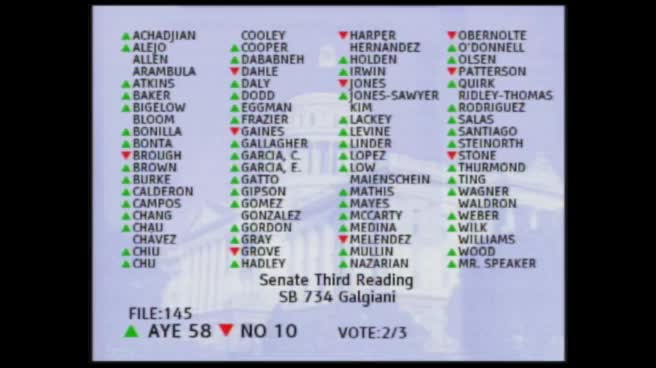 1MIN
Assembly Floor
 12MIN
Assembly Standing Committee on Transportation
 2MIN
Senate Floor
 8MIN
Senate Standing Committee on Judiciary
 12MIN
Senate Standing Committee on Transportation and Housing
Bill Author

Bill Co-Author(s):