SB 769: The Golden State Infrastructure Corporation Act.
- Session Year: 2025-2026
- House: Senate
- Latest Version Date: 2026-08-30
Current Status:
In Progress
(2026-09-18: In Senate. Consideration of Governor's veto pending.)
Introduced
In Committee
Awaiting First Chamber Vote
Passed First Chamber
In Committee
Awaiting Second Chamber Vote
Passed Second Chamber
Enacted
Existing law, the Bergeson-Peace Infrastructure and Economic Development Bank Act, authorizes the California Infrastructure and Economic Development Bank, governed by a board of directors, to make loans, issue bonds, and provide other financial assistance for various types of infrastructure and economic development projects. Existing law establishes the California Infrastructure and Economic Development Bank Fund, a continuously appropriated fund, to support the bank.
This bill would enact the Golden State Infrastructure Corporation Act and would establish the Golden State Infrastructure Corporation, within the State Treasurers Office, as a not-for-profit corporation for the purpose of administering the act and financing infrastructure projects. The bill would require the corporation to be governed by a board of directors, with a prescribed membership, and would require the business and affairs of the corporation to be managed by an executive director appointed by the Treasurer.
This bill would prescribe the powers and duties of the corporation, including entering into financing transactions, borrowing money or issuing bonds, and setting and charging fees for obtaining financing from the corporation. Under the bill, the state would not in any way be liable for any obligation of the corporation, and the corporation would not be required to pay any taxes, except as provided. The bill would require the corporation, not later than January 1 of each year, to submit to the Governor, the Legislature, and the Legislative Analysts Office a report for the preceding fiscal year containing information on the Golden State Infrastructure Corporation Fund, which the bill would create, and the corporations activities, including specified information.
This bill would authorize the corporation to extend financing to either an infrastructure company, a governmental entity, or a combination of those entities, as provided, if the board determines that the financing meets specified criteria. The bill would authorize the corporation, upon board approval, to issue revenue bonds, in a principal amount that the board determines to be necessary, convenient, or desirable to provide moneys for the corporations purposes, which may include, among others, to provide financing to one or more governmental entities or infrastructure companies for infrastructure projects, as provided. The bill would prescribe requirements for issuing the bonds.
The bill would require the board to approve operational policies prior to providing financing for any infrastructure project. The bill would, for purposes of the California Public Records Act, treat the corporation as a state agency, as defined. The bill would, however, exempt from disclosure under that act specified corporate financial records or critical infrastructure information, as defined, furnished to the corporation that have not previously been made public, and would authorize the board, notwithstanding the provisions of the Bagley-Keene Open Meeting Act, to meet in closed session to review or discuss corporate financial records or critical infrastructure information necessary for the board to consider whether to approve or modify a financing, or to discuss the performance of any financing, provided to an infrastructure company for an infrastructure project.
This bill would provide that all moneys in the Golden State Infrastructure Corporation Fund are continuously appropriated for the support of the corporation, to be available for expenditure for the purposes stated in the bill.
Existing constitutional provisions require that a statute that limits the right of access to the meetings of public bodies or the writings of public officials and agencies be adopted with findings demonstrating the interest protected by the limitation and the need for protecting that interest.
This bill would make legislative findings to that effect.
Existing law, the Bergeson-Peace Infrastructure and Economic Development Bank Act, authorizes the California Infrastructure and Economic Development Bank, governed by a board of directors, to make loans, issue bonds, and provide other financial assistance for various types of infrastructure and economic development projects. Existing law establishes the California Infrastructure and Economic Development Bank Fund, a continuously appropriated fund, to support the bank.
This bill would enact the Golden State Infrastructure Corporation Act and would establish the Golden State Infrastructure Corporation, within the State Treasurers Office, as a not-for-profit corporation for the purpose of administering the act and financing infrastructure projects. The bill would require the corporation to be governed by a board of directors, with a prescribed membership, and would require the business and affairs of the corporation to be managed by an executive director appointed by the Treasurer.
This bill would prescribe the powers and duties of the corporation, including entering into financing transactions, borrowing money or issuing bonds, and setting and charging fees for obtaining financing from the corporation. Under the bill, the state would not in any way be liable for any obligation of the corporation, and the corporation would not be required to pay any taxes, except as provided. The bill would require the corporation, not later than January 1 of each year, to submit to the Governor, the Legislature, and the Legislative Analysts Office a report for the preceding fiscal year containing information on the infrastructure corporation fund Golden State Infrastructure Corporation Fund, which the bill would create, and the corporations activities, including specified information.
This bill would authorize the corporation to extend financing to either an infrastructure company, a governmental entity, or a combination of those entities, as provided, if the board determines that the financing meets specified criteria. The bill would authorize the corporation, upon board approval, to issue revenue bonds, in a principal amount that the board determines to be necessary, convenient, or desirable to provide moneys for the corporations purposes, which may include, among others, to provide financing to one or more governmental entities or infrastructure companies for infrastructure projects, as provided. The bill would prescribe requirements for issuing the bonds.
The bill would require the board to approve operational policies prior to providing financing for any infrastructure project. The bill would, for purposes of the California Public Records Act, treat the corporation as a state agency, as defined. The bill would, however, exempt from disclosure under that act specified corporate financial records or critical infrastructure information, as defined, furnished to the corporation that have not previously been made public, and would authorize the board, notwithstanding the provisions of the Bagley-Keene Open Meeting Act, to meet in closed session to review or discuss corporate financial records or critical infrastructure information necessary for the board to consider whether to approve or modify a financing, or to discuss the performance of any financing, provided to an infrastructure company for an infrastructure project.
This bill would create the Golden State Infrastructure Corporation Fund and would provide that all moneys in the fund Golden State Infrastructure Corporation Fund are continuously appropriated for the support of the corporation, to be available for expenditure for the purposes stated in the bill.
Existing constitutional provisions require that a statute that limits the right of access to the meetings of public bodies or the writings of public officials and agencies be adopted with findings demonstrating the interest protected by the limitation and the need for protecting that interest.
This bill would make legislative findings to that effect.
Existing law, the Bergeson-Peace Infrastructure and Economic Development Bank Act, authorizes the California Infrastructure and Economic Development Bank, governed by a board of directors, to make loans, issue bonds, and provide other financial assistance for various types of infrastructure and economic development projects. Existing law establishes the California Infrastructure and Economic Development Bank Fund, a continuously appropriated fund, to support the bank.
This bill would enact the Golden State Infrastructure Corporation Act and would establish the Golden State Infrastructure Corporation, within the State Treasurers Office, as a not-for-profit corporation for the purpose of administering the act and financing infrastructure projects. The bill would require the corporation to be governed by a board of directors, with a prescribed membership, and would require the business and affairs of the corporation to be managed by an executive director appointed by the Treasurer.
This bill would prescribe the powers and duties of the corporation, including entering into financing transactions, borrowing money or issuing bonds, and setting and charging fees for obtaining financing from the corporation. Under the bill, the state would not in any way be liable for any obligation of the corporation, and the corporation would not be required to pay any taxes, except as provided. The bill would require the corporation, not later than January 1 of each year, to submit to the Governor, the Legislature, and the Legislative Analysts Office a report for the preceding fiscal year containing information on the infrastructure corporation fund and the corporations activities, including specified information.
This bill would authorize the corporation to extend financing to either an infrastructure company, a governmental entity, or a combination of those entities, as provided, if the board determines that the financing meets specified criteria. The bill would authorize the corporation, upon board approval, to issue revenue bonds, in a principal amount that the board determines to be necessary, convenient, or desirable to provide moneys for the corporations purposes, which may include, among others, to provide financing to one or more governmental entities or infrastructure companies for infrastructure projects, as provided. The bill would prescribe requirements for issuing the bonds.
The bill would require the board to approve operational policies prior to providing financing for any infrastructure project. The bill would exempt from disclosure under would, for purposes of the California Public Records Act specified records related to the potential or actual provision of financing to an investment company for an infrastructure project, Act, treat the corporation as a state agency, as defined. The bill would, however, exempt from disclosure under that act specified corporate financial records or critical infrastructure information, as defined, furnished to the corporation that have not previously been made public, and would authorize the board, notwithstanding the provisions of the Bagley-Keene Open Meeting Act, to meet in closed session when considering to review or discuss corporate financial records or critical infrastructure information necessary for the board to consider whether to approve or modify a financing, or to discuss the performance of any financing, provided to an infrastructure company for an infrastructure project.
This bill would create the Golden State Infrastructure Corporation Fund and would provide that all moneys in the fund are continuously appropriated for the support of the corporation, to be available for expenditure for the purposes stated in the bill.
Existing constitutional provisions require that a statute that limits the right of access to the meetings of public bodies or the writings of public officials and agencies be adopted with findings demonstrating the interest protected by the limitation and the need for protecting that interest.
This bill would make legislative findings to that effect.
Existing law, the Bergeson-Peace Infrastructure and Economic Development Bank Act, authorizes the California Infrastructure and Economic Development Bank, governed by a board of directors, to make loans, issue bonds, and provide other financial assistance for various types of infrastructure and economic development projects. Existing law establishes the California Infrastructure and Economic Development Bank Fund, a continuously appropriated fund, to support the bank.
This bill would enact the Golden State Infrastructure Corporation Act and would establish the Golden State Infrastructure Corporation, within the State Treasurers Office, as a not-for-profit corporation for the purpose of administering the act and financing infrastructure projects. The bill would require the corporation to be governed by a board of directors, with a prescribed membership, and would require the business and affairs of the corporation to be managed by an executive director appointed by the Treasurer.
This bill would prescribe the powers and duties of the corporation, including entering into financing transactions, borrowing money or issuing bonds, and setting and charging fees for obtaining financing from the corporation. Under the bill, the state would not in any way be liable for any obligation of the corporation, and the corporation would not be required to pay any taxes, except as provided. The bill would require the corporation, not later than January 1 of each year, to submit to the Governor, the Legislature, and the Legislative Analysts Office a report for the preceding fiscal year containing information on the infrastructure corporation fund and the corporations activities, including specified information.
This bill would authorize the corporation to extend financing to either an infrastructure company, a governmental entity, or a combination of those entities, as provided, if the board determines that the financing meets specified criteria. The bill would authorize the corporation, upon board approval, to issue revenue bonds, in a principal amount that the board determines to be necessary, convenient, or desirable to provide moneys for the corporations purposes, which may include, among others, to provide financing to one or more governmental entities or infrastructure companies for infrastructure projects, as provided. The bill would prescribe requirements for issuing the bonds.
The bill would require the board to approve operational policies prior to providing financing for any infrastructure project. The bill would exempt from disclosure under the California Public Records Act specified records related to the potential or actual provision of financing to an investment company for an infrastructure project, and would authorize the board, notwithstanding the provisions of the Bagley-Keene Open Meeting Act, to meet in closed session when considering whether to approve or modify a financing, or to discuss the performance of any financing, provided to an infrastructure company for an infrastructure project.
This bill would create the Golden State Infrastructure Corporation Fund and would provide that all moneys in the fund are continuously appropriated for the support of the corporation, to be available for expenditure for the purposes stated in the bill.
Existing constitutional provisions require that a statute that limits the right of access to the meetings of public bodies or the writings of public officials and agencies be adopted with findings demonstrating the interest protected by the limitation and the need for protecting that interest.
This bill would make legislative findings to that effect.
Existing law, the Bergeson-Peace Infrastructure and Economic Development Bank Act, authorizes the California Infrastructure and Economic Development Bank, governed by a board of directors, to make loans, issue bonds, and provide other financial assistance for various types of infrastructure and economic development projects. Existing law establishes the California Infrastructure and Economic Development Bank Fund, a continuously appropriated fund, to support the bank.
This bill would enact the Golden State Infrastructure Corporation Act and would establish the Golden State Infrastructure Corporation, within the State Treasurers Office, as a not-for-profit corporation for the purpose of administering the act and financing infrastructure projects. The bill would require the corporation to be governed by a board of directors, with a prescribed membership, and would require the business and affairs of the corporation to be managed by an executive director appointed by the Treasurer.
This bill would prescribe the powers and duties of the corporation, including entering into financing transactions, borrowing money or issuing bonds, and setting and charging fees for obtaining financing from the corporation. Under the bill, the state would not in any way be liable for any obligation of the corporation, and the corporation would not be required to pay any taxes. taxes, except as provided. The bill would require the corporation, not later than January 1 of each year, to submit to the Governor, the Legislature, and the Legislative Analysts Office a report for the preceding fiscal year containing information on the infrastructure corporation fund and the corporations activities, including specified information.
This bill would authorize the corporation to extend financing to either an infrastructure company, a governmental entity, or a combination of those entities, as provided, if the board determines that the financing meets specified criteria. The bill would authorize the corporation, upon board approval, to issue revenue bonds, in a principal amount that the board determines to be necessary, convenient, or desirable to provide moneys for the corporations purposes, which may include, among others, to provide financing to one or more governmental entities or infrastructure companies for infrastructure projects, as provided. The bill would prescribe requirements for issuing the bonds.
The bill would require the board to approve operational policies prior to providing financing for any infrastructure project. The bill would exempt from disclosure under the California Public Records Act specified records related to the potential or actual provision of financing to an investment company for an infrastructure project, and would authorize the board, notwithstanding the provisions of the Bagley-Keene Open Meeting Act, to meet in closed session when considering whether to approve or modify a financing, or to discuss the performance of any financing, provided to an infrastructure company for an infrastructure project.
This bill would create the Golden State Infrastructure Corporation Fund and would provide that all moneys in the fund are continuously appropriated for the support of the corporation, to be available for expenditure for the purposes stated in the bill.
Existing constitutional provisions require that a statute that limits the right of access to the meetings of public bodies or the writings of public officials and agencies be adopted with findings demonstrating the interest protected by the limitation and the need for protecting that interest.
This bill would make legislative findings to that effect.
Existing law, the Bergeson-Peace Infrastructure and Economic Development Bank Act, authorizes the California Infrastructure and Economic Development Bank, governed by a board of directors, to make loans, issue bonds, and provide other financial assistance for various types of infrastructure and economic development projects. Existing law establishes the California Infrastructure and Economic Development Bank Fund, a continuously appropriated fund, to support the bank.
This bill would enact the Golden State Infrastructure Corporation Act and would establish the Golden State Infrastructure Corporation, within the State Treasurers Office, as a not-for-profit corporation for the purpose of administering the act and financing infrastructure projects. The bill would require the corporation to be governed by a board of directors, with a prescribed membership, and would require the business and affairs of the corporation to be managed by an executive director appointed by the Treasurer.
This bill would prescribe the powers and duties of the corporation, including entering into financing transactions, borrowing money or issuing bonds, and setting and charging fees for obtaining financing from the corporation. Under the bill, the state would not in any way be liable for any obligation of the corporation, and the corporation would not be required to pay any taxes. The bill would require the corporation, not later than January 1 of each year, to submit to the Governor, the Legislature, and the Legislative Analysts Office a report for the preceding fiscal year containing information on the infrastructure corporation fund and the corporations activities, including specified information.
This bill would authorize the corporation to extend financing to either an infrastructure company, a governmental entity, or a combination of those entities, as provided, if the board determines that the financing meets specified criteria. The bill would authorize the corporation, upon board approval, to issue revenue bonds, in a principal amount that the board determines to be necessary, convenient, or desirable to provide moneys for the corporations purposes, which may include, among others, to provide financing to one or more governmental entities or infrastructure companies for infrastructure projects, as provided. The bill would prescribe requirements for issuing the bonds.
The bill would require the board to approve operational policies prior to providing financing for any infrastructure project. The bill would exempt from disclosure under the California Public Records Act specified records related to the potential or actual provision of financing to an investment company for an infrastructure project, and would authorize the board, notwithstanding the provisions of the Bagley-Keene Open Meeting Act, to meet in closed session when considering whether to approve or modify a financing, or to discuss the performance of any financing, provided to an infrastructure company for an infrastructure project.
This bill would create the Golden State Infrastructure Corporation Fund and would provide that all moneys in the fund are continuously appropriated for the support of the corporation, to be available for expenditure for the purposes stated in the bill.
Existing constitutional provisions require that a statute that limits the right of access to the meetings of public bodies or the writings of public officials and agencies be adopted with findings demonstrating the interest protected by the limitation and the need for protecting that interest.
This bill would make legislative findings to that effect.
This part shall be known, and may be cited, as the Golden State Infrastructure Corporation Act.
16001.The Legislature finds and declares all of the following:
(a)The health, safety, welfare, and economic well-being of the people of California are dependent upon a system of well-functioning infrastructure.
(b)Improvements and additions to the existing infrastructure landscape are vital to supporting the growth of the California economy. Businesses and governments depend on a well-conceived and functioning system of public improvements.
(c)The current pace of infrastructure development and construction in California is not sufficient to meet the needs of Californias population and economy.
(d)To ensure and enhance the economic well-being of Californians, and their businesses and governments, it is a public policy necessity to support the expansion and enhancement of infrastructure.
(e)The shortfall in the pace of infrastructure improvement and development in California is due to a variety of factors, chief among them the lack of access to capital to fund the development, design, construction, and operation of infrastructure projects.
(f)California needs to create an entity structured with broad authority to provide financing, and to participate in the financial markets, to fund the development and improvement projects of key infrastructure projects.
(g)The mechanisms for financing infrastructure development and improvement provided for in this part are in the public interest, serve a public purpose, and will promote the health, welfare, and safety of the citizens of California.
(h)The public policies and responsibilities of California, including all of the above purposes and functions, cannot be fully obtained without the creation of the Golden State Infrastructure Corporation.
16002.For purposes of this part, the following words and terms have the following meanings unless the context clearly indicates or requires another or different meaning or intent:
(a)Act means the Golden State Infrastructure Corporation Act.
(b)Board means the board of directors of the corporation.
(c)Bonds means any of the following:
(1)Bonds, including structured, senior, and subordinated bonds or other securities.
(2)Loans.
(3)Notes, including bond, revenue, tax, or grant anticipation notes.
(4)Commercial paper.
(5)Floating rate and variable maturity securities.
(6)Any other evidences of indebtedness or ownership, including certificates of participation or beneficial interest, asset-backed certificates, or lease-purchase or installment purchase agreements.
(d)Corporation means the Golden State Infrastructure Corporation.
(e)Cost, as applied to an infrastructure project, means all or any part of the expense of any of the following:
(1)The design, development, entitlement, construction, renovation, and acquisition of all lands, structures, and interests in real or personal property.
(2)Demolishing or removing any natural or artificial impediments, improvements, buildings, or structures on land acquired, and includes acquiring any lands to which any buildings, or structures may be moved or constructed.
(3)All materials, machinery, equipment, and financing charges.
(4)Interest prior to, during, and for a period after completion of construction, renovation, improvement, addition, deletion, or acquisition, as determined by the corporation.
(5)Provisions for working capital in an amount not to exceed 5 percent of the aggregate amount of money expended designing and constructing the infrastructure project in question.
(6)Reserves for principal and interest and for extensions, enlargements, additions, replacements, renovations, and improvements.
(7)Architectural, engineering, financial, and legal services, plans, specifications, estimates, administrative expenses, and other items necessary or incidental to determining the feasibility of an infrastructure project or incidental to the construction, acquisition, or financing of an infrastructure project.
(f)Executive director means the executive director of the corporation appointed pursuant to Section 16020. In the absence of the executive director, the term executive director as used herein shall mean the person designated as acting executive director pursuant to Section 16020.
(g)Financing in connection with an infrastructure project, includes, but is not limited to, one or any combination of making loans secured by real or personal property, making unsecured loans, purchasing ownership positions in an infrastructure company, purchasing securities, whether issued or traded on in public or private markets, purchasing notes or loan participation interests, purchasing bonds, leasing real or personal property, purchasing or selling real or personal property to be repaid in a lump sum, installments, or a combination of both, acquiring royalties or revenue streams, issuing insurance, guarantees, or other credit enhancements or liquidity facilities, or any other type of mechanism whereby the corporation provides capital, or commits to provide capital to an infrastructure company or governmental entity in connection with an infrastructure project in return for a promise of repayment, revenue, or appreciation in an interest in an infrastructure company.
(h)Governmental entity means either one or a combination of the following:
(1)The state, or any division, department, agency, commission, board, or nonprofit corporation of the state.
(2)A local government, including a city, county, nonprofit corporation formed by or on behalf of a city or county, special district, assessment district, school district, or joint powers authority within the state.
(i)(1)Infrastructure means any of the following:
(A)Real or tangible personal property located in the state, whether temporary or permanent, intended to support human activities, including, without any limitation, buildings, whether for habitation or other purposes.
(B)Facilities for the movement, conveyance, transmission, or distribution of people, goods, materials, equipment, energy resources, or communication signals.
(C)Facilities for the impoundment, transmission, or distribution of fluids.
(D)Facilities for the creation, restoration, or enhancement of geologic, atmospheric, or hydraulic features or plants or animals.
(E)Facilities or improvements intended to remove or remediate pollution, or to treat or improve air, water, land, plant, or animal resources.
(F)Facilities or improvements intended to treat, store, dispose of, recycle, or reuse discarded or previously used items.
(G)Structures and associated improvements for education, learning, childcare, or the collection or dissemination of information and knowledge.
(H)Facilities for the operation of governmental or military functions.
(2)For real property located partially within and partially outside the state, only the portion located within the state qualifies as infrastructure.
(3)For personal property that will be located at times within the state and at times outside of the state, the personal property will be considered infrastructure for purposes of this part, but the maximum financing amount related to the acquisition, assembly, construction, operation, maintenance, or use of the personal property will be based on the relative proportion of time the personal property is obligated to be within the state, as provided for in a contract with the corporation.
(j)Infrastructure company means any corporation, partnership, limited liability company, trust or trustee, or joint venture, or any group or combination, whether formed for profit or not for profit, the organizational purpose of which includes the development, construction, ownership, or operation of one or more items of infrastructure.
(k)Infrastructure corporation fund means the Golden State Infrastructure Corporation Fund.
(l)Infrastructure project means designing, acquiring, planning, permitting, entitling, constructing, improving, extending, restoring, financing, and generally developing infrastructure.
(m)Operational policies means any and all policies and procedures necessary, desirable, or convenient for the operation, governance, and administration of the corporation, and include, but are not limited to, policies and procedures for underwriting and financing infrastructure projects, debt management, investment of idle cash, and preparation of financial statements and the audit thereof.
(n)Priority governmental entity means any governmental entity with boundaries located wholly within a geographic area that satisfies at least one of the following:
(1)Has a population with a median household income at or below 80 percent of the statewide median household income.
(2)Has a population with a median household income at or below the threshold designated as low income by the California Department of Housing and Community Developments most current listing of state income limits.
2.Creation of the Golden State Infrastructure Corporation16010.(a)There is within the State Treasurers Office the corporation, which shall be responsible for administering the provisions of this part.
(b)The corporation is hereby established as a not-for-profit corporation for the purpose of financing infrastructure projects. The principal office of the corporation shall be in the County of Sacramento. Articles of incorporation of the corporation shall be prepared and, upon approval by the board, filed with the Secretary of State by the executive director. The articles of incorporation may be amended, in whole or in part, upon approval by the board. The corporation shall be treated as a separate legal entity with its separate corporate purpose as described in this part, and the assets, liabilities, and funds of the corporation shall be neither consolidated nor commingled with those of the state.
(c)The corporation shall be governed and its corporate power exercised by a board of directors that shall consist of the following persons:
(1)The Treasurer or their designee, who shall serve as the chair of the board.
(2)The Controller or their designee.
(3)The Director of the Governors Office of Business and Economic Development or their designee.
(4)An appointee of the Governor who shall have at least 10 years of experience in the financing of improvements to real property.
(5)An appointee of the Governor who shall have at least 10 years of experience designing, developing, or constructing improvements to real property.
(d)A designated director shall serve at the pleasure of the designator.
(e)Three of the members of the board shall constitute a quorum and the affirmative vote of three board members shall be necessary for any action to be taken by the board.
(f)A member of the board shall not participate in any corporation action or attempt to influence any decision or recommendation by any employee of, or consultant or attorney to, the corporation that involves an infrastructure company, or a participant in any infrastructure project, of which they are a representative or in which the member or a member of their immediate family has a personal financial interest within the meaning of Section 87100. For purposes of this section, immediate family means the spouse, children, and parents of the member.
(g)Except as provided in this subdivision, the members of the board shall serve without compensation, but shall be reimbursed for actual and necessary expenses incurred in the performance of their duties to the extent that reimbursement for these expenses is not otherwise provided or payable by another public agency, and shall receive one hundred dollars ($100) for each full day of attending meetings of the corporation.
(h)Directors of the corporation shall not be subject to personal liability for carrying out the powers and duties conferred by this part.
(i)The officers of the corporation shall be subject to the Political Reform Act of 1974 (Title 9 (commencing with Section 81000)) and all other applicable provisions of law.
(j)The corporation may purchase insurance for itself, its board members, and the executive director, to cover liability or losses occurring by reason of the act or omission of the corporation, its employees, the executive director, or any board member.
3.Powers and Duties16020.(a)The business and affairs of the corporation shall be managed by an executive director who shall be appointed by, and serve at the pleasure of, the Treasurer. If the executive director is absent temporarily, the Treasurer or the chair of the board may appoint an employee of the corporation as the acting executive director. In the event of the permanent absence of an executive director, the chair of the board may appoint an acting executive director or may appoint a permanent executive director.
(b)The executive director is hereby vested with the power to perform those duties generally necessary, desirable, or convenient to carry out the day-to-day operations of the corporation and to carry out resolutions of the board. Subject to the foregoing and to any conditions that the board may from time to time prescribe, and to the extent not conflicting with any other provision of this part, the executive director may exercise any power, function, or duty conferred by law on the corporation in connection with the administration, management, and conduct of the business and affairs of the corporation.
(c)The chair of the board may appoint a general counsel of the corporation, a chief financial officer of the corporation, and a chief operating officer of the corporation, which shall serve at the pleasure of the chair of the board.
16021.The fiscal powers granted to the corporation by this part may be exercised without regard or reference to any other department, division, or agency of the state, except the Legislature. This part shall be deemed to provide an alternative method of doing the things authorized in this part, and shall be regarded as supplemental and additional to powers conferred by other laws.
16022.The corporation shall have the power to do all of the following, which may be done upon the affirmative vote of a quorum of the board or may be delegated to the executive director upon the affirmative vote of a quorum of the board:
(a)Sue and be sued in its own name.
(b)Contract with private consultants, financial advisors, investment advisors, investment bankers, or fund managers to carry out the purposes of this part. Any contract under this subdivision shall be exempt from Chapter 2 (commencing with Section 10290) of Part 2 of Division 2 of the Public Contract Code.
(c)Contract with attorneys in connection with financing any infrastructure project. A contract under this subdivision shall be exempt from Chapter 2 (commencing with Section 10290) of Part 2 of Division 2 of the Public Contract Code and from Sections 11040 to 11045, inclusive, of this code.
(d)Contract for engineering, architectural, accounting, or other services of appropriate state agencies as may, in its judgment, be necessary in connection with carrying out the purposes of this part.
(e)Contract with consulting engineers, architects, accountants, and construction or environmental experts to carry out the purposes of this part. A contract under this subdivision shall be exempt from Chapter 2 (commencing with Section 10290) of Part 2 of Division 2 of the Public Contract Code.
(f)Receive and accept from any source, including, but not limited to, the federal government, the state, or any agency of the state, loans, contributions, or grants, in money, property, labor, or other things of value, in connection with carrying out the purposes of this part.
(g)Enter into a financing transaction, either directly or indirectly through lending institutions, financial institutions, investment funds, or other similar parties, with an infrastructure company or governmental entity for an infrastructure project.
(h)Make loans either directly or by making a loan to a lending institution, or acquiring a portion of a loan made by a lending institution, or by joining a syndicate of lenders, in connection with the partial or complete refinancing of an infrastructure project initially financed, or previously refinanced, in whole or part, by the corporation.
(i)Borrow money or issue bonds, on a taxable or tax-exempt basis, and use the proceeds, either directly or indirectly, to finance one or more infrastructure projects, or to otherwise carry out the purposes of this part.
(j)Pledge as collateral all or any portion of the corporations assets to carry out the purposes of this part.
(k)Make, receive, or serve as a conduit for the making of, or otherwise provide, guarantees, insurance, liquidity facilities, or other credit enhancements to an infrastructure company or governmental entity in connection with the financing by a third party of an infrastructure project.
(l)Set and charge fees for obtaining financing from the corporation to offset all or a portion of the corporations administrative costs and expenses incurred in the exercise of the powers and duties conferred by this part.
(m)Notwithstanding any other provision of this part, enter into any agreement, contract, or any other instrument with respect to any insurance or guarantee, accept payment in the manner and form as provided therein in the event of default by an infrastructure company or a governmental entity, and issue or assign any insurance or guarantee as security for any financing transaction entered into by the corporation.
(n)Enter into any agreement or contract, execute any instrument, and perform any act or thing necessary or convenient to, directly or indirectly, secure the repayment of any financing issued to a governmental entity with funds or moneys that are legally available and that are due or payable to the governmental entity by reason of any grant, allocation, apportionment or appropriation of the state or agencies of the state, to the extent that the Controller shall be the custodian at any time of these funds or moneys, or with funds or moneys that are or will be legally available to the governmental entity or the state or any agencies of the state by reason of any grant, allocation, apportionment, or appropriation of the federal government or agencies of the federal government. In the event of written notice that the governmental entity has not paid or is in default on its obligations to the corporation, direct the Controller to withhold payment of those funds or moneys from the governmental entity over which it is or will be custodian and to pay the same to the corporation or its assignee, or direct the state or any agencies of the state to which any grant, allocation, apportionment, or appropriation of the federal government or agencies of the federal government is or will be legally available to pay the same upon receipt by the corporation or its assignee, until the default has been cured and the amounts then due and unpaid have been paid to the corporation or its assignee, or until arrangements satisfactory to the corporation been made to cure the default.
(o)Enter into any agreement or contract, execute any instrument, and perform any act or thing necessary, convenient, or appropriate to carry out any power expressly given to the corporation by this part, including, but not limited to, agreements for the sale of all or any part of the corporations bonds or its interest in any financing transaction it participated in, liquidity agreements, interest rate swap agreements, forward payment conversion agreements, futures or contracts providing for payments based on levels of, or changes in, interest rates or currency exchange rates, or contracts to exchange cashflows or a series of payments, or contracts, including options, puts or calls to hedge payments, rate, spread, currency exchange, or similar exposure, or any other financial instrument commonly known as a structured financial product.
(p)Invest any moneys held in reserve for guarantees or other credit enhancements issued by the corporation, or in sinking funds, or any moneys not required for immediate use or disbursement, in investments permitted under Section 16430.
(q)Apply for and accept subventions, grants, loans, advances, and contributions from any source of money, property, labor, or other things of value. The sources may include bond proceeds, dedicated taxes, state appropriations, federal appropriations, federal grant and loan funds, public and private sector retirement system funds, and proceeds of loans from the Pooled Money Investment Account.
(r)Do all things necessary and convenient to carry out its purposes and exercise its powers.
16023.Bonds issued by the corporation are legal investments for all trust funds, the funds of all insurance companies, banks, both commercial and savings, trust companies, executors, administrators, trustees, and other fiduciaries, for state school funds, pension funds, and for any funds that may be invested in county, school, or municipal bonds. These bonds are securities that may legally be deposited with, and received by, any state or municipal officer or agency or political subdivision of the state for any purpose for which the deposit of bonds or obligations of the state is now, or may hereafter be, authorized by law, including deposits to secure public funds.
16024.The state shall not in any way be liable for any obligation of the corporation.
16025.(a)The corporation shall not be required to pay any taxes whatsoever with respect to any real or personal property acquired by, or for, the corporation, or upon any income or revenue received by the corporation. This section does not exempt any taxable person from taxation, including, but not limited to, taxation upon a possessory interest, with respect to any infrastructure project, or the property or facilities contained in any infrastructure project that may otherwise be applicable to the person.
(b)The exemption established by subdivision (a) shall not apply to any of the following:
(1)A sales and use tax imposed under the Sales and Use Tax Law (Part 1 (commencing with Section 6001) of Division 2 of the Revenue and Taxation Code).
(2)A sales and use tax imposed under the Bradley-Burns Uniform Local Sales and Use Tax Law (Part 1.5 (commencing with Section 7200) of Division 2 of the Revenue and Taxation Code).
(3)A transactions and use tax imposed in accordance with the Transactions and Use Tax Law (Part 1.6 (commencing with Section 7251) of Division 2 of the Revenue and Taxation Code) or any other provision of law.
16026.The state does hereby pledge to all parties entering into contracts with the corporation, any valid assignee of the parties, or who obtain the corporations bonds, that, pursuant to this part, the state will not limit or alter the rights hereby vested in the corporation and to fulfill the terms of any contract with the corporation or bond issued pursuant to this part, or in any way impair the rights or remedies of the parties until those contracts are fully performed or bonds issued by the corporation, together with interest, are fully discharged or provision for this discharge has been made. The corporation may include this pledge and undertaking for the state in its obligations or contracts.
16027.The executive director shall cause to be created and continuously maintained an internet website for the corporation. The internet website shall include, at a minimum, a description of the past, present, and planned future activities of the corporation, the operational policies of the corporation, and agendas, meeting minutes, and resolutions for all meetings of the board that occurred within the previous 12 months.
16028.Not later than January 1 immediately following the end of the first fiscal year in which the corporation provides financing for an infrastructure project, and before each January 1 thereafter, the corporation shall cause to be completed, and shall post on its internet website, an audited financial statement of the corporation for the immediately previous fiscal year. An audited financial statement shall be prepared in accordance with the standards developed by the Governmental Accounting Standards Board.
16029.(a)Not later than January 1 of each year, the corporation shall submit to the Governor, the Legislature, and the Legislative Analysts Office a report for the preceding fiscal year ending on June 30 containing information on the infrastructure corporation fund and the corporations activities. The report to the Legislature shall be submitted pursuant to Section 9795. The report shall include all of the following:
(1)Audited financial statements of the corporation for the immediately previous fiscal year.
(2)A summary of the information for the infrastructure corporation fund, including, but not limited to, its present balance, moneys committed to financings, moneys disbursed for financings, a brief description of each financing, and all revenues received during the fiscal year segregated into primary categories, as determined by the executive director.
(3)Information on the impact of the activities funded by infrastructure corporation fund moneys, including, but not limited to, the number of jobs created and retained, the environmental impact that resulted, and economic value provided to the state.
(4)The amount of other public and private funds leveraged by the financing provided.
(5)A report of the corporations administrative costs for the preceding fiscal year.
(6)A projection of the corporations needs and requirements for the coming year.
(7)Recommendations for changes in state and federal law necessary to meet the objectives of this part.
(b)The executive director shall post the report on the corporations internet website.
16030.(a)No later than five years after the effective date of this part, the board shall submit to the Governor, the Legislature, and the Legislative Analysts Office a report evaluating the equitable access of all public agencies to financing from the infrastructure corporation fund. The report to the Legislature shall be submitted pursuant to Section 9795. The corporation shall also post the report to its internet website.
(b)In evaluating equitable access, the report shall consider, but not be limited to, the following factors of the public agencies that have applied for and received financing under this part:
(1)Median household income.
(2)Per capita tax base.
(3)Bond ratings.
(4)Poverty rate.
(5)Unemployment rate relative to the state average.
(c)The report shall include findings and recommendations to ensure equitable access to the infrastructure corporation fund across public agencies and local agencies of varying economic conditions, including, but not limited to, recommendations for changes in state law and to the corporations assessment policies, procedures, and outreach practices.
16031.The board shall approve operational policies prior to providing financing for any infrastructure project. Financing for any infrastructure project shall comply with all applicable operational policies. The board may waive any provision in the operational policies for the financing of any infrastructure project by a unanimous vote of the board members then present. Chapter 3.5 (commencing with Section 11340) of Part 1 of Division 3 of Title 2 shall not apply to the operational policies. The operational policies may be implemented upon an affirmative vote of a quorum of the board. However, any proposed operational policy or amendment to the policy shall be posted on the corporations internet website in a conspicuous location at least 30 calendar days before a board meeting at which the operational policy or amendment will be considered for approval. An operational policy presented to the board as set forth in this section may be amended or modified by a unanimous vote of the board members then present.
16032.(a)The corporation shall be a state agency for purposes of the California Public Records Act (Division 10 (commencing with Section 7920.000) of Title 1). All records in the possession of the corporation shall be subject to inspection and disclosure pursuant to the California Public Records Act, except to the extent that such records, or any portions thereof, are exempt from disclosure under the California Public Records Act or any other applicable law.
(b)Notwithstanding subdivision (a), the corporation shall not be required to disclose records, or any portion thereof, that are corporate financial records or critical infrastructure information furnished to the corporation by the infrastructure company and have not previously been made public.
(c)For purposes of this section, the following definitions apply:
(1)Corporate financial records means financial records and corporate proprietary information, including trade secrets, submitted by the infrastructure company to the corporation relating to financing sought by an infrastructure company from the corporation or financing provided by the corporation to an infrastructure company for an infrastructure project. Corporate financial records include due diligence materials or information related to customers and competitors, including summaries, reports, analyses, recommendations, projections, or estimates related thereto.
(2)Critical infrastructure information has the same meaning as in Section 650(4) of Title 6 of the United States Code.
16033.The Bagley-Keene Open Meeting Act (Article 9 (commencing with Section 11120) of Chapter 1 of Part 1 of Division 3) shall not prevent the board from holding a closed session to review or discuss corporate financial records or critical infrastructure information, as defined in Section 16032, necessary for the board to consider in its determination whether to approve or modify financing in connection with an infrastructure project or to evaluate the performance of an infrastructure company with any financing provided to the infrastructure company for an infrastructure project. For purposes of consideration of voting in connection with equity interests in an infrastructure company that are held by the corporation, closed sessions may be held only with respect to the election of managers or directors of the infrastructure company, election of independent auditors, and other financial issues that could have a material effect on the net income of the corporation. For the purpose of the acquisition or disposition of interests in real or personal property that may be considered in a closed session pursuant to this paragraph, a state body shall also be exempt from identifying property prior to the closed session. Notwithstanding Article 9 (commencing with Section 11120) of Chapter 1 of Part 1 of Division 3, the following applies to a closed session held pursuant to this section:
(a)An agenda item for a closed session meeting of the board need only state that the board will hold a closed session pursuant to this section.
(b)Prior to commencing a closed session at which one or more items will be heard pursuant to this section, the chair of the board shall state that discussions will be had or action taken pursuant to this section in closed session.
(c)Upon completion of a closed session and the reopening of an open session, the board chair shall announce in general terms the type, amount, and identity of the recipient of any financing to an infrastructure company for an infrastructure project approved during the closed session. Closed sessions may not be held in connection with decisions whether to approve or modify a financing to a governmental entity for an infrastructure project or to discuss the performance of any financing provided to a governmental entity for an infrastructure project.
16034.The validity of any financing made by the corporation to one or more governmental entities or infrastructure companies, or any combination thereof, for one or more infrastructure projects, or any bonds issued by the corporation, shall not be affected by any proceedings related to the entitlement, authorization, or implementation of the infrastructure project, or projects, funded in whole or part by the financing made by the corporation or any bonds issued by the corporation.
16035.The state shall be the holder of a residual interest in the corporation. In the event of dissolution of the corporation, valid and legally binding monetary claims against the corporation incurred pursuant to this part shall be paid from the assets of the corporation. Payment may be made by cash, liquidating investments, transferring investments, liquidating financings made by the corporation, or transferring all or a part of the corporations interest in any financing made by the corporation. Payment made by transfer of investments or financings made by the corporation shall be credited against any claim in an amount equal to the fair market value of the investment or financing, as determined by the corporation in its reasonable discretion. Any remaining assets of the corporation shall be liquidated as expeditiously as possible and the proceeds shall be transferred to the General Fund.
16036.The corporation shall be treated as a public agency for purposes of Chapter 9 (commencing with Section 860) of Title 10 of Part 2 of the Code of Civil Procedure, and the corporation may bring an action as in that chapter to determine the validity of any financing or the validity of any power or duty vested in the corporation as provided in this part, and any action or proceeding challenging the validity of any matter may be brought in accordance with, and within the time specified in, that chapter.
4.Financing Infrastructure Projects16040.The corporation may extend financing to either an infrastructure company, a governmental entity, or a combination thereof, upon the affirmative vote of at least a quorum of the board. All potential financings shall be presented to the board by the executive director, or the executive directors designee. A presentation may include materials or statements made by the governmental entity or infrastructure company and any consultant, attorney, or agent of the corporation, governmental entity, or infrastructure company. Financings to governmental entities for infrastructure projects shall be presented to the board at an open meeting session. Financings for infrastructure projects that do not involve governmental entities may be presented to the board at closed session pursuant to Section 16033 if the executive director determines in the executive directors discretion that presenting the matter to the board in a closed session will be in the best interests of the corporation and the infrastructure company. If a quorum or more of the board disagrees with the executive directors determination, the board may direct the executive director during closed session to put the matter on the agenda for an open session at the next meeting and take no further action on the item.
16041.The board may not consider approving any financing to an infrastructure company or a governmental entity, or a combination of each, for an infrastructure project unless, in the determination of corporation staff, the infrastructure company or governmental entity, as applicable, is able at the time of the board meeting to enter into a legal, valid, and binding financing agreement.
16042.If a financing is approved by the board, the corporation may extend financing to the infrastructure company, or the governmental entity, or both, as applicable, from any source of available funds as determined by the executive director, including, but not limited to, the proceeds of any revenue bonds issued by the corporation.
16043.Financing shall not be made by the corporation under this chapter unless the board first determines by resolution that the financing meets the following criteria:
(a)The financing is for an infrastructure project in the state.
(b)Those seeking financing are capable of meeting obligations incurred under relevant contracts and instruments.
(c)Payments to be made under applicable financing documents are adequate to pay the current expenses of the corporation in connection with the financing.
(d)The proposed financing is appropriate for the specific infrastructure project.
16044.(a)Any financing entered into pursuant to this article may contain provisions for payment of a penalty if any infrastructure company benefitting from the financing leaves this state prior to its performance of all contractual obligations it incurred in connection with the financing.
(b)Infrastructure projects that the board determines will produce long-term employment creation or retention shall receive first priority for financing.
16045.(a)Projects financed by the corporation are public works for which prevailing wages must be paid for purposes of Chapter 1 (commencing with Section 1720) of Part 7 of Division 2 of the Labor Code.
(b)(1)As a condition of receiving financing for a project from the corporation, the project developer must obtain an enforceable commitment from any entity undertaking construction, demolition, alteration, installation, repair, or maintenance work that the entity, and its contractors and subcontractors at every tier, will use a skilled and trained workforce to perform all work within an apprenticeable occupation in the building and construction trades in accordance with Chapter 2.9 (commencing with Section 2600) of Part 1 of Division 2 of the Public Contract Code, provided, however, any reference therein to a public entity shall include both a governmental entity and an infrastructure company.
(2)Paragraph (1) shall not apply to a project covered by a project labor agreement that requires the use of a skilled and trained workforce to perform all construction, demolition, alteration, installation, repair, or maintenance work within an apprenticeable occupation in the building and construction trades. For purposes of this section, project labor agreement has the same meaning as that term is defined in subdivision (b) of Section 2500 of the Public Contract Code, provided, however, any reference therein to a public entity shall include both a governmental entity and an infrastructure company.
16046.Any financing extended by the corporation shall not exceed one-third of the total cost of the infrastructure project for which the financing is provided.
16048.(a)At least 15 percent of all General Fund moneys in the infrastructure corporation fund shall be reserved for providing financing for infrastructure projects to priority governmental entities. This reservation shall only apply for two years starting on the effective date of this part.
(b)This section shall not prevent allocation to priority governmental entities of more than 15 percent of all General Fund moneys in the infrastructure corporation fund.
5.Revenue Bonds 16050.Upon board approval, the corporation may, from time to time, issue its revenue bonds, in a principal amount that the board shall determine to be necessary, convenient, or desirable to provide moneys for the corporations purposes, which may include, but shall not be limited to, providing financing to one or more governmental entities or infrastructure companies for one or more infrastructure projects, as provided in this part, for the purchase or refunding of bonds of one or more governmental entities or infrastructure companies issued to finance one or more infrastructure projects, payment of interest on bonds of the corporation, establishment of reserves to secure bonds, refunding previously issued bonds or refunding bonds of the corporation, and payment of other expenditures of the corporation incident to issuance of bonds or refunding bonds of the corporation.
16051.The Treasurer, the Governor, or the Lieutenant Governor is an elected representative of the state authorized to fulfill any public approval requirement of Section 147(f) of Title 26 of the Internal Revenue Code (26 U.S.C. Sec. 147(f)), including subsequent amendments thereto, or its successor provision, for the issuance of federally tax-exempt bonds issued by the corporation pursuant to this chapter.
16052.(a)Proceeds of any bonds issued by the corporation may be used to finance a single infrastructure project for a single governmental entity or infrastructure company, a series of infrastructure projects for a single governmental entity or infrastructure company, a single infrastructure project for one of more governmental entities or infrastructure companies, or several infrastructure projects for one or more governmental entities or infrastructure companies.
(b)Except as otherwise expressly provided by the corporation, every issue of its bonds shall be payable from any revenues or other moneys of the corporation available therefor and not otherwise pledged. These revenues or moneys may include the proceeds of additional bonds, subject only to any agreements with the holders of particular bonds pledging any particular revenues or moneys. Notwithstanding that the bonds may be payable from a special fund, these bonds shall be deemed to be negotiable instruments for all purposes.
(c)Bonds may be issued in one or more series and may be issued as serial bonds or as term bonds or as a combination thereof. Bonds shall bear the date of issuance, bear the time of maturity, which shall not exceed 50 years from the date of issuance, bear the rate or rates of interest, be payable at the time or times provided, be in the denominations provided, be in the form or forms provided, carry the registration privileges provided, be executed in the manner provided, be payable in lawful money of the United States, or other designated currency, at the place or places provided, and be subject to any terms of redemption provided in the bond.
(d)The sale of the bonds of the corporation shall be coordinated by the Treasurer in accordance with Section 5702.
(e)The bonds of the corporation may be issued on either federally taxable or tax-exempt basis, or a combination of both. Bonds of the corporation may be sold to an underwriter via a competitive bid or negotiated sale or may be placed directly with one or more investors, with or without the assistance of a placement agent, and for any price or prices, and on any terms and conditions, as the corporation determines proper. Pending the preparation of definitive bonds, the Treasurer may issue interim receipts, certificates, or temporary bonds that shall be exchanged for definitive bonds.
16053.Any resolution authorizing any bonds may contain the following provisions, that, if included, shall be a part of the contract with the holders of the bonds to be authorized:
(a)Provisions pledging the full faith and credit of the corporation, or pledging all or any part of the revenues of any financings for infrastructure projects made by the corporation, any real or personal property of the corporation, or any other moneys of the corporation, to secure the payment of the bonds or of any particular issue of bonds, subject to those agreements with bondholders as may then exist.
(b)Provisions setting aside reserves or sinking funds, or providing for the use of subordinated classes of bonds by the corporation, and the regulation and disposition thereof.
(c)Limitations on the issuance of additional bonds, the terms upon which additional bonds may be issued and secured, and the refunding of outstanding bonds.
(d)The procedure, if any, by which the terms of any contract with bondholders may be amended or abrogated, the amount of bonds and the holders that are required to give consent, and the manner in which the consent may be given.
(e)Limitations on the corporations expenditures for operation and administration, or other expenses.
(f)Definitions of acts or omissions that constitute a default in the duties of the corporation to holders of its obligations, and providing the rights and remedies of the holders in the event of a default.
16054.The corporation may, out of any funds available, purchase its bonds. The corporation may hold, pledge, cancel, or resell its bonds, subject to and in accordance with agreements with bondholders.
16055.(a)In the discretion of the corporation, any bonds issued under this chapter may be secured by a trust agreement between the corporation and a corporate trustee or trustees that may include the Treasurer or any trust company or bank having the powers of a trust company within or without the state.
(b)The trust agreement may pledge or assign any funds or assets of the corporation legally available for pledge or assignment. The trust agreement providing for the issuance of the bonds may contain provisions for protecting and enforcing the rights and remedies of bondholders as may be reasonable and proper and not in violation of law.
(c)A bank or trust company doing business under the laws of the state that may act as a depository of the proceeds of bonds or of revenues or other moneys shall furnish indemnifying bonds or pledge securities when required by the corporation.
(d)The trust agreement securing the bonds may set forth the rights and remedies of the bondholders and of the trustee or trustees, and may restrict the individual right of action by bondholders. In addition, any trust agreement or resolution may contain other provisions that the corporation may deem reasonable and proper.
(e)The trust agreement may provide for the pledge or assignment of funds or moneys in the custody of the Controller that are legally available to a governmental entity obtaining financing from the corporation for an infrastructure project and that are due or payable to the governmental entity by reason of any grant, allocation, apportionment, or appropriation, and any legally available funds or moneys that are or will be due or payable, to the governmental entity by reason of any grant, allocation, apportionment, or appropriation of the federal government or agencies of the federal government.
16056.(a)Bonds issued under this chapter do not constitute a debt or liability of the state or of any political subdivision of the state, and do not constitute a pledge of the full faith and credit of the state or any of its political subdivisions, but are payable solely from the funds provided for under this chapter. This subdivision does not preclude bond guarantees or enhancements pursuant to this part. All the bonds shall contain on the face of the bond a statement to the following effect:
Neither the full faith and credit nor the taxing power of the State of California is pledged to the payment of the principal of, or interest on, this bond.
(b)The issuance of bonds under this chapter shall not directly or indirectly or contingently obligate the state or any political subdivision of the state to levy or to pledge any form of taxation or to make any appropriation for their payment.
16057.(a)The corporation may issue bonds for the purpose of refunding any bonds of the corporation then outstanding, including the payment of any redemption premium and any interest accrued, or to accrue, on their earliest or any subsequent date of redemption, purchase, or maturity. The corporation, if it deems advisable, may issue bonds for the additional purpose of obtaining funds to make financings to governmental entities or infrastructure companies for the cost of any infrastructure project or any portion thereof.
(b)The proceeds of any bonds issued for the purpose of refunding outstanding bonds as provided in subdivision (a) may, in the discretion of the corporation, be applied to the purchase or retirement at maturity or redemption of those outstanding bonds either on their earliest or any subsequent redemption date or upon the purchase or retirement at the maturity thereof and may, pending this application, be placed in escrow to be applied to the purchase or retirement at maturity or redemption of those outstanding bonds on the date or dates as may be determined by the corporation.
(c)The corporation may make investments with any escrowed proceeds that mature at the time or times appropriate to assure prompt payment, of the principal, interest, and redemption premium, if any, of the outstanding bonds to be refunded. The interest, income, and profits, if any, earned or realized on the investment may also be applied to the payment of the outstanding bonds to be refunded. After the terms of the escrow have been fully satisfied and carried out, any balance of the proceeds and interest, income, and profits, if any, earned or realized on the investments shall be returned to the corporation for use in carrying out the purposes of this part.
16058.Any and all bonds issued by the corporation, their transfer and the income from the bonds, shall at all times be free from taxation of every kind by the state and by all political subdivisions of the state.
6.The Golden State Infrastructure Corporation Fund16060.(a)The Golden State Infrastructure Corporation Fund is hereby created for the purpose of implementing the objectives and provisions of this part. Within the fund, the corporation may create any accounts and subaccounts that the corporation deems necessary, convenient, or desirable.
(b)Notwithstanding Section 13340, all moneys in the infrastructure corporation fund are continuously appropriated, without regard to fiscal year, for expenditure for the purposes stated in this part.
16061.(a)The corporation may pledge any or all of the moneys in the infrastructure corporation fund as security for the corporations obligations incurred pursuant to this part. All moneys accruing to the corporation pursuant to this part from any sources shall be deposited into the infrastructure corporation fund.
(b)The corporation may, from time to time, invest moneys in the fund that are not required for its current needs, including proceeds from the sale of any bonds, in any eligible securities specified in Section 16430. The corporation may deposit moneys into interest-bearing accounts in any bank in this state or in any savings and loan association in this state. All interest or other increment resulting from the investment or deposit of moneys from the infrastructure corporation fund, and all income and revenue generated by the corporation, shall be deposited into the fund.
16062.The assets of the infrastructure corporation fund shall be available for the payment of the salaries and other expenses charged against it in accordance with this division. All expenses, obligations, or liabilities incurred in carrying out the purposes of this part shall be payable solely from funds provided pursuant to this part. No expense, obligation, or liability whatsoever of the corporation shall be imposed upon the state.
16063.(a)Notwithstanding Chapter 2 (commencing with Section 12850) of Part 2.5 and Article 2 (commencing with Section 13320) of Chapter 3 of Part 3, expenditures of the infrastructure corporation fund shall not be subject to the supervision or approval of any other officer or division of state government, with the exception of the Legislature. However, the corporations budget shall be prepared and reviewed not later than January 1 of each year.
(b)The corporations budget shall include the amount of credit and liabilities of the infrastructure corporation fund, based on an audit of the fund at the close of the prior fiscal year. The corporations operating budget shall be subject to review and appropriation in the annual Budget Act.
SEC. 2.The Legislature finds and declares that Section 1 of this act, which adds Sections 16032 and 16033 to the Government Code, imposes a limitation on the publics right of access to the meetings of public bodies or the writings of public officials and agencies within the meaning of Section 3 of Article I of the California Constitution. Pursuant to that constitutional provision, the Legislature makes the following findings to demonstrate the interest protected by this limitation and the need for protecting that interest:
In order to maintain the confidentiality of infrastructure companies private financial information, it is necessary to exempt these records from public disclosure and to allow consideration of investments with private companies in a closed board session.
This part shall be known, and may be cited, as the Golden State Infrastructure Corporation Act.
16001.The Legislature finds and declares all of the following:
(a)The health, safety, welfare, and economic well-being of the people of California are dependent upon a system of well-functioning infrastructure.
(b)Improvements and additions to the existing infrastructure landscape are vital to supporting the growth of the California economy. Businesses and governments depend on a well-conceived and functioning system of public improvements.
(c)The current pace of infrastructure development and construction in California is not sufficient to meet the needs of Californias population and economy.
(d)To ensure and enhance the economic well-being of Californians, and their businesses and governments, it is a public policy necessity to support the expansion and enhancement of infrastructure.
(e)The shortfall in the pace of infrastructure improvement and development in California is due to a variety of factors, chief among them the lack of access to capital to fund the development, design, construction, and operation of infrastructure projects.
(f)California needs to create an entity structured with broad authority to provide financing, and to participate in the financial markets, to fund the development and improvement projects of key infrastructure projects.
(g)The mechanisms for financing infrastructure development and improvement provided for in this part are in the public interest, serve a public purpose, and will promote the health, welfare, and safety of the citizens of California.
(h)The public policies and responsibilities of California, including all of the above purposes and functions, cannot be fully obtained without the creation of the Golden State Infrastructure Corporation.
16002.For purposes of this part, the following words and terms have the following meanings unless the context clearly indicates or requires another or different meaning or intent:
(a)Act means the Golden State Infrastructure Corporation Act.
(b)Board means the board of directors of the corporation.
(c)Bonds means any of the following:
(1)Bonds, including structured, senior, and subordinated bonds or other securities.
(2)Loans.
(3)Notes, including bond, revenue, tax, or grant anticipation notes.
(4)Commercial paper.
(5)Floating rate and variable maturity securities.
(6)Any other evidences of indebtedness or ownership, including certificates of participation or beneficial interest, asset-backed certificates, or lease-purchase or installment purchase agreements.
(d)Corporation means the Golden State Infrastructure Corporation.
(e)Cost, as applied to an infrastructure project, means all or any part of the expense of any of the following:
(1)The design, development, entitlement, construction, renovation, and acquisition of all lands, structures, and interests in real or personal property.
(2)Demolishing or removing any natural or artificial impediments, improvements, buildings, or structures on land acquired, and includes acquiring any lands to which any buildings, or structures may be moved or constructed.
(3)All materials, machinery, equipment, and financing charges.
(4)Interest prior to, during, and for a period after completion of construction, renovation, improvement, addition, deletion, or acquisition, as determined by the corporation.
(5)Provisions for working capital in an amount not to exceed 5 percent of the aggregate amount of money expended designing and constructing the infrastructure project in question.
(6)Reserves for principal and interest and for extensions, enlargements, additions, replacements, renovations, and improvements.
(7)Architectural, engineering, financial, and legal services, plans, specifications, estimates, administrative expenses, and other items necessary or incidental to determining the feasibility of an infrastructure project or incidental to the construction, acquisition, or financing of an infrastructure project.
(f)Executive director means the executive director of the corporation appointed pursuant to Section 16020. In the absence of the executive director, the term executive director as used herein shall mean the person designated as acting executive director pursuant to Section 16020.
(g)Financing in connection with an infrastructure project, includes, but is not limited to, one or any combination of making loans secured by real or personal property, making unsecured loans, purchasing ownership positions in an infrastructure company, purchasing securities, whether issued or traded on in public or private markets, purchasing notes or loan participation interests, purchasing bonds, leasing real or personal property, purchasing or selling real or personal property to be repaid in a lump sum, installments, or a combination of both, acquiring royalties or revenue streams, issuing insurance, guarantees, or other credit enhancements or liquidity facilities, or any other type of mechanism whereby the corporation provides capital, or commits to provide capital to an infrastructure company or governmental entity in connection with an infrastructure project in return for a promise of repayment, revenue, or appreciation in an interest in an infrastructure company.
(h)Governmental entity means either one or a combination of the following:
(1)The state, or any division, department, agency, commission, board, or nonprofit corporation of the state.
(2)A local government, including a city, county, nonprofit corporation formed by or on behalf of a city or county, special district, assessment district, school district, or joint powers authority within the state.
(i)(1)Infrastructure means any of the following:
(A)Real or tangible personal property located in the state, whether temporary or permanent, intended to support human activities, including, without any limitation, buildings, whether for habitation or other purposes.
(B)Facilities for the movement, conveyance, transmission, or distribution of people, goods, materials, equipment, energy resources, or communication signals.
(C)Facilities for the impoundment, transmission, or distribution of fluids.
(D)Facilities for the creation, restoration, or enhancement of geologic, atmospheric, or hydraulic features or plants or animals.
(E)Facilities or improvements intended to remove or remediate pollution, or to treat or improve air, water, land, plant, or animal resources.
(F)Facilities or improvements intended to treat, store, dispose of, recycle, or reuse discarded or previously used items.
(G)Structures and associated improvements for education, learning, childcare, or the collection or dissemination of information and knowledge.
(H)Facilities for the operation of governmental or military functions.
(2)For real property located partially within and partially outside the state, only the portion located within the state qualifies as infrastructure.
(3)For personal property that will be located at times within the state and at times outside of the state, the personal property will be considered infrastructure for purposes of this part, but the maximum financing amount related to the acquisition, assembly, construction, operation, maintenance, or use of the personal property will be based on the relative proportion of time the personal property is obligated to be within the state, as provided for in a contract with the corporation.
(j)Infrastructure company means any corporation, partnership, limited liability company, trust or trustee, or joint venture, or any group or combination, whether formed for profit or not for profit, the organizational purpose of which includes the development, construction, ownership, or operation of one or more items of infrastructure.
(k)Infrastructure corporation fund means the Golden State Infrastructure Corporation Fund.
(l)Infrastructure project means designing, acquiring, planning, permitting, entitling, constructing, improving, extending, restoring, financing, and generally developing infrastructure.
(m)Operational policies means any and all policies and procedures necessary, desirable, or convenient for the operation, governance, and administration of the corporation, and include, but are not limited to, policies and procedures for underwriting and financing infrastructure projects, debt management, investment of idle cash, and preparation of financial statements and the audit thereof.
(n)Priority governmental entity means any governmental entity with boundaries located wholly within a geographic area that satisfies at least one of the following:
(1)Has a population with a median household income at or below 80 percent of the statewide median household income.
(2)Has a population with a median household income at or below the threshold designated as low income by the California Department of Housing and Community Developments most current listing of state income limits.
2.Creation of the Golden State Infrastructure Corporation16010.(a)There is within the State Treasurers Office the corporation, which shall be responsible for administering the provisions of this part.
(b)The corporation is hereby established as a not-for-profit corporation for the purpose of financing infrastructure projects. The principal office of the corporation shall be in the County of Sacramento. Articles of incorporation of the corporation shall be prepared and, upon approval by the board, filed with the Secretary of State by the executive director. The articles of incorporation may be amended, in whole or in part, upon approval by the board. The corporation shall be treated as a separate legal entity with its separate corporate purpose as described in this part, and the assets, liabilities, and funds of the corporation shall be neither consolidated nor commingled with those of the state.
(c)The corporation shall be governed and its corporate power exercised by a board of directors that shall consist of the following persons:
(1)The Treasurer or their designee, who shall serve as the chair of the board.
(2)The Controller or their designee.
(3)The Director of the Governors Office of Business and Economic Development or their designee.
(4)An appointee of the Governor who shall have at least 10 years of experience in the financing of improvements to real property.
(5)An appointee of the Governor who shall have at least 10 years of experience designing, developing, or constructing improvements to real property.
(d)A designated director shall serve at the pleasure of the designator.
(e)Three of the members of the board shall constitute a quorum and the affirmative vote of three board members shall be necessary for any action to be taken by the board.
(f)A member of the board shall not participate in any corporation action or attempt to influence any decision or recommendation by any employee of, or consultant or attorney to, the corporation that involves an infrastructure company, or a participant in any infrastructure project, of which they are a representative or in which the member or a member of their immediate family has a personal financial interest within the meaning of Section 87100. For purposes of this section, immediate family means the spouse, children, and parents of the member.
(g)Except as provided in this subdivision, the members of the board shall serve without compensation, but shall be reimbursed for actual and necessary expenses incurred in the performance of their duties to the extent that reimbursement for these expenses is not otherwise provided or payable by another public agency, and shall receive one hundred dollars ($100) for each full day of attending meetings of the corporation.
(h)Directors of the corporation shall not be subject to personal liability for carrying out the powers and duties conferred by this part.
(i)The officers of the corporation shall be subject to the Political Reform Act of 1974 (Title 9 (commencing with Section 81000)) and all other applicable provisions of law.
(j)The corporation may purchase insurance for itself, its board members, and the executive director, to cover liability or losses occurring by reason of the act or omission of the corporation, its employees, the executive director, or any board member.
3.Powers and Duties16020.(a)The business and affairs of the corporation shall be managed by an executive director who shall be appointed by, and serve at the pleasure of, the Treasurer. If the executive director is absent temporarily, the Treasurer or the chair of the board may appoint an employee of the corporation as the acting executive director. In the event of the permanent absence of an executive director, the chair of the board may appoint an acting executive director or may appoint a permanent executive director.
(b)The executive director is hereby vested with the power to perform those duties generally necessary, desirable, or convenient to carry out the day-to-day operations of the corporation and to carry out resolutions of the board. Subject to the foregoing and to any conditions that the board may from time to time prescribe, and to the extent not conflicting with any other provision of this part, the executive director may exercise any power, function, or duty conferred by law on the corporation in connection with the administration, management, and conduct of the business and affairs of the corporation.
(c)The chair of the board may appoint a general counsel of the corporation, a chief financial officer of the corporation, and a chief operating officer of the corporation, which shall serve at the pleasure of the chair of the board.
16021.The fiscal powers granted to the corporation by this part may be exercised without regard or reference to any other department, division, or agency of the state, except the Legislature. This part shall be deemed to provide an alternative method of doing the things authorized in this part, and shall be regarded as supplemental and additional to powers conferred by other laws.
16022.The corporation shall have the power to do all of the following, which may be done upon the affirmative vote of a quorum of the board or may be delegated to the executive director upon the affirmative vote of a quorum of the board:
(a)Sue and be sued in its own name.
(b)Contract with private consultants, financial advisors, investment advisors, investment bankers, or fund managers to carry out the purposes of this part. Any contract under this subdivision shall be exempt from Chapter 2 (commencing with Section 10290) of Part 2 of Division 2 of the Public Contract Code.
(c)Contract with attorneys in connection with financing any infrastructure project. A contract under this subdivision shall be exempt from Chapter 2 (commencing with Section 10290) of Part 2 of Division 2 of the Public Contract Code and from Sections 11040 to 11045, inclusive, of this code.
(d)Contract for engineering, architectural, accounting, or other services of appropriate state agencies as may, in its judgment, be necessary in connection with carrying out the purposes of this part.
(e)Contract with consulting engineers, architects, accountants, and construction or environmental experts to carry out the purposes of this part. A contract under this subdivision shall be exempt from Chapter 2 (commencing with Section 10290) of Part 2 of Division 2 of the Public Contract Code.
(f)Receive and accept from any source, including, but not limited to, the federal government, the state, or any agency of the state, loans, contributions, or grants, in money, property, labor, or other things of value, in connection with carrying out the purposes of this part.
(g)Enter into a financing transaction, either directly or indirectly through lending institutions, financial institutions, investment funds, or other similar parties, with an infrastructure company or governmental entity for an infrastructure project.
(h)Make loans either directly or by making a loan to a lending institution, or acquiring a portion of a loan made by a lending institution, or by joining a syndicate of lenders, in connection with the partial or complete refinancing of an infrastructure project initially financed, or previously refinanced, in whole or part, by the corporation.
(i)Borrow money or issue bonds, on a taxable or tax-exempt basis, and use the proceeds, either directly or indirectly, to finance one or more infrastructure projects, or to otherwise carry out the purposes of this part.
(j)Pledge as collateral all or any portion of the corporations assets to carry out the purposes of this part.
(k)Make, receive, or serve as a conduit for the making of, or otherwise provide, guarantees, insurance, liquidity facilities, or other credit enhancements to an infrastructure company or governmental entity in connection with the financing by a third party of an infrastructure project.
(l)Set and charge fees for obtaining financing from the corporation to offset all or a portion of the corporations administrative costs and expenses incurred in the exercise of the powers and duties conferred by this part.
(m)Notwithstanding any other provision of this part, enter into any agreement, contract, or any other instrument with respect to any insurance or guarantee, accept payment in the manner and form as provided therein in the event of default by an infrastructure company or a governmental entity, and issue or assign any insurance or guarantee as security for any financing transaction entered into by the corporation.
(n)Enter into any agreement or contract, execute any instrument, and perform any act or thing necessary or convenient to, directly or indirectly, secure the repayment of any financing issued to a governmental entity with funds or moneys that are legally available and that are due or payable to the governmental entity by reason of any grant, allocation, apportionment or appropriation of the state or agencies of the state, to the extent that the Controller shall be the custodian at any time of these funds or moneys, or with funds or moneys that are or will be legally available to the governmental entity or the state or any agencies of the state by reason of any grant, allocation, apportionment, or appropriation of the federal government or agencies of the federal government. In the event of written notice that the governmental entity has not paid or is in default on its obligations to the corporation, direct the Controller to withhold payment of those funds or moneys from the governmental entity over which it is or will be custodian and to pay the same to the corporation or its assignee, or direct the state or any agencies of the state to which any grant, allocation, apportionment, or appropriation of the federal government or agencies of the federal government is or will be legally available to pay the same upon receipt by the corporation or its assignee, until the default has been cured and the amounts then due and unpaid have been paid to the corporation or its assignee, or until arrangements satisfactory to the corporation been made to cure the default.
(o)Enter into any agreement or contract, execute any instrument, and perform any act or thing necessary, convenient, or appropriate to carry out any power expressly given to the corporation by this part, including, but not limited to, agreements for the sale of all or any part of the corporations bonds or its interest in any financing transaction it participated in, liquidity agreements, interest rate swap agreements, forward payment conversion agreements, futures or contracts providing for payments based on levels of, or changes in, interest rates or currency exchange rates, or contracts to exchange cashflows or a series of payments, or contracts, including options, puts or calls to hedge payments, rate, spread, currency exchange, or similar exposure, or any other financial instrument commonly known as a structured financial product.
(p)Invest any moneys held in reserve for guarantees or other credit enhancements issued by the corporation, or in sinking funds, or any moneys not required for immediate use or disbursement, in investments permitted under Section 16430.
(q)Apply for and accept subventions, grants, loans, advances, and contributions from any source of money, property, labor, or other things of value. The sources may include bond proceeds, dedicated taxes, state appropriations, federal appropriations, federal grant and loan funds, public and private sector retirement system funds, and proceeds of loans from the Pooled Money Investment Account.
(r)Do all things necessary and convenient to carry out its purposes and exercise its powers.
16023.Bonds issued by the corporation are legal investments for all trust funds, the funds of all insurance companies, banks, both commercial and savings, trust companies, executors, administrators, trustees, and other fiduciaries, for state school funds, pension funds, and for any funds that may be invested in county, school, or municipal bonds. These bonds are securities that may legally be deposited with, and received by, any state or municipal officer or agency or political subdivision of the state for any purpose for which the deposit of bonds or obligations of the state is now, or may hereafter be, authorized by law, including deposits to secure public funds.
16024.The state shall not in any way be liable for any obligation of the corporation.
16025.(a)The corporation shall not be required to pay any taxes whatsoever with respect to any real or personal property acquired by, or for, the corporation, or upon any income or revenue received by the corporation. This section does not exempt any taxable person from taxation, including, but not limited to, taxation upon a possessory interest, with respect to any infrastructure project, or the property or facilities contained in any infrastructure project that may otherwise be applicable to the person.
(b)The exemption established by subdivision (a) shall not apply to any of the following:
(1)A sales and use tax imposed under the Sales and Use Tax Law (Part 1 (commencing with Section 6001) of Division 2 of the Revenue and Taxation Code).
(2)A sales and use tax imposed under the Bradley-Burns Uniform Local Sales and Use Tax Law (Part 1.5 (commencing with Section 7200) of Division 2 of the Revenue and Taxation Code).
(3)A transactions and use tax imposed in accordance with the Transactions and Use Tax Law (Part 1.6 (commencing with Section 7251) of Division 2 of the Revenue and Taxation Code) or any other provision of law.
16026.The state does hereby pledge to all parties entering into contracts with the corporation, any valid assignee of the parties, or who obtain the corporations bonds, that, pursuant to this part, the state will not limit or alter the rights hereby vested in the corporation and to fulfill the terms of any contract with the corporation or bond issued pursuant to this part, or in any way impair the rights or remedies of the parties until those contracts are fully performed or bonds issued by the corporation, together with interest, are fully discharged or provision for this discharge has been made. The corporation may include this pledge and undertaking for the state in its obligations or contracts.
16027.The executive director shall cause to be created and continuously maintained an internet website for the corporation. The internet website shall include, at a minimum, a description of the past, present, and planned future activities of the corporation, the operational policies of the corporation, and agendas, meeting minutes, and resolutions for all meetings of the board that occurred within the previous 12 months.
16028.Not later than January 1 immediately following the end of the first fiscal year in which the corporation provides financing for an infrastructure project, and before each January 1 thereafter, the corporation shall cause to be completed, and shall post on its internet website, an audited financial statement of the corporation for the immediately previous fiscal year. An audited financial statement shall be prepared in accordance with the standards developed by the Governmental Accounting Standards Board.
16029.(a)Not later than January 1 of each year, the corporation shall submit to the Governor, the Legislature, and the Legislative Analysts Office a report for the preceding fiscal year ending on June 30 containing information on the infrastructure corporation fund and the corporations activities. The report to the Legislature shall be submitted pursuant to Section 9795. The report shall include all of the following:
(1)Audited financial statements of the corporation for the immediately previous fiscal year.
(2)A summary of the information for the infrastructure corporation fund, including, but not limited to, its present balance, moneys committed to financings, moneys disbursed for financings, a brief description of each financing, and all revenues received during the fiscal year segregated into primary categories, as determined by the executive director.
(3)Information on the impact of the activities funded by infrastructure corporation fund moneys, including, but not limited to, the number of jobs created and retained, the environmental impact that resulted, and economic value provided to the state.
(4)The amount of other public and private funds leveraged by the financing provided.
(5)A report of the corporations administrative costs for the preceding fiscal year.
(6)A projection of the corporations needs and requirements for the coming year.
(7)Recommendations for changes in state and federal law necessary to meet the objectives of this part.
(b)The executive director shall post the report on the corporations internet website.
16030.(a)No later than five years after the effective date of this part, the board shall submit to the Governor, the Legislature, and the Legislative Analysts Office a report evaluating the equitable access of all public agencies to financing from the infrastructure corporation fund. The report to the Legislature shall be submitted pursuant to Section 9795. The corporation shall also post the report to its internet website.
(b)In evaluating equitable access, the report shall consider, but not be limited to, the following factors of the public agencies that have applied for and received financing under this part:
(1)Median household income.
(2)Per capita tax base.
(3)Bond ratings.
(4)Poverty rate.
(5)Unemployment rate relative to the state average.
(c)The report shall include findings and recommendations to ensure equitable access to the infrastructure corporation fund across public agencies and local agencies of varying economic conditions, including, but not limited to, recommendations for changes in state law and to the corporations assessment policies, procedures, and outreach practices.
16030.16031.The board shall approve operational policies prior to providing financing for any infrastructure project. Financing for any infrastructure project shall comply with all applicable operational policies. The board may waive any provision in the operational policies for the financing of any infrastructure project by a unanimous vote of the board members then present. Chapter 3.5 (commencing with Section 11340) of Part 1 of Division 3 of Title 2 shall not apply to the operational policies. The operational policies may be implemented upon an affirmative vote of a quorum of the board. However, any proposed operational policy or amendment to the policy shall be posted on the corporations internet website in a conspicuous location at least 30 calendar days before a board meeting at which the operational policy or amendment will be considered for approval. An operational policy presented to the board as set forth in this section may be amended or modified by a unanimous vote of the board members then present.
16031.16032.(a)The corporation shall be a state agency for purposes of the California Public Records Act (Division 10 (commencing with Section 7920.000) of Title 1). All records in the possession of the corporation shall be subject to inspection and disclosure pursuant to the California Public Records Act, except to the extent that such records, or any portions thereof, are exempt from disclosure under the California Public Records Act or any other applicable law.
(b)Notwithstanding subdivision (a), the corporation shall not be required to disclose records, or any portion thereof, that are corporate financial records or critical infrastructure information furnished to the corporation by the infrastructure company and have not previously been made public.
(c)For purposes of this section, the following definitions apply:
(1)Corporate financial records means financial records and corporate proprietary information, including trade secrets, submitted by the infrastructure company to the corporation relating to financing sought by an infrastructure company from the corporation or financing provided by the corporation to an infrastructure company for an infrastructure project. Corporate financial records include due diligence materials or information related to customers and competitors, including summaries, reports, analyses, recommendations, projections, or estimates related thereto.
(2)Critical infrastructure information has the same meaning as in Section 650(4) of Title 6 of the United States Code.
16032.16033.The Bagley-Keene Open Meeting Act (Article 9 (commencing with Section 11120) of Chapter 1 of Part 1 of Division 3) shall not prevent the board from holding a closed session to review or discuss corporate financial records or critical infrastructure information, as defined in Section 16031, 16032, necessary for the board to consider in its determination whether to approve or modify financing in connection with an infrastructure project or to evaluate the performance of an infrastructure company with any financing provided to the infrastructure company for an infrastructure project. For purposes of consideration of voting in connection with equity interests in an infrastructure company that are held by the corporation, closed sessions may be held only with respect to the election of managers or directors of the infrastructure company, election of independent auditors, and other financial issues that could have a material effect on the net income of the corporation. For the purpose of the acquisition or disposition of interests in real or personal property that may be considered in a closed session pursuant to this paragraph, a state body shall also be exempt from identifying property prior to the closed session. Notwithstanding Article 9 (commencing with Section 11120) of Chapter 1 of Part 1 of Division 3, the following applies to a closed session held pursuant to this section:
(a)An agenda item for a closed session meeting of the board need only state that the board will hold a closed session pursuant to this section.
(b)Prior to commencing a closed session at which one or more items will be heard pursuant to this section, the chair of the board shall state that discussions will be had or action taken pursuant to this section in closed session.
(c)Upon completion of a closed session and the reopening of an open session, the board chair shall announce in general terms the type, amount, and identity of the recipient of any financing to an infrastructure company for an infrastructure project approved during the closed session. Closed sessions may not be held in connection with decisions whether to approve or modify a financing to a governmental entity for an infrastructure project or to discuss the performance of any financing provided to a governmental entity for an infrastructure project.
16033.16034.The validity of any financing made by the corporation to one or more governmental entities or infrastructure companies, or any combination thereof, for one or more infrastructure projects, or any bonds issued by the corporation, shall not be affected by any proceedings related to the entitlement, authorization, or implementation of the infrastructure project, or projects, funded in whole or part by the financing made by the corporation or any bonds issued by the corporation.
16034.16035.The state shall be the holder of a residual interest in the corporation. In the event of dissolution of the corporation, valid and legally binding monetary claims against the corporation incurred pursuant to this part shall be paid from the assets of the corporation. Payment may be made by cash, liquidating investments, transferring investments, liquidating financings made by the corporation, or transferring all or a part of the corporations interest in any financing made by the corporation. Payment made by transfer of investments or financings made by the corporation shall be credited against any claim in an amount equal to the fair market value of the investment or financing, as determined by the corporation in its reasonable discretion. Any remaining assets of the corporation shall be liquidated as expeditiously as possible and the proceeds shall be transferred to the General Fund.
16035.16036.The corporation shall be treated as a public agency for purposes of Chapter 9 (commencing with Section 860) of Title 10 of Part 2 of the Code of Civil Procedure, and the corporation may bring an action as in that chapter to determine the validity of any financing or the validity of any power or duty vested in the corporation as provided in this part, and any action or proceeding challenging the validity of any matter may be brought in accordance with, and within the time specified in, that chapter.
4.Financing Infrastructure Projects16040.The corporation may extend financing to either an infrastructure company, a governmental entity, or a combination thereof, upon the affirmative vote of at least a quorum of the board. All potential financings shall be presented to the board by the executive director, or the executive directors designee. A presentation may include materials or statements made by the governmental entity or infrastructure company and any consultant, attorney, or agent of the corporation, governmental entity, or infrastructure company. Financings to governmental entities for infrastructure projects shall be presented to the board at an open meeting session. Financings for infrastructure projects that do not involve governmental entities may be presented to the board at closed session pursuant to Section 16032 16033 if the executive director determines in the executive directors discretion that presenting the matter to the board in a closed session will be in the best interests of the corporation and the infrastructure company. If a quorum or more of the board disagrees with the executive directors determination, the board may direct the executive director during closed session to put the matter on the agenda for an open session at the next meeting and take no further action on the item.
16041.The board may not consider approving any financing to an infrastructure company or a governmental entity, or a combination of each, for an infrastructure project unless, in the determination of corporation staff, the infrastructure company or governmental entity, as applicable, is able at the time of the board meeting to enter into a legal, valid, and binding financing agreement.
16042.If a financing is approved by the board, the corporation may extend financing to the infrastructure company, or the governmental entity, or both, as applicable, from any source of available funds as determined by the executive director, including, but not limited to, the proceeds of any revenue bonds issued by the corporation.
16043.Financing shall not be made by the corporation under this chapter unless the board first determines by resolution that the financing meets the following criteria:
(a)The financing is for an infrastructure project in the state.
(b)Those seeking financing are capable of meeting obligations incurred under relevant contracts and instruments.
(c)Payments to be made under applicable financing documents are adequate to pay the current expenses of the corporation in connection with the financing.
(d)The proposed financing is appropriate for the specific infrastructure project.
16044.(a)Any financing entered into pursuant to this article may contain provisions for payment of a penalty if any infrastructure company benefitting from the financing leaves this state prior to its performance of all contractual obligations it incurred in connection with the financing.
(b)Infrastructure projects that the board determines will produce long-term employment creation or retention shall receive first priority for financing.
16045.(a)Projects financed by the corporation are public works for which prevailing wages must be paid for purposes of Chapter 1 (commencing with Section 1720) of Part 7 of Division 2 of the Labor Code.
(b)(1)As a condition of receiving financing for a project from the corporation, the project developer must obtain an enforceable commitment from any entity undertaking construction, demolition, alteration, installation, repair, or maintenance work that the entity, and its contractors and subcontractors at every tier, will use a skilled and trained workforce to perform all work within an apprenticeable occupation in the building and construction trades in accordance with Chapter 2.9 (commencing with Section 2600) of Part 1 of Division 2 of the Public Contract Code, provided, however, any reference therein to a public entity shall include both a governmental entity and an infrastructure company.
(2)Paragraph (1) shall not apply to a project covered by a project labor agreement that requires the use of a skilled and trained workforce to perform all construction, demolition, alteration, installation, repair, or maintenance work within an apprenticeable occupation in the building and construction trades. For purposes of this section, project labor agreement has the same meaning as that term is defined in subdivision (b) of Section 2500 of the Public Contract Code, provided, however, any reference therein to a public entity shall include both a governmental entity and an infrastructure company.
16046.Any financing extended by the corporation shall not exceed one-third of the total cost of the infrastructure project for which the financing is provided.
16048.(a)At least 15 percent of all General Fund moneys in the infrastructure corporation fund shall be reserved for providing financing for infrastructure projects to priority governmental entities. This reservation shall only apply for two years starting on the effective date of this part.
(b)This section shall not prevent allocation to priority governmental entities of more than 15 percent of all General Fund moneys in the infrastructure corporation fund.
5.Revenue Bonds 16050.Upon board approval, the corporation may, from time to time, issue its revenue bonds, in a principal amount that the board shall determine to be necessary, convenient, or desirable to provide moneys for the corporations purposes, which may include, but shall not be limited to, providing financing to one or more governmental entities or infrastructure companies for one or more infrastructure projects, as provided in this part, for the purchase or refunding of bonds of one or more governmental entities or infrastructure companies issued to finance one or more infrastructure projects, payment of interest on bonds of the corporation, establishment of reserves to secure bonds, refunding previously issued bonds or refunding bonds of the corporation, and payment of other expenditures of the corporation incident to issuance of bonds or refunding bonds of the corporation.
16051.The Treasurer, the Governor, or the Lieutenant Governor is an elected representative of the state authorized to fulfill any public approval requirement of Section 147(f) of Title 26 of the Internal Revenue Code (26 U.S.C. Sec. 147(f)), including subsequent amendments thereto, or its successor provision, for the issuance of federally tax-exempt bonds issued by the corporation pursuant to this chapter.
16052.(a)Proceeds of any bonds issued by the corporation may be used to finance a single infrastructure project for a single governmental entity or infrastructure company, a series of infrastructure projects for a single governmental entity or infrastructure company, a single infrastructure project for one of more governmental entities or infrastructure companies, or several infrastructure projects for one or more governmental entities or infrastructure companies.
(b)Except as otherwise expressly provided by the corporation, every issue of its bonds shall be payable from any revenues or other moneys of the corporation available therefor and not otherwise pledged. These revenues or moneys may include the proceeds of additional bonds, subject only to any agreements with the holders of particular bonds pledging any particular revenues or moneys. Notwithstanding that the bonds may be payable from a special fund, these bonds shall be deemed to be negotiable instruments for all purposes.
(c)Bonds may be issued in one or more series and may be issued as serial bonds or as term bonds or as a combination thereof. Bonds shall bear the date of issuance, bear the time of maturity, which shall not exceed 50 years from the date of issuance, bear the rate or rates of interest, be payable at the time or times provided, be in the denominations provided, be in the form or forms provided, carry the registration privileges provided, be executed in the manner provided, be payable in lawful money of the United States, or other designated currency, at the place or places provided, and be subject to any terms of redemption provided in the bond.
(d)The sale of the bonds of the corporation shall be coordinated by the Treasurer in accordance with Section 5702.
(e)The bonds of the corporation may be issued on either federally taxable or tax-exempt basis, or a combination of both. Bonds of the corporation may be sold to an underwriter via a competitive bid or negotiated sale or may be placed directly with one or more investors, with or without the assistance of a placement agent, and for any price or prices, and on any terms and conditions, as the corporation determines proper. Pending the preparation of definitive bonds, the Treasurer may issue interim receipts, certificates, or temporary bonds that shall be exchanged for definitive bonds.
16053.Any resolution authorizing any bonds may contain the following provisions, that, if included, shall be a part of the contract with the holders of the bonds to be authorized:
(a)Provisions pledging the full faith and credit of the corporation, or pledging all or any part of the revenues of any financings for infrastructure projects made by the corporation, any real or personal property of the corporation, or any other moneys of the corporation, to secure the payment of the bonds or of any particular issue of bonds, subject to those agreements with bondholders as may then exist.
(b)Provisions setting aside reserves or sinking funds, or providing for the use of subordinated classes of bonds by the corporation, and the regulation and disposition thereof.
(c)Limitations on the issuance of additional bonds, the terms upon which additional bonds may be issued and secured, and the refunding of outstanding bonds.
(d)The procedure, if any, by which the terms of any contract with bondholders may be amended or abrogated, the amount of bonds and the holders that are required to give consent, and the manner in which the consent may be given.
(e)Limitations on the corporations expenditures for operation and administration, or other expenses.
(f)Definitions of acts or omissions that constitute a default in the duties of the corporation to holders of its obligations, and providing the rights and remedies of the holders in the event of a default.
16054.The corporation may, out of any funds available, purchase its bonds. The corporation may hold, pledge, cancel, or resell its bonds, subject to and in accordance with agreements with bondholders.
16055.(a)In the discretion of the corporation, any bonds issued under this chapter may be secured by a trust agreement between the corporation and a corporate trustee or trustees that may include the Treasurer or any trust company or bank having the powers of a trust company within or without the state.
(b)The trust agreement may pledge or assign any funds or assets of the corporation legally available for pledge or assignment. The trust agreement providing for the issuance of the bonds may contain provisions for protecting and enforcing the rights and remedies of bondholders as may be reasonable and proper and not in violation of law.
(c)A bank or trust company doing business under the laws of the state that may act as a depository of the proceeds of bonds or of revenues or other moneys shall furnish indemnifying bonds or pledge securities when required by the corporation.
(d)The trust agreement securing the bonds may set forth the rights and remedies of the bondholders and of the trustee or trustees, and may restrict the individual right of action by bondholders. In addition, any trust agreement or resolution may contain other provisions that the corporation may deem reasonable and proper.
(e)The trust agreement may provide for the pledge or assignment of funds or moneys in the custody of the Controller that are legally available to a governmental entity obtaining financing from the corporation for an infrastructure project and that are due or payable to the governmental entity by reason of any grant, allocation, apportionment, or appropriation, and any legally available funds or moneys that are or will be due or payable, to the governmental entity by reason of any grant, allocation, apportionment, or appropriation of the federal government or agencies of the federal government.
16056.(a)Bonds issued under this chapter do not constitute a debt or liability of the state or of any political subdivision of the state, and do not constitute a pledge of the full faith and credit of the state or any of its political subdivisions, but are payable solely from the funds provided for under this chapter. This subdivision does not preclude bond guarantees or enhancements pursuant to this part. All the bonds shall contain on the face of the bond a statement to the following effect:
Neither the full faith and credit nor the taxing power of the State of California is pledged to the payment of the principal of, or interest on, this bond.
(b)The issuance of bonds under this chapter shall not directly or indirectly or contingently obligate the state or any political subdivision of the state to levy or to pledge any form of taxation or to make any appropriation for their payment.
16057.(a)The corporation may issue bonds for the purpose of refunding any bonds of the corporation then outstanding, including the payment of any redemption premium and any interest accrued, or to accrue, on their earliest or any subsequent date of redemption, purchase, or maturity. The corporation, if it deems advisable, may issue bonds for the additional purpose of obtaining funds to make financings to governmental entities or infrastructure companies for the cost of any infrastructure project or any portion thereof.
(b)The proceeds of any bonds issued for the purpose of refunding outstanding bonds as provided in subdivision (a) may, in the discretion of the corporation, be applied to the purchase or retirement at maturity or redemption of those outstanding bonds either on their earliest or any subsequent redemption date or upon the purchase or retirement at the maturity thereof and may, pending this application, be placed in escrow to be applied to the purchase or retirement at maturity or redemption of those outstanding bonds on the date or dates as may be determined by the corporation.
(c)The corporation may make investments with any escrowed proceeds that mature at the time or times appropriate to assure prompt payment, of the principal, interest, and redemption premium, if any, of the outstanding bonds to be refunded. The interest, income, and profits, if any, earned or realized on the investment may also be applied to the payment of the outstanding bonds to be refunded. After the terms of the escrow have been fully satisfied and carried out, any balance of the proceeds and interest, income, and profits, if any, earned or realized on the investments shall be returned to the corporation for use in carrying out the purposes of this part.
16058.Any and all bonds issued by the corporation, their transfer and the income from the bonds, shall at all times be free from taxation of every kind by the state and by all political subdivisions of the state.
6.The Golden State Infrastructure Corporation Fund16060.(a)The Golden State Infrastructure Corporation Fund is hereby created for the purpose of implementing the objectives and provisions of this part. Within the fund, the corporation may create any accounts and subaccounts that the corporation deems necessary, convenient, or desirable.
(b)Notwithstanding Section 13340, all moneys in the infrastructure corporation fund are continuously appropriated, without regard to fiscal year, for expenditure for the purposes stated in this part.
16061.(a)The corporation may pledge any or all of the moneys in the infrastructure corporation fund as security for the corporations obligations incurred pursuant to this part. All moneys accruing to the corporation pursuant to this part from any sources shall be deposited into the infrastructure corporation fund.
(b)The corporation may, from time to time, invest moneys in the fund that are not required for its current needs, including proceeds from the sale of any bonds, in any eligible securities specified in Section 16430. The corporation may deposit moneys into interest-bearing accounts in any bank in this state or in any savings and loan association in this state. All interest or other increment resulting from the investment or deposit of moneys from the infrastructure corporation fund, and all income and revenue generated by the corporation, shall be deposited into the fund.
16062.The assets of the infrastructure corporation fund shall be available for the payment of the salaries and other expenses charged against it in accordance with this division. All expenses, obligations, or liabilities incurred in carrying out the purposes of this part shall be payable solely from funds provided pursuant to this part. No expense, obligation, or liability whatsoever of the corporation shall be imposed upon the state.
16063.(a)Notwithstanding Chapter 2 (commencing with Section 12850) of Part 2.5 and Article 2 (commencing with Section 13320) of Chapter 3 of Part 3, expenditures of the infrastructure corporation fund shall not be subject to the supervision or approval of any other officer or division of state government, with the exception of the Legislature. However, the corporations budget shall be prepared and reviewed not later than January 1 of each year.
(b)The corporations budget shall include the amount of credit and liabilities of the infrastructure corporation fund, based on an audit of the fund at the close of the prior fiscal year. The corporations operating budget shall be subject to review and appropriation in the annual Budget Act.
SEC. 2.The Legislature finds and declares that Section 1 of this act, which adds Sections 16031 and 16032 and 16033 to the Government Code, imposes a limitation on the publics right of access to the meetings of public bodies or the writings of public officials and agencies within the meaning of Section 3 of Article I of the California Constitution. Pursuant to that constitutional provision, the Legislature makes the following findings to demonstrate the interest protected by this limitation and the need for protecting that interest:
In order to maintain the confidentiality of infrastructure companies private financial information, it is necessary to exempt these records from public disclosure and to allow consideration of investments with private companies in a closed board session.
This part shall be known, and may be cited, as the Golden State Infrastructure Corporation Act.
16001.The Legislature finds and declares all of the following:
(a)The health, safety, welfare, and economic well-being of the people of California are dependent upon a system of well-functioning infrastructure.
(b)Improvements and additions to the existing infrastructure landscape are vital to supporting the growth of the California economy. Businesses and governments depend on a well-conceived and functioning system of public improvements.
(c)The current pace of infrastructure development and construction in California is not sufficient to meet the needs of Californias population and economy.
(d)To ensure and enhance the economic well-being of Californians, and their businesses and governments, it is a public policy necessity to support the expansion and enhancement of infrastructure.
(e)The shortfall in the pace of infrastructure improvement and development in California is due to a variety of factors, chief among them the lack of access to capital to fund the development, design, construction, and operation of infrastructure projects.
(f)California needs to create an entity structured with broad authority to provide financing, and to participate in the financial markets, to fund the development and improvement projects of key infrastructure projects.
(g)The mechanisms for financing infrastructure development and improvement provided for in this part are in the public interest, serve a public purpose, and will promote the health, welfare, and safety of the citizens of California.
(h)The public policies and responsibilities of California, including all of the above purposes and functions, cannot be fully obtained without the creation of the Golden State Infrastructure Corporation.
16002.For purposes of this part, the following words and terms have the following meanings unless the context clearly indicates or requires another or different meaning or intent:
(a)Act means the Golden State Infrastructure Corporation Act.
(b)Board means the board of directors of the corporation.
(c)Bonds means any of the following:
(1)Bonds, including structured, senior, and subordinated bonds or other securities.
(2)Loans.
(3)Notes, including bond, revenue, tax, or grant anticipation notes.
(4)Commercial paper.
(5)Floating rate and variable maturity securities.
(6)Any other evidences of indebtedness or ownership, including certificates of participation or beneficial interest, asset-backed certificates, or lease-purchase or installment purchase agreements.
(d)Corporation means the Golden State Infrastructure Corporation.
(e)Cost, as applied to an infrastructure project, means all or any part of the expense of any of the following:
(1)The design, development, entitlement, construction, renovation, and acquisition of all lands, structures, and interests in real or personal property.
(2)Demolishing or removing any natural or artificial impediments, improvements, buildings, or structures on land acquired, and includes acquiring any lands to which any buildings, or structures may be moved or constructed.
(3)All materials, machinery, equipment, and financing charges.
(4)Interest prior to, during, and for a period after completion of construction, renovation, improvement, addition, deletion, or acquisition, as determined by the corporation.
(5)Provisions for working capital in an amount not to exceed 5 percent of the aggregate amount of money expended designing and constructing the infrastructure project in question.
(6)Reserves for principal and interest and for extensions, enlargements, additions, replacements, renovations, and improvements.
(7)Architectural, engineering, financial, and legal services, plans, specifications, estimates, administrative expenses, and other items necessary or incidental to determining the feasibility of an infrastructure project or incidental to the construction, acquisition, or financing of an infrastructure project.
(f)Executive director means the executive director of the corporation appointed pursuant to Section 16020. In the absence of the executive director, the term executive director as used herein shall mean the person designated as acting executive director pursuant to Section 16020.
(g)Financing in connection with an infrastructure project, includes, but is not limited to, one or any combination of making loans secured by real or personal property, making unsecured loans, purchasing ownership positions in an infrastructure company, purchasing securities, whether issued or traded on in public or private markets, purchasing notes or loan participation interests, purchasing bonds, leasing real or personal property, purchasing or selling real or personal property to be repaid in a lump sum, installments, or a combination of both, acquiring royalties or revenue streams, issuing insurance, guarantees, or other credit enhancements or liquidity facilities, or any other type of mechanism whereby the corporation provides capital, or commits to provide capital to an infrastructure company or governmental entity in connection with an infrastructure project in return for a promise of repayment, revenue, or appreciation in an interest in an infrastructure company.
(h)Governmental entity means either one or a combination of the following:
(1)The state, or any division, department, agency, commission, board, or nonprofit corporation of the state.
(2)A local government, including a city, county, nonprofit corporation formed by or on behalf of a city or county, special district, assessment district, school district, or joint powers authority within the state.
(i)(1)Infrastructure means any of the following:
(A)Real or tangible personal property located in the state, whether temporary or permanent, intended to support human activities, including, without any limitation, buildings, whether for habitation or other purposes.
(B)Facilities for the movement, conveyance, transmission, or distribution of people, goods, materials, equipment, energy resources, or communication signals.
(C)Facilities for the impoundment, transmission, or distribution of fluids.
(D)Facilities for the creation, restoration, or enhancement of geologic, atmospheric, or hydraulic features or plants or animals.
(E)Facilities or improvements intended to remove or remediate pollution, or to treat or improve air, water, land, plant, or animal resources.
(F)Facilities or improvements intended to treat, store, dispose of, recycle, or reuse discarded or previously used items.
(G)Structures and associated improvements for education, learning, childcare, or the collection or dissemination of information and knowledge.
(H)Facilities for the operation of governmental or military functions.
(2)For real property located partially within and partially outside the state, only the portion located within the state qualifies as infrastructure.
(3)For personal property that will be located at times within the state and at times outside of the state, the personal property will be considered infrastructure for purposes of this part, but the maximum financing amount related to the acquisition, assembly, construction, operation, maintenance, or use of the personal property will be based on the relative proportion of time the personal property is obligated to be within the state, as provided for in a contract with the corporation.
(j)Infrastructure company means any corporation, partnership, limited liability company, trust or trustee, or joint venture, or any group or combination, whether formed for profit or not for profit, the organizational purpose of which includes the development, construction, ownership, or operation of one or more items of infrastructure.
(k)Infrastructure corporation fund means the Golden State Infrastructure Corporation Fund.
(l)Infrastructure project means designing, acquiring, planning, permitting, entitling, constructing, improving, extending, restoring, financing, and generally developing infrastructure.
(m)Operational policies means any and all policies and procedures necessary, desirable, or convenient for the operation, governance, and administration of the corporation, and include, but are not limited to, policies and procedures for underwriting and financing infrastructure projects, debt management, investment of idle cash, and preparation of financial statements and the audit thereof.
2.Creation of the Golden State Infrastructure Corporation16010.(a)There is within the State Treasurers Office the corporation, which shall be responsible for administering the provisions of this part.
(b)The corporation is hereby established as a not-for-profit corporation for the purpose of financing infrastructure projects. The principal office of the corporation shall be in the County of Sacramento. Articles of incorporation of the corporation shall be prepared and, upon approval by the board, filed with the Secretary of State by the executive director. The articles of incorporation may be amended, in whole or in part, upon approval by the board. The corporation shall be treated as a separate legal entity with its separate corporate purpose as described in this part, and the assets, liabilities, and funds of the corporation shall be neither consolidated nor commingled with those of the state.
(c)The corporation shall be governed and its corporate power exercised by a board of directors that shall consist of the following persons:
(1)The Treasurer or their designee, who shall serve as the chair of the board.
(2)The Controller or their designee.
(3)The Director of the Governors Office of Business and Economic Development or their designee.
(4)An appointee of the Governor who shall have at least 10 years of experience in the financing of improvements to real property.
(5)An appointee of the Governor who shall have at least 10 years of experience designing, developing, or constructing improvements to real property.
(d)A designated director shall serve at the pleasure of the designator.
(e)Three of the members of the board shall constitute a quorum and the affirmative vote of three board members shall be necessary for any action to be taken by the board.
(f)A member of the board shall not participate in any corporation action or attempt to influence any decision or recommendation by any employee of, or consultant or attorney to, the corporation that involves an infrastructure company, or a participant in any infrastructure project, of which they are a representative or in which the member or a member of their immediate family has a personal financial interest within the meaning of Section 87100. For purposes of this section, immediate family means the spouse, children, and parents of the member.
(g)Except as provided in this subdivision, the members of the board shall serve without compensation, but shall be reimbursed for actual and necessary expenses incurred in the performance of their duties to the extent that reimbursement for these expenses is not otherwise provided or payable by another public agency, and shall receive one hundred dollars ($100) for each full day of attending meetings of the corporation.
(h)Directors of the corporation shall not be subject to personal liability for carrying out the powers and duties conferred by this part.
(i)The officers of the corporation shall be subject to the Political Reform Act of 1974 (Title 9 (commencing with Section 81000)) and all other applicable provisions of law.
(j)The corporation may purchase insurance for itself, its board members, and the executive director, to cover liability or losses occurring by reason of the act or omission of the corporation, its employees, the executive director, or any board member.
3.Powers and Duties16020.(a)The business and affairs of the corporation shall be managed by an executive director who shall be appointed by, and serve at the pleasure of, the Treasurer. If the executive director is absent temporarily, the Treasurer or the chair of the board may appoint an employee of the corporation as the acting executive director. In the event of the permanent absence of an executive director, the chair of the board may appoint an acting executive director or may appoint a permanent executive director.
(b)The executive director is hereby vested with the power to perform those duties generally necessary, desirable, or convenient to carry out the day-to-day operations of the corporation and to carry out resolutions of the board. Subject to the foregoing and to any conditions that the board may from time to time prescribe, and to the extent not conflicting with any other provision of this part, the executive director may exercise any power, function, or duty conferred by law on the corporation in connection with the administration, management, and conduct of the business and affairs of the corporation.
(c)The chair of the board may appoint a general counsel of the corporation, a chief financial officer of the corporation, and a chief operating officer of the corporation, which shall serve at the pleasure of the chair of the board.
16021.The fiscal powers granted to the corporation by this part may be exercised without regard or reference to any other department, division, or agency of the state, except the Legislature. This part shall be deemed to provide an alternative method of doing the things authorized in this part, and shall be regarded as supplemental and additional to powers conferred by other laws.
16022.The corporation shall have the power to do all of the following, which may be done upon the affirmative vote of a quorum of the board or may be delegated to the executive director upon the affirmative vote of a quorum of the board:
(a)Sue and be sued in its own name.
(b)Contract with private consultants, financial advisors, investment advisors, investment bankers, or fund managers to carry out the purposes of this part. Any contract under this subdivision shall be exempt from Chapter 2 (commencing with Section 10290) of Part 2 of Division 2 of the Public Contract Code.
(c)Contract with attorneys in connection with financing any infrastructure project. A contract under this subdivision shall be exempt from Chapter 2 (commencing with Section 10290) of Part 2 of Division 2 of the Public Contract Code and from Sections 11040 to 11045, inclusive, of this code.
(d)Contract for engineering, architectural, accounting, or other services of appropriate state agencies as may, in its judgment, be necessary in connection with carrying out the purposes of this part.
(e)Contract with consulting engineers, architects, accountants, and construction or environmental experts to carry out the purposes of this part. A contract under this subdivision shall be exempt from Chapter 2 (commencing with Section 10290) of Part 2 of Division 2 of the Public Contract Code.
(f)Receive and accept from any source, including, but not limited to, the federal government, the state, or any agency of the state, loans, contributions, or grants, in money, property, labor, or other things of value, in connection with carrying out the purposes of this part.
(g)Enter into a financing transaction, either directly or indirectly through lending institutions, financial institutions, investment funds, or other similar parties, with an infrastructure company or governmental entity for an infrastructure project.
(h)Make loans either directly or by making a loan to a lending institution, or acquiring a portion of a loan made by a lending institution, or by joining a syndicate of lenders, in connection with the partial or complete refinancing of an infrastructure project initially financed, or previously refinanced, in whole or part, by the corporation.
(i)Borrow money or issue bonds, on a taxable or tax-exempt basis, and use the proceeds, either directly or indirectly, to finance one or more infrastructure projects, or to otherwise carry out the purposes of this part.
(j)Pledge as collateral all or any portion of the corporations assets to carry out the purposes of this part.
(k)Make, receive, or serve as a conduit for the making of, or otherwise provide, guarantees, insurance, liquidity facilities, or other credit enhancements to an infrastructure company or governmental entity in connection with the financing by a third party of an infrastructure project.
(l)Set and charge fees for obtaining financing from the corporation to offset all or a portion of the corporations administrative costs and expenses incurred in the exercise of the powers and duties conferred by this part.
(m)Notwithstanding any other provision of this part, enter into any agreement, contract, or any other instrument with respect to any insurance or guarantee, accept payment in the manner and form as provided therein in the event of default by an infrastructure company or a governmental entity, and issue or assign any insurance or guarantee as security for any financing transaction entered into by the corporation.
(n)Enter into any agreement or contract, execute any instrument, and perform any act or thing necessary or convenient to, directly or indirectly, secure the repayment of any financing issued to a governmental entity with funds or moneys that are legally available and that are due or payable to the governmental entity by reason of any grant, allocation, apportionment or appropriation of the state or agencies of the state, to the extent that the Controller shall be the custodian at any time of these funds or moneys, or with funds or moneys that are or will be legally available to the governmental entity or the state or any agencies of the state by reason of any grant, allocation, apportionment, or appropriation of the federal government or agencies of the federal government. In the event of written notice that the governmental entity has not paid or is in default on its obligations to the corporation, direct the Controller to withhold payment of those funds or moneys from the governmental entity over which it is or will be custodian and to pay the same to the corporation or its assignee, or direct the state or any agencies of the state to which any grant, allocation, apportionment, or appropriation of the federal government or agencies of the federal government is or will be legally available to pay the same upon receipt by the corporation or its assignee, until the default has been cured and the amounts then due and unpaid have been paid to the corporation or its assignee, or until arrangements satisfactory to the corporation been made to cure the default.
(o)Enter into any agreement or contract, execute any instrument, and perform any act or thing necessary, convenient, or appropriate to carry out any power expressly given to the corporation by this part, including, but not limited to, agreements for the sale of all or any part of the corporations bonds or its interest in any financing transaction it participated in, liquidity agreements, interest rate swap agreements, forward payment conversion agreements, futures or contracts providing for payments based on levels of, or changes in, interest rates or currency exchange rates, or contracts to exchange cashflows or a series of payments, or contracts, including options, puts or calls to hedge payments, rate, spread, currency exchange, or similar exposure, or any other financial instrument commonly known as a structured financial product.
(p)Invest any moneys held in reserve for guarantees or other credit enhancements issued by the corporation, or in sinking funds, or any moneys not required for immediate use or disbursement, in investments permitted under Section 16430.
(q)Apply for and accept subventions, grants, loans, advances, and contributions from any source of money, property, labor, or other things of value. The sources may include bond proceeds, dedicated taxes, state appropriations, federal appropriations, federal grant and loan funds, public and private sector retirement system funds, and proceeds of loans from the Pooled Money Investment Account.
(r)Do all things necessary and convenient to carry out its purposes and exercise its powers.
16023.Bonds issued by the corporation are legal investments for all trust funds, the funds of all insurance companies, banks, both commercial and savings, trust companies, executors, administrators, trustees, and other fiduciaries, for state school funds, pension funds, and for any funds that may be invested in county, school, or municipal bonds. These bonds are securities that may legally be deposited with, and received by, any state or municipal officer or agency or political subdivision of the state for any purpose for which the deposit of bonds or obligations of the state is now, or may hereafter be, authorized by law, including deposits to secure public funds.
16024.The state shall not in any way be liable for any obligation of the corporation.
16025.(a)The corporation shall not be required to pay any taxes whatsoever with respect to any real or personal property acquired by, or for, the corporation, or upon any income or revenue received by the corporation. This section does not exempt any taxable person from taxation, including, but not limited to, taxation upon a possessory interest, with respect to any infrastructure project, or the property or facilities contained in any infrastructure project that may otherwise be applicable to the person.
(b)The exemption established by subdivision (a) shall not apply to any of the following:
(1)A sales and use tax imposed under the Sales and Use Tax Law (Part 1 (commencing with Section 6001) of Division 2 of the Revenue and Taxation Code).
(2)A sales and use tax imposed under the Bradley-Burns Uniform Local Sales and Use Tax Law (Part 1.5 (commencing with Section 7200) of Division 2 of the Revenue and Taxation Code).
(3)A transactions and use tax imposed in accordance with the Transactions and Use Tax Law (Part 1.6 (commencing with Section 7251) of Division 2 of the Revenue and Taxation Code) or any other provision of law.
16026.The state does hereby pledge to all parties entering into contracts with the corporation, any valid assignee of the parties, or who obtain the corporations bonds, that, pursuant to this part, the state will not limit or alter the rights hereby vested in the corporation and to fulfill the terms of any contract with the corporation or bond issued pursuant to this part, or in any way impair the rights or remedies of the parties until those contracts are fully performed or bonds issued by the corporation, together with interest, are fully discharged or provision for this discharge has been made. The corporation may include this pledge and undertaking for the state in its obligations or contracts.
16027.The executive director shall cause to be created and continuously maintained an internet website for the corporation. The internet website shall include, at a minimum, a description of the past, present, and planned future activities of the corporation, the operational policies of the corporation, and agendas, meeting minutes, and resolutions for all meetings of the board that occurred within the previous 12 months.
16028.Not later than January 1 immediately following the end of the first fiscal year in which the corporation provides financing for an infrastructure project, and before each January 1 thereafter, the corporation shall cause to be completed, and shall post on its internet website, an audited financial statement of the corporation for the immediately previous fiscal year. An audited financial statement shall be prepared in accordance with the standards developed by the Governmental Accounting Standards Board.
16029.(a)Not later than January 1 of each year, the corporation shall submit to the Governor, the Legislature, and the Legislative Analysts Office a report for the preceding fiscal year ending on June 30 containing information on the infrastructure corporation fund and the corporations activities. The report to the Legislature shall be submitted pursuant to Section 9795. The report shall include all of the following:
(1)Audited financial statements of the corporation for the immediately previous fiscal year.
(2)A summary of the information for the infrastructure corporation fund, including, but not limited to, its present balance, moneys committed to financings, moneys disbursed for financings, a brief description of each financing, and all revenues received during the fiscal year segregated into primary categories, as determined by the executive director.
(3)Information on the impact of the activities funded by infrastructure corporation fund moneys, including, but not limited to, the number of jobs created and retained, the environmental impact that resulted, and economic value provided to the state.
(4)The amount of other public and private funds leveraged by the financing provided.
(5)A report of the corporations administrative costs for the preceding fiscal year.
(6)A projection of the corporations needs and requirements for the coming year.
(7)Recommendations for changes in state and federal law necessary to meet the objectives of this part.
(b)The executive director shall post the report on the corporations internet website.
16030.The board shall approve operational policies prior to providing financing for any infrastructure project. Financing for any infrastructure project shall comply with all applicable operational policies. The board may waive any provision in the operational policies for the financing of any infrastructure project by a unanimous vote of the board members then present. Chapter 3.5 (commencing with Section 11340) of Part 1 of Division 3 of Title 2 shall not apply to the operational policies. The operational policies may be implemented upon an affirmative vote of a quorum of the board. However, any proposed operational policy or amendment to the policy shall be posted on the corporations internet website in a conspicuous location at least 30 calendar days before a board meeting at which the operational policy or amendment will be considered for approval. An operational policy presented to the board as set forth in this section may be amended or modified by a unanimous vote of the board members then present.
16031.The following records transmitted to, generated, or caused to be generated by the corporation in connection with the potential or actual provision of financing to an investment company for an infrastructure project shall be exempt from disclosure under the California Public Records Act (Division 10 (commencing with Section 7920.000) of Title 1), unless the materials were disclosed previously by the infrastructure company, or are legally required to be disclosed by the infrastructure company:(a)Records related to an infrastructure project, or the financing of an infrastructure project, provided to the corporation by an infrastructure company or its agents, consultants, or affiliates.(b)Records reflecting any analysis performed, or caused to be performed, by the corporation related to the potential to provide financing to an infrastructure company for an infrastructure project.(c)Records reflecting any projected or actual financial data, information, or statements of an infrastructure company.(d)Organizational and formation records or information of an infrastructure company.(e)Records related to the entitlement, design, construction, or development of an infrastructure project.(f)Contracts evidencing or relating to an infrastructure project.(g)Records reflecting money committed, disbursed, received, or collected in connection with the financing of any infrastructure project.(h)Records reflecting the value of any security related to the financing of an infrastructure project. Records transmitted to, generated, or caused to be generated by the corporation in connection with the potential or actual provision of financing to a governmental entity for an infrastructure project shall be subject to disclosure under the California Public Records Act (Division 10 (commencing with Section 7920.000) of Title 1).16031.(a)The corporation shall be a state agency for purposes of the California Public Records Act (Division 10 (commencing with Section 7920.000) of Title 1). All records in the possession of the corporation shall be subject to inspection and disclosure pursuant to the California Public Records Act, except to the extent that such records, or any portions thereof, are exempt from disclosure under the California Public Records Act or any other applicable law.
(b)Notwithstanding subdivision (a), the corporation shall not be required to disclose records, or any portion thereof, that are corporate financial records or critical infrastructure information furnished to the corporation by the infrastructure company and have not previously been made public.
(c)For purposes of this section, the following definitions apply:
(1)Corporate financial records means financial records and corporate proprietary information, including trade secrets, submitted by the infrastructure company to the corporation relating to financing sought by an infrastructure company from the corporation or financing provided by the corporation to an infrastructure company for an infrastructure project. Corporate financial records include due diligence materials or information related to customers and competitors, including summaries, reports, analyses, recommendations, projections, or estimates related thereto.
(2)Critical infrastructure information has the same meaning as in Section 650(4) of Title 6 of the United States Code.
16032.The Bagley-Keene Open Meeting Act (Article 9 (commencing with Section 11120) of Chapter 1 of Part 1 of Division 3) shall not prevent the board from holding a closed session to review or discuss corporate financial records or critical infrastructure information, as defined in Section 16031, necessary for the board to consider in its determination whether to approve or modify a financing in connection with an infrastructure company for an infrastructure project or to discuss evaluate the performance of an infrastructure company with any financing provided to an the infrastructure company for an infrastructure project. For purposes of consideration of voting in connection with equity interests in an infrastructure company that are held by the corporation, closed sessions may be held only with respect to the election of managers or directors of the infrastructure company, election of independent auditors, and other financial issues that could have a material effect on the net income of the corporation. For the purpose of the acquisition or disposition of interests in real or personal property that may be considered in a closed session pursuant to this paragraph, a state body shall also be exempt from identifying property prior to the closed session. Notwithstanding Article 9 (commencing with Section 11120) of Chapter 1 of Part 1 of Division 3, the following applies to a closed session held pursuant to this section:
(a)An agenda item for a closed session meeting of the board need only state that the board will hold a closed session pursuant to this section.
(b)Prior to commencing a closed session at which one or more items will be heard pursuant to this section, the chair of the board shall state that discussions will be had or action taken pursuant to this section in closed session.
(c)Upon completion of a closed session and the reopening of an open session, the board chair shall announce in general terms the type, amount, and identity of the recipient of any financing to an infrastructure company for an infrastructure project approved during the closed session. Closed sessions may not be held in connection with decisions whether to approve or modify a financing to a governmental entity for an infrastructure project or to discuss the performance of any financing provided to a governmental entity for an infrastructure project.
16033.The validity of any financing made by the corporation to one or more governmental entities or infrastructure companies, or any combination thereof, for one or more infrastructure projects, or any bonds issued by the corporation, shall not be affected by any proceedings related to the entitlement, authorization, or implementation of the infrastructure project, or projects, funded in whole or part by the financing made by the corporation or any bonds issued by the corporation.
16034.The state shall be the holder of a residual interest in the corporation. In the event of dissolution of the corporation, valid and legally binding monetary claims against the corporation incurred pursuant to this part shall be paid from the assets of the corporation. Payment may be made by cash, liquidating investments, transferring investments, liquidating financings made by the corporation, or transferring all or a part of the corporations interest in any financing made by the corporation. Payment made by transfer of investments or financings made by the corporation shall be credited against any claim in an amount equal to the fair market value of the investment or financing, as determined by the corporation in its reasonable discretion. Any remaining assets of the corporation shall be liquidated as expeditiously as possible and the proceeds shall be transferred to the General Fund.
16035.The corporation shall be treated as a public agency for purposes of Chapter 9 (commencing with Section 860) of Title 10 of Part 2 of the Code of Civil Procedure, and the corporation may bring an action as in that chapter to determine the validity of any financing or the validity of any power or duty vested in the corporation as provided in this part, and any action or proceeding challenging the validity of any matter may be brought in accordance with, and within the time specified in, that chapter.
4.Financing Infrastructure Projects16040.The corporation may extend financing to either an infrastructure company, a governmental entity, or a combination thereof, upon the affirmative vote of at least a quorum of the board. All potential financings shall be presented to the board by the executive director, or the executive directors designee. A presentation may include materials or statements made by the governmental entity or infrastructure company and any consultant, attorney, or agent of the corporation, governmental entity, or infrastructure company. Financings to governmental entities for infrastructure projects shall be presented to the board at an open meeting session. Financings for infrastructure projects that do not involve governmental entities may be presented to the board at closed session pursuant to Section 16032 if the executive director determines in the executive directors discretion that presenting the matter to the board in a closed session will be in the best interests of the corporation and the infrastructure company. If a quorum or more of the board disagrees with the executive directors determination, the board may direct the executive director during closed session to put the matter on the agenda for an open session at the next meeting and take no further action on the item.
16041.The board may not consider approving any financing to an infrastructure company or a governmental entity, or a combination of each, for an infrastructure project unless, in the determination of corporation staff, the infrastructure company or governmental entity, as applicable, is able at the time of the board meeting to enter into a legal, valid, and binding financing agreement.
16042.If a financing is approved by the board, the corporation may extend financing to the infrastructure company, or the governmental entity, or both, as applicable, from any source of available funds as determined by the executive director, including, but not limited to, the proceeds of any revenue bonds issued by the corporation.
16043.Financing shall not be made by the corporation under this chapter unless the board first determines by resolution that the financing meets the following criteria:
(a)The financing is for an infrastructure project in the state.
(b)Those seeking financing are capable of meeting obligations incurred under relevant contracts and instruments.
(c)Payments to be made under applicable financing documents are adequate to pay the current expenses of the corporation in connection with the financing.
(d)The proposed financing is appropriate for the specific infrastructure project.
16044.(a)Any financing entered into pursuant to this article may contain provisions for payment of a penalty if any infrastructure company benefitting from the financing leaves this state prior to its performance of all contractual obligations it incurred in connection with the financing.
(b)Infrastructure projects that the board determines will produce long-term employment creation or retention shall receive first priority for financing.
5.Revenue Bonds 16050.Upon board approval, the corporation may, from time to time, issue its revenue bonds, in a principal amount that the board shall determine to be necessary, convenient, or desirable to provide moneys for the corporations purposes, which may include, but shall not be limited to, providing financing to one or more governmental entities or infrastructure companies for one or more infrastructure projects, as provided in this part, for the purchase or refunding of bonds of one or more governmental entities or infrastructure companies issued to finance one or more infrastructure projects, payment of interest on bonds of the corporation, establishment of reserves to secure bonds, refunding previously issued bonds or refunding bonds of the corporation, and payment of other expenditures of the corporation incident to issuance of bonds or refunding bonds of the corporation.
16051.The Treasurer, the Governor, or the Lieutenant Governor is an elected representative of the state authorized to fulfill any public approval requirement of Section 147(f) of Title 26 of the Internal Revenue Code (26 U.S.C. Sec. 147(f)), including subsequent amendments thereto, or its successor provision, for the issuance of federally tax-exempt bonds issued by the corporation pursuant to this chapter.
16052.(a)Proceeds of any bonds issued by the corporation may be used to finance a single infrastructure project for a single governmental entity or infrastructure company, a series of infrastructure projects for a single governmental entity or infrastructure company, a single infrastructure project for one of more governmental entities or infrastructure companies, or several infrastructure projects for one or more governmental entities or infrastructure companies.
(b)Except as otherwise expressly provided by the corporation, every issue of its bonds shall be payable from any revenues or other moneys of the corporation available therefor and not otherwise pledged. These revenues or moneys may include the proceeds of additional bonds, subject only to any agreements with the holders of particular bonds pledging any particular revenues or moneys. Notwithstanding that the bonds may be payable from a special fund, these bonds shall be deemed to be negotiable instruments for all purposes.
(c)Bonds may be issued in one or more series and may be issued as serial bonds or as term bonds or as a combination thereof. Bonds shall bear the date of issuance, bear the time of maturity, which shall not exceed 50 years from the date of issuance, bear the rate or rates of interest, be payable at the time or times provided, be in the denominations provided, be in the form or forms provided, carry the registration privileges provided, be executed in the manner provided, be payable in lawful money of the United States, or other designated currency, at the place or places provided, and be subject to any terms of redemption provided in the bond.
(d)The sale of the bonds of the corporation shall be coordinated by the Treasurer in accordance with Section 5702.
(e)The bonds of the corporation may be issued on either federally taxable or tax-exempt basis, or a combination of both. Bonds of the corporation may be sold to an underwriter via a competitive bid or negotiated sale or may be placed directly with one or more investors, with or without the assistance of a placement agent, and for any price or prices, and on any terms and conditions, as the corporation determines proper. Pending the preparation of definitive bonds, the Treasurer may issue interim receipts, certificates, or temporary bonds that shall be exchanged for definitive bonds.
16053.Any resolution authorizing any bonds may contain the following provisions, that, if included, shall be a part of the contract with the holders of the bonds to be authorized:
(a)Provisions pledging the full faith and credit of the corporation, or pledging all or any part of the revenues of any financings for infrastructure projects made by the corporation, any real or personal property of the corporation, or any other moneys of the corporation, to secure the payment of the bonds or of any particular issue of bonds, subject to those agreements with bondholders as may then exist.
(b)Provisions setting aside reserves or sinking funds, or providing for the use of subordinated classes of bonds by the corporation, and the regulation and disposition thereof.
(c)Limitations on the issuance of additional bonds, the terms upon which additional bonds may be issued and secured, and the refunding of outstanding bonds.
(d)The procedure, if any, by which the terms of any contract with bondholders may be amended or abrogated, the amount of bonds and the holders that are required to give consent, and the manner in which the consent may be given.
(e)Limitations on the corporations expenditures for operation and administration, or other expenses.
(f)Definitions of acts or omissions that constitute a default in the duties of the corporation to holders of its obligations, and providing the rights and remedies of the holders in the event of a default.
16054.The corporation may, out of any funds available, purchase its bonds. The corporation may hold, pledge, cancel, or resell its bonds, subject to and in accordance with agreements with bondholders.
16055.(a)In the discretion of the corporation, any bonds issued under this chapter may be secured by a trust agreement between the corporation and a corporate trustee or trustees that may include the Treasurer or any trust company or bank having the powers of a trust company within or without the state.
(b)The trust agreement may pledge or assign any funds or assets of the corporation legally available for pledge or assignment. The trust agreement providing for the issuance of the bonds may contain provisions for protecting and enforcing the rights and remedies of bondholders as may be reasonable and proper and not in violation of law.
(c)A bank or trust company doing business under the laws of the state that may act as a depository of the proceeds of bonds or of revenues or other moneys shall furnish indemnifying bonds or pledge securities when required by the corporation.
(d)The trust agreement securing the bonds may set forth the rights and remedies of the bondholders and of the trustee or trustees, and may restrict the individual right of action by bondholders. In addition, any trust agreement or resolution may contain other provisions that the corporation may deem reasonable and proper.
(e)The trust agreement may provide for the pledge or assignment of funds or moneys in the custody of the Controller that are legally available to a governmental entity obtaining financing from the corporation for an infrastructure project and that are due or payable to the governmental entity by reason of any grant, allocation, apportionment, or appropriation, and any legally available funds or moneys that are or will be due or payable, to the governmental entity by reason of any grant, allocation, apportionment, or appropriation of the federal government or agencies of the federal government.
16056.(a)Bonds issued under this chapter do not constitute a debt or liability of the state or of any political subdivision of the state, and do not constitute a pledge of the full faith and credit of the state or any of its political subdivisions, but are payable solely from the funds provided for under this chapter. This subdivision does not preclude bond guarantees or enhancements pursuant to this part. All the bonds shall contain on the face of the bond a statement to the following effect:
Neither the full faith and credit nor the taxing power of the State of California is pledged to the payment of the principal of, or interest on, this bond.
(b)The issuance of bonds under this chapter shall not directly or indirectly or contingently obligate the state or any political subdivision of the state to levy or to pledge any form of taxation or to make any appropriation for their payment.
16057.(a)The corporation may issue bonds for the purpose of refunding any bonds of the corporation then outstanding, including the payment of any redemption premium and any interest accrued, or to accrue, on their earliest or any subsequent date of redemption, purchase, or maturity. The corporation, if it deems advisable, may issue bonds for the additional purpose of obtaining funds to make financings to governmental entities or infrastructure companies for the cost of any infrastructure project or any portion thereof.
(b)The proceeds of any bonds issued for the purpose of refunding outstanding bonds as provided in subdivision (a) may, in the discretion of the corporation, be applied to the purchase or retirement at maturity or redemption of those outstanding bonds either on their earliest or any subsequent redemption date or upon the purchase or retirement at the maturity thereof and may, pending this application, be placed in escrow to be applied to the purchase or retirement at maturity or redemption of those outstanding bonds on the date or dates as may be determined by the corporation.
(c)The corporation may make investments with any escrowed proceeds that mature at the time or times appropriate to assure prompt payment, of the principal, interest, and redemption premium, if any, of the outstanding bonds to be refunded. The interest, income, and profits, if any, earned or realized on the investment may also be applied to the payment of the outstanding bonds to be refunded. After the terms of the escrow have been fully satisfied and carried out, any balance of the proceeds and interest, income, and profits, if any, earned or realized on the investments shall be returned to the corporation for use in carrying out the purposes of this part.
16058.Any and all bonds issued by the corporation, their transfer and the income from the bonds, shall at all times be free from taxation of every kind by the state and by all political subdivisions of the state.
6.The Golden State Infrastructure Corporation Fund16060.(a)The Golden State Infrastructure Corporation Fund is hereby created for the purpose of implementing the objectives and provisions of this part. Within the fund, the corporation may create any accounts and subaccounts that the corporation deems necessary, convenient, or desirable.
(b)Notwithstanding Section 13340, all moneys in the infrastructure corporation fund are continuously appropriated, without regard to fiscal year, for expenditure for the purposes stated in this part.
16061.(a)The corporation may pledge any or all of the moneys in the infrastructure corporation fund as security for the corporations obligations incurred pursuant to this part. All moneys accruing to the corporation pursuant to this part from any sources shall be deposited into the infrastructure corporation fund.
(b)The corporation may, from time to time, invest moneys in the fund that are not required for its current needs, including proceeds from the sale of any bonds, in any eligible securities specified in Section 16430. The corporation may deposit moneys into interest-bearing accounts in any bank in this state or in any savings and loan association in this state. All interest or other increment resulting from the investment or deposit of moneys from the infrastructure corporation fund, and all income and revenue generated by the corporation, shall be deposited into the fund.
16062.The assets of the infrastructure corporation fund shall be available for the payment of the salaries and other expenses charged against it in accordance with this division. All expenses, obligations, or liabilities incurred in carrying out the purposes of this part shall be payable solely from funds provided pursuant to this part. No expense, obligation, or liability whatsoever of the corporation shall be imposed upon the state.
16063.(a)Notwithstanding Chapter 2 (commencing with Section 12850) of Part 2.5 and Article 2 (commencing with Section 13320) of Chapter 3 of Part 3, expenditures of the infrastructure corporation fund shall not be subject to the supervision or approval of any other officer or division of state government, with the exception of the Legislature. However, the corporations budget shall be prepared and reviewed not later than January 1 of each year.
(b)The corporations budget shall include the amount of credit and liabilities of the infrastructure corporation fund, based on an audit of the fund at the close of the prior fiscal year. The corporations operating budget shall be subject to review and appropriation in the annual Budget Act.
SEC. 2.The Legislature finds and declares that Section 1 of this act, which adds Sections 16031 and 16032 to the Government Code, imposes a limitation on the publics right of access to the meetings of public bodies or the writings of public officials and agencies within the meaning of Section 3 of Article I of the California Constitution. Pursuant to that constitutional provision, the Legislature makes the following findings to demonstrate the interest protected by this limitation and the need for protecting that interest:
In order to maintain the confidentiality of infrastructure companies private financial information, it is necessary to exempt these records from public disclosure and to allow consideration of investments with private companies in a closed board session.
REVISIONS: HeadingLine 2.This part shall be known, and may be cited, as the Golden State Infrastructure Corporation Act.
16001.The Legislature finds and declares all of the following:
(a)The health, safety, welfare, and economic well-being of the people of California are dependent upon a system of well-functioning infrastructure.
(b)Improvements and additions to the existing infrastructure landscape are vital to supporting the growth of the California economy. Businesses and governments depend on a well-conceived and functioning system of public improvements.
(c)The current pace of infrastructure development and construction in California is not sufficient to meet the needs of Californias population and economy.
(d)To ensure and enhance the economic well-being of Californians, and their businesses and governments, it is a public policy necessity to support the expansion and enhancement of infrastructure.
(e)The shortfall in the pace of infrastructure improvement and development in California is due to a variety of factors, chief among them the lack of access to capital to fund the development, design, construction, and operation of infrastructure projects.
(f)California needs to create an entity structured with broad authority to provide financing, and to participate in the financial markets, to fund the development and improvement projects of key infrastructure projects.
(g)The mechanisms for financing infrastructure development and improvement provided for in this part are in the public interest, serve a public purpose, and will promote the health, welfare, and safety of the citizens of California.
(h)The public policies and responsibilities of California, including all of the above purposes and functions, cannot be fully obtained without the creation of the Golden State Infrastructure Corporation.
16002.For purposes of this part, the following words and terms have the following meanings unless the context clearly indicates or requires another or different meaning or intent:
(a)Act means the Golden State Infrastructure Corporation Act.
(b)Board means the board of directors of the corporation.
(c)Bonds means any of the following:
(1)Bonds, including structured, senior, and subordinated bonds or other securities.
(2)Loans.
(3)Notes, including bond, revenue, tax, or grant anticipation notes.
(4)Commercial paper.
(5)Floating rate and variable maturity securities.
(6)Any other evidences of indebtedness or ownership, including certificates of participation or beneficial interest, asset-backed certificates, or lease-purchase or installment purchase agreements.
(d)Corporation means the Golden State Infrastructure Corporation.
(e)Cost, as applied to an infrastructure project, means all or any part of the expense of any of the following:
(1)The design, development, entitlement, construction, renovation, and acquisition of all lands, structures, and interests in real or personal property.
(2)Demolishing or removing any natural or artificial impediments, improvements, buildings, or structures on land acquired, and includes acquiring any lands to which any buildings, or structures may be moved or constructed.
(3)All materials, machinery, equipment, and financing charges.
(4)Interest prior to, during, and for a period after completion of construction, renovation, improvement, addition, deletion, or acquisition, as determined by the corporation.
(5)Provisions for working capital in an amount not to exceed 5 percent of the aggregate amount of money expended designing and constructing the infrastructure project in question.
(6)Reserves for principal and interest and for extensions, enlargements, additions, replacements, renovations, and improvements.
(7)Architectural, engineering, financial, and legal services, plans, specifications, estimates, administrative expenses, and other items necessary or incidental to determining the feasibility of an infrastructure project or incidental to the construction, acquisition, or financing of an infrastructure project.
(f)Executive director means the executive director of the corporation appointed pursuant to Section 16020. In the absence of the executive director, the term executive director as used herein shall mean the person designated as acting executive director pursuant to Section 16020.
(g)Financing in connection with an infrastructure project, includes, but is not limited to, one or any combination of making loans secured by real or personal property, making unsecured loans, purchasing ownership positions in an infrastructure company, purchasing securities, whether issued or traded on in public or private markets, purchasing notes or loan participation interests, purchasing bonds, leasing real or personal property, purchasing or selling real or personal property to be repaid in a lump sum, installments, or a combination of both, acquiring royalties or revenue streams, issuing insurance, guarantees, or other credit enhancements or liquidity facilities, or any other type of mechanism whereby the corporation provides capital, or commits to provide capital to an infrastructure company or governmental entity in connection with an infrastructure project in return for a promise of repayment, revenue, or appreciation in an interest in an infrastructure company.
(h)Governmental entity means either one or a combination of the following:
(1)The state, or any division, department, agency, commission, board, or nonprofit corporation of the state.
(2)A local government, including a city, county, nonprofit corporation formed by or on behalf of a city or county, special district, assessment district, school district, or joint powers authority within the state.
(i)(1)Infrastructure means any of the following:
(A)Real or tangible personal property located in the state, whether temporary or permanent, intended to support human activities, including, without any limitation, buildings, whether for habitation or other purposes.
(B)Facilities for the movement, conveyance, transmission, or distribution of people, goods, materials, equipment, energy resources, or communication signals.
(C)Facilities for the impoundment, transmission, or distribution of fluids.
(D)Facilities for the creation, restoration, or enhancement of geologic, atmospheric, or hydraulic features or plants or animals.
(E)Facilities or improvements intended to remove or remediate pollution, or to treat or improve air, water, land, plant, or animal resources.
(F)Facilities or improvements intended to treat, store, dispose of, recycle, or reuse discarded or previously used items.
(G)Structures and associated improvements for education, learning, childcare, or the collection or dissemination of information and knowledge.
(H)Facilities for the operation of governmental or military functions.
(2)For real property located partially within and partially outside the state, only the portion located within the state qualifies as infrastructure.
(3)For personal property that will be located at times within the state and at times outside of the state, the personal property will be considered infrastructure for purposes of this part, but the maximum financing amount related to the acquisition, assembly, construction, operation, maintenance, or use of the personal property will be based on the relative proportion of time the personal property is obligated to be within the state, as provided for in a contract with the corporation.
(j)Infrastructure company means any corporation, partnership, limited liability company, trust or trustee, or joint venture, or any group or combination, whether formed for profit or not for profit, the organizational purpose of which includes the development, construction, ownership, or operation of one or more items of infrastructure.
(k)Infrastructure corporation fund means the Golden State Infrastructure Corporation Fund.
(l)Infrastructure project means designing, acquiring, planning, permitting, entitling, constructing, improving, extending, restoring, financing, and generally developing infrastructure.
(m)Operational policies means any and all policies and procedures necessary, desirable, or convenient for the operation, governance, and administration of the corporation, and include, but are not limited to, policies and procedures for underwriting and financing infrastructure projects, debt management, investment of idle cash, and preparation of financial statements and the audit thereof.
2.Creation of the Golden State Infrastructure Corporation16010.(a)There is within the State Treasurers Office the corporation, which shall be responsible for administering the provisions of this part.
(b)The corporation is hereby established as a not-for-profit corporation for the purpose of financing infrastructure projects. The principal office of the corporation shall be in the County of Sacramento. Articles of incorporation of the corporation shall be prepared and, upon approval by the board, filed with the Secretary of State by the executive director. The articles of incorporation may be amended, in whole or in part, upon approval by the board. The corporation shall be treated as a separate legal entity with its separate corporate purpose as described in this part, and the assets, liabilities, and funds of the corporation shall be neither consolidated nor commingled with those of the state.
(c)The corporation shall be governed and its corporate power exercised by a board of directors that shall consist of the following persons:
(1)The Treasurer or their designee, who shall serve as the chair of the board.
(2)The Controller or their designee.
(3)The Director of the Governors Office of Business and Economic Development or their designee.
(4)An appointee of the Governor who shall have at least 10 years of experience in the financing of improvements to real property.
(5)An appointee of the Governor who shall have at least 10 years of experience designing, developing, or constructing improvements to real property.
(d)A designated director shall serve at the pleasure of the designator.
(e)Three of the members of the board shall constitute a quorum and the affirmative vote of three board members shall be necessary for any action to be taken by the board.
(f)A member of the board shall not participate in any corporation action or attempt to influence any decision or recommendation by any employee of, or consultant or attorney to, the corporation that involves an infrastructure company, or a participant in any infrastructure project, of which they are a representative or in which the member or a member of their immediate family has a personal financial interest within the meaning of Section 87100. For purposes of this section, immediate family means the spouse, children, and parents of the member.
(g)Except as provided in this subdivision, the members of the board shall serve without compensation, but shall be reimbursed for actual and necessary expenses incurred in the performance of their duties to the extent that reimbursement for these expenses is not otherwise provided or payable by another public agency, and shall receive one hundred dollars ($100) for each full day of attending meetings of the corporation.
(h)Directors, officers, and employees Directors of the corporation shall not be subject to personal liability for carrying out the powers and duties conferred by this part.
(i)The officers of the corporation shall be subject to the Political Reform Act of 1974 (Title 9 (commencing with Section 81000)) and all other applicable provisions of law.
(j)The corporation may purchase insurance for itself, its board members, and the executive director, to cover liability or losses occurring by reason of the act or omission of the corporation, its employees, the executive director, or any board member.
3.Powers and Duties16020.(a)The business and affairs of the corporation shall be managed by an executive director who shall be appointed by, and serve at the pleasure of, the Treasurer. If the executive director is absent temporarily, the Treasurer or the chair of the board may appoint an employee of the corporation as the acting executive director. In the event of the permanent absence of an executive director, the chair of the board may appoint an acting executive director or may appoint a permanent executive director.
(b)The executive director is hereby vested with the power to perform those duties generally necessary, desirable, or convenient to carry out the day-to-day operations of the corporation and to carry out resolutions of the board. Subject to the foregoing and to any conditions that the board may from time to time prescribe, and to the extent not conflicting with any other provision of this part, the executive director may exercise any power, function, or duty conferred by law on the corporation in connection with the administration, management, and conduct of the business and affairs of the corporation.
(c)The chair of the board may appoint a general counsel of the corporation, a chief financial officer of the corporation, and a chief operating officer of the corporation, which shall serve at the pleasure of the chair of the board.
16021.The fiscal powers granted to the corporation by this part may be exercised without regard or reference to any other department, division, or agency of the state, except the Legislature. This part shall be deemed to provide an alternative method of doing the things authorized in this part, and shall be regarded as supplemental and additional to powers conferred by other laws.
16022.The corporation shall have the power to do all of the following, which may be done upon the affirmative vote of a quorum of the board or may be delegated to the executive director upon the affirmative vote of a quorum of the board:
(a)Sue and be sued in its own name.
(b)Contract with private consultants, financial advisors, investment advisors, investment bankers, or fund managers to carry out the purposes of this part. Any contract under this subdivision shall be exempt from Chapter 2 (commencing with Section 10290) of Part 2 of Division 2 of the Public Contract Code.
(c)Contract with attorneys in connection with financing any infrastructure project. A contract under this subdivision shall be exempt from Chapter 2 (commencing with Section 10290) of Part 2 of Division 2 of the Public Contract Code and from Sections 11040 to 11045, inclusive, of this code.
(d)Contract for engineering, architectural, accounting, or other services of appropriate state agencies as may, in its judgment, be necessary in connection with carrying out the purposes of this part.
(e)Contract with consulting engineers, architects, accountants, and construction or environmental experts to carry out the purposes of this part. A contract under this subdivision shall be exempt from Chapter 2 (commencing with Section 10290) of Part 2 of Division 2 of the Public Contract Code.
(f)Receive and accept from any source, including, but not limited to, the federal government, the state, or any agency of the state, loans, contributions, or grants, in money, property, labor, or other things of value, in connection with carrying out the purposes of this part.
(g)Enter into a financing transaction, either directly or indirectly through lending institutions, financial institutions, investment funds, or other similar parties, with an infrastructure company or governmental entity for an infrastructure project.
(h)Make loans either directly or by making a loan to a lending institution, or acquiring a portion of a loan made by a lending institution, or by joining a syndicate of lenders, in connection with the partial or complete refinancing of an infrastructure project initially financed, or previously refinanced, in whole or part, by the corporation.
(i)Borrow money or issue bonds, on a taxable or tax-exempt basis, and use the proceeds, either directly or indirectly, to finance one or more infrastructure projects, or to otherwise carry out the purposes of this part.
(j)Pledge as collateral all or any portion of the corporations assets to carry out the purposes of this part.
(k)Make, receive, or serve as a conduit for the making of, or otherwise provide, guarantees, insurance, liquidity facilities, or other credit enhancements to an infrastructure company or governmental entity in connection with the financing by a third party of an infrastructure project.
(l)Set and charge fees for obtaining financing from the corporation to offset all or a portion of the corporations administrative costs and expenses incurred in the exercise of the powers and duties conferred by this part.
(m)Notwithstanding any other provision of this part, enter into any agreement, contract, or any other instrument with respect to any insurance or guarantee, accept payment in the manner and form as provided therein in the event of default by an infrastructure company or a governmental entity, and issue or assign any insurance or guarantee as security for any financing transaction entered into by the corporation.
(n)Enter into any agreement or contract, execute any instrument, and perform any act or thing necessary or convenient to, directly or indirectly, secure the repayment of any financing issued to a governmental entity with funds or moneys that are legally available and that are due or payable to the governmental entity by reason of any grant, allocation, apportionment or appropriation of the state or agencies of the state, to the extent that the Controller shall be the custodian at any time of these funds or moneys, or with funds or moneys that are or will be legally available to the governmental entity or the state or any agencies of the state by reason of any grant, allocation, apportionment, or appropriation of the federal government or agencies of the federal government. In the event of written notice that the governmental entity has not paid or is in default on its obligations to the corporation, direct the Controller to withhold payment of those funds or moneys from the governmental entity over which it is or will be custodian and to pay the same to the corporation or its assignee, or direct the state or any agencies of the state to which any grant, allocation, apportionment, or appropriation of the federal government or agencies of the federal government is or will be legally available to pay the same upon receipt by the corporation or its assignee, until the default has been cured and the amounts then due and unpaid have been paid to the corporation or its assignee, or until arrangements satisfactory to the corporation been made to cure the default.
(o)Enter into any agreement or contract, execute any instrument, and perform any act or thing necessary, convenient, or appropriate to carry out any power expressly given to the corporation by this part, including, but not limited to, agreements for the sale of all or any part of the corporations bonds or its interest in any financing transaction it participated in, liquidity agreements, interest rate swap agreements, forward payment conversion agreements, futures or contracts providing for payments based on levels of, or changes in, interest rates or currency exchange rates, or contracts to exchange cashflows or a series of payments, or contracts, including options, puts or calls to hedge payments, rate, spread, currency exchange, or similar exposure, or any other financial instrument commonly known as a structured financial product.
(p)Invest any moneys held in reserve for guarantees or other credit enhancements issued by the corporation, or in sinking funds, or any moneys not required for immediate use or disbursement, in investments permitted under Section 16430.
(q)Apply for and accept subventions, grants, loans, advances, and contributions from any source of money, property, labor, or other things of value. The sources may include bond proceeds, dedicated taxes, state appropriations, federal appropriations, federal grant and loan funds, public and private sector retirement system funds, and proceeds of loans from the Pooled Money Investment Account.
(r)Do all things necessary and convenient to carry out its purposes and exercise its powers.
16023.Bonds issued by the corporation are legal investments for all trust funds, the funds of all insurance companies, banks, both commercial and savings, trust companies, executors, administrators, trustees, and other fiduciaries, for state school funds, pension funds, and for any funds that may be invested in county, school, or municipal bonds. These bonds are securities that may legally be deposited with, and received by, any state or municipal officer or agency or political subdivision of the state for any purpose for which the deposit of bonds or obligations of the state is now, or may hereafter be, authorized by law, including deposits to secure public funds.
16024.The state shall not in any way be liable for any obligation of the corporation.
16025.(a)The corporation shall not be required to pay any taxes whatsoever with respect to any real or personal property acquired by, or for, the corporation, or upon any income or revenue received by the corporation. This section does not exempt any taxable person from taxation, including, but not limited to, taxation upon a possessory interest, with respect to any infrastructure project, or the property or facilities contained in any infrastructure project that may otherwise be applicable to the person.
(b)The exemption established by subdivision (a) shall not apply to any of the following:
(1)A sales and use tax imposed under the Sales and Use Tax Law (Part 1 (commencing with Section 6001) of Division 2 of the Revenue and Taxation Code).
(2)A sales and use tax imposed under the Bradley-Burns Uniform Local Sales and Use Tax Law (Part 1.5 (commencing with Section 7200) of Division 2 of the Revenue and Taxation Code).
(3)A transactions and use tax imposed in accordance with the Transactions and Use Tax Law (Part 1.6 (commencing with Section 7251) of Division 2 of the Revenue and Taxation Code) or any other provision of law.
16026.The state does hereby pledge to all parties entering into contracts with the corporation, any valid assignee of the parties, or who obtain the corporations bonds, that, pursuant to this part, the state will not limit or alter the rights hereby vested in the corporation and to fulfill the terms of any contract with the corporation or bond issued pursuant to this part, or in any way impair the rights or remedies of the parties until those contracts are fully performed or bonds issued by the corporation, together with interest, are fully discharged or provision for this discharge has been made. The corporation may include this pledge and undertaking for the state in its obligations or contracts.
16027.The executive director shall cause to be created and continuously maintained an internet website for the corporation. The internet website shall include, at a minimum, a description of the past, present, and planned future activities of the corporation, the operational policies of the corporation, and agendas, meeting minutes, and resolutions for all meetings of the board that occurred within the previous 12 months.
16028.Not later than January 1 immediately following the end of the first fiscal year in which the corporation provides financing for an infrastructure project, and before each January 1 thereafter, the corporation shall cause to be completed, and shall post on its internet website, an audited financial statement of the corporation for the immediately previous fiscal year. An audited financial statement shall be prepared in accordance with the standards developed by the Governmental Accounting Standards Board.
16029.(a)Not later than January 1 of each year, the corporation shall submit to the Governor, the Legislature, and the Legislative Analysts Office a report for the preceding fiscal year ending on June 30 containing information on the infrastructure corporation fund and the corporations activities. The report to the Legislature shall be submitted pursuant to Section 9795. The report shall include all of the following:
(1)Audited financial statements of the corporation for the immediately previous fiscal year.
(2)A summary of the information for the infrastructure corporation fund, including, but not limited to, its present balance, moneys committed to financings, moneys disbursed for financings, a brief description of each financing, and all revenues received during the fiscal year segregated into primary categories, as determined by the executive director.
(3)Information on the impact of the activities funded by infrastructure corporation fund moneys, including, but not limited to, the number of jobs created and retained, the environmental impact that resulted, and economic value provided to the state.
(4)The amount of other public and private funds leveraged by the financing provided.
(5)A report of the corporations administrative costs for the preceding fiscal year.
(6)A projection of the corporations needs and requirements for the coming year.
(7)Recommendations for changes in state and federal law necessary to meet the objectives of this part.
(b)The executive director shall post the report on the corporations internet website.
16030.The board shall approve operational policies prior to providing financing for any infrastructure project. Financing for any infrastructure project shall comply with all applicable operational policies. The board may waive any provision in the operational policies for the financing of any infrastructure project by a unanimous vote of the board members then present. Chapter 3.5 (commencing with Section 11340) of Part 1 of Division 3 of Title 2 shall not apply to the operational policies. The operational policies may be implemented upon an affirmative vote of a quorum of the board. However, any proposed operational policy or amendment to the policy shall be posted on the corporations internet website in a conspicuous location at least 30 calendar days before a board meeting at which the operational policy or amendment will be considered for approval. An operational policy presented to the board as set forth in this section may be amended or modified by a unanimous vote of the board members then present.
16031.The following records transmitted to, generated, or caused to be generated by the corporation in connection with the potential or actual provision of financing to an investment company for an infrastructure project shall be exempt from disclosure under the California Public Records Act (Division 10 (commencing with Section 7920.000) of Title 1), unless the materials were disclosed previously by the infrastructure company, or are legally required to be disclosed by the infrastructure company:
(a)Records related to an infrastructure project, or the financing of an infrastructure project, provided to the corporation by an infrastructure company or its agents, consultants, or affiliates.
(b)Records reflecting any analysis performed, or caused to be performed, by the corporation related to the potential to provide financing to an infrastructure company for an infrastructure project.
(c)Records reflecting any projected or actual financial data, information, or statements of an infrastructure company.
(d)Organizational and formation records or information of an infrastructure company.
(e)Records related to the entitlement, design, construction, or development of an infrastructure project.
(f)Contracts evidencing or relating to an infrastructure project.
(g)Records reflecting money committed, disbursed, received, or collected in connection with the financing of any infrastructure project.
(h)Records reflecting the value of any security related to the financing of an infrastructure project. Records transmitted to, generated, or caused to be generated by the corporation in connection with the potential or actual provision of financing to a governmental entity for an infrastructure project shall be subject to disclosure under the California Public Records Act (Division 10 (commencing with Section 7920.000) of Title 1).
16032.The Bagley-Keene Open Meeting Act (Article 9 (commencing with Section 11120) of Chapter 1 of Part 1 of Division 3) shall not prevent the board from holding a closed session to consider whether to approve or modify a financing in connection with an infrastructure company for an infrastructure project or to discuss the performance of any financing provided to an infrastructure company for an infrastructure project. For purposes of consideration of voting in connection with equity interests in an infrastructure company that are held by the corporation, closed sessions may be held only with respect to the election of managers or directors of the infrastructure company, election of independent auditors, and other financial issues that could have a material effect on the net income of the corporation. For the purpose of the acquisition or disposition of interests in real or personal property that may be considered in a closed session pursuant to this paragraph, a state body shall also be exempt from identifying property prior to the closed session. Notwithstanding Article 9 (commencing with Section 11120) of Chapter 1 of Part 1 of Division 3, the following applies to a closed session held pursuant to this section:
(a)An agenda item for a closed session meeting of the board need only state that the board will hold a closed session pursuant to this section.
(b)Prior to commencing a closed session at which one or more items will be heard pursuant to this section, the chair of the board shall state that discussions will be had or action taken pursuant to this section in closed session.
(c)Upon completion of a closed session and the reopening of an open session, the board chair shall announce in general terms the type, amount, and identity of the recipient of any financing to an infrastructure company for an infrastructure project approved during the closed session. Closed sessions may not be held in connection with decisions whether to approve or modify a financing to a governmental entity for an infrastructure project or to discuss the performance of any financing provided to a governmental entity for an infrastructure project.
16033.The validity of any financing made by the corporation to one or more governmental entities or infrastructure companies, or any combination thereof, for one or more infrastructure projects, or any bonds issued by the corporation, shall not be affected by any proceedings related to the entitlement, authorization, or implementation of the infrastructure project, or projects, funded in whole or part by the financing made by the corporation or any bonds issued by the corporation.
16034.The state shall be the holder of a residual interest in the corporation. In the event of dissolution of the corporation, valid and legally binding monetary claims against the corporation incurred pursuant to this part shall be paid from the assets of the corporation. Payment may be made by cash, liquidating investments, transferring investments, liquidating financings made by the corporation, or transferring all or a part of the corporations interest in any financing made by the corporation. Payment made by transfer of investments or financings made by the corporation shall be credited against any claim in an amount equal to the fair market value of the investment or financing, as determined by the corporation in its reasonable discretion. Any remaining assets of the corporation shall be liquidated as expeditiously as possible and the proceeds shall be transferred to the General Fund.
16035.The corporation shall be treated as a public agency for purposes of Chapter 9 (commencing with Section 860) of Title 10 of Part 2 of the Code of Civil Procedure, and the corporation may bring an action as in that chapter to determine the validity of any financing or the validity of any power or duty vested in the corporation as provided in this part, and any action or proceeding challenging the validity of any matter may be brought in accordance with, and within the time specified in, that chapter.
4.Financing Infrastructure Projects16040.The corporation may extend financing to either an infrastructure company, a governmental entity, or a combination thereof, upon the affirmative vote of at least a quorum of the board. All potential financings shall be presented to the board by the executive director, or the executive directors designee. A presentation may include materials or statements made by the governmental entity or infrastructure company and any consultant, attorney, or agent of the corporation, governmental entity, or infrastructure company. Financings to governmental entities for infrastructure projects shall be presented to the board at an open meeting session. Financings for infrastructure projects that do not involve governmental entities may be presented to the board at closed session pursuant to Section 16032 if the executive director determines in the executive directors discretion that presenting the matter to the board in a closed session will be in the best interests of the corporation and the infrastructure company. If a quorum or more of the board disagrees with the executive directors determination, the board may direct the executive director during closed session to put the matter on the agenda for an open session at the next meeting and take no further action on the item.
16041.The board may not consider approving any financing to an infrastructure company or a governmental entity, or a combination of each, for an infrastructure project unless, in the determination of corporation staff, the infrastructure company or governmental entity, as applicable, is able at the time of the board meeting to enter into a legal, valid, and binding financing agreement.
16042.If a financing is approved by the board, the corporation may extend financing to the infrastructure company, or the governmental entity, or both, as applicable, from any source of available funds as determined by the executive director, including, but not limited to, the proceeds of any revenue bonds issued by the corporation.
16043.Financing shall not be made by the corporation under this chapter unless the board first determines by resolution that the financing meets the following criteria:
(a)The financing is for an infrastructure project in the state.
(b)Those seeking financing are capable of meeting obligations incurred under relevant contracts and instruments.
(c)Payments to be made under applicable financing documents are adequate to pay the current expenses of the corporation in connection with the financing.
(d)The proposed financing is appropriate for the specific infrastructure project.
16044.(a)Any financing entered into pursuant to this article may contain provisions for payment of a penalty if any infrastructure company benefitting from the financing leaves this state prior to its performance of all contractual obligations it incurred in connection with the financing.
(b)Infrastructure projects that the board determines will produce long-term employment creation or retention shall receive first priority for financing.
5.Revenue Bonds 16050.Upon board approval, the corporation may, from time to time, issue its revenue bonds, in a principal amount that the board shall determine to be necessary, convenient, or desirable to provide moneys for the corporations purposes, which may include, but shall not be limited to, providing financing to one or more governmental entities or infrastructure companies for one or more infrastructure projects, as provided in this part, for the purchase or refunding of bonds of one or more governmental entities or infrastructure companies issued to finance one or more infrastructure projects, payment of interest on bonds of the corporation, establishment of reserves to secure bonds, refunding previously issued bonds or refunding bonds of the corporation, and payment of other expenditures of the corporation incident to issuance of bonds or refunding bonds of the corporation.
16051.The Treasurer, the Governor, or the Lieutenant Governor is an elected representative of the state authorized to fulfill any public approval requirement of Section 147(f) of Title 26 of the Internal Revenue Code (26 U.S.C. Sec. 147(f)), including subsequent amendments thereto, or its successor provision, for the issuance of federally tax-exempt bonds issued by the corporation pursuant to this chapter.
16052.(a)Proceeds of any bonds issued by the corporation may be used to finance a single infrastructure project for a single governmental entity or infrastructure company, a series of infrastructure projects for a single governmental entity or infrastructure company, a single infrastructure project for one of more governmental entities or infrastructure companies, or several infrastructure projects for one or more governmental entities or infrastructure companies.
(b)Except as otherwise expressly provided by the corporation, every issue of its bonds shall be payable from any revenues or other moneys of the corporation available therefor and not otherwise pledged. These revenues or moneys may include the proceeds of additional bonds, subject only to any agreements with the holders of particular bonds pledging any particular revenues or moneys. Notwithstanding that the bonds may be payable from a special fund, these bonds shall be deemed to be negotiable instruments for all purposes.
(c)Bonds may be issued in one or more series and may be issued as serial bonds or as term bonds or as a combination thereof. Bonds shall bear the date of issuance, bear the time of maturity, which shall not exceed 50 years from the date of issuance, bear the rate or rates of interest, be payable at the time or times provided, be in the denominations provided, be in the form or forms provided, carry the registration privileges provided, be executed in the manner provided, be payable in lawful money of the United States, or other designated currency, at the place or places provided, and be subject to any terms of redemption provided in the bond.
(d)The sale of the bonds of the corporation shall be coordinated by the Treasurer in accordance with Section 5702.
(e)The bonds of the corporation may be issued on either federally taxable or tax-exempt basis, or a combination of both. Bonds of the corporation may be sold to an underwriter via a competitive bid or negotiated sale or may be placed directly with one or more investors, with or without the assistance of a placement agent, and for any price or prices, and on any terms and conditions, as the corporation determines proper. Pending the preparation of definitive bonds, the Treasurer may issue interim receipts, certificates, or temporary bonds that shall be exchanged for definitive bonds.
16053.Any resolution authorizing any bonds may contain the following provisions, that, if included, shall be a part of the contract with the holders of the bonds to be authorized:
(a)Provisions pledging the full faith and credit of the corporation, or pledging all or any part of the revenues of any financings for infrastructure projects made by the corporation, any real or personal property of the corporation, or any other moneys of the corporation, to secure the payment of the bonds or of any particular issue of bonds, subject to those agreements with bondholders as may then exist.
(b)Provisions setting aside reserves or sinking funds, or providing for the use of subordinated classes of bonds by the corporation, and the regulation and disposition thereof.
(c)Limitations on the issuance of additional bonds, the terms upon which additional bonds may be issued and secured, and the refunding of outstanding bonds.
(d)The procedure, if any, by which the terms of any contract with bondholders may be amended or abrogated, the amount of bonds and the holders that are required to give consent, and the manner in which the consent may be given.
(e)Limitations on the corporations expenditures for operation and administration, or other expenses.
(f)Definitions of acts or omissions that constitute a default in the duties of the corporation to holders of its obligations, and providing the rights and remedies of the holders in the event of a default.
16054.The corporation may, out of any funds available, purchase its bonds. The corporation may hold, pledge, cancel, or resell its bonds, subject to and in accordance with agreements with bondholders.
16055.(a)In the discretion of the corporation, any bonds issued under this chapter may be secured by a trust agreement between the corporation and a corporate trustee or trustees that may include the Treasurer or any trust company or bank having the powers of a trust company within or without the state.
(b)The trust agreement may pledge or assign any funds or assets of the corporation legally available for pledge or assignment. The trust agreement providing for the issuance of the bonds may contain provisions for protecting and enforcing the rights and remedies of bondholders as may be reasonable and proper and not in violation of law.
(c)A bank or trust company doing business under the laws of the state that may act as a depository of the proceeds of bonds or of revenues or other moneys shall furnish indemnifying bonds or pledge securities when required by the corporation.
(d)The trust agreement securing the bonds may set forth the rights and remedies of the bondholders and of the trustee or trustees, and may restrict the individual right of action by bondholders. In addition, any trust agreement or resolution may contain other provisions that the corporation may deem reasonable and proper.
(e)The trust agreement may provide for the pledge or assignment of funds or moneys in the custody of the Controller that are legally available to a governmental entity obtaining financing from the corporation for an infrastructure project and that are due or payable to the governmental entity by reason of any grant, allocation, apportionment, or appropriation, and any legally available funds or moneys that are or will be due or payable, to the governmental entity by reason of any grant, allocation, apportionment, or appropriation of the federal government or agencies of the federal government.
16056.(a)Bonds issued under this chapter do not constitute a debt or liability of the state or of any political subdivision of the state, and do not constitute a pledge of the full faith and credit of the state or any of its political subdivisions, but are payable solely from the funds provided for under this chapter. This subdivision does not preclude bond guarantees or enhancements pursuant to this part. All the bonds shall contain on the face of the bond a statement to the following effect:
Neither the full faith and credit nor the taxing power of the State of California is pledged to the payment of the principal of, or interest on, this bond.
(b)The issuance of bonds under this chapter shall not directly or indirectly or contingently obligate the state or any political subdivision of the state to levy or to pledge any form of taxation or to make any appropriation for their payment.
16057.(a)The corporation may issue bonds for the purpose of refunding any bonds of the corporation then outstanding, including the payment of any redemption premium and any interest accrued, or to accrue, on their earliest or any subsequent date of redemption, purchase, or maturity. The corporation, if it deems advisable, may issue bonds for the additional purpose of obtaining funds to make financings to governmental entities or infrastructure companies for the cost of any infrastructure project or any portion thereof.
(b)The proceeds of any bonds issued for the purpose of refunding outstanding bonds as provided in subdivision (a) may, in the discretion of the corporation, be applied to the purchase or retirement at maturity or redemption of those outstanding bonds either on their earliest or any subsequent redemption date or upon the purchase or retirement at the maturity thereof and may, pending this application, be placed in escrow to be applied to the purchase or retirement at maturity or redemption of those outstanding bonds on the date or dates as may be determined by the corporation.
(c)The corporation may make investments with any escrowed proceeds that mature at the time or times appropriate to assure prompt payment, of the principal, interest, and redemption premium, if any, of the outstanding bonds to be refunded. The interest, income, and profits, if any, earned or realized on the investment may also be applied to the payment of the outstanding bonds to be refunded. After the terms of the escrow have been fully satisfied and carried out, any balance of the proceeds and interest, income, and profits, if any, earned or realized on the investments shall be returned to the corporation for use in carrying out the purposes of this part.
16058.Any and all bonds issued by the corporation, their transfer and the income from the bonds, shall at all times be free from taxation of every kind by the state and by all political subdivisions of the state.
6.The Golden State Infrastructure Corporation Fund16060.(a)The Golden State Infrastructure Corporation Fund is hereby created for the purpose of implementing the objectives and provisions of this part. Within the fund, the corporation may create any accounts and subaccounts that the corporation deems necessary, convenient, or desirable.
(b)Notwithstanding Section 13340, all moneys in the infrastructure corporation fund are continuously appropriated, without regard to fiscal year, for expenditure for the purposes stated in this part.
16061.(a)The corporation may pledge any or all of the moneys in the infrastructure corporation fund as security for the corporations obligations incurred pursuant to this part. All moneys accruing to the corporation pursuant to this part from any sources shall be deposited into the infrastructure corporation fund.
(b)The corporation may, from time to time, invest moneys in the fund that are not required for its current needs, including proceeds from the sale of any bonds, in any eligible securities specified in Section 16430. The corporation may deposit moneys into interest-bearing accounts in any bank in this state or in any savings and loan association in this state. All interest or other increment resulting from the investment or deposit of moneys from the infrastructure corporation fund, and all income and revenue generated by the corporation, shall be deposited into the fund.
16062.The assets of the infrastructure corporation fund shall be available for the payment of the salaries and other expenses charged against it in accordance with this division. All expenses, obligations, or liabilities incurred in carrying out the purposes of this part shall be payable solely from funds provided pursuant to this part. No expense, obligation, or liability whatsoever of the corporation shall be imposed upon the state.
16063.(a)Notwithstanding Chapter 2 (commencing with Section 12850) of Part 2.5 and Article 2 (commencing with Section 13320) of Chapter 3 of Part 3, expenditures of the infrastructure corporation fund shall not be subject to the supervision or approval of any other officer or division of state government, with the exception of the Legislature. However, the corporations budget shall be prepared and reviewed not later than January 1 of each year.
(b)The corporations budget shall include the amount of credit and liabilities of the infrastructure corporation fund, based on an audit of the fund at the close of the prior fiscal year. The corporations operating budget shall be subject to review and appropriation in the annual Budget Act.
SEC. 2.The Legislature finds and declares that Section 1 of this act, which adds Sections 16031 and 16032 to the Government Code, imposes a limitation on the publics right of access to the meetings of public bodies or the writings of public officials and agencies within the meaning of Section 3 of Article I of the California Constitution. Pursuant to that constitutional provision, the Legislature makes the following findings to demonstrate the interest protected by this limitation and the need for protecting that interest:
In order to maintain the confidentiality of infrastructure companies private financial information, it is necessary to exempt these records from public disclosure and to allow consideration of investments with private companies in a closed board session.
This part shall be known, and may be cited, as the Golden State Infrastructure Corporation Act.
16001.The Legislature finds and declares all of the following:
(a)The health, safety, welfare, and economic well-being of the people of California are dependent upon a system of well-functioning infrastructure.
(b)Improvements and additions to the existing infrastructure landscape are vital to supporting the growth of the California economy. Businesses and governments depend on a well-conceived and functioning system of public improvements.
(c)The current pace of infrastructure development and construction in California is not sufficient to meet the needs of Californias population and economy.
(d)To ensure and enhance the economic well-being of Californians, and their businesses and governments, it is a public policy necessity to support the expansion and enhancement of infrastructure.
(e)The shortfall in the pace of infrastructure improvement and development in California is due to a variety of factors, chief among them the lack of access to capital to fund the development, design, construction, and operation of infrastructure projects.
(f)California needs to create an entity structured with broad authority to provide financing, and to participate in the financial markets, to fund the development and improvement projects of key infrastructure projects.
(g)The mechanisms for financing infrastructure development and improvement provided for in this part are in the public interest, serve a public purpose, and will promote the health, welfare, and safety of the citizens of California.
(h)The public policies and responsibilities of California, including all of the above purposes and functions, cannot be fully obtained without the creation of the Golden State Infrastructure Corporation.
16002.For purposes of this part, the following words and terms have the following meanings unless the context clearly indicates or requires another or different meaning or intent:
(a)Act means the Golden State Infrastructure Corporation Act.
(b)Board means the board of directors of the corporation.
(c)Bonds means any of the following:
(1)Bonds, including structured, senior, and subordinated bonds or other securities.
(2)Loans.
(3)Notes, including bond, revenue, tax, or grant anticipation notes.
(4)Commercial paper.
(5)Floating rate and variable maturity securities.
(6)Any other evidences of indebtedness or ownership, including certificates of participation or beneficial interest, asset-backed certificates, or lease-purchase or installment purchase agreements.
(d)Corporation means the Golden State Infrastructure Corporation.
(e)Cost, as applied to an infrastructure project, means all or any part of the expense of any of the following:
(1)The design, development, entitlement, construction, renovation, and acquisition of all lands, structures, and interests in real or personal property.
(2)Demolishing or removing any natural or artificial impediments, improvements, buildings, or structures on land acquired, and includes acquiring any lands to which any buildings, or structures may be moved or constructed.
(3)All materials, machinery, equipment, and financing charges.
(4)Interest prior to, during, and for a period after completion of construction, renovation, improvement, addition, deletion, or acquisition, as determined by the corporation.
(5)Provisions for working capital in an amount not to exceed 5 percent of the aggregate amount of money expended designing and constructing the infrastructure project in question.
(6)Reserves for principal and interest and for extensions, enlargements, additions, replacements, renovations, and improvements.
(7)Architectural, engineering, financial, and legal services, plans, specifications, estimates, administrative expenses, and other items necessary or incidental to determining the feasibility of an infrastructure project or incidental to the construction, acquisition, or financing of an infrastructure project.
(f)Executive director means the executive director of the corporation appointed pursuant to Section 16020. In the absence of the executive director, the term executive director as used herein shall mean the person designated as acting executive director pursuant to Section 16020.
(g)Financing in connection with an infrastructure project, includes, but is not limited to, one or any combination of making loans secured by real or personal property, making unsecured loans, purchasing ownership positions in an infrastructure company, purchasing securities, whether issued or traded on in public or private markets, purchasing notes or loan participation interests, purchasing bonds, leasing real or personal property, purchasing or selling real or personal property to be repaid in a lump sum, installments, or a combination of both, acquiring royalties or revenue streams, issuing insurance, guarantees, or other credit enhancements or liquidity facilities, or any other type of mechanism whereby the corporation provides capital, or commits to provide capital to an infrastructure company or governmental entity in connection with an infrastructure project in return for a promise of repayment, revenue, or appreciation in an interest in an infrastructure company.
(h)Governmental entity means either one or a combination of the following:
(1)The state, or any division, department, agency, commission, board, or nonprofit corporation of the state.
(2)A local government, including a city, county, nonprofit corporation formed by or on behalf of a city or county, special district, assessment district, school district, or joint powers authority within the state.
(i)(1)Infrastructure means any of the following:
(A)Real or tangible personal property located in the state, whether temporary or permanent, intended to support human activities, including, without any limitation, buildings, whether for habitation or other purposes.
(B)Facilities for the movement, conveyance, transmission, or distribution of people, goods, materials, equipment, energy resources, or communication signals.
(C)Facilities for the impoundment, transmission, or distribution of fluids.
(D)Facilities for the creation, restoration, or enhancement of geologic, atmospheric, or hydraulic features or plants or animals.
(E)Facilities or improvements intended to remove or remediate pollution, or to treat or improve air, water, land, plant, or animal resources.
(F)Facilities or improvements intended to treat, store, dispose of, recycle, or reuse discarded or previously used items.
(G)Structures and associated improvements for education, learning, childcare, or the collection or dissemination of information and knowledge.
(H)Facilities for the operation of governmental or military functions.
(2)For real property located partially within and partially outside the state, only the portion located within the state qualifies as infrastructure.
(3)For personal property that will be located at times within the state and at times outside of the state, the personal property will be considered infrastructure for purposes of this part, but the maximum financing amount related to the acquisition, assembly, construction, operation, maintenance, or use of the personal property will be based on the relative proportion of time the personal property is obligated to be within the state, as provided for in a contract with the corporation.
(j)Infrastructure company means any corporation, partnership, limited liability company, trust or trustee, or joint venture, or any group or combination, whether formed for profit or not for profit, the organizational purpose of which includes the development, construction, ownership, or operation of one or more items of infrastructure.
(k)Infrastructure corporation fund means the Golden State Infrastructure Corporation Fund.
(l)Infrastructure project means designing, acquiring, planning, permitting, entitling, constructing, improving, extending, restoring, financing, and generally developing infrastructure.
(m)Operational policies means any and all policies and procedures necessary, desirable, or convenient for the operation, governance, and administration of the corporation, and include, but are not limited to, policies and procedures for underwriting and financing infrastructure projects, debt management, investment of idle cash, and preparation of financial statements and the audit thereof.
2.Creation of the Golden State Infrastructure Corporation16010.(a)There is within the State Treasurers Office the corporation, which shall be responsible for administering the provisions of this part.
(b)The corporation is hereby established as a not-for-profit corporation for the purpose of financing infrastructure projects. The principal office of the corporation shall be in the County of Sacramento. Articles of incorporation of the corporation shall be prepared and, upon approval by the board, filed with the Secretary of State by the executive director. The articles of incorporation may be amended, in whole or in part, upon approval by the board. The corporation shall be treated as a separate legal entity with its separate corporate purpose as described in this part, and the assets, liabilities, and funds of the corporation shall be neither consolidated nor commingled with those of the state.
(c)The corporation shall be governed and its corporate power exercised by a board of directors that shall consist of the following persons:
(1)The Treasurer or their designee, who shall serve as the chair of the board.
(2)The Controller or their designee.
(3)The Director of the Governors Office of Business and Economic Development or their designee.
(4)An appointee of the Governor who shall have at least 10 years of experience in the financing of improvements to real property.
(5)An appointee of the Governor who shall have at least 10 years of experience designing, developing, or constructing improvements to real property.
(d)A designated director shall serve at the pleasure of the designator.
(e)Three of the members of the board shall constitute a quorum and the affirmative vote of three board members shall be necessary for any action to be taken by the board.
(f)A member of the board shall not participate in any corporation action or attempt to influence any decision or recommendation by any employee of, or consultant or attorney to, the corporation that involves an infrastructure company, or a participant in any infrastructure project, of which they are a representative or in which the member or a member of their immediate family has a personal financial interest within the meaning of Section 87100. For purposes of this section, immediate family means the spouse, children, and parents of the member.
(g)Except as provided in this subdivision, the members of the board shall serve without compensation, but shall be reimbursed for actual and necessary expenses incurred in the performance of their duties to the extent that reimbursement for these expenses is not otherwise provided or payable by another public agency, and shall receive one hundred dollars ($100) for each full day of attending meetings of the corporation.
(h)Directors, officers, and employees of the corporation shall not be subject to personal liability for carrying out the powers and duties conferred by this part.
(i)The officers of the corporation shall be subject to the Political Reform Act of 1974 (Title 9 (commencing with Section 81000)) and all other applicable provisions of law.
(j)The corporation may purchase insurance for itself, its board members, and the executive director, to cover liability or losses occurring by reason of the act or omission of the corporation, its employees, the executive director, or any board member.
3.Powers and Duties16020.(a)The business and affairs of the corporation shall be managed by an executive director who shall be appointed by, and serve at the pleasure of, the Treasurer. If the executive director is absent temporarily, the Treasurer or the chair of the board may appoint an employee of the corporation as the acting executive director. In the event of the permanent absence of an executive director, the chair of the board may appoint an acting executive director or may appoint a permanent executive director.
(b)The executive director is hereby vested with the power to perform those duties generally necessary, desirable, or convenient to carry out the day-to-day operations of the corporation and to carry out resolutions of the board. Subject to the foregoing and to any conditions that the board may from time to time prescribe, and to the extent not conflicting with any other provision of this part, the executive director may exercise any power, function, or duty conferred by law on the corporation in connection with the administration, management, and conduct of the business and affairs of the corporation.
(c)The chair of the board may appoint a general counsel of the corporation, a chief financial officer of the corporation, and a chief operating officer of the corporation, which shall serve at the pleasure of the chair of the board.
16021.The fiscal powers granted to the corporation by this part may be exercised without regard or reference to any other department, division, or agency of the state, except the Legislature. This part shall be deemed to provide an alternative method of doing the things authorized in this part, and shall be regarded as supplemental and additional to powers conferred by other laws.
16022.The corporation shall have the power to do all of the following, which may be done upon the affirmative vote of a quorum of the board or may be delegated to the executive director upon the affirmative vote of a quorum of the board:
(a)Sue and be sued in its own name.
(b)Contract with private consultants, financial advisors, investment advisors, investment bankers, or fund managers to carry out the purposes of this part. Any contract under this subdivision shall be exempt from Chapter 2 (commencing with Section 10290) of Part 2 of Division 2 of the Public Contract Code.
(c)Contract with attorneys in connection with financing any infrastructure project. A contract under this subdivision shall be exempt from Chapter 2 (commencing with Section 10290) of Part 2 of Division 2 of the Public Contract Code and from Sections 11040 to 11045, inclusive, of this code.
(d)Contract for engineering, architectural, accounting, or other services of appropriate state agencies as may, in its judgment, be necessary in connection with carrying out the purposes of this part.
(e)Contract with consulting engineers, architects, accountants, and construction or environmental experts to carry out the purposes of this part. A contract under this subdivision shall be exempt from Chapter 2 (commencing with Section 10290) of Part 2 of Division 2 of the Public Contract Code.
(f)Receive and accept from any source, including, but not limited to, the federal government, the state, or any agency of the state, loans, contributions, or grants, in money, property, labor, or other things of value, in connection with carrying out the purposes of this part.
(g)Enter into a financing transaction, either directly or indirectly through lending institutions, financial institutions, investment funds, or other similar parties, with an infrastructure company or governmental entity for an infrastructure project.
(h)Make loans either directly or by making a loan to a lending institution, or acquiring a portion of a loan made by a lending institution, or by joining a syndicate of lenders, in connection with the partial or complete refinancing of an infrastructure project initially financed, or previously refinanced, in whole or part, by the corporation.
(i)Borrow money or issue bonds, on a taxable or tax-exempt basis, and use the proceeds, either directly or indirectly, to finance one or more infrastructure projects, or to otherwise carry out the purposes of this part.
(j)Pledge as collateral all or any portion of the corporations assets to carry out the purposes of this part.
(k)Make, receive, or serve as a conduit for the making of, or otherwise provide, guarantees, insurance, liquidity facilities, or other credit enhancements to an infrastructure company or governmental entity in connection with the financing by a third party of an infrastructure project.
(l)Set and charge fees for obtaining financing from the corporation to offset all or a portion of the corporations administrative costs and expenses incurred in the exercise of the powers and duties conferred by this part.
(m)Notwithstanding any other provision of this part, enter into any agreement, contract, or any other instrument with respect to any insurance or guarantee, accept payment in the manner and form as provided therein in the event of default by an infrastructure company or a governmental entity, and issue or assign any insurance or guarantee as security for any financing transaction entered into by the corporation.
(n)Enter into any agreement or contract, execute any instrument, and perform any act or thing necessary or convenient to, directly or indirectly, secure the repayment of any financing issued to a governmental entity with funds or moneys that are legally available and that are due or payable to the governmental entity by reason of any grant, allocation, apportionment or appropriation of the state or agencies of the state, to the extent that the Controller shall be the custodian at any time of these funds or moneys, or with funds or moneys that are or will be legally available to the governmental entity or the state or any agencies of the state by reason of any grant, allocation, apportionment, or appropriation of the federal government or agencies of the federal government. In the event of written notice that the governmental entity has not paid or is in default on its obligations to the corporation, direct the Controller to withhold payment of those funds or moneys from the governmental entity over which it is or will be custodian and to pay the same to the corporation or its assignee, or direct the state or any agencies of the state to which any grant, allocation, apportionment, or appropriation of the federal government or agencies of the federal government is or will be legally available to pay the same upon receipt by the corporation or its assignee, until the default has been cured and the amounts then due and unpaid have been paid to the corporation or its assignee, or until arrangements satisfactory to the corporation been made to cure the default.
(o)Enter into any agreement or contract, execute any instrument, and perform any act or thing necessary, convenient, or appropriate to carry out any power expressly given to the corporation by this part, including, but not limited to, agreements for the sale of all or any part of the corporations bonds or its interest in any financing transaction it participated in, liquidity agreements, interest rate swap agreements, forward payment conversion agreements, futures or contracts providing for payments based on levels of, or changes in, interest rates or currency exchange rates, or contracts to exchange cashflows or a series of payments, or contracts, including options, puts or calls to hedge payments, rate, spread, currency exchange, or similar exposure, or any other financial instrument commonly known as a structured financial product.
(p)Invest any moneys held in reserve for guarantees or other credit enhancements issued by the corporation, or in sinking funds, or any moneys not required for immediate use or disbursement, in investments permitted under Section 16430.
(q)Apply for and accept subventions, grants, loans, advances, and contributions from any source of money, property, labor, or other things of value. The sources may include bond proceeds, dedicated taxes, state appropriations, federal appropriations, federal grant and loan funds, public and private sector retirement system funds, and proceeds of loans from the Pooled Money Investment Account.
(r)Do all things necessary and convenient to carry out its purposes and exercise its powers.
16023.Bonds issued by the corporation are legal investments for all trust funds, the funds of all insurance companies, banks, both commercial and savings, trust companies, executors, administrators, trustees, and other fiduciaries, for state school funds, pension funds, and for any funds that may be invested in county, school, or municipal bonds. These bonds are securities that may legally be deposited with, and received by, any state or municipal officer or agency or political subdivision of the state for any purpose for which the deposit of bonds or obligations of the state is now, or may hereafter be, authorized by law, including deposits to secure public funds.
16024.The state shall not in any way be liable for any obligation of the corporation.
16025.The corporation shall not be required to pay any taxes whatsoever with respect to any real or personal property acquired by, or for, the corporation, or upon any income or revenue received by the corporation. This section does not exempt any taxable person from taxation, including, but not limited to, taxation upon a possessory interest, with respect to any infrastructure project, or the property or facilities contained in any infrastructure project that may otherwise be applicable to the person.
16026.The state does hereby pledge to all parties entering into contracts with the corporation, any valid assignee of the parties, or who obtain the corporations bonds, that, pursuant to this part, the state will not limit or alter the rights hereby vested in the corporation and to fulfill the terms of any contract with the corporation or bond issued pursuant to this part, or in any way impair the rights or remedies of the parties until those contracts are fully performed or bonds issued by the corporation, together with interest, are fully discharged or provision for this discharge has been made. The corporation may include this pledge and undertaking for the state in its obligations or contracts.
16027.The executive director shall cause to be created and continuously maintained an internet website for the corporation. The internet website shall include, at a minimum, a description of the past, present, and planned future activities of the corporation, the operational policies of the corporation, and agendas, meeting minutes, and resolutions for all meetings of the board that occurred within the previous 12 months.
16028.Not later than January 1 immediately following the end of the first fiscal year in which the corporation provides financing for an infrastructure project, and before each January 1 thereafter, the corporation shall cause to be completed, and shall post on its internet website, an audited financial statement of the corporation for the immediately previous fiscal year. An audited financial statement shall be prepared in accordance with the standards developed by the Governmental Accounting Standards Board.
16029.(a)Not later than January 1 of each year, the corporation shall submit to the Governor, the Legislature, and the Legislative Analysts Office a report for the preceding fiscal year ending on June 30 containing information on the infrastructure corporation fund and the corporations activities. The report to the Legislature shall be submitted pursuant to Section 9795. The report shall include all of the following:
(1)Audited financial statements of the corporation for the immediately previous fiscal year.
(2)A summary of the information for the infrastructure corporation fund, including, but not limited to, its present balance, moneys committed to financings, moneys disbursed for financings, a brief description of each financing, and all revenues received during the fiscal year segregated into primary categories, as determined by the executive director.
(3)Information on the impact of the activities funded by infrastructure corporation fund moneys, including, but not limited to, the number of jobs created and retained, the environmental impact that resulted, and economic value provided to the state.
(4)The amount of other public and private funds leveraged by the financing provided.
(5)A report of the corporations administrative costs for the preceding fiscal year.
(6)A projection of the corporations needs and requirements for the coming year.
(7)Recommendations for changes in state and federal law necessary to meet the objectives of this part.
(b)The executive director shall post the report on the corporations internet website.
16030.The board shall approve operational policies prior to providing financing for any infrastructure project. Financing for any infrastructure project shall comply with all applicable operational policies. The board may waive any provision in the operational policies for the financing of any infrastructure project by a unanimous vote of the board members then present. Chapter 3.5 (commencing with Section 11340) of Part 1 of Division 3 of Title 2 shall not apply to the operational policies. The operational policies may be implemented upon an affirmative vote of a quorum of the board. However, any proposed operational policy or amendment to the policy shall be posted on the corporations internet website in a conspicuous location at least 30 calendar days before a board meeting at which the operational policy or amendment will be considered for approval. An operational policy presented to the board as set forth in this section may be amended or modified by a unanimous vote of the board members then present.
16031.The following records transmitted to, generated, or caused to be generated by the corporation in connection with the potential or actual provision of financing to an investment company for an infrastructure project shall be exempt from disclosure under the California Public Records Act (Division 10 (commencing with Section 7920.000) of Title 1), unless the materials were disclosed previously by the infrastructure company, or are legally required to be disclosed by the infrastructure company:
(a)Records related to an infrastructure project, or the financing of an infrastructure project, provided to the corporation by an infrastructure company or its agents, consultants, or affiliates.
(b)Records reflecting any analysis performed, or caused to be performed, by the corporation related to the potential to provide financing to an infrastructure company for an infrastructure project.
(c)Records reflecting any projected or actual financial data, information, or statements of an infrastructure company.
(d)Organizational and formation records or information of an infrastructure company.
(e)Records related to the entitlement, design, construction, or development of an infrastructure project.
(f)Contracts evidencing or relating to an infrastructure project.
(g)Records reflecting money committed, disbursed, received, or collected in connection with the financing of any infrastructure project.
(h)Records reflecting the value of any security related to the financing of an infrastructure project. Records transmitted to, generated, or caused to be generated by the corporation in connection with the potential or actual provision of financing to a governmental entity for an infrastructure project shall be subject to disclosure under the California Public Records Act (Division 10 (commencing with Section 7920.000) of Title 1).
16032.The Bagley-Keene Open Meeting Act (Article 9 (commencing with Section 11120) of Chapter 1 of Part 1 of Division 3) shall not prevent the board from holding a closed session to consider whether to approve or modify a financing in connection with an infrastructure company for an infrastructure project or to discuss the performance of any financing provided to an infrastructure company for an infrastructure project. For purposes of consideration of voting in connection with equity interests in an infrastructure company that are held by the corporation, closed sessions may be held only with respect to the election of managers or directors of the infrastructure company, election of independent auditors, and other financial issues that could have a material effect on the net income of the corporation. For the purpose of the acquisition or disposition of interests in real or personal property that may be considered in a closed session pursuant to this paragraph, a state body shall also be exempt from identifying property prior to the closed session. Notwithstanding Article 9 (commencing with Section 11120) of Chapter 1 of Part 1 of Division 3, the following applies to a closed session held pursuant to this section:
(a)An agenda item for a closed session meeting of the board need only state that the board will hold a closed session pursuant to this section.
(b)Prior to commencing a closed session at which one or more items will be heard pursuant to this section, the chair of the board shall state that discussions will be had or action taken pursuant to this section in closed session.
(c)Upon completion of a closed session and the reopening of an open session, the board chair shall announce in general terms the type, amount, and identity of the recipient of any financing to an infrastructure company for an infrastructure project approved during the closed session. Closed sessions may not be held in connection with decisions whether to approve or modify a financing to a governmental entity for an infrastructure project or to discuss the performance of any financing provided to a governmental entity for an infrastructure project.
16033.The validity of any financing made by the corporation to one or more governmental entities or infrastructure companies, or any combination thereof, for one or more infrastructure projects, or any bonds issued by the corporation, shall not be affected by any proceedings related to the entitlement, authorization, or implementation of the infrastructure project, or projects, funded in whole or part by the financing made by the corporation or any bonds issued by the corporation.
16034.The state shall be the holder of a residual interest in the corporation. In the event of dissolution of the corporation, valid and legally binding monetary claims against the corporation incurred pursuant to this part shall be paid from the assets of the corporation. Payment may be made by cash, liquidating investments, transferring investments, liquidating financings made by the corporation, or transferring all or a part of the corporations interest in any financing made by the corporation. Payment made by transfer of investments or financings made by the corporation shall be credited against any claim in an amount equal to the fair market value of the investment or financing, as determined by the corporation in its reasonable discretion. Any remaining assets of the corporation shall be liquidated as expeditiously as possible and the proceeds shall be transferred to the General Fund.
16035.The corporation shall be treated as a public agency for purposes of Chapter 9 (commencing with Section 860) of Title 10 of Part 2 of the Code of Civil Procedure, and the corporation may bring an action as in that chapter to determine the validity of any financing or the validity of any power or duty vested in the corporation as provided in this part, and any action or proceeding challenging the validity of any matter may be brought in accordance with, and within the time specified in, that chapter.
4.Financing Infrastructure Projects16040.The corporation may extend financing to either an infrastructure company, a governmental entity, or a combination thereof, upon the affirmative vote of at least a quorum of the board. All potential financings shall be presented to the board by the executive director, or the executive directors designee. A presentation may include materials or statements made by the governmental entity or infrastructure company and any consultant, attorney, or agent of the corporation, governmental entity, or infrastructure company. Financings to governmental entities for infrastructure projects shall be presented to the board at an open meeting session. Financings for infrastructure projects that do not involve governmental entities may be presented to the board at closed session pursuant to Section 16032 if the executive director determines in the executive directors discretion that presenting the matter to the board in a closed session will be in the best interests of the corporation and the infrastructure company. If a quorum or more of the board disagrees with the executive directors determination, the board may direct the executive director during closed session to put the matter on the agenda for an open session at the next meeting and take no further action on the item.
16041.The board may not consider approving any financing to an infrastructure company or a governmental entity, or a combination of each, for an infrastructure project unless, in the determination of corporation staff, the infrastructure company or governmental entity, as applicable, is able at the time of the board meeting to enter into a legal, valid, and binding financing agreement.
16042.If a financing is approved by the board, the corporation may extend financing to the infrastructure company, or the governmental entity, or both, as applicable, from any source of available funds as determined by the executive director, including, but not limited to, the proceeds of any revenue bonds issued by the corporation.
16043.Financing shall not be made by the corporation under this chapter unless the board first determines by resolution that the financing meets the following criteria:
(a)The financing is for an infrastructure project in the state.
(b)Those seeking financing are capable of meeting obligations incurred under relevant contracts and instruments.
(c)Payments to be made under applicable financing documents are adequate to pay the current expenses of the corporation in connection with the financing.
(d)The proposed financing is appropriate for the specific infrastructure project.
16044.(a)Any financing entered into pursuant to this article may contain provisions for payment of a penalty if any infrastructure company benefitting from the financing leaves this state prior to its performance of all contractual obligations it incurred in connection with the financing.
(b)Infrastructure projects that the board determines will produce long-term employment creation or retention shall receive first priority for financing.
5.Revenue Bonds 16050.Upon board approval, the corporation may, from time to time, issue its revenue bonds, in a principal amount that the board shall determine to be necessary, convenient, or desirable to provide moneys for the corporations purposes, which may include, but shall not be limited to, providing financing to one or more governmental entities or infrastructure companies for one or more infrastructure projects, as provided in this part, for the purchase or refunding of bonds of one or more governmental entities or infrastructure companies issued to finance one or more infrastructure projects, payment of interest on bonds of the corporation, establishment of reserves to secure bonds, refunding previously issued bonds or refunding bonds of the corporation, and payment of other expenditures of the corporation incident to issuance of bonds or refunding bonds of the corporation.
16051.The Treasurer, the Governor, or the Lieutenant Governor is an elected representative of the state authorized to fulfill any public approval requirement of Section 147(f) of Title 26 of the Internal Revenue Code (26 U.S.C. Sec. 147(f)), including subsequent amendments thereto, or its successor provision, for the issuance of federally tax-exempt bonds issued by the corporation pursuant to this chapter.
16052.(a)Proceeds of any bonds issued by the corporation may be used to finance a single infrastructure project for a single governmental entity or infrastructure company, a series of infrastructure projects for a single governmental entity or infrastructure company, a single infrastructure project for one of more governmental entities or infrastructure companies, or several infrastructure projects for one or more governmental entities or infrastructure companies.
(b)Except as otherwise expressly provided by the corporation, every issue of its bonds shall be payable from any revenues or other moneys of the corporation available therefor and not otherwise pledged. These revenues or moneys may include the proceeds of additional bonds, subject only to any agreements with the holders of particular bonds pledging any particular revenues or moneys. Notwithstanding that the bonds may be payable from a special fund, these bonds shall be deemed to be negotiable instruments for all purposes.
(c)Bonds may be issued in one or more series and may be issued as serial bonds or as term bonds or as a combination thereof. Bonds shall bear the date of issuance, bear the time of maturity, which shall not exceed 50 years from the date of issuance, bear the rate or rates of interest, be payable at the time or times provided, be in the denominations provided, be in the form or forms provided, carry the registration privileges provided, be executed in the manner provided, be payable in lawful money of the United States, or other designated currency, at the place or places provided, and be subject to any terms of redemption provided in the bond.
(d)The sale of the bonds of the corporation shall be coordinated by the Treasurer in accordance with Section 5702.
(e)The bonds of the corporation may be issued on either federally taxable or tax-exempt basis, or a combination of both. Bonds of the corporation may be sold to an underwriter via a competitive bid or negotiated sale or may be placed directly with one or more investors, with or without the assistance of a placement agent, and for any price or prices, and on any terms and conditions, as the corporation determines proper. Pending the preparation of definitive bonds, the Treasurer may issue interim receipts, certificates, or temporary bonds that shall be exchanged for definitive bonds.
16053.Any resolution authorizing any bonds may contain the following provisions, that, if included, shall be a part of the contract with the holders of the bonds to be authorized:
(a)Provisions pledging the full faith and credit of the corporation, or pledging all or any part of the revenues of any financings for infrastructure projects made by the corporation, any real or personal property of the corporation, or any other moneys of the corporation, to secure the payment of the bonds or of any particular issue of bonds, subject to those agreements with bondholders as may then exist.
(b)Provisions setting aside reserves or sinking funds, or providing for the use of subordinated classes of bonds by the corporation, and the regulation and disposition thereof.
(c)Limitations on the issuance of additional bonds, the terms upon which additional bonds may be issued and secured, and the refunding of outstanding bonds.
(d)The procedure, if any, by which the terms of any contract with bondholders may be amended or abrogated, the amount of bonds and the holders that are required to give consent, and the manner in which the consent may be given.
(e)Limitations on the corporations expenditures for operation and administration, or other expenses.
(f)Definitions of acts or omissions that constitute a default in the duties of the corporation to holders of its obligations, and providing the rights and remedies of the holders in the event of a default.
16054.The corporation may, out of any funds available, purchase its bonds. The corporation may hold, pledge, cancel, or resell its bonds, subject to and in accordance with agreements with bondholders.
16055.(a)In the discretion of the corporation, any bonds issued under this chapter may be secured by a trust agreement between the corporation and a corporate trustee or trustees that may include the Treasurer or any trust company or bank having the powers of a trust company within or without the state.
(b)The trust agreement may pledge or assign any funds or assets of the corporation legally available for pledge or assignment. The trust agreement providing for the issuance of the bonds may contain provisions for protecting and enforcing the rights and remedies of bondholders as may be reasonable and proper and not in violation of law.
(c)A bank or trust company doing business under the laws of the state that may act as a depository of the proceeds of bonds or of revenues or other moneys shall furnish indemnifying bonds or pledge securities when required by the corporation.
(d)The trust agreement securing the bonds may set forth the rights and remedies of the bondholders and of the trustee or trustees, and may restrict the individual right of action by bondholders. In addition, any trust agreement or resolution may contain other provisions that the corporation may deem reasonable and proper.
(e)The trust agreement may provide for the pledge or assignment of funds or moneys in the custody of the Controller that are legally available to a governmental entity obtaining financing from the corporation for an infrastructure project and that are due or payable to the governmental entity by reason of any grant, allocation, apportionment, or appropriation, and any legally available funds or moneys that are or will be due or payable, to the governmental entity by reason of any grant, allocation, apportionment, or appropriation of the federal government or agencies of the federal government.
16056.(a)Bonds issued under this chapter do not constitute a debt or liability of the state or of any political subdivision of the state, and do not constitute a pledge of the full faith and credit of the state or any of its political subdivisions, but are payable solely from the funds provided for under this chapter. This subdivision does not preclude bond guarantees or enhancements pursuant to this part. All the bonds shall contain on the face of the bond a statement to the following effect:
Neither the full faith and credit nor the taxing power of the State of California is pledged to the payment of the principal of, or interest on, this bond.
(b)The issuance of bonds under this chapter shall not directly or indirectly or contingently obligate the state or any political subdivision of the state to levy or to pledge any form of taxation or to make any appropriation for their payment.
16057.(a)The corporation may issue bonds for the purpose of refunding any bonds of the corporation then outstanding, including the payment of any redemption premium and any interest accrued, or to accrue, on their earliest or any subsequent date of redemption, purchase, or maturity. The corporation, if it deems advisable, may issue bonds for the additional purpose of obtaining funds to make financings to governmental entities or infrastructure companies for the cost of any infrastructure project or any portion thereof.
(b)The proceeds of any bonds issued for the purpose of refunding outstanding bonds as provided in subdivision (a) may, in the discretion of the corporation, be applied to the purchase or retirement at maturity or redemption of those outstanding bonds either on their earliest or any subsequent redemption date or upon the purchase or retirement at the maturity thereof and may, pending this application, be placed in escrow to be applied to the purchase or retirement at maturity or redemption of those outstanding bonds on the date or dates as may be determined by the corporation.
(c)The corporation may make investments with any escrowed proceeds that mature at the time or times appropriate to assure prompt payment, of the principal, interest, and redemption premium, if any, of the outstanding bonds to be refunded. The interest, income, and profits, if any, earned or realized on the investment may also be applied to the payment of the outstanding bonds to be refunded. After the terms of the escrow have been fully satisfied and carried out, any balance of the proceeds and interest, income, and profits, if any, earned or realized on the investments shall be returned to the corporation for use in carrying out the purposes of this part.
16058.Any and all bonds issued by the corporation, their transfer and the income from the bonds, shall at all times be free from taxation of every kind by the state and by all political subdivisions of the state.
6.The Golden State Infrastructure Corporation Fund16060.(a)The Golden State Infrastructure Corporation Fund is hereby created for the purpose of implementing the objectives and provisions of this part. Within the fund, the corporation may create any accounts and subaccounts that the corporation deems necessary, convenient, or desirable.
(b)Notwithstanding Section 13340, all moneys in the infrastructure corporation fund are continuously appropriated, without regard to fiscal year, for expenditure for the purposes stated in this part.
16061.(a)The corporation may pledge any or all of the moneys in the infrastructure corporation fund as security for the corporations obligations incurred pursuant to this part. All moneys accruing to the corporation pursuant to this part from any sources shall be deposited into the infrastructure corporation fund.
(b)The corporation may, from time to time, invest moneys in the fund that are not required for its current needs, including proceeds from the sale of any bonds, in any eligible securities specified in Section 16430. The corporation may deposit moneys into interest-bearing accounts in any bank in this state or in any savings and loan association in this state. All interest or other increment resulting from the investment or deposit of moneys from the infrastructure corporation fund, and all income and revenue generated by the corporation, shall be deposited into the fund.
16062.The assets of the infrastructure corporation fund shall be available for the payment of the salaries and other expenses charged against it in accordance with this division. All expenses, obligations, or liabilities incurred in carrying out the purposes of this part shall be payable solely from funds provided pursuant to this part. No expense, obligation, or liability whatsoever of the corporation shall be imposed upon the state.
16063.(a)Notwithstanding Chapter 2 (commencing with Section 12850) of Part 2.5 and Article 2 (commencing with Section 13320) of Chapter 3 of Part 3, expenditures of the infrastructure corporation fund shall not be subject to the supervision or approval of any other officer or division of state government, with the exception of the Legislature. However, the corporations budget shall be prepared and reviewed not later than January 1 of each year.
(b)The corporations budget shall include the amount of credit and liabilities of the infrastructure corporation fund, based on an audit of the fund at the close of the prior fiscal year. The corporations operating budget shall be subject to review and appropriation in the annual Budget Act.
SEC. 2.The Legislature finds and declares that Section 1 of this act, which adds Sections 16031 and 16032 to the Government Code, imposes a limitation on the publics right of access to the meetings of public bodies or the writings of public officials and agencies within the meaning of Section 3 of Article I of the California Constitution. Pursuant to that constitutional provision, the Legislature makes the following findings to demonstrate the interest protected by this limitation and the need for protecting that interest:
In order to maintain the confidentiality of infrastructure companies private financial information, it is necessary to exempt these records from public disclosure and to allow consideration of investments with private companies in a closed board session.
|
Date
|
Status
|
|---|---|
| Sep 18, 2026 | In Senate. Consideration of Governor's veto pending. |
| Sep 18, 2026 | Vetoed by the Governor. |
| Sep 2, 2026 | Enrolled and presented to the Governor at 3 p.m. |
| Aug 27, 2026 | Assembly amendments concurred in. (Ayes 35. Noes 4. Page 5943.) Ordered to engrossing and enrolling. |
| Aug 27, 2026 | Assembly amendments concurred in. (Ayes 34. Noes 4.) Ordered to engrossing and enrolling. |
| Aug 26, 2026 | In Senate. Concurrence in Assembly amendments pending. |
| Aug 26, 2026 | Read third time. Passed. (Ayes 64. Noes 5. Page 6615.) Ordered to the Senate. |
| Aug 26, 2026 | Read third time. Passed. Ordered to the Senate. |
| Aug 18, 2026 | Ordered to third reading. |
| Aug 18, 2026 | Read third time and amended. |
| Aug 4, 2026 | Ordered to third reading. |
| Aug 4, 2026 | From inactive file. |
| Aug 3, 2026 | Notice of intention to remove from inactive file given by Assembly Member Aguiar-Curry. |
| Sep 4, 2025 | Ordered to inactive file on request of Assembly Member Aguiar-Curry. |
| Sep 2, 2025 | Read second time. Ordered to third reading. |
| Aug 29, 2025 | From committee: Do pass. (Ayes 11. Noes 1.) (August 29). |
| Aug 20, 2025 | August 20 set for first hearing. Placed on APPR. suspense file. |
| Jul 8, 2025 | Coauthors revised. |
| Jul 8, 2025 | From committee: Do pass and re-refer to Com. on APPR. (Ayes 6. Noes 0.) (July 8). Re-referred to Com. on APPR. |
| Jul 2, 2025 | From committee with author's amendments. Read second time and amended. Re-referred to Com. on E.D., G., & H.I. |
| Jul 2, 2025 | From committee: Do pass and re-refer to Com. on E.D., G., & H.I. (Ayes 10. Noes 0.) (July 1). Re-referred to Com. on E.D., G., & H.I. |
| Jun 20, 2025 | June 24 set for first hearing canceled at the request of author. |
| Jun 16, 2025 | Re-referred to Coms. on JUD. and E.D., G., & H.I. pursuant to Assembly Rule 96. |
| Jun 5, 2025 | Referred to Coms. on E.D., G., & H.I. and JUD. |
| May 28, 2025 | In Assembly. Read first time. Held at Desk. |
| May 28, 2025 | Read third time. Passed. (Ayes 35. Noes 2. Page 1290.) Ordered to the Assembly. |
| May 23, 2025 | Read second time. Ordered to third reading. |
| May 23, 2025 | From committee: Do pass. (Ayes 6. Noes 0. Page 1212.) (May 23). |
| May 20, 2025 | Set for hearing May 23. |
| May 19, 2025 | May 19 hearing: Placed on APPR. suspense file. |
| May 9, 2025 | Set for hearing May 19. |
| May 7, 2025 | May 12 hearing postponed by committee. |
| May 6, 2025 | Set for hearing May 12. |
| May 1, 2025 | Read second time and amended. Re-referred to Com. on APPR. |
| Apr 30, 2025 | From committee: Do pass as amended and re-refer to Com. on APPR. (Ayes 13. Noes 0. Page 943.) (April 29). |
| Apr 21, 2025 | From committee: Do pass and re-refer to Com. on JUD. (Ayes 10. Noes 0. Page 809.) (April 21). Re-referred to Com. on JUD. |
| Apr 10, 2025 | From committee with author's amendments. Read second time and amended. Re-referred to Com. on B. P. & E.D. |
| Apr 8, 2025 | Set for hearing April 29 in JUD. pending receipt. |
| Mar 18, 2025 | Set for hearing April 21. |
| Mar 12, 2025 | Referred to Coms. on B. P. & E.D. and JUD. |
| Feb 24, 2025 | Read first time. |
| Feb 24, 2025 | From printer. May be acted upon on or after March 24. |
| Feb 21, 2025 | Introduced. To Com. on RLS. for assignment. To print. |
|
Date
|
Description
|
Location
|
Votes
|
|
|---|---|---|---|---|
| Aug 27, 2026 | Unfinished Business SB769 Caballero et al. Concurrence | Senate Floor |
Passed |
|
| Aug 26, 2026 | SB 769 Caballero Senate Third Reading By SOLACHE | Assembly Floor |
Passed |
|
| Aug 29, 2025 | Do pass. | Assembly Standing Committee on Appropriations |
Passed |
|
| Jul 1, 2025 | Do pass and be re-referred to the Committee on [Economic Development, Growth, and Household Impact] | Assembly Standing Committee on Judiciary |
Passed |
|
| May 28, 2025 | Senate 3rd Reading SB769 Caballero | Senate Floor |
Passed |
|
| May 23, 2025 | Do pass | Senate Standing Committee on Appropriations |
Passed |
|
| May 19, 2025 | Placed on suspense file | Senate Standing Committee on Appropriations |
Passed |
|
| Apr 29, 2025 | Do pass as amended, but first amend, and re-refer to the Committee on [Appropriations] | Senate Standing Committee on Judiciary |
Passed |
|
| Apr 21, 2025 | Do pass, but first be re-referred to the Committee on [Judiciary] | Senate Standing Committee on Business, Professions and Economic Development |
Passed |
This list shows positions taken on this bill by organizations on the date displayed, which is linked to the original source.
Positions by individuals are not included.
|
Organization
|
Position
|
Date
|
|---|---|---|
| AMERICAN SOCIETY OF CIVIL ENGINEERS-REGION 9 | ** Support | |
| Associated General Contractors, California Chapters | ** Support | |
| Associated General Contractors Of California | ** Support | |
| Associated General Contractors-San Diego Chapter | ** Support | |
| Association of California Cities - Orange County | ** Support | |
| Author: Caballero | ** Support | |
| AV Edge (Antelope Valley Economic Development & Growth Enterprise) | ** Support | |
| California Alliance for Jobs | ** Support | |
| California Public Banking Alliance | ** Support | |
| California State Treasurer | ** Support | |
| California State Treasurer Fiona Ma | ** Support | |
| California Transit Association | ** Support | |
| City of Los Alamitos | ** Support | |
| City Of Merced | ** Support | |
| County of Los Angeles Board of Supervisors | ** Support | |
| First Amendment Coalition | ** Against | |
| Front Range Alliance | ** Support | |
| Media Alliance | ** Against | |
| North County Transit District | ** Support | |
| Oakland Privacy | ** Against | |
| Pacific Gas And Electric Company And Its Affiliated Entities | ** Support | |
| Rural County Representatives of California | ** Support | |
| San Diego Gas and Electric Company | ** Support | |
| State Building & Construction Trades Council Of California | ** Support |
SENATE RULES COMMITTEE Office of Senate Floor Analyses (916) 651-4171 | SB 769 |
VETO
Bill No: SB 769
Author: Caballero (D), et al.
Enrolled: 8/30/26
Vote: 27
SENATE BUS., PROF. & ECON. DEV. COMMITTEE: 10-0, 4/21/25
AYES: Ashby, Archuleta, Arreguín, Grayson, Niello, Richardson, Smallwood-Cuevas, Strickland, Umberg, Weber Pierson
NO VOTE RECORDED: Choi
SENATE JUDICIARY COMMITTEE: 13-0, 4/29/25
AYES: Umberg, Niello, Allen, Arreguín, Ashby, Caballero, Durazo, Laird, Stern, Valladares, Wahab, Weber Pierson, Wiener
SENATE APPROPRIATIONS COMMITTEE: 6-0, 5/23/25
AYES: Caballero, Seyarto, Cabaldon, Grayson, Richardson, Wahab
NO VOTE RECORDED: Dahle
SENATE FLOOR: 35-2, 5/28/25
AYES: Allen, Alvarado-Gil, Archuleta, Arreguín, Ashby, Becker, Blakespear, Cabaldon, Caballero, Cervantes, Cortese, Dahle, Durazo, Gonzalez, Grayson, Grove, Hurtado, Laird, McGuire, McNerney, Menjivar, Niello, Padilla, Pérez, Richardson, Rubio, Seyarto, Smallwood-Cuevas, Stern, Strickland, Umberg, Valladares, Wahab, Weber Pierson, Wiener
NOES: Choi, Jones
NO VOTE RECORDED: Limón, Ochoa Bogh, Reyes
SENATE FLOOR: 35-4, 8/27/26
AYES: Allen, Alvarado-Gil, Archuleta, Arreguín, Ashby, Becker, Blakespear, Cabaldon, Caballero, Cervantes, Cortese, Dahle, Durazo, Gonzalez, Grayson, Hurtado, Laird, Limón, McGuire, McNerney, Menjivar, Niello, Padilla, Pérez, Reyes, Richardson, Rubio, Seyarto, Smallwood-Cuevas, Stern, Umberg, Valladares, Wahab, Weber Pierson, Wiener
NOES: Grove, Jones, Ochoa Bogh, Strickland
NO VOTE RECORDED: Choi
ASSEMBLY FLOOR: 64-5, 8/26/26 - See last page for vote
SUBJECT: The Golden State Infrastructure Corporation Act
SOURCE: California State Treasurer Fiona Ma
DIGEST:
This bill establishes the Golden State Infrastructure Corporation (Corporation) within the State Treasurer’s Office as a not-for-profit corporation for the purpose of financing infrastructure projects.
ANALYSIS:
Existing law:
- Establishes the Governor’s Office of Business and Economic Development (GO-Biz) within the Governor's Office for the purpose of serving as the lead state entity for economic strategy and marketing of California on issues relating to business development, private sector investment and economic growth. (Government Code (GC) §§ 12096 – 12098.5)
- Establishes the Bergeson-Peace Infrastructure and Economic Development Bank Act and creates the California Infrastructure and Economic Development Bank (IBank). (GC § 63000 et seq.)
- Establishes the GO-Biz as the administrator of the Fund. (GC § 63021)
- Authorizes IBank to make loans, issue bonds, and provide other economic development assistance, among other things. (GC § 63050 et seq.)
This bill:
- Establishes the (Corporation) within the State Treasurer’s Office as a not-for-profit corporation for the purpose of financing infrastructure projects, governed by a Board of Directors (Board) comprised of various state officials or their designees and Governor’s appointees with experience financing real property improvements and experience designing, developing, or constructing real property improvements. Subjects the corporation officers to the Political Reform Act of 1974. Requires the Treasurer to appoint an executive director and vests them with various powers. Authorizes the Board Chair to appoint a general counsel, a chief financial officer, and a chief operating officer. Grants the Corporation various powers related to operations, including but not limited to making loans and borrowing money or issuing bonds and using the proceeds to finance infrastructure projects.
- Absolves the state from being liable for any Corporation obligations and specifies that the Corporation is not required to pay taxes, other than those specified, with respect to any real or personal property the Corporation acquires or upon any Corporation income.
- Tasks the Corporation executive director with creating a website that includes, at a minimum, a description of the past, present, and planned future activities of the Corporation, Corporation operational policies and agendas, meeting minutes, Board resolutions for the prior 12 months, and audited financial statements for the previous fiscal year. Requires the Corporation to submit a report on its activities to the Governor, the Legislature, and the Legislative Analyst’s Office that is also posted on its website. Requires the Board to adopt Corporation operational policies.
- Specifies that the Board, can meet in closed session to consider whether to approve or modify a financing in connection with an infrastructure company for an infrastructure project or to discuss the performance of any financing and requires the Board chair to announce in general terms the type, amount, and identity of the recipient of any financing to an infrastructure company for an infrastructure project approved during the closed session. Finds that in order to maintain the confidentiality of infrastructure companies’ private financial information, it is necessary to exempt these records from public disclosure and to allow consideration of investments with private companies in a closed board session. Treats the Corporation as a public agency for purposes of bringing an action in Superior Court.
- Authorizes the Corporation to extend financing to either an infrastructure company, a governmental entity, or a combination thereof, upon the affirmative vote of at least a quorum of the board. If a financing is approved by the Board, the Corporation may extend financing to the infrastructure company, or the governmental entity, or both, as applicable, from any source of available funds as determined by the executive director, including, but not limited to, the proceeds of any revenue bonds issued by the Corporation. Authorizes the Corporation to issue its revenue bonds to provide moneys for the Corporation’s purposes, which may include, but shall not be limited to, providing financing to one or more governmental entities or infrastructure companies for one or more infrastructure projects. Authorizes the corporation to, out of any funds available, purchase its bonds. Specifies that the issuance of bonds pursuant to this law does not directly or indirectly or contingently obligate the state or any political subdivision of the state to levy or to pledge any form of taxation or to make any appropriation for their payment.
- Establishes a Golden State Infrastructure Corporation Fund (Corporation Fund) and specifies that all moneys in the Corporation Fund are continuously appropriated.
- Requires the Board to submit a report to the Governor, the Legislature, and the Legislative Analyst’s Office, and post on its website, evaluating the equitable access of all public agencies to financing from the infrastructure corporation fund. Specifies factors of the public agencies for purposes of this report and requires the report to include findings and recommendations to ensure equitable access to the infrastructure corporation fund across public agencies and local agencies of varying economic conditions, including, but not limited to, recommendations for changes in state law and to the Corporation’s assessment policies, procedures, and outreach practices.
- Specifies that projects financed by the Corporation are public works for which prevailing wages must be paid and that as a condition of receiving financing for a project from the Corporation, the project developer (unless the project is covered by a project labor agreement) must obtain an enforceable commitment from any entity undertaking construction, demolition, alteration, installation, repair, or maintenance work that the entity, and its contractors and subcontractors at every tier, will use a skilled and trained workforce to perform all work within an apprenticeable occupation in the building and construction trades. Clarifies that any reference to a “public entity” includes both a governmental entity and an infrastructure company.
- Limits funding extended by the Corporation to one-third of the total cost of the infrastructure project, and provides that for two years, at least 15% of all General Fund moneys in the Corporation Fund must be reserved for providing financing for infrastructure projects to priority governmental entities
- Makes various findings and declarations that improvements and additions to the existing infrastructure landscape are vital to supporting the growth of the California economy, businesses and governments depend on a well-conceived and functioning system of public improvements, the current pace of infrastructure development and construction in California is not sufficient to meet the needs of California’s population and economy, it is a public policy necessity to support the expansion and enhancement of infrastructure, California needs to create an entity structured with broad authority to provide financing, and to participate in the financial markets, to fund the development and improvement projects of key infrastructure projects, and that the public policies and responsibilities of California, cannot be fully obtained without the creation of the Golden State Infrastructure Corporation.
Background
GO-Biz. In February 2010, the Little Hoover Commission undertook a review of the state's economic and workforce development programs. In its final report, Making up for Lost Ground: Creating a Governor's Office of Economic Development, it analyzed the status and effectiveness of current programs since the 2003 demise of the Technology, Trade and Commerce Agency (TTCA) and recommended the creation of a new governmental entity to fill the void left by the dismantled agency.
The report called for a single entity that would promote greater economic development, foster job creation, serve as a policy advisor and deliver specific services (i.e., permitting, tax, regulatory, and other information) directly to the California business community. In April 2010, Governor Schwarzenegger issued Executive Order S-05-10 as a means to operationalize the report recommendations including the creation of the Governor's Office of Economic Development (GOED).
In October 2011, the Governor signed AB 29 (John A. Pérez, Chapter 475, Statutes of 2011), which effectively codified GOED and changed its name to GO-Biz. Since its inception, the office has served thousands of businesses, 95 percent of which are small businesses. The most frequent types of assistance include help with permit streamlining, starting a business, relocation and expansion of businesses, and regulatory challenges.
In March 2012, Governor Brown initiated a reorganization process to realign the state's administrative structure. Key changes include dismantling of the Business, Transportation and Housing Agency and the shifting of a number of key programs to GO-Biz including the Small Business Loan Guarantee Program, the California Travel and Tourism Commission, the California Film Commission, the Film California First Program, and the Infrastructure and Economic Development Bank (IBank). Currently, GO-Biz administers the following programs and units:
- Made In California program for the purpose of encouraging consumer product awareness and to foster the purchases of products manufactured in California.
- The California Inclusive Innovation Hub Program (iHub2) to incubate and/or accelerate technology and science-based firms, with a focus on underserved regions and communities.
- The California Competes Tax Credit Program under which “businesses who want to come to California or stay and grow in California” can receive an income tax credit.
- The California Business Investment Services Unit, which provides no-fee, tailored site selection services to employers and others who may be considering California for relocation or expansion.
- The California Business Portal, which provides information to California businesses about common questions, permitting, financial options, and more.
- The California Community Reinvestment Grants Program, which was included in Proposition 64, authorized GO-Biz to award grants to local health departments and certain nonprofit organizations to support communities disproportionately affected by the War on Drugs.
- Office of the Small Business Advocate which provides information and assistance to small businesses.
- The Zero Emission Vehicles (ZEV) Infrastructure Unit which works to accelerate the deployment of ZEV infrastructure.
- The International Affairs and Business Development Unit, which serves as California’s primary point of contact for expanding international trade and investment relations. This unit focuses on foreign direct investment (services for foreign investors, foreign investment technical assistance, and the EB-5 Investor Visa Program), international trade promotion (STEP program, trade missions, export assistance, and the California-China Trade Office), and international agreements.
IBank and Infrastructure Loans. According to its website, IBank exists within GO-Biz and “was created in 1994 to finance public infrastructure and private development that promote a healthy climate for jobs, contribute to a strong economy and improve the quality of life in California communities. IBank has broad authority to issue tax-exempt and taxable revenue bonds, provide financing to public agencies, provide credit enhancements, acquire or lease facilities, and leverage State and Federal funds. IBank’s current programs include the Infrastructure State Revolving Fund (ISRF) Loan Program, California Lending for Energy and Environmental Needs (CLEEN) Center, the Climate Catalyst Revolving Loan fund, Small Business Finance Center and the Bond Financing Program.”
FISCAL EFFECT: Appropriation: Yes Fiscal Com.: Yes Local: No
According to the Assembly Committee on Appropriations, this bill will result in one-time costs of an unknown, but likely significant amount, ranging from the tens of millions to hundreds of millions of dollars, presumably General Fund, for the Fund’s initial capital base to support investments and ongoing General Fund costs of approximately $1.1 million for the State Treasurer’s Office to hire five additional permanent staff and support associated operating expenses and equipment to establish the Corporation.
SUPPORT: (Verified 9/28/26)
California State Treasurer Fiona Ma (source)
American Society of Civil Engineers-Region 9
Associated General Contractors of California
Associated General Contractors, California Chapters
Associated General Contractors-San Diego Chapter
Association of California Cities - Orange County
AV Edge (Antelope Valley Economic Development & Growth Enterprise)
California Alliance for Jobs
California Public Banking Alliance
California Transit Association
City of Los Alamitos
City of Merced
County of Los Angeles Board of Supervisors
North County Transit District
Pacific Gas and Electric Company and its Affiliated Entities
Rural County Representatives of California
San Diego Gas and Electric Company
State Building & Construction Trades Council of California
OPPOSITION: (Verified 9/28/26)
None received for this version of the bill.
ARGUMENTS IN SUPPORT: California State Treasurer Fiona Ma writes that “Our bridges, transit systems, energy grids, and water infrastructure are aging, overburdened, and in some cases, dangerously out of date…California is preparing to host some of the world’s most high-profile events in the coming years, including the 2026 World Cup, the 2028 Olympic and Paralympic Games, and multiple Super Bowls. These events will draw millions of visitors and global attention – but we do not currently have the infrastructure to support them at the scale required. If we want to showcase California at its best and ensure these events benefit our communities, we must begin investing now.”
Supporters say this bill provides essential financial tools that will directly lead to substantial cost savings and accelerate vital infrastructure projects, ultimately benefiting local communities and the state's broader economy. According to supporters, California cannot afford to wait while critical infrastructure needs go unmet. Establishing the Golden State Infrastructure Corporation is a necessary step toward building resilient, locally controlled resources that maximize California’s funding mechanisms to support projects across the state.
GOVERNOR'S VETO MESSAGE:
This bill would enact the Golden State Infrastructure Act, establishing the not-for-profit Golden State Infrastructure Corporation (GSIC) within the State Treasurer's Office to finance large-scale infrastructure projects. This bill establishes a continuously appropriated GSIC Fund and authorizes the GSIC to govern and finance qualifying projects through public-private partnerships.
I appreciate the author's goal of leveraging public and private resources to finance large infrastructure projects. However, the creation of this new entity may require significant upfront seed funding from the General Fund in the hundreds of millions of dollars. Moreover, the GSIC would overlap with existing state authorities, such as the California Infrastructure and Economic Development Bank (IBank), and it is unclear whether the GSIC would complement this work or confuse it.
This proposal is best evaluated through the annual budget process, when the state's potential financial obligation can be considered in the context of the state's other existing infrastructure financing tools and available resources. In partnership with the Legislature, my administration has enacted a balanced budget that recognizes the challenging fiscal landscape our state faces while maintaining our commitment to working families and our most vulnerable communities. With significant fiscal pressures and the federal government's hostile economic policies, it is vital that we remain disciplined when considering bills with significant fiscal implications that are not included in the budget, such as this measure.
For these reasons, I cannot sign this bill.
ASSEMBLY FLOOR: 64-5, 8/26/26
AYES: Addis, Aguiar-Curry, Ahrens, Alanis, Alvarez, Arambula, Ávila Farías, Bains, Bauer-Kahan, Bennett, Berman, Boerner, Bonta, Bryan, Calderon, Caloza, Carrillo, Chen, Connolly, Davies, Elhawary, Flora, Fong, Gabriel, Garcia, Gipson, Mark González, Haney, Harabedian, Hart, Irwin, Jackson, Kalra, Krell, Lowenthal, McKinnor, Muratsuchi, Nguyen, Ortega, Pacheco, Papan, Patel, Pellerin, Petrie-Norris, Quirk-Silva, Ramos, Ransom, Celeste Rodriguez, Michelle Rodriguez, Rogers, Blanca Rubio, Schiavo, Schultz, Sharp-Collins, Solache, Soria, Stefani, Valencia, Wallis, Ward, Wicks, Wilson, Zbur, Rivas
NOES: DeMaio, Ellis, Macedo, Sanchez, Tangipa
NO VOTE RECORDED: Castillo, Dixon, Jeff Gonzalez, Hadwick, Hoover, Johnson, Lackey, Lee, Patterson, Ta
Prepared by: Sarah Mason / B., P. & E.D. /
10/2/26 12:38:26
**** END ****
SENATE RULES COMMITTEE Office of Senate Floor Analyses (916) 651-4171 | SB 769 |
UNFINISHED BUSINESS
Bill No: SB 769
Author: Caballero (D), et al.
Amended: 8/18/26
Vote: 27
SENATE BUS., PROF. & ECON. DEV. COMMITTEE: 10-0, 4/21/25
AYES: Ashby, Archuleta, Arreguín, Grayson, Niello, Richardson, Smallwood-Cuevas, Strickland, Umberg, Weber Pierson
NO VOTE RECORDED: Choi
SENATE JUDICIARY COMMITTEE: 13-0, 4/29/25
AYES: Umberg, Niello, Allen, Arreguín, Ashby, Caballero, Durazo, Laird, Stern, Valladares, Wahab, Weber Pierson, Wiener
SENATE APPROPRIATIONS COMMITTEE: 6-0, 5/23/25
AYES: Caballero, Seyarto, Cabaldon, Grayson, Richardson, Wahab
NO VOTE RECORDED: Dahle
SENATE FLOOR: 35-2, 5/28/25
AYES: Allen, Alvarado-Gil, Archuleta, Arreguín, Ashby, Becker, Blakespear, Cabaldon, Caballero, Cervantes, Cortese, Dahle, Durazo, Gonzalez, Grayson, Grove, Hurtado, Laird, McGuire, McNerney, Menjivar, Niello, Padilla, Pérez, Richardson, Rubio, Seyarto, Smallwood-Cuevas, Stern, Strickland, Umberg, Valladares, Wahab, Weber Pierson, Wiener
NOES: Choi, Jones
NO VOTE RECORDED: Limón, Ochoa Bogh, Reyes
ASSEMBLY FLOOR: 64-5, 8/26/26 - See last page for vote
SUBJECT: The Golden State Infrastructure Corporation Act
SOURCE: California State Treasurer Fiona Ma
DIGEST:
This bill establishes the Golden State Infrastructure Corporation (Corporation) within the State Treasurer’s Office as a not-for-profit corporation for the purpose of financing infrastructure projects.
Assembly Amendments
add coauthors, update definitions, require the Board to submit a report evaluating equitable access of all public agencies to financing from the Corporation, specify that projects financed by the Corporation are public works for which prevailing wages must be paid, limits funding extended by the Corporation to one-third of the total cost of the infrastructure project, and provides that for two years, at least 15 percent of all General Fund moneys in the Corporation Fund must be reserved for providing financing for infrastructure projects to priority governmental entities.
ANALYSIS:
Existing law:
- Establishes the Governor’s Office of Business and Economic Development (GO-Biz) within the Governor's Office for the purpose of serving as the lead state entity for economic strategy and marketing of California on issues relating to business development, private sector investment and economic growth. (Government Code (GC) §§ 12096 – 12098.5)
- Establishes the Bergeson-Peace Infrastructure and Economic Development Bank Act and creates the California Infrastructure and Economic Development Bank (IBank). (GC § 63000 et seq.)
- Establishes the GO-Biz as the administrator of the Fund. (GC § 63021)
- Authorizes IBank to make loans, issue bonds, and provide other economic development assistance, among other things. (GC § 63050 et seq.)
This bill:
- Establishes the (Corporation) within the State Treasurer’s Office as a not-for-profit corporation for the purpose of financing infrastructure projects, governed by a Board of Directors (Board) comprised of various state officials or their designees and Governor’s appointees with experience financing real property improvements and experience designing, developing, or constructing real property improvements. Subjects the corporation officers to the Political Reform Act of 1974. Requires the Treasurer to appoint an executive director and vests them with various powers. Authorizes the Board Chair to appoint a general counsel, a chief financial officer, and a chief operating officer. Grants the Corporation various powers related to operations, including but not limited to making loans and borrowing money or issuing bonds and using the proceeds to finance infrastructure projects.
- Absolves the state from being liable for any Corporation obligations and specifies that the Corporation is not required to pay taxes, other than those specified, with respect to any real or personal property the Corporation acquires or upon any Corporation income.
- Tasks the Corporation executive director with creating a website that includes, at a minimum, a description of the past, present, and planned future activities of the Corporation, Corporation operational policies and agendas, meeting minutes, Board resolutions for the prior 12 months, and audited financial statements for the previous fiscal year. Requires the Corporation to submit a report on its activities to the Governor, the Legislature, and the Legislative Analyst’s Office that is also posted on its website. Requires the Board to adopt Corporation operational policies.
- Specifies that the Board, can meet in closed session to consider whether to approve or modify a financing in connection with an infrastructure company for an infrastructure project or to discuss the performance of any financing and requires the Board chair to announce in general terms the type, amount, and identity of the recipient of any financing to an infrastructure company for an infrastructure project approved during the closed session. Finds that in order to maintain the confidentiality of infrastructure companies’ private financial information, it is necessary to exempt these records from public disclosure and to allow consideration of investments with private companies in a closed board session. Treats the Corporation as a public agency for purposes of bringing an action in Superior Court.
- Authorizes the Corporation to extend financing to either an infrastructure company, a governmental entity, or a combination thereof, upon the affirmative vote of at least a quorum of the board. If a financing is approved by the Board, the Corporation may extend financing to the infrastructure company, or the governmental entity, or both, as applicable, from any source of available funds as determined by the executive director, including, but not limited to, the proceeds of any revenue bonds issued by the Corporation. Authorizes the Corporation to issue its revenue bonds to provide moneys for the Corporation’s purposes, which may include, but shall not be limited to, providing financing to one or more governmental entities or infrastructure companies for one or more infrastructure projects. Authorizes the corporation to, out of any funds available, purchase its bonds. Specifies that the issuance of bonds pursuant to this law does not directly or indirectly or contingently obligate the state or any political subdivision of the state to levy or to pledge any form of taxation or to make any appropriation for their payment.
- Establishes a Golden State Infrastructure Corporation Fund (Corporation Fund) and specifies that all moneys in the Corporation Fund are continuously appropriated.
- Requires the Board to submit a report to the Governor, the Legislature, and the Legislative Analyst’s Office, and post on its website, evaluating the equitable access of all public agencies to financing from the infrastructure corporation fund. Specifies factors of the public agencies for purposes of this report and requires the report to include findings and recommendations to ensure equitable access to the infrastructure corporation fund across public agencies and local agencies of varying economic conditions, including, but not limited to, recommendations for changes in state law and to the Corporation’s assessment policies, procedures, and outreach practices.
- Specifies that projects financed by the Corporation are public works for which prevailing wages must be paid and that as a condition of receiving financing for a project from the Corporation, the project developer (unless the project is covered by a project labor agreement) must obtain an enforceable commitment from any entity undertaking construction, demolition, alteration, installation, repair, or maintenance work that the entity, and its contractors and subcontractors at every tier, will use a skilled and trained workforce to perform all work within an apprenticeable occupation in the building and construction trades. Clarifies that any reference to a “public entity” includes both a governmental entity and an infrastructure company.
- Limits funding extended by the Corporation to one-third of the total cost of the infrastructure project, and provides that for two years, at least 15 percent of all General Fund moneys in the Corporation Fund must be reserved for providing financing for infrastructure projects to priority governmental entities
- Makes various findings and declarations that improvements and additions to the existing infrastructure landscape are vital to supporting the growth of the California economy, businesses and governments depend on a well-conceived and functioning system of public improvements, the current pace of infrastructure development and construction in California is not sufficient to meet the needs of California’s population and economy, it is a public policy necessity to support the expansion and enhancement of infrastructure, California needs to create an entity structured with broad authority to provide financing, and to participate in the financial markets, to fund the development and improvement projects of key infrastructure projects, and that the public policies and responsibilities of California, cannot be fully obtained without the creation of the Golden State Infrastructure Corporation.
Background
GO-Biz. In February 2010, the Little Hoover Commission undertook a review of the state's economic and workforce development programs. In its final report, Making up for Lost Ground: Creating a Governor's Office of Economic Development, it analyzed the status and effectiveness of current programs since the 2003 demise of the Technology, Trade and Commerce Agency (TTCA) and recommended the creation of a new governmental entity to fill the void left by the dismantled agency.
The report called for a single entity that would promote greater economic development, foster job creation, serve as a policy advisor and deliver specific services (i.e., permitting, tax, regulatory, and other information) directly to the California business community. In April 2010, Governor Schwarzenegger issued Executive Order S-05-10 as a means to operationalize the report recommendations including the creation of the Governor's Office of Economic Development (GOED).
In October 2011, the Governor signed AB 29 (John A. Pérez, Chapter 475, Statutes of 2011), which effectively codified GOED and changed its name to GO-Biz. Since its inception, the office has served thousands of businesses, 95 percent of which are small businesses. The most frequent types of assistance include help with permit streamlining, starting a business, relocation and expansion of businesses, and regulatory challenges.
In March 2012, Governor Brown initiated a reorganization process to realign the state's administrative structure. Key changes include dismantling of the Business, Transportation and Housing Agency and the shifting of a number of key programs to GO-Biz including the Small Business Loan Guarantee Program, the California Travel and Tourism Commission, the California Film Commission, the Film California First Program, and the Infrastructure and Economic Development Bank (IBank). Currently, GO-Biz administers the following programs and units:
- Made In California program for the purpose of encouraging consumer product awareness and to foster the purchases of products manufactured in California.
- The California Inclusive Innovation Hub Program (iHub2) to incubate and/or accelerate technology and science-based firms, with a focus on underserved regions and communities.
- The California Competes Tax Credit Program under which “businesses who want to come to California or stay and grow in California” can receive an income tax credit.
- The California Business Investment Services Unit, which provides no-fee, tailored site selection services to employers and others who may be considering California for relocation or expansion.
- The California Business Portal, which provides information to California businesses about common questions, permitting, financial options, and more.
- The California Community Reinvestment Grants Program, which was included in Proposition 64, authorized GO-Biz to award grants to local health departments and certain nonprofit organizations to support communities disproportionately affected by the War on Drugs.
- Office of the Small Business Advocate which provides information and assistance to small businesses.
- The Zero Emission Vehicles (ZEV) Infrastructure Unit which works to accelerate the deployment of ZEV infrastructure.
- The International Affairs and Business Development Unit, which serves as California’s primary point of contact for expanding international trade and investment relations. This unit focuses on foreign direct investment (services for foreign investors, foreign investment technical assistance, and the EB-5 Investor Visa Program), international trade promotion (STEP program, trade missions, export assistance, and the California-China Trade Office), and international agreements.
IBank and Infrastructure Loans. According to its website, IBank exists within GO-Biz and “was created in 1994 to finance public infrastructure and private development that promote a healthy climate for jobs, contribute to a strong economy and improve the quality of life in California communities. IBank has broad authority to issue tax-exempt and taxable revenue bonds, provide financing to public agencies, provide credit enhancements, acquire or lease facilities, and leverage State and Federal funds. IBank’s current programs include the Infrastructure State Revolving Fund (ISRF) Loan Program, California Lending for Energy and Environmental Needs (CLEEN) Center, the Climate Catalyst Revolving Loan fund, Small Business Finance Center and the Bond Financing Program.”
FISCAL EFFECT: Appropriation: Yes Fiscal Com.: Yes Local: No
According to the Assembly Committee on Appropriations, this bill will result in one-time costs of an unknown, but likely significant amount, ranging from the tens of millions to hundreds of millions of dollars, presumably General Fund, for the Fund’s initial capital base to support investments and ongoing General Fund costs of approximately $1.1 million for the State Treasurer’s Office to hire five additional permanent staff and support associated operating expenses and equipment to establish the Corporation.
SUPPORT: (Verified 8/26/26)
California State Treasurer Fiona Ma (source)
American Society of Civil Engineers-Region 9
Associated General Contractors of California
Associated General Contractors, California Chapters
Associated General Contractors-San Diego Chapter
Association of California Cities - Orange County
AV Edge (Antelope Valley Economic Development & Growth Enterprise)
California Alliance for Jobs
California Public Banking Alliance
California Transit Association
City of Los Alamitos
City of Merced
County of Los Angeles Board of Supervisors
North County Transit District
Pacific Gas and Electric Company and its Affiliated Entities
Rural County Representatives of California
San Diego Gas and Electric Company
State Building & Construction Trades Council of California
OPPOSITION: (Verified 8/26/26)
None received for this version of the bill.
ARGUMENTS IN SUPPORT: California State Treasurer Fiona Ma writes that “Our bridges, transit systems, energy grids, and water infrastructure are aging, overburdened, and in some cases, dangerously out of date…California is preparing to host some of the world’s most high-profile events in the coming years, including the 2026 World Cup, the 2028 Olympic and Paralympic Games, and multiple Super Bowls. These events will draw millions of visitors and global attention – but we do not currently have the infrastructure to support them at the scale required. If we want to showcase California at its best and ensure these events benefit our communities, we must begin investing now.”
Supporters say this bill provides essential financial tools that will directly lead to substantial cost savings and accelerate vital infrastructure projects, ultimately benefiting local communities and the state's broader economy. According to supporters, California cannot afford to wait while critical infrastructure needs go unmet. Establishing the Golden State Infrastructure Corporation is a necessary step toward building resilient, locally controlled resources that maximize California’s funding mechanisms to support projects across the state.
ASSEMBLY FLOOR: 64-5, 8/26/26
AYES: Addis, Aguiar-Curry, Ahrens, Alanis, Alvarez, Arambula, Ávila Farías, Bains, Bauer-Kahan, Bennett, Berman, Boerner, Bonta, Bryan, Calderon, Caloza, Carrillo, Chen, Connolly, Davies, Elhawary, Flora, Fong, Gabriel, Garcia, Gipson, Mark González, Haney, Harabedian, Hart, Irwin, Jackson, Kalra, Krell, Lowenthal, McKinnor, Muratsuchi, Nguyen, Ortega, Pacheco, Papan, Patel, Pellerin, Petrie-Norris, Quirk-Silva, Ramos, Ransom, Celeste Rodriguez, Michelle Rodriguez, Rogers, Blanca Rubio, Schiavo, Schultz, Sharp-Collins, Solache, Soria, Stefani, Valencia, Wallis, Ward, Wicks, Wilson, Zbur, Rivas
NOES: DeMaio, Ellis, Macedo, Sanchez, Tangipa
NO VOTE RECORDED: Castillo, Dixon, Jeff Gonzalez, Hadwick, Hoover, Johnson, Lackey, Lee, Patterson, Ta
Prepared by: Sarah Mason / B., P. & E.D. /916-651-4104
9/21/26 15:49:37
SENATE RULES COMMITTEE Office of Senate Floor Analyses (916) 651-4171 | SB 769 |
UNFINISHED BUSINESS
Bill No: SB 769
Author: Caballero (D), et al.
Amended: 8/18/26
Vote: 27
SENATE BUS., PROF. & ECON. DEV. COMMITTEE: 10-0, 4/21/25
AYES: Ashby, Archuleta, Arreguín, Grayson, Niello, Richardson, Smallwood-Cuevas, Strickland, Umberg, Weber Pierson
NO VOTE RECORDED: Choi
SENATE JUDICIARY COMMITTEE: 13-0, 4/29/25
AYES: Umberg, Niello, Allen, Arreguín, Ashby, Caballero, Durazo, Laird, Stern, Valladares, Wahab, Weber Pierson, Wiener
SENATE APPROPRIATIONS COMMITTEE: 6-0, 5/23/25
AYES: Caballero, Seyarto, Cabaldon, Grayson, Richardson, Wahab
NO VOTE RECORDED: Dahle
SENATE FLOOR: 35-2, 5/28/25
AYES: Allen, Alvarado-Gil, Archuleta, Arreguín, Ashby, Becker, Blakespear, Cabaldon, Caballero, Cervantes, Cortese, Dahle, Durazo, Gonzalez, Grayson, Grove, Hurtado, Laird, McGuire, McNerney, Menjivar, Niello, Padilla, Pérez, Richardson, Rubio, Seyarto, Smallwood-Cuevas, Stern, Strickland, Umberg, Valladares, Wahab, Weber Pierson, Wiener
NOES: Choi, Jones
NO VOTE RECORDED: Limón, Ochoa Bogh, Reyes
ASSEMBLY FLOOR: Passed, 8/26/26
SUBJECT: The Golden State Infrastructure Corporation Act
SOURCE: California State Treasurer Fiona Ma
DIGEST:
This bill establishes the Golden State Infrastructure Corporation (Corporation) within the State Treasurer’s Office as a not-for-profit corporation for the purpose of financing infrastructure projects.
Assembly Amendments
add coauthors, update definitions, require the Board to submit a report evaluating equitable access of all public agencies to financing from the Corporation, specify that projects financed by the Corporation are public works for which prevailing wages must be paid, limits funding extended by the Corporation to one-third of the total cost of the infrastructure project, and provides that for two years, at least 15 percent of all General Fund moneys in the Corporation Fund must be reserved for providing financing for infrastructure projects to priority governmental entities.
ANALYSIS:
Existing law:
- Establishes the Governor’s Office of Business and Economic Development (GO-Biz) within the Governor's Office for the purpose of serving as the lead state entity for economic strategy and marketing of California on issues relating to business development, private sector investment and economic growth. (Government Code (GC) §§ 12096 – 12098.5)
- Establishes the Bergeson-Peace Infrastructure and Economic Development Bank Act and creates the California Infrastructure and Economic Development Bank (IBank). (GC § 63000 et seq.)
- Establishes the GO-Biz as the administrator of the Fund. (GC § 63021)
- Authorizes IBank to make loans, issue bonds, and provide other economic development assistance, among other things. (GC § 63050 et seq.)
This bill:
- Establishes the (Corporation) within the State Treasurer’s Office as a not-for-profit corporation for the purpose of financing infrastructure projects, governed by a Board of Directors (Board) comprised of various state officials or their designees and Governor’s appointees with experience financing real property improvements and experience designing, developing, or constructing real property improvements. Subjects the corporation officers to the Political Reform Act of 1974. Requires the Treasurer to appoint an executive director and vests them with various powers. Authorizes the Board Chair to appoint a general counsel, a chief financial officer, and a chief operating officer. Grants the Corporation various powers related to operations, including but not limited to making loans and borrowing money or issuing bonds and using the proceeds to finance infrastructure projects.
- Absolves the state from being liable for any Corporation obligations and specifies that the Corporation is not required to pay taxes, other than those specified, with respect to any real or personal property the Corporation acquires or upon any Corporation income.
- Tasks the Corporation executive director with creating a website that includes, at a minimum, a description of the past, present, and planned future activities of the Corporation, Corporation operational policies and agendas, meeting minutes, Board resolutions for the prior 12 months, and audited financial statements for the previous fiscal year. Requires the Corporation to submit a report on its activities to the Governor, the Legislature, and the Legislative Analyst’s Office that is also posted on its website. Requires the Board to adopt Corporation operational policies.
- Specifies that the Board, can meet in closed session to consider whether to approve or modify a financing in connection with an infrastructure company for an infrastructure project or to discuss the performance of any financing and requires the Board chair to announce in general terms the type, amount, and identity of the recipient of any financing to an infrastructure company for an infrastructure project approved during the closed session. Finds that in order to maintain the confidentiality of infrastructure companies’ private financial information, it is necessary to exempt these records from public disclosure and to allow consideration of investments with private companies in a closed board session. Treats the Corporation as a public agency for purposes of bringing an action in Superior Court.
- Authorizes the Corporation to extend financing to either an infrastructure company, a governmental entity, or a combination thereof, upon the affirmative vote of at least a quorum of the board. If a financing is approved by the Board, the Corporation may extend financing to the infrastructure company, or the governmental entity, or both, as applicable, from any source of available funds as determined by the executive director, including, but not limited to, the proceeds of any revenue bonds issued by the Corporation. Authorizes the Corporation to issue its revenue bonds to provide moneys for the Corporation’s purposes, which may include, but shall not be limited to, providing financing to one or more governmental entities or infrastructure companies for one or more infrastructure projects. Authorizes the corporation to, out of any funds available, purchase its bonds. Specifies that the issuance of bonds pursuant to this law does not directly or indirectly or contingently obligate the state or any political subdivision of the state to levy or to pledge any form of taxation or to make any appropriation for their payment.
- Establishes a Golden State Infrastructure Corporation Fund (Corporation Fund) and specifies that all moneys in the Corporation Fund are continuously appropriated.
- Requires the Board to submit a report to the Governor, the Legislature, and the Legislative Analyst’s Office, and post on its website, evaluating the equitable access of all public agencies to financing from the infrastructure corporation fund. Specifies factors of the public agencies for purposes of this report and requires the report to include findings and recommendations to ensure equitable access to the infrastructure corporation fund across public agencies and local agencies of varying economic conditions, including, but not limited to, recommendations for changes in state law and to the Corporation’s assessment policies, procedures, and outreach practices.
- Specifies that projects financed by the Corporation are public works for which prevailing wages must be paid and that as a condition of receiving financing for a project from the Corporation, the project developer (unless the project is covered by a project labor agreement) must obtain an enforceable commitment from any entity undertaking construction, demolition, alteration, installation, repair, or maintenance work that the entity, and its contractors and subcontractors at every tier, will use a skilled and trained workforce to perform all work within an apprenticeable occupation in the building and construction trades. Clarifies that any reference to a “public entity” includes both a governmental entity and an infrastructure company.
- Limits funding extended by the Corporation to one-third of the total cost of the infrastructure project, and provides that for two years, at least 15 percent of all General Fund moneys in the Corporation Fund must be reserved for providing financing for infrastructure projects to priority governmental entities
- Makes various findings and declarations that improvements and additions to the existing infrastructure landscape are vital to supporting the growth of the California economy, businesses and governments depend on a well-conceived and functioning system of public improvements, the current pace of infrastructure development and construction in California is not sufficient to meet the needs of California’s population and economy, it is a public policy necessity to support the expansion and enhancement of infrastructure, California needs to create an entity structured with broad authority to provide financing, and to participate in the financial markets, to fund the development and improvement projects of key infrastructure projects, and that the public policies and responsibilities of California, cannot be fully obtained without the creation of the Golden State Infrastructure Corporation.
Background
GO-Biz. In February 2010, the Little Hoover Commission undertook a review of the state's economic and workforce development programs. In its final report, Making up for Lost Ground: Creating a Governor's Office of Economic Development, it analyzed the status and effectiveness of current programs since the 2003 demise of the Technology, Trade and Commerce Agency (TTCA) and recommended the creation of a new governmental entity to fill the void left by the dismantled agency.
The report called for a single entity that would promote greater economic development, foster job creation, serve as a policy advisor and deliver specific services (i.e., permitting, tax, regulatory, and other information) directly to the California business community. In April 2010, Governor Schwarzenegger issued Executive Order S-05-10 as a means to operationalize the report recommendations including the creation of the Governor's Office of Economic Development (GOED).
In October 2011, the Governor signed AB 29 (John A. Pérez, Chapter 475, Statutes of 2011), which effectively codified GOED and changed its name to GO-Biz. Since its inception, the office has served thousands of businesses, 95 percent of which are small businesses. The most frequent types of assistance include help with permit streamlining, starting a business, relocation and expansion of businesses, and regulatory challenges.
In March 2012, Governor Brown initiated a reorganization process to realign the state's administrative structure. Key changes include dismantling of the Business, Transportation and Housing Agency and the shifting of a number of key programs to GO-Biz including the Small Business Loan Guarantee Program, the California Travel and Tourism Commission, the California Film Commission, the Film California First Program, and the Infrastructure and Economic Development Bank (IBank). Currently, GO-Biz administers the following programs and units:
- Made In California program for the purpose of encouraging consumer product awareness and to foster the purchases of products manufactured in California.
- The California Inclusive Innovation Hub Program (iHub2) to incubate and/or accelerate technology and science-based firms, with a focus on underserved regions and communities.
- The California Competes Tax Credit Program under which “businesses who want to come to California or stay and grow in California” can receive an income tax credit.
- The California Business Investment Services Unit, which provides no-fee, tailored site selection services to employers and others who may be considering California for relocation or expansion.
- The California Business Portal, which provides information to California businesses about common questions, permitting, financial options, and more.
- The California Community Reinvestment Grants Program, which was included in Proposition 64, authorized GO-Biz to award grants to local health departments and certain nonprofit organizations to support communities disproportionately affected by the War on Drugs.
- Office of the Small Business Advocate which provides information and assistance to small businesses.
- The Zero Emission Vehicles (ZEV) Infrastructure Unit which works to accelerate the deployment of ZEV infrastructure.
- The International Affairs and Business Development Unit, which serves as California’s primary point of contact for expanding international trade and investment relations. This unit focuses on foreign direct investment (services for foreign investors, foreign investment technical assistance, and the EB-5 Investor Visa Program), international trade promotion (STEP program, trade missions, export assistance, and the California-China Trade Office), and international agreements.
IBank and Infrastructure Loans. According to its website, IBank exists within GO-Biz and “was created in 1994 to finance public infrastructure and private development that promote a healthy climate for jobs, contribute to a strong economy and improve the quality of life in California communities. IBank has broad authority to issue tax-exempt and taxable revenue bonds, provide financing to public agencies, provide credit enhancements, acquire or lease facilities, and leverage State and Federal funds. IBank’s current programs include the Infrastructure State Revolving Fund (ISRF) Loan Program, California Lending for Energy and Environmental Needs (CLEEN) Center, the Climate Catalyst Revolving Loan fund, Small Business Finance Center and the Bond Financing Program.”
FISCAL EFFECT: Appropriation: Yes Fiscal Com.: Yes Local: No
According to the Assembly Committee on Appropriations, this bill will result in one-time costs of an unknown, but likely significant amount, ranging from the tens of millions to hundreds of millions of dollars, presumably General Fund, for the Fund’s initial capital base to support investments and ongoing General Fund costs of approximately $1.1 million for the State Treasurer’s Office to hire five additional permanent staff and support associated operating expenses and equipment to establish the Corporation.
SUPPORT: (Verified 8/26/26)
California State Treasurer Fiona Ma (source)
American Society of Civil Engineers-Region 9
Associated General Contractors of California
Associated General Contractors, California Chapters
Associated General Contractors-San Diego Chapter
Association of California Cities - Orange County
AV Edge (Antelope Valley Economic Development & Growth Enterprise)
California Alliance for Jobs
California Public Banking Alliance
California Transit Association
City of Los Alamitos
City of Merced
County of Los Angeles Board of Supervisors
North County Transit District
Pacific Gas and Electric Company and its Affiliated Entities
Rural County Representatives of California
San Diego Gas and Electric Company
State Building & Construction Trades Council of California
OPPOSITION: (Verified 8/26/26)
None received for this version of the bill.
ARGUMENTS IN SUPPORT: California State Treasurer Fiona Ma writes that “Our bridges, transit systems, energy grids, and water infrastructure are aging, overburdened, and in some cases, dangerously out of date…California is preparing to host some of the world’s most high-profile events in the coming years, including the 2026 World Cup, the 2028 Olympic and Paralympic Games, and multiple Super Bowls. These events will draw millions of visitors and global attention – but we do not currently have the infrastructure to support them at the scale required. If we want to showcase California at its best and ensure these events benefit our communities, we must begin investing now.”
Suppoerts say this bill provides essential financial tools that will directly lead to substantial cost savings and accelerate vital infrastructure projects, ultimately benefiting local communities and the state's broader economy. According to supporters, California cannot afford to wait while critical infrastructure needs go unmet. Establishing the Golden State Infrastructure Corporation is a necessary step toward building resilient, locally controlled resources that maximize California’s funding mechanisms to support projects across the state.
Prepared by: Sarah Mason / B., P. & E.D. /916-651-4104
8/26/26 16:44:53
**** END ****
SENATE THIRD READING
STR Bill Id:SB 769
Author:(Caballero)
As Amended Ver:August 18, 2026
2/3 vote
SUMMARY
Creates the Golden State Infrastructure Corporation Act, establishing the Golden State Infrastructure Corporation (GSIC) as a not-for-profit finance authority to support in-state infrastructure projects (including water, housing, and transportation) through debt and equity financing. The bill establishes a continuously appropriated Golden State Infrastructure Corporation Fund and authorizes the corporation to govern and finance qualifying projects through public-private partnerships, while limiting state financial liability.
Major Provisions
- Defines "Priority governmental entity" for purposes of the bill's financing/award prioritization, tied to low/no income thresholds (using either 80% statewide median household income or Department of Housing and Community Development (HCD) low-income state income limits).
- Requires a five-year report on equitable access to financing from the infrastructure corporation fund, including prescribed equity-related factors, findings, recommendations, and delivery to the Governor and Legislature with posting on the corporation's website.
- Clarifies that prevailing wage applies to projects financed by the corporation.
- Financing is conditioned on use of a skilled and trained workforce, including apprenticeship participation, unless a project labor agreement already meets the same workforce standard.
- Limits financing to no more than one-third of the total cost of an infrastructure project.
- Requires reserving at least 15% of General Fund moneys in the fund for priority governmental entities for two years, without preventing allocations above the reservation cap.
COMMENTS
Developing large-scale public works across California involves navigating a steadily increasing number of structural bottlenecks. Complicated regulatory pathways and a lack of flexible capital mechanisms often pressure public agencies and private entities to alter their initial designs or defer construction entirely. Local governments currently have access to specialized Tax Increment Financing (TIF) models, such as Enhanced Infrastructure Financing Districts (EIFDs), Community Revitalization and Investment Authorities (CRIAs), and Infrastructure and Revitalization Financing Districts (IRFDs). However, these specific frameworks are not widely used across the state and usually demand intricate, multi-layered funding structures to support major projects. Consequently, smaller and less dense municipalities rarely implement these programs due to the administrative burdens required to establish them. By introducing a flexible, centralized, not-for-profit finance authority capable of leveraging public-private partnerships, the bill bypasses the structural barriers of traditional regional financing districts. This allows the state to efficiently deploy both debt and equity financing directly to critical infrastructure developments, ensuring that even under-resourced jurisdictions can advance essential public works projects without relying on fragmented local capital stacking.
The Golden State Infrastructure Corporation Act establishes a financial entity within the State Treasurer's Office to accelerate in-state project delivery, drive economic growth, and generate employment. By leveraging public-private partnerships via debt and equity financing, the corporation provides flexible funding for key sectors, including transportation, water security, clean energy, and housing.
The Corporation will be governed by a board of directors consisting of state officials and gubernatorial appointees with relevant expertise, mirroring the governance model of the California Infrastructure and Economic Development Bank. The Corporation will have broad powers to issue bonds, make loans, and finance infrastructure projects, with the state absolved from liability for its obligations. A continuously appropriated Golden State Infrastructure Corporation Fund will support its operations.
To ensure transparency, the Corporation's executive director must maintain a public website detailing activities, policies, meeting minutes, resolutions, and audited financial statements. The Corporation is required to report regularly to the Governor and Legislature. However, certain financing-related records may be exempt from public disclosure to protect private financial information, with provisions allowing closed-board sessions for sensitive discussions.
The Corporation may extend financing to infrastructure companies, governmental entities, or both, funded through available sources, including revenue bonds, which do not constitute state debt or obligations. Overall, the bill asserts that enhancing California's infrastructure is vital to economic growth and public welfare, necessitating a dedicated entity with broad financial authority to meet the state's infrastructure needs effectively.
According to the Author
According to the author, "SB 769 is a critical step to secure California's future to address the state's deferred maintenance and infrastructure needs with the creation of the Golden State Infrastructure Fund. This fund will utilize both public and private investments to support a wide range of essential projects, from transportation and water security to clean energy and housing. With a focus on efficiency and sustainability, this bill provides a long-term financing solution to ensure projects are completed on time and built to endure the challenges of tomorrow.
This legislation takes a bold approach to infrastructure funding, driving economic growth, creating jobs, and strengthening California's resilience. SB 769 is an investment in the state's future, ensuring we are prepared for the demands of a growing population and a changing climate."
Arguments in Support
Those in support state that this bill provides essential financial tools, such as bond issuance, low-interest loans, and access to independent funding sources, enabling the faster and more cost-effective completion of vital infrastructure projects. They claim that these improvements will benefit local communities and enhance the state's overall economy. Investing in infrastructure boosts economic competitiveness, improves quality of life, and reduces costs for families. Lawmakers are encouraged to continue supporting long-term, consistent investment in infrastructure to sustain these benefits.
Arguments in Opposition
The First Amendment Coalition and Media Alliance oppose the broad secrecy provisions in the Golden State Infrastructure Corporation Act, which would exempt the proposed public finance entity from the California Public Records Act and open-meeting requirements. They argue that allowing a government-run corporation to manage unlimited debt with excessive confidentiality risks public trust and creates potential for corruption, while expressing openness to negotiating narrower transparency exceptions.
FISCAL COMMENTS
According to the Assembly appropriations committee:
- One-time costs of an unknown, but likely significant amount, ranging from the tens of millions to hundreds of millions of dollars, presumably General Fund, for the Fund's initial capital base to support investments.
- Ongoing General Fund costs of approximately $1.1 million for the STO to hire five additional permanent staff and support associated operating expenses and equipment to establish the Corporation. To the extent that the workload associated with supporting the Corporation with existing STO staff until it can operate independently is not absorbable within STO's current resources, there may be significant costs, possibly in the hundreds of thousands of dollars, General Fund, for additional staff to support the corporation's regulatory, financial compliance, sales, marketing, and other operations. The bill authorizes the corporation to set and charge fees for entities or projects obtaining financing, which may offset the corporation's administrative costs.
VOTES
SENATE FLOOR: 35-2-3
YES: Allen, Alvarado-Gil, Archuleta, Arreguín, Ashby, Becker, Blakespear, Cabaldon, Caballero, Cervantes, Cortese, Dahle, Durazo, Gonzalez, Grayson, Grove, Hurtado, Laird, McGuire, McNerney, Menjivar, Niello, Padilla, Pérez, Richardson, Rubio, Seyarto, Smallwood-Cuevas, Stern, Strickland, Umberg, Valladares, Wahab, Weber Pierson, Wiener
NO: Choi, Jones
ABS, ABST OR NV: Limón, Ochoa Bogh, Reyes
ASM JUDICIARY: 10-0-2
YES: Kalra, Dixon, Bauer-Kahan, Bryan, Connolly, Harabedian, Pacheco, Papan, Stefani, Zbur
ABS, ABST OR NV: Macedo, Sanchez
ASM ECONOMIC DEVELOPMENT, GROWTH, AND HOUSEHOLD IMPACT: 6-0-2
YES: Solache, Patel, Petrie-Norris, Soria, Stefani, Wallis
ABS, ABST OR NV: Castillo, Bonta
ASM APPROPRIATIONS: 11-1-3
YES: Wicks, Arambula, Calderon, Caloza, Elhawary, Fong, Mark González, Ahrens, Pacheco, Pellerin, Solache
NO: Tangipa
ABS, ABST OR NV: Sanchez, Dixon, Ta
UPDATED
VERSION: August 18, 2026
CONSULTANT: Carla Castilla / E.D., G., & H.I. / (916) 319-2090 FN: 0003749
SENATE THIRD READING
STR Bill Id:SB 769
Author:(Caballero)
As Amended Ver:July 2, 2025
2/3 vote
SUMMARY
This bill establishes the Golden State Infrastructure Corporation (Corporation) as a not-for-profit entity within the State Treasurer's Office. Its purpose is to finance in-state infrastructure projects through both debt and equity financing. The bill also creates the continuously appropriated Golden State Infrastructure Corporation Fund to support these efforts. A board of directors will govern the Corporation.
Major Provisions
COMMENTS
SB 769 aims to provide a long-term financing solution to enhance project efficiency, stimulate economic growth, and create jobs by establishing the Golden State Infrastructure Corporation (the Corporation) within the State Treasurer's Office. The Corporation will support a wide range of essential infrastructure projects, from transportation and water security to clean energy and housing, by leveraging both public and private investments through debt and equity financing.
The Corporation will be governed by a board of directors consisting of state officials and gubernatorial appointees with relevant expertise, mirroring the governance model of the California Infrastructure and Economic Development Bank. The Corporation will have broad powers to issue bonds, make loans, and finance infrastructure projects, with the state absolved from liability for its obligations. A continuously appropriated Golden State Infrastructure Corporation Fund will support its operations.
To ensure transparency, the Corporation's executive director must maintain a public website detailing activities, policies, meeting minutes, resolutions, and audited financial statements. The Corporation is required to report regularly to the Governor and Legislature. However, certain financing-related records may be exempt from public disclosure to protect private financial information, with provisions allowing closed-board sessions for sensitive discussions.
The Corporation may extend financing to infrastructure companies, governmental entities, or both, funded through available sources, including revenue bonds, which do not constitute state debt or obligations. Overall, the bill asserts that enhancing California's infrastructure is vital to economic growth and public welfare, necessitating a dedicated entity with broad financial authority to meet the state's infrastructure needs effectively.
According to the Author
According to the author, "SB 769 is a critical step to secure California's future to address the state's deferred maintenance and infrastructure needs with the creation of the Golden State Infrastructure Fund. This fund will utilize both public and private investments to support a wide range of essential projects, from transportation and water security to clean energy and housing. With a focus on efficiency and sustainability, this bill provides a long-term financing solution to ensure projects are completed on time and built to endure the challenges of tomorrow.
This legislation takes a bold approach to infrastructure funding, driving economic growth, creating jobs, and strengthening California's resilience. SB 769 is an investment in the state's future, ensuring we are prepared for the demands of a growing population and a changing climate."
Arguments in Support
Those in support of state SB 769 provide essential financial tools, such as bond issuance, low-interest loans, and access to independent funding sources, enabling the faster and more cost-effective completion of vital infrastructure projects. They claim that these improvements will benefit local communities and enhance the state's overall economy. Investing in infrastructure boosts economic competitiveness, improves quality of life, and reduces costs for families. Lawmakers are encouraged to continue supporting long-term, consistent investment in infrastructure to sustain these benefits.
Arguments in Opposition
None.
FISCAL COMMENTS
According to the appropriations committee:
- One-time costs of an unknown, but likely significant amount, ranging from the tens of millions to hundreds of millions of dollars, presumably General Fund, for the Fund's initial capital base to support investments.
- Ongoing General Fund costs of approximately $1.1 million for the STO to hire five additional permanent staff and support associated operating expenses and equipment to establish the Corporation. To the extent that the workload associated with supporting the Corporation with existing STO staff until it can operate independently is not absorbable within STO's current resources, there may be significant costs, possibly in the hundreds of thousands of dollars, General Fund, for additional staff to support the corporation's regulatory, financial compliance, sales, marketing, and other operations. The bill authorizes the corporation to set and charge fees for entities or projects obtaining financing, which may offset the corporation's administrative costs.
VOTES
SENATE FLOOR: 35-2-3
YES: Allen, Alvarado-Gil, Archuleta, Arreguín, Ashby, Becker, Blakespear, Cabaldon, Caballero, Cervantes, Cortese, Dahle, Durazo, Gonzalez, Grayson, Grove, Hurtado, Laird, McGuire, McNerney, Menjivar, Niello, Padilla, Pérez, Richardson, Rubio, Seyarto, Smallwood-Cuevas, Stern, Strickland, Umberg, Valladares, Wahab, Weber Pierson, Wiener
NO: Choi, Jones
ABS, ABST OR NV: Limón, Ochoa Bogh, Reyes
ASM JUDICIARY: 10-0-2
YES: Kalra, Dixon, Bauer-Kahan, Bryan, Connolly, Harabedian, Pacheco, Papan, Stefani, Zbur
ABS, ABST OR NV: Macedo, Sanchez
ASM ECONOMIC DEVELOPMENT, GROWTH, AND HOUSEHOLD IMPACT: 6-0-2
YES: Solache, Patel, Petrie-Norris, Soria, Stefani, Wallis
ABS, ABST OR NV: Castillo, Bonta
ASM APPROPRIATIONS: 11-1-3
YES: Wicks, Arambula, Calderon, Caloza, Elhawary, Fong, Mark González, Ahrens, Pacheco, Pellerin, Solache
NO: Tangipa
ABS, ABST OR NV: Sanchez, Dixon, Ta
UPDATED
VERSION: July 2, 2025
CONSULTANT: Ashley Bennett / E.D., G., & H.I. / (916) 319-2090 FN: 0001431
Date of Hearing: August 20, 2025
ASSEMBLY COMMITTEE ON APPROPRIATIONS
Buffy Wicks, Chair
SBPCA Bill Id:SB 769
Author:(Caballero) – As Amended Ver:July 2, 2025
Policy Committee: | Judiciary | Vote: | 10 - 0 |
Economic Development, Growth, and Household Impact | 6 - 0 | ||
|
|
Urgency: No State Mandated Local Program: No Reimbursable: No
SUMMARY:
This bill establishes the Golden State Infrastructure Corporation (Corporation) within the State Treasurer’s Office (STO) as a not-for-profit corporation for the purpose of financing infrastructure projects. The bill also establishes the Golden State Infrastructure Corporation Fund (Fund) with all moneys in the Fund continuously appropriated.
FISCAL EFFECT:
- One-time costs of an unknown, but likely significant amount, ranging from the tens of millions to hundreds of millions of dollars, presumably General Fund, for the Fund’s initial capital base to support investments.
- Ongoing General Fund costs of approximately $1.1 million for the STO to hire five additional permanent staff and support associated operating expenses and equipment to establish the Corporation. To the extent that workload associated with supporting the Corporation with existing STO staff until it can operate independently is not absorbable within STO’s current resources, there may be significant costs, possibly in the hundreds of thousands of dollars General Fund, for additional staff to support the corporation’s regulatory, financial compliance, sales, marketing, and other operations. The bill authorizes the corporation to set and charge fees for entities or projects obtaining financing, which may offset the corporation’s administrative costs.
COMMENTS:
- Purpose. The author’s office posits that this bill provides a long-term financing solution for improving project efficiency, driving economic growth, and creating jobs. According to the author’s office:
SB 769 is a critical step to secure California’s future to address the state’s deferred maintenance and infrastructure needs with the creation of the Golden State Infrastructure Fund. This fund will utilize both public and private investments to support a wide range of essential projects, from transportation and water security to clean energy and housing.
Additionally, according to the California State Treasurer, Fiona Ma, sponsor of the bill:
Our current financing authorities serve an important purpose, but they are not equipped to support the size, speed, and scale of the projects we need—especially when it comes to infrastructure. The Infrastructure Fund will change that by creating a process that the State can use to invest in our future by tripling our state dollars to complete projects and making both debt and equity investments into vital in-state infrastructure projects.
- Background. By establishing the Corporation, this bill would provide for both debt and equity financing for various types of in-state infrastructure projects. The bill establishes a board of directors to govern the Corporation and also specifies various powers and authorities of the Corporation. The governance structure in the bill mirrors that of the California Infrastructure and Economic Development Bank (IBank) within the Governor’s Office of Business and Economic Development, which current law authorizes to make loans, issue bonds, and provide other economic development assistance, among other things.
Analysis Prepared by: Aaron Heredia / APPR. / (916) 319-2081
Date of Hearing: July 8, 2025
ASSEMBLY COMMITTEE ON ECONOMIC DEVELOPMENT, GROWTH, AND HOUSEHOLD IMPACT
José Luis Solache, Jr., Chair
SBPCA Bill Id:SB 769
Author:(Caballero) – As Amended Ver:May 1, 2025
SENATE VOTE: 35-2
SUBJECT: The Golden State Infrastructure Corporation Act
SUMMARY: This bill creates the Golden State Infrastructure Corporation within the State Treasurer’s Office to finance infrastructure projects as a nonprofit entity.
Specifically, this bill:
1) Establishes the (Corporation) within the State Treasurer’s Office as a not-for-profit corporation for the purpose of financing infrastructure projects, governed by a Board of Directors (Board) comprised of various state officials or their designees and Governor’s appointees with experience financing real property improvements and experience designing, developing, or constructing real property improvements. Subjects the corporation officers to the Political Reform Act of 1974. Requires the Treasurer to appoint an executive directors and vests them with various powers. Authorizes the Board Chair to appoint a general counsel, a chief financial officer, and a chief operating officer. Grants the Corporation various powers related to operations, including but not limited to making loans and borrowing money or issuing bonds and using the proceeds to finance infrastructure projects.
2) Absolves the state from being liable for any Corporation obligations and specifies that the Corporation is not required to pay taxes, other than those specified, with respect to any real or personal property the Corporation acquires or upon any Corporation income.
3) Tasks the Corporation executive director with creating a website that includes, at a minimum, a description of the past, present, and planned future activities of the Corporation, Corporation operational policies and agendas, meeting minutes, Board resolutions for the prior 12 months, and audited financial statements for the previous fiscal year. Requires the Corporation to submit a report on its activities to the Governor, the Legislature, and the Legislative Analyst’s Office that is also posted on its website. Requires the Board to adopt Corporation operational policies.
4) Exempts various Corporation reports related to financing for an investment project from disclosure under the California Public Records Act, unless the materials were disclosed previously by the infrastructure company, or are legally required to be disclosed by the infrastructure company. Specifies that the Board, can meet in closed session to consider whether to approve or modify a financing in connection with an infrastructure company for an infrastructure project or to discuss the performance of any financing and requires the Board chair to announce in general terms the type, amount, and identity of the recipient of any financing to an infrastructure company for an infrastructure project approved during the closed session. Finds that in order to maintain the confidentiality of infrastructure companies’ private financial information, it is necessary to exempt these records from public disclosure and to allow consideration of investments with private companies in a closed board session. Treats the Corporation as a public agency for purposes of bringing an action in Superior Court.
5) Authorizes the Corporation to extend financing to either an infrastructure company, a governmental entity, or a combination thereof, upon the affirmative vote of at least a quorum of the board. If a financing is approved by the Board, the Corporation may extend financing to the infrastructure company, or the governmental entity, or both, as applicable, from any source of available funds as determined by the executive director, including, but not limited to, the proceeds of any revenue bonds issued by the Corporation. Authorizes the Corporation to issue its revenue bonds to provide moneys for the Corporation’s purposes, which may include, but shall not be limited to, providing financing to one or more governmental entities or infrastructure companies for one or more infrastructure projects. Authorizes the corporation to, out of any funds available, purchase its bonds. Specifies that the issuance of bonds pursuant to this law does not directly or indirectly or contingently obligate the state or any political subdivision of the state to levy or to pledge any form of taxation or to make any appropriation for their payment.
6) Establishes a Golden State Infrastructure Corporation Fund (Corporation Fund) and specifies that all moneys in the Corporation Fund are continuously appropriated.
7) Makes various findings and declarations that improvements and additions to the existing infrastructure landscape are vital to supporting the growth of the California economy, businesses and governments depend on a well-conceived and functioning system of public improvements, the current pace of infrastructure development and construction in California is not sufficient to meet the needs of California’s population and economy, it is a public policy necessity to support the expansion and enhancement of infrastructure, California needs to create an entity structured with broad authority to provide financing, and to participate in the financial markets, to fund the development and improvement projects of key infrastructure projects, and that the public policies and responsibilities of California, cannot be fully obtained without the creation of the Golden State Infrastructure Corporation.
EXISTING LAW:
1) Establishes the Governor’s Office of Business and Economic Development (GO-Biz) within the Governor's Office for the purpose of serving as the lead state entity for economic strategy and marketing of California on issues relating to business development, private sector investment and economic growth.
2) Establishes the Bergeson-Peace Infrastructure and Economic Development Bank Act and creates the California Infrastructure and Economic Development Bank (IBank).
3) Establishes the GO-Biz as the administrator of the Fund.
4) Authorizes IBank to make loans, issue bonds, and provide other economic development assistance, among other things.
FISCAL EFFECT: According the Senate Appropriation Analysis, “The State Treasurer’s Office (STO) estimates costs of approximately $1,093,000 in the first year for five additional permanent staff (four Loan Officers and one Executive Director) and associated operating expenses and equipment to stand up the corporation. The STO indicates its current infrastructure and functions, such as its facilities, IT, and other staff in its Public Finance Division, can sustain the establishment of the corporation until the program can operate independently. To the extent this workload is not absorbable within STO’s current resources, there may be significant costs for additional staff to support the corporation’s regulatory, financial compliance, sales, marketing, and other operations. The bill authorizes the corporation to set and charge fees for entities or projects obtaining financing, which may offset the corporation’s administrative costs to some extent.
The corporation’s ongoing operating costs will depend on the growth and management of its investments, and will likely increase relative to its revenues.
For comparison, the California Infrastructure and Economic Development Bank (IBank) is similar in related mission as the proposed corporation. IBank has gradually increased its staff and operating expenses over the 31 years the program has operated, relative to its success in managing its investments and changing state budget conditions. IBank’s 2024 Annual Financial Report notes it currently has position authority for 41 positions and total operating expenses (including interest on revenue bond debt, program support, and other program obligations) of approximately $44.4 million. IBank does not receive General Fund support.
• Unknown one-time significant cost ranging into the hundreds of millions of dollars for the corporation’s initial capital base for investments.”
COMMENTS: >
Author’s Statement: According to the author, “SB 769 is a critical step to secure California’s future to address the state’s deferred maintenance and infrastructure needs with the creation of the Golden State Infrastructure Fund. This fund will utilize both public and private investments to support a wide range of essential projects, from transportation and water security to clean energy and housing. With a focus on efficiency and sustainability, this bill provides a long-term financing solution to ensure projects are completed on time and built to endure the challenges of tomorrow.
This legislation takes a bold approach to infrastructure funding, driving economic growth, creating jobs, and strengthening California’s resilience. SB 769 is an investment in the state’s future, ensuring we are prepared for the demands of a growing population and a changing climate.”
REGISTERED SUPPORT / OPPOSITION:
Support
American Society of Civil Engineers-region 9
Associated General Contractors, California Chapters
California Alliance for Jobs
California Public Banking Alliance
California State Treasurer
California Transit Association
City of Merced
Front Range Alliance
Pacific Gas and Electric Company and its Affiliated Entities
Rural County Representatives of California (RCRC)
Opposition
First Amendment Coalition
Oakland Privacy
Analysis Prepared by: Carla Castilla / E.D., G., & H.I. / (916) 319-2090
Date of Hearing: July 1, 2025
ASSEMBLY COMMITTEE ON JUDICIARY
Ash Kalra, Chair
SBPCA Bill Id:SB 769
Author(Caballero) – As Amended Ver:May 1, 2025
As Proposed to be Amended
SENATE VOTE: 35-2
SUBJECT: THE GOLDEN STATE INFRASTRUCTURE CORPORATION ACT
KEY ISSUE: SHOULD THE GOLDEN STATE INFRASTRUCTURE CORPORATION BE ESTABLISHED WITHIN THE STATE TREASURER’S OFFICE AS A NOT-FOR-PROFIT CORPORATION FOR THE PURPOSE OF FINANCING INFRASTRUCTURE PROJECTS?
SYNOPSIS
This bill, sponsored by State Treasurer Fiona Ma, establishes the Golden State Infrastructure Corporation (Corporation) within the State Treasurer’s Office as a not-for-profit corporation for the purpose of financing infrastructure projects. The Golden State Infrastructure Corporation would be governed by a board of directors and would make both debt and equity financing available for various in-state infrastructure projects. The Act is modeled off the statute that established the IBank. The bill is primarily in the jurisdiction of the Assembly Committee on Economic Development, Growth, and Household Impact, notwithstanding that it is being heard first by this Committee for purposes of scheduling convenience. Of relevance to the jurisdiction of this Committee, the bill makes some records of the Corporation exempt from disclosure pursuant to California Public Records Act (CPRA). In a related provision, the bill allows the Corporation to conduct public hearings in closed session to consider such confidential records.
As explained in the analysis, the wording of the CPRA exemption used by the bill in print is far too broad, making all records in the possession of an agency confidential and exempt from public disclosure “unless the materials were disclosed previously by the infrastructure company, or are legally required to be disclosed by the infrastructure company.” This effectively turns the CPRA—which makes all records in the possession of an agency subject to public disclosure unless specifically made exempt under the CPRA or confidential under another law--on its head. In order to address this over breadth and ensure that the Corporation can effectively achieve its financing goals while still ensuring transparency about its decisions, the author has agreed to accept clarifying amendments to both the CPRA and Bagley-Keene provisions of the bill. The amendments are incorporated into the SUMMARY, below, and explained in the analysis. It is believed that the proposed amendments will address all concerns about the bill in print expressed by The First Amendment Coalition and Oakland Privacy, the only groups opposed to the bill in print (unless amended). Otherwise, the bill has the support of engineers, contractors, rural counties, and the CA Transit Association, among other groups. Should the bill be approved by the Committee, it will be referred to the Assembly Committee on Economic Development, Growth, and Household Impact. In order to expedite the process of the bill being referred to that committee, the amendments described here will be processed there as author’s amendments.
SUMMARY: Establishes the Golden State Infrastructure Corporation within the State Treasurer’s Office as a not-for-profit corporation for the purpose of financing infrastructure projects. Specifically, this bill:
- Establishes the Golden State Infrastructure Corporation (Corporation) within the State Treasurer’s Office as a not-for-profit corporation for the purpose of financing infrastructure projects.
- The Corporation is to be governed and its corporate power exercised by a board of directors (board).
- The principal office of the corporation will be in the County of Sacramento. Articles of incorporation of the corporation are to be prepared and, upon approval by the board, filed with the Secretary of State by the executive director. The articles of incorporation may be amended, in whole or in part, upon approval by the board.
- The corporation is to be treated as a separate legal entity with its separate corporate purpose, and the assets, liabilities, and funds of the corporation are not to be consolidated or commingled with those of the state.
- Provides the board is to consist of the following persons:
- The Treasurer or their designee, who shall serve as the chair of the board;
- The Controller or their designee;
- The Director of the Governor’s Office of Business and Economic Development or their designee;
- An appointee of the Governor who shall have at least 10 years of experience in the financing of improvements to real property; and
- An appointee of the Governor who shall have at least 10 years of experience designing, developing, or constructing improvements to real property.
- Prohibits a member of the board from participating in any corporate action or attempt to influence any decision or recommendation by any employee of, or consultant or attorney to, the corporation that involves an infrastructure company, or a participant in any infrastructure project, of which they are a representative or in which the member or a member of their immediate family has a personal financial interest. “Immediate family” means the spouse, children, and parents of the member.
- Provides that directors of the corporation are not subject to personal liability for carrying out the powers and duties conferred by the Act.
- Makes officers of the corporation subject to the Political Reform Act of 1974 and all other applicable provisions of law.
- Specifies that the fiscal powers granted to the Corporation by this bill may be exercised without regard or reference to any other department, division, or agency of the state, except the Legislature. Specifies that the state is not in any way liable for any obligation of the corporation.
- Specifies the power and authority the Corporation has, including, among others:
- To sue and be sued in its own name;
- Receive and accept from any source including, but not limited to, the federal government, the state, or any agency thereof, loans, contributions, or grants, in money, property, labor, or other things of value, for, or in aid of, a project, or any portion thereof;
- Make loans, as provided; and
- Borrow money or issue bonds, on a taxable or tax-exempt basis, and use the proceeds, either directly or indirectly, to finance one or more infrastructure projects, or to otherwise carry out the purposes of the bill.
- Provides that the state does hereby pledge to all parties entering into contracts with the Corporation, any valid assignee of the parties, or who obtain the Corporation’s bonds, that, the state will not limit or alter the rights hereby vested in the Corporation and to fulfill the terms of any contract with the Corporation or bond issued, or in any way impair the rights or remedies of the parties until those contracts are fully performed or bonds issued by the Corporation, together with interest, are fully discharged or provision for this discharge has been made. The Corporation may include this pledge and undertaking for the state in its obligations or contracts.
- Provides the Corporation is not required to pay any taxes whatsoever with respect to any real or personal property acquired by, or for, the Corporation, or upon any income or revenue received by the Corporation, except as specified.
- Provides that any and all bonds issued by the Corporation, their transfer and the income from the bonds, are at all times free from taxation of every kind by the state and by all political subdivisions of the state.
- Authorizes the Corporation to extend financing to an infrastructure company, a governmental entity, or a combination thereof, as specified; and, upon board approval, to issue revenue bonds, as specified.
- Establishes the Golden State Infrastructure Corporation Fund for the purpose of implementing the objectives and provisions of this bill. All moneys in the infrastructure corporation fund are continuously appropriated, without regard to fiscal year, for expenditure for the purposes stated in this part.
- Specifies that the Corporation is to be treated as a public agency for purposes of Chapter 9 (commencing with Section 860) of Title 10 of Part 2 of the Code of Civil Procedure, and authorizes the Corporation to bring an action to determine the validity of any financing or the validity of any power or duty vested in the Corporation, and any action or proceeding challenging the validity of any matter may be brought in accordance with, and within the time specified under that chapter in the Code of Civil Procedure.
- Provides that the Corporation shall be a state agency for purposes of the California Public Records Act and makes all records in the possession of the corporation subject to inspection and disclosure pursuant to the California Public Records Act, except to the extent that such records, or any portions thereof, are exempt from disclosure under the California Public Records Act or any other applicable law.
- Provides that notwithstanding 14), the Corporation shall not be required to disclose records, or any portion thereof, that are corporate financial records or critical infrastructure information furnished to the corporation by the infrastructure company and have not previously been made public.
- Defines the following:
- “Corporate financial records” mean financial records, corporate proprietary information, including trade secrets, submitted by the infrastructure company to the Corporation relating to financing sought by an infrastructure company from the Corporation or financing provided by the Corporation to an infrastructure company for an infrastructure project. “Corporate financial records” include due diligence materials, or information related to customers, and competitors, including summaries, reports, analyses, recommendations, projections, or estimates related thereto.
- “Critical infrastructure information” has the same meaning as in 6 U.S.C. § 650(4).
- Provides that the Bagley-Keene act does not prevent the Board from holding a closed session to review or discuss corporate financial records or critical infrastructure information, as defined in Section 16031, necessary for the board to consider in its determination whether to approve or modify financing in connection with an infrastructure project or to discuss or evaluate the performance of an infrastructure company with any financing provided to an the infrastructure company for an infrastructure project.
- For purposes of consideration of voting in connection with equity interests in an infrastructure company that are held by the Corporation, closed sessions may be held only with respect to the election of managers or directors of the infrastructure company, election of independent auditors, and other financial issues that could have a material effect on the net income of the Corporation.
- For the purpose of the acquisition or disposition of interests in real or personal property that may be considered in a closed session pursuant to this paragraph, a state body is exempt from identifying property prior to the closed session.
- Specifies that all of the following applies for any closed session meeting of the board:
- An agenda item for a closed session meeting of the board need only state that the board will hold a closed session pursuant to this section;
- Prior to commencing a closed session at which one or more items will be heard, the chair of the board must state that discussions will be had or action taken pursuant to this section in closed session; and
- Upon completion of a closed session and the reopening of an open session, the board chair must announce in general terms the type, amount, and identity of the recipient of any financing to an infrastructure company for an infrastructure project approved during the closed session; and
- Provides that closed sessions cannot be held in connection with decisions regarding whether to approve or modify a financing to a governmental entity for an infrastructure project or to discuss the performance of any financing provided to a governmental entity for an infrastructure project.
EXISTING LAW:
- Provides that the people have the right of access to information concerning the conduct of the people’s business and, therefore, the writings of public officials and agencies shall be open to public scrutiny. Specifies that any law or rule that limits the public right of access shall be adopted with findings demonstrating the interest protected by the limitation. (California Constitution, art. I, Section 3.)
- Provides that, in enacting the California Public Records Act (CPRA), the Legislature, mindful of the right of individuals to privacy, finds and declares that access to information concerning the conduct of the people’s business is a fundamental and necessary right of every person in this state. (Government Code Section 7921.000. All further statutory references are to this code, unless otherwise indicated.)
- Defines “public records” to include any writing containing information relating to the conduct of the public’s business prepared, owned, used, or retained by any state or local agency regardless of physical form or characteristics and those in the custody of, or maintained by, the Governor’s office means any writing prepared on or after January 6, 1975. (Section 7920.530.)
- Provides that public records are open to inspection at all times during the office hours of a state or local agency and every person has a right to inspect any public record, exempted as otherwise provided; and that any reasonably segregable portion of a record shall be available for inspection by any person requesting the record after deletion of the portions that are exempted by law. (Section 7922.525.)
- Requires a public agency to determine whether it has disclosable public records in its possession within ten days or, in specified “unusual circumstances,” within 14 days of the ten-day period, of its receipt of a request for public records and to promptly notify the person making the request of the determination and the reasons therefor. (Section 7922.535 (a).)
- Requires a public agency to justify withholding any record by demonstrating that the record in question is exempt under express provisions of this division, or that on the facts of the particular case the public interest served by not disclosing the record clearly outweighs the public interest served by disclosure of the record. (Section 7922.000.)
- Specifically exempts the following information and records from public disclosure:
- Due diligence materials, or information related to customers, and competitors, including summaries, reports, analyses, recommendations, projections, or estimates related thereto provided to IBank. (Section 7929.011 (a)(3).)
- Corporate financial records, corporate proprietary information including trade secrets, and information relating to siting within the state furnished to a government agency by a private company for the purpose of permitting the agency to work with the company in retaining, locating, or expanding a facility within California. (Section 7927.605 (a).)
- Pursuant to the Bagley-Keene Open Meeting Act (Bagley-Keene Act, or Act), requires actions of state agencies be taken openly and that agency deliberation be conducted openly. (Section 11120; Sections 11120-11133.)
- Establishes the Governor’s Office of Business and Economic Development (GO-Biz) within the Governor's Office for the purpose of serving as the lead state entity for economic strategy and marketing of California on issues relating to business development, private sector investment, and economic growth. (Sections 12096 et seq.)
- Establishes the Bergeson-Peace Infrastructure and Economic Development Bank Act and creates the California Infrastructure and Economic Development Bank (IBank) within GO-Biz. (Sections 63000 et seq.)
- Prescribes various things the IBank can do, including, among other things, sue and be sued in its own name; receive and accept loans, contributions, or grants, in money, property, labor, or other things of value, for, or in aid of, a project, or any portion thereof; make loans, as provided; and enter into any agreement or contract, execute any instrument, and perform any act or thing necessary or convenient to, directly or indirectly, secure the bank’s bonds, the bonds issued by a special purpose trust, or a sponsor’s obligations to the bank or to a special purpose trust. (Section 63025.1.)
- Defines “critical infrastructure information” to mean the following information not customarily in the public domain and related to the security of critical infrastructure or protected systems:
- Actual, potential, or threatened interference with, attack on, compromise of, or incapacitation of critical infrastructure or protected systems by either physical or computer-based attack or other similar conduct (including the misuse of or unauthorized access to all types of communications and data transmission systems) that violates Federal, State, or local law, harms interstate commerce of the United States, or threatens public health or safety.
- The ability of any critical infrastructure or protected system to resist such interference, compromise, or incapacitation, including any planned or past assessment, projection, or estimate of the vulnerability of critical infrastructure or a protected system, including security testing, risk evaluation thereto, risk management planning, or risk audit.
- Any planned or past operational problem or solution regarding critical infrastructure or protected systems, including repair, recovery, reconstruction, insurance, or continuity, to the extent it is related to such interference, compromise, or incapacitation. (6 U.S.C. 650(4).)
FISCAL EFFECT: As currently in print this bill is keyed fiscal.
COMMENTS: This bill, sponsored by State Treasurer Fiona Ma, establishes the Golden State Infrastructure Corporation (Corporation) within the State Treasurer’s Office as a not-for-profit corporation for the purpose of financing infrastructure projects. According to the author:
SB 769 is a critical step to secure California’s future to address the state’s deferred maintenance and infrastructure needs with the creation of the Golden State Infrastructure Fund. This fund will utilize both public and private investments to support a wide range of essential projects, from transportation and water security to clean energy and housing. With a focus on efficiency and sustainability, this bill provides a long-term financing solution to ensure projects are completed on time and built to endure the challenges of tomorrow.
This legislation takes a bold approach to infrastructure funding, driving economic growth, creating jobs, and strengthening California’s resilience. SB 769 is an investment in the state’s future, ensuring we are prepared for the demands of a growing population and a changing climate.
The Golden State Infrastructure Corporation. The Golden State Infrastructure Corporation would be governed by a board of directors and would make both debt and equity financing available for various in-state infrastructure projects. The Act is modeled off the statute that established the IBank. This bill specifies the various powers and authority the Corporation has, including: suing and being sued in its own name; receiving and accepting from any source loans, contributions, or grants, in money, property, labor, or other things of value, for, or in aid of, a project; making loans; borrowing money; and issuing bonds.
The bill is primarily in the jurisdiction of the Assembly Committee on Economic Development, Growth, and Household Impact, notwithstanding that it is being heard first by this Committee for purposes of scheduling convenience. Of relevance to the jurisdiction of this Committee, the bill makes some records of the Corporation exempt from disclosure pursuant to California Public Records Act (CPRA). In a related provision, the bill allows the Corporation to conduct public hearings in closed session to consider such confidential records.
Public Records and Access to Such Records. Access to information concerning the conduct of the people’s business is a fundamental and necessary right of every person in this state. (Section 7921.000.) In 2004, the right of public access was enshrined in the California Constitution with the passage of Proposition 59 (Nov. 3, 2004, statewide general election), placed on the ballot by a unanimous vote of both houses of the Legislature. SCA 1 (Burton, Ch. 1, Stats. 2004) amended the California Constitution to specifically protect the right of the public to access and obtain government records: “The people have the right of access to information concerning the conduct of the people’s business, and therefore . . . the writings of public officials and agencies shall be open to public scrutiny.” (Cal. Const., art. I, sec. 3 (b)(1).) In 2014, voters approved Proposition 42 (Jun. 3, 2014, statewide direct primary election), placed on the ballot by a unanimous vote of both houses of the Legislature, (SCA 3 (Leno, Ch. 123, Stats. 2013), to further increase public access to government records by requiring local agencies to comply with the CPRA and the Ralph M. Brown Act, and with any subsequent statutory enactment amending either act, as provided. (Cal. Const., art. I, sec. 3 (b)(7).)
Under the California Public Records Act (CPRA), public records are open to inspection at all times during the office hours of a public agency for inspection by the public, unless exempted. (Section 7922.525.) A public record is defined as any writing containing information relating to the conduct of the public’s business prepared, owned, used, or retained by any public agency regardless of physical form or characteristics. (Section 7920.530.) The CPRA allows a public agency 10 days or, in specified “unusual circumstances,” an additional 14 days after the 10-day period to respond to a request for the requested public record, and authorizes the agency to charge a fee for its “direct costs of duplication” of the record. (Sections 7922.530 (a), 7922.535.)
Despite the CPRA’s general rule that public records are open to inspection and subject to disclosure, the CPRA provides exceptions providing that a document, or a portion thereof, is not subject to public disclosure. An exemption can be explicit in the CPRA itself, pursuant to another law, or justified by the agency’s determination that, based on the facts of the particular case, the public interest served by not disclosing the record clearly outweighs the public interest served by disclosure of the record. (See Sections 7922.000, 7922.525, 7922.530.)
The Bagley-Keene Act protects the public’s opportunity not only to observe, but also to participate in, the decision-making process of state bodies. (See California State Employees’ Assn. v. State Pers. Bd. (1973) 31 Cal.App.3d 1009, 1013.) Thus, in California, state bodies generally deliberate at meetings that are open to the public. (See Epstein v. Hollywood Entertainment Dist. II Bus. Improvement Dist. (2001) 87 Cal.App.4th 862, 867.) The Act creates exceptions for closed-door deliberations that exclude the public in limited circumstances. Regardless, such closed sessions must be consistent with state law. A state body may hold a closed session not open to the public, but only for reasons expressly authorized by statute. (Section 11132; 85 Ops.Cal.Atty.Gen. 145, 149 (2002).) And state bodies must give advance notice of the time and place of meetings, and the specific topics or decisions that the state bodies will consider at the meetings. (Section 11126.3; Southern Cal. Edison Co. v. Peevey (2003) 31
Cal.4th 781, 800.)
The bill in print exempts the vast majority of the Corporation’s records from disclosure pursuant to the CPRA. It provides:
The following records transmitted to, generated, or caused to be generated by the corporation in connection with the potential or actual provision of financing to an investment company for an infrastructure project shall be exempt from disclosure under the California Public Records Act (Division 10 (commencing with Section 7920.000) of Title 1), unless the materials were disclosed previously by the infrastructure company, or are legally required to be disclosed by the infrastructure company:
(a) Records related to an infrastructure project, or the financing of an infrastructure project, provided to the corporation by an infrastructure company or its agents, consultants, or affiliates.
(b) Records reflecting any analysis performed, or caused to be performed, by the corporation related to the potential to provide financing to an infrastructure company for an infrastructure project.
(c) Records reflecting any projected or actual financial data, information, or statements of an infrastructure company.
(d) Organizational and formation records or information of an infrastructure company.
(e) Records related to the entitlement, design, construction, or development of an infrastructure project.
(f) Contracts evidencing or relating to an infrastructure project.
(g) Records reflecting money committed, disbursed, received, or collected in connection with the financing of any infrastructure project.
(h) Records reflecting the value of any security related to the financing of an infrastructure project.
In fact, it seems to turn the CPRA—which makes all records in the possession of an agency subject to public disclosure unless specifically made exempt under the CPRA or confidential under another law-- on its head by exempting virtually all records in the possession of the Corporation, “unless the materials were disclosed previously by the infrastructure company, or are legally required to be disclosed by the infrastructure company.”
The exemptions would mean that important information about public financing would be shielded from public disclosure.
- Records reflecting money committed, disbursed, received, or collected in connection with the financing of any infrastructure project. This is a major concern in terms of public transparency, given the importance of the public knowing how public money is spent.
- Records related to an infrastructure project, or the financing of an infrastructure project, provided to the corporation by an infrastructure company or its agents, consultants, or affiliates. This would apply to all correspondence for everyone involved with a project, even things intended to be public, such as press releases and public announcements.
Many of the exemptions are unnecessary. Under existing law, the CPRA provides not only specific exemptions for corporate financial records, but also incorporates relevant evidentiary privileges into its exemptions. Therefore, under existing law, public agencies have multiple options for withholding records that contain sensitive information that may come into play with these records from public disclosure. For example:
- Genuine trade secrets are covered by a privilege that is incorporated by reference into Section 7927.705.
- Section 7927.605 (a) exempts “corporate financial records, corporate proprietary information including trade secrets, and information relating to siting within the state furnished to a government agency by a private company for the purpose of permitting the agency to work with the company in retaining, locating, or expanding a facility within California.”
- Section 7928.705 (a) exempts “the contents of real estate appraisals or engineering or feasibility estimates and evaluations made for or by a state or local agency relative to the acquisition of property, or to prospective public supply and construction contracts, until all of the property has been acquired or all of the contract agreement obtained.”
Furthermore, the “catchall exemption” - in Section 7922.000 - allows agencies to withhold “competitive proposals submitted to a public agency as part of a process of qualifying and negotiating for a public contract, lease, or other project” until “conclusion of the agency's negotiation process, occurring before the agency's recommendation is finally approved by the awarding authority.” (Michaelis, Montanari & Johnson v. Superior Court (2006) 38 Cal. 4th 1065, 1067.)
Finally, while the bill in print provides (in its Section 16035) that, “The corporation shall be treated as a public agency for purposes of Chapter 9 (commencing with Section 860) of Title 10 of Part 2 of the Code of Civil Procedure” (to sue or be sued as a public agency), it does not similarly provide that the Corporation is a public agency for purposes of the CPRA. Because of these overly broad secrecy provisions, The First Amendment Coalition and Oakland Privacy oppose the bill in print, unless it is amended.
Author’s amendments. In order to address the issues above, the author proposes amendments to clarify that the Corporation is a public agency for purposes of the CPRA and – consistent with the CPRA – provide that its records are subject to disclosure, unless made exempt by the CPRA or any other law. The amendments also adopt a new but appropriately narrow CPRA exemption for certain records of the Corporation. The proposed amendments–which are believed by Committee staff to address all concerns about the bill in print expressed by The First Amendment Coalition and Oakland Privacy--would strike out the current CPRA language in the bill’s Section 16031 and insert the following:
(a) The corporation shall be a state agency for purposes of the California Public Records Act (Division 10 (commencing with Section 7920.000) of Title 1). All records in the possession of the corporation shall be subject to inspection and disclosure pursuant to the California Public Records Act, except to the extent that such records, or any portions thereof, are exempt from disclosure under the California Public Records Act or any other applicable law.
(b) Notwithstanding subdivision (a), the corporation shall not be required to disclose records, or any portion thereof, that are corporate financial records or critical infrastructure information furnished to the corporation by the infrastructure company and have not previously been made public.
(c) For purposes of this section, the following definitions apply:
(i) “Corporate financial records” means financial records, corporate proprietary information, including trade secrets, submitted by the infrastructure company to the corporation relating to financing sought by an infrastructure company from the corporation or financing provided by the corporation to an infrastructure company for an infrastructure project. “Corporate financial records” include due diligence materials, or information related to customers, and competitors, including summaries, reports, analyses, recommendations, projections, or estimates related thereto.
(ii) “Critical infrastructure information” has the same meaning as in 6 U.S.C. § 650(4).
In order to align the bill’s language regarding closed session meetings of the Corporation to consider confidential information and documents, the preliminary language of Section 16032 of the bill would be amended as follows (with the remainder of the section remaining in effect as it reads in the bill in print:
16032. The Bagley-Keene Open Meeting Act (Article 9 (commencing with Section 11120) of Chapter 1 of Part 1 of Division 3) shall not prevent the board from holding a closed session to review or discuss corporate financial records or critical infrastructure information, as defined in Section 16031, necessary for the board to consider in its determination whether to approve or modify a financing in connection with an infrastructure company for an infrastructure project or to discuss evaluate the performance of an infrastructure company with any financing provided to an the infrastructure company for an infrastructure project.
ARGUMENTS IN SUPPORT: California State Treasurer Fiona Ma, sponsor of the bill, writes the following in support of the bill:
For far too long, California has lacked a modern, flexible financing mechanism to address our deteriorating infrastructure. Our bridges, transit systems, energy grids, and water infrastructure are aging, overburdened, and in some cases, dangerously out of date. The American Society of Civil Engineers gave California's infrastructure a "C-" grade, and we all know what that looks like in real life potholes, power shutoffs, flooding, failing levees, and unreliable public transportation.
California is preparing to host some of the world's most high-profile events in the coming years, including the 2026 World Cup, the 2028 Olympic and Paralympic Games, and multiple Super Bowls. These events will draw millions of visitors and global attention—but we do not currently have the infrastructure to support them at the scale required. If we want to showcase California at its best and ensure these events benefit our communities, we must begin investing now.
Our current financing authorities serve an important purpose, but they are not equipped to support the size, speed, and scale of the projects we need—especially when it comes to infrastructure. The Infrastructure Fund will change that by creating a process that the State can use to invest in our future by tripling our state dollars to complete projects and making both debt and equity investments into vital in-state infrastructure projects.
This fund will do more than just fix what's broken. It will create jobs, strengthen communities, and build long-term resilience. It will allow California to respond faster to climate threats, to rebuild in the aftermath of natural disasters, and to invest in sustainable solutions that benefit our environment and our future.
Other states and nations are already moving forward with similar public-private infrastructure models. California should not be left behind in innovating its own financing structures. We are the fifth-largest economy in the world, and we must have a financing mechanism worthy of that status—one that is bold, flexible, and built to meet today's challenges.
ARGUMENTS IN OPPOSITION: The First Amendment Coalition and Oakland Privacy write in a joint letter the following about why they are opposed, unless amended, to the bill in print:
We take no position on the merits of the Golden State Infrastructure Corporation Act, which would establish the Golden State Infrastructure Corporation, a nonprofit corporation, within the State Treasurer’s Office for the purpose of administering the act and financing infrastructure projects. However, we are opposed to provisions that cloak in secrecy much of this new government-run corporation through overly broad exemptions to the California Public Records Act’s disclosure requirements and allowing closed-door meetings on a wide range of topics.
This bill gives the government corporation broad powers to enter into financing transactions, borrow money and issue bonds, along with setting and charging fees for obtaining financing from the corporation. The Treasurer would appoint the corporation’s top executive, who would answer to a five-member board of elected officials and governors’ appointees. As we understand it, there is no limit on how much debt the corporation could incur. The state would also not be liable if its financial structure collapsed. This is exactly the kind of business if the state the public has a vested interest in being able to monitor. Excessive secrecy will only undermine public trust in the corporation.
REGISTERED SUPPORT / OPPOSITION:
Support
American Society of Civil Engineers-Region 9
Associated General Contractors, California Chapters
California Alliance for Jobs
California Public Banking Alliance
California State Treasurer
California Transit Association
City of Merced
Front Range Alliance
Rural County Representatives of California (RCRC)
Opposition
First Amendment Coalition (unless amended)
Oakland Privacy (unless amended)
Analysis Prepared by: Alison Merrilees / JUD. / (916) 319-2334
SENATE RULES COMMITTEE Office of Senate Floor Analyses (916) 651-1520 Fax: (916) 327-4478 | SB 769 |
THIRD READING
Bill No: SB 769
Author: Caballero (D)
Amended: 5/1/25
Vote: 27
SENATE BUS., PROF. & ECON. DEV. COMMITTEE: 10-0, 4/21/25
AYES: Ashby, Archuleta, Arreguín, Grayson, Niello, Richardson, Smallwood-Cuevas, Strickland, Umberg, Weber Pierson
NO VOTE RECORDED: Choi
SENATE JUDICIARY COMMITTEE: 13-0, 4/29/25
AYES: Umberg, Niello, Allen, Arreguín, Ashby, Caballero, Durazo, Laird, Stern, Valladares, Wahab, Weber Pierson, Wiener
SENATE APPROPRIATIONS COMMITTEE: 6-0, 5/23/25
AYES: Caballero, Seyarto, Cabaldon, Grayson, Richardson, Wahab
NO VOTE RECORDED: Dahle
SUBJECT: The Golden State Infrastructure Corporation Act
SOURCE: California State Treasurer Fiona Ma
DIGEST:
This bill establishes the Golden State Infrastructure Corporation (Corporation) within the State Treasurer’s Office as a not-for-profit corporation for the purpose of financing infrastructure projects.
ANALYSIS:
Existing law:
- Establishes the Governor’s Office of Business and Economic Development (GO-Biz) within the Governor's Office for the purpose of serving as the lead state entity for economic strategy and marketing of California on issues relating to business development, private sector investment and economic growth. (Government Code (GC) §§ 12096 – 12098.5)
- Establishes the Bergeson-Peace Infrastructure and Economic Development Bank Act and creates the California Infrastructure and Economic Development Bank (IBank). (GC § 63000 et seq.)
- Establishes the GO-Biz as the administrator of the Fund. (GC § 63021)
- Authorizes IBank to make loans, issue bonds, and provide other economic development assistance, among other things. (GC § 63050 et seq.)
This bill:
- Establishes the (Corporation) within the State Treasurer’s Office as a not-for-profit corporation for the purpose of financing infrastructure projects, governed by a Board of Directors (Board) comprised of various state officials or their designees and Governor’s appointees with experience financing real property improvements and experience designing, developing, or constructing real property improvements. Subjects the corporation officers to the Political Reform Act of 1974. Requires the Treasurer to appoint an executive directors and vests them with various powers. Authorizes the Board Chair to appoint a general counsel, a chief financial officer, and a chief operating officer. Grants the Corporation various powers related to operations, including but not limited to making loans and borrowing money or issuing bonds and using the proceeds to finance infrastructure projects.
- Absolves the state from being liable for any Corporation obligations and specifies that the Corporation is not required to pay taxes, other than those specified, with respect to any real or personal property the Corporation acquires or upon any Corporation income.
- Tasks the Corporation executive director with creating a website that includes, at a minimum, a description of the past, present, and planned future activities of the Corporation, Corporation operational policies and agendas, meeting minutes, Board resolutions for the prior 12 months, and audited financial statements for the previous fiscal year. Requires the Corporation to submit a report on its activities to the Governor, the Legislature, and the Legislative Analyst’s Office that is also posted on its website. Requires the Board to adopt Corporation operational policies.
- Exempts various Corporation reports related to financing for an investment project from disclosure under the California Public Records Act, unless the materials were disclosed previously by the infrastructure company, or are legally required to be disclosed by the infrastructure company. Specifies that the Board, can meet in closed session to consider whether to approve or modify a financing in connection with an infrastructure company for an infrastructure project or to discuss the performance of any financing and requires the Board chair to announce in general terms the type, amount, and identity of the recipient of any financing to an infrastructure company for an infrastructure project approved during the closed session. Finds that in order to maintain the confidentiality of infrastructure companies’ private financial information, it is necessary to exempt these records from public disclosure and to allow consideration of investments with private companies in a closed board session. Treats the Corporation as a public agency for purposes of bringing an action in Superior Court.
- Authorizes the Corporation to extend financing to either an infrastructure company, a governmental entity, or a combination thereof, upon the affirmative vote of at least a quorum of the board. If a financing is approved by the Board, the Corporation may extend financing to the infrastructure company, or the governmental entity, or both, as applicable, from any source of available funds as determined by the executive director, including, but not limited to, the proceeds of any revenue bonds issued by the Corporation. Authorizes the Corporation to issue its revenue bonds to provide moneys for the Corporation’s purposes, which may include, but shall not be limited to, providing financing to one or more governmental entities or infrastructure companies for one or more infrastructure projects. Authorizes the corporation to, out of any funds available, purchase its bonds. Specifies that the issuance of bonds pursuant to this law does not directly or indirectly or contingently obligate the state or any political subdivision of the state to levy or to pledge any form of taxation or to make any appropriation for their payment.
- Establishes a Golden State Infrastructure Corporation Fund (Corporation Fund) and specifies that all moneys in the Corporation Fund are continuously appropriated.
- Makes various findings and declarations that improvements and additions to the existing infrastructure landscape are vital to supporting the growth of the California economy, businesses and governments depend on a well-conceived and functioning system of public improvements, the current pace of infrastructure development and construction in California is not sufficient to meet the needs of California’s population and economy, it is a public policy necessity to support the expansion and enhancement of infrastructure, California needs to create an entity structured with broad authority to provide financing, and to participate in the financial markets, to fund the development and improvement projects of key infrastructure projects, and that the public policies and responsibilities of California, cannot be fully obtained without the creation of the Golden State Infrastructure Corporation.
Background
GO-Biz. In February 2010, the Little Hoover Commission undertook a review of the state's economic and workforce development programs. In its final report, Making up for Lost Ground: Creating a Governor's Office of Economic Development, it analyzed the status and effectiveness of current programs since the 2003 demise of the Technology, Trade and Commerce Agency (TTCA) and recommended the creation of a new governmental entity to fill the void left by the dismantled agency.
The report called for a single entity that would promote greater economic development, foster job creation, serve as a policy advisor and deliver specific services (i.e., permitting, tax, regulatory, and other information) directly to the California business community. In April 2010, Governor Schwarzenegger issued Executive Order S-05-10 as a means to operationalize the report recommendations including the creation of the Governor's Office of Economic Development (GOED).
In October 2011, the Governor signed AB 29 (John A. Pérez, Chapter 475, Statutes of 2011), which effectively codified GOED and changed its name to GO-Biz. Since its inception, the office has served thousands of businesses, 95 percent of which are small businesses. The most frequent types of assistance include help with permit streamlining, starting a business, relocation and expansion of businesses, and regulatory challenges.
In March 2012, Governor Brown initiated a reorganization process to realign the state's administrative structure. Key changes include dismantling of the Business, Transportation and Housing Agency and the shifting of a number of key programs to GO-Biz including the Small Business Loan Guarantee Program, the California Travel and Tourism Commission, the California Film Commission, the Film California First Program, and the Infrastructure and Economic Development Bank (IBank). Currently, GO-Biz administers the following programs and units:
- Made In California program for the purpose of encouraging consumer product awareness and to foster the purchases of products manufactured in California.
- The California Inclusive Innovation Hub Program (iHub2) to incubate and/or accelerate technology and science-based firms, with a focus on underserved regions and communities.
- The California Competes Tax Credit Program under which “businesses who want to come to California or stay and grow in California” can receive an income tax credit.
- The California Business Investment Services Unit, which provides no-fee, tailored site selection services to employers and others who may be considering California for relocation or expansion.
- The California Business Portal, which provides information to California businesses about common questions, permitting, financial options, and more.
- The California Community Reinvestment Grants Program, which was included in Proposition 64, authorized GO-Biz to award grants to local health departments and certain nonprofit organizations to support communities disproportionately affected by the War on Drugs.
- Office of the Small Business Advocate which provides information and assistance to small businesses.
- The Zero Emission Vehicles (ZEV) Infrastructure Unit which works to accelerate the deployment of ZEV infrastructure.
- The International Affairs and Business Development Unit, which serves as California’s primary point of contact for expanding international trade and investment relations. This unit focuses on foreign direct investment (services for foreign investors, foreign investment technical assistance, and the EB-5 Investor Visa Program), international trade promotion (STEP program, trade missions, export assistance, and the California-China Trade Office), and international agreements.
IBank and Infrastructure Loans. According to its website, IBank exists within GO-Biz and “was created in 1994 to finance public infrastructure and private development that promote a healthy climate for jobs, contribute to a strong economy and improve the quality of life in California communities. IBank has broad authority to issue tax-exempt and taxable revenue bonds, provide financing to public agencies, provide credit enhancements, acquire or lease facilities, and leverage State and Federal funds. IBank’s current programs include the Infrastructure State Revolving Fund (ISRF) Loan Program, California Lending for Energy and Environmental Needs (CLEEN) Center, the Climate Catalyst Revolving Loan fund, Small Business Finance Center and the Bond Financing Program.”
FISCAL EFFECT: Appropriation: Yes Fiscal Com.: Yes Local: No
SUPPORT: (Verified 5/23/25)
California State Treasurer Fiona Ma (source)
California Public Banking Alliance
OPPOSITION: (Verified 5/23/25)
None received
ARGUMENTS IN SUPPORT: California State Treasurer Fiona Ma writes that “Our bridges, transit systems, energy grids, and water infrastructure are aging, overburdened, and in some cases, dangerously out of date…California is preparing to host some of the world’s most high-profile events in the coming years, including the 2026 World Cup, the 2028 Olympic and Paralympic Games, and multiple Super Bowls. These events will draw millions of visitors and global attention – but we do not currently have the infrastructure to support them at the scale required. If we want to showcase California at its best and ensure these events benefit our communities, we must begin investing now.”
The California Public Banking Alliance writes that this bill “provides essential financial tools, including the ability to issue bonds, extend low-interest loans, and access funding sources independent of state obligations. This will directly lead to substantial cost savings and accelerate vital infrastructure projects, ultimately benefiting local communities and the state's broader economy…California cannot afford to wait while critical infrastructure needs go unmet. Establishing the Golden State Infrastructure Corporation is a necessary step toward building resilient, locally controlled resources that maximize California’s funding mechanisms to support projects across the state. With the establishment of public banks under the California Public Banking Act still underway, SB 769 provides an immediate, reliable mechanism to fund critical projects while paving the way for broader public finance solutions.”
Prepared by: Sarah Mason / B., P. & E.D. /
5/26/25 16:00:40
**** END ****
SENATE COMMITTEE ON APPROPRIATIONS
Senator Anna Caballero, Chair
2025 - 2026 Regular Session
SB 769 (Caballero) - The Golden State Infrastructure Corporation Act
Version: May 1, 2025 | Policy Vote: B., P. & E.D. 10 - 0, JUD. 13 - 0 |
Urgency: No | Mandate: No |
Hearing Date: May 19, 2025 | Consultant: Janelle Miyashiro |
Bill Summary:
SB 769 enacts the Golden State Infrastructure Act, which establishes the Golden State Infrastructure Corporation as a not-for-profit corporation within the State Treasurer’s Office for the purpose of financing infrastructure projects.
Fiscal Impact:
- The State Treasurer’s Office (STO) estimates costs of approximately $1,093,000 in the first year for five additional permanent staff (four Loan Officers and one Executive Director) and associated operating expenses and equipment to stand up the corporation. The STO indicates its current infrastructure and functions, such as its facilities, IT, and other staff in its Public Finance Division, can sustain the establishment of the corporation until the program can operate independently. To the extent this workload is not absorbable within STO’s current resources, there may be significant costs for additional staff to support the corporation’s regulatory, financial compliance, sales, marketing, and other operations. The bill authorizes the corporation to set and charge fees for entities or projects obtaining financing, which may offset the corporation’s administrative costs to some extent.
The corporation’s ongoing operating costs will depend on the growth and management of its investments, and will likely increase relative to its revenues.
For comparison, the California Infrastructure and Economic Development Bank (IBank) is similar in related mission as the proposed corporation. IBank has gradually increased its staff and operating expenses over the 31 years the program has operated, relative to its success in managing its investments and changing state budget conditions. IBank’s 2024 Annual Financial Report notes it currently has position authority for 41 positions and total operating expenses (including interest on revenue bond debt, program support, and other program obligations) of approximately $44.4 million. IBank does not receive General Fund support.
- Unknown one-time significant cost ranging into the hundreds of millions of dollars for the corporation’s initial capital base for investments.
Background:
IBank within the Governor’s Office of Business and Economic Development (GO-Biz) is similar in related mission as the proposed corporation. According to IBank’s website, IBank was created in 1994 to finance public infrastructure and private development that promote a healthy climate for jobs, contribute to a strong economy and improve the quality of life in California communities. IBank has broad authority to issue tax-exempt and taxable revenue bonds, provide financing to public agencies, provide credit enhancements, acquire or lease facilities, and leverage State and Federal funds. IBank’s current programs include the Infrastructure State Revolving Fund Loan Program, California Lending for Energy and Environmental Needs Center, the Climate Catalyst Revolving Loan fund, Small Business Finance Center and the Bond Financing Program.
Proposed Law:
- Enacts the Golden State Infrastructure Corporation Act, which establishes the Golden State Infrastructure Corporation as a not-for-profit corporation within the State Treasurer’s Office.
- States the purposed of the corporation is to finance infrastructure projects, and provides that the corporation be treated as a separate legal entity and its assets, liabilities, and fund be neither consolidated nor commingled with the state.
- Provides certain specified powers of the corporation in carrying out its duties.
- Specifies the corporation be headquartered in the County of Sacramento, and be governed by a board of directors consisting of: the Treasurer, Controller, and Director of GO-Biz, or their respective designee, as well as a gubernatorial appointee with at least 10 years of experience designing, developing, or constructing improvements to real property.
- Provides board members serve without compensation, but shall receive $100 per diem for each full day of attending corporation meetings.
- Provides that an executive director (ED) appointed by the Treasurer manage the board, and authorizes the ED to exercise their various power in connection with administration and management of the corporation.
- Authorizes the chair of the board to appoint a general counsel, chief financial officer, and chief operating officer.
- Provides that bonds issued by the corporation are legal investments for all trust funds, the funds of all insurance companies, banks, both commercial and savings, trust companies, executors, administrators, trustees, and other fiduciaries, for state school funds, pension funds, and for any funds that may be invested in county, school, or municipal bonds. Provides that these bonds are securities that may legally be deposited with, and received by, any state or municipal officer or agency or political subdivision of the state for any purpose for which the deposit of bonds or obligations of the state is authorized by law, including deposits to secure public funds.
- Provides the state is not liable for any obligation of the corporation.
- Provides the corporation is not required to pay any taxes with respect to any real or personal property acquired by or for the corporation, or upon any income or revenue received by the corporation. Specifies instances this does not apply.
- Provides a pledge avowing that the state will not limit or alter the rights vested in the corporation and to fulfill the terms of any contract with the corporation or bond issued pursuant to the Act, or in any way impair the rights or remedies of the parties until those contracts are fully performed or bonds issued by the corporation. Authorizes the corporation include this pledge and undertaking for the state in its obligations or contracts.
- Requires the ED to create and maintain a website for the corporation that includes, at a minimum, a description of the past, present, and planned future activities of the corporation, the operational policies of the corporation, and agendas, meeting minutes, and resolutions for all meetings of the board that occurred within the previous 12 months.
- By January 1 immediately following the end of the first fiscal year in which the corporation provides funding for an infrastructure project and by January 1 annually thereafter, requires the corporation to complete and post an audited financial statement of the corporation for the immediately previous fiscal year.
- By January 1 each year, requires the corporation to submit a report for the preceding fiscal year ending on June 30 containing information on the infrastructure corporation fund, the corporation’s activities, and other specified elements.
- Requires the board to approve operational polices prior to providing financing for any infrastructure project, as specified.
- Authorizes the corporation to extending financing to infrastructure companies and governmental entities and issue, purchase, or refund bonds, as specified.
- Establishes the Golden State Infrastructure Corporation Fund. Provides all moneys in the fund are continuously appropriated for expenditure by the corporation.
- Authorizes the corporation to invest moneys in the fund that are not required for its current needs.
- Requires the corporation’s budget to include the amount of credit and liabilities of the infrastructure corporation fund, based on an audit of the fund at the close of the prior fiscal year, and be subject to review and appropriation in the annual Budget Act.
- Establishes definitions for purposes of the Act.
- States legislative findings and declarations.
-- END --
Senator Thomas Umberg, Chair
2025-2026 Regular Session
Bill No: SB 769 (Author:Caballero)
Version: April 10, 2025
Hearing Date: April 29, 2025
Fiscal: Yes
Urgency: No
Consultant: AM
SUBJECT
The Golden State Infrastructure Corporation Act
DIGEST
This bill enacts the Golden State Infrastructure Corporation Act (Act), which establishes the Golden State Infrastructure Corporation within the State Treasurer’s Office as a not-for-profit corporation for the purpose of financing infrastructure projects.
EXECUTIVE SUMMARY
The author argues that California’s current infrastructure financing mechanisms are insufficient and do not comprehensively address large-scale infrastructure challenges the state is facing. State and local governments generally rely on obligation bonds, revenue, bonds and federal grants to finance infrastructure projects. However, the reliance on federal funding for these projects has become uncertain and unpredictable. This bill seeks to address this issue by creating a new mechanism for funding public infrastructure projects in the state through both government and private investment. This bill is sponsored by Fiona Ma, the California State Treasurer and is supported by the California Public Banking Alliance and the Rural County Representatives. The Committee received no timely opposition. The bill passed the Senate Business, Professions and Economic Development Committee on a vote of 10 to 0.
PROPOSED CHANGES TO THE LAW
Existing law:
- Establishes the Governor’s Office of Business and Economic Development (GO-Biz) within the Governor's Office for the purpose of serving as the lead state entity for economic strategy and marketing of California on issues relating to business development, private sector investment, and economic growth. (Gov. Code §§ 12096 et seq.)
- Establishes the Bergeson-Peace Infrastructure and Economic Development Bank Act and creates the California Infrastructure and Economic Development Bank (IBank) within GO-Biz. (Gov. Code §§ 63000 et seq.)
- Prescribes various things the IBank can do, including, among others:
- sue and be sued in its own name;
- receive and accept from any source including, but not limited to, the federal government, the state, or any agency thereof, loans, contributions, or grants, in money, property, labor, or other things of value, for, or in aid of, a project, or any portion thereof;
- make loans, as provided; and
- enter into any agreement or contract, execute any instrument, and perform any act or thing necessary or convenient to, directly or indirectly, secure the bank’s bonds, the bonds issued by a special purpose trust, or a sponsor’s obligations to the bank or to a special purpose trust. (Gov. Code § 63025.1.)
- Provides that the fiscal powers granted to the IBank by may be exercised without regard or reference to any other department, division, or agency of the state, except the Legislature. (Gov. Code § 63026.)
- Provides, pursuant to the California Constitution, that the people have the right of access to information concerning the conduct of the people’s business, and, therefore, the meetings of public bodies and the writings of public officials and agencies are required to be open to public scrutiny. (Cal. const. art. I, § 3(b)(1).)
- Requires a statute to be broadly construed if it furthers the people’s right of access, and narrowly construed if it limits the right of access. (Cal. const. art. I, § 3(b)(1).)
- Requires a statute that limits the public’s right of access to be adopted with findings demonstrating the interest protected by the limitation and the need for protecting that interest. (Cal. const. art. I, § 3(b)(1).)
- Establishes the Bagley-Keene Act, which requires state bodies to conduct their business in open public meetings, except as provided by the Act, and establishes requirements and procedures for such meetings. (Gov. Code §§ 11120 et seq.)
- “State bodies” covered by the Bagley-Keene Act include every state board, commission, or body created by statute or required by law to conduct official meetings, every commission created by executive order, any board or body exercising the authority of a state body by delegation, any advisory body created by formal action of a state body, any state body that is supported by public funds and which a member of a state body serves in their official capacity, and the State Bar of California. (Gov. Code § 11121.)
- Governs the disclosure of information collected and maintained by public agencies pursuant to the CPRA. (Gov. Code §§ 7920.000 et seq.)
- States that the Legislature, mindful of the individual right to privacy, finds and declares that access to information concerning the conduct of the people’s business is a fundamental and necessary right of every person in this state. (Gov. Code § 7921.000.)
- Defines “public records” as any writing containing information relating to the conduct of the public’s business prepared, owned, used, or retained by any state or local agency regardless of physical form or characteristics. (Gov. Code § 7920.530.)
- Provides that all public records are accessible to the public upon request, unless the record requested is exempt from public disclosure. (Gov. Code § 7922.530.)
- Authorizes a public agency to bring an action in superior court for the judicial validation of certain acts, including bond authorizations, within 60 days of the act. (Code of Civ. Proc. §§ 860 et seq.)
This bill:
- Establishes the Golden State Infrastructure Corporation (Corporation) within the State Treasurer’s Office as a not-for-profit corporation for the purpose of financing infrastructure projects.
- The Corporation is to be governed and its corporate power exercised by a board of directors (board).
- The principal office of the corporation will be in the County of Sacramento. Articles of incorporation of the corporation are to be prepared and, upon approval by the board, filed with the Secretary of State by the executive director. The articles of incorporation may be amended, in whole or in part, upon approval by the board.
- The corporation is to be treated as a separate legal entity with its separate corporate purpose, and the assets, liabilities, and funds of the corporation are not to be consolidated or commingled with those of the state.
- Provides the board is to consist of the following persons:
- the Treasurer or their designee, who shall serve as the chair of the board;
- the Controller or their designee;
- the Director of the Governor’s Office of Business and Economic Development or their designee;
- an appointee of the Governor who shall have at least 10 years of experience in the financing of improvements to real property; and
- an appointee of the Governor who shall have at least 10 years of experience designing, developing, or constructing improvements to real property.
- Prohibits a member of the board from participating in any corporate action or attempt to influence any decision or recommendation by any employee of, or consultant or attorney to, the corporation that involves an infrastructure company, or a participant in any infrastructure project, of which they are a representative or in which the member or a member of their immediate family has a personal financial interest. “Immediate family” means the spouse, children, and parents of the member.
- Provides directors, officers, and employees of the corporation are not subject to personal liability for carrying out the powers and duties conferred by the Act.
- The officers of the corporation are subject to the Political Reform Act of 1974 and all other applicable provisions of law.
- Specifies that the fiscal powers granted to the Corporation by this bill may be exercised without regard or reference to any other department, division, or agency of the state, except the Legislature. Specifies that the state is not in any way liable for any obligation of the corporation.
- Specifies the power and authority the Corporation has, including, among others:
- to sue and be sued in its own name;
- receive and accept from any source including, but not limited to, the federal government, the state, or any agency thereof, loans, contributions, or grants, in money, property, labor, or other things of value, for, or in aid of, a project, or any portion thereof;
- make loans, as provided; and
- borrow money or issue bonds, on a taxable or tax-exempt basis, and use the proceeds, either directly or indirectly, to finance one or more infrastructure projects, or to otherwise carry out the purposes of the bill.
- Provides that the state does hereby pledge to all parties entering into contracts with the Corporation, any valid assignee of the parties, or who obtain the Corporation’s bonds, that, the state will not limit or alter the rights hereby vested in the Corporation and to fulfill the terms of any contract with the Corporation or bond issued, or in any way impair the rights or remedies of the parties until those contracts are fully performed or bonds issued by the Corporation, together with interest, are fully discharged or provision for this discharge has been made.
- The Corporation may include this pledge and undertaking for the state in its obligations or contracts.
- Provides the Corporation is not required to pay any taxes whatsoever with respect to any real or personal property acquired by, or for, the Corporation, or upon any income or revenue received by the Corporation, except as specified.
- Provides that any and all bonds issued by the Corporation, their transfer and the income from the bonds, are at all times free from taxation of every kind by the state and by all political subdivisions of the state.
- Authorizes the Corporation to extend financing to an infrastructure company, a governmental entity, or a combination thereof, as specified.
- Authorizes the Corporation, upon board approval, to issue revenue bonds, as specified.
- Establishes the Golden State Infrastructure Corporation Fund for the purpose of implementing the objectives and provisions of this bill. All moneys in the infrastructure corporation fund are continuously appropriated, without regard to fiscal year, for expenditure for the purposes stated in this part.
- Specifies that the Corporation is to be treated as a public agency for purposes of Chapter 9 (commencing with Section 860) of Title 10 of Part 2 of the Code of Civil Procedure, and authorizes the Corporation to bring an action to determine the validity of any financing or the validity of any power or duty vested in the Corporation, and any action or proceeding challenging the validity of any matter may be brought in accordance with, and within the time specified under that chapter in the Code of Civil Procedure.
- Provides that the Bagley-Keene act does not prevent the Board from holding a closed session to consider whether to approve or modify a financing in connection with an infrastructure company for an infrastructure project or to discuss the performance of any financing provided to an infrastructure company for an infrastructure project.
- For purposes of consideration of voting in connection with equity interests in an infrastructure company that are held by the corporation, closed sessions may be held only with respect to the election of managers or directors of the infrastructure company, election of independent auditors, and other financial issues that could have a material effect on the net income of the corporation.
- For the purpose of the acquisition or disposition of interests in real or personal property that may be considered in a closed session pursuant to this paragraph, a state body is exempt from identifying property prior to the closed session.
- Specifies that all of the following applies for any closed session meeting of the board:
- an agenda item for a closed session meeting of the board need only state that the board will hold a closed session pursuant to this section;
- prior to commencing a closed session at which one or more items will be heard, the chair of the board must state that discussions will be had or action taken pursuant to this section in closed session; and
- upon completion of a closed session and the reopening of an open session, the board chair must announce in general terms the type, amount, and identity of the recipient of any financing to an infrastructure company for an infrastructure project approved during the closed session; and
- Closed sessions cannot be held in connection with decisions regarding whether to approve or modify a financing to a governmental entity for an infrastructure project or to discuss the performance of any financing provided to a governmental entity for an infrastructure project.
- Provides that the records described in a) through h), below, which are transmitted to, generated, or caused to be generated by the Corporation in connection with the potential or actual provision of financing to an investment company for an infrastructure project are exempt from disclosure under the CPRA, unless the materials were disclosed previously by the infrastructure company, or are legally required to be disclosed by the infrastructure company.
- Records related to an infrastructure project, or the financing of an infrastructure project, provided to the corporation by an infrastructure company or its agents, consultants, or affiliates.
- Records reflecting any analysis performed, or caused to be performed, by the corporation related to the potential to provide financing to an infrastructure company for an infrastructure project.
- Records reflecting any projected or actual financial data, information, or statements of an infrastructure company.
- Organizational and formation records or information of an infrastructure company.
- Records related to the entitlement, design, construction, or development of an infrastructure project.
- Contracts evidencing or relating to an infrastructure project.
- Records reflecting money committed, disbursed, received, or collected in connection with the financing of any infrastructure project.
- Records reflecting the value of any security related to the financing of an infrastructure project.
- Specifies that records transmitted to, generated, or caused to be generated by the Corporation in connection with the potential or actual provision of financing to a governmental entity for an infrastructure project are subject to disclosure under the CPRA.
COMMENTS
- Stated need for the bill
The author writes:
SB 769 is a critical step to secure California’s future to address the state’s deferred maintenance and infrastructure needs with the creation of the Golden State Infrastructure Fund. This fund will utilize both public and private investments to support a wide range of essential projects, from transportation and water security to clean energy and housing. With a focus on efficiency and sustainability, this bill provides a long-term financing solution to ensure projects are completed on time and built to endure the challenges of tomorrow.
This legislation takes a bold approach to infrastructure funding, driving economic growth, creating jobs, and strengthening California’s resilience. SB 769 is an investment in the state’s future, ensuring we are prepared for the demands of a growing population and a changing climate.
Fiona Ma, California State Treasurer, sponsor of the bill writes:
For far too long, California has lacked a modern, flexible financing mechanism to address our deteriorating infrastructure. Our bridges, transit systems, energy grids, and water infrastructure are aging, overburdened, and in some cases, dangerously out of date. The American Society of Civil Engineers gave California's infrastructure a "C-" grade, and we all know what that looks like in real life potholes, power shutoffs, flooding, failing levees, and unreliable public transportation.
California is preparing to host some of the world's most high-profile events in the coming years, including the 2026 World Cup, the 2028 Olympic and Paralympic Games, and multiple Super Bowls. These events will draw millions of visitors and global attention—but we do not currently have the infrastructure to support them at the scale required. If we want to showcase California at its best and ensure these events benefit our communities, we must begin investing now.
Our current financing authorities serve an important purpose, but they are not equipped to support the size, speed, and scale of the projects we need—especially when it comes to infrastructure. The Infrastructure Fund will change that by creating a process that the State can use to invest in our future by tripling our state dollars to complete projects and making both debt and equity investments into vital in-state infrastructure projects.
This fund will do more than just fix what's broken. It will create jobs, strengthen communities, and build long-term resilience. It will allow California to respond faster to climate threats, to rebuild in the aftermath of natural disasters, and to invest in sustainable solutions that benefit our environment and our future.
Other states and nations are already moving forward with similar public-private infrastructure models. California should not be left behind in innovating its own financing structures. We are the fifth-largest economy in the world, and we must have a financing mechanism worthy of that status—one that is bold, flexible, and built to meet today's challenges.
- Background – IBank and GO-Biz
According to its website, IBank exists within GO-Biz and “was created in 1994 to finance public infrastructure and private development that promote a healthy climate for jobs, contribute to a strong economy and improve the quality of life in California communities. IBank has broad authority to issue tax-exempt and taxable revenue bonds, provide financing to public agencies, provide credit enhancements, acquire or lease facilities, and leverage State and Federal funds. IBank’s current programs include the Infrastructure State Revolving Fund (ISRF) Loan Program, California Lending for Energy and Environmental Needs (CLEEN) Center, the Climate Catalyst Revolving Loan fund, [and the] Small Business Finance Center and the Bond Financing Program.”[1]
The Senate Business, Professions and Economic Development Committee analysis of this bill provides a useful background on GO-Biz:
In February 2010, the Little Hoover Commission undertook a review of the state's economic and workforce development programs. In its final report, Making up for Lost Ground: Creating a Governor's Office of Economic Development, it analyzed the status and effectiveness of current programs since the 2003 demise of the Technology, Trade and Commerce Agency (TTCA) and recommended the creation of a new governmental entity to fill the void left by the dismantled agency.
The report called for a single entity that would promote greater economic development, foster job creation, serve as a policy advisor and deliver specific services (i.e., permitting, tax, regulatory, and other information) directly to the California business community. In April 2010, Governor Schwarzenegger issued Executive Order S-05-10 as a means to operationalize the report recommendations including the creation of the Governor's Office of Economic Development (GOED).
In October 2011, the Governor signed AB 29 (John A. Pérez, [(Ch. 475, Stats. 2011),] which effectively codified GOED and changed its name to GO-Biz. […]
In March 2012, Governor Brown initiated a reorganization process to realign the state's administrative structure. Key changes include dismantling of the Business, Transportation and Housing Agency and the shifting of a number of key programs to GO-Biz including […] the Infrastructure and Economic Development Bank (IBank).[2]
- The Golden State Infrastructure Corporation Act (Act)
This bill establishes the Golden State Infrastructure Corporation, which would be governed by a board of directors, that would make both debt and equity financing available for various in-state infrastructure projects. This Act is modeled off the statute that established the IBank. This bill specifies the various powers and authority the Corporation has, including: suing and being sued in its own name; receiving and accepting from any source loans, contributions, or grants, in money, property, labor, or other things of value, for, or in aid of, a project; making loans; borrowing money; and issuing bonds. The provisions of the bill that are in this Committee’s jurisdiction are: the a) limitation on access to public meeting and public records; b) the treatment of the Corporation as a public agency for purposes of validation actions under the Code of Civil Procedure; and c) the provision that the directors, officers, and employees of the corporation are not subject to personal liability for carrying out the powers and duties conferred by the Act.
- Limitation on access to public meeting and public records
In 2004, the right of public access was enshrined in the California Constitution with the passage of Proposition 59 (Nov. 3, 2004, statewide general election),[3] which amended the California Constitution to specifically protect the right of the public to access the meetings of public bodies and public records: “The people have the right of access to information concerning the conduct of the people’s business, and therefore the meetings of public bodies and the writings of public officials and agencies shall be open to public scrutiny.” (Cal. Const., art. I, sec. 3 (b)(1).) The California Constitution requires a statute to be broadly construed if it furthers the people’s right of access, and narrowly construed if it limits the right of access, and requires a statute that limits the public’s right of access to be adopted with findings demonstrating the interest protected by the limitation and the need for protecting that interest. (Cal. const. art. I, § 3(b)(1).)
Bagley-Keene generally requires state bodies to conduct their meetings openly and make them accessible to the public. A state body includes boards, commissions, committees, councils, and any other public agency created by state statute or executive order, with some exceptions, and the State Bar. (§ 11121.) The law does not apply to individual officials, advisory committees with no decision-making authority, or the California State Legislature. The law also requires state bodies to provide advance notice of their meetings and agendas and to allow public comments on matters under consideration. (§ 11125.) The law includes certain exceptions, such as closed sessions for discussing personnel issues or pending litigation in order to protect the privacy and legal interests of individuals and the state. (§ 11126.)
Under the CPRA, public records are open to inspection by the public at all times during the office hours of the agency, unless they are exempt from disclosure. (Gov. Code § 7922.525.) A public record is defined as any writing containing information relating to the conduct of the public’s business that is prepared, owned, used, or retained by any public agency regardless of physical form or characteristics. (Gov. Code § 7920.530.) There are several general categories of documents or information that are permissively exempt from disclosure under the CPRA essentially due to the character of the information. The exempt information can be withheld by the public agency with custody of the information, but it also may be disclosed if it is shown that the public’s interest in disclosure outweighs the public’s interest in non-disclosure of the information. (CBS, Inc. v. Block (1986) 42 Cal.3d 646, at 652.). Additionally, some records are prohibited from disclosure or are specifically stated to not be public records. (see Gov. Code § 7924.110(a).)
California generally recognizes that public access to information concerning the conduct of the people’s business is a fundamental and necessary right.[4] At the same time, the state recognizes that this right must be balanced against the right to privacy.[5] The general right of access to public records and public meetings may, therefore, be limited when needed to protect confidential, proprietary, or personal information. This bill provides that limiting access to both public records and public meetings is needed in order to maintain the confidentiality of infrastructure companies’ private financial information. The bill specifically provides that these limitations do not apply in connection with the potential or actual provision of financing to a governmental entity for an infrastructure project. In light of the stated need for the limitation on access to public records and meetings, the bill’s findings seem warranted.
- Validation actions under the Code of Civil Procedure
This bill specifies that the Corporation is to be treated as a public agency for purposes of
Chapter 9 (commencing with Section 860) of Title 10 of Part 2 of the Code of Civil Procedure—generally referred to as the validation statutes. The bill also authorizes the Corporation to bring an action to determine the validity of any financing, of any power or duty vested in the Corporation, or any action or proceeding challenging the validity of any matter that may be brought in accordance with, and within the time specified under the validation statutes. The court has stated “that validation statutes are designed to provide expedient, uniform procedures by which public agencies can obtain binding judgments as to the validity of public financing commitments such as ‘bonds, warrants, contracts, obligations or evidence of indebtedness.” (City of Santa Monica v. Stewart (2005) 126 Cal.App.4th 43. 66, fn. 12.) Under the validation statutes, a public agency is authorized to seek a judicial determination of the validity of an action of the public agency. (§ 860.) If the agency does not seek validation within the time required, any “interested person” may file what is known as a reverse validation action to determine the validity of the action. (§ 863.)
The court wrote in Katz v. Campbell Union High School District that a validation action is “in the nature of a proceeding in rem.” (§ 860.) The form of the summons and the manner of service are statutorily prescribed. Jurisdiction of “all interested persons” is had by publishing a summons for the time provided by Government Code section 6063. (§ 861.) The summons must contain a notice that written answers to the complaint may be filed “not later than the date specified in the summons, which date shall be 10 or more days after the completion of publication of the summons.” (§ 861.1.) Jurisdiction “shall be complete after the date specified in the summons.” (§ 862.) In a reverse validation action, if the interested person “fails to complete the publication ... and to file proof thereof in the action within 60 days from the filing of his complaint, the action shall be forthwith dismissed on the motion of the public agency unless good cause for such failure is shown by the interested person.”(§ 863.) [6]
The court has found that the procedure afforded under the validation statutes provides due process to all interested parties and brings finality to the matter being validated for all interested parties through a single cause of action. (Hills for Everyone v. Local Agency Formation Com. (1980) 105 Cal.App.3d 461, 468.)
- Limitation on personal liability – directors, officers, and employees
This bill provides that the directors, officers, and employees of the corporation are not subject to personal liability for carrying out the powers and duties conferred by the Act. Existing law generally provides that directors, officers, and employees are not liable for the debts and obligations of a corporation; however, this bill is providing no personal liability for acts taken by any directors, officers, and employees of the Corporation. Liability has the primary effect of ensuring that some measure of recourse exists for those persons injured by the negligent or willful acts of others; the risk of that liability has the primary effect of ensuring parties act reasonably to avoid harm to those to whom they owe a duty. As a general rule, California law provides that everyone is responsible, not only for the result of their willful acts, but also for an injury occasioned to another by their want of ordinary care or skill in the management of their property or person, except so far as the latter has, willfully or by lack of ordinary care, caused their own injury. (Civ. Code § 1714(a).) Directors of the IBank are afforded statutory immunity from personal liability for carrying out the powers and duties conferred under the Tobacco Settlement State Securitization provisions; however, no such similar immunity from liability is extended to officers or employees. (Gov. Code § 63049.1(a).)
Under existing law, directors of a corporation are afforded protection from personal liability under Section 309 of the Corporations Code, which codified the common law business judgment rule. (Gaillard v. Natomas Co. (1989) 208 Cal.App.3d 1250, 1263-64.) Section 309 of the Corporations Code “incorporates the concept of a director's immunity from liability for an honest mistake of business judgment with the concept of a director's obligation of reasonable diligence in the performance of” their duties. (Id. at 1264.) This existing statute; however, does not apply to officers of the corporation or employees. (Id. at 1265.) In light of the above, the author has agreed to amend the bill to provide that only directors of the Corporation are granted immunity from personally liability for carrying out the powers and duties conferred by the Act
- Amendment
The specific amendment described in 3)c), above, is as follows:
Subdivision (h) of Section 16010 of the Government Code is amended to read:
(h) Directors, officers, and employees Directors of the corporation shall not be subject to personal liability for carrying out the powers and duties conferred by this part.
- Statements in support
The California Public Banking Alliance writes in support stating:
California urgently needs innovative and reliable financing mechanisms to modernize infrastructure across transportation networks, water and energy systems, and environmental protection projects. SB 769 provides essential financial tools, including the ability to issue bonds, extend low-interest loans, and access funding sources independent of state obligations. This will directly lead to substantial cost savings and accelerate vital infrastructure projects, ultimately benefiting local communities and the state's broader economy.
CPBA recognizes clear alignment between SB 769 and our ongoing initiative to establish public banks throughout California under AB 857 (California Public Banking Act, 2019). Our goal is to create publicly accountable, non-profit banks dedicated to reinvesting local public revenues directly back into their communities, prioritizing racial equity, small business growth, affordable housing, and environmentally responsible projects.
Federal resources are increasingly uncertain due to shifting priorities at the federal level. California cannot afford to wait while critical infrastructure needs go unmet. Establishing the Golden State Infrastructure Corporation is a necessary step toward building resilient, locally controlled resources that maximize California’s funding mechanisms to support projects across the state. With the establishment of public banks under the California Public Banking Act still underway, SB 769 provides an immediate, reliable mechanism to fund critical projects while paving the way for broader public finance solutions.
California must seize this moment to build its own financial capacity to fund urgent infrastructure priorities. SB 769 offers a practical, state-controlled solution that protects California’s interests and ensures public resources are used to meet public needs. We urge your leadership to ensure its passage.
SUPPORT
Fiona Ma, California State Treasurer (sponsor)
California Public Banking Alliance
Rural County Representatives
OPPOSITION
None received.
RELATED LEGISLATION
Pending Legislation: None known.
Prior Legislation: None known.
PRIOR VOTES:
Senate Business, Professions and Economic Development Committee (10 Ayes, 0 Noes)
**************
IBank https://www.ibank.ca.gov/#:~:text=The%20California%20Infrastructure%20and%20Economic,of%20life%20in%20California%20communities. ↑
Sen. Bus. Prof. & Econ. Dev. Comm. analysis SB 769 (2025-26 reg. sess.) as amended Apr. 10, 2025. ↑
Prop. 59 was placed on the ballot by a unanimous vote of both houses of the Legislature. (SCA 1 (Burton, Ch. 1, Stats. 2004). ↑
Cal. Const., art. I, § 3; Gov. Code, § 7921.000. ↑
Cal. Const., art. I, § 1. ↑
(Katz v. Campbell Union High School Dist. (2006) 144 Cal.App.4th 1024,1028) ↑
SENATE COMMITTEE ON
BUSINESS, PROFESSIONS AND ECONOMIC DEVELOPMENT
Senator Angelique Ashby, Chair
2025 - 2026 Regular
Bill No: Hearing Date: April 21, 2025
Author: | |||
Version: |
| ||
Urgency: | Fiscal: | ||
Consultant: | |||
Subject:
SUMMARY:
Establishes the Golden State Infrastructure Corporation (Corporation) within the State Treasurer’s Office as a not-for-profit corporation for the purpose of financing infrastructure projects.
NOTE: This measure is double-referred to the Senate Committee on Judiciary, second.
Existing law:
- Establishes the Governor’s Office of Business and Economic Development (GO-Biz) within the Governor's Office for the purpose of serving as the lead state entity for economic strategy and marketing of California on issues relating to business development, private sector investment and economic growth. (Government Code (GC) §§ 12096 – 12098.5)
- Establishes the Bergeson-Peace Infrastructure and Economic Development Bank Act and creates the California Infrastructure and Economic Development Bank (IBank). (GC § 63000 et seq.)
- Establishes the GO-Biz as the administrator of the Fund. (GC § 63021)
- Authorizes IBank to make loans, issue bonds, and provide other economic development assistance, among other things. (GC § 63050 et seq.)
This bill:
- Establishes the (Corporation) within the State Treasurer’s Office as a not-for-profit corporation for the purpose of financing infrastructure projects, governed by a Board of Directors (Board) comprised of various state officials or their designees and Governor’s appointees with experience financing real property improvements and experience designing, developing, or constructing real property improvements. Subjects the corporation officers to the Political Reform Act of 1974. Requires the Treasurer to appoint an executive directors and vests them with various powers. Authorizes the Board Chair to appoint a general counsel, a chief financial officer, and a chief operating officer. Grants the Corporation various powers related to operations, including but not limited to making loans and borrowing money or issuing bonds and using the proceeds to finance infrastructure projects.
- Absolves the state from being liable for any Corporation obligations and specifies that the Corporation is not required to pay taxes, other than those specified, with respect to any real or personal property the Corporation acquires or upon any Corporation income.
- Tasks the Corporation executive director with creating a website that includes, at a minimum, a description of the past, present, and planned future activities of the Corporation, Corporation operational policies and agendas, meeting minutes, Board resolutions for the prior 12 months, and audited financial statements for the previous fiscal year. Requires the Corporation to submit a report on its activities to the Governor, the Legislature, and the Legislative Analyst’s Office that is also posted on its website. Requires the Board to adopt Corporation operational policies.
- Exempts various Corporation reports related to financing for an investment project from disclosure under the California Public Records Act, unless the materials were disclosed previously by the infrastructure company, or are legally required to be disclosed by the infrastructure company. Specifies that the Board, can meet in closed session to consider whether to approve or modify a financing in connection with an infrastructure company for an infrastructure project or to discuss the performance of any financing and requires the Board chair to announce in general terms the type, amount, and identity of the recipient of any financing to an infrastructure company for an infrastructure project approved during the closed session. Finds that in order to maintain the confidentiality of infrastructure companies’ private financial information, it is necessary to exempt these records from public disclosure and to allow consideration of investments with private companies in a closed board session. Treats the Corporation as a public agency for purposes of bringing an action in Superior Court.
- Authorizes the Corporation to extend financing to either an infrastructure company, a governmental entity, or a combination thereof, upon the affirmative vote of at least a quorum of the board. If a financing is approved by the Board, the Corporation may extend financing to the infrastructure company, or the governmental entity, or both, as applicable, from any source of available funds as determined by the executive director, including, but not limited to, the proceeds of any revenue bonds issued by the Corporation. Authorizes the Corporation to issue its revenue bonds to provide moneys for the Corporation’s purposes, which may include, but shall not be limited to, providing financing to one or more governmental entities or infrastructure companies for one or more infrastructure projects. Authorizes the corporation to, out of any funds available, purchase its bonds. Specifies that the issuance of bonds pursuant to this law does not directly or indirectly or contingently obligate the state or any political subdivision of the state to levy or to pledge any form of taxation or to make any appropriation for their payment.
- Establishes a Golden State Infrastructure Corporation Fund (Corporation Fund) and specifies that all moneys in the Corporation Fund are continuously appropriated.
- Makes various findings and declarations that improvements and additions to the existing infrastructure landscape are vital to supporting the growth of the California economy, businesses and governments depend on a well-conceived and functioning system of public improvements, the current pace of infrastructure development and construction in California is not sufficient to meet the needs of California’s population and economy, it is a public policy necessity to support the expansion and enhancement of infrastructure, California needs to create an entity structured with broad authority to provide financing, and to participate in the financial markets, to fund the development and improvement projects of key infrastructure projects, and that the public policies and responsibilities of California, cannot be fully obtained without the creation of the Golden State Infrastructure Corporation.
FISCAL EFFECT:
Unknown. This bill is keyed fiscal by Legislative Counsel.
COMMENTS:
- Purpose. State Treasurer Fiona Ma is the Sponsor of this bill. According to the Author, “California's current infrastructure financing mechanisms, such as the California Infrastructure and Economic Development Bank (IBank) and the California State Public Works Board, are not sufficient to support the scale and complexity of modern infrastructure needs. These existing programs primarily focus on smaller-scale projects and lack the flexibility to support large, high-capital initiatives, particularly those involving private-sector collaboration.
Additionally, California has historically relied on federal funding for infrastructure investments, but federal funding is becoming increasingly uncertain and inconsistent. Private companies looking to invest in infrastructure projects face significant barriers in accessing public financing, delaying critical projects.
SB 769 addresses this gap by creating a flexible, sustainable, and long-term funding source that can support California’s pressing infrastructure needs. It provides a dedicated entity to oversee strategic investments, ensuring infrastructure development is timely, efficient, and responsive to emerging challenges like climate change, population growth, and deferred maintenance.
This bill establishes the Golden State Infrastructure Corporation which would be governed by a board of directors and would make both debt and equity financings for various in-state infrastructure projects. Financings made by the Golden State Infrastructure Corporation would reduce the backlog of necessary infrastructure improvements and repairs and address emerging challenges, including disaster recovery, climate resilience, transportation efficiency, and sustainable energy.”
- Background.
GO-Biz. In February 2010, the Little Hoover Commission undertook a review of the state's economic and workforce development programs. In its final report, Making up for Lost Ground: Creating a Governor's Office of Economic Development, it analyzed the status and effectiveness of current programs since the 2003 demise of the Technology, Trade and Commerce Agency (TTCA) and recommended the creation of a new governmental entity to fill the void left by the dismantled agency.
The report called for a single entity that would promote greater economic development, foster job creation, serve as a policy advisor and deliver specific services (i.e., permitting, tax, regulatory, and other information) directly to the California business community. In April 2010, Governor Schwarzenegger issued Executive Order S-05-10 as a means to operationalize the report recommendations including the creation of the Governor's Office of Economic Development (GOED).
In October 2011, the Governor signed AB 29 (John A. Pérez, Chapter 475, Statutes of 2011), which effectively codified GOED and changed its name to GO-Biz. Since its inception, the office has served thousands of businesses, 95 percent of which are small businesses. The most frequent types of assistance include help with permit streamlining, starting a business, relocation and expansion of businesses, and regulatory challenges.
In March 2012, Governor Brown initiated a reorganization process to realign the state's administrative structure. Key changes include dismantling of the Business, Transportation and Housing Agency and the shifting of a number of key programs to GO-Biz including the Small Business Loan Guarantee Program, the California Travel and Tourism Commission, the California Film Commission, the Film California First Program, and the Infrastructure and Economic Development Bank (IBank). Currently, GO-Biz administers the following programs and units:
- Made In California program for the purpose of encouraging consumer product awareness and to foster the purchases of products manufactured in California.
- The California Inclusive Innovation Hub Program (iHub2) to incubate and/or accelerate technology and science-based firms, with a focus on underserved regions and communities.
- The California Competes Tax Credit Program under which “businesses who want to come to California or stay and grow in California” can receive an income tax credit.
- The California Business Investment Services Unit, which provides no-fee, tailored site selection services to employers and others who may be considering California for relocation or expansion.
- The California Business Portal, which provides information to California businesses about common questions, permitting, financial options, and more.
- The California Community Reinvestment Grants Program, which was included in Proposition 64, authorized GO-Biz to award grants to local health departments and certain nonprofit organizations to support communities disproportionately affected by the War on Drugs.
- Office of the Small Business Advocate which provides information and assistance to small businesses.
- The Zero Emission Vehicles (ZEV) Infrastructure Unit which works to accelerate the deployment of ZEV infrastructure.
- The International Affairs and Business Development Unit, which serves as California’s primary point of contact for expanding international trade and investment relations. This unit focuses on foreign direct investment (services for foreign investors, foreign investment technical assistance, and the EB-5 Investor Visa Program), international trade promotion (STEP program, trade missions, export assistance, and the California-China Trade Office), and international agreements.
IBank and Infrastructure Loans. According to its website, IBank exists within GO-Biz and “was created in 1994 to finance public infrastructure and private development that promote a healthy climate for jobs, contribute to a strong economy and improve the quality of life in California communities. IBank has broad authority to issue tax-exempt and taxable revenue bonds, provide financing to public agencies, provide credit enhancements, acquire or lease facilities, and leverage State and Federal funds. IBank’s current programs include the Infrastructure State Revolving Fund (ISRF) Loan Program, California Lending for Energy and Environmental Needs (CLEEN) Center, the Climate Catalyst Revolving Loan fund, Small Business Finance Center and the Bond Financing Program.”
- Arguments in Support.
California State Treasurer Fiona Ma writes that “Our bridges, transit systems, energy grids, and water infrastructure are aging, overburdened, and in some cases, dangerously out of date…California is preparing to host some of the world’s most high-profile events in the coming years, including the 2026 World Cup, the 2028 Olympic and Paralympic Games, and multiple Super Bowls. These events will draw millions of visitors and global attention – but we do not currently have the infrastructure to support them at the scale required. If we want to showcase California at its best and ensure these events benefit our communities, we must begin investing now.”
The California Public Banking Alliance writes that this bill “provides essential financial tools, including the ability to issue bonds, extend low-interest loans, and access funding sources independent of state obligations. This will directly lead to substantial cost savings and accelerate vital infrastructure projects, ultimately benefiting local communities and the state's broader economy…California cannot afford to wait while critical infrastructure needs go unmet. Establishing the Golden State Infrastructure Corporation is a necessary step toward building resilient, locally controlled resources that maximize California’s funding mechanisms to support projects across the state. With the establishment of public banks under the California Public Banking Act still underway, SB 769 provides an immediate, reliable mechanism to fund critical projects while paving the way for broader public finance solutions.”
SUPPORT AND OPPOSITION:
Support:
California State Treasurer (sponsor)
California Public Banking Alliance
Opposition:
None received
-- END --
Discussed in Hearing
 2MIN
Senate Floor
 4MIN
Assembly Floor
 8MIN
Assembly Standing Committee on Economic Development, Growth, and Household Impact
 11MIN
Assembly Standing Committee on Judiciary
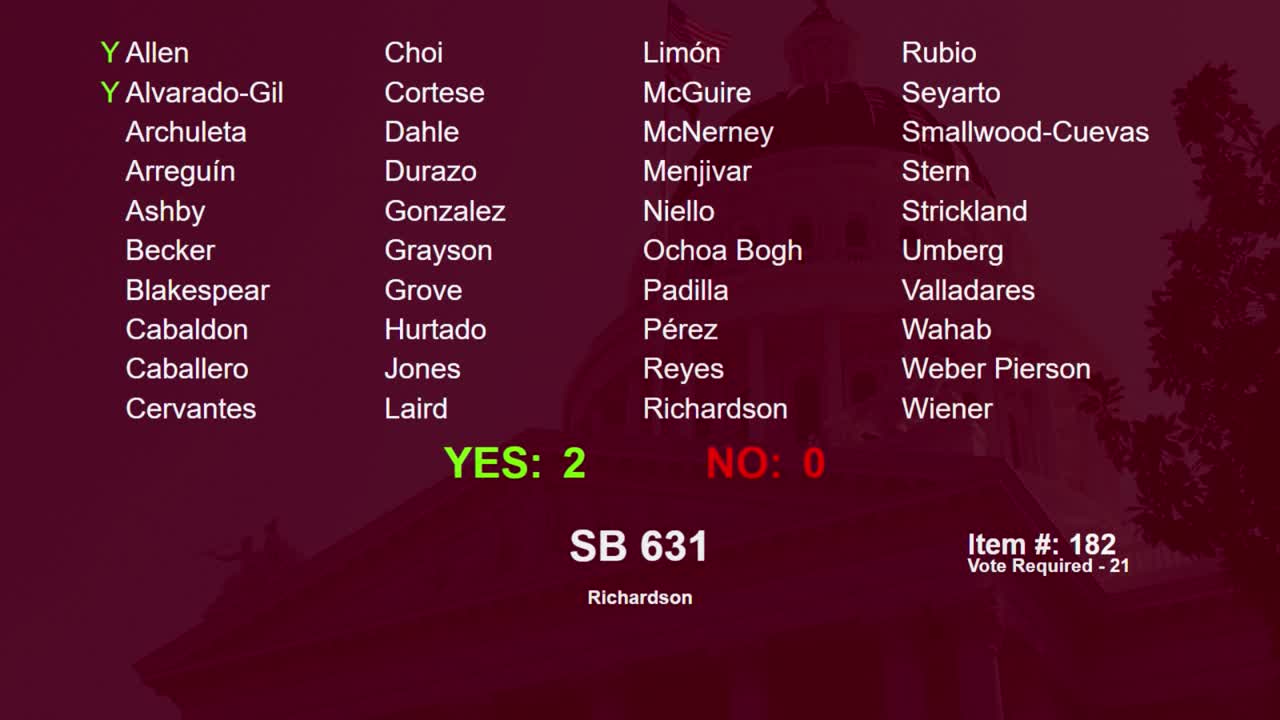 3MIN
Senate Floor
 16SEC
Senate Standing Committee on Appropriations
 5MIN
Senate Standing Committee on Judiciary
 5MIN
Senate Standing Committee on Business, Professions and Economic Development
Bill Author