SB 770: Common interest developments: EV charging stations.
- Session Year: 2025-2026
- House: Senate
- Latest Version Date: 2025-10-10
Current Status:
Passed
(2025-10-10: Chaptered by Secretary of State. Chapter 525, Statutes of 2025.)
Introduced
In Committee
Awaiting First Chamber Vote
Passed First Chamber
In Committee
Awaiting Second Chamber Vote
Passed Second Chamber
Enacted
Existing law, the Davis-Stirling Common Interest Development Act, defines and regulates common interest developments, which include community apartment projects, condominium projects, planned developments, and stock cooperatives. Existing law imposes various requirements regarding the installation and use of an electric vehicle (EV) charging station placed in a common area or an exclusive use common area of a common interest development, including that the owner is required to provide a certificate of insurance that names the association as an additional insured party.
This bill would delete the requirement that the insurance policy name the association as an additional insured party, and would correct an erroneous cross-reference regarding the amount of that insurance.
Existing law establishes legal obligations arising from contracts between parties or by operation of law. Existing law requires every contract for dance studio lessons and other services, as defined, to, among other things, provide that performance of the agreed-upon lessons begin within 6 months from the date the contract is entered into, and authorizes a student to cancel a contract for dance studio lessons and other services at any time provided the student gives written notice to the dance studio at the address specified in the contract.This bill would make nonsubstantive changes to the above-described provisions relating to contracts for dance studio lessons and other services.Existing law establishes legal obligations arising from contracts between parties or by operation of law. Existing law requires every contract for dance studio lessons and other services, as defined, to, among other things, provide that performance of the agreed-upon lessons begin within 6 months from the date the contract is entered into, and authorizes a student to cancel a contract for dance studio lessons and other services at any time provided the student gives written notice to the dance studio at the address specified in the contract.
This bill would make nonsubstantive changes to the above-described provisions relating to contracts for dance studio lessons and other services.
(a)Any covenant, restriction, or condition contained in any deed, contract, security instrument, or other instrument affecting the transfer or sale of any interest in a common interest development, and any provision of a governing document, as defined in Section 4150, that either effectively prohibits or unreasonably restricts the installation or use of an electric vehicle charging station within an owners unit or in a designated parking space, including, but not limited to, a deeded parking space, a parking space in an owners exclusive use common area, or a parking space that is specifically designated for use by a particular owner, or is in conflict with this section is void and unenforceable.
(b)(1)This section does not apply to provisions that impose reasonable restrictions on electric vehicle charging stations. However, it is the policy of the state to promote, encourage, and remove obstacles to the use of electric vehicle charging stations.
(2)For purposes of this section, reasonable restrictions are restrictions that do not significantly increase the cost of the station or significantly decrease its efficiency or specified performance.
(c)An electric vehicle charging station shall meet applicable health and safety standards and requirements imposed by state and local authorities, and all other applicable zoning, land use, or other ordinances, or land use permits.
(d)For purposes of this section, electric vehicle charging station means a station that is designed in compliance with the California Building Standards Code and delivers electricity from a source outside an electric vehicle into one or more electric vehicles. An electric vehicle charging station may include several charge points simultaneously connecting several electric vehicles to the station and any related equipment needed to facilitate charging plug-in electric vehicles.
(e)If approval is required for the installation or use of an electric vehicle charging station, the application for approval shall be processed and approved by the association in the same manner as an application for approval of an architectural modification to the property, and shall not be willfully avoided or delayed. The approval or denial of an application shall be in writing. If an application is not denied in writing within 60 days from the date of receipt of the application, the application shall be deemed approved, unless that delay is the result of a reasonable request for additional information.
(f)If the electric vehicle charging station is to be placed in a common area or an exclusive use common area, as designated in the common interest developments declaration, the following provisions apply:
(1)The owner first shall obtain approval from the association to install the electric vehicle charging station and the association shall approve the installation if the owner agrees in writing to do all of the following:
(A)Comply with the associations architectural standards for the installation of the charging station.
(B)Engage a licensed contractor to install the charging station.
(C)Within 14 days of approval, provide a certificate of insurance as required by paragraph (3).
(D)Pay for both the costs associated with the installation of and the electricity usage associated with the charging station.
(2)The owner and each successive owner of the charging station shall be responsible for all of the following:
(A)Costs for damage to the charging station, common area, exclusive use common area, or separate interests resulting from the installation, maintenance, repair, removal, or replacement of the charging station.
(B)Costs for the maintenance, repair, and replacement of the charging station until it has been removed and for the restoration of the common area after removal.
(C)The cost of electricity associated with the charging station.
(D)Disclosing to prospective buyers the existence of any charging station of the owner and the related responsibilities of the owner under this section.
(3)The owner of the charging station, whether located within a separate unit or within the common area or exclusive use common area, shall, at all times, maintain a liability coverage policy. The owner that submitted the application to install the charging station shall provide the association with the corresponding certificate of insurance within 14 days of approval of the application. That owner and each successor owner shall provide the association with the certificate of insurance annually thereafter.
(4)A homeowner shall not be required to maintain a homeowner liability coverage policy for an existing National Electrical Manufacturers Association standard alternating current power plug.
(g)Except as provided in subdivision (h), installation of an electric vehicle charging station for the exclusive use of an owner in a common area, that is not an exclusive use common area, shall be authorized by the association only if installation in the owners designated parking space is impossible or unreasonably expensive. In such cases, the association shall enter into a license agreement with the owner for the use of the space in a common area, and the owner shall comply with all of the requirements in subdivision (f).
(h)The association or owners may install an electric vehicle charging station in the common area for the use of all members of the association and, in that case, the association shall develop appropriate terms of use for the charging station.
(i)An association may create a new parking space where one did not previously exist to facilitate the installation of an electric vehicle charging station.
(j)An association that willfully violates this section shall be liable to the applicant or other party for actual damages, and shall pay a civil penalty to the applicant or other party in an amount not to exceed one thousand dollars ($1,000).
(k)In any action by a homeowner requesting to have an electric vehicle charging station installed and seeking to enforce compliance with this section, the prevailing plaintiff shall be awarded reasonable attorneys fees.
(a)Any covenant, restriction, or condition contained in any deed, contract, security instrument, or other instrument affecting the transfer or sale of any interest in a common interest development, and any provision of a governing document, as defined in Section 4150, that either effectively prohibits or unreasonably restricts the installation or use of an electric vehicle charging station within an owners unit or in a designated parking space, including, but not limited to, a deeded parking space, a parking space in an owners exclusive use common area, or a parking space that is specifically designated for use by a particular owner, or is in conflict with this section is void and unenforceable.
(b)(1)This section does not apply to provisions that impose reasonable restrictions on electric vehicle charging stations. However, it is the policy of the state to promote, encourage, and remove obstacles to the use of electric vehicle charging stations.
(2)For purposes of this section, reasonable restrictions are restrictions that do not significantly increase the cost of the station or significantly decrease its efficiency or specified performance.
(c)An electric vehicle charging station shall meet applicable health and safety standards and requirements imposed by state and local authorities, and all other applicable zoning, land use, or other ordinances, or land use permits.
(d)For purposes of this section, electric vehicle charging station means a station that is designed in compliance with the California Building Standards Code and delivers electricity from a source outside an electric vehicle into one or more electric vehicles. An electric vehicle charging station may include several charge points simultaneously connecting several electric vehicles to the station and any related equipment needed to facilitate charging plug-in electric vehicles.
(e)If approval is required for the installation or use of an electric vehicle charging station, the application for approval shall be processed and approved by the association in the same manner as an application for approval of an architectural modification to the property, and shall not be willfully avoided or delayed. The approval or denial of an application shall be in writing. If an application is not denied in writing within 60 days from the date of receipt of the application, the application shall be deemed approved, unless that delay is the result of a reasonable request for additional information.
(f)If the electric vehicle charging station is to be placed in a common area or an exclusive use common area, as designated in the common interest developments declaration, the following provisions apply:
(1)The owner first shall obtain approval from the association to install the electric vehicle charging station and the association shall approve the installation if the owner agrees in writing to do all of the following:
(A)Comply with the associations architectural standards for the installation of the charging station.
(B)Engage a licensed contractor to install the charging station.
(C)Within 14 days of approval, provide a certificate of insurance that names the association as an additional insured under the owners insurance policy in the amount set forth in as required by paragraph (3).
(D)Pay for both the costs associated with the installation of and the electricity usage associated with the charging station.
(2)The owner and each successive owner of the charging station shall be responsible for all of the following:
(A)Costs for damage to the charging station, common area, exclusive use common area, or separate interests resulting from the installation, maintenance, repair, removal, or replacement of the charging station.
(B)Costs for the maintenance, repair, and replacement of the charging station until it has been removed and for the restoration of the common area after removal.
(C)The cost of electricity associated with the charging station.
(D)Disclosing to prospective buyers the existence of any charging station of the owner and the related responsibilities of the owner under this section.
(3)The owner of the charging station, whether located within a separate unit or within the common area or exclusive use common area, shall, at all times, maintain a liability coverage policy. The owner that submitted the application to install the charging station shall provide the association with the corresponding certificate of insurance within 14 days of approval of the application. That owner and each successor owner shall provide the association with the certificate of insurance annually thereafter.
(4)A homeowner shall not be required to maintain a homeowner liability coverage policy for an existing National Electrical Manufacturers Association standard alternating current power plug.
(g)Except as provided in subdivision (h), installation of an electric vehicle charging station for the exclusive use of an owner in a common area, that is not an exclusive use common area, shall be authorized by the association only if installation in the owners designated parking space is impossible or unreasonably expensive. In such cases, the association shall enter into a license agreement with the owner for the use of the space in a common area, and the owner shall comply with all of the requirements in subdivision (f).
(h)The association or owners may install an electric vehicle charging station in the common area for the use of all members of the association and, in that case, the association shall develop appropriate terms of use for the charging station.
(i)An association may create a new parking space where one did not previously exist to facilitate the installation of an electric vehicle charging station.
(j)An association that willfully violates this section shall be liable to the applicant or other party for actual damages, and shall pay a civil penalty to the applicant or other party in an amount not to exceed one thousand dollars ($1,000).
(k)In any action by a homeowner requesting to have an electric vehicle charging station installed and seeking to enforce compliance with this section, the prevailing plaintiff shall be awarded reasonable attorneys fees.
SECTION 1.Section 1812.54 of the Civil Code is amended to read:1812.54.(a)Any contract for dance studio lessons and other services shall provide that performance of the agreed-upon lessons will begin within six months from the date the contract is entered into.(b)A contract for dance studio lessons and other services may be canceled by the student at any time provided the student gives written notice to the dance studio at the address specified in the contract. When a contract for dance studio lessons and other services is canceled the dance studio shall calculate the refund on the contract, if any, on a pro rata basis. The dance studio shall refund any moneys owed to the student within 10 days of receiving the cancellation notice, unless the student owes the dance studio money for studio lessons or other services received prior to the cancellation, in which case any moneys owed the dance studio shall be deducted by the dance studio from the refund owed to the student and the balance, if any, shall be refunded as specified above. A dance studio shall not charge a cancellation fee, or other fee, for cancellation of the contract by the student.(c)Every contract for dance studio lessons and other services shall contain a written statement of the hourly rate charged for each type of lesson for which the student has contracted. If the contract includes dance studio lessons that are sold at different per-hour rates, the contract shall contain separate hourly rates for each different type of lesson sold. All other services for which the student has contracted that are not capable of a per-hour charge shall be set forth in writing in specific terms. The statement shall be contained in the dance studio contract before the contract is signed by the buyer.(d)Every dance studio subject to Sections 1812.64 and 1812.65 shall include in every contract for dance studio lessons or other services a statement that the studio is bonded and that information concerning the bond may be obtained by writing to the office of the Secretary of State. REVISIONS: HeadingLine 2.(a)Every Any contract for dance studio lessons and other services shall provide that performance of the agreed-upon lessons will begin within six months from the date the contract is entered into.
(b)A contract for dance studio lessons and other services may be canceled by the student at any time provided he or she the student gives written notice to the dance studio at the address specified in the contract. When a contract for dance studio lessons and other services is canceled the dance studio shall calculate the refund on the contract, if any, on a pro rata basis. The dance studio shall refund any moneys owed to the student within 10 days of receiving the cancellation notice, unless the student owes the dance studio money for studio lessons or other services received prior to the cancellation, in which case any moneys owed the dance studio shall be deducted by the dance studio from the refund owed to the student and the balance, if any, shall be refunded as specified above. A dance studio shall not charge a cancellation fee, or other fee, for cancellation of the contract by the student.
(c)Every contract for dance studio lessons and other services shall contain a written statement of the hourly rate charged for each type of lesson for which the student has contracted. If the contract includes dance studio lessons that are sold at different per-hour rates, the contract shall contain separate hourly rates for each different type of lesson sold. All other services for which the student has contracted that are not capable of a per-hour charge shall be set forth in writing in specific terms. The statement shall be contained in the dance studio contract before the contract is signed by the buyer.
(d)Every dance studio subject to Sections 1812.64 and 1812.65 shall include in every contract for dance studio lessons or other services a statement that the studio is bonded and that information concerning the bond may be obtained by writing to the office of the Secretary of State.
|
Date
|
Status
|
|---|---|
| Oct 10, 2025 | Chaptered by Secretary of State. Chapter 525, Statutes of 2025. |
| Oct 10, 2025 | Approved by the Governor. |
| Sep 22, 2025 | Enrolled and presented to the Governor at 11 a.m. |
| Sep 12, 2025 | In Senate. Ordered to engrossing and enrolling. |
| Sep 11, 2025 | Read third time. Passed. (Ayes 55. Noes 20. Page 3280.) Ordered to the Senate. |
| Jul 17, 2025 | Read second time. Ordered to third reading. |
| Jul 16, 2025 | From committee: Do pass. (Ayes 11. Noes 3.) (July 16). |
| Jun 24, 2025 | From committee: Do pass and re-refer to Com. on INS. (Ayes 9. Noes 3.) (June 24). Re-referred to Com. on INS. |
| Jun 24, 2025 | Coauthors revised. |
| Jun 16, 2025 | Referred to Coms. on JUD. and INS. |
| May 28, 2025 | In Assembly. Read first time. Held at Desk. |
| May 28, 2025 | Read third time. Passed. (Ayes 28. Noes 10. Page 1308.) Ordered to the Assembly. |
| May 8, 2025 | Read second time. Ordered to third reading. |
| May 7, 2025 | From committee: Do pass. (Ayes 11. Noes 1. Page 1027.) (May 6). |
| Apr 23, 2025 | From committee: Do pass and re-refer to Com. on JUD. (Ayes 8. Noes 2. Page 832.) (April 22). Re-referred to Com. on JUD. |
| Apr 17, 2025 | Set for hearing May 6 in JUD. pending receipt. |
| Apr 4, 2025 | Set for hearing April 22. |
| Apr 2, 2025 | Re-referred to Coms. on HOUSING and JUD. |
| Mar 24, 2025 | From committee with author's amendments. Read second time and amended. Re-referred to Com. on RLS. |
| Mar 12, 2025 | Referred to Com. on RLS. |
| Feb 24, 2025 | Read first time. |
| Feb 24, 2025 | From printer. May be acted upon on or after March 24. |
| Feb 21, 2025 | Introduced. To Com. on RLS. for assignment. To print. |
|
Date
|
Description
|
Location
|
Votes
|
|
|---|---|---|---|---|
| Sep 11, 2025 | SB 770 Allen Senate Third Reading By Zbur | Assembly Floor |
Passed |
|
| Jul 16, 2025 | Do pass. | Assembly Standing Committee on Insurance |
Passed |
|
| Jun 24, 2025 | Do pass and be re-referred to the Committee on [Insurance] | Assembly Standing Committee on Judiciary |
Passed |
|
| May 28, 2025 | Senate 3rd Reading SB770 Allen | Senate Floor |
Passed |
|
| May 6, 2025 | Do pass | Senate Standing Committee on Judiciary |
Passed |
|
| Apr 22, 2025 | Do pass, but first be re-referred to the Committee on [Judiciary] | Senate Standing Committee on Housing |
Passed |
This list shows positions taken on this bill by organizations on the date displayed, which is linked to the original source.
Positions by individuals are not included.
|
Organization
|
Position
|
Date
|
|---|---|---|
| a coalition of electric vehicle advocates | ** Support | |
| California Electric Transportation Coalition | ** Support | |
| Calstart INC. | ** Support | |
| ChargePoint | ** Support | |
| Community Associations Institute | ** Against | |
| Community Associations Institute - California Legislative Action Committee | ** Against | |
| Electric Vehicle Charging Association | ** Support |
SENATE THIRD READING
STR Bill Id:SB 770
Author:(Allen)
As Amended Ver:March 24, 2025
Majority vote
SUMMARY
Eliminates the requirement that a homeowners association be named on an electric vehicle charging station′s insurance policy.
Major Provisions
Repeals the provision of existing law requiring a certificate of insurance for an electronic vehicle charging station built within a common interest development to name the homeowners association as an additional insured under the owner′s insurance policy.
COMMENTS
For more than a decade, the Legislature has grappled with how to ensure that homeowner associations cannot unreasonably prevent the installation of electric vehicle charging infrastructure within a development. The existing framework, generally, prohibits a homeowner association board from denying the installation of an electric vehicle charging station so long as the charger fits with the community aesthetic and is properly insured. The current law requires the homeowner association to be named as an additional insured on any such policy. However, the author and proponents of this measure contend that such insurance products are difficult to obtain, thus rendering the entire legal framework untenable. This bill, while maintaining the overall insurance requirements, simply eliminates the need for the homeowner association to be a named insured.
Background on homeowner association governance. There are approximately 50,000 common interest developments in California. They vary in size and structure, but generally are characterized by the following: (1) separate ownership of individual residential units coupled with an undivided interest in common property; (2) covenants, conditions, and restrictions that limit the use of both separate interests and common property; and (3) management of common property and enforcement of restrictions by a homeowner association.
Governance of these developments and the homeowner associations that make up their governing bodies is regulated under the Davis-Stirling Act (Civil Code Section 1350 et seq.), which sets forth general rules governing common interest developments. Beyond the overarching state law, each individual association is also subject to specific rules and regulations set forth by the association′s ″governing documents.″ These governing documents include the recorded declaration and any other documents, such as bylaws, operating rules of the association, or articles of incorporation that govern the operation of the association. These rules can touch on a wide range of issues: from landscaping to community aesthetics to physical additions made to an individual property.
Homeowner associations are governed by volunteer boards of directors who are elected by the members of the association and who are responsible for interpreting the governing documents and state law. The procedures for conducting association board elections are typically left to the governing documents of the association, outside of some basic parameters set in state law. To assist in managing the affairs of the association, many boards contract out the day-to-day operations of the association to professional managers or management companies who handle everything from community maintenance to the financial affairs of the association.
Increasing the deployment of electric vehicles is critical to obtaining California′s climate goals. In 2020, Governor Newsom issued Executive Order N-79-20, which called for all in-state sales of new passenger cars and trucks to be zero-emission vehicles by 2035. In order to meet that goal, California must significantly increase the sales of electric vehicles in the state. One obstacle to transitioning to electric vehicles has long been consumer fears about inadequate charging infrastructure limiting electric vehicle′s range. Although California has been a national leader in deploying electric vehicle charging infrastructure, challenges remain.
One issue related to electric vehicle charging that the Legislature has attempted to address is potential reluctance of homeowner association boards to permit the installation of electric vehicle changing equipment within association common areas, namely community garages in condominium developments. Originally enacted in 2011, with the passage of SB 209 (Corbett) Chap. 121, Stats. 2011, the state′s current legal framework generally requires homeowner association boards to permit the installation of charging infrastructure while simultaneously requiring an electric vehicle owner to obtain insurance for the charger and name the association as an insured party. Recognizing some difficulties in the SB 209 framework, in 2018, the Legislature amended SB 209 to remove a $1 million coverage minimum from the insurance requirement recognizing that the risks posed by charging infrastructure did not warrant such a large insurance requirement. (SB 1016 (Allen) Chap. 376, Stats. 2018.) Notably, SB 1016 retained several references to the homeowner associated being named on the insurance policy. Proponents of this measure now contend that many insurers will not name the association as an insured on policies covering charging infrastructure, thus frustrating the purpose of the SB 209 framework.
This bill would remove the requirement that a homeowner association be named as an insured but does not eliminate any insurance. Seeking to ensure that homeowners can obtain the necessary insurance for their electric vehicle chargers, this bill removes the requirement that the charger′s insurance policy name the homeowner association as an insured. This bill does not remove the requirement that a homeowner obtain an insurance policy to cover any damages or losses caused by the charging infrastructure itself.
In practice, this bill would simply add an extra step should a homeowner association need to recover against an insurance policy for losses related to an electric vehicle charger. Although naming the homeowner association as an insured streamlines the process for obtaining financial redress, nothing in this bill limits the association′s ability to recover damages. In accordance with this bill, should the association need to seek compensation, the association must file a claim against the insurance of the owner of the electric vehicle charging equipment. Much like under the existing law, the insurer would be able to evaluate the merits of the claim before paying any appropriate compensation.
According to the Author
In order to meet California′s ambitious climate goals, the State must do more to reduce the barriers to EV ownership. The California Energy Commission estimates in its 2024 charging infrastructure assessment that the state will need 2.1 million charging stations by 2035 to support EV demand. As of 2024, only 178,000 chargers have been installed, meeting only 8% of that need.
While the price of EVs has been decreasing, the accessibility of EV charging stations can be an issue. This is especially the case for residents of multi-family housing who need to use common area spaces to install vehicle chargers. Existing law requires HOA residents to obtain an insurance policy that names the association as an additional insured, however, this confuses EV drivers & HOAs alike because these policies are not widely offered.
SB 770 will help California meet its clean transportation goals by removing the barrier for homeowners to obtain a policy that names an HOA as an additional insured party on their general liability insurance that covers an EV charger.
Arguments in Support
This bill is supported by a coalition of electric vehicle advocates. A coalition letter in support of the bill states:
As California advances its bold climate goals and zero-emission transportation targets, access to EV charging infrastructure must be inclusive, equitable, and responsive to the diverse housing landscape across the state. Roughly one-third of California′s population lives in common interest developments. Without reasonable access to home charging options, residents in these communities are left behind in the clean transportation transition.
Under existing law, homeowners seeking to install EV charging stations in condominiums, townhomes, and other CIDs must provide a certificate of insurance that names the homeowners association as an additional insured party. This requirement often creates logistical and financial burdens that discourage or delay installations, particularly for renters and homeowners in multi-family housing. SB 770 would eliminate the mandate to name the HOA as an additional insured party, making the process more accessible and aligned with California′s goals. By easing the installation of charging stations in common interest developments, this bill directly supports California′s climate goals and helps ensure a more equitable transition to clean transportation options.
Arguments in Opposition
This bill is opposed by the Community Associations Institute - California Legislative Action Committee. They write:
SB 770 proposes changes that could have costly consequences for homeowner associations and their residents. By eliminating the requirement for EV charger owners to provide additional insured coverage, SB 770 shifts liability from individual owners to the entire association. This could result in increased insurance premiums for all homeowners, even those who do not own EV chargers.
For years, homeowners have successfully obtained additional insurance coverage. This is not a matter of unavailability but rather one of convenience for individual car owners at the potential expense of the entire community.
Installation of EV chargers modify shared electrical systems, and associations must retain oversight to ensure safety, compliance, and consistency with other common area modifications. Removing these safeguards could increase risks and compromise system integrity. Without adequate insurance protection, associations may be exposed to costly lawsuits stemming from accidents, such as tripping hazards caused by charger cords or other installation-related issues. This would drive up costs for all homeowners, placing an unnecessary burden on residents.
FISCAL COMMENTS
None
VOTES
SENATE FLOOR: 28-10-2
YES: Allen, Archuleta, Arreguín, Ashby, Becker, Blakespear, Cabaldon, Caballero, Cervantes, Cortese, Durazo, Gonzalez, Grayson, Hurtado, Laird, McGuire, McNerney, Menjivar, Padilla, Pérez, Richardson, Rubio, Smallwood-Cuevas, Stern, Umberg, Wahab, Weber Pierson, Wiener
NO: Alvarado-Gil, Choi, Dahle, Grove, Jones, Niello, Ochoa Bogh, Seyarto, Strickland, Valladares
ABS, ABST OR NV: Limón, Reyes
ASM JUDICIARY: 9-3-0
YES: Kalra, Garcia, Bryan, Connolly, Harabedian, Pacheco, Papan, Lee, Zbur
NO: Dixon, Tangipa, Sanchez
ASM INSURANCE: 11-3-3
YES: Calderon, Addis, Ávila Farías, Berman, Gipson, Harabedian, Krell, Ortega, Petrie-Norris, Michelle Rodriguez, Valencia
NO: Chen, Ellis, Hadwick
ABS, ABST OR NV: Wallis, Alvarez, Nguyen
UPDATED
VERSION: March 24, 2025
CONSULTANT: Nicholas Liedtke / JUD. / (916) 319-2334 FN: 0001128
Date of Hearing: July 16, 2025
ASSEMBLY COMMITTEE ON INSURANCE
Lisa Calderon, Chair
SBPCA Bill Id:SB 770
Author:(Allen) – As Amended Ver:March 24, 2025
SENATE VOTE: 28-10
SUBJECT: Common interest developments: EV charging stations
SUMMARY: Removes a requirement that an owner of a separate interest in a common interest development (CID) seeking to install an electric vehicle (EV) charging station in a common area obtain a certificate of insurance for the EV charging station that names the home owners’ association (HOA) for the CID as an insured party.
EXISTING LAW:
- Establishes, within the Davis-Stirling Common Interest Development Act, rules and regulations governing the operation of CIDs and the respective rights and duties of a HOA and its members. Requires the governing documents of a CID, and any amendments to the governing documents, to be adopted through HOA elections in accordance with specified procedures. (Civil Code 4745)
- Deems void and unenforceable any covenant, condition, or restriction (CC&R) contained in any deed, contract, security instrument, or other instrument affecting the transfer of, or any interest in, real property, and any provision of the CID governing documents, that effectively prohibits or restricts:
- Installation of a solar energy system.
- Installation or use of a video or television antenna.
- Installation of low-water using plants, artificial turf, and other synthetic surface that resembles grass.
- Installation or use of an EV charging station within the owner’s unit or designated parking space.
- Display or affixation of one or more religious items on any entry door frame to a dwelling. (Civil Code 4700-4753)
FISCAL EFFECT: Unknown.
COMMENTS:
- Purpose: According to the author, “In order to meet California’s ambitious climate goals, the State must do more to reduce the barriers to EV ownership. The California Energy Commission estimates in its 2024 charging infrastructure assessment that the state will need 2.1 million charging stations by 2035 to support EV demand. As of 2024, only 178,000 chargers have been installed, meeting only 8 percent of that need.
While the price of EVs has been decreasing, the accessibility of EV charging stations can be an issue. This is especially the case for residents of multi-family housing who need to use common area spaces to install vehicle chargers. Existing law requires HOA residents to obtain an insurance policy that names the association as an additional insured, however, this confuses EV drivers & HOAs alike because these policies are not widely offered.
SB 770 will help California meet its clean transportation goals by removing the barrier for homeowners to obtain a policy that names an HOA as an additional insured party on their general liability insurance that covers an EV charger.”
- Insuring EV Charging Infrastructure: Existing law prohibits any CID governing provision that prevents an owner of a separate interest in a CID from installing an EV charging station within their unit (e.g., garage), and in a designated parking space, including a parking space in the common area of the CID. The law is only applicable to EV charging stations that meet specific standards and allows HOAs to impose reasonable restrictions on the installation of EV charging stations.
An owner proposing to install an EV charging station in the common area of the CID (e.g., a shared parking lot or parking garage with designated parking spaces) must obtain HOA approval. The law requires that HOAs must approve the installation if the owner seeking to install the EV charging station agrees to meet certain conditions. One of the conditions the owner must comply with is that they must provide a certificate of insurance that names the HOA an insured party, as specified.
- Obtaining insurance. Supporters of this bill point out that there are few insurers offering an insurance policy that names the HOA as an insured. They state that many insurance companies are not aware of the requirement in law and do not know how to list an HOA on the insurance policy. They argue this bill will remove a barrier that can hinder EV utilization.
According to the Assembly Judiciary Committee analysis, “In practice, this bill would simply add an extra step should a homeowner association need to recover against an insurance policy for losses related to an electric vehicle charger. Although naming the homeowner association as an insured streamlines the process for obtaining financial redress, nothing in this bill limits the association’s ability to recover damages. In accordance with this bill, should the association need to seek compensation, the association must file a claim against the insurance of the owner of the electric vehicle charging equipment. Much like under the existing law, the insurer would be able to evaluate the merits of the claim before paying any appropriate compensation.”
- Opposition. The Community Associations Institute, representing HOAs in California, is opposed to this bill and argues that homeowners in CIDs have successfully obtained additional insurance coverage and that this bill could expose associations to costly litigation.
REGISTERED SUPPORT / OPPOSITION:
Support
California Electric Transportation Coalition
Calstart INC.
Electric Vehicle Charging Association
Oppose
Community Associations Institute - California Legislative Action Committee
Analysis Prepared by: Paul Riches / INS. / (916) 319-2086
Date of Hearing: June 24, 2025
ASSEMBLY COMMITTEE ON JUDICIARY
Ash Kalra, Chair
SBPCA Bill Id:SB 770
Author:(Allen) – As Amended Ver:March 24, 2025
SENATE VOTE: 28-10
SUBJECT: Common interest developments: EV charging stations
KEY ISSUE: should the requirement that a homeowner association be named as an additional insured on an electric vehicle charging station’s insurance policy be repealed?
SYNOPSIS
In order to meet California’s ambitious climate goals, including ceasing the sale of gas powered vehicles in the state by 2035, deploying more electronic vehicles to California’s roadways is critical. A key impediment preventing many Californians from purchasing an electric vehicle is the availability of adequate electric vehicle charging infrastructure. For more than a decade, the state has sought to increase the availability of electric vehicle charging infrastructure. One such policy, adopted in 2011, prevents a homeowner association from prohibiting a resident from installing electric vehicle charging equipment, so long as various conditions are met. One critical condition of installing an electric vehicle charger requires the vehicle owner to obtain insurance for any damages caused by the electric vehicle charger and that the insurance policy names the homeowner association as an additional insured.
The author and proponents of this bill argue that the existing law’s requirement that a homeowner association be named as an insured for policies covering electric vehicle chargers is difficult to comply with. The proponents argue few, if any, insurers offer such products. Accordingly, this bill eliminates the requirement that an electric vehicle owner seeking to install an electric vehicle charger obtain insurance naming their homeowner association as an insured. Importantly, for the protection of the association and its residents, the bill retains all other insurance requirements found in existing law related to the installation of an electric vehicle charger within the common interest development.
This bill is supported by a coalition of electronic vehicle advocates. The proponents note that current insurance market conditions are frustrating the existing law’s clear goals of deploying electric vehicle charging equipment on properties governed by a homeowner association. Proponents also note that nothing in this bill impacts the existing law’s underlying requirement that an electric vehicle owner obtain liability insurance to cover any damages caused by the charging equipment or the electric vehicle itself. The Community Associations Institute - California Legislative Action Committee, a coalition of homeowner association boards, opposes this bill. The opposition contends that insurance products that comply with the existing law do exist and that this bill is less about product availability and more about convenience. Should this bill be approved by this Committee, it will referred to the Committee on Insurance, which is better equipped to opine on the availability and adequacy of insurance products.
SUMMARY: Eliminates the requirement that a homeowners association be named on an electric vehicle charging station’s insurance policy. Specifically, this bill:
- Repeals the provision of existing law requiring a certificate of insurance for an electronic vehicle charging station built within a common interest development to name the homeowners association as an additional insured under the owner’s insurance policy.
EXISTING LAW:
- Establishes the Davis-Stirling Common Interest Development Act and provides for the rules and regulations governing the operation of a residential common interest development and the respective rights and duties of the homeowner association and its members. (Civil Code Section 4000 et seq.)
- Provides that in a condominium project governed by the Davis-Stirling Common Interest Development Act the common area is not subject to partition, except as provided. (Civil Code Section 4630.)
- Provides that any covenant, restriction, or condition contained in any deed, contract, security instrument, or other instrument affecting the transfer or sale of any interest in a common interest development, and any provision of a governing document that either effectively prohibits or unreasonably restricts the installation or use of an electric vehicle charging station within an owner’s unit or in a designated parking space, including, but not limited to, a deeded parking space, a parking space in an owner’s exclusive use common area, or a parking space that is specifically designated for use by a particular owner is void and unenforceable. (Civil Code Section 4745 (a).)
- Requires a resident of a common interest development to obtain approval from the association before installing the electric vehicle charging station and requires the association to approve the installation if the owner agrees in writing to do all of the following:
- Comply with the association’s architectural standards for the installation of the charging station;
- Engage a licensed contractor to install the charging station;
- Within 14 days of approval, provide a certificate of insurance that names the association as an additional insured under the owner’s insurance policy, as specified in 5); and
- Pay for both the costs associated with the installation of and the electricity usage associated with the charging station. (Civil Code Section 4745 (f)(1).)
- Requires the owner of the charging station, whether located within a separate unit or within the common area or exclusive use common area, to, at all times, maintain a liability coverage policy and to submit that policy to the association. (Civil Code Section 4745 (f)(3).)
FISCAL EFFECT: As currently in print this bill is keyed non-fiscal.
COMMENTS: For more than a decade, the Legislature has grappled with how to ensure that homeowner associations cannot unreasonably prevent the installation of electric vehicle charging infrastructure within a development. The existing framework, generally, prohibits a homeowner association board from denying the installation of an electric vehicle charging station so long as the charger fits with the community aesthetic and is properly insured. The current law requires the homeowner association to be named as an additional insured on any such policy. However, the author and proponents of this measure contend that such insurance products are difficult to obtain, thus rendering the entire legal framework untenable. This bill, while maintaining the overall insurance requirements, simply eliminates the need for the homeowner association to be a named insured. In support of this bill the author states:
In order to meet California’s ambitious climate goals, the State must do more to reduce the barriers to EV ownership. The California Energy Commission estimates in its 2024 charging infrastructure assessment that the state will need 2.1 million charging stations by 2035 to support EV demand. As of 2024, only 178,000 chargers have been installed, meeting only 8 percent of that need.
While the price of EVs has been decreasing, the accessibility of EV charging stations can be an issue. This is especially the case for residents of multi-family housing who need to use common area spaces to install vehicle chargers. Existing law requires HOA residents to obtain an insurance policy that names the association as an additional insured, however, this confuses EV drivers & HOAs alike because these policies are not widely offered.
SB 770 will help California meet its clean transportation goals by removing the barrier for homeowners to obtain a policy that names an HOA as an additional insured party on their general liability insurance that covers an EV charger.
Background on homeowner association governance. There are approximately 50,000 common interest developments in California. They vary in size and structure, but generally are characterized by the following: (1) separate ownership of individual residential units coupled with an undivided interest in common property; (2) covenants, conditions, and restrictions that limit the use of both separate interests and common property; and (3) management of common property and enforcement of restrictions by a homeowner association.
Governance of these developments and the homeowner associations that make up their governing bodies is regulated under the Davis-Stirling Act (Civil Code Section 1350 et seq.), which sets forth general rules governing common interest developments. Beyond the overarching state law, each individual association is also subject to specific rules and regulations set forth by the association’s “governing documents." These governing documents include the recorded declaration and any other documents, such as bylaws, operating rules of the association, or articles of incorporation that govern the operation of the association. These rules can touch on a wide range of issues: from landscaping to community aesthetics to physical additions made to an individual property.
Homeowner associations are governed by volunteer boards of directors who are elected by the members of the association and who are responsible for interpreting the governing documents and state law. The procedures for conducting association board elections are typically left to the governing documents of the association, outside of some basic parameters set in state law. To assist in managing the affairs of the association, many boards contract out the day-to-day operations of the association to professional managers or management companies who handle everything from community maintenance to the financial affairs of the association.
Increasing the deployment of electric vehicles is critical to obtaining California’s climate goals. In 2020, Governor Newsom issued Executive Order N-79-20, which called for all in-state sales of new passenger cars and trucks to be zero-emission vehicles by 2035. In order to meet that goal, California must significantly increase the sales of electric vehicles in the state. One obstacle to transitioning to electric vehicles has long been consumer fears about inadequate charging infrastructure limiting electric vehicle’s range. Although California has been a national leader in deploying electric vehicle charging infrastructure, challenges remain.
One issue related to electric vehicle charging that the Legislature has attempted to address is potential reluctance of homeowner association boards to permit the installation of electric vehicle changing equipment within association common areas, namely community garages in condominium developments. Originally enacted in 2011, with the passage of SB 209 (Corbett) Chap. 121, Stats. 2011, the state’s current legal framework generally requires homeowner association boards to permit the installation of charging infrastructure while simultaneously requiring an electric vehicle owner to obtain insurance for the charger and name the association as an insured party. Recognizing some difficulties in the SB 209 framework, in 2018, the Legislature amended SB 209 to remove a $1 million coverage minimum from the insurance requirement recognizing that the risks posed by charging infrastructure did not warrant such a large insurance requirement. (SB 1016 (Allen) Chap. 376, Stats. 2018.) Notably, SB 1016 retained several references to the homeowner associated being named on the insurance policy. Proponents of this measure now contend that many insurers will not name the association as an insured on policies covering charging infrastructure, thus frustrating the purpose of the SB 209 framework.
This bill would remove the requirement that a homeowner association be named as an insured but does not eliminate any insurance. Seeking to ensure that homeowners can obtain the necessary insurance for their electric vehicle chargers, this bill removes the requirement that the charger’s insurance policy name the homeowner association as an insured. This bill does not remove the requirement that a homeowner obtain an insurance policy to cover any damages or losses caused by the charging infrastructure itself.
In practice, this bill would simply add an extra step should a homeowner association need to recover against an insurance policy for losses related to an electric vehicle charger. Although naming the homeowner association as an insured streamlines the process for obtaining financial redress, nothing in this bill limits the association’s ability to recover damages. In accordance with this bill, should the association need to seek compensation, the association must file a claim against the insurance of the owner of the electric vehicle charging equipment. Much like under the existing law, the insurer would be able to evaluate the merits of the claim before paying any appropriate compensation.
Proponents and opponents offer differing views on the availability of insurance for electric vehicle charging infrastructure. This bill is opposed by the Community Associations Institute - California Legislative Action Committee, which represents homeowner association boards. The opponents contend that this bill will unnecessarily increase insurance costs for associations and that current insurance products do comply with the existing law. The latter point runs directly contrary to the assertions of the proponents of the bill. Because most insurance products are available with various customized options, it is not entirely clear how willing insurers are to name homeowner associations on policies covering charging infrastructure. Thankfully, this bill is double referred to the Committee on Insurance, which is better equipped to weigh the merits of the opposing arguments on the availability of specific insurance products. Because nothing in this measure alters liability, or removes requirements that safeguard homeowner associations and their residents from financial losses, for the purposes of this Committee’s jurisdiction, this measure appears wholly appropriate.
ARGUMENTS IN SUPPORT: This bill is supported by a coalition of electric vehicle advocates. A coalition letter in support of the bill states:
As California advances its bold climate goals and zero-emission transportation targets, access to EV charging infrastructure must be inclusive, equitable, and responsive to the diverse housing landscape across the state. Roughly one-third of California’s population lives in common interest developments. Without reasonable access to home charging options, residents in these communities are left behind in the clean transportation transition.
Under existing law, homeowners seeking to install EV charging stations in condominiums, townhomes, and other CIDs must provide a certificate of insurance that names the homeowners association as an additional insured party. This requirement often creates logistical and financial burdens that discourage or delay installations, particularly for renters and homeowners in multi-family housing. SB 770 would eliminate the mandate to name the HOA as an additional insured party, making the process more accessible and aligned with California’s goals. By easing the installation of charging stations in common interest developments, this bill directly supports California’s climate goals and helps ensure a more equitable transition to clean transportation options.
ARGUMENTS IN OPPOSITION: This bill is opposed by the Community Associations Institute - California Legislative Action Committee. They write:
SB 770 proposes changes that could have costly consequences for homeowner associations and their residents. By eliminating the requirement for EV charger owners to provide additional insured coverage, SB 770 shifts liability from individual owners to the entire association. This could result in increased insurance premiums for all homeowners, even those who do not own EV chargers.
For years, homeowners have successfully obtained additional insurance coverage. This is not a matter of unavailability but rather one of convenience for individual car owners at the potential expense of the entire community.
Installation of EV chargers modify shared electrical systems, and associations must retain oversight to ensure safety, compliance, and consistency with other common area modifications. Removing these safeguards could increase risks and compromise system integrity. Without adequate insurance protection, associations may be exposed to costly lawsuits stemming from accidents, such as tripping hazards caused by charger cords or other installation-related issues. This would drive up costs for all homeowners, placing an unnecessary burden on residents.
REGISTERED SUPPORT / OPPOSITION:
Support
California Electric Transportation Coalition
Calstart
Electric Vehicle Charging Association
Opposition
Community Associations Institute - California Legislative Action Committee
Analysis Prepared by: Nicholas Liedtke / JUD. / (916) 319-2334
SENATE RULES COMMITTEE Office of Senate Floor Analyses (916) 651-1520 Fax: (916) 327-4478 | SB 770 |
THIRD READING
Bill No: SB 770
Author: Allen (D)
Amended: 3/24/25
Vote: 21
SENATE HOUSING COMMITTEE: 8-2, 4/22/25
AYES: Wahab, Arreguín, Cabaldon, Caballero, Cortese, Durazo, Gonzalez, Padilla
NOES: Seyarto, Ochoa Bogh
NO VOTE RECORDED: Grayson
SENATE JUDICIARY COMMITTEE: 11-1, 5/6/25
AYES: Umberg, Allen, Arreguín, Ashby, Caballero, Durazo, Laird, Stern, Wahab, Weber Pierson, Wiener
NOES: Niello
NO VOTE RECORDED: Valladares
SUBJECT: Common interest developments: EV charging stations
SOURCE: Author
DIGEST:
This bill removes a requirement that an owner of a separate interest in a common interest development (CID) seeking to install an electric vehicle (EV) charging station in the common area of the CID, obtain a certificate of insurance for the EV charging station that names the homeowners association (HOA) for the CID as an insured party.
ANALYSIS:
Existing law:
- Establishes, within the Davis-Stirling Common Interest Development Act, rules and regulations governing the operation of CIDs and the respective rights and duties of a HOA and its members. Requires the governing documents of a CID, and any amendments to the governing documents, to be adopted through HOA elections in accordance with specified procedures.
- Deems void and unenforceable any covenant, condition, or restriction (CC&R) contained in any deed, contract, security instrument, or other instrument affecting the transfer of, or any interest in, real property, and any provision of the CID governing documents, that effectively prohibits or restricts:
- Installation of a solar energy system.
- Installation or use of a video or television antenna.
- Installation of low-water using plants, artificial turf, and other synthetic surface that resembles grass.
- Installation or use of an EV charging station within the owner’s unit or designated parking space.
- Display or affixation of one or more religious items on any entry door frame to a dwelling.
- Construction or use of an accessory dwelling unit (ADU) or junior accessory dwelling unit (JADU) on a lot zoned for single-family residential use that meets the requirements of existing law regarding ADUs and JADUs.
This bill removes a requirement that an owner of a separate interest in a CID seeking to install an EV charging station in a common area, obtain a certificate of insurance for the EV charging station that names the HOA for the CID as an insured party.
Background
CIDs and Restrictions on CID Governing documents. A CID is a form of real estate in which each homeowner has an exclusive interest in a unit or lot and a shared or undivided interest in common-area property. Condominiums, planned unit developments, stock cooperatives, community apartments, and many resident-owned mobilehome parks all fall under the umbrella of CIDs. There are more than 50,000 CIDs in California comprising over 4.8 million housing units, or approximately one-quarter of the state’s housing stock. CIDs are governed by HOAs. The Davis-Stirling Common Interest Development Act provides the legal framework under which CIDs are established and operate. In addition to the requirements of the Act, each CID is governed according to the recorded declarations, bylaws, and operating rules of the association, collectively referred to as the governing documents.
With respect to allowable activities within a CID, state law generally defers to CID governing documents; however, there are several cases where the law imposes limits on CID authority. For example, existing law deems void and unenforceable any CID governing provision that effectively prohibits any of the following:
- Installation of a solar energy system by an HOA member;
- Installation of low-water using plants, artificial turf, or other synthetic surface that resembles grass;
- Installation of an EV charging station; or
- Construction or use of an ADU.
Comments
Author’s Statement. “SB 770 will help California meet its clean transportation goals by removing the barrier for homeowners to obtain a policy that names an HOA as an additional insured party on their general liability insurance that covers an EV charger.”
Insuring EV Charging Infrastructure. Existing law deems void and unenforceable any CID governing provision that effectively prohibits an owner of a separate interest in a CID from installing an EV charging station within their unit (e.g., garage), and in a designated parking space, including a parking space in the common area of the CID. The law is only applicable to EV charging stations that meet specific standards and allows HOAs to impose reasonable restrictions on the installation of EV charging stations.
An owner proposing to install an EV charging station in the common area of the CID (e.g., a shared parking lot or parking garage with designated parking spaces) must obtain HOA approval. The law specifies that HOAs must approve the installation if the owner seeking to install the EV charging station agrees to meet certain conditions. One of the conditions the owner must comply with is that they must provide a certificate of insurance that names the HOA an insured party, as specified.
Obtaining insurance. Supporters of this bill argue it is difficult for a homeowner in an HOA to obtain an insurance policy that names the HOA as an insured. They claim that many insurance companies are not aware of the requirement in law and do not know how to list an HOA on the insurance policy. They argue this bill will remove a barrier that can hinder EV utilization.
FISCAL EFFECT: Appropriation: No Fiscal Com.: No Local: No
SUPPORT: (Verified 5/7/25)
CALSTART
Chargepoint
Electric Vehicle Charging Association
OPPOSITION: (Verified 5/7/25)
Community Associations Institute
Prepared by: Hank Brady / HOUSING / (916) 651-4124
5/9/25 13:49:46
**** END ****
Senator Thomas Umberg, Chair
2025-2026 Regular Session
Bill No: SB 770 (Author:Allen)
Version: March 24, 2025
Hearing Date: May 6, 2025
Fiscal: No
Urgency: No
Consultant: ID
SUBJECT
Common interest developments: EV charging stations
DIGEST
This bill eliminates the requirement that a homeowner of a common interest development include the homeowner’s association as a named additional insured in the homeowner’s insurance policy when the homeowner seeks to install an electric vehicle charging station in a common area or exclusive use common area of the common interest development.
EXECUTIVE SUMMARY
It is incontrovertible that man-made climate change is occurring. The primary contributor to global warming has been greenhouse gases, a group of gases that, when added to the atmosphere, act to trap heat that would otherwise radiate into space. Vehicles account for a significant portion of the state’s total greenhouse gas emissions. Thus, transitioning the state’s vehicles to zero-emissions vehicles like electric vehicles is a key focus of the state’s climate goals for reducing greenhouse gas emissions and combating climate change.
In 2011, the Legislature passed SB 209 (Corbett, Ch. 121, Stats. 2011) to facilitate the installation of electrical vehicle chargers in common interest developments (CIDs). However, the law requires a homeowner in a CID to provide the CID with a certificate of insurance naming the CID’s homeowner’s association (HOA) as an additional insured when the EV charging station is located in the common area or exclusive use common area of the CID. SB 770 eliminates the requirement that the certificate of insurance name the HOA as an additional insured. SB 770 is author sponsored, and is supported by Chargepoint, Inc., and is opposed by the Community Association Institute – California Legislative Action Committee. SB 770 previously passed the Senate Housing Committee by a vote of 8 to 2.
PROPOSED CHANGES TO THE LAW
Existing law:
- Establishes rules and regulations governing the operation of a Common Interest Development (CID) and the respective rights and duties of a homeowners association (HOA) and its members. Requires the governing documents of a CID, and any amendments to the governing documents, to be adopted through HOA elections in accordance with specified procedures. (Civ. Code §§ 4000 et seq.)
- Makes void and unenforceable any covenant, restriction, or condition purporting to affect the transfer or sale of separate property within a common interest development (CID), and any provision of a governing document, if they effectively prohibit or unreasonably restrict the installation or use of an electric vehicle (EV) charging station in an owner’s designated parking space. (Civ. Code § 4745(a).)
- Permits HOAs to impose reasonable restrictions on EV charging stations, so long as they do not significantly increase the cost of the station or significantly decrease its efficiency or specified performance. (Civ. Code § 4745(b).)
- Specifies that an electric vehicle charging station installed in a common interest development shall meet applicable state and local health and safety standards and requirements, as well as all other applicable zoning, land use, or other ordinances, or land use permits. (Civ. Code § 4745(c).)
- Requires an HOA to process a request for approval to install an EV charging station in the same manner as an application for approval of an architectural modification to the property and to provide a response in writing. Specifies that, if the request is not denied within 60 days, the application shall be deemed approved, unless the delay is the result of a reasonable request for additional information.
(Civ. Code § 4745(e).)
- Provides that, if the electric vehicle charging station is to be placed in a common area or an exclusive use common area, the owner first must obtain approval from the HOA to install the EV charging station. Requires the HOA to approve the installation if the owner agrees in writing to:
- comply with the HOA’s architectural standards for the installation of the charging station;
- engage a licensed contractor to install the charging station;
- provide, within 14 days, a certificate of insurance that names the HOA as an additional insured under the owner’s insurance policy; and
- pay for both the electricity usage associated with the charging station and the costs associated with the installation of the EV charging station. (Civ. Code § 4745(f)(1).)
- Provides that the owner and each successive owner of the charging station shall be responsible for:
- the costs for damage to the charging station, common area, exclusive use common area, or separate interests resulting from the installation, maintenance, repair, removal, or replacement of the charging station;
- the costs for the maintenance, repair, and replacement of the charging station until it has been removed and for the restoration of the common area after removal;
- the cost of electricity associated with the charging station; and
- disclosing to prospective buyers the existence of any charging station of the owner and the related responsibilities of the owner under this section. (Civ. Code § 4745(f)(2).)
- Provides that the owner of the EV charging station, whether located within a separate unit or within the common area or exclusive use common area, must at all times maintain a liability coverage policy, and that the owner and each successor must provide the HOA with the certificate of insurance annually after providing a certificate of insurance within 14 days of the approval of the installation of the EV charging station. Specifies that a homeowner shall not be required to maintain a homeowner liability coverage policy for an existing national electrical manufacturers association standard alternating current power plug. (Civ. Code § 4745(f)(3)-(4).)
- Specifies that the installation of an EV charging station for the exclusive use of an owner in a common area, that is not an exclusive use common area, must be authorized by the HOA only if installation in the owner’s designated parking space is impossible or unreasonably expensive. Specifies that, in such cases, the HOA must enter into a license agreement with the owner for the use of the space in a common area. (Civ. Code § 4745(g).)
- Specifies that an HOA or owners may install an EV charging station in the common area for the use of all members of the HOA and, if they do, that the HOA must develop appropriate terms of use for the charging station. (Civ. Code § 4745(h).)
- Permits an HOA to create a new parking space where one did not previously exist in order to facilitate the installation of an EV charging station. (Civ. Code § 4745(i).)
- Specifies that an HOA that willfully violates these provisions is liable to the applicant for an EV charging station or other party for actual damages, and a civil penalty to the applicant or other party in an amount not to exceed $1,000.
(Civ. Code § 4745(j).)
- Specifies that, in any action by a homeowner requesting to have an EV charging station installed and seeking to enforce compliance with this section, the prevailing plaintiff must be awarded reasonable attorney’s fees. (Civ. Code § 4745(k).)
- Defines, for the purposes of (2) through (13), above, an “electric vehicle charging station” to mean a station that is designed in compliance with the California Building Standards Code and delivers electricity from a source outside an electric vehicle into one or more electric vehicles, and specifies that an EV charging station may include several charge points simultaneously connecting several EVs to the station, and any related equipment needed to facilitate charging plug-in EVs. (Civ. Code § 4745(d).)
This bill eliminates the requirement that, for an EV charging station to be placed in a common area or an exclusive use common area, the owner’s certificate of insurance must list the HOA as an additional insured under the owner’s insurance policy.
COMMENTS
- Author’s statement
According to the author:
In order to meet California’s ambitious climate goals, the State must do more to reduce the barriers to EV ownership. The California Energy Commission estimates in its 2024 charging infrastructure assessment that the state will need 2.1 million charging stations by 2035 to support EV demand. As of 2024, only 178,000 chargers have been installed, meeting only 8 percent of that need.
While the price of EVs has been decreasing, the accessibility of EV charging stations can be an issue. This is especially the case for residents of multi-family housing who need to use common area spaces to install vehicle chargers. Existing law requires HOA residents to obtain an insurance policy that names the association as an additional insured, however, this confuses EV drivers & HOAs alike because these policies are not widely offered. Some individuals have reported contacting over a dozen insurance companies, none of which offered the necessary policy that would name an HOA as an additional insured.
SB 770 will help California meet its clean transportation goals by removing the barrier for homeowners to obtain a policy that names an HOA as an additional insured party on their general liability insurance that covers an EV charger.
- EVs and the climate crisis
It is incontrovertible that man-made climate change is occurring. Models project that the state will continue to warm over the twenty-first century, with an estimate of an increase in annual average maximum daily temperature of at least 2.5 degrees Fahrenheit by 2039 and between 4.4 and 5.8 degrees Fahrenheit by 2069.[1] As California’s climate continues to warm, the state and its residents are and will be severely affected through a myriad of ways, including through coastal flooding and erosion, environmental destruction through saltwater contamination, decreased water supply and increased drought, a greater risk of significant wildfires, more frequent hazardous weather and pollution, habitat destruction, increased illness and death from extreme weather events, and increased costs due to these impacts and climate change mitigation efforts.[2]
The primary contributor to global warming has been a rise in greenhouse gases, a group of gases in the atmosphere that act to trap heat that would otherwise radiate into space. The more greenhouse gases that are present in the atmosphere, the more heat is trapped in Earth’s atmosphere, thereby resulting in higher global temperatures. The California Energy Commission reports that emissions from cars, trucks, and other vehicles accounted for approximately 39% of the state’s total greenhouse gas emissions in 2015.[3] Accordingly, transitioning the state’s transportation industry to zero-emissions vehicles like EVs is a key focus of the state’s climate goals for reducing greenhouse gas emissions and combating climate change. Under Executive Order N-79-20, the state aims for 100% of new passenger vehicle sales to be zero-emission vehicles by 2035.[4]
- EV Charging stations in HOAs
To facilitate the state’s transition to zero emissions and EVs, the Legislature passed
SB 209 (Corbett, Ch. 121, Stats. 2011). SB 209 addressed the installation of electrical vehicle chargers in common interest developments (CIDs). CIDs are housing developments comprised of individually-owned housing units and common space for all homeowners and residents of the CID to enjoy. CIDs can be condominiums, townhouses, detached single-family homes, and apartment-like high rises. Many CIDs provide affordable options for home ownership, as well as communal resources that residents may not otherwise have in an affordable single-family home, like a pool or gym.
CIDs are governed by the Declaration of Covenants, Conditions, and Restrictions (CC&Rs) that are filed with the county recorder when the CID is established. These CC&Rs identify the CID’s common area, the homeowner’s association’s (HOA) responsibilities, the obligation of the HOA to collect assessments from homeowners to cover the HOA’s expenses, and a variety of other issues. All homeowners in the CID are members of the HOA, which provides for the self-governance of the CID, managing and maintaining the common space of the CID, sets rules for the CID, and resolves disputes. The HOA also elects a board of directors to operate the CID, and usually has bylaws outlining the governance rules of the HOA and its board of directors. HOA members must generally pay monthly dues to cover the expenses of the HOA and upkeep of the common areas. When a homeowner in the CID does not pay their dues, the HOA has the authority to impose a lien and foreclose on an individual’s property. (Civ. Code §§ 5660, 5700.)
An HOA’s board of directors can establish rules governing a broad variety of topics relating to the CID. Such rules can prescribe a great variety of limitations on homeowners; for example, they may limit what can be placed on a homeowner’s balcony, prohibit a homeowner from having pets, and specify what kinds of improvements a homeowner is allowed to make on the exterior of their unit. These rules, or Architectural Guidelines, can require submission to an “Architectural Committee” or other body within the HOA of any proposed alterations or additions to a homeowner’s property, with approval required before a homeowner can begin the alteration. The rules of the CID on individual homeowners can be enforced by individual homeowners through a lawsuit, or by discipline from the HOA.
SB 209 placed limits on when an HOA can prohibit a homeowner from installing an EV charging station in the homeowner’s separate interest of the common area of the CID. It made any CC&R, or any governing document of the HOA that effectively prohibited or restricted the installation or use of an EV charging station, void and unenforceable. SB 209 provided an exception for reasonable restrictions that do not significantly increase the cost of the station or significantly decrease its efficiency or specified performance. SB 209 required that, if an HOA requires approval for the installation of an EV charging station, it must be processed and approved like an architectural modification to the property, and must be decided upon within 60 days.
However, SB 209 also placed a number of requirements on a homeowner wishing to install an EV charging station. It required that the charging station meet all applicable health and safety standards and requirements imposed by state and local permitting authorities. When the EV charging station is placed in the common area or exclusive use common area of the CID, SB 209 required the homeowner to agree to: comply with the CID’s architectural standards for the installation of the charging station; engage a licensed contractor to install the charging station; pay for the electricity usage associated with the charging station; and provide a certificate of insurance that names the CID as an additional insured under the homeowner’s insurance policy within 14 days of the approval. SB 209 also required the homeowner, and each successive homeowner, to maintain an umbrella liability coverage policy of $1,000,000. Lastly, SB 209 specified that the homeowner or their successor is responsible for: the costs and damage to the charging station, common areas, exclusive use common areas, or adjacent units that result from the installation, maintenance, repair, removal, or replacement of the charging station; the costs for the maintenance, removal, repair, or replacement of the charging station; the cost of electricity associated with the charging station; and for disclosing to prospective buyers the charging station and the attendant responsibilities.
SB 209’s provisions were subsequently amended by SB 1016 (Allen, Ch. 376, Stats. 2018). Firstly, SB 1016 removed the requirement that the homeowner’s liability coverage for an EV charging station within the common area or an exclusive use common area be for an amount of $1,000,000. In addition, it removed the requirement that the HOA be named an additional insured under the policy. However, the statute contained language requiring the HOA be listed as an additional insured in two separate provisions, and SB 1016 only removed the requirement from one of the provisions.
- SB 770 eliminates the requirement that an HOA member obtain insurance that names the HOA as an additional insured
Thus, despite SB 1016’s amendments, the requirement that a homeowner installing an EV charging station obtain insurance that names the HOA as an additional insured is arguably still required. According to the author, this requirement makes it very difficult for homeowners hoping to install and use an EV charging station to actually do so, as very few insurance companies are willing to issue such policies and there is some confusion regarding the requirement. Additionally, the author asserts that EV charging stations are no more dangerous than an average household appliance and includes a variety of safety measures. It is true that EV charging stations and EVs themselves are generally safer than vehicles with internal combustion engines, and catch fire less frequently, but EV fires can be more difficult to put out because of the lithium batteries that are used in EVs and EV charging stations.[5]
To help ensure that more HOA members can install and use EV charging stations, promoting zero-emissions transportation, SB 770 proposes to remove the requirement that the HOA member’s insurance policy name the HOA as an additional insured. This would conform with the changes previously made by SB 1016, as it would remove the remaining reference to a requirement that the HOA be named an additional insured.
- Arguments in support
According to Chargepoint, Inc., which supports SB 770:
SB 770 makes an important clarification to existing law that currently serves as a barrier to install EV charging stations in communities that maintain an HOA. Current law requires that when installing an EV charging station at an HOA, that the resident agree, in writing, to meet certain requirements. One of those requirements is that the name of the HOA must be listed as an additional insured under the owner’s insurance policy.
While on its face, this does not seem problematic, in practice it has become a barrier to installing EV charging stations. Many insurance companies are not aware of this requirement, and in addition, the many insurers do not even know how to list the HOA as an additional insured. This bill deletes the requirement that the HOA be listed as an additional insured under the owner’s insurance policy. This does not remove the requirement that the owner maintains insurance for the installation of the EV charging station.
This is an important clarification because the vast majority of vehicle charging occurs at a person’s residence. As the state transitions to a zero-emission vehicle (ZEV) future, we must do all that we can to ensure that we remove barriers that hinder ZEV adoption. California has long been a national and global leader in clean transportation, and SB 770 will help ensure that the state remains at the forefront of the ZEV revolution.
- Arguments in opposition
According to the Community Associations Institute – California Legislative Action Committee, which opposes SB 770:
SB 770 proposes changes that could have costly consequences for homeowner associations and their residents. By eliminating the requirement for EV charger owners to provide additional insured coverage, SB 770 shifts liability from individual owners to the entire association. This could result in increased insurance premiums for all homeowners, even those who do not own EV chargers.
For years, homeowners have successfully obtained additional insurance coverage. This is not a matter of unavailability but rather one of convenience for individual car owners at the potential expense of the entire community.
Installation of EV chargers modify shared electrical systems, and associations must retain oversight to ensure safety, compliance, and consistency with other common area modifications. Removing these safeguards could increase risks and compromise system integrity.
Without adequate insurance protection, associations may be exposed to costly lawsuits stemming from accidents, such as tripping hazards caused by charger cords or other installation-related issues. This would drive up costs for all homeowners, placing an unnecessary burden on residents.
SUPPORT
Chargepoint, Inc.
OPPOSITION
Community Associations Institute – California Legislative Action Committee
RELATED LEGISLATION
Pending Legislation: None known.
Prior Legislation:
SB 1016 (Allen, Ch. 376, Stats. 2018) required a homeowner in a CID who intends to install an EV charging station in the common area or exclusive use common area to agree to pay the costs associated with the installation of the charging station, and required the owner of the charging station, wherever located within the common interest development, to maintain a liability coverage policy, and provide the association with a corresponding certificate of insurance, as specified. SB 1016 required the award of attorney’s fees to a prevailing plaintiff in an action by a homeowner requesting to have an EV charging station installed.
AB 634 (Eggman, Ch. 818, Stats. 2017) provided that homeowners’ associations cannot impose conditions that effectively prohibit the installation or use of rooftop solar panel installation, but permitted homeowners’ associations to impose other specified conditions, and required homeowners’ associations to condition approval on maintenance of a homeowners insurance policy, among other things.
AB 1239 (Holden, 2017) would have required the state to develop building standards for EV parking spaces for existing nonresidential buildings and multifamily dwellings. The Governor vetoed AB 1239, stating that he is “directing the Government Operations Agency to work with all the key parties to identify barriers to the construction of charging stations in existing buildings.”
SB 209 (Corbett, Ch.121, Stats. 2011) provided that HOAs cannot impose conditions that effectively prohibit the installation or use of an EV charging station, but permitted HOAs to impose other specified conditions, and required HOAs to condition approval on maintenance of an umbrella liability coverage policy of $1,000,000 that names the common interest development as an additional insured, among other things.
PRIOR VOTES:
Senate Housing Committee (Ayes 8, Noes 2)
**************
Louise Bedsworth et al., California’s Fourth Climate Change Assessment: Statewide Summary Report (California Natural Resources Agency 2018) p. 23. ↑
Office of the Attorney General, Climate Change Impacts in California <https://oag.ca.gov/environment/impact#:~:text=Sea%20level%20rise%2C%20coastal%20flooding,the%20end%20of%20the%20century> (as of March 18, 2024). ↑
Bedsworth, supra note 1, p. 47. ↑
Governor of California, Executive Order N-79-20 (Sept. 23, 2020). ↑
Heekyong Yang & Ju-Min Park, “South Korean alarm over EV fires puts spotlight on safety concerns,” Reuters (Aug. 14, 2024), https://www.reuters.com/business/autos-transportation/south-korean-alarm-over-ev-fires-puts-spotlight-safety-concerns-2024-08-15/. ↑
SENATE COMMITTEE ON HOUSING
Senator Aisha Wahab, Chair
2025 - 2026 Regular
Bill No: SB 770 Hearing Date: 4/22/2025
Author: | Allen | ||
Version: | 3/24/2025 Amended | ||
Urgency: | No | Fiscal: | No |
Consultant: | Hank Brady | ||
SUBJECT: Common interest developments: EV charging stations.
DIGEST: This bill removes a requirement that an owner of a separate interest in a common interest development (CID) seeking to install an electric vehicle (EV) charging station in the common area of the CID, obtain a certificate of insurance for the EV charging station that names the homeowners association (HOA) for the CID as an insured party.
ANALYSIS:
Existing law:
- Establishes, within the Davis-Stirling Common Interest Development Act, rules and regulations governing the operation of CIDs and the respective rights and duties of a HOA and its members. Requires the governing documents of a CID, and any amendments to the governing documents, to be adopted through HOA elections in accordance with specified procedures.
- Deems void and unenforceable any covenant, condition, or restriction (CC&R) contained in any deed, contract, security instrument, or other instrument affecting the transfer of, or any interest in, real property, and any provision of the CID governing documents, that effectively prohibits or restricts:
- Installation of a solar energy system.
- Installation or use of a video or television antenna.
- Installation of low-water using plants, artificial turf, and other synthetic surface that resembles grass.
- Installation or use of an EV charging station within the owner’s unit or designated parking space.
- Display or affixation of one or more religious items on any entry door frame to a dwelling.
- Construction or use of an accessory dwelling unit (ADU) or junior accessory dwelling unit (JADU) on a lot zoned for single-family residential use that meets the requirements of existing law regarding ADUs and JADUs.
This bill removes a requirement that an owner of a separate interest in a CID seeking to install an EV charging station in a common area, obtain a certificate of insurance for the EV charging station that names the HOA for the CID as an insured party.
Background
CIDs and Restrictions on CID Governing documents. A CID is a form of real estate in which each homeowner has an exclusive interest in a unit or lot and a shared or undivided interest in common-area property. Condominiums, planned unit developments, stock cooperatives, community apartments, and many resident-owned mobilehome parks all fall under the umbrella of CIDs. There are more than 50,000 CIDs in California comprising over 4.8 million housing units, or approximately one-quarter of the state’s housing stock. CIDs are governed by HOAs. The Davis-Stirling Common Interest Development Act provides the legal framework under which CIDs are established and operate. In addition to the requirements of the Act, each CID is governed according to the recorded declarations, bylaws, and operating rules of the association, collectively referred to as the governing documents.
With respect to allowable activities within a CID, state law generally defers to CID governing documents; however, there are several cases where the law imposes limits on CID authority. For example, existing law deems void and unenforceable any CID governing provision that effectively prohibits any of the following:
- Installation of a solar energy system by an HOA member;
- Installation of low-water using plants, artificial turf, or other synthetic surface that resembles grass;
- Installation of an EV charging station; or
- Construction or use of an ADU.
Comments
- Author’s Statement. “SB 770 will help California meet its clean transportation goals by removing the barrier for homeowners to obtain a policy that names an HOA as an additional insured party on their general liability insurance that covers an EV charger.”
- EV Targets. California aggressively accelerated its push to transition to EVs in recent years. In September of 2020, Governor Newsom signed Executive Order N-79-20, which established a state policy goal that 100% of in-state sales of new passenger cars and trucks be zero-emission by 2035. To achieve this target, the order, among other policies, directed the California Energy Commission (CEC), in consultation with the California Air Resources Board (CARB) and the Public Utilities Commission, to update its statewide assessment of zero-emission vehicle infrastructure required to support the new levels of EV adoption.
In January 2021, the CEC updated the Electric Vehicle Charging Infrastructure Assessment: Analyzing Charging Needs to Support Zero-Emission Vehicles in 2030 and found that, “Building codes are an important tool in supporting Executive Order N-79-20 and should be updated to ensure broad access to ZEV infrastructure for all Californians.” This recommendation built on findings made by CARB in its 2019 technical advisory to the BSC, which advocated for increasing the minimum EV parking requirement. CARB recommended that the state adopt “a requirement for 10% of new parking spaces to install EV charging infrastructure in all nonresidential buildings.” According to CARB staff, such a standard “is the minimum amount of infrastructure necessary to put California on track to meet 2030 PEV [plug-in electric vehicle] infrastructure goals.”
- Insuring EV Charging Infrastructure. Existing law deems void and unenforceable any CID governing provision that effectively prohibits an owner of a separate interest in a CID from installing an EV charging station within their unit (e.g., garage), and in a designated parking space, including a parking space in the common area of the CID. The law is only applicable to EV charging stations that meet specific standards and allows HOAs to impose reasonable restrictions on the installation of EV charging stations.
An owner proposing to install an EV charging station in the common area of the CID (e.g., a shared parking lot or parking garage with designated parking spaces) must obtain HOA approval. The law specifies that HOAs must approve the installation if the owner seeking to install the EV charging station agrees to meet certain conditions. One of the conditions the owner must comply with is that they must provide a certificate of insurance that names the HOA an insured party, as specified.
- Obtaining insurance. Supporters of this bill argue it is difficult for a homeowner in an HOA to obtain an insurance policy that names the HOA as an insured. They claim that many insurance companies are not aware of the requirement in law and do not know how to list an HOA on the insurance policy. They argue this bill will remove a barrier that can hinder EV utilization.
- Opposition. The Community Associations Institute, representing HOAs in California, is opposed to this bill and argues that homeowners in CIDs have successfully obtained additional insurance coverage and that this bill could expose associations to costly litigation. The committee may wish to encourage the author to continue to work with the opposition to reach resolution on insurance and liability concerns as the bill moves forward.
- Double-referral. This bill was also referred to the Senate Judiciary Committee.
Related/Prior Legislation
SB 1016 (Allen, Chapter 376, Statutes of 2018) — prohibited any unreasonable restriction that effectively prohibits or restricts the installation or use of an EV charging station meter, as defined, CIDs.
FISCAL EFFECT: Appropriation: No Fiscal Com.: No Local: No
POSITIONS: (Communicated to the committee before noon on Wednesday, April 16, 2025.)
SUPPORT:
CALSTART
Chargepoint
Electric Vehicle Charging Association
OPPOSITION:
Community Associations Institute
-- END --
Discussed in Hearing
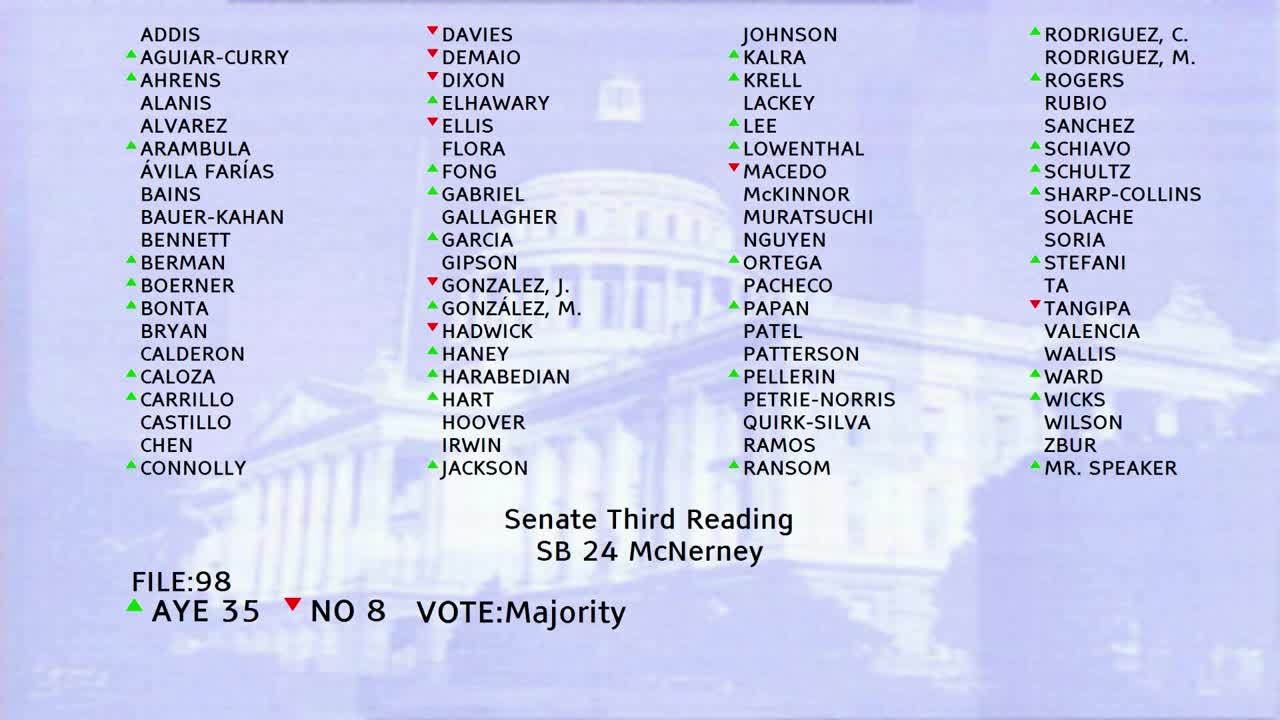 2MIN
Assembly Floor
 27MIN
Assembly Standing Committee on Insurance
 23MIN
Assembly Standing Committee on Judiciary
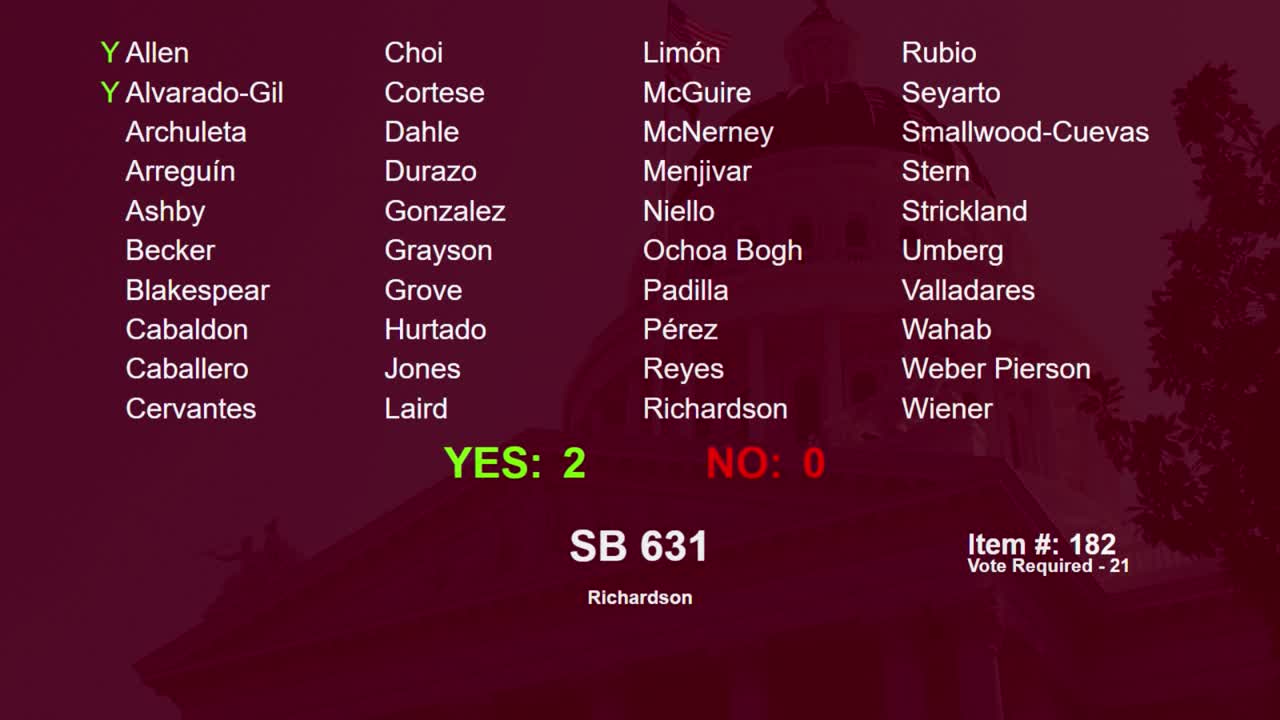 2MIN
Senate Floor
 10MIN
Senate Standing Committee on Judiciary
 11MIN
Senate Standing Committee on Housing
Bill Author

Bill Co-Author(s):
